life
Life — May 22, 1931
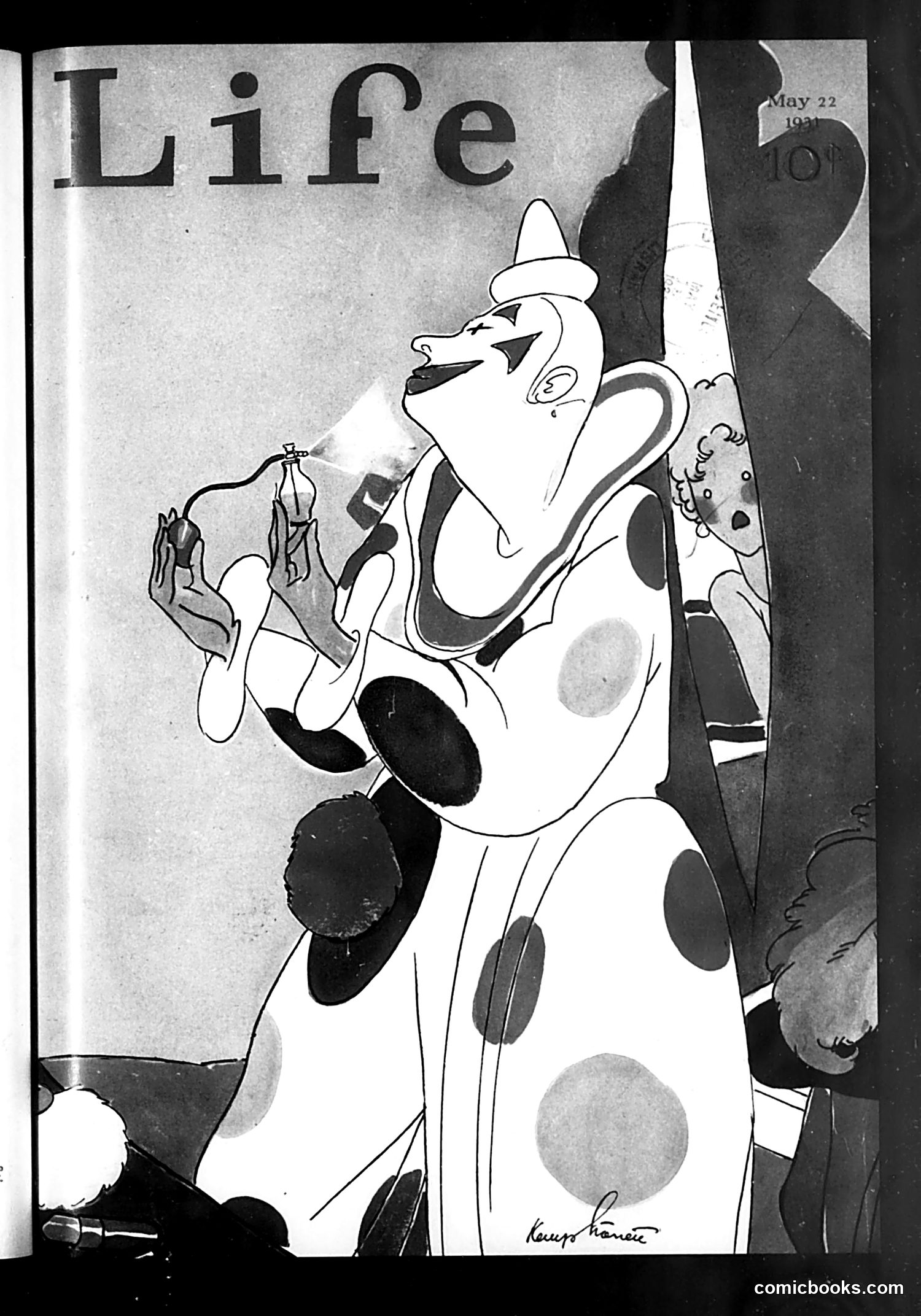
Life Magazine Cover Analysis This is a Life magazine cover from May 22, 1931 (visible in top right corner). The main illustration shows a clown character in a polka-dotted costume holding what appears to be a violin or musical instrument, depicted in a cartoonish, exaggerated style typical of early 20th-century satire. The clown's theatrical appearance—with the large smile, oversized features, and performance costume—likely represents entertainment industry excess or frivolity during the Great Depression era. The musical instrument may reference either artistic pretension or entertainment as escapism during economic hardship. Without additional OCR text from the page itself, the specific satirical target remains unclear, though the contrast between the clown's gaiety and the serious economic conditions of 1931 suggests social commentary on misplaced priorities or public distraction from pressing concerns.
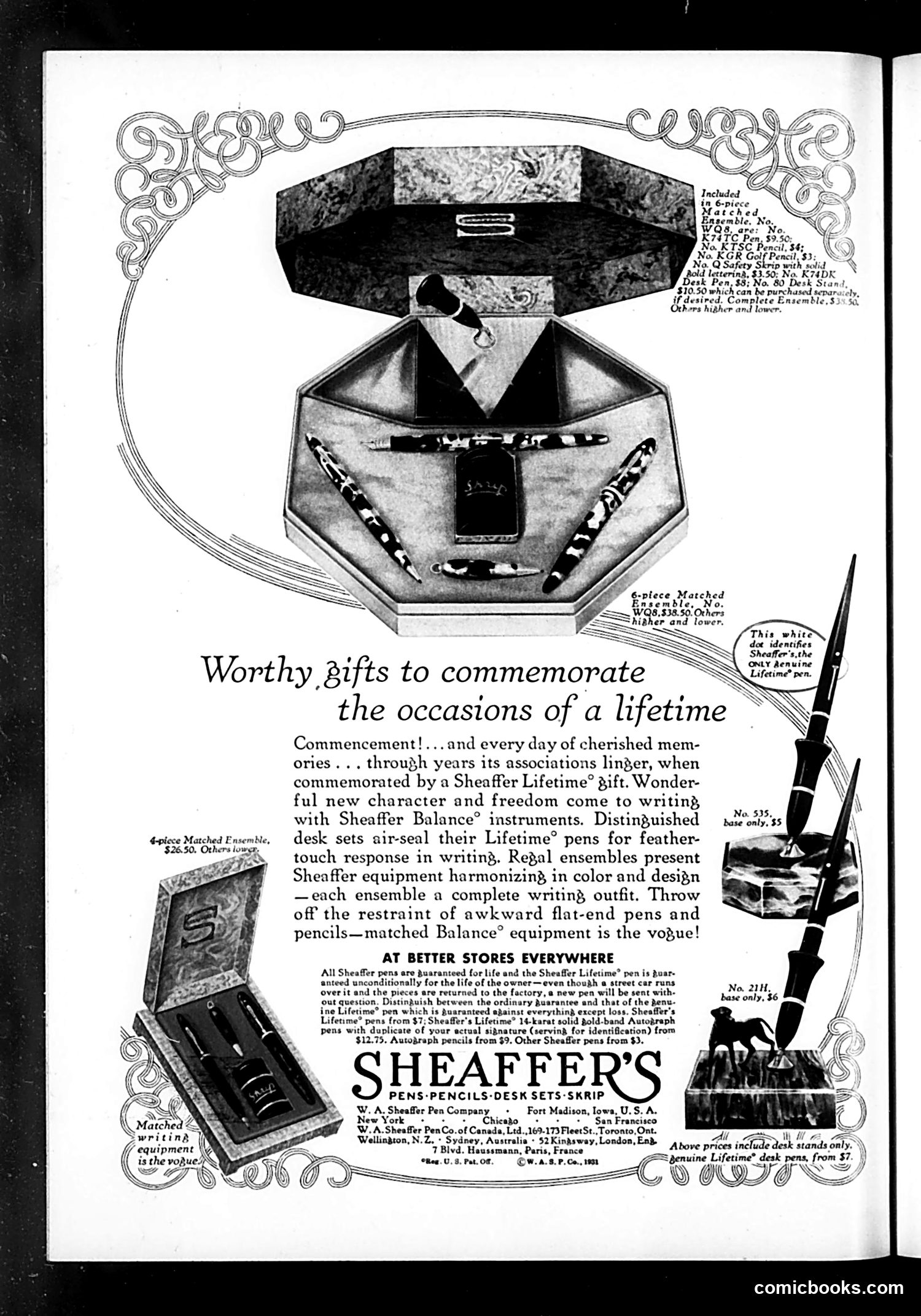
Analysis This is primarily a Sheaffer pen advertisement, not a political cartoon. The page promotes Sheaffer's "Lifetime" line of writing instruments—pens, pencils, and desk sets—as commemorative gifts for major life occasions. The visual centerpiece depicts an open gift box displaying matched writing instruments (pens, pencils, and what appears to be a desk accessory). The decorative border and formal presentation suggest luxury and prestige. The accompanying text emphasizes that Sheaffer pens are "guaranteed for life," positioning them as enduring gifts suitable for "commencement...and every day of cherished memories." The ad appeals to buyers seeking quality, matched "ensembles" that harmonize "in color and design." This represents mid-20th-century advertising strategy: marketing practical items as status symbols and emotional keepsakes.
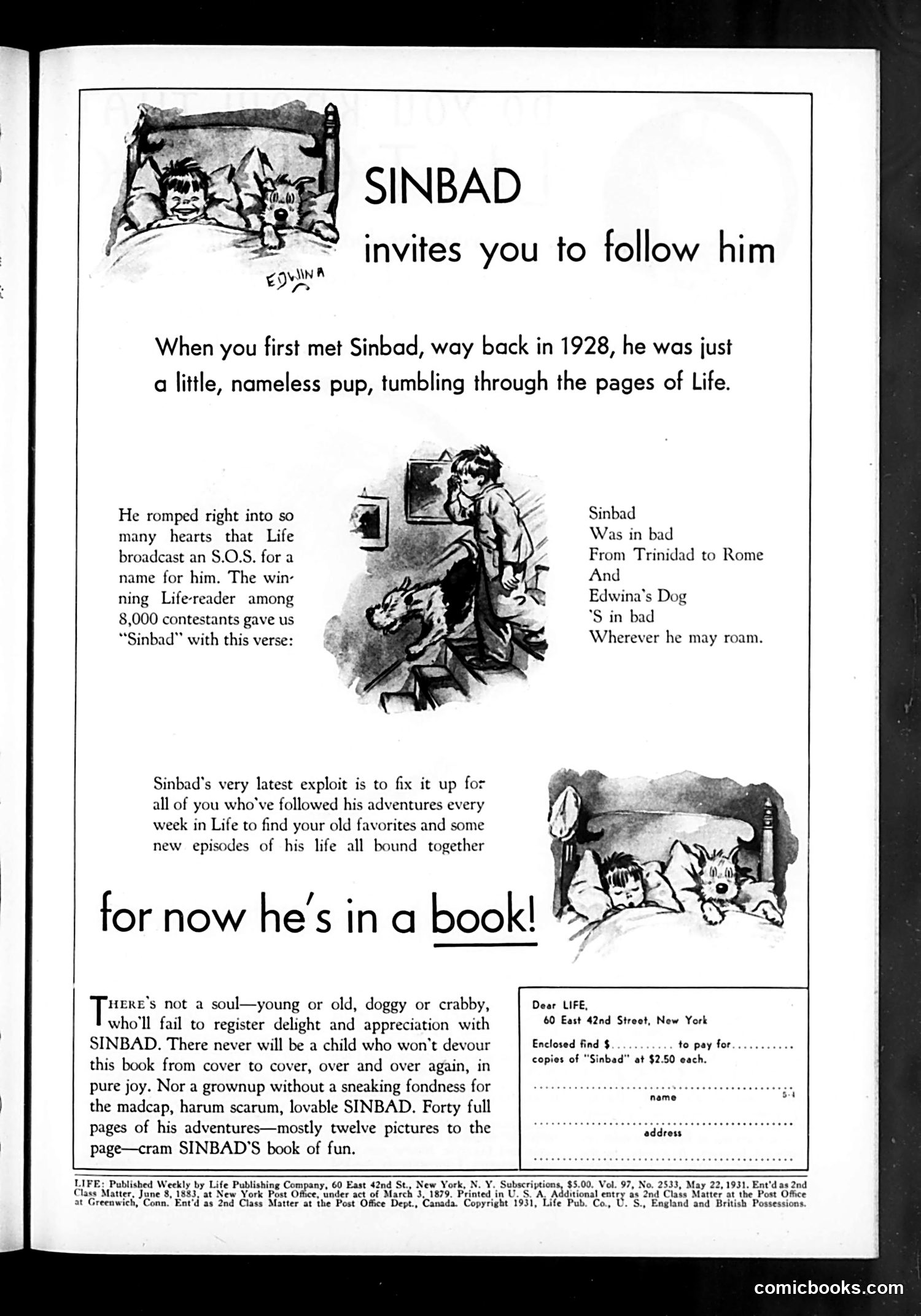
Sinbad Book Advertisement This is a book advertisement rather than political satire. The page promotes a children's book collecting adventures of "Sinbad," a dog character that debuted in *Life* magazine in 1928. The ad explains that Sinbad was originally a unnamed puppy who became popular through the magazine—readers voted to name him via a contest that drew 8,000 entries. His winning name came from a verse submitted by a reader. The advertisement highlights that *Life* has now compiled Sinbad's weekly comic adventures (40 pages, mostly illustrated) into a bound book for $2.50. The copy emphasizes broad appeal, claiming "there's not a soul...who'll fail to register delight" with the character, positioning it as family entertainment for children and adults alike.
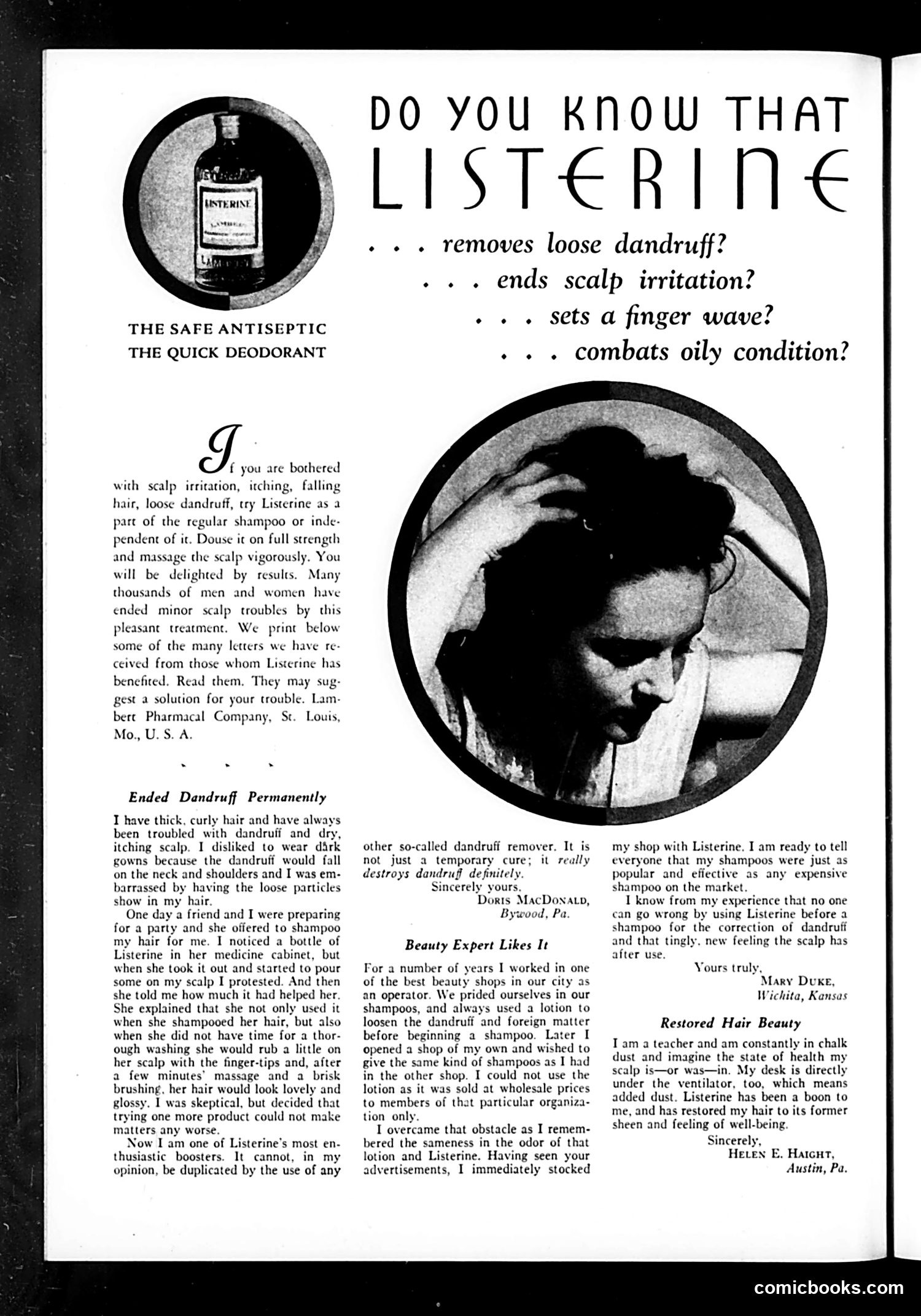
Analysis This is not a political cartoon but rather a vintage advertisement for Listerine mouthwash/antiseptic (circa early 20th century, likely 1920s-30s based on styling). The page features: - Product claims: Listerine removes dandruff, ends scalp irritation, sets finger waves, and combats oily hair - Testimonial letters from satisfied customers (Doris MacDonald, Mary Duke, Helen E. Haight) describing results - Circular photographs showing a woman's profile and hands massaging scalp, demonstrating application The advertisement exploits common beauty anxieties of the era—dandruff, itching, and hair health—positioning Listerine as a multipurpose solution. The testimonials lend credibility through apparent "real user" experiences, a marketing strategy common to the period.
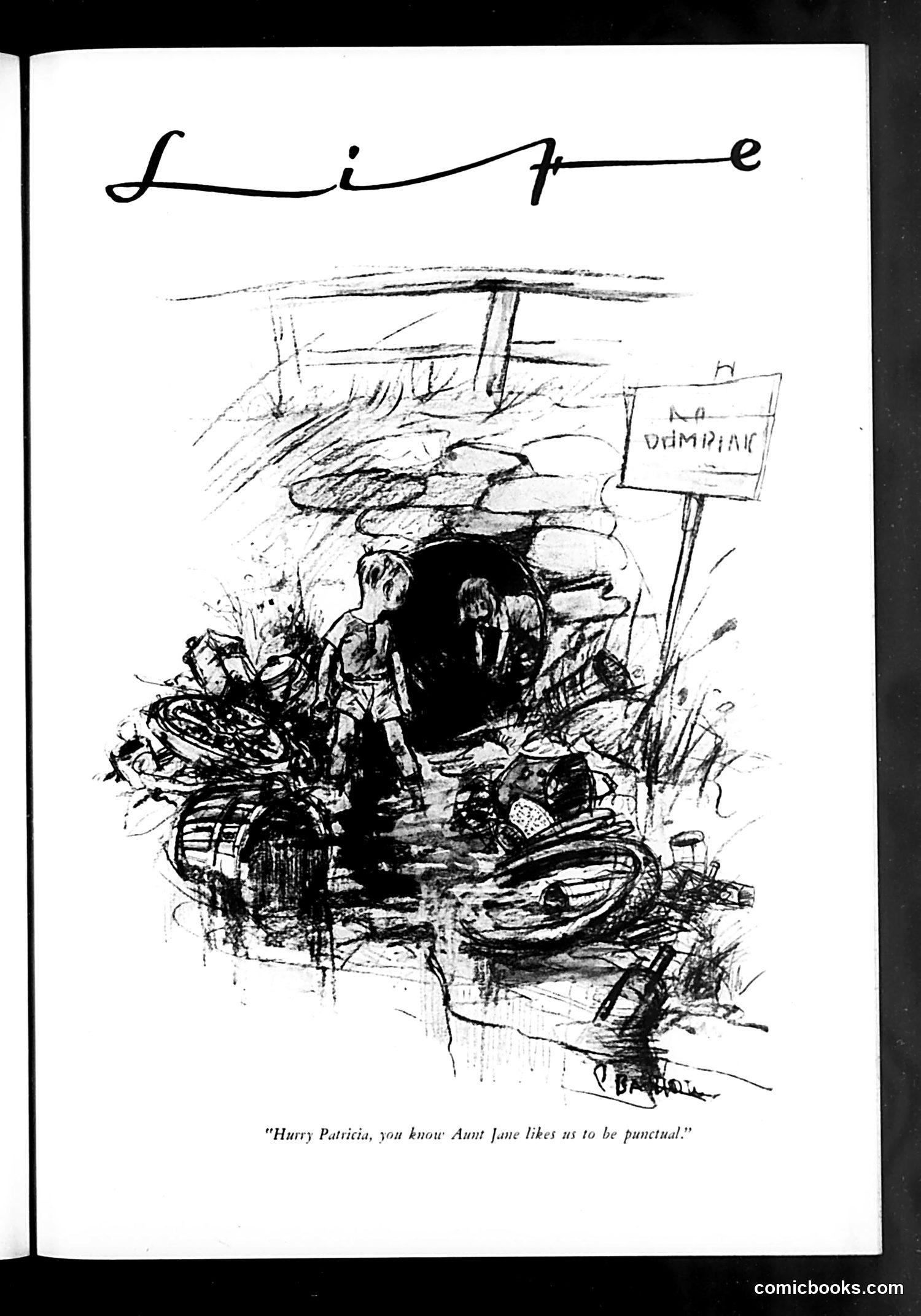
Analysis This is a single cartoon depicting a domestic scene. The sketch shows figures in what appears to be a messy, cluttered interior space with a sign reading "DUMPING" visible. The caption reads: "Harry Patricia, you know Aunt Jane likes us to be punctual." The humor appears to derive from a contrast between social expectations (punctuality for a visit to Aunt Jane) and the chaotic domestic reality depicted—the cluttered, disorganized space suggesting the household is in disarray. The joke likely satirizes the tension between maintaining respectable appearances for relatives and the messiness of actual family life. Without additional context about specific individuals named Harry or Patricia, or details about Aunt Jane, the cartoon functions as general domestic satire on presenting oneself properly to family members.
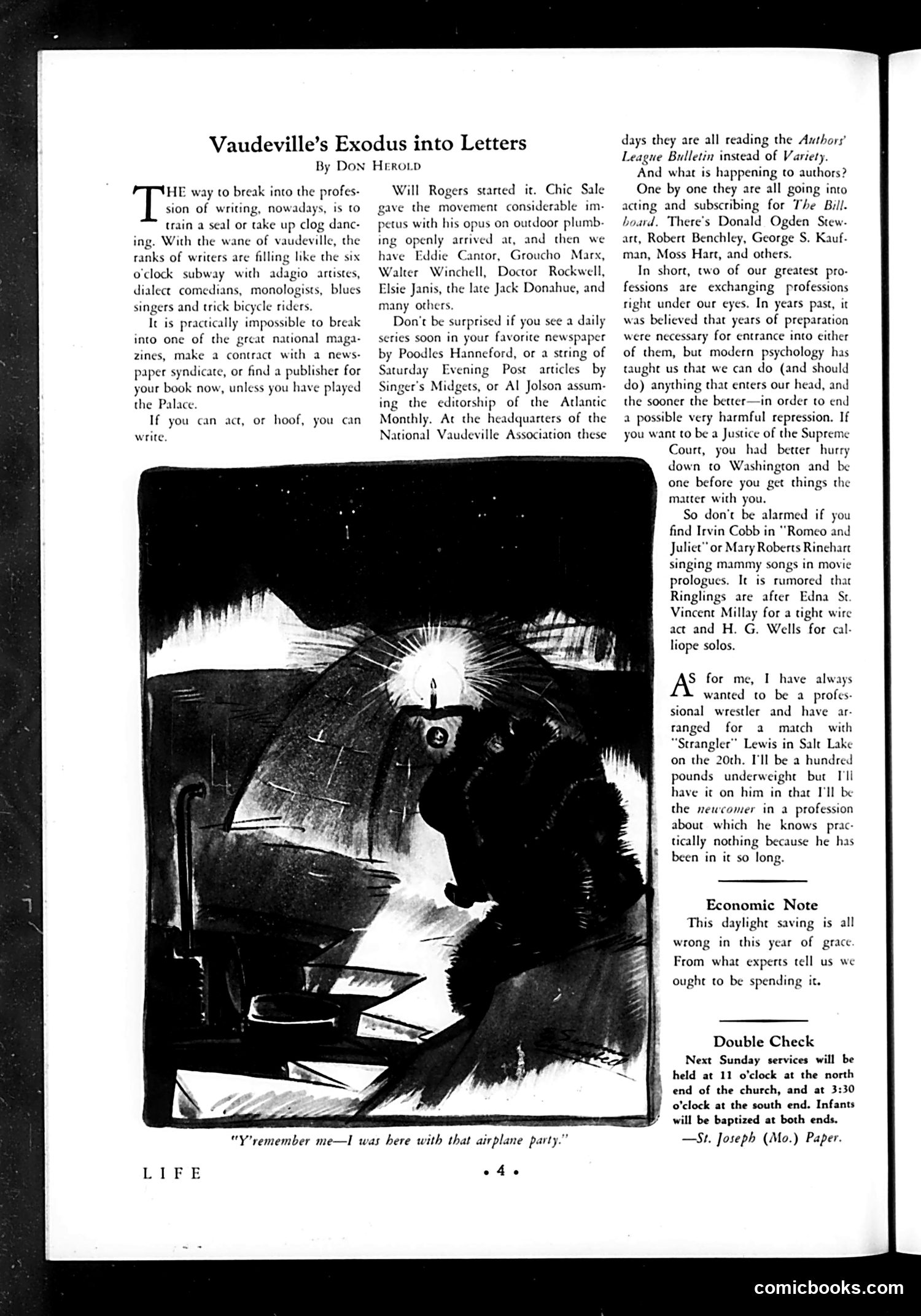
"Vaudeville's Exodus into Letters" - Satire on Entertainment Industry Crossover This page satirizes the trend of vaudeville performers transitioning into writing. The article by Don Herald mocks how entertainers—listed as Will Rogers, Eddie Cantor, Groucho Marx, and others—are now publishing in prestigious magazines and newspapers rather than performing on stage. The cartoon depicts a figure hunched at a desk by candlelight, captioned "I remember me—I was here with that airplane party," suggesting nostalgia for a performer's past glory. The satire critiques this exodus as both the entertainment world's loss and literature's dubious gain—implying these performers lack literary credentials despite their fame. Herald humorously notes he himself plans to become a professional wrestler instead, inverting the trend toward absurdity.
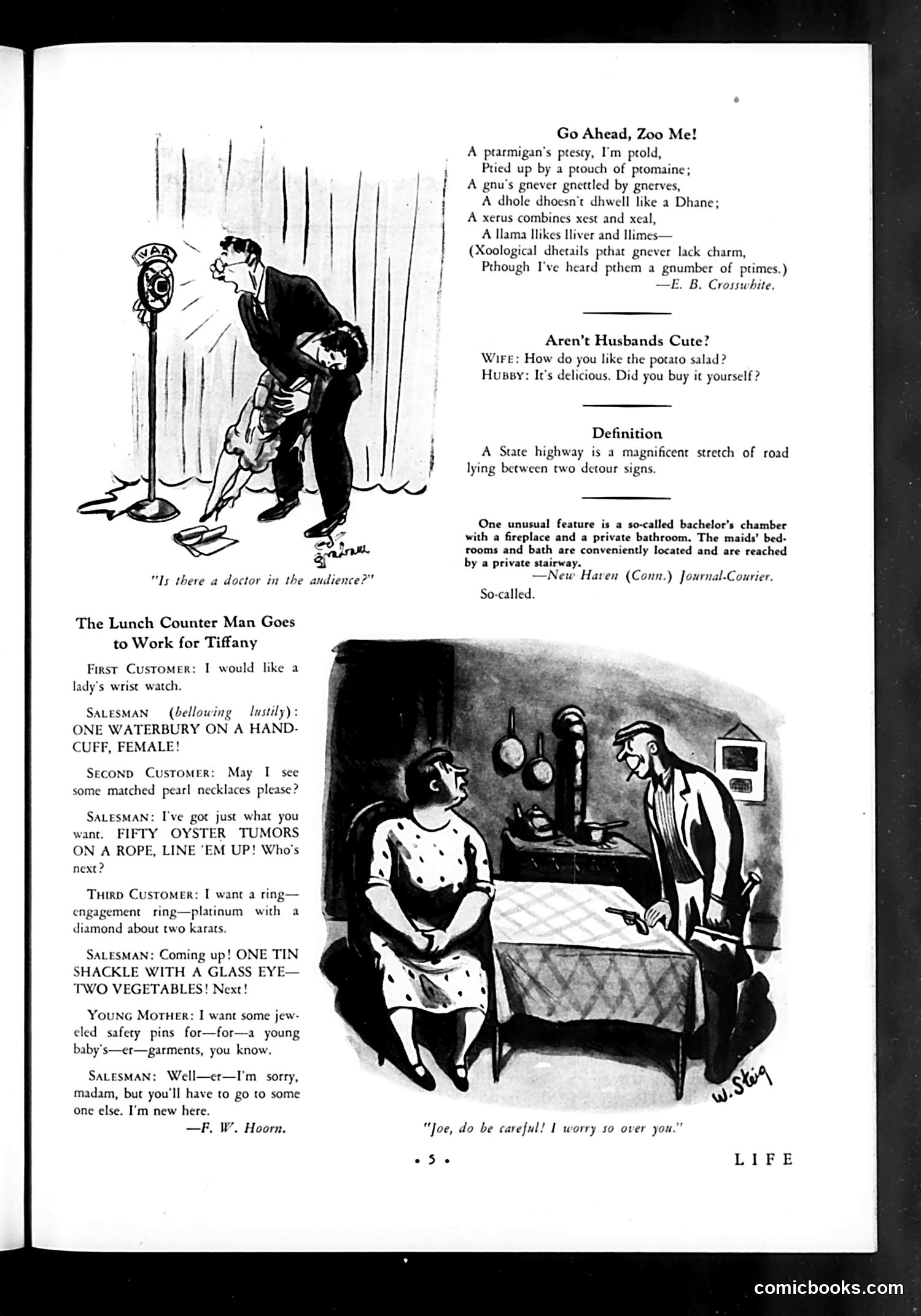
Analysis of Life Magazine Page This page contains three satirical pieces targeting early 20th-century consumer culture and gender roles: 1. "Go Ahead, Zoo Me!" - A poem mocking exotic animals' supposed superiority, attributed to E.B. Crowhitte. 2. "Aren't Husbands Cute?" - A brief marital joke playing on gendered domestic expectations. 3. "The Lunch Counter Man Goes to Work for Tiffany" - The main satire. A salesman at the luxury jeweler Tiffany's shouts absurdly exaggerated product descriptions borrowed from lunch-counter slang ("ONE WATERBURY ON A HANDCUFF, FEMALE!"; "FIFTY OYSTER TUMORS ON A ROPE"). The joke mocks both working-class speech patterns and the pretensions of high-end retail, suggesting fine jewelry selling uses the same aggressive hawking techniques as cheap lunch counters. The cartoons illustrate these pieces with period-appropriate illustrations.
Analysis This is an open letter from *Life* magazine to the United States Golf Association, satirizing the introduction of a new golf ball that travels farther than the old standard ball. The satire's point: The new ball is democratizing golf by allowing average players to hit longer distances, thus closing the skill gap between experts and casual golfers. *Life* argues this is *bad* — it prevents the USGA from maintaining golf as an elite sport where superior players dominate. The social critique: The letter mocks the USGA's snobbish gatekeeping, suggesting they want to preserve golf as exclusive to the naturally talented and wealthy ("Bootleggers of the former standard ball"). *Life* ridicules this elitism by noting the government has already intervened in other contexts, asking rhetorically whether the USGA will similarly resist progress. The humor: The letter's exaggerated tone and vivid descriptions of struggling golfers ("his putter with the tortured mind of a patient watching his dentist") emphasize how the new ball threatens the establishment's control over who deserves to enjoy the game.
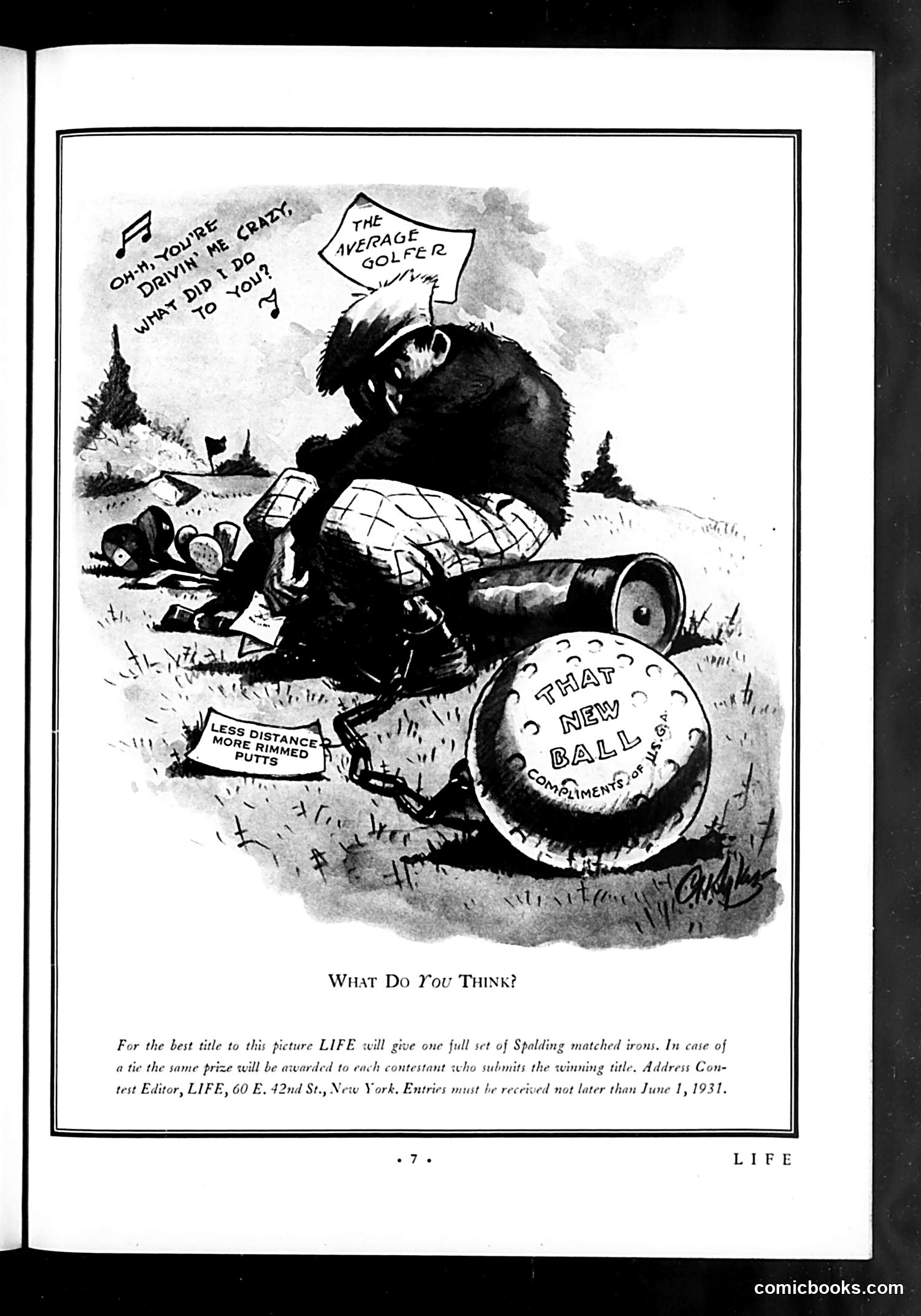
Analysis This is a contest announcement disguised as satirical commentary on golf. The cartoon depicts a frustrated golfer—appearing to be an "average" or everyman type based on the caption—surrounded by golf equipment and a new ball labeled "That New Ball." The golfer's thought bubble reads "Oh! You're drivin' me crazy! What did you do to your?" while another speech bubble identifies him as "The Average Golfer." The satire critiques golf ball marketing claims. The sign reads "Less distance, more normalized putts," mocking manufacturers' competitive advertising about ball performance improvements. The joke suggests that despite marketing hype, equipment changes don't actually help the typical golfer. The page invites readers to suggest a caption title, offering Spalding matched irons as the prize. Entries were due by June 1, 1931.
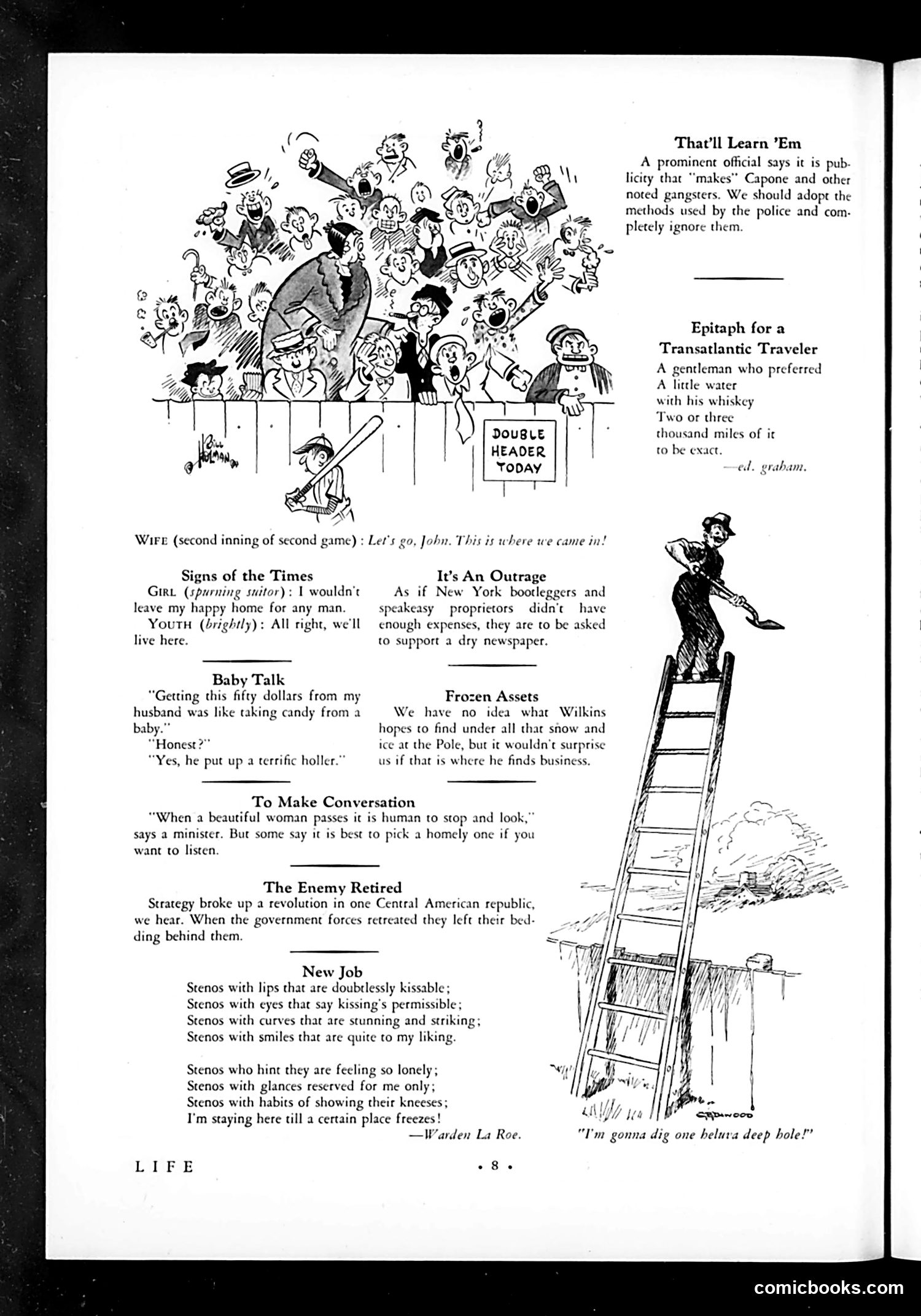
Analysis of Life Magazine Page This page from *Life* magazine contains several brief humorous items and illustrations typical of the publication's satirical content. The main cartoon depicts a crowded bleachers scene labeled "Double Header Today," showing a wife telling her husband "Let's go, John. This is where we came in!"—a joke about repetitive entertainment or marital routine. The text sections address contemporary social issues: bootleggers and speakeasy owners (referencing Prohibition-era illegal drinking establishments), a humorous exchange about a husband's stinginess ("like taking candy from a baby"), and commentary on American politics and behavior. The right-side illustration shows someone climbing a ladder into snow, captioned "I'm gonna dig one helluva deep hole!"—likely satirizing Arctic exploration or similar ambitious ventures. The overall tone reflects 1920s-30s American culture, humor, and social commentary.
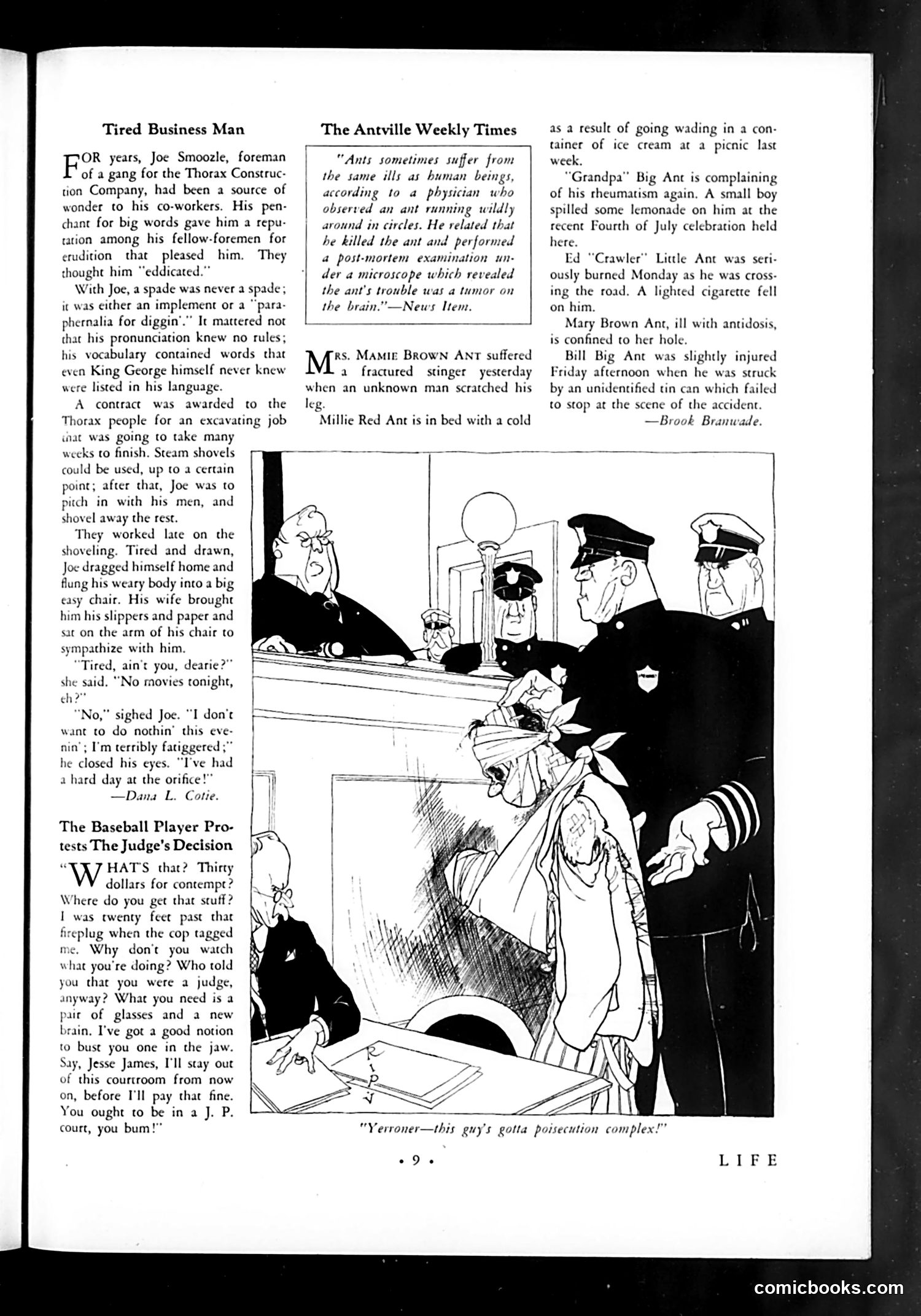
Analysis of "The Antville Weekly Times" Page This page from *Life* magazine presents satirical humor anthropomorphizing ants. "The Antville Weekly Times" offers mock news items about ant society—Mrs. Mamie Brown Ant suffering a fractured stinger, Ed "Crawler" Little Ant injured by a cigarette, and others experiencing human-like ailments and social situations. The large cartoon depicts a police court scene where an ant defendant faces magistrates. The caption reads "Verroner—this guy's gotta possession complex!" The satire appears to mock both judicial proceedings and the defendant's apparent paranoia or psychological issues. The humor relies on applying human institutions (newspapers, courts, psychological diagnoses) to ant civilization, creating absurdist comedy through incongruous scale and anthropomorphism—a popular *Life* magazine formula of the era.
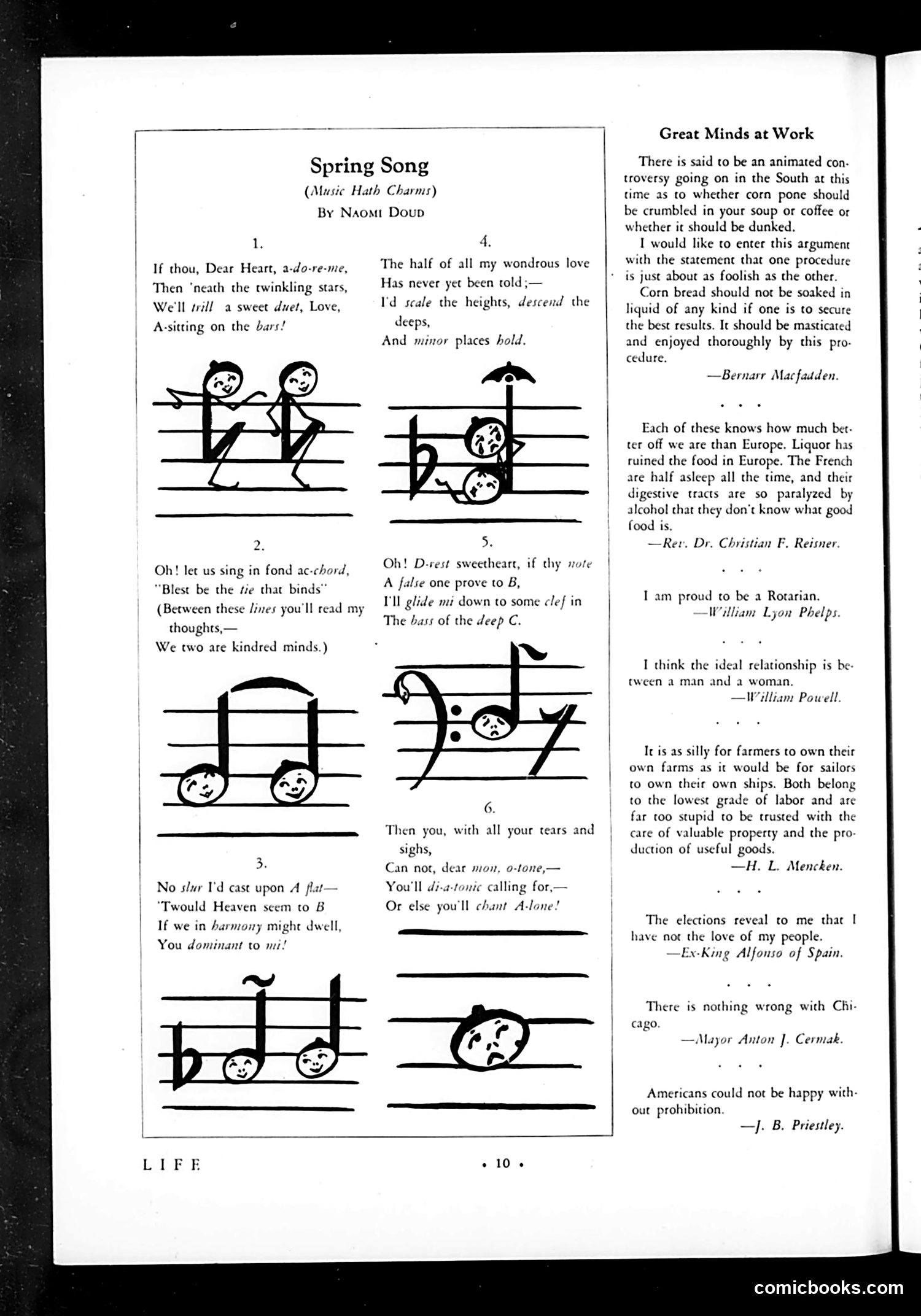
Spring Song Analysis The left side presents "Spring Song" (Music and Lyrics by Naomi Doud)—a humorous musical composition shown through sheet music with stick-figure illustrations. The six numbered verses depict romantic situations: couples singing together, declarations of love, and musical declarations. The satire appears gentle, mocking conventional love songs and sentimental romance through deliberately simple illustrations and somewhat overwrought poetic language ("a-do-re-me," "tie that binds"). The right column, "Great Minds at Work," contains unrelated satirical quotes from notable figures discussing corn bread preparation, European food culture, farming, and politics. These appear designed to humorously juxtapose serious intellectuals with trivial or absurd positions, though specific historical context for some references remains unclear without additional dating information.
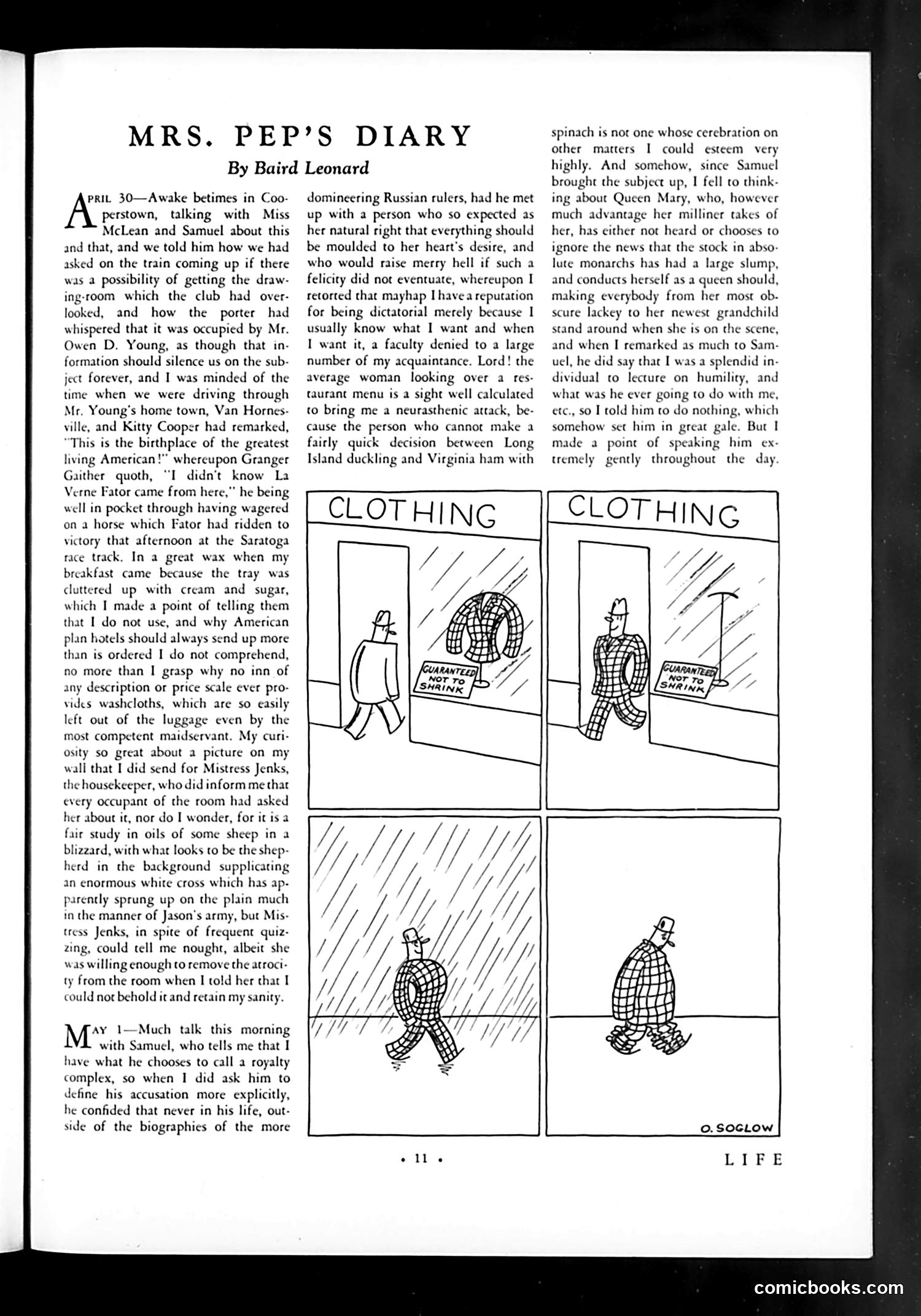
Mrs. Pep's Diary: A Clothing Store Satire This page presents "Mrs. Pep's Diary" by Baird Leonard—a humorous diary entry dated April 30-May 1. The accompanying comic strip by O. Soglow depicts a woman repeatedly visiting a clothing store with a sign reading "SORRY NOT IN STOCK." The Joke: The satire targets post-WWI scarcity and retail frustration. The woman enters the store multiple times seeking items, but everything is perpetually unavailable. The visual gag shows her progressively soaked by rain between visits, yet continuing to return hopefully. Context: This reflects genuine 1920s consumer frustration with limited inventory following wartime shortages. The diary text complains about American hotel services and purchasing practices, suggesting broader annoyance with post-war commercial inconsistencies. The humor stems from recognizable consumer exasperation many readers experienced.
Analysis of Life Magazine Page This page features editorial commentary on business and politics circa the 1930s. The illustration at top shows a cherubic figure with a ship's anchor, likely representing maritime commerce or the Cunard Steamship Company, which is discussed in "Can't Live on Fear." The main articles address: 1. Business optimism - Commentary on the Cunard Line's expansion despite Depression-era challenges, arguing confidence matters more than fear. 2. Prohibition's end - Discussion of Germans reducing hard liquor consumption after Prohibition's repeal, suggesting moral improvement. 3. Mormon influence in business - Senator Smoot's tariff policies, with the author suggesting Mormonism represents "a religion highly developed on its material side." The satirical tone criticizes business leaders' disconnection from economic reality and questions whether religious doctrine appropriately influences commercial policy.
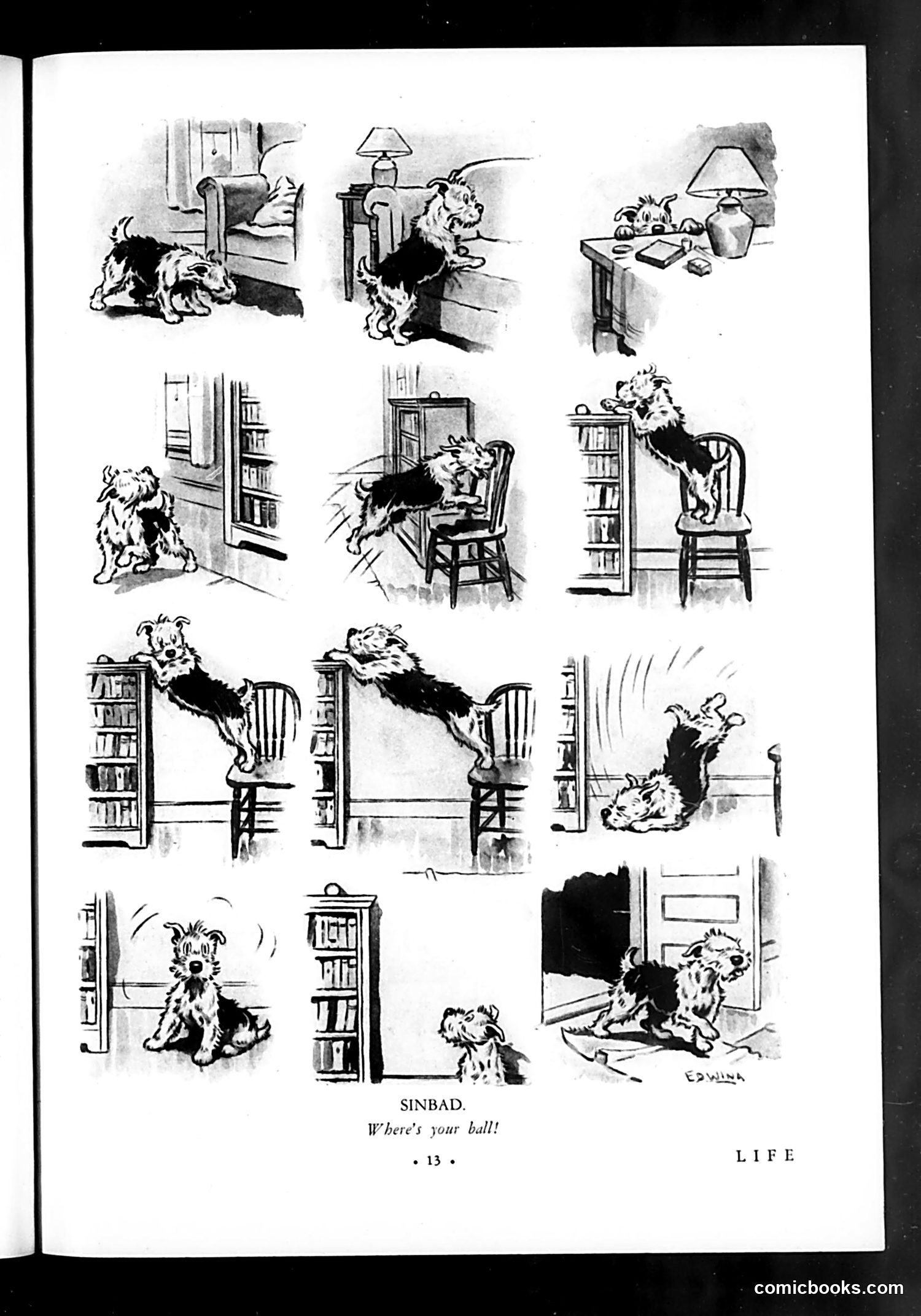
"Sinbad: Where's your ball?" This is a humorous comic strip showing a dog named Sinbad searching for a lost ball throughout a house. The strip depicts the dog's escalating antics as it hunts through various rooms—near furniture, bookshelves, chairs, and finally out a door—creating increasingly chaotic scenes. The humor relies on simple physical comedy: a determined dog investigating every nook and cranny of a home while making a mess. The title "Where's your ball?" frames the dog's motivation. This appears to be a straightforward domestic animal humor comic rather than political satire—the kind of lighthearted content that would appeal to *Life* magazine's general readership. The signed artwork (appears to be "E. Dulin") suggests professional illustration typical of the era's magazine comics.
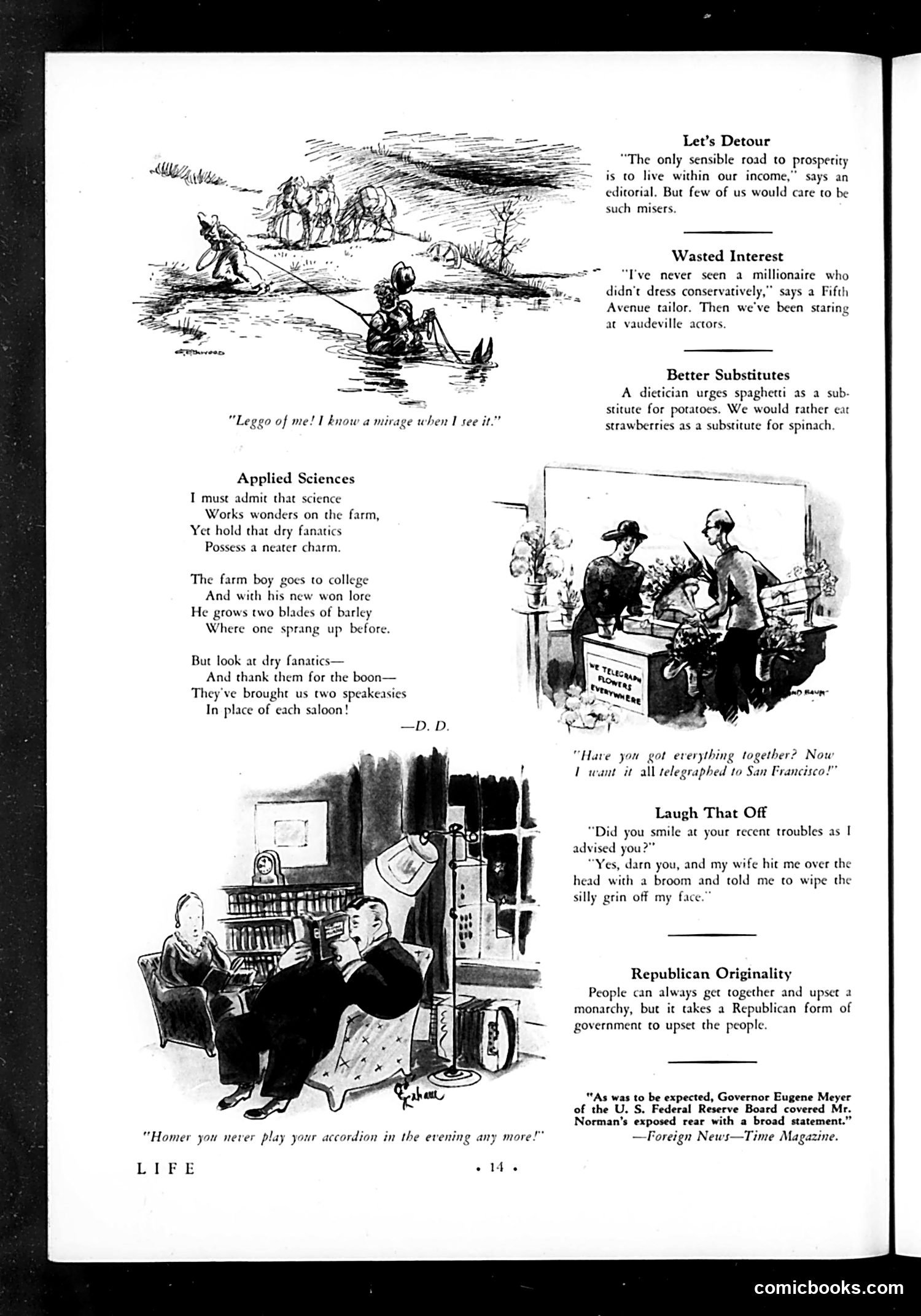
Analysis of Life Magazine Page This page contains several satirical pieces mocking early 20th-century social trends and politics. "Let's Detour" criticizes financial irresponsibility, quoting an editorial about living within one's means—a dig at those ignoring economic prudence. "Applied Sciences" is a poem mocking "dry fanatics" who champion scientific progress on farms but fail practically. It suggests overconfidence in newfangled agricultural methods replacing proven practices. "Laugh That Off" presents domestic humor about marital conflict, with a wife hitting her husband with a broom. "Republican Originality" offers political commentary suggesting Republicans are merely adept at disrupting existing systems rather than creating genuinely novel governance. The bottom cartoon shows a couple at home with caption about accordion playing, likely domestic humor about annoying evening activities.
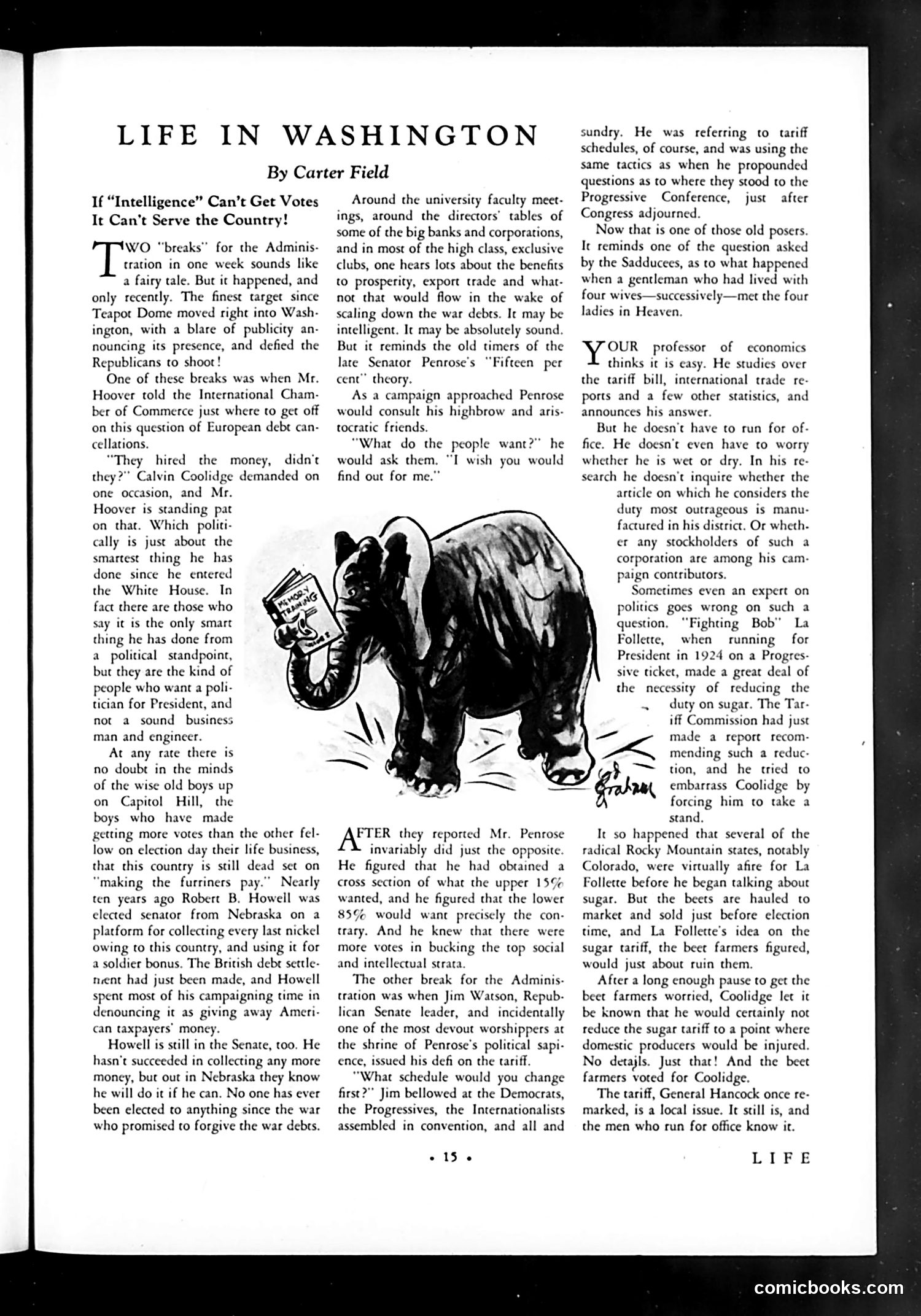
Political Cartoon Analysis: "Life in Washington" by Carter Field This cartoon depicts a large bear labeled "TARIFF" carrying a briefcase marked "SCHEDULE," satirizing Senator Penrose's manipulation of tariff policy. The article describes how Penrose, a Republican leader, ostensibly consulted upper-class interests about tariffs but secretly worked to benefit lower-class voters—reversing his usual aristocratic approach. The bear represents how tariff schedules, though appearing to address elite economic concerns, actually impacted working people. The satire mocks political hypocrisy: Penrose claimed to seek input from highbrow intellectuals about tariffs while pursuing different goals. The bear's confused expression suggests the public's bewilderment at these contradictory political maneuvers during the 1920s tariff debates.
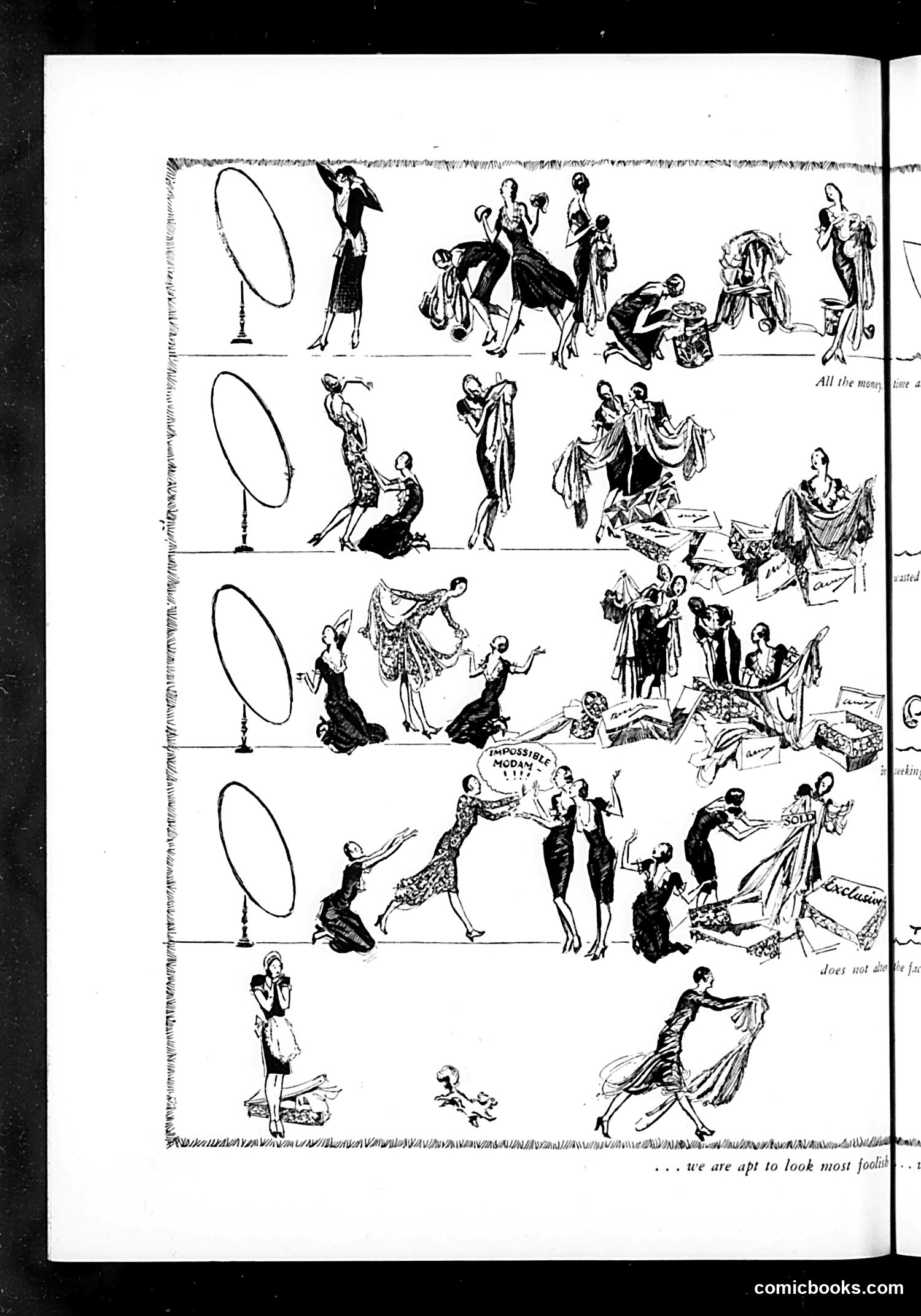
Fashion Satire: "Modishness" (1920s) This page satirizes women's fashion trends through four repeated panels, each showing a woman viewing herself in a mirror, followed by increasingly chaotic scenes of socializing, shopping, and leisure activities. The joke appears to be about the gap between how fashionable women *imagine* themselves looking (elegant, poised in the mirror) versus the frantic, undignified reality of modern social life—shopping chaos, tangled fabrics, competitive socializing, and physical comedy. The caption "we are apt to look most foolish" (visible at bottom) confirms the satire targets the absurdity of pursuing fashionable appearance while engaging in undignified modern activities. This reflects 1920s concerns about changing women's social roles and the commercialization of fashion and leisure.
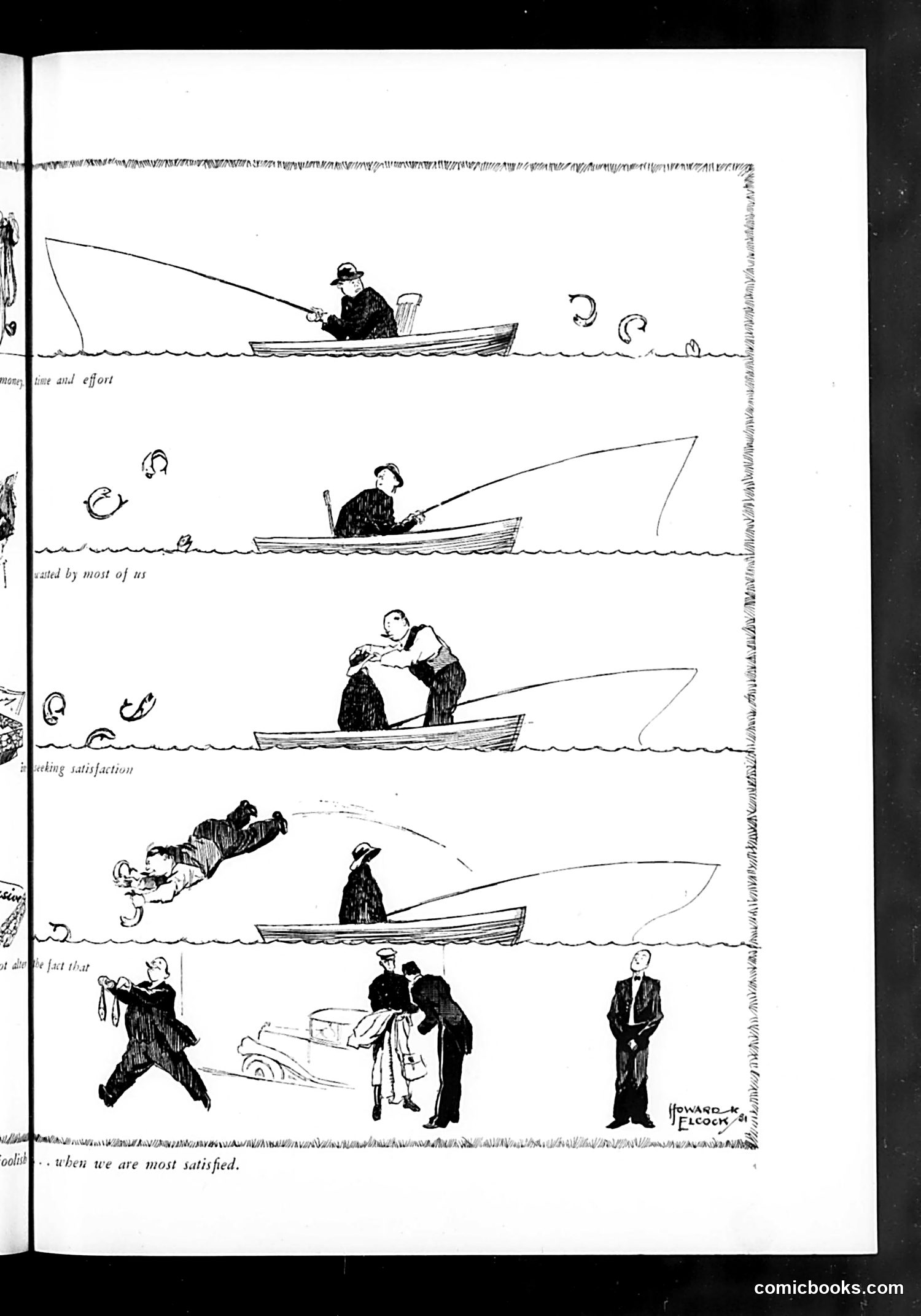
Analysis This is a sequential cartoon depicting fishing as a metaphor for courtship or romantic pursuit. The progression shows: 1. Top panel: A man fishing alone with effort 2. Second panel: "Visited by most of us" — he's now fishing more casually 3. Third panel: "Seeking satisfaction" — he's actively reeling something in 4. Fourth panel: He's successfully caught something (appears to be a fish or possibly a woman, given the metaphor) 5. Bottom panel: "...when we are most satisfied" — on shore with what appears to be a woman and onlookers The cartoon uses fishing as an extended metaphor for male romantic conquest or courtship. The signed cartoonist name appears to be "Howard Elcock" (lower right). The satire mocks how men pursue romantic interests with varying effort levels, suggesting satisfaction comes when the "catch" is secured—a commentary on early-20th-century gender dynamics and male attitudes toward romance and marriage.
Analysis of Life Magazine Movie Reviews Page This page contains movie reviews by Harry Evans for three films: "The Public Enemy," "Svengali," and "Tabu." "The Public Enemy" stars James Cagney as a gangster. Evans praises the film's unflinching portrayal of criminal life and Cagney's exceptional performance in a tough, unsympathetic role—noting this represents a departure from typical Hollywood romanticization of gangsters. The review suggests the film serves an educational purpose about crime's consequences. "Svengali" features John Barrymore in a character role with extensive makeup and facial tricks. Evans commends his performance and the film's exotic atmosphere. "Tabu" is a South Sea Islands film with native and mixed-race cast members. Evans praises its natural cinematography and compelling drama, considering it superior entertainment to typical Hollywood fare. The page reflects 1930s cinema criticism emphasizing artistic merit and social responsibility.
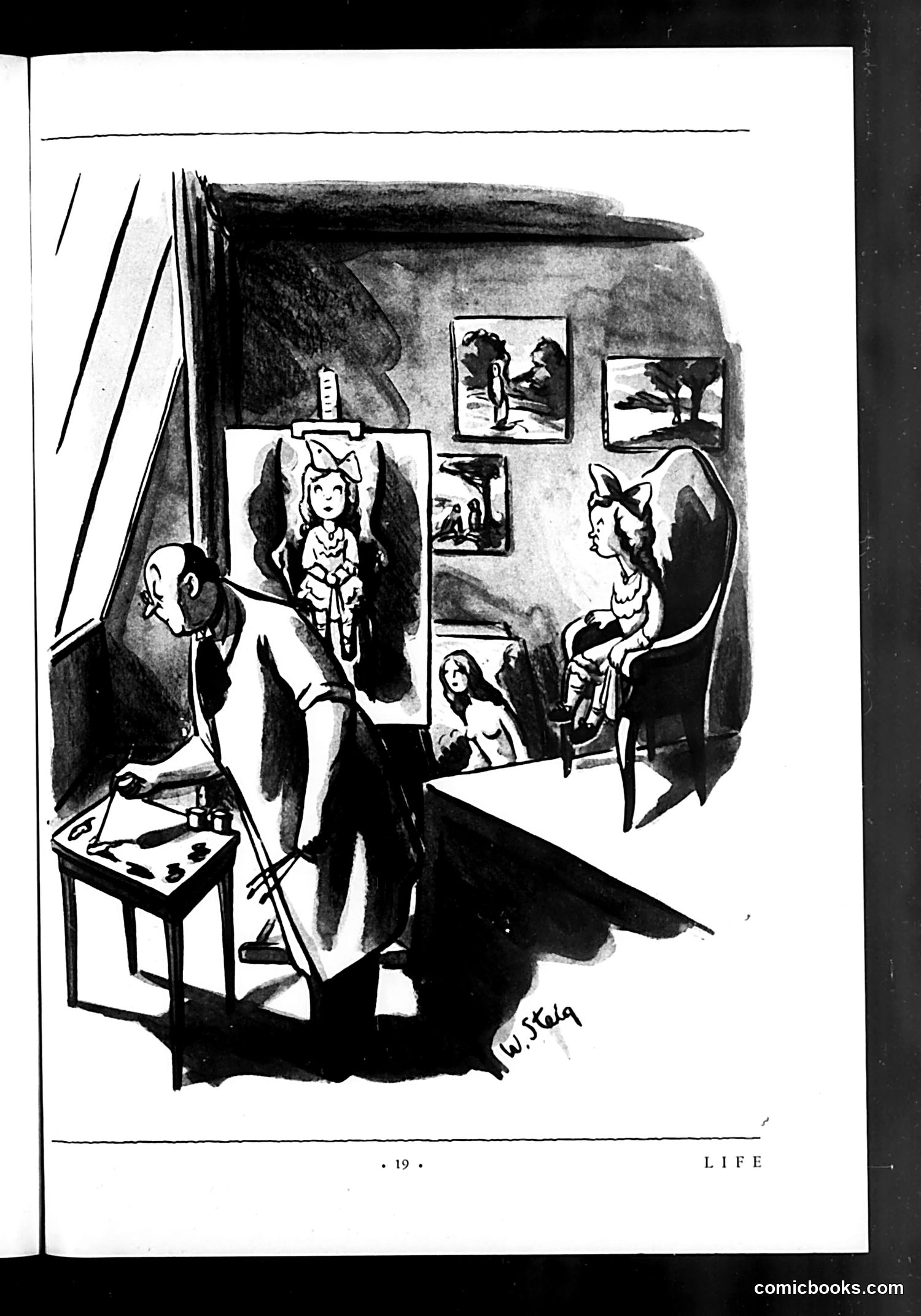
Analysis This is a single-panel cartoon signed by W. Steig, depicting what appears to be an art dealer or gallery owner showing paintings to two well-dressed female clients in an interior space. The satire targets the art world and aesthetic pretension. The dealer exhibits paintings on the wall while gesturing proudly, while a small child sits on the floor playing cards—seemingly indifferent to the "serious" artwork surrounding them. The joke suggests that the child's simple card game is as legitimate an artistic/creative pursuit as the paintings being hawked to the sophisticated clientele, mocking how the art establishment elevates certain works while overlooking genuine creativity elsewhere. The cartoon critiques art world snobbery and commercialism through this contrast between earnest promotion and innocent authenticity.
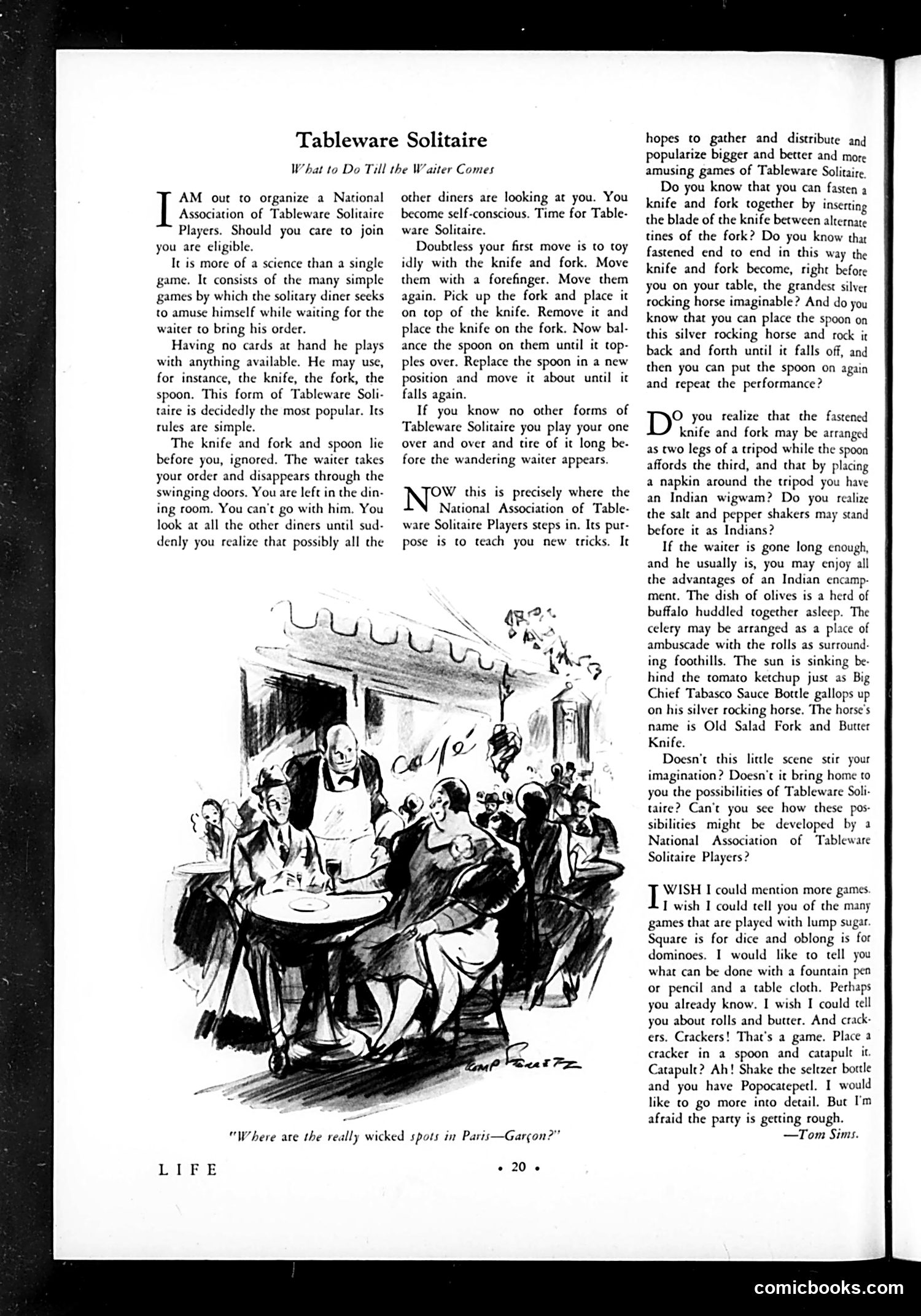
Tableware Solitaire: Explaining the Humor This humorous piece satirizes the tedium of restaurant dining while waiting for food service. The author proposes a tongue-in-cheek "National Association of Tableware Solitaire Players" to formalize the fidgeting games diners naturally play with silverware when bored. The satire operates on multiple levels: it mocks both the awkward self-consciousness diners experience (worrying other patrons are watching them) and the absurdly slow service typical of the era's restaurants. The illustration depicts diners at a table, emphasizing this shared social anxiety. The elaborate descriptions of creating "rocking horses" and "Indian encampments" from cutlery and table items heighten the comedy—transforming childish fidgeting into quasi-serious recreation. The caption's question about "wicked spots in Paris" adds to the satirical tone, contrasting sophisticated dining expectations with the mundane reality of waiting. This reflects period frustrations with restaurant service standards and the social awkwardness of public dining.
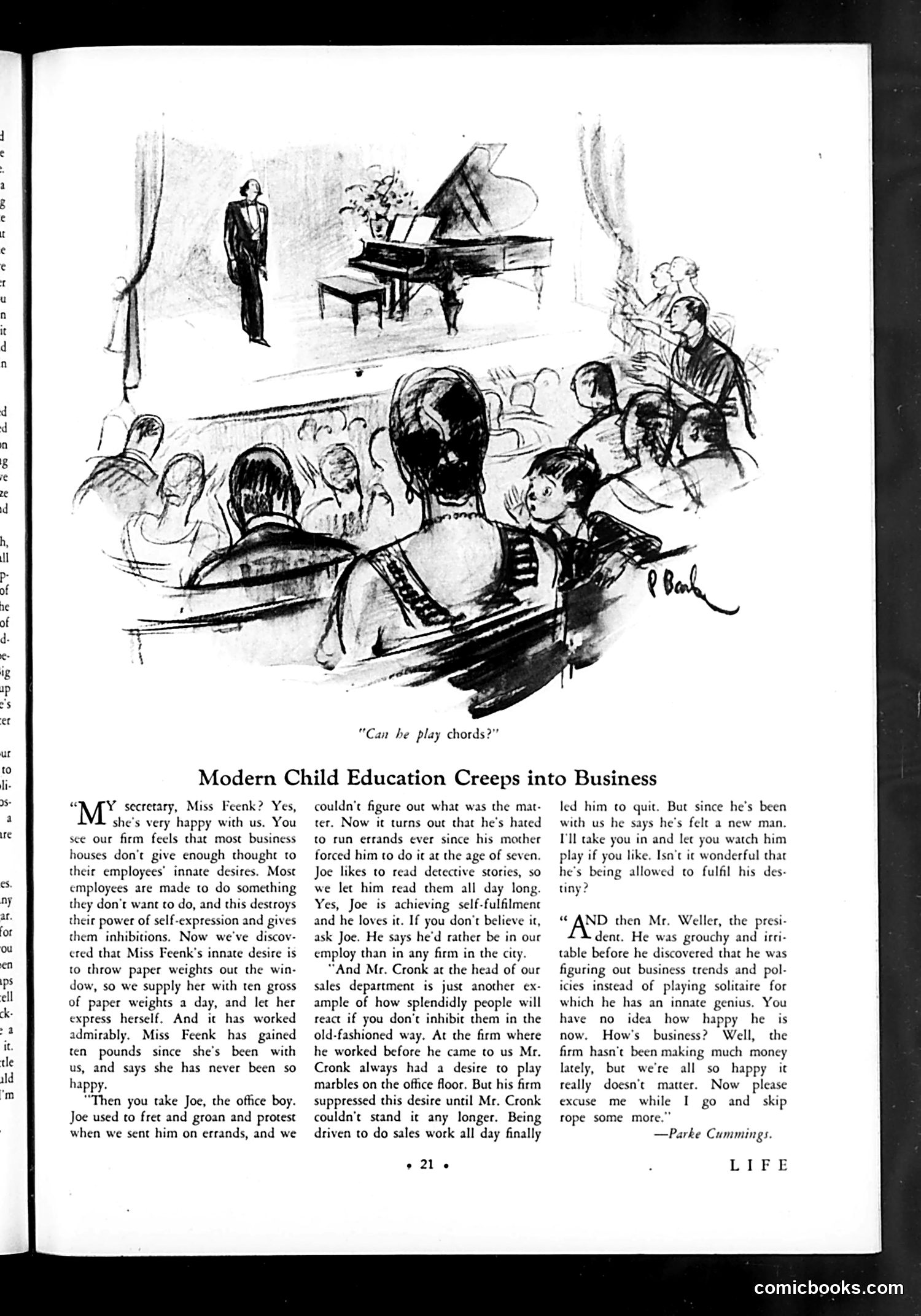
Analysis This satirical piece mocks the emerging "progressive" management philosophy of allowing employees to pursue their innate desires rather than perform actual work duties. The cartoon shows a concert hall where a pianist performs while an audience watches—the caption "Can he play chords?" establishes the absurdist premise. The accompanying text presents a company executive bragging about "modern child education" principles applied to business. Employees are indulged in counterproductive activities: Miss Feenk throws paperweights out windows daily; office boy Joe reads detective stories instead of working; Mr. Cronk plays marbles on the office floor; the president plays solitaire. The satire's target is clear: this management approach prioritizes psychological "self-fulfillment" and "self-expression" over actual productivity. The punchline—the firm "hasn't been making much money lately, but we're all so happy it really doesn't matter"—exposes the impracticality of this philosophy. The piece ridicules the application of progressive child-rearing psychology to adult business operations, suggesting such permissiveness destroys organizational function and profit.
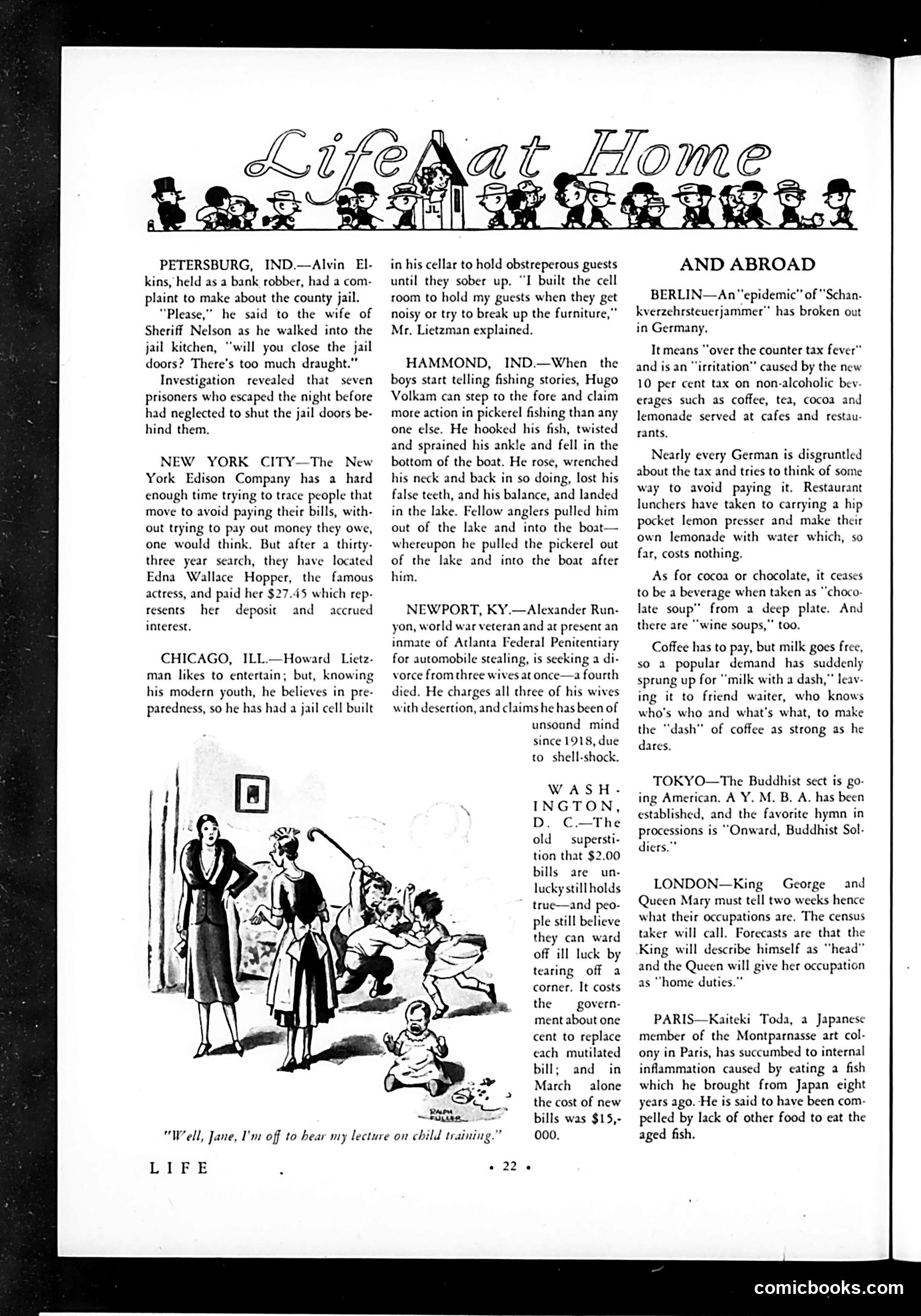
"Life at Home and Abroad" - Page Analysis This page contains humorous anecdotes from American towns and international observations, typical of *Life* magazine's satirical format. The main cartoon shows a woman telling her husband "Well, Jane, I'm off to hear my lecture on child training"—the joke being the apparent irony of someone needing to *attend a lecture* on parenting rather than learning through experience. The anecdotes satirize American eccentricity and bureaucratic absurdity: a bank robber complains about jail drafts; a utility company searches 33 years to return $27.45; a host builds a jail cell in his basement for drunk guests. The "Abroad" section mocks post-WWI international quirks: Germans avoiding a new beverage tax through creative loopholes (homemade lemonade, "chocolate soup"); Britain's census will comically list the King's occupation as "head" and Queen's as "home duties." The overall tone treats modern life's peculiarities—both American and foreign—as inherently absurd, suitable for the magazine's satirical readership.
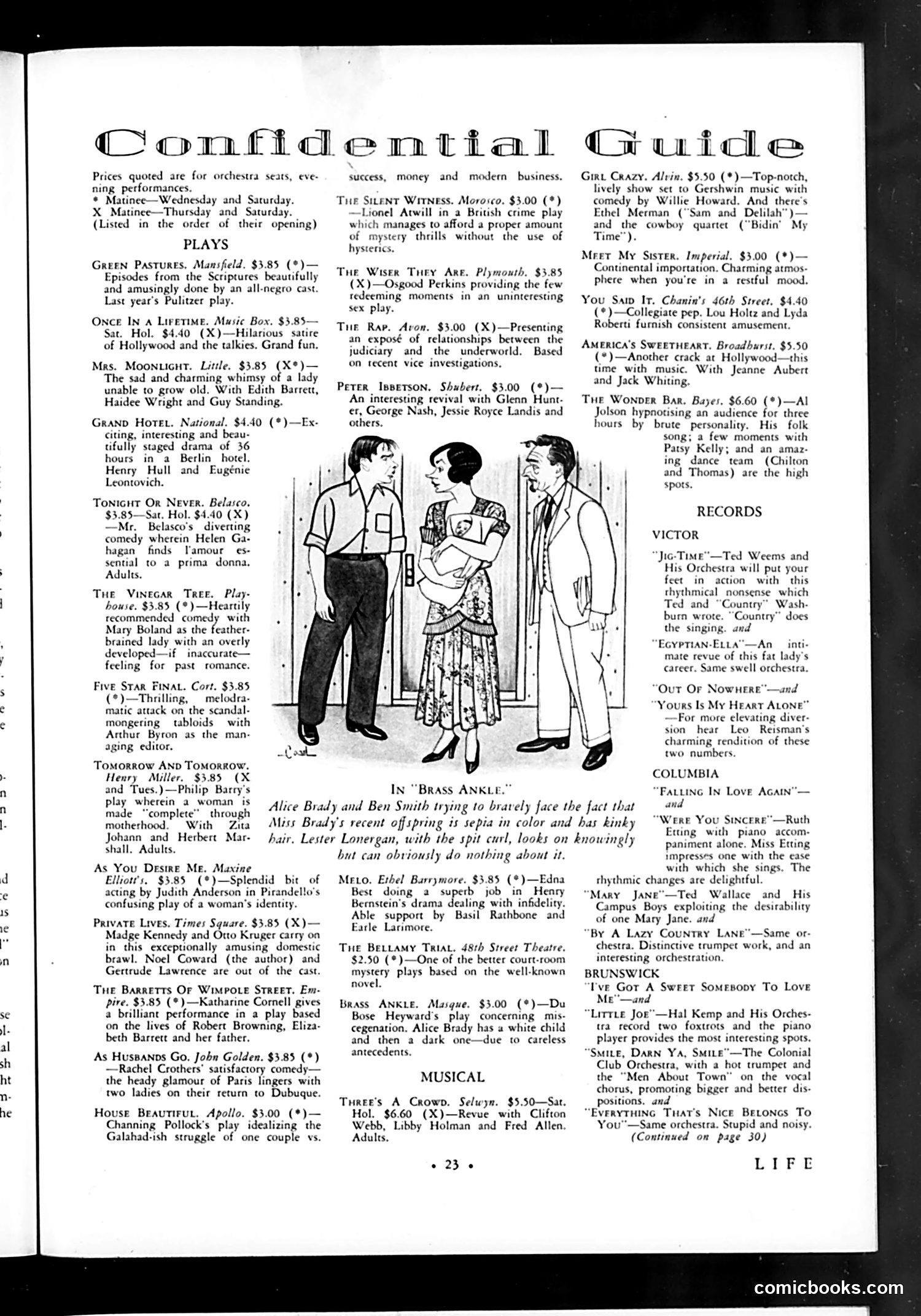
"Brass Ankle" Cartoon Explanation This illustration accompanies a theater listing for "Brass Ankle," a play about miscegenation. The cartoon depicts three figures in what appears to be a tense social encounter—a well-dressed man and woman conversing with another man, all in formal attire suggesting a respectable setting. The caption states: "Alice Brady and Ben Smith trying to bravely face the fact that Miss Brady's recent offspring is sepia in color and has kinky hair." The "joke" reflects the racial anxieties of 1930s America: it satirizes the social scandal and pretense of respectability when a white woman (played by Alice Brady) has a visibly Black child, supposedly due to "careless antecedents" (hidden Black ancestry). The cartoon mocks the characters' attempt to maintain composure in polite society while facing this social catastrophe—capturing the play's exploration of how rigid racial categories and social prejudice create impossible situations.
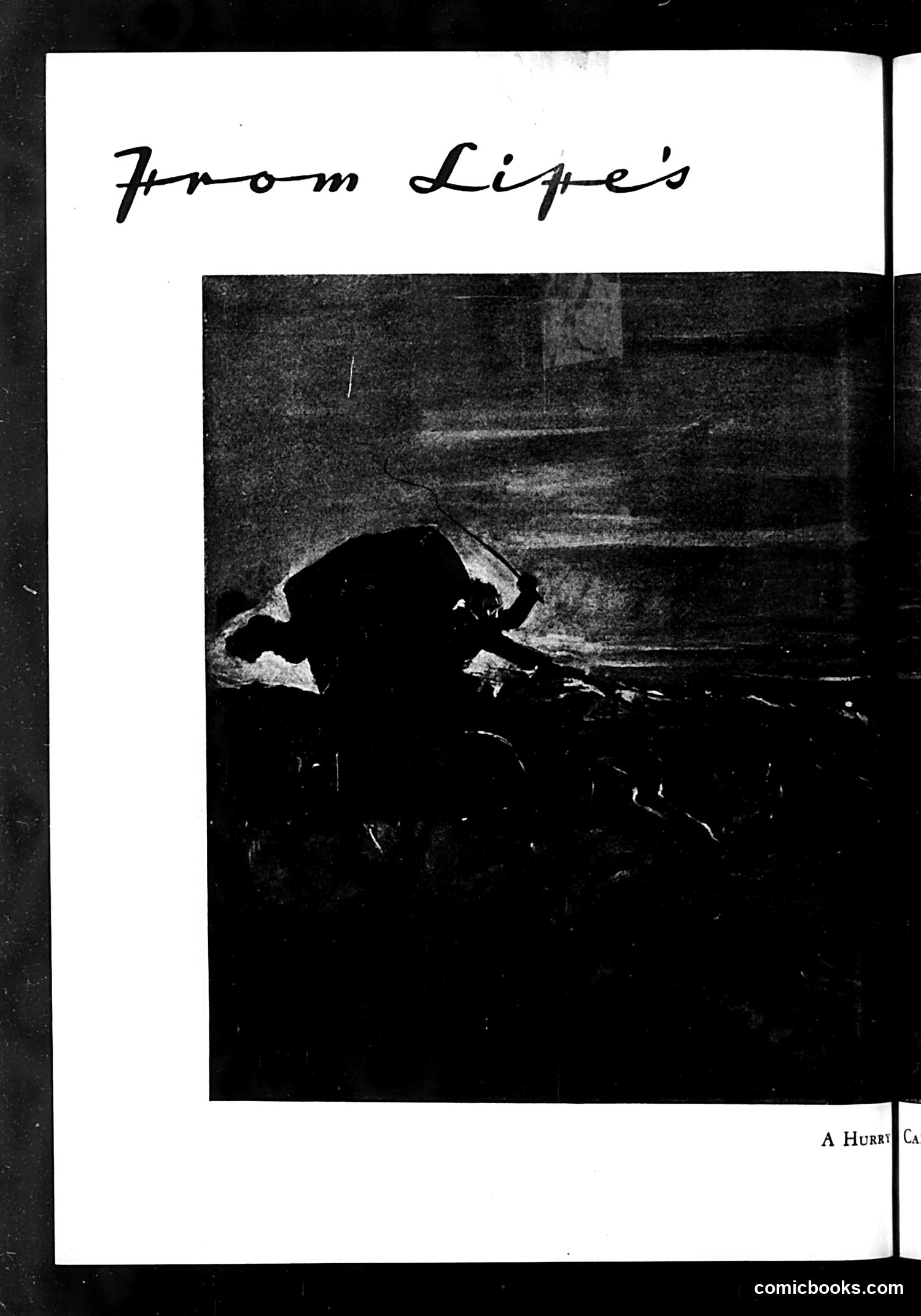
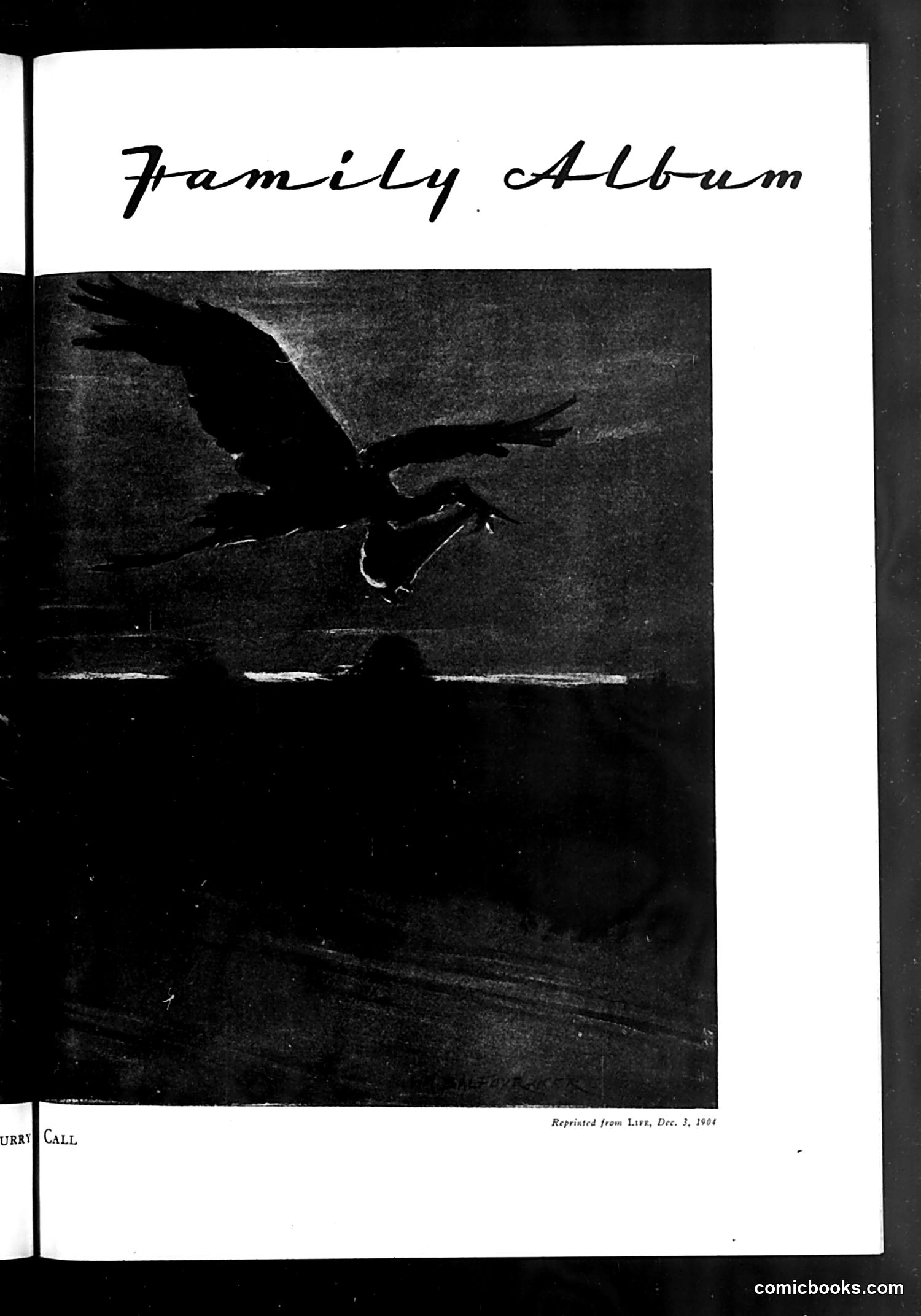
Family Album Page This appears to be a title page or cover for a "Family Album" section from Life magazine (dated December 3, 1904, based on the visible text "Reprinted from Life, Dec. 3, 1904"). The image shows a silhouetted figure in what appears to be a dramatic or comedic pose—possibly falling or in an exaggerated stance. Without additional context or captions visible on this page, the specific satirical intent is unclear. The silhouette technique was common in early 1900s humor magazines for creating dramatic visual effects. The page layout suggests this was an introductory or section-dividing page rather than containing a specific political cartoon with identifiable figures or clear satirical commentary about a particular event or person.
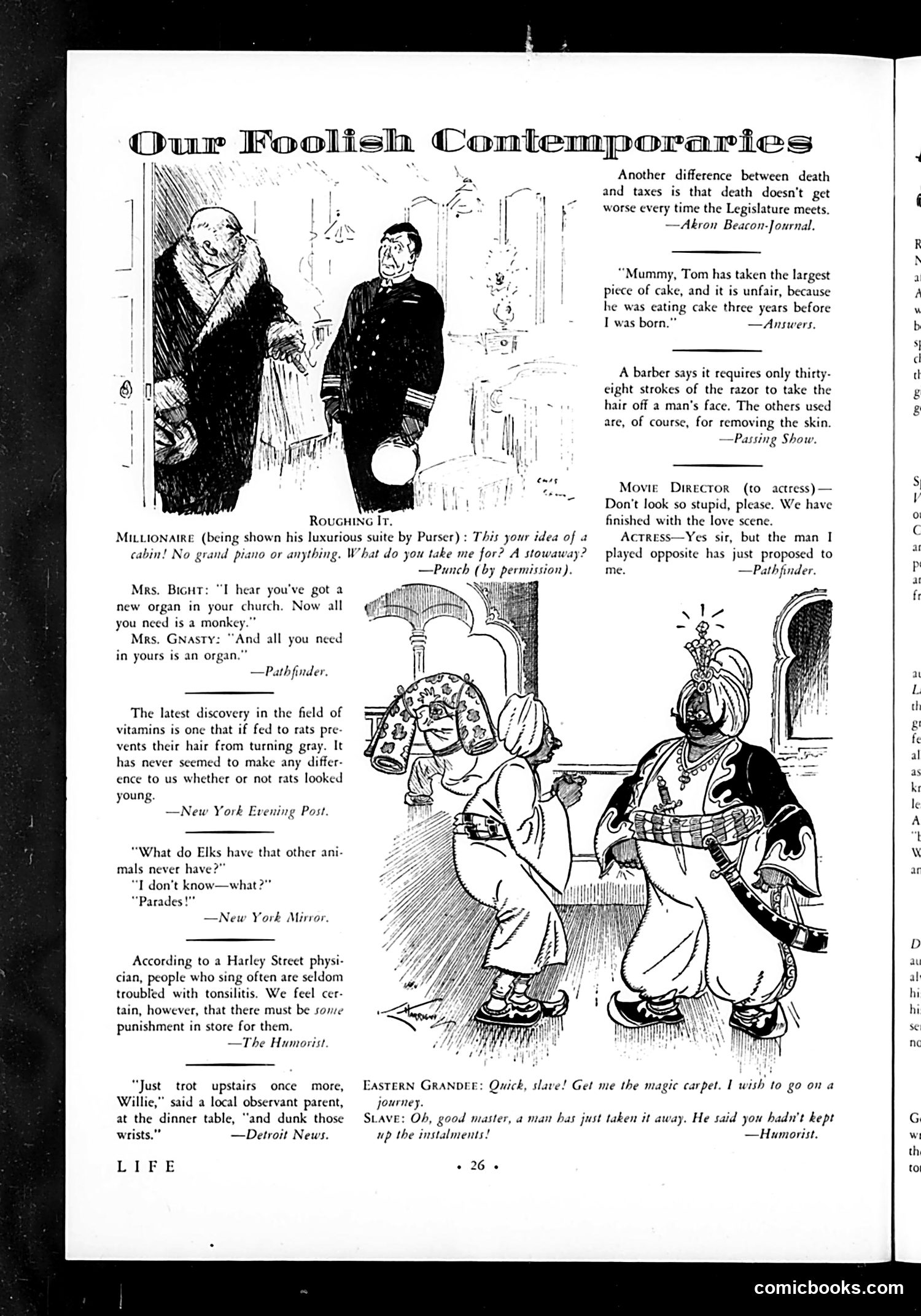
"Our Foolish Contemporaries" — Life Magazine Humor Page This page collects short satirical jokes and cartoons mocking contemporary attitudes and social issues. Key targets include: "Roughing It": A wealthy millionaire complains his ship's cabin lacks luxury items—mocking the excess and entitlement of the rich. Social commentary jokes lampoon: legislators constantly raising taxes; unfair child logic about cake-eating; a barber's unnecessary strokes; a movie actress distracted by romance during filming; church organ jokes about needing improvement. The "Eastern Grandee" cartoon (bottom) shows a master unable to use his "magic carpet" because he hasn't kept up installment payments—satirizing the then-new consumer credit system and hire-purchase agreements, where people bought items on payment plans they couldn't always afford. The page exemplifies *Life* magazine's role as a satirical publication targeting contemporary follies: wealth inequality, modern commerce, institutional absurdity, and human vanity. Most jokes are gentle social criticism rather than sharp political commentary.
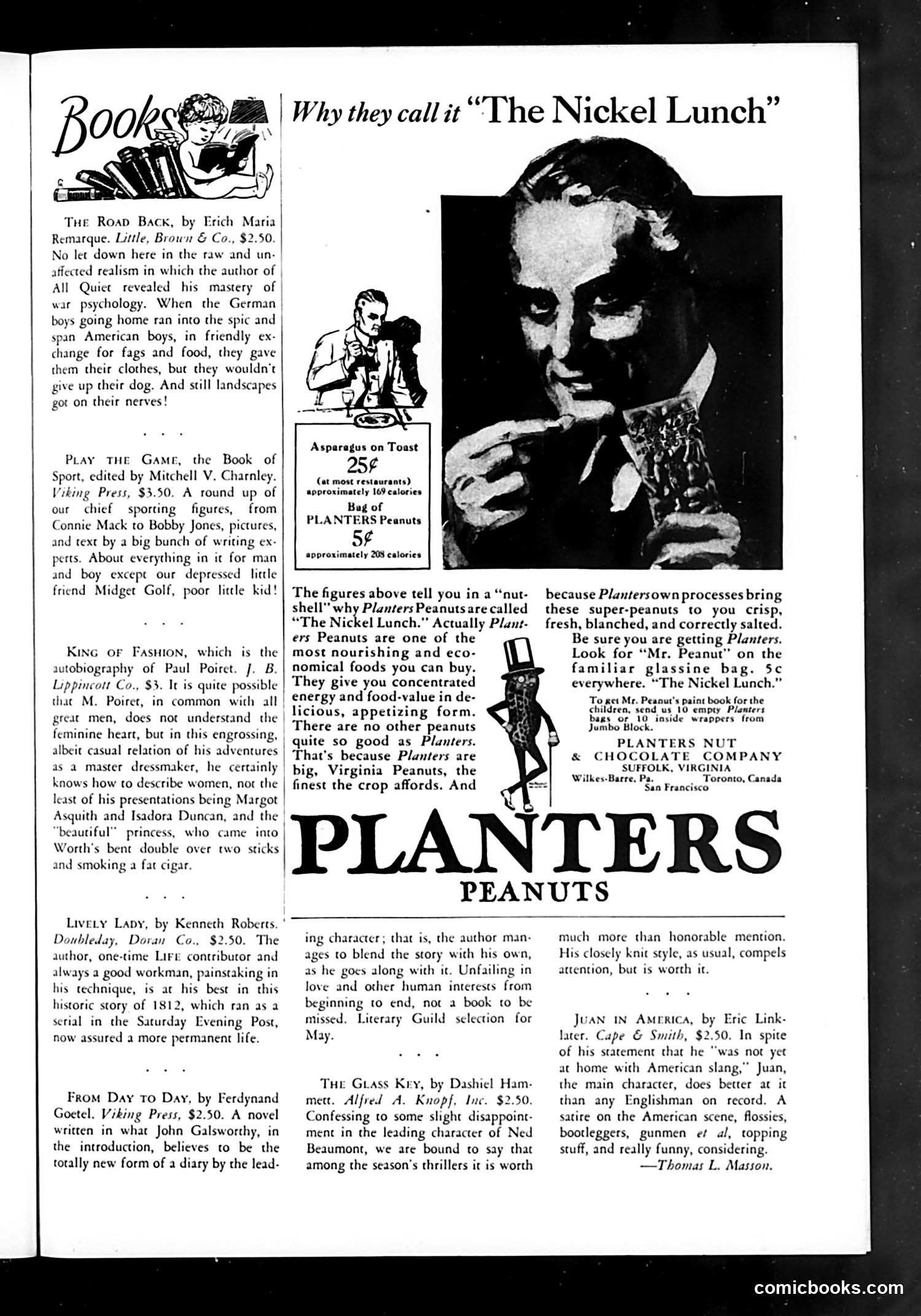
"The Nickel Lunch" Advertisement Analysis This page is primarily a Planters Peanuts advertisement disguised as editorial content in Life magazine. The "cartoon" consists of two comparative images: asparagus on toast (25¢, ~169 calories) versus a bag of Planters Peanuts (5¢, ~208 calories). The advertisement's central claim: Planters Peanuts represent superior nutritional and economic value—hence "The Nickel Lunch." The imagery of a well-dressed man eating peanuts versus cheaper restaurant food reinforces this positioning as an affordable, wholesome food for Depression-era consumers. The surrounding book reviews are genuine editorial content, but the juxtaposition creates advertiser-friendly context. The mascot "Mr. Peanut" (visible in the glassine bag reference) was Planters' iconic figure, recognizable to contemporary readers. This reflects 1930s advertising strategy: embedding commercial messages within prestigious magazines to appear as legitimate journalism rather than obvious promotion.
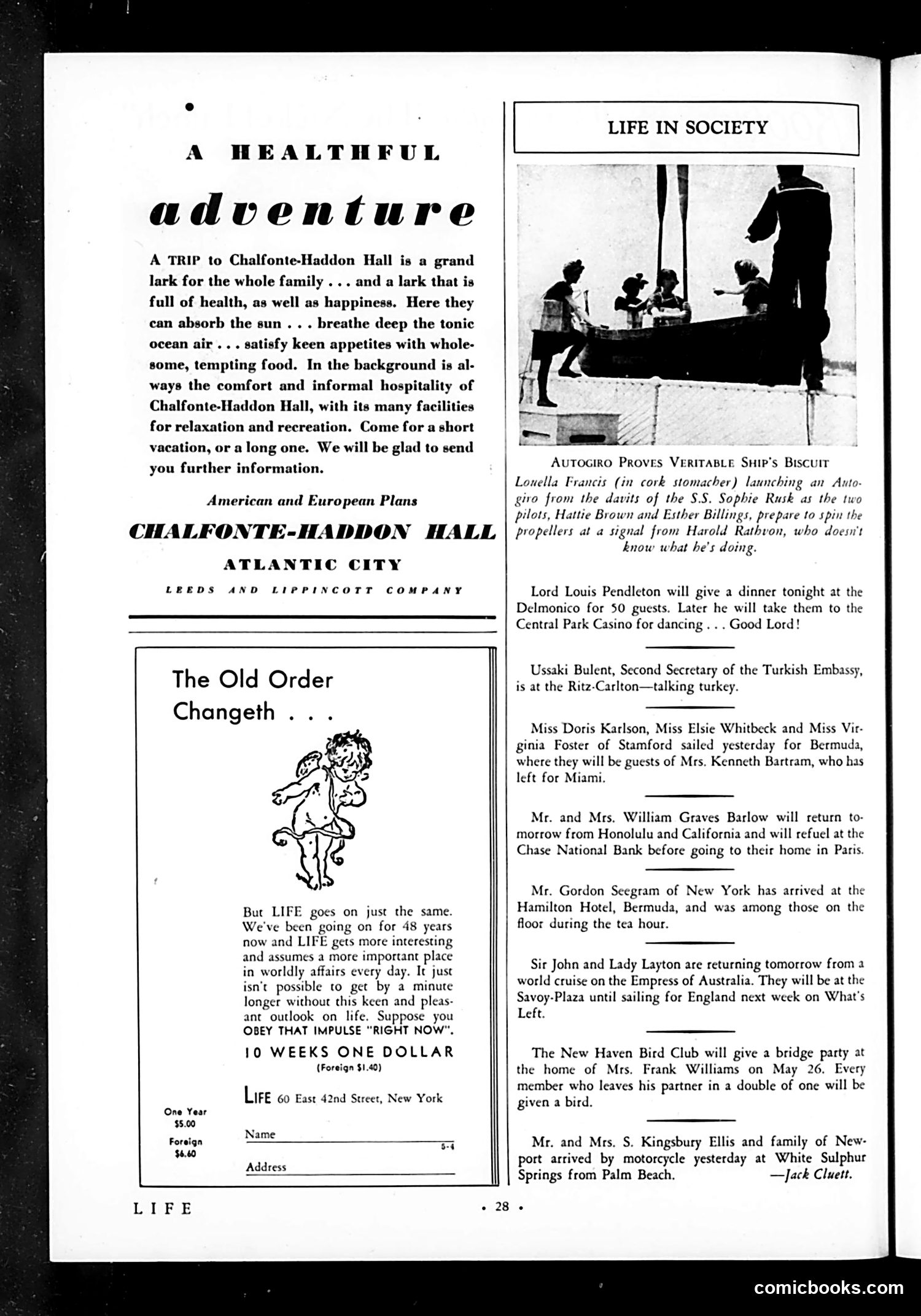
Analysis of Life Magazine Page This page combines advertising and satirical society gossip. The left side advertises Chalfonte-Haddon Hall resort in Atlantic City and promotes Life magazine itself with a playful motto: "The Old Order Changeth... But LIFE goes on just the same." The right side, titled "Life in Society," is pure satire—a gossip column mocking wealthy socialites and their trivial pursuits. The humor relies on absurdist details: an "autogiro" (early helicopter) launching from a ship, Lord Louis Pendleton's lavish dinner followed by casino dancing, and the final joke about the "New Haven Bird Club" where losing bridge partners receive actual birds as punishment. The column pokes fun at the idle rich by cataloging their pointless activities—constant travel, elaborate parties, and frivolous social events—treating them as news. The byline "Jack Cluett" suggests a house pseudonym, typical of Life's satirical voice during this era.
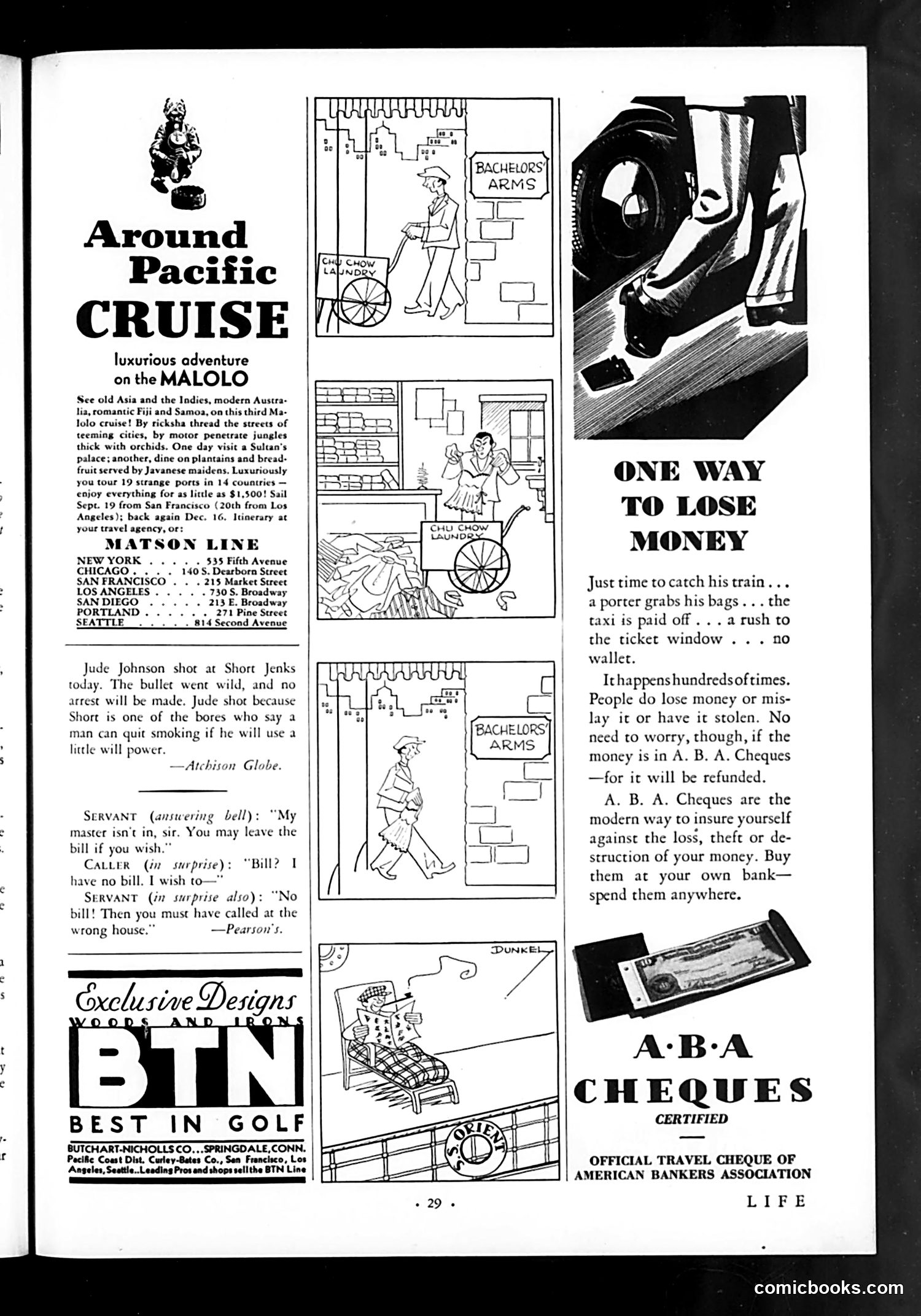
Page Analysis This is primarily a advertising page from Life magazine featuring multiple ads and small humorous fillers typical of the publication. The main content includes: 1. Matson Line cruise advertisement promoting luxury Pacific travel on the ship MALOLO, visiting Asia, Australia, and Pacific islands—appealing to wealthy 1920s-30s travelers seeking exotic experiences. 2. Three brief comic anecdotes (Atchison Globe, Pearson's) making light observations: one about smoking willpower, another playing on the awkwardness of a caller with no bill to deliver. 3. "One Way to Lose Money" — a cartoon scenario depicting a rushed traveler losing his wallet at the train station, used to advertise A.B.A. Cheques (traveler's checks issued by the American Bankers Association). The ad's point: these checks are safer than cash for traveling. 4. BTN golf equipment advertisement at bottom. The page reflects pre-WWII consumer culture targeting middle-to-upper-class Americans, emphasizing travel safety, modern financial instruments, and leisure purchases.
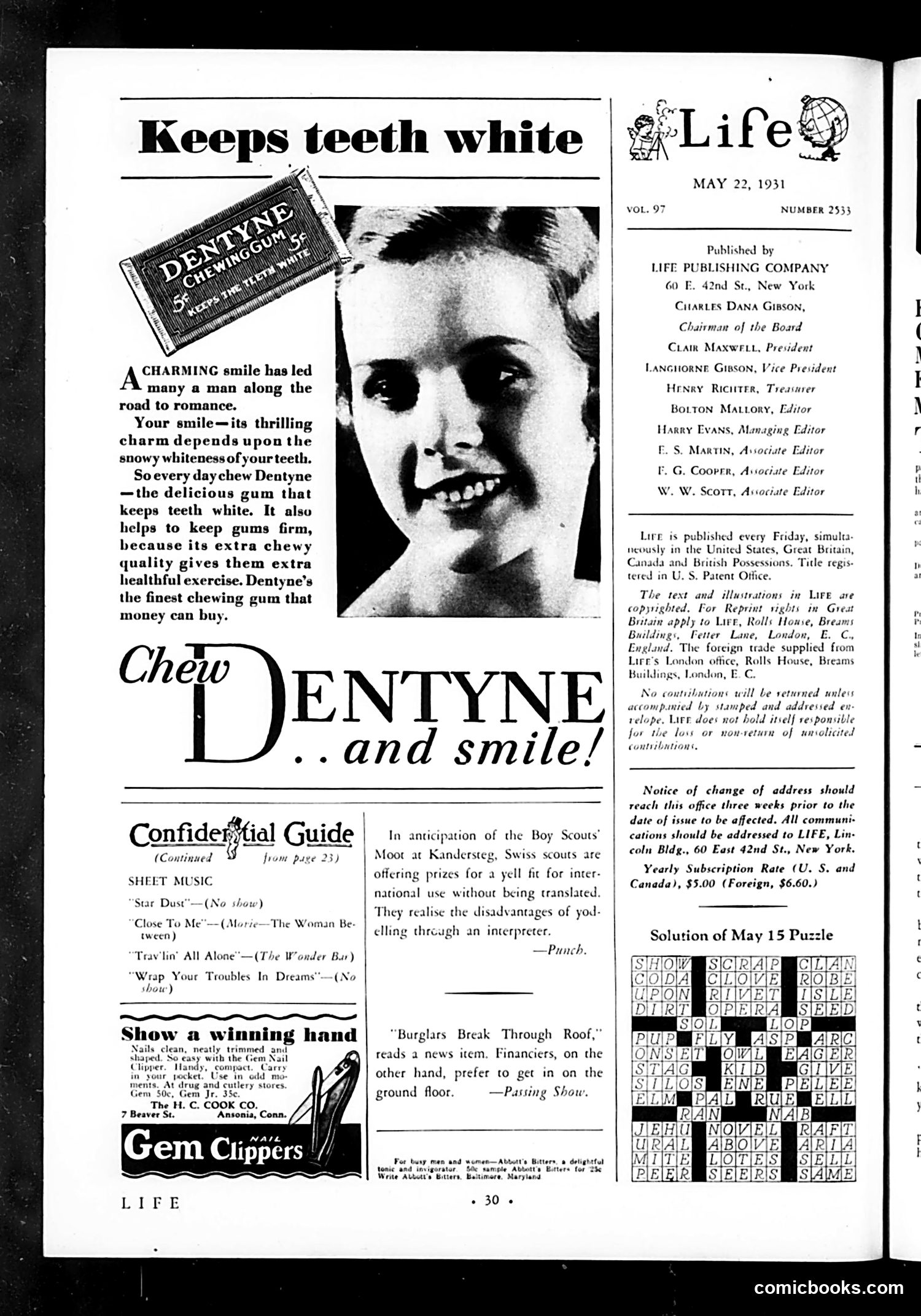
Dentyne Chewing Gum Advertisement This page is primarily a commercial advertisement for Dentyne chewing gum, not political satire. The main image shows a smiling woman promoting the product with the slogan "Chew Dentyne...and smile!" The ad's appeal is romantic: it claims a "charming smile has led many a man along the road to romance," positioning white teeth as essential to personal success and attractiveness. The pitch emphasizes that Dentyne keeps teeth white while also exercising gums through its "extra chewy quality." The page also includes minor filler content typical of 1931 *Life* magazine—sheet music listings, a brief joke about Swiss Boy Scouts and yodeling, another about burglars and financiers, and an advertisement for Gem nail clippers. These are unrelated to the main advertisement and serve as space-fillers rather than coordinated editorial content.
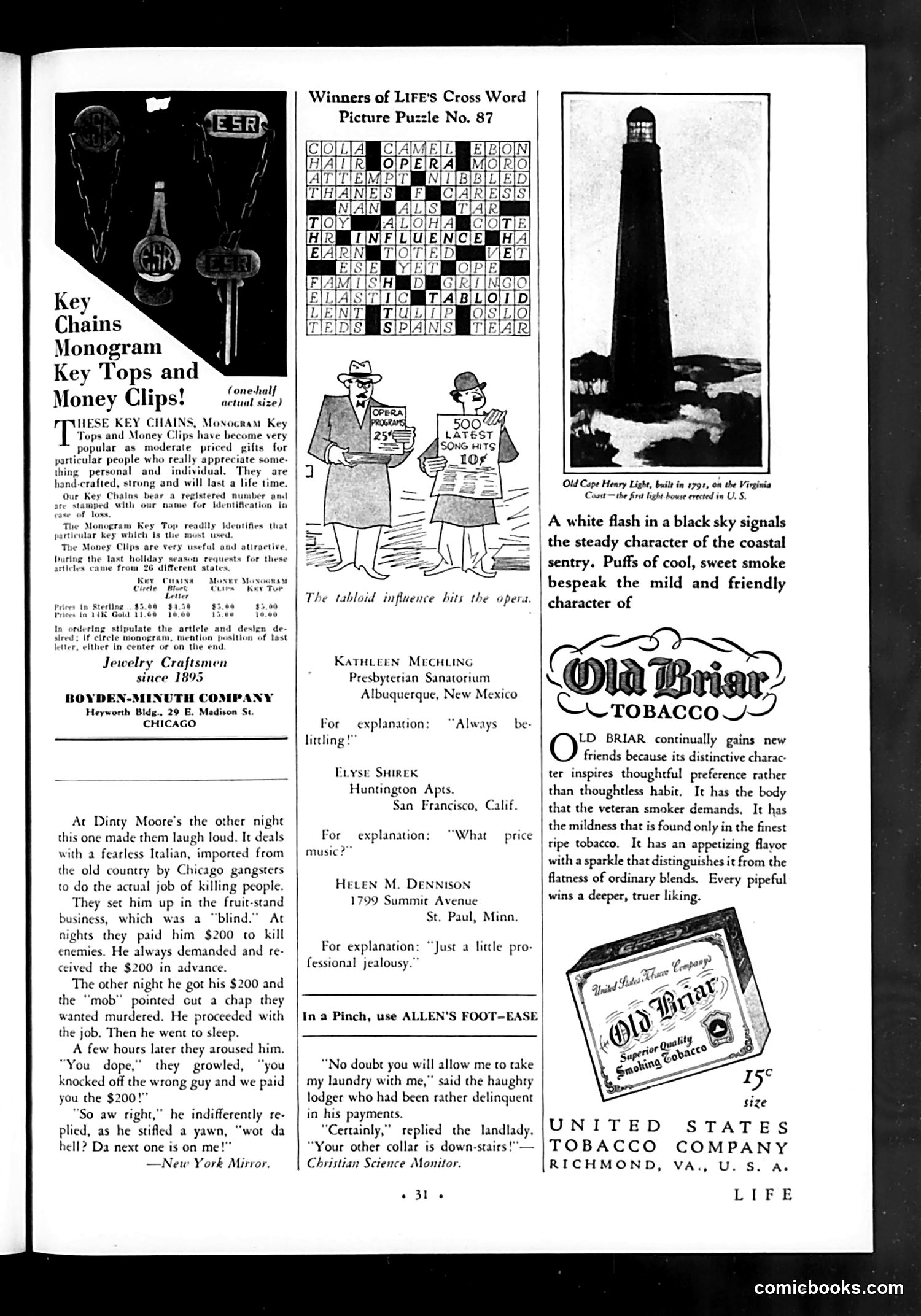
Analysis for Modern Readers This page contains several distinct elements: The Gangster Anecdote: A humor piece about Prohibition-era Chicago organized crime. An Italian immigrant hired as a hitman mistakenly kills the wrong person but casually offers to do the next job "on me" (for free). The satire mocks both the incompetence of criminals and the casual brutality of gangster culture during the 1920s-30s. The Crossword Puzzle: Winners submitted humorous explanations for answers, playing on contemporary references (opera, professional jealousy, landlord-tenant disputes). The Advertisements: Old Briar Tobacco uses lighthouse imagery to evoke steadiness and tradition. The Boyden jewelry company advertises monogrammed key chains and money clips as personalized gifts. The page reflects Life magazine's satirical approach to American culture—mixing crime commentary with consumer goods and word puzzles, capturing 1920s-30s urban life and humor conventions quite foreign to modern sensibilities.
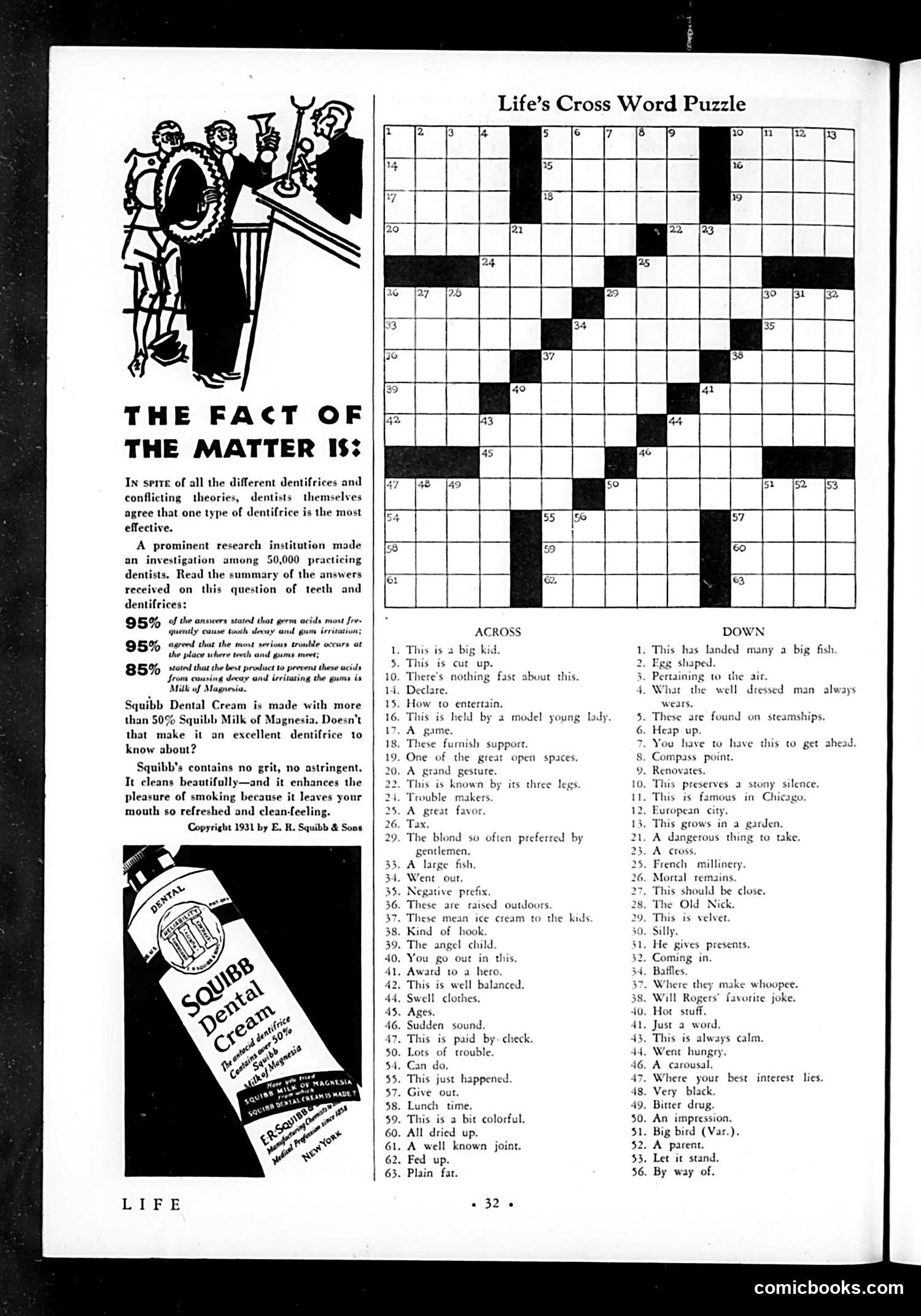
Life Magazine Page Analysis This page contains two unrelated elements typical of 1931 *Life* magazine: Left side: A Squibb Dental Cream advertisement disguised as editorial content. It cites a purported survey of 50,000 dentists claiming 85% recommend milk of magnesia-based toothpaste, then promotes Squibb's product as containing over 50% milk of magnesia. This is classic advertorial—marketing presented as objective research to appear authoritative and circumvent skepticism. Right side: A crossword puzzle with whimsical clues ("This is a big kid," "You go out in this") typical of *Life's* entertainment section. The puzzle has no apparent satirical content; it's simply recreational. The advertisement's central claim—that dentists unanimously endorse one product type—reflects early 20th-century marketing tactics that blurred journalism and promotion before modern advertising regulations existed.
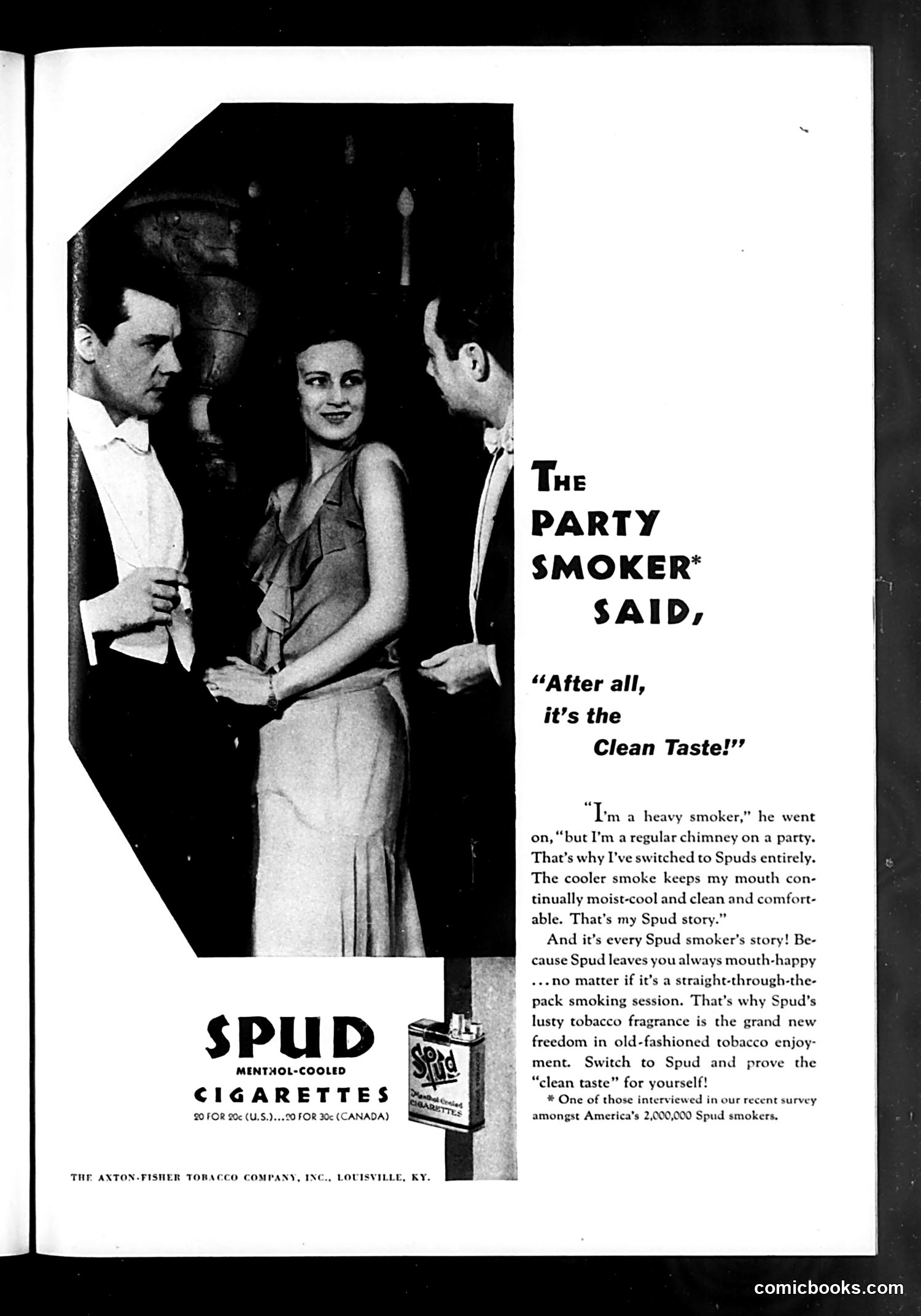
Spud Cigarettes Advertisement This is a cigarette advertisement, not satire or political commentary. It promotes Spud menthol-cooled cigarettes to a mid-century American audience. The image shows three well-dressed people at a formal party. The advertisement uses a testimonial format: a "party smoker" explains he switched to Spuds because the menthol keeps his mouth "cool and clean and comfortable" during extended smoking. The tagline emphasizes the "clean taste." The ad appeals to social anxieties about smoking etiquette—keeping one's mouth fresh at social gatherings—while claiming menthol provides a superior smoking experience. The asterisk notes this smoker was interviewed in a survey of 2 million Spud smokers, suggesting widespread satisfaction. By modern standards, the casual promotion of cigarettes as a social luxury is striking, as is the health claim about a "clean taste" in an era before tobacco warning labels.
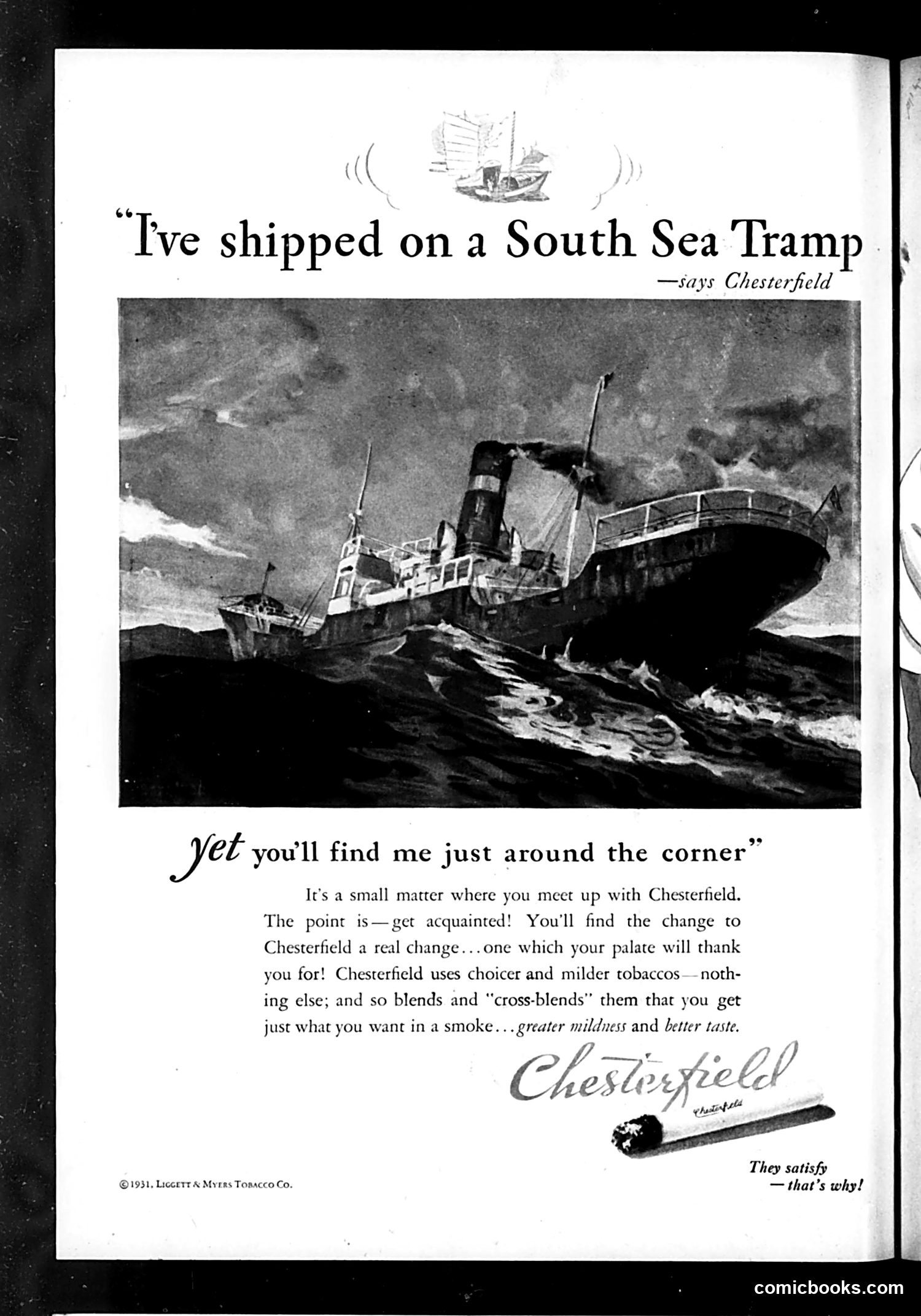
Analysis This is a cigarette advertisement for Chesterfield, not political satire. It dates to 1931 (visible copyright). The ad uses a romantic, adventurous persona—a sailor claiming experience on a "South Sea Tramp" (a cargo ship)—to market cigarettes. The appeal is to masculine adventure and worldliness. The tagline "you'll find me just around the corner" suggests Chesterfield's accessibility and ubiquity. The sales pitch emphasizes "choicer and milder tobaccos" and "greater mildness and better taste"—standard cigarette marketing claims from this era. The dramatic maritime illustration reinforces the masculine, adventurous branding. This reflects 1930s advertising conventions before modern tobacco regulation. There is no political content or satire present—only commercial messaging using romantic imagery to appeal to consumers.