life
Life — May 29, 1931
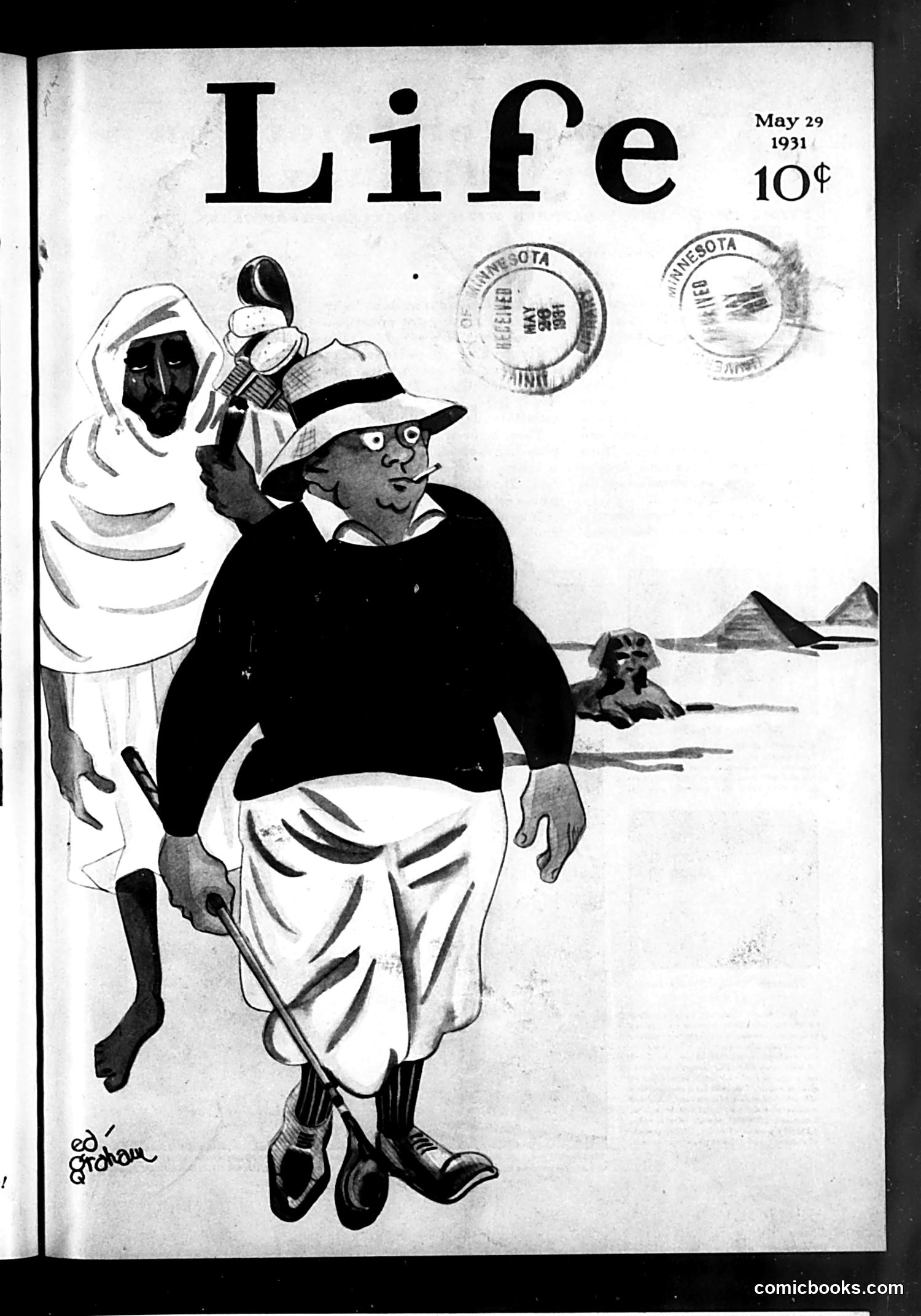
Life Magazine Cover Analysis (May 29, 1931) This cover depicts a rotund man in winter clothing carrying what appears to be Arctic or polar expedition gear, with Indigenous figures visible in the background and pyramids in the distance. The cartoonist (signed "Goldberg," likely Rube Goldberg) appears to satirize an explorer or adventurer preparing for an expedition. Given the 1931 date and visual elements, this likely mocks contemporary polar exploration efforts or a specific explorer's ambitious claims. The juxtaposition of Arctic clothing with Egyptian pyramids in the background creates comedic absurdity, suggesting either confused geography or grandiose pretensions about multiple expeditions. The exaggerated physique contrasts humorously with the demanding physical requirements of polar exploration, emphasizing the satirical point about the figure's fitness or credibility for such ventures.
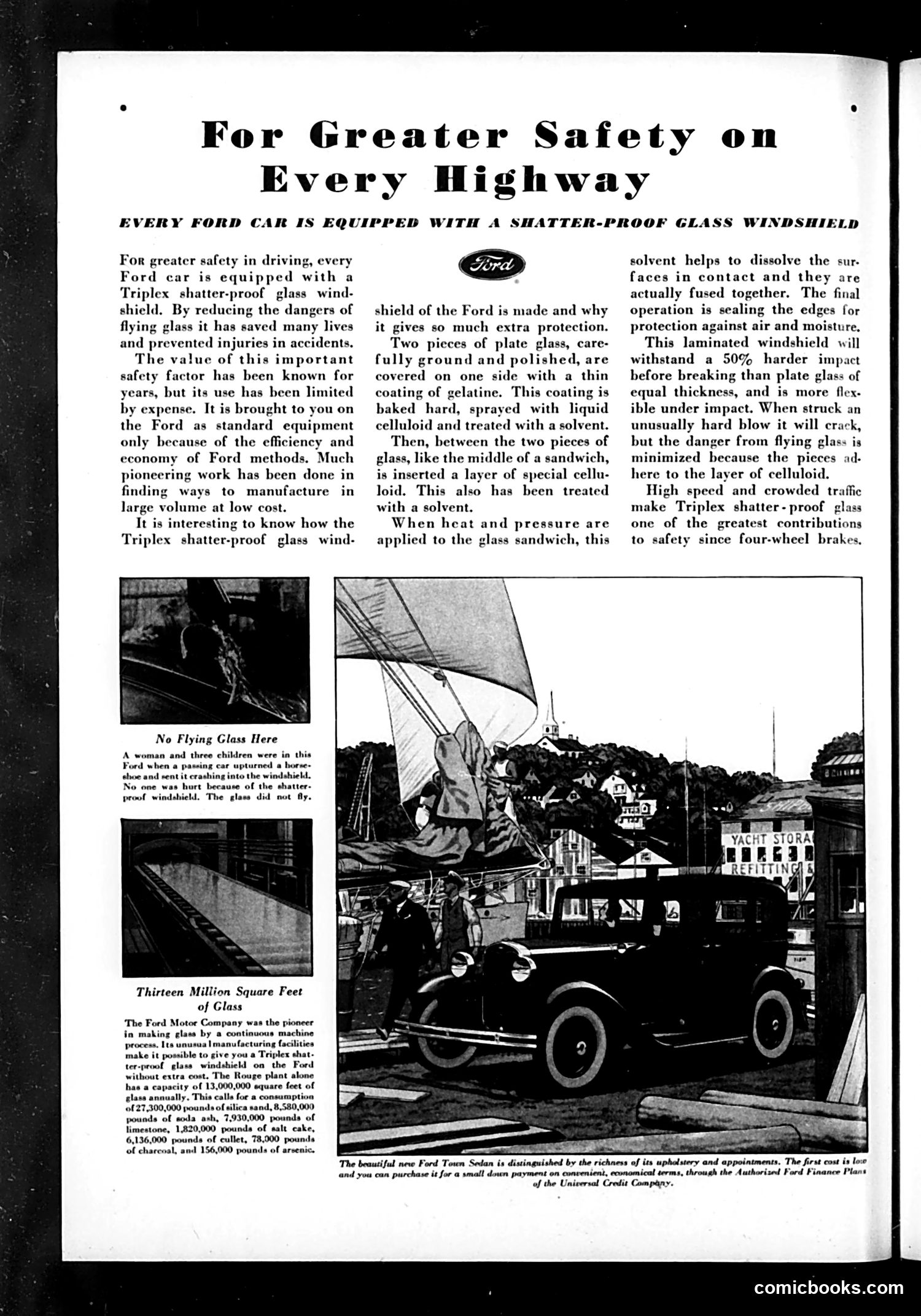
Analysis This is primarily a Ford Motor Company advertisement, not satire or a political cartoon. It promotes Ford's "Triplex shatter-proof glass windshield" as a safety feature for automobiles. The page contains: 1. Technical explanation of how the laminated glass works (two plates with cellulose layer) 2. Two small photographs showing the windshield's durability—one labeled "No Flying Glass Here" demonstrating a crash test 3. A large photograph of a Ford Tudor Sedan at what appears to be a yacht club or waterfront venue, showcasing the car's modern design The advertisement emphasizes the safety innovation as a competitive advantage, noting Ford's manufacturing efficiency allows them to offer this feature as standard equipment without extra cost. This reflects early-1930s automotive marketing emphasizing technological advancement and consumer safety.
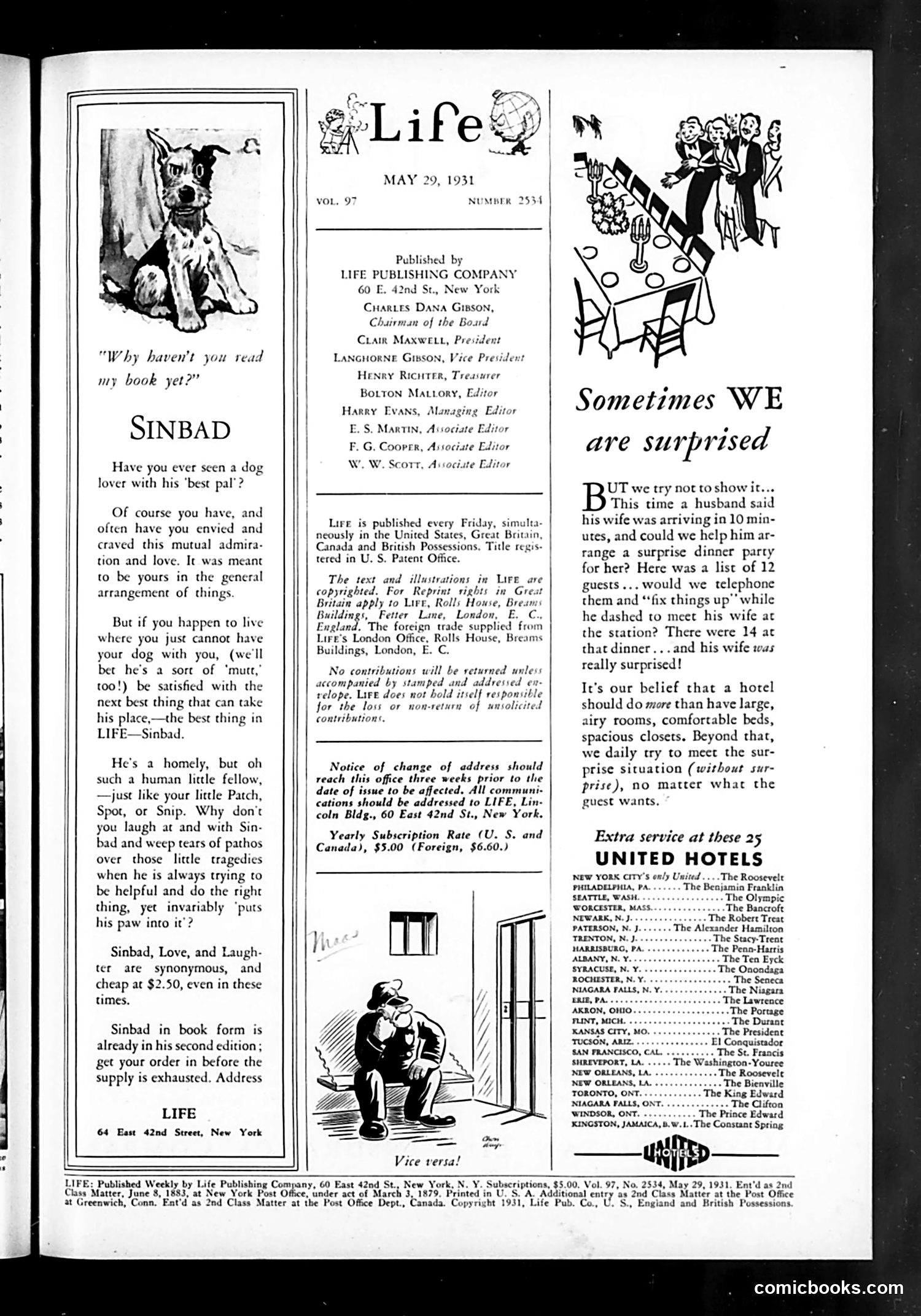
Life Magazine, May 29, 1931 - Page Analysis This page is primarily a title/masthead page and advertising rather than political satire. The left column features "Sinbad," a dog-themed comic or book series, with accompanying advertisement. The caption "Why haven't you read my book yet?" presents a talking dog—a common device in early 20th-century American humor. The center-right shows a cartoon titled "Sometimes WE are surprised," depicting a domestic scene where a husband arranges a surprise dinner party for his wife. The humor derives from the husband's anxiety about her reaction, reflecting 1930s gender expectations and domestic comedy conventions. The bottom-right "Vice versa!" cartoon appears to reverse this scenario, though details are unclear. The bulk of the page consists of United Hotels advertising, listing affiliated properties nationwide—standard magazine filler for this era.
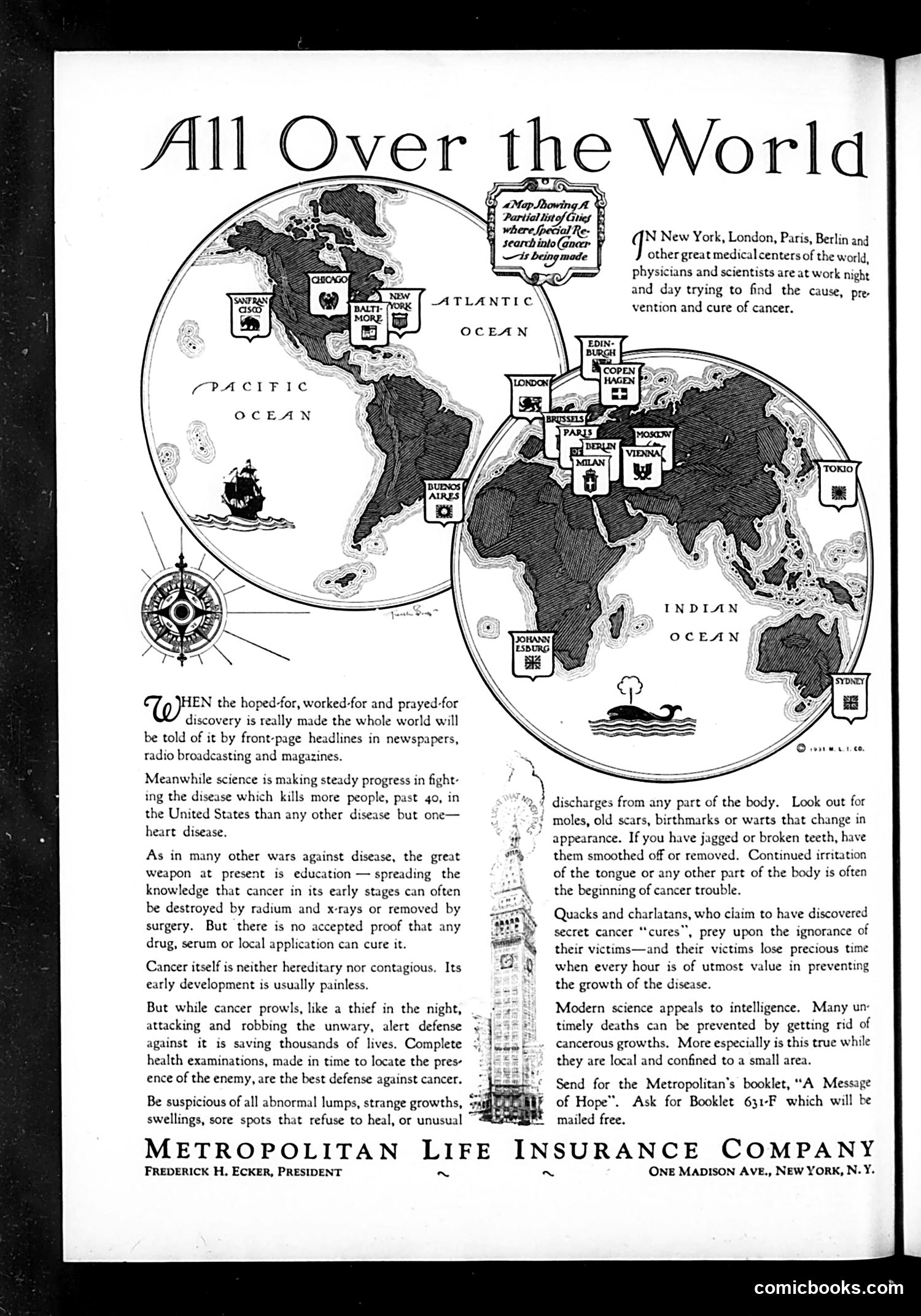
Analysis This is primarily an advertisement by Metropolitan Life Insurance Company, not satire or political commentary. The page features a world map showing medical research centers (New York, London, Paris, Berlin, Edinburgh, Copenhagen, Milan, Vienna, Tokyo, Johannesburg, and Sydney) where scientists search for cancer causes and cures. The text discusses cancer as a major killer in America and emphasizes early detection through health examinations and awareness of warning signs (lumps, growths, sores). It warns against quacks selling fake "cures" and promotes education as the best defense. The accompanying illustration of a tall building (likely Metropolitan Life's New York headquarters) reinforces the company's authority and legitimacy in promoting public health awareness—a common insurance industry practice of that era.
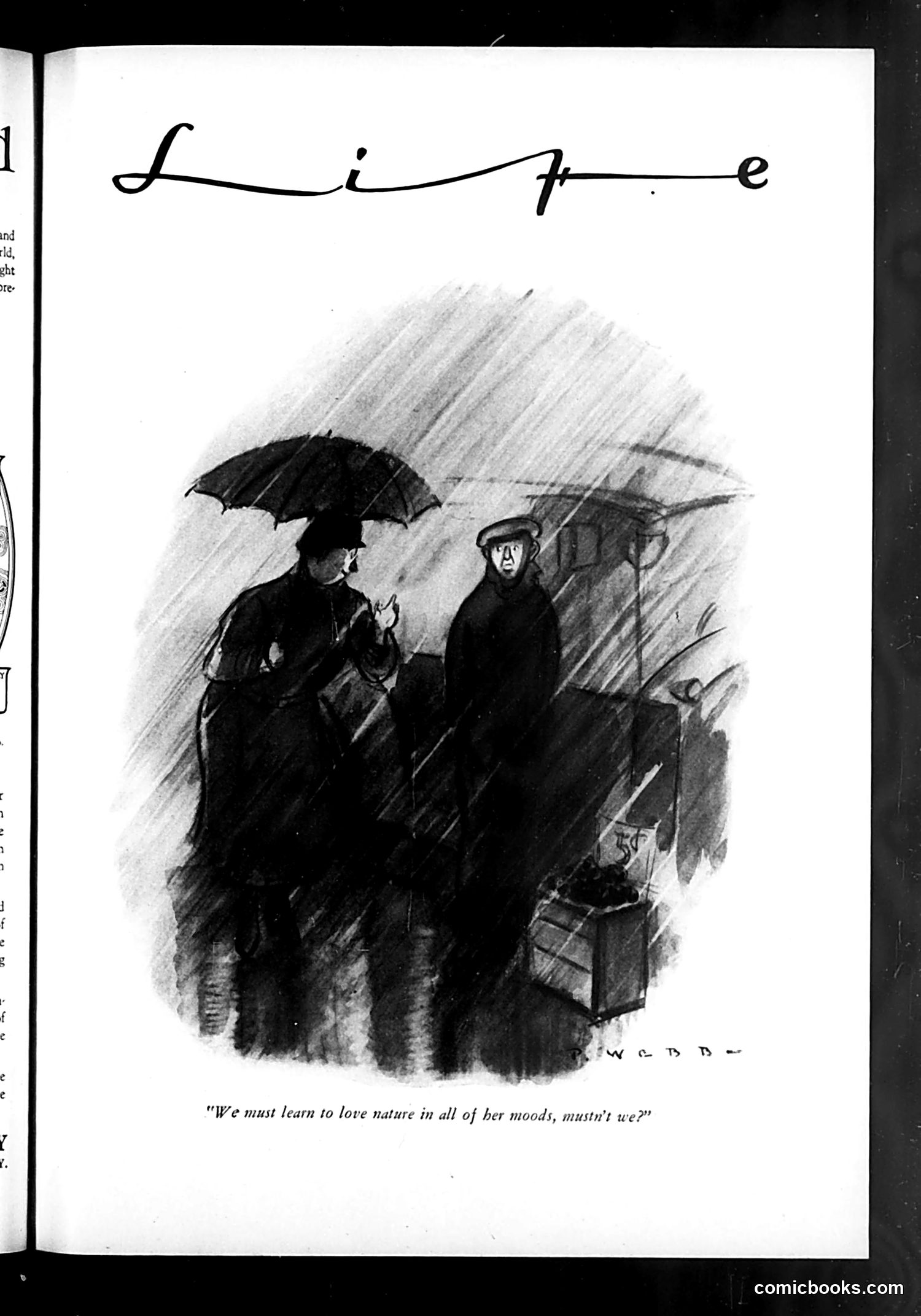
Analysis This cartoon depicts two figures standing in heavy rain with an umbrella, with the caption: "We must learn to love nature in all of her moods, mustn't we?" The joke appears to be a satirical commentary on romantic or philosophical idealism about nature. One figure (likely representing an enthusiast or idealist) makes an earnest statement about appreciating nature's full range of conditions, while the other figure's facial expression suggests skepticism or discomfort—they're getting soaked in a downpour, making the idealistic sentiment impractical and absurd. The cartoonist (signed "Webbs") is mocking the gap between philosophical posturing about nature and actual human experience. It's a gentle satire on people who express lofty sentiments while ignoring practical misery—a common theme in Life magazine's satirical humor about pretentious attitudes.
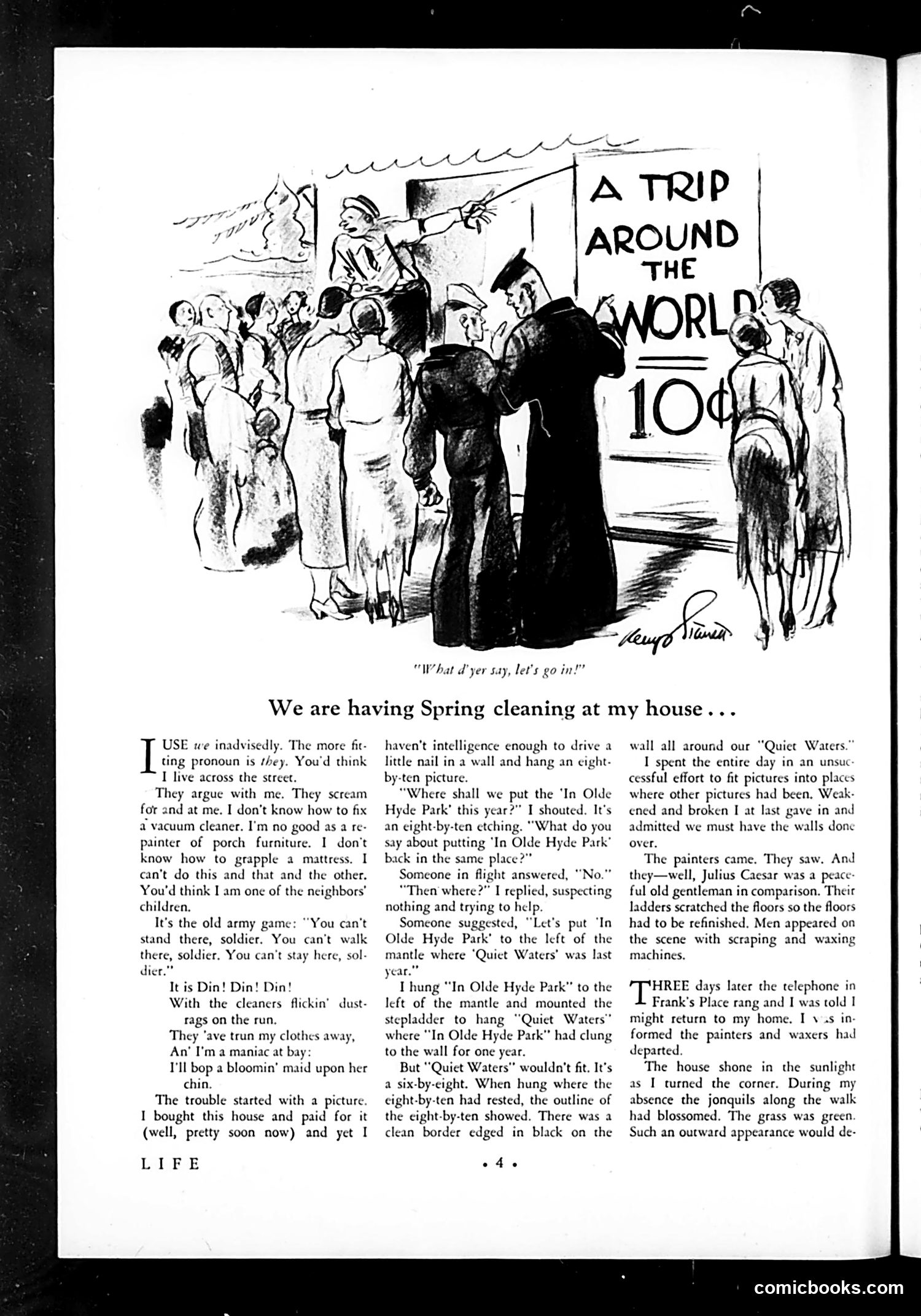
Analysis This is a humorous domestic essay about spring cleaning, accompanied by a cartoon illustration. The cartoon shows a barker at a booth advertising "A Trip Around the World - 10¢" to a crowd of people, with the caption "What d'yer say, let's go in?" The satire is straightforward: the essay describes the chaos and disruption of spring cleaning in the author's home—furniture moved, walls repainted, workers tracking dirt everywhere. The cartoon's "trip around the world" booth appears as visual commentary suggesting that spring cleaning is such a disruptive ordeal that escaping to an actual world tour would be preferable to enduring it at home. The piece uses relatable domestic humor typical of Life magazine's satirical approach, poking fun at the spring-cleaning tradition and its impacts on household peace and order.
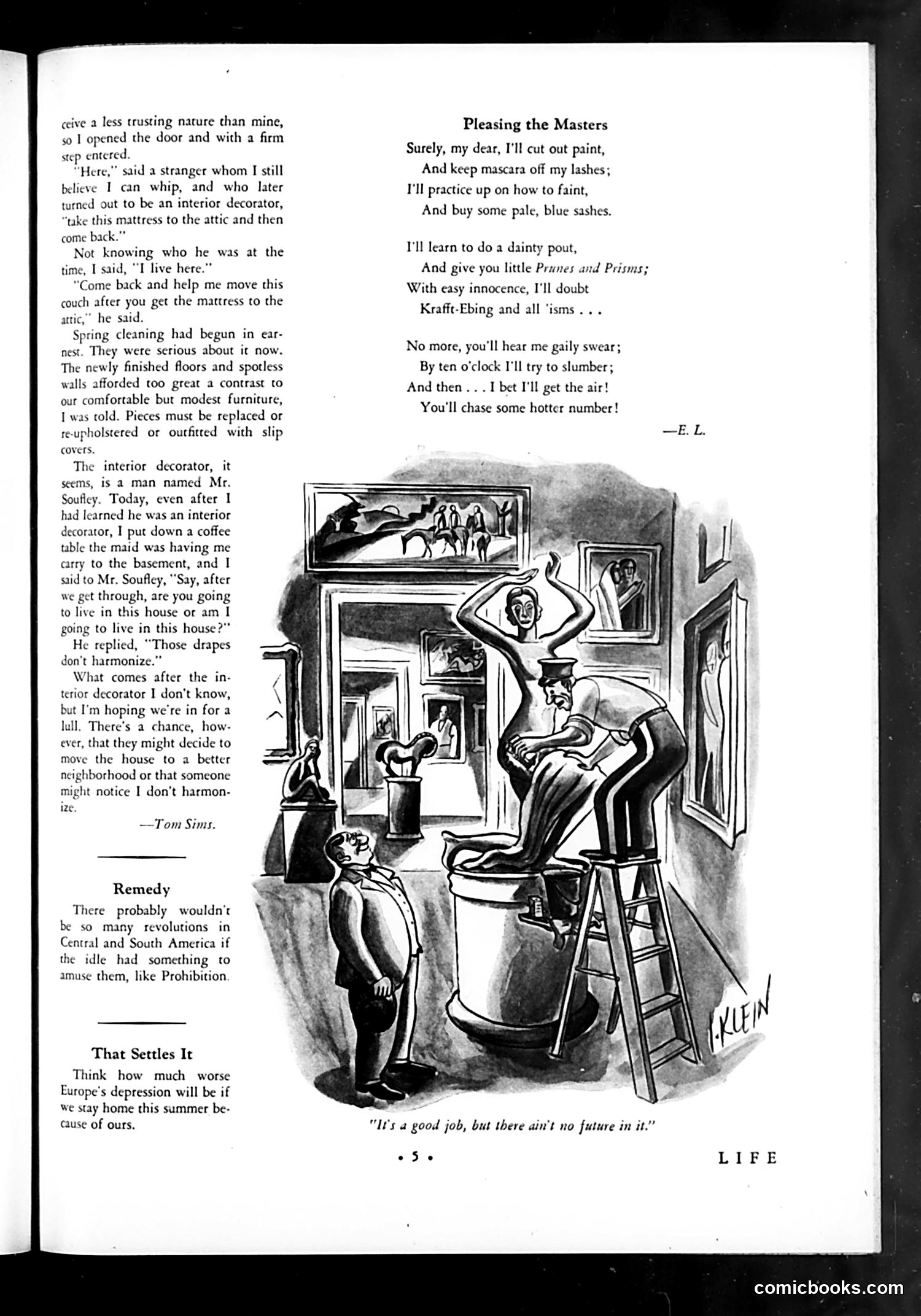
Analysis: "Pleasing the Masters" and Related Content The main cartoon depicts an interior decorator working in a home while a woman (likely the homeowner) watches with exaggerated facial expressions. The caption reads, "It's a good job, but there ain't no future in it." The satire targets the precarious status of service workers—here, an interior decorator—who lack job security despite performing skilled labor. The woman's dramatic pose suggests anxiety about the work's quality or cost. The accompanying poem "Pleasing the Masters" (credited to E.L.) satirizes women attempting to adopt artistic sophistication by abandoning makeup and adopting intellectual pretenses—referencing "Kraff-Ebing and all 'isms"—to impress educated men ("masters"). The shorter pieces below address unrelated topics: American revolutions in Central/South America and European economic depression, typical satirical fare for Life magazine's commentary on contemporary affairs.
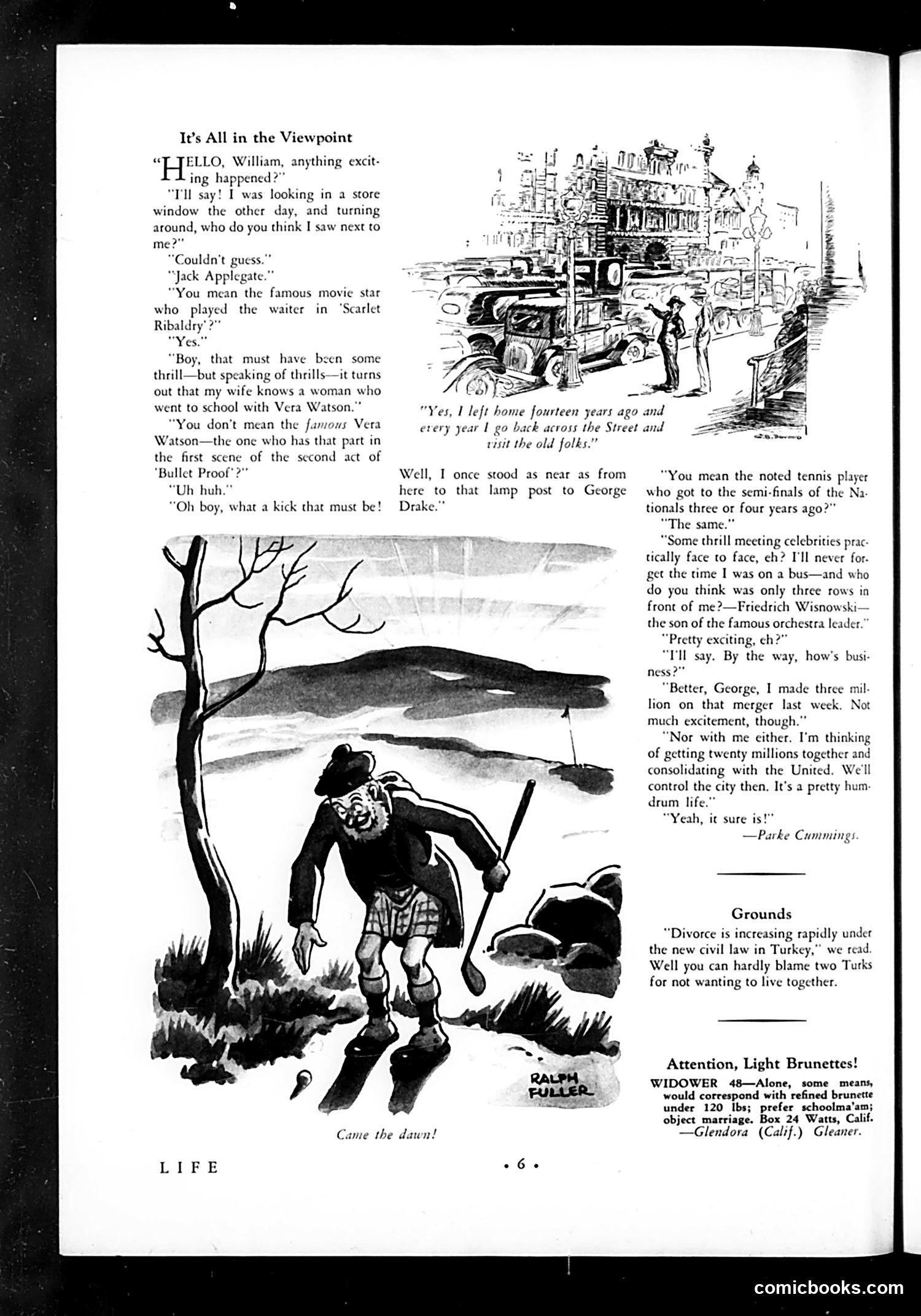
Analysis of "It's All in the Viewpoint" This is a humorous dialogue piece satirizing celebrity encounters and wealth. A man brags about seeing famous people—Vera Watson (an actress in "Scarlet Ribbons" and "Bullet Proof"), and a noted tennis player at the Nationals semifinals. His friend responds that he too has met celebrities, casually mentioning Friedrich Wisnowski (son of a famous orchestra leader) on a bus. The satire targets social climbing and name-dropping: both men claim exciting celebrity meetings, but the second speaker deflates the first's enthusiasm by revealing his own "celebrity" encounter was utterly mundane—just sitting near someone on public transit. The lower cartoon by Ralph Fuller shows a golfer in poor weather ("Came the dawn!"), illustrating life's disappointments.
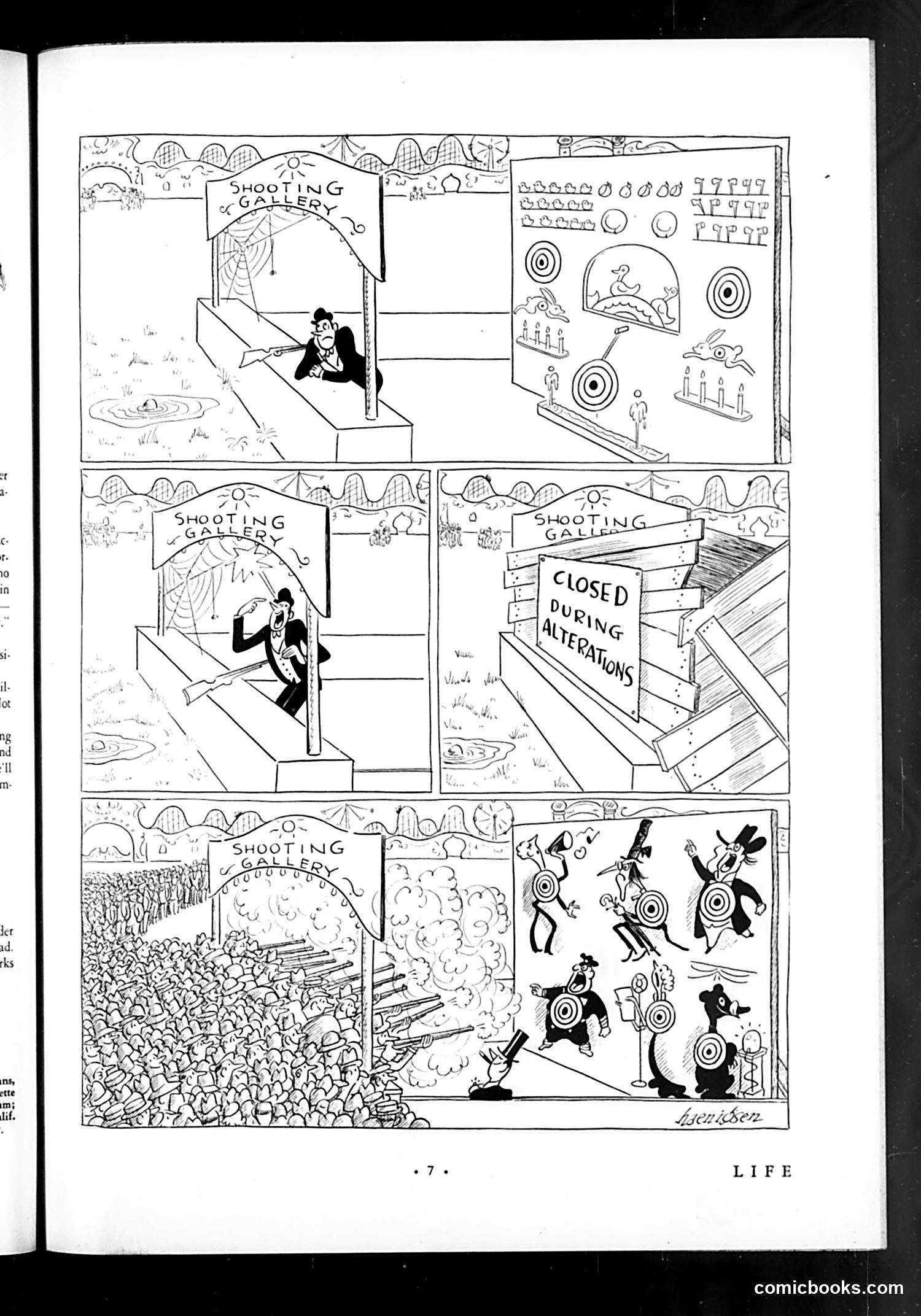
Analysis of Life Magazine Cartoon This is a satirical comic strip about a shooting gallery—an amusement park attraction. The humor works through escalating absurdity: Panel 1-2: A man enters an ordinary shooting gallery with target practice setup. Panel 3: A sign reads "CLOSED DURING ALTERATIONS," suggesting temporary renovation. Panel 4: When the gallery reopens, it has been transformed into an actual war zone with real soldiers, explosions, and casualties replacing the paper targets. Figures flee in panic. The satire critiques militarization or perhaps the American fascination with war as entertainment—suggesting that if shooting galleries kept "improving," they'd become indistinguishable from actual combat. The joke relies on the absurd juxtaposition of innocent amusement with genuine warfare, implying commentary on desensitization or the blurred lines between entertainment and violence.
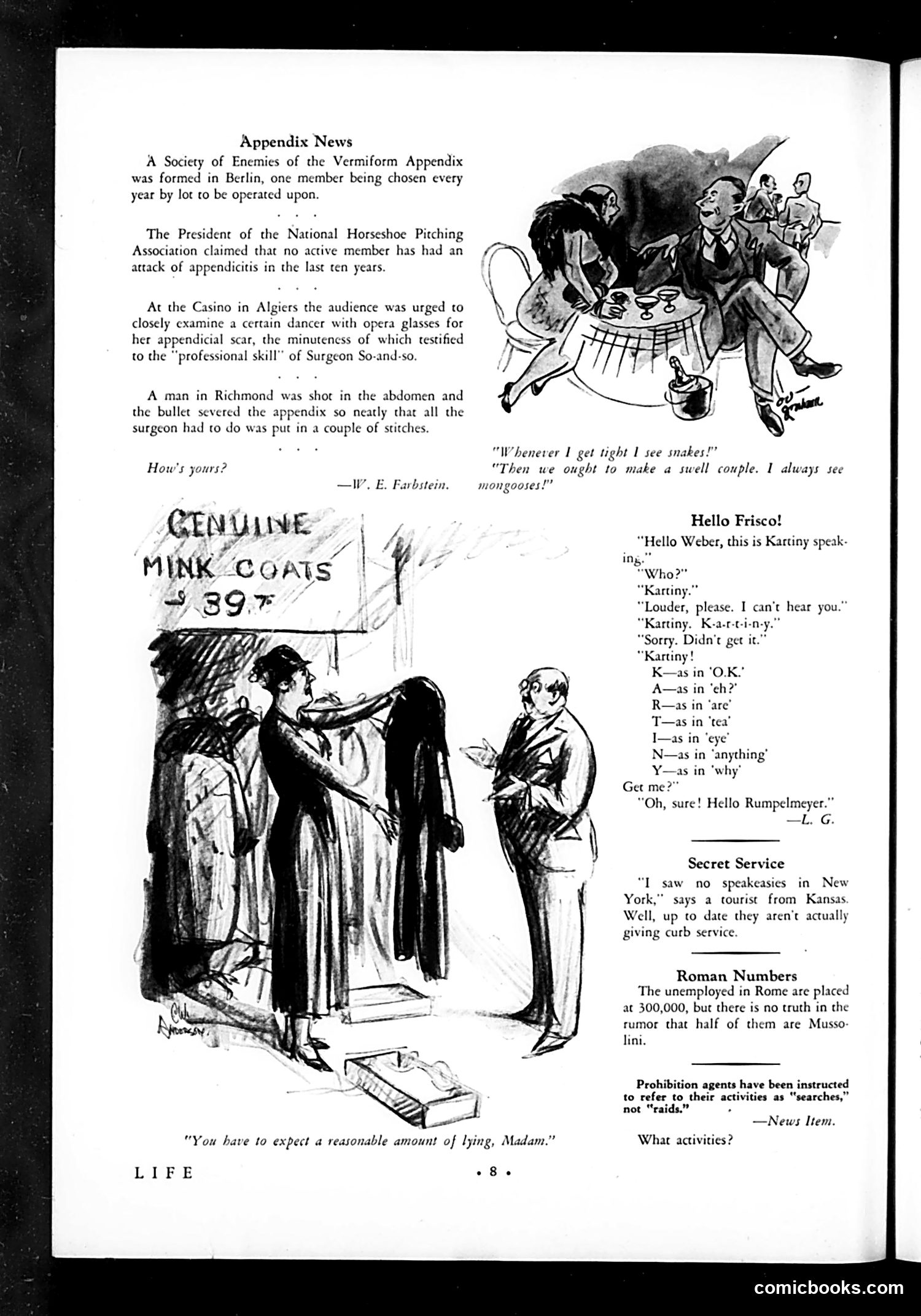
Analysis of Life Magazine Page This page contains several satirical items typical of early 20th-century humor magazines: Main Cartoon: Shows a woman examining mink coats priced at $39.75, with a salesman claiming they're "genuine." The joke satirizes both deceptive retail practices and women's gullibility regarding luxury goods—a common theme in period satire about consumer culture and gender. "Hello Frisco!" Bit: A humorous phone conversation demonstrating regional accent differences, poking fun at pronunciation variations between speakers. Other Items: Brief satirical news snippets about appendicitis societies, horseshoe pitching, and prohibition agents euphemistically calling their activities "searches" instead of "raids." The page reflects 1920s American concerns: consumer fraud, regionalism, medical fads, and prohibition enforcement—all presented through gentle mockery rather than harsh criticism.
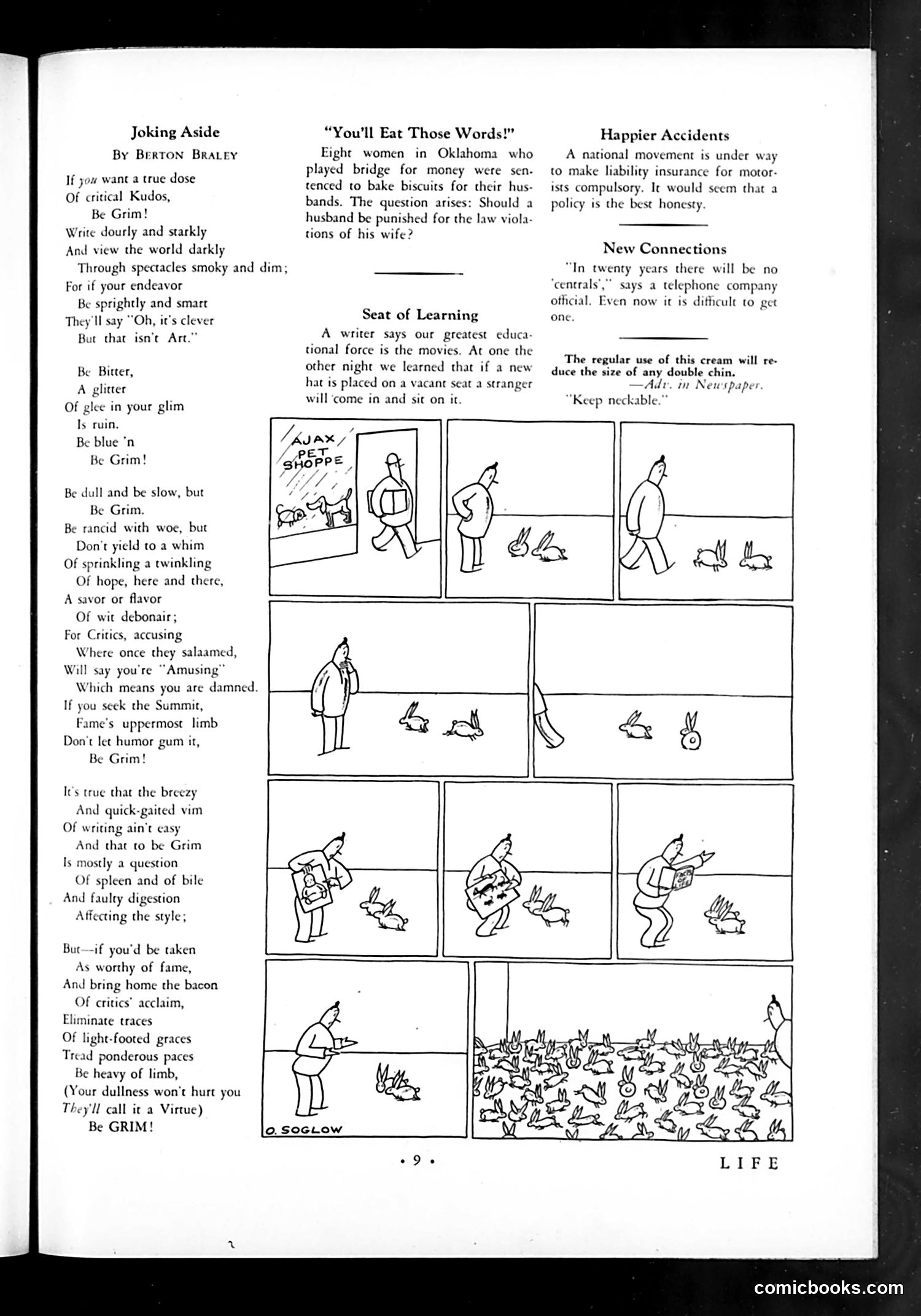
Analysis of Life Magazine Page This page contains three distinct pieces: 1. "Joking Aside" (poem by Brerton Braley): A humorous guide advising writers to "Be Grim"—rejecting cleverness and wit in favor of dark, serious tone to gain critical respect. 2. "You'll Eat Those Words!": A brief anecdote about eight Oklahoma women sentenced to bake biscuits after playing bridge for money—satirizing inconsistent legal punishment and questioning whether wives should be punished for husbands' violations. 3. Comic strip by O. Soglow: Shows a figure at an "Ajax People Shoppe" acquiring what appear to be rabbits, which multiply exponentially across successive panels, ultimately overwhelming him in a chaotic final scene—a visual gag about uncontrolled proliferation or consumer excess. The magazine mixes social commentary with absurdist humor typical of 1920s-30s satire.
"Life Looks About" - Analysis This page discusses three notable descendants: Mrs. Reid, Mr. George F. Baker, and Mr. Robert De Forest—described as valuable people blessed with "abundant means backed by sound minds and admirable energies." The article praises their character development and social contributions, mentioning Mr. Baker's railroad rescue work and Mrs. Reid's political interests and newspaper ownership. The satirical point appears subtle: the piece celebrates wealthy American citizens who use their resources for public good rather than mere accumulation. However, the closing argument by E.S. Martin advocates *against* Federal Prohibition, suggesting individual states decide on alcohol bans themselves—a pre-Prohibition stance that would soon become dated. The cartoon's cherub head (top left) adds whimsical visual interest but its specific meaning remains unclear from this excerpt alone.
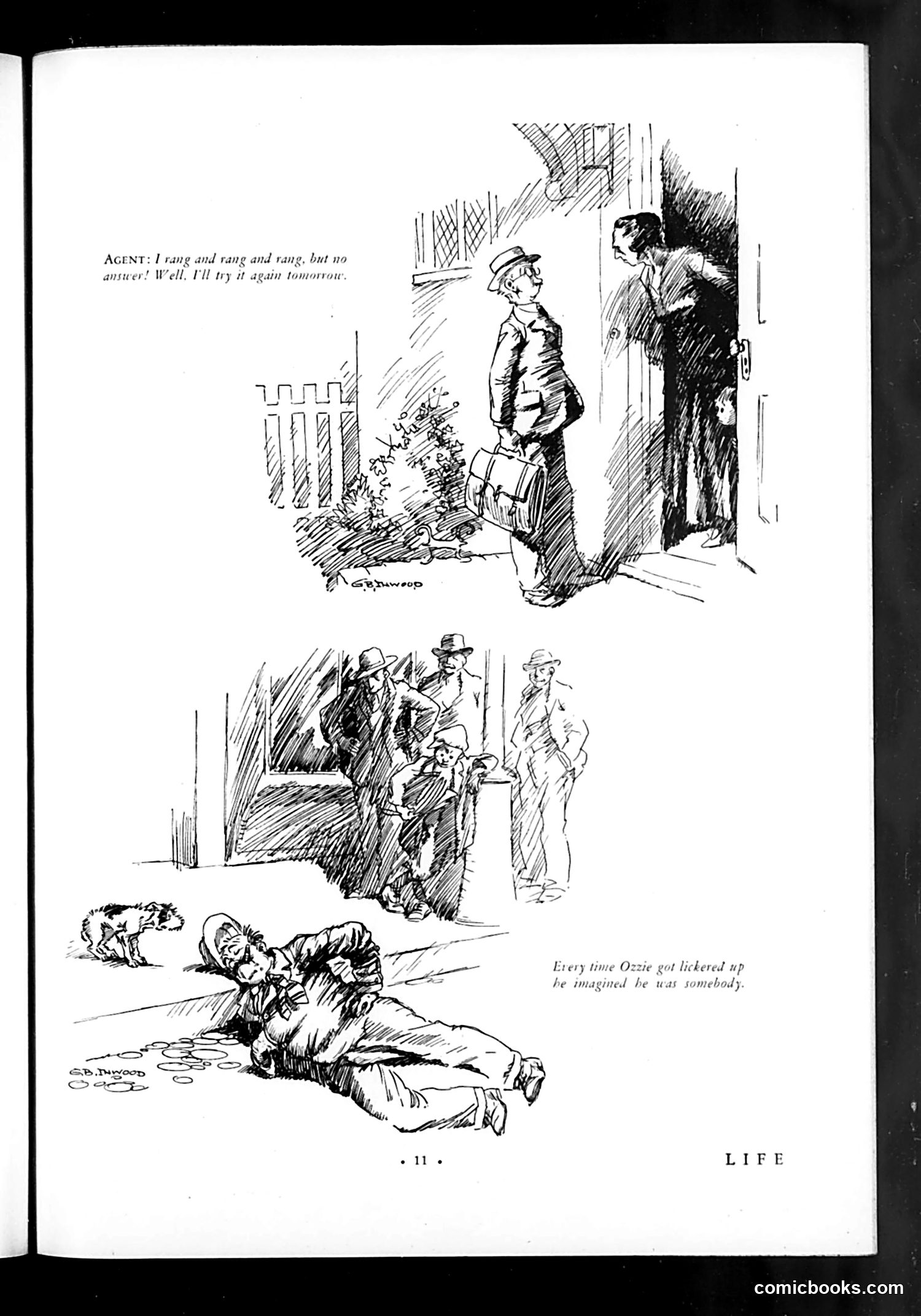
Analysis of Life Magazine Page 11 This page contains two satirical cartoons about a character named Ozzie and a door-to-door agent. Top cartoon: An agent attempts to sell something door-to-door, saying he rang the bell repeatedly with no answer, promising to try again tomorrow. Bottom cartoon: Shows Ozzie repeatedly being "licked up" (apparently by a dog), with the caption: "Every time Ozzie got licked up he imagined he was somebody." The humor appears to rely on physical slapstick and wordplay. The bottom cartoon suggests Ozzie gains imaginary status or importance from the dog's attention—a joke about seeking validation through any form of recognition, no matter how undignified. The cartoons mock both persistent salesmanship and human vanity.
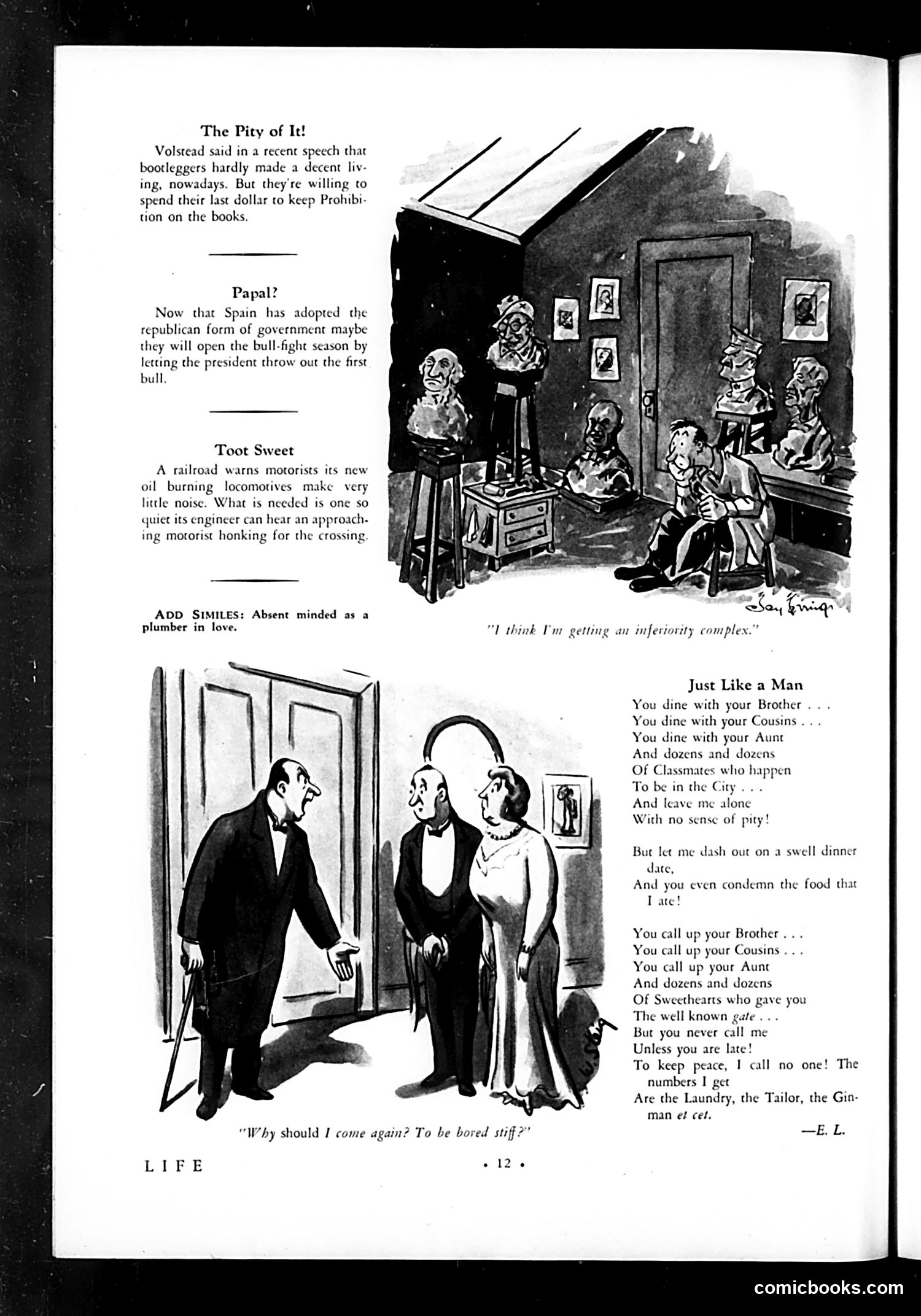
Analysis of Life Magazine Page 12 This page contains three satirical humor pieces typical of early 20th-century Life magazine: "The Pity of It!" mocks bootleggers during Prohibition, suggesting they're so desperate they'd fund anti-alcohol campaigns just to stay in business. "Papal?" jokes about Spain adopting a republican government, sarcastically suggesting they might open bullfighting season with the president throwing the first bull. "Toot Sweet" complains about quiet locomotives—ironically, the writer wants MORE noise to warn approaching motorists. The main cartoon shows a woman at what appears to be a psychoanalyst's office, saying "I think I'm getting an inferiority complex," satirizing the era's emerging fascination with Freudian psychology. "Just Like a Man" is a poem (attributed "E.L.") humorously cataloging how men treat dinner dates inconsiderately while maintaining social obligations to family.
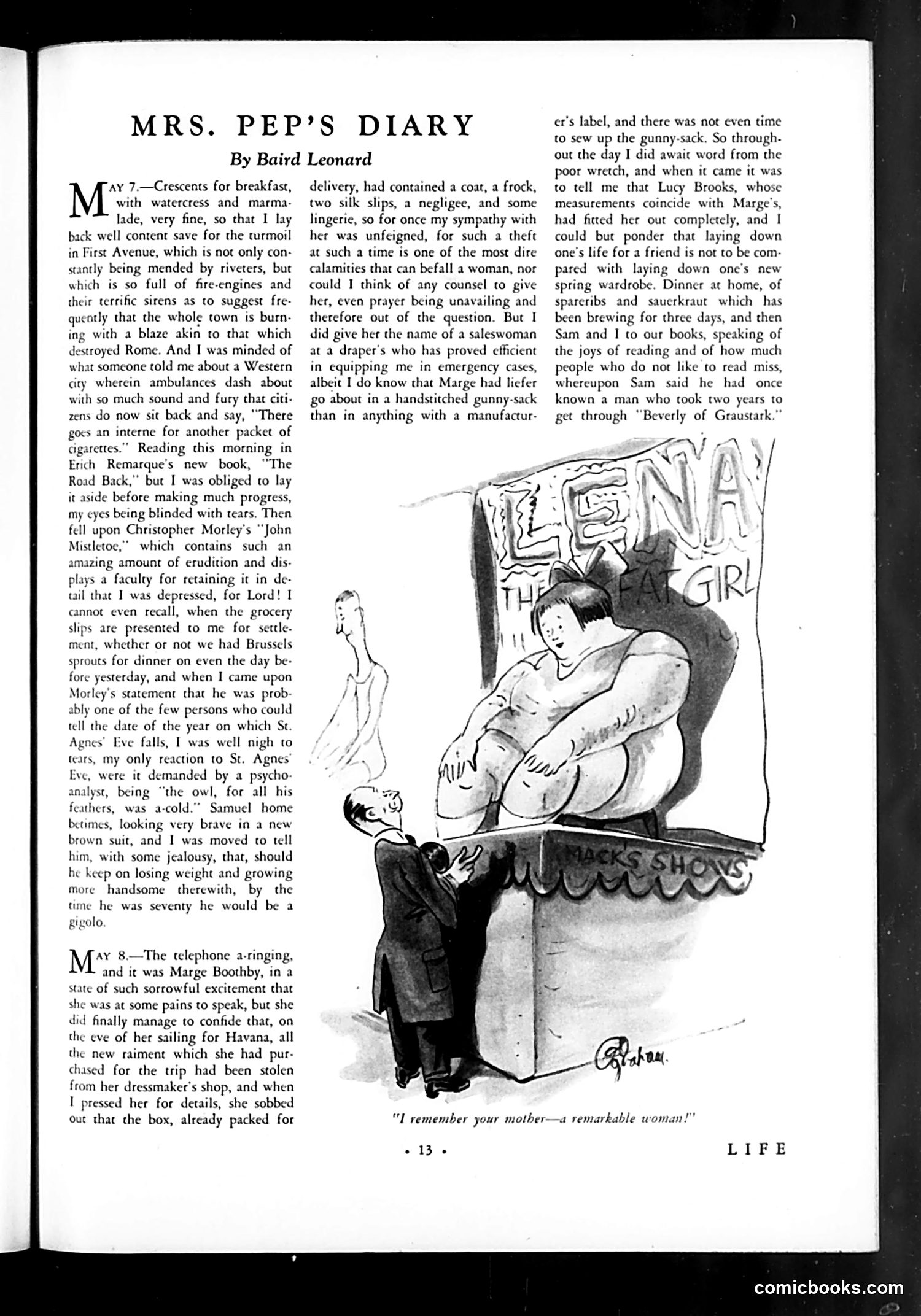
Mrs. Pep's Diary - Analysis This page presents a humorous diary entry by Baird Leonard satirizing urban middle-class life in early 20th-century America. The text describes trivial domestic crises: a stolen laundry delivery and a friend's missing travel wardrobe before a Havana trip. The accompanying illustration shows a man gazing adoringly at a billboard advertisement of a voluptuous woman, with the caption "I remember your mother—a remarkable woman!" The joke satirizes male attention to attractive women and suggests the man is confusing the billboard image with someone's mother, creating absurdist humor. The overall piece mocks the petty concerns and distracted nature of modern urban life, using exaggeration and non-sequiturs typical of early Life magazine satire.
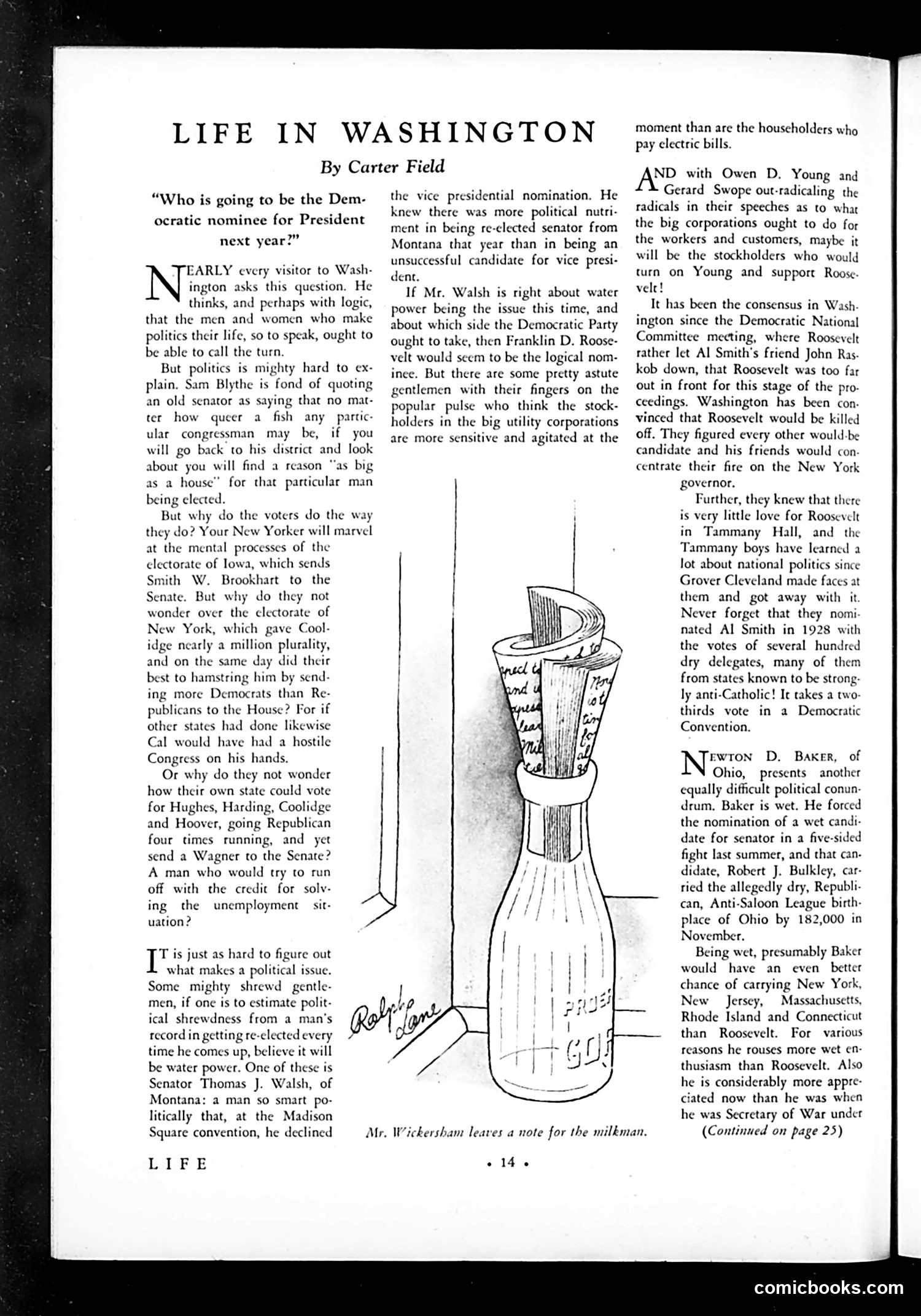
"Life in Washington" by Carter Field This page discusses 1930s Democratic Party politics and the 1932 presidential nomination. The main illustration shows a milk bottle with a note labeled "Mr. Wickersham leaves a note for the milkman"—likely referencing Attorney General George Wickersham or a similar political figure, though the specific context is unclear. The text critiques how voters choose senators and discusses political maneuvering around Roosevelt's candidacy. It mentions Senator Thomas J. Walsh of Montana, Newton D. Baker of Ohio, and Robert J. Bulkley as potential candidates, touching on regional political dynamics and the wet versus dry debate (Prohibition-era politics). The satire suggests these politicians miscalculate public sentiment and party dynamics when positioning themselves for nomination.
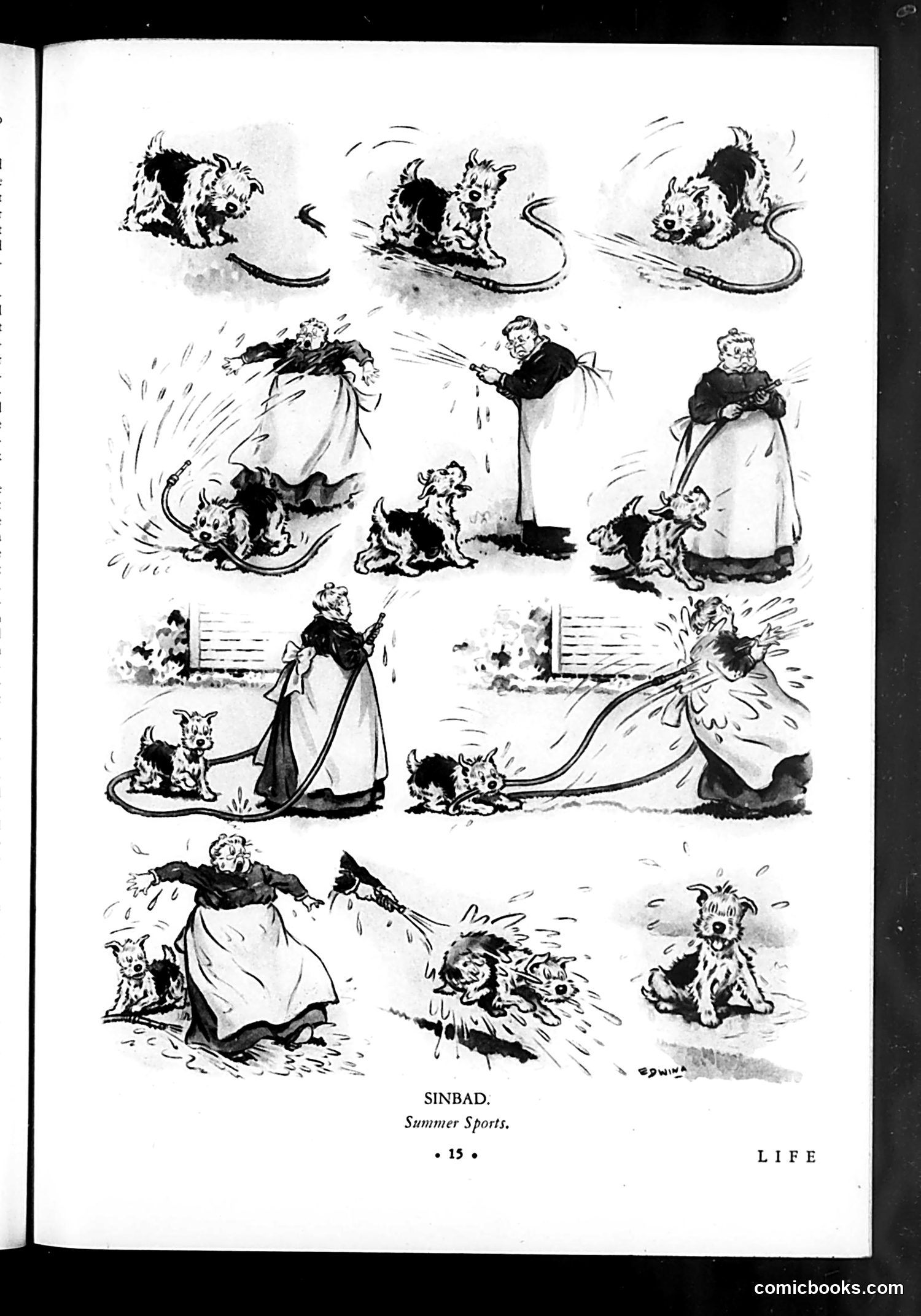
"Sinbad: Summer Sports" This is a humorous illustrated comic strip by an artist signed "Sguina." The page shows various scenes of a character (likely named Sinbad) engaged in chaotic "summer sports" activities involving dogs on leashes. The humor derives from the absurdity of the situations: people being dragged, flipped, and generally manhandled by energetic, unruly dogs during what should be leisurely summer recreation. The exaggerated motion lines and expressions emphasize the slapstick chaos. The satire appears to mock the romanticized notion of genteel summer activities and leisurely pursuits—showing instead the messy, undignified reality of managing uncontrollable pets during outdoor entertainment. It's early 20th-century social humor about the gap between expectations and reality in domestic life.
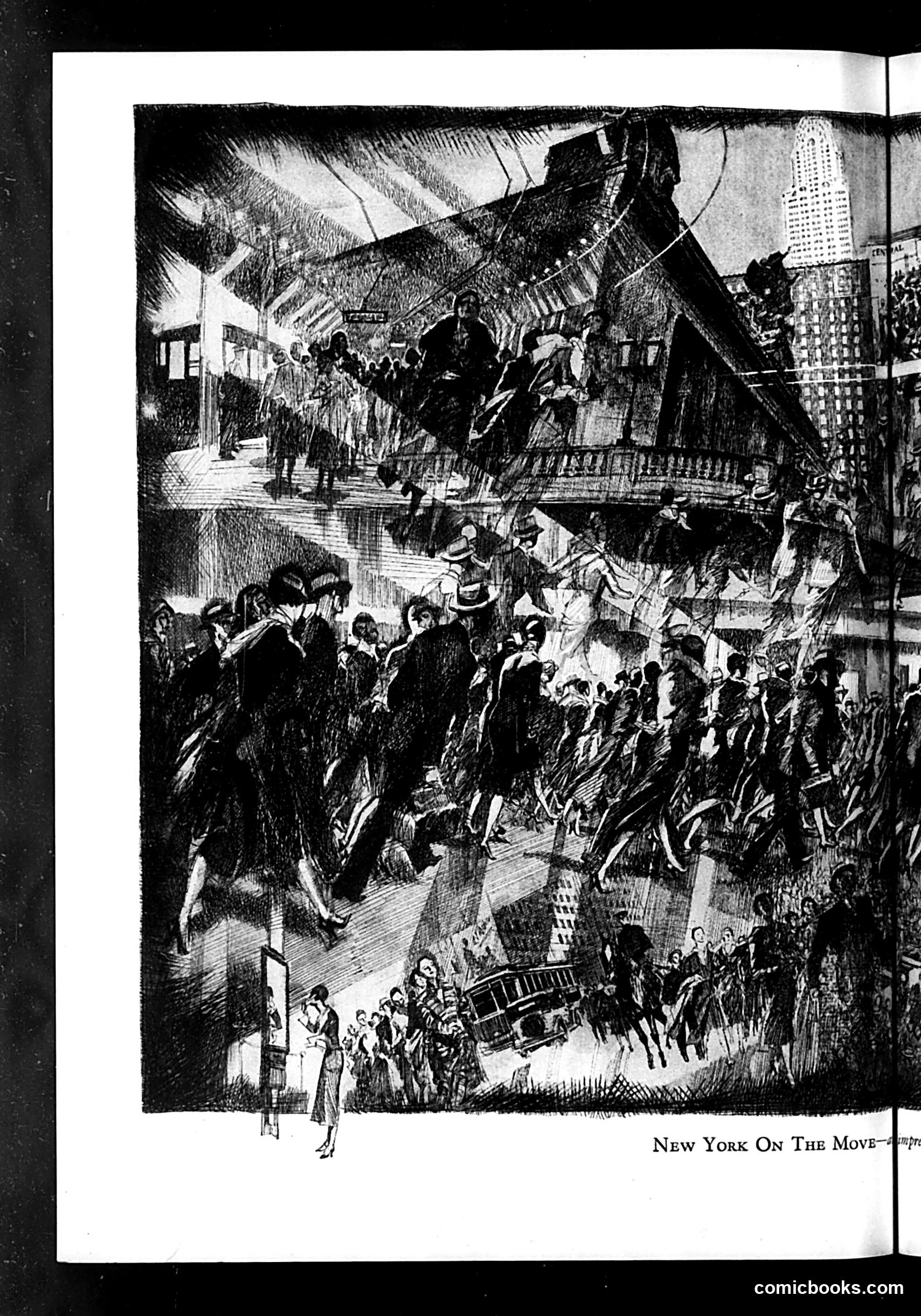
"New York On The Move" This etching depicts crowded urban street scenes in New York City, likely from the early 20th century based on the style and clothing. The composition shows multiple levels of activity—pedestrians, vehicles, and tall buildings creating a sense of dynamic metropolitan life. The title suggests commentary on New York's constant activity and movement. The satirical point appears to be about the frenetic pace and congestion of city life—masses of people, multiple modes of transportation, and architectural density all compressed together. The artistic technique emphasizes chaos and energy through dense cross-hatching and overlapping figures. Without additional context about the specific issue's date, I cannot identify particular events being referenced, but the work captures early-20th-century urban social commentary about modern city living.
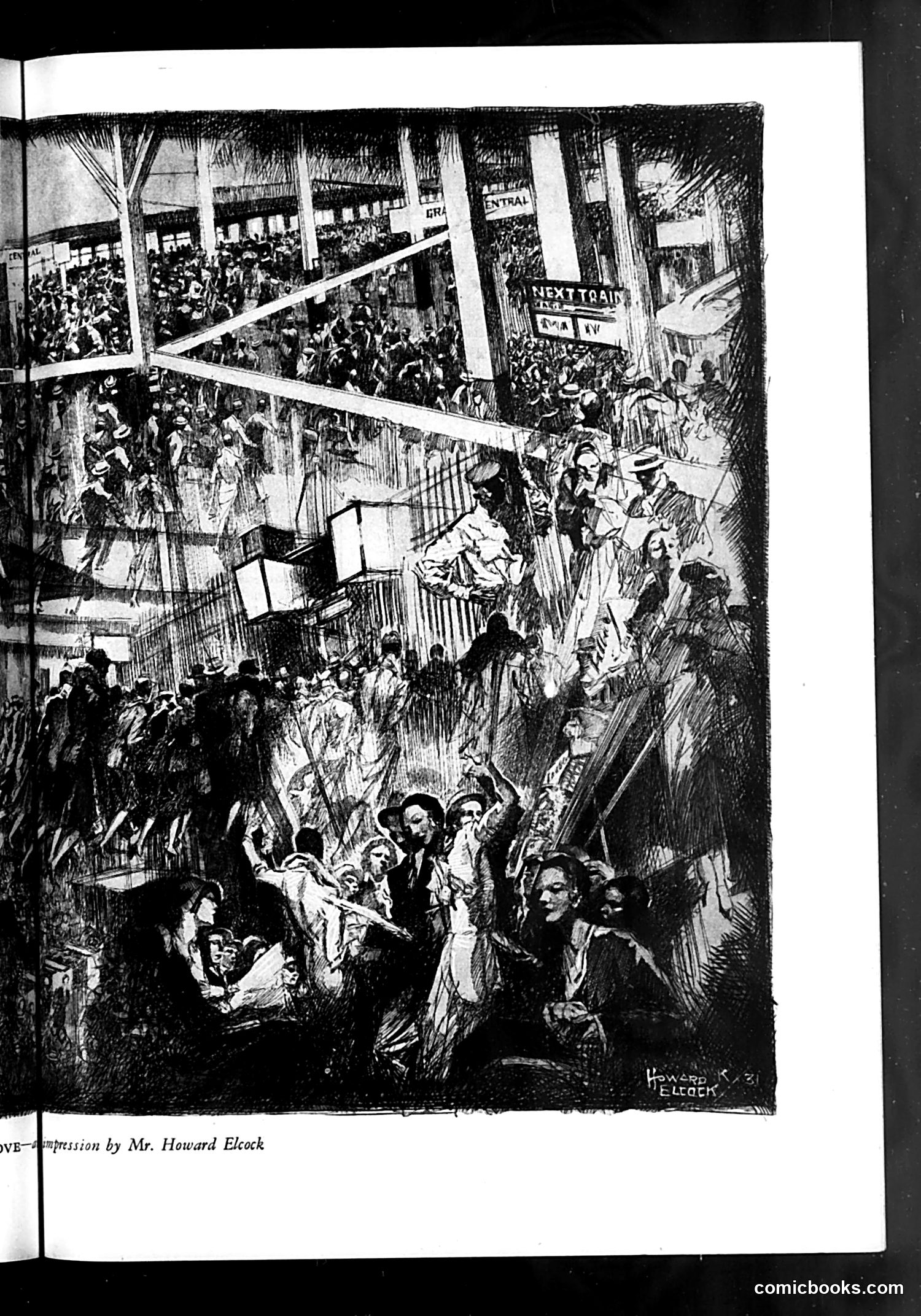
Commentary on Howard Elcock's Illustration This dramatic ink illustration by Howard Elcock depicts a crowded, multi-level train station—likely Grand Central Terminal based on the architectural details and "NEXT TRAIN" signage visible. The composition emphasizes chaos and mass movement, with hundreds of figures packed into the space across multiple levels. The image appears to satirize urban congestion and the overwhelming scale of modern metropolitan life, particularly the density of commuter traffic in early-to-mid twentieth-century New York City. The artistic style—with its heavy cross-hatching and compressed perspective—amplifies the sense of crowding and human compression. Without accompanying caption text visible on this page, the specific satirical point remains unclear, though it likely critiques either transit infrastructure inadequacy or urban overcrowding generally.
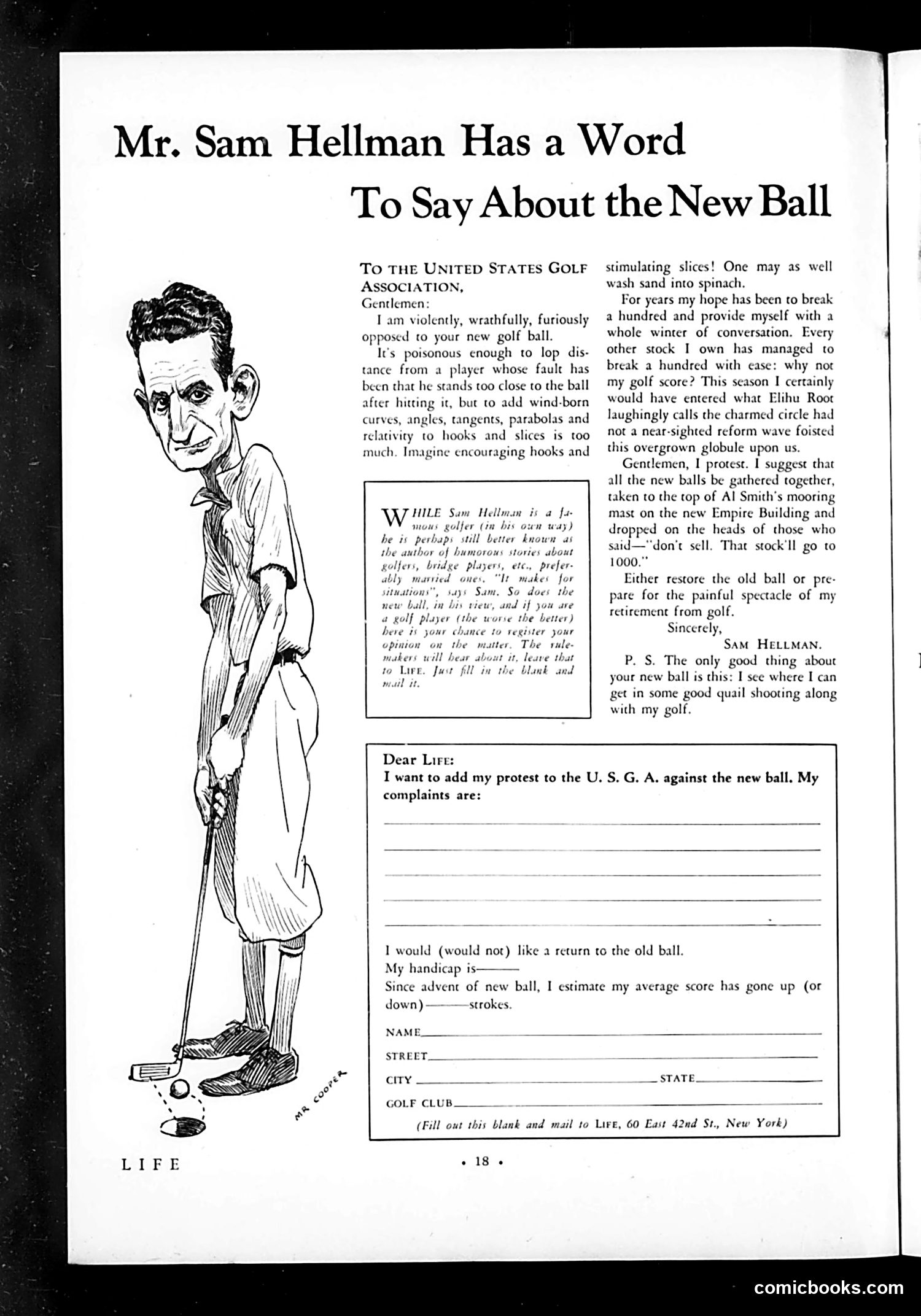
Explanation for Modern Readers This is a satirical article from *Life* magazine mocking golfer Sam Hellman's complaint about a new golf ball design. The caricature shows Hellman as an exaggerated, thin, angular golfer opposing the USGA's introduction of a new ball specification. Hellman's complaint—rendered in hyperbolic fashion—is that the new ball encourages excessive distance and undesirable shots (hooks, slices, curves). His absurd solution: gathering all new balls, taking them to the Empire Building, and dropping them on the heads of those who approved the change. The satire targets both equipment complaints in golf and the broader phenomenon of golfers blaming their poor performance on equipment rather than skill. The reader-response form invites readers to share their own grievances about the new ball, continuing the mockery of those resistant to sporting change.
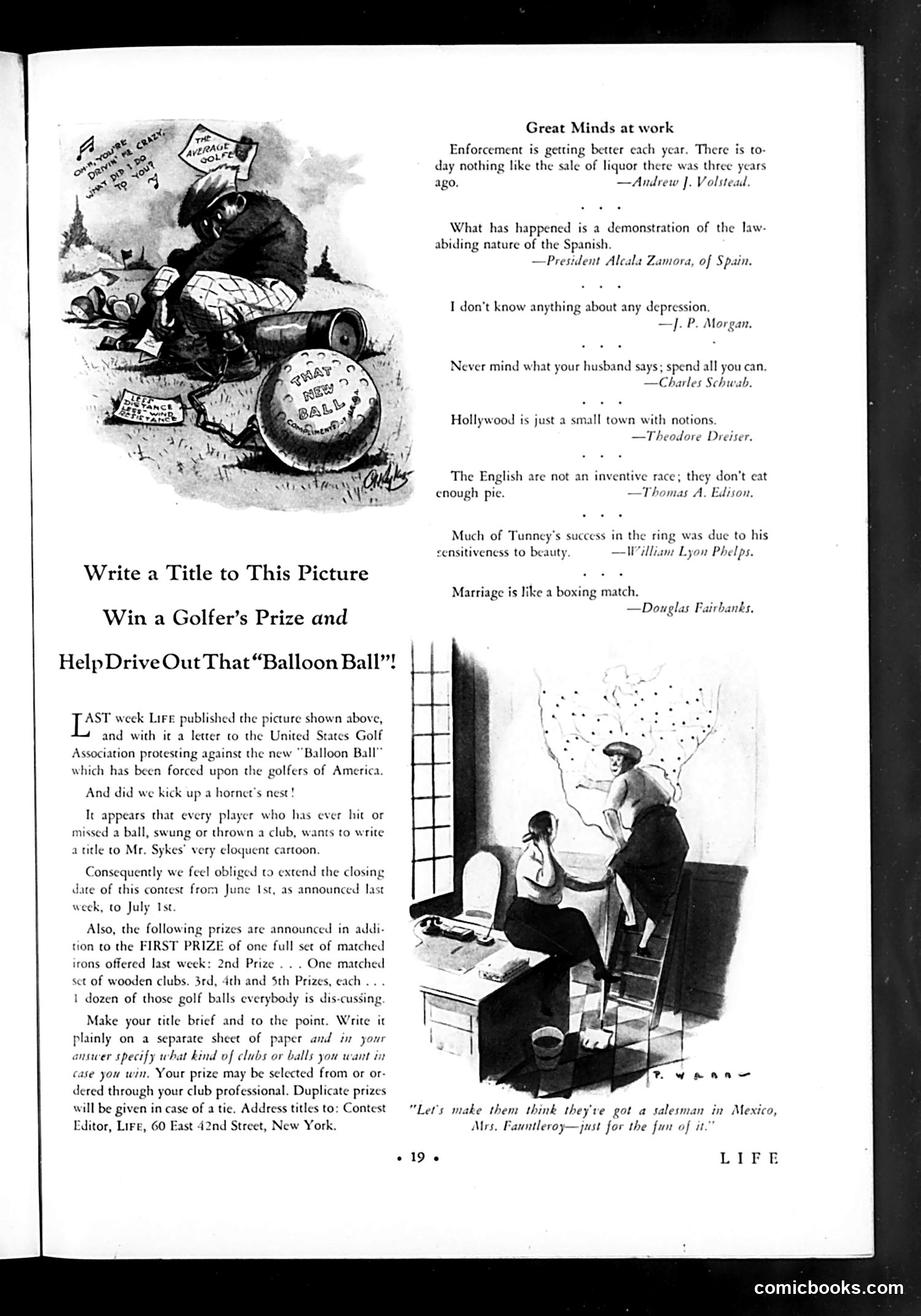
Analysis of Life Magazine Page This page contains a satirical cartoon contest about "Balloon Ball," a new golf innovation that had apparently upset traditionalists. The main cartoon shows a grotesque figure sitting atop various golf equipment and rule books, representing the chaos caused by this new rule change. The contest invites readers to write humorous titles for the cartoon, with prizes including golf clubs and balls. The accompanying text indicates that Life magazine had published a critical letter to the U.S. Golf Association protesting "Balloon Ball" as a forced innovation that disrupted traditional golf. The right side includes unrelated quotes from famous figures on various topics (marriage, Hollywood, etc.) and a separate cartoon about office life, typical of Life's miscellaneous content format.
Life Magazine Movie Reviews (circa early 1930s) This page contains two film reviews by Harry Evans. "The Secret Six" discusses a gangster film starring Wallace Beery that explicitly critiques Prohibition by portraying criminals as morally empty thugs rather than heroes. The reviewer praises director George Hill for showing gangsters' "cheap, uncouth ruthlessness" without sympathy, and notes the film features Clark Gable and Jean Harlow. The review suggests the movie might inspire real-world "Vigilante Committees" to fight organized crime. The second review covers Bobby Jones golf shorts—instructional films featuring the famous golfer. Evans emphasizes Jones's personal magnetism and genuine modesty, contrasting his putting stance with other golf experts like Walter Hagen and Leo Diegel. Both reviews reflect 1930s concerns: Prohibition's role in enabling crime, and the emerging popularity of sports instruction films.
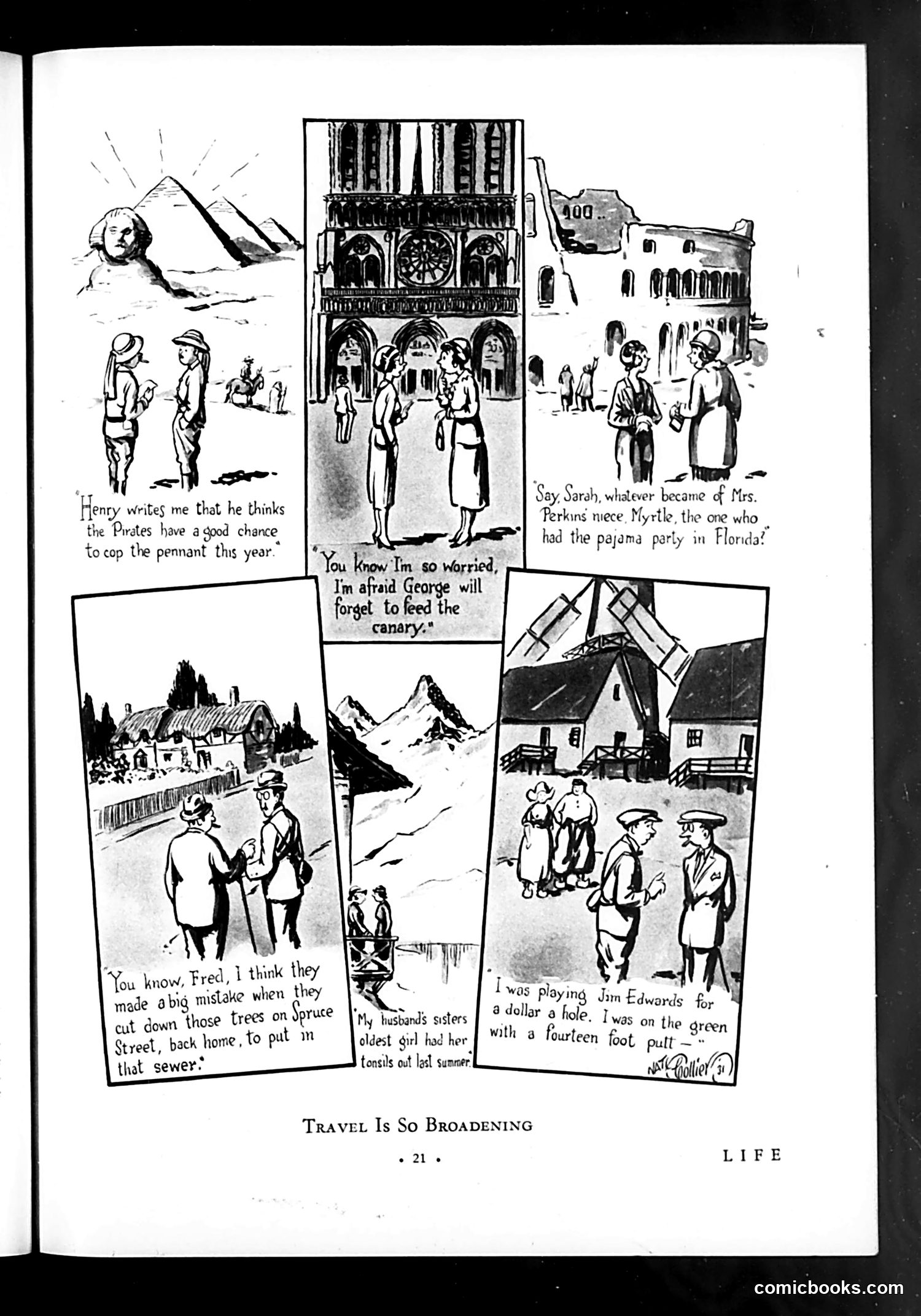
"Travel Is So Broadening" Analysis This is a humor page featuring five vignettes of people sharing travel anecdotes and gossip. The title's irony is the joke: the conversations reveal that travel supposedly "broadens" people, yet they're exchanging trivial, mundane, or embarrassing stories rather than discussing meaningful cultural experiences. The snippets include: - Baseball talk (Pirates pennant race) - Concern about feeding a canary while traveling - A reference to a "pajama party in Florida" (implying scandalous behavior) - Regret over cutting down trees in a hometown - A golf story about a fourteen-foot putt The satire mocks how Americans actually use travel—not for intellectual enrichment, but as occasions for small-town gossip, domestic mishaps, and trivial recreation. The cartoon suggests that despite traveling, people remain parochial and focused on petty concerns rather than genuinely broadened perspectives.
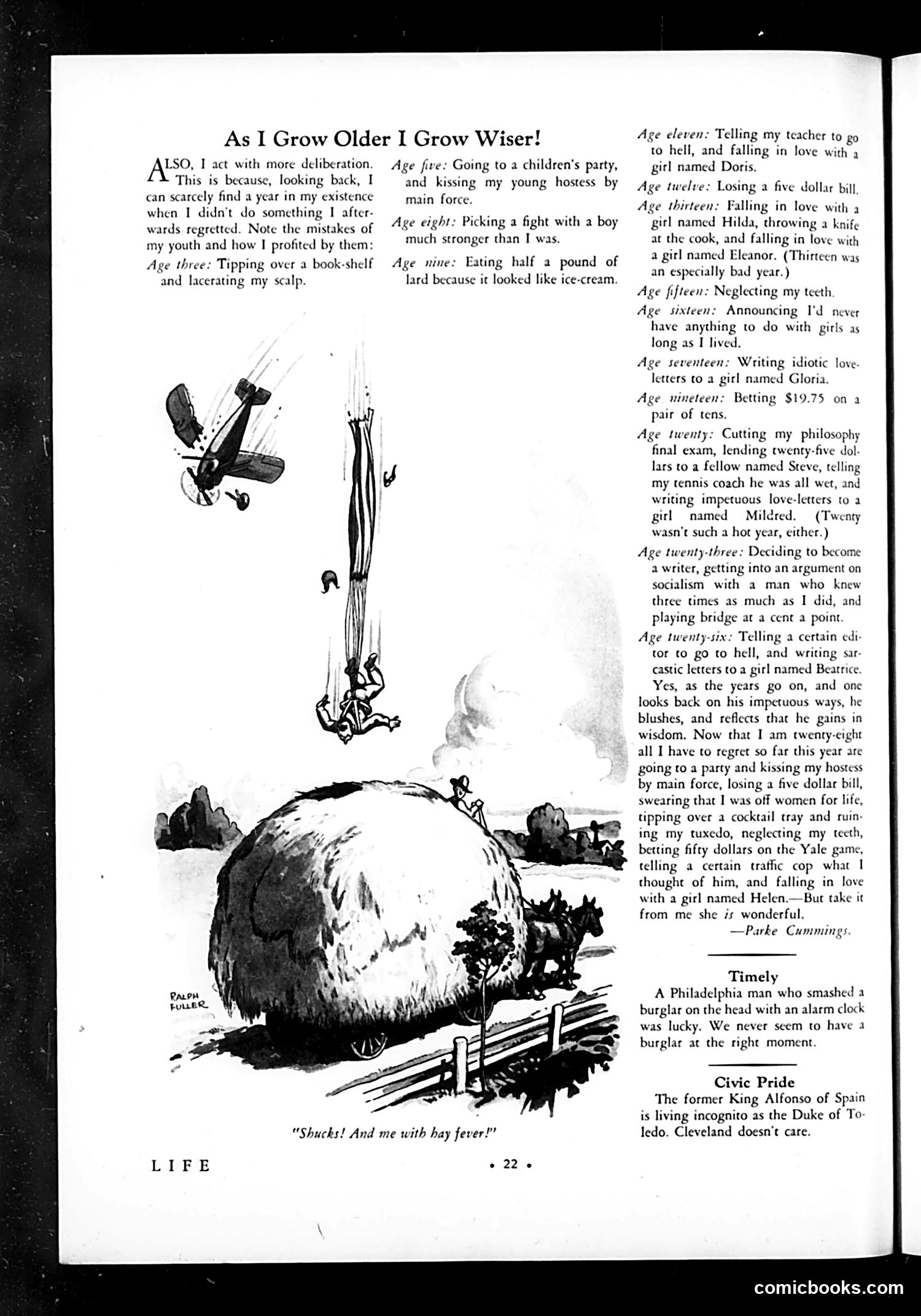
"As I Grow Older I Grow Wiser!" – Analysis This humorous essay by Parke Cummings uses ironic self-deprecation to satirize human nature. The author catalogs supposedly "regretted" mistakes from childhood through age 28—tipping bookshelves, fighting stronger boys, eating lard, falling in love repeatedly, losing money, and disrespecting authority figures. The joke's payoff: despite claiming wisdom from reflection, at 28 he's *repeating the exact same mistakes* (kissing his hostess "by main force," losing money, neglecting teeth, falling in love again). The accompanying cartoon shows a man falling from a cliff—a visual punchline about learning nothing. The satire targets human self-delusion: we believe ourselves improved by experience while cyclically repeating follies. The essay's casual, confessional tone makes the critique gentler—poking fun at universal human weakness rather than specific targets. This reflects Life magazine's tradition of urbane, character-based humor aimed at educated, self-aware readers.
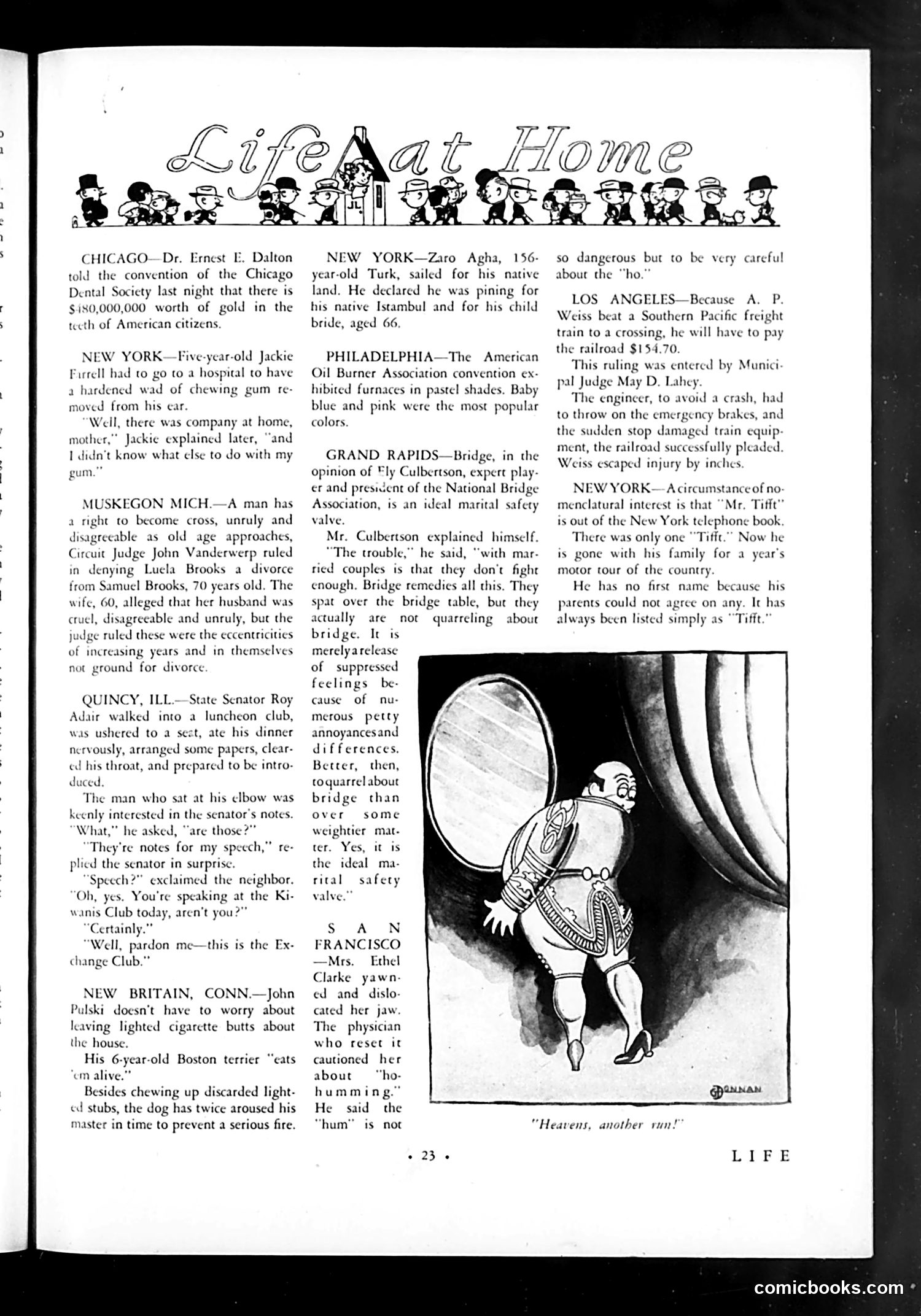
Life Magazine "Life at Home" Page Analysis This is a humor column featuring brief anecdotal news items from around America, with one accompanying cartoon. The cartoon illustrates a story about a man stuck inside a large pipe or tunnel, captioned "Heavens, another run!" The joke appears to reference the man's predicament—he's literally trapped in a confined space where he keeps encountering obstacles (runs/rips in stockings being the unstated parallel, making this a visual pun about the phrase "another run"). The surrounding text items are lighthearted domestic scenarios: a child removing stuck gum from his ear, a judge ruling elderly grumpiness isn't grounds for divorce, a senator showing up at the wrong club, a dog that eats cigarette butts, and various odd news briefs (a 156-year-old Turkish man, bridge as marital therapy, someone's jaw dislocation). The page represents typical 1920s-30s Life magazine humor: gentle satire about everyday American life, family situations, and absurdities, without sharp political commentary. It reflects period attitudes about marriage, aging, and social etiquette.
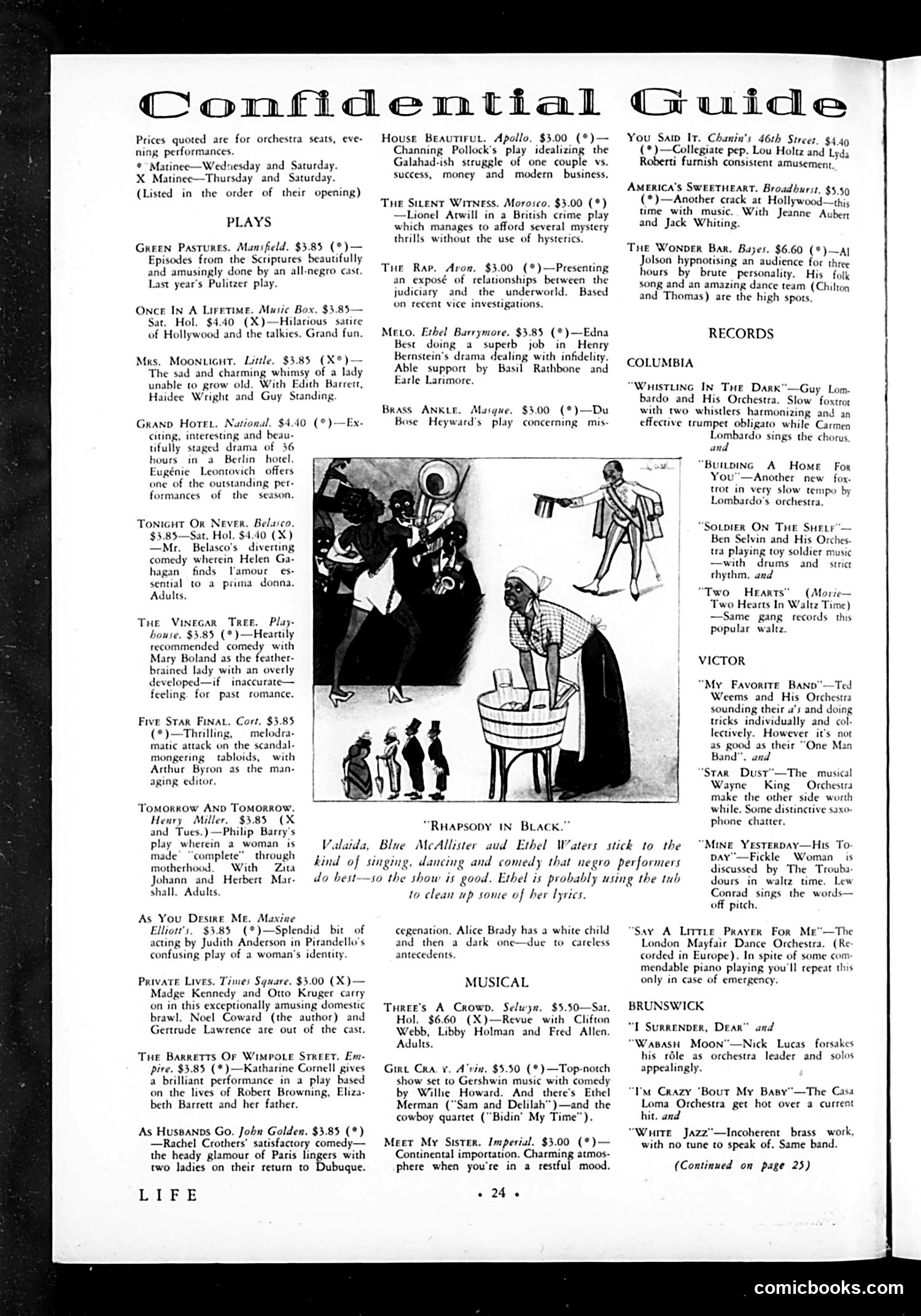
Analysis of "Rhapsody in Black" This page is primarily a theater and entertainment guide for New York productions and records, with one central illustration labeled "Rhapsody in Black." The cartoon depicts Ethel Waters (identified in the caption) and two other performers in what appears to be a minstrel or vaudeville performance scene. The image shows exaggerated physical comedy typical of early 1930s entertainment advertising—one figure stands in a large barrel or tub, another gestures broadly, and a third appears in motion. The caption references "Valanda, Blue McAllister and Ethel Waters" performing "dancing and comedy that negro performers do best," revealing the deeply racist context of 1930s entertainment. The term "negro performers" and the phrase "do best" reflects period attitudes that relegated Black entertainers to stereotyped roles in comedy and physical performance. This appears in LIFE magazine's entertainment section, presenting such performances as mainstream entertainment worthy of review and recommendation alongside Broadway plays—normalizing segregated entertainment and racial stereotyping of the era.
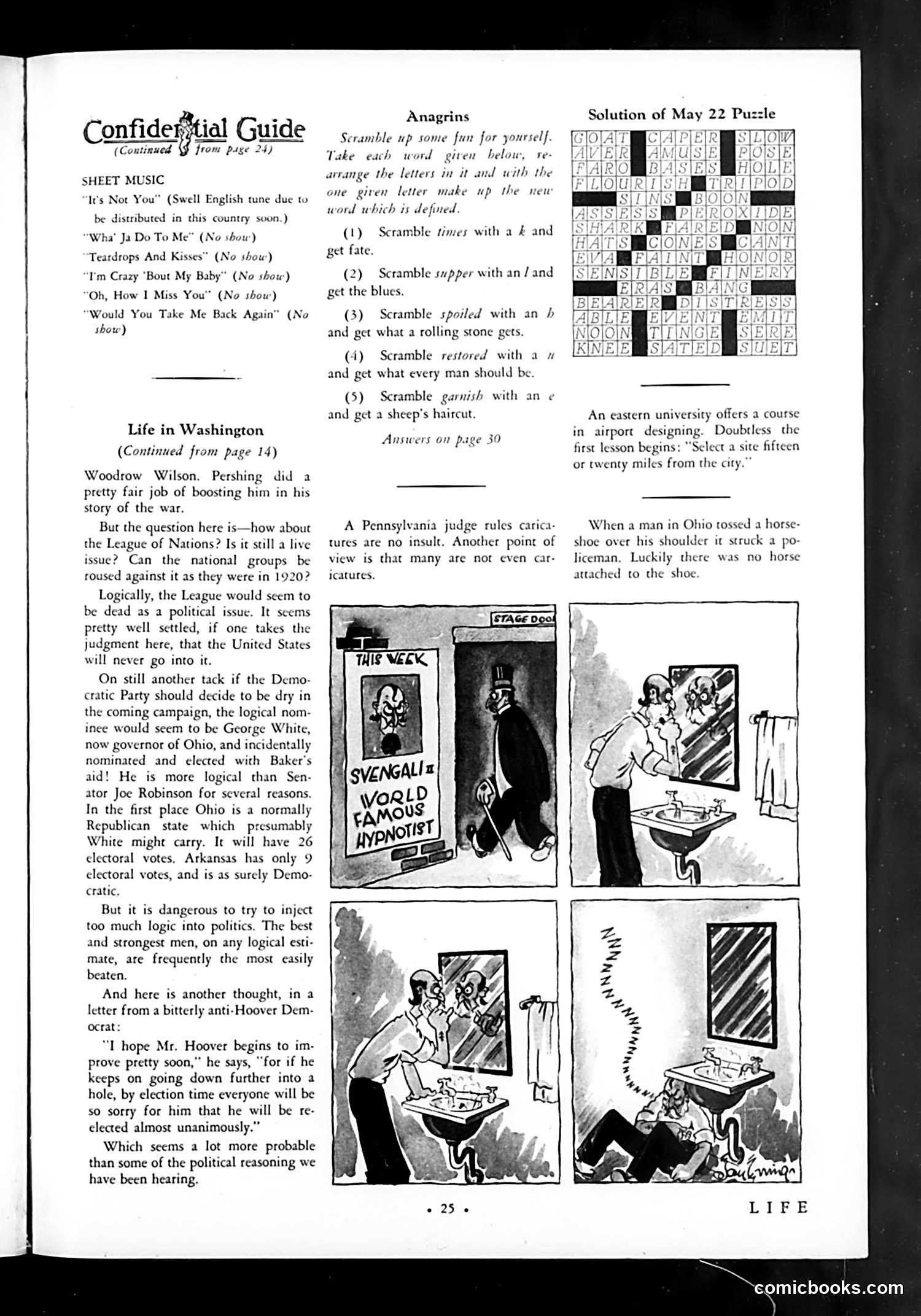
Life Magazine Page Analysis This page contains political commentary and humor from an era when Herbert Hoover was president (likely late 1920s-early 1930s, based on references to the 1920 League of Nations debate and upcoming elections). Key Content: The "Life in Washington" section discusses potential Democratic Party candidates, notably mentioning George White (Ohio governor) and Senator Joe Robinson as possible nominees. It analyzes electoral mathematics and warns against over-applying logic to politics. The Cartoon Strip (four panels, unlabeled) appears to satirize a hypnotist or charlatan ("Svengali"-type figure, referencing a famous manipulator). The sequence shows him performing tricks on increasingly skeptical or resistant audiences—likely mocking fraudulent entertainers or, possibly, political manipulators claiming special powers. The Satire: The cartoon seems to mock both the hypnotist's pretensions and public gullibility, while the written section suggests similar skepticism about political "logic" and prediction—implying voters behave unpredictably rather than rationally. The page's overall tone is cynical about both entertainment fraud and political reasoning.
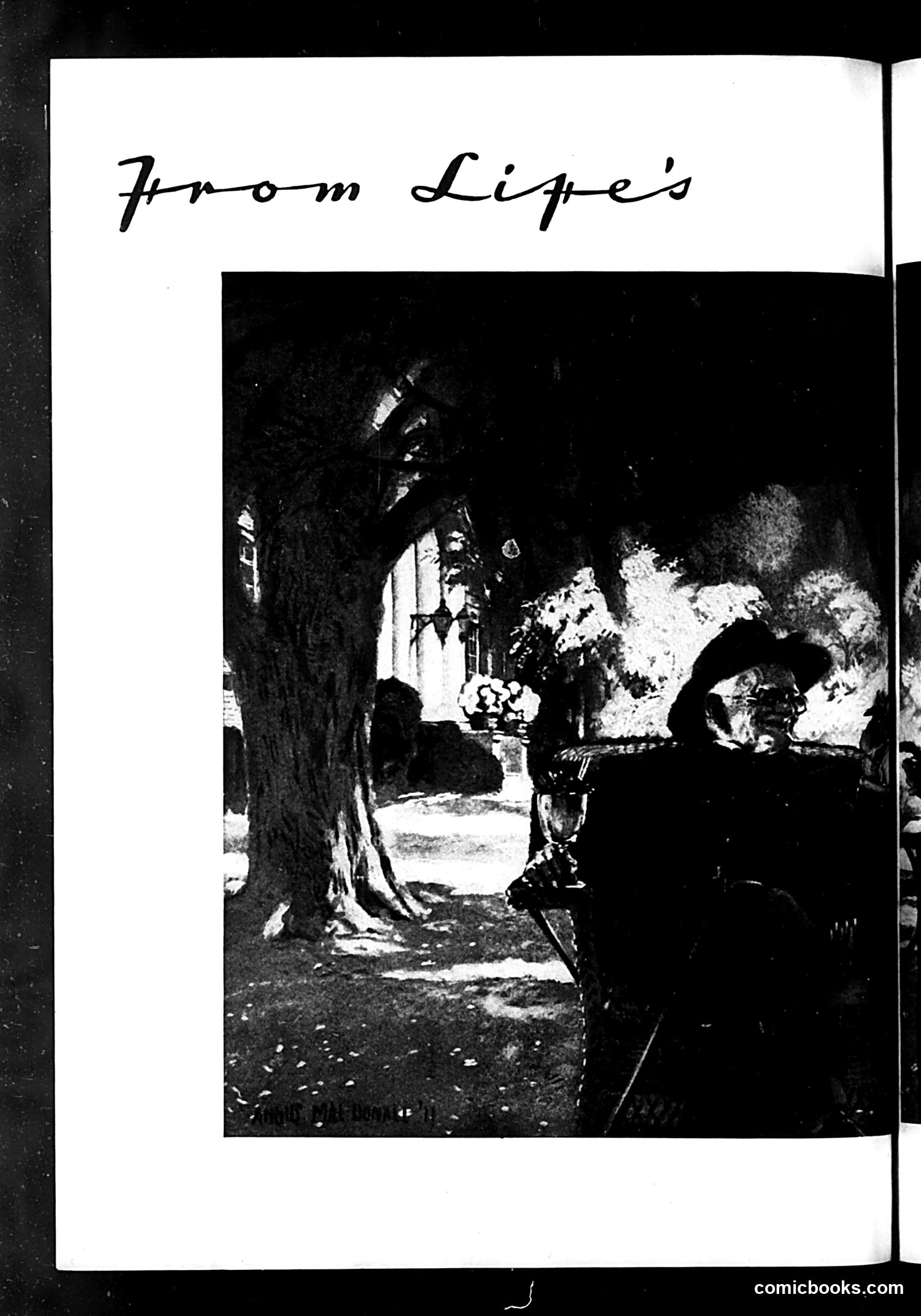
Analysis This page is titled "From Life's" and contains a black and white photograph rather than a cartoon. The image shows what appears to be a garden or courtyard scene with figures in period clothing (possibly 18th or 19th century dress based on the silhouettes and hats visible). There's a large tree trunk in the foreground, architectural elements like a doorway or window opening in the background, and flowering shrubs. However, without accompanying text, caption, or satirical artwork, the specific political or social commentary this photograph was meant to convey is unclear. This appears to be a dramatic or theatrical scene rather than a traditional political cartoon, but I cannot definitively identify the figures, the historical reference, or the intended satire from the image alone.
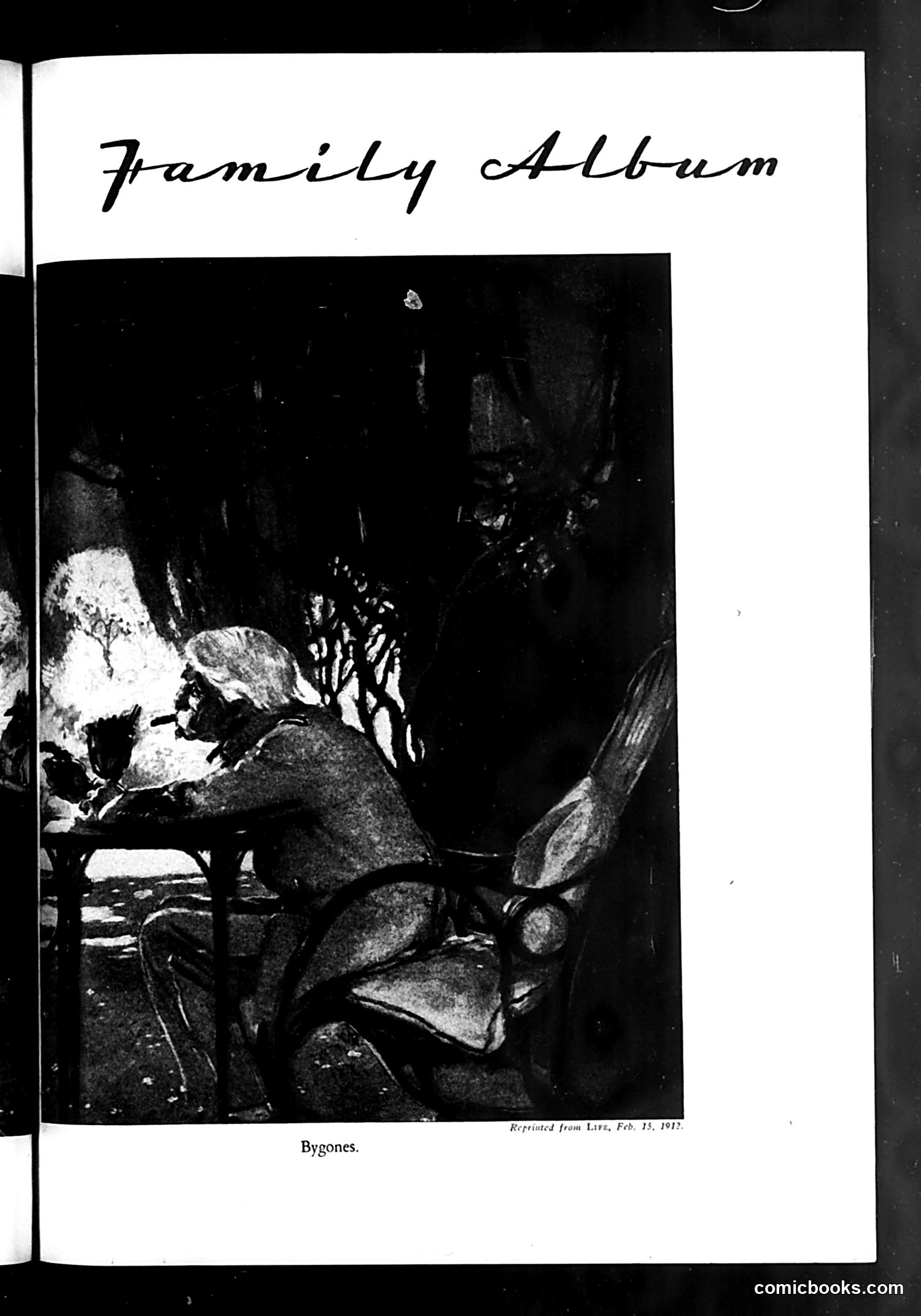
Family Album: "Bygones" This page from Life magazine (February 18, 1912) is titled "Family Album" and shows a photograph labeled "Bygones." The image depicts what appears to be skeletal remains or bones arranged on a table or surface, photographed in stark black and white. Without additional context from surrounding pages, the specific satirical intent is unclear. However, given Life's tradition of social commentary, this could be commenting on outdated social practices, extinct traditions, or perhaps critiquing something deemed "dead" in contemporary society. The "Family Album" framing suggests ironic nostalgia—presenting something unpleasant or morbid as if it were a cherished family keepsake. The exact target of the satire cannot be determined from the image and caption alone.
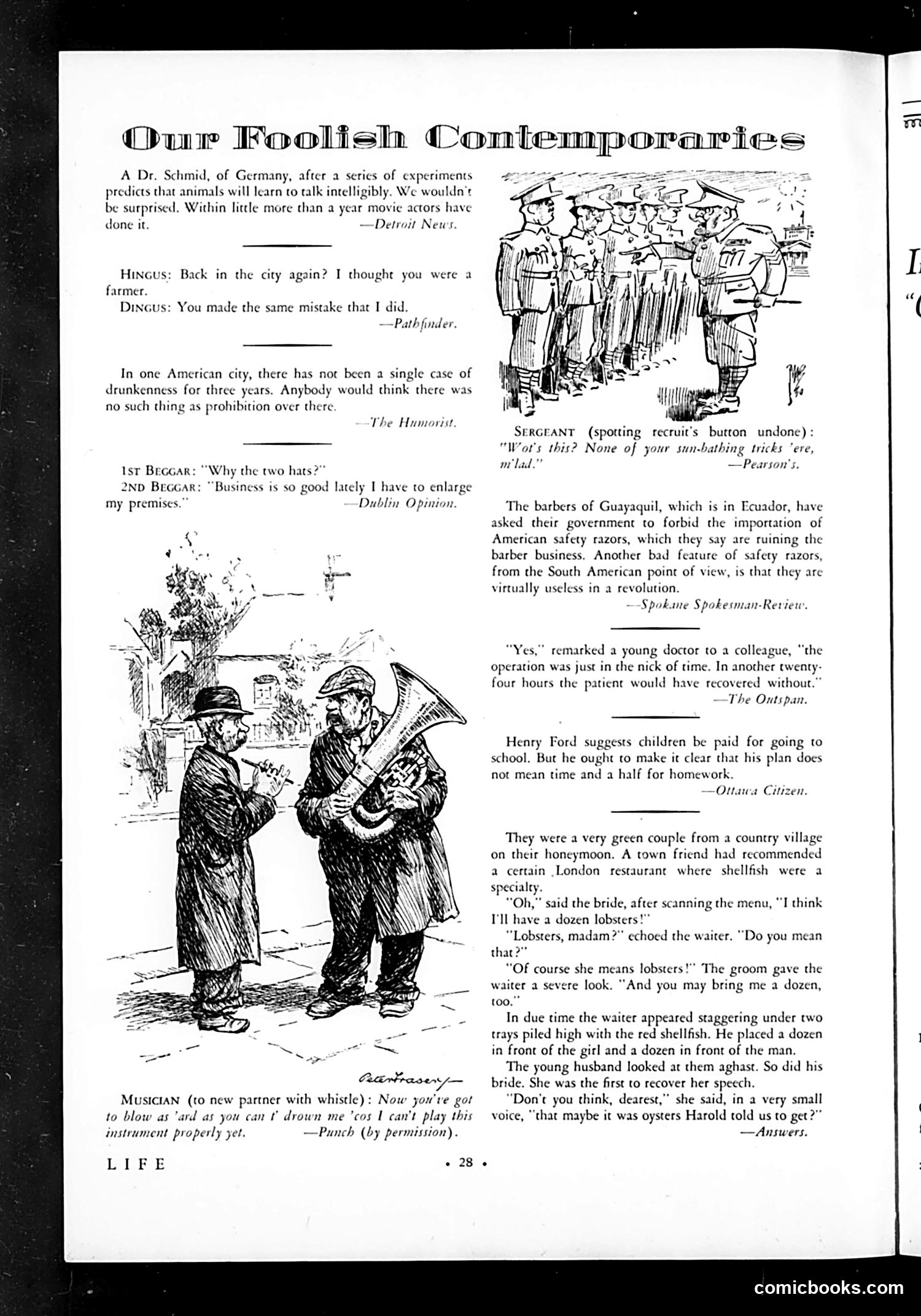
"Our Foolish Contemporaries" - Life Magazine Satire Page This page collects brief jokes from various publications mocking contemporary foolishness. Key targets include: Talking animals/movie actors: A German scientist predicts animals will speak intelligibly; the joke is that talking pictures (talkies) have made movie actors sound equally unintelligent—satirizing early sound film quality. Prohibition: A city with zero drunkenness for three years is mocked as proof Prohibition doesn't work, since obviously such statistics are absurd. Economic absurdity: A beggar claims business is so good he must "enlarge premises"—the joke being beggars shouldn't prosper. Honeymoon couple's confusion: Country newlyweds mishear "lobsters" as "oysters" and order massive quantities of the wrong shellfish—satire of rural naïveté encountering city sophistication. Minor items mock Henry Ford's education-pay scheme, safety razors replacing barbers (even noting their uselessness in revolutions), and military discipline lapses. The cartoons show street musicians and soldiers, illustrating working-class life and military incompetence.
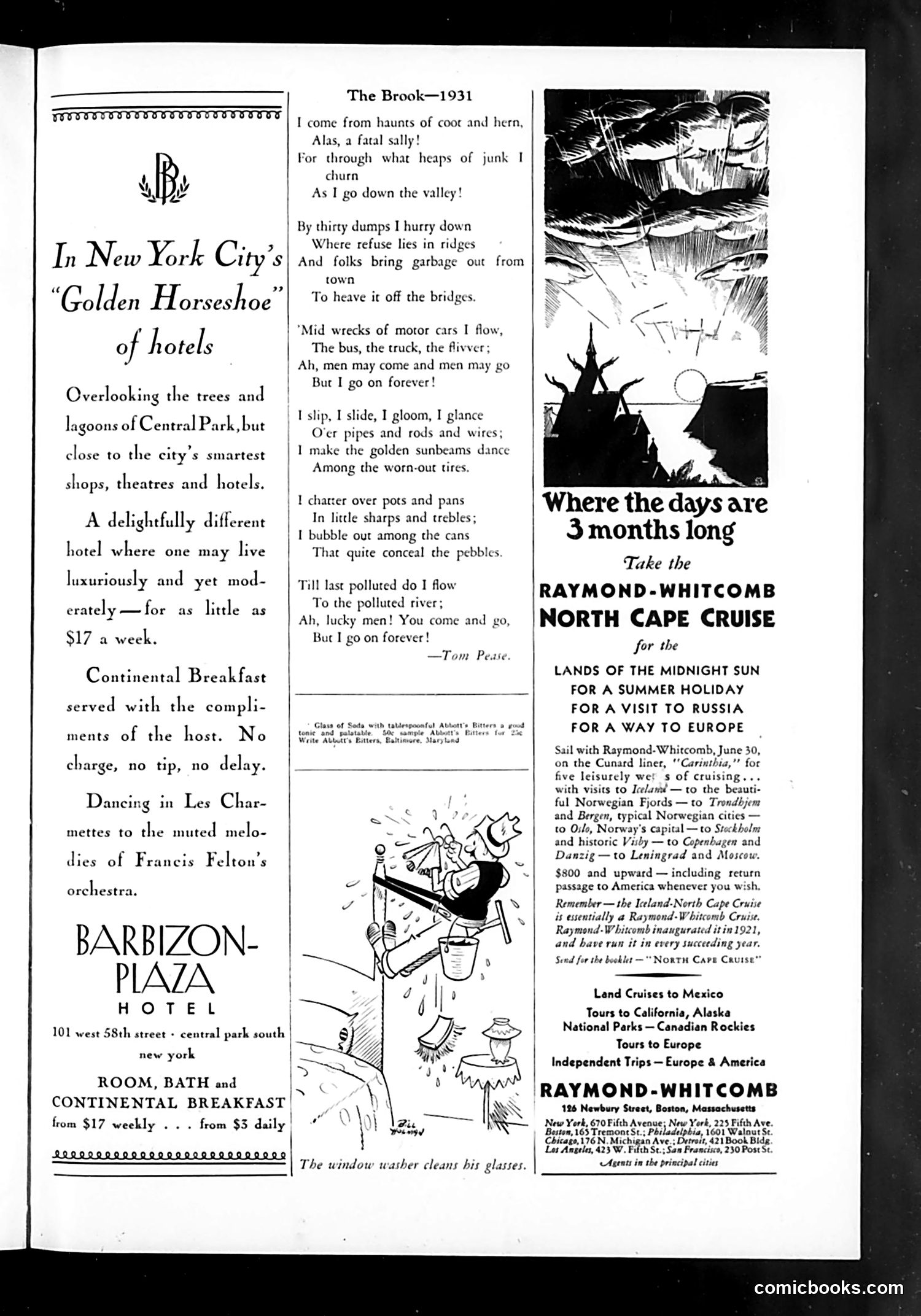
"The Brook—1931": A Satirical Poem This page features a parody poem titled "The Brook" (1931) that reimagines Tennyson's famous romantic nature poem for the Depression era. The original celebrates a pure, eternal stream; this version depicts an urban brook choked with industrial waste and garbage. The satire works by maintaining the original's lyrical, reverent tone while describing pollution: the brook flows past "thirty dumps," motor car wrecks, discarded tires, and cans—ultimately becoming "polluted" before reaching "the polluted river." The repeated refrain "But I go on forever!" shifts from Tennyson's celebration of nature's permanence to dark irony about industrial contamination's permanence. The illustration shows a silhouetted industrial landscape with smokestacks, reinforcing the poem's commentary on how 1931 urban America had transformed natural waterways into receptacles for refuse. It's social criticism masked as literary parody.
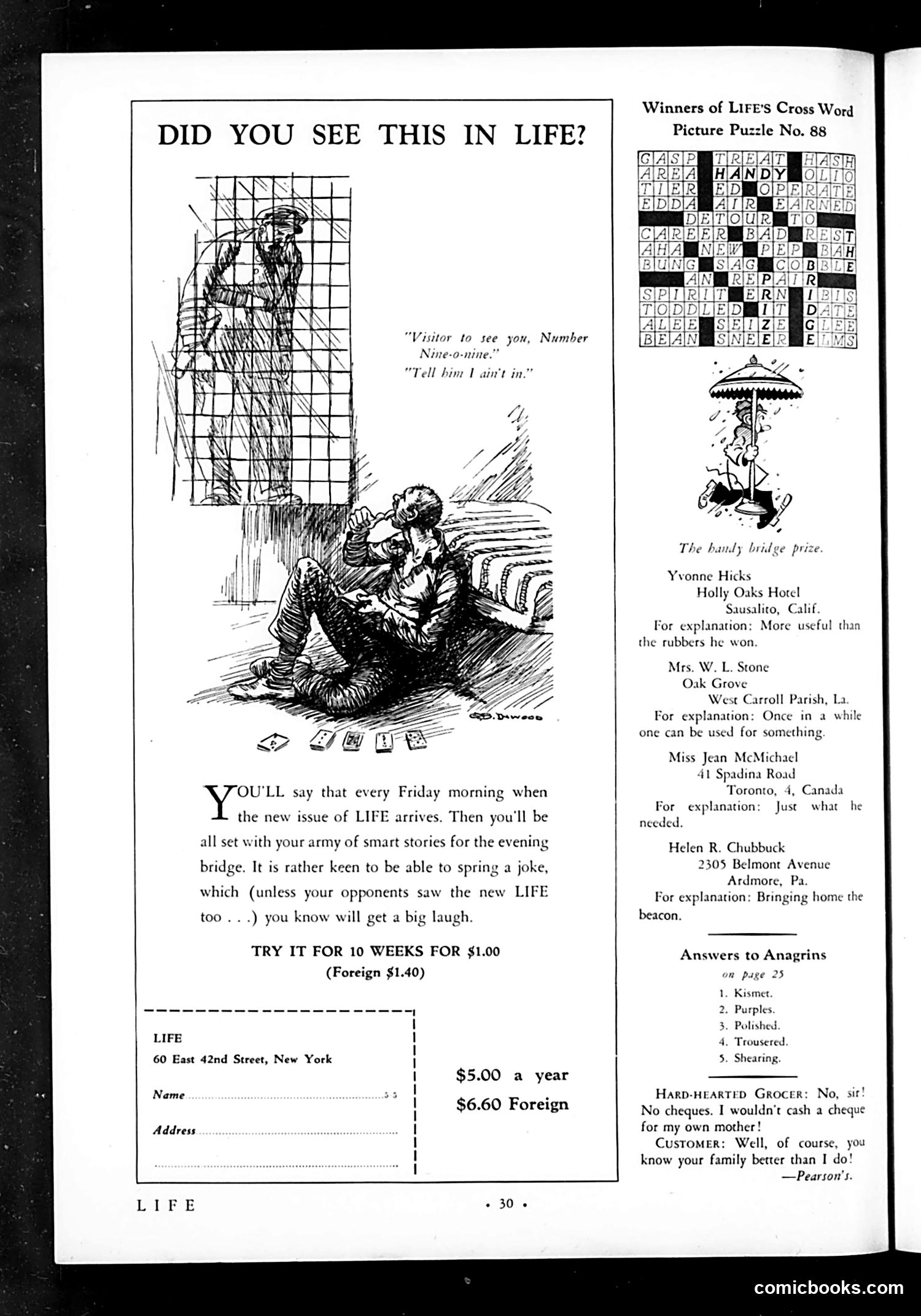
Analysis of Life Magazine Page This page is primarily advertising and filler content, not editorial cartoons with political significance. The main illustration depicts a domestic scene: a person avoiding a visitor ("Tell him I ain't in"), suggesting social awkwardness or avoiding unwanted company—a relatable humor scenario. The page's primary purpose is promoting Life magazine subscriptions ($5.00/year, $1.40 for 10 weeks), positioning the magazine as essential entertainment for Friday bridge parties (a popular social activity of the era). The pitch claims Life provides "smart stories" and jokes to impress opponents at bridge games. The right column contains puzzle winners, anagrams answers, and a joke from *Pearson's* magazine about a grocer refusing to cash checks—gentle, family-friendly humor typical of the period. No significant political or social satire is present. This is essentially a subscription promotion wrapped in light entertainment filler.
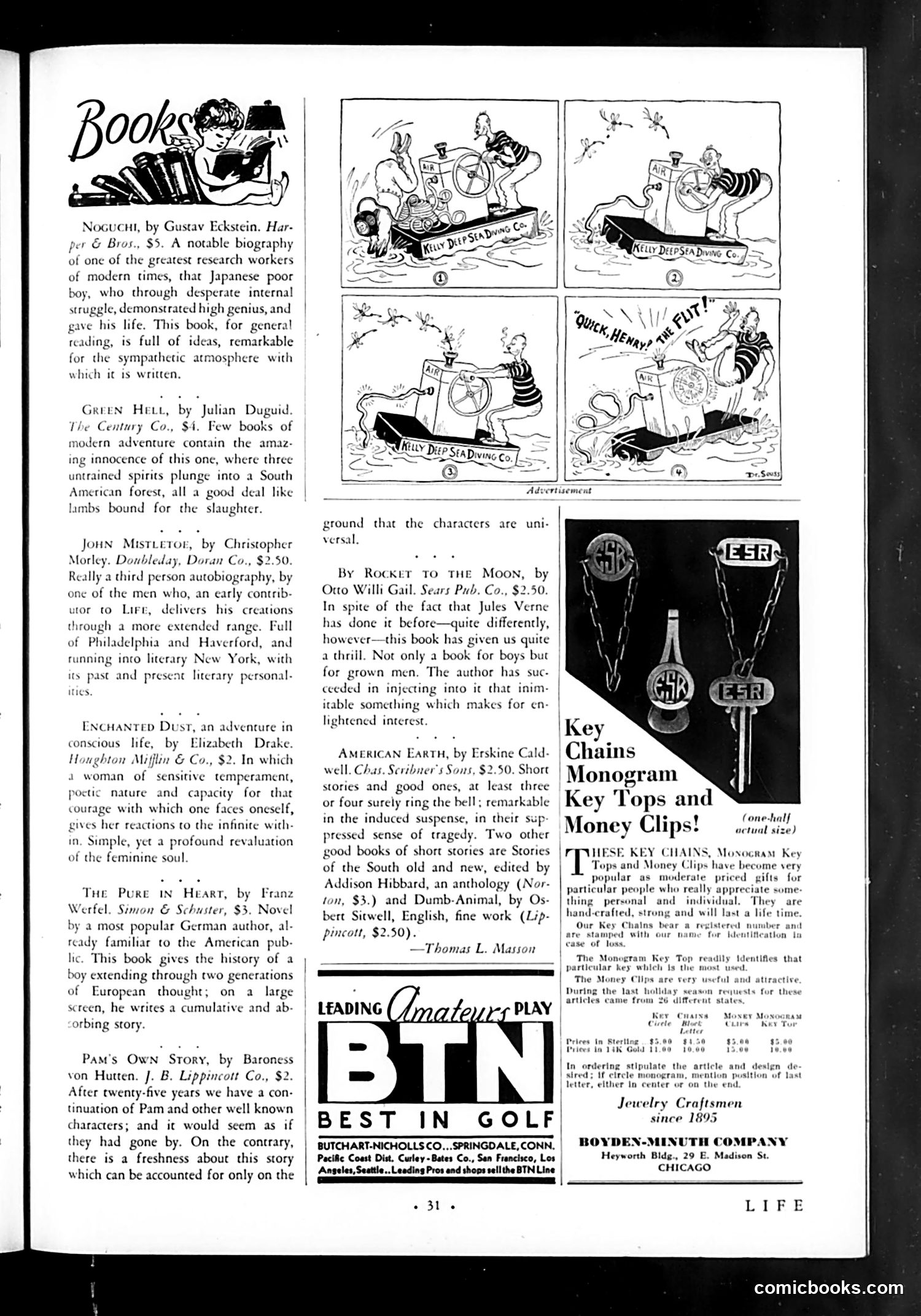
Analysis of This Life Magazine Page This page is primarily a book review section with advertisements. The four comic panels at the top illustrate "Kiddie Deep Sea Diving Co." — appearing to show children in a makeshift diving apparatus, likely satirizing dangerous or absurd children's activities. The humor is visual slapstick rather than political. The main content reviews contemporary books (circa 1920s-1930s based on publisher details), including works by popular authors like Franz Werfel and Erskine Caldwell. Notably, Thomas L. Masson provides commentary, a name associated with Life magazine's editorial staff. The advertisements promote key chains and monogram accessories marketed as personal gifts, and a golf equipment company. For modern readers: This reflects an era when Life was primarily a literary and satirical magazine mixing book criticism with consumer goods advertising — quite different from its later role as a photojournalism publication. The tone is genteel and culturally aspirational for middle-class readers.
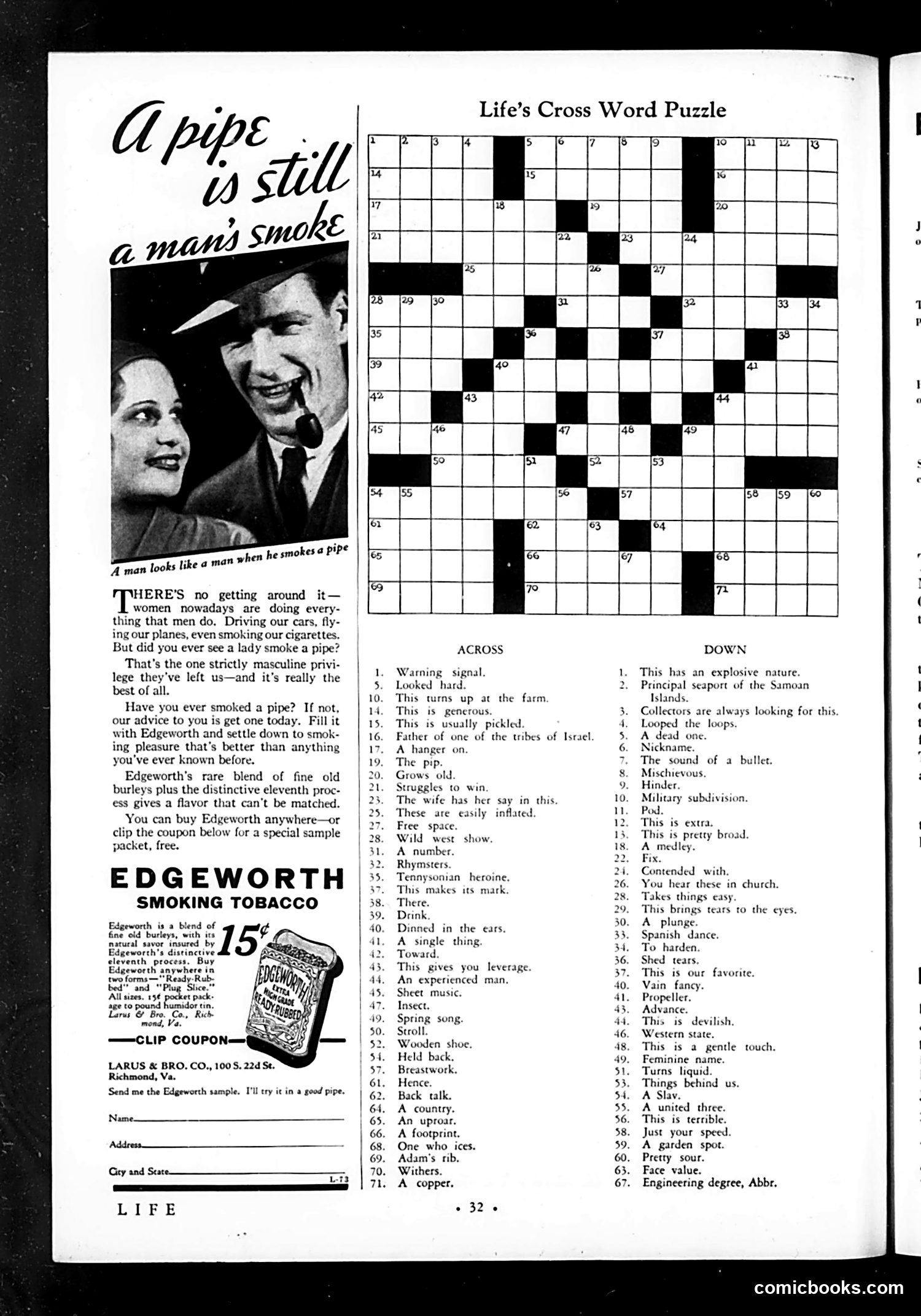
Analysis of This Life Magazine Page This page is primarily an advertisement for Edgeworth smoking tobacco disguised as editorial content, paired with a crossword puzzle. The ad's satire targets women's increasing social equality in the 1930s-40s. The text acknowledges that women now drive cars, fly planes, and smoke cigarettes—activities once exclusively male. However, it claims pipe smoking remains "the one strictly masculine privilege they've left us—and it's really the best of all." The accompanying photograph shows a man and woman smiling together, with text reading "A man looks like a man when he smokes a pipe," reinforcing masculine identity through the product. The joke: Rather than celebrate women's liberation, the ad uses it as a selling point—positioning pipe smoking as the last bastion of masculinity. It's gentle satire masking a commercial pitch. The crossword puzzle on the right is filler content typical of Life magazine's format. This reflects early-mid 20th century attitudes: acknowledging women's progress while simultaneously reasserting traditional gender boundaries around specific masculine behaviors.
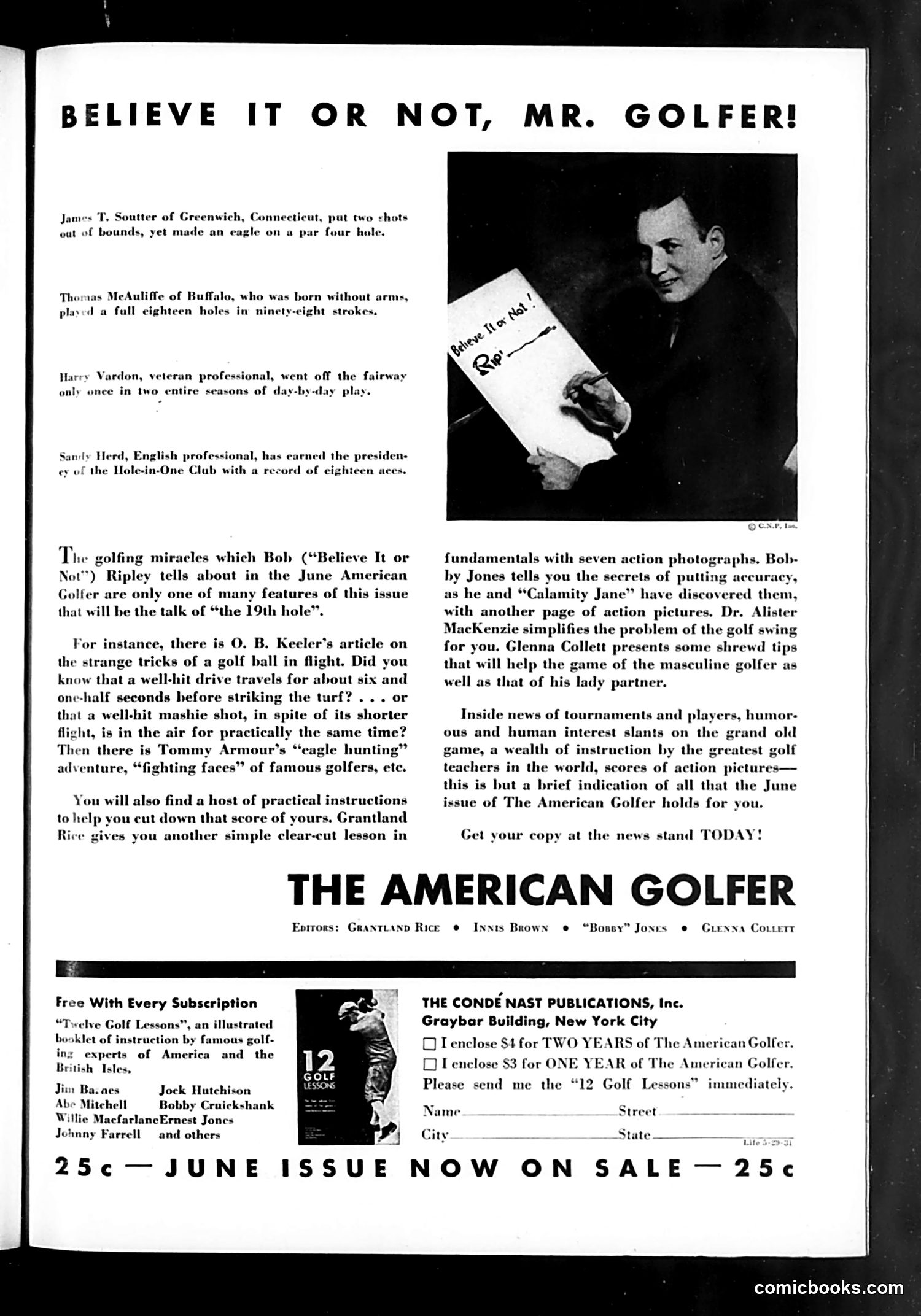
Analysis of "Believe It or Not, Mr. Golfer!" This is primarily an advertisement for *The American Golfer* magazine, leveraging the popularity of Robert Ripley's "Believe It or Not!" feature to promote the publication's June issue. The page references real golfing "oddities" in Ripley's style—James T. Soutter making an eagle despite two out-of-bounds shots, Thomas McAuliffe playing eighteen holes despite being born without arms. These aren't satirical cartoons but rather genuine curiosities presented as entertainment. The advertisement promotes the magazine's content: instructional articles by famous golfers (Bobby Jones, Tommy Armour, Glenna Collett), technical analysis of golf physics, and tournament coverage. The man in the photograph appears to be holding promotional material for the publication. The humor derives from golf's appeal as subject matter and the era's fascination with human-interest oddities, not from political or social satire. This is essentially a straightforward trade advertisement targeting golf enthusiasts during the sport's growing American popularity.
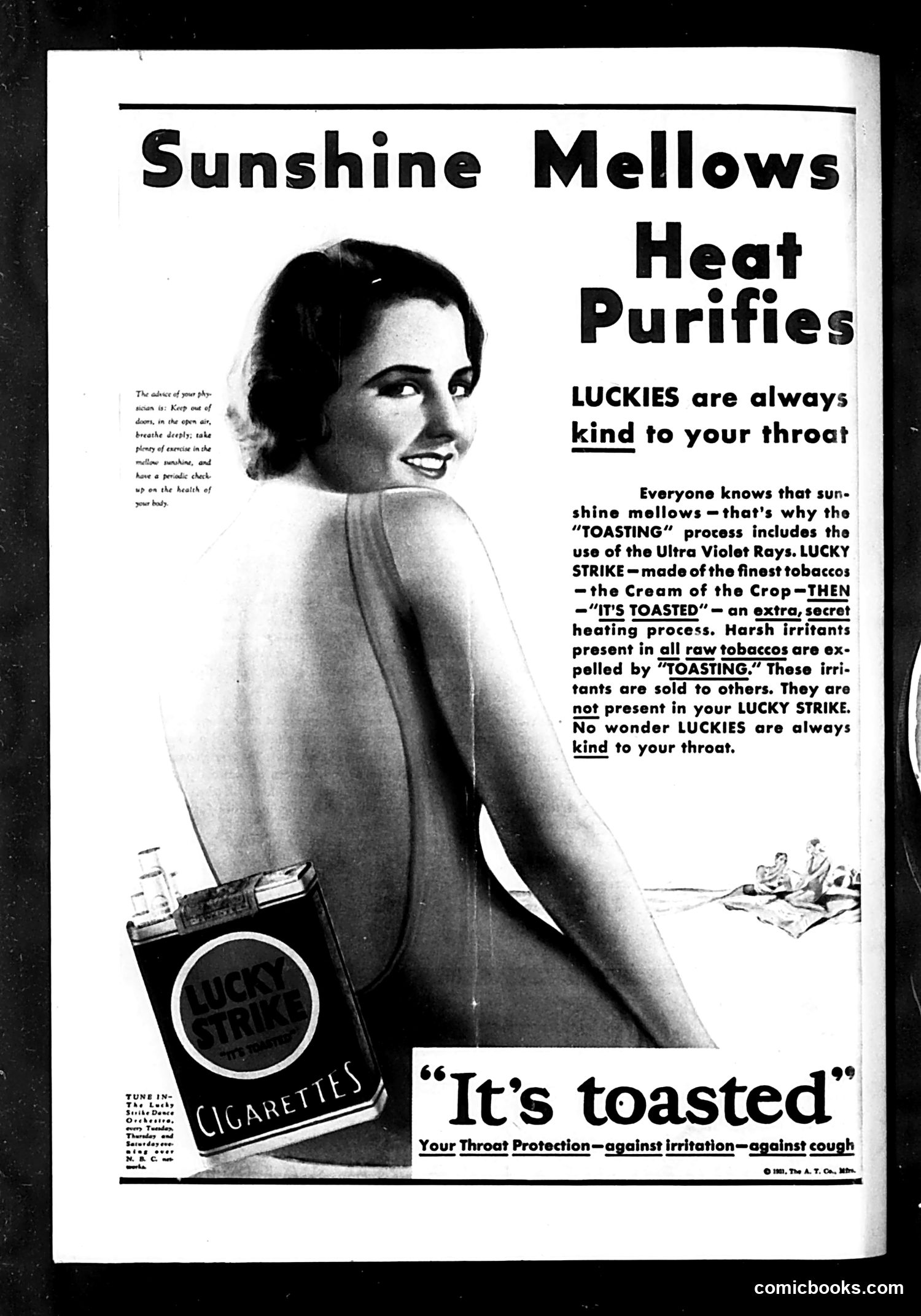
Analysis This is not satire—it's a Lucky Strike cigarette advertisement from approximately the 1920s-30s (based on styling and typography). The ad uses pseudoscientific health claims to market cigarettes. Key elements: - The "Toasting" claim: Lucky Strike invented marketing language suggesting their special heating process removed harmful irritants present in competitors' tobacco, making them "kind to your throat." - The image: A semi-nude woman positioned to suggest health and vitality, common in period advertising to associate products with beauty and wellness. - The false premise: The ad claims harsh irritants from "raw tobacco" are "sold to others"—implying competitors' cigarettes retain these irritants. This is misleading marketing designed to exploit consumer anxiety about throat health. - Historical context: This predates modern cigarette regulations and medical consensus on smoking dangers. Such health-protective claims were standard tobacco advertising before mid-century restrictions. For modern readers, this exemplifies how corporations once freely made unsubstantiated health claims to sell demonstrably harmful products.