life
Life — June 5, 1931
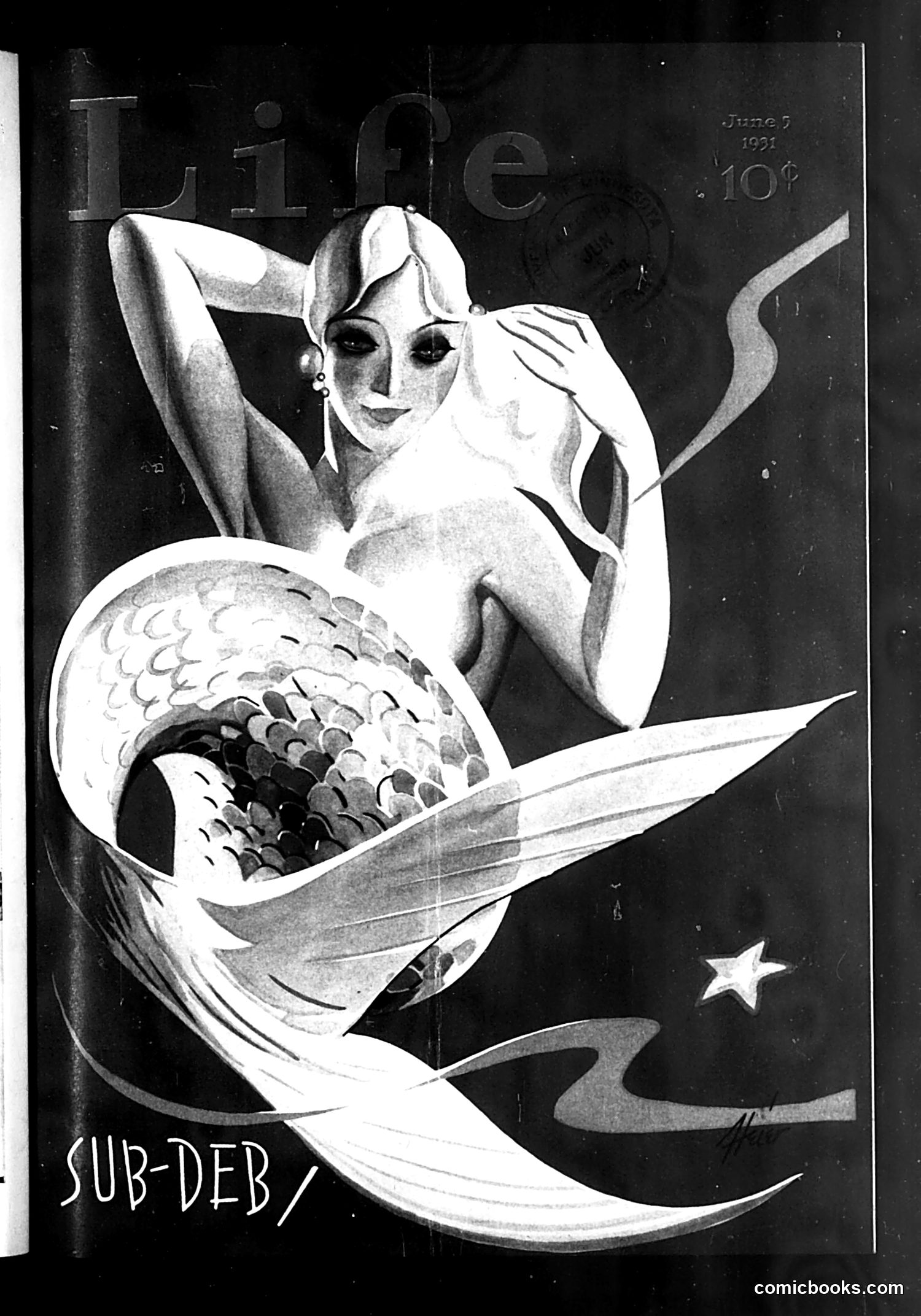
Life Magazine Cover Analysis - June 7, 1931 This is a Life magazine cover from June 1931 featuring an Art Deco-style illustration signed "SUB-DEB." The image depicts a stylized female figure in an elegant, theatrical pose with a large shell or fan-like form. The artistic style and composition suggest this is satirizing fashionable society women or "debutantes" of the era—hence the "SUB-DEB" (sub-debutante) reference, a social category for young women entering high society. The ornate, somewhat exaggerated styling appears to mock the pretensions and vanity of upper-class women's fashion and social conventions during the Jazz Age. The cover price of 10 cents and the date place this squarely in the Great Depression era, when satirizing wealthy elites held particular resonance.
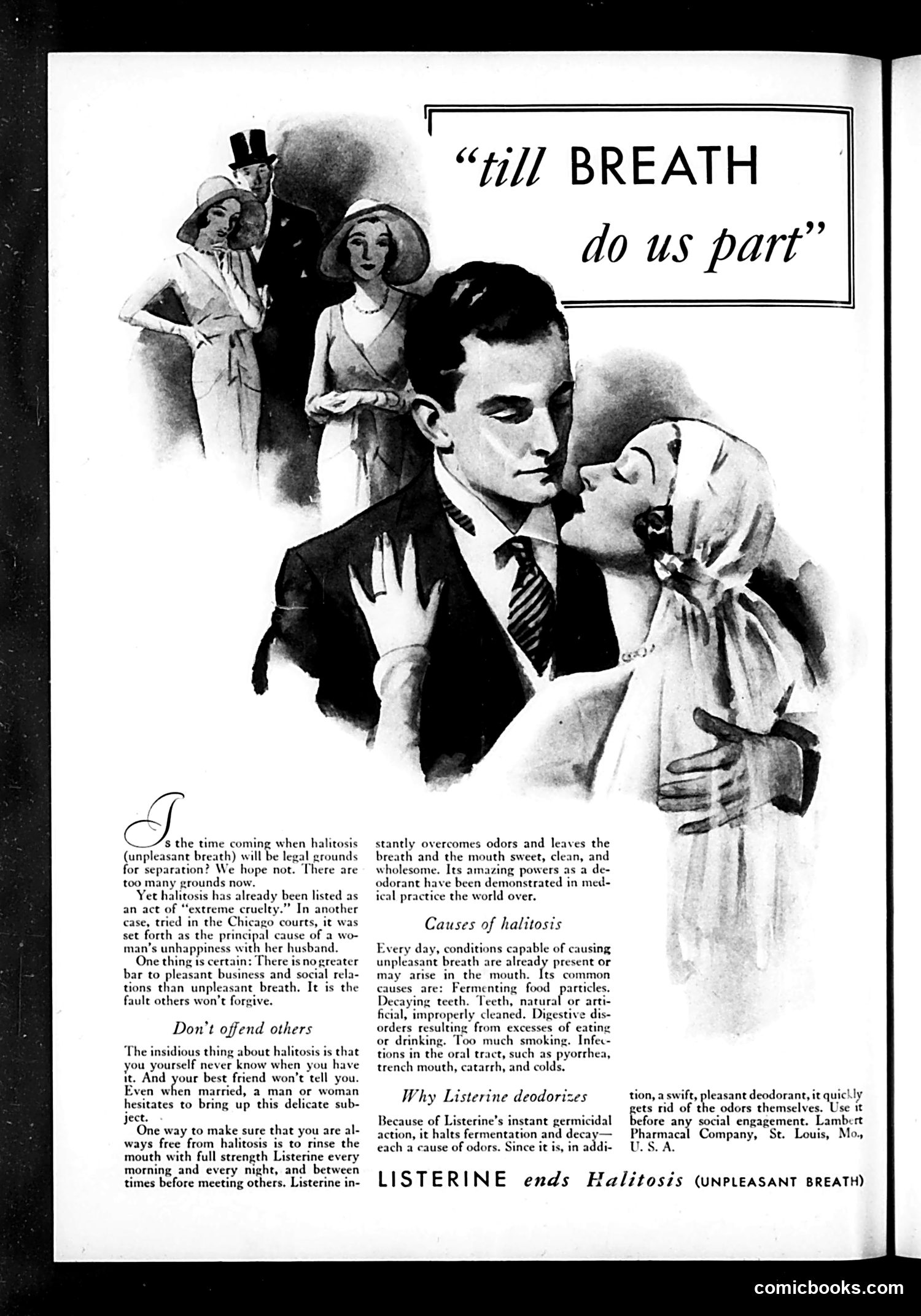
Listerine Advertisement Analysis This is a Listerine mouthwash advertisement, not political satire. The illustration depicts a social scenario where a man appears rejected or avoided by others due to halitosis (bad breath). The headline quotes "'till BREATH do us part," suggesting that unpleasant breath threatens relationships and social standing. The ad argues that halitosis causes social embarrassment and damaged business/personal relations. It lists causes: fermenting food, decaying teeth, digestive disorders, smoking, and infections. The solution presented is Listerine, which the ad claims uses "instant germicidal action" to halt fermentation and decay. This reflects early 20th-century marketing that exploited social anxiety about hygiene to sell commercial products—a common advertising strategy of the era.
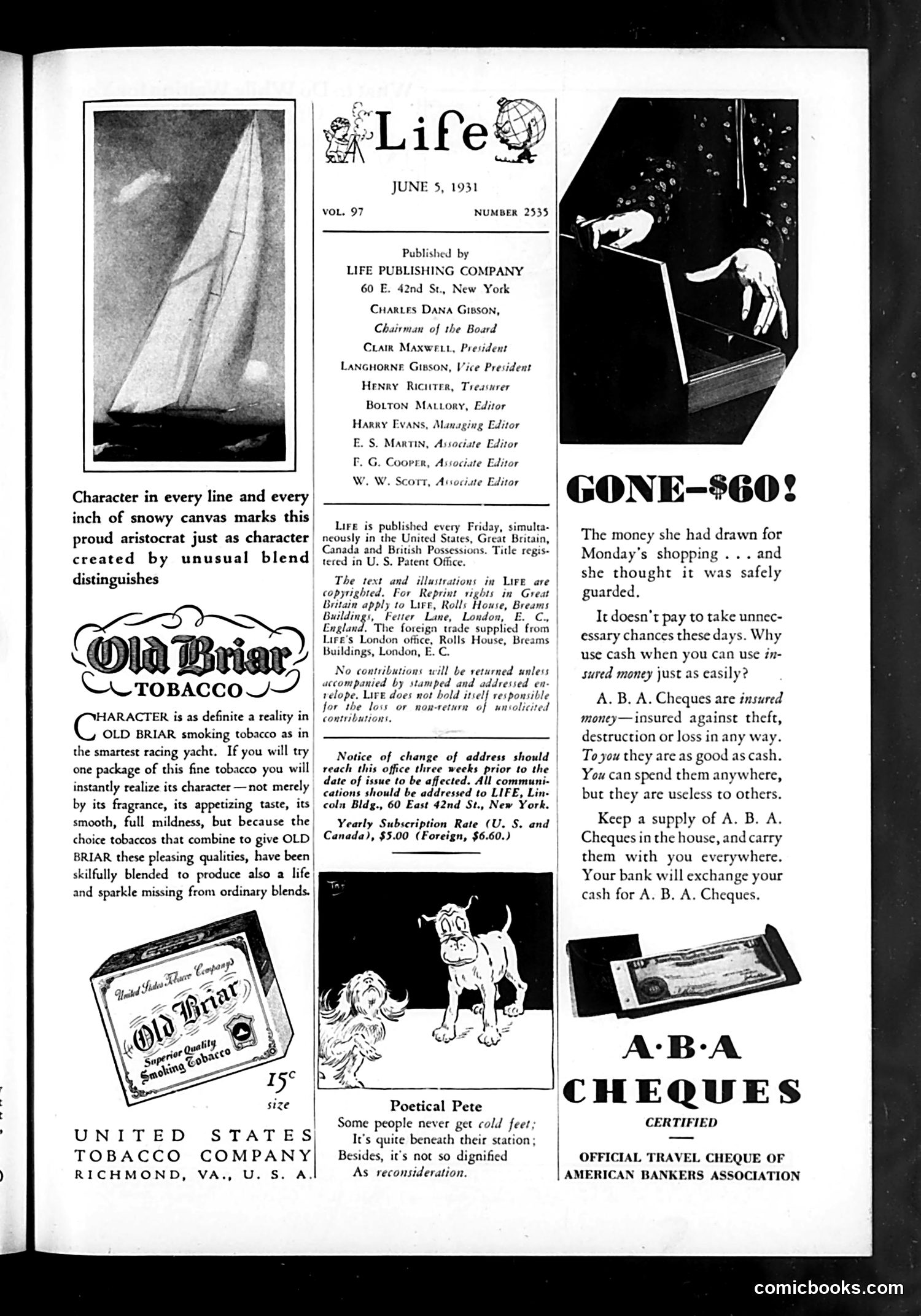
Content Analysis This page is primarily advertising and masthead information for Life magazine (June 5, 1931, Vol. 97). The main editorial content is minimal: a small cartoon titled "Poetical Pete" showing a dog and small figure, with a brief humorous verse about someone not getting "cold feet" despite being beneath a station. The page is dominated by three advertisements: 1. Old Briar Tobacco — emphasizing character and quality blending 2. A.B.A. Cheques — promoting traveler's checks as safer than carrying cash (a financial safety message during the Great Depression era) The sailboat photograph at top left appears decorative rather than satirical. There is no significant political cartoon or social satire on this page—it functions primarily as a title/advertising page rather than editorial content.
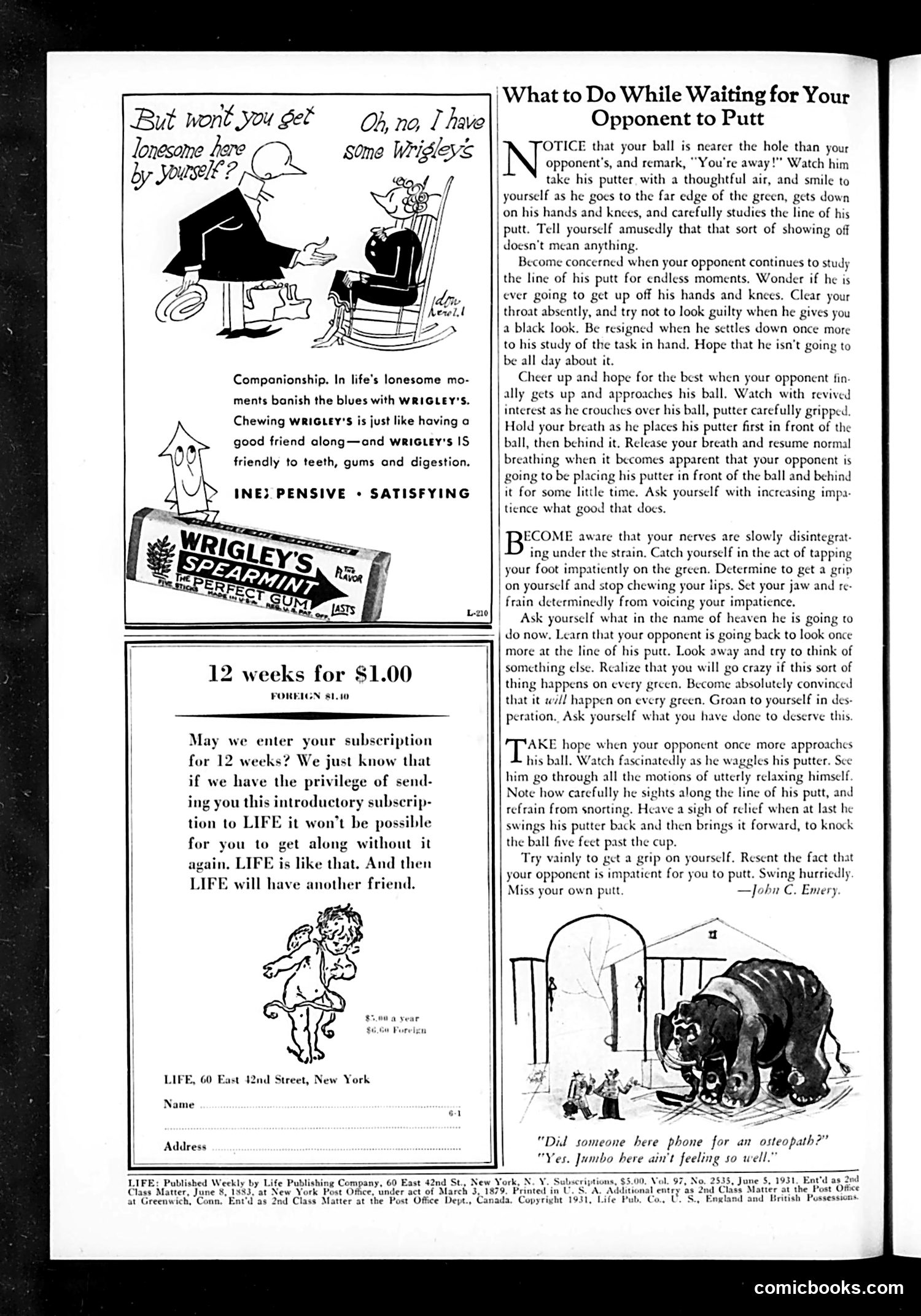
Page Analysis: Life Magazine, June 5, 1931 This page combines advertising and humor content typical of 1930s Life magazine. The top cartoon depicts two golfers—one asking his lonely companion if he's gotten "lonesome here by yourself," while the other sits alone with Wrigley's gum. This advertises Wrigley's as a companion to pass time during solitary moments. The main article, "What to Do While Waiting for Your Opponent to Putt," humorously catalogs the psychological torments of golf: nervousness, impatience, distraction, and self-doubt. It's satirizing golfers' competitive anxiety and the mind games inherent in the sport. The bottom cartoon shows an ailing dog with the caption "Did someone here phone for an osteopath? Yes, Jumbo here ain't feeling so well"—a gentle joke about the dog's size and health. These are lighthearted, non-political pieces reflecting 1930s leisure-class humor.
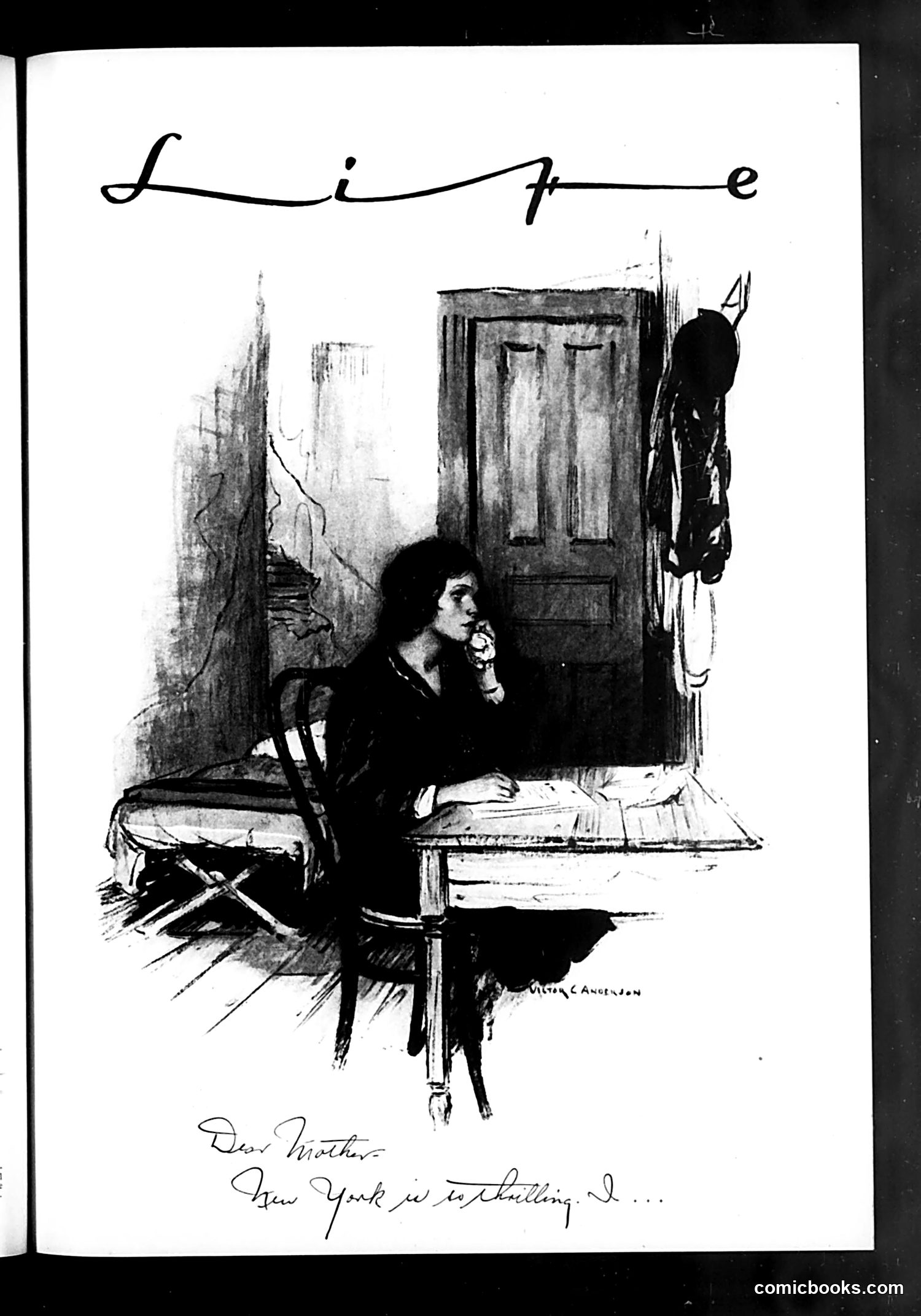
Analysis of "Life" Magazine Page This appears to be an illustration titled "Life" showing a contemplative figure sitting at a desk by a window in what looks like a sparse, modest room. The figure is posed in a thinking position, gazing outward. Below the illustration is handwritten text reading "Dear Brother, New York is bewildering I..." The sketch employs dramatic chiaroscuro (light and shadow) typical of early-to-mid 20th century satirical illustration. The signature appears to read "Mead C. Anderson" or similar. Without additional context about the specific issue date or full text, the exact satirical target remains unclear. However, the contemplative pose and reference to New York's bewildering nature suggests commentary on urban life, perhaps immigrant or newcomer experiences in the city. The artistic style and handwritten correspondence format were common devices in Life magazine for social commentary.
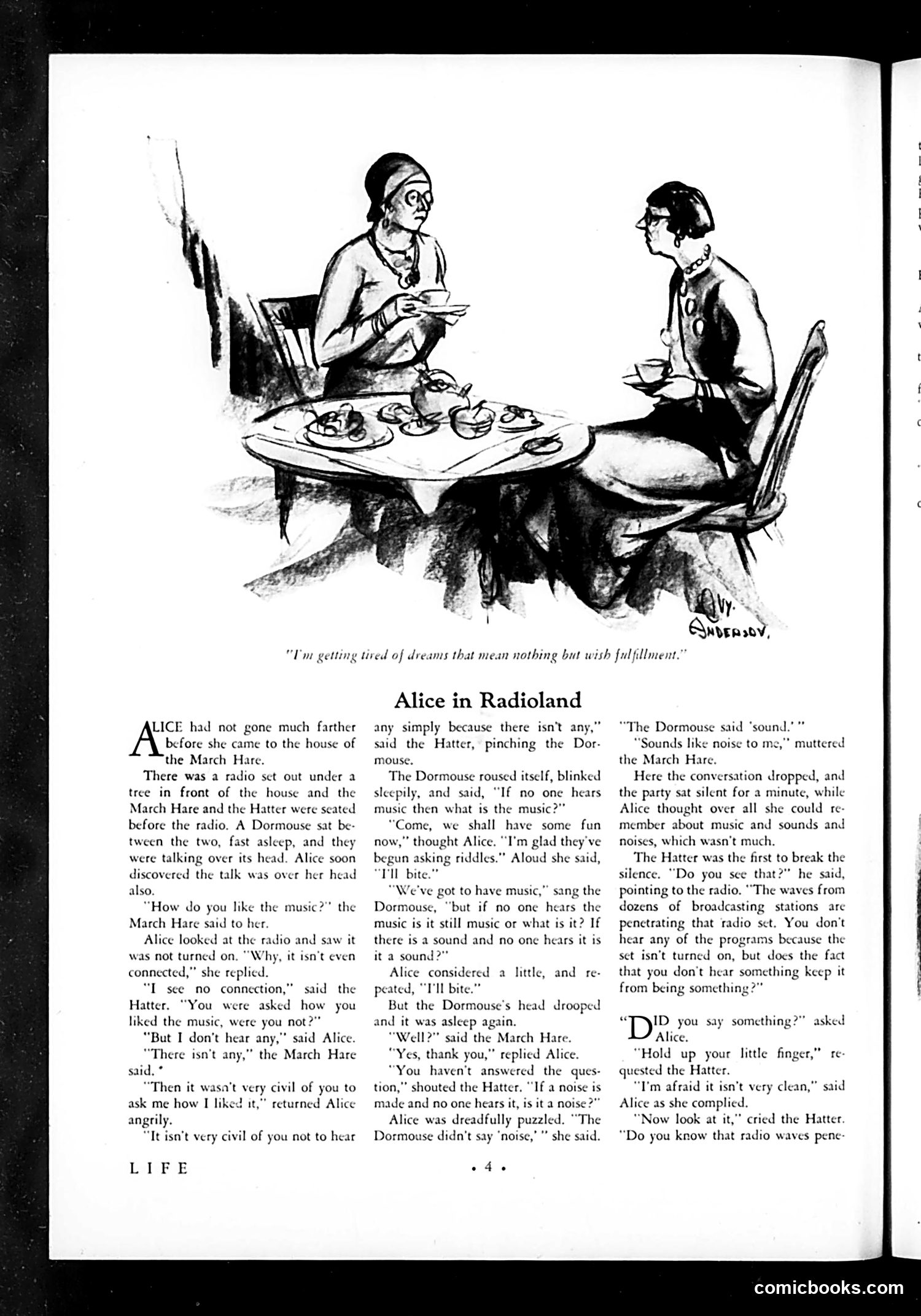
"Alice in Radioland" This is a parody of Lewis Carroll's *Alice in Wonderland*, reimagined for the radio age. The illustration shows Alice at a tea party with the March Hare and the Dormouse (characters from the original story), but now they're discussing radio broadcasts. The satire mocks both radio technology and abstract philosophical debates. The characters engage in circular logic about whether unheard radio waves constitute "music" or "sound"—a jest at radio's invisible nature and listeners' credulity about programming they cannot verify. The joke targets early radio enthusiasm: audiences accepted radio content on faith, unable to verify what they heard. Alice's pragmatic objections to nonsensical arguments mirror readers' potential skepticism about this new medium's claims. This reflects 1920s-30s cultural anxieties about mass media's intangible yet persuasive power.
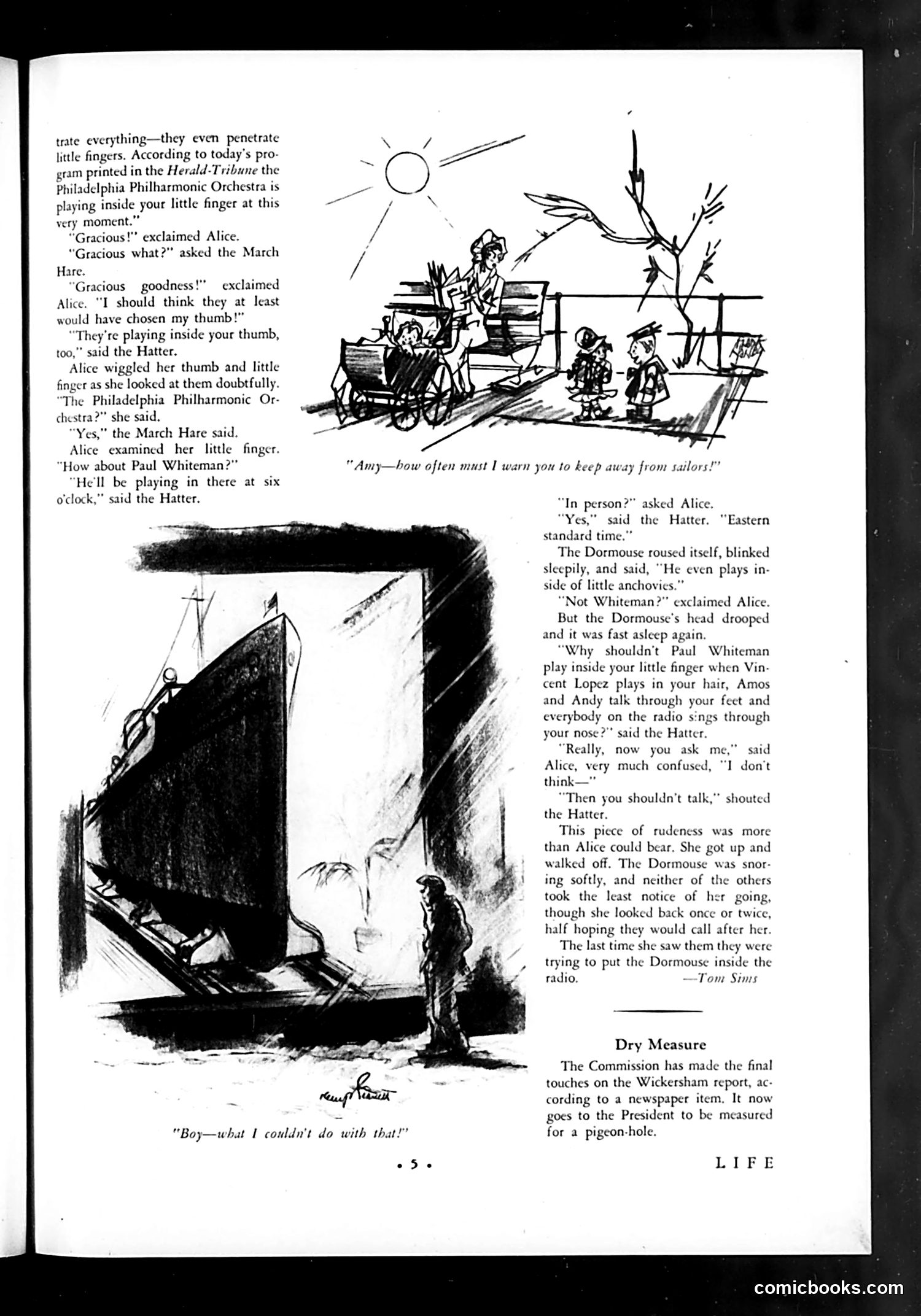
Analysis This page is a literary parody of *Alice in Wonderland*, reimagining Alice's encounters with radio broadcasts and musicians instead of fictional characters. The conversation references Paul Whiteman (a famous 1920s jazz bandleader), Vincent Lopez, and radio performers, treating them as absurdly "inside" Alice's body—playing in her thumb, hair, and feet. The satire mocks the radio craze of the early 20th century, when Americans became obsessed with radio technology and celebrity musicians. The joke is that radio penetrates so completely into everyday life that these famous performers seem literally embedded in one's body. The bottom cartoon shows someone struggling with radio equipment, captioned "Boy—what I couldn't do with that!"—satirizing people's frustration with and fascination for new radio technology.
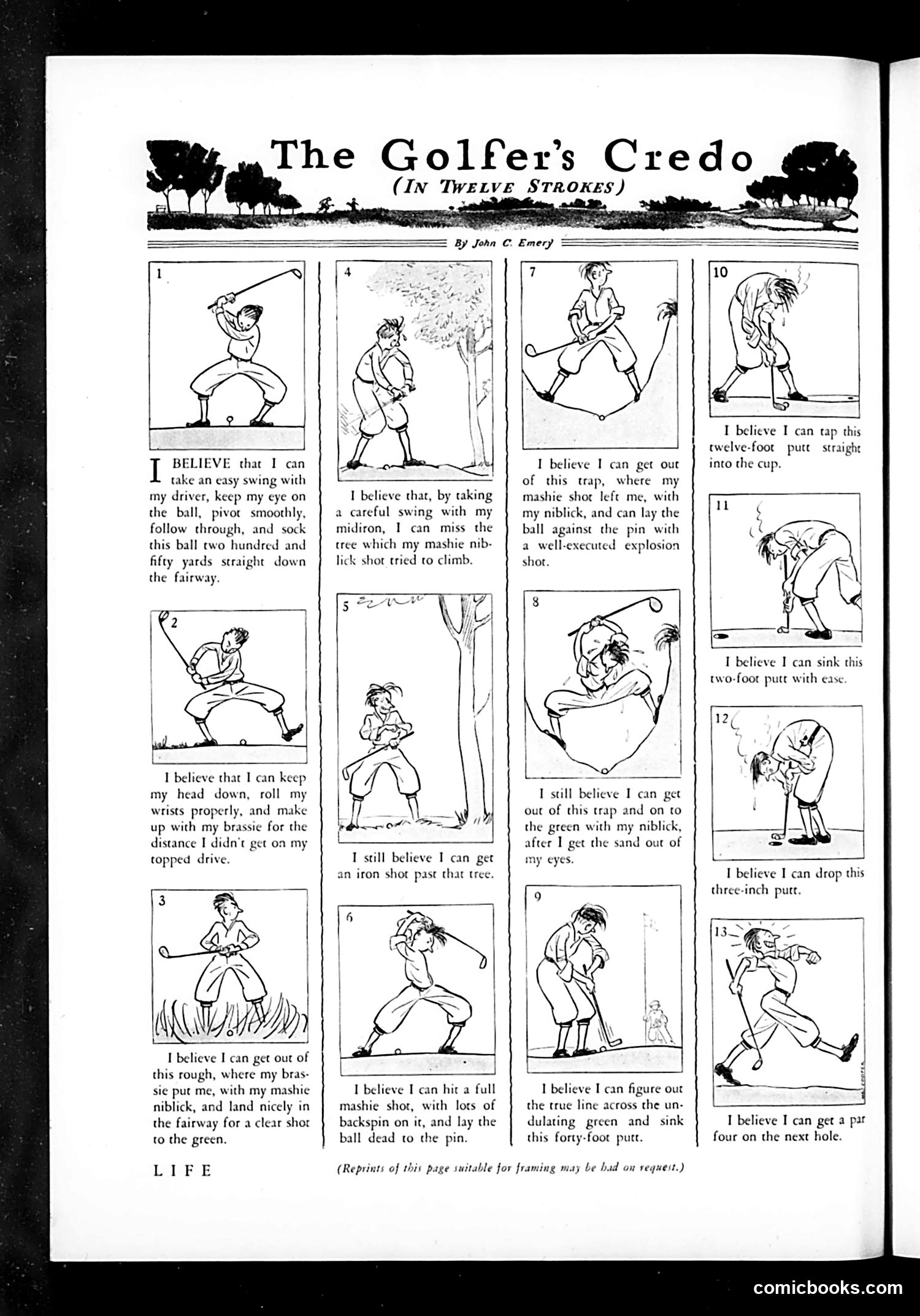
"The Golfer's Credo (In Twelve Strokes)" by John C. Emery This is a humorous comic strip satirizing golfers' persistent optimism and self-delusion. The unnamed golfer repeatedly insists "I believe I can..." despite clearly demonstrating incompetence throughout the sequence—hitting into rough, sand traps, and trees; making poor shots; struggling with basic techniques. The satire targets the universal golfer's mindset: unwavering confidence despite mounting evidence of failure. Each panel shows the golfer in progressively worse situations, yet his internal monologue remains stubbornly positive. The "credo" joke is that golfers maintain faith in their abilities regardless of actual performance. This reflects early 20th-century golf's popularity among middle and upper-class Americans, mocking both the sport's frustrations and the optimistic personality type it attracted.
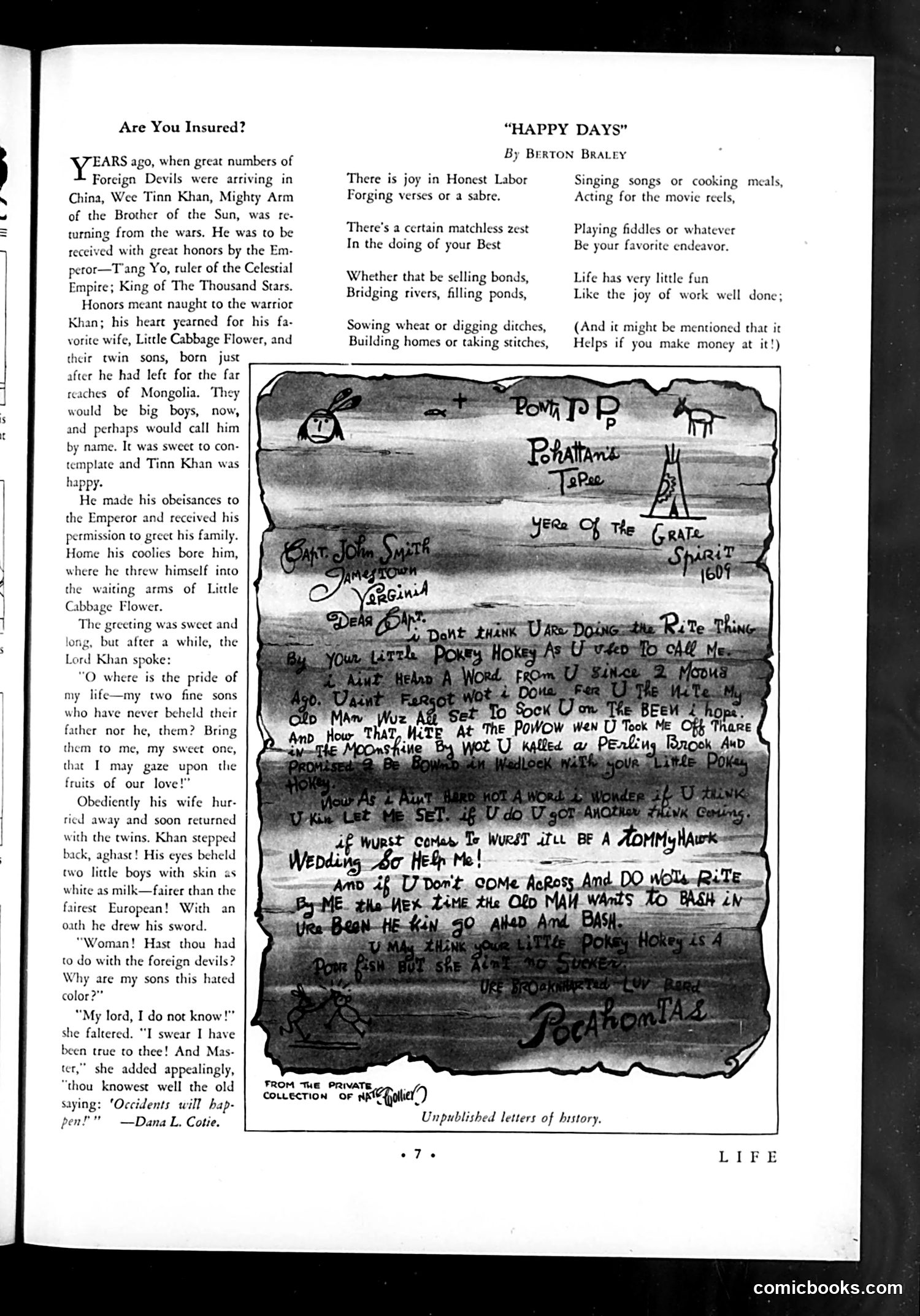
Explanation for Modern Readers This page contains two separate pieces: Left column ("Are You Insured?"): A satirical story about Wee Tinn Khan, a Chinese warlord who returns home after wars. The humor hinges on early-20th-century Western stereotypes about China and exotic foreign rulers, treating his homecoming as comedic material. Right side ("Happy Days" by Berton Brealey): A poem celebrating honest labor—singing, cooking, acting, playing music, building, farming. The accompanying image appears to be a handwritten historical letter with humorous annotations overlaid, captioned as "unpublished letters of history." The satirical point seems to be contrasting the poem's celebration of simple work with presumably absurd or contradictory content in the historical document shown. Without reading the letter clearly, the exact joke remains unclear, though it relies on period assumptions about labor and historical authenticity.
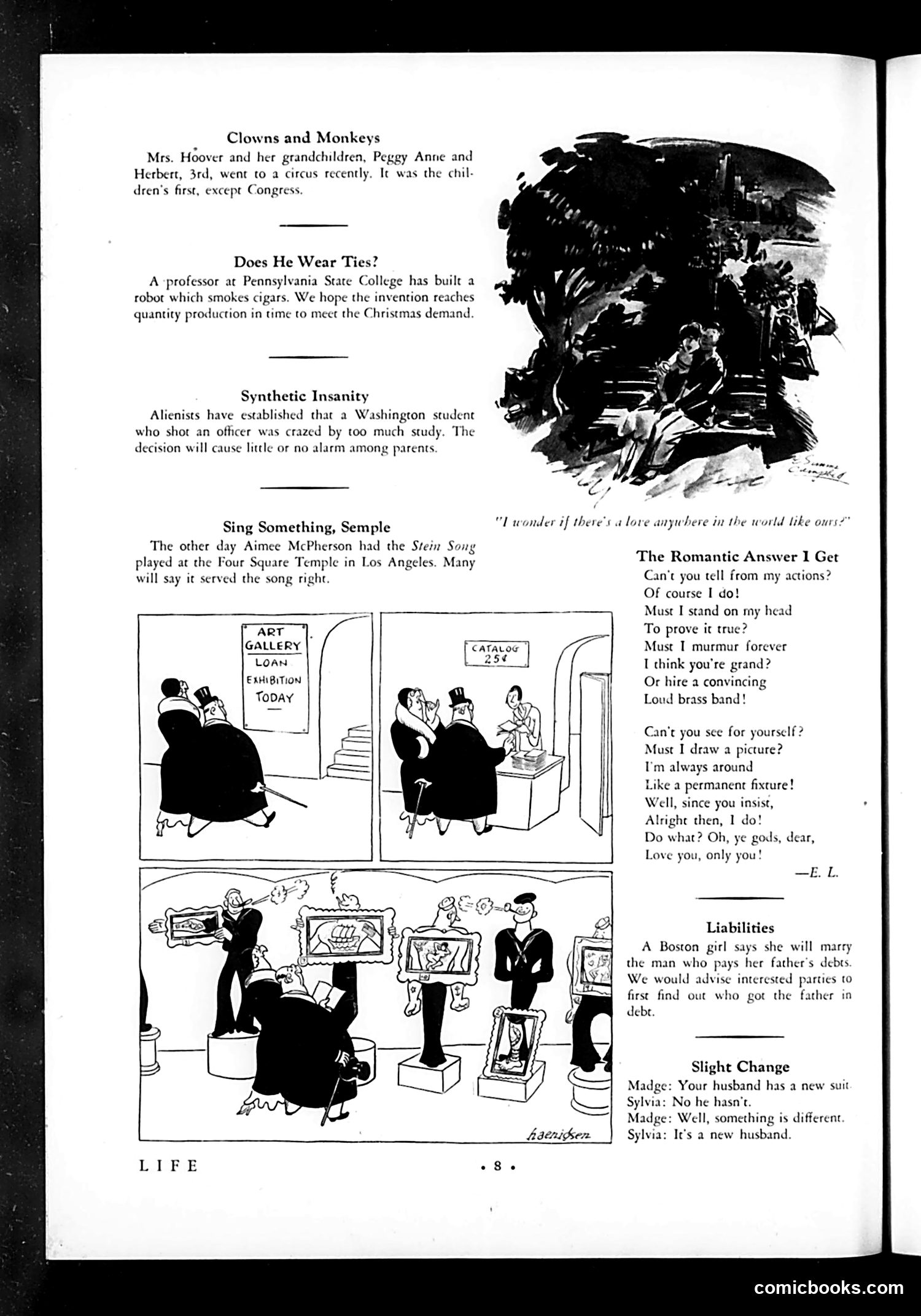
Life Magazine Page Analysis This page contains brief humorous social commentary and a three-panel comic strip about an art gallery exhibition. The Comic Strip: Shows visitors touring an art gallery where patrons view and purchase artwork. The humor appears to mock pretentious gallery culture—visitors studying paintings seriously while dealers conduct business. The final panel reveals the gallery as a bustling marketplace, satirizing how art appreciation can be commodified. The Text Items: Include brief, witty observations about contemporary life: a robot that smokes cigars, a student driven to extremes by academic pressure, and romantic poetry. The "Slight Change" dialogue jokes about a husband's infidelity through understatement. Overall Tone: Typical of *Life* magazine's lighthearted social satire targeting urban middle-class pretensions, academic excess, and relationship dynamics. No specific political figures are targeted.
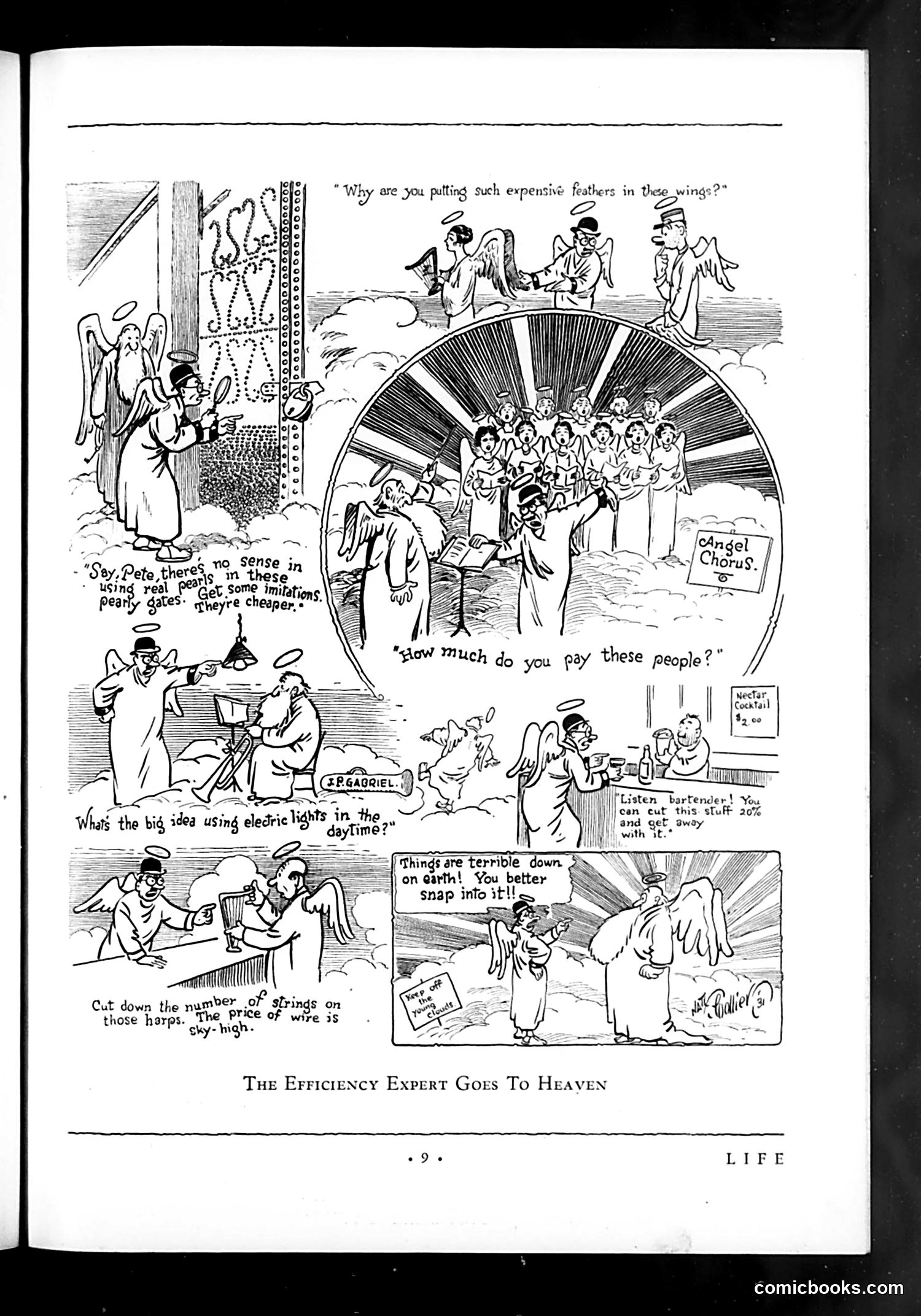
"The Efficiency Expert Goes To Heaven" This satirical cartoon mocks the early 20th-century "efficiency expert" craze—consultants who applied industrial management principles to optimize costs and productivity everywhere. The joke: an efficiency expert arrives in Heaven and immediately begins offering cost-cutting suggestions to angels and saints. He proposes eliminating expensive feather wings, replacing harp strings with cheaper wire, using electric lights instead of halos, and negotiating lower wages for the "angel chorus." The satire targets how efficiency-obsessed business consultants of the era applied ruthless cost-cutting logic to inappropriate domains—suggesting that even sacred, spiritual realms couldn't escape their intrusive "rationalization." The expert's inability to recognize Heaven's incompatibility with penny-pinching reflects contemporary anxiety about unrestrained commercialism and mechanization corrupting all aspects of life.
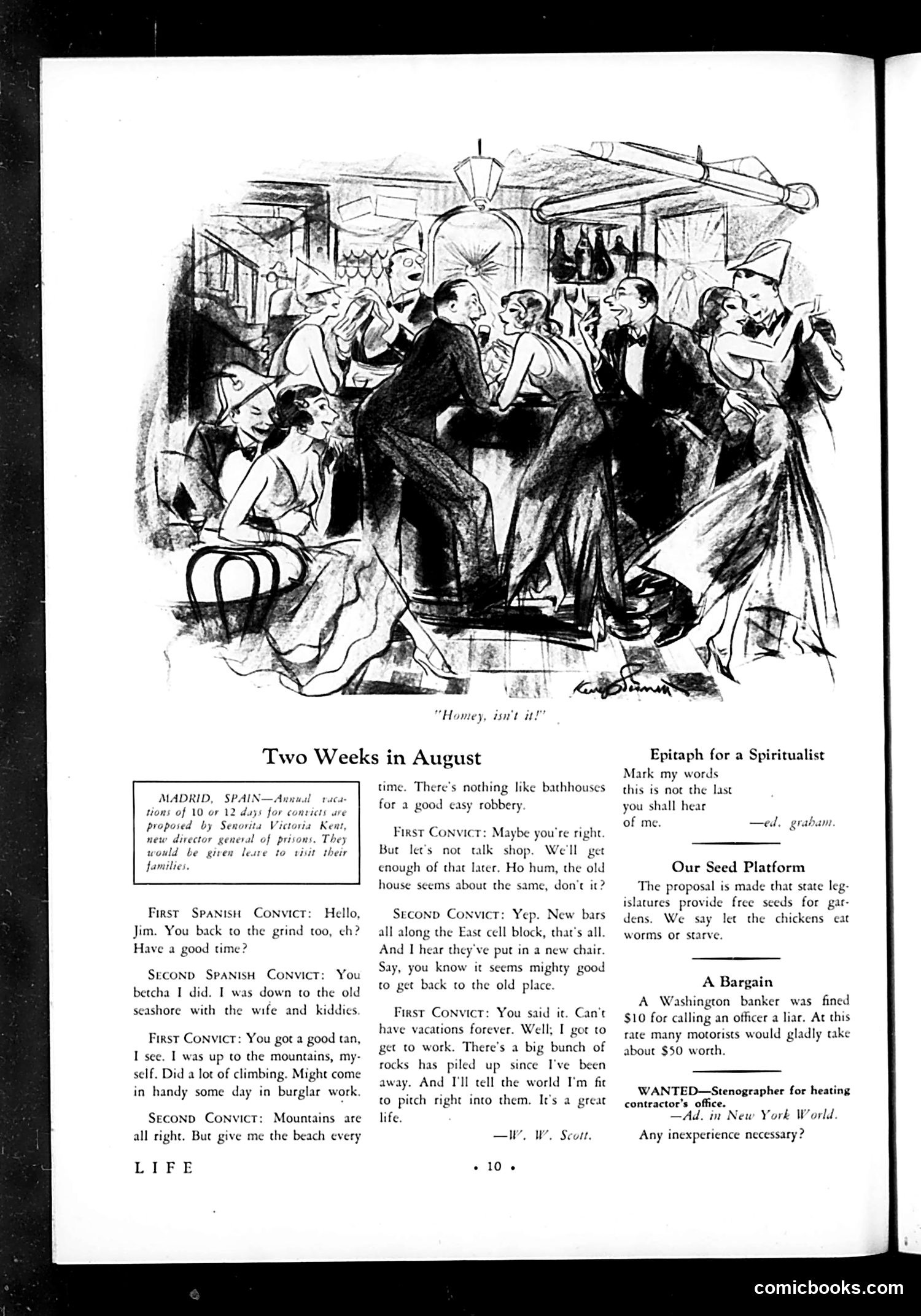
"Two Weeks in August" - Analysis This page contains a satirical cartoon and accompanying humorous dialogue about convicts on vacation from prison in Madrid, Spain. The cartoon depicts well-dressed people at what appears to be a social gathering or nightclub, with the caption "Honey, isn't it?" The joke satirizes the contrast between respectable society and criminality: two Spanish convicts discuss their prison leave as a vacation opportunity, with one boasting about planning future burglaries while on holiday. The humor derives from treating serious crime casually and the absurdity of prisoners receiving vacation time. The page also includes unrelated brief jokes and advertisements typical of *Life* magazine's format. The satirical point targets both the apparent leniency of the Spanish penal system and the criminals' shameless attitudes toward their crimes.
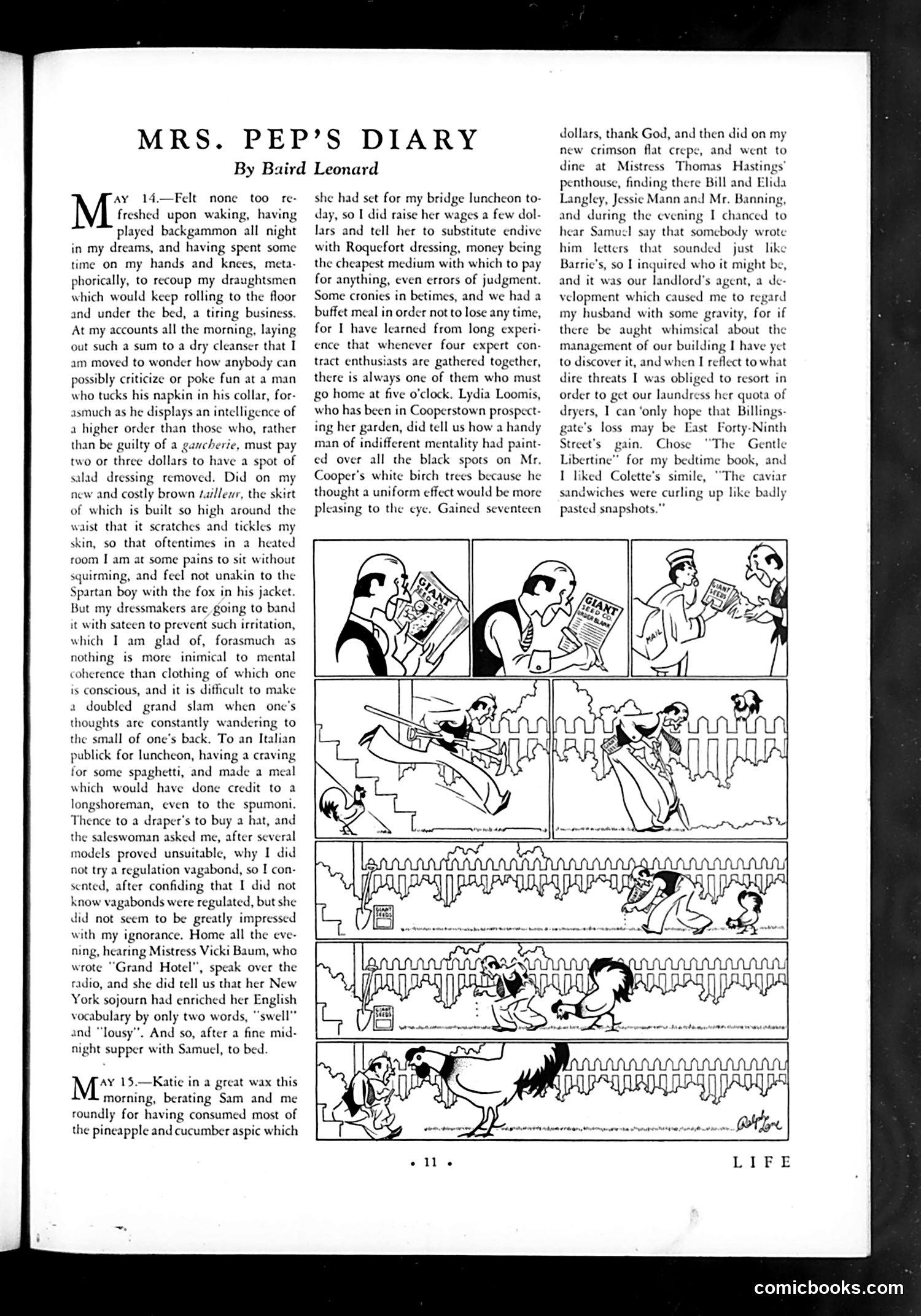
Mrs. Pep's Diary: A Domestic Satire This page presents "Mrs. Pep's Diary" by Baird Leonard, a humorous domestic narrative illustrated with comic strips. The text mocks upper-middle-class social pretensions and household management anxieties. Mrs. Pep obsesses over expense-conscious decisions (hiring cheap dressmakers, buying vagrancy-law hats) while maintaining social standing. The comic strip sequences show domestic scenes: Mrs. Pep reading newspapers, children playing in yards, and a dog chasing someone—apparently illustrating the narrative's anecdotes about family life and neighborhood incidents. The satire targets 1920s-era bourgeois concerns: financial anxiety masked by social propriety, hiring domestic staff, children's behavior, and the tension between economy and respectability. It's gentle social comedy about the middle-class desire to appear affluent while managing modest means.
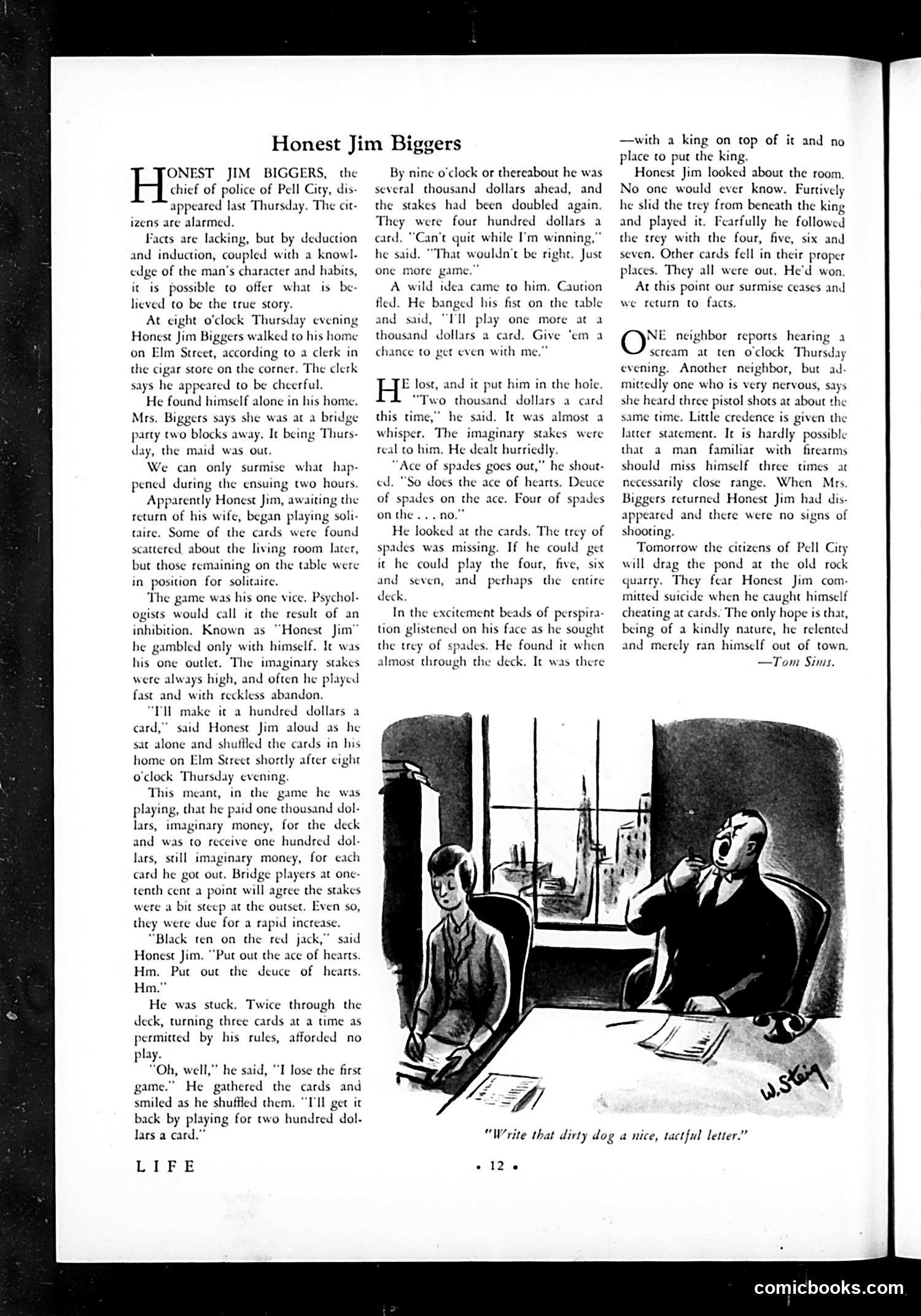
"Honest Jim Biggers" This is a short story about a Pell City police chief who gambles compulsively on cards. The narrative describes how Biggers plays increasingly high-stakes solitaire games alone, betting imaginary money ($100, then $1,000 per card) while his wife is away. He becomes so absorbed that he hallucinates the stakes are real and nearly loses his mind. The accompanying cartoon shows a man at a desk, apparently writing. The caption reads: "Write that dirty dog a nice, tactful letter." The story satirizes gambling addiction and self-deception—how someone can rationalize destructive behavior. The humor is dark: Biggers's obsession is portrayed as both pathetic and potentially dangerous, culminating in the suggestion he might commit suicide if caught cheating himself. The piece critiques moral hypocrisy in small-town authority figures.
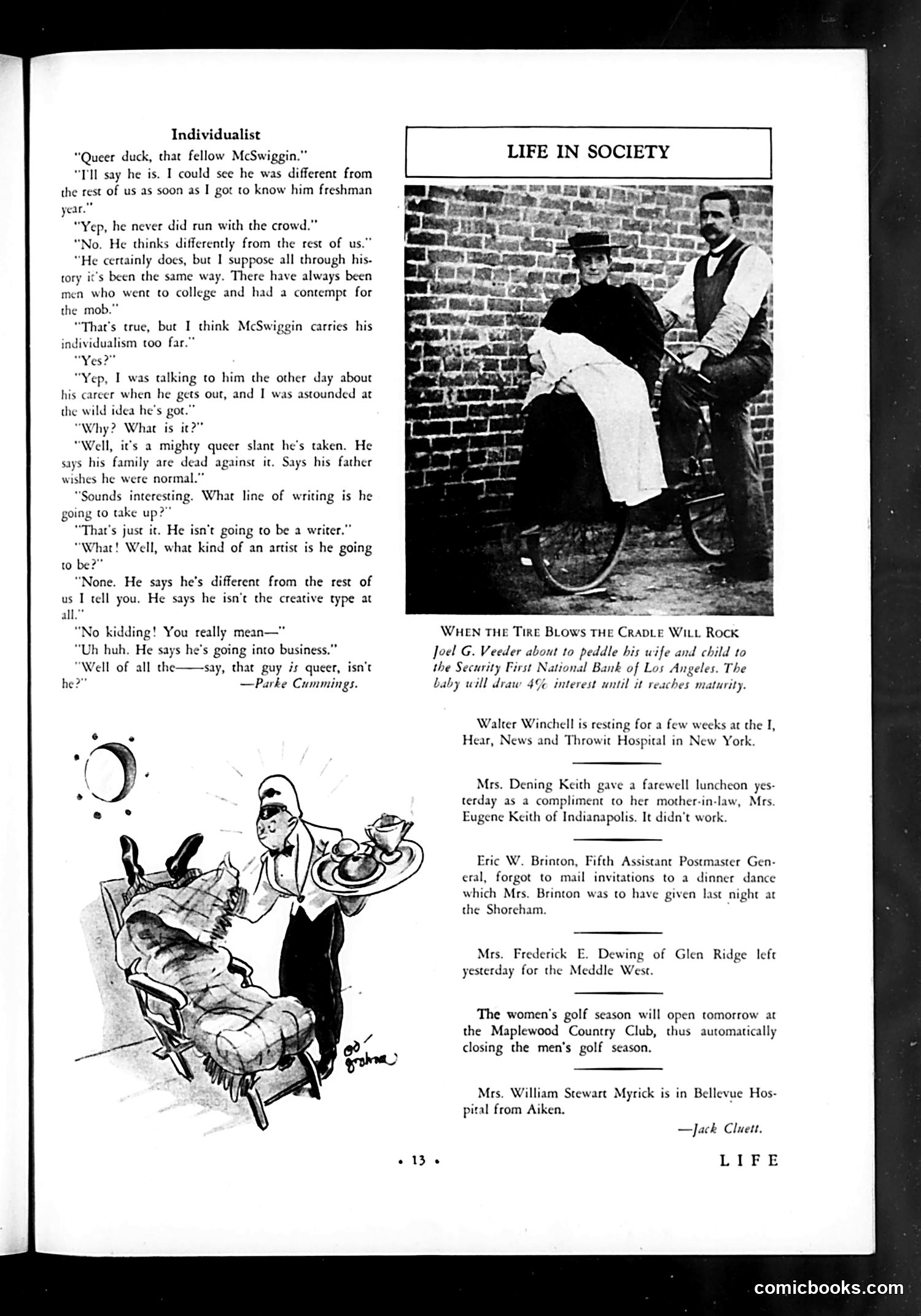
Analysis of Life Magazine Page 13 This page contains a literary discussion titled "Individualist" featuring a quote attributed to Parke Cummings. The text satirizes a college student named McSwiggin whom the writer describes as excessively individualistic—refusing to "run with the crowd" and dismissing conventional career paths. McSwiggin rejects writing, art, and creative work, planning instead to enter business. The satire targets the paradox of performative nonconformity: someone proudly proclaiming uniqueness while actually pursuing the most conventional path possible. The accompanying cartoon (lower left) illustrates this theme with a figure dramatically presenting an elaborate meal, suggesting pretentious or performative behavior. The "Life in Society" section contains social gossip and announcements, including a photograph of Joel G. Veeder about to pedal his family on a tricycle to their bank.
"Life Looks About" - Page Analysis This page contains three opinion pieces rather than cartoons. The prominent header illustration shows a cherub-like figure with a devil's tail, introducing the section's satirical commentary. Main articles: 1. "Dr. Fosdick Excuses Prohibition" - Critiques a Baptist minister's defense of Prohibition, arguing it hasn't reduced crime as promised and has made criminals wealthy. 2. "Polo Feels the Pinch of Want" - Notes Harvard's polo association struggles financially due to post-war economic conditions and reduced War Department funding. 3. "Silver" - Discusses global silver commodity issues and overproduction problems. 4. "Patriotism" - A brief reader submission questioning whether police should work without pay during Prohibition enforcement. The page reflects 1920s concerns: Prohibition's failure, economic hardship post-WWI, and commodity markets.
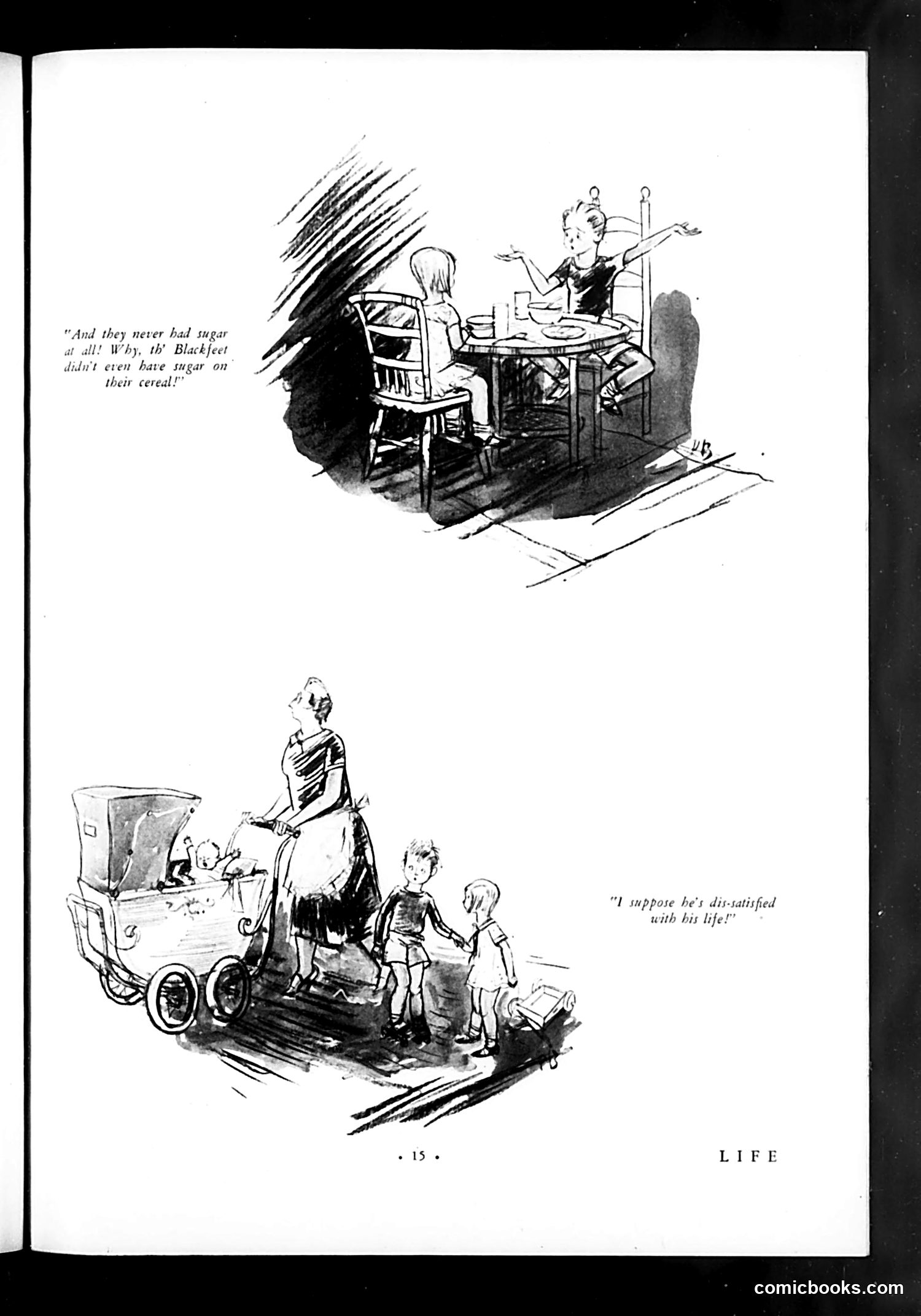
Analysis of Life Magazine Page 15 This page contains two cartoon vignettes satirizing parenting and nutrition standards. Top cartoon: A parent tells a child, "And they never had sugar at all! Why, th' Blackfeet didn't even have sugar on their cereal!" The joke mocks overly strict, "natural living" parenting philosophies—comparing modern child-rearing standards to Native Americans (Blackfeet) to suggest such restrictions are absurdly primitive or unrealistic. It satirizes parents who impose harsh dietary rules on their children in the name of health or morality. Bottom cartoon: Shows a woman with children and a baby carriage, captioned "I suppose he's dissatisfied with his life!" This appears to criticize mothers who blame their unhappiness on their children, suggesting self-pity rather than accepting maternal responsibilities. Both cartoons target parental attitudes through gentle domestic humor typical of Life magazine's satirical approach.
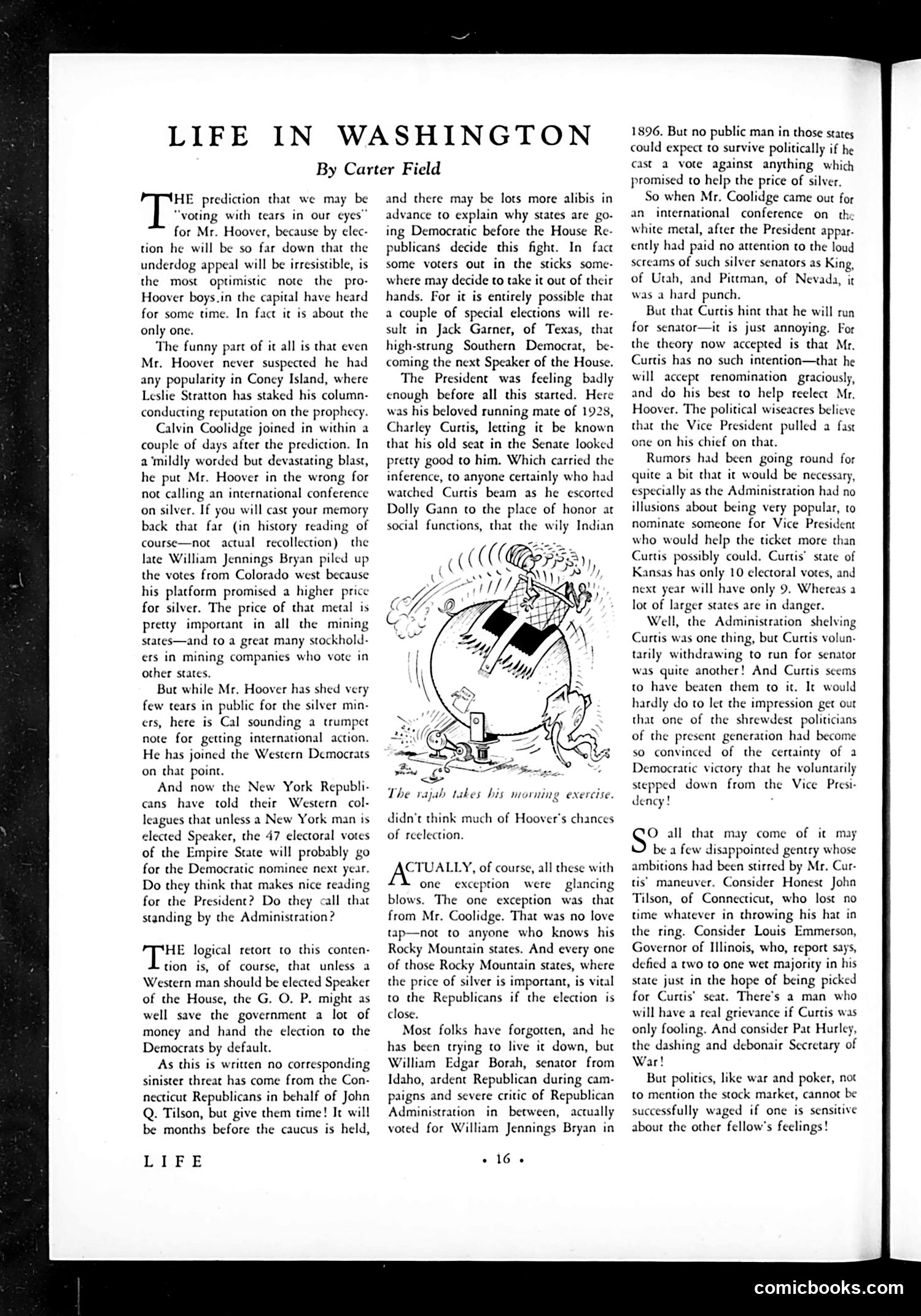
Political Commentary on Washington Machinations (1928) This satirical piece by Carter Field mocks internal Republican politics following Hoover's election. The cartoon depicts a figure labeled "The rajah takes his morning exercise" — apparently showing someone (likely Vice President Curtis, discussed extensively in the text) being squeezed or manipulated. The article discusses whether Coolidge's endorsement of Hoover damaged the latter politically, and whether Curtis might run for Senate instead. The satire centers on how various politicians — particularly Curtis and others mentioned like Jack Garner (potential Democratic Speaker) — are maneuvering for position. The author sarcastically suggests that Curtis's voluntary withdrawal from consideration for Senate, despite having real chances, demonstrates shrewd political calculation. The piece mockingly treats high-stakes political positioning as predictable and cynical game-playing among ambitious figures.
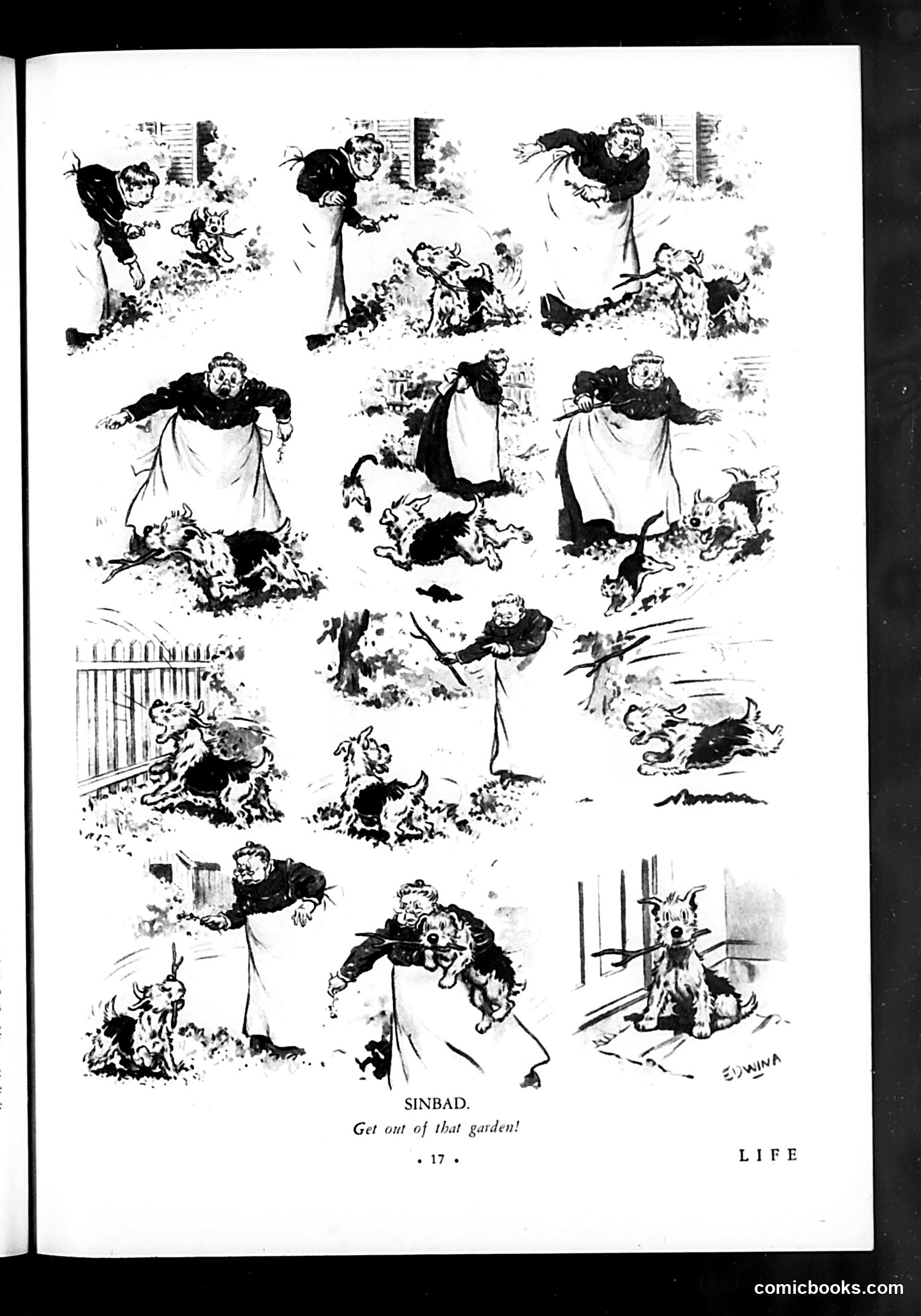
"Sinbad: Get out of that garden!" This is a humorous comic strip sequence by Sinjkin (visible signature) depicting a man repeatedly attempting to evict a small dog from a garden. The strip shows escalating comedic attempts—the man uses various tactics including sweeping, chasing, and wielding garden tools—while the persistent dog keeps returning to dig or play in the garden. The humor derives from the classic slapstick scenario of a homeowner's frustration with an unwanted animal destroying his garden. Each panel shows a different failed strategy, with the dog's stubborn refusal to stay out creating the comic conflict. The title references Sinbad, the legendary sailor known for outlandish adventures, ironically comparing an ordinary man's garden battle to epic struggles. It's straightforward visual comedy about domestic frustration.
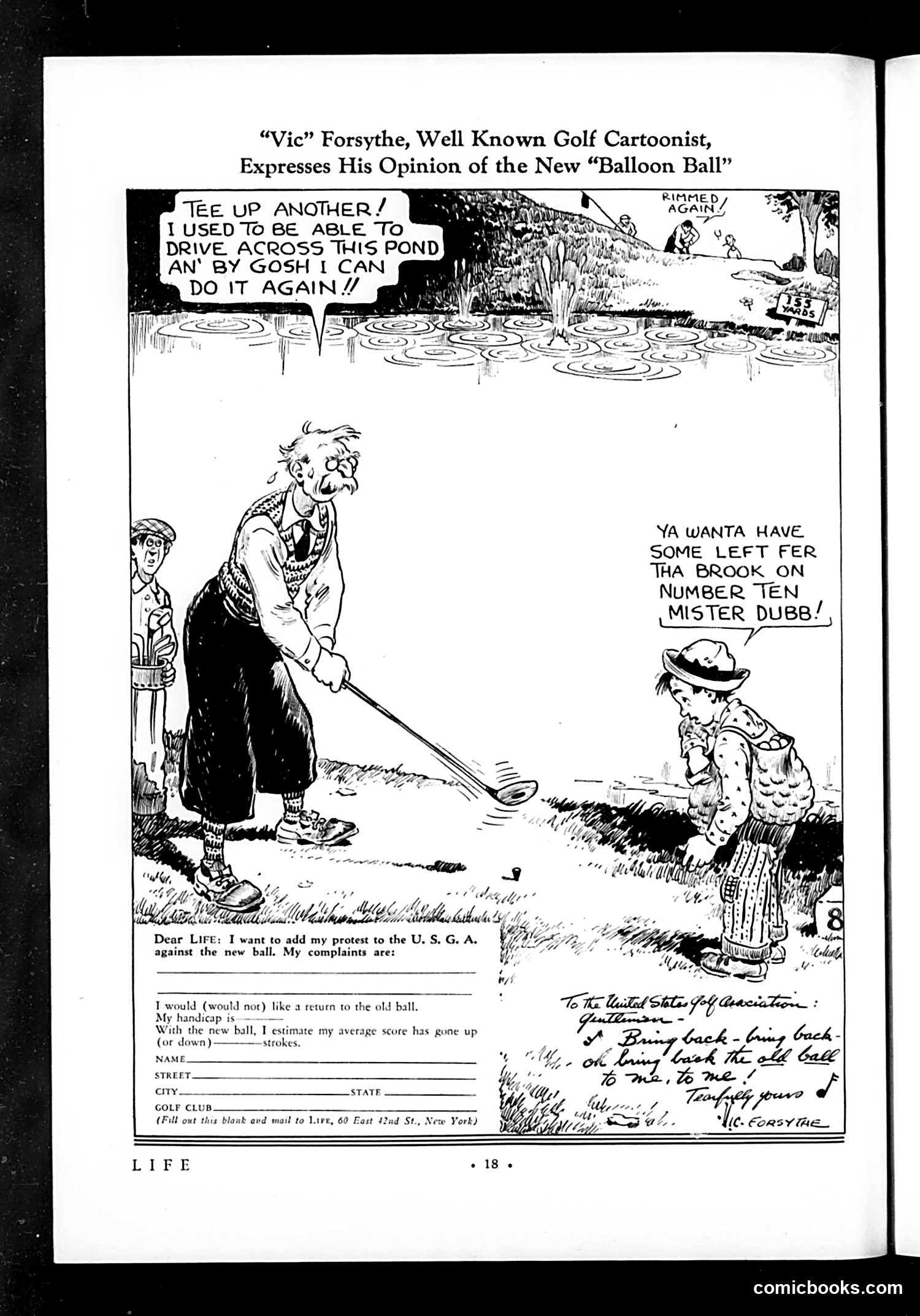
Explanation for Modern Readers This 1920s Life magazine page satirizes the newly introduced "balloon ball" in golf. The top cartoon shows a golfer frustrated that the ball's extreme flight characteristics make it impossible to drive across a pond—a shot he previously could make easily. The main cartoon depicts an older golfer (labeled "Mister Dubb") complaining to a younger player about the new ball ruining his game. The accompanying form invites U.S.G.A. (United States Golf Association) members to protest the ball's specifications, claiming it has inflated driving distances and altered scoring. Vic Forsythe, the credited cartoonist, uses humor to express golfers' genuine concerns about equipment changes disrupting the sport's traditional challenge and handicap systems.
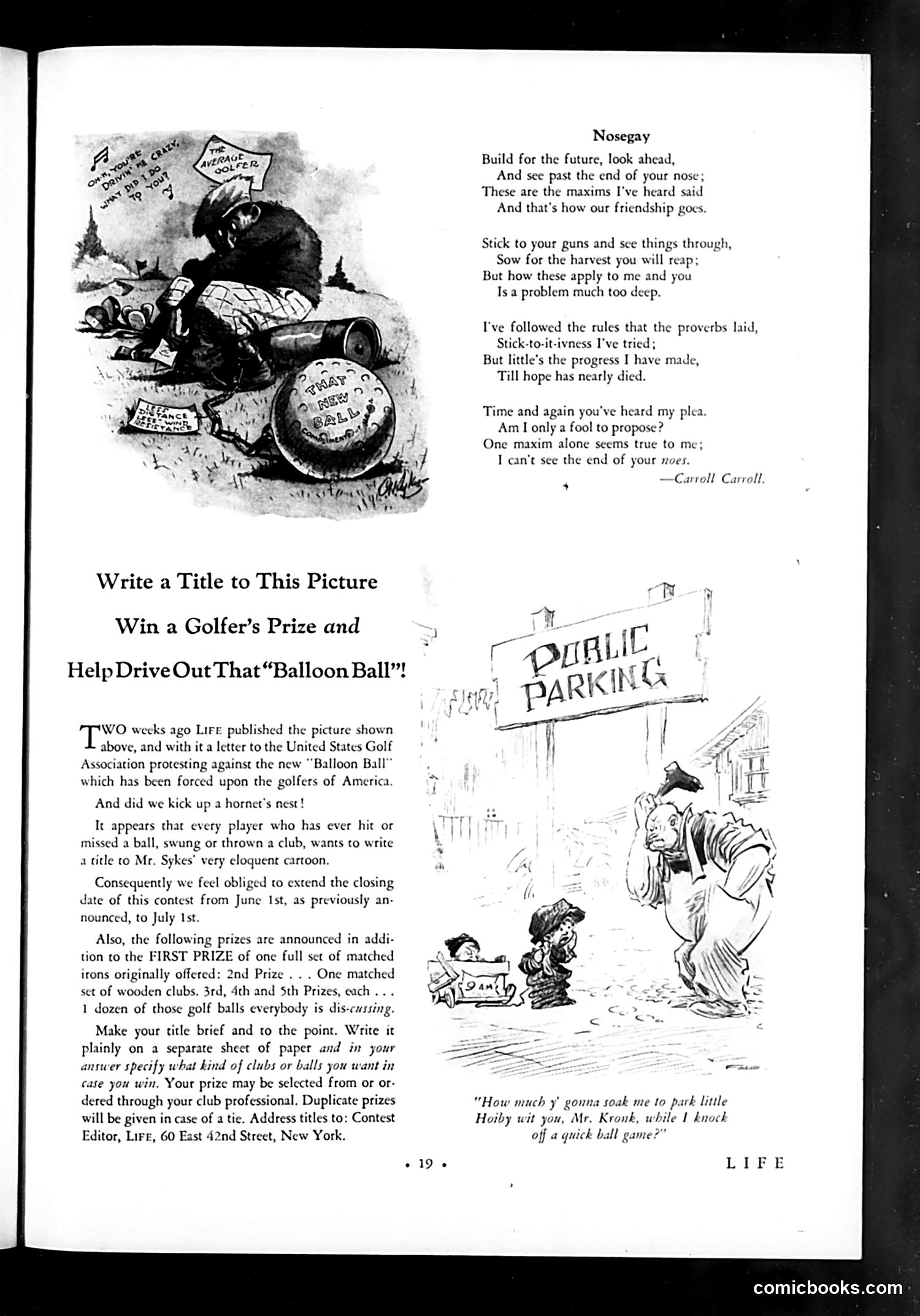
"Balloon Ball" Golf Satire This Life magazine page mocks the "Balloon Ball"—a new golf ball that was apparently controversial among American golfers. The upper cartoon depicts a golfer surrounded by oversized equipment and documents labeled with golf-related text, suggesting the complicated, inflated nature of this new ball. The lower cartoon shows a man desperately seeking parking, with the caption joking that parking takes longer than playing golf itself. This appears to be a secondary satirical point about modern inconveniences. Life is running a contest asking readers to title the upper cartoon, offering golf prizes (clubs, balls) to winners. The satire targets both the "Balloon Ball" innovation that golfers opposed and broader complaints about modern recreational frustrations. The United States Golf Association had formally protested against this new ball technology.
Life Magazine Movie Reviews - Context for Modern Readers This page contains two film reviews by Harry Evans from Life magazine's entertainment section. "Indiscreet" reviews Gloria Swanson's comedic performance. The satire centers on the irony that Swanson, a serious dramatic actress who dislikes making light comedies, delivers an unexpectedly delightful performance in slapstick humor (knocking balls through windows, slapping ice cream cones). The "naughty" plot involves Swanson's teenage romantic indiscretion with a mustachioed man that resurfaces years later. "Seed" praises Lois Wilson's emotional performance in a tear-jerking drama adapted from Charles G. Norris's novel. The reviewer emphasizes the film's appeal to female audiences—contemporary cinema's primary demographic—noting that any picture making women cry had strong box-office potential. Both reviews reflect 1920s film criticism: emphasis on stars' performances, plot simplicity, and gendered audience appeal. The tone is affectionate but somewhat patronizing toward both actresses and viewers.
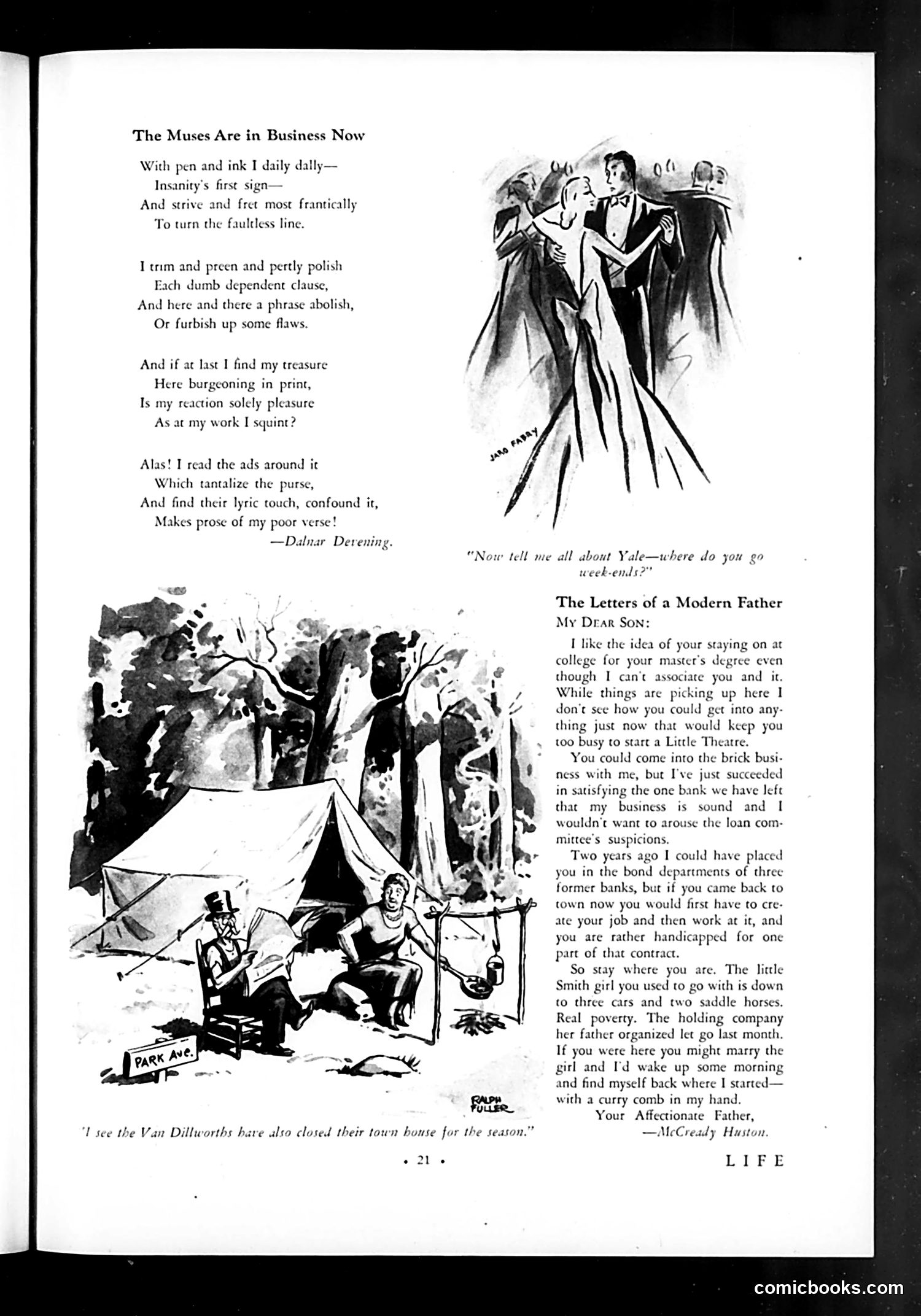
Analysis of Life Magazine Page 21 "The Muses Are in Business Now" is a poem satirizing writers' struggles during commercialization. The author laments that even when achieving publication, advertisements surrounding the printed work overshadow literary merit—commercial "prose" destroys poetic value. The satire targets how capitalism has invaded artistic spaces. "The Letters of a Modern Father" mocks upper-class anxieties during economic hardship (likely the Depression era, given bank closures mentioned). The father discourages his son from returning home, citing business instability and reduced opportunities. The closing joke—that marrying the "Smith girl" (now impoverished, down to "three cars") would send him back to manual labor—satirizes how quickly wealthy families' fortunes collapsed. The phrase "curry comb in my hand" suggests degrading manual work. Together, these pieces critique how economic upheaval exposed the fragility of privileged life and commercialism's corrosive effect on culture.
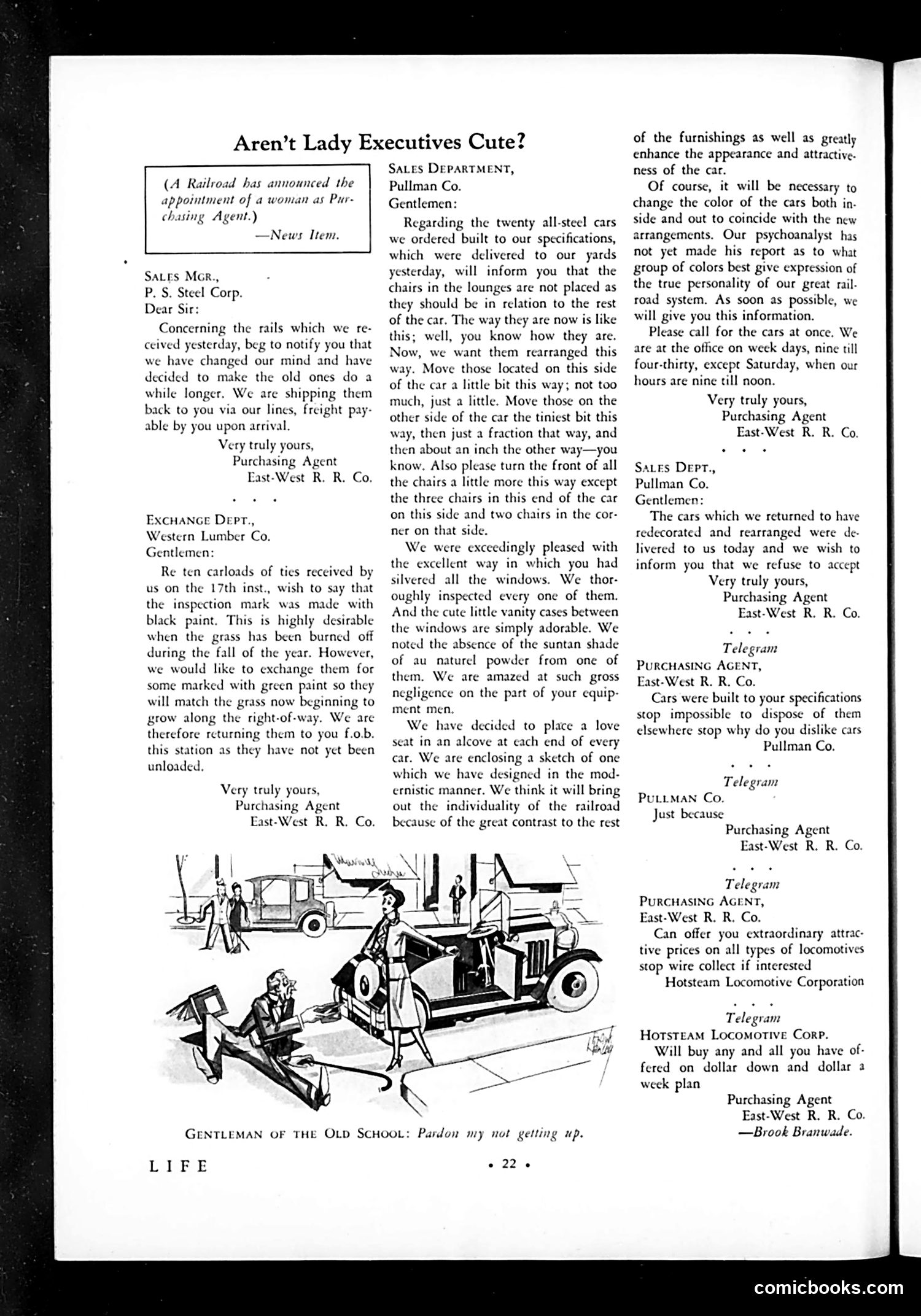
Explanation for Modern Readers This page satirizes the appointment of a woman as a railroad purchasing agent—a position previously held only by men. The cartoon and accompanying mock business letters mock the assumption that women in executive roles are inherently incompetent or frivolous. The letters depict an absurdly finicky female purchasing agent making ridiculous, contradictory demands: rejecting perfectly good rails, obsessing over chair placement by fractional inches, worrying about cosmetic powder in vanity cases, and demanding the entire train be repainted to match her aesthetic vision. Her requests are deliberately vague and impractical ("you know how they are"). The cartoon caption, "Gentleman of the Old School: Pardon my not getting up," shows an older man declining to rise—a sexist gesture suggesting women don't deserve traditional courtesies. The satire's point: Life magazine ridicules both the woman executive (portraying her as scattered and superficial) and those who hired her (implying it's obviously a mistake). The humor relies on 1920s gender stereotypes about women being emotional, detail-obsessed, and unsuited for serious business.
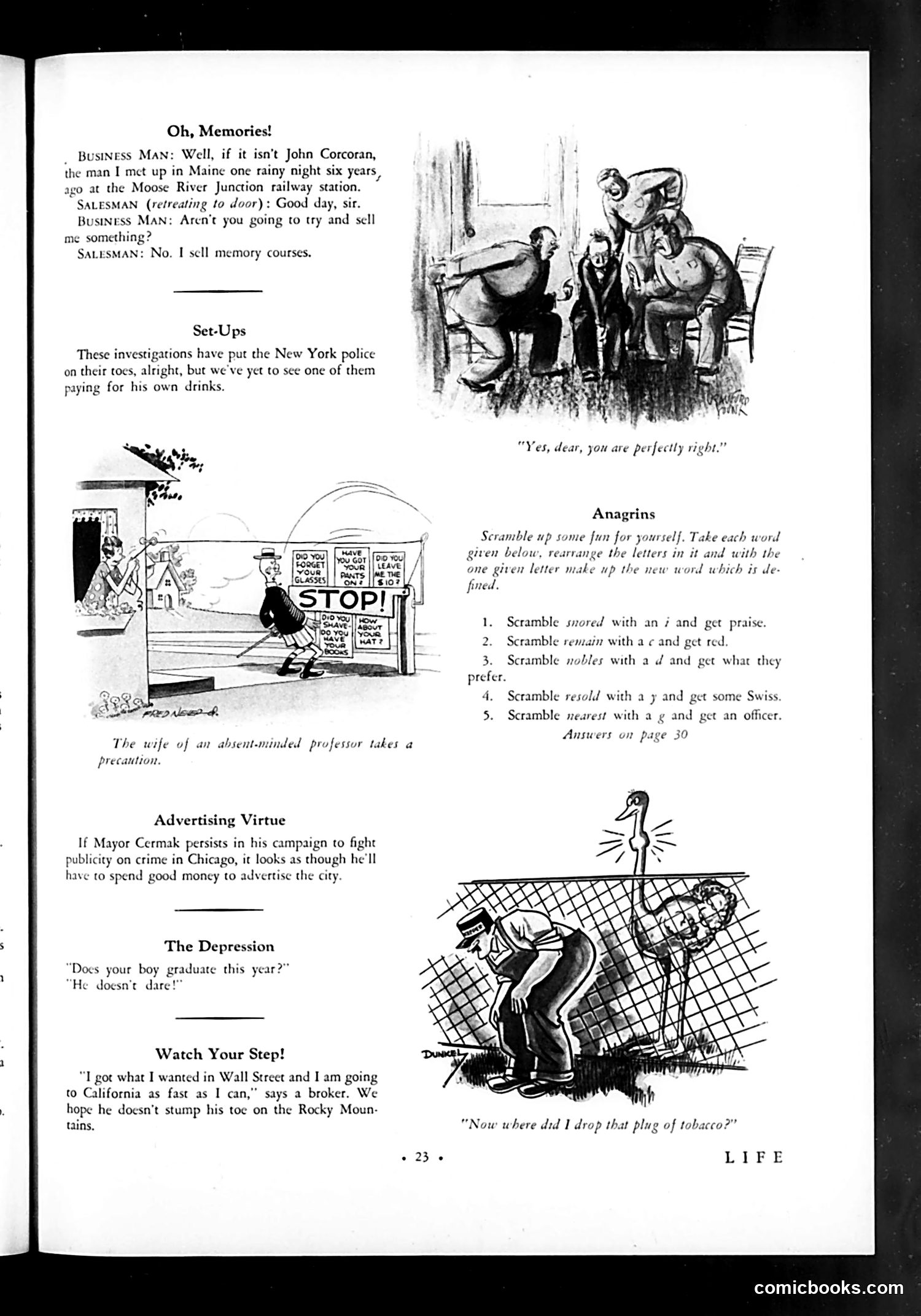
Life Magazine Page Analysis This page from Life magazine contains several satirical jokes reflecting 1930s American life: "Oh, Memories!" jokes that a salesman refuses to sell anything to a businessman who recognizes him, because he now sells memory courses instead—implying the businessman's memory is so poor he forgot their prior meeting. "Set-Ups" sarcastically notes that police investigations into corruption have made officers nervous, yet none has reformed enough to stop expecting free drinks. "Advertising Virtue" references Mayor Cermak's anti-crime campaign in Chicago, joking that fighting crime's publicity requires expensive advertising—a paradox. "The Depression" and "Watch Your Step!" reference the Great Depression era, with dark humor about a boy not daring to graduate (implying job prospects are hopeless) and a broker fleeing Wall Street to California (suggesting financial collapse). The page also includes word puzzles and cartoon illustrations typical of Life's humor-focused content for educated, middle-class readers of that period.
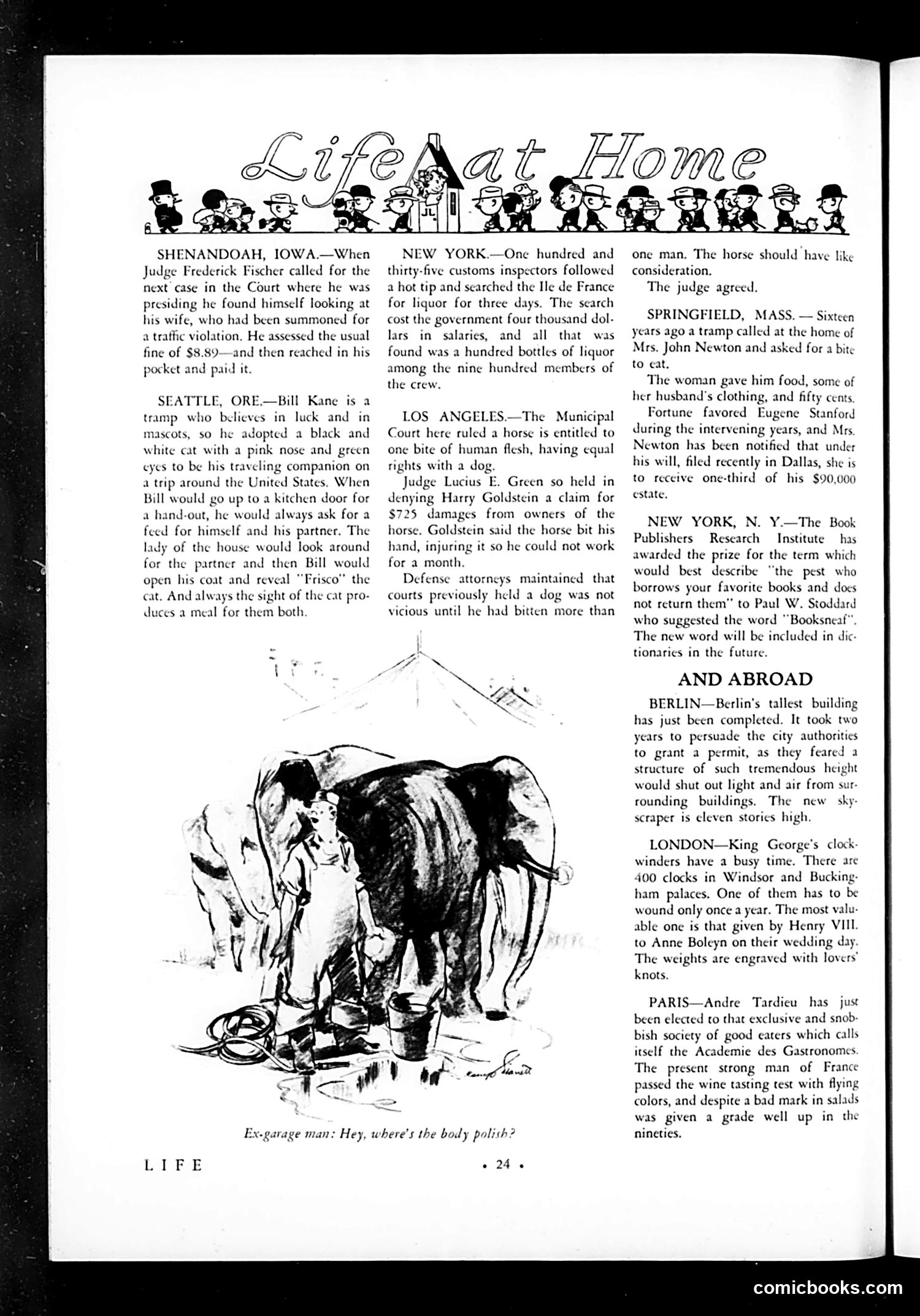
"Life at Home and Abroad" - Page Analysis This is a humor column mixing domestic anecdotes with international news briefs. The main cartoon depicts an auto mechanic asking "where's the body polish?"—a visual pun playing on the double meaning of "body" (car part vs. human corpse). The text showcases quirky American stories: a judge fining his own wife for traffic violations, a hobo whose lucky cat secures him meals, customs agents wasting government money searching a ship for liquor. The legal items mock judicial absurdity—a Los Angeles court ruling that horses, like dogs, get "one free bite" before owners can claim damages. The "Booksneaf" entry satirizes publishers' pretentiousness in coining words for common annoyances (people who don't return borrowed books). International briefs humorously highlight bureaucratic excess (Berlin's 11-story building taking two years to permit) and privileged eccentricities (400 palace clocks, Henry VIII's wedding gift timepiece). The overall tone: affectionate mockery of human nature, from judicial nepotism to petty theft, across all classes.
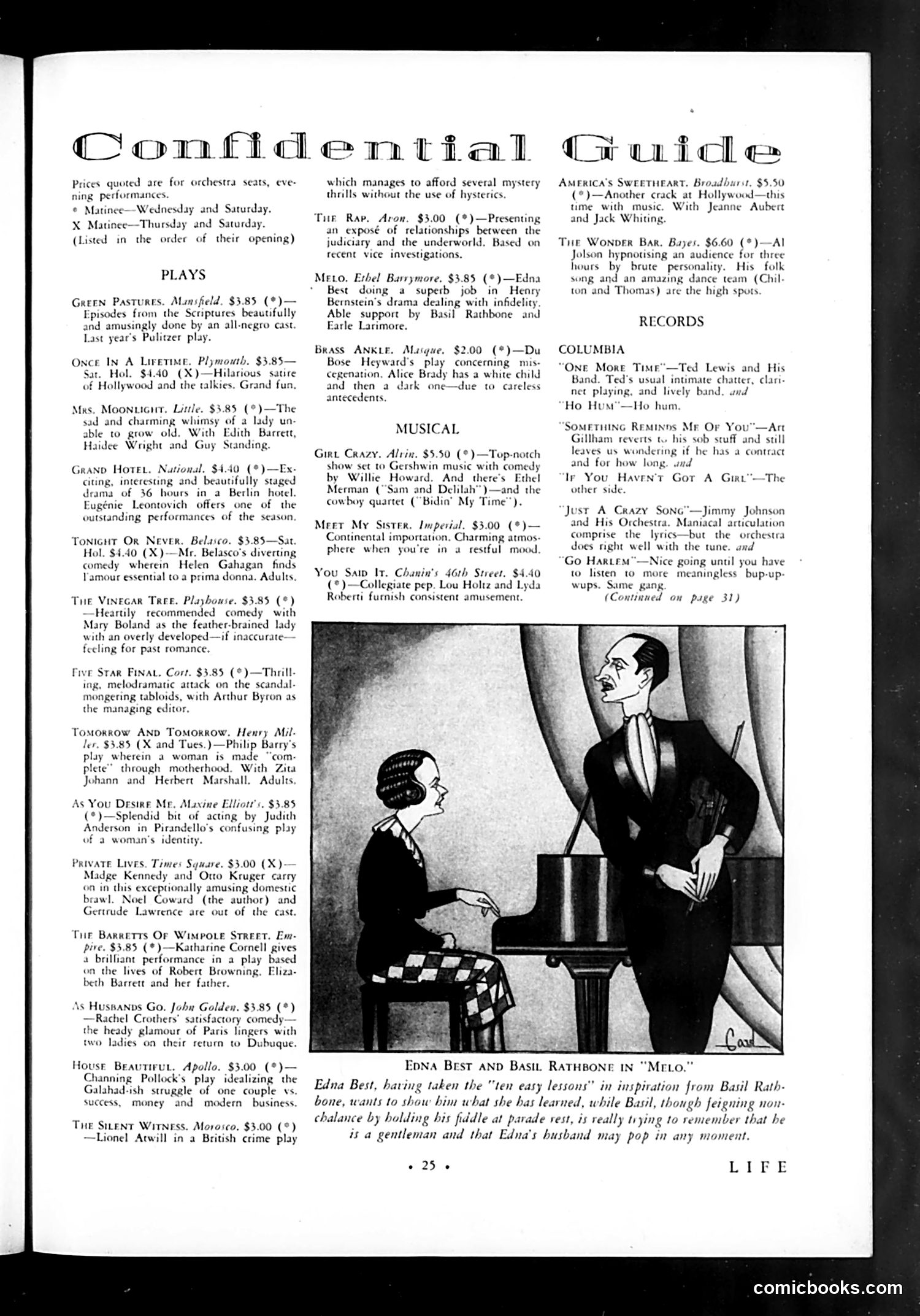
Analysis of Life Magazine Page This page is a theater guide for Broadway shows, not a political cartoon. It lists current theatrical productions with prices and brief reviews—plays like "Green Pastures," "Private Lives," and musicals like "Girl Crazy." The single cartoon illustration at bottom shows a scene from the play "Melo," starring Edna Best and Basil Rathbone. The caption explains the plot: a wife (seated) confronts her husband about infidelity, using her fiddle as a prop to demonstrate she's learned to "remember that he is a gentleman." It's a domestic drama scene illustrating the play's theme of marital discord. The page reflects 1930s Broadway culture—high ticket prices ($2-6.60), racial terminology now considered offensive ("all-negro cast"), and concerns about Hollywood's influence on theater. The content is informational rather than satirical.
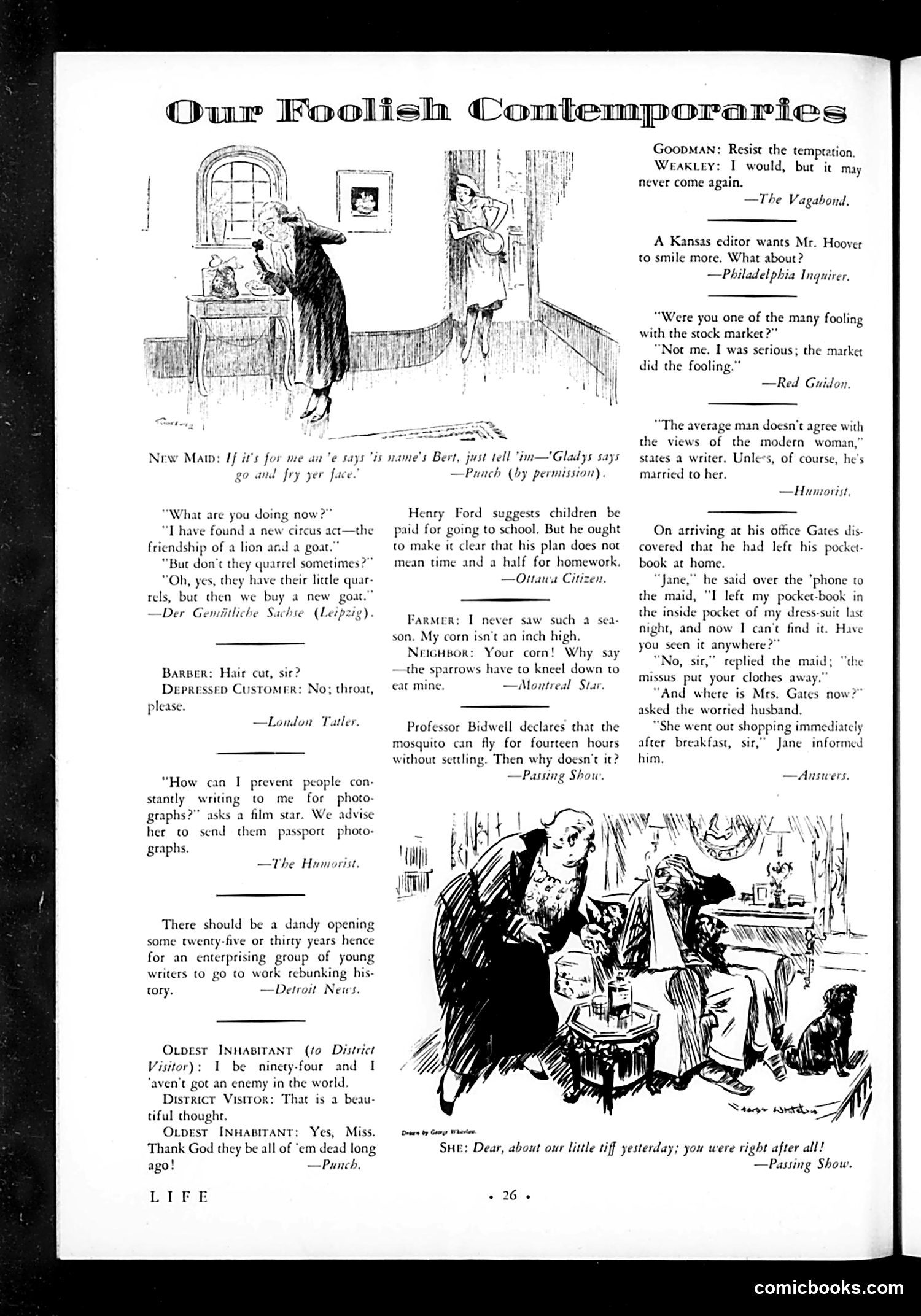
"Our Foolish Contemporaries" - Life Magazine Page This page collects satirical quips and cartoons mocking contemporary absurdities. The humor targets: Social foolishness: A new maid's crude rudeness; a depressed man wanting his throat cut (expressing suicidal despair during economic hardship); a circus act profiting from constant animal quarrels. Modern anxieties: Stock market speculation (appearing to reference the 1920s boom); Henry Ford's educational theories; persistent letter-writing to film stars. Domestic comedy: A husband whose wife shops impulsively after taking his wallet, leaving him stranded without his pocket-book. Political figures: References to Herbert Hoover (then president or prominent) and a Kansas editor's criticism of his demeanor. The cartoons use exaggeration and irony—mocking contemporary trends, technological progress, business schemes, and gender relations typical of 1920s-30s satire. The overall tone is lighthearted social criticism aimed at middle-class readers.
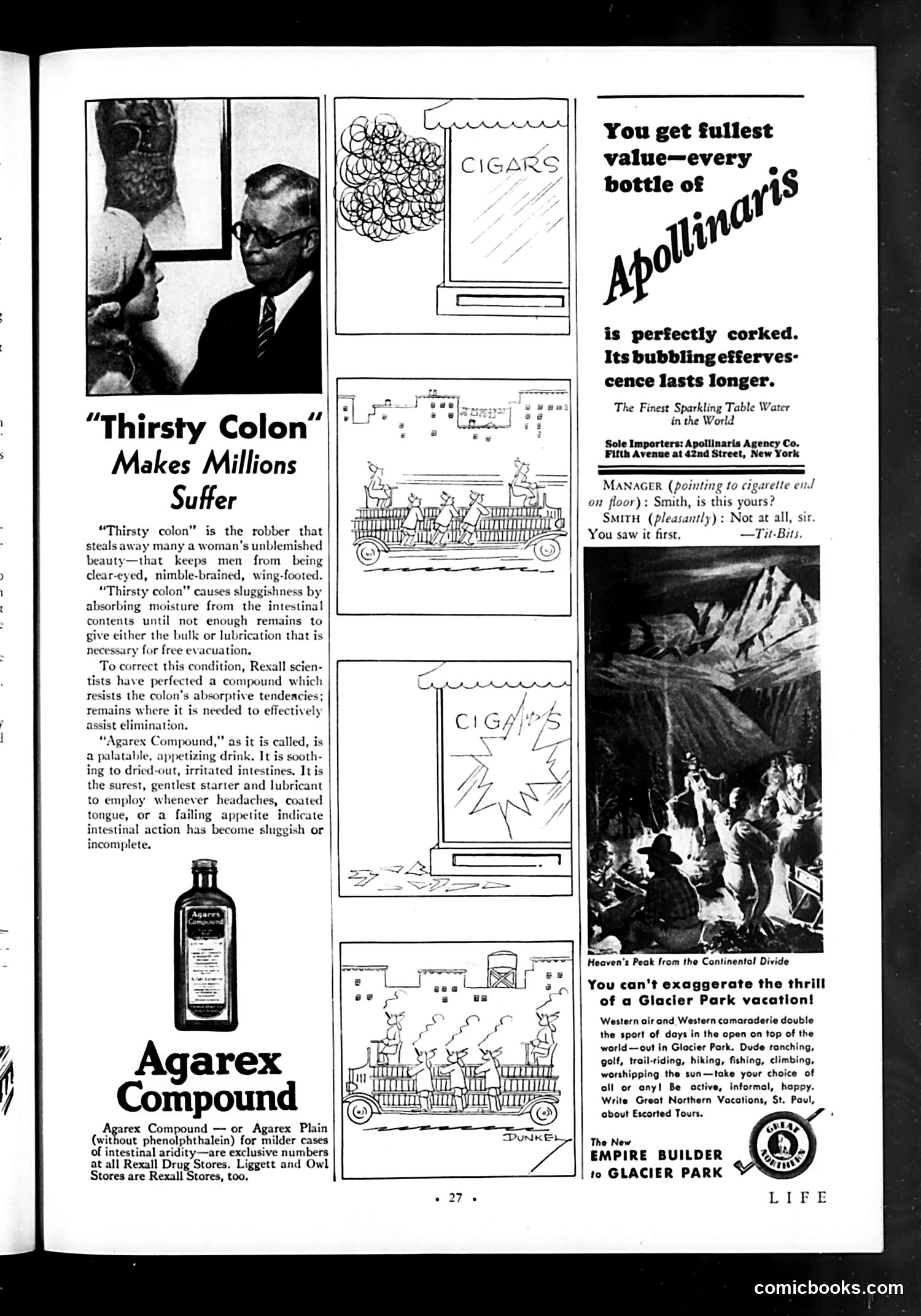
Analysis This is primarily a advertising page from Life magazine featuring three distinct advertisements. The main left-side ad for Agarex Compound uses pseudo-medical language to sell a laxative by personifying constipation as "Thirsty Colon"—a villain "robber" that causes beauty loss and mental sluggishness in women. This reflects early 20th-century medicine-show marketing tactics, blending pseudoscience with shame-based selling. The product promised to restore "bulk or lubrication" for intestinal function. The upper right advertises Apollinaris sparkling water, emphasizing its cork and lasting carbonation. The lower right promotes Glacier Park vacations via the Empire Builder train, highlighting outdoor recreation (dude ranching, fishing, climbing) as fashionable leisure. All three ads target affluent readers with lifestyle aspirations—health-conscious consumers, cosmopolitan diners, and adventurous travelers. The "Thirsty Colon" ad most clearly reflects period attitudes: gendered health anxieties and frank discussion of bodily functions marketed through personification and melodrama.
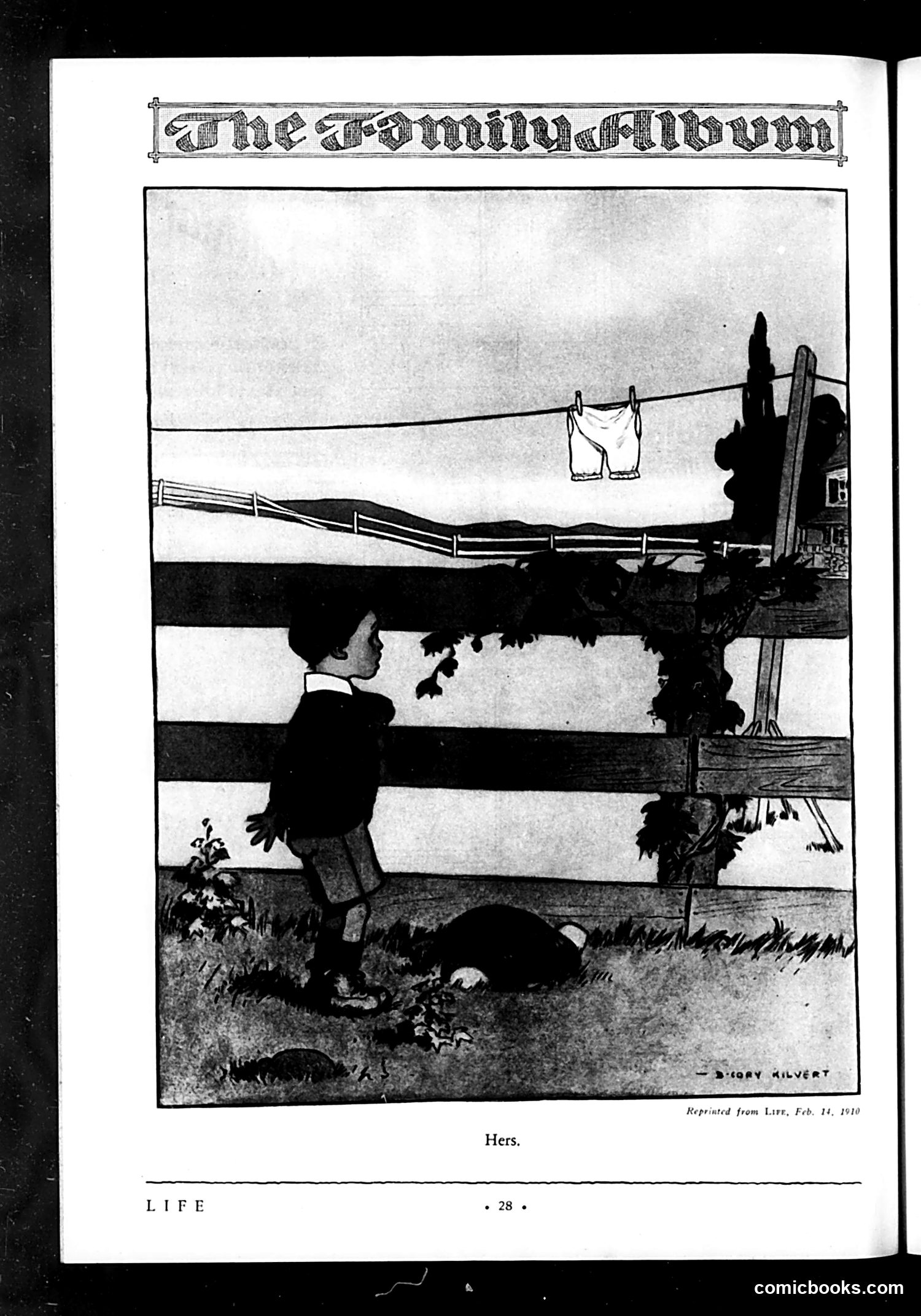
"Hers" - Life Magazine, February 14, 1910 This cartoon depicts a young woman standing at a rural fence, gazing at clothesline laundry hanging above. A black cat sits nearby among wildflowers. The illustration is signed by Shory Silvert and titled simply "Hers." The satire appears to address gender roles and domesticity. The woman's wistful expression while observing humble domestic labor—laundry drying on a line—likely mocks the romanticization of housework or rural domestic life for women. Published on Valentine's Day, it may satirize sentimental notions of femininity and "a woman's place." The modest, solitary scene contrasts with idealized romantic imagery typically associated with the holiday, suggesting the harsh reality of women's domestic duties.
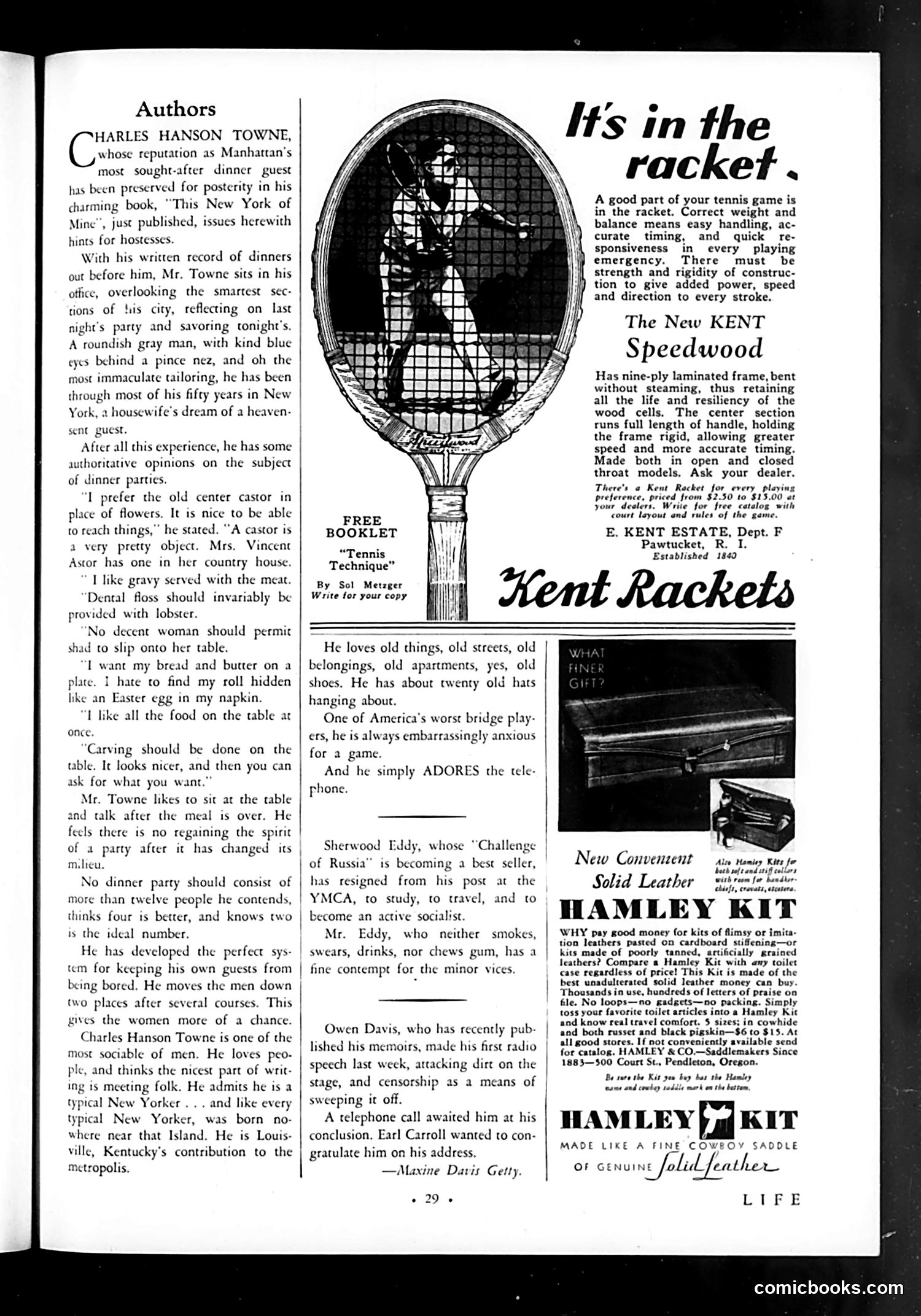
Life Magazine Page Analysis This page is primarily advertising and biographical content, not political satire. It features: Main Content: A profile of Charles Hanson Towne, a prominent New York socialite and author, presenting his etiquette rules for dinner parties—preferences about table settings, food service, and guest management that reflect early 20th-century upper-class dining conventions. The Humor: The satire is gentle social commentary, not political. Towne's pedantic opinions about dinner etiquette (dental floss with lobster, carving at the table, rotating male guests between courses) mock the pretentiousness of Manhattan high society and the minutiae of upper-class formality. Advertisements: The page includes ads for Kent Speedwood tennis rackets and Hamley Kit leather goods—luxury products aimed at the magazine's affluent readership. Context for Modern Readers: This reflects a now-vanished world of formal dinner parties as social performance among New York's elite, where such minutiae mattered significantly to social standing.
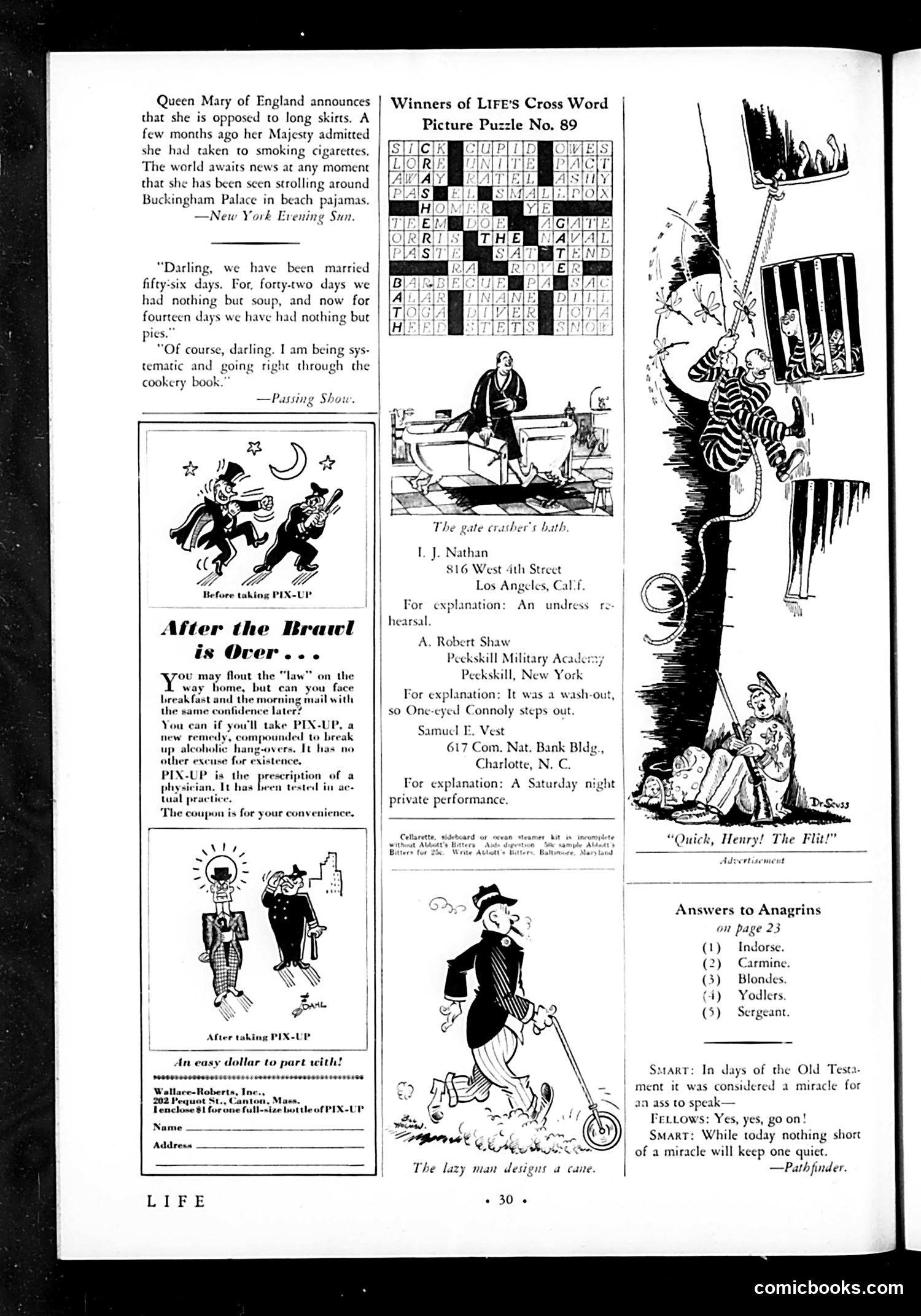
Analysis of Life Magazine Page This page contains several satirical elements typical of early 20th-century American humor: Queen Mary Item: A brief news commentary mocking Queen Mary of England's reported rejection of long skirts and admission of smoking. The satire suggests her modernizing behavior is so shocking that readers await increasingly scandalous announcements (beach pajamas next). This reflects contemporary debates about women's changing social roles and fashion. Marriage Joke: A couple's domestic dispute about their newlywed diet—soup for 42 days, then pies for 14 days. The wife's systematic "going through the cookery book" suggests methodical monotony masquerading as organization, satirizing both marital tedium and rigid domestic management. PIX-UP Advertisement: A hangover remedy ad using before/after cartoon panels showing a disheveled man post-fight, then composed after taking the product—typical patent medicine marketing. The page also contains a crossword puzzle solution and an anagram answer section, standard Life magazine features of the era.
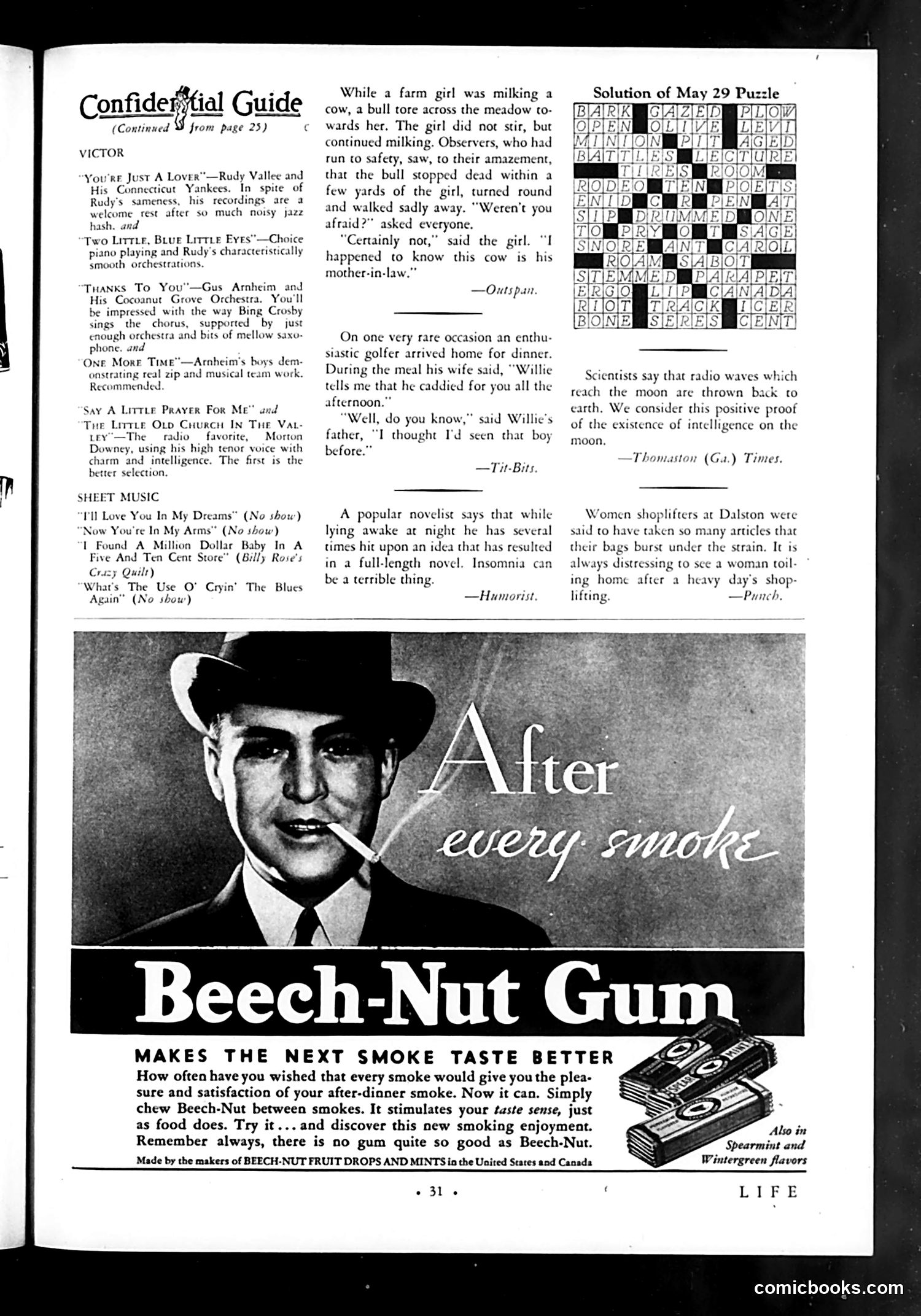
Analysis of Page 31, Life Magazine This page is primarily advertising and entertainment content rather than political satire. The bulk of the page consists of: Top section: A "Confidential Guide" reviewing popular music recordings by artists like Rudy Vallée and Bing Crosby, plus sheet music listings—typical entertainment coverage from Life's era. Middle section: Several brief, lighthearted jokes (likely reprinted from other publications like *Punch* and *Outspan*), including one about a farm girl unfazed by a charging bull, and another about a golfer's caddie. Bottom section: A Beech-Nut Gum advertisement featuring a man in a cowboy hat with the slogan "After every smoke." The ad promotes chewing gum between cigarettes to improve taste—a common marketing angle reflecting 1930s-40s consumer culture, before widespread health concerns about smoking. The page reflects the era's casual attitude toward tobacco advertising and entertainment-focused magazine content. There is no political cartoon or satirical commentary present.
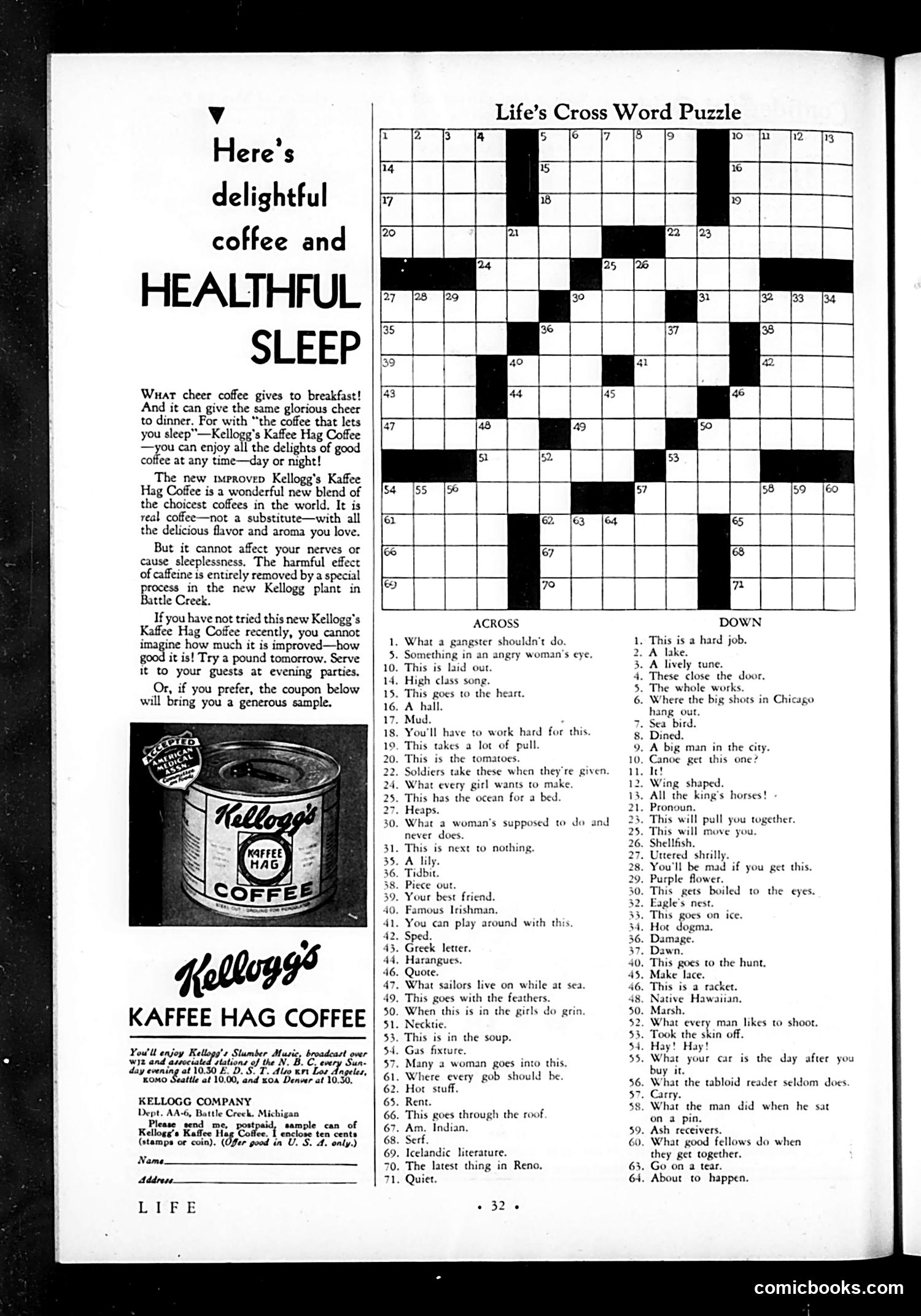
Life Magazine Advertisement & Crossword Page This page is primarily a product advertisement for Kellogg's Kaffee Hag Coffee, a decaffeinated coffee brand. The ad claims the coffee provides "delightful" taste while enabling "healthful sleep"—addressing a common concern that caffeine causes insomnia. The company advertises that their special process removes caffeine's harmful effects while preserving flavor. The page includes a coupon offer and promotes "Kellogg's Slumber Music," a radio program broadcast on NBC, demonstrating early 20th-century marketing integration across media. The bottom half features a standard crossword puzzle titled "Life's Cross Word Puzzle" with typical clues of the era (references to gangsters, Irishmen, "the latest thing in Reno"—likely alluding to divorce). This represents Depression-era advertising strategy: addressing consumer anxieties about modern life (sleep disruption) while promoting branded solutions. The crossword provides entertainment value, encouraging readers to engage with the advertisement.
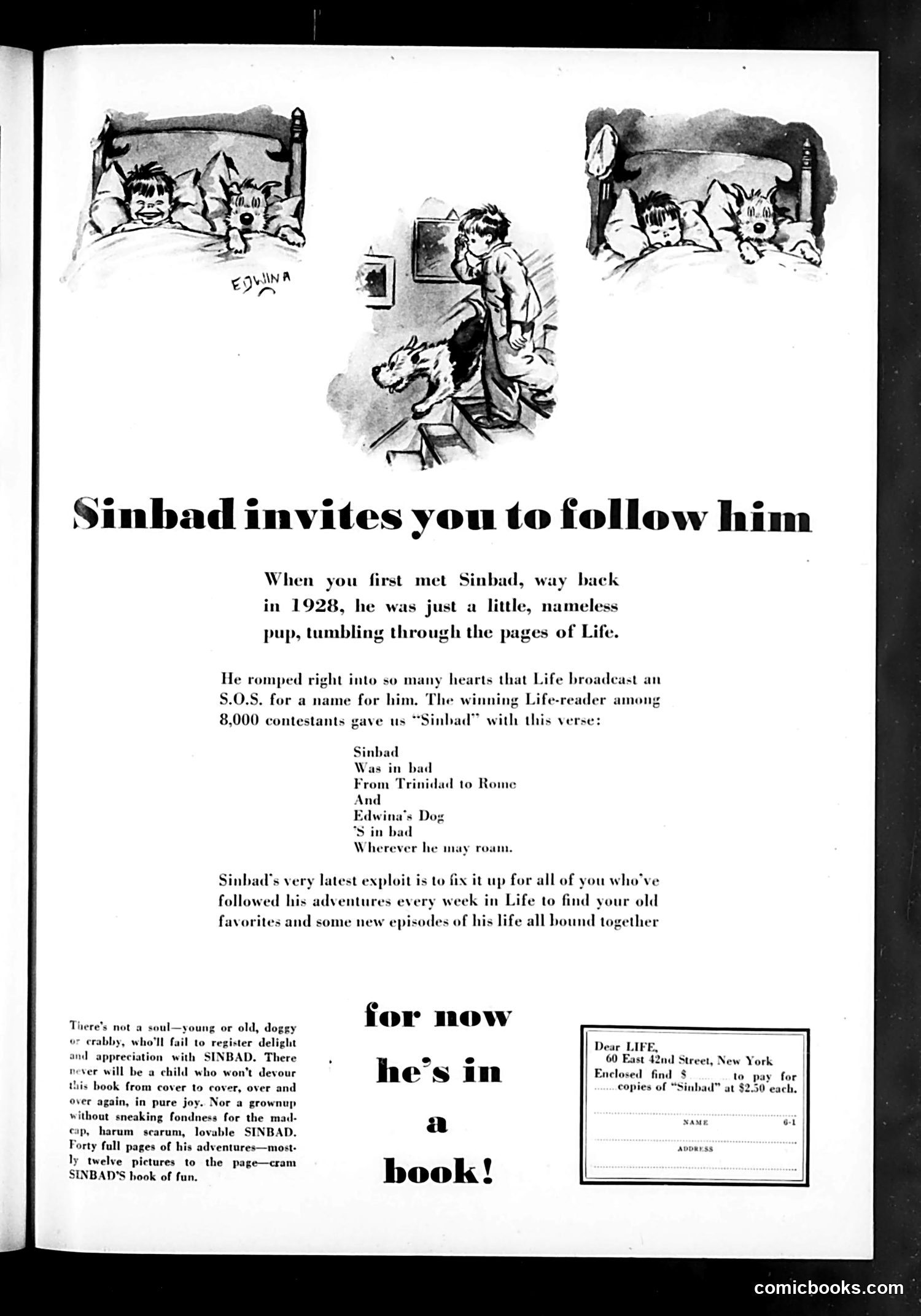
Sinbad Book Advertisement This is a book promotion, not political satire. Life magazine is advertising a compiled collection of "Sinbad," an established comic strip character that debuted in 1928. The page explains that readers had named the character through a contest (the winning entry included the verse shown), and Sinbad became popular enough to warrant a bound book collection. The illustrations show Sinbad as a mischievous dog in various domestic scenes—in beds, with children, causing playful trouble. The advertisement emphasizes universal appeal ("There's not a soul...who'll fail to register delight") and promises 40 pages of mostly illustrated adventures. Readers could order the $2.50 book via the coupon at page bottom. This reflects early 20th-century magazine culture where popular recurring comic characters were compiled into books to capitalize on reader attachment.

Analysis This is a full-page advertisement, not political satire. It promotes Ethyl Gasoline, a commercial fuel product from the Ethyl Gasoline Corporation (New York City). The image uses an eagle in silhouette as a metaphor for power and control. The ad draws a parallel: just as an eagle's mastery of the air depends on controlling its wing-power, an automobile's performance depends on controlling gasoline combustion through Ethyl's additive. The text emphasizes that Ethyl fluid prevents engine "knock" (uneven combustion causing performance loss and damage), ensuring smooth power delivery. A small circular logo identifies the product's "active ingredient" as lead—referring to tetraethyl lead, an anti-knock additive added to gasoline. Historical note for modern readers: This advertisement predates widespread public knowledge of lead's severe health and environmental toxicity, which wasn't widely acknowledged until decades later. Leaded gasoline was eventually phased out in the 1970s-1990s due to poisoning concerns.