life
Life — June 12, 1931
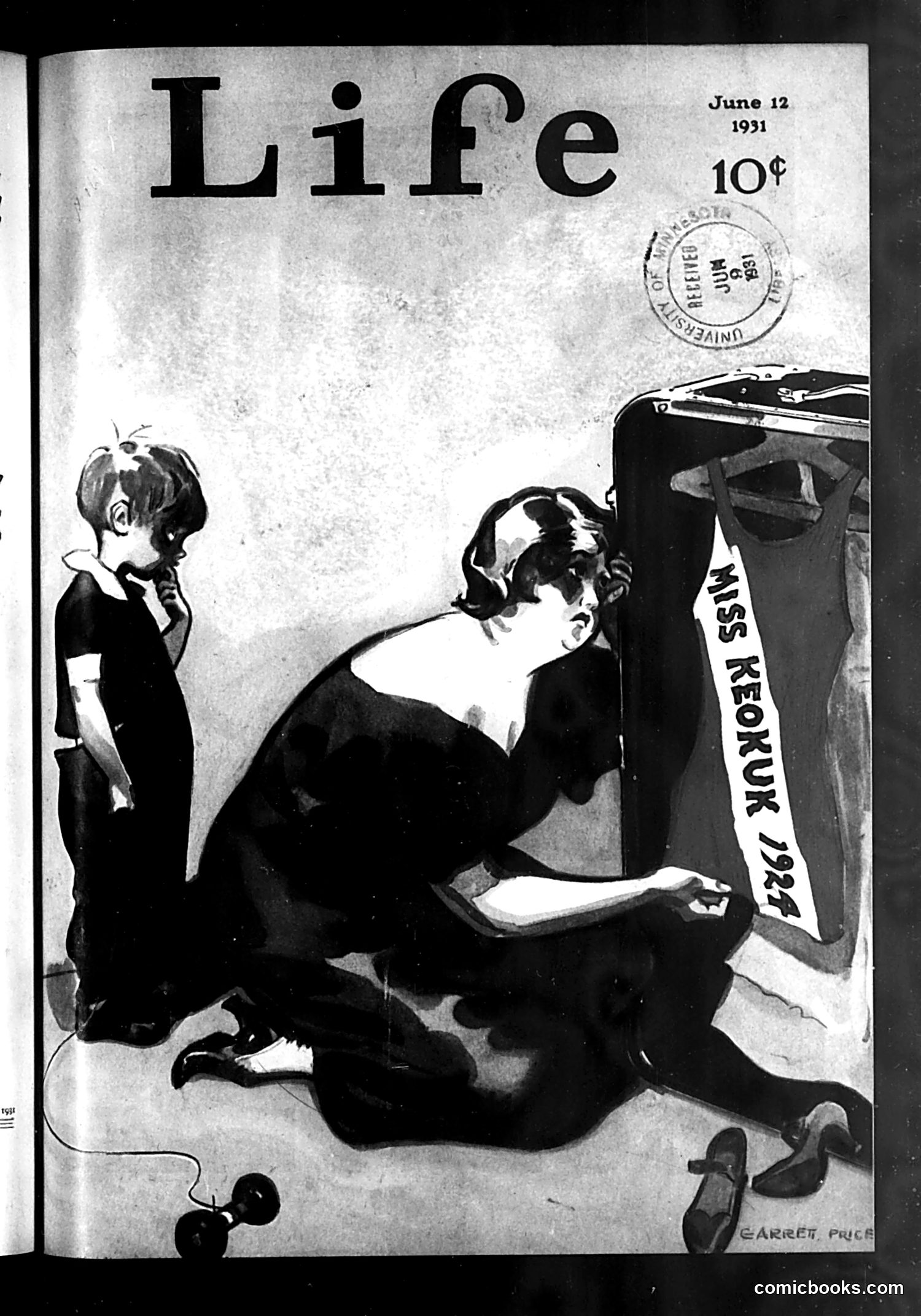
Life Magazine Cover, June 12, 1931 This cover illustration by Earle Price depicts a woman kneeling before a trash can labeled "MISS KROKUK PARK" (or similar text), appearing to discard or retrieve something. A young child stands watching nearby. The image likely satirizes social attitudes toward public spaces or parenting practices of the era. The specific reference "MISS KROKUK PARK" is unclear—it may reference a person, place, or contemporary social issue from 1931. Without additional context, the exact satirical point remains uncertain, though the juxtaposition of an adult woman with a trash receptacle and observing child suggests commentary on public behavior, sanitation, or social propriety during the Depression era.
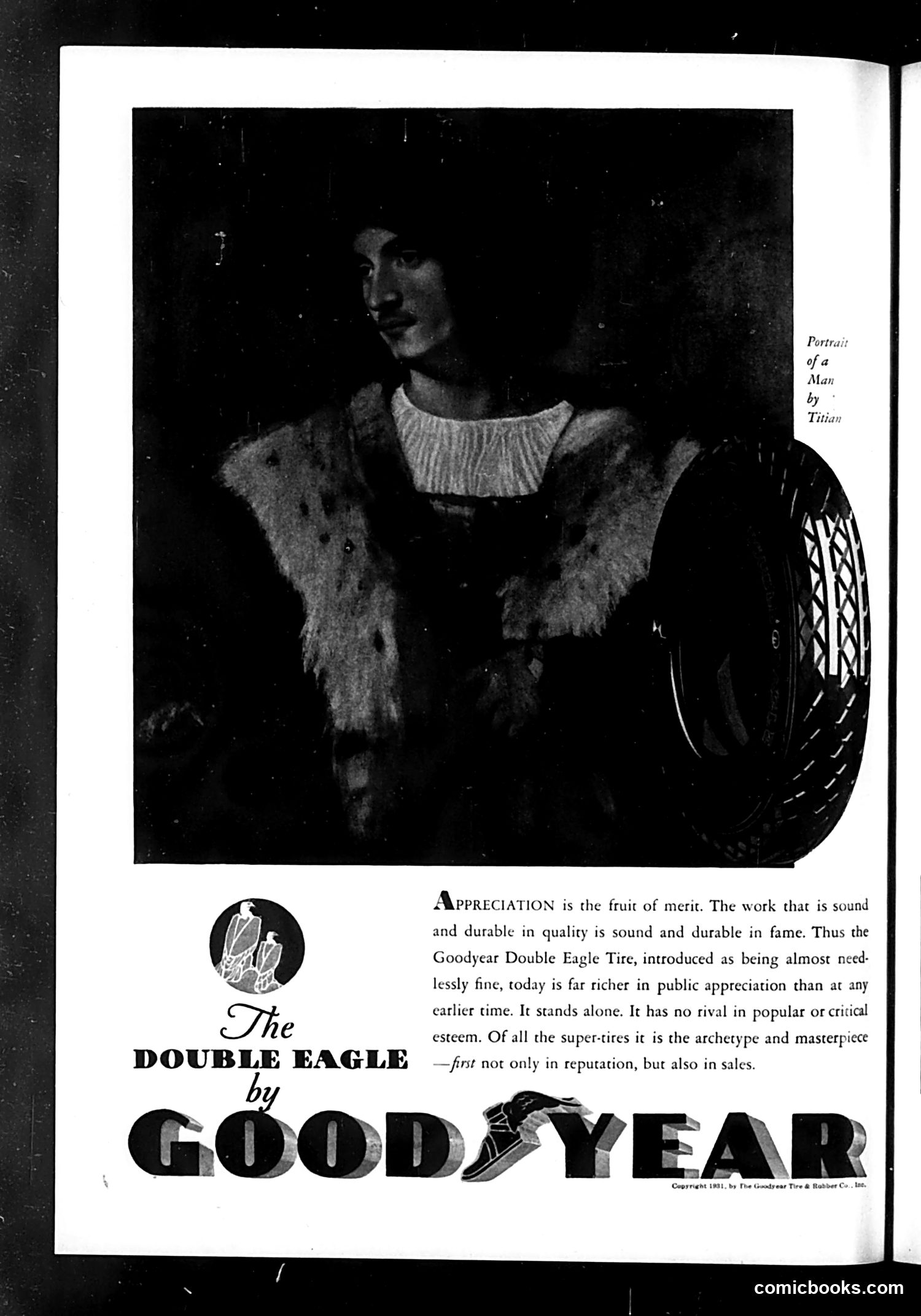
Analysis This is a Goodyear tire advertisement, not political satire. The page features a classical portrait painting labeled "Portrait of a Man by Titian" (the Renaissance artist) at the top, with the painting's subject wearing period clothing with fur-trimmed shoulders and a decorative collar. Below, the ad copy claims that "appreciation is the fruit of merit" and argues that the Goodyear Double Eagle Tire has achieved lasting acclaim through quality—standing "alone" with "no rival in popular or critical esteem" among "super-tires." The ad strategically associates the tire brand with timeless artistic mastery by juxtaposing it with a famous old master painting, implying that like great art, quality tires earn enduring appreciation and reputation.
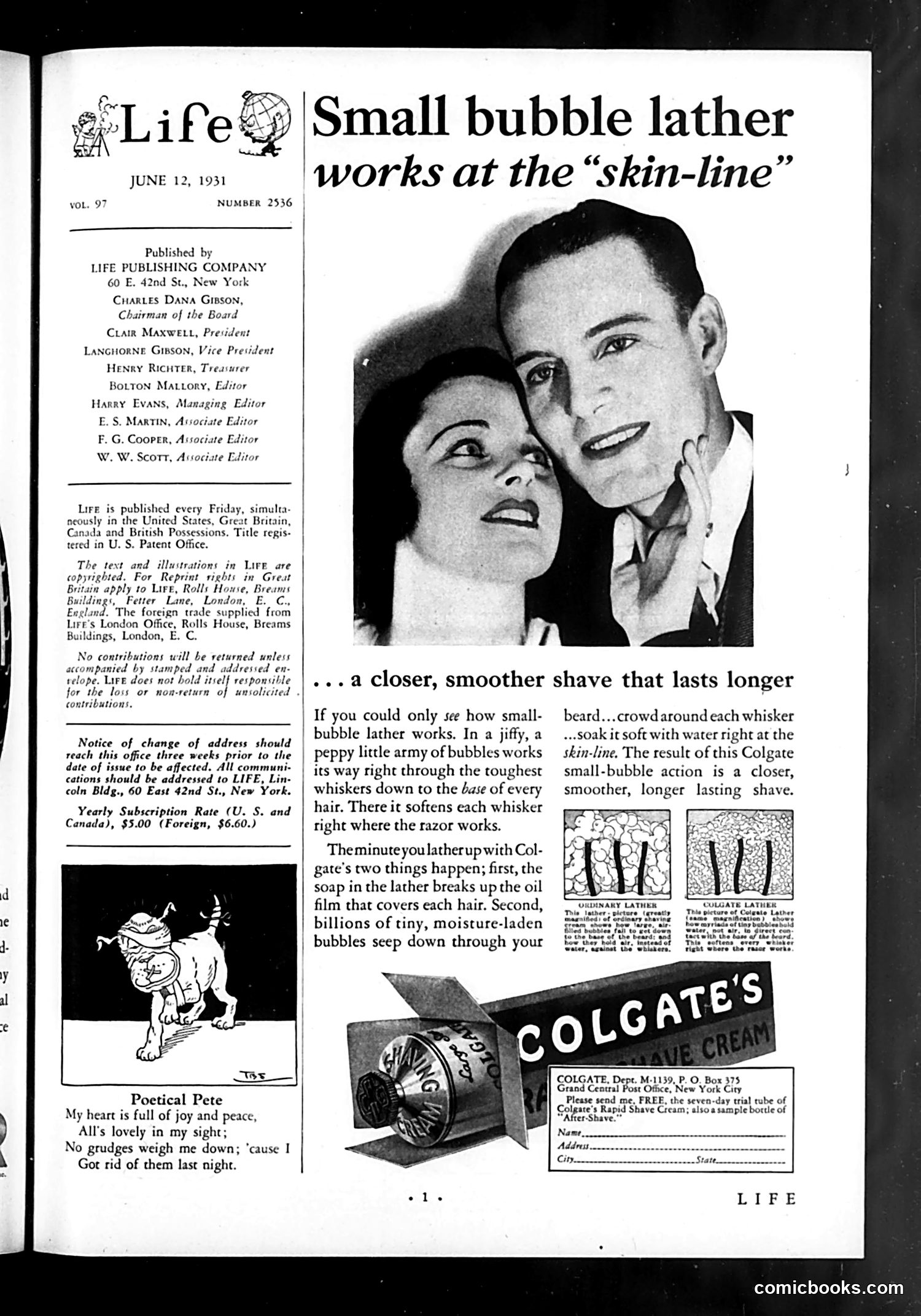
Analysis This page is primarily a Colgate's Rapid Shave Cream advertisement, not political satire. The main content features a photograph of a young couple with the headline "Small bubble lather works at the 'skin-line.'" The advertisement explains the product's supposed superiority: tiny bubbles penetrate close to whisker bases, softening them for a "closer, smoother shave that lasts longer." The only cartoon element is "Poetical Pete" in the bottom left—a small, seemingly unrelated comic featuring a dog with the verse "My heart is full of joy and peace. / All's lovely in my sight; / No grudges weigh me down; 'cause I / Got rid of them last night." This appears to be filler humor rather than political commentary, typical of 1930s magazine layout.
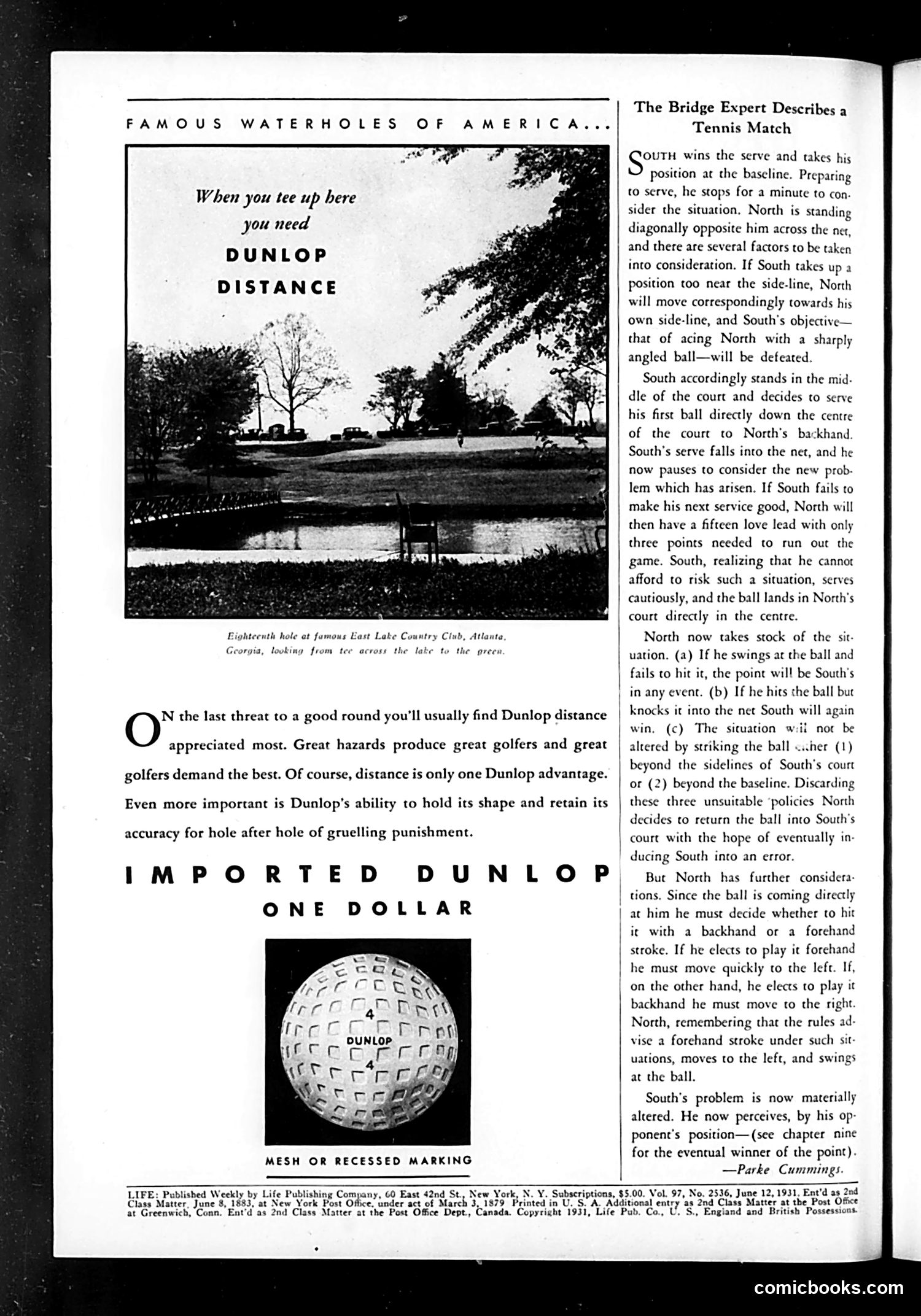
Analysis This page contains advertising and instructional content, not political satire. The left side features a Dunlop golf ball advertisement, showing the Eighteenth hole at East Lake Country Club in Atlanta. The copy emphasizes that Dunlop balls maintain accuracy and shape through repeated use—a practical sales pitch for golfers. The right side presents "The Bridge Expert Describes a Tennis Match"—apparently an instructional comparison using tennis strategy to explain bridge card game tactics. The piece walks through a detailed tennis scenario (serves, court positioning, strategy) to illustrate bridge decision-making. There is no political cartoon or satire on this page. It's a straightforward mix of golf equipment advertising and recreational sports/game instruction typical of early 20th-century *Life* magazine content.
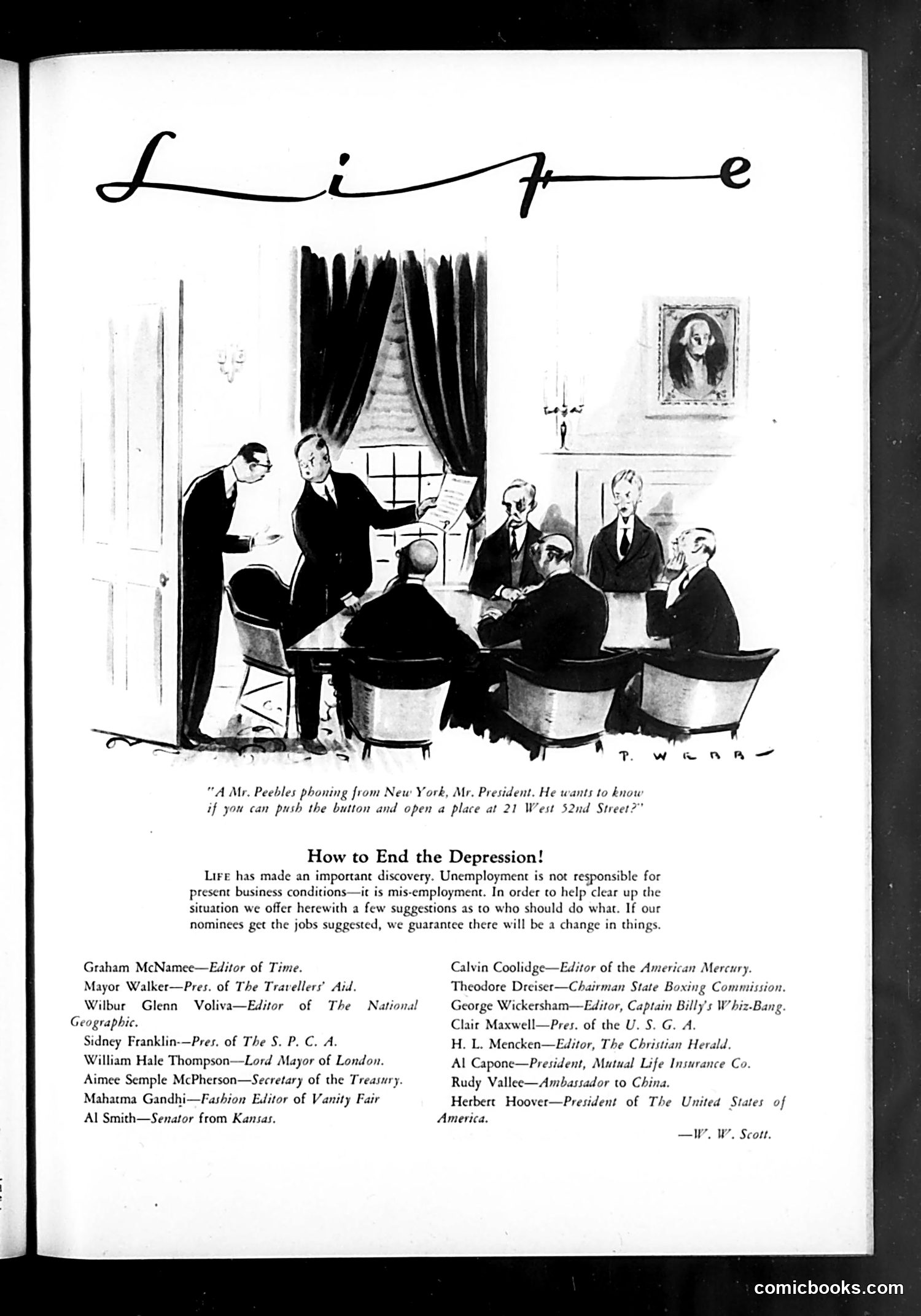
Explanation for Modern Readers This satirical cartoon mocks Depression-era solutions proposed by prominent figures. The scene shows men in an office receiving a ridiculous suggestion: a Mr. Peebles from New York wants President Hoover to "push the button and open a place at 21 West 32nd Street"—likely a speakeasy reference, since Prohibition was still in effect. The cartoon's irony is that these distinguished leaders (listed below, including editors, mayors, and Herbert Hoover himself) are being asked to endorse such absurd schemes to "end the Depression." The satire suggests that even well-intentioned prominent people were grasping at straws with impractical solutions. The piece mocks both the desperation of the economic crisis and the disconnection of elites from real remedies.
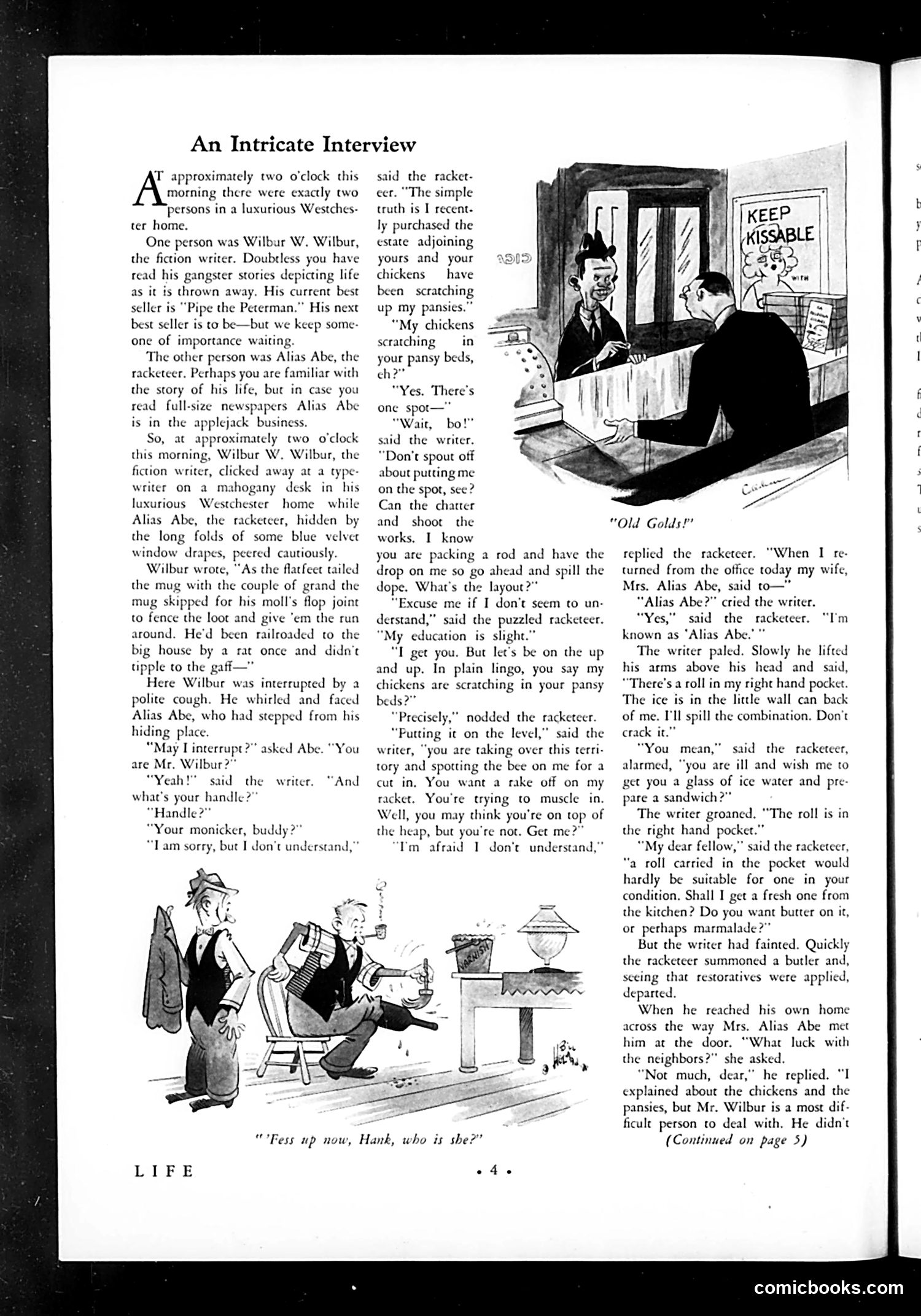
"An Intricate Interview" This satirical piece mocks fiction writer Wilbur W. Wilbur (likely a fictitious name suggesting mediocrity). The story describes a visit between Wilbur and a racketer—a gangster or organized crime figure—who complains that Wilbur's chickens are scratching up his pansy beds. The humor derives from the absurd collision of two worlds: a professional criminal reduced to petty complaints about garden damage, while the writer attempts to negotiate like he's discussing serious matters. The racketer's threats and the writer's anxious responses create comedy through this incongruity. The accompanying cartoons illustrate the slapstick encounter. The satire likely pokes fun at both the pretensions of pulp fiction writers and the popular stereotype of gangsters as brutal but ultimately mundane figures concerned with ordinary grievances.
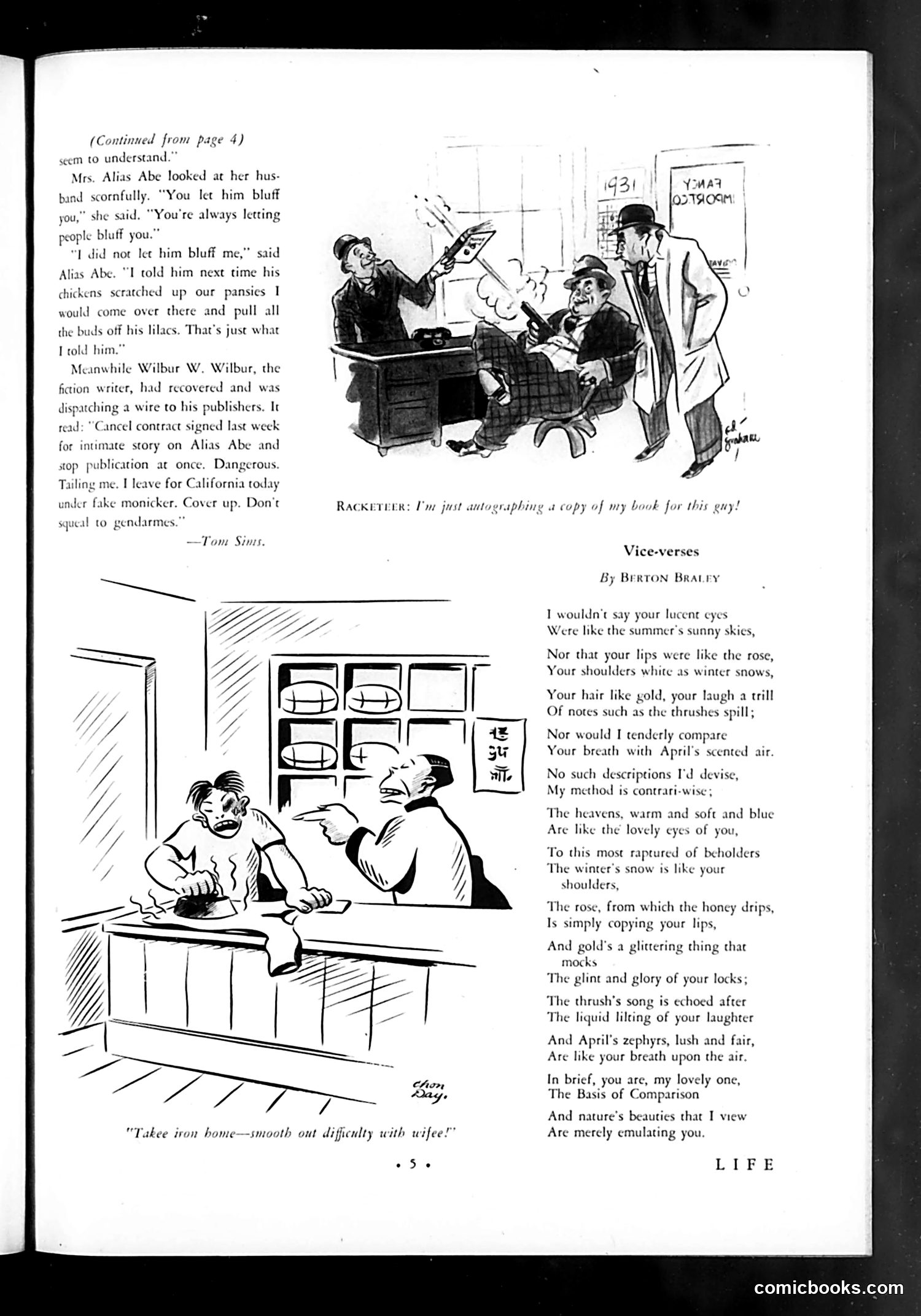
Analysis of Life Magazine Page This page contains two distinct pieces: Top cartoon: A satirical scene showing a book publisher (at desk) with what appears to be an author or agent. The caption references "Racketeering" and autographing a book. The cartoon satirizes the publishing industry, likely mocking sensationalism or questionable business practices in book promotion during this era. Bottom cartoon: Shows two people in what appears to be a Chinese restaurant or laundry (visible Chinese characters on wall). The caption "Take iron home—smooth out difficulty with wifey!" satirizes stereotypical Asian business services and plays on marital humor common to the period. Right side: A poem titled "Vice-verses" by Burton Braley offering humorous counter-comparisons to romantic love poetry—a literary satire mocking sentimental verse. The overall tone reflects early-to-mid 20th century American humor, with period-typical ethnic stereotyping.
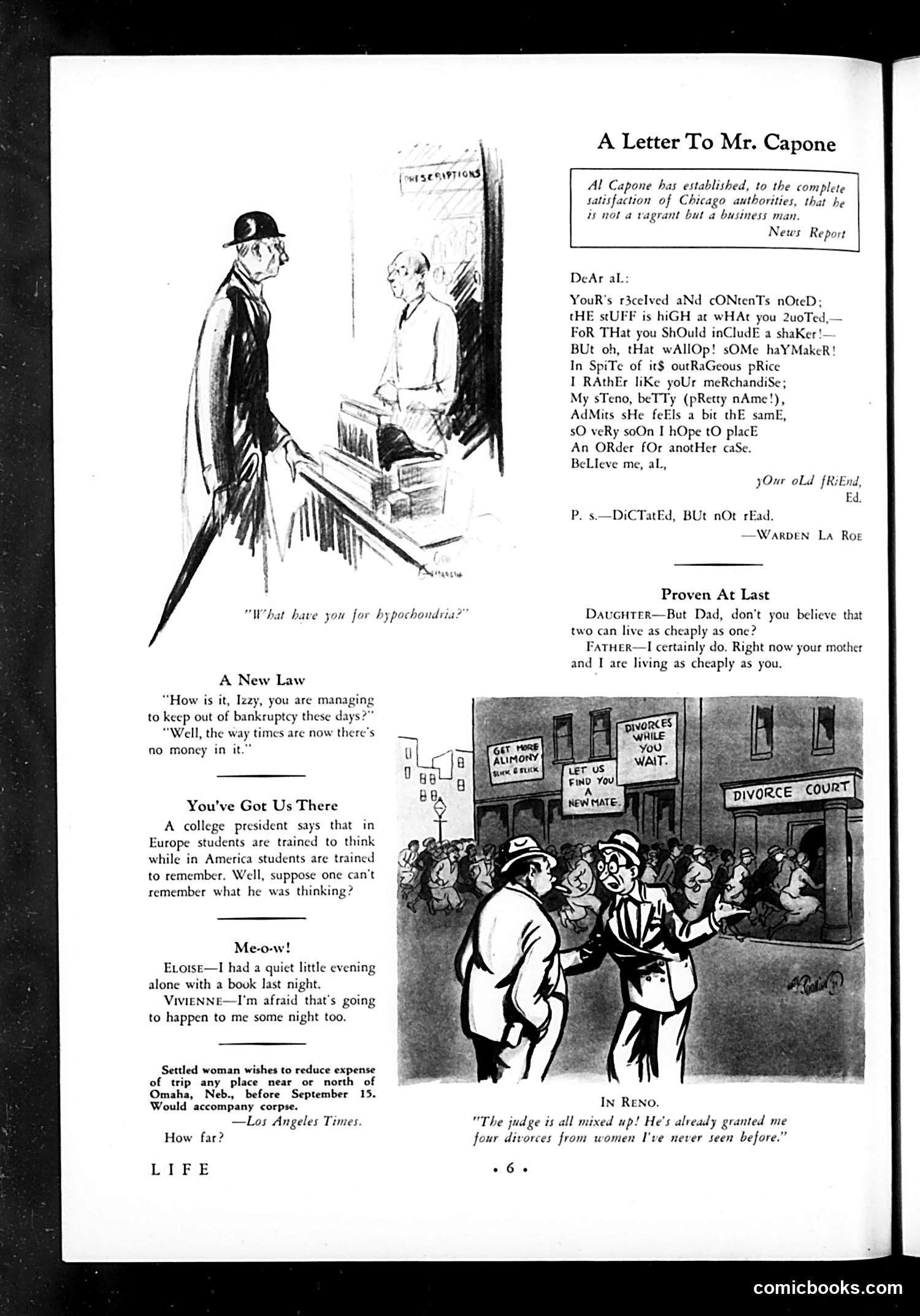
Explanation for Modern Readers This page from *Life* magazine contains several satirical pieces about contemporary social issues: "A Letter to Mr. Capone" is a mock-serious letter (with intentionally garbled text) addressing Al Capone, the famous Chicago mobster. The opening news quote establishes he's merely a "businessman," not a criminal—satirizing the authorities' public relations attempts during Prohibition era organized crime. "In Reno" cartoon satirizes Nevada's divorce courts, then famous for quick divorces. The crowded scene and judge's comment about granting "four divorces from women I've never seen before" jokes about how casually and frequently divorces were processed there—reflecting 1920s anxieties about marriage dissolution. The other brief jokes concern everyday concerns: managing household bankruptcy, memory, and loneliness.
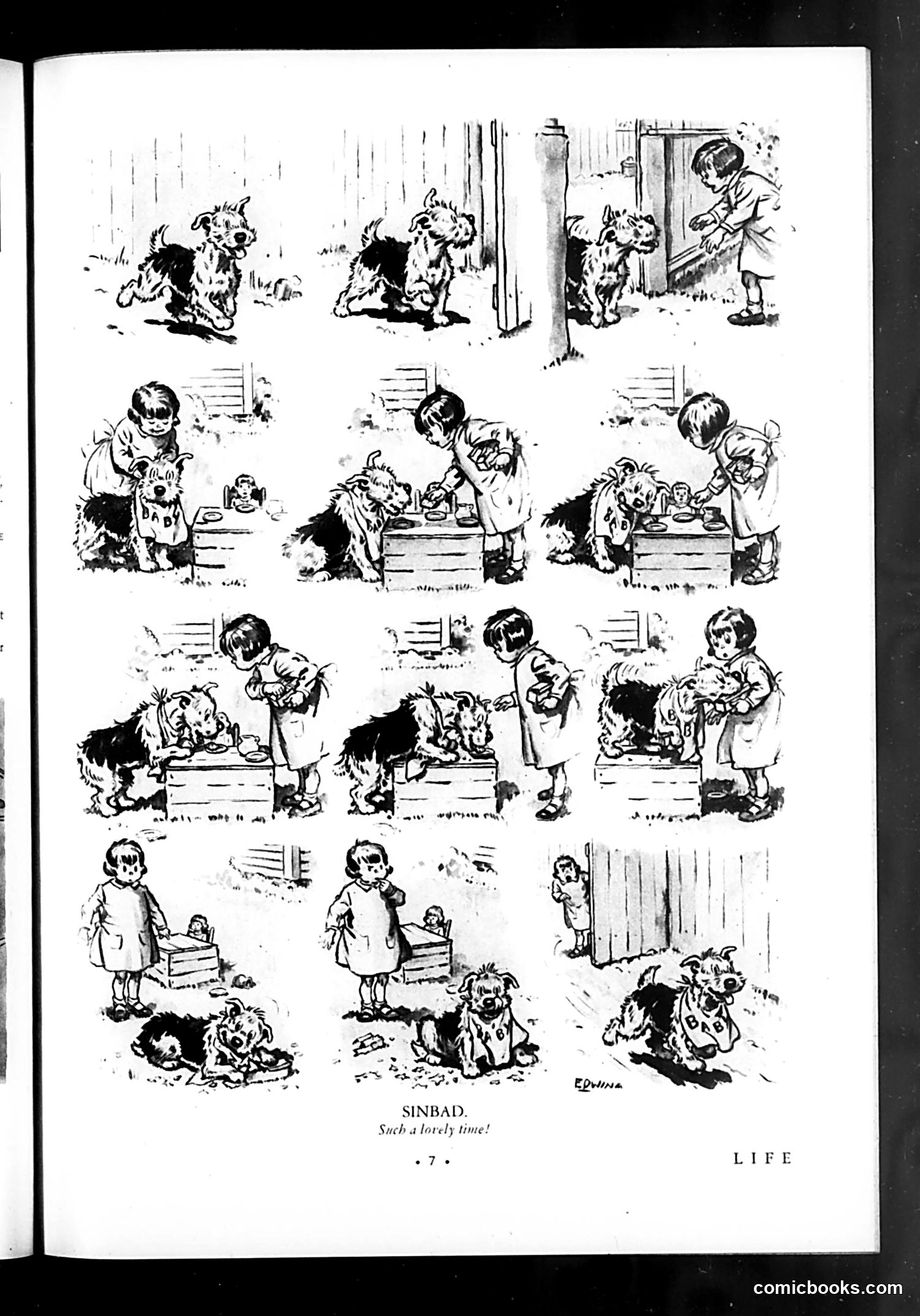
"Sinbad: Such a Lovely Time!" This is a comic strip sequence depicting a child's interactions with a shaggy dog named Sinbad. The narrative shows a domestic scene: the child initially plays with the dog outdoors, then attempts to feed and care for it indoors at a table. The subsequent panels show escalating chaos—the dog becomes increasingly messy and unruly during mealtime, creating disorder. The humor derives from the contrast between the child's earnest attempt at civilized interaction (feeding the dog "properly" at a table) and the dog's instinctive, chaotic behavior. The title's sarcastic subtitle—"Such a lovely time!"—underscores the irony: what should be orderly domestic activity devolves into mess and mayhem. This represents typical early 20th-century gentle humor about pet ownership's realities versus expectations.
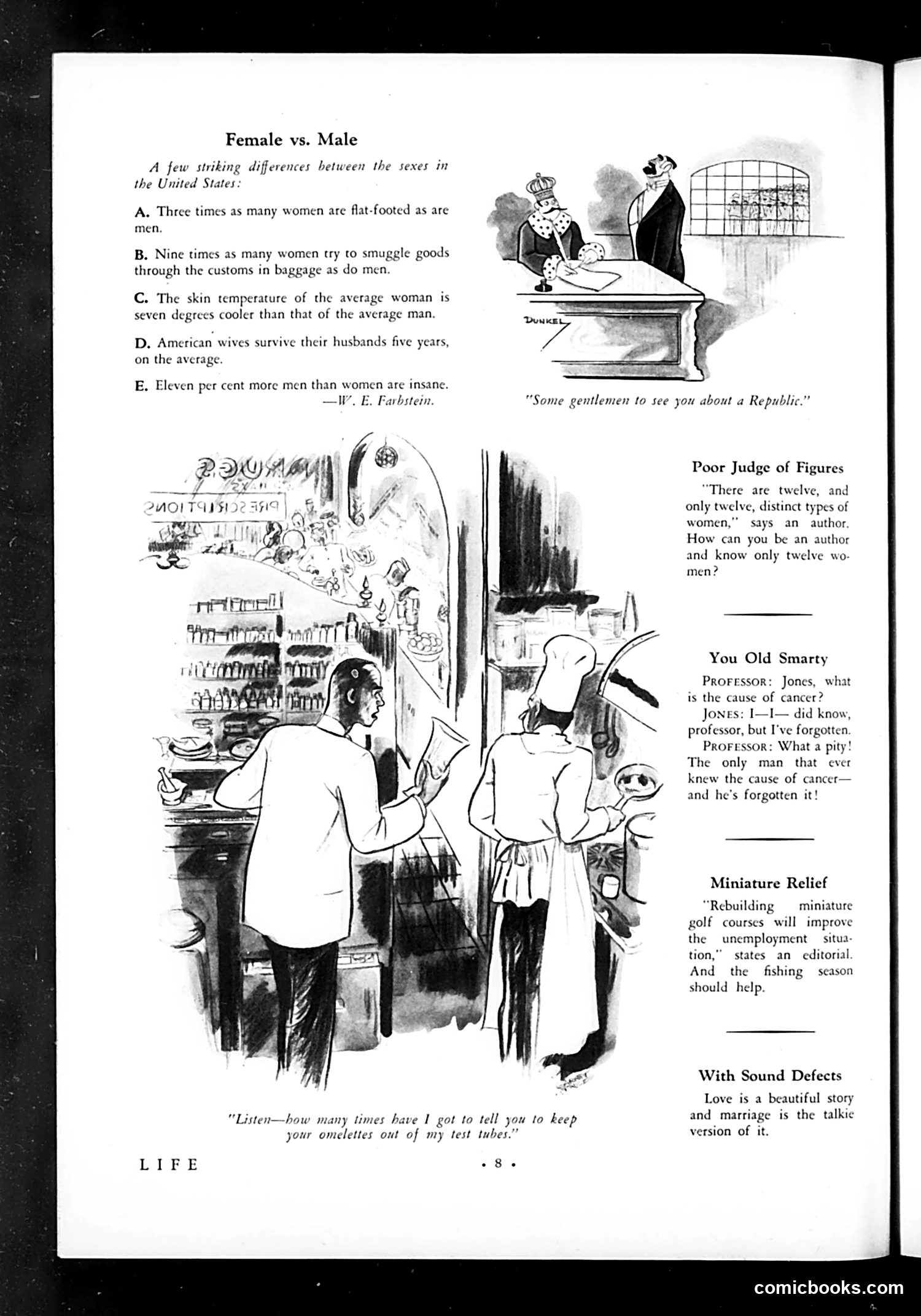
Analysis of Life Magazine Page This page contains satirical commentary on gender differences and several humorous anecdotes. "Female vs. Male" section lists exaggerated claims about sex differences (flat feet, smuggling goods, skin temperature, longevity, mental illness rates), attributed to "W. E. Eberstein." Main cartoon shows a woman at a customs counter telling an official about repeatedly being instructed to keep her "omelette out of my test tubes"—likely satirizing women in professional/scientific fields and the absurdity of mixing domestic and professional concerns. Additional jokes mock academic pretension ("Poor Judge of Figures," "You Old Smarty") and offer brief commentary on unemployment solutions and marriage. The page reflects early-20th-century satirical humor about women's evolving social roles, portraying gender confusion and professional aspirations as comedic fodder.
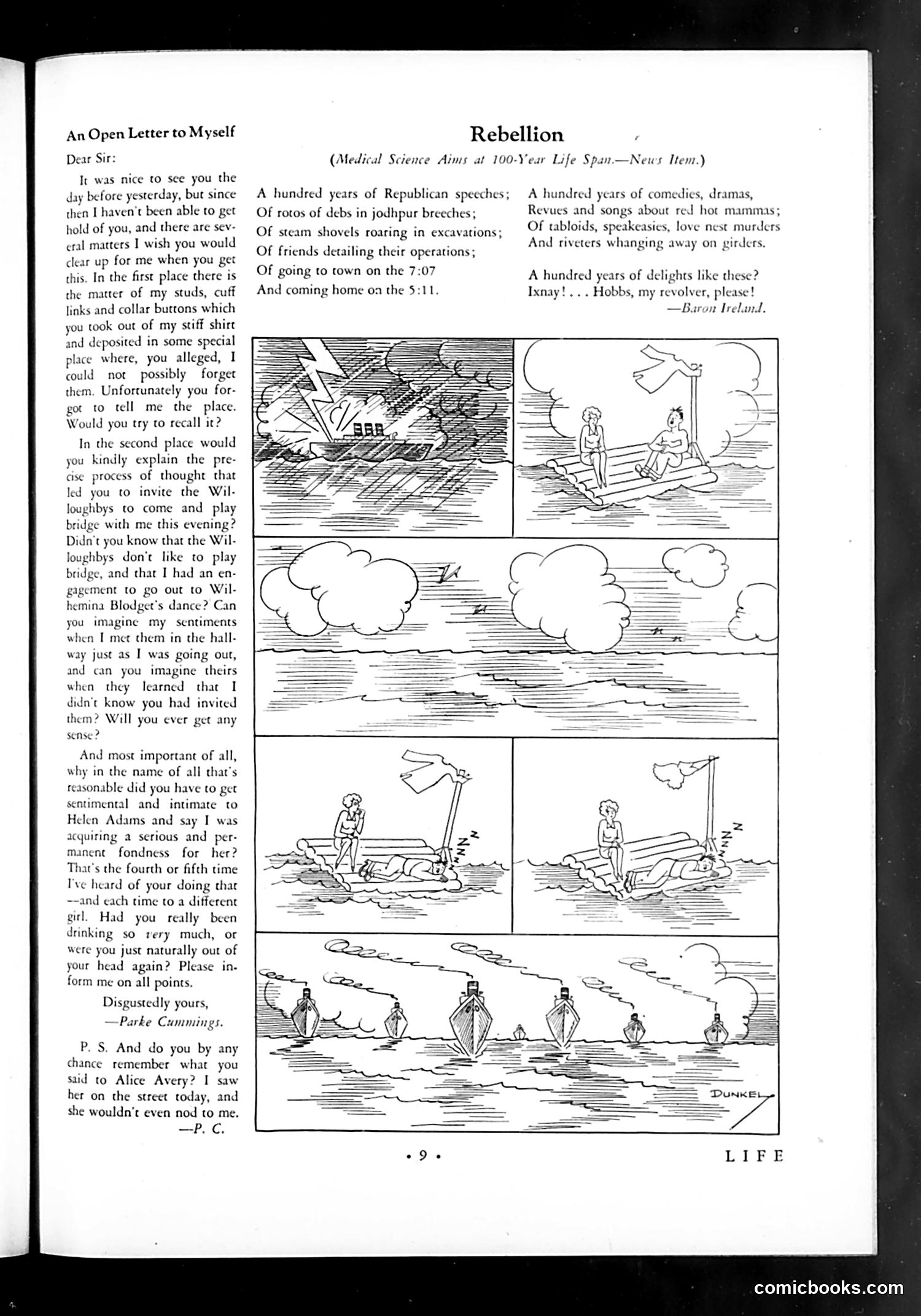
Analysis of "Rebellion" Page from Life Magazine This page contains two distinct pieces: "An Open Letter to Myself" (left column) is a humorous complaint from "Parke Cummings" to himself about social embarrassments—losing a shirt's cufflinks and studs, failing to remember where, and inviting the Willoughbys to an event they apparently dislike. The writer satirizes his own absentmindedness and social missteps in an exaggerated, self-deprecating tone. "Rebellion" (right side) is a visual satire about medical science's 100-year progress. It contrasts future aspirations (speeches, excavations, operations, songs, tableaux, and plays) with present reality. The comic strip shows people attempting various activities—working, resting, boating—that humorously fail or backfire, suggesting that despite scientific advancement, human endeavor remains fundamentally chaotic and unsuccessful. The satire mocks optimism about progress.
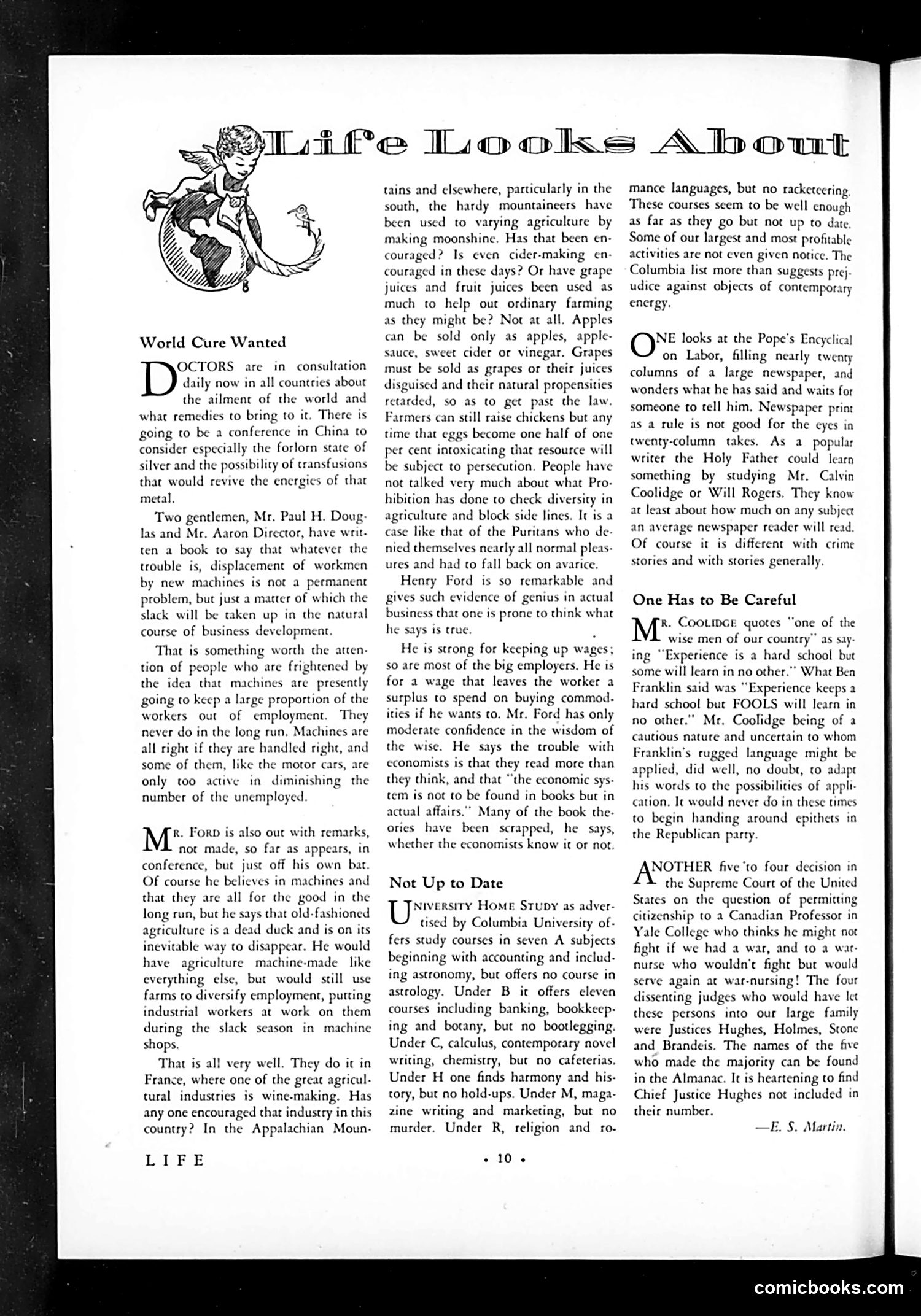
Analysis of "Life Looks About" - Page 10 This page contains three editorial essays rather than political cartoons. The header illustration shows a cherub or cupid figure, decorative rather than satirical. The essays discuss: 1. "World Cure Wanted" - Commentary on labor displacement caused by new machinery, referencing Henry Ford's industrial methods and wage policies 2. "Not Up to Date" - Critique of Columbia University's home study courses, which lack modern subjects like bookkeeping and contemporary novel writing 3. "One Has to Be Careful" - Discussion of newspaper editorializing, quoting Mrs. Coolidge (wife of President Calvin Coolidge) and Benjamin Franklin on experience versus foolishness The final piece mentions a Supreme Court decision regarding Canadian citizenship and Yale College, with Chief Justice Hughes notably absent from the decision. These are satirical commentaries on contemporary American institutions and social issues of the 1920s era.
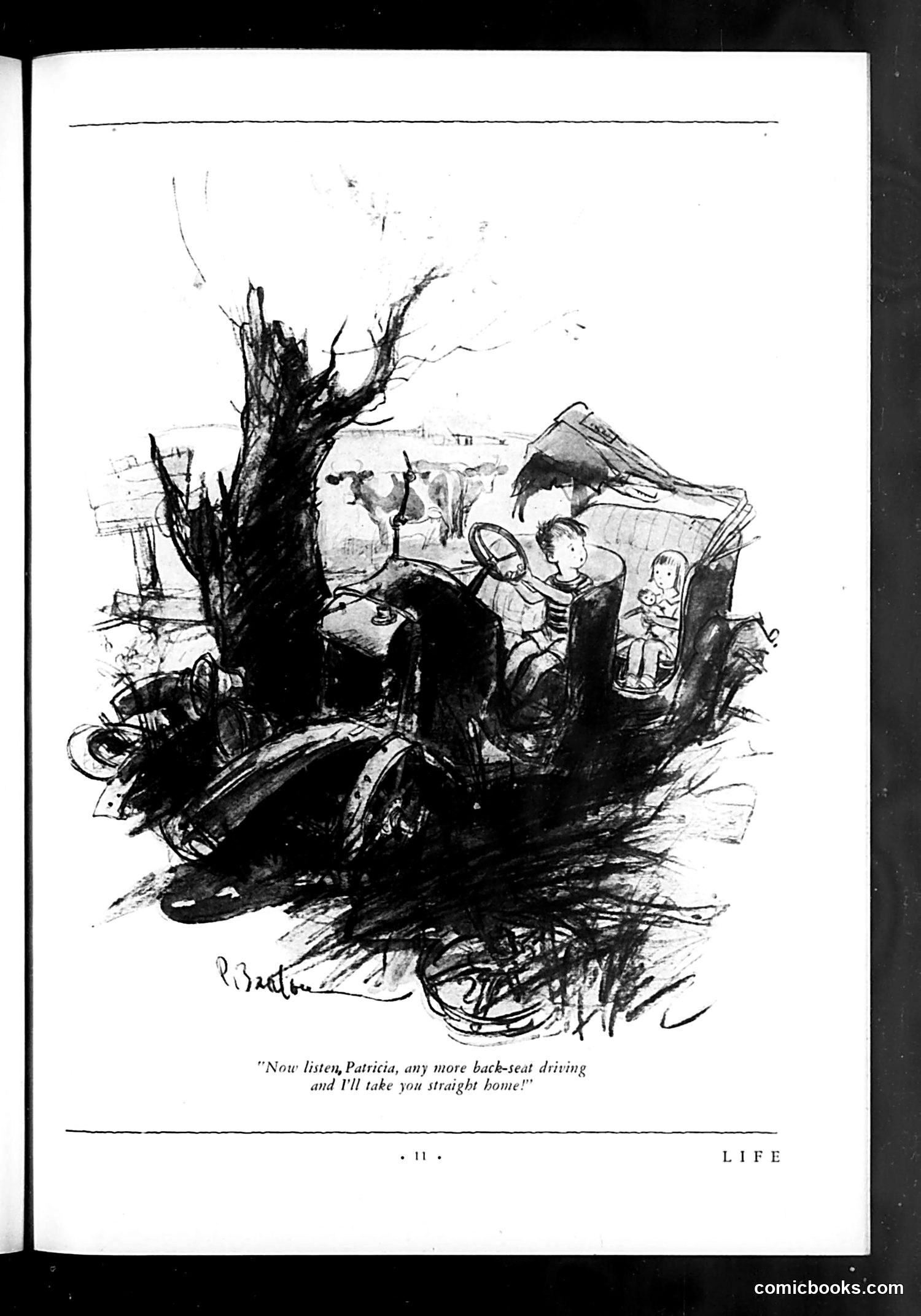
Cartoon Analysis This is a humorous domestic scene from *Life* magazine showing a chaotic automobile ride. A man drives recklessly while a woman (Patricia, named in the caption) sits anxiously in the back seat alongside children and what appears to be a dog. The car is drawn in an exaggerated, disheveled style suggesting wild driving. The caption reads: "Now listen, Patricia, any more back-seat driving and I'll take you straight home!" The joke plays on the common complaint about "backseat drivers"—passengers who criticize the driver. Here, the man ironically threatens to take her home *while* driving so dangerously that the vehicle itself appears barely under control. The satire targets male drivers' defensiveness about criticism and their tendency to blame passengers rather than acknowledge poor driving habits. It's a commentary on 1920s-era automobile culture and gender dynamics.
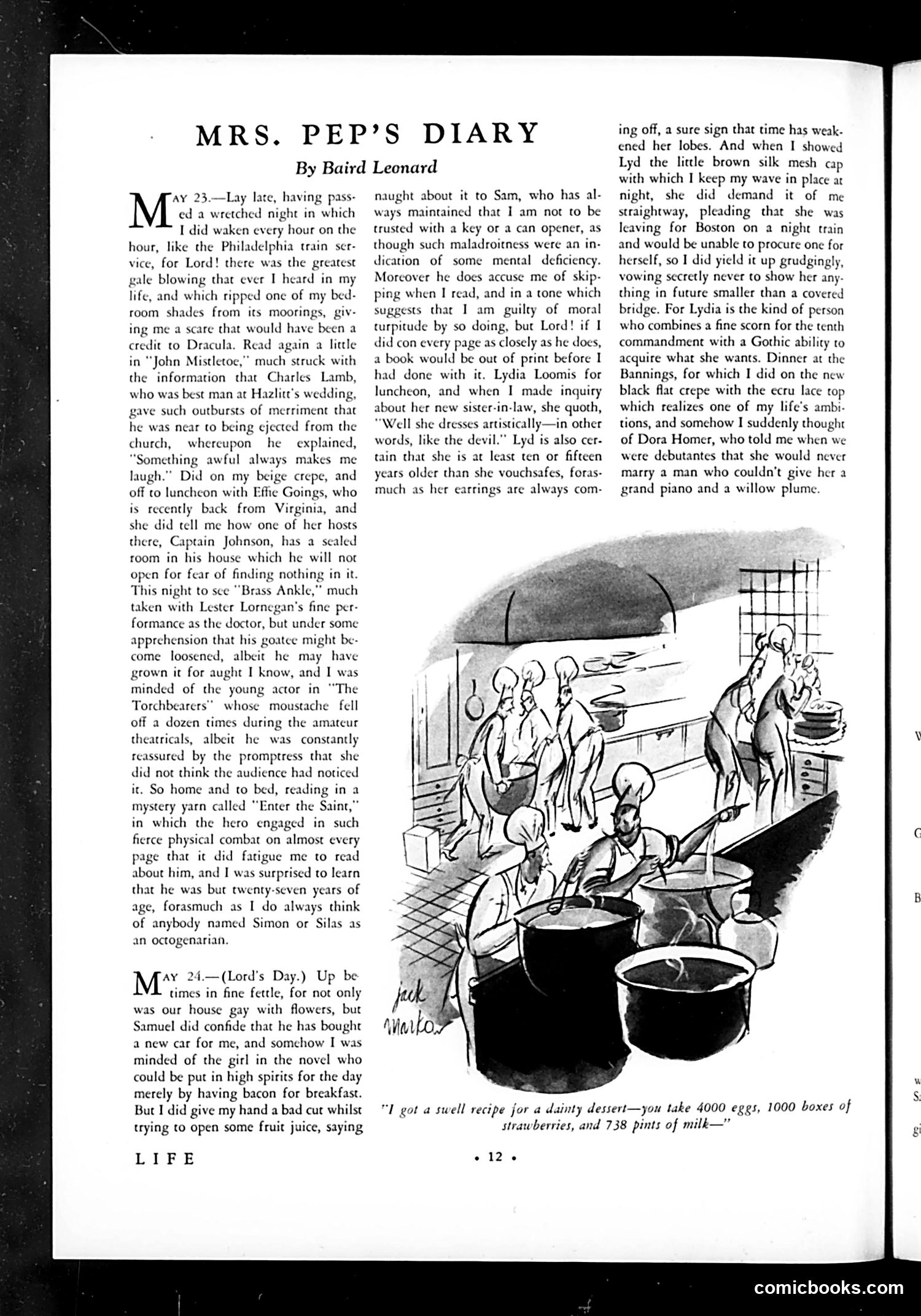
Analysis of "Mrs. Pep's Diary" Page This is a humorous diary column by Baird Leonard featuring the domestic observations of Mrs. Pep. The accompanying illustration depicts a kitchen scene where multiple figures are cooking together, with enormous cooking vessels and ingredients scattered about. The caption reads: "I got a swell recipe for a dainty dessert—you take 4000 eggs, 1000 boxes of straw berries, and 738 pints of milk—" The satire targets wartime food rationing and scarcity. Mrs. Pep's absurdly impossible recipe (requiring thousands of eggs and massive quantities of ingredients) mocks the gap between pre-war abundance and current restrictions. The crowded kitchen and enormous pots underscore how impractical such recipes had become. This reflects Americans' frustrations with Depression-era and WWII-era food shortages and rationing constraints.
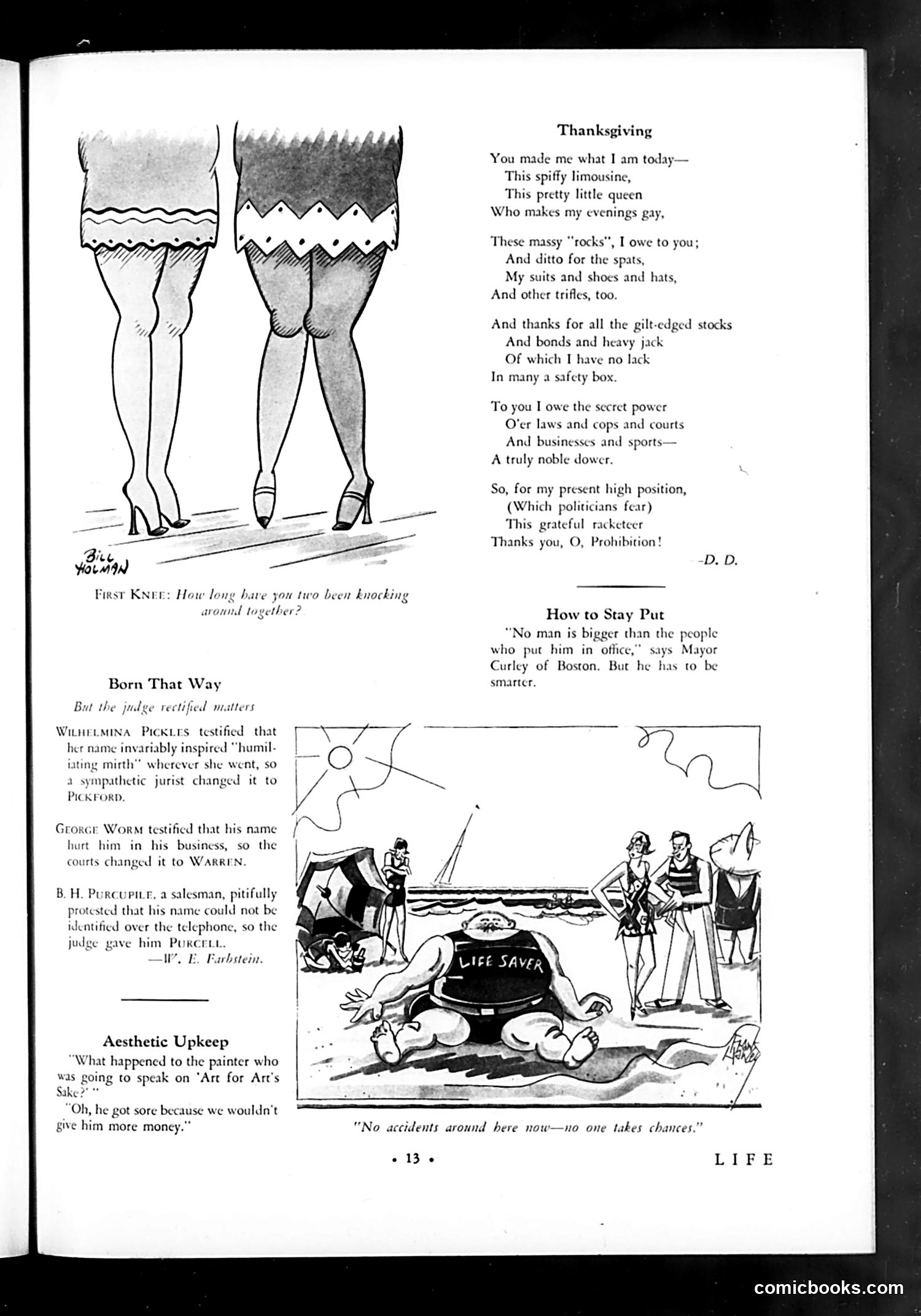
Life Magazine Page Analysis This page contains several humorous pieces satirizing American society, likely from the Prohibition era (given the "Thanks you, O, Prohibition!" reference). The "Thanksgiving" poem thanks Prohibition for enabling the speaker's elevated social status—suggesting that bootlegging or illegal alcohol trafficking has made them wealthy and powerful enough to influence "laws and cops and courts." "Born That Way" presents anecdotes about people whose embarrassing names prompted legal changes (Pickles→Pickford, Worm→Warren, Purcell→Earnstein), satirizing vanity and social climbing. The beach cartoon depicts a muscular "Life Saver" preventing accidents through extreme vigilance—a visual joke about over-protective authority. "Aesthetic Upkeep" jokes about an artist demanding more money after rejecting a speaking engagement. These pieces mock Prohibition's corruption, social pretension, and bureaucratic excess.
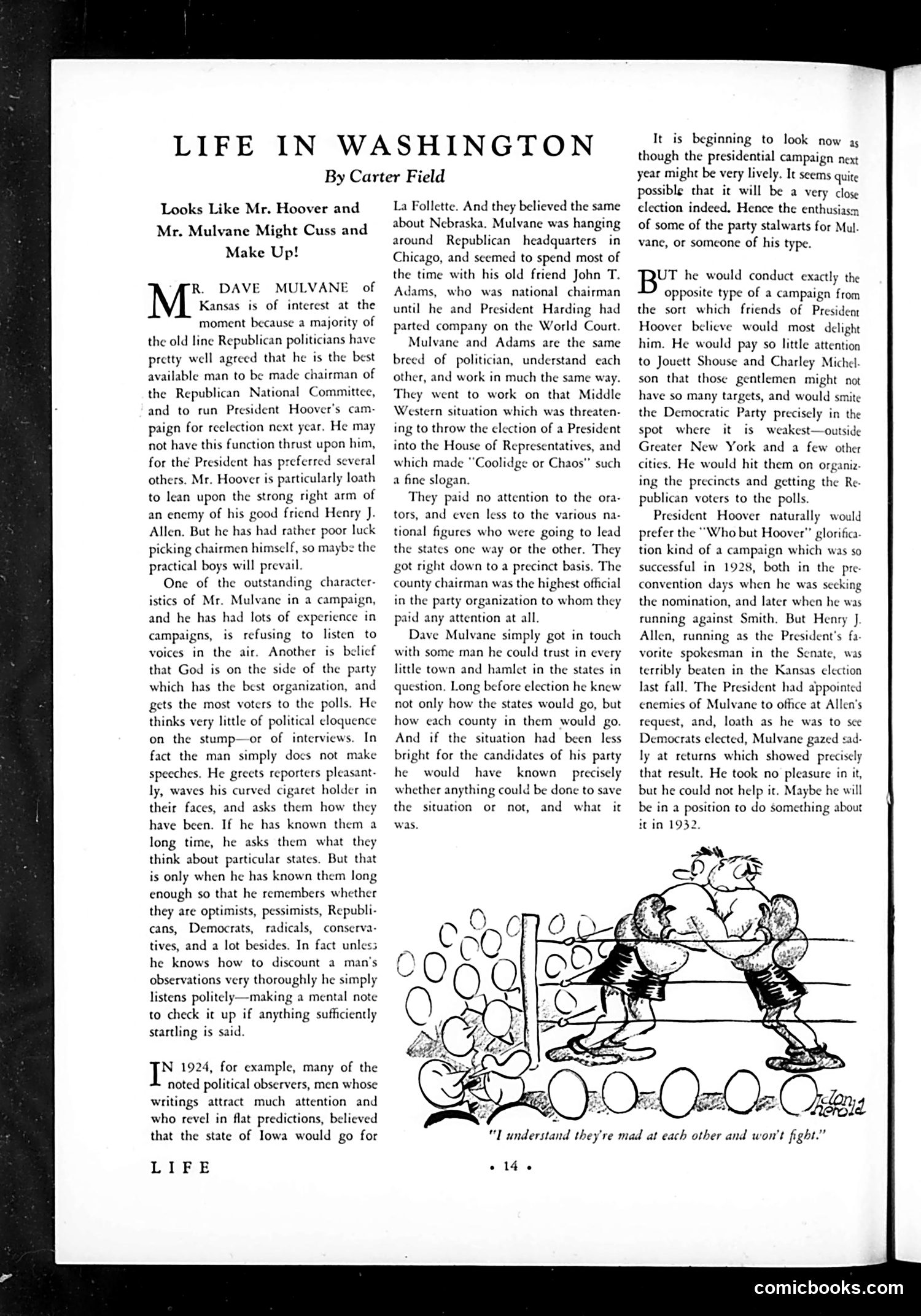
Political Cartoon Analysis: "Life in Washington" by Carter Field This page discusses Dave Mulvane of Kansas, a Republican operative whom Field suggests might become Republican National Committee chairman. The article contrasts Mulvane's pragmatic, ground-level political approach with President Hoover's preferred style. The cartoon at bottom depicts two figures in a tug-of-war over a large sack labeled with circular shapes (likely representing votes or political power). The caption reads: "I understand they're mad at each other and won't fight." This satirizes Republican Party internal conflict—the tension between different factions competing for control and resources. The paradox in the caption (anger without confrontation) mocks the party's inability or unwillingness to openly address their disagreements, suggesting dysfunction masked by civility. This appears set during 1932 election-year politics.
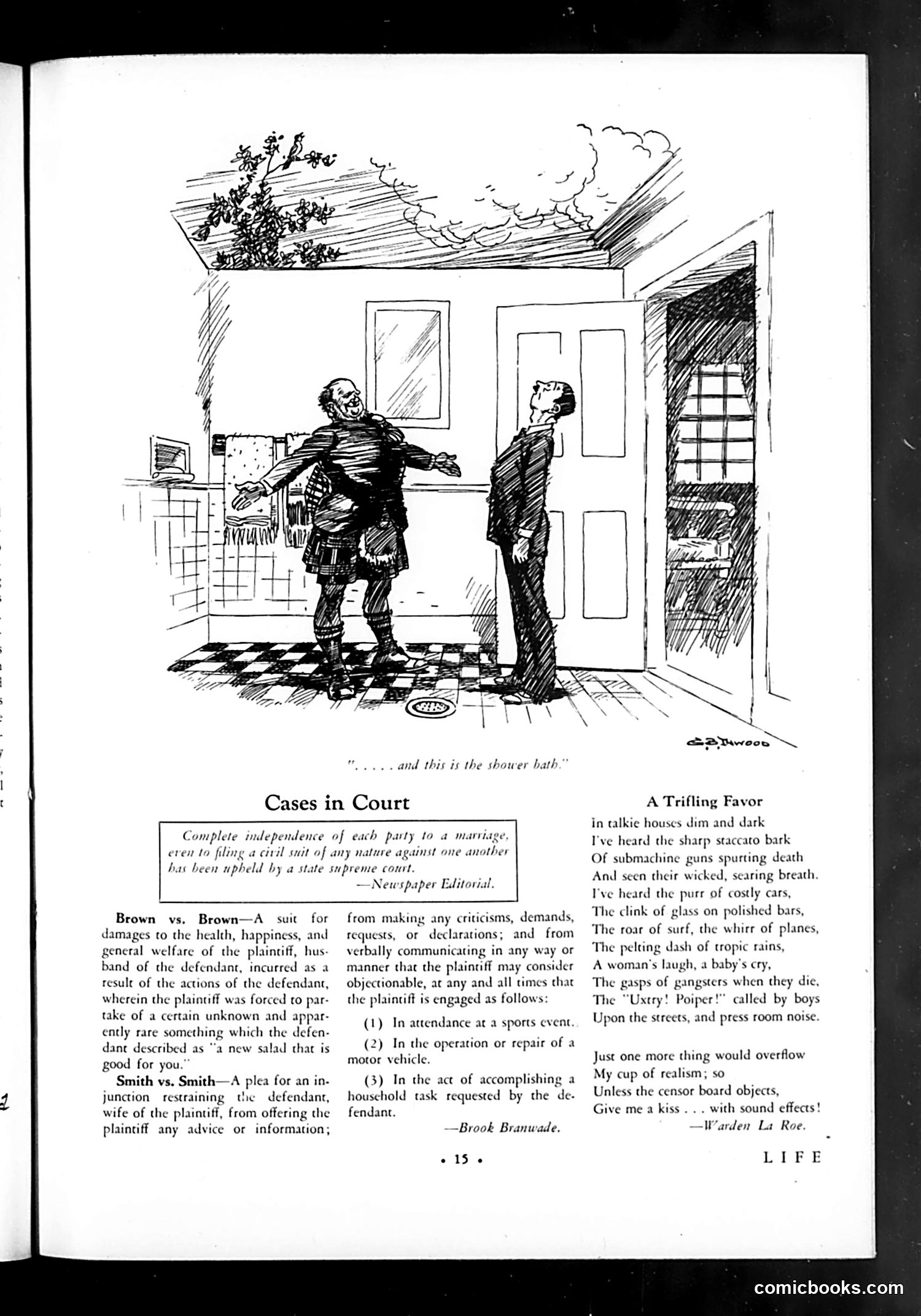
Analysis of This Life Magazine Page The cartoon depicts two men in what appears to be a bathroom or domestic space, with one gesturing broadly while saying "and this is the shower bath." The humor seems to rest on the absurdity of giving a formal tour of an ordinary household fixture—a contrast between grandiose presentation and mundane subject matter. Below, the "Cases in Court" section satirizes marital litigation, specifically cases where spouses sue each other over minor domestic matters. The cases referenced involve disputes over attendance at sporting events, vehicle repairs, and household tasks—trivial disagreements blown into legal proceedings. The editorial and poetry selections reinforce themes about modern life's noise and sensory overload, suggesting satire of contemporary urban domesticity and litigation culture.
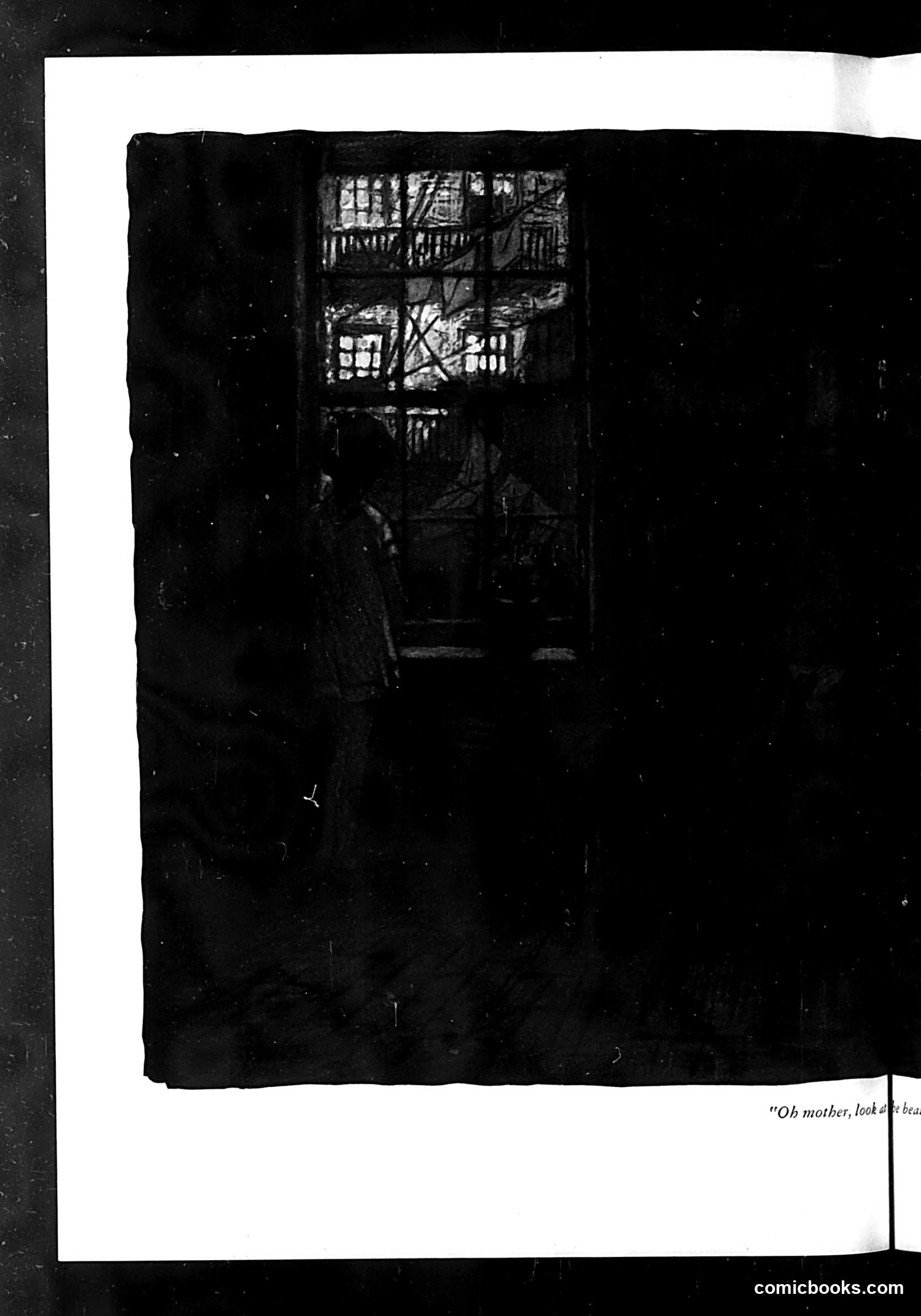
Analysis This page appears to be from a satirical magazine and shows a dark, atmospheric illustration of an interior scene viewed through a doorway or window. The image is predominantly black with high contrast, depicting what looks like a room with architectural details visible through glass panes. The partial caption at bottom right reads "Oh mother, look at bea..." - the text is cut off, making the complete meaning unclear. Without the full caption or additional context, I cannot definitively identify what political or social commentary this cartoon intends. The dramatic lighting and indoor domestic setting suggest it may be commentary on American home life or a specific social situation, but the truncated text prevents me from determining the actual subject or satirical point with confidence.
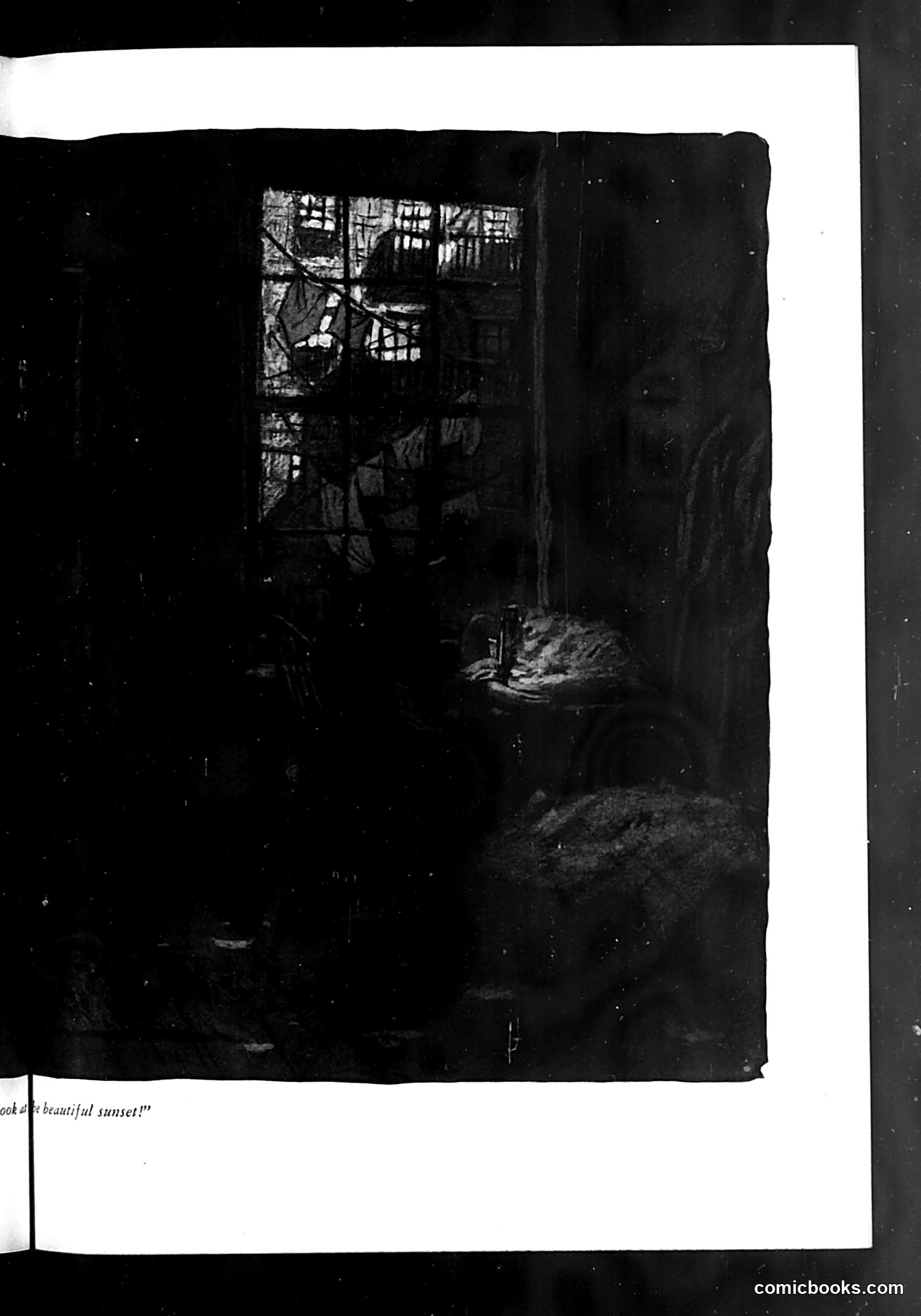
Analysis This appears to be a black and white photograph or illustration rather than a political cartoon. The image shows a darkened interior space—possibly a room or cellar—with a window visible in the background showing bare tree branches. There's debris or rubble visible on the floor. The partial text at the bottom reads "...of a beautiful sunset!" though the beginning is cut off, suggesting this may be an ironic caption—contrasting the quoted optimistic phrase with the dark, deteriorated condition shown in the photograph. Without additional context or complete text, the specific satirical point is unclear. This could be commentary on urban decay, housing conditions, or wartime destruction, but I cannot definitively identify the intended target or message from the image alone.
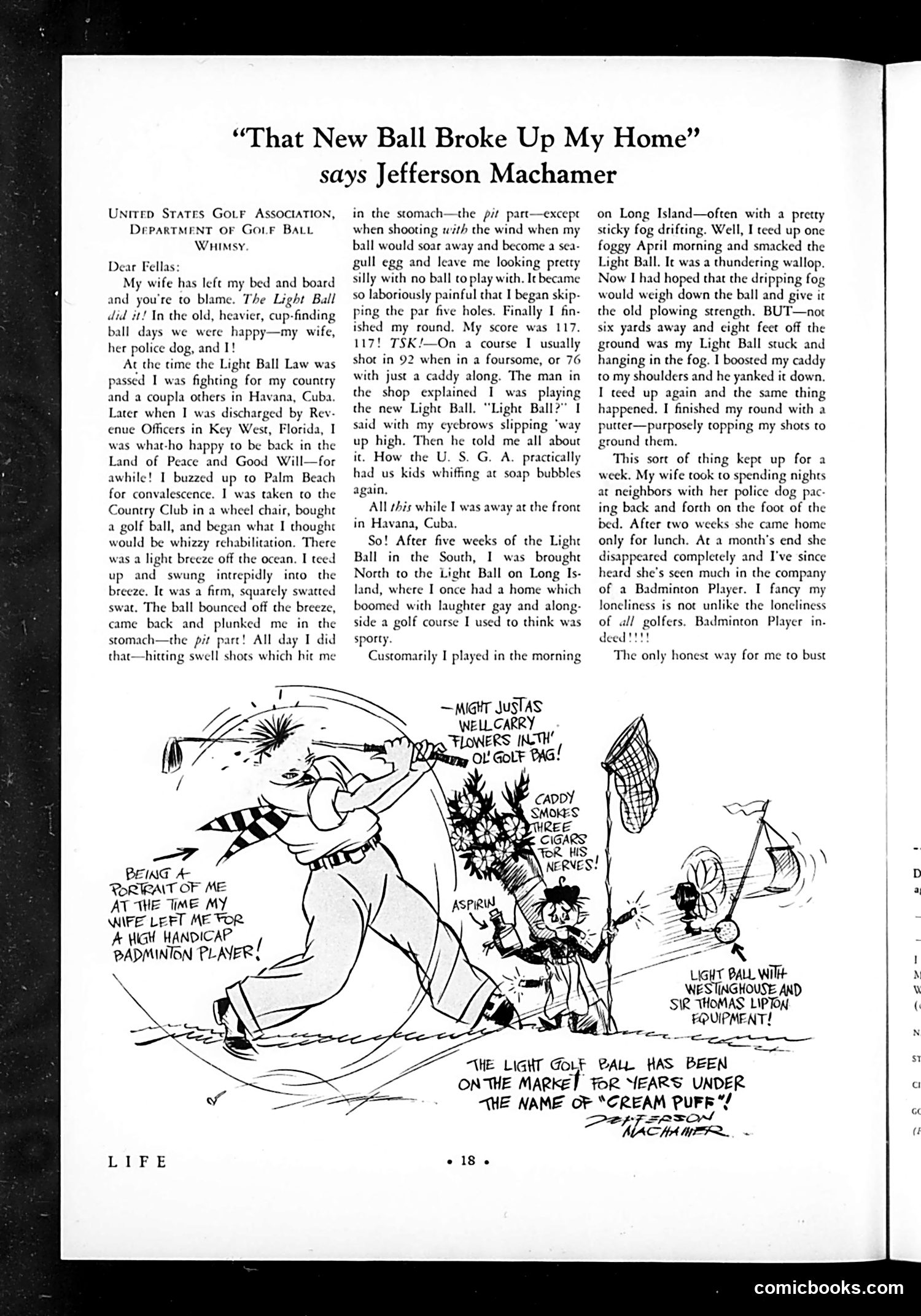
"That New Ball Broke Up My Home" - Jefferson Machamer This is a humorous complaint letter to the United States Golf Association's Department of Golf Ball Whimsy. Jefferson Machamer describes how a new "Light Ball" golf equipment caused domestic chaos: his wife left him because he became obsessed with the golf ball, played constantly, and neglected home responsibilities. The accompanying cartoon depicts Machamer as a frazzled golfer surrounded by chaos—flowers trampled, a caddy smoking cigars nervously, and equipment scattered—while his wife packs to leave. The joke satirizes golf obsession and how sporting equipment fads can disrupt family life. The "Light Ball" appears to be an actual product marketed under the brand name "Cream Puff," which the text notes was gaining market popularity at the time.
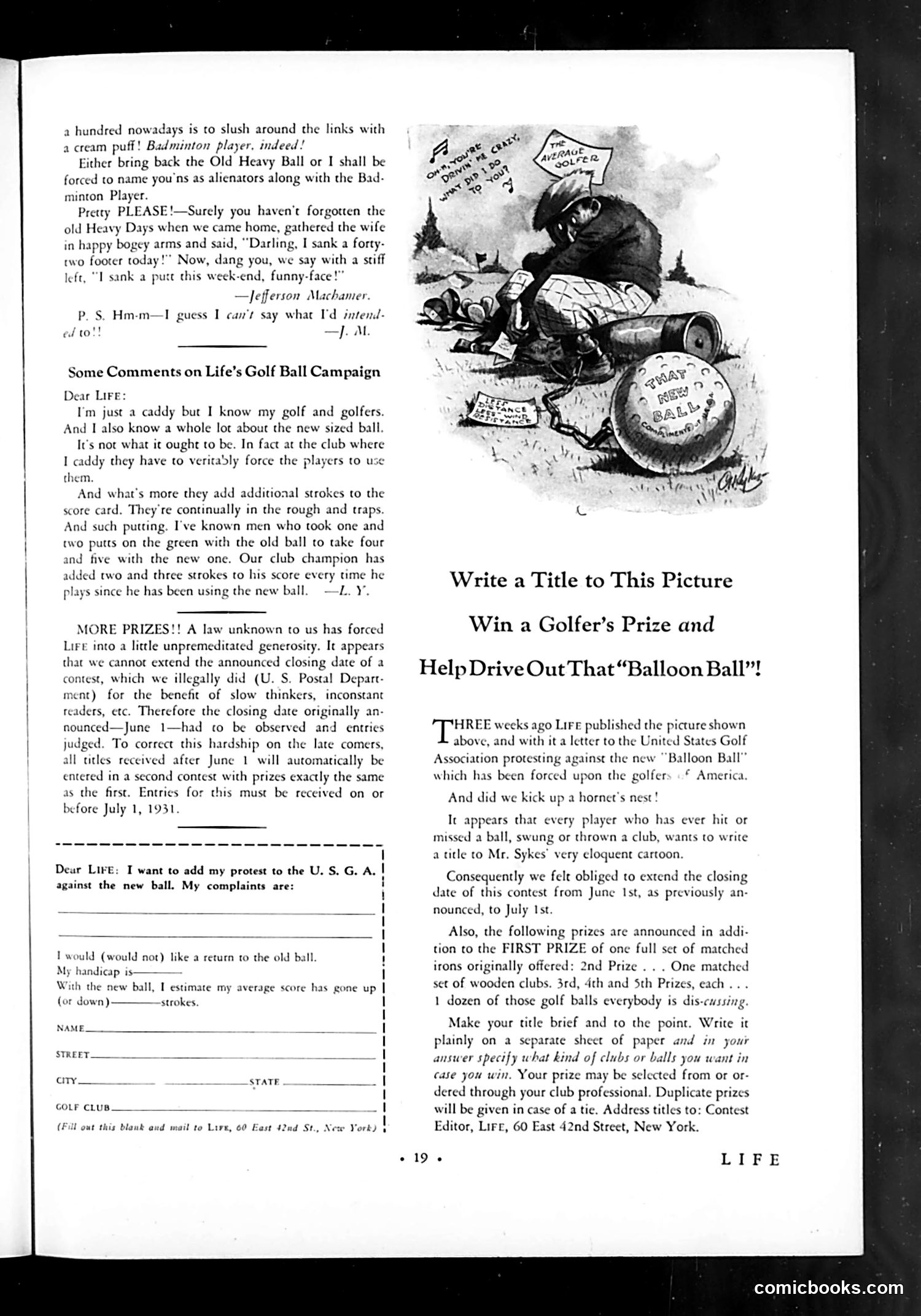
Golf Ball Satire - Life Magazine Contest This page satirizes the newly introduced "Balloon Ball" in golf—a larger, more buoyant ball that the U.S. Golf Association had authorized. The cartoon depicts golf equipment and balls literally inflated like balloons, mocking how the new ball fundamentally changed the game. The satire's point: traditional golfers complained the larger ball was too forgiving, requiring less skill and adding unwanted strokes to scores. Letters from readers protest the change, arguing it altered the sport unfairly. Life magazine leverages this controversy by running a contest: readers write titles for the cartoon and protest the "Balloon Ball," with prizes including golf clubs and balls. It's both satire and audience engagement—turning public outcry into reader participation.
"The Smiling Lieutenant" Review - Life Magazine This is a film review by Harry Evans of the 1931 movie "The Smiling Lieutenant," directed by Ernst Lubitsch and starring Maurice Chevalier. Evans praises the collaboration between German director Lubitsch and French actor Chevalier, calling them the highest-paid team in Hollywood. He celebrates their ability to make "really good American all-talking, all-singing" movies—significant praise given that talking pictures were still relatively new technology. The review highlights Lubitsch's sophisticated approach to integrating music into narrative (avoiding obvious song cues and sentimental lyrics) and Chevalier's dramatic abilities beyond his famous charm and singing. Evans notes that supporting actresses Claudette Colbert and Miriam Hopkins, while not strong singers, deliver effective comic timing. For modern readers: This represents early sound-era Hollywood innovation, when directors were still learning how to blend dialogue, music, and narrative coherently.
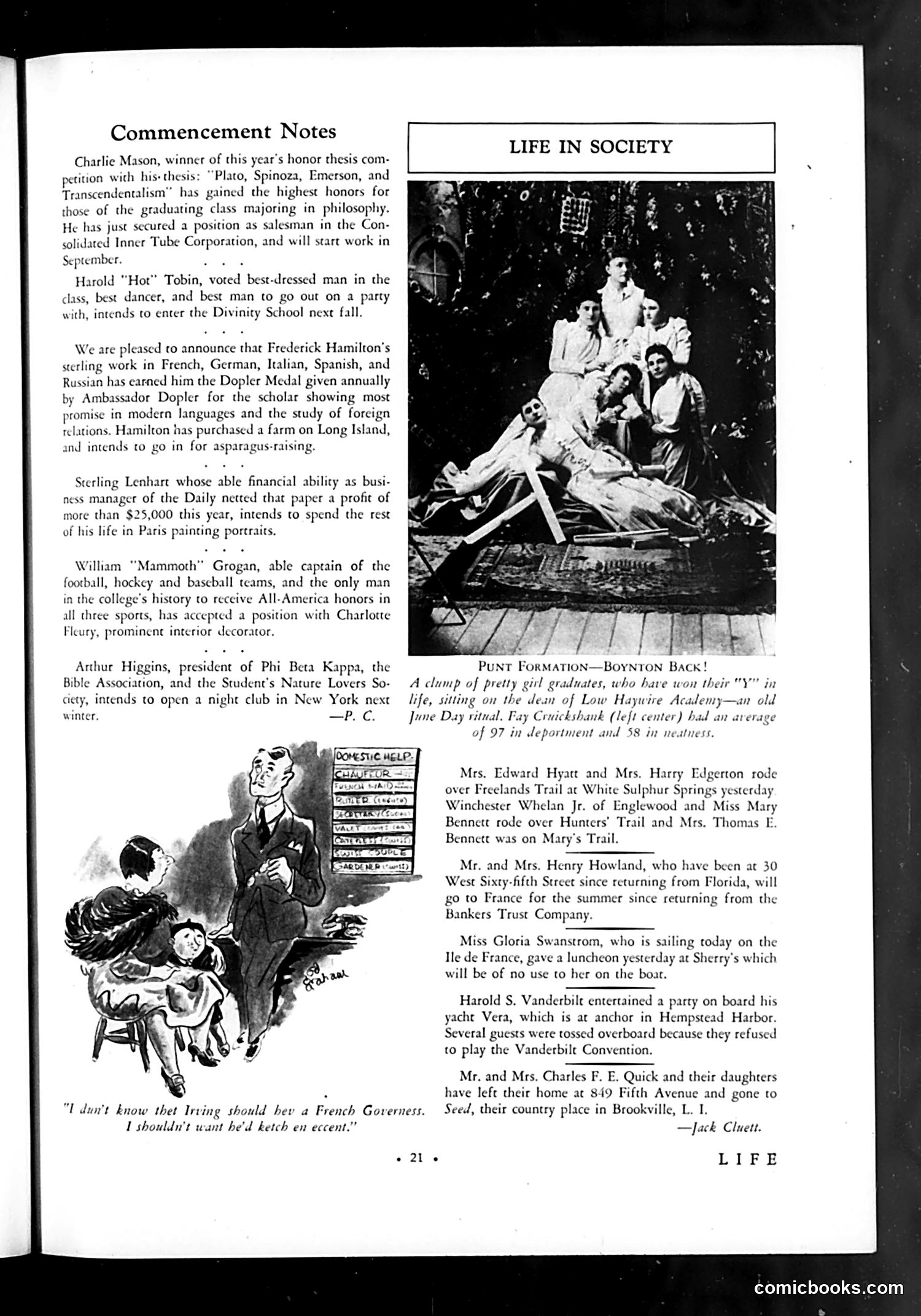
Cartoon Analysis: "French Governess" The cartoon satirizes class anxiety among American wealthy families. A working-class man (indicated by his dialect: "dun't know," "hev," "ketch en eccent") expresses concern that hiring a French governess for children risks them adopting a French accent—a social embarrassment. The joke targets two audiences: the elite who hire European staff for status, and working-class observers who view such pretension as ridiculous. The man's own thick accent makes his worry ironic; he fears foreign linguistic "contamination" while speaking in a pronounced regional dialect himself. This reflects 1920s American class tensions: newly wealthy industrialists (like those mentioned in the "Life in Society" section) often hired European servants to signal sophistication, while traditional Americans viewed this as affected snobbery. The satire mocks both the pretension of hiring French staff and the anxiety about cultural authenticity it provokes.
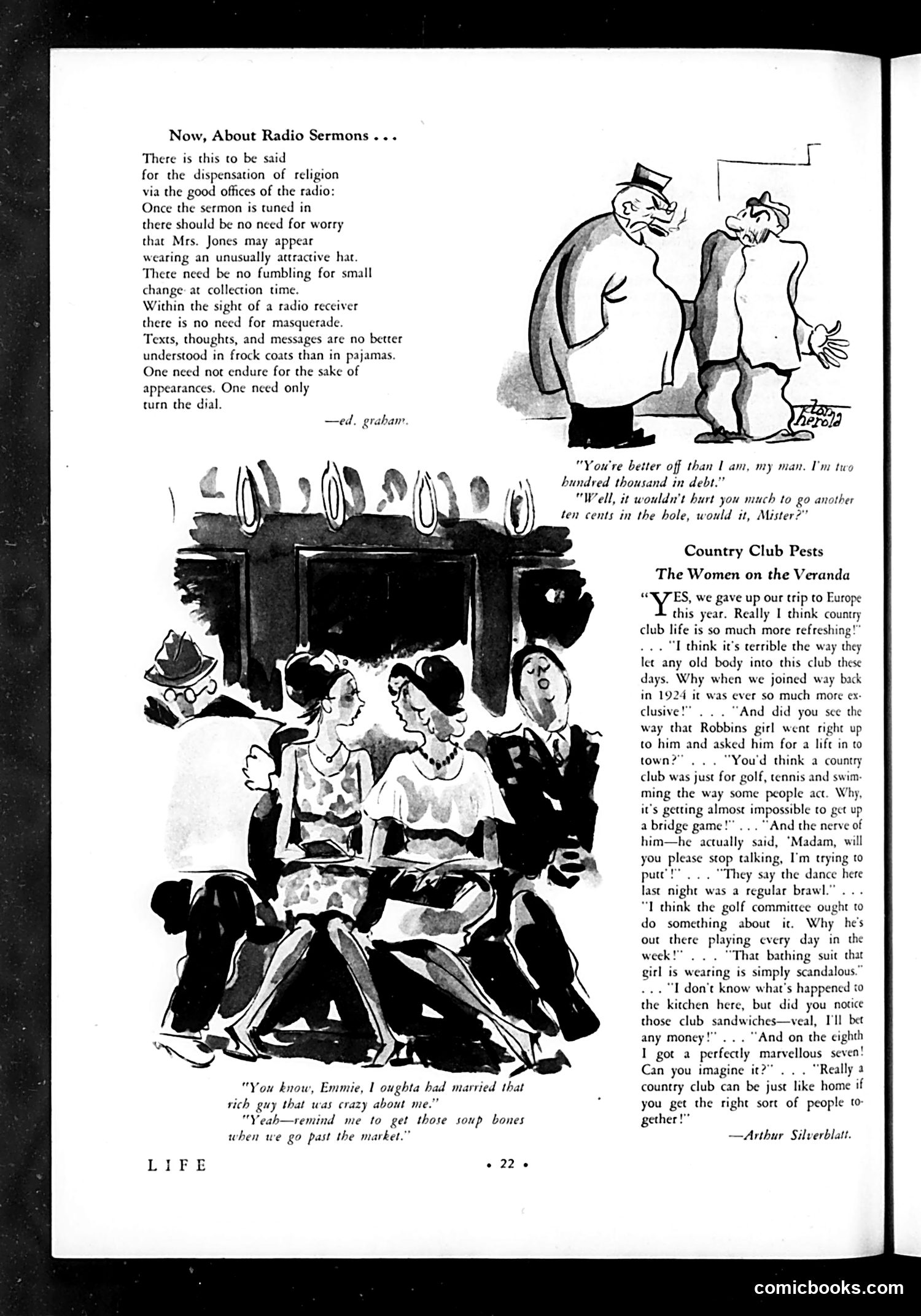
Explanation for Modern Readers This Life magazine page contains three satirical pieces mocking American social pretension and leisure culture. "Radio Sermons" jokes that listening to sermons on the radio is superior to attending church in person because you avoid social performance: no need to wear fancy hats to impress others, no collection plate pressure, and you can listen in pajamas. The satire targets both religious hypocrisy and status-conscious church attendance. The soup bones cartoon depicts working-class people; one man brags about rejecting a wealthy suitor, but his companion dismissively redirects him to practical concerns—a sharp comment on economic realities versus romantic fantasy. "Country Club Pests" mocks upper-middle-class women's snobbery. They boast about exclusivity while complaining the club now admits "any old body," gossip cattily about members' behavior and appearance, and obsess over trivial social matters. The satire exposes how country clubs function as spaces for performative status and judgment rather than genuine leisure or community. All three pieces target 1920s-era American social climbing and the gap between public propriety and private reality.
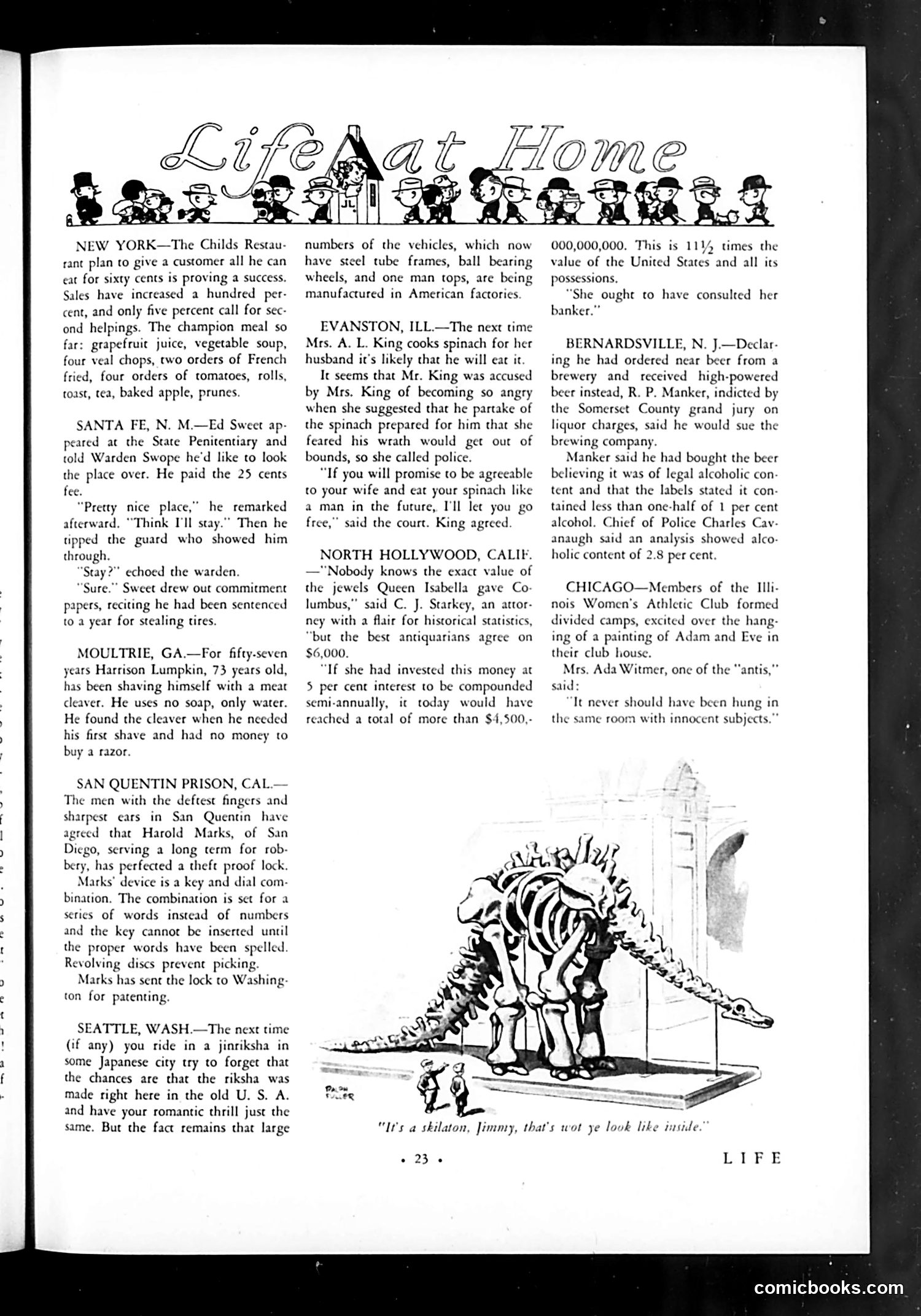
"Life at Home" Page Analysis This page collects humorous anecdotes from across America, showcasing eccentric or absurd real-life incidents. Key items include: The Childs Restaurant story: A budget dining chain's "all-you-can-eat-for-60-cents" promotion succeeds, revealing Americans' appetite (literally) during economically tight times. The Santa Fe prison anecdote: Dark humor about a man voluntarily returning to prison after release, suggesting incarceration was preferable to freedom. The Evanston spinach incident: Satirizes domestic discord and legal overreach—a wife calls police over her husband's refusal to eat vegetables, highlighting both marital tension and absurd court intervention. The Columbus jewels calculation: An attorney's mathematical exercise demonstrating compound interest's power, suggesting Queen Isabella's generosity to Columbus had astronomic modern value—a playful commentary on wealth accumulation. The "near beer" deception: Post-Prohibition era irony—a man seeks legal near-beer but receives actual beer, revealing brewing-industry deception. The cartoonish header illustration (appearing to be a dinosaur skeleton) visually reinforces the page's whimsical, antiquated tone. Overall, the page satirizes American earnestness, legal absurdity, and contemporary economic anxieties.
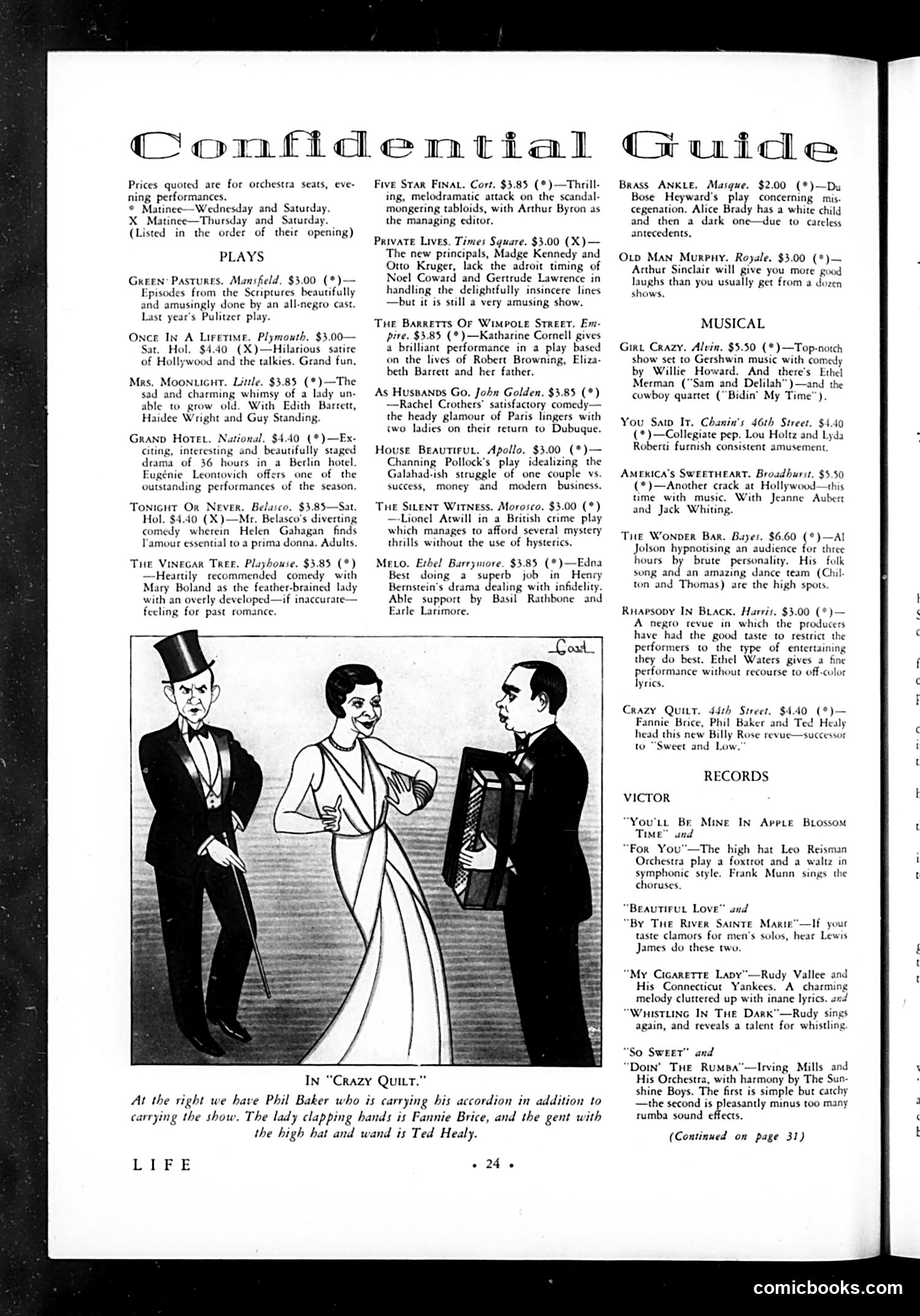
Explanation for Modern Readers This page is a theater guide from Life magazine, listing Broadway shows with plot summaries and ticket prices. The main illustration shows three figures from the musical "Crazy Quilt"—Phil Baker (left, with accordion), Fannie Brice (center), and Ted Healy (right). The satirical content reflects 1930s attitudes: several play descriptions use now-offensive language. "Green Pastures" is noted as an "all-negro cast" production (it was a Pulitzer winner). "Brass Ankle" explicitly discusses miscegenation as a plot point—treated as scandalous drama material. "Rhapsody in Black" is identified only as "A negro revue" (text cuts off). The theatrical reviews themselves are straightforward entertainment criticism, but the casual language around race reveals the era's segregation and how plays dealing with Black characters or performers were marketed as exotic or sensational rather than as standard theater.
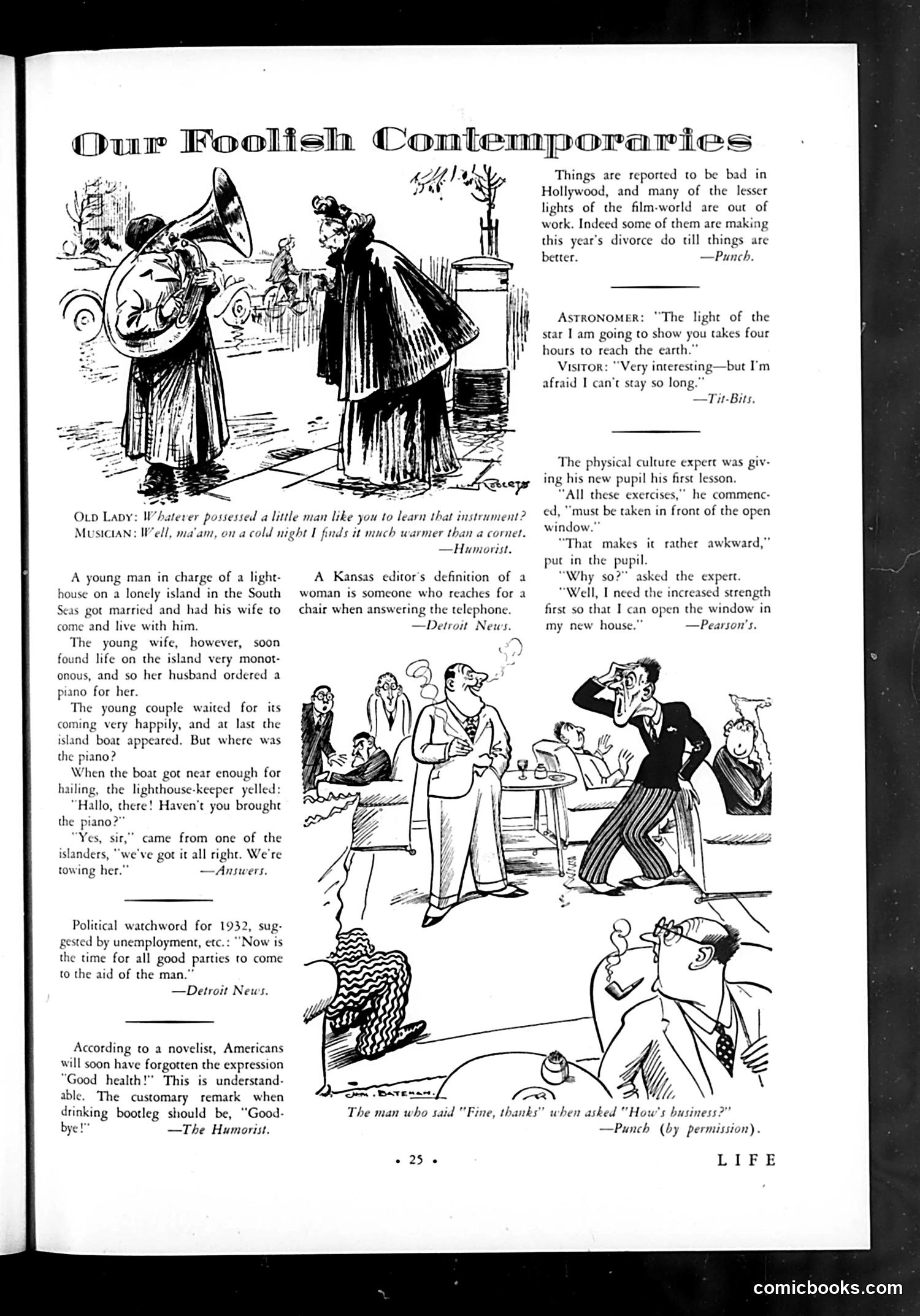
"Our Foolish Contemporaries" - Life Magazine Humor Page This is a humor compilation page featuring short jokes and anecdotes from various sources, satirizing everyday foolishness. Key items include: The lighthouse piano story: Mocks literal-mindedness—a husband orders a piano for his isolated island wife; when it arrives by boat, the islanders have literally towed the wife herself, misunderstanding "piano" as a person's name. The 1932 political quip: A Depression-era joke suggesting political parties should prioritize helping unemployed workers ("come to the aid of the man"). The bootleg whiskey joke: References Prohibition-era illegal alcohol; suggests Americans should say "Goodbye" instead of "Good health" when drinking contraband liquor, implying the danger. Hollywood divorce joke: Satirizes Depression hardship in the film industry, where unemployed actors use divorce as a financial stopgap rather than genuine relationship dissolution. Other gags mock women's telephone habits, physical fitness hypocrisy, and astronomical boredom. The cartoons illustrate selected jokes with period-appropriate line drawings.
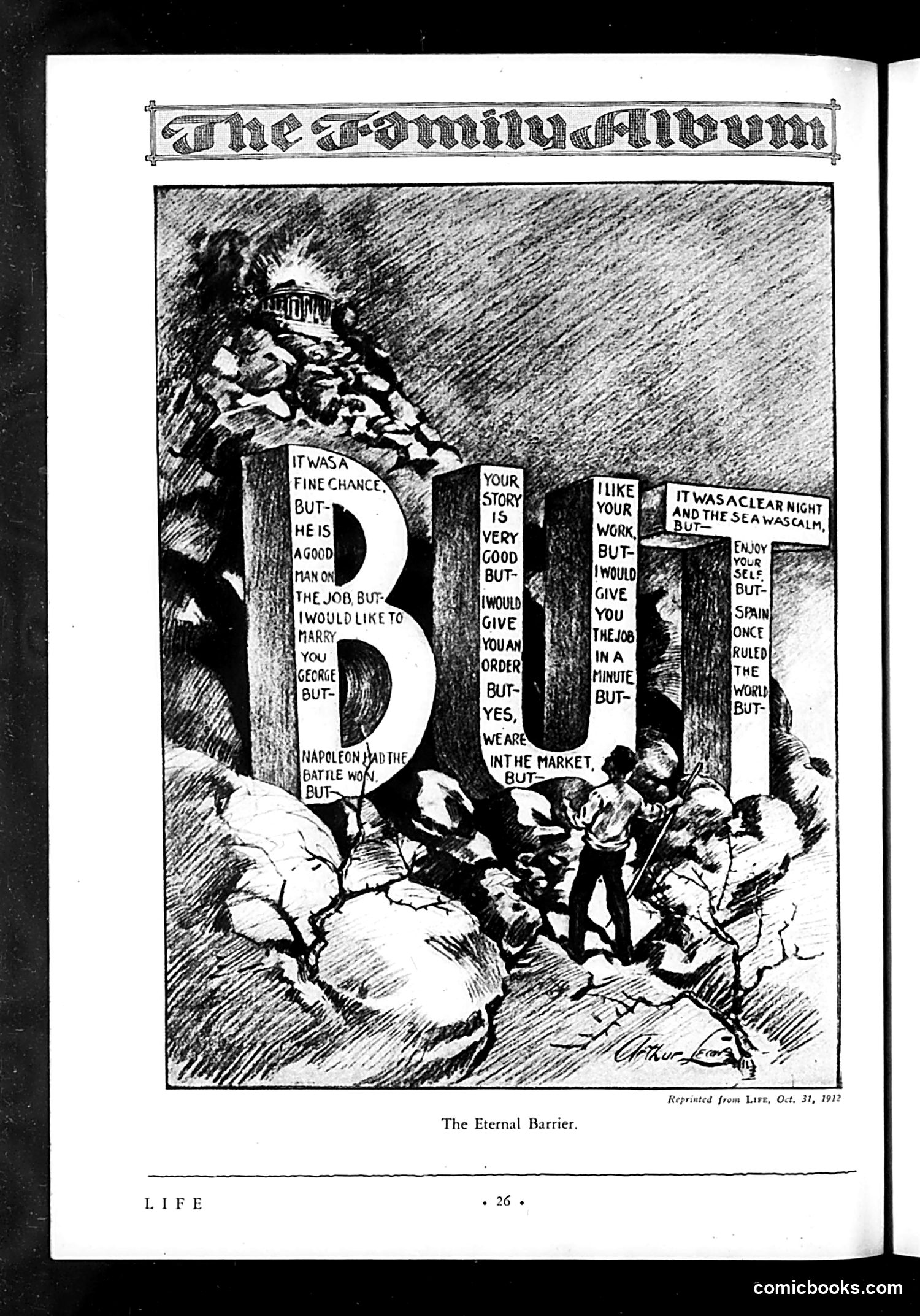
"The Eternal Barrier" (Life Magazine, October 31, 1912) This political cartoon depicts a massive wall of large "buts" blocking small figures below. The dialogue shows various historical and political figures—including references to George (likely a ruler), Napoleon, and others—each offering qualified praise ("Your story is good, but..." "I like your work, but...") before hitting an insurmountable obstacle. The satire critiques how conditional language and exceptions perpetually obstruct progress and achievement. No matter how accomplished one is, the word "but" introduces endless reservations and barriers. The cartoon suggests that even great historical figures faced this frustration—achievement is constantly undercut by qualifications, objections, and limitations. This reflects early 20th-century anxieties about bureaucratic obstacles, social resistance to change, and the gap between promise and actual accomplishment.
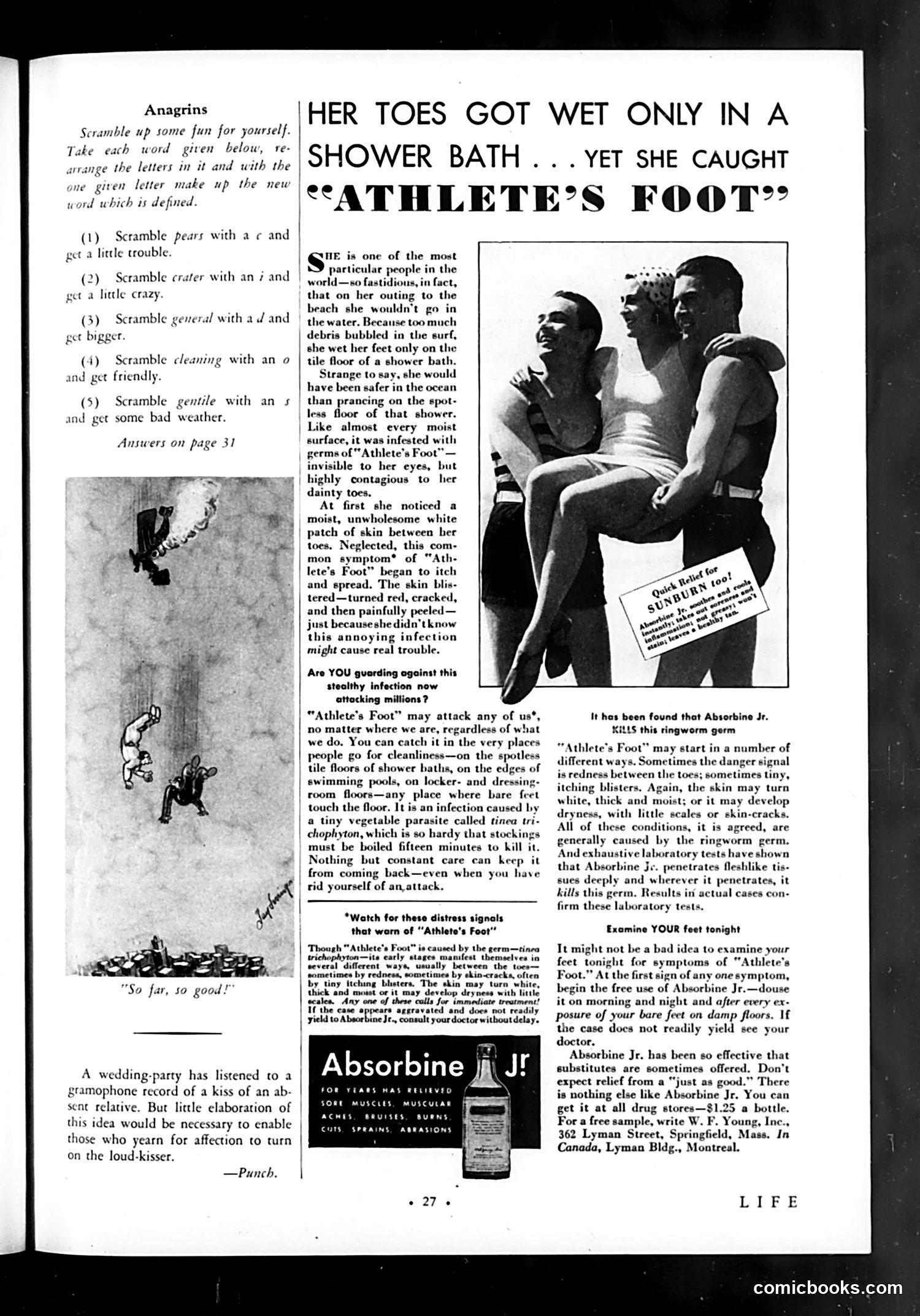
Life Magazine Page Analysis This page combines entertainment and advertising. The top section features "Anagrins"—word-scramble puzzles for readers' amusement, with a small cartoon joke about a couple using a "loud-kisser" gramophone device to simulate a distant relative's kiss. The dominant content is a full-page advertisement for Absorbine Jr., a patent medicine claiming to cure athlete's foot. The ad uses fear-based marketing typical of early-20th-century advertising: it tells a cautionary tale of a fastidious woman who contracted the fungal infection (caused by *tinea trichophyton*, though called "ringworm") in a supposedly clean shower bath. The accompanying photograph shows young men in swimwear, establishing the product's appeal to active, athletic types. The ad emphasizes that athlete's foot is widespread, strikes unexpectedly, and requires the advertised remedy—a common marketing tactic that treats minor ailments as serious threats requiring immediate proprietary treatment. This represents pre-FDA advertising standards when medical claims were largely unregulated.
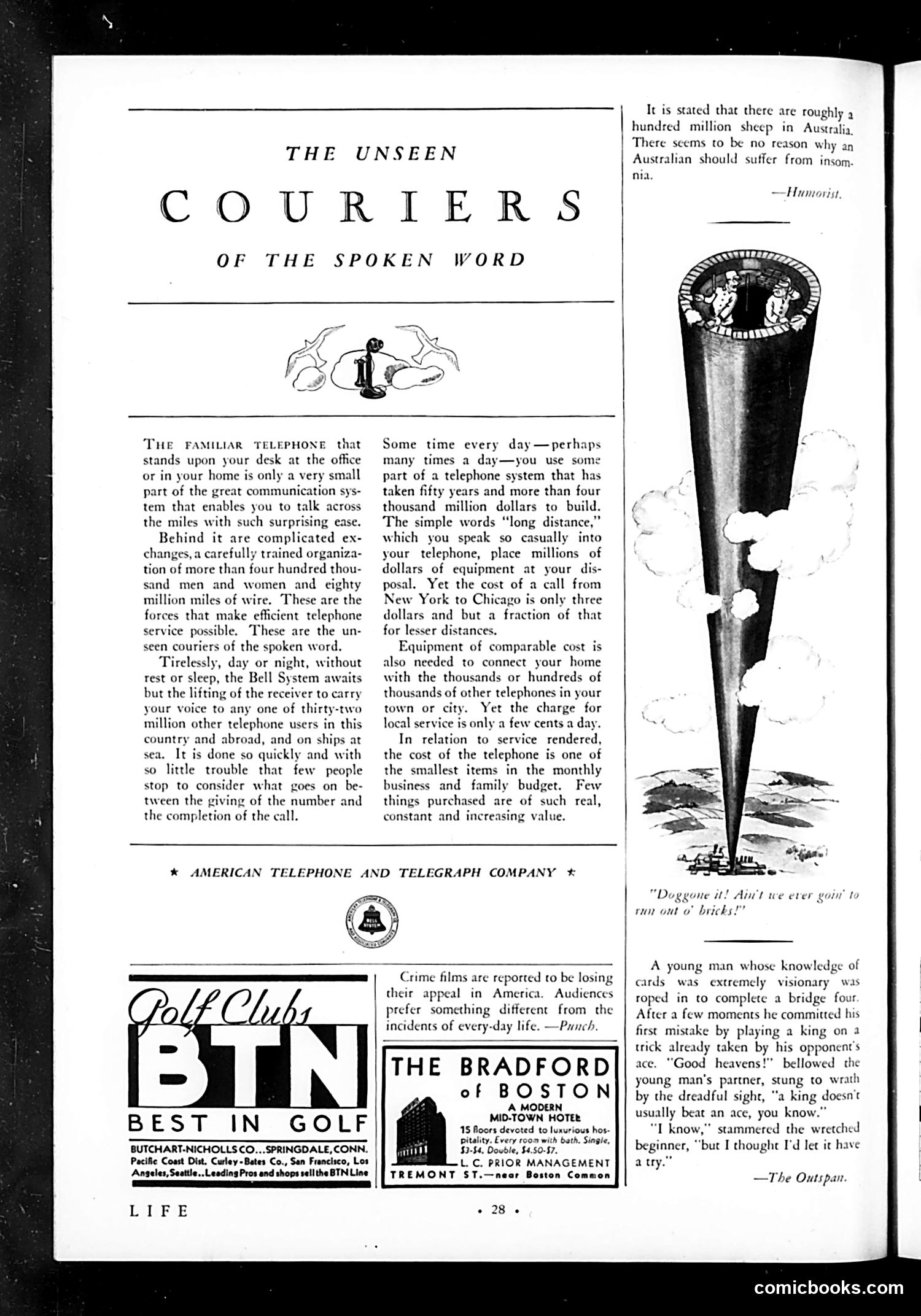
Explanation for Modern Readers This page is primarily a corporate advertisement for American Telephone & Telegraph Company (AT&T), disguised as editorial content in *Life* magazine. The main article, "The Unseen Couriers of the Spoken Word," is marketing copy praising the telephone infrastructure. It emphasizes the massive hidden workforce and investment (400,000+ employees, $4 billion, 80 million miles of wire) that enables routine calls, arguing that despite this enormous cost, telephone service remains remarkably affordable to consumers. The page also contains several unrelated short humor pieces and advertisements typical of *Life*'s format: a golf clubs ad, a Boston hotel advertisement, and brief jokes about Australian sheep, bridge card games, and construction workers. The political/social context: This appears to be pro-business propaganda from the 1920s-30s era, using a respected humor magazine to build public appreciation for corporate infrastructure and justify AT&T's market dominance through appeals to efficiency and value.
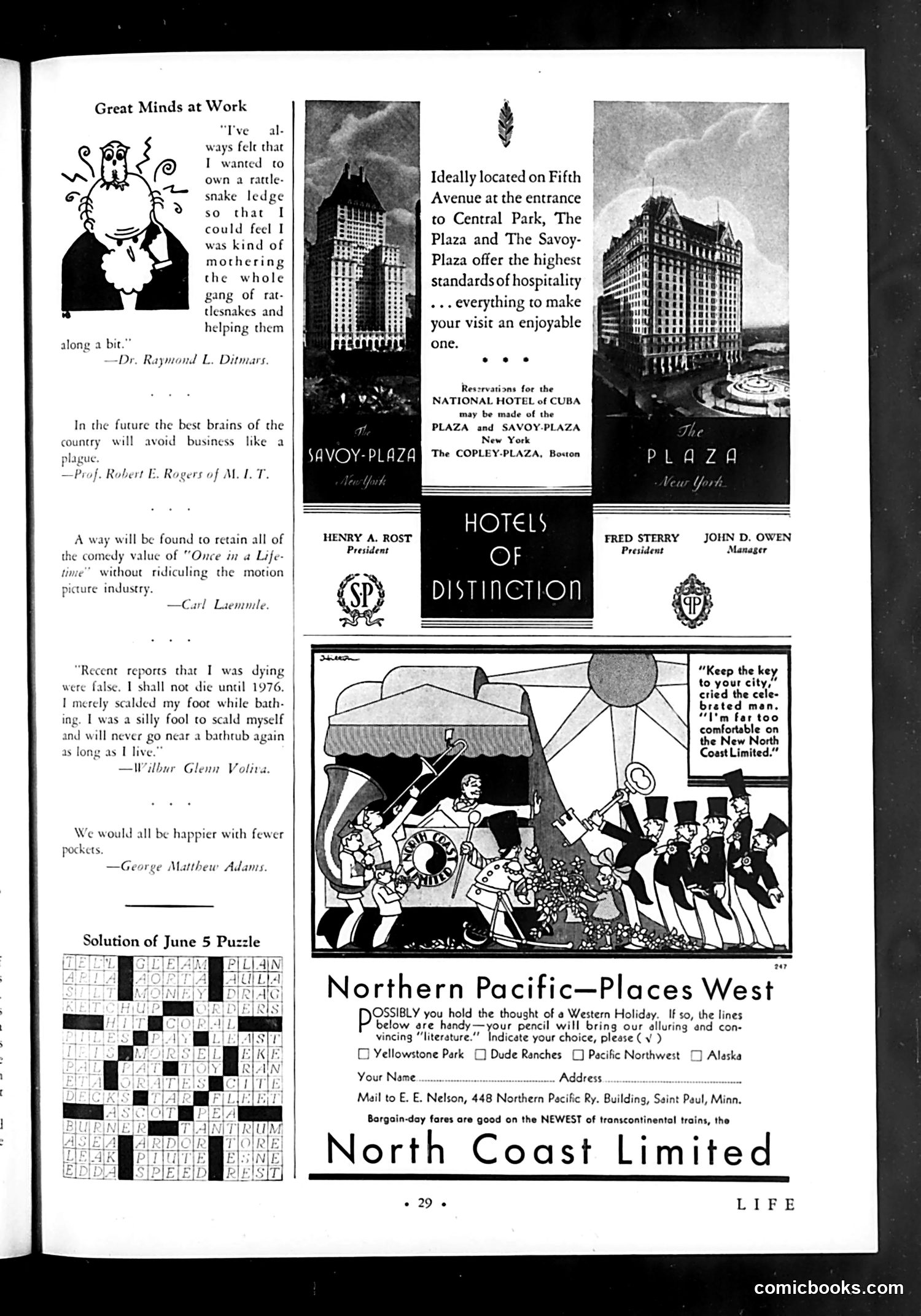
"Great Minds at Work" Page Analysis This page is primarily advertising and filler content from Life magazine, not political satire. The left column presents humorous quotes from various public figures—Dr. Raymond Ditmars (naturalist), Robert E. Rogers (MIT professor), Carl Laemmle (film executive), Wilbur Glenn Voliva (religious leader), and George Matthew Adams (columnist)—intended as lighthearted commentary on eccentricity and human nature. The central cartoon depicts a celebratory scene where someone offers "the key to your city" to a satisfied traveler, who declines because he's too comfortable on the "New North Coast Limited" train. This is advertising satire: the joke promotes the Northern Pacific railway's comfort by suggesting travelers won't want to leave it for civic celebrations. The right side features luxury hotel advertisements (Plaza, Savoy-Plaza, Copley-Plaza) and a puzzle contest promoting Western travel packages. Overall context: This is 1920s-era magazine filler blending humor, celebrity quotes, and transportation/hospitality advertising—not political commentary.
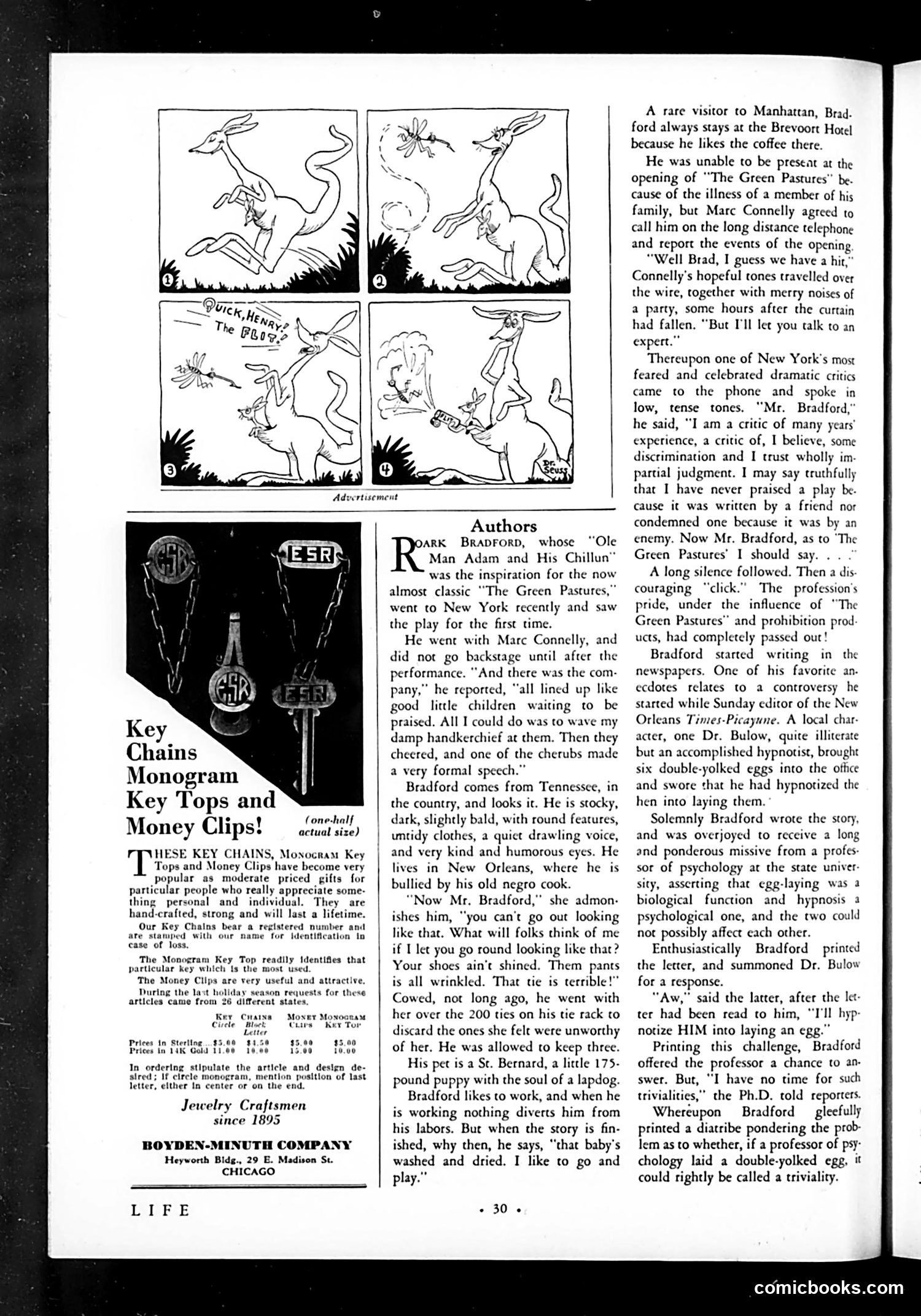
Life Magazine Page Analysis This page contains an anecdote about Roark Bradford, author of "Ole Man Adam and His Chillun," whose work inspired the Broadway play "The Green Pastures." The cartoon strips at top appear unrelated—showing abstract animal figures in comedic situations. The main text humorously profiles Bradford: a Tennessee-born writer living in New Orleans who is comically hen-pecked by his elderly Black cook over his appearance, yet allows her to discard 197 of his 200 neckties. It describes his large St. Bernard dog and his philosophy that creative work is serious, but afterward "that baby's washed and dried. I like to go and play." The anecdote's centerpiece is a telephone call from Marc Connelly on opening night, passing the receiver to a famous drama critic who begins praising the play to Bradford—then trails into silence mid-sentence, humorously suggesting even professional critics may struggle with objectivity. The page also advertises Boyden-Minuth jewelry: monogrammed key chains and money clips marketed as "personal and individual" gifts.
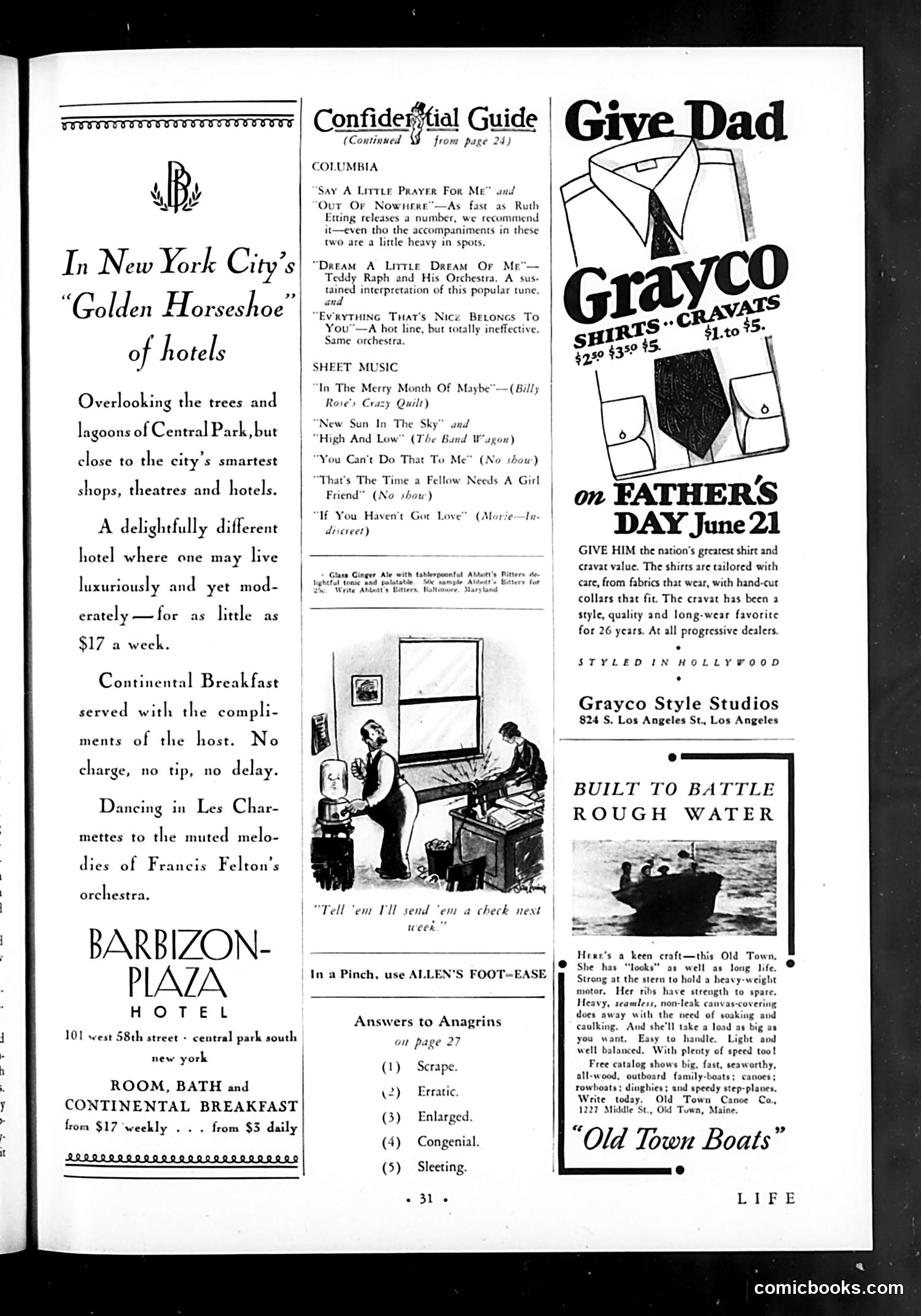
This page is primarily advertising and product listings, not political satire or editorial cartoons. The main content includes: 1. Hotel advertisement (Barbizon-Plaza): A luxury Manhattan hotel near Central Park offering rooms from $17/week with continental breakfast. 2. Music and sheet music reviews: Recommendations for popular songs of the era, including pieces by Ruth Etting and recordings by various orchestras. 3. Father's Day gift advertisements (June 21): Gravco Style Studios promoting shirts and cravats as gift options. 4. Product ads: Allen's Foot-Ease (foot care) and Old Town Boats (watercraft). 5. Small cartoon caption: A single-panel cartoon showing someone at a desk saying "Tell 'em I'll send 'em a check next week"—a mild joke about financial avoidance. This appears to be a standard magazine page from the interwar period mixing entertainment recommendations with commercial advertising. There is no significant political or social satire present.
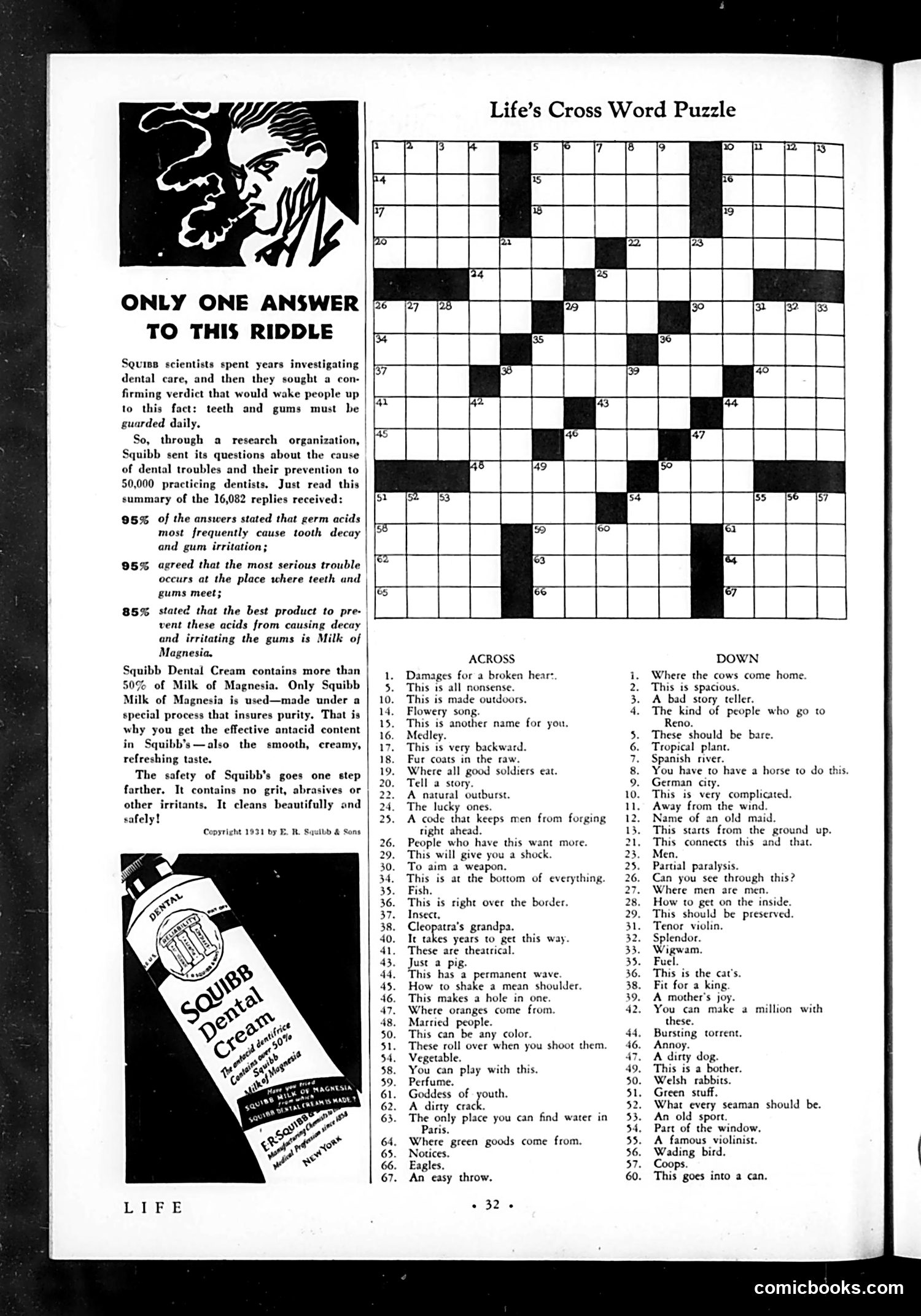
Life Magazine Page Analysis This page is primarily advertising for Squibb Dental Cream, presented as editorial content. The "riddle" is marketing disguised as journalism. The advertisement reports results from a survey of 50,000 dentists, claiming 95% identified germ acids as the primary cause of tooth decay and gum problems. The solution: Squibb Dental Cream, which contains over 50% Milk of Magnesia and allegedly contains no abrasive irritants. The illustration shows a man's profile with an exaggerated expression, likely meant to convey dental distress or the importance of dental care. Below this is a standard crossword puzzle with dental and general-interest clues—typical entertainment filler for the magazine. This reflects 1931-era advertising practices where companies funded ostensibly independent research to promote their products, presenting commercial claims through the authority of professional consensus. The approach was common before modern FDA regulations and advertising standards.
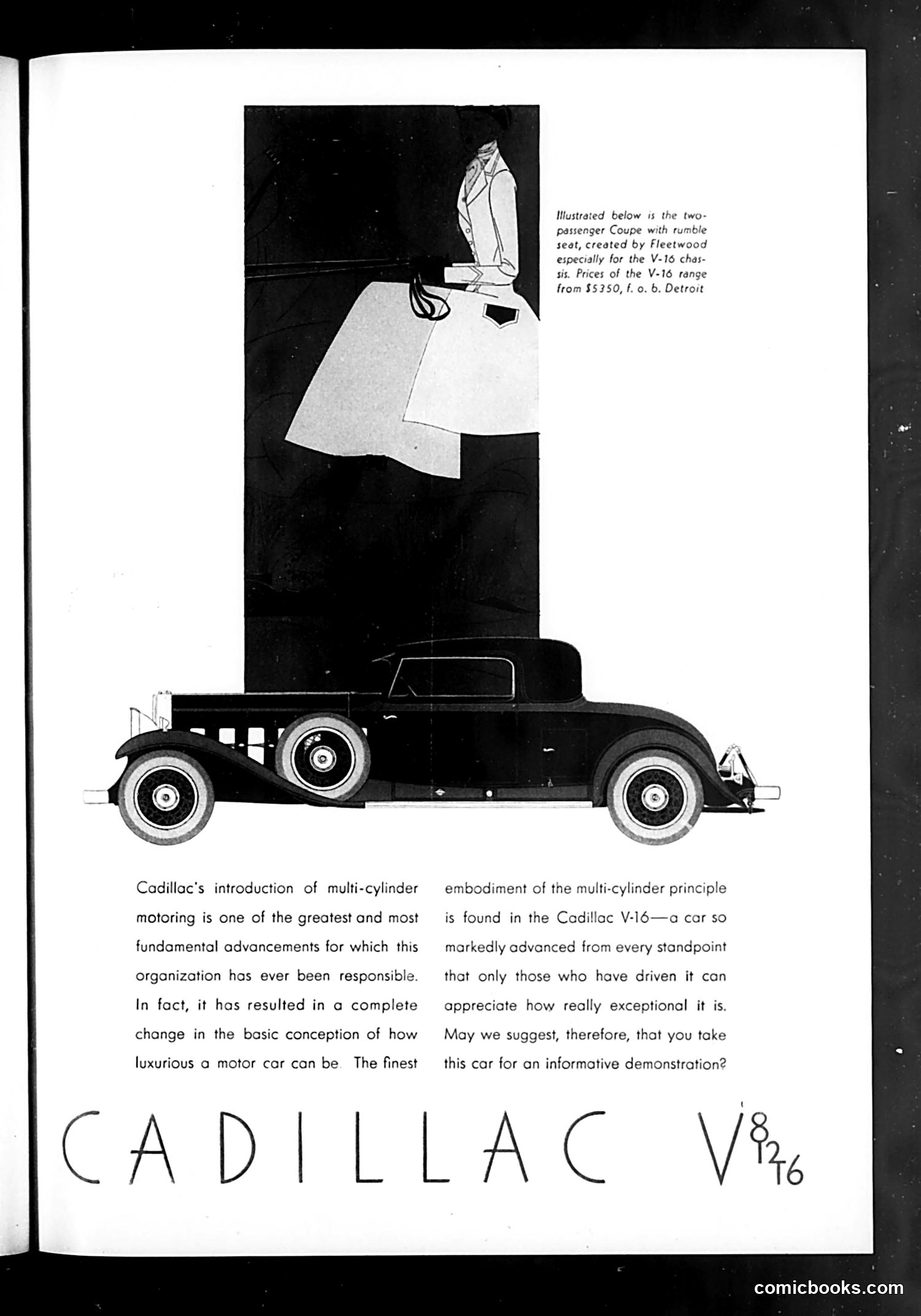
Analysis: Cadillac V-16 Advertisement This is not satire or political commentary—it's a straightforward luxury automobile advertisement from Life magazine. The page promotes Cadillac's introduction of multi-cylinder engines, specifically the V-16 model. The illustration shows a two-passenger coupe with rumble seat designed by Fleetwood, priced from $5,350 f.o.b. Detroit. The text claims Cadillac's multi-cylinder innovation represents "one of the greatest and most fundamental advancements," fundamentally changing what luxury motoring means. The ad invites readers to test-drive the vehicle to appreciate its "exceptional" engineering. For modern readers: this represents early automotive marketing emphasizing technical superiority and luxury as selling points. The V-16 engine was genuinely remarkable engineering for its era—a status symbol targeting wealthy buyers. The advertisement's tone is earnest promotion, not humor or commentary.
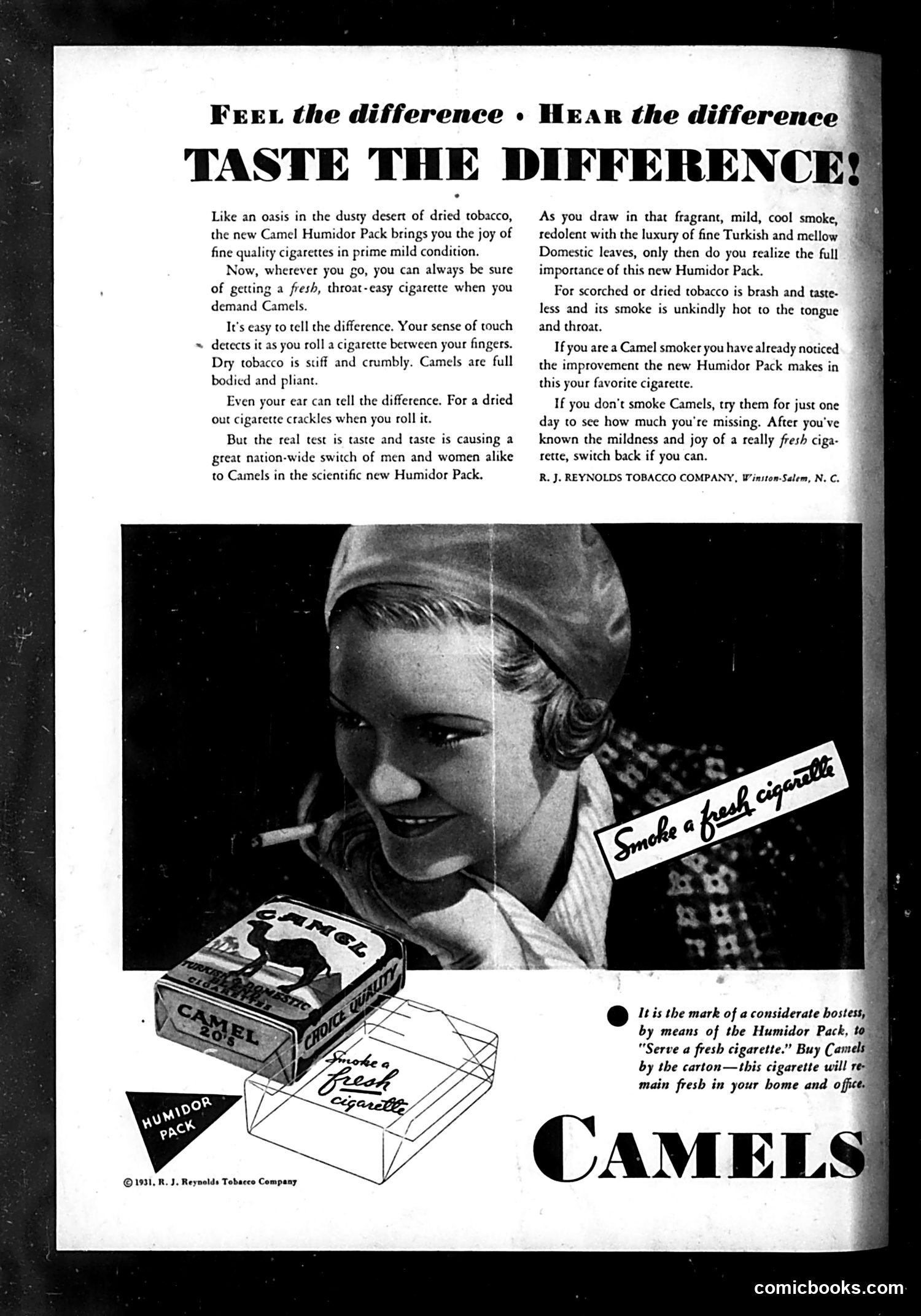
Camel Cigarettes Advertisement (1931) This is a cigarette advertisement, not satire or political commentary. It promotes Camel's new "Humidor Pack," a moisture-sealed packaging innovation designed to keep tobacco fresh. The ad uses a woman smoking to demonstrate the product's appeal to both sexes ("a great nation-wide switch of men and women alike"). It employs sensory rhetoric—claiming consumers can detect freshness through touch (tobacco flexibility), sound (crackling when dry), and taste (mild vs. scorched smoke). The reference to "Turkish and mellow Domestic leaves" reflects 1930s cigarette marketing emphasizing premium blends. The closing tagline about "considerate hostess" etiquette indicates mid-century social positioning of smoking as refined hospitality. The Humidor Pack itself is visible in the illustration—a sealed carton designed to preserve moisture and prevent staleness, a significant commercial innovation for the era.

I cannot reliably analyze this page. The image is extremely dark and degraded, making it nearly impossible to discern cartoon figures, caricatures, or visual details clearly. The OCR text provided contains only fragmentary characters and spacing marks with no coherent words or readable content. To properly identify political references, satirical targets, and historical context as you've requested, I would need either a clearer reproduction of this Life magazine page or legible OCR text containing actual article titles, captions, or dialogue. Without these elements, any interpretation would be speculation rather than evidence-based analysis.