life
Life — June 19, 1931
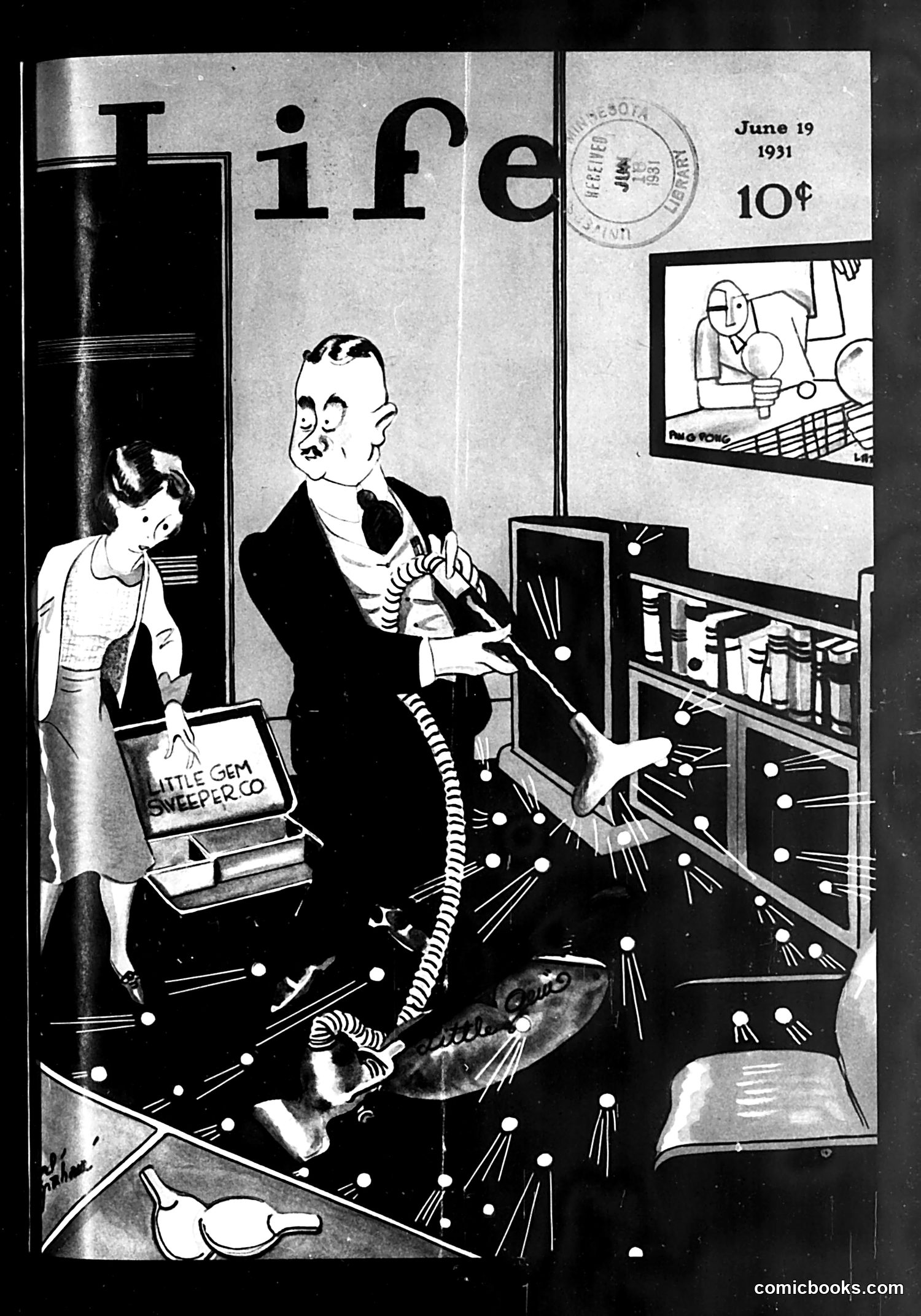
Life Magazine, June 19, 1931 This cartoon satirizes a man in formal attire using electrical equipment—apparently a laboratory or scientific apparatus with visible electrical coils and wiring. He appears to be conducting some kind of experiment, while a woman on the left holds a box labeled "LITTLE GEM SHIPPER CO." The cartoon seems to mock either pseudoscientific claims or an inventor/entrepreneur promoting dubious electrical products. The chaotic electrical imagery and the man's exaggerated facial expression suggest incompetence or fraud. The "Little Gem Shipper Co." box likely represents a commercial venture or mail-order business. Without clearer textual context identifying the specific figure or product being satirized, the general target appears to be 1930s-era snake-oil salesmen or fraudulent inventors making false claims about electrical devices and their miraculous properties.
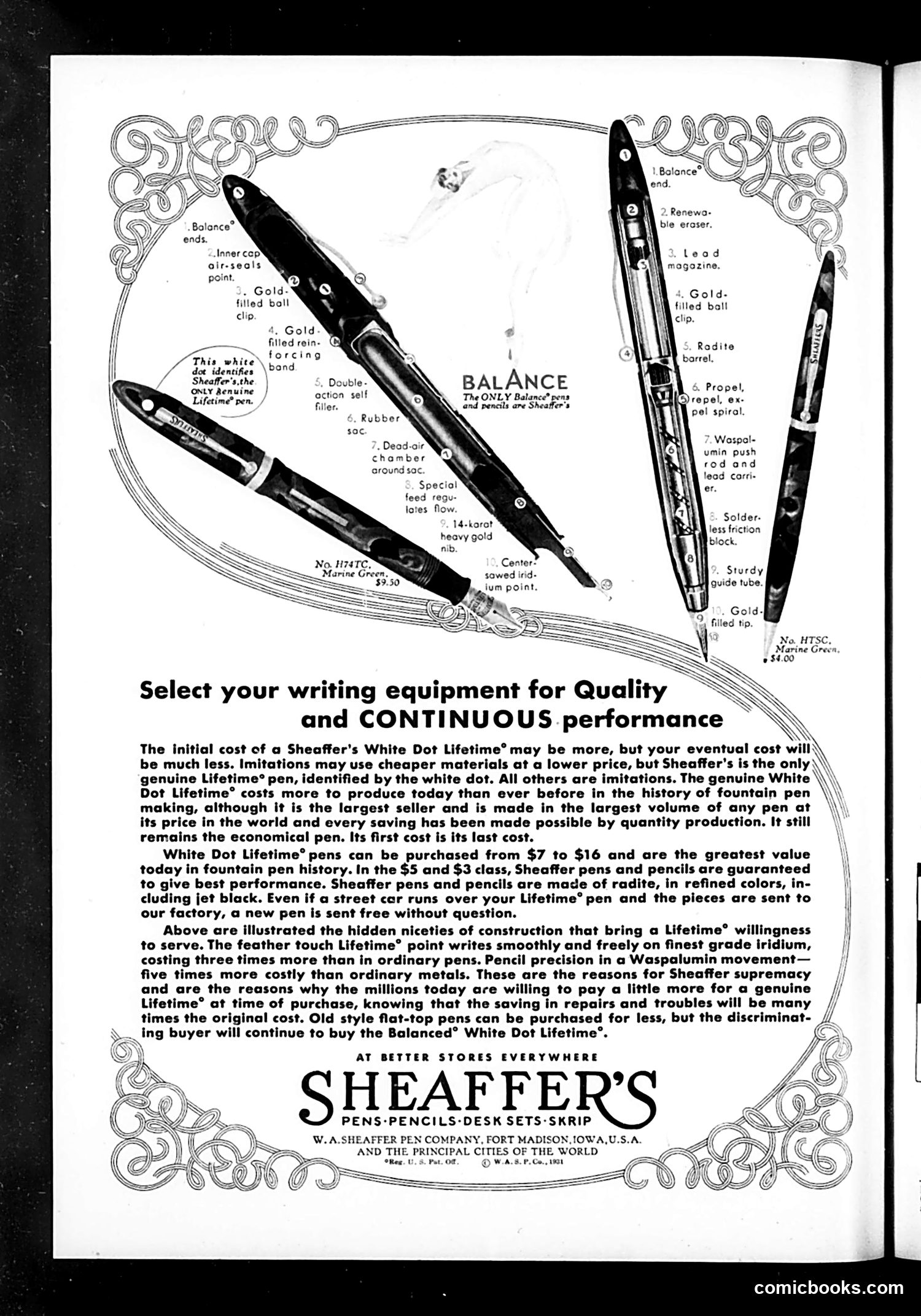
Content Analysis This page is primarily a Sheaffer's fountain pen advertisement, not political satire or comics. The image shows detailed technical diagrams of the "Balance" fountain pen model with labeled components (balance ends, gold-filled clips, feed mechanisms, etc.). The advertisement emphasizes quality construction and durability as justification for the higher price point ($7-$16). The marketing copy argues that Sheaffer's "White Dot Lifetime" pens, though initially more expensive than imitations, offer better long-term value through superior materials and craftsmanship. It claims competitors use "cheaper materials" while Sheaffer's remains "the economical pen." The ornamental Art Deco border reflects the design aesthetic of the publication's era. This is straightforward product advertising with no political or satirical content.
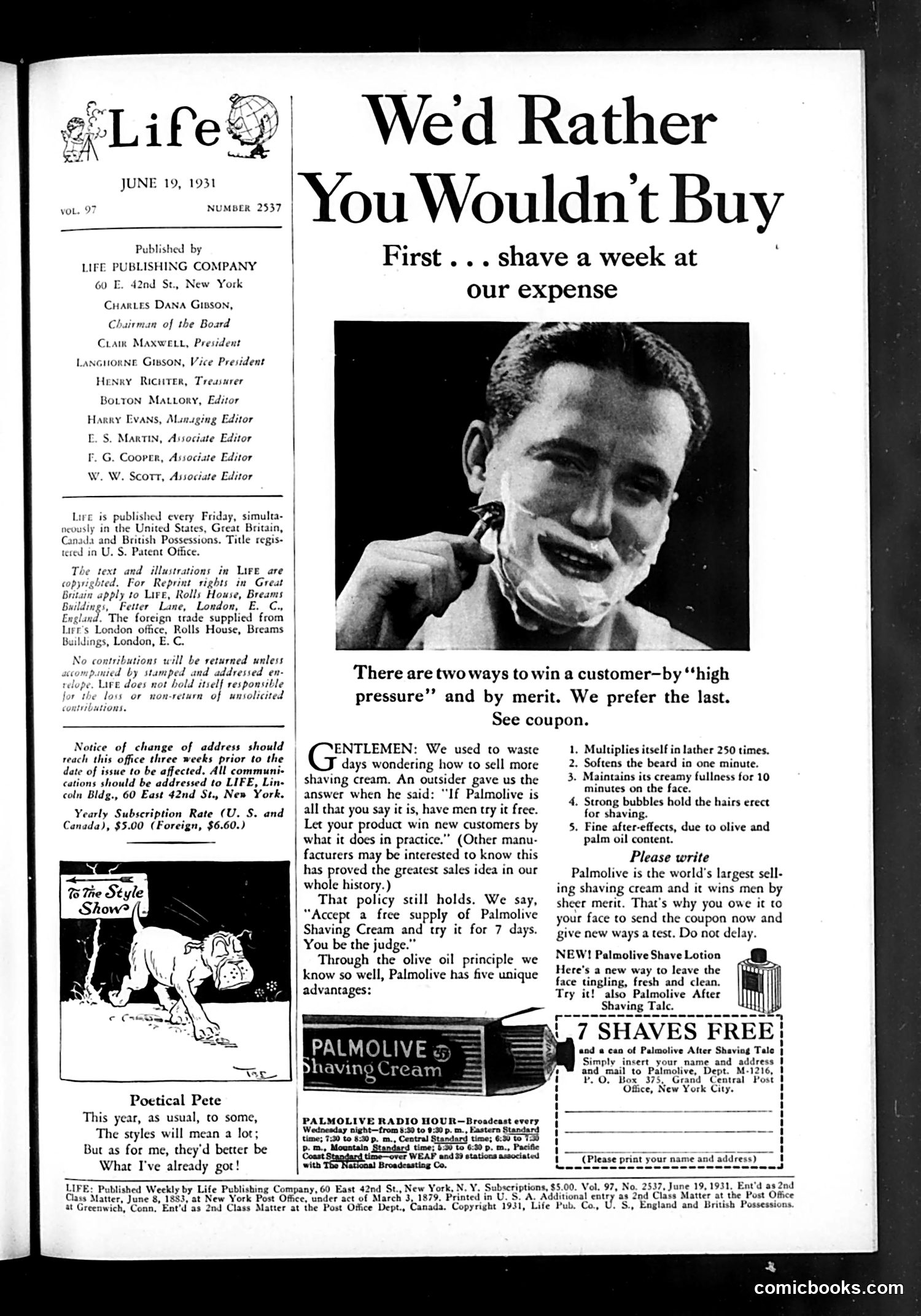
Analysis This page is primarily a Palmolive shaving cream advertisement disguised as editorial content, dated June 19, 1931. The main image shows a man's face demonstrating shaving results. The advertisement's central claim references an "outsider" (likely a competitor or skeptic) who challenged Palmolive to prove its product works by offering free trials. The satirical framing—"We'd Rather You Wouldn't Buy First...shave a week at our expense"—uses reverse psychology, a marketing technique positioning confidence in product merit over aggressive sales tactics. The accompanying text lists five claimed benefits of Palmolive, emphasizing olive oil content. A coupon offers "7 SHAVES FREE" to encourage trial. The small cartoon titled "Poetical Pete" appears unrelated to the advertisement, likely filler content. This represents 1930s advertising strategy: wrapping product promotion in magazine editorial format to seem more credible to readers.
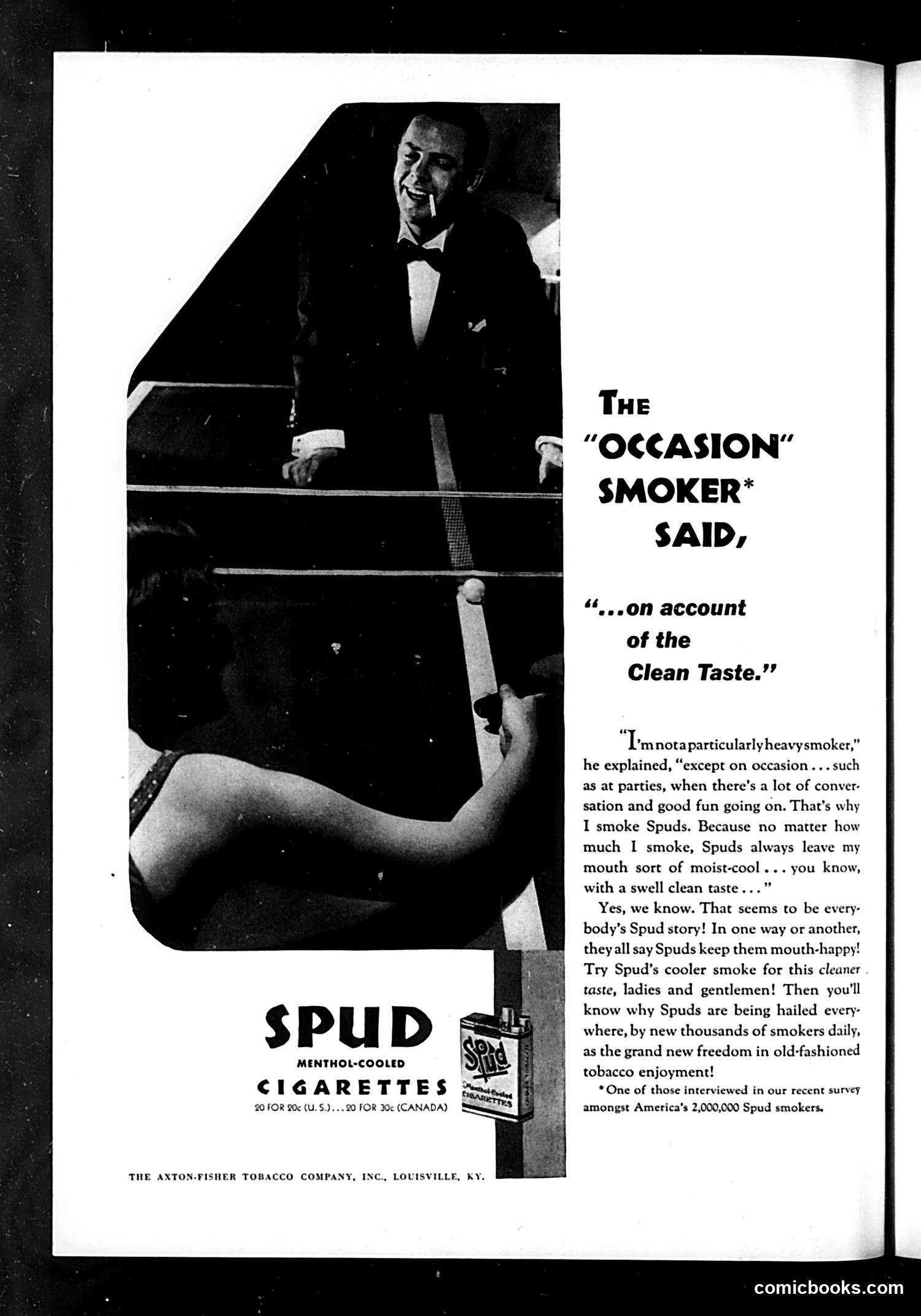
Analysis This is a cigarette advertisement, not political satire. It promotes Spud menthol-cooled cigarettes by The Axton-Fisher Tobacco Company of Louisville, Kentucky. The ad features a formally-dressed man at what appears to be a social gathering, with the tagline "The 'Occasion' Smoker Said" about clean taste. The copy claims that casual smokers prefer Spuds because they maintain a "moist-cool" quality and "clean taste" regardless of consumption volume. The advertisement targets mid-century consumers by positioning the product as enabling social smoking without the typical drawbacks (dry mouth, stale taste). The phrase "grand new freedom in old-fashioned tobacco enjoyment" suggests menthol as a modern innovation. This represents typical 1940s-50s cigarette marketing before health warnings—normalizing smoking as sophisticated social behavior.
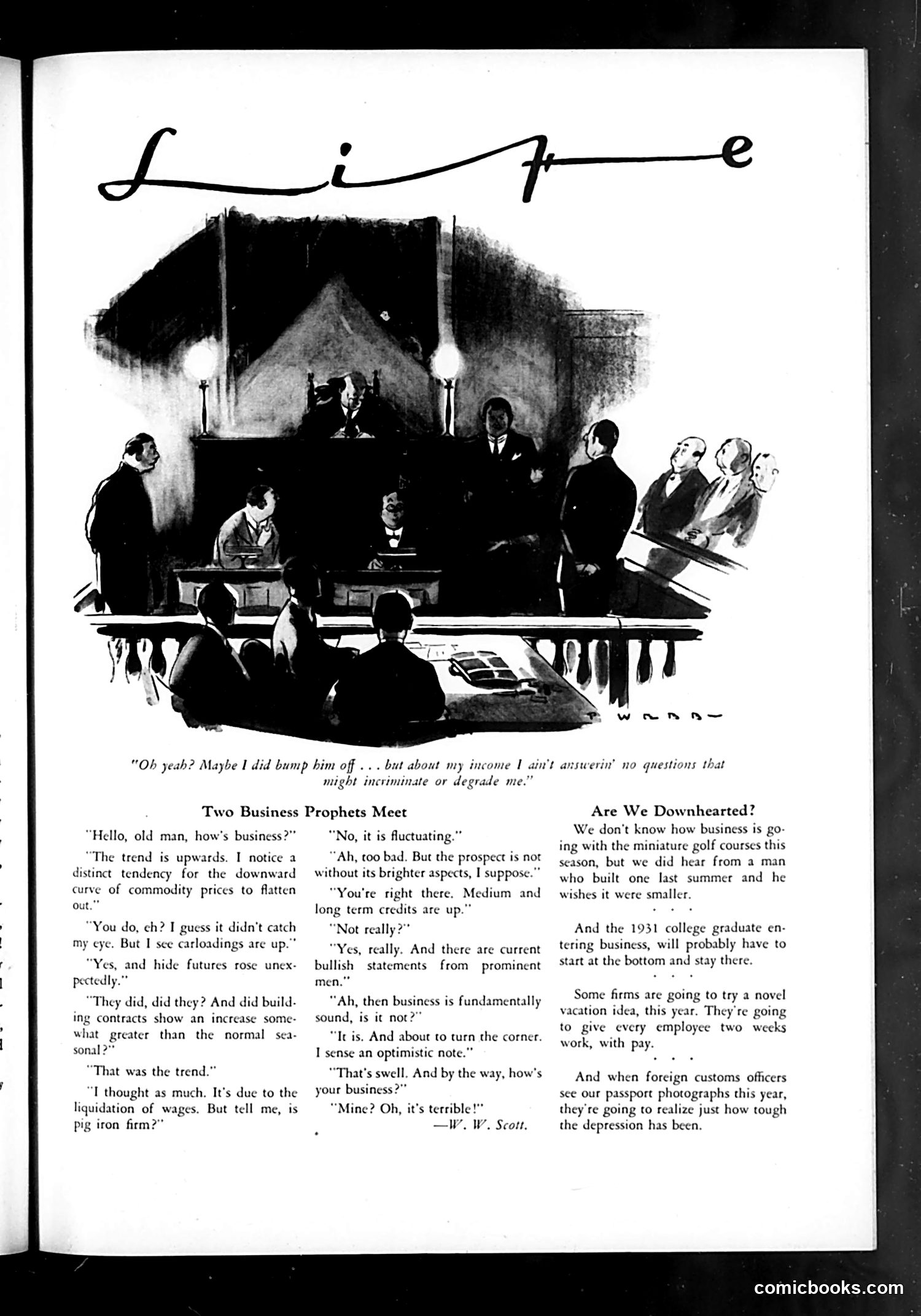
Analysis This page features a courtroom satire titled "Two Business Prophets Meet." The illustration depicts a trial scene where one businessman testifies about dumping another's body, dismissing it casually while claiming his own income remains unaffected. The dialogue satirizes Depression-era business cynicism. Two executives discuss commodity price deflation, wage liquidation, and building contracts showing "greater than normal" growth despite economic crisis. One notes "the trend is upward" while acknowledging widespread hardship. The right-hand column, "Are We Downhearted?", offers grim economic predictions: new college graduates will start at the bottom and stay there; companies are offering two-week unpaid vacations; customs officials now scrutinize passport photos to assess citizens' hardship. The satire targets callous business rhetoric masking Depression suffering—executives congratulating themselves on "fundamentally sound" practices while ordinary people struggle.
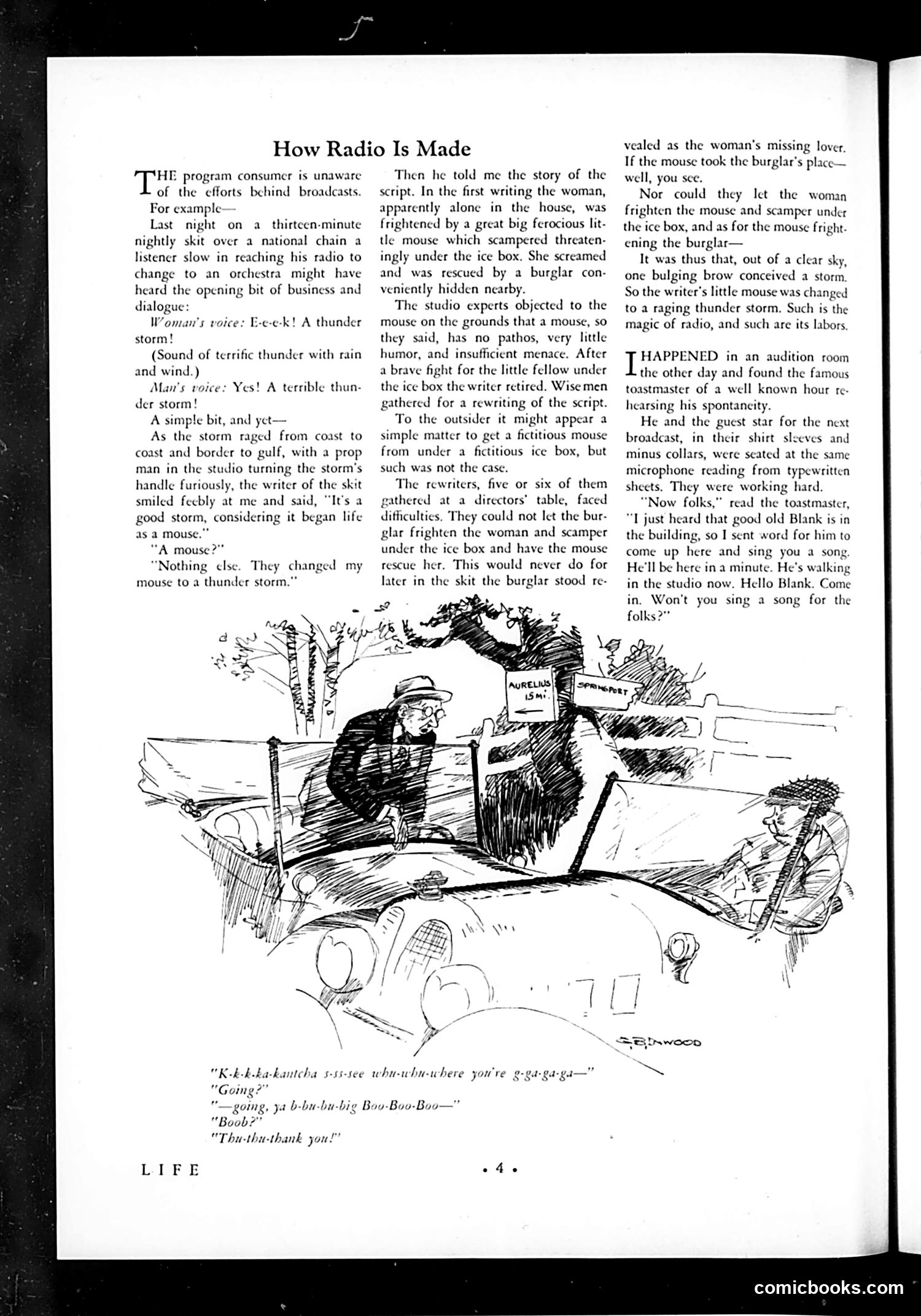
"How Radio Is Made" This article explains radio broadcasting production through a humorous anecdote. A writer describes how a simple 13-minute radio drama—featuring sound effects like thunder—requires extensive studio coordination. The joke centers on the gap between what listeners hear and the mechanical reality: a small mouse caused the "thunder" effect, which then had to be rewritten into the script as a plot element (the mouse becomes part of the story itself). The cartoon illustrates the behind-the-scenes chaos: a sound-effects technician manipulates props and devices while actors perform at microphones, showing the invisible labor that creates seamless radio broadcasts. The satire mocks how radio presents polished entertainment while hiding the improvisation and absurdity required to produce it.
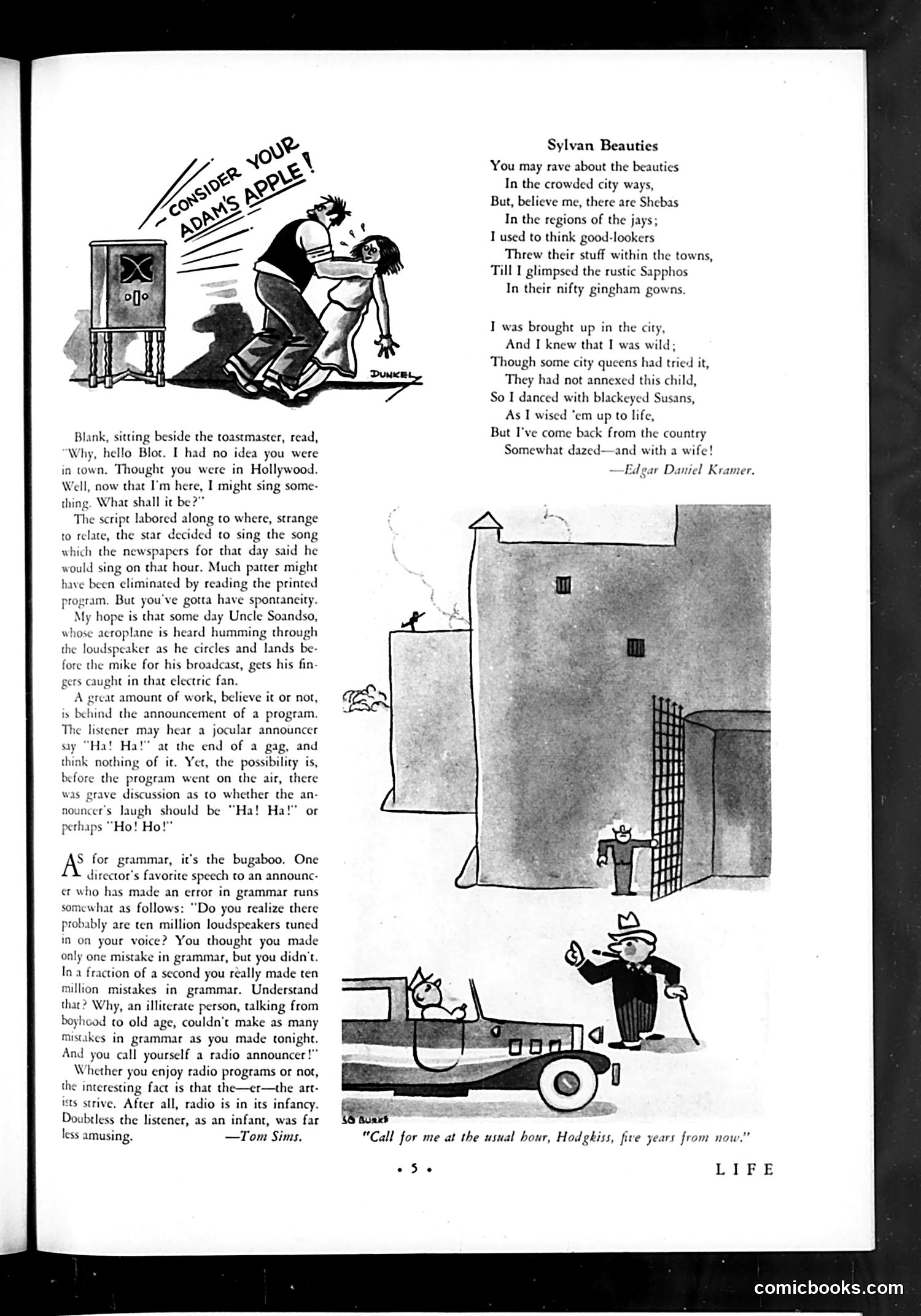
Analysis of Life Magazine Page Top Cartoon: Shows a man being forcibly fed an apple by another figure. The caption reads "CONSIDER YOUR ADAM'S APPLE!" This appears to be a health or dietary satire, likely referencing early 20th-century wellness trends or dietary advice. Main Content: The page features "Sylvan Beauties," a poem by Edgar Daniel Kramer contrasting rural and urban beauty. A man boasts of conquering city women until finding a country wife, suggesting a satirical commentary on rural versus urban values—a common theme in period literature. Bottom Illustration: Shows a radio broadcaster and someone in a car, with caption "Call for me at the usual hour, Hodgkiss, five years from now." This jokes about radio program scheduling or romantic arrangements via broadcast. The page reflects 1920s-30s American culture: radio's novelty, health crazes, and rural-urban social tensions.
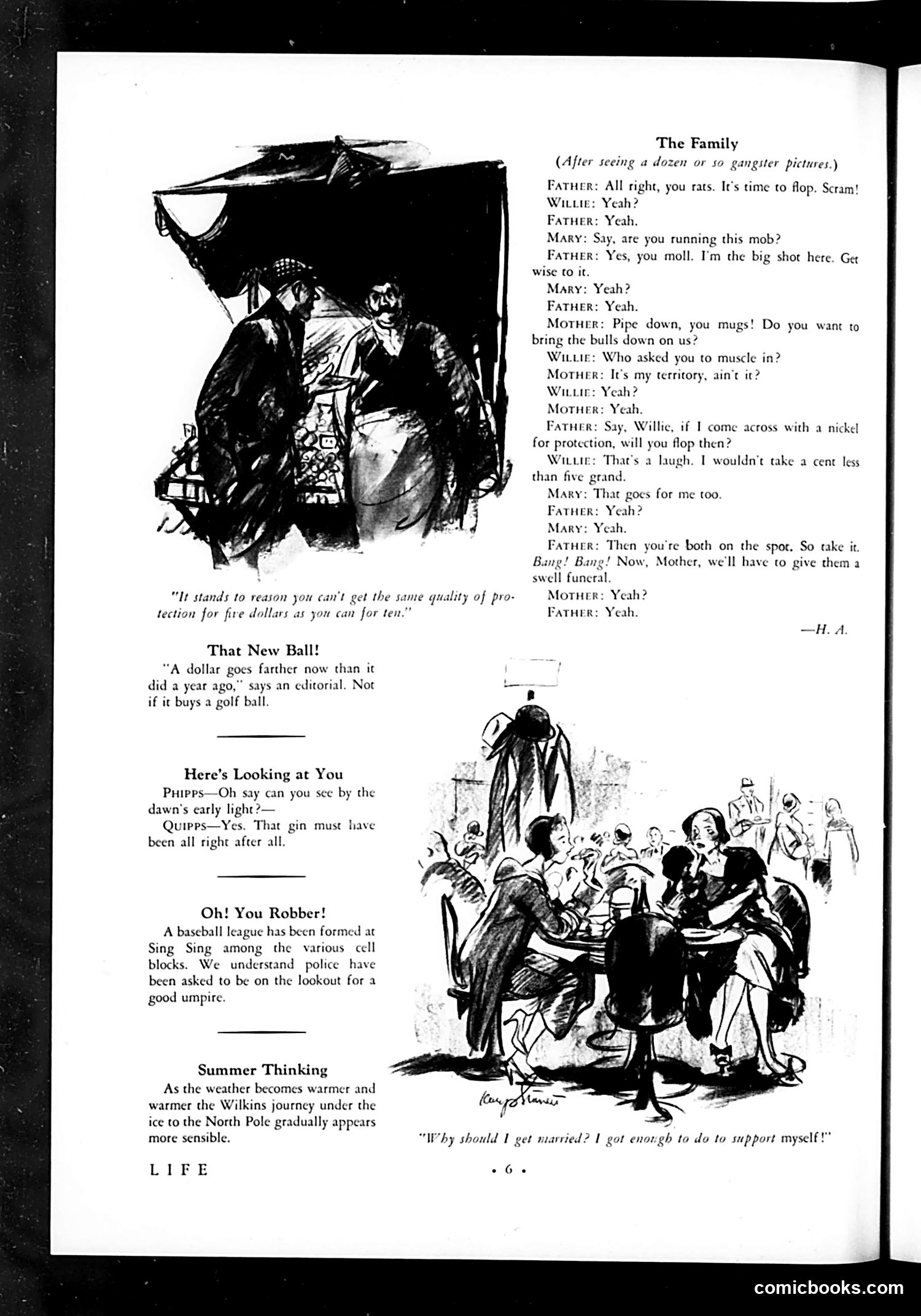
"The Family" and Related Sketches - Life Magazine Satire The main sketch depicts a mobster ("the big shot") with his family discussing criminal protection rackets. The father boasts about running organized crime operations while his wife and children respond with casual acceptance—the satire mocks how gangster families normalized illegal activity as routine business. The bottom cartoon shows a woman at an altar saying "Why should I get married? I got enough to do to support myself!"—satirizing women's economic independence and reluctance toward marriage, reflecting 1920s social anxieties about changing gender roles. Other brief items mock inflation (a dollar's reduced purchasing power), early morning activities, and forming a baseball league. The overall theme critiques American social issues: organized crime's normalization, women's economic autonomy, and economic hardship—typical Life magazine satirical commentary.
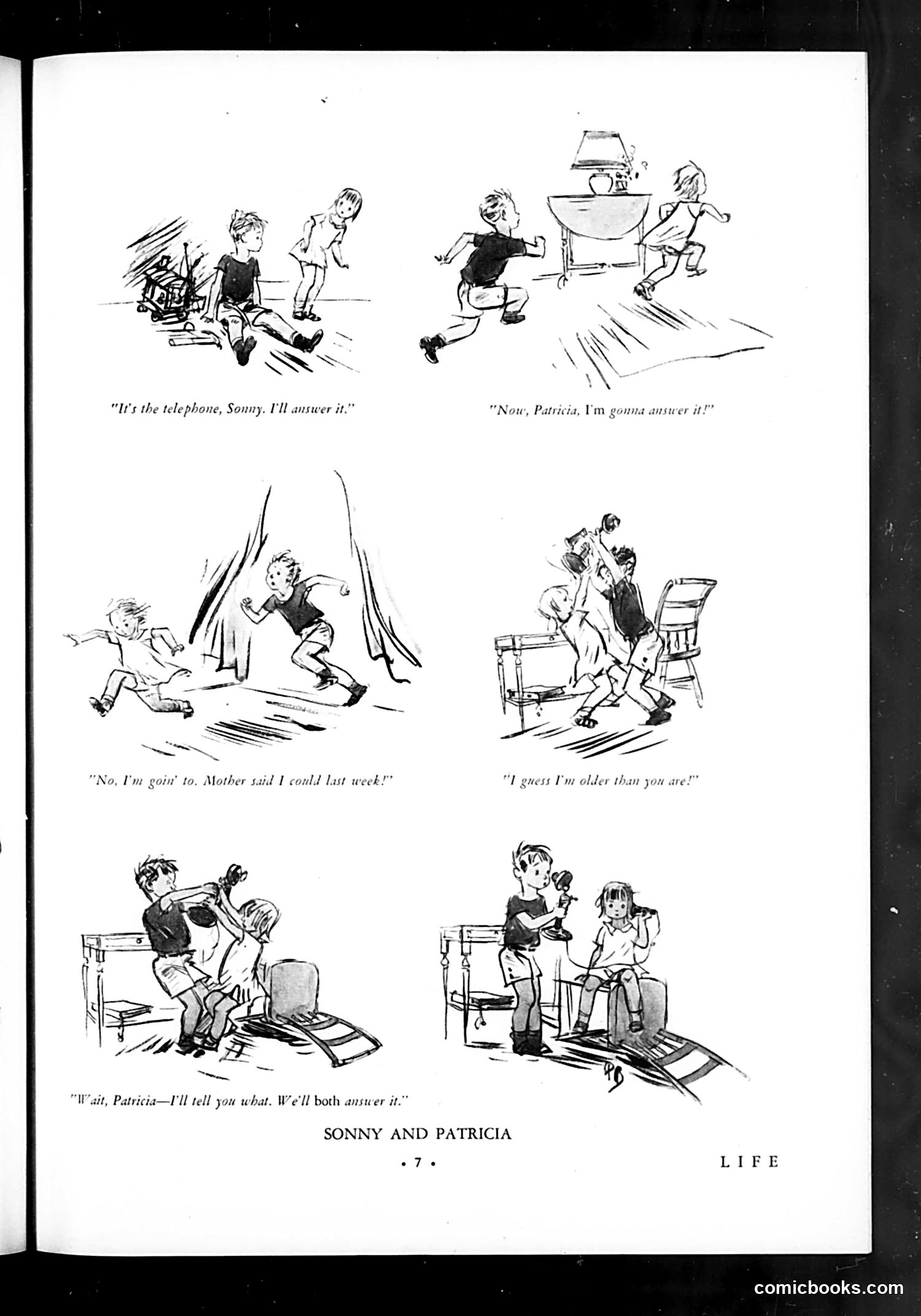
"Sonny and Patricia" - Life Magazine Comic Strip This is a humorous domestic comic strip featuring two children navigating everyday situations. The sequence shows: 1. The telephone scene: Sonny answers a ringing phone while Patricia watches 2. The competing answer: Patricia runs to answer instead, saying she'll get it 3. The excuse-making: A child claims they can't leave because "Mother said I could last week" 4. The age assertion: Children argue about who is older 5. The collaboration: They decide to answer together The humor relies on typical childhood behavior—competition over trivial tasks, exaggerated claims about parental permission, and sibling dynamics. This appears to be gentle domestic satire about children's social interactions rather than political commentary. It's typical of Life magazine's lighter entertainment content from the early-to-mid 20th century.
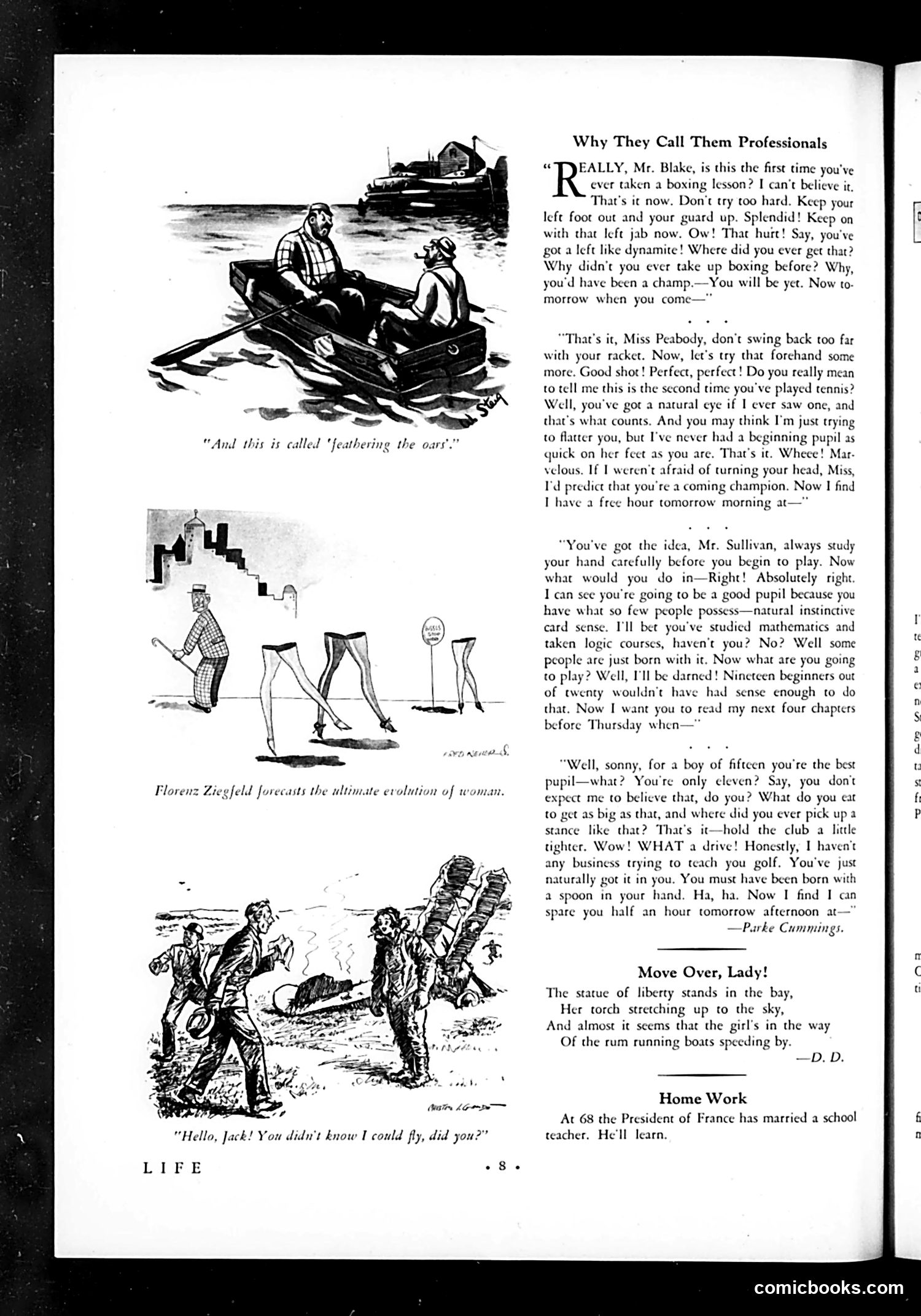
Analysis of Life Magazine Page This page satirizes sports instruction and amateur athletes. The top illustration shows rowing instruction with the caption "And this is called 'feathering the oar'"—mocking overly technical coaching jargon. The middle illustration labeled "Florenz Ziegfeld forecasts the ultimate evolution of woman" depicts women in exaggerated golf poses, satirizing both the famous impresario's theatrical designs and the era's concern about women entering sports. The bottom cartoon shows someone exclaiming "Hello, Jack! You didn't know I could fly, did you?"—likely referencing contemporary aviation novelty or boasting about athletic prowess. The text passages ("Why They Call Them Professionals," "Move Over, Lady!") humorously critique amateur sports enthusiasts who adopt professional mannerisms and women's increasing athletic participation—both controversial social shifts of the era.
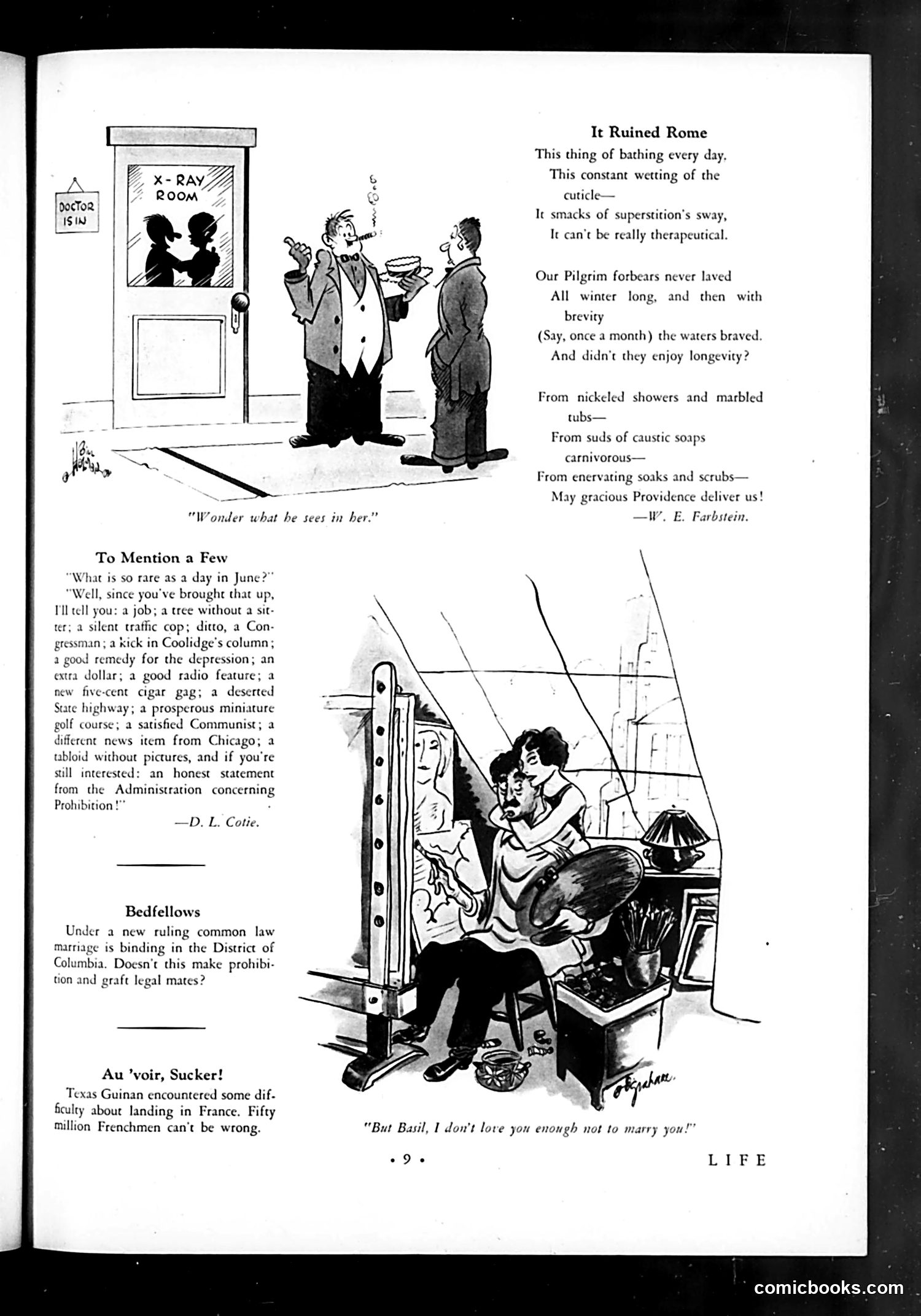
Analysis of Life Magazine Page Top Cartoon ("It Ruined Rome"): Shows a doctor's office where a patient complains about daily bathing. The accompanying poem by W.E. Farberstein satirizes excessive bathing as superstitious and harmful—ironically arguing that Roman pilgrims rarely bathed and lived long lives. This is humorous social commentary criticizing the era's growing hygiene obsession, suggesting constant washing is therapeutically unfounded. Bottom Cartoon: Depicts a couple in bed with the caption "But Basil, I don't love you enough not to marry you!" This inverts typical romantic logic—she's saying she doesn't love him *enough* to *avoid* marrying him, implying mercenary or pragmatic motivations rather than genuine affection. Other Items: Brief satirical pieces about rare occurrences, prohibition law absurdities, and French military landing difficulties.
"Life Looks About" This page contains three opinion pieces rather than political cartoons. The main articles address: 1. "A Ruction in Italy" — discusses power struggles between the Pope and Mussolini over control in Italy, examining which institution will ultimately influence Italian affairs. 2. "Our Mr. Morrow!" — speculates on what will happen to Mr. Morrow (appears to be a political figure) within a year, questioning whether he'll become president and discussing his potential as a political solution. 3. "Joan of Arc's 500th!" — celebrates a May 31st anniversary of Joan of Arc's death in Rouen, noting that despite modern circumstances (Mooney still in jail, citizenship denied to Professor MacIntosh), Joan remains an admirable historical figure. The small illustration shows Cupid with what appears to be a swan or bird, likely decorative rather than satirical.
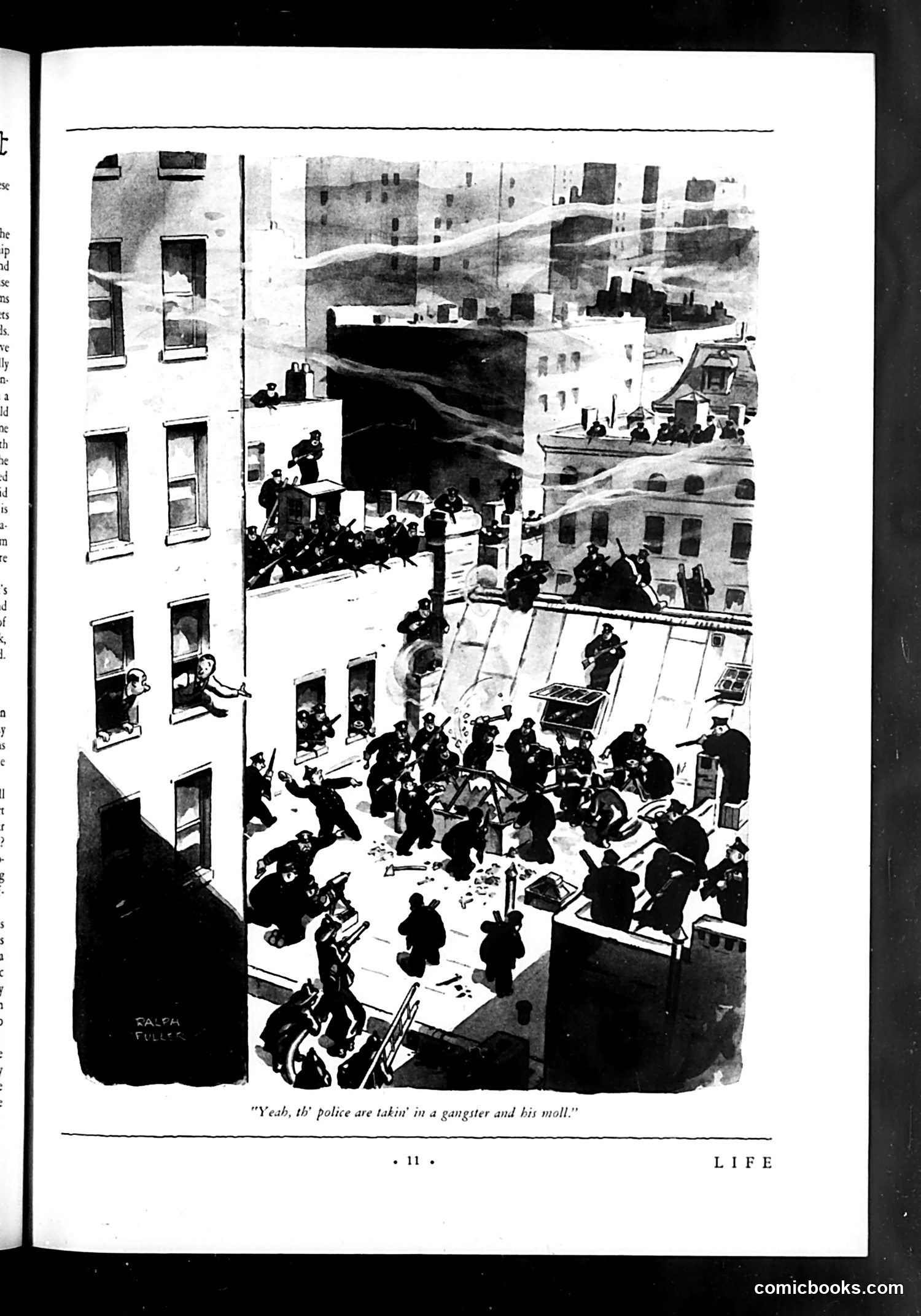
Analysis This is a satirical cartoon from *Life* magazine showing a crowded urban waterfront scene viewed from above. The caption reads: "Yeah, th' police are takin' in a gangster and his moll." The cartoon depicts what appears to be a police raid or arrest in a city courtyard, with numerous figures gathered around buildings and a boat visible in the background. The scene suggests organized crime activity, likely referencing Prohibition-era gangsterism (though the specific date isn't visible). The satire seems to mock either the ineffectiveness of police enforcement or the casual, commonplace nature of such criminal activity in urban neighborhoods. The crowded, chaotic scene with many onlookers implies this was routine rather than extraordinary. The slang ("moll" for girlfriend) reinforces the era's criminal underworld culture being depicted.
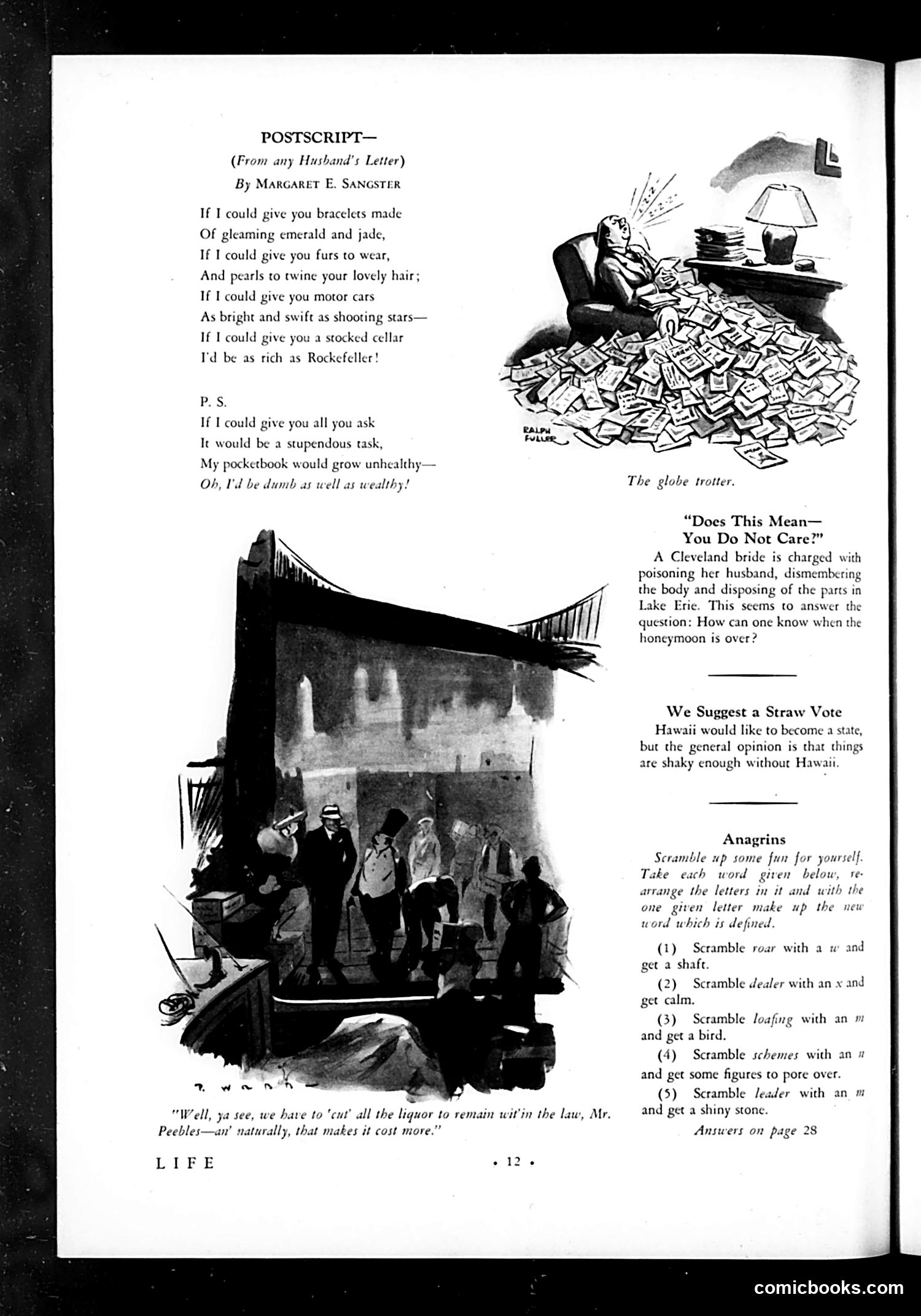
Explanation of Life Magazine Page 12 This page contains social satire from an early 20th-century American magazine. The top section, "Postscript," is a humorous poem by Margaret E. Sangster about marital finances—a husband listing lavish gifts he'd give his wife if wealthy, then admitting his pocketbook would "grow unhealthily" instead. The cartoon below depicts Prohibition-era bootlegging. The caption quotes a liquor dealer explaining to authorities why alcohol costs more: it must be "cut" to remain legal. The dark, crowded scene shows the illicit trade in action. The right column includes unrelated items: a criminal case blurb, political commentary on Hawaii statehood, and word-scramble games. Overall, the page reflects 1920s American concerns: marriage, economics, Prohibition enforcement, and westward expansion.
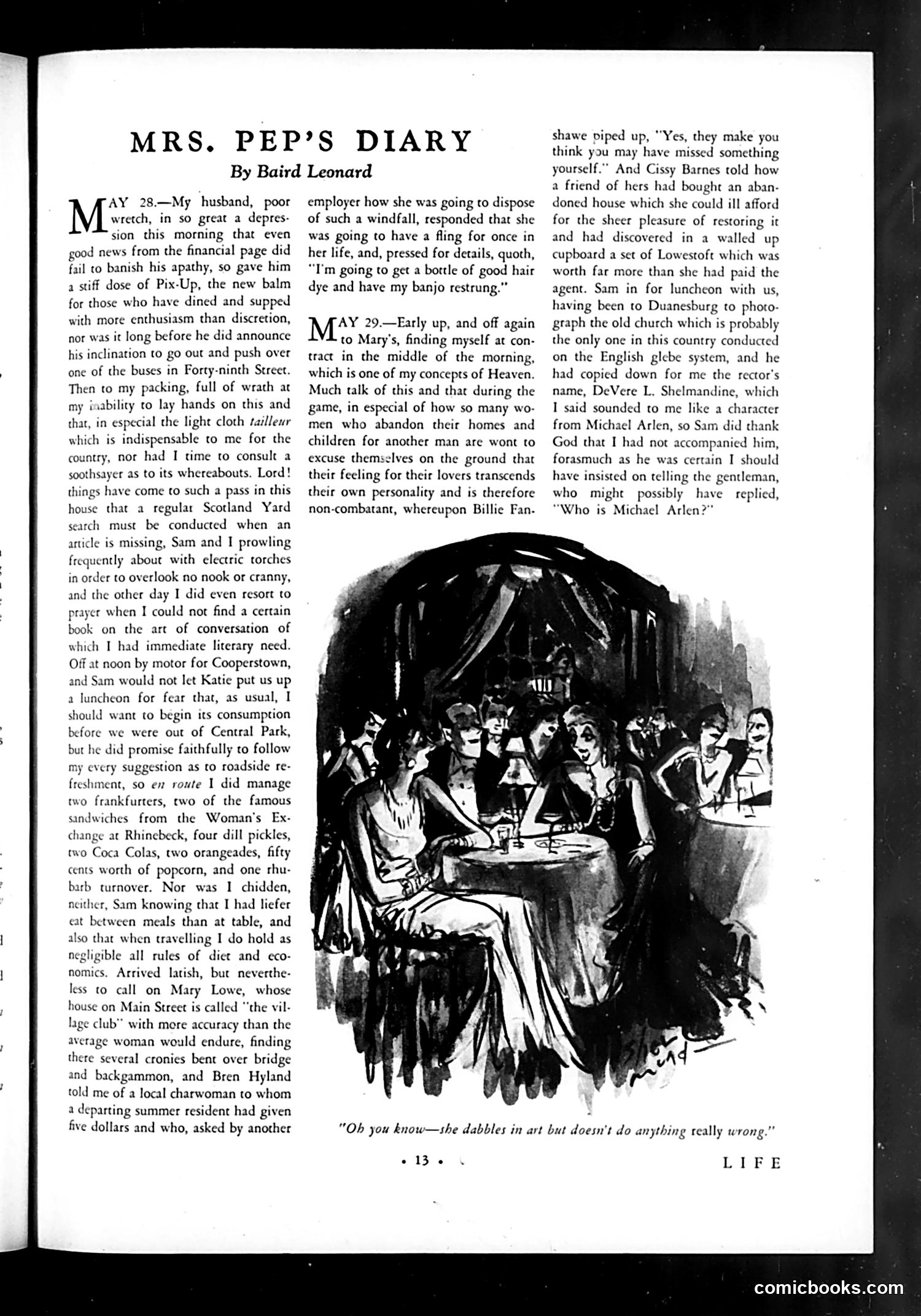
Analysis of "Mrs. Pep's Diary" Page This is a humorous domestic diary column by Baird Leonard from *Life* magazine. The text describes Mrs. Pep's mundane married life and social activities in what appears to be the early-to-mid 20th century. The accompanying illustration shows a group of women gathered under an umbrella, likely depicting a social outing or club meeting mentioned in the diary entry. The caption reads: "Oh you know—the dabbler in art but doesn't do anything really wrong." This satirizes upper-middle-class women's leisure activities and social pretensions of the era—their art appreciation, club memberships, and gossiping. The humor targets the gap between their artistic or cultural aspirations and their actual lack of serious accomplishment, reflecting period attitudes about women's domestic and social roles.
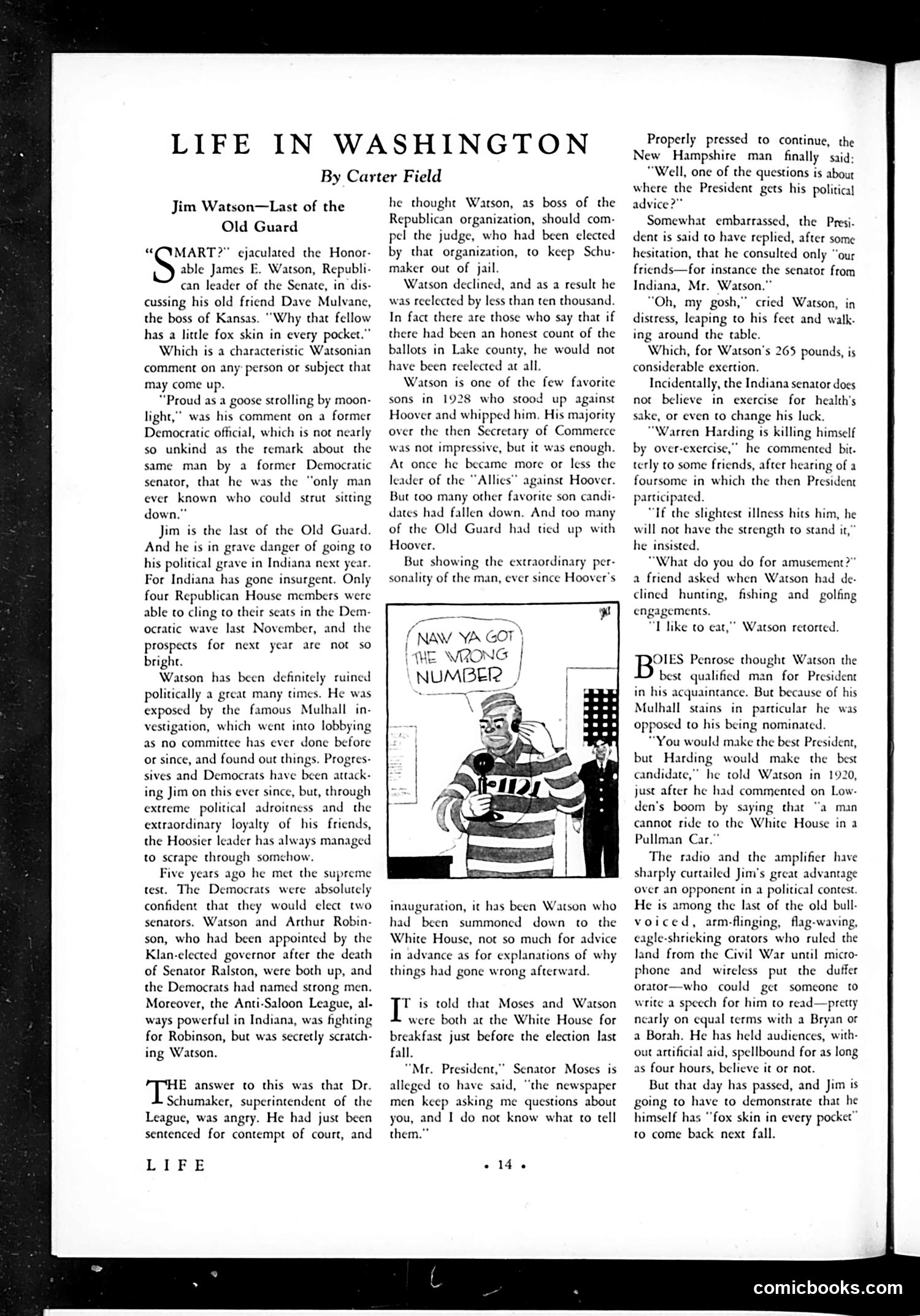
Political Satire: Jim Watson and Republican Leadership This 1928 *Life* magazine page satirizes Jim Watson, a Republican Senate leader from Indiana, through cartoonist Carter Field's column "Life in Washington." The cartoon depicts Watson (the caricatured figure on left) being told "NAW YA GOT THE WRONG NUMBER" by what appears to be a Republican political operative. The satire targets Watson's political isolation: despite his loyal Republican service, he's been abandoned by party leadership, particularly after the Mulhall lobbying scandal exposed his involvement in corrupt practices. The text reveals Watson was considered for the presidency but ultimately rejected—even by President Harding—due to these political liabilities. The "wrong number" joke suggests Watson has become a political liability the party wants to distance itself from, despite his decades of service and loyalty.
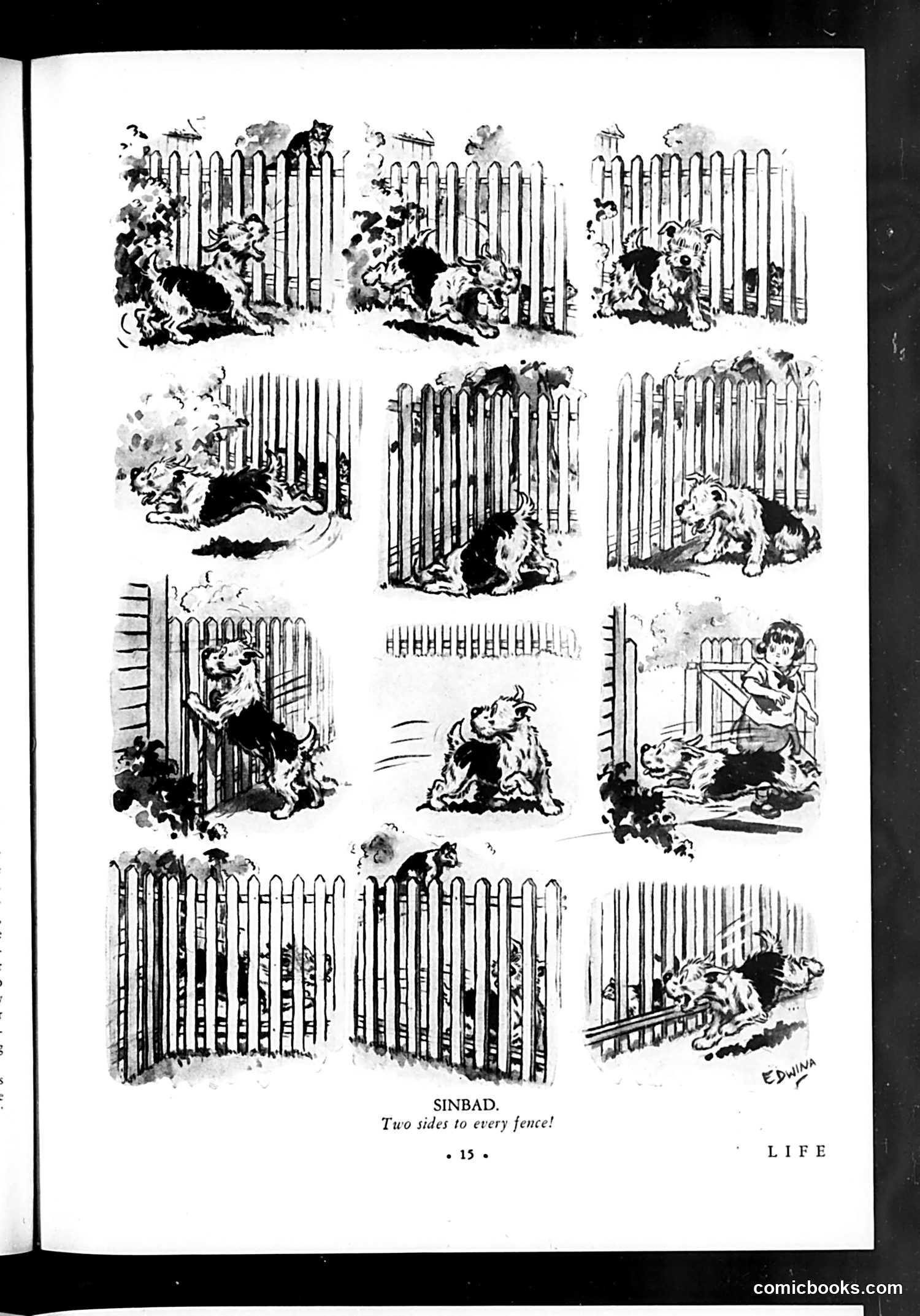
SINBAD: "Two sides to every fence!" This is a humorous comic strip by E. D. Willa (signed lower right) titled "Sinbad," featuring a character repeatedly encountering fences. The strip shows various scenarios where Sinbad interacts with wooden picket fences from different perspectives—sometimes on one side, sometimes the other, with animals (appearing to be dogs or similar creatures) involved in the action. The caption "Two sides to every fence!" is a play on the common proverb "two sides to every story," suggesting that fences literally have two sides and that the situations depicted illustrate this obvious but humorous point. The comedy derives from physical slapstick scenarios showing the character's repeated misadventures with fence-related situations, typical of early 20th-century comic strip humor.
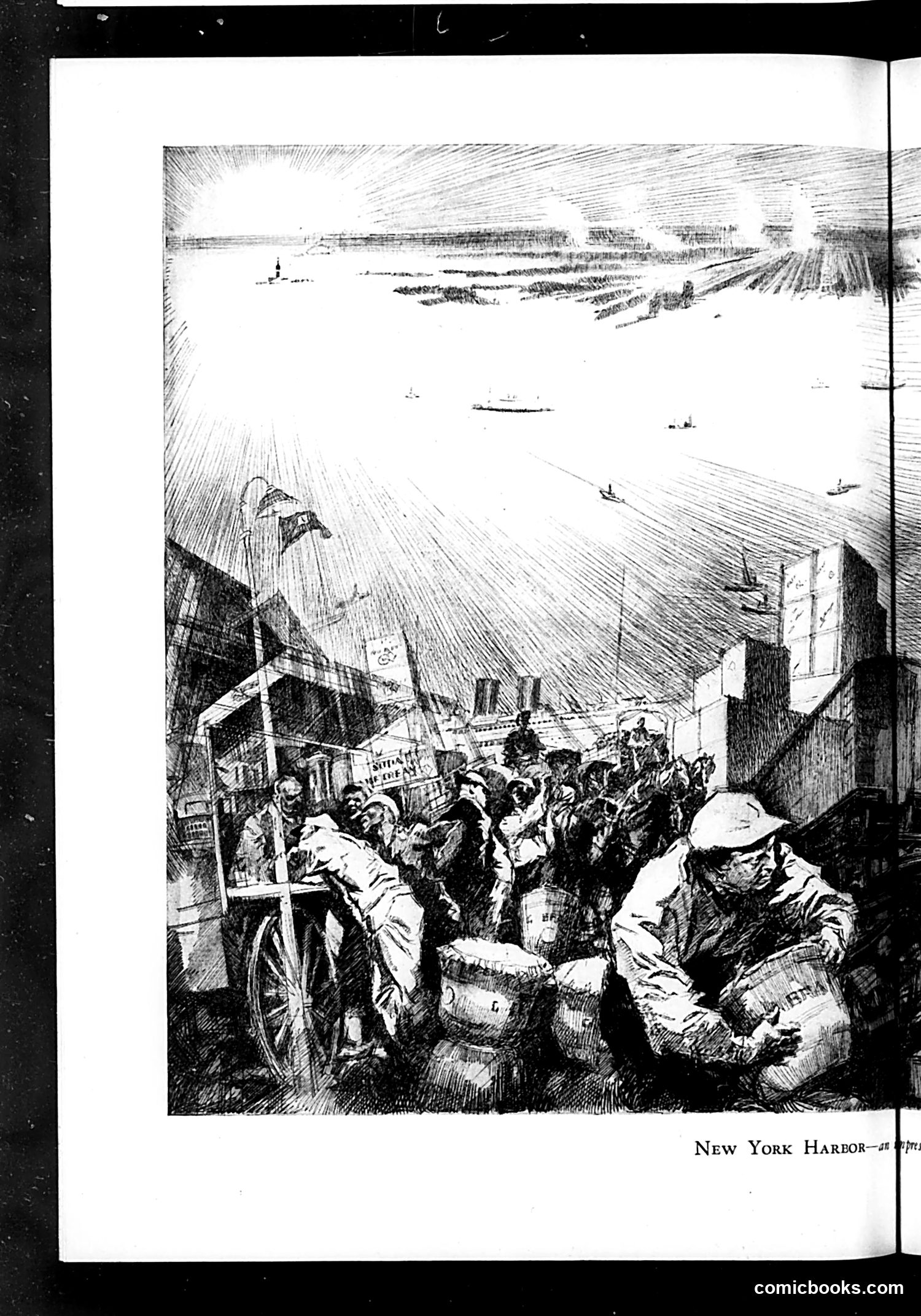
New York Harbor This engraving depicts a crowded scene at New York Harbor, showing immigrants or passengers disembarking from a ship. The foreground shows numerous figures with luggage and belongings gathered on the dock, while vessels dot the water in the background and industrial structures line the shoreline. Given Life magazine's satirical nature, this likely comments on immigration policy or the experience of newcomers arriving in America during the late 19th or early 20th century. The dense crowd and emphasis on luggage suggests themes about mass immigration, overcrowding, or the social/economic conditions facing arriving populations. Without additional caption text visible, the specific satirical point remains unclear, though the scene emphasizes the scale and chaos of harbor immigration processing.
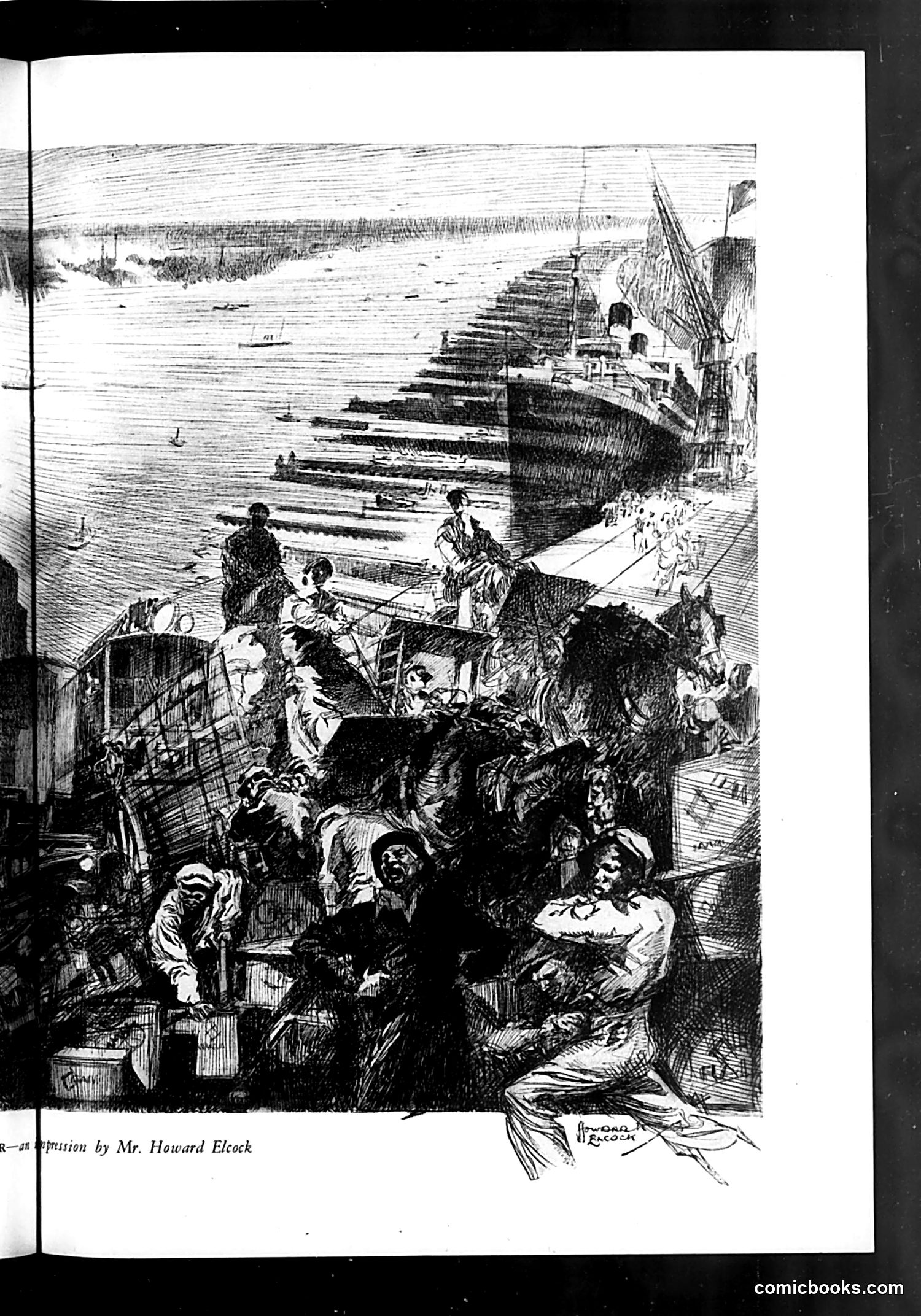
Analysis This is an illustration credited to Howard Elcock depicting a crowded dock scene. A large steamship is docked while numerous passengers and cargo handlers occupy the foreground in apparent disarray or congestion. The composition emphasizes the chaotic activity of maritime commerce—people are clustered densely, some carrying goods, others seemingly waiting or supervising. Without additional context from the magazine page (date, headline, or accompanying article text), the specific satirical point remains unclear. However, the scene likely comments on immigration, labor conditions, or shipping industry practices of the era when *Life* was publishing satirical social commentary. The artist's exaggerated linework emphasizes human crowding and activity, suggesting the illustration critiques some aspect of port operations or passenger handling.
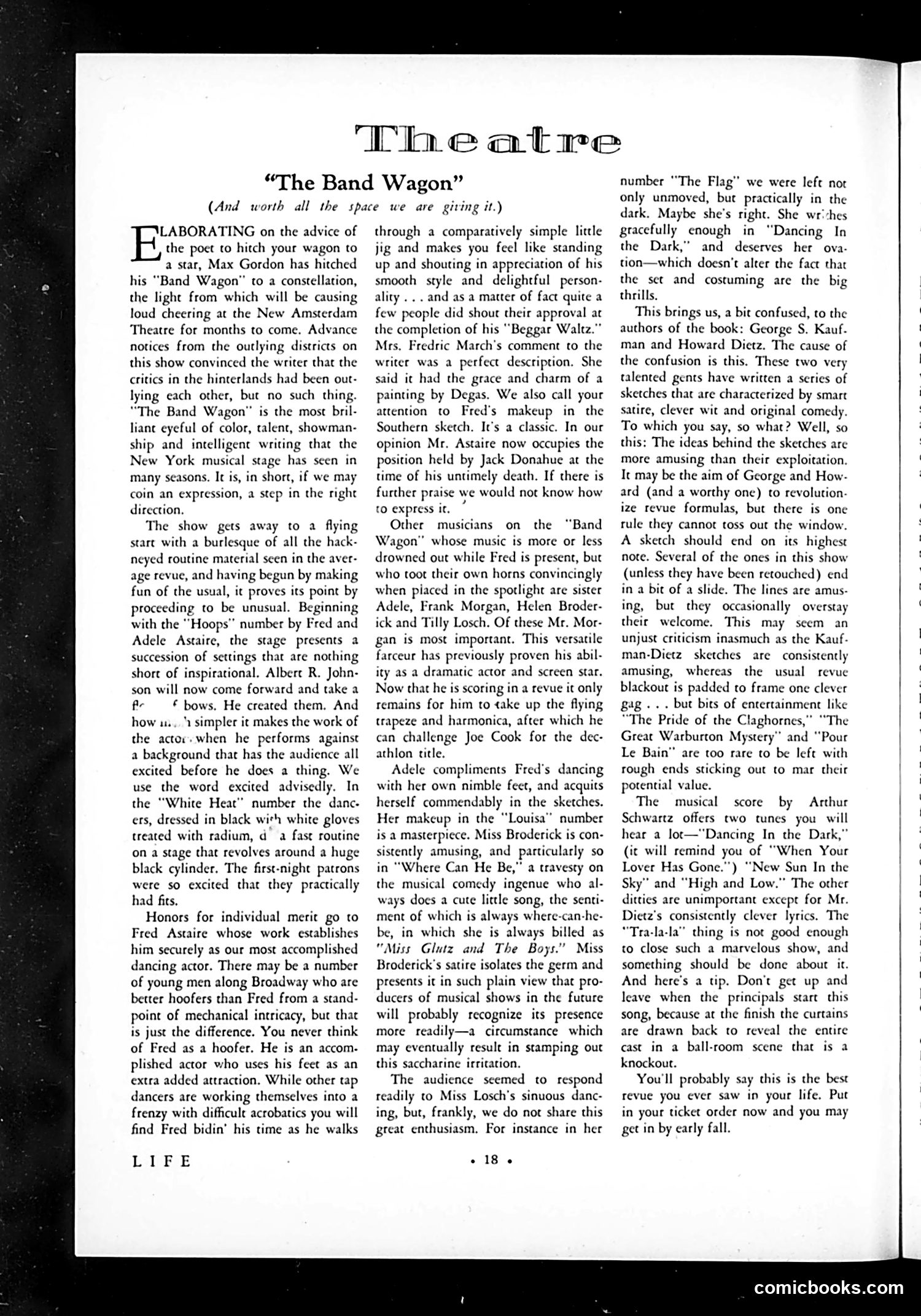
Theatre Review: "The Band Wagon" This is a theatre review, not a political cartoon. The page discusses a Broadway musical revue called "The Band Wagon," which the critic praises extensively. The review mentions Fred Astaire as the star, highlighting his dancing and comedic talents. It references specific musical numbers and sketches, including pieces featuring Adele Astaire and other performers like Helen Broderick and Tilly Losch. The critic's main point: this is an exceptionally entertaining show where even weak sketches work because the cast is so talented. The review recommends audiences purchase tickets immediately, suggesting "The Band Wagon" is among the best revues available—high praise from this Life magazine theatre critic.
Movies by Harry Evans - Film Reviews This page contains three film reviews from *Life* magazine, not political cartoons. The reviews discuss: 1. "A Free Soul" - praises Lionel Barrymore's performance and critiques Norma Shearer's underdressed appearance in one scene, suggesting it seems inappropriate for a serious dramatic publication. 2. "Kick In" - reviews what appears to be a crime drama about a gangster raising his daughter. The reviewer notes the film lacks a strong story but appreciates the cast's efforts. 3. "Shipmates" - recommends this film for family viewing, praising its direction, dialogue, and photography. The reviewer highlights Robert Montgomery's natural charm and notes it avoids over-the-top comedic acting. These are straightforward entertainment reviews characteristic of 1930s film criticism.
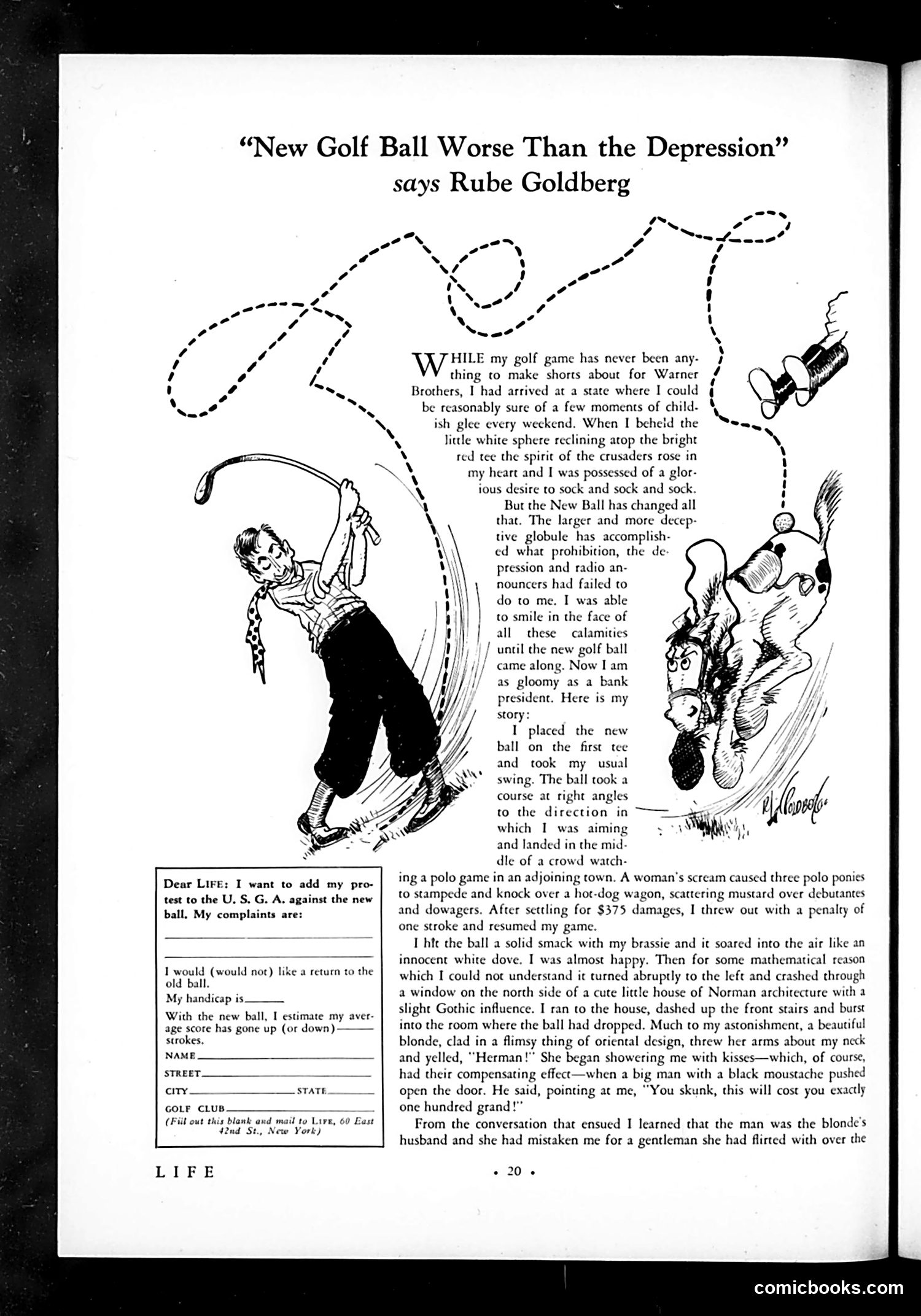
Explanation for Modern Readers This is a humorous essay by cartoonist Rube Goldberg complaining about a new golf ball design. The satire works on multiple levels: The Setup: Goldberg frames golf as one of his few remaining sources of joy during the Great Depression—a time when prohibition, economic collapse, and radio announcers had already ruined American life. The Joke: The new ball's unpredictable flight turns him into a walking disaster. His shots veer wildly, causing chaos (stampeding polo ponies, property damage) and creating absurd complications (a case of mistaken identity with an attractive woman). The Point: By exaggerating the ball's destructive consequences to Depression-era levels of misery, Goldberg satirizes both golfers' complaints about the new equipment and the era's general sense of helplessness—even leisure has become unreliable. The accompanying form invites readers to send their own protests to the U.S. Golf Association, making it mock-participatory social commentary.
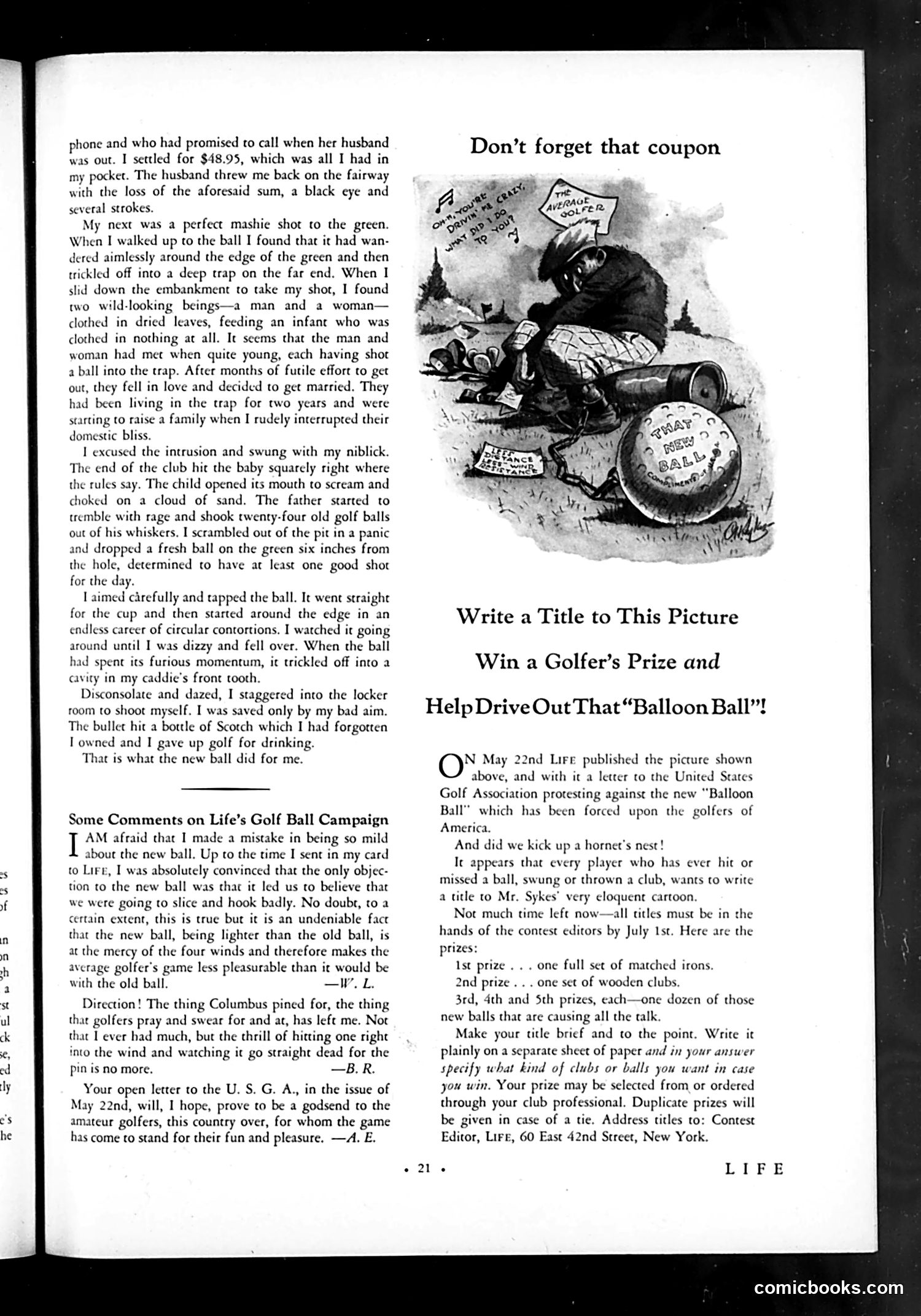
Life Magazine Golf Ball Campaign (circa 1930s) This page documents *Life* magazine's satirical crusade against the newly introduced "Balloon Ball" in American golf. The cartoon depicts the ball causing absurd chaos: a couple living in a sand trap after being trapped trying to escape it, and a baby being struck by a golf club. The humor satirizes how the lighter, wind-resistant new ball undermined traditional golf gameplay by making the sport unpredictable and frustrating for amateurs. The accompanying reader letters—presented as "Comments"—mock the ball's poor aerodynamics and lack of directional control. *Life* ran a contest inviting readers to title the cartoon, offering matched irons or wooden clubs as prizes. This was both entertainment and advocacy: the magazine weaponized humor and reader participation to pressure the United States Golf Association to reject the new equipment. The "Don't forget that coupon" header emphasizes reader engagement in this campaign against unwanted golf innovation.
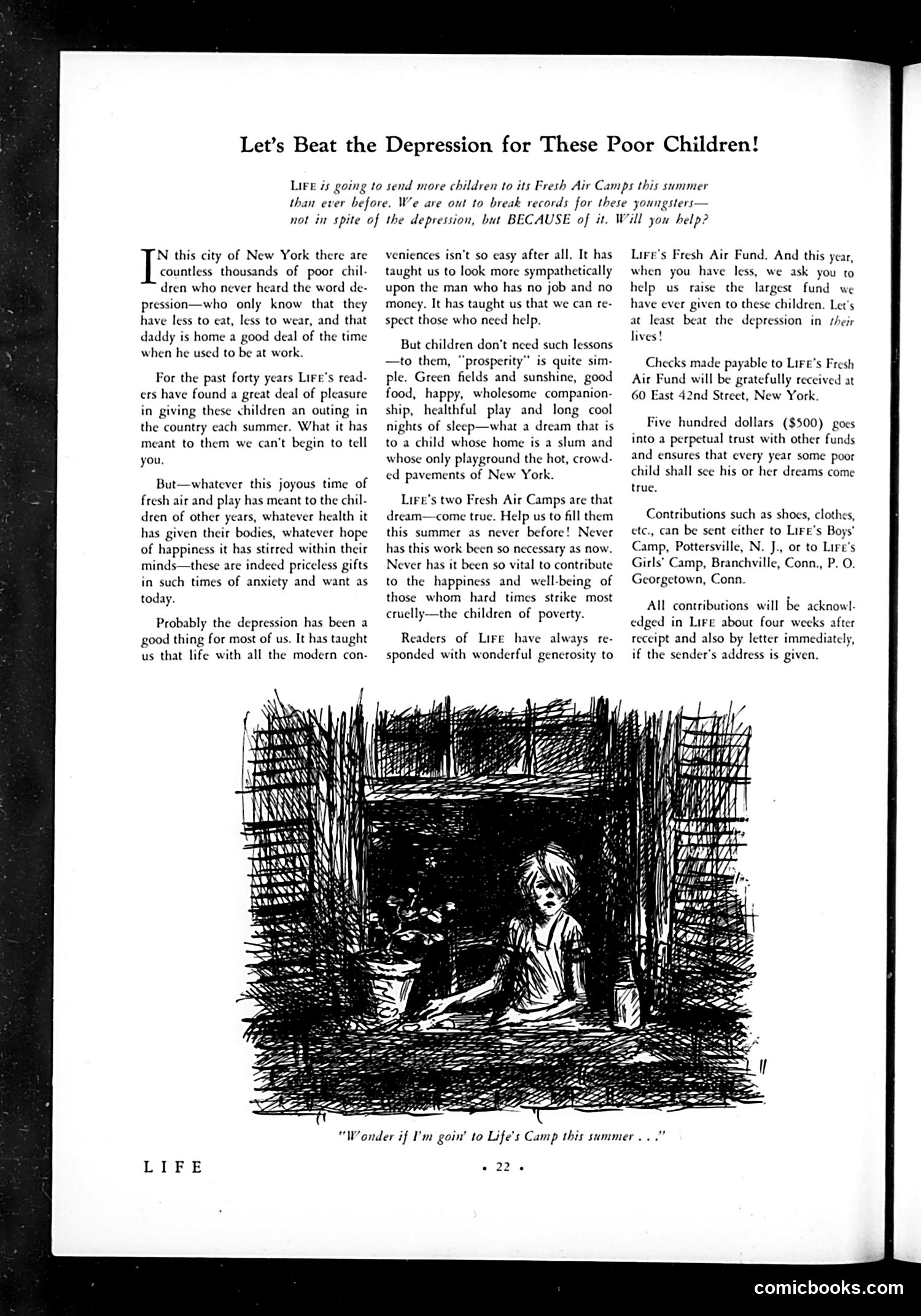
Analysis of Life Magazine Depression-Era Fundraising Appeal This is a charitable fundraising appeal, not satire. During the Great Depression, *Life* magazine solicited donations for its Fresh Air Camps—established programs sending poor urban children to countryside retreats for summer. The accompanying sketch depicts a child in a tenement doorway, gazing out with the caption "Wonder if I'm goin' to Life's Camp this summer..." This image emotionally appeals to readers' sympathy for children suffering under Depression hardship. The text argues that while economic collapse has humbled middle-class Americans, poor children remain oblivious to "depression"—they simply experience deprivation: less food, less clothing, unemployed fathers. The camps offer basic necessities presented as luxuries: "green fields and sunshine, good food...wholesome companionship." The appeal requests monetary donations or goods (shoes, clothes) to expand camp capacity beyond previous years, framing Depression-era giving as a moral imperative precisely *because* resources are scarce. This represents Depression-era philanthropy targeting childhood welfare.
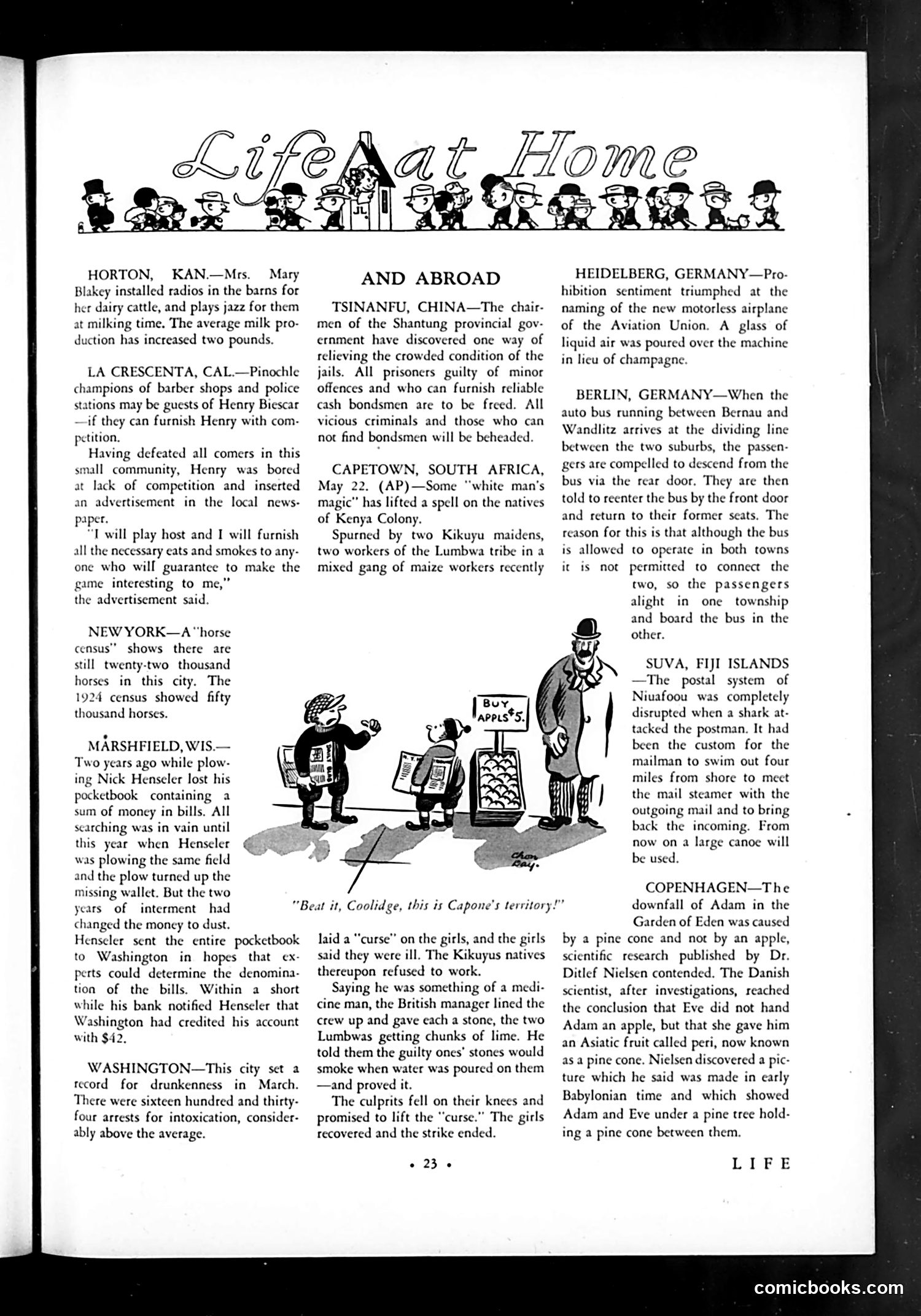
Analysis of Life Magazine Page This page contains a "Life at Home and Abroad" column featuring humorous anecdotes and one political cartoon. The Cartoon: The single illustrated item shows three figures at a bus stop with a sign reading "BUS APPLES 5¢." One figure says to another, "Beat it, Coolidge, this is Capone's territory!" This is satire about Prohibition-era organized crime. "Capone" references Al Capone, the infamous Chicago gangster. The joke conflates a simple apple-selling bus stop with Capone's criminal territory, mocking how thoroughly organized crime dominated certain American urban spaces during the 1920s Prohibition era. The Text Items: The remaining content are brief, tongue-in-cheek news items from around the world—ranging from a Kansas farmer playing jazz to dairy cattle, to Chinese authorities beheading prisoners, to a Fiji Islands postman attacked by a shark. These illustrate Life's satirical approach to reporting oddities and absurdities from both American and international life.
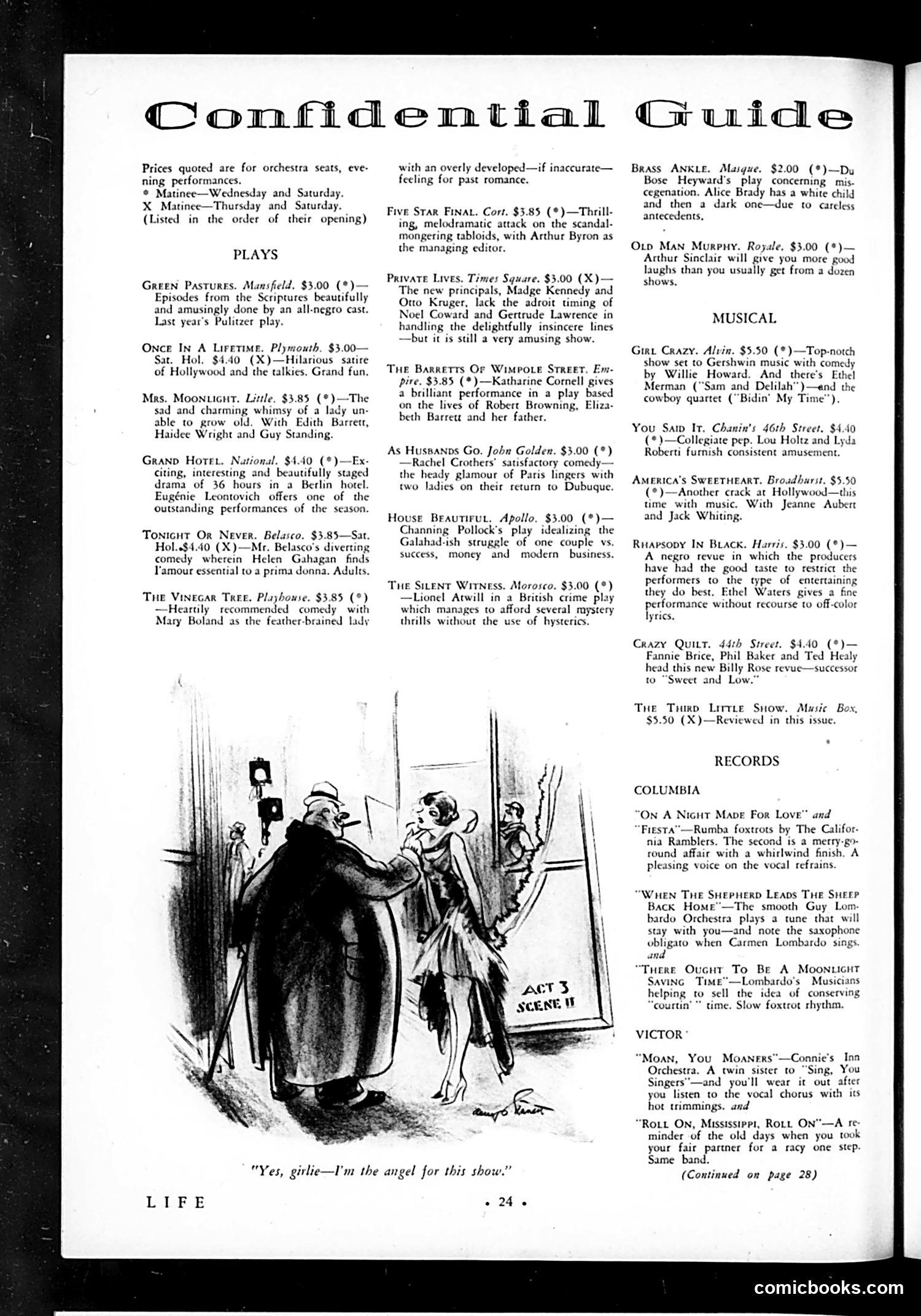
Explanation for Modern Readers This page is a theater and entertainment guide from *Life* magazine, not primarily a political cartoon. The single illustration shows a theatrical scene (labeled "Act 3, Scene II") depicting what appears to be a backstage or street moment, with the caption "Yes, girlie—I'm the angel for this show." The page's main content is a "Confidential Guide" to Broadway plays, musicals, and records currently playing. It reviews productions including *Green Pastures* (an all-Black cast production), *Once in a Lifetime* (satire of Hollywood's transition to talking pictures), and various other stage shows with ticket prices and brief critical notes. The illustration is simply decorative—typical of *Life*'s theatrical coverage. There is no political satire here; this is straightforward entertainment journalism documenting 1930s Broadway offerings for readers planning nights out.
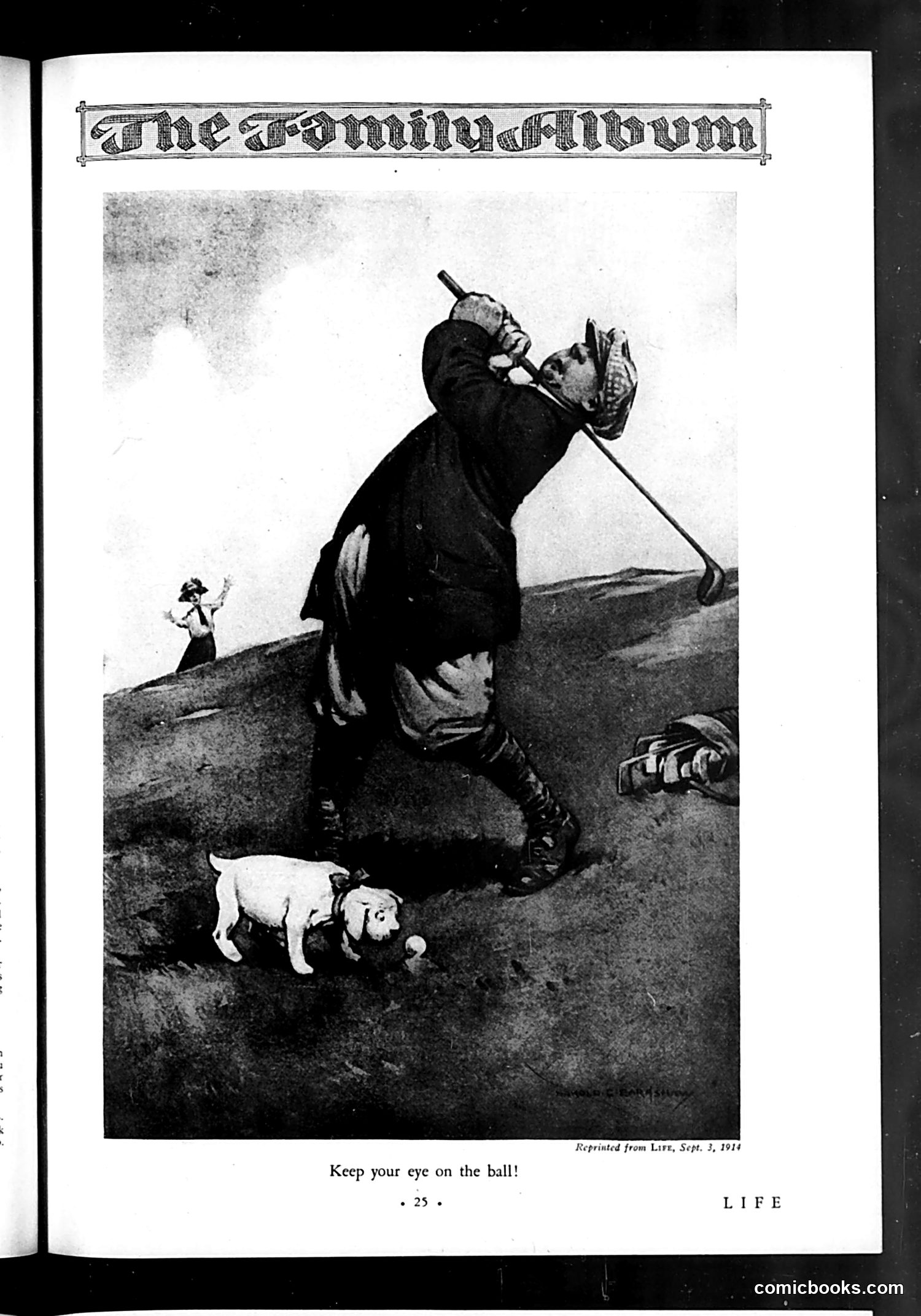
Analysis of "Keep Your Eye on the Ball!" This September 1914 *Life* magazine cartoon uses golf as a metaphor for World War I, which had just begun in Europe that month. A golfer—likely representing either American leadership or the American public—attempts a golf swing while distracted by surrounding chaos. A small dog and a tiny figure (possibly representing Europe or specific nations) create distractions in the immediate foreground, while larger turbulent events loom in the background. The caption "Keep your eye on the ball!" suggests Americans should focus on their own affairs rather than become entangled in the European conflict. The satire critiques how domestic concerns and international upheaval compete for attention during this pivotal moment. The cartoon reflects early American isolationist sentiment before the 1917 entry into the war.
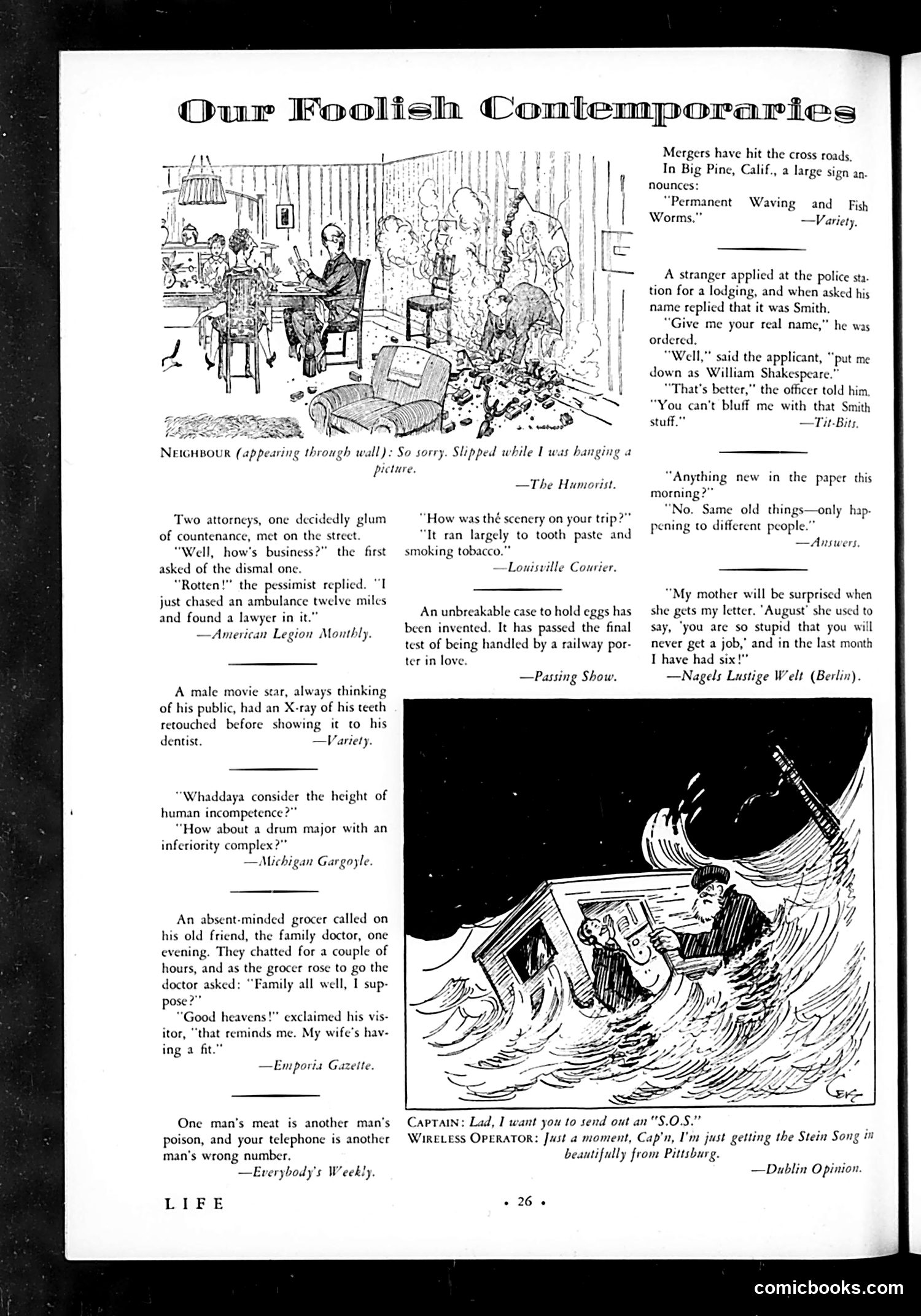
"Our Foolish Contemporaries" — Life Magazine Humor Page This page collects brief humorous anecdotes and jokes from various contemporary publications, a common Life magazine feature. The cartoons and jokes satirize modern absurdities: Key targets: - Ambulance-chasing lawyers — a recognized social menace of the era - Vain movie stars — retouching X-rays shows ridiculous vanity - Incompetent professionals — drum majors with inferiority complexes, absent-minded grocers - Modern conveniences as nuisances — wrong-number telephone calls - Absurd business mergers — a sign combining "Permanent Waving and Fish Worms" satirizes indiscriminate corporate consolidation The main cartoon shows a wireless operator prioritizing entertainment (the "Stein Song," a popular college tune) over ship distress signals—mocking modern radio's triviality overriding genuine emergency. The humor reflects 1920s anxieties: rapid commercialization, professional opportunism, technology's mixed blessings, and loss of seriousness in modern life.
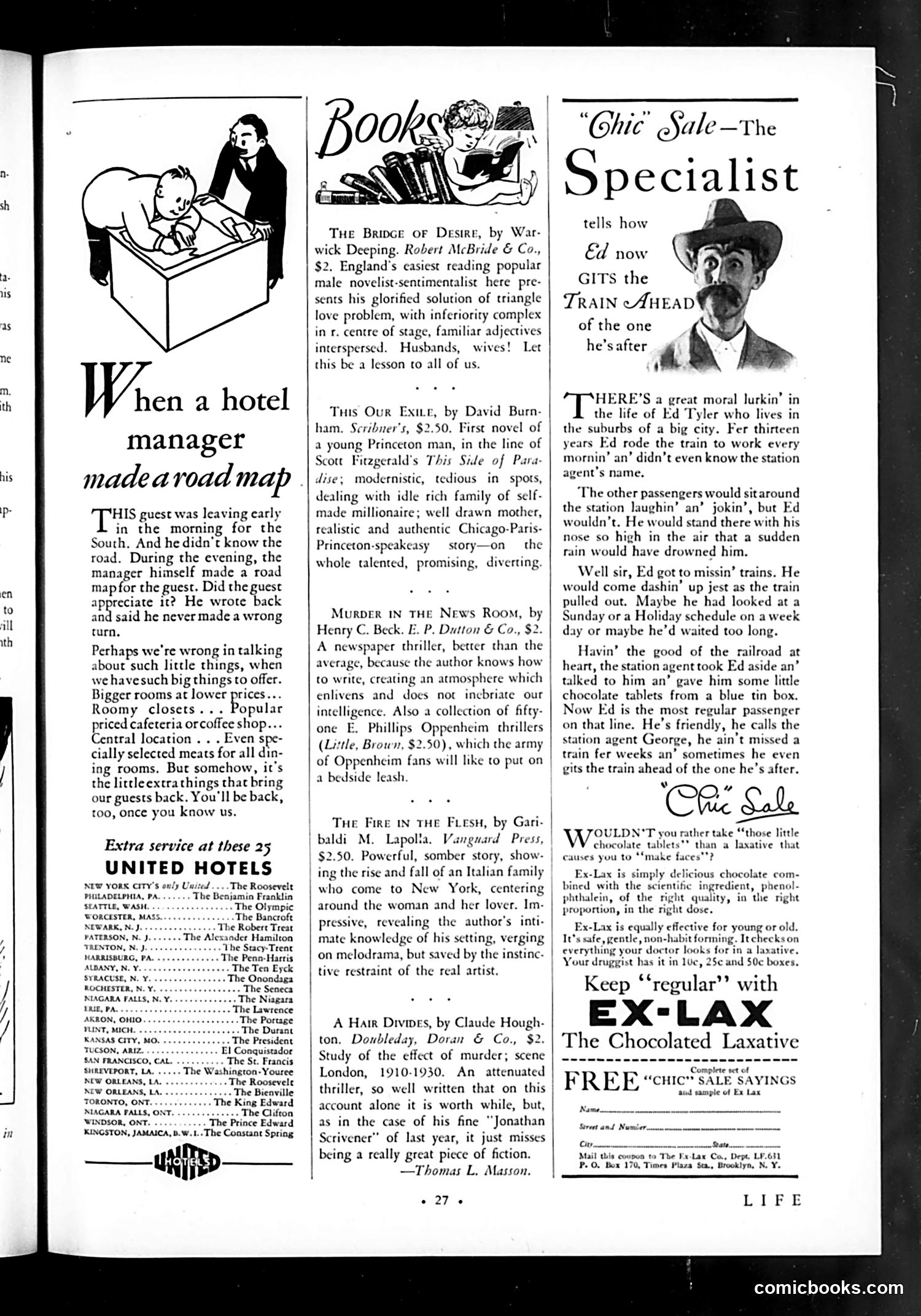
Explanation for Modern Readers This page contains two distinct elements: a hotel industry advertisement and book reviews. The Hotel Advertisement ("When a hotel manager made a road map") is a *feel-good business anecdote*. A hotel manager personally sketches a road map for a departing guest—a small, thoughtful gesture. The point: in competitive hospitality, it's these humble personal touches, not just amenities like bigger rooms or lower prices, that build customer loyalty and repeat business. This reflects pre-1950s business philosophy emphasizing personal service. The "Chic Sale" advertisement promotes a laxative chocolate candy, featuring a caricatured cowboy character. "Chic Sale" was a famous vaudeville comedian known for rural/western humor routines. The advertisement leverages his comedic persona to humorously market digestive remedies—exploiting association with his populist comedy appeal. The book reviews are standard literary criticism of contemporary novels (1920s-30s), including Warwick Deeping's romantic fiction and various thrillers. Reviewer Thomas L. Masson uses period slang ("tedious in spots") and dismissive literary judgments typical of era gatekeeping.
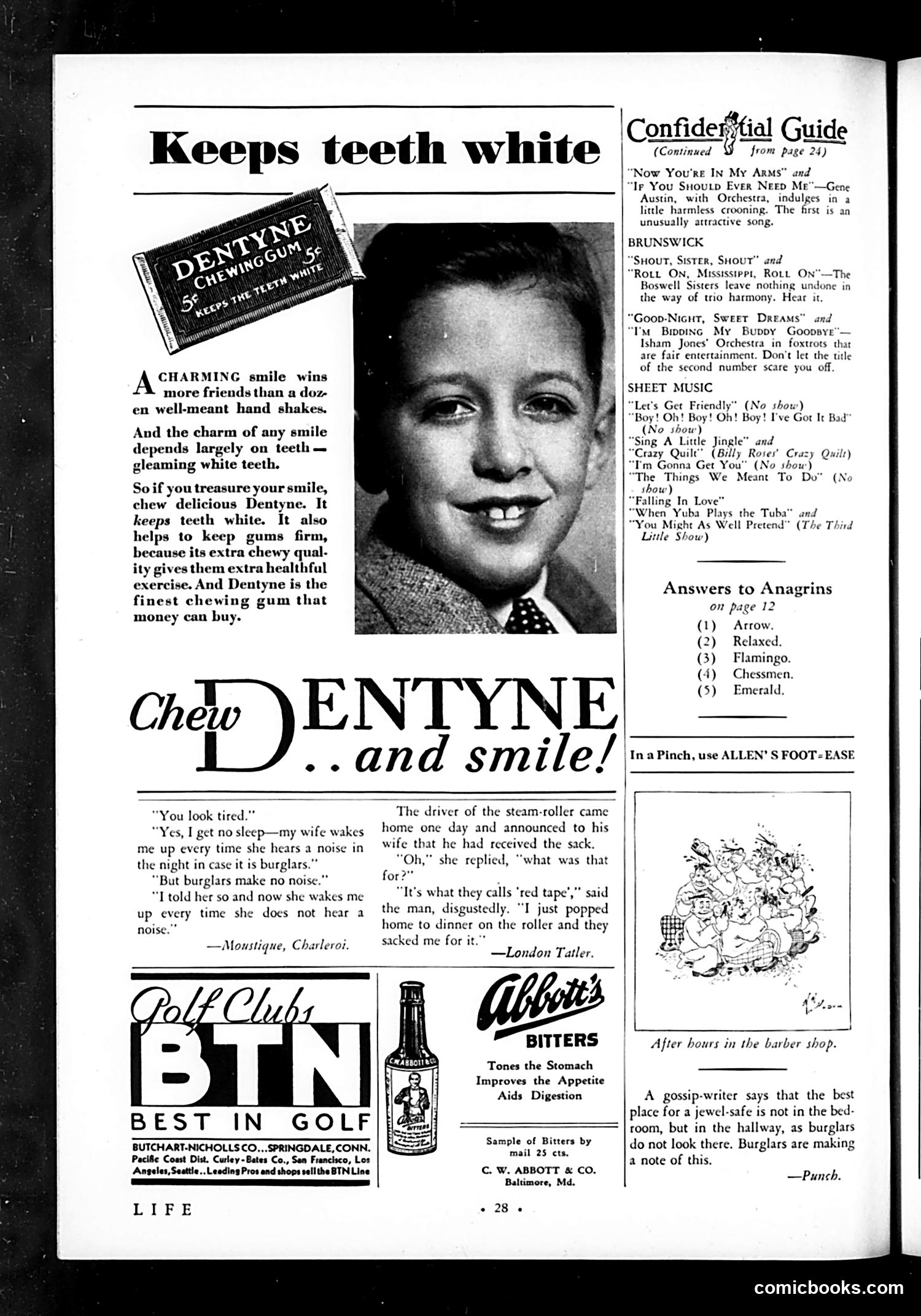
Life Magazine Page Analysis This page is primarily advertising, dominated by a large Dentyne chewing gum ad featuring a smiling boy. The ad's message is straightforward: white teeth attract friends, and Dentyne keeps teeth gleaming while exercising gums. The right column contains a "Confidential Guide" listing popular songs and recordings from the era (Gene Austin, Boswell Sisters, Isham Jones), plus sheet music recommendations—typical entertainment coverage for Life magazine. Below the main ad are three brief humorous anecdotes: one about a wife who wakes her husband over phantom burglars; another about a steam-roller driver fired for taking a dinner break on company equipment (called "red tape"). The final item jokes that safes belong in hallways since burglars avoid visible locations. These jokes reflect 1920s-30s domestic humor—themes of nagging wives, workplace absurdity, and petty crime—common to satirical magazines of the period. The page reflects Life's mix of advertising revenue and light entertainment content typical of that era.
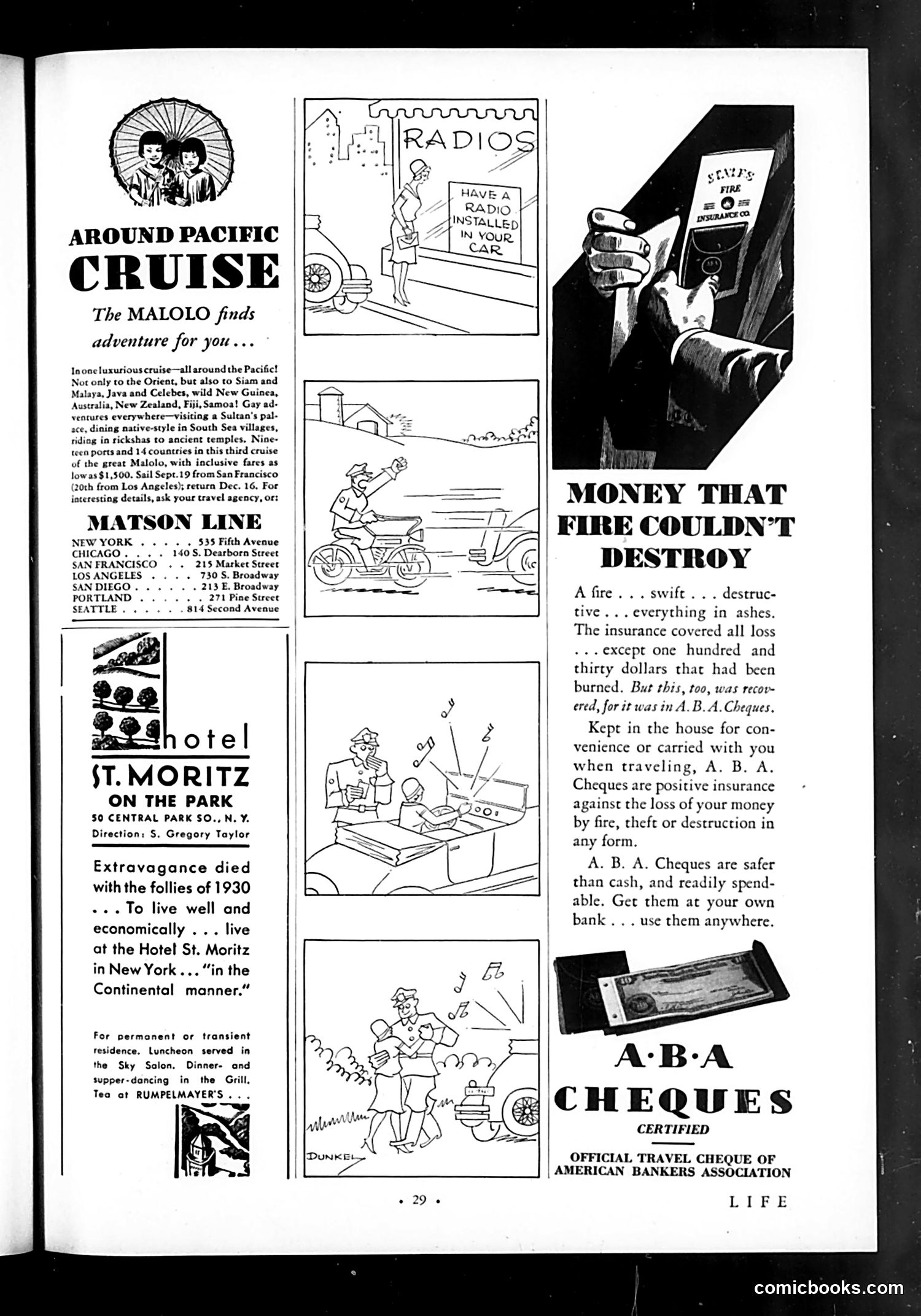
Page Analysis: Life Magazine Advertisement Section This page is primarily advertising content rather than political satire. It contains three main promotions: 1. Matson Line Cruise: Advertises luxury Pacific voyages on the ship *Malolo*, highlighting exotic destinations (Orient, Siam, Java, New Guinea, Samoa) and inclusive pricing from $1,500—appealing to wealthy travelers seeking adventure and cultural experiences. 2. Hotel St. Moritz: Promotes economical luxury living in New York, explicitly referencing the economic climate by claiming "Extravagance died with the follies of 1930"—acknowledging the Great Depression while positioning the hotel as offering refinement without excess. 3. A.B.A. Cheques: Travel checks marketed as safer than cash, using a narrative about fire destroying currency but not traveler's checks to emphasize financial security and convenience for tourists. The cartoons accompanying these ads are generic humorous illustrations typical of 1930s advertising, not political commentary. The page reflects Depression-era marketing emphasizing value and practicality alongside aspirational leisure travel.
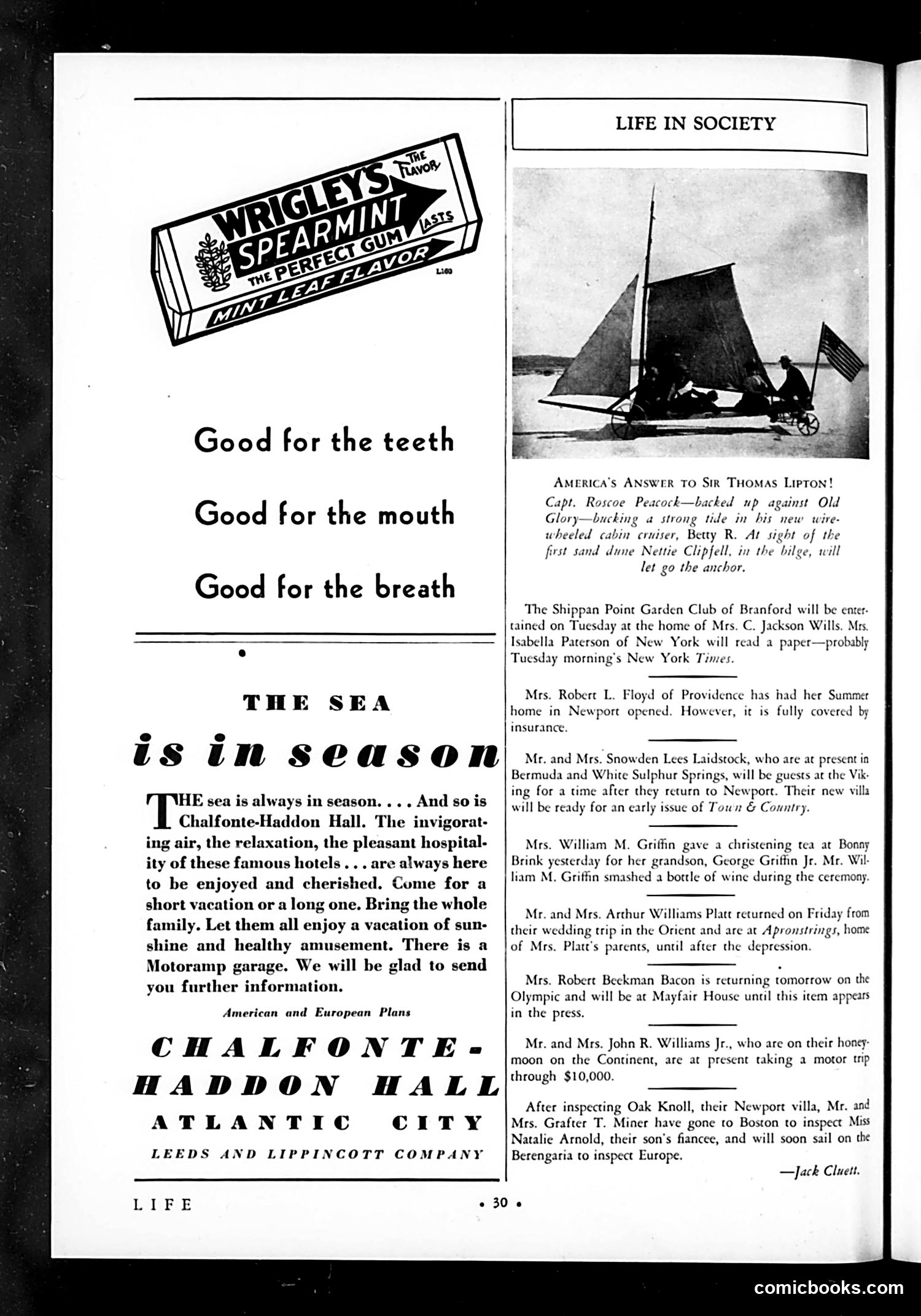
Explanation for Modern Readers This page is primarily a society/gossip section rather than political satire. The left side features a Wrigley's spearmint gum advertisement with the tagline "Good for the teeth / Good for the mouth / Good for the breath," followed by a resort advertisement for Chalfonte-Haddon Hall in Atlantic City. The right side, titled "Life in Society," contains satirical social commentary about wealthy Newport and high-society circles. The humor targets the leisure class through brief, gossipy items about the ultra-wealthy—their vacations, boat outings, christening teas, honeymoons, and villa inspections. The satire is gentle and subtle: one item notes Mrs. Floyd's summer home is "fully covered by insurance" (suggesting anxiety about property), another mentions the "depression" (likely the 1929 economic crisis), and the final note jokes about inspecting a fiancée in Boston before sailing to Europe to "inspect Europe"—implying the wealthy treat everything, including people and continents, as commodities to evaluate. The humor depends on readers recognizing these names as Newport society figures and finding their preoccupations absurd.
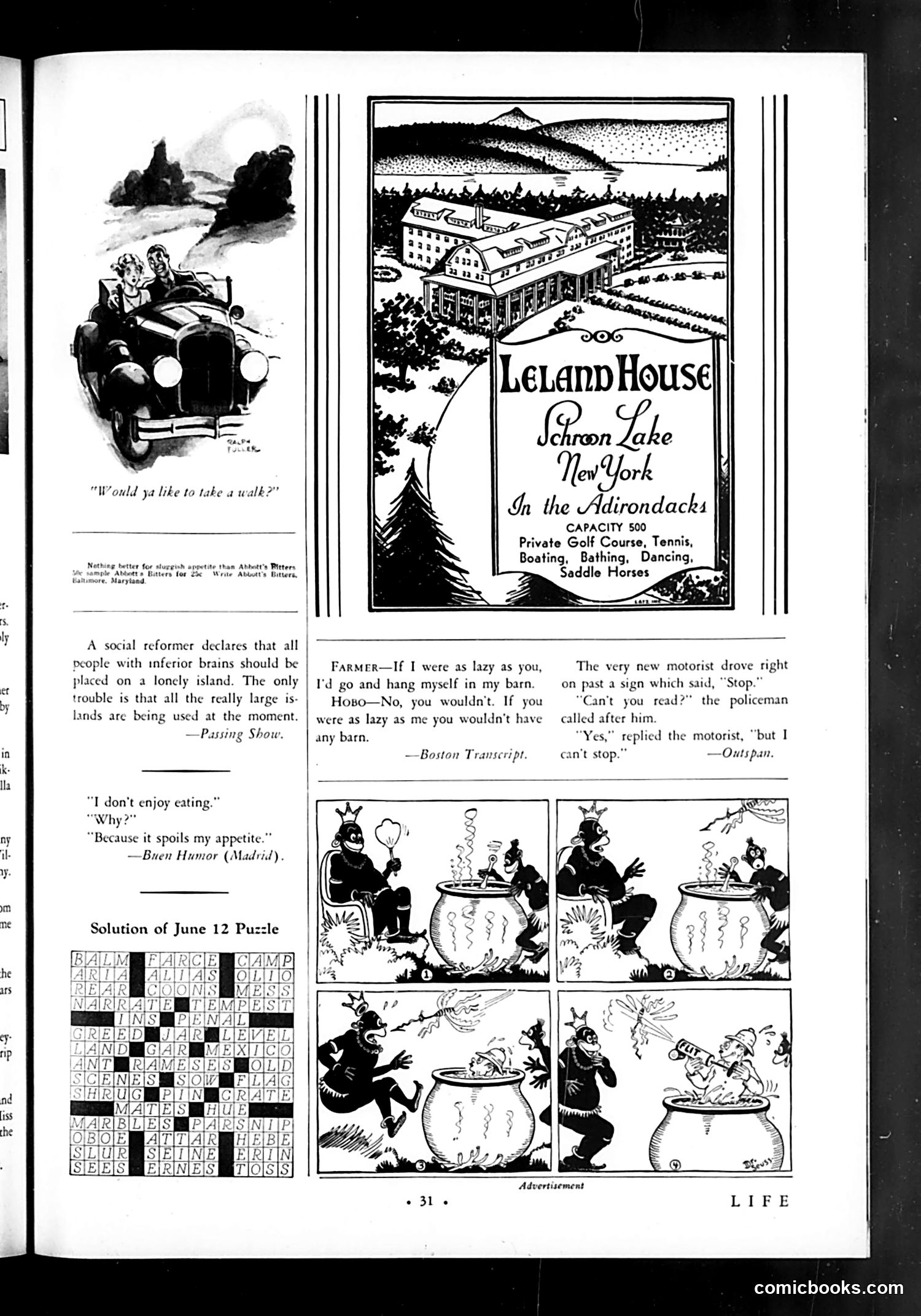
Political and Social Satire from Life Magazine This page contains several brief satirical jokes and advertisements typical of early 20th-century American humor magazines. The cartoons and jokes mock: 1. Eugenics ideology — A social reformer suggests isolating people with "inferior brains" on islands; the joke's punchline critiques this by noting all large islands are already occupied, implying the idea is impractical and absurd. 2. Rural vs. urban class differences — A farmer and hobo exchange jabs about laziness and poverty, playing on Depression-era stereotypes. 3. Modern automobile culture — A new motorist ignores traffic signs, claiming inability to stop rather than inability to read—mocking both reckless driving and mechanical unreliability of early cars. 4. Advertising — The Leland House resort ad promotes leisure activities for wealthy vacationers in the Adirondacks. The page reflects 1920s-30s preoccupations with social reform debates, class humor, and anxieties about new technology.
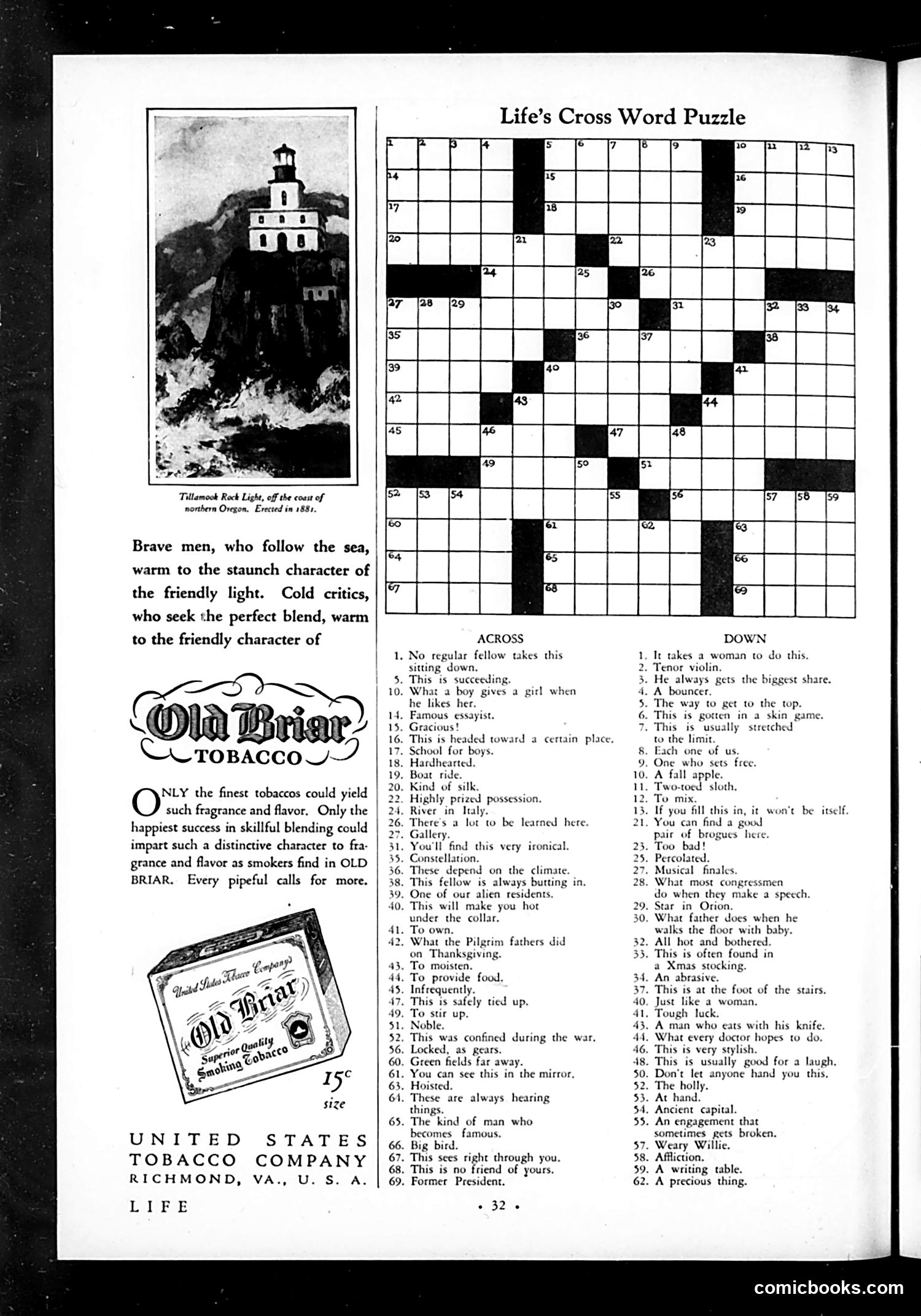
Life Magazine Crossword Puzzle Page Analysis This page is primarily advertising disguised as editorial content—a common early 20th-century magazine practice. The dominant feature is a full-page advertisement for Old Briar Tobacco by the United States Tobacco Company. The advertisement uses patriotic, masculine rhetoric ("Brave men, who follow the sea") and features an image of Tillamook Rock Lighthouse (erected 1881, off Oregon's coast) to associate the tobacco brand with rugged American character and reliability. The "friendly light" serves as a metaphor for the product's dependability. The crossword puzzle below is likely a Life magazine regular feature offering readers entertainment. Clues reference contemporary 1920s-era topics (Pilgrim fathers, war references, congressmen) but appear generic rather than satirical. The page demonstrates how magazines monetized content by embedding advertising within what appeared to be editorial features, while the crossword provided reader engagement that justified the tobacco company's substantial ad investment.
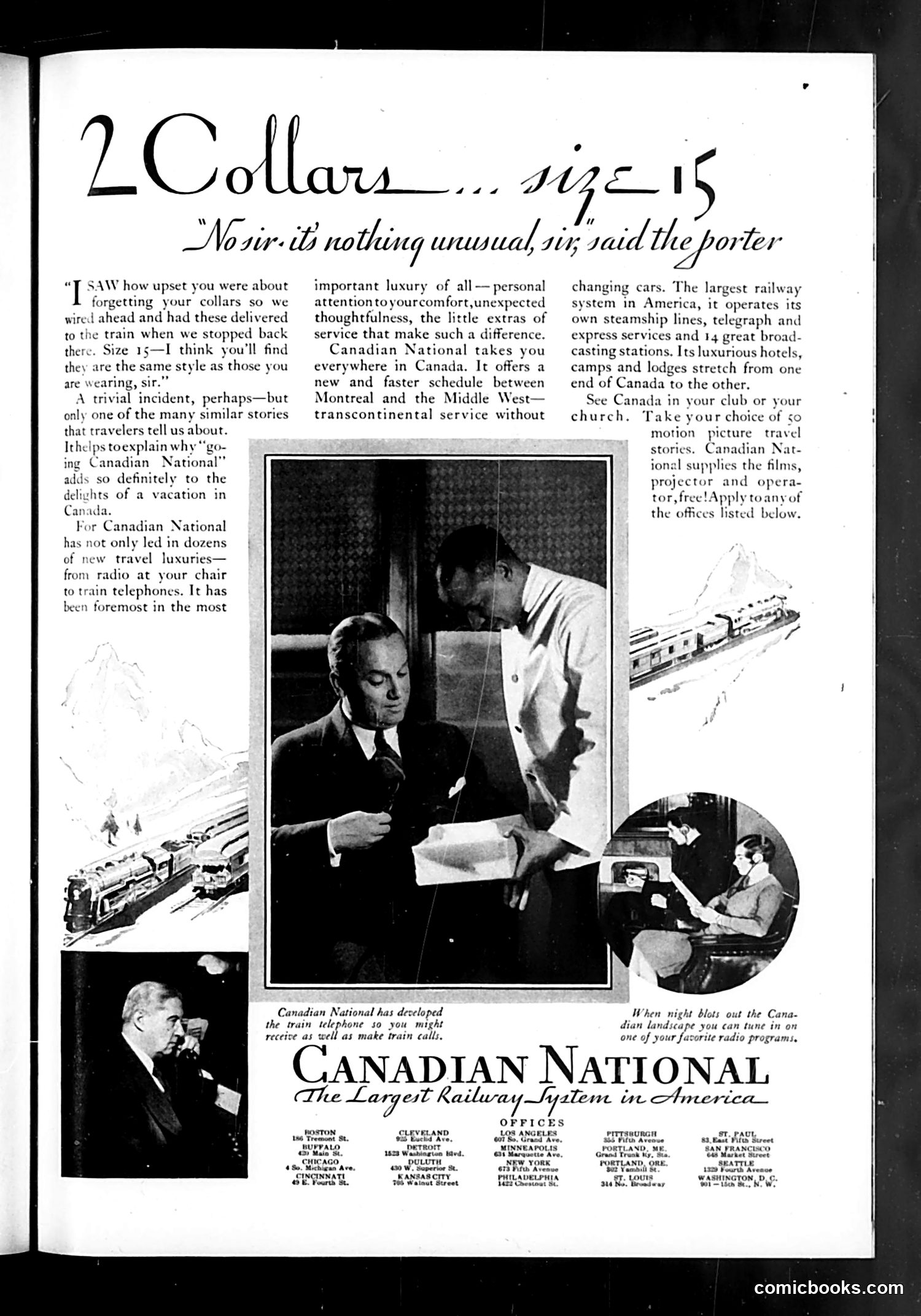
Analysis: "2 Collars... Size 15" This is a Canadian National Railway advertisement, not political satire. It promotes the railroad's customer service by illustrating a anecdote about attentive service: a passenger forgot his collars, and the railroad wired ahead to have replacements delivered at the next stop—the correct size and style. The "joke" (mild by modern standards) is the porter's opening line: "Nor is it nothing unusual, sir"—suggesting this level of personal attention is routine for Canadian National. The advertisement emphasizes luxury travel amenities: train telephones, radio service, and modern convenience. It positions Canadian National as "The Largest Railway System in America" and encourages viewers to book travel or request free promotional films for clubs and churches. The surrounding photos show businessmen making calls and working aboard the train, emphasizing connectivity and comfort for traveling professionals. This reflects early-20th-century America's fascination with technological convenience and service-oriented luxury travel.
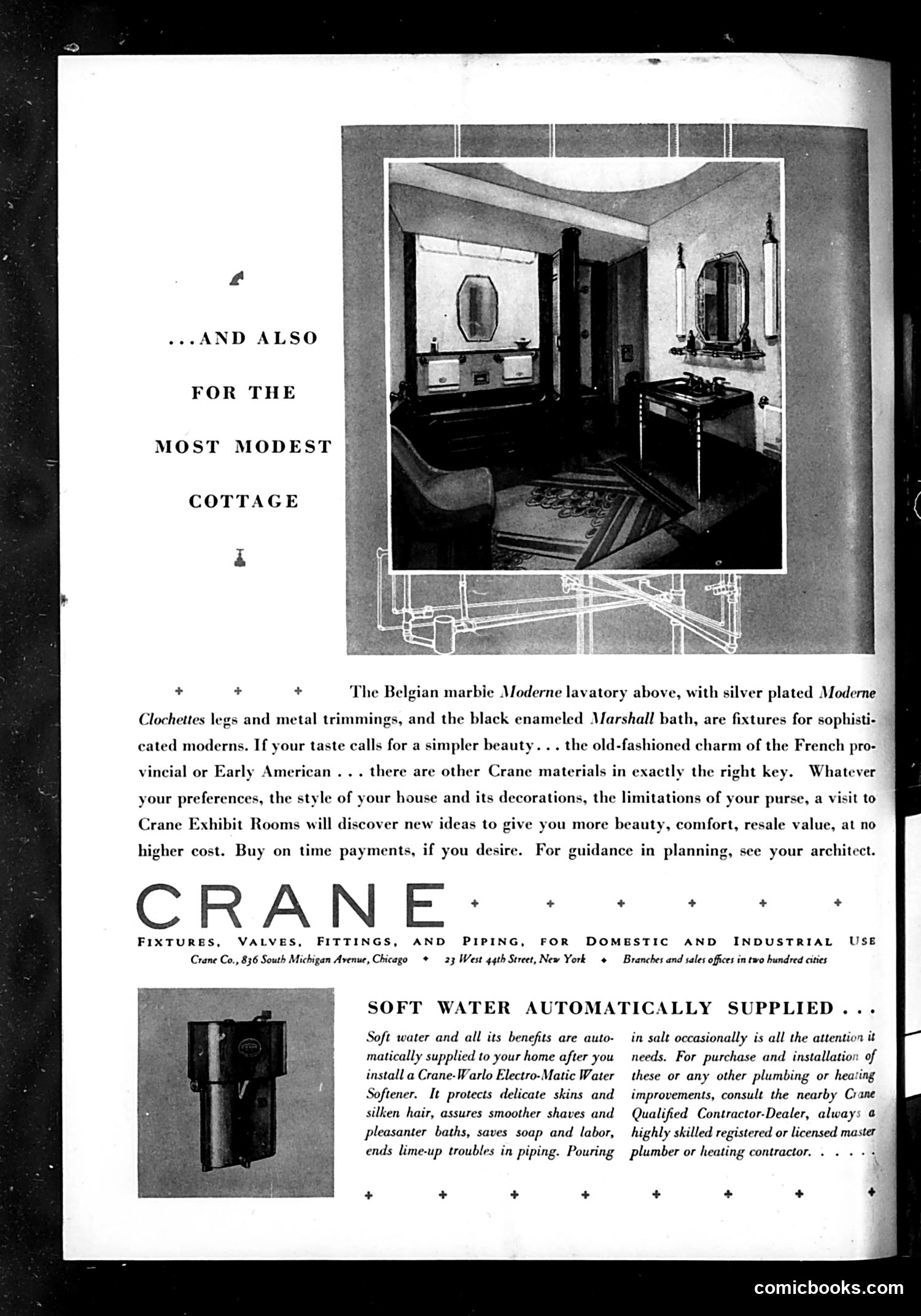
Advertisement Analysis This is not a political cartoon or satire—it's a full-page advertisement for Crane plumbing fixtures and water softeners. The page promotes luxury bathroom design across economic classes. The top image showcases a modern "Moderne" style bathroom with Belgian marble and silver-plated fixtures, positioned as sophisticated. The text then reassures middle-class readers that Crane also offers simpler, traditional styles (French provincial, Early American) at comparable prices, making elegance accessible to "the most modest cottage." Below, an advertisement for the Crane-Warlo water softener emphasizes practical benefits: softer skin, better shaving, soap savings, and reduced pipe maintenance. The copy encourages consultation with qualified contractors. This reflects 1920s-30s consumer culture: democratizing luxury through mass production and installment plans ("Buy on time payments"). The message is that taste and comfort needn't depend solely on wealth.