life
Life — June 26, 1931
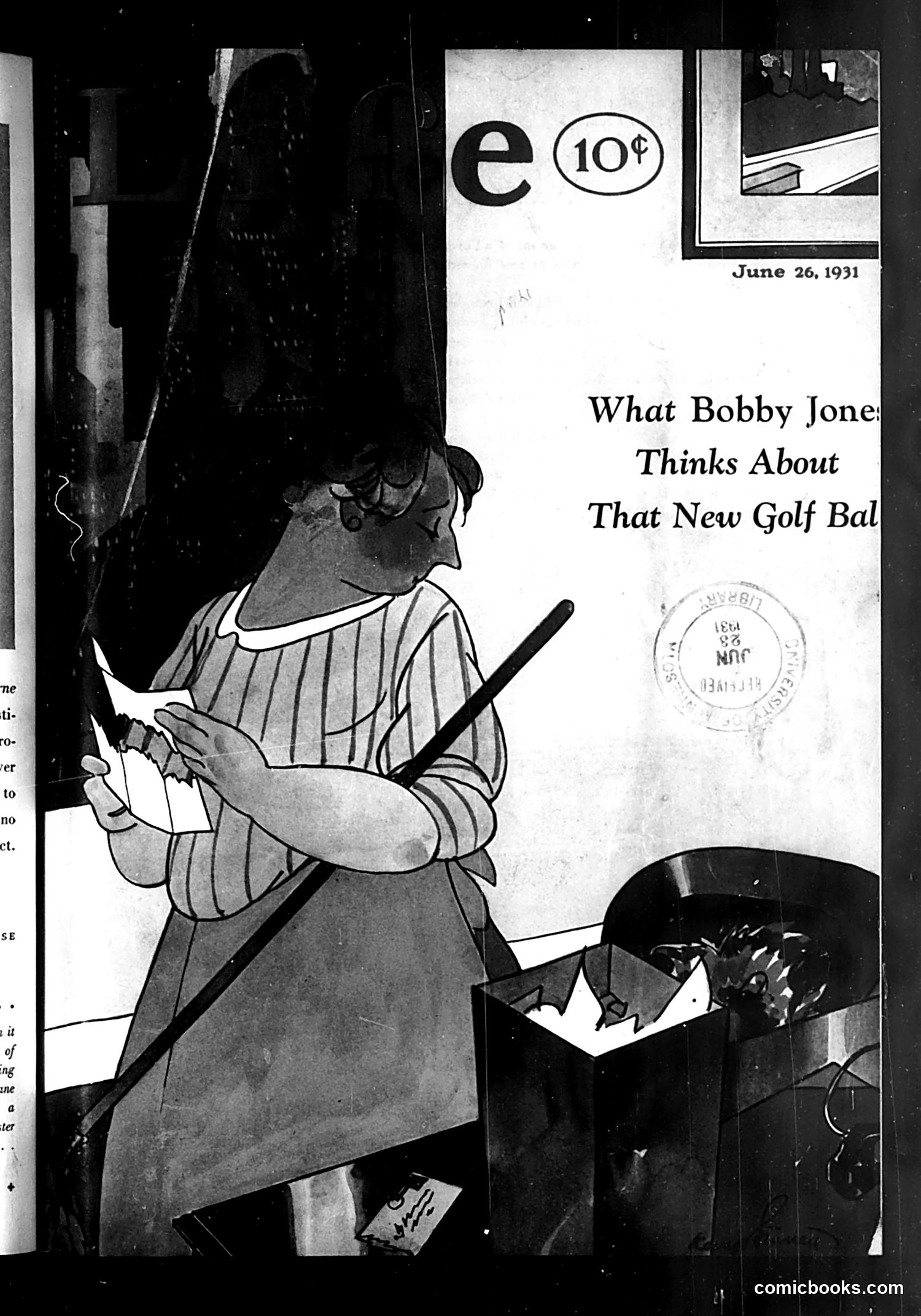
Analysis This is the cover of Life magazine from June 26, 1931. The main illustration depicts a figure in a baseball uniform (pinstriped shirt) examining or holding a golf ball. The headline reads "What Bobby Jones Thinks About That New Golf Ball." Bobby Jones was a legendary amateur golfer of the era. The satire appears to reference contemporary debate about new golf ball technology—likely regulations or specifications being debated in golf at the time. By presenting a baseball player examining a golf ball, the artist may be making a humorous point about the absurdity of technical golf debates, or possibly commenting on Jones's involvement in golf equipment discussions. The 10-cent price and library stamp indicate this is an archival copy.
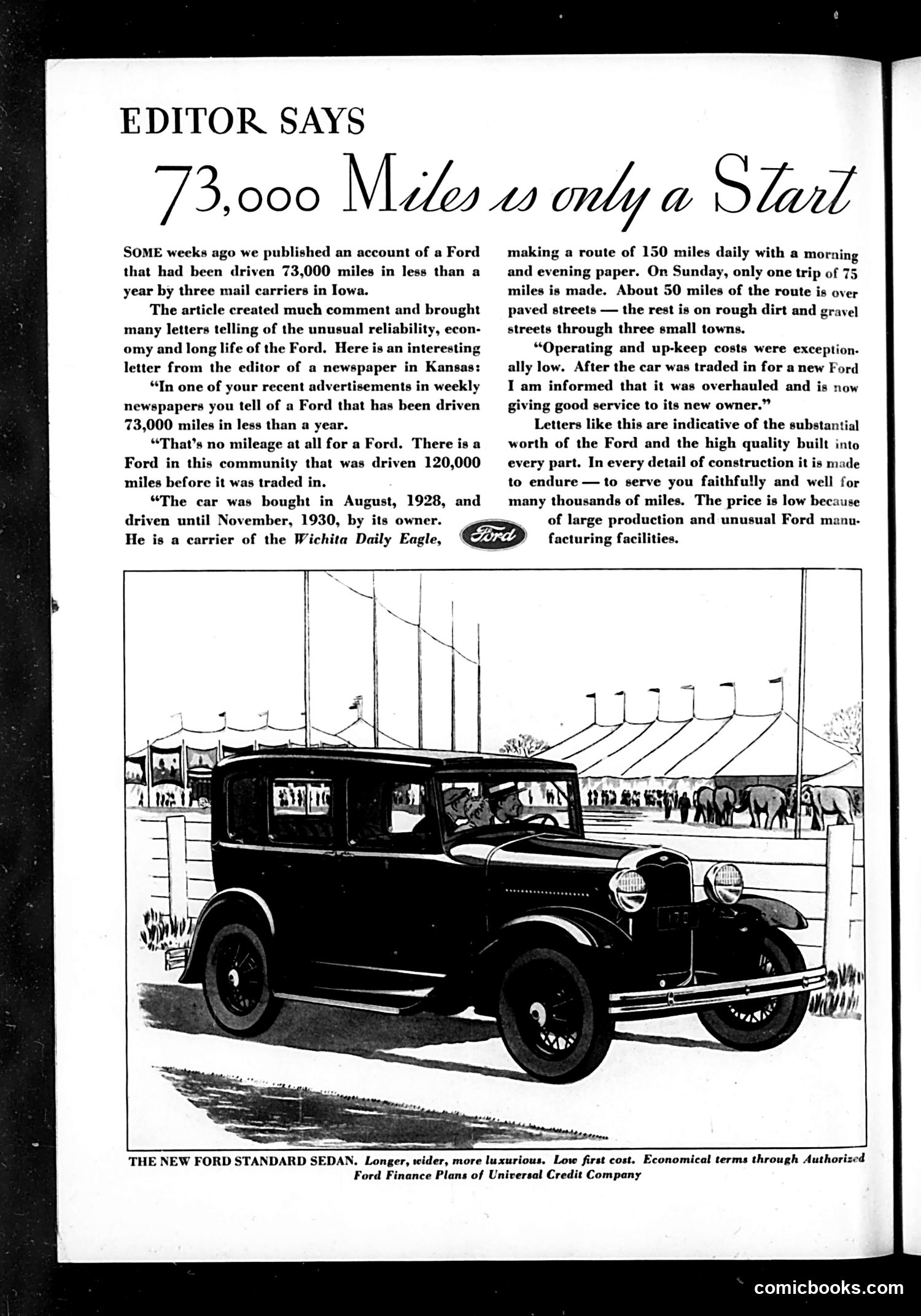
Analysis This is primarily advertising content, not satire or political commentary. The "Editor Says" section presents a Ford Motor Company advertisement disguised as editorial endorsement. The piece highlights a Ford that traveled 73,000 miles in less than a year—a mail carrier's vehicle in Iowa—to demonstrate the car's reliability and durability. The editor emphasizes Ford's low operating costs and quality construction as reasons for the vehicle's longevity. The accompanying illustration shows a 1920s-era Ford Standard Sedan at what appears to be a fair or exhibition grounds, emphasizing the vehicle's practical design. This represents early 20th-century advertorial content, where companies paid for editorial-style articles promoting their products. The message targets practical consumers concerned with economy and dependability rather than luxury.
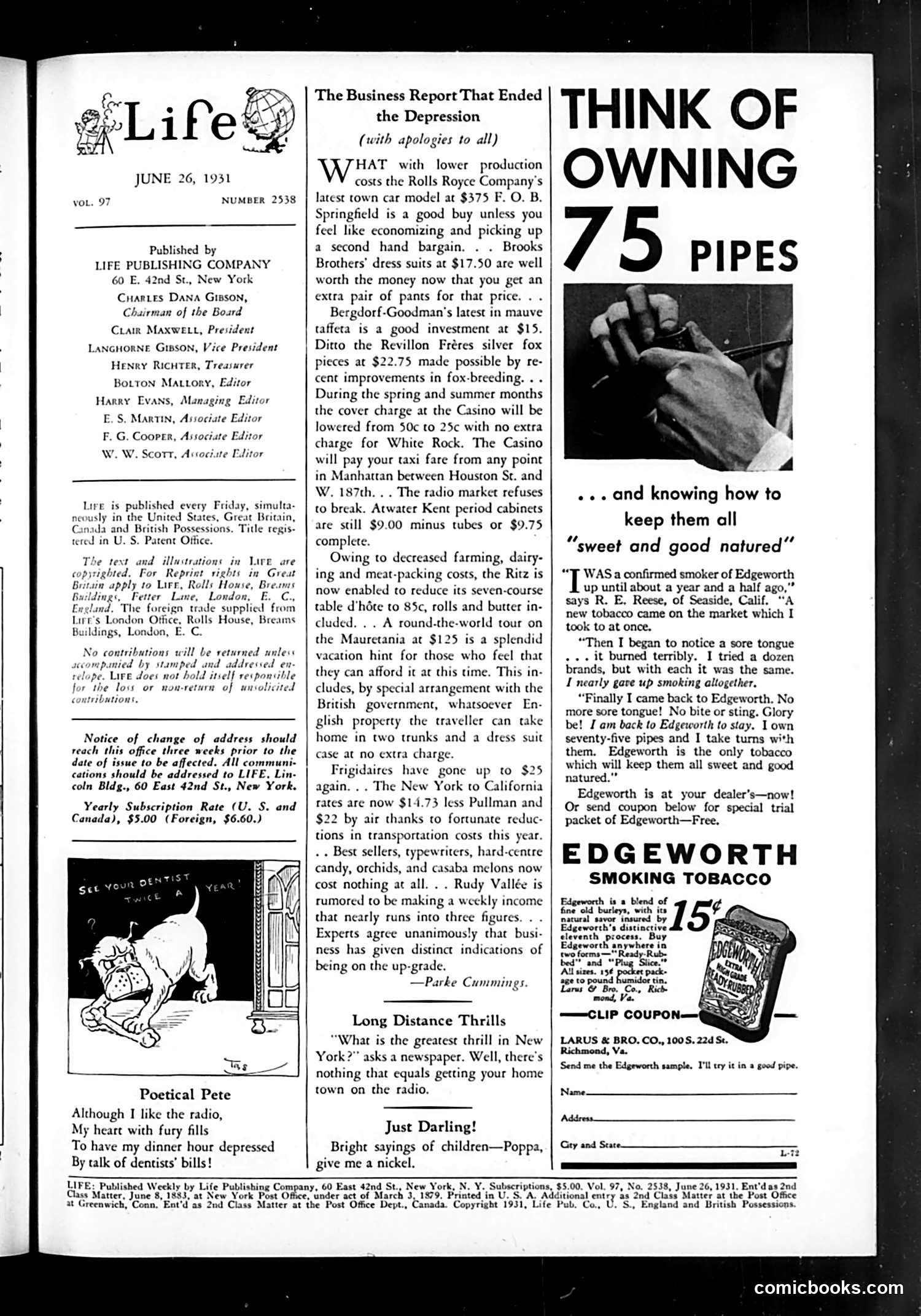
Analysis This page is primarily advertising and editorial content from Life magazine (June 26, 1931), during the Great Depression. The small cartoon at bottom-left, titled "Poetical Pete," shows a figure at a dentist's office. The accompanying verse jokes that Pete prefers listening to the radio during dinner rather than hearing about dentists' bills—a Depression-era quip about avoiding unpleasant financial realities. The main advertisement promotes Edgeworth Smoking Tobacco, featuring a testimonial about pipe-smoking's pleasures. The "75 pipes" headline appeals to collectors during economically difficult times. The page's editorial content discusses Depression bargains (cheap clothing, reduced prices) with dark humor about "economizing"—reflecting 1931's economic desperation when consumers sought any cost savings, even secondhand goods.
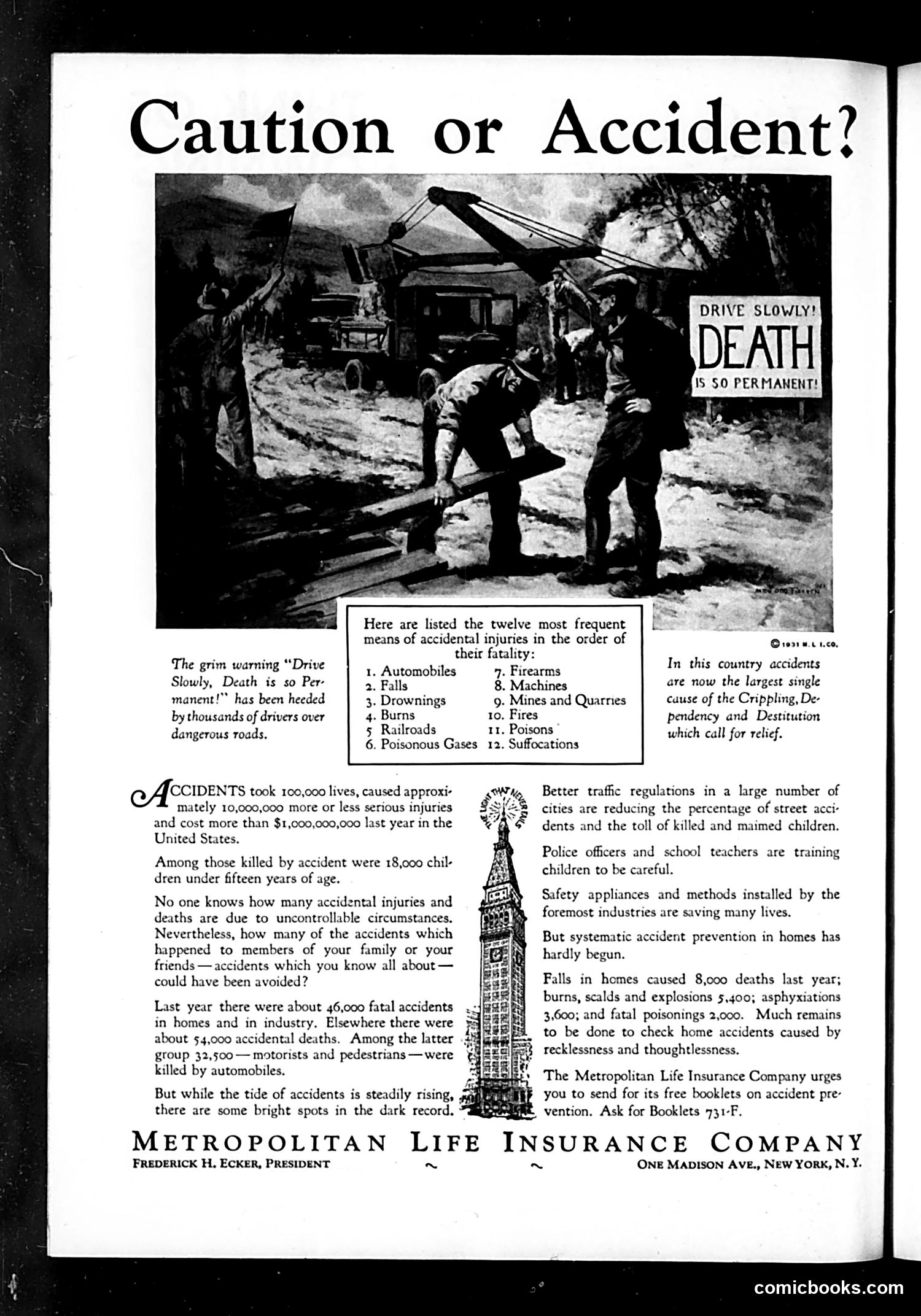
"Caution or Accident?" - Safety Public Service Advertisement This is a public health advertisement by the Metropolitan Life Insurance Company addressing America's accident crisis. The stark black-and-white photograph shows wreckage from a vehicle collision, with workers surveying the damage. The headline poses a moral question: were accidents truly unavoidable, or preventable through caution? The advertisement lists the twelve deadliest accident categories, with automobiles ranked first. The text reveals startling statistics: 100,000 annual deaths and $1 billion in costs. The company argues that while industrial safety improved, home accidents remain largely unaddressed. The final message urges readers to request safety pamphlets, positioning insurance companies as accident-prevention advocates rather than mere claim-payers. This represents early 20th-century corporate safety messaging merged with insurance industry marketing.
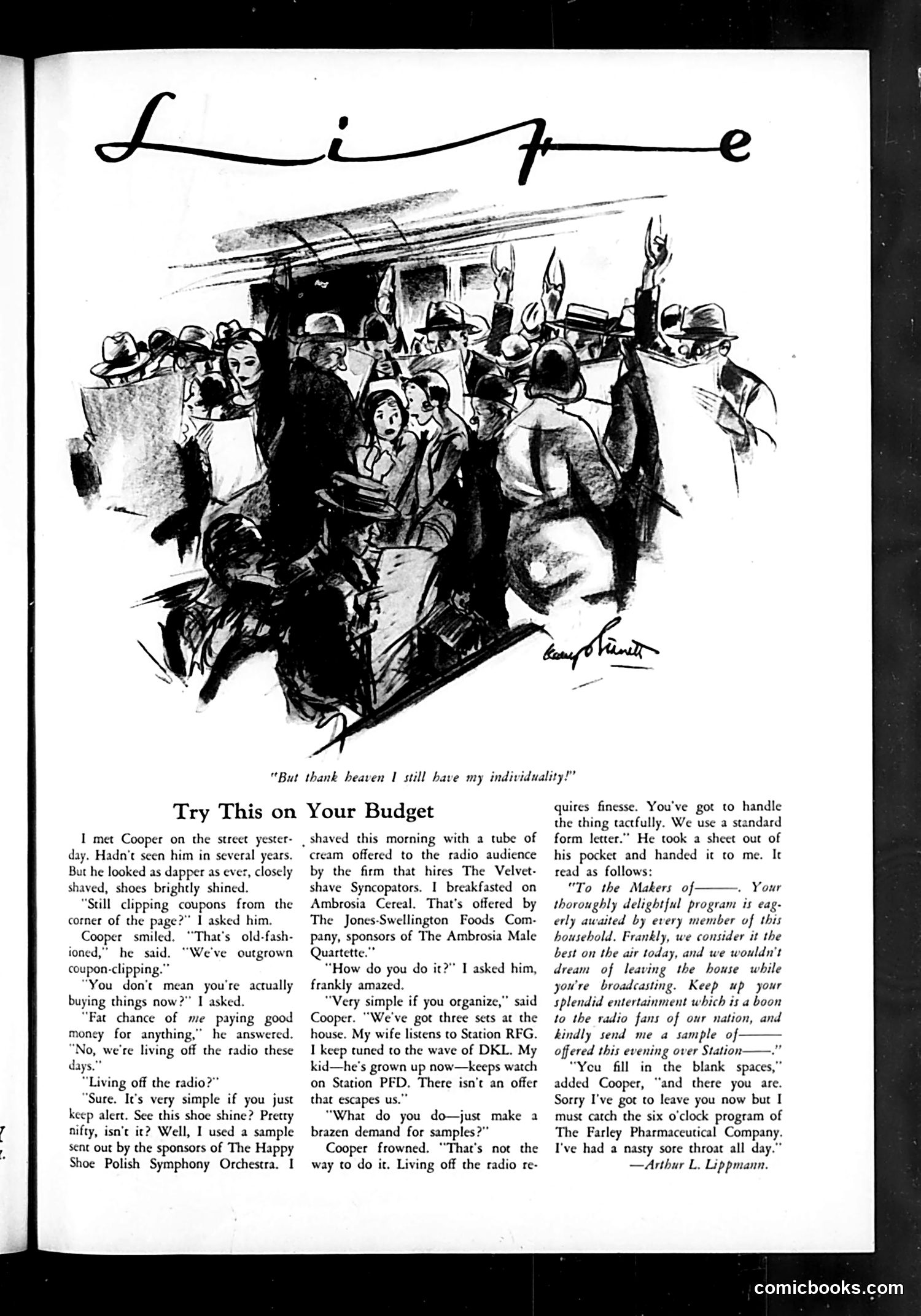
"Try This on Your Budget" - Life Magazine Satire This article satirizes 1920s-30s radio sponsorship culture. The cartoon depicts a crowded radio station scene with the caption "But thank heaven I still have my individuality!" The piece mocks how ordinary people were being manipulated by radio sponsors offering free samples and premiums. The protagonist "Cooper" describes receiving cereal samples, shoe polish, and other products in exchange for listening to sponsored programs. He's pressured to write testimonial letters praising these products to keep receiving freebies. The satire's central joke: listeners believed they were exercising "individuality" by choosing which radio programs to hear, while actually becoming unwitting advertisements for commercial sponsors. The irony is that accepting free samples and writing scripts for companies actually *removes* rather than preserves genuine individuality.
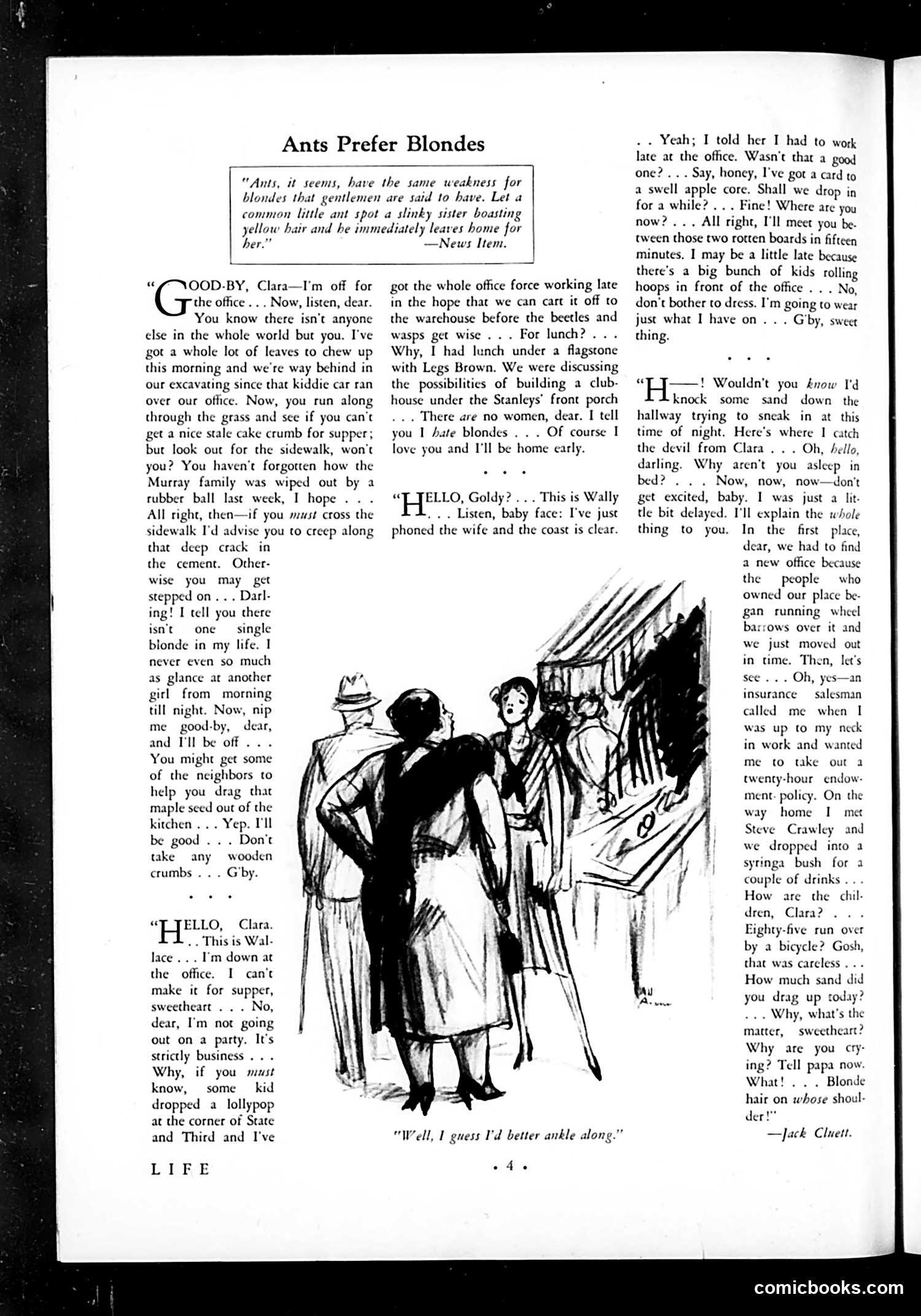
"Ants Prefer Blondes" This page presents a humorous domestic narrative about office and home life. The story depicts a husband (Goldy/Wally) making excuses to his wife Clara about working late at the office. He invents elaborate reasons—moving to a new office, meeting with an insurance salesman, stopping for drinks—to explain his delayed arrival home. The title's reference to "blondes" suggests the satirical point: the husband is likely pursuing romantic interests rather than genuinely working late. The illustration shows figures in what appears to be a street or social setting, supporting this subtext. The humor targets common male excuses and infidelity, presenting familiar domestic conflict through exaggerated workplace justifications. It's vintage social satire about marital deception and gender relations in early-to-mid twentieth century American life.
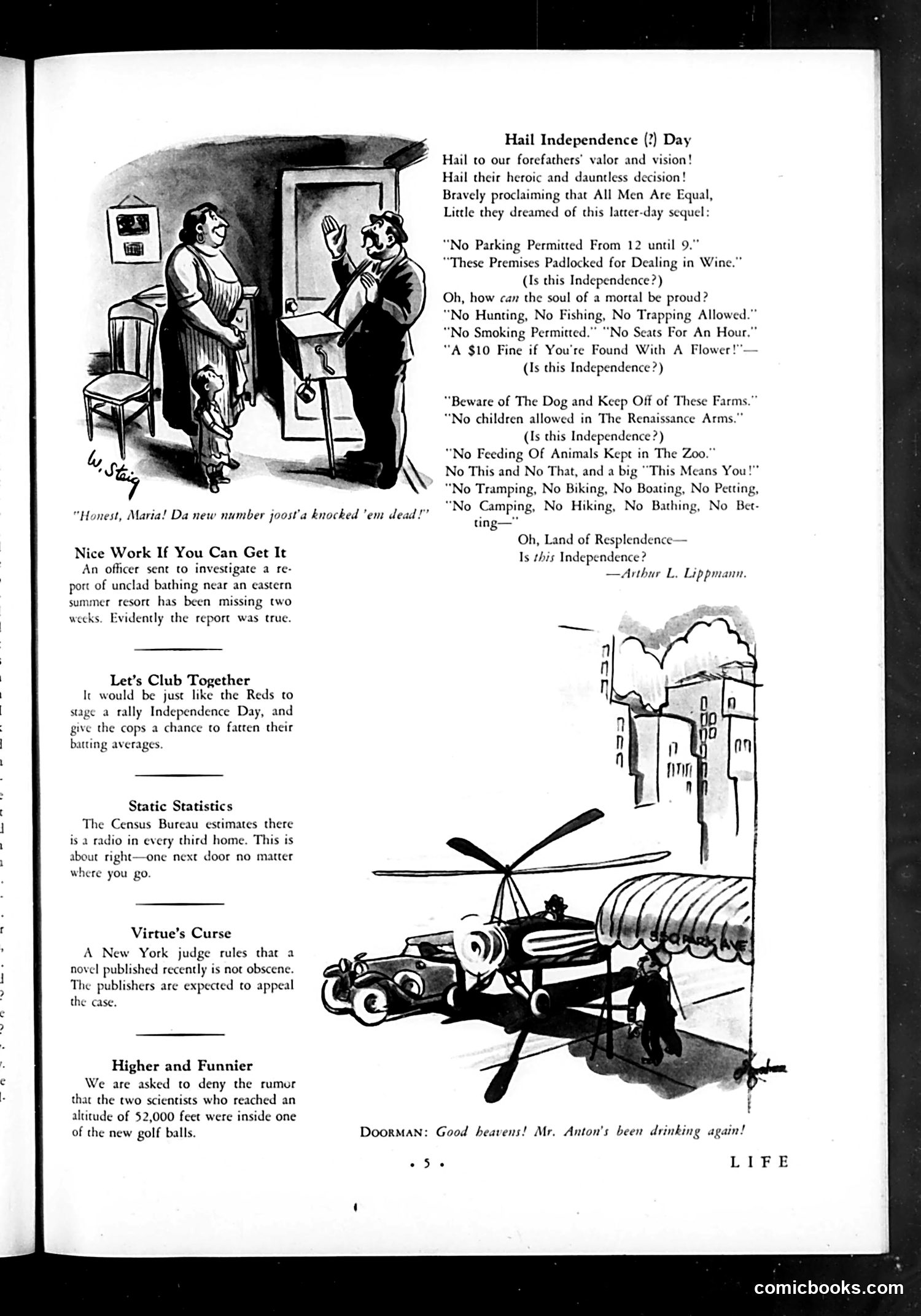
Analysis of Life Magazine Page This page satirizes American Independence Day hypocrisy. The main cartoon shows two men in a doorway with a sign about a bathroom—the caption reads "Honest, Maria! Da new number joost'a knocked 'em dead!" The poem "Hail Independence (?) Day" by Arthur L. Lippmann is the central satire. It mockingly lists numerous restrictions and prohibitions ("No Parking," "No Hunting," "No Smoking," "No children allowed") that contradict the founders' promise of freedom and equality. Each restriction is followed by "(Is this Independence?)" to emphasize the irony. The satire critiques how Americans celebrate independence while living under endless rules and restrictions that limit personal liberty. The accompanying cartoon of people near an airplane comments on modern constraints on freedom.
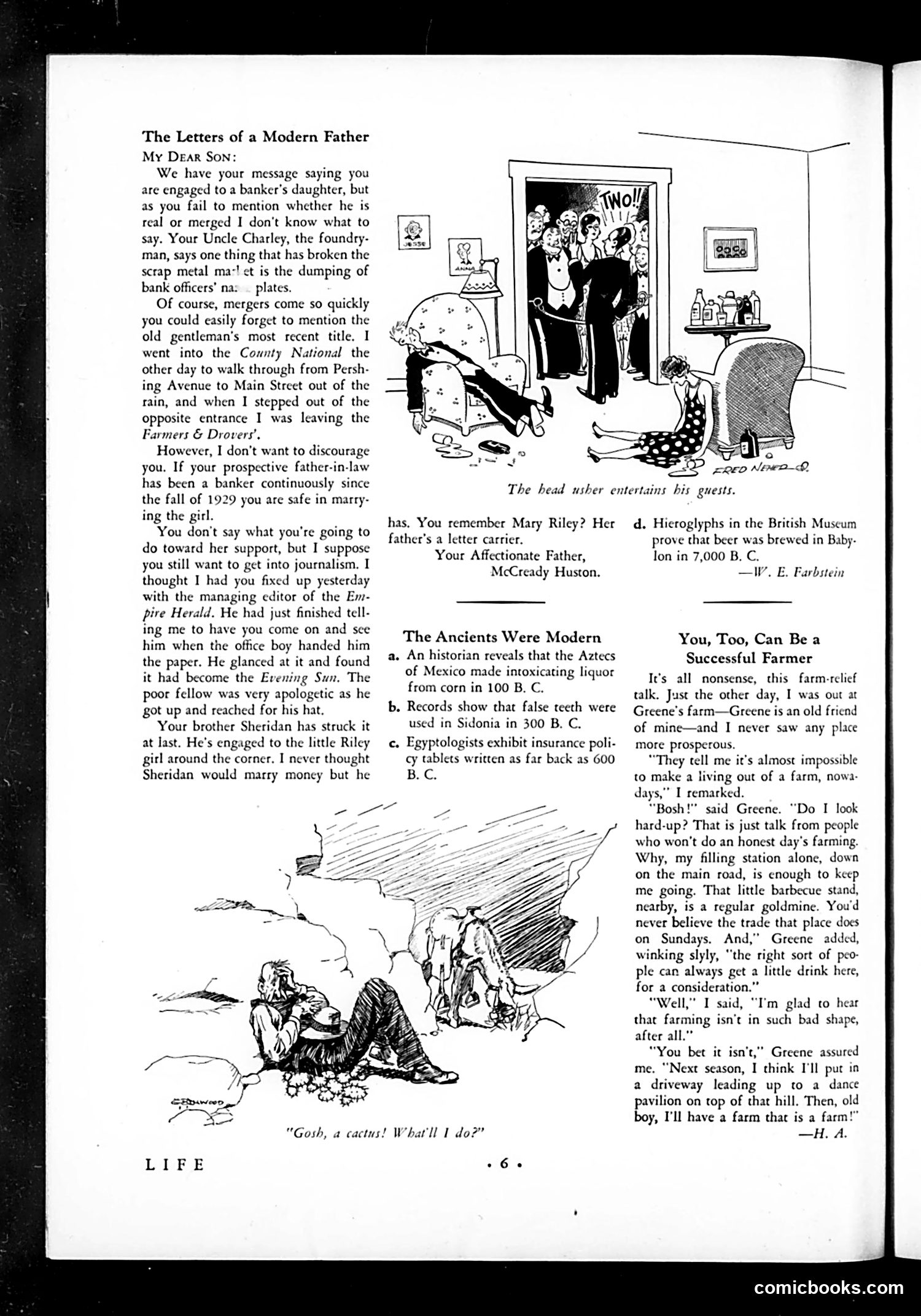
Explanation of Content This page contains three satirical pieces from *Life* magazine: 1. "The Letters of a Modern Father" (left): A humorous letter from a father to his son regarding the son's engagement to a banker's daughter. The father mentions Uncle Charley (a foundry man) and references to the *County National* bank and the *Evening Sun* newspaper. The satire targets the father's snobbish concern about the prospective in-law's social status and occupation. 2. "The head usher entertains his guests" (top right): A cartoon depicting a domestic scene where a head usher hosts visitors. The satire likely mocks pretentious social climbing and the awkwardness of working-class people attempting upper-class hospitality. 3. "You, Too, Can Be a Successful Farmer" (right): A dialogue between the narrator and "Greene" about farming profitability, suggesting that modern farming can succeed through unconventional means (a filling station and barbecue stand on the property).
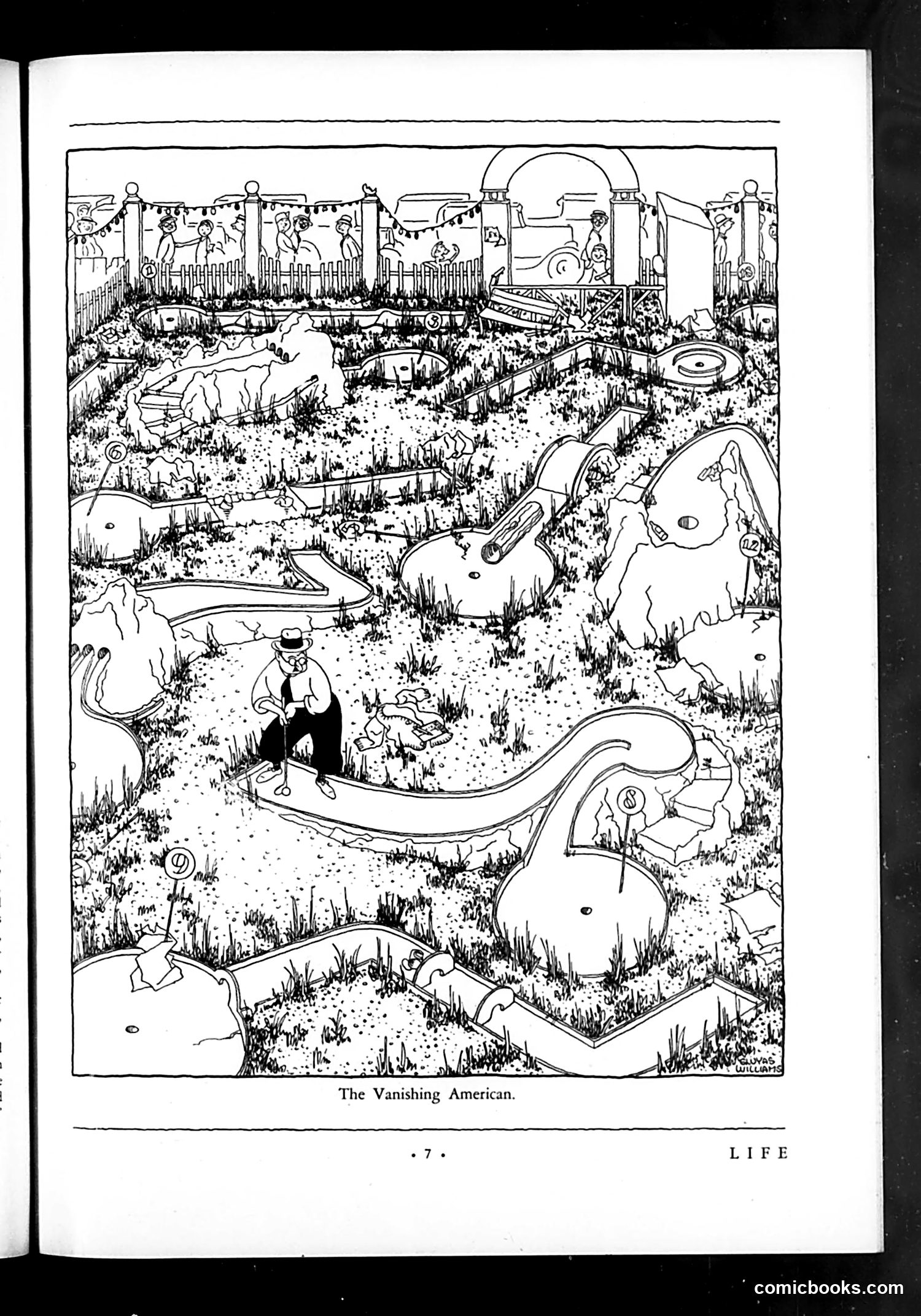
"The Vanishing American" This cartoon depicts Native Americans as literally disappearing into the ground beneath a bustling amusement park or fair. Spectators watch from decorated viewing stands above while the landscape shows Indigenous peoples being consumed or absorbed into the earth itself—represented by dome-shaped mounds and figures sinking downward. The title and imagery express a dark satirical commentary on the displacement and destruction of Native American populations during American expansion. The stark contrast between the cheerful crowd above and the vanishing people below emphasizes how American society ignored or celebrated Indigenous erasure as entertainment. This reflects late 19th/early 20th-century anxieties about Native American populations being viewed as obsolete relics of a "vanishing" past.
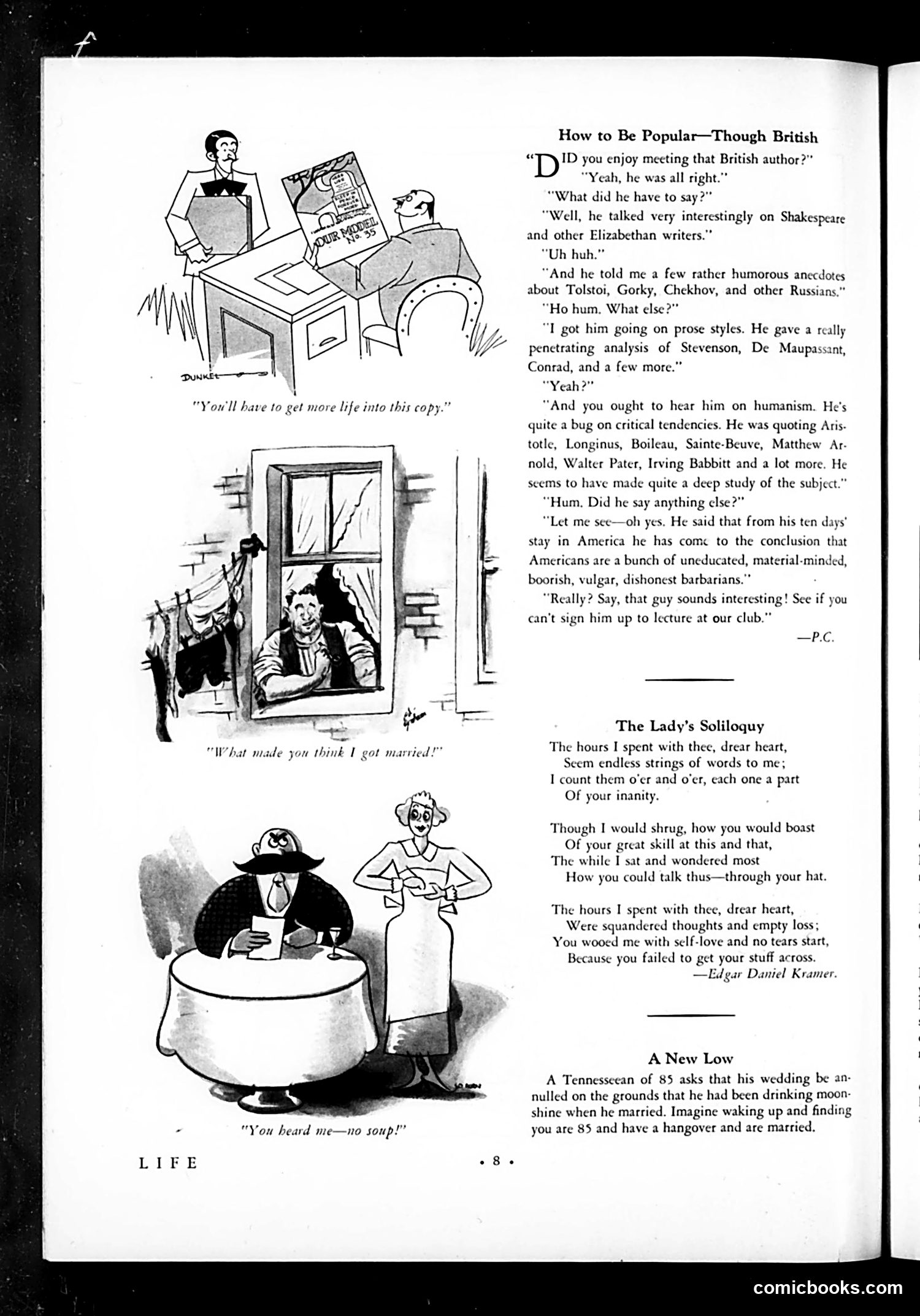
Page Analysis: Life Magazine Satire This page contains three separate humorous pieces: Top cartoon: A man at a desk tells an editor, "You'll have to get more life into this copy"—satirizing editorial demands for livelier writing. Middle cartoon: Shows a couple at a window with the caption "What made you think I got married!"—joke about disillusionment in marriage. Bottom cartoon: Depicts a portly man at dinner with a standing woman, captioned "You heard me—no soup!"—apparently about marital conflict or domestic power dynamics. The right column contains a conversational piece about meeting a British author who discussed Shakespeare, Russian writers, and prose styles, then expressed disdain for Americans as "uneducated, material-minded, boorish" barbarians—satirizing intellectual pretension and anti-American snobbery. Below are a poem ("The Lady's Soliloquy") and a brief anecdote about an 83-year-old Tennessean seeking to annul his marriage due to a hangover.
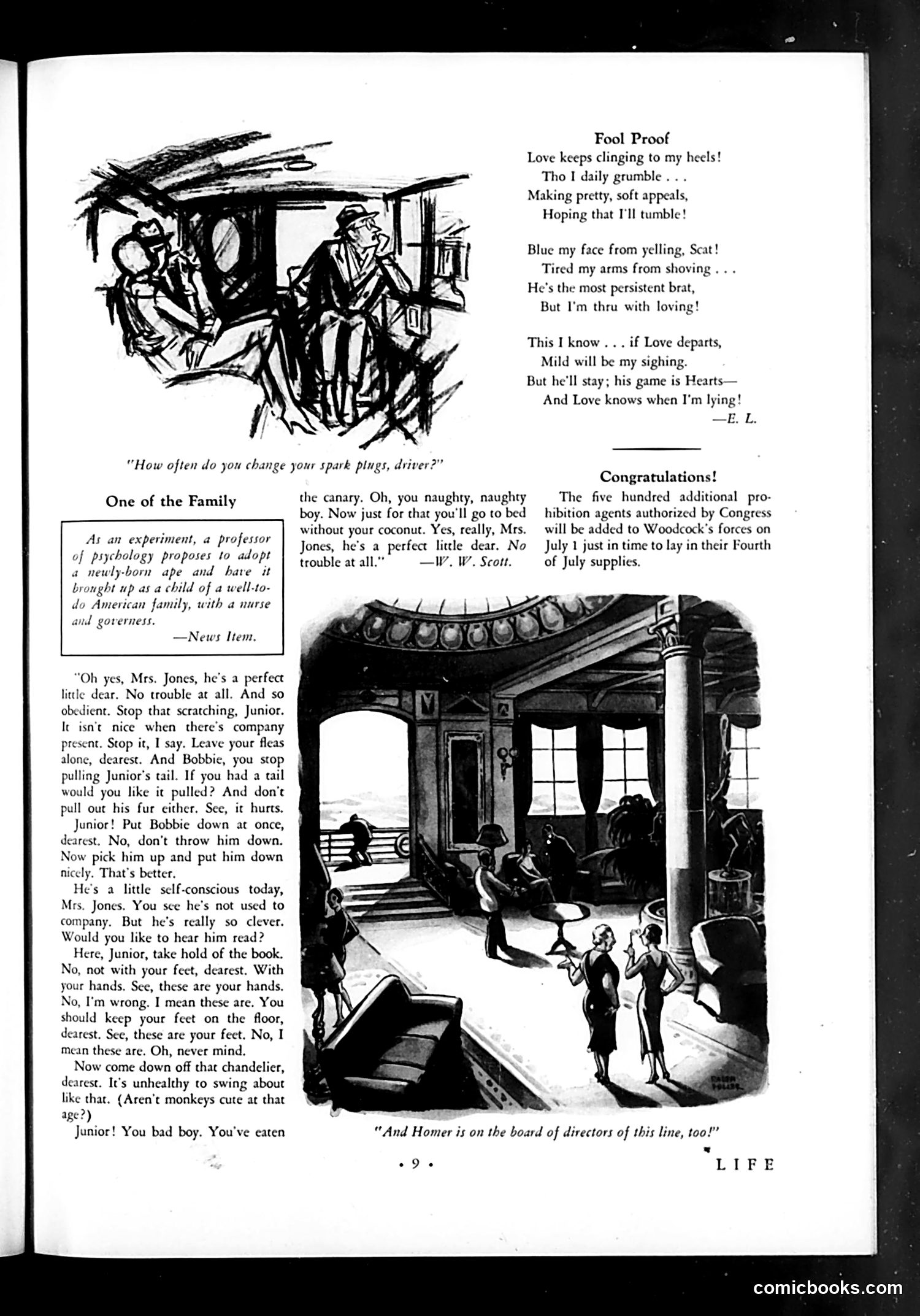
Analysis This page contains three distinct pieces: 1. "Fool Proof" (poem): A sentimental poem about romantic persistence despite rejection, signed "E.L." 2. "One of the Family" (story): A domestic humor piece about a psychology professor who brings home an ape as an experiment. The setup satirizes early-20th-century scientific hubris—the idea that animal behavior can be studied through family integration. Mrs. Jones's lengthy monologue about the ape's good manners is absurdist humor, treating the creature as an unruly houseguest. 3. "Congratulations!" (cartoon): Shows what appears to be a ship's interior with text referencing Homer on a "board of directors." This seems to be nautical/maritime humor, likely satirizing corporate boards or wartime administration. The page represents Life magazine's mixed-format approach: poetry, domestic comedy, and visual satire targeting early-20th-century social pretension and scientific overreach.
"Life Looks About" - Political Commentary Page This page contains three opinion pieces on post-WWI policy issues: 1. "Our Ailing World: Doctors Called In" discusses German reparations payments and Allied debt collection, suggesting the debtor nations need economic relief to restore prosperity. 2. "Get a Better Law" critiques education policy, specifically referencing Mr. Wickersham's Eighteenth Amendment address at Syracuse. The author argues that education—particularly habitual association with temperate people—matters more than prohibition laws in preventing alcoholism. 3. "Sighting Another World" celebrates Sir Oliver Lodge's 80th birthday and his scientific theories about invisible worlds and intelligence beyond human understanding. The decorative header illustration shows a cherub or angel figure. The content reflects 1920s concerns: war debt, Prohibition enforcement, and emerging spiritualist/scientific interests.
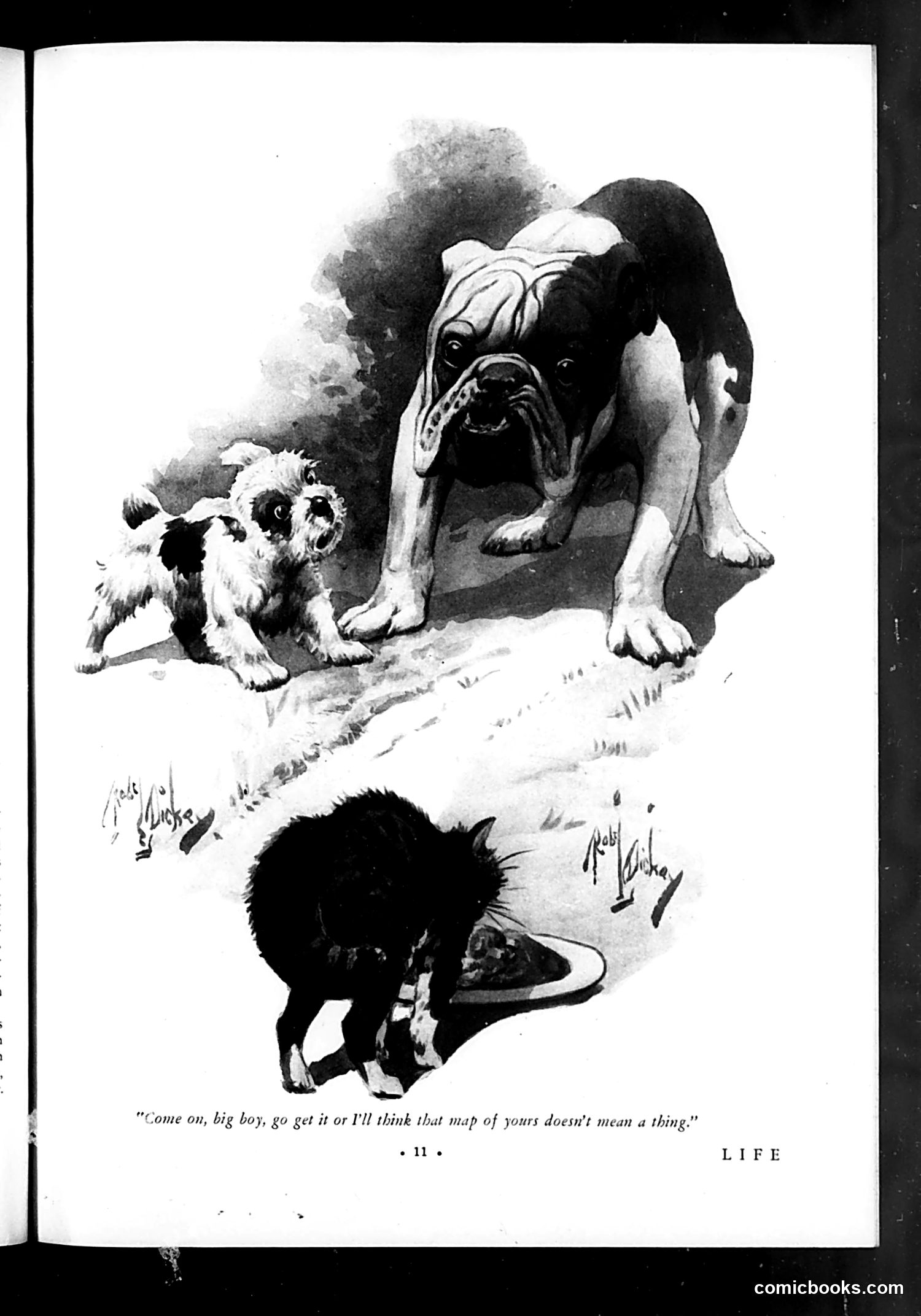
Analysis of Life Magazine Cartoon This cartoon depicts three dogs of different sizes in a humorous hierarchy. A large Bulldog towers over a smaller dog wearing what appears to be a bandage or head wrap, while a tiny dog crouches below holding what seems to be a map or document. The caption reads: "Come on, big boy, go get it or I'll think that map of yours doesn't mean a thing." The joke appears to satirize dominance and territorial disputes through animal metaphor. The "map" likely references territorial claims or political boundaries. The cartoon suggests that possessing a map (claim) means nothing without the strength or will to enforce it—a commentary on geopolitical assertions. Without additional context about the publication date, the specific political situation referenced remains unclear, though it likely addressed early 20th-century territorial or imperial disputes.
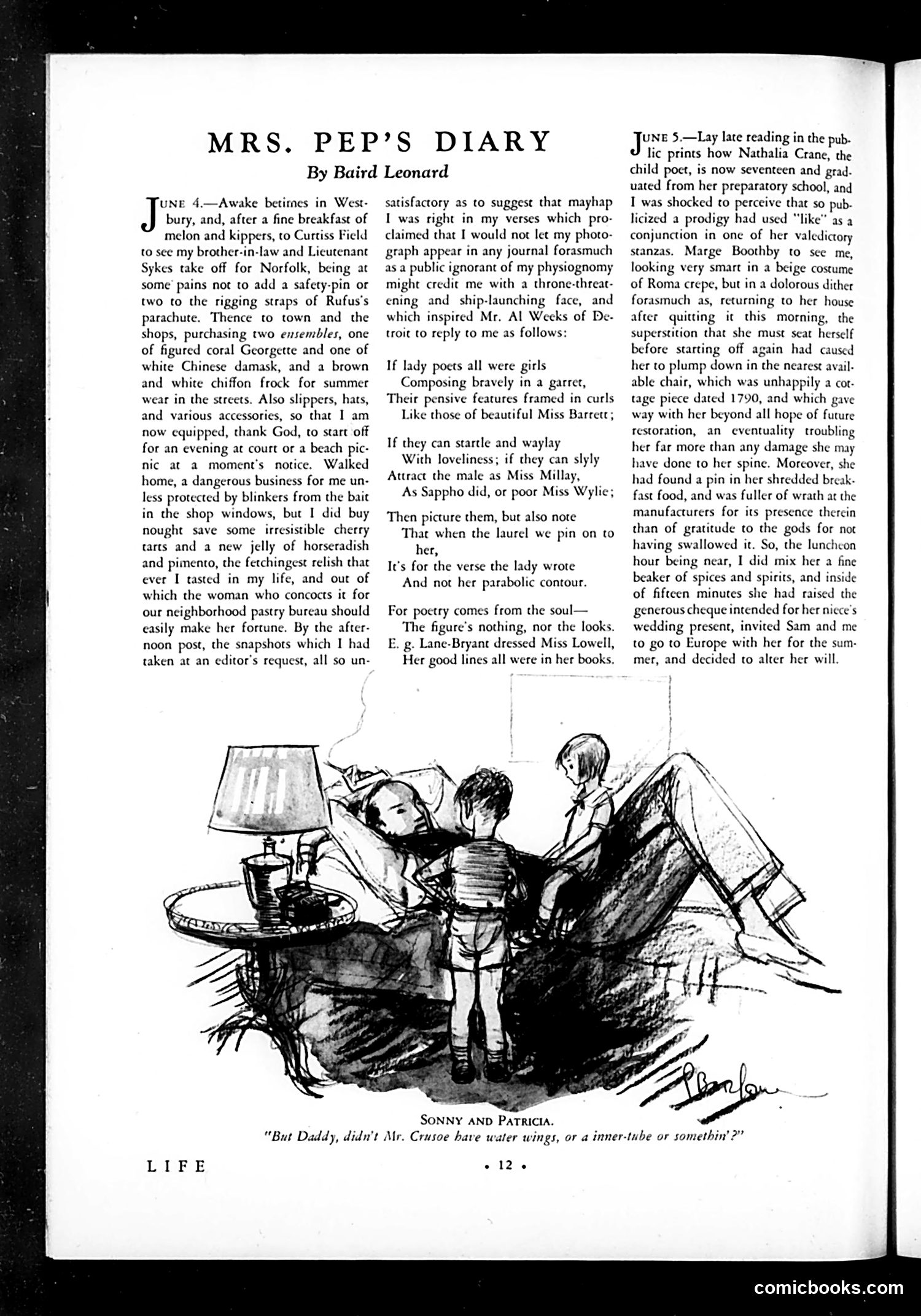
Mrs. Pep's Diary: Domestic Comedy This is a satirical diary entry by Baird Leonard about upper-middle-class domestic life. The June 4-5 entries describe Mrs. Pep's shopping expeditions and social anxieties—purchasing fashionable Chinese damask and concerns about her appearance at social events. The illustration shows two children (Sonny and Patricia) asking their father about Mr. Crusoe's water wings, a humorous reference to Robinson Crusoe. The joke plays on children's innocent misunderstandings of adult conversation or literature. The overall satire targets the pretensions and anxieties of wealthy women concerned with fashion, propriety, and social standing. The diary format mocks how such women obsess over trivial domestic details while presenting themselves as cultured and refined.
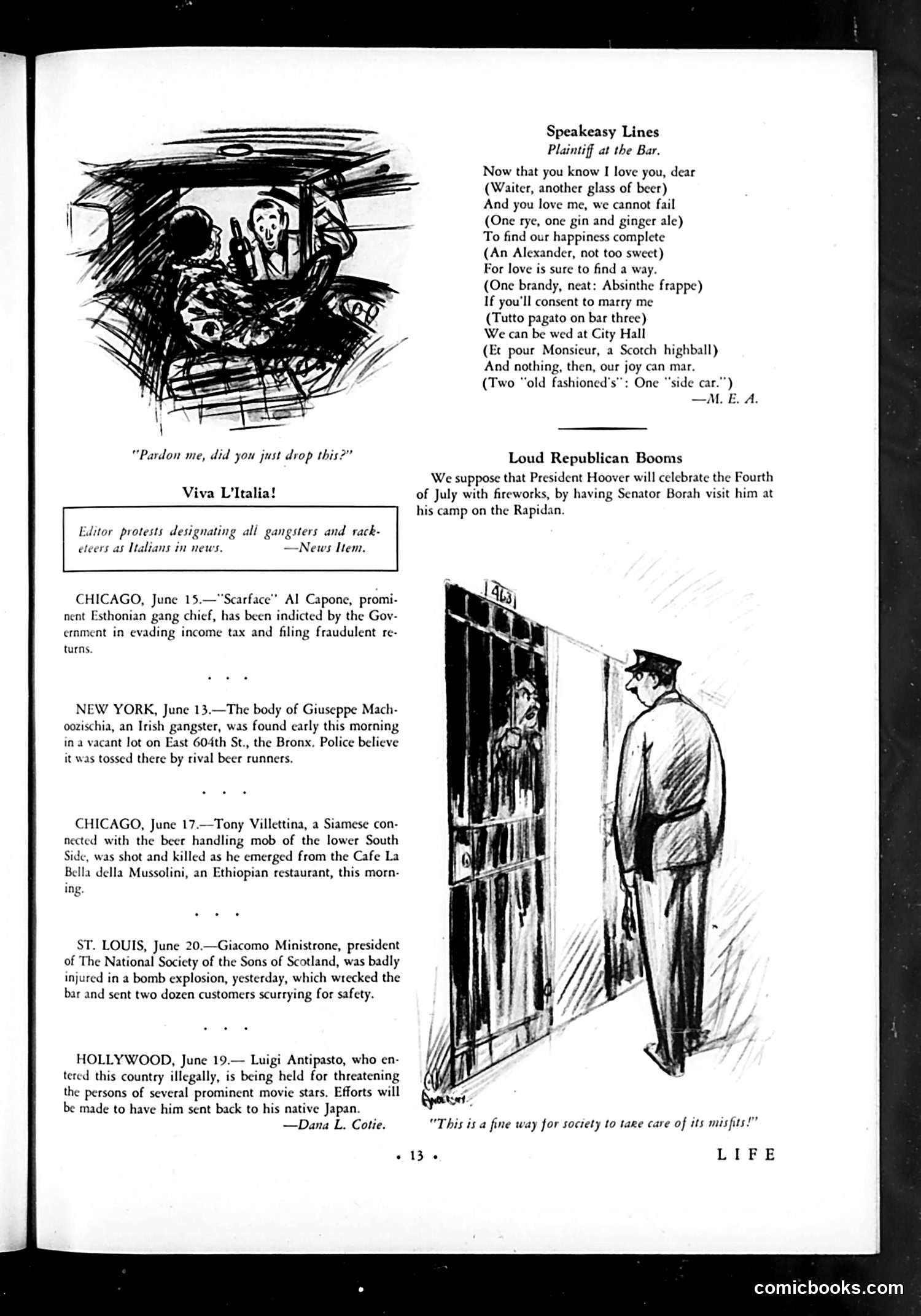
Analysis of Life Magazine Page Main Cartoon: Shows a police officer at a jail cell door with caption "This is a fine way for society to take care of its misfits!" The cartoon satirizes incarceration as society's solution to crime and social problems, suggesting it's inadequate or hypocritical. "Speakeasy Lines" Section: A humorous poem mocking Prohibition-era speakeasy culture, listing drinks and casual marriage proposals made during bar visits. It satirizes the underground drinking culture and romantic impulsiveness enabled by illegal bars. "Viva L'Italia!" Section: News items about organized crime figures—Al Capone, gang violence in New York and Chicago, and a bomb explosion in St. Louis. The editor protests calling gangsters "Italians" in headlines, objecting to ethnic stereotyping in crime reporting. This reflects 1920s Prohibition enforcement challenges and media coverage debates.
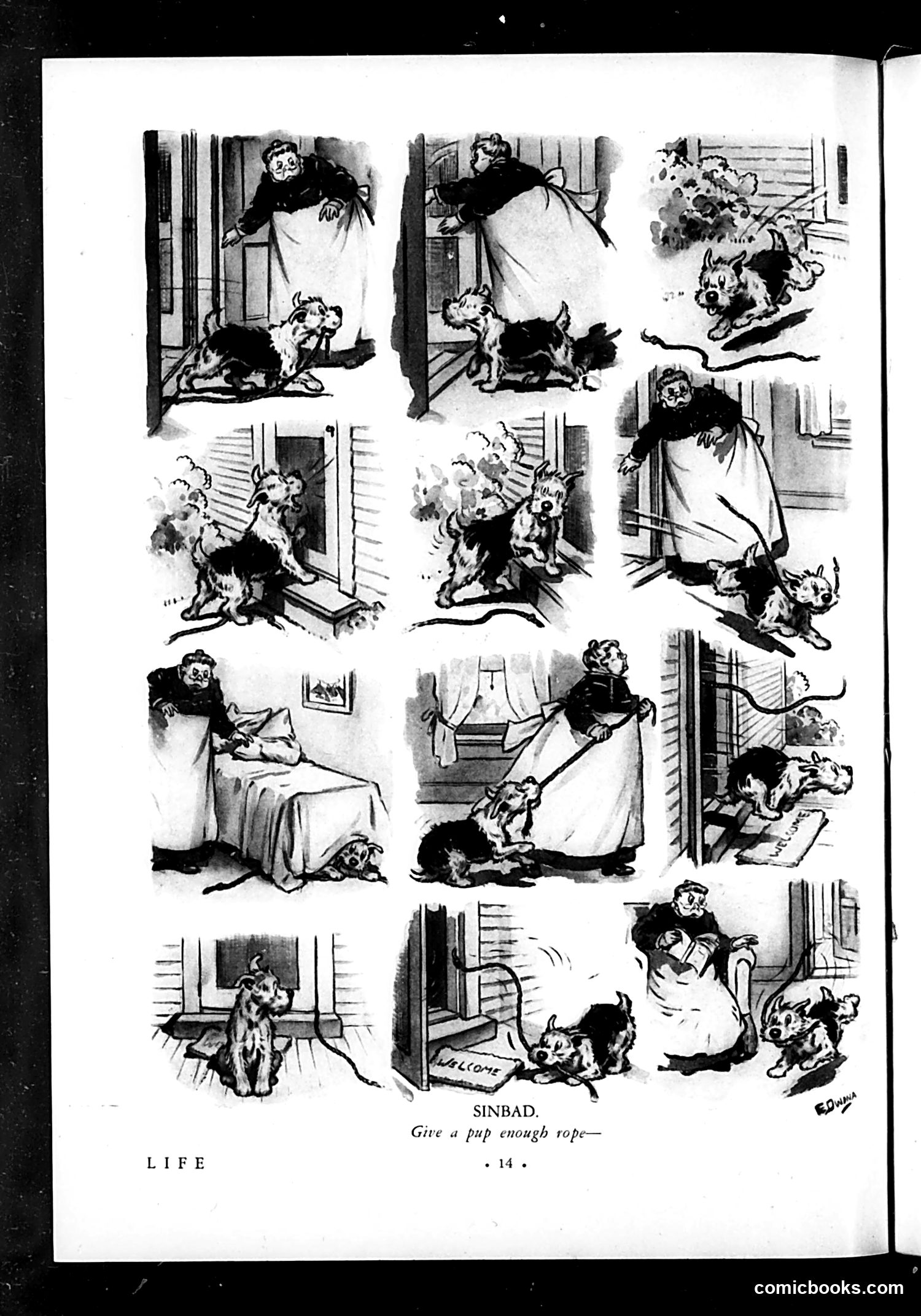
"Sinbad: Give a Pup Enough Rope" This is a comic strip sequence by E. D. (signature visible) depicting the Arabian Nights character Sinbad interacting with dogs in various domestic situations. The title "Give a pup enough rope" is a play on the saying "give someone enough rope [and they'll hang themselves]" — suggesting the dogs will get into mischief if given opportunity. The strip shows slapstick humor: Sinbad repeatedly encounters energetic dogs creating chaos around his home — jumping, tangling in fabric, disrupting his activities. The joke relies on visual comedy of the mischievous animals causing predicaments rather than political satire. This appears to be lighthearted humor typical of Life magazine's entertainment content.
Life Magazine: "Life in Washington" by Carter Field This page is a political profile of William Edgar Borah, a U.S. Senator known for his unpredictable political allegiances. The article satirizes Borah's pattern of shifting between parties and candidates—he'd address conventions for multiple parties and was considered seriously for presidential nominations by Democrats, Republicans, and Progressives, yet never received one. The satire highlights his contradictions: he opposes women's suffrage on states' rights grounds while supporting prohibition; he fights the League of Nations and World Court. The piece portrays Borah as intellectually stimulating but politically erratic—a man of "hazardard random thinking" who studies extensively yet refuses party loyalty. The joke is that Borah's independence made him unelectable despite his prominence.
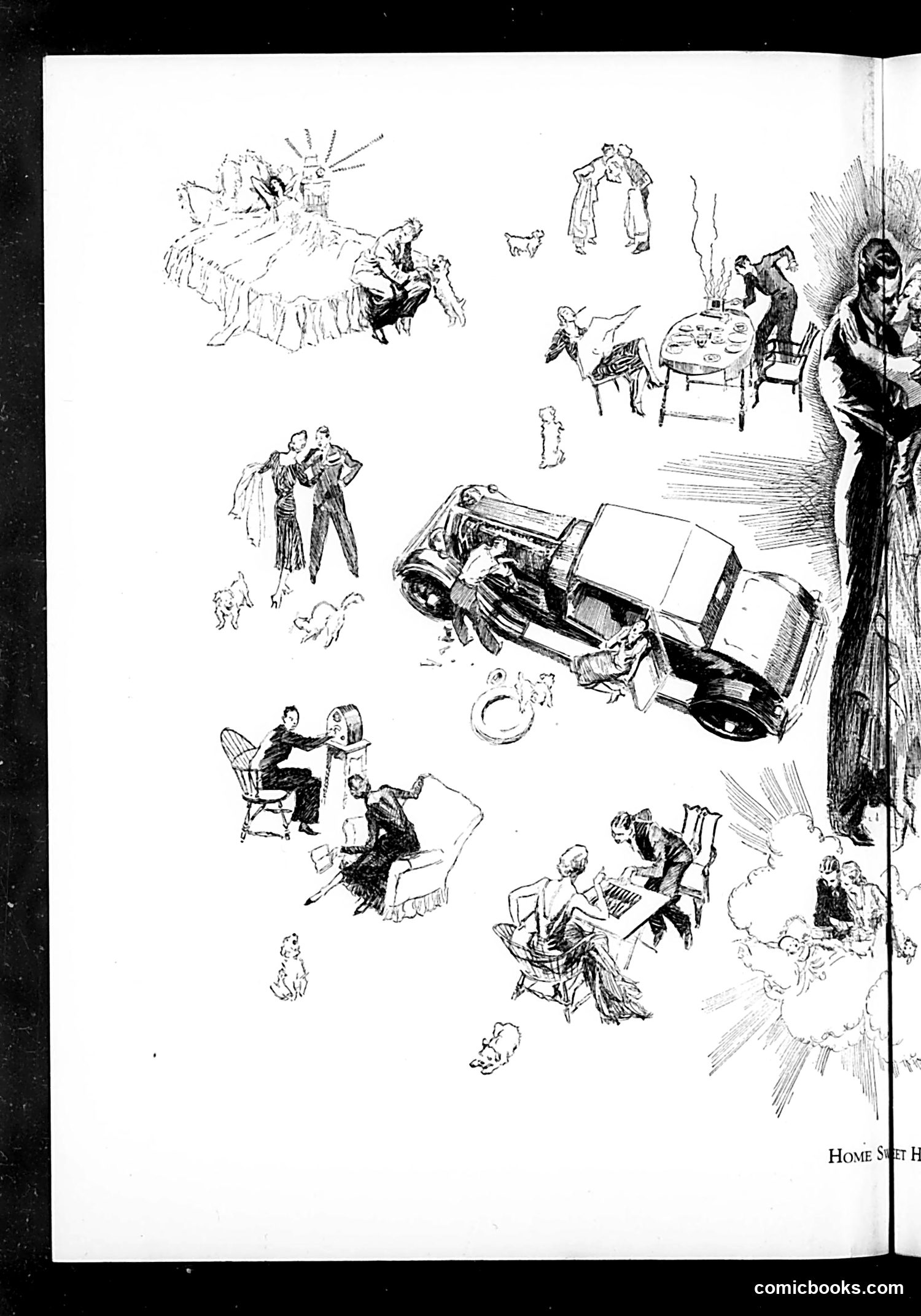
Analysis This page contains a series of sketch-style vignettes depicting what appears to be a chaotic domestic or social scene. The drawings show various figures in different situations: a couple with luggage, people around furniture and a dining table, figures in animated conversation or argument, and what appears to be a car accident or collision in the center. The overall composition suggests satire about household chaos, marital discord, or domestic tumult—a common theme in Life magazine's humor. The scattered arrangement and frantic energy of the sketches reinforce a sense of disorder and confusion. Without clearer text identifying specific individuals or events, the exact satirical target remains unclear, though the domestic/social setting is evident.
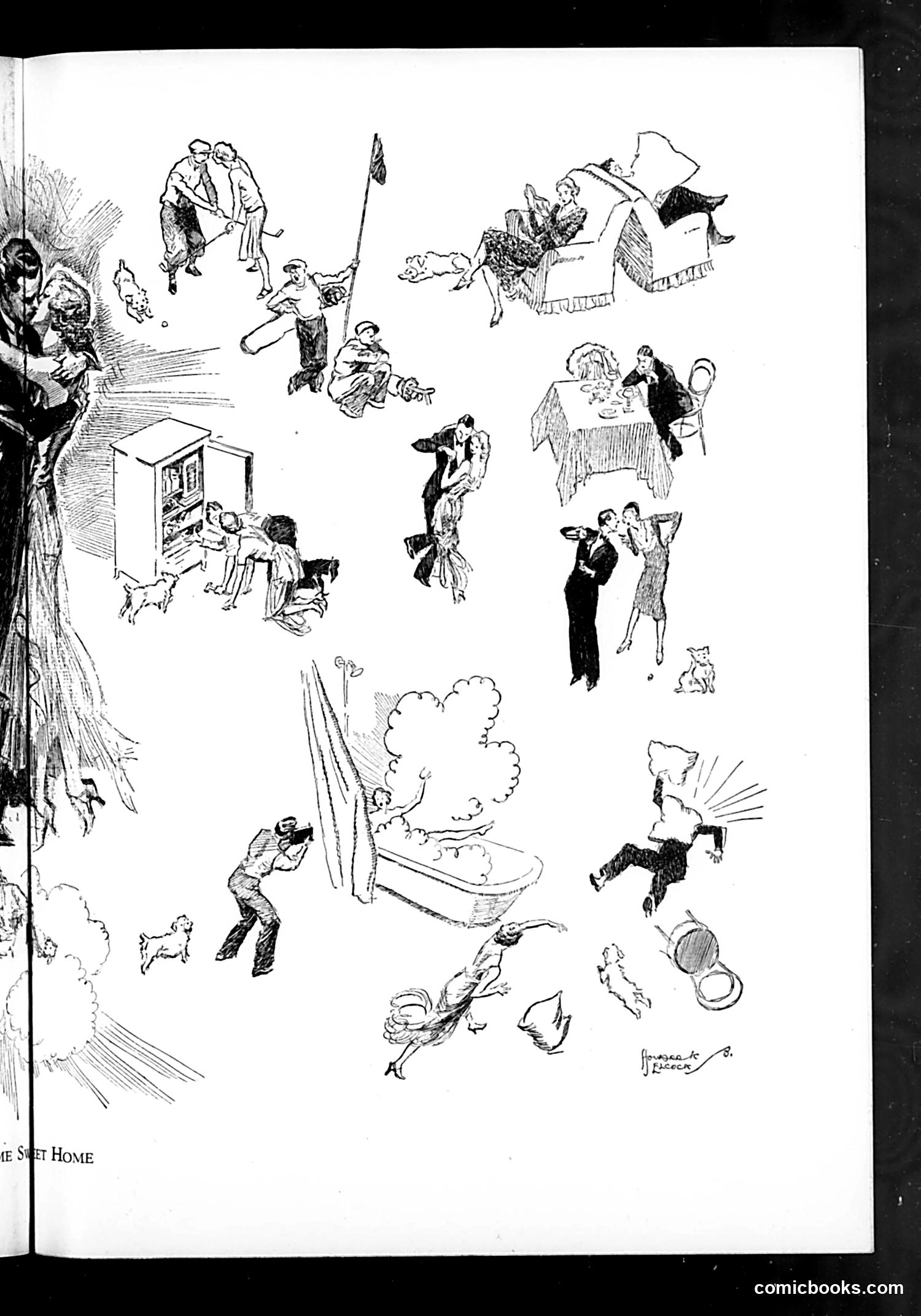
Analysis This page shows a single satirical illustration depicting various scenes of domestic chaos and frivolity. The cartoon appears to comment on the disorder of modern home life, showing figures engaged in activities like golfing indoors, bathing, dining, and generally creating mayhem within a household setting. The artist's signature appears to read "Cesare L. Cesare" or similar. The scattered vignettes—people swinging golf clubs, lounging in bathtubs, children playing—suggest satire about wealthy or leisure-class Americans neglecting proper household order and domestic responsibility. The chaotic composition itself reinforces the theme of disorder. Without additional context about Life magazine's publication date or specific topical references visible here, the exact historical occasion remains unclear, though the style suggests early-to-mid 20th century American social commentary.
Analysis This is a movie review column titled "Movies by Harry Evans," not a political cartoon. The page contains three film reviews: 1. "The Maltese Falcon" - praising Dashiell Hammett's adaptation, noting the mystery-serial format and strong performances by Ricardo Cortez and Bebe Daniels 2. "Daddy Long Legs" - reviewing Janet Gaynor's talkie performance, suggesting she should play more dramatic roles suited to her abilities 3. "The Vice Squad" - discussing a Paramount picture about NYC police, noting it features actors Paul Lukas and Kay Francis The content is straightforward film criticism from an entertainment magazine, discussing acting performances, plot, and production quality. No political satire or caricature is present—this is standard magazine entertainment journalism.
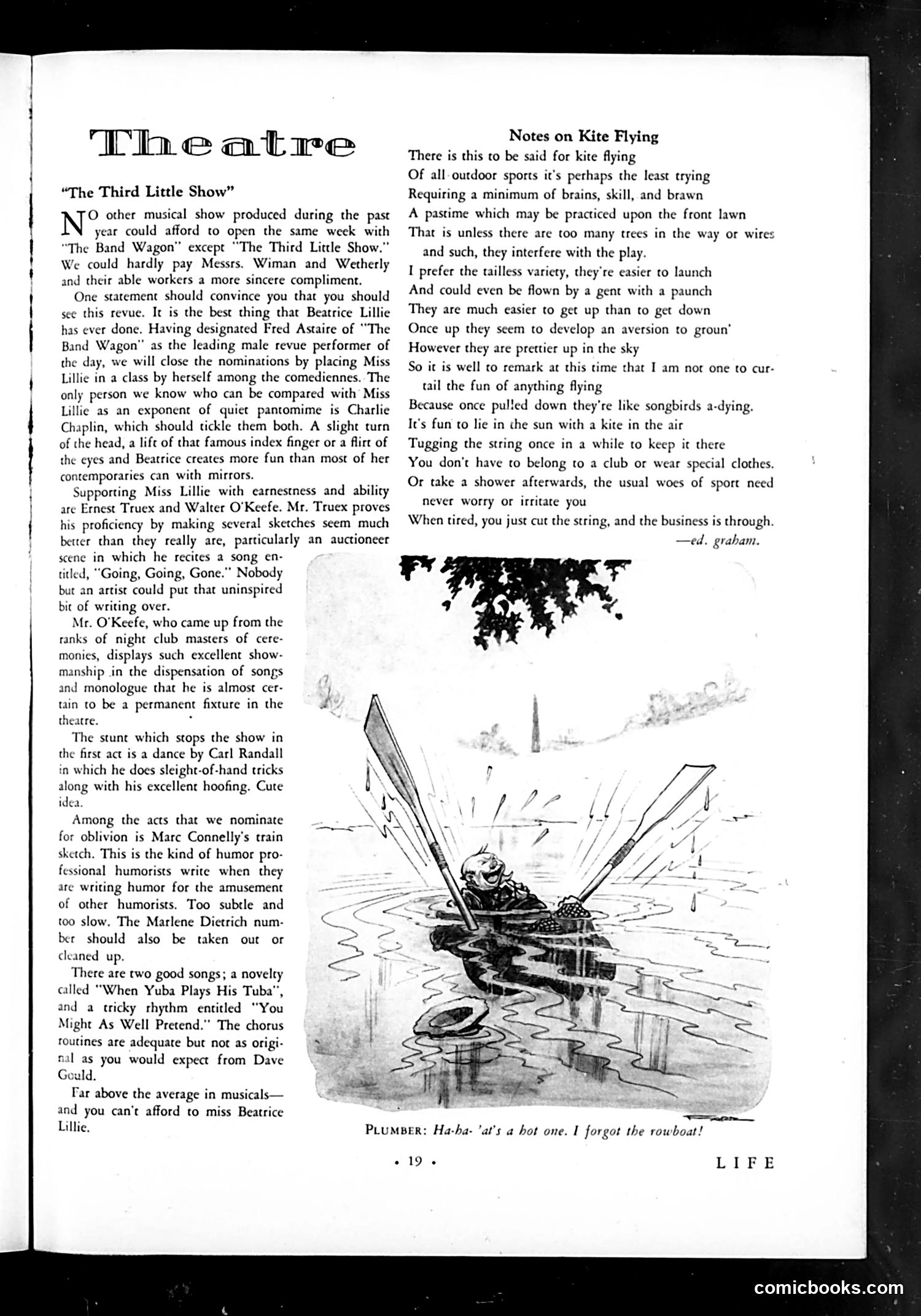
Analysis of Life Magazine Page This page contains two distinct sections: Left column: A theater review of "The Third Little Show," praising performer Beatrice Lillie and noting contributions by Ernest Truex and Walter O'Keefe. The review criticizes some acts as too subtle and slow, and praises Dave Gould's choreography. Right column: An article about kite flying as an accessible outdoor sport, emphasizing its simplicity and enjoyment. Illustration: A humorous drawing captioned "PLUMBER: Ha-ha-'at's a hot one. I forgot the rowboat!" depicting a plumber in flood waters surrounded by buildings, appearing to have forgotten essential rescue equipment. This is a visual gag playing on the absurdity of the situation rather than political satire. The page represents typical 1920s-30s Life magazine content: entertainment criticism mixed with lighthearted humor and practical lifestyle commentary.
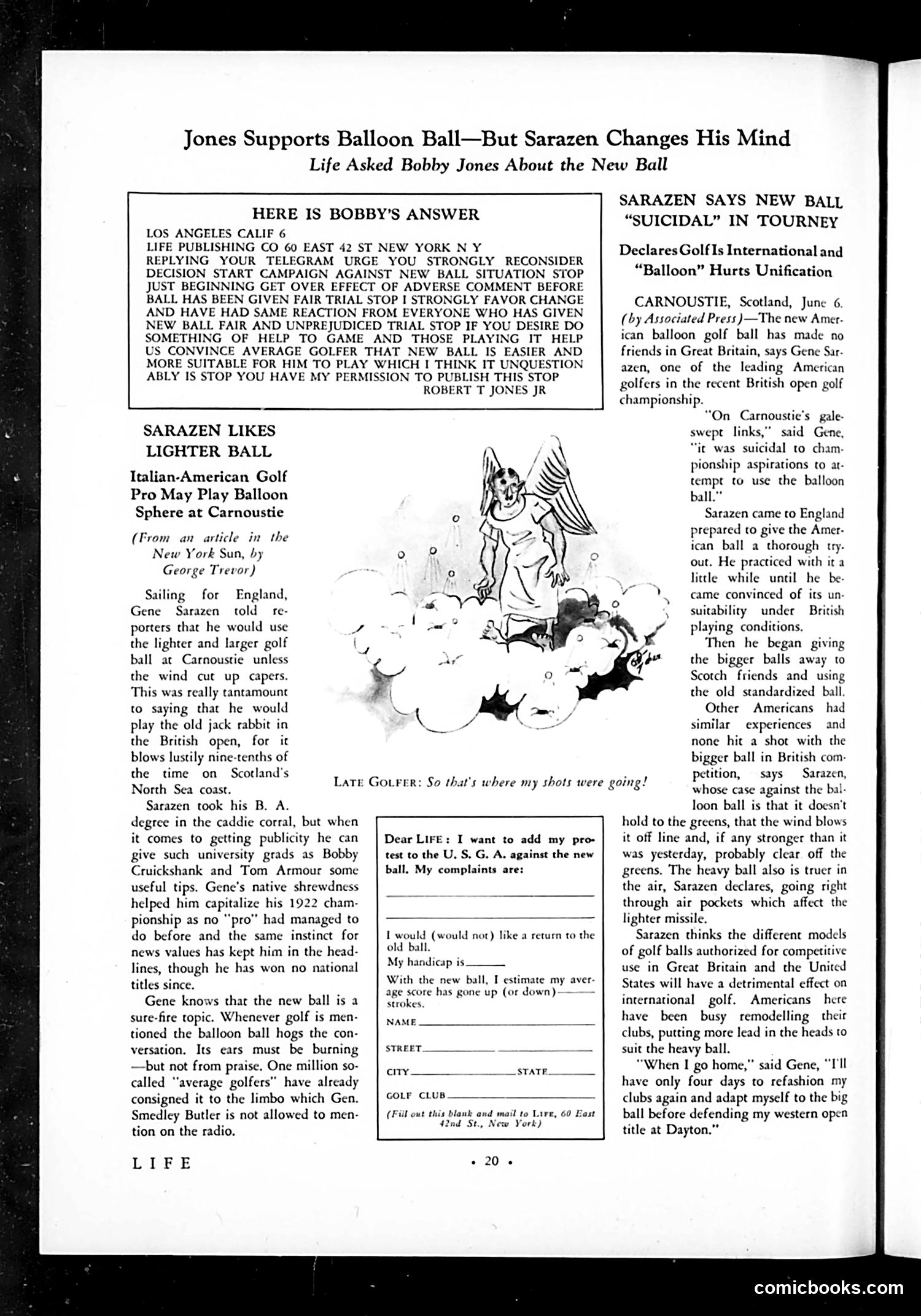
Balloon Golf Ball Controversy This 1920s Life magazine page satirizes a public dispute over a new, larger "balloon" golf ball introduced to American golf. The piece presents conflicting expert opinions: Bobby Jones (legendary amateur golfer) publicly supports the new ball, urging fellow golfer Gene Sarazen to reconsider his opposition. Jones claims it's easier and more suitable for average players. Gene Sarazen (prominent Italian-American pro golfer) initially seemed willing to try it but changed his mind after testing it at Scotland's British Open. He declared it "suicidal" for championship play—claiming it won't hold greens in wind and performs unpredictably. The cartoon shows a late golfer frustrated that his shots are going nowhere, satirizing the ball's erratic behavior. A reader survey solicits complaints about the new ball's effects on handicaps. The satire mocks the public controversy and manufacturers' conflicting claims while highlighting tension between preserving traditional golf standards and modernizing equipment. The debate reflects deeper anxieties about American versus British golf practices.
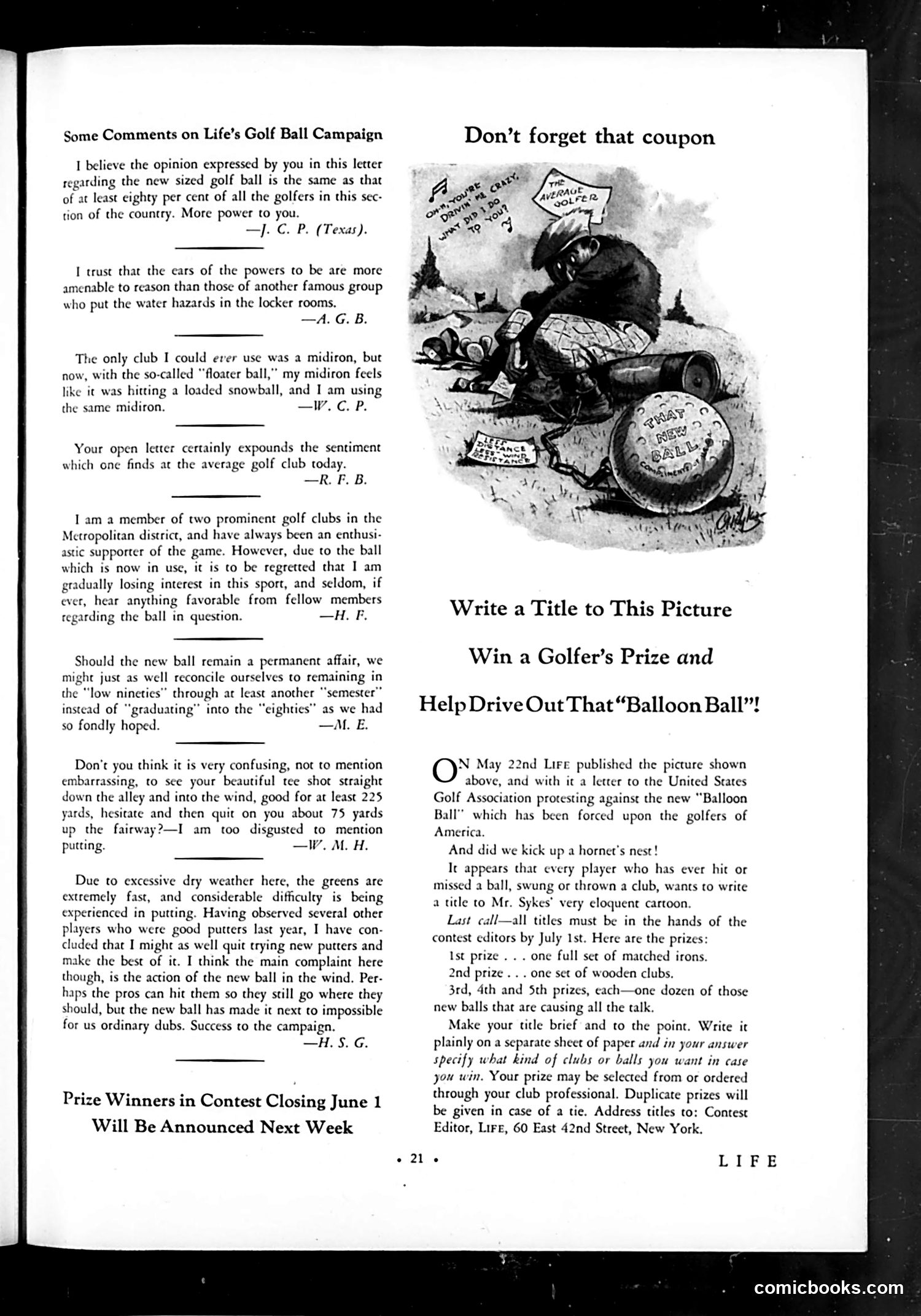
Analysis for Modern Readers This page documents Life magazine's campaign against the newly introduced "balloon ball" in golf—a larger, more buoyant ball that fundamentally changed the sport's dynamics. The Context: Golf's governing bodies had mandated a larger, lighter ball, which golfers hated because it flew unpredictably in wind and didn't respond to skilled shots as the smaller ball had. The Cartoon: Mr. Sykes' illustration (artist credited) shows an exasperated golfer amid scattered golf equipment labeled with complaints about the new ball's erratic behavior—it's depicted as a chaotic, uncontrollable force. The Campaign: Life published critical letters from real golfers (likely genuine reader submissions) expressing frustration. The magazine then sponsored a contest inviting readers to write witty titles for the cartoon, with prizes including matched golf clubs. This mobilized reader participation against the ball. The Satire: Life positions itself as defending "ordinary dubs" against an unpopular rule change imposed by golf authorities, framing the new ball as destroying the sport's skill-based nature and making even good shots unreliable.
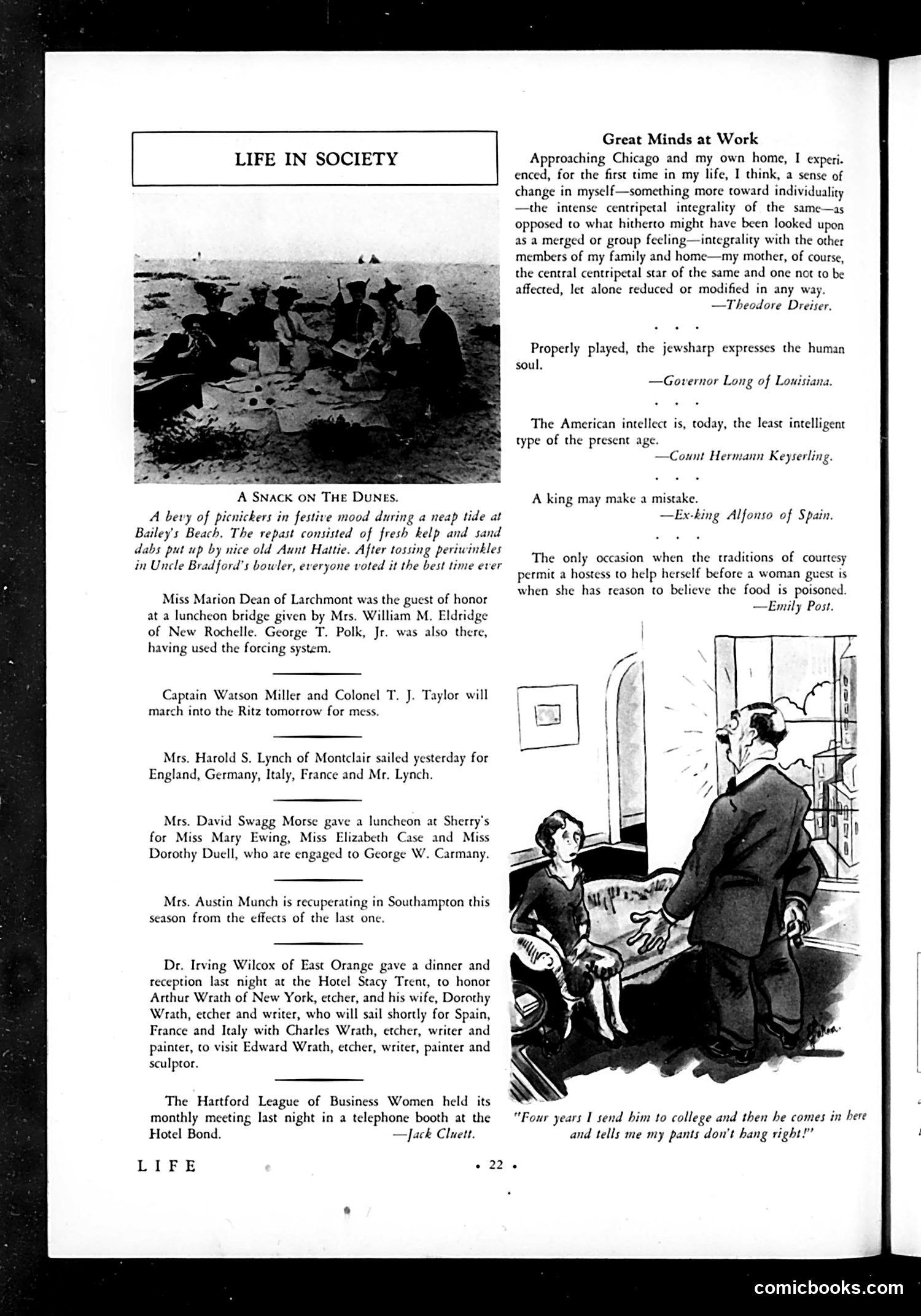
Analysis of Life Magazine Page This page satirizes upper-class American society and pretension. The "Life in Society" section mocks wealthy socialites through dry, witty announcements of their trivial activities—luncheons, bridge games, sailing plans. The humor lies in absurdist details: a beach picnic where food consists of "kelp and sand dabs" served in "Uncle Bradford's bowler," or Mrs. Lynch sailing "for England, Germany, Italy, France and Mr. Lynch" (implying her husband is an afterthought). The cartoon depicts a father scolding his son about pants fit, captioned "Four years I send him to college and then he comes in here and tells me my pants don't hang right!" This jokes about the perceived uselessness of higher education—a son returns from expensive schooling with impractical, dandified concerns rather than practical knowledge. The interspersed quotes from famous figures (Dreiser, Keyserling, Emily Post) satirize how society invokes "great minds" to validate shallow conventions, including a darkly humorous Emily Post quote about poisoned food.
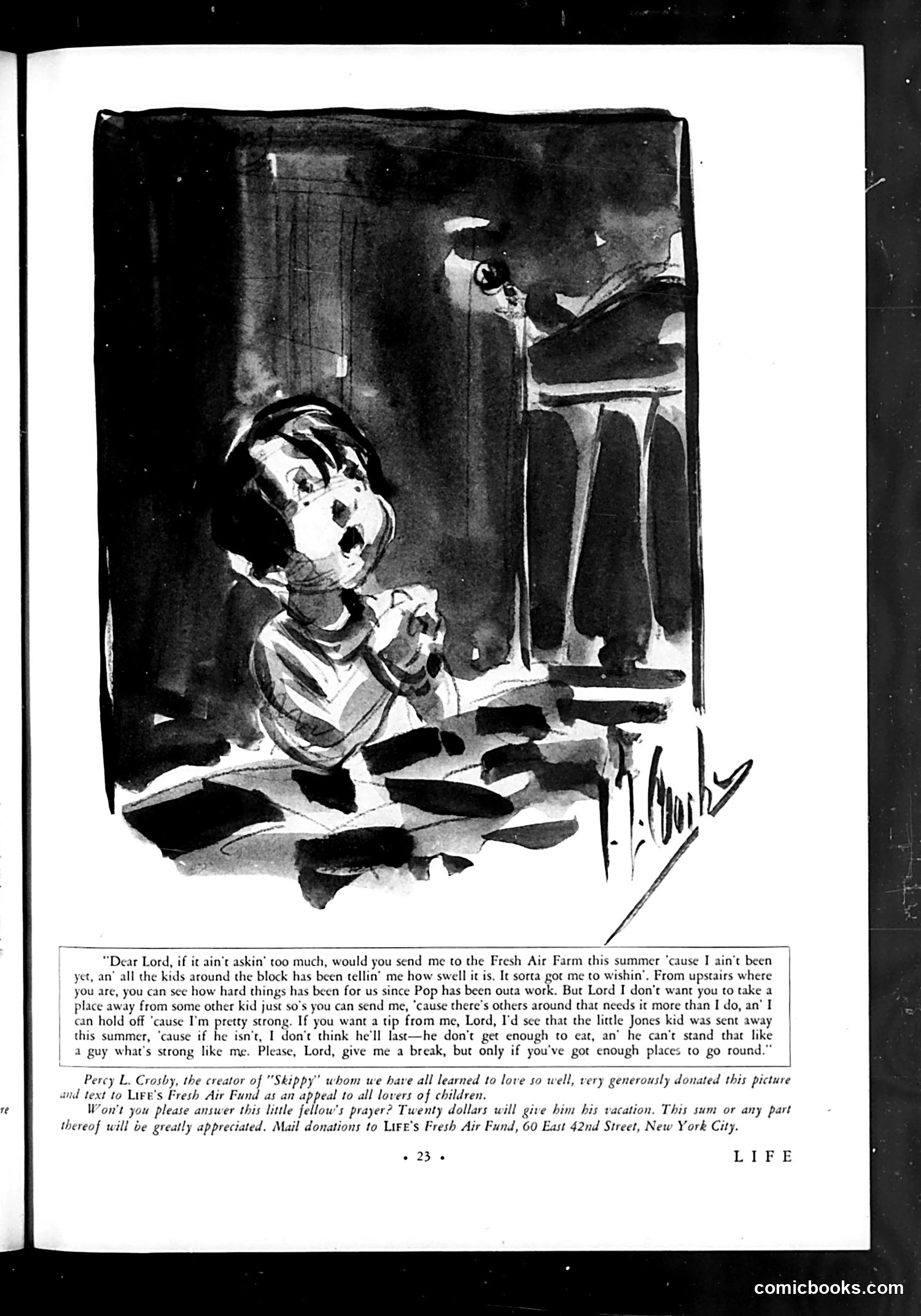
Analysis: "Skippy's Prayer" (Life Magazine) This is a charitable appeal featuring Skippy, the popular comic strip character created by Percy L. Crosby, donated to support Life's Fresh Air Fund—a real program sending underprivileged urban children to summer camps. The cartoon depicts a poor boy praying for a Fresh Air Farm vacation. The satire lies in the child's selfless logic: he asks God to send him only *if* there's room, otherwise to give the spot to "the little Jones kid" who's starving and can't survive hardship like he can. Context for modern readers: This reflects 1920s-30s urban poverty during economic hardship (likely the Depression era). The "Fresh Air Fund" was a genuine philanthropic initiative addressing child malnutrition and neglect in tenement communities. The appeal uses emotional manipulation and moral sentiment—the child's humble unselfishness—to solicit donations. The humor is gentle and purposeful: it humanizes poverty while guilting readers into charitable giving.
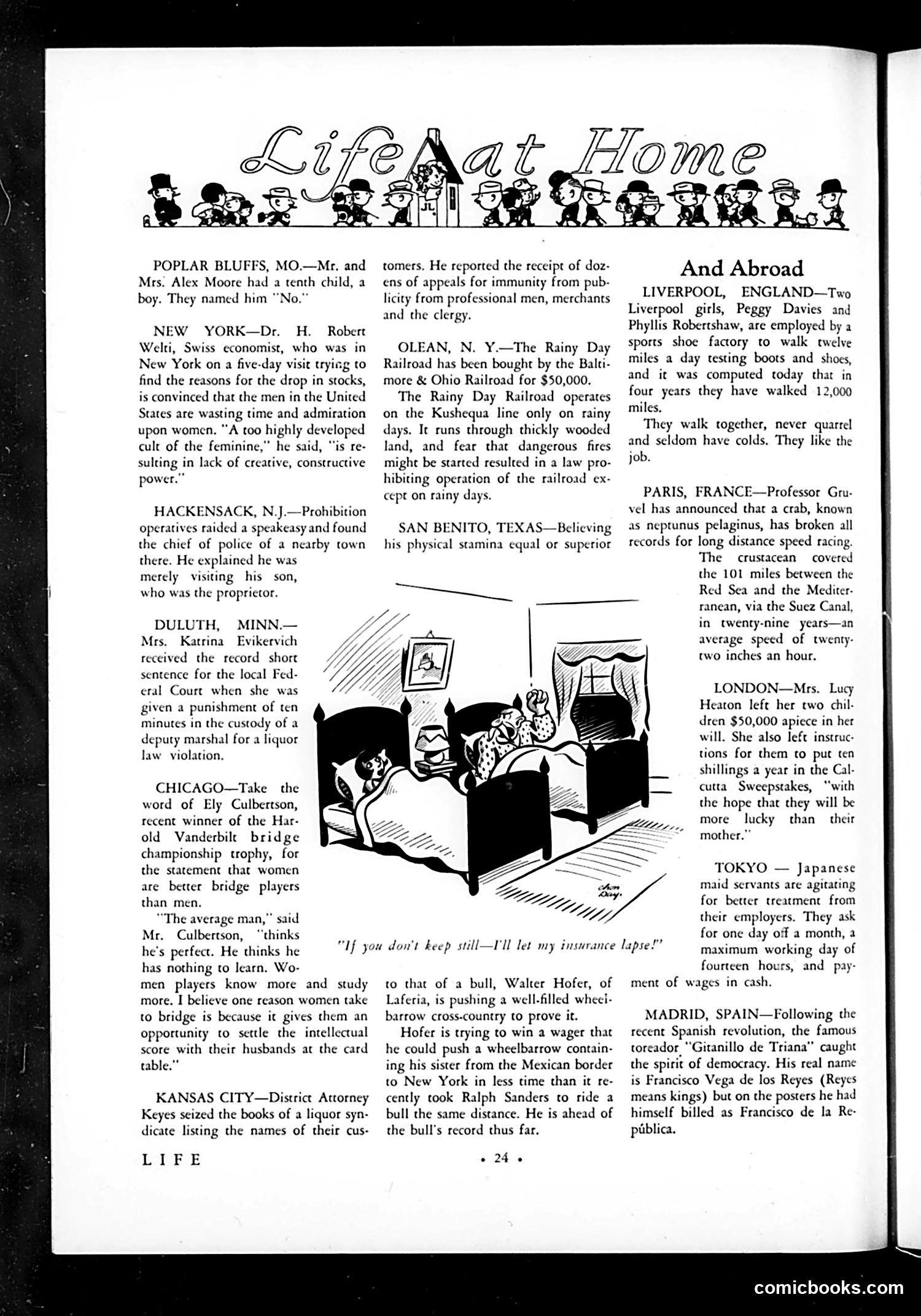
"Life at Home and Abroad" - Page Analysis This page from *Life* magazine consists of brief satirical news items and one cartoon, typical of the magazine's humor format. The Cartoon: The central illustration depicts a couple in bed. The husband, appearing anxious, threatens his wife: "If you don't keep still—I'll let my insurance lapse!" The joke satirizes marital dynamics and insurance culture: the husband jokingly suggests canceling life insurance as punishment for his wife's restlessness, implying both her potential value as a beneficiary and the absurdity of using insurance as a marital threat. The News Items: These are brief, humorous anecdotes about American life and curiosities from abroad, including: - A Swiss economist's criticism of American men wasting admiration on women - Bridge champion Ely Culbertson's claim that women are better players than men - Quirky stories (a "Rainy Day Railroad," a man pushing a wheelbarrow from Mexico to New York) - Foreign oddities (a crab's slow canal journey, Japanese servants demanding better conditions) The page satirizes both American domestic life and international curiosities through humor and mild social commentary.
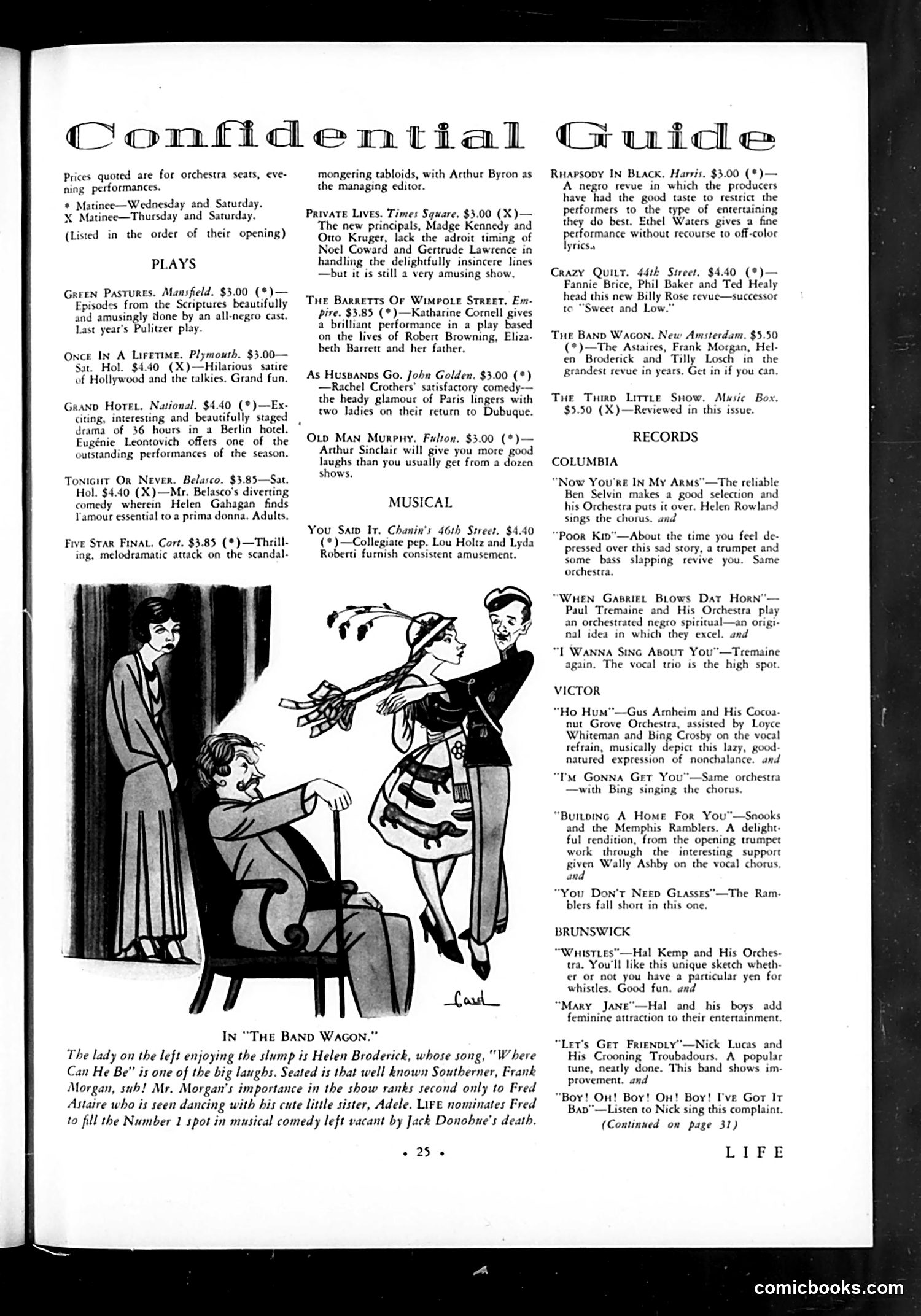
Analysis of "The Band Wagon" Cartoon This page from *Life* magazine's "Confidential Guide" reviews theatrical productions. The central illustration depicts a scene from the show "The Band Wagon," showing three figures in performance: a woman on the left, a seated musician, and a dancing couple on the right. The caption identifies key performers: Helen Broderick (the woman), Frank Morgan, and notably mentions Fred Astaire dancing with his "cute little sister, Adele." This references the famous Astaire siblings' Broadway partnership in the 1930s. The cartoon simply illustrates the show's entertainment value rather than offering political satire. It's a promotional illustration highlighting the musical revue's appeal through its star performers, typical of *Life*'s entertainment coverage during this era.
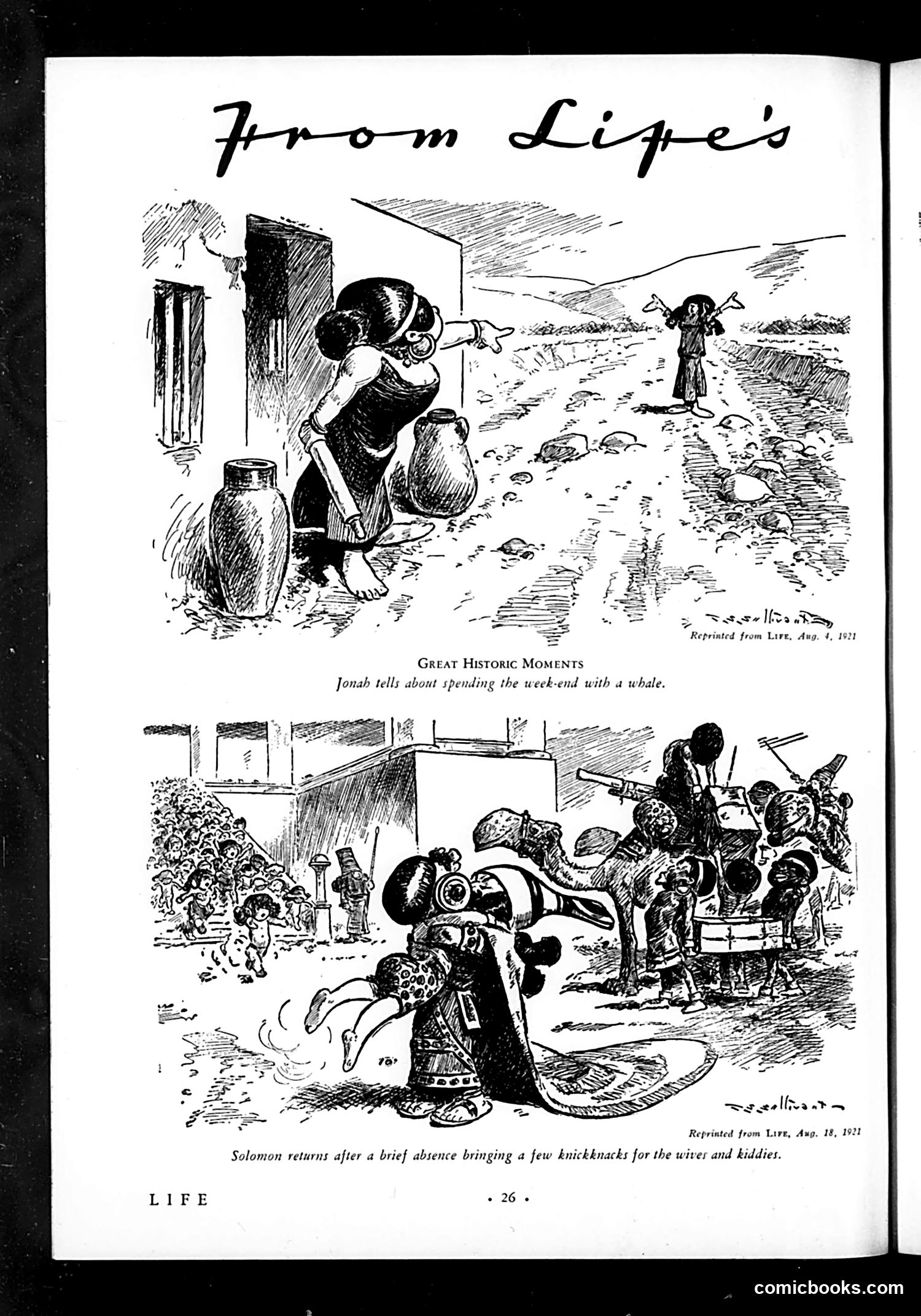
"From Life's" Historical Satire (Aug. 1921) This page presents two biblical satires mocking domestic life: Top cartoon: "Jonah tells about spending the week-end with a whale" depicts a woman recounting an exaggerated adventure—likely satirizing how people embellish mundane experiences into grand stories. Bottom cartoon: "Solomon returns after a brief absence bringing a few knickknacks for the wives and kiddies" references the biblical Solomon's famously large harem (700+ wives). The joke appears to mock both polygamy and domestic expectation-management: a husband bringing small gifts as appeasement after time away. Both use biblical figures as vehicles for 1920s marital and social humor. The satire targets how people construct narratives around ordinary life and how spouses negotiate absence and reconciliation—themes recognizable to readers familiar with scripture but presented through contemporary domestic comedy.
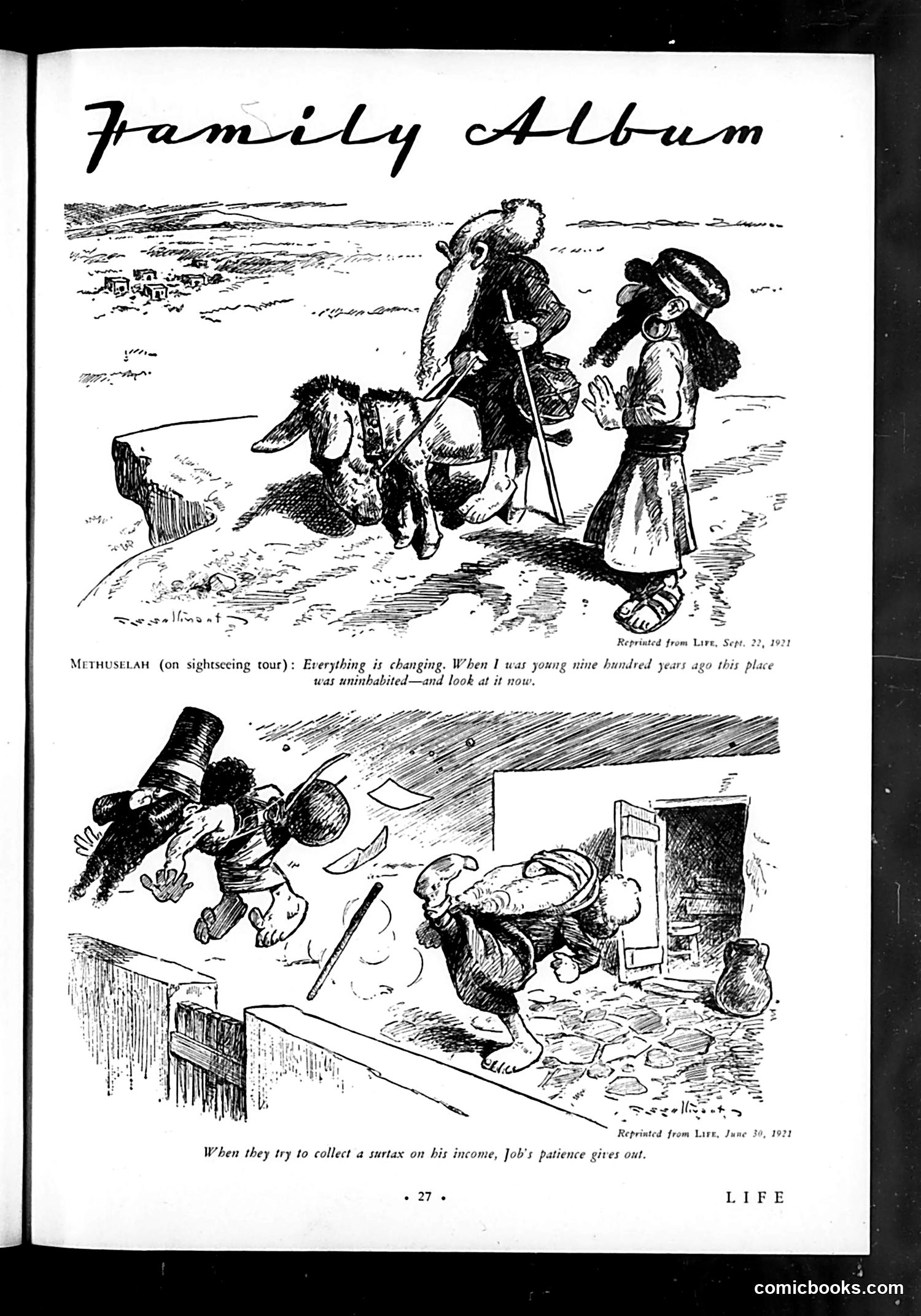
Analysis This page contains two satirical cartoons: Top cartoon: Methuselah (the biblical figure who lived 969 years) tours modern developments, noting how uninhabited land has been transformed. The satire mocks rapid urbanization and commercialization. Bottom cartoon: References Job (the biblical figure famous for patience through suffering) losing his temper when tax collectors try to impose a "surtax" on his income. This is social commentary on taxation—specifically a surtax (extra tax on high incomes), suggesting even the famously patient Job has limits when facing government levies. Both cartoons use biblical figures to comment on contemporary American concerns: development/progress and taxation. The humor relies on readers recognizing these religious references and understanding that even legendary patience wears thin under tax burden—a relatable complaint about government fiscal policy, likely from the early 1920s era.
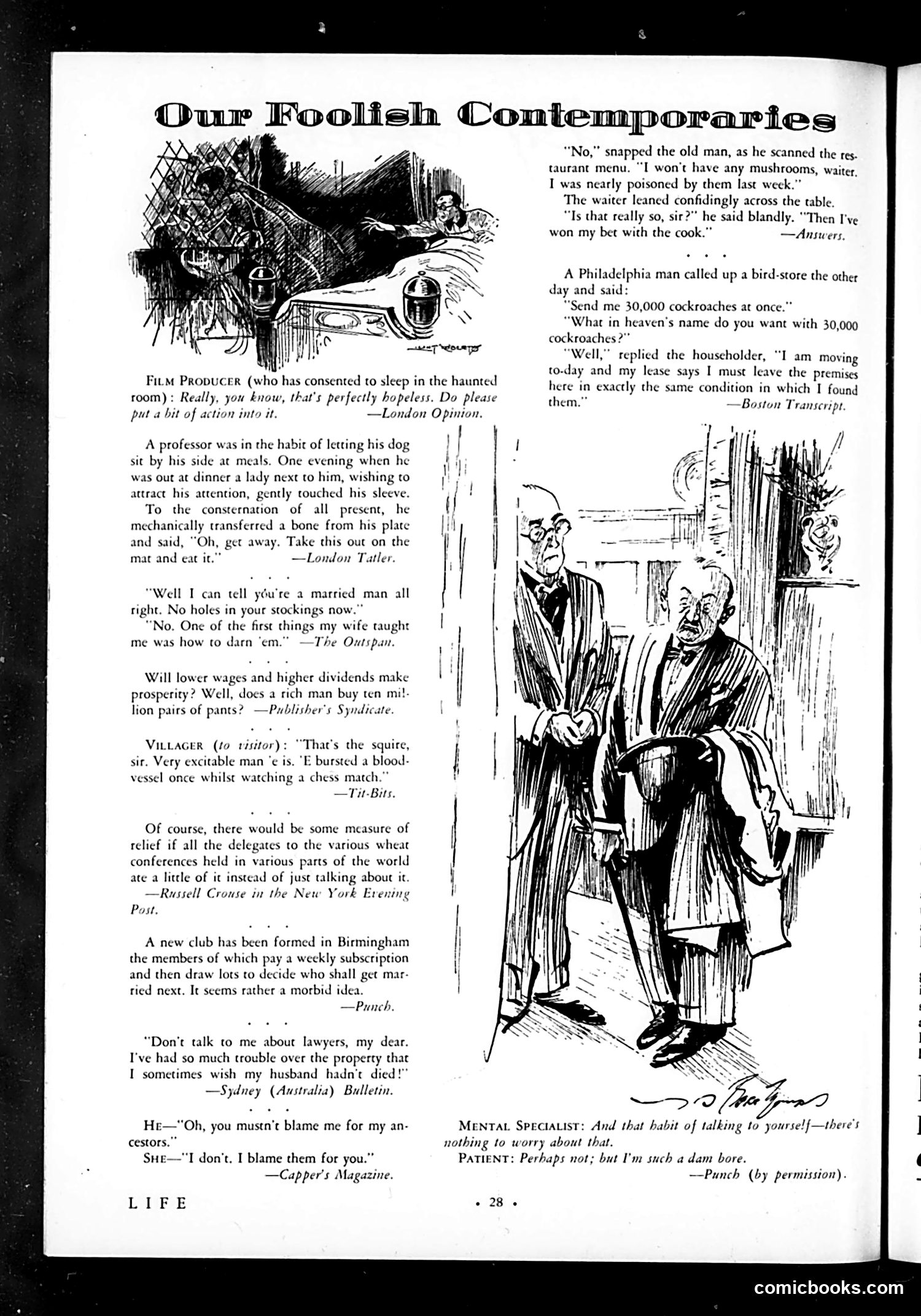
"Our Foolish Contemporaries" - Life Magazine Humor Page This is a humor column collecting brief anecdotes and jokes from various sources, satirizing everyday human foolishness. The content includes: Text jokes mocking: - A man paranoid about mushrooms (waiter's dark humor) - A moving tenant buying 30,000 cockroaches to leave infesting his apartment per lease requirements - A professor absentmindedly commanding a dinner guest to take a bone outside (confusing her with his dog) - Economic absurdity (rich men don't buy ten million pants, so lower wages won't increase prosperity) - A village squire so excitable he burst a blood vessel watching chess The cartoon (bottom right) depicts a mental specialist telling a patient their habit of self-talk isn't concerning—the patient replies they're "such a dam bore" anyway. The page exemplifies early 20th-century *Life* magazine's format: reprinting witty observations about middle-class social awkwardness, marital mishaps, and logical absurdities from newspapers and publications worldwide. The humor relies on situational irony and understated punchlines typical of that era's sensibility.
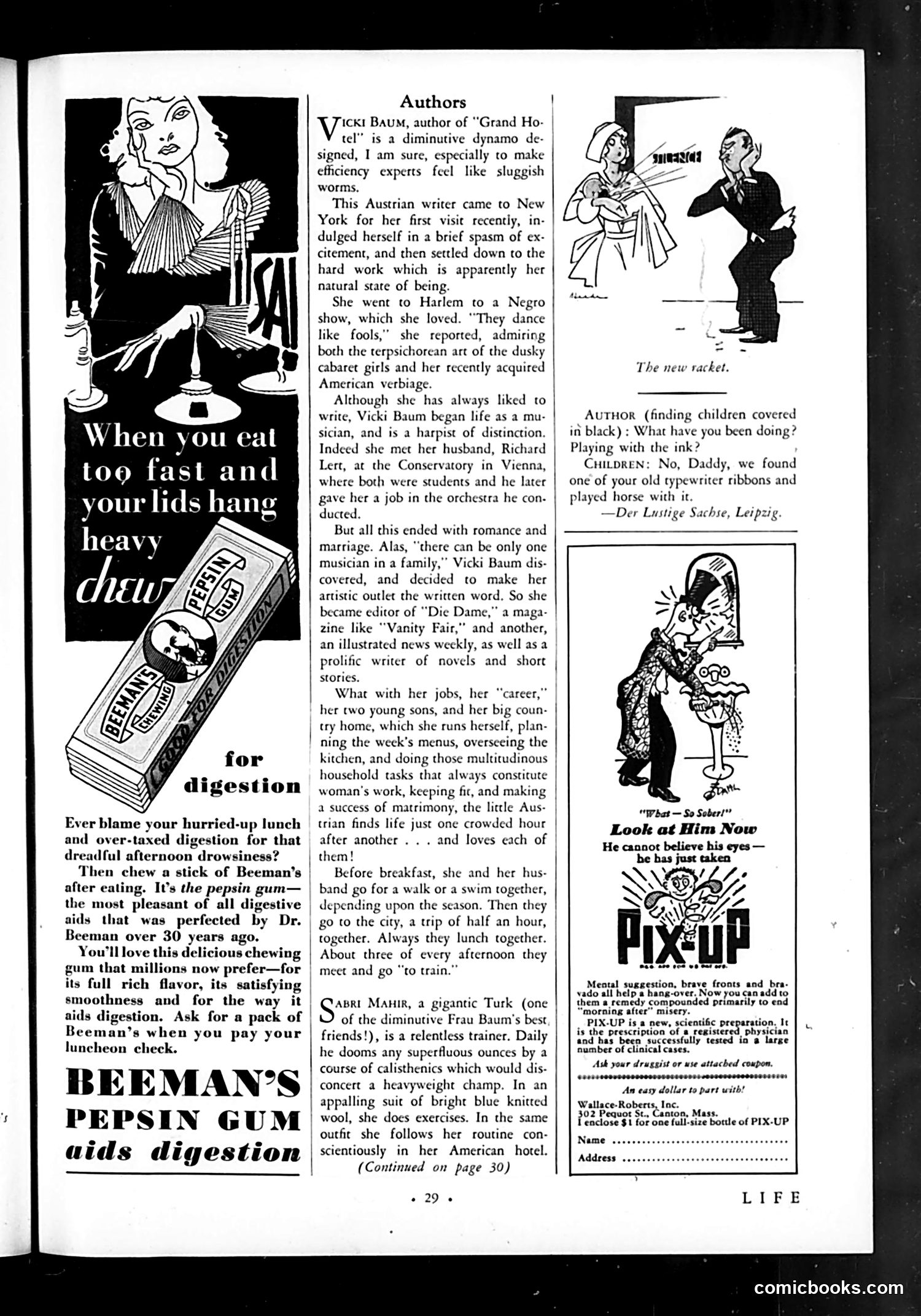
Analysis for Modern Readers This page mixes product advertising with a biographical profile of Austrian author Vicki Baum (who wrote the novel *Grand Hotel*). The Beeman's gum and Pix-Up hangover remedy are straightforward period ads promoting pepsin gum and a hangover cure. The cartoons on the right are unrelated jokes: "The new racket" depicts children who've made a mess using a typewriter ribbon as a toy, while "Look at Him Now" advertises Pix-Up by showing someone astonished at their hangover recovery. The Baum profile emphasizes a gender-performance contradiction: she's celebrated as a dynamic, accomplished writer-editor managing a household, conducting walks and exercise routines with precision—yet the tone suggests admiration mixed with amazement that a woman can juggle "career," motherhood, and marriage simultaneously. The detail about her trainer-friend Cabbri Mahir and calisthenics in "appalling" blue wool hints at the period's anxiety about women balancing professional ambition with domestic duties and appearance.
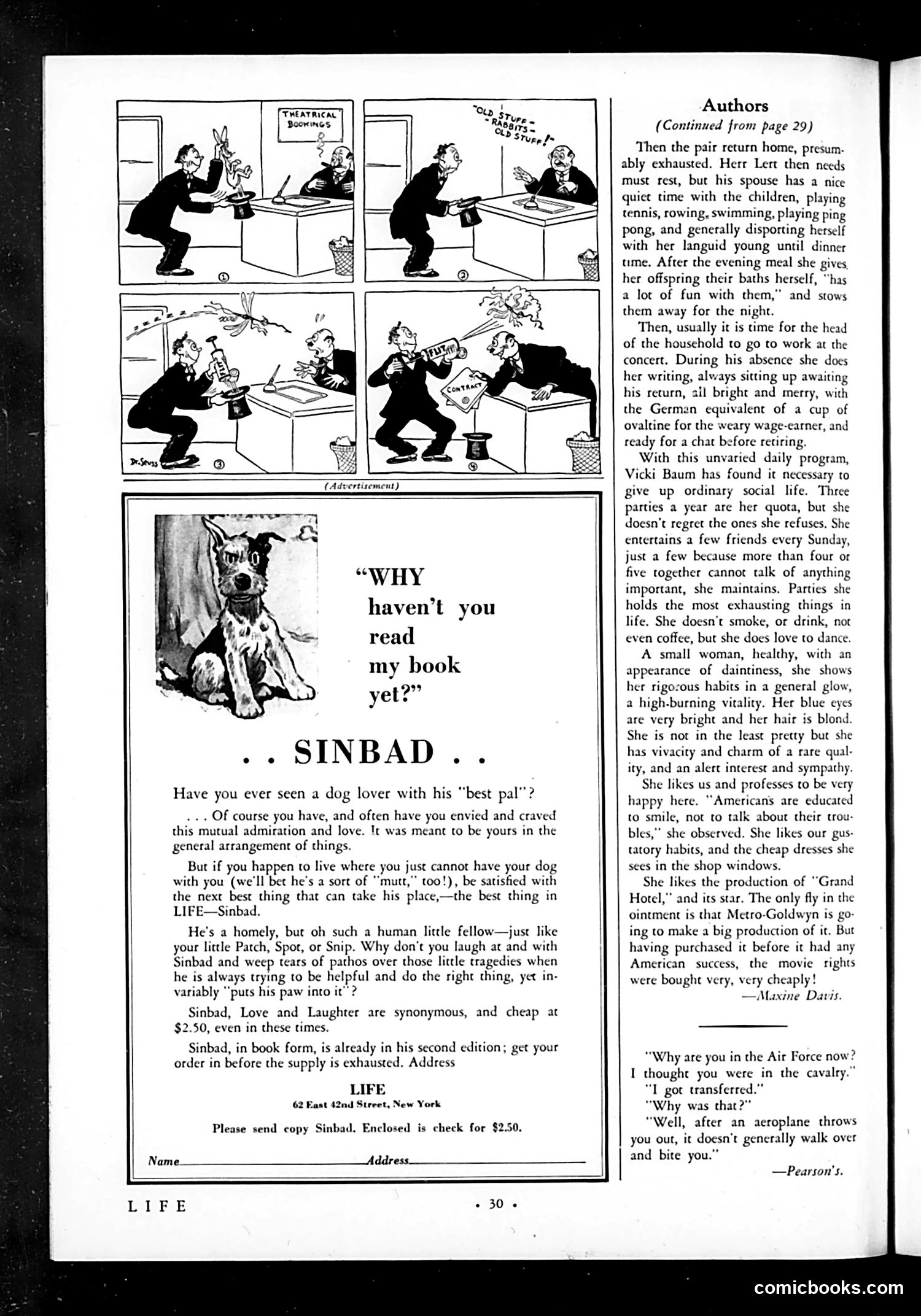
Page Analysis: Life Magazine Content This page contains a four-panel comic strip (top) showing a man presenting theatrical productions to increasingly dismissive audiences, followed by a full-page advertisement for a book called "Sinbad" about a well-meaning but accident-prone dog character. The right column continues an article about author Vicki Baum's daily life and work habits, describing her disciplined routine balancing writing with family responsibilities, her modest lifestyle despite literary success, and her observations about American culture. At the bottom is a brief joke about an Air Force transfer, where someone explains they left the cavalry because "after an aeroplane throws you out, it doesn't generally walk over and bite you"—a simple comparison between horses and aircraft as military transportation. The comic strip's point appears satirical about theatrical ambitions facing rejection, though the specific reference is unclear without additional context about the theatrical world being mocked.
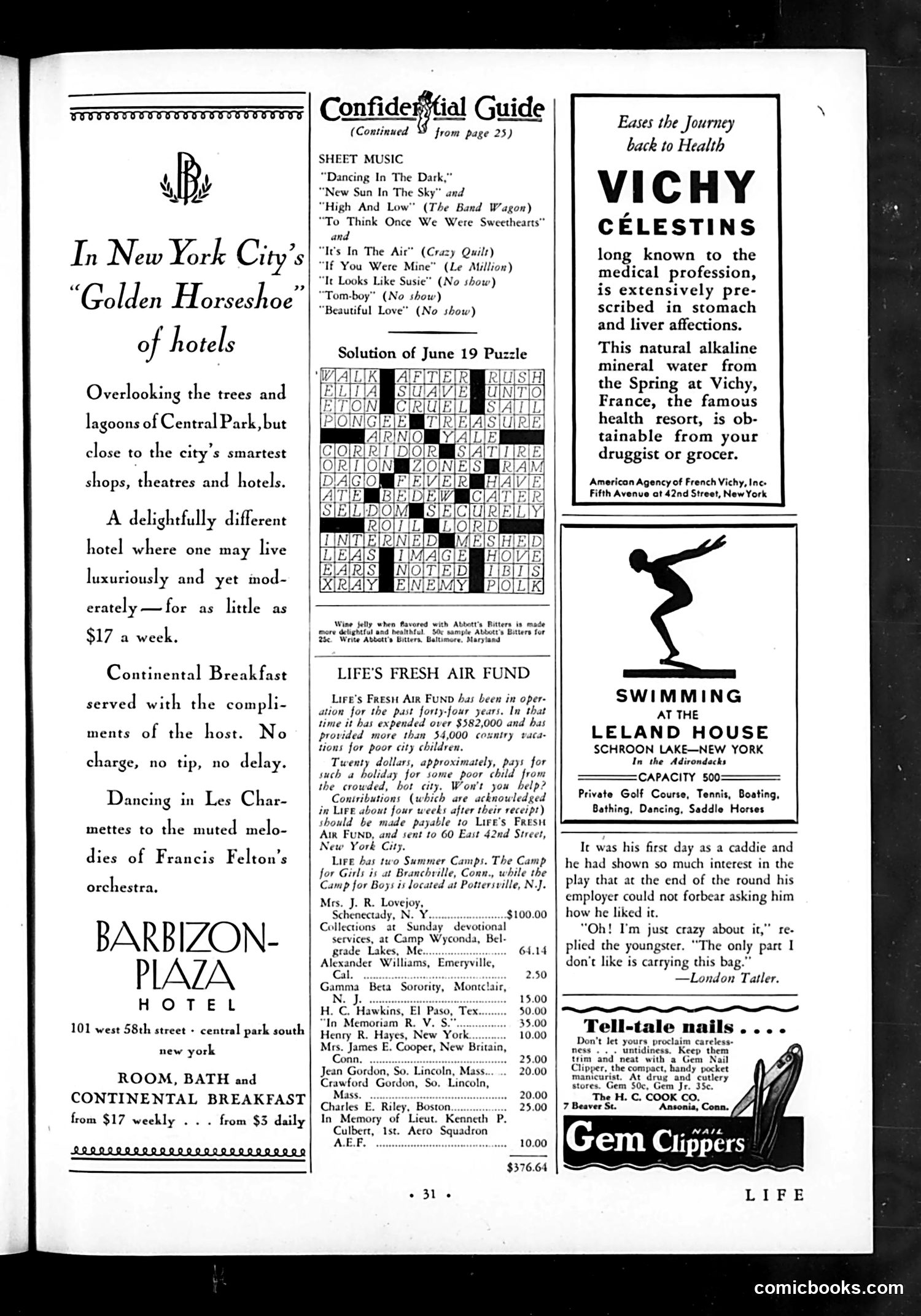
Page 31 of Life Magazine: Mostly Advertisements This page is primarily commercial advertising with minimal editorial content. The main elements include: Hotel Advertisement (Barbizon-Plaza): Promotes luxury Manhattan lodging near Central Park at affordable rates ($17/week), emphasizing amenities like continental breakfast and dancing. Life's Fresh Air Fund: A charitable notice describing the magazine's long-running program providing summer vacations for poor urban children—having distributed over $382,000 across forty-four years. Lists donor contributions. Product Advertisements: Vichy mineral water (for digestive health), Leland House resort (Adirondacks swimming/recreation), and Gem nail clippers. Brief Humorous Anecdote: A short joke about a young caddie excited about golfing but disliking bag-carrying (credited to London Tatler). Puzzle Solution & Sheet Music: References to current Broadway shows and entertainment. No political cartoons or satire appear on this page—it functions as a standard advertising-heavy magazine spread typical of 1930s publications.
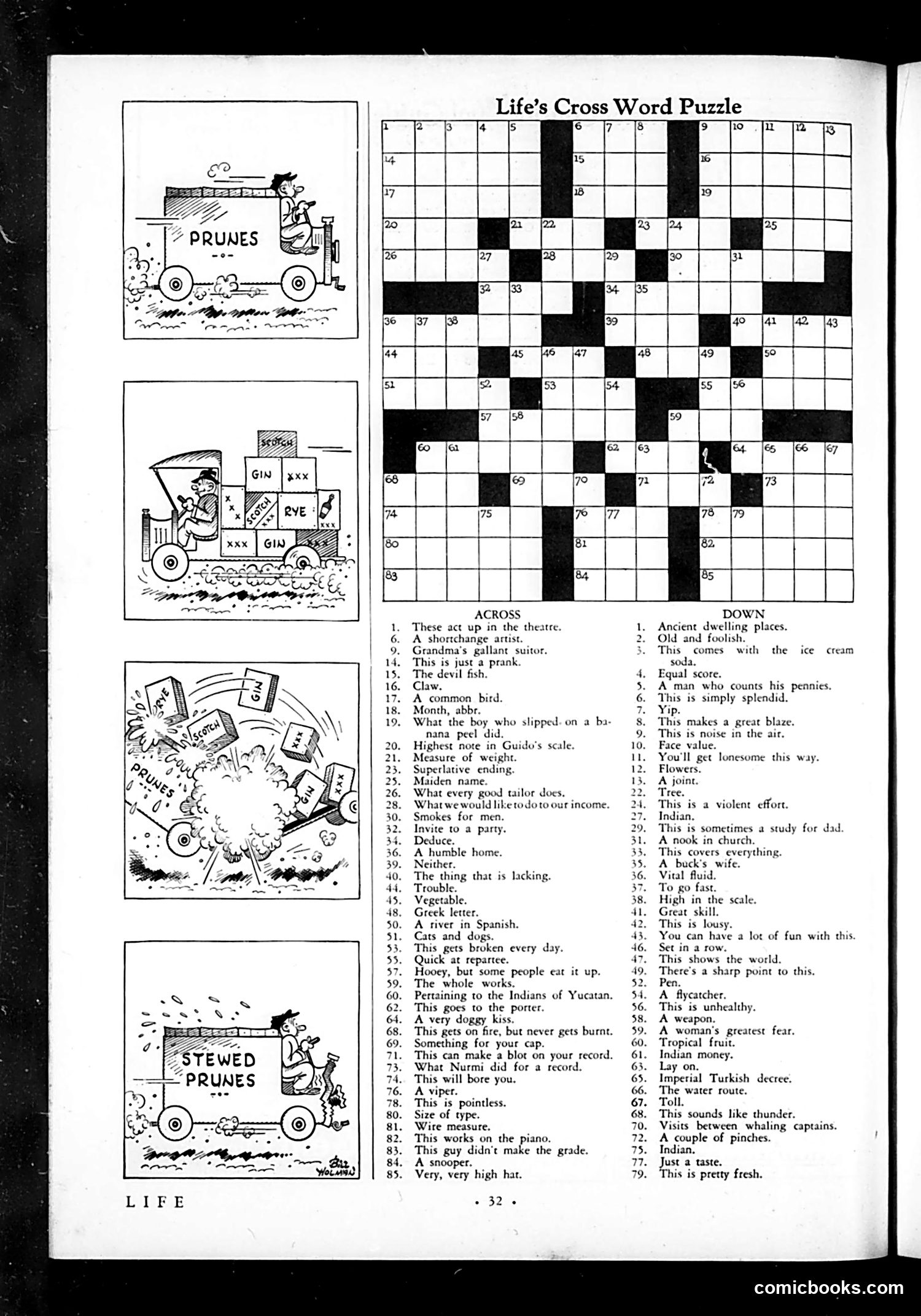
Life's Cross Word Puzzle Explanation This page is primarily a crossword puzzle from Life magazine, a major American satirical publication. The four cartoon vignettes on the left—showing a man with a cart of prunes, another with gin and rye bottles, scattered prunes, and stewed prunes—are visual jokes illustrating the laxative properties of prunes, a common source of humor in early-to-mid 20th century American comedy. The crossword clues themselves are witty wordplay typical of Life's style: puns, riddles, and topical references ("What Nurmi did for a record" likely references a 1920s athletic achievement). The puzzle was entertainment for educated, middle-class readers. The cartoons' humor relies on the bodily-function comedy considered acceptable for a mainstream magazine of that era—humor that wouldn't appear in such publications today. The overall page demonstrates Life's blend of satirical cartooning and clever wordplay puzzles as regular features.
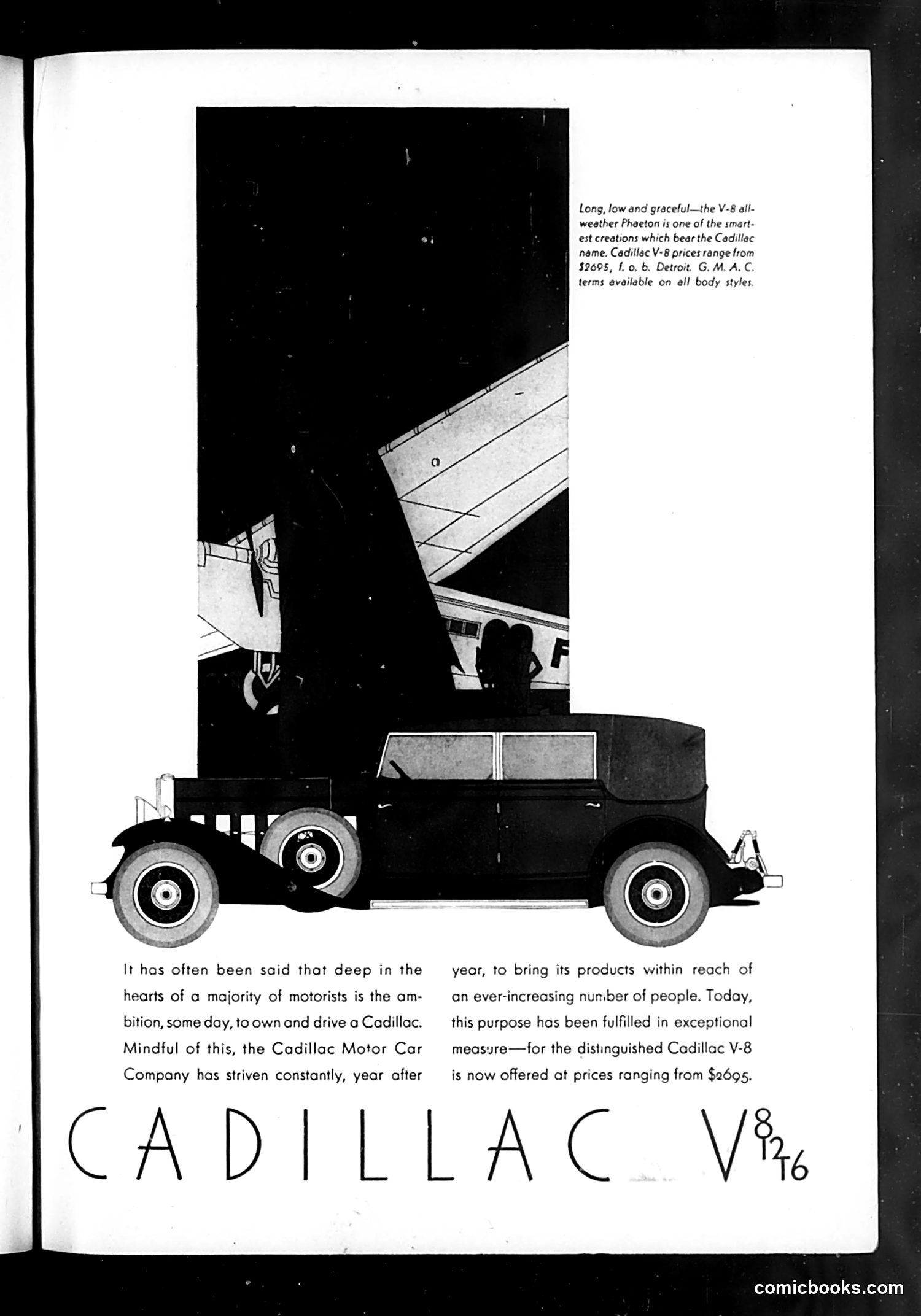
This is primarily a Cadillac automobile advertisement, not political satire. The page shows a side-view illustration of a Cadillac V-8 truck alongside an airplane wing, establishing a visual metaphor about engineering excellence and modernity. The text emphasizes Cadillac's goal to make luxury automobiles accessible to more Americans through competitive pricing—the V-8 now starts at $2,695. The "long, low and graceful" design is highlighted as sophisticated engineering. The airplane imagery appears intended to associate the vehicle with cutting-edge, aeronautical design principles—suggesting advanced technology and forward-thinking innovation. This was a common advertising strategy in the 1920s-30s, when aviation represented the height of modern achievement. There is no political cartoon or satire present on this page.
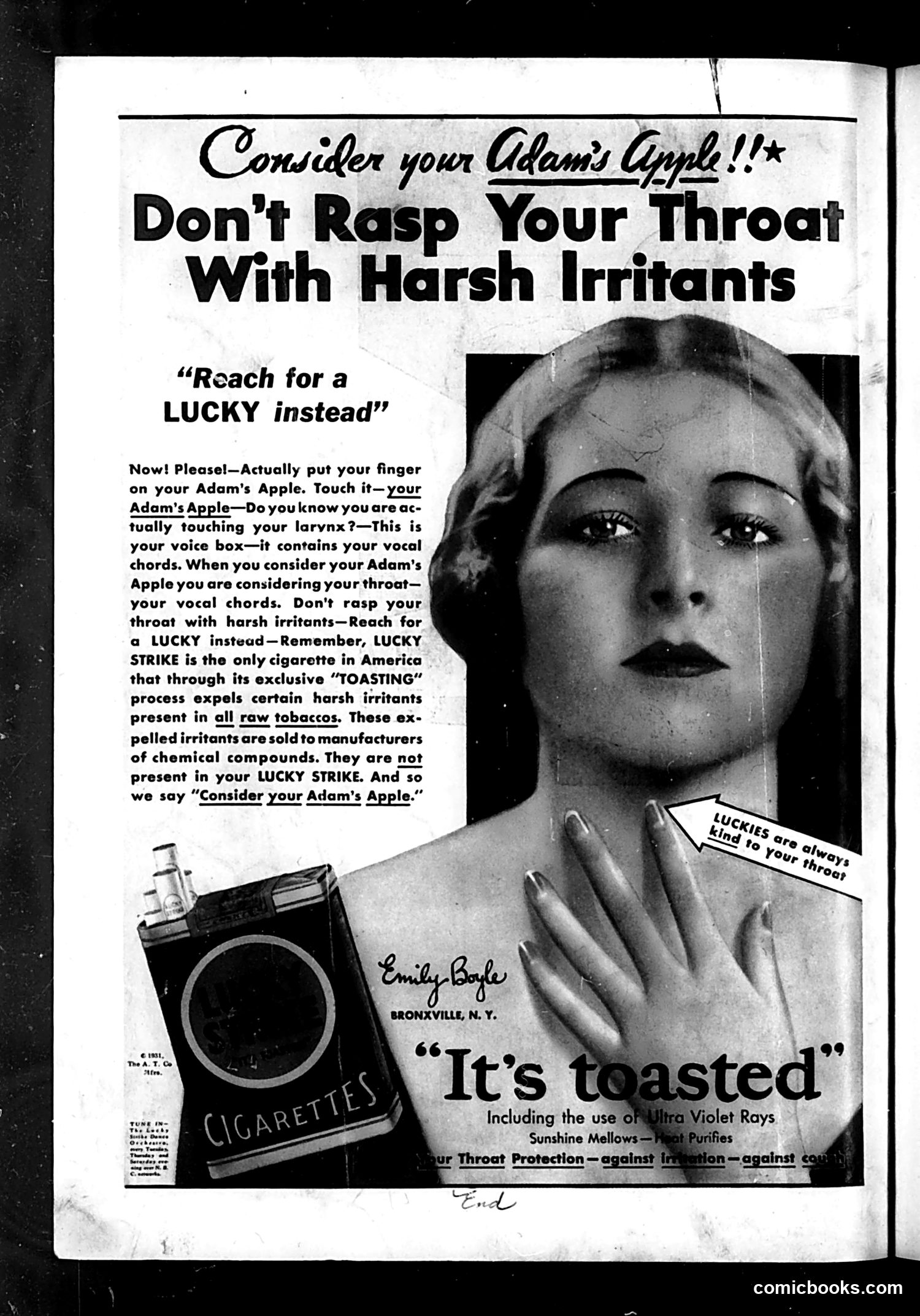
Analysis This is a Lucky Strike cigarette advertisement, not satire or political commentary. It uses pseudo-scientific health claims to market cigarettes to consumers concerned about throat irritation. The ad features a woman (identified as Emily Boyle from Bronxville, N.Y.) instructing readers to touch their Adam's Apple to understand they're touching their larynx/vocal cords. The pitch claims Lucky Strike's exclusive "toasting" process removes harsh irritants present in other tobaccos, making it safer for the throat. By modern standards, this is startlingly deceptive: the ad implies cigarettes *can* be throat-safe if properly processed—a claim now known to be false. The reference to removing irritants "sold to manufacturers of chemical compounds" attempts to sound scientific while obscuring that cigarettes remain harmful regardless. This reflects pre-1960s advertising when health warnings were absent and tobacco companies made unsubstantiated wellness claims. The ad targets smokers' health anxieties while promoting the product as a solution.

I'm unable to provide a meaningful analysis of this page. The image shows what appears to be a blank or nearly blank page from a publication, with only a "comicbooks.com" watermark visible at the bottom. There is no visible cartoon, illustration, text content, or other material that would allow me to identify figures, political references, satire, or social commentary. If this is meant to be a page from Life magazine, the content may not have scanned properly, or this may be a blank page from within an issue. To provide the historical analysis you're requesting, I would need a page with visible cartoon art or text content.