life
Life — July 3, 1931
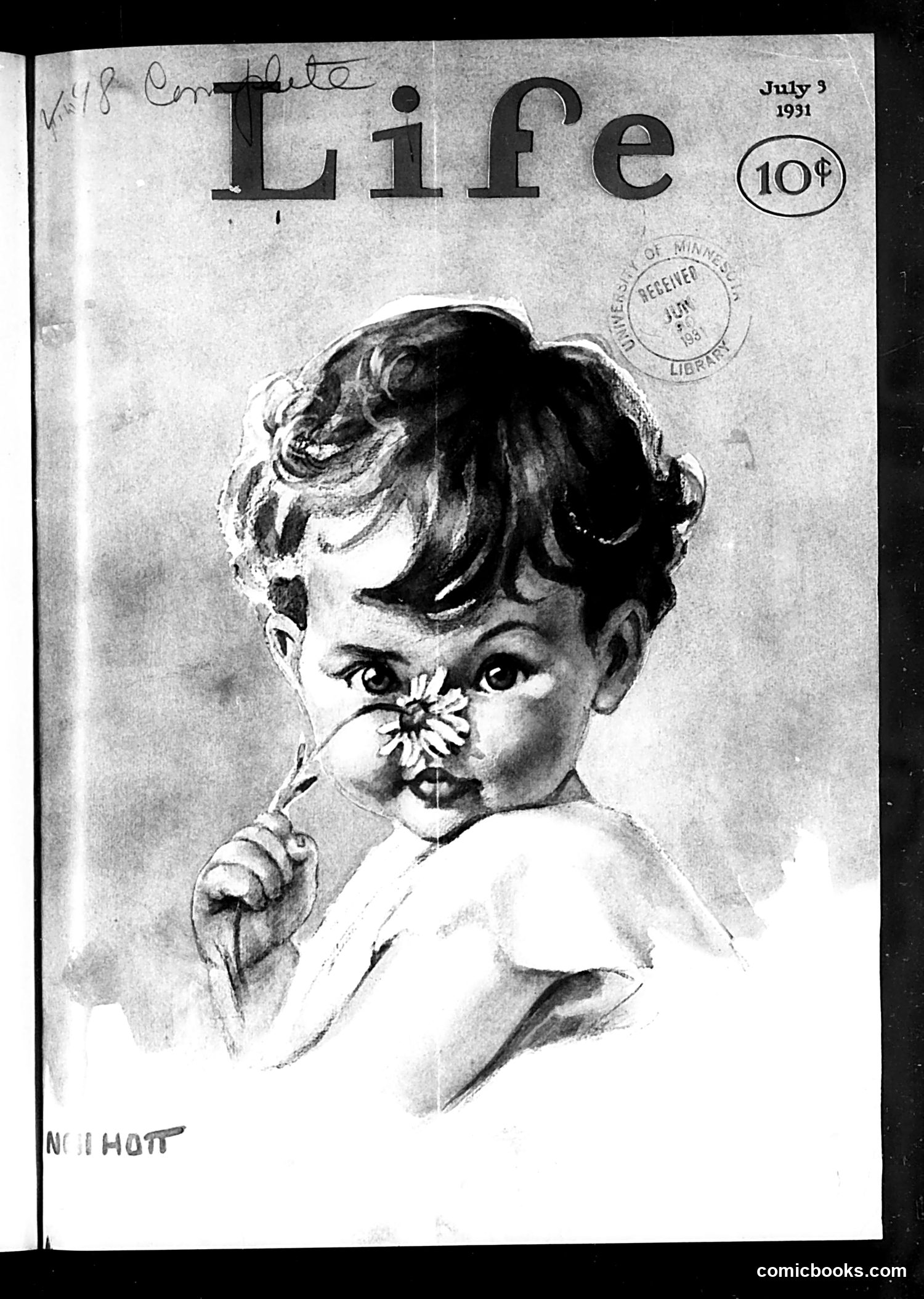
Life Magazine Cover - July 9, 1931 This is a cover illustration signed "Noll Hott" (artist signature visible at bottom). It depicts a young child with a mischievous expression holding a daisy flower near their face. The image appears designed to be charming and innocent—capturing a candid moment of childhood. Given Life magazine's satirical nature and 1931 publication date, this likely functions as gentle social commentary rather than serious political satire. The cover suggests themes about childhood innocence, perhaps commenting on American attitudes toward children or domestic life during the Great Depression era. The 10-cent price reflects 1931 economics. Without accompanying text visible, the specific satirical intent remains unclear, though the subject matter appears apolitical and human-interest focused.
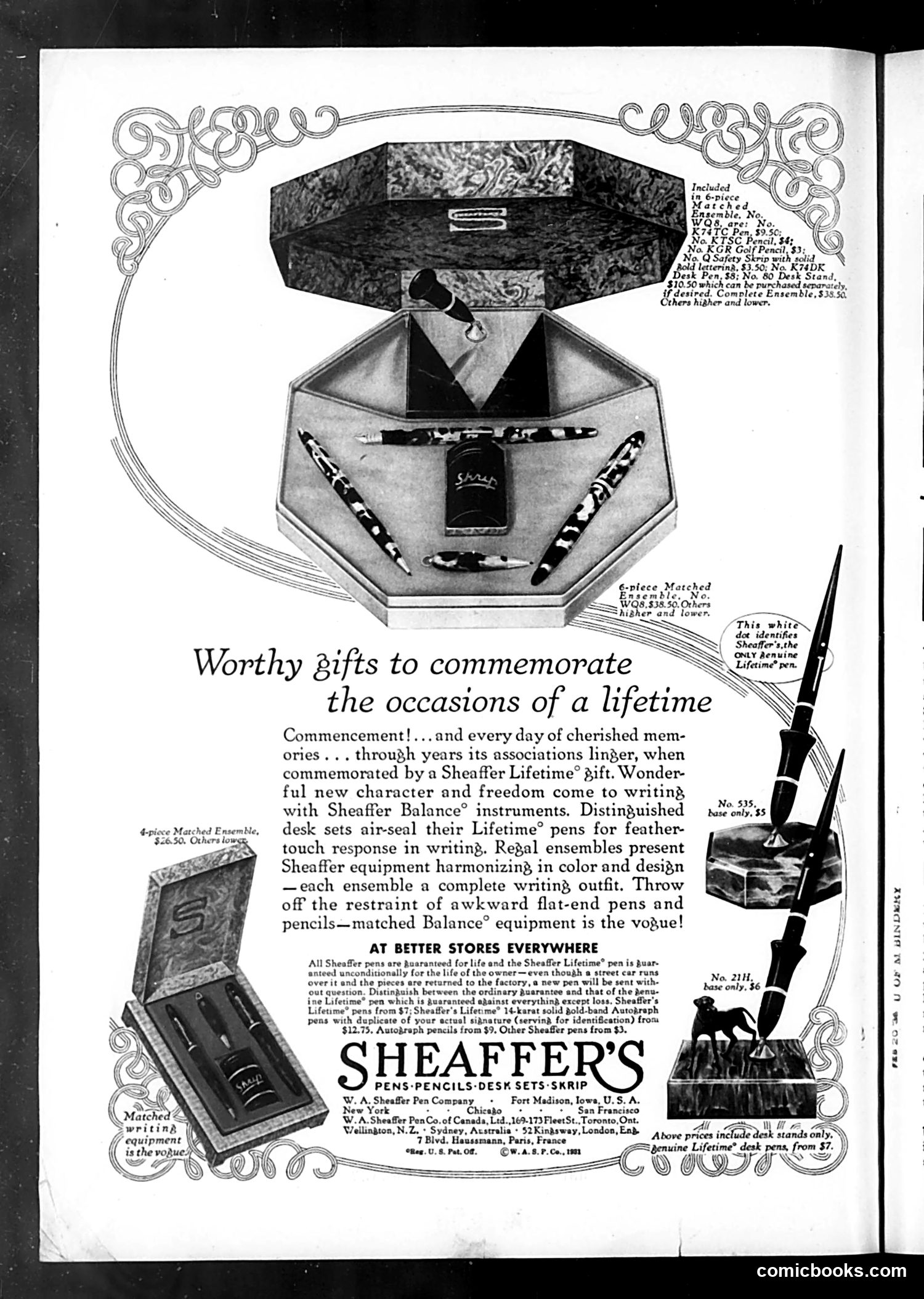
Analysis This is a Sheaffer pen advertisement, not political satire. It shows luxury writing instrument gift sets marketed as "Worthy gifts to commemorate the occasions of a lifetime"—commencement, graduation, and other milestone moments. The ad displays several product configurations: an octagonal desk set with pens and pencils, a matched ensemble box, and individual "Lifetime" pens in black with gold accents. The ornamental border and elegant layout emphasize prestige and permanence. The advertisement emphasizes Sheaffer's "lifetime guarantee"—pens are warranted for life, with free replacements if damaged. This was a major selling point for expensive writing instruments in this era. The copy targets affluent consumers seeking meaningful gifts for important occasions.
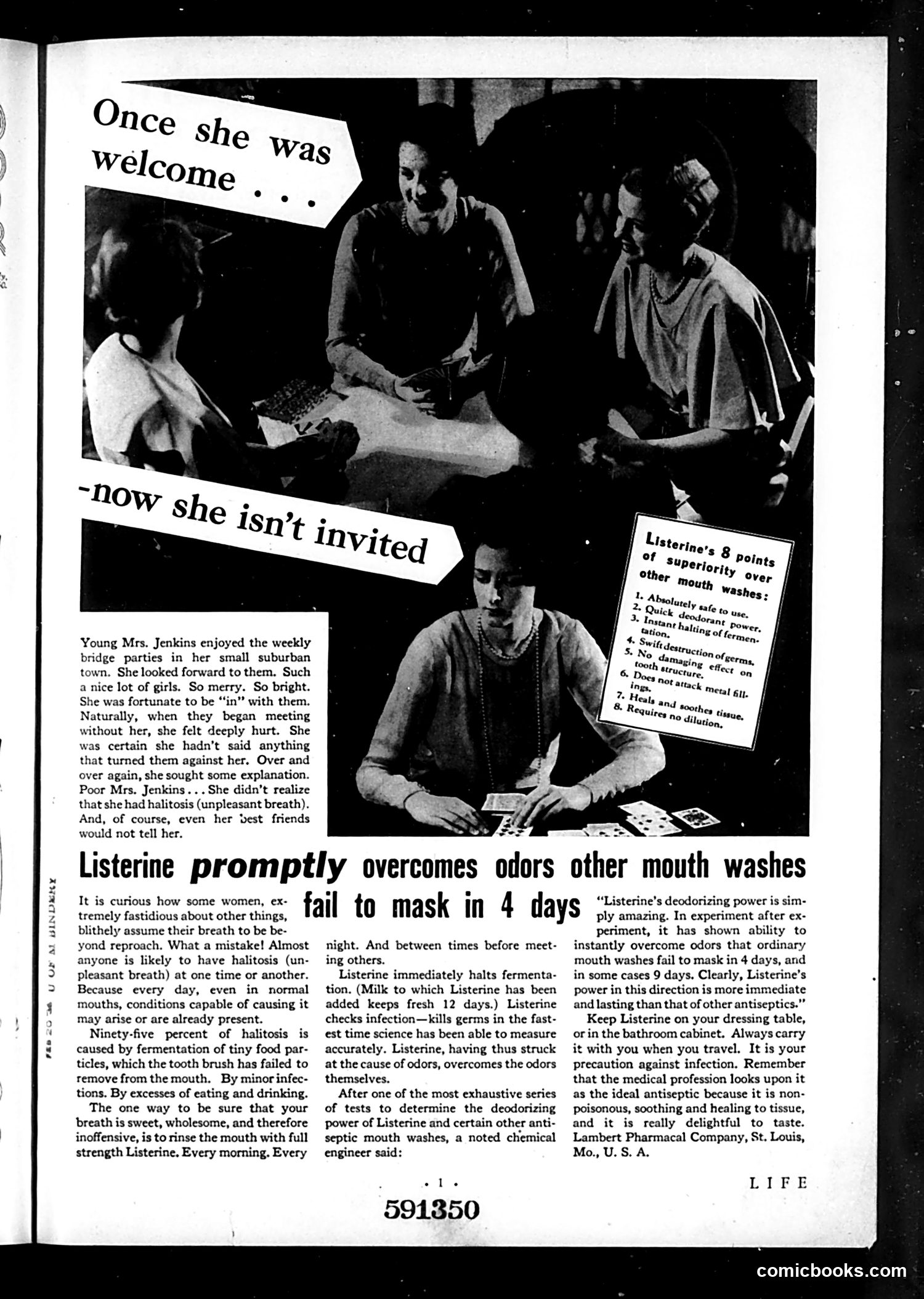
Analysis This page is primarily advertising for Listerine mouthwash, not satire or political commentary. The advertisement uses a narrative format featuring "Mrs. Jenkins," a woman who lost her social standing ("once she was welcome...now she isn't invited") due to halitosis (bad breath). The accompanying photos show her excluded from a bridge party—a popular social gathering among middle-class women of the era. The ad's message: halitosis causes social rejection, and Listerine solves this problem. The accompanying text promotes Listerine's antiseptic properties and claims it overcomes odors in 4 days. This reflects early-to-mid 20th century advertising strategy: creating anxiety about social acceptability to sell hygiene products, particularly targeting women's fears about being ostracized.
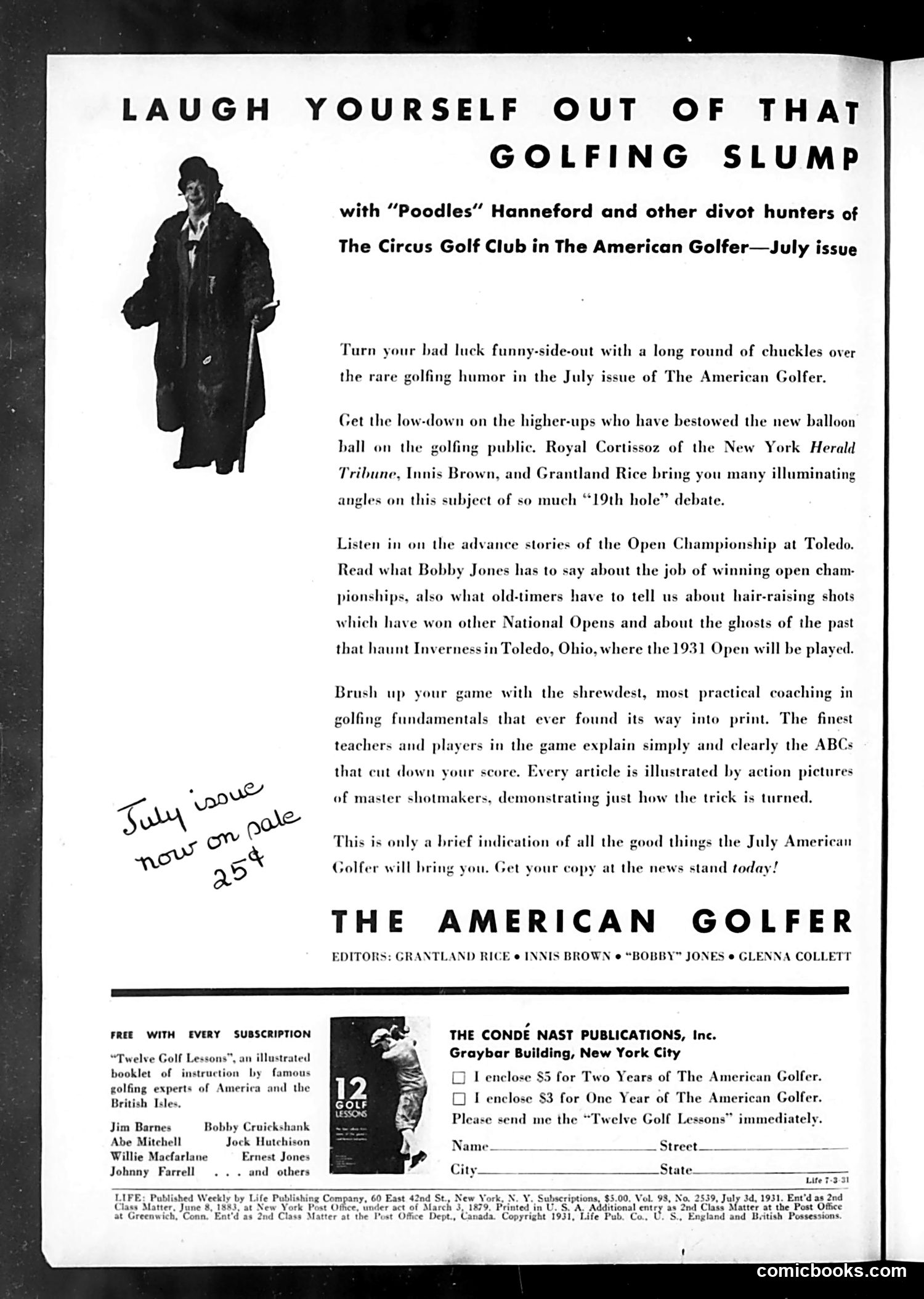
Analysis This is primarily an advertisement for *The American Golfer* magazine's July 1931 issue. The page uses humor to promote golf content by featuring "Poodles" Hanneford (a circus performer shown in the photograph on the left) as a comic figure representing someone trying to escape a "golfing slump." The satire targets golf enthusiasts who take the sport too seriously. The ad promises humor about "divot hunters" and criticism of the newly popularized "balloon ball," while offering practical instruction from notable golfers like Bobby Jones. The reference to the 1931 Open Championship at Toledo, Ohio anchors this to contemporary golfing events. The handwritten note indicates this issue cost 25 cents and was available in July. The overall joke positions golf culture as humorous and self-aware—a leisure activity worth mocking gently.
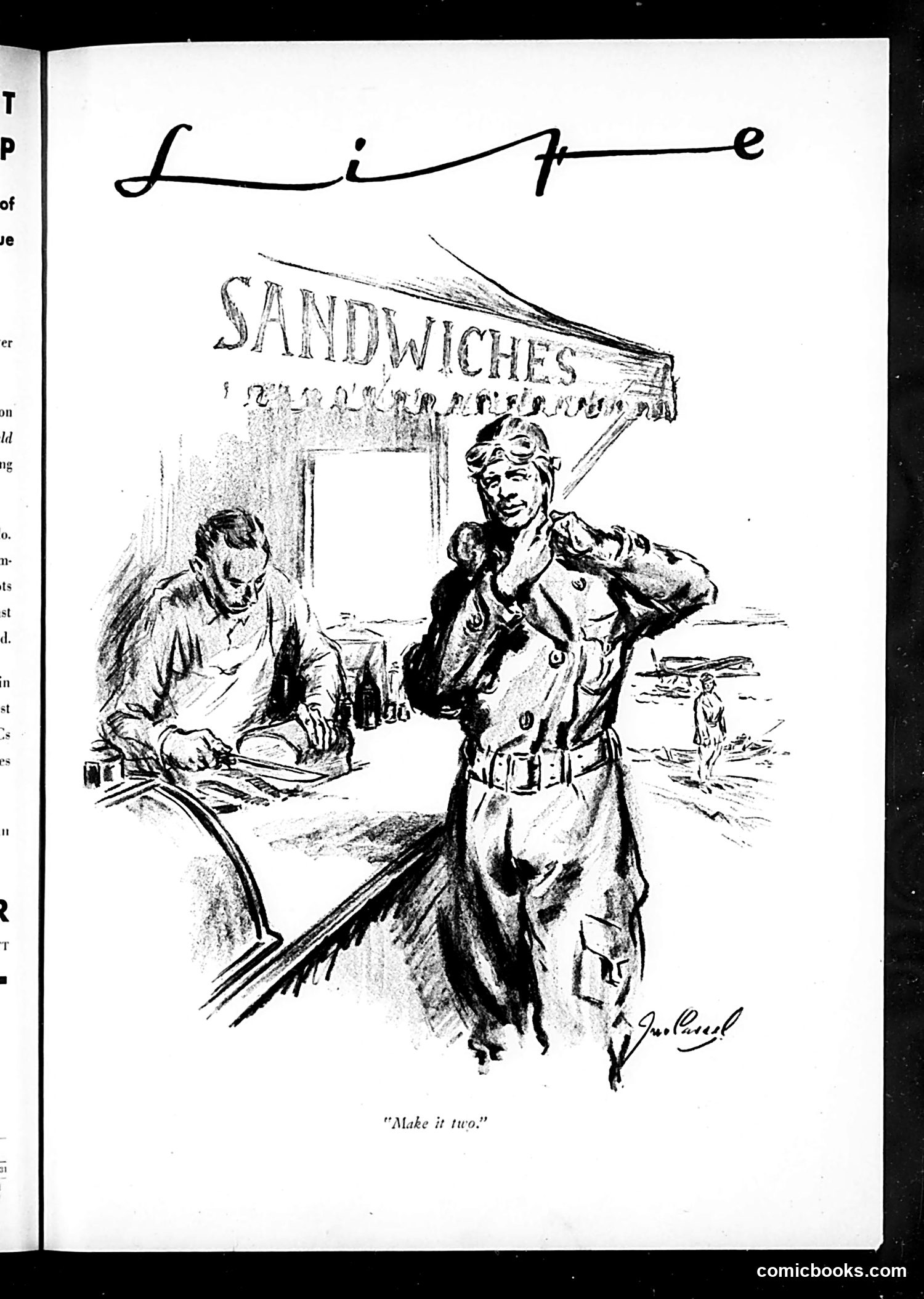
"Life" Magazine Cartoon: "Make It Two" This cartoon depicts a wartime sandwich shop scene. A soldier in military uniform stands at a counter ordering from a proprietor, with the caption "Make it two." The shop's sign reads "SANDWICHES" overhead. The satire likely comments on soldier morale, rationing, or food availability during wartime (appears to be WWI or WWII era based on the uniform style). The humor suggests either the soldier's hearty appetite despite wartime shortages, or perhaps commentary on profiteering by businesses during military service. The proprietor's expression and the soldier's confident demeanor create a comedic tension about civilian-military economic interactions during wartime. The cartoon's point remains somewhat unclear without additional context about specific wartime food policies or conditions referenced.
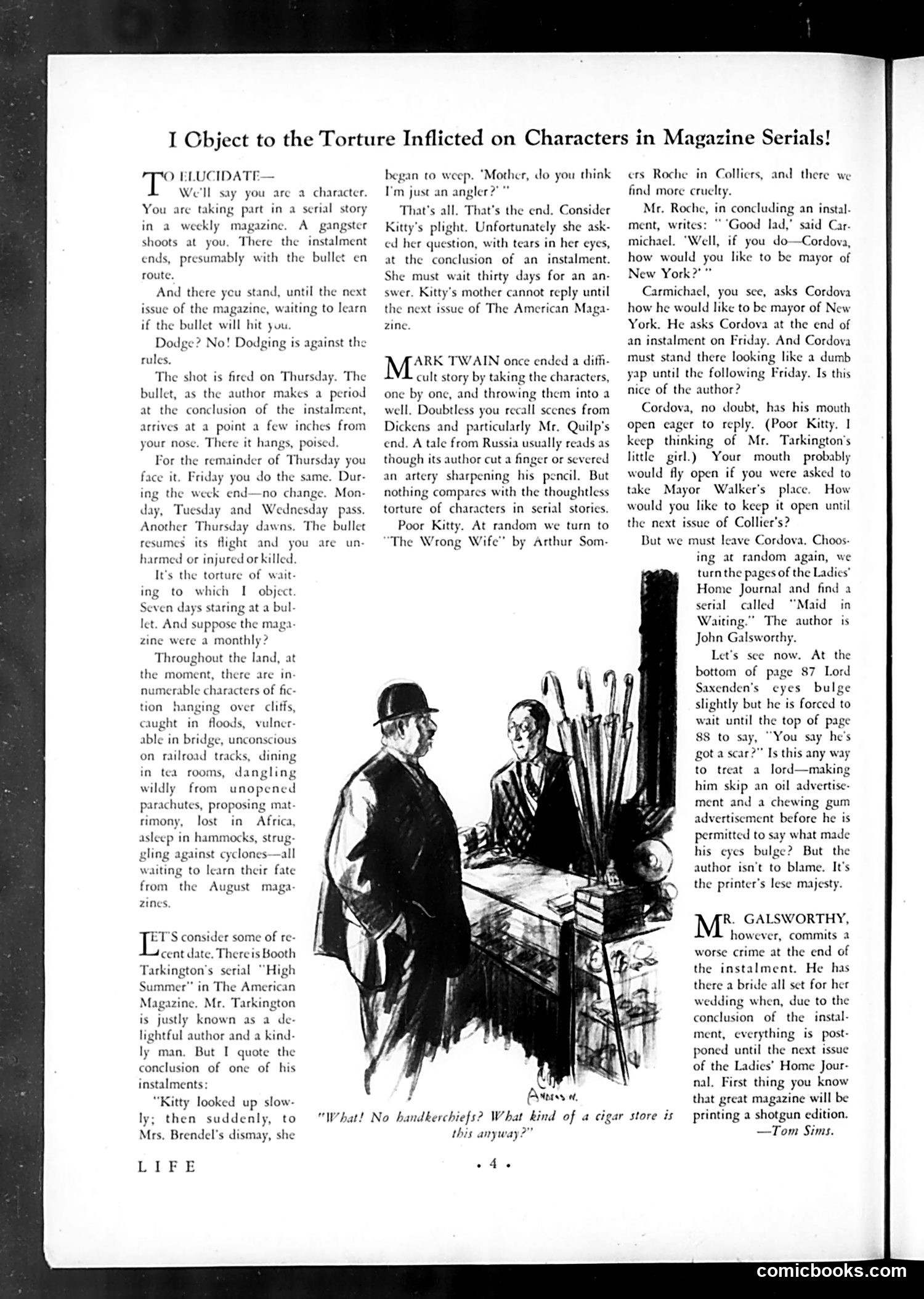
Analysis of Life Magazine Page This page critiques the narrative structure of serial fiction in weekly magazines, a popular early 20th-century format. The author objects to the "torture of waiting"—the cliffhanger endings that leave characters in mortal danger (bullets fired, characters falling from cliffs) for seven days until the next installment. The illustration shows two men discussing a cigar store, likely depicting a scene from one of these serials. The satire mocks how serials artificially prolong suspense through contrived delays and how readers endure this waiting across multiple installments. The author cites specific examples like Mark Twain's stories and Arthur Somers Roche's work, arguing that such narrative techniques constitute "torture" of both characters and readers seeking resolution.
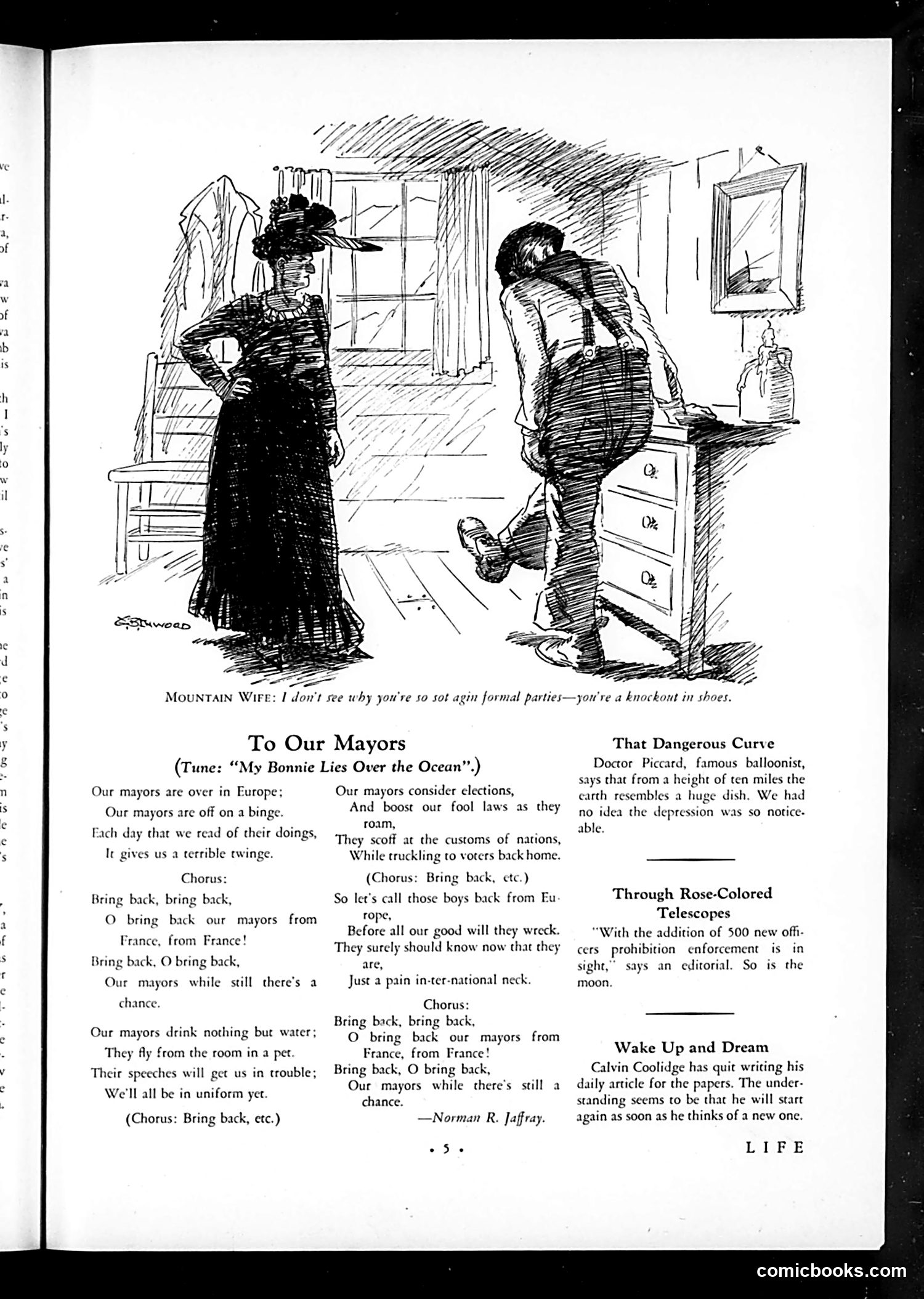
Analysis of Life Magazine Page The Cartoon: The sketch depicts a woman in formal dress confronting a man in wrinkled, travel-worn clothes. The caption reads: "Mountain Wife: 'I don't see why you're so lot agin formal parties—you're a knockou in shoes.'" This is a humorous domestic scene mocking the husband's resistance to formal social events, with the wife's backhanded compliment suggesting his appearance is otherwise disheveled. The Articles Below: The page contains three satirical pieces: "To Our Mayors" (criticizing mayors absent in Europe), "That Dangerous Curve" (about a balloonist's Earth observations), and "Through Rose-Colored Telescopes" (regarding prohibition enforcement). These represent typical Life magazine social and political commentary from the Prohibition era.
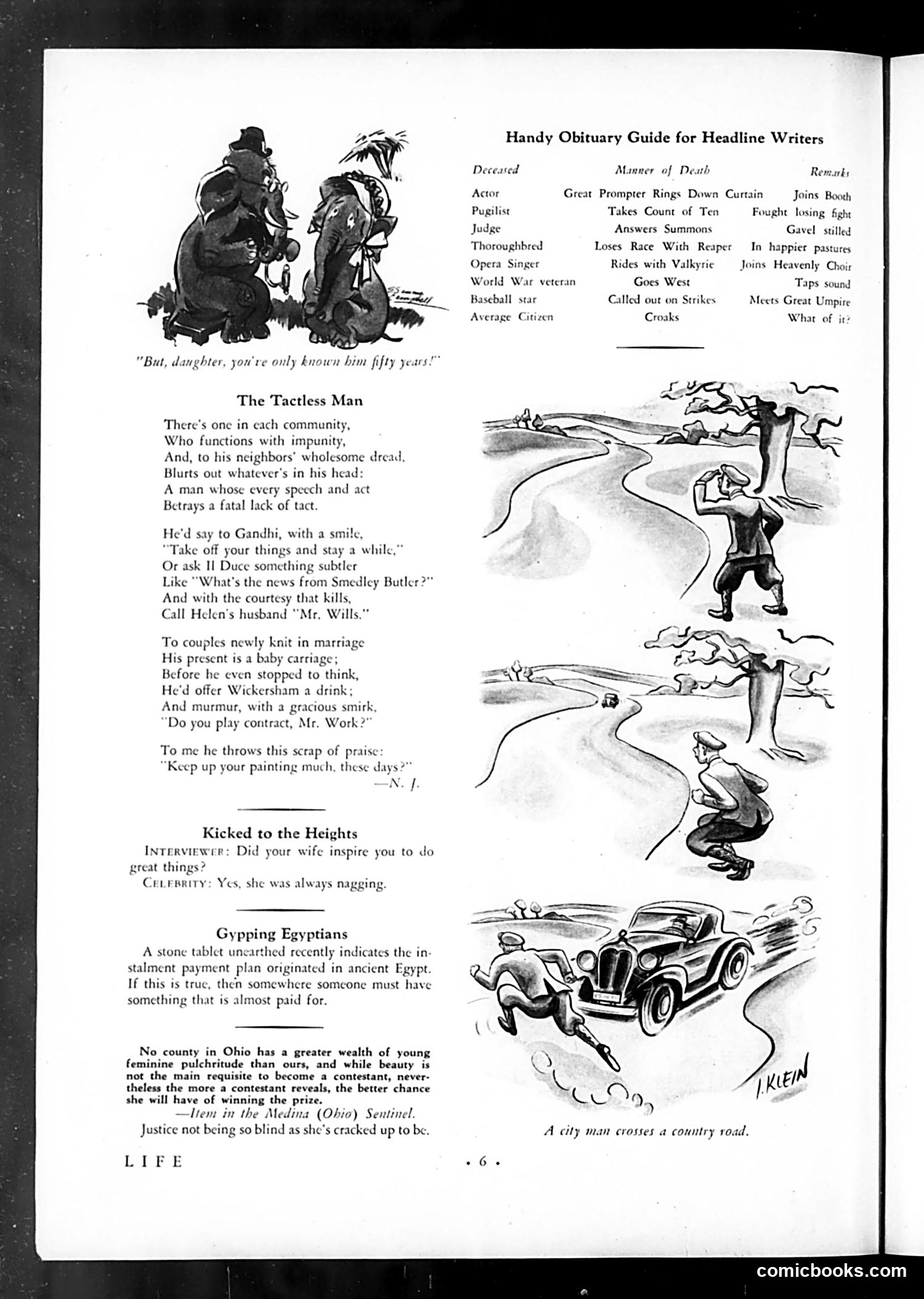
Analysis of Life Magazine Page This page contains several satirical pieces mocking social types and behaviors: "The Tactless Man" is a poem about a community figure who lacks social discretion, making inappropriate comments to Gandhi, Mussolini, and others. The satire targets someone who thoughtlessly offends people through blunt speech. "Kicked to the Heights" is a brief joke mocking wives who nag their husbands into achievement—portraying nagging as paradoxically motivating. "Gypping Egyptians" references an ancient Egyptian payment plan discovery, using it as a setup for commentary. The three Klein cartoons on the right humorously depict a city man attempting to cross a country road, misjudging rural traffic and getting hit by a car—satirizing urban ignorance of rural life and dangers. Overall, the page mocks social awkwardness, marital dynamics, and class differences between city and country dwellers.
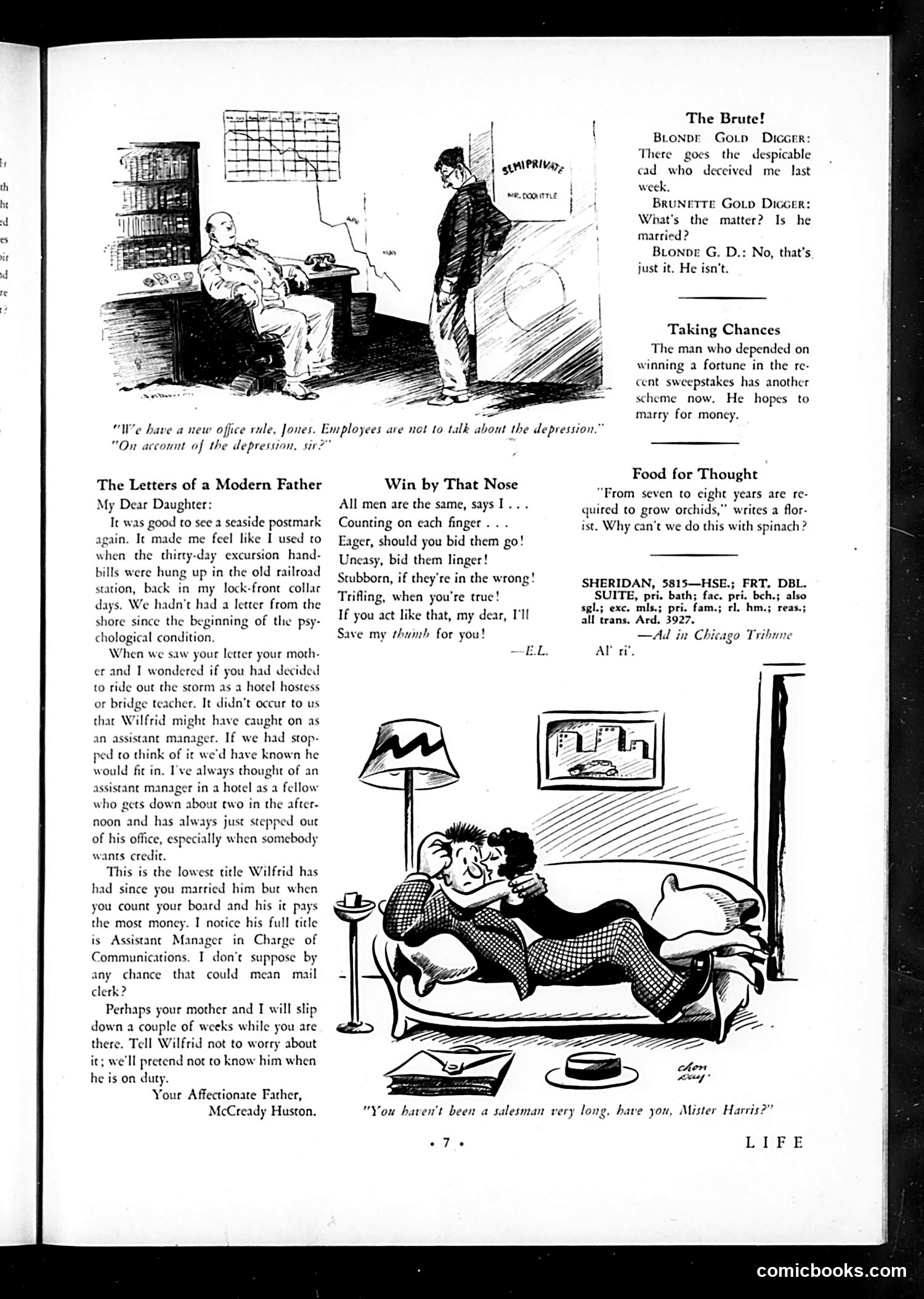
Content Analysis This Life magazine page contains several satirical pieces from the Depression era: "The Brutel" presents a dialogue between two female characters discussing a man who isn't married—the "brutel" (brute) apparently being a man unwilling to commit. "The Letters of a Modern Father" is a letter from McCready Husson to his daughter, humorously detailing his modest hotel job and assuring her that her husband Wilfrid needn't worry about his low position—the satire mocking both economic anxiety and false pride during hard times. "Win by That Nose" appears to be light verse about men and bidding. The cartoon shows a man lounging on a couch with a woman, captioned "You haven't been a salesman very long, have you, Mister Harris?"—satirizing either incompetence or inappropriate workplace behavior during economically desperate times.
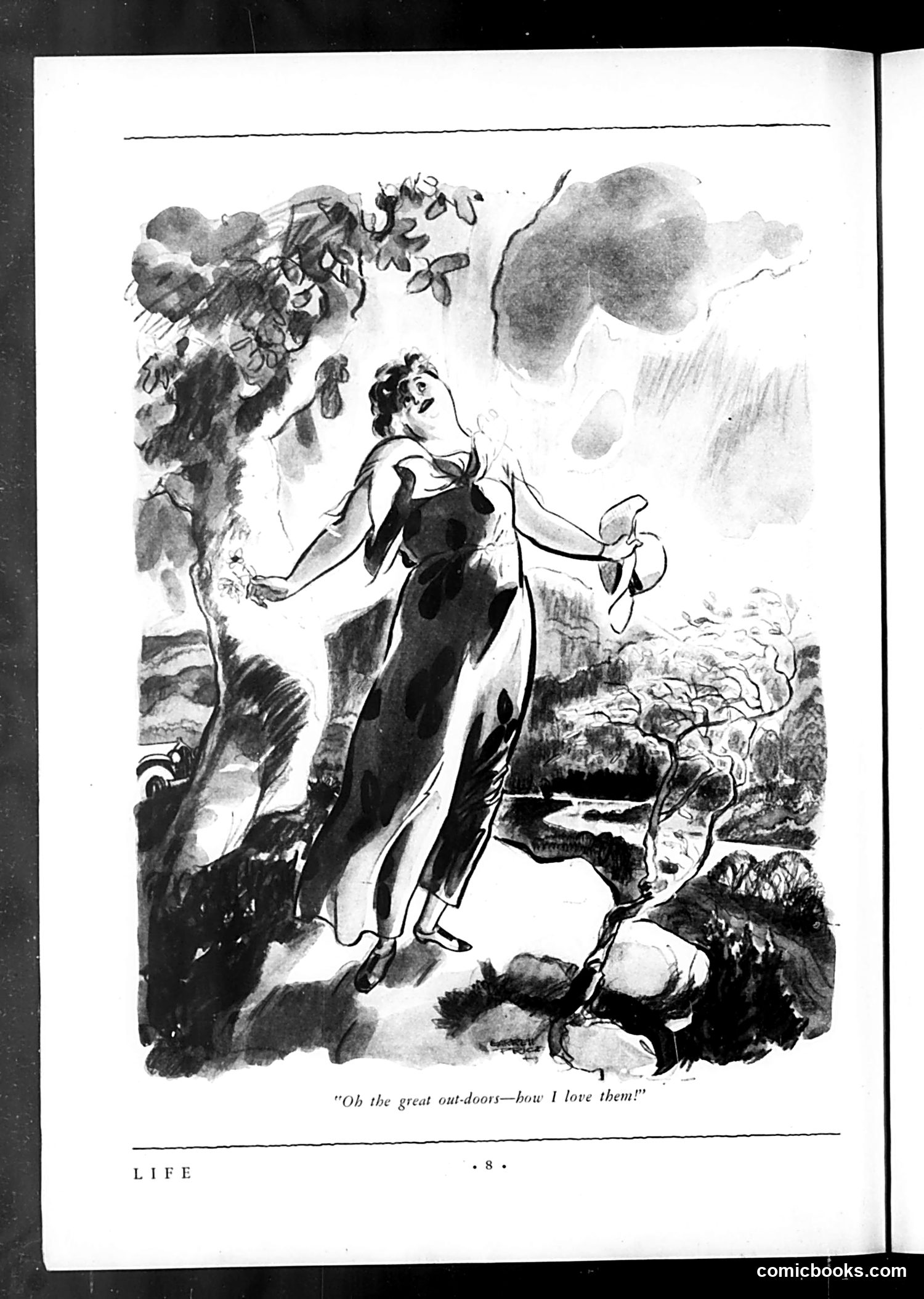
Analysis This is a single illustration from *Life* magazine (page 8) depicting a woman in an elegant dress standing outdoors with her arms raised in joy or exultation. She's surrounded by natural scenery—trees, flowers, and a landscape vista. The caption reads: "Oh the great out-doors—how I love them!" The satire appears to target romantic or sentimental attitudes toward nature. The woman's theatrical pose and effusive declaration suggest she's expressing exaggerated enthusiasm typical of genteel society rhetoric about "the great outdoors." The illustration likely mocks either the pretentiousness of such romanticized nature appreciation or the performative quality of upper-class women's expressions of aesthetic feeling—contrasting elaborate clothing and posed sophistication with casual outdoor enjoyment.
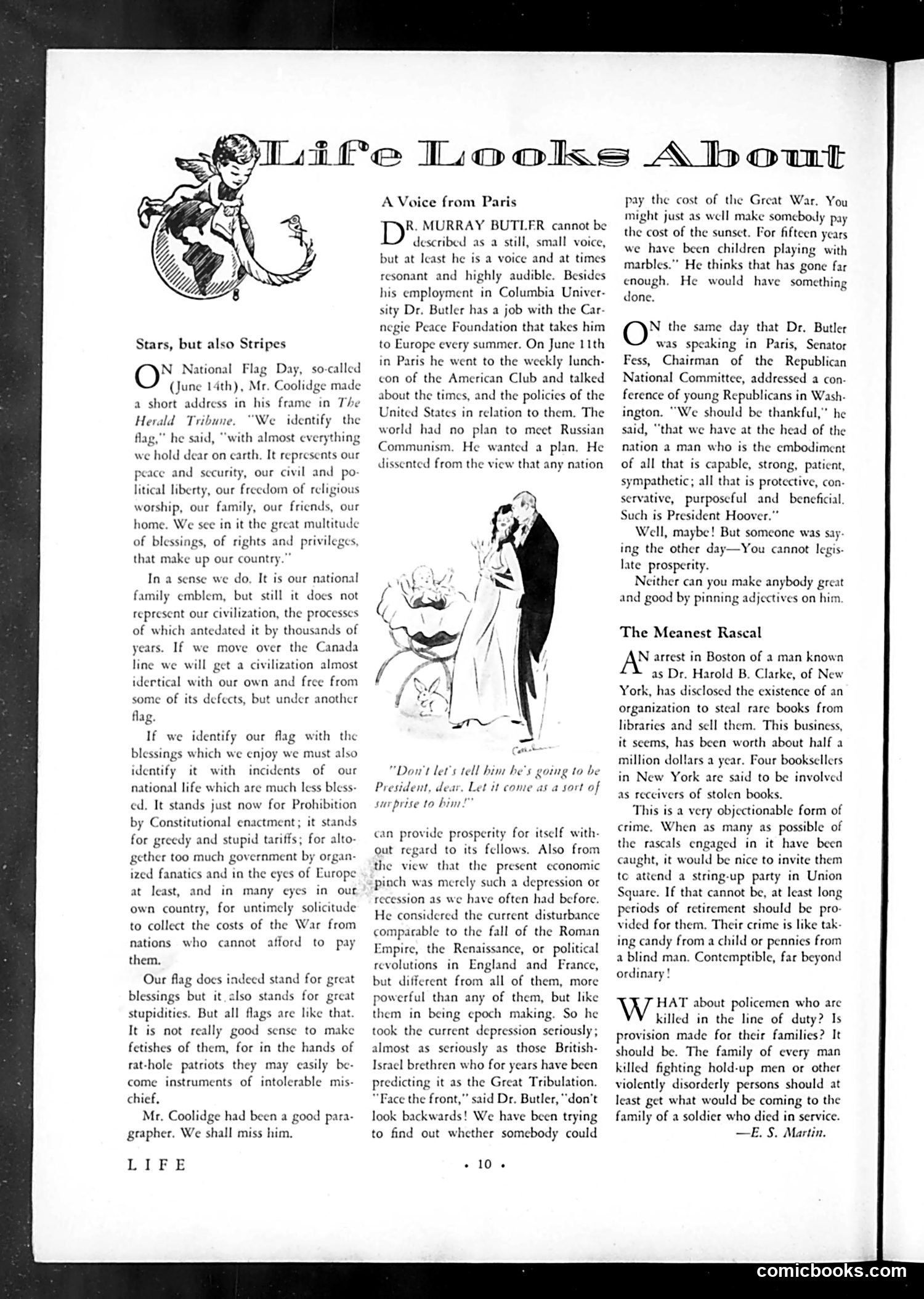
Life Magazine Political Content Analysis This page contains three opinion pieces rather than cartoons proper. The main illustration shows a man in formal attire speaking with a woman, accompanying an article titled "A Voice from Paris" about Dr. Murray Butler's European observations. The article discusses Dr. Butler's views on combating Russian Communism and praises President Hoover as embodying the qualities needed to lead the nation—suggesting this is from the early Hoover presidency (late 1920s-early 1930s). Other sections address National Flag Day symbolism, a Boston book-theft ring, and police protection for families of officers killed in duty. The overall tone is conservative, emphasizing patriotism, law-and-order, and anti-Communist sentiment typical of that era's American establishment commentary.
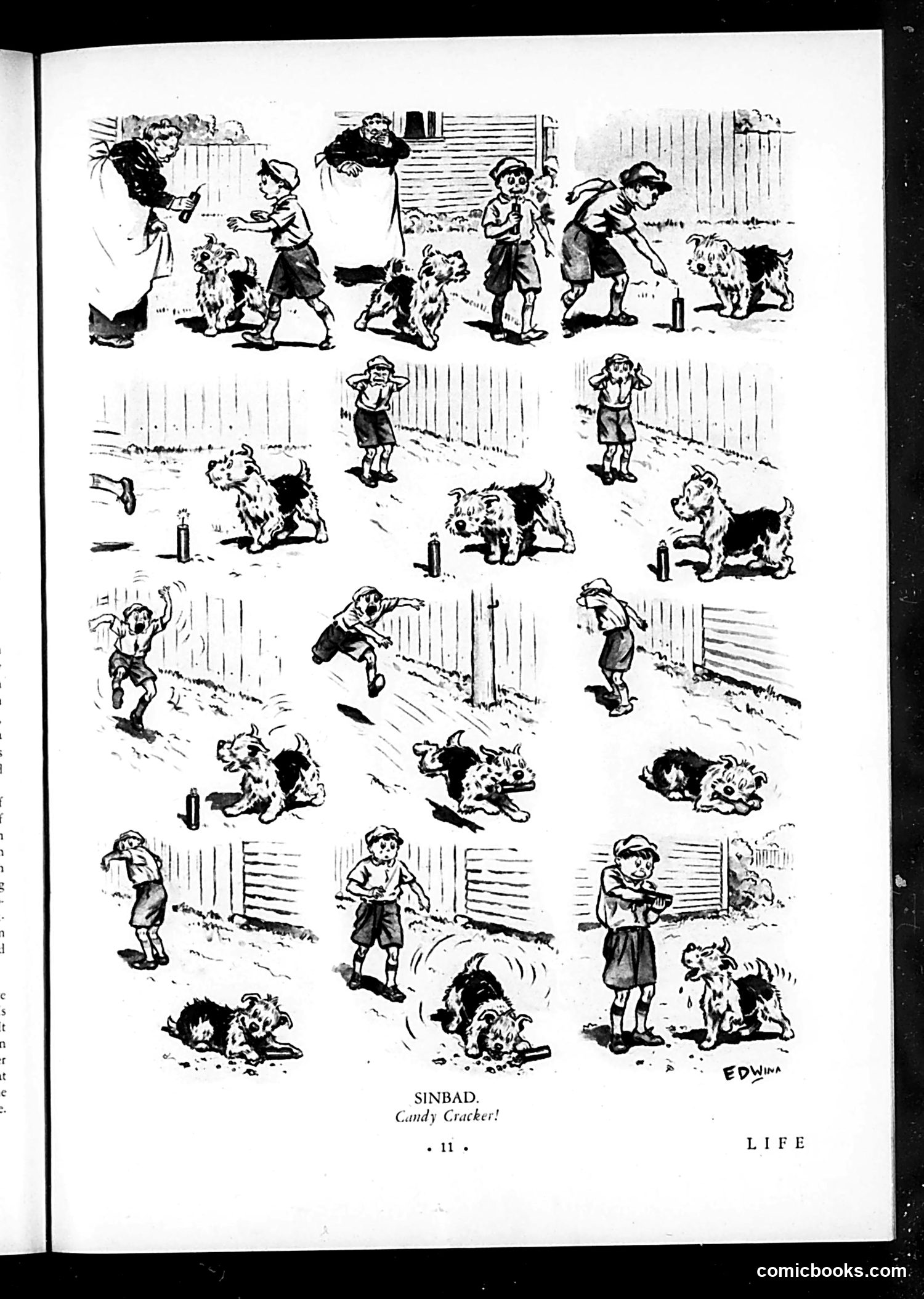
"Sinbad: Candy Cracker!" This is a humorous sequential comic strip showing children and dogs engaged in mischievous play around what appears to be a rural farmyard setting with wooden fences and buildings. The strip titled "Sinbad" (subtitle: "Candy Cracker!") depicts various scenes of children chasing, playing with, and being chased by dogs in increasingly chaotic situations. The humor derives from slapstick physical comedy—dogs knocking over children, children tumbling, and general pandemonium. The reference to "Candy Cracker" likely suggests the dogs are pursuing treats or that the children are using candy as bait during their games. The strip appears to be gentle, observational humor about childhood play and pet interactions rather than political satire. It's simply entertaining comic illustration of rural children's antics.
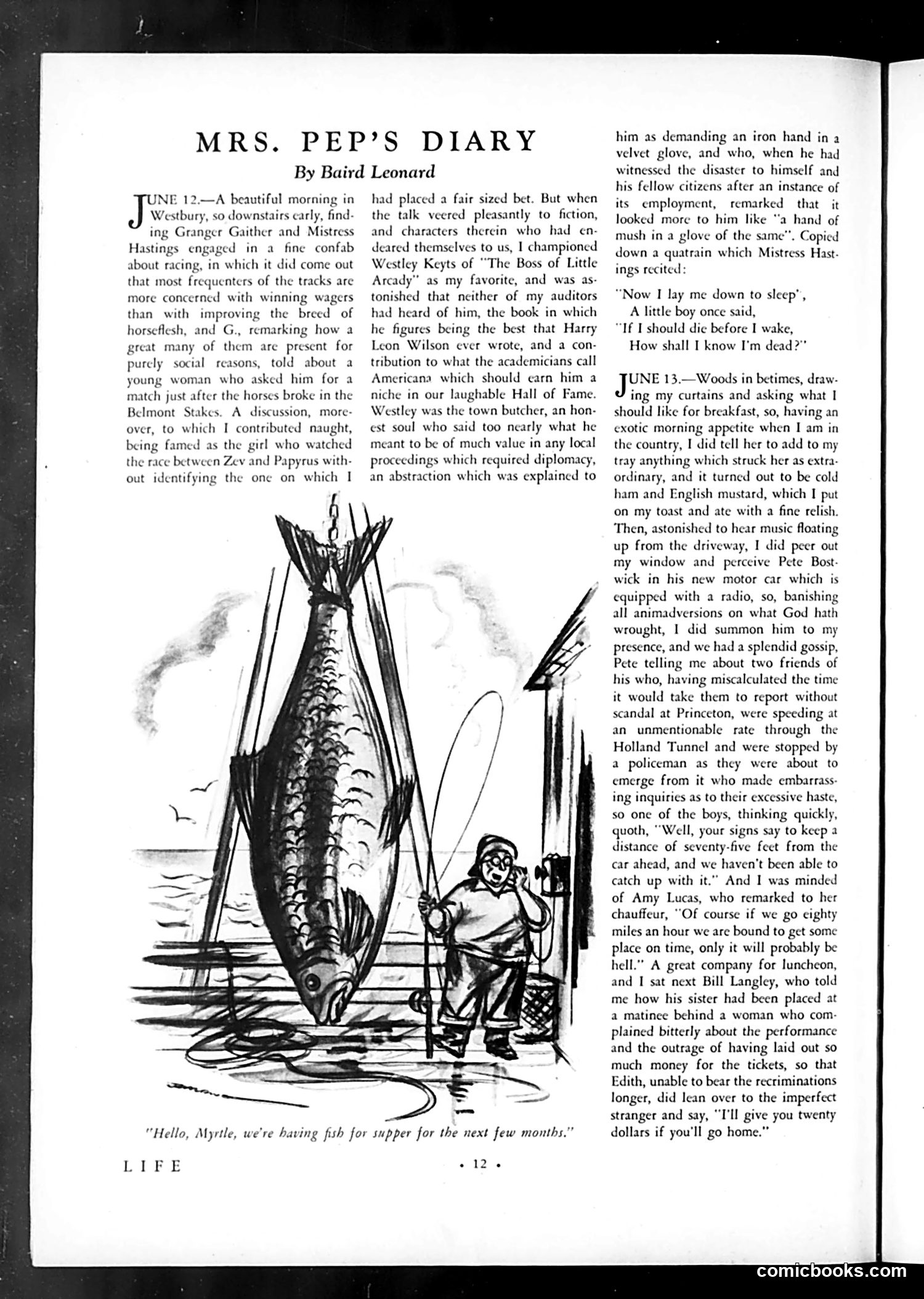
"Mrs. Pep's Diary" by Baird Leonard This is a humorous diary entry format satirizing domestic life. The illustration shows a fisherman with an enormous catch—a massive fish labeled as supper "for the next few months," with the caption "Hello, Myrtle, we're having fish for supper for the next few months." The joke mocks the Depression-era economic hardship: a lucky fisherman's outsized catch becomes an ironic blessing that forces repetitive, monotonous meals. The diary entries describe mundane social observations—horse racing, visiting friends, a speeding motorist with a radio in his new car—typical small talk the author gently ridicules. The satire targets middle-class affectations and domestic tedium rather than specific political figures, using everyday situations to create gentle social commentary on 1920s-30s American life.
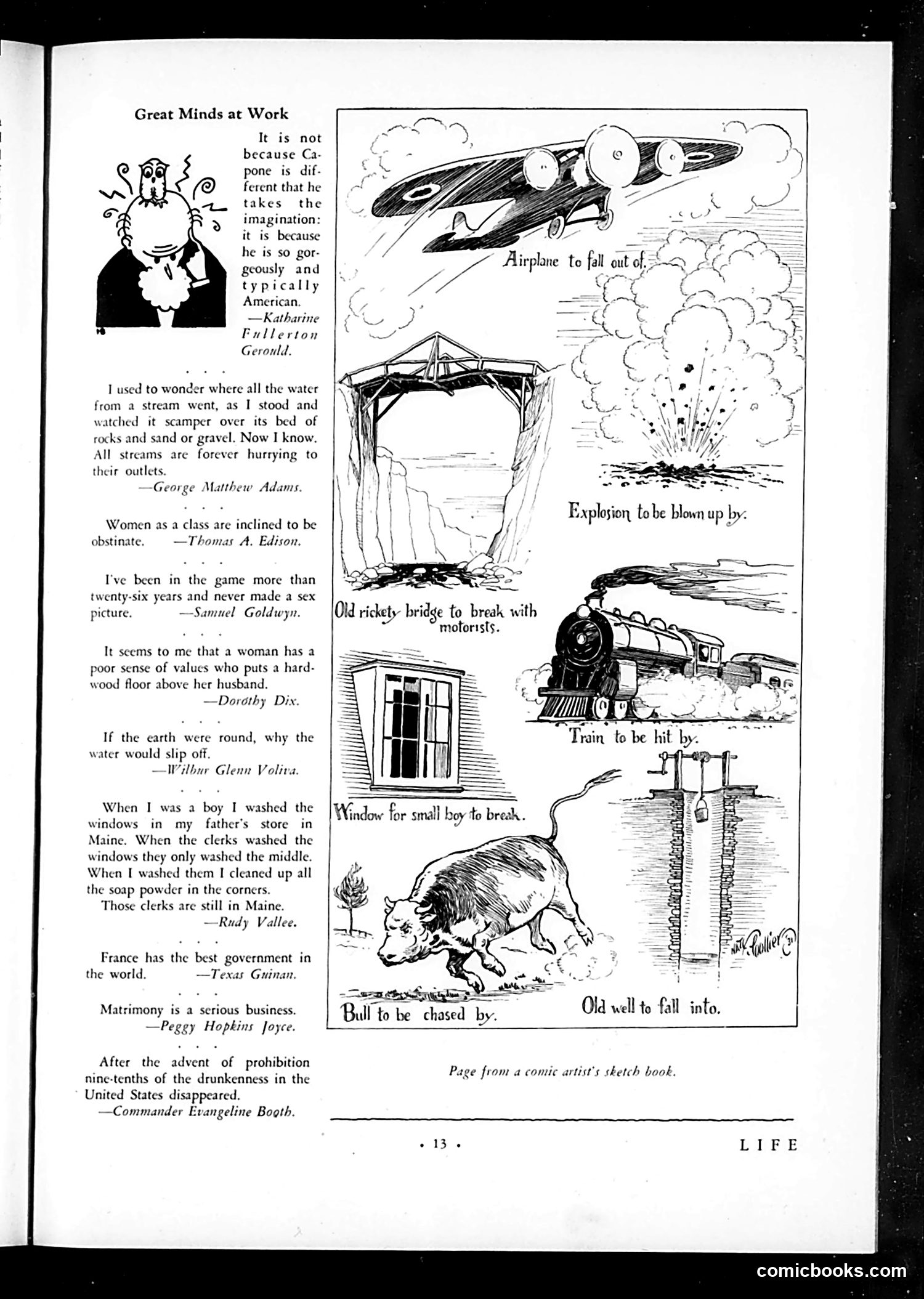
Page Analysis: Life Magazine Satire This page combines celebrity quotes with humorous comic sketches. The left side features "Great Minds at Work"—witty observations from figures like Katharine Fullerton Gerould, George Matthew Adams, and Thomas Edison on human nature and society. The right side shows a comic artist's sketch book depicting absurd accident scenarios: an airplane falling into clouds, an explosion, an old rickety bridge collapsing with motorists, a train about to be hit, a boy breaking a window, a bull chasing someone, and a well someone might fall into. The juxtaposition creates satire: the earnest philosophical quotes contrast with the ridiculous, slapstick disaster scenarios, mocking both pretentious intellectualism and physical comedy tropes common in early cinema and illustrated humor.
Analysis This page is primarily text—a political commentary article titled "Life in Washington" by Carter Field discussing the 1932 Democratic presidential nomination. The piece examines whether Joe Robinson (Arkansas senator and eventual VP nominee) can secure the Democratic nomination without New York's support. It references: - Franklin D. Roosevelt's anticipated nomination - Al Smith (former NY governor), whose religious intolerance allegedly damaged Robinson's standing among Northeast Democrats - Thad Caraway (Arkansas politician), characterized as a Roosevelt loyalist making public denouncements - Charles Murphy of Tammany Hall, described as hostile to Roosevelt The satire criticizes political maneuvering: Robinson's supporters claim he needs no New York delegates, yet their assertions seem defensive. The piece suggests Southern Democrats recognize only a "wet" (anti-Prohibition) Southerner would gain Northern acceptance—exposing the limits of their political power and regional divisions within the party.
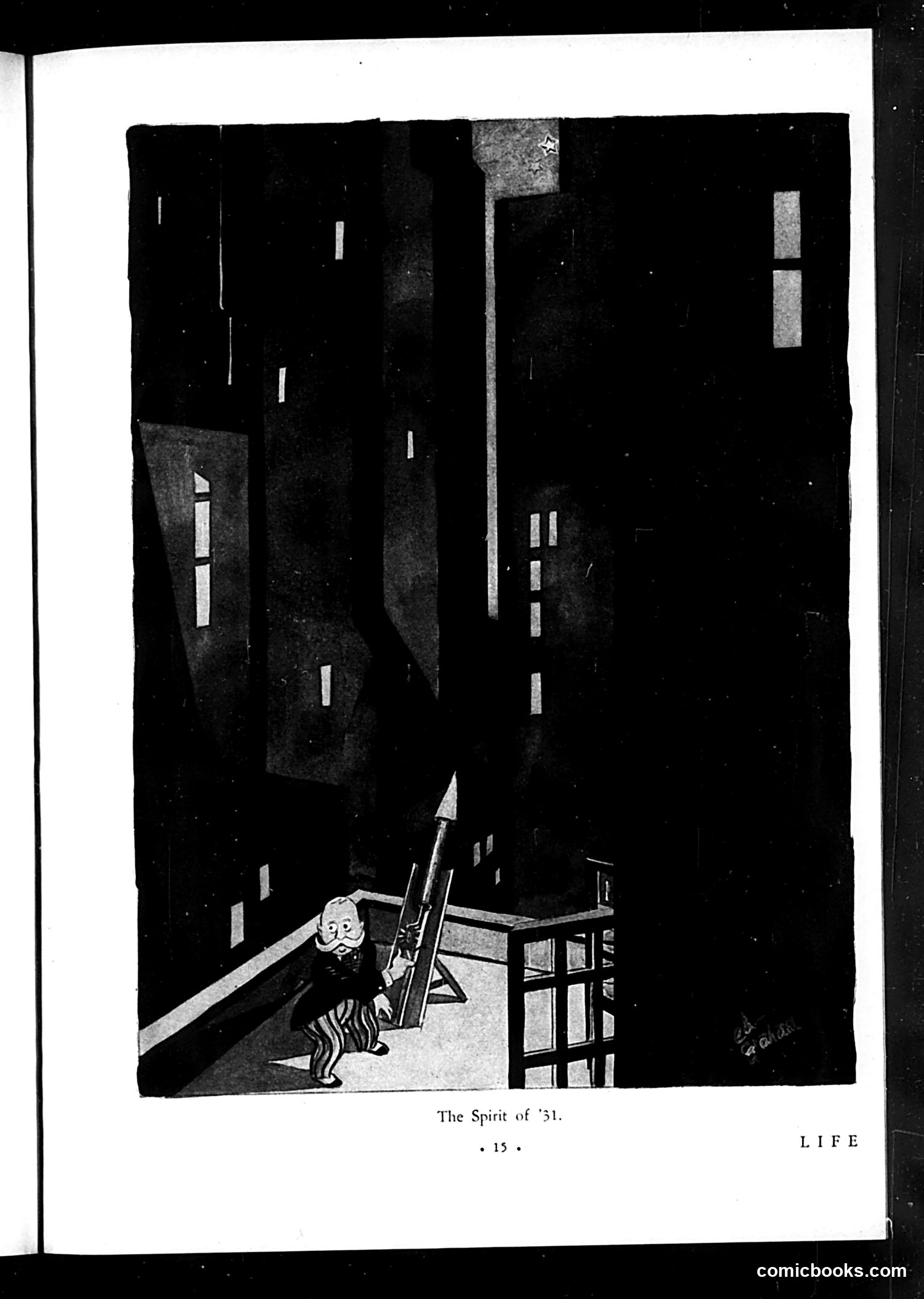
"The Spirit of '31" This political cartoon depicts a caricatured figure in what appears to be 1930s attire, holding a rifle while crouched in an urban alleyway at night. The towering dark buildings create an ominous atmosphere. The title "The Spirit of '31" appears to reference 1931, likely commenting on contemporary social conditions during the Great Depression era. The cartoon seems to satirize desperation and potential violence or lawlessness emerging from economic hardship. The figure's hunched posture and weaponry suggest criminality or civil unrest. The stark black-and-white imagery emphasizes the darkness of the period. Without additional context, the specific reference remains somewhat unclear, though it likely critiques either Depression-era poverty driving crime or contemporary social upheaval.
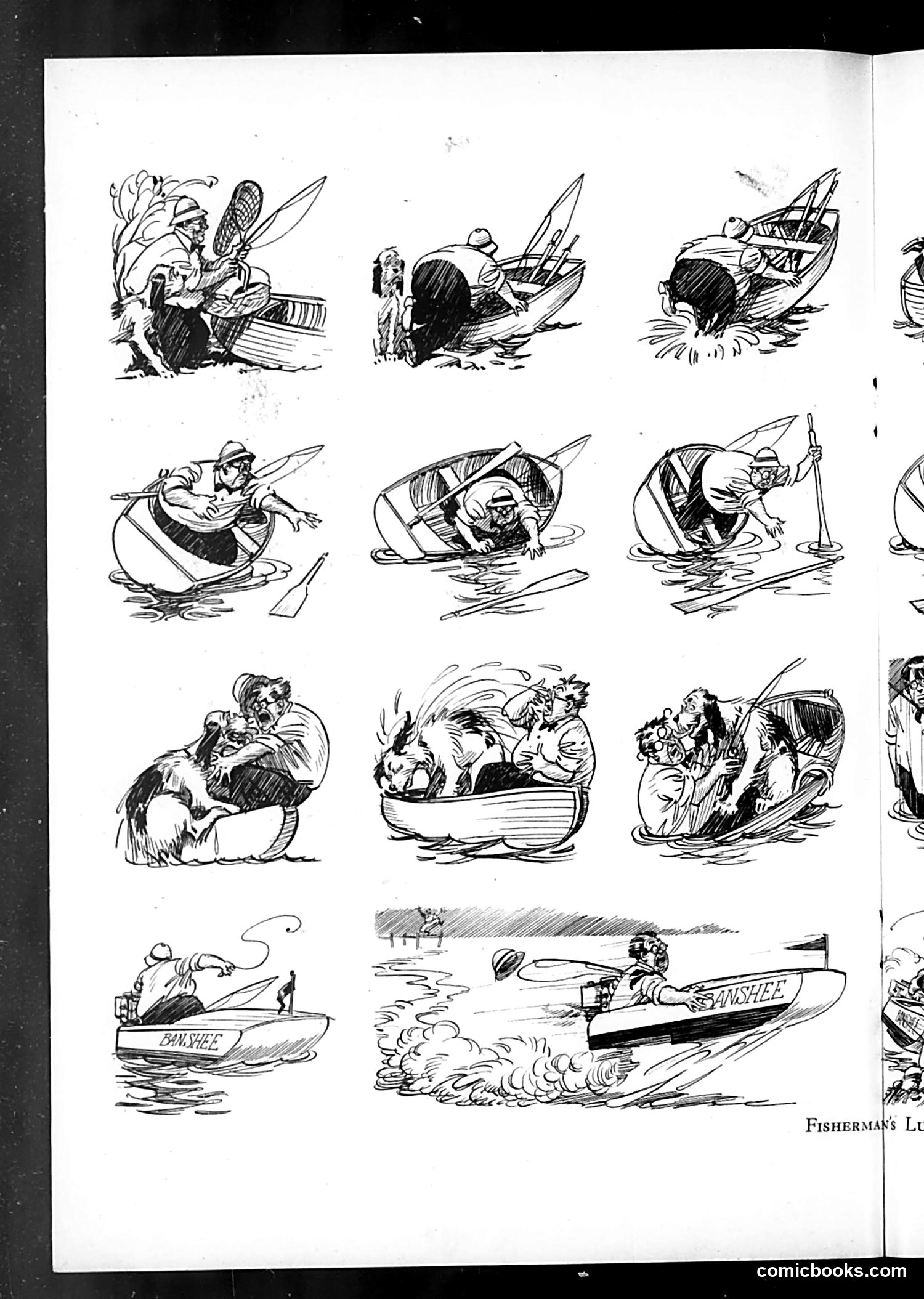
Fisherman's Luck This appears to be a humorous comic strip sequence depicting various fishing mishaps and comedic scenarios involving fishermen in small boats named "Banshee." The drawings show slapstick situations: characters struggling with fish, boats tipping or capsizing, fishermen falling into water, and general chaos associated with amateur fishing attempts. The humor relies on visual gags rather than political commentary—pratfalls, unexpected consequences, and the contrast between fishermen's expectations and reality. The repeated boat name "Banshee" suggests these are recurring characters. This represents Life magazine's tradition of lighthearted domestic humor about recreational activities, poking fun at everyday Americans' leisure pursuits rather than addressing serious political issues.
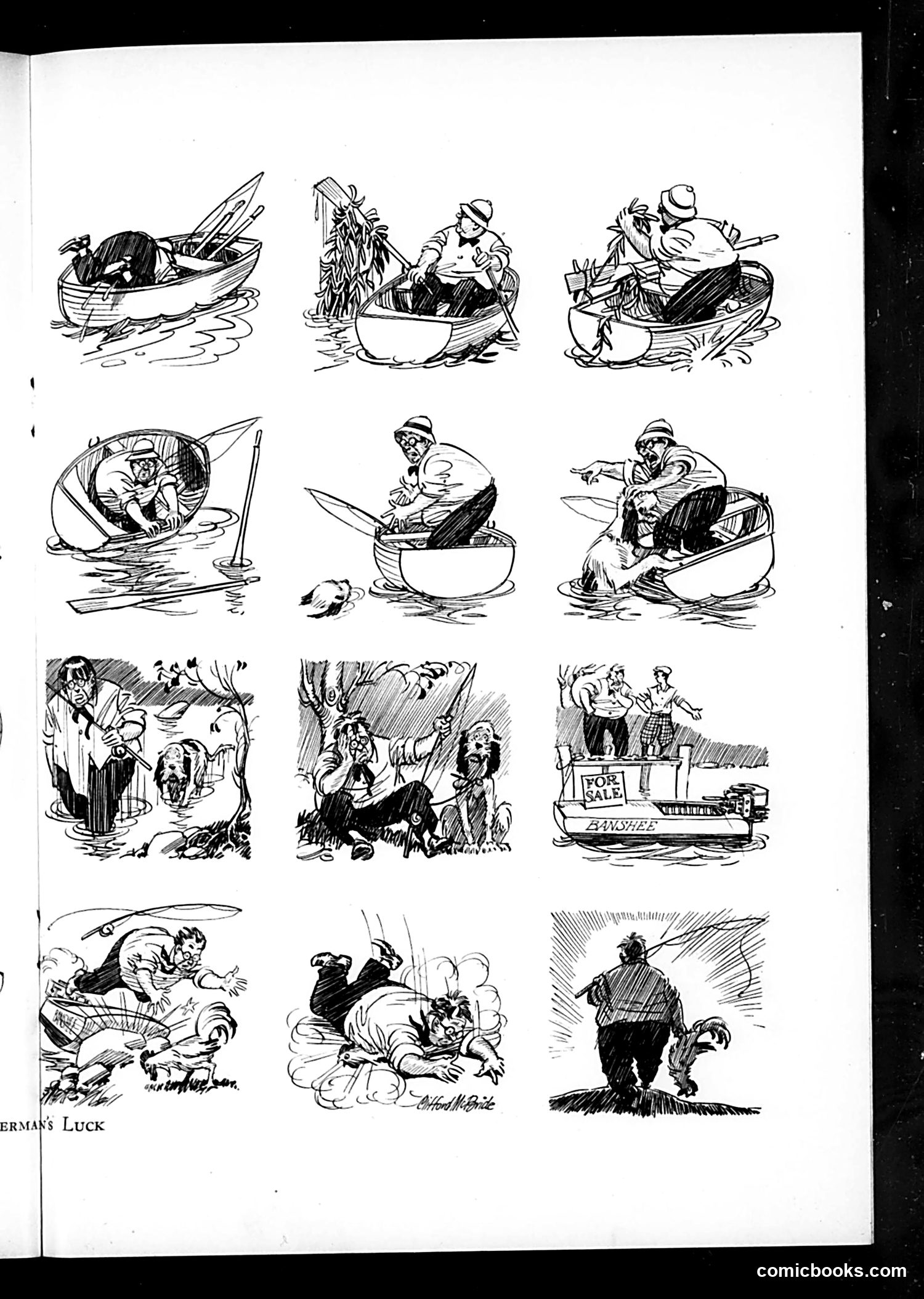
"A Fisherman's Luck" This is a humorous comic strip showing twelve panels depicting a fisherman's increasingly absurd catch. The sequence progresses from realistic fishing scenarios (boats, nets, oars) to increasingly surreal and chaotic situations—the fisherman pulls up various unexpected objects and creatures, culminating in what appears to be explosive or violent outcomes in the final panels. The title "A Fisherman's Luck" suggests ironic commentary on unpredictability and misfortune. Rather than catching fish, the protagonist encounters progressively worse situations, playing on the common expression about "bad luck." The humor derives from escalating absurdity and slapstick-style consequences. Without clearer visibility of all details, the specific satirical targets remain unclear, though it may reference general themes of incompetence or Murphy's Law.
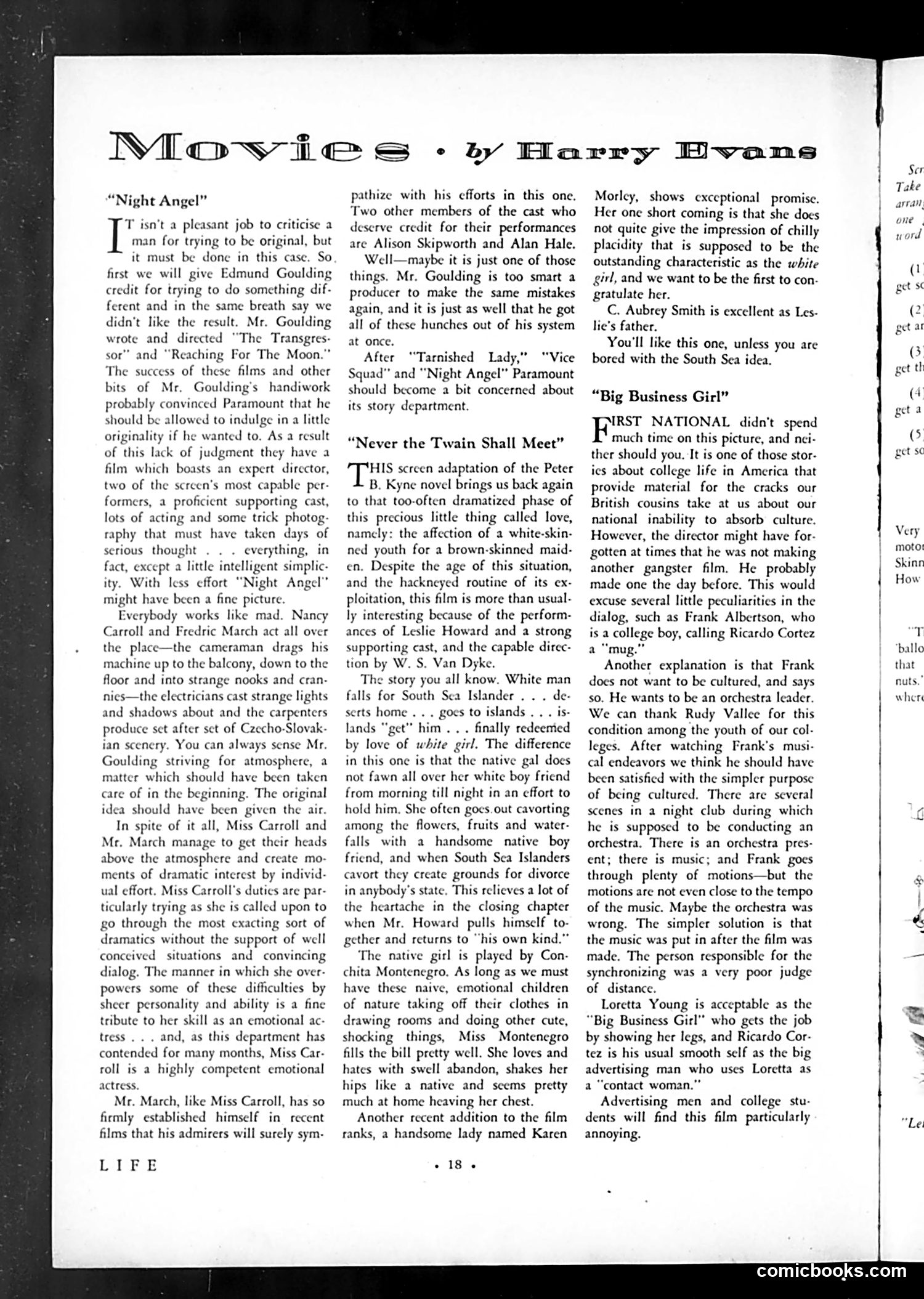
Movies by Harry Evans - Film Reviews This page contains film reviews from Life magazine's movie column. The reviews discuss several films including "Night Angel," "Never the Twain Shall Meet," and "Big Business Girl." The reviews critique the films' storylines and performances. For example, the "Night Angel" review praises Nancy Carroll and Fredric March's acting while noting the film's somewhat predictable plot. The "Never the Twain Shall Meet" review discusses a Peter B. Kyne novel adaptation about a white man and Eurasian woman's romance, with reviewers expressing mixed feelings about how the romance is portrayed. "Big Business Girl" is criticized for superficial dialogue and casting choices, though the reviewer acknowledges it has entertainment value. The tone is characteristically satirical and opinionated, typical of Life magazine's entertainment coverage from this era.
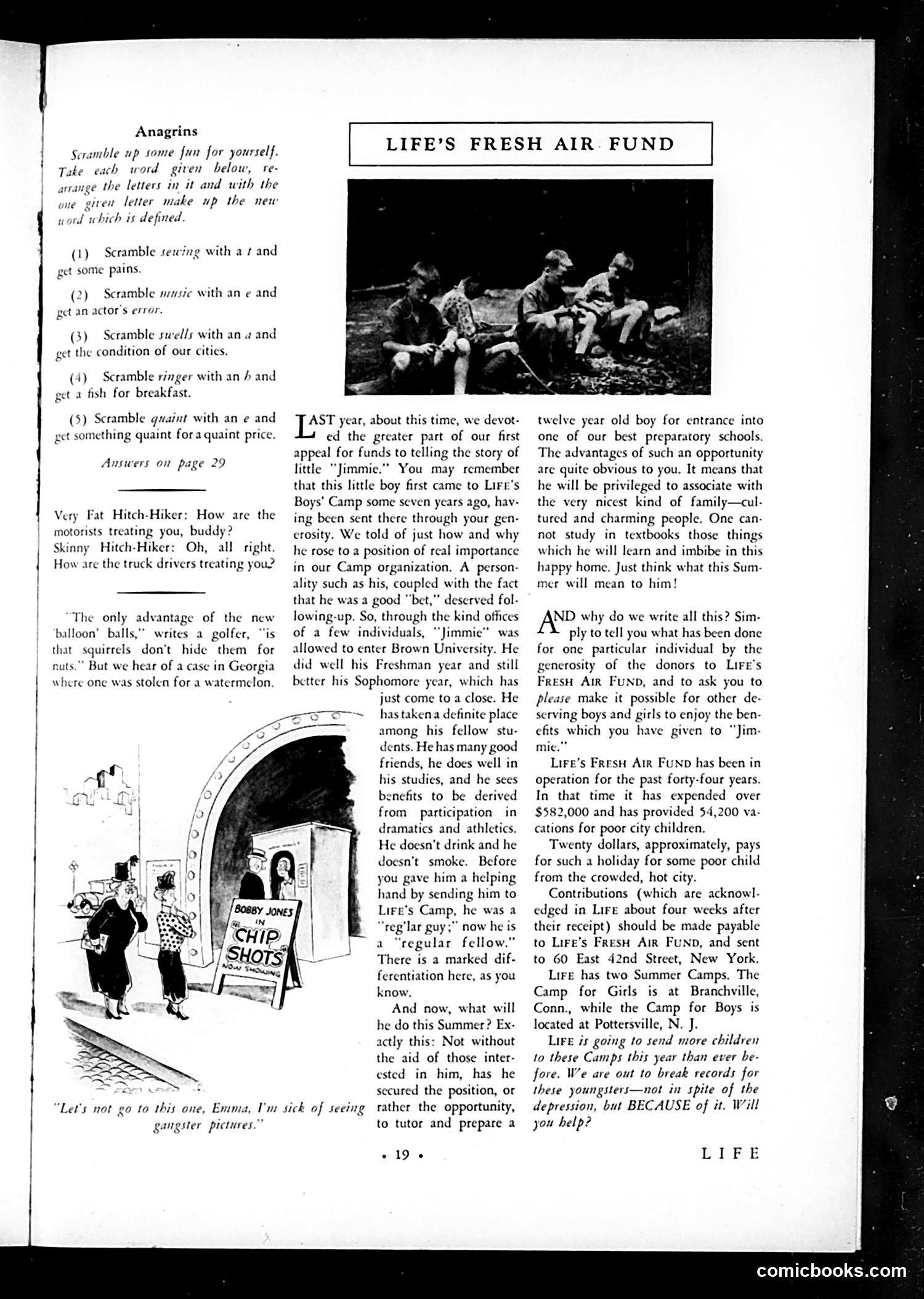
Life Magazine Page Analysis This page contains a charitable appeal for Life's Fresh Air Fund, which provides summer camp experiences for underprivileged children from crowded cities. The main article tells the story of "Jimmie," a poor boy who attended the camp seven years prior and went on to attend Brown University—presented as an success story of the Fund's impact. The small cartoon at bottom-left depicts a woman and child at a movie theater, with the woman saying "Let's not go to this one, Emma, I'm sick of seeing gangster pictures," appearing to satirize the prevalence of crime films in 1930s cinema. The page mixes charitable fundraising with social commentary about entertainment trends of the era.
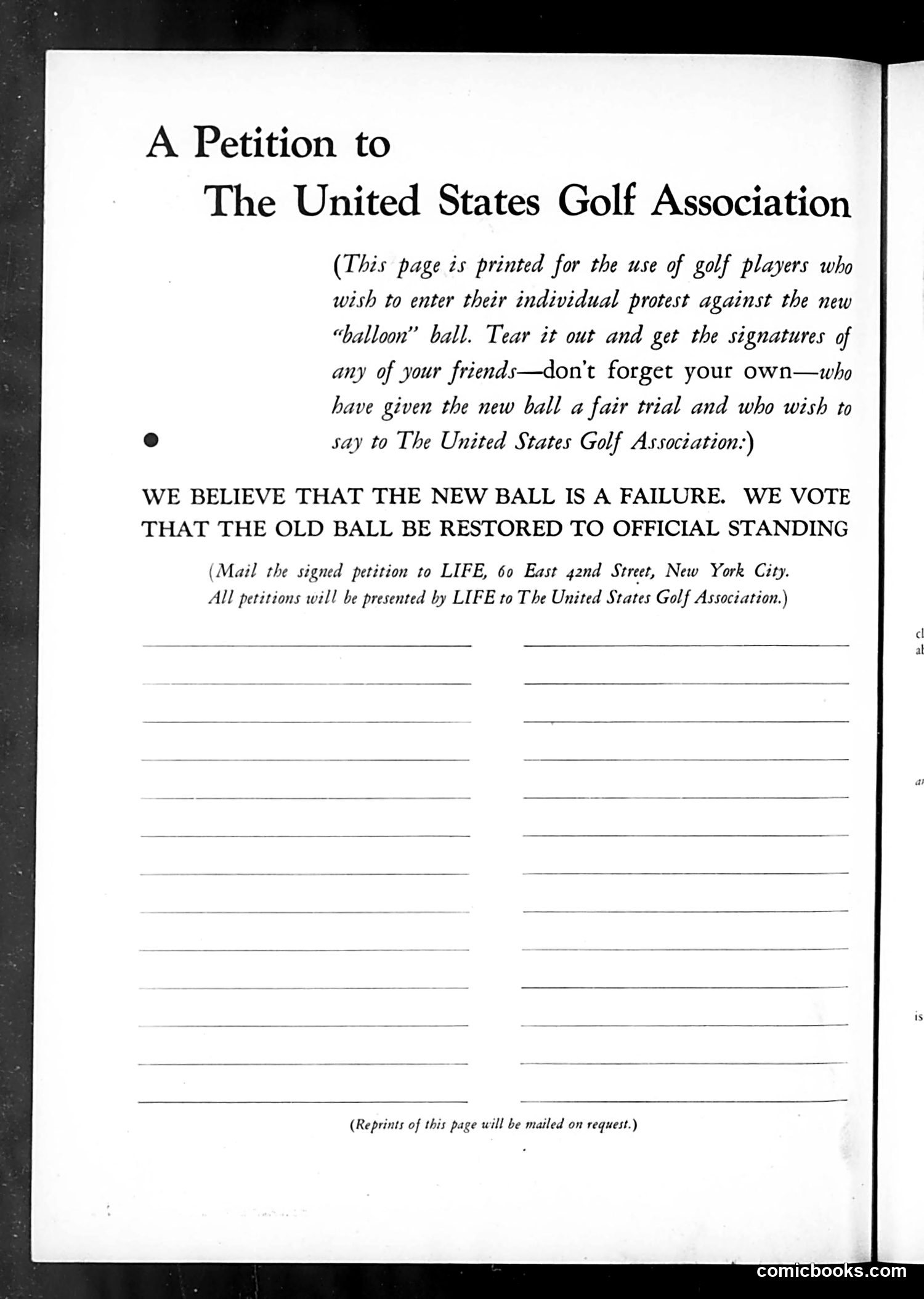
Life Magazine Golf Ball Petition This page is a petition form, not a cartoon. Life magazine is inviting readers to protest against a newly-approved "balloon" ball in golf by collecting signatures from fellow players. The context: The United States Golf Association had approved a new golf ball design (the "balloon" ball), which some players believed was inferior to the traditional ball. Life, as a satirical publication, gave its readers a tool to voice collective opposition—a humorous but functional petition. Readers would tear out the page, gather signatures from golfers who agreed the new ball was a failure, and mail it to Life's offices. Life would then present all collected petitions to the USGA. This reflects Life's role as both entertainer and advocate for its readership's interests, using humor and participatory mechanics to mobilize opinion on a matter the magazine deemed worthy of attention.
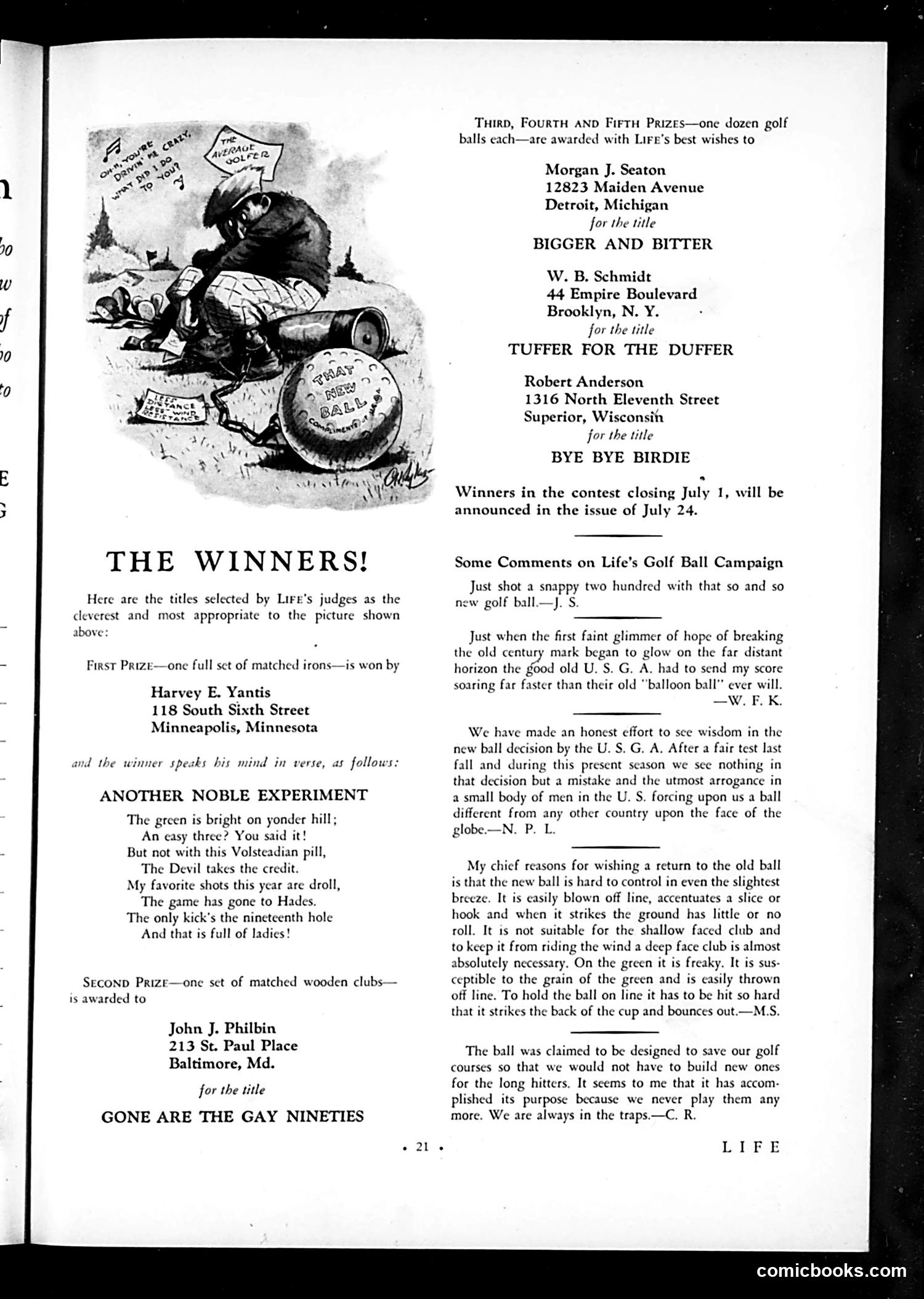
Life Magazine Golf Ball Contest Page This page announces winners of Life's contest to create witty titles for a golf cartoon (not fully visible here). The winning entries satirize the U.S. Golf Association's controversial 1931 decision to mandate a new "balloon ball" design, which played differently from the traditional golf ball. The first-prize winner's poem, "Another Noble Experiment," mocks this change by invoking Prohibition ("Volsteadian pill"—referencing Volstead Act), suggesting the new ball is as misguided as alcohol prohibition. The title "Gone Are the Gay Nineties" laments nostalgia for an earlier era of golf. The reader comments below expose genuine golfer frustrations: the new ball is harder to control in wind, bounces unpredictably on greens, and paradoxically hasn't saved courses since players avoid using it. The satire targets the USGA's top-down decision imposed without player consent, framed as an arrogant American exception contrary to international golf standards.
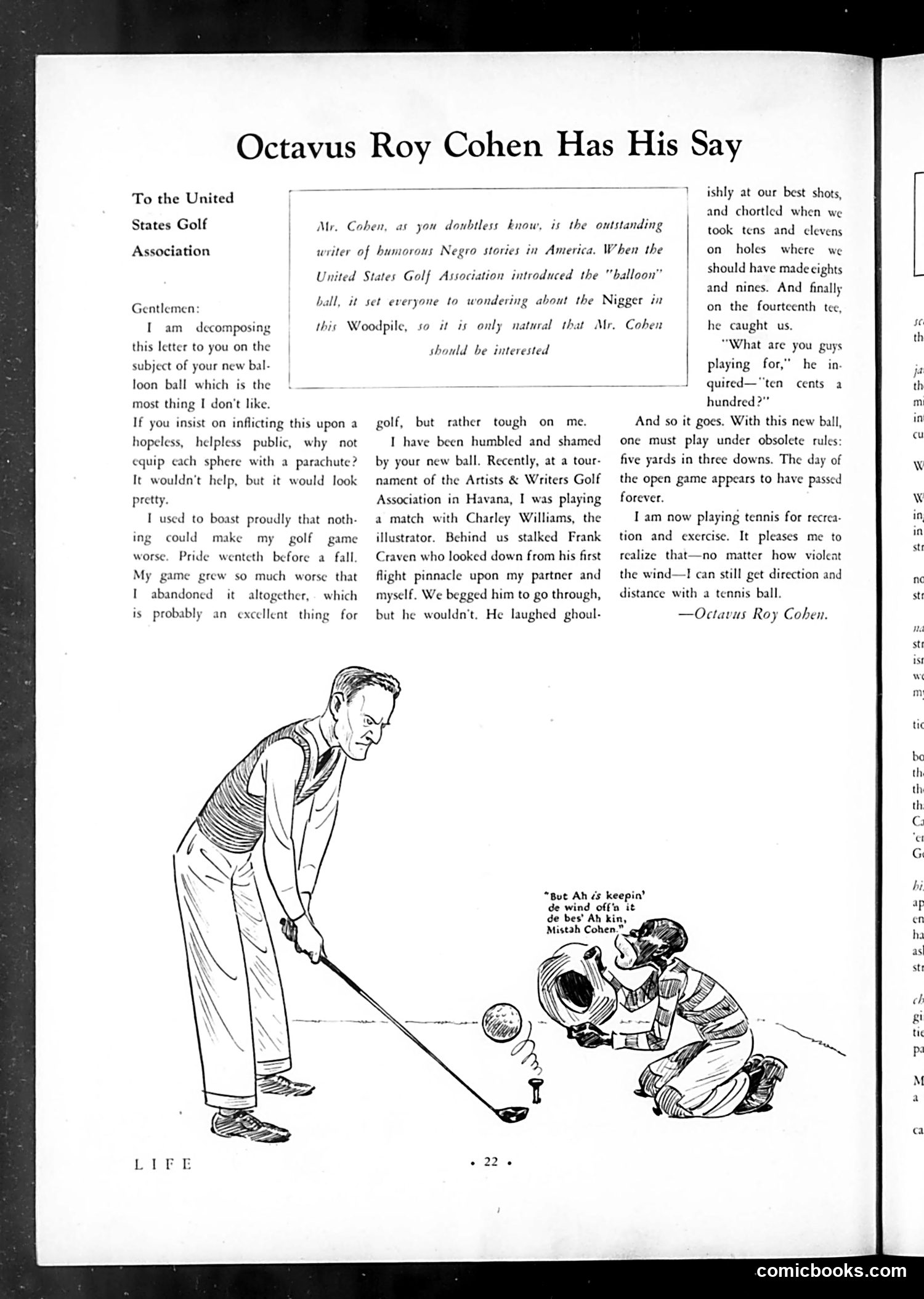
Analysis of "Octavus Roy Cohen Has His Say" This is a humorous sports commentary piece, not primarily political satire. Octavus Roy Cohen, a real writer known for humor stories, complains about the USGA's new "balloon ball" (a golf ball design) that allegedly made the game harder by traveling unpredictably. The accompanying cartoon illustrates Cohen's frustration: an adult golfer swings while a young Black caddy struggles to shield the ball from wind, with the caption "'put Ah és keepin' de wind off'a it de bes' Ah kin, Mistah Cohen.'" The satire targets the new golf equipment, not race—though the illustration uses period-typical racial caricature in depicting the caddy (exaggerated features, dialect speech). This reflects early 1900s publication standards. The joke is that even the caddy's efforts can't help with this defective ball. The piece mocks both the USGA's decision and Cohen's wounded pride as a golfer.
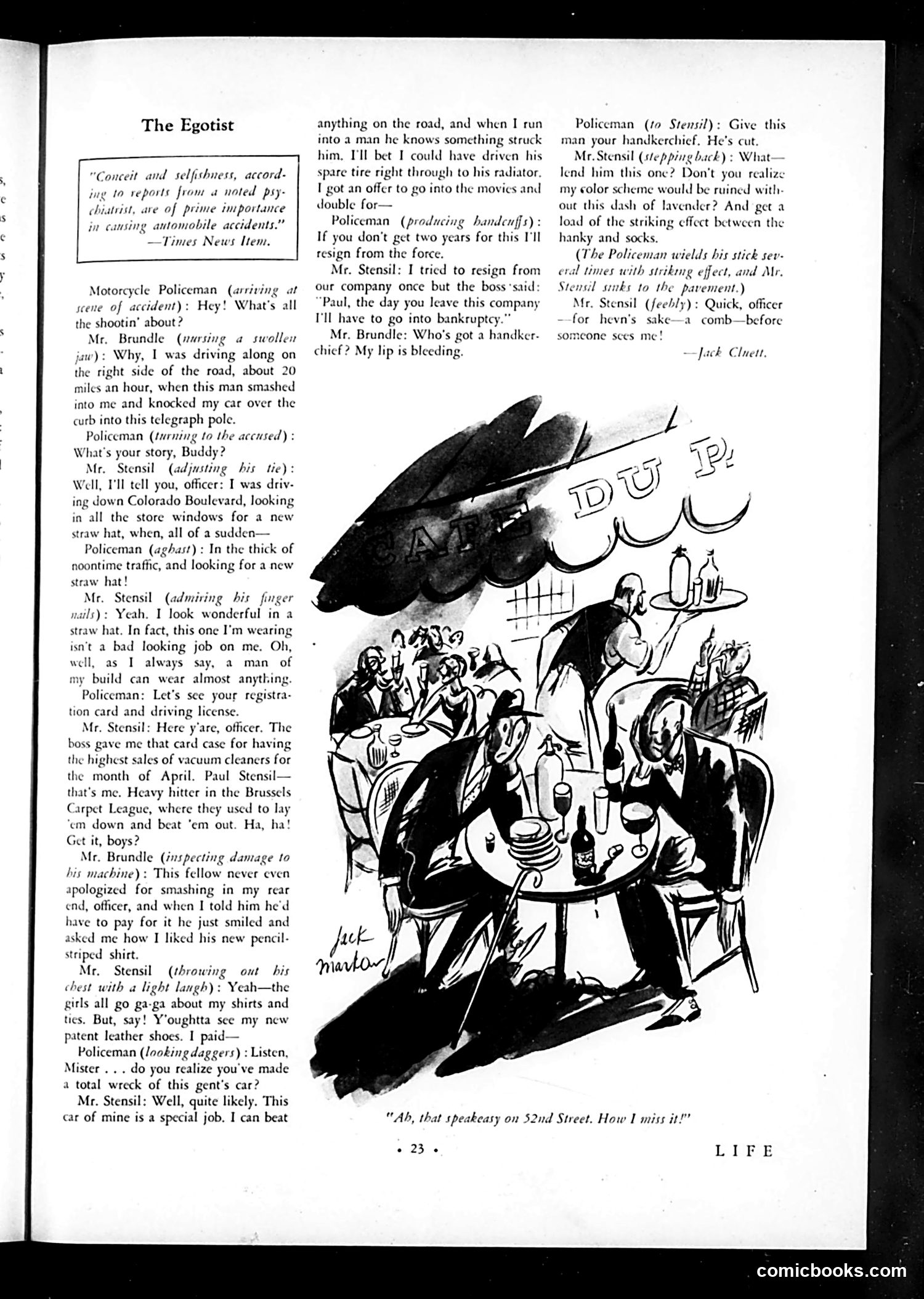
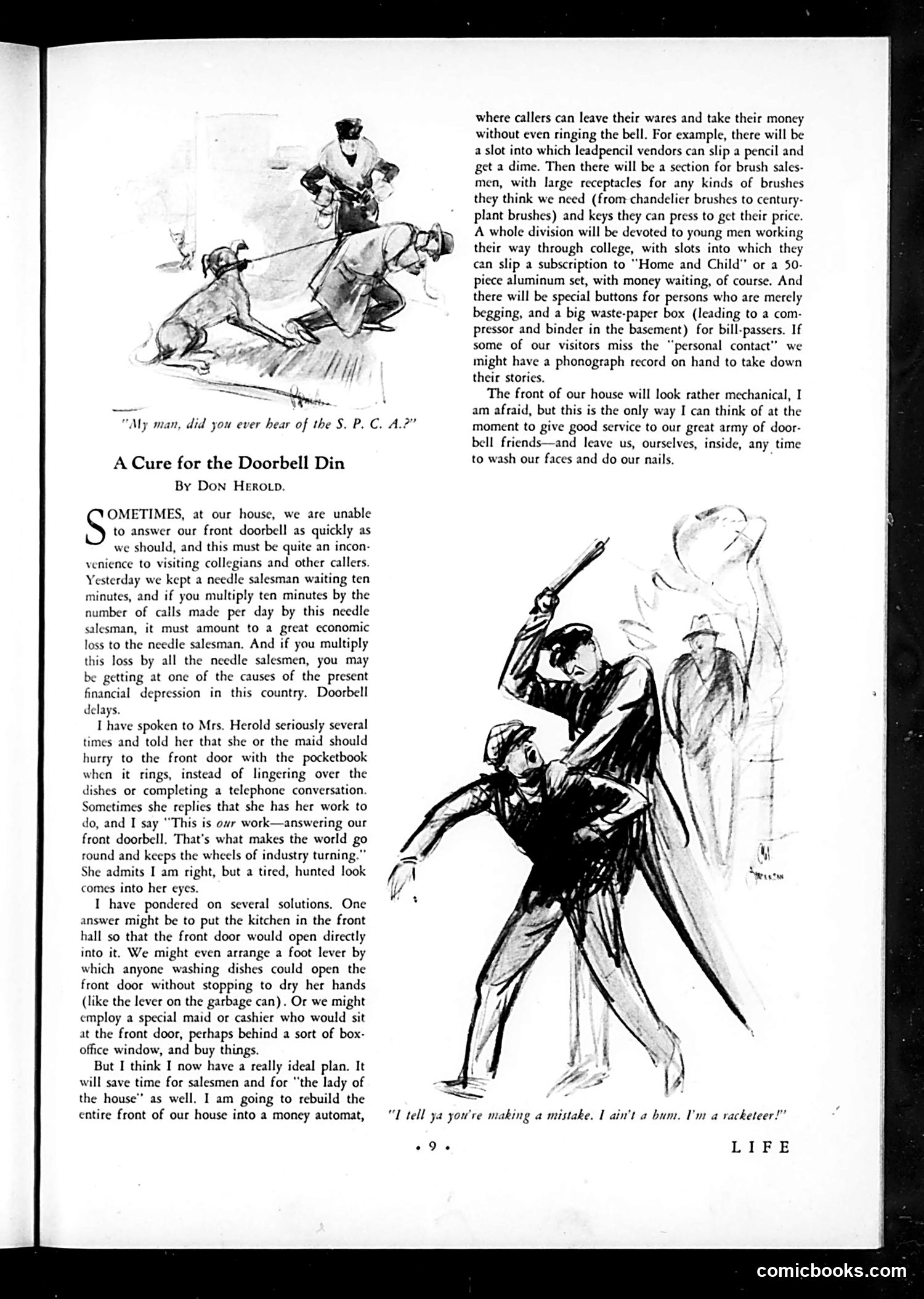
"The Egotist" Satire Explained This comic illustrates a 1920s-30s satirical piece about narcissism causing traffic accidents. Mr. Stensil causes a car crash while distracted by store windows shopping for a hat, but remains entirely self-absorbed throughout—boasting about his appearance, his vacuum cleaner sales record, his "special job" car, and even his lavender handkerchief's color scheme. The joke's point: despite causing genuine harm (Mr. Brundle's injuries and vehicle damage), Stensil cannot stop talking about himself. When asked to help the injured man with a handkerchief, he refuses because it clashes with his outfit. The policeman's violent response (beating him) represents society's exasperated rejection of such egotism. This satirizes the psychology concept mentioned in the header—that conceit and selfishness cause accidents. Stensil embodies the self-centered driver indifferent to others' welfare, a timeless social critique.
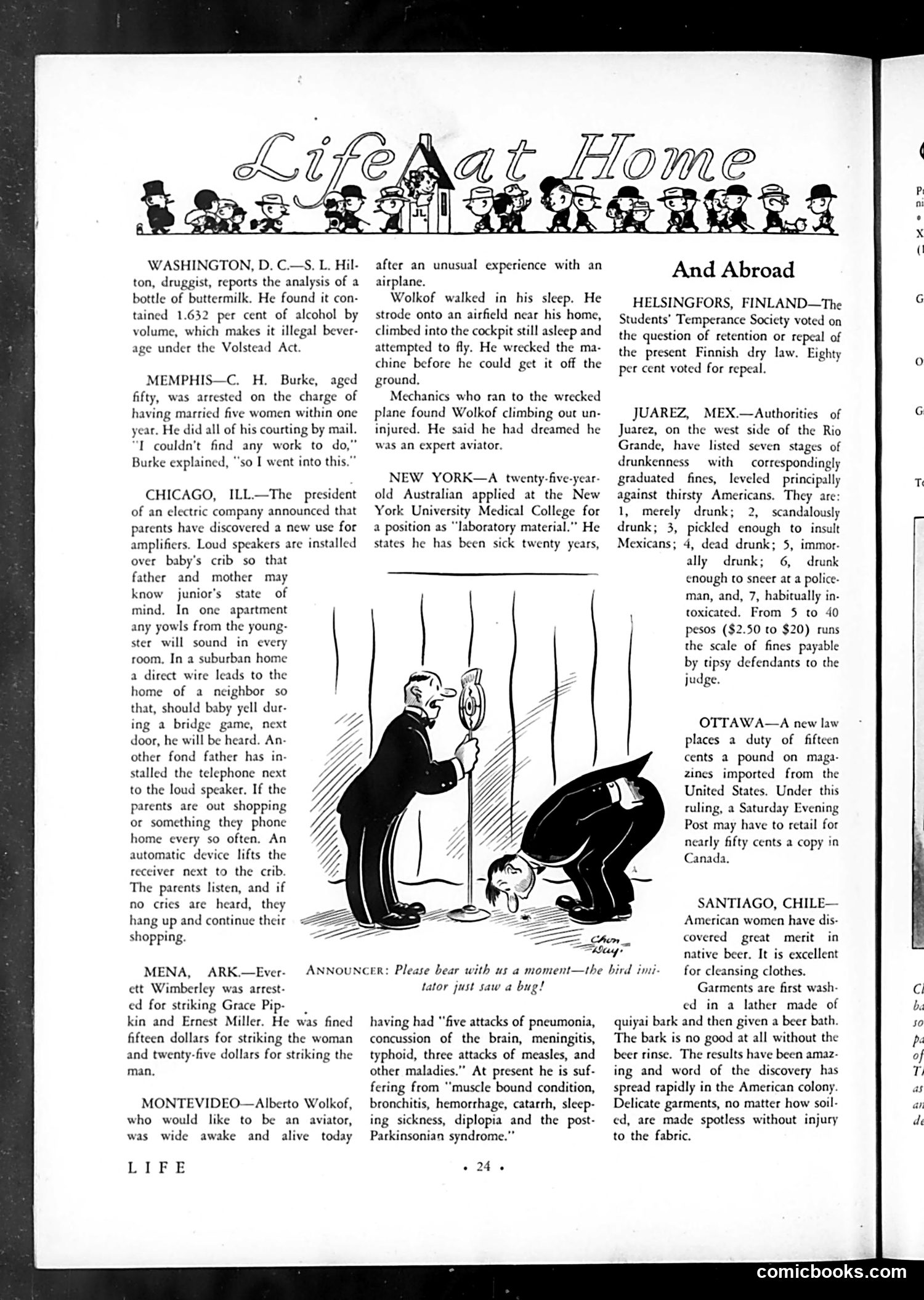
Life Magazine "Life at Home and Abroad" Page Analysis This page from Life magazine presents satirical news briefs—a regular feature mocking contemporary absurdities during Prohibition (1920-1933). The Cartoon: Shows a radio announcer speaking into a microphone while a man beside him bends over, apparently imitating a bird. The caption reads: "Please bear with us a moment—the bird imitator just saw a bug!" This satirizes early radio broadcasting's amateur entertainment and technical mishaps. The Text Items: These brief, deadpan news reports satirize American social problems: - Buttermilk illegally containing alcohol under the Volstead Act (Prohibition absurdity) - A man marrying five women by mail due to unemployment (Depression-era desperation) - Parents installing loudspeakers to monitor babies remotely (modern technology run amok) - A sleepwalker who climbed into an airplane cockpit The "And Abroad" section mocks other nations: Finland voting to repeal dry law, Mexico's detailed drunk-classification system with graduated fines, and Chile's use of native beer for laundry. The humor derives from Life's sardonic presentation of real events as symbols of modern society's excesses and technological absurdity.
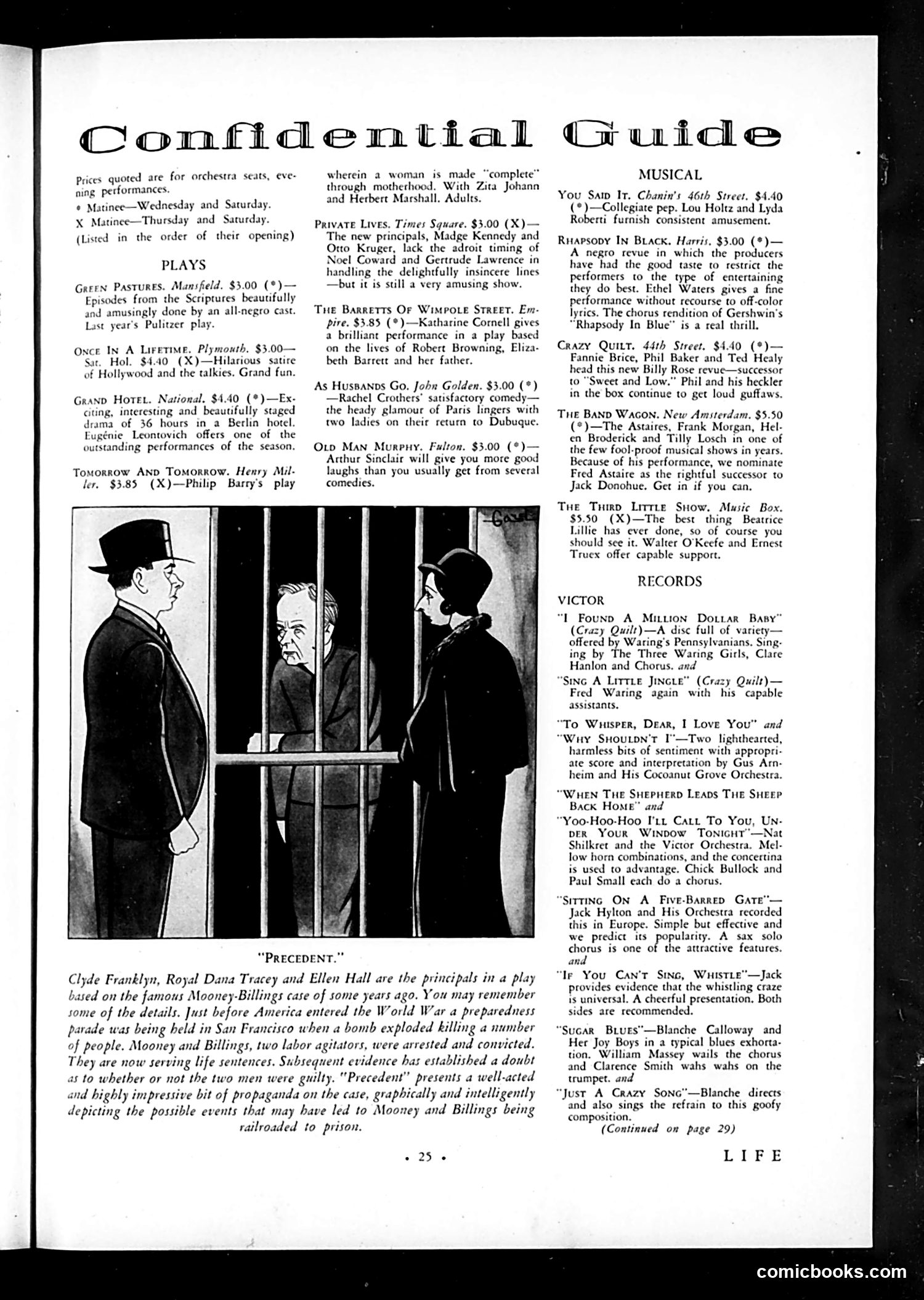
"Precedent" Cartoon Analysis This political cartoon illustrates the famous Mooney-Billings case, a real 1916 legal controversy. Two labor activists, Thomas Mooney and Warren Billings, were convicted for a San Francisco bombing that killed parade spectators. The image depicts what appears to be a prison visitation scene, with men in formal dress at a barred window. The accompanying text explains the case's significance: subsequent evidence suggested the convictions were wrongful, yet both men remained imprisoned. The play "Precedent" dramatizes this injustice, presenting it as a cautionary tale about how innocent people could be "railroaded to prison" through circumstantial evidence and legal error. For modern readers, this reflects Depression-era skepticism toward the justice system and sympathies for labor causes—the cartoon's serious tone contrasts sharply with the page's lighter theatrical reviews, underscoring the case's continued moral significance.
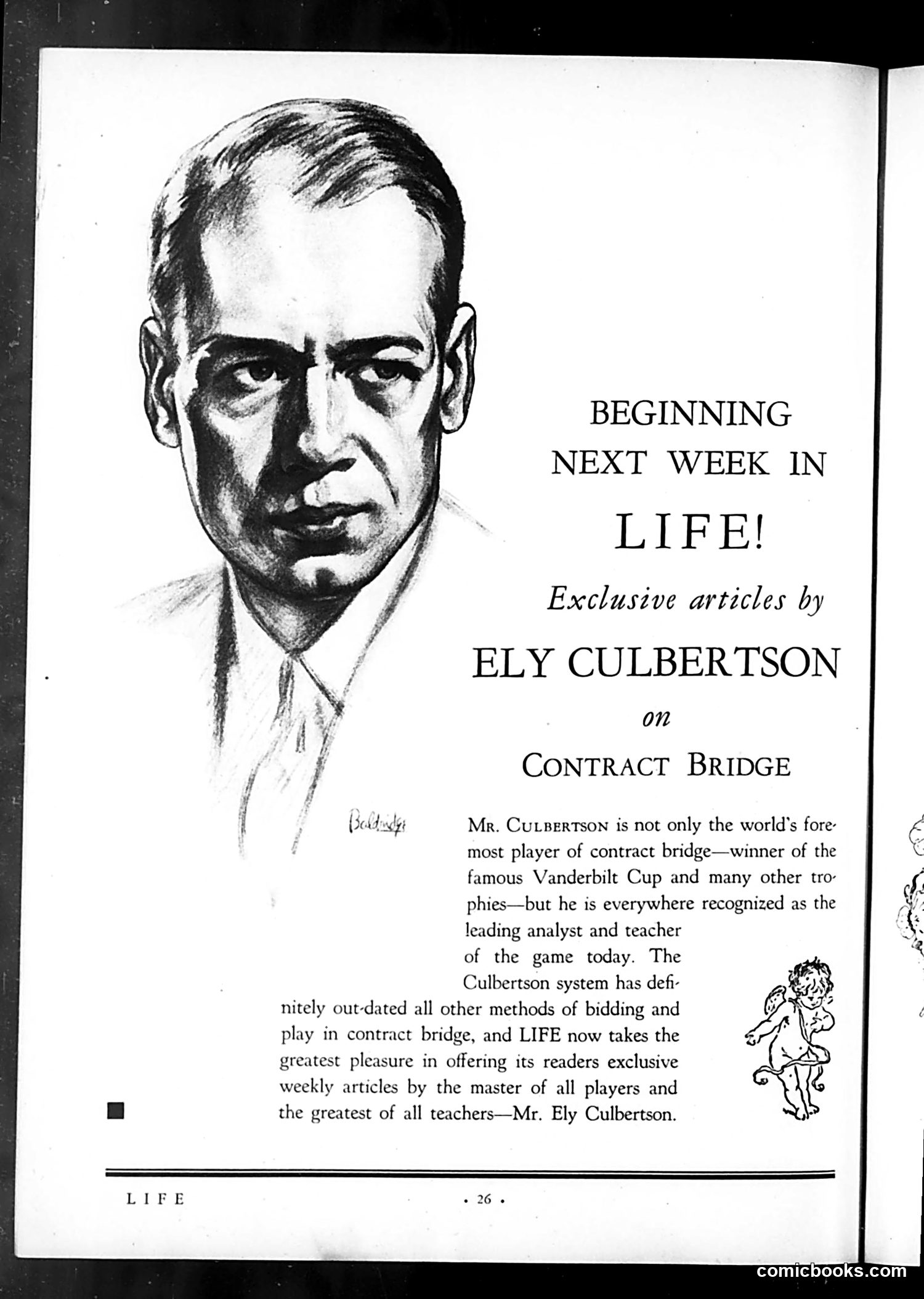
Analysis for Modern Readers This is primarily advertising content, not satire. It announces that *Life* magazine will begin publishing exclusive weekly articles by Ely Culbertson, a real historical figure who was the world's foremost contract bridge player and innovator of the "Culbertson system" of bidding. The page features a portrait sketch of Culbertson and promotes his expertise and credentials (Vanderbilt Cup winner, leading teacher/analyst). The text emphasizes that his system "definitely out-dated all other methods" of contract bridge play. Context for modern readers: Contract bridge was a major leisure activity and intellectual pursuit in early-to-mid 20th century America—comparable to chess today. Culbertson was a genuine celebrity in bridge circles. This is *Life* leveraging his fame to attract readers interested in the game, presenting his articles as exclusive and authoritative content.
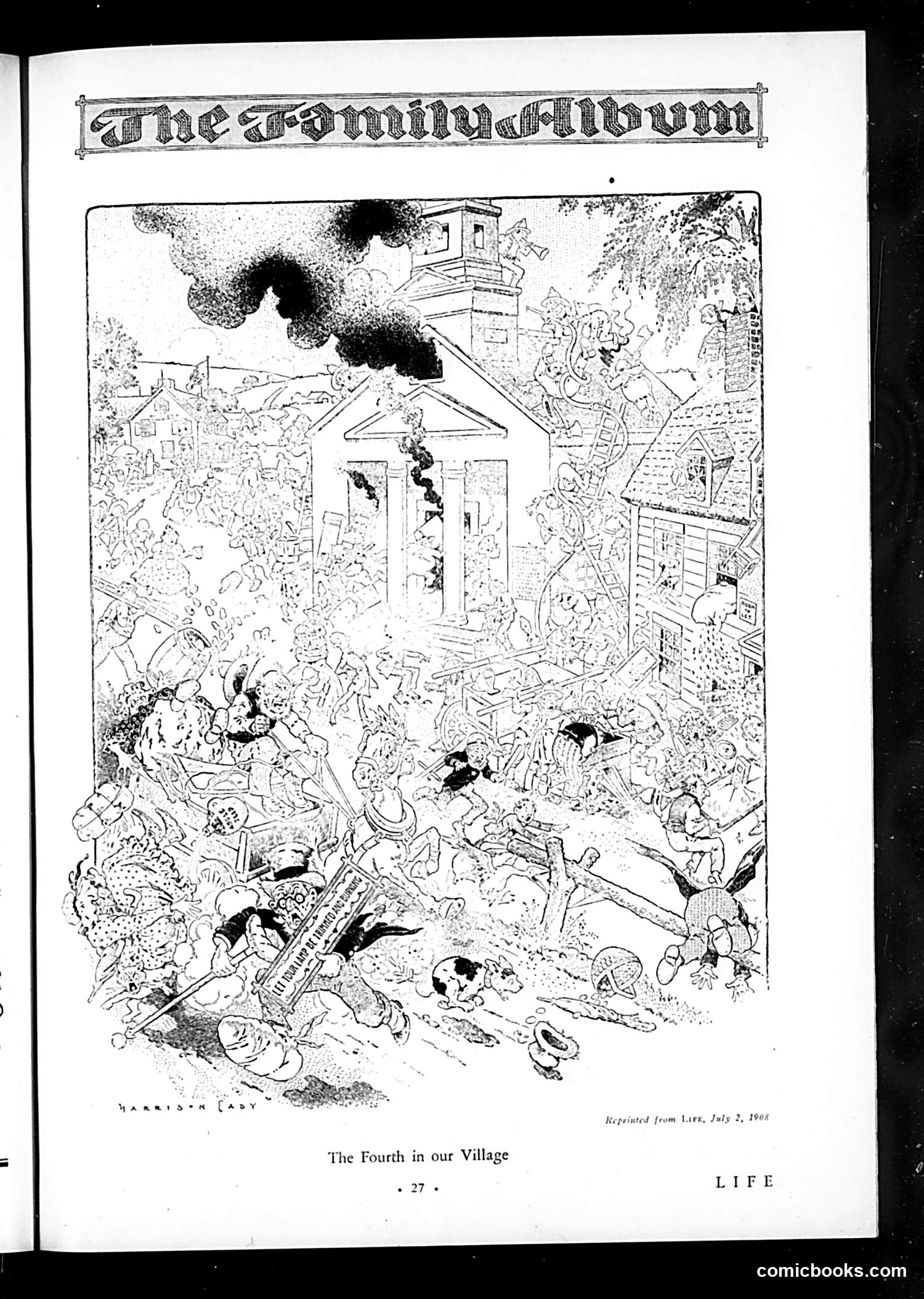
"The Fourth in our Village" This Warner Cody illustration depicts a chaotic Fourth of July celebration in a small American town. The drawing shows numerous figures engaged in various Independence Day activities—some appear to be setting off fireworks (indicated by the dark explosion clouds above the church), while others are scattered throughout the village square in states of disorder and revelry. The satire targets the unruly, dangerous nature of Fourth of July festivities, particularly fireworks use, which frequently caused injuries and property damage. The composition emphasizes the anarchic spirit of unconstrained celebration—people are strewn about haphazardly, suggesting the hazardous consequences of holiday excess in rural America. The church at the composition's center may underscore ironic tension between civic/religious order and celebratory chaos.
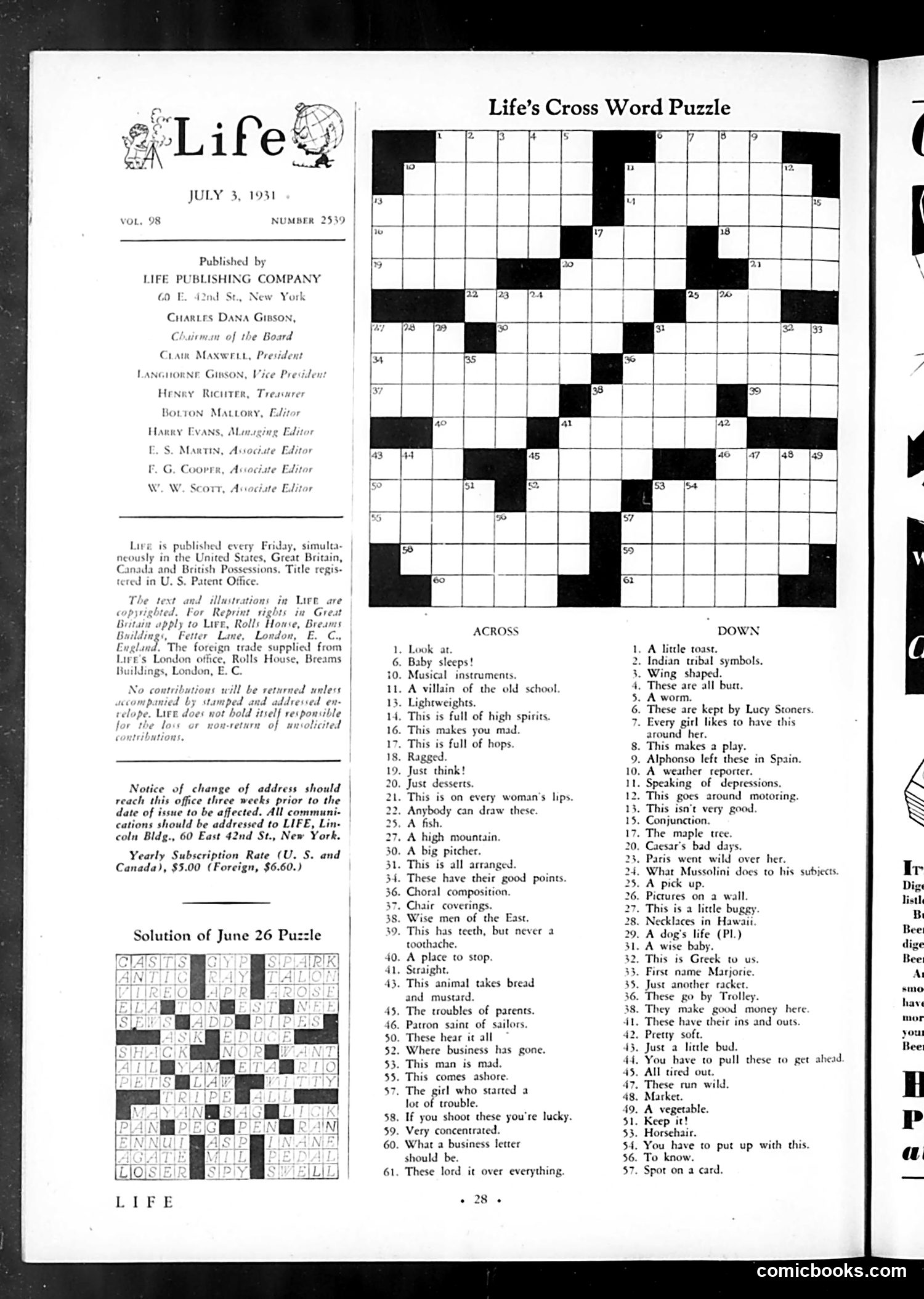
Life Magazine, July 3, 1931: Content Analysis This page is primarily administrative and puzzle content, not editorial cartoons or satire. It shows: Main Content: - Masthead listing Life Publishing Company leadership (Charles Dana Gibson, Chairman; Crain Maxwell, President) - A crossword puzzle titled "Life's Cross Word Puzzle" - Solution to the previous week's (June 26) puzzle Historical Context: Life was a major American satirical weekly magazine published simultaneously in the US, Britain, and Canada. This July 1931 issue appears during the Great Depression. Notable Elements: The crossword clues contain period references (Lucy Stoners—women's suffrage advocates; Mussolini; Caesar) reflecting contemporary 1931 concerns. The magazine's masthead shows professional editorial structure typical of major American publications of this era. Verdict: This is a standard magazine interior page featuring puzzles and publishing information, not satirical editorial content.
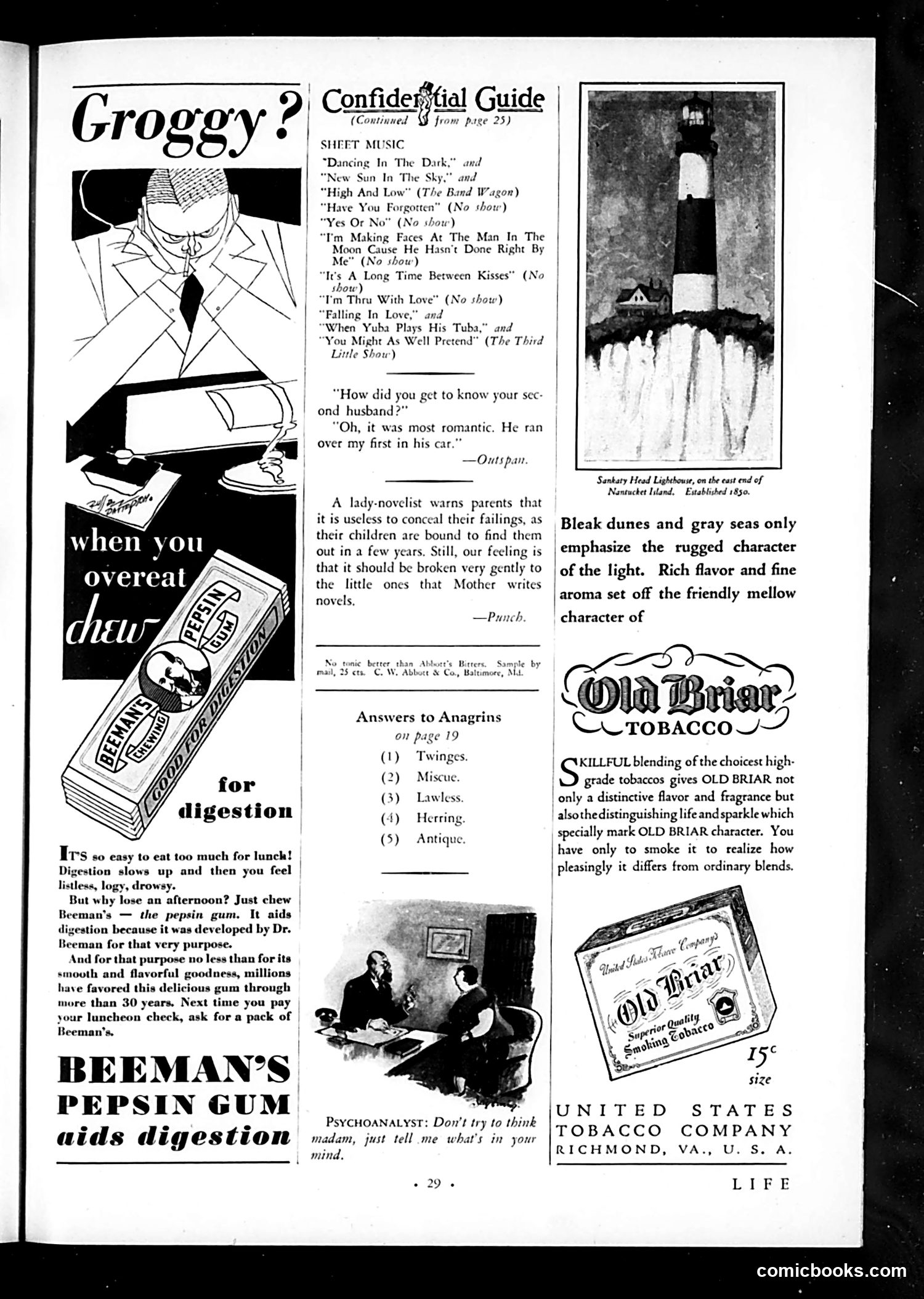
Page 29 of Life Magazine: Satire and Advertising This page mixes humor columns with period advertisements. The main cartoon shows a psychoanalyst and patient with the caption: "Don't try to think madam, just tell me what's in your mind"—satirizing the emerging psychoanalysis trend by suggesting patients can't think independently. A brief joke from *Punch* mocks a novelist's romantic second marriage story ("He ran over my first in his car"), darkly humoring infidelity and remarriage. The advertisements reflect 1930s consumer culture: Beeman's Pepsin Gum claims to aid digestion (pepsin was a marketed digestive enzyme), Abbott's Bitters touts medicinal properties, and Old Briar Tobacco uses landscape imagery to suggest sophistication. The sheet music listings reference contemporary Broadway shows like *The Band Wagon* and *The Third Little Show*, placing this in the early 1930s. The overall page captures period attitudes toward health remedies, psychology, and entertainment now recognized as quaint or obsolete.
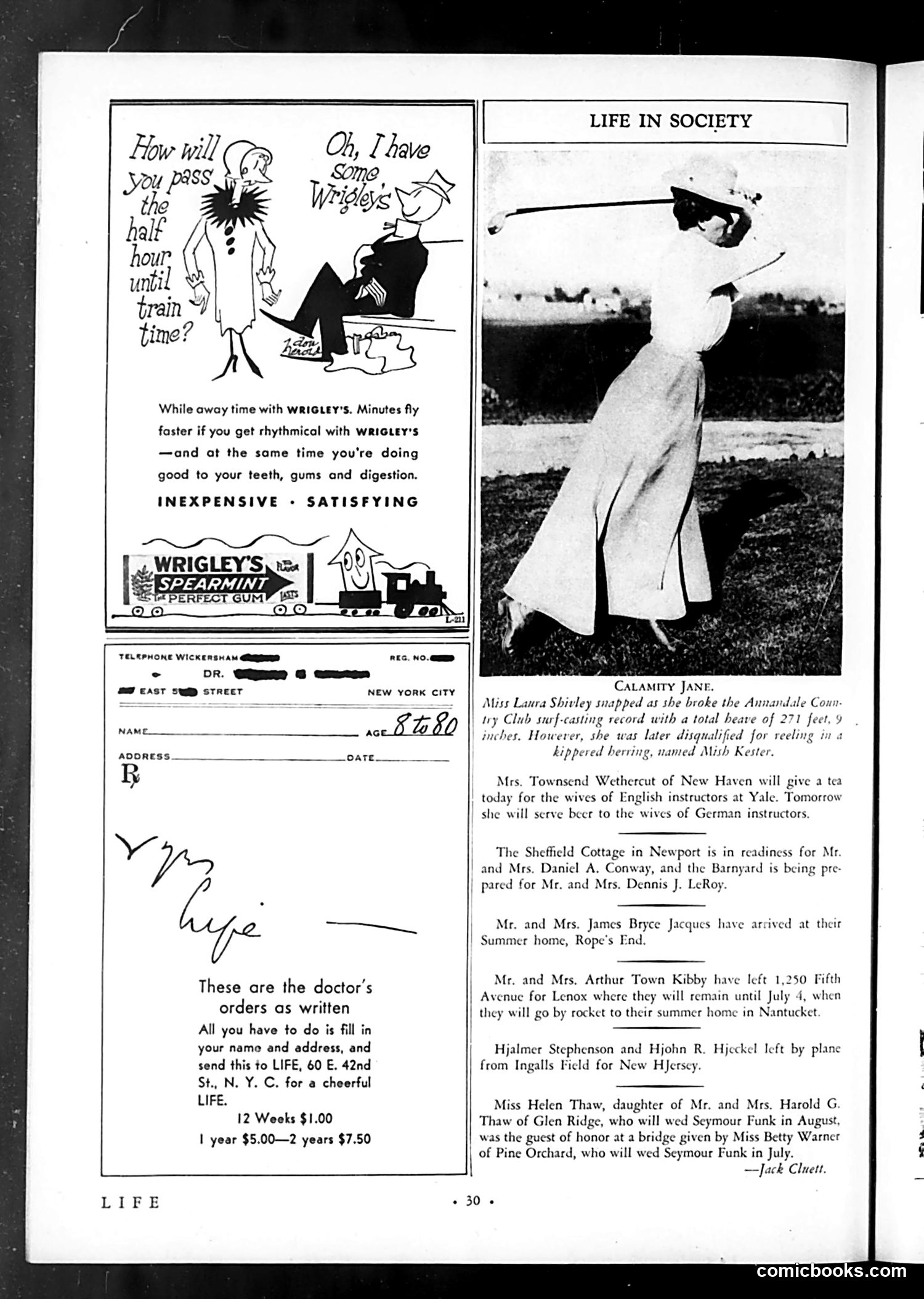
Analysis: Life Magazine Page This page contains two distinct sections: an advertisement and a society column. Left side: A Wrigley's gum advertisement uses a simple cartoon showing a woman asking how to pass time before a train departure. The joke is that chewing gum makes time pass faster while also benefiting teeth and digestion—a straightforward product pitch with minimal satire. Right side: "Life in Society" is a gossip/society column mocking upper-class social activities. The photo shows "Calamity Jane" (Miss Laura Shivley) breaking a fishing record, with humorous commentary that she was disqualified for catching a herring. The brief news items satirize wealthy New Yorkers' leisure activities—tea parties, summer homes, weddings—with absurdist details (a "Barnyard" prepared for guests; travel "by rocket" to Nantucket). The satire targets the triviality and pretension of high society's doings, a consistent theme in Life magazine's editorial voice.
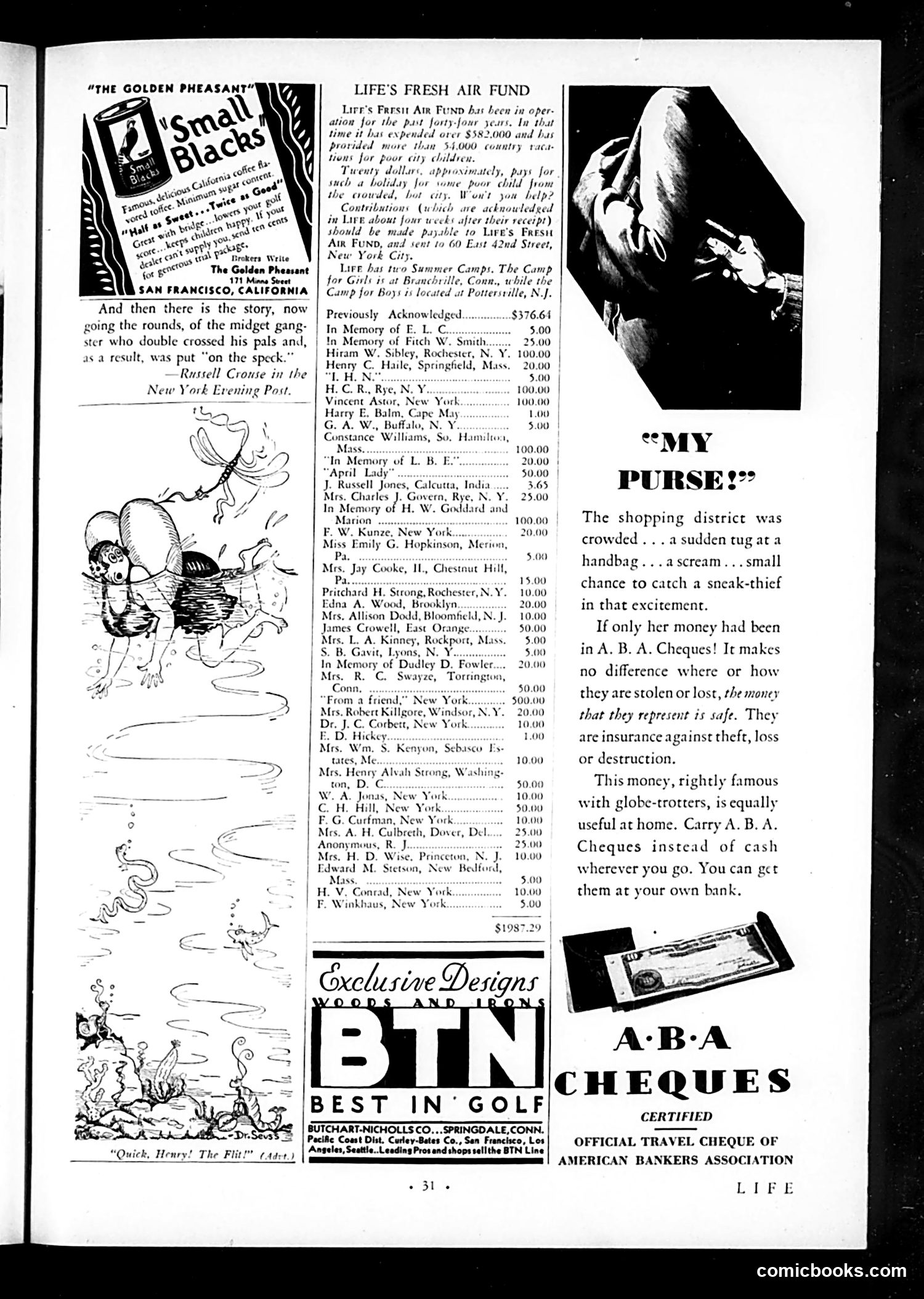
Page 31 Analysis: Life Magazine Content This page combines charity fundraising, a humorous anecdote, and advertising. The Cartoon/Story: Russell Crouse's brief joke references underworld slang: a "midget gangster" who betrayed associates gets put "on the speck" (marked for death). It's gentle crime humor typical of 1930s-40s popular culture, playing on contemporary fascination with gangster vernacular. Life's Fresh Air Fund: The bulk of the page lists donations to Life magazine's established charitable program (operating 44 years at publication), which funded summer camp vacations for poor urban children. Donations ranged from $1 to $500, including notable wealthy donors like Vincent Astor and Henry Alvah Strong. Total: $1,987.29. Advertisement: The right side promotes A.B.A. Cheques—traveler's checks issued by the American Bankers Association. The ad uses a purse-snatching scenario to argue checks are safer than cash for anyone, especially travelers. The page reflects mid-century American values: charitable giving, organized social welfare, and financial security products.
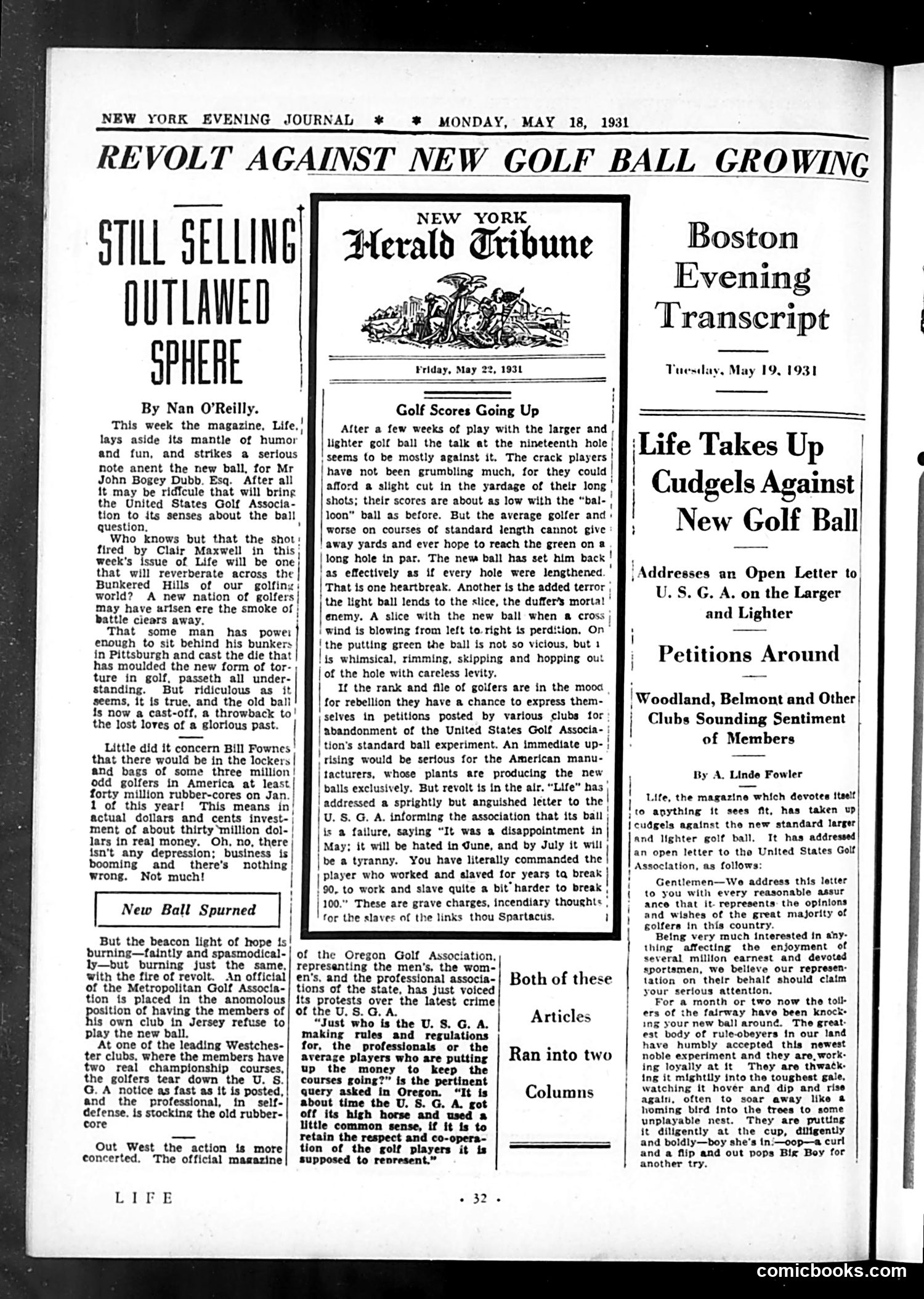
Explanation for Modern Readers This page documents a genuine 1931 controversy over the U.S. Golf Association's introduction of a larger, lighter golf ball. The satire targets the USGA's decision and its effects on recreational golfers. The Issue: The new "balloon" ball travels farther, making standard courses effectively longer. While professional golfers adapted easily, average players found themselves unable to reach greens in regulation par, essentially penalizing their investment in equipment and skill. The Satire's Point: The articles mock the USGA's out-of-touch leadership (Bill Fownes is mentioned as influential in Pittsburgh) for imposing this change while ignoring that millions of golfers had invested in the old rubber-core ball stock. The humor lies in calling this "progress" while golfers actively rebel—tearing down USGA notices and refusing to use the new ball. Modern Context: This reflects early Depression-era frustration with institutional overreach and disregard for ordinary people's concerns, dressed in the genteel language of golf complaints.
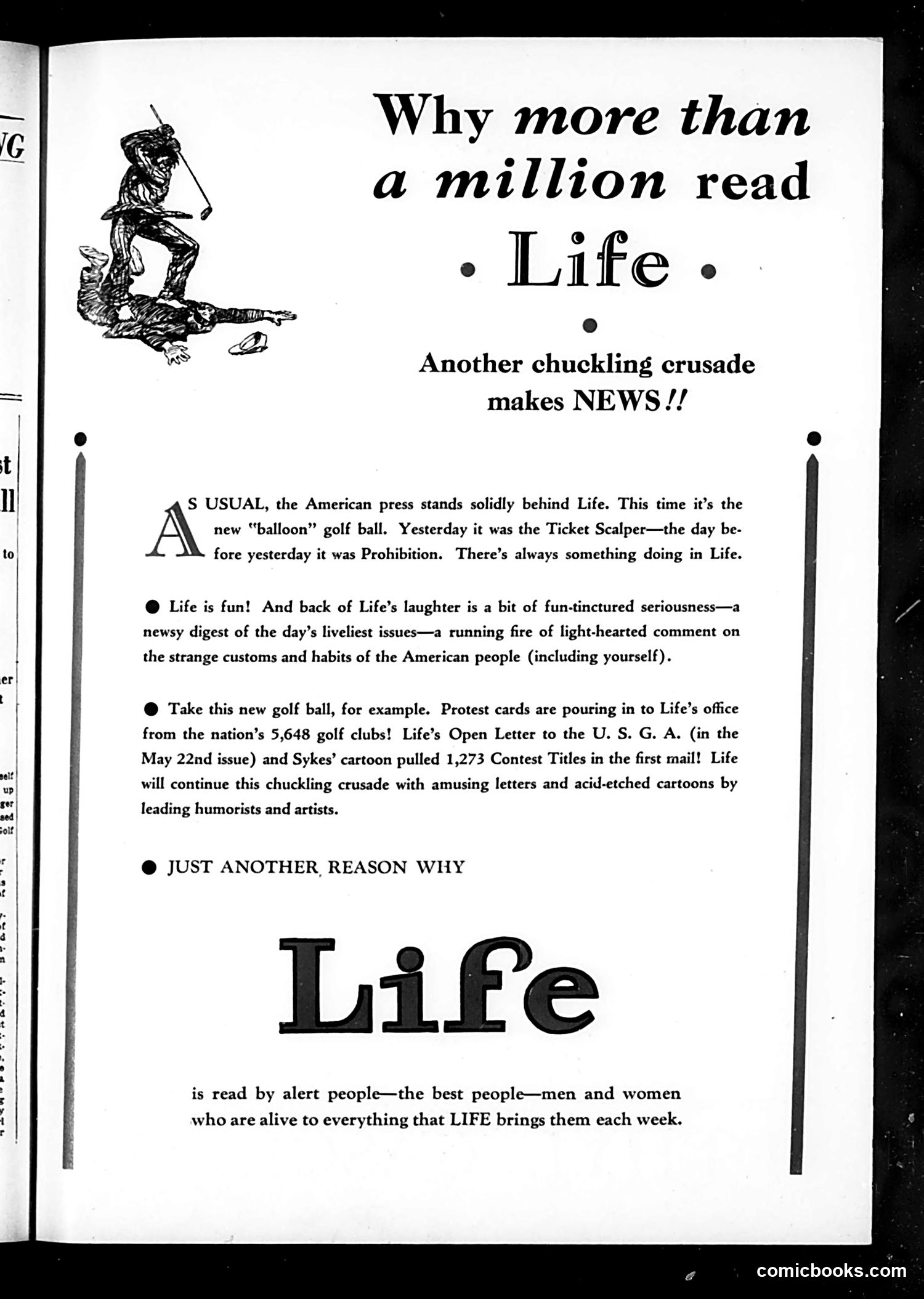
Life Magazine Advertisement Analysis This is a self-promotional advertisement for *Life* magazine, not political commentary. The page boasts that over a million readers choose *Life* for its satirical approach to current events. The cartoon shows a figure with a golf club striking something—illustrating *Life's* current "crusade" against the new "balloon" golf ball. The text explains that this campaign generated significant response: protest cards from 5,648 golf clubs and 1,273 contest submissions. *Life* positions itself as a humor magazine that tackles social issues with "fun-tinctured seriousness"—using comedy to comment on American customs and habits. Previous campaigns mentioned include attacks on ticket scalpers and Prohibition. The advertisement targets "alert people" and "the best people," using the magazine's editorial activism as a selling point. This reflects *Life's* editorial strategy: conducting humorous "crusades" on topical issues to drive reader engagement and sales.
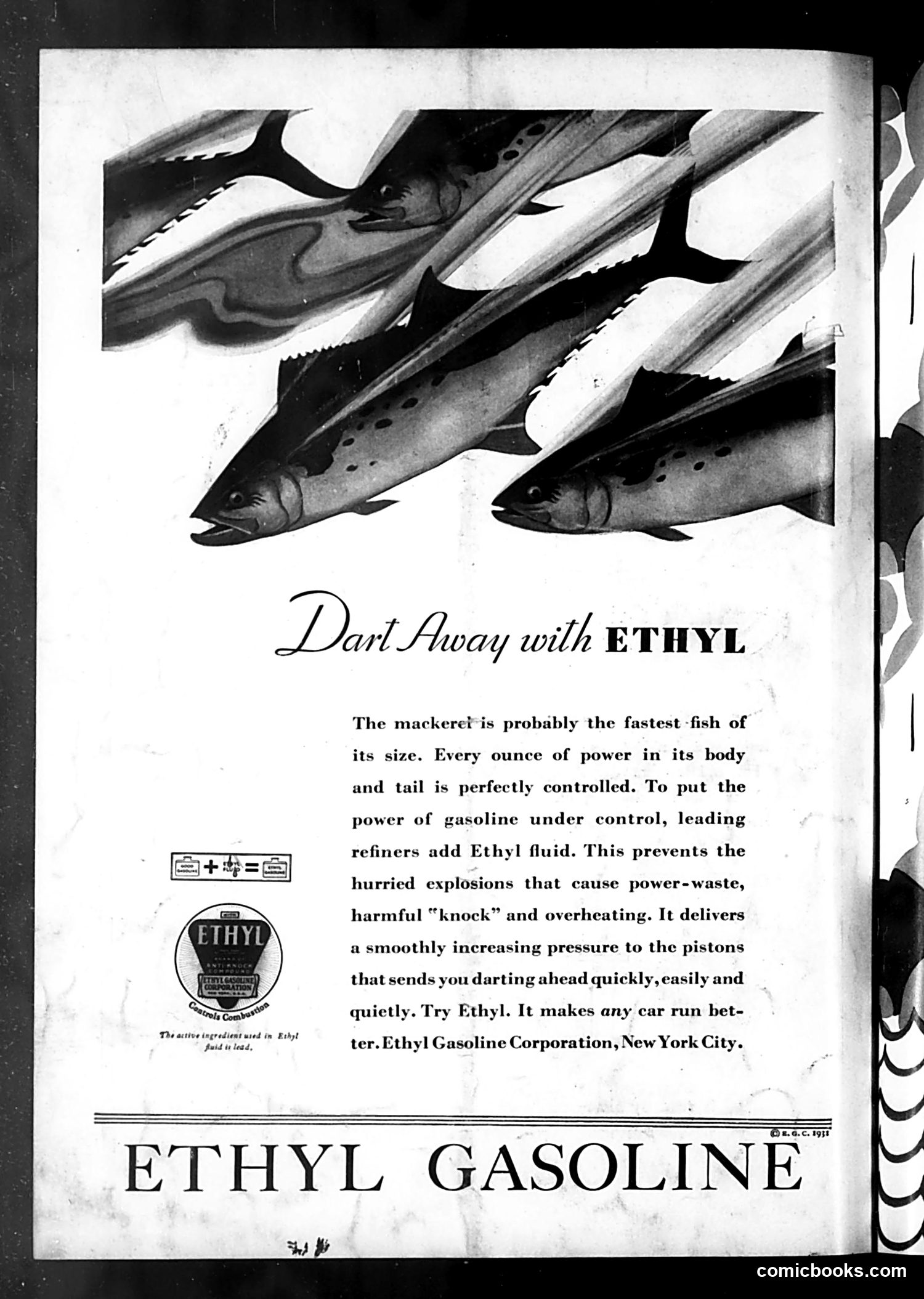
Ethyl Gasoline Advertisement This is a straightforward advertisement, not satire or political commentary. The page promotes Ethyl Gasoline using an extended metaphor comparing the mackerel—described as "probably the fastest fish of its size"—to a car engine. The analogy works like this: just as a mackerel's power is "perfectly controlled," Ethyl fluid (tetraethyl lead additive) controls gasoline's combustion, preventing engine "knock," power-waste, and overheating. The tagline "Dart Away with ETHYL" plays on the fish's speed. The advertisement targets car owners concerned with engine performance and smooth acceleration. The Ethyl Gasoline Corporation was a real company that marketed leaded gasoline in the early-to-mid 20th century. Modern context: This predates widespread knowledge of lead's severe health hazards; leaded gasoline was only phased out in the 1980s-90s.