life
Life — July 10, 1931
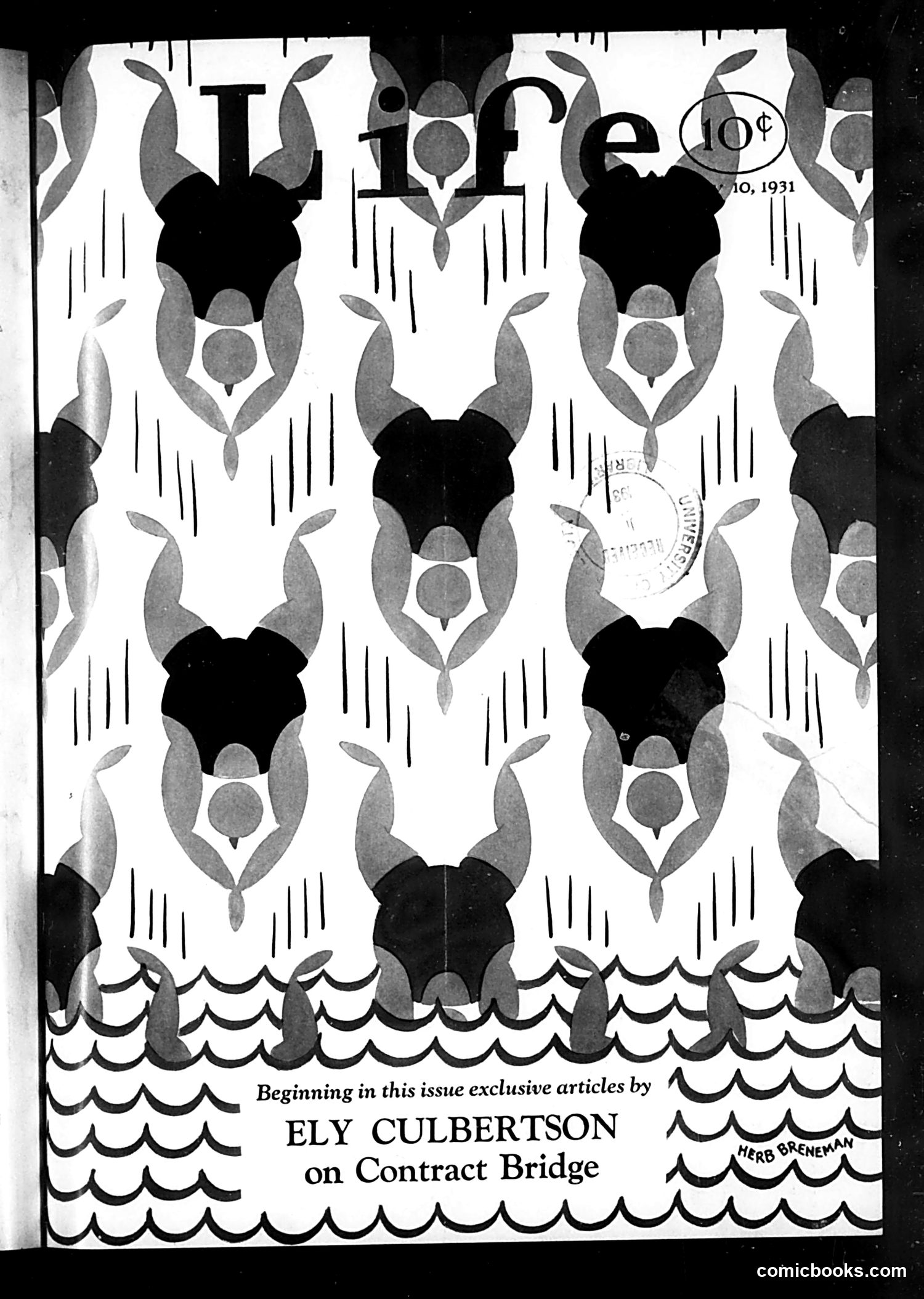
Life Magazine Cover Analysis (1931) This appears to be a Life magazine cover from 1931 advertising exclusive bridge articles by Ely Culbertson, a famous contract bridge expert of that era. The design features a repeating pattern of stylized bull or ox heads (shown in black silhouette) alternating with decorative botanical elements in gray. The horned animal motif likely plays on the bridge-related content—possibly a visual pun or decorative theme popular in 1931 Art Deco design. The scalloped wave pattern at the bottom adds a nautical or formal border typical of the period's graphic design aesthetic. This is primarily a title/cover page announcing content rather than presenting political satire or commentary. The focus is promotional, highlighting Culbertson's bridge instruction as a major draw for this issue.
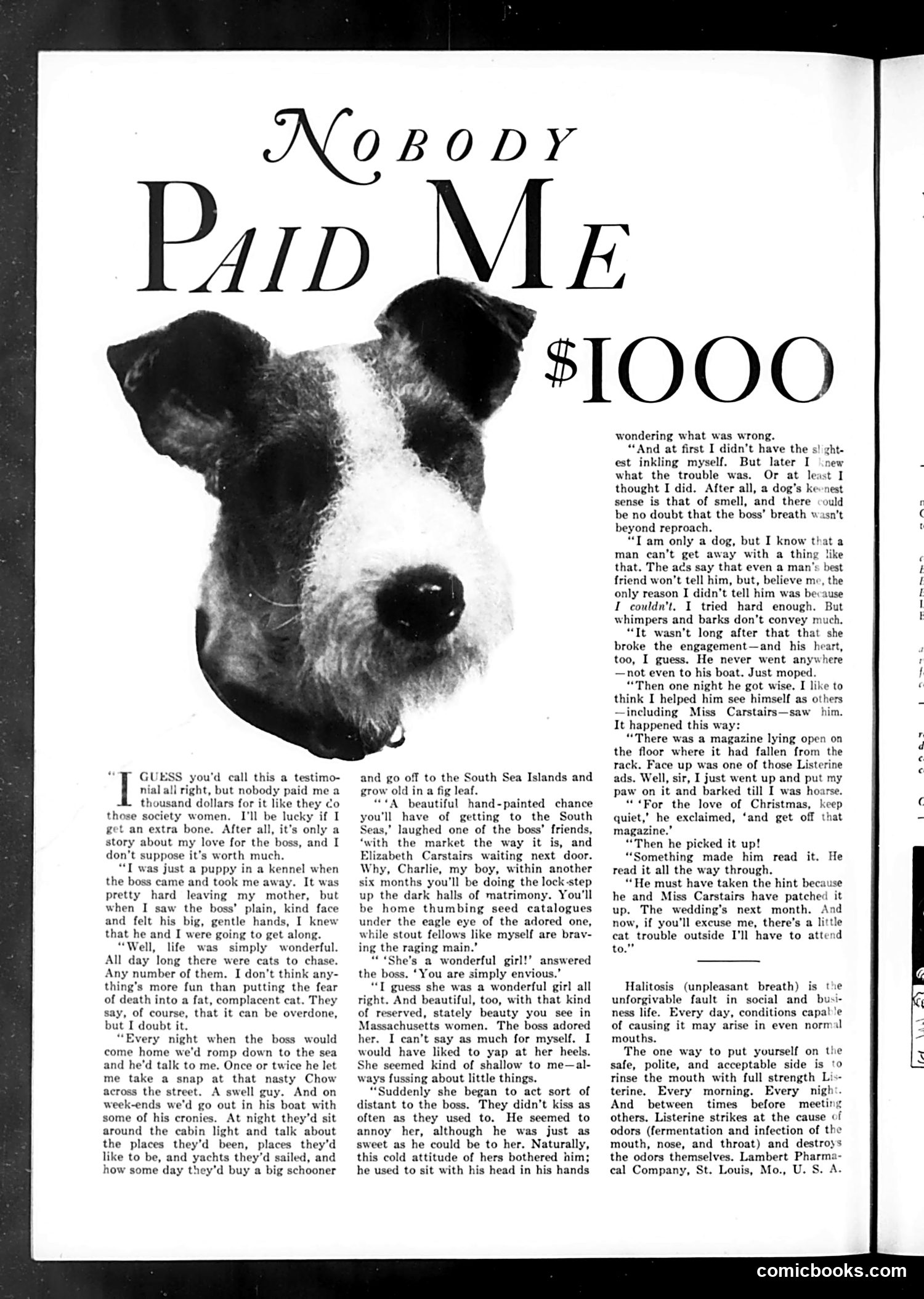
"Nobody Paid Me $1000" This appears to be a humorous story illustrated with a close-up photograph of a dog's face. The narrative, told from the dog's perspective, describes a dog who remained silent about discovering his owner's infidelity with a woman named Miss Carstairs, apparently costing the man a valuable engagement or relationship worth significant money. The satire plays on the common saying that "a dog is man's best friend"—suggesting the dog's loyalty prevented him from exposing damaging secrets, unlike humans who might betray confidences for profit. The $1000 figure appears to reference either money the man lost or might have paid to keep the scandal quiet. The piece is primarily satirical commentary on human morality, loyalty, and friendship rather than political satire.
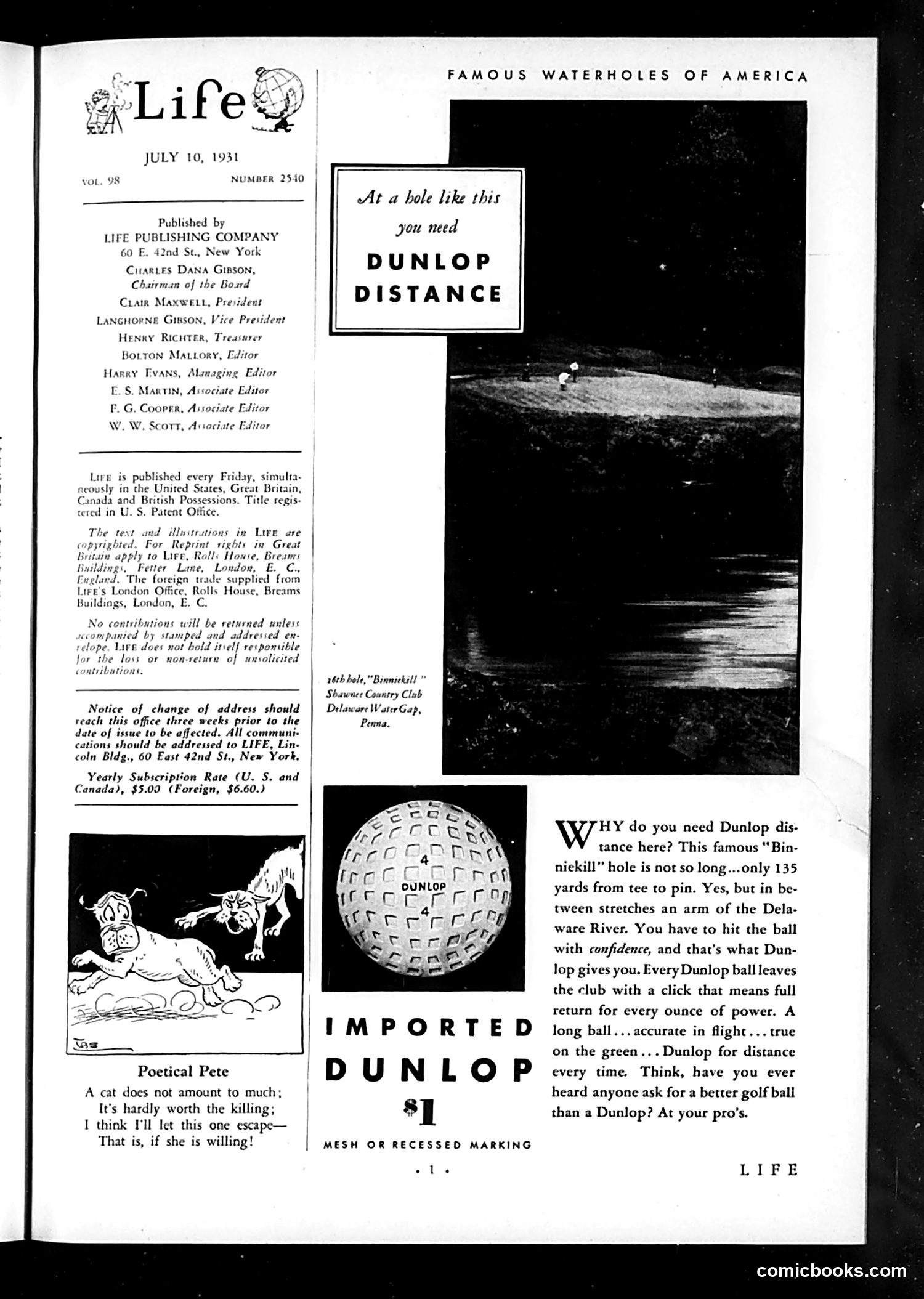
"Poetical Pete" Cartoon Analysis This page is primarily an advertisement for Dunlop golf balls, with a small cartoon titled "Poetical Pete" in the lower left corner. The cartoon depicts a cat that has apparently killed a bird or mouse. The accompanying verse suggests Pete is contemplating letting the cat escape, reasoning that killing prey is simply what cats do naturally—"it's hardly worth the killing." The joke is a dark commentary on moral responsibility: Pete rationalizes overlooking the cat's predatory behavior by accepting it as instinctive rather than condemnable. This is satirical commentary on how people excuse or rationalize undesirable behavior when they attribute it to nature or circumstance rather than choice. The Dunlop advertisement dominates the page, featuring a golf ball and promoting its reliability for distance on the "Binniekill" hole near the Delaware River.
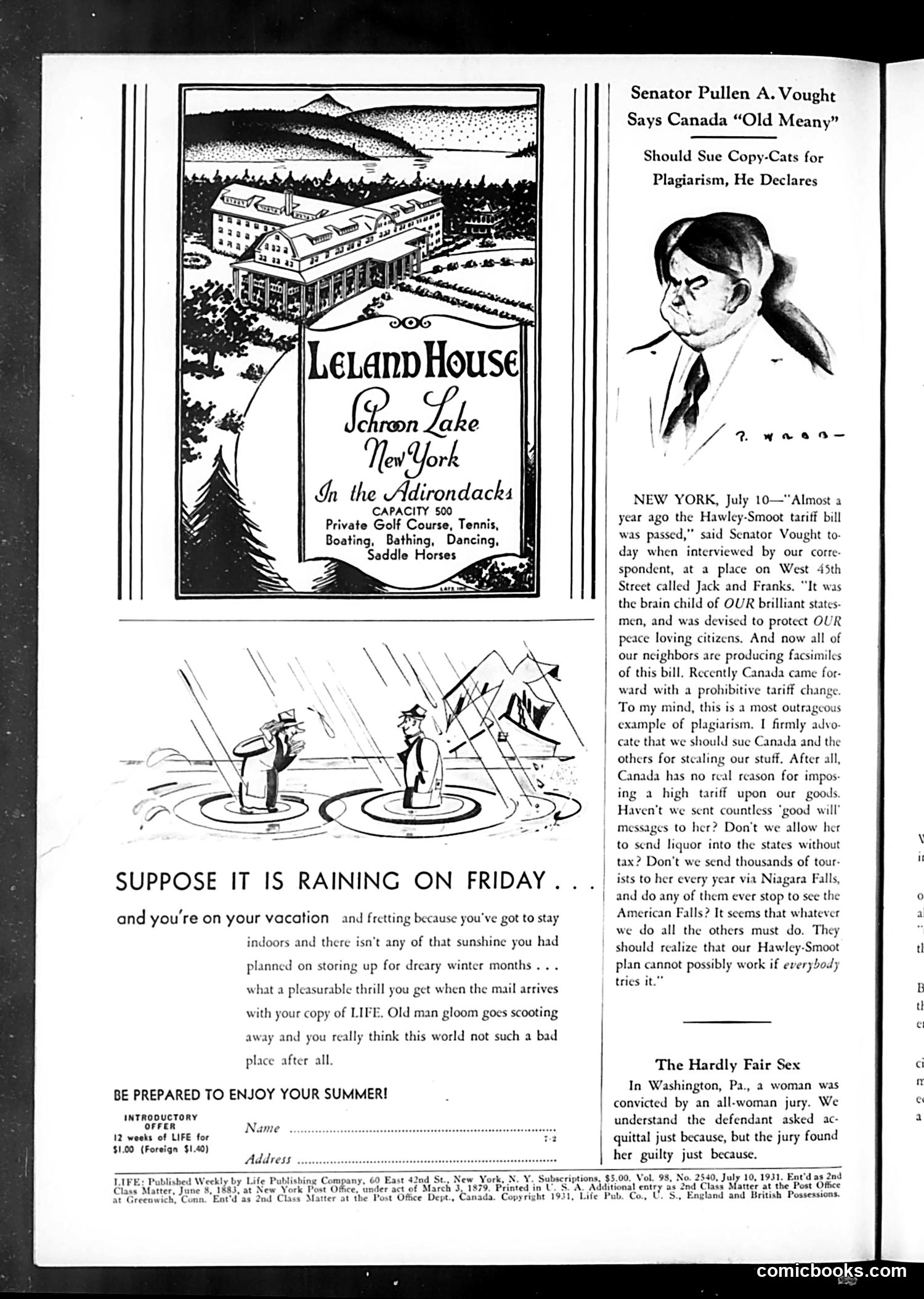
Analysis This page contains a Senator Pullen A. Vought portrait and quote (right column) alongside a Leland House resort advertisement (top left) and an unrelated cartoon about rainy vacations (bottom left). The political content: Senator Vought accuses Canada of "plagiarism" regarding the Hawley-Smoot tariff bill, claiming Canada copied American protectionist trade policy. He sarcastically argues Canada should be sued for intellectual theft rather than allowed to impose competing tariffs. The piece mocks Canada as an imitator while criticizing protectionist trade wars as economically damaging to both nations. The cartoons are unrelated advertisements—one promoting a vacation resort, another joking about rainy weather ruining holiday plans. The page satirizes nationalist trade rhetoric of this era.
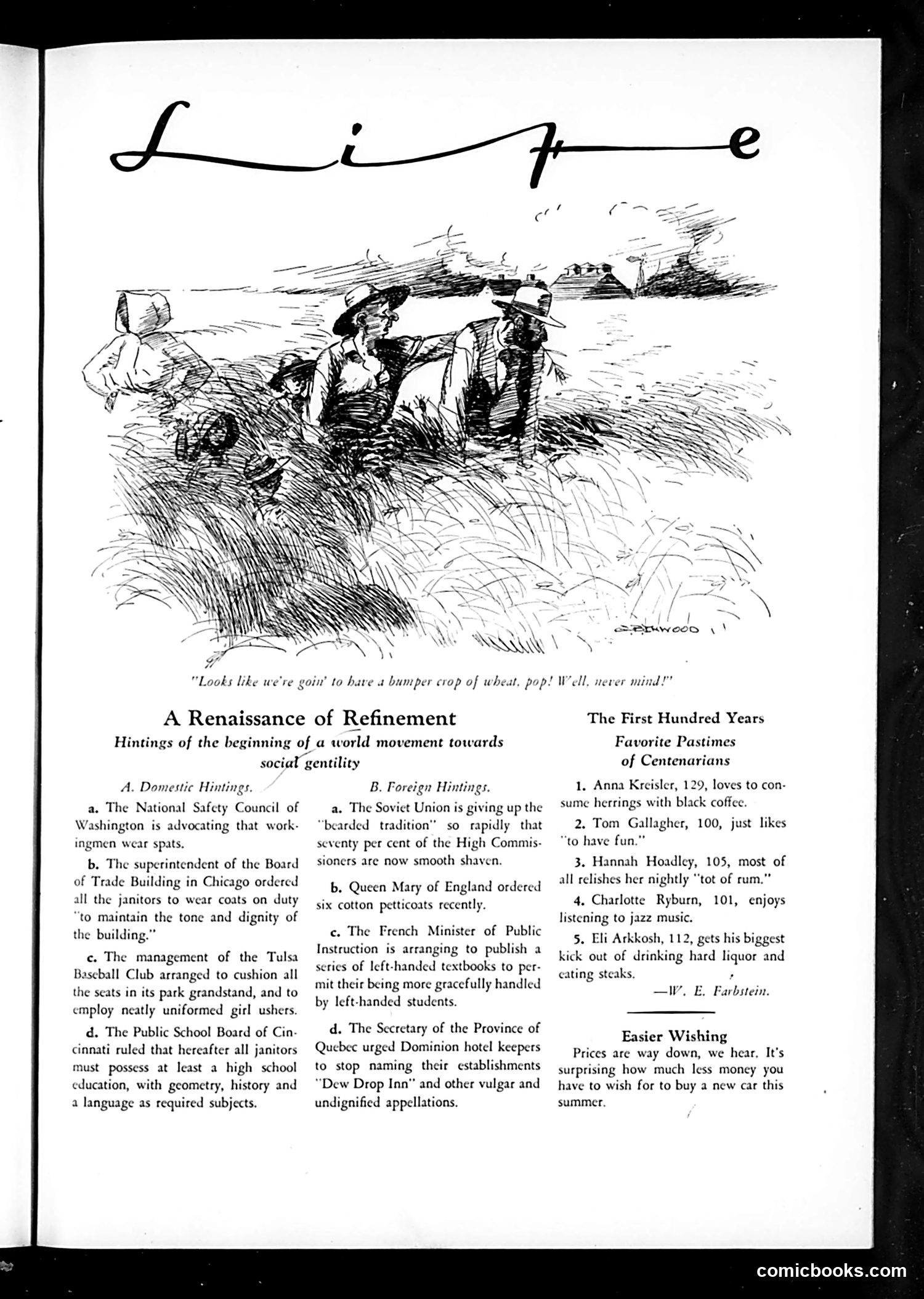
"Life" Page Analysis: Social Refinement The main cartoon depicts rural farmers in a wheat field, with the caption: "Looks like we're goin' to have a bumper crop of wheat, pop! We'll, never mind!" This satirizes agricultural prosperity—the farmers seem indifferent to their success, suggesting a critique of rural attitudes or acceptance of hardship. The page's title, "A Renaissance of Refinement," sarcastically frames the accompanying text about various institutions promoting "social gentility." Examples include the National Safety Council requiring workmen to wear spotless clothing and the Tulsa Baseball Club hiring uniformed ushers—mock-serious accounts of superficial civility measures. The satire mocks how organizations conflate minor etiquette reforms with genuine social progress, lampooning early 20th-century obsession with outward refinement over substance.
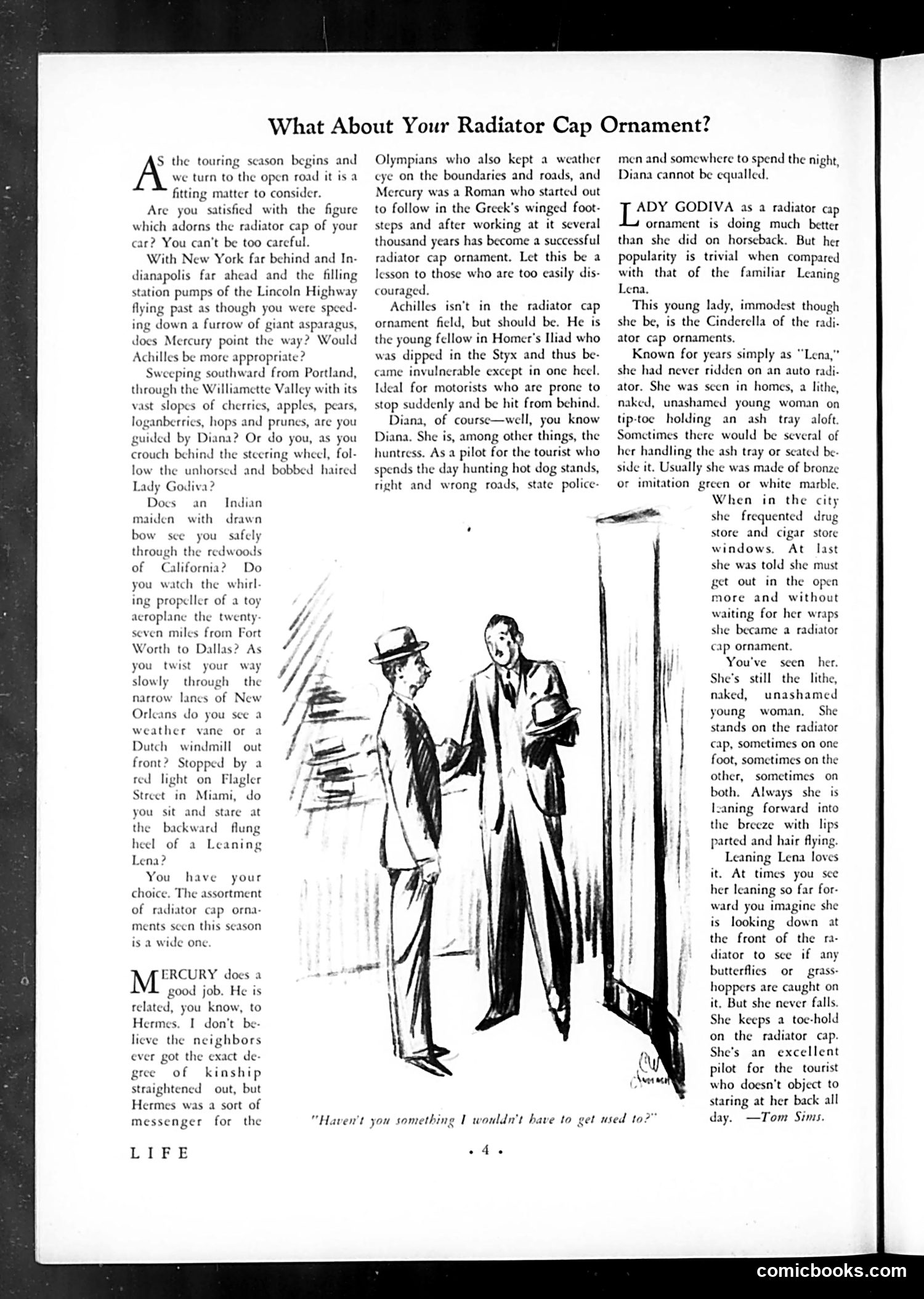
Radiator Cap Ornaments Satire This humorous article mocks the fashion of decorative radiator cap ornaments on 1920s automobiles. The text poses absurd questions: would Mercury point the way? Should Achilles be there? Does an Indian maiden guide you through forests? The satirical point is that these ornaments—often expensive, ornate figurines—were status symbols that served no practical purpose on cars. The article gently ridicules both the ornaments themselves and drivers' vanity in displaying them. The accompanying sketch shows two men in conversation, with one asking "Haven't you something I wouldn't have to get mud on?"—mocking both the impracticality of keeping such decorations clean and the snobbish desire to own exclusive items. The profile of "Lady Godiva" is discussed as a particularly absurd choice for a radiator ornament.
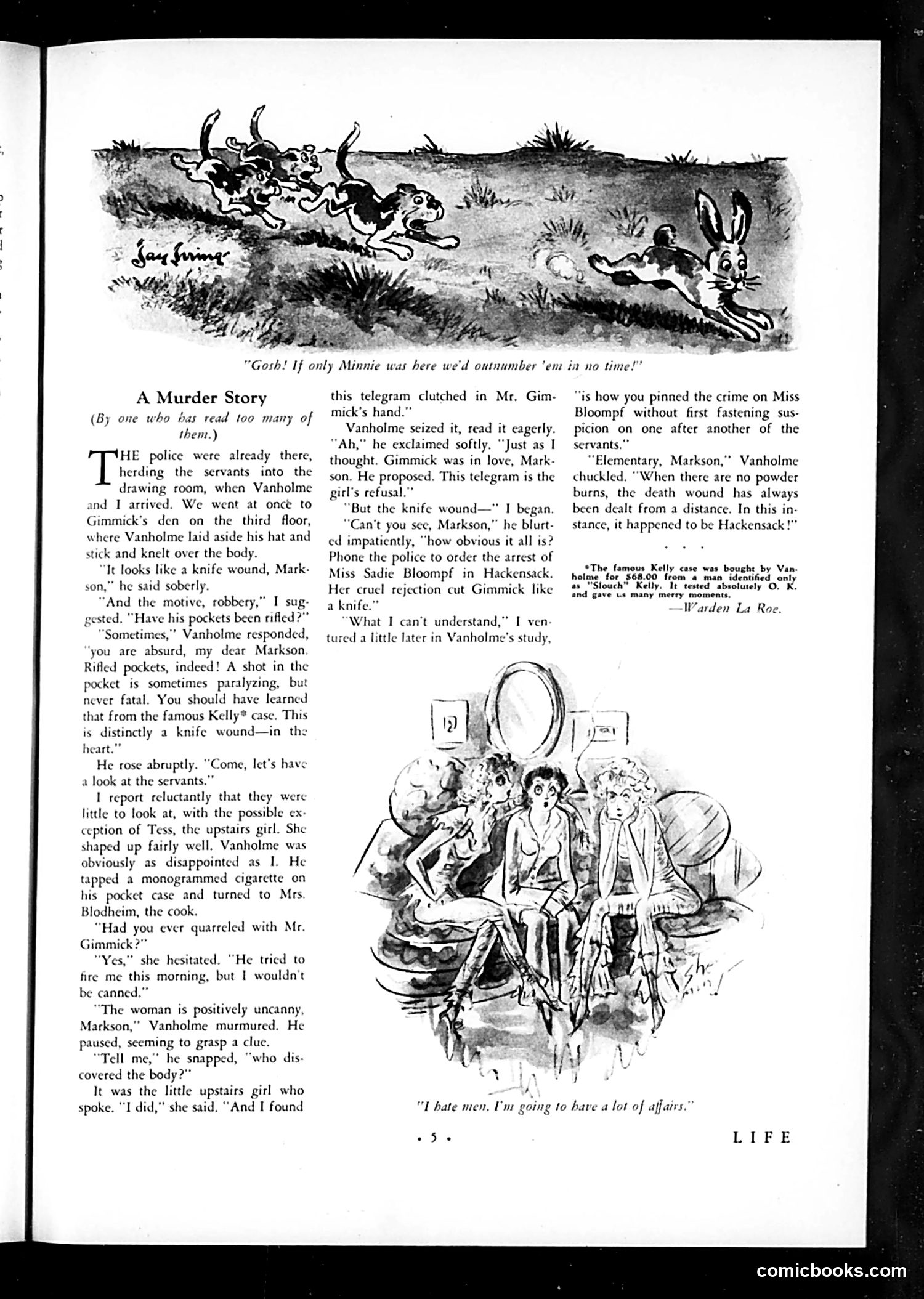
"A Murder Story" - Life Magazine Page This page presents a murder mystery short story titled "A Murder Story (By one who has read too many of them)" — the parenthetical subtitle indicates this is satire *about* detective fiction itself, not a serious crime narrative. The story involves characters named Markson, Vanholme, and Gimmick investigating a knife wound. The satire mocks common detective-story tropes: the police arriving first, suspects with suspicious pockets, the learned detective explaining obscure wound analysis, and dramatic revelations by minor characters. The illustration shows a magnifying glass scene with multiple figures gathered around — a visual cliché of mystery fiction investigations. The page satirizes how formulaic and predictable murder mysteries had become in popular literature by the early 20th century.
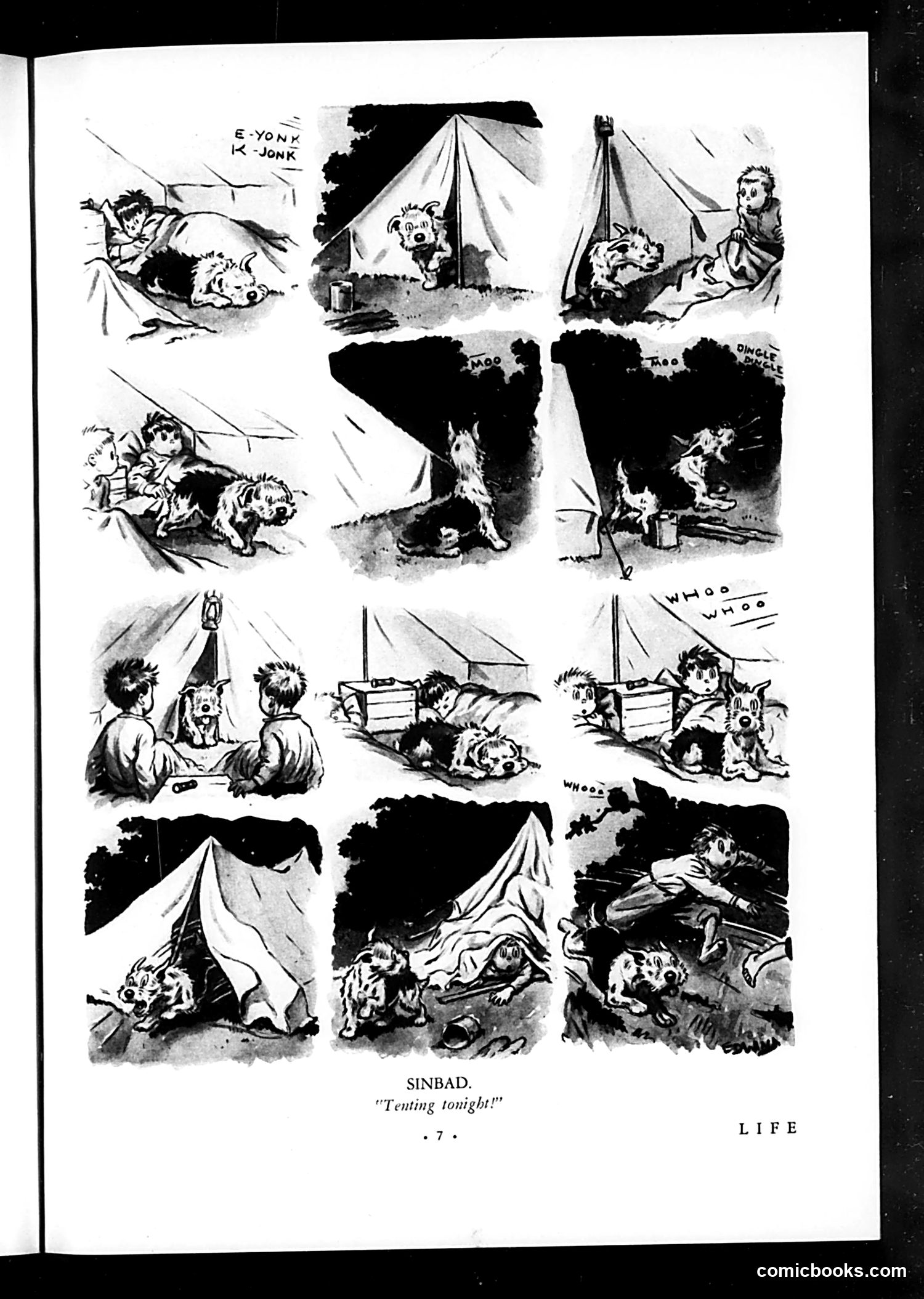
SINBAD: "Tenting Tonight!" This comic strip appears to be a humorous sequence about camping or outdoor tent life. The title "Tenting tonight!" suggests the narrative focus. The strip shows what appear to be children or young people engaged in various camping activities—sleeping in tents, gathering around fires, and dealing with typical camping situations. The characters appear somewhat disheveled or comically exaggerated in typical early-20th-century cartoon style. Without additional context about the "Sinbad" character or strip's ongoing narrative, the specific satire is unclear. However, the comedic approach seems to mock the romantic ideal of outdoor camping by showing its messy, uncomfortable, or chaotic reality—a common satirical target of the era. The page is from *Life* magazine, a major American humor publication of this period.
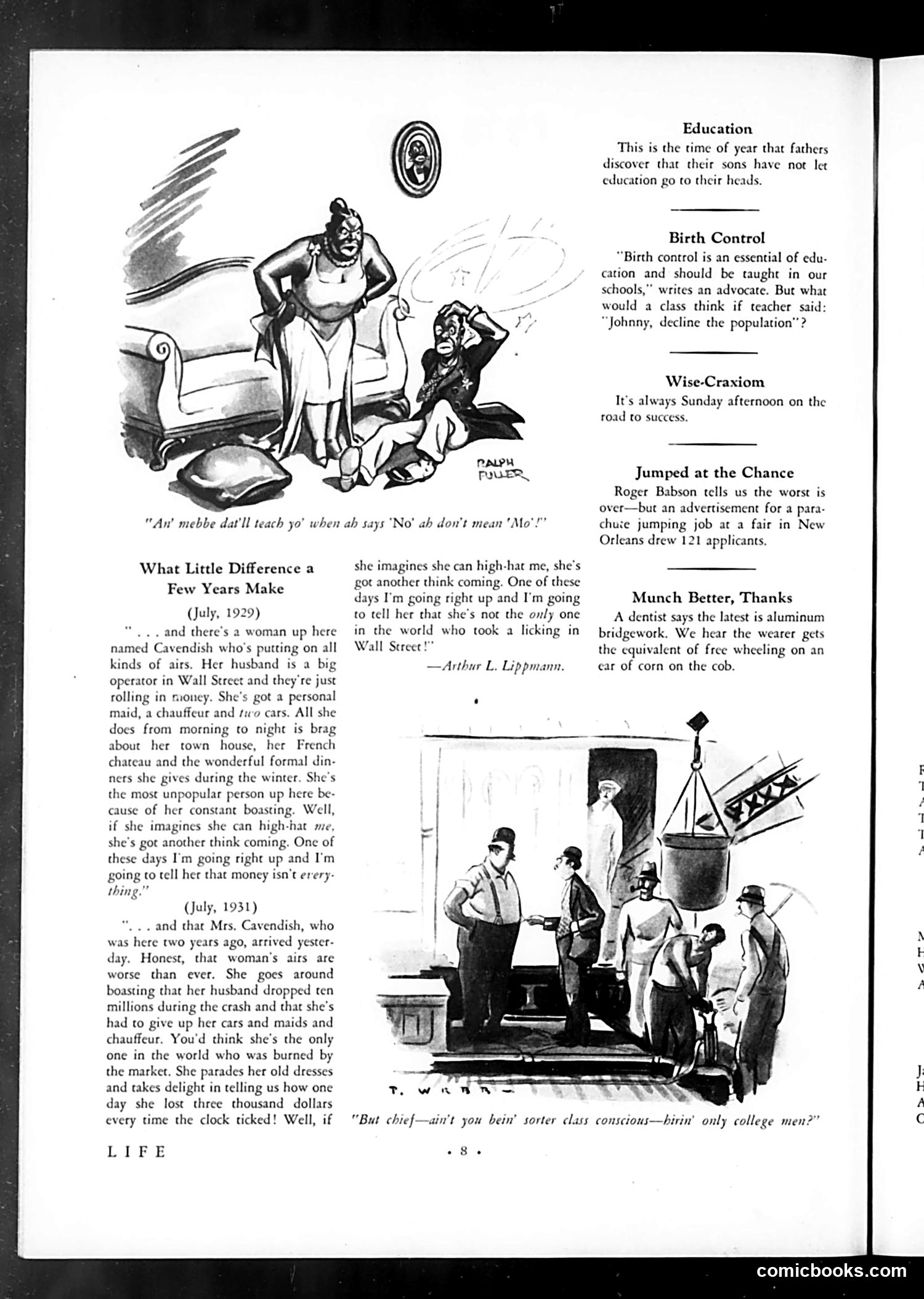
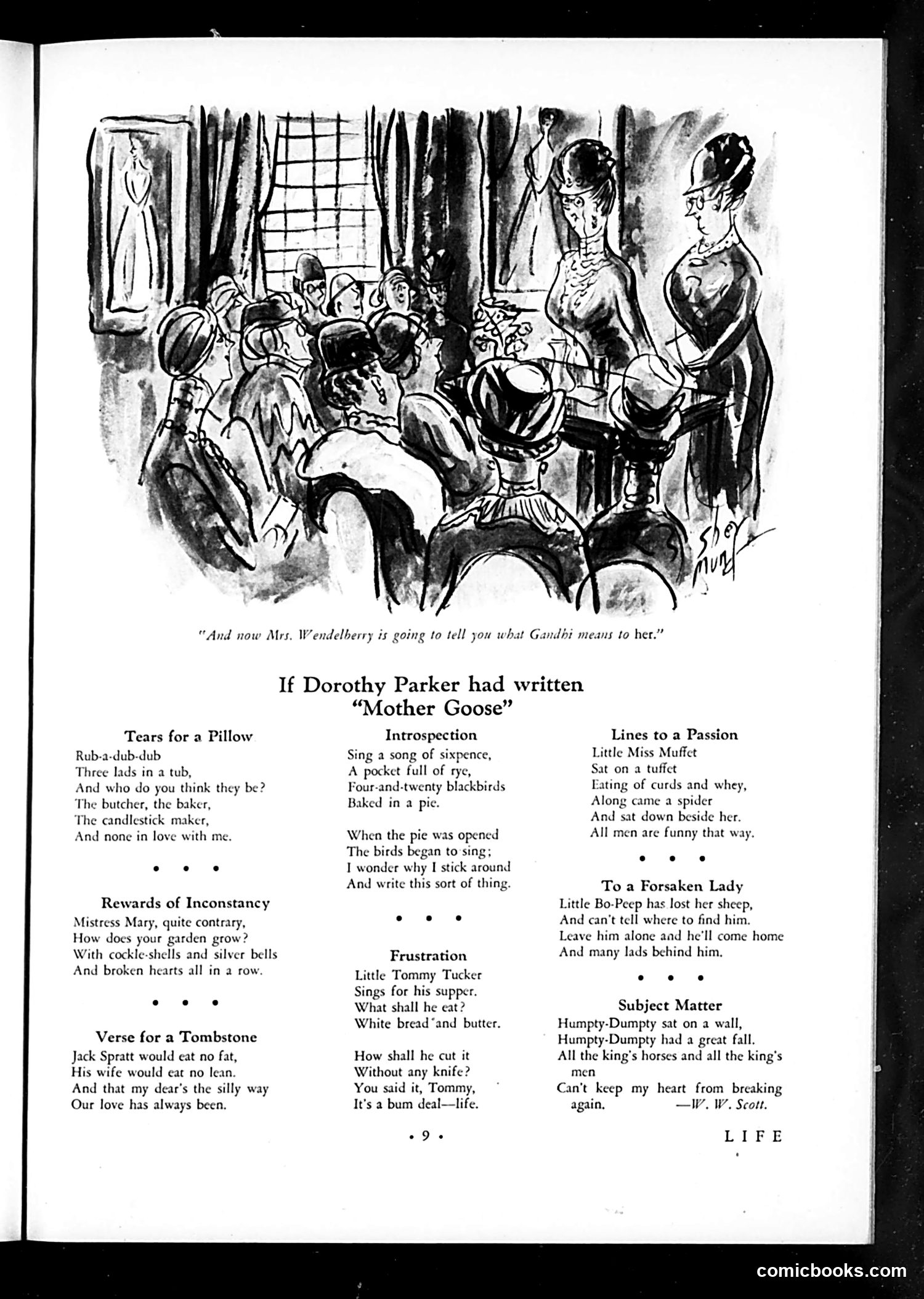
Analysis The cartoon depicts a social gathering where a woman announces she will explain what "Gandhi" means to the assembled guests. This is a satirical take on Gandhi's growing prominence in American cultural consciousness, likely from the 1920s-30s when Indian independence activism gained international attention. The satire targets upper-class social pretension—the idea that educated society women would discuss Gandhi at cocktail parties as a fashionable intellectual topic, whether or not they genuinely understood his philosophy or political significance. The cartoon mocks this superficial engagement with serious political matters. The accompanying parodies of nursery rhymes ("Mother Goose") below continue the satire through absurdist humor, a common Life magazine approach to social commentary on contemporary figures and trends.
Analysis of "Life Looks About" Page This page contains three opinion pieces rather than cartoons. The header illustration shows a cherub-like figure, Life magazine's mascot. "Good News for All Hands" discusses President Hoover's moratorium on war debts—a proposal to postpone payments owed to the U.S. by European governments. The author praises this as promoting peace among nations and suggests it prevents Europe from financial collapse, which would harm American interests. "Nothing Ventured, Nothing Gained" criticizes newspaper coverage of explorers like Sir Hubert Wilkins attempting dangerous polar expeditions. The author argues such sensational headlines don't justify the risks. "Still Discussing Education" critiques American education's ineffectiveness, comparing it unfavorably to college buildings. The author, E.S. Martin, argues education theory hasn't improved actual learning outcomes.
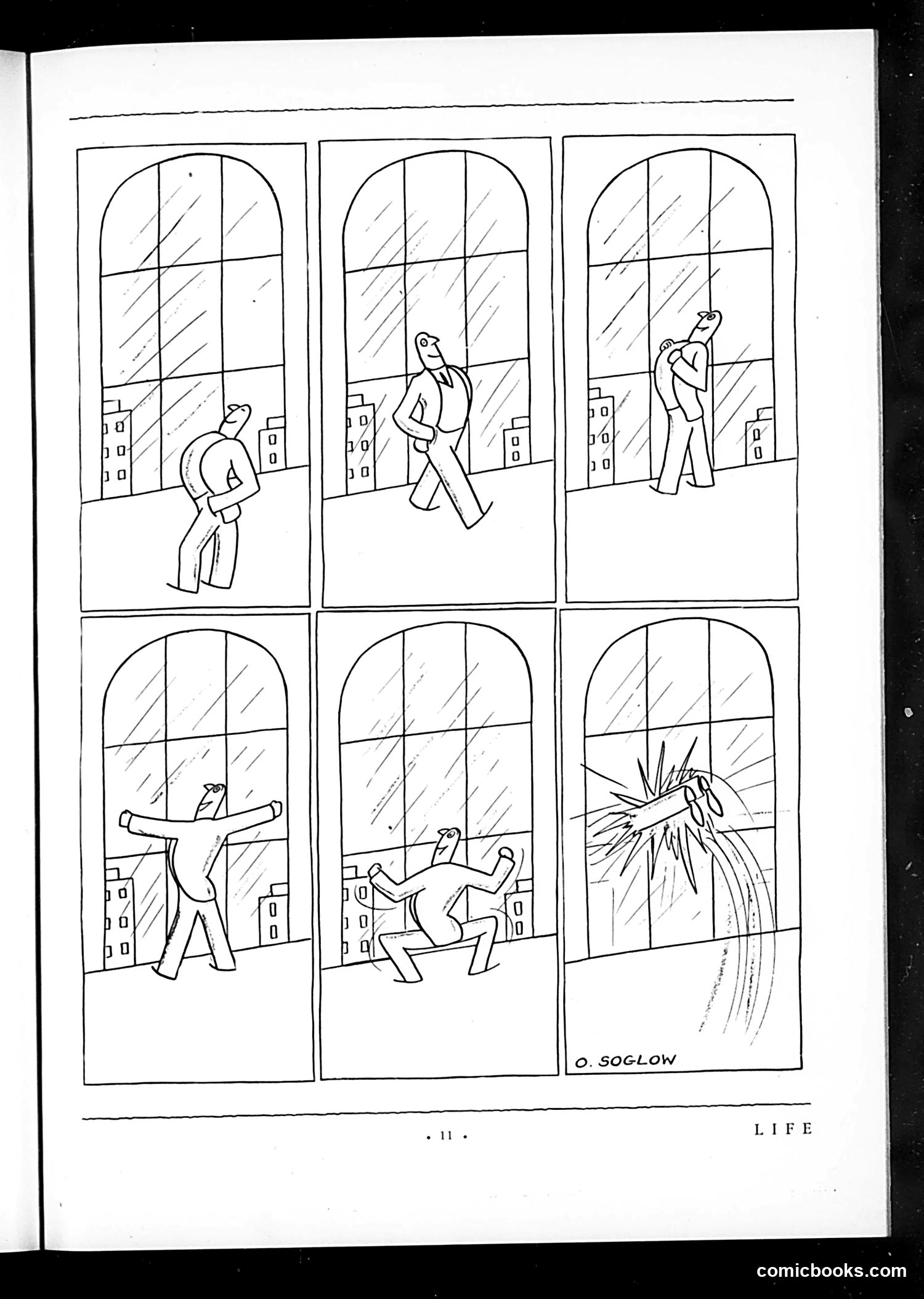
Analysis This is a six-panel comic strip by O. Soglow showing a man's increasingly frantic behavior inside an office building, viewing a cityscape through large windows. The sequence progresses from calm observation to escalating agitation: the figure moves from looking out the window, to pacing, to gesturing wildly with arms spread, to crouching in distress, to what appears to be a final moment of explosive panic or breakdown as he crashes through the window. The satire likely mocks the psychological toll of office work or urban corporate life—how the monotony and confinement drives someone toward hysteria. The window serves as both literal barrier and metaphor for the distance between the worker and the outside world. The exaggerated physicality of the breakdown suggests commentary on workplace stress and mental strain, presented as dark humor typical of Life magazine's satirical approach.
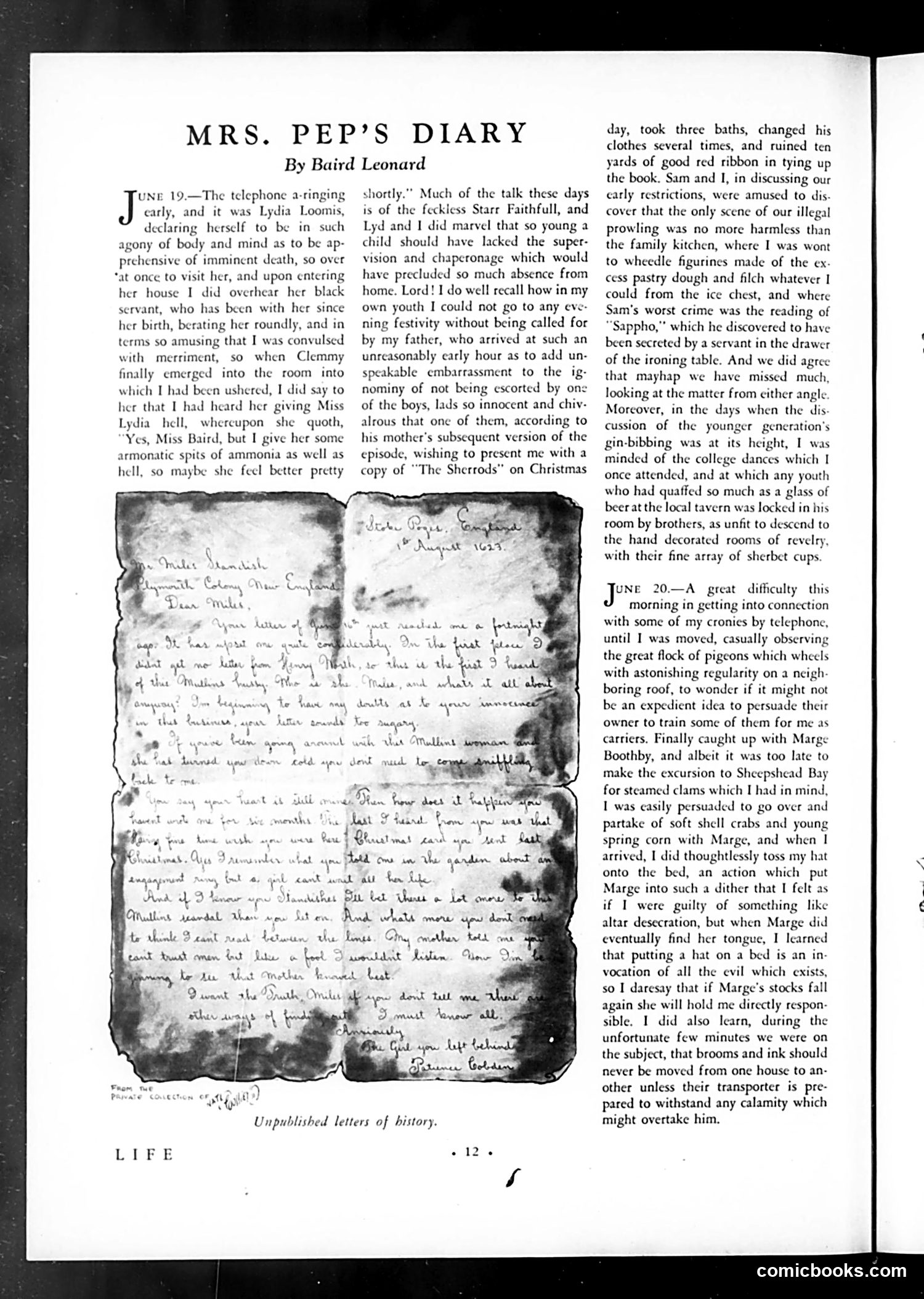
Mrs. Pep's Diary - Life Magazine This page contains a humorous diary entry by Baird Leonard titled "Mrs. Pep's Diary," dated June 19-20. The piece satirizes upper-class social conventions and domestic life through the voice of a society matron. The humor centers on trivial domestic crises: a servant's minor infractions, restrictions on children's behavior, concerns about household management (pigeons on the roof, household goods), and the author's anxieties about propriety. The accompanying facsimile of an actual handwritten letter adds authenticity to the satire. The piece mocks the exaggerated concerns of the leisure class, particularly the tension between maintaining strict household discipline and social appearance while managing servants and children. It's gentle social satire targeting wealthy readers' own pretensions and neuroses about respectability and domestic control.
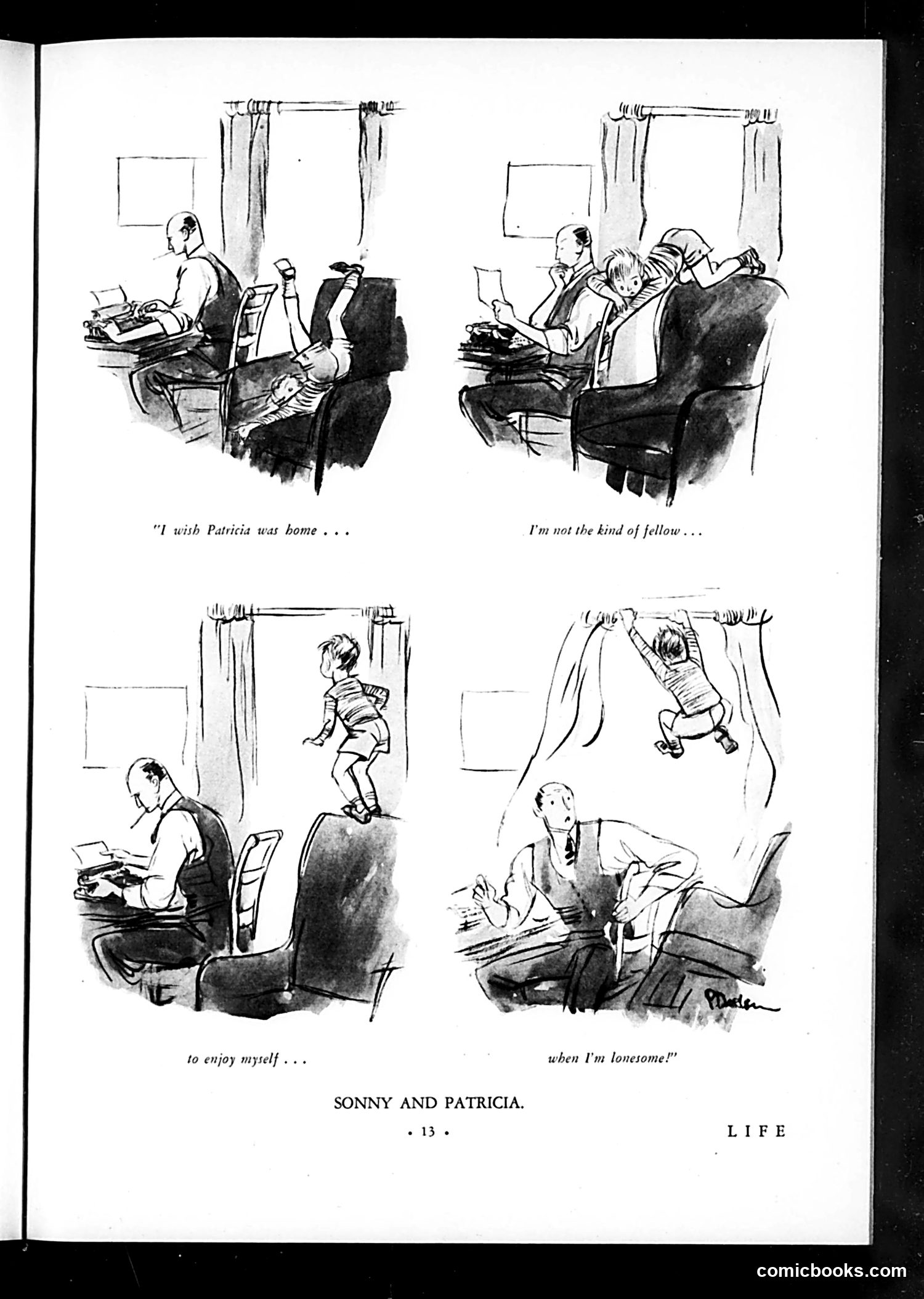
"Sonny and Patricia" - Life Magazine Cartoon This is a four-panel domestic comedy strip titled "Sonny and Patricia" depicting a husband-and-wife relationship. The humor centers on contrasting perspectives: Top panels: The husband wishes Patricia were home while he's stuck with colleagues at work; he claims he's "not the kind of fellow" for office socializing. Bottom panels: When alone, he plays with their young child, but then complains about loneliness when actually by himself. The satire: The joke mocks male domestic hypocrisy—he dismisses family time as boring but then feels lonely without it. It's a gentle critique of husbands who undervalue home life while simultaneously depending on it for happiness. This reflects early-to-mid 20th century attitudes about marriage, masculinity, and domesticity.
Life Magazine: "Life in Washington" - Senator George Norris Profile This is a biographical article by Carter Field profiling Senator George Norris of Nebraska, described as "a very stubborn man." The piece examines Norris's independent political stance during and after World War I. Key points: Norris opposed U.S. military expansion and the League of Nations, voted against war measures, and resisted pressure from constituents. He was pro-German in reputation but remained unmoved by criticism. The article emphasizes his stubbornness—refusing to support fertilizer interests despite Nebraska farming concerns, and rejecting a vote of no-confidence from those seeking his removal. The satire suggests Norris's principled inflexibility made him politically isolated yet respected for genuine independence in a corrupt Washington environment.
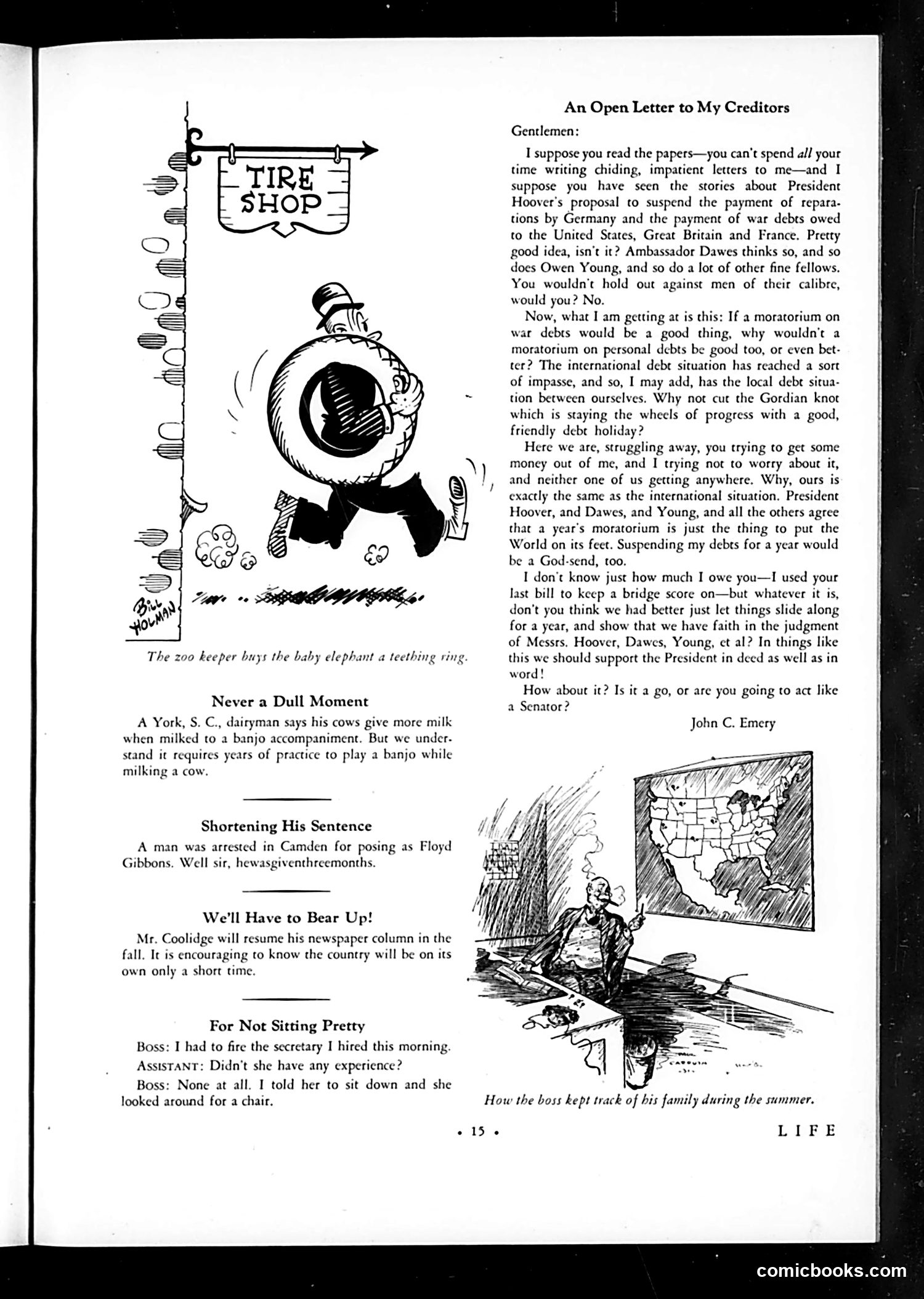
Analysis This page contains several humorous short pieces typical of Life magazine's satirical style. The main feature is "An Open Letter to My Creditors" by John C. Emery, addressing debt moratorium proposals. The letter references President Hoover, Ambassadors Dawes and Young, and debates whether suspending personal debts—similar to proposed international war-debt relief—would help the economic crisis. The cartoons accompanying it show a man at a "tire shop" (unclear reference) and another depicting someone tracking family movements on a map, illustrating financial hardship through visual humor. The remaining items are brief humorous anecdotes about a banjo player, someone impersonating Floyd Gibbons, newspaper columnist Coolidge's return, and a joke about hiring an inexperienced secretary. The overall theme reflects Depression-era economic anxiety and policy debates.
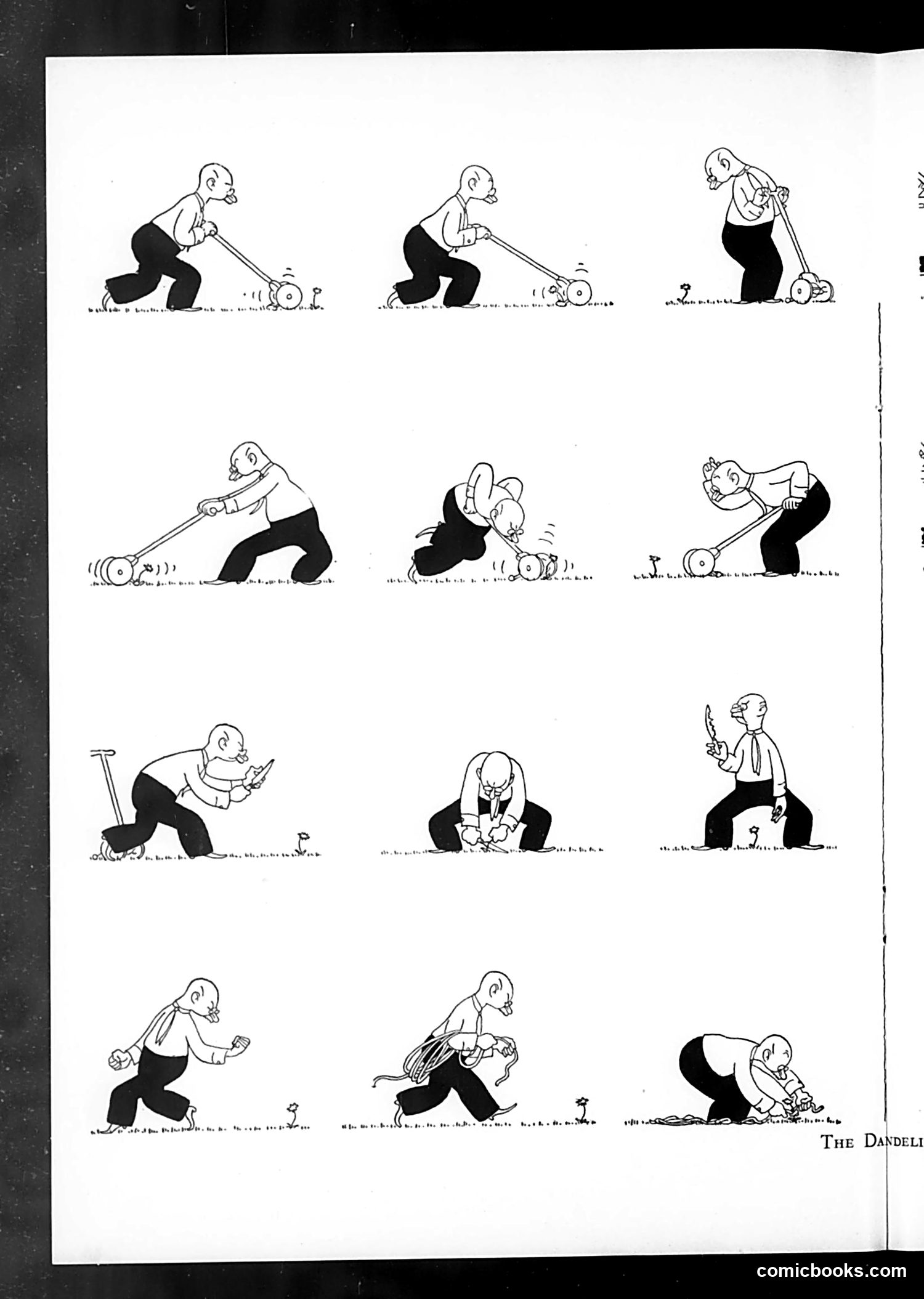
"The Dandeli" - Political Cartoon Analysis This appears to be a humorous instructional sequence titled "The Dandeli" (likely "The Dandelion"), depicting a bald man's interactions with a dandelion plant. The twelve-panel sequence shows escalating comedy: the figure attempts to blow away the dandelion's seeds, dig it up, pull it out, and ultimately bend down to examine it closely. The satire likely mocks persistence in dealing with persistent problems—the dandelion being a common lawn nuisance that's difficult to eliminate. The gentleman's increasingly desperate and undignified poses suggest futility against minor annoyances. Without identifying the specific figure through caricature alone, this appears to be early 20th-century visual humor about frustration with life's small, stubborn obstacles.
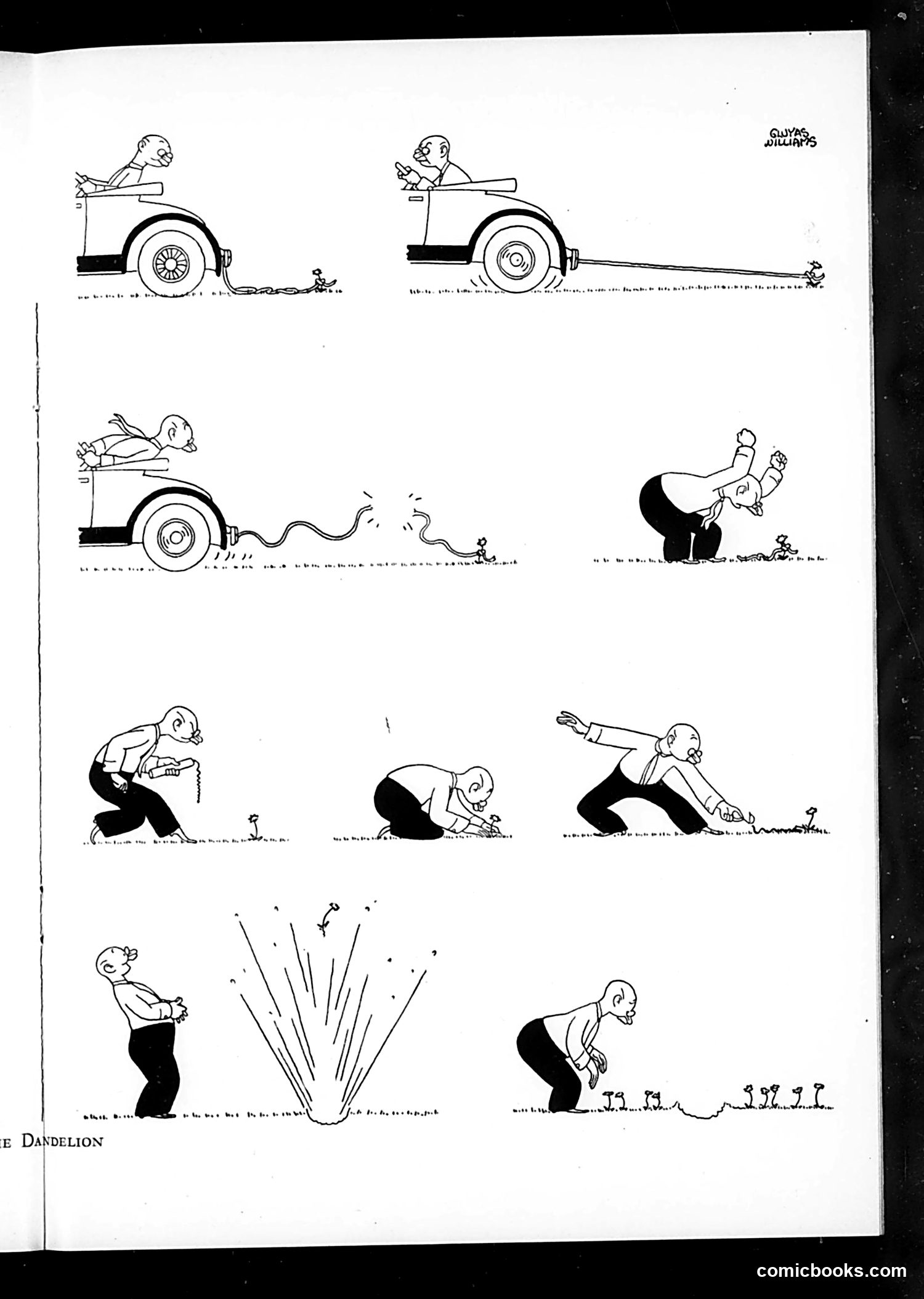
"The Dandelion" by Gluyas Williams This comic strip satirizes the lifecycle of a dandelion plant through a man's interaction with it. The sequence shows: 1. A man towing the dandelion via rope from his car 2. The dandelion being dragged along 3. The man attempting various removal methods (digging, pulling, stretching) 4. An explosion as the dandelion seed-head disperses The joke lies in the man's futile struggle against nature—his mechanical and physical efforts to eliminate the dandelion only result in spreading its seeds everywhere, defeating his purpose entirely. This reflects a common gardening frustration: attempts to control weeds often backfire by propagating them further. It's a humorous commentary on human efforts thwarted by natural forces.
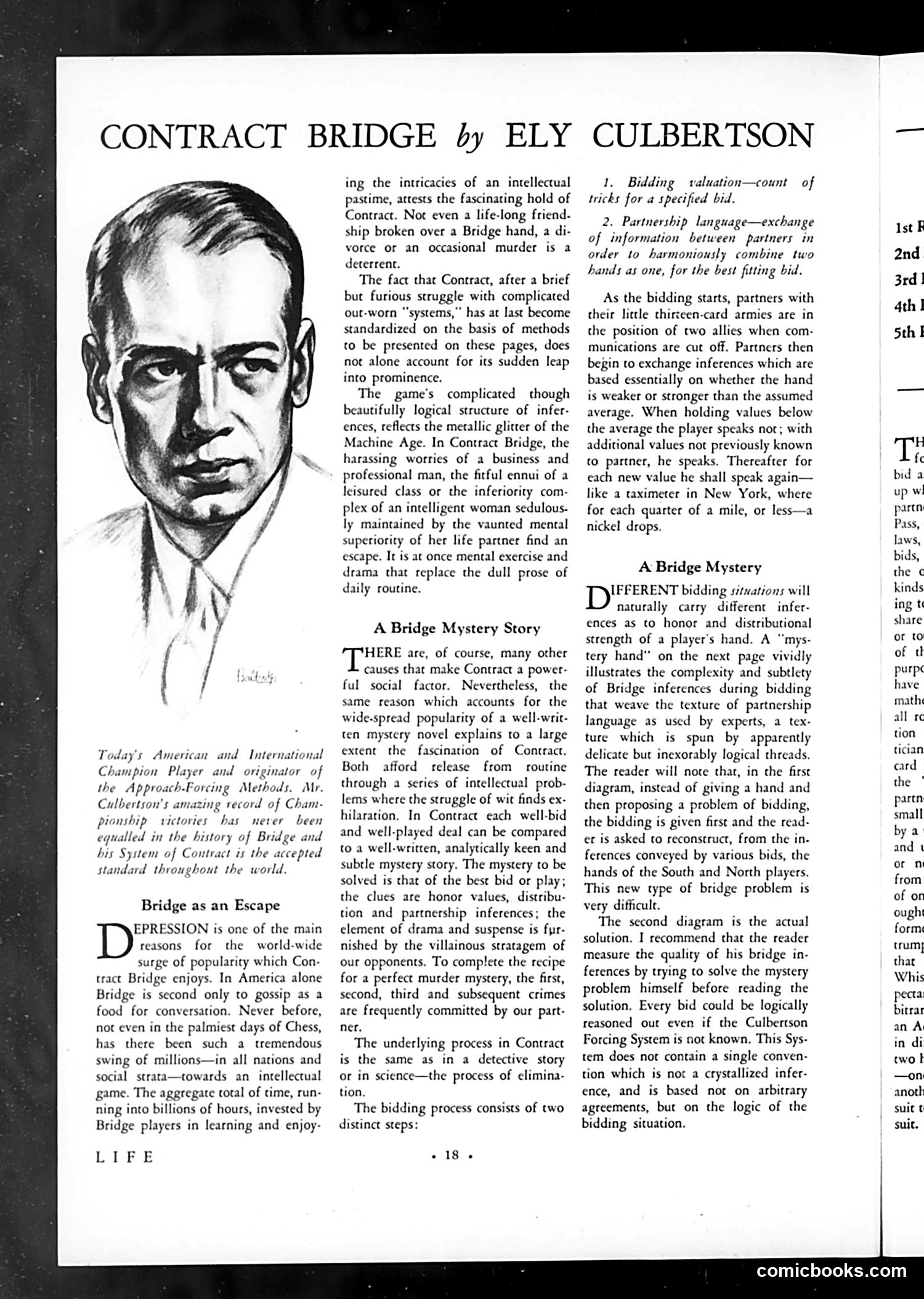
Contract Bridge Article This is not a political cartoon but rather an instructional article about Contract Bridge, a card game. The page features a portrait sketch (byline indicates "by Ely Culbertson," a famous bridge expert) accompanying an essay about bridge's popularity and complexity. The article explains that Contract Bridge appeals to intellectuals as a mental escape from routine. It discusses bridge's structure as a "mystery" game—where players must infer opponents' card strength through bidding language and logical deduction. The text emphasizes bridge's intellectual appeal: it combines strategy, psychology, and mathematical reasoning. This reflects 1930s-era American culture, when bridge was fashionable among educated, affluent adults seeking sophisticated leisure activities.
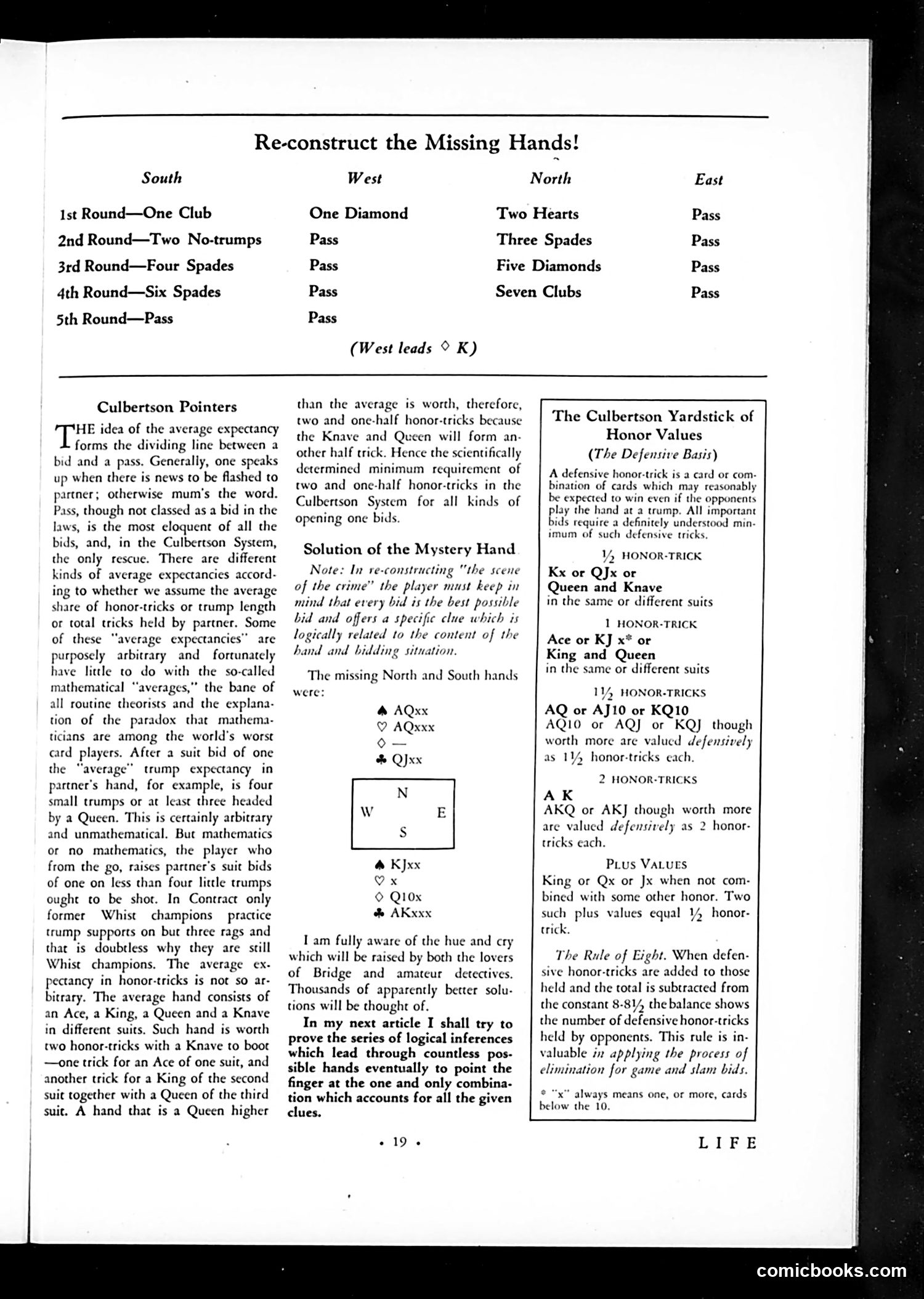
Page Analysis This page is primarily educational content about bridge card game strategy, not satirical material. The main article, "Culbertson Pointers," discusses the Culbertson System for evaluating bridge hands—a mathematical approach to calculating honor-tricks (valuable cards) for bidding. The page includes a puzzle titled "Re-construct the Missing Hands!" presenting a specific bridge game scenario. There are no political cartoons, caricatures, or social satire visible. The content reflects Life magazine's educational role in the 1920s-30s, when bridge was a popular parlor game among educated audiences. The technical discussion of card values and bidding strategy would have appealed to serious bridge players among Life's readership. This is instructional, not satirical material.
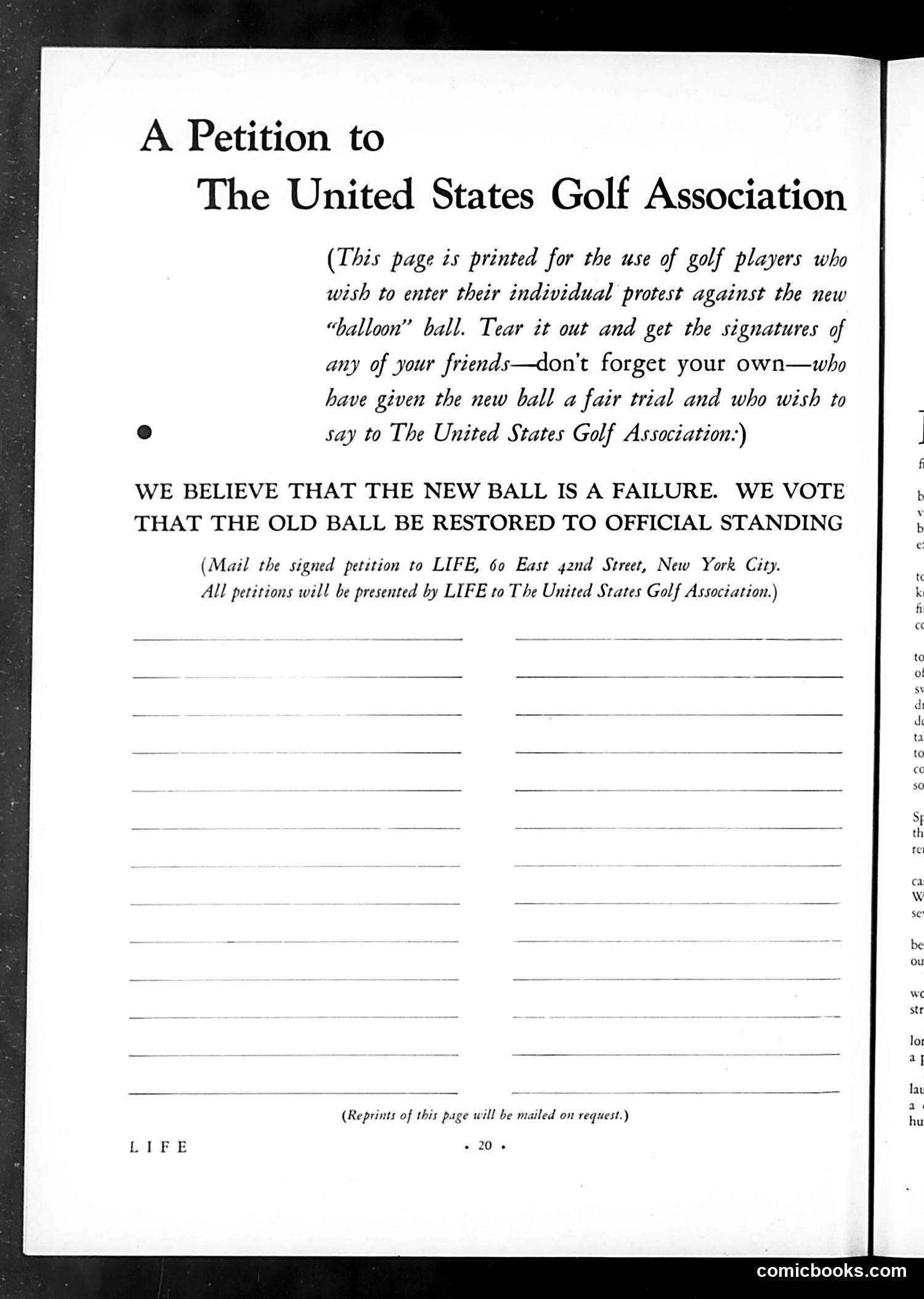
Life Magazine Golf Ball Petition (Context Explanation) This is not a cartoon but rather a petition template printed in Life magazine for readers to circulate among fellow golfers. The Issue: The United States Golf Association had introduced a new "balloon" ball—apparently a golf ball with different aerodynamic properties—that players disliked. Life magazine, functioning as a satirical advocate for traditional golf, printed this tear-out petition form to mobilize golfer opposition. The Satire: The humor lies in Life treating a *golf equipment dispute* with the gravity of a political campaign, complete with signature-gathering and formal petition procedures presented to an official sports body. The tone is mock-serious about an ultimately trivial matter. What readers would do: They'd collect signatures from golfers who agreed the new ball was inferior, then mail the petition to Life's offices, where the magazine would present them collectively to the golf association—amplifying amateur golfers' voices through media coordination.
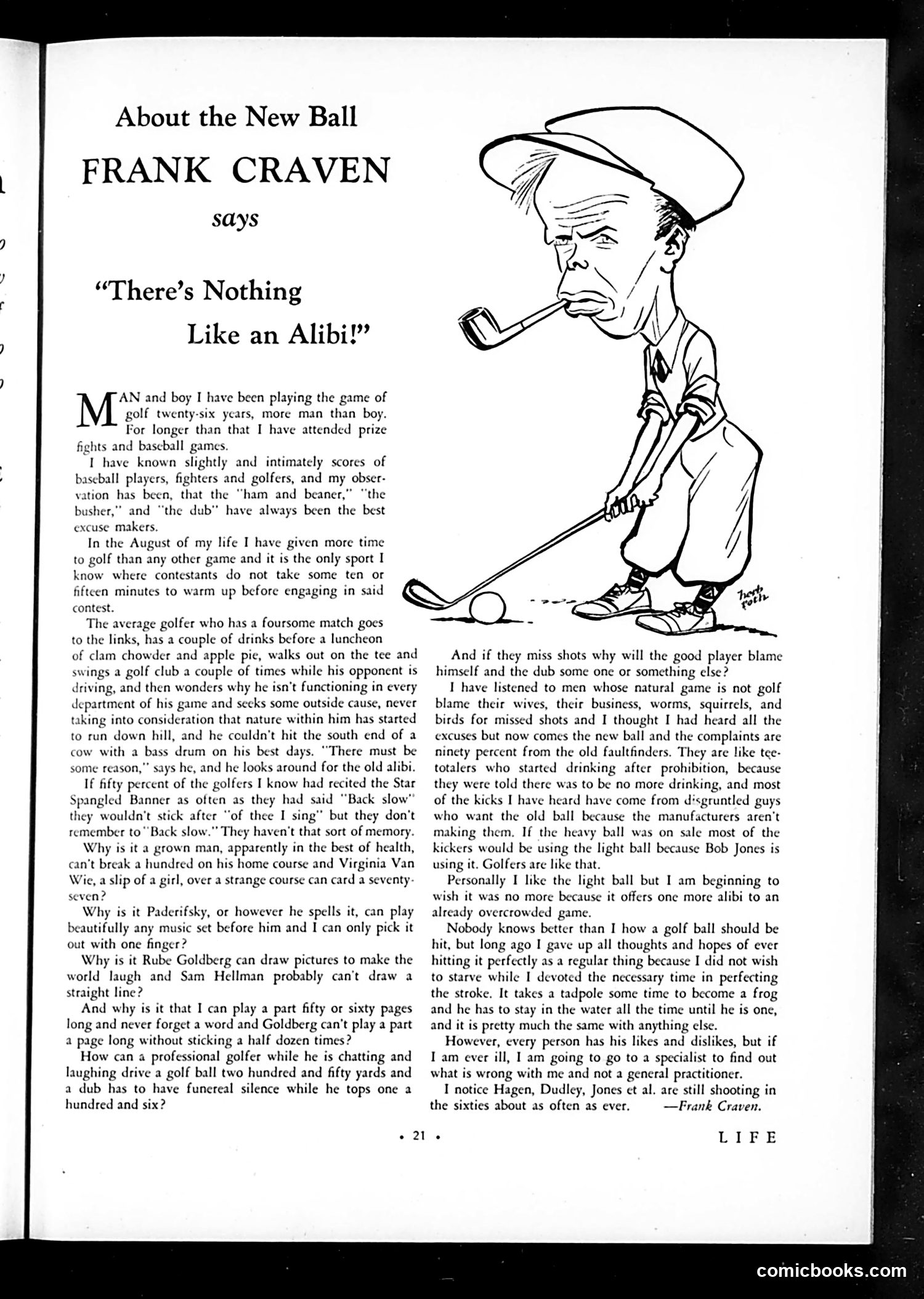
Explanation for Modern Readers This is an essay by actor Frank Craven (identifiable from the byline and caricature) about golf excuses, published in *Life* magazine during the era when a new golf ball design was introduced. Craven's central argument: golfers—especially poor ones—chronically blame external factors rather than themselves. He catalogs common alibis: "Back slow," wives, weather, squirrels, birds. Now, he notes, a new ball design has given golfers yet another excuse. The satire targets human nature generally through golf culture. Craven contrasts amateur golfers' endless excuses with professionals' self-accountability, and notes the hypocrisy: golfers who resisted the new ball under Prohibition now blame it for poor play, just as they'd blame the old ball if manufacturers still made it. He invokes celebrities (Paderewski, Rube Goldberg, Virginia Van Wie, Bob Jones) to show that talent requires dedication, not excuses. The essay's title—"There's Nothing Like an Alibi!"—captures the satirical thesis: human weakness for self-deception.
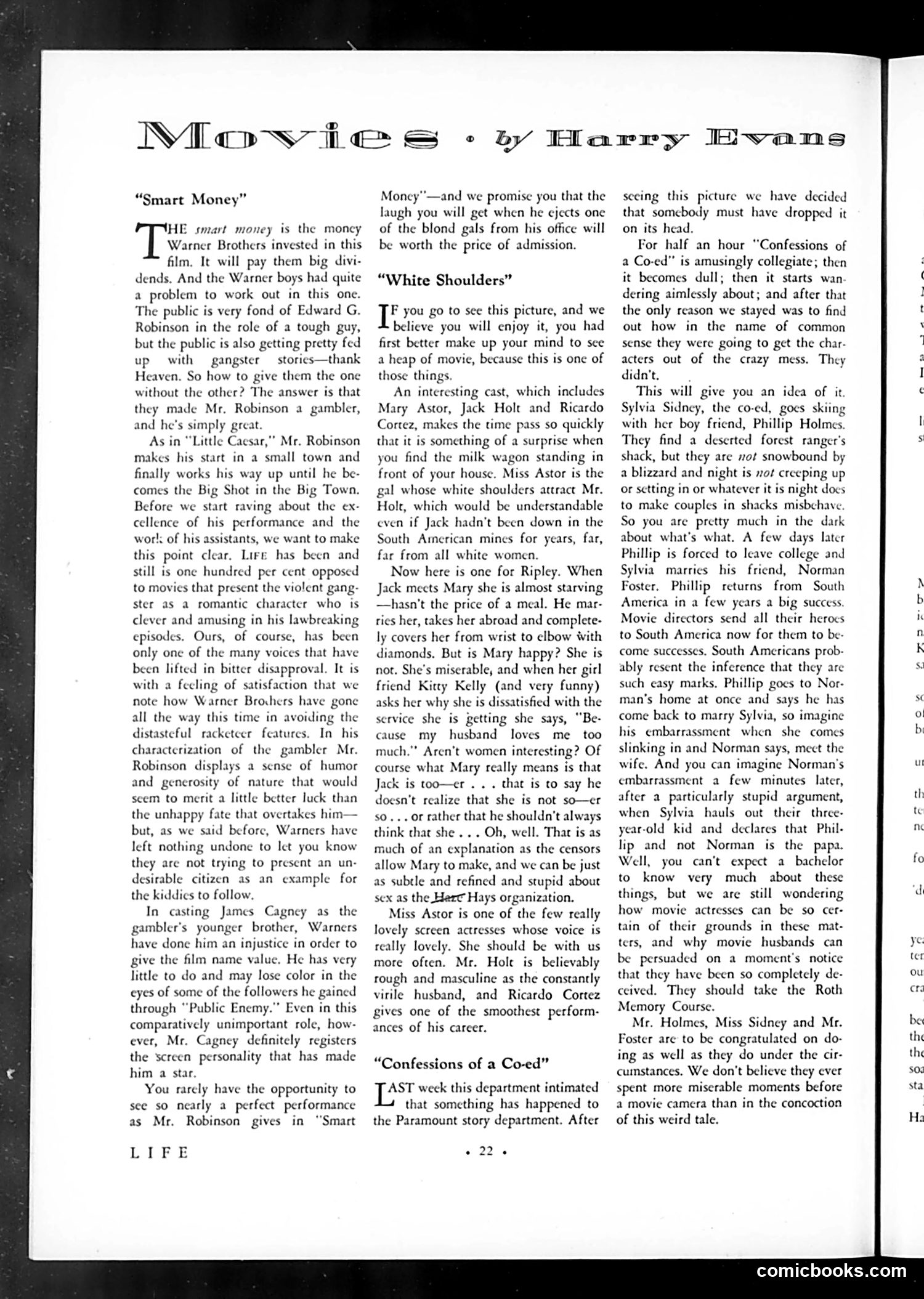
Life Magazine Movie Reviews, by Harry Evans This page contains film reviews of three 1920s movies. The text discusses: "Smart Money" — Edward G. Robinson plays a gambler (not a gangster), which the reviewer approves of, noting Life has opposed romanticizing violent criminals. Robinson's performance is praised as excellent. "White Shoulders" — A romantic drama starring Mary Astor and Jack Holt. The plot involves a woman dissatisfied despite her wealthy husband's lavish gifts. The reviewer humorously notes the censors restrict frank discussion of her actual complaint—that her husband is either too sexually eager or doesn't understand her needs. The vagueness itself becomes the joke, as the reviewer can only hint: "Jack is too—er..." and trails off with "Oh, well." The satire targets both 1920s film censorship's prudishness and the absurdity of trying to discuss marital intimacy while avoiding explicit language. The reviewer uses euphemistic language to mock those same restrictions.
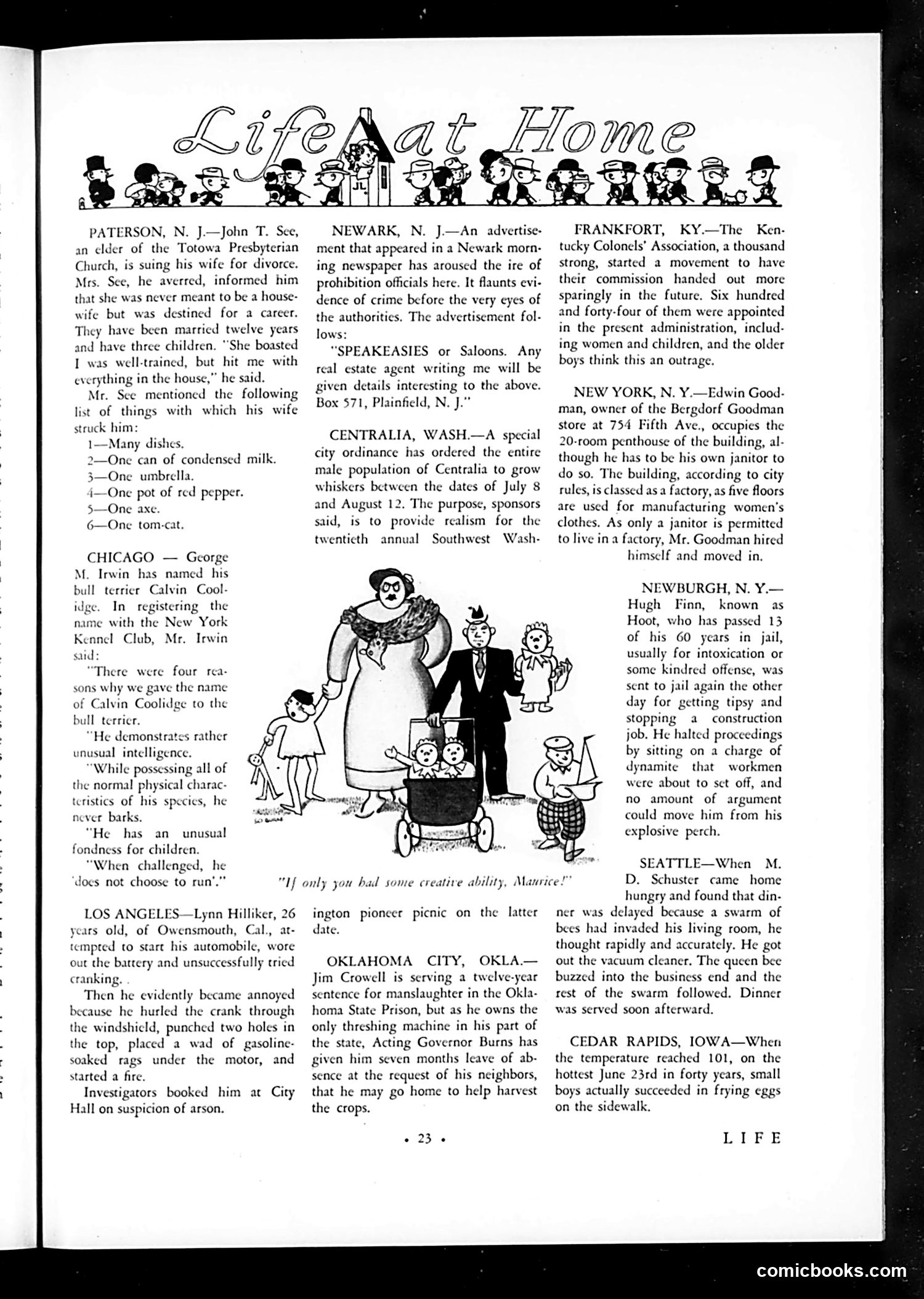
"Life at Home" Page Analysis This page from *Life* magazine presents satirical anecdotes mocking social absurdities of the era (appears to be 1920s-early 1930s based on references to Prohibition and Calvin Coolidge). Key satirical points: - Paterson divorce: A wife who rejects domesticity and fights back violently—satire on changing gender roles and women's ambitions beyond homemaking. - Chicago dog naming: The bull terrier "Calvin Coolidge" humorously mimics the silent, intelligent president's famous reserve ("does not choose to run" echoes Coolidge's 1928 non-candidacy announcement). - Newark speakeasy ad: Openly advertising illegal saloons mocks Prohibition's ineffectiveness and authorities' impotence. - The cartoon: Shows a woman surrounded by children; caption "If only you had some creative ability, Maurice!" satirizes domestic drudgery and women's frustration with motherhood. - Other items: Absurd local ordinances (mandatory whiskers, prisoner furloughs) mock small-town governance. The overall tone is lighthearted mockery of American social contradictions, legal failures, and changing domestic expectations.
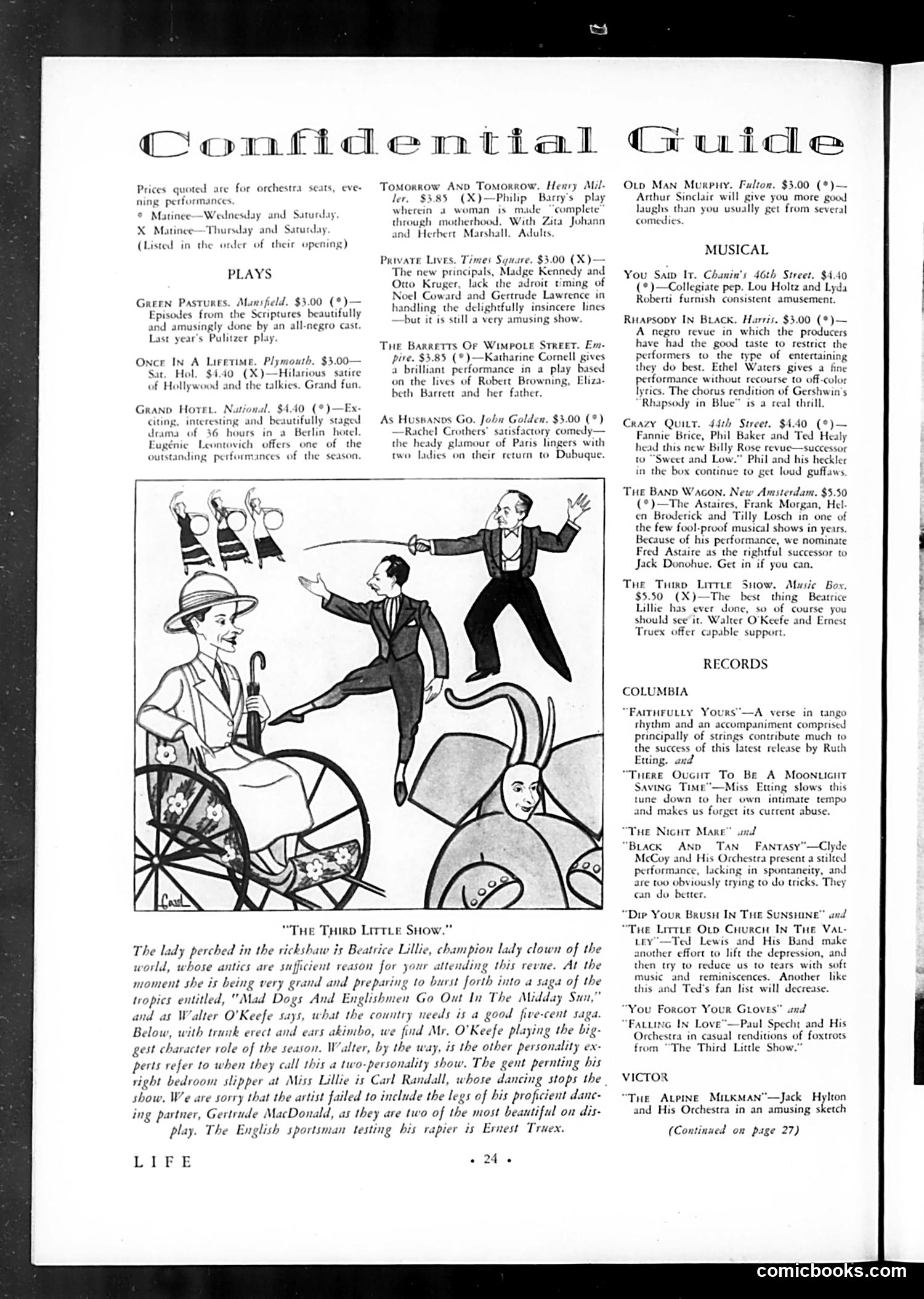
"The Third Little Show" - A Vaudeville Revue Guide This page is a theater guide from *Life* magazine reviewing Broadway shows. The large cartoon illustrates "The Third Little Show," a musical revue at the Music Box Theatre featuring Beatrice Lillie (the woman in the rickshaw), Walter O'Keefe (the man with the slipper), Carl Randall (dancing), and Ernest Truex (fencing). The satire is gentle—the cartoon's absurdist staging mocks the revue's variety format by stacking performers in surreal poses. The review emphasizes Lillie as the main attraction ("champion lady clown"), suggesting the show's appeal rests on individual star performances rather than cohesive narrative. The casual reference to Lillie's upcoming song about "Mad Dogs and Englishmen" reflects contemporary vaudeville humor. O'Keefe's dual role as performer and comedic personality is noted as the show's other draw. This represents 1920s-30s Broadway's star-driven musical entertainment model.
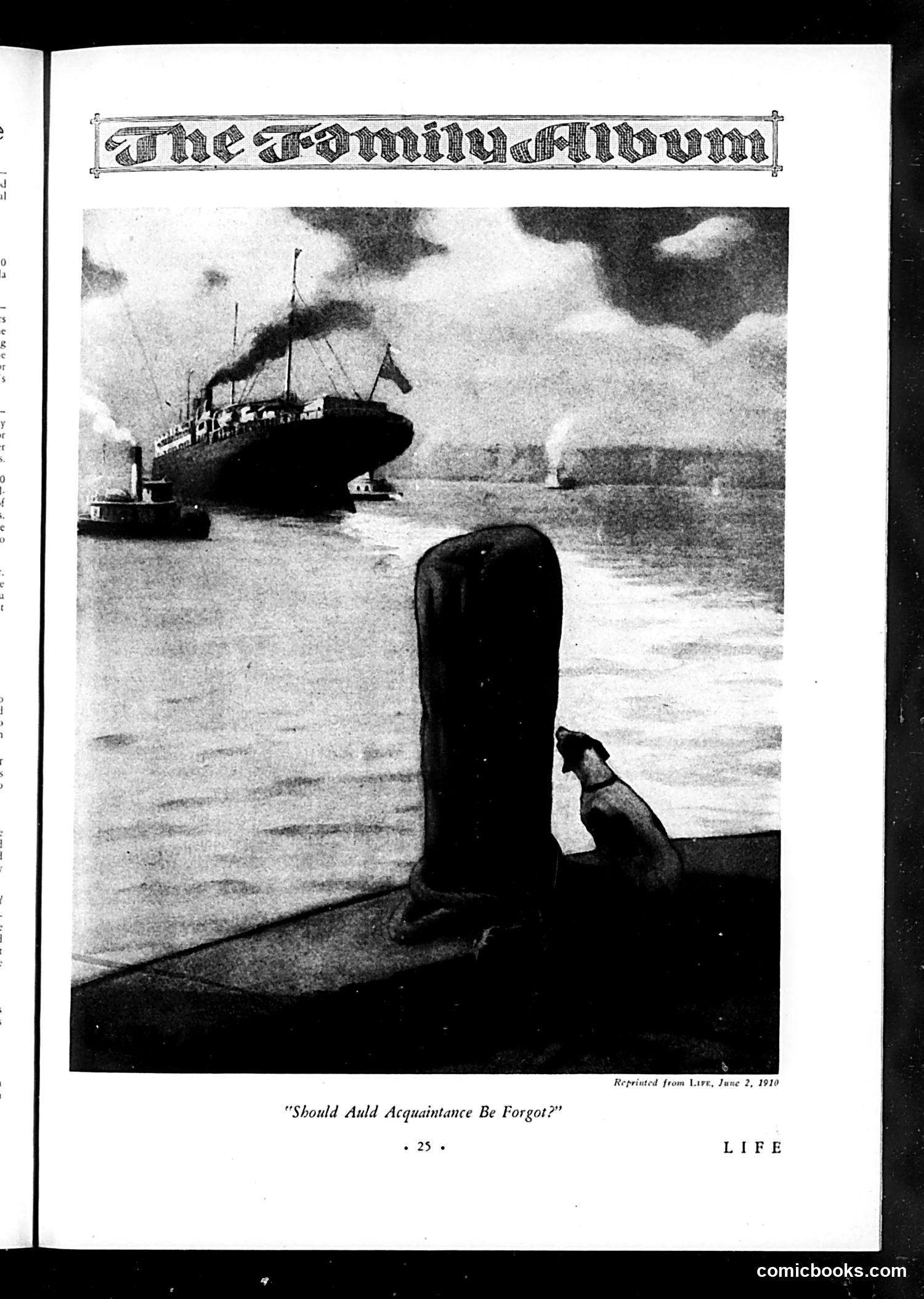
Explanation of "Should Auld Acquaintance Be Forgot?" This June 2, 1919 Life magazine illustration shows a silhouetted figure in the foreground gazing at a large steamship in a harbor, with smaller vessels nearby. The caption—quoting the famous Scottish song "Auld Lang Syne"—poses a rhetorical question about whether old friendships should be forgotten. Given the 1919 date (just after World War I's armistice), this likely comments on post-war relationships between nations or allies. The image appears to reflect on whether wartime bonds should persist in peacetime, or whether nations should move forward separately. The melancholic composition—the solitary observer watching the departing vessel—suggests nostalgia mixed with inevitable separation or change in international relations.
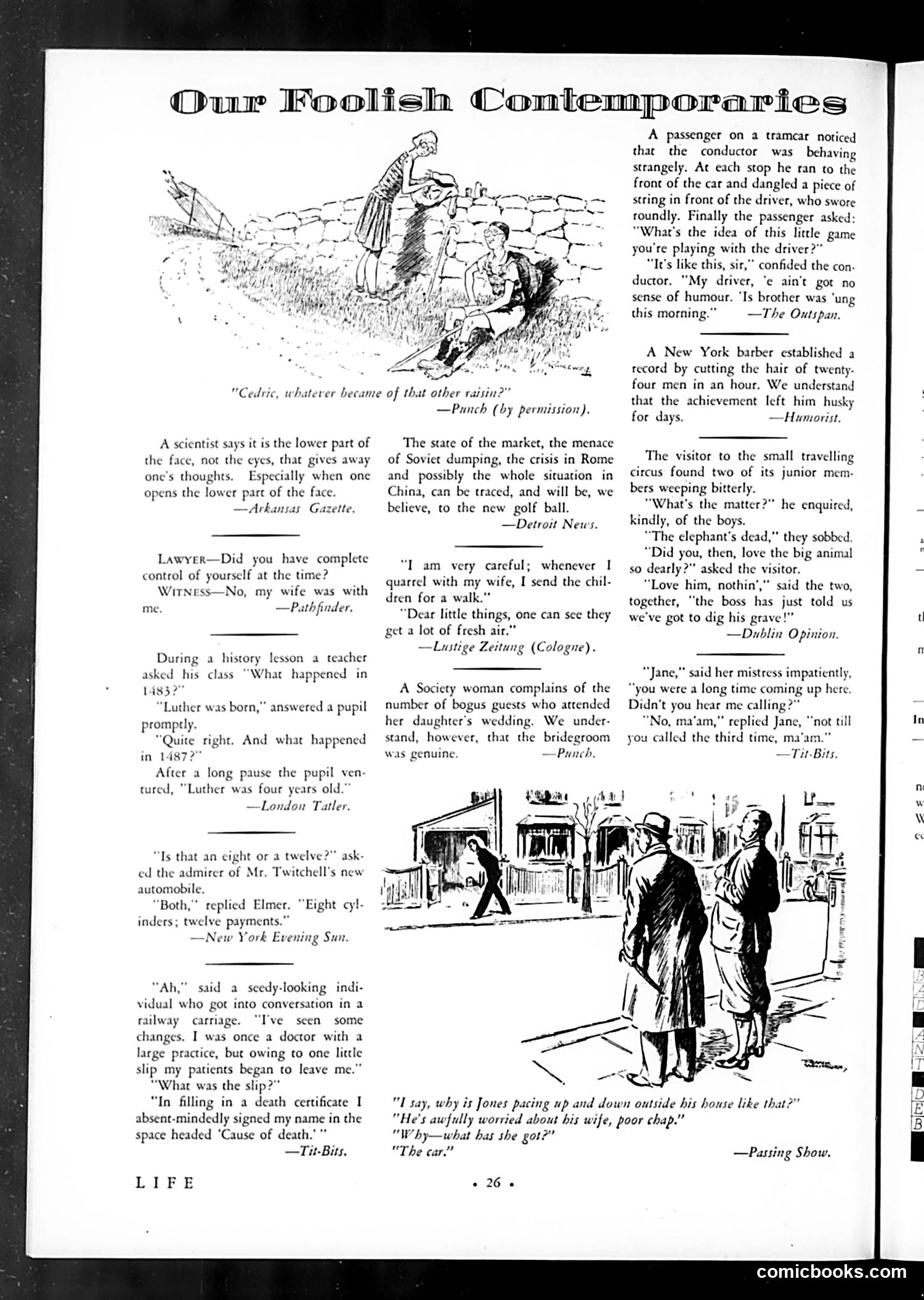
"Our Foolish Contemporaries" - Life Magazine Humor Page This is a collection of short satirical anecdotes mocking human foolishness across various social classes and situations. Key themes include: Marital dynamics: Wives controlling husbands' behavior; wives borrowing the family car, causing anxiety. Class commentary: A formerly successful doctor ruined by a clerical error; a barber exhausted by overwork; bogus wedding guests infiltrating society events. Professional absurdity: A tramcar conductor playing pranks on his driver to distract from his brother's execution; a circus owner forcing children to bury a dead elephant. Domestic servitude: A maid ignoring her mistress until called three times. The humor relies on irony, social observation, and the gap between people's stated motives and actual behavior. These were typical of *Life*'s satirical approach—gentle mockery of everyday life's contradictions and human nature's follies, drawn from various international sources (Punch, German publications, etc.).
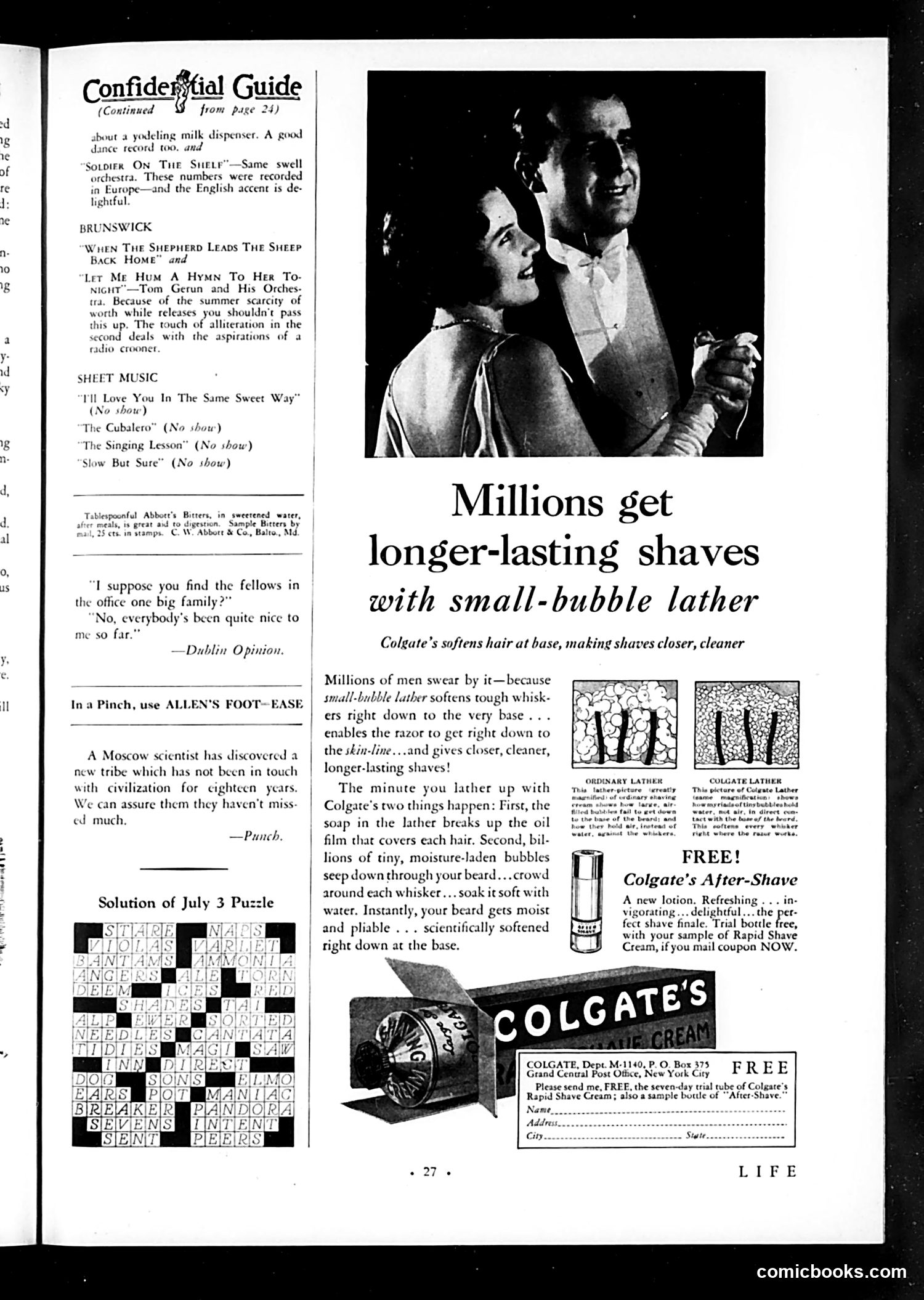
Page 27 of Life Magazine: Advertising and Entertainment Guide This page is primarily advertising and entertainment content, not satire or political commentary. The main feature is a Colgate shaving cream advertisement with product photography showing a man and woman in an intimate pose. The ad emphasizes the product's "small-bubble lather" technology, claiming it softens whiskers at the base for closer shaves. It includes a free sample offer. The left column contains a "Confidential Guide" to music releases (Brunswick records and sheet music) and reprints humorous quotes from other publications (*Punch*, *Dublin Opinion*). These are brief, mild jokes about office workplace dynamics and a Moscow discovery—typical light humor of the era. There's also a crossword puzzle solution and a small advertisement for Abbott's Bitters. No political cartoons or satire appear on this page. It's a standard magazine layout mixing entertainment reviews, humor reprints, and product advertising typical of 1930s *Life* magazine.
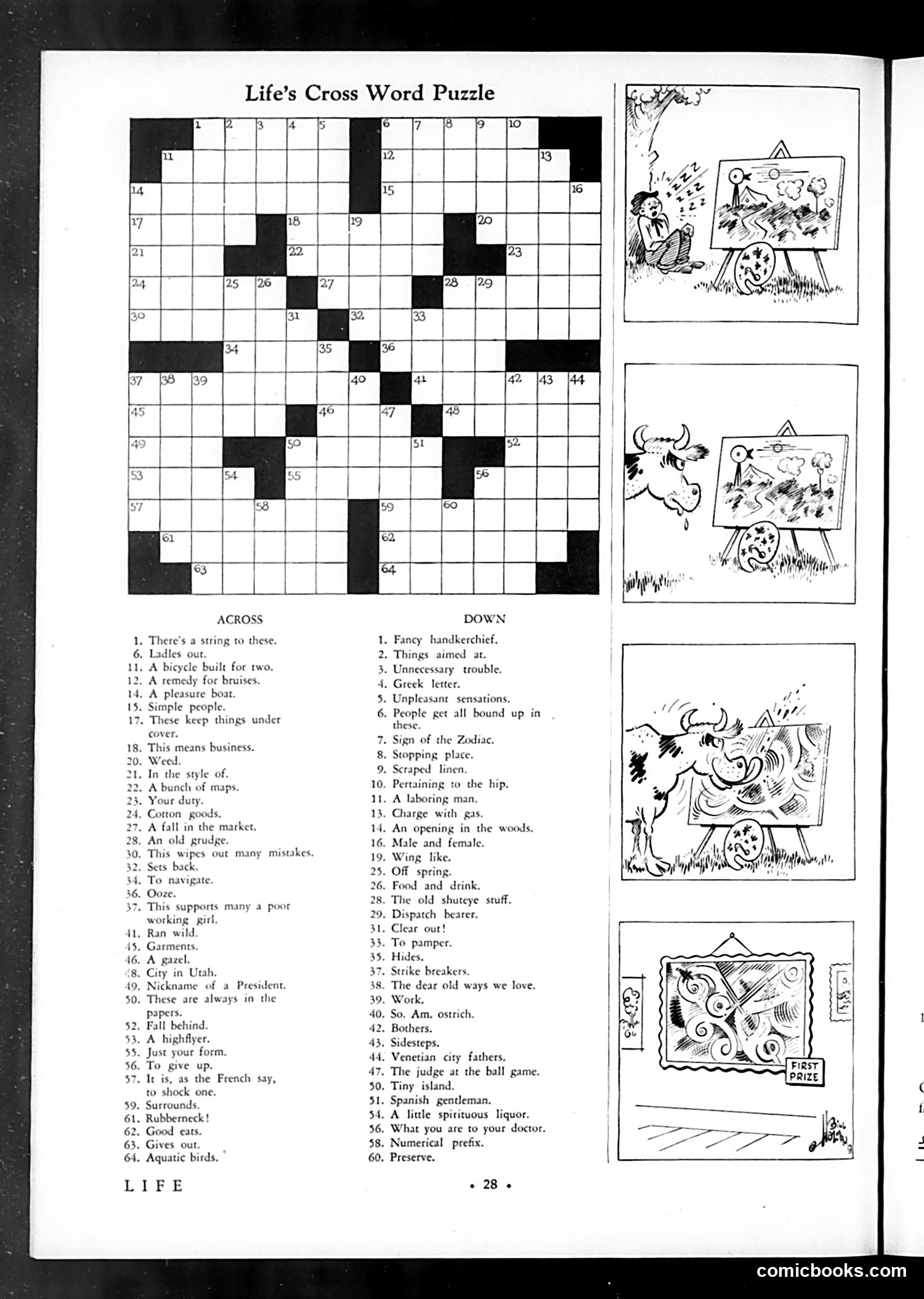
Life's Crossword Puzzle Analysis This page presents a crossword puzzle with accompanying cartoon illustrations—not political satire. The puzzle itself uses clever, punny clues typical of early 20th-century wordplay magazines. The four cartoon panels on the right show a person presenting artwork or ideas on an easel to others, with animals (appearing to be bulls or horned creatures) reacting to or observing the presentation. One panel is labeled "FIRST PRIZE," suggesting these illustrate humorous scenarios about art exhibition or creative presentation. The clues mix everyday references with gentle social commentary—mentions of "a poor working girl," "President" nicknames, and "strike breakers" suggest mild class-consciousness typical of *Life* magazine's satirical tradition, but the primary content is recreational rather than overtly political. This is entertainment for readers seeking mental exercise through wordplay and light humor, not advocacy journalism.
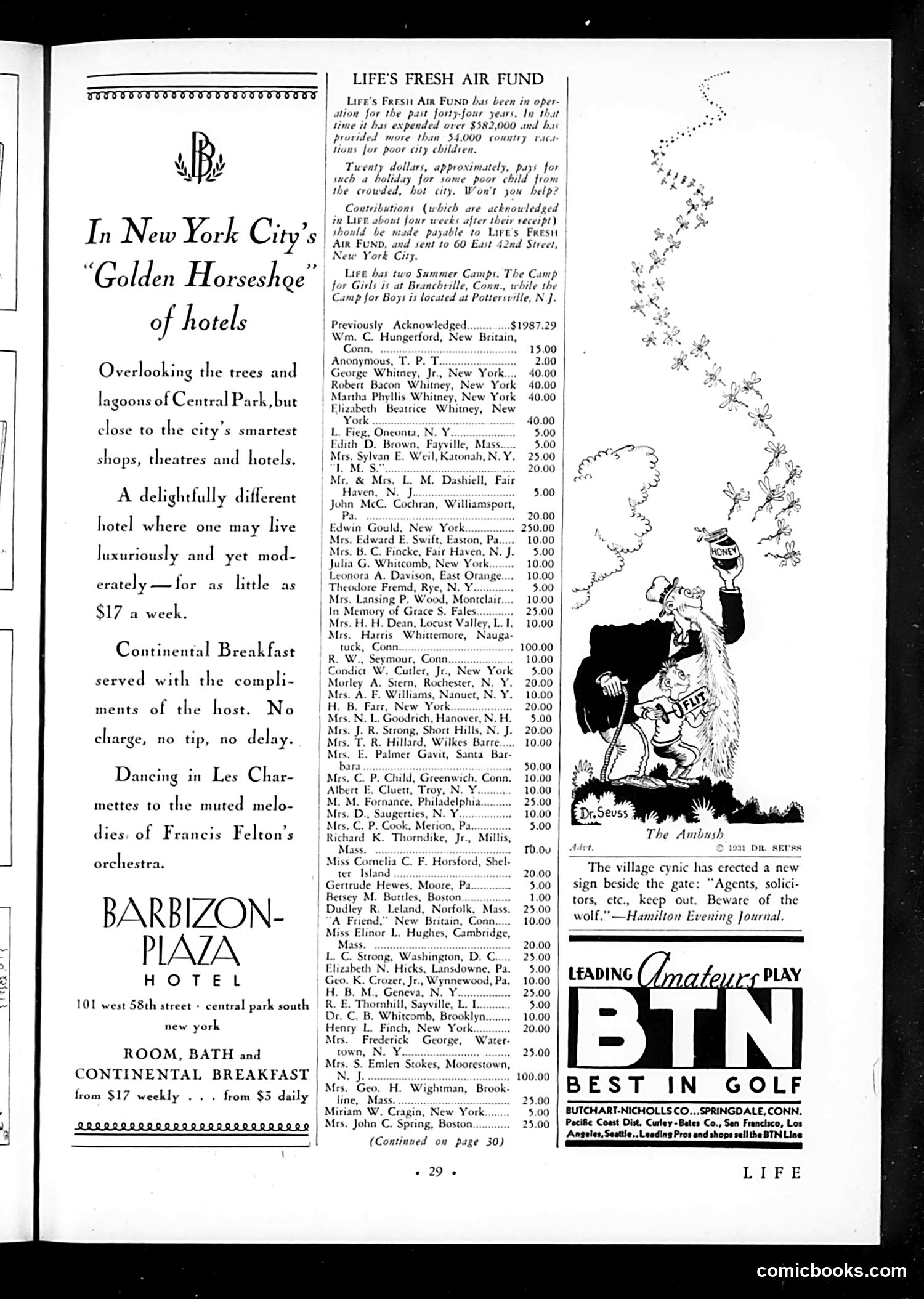
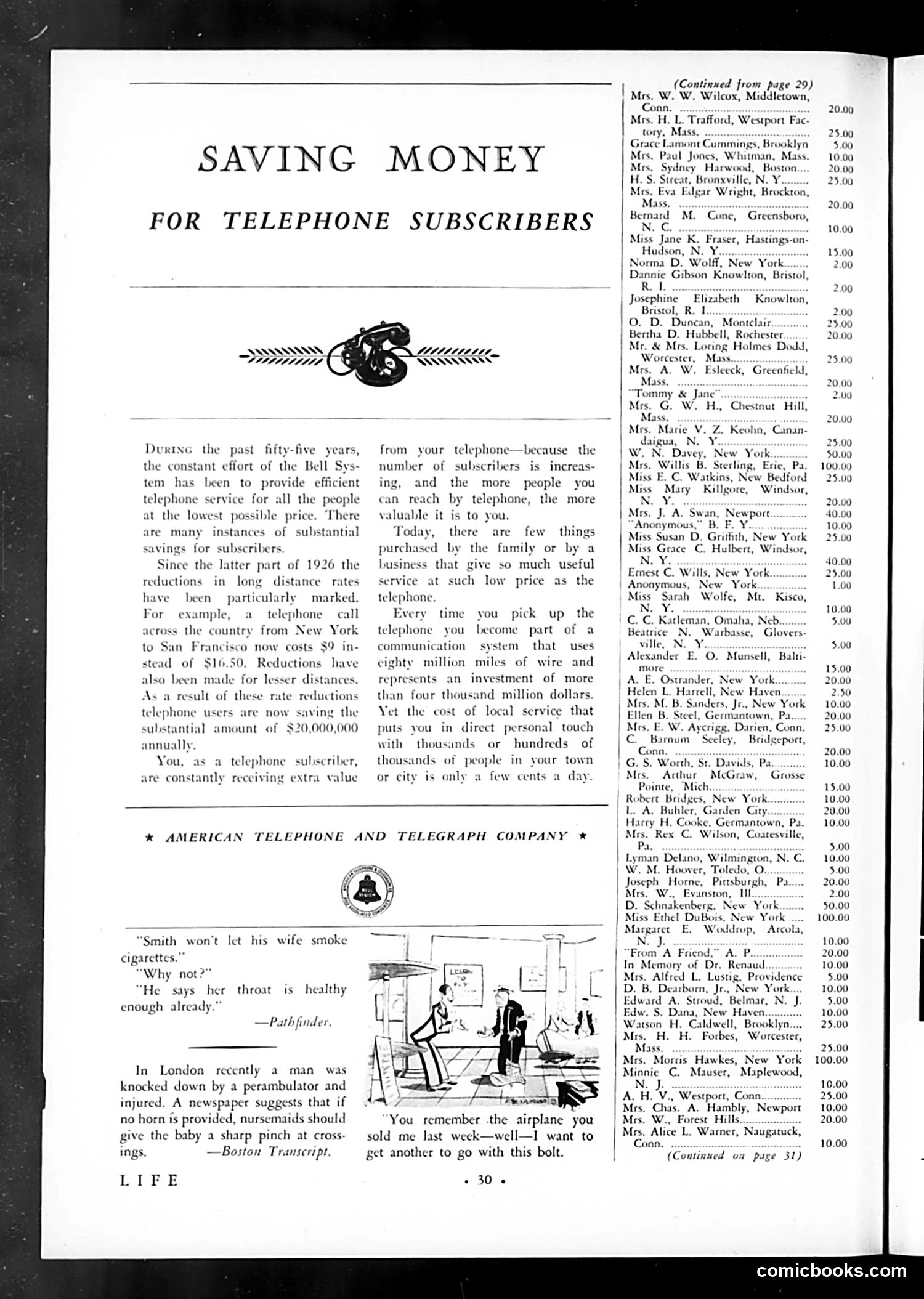
Analysis of This Life Magazine Page This page is primarily a corporate advertisement for American Telephone and Telegraph (AT&T), disguised as a public-interest article about "Saving Money for Telephone Subscribers." The Main Content: The article celebrates how Bell System telephone rates have dropped since 1926—long-distance calls from New York to San Francisco now cost $9 instead of $16.50. It argues subscribers benefit from the expanding network, which represents an investment of "more than four thousand million dollars." The pitch is that despite this enormous infrastructure, users pay only "a few cents a day" for service. The Cartoons: Two brief jokes appear: 1. A man won't let his wife smoke because "her throat is healthy enough already"—punching down at women's health concerns. 2. A customer returns to sell an airplane, wanting another "to go with this bolt"—a non-sequitur joke about absurd commercial logic, possibly mocking wartime profiteering or aircraft sales. The Context: This is 1920s-1930s advertorial content, blending corporate messaging with satirical humor. The right column lists donors (likely to some charitable cause), suggesting Life mixed advertising with philanthropic coverage.
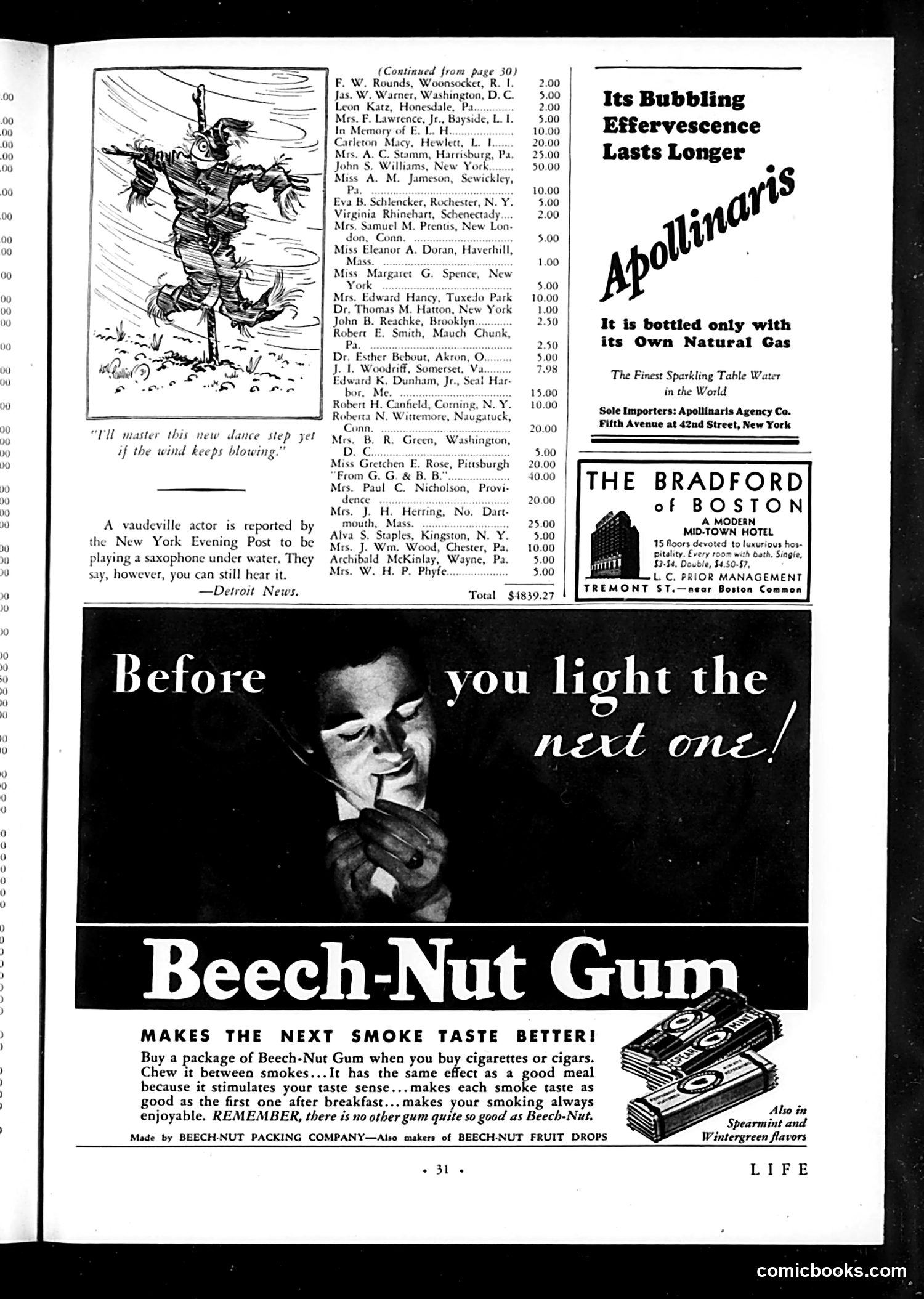
Life Magazine Page Analysis This page is primarily a donations list and advertisements, not political satire. The small cartoon at top-left depicts a figure dancing wildly with the caption "I'll master this new dance step yet if the wind keeps blowing"—likely mocking the Charleston or similar 1920s fad dances as silly and dependent on external factors. Below is a Detroit News anecdote joking that a vaudeville actor plays saxophone underwater, yet somehow remains audible—absurdist humor suggesting the impossibility of the claim. The bulk of the page comprises: - Continued donor names and amounts (appears to be a fundraising campaign) - Advertisement for Apollinaris sparkling water emphasizing its natural carbonation - Hotel advertisement for The Bradford of Boston - Beech-Nut Gum advertisement claiming chewing gum between cigarettes improves taste—typical early 20th-century product marketing. The page reflects 1920s consumer culture and charitable fundraising practices rather than political commentary.
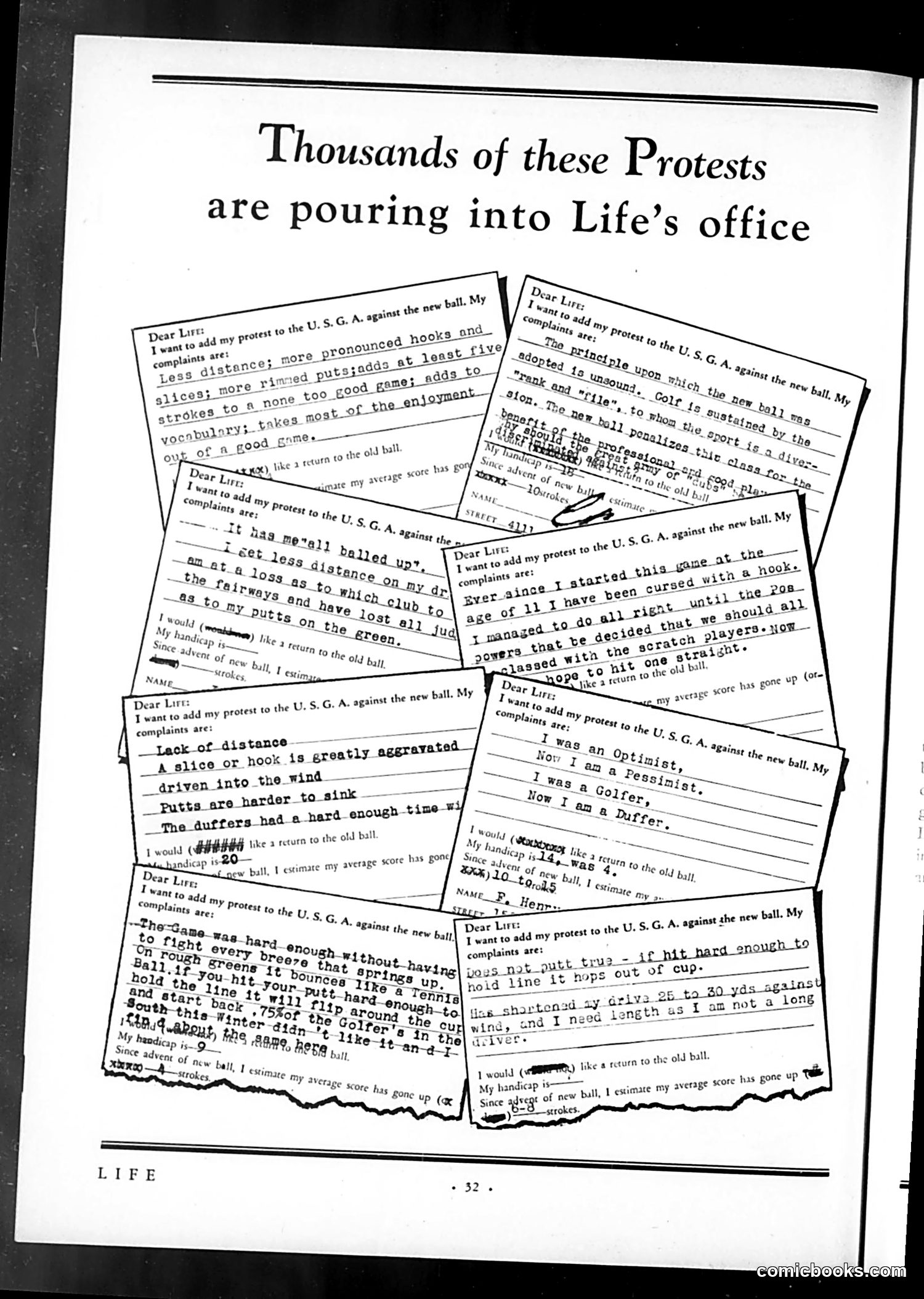
Explanation for Modern Readers This page satirizes golfers' complaints about a new golf ball introduced by the U.S. Golf Association (USGA). The publication presents mock "protest letters" supposedly flooding Life magazine's offices, all following a template: "Dear Life: I want to add my protest to the U.S.G.A. against the new ball." The humor lies in the contradictory complaints. Golfers claim the ball reduces distance, causes slices, drives into wind, makes putts harder—yet simultaneously blame it for increasing their handicaps and ruining their game. The satire mocks golfers' tendency to blame equipment rather than admit their own poor play. Each letter includes checkboxes for standardized grievances, further ridiculing the repetitive nature of these excuses. This reflects a real 1930s-40s controversy about USGA ball specifications, but the cartoon's point transcends that era: people instinctively externalize failure, attacking new rules or equipment rather than accepting personal responsibility.
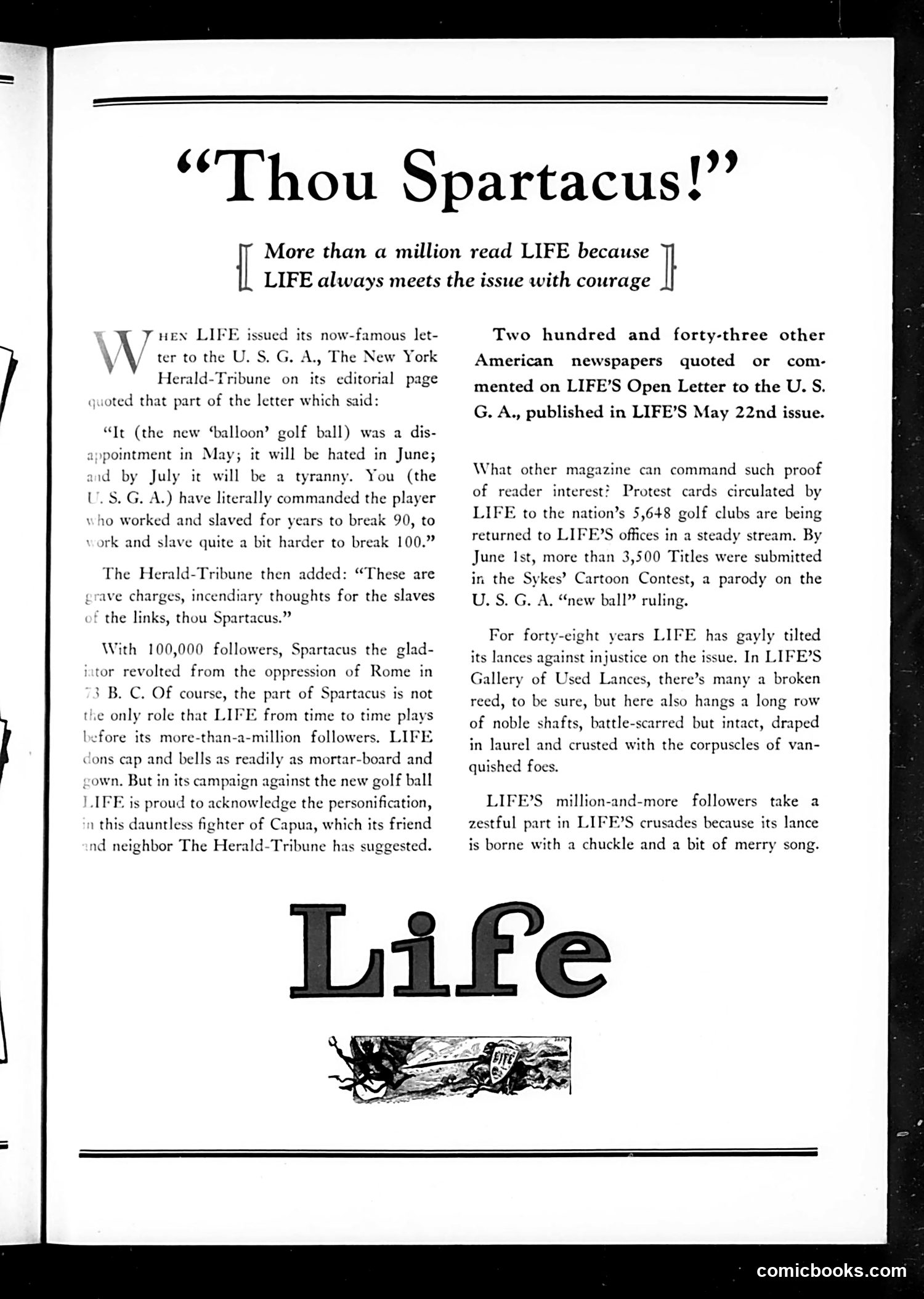
"Thou Spartacus!" – Life Magazine Self-Promotion This is a self-advertisement for *Life* magazine, not a cartoon. It celebrates the magazine's influence by comparing itself to the legendary gladiator Spartacus. The Context: Life published an open letter criticizing the U.S. Golf Association's new "balloon" golf ball, arguing it unfairly punished amateur golfers who'd trained with older equipment. The Herald-Tribune sarcastically called Life "Spartacus"—evoking the enslaved gladiator who led a famous Roman rebellion—for championing the "oppressed" golfers against authority. The Joke: Life embraces this comparison proudly, claiming over a million readers and celebrating that 243 newspapers covered its letter and thousands of golf clubs sent protest cards. The ad argues only Life could generate such reader engagement because it crusades against injustice "with a chuckle and a bit of merry song." Why It Matters: This demonstrates how *Life* positioned itself as both a satirical publication and a powerful voice for consumer advocacy—proving its cultural influence through the golf ball controversy's reach.
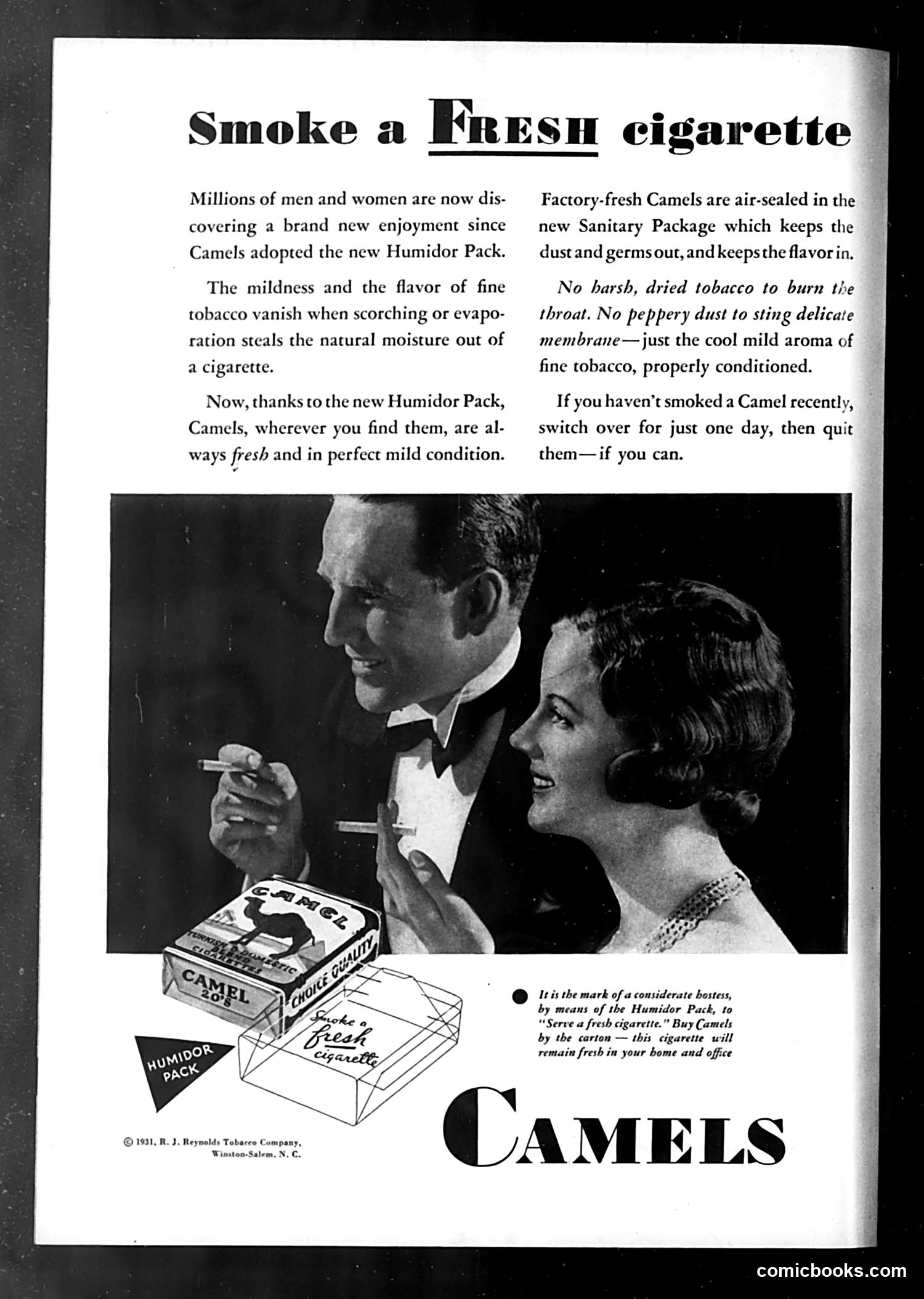
Analysis This is a cigarette advertisement, not satire or political commentary. It promotes Camel cigarettes' new "Humidor Pack" packaging (introduced 1931). The image shows an elegantly dressed couple at what appears to be a social gathering—the man smoking, the woman observing approvingly. This reflects period advertising conventions: affluent, sophisticated consumers endorsing the product. The ad's central claim is that the hermetically sealed Humidor Pack keeps cigarettes fresh by maintaining moisture, preventing the tobacco from drying out and losing flavor. The text emphasizes this packaging innovation as a mark of being a "considerate hostess" who serves fresh cigarettes to guests. The tagline "switch over for just one day, then quit them—if you can" attempts humor by implying the product is so superior that smokers won't *want* to quit—a normalcy-era marketing approach that would be unthinkable in modern cigarette advertising. This is straightforward commercial promotion from the early 1930s.

I appreciate your request, but I must be honest: the image provided is almost entirely black with only a white margin visible on the left side and a "comicbooks.com" watermark at the bottom. The OCR text appears to be only the watermark/source attribution. I cannot discern any cartoon figures, caricatures, text content, or satirical imagery from this image to analyze historically. The page content is either not visible due to image quality/darkness, or this may be a blank or back cover page. To provide the historical analysis you're requesting, I would need a clearer, more legible version of the original Life magazine page showing the actual cartoon or content.