life
Life — July 17, 1931
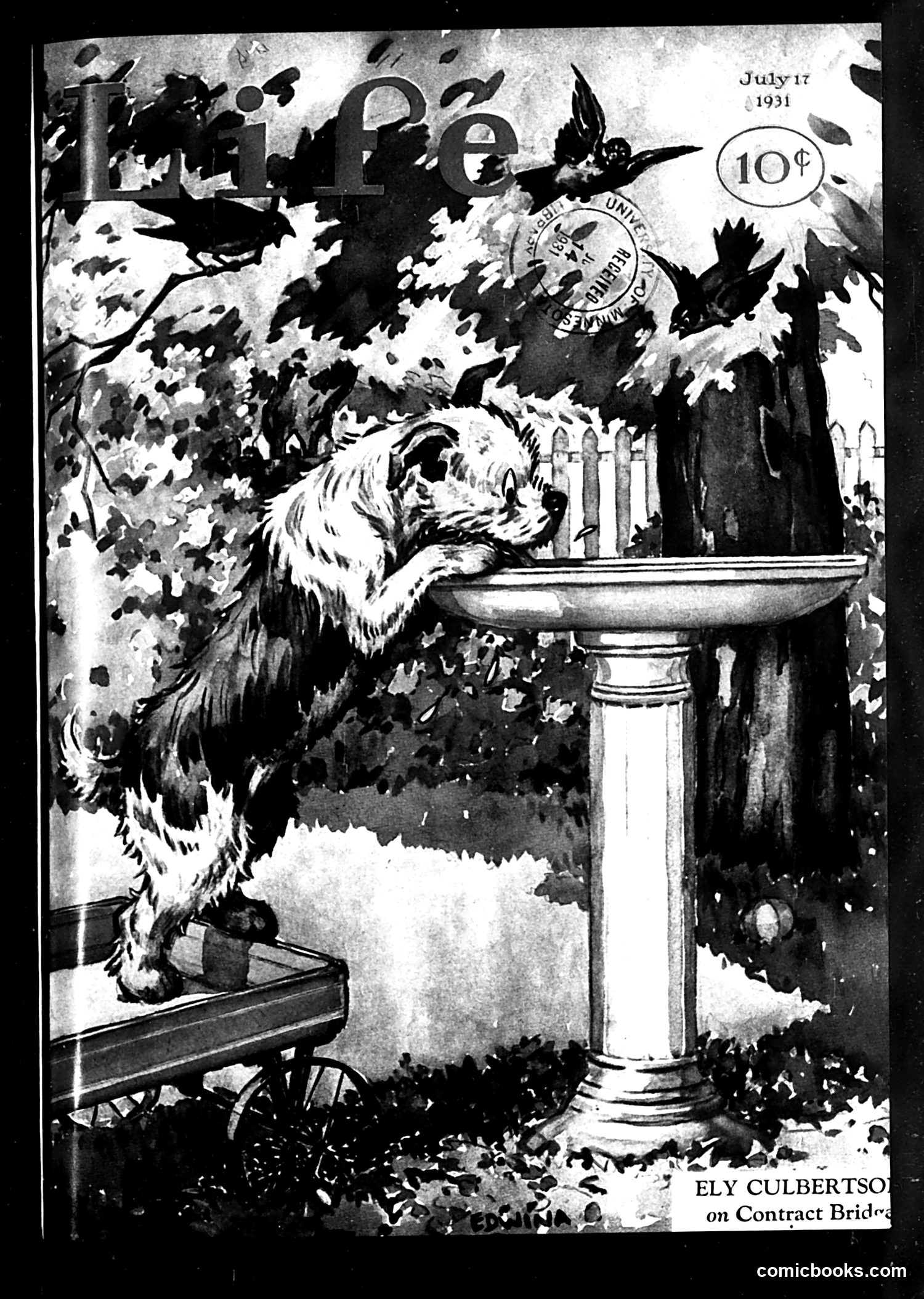
Life Magazine Cover Analysis July 17, 1931 This cover illustration by Ely Culbertson depicts a dog drinking from a birdbath in a garden. The title references "Contract Bridge," indicating this is about the card game. The satire appears to target bridge's popularity during the early 1930s. The dog—standing upright on hind legs in an absurdly human manner—suggests how obsessively people were adopting bridge, even to ridiculous extremes. The formal garden setting and the dog's dignified posture create comic incongruity: a animal behaving with human refinement. Culbertson was a famous bridge expert of the era, so this likely mocks the bridge craze he helped popularize. The message seems to be that Americans had become so devoted to contract bridge that even dogs were adopting the pastime—a humorous exaggeration of the game's widespread social influence.
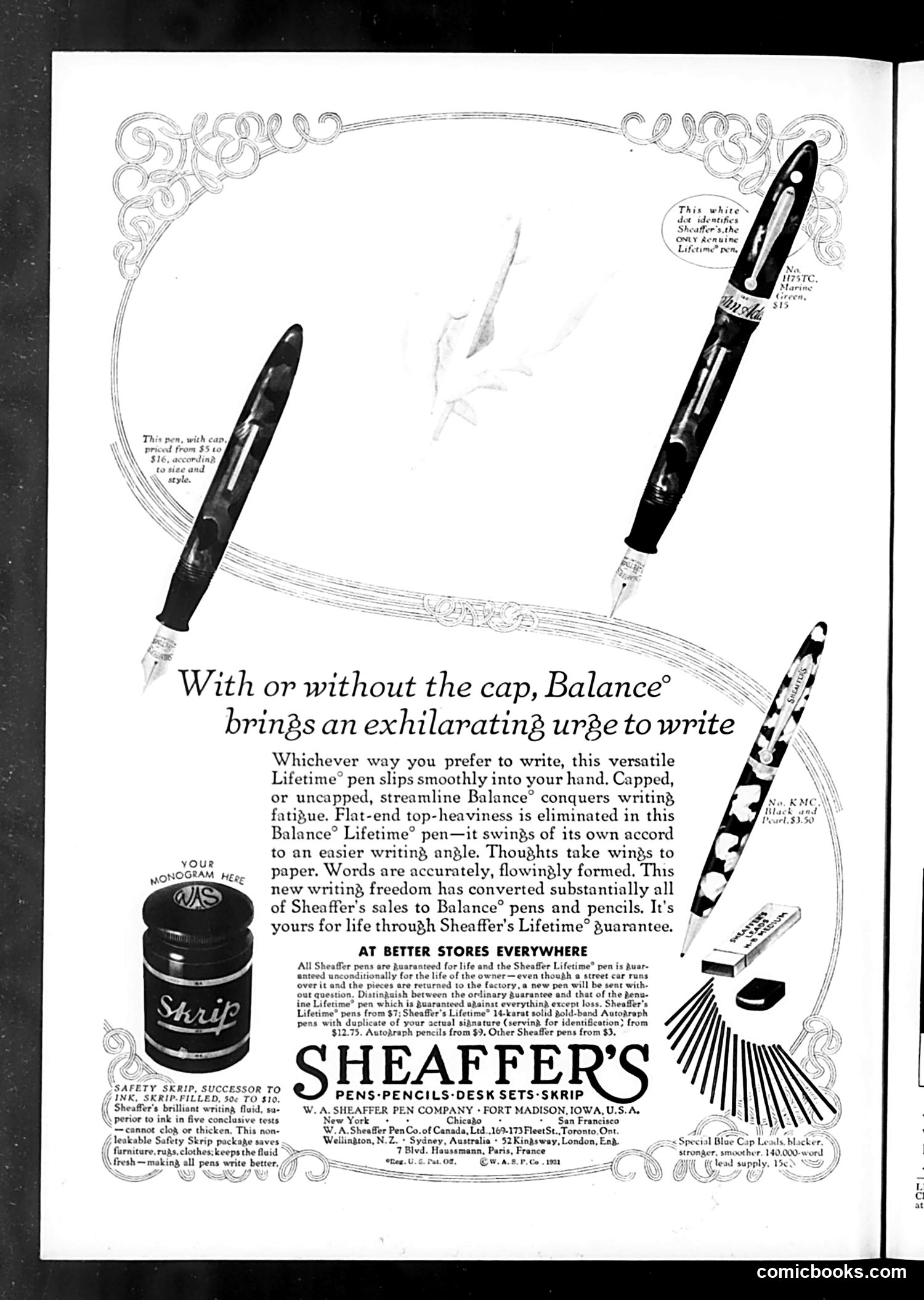
Analysis This is not a political cartoon or satire—it's a full-page advertisement for Sheaffer's Balance fountain pens and pencils. The page showcases three writing instruments with decorative flourishes and includes testimonial text praising the pens' versatility ("with or without the cap") and smooth writing quality. There's also an image of Sheaffer's Scrip ink bottle. The ad emphasizes the "Lifetime" guarantee and the pens' ability to adapt to different writing angles without fatigue. The ornamental border design and italic typography reflect the aesthetic conventions of early 20th-century advertising. No political figures, satire, or social commentary are present—this is straightforward commercial promotion appearing in Life magazine's pages.
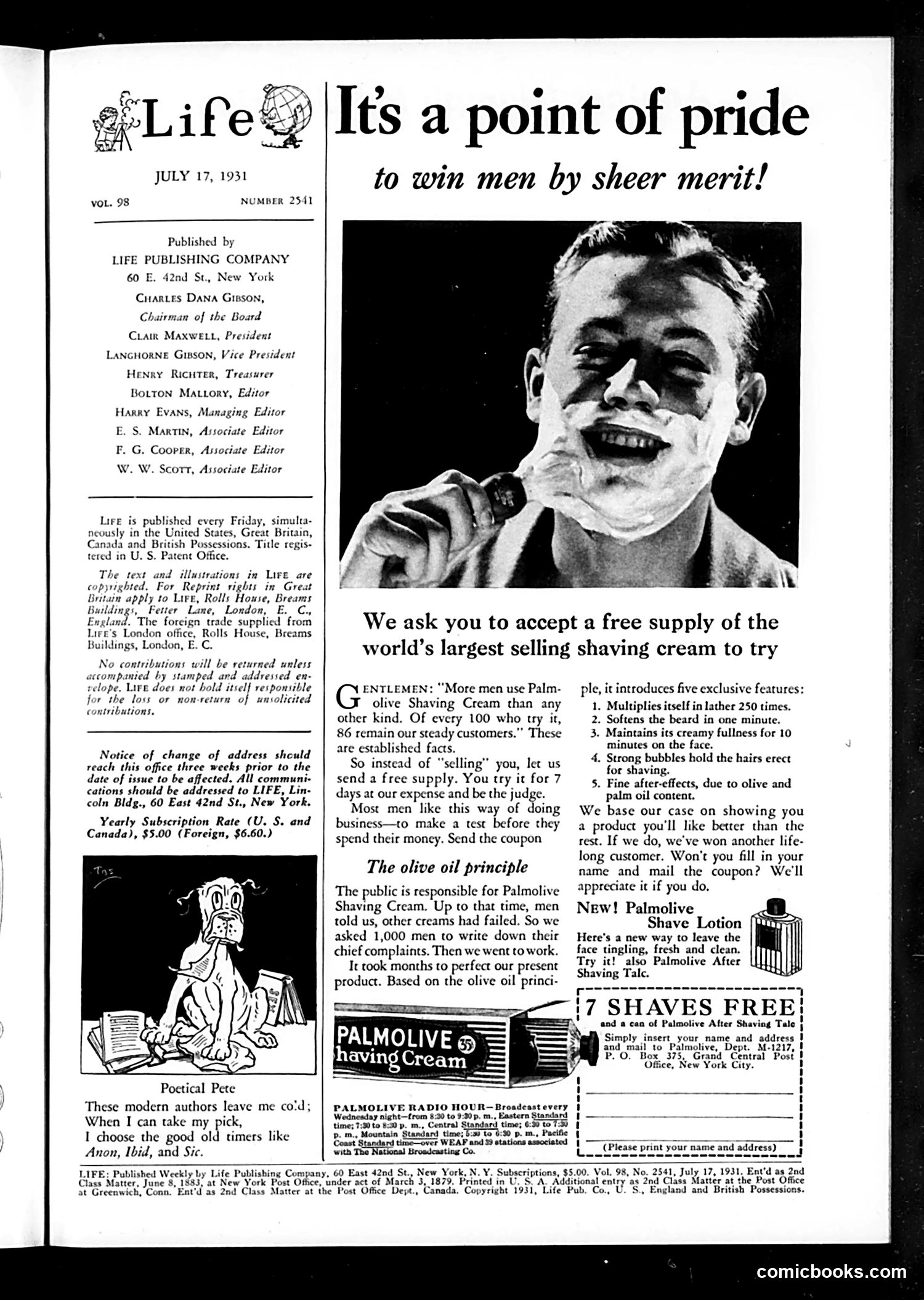
Analysis: Life Magazine, July 17, 1931 This page is primarily a Palmolive Shaving Cream advertisement disguised as editorial content. The main image shows a man enthusiastically holding a razor, smiling broadly while endorsing the product. The satirical element appears in the "Poetical Pete" cartoon (lower left), which shows a disheveled dog reading rejection letters. The accompanying verse mocks struggling writers who romanticize poverty: "These modern authors leave me cold; When I can take my pick, I choose the good old timers like Anon, Ibid, and Src." The joke critiques contemporary authors who affect struggling-artist personas while claiming to work from purer motives than classic, anonymous literature. The Palmolive ad itself uses pseudo-scientific claims about "olive oil principle" and consumer testimonials—typical 1930s advertising tactics before modern regulation.
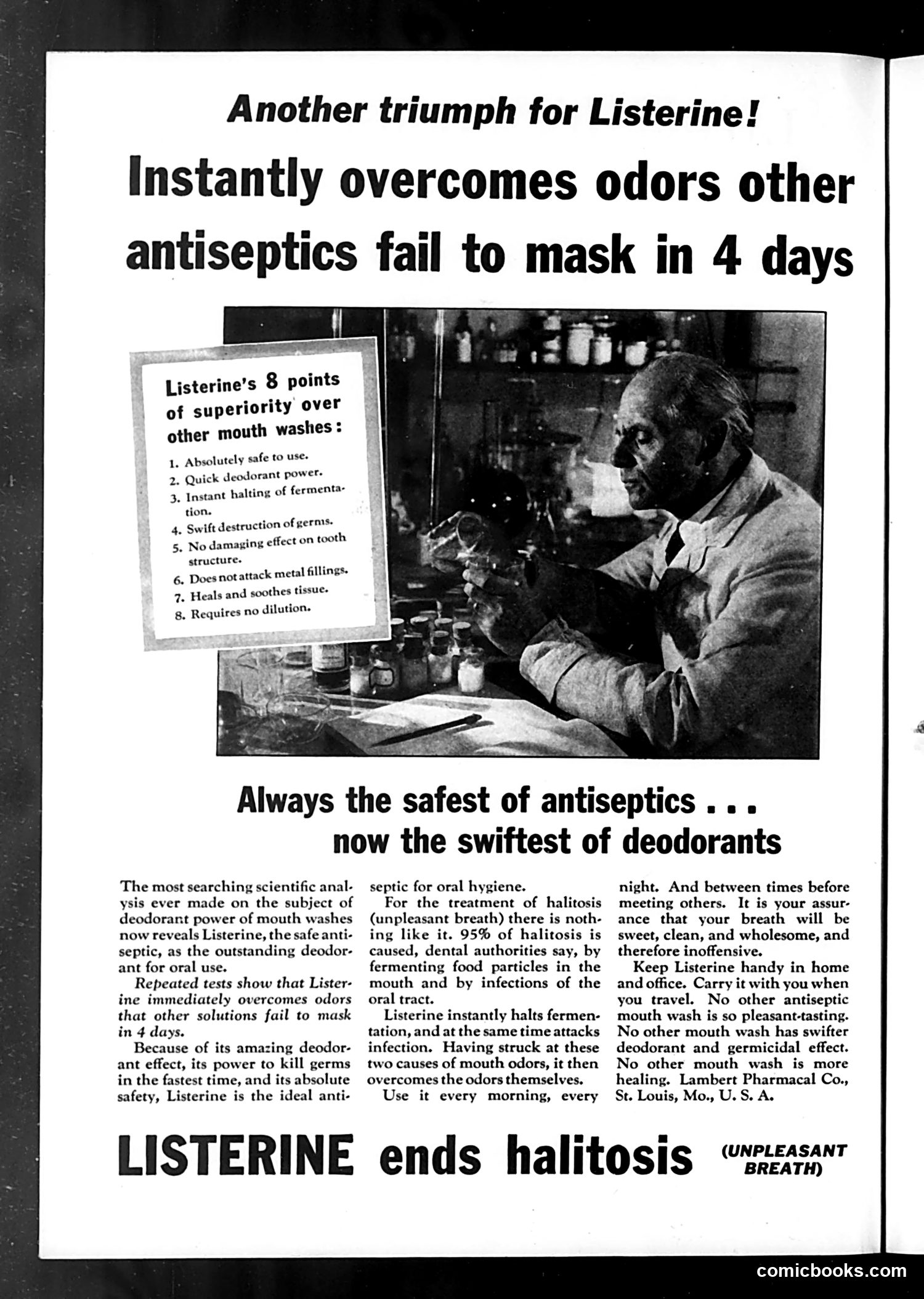
Analysis This is a Listerine advertisement, not political satire or a cartoon. The page promotes Listerine mouthwash as a deodorant and antiseptic for oral hygiene. The central image shows a man in what appears to be a laboratory or professional setting, examining a bottle of Listerine. The ad claims Listerine "instantly overcomes odors other antiseptics fail to mask in 4 days" and lists "8 points of superiority." The advertisement addresses "halitosis" (bad breath), positioning Listerine as uniquely effective. The language emphasizes scientific authority ("most searching scientific analysis") and promises the product prevents social embarrassment from unpleasant breath. This reflects early-twentieth-century marketing that often manufactured health anxieties to sell products—a technique still common today.
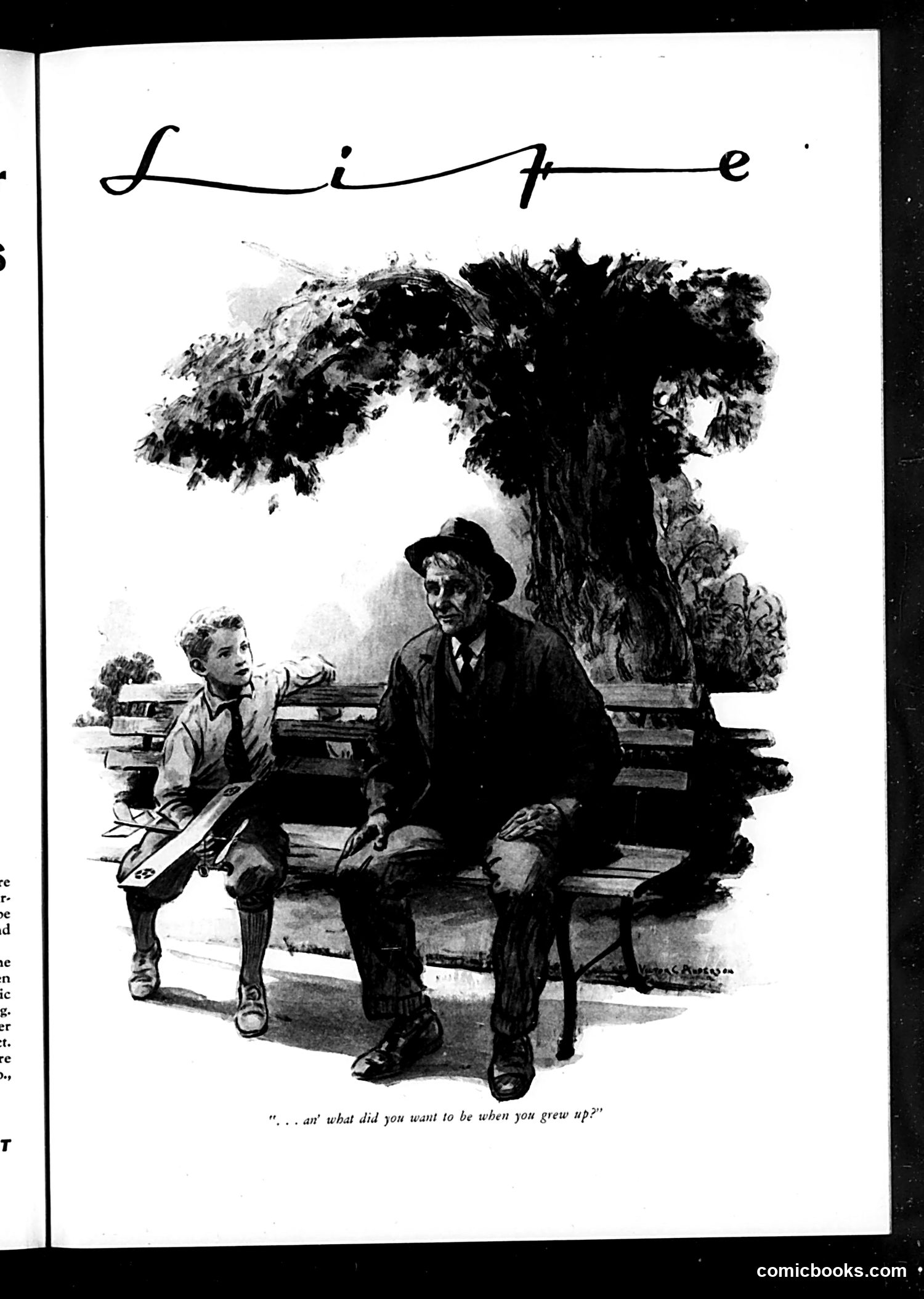
Analysis of "Life" Magazine Page This page features a single illustration titled "Life" showing two figures—an adult man and a young boy—sitting on a bench beneath a large tree. The caption reads: "...air' what did you want to be when you grow up?" The cartoon appears to be a gentle, sentimental piece about childhood aspirations. The setting suggests a park or countryside scene. The artwork style and composition suggest this is likely a nostalgic reflection on how children's dreams evolve with age, or possibly commentary on interrupted or altered life plans—a common theme in early-to-mid 20th century American humor magazines. Without additional context or visible date information, the specific historical reference remains unclear, though the formal dress and illustration style suggest early-to-mid 1900s publication.
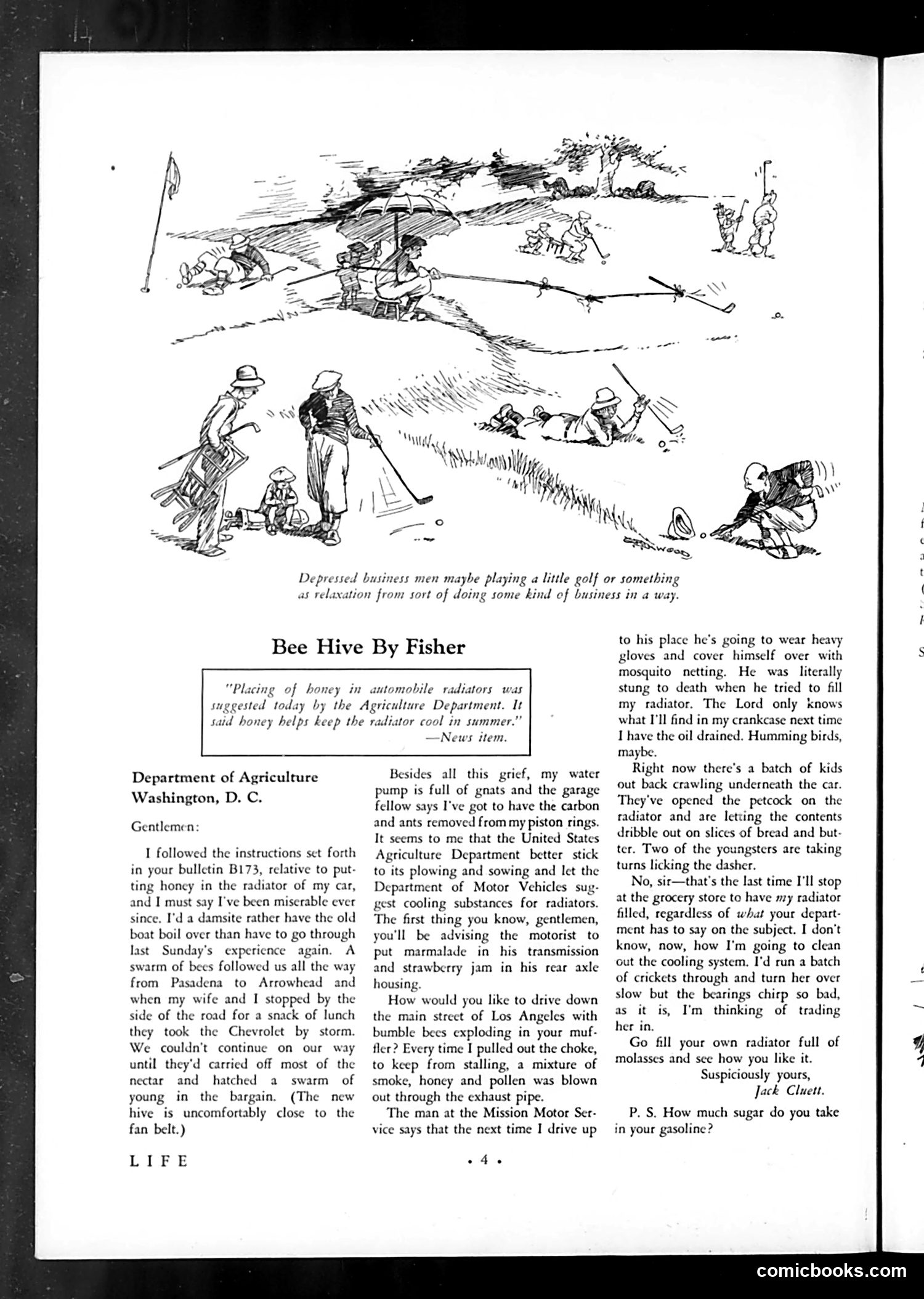
"Bee Hive By Fisher" - Life Magazine Satire The cartoon depicts businessmen relaxing by playing golf, illustrating the column's humorous premise: putting honey in car radiators (suggested by the Agriculture Department as a cooling agent). The letter from "Jack Cluett" describes absurd consequences of this advice—bees swarming his car, gnats in the water pump, ants in the piston rings. He details escalating chaos: children licking the radiator cap, and requests to drive down Los Angeles streets with "bubbles exploding in your radiator." The satire mocks both the Agriculture Department's impractical wartime suggestion and the comedic desperation of motorists trying novel solutions during what appears to be a materials shortage. The joke relies on the ridiculousness of literal implementation of official advice.
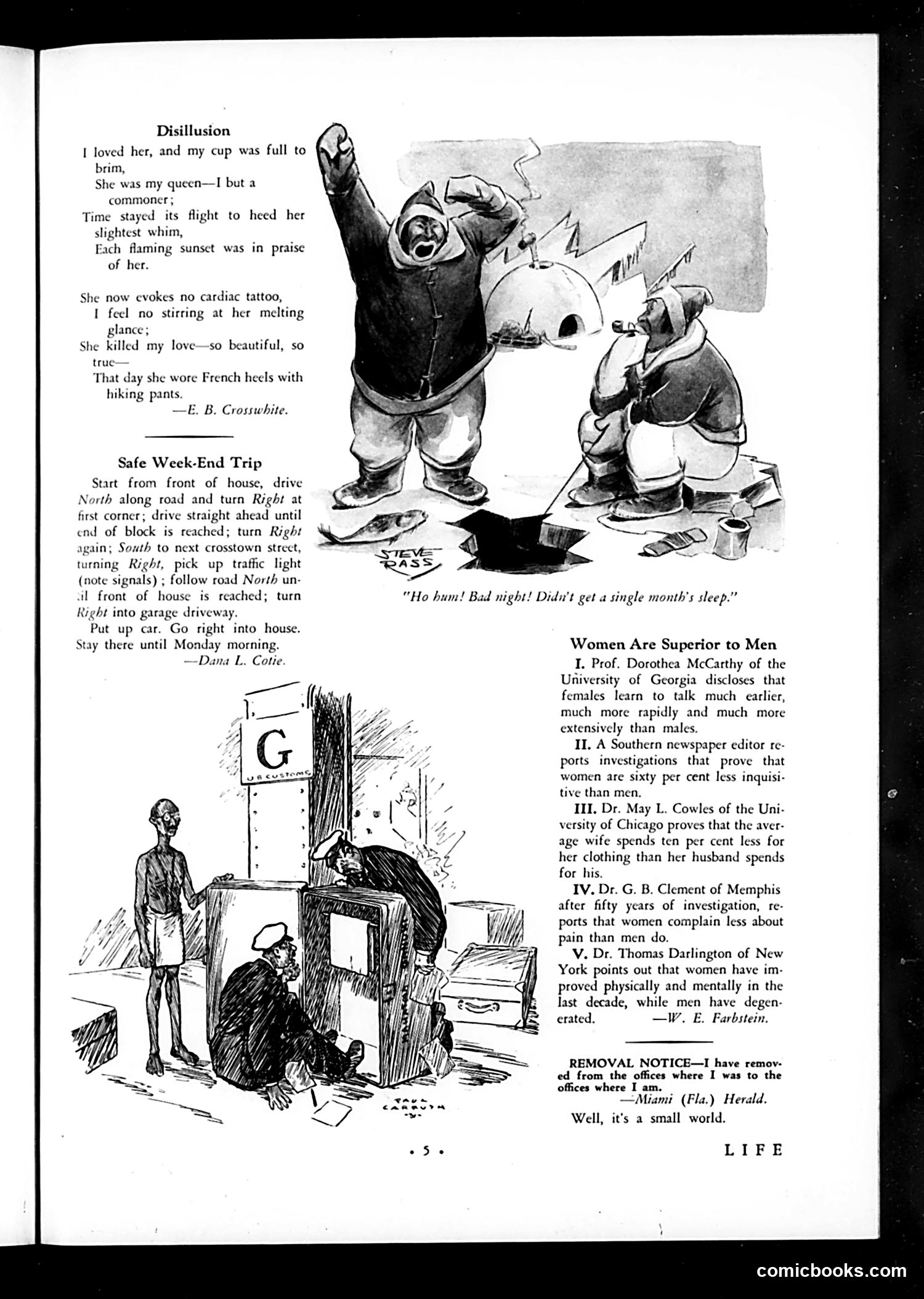
Analysis of Life Magazine Page The page contains two cartoons and commentary satirizing domestic life and gender relations. The upper cartoon (signed "Steve Rass") depicts two rotund, exasperated figures arguing over a crib, with one saying "Ho hum! Bad night! Didn't get a single month's sleep." This appears to satirize the exhaustion of new parenthood and marital discord over childcare. The lower cartoon shows a figure crouched in what appears to be a makeshift shelter or doghouse, mocking domestic life or marital unhappiness. The text section "Women Are Superior to Men" ironically lists five purported scientific claims (from professors and doctors) asserting women's superiority in speech, questioning, physical health, pain tolerance, and mental improvement. This satire mocks pseudo-scientific arguments about gender while likely critiquing contemporary debates about women's roles and abilities.
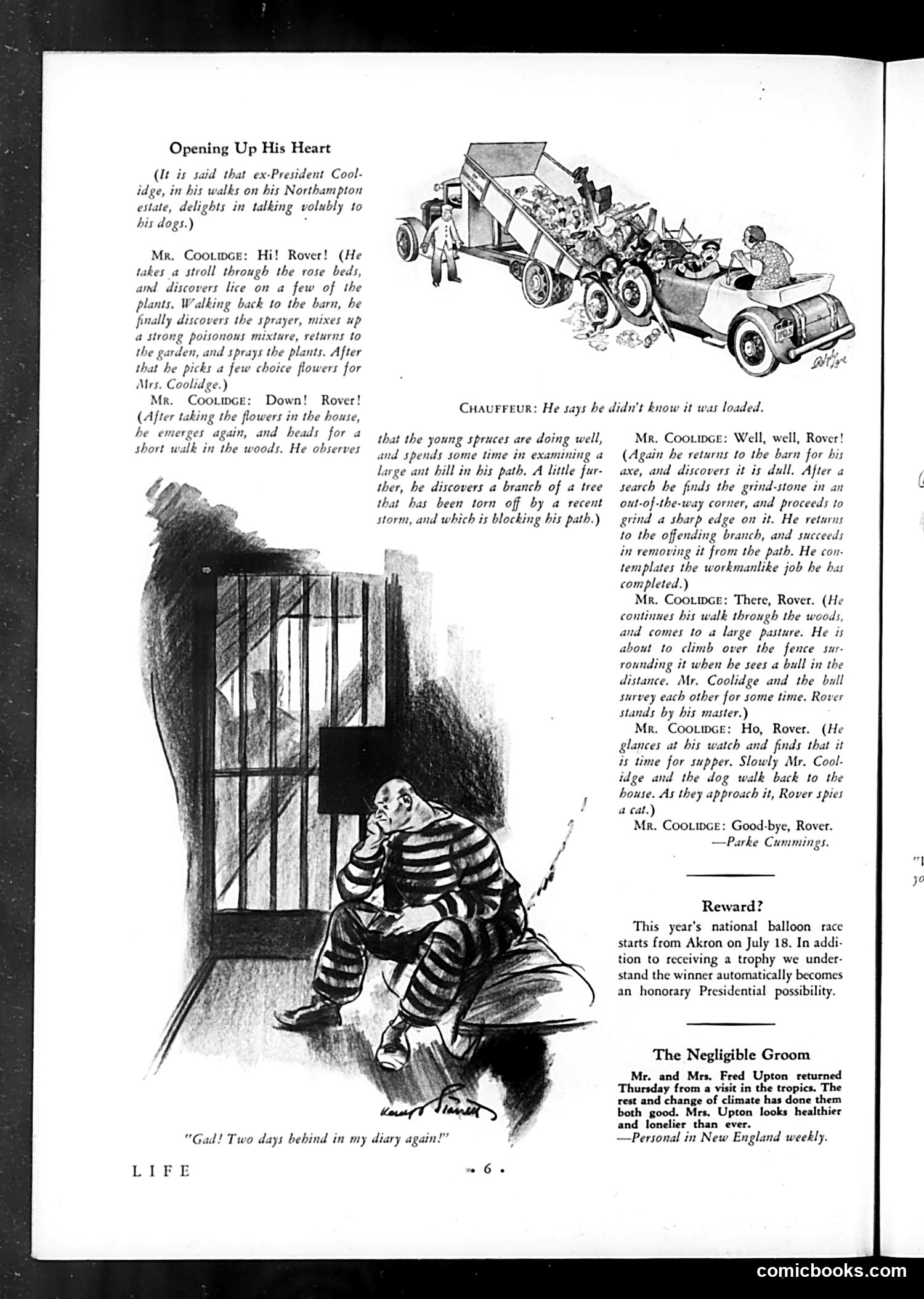
"Opening Up His Heart" This satirical piece mocks ex-President Coolidge through a humorous narrative about his dog "Rover." The story depicts Coolidge on a walk discovering garden pests, then methodically spraying them—a tongue-in-cheek reference to his famously reserved personality and taciturn public manner. The cartoon's point: Coolidge was known for being emotionally distant and uncommunicative ("opening up his heart" is ironic). The detailed pest-removal narrative—grinding stones, mixing poison—parodies how he approaches even casual dog walks with mechanical precision rather than warmth or spontaneity. The accompanying sketch shows a prisoner, captioned "Two days behind in my diary again!"—unrelated social commentary on routine tedium. A minor item about balloon racing and one about Mr. and Mrs. Upton's tropical vacation round out the page.
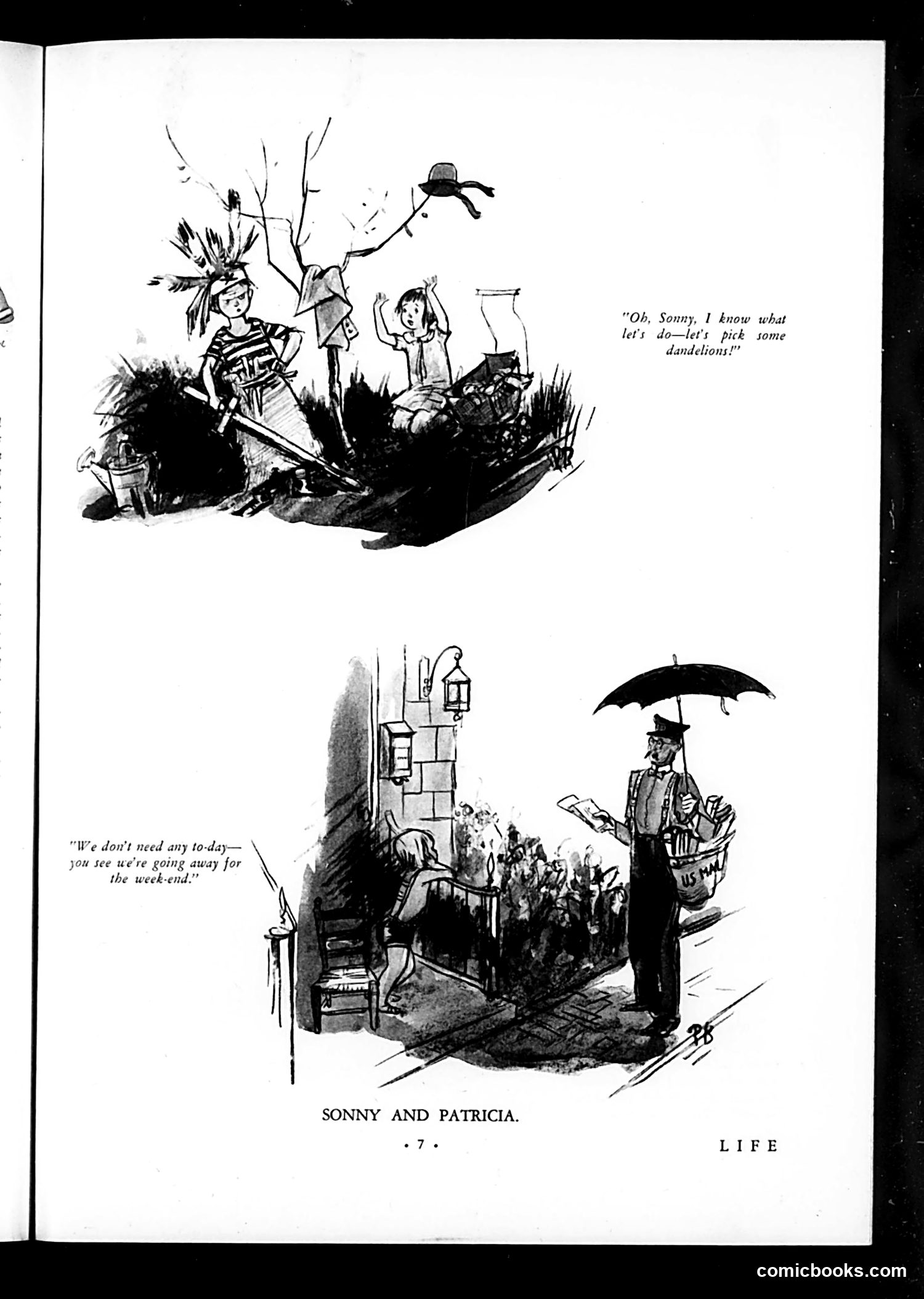
"Sonny and Patricia" - Life Magazine Cartoon This page contains two cartoon vignettes titled "Sonny and Patricia" depicting children's activities. Top cartoon: Two children discover a bare tree and decide to pick dandelions, showing resourcefulness and innocent play despite environmental bleakness. Bottom cartoon: A man with an umbrella stands outside a building, telling someone inside "We don't need any to-do—you see we're going away for the week-end!" The scene suggests he's dismissing concerns about an upcoming absence or trip. The cartoons appear to illustrate everyday domestic humor and children's antics typical of Life magazine's satirical family-focused content. Without additional context about "Sonny" and "Patricia" as recurring characters, the precise satirical targets remain unclear, though both scenes play on relatable middle-class situations and generational attitudes.
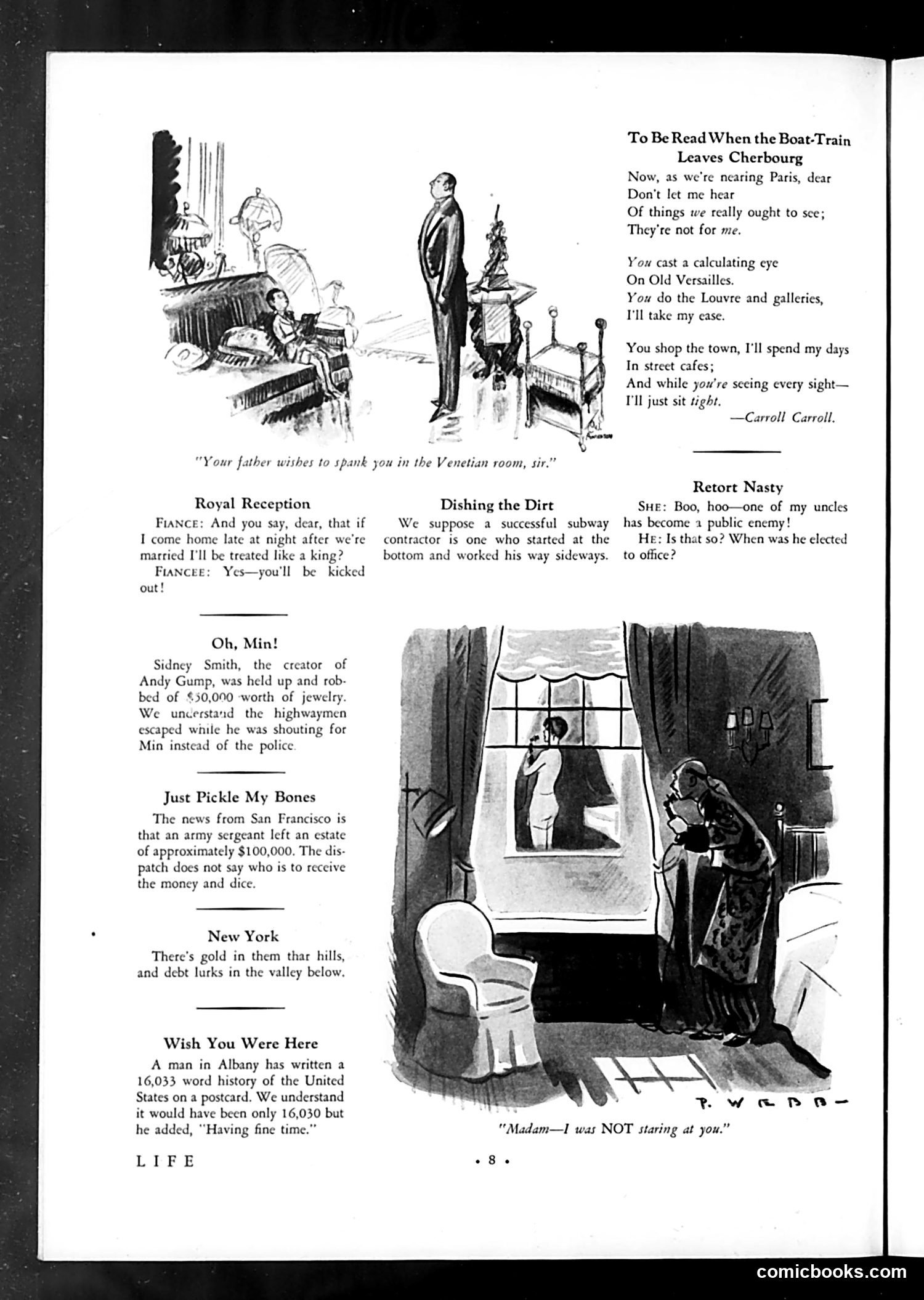
Analysis of Life Magazine Page 8 This page contains several short humor pieces and one cartoon. The main cartoon, captioned "Madam—I was NOT staring at you," depicts a soldier or military man appearing to gaze out a window while a woman nearby looks accusatory. The joke plays on the woman's insecurity—she assumes he was staring at her when he wasn't. The surrounding text pieces are brief satirical anecdotes about contemporary life: a "Royal Reception" about marital dynamics, "Dishing the Dirt" about subway contractors, and "Retort Nasty" featuring quick-witted banter. Other items reference robbery, inheritance, and American regional humor. The overall tone is light domestic satire typical of Life's humor format—poking fun at social pretensions, relationships, and everyday situations rather than heavy political commentary.
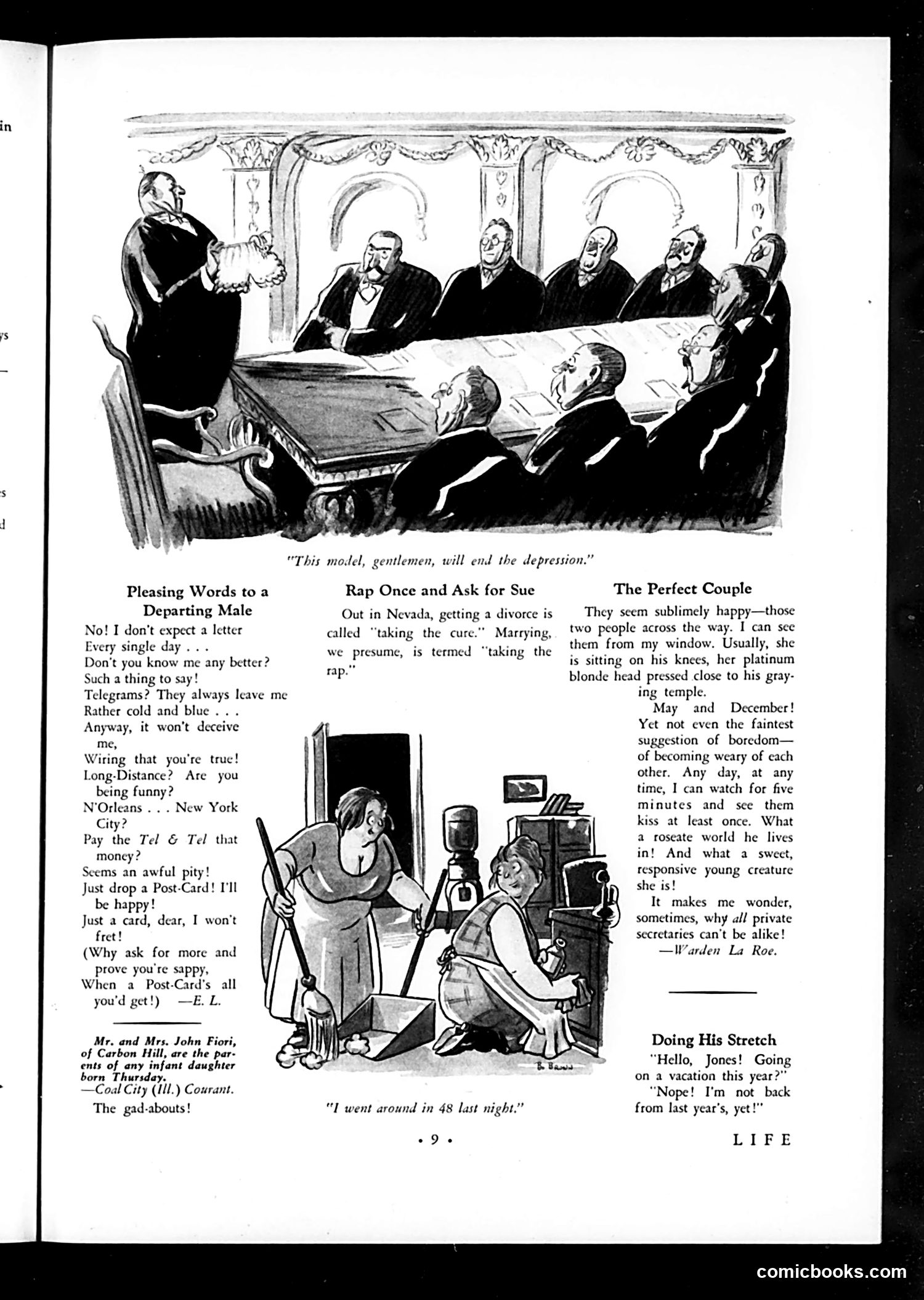
Analysis of Life Magazine Page 9 This page contains three separate humor pieces typical of Life's satirical content. Top cartoon depicts businessmen in a boardroom. The caption "This model, gentlemen, will end the depression" suggests they're presenting some economic solution during the Great Depression era—likely mocking how confidently business leaders proposed ineffective remedies. Middle cartoon titled "I went around in 48 last night" shows domestic humor about a woman's nighttime activities, with no clear political meaning. Text pieces include personal advice columns and humorous letters—"Pleasing Words to a Departing Male," "Rap Once and Ask for Sue," and "The Perfect Couple"—offering satirical commentary on relationships and modern life through invented anecdotes. The overall tone is gentle social satire aimed at middle-class American readers, focusing on romance, marriage, and economic anxieties rather than hard political targets.
Analysis of Life Magazine Page This page contains three opinion essays rather than cartoons. The header illustration shows a cherub or cupid figure, appropriate to the marriage-focused content. The essays discuss: 1. "What Minds Accept, Bodies Endure" — argues Russians accept hardship because their minds accept it; suggests Americans adopt similar mental discipline toward domestic economy and the motor car (Prohibition era reference). 2. "Marriage Crowds Divorce" — discusses whether divorced people should remarry, touching on Episcopal Church policy. 3. "Ruth Nichols' Misfortune" — appears to reference aviator Ruth Nichols, discussing her effort to fly across the Atlantic and relating her to Scandinavian ancestry and American history. The tone is characteristic of 1920s-30s Life magazine: satirical social commentary with moralistic undertones.
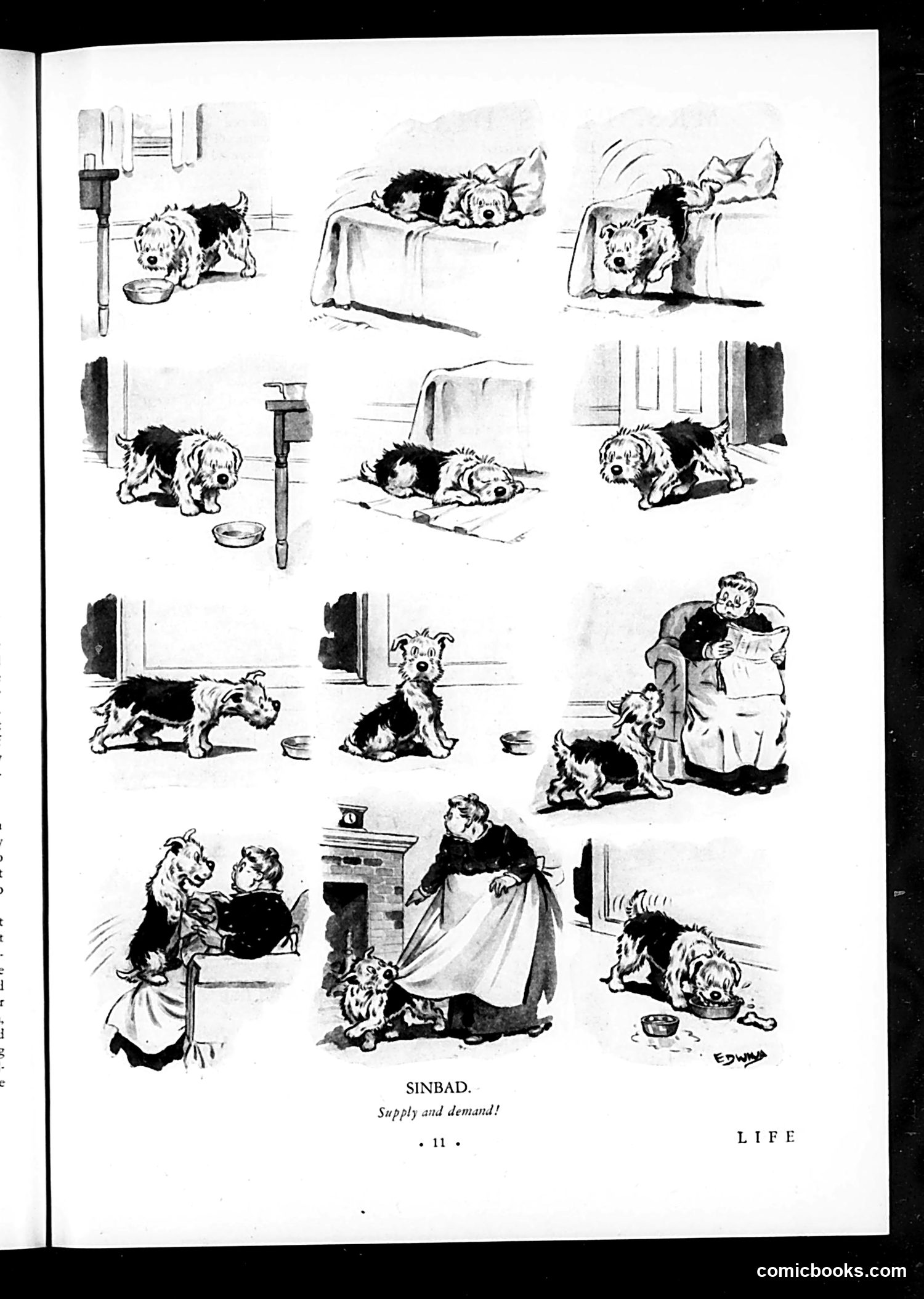
"Sinbad: Supply and Demand" This is a humorous illustrated sequence about a dog character named Sinbad. The comic shows various scenes of the dog's interactions with people—begging for food, sleeping in different locations, and being cared for by what appears to be an elderly woman. The subtitle "Supply and Demand" suggests an economics-based joke: the dog constantly "demands" food and care, while people supply it out of sympathy or obligation. The recurring bowl imagery emphasizes the central theme of the dog's persistent need for sustenance and attention. The sketchy, expressive drawing style is typical of early-to-mid 20th century Life magazine humor. This appears to be a lighthearted commentary on the relationship between pets and their caretakers, using economic terminology ironically to describe simple domestic dependency.
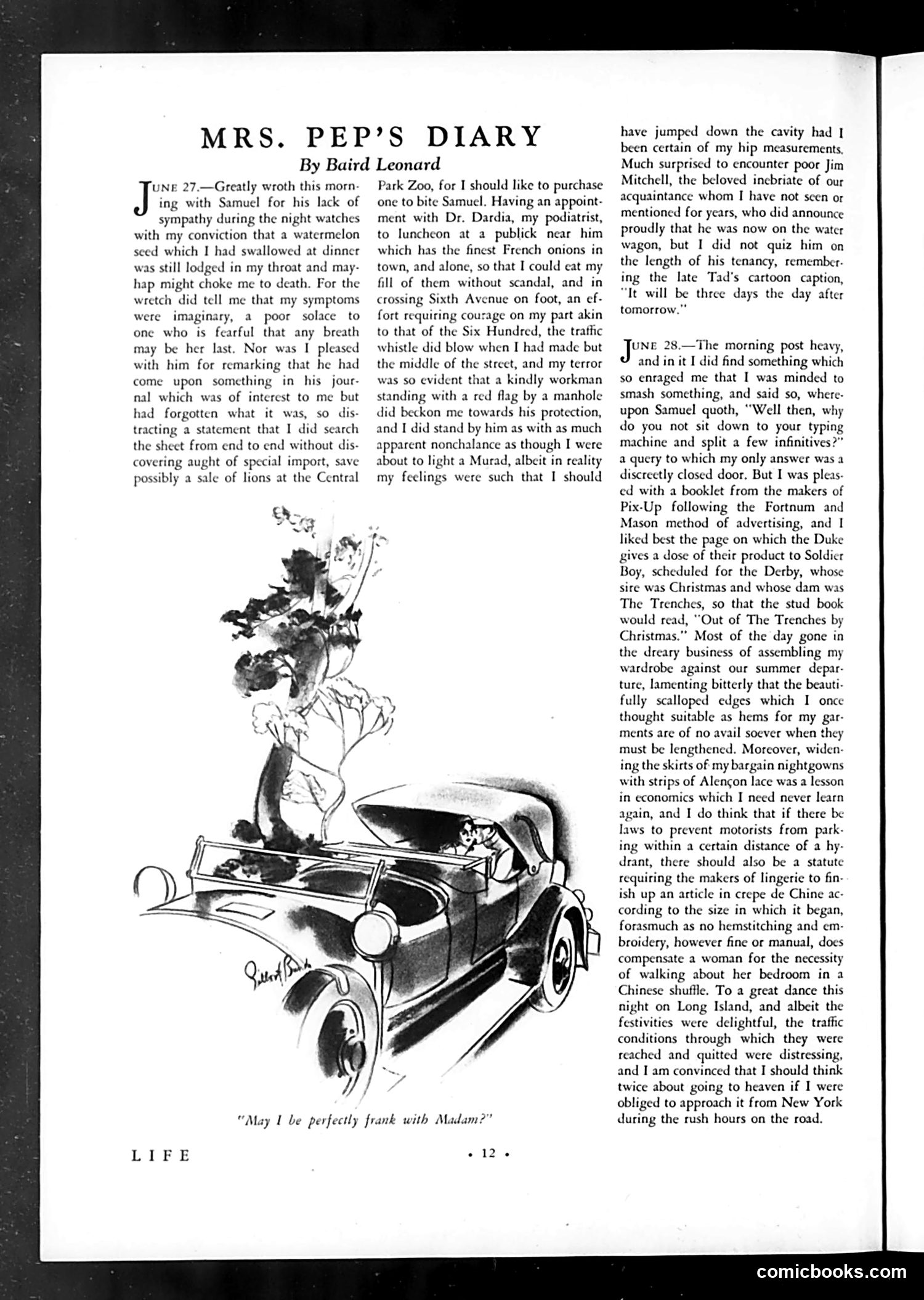
Mrs. Pep's Diary: A 1920s Social Satire This page from *Life* magazine presents "Mrs. Pep's Diary" by Baird Leonard—a satirical column mocking upper-class social anxieties. The illustration shows a fashionable woman perched precariously on a speeding automobile, captioned "May I be perfectly frank with Madam?" The diary entries (June 27-28) humorously chronicle trivial concerns: a watermelon seed swallowing mishap, purchasing imported French onions, and wardrobe disasters. The satire targets wealthy women's obsession with material goods, fashion anxieties, and social status during the Jazz Age. The automobile illustration likely mocks both reckless driving and women's newfound mobility and independence in the 1920s—a social change that conservative publications often portrayed as chaotic or undignified. The overall tone is gently mocking rather than cutting.
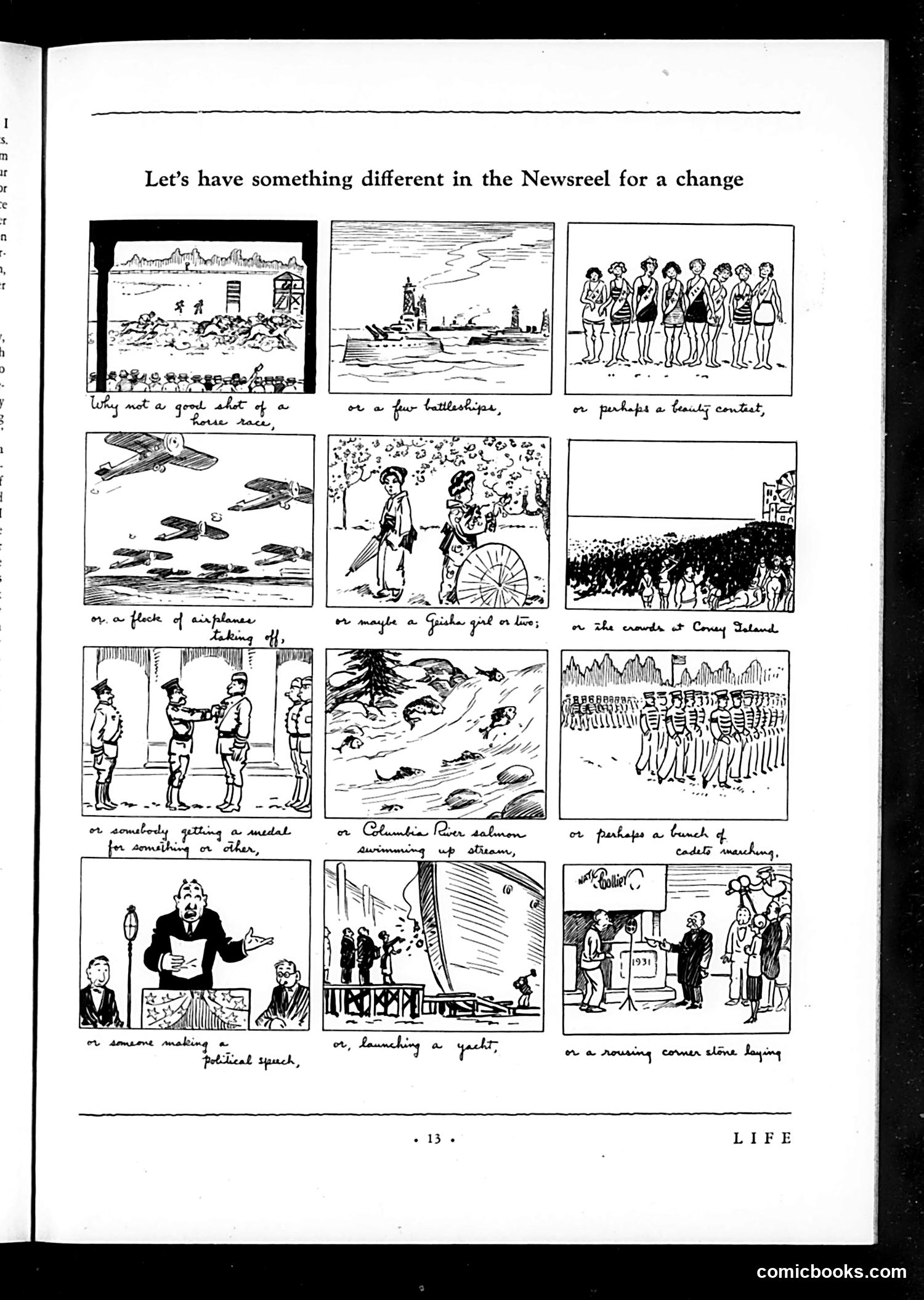
Analysis This is a humorous newsreel parody from *Life* magazine. The page presents twelve cartoon panels satirizing typical newsreel footage subjects—the standardized content audiences would see in movie theaters. The captions mock familiar newsreel tropes: "not a good shot of a horse race," "a fair battleship," "perhaps a beauty contest," "a flock of airplanes taking off," "maybe a Gypsy gal in love," "crowds at Coney Island," military medals and ceremonies, Columbia River salmon swimming, cadets marching, political speeches, yacht launches, and cornerstone-laying ceremonies. The satire targets newsreels' repetitive, formulaic coverage of entertainment, military activities, and civic events—poking fun at how predictable and interchangeable this content had become for viewers. The crude drawings emphasize the monotony of what moviegoers encountered weekly.
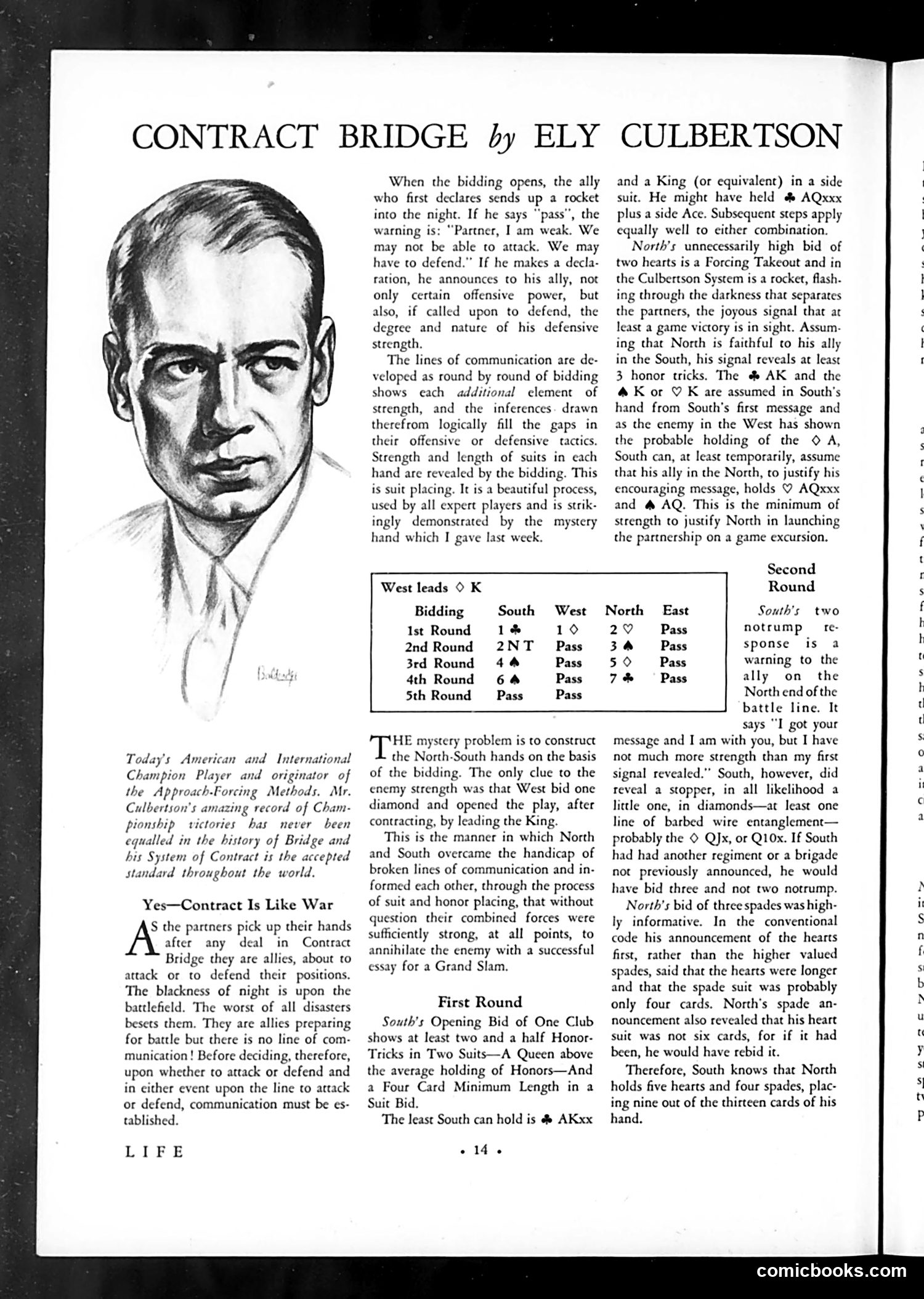
Contract Bridge Article by Ely Culbertson This page features an instructional article about Contract Bridge, the card game, written by Ely Culbertson (shown in the portrait). The article explains the "Culbertson System," a popular bidding method that revolutionized bridge play in the 1930s. Rather than satire, this is a straightforward instructional piece demonstrating bridge strategy through a specific hand. The article explains how bidding reveals card strength and allows partners to communicate their holdings and develop winning tactics. The text notes Culbertson's championship victories and his system's widespread adoption. This represents Life magazine's coverage of popular recreational pursuits among educated, affluent readers—bridge being a fashionable parlor game of the era.
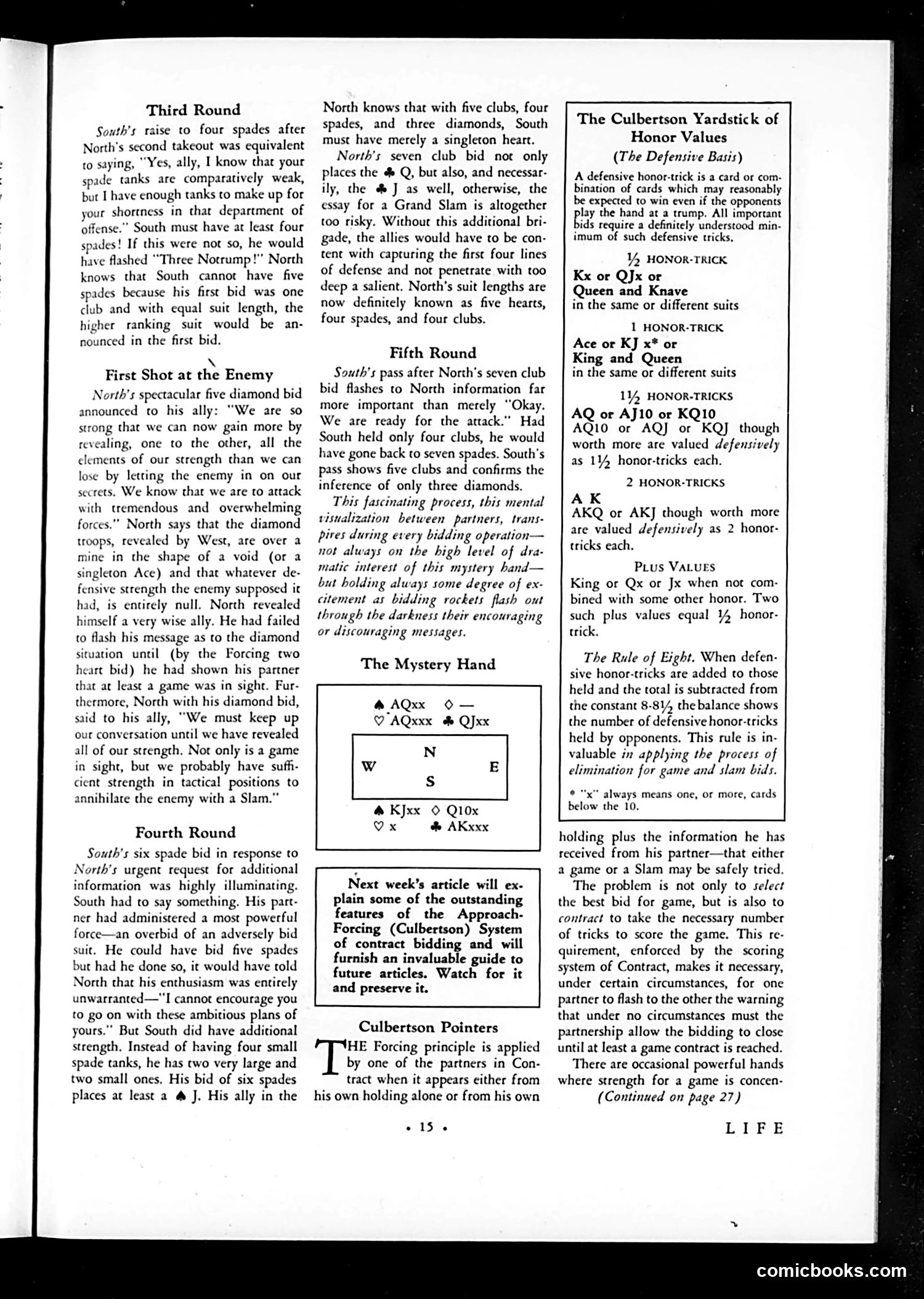
This page is primarily instructional content about bridge card game strategy, not political satire or social commentary. The text discusses various rounds of a bridge hand, analyzing bidding tactics and defensive plays. There is a sidebar titled "The Culberson Yardstick of Honor Values," explaining scoring rules for defensive honor-tricks in bridge. A diagram labeled "The Mystery Hand" shows a bridge player's card distribution (marked N, S, E, W for compass positions). At the bottom, a section called "Culberson Pointers" begins explaining the Forcing principle in contract bridge bidding. This appears to be educational bridge instruction, likely by Ely Culberson, a famous bridge expert. There is no political cartoon or social satire visible on this page—it is purely technical gaming instruction for Life magazine readers.
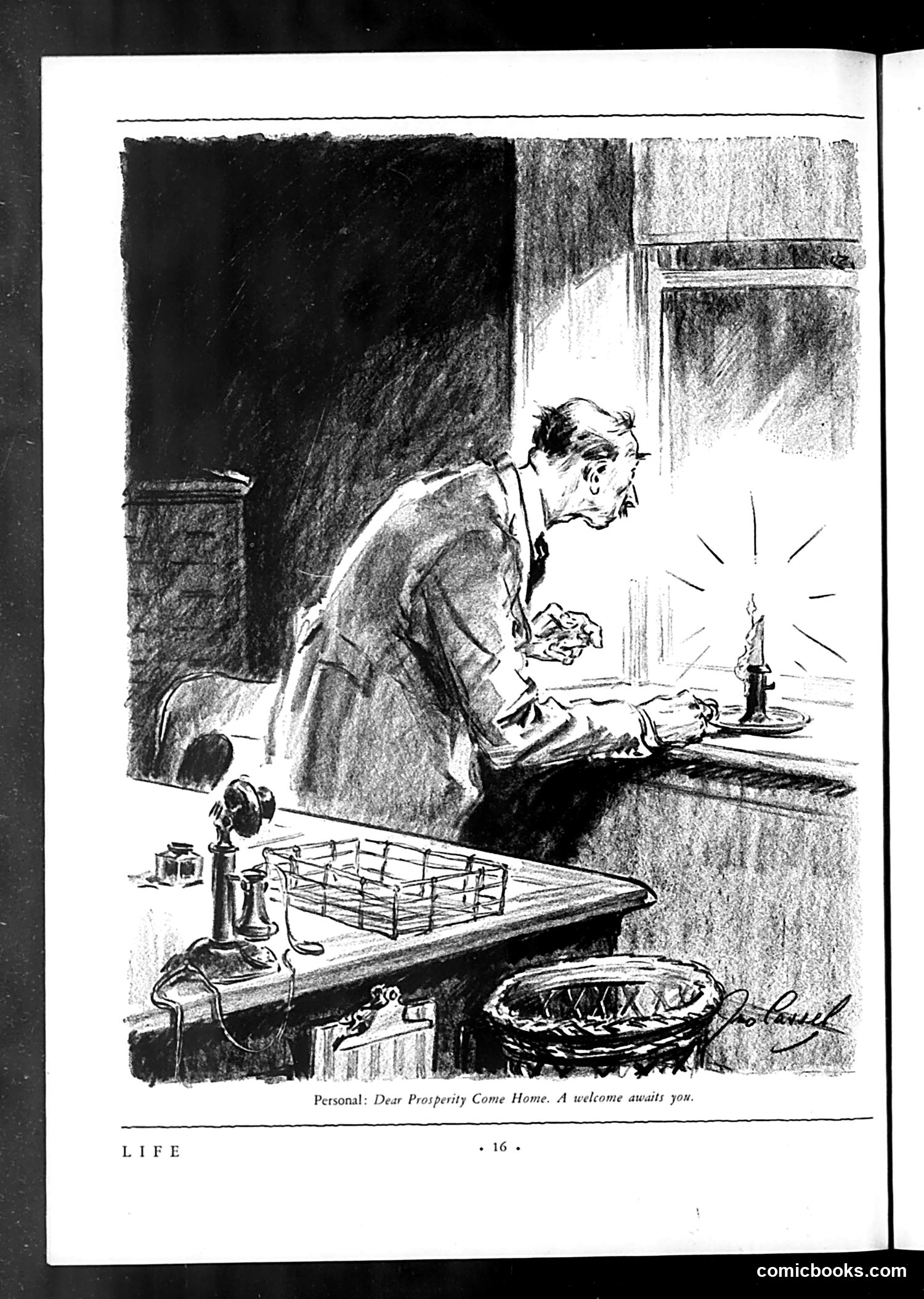
Analysis This is a single-panel cartoon from *Life* magazine showing a man at a desk working late at night by candlelight. The figure appears to be a businessman or professional, hunched over papers in what seems to be an office or study. The caption reads: "Personal: Dear Property Come Home. A welcome awaits you." The satire appears to address the tension between work and home life—specifically, a personification of "Property" (likely representing wealth or material possessions) being urged to return home because it's neglected there. The joke suggests that a hardworking businessman has become so consumed with accumulating or managing property/wealth that his actual home and domestic life suffer from his absence. It's social commentary on the obsessive pursuit of material success at the expense of family and personal relationships.
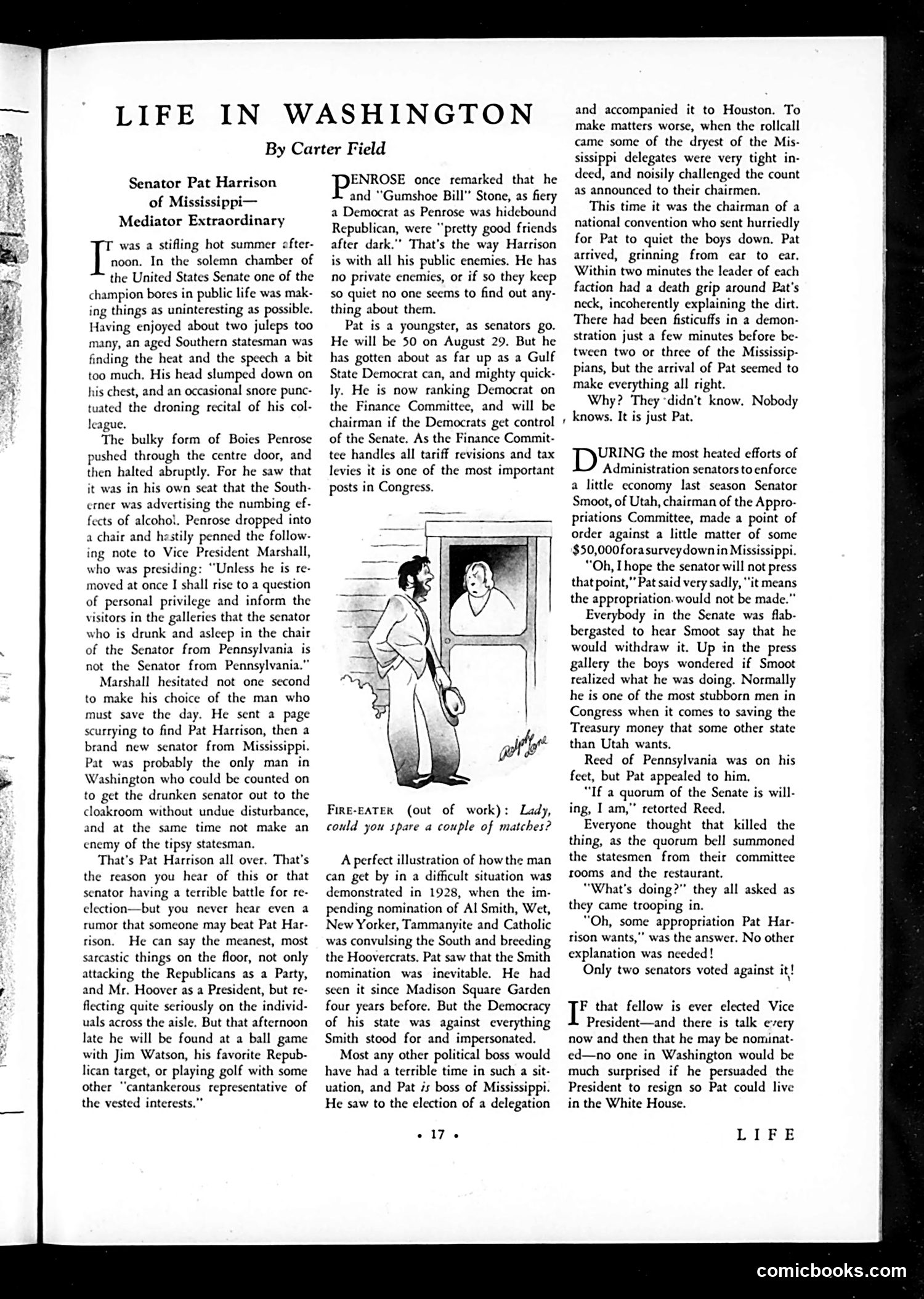
"Life in Washington" by Carter Field This page satirizes Senator Pat Harrison of Mississippi, described as a mediator among Senate Democrats. The cartoon illustrates a humorous anecdote about how Harrison once got a drunken senator out of a difficult situation without causing a scene—demonstrating his political skill and discretion. The text details Harrison's rising prominence in 1930s Democratic politics, particularly on the Finance Committee. It notes his ability to navigate competing factions and maintain friendships across party lines. The piece also recounts a heated Senate appropriations debate where Senator Smoot of Utah nearly withdrew funding over a Mississippi survey, only to be outmaneuvered by Harrison's appeal to Senate unity. The overall portrait celebrates Harrison as an exceptionally skilled political operator.
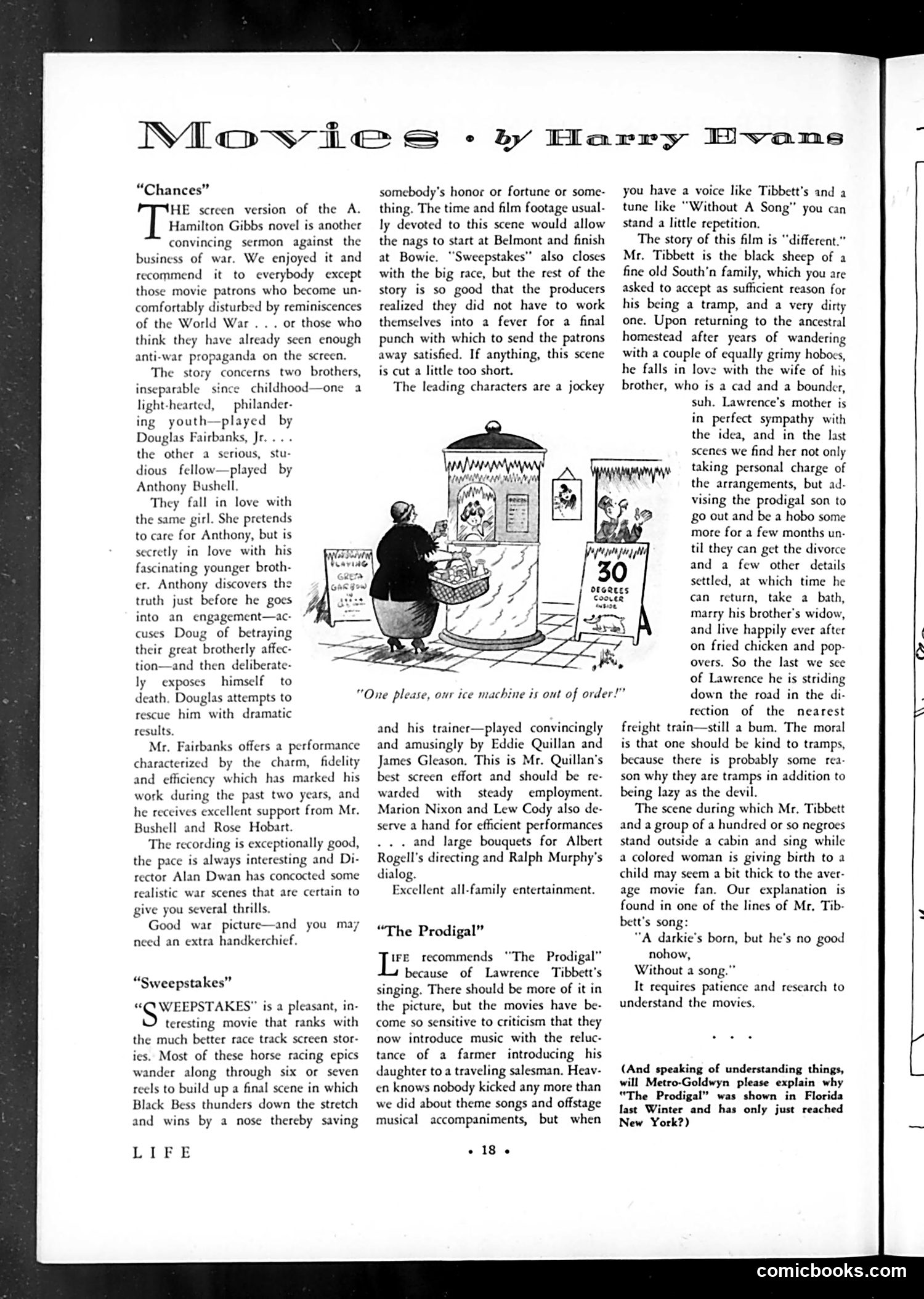
Analysis This is a "Movies" column by Harry Evans reviewing three films. The main illustration shows a man at an ice cream vendor's cart labeled "30 DEGREES," with the caption "One please, our ice machine is out of order!" The cartoon's humor relies on wartime context: during WWII, ice cream machines and refrigeration equipment were often broken or unavailable due to manufacturing priorities redirected to military production. The joke is that the vendor is selling ice cream from a cart that requires refrigeration, yet admits the cooling system doesn't work—a logical absurdity that reflects real consumer frustrations of the era when goods and services were scarce or compromised by wartime shortages. The reviews discuss films "Chances," "Sweepstakes," and "The Prodigal," offering typical entertainment criticism of the period.
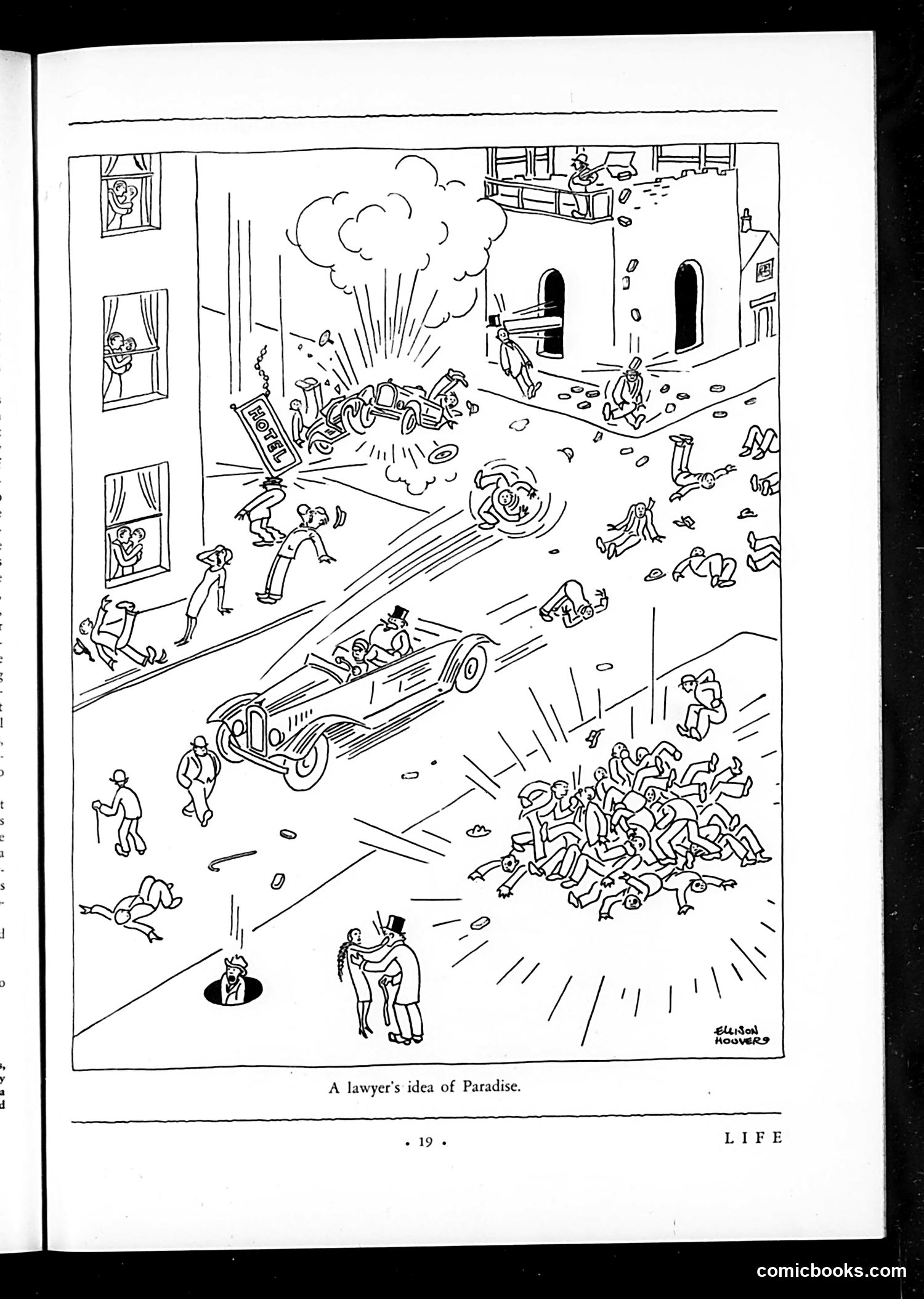
"A Lawyer's Idea of Paradise" This cartoon satirizes lawyers' priorities through absurdist humor. The central figure—a well-dressed man in a top hat—stands calmly in a hole while chaos erupts around him: explosions, colliding vehicles, crowds fleeing, buildings damaged, people injured. The joke is that a lawyer's "paradise" is a disaster zone—literally the opposite of peace. This reflects a cynical view common in early-to-mid 20th century American satire: lawyers profit from human misery and conflict. The more accidents, disputes, injuries, and property damage occurring, the more legal work and fees they generate. The cartoon mocks lawyers' perceived financial incentives to see society in turmoil rather than harmony. The man's serene expression amid devastation emphasizes the dark humor.
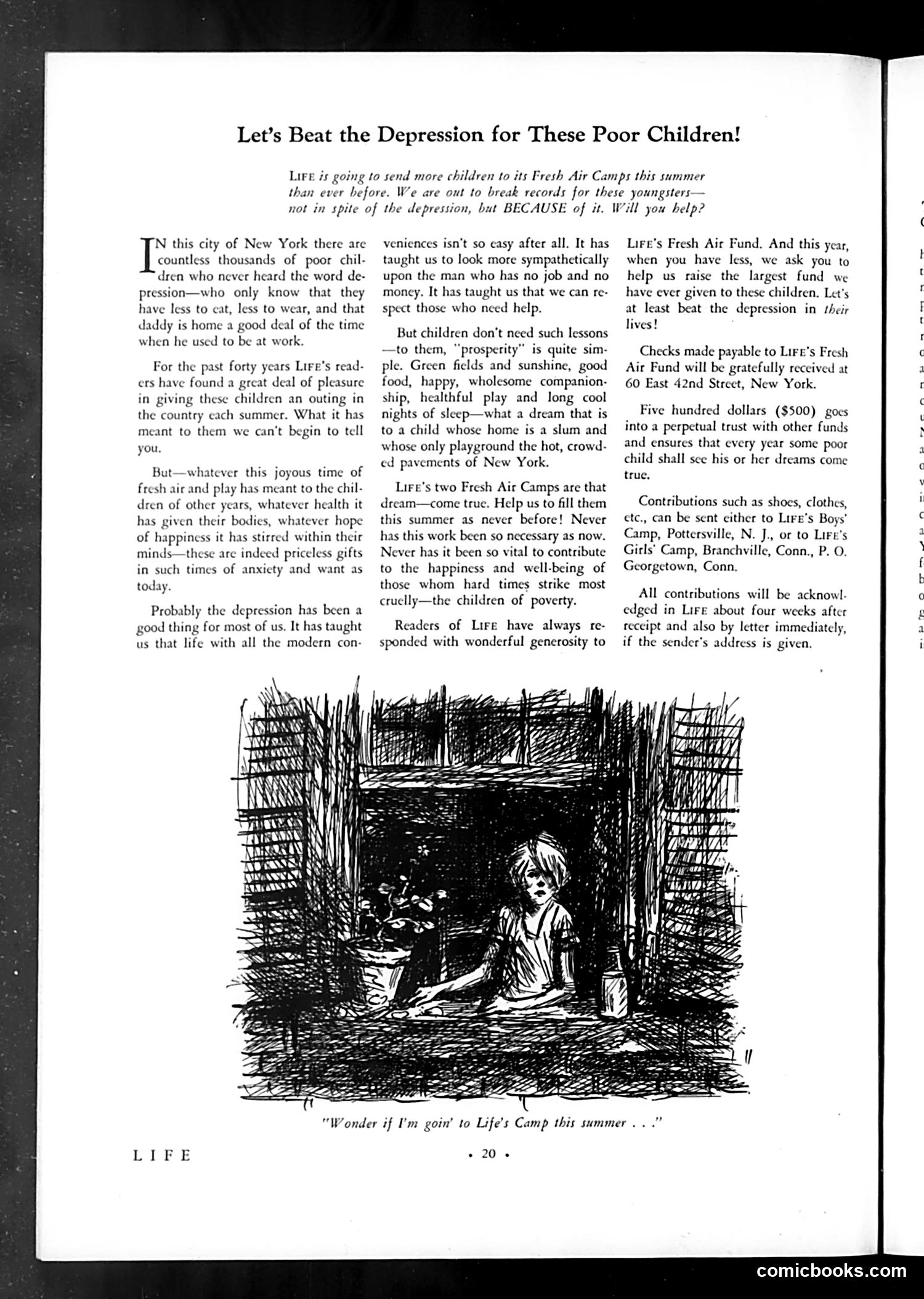
Life Magazine Fresh Air Fund Appeal (1930s Depression Era) This is a fundraising appeal, not satire. *Life* magazine solicits donations for its Fresh Air Camps program, which sends poor New York City children to countryside retreats during summer. The accompanying illustration shows a slum child gazing from a tenement window, dreaming of camp ("Wonder if I'm goin' to Life's Camp this summer..."). The appeal's logic: the Great Depression has made wealthy readers more sympathetic to poverty, so *Life* asks them to contribute more generously than ever—paradoxically "because of" economic hardship. The text argues that while Depression lessons teach middle-class readers empathy, poor children need only simple joys: fresh air, good food, healthy play. Donations range from individual items (shoes, clothes) to $500 perpetual trusts. This represents Depression-era philanthropy: charitable magazines mobilizing their readership to address poverty the economic crisis intensified.
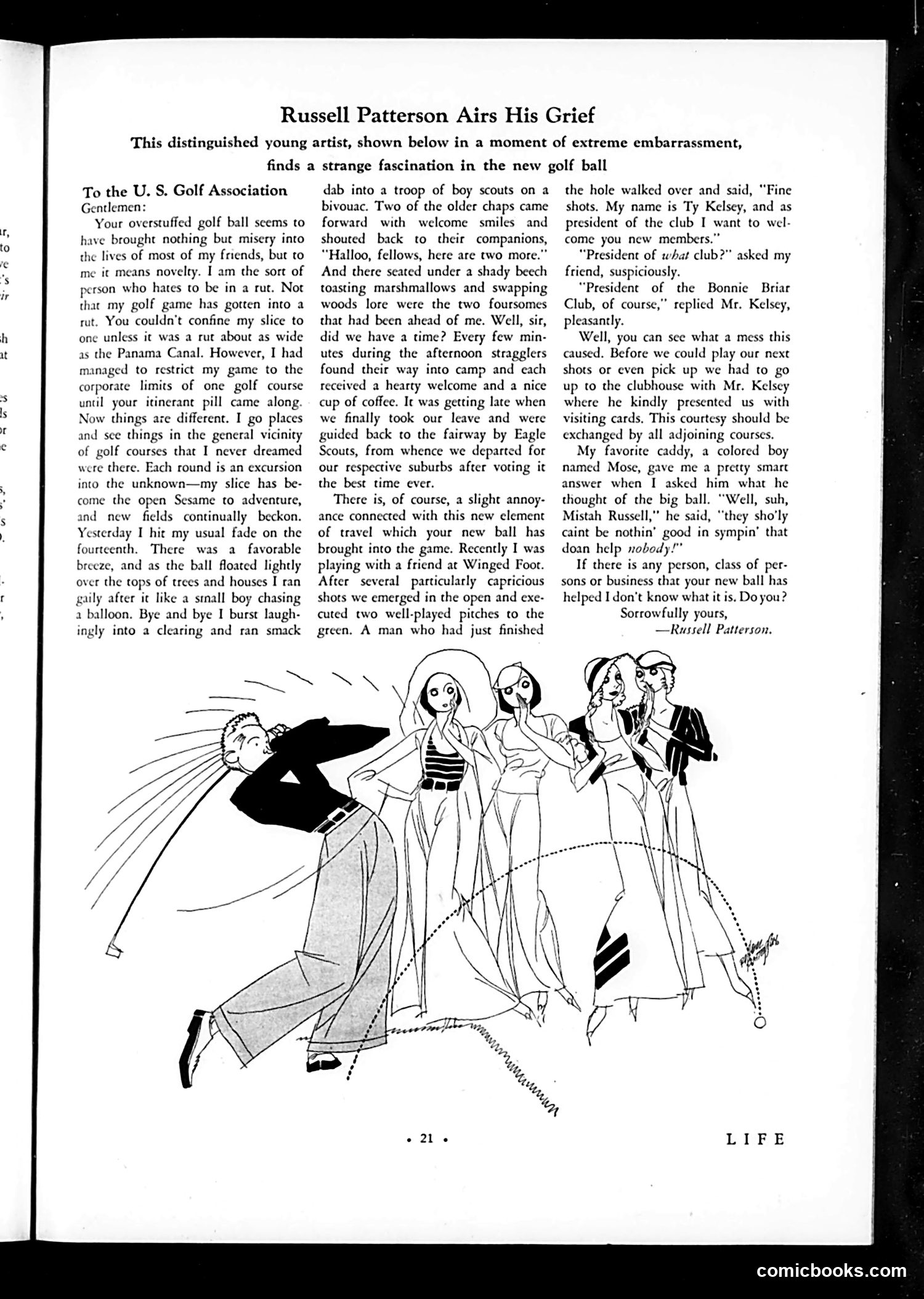
Russell Patterson's Golf Ball Complaint This is a humorous letter to the U.S. Golf Association from cartoonist Russell Patterson, illustrated with a drawing of him being chased by women after hitting an errant golf shot. Patterson complains that the new "oversized" golf ball—likely referring to the larger, livelier ball introduced around this era—has disrupted his game by sending his shots far beyond normal golf course boundaries. His wild slices now take him into unexpected adventures: crashing a Boy Scout camp, accidentally joining an adjacent club, and generally creating social chaos. The satire targets both the new golf equipment and golf culture's pretensions. Patterson's caddy delivers the punchline: the new ball hasn't helped anyone. The cartoon's exaggerated depiction of Patterson fleeing from women suggests the absurdity of his predicament—his "slice" has become a liability that creates embarrassing social situations rather than improving the sport.
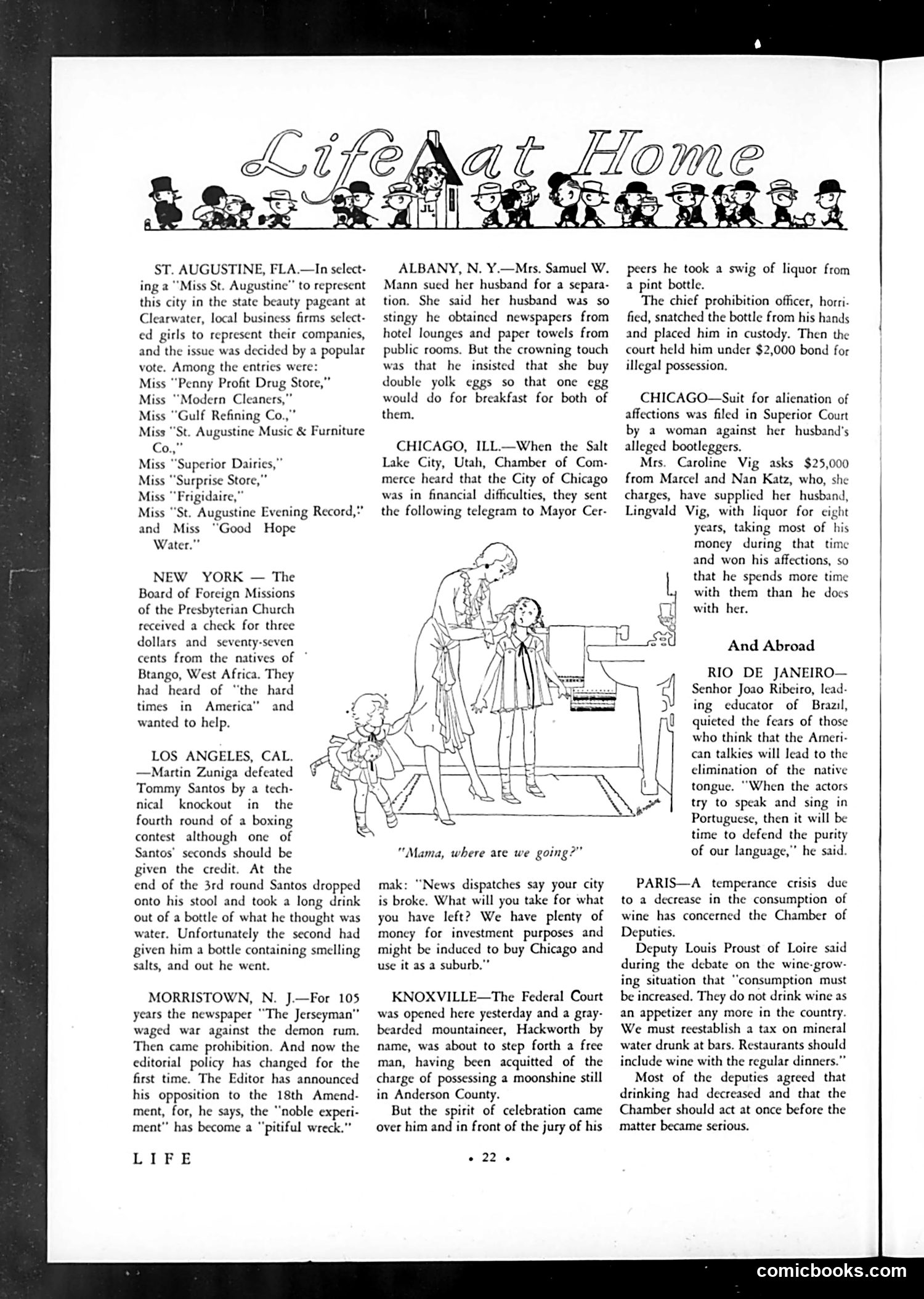
"Life at Home and Abroad" — Prohibition-Era Satire This page collects humorous anecdotes highlighting absurdities of 1920s American life, particularly Prohibition's unintended consequences. The centerpiece cartoon depicts a mother with children asking "Mama, where are we going?" — illustrating how Prohibition disrupted family life and domestic commerce. Key satirical points: - St. Augustine's beauty pageant: Girls representing commercial sponsors (drug stores, furniture companies) reveals how thoroughly business had colonized public life. - The Jerseyman's reversal: A newspaper that fought alcohol for 105 years now opposes Prohibition—suggesting the "noble experiment" created worse problems than the original evil. - Chicago bootlegger suit: A woman sues suppliers who "supplied" her husband with liquor for eight years, implying Prohibition made illegal alcohol so accessible it destroyed marriages. - Moonshine court case: A mountaineer celebrates his acquittal *in front of the jury*, showing how casually citizens flouted Prohibition laws. The contrasting "Abroad" section mocks American cultural anxiety—a Brazilian educator fears American talkies will corrupt Portuguese language, while Paris worries about decreased wine consumption. Overall: satire on Prohibition's failure and American commercial excess.
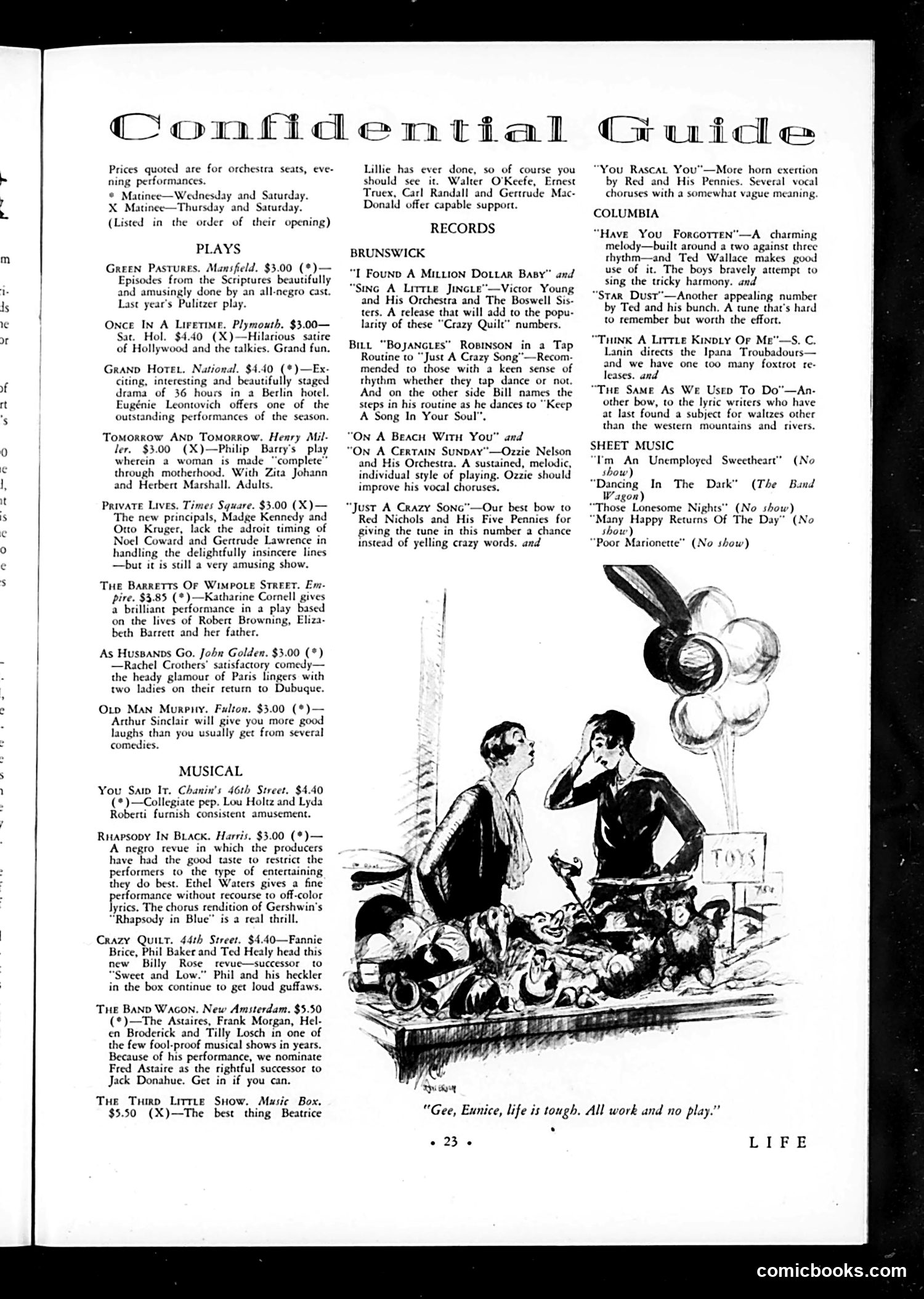
Confidential Guide: Entertainment Reviews (Life Magazine) This page is primarily a theater and entertainment guide listing Broadway plays, musicals, and phonograph records with prices and brief reviews—not a political cartoon. The single illustration shows two men examining toys in what appears to be a toy store or shop window, with the caption: "Gee, Ennice, life is tough. All work and no play." This is a humorous social commentary on Depression-era hardship: two adult men are so financially desperate that they can only afford to window-shop and fantasize about toys like children. The joke reflects 1930s economic anxiety—even grown men couldn't afford leisure or recreation. The reviews themselves showcase entertainment from this period: *Green Pastures* (an all-Black cast production), *Once in a Lifetime* (satirizing Hollywood talkies), and performances by Fred Astaire, Beatrice Lillie, and Ethel Waters. The tone is lighthearted consumer guidance for theatergoers with discretionary income.
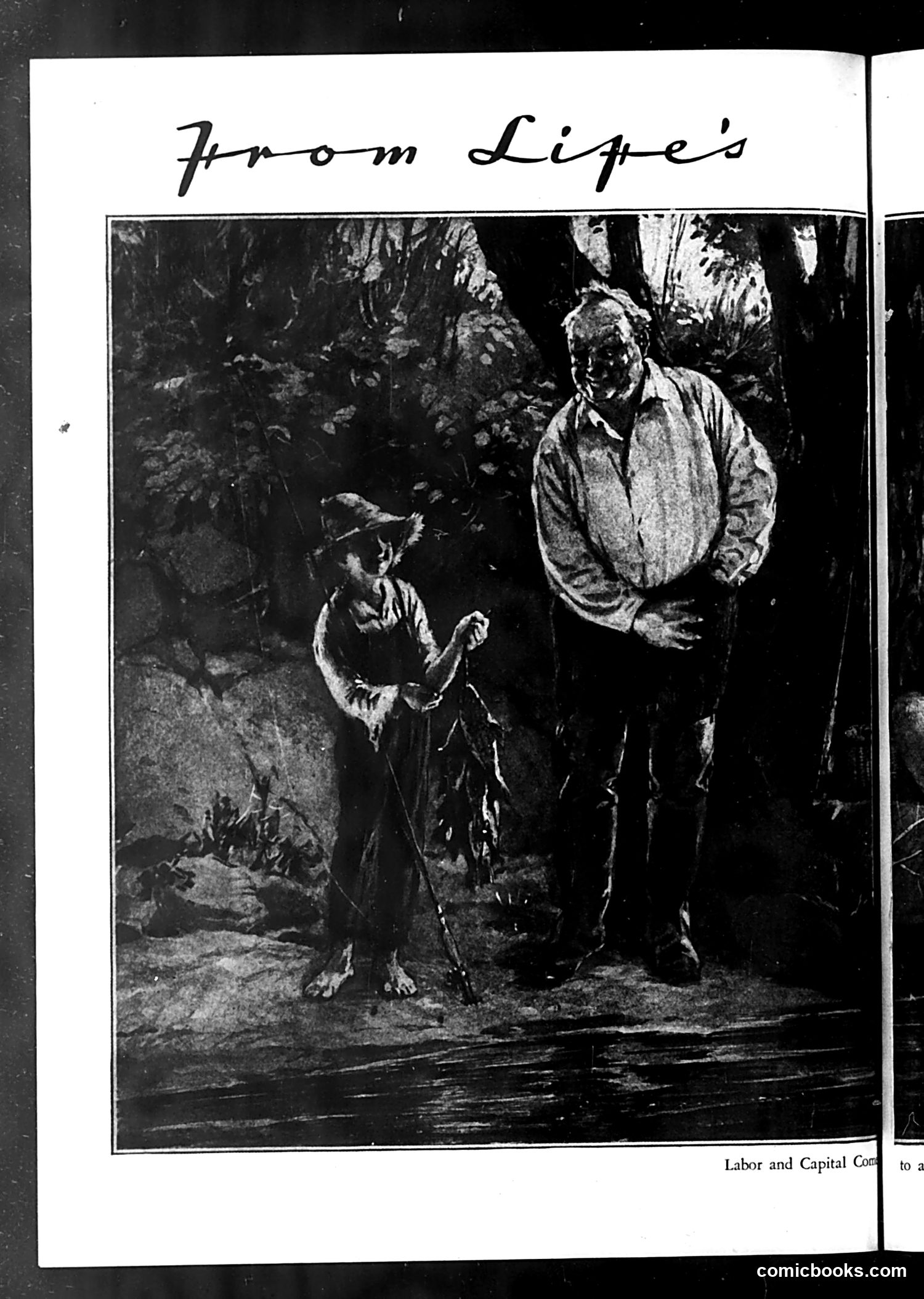
Analysis This page from *Life* magazine shows an illustration titled "From Life's" depicting two figures in what appears to be a cave or underground setting. The caption reads "Labor and Capital Co[...]" (text cut off). The image likely satirizes the relationship between labor and capital—a major political concern of the era. The smaller figure (appearing to represent labor or a worker) stands before a larger, better-fed figure (representing capital or wealthy interests). The dark, confined setting suggests workers trapped in poor conditions controlled by capital interests. Without the complete caption or surrounding context, the specific historical moment cannot be definitively identified. However, the visual composition clearly critiques economic inequality and power imbalance between workers and wealthy industrialists—common *Life* magazine themes addressing labor disputes and class tensions.
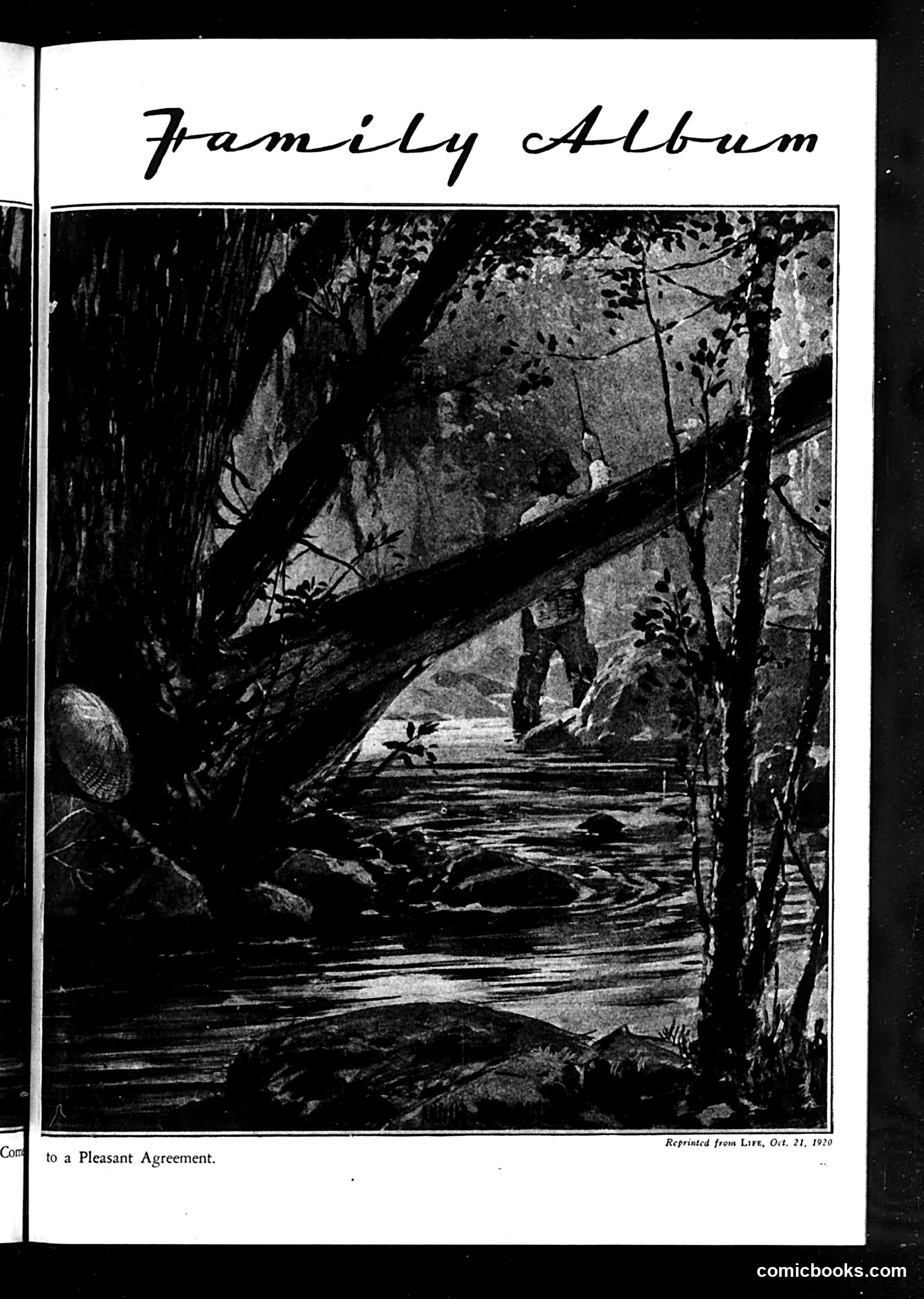
Family Album Page Analysis This page is titled "Family Album" and features a black-and-white illustration of a serene forest stream scene with trees and water, reprinted from *Life* magazine dated October 21, 1920. The visible text fragment "to a Pleasant Agreement" appears to be part of a caption or headline that's cut off. Without the complete accompanying text or caption, the specific satirical meaning is unclear. The pastoral, peaceful nature imagery might be ironic commentary on a contemporary political or social situation from 1920, but the full context needed to identify the figures, references, or intended joke is not visible on this page excerpt. The image alone reads as straightforward nature illustration rather than obvious caricature or satire.
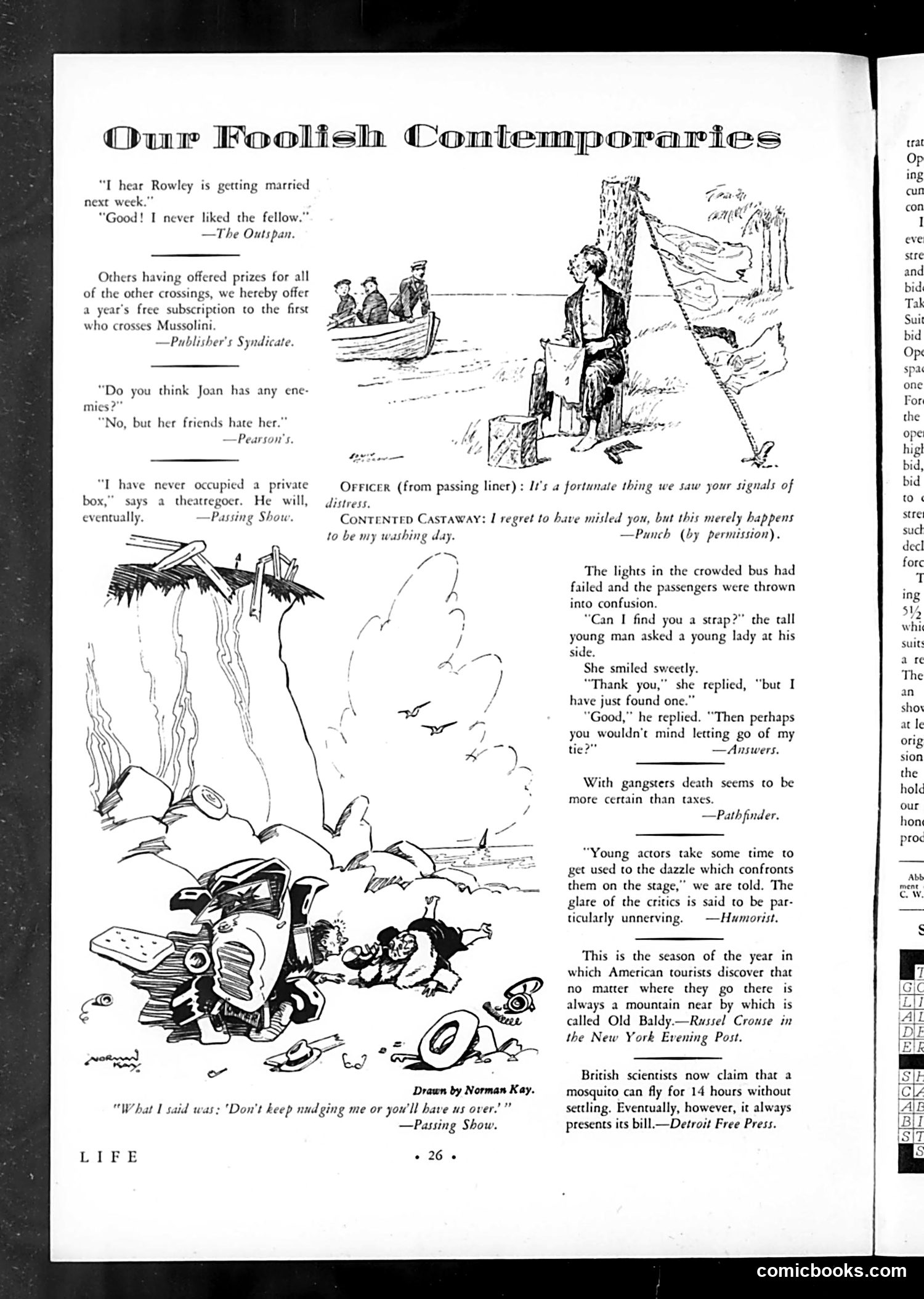
"Our Foolish Contemporaries" - Life Magazine This page collects brief jokes and satirical quips from various contemporary sources, arranged around cartoon illustrations. The humor targets everyday social absurdities: a man happy his rival is marrying (implying he dislikes the fellow); a woman finding a stranger's tie to hold instead of a strap on a darkened bus; a castaway who signals false distress then admits it was merely his laundry day. The cartoons by Norman Kay and others illustrate these scenarios visually. A notable reference appears to Mussolini—the editor jokes about offering a "year's free subscription" prize for "crossing" him, likely alluding to the Italian dictator's contemporary notoriety, though the exact context is unclear. The page functions as a humor compendium, reprinting jokes licensed from publications like *Punch* and *Answers*, targeting pomposity, romantic misunderstandings, and modern inconveniences of the era (crowded buses, theater-going etiquette).
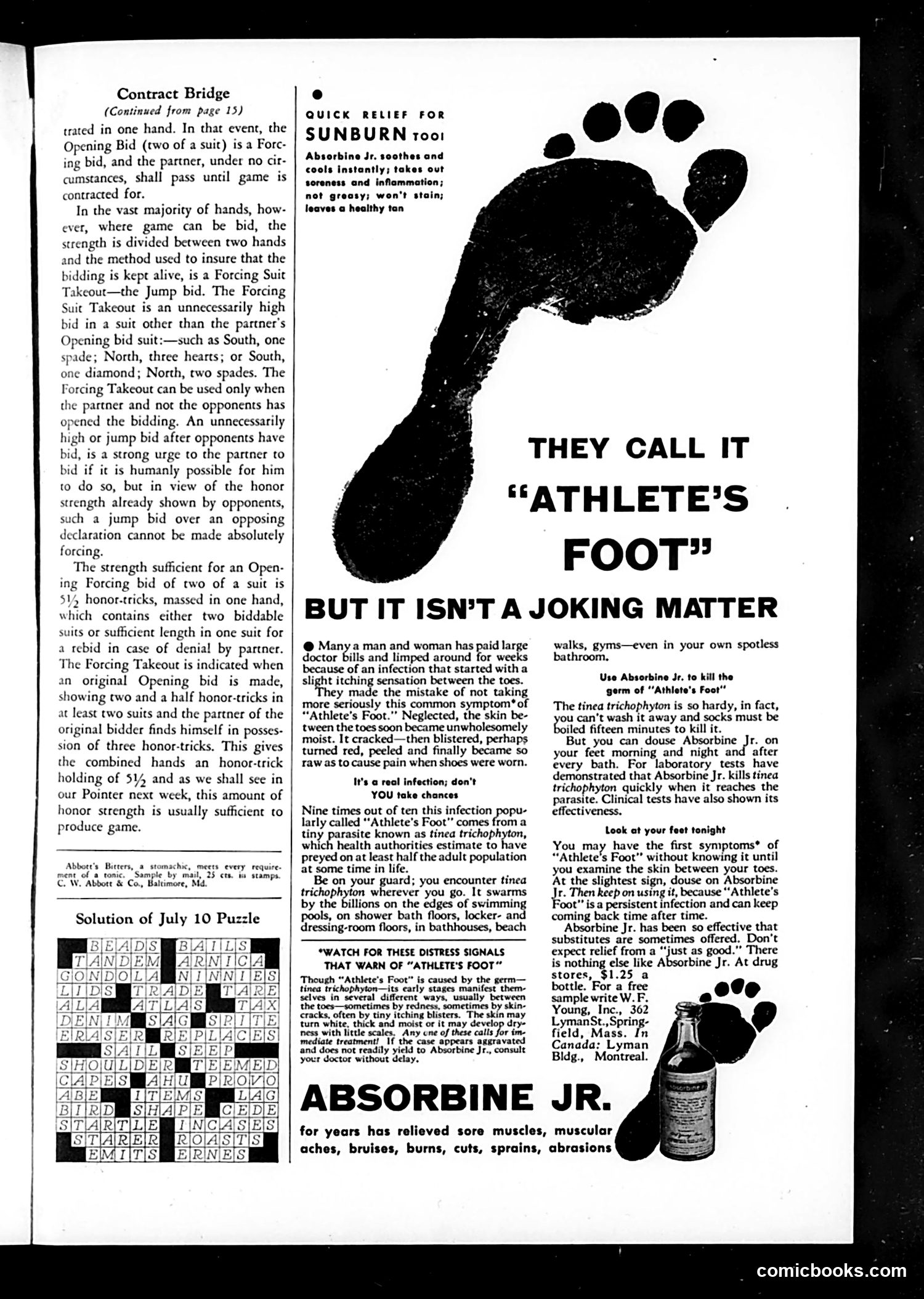
Analysis of This Life Magazine Page This page combines bridge instruction with period advertising, not satire or political cartoons. Main Content: The left column continues a technical bridge card game article explaining forcing bids and takeouts—purely instructional material for a games-playing audience. Advertisements: The dominant right side promotes Absorbine Jr., a patent medicine for athlete's foot (a fungal infection). The ad uses dramatic language—"IT ISN'T A JOKING MATTER"—and features a large black silhouette of an infected foot to grab attention. It warns readers about tinea trichophyton parasites lurking in swimming pools and bathhouses, then positions the product as relief. Historical Context: This reflects early 20th-century medical advertising before FDA regulation. Patent medicines made broad health claims; tinea was a genuine concern in shared bathing facilities. The tone—fear-based marketing combined with pseudo-scientific language—was standard for the era. No satire present. This is straightforward period advertising alongside recreational content, typical of Life magazine's miscellaneous format.
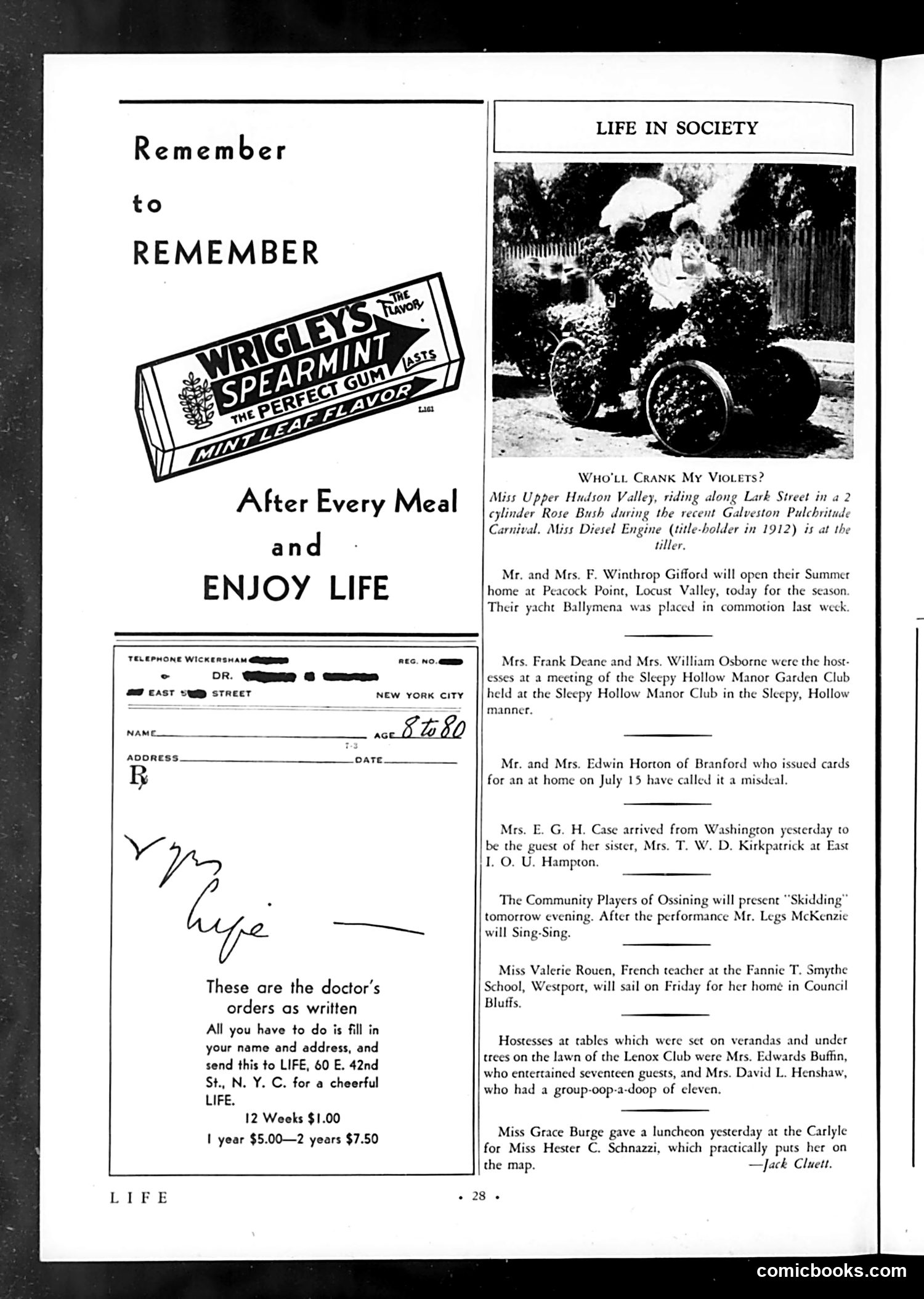
Life Magazine Page Analysis This page combines advertising with society-page satire. The left side is a Wrigley's gum advertisement disguised as a doctor's prescription, playing on early 20th-century marketing that connected chewing gum to health and enjoyment. The right side mocks wealthy upper-class social announcements through exaggerated absurdities. The caption "Who'll Crank My Violets?" describes a woman in a ridiculous vehicle made of flowers during a beauty pageant. The society column beneath contains tongue-in-cheek items: redundant club names ("Sleepy Hollow Manor Club in the Sleepy, Hollow manner"), puns on card games ("misdeal"), and wordplay on places and names (Sing-Sing jail reference, invented names like "Schnazzi"). The satire targets the pretentiousness of society reporting—its obsession with wealthy people's trivial movements—by making the announcements progressively more nonsensical. Life magazine regularly used this approach to mock high society's self-importance.
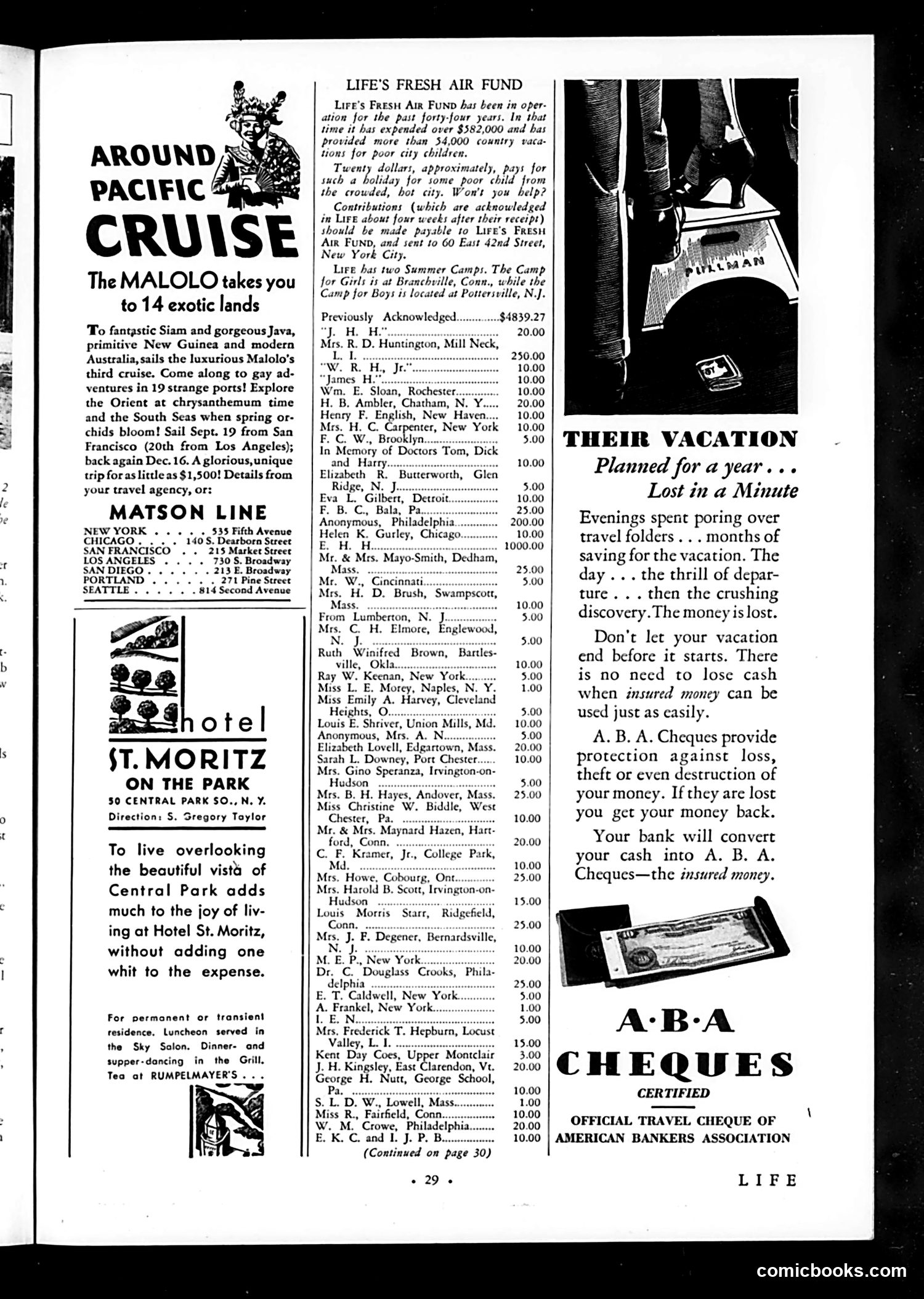
Analysis of This Life Magazine Page This page is primarily advertising and fundraising content, not satire or political commentary. The main elements are: 1. Life's Fresh Air Fund appeal (top center): A legitimate charitable fundraiser asking readers to donate $20 to send poor city children to summer camps. This was Life's long-running philanthropic program. 2. Travel advertisements: The Matson Line promotes luxury cruises on the ship *Malolo* to exotic destinations, and the St. Moritz Hotel advertises Central Park views—typical period travel marketing. 3. A.B.A. Cheques advertisement (right side): Promotes traveler's cheques as "insured money" to protect vacationers from losing cash. The accompanying article "Their Vacation Planned for a Year... Lost in a Minute" uses gentle humor to sell the product—describing how vacation savings can be lost instantly, but insured cheques protect against theft or loss. There is no political cartoon or satire on this page. It's a straightforward commercial and charitable publication typical of Life magazine's mixed-content format in this era (appears to be 1930s-1940s based on style and pricing).
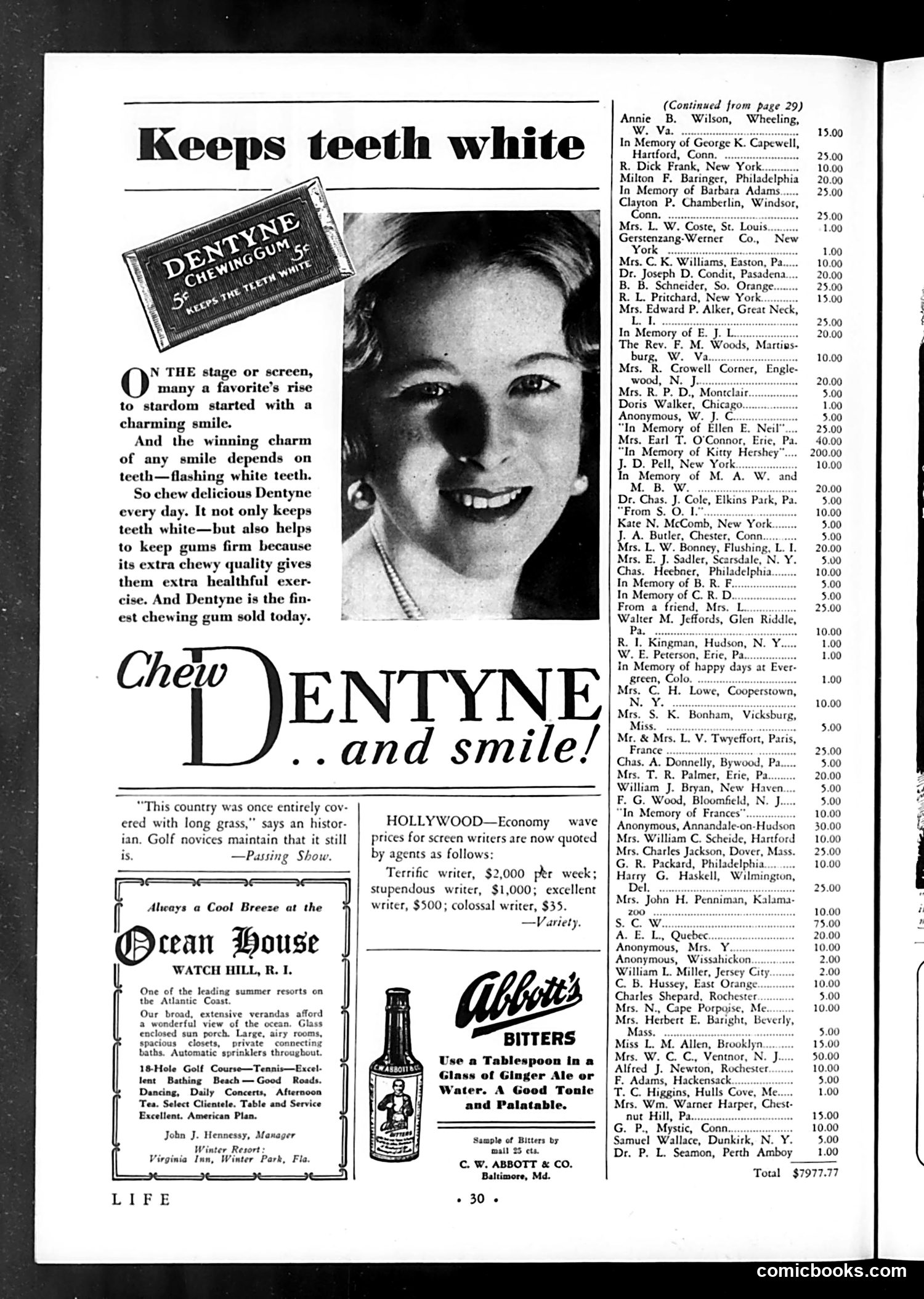
What This Page Means for Modern Readers This is primarily an advertising page from Life magazine, not political satire. The dominant content is a Dentyne chewing gum advertisement featuring a smiling woman's photograph—a straightforward commercial promoting the product's teeth-whitening and gum-health benefits. Below that sits a satirical quip about Hollywood screenwriters' salaries, listing compensation levels that descend absurdly: "$2,000 per week" for "terrific" writers down to "$35" for "colossal" writers. This apparent contradiction—"colossal" sounding grand while receiving the lowest pay—mocks either industry pay scales' illogic or inflated job titles masking exploitation. The remainder is hotel/resort advertising and what appears to be a charitable donations list. There is no political cartoon on this page—the "satire" is limited to the one brief Hollywood joke about writer compensation.
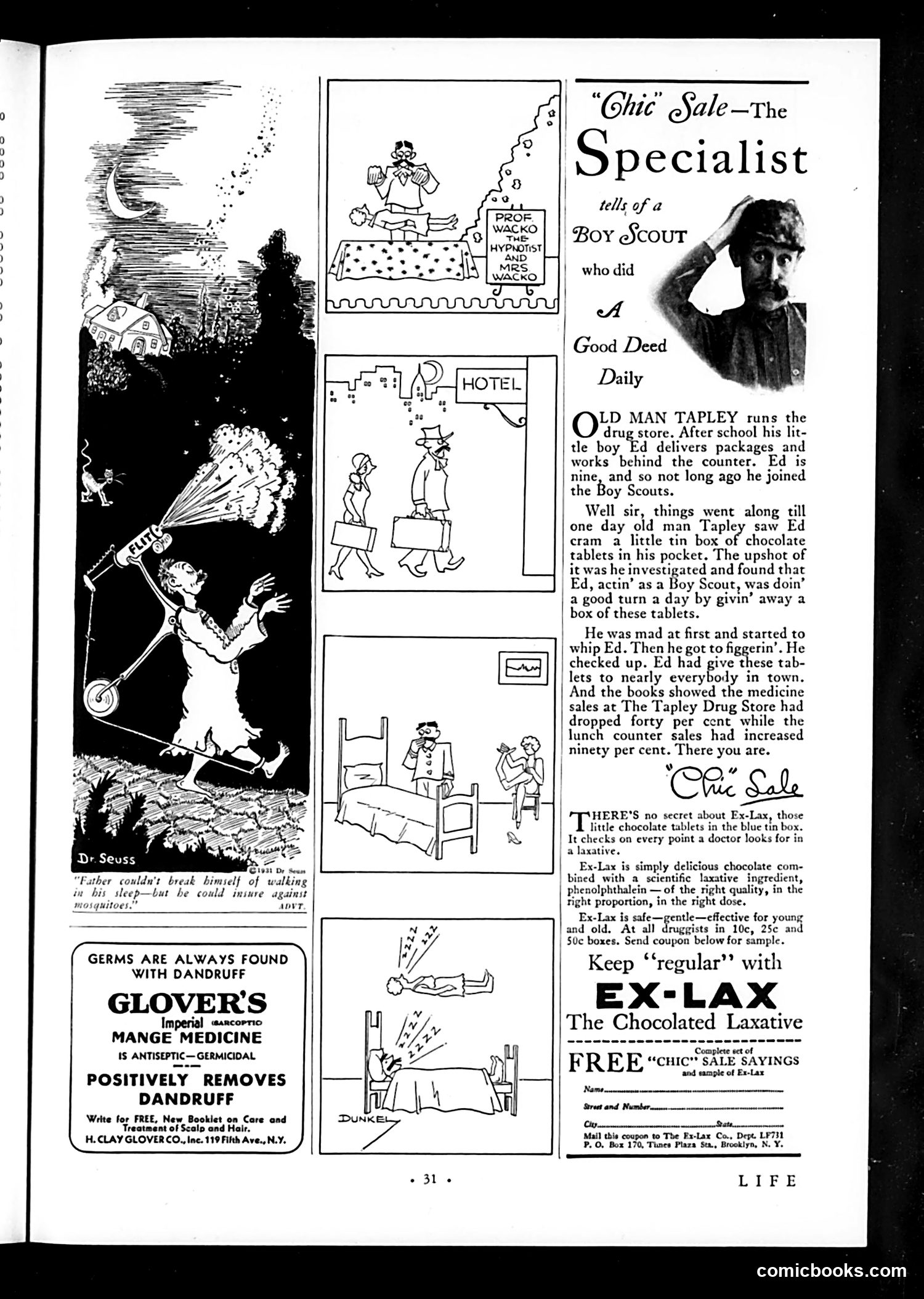
"Chic Sale" - The Specialist: Ex-Lax Advertisement Narrative This page combines a Dr. Seuss illustration with a humorous advertisement disguised as editorial content. The main piece tells of young Ed, a Boy Scout, who gives away Ex-Lax chocolate tablets as his daily "good deed" to townspeople. The joke hinges on irony: Ed's innocent generosity with laxatives—products meant to address constipation—inadvertently boosts the drugstore's lunch counter sales by 90% while medicine sales drop 40%. Old Man Tapley, initially angry at Ed's giveaway, realizes the commercial benefit. The humor targets both naive Boy Scout idealism and the pharmaceutical marketing of the era, when laxatives were heavily promoted as cure-alls. The narrative frames an advertisement as wholesome Americana, using the Boy Scout's "good deed" framework to sell Ex-Lax to readers. This is classic early-20th-century magazine advertising disguised as entertainment.
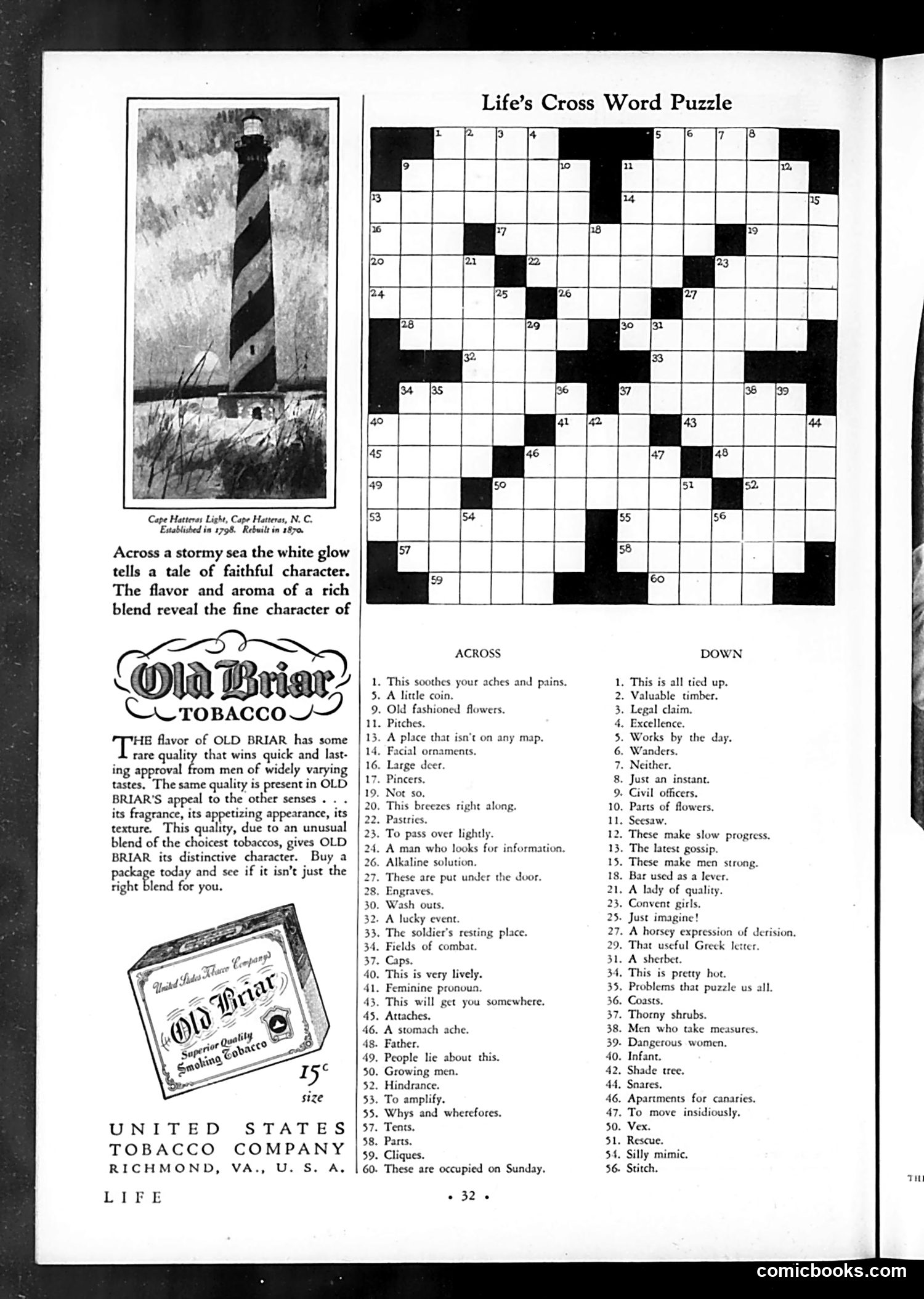
Content Analysis This page is primarily advertising disguised as editorial content—a common early 20th-century magazine practice. The upper half features a romanticized photograph of Cape Hatteras Lighthouse with poetic language ("tells a tale of faithful character") that transitions seamlessly into an advertisement for Old Briar tobacco. The product is marketed through metaphor: just as the lighthouse's steady glow represents reliability, Old Briar's "distinctive character" appeals to discerning men. The lower half contains a standard crossword puzzle—a popular feature in Life magazine. There is no political satire or cartoon on this page. The lighthouse image and tobacco ad use sentimentalism and character-building rhetoric typical of early-1900s marketing, but this represents commercial persuasion rather than social commentary. The page demonstrates how advertising integrated seamlessly into entertainment content in this era.
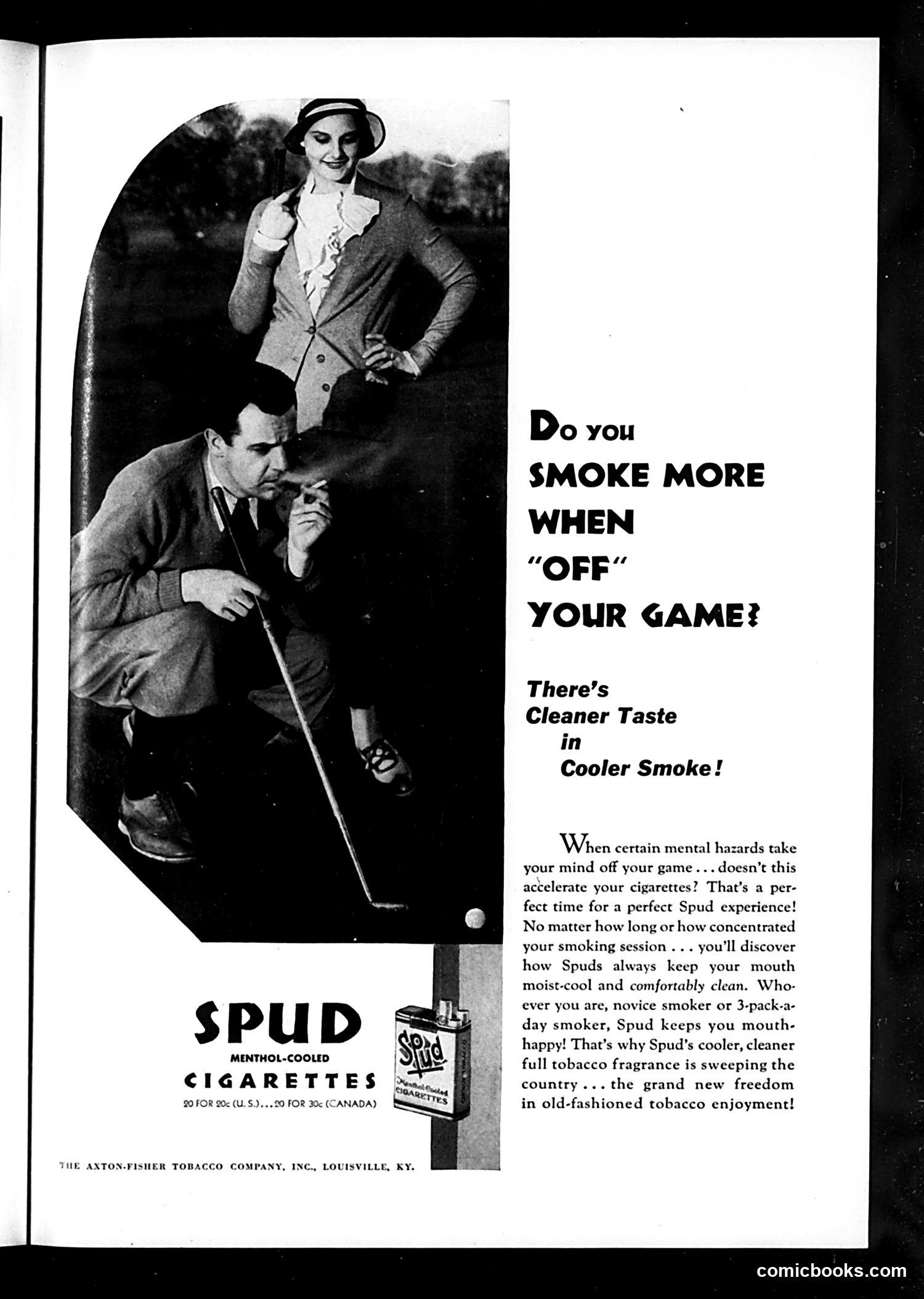
Spud Menthol Cigarettes Advertisement This is a cigarette advertisement, not a political cartoon. It depicts two golfers—one swinging, one watching—to promote Spud menthol cigarettes. The ad's premise targets recreational smokers: when you're distracted or stressed during activities like golf ("off your game"), you smoke more. Spud positions itself as the solution—its menthol cooling keeps your mouth "moist-cool and comfortably clean" during extended smoking sessions, making heavy smoking more pleasant. The casual, aspirational imagery of golfers (a leisure activity associated with affluence) was standard advertising rhetoric of the era. The copy emphasizes that Spud works for everyone from novices to heavy smokers ("3-pack-a-day"). By modern standards, this is strikingly direct tobacco marketing targeting stress-related smoking and normalized chain-smoking, practices now understood as addictive and harmful. The menthol cooling was marketed as a feature making intensive smoking more tolerable rather than discouraging it.
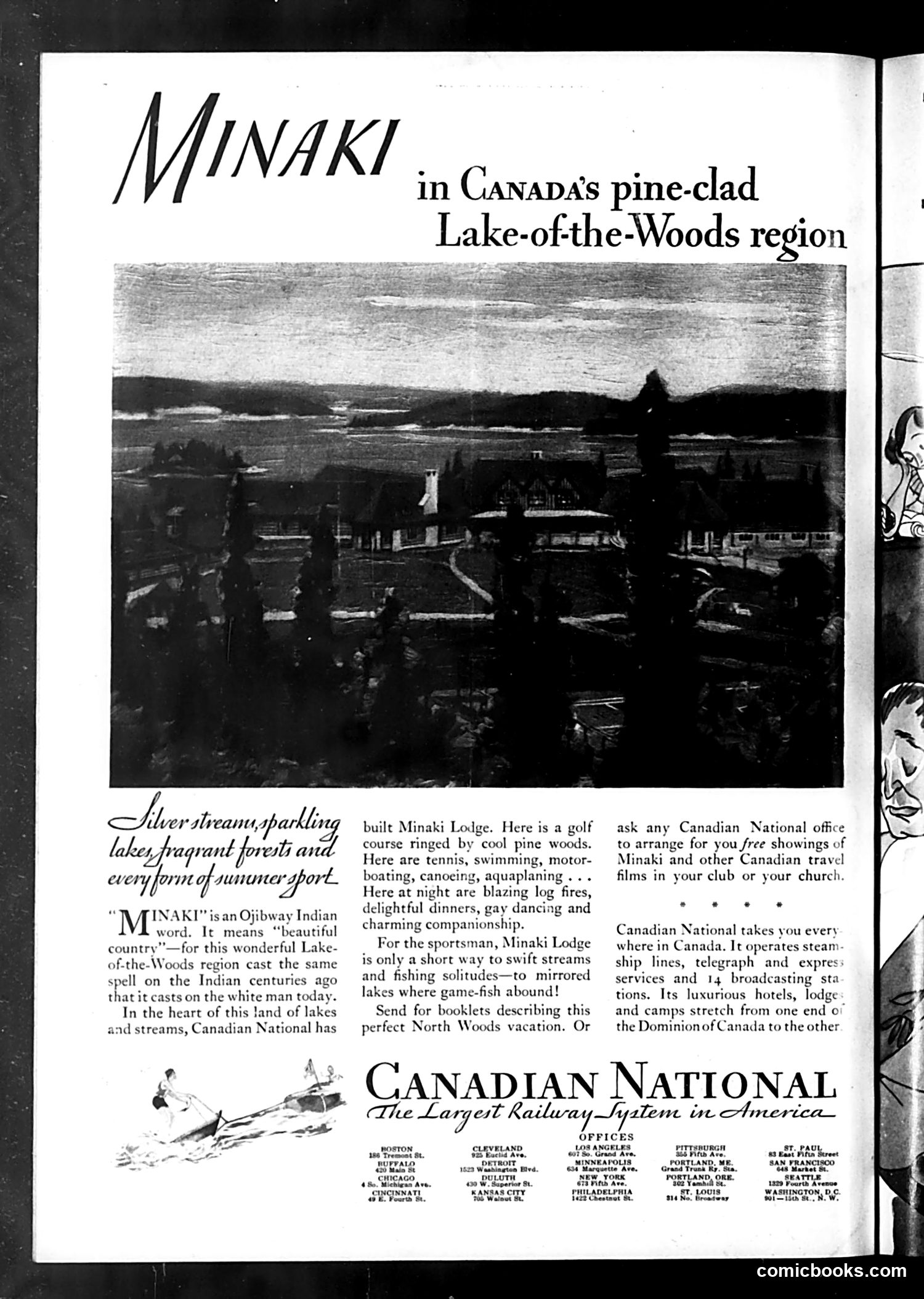
Analysis This is not a cartoon or satire—it's a travel advertisement for Canadian National Railways promoting Minaki Lodge in Ontario's Lake-of-the-Woods region. The page uses romantic language about the landscape ("beautiful country," "silver streamy, sparkling lakes") and the Ojibway Indian origin of the name "Minaki" to market luxury vacation amenities: golf, tennis, swimming, fishing, and fine dining with "blazing log fires" and "gay dancing." The small illustration at bottom left shows recreational activities (canoeing, fishing). This represents early 20th-century corporate tourism marketing that appropriated Indigenous nomenclature and imagery while selling "wilderness" experiences to wealthy travelers via the railway company's extensive hotel and transportation network across Canada. There is no political satire here—this is straightforward period advertising.