life
Life — July 24, 1931
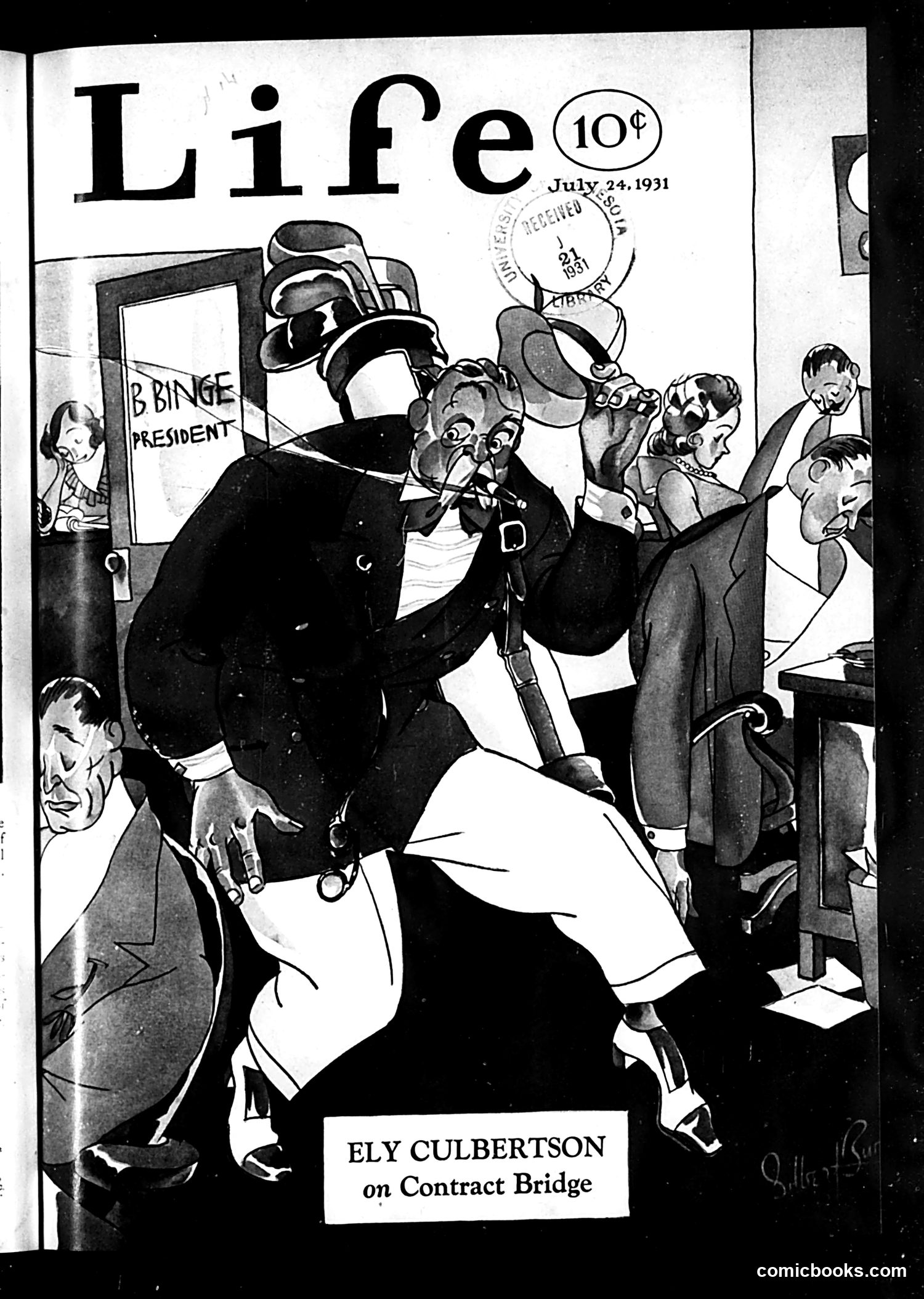
Life Magazine Cover Analysis - July 24, 1931 This Life cover satirizes Ely Culbertson and the craze surrounding Contract Bridge, a newly popular card game variant in the 1930s. The illustration depicts Culbertson as a large, dominating figure bursting into what appears to be a presidential office (marked "BINGE PRESIDENT"), physically overwhelming the occupants. The exaggerated, almost violent entrance suggests how obsessively Americans were adopting Contract Bridge—the game had become such a cultural phenomenon that it was metaphorically "crashing" into even the highest levels of society. Culbertson, a famous bridge player and promoter, is caricatured as the driving force behind this social mania. The satire mocks both the game's popularity and Culbertson's role in making bridge-playing a national obsession during the Depression era.
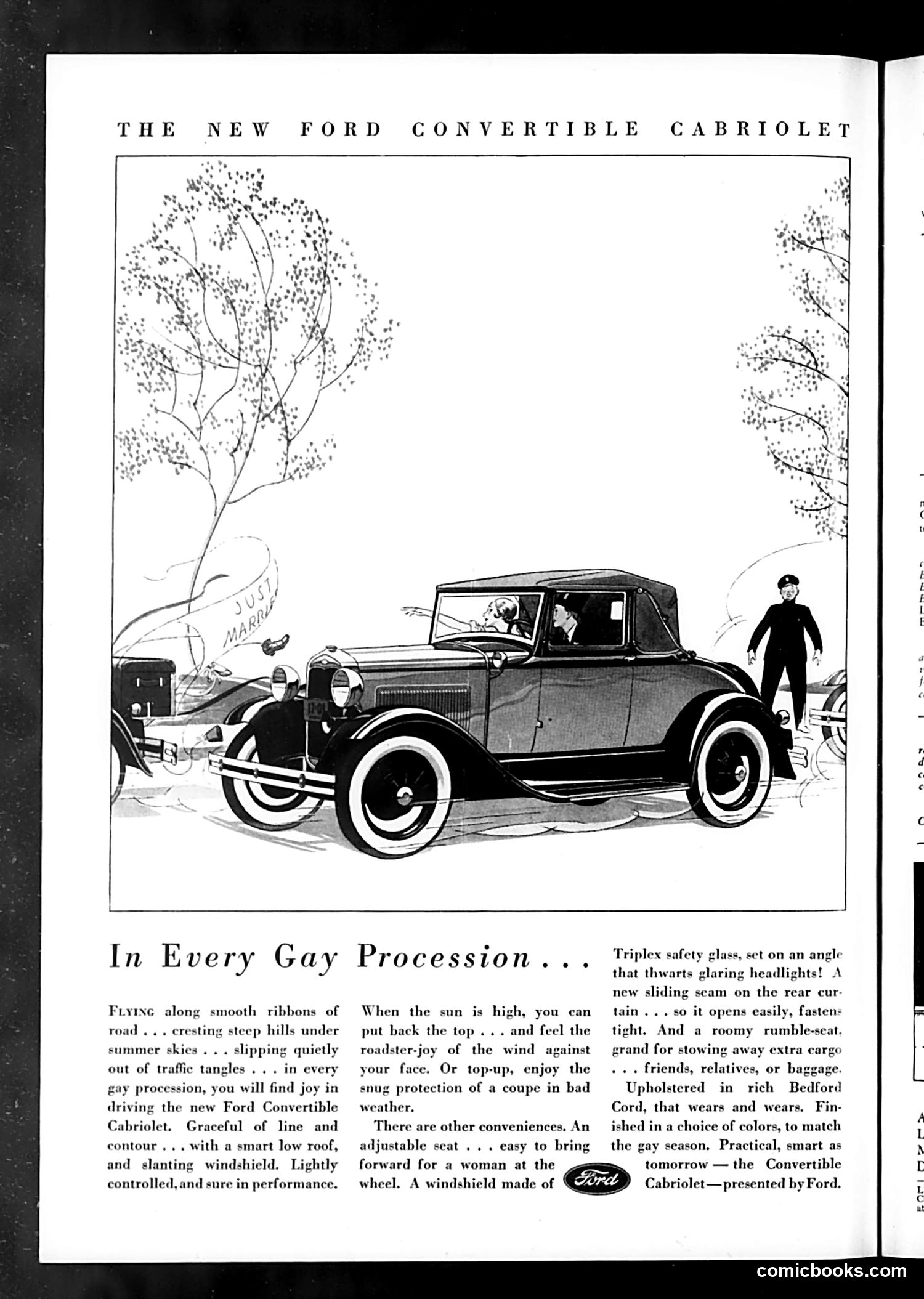
Analysis This is an advertisement for the Ford Convertible Cabriolet, not political satire or a cartoon. The page presents an idealized sketch of the vehicle in a leisure scene—a convertible parked near a tree with well-dressed figures nearby, suggesting recreational driving. The ad text emphasizes the car's appeal to modern, affluent consumers: smooth highways, open-air comfort ("roofless-joy"), practical features (adjustable seat, windshield, cargo space), and aesthetic design ("choice of colors"). The headline "In Every Gay Procession..." uses "gay" in its original sense meaning cheerful and lighthearted, reflecting 1920s-1930s advertising language. The overall message positions the Ford Cabriolet as a stylish, dependable choice for leisure driving—targeting middle-to-upper-class buyers seeking both practicality and social status.
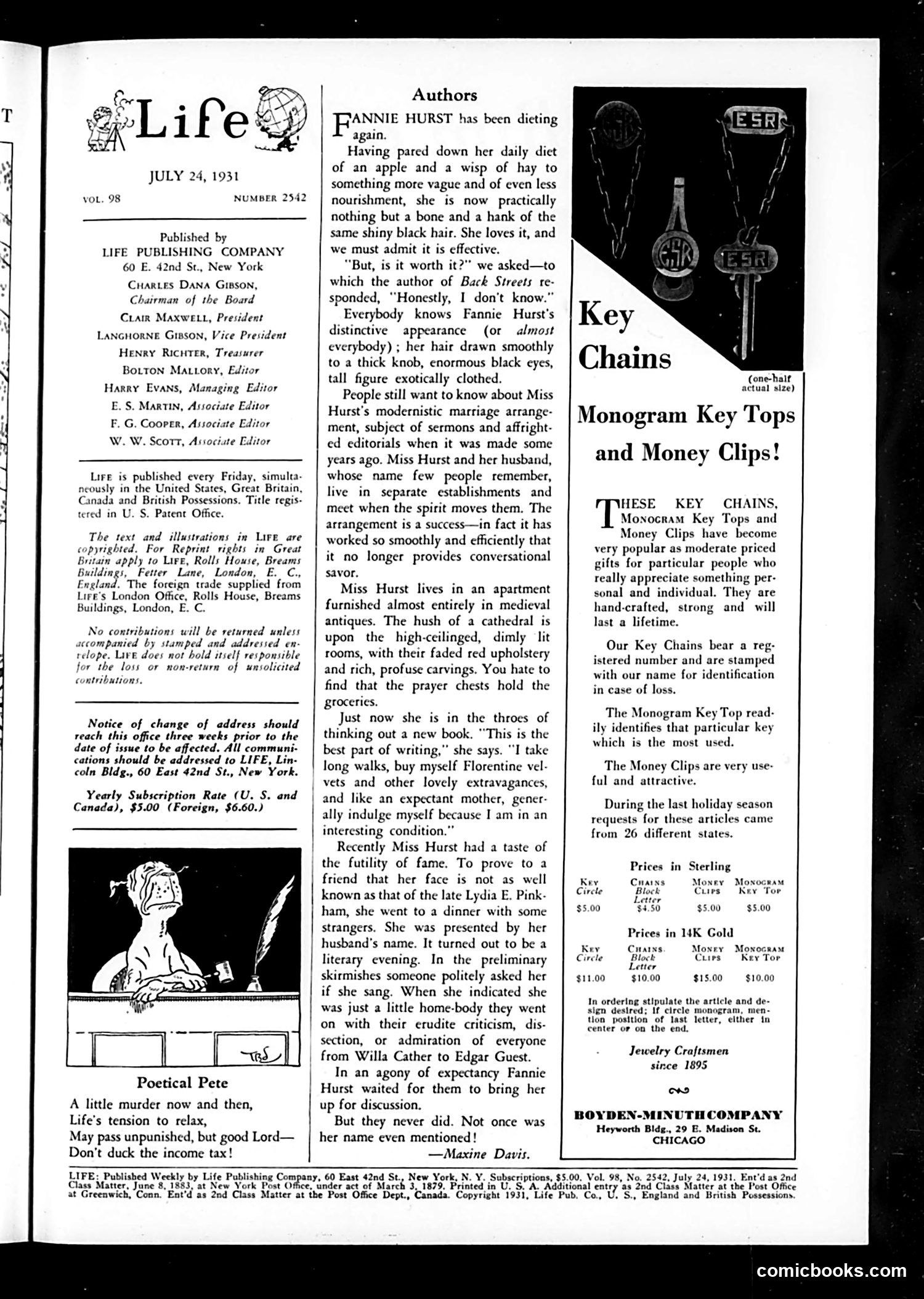
Analysis of Life Magazine, July 24, 1931 This page is primarily advertising and editorial content rather than political satire. The main feature is an "Authors" section profiling Fannie Hurst, a novelist known for *Back Street*. The text describes her distinctive appearance (dark hair, black eyes) and her unconventional marriage arrangement—she and her husband maintained separate residences and only met "when the spirit moves them." The right side advertises "Key Chains, Monogram Key Tops and Money Clips" from the Boyden-Mesthcowpany in Chicago—luxury items marketed as gifts for people of refinement. At bottom left is a brief humorous poem titled "Poetical Pete," making a light joke about murder and income taxes—typical of Life's satirical style, though unrelated to the main content. This reflects 1931 consumer culture and literary society rather than political commentary.
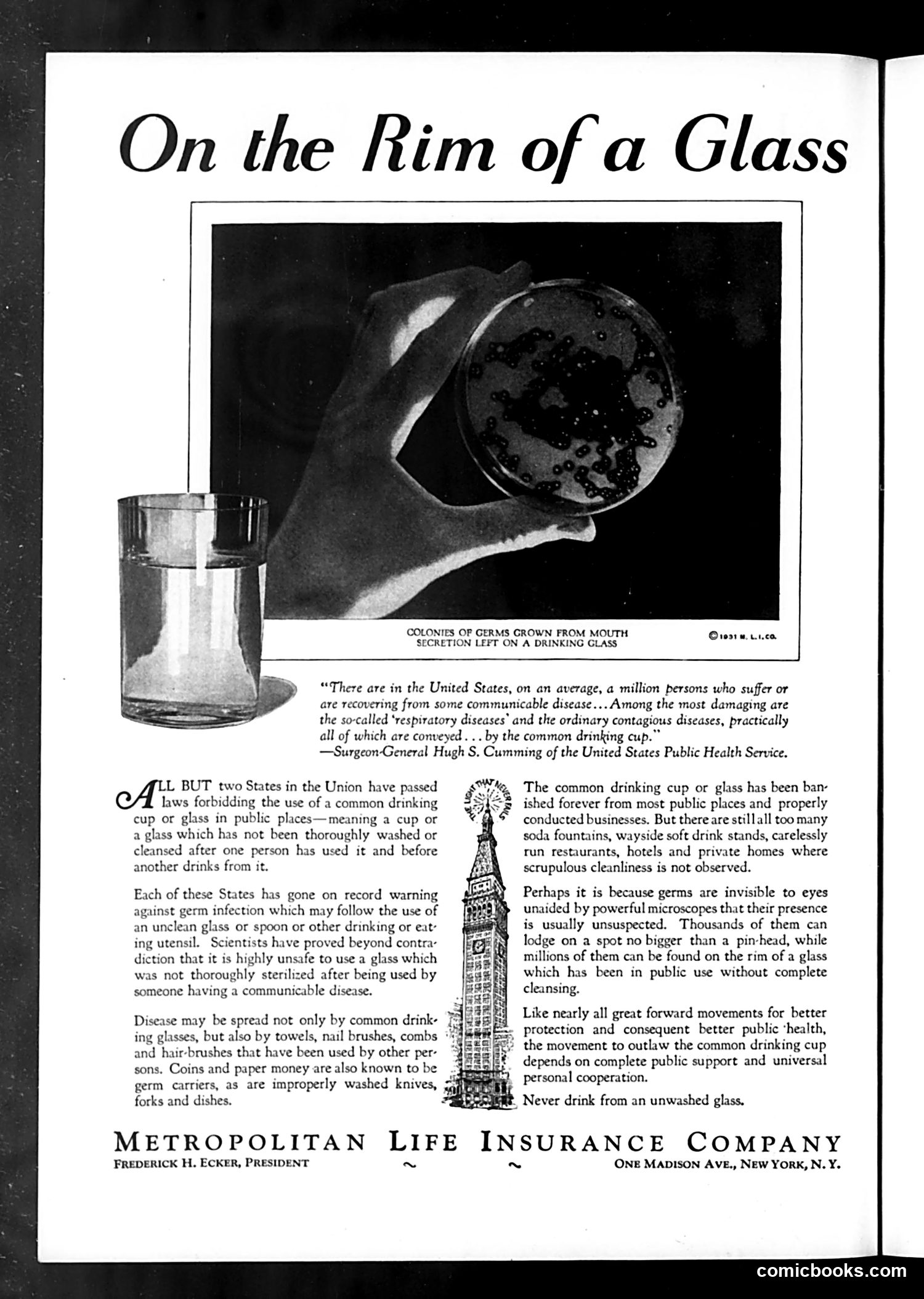
On the Rim of a Glass This is a public health advertisement by Metropolitan Life Insurance Company warning against sharing drinking glasses. The dramatic photograph shows a hand holding a glass with visible bacterial colonies grown from mouth secretion—a scientific visualization meant to shock viewers. The text cites Surgeon General Hugh S. Cumming regarding communicable diseases spread through common drinking cups. The ad notes that only two U.S. states had banned public drinking glasses, though many establishments still used them unsafely. The message was straightforward health advocacy: germs are invisible but deadly, and shared drinking glasses spread diseases like respiratory infections and contagious illnesses. The appeal to "complete public support and universal personal cooperation" urged readers to reject the common drinking cup entirely—a practical public health campaign presented through dramatic visual evidence.
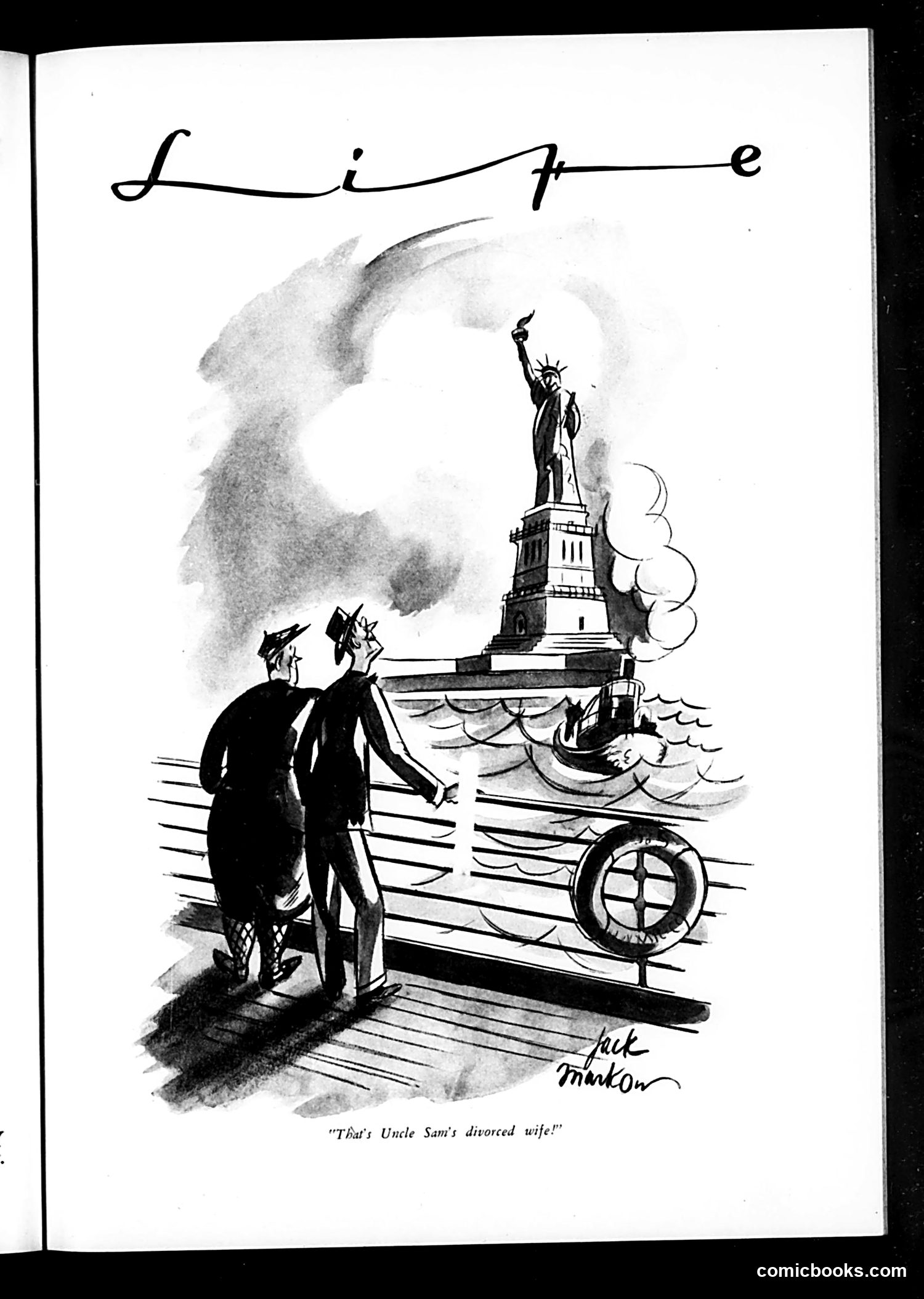
Analysis This political cartoon by Jack Markow depicts two men in formal attire standing on a ship's deck, viewing the Statue of Liberty. The caption reads: "That's Uncle Sam's divorced wife!" The joke relies on personifying the United States government as "Uncle Sam" and Lady Liberty as his spouse. The cartoon appears to satirize a perceived disconnect between American ideals (represented by the Statue of Liberty's promise of freedom and welcome) and the actual policies or actions of the U.S. government at the time. By calling Liberty "Uncle Sam's divorced wife," the cartoonist suggests these ideals have been abandoned or rejected by the government itself—a commentary on hypocrisy between American founding principles and contemporary political practice. Without a specific date visible, the exact historical context remains unclear.
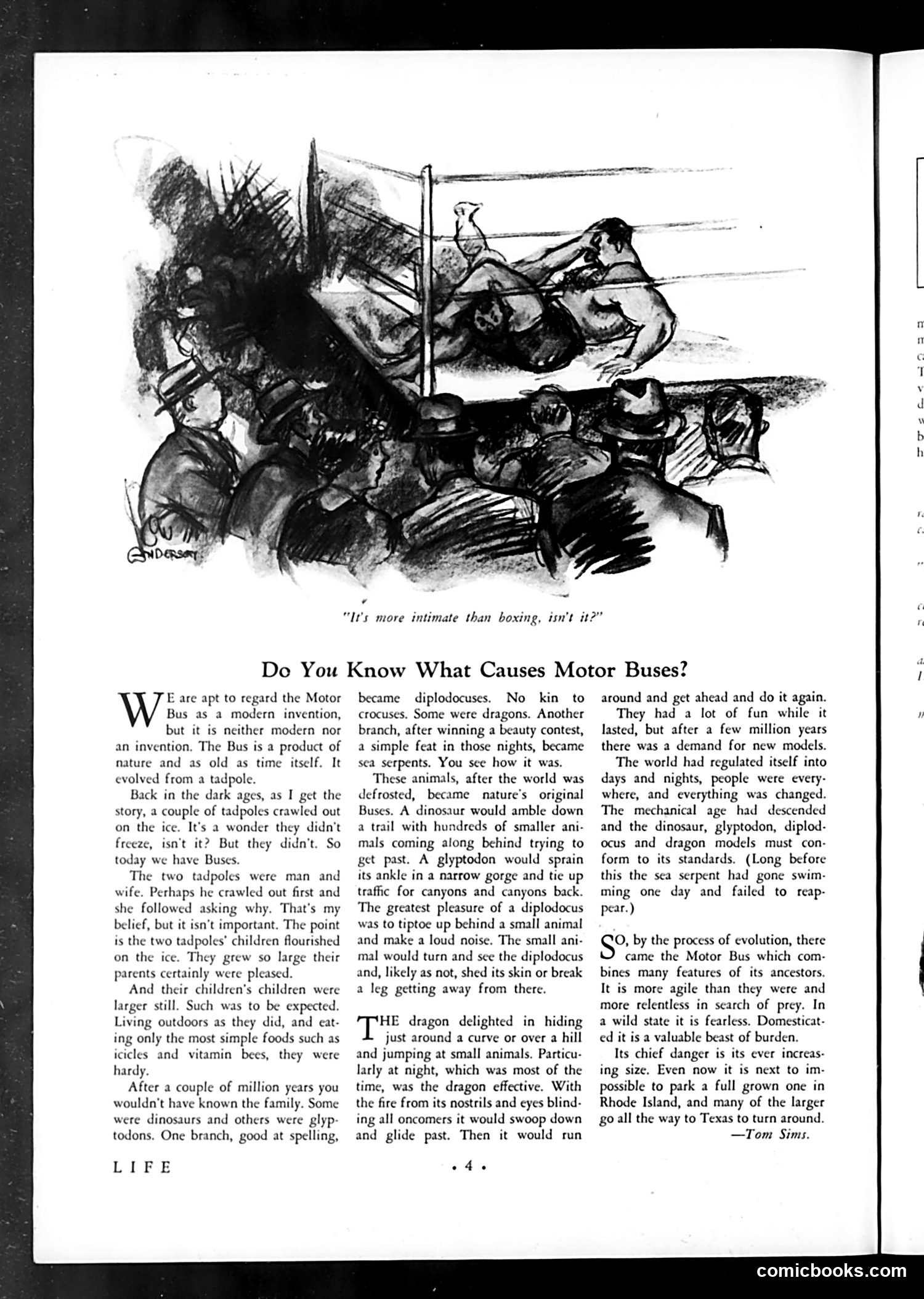
"Do You Know What Causes Motor Buses?" — Life Magazine Satire This is a humorous satirical article using evolutionary theory as social commentary. The piece uses a fanciful origin story: motor buses allegedly descended from prehistoric creatures (diplodocuses, glyptodons, dragons) through evolutionary processes. The satire appears to mock the growing prevalence of motor buses in early 20th-century urban life—their size, power, and dangerous behavior toward pedestrians and smaller vehicles. By playfully attributing them to evolutionary descent from extinct monsters, the author satirizes how these new machines have become part of the urban landscape, viewing them as modern "beasts of burden" that are "fearless" and dangerous. The cartoon shows pedestrians and smaller vehicles encountering these large buses, capturing public anxiety about motorized transportation's rapid expansion.
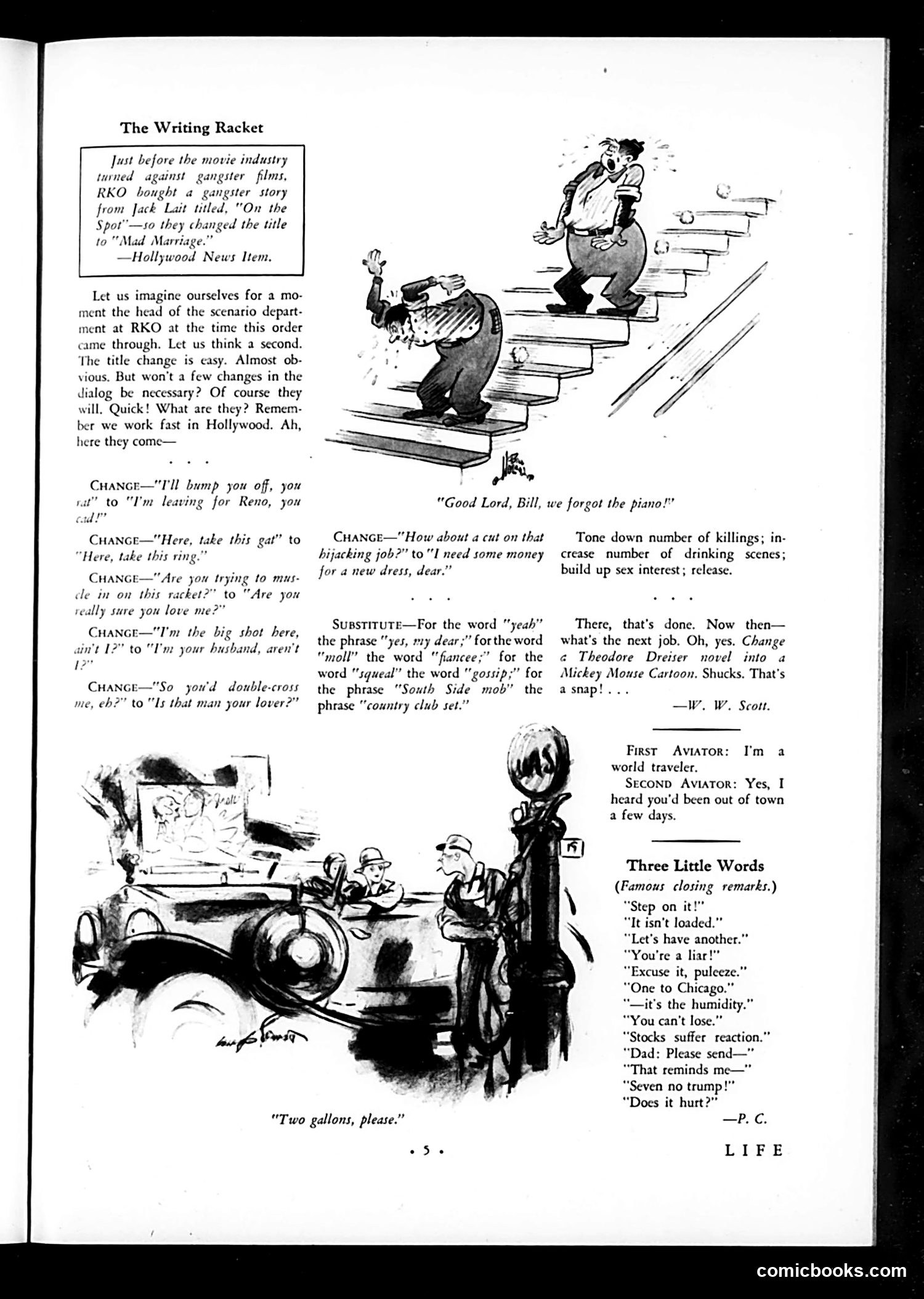
Explanation for Modern Readers This page satirizes Hollywood's screenwriting process during the early studio era. The top section, titled "The Writing Racket," mocks how quickly studios rewrote scripts when censors objected—a real anecdote mentions RKO changing a title from "On the Spot" to "Mad Marriage" due to gangster-film restrictions. The dialogue examples show absurd substitutions editors forced writers to make: replacing "yeah" with "yes," sanitizing language, and toning down sexual content and violence to appease censors and moral watchdog groups. The cartoon illustrations humorously depict this process—writers literally climbing stairs while losing content, and a scene captioned "Two gallons, please" (unclear reference, possibly about studios' voracious script consumption). The page critiques how studio interference degraded creative work through arbitrary censorship demands.
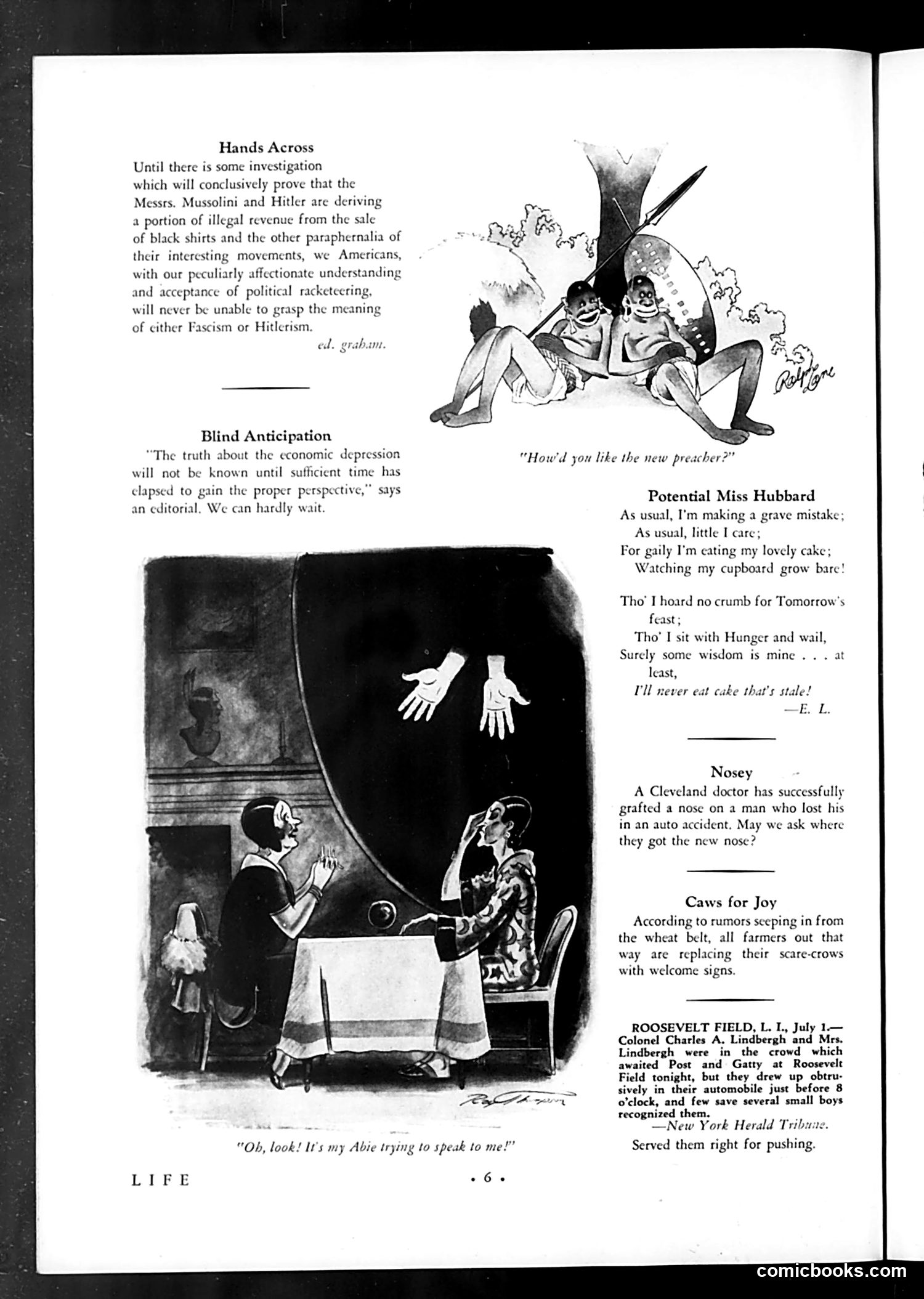
Analysis of Life Magazine Page Top Cartoon ("Hands Across"): Two figures wearing what appear to be military/fascist regalia sit together, with one asking the other "How'd you like the new preacher?" This satirizes Mussolini and Hitler (as explicitly named in the accompanying text), suggesting they're profiting from illegal revenue through black shirts and other paraphernalia. The cartoon criticizes American indifference to understanding fascism and Hitlerism. Bottom Cartoon ("Oh, look! It's my Abie trying to speak to me!"): Shows a séance scene where a living person attempts to communicate with ghostly hands. This appears to be a supernatural/spiritualism joke, though the specific reference is unclear from the visible text. The page demonstrates Life's anti-fascist political stance during the pre-WWII era.
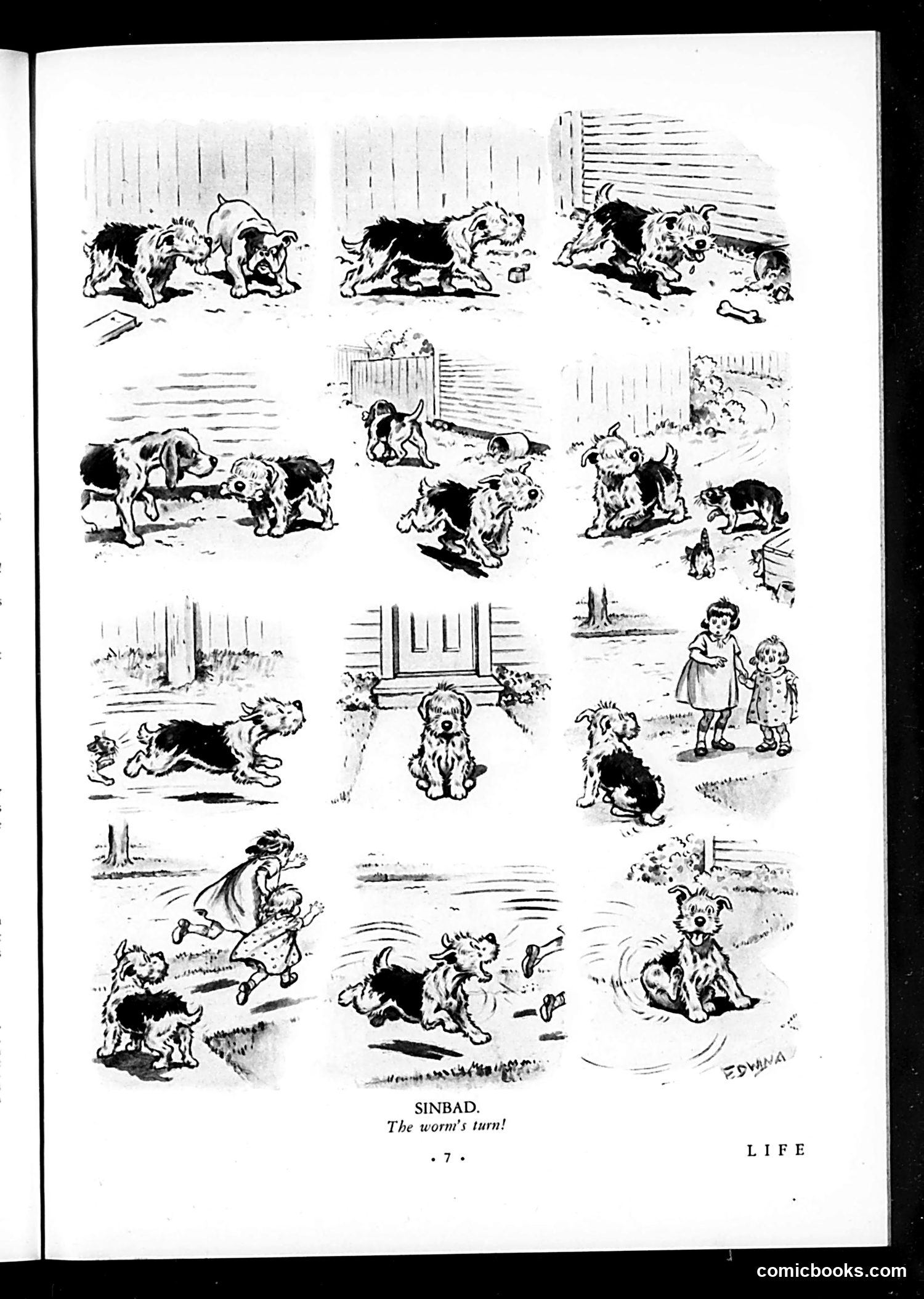
"Sinbad: The Worm's Turn!" This is a humorous comic strip sequence showing dogs repeatedly chasing and tormenting what appears to be a small creature or "worm." The title "The Worm's Turn" suggests an ironic reversal—implying the worm will finally get revenge on its tormentors. The strip depicts various scenarios of dogs pursuing the small animal through different settings (yards, near houses, in water). The final panels appear to show the creature turning the tables, with the dogs now fleeing or reacting in alarm. This is likely satirical commentary using animal behavior as metaphor for underdog revenge or social reversal—the weak finally standing up to their oppressors. The specific political or social reference remains unclear without additional context about Life magazine's 1920s-era concerns.
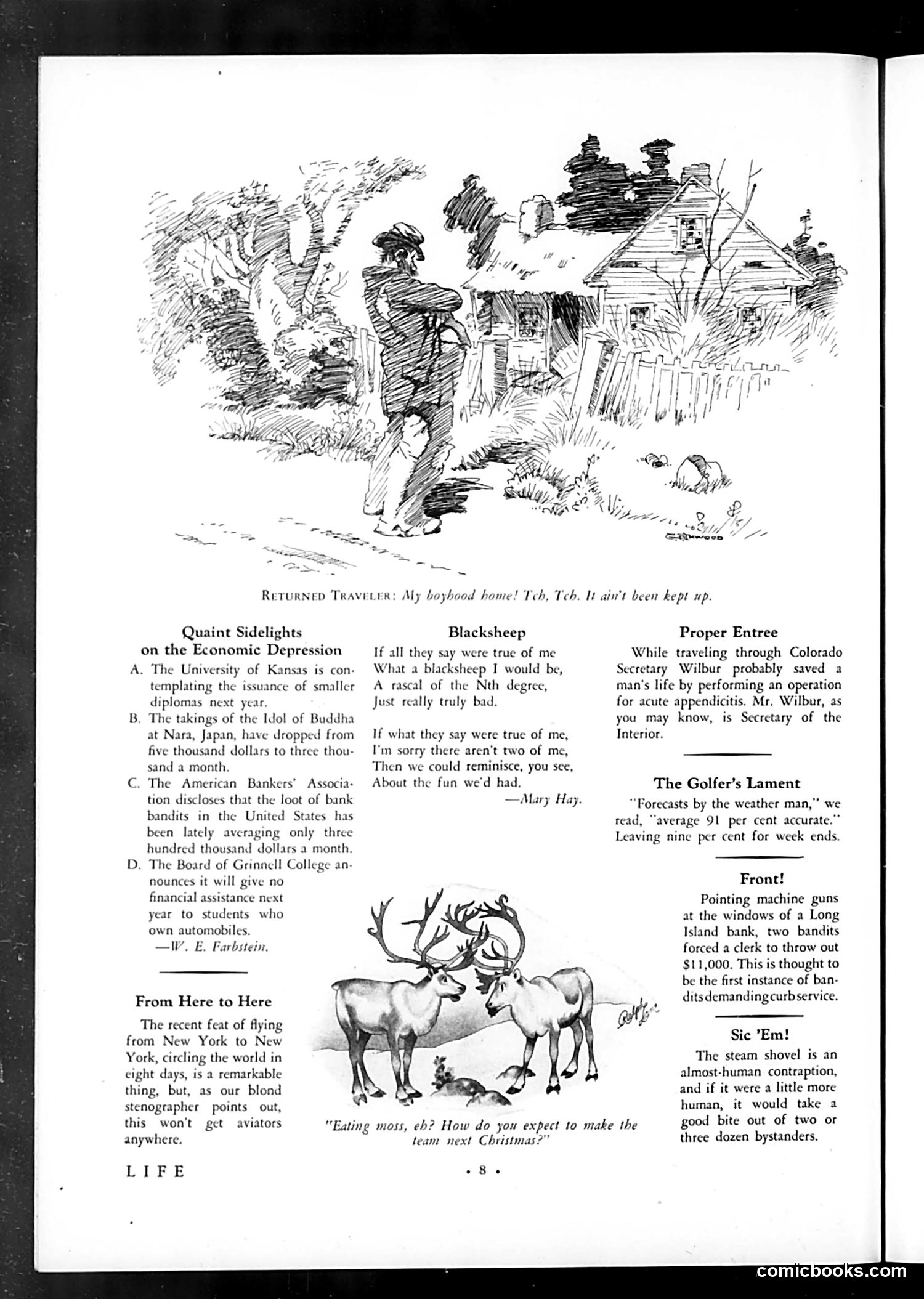
Explanation for Modern Readers This Life magazine page contains satirical commentary on 1930s Depression-era economics and conditions. The main cartoon shows two deer, with one asking the other about making "the team next Christmas?"—a dark joke about eating grass ("moss") during food scarcity. The "Quaint Sidelights on the Economic Depression" section mocks institutional responses: universities cutting diploma costs, Japanese temples losing donations, American banks hemorrhaging money, and colleges refusing to help students with car payments—all absurd economies reflecting widespread financial collapse. "Blacksheep" appears to be a poem about reputation damage. Other brief items satirize weather forecasting accuracy and a bank robbery attempt. The overall tone is sardonic commentary on how institutions and individuals struggled during the Great Depression.
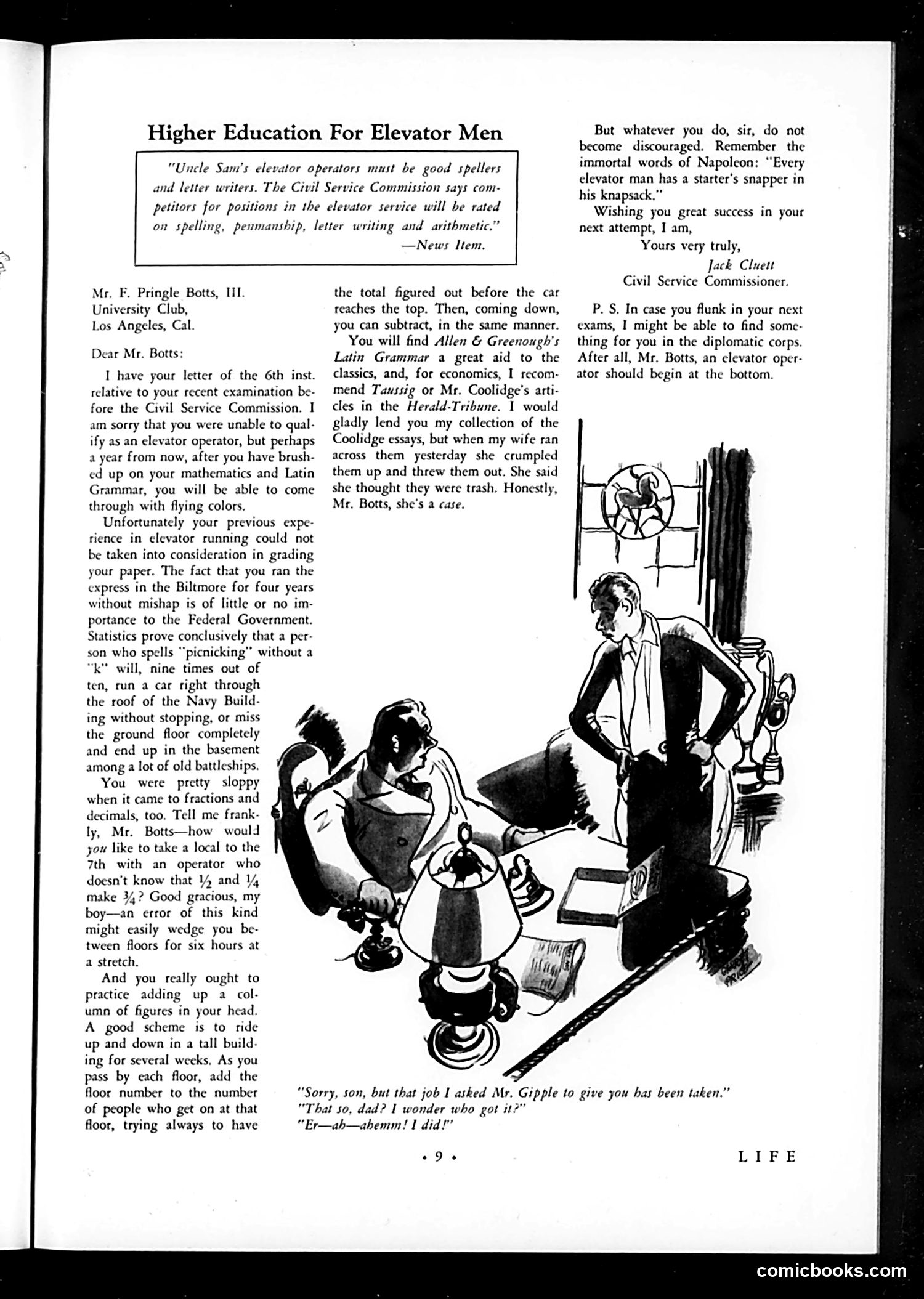
"Higher Education For Elevator Men" This satirical piece mocks a failed civil service examination candidate who aspired to become an elevator operator. The letter from Civil Service Commissioner Jack Cluett humorously suggests the applicant study grammar, Latin, and arithmetic to improve for his next attempt—treating a menial job as if it required scholarly credentials. The cartoon illustrates the absurdity: an elevator operator struggling with complex mathematical calculations and academic materials while managing the mechanical equipment. The joke critiques both the bureaucratic rigidity of civil service testing and the pretension of requiring "higher education" for unskilled labor. The applicant's poor spelling, math errors, and general incompetence are presented as obstacles comically overblown by the examination system itself.
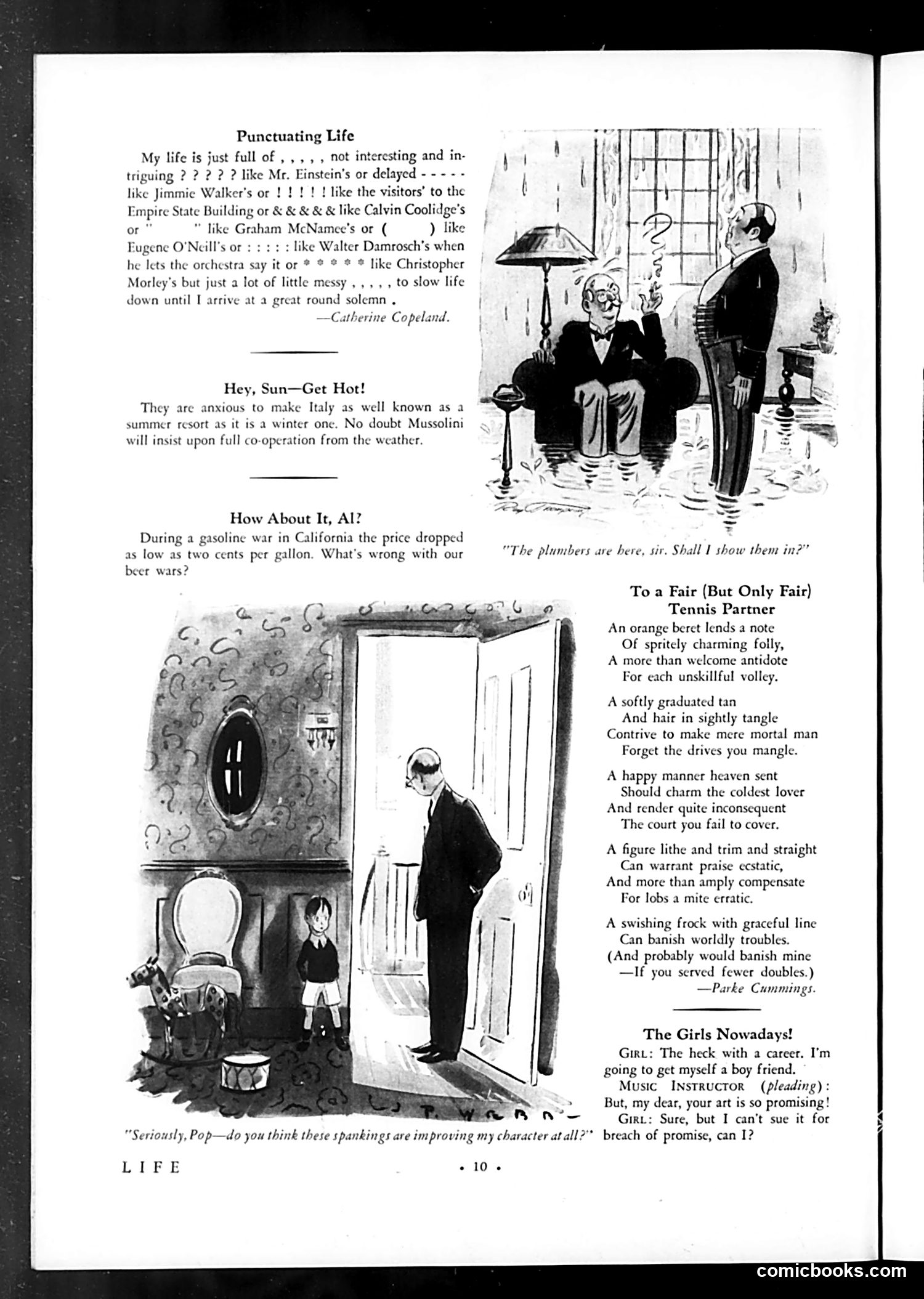
Analysis of Life Magazine Page This page contains humor pieces and cartoons typical of 1920s American satire. The top piece "Punctuating Life" by Catherine Copeland uses punctuation marks as metaphors for people's personalities—referencing public figures like Einstein and Calvin Coolidge to describe different life rhythms. The two main cartoons satirize domestic frustrations: one depicts a homeowner with plumbers (mocking the inconvenience and cost of repair services), and another shows a man at a bathroom door, humorously asking if the plumbers should be shown in. The poetry section "To a Fair (But Only Fair) Tennis Partner" by Parker Cummings gently mocks poor tennis opponents with backhanded compliments about their appearance and skill. "The Girls Nowadays!" depicts generational conflict between a young woman pursuing romance and an older music instructor valuing artistic dedication—reflecting 1920s debates about changing youth values.
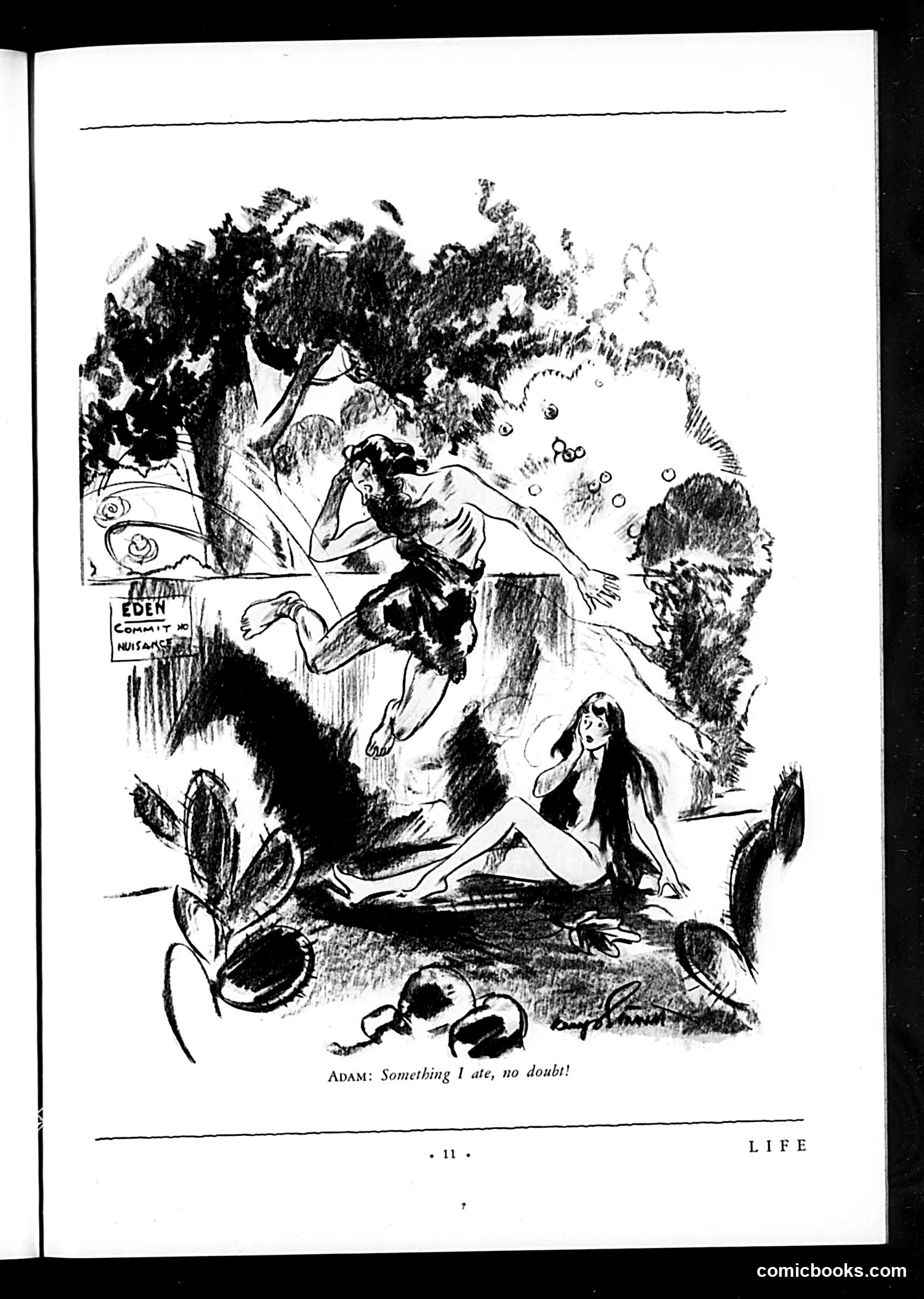
Explanation for Modern Readers This is a cartoon illustrating the Biblical story of Adam and Eve in the Garden of Eden. Adam, depicted lounging in a pastoral paradise with a tree, woman, and scattered fruit, declares "Something I ate, no doubt!" — apparently blaming his companion for whatever discomfort he's experiencing. The satire targets the Adam and Eve narrative itself, specifically the misogynistic blame traditionally placed on Eve for humanity's fall from grace (she ate the forbidden fruit and offered it to Adam). By having Adam casually attribute his problem to "something I ate," the cartoonist mocks how men throughout history have blamed women for mankind's troubles, even when men made their own choices. The joke exposes the absurdity of this scapegoating.
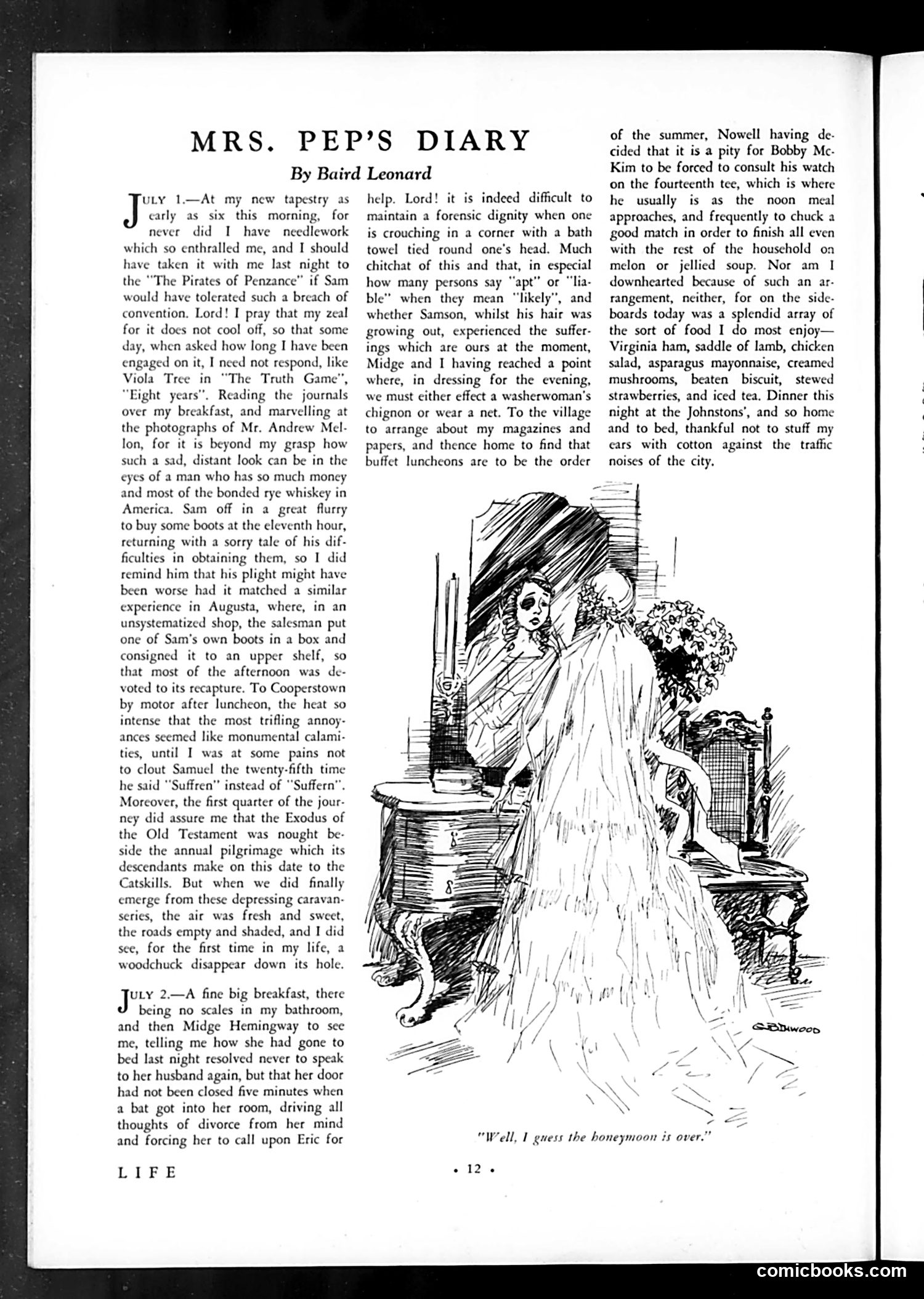
Mrs. Pep's Diary - "Well, I guess the honeymoon is over" This is a humorous domestic diary entry by Baird Leonard satirizing newlywed life. The illustration shows a woman in a nightgown confronting her husband about a bat that invaded their bedroom at night—forcing her to call for help from "Eric" instead of handling it herself. The caption "Well, I guess the honeymoon is over" is the joke's punchline: the romantic phase of marriage has ended, replaced by mundane domestic annoyances and the wife's willingness to involve another man. The satire mocks the disillusionment that follows newlywed bliss, when partners confront ordinary life's irritations rather than maintaining romantic idealism. It's gentle marital humor typical of early-20th-century Life magazine.
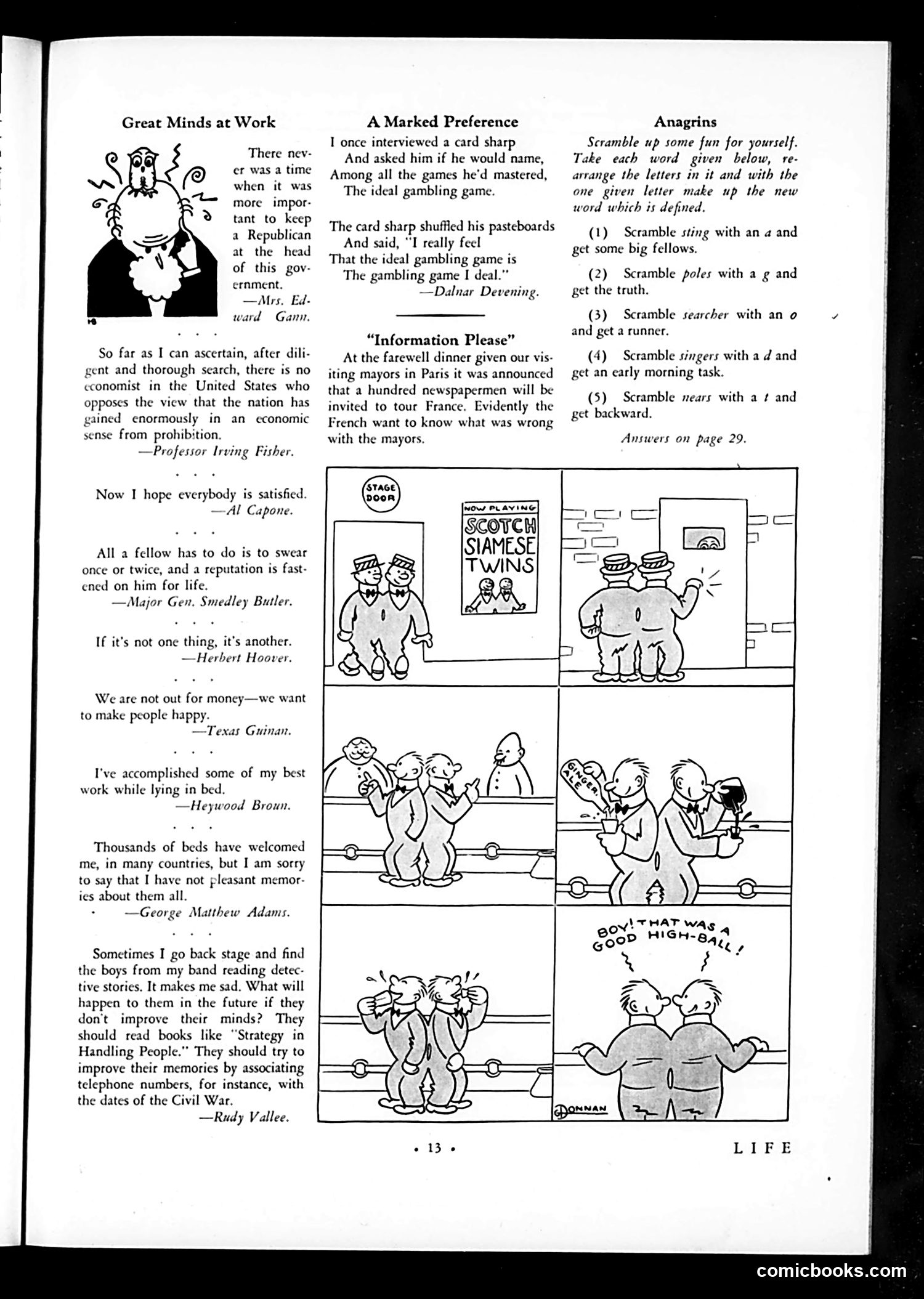
Explanation for Modern Readers This page from *Life* magazine contains a comic strip about "Siamese Twins" at a stage door. The humor involves two identical-looking men who appear to be conjoined or inseparable performers. The strip shows them interacting backstage and performing, with the final panel depicting them as a single large figure, playing on the visual joke of their "twinned" nature. The accompanying quotes are unrelated observations from famous figures about various topics—reputation, happiness, and beds—typical of *Life*'s satirical format mixing comics with pithy commentary. Without a visible date, the specific theatrical reference remains unclear, but the cartoon exploits the novelty and spectacle of "Siamese twins" as a popular entertainment draw of that era.
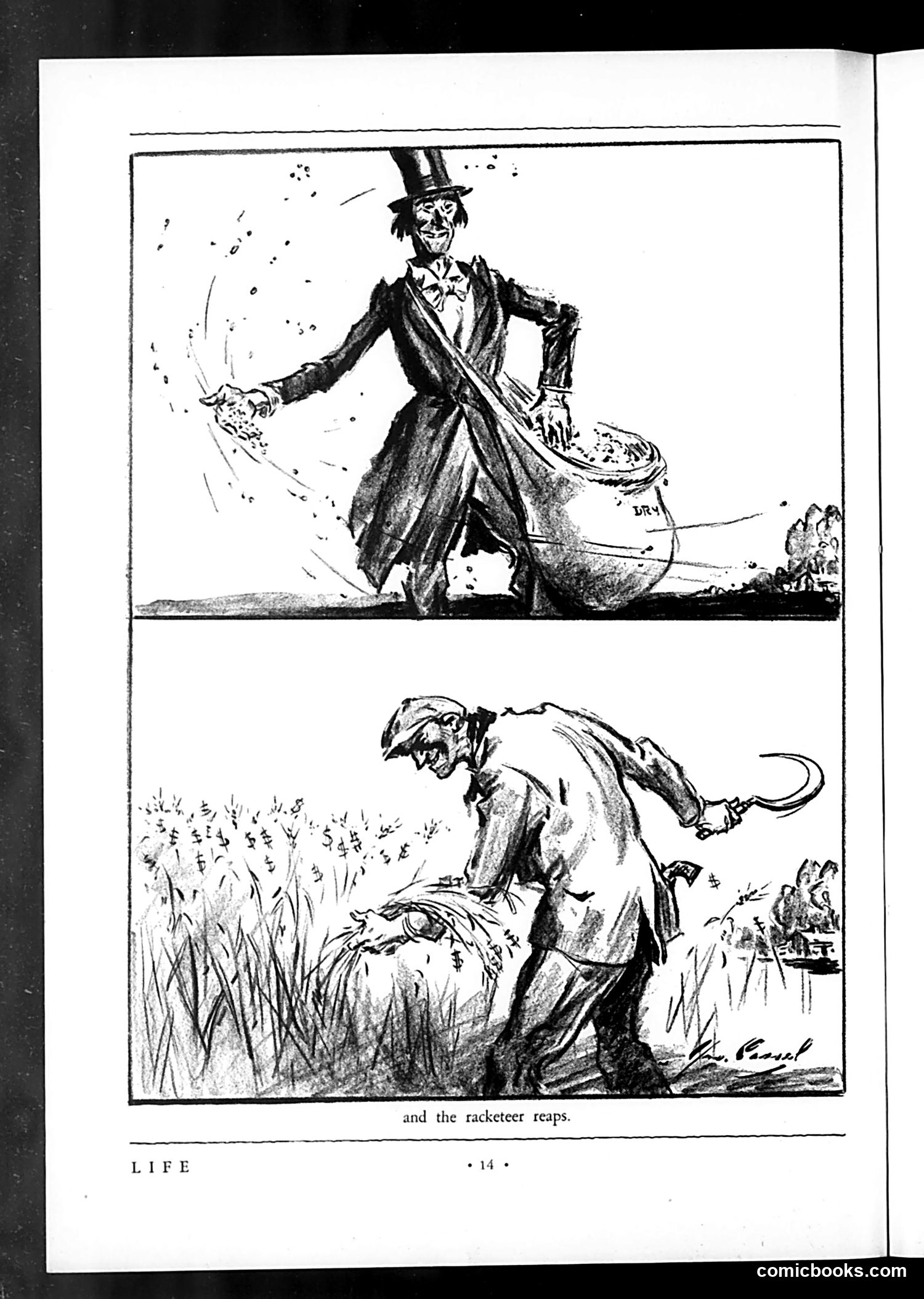
Political Cartoon Analysis This two-panel cartoon illustrates the concept "and the racketeer reaps" using the metaphor of sowing and harvesting. Top panel: A well-dressed figure in a top hat and formal coat—clearly a wealthy, sophisticated person—scatters seeds (marked "DRY") across a field. The character's sinister grin suggests deliberate wrongdoing. Bottom panel: A poorly-dressed laborer bent over in a field harvests the grown crops, holding a scythe or hook. The satire critiques economic inequality and exploitation: the wealthy "sow" schemes or corrupt practices (the "dry" seeds likely reference dishonest dealings), while working-class people "reap" the consequences through hardship. The racketeer profits while ordinary people suffer the fallout. This reflects Progressive Era concerns about corporate malfeasance and labor exploitation.
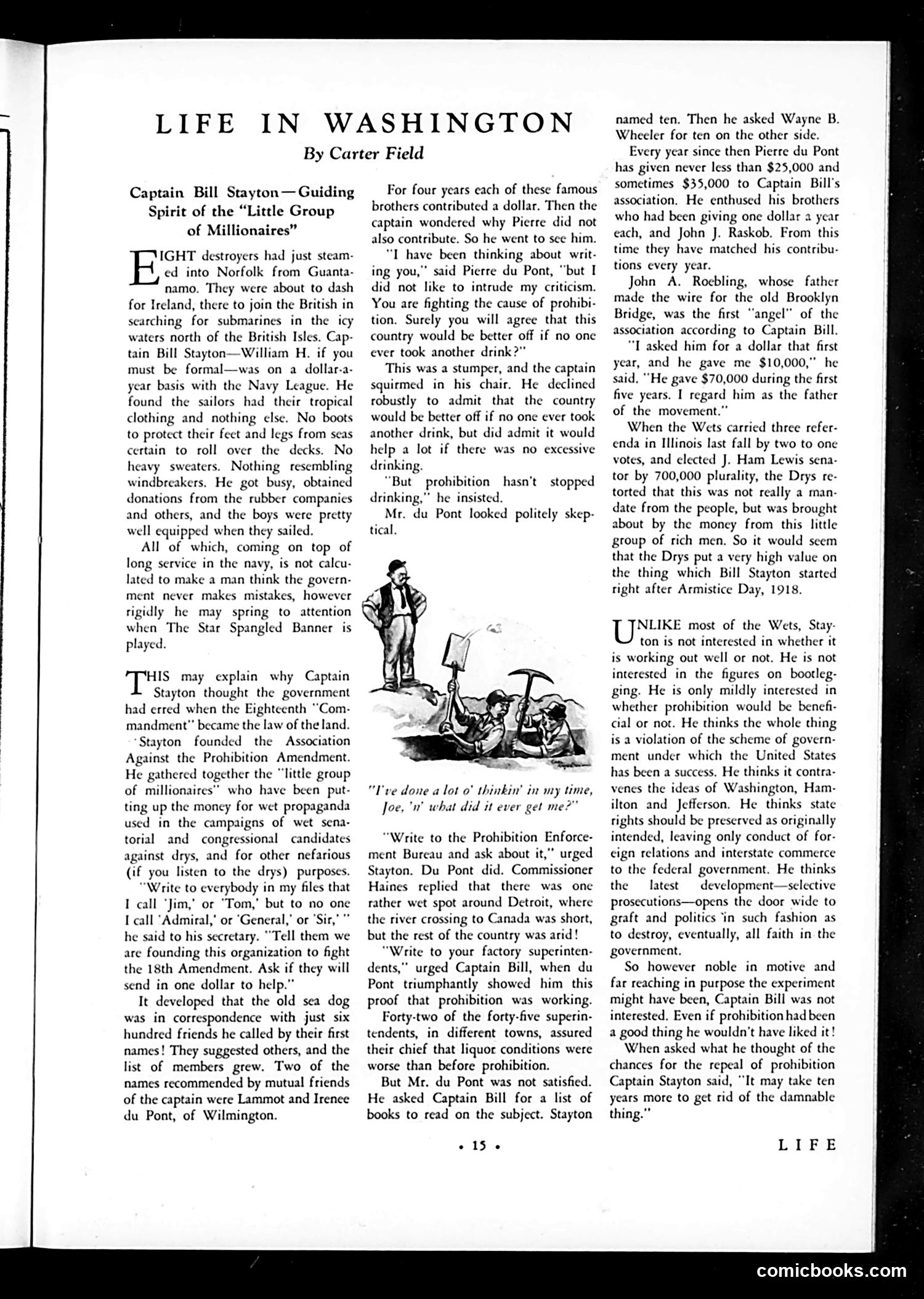
"Life in Washington" by Carter Field This article discusses Captain Bill Stayton and his "Little Group of Millionaires"—an organization fighting Prohibition. The accompanying cartoon depicts two men in a small boat, with the caption "I've done a lot o' thinkin' in my time, Joe, 'n' what did it ever get me?" The satire targets wealthy anti-Prohibition activists who funded campaigns against the 18th Amendment. Stayton founded the Association Against the Prohibition Amendment, using millionaires' donations to oppose temperance laws. The cartoon mocks their efforts as futile—despite their money and influence, they couldn't prevent Prohibition's passage or enforcement. The piece portrays these wealthy men as somewhat pathetic, their grand schemes yielding nothing but frustration, highlighting the gap between their resources and actual political power during this era.
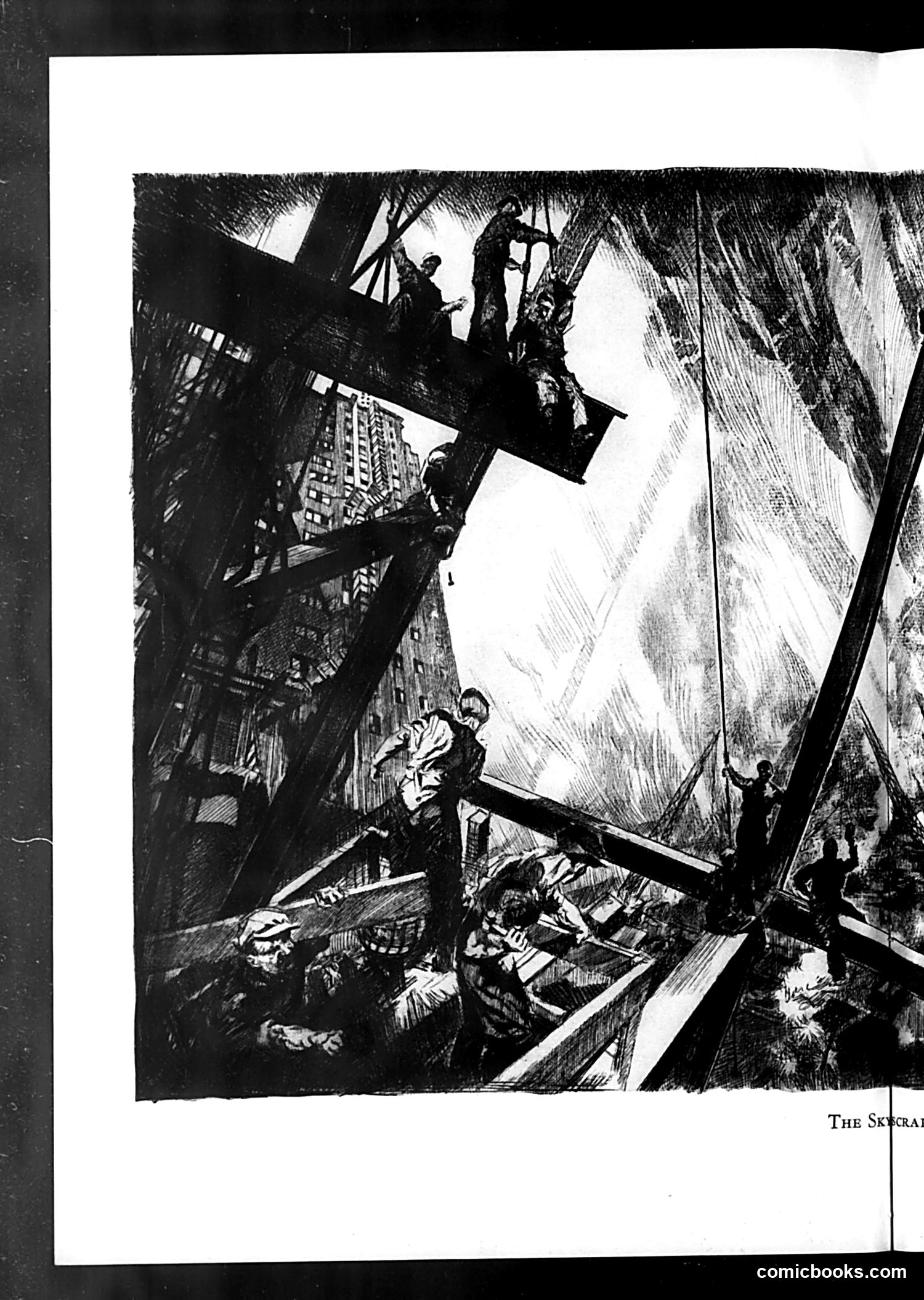
"The Skyscraper" - Commentary on Urban Construction This appears to be an illustration titled "The Skyscraper" depicting workers constructing a tall building. The dramatic black-and-white artwork uses strong contrasts and dynamic angles to emphasize the dangerous, precarious nature of skyscraper construction. The image shows workers positioned at various heights on steel beams and framework, some appearing to work without safety equipment. The composition emphasizes the vertiginous heights and industrial scale of early 20th-century urban development. This likely satirizes or comments on the risks workers faced during America's rapid urbanization and skyscraper boom—a period when construction fatalities were common and worker safety protections were minimal. The dramatic rendering underscores both the ambition of modern construction and its human costs.
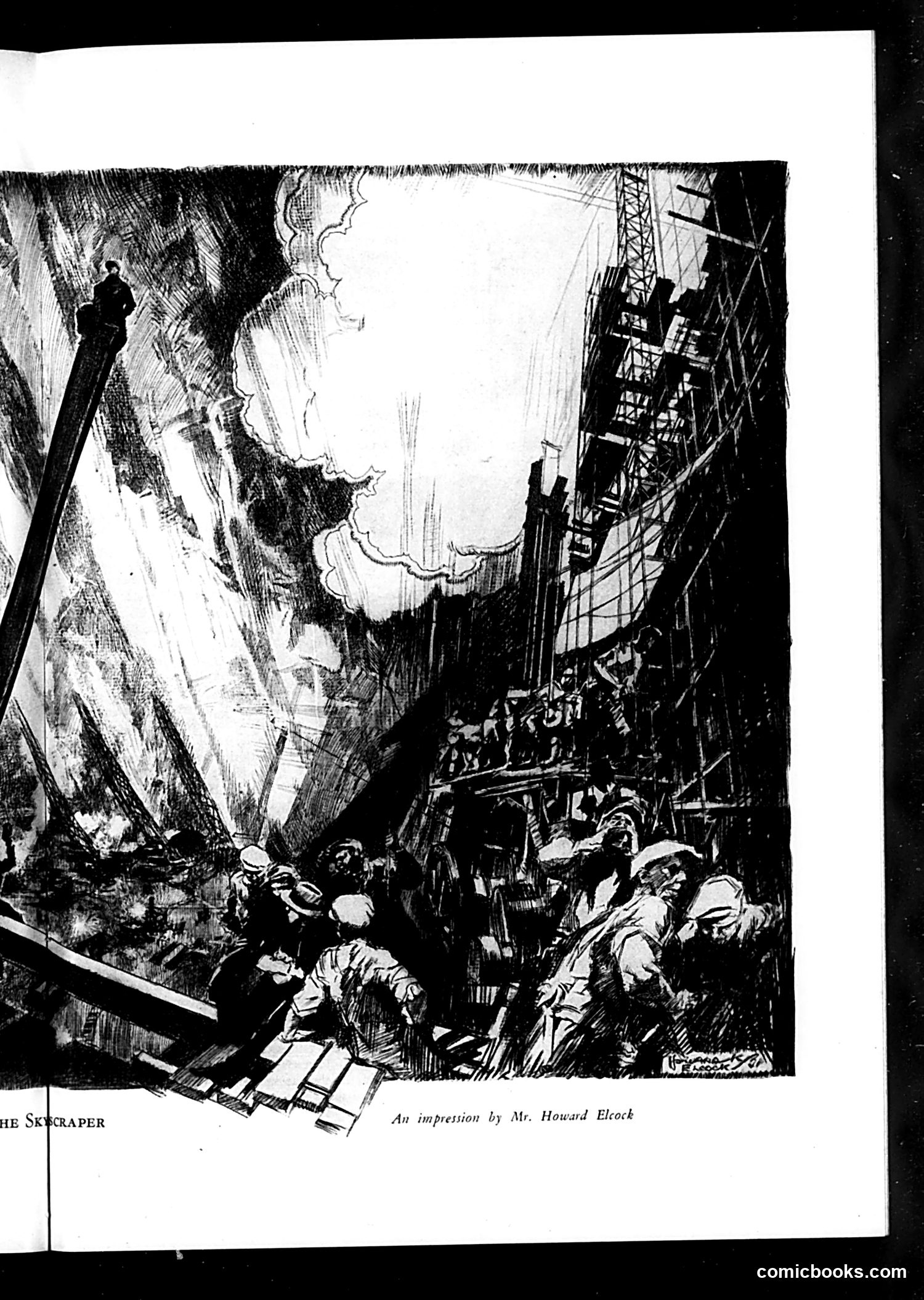
Analysis of "The Scraper" - An Impression by Mr. Howard Elcock This dramatic black-and-white sketch depicts construction workers at what appears to be a skyscraper building site. The image shows laborers engaged in manual work amid industrial scaffolding and structural elements, with dynamic crosshatching conveying movement and effort. The title "The Scraper" likely refers both to the skyscraper under construction and to the laborers themselves—workers who "scrape" by with difficult labor. The artistic style emphasizes the harsh conditions and physical toll of construction work during America's industrial boom. The composition's dramatic angles and shadows suggest the dangerous, precarious nature of such employment, making this a social commentary on working-class struggle in industrial America, though the specific satirical point remains unclear without additional context.
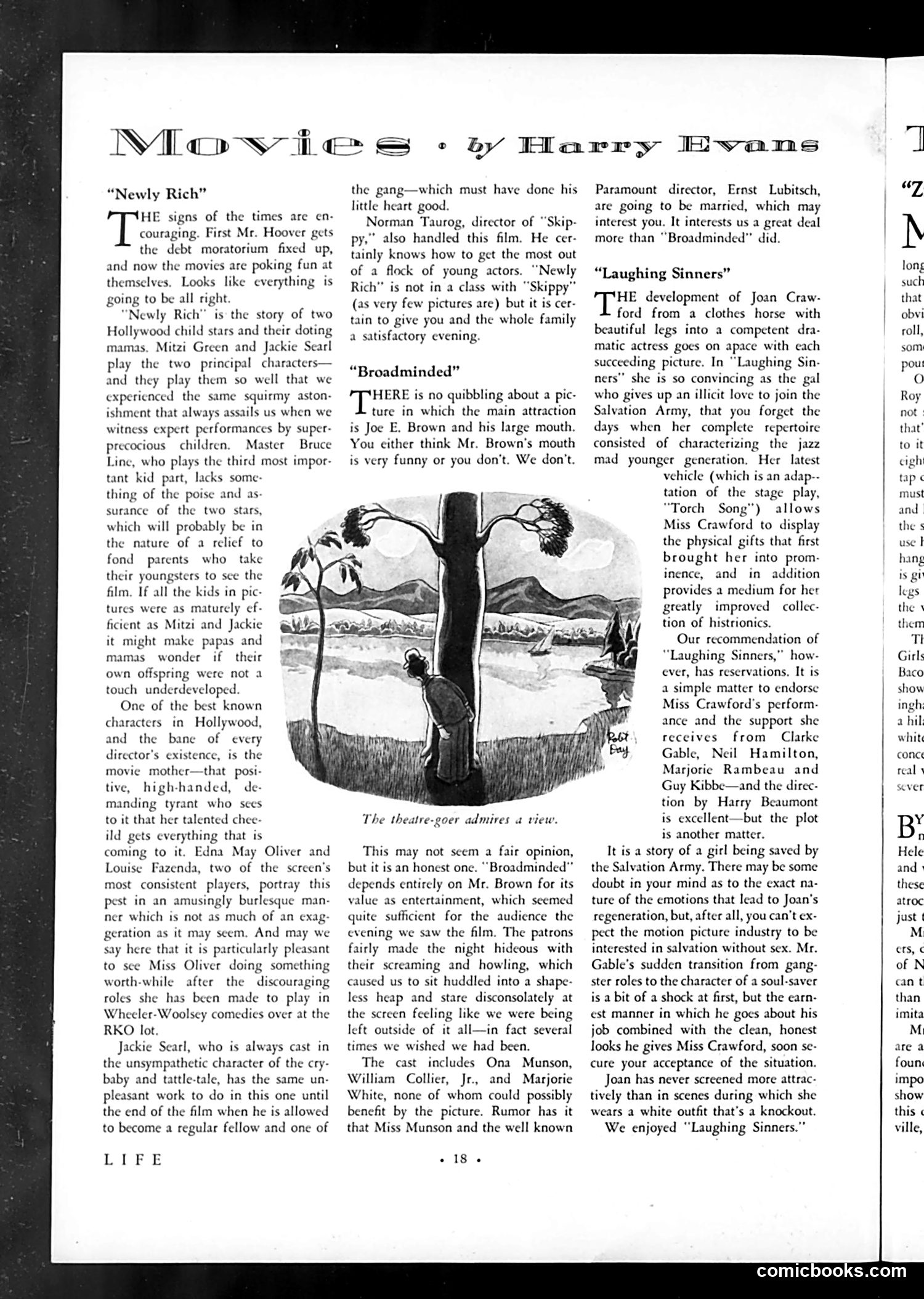
Analysis: "Movies by Harry Evans" - Life Magazine This page contains film reviews by Harry Evans from Life magazine (a satirical publication). The visible reviews discuss three films: "Newly Rich," "Broadminded," and "Laughing Sinners." The single cartoon shows a figure admiring a theatrical view through what appears to be a dead tree's hollow trunk, captioned "The theatre-goer admires a view." This appears to be gentle satire about theatrical appreciation—the joke likely being that audiences find beauty or meaning in theatrical productions, much as this figure finds a scenic vista through an unlikely frame. The reviews themselves are straightforward film criticism rather than political satire, evaluating performances by actors like Mitzi Green, Jackie Searl, and Joan Crawford. The "Movies" column appears to be entertainment journalism rather than political commentary.
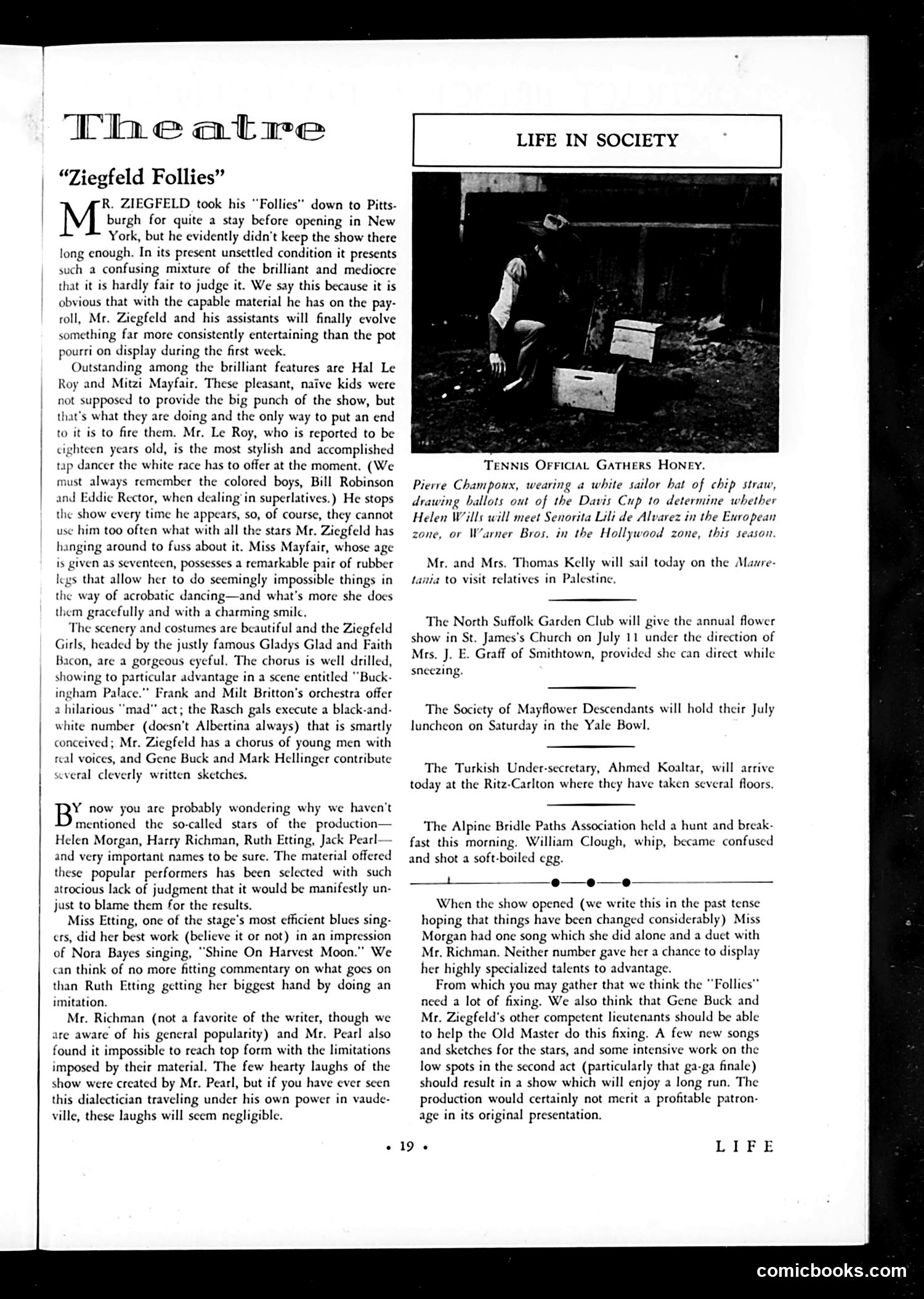
Analysis This page reviews "Ziegfeld Follies," a Broadway theatrical production. The accompanying photograph shows Pierre Champoux in formal attire, labeled as gathering "honey" at a tennis event—likely a society-page joke about his attractiveness. The review critiques the show's uneven quality, praising performers like Hal Le Roy and Mitzi Mayfair while noting that established stars (including Helen Morgan, Harry Richman, Ruth Etting, and Jack Pearl) were poorly utilized. The critic particularly criticizes Ruth Etting's performance and Harry Richman's limitations. The satire suggests that Florenz Ziegfeld's famous production, despite its resources and talent, needs significant revision—new songs, rewrites, and focused work on weak spots—to achieve the entertainment value it should deliver.
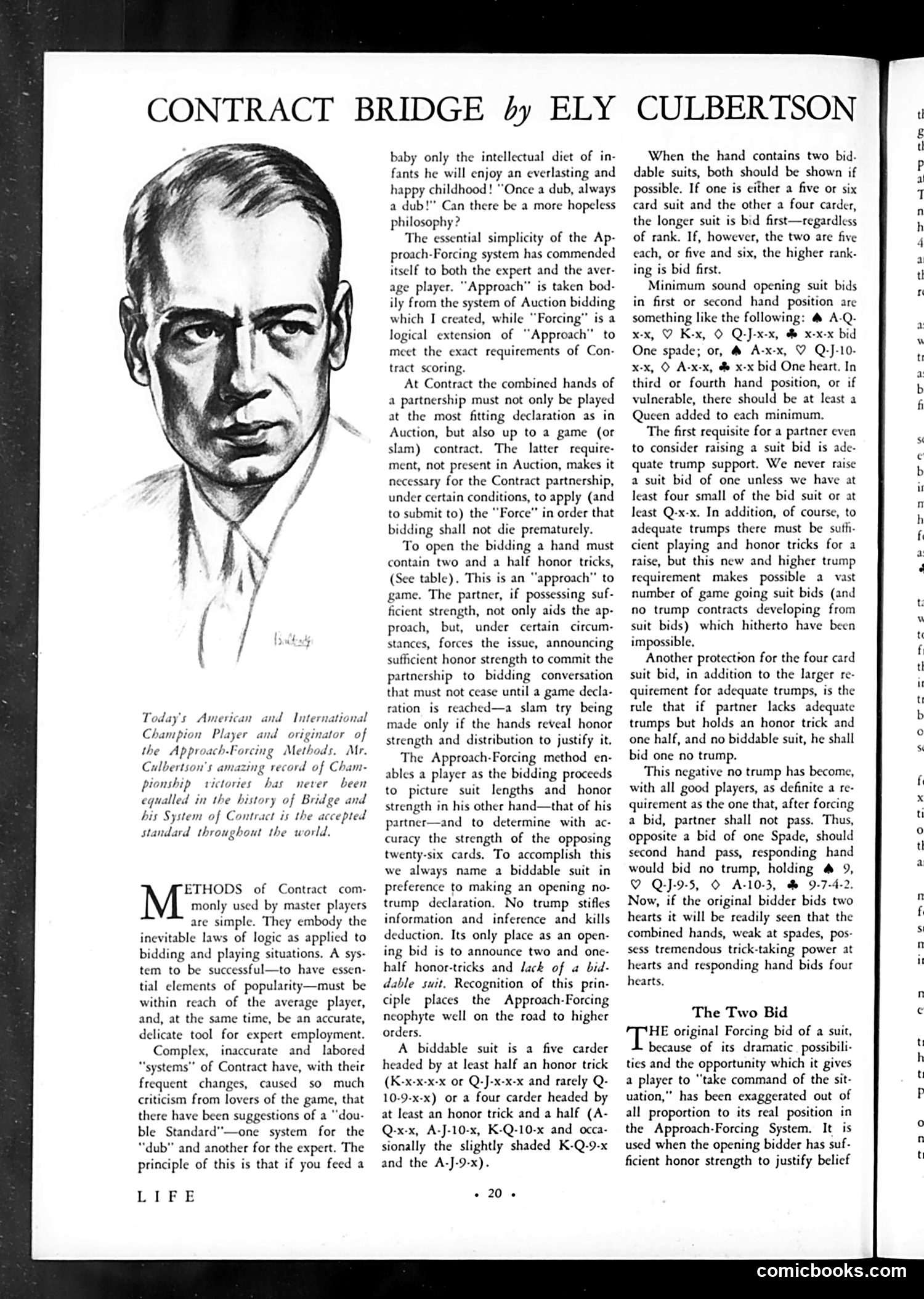
Contract Bridge Article by Ely Culbertson This page features an instructional article on Contract Bridge bidding strategy by Ely Culbertson, identified in the caption as today's "American and International Champion Player" and originator of the "Approach-Forcing Method." The portrait shows Culbertson himself. The article explains his bidding system, emphasizing that effective bridge strategy should be simple enough for average players yet sophisticated enough for experts—rejecting the notion of separate "double standards" for "dubs" (amateurs) versus skilled players. Culbertson argues his "Approach-Forcing" system (combining "Approach" from Auction bridge with "Forcing" as a Contract bridge extension) allows players to logically deduce partner's hand strength and opposing cards through standardized bidding conventions. This is not satire or comedy—it's a serious instructional feature reflecting bridge's enormous popularity in 1930s American culture, when the game was a major leisure pursuit among educated audiences.
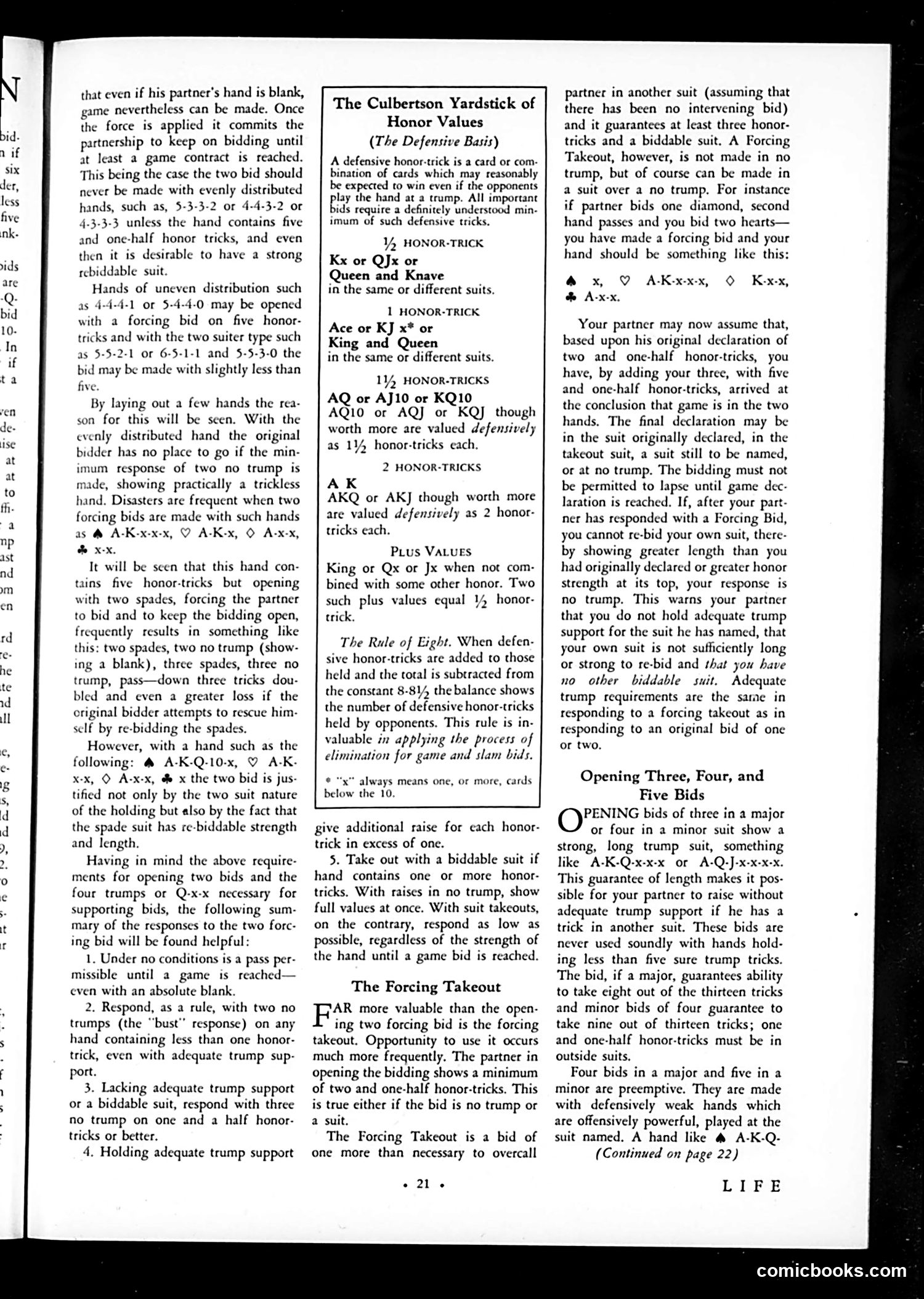
Content Analysis This page contains no cartoons or political satire. It is a straightforward instructional article about contract bridge, specifically the "Culbertson Yardstick of Honor Values"—a technical guide for evaluating card hands and making bids in the card game. The text explains defensive honor-trick valuations (how to count points in bridge hands) and provides rules for responding to opening two-bids, including numbered strategies (1-5) for players. It discusses concepts like "forcing bids," "trump support," and "honor-tricks." This represents *Life* magazine's non-satirical content—educational or recreational material that supplemented its humor and political commentary. The page is purely instructional, aimed at bridge enthusiasts seeking to improve their game strategy using Ely Culbertson's bidding system, which was popular in mid-20th-century America.
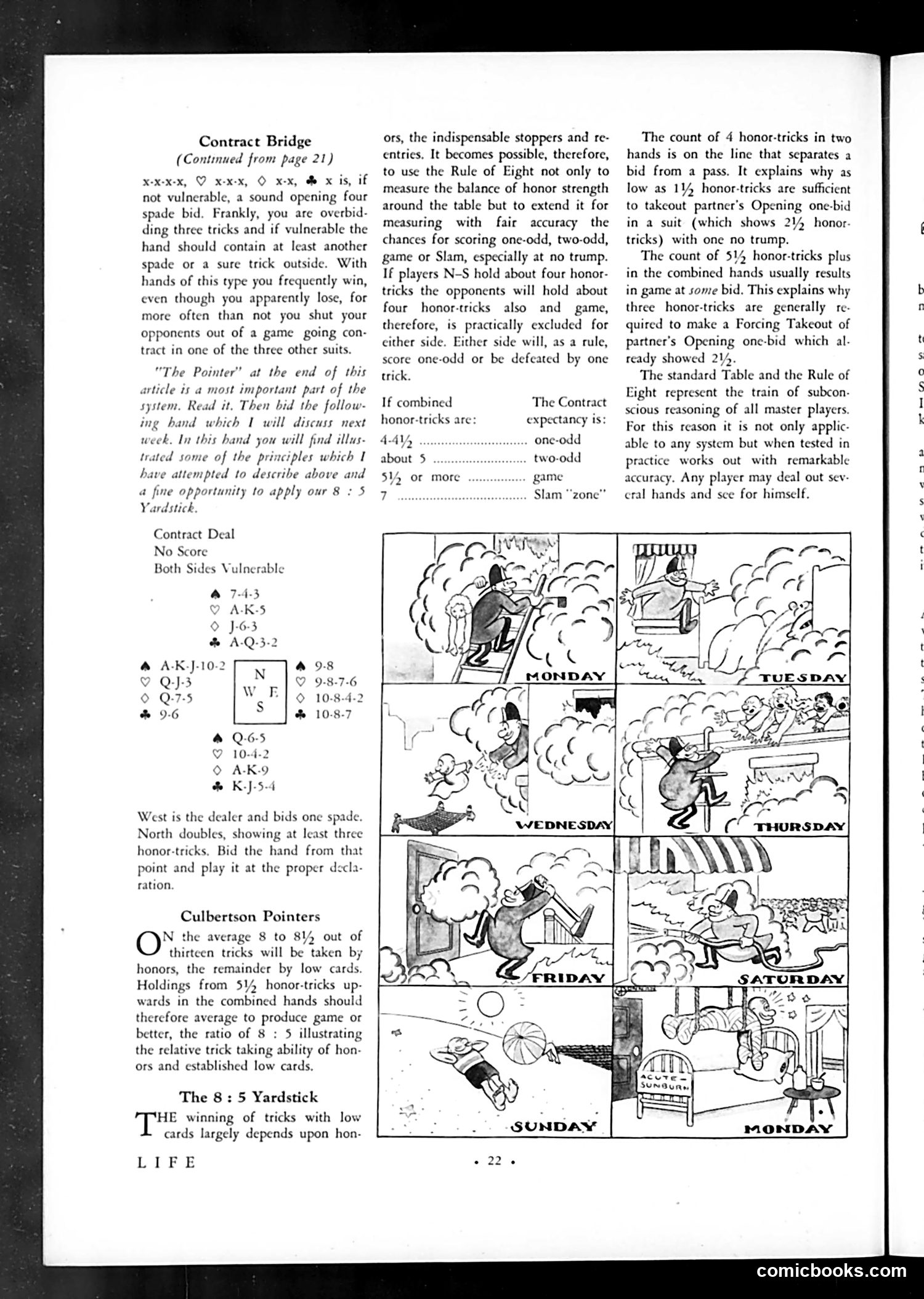
Contract Bridge Instruction Page This page is not a political cartoon or satire—it's an instructional article about Contract Bridge, a card game popular in the 1920s-30s. The content teaches bridge strategy, specifically the "8:5 Yardstick," a mathematical system for evaluating hand strength and determining whether to bid or pass. Author Culbertson explains that honor-tricks (high cards) predict trick-winning ability, and establishes ratios for game probability. The cartoon strip on the right side is a lighthearted, unrelated comic showing a character's daily activities (Monday through Monday again) involving various mishaps—falling, being chased, etc. It appears purely decorative filler for the magazine page. This reflects Life magazine's format: mixing serious instructional content (bridge was a widespread leisure activity) with humor to appeal to its educated, leisure-class readership.
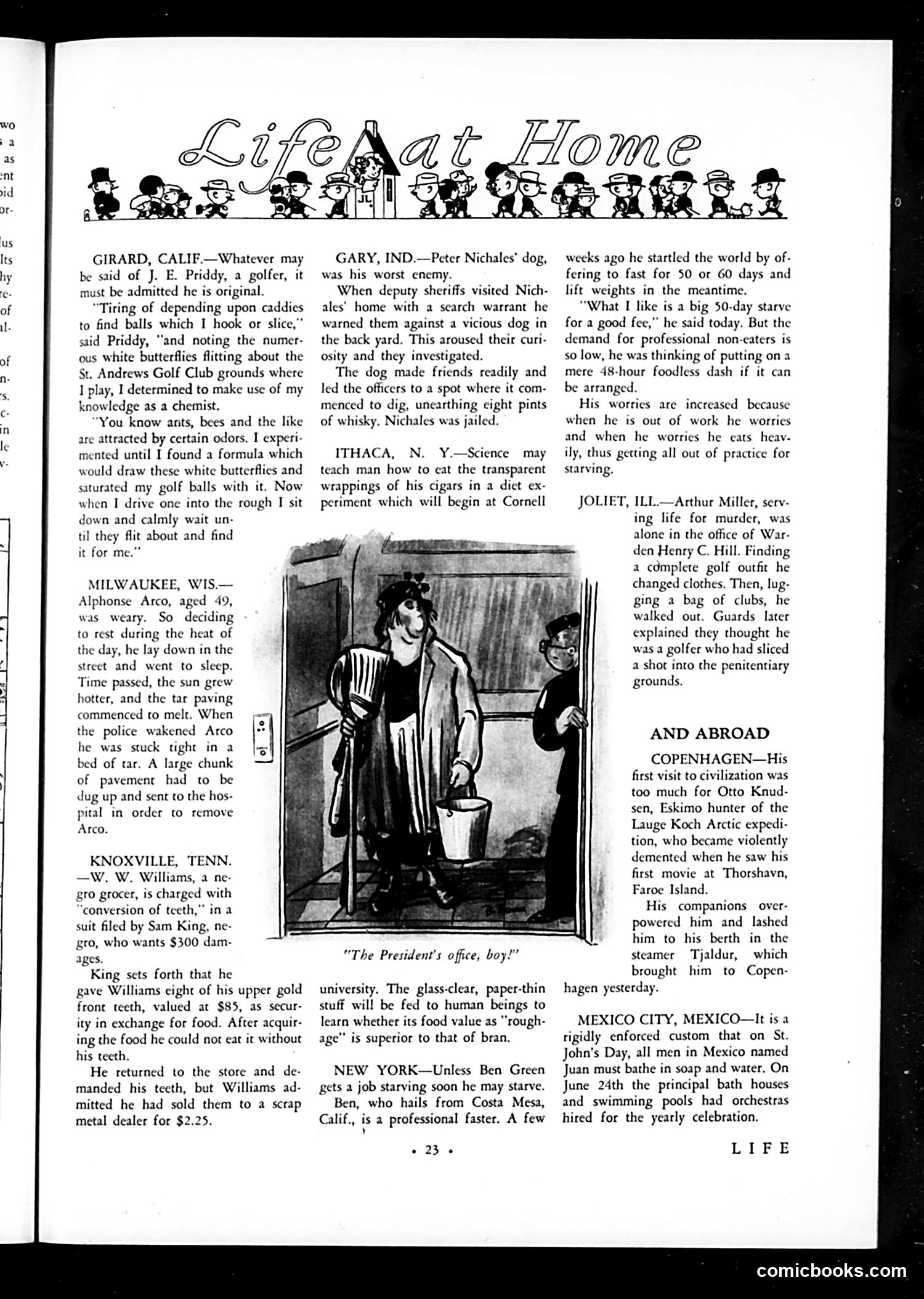
"Life at Home" - Satirical Vignettes from Life Magazine This page collects brief, humorous anecdotes showcasing human folly and absurdity. The central cartoon depicts a man in a shabby office asking "The President's office, boy?"—likely a visual joke about mistaken identity or someone inappropriately dressed for official business. The surrounding text stories mock various people's misadventures: a golfer using chemistry formulas on golf balls; a man literally melting into tar while napping; a man who pawned his own gold teeth for food; a convict who escaped prison by pretending to be a golfer; and a professional "faster" (someone who fasts for money) who can't maintain discipline when unemployed. The satire targets human absurdity, poor judgment, and contradictory behavior across different classes and professions. These are meant as gentle mockery of everyday American life's ridiculousness—the kind of bizarre-but-true stories that populated early 20th-century humor magazines.
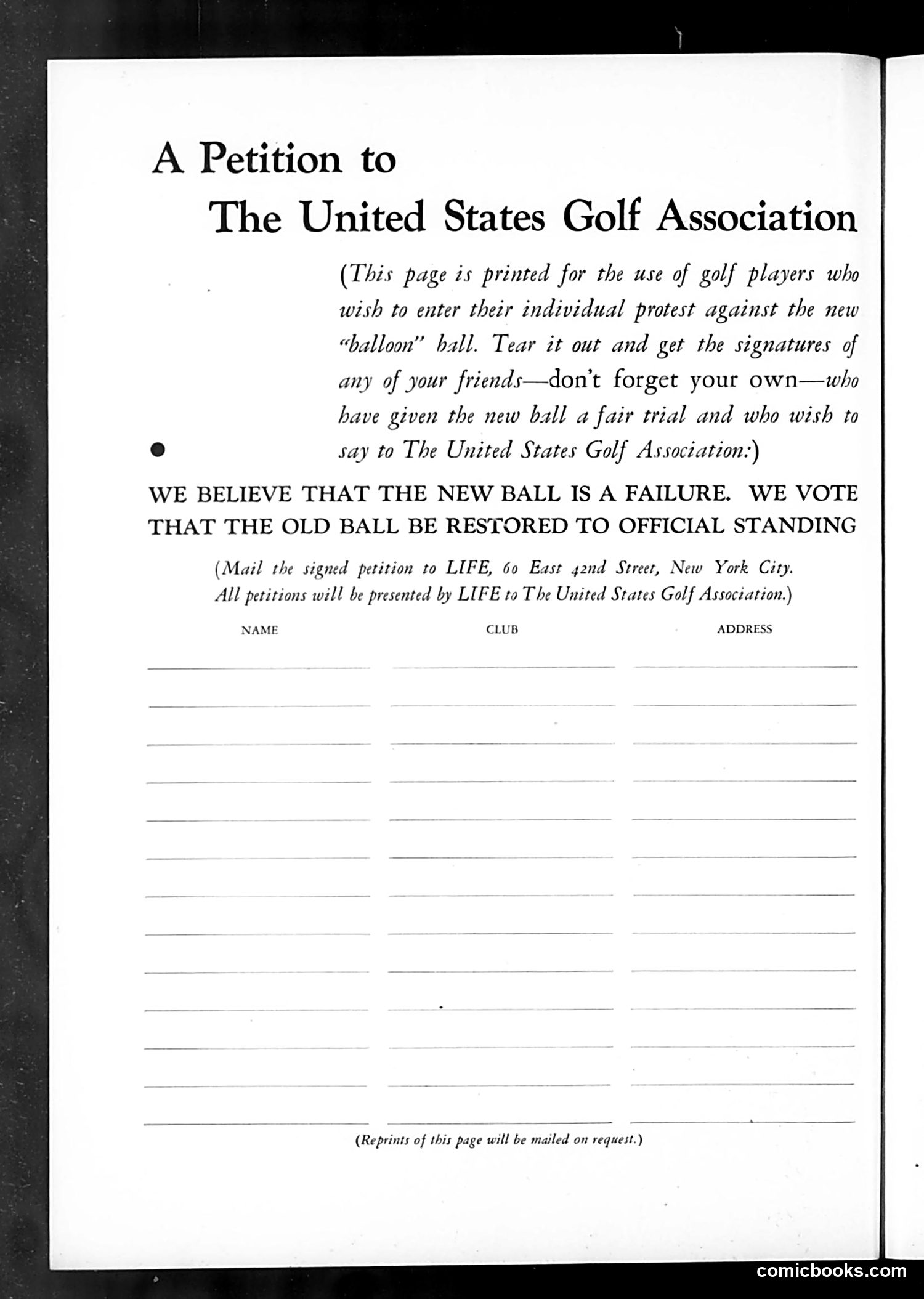
Life Magazine Golf Ball Petition (circa 1930s) This is not a cartoon but a functional protest page. Life magazine published it to mobilize golfers against the United States Golf Association's adoption of a new "balloon" ball—apparently a larger, livelier golf ball that players found inferior to the traditional smaller ball. The page is essentially a tear-out petition form with blank lines for signatures, club affiliations, and addresses. Life positioned itself as the intermediary, collecting signed protests to present collectively to the USGA, lending the magazine's platform to what appears to be genuine grassroots opposition among amateur golfers. This reflects Life's role as both satirical publication and cultural advocate—using humor and reader participation to challenge institutional decisions. The complaint suggests the new ball fundamentally altered the game in ways players disliked.
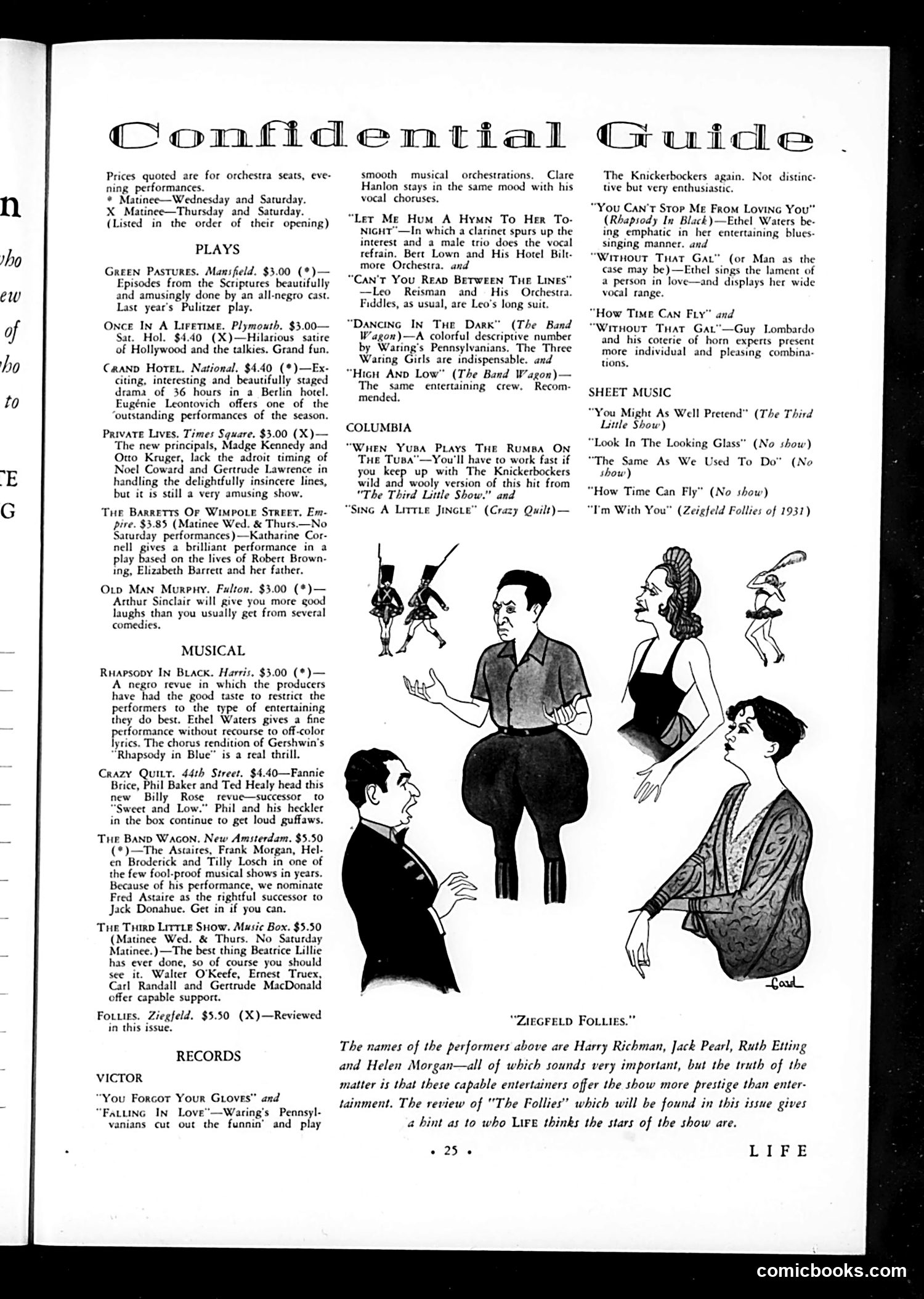
Analysis of "Ziegfeld Follies" Cartoon This page is a theater guide reviewing Broadway shows and recordings from approximately 1931-1932. The cartoon illustrates the cast of "Ziegfeld Follies," which the text notes will be reviewed elsewhere in the issue. The sketch shows five performers in various theatrical poses—singing, dancing, and gesturing dramatically. According to the caption, the performers are Harry Richman, Jack Pearl, Ruth Etting, and Helen Morgan. The illustration style is typical 1930s caricature, exaggerating facial features and body language to convey personality and entertainment style. The cartoon serves as visual promotion for the show, depicting the performers in their characteristic entertaining mode. For modern readers, this represents how Broadway shows were marketed in this era—through playful artistic sketches rather than photography, allowing theaters to highlight the comedic or dramatic essence of their performers.
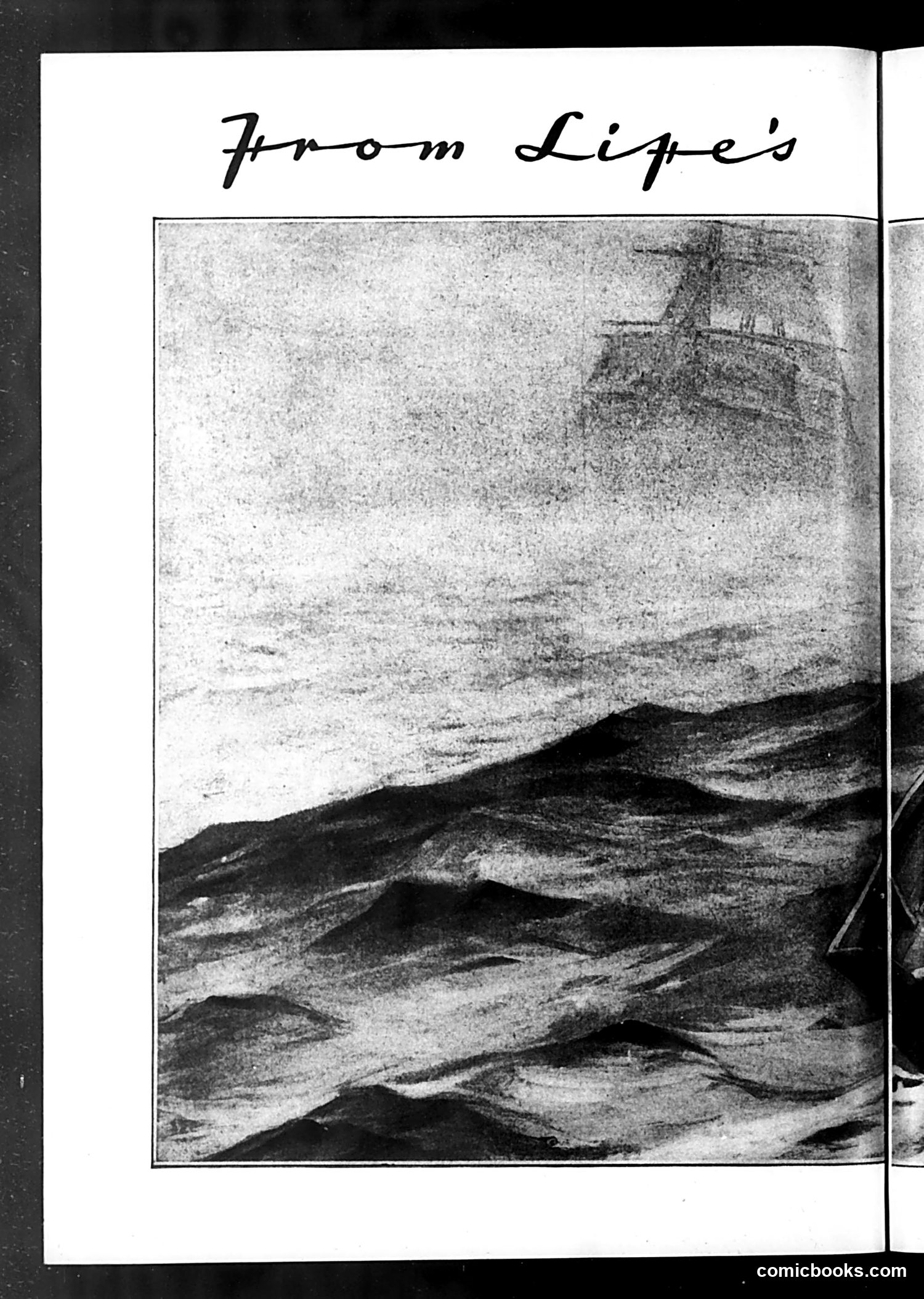
"From Life's" This page shows the title "From Life's" with a dramatic black and white photograph or illustration below it depicting turbulent ocean waves with what appears to be a ship or vessel visible in the upper portion of the image against a cloudy sky. Without additional context or caption text visible on this page, the specific satirical message is unclear. The image could be referencing a contemporary maritime event, shipwreck, or naval incident that would have been topical to Life magazine's readership. The stormy seascape suggests danger or turmoil, possibly used to comment on political or social conditions of the era. However, the exact subject matter and satirical point cannot be determined from the image alone without accompanying text or captions that would explain the reference.
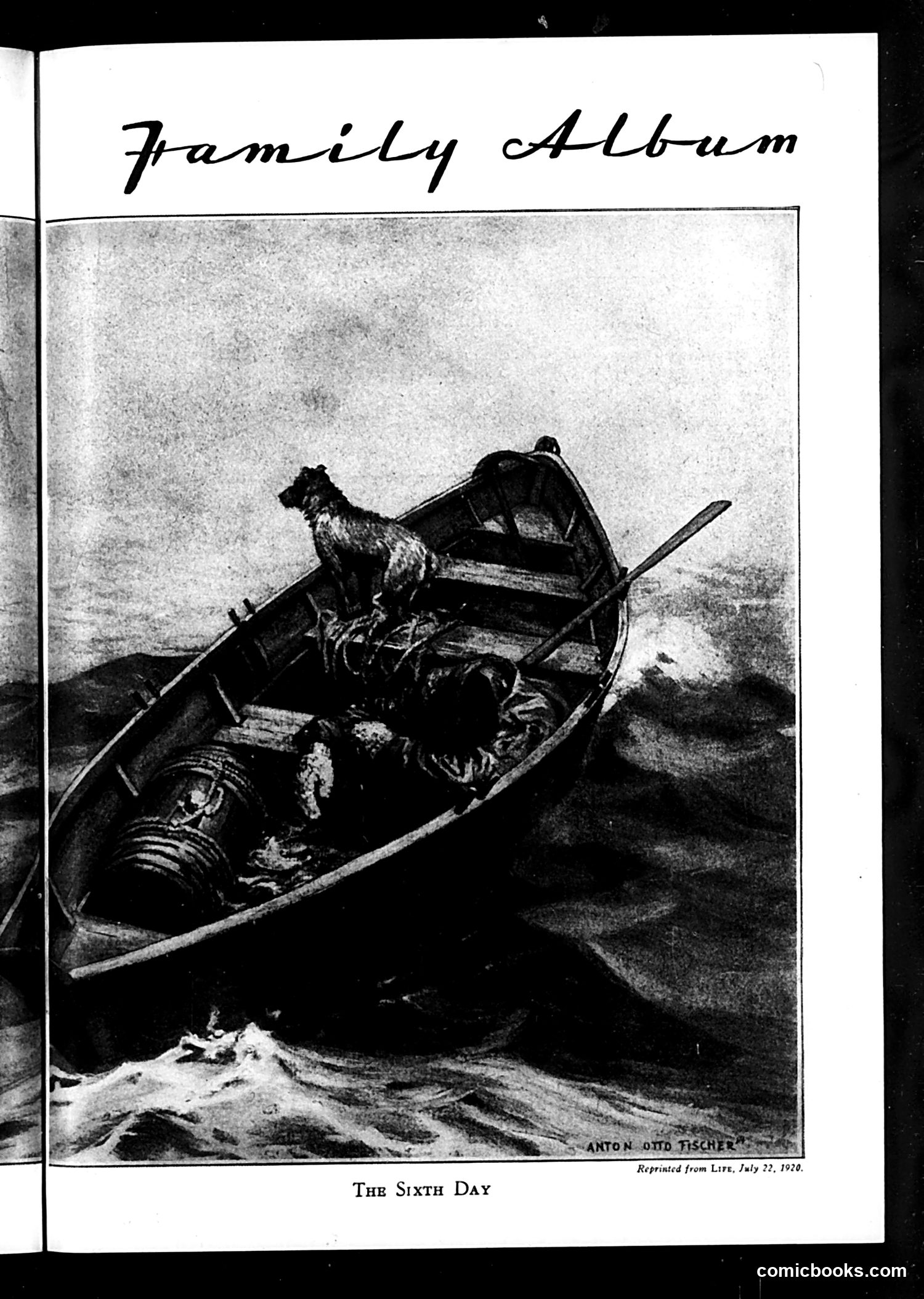
"The Sixth Day" Analysis This page is titled "Family Album" and features a single artwork credited to Anton Otto Fischer, reprinted from *Life* magazine (July 22, 1920). The image depicts a small boat on a beach with a rooster perched on its bow, rendered in dramatic black and white. The title "The Sixth Day" references the Biblical creation account, where God created animals. The rooster—a common farm bird—appears incongruously placed in this maritime scene, suggesting satire about something being "out of place" or absurd. Without additional context from the original article, the specific satirical target remains unclear. It may comment on post-WWI conditions, agricultural/industrial themes, or social disruption of the 1920s, but the exact political reference cannot be definitively determined from the image alone.
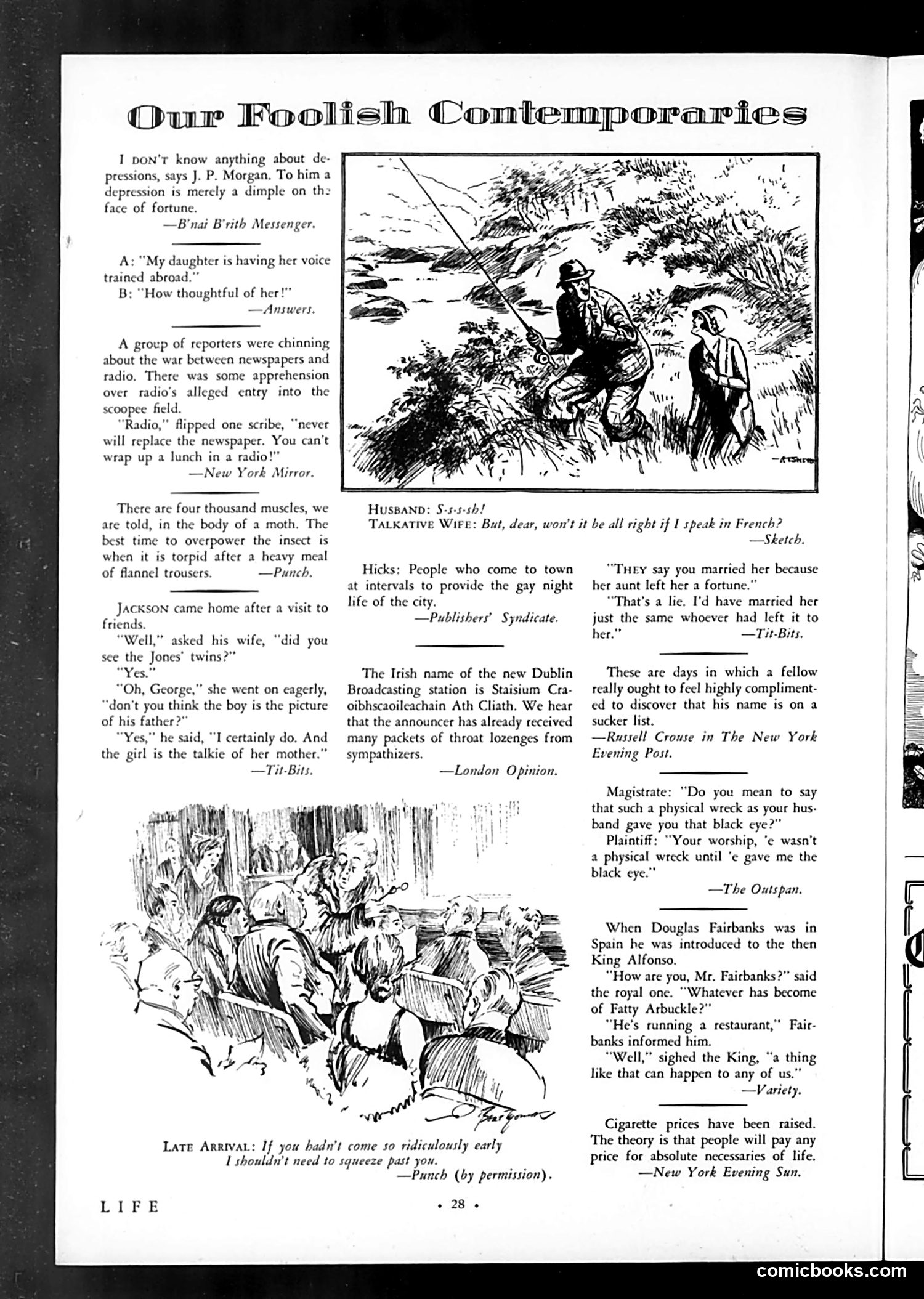
Analysis of "Our Foolish Contemporaries" This is a humor page collecting satirical observations and jokes about contemporary social behavior, typical of Life magazine's format. The top cartoon depicts a couple fishing, with the caption suggesting the husband fears his wife might speak French while fishing—mocking pretentious behavior or affectation. The lower cartoon shows a crowded scene, captioned about arriving late to social events, poking fun at fashionable society's obsession with fashionable timing. The page includes miscellaneous quips about modern life: J.P. Morgan on depressions, radio replacing newspapers, a woman's voice training, and various anecdotes about social climbing, marriage, and celebrity (Douglas Fairbanks running a restaurant). The overall theme satirizes contemporary upper-class pretension and social absurdities of the era.
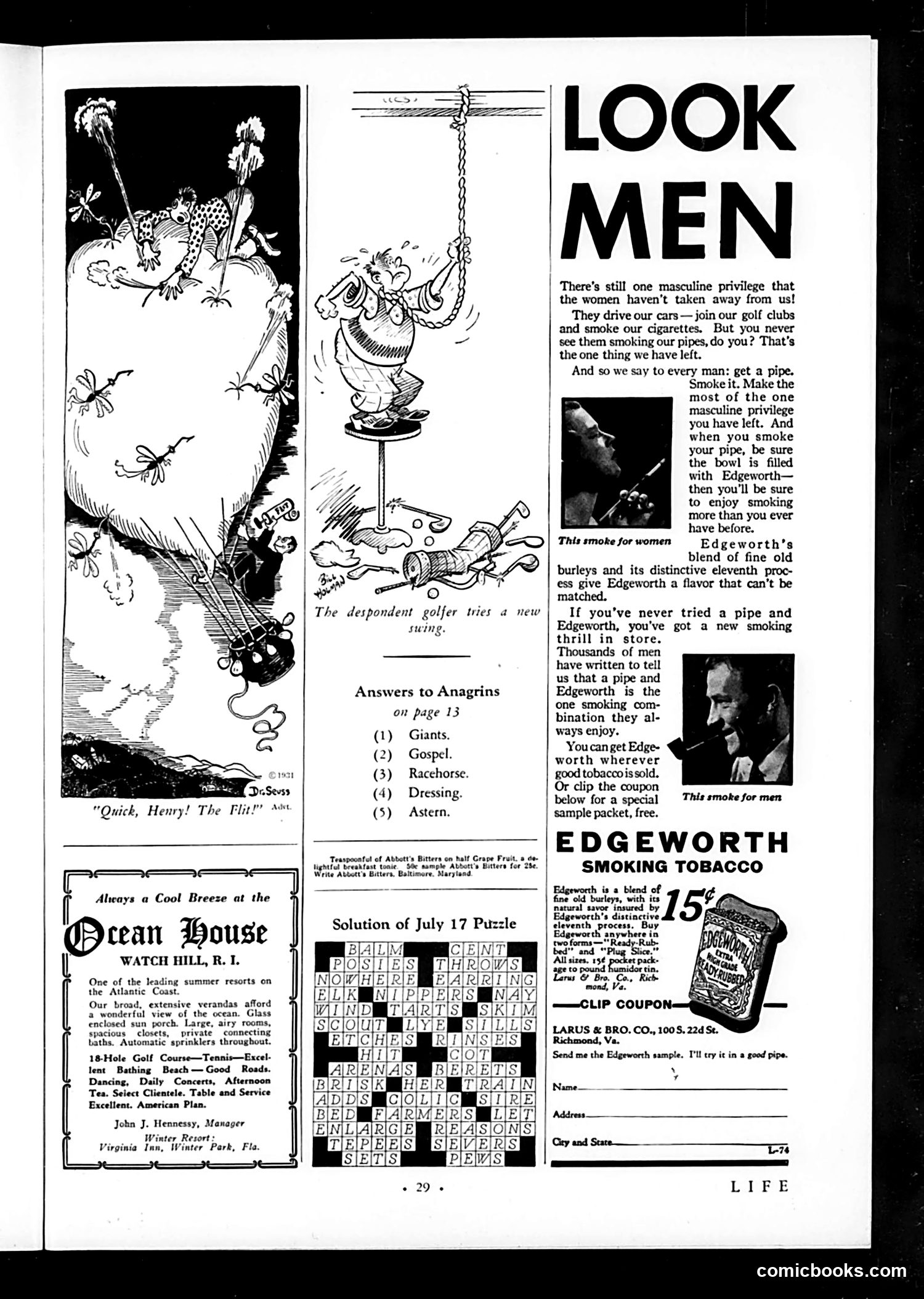
Analysis: "Look Men" Advertisement This page primarily features a satirical advertisement for Edgeworth smoking tobacco that plays on gender politics of the 1920s-30s era. The Satire's Point: The ad acknowledges women's recent social gains—driving cars, joining golf clubs, smoking cigarettes—while arguing that pipe-smoking remains "the one masculine privilege" women haven't claimed. This is framed as men's last bastion of exclusive identity. The Humor: The irony is that the ad simultaneously celebrates and laments women's liberation. It concedes nearly total victory to women while desperately clutching one final male domain, then attempts to rally men to defend it by smoking pipes filled with Edgeworth tobacco. Historical Context: This reflects post-suffrage anxiety about changing gender roles. Women had recently won voting rights; cigarette-smoking by women was becoming socially acceptable. The ad exploits masculine insecurity to sell product. The page also includes a golf cartoon (a "despondent golfer tries a new swing") and resort/puzzle advertisements typical of the era.
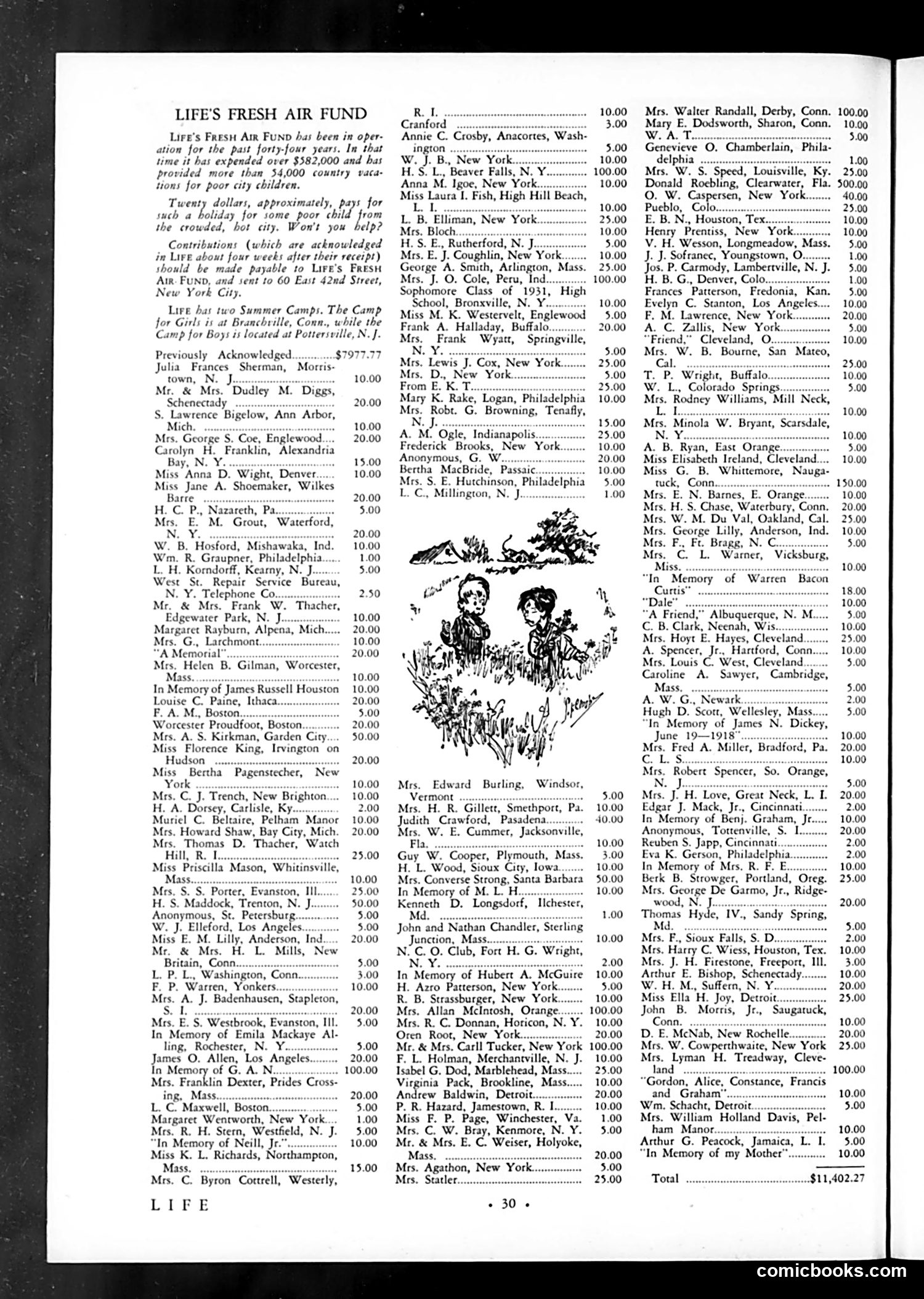
Life's Fresh Air Fund Page This page documents charitable donations to Life magazine's Fresh Air Fund, a real philanthropic program that provided summer vacations for poor urban children. The fund had operated for 44 years (from approximately 1889) and had funded over 34,000 country holidays. The small illustration shows children playing outdoors—likely representing the program's beneficiaries enjoying fresh air and nature away from crowded city conditions. This was a progressive-era reform initiative addressing urban poverty and child welfare. The bulk of the page is a financial ledger listing donors' names, locations, and contribution amounts (ranging from $1 to $100). The "$11,402.27" total indicates this was a substantial fundraising drive. The charitable focus reflects early 20th-century American middle-class social conscience—providing working-poor children relief from tenement living conditions through seasonal camps in Connecticut and New Jersey.
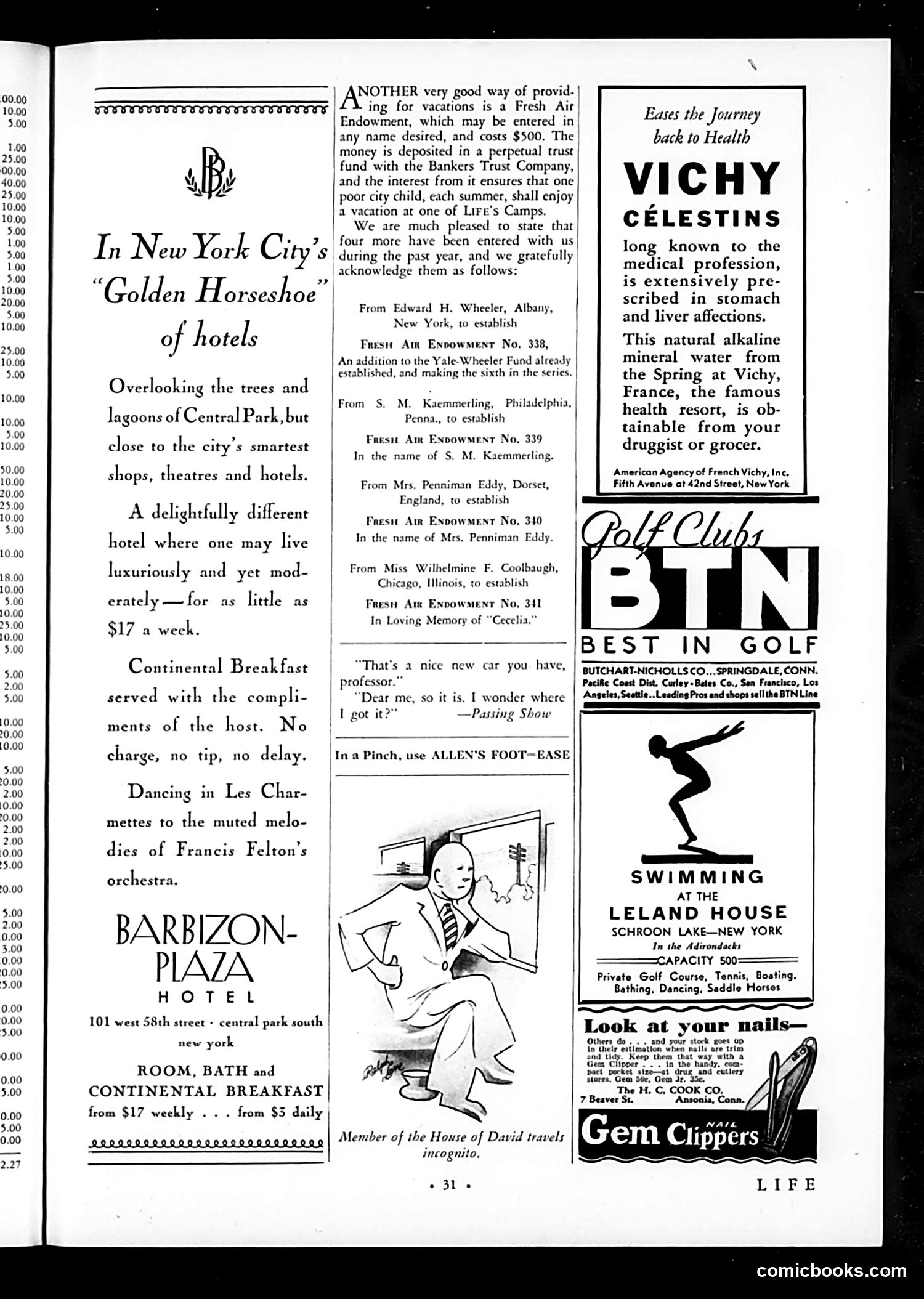
Analysis of Life Magazine Page 31 This page is primarily advertising and announcements, not political satire. The main content includes: Left side: Hotel advertisement for the Barbizon-Plaza in Manhattan, emphasizing luxury at affordable rates ($17 weekly). Center: Announcements of charitable Fresh Air Endowments for poor children's summer camps, listing donors like Edward H. Wheeler and Mrs. Penniman Eddy. Below this is a mild joke (from "Passing Show"): a professor receives a compliment on his new car but can't remember how he acquired it—likely satirizing absent-minded academics or suggesting he obtained it mysteriously. Right side: Product advertisements for Vichy mineral water, golf clubs, a swimming resort, foot powder, and hair clippers. The cartoon accompanying the professor joke (a figure tangled with a car) appears to visualize confusion about the car's origin, but the reference is unclear without additional context. Overall, this is a typical commercial magazine page with light humor rather than pointed political commentary.
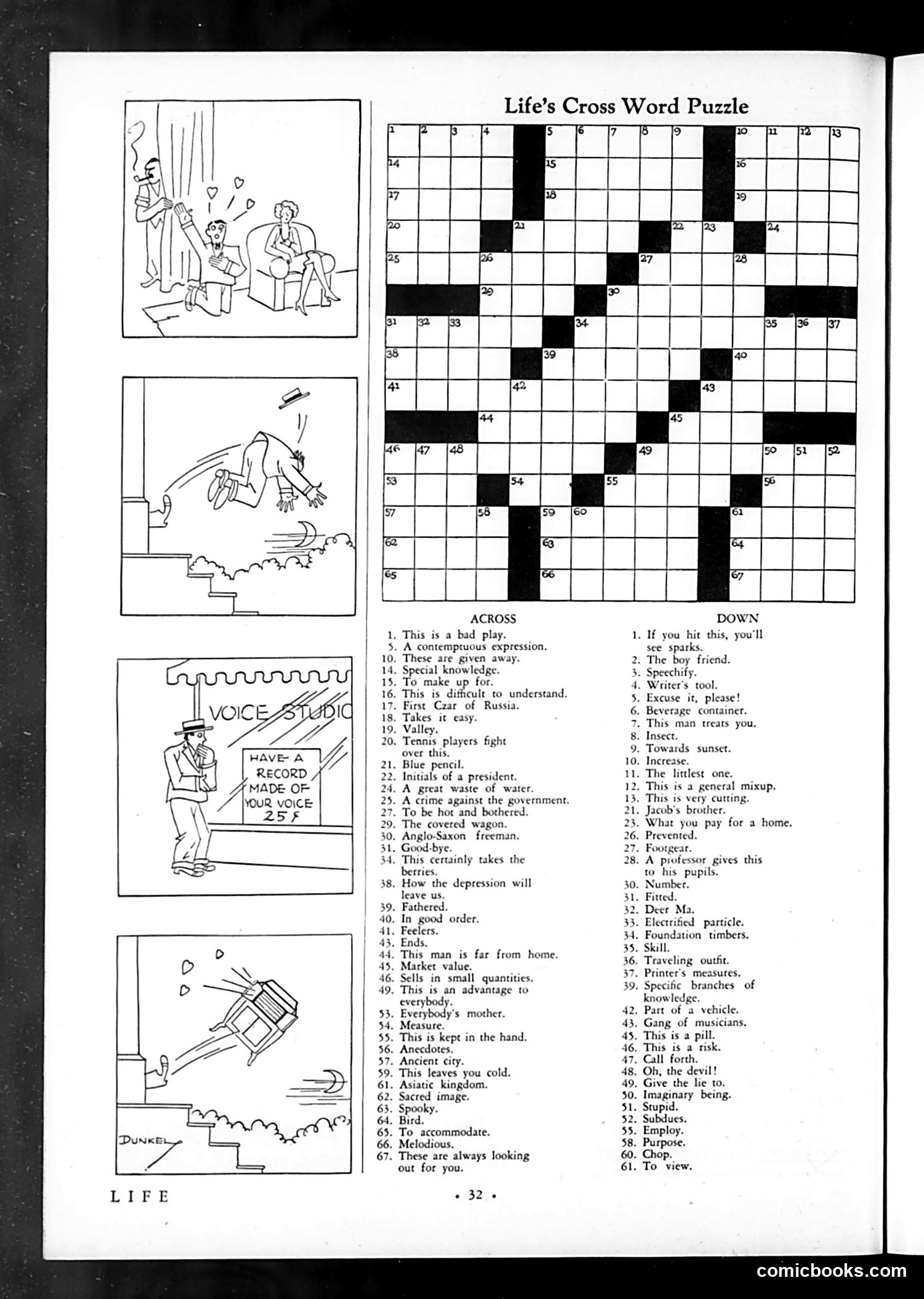
Life's Crossword Puzzle Page This page from *Life* magazine features a standard crossword puzzle with clues, accompanied by four cartoon vignettes on the left side. The cartoons appear to use visual humor typical of 1920s-30s satire: one shows a family receiving gifts, another depicts slapstick physical comedy with a person and furniture, a third advertises a voice-recording studio (25 cents), and the fourth shows comedic mishap with a dunked figure. The crossword clues reference contemporary concerns of the Depression era and earlier—economic hardship ("how the depression will leave us"), prohibition-era references ("beverage container"), and social commentary on government and politics. Without a visible date on this page, the exact year is unclear, but the tone and references suggest interwar American satirical humor aimed at educated readers seeking both intellectual challenge and social wit.
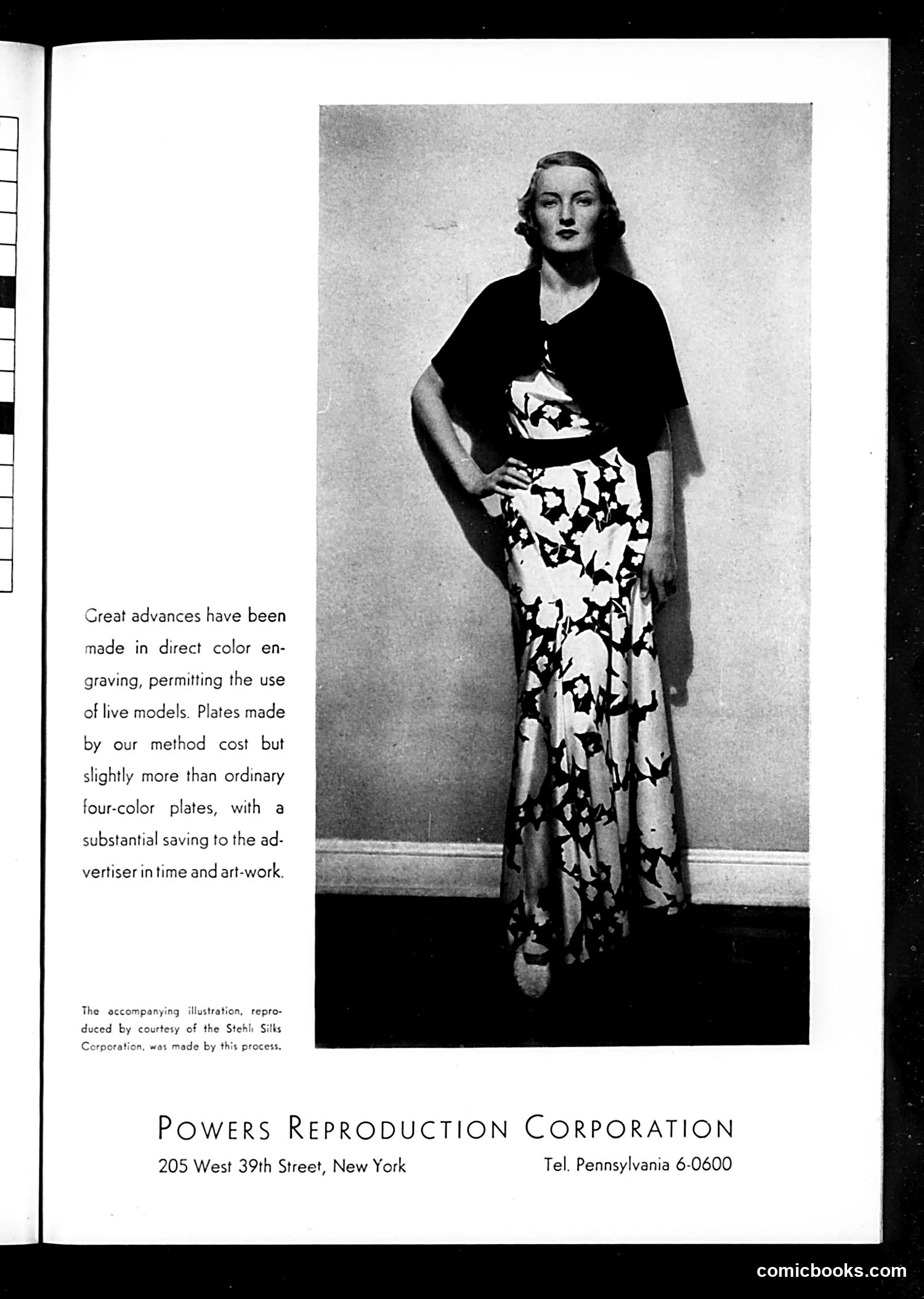
Analysis This is advertising copy, not satire or political content. Powers Reproduction Corporation is promoting their direct color engraving technology to potential clients. The page features a photograph of a woman in a floral dress—a "live model"—to demonstrate their printing process. The text explains that their method allows publishers to use actual photographs of live subjects rather than hand-drawn illustrations, while costing only slightly more than traditional four-color printing. The reference to Stehli Silks Corporation indicates this sample was produced for a textile advertiser, likely appearing in *Life* magazine itself as proof of the technique's quality. For modern readers: this represents early-to-mid 20th-century printing technology innovation—the shift from hand-engraved plates to photographic reproduction, which would eventually become standard in commercial publishing.