life
Life — July 31, 1931
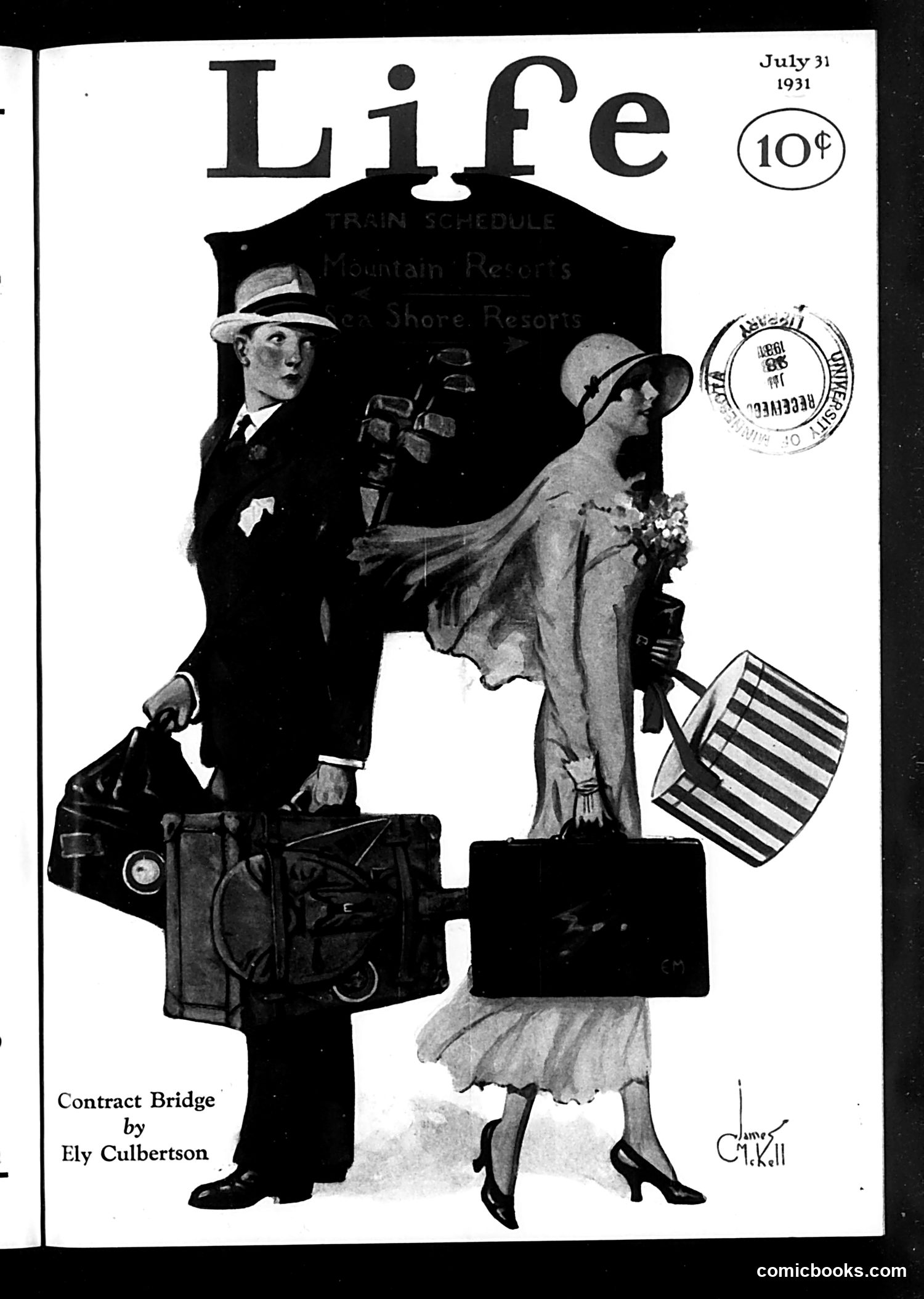
Life Magazine Cover Analysis, July 31, 1931 This is the cover of *Life* magazine (10¢), featuring an illustration by James Montgomery Flagg. The cartoon depicts two travelers: a man in a business suit holding a suitcase and a woman in a light dress holding an American flag and a striped bag. Both wear hats and appear to be heading somewhere, with what appears to be a train schedule visible in the background (mentioning "Mountain Resorts" and "Shore Resorts"). The cover advertises "Contract Bridge by Ely Culbertson," referencing the popular card game sensation of the 1930s. The illustration likely satirizes American vacation travel and tourism trends during this era, showing the leisure activities of the middle class during the Depression period. The American flag suggests patriotic vacation patriotism or nationalist tourism themes.
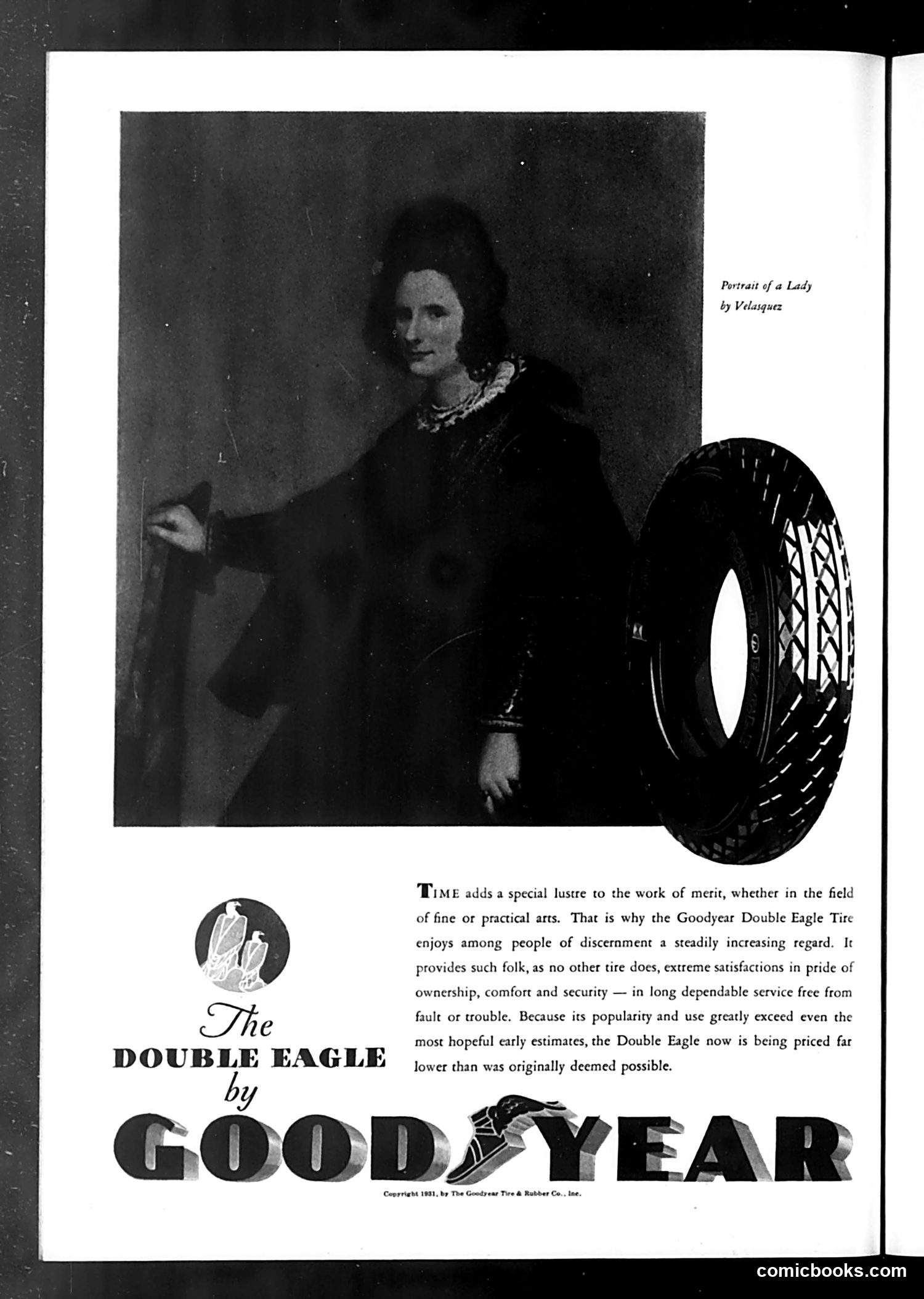
Analysis This is primarily a Goodyear tire advertisement, not political satire. The page features a portrait labeled "Portrait of a Lady by Velasquez" (referencing the famous Spanish painter), positioned above marketing copy for the "Double Eagle" tire brand. The ad's strategy associates the tire with artistic merit and refinement—suggesting that owning Goodyear tires reflects good taste and discrimination, much like appreciating classical paintings. The text emphasizes durability ("long dependable service free from fault or trouble") and value, noting the Double Eagle is "being priced far lower than was originally deemed possible." There is no political cartoon or satire present. This is straightforward commercial advertising using cultural prestige as a sales tool.
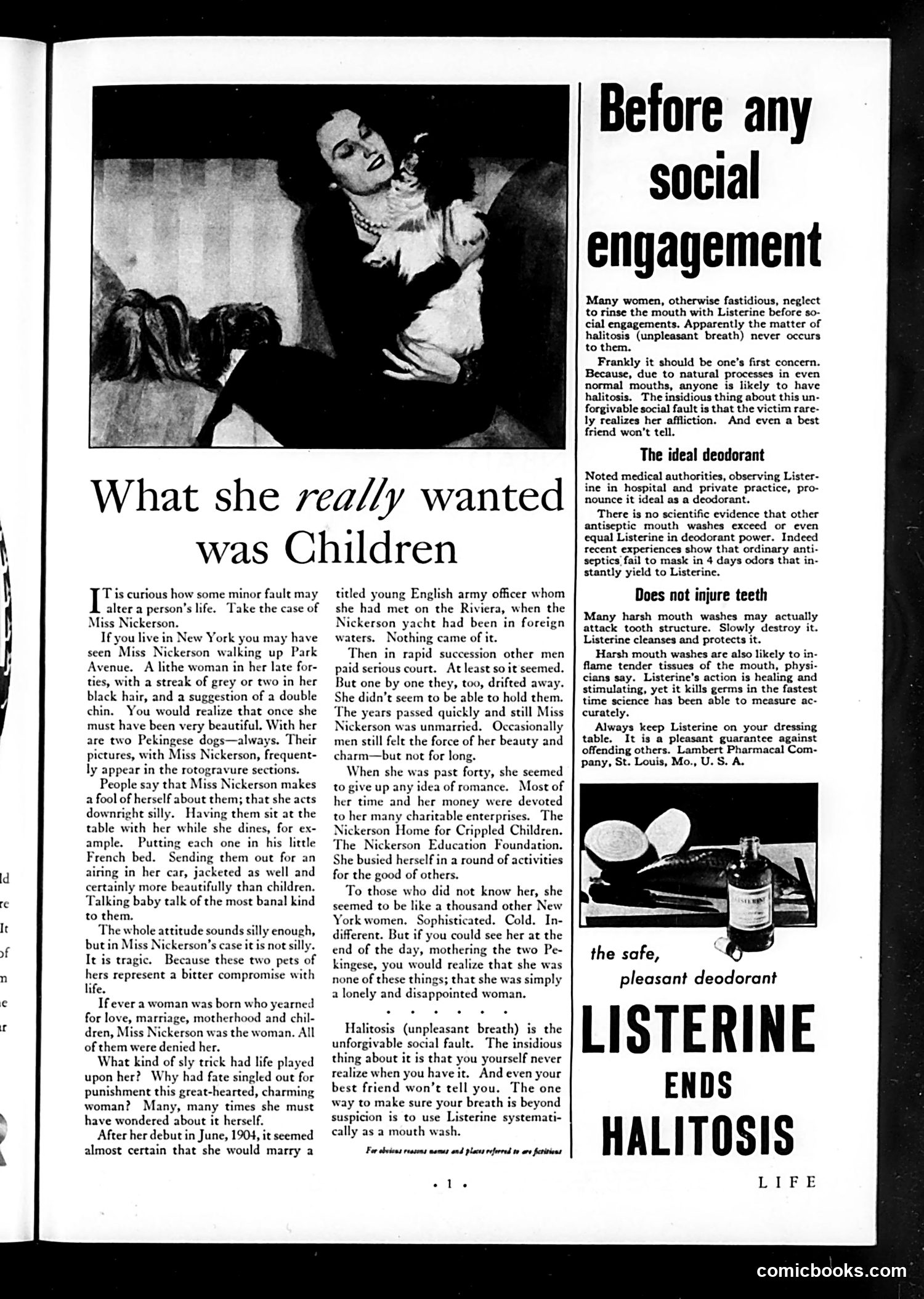
Analysis of "What She Really Wanted Was Children" This appears to be a satirical article about Miss Nickerson, an apparently well-known socialite of the era. The piece mocks the gap between her public image (beautiful, fashionable, charitable) and her actual unfulfilled desire for motherhood and family life. The accompanying Listerine advertisement is the key to understanding the satire's darker point: it suggests Miss Nickerson remained unmarried because of "halitosis" (bad breath)—presented as an "unforgivable social fault" that prevented romantic prospects. The satire implies that despite her wealth, beauty, and good works, this one biological/social "deficiency" doomed her romantic prospects and maternal aspirations. It's a cruel joke weaponizing anxieties about female desirability and social acceptability to sell mouthwash.
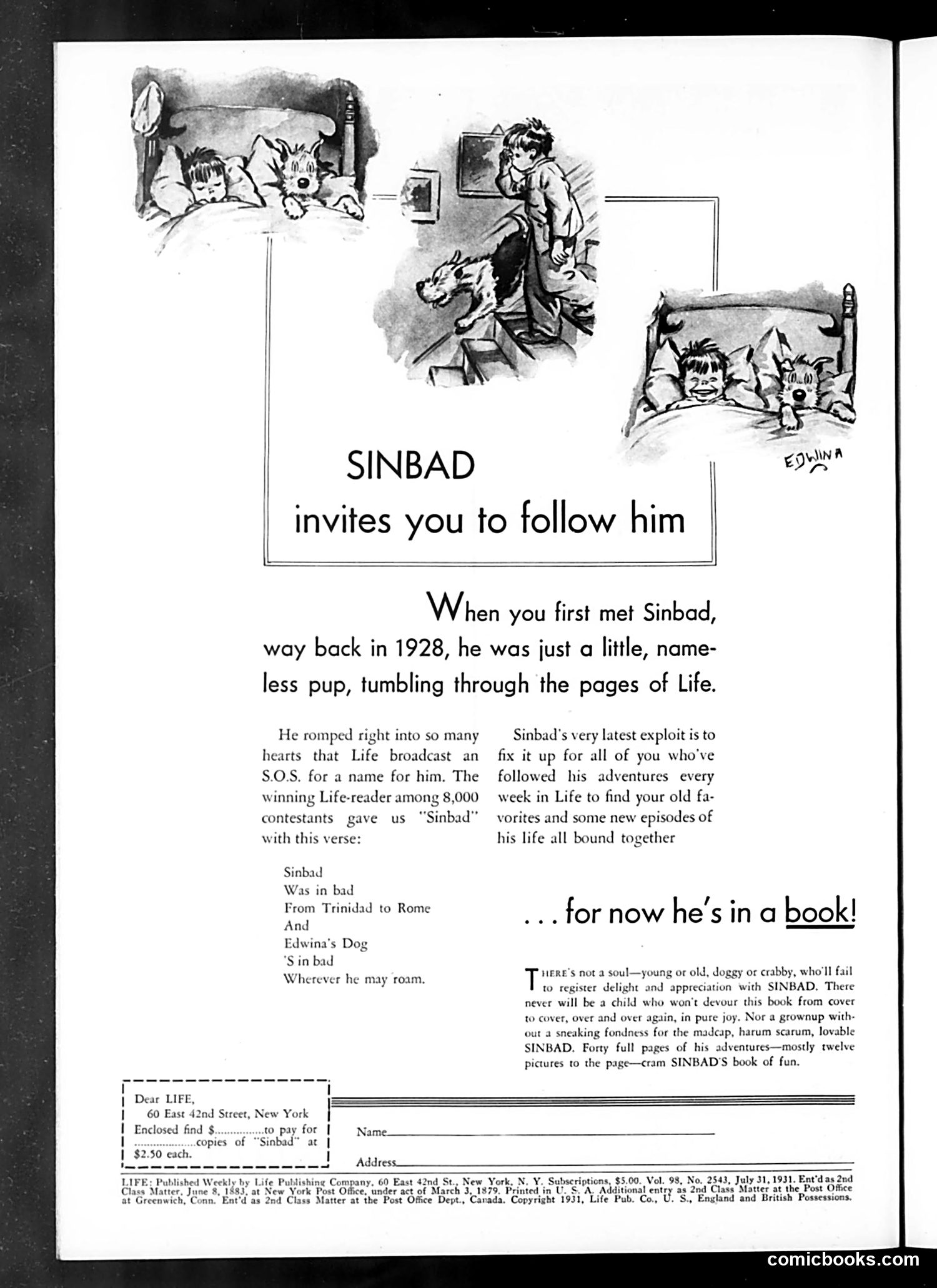
Sinbad Advertisement, Life Magazine (circa 1931) This is a book advertisement, not political satire. It promotes a children's book collection called *Sinbad*, featuring the classic Arabian Nights character. The illustrations show a mischievous dog character (named Edwina) accompanying a young boy through bedtime adventures. The ad references Sinbad's origins in *Life* magazine—apparently a character that debuted in 1928 and became popular enough to warrant reader voting for a name. The humor targets both children and adults: the rhyming verse and chaotic bedroom scenes appeal to kids, while parents would appreciate the controlled chaos of a book that keeps children entertained "over and over again, in pure joy." The $2.50 price reflects 1930s economics. This is straightforward commercial promotion using whimsy and nostalgia rather than satire.
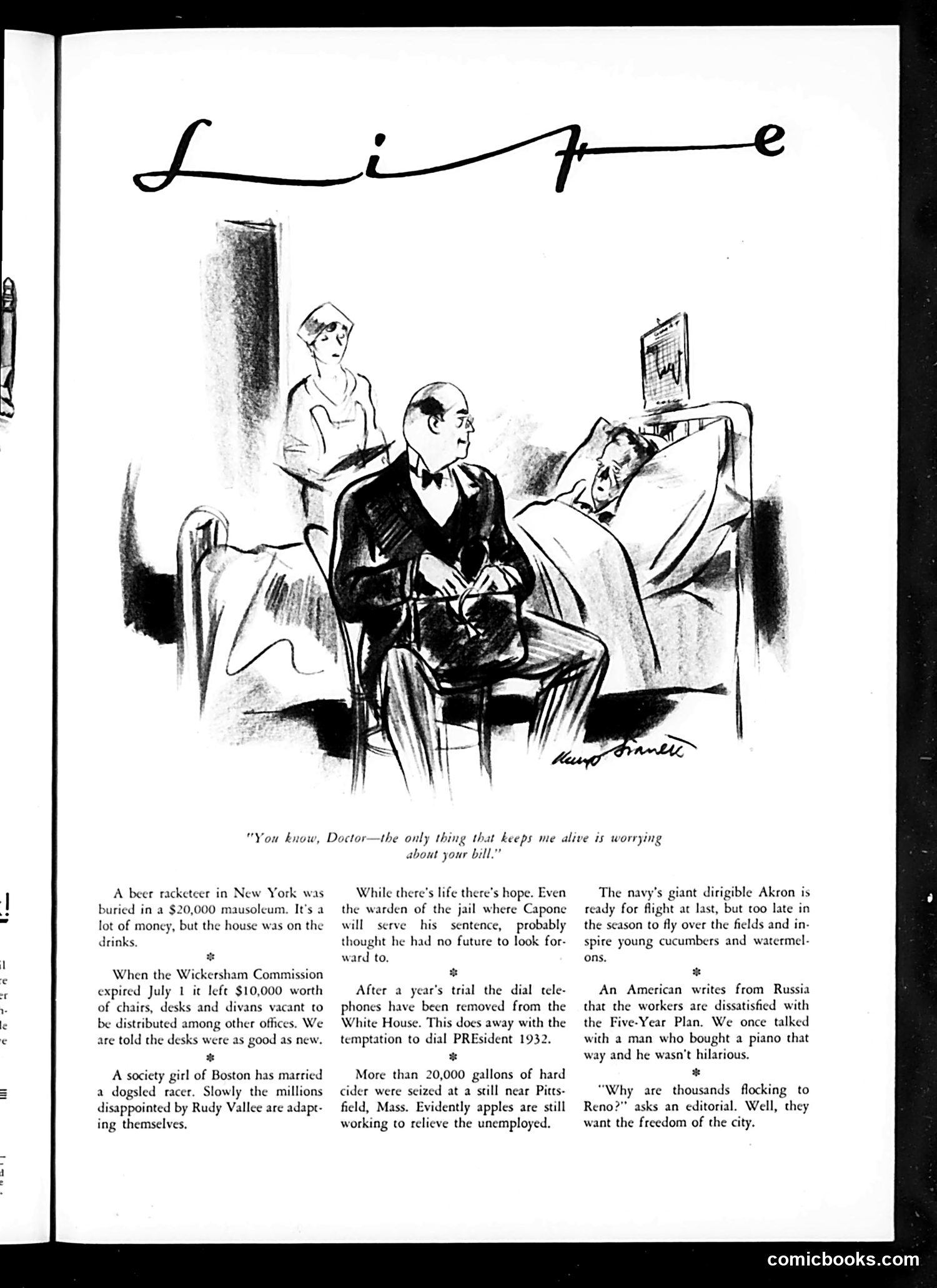
Political Cartoon Analysis: "Life" Magazine The cartoon depicts a doctor attending to a wealthy patient in bed, with a nurse present. The patient's quote—"You know, Doctor—the only thing that keeps me alive is worrying about my bill"—is satirical commentary on Depression-era anxiety about medical costs. The accompanying text snippets discuss various 1930s social issues: a racketeer's buried fortune, Wickersham Commission furniture distribution, a society girl marrying a racer, seizures of illegal cider, and displaced millions adapting to unemployment. The cartoon's humor stems from the ironic reversal: typically, worry kills patients, but here the patient's obsession with debt paradoxically sustains him—darkly mocking both medical expenses and the financial desperation widespread during the Great Depression.
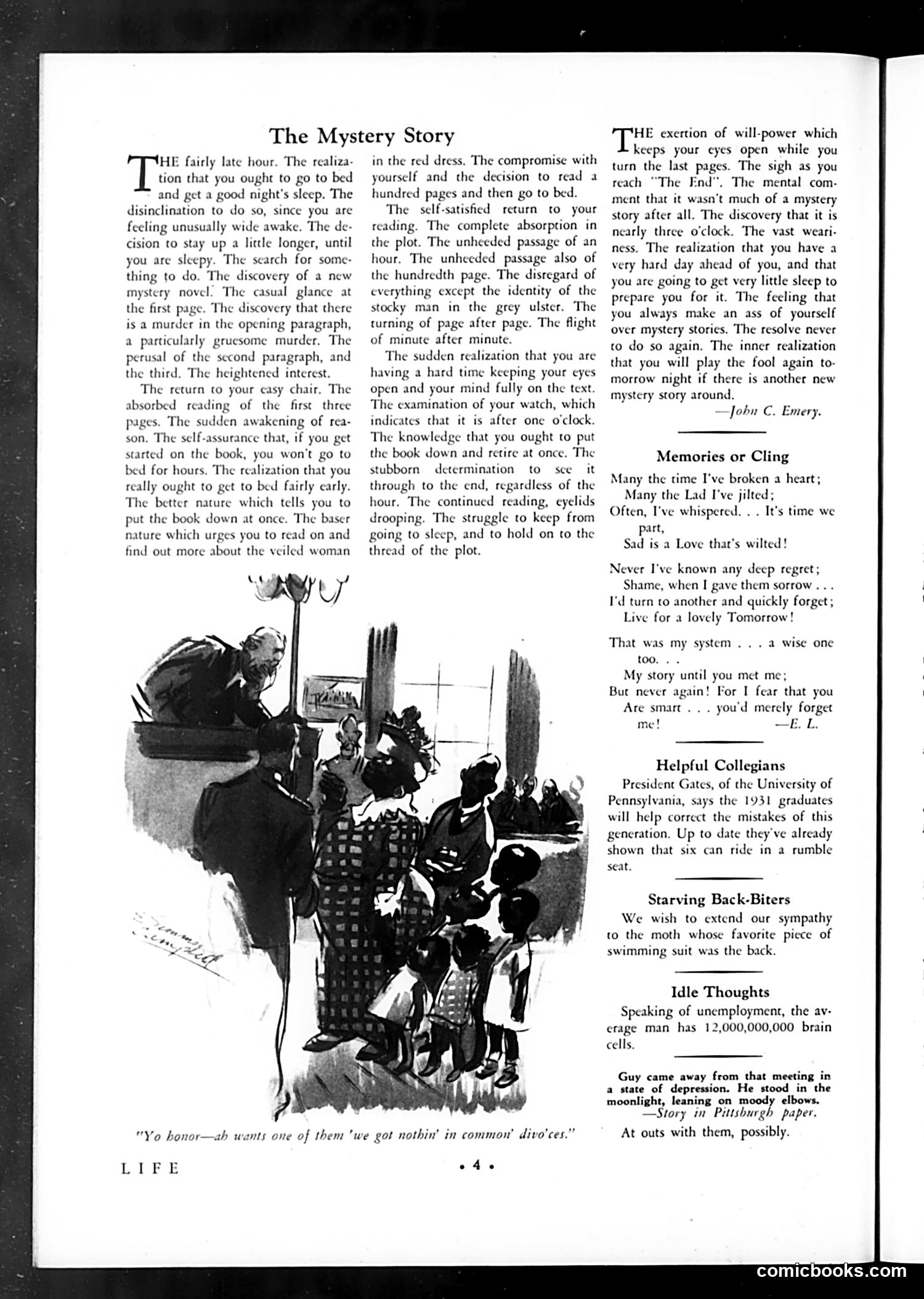
Analysis of Life Magazine Page 4 This page features a satirical essay titled "The Mystery Story" by John C. Emery, critiquing readers' compulsive late-night reading habits. The accompanying illustration depicts a disheveled man surrounded by figures (appears to be creditors or concerned family members) climbing on furniture, suggesting the chaos caused by his obsessive book-reading behavior. The cartoon's joke: reading mystery novels creates such irresistible compulsion that neglecting sleep, responsibilities, and relationships becomes inevitable—a relatable social commentary on escapism during what appears to be the early 20th century. The page also contains lighter humor sections ("Helpful Collegians," "Starving Back-Biters," "Idle Thoughts") offering brief satirical observations about contemporary life, typical of Life's format as a humor and social commentary magazine.
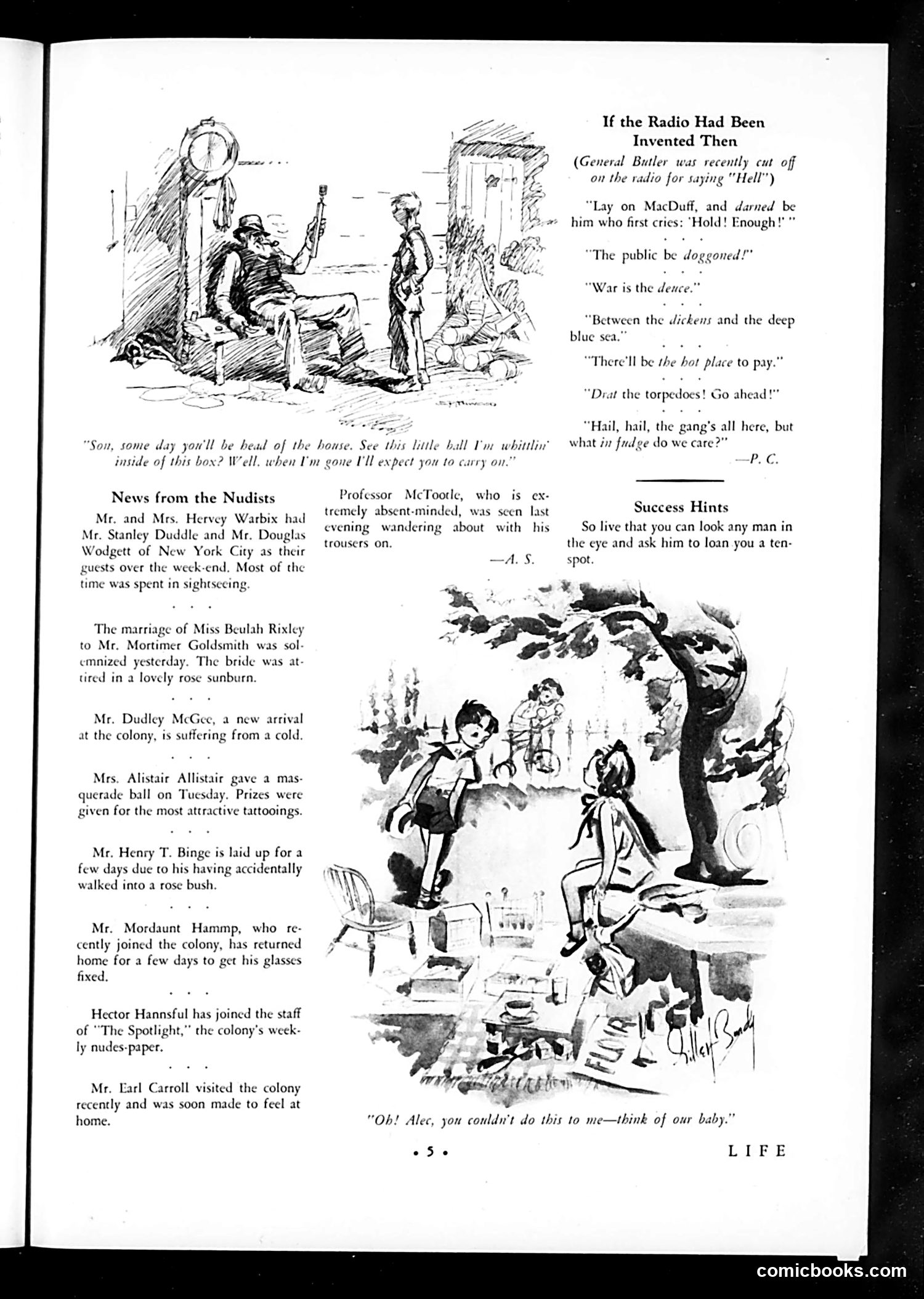
Analysis This page contains two distinct sections: Top section: A satirical cartoon titled "If the Radio Had Been Invented Then" imagines how historical figures would have censored radio broadcasts. It presents fake quotes from General Butler allegedly cutting profanity from the airwaves, with increasingly absurd censorship examples (removing "Hell," calling war "the dance," etc.). The humor lies in mocking both Butler's strictness and the contemporary debate over radio content regulation—suggesting even historical figures would find modern speech shocking. Bottom section: "News from the Nudists" reports on a colony's social activities with light humor about nudism, a novelty lifestyle trend of the 1920s-30s. The accompanying cartoon shows nudists at leisure, with the caption poking fun at parental concerns about children in such colonies. Both sections reflect period anxieties about emerging technologies, changing social norms, and public morality.
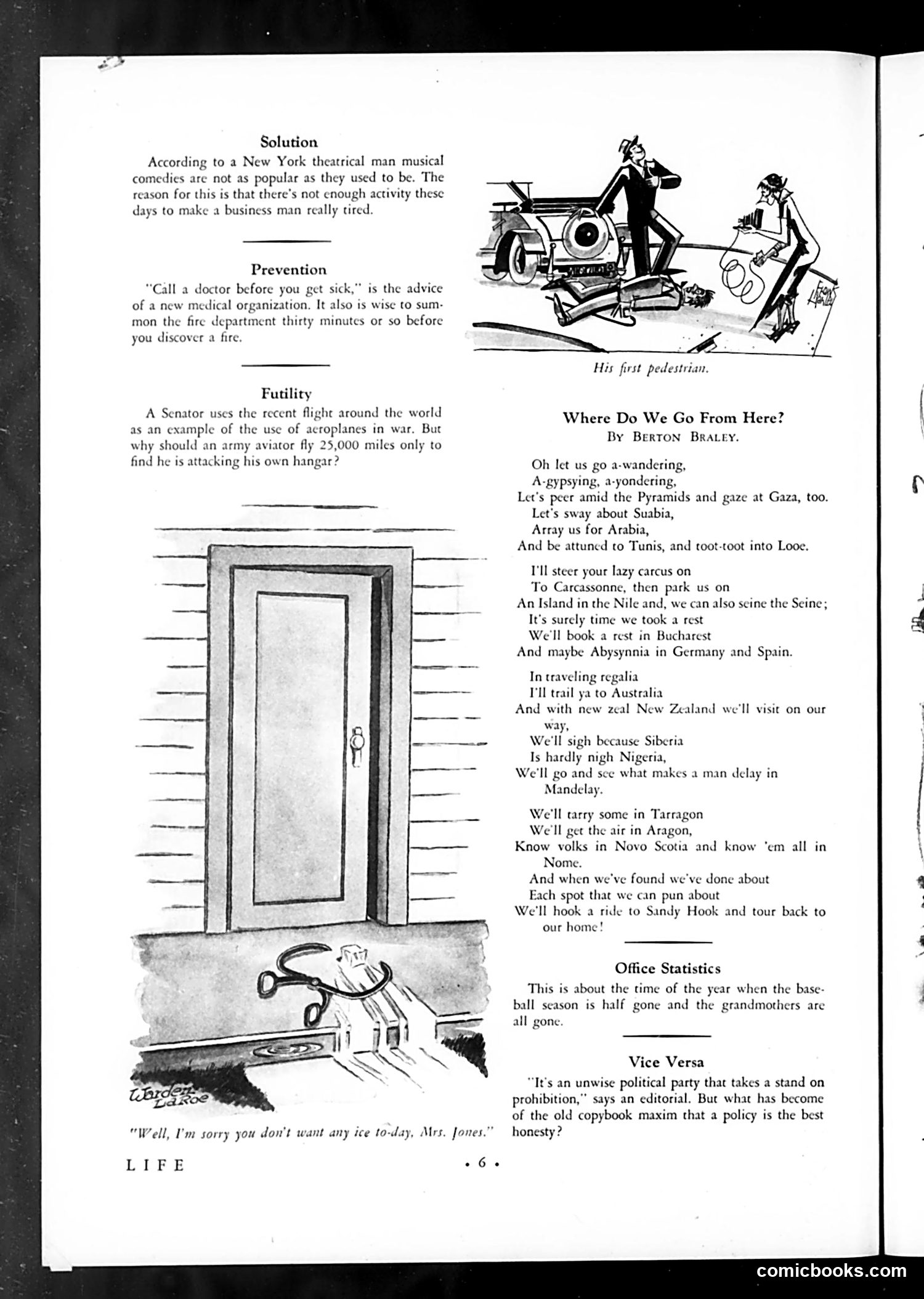
Analysis of Life Magazine Page 6 This page contains several satirical pieces typical of early 20th-century Life magazine humor. The cartoons: - Upper right shows a man with a broken-down car labeled "His first pedestrian"—satirizing early automobiles as dangerous to pedestrians - Lower left depicts a figure in a doorway with the caption "Well, I'm sorry you don't want any ice to-day, Mrs. Jones"—likely mocking ice delivery services or door-to-door salesmen The text sections include commentary on: - Theatrical comedies' declining popularity - Medical prevention advice - Military aviation's utility (referencing a senator's flight around the world) "Where Do We Go From Here?" is a poem by Berton Braley listing exotic travel destinations, reflecting 1920s wanderlust and post-war interest in world exploration. The overall tone satirizes contemporary American life, technological change, and social trends of the era.
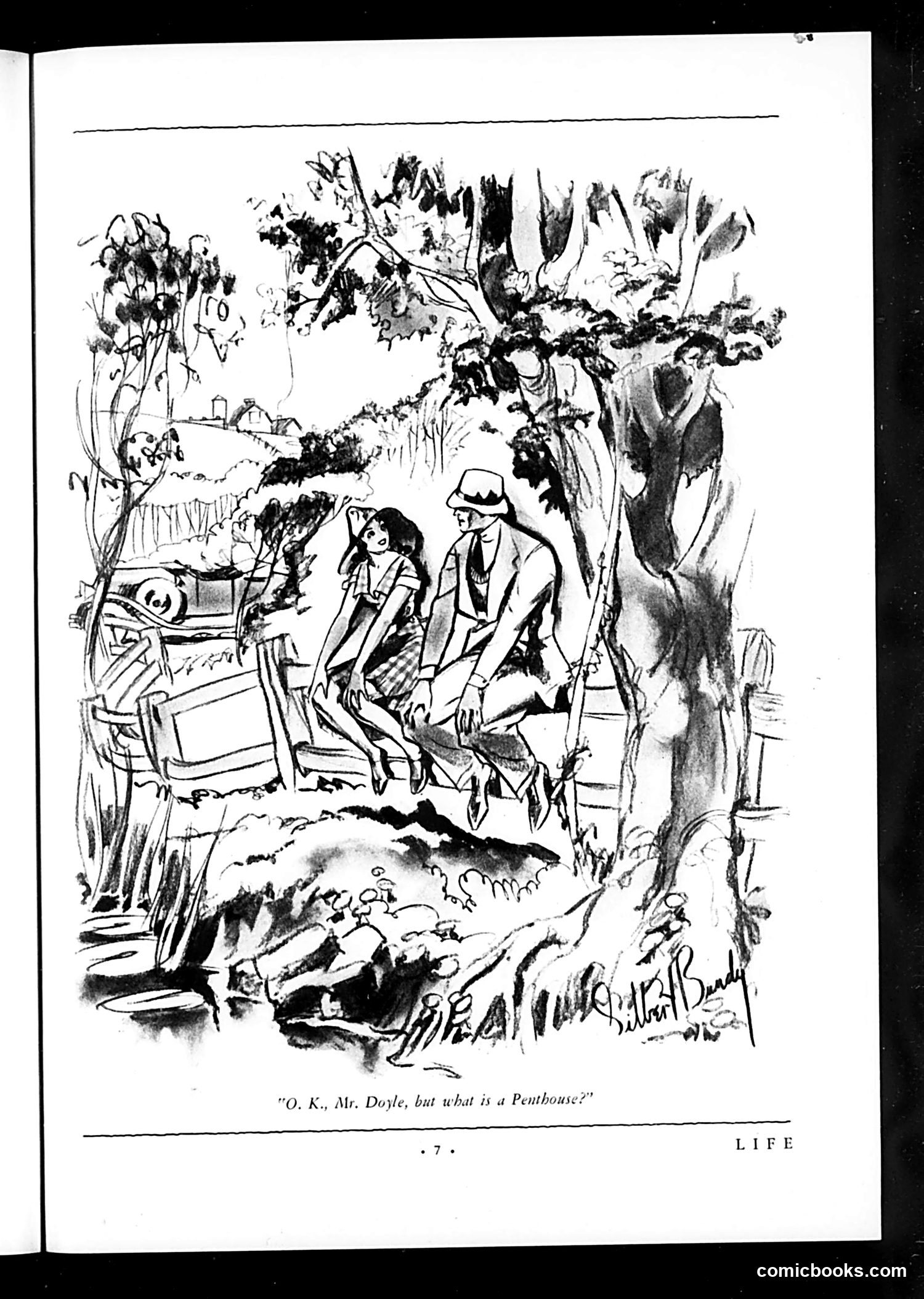
Cartoon Analysis This single-panel cartoon from *Life* magazine depicts two men in a wooded setting, one appearing to dig while the other watches. The caption reads: "O.K., Mr. Doyle, but what is a Penthouse?" The cartoon appears to reference someone named Doyle and satirizes the concept of a "penthouse"—likely mocking either a misunderstanding of this luxury architectural term or making a social commentary about wealth and aspirations. Without additional context about which "Mr. Doyle" is referenced or the specific historical moment, the exact political or social target remains unclear. The sketch style and *Life* magazine format suggest this is early-to-mid 20th century satire, but the specific joke's relevance is not immediately apparent to modern readers without additional biographical or historical information.
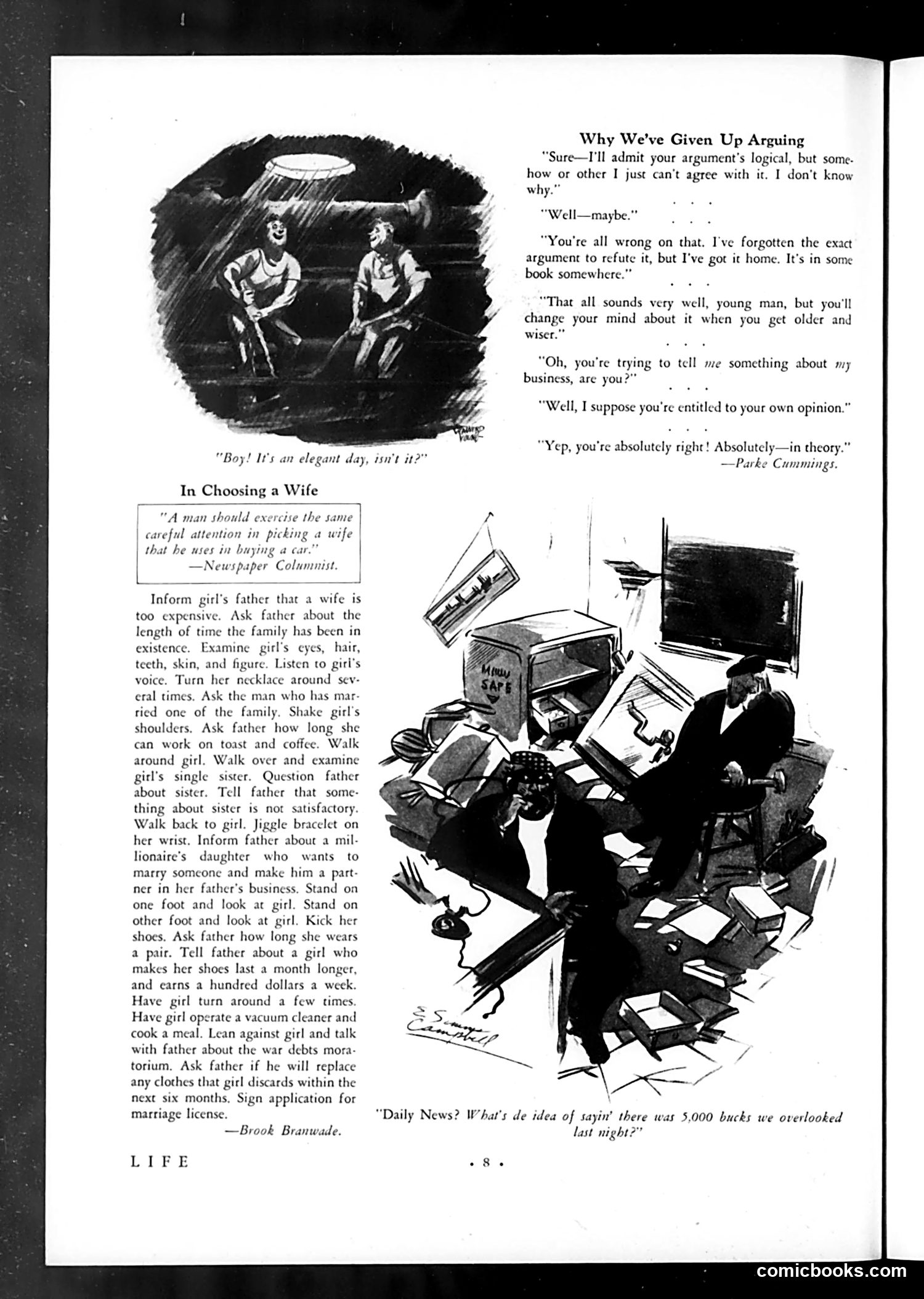
Analysis of Life Magazine Page This page contains two satirical pieces about courtship and marriage: Top Section ("Why We've Given Up Arguing"): A cartoon dialogue between a young couple in a car shows modern dating where substantive disagreement has been replaced by passive acceptance. Rather than debate ideas, they simply defer to age, authority, or agree to disagree—reflecting post-WWI generational shifts where younger people questioned traditional values but lacked conviction to argue them through. Bottom Section ("In Choosing a Wife"): A humorous advice column by Brook Braunwacke parodies contemporary "how-to" articles. It sarcastically suggests evaluating potential wives through absurdly reductive inspections (examine her eyes, hair, teeth; shake her shoulders; check family history)—mocking both overly analytical approaches to marriage and paternalistic attitudes toward women as acquisitions rather than partners. Both pieces satirize modern dating conventions of the 1920s-30s era.
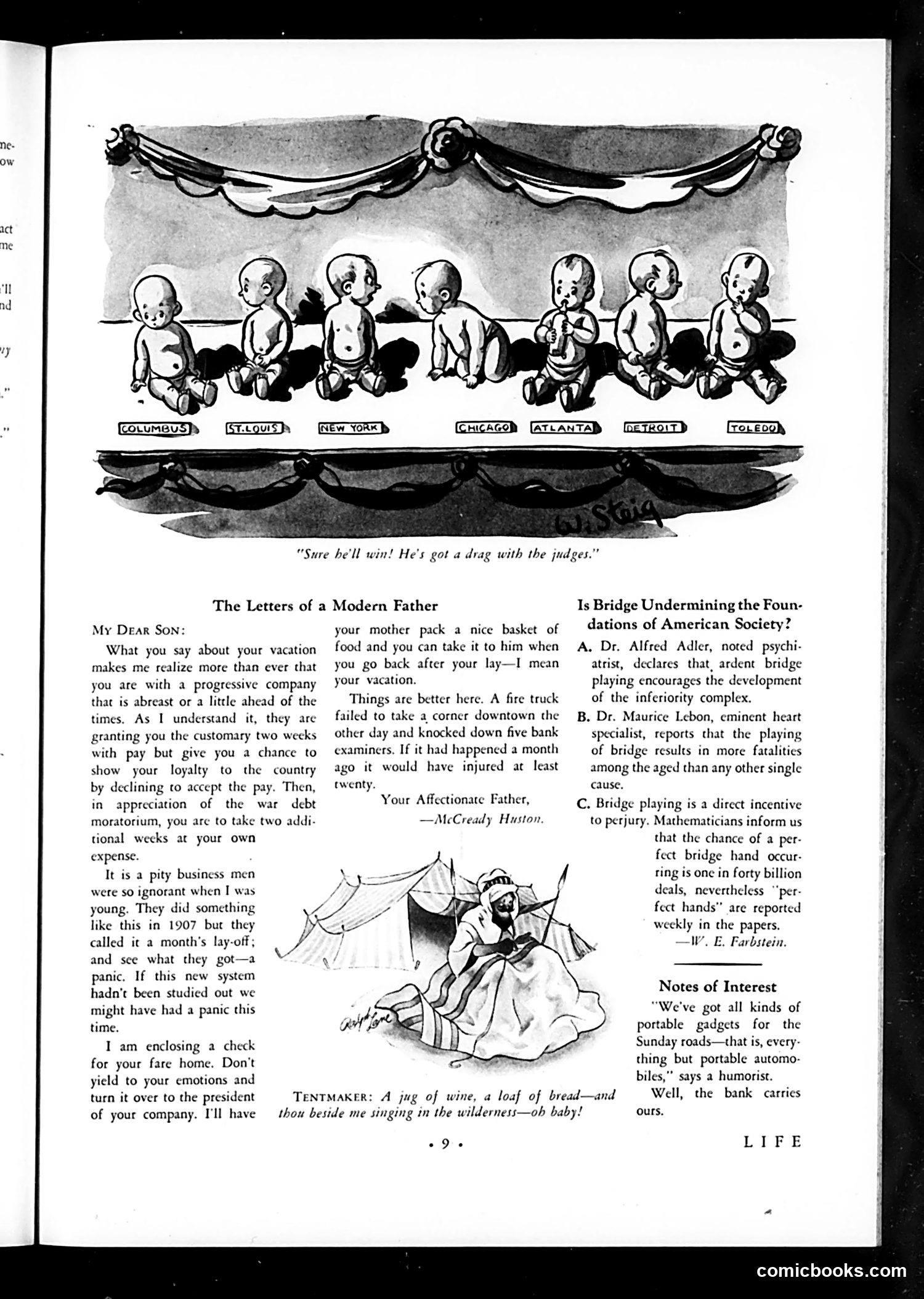
Analysis The top cartoon depicts seven babies labeled with major American cities (Columbus, St. Louis, New York, Chicago, Atlanta, Detroit, Toledo). The caption reads: "Sure he'll win! He's got a drag with the judges." This appears to be satirizing a baby contest or competition—likely a real event from this era where cities competed for publicity. The humor suggests that winning depends on having "a drag" (influence or connections) with judges rather than actual merit. The cartoon mocks how American civic pride and competition could be determined through favoritism rather than fair judgment. The page also contains "The Letters of a Modern Father," advice columns, and bridge-playing commentary. The overall issue uses humor to critique American social customs, business practices, and leisure activities of the period.
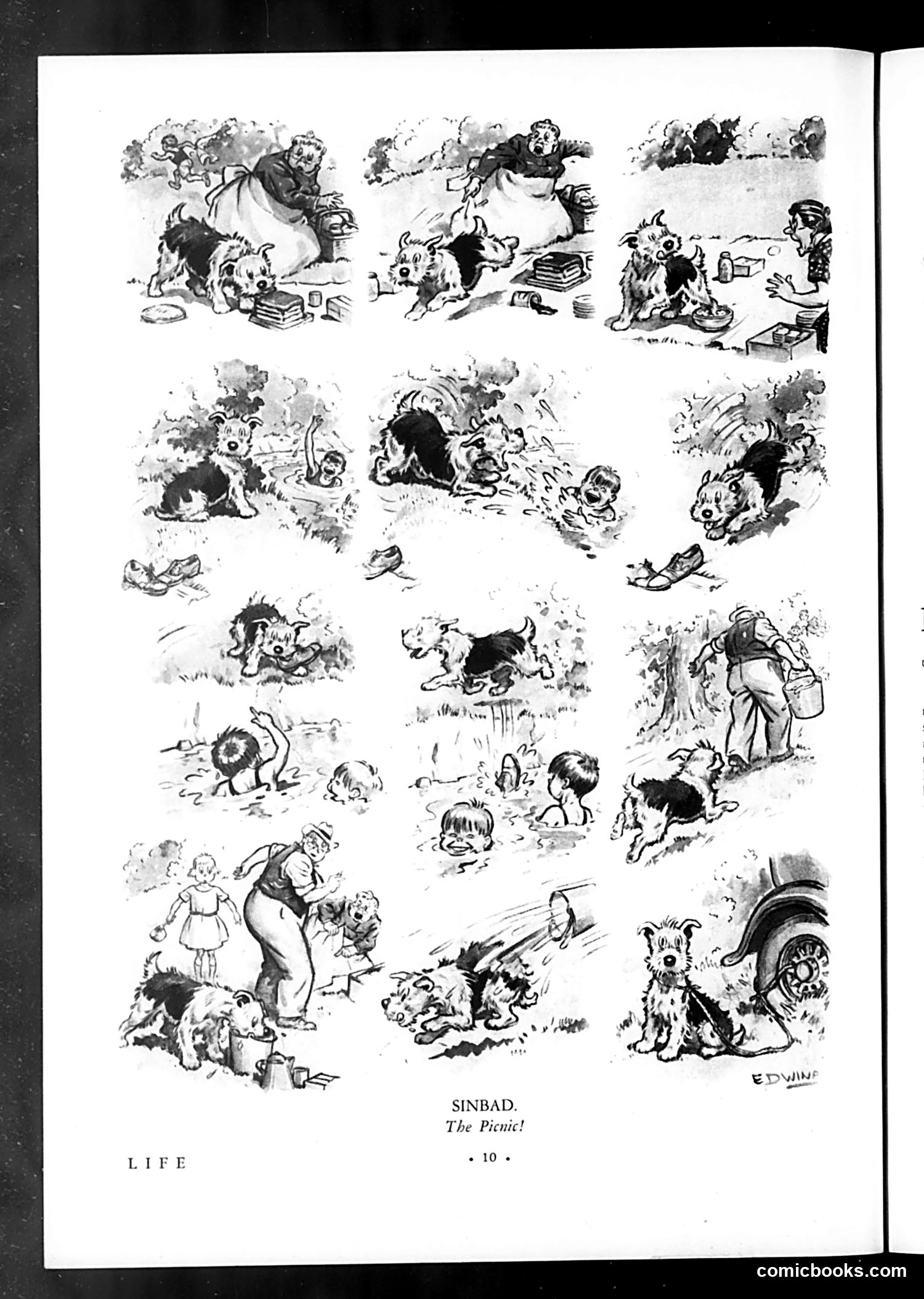
"Sinbad: The Picnic!" - Life Magazine Cartoon This is a humorous illustrated sequence by Edwin (signed lower right) depicting anthropomorphized dogs causing chaos at a human family picnic. The dogs steal food, scatter belongings, chase children, overturn baskets, and generally wreak havoc throughout the outing. The satire works on a simple level: the "Sinbad" reference (likely the dog's name) suggests exotic adventure, but instead of grand tales, readers get the mundane domestic disaster of a ruined picnic. The joke is the contrast between the romantic associations of the name and the slapstick reality of uncontrolled pets destroying a family gathering. This type of gentle domestic humor was typical of Life's early satirical content, appealing to readers with pets and family experiences.
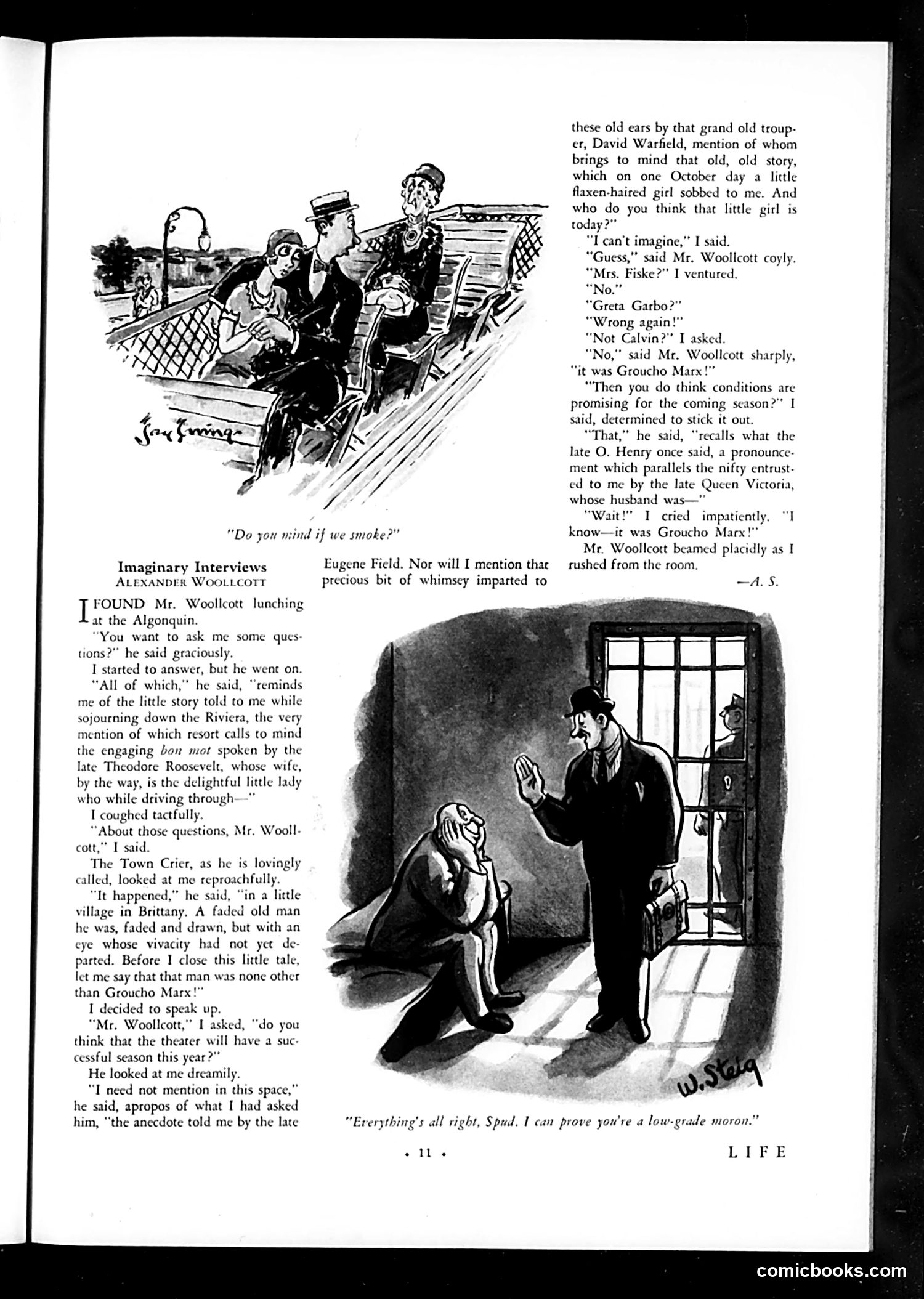
"Imaginary Interviews: Alexander Woolcott" This page features an interview with Alexander Woolcott, a prominent theater critic and personality. The text references several celebrities and figures: - Theodore Roosevelt and Queen Victoria are mentioned in anecdotes - Groucho Marx is discussed as a theater personality whose condition (likely health or career status) Woolcott comments on - References to Greta Garbo and Calvin (likely Calvin Coolidge) appear in the conversation The two cartoons illustrate the interview: one shows people in a car discussing smoking; the lower cartoon depicts what appears to be a doorway scene with two figures, captioned about proving someone "a low-grade moron." The satire appears to mock Woolcott's gossipy, name-dropping conversational style and his theatrical pronouncements about celebrities and public figures of the era.
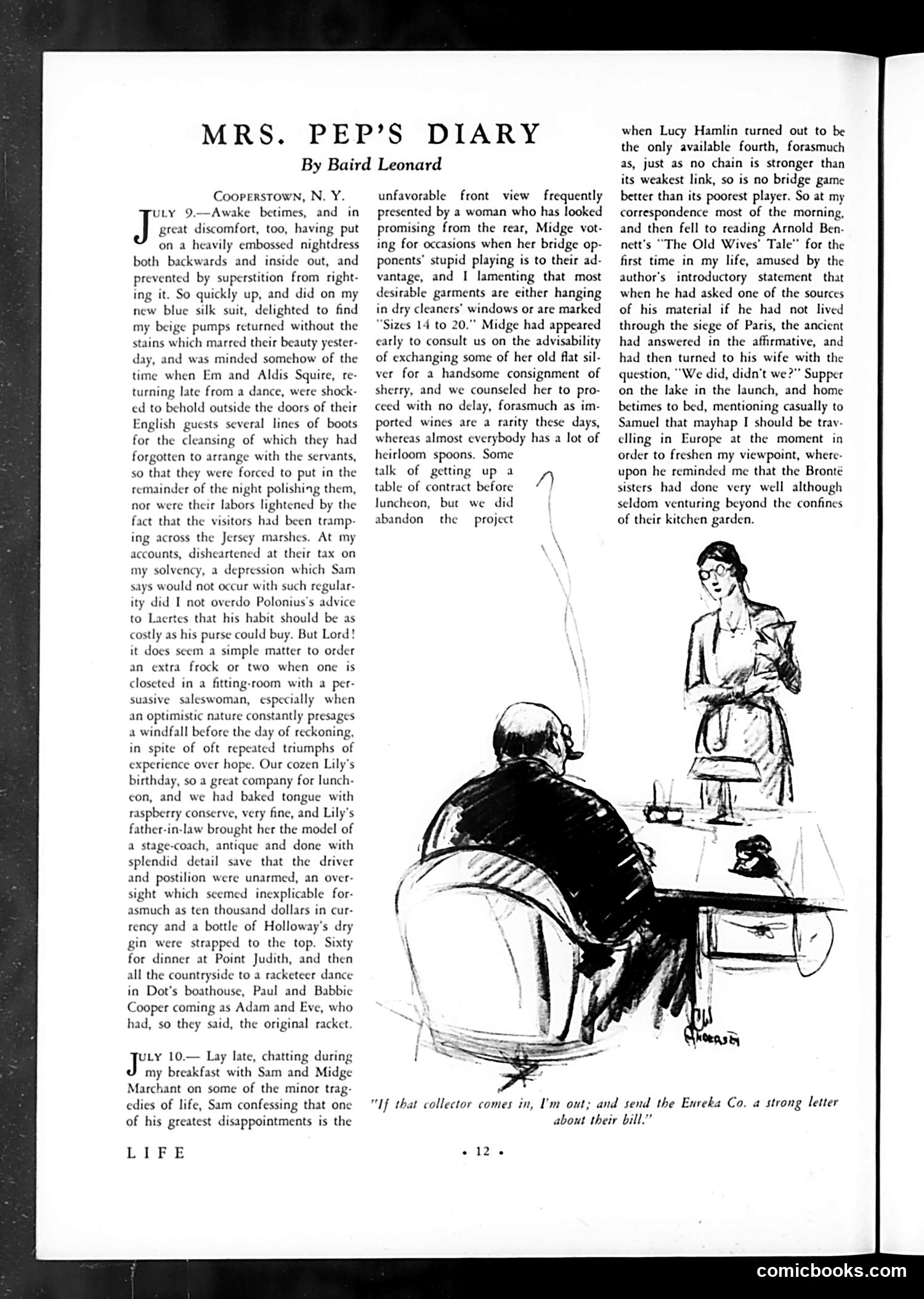
Mrs. Pep's Diary: A Domestic Satire This page contains the opening of "Mrs. Pep's Diary" by Baird Leonard, a humorous column about the everyday frustrations of upper-middle-class life in 1920s Cooperstown, New York. The accompanying sketch illustrates a domestic scene: a woman (Mrs. Pep) appears to confront a servant or household staff member about unpaid bills. The caption reads: "If that collector comes in, I'm out; and send the Eureka Co. a strong letter about their bill." The satire targets the pretensions and financial anxieties of affluent Americans during this period—specifically the gap between outward respectability and actual solvency. The humor derives from the narrator's casual acceptance of debt avoidance and her imperious instruction to servants, mocking both household management incompetence and class pretension.
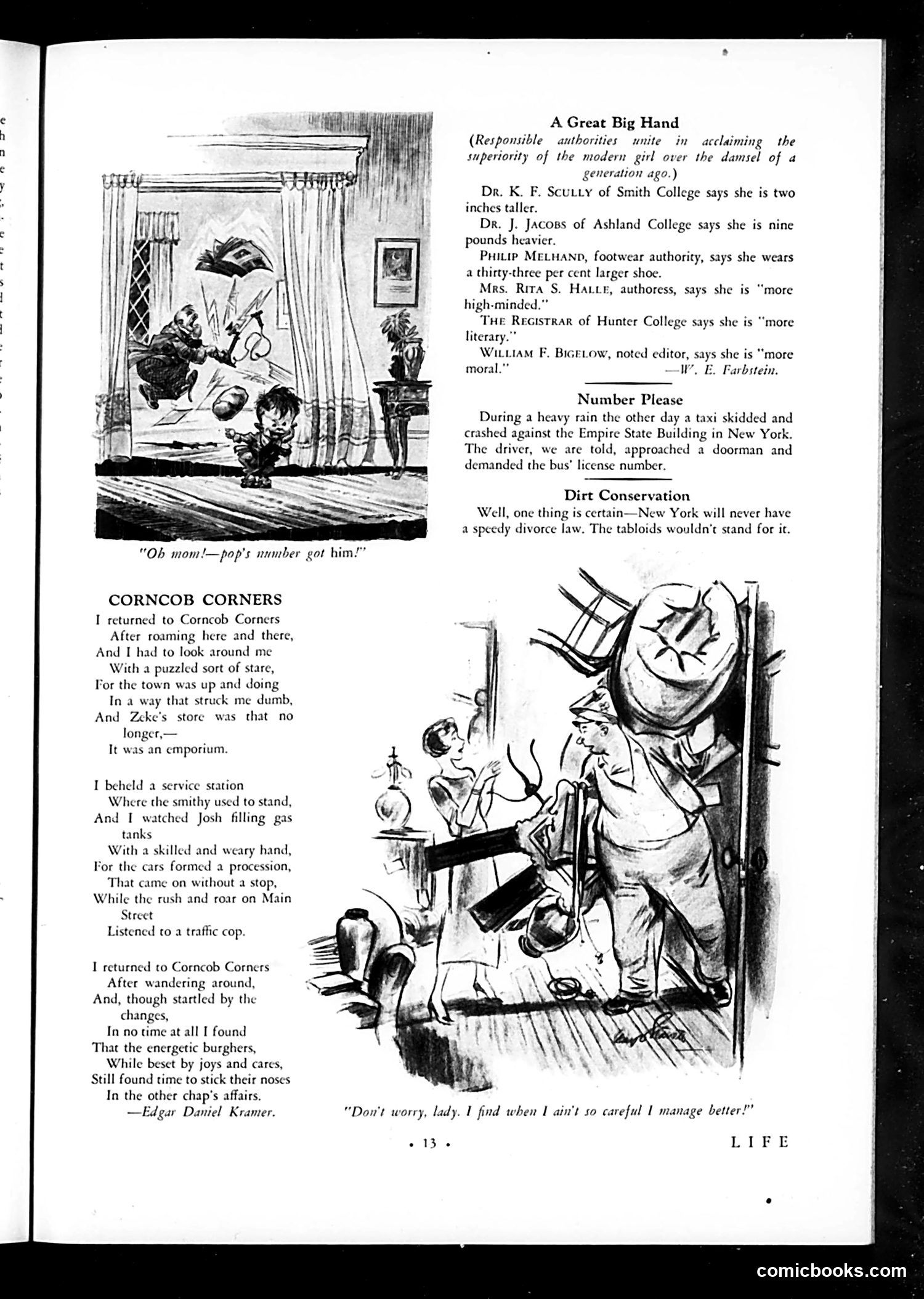
Analysis of Life Magazine Page This page contains three satirical pieces: "A Great Big Hand" mocks exaggerated claims about an unnamed woman's exceptional qualities. Various authorities (college officials, a footwear expert, an author) make contradictory assertions—she's two inches taller, nine pounds heavier, wears larger shoes, is "more high-minded," "literary," and "moral." The satire targets how institutions and experts generate inflated, contradictory publicity around unremarkable subjects, likely referencing 1920s-30s celebrity hype culture. "Number Please" is a brief anecdote about a taxi crash into the Empire State Building where the driver demanded the building's license number—absurdist humor about misdirected priorities. "Corncob Corners" is a nostalgic poem by Edgar Daniel Kramer about returning to a small Midwestern town, finding little changed except the loss of a local store. The page is primarily literary/humorous content rather than political commentary.
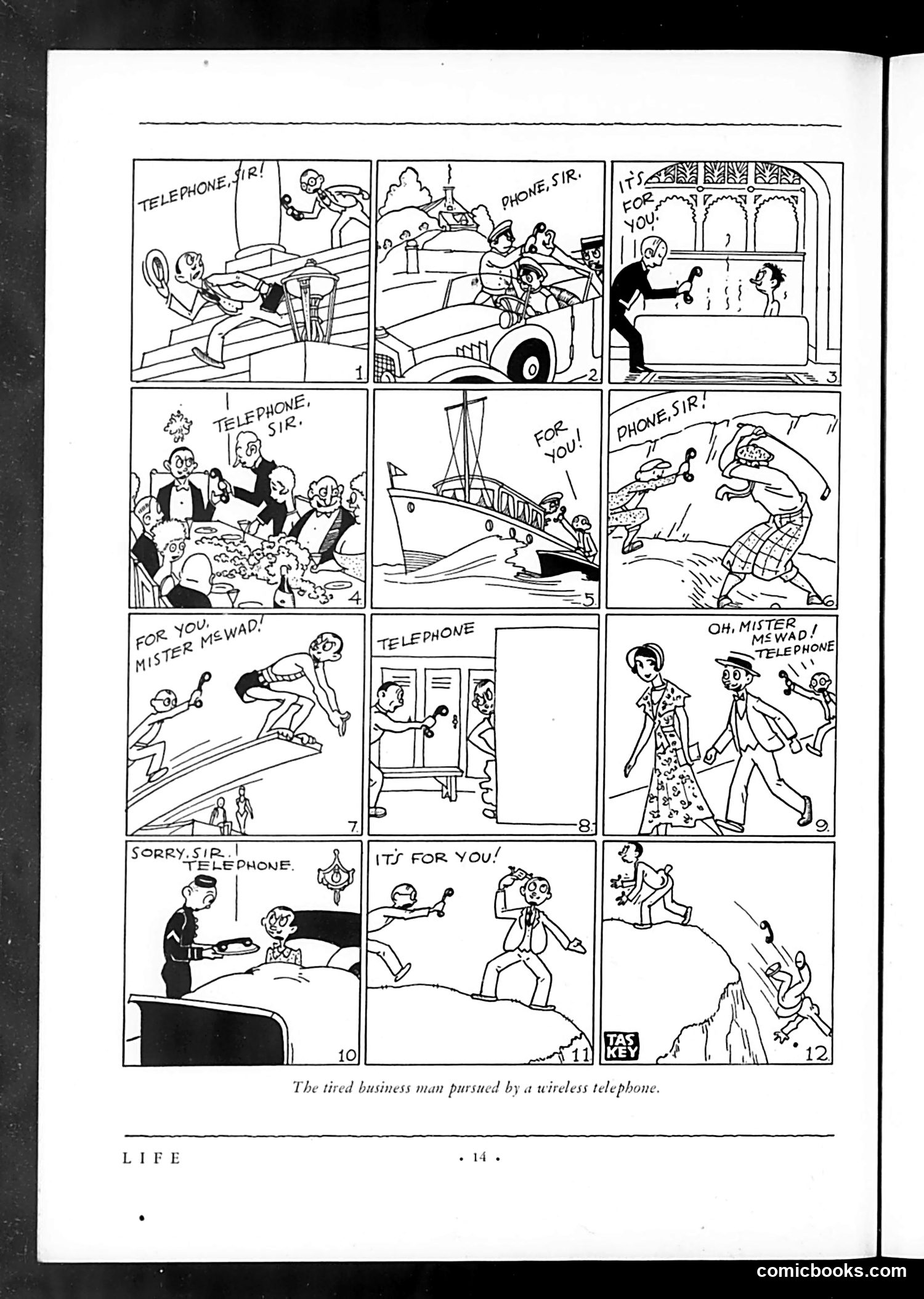
"The Tired Business Man Pursued by a Wireless Telephone" This humorous comic strip satirizes the anxiety of modern technology encroaching on personal life. The narrative follows a businessman constantly interrupted by telephone calls—first at work, then at home, in a bathtub, at a formal dinner, on a beach, and finally fleeing down a mountain in desperation. The satire targets the early wireless telephone's invasiveness, suggesting that technological "progress" prevents rest or escape. The businessman's escalating panic—culminating in him literally running away—humorously exaggerates the frustration of constant connectivity. For modern readers, the irony is striking: today's wireless devices are ubiquitous and expected. This 1920s-era complaint about being "always reachable" has become normalized reality, making this vintage satire feel prophetic about smartphone culture.
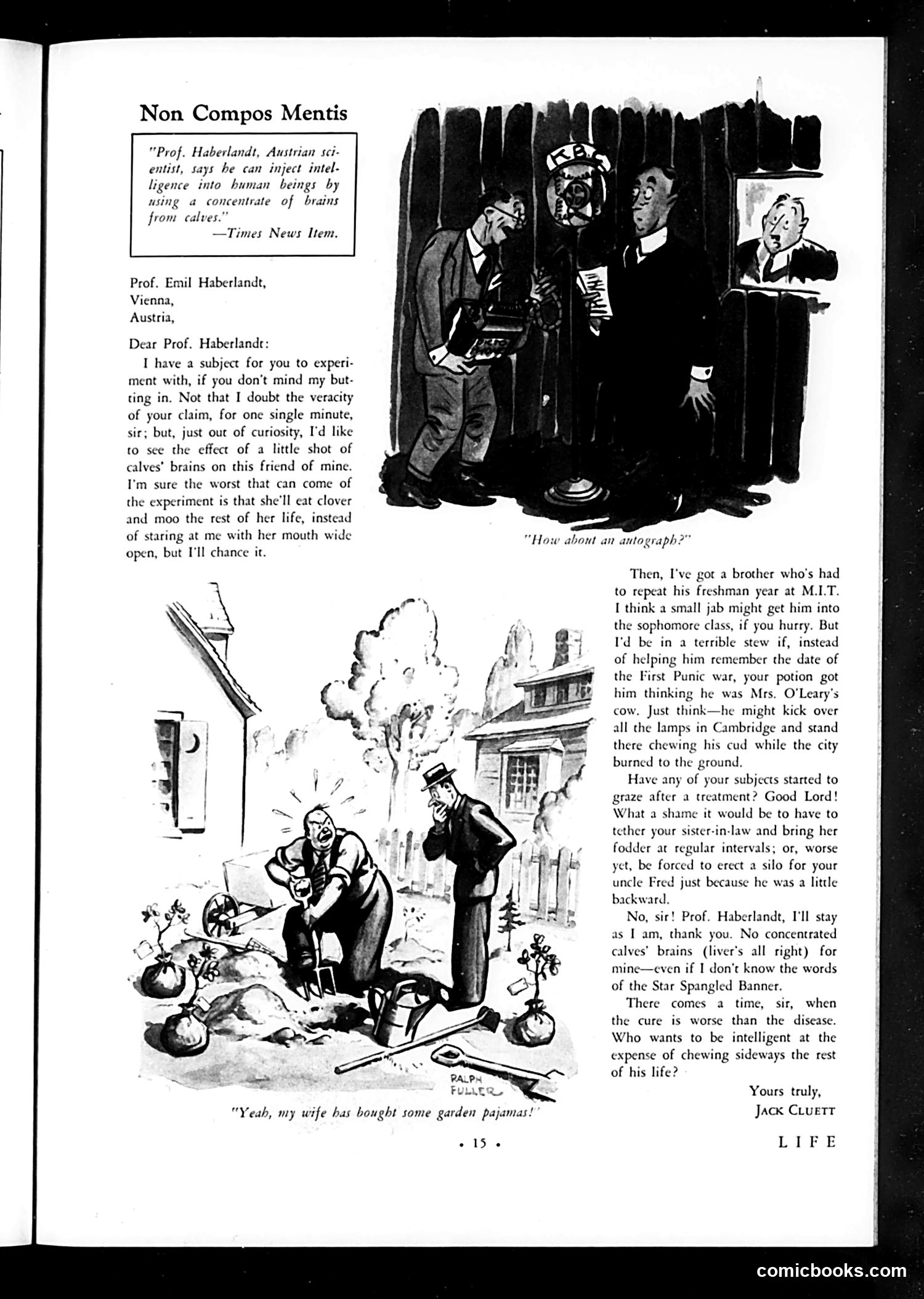
Explanation for Modern Readers This 1920s *Life* magazine page satirizes Professor Emil Haberlandt, an Austrian scientist who claimed he could inject intelligence into humans using concentrated brain extract. The letter from "Jack Cluett" humorously declines the professor's offer to experiment on his friend, joking about disastrous consequences: the subject might become so intelligent she'd abandon her husband, kick over Cambridge lamps, or develop such overdeveloped intellect that it becomes a curse rather than blessing. The cartoons illustrate these absurd scenarios—one showing a woman with enlarged brain wreaking destruction. The satire mocks both Haberlandt's dubious scientific claims and contemporary anxieties about human enhancement and women's intellect during the post-WWI era.
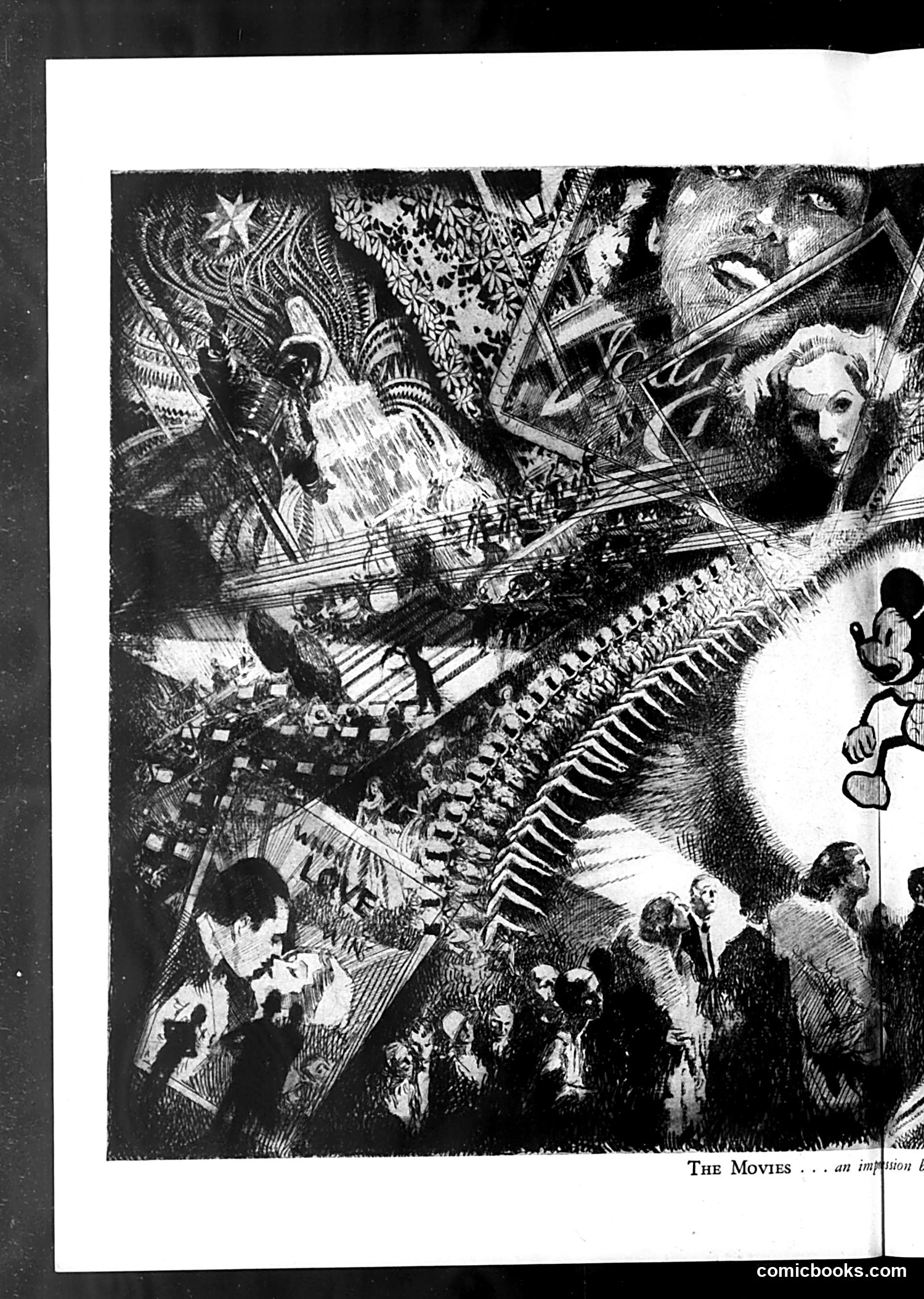
The Movies... an inspiration This is a satirical illustration about cinema's cultural influence. The composition shows a theatrical movie palace or premiere scene at the bottom, with an audience of elegantly dressed patrons watching a screen. Above them, the image depicts elaborate, ornate set designs and costumed figures—likely representing the extravagant productions Hollywood was creating during the silent film era. The satire appears to critique how movies functioned as escapism and aspiration for audiences, showing the disconnect between the glamorous, fantastical worlds depicted on screen and the everyday viewers consuming them. The intricate decorative patterns and dramatic compositions suggest how cinema presented heightened, decorative versions of reality as "inspiration" for the public.
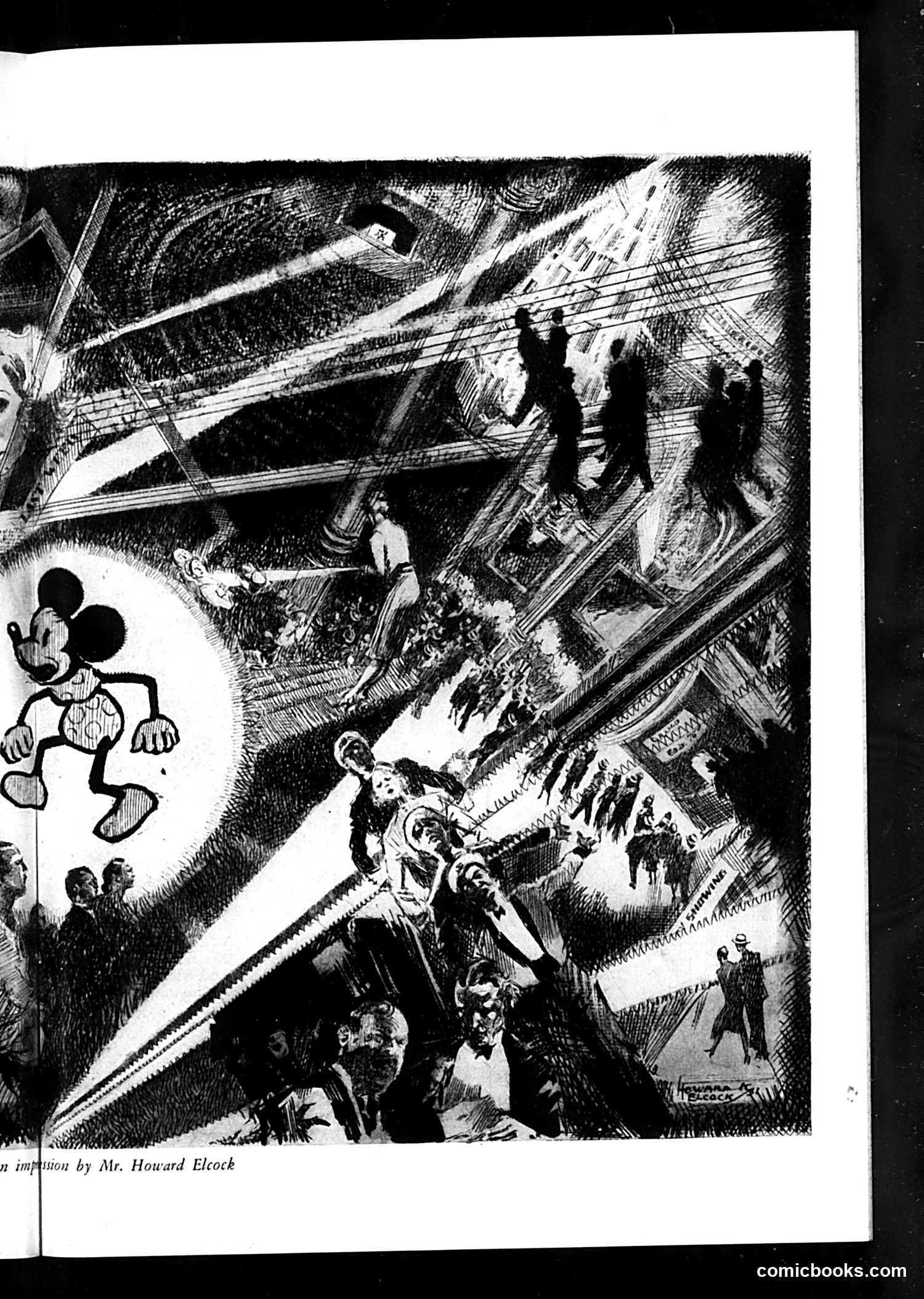
Analysis This black and white illustration by Howard Elock (credited at bottom) depicts a chaotic scene of figures on what appears to be a ship or vessel in distress. The composition shows people in formal dress scattered across different levels, some walking upright on upper decks while others below appear to be in panic or disarray. On the left, a large Mickey Mouse head glows prominently. The image likely satirizes a specific maritime disaster or social upheaval, possibly using the Disney character as ironic commentary on American popular culture amid chaos. However, without the article text or publication date visible on this page, the specific historical event being referenced remains unclear. The dramatic crosshatching and expressive composition suggest contemporary anxiety about safety or social order.
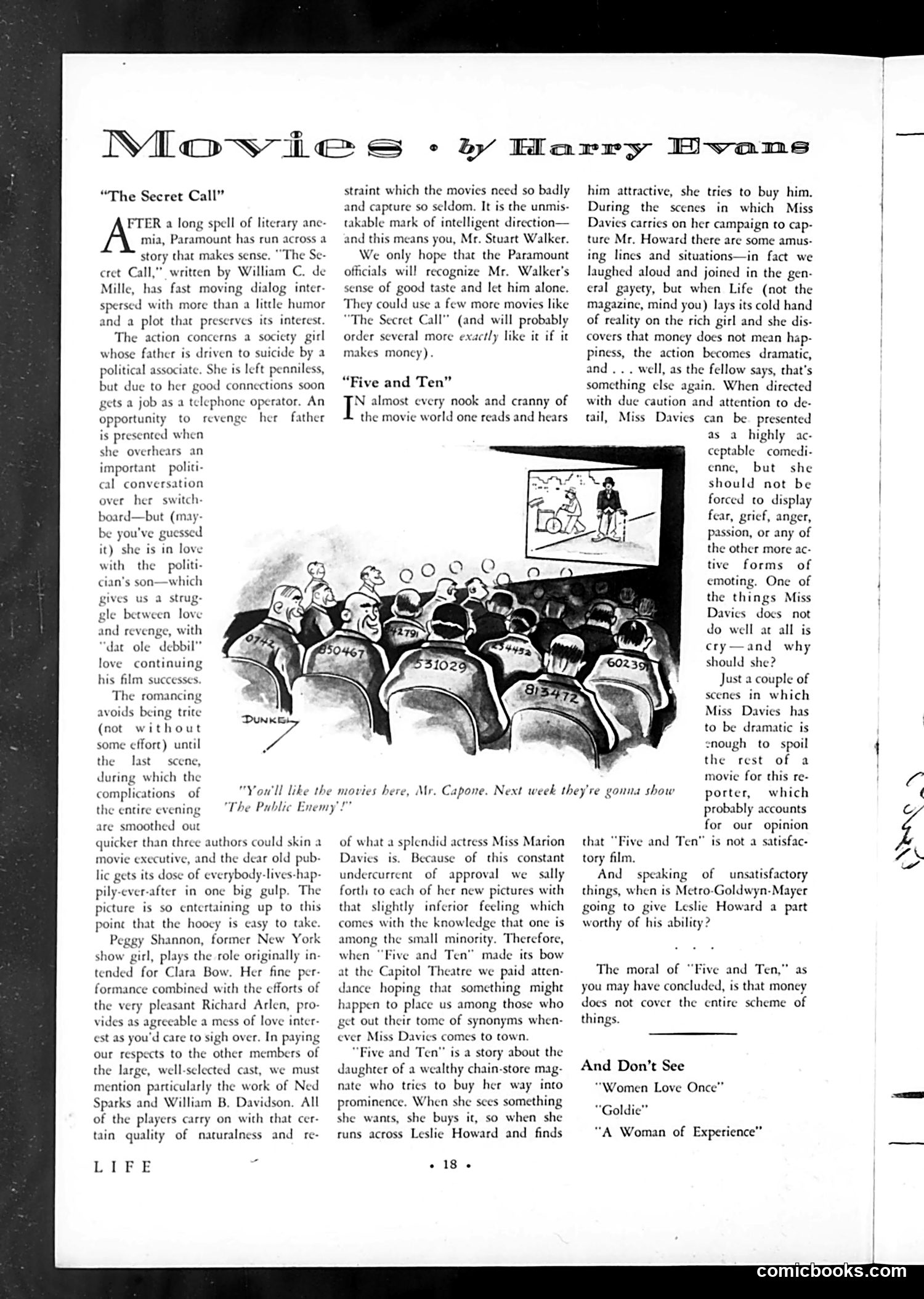
Movie Review Page Analysis This is a movie review column by Harry Evans from Life magazine, discussing contemporary films. The main cartoon depicts a movie theater audience viewing a film, with the caption "'You'll like the movies here, Mr. Capone. Next week they're gonna show 'The Public Enemy'!" The satire: The reference to Al Capone—the famous Chicago mobster—suggests the joke that gangster films were so popular and realistic they'd appeal even to actual criminals. "The Public Enemy" was a notable crime film of the era. The cartoon satirizes how entertainment about lawlessness might attract its real-world practitioners, poking fun at the public's fascination with gangster narratives during Prohibition. The reviews discuss Marion Davies films and Leslie Howard, typical entertainment commentary for this magazine era.
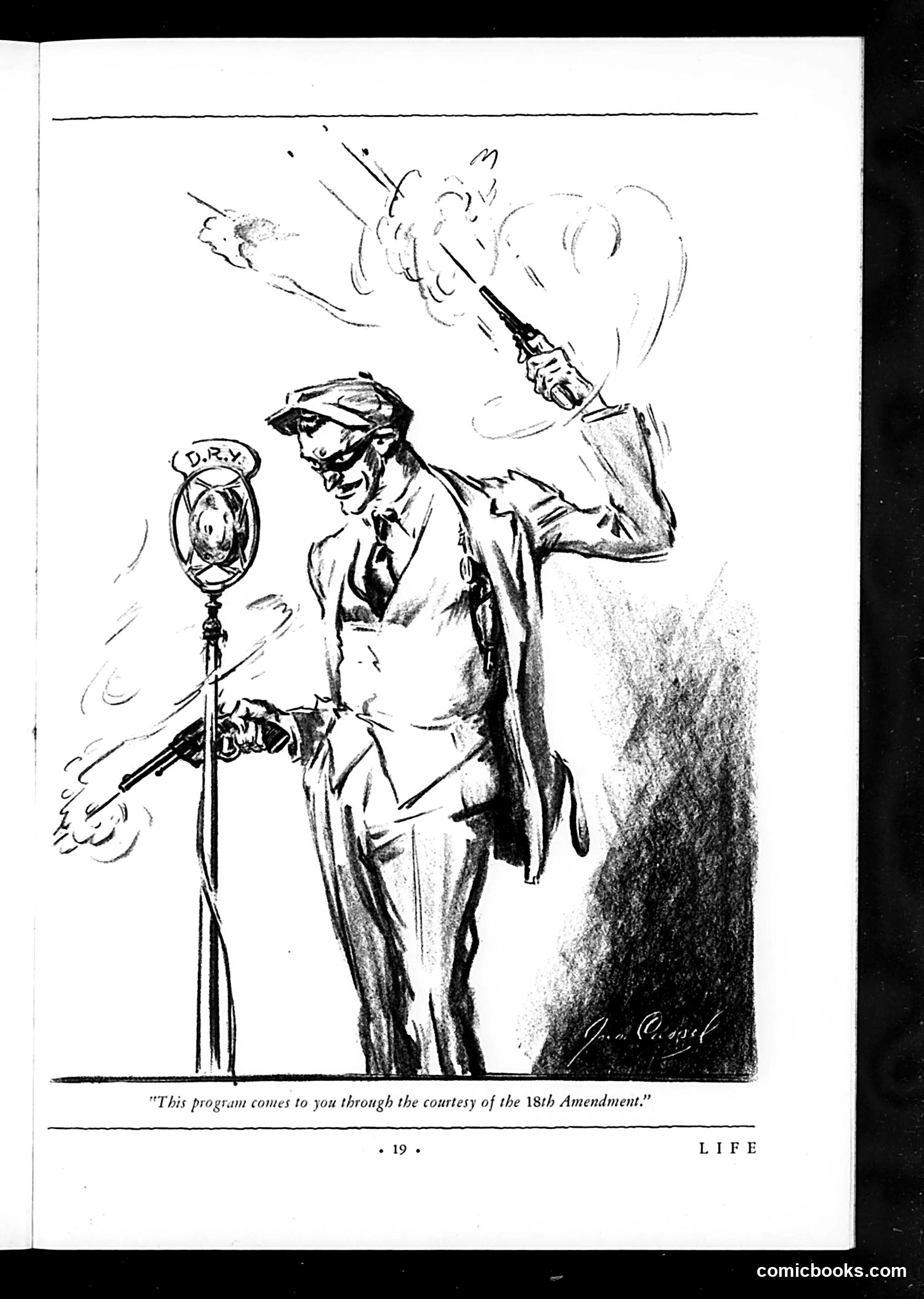
Political Cartoon Analysis This cartoon satirizes Prohibition (the 18th Amendment, which banned alcohol sales 1920-1933). A man in a cap and suit operates what appears to be an illegal alcohol distillery or still, producing liquor despite the law. He holds a lamp labeled "D.R.Y." (representing the Dry movement that supported Prohibition) while simultaneously manufacturing spirits—a hypocritical contradiction. The caption's bitter humor suggests that bootlegging operations like this one exist *because* of the 18th Amendment, not despite it. The cartoon mocks how Prohibition actually enabled illegal alcohol production rather than eliminating it, and critiques those who championed the law while profiting from its violation. The artist's signature appears in the lower right.
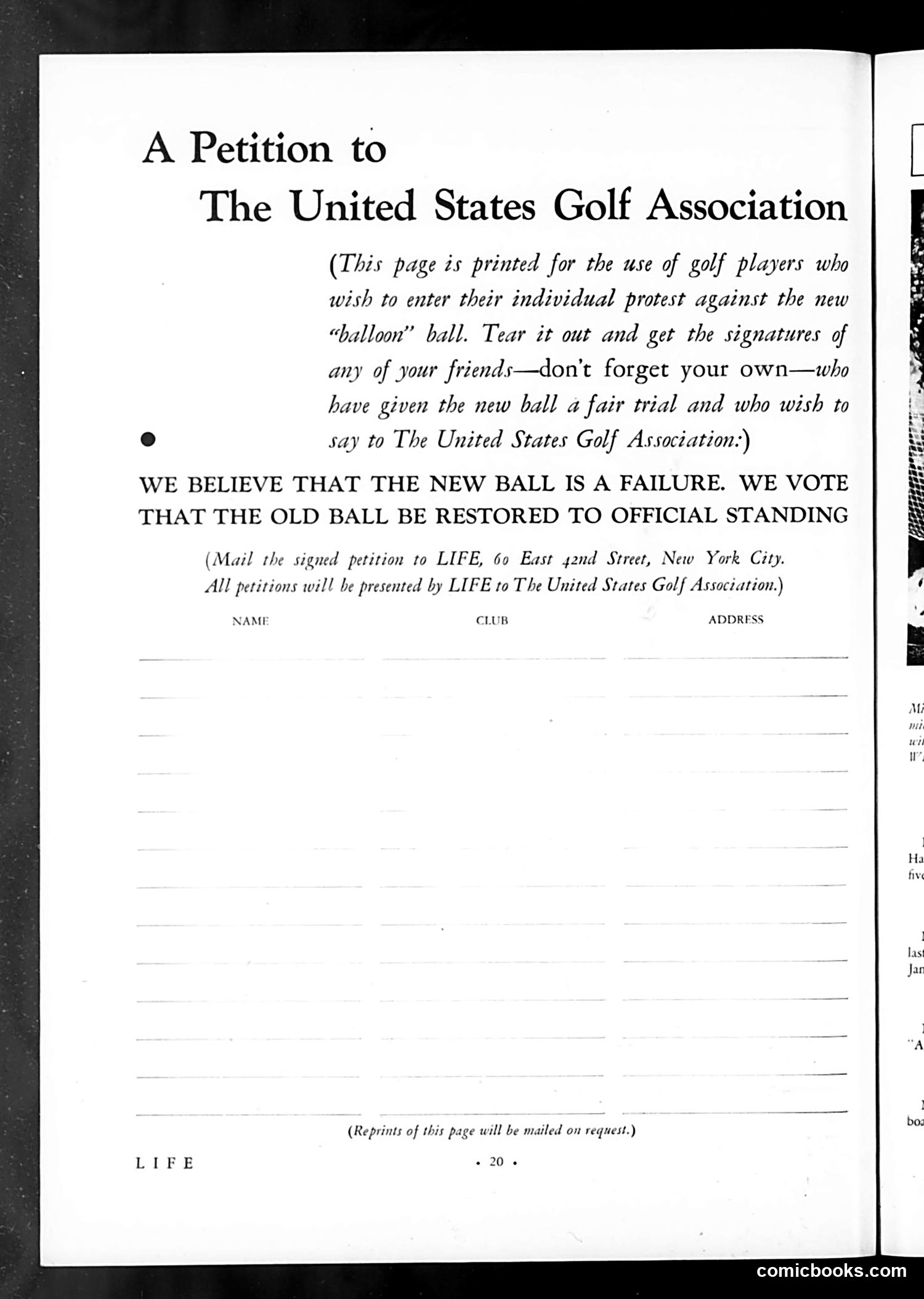
"Balloon" Ball Golf Petition This is not a cartoon but a functional petition page. Life magazine is mobilizing readers against a new golf ball design—called the "balloon" ball—that the United States Golf Association had apparently approved for official play. The page explains that golfers who've tested the new ball and found it inferior can sign this petition to restore the older ball to official status. Readers are encouraged to collect signatures from friends and mail the completed petition to Life's offices, where the magazine promises to present all petitions collectively to the USGA. This reflects early 20th-century golf's equipment controversies: governing bodies periodically modified ball specifications, and traditionalist players often resisted changes they felt degraded the sport. Life positioned itself as champion of grassroots golfer opinion against institutional rule-making.
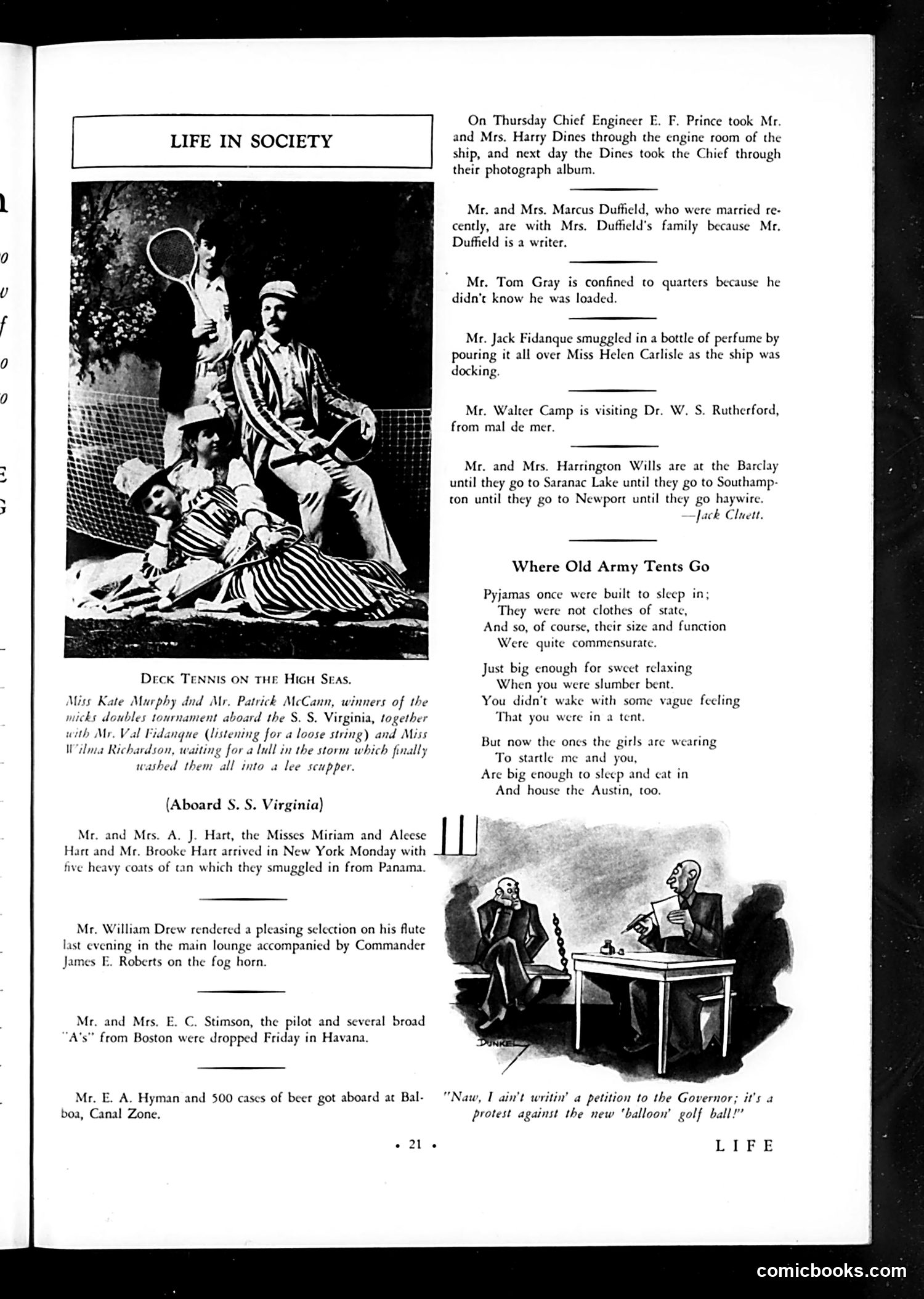
Life Magazine Social Satire Page This is a "Life in Society" gossip column with satirical commentary on high-society travelers. The humor relies on exaggeration and subtle mockery: The photo shows deck tennis players aboard the S.S. Virginia; the caption jokes that a storm literally washed them into a "lee supper" (wordplay on "lee" the ship's sheltered side). The society items mock wealthy travelers with absurd details: people who "smuggled" tans from Panama, a man confined to quarters because "he didn't know he was loaded" (drunk), perfume smuggled by pouring it on a woman, and endless relocations ("until they go haywire"). The poem satirizes modern women's fashion—pajamas have become so oversized they could "house the Austin" (a car), transforming sleepwear into tents. The cartoon shows a man protesting the new "balloon" golf ball to a governor, with the caption's dry wit: it's labeled a "protest" when it's actually just complaining about sports equipment. The page mocks upper-class pretension and modern consumer culture through deadpan humor typical of 1920s-30s Life magazine.
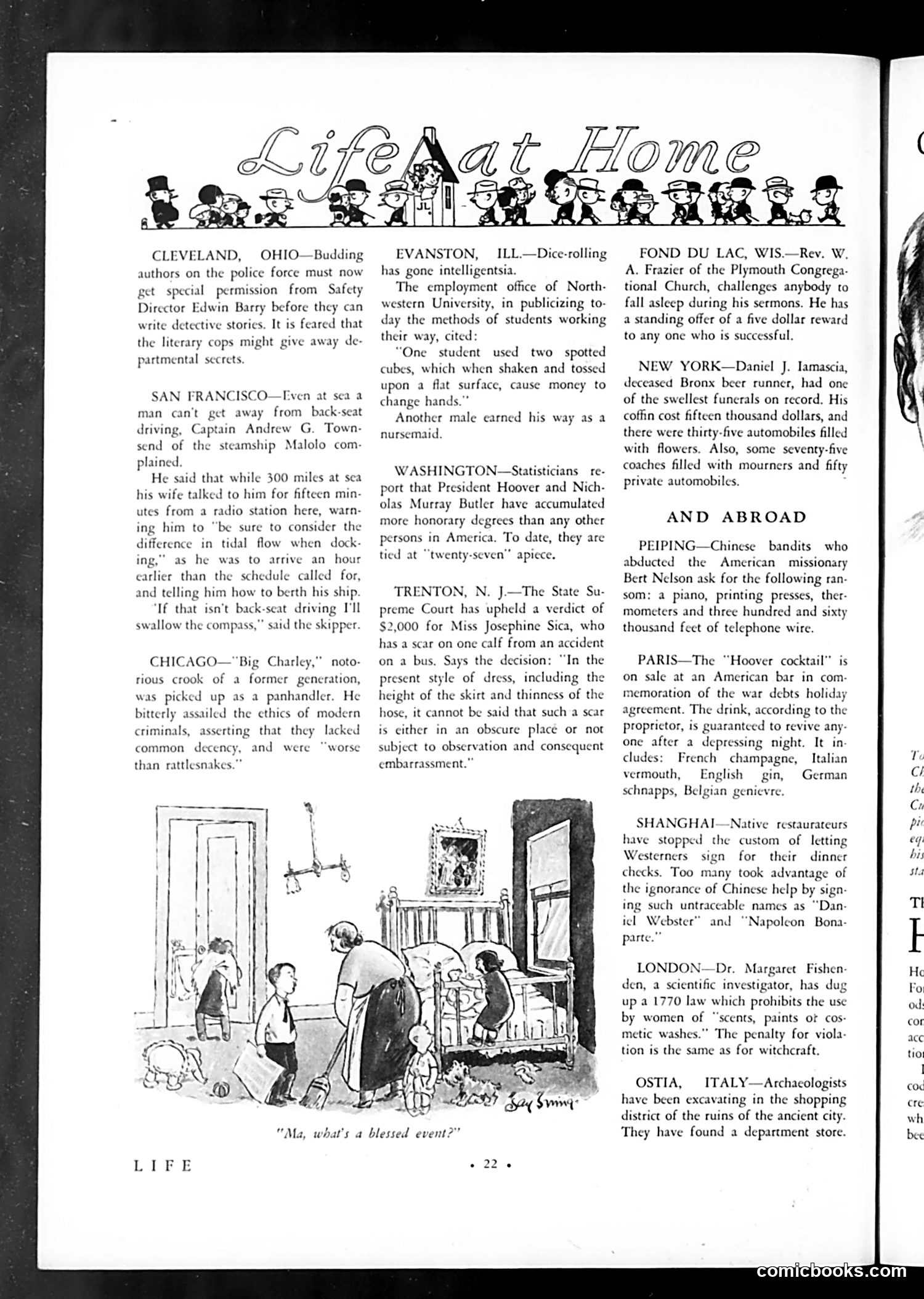
"Life at Home and Abroad" – Satire Digest This page collects humorous news briefs mocking contemporary absurdities (circa 1930s). The cartoon shows a mother scolding children, captioned "Ma, what's a blessed event?"—likely satirizing sanitized euphemisms for pregnancy. The text items mock: - Bureaucratic overreach: Cleveland police needing permission to write detective fiction - Gender dynamics: A captain's wife micromanaging his ship via radio - Class hypocrisy: A Depression-era criminal bemoaning modern crooks' lack of "ethics" - Academic pretension: Northwestern euphemizing dice-rolling as intellectual employment - Legal absurdity: Courts awarding damages for visible leg scars given women's shorter skirts - International comedy: Chinese bandits' ransom demand includes a piano and telephone wire; Parisians naming a cocktail after President Hoover The satire targets institutional pomposity, gender role tensions, and the contradictions of early Depression-era American life. Modern readers would recognize this as proto-listicle humor mocking institutional nonsense.
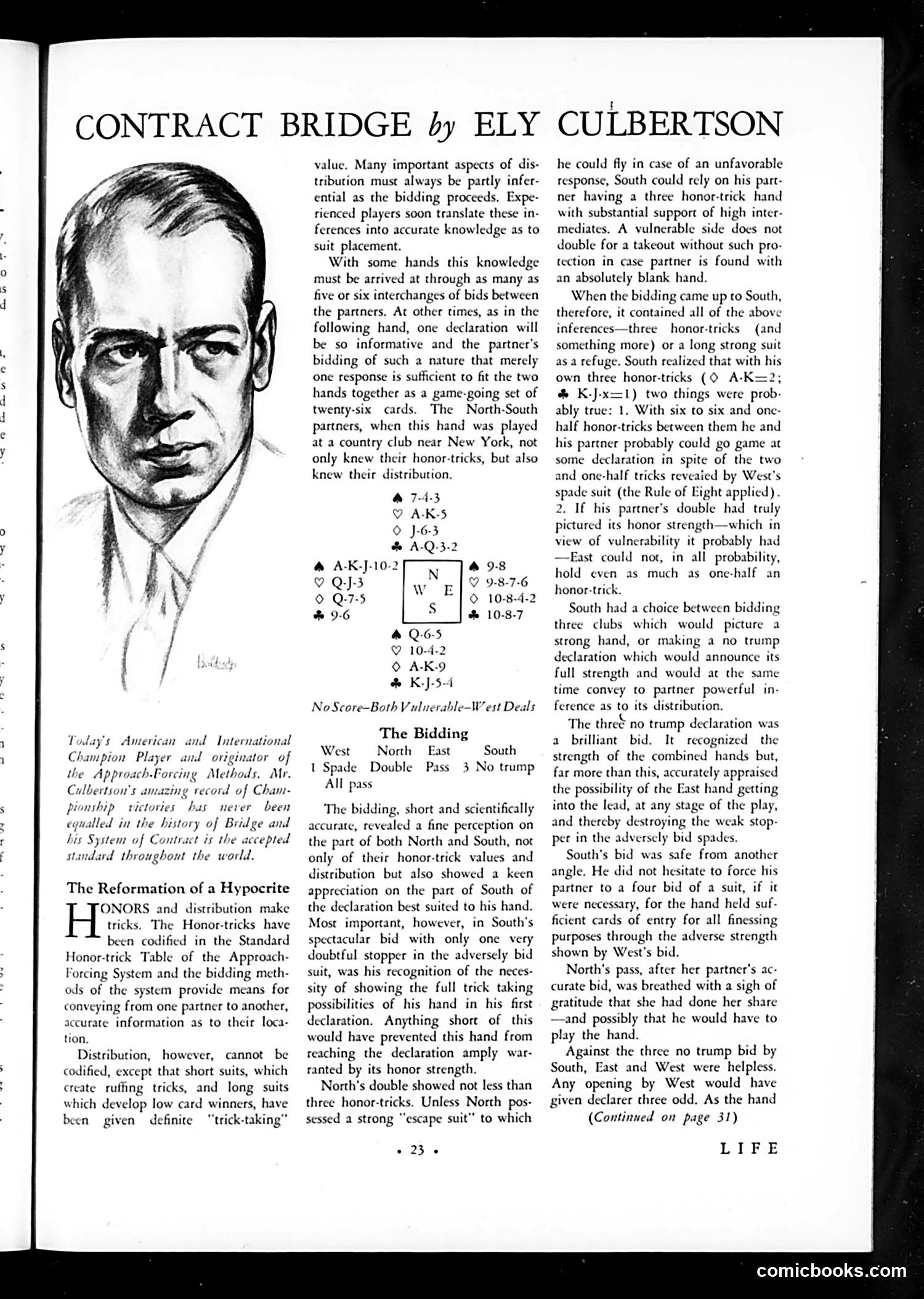
Contract Bridge Article by Ely Culbertson This page features Ely Culbertson, identified as the American and International Champion bridge player and originator of the Approach-Forcing Method for Contract Bridge. The portrait sketch shows him in professional attire. The content is not satirical or political—it's an instructional article about Contract Bridge strategy. Culbertson explains honor-tricks, distribution methods, and bidding tactics through a detailed hand example played at a New York country club. The article demonstrates how two bridge partners can communicate complex information about their cards through careful, scientific bidding sequences. This represents Culbertson's significant role in popularizing and standardizing Contract Bridge rules during the early-to-mid 20th century. The article educates readers on competitive bridge mechanics rather than satirizing any political or social figures.
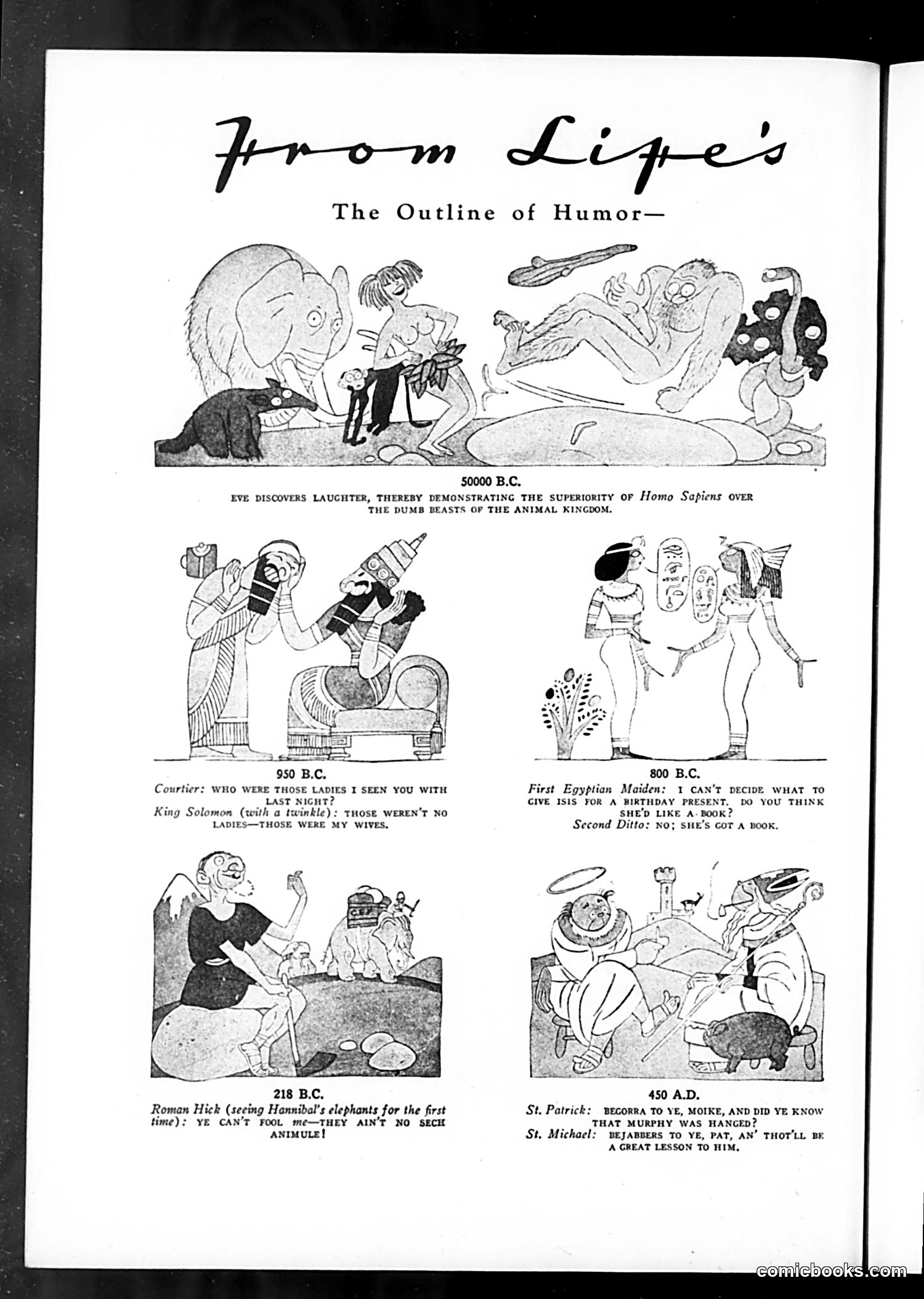
"From Life's: The Outline of Humor" This page presents historical jokes framed as humor's evolution, from Eve's discovery of laughter through various historical periods. Each panel pairs a historical figure or scenario with period-appropriate humor: - King Solomon joke exploits his biblical reputation for polygamy - Roman Hick scene satirizes rural ignorance encountering Hannibal's elephants (mistaking them for unfamiliar animals) - Egyptian Maidens joke plays on anachronistic literacy concerns - St. Patrick and St. Michael exchange uses Irish dialect stereotypes and religious figures The satire relies on period-specific cultural references and ethnic stereotyping (Irish brogue, "Roman hick" rusticity) typical of early 20th-century American humor. The framing device—tracing humor's development—suggests superiority of modern understanding while the jokes themselves employ dated, prejudicial characterizations common to the era.
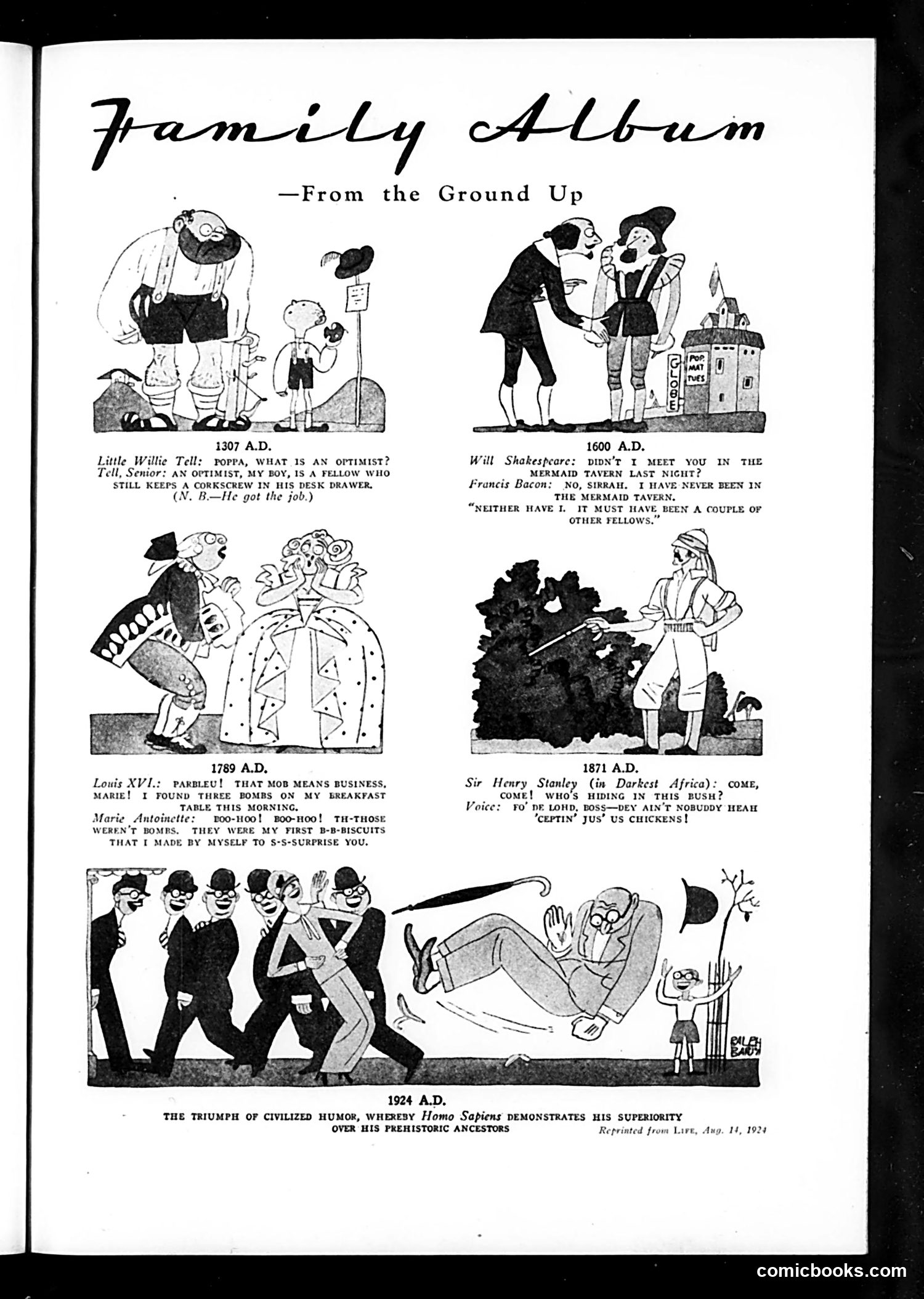
"Family Album—From the Ground Up" This 1924 Life magazine page uses humor to trace the history of jokes and wit across centuries. Each panel presents a famous historical figure making a joke suited to their era: - 1307 A.D.: William Tell's father explains optimism through a corkscrew joke - 1600 A.D.: Shakespeare and Francis Bacon deny meeting at the Mermaid Tavern (a famous London meeting place), suggesting a playful alibi - 1789 A.D.: Louis XVI mistakes Marie Antoinette's terrible biscuits for bombs during the French Revolution—dark humor about political violence - 1871 A.D.: Sir Henry Stanley's African expedition encounters "just us chickens"—a racist stereotype joke The page's title claims "civilized humor" demonstrates human superiority over "prehistoric ancestors." The satire works by showing how jokes have evolved through history while remaining fundamentally human—though the racist content reveals the casual prejudices embedded in 1920s American satire.
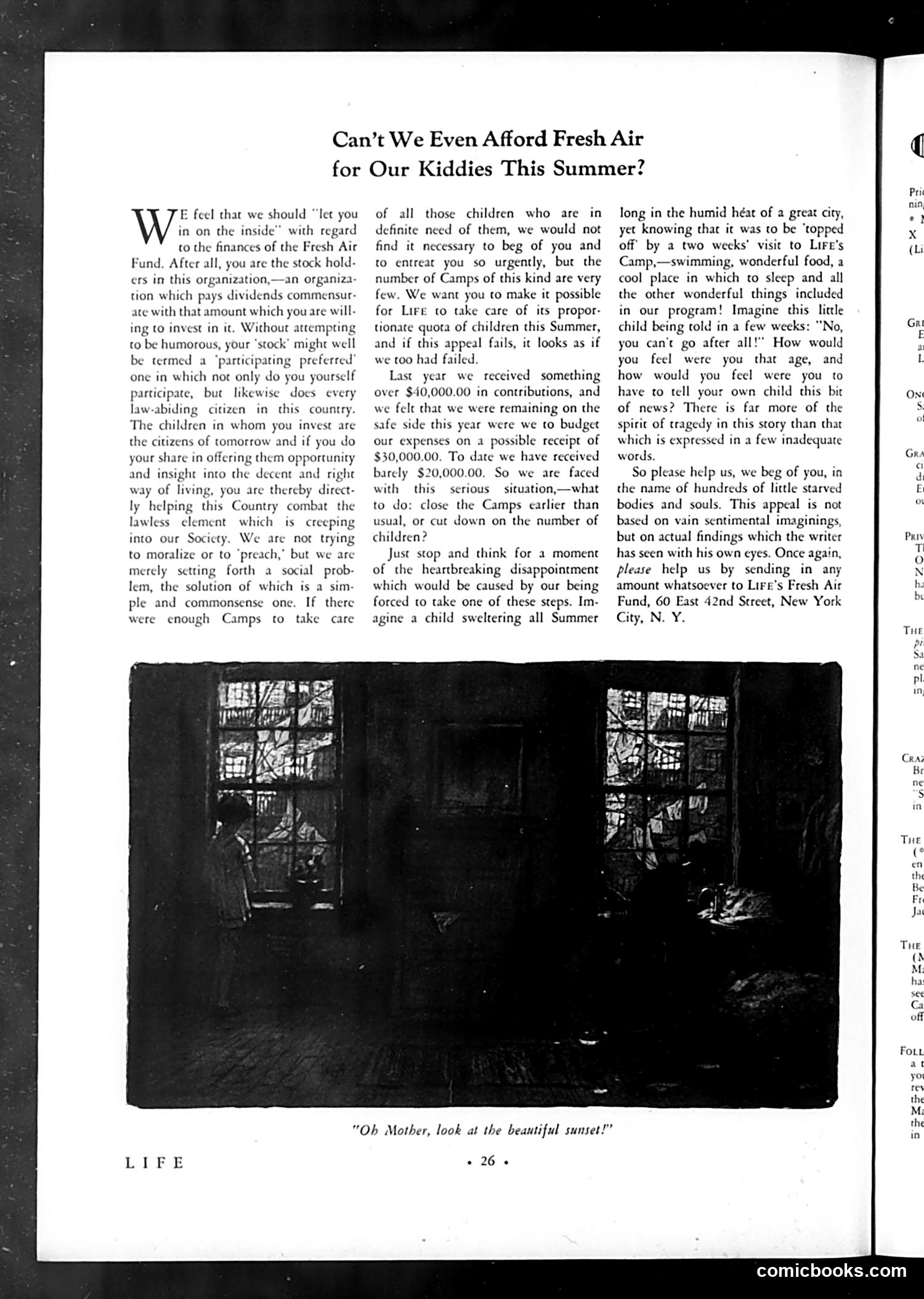
Life Magazine: Fresh Air Fund Appeal This is a fundraising appeal for the Fresh Air Fund, a charitable organization providing summer camp experiences for underprivileged urban children. The accompanying photograph shows children looking out windows at a sunset—a poignant visual contrast between confinement indoors and nature's beauty they cannot access. The text frames camp attendance as both a charitable investment and social necessity, arguing that denying poor children outdoor respite represents a "heartbreaking disappointment" and a failure to combat urban crime and lawlessness. The organization received $40,000 the previous year but only $20,000 so far, forcing them to potentially close camps or reduce admissions. The appeal presents camp as a moral imperative: denying children fresh air and swimming would constitute tragedy. This reflects early-20th-century Progressive Era thinking linking environmental access to youth welfare and social stability.
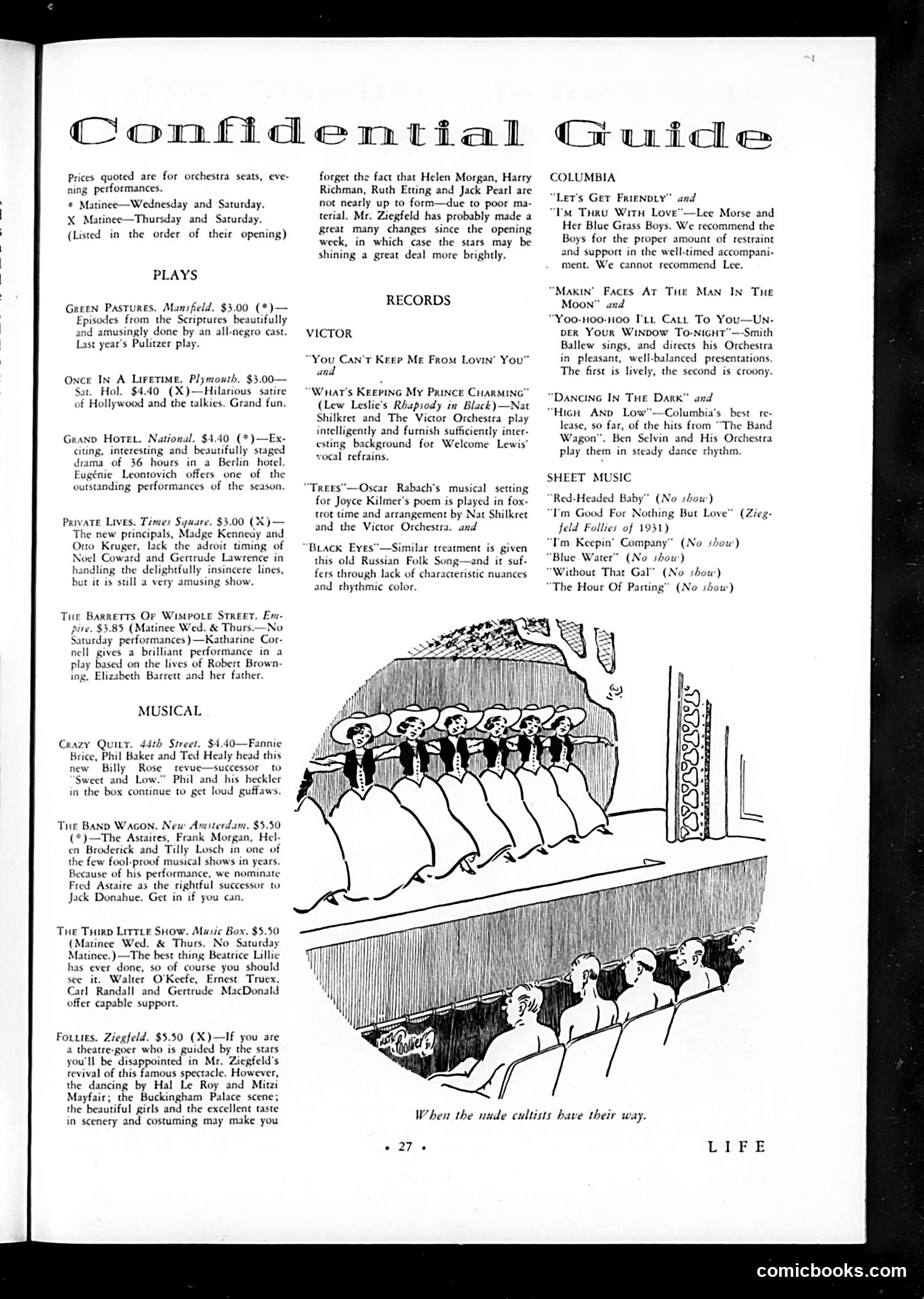
Explanation for Modern Readers This is a theater and entertainment guide, not a political cartoon. It's a page from *Life* magazine listing Broadway shows, musicals, and records currently playing, with reviews and prices. The page includes two illustrations: one showing chorus girls in a line (typical of 1930s revue shows like the Ziegfeld Follies), and another of audience members in theater seats. These are decorative, not satirical. The "satire" here is *gentle social commentary embedded in reviews*—for example, criticizing the Ziegfeld Follies' stars ("not nearly up to form") while praising the dancers and scenery. The guide also notes that Fred Astaire deserves recognition as "rightful successor to Jack Donahue," and that Beatrice Lillie's performance is "the best thing" she's done. This reflects 1930s entertainment culture and *Life*'s role as an arbiter of theatrical taste for educated readers.
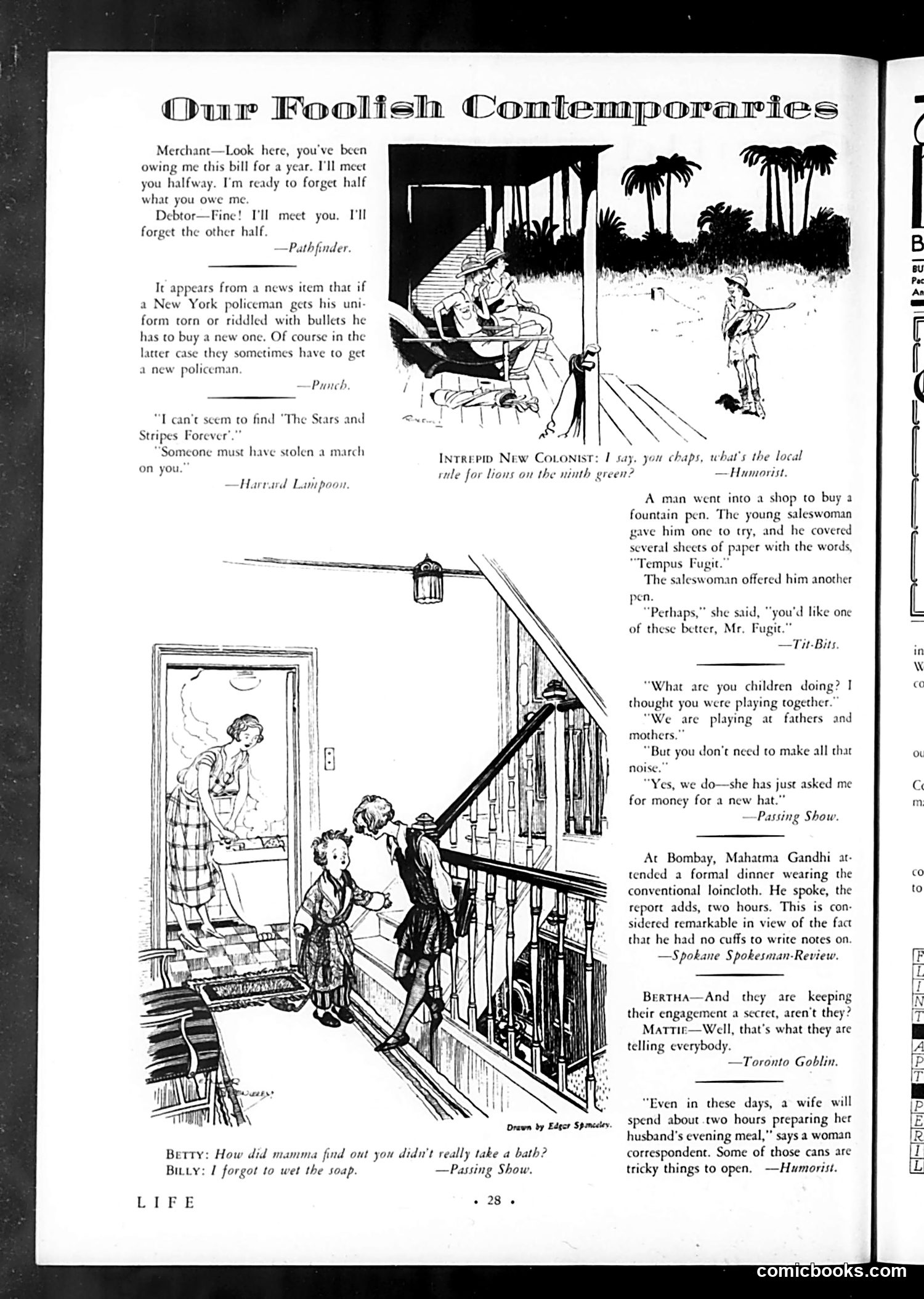
"Our Foolish Contemporaries" — Life Magazine Humor Page This is a humor page collecting satirical jokes and observations from various contemporary sources. The cartoons mock everyday foolishness: The merchant/debtor exchange satirizes flawed logic—both agree to "meet halfway," but each interprets it differently, canceling out the agreement. The policeman joke critiques New York police department policy requiring officers to replace damaged uniforms at personal expense, suggesting this is absurdly unfair. The "Tempus Fugit" pen joke plays on a salesman's mishearing a Latin phrase (meaning "time flies") as a customer's name. The Gandhi reference humorously notes that his minimal clothing (loincloth) meant he couldn't take written notes during his two-hour speech—a dig at both his verbosity and his ascetic appearance. The children "playing fathers and mothers" joke uses children imitating adult marital dynamics (wife asking husband for money) as humor about domestic financial strain. These represent early 20th-century middle-class concerns: debt, bureaucratic absurdity, commercial transactions, and family economics.
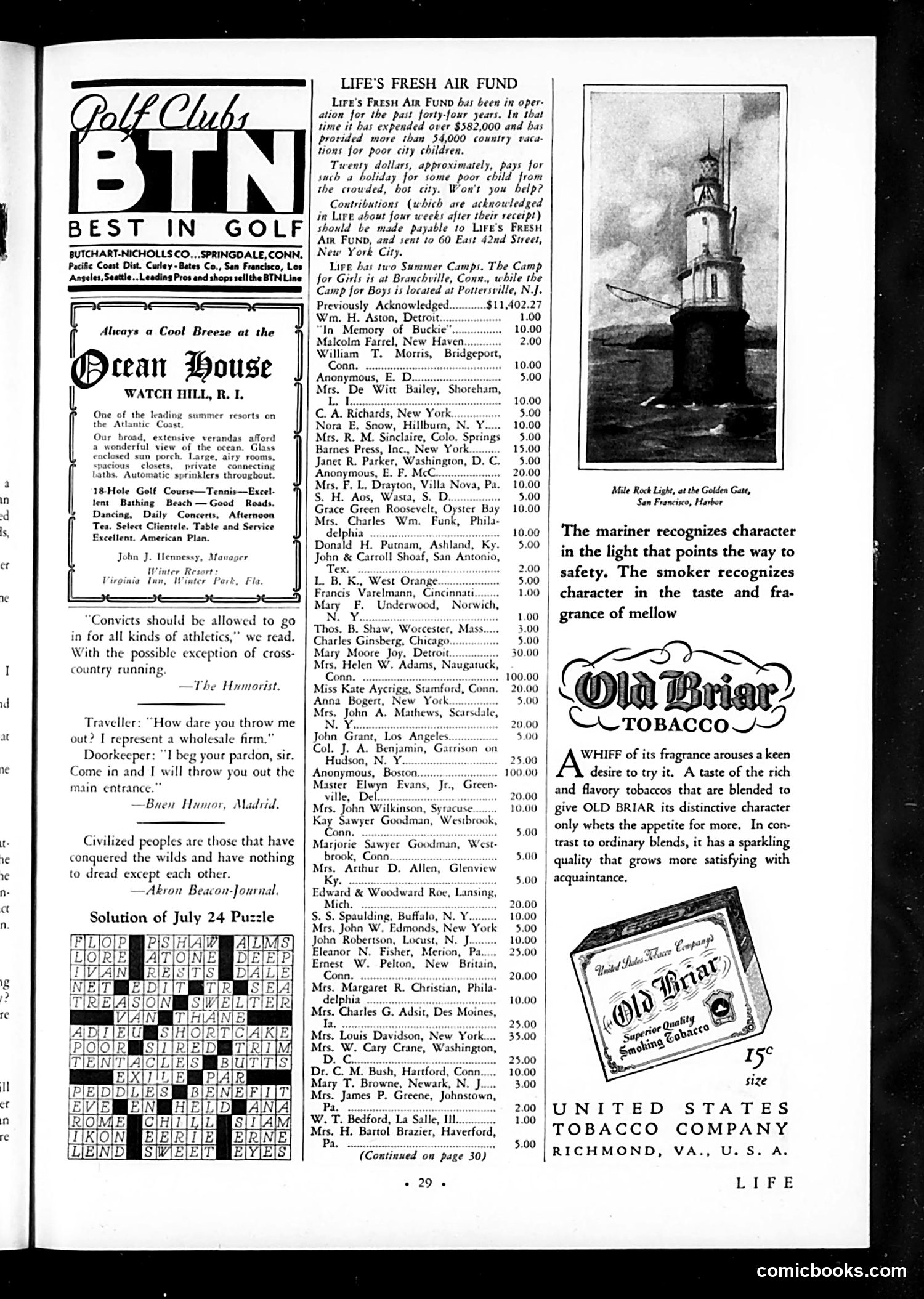
Analysis of Life Magazine Page (circa 1920s-1930s) This page is primarily advertising and charitable fundraising, not political cartoons. The dominant content includes: Main feature: Life's Fresh Air Fund, a decades-old charity providing summer camp vacations for poor urban children. The fundraising list shows individual donations ranging from $1-$100, with contributions acknowledged by the magazine. This reflects Progressive-Era American philanthropy addressing urban poverty. Secondary content: Three brief humorous anecdotes (typically called "jokes" in Life) satirizing social pretension—convicts seeking athletics, a traveler's sense of importance, and the universality of human fear. These are generic social observations rather than specific political satire. Advertising: Golf equipment and vacation resorts (Ocean House, Virginia Inn), reflecting the magazine's affluent readership. The page demonstrates Life's dual purpose: upscale advertising mixed with gentle social humor and charitable appeals—positioning middle/upper-class readers as both consumers and conscientious citizens.
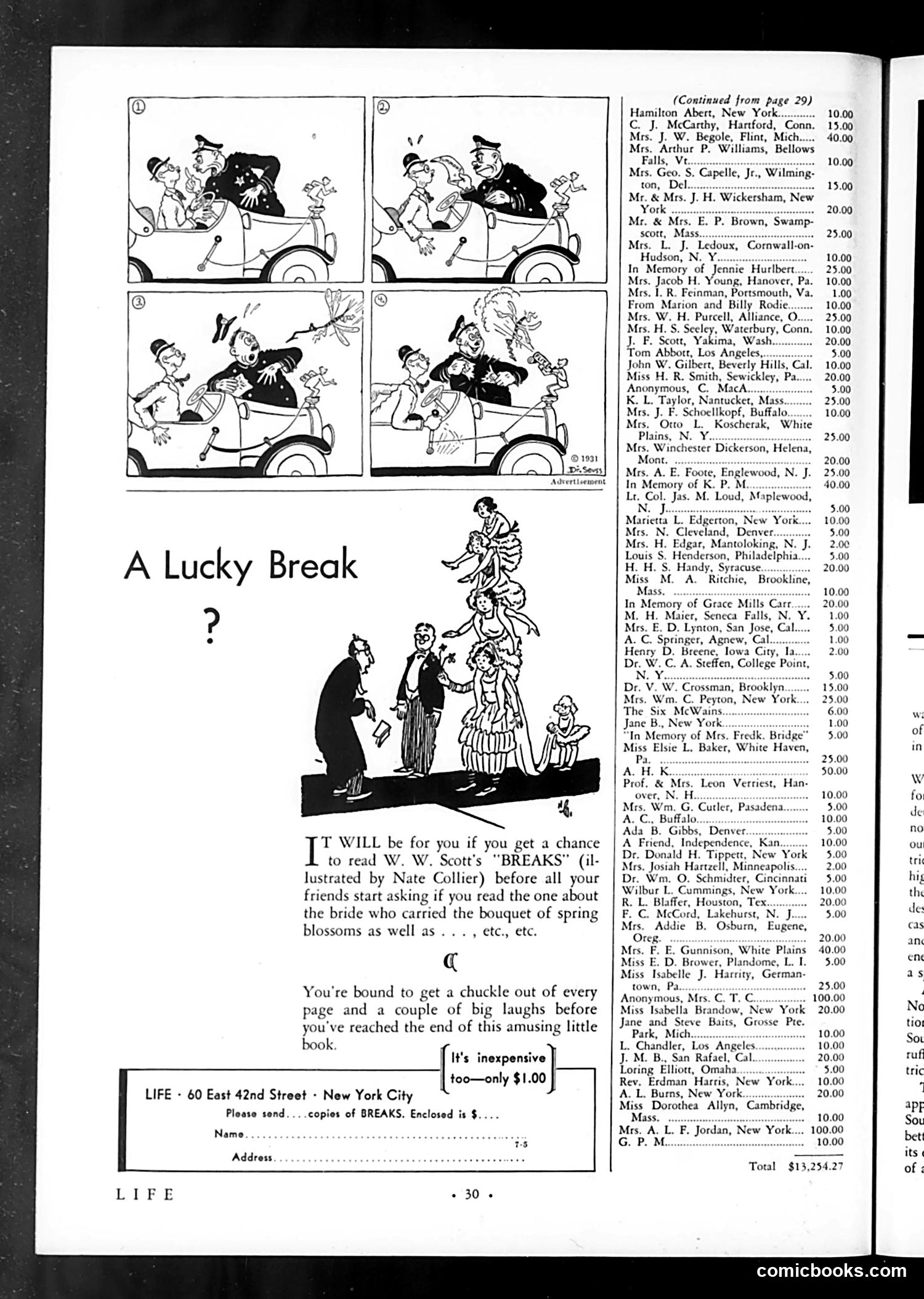
"A Lucky Break" - Life Magazine Advertisement This page is primarily a fundraising advertisement for W.W. Scott's book *"Breaks"* (illustrated by Nate Collier), featuring four sequential cartoon panels showing slapstick comedy in a car, followed by a donation list. The four comic panels depict physical humor—figures tumbling and colliding in an automobile—typical of 1930s slapstick comedy. The accompanying text promises readers "a chuckle out of every page" and "big laughs," marketing the book as lighthearted entertainment. The right column lists donors' names and contribution amounts totaling $13,254.27—suggesting this was a charitable campaign, possibly for a magazine fundraiser or publication drive. The advertisement emphasizes the book's affordability at $1.00, appealing to Depression-era readers seeking inexpensive entertainment.
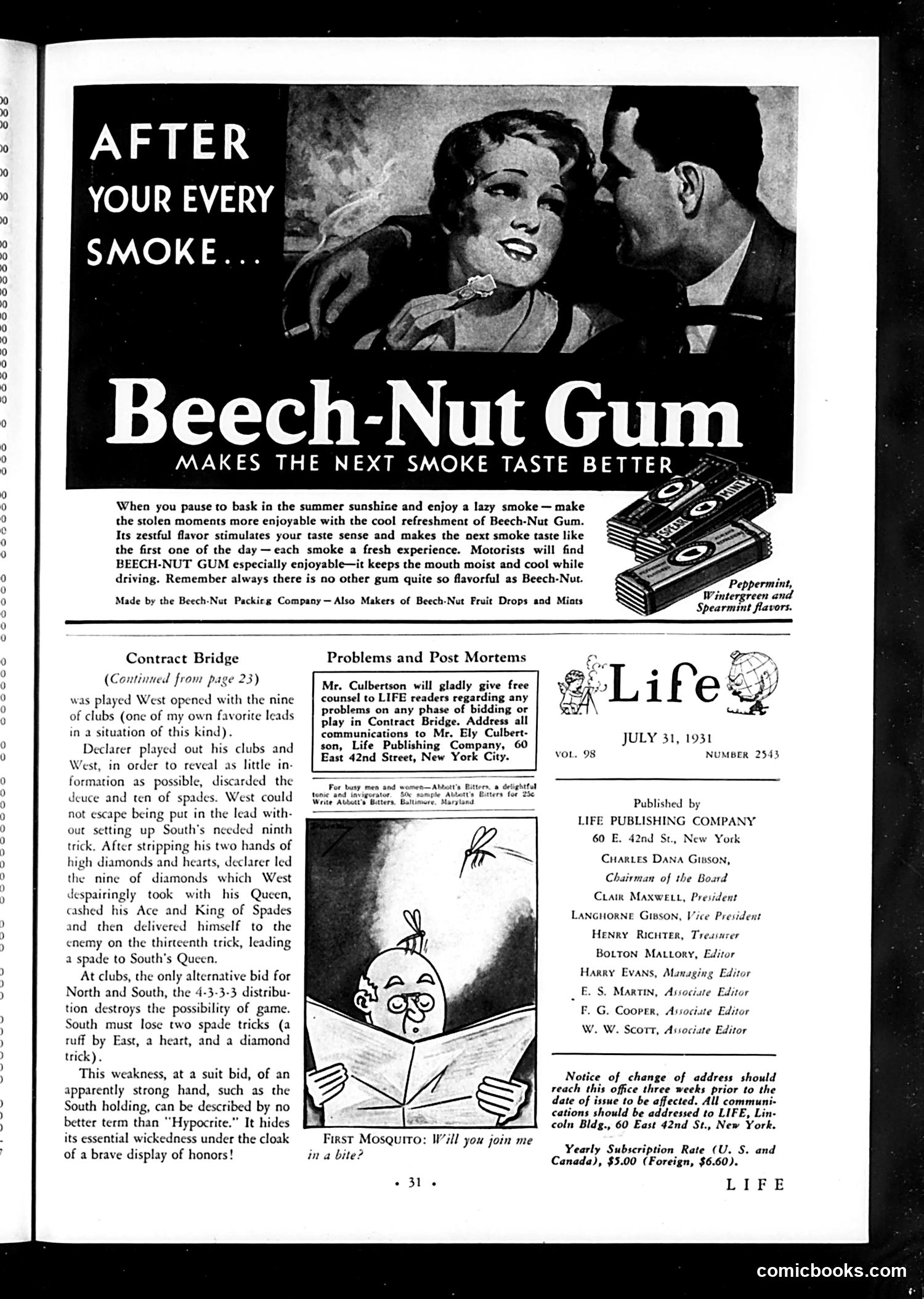
Analysis of Life Magazine Page (July 31, 1931) This page is primarily advertising and editorial content rather than political satire. The Beech-Nut Gum advertisement (top) uses a romantic couple in a car to market gum as a palate cleanser between cigarettes—reflecting 1931's casual attitude toward smoking and the era's common pairing of gum with tobacco use. The main editorial content covers Contract Bridge, a card game then popular among the middle and upper classes. Ely Culbertson offers analysis of bridge strategy and bidding, establishing himself as an authority on the game. The only cartoon is a simple joke about mosquitoes at page bottom: one mosquito asks another "Will you join me in a bite?"—a pun playing on "bite" as both feeding and a social invitation. This is primarily a masthead and contents page showcasing Life's editorial departments and advertising, with minimal satirical content.
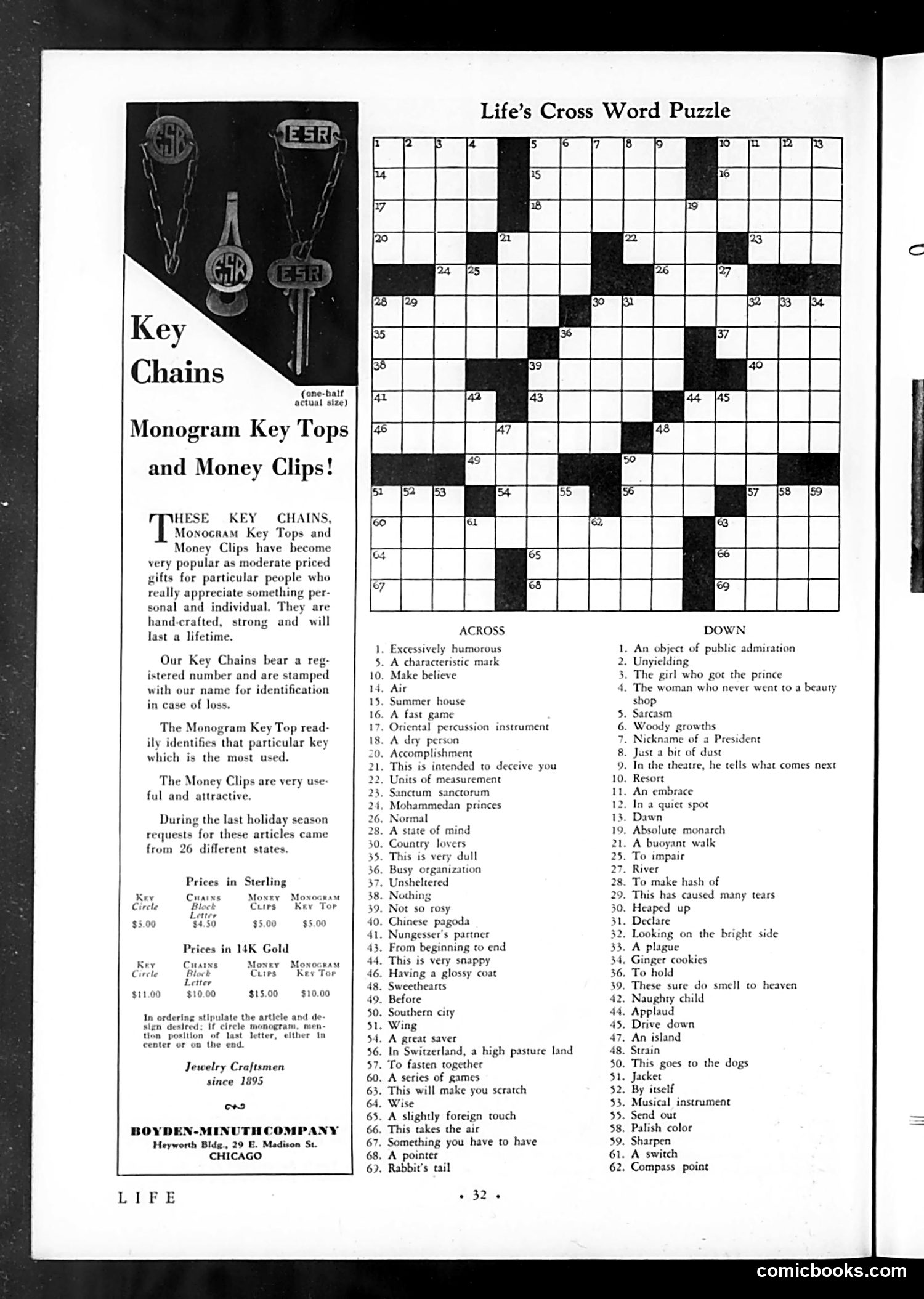
Content Analysis This page is primarily advertising and a crossword puzzle, not political satire. The advertisement promotes decorative key chains, monogram key tops, and money clips from the Boyden-Minuth Company, a Chicago jewelry craftsman (established 1895). These are positioned as moderately-priced personalized gifts. The text emphasizes their hand-crafted quality, durability, and practical features—key chains bear registered numbers for identification; monogram tops help identify frequently-used keys. Notably, the company reports receiving orders from 26 states during the recent holiday season, suggesting national appeal. Pricing is given in both sterling silver and 14K gold. The remainder is a standard crossword puzzle titled "Life's Cross Word Puzzle" with typical clues (humorous definitions and wordplay). There is no political cartoon or satirical content on this page—it's a straightforward commercial and entertainment feature typical of Life magazine's mixed advertising and puzzle content.
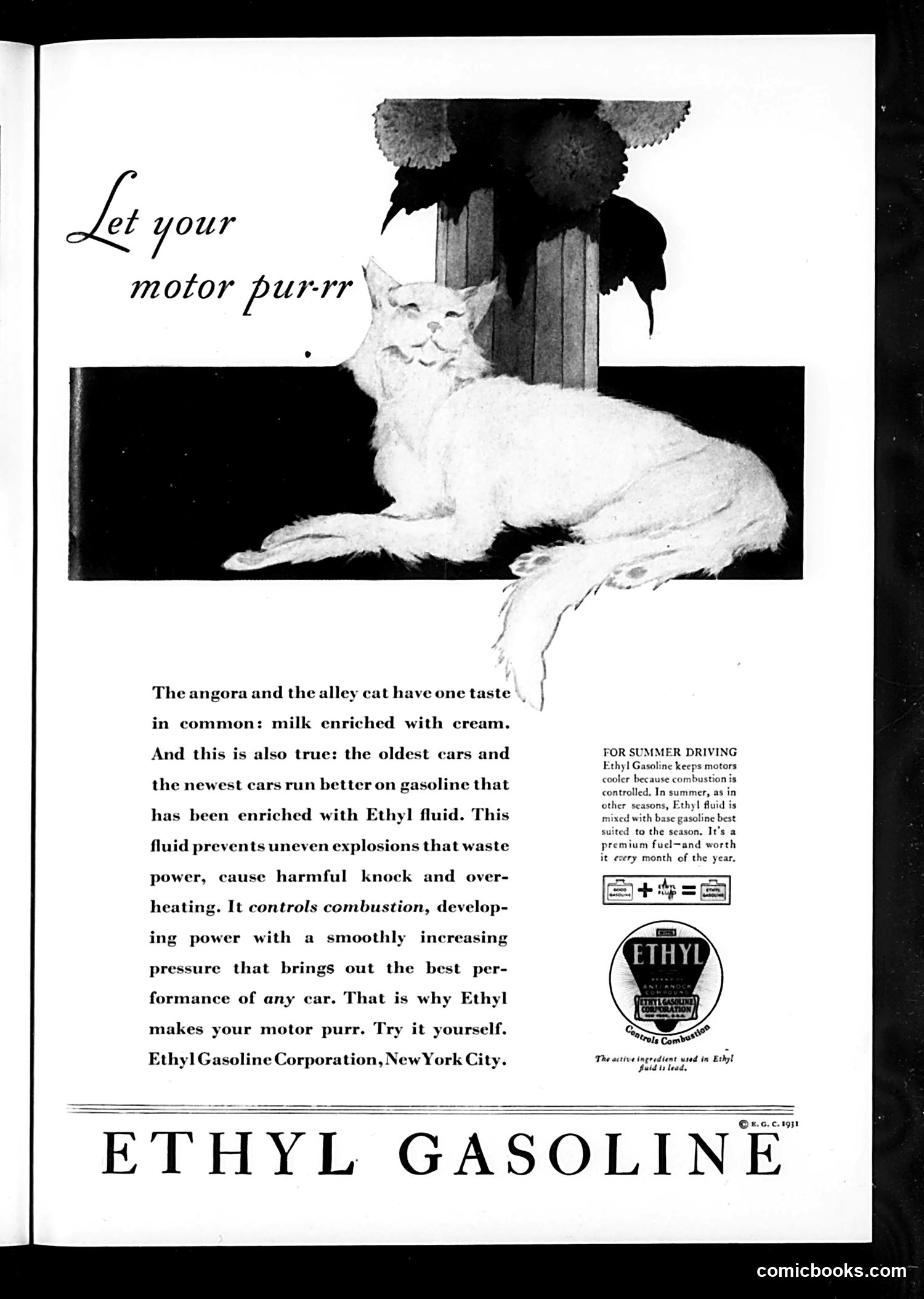
Ethyl Gasoline Advertisement (circa 1931) This is a product advertisement, not political satire. It promotes Ethyl Gasoline, a real fuel additive popular in the 1920s-1930s. The ad uses a humorous analogy: just as cats (both refined "angora" and common "alley" cats) prefer cream-enriched milk, all cars—old and new—run better on gasoline enriched with Ethyl fluid. The illustration shows a contented white cat, playing on the "purring motor" tagline. The copy emphasizes Ethyl's technical benefits: preventing engine knock, controlling combustion, and improving performance in summer driving. This was legitimate marketing for a genuine fuel additive, though notably absent from modern gasoline due to health and environmental concerns. The ad targets middle-class car owners seeking premium fuel performance, a significant concern as automobile ownership expanded in this era.
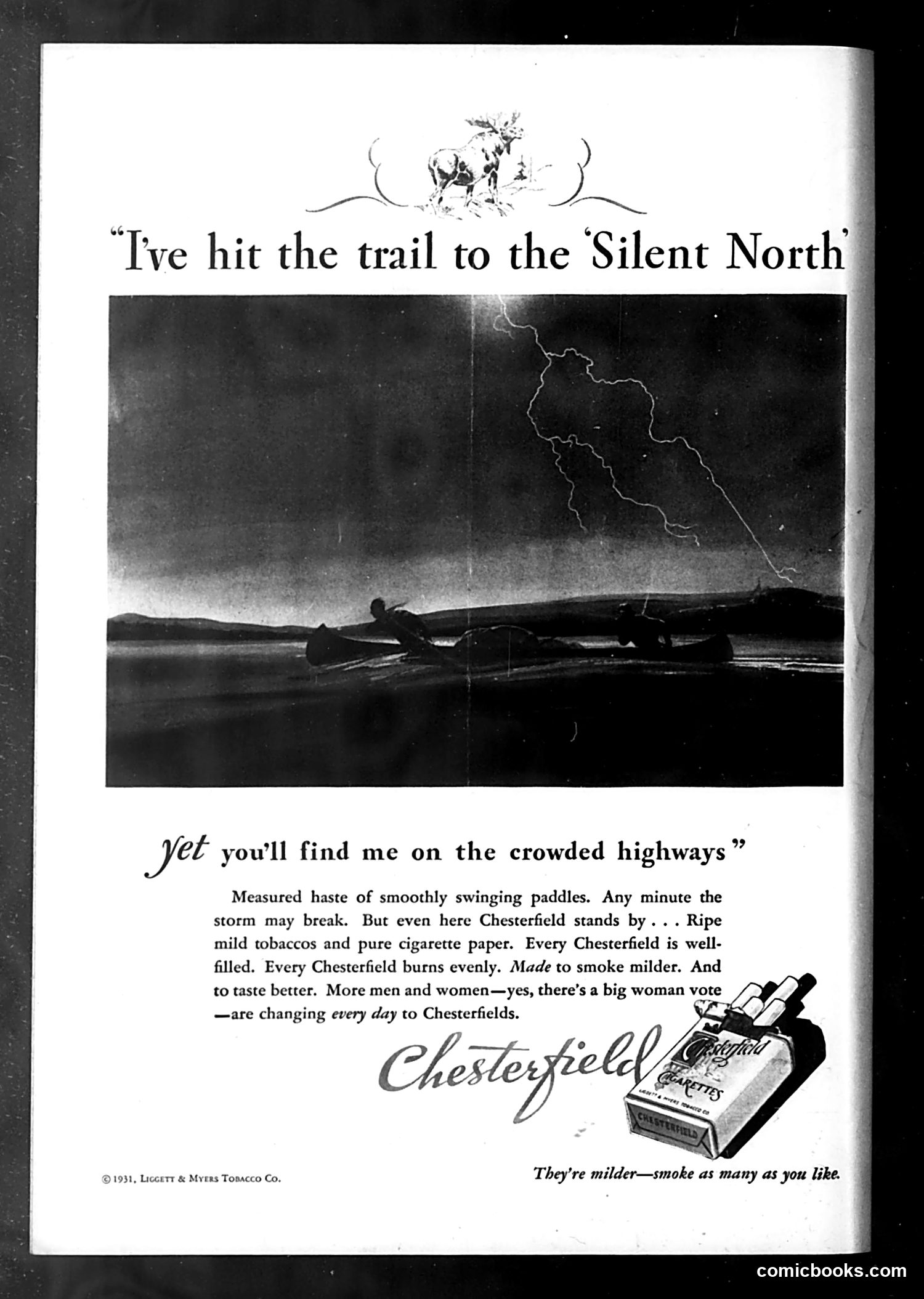
Analysis This is a Chesterfield cigarette advertisement from 1931, not political satire. The ad presents a contradiction as humor: The headline quotes someone claiming to have "hit the trail to the Silent North" (suggesting remote wilderness travel), yet the subheading says "you'll find me on the crowded highways"—implying this adventurous person actually stays on busy, populated roads. The image shows a canoe in a desolate northern landscape with stormy skies, romanticizing wilderness travel. The joke suggests that even people pursuing adventure still smoke Chesterfields—positioning the cigarette as a reliable companion everywhere, from isolated north to busy highways. The ad emphasizes Chesterfield's mildness and even burn, targeting both men and women (notably mentioning "there's a big woman vote," reflecting 1930s marketing to newly enfranchised female voters). The tagline "They're milder—smoke as many as you like" is typical tobacco advertising from an era before health warnings.

I can see this is a mostly black page with a white margin on the left side, characteristic of a scanned book or magazine page. The page appears to be nearly blank or heavily darkened, making it impossible to discern any cartoon illustrations, text content, or satirical imagery that would typically appear in Life magazine. The only clearly visible element is the "comicbooks.com" watermark at the bottom right, indicating the source of the scan. Without legible text or visible cartoon content, I cannot identify specific figures, political references, or explain the intended satire or joke. This appears to be either a blank page, a printing error, or a scanning quality issue that has rendered the original content illegible.