life
Life — August 7, 1931
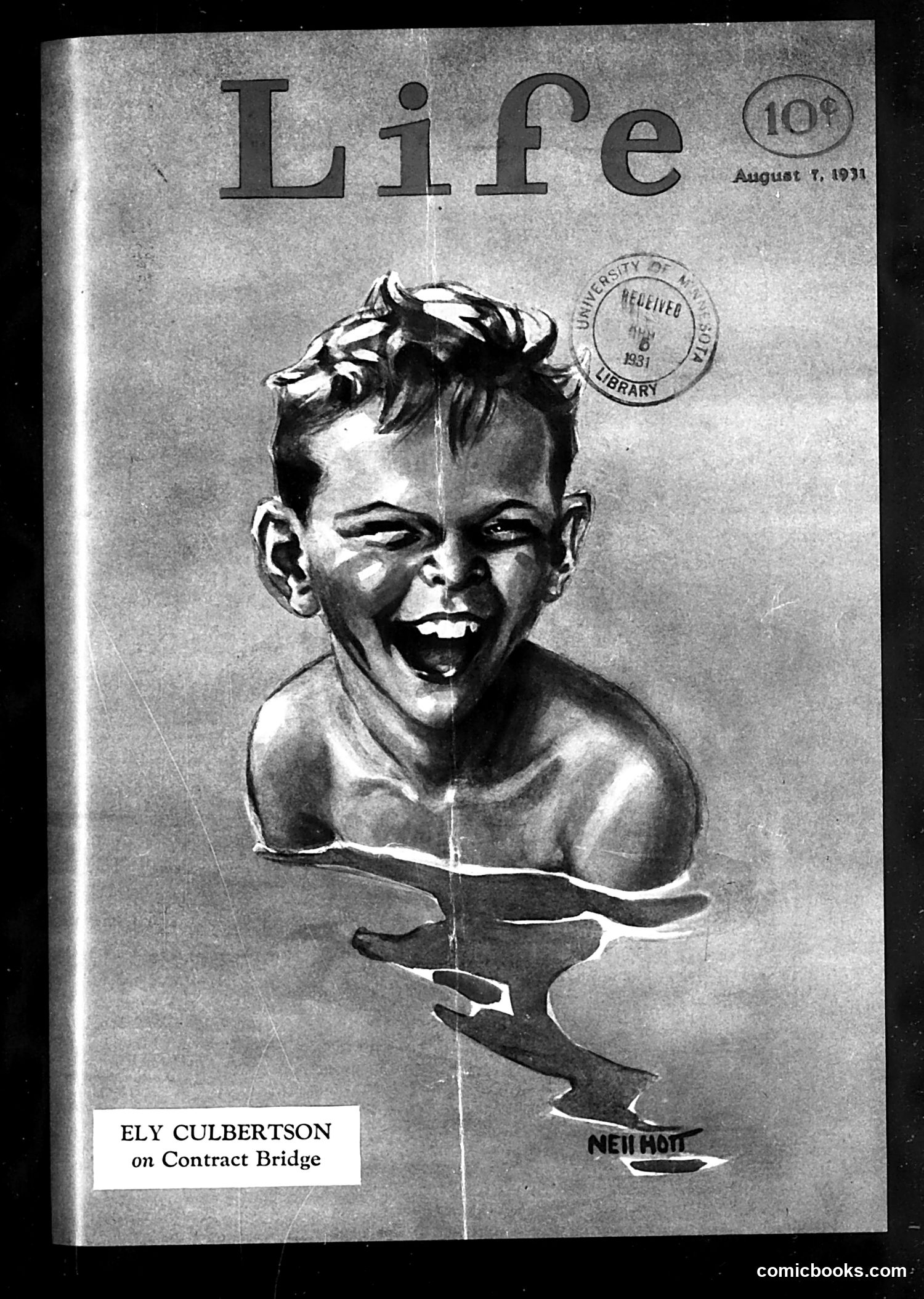
Life Magazine Cover, August 1, 1931 This is a Life magazine cover featuring a caricature labeled "Ely Culbertson on Contract Bridge." The illustration shows a man's head and shoulders with an exaggerated, grinning expression emerging from what appears to be a lightning bolt or zigzag shape, signed "Neilson." The satire likely mocks Culbertson's prominence in popularizing contract bridge during the early 1930s. The dynamic, electric imagery suggests the intense enthusiasm—perhaps even frenzy—surrounding the card game at that time. The exaggerated facial expression and theatrical presentation poke fun at bridge's cultural obsession and Culbertson's role as its leading promoter. The magazine's 10-cent price and library stamp indicate this is an archived copy from the Depression era.
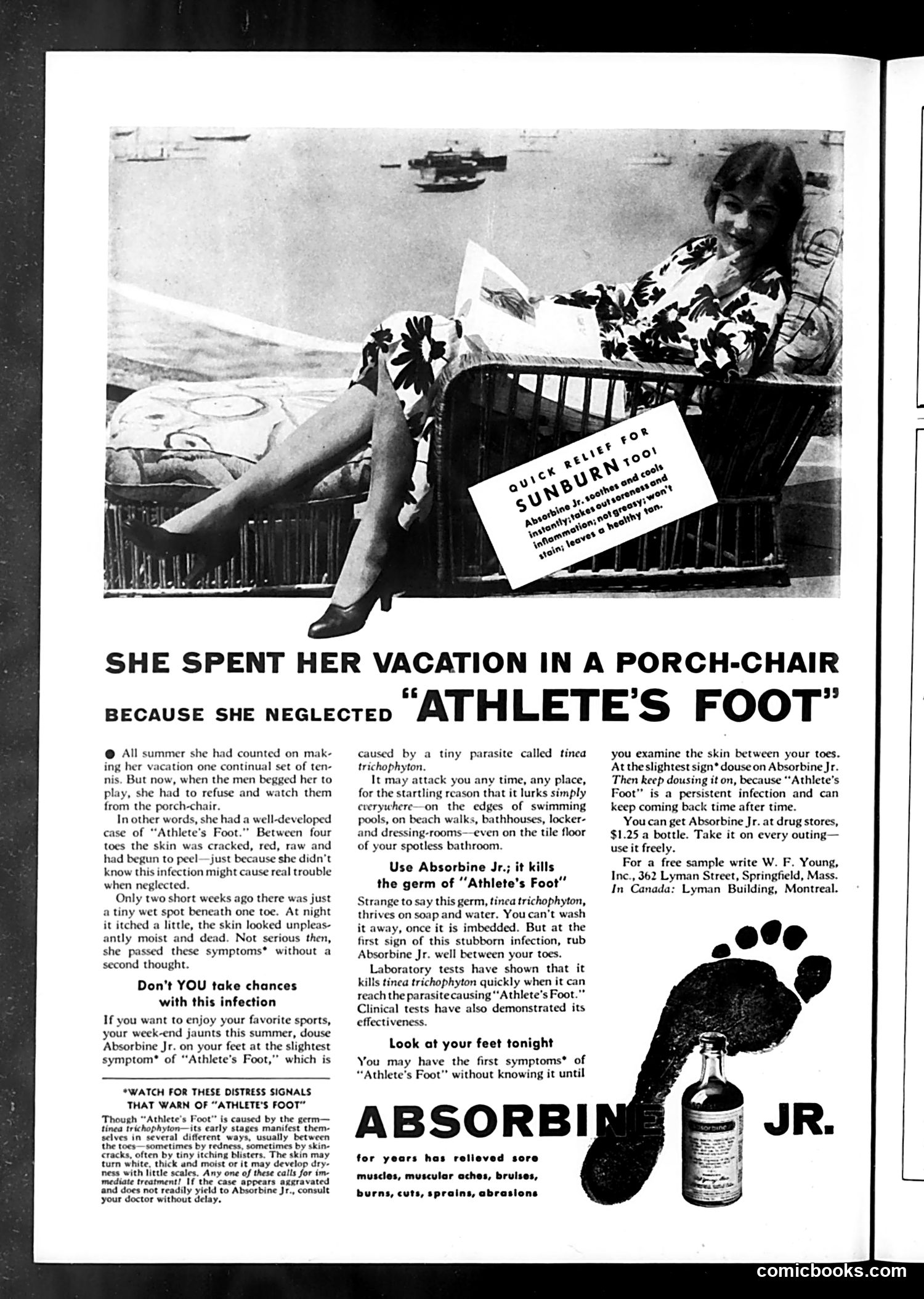
Analysis This is a vintage advertisement (not satire or political cartoon) for Absorbine Jr., a topical medicinal product. The ad uses fear-based marketing common to mid-20th century advertising. The image shows a woman in a porch chair, seemingly unable to enjoy her vacation due to "Athlete's Foot"—a fungal infection caused by *tinea trichophyton*. The headline and text emphasize how she "neglected" this condition, implying personal irresponsibility ruined her leisure time. The advertisement promotes Absorbine Jr. as a solution, claiming it kills the fungus effectively. The ad includes pseudo-medical language and "distress signals" to identify athlete's foot symptoms, leveraging anxiety to drive consumer purchases. This reflects 1930s-1950s advertising strategy: using shame and physical consequences to motivate buying behavior, particularly targeting middle-class consumers concerned with health and social respectability.
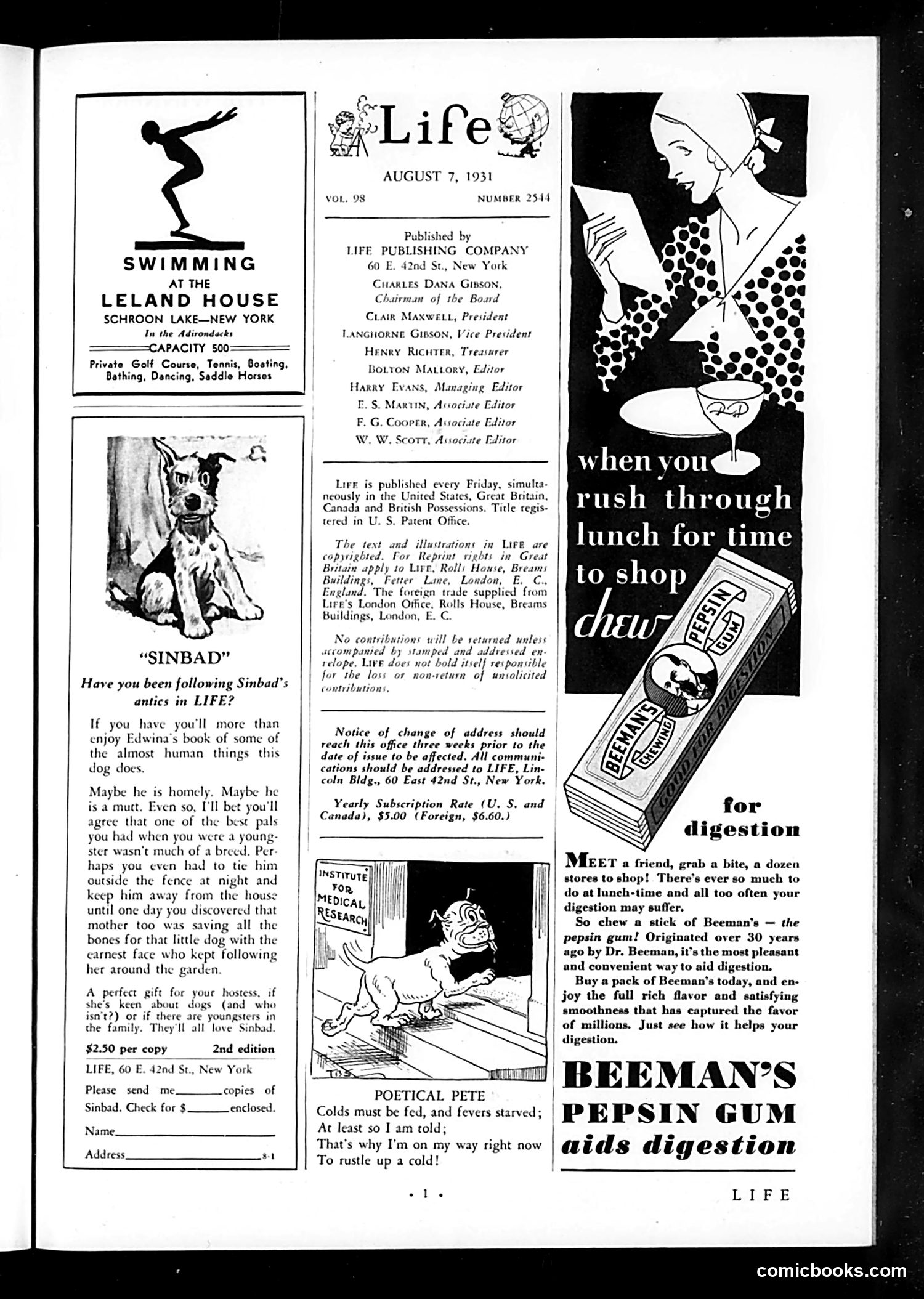
Content Analysis This page is primarily advertising and publication information rather than political commentary. The main elements include: 1. Leland House advertisement (top left): A resort promoting swimming, golf, tennis, and boating in Schroon Lake, New York. 2. "Sinbad" feature (left): Promotes a book about a dog character, offering it for $2.50 per copy. 3. "Poetical Pete" cartoon (bottom center): A simple joke about a cold-afflicted character, not politically significant. 4. Beeman's Pepsin Gum advertisement (right): The largest ad, emphasizing the gum aids digestion—a common health claim from the 1930s era. The page reflects 1931 consumer culture and advertising strategies targeting middle-class readers. No significant political satire or caricature is present.
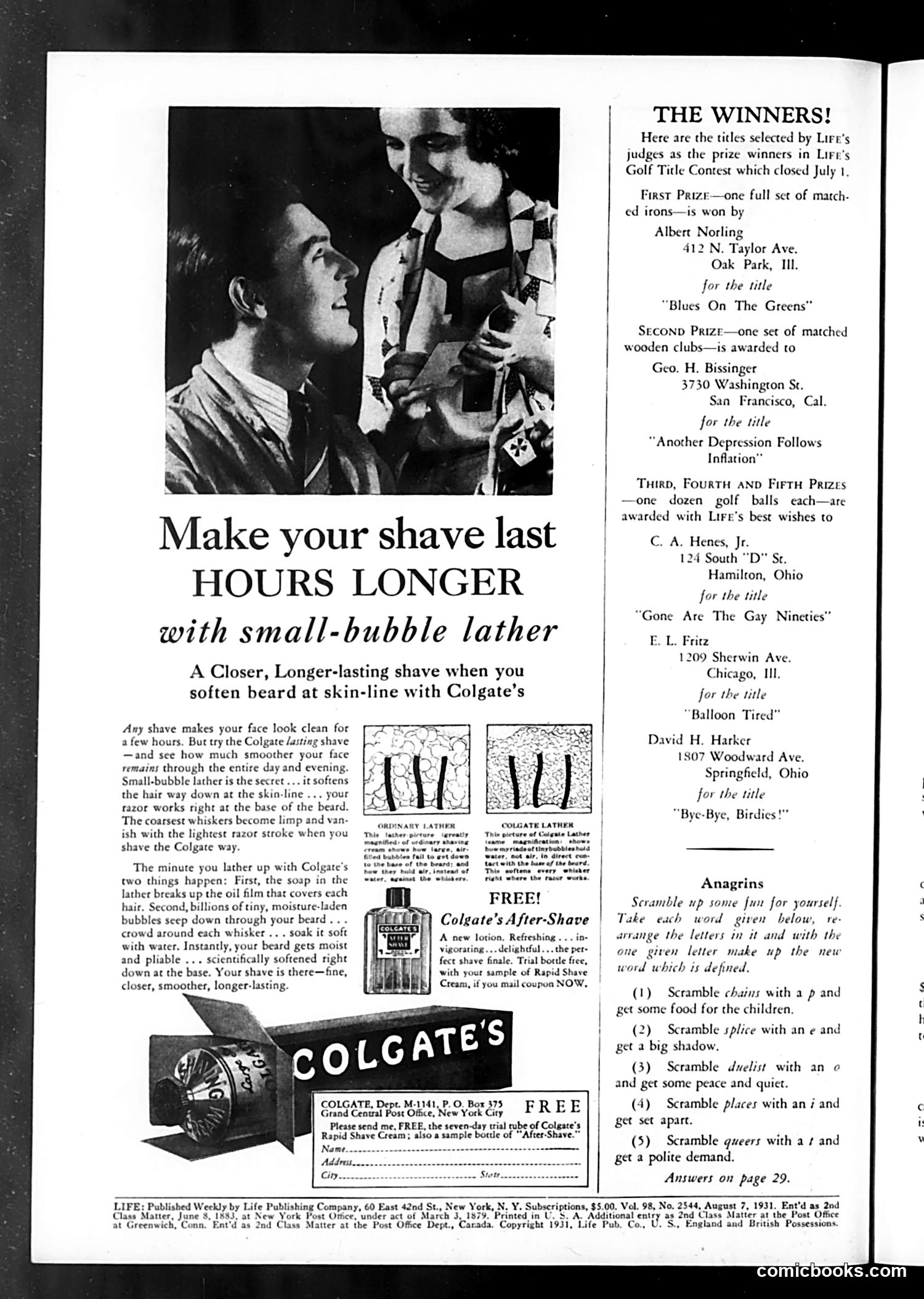
Content Analysis This page is primarily advertising, not political satire. The dominant content is a Colgate shaving products advertisement featuring a man being shaved, with comparative diagrams showing "ordinary lather" versus "Colgate lather." The right column contains contest results from Life magazine's Golf Title Contest (closed July 1), listing winners who submitted golf-related titles. These appear to be humorous titles like "Blues On The Green" and "Gone Are The Gay Nineties." Below the contest results is a word puzzle called "Anagrins," where readers unscramble letters to form new words—standard puzzle content from this era. There is no political cartoon or satire on this page. It's a typical 1931 magazine layout mixing advertisements with reader contests and puzzles.
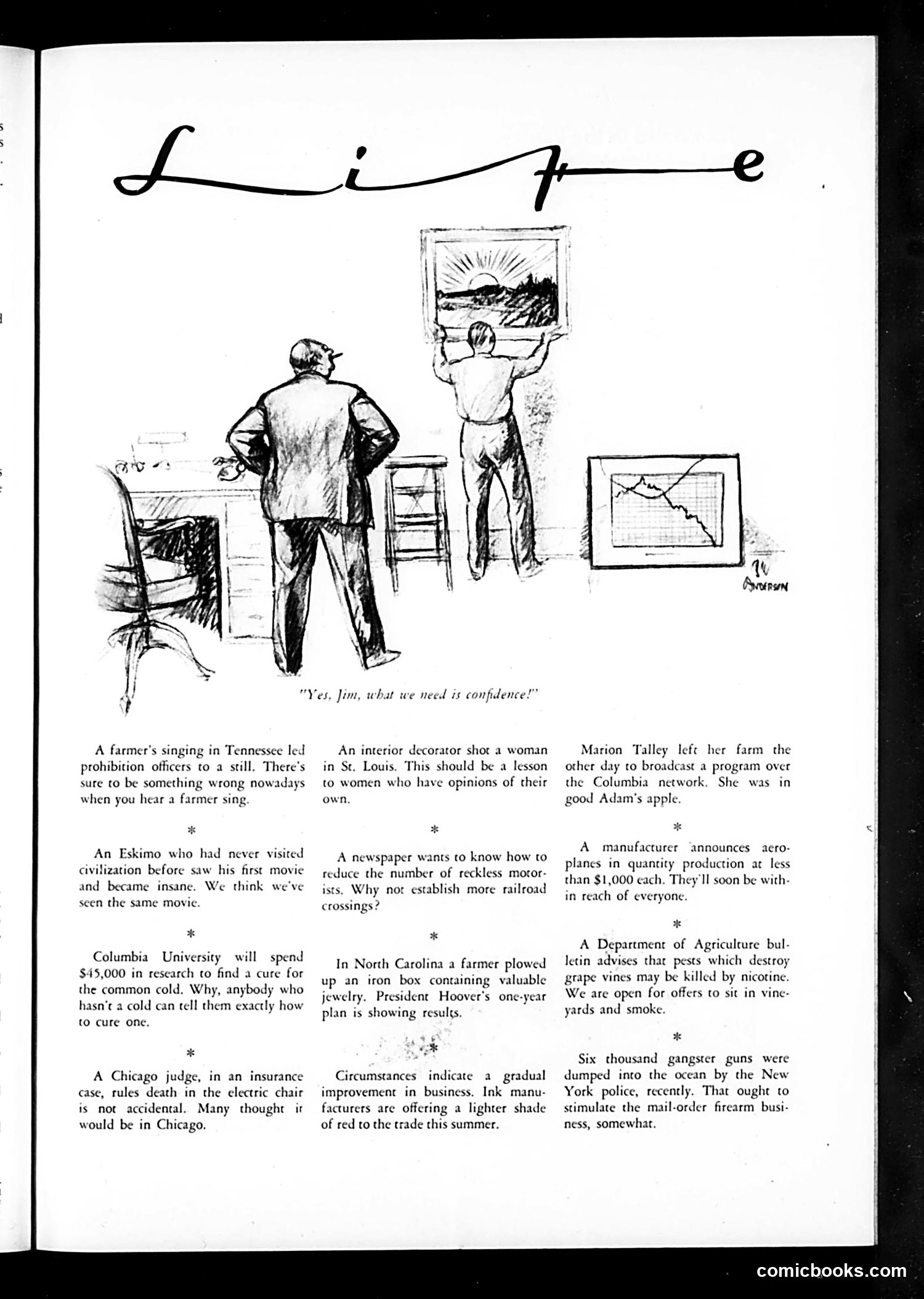
"Life" Satire Page Analysis This page presents a cartoon titled "Life" (with the letters stylized) depicting two businessmen in an office. One stands at a desk while another hangs a framed landscape painting on the wall. The caption reads: "Yes, Jim, what we need is confidence!" The satire targets business morale and economic psychology during uncertain times (likely the Depression era, given the downward-trending graph visible on the office wall). The joke suggests that displaying pleasant imagery and expressing confidence won't address underlying economic problems—it's mere performative optimism masking real troubles. The accompanying brief items mock various American institutions: government inefficiency, judicial absurdity, academic waste, and agricultural advice. The overall theme critiques hollow confidence-building as a substitute for genuine problem-solving.
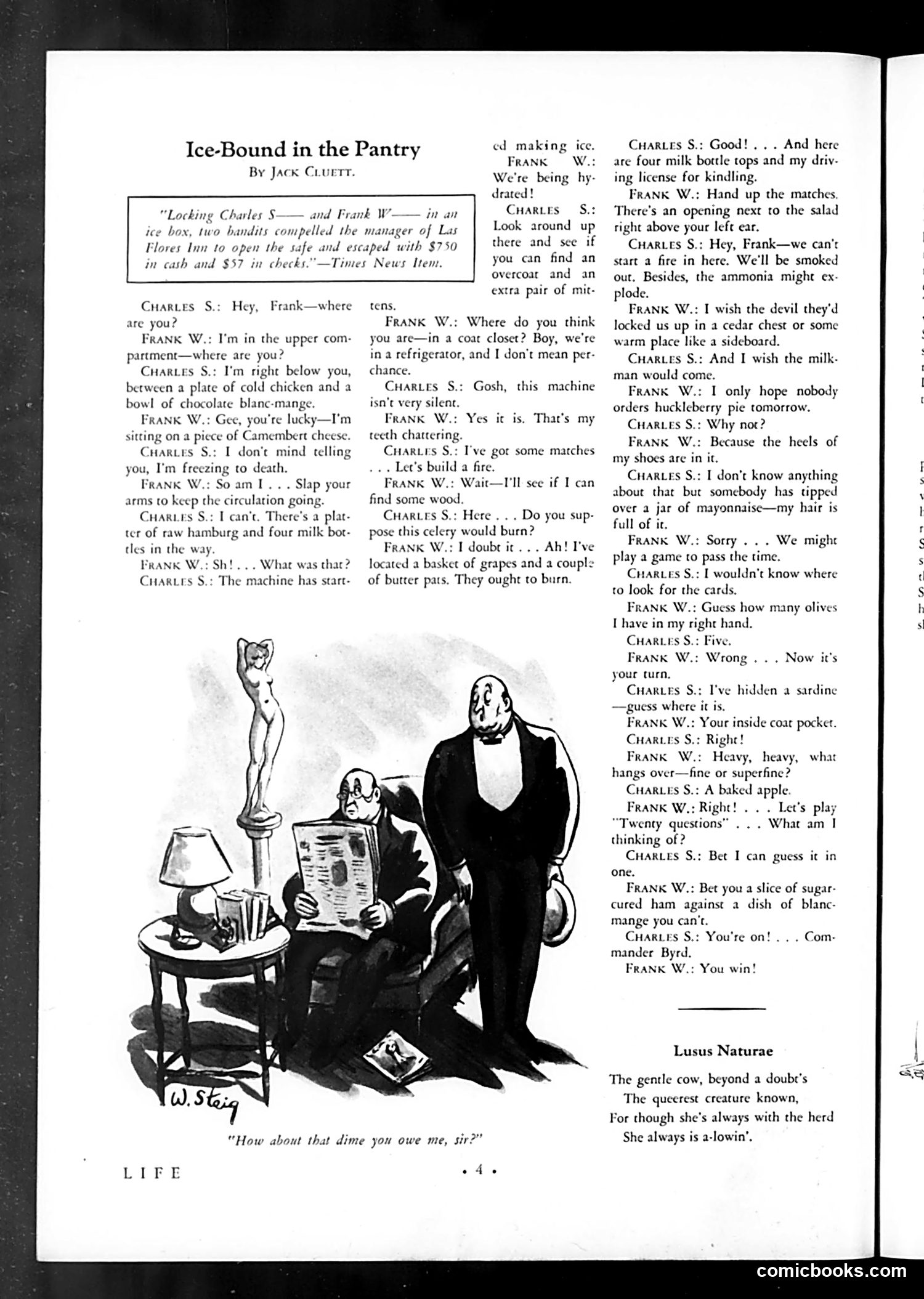
Ice-Bound in the Pantry This is a humorous domestic dialogue by Jack Cluett about two men—Charles S. and Frank W.—trapped in a freezer or ice box during an emergency. The sketch depicts wartime rationing constraints: they're rationing milk bottles, hunting for matches and an overcoat, and worrying about fuel shortages (ammonia exploding, needing cedar chests for warmth). The satire targets home-front privations—the comedy comes from their increasingly desperate survival measures and trivial distractions (playing guessing games, betting on ham versus blanc-mange) while confined. The illustration shows them in formal dress beside a small table with a lamp, suggesting the absurdity of maintaining civility amid scarcity. This reflects 1940s wartime rationing anxieties and domestic inconvenience.
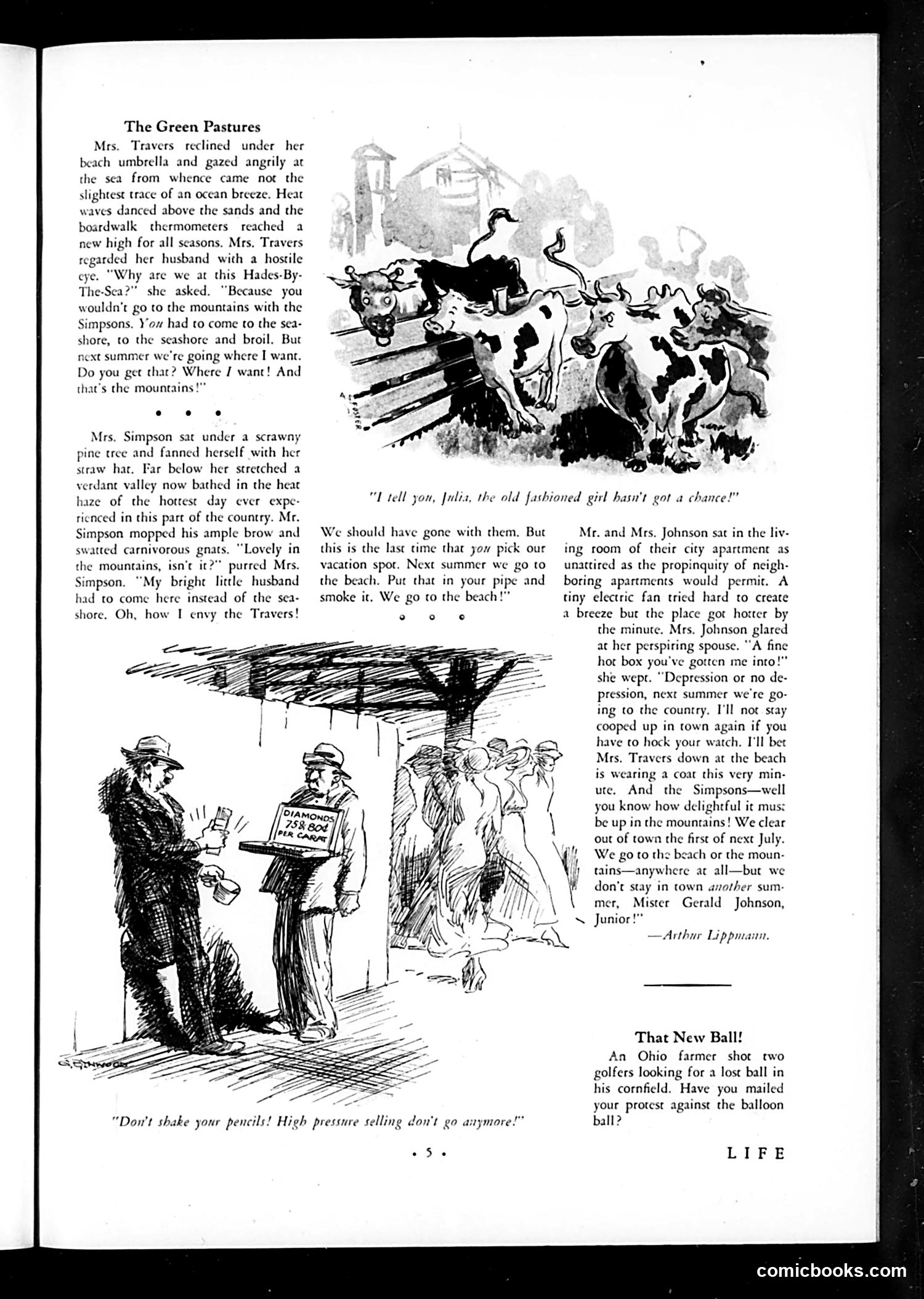
"The Green Pastures" - Life Magazine Satire This page satirizes competing vacation preferences among early 20th-century urban Americans. Mrs. Travers wants to escape to the seaside; Mrs. Simpson prefers mountain retreats. Their husbands argue back, with Mr. Simpson mocking the "bright little husband" who must come to the seashore instead of mountains. The humor stems from class anxieties about vacation destinations and marital compromise. The illustrations show couples debating where to spend summer—beach versus country—reflecting a period when such leisure choices signaled social status and personal taste. The lower cartoon about "high pressure selling" appears unrelated, likely advertising satire. The page overall mocks domestic vacation disputes as a marker of middle-class aspirations and gender dynamics of the era.
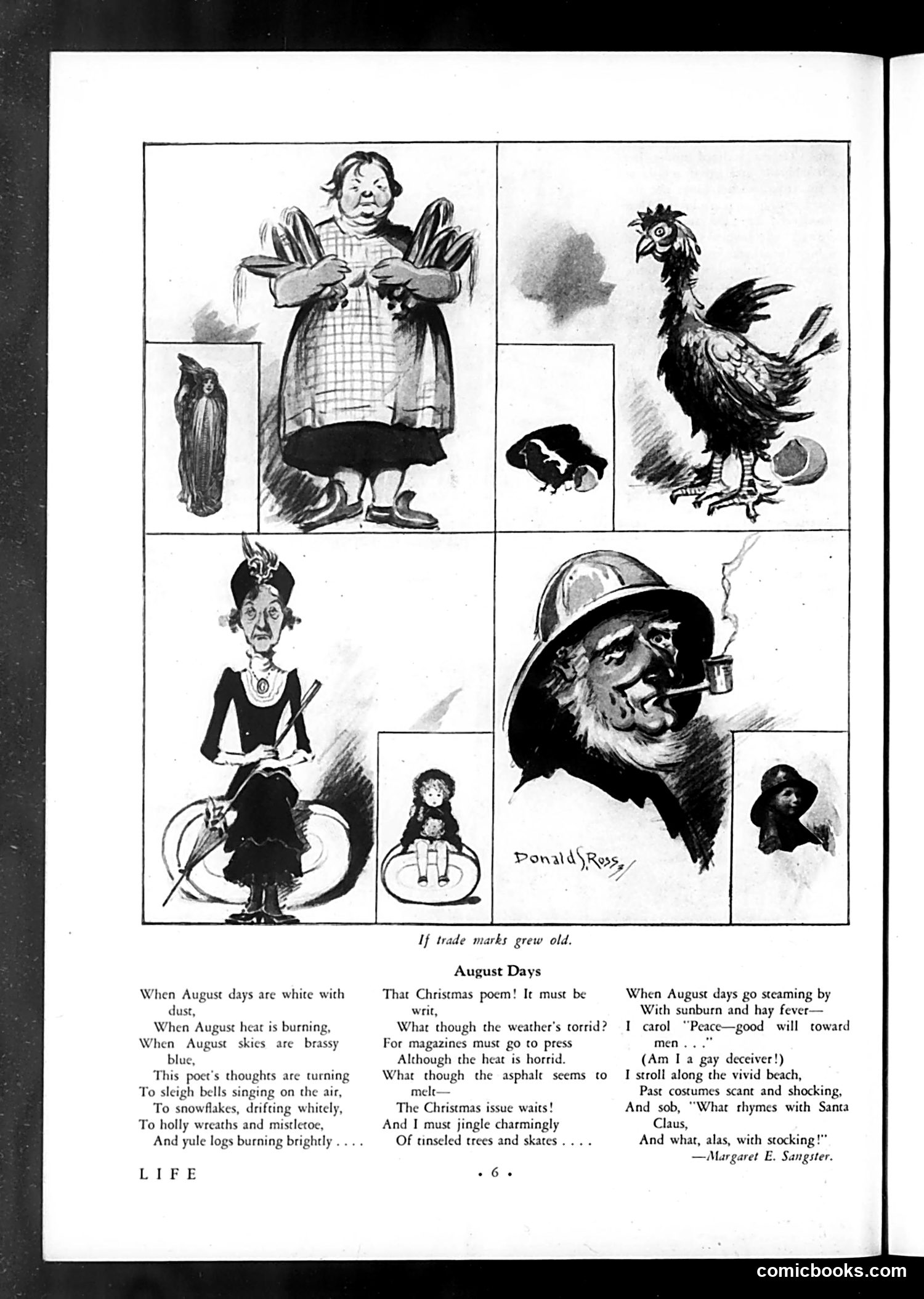
August Days - Life Magazine Satire This page presents a visual essay titled "If trade marks grew old," illustrated by Donald Ross. The cartoon imagines famous commercial mascots and brand characters aging into elderly versions of themselves. The panels show recognizable figures—including what appears to be a plump woman holding bread loaves (likely a baking brand mascot), a rooster (possibly Cockerel brand imagery), and other vintage advertising characters depicted as wizened seniors. The final panel features a prominent elderly gnome or goblin character, smoking a pipe. The accompanying poem by Margaret E. Sangster humorously contrasts August heat and summer fatigue with Christmas deadlines, capturing the satirical tension between seasonal reality and commercial publishing demands. The satire comments on how eternal, ageless brand mascots would look if they actually aged like ordinary people.
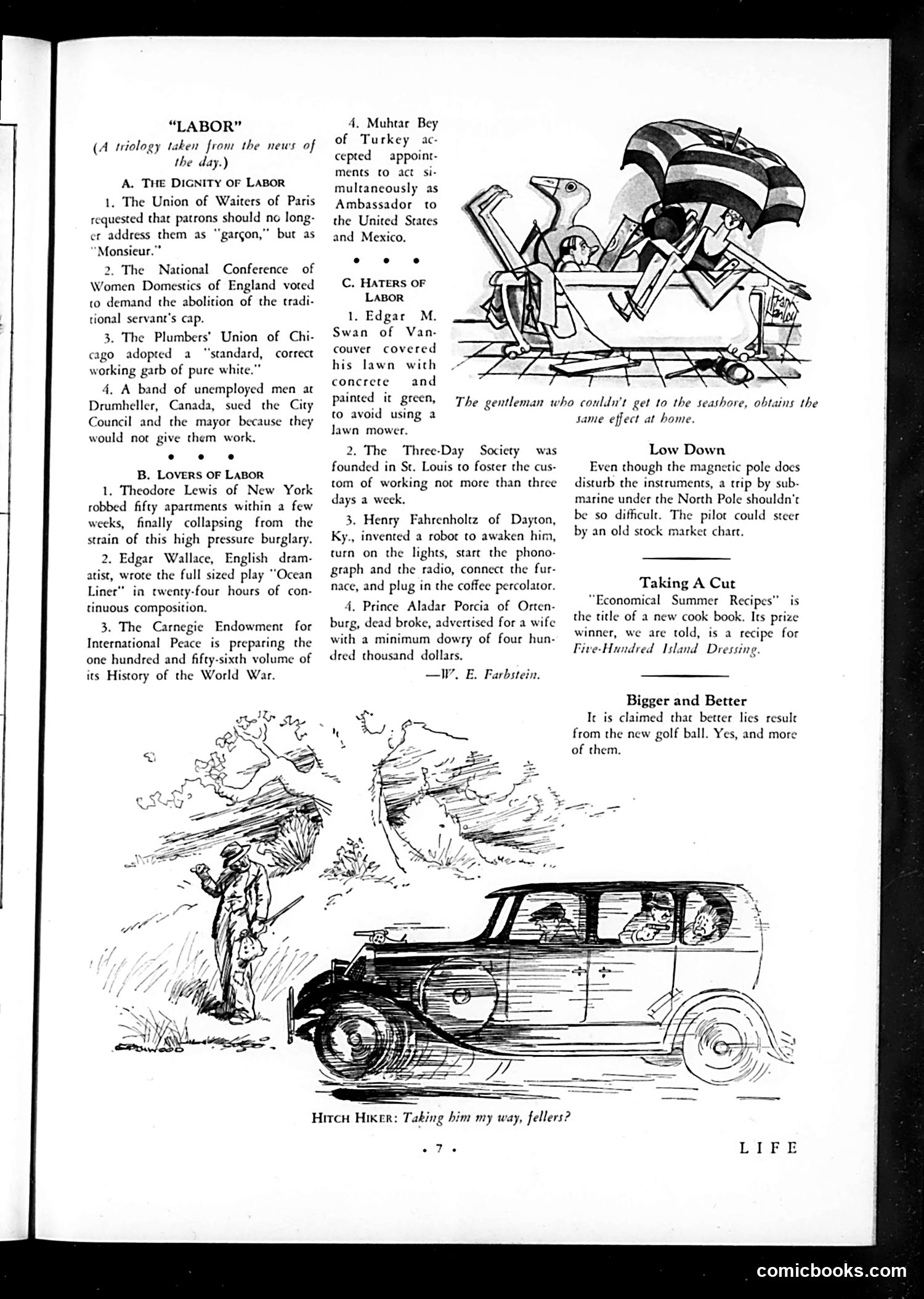
"Labor" Page Analysis This page satirizes labor issues through three sections: Section A ("Dignity of Labor") mocks working-class dignity demands—a waiters' union wanting to be called "Monsieur" rather than "garçon," and women domestics seeking to abolish servants' caps. Section B ("Lovers of Labor") celebrates wealthy individuals exploiting workers: a burglar, a dramatist profiting from plagiarism, and a robber baron. Section C ("Haters of Labor") ridicules labor-saving inventions and schemes—including Henry Fabenholtz's bizarre robot to start coffee and turn on lights. The cartoon "Hitch Hiker" shows a motorist picking up a hitchhiker, captioned "Taking him my way, feller?"—likely commentary on exploitation or coercion. Overall, the page presents labor as comedy: workers' modest dignity demands are mocked equally with wealthy people's parasitism and impractical automation schemes.
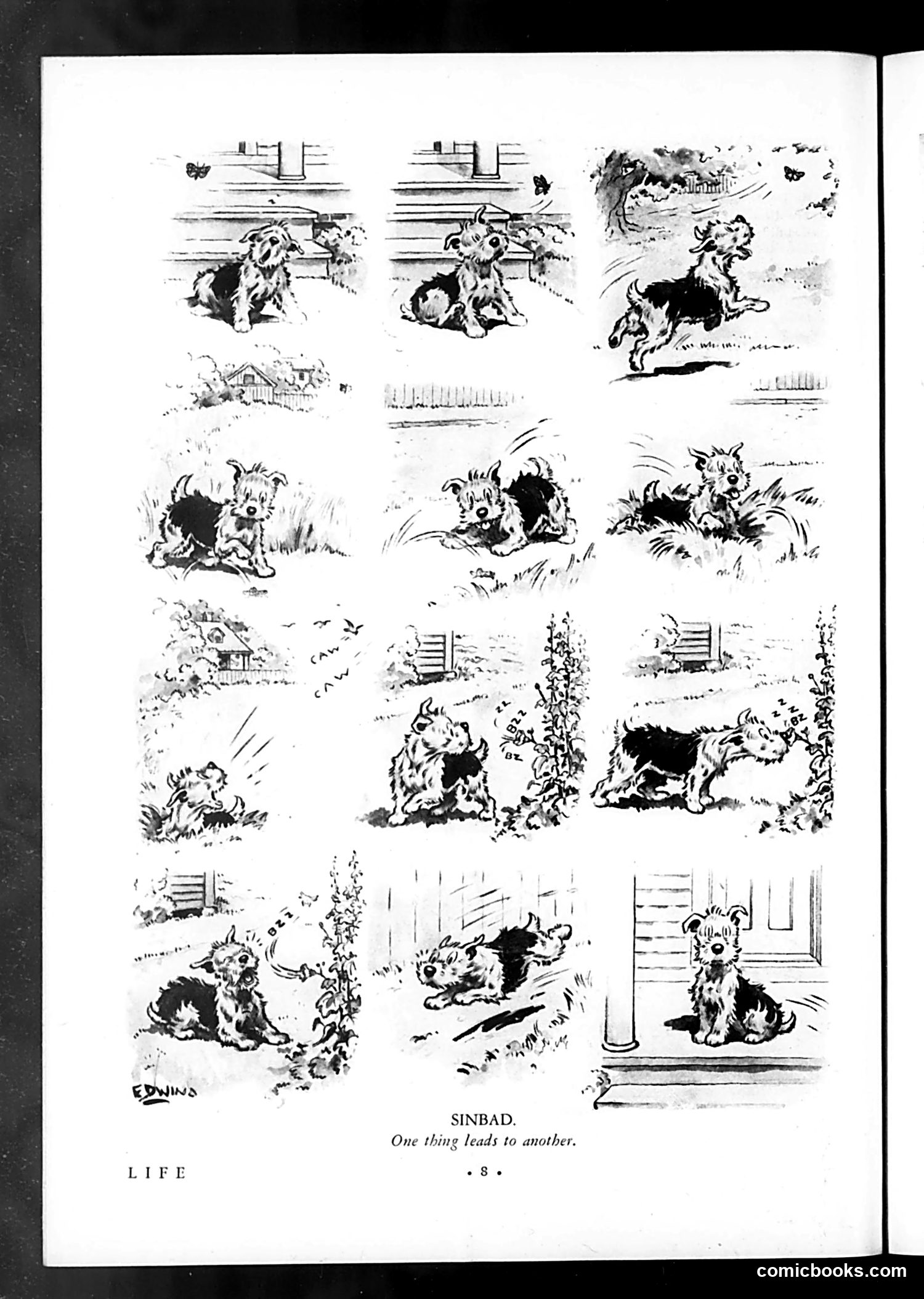
"Sinbad: One thing leads to another" This is a comic strip by artist Edwins (signature visible) depicting a small, shaggy dog named Sinbad in a series of connected misadventures. The strip shows how a single incident cascades into escalating chaos—the dog gets into trouble (appears to chase something), which leads to more destruction, property damage, and increasingly frantic activity. The title "One thing leads to another" serves as the joke's moral: each panel demonstrates how one small mistake or misdeed snowballs into bigger problems. This is a straightforward humorous strip about everyday domestic comedy with a dog as the protagonist, rather than political satire. It appears designed for general entertainment in Life magazine's humor section.
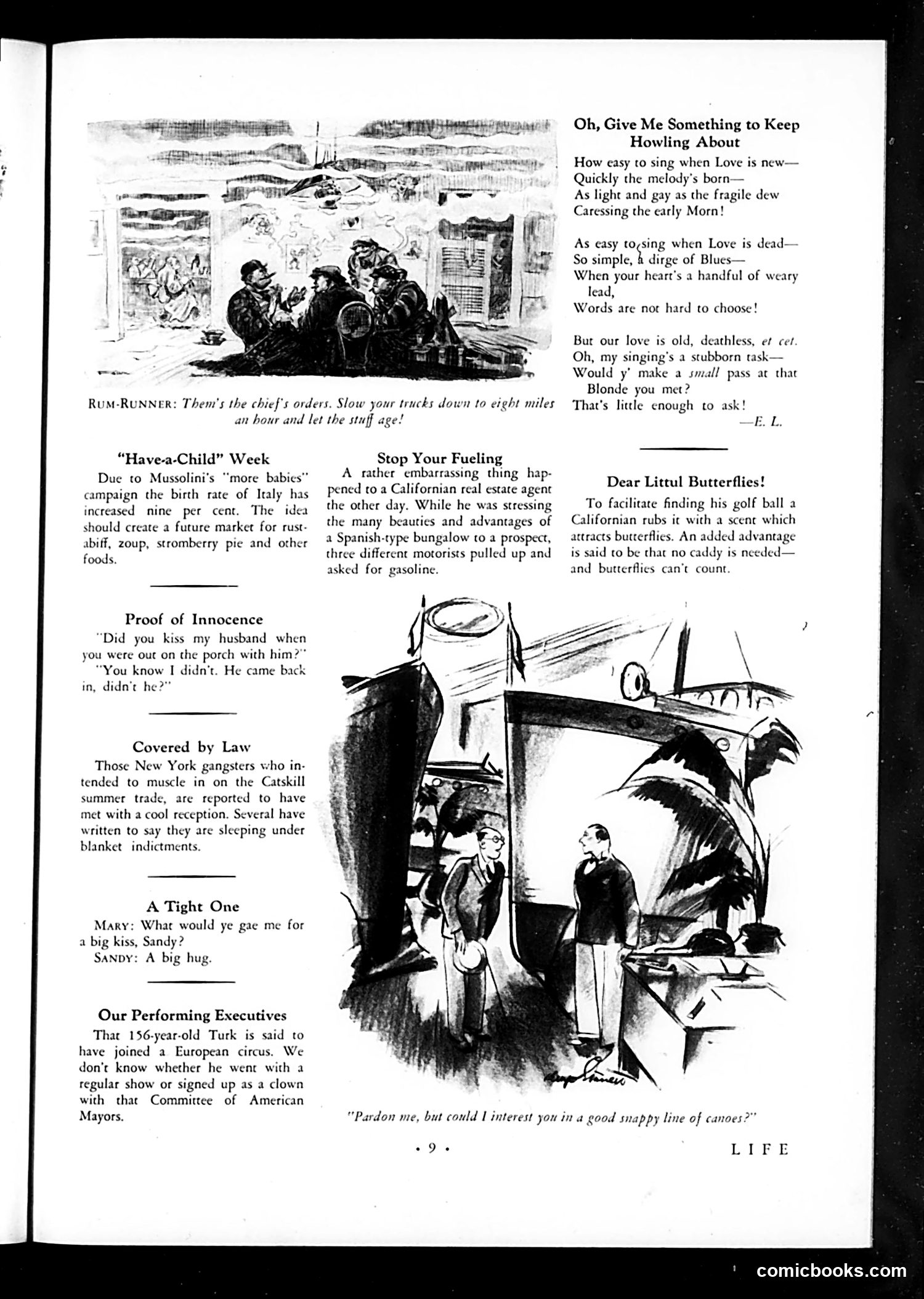
Page Analysis: Life Magazine Satirical Content This page contains several brief humorous anecdotes and two cartoon illustrations typical of Life's satirical style. The cartoons mock everyday social situations: one depicts three figures huddled together (captioned about a "Rum-Runner"), referencing Prohibition-era bootleggers; another shows businessmen discussing "a good snappy line of canoes," satirizing salesmen's absurd pitches. The text items ridicule various topics: Mussolini's population campaign, a real estate agent's embarrassing sales pitch, New York gangsters operating under legal cover, and a 156-year-old Turkish performer joining an American circus. The poem "Oh, Give Me Something to Keep Howling About" appears to comment on romantic disappointment using metaphors of fleeting love. Overall, the page reflects early 20th-century American concerns: Prohibition enforcement, organized crime, commercial excess, and romantic disillusionment.
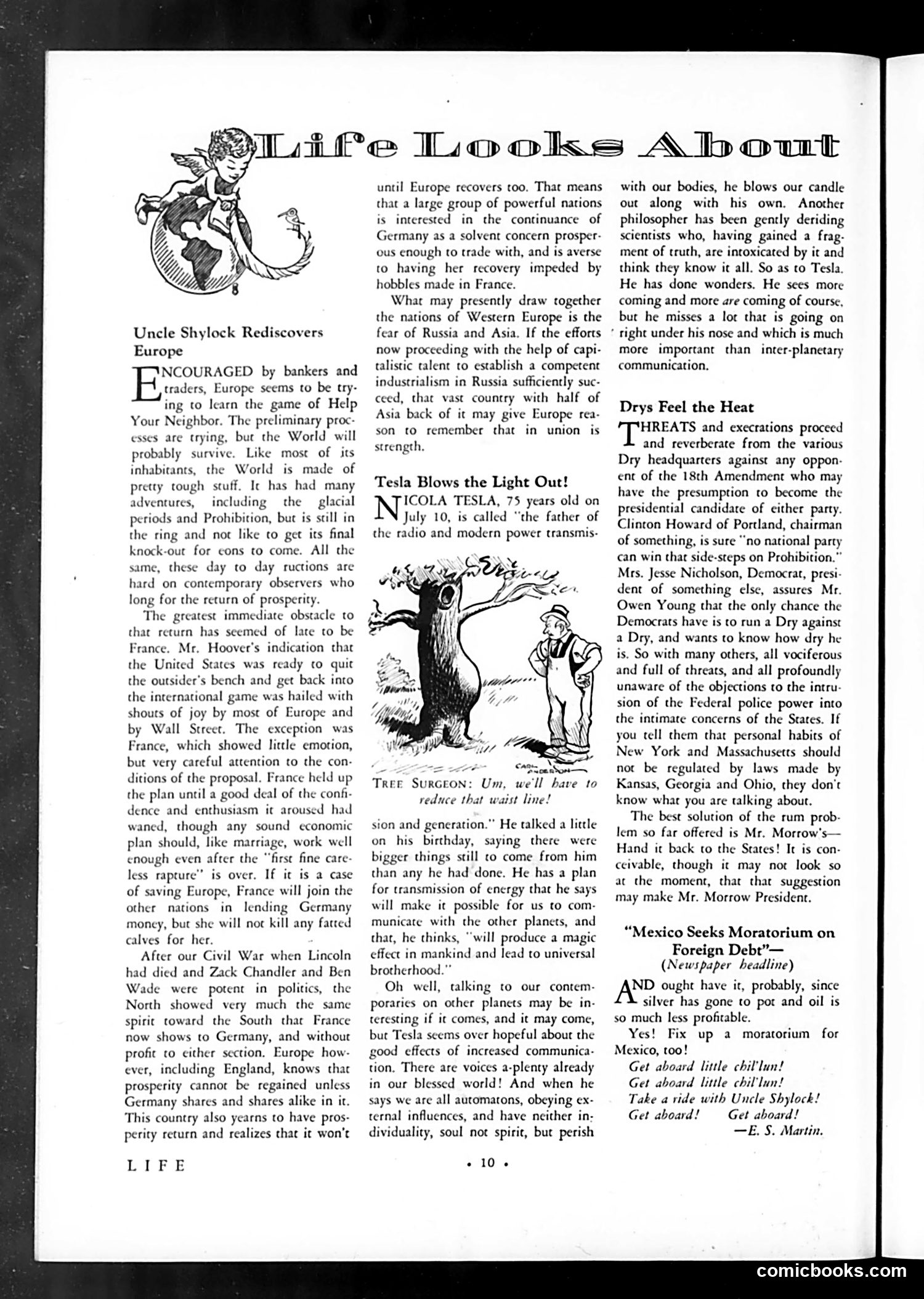
Political Commentary on Post-WWI Europe This Life magazine page critiques American economic policy toward post-war Europe. The main article "Uncle Shylock Rediscovers Europe" sarcastically compares the U.S. to a greedy moneylender ("Shylock"), suggesting America demands repayment of war debts while Europe struggles to recover. The piece argues the U.S. should help Germany stabilize economically—viewing a solvent Germany as necessary for broader European prosperity and as a counterweight to Russian/Asian threats. The Tesla section celebrates the inventor's optimism about technology improving human communication, contrasting with the article's skepticism about international relations. The "Drys Feel the Heat" section addresses Prohibition enforcement, mocking Democratic efforts to maintain the policy while acknowledging widespread public opposition and state resistance.
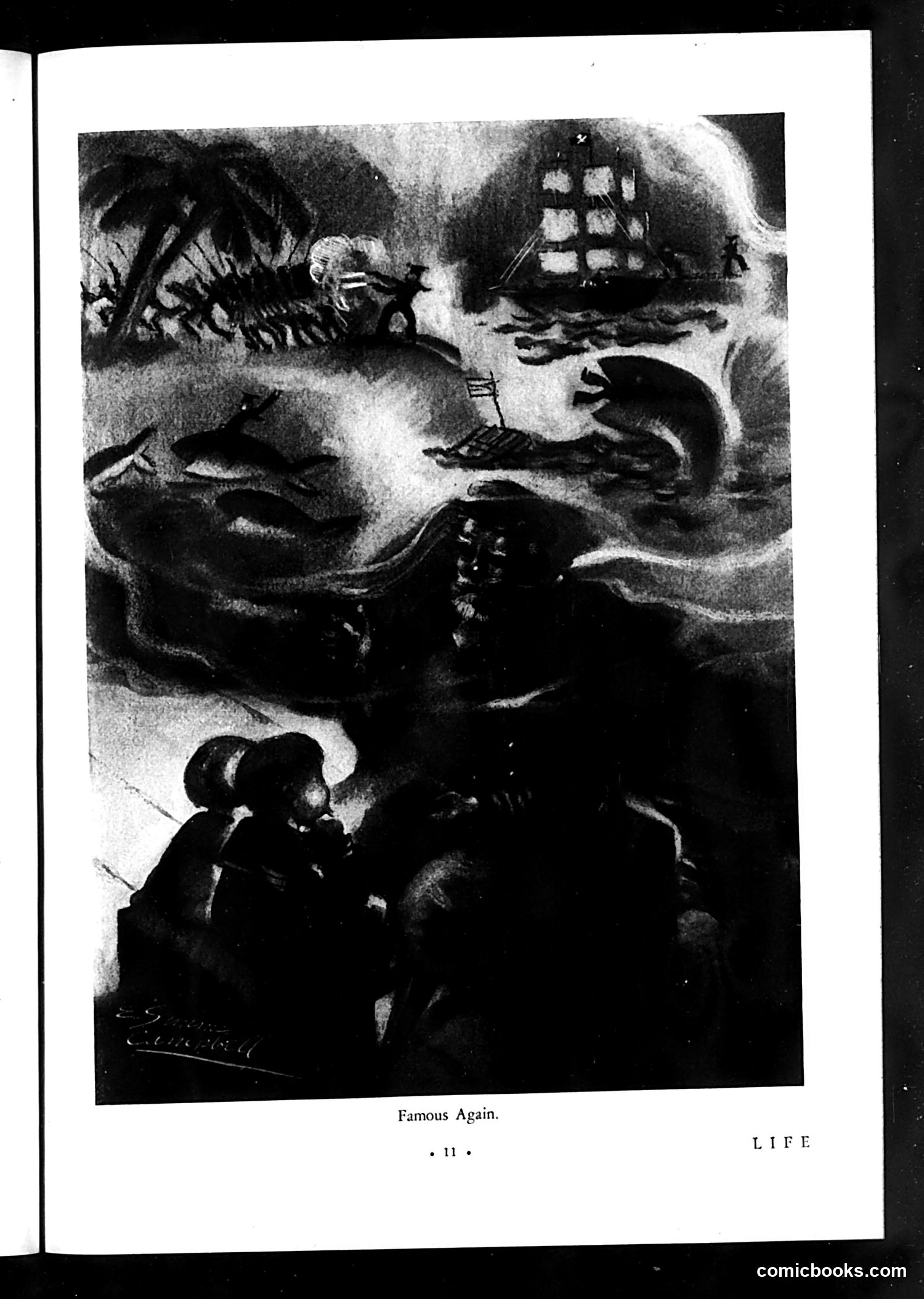
Analysis This page from *Life* magazine shows a dramatic illustrated scene titled "Famous Again," depicting what appears to be a naval or maritime adventure narrative. The image shows multiple figures in a dark, atmospheric composition featuring sailing ships in the background and what looks like action or conflict in the foreground. Without additional context from surrounding pages or a visible date, I cannot definitively identify the specific political figures or historical event being satirized. The nautical/naval setting and the title "Famous Again" suggest this may reference a public figure's return to prominence or a rehashed historical episode, but I cannot specify which without risking inaccuracy. The artwork style and reproduction quality suggest early-to-mid 20th century publication.
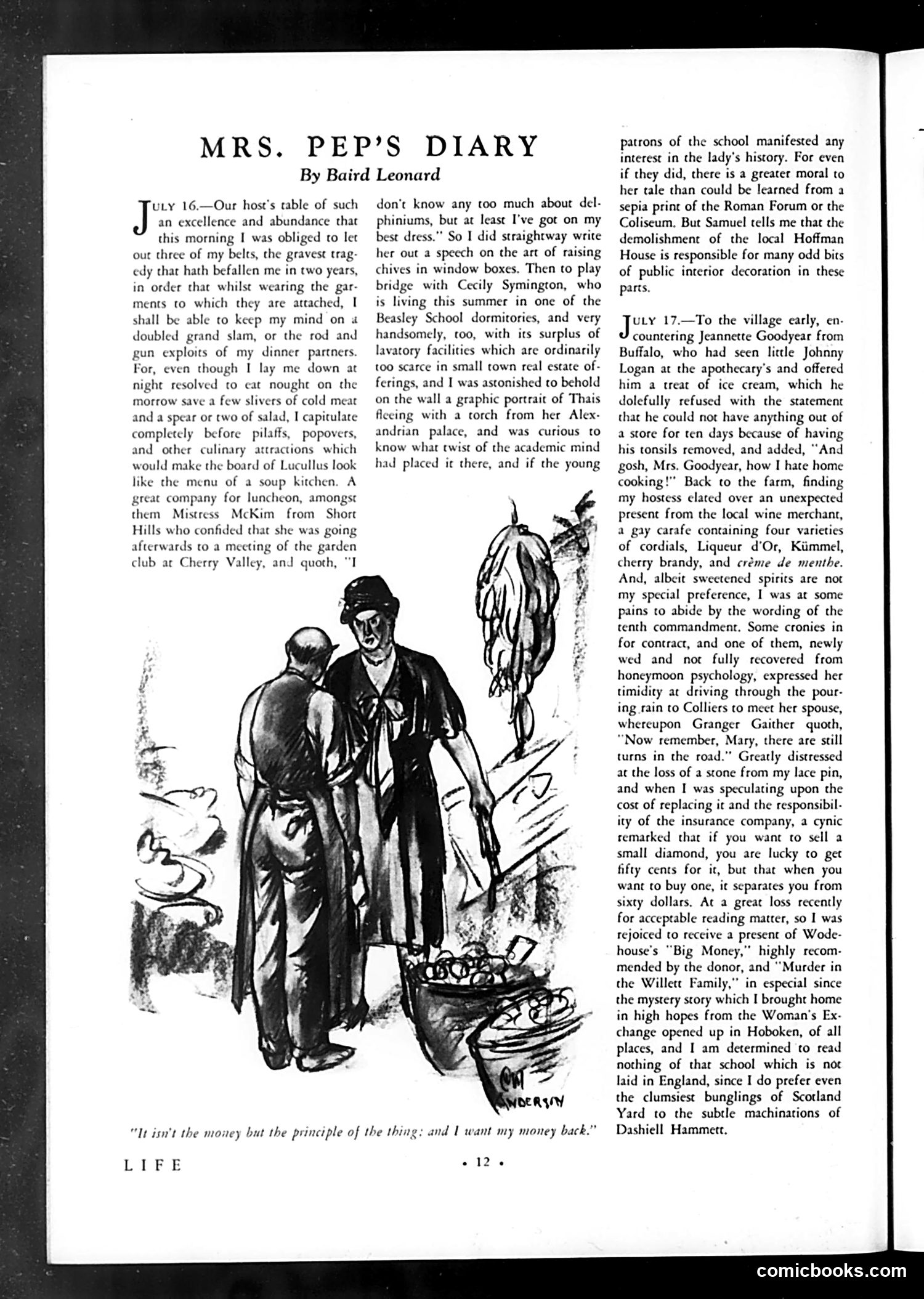
"Mrs. Pep's Diary" Analysis This page from *Life* magazine presents a satirical diary entry by Baird Leonard dated July 16-17, describing upper-class social activities and dining experiences. The accompanying illustration shows two figures in formal attire examining what appears to be game birds or produce at a market or vendor's stand. The satire targets wealthy social pretensions: the diarist boasts of elaborate meals and fashionable gatherings while revealing underlying anxieties about status and expense. The caption—"It isn't the money but the principle of the thing; and I want my money back"—mocks how the affluent rationalize financial concerns while maintaining appearances of indifference to cost. The humor derives from exposing the gap between cultivated sophistication and mercenary self-interest among the leisure class.
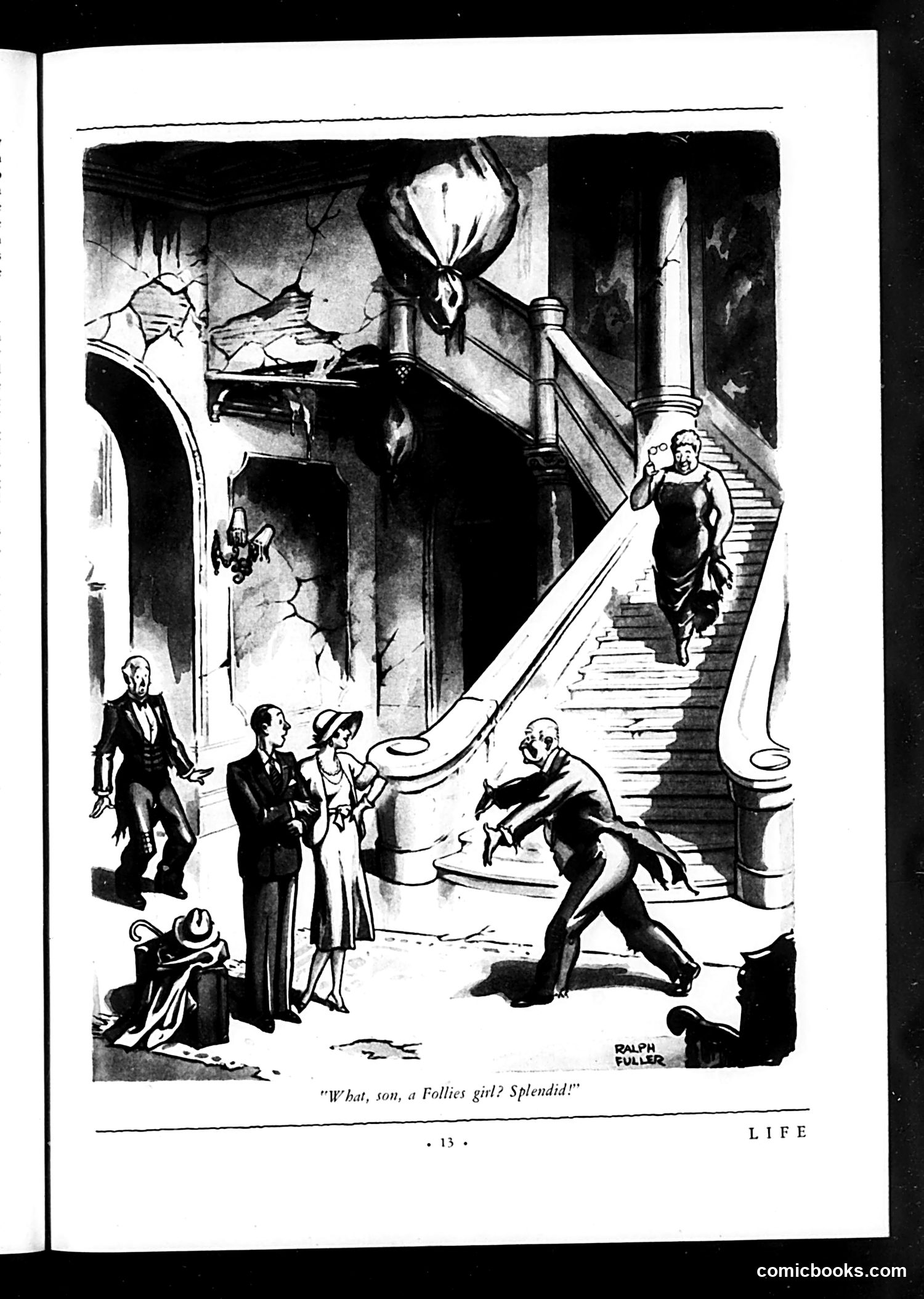
Analysis This is a single-panel cartoon by Ralph Fuller from *Life* magazine (page 13). The illustration depicts an elegant interior staircase where well-dressed people in formal attire observe a chimpanzee descending the stairs. The caption reads: "What, son, a Follies girl? Splendid!" The satire targets the *Ziegfeld Follies*, Broadway's famous revue known for its glamorous chorus girls. The joke equates a Follies dancer with a primate—a crude but common satirical device suggesting the performers were selected more for physical appearance than talent or intelligence. This reflects early 20th-century attitudes viewing chorus girls as objects of spectacle rather than artists, while simultaneously mocking the pretensions of wealthy patrons who attended such productions.
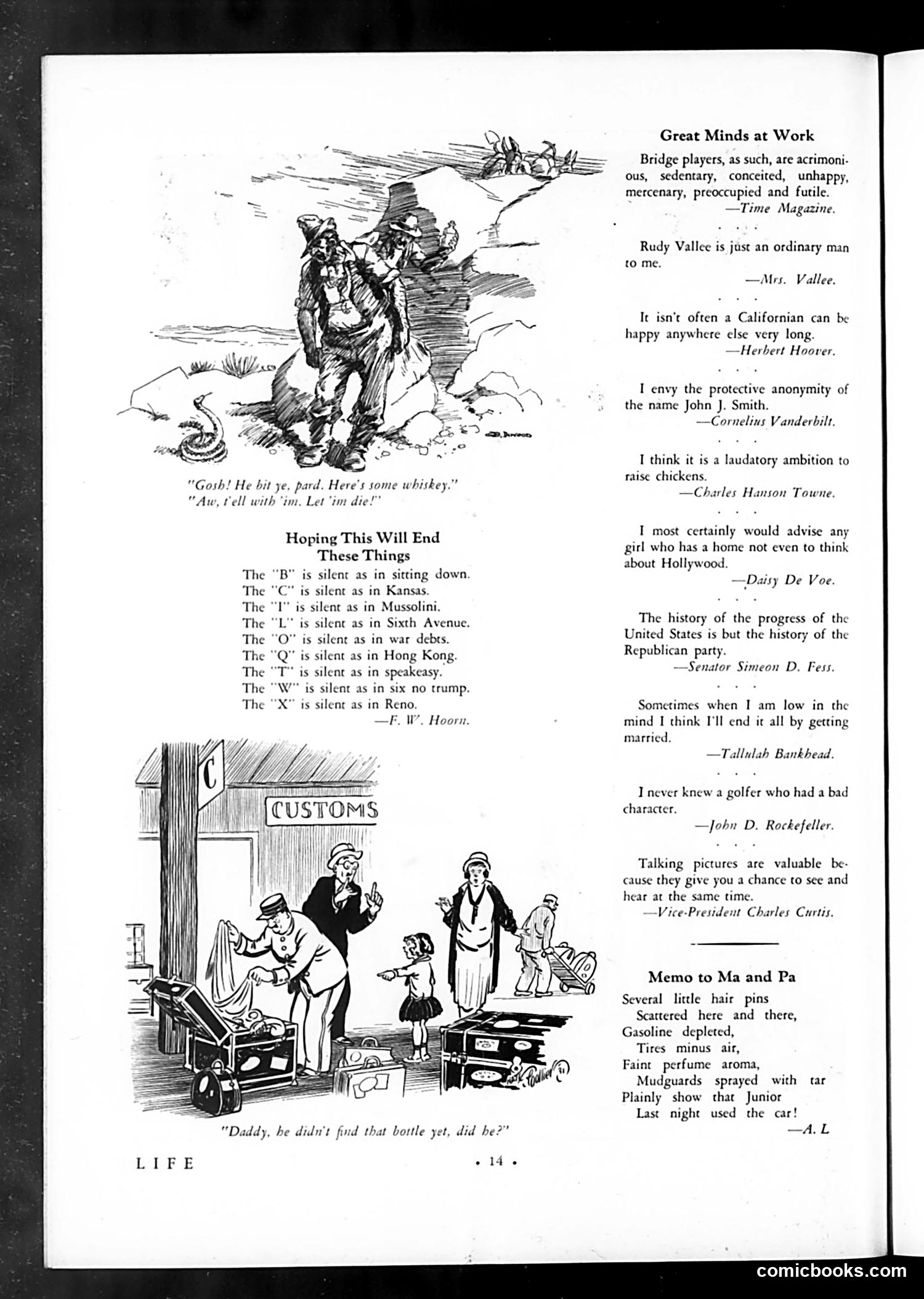
Analysis of Life Magazine Page 14 This page contains two editorial cartoons and several humorous quotes under "Great Minds at Work." Top cartoon: Depicts two figures in wilderness/frontier attire with a snake, suggesting survival humor. The caption references whiskey and dice games ("Gosh! He bit ye, pard..."). Bottom cartoon: Shows a customs inspection scene where an official examines a woman's luggage while family members wait. The caption ("Daddy, he didn't find that bottle yet, did he?") satirizes Prohibition-era smuggling—humorously suggesting people routinely hid alcohol from customs agents, a common practice during the 1920s alcohol ban. The page also includes witty quotes from prominent figures like Herbert Hoover and John D. Rockefeller, typical of Life's satirical format mixing cartoons with celebrity quips.
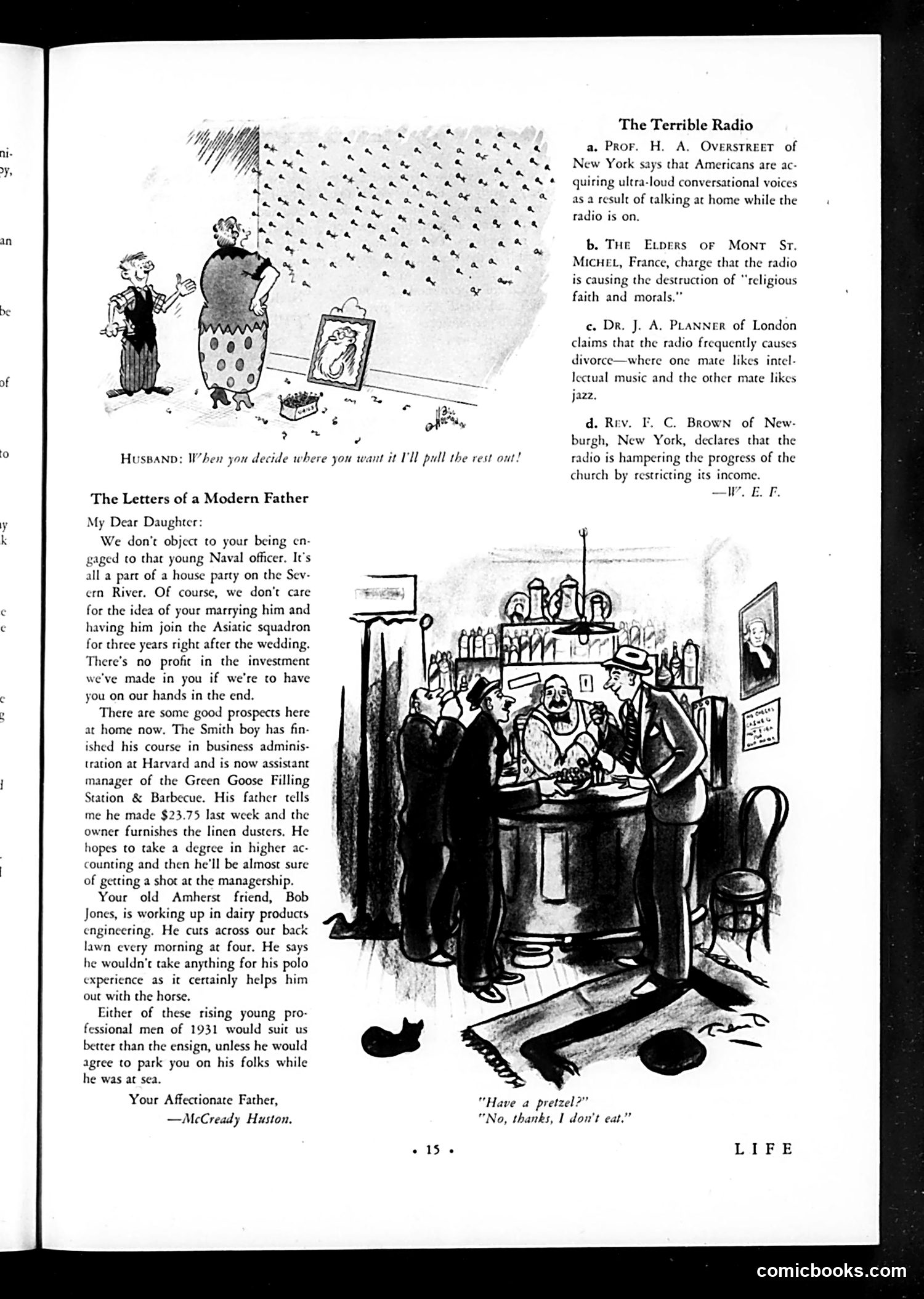
Content Analysis This page contains two separate satirical pieces: "The Terrible Radio" (top): A cartoon showing a couple being overwhelmed by radio broadcasts (depicted as tiny figures/noise pouring from a radio set). The accompanying text lists contemporary complaints about radio: that it causes people to shout over broadcasts, destroys religious faith and morals, creates musical taste discord between family members, and harms churches by reducing charitable donations. "The Letters of a Modern Father" (bottom): A humorous letter from a father to his daughter about her naval officer fiancé. He discusses local young men's career prospects (business administration, dairy engineering) and how the daughter's marriage plans compare favorably, ending with resigned acceptance. The lower illustration depicts what appears to be a crowded bar or restaurant scene with the caption about pretzels. Both pieces satirize contemporary 1920s-30s American social concerns and generational differences.
Movie Reviews by Harry Evans This page contains three film reviews from *Life* magazine's entertainment section, circa early 20th century. The reviews discuss: 1. "The Man in Possession" - Praising Robert Montgomery's performance in a British-set comedy with a Cambridge student character. 2. "Murder by the Clock" - Analyzing a mystery film featuring a woman with heart disease and a murder plot, noting the film's strange narrative logic. 3. "Night Nurse" - Reviewing a film with Walter O'Keefe, Barbara Stanwyck, and Jean Blondell about a nurse uncovering criminal activities involving children. The reviews employ satirical commentary typical of *Life*'s entertainment criticism, critiquing plot holes, acting choices, and moral implications while maintaining a humorous tone about cinema's absurdities.
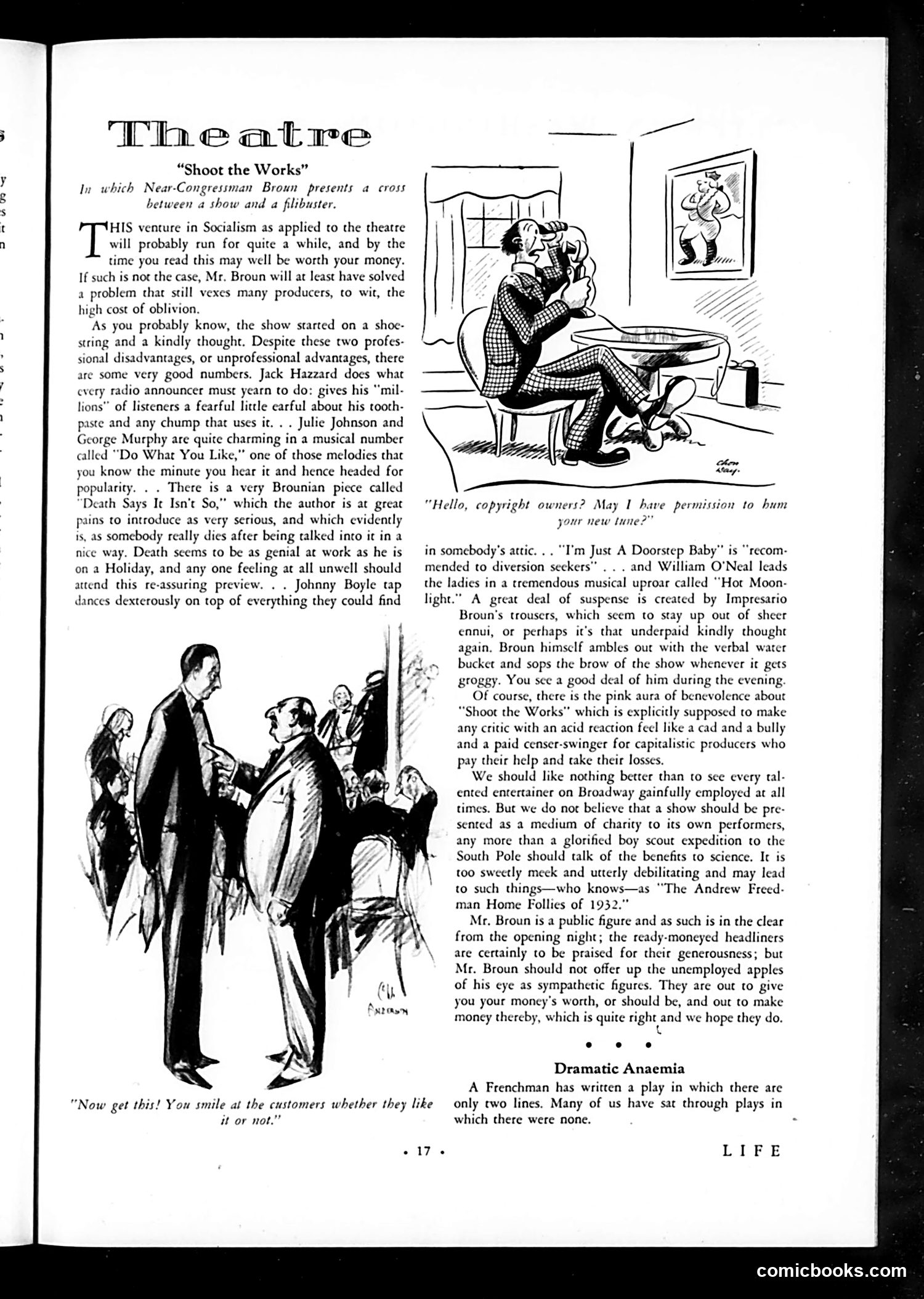
"Shoot the Works" Theatre Review This page reviews a theatrical production by Impresario Newell Broun. The article discusses various musical numbers and performers, including Jack Hazard, Julie Johnson, George Murphy, and William O'Neal. The review praises the entertainment value while critiquing its socialist messaging—the subtitle describes it as "Socialism as applied to theatre." The two illustrations appear to be sketches from the show itself. One depicts a couple in what seems to be an intimate or comedic moment; the caption includes a copyright permission joke. The lower illustration shows well-dressed men in conversation, with a caption about making customers smile. The review is ultimately favorable but somewhat condescending, suggesting the show should be enjoyed simply as entertainment rather than as serious political statement.
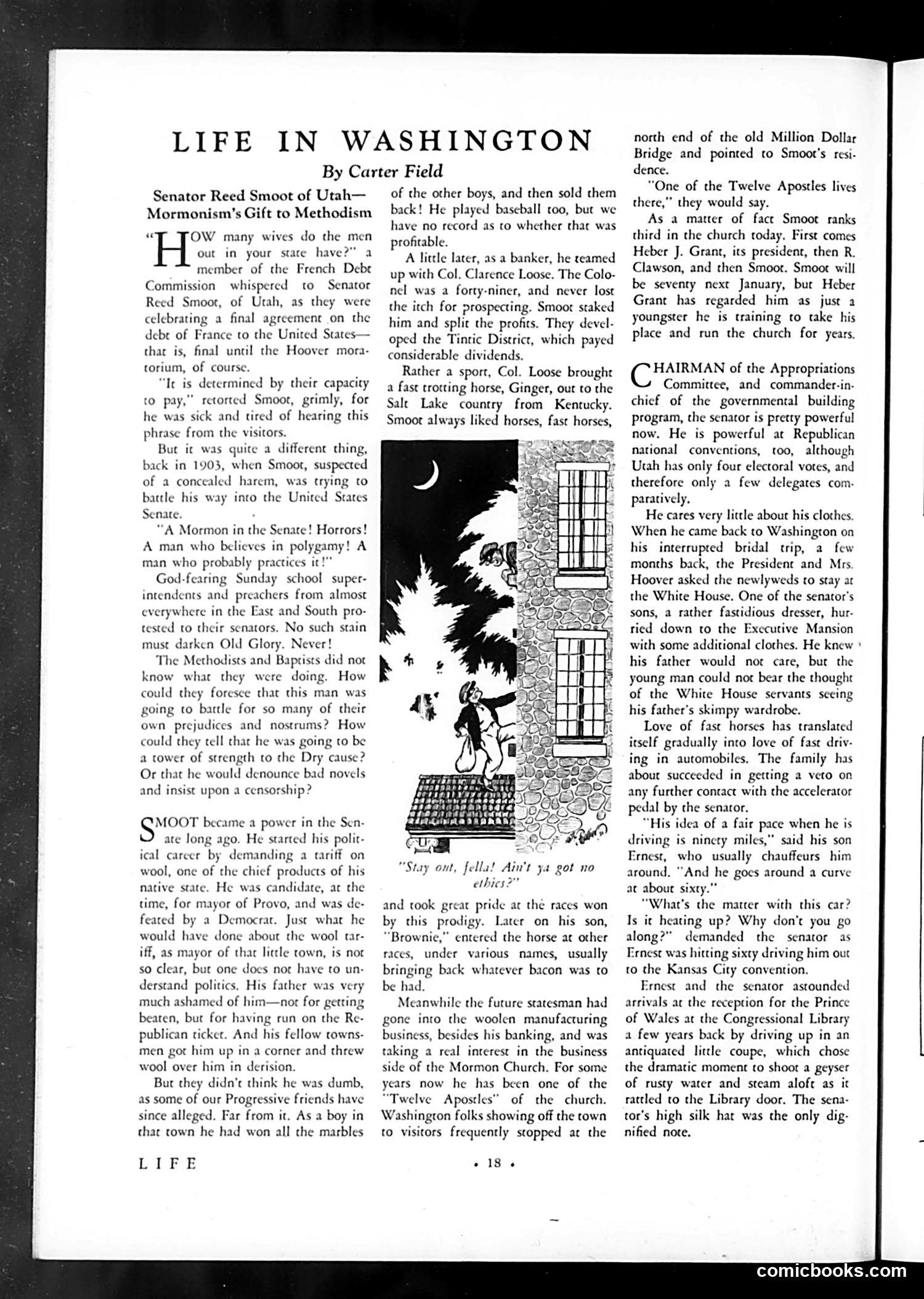
"Life in Washington" by Carter Field This article profiles Senator Reed Smoot of Utah, a Mormon politician. The accompanying cartoon depicts a nighttime scene at what appears to be a building (possibly representing Congress or a government office), with a figure on horseback or in motion near the structure. The satire targets Smoot's Mormon faith and political influence. The text references historical anti-Mormon sentiment, noting shock that "a Mormon" could reach the Senate, and mentions Methodist concerns about his presence in government. The article discusses Smoot's business interests (wool, banking, horse racing) and his rise to power despite religious prejudice. The cartoon likely illustrates the tension between Smoot's religious background and his governmental authority—a visual joke about an unexpected outsider gaining political prominence.
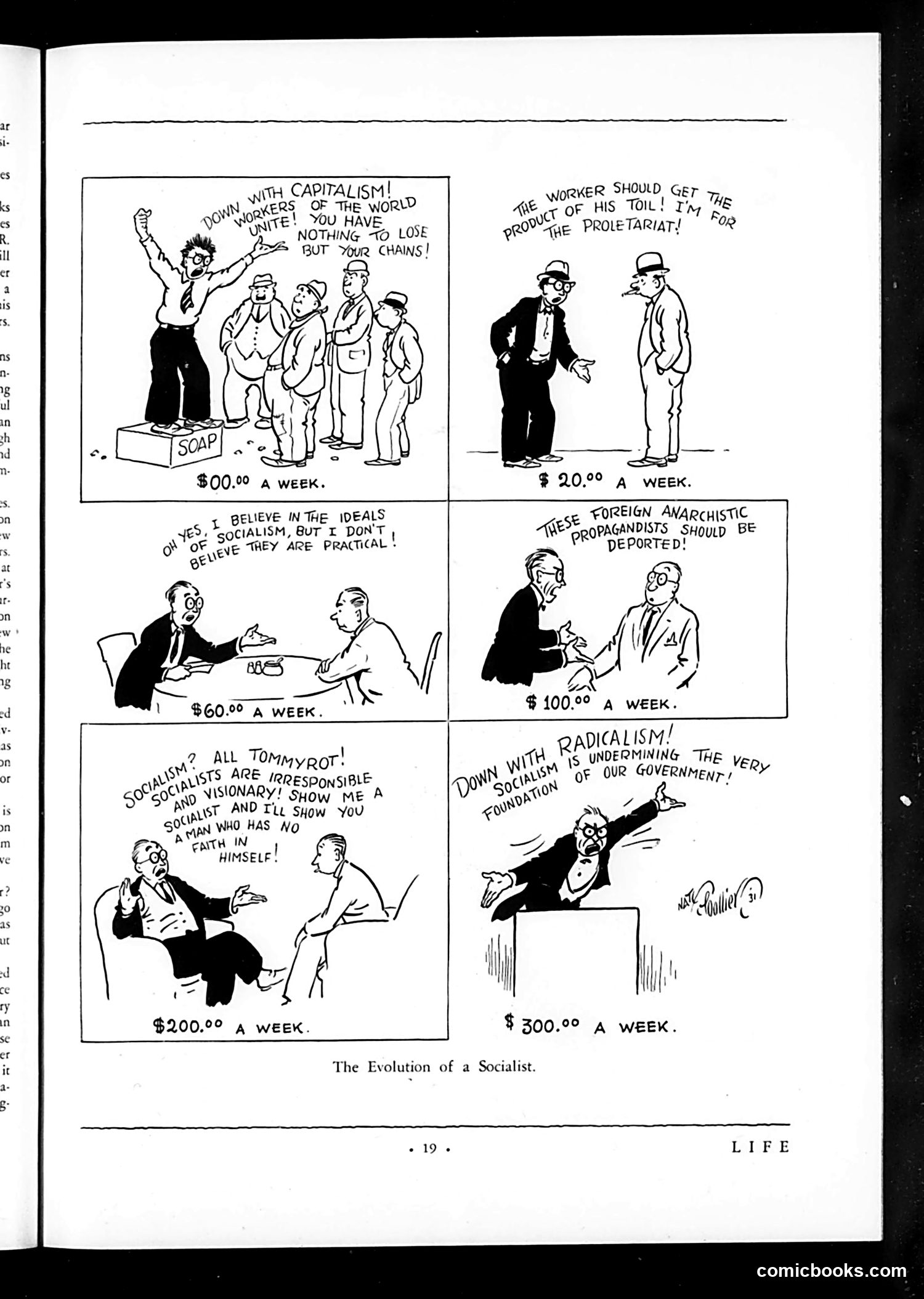
"The Evolution of a Socialist" This satirical cartoon mocks the supposed hypocrisy of socialists who become wealthier. Each panel shows a man earning progressively higher wages—from $00.80 to $300 weekly—while his rhetoric shifts accordingly. At poverty wages, he preaches Marxist revolution ("down with capitalism"). As earnings increase, his politics moderate: he claims socialism is impractical, then denounces "foreign anarchists," then attacks radicalism itself as dangerous to government. The joke satirizes the cartoon's era belief that socialist commitment depends on economic desperation. The satirist suggests that once socialists gain financial security, they abandon radical ideology in self-interest—implying socialism appeals only to the poor, and wealthy converts become conservatives. This reflects early-20th-century American anti-socialist propaganda common in *Life* magazine.
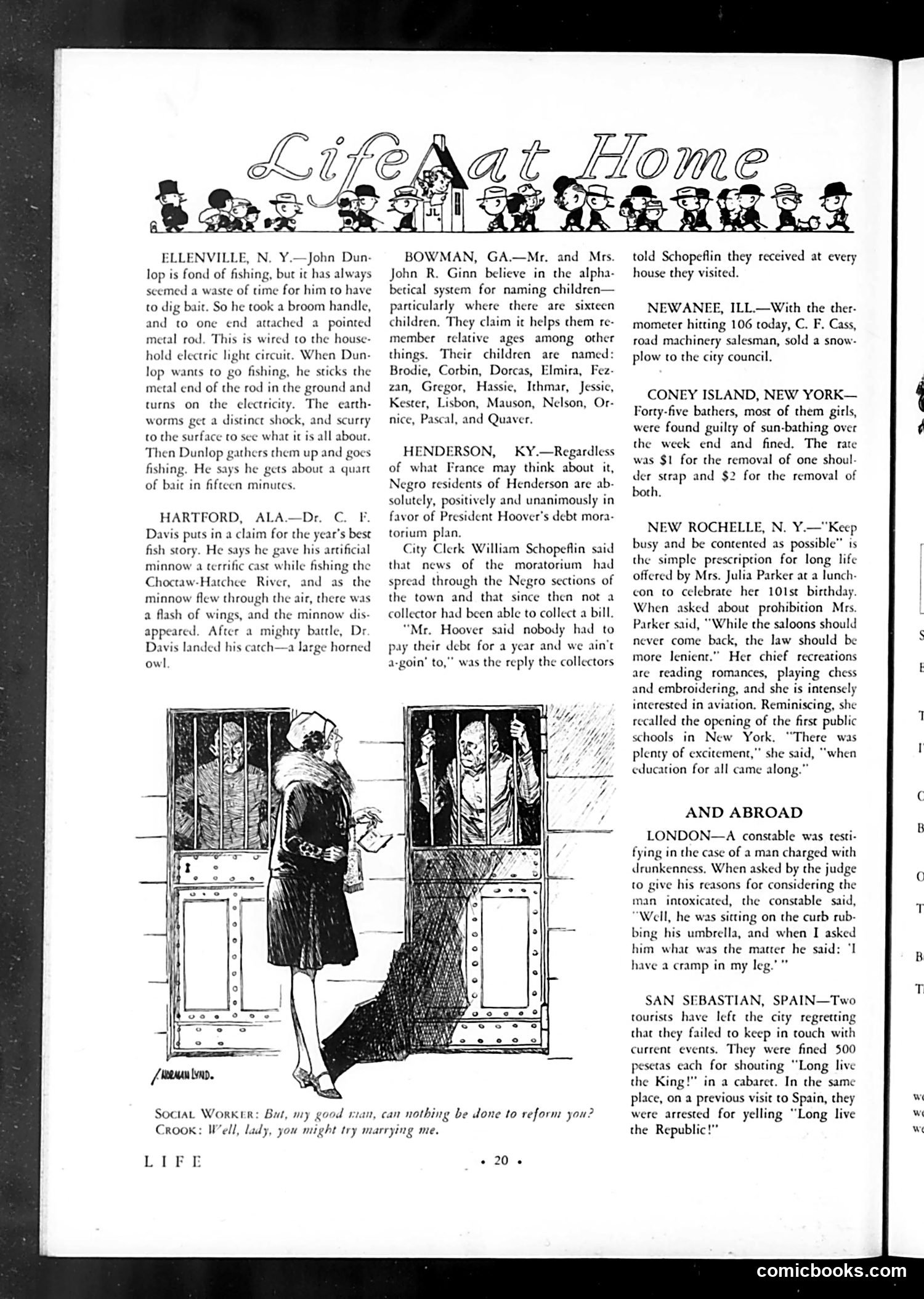
"Life at Home" Page Analysis This page from *Life* magazine collects humorous anecdotes organized geographically. The main cartoon depicts a social worker and a criminal in dialogue—the worker asks if anything can reform him; he replies he might try marriage. It's a cynical joke about marriage as a "reform" institution, playing on Depression-era anxieties about both crime and matrimony. The text anecdotes mock various American follies: an inventor electrocuting earthworms for fishing bait; a fisherman's tall tale; a large family using alphabetical naming; and notably, a satirical jab at African Americans misinterpreting President Hoover's debt moratorium as forgiving all debts. The "And Abroad" section includes a constable's confusion about drunkenness and Spanish tourists comically arrested for contradictory political slogans. The humor relies on rustic Americana, racial stereotyping, and absurdist situations typical of early-1930s *Life* magazine's satirical tone.
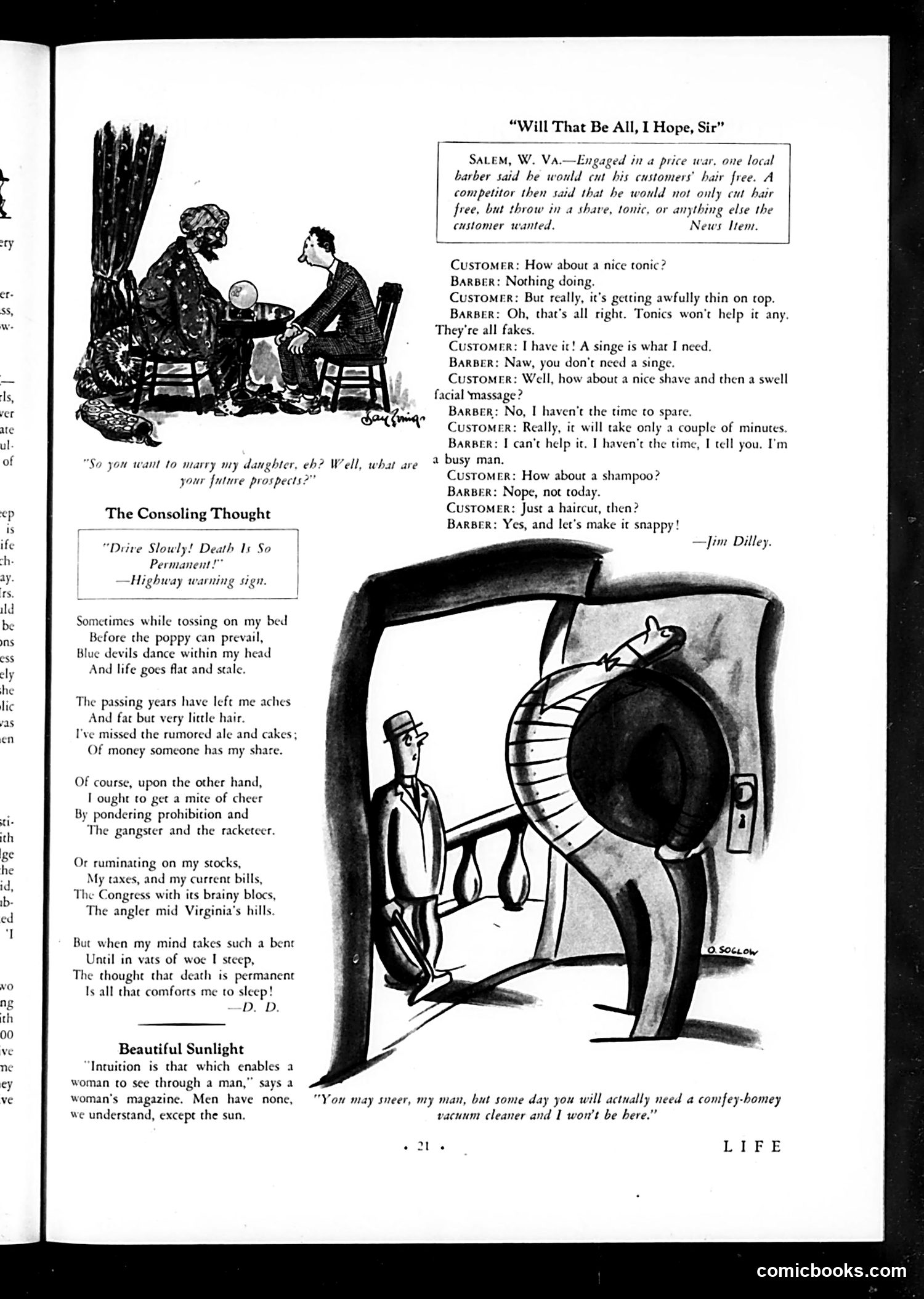
Explanation for Modern Readers This page contains three distinct pieces of humor from Life magazine: "Will That Be All, I Hope, Sir" depicts a barber-shop price war in Salem, West Virginia. Two competing barbers escalated their offers—first free haircuts, then adding free shaves, tonics, and massages. The joke shows the absurd result: when a customer finally asks for just a haircut, the exhausted barber agrees eagerly, wanting to do the *minimum* after promising everything. It satirizes how competitive undercutting can backfire. "The Consoling Thought" is a melancholic poem about aging and worry—thinning hair, taxes, Prohibition-era gangsters, stock market concerns. The dark humor lies in the punchline: contemplating that death is permanent actually *comforts* the anxious narrator enough to sleep. It reflects 1920s-30s anxieties (Prohibition, economic uncertainty). "Beautiful Sunlight" is a fragment claiming women have "intuition" to see through men, while men lack this except for sunlight—a sexist quip typical of era. The cartoons use domestic, everyday situations to mock contemporary social conditions.
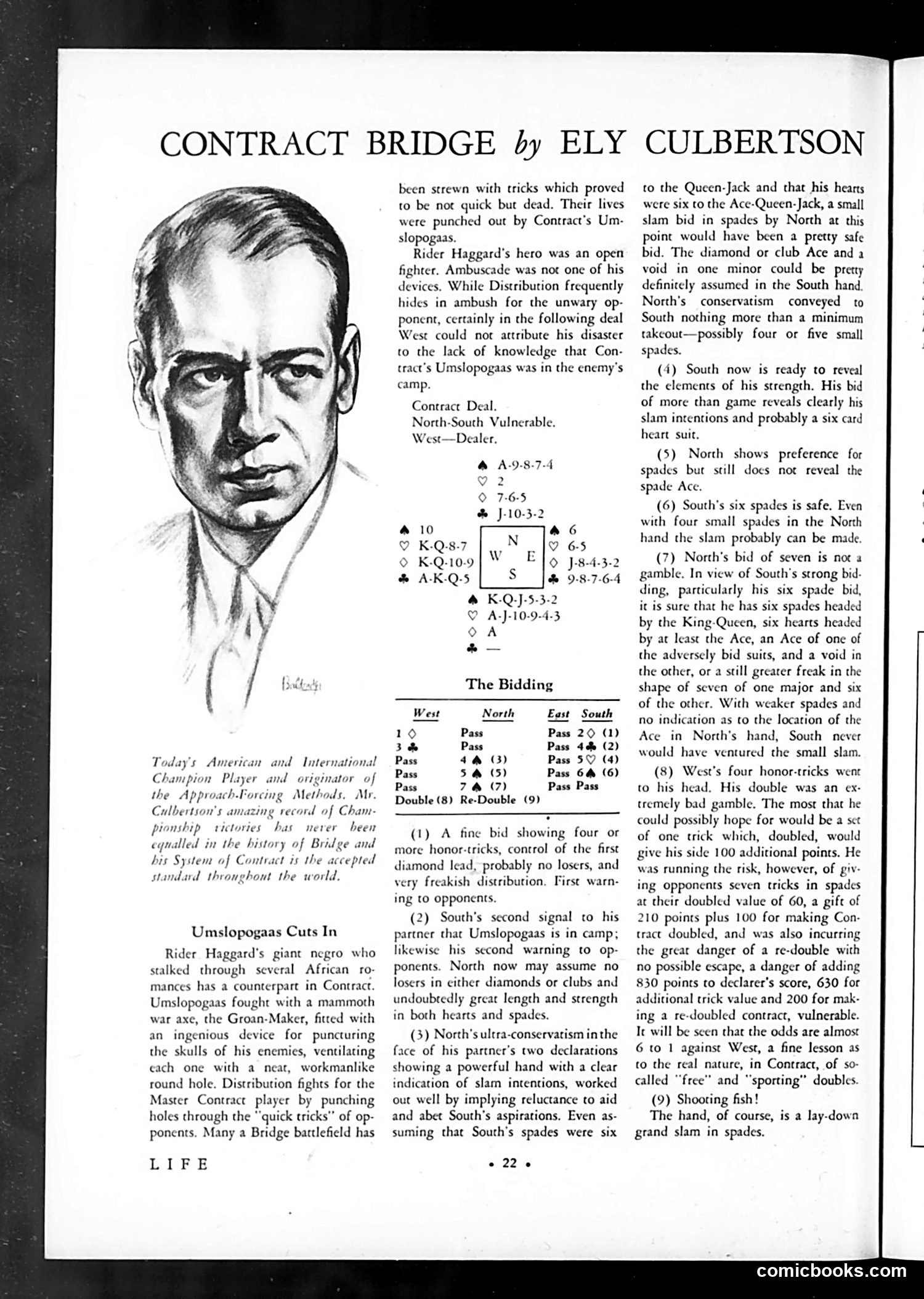
Contract Bridge Analysis This page features Ely Culbertson, the famous bridge champion and innovator of the "Approach-Forcing Methods," explaining a complex contract bridge hand to readers of *Life* magazine. The article uses an extended metaphor comparing bridge strategy to Umslopogaas, a fictional giant warrior from H. Rider Haggard's African adventure novels. Just as Umslopogaas used a magical war axe to penetrate enemy defenses, skilled bridge players use "distribution"—the strategic arrangement of card suits—to outmaneuver opponents by exposing their weak "quick tricks." The page presents a detailed bidding sequence and analysis of a specific hand, illustrating how experienced players communicate through bids to reveal hand strength without showing cards directly. The humor lies in treating bridge as a form of intellectual warfare comparable to fictional adventure fiction—elevating a parlor game to epic proportions. This reflects bridge's peak popularity as an American leisure activity during the interwar period.
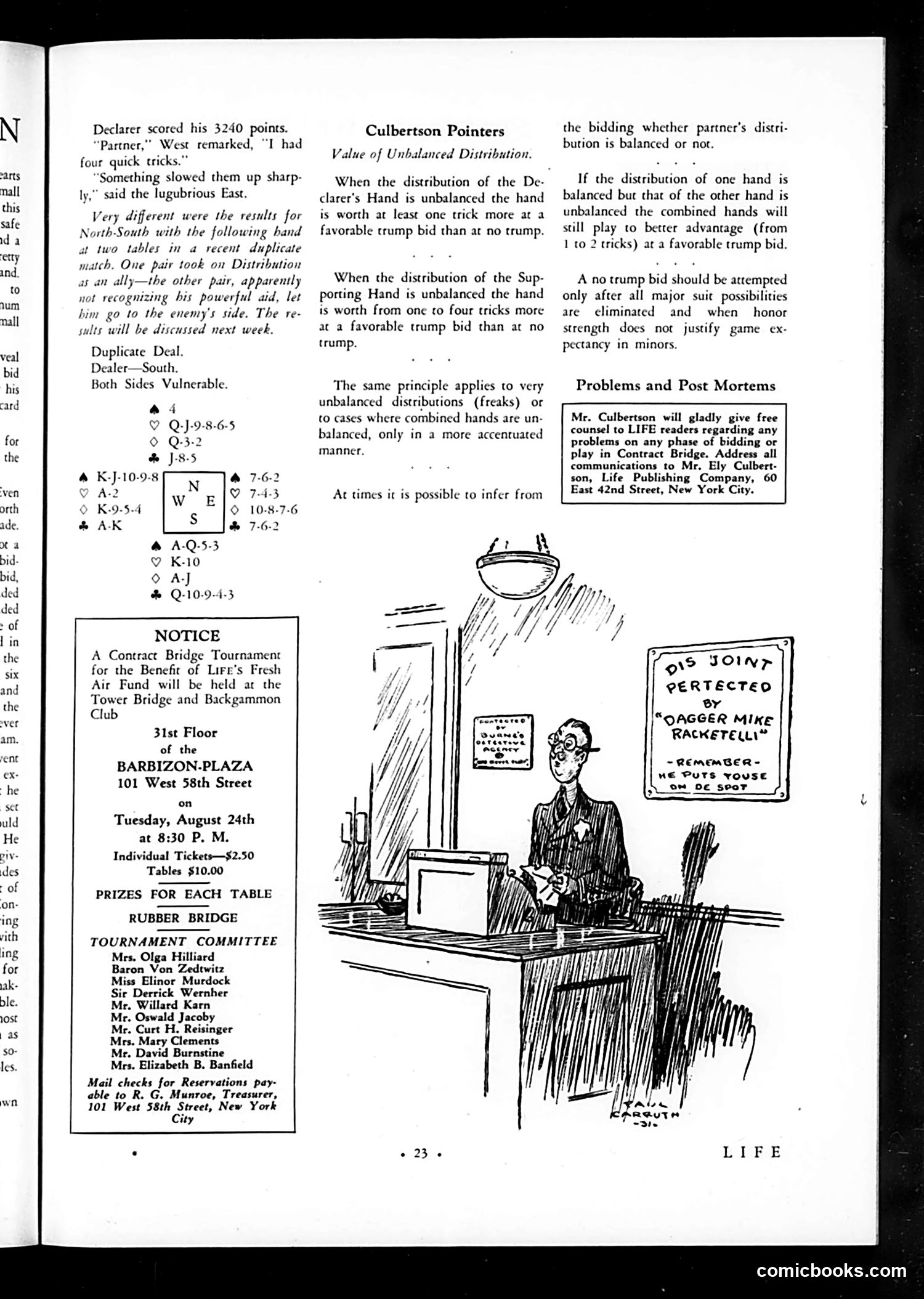
Explanation for Modern Readers This page is primarily a bridge card game instruction column by Ely Culbertson, a famous contract bridge expert of the era. The main content teaches strategic principles about "unbalanced distribution" in bridge hands. The cartoon is a humorous aside: it depicts a tough-looking character (drawn in a stereotypical "gangster" style with the exaggerated features common to 1930s-40s caricature) standing over construction or industrial equipment. The caption reads "Dis joint perfected by Ragger Mike Racketell"—a clear play on organized crime slang ("dis joint," "racket"). The joke appears to be visual satire mocking either low-level criminals or perhaps construction/labor racketeering of the era. The character's menacing pose and crude speech pattern ("remember—we puts youse on de spot") are comedic exaggeration typical of Life's satirical humor. The reference is unclear without additional context, but it's unrelated to the bridge instruction and serves as light comedic relief on the page.
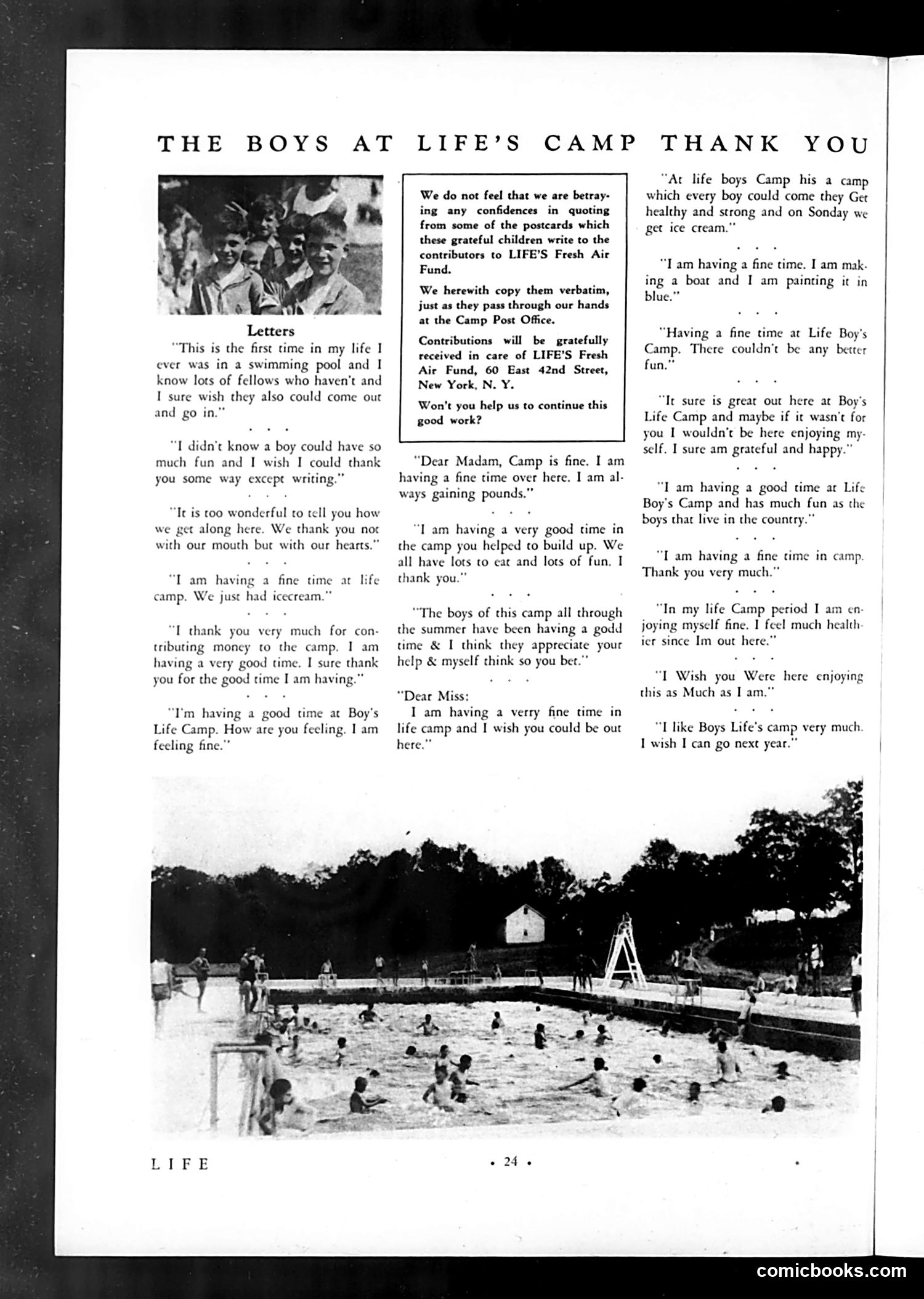
"The Boys at Life's Camp Thank You" This page showcases LIFE magazine's Fresh Air Fund—a charitable program sending underprivileged urban boys to summer camp. Rather than satirical content, it's a fundraising appeal featuring genuine postcards from grateful campers. The letters reveal the boys' wonder at basic experiences: swimming pools, ice cream, adequate food, and recreational activities. Their misspellings and simple grammar authenticate the voices of working-class children for whom camp represented transformative access to nature, nutrition, and play. The accompanying photograph shows the camp's swimming area filled with boys—visual proof of the program's scale and impact. By publishing these heartfelt testimonials, LIFE appeals to readers' charitable instincts while demonstrating the fund's tangible benefits. The page solicits donations to "continue this good work," making the boys' gratitude itself the persuasive tool.
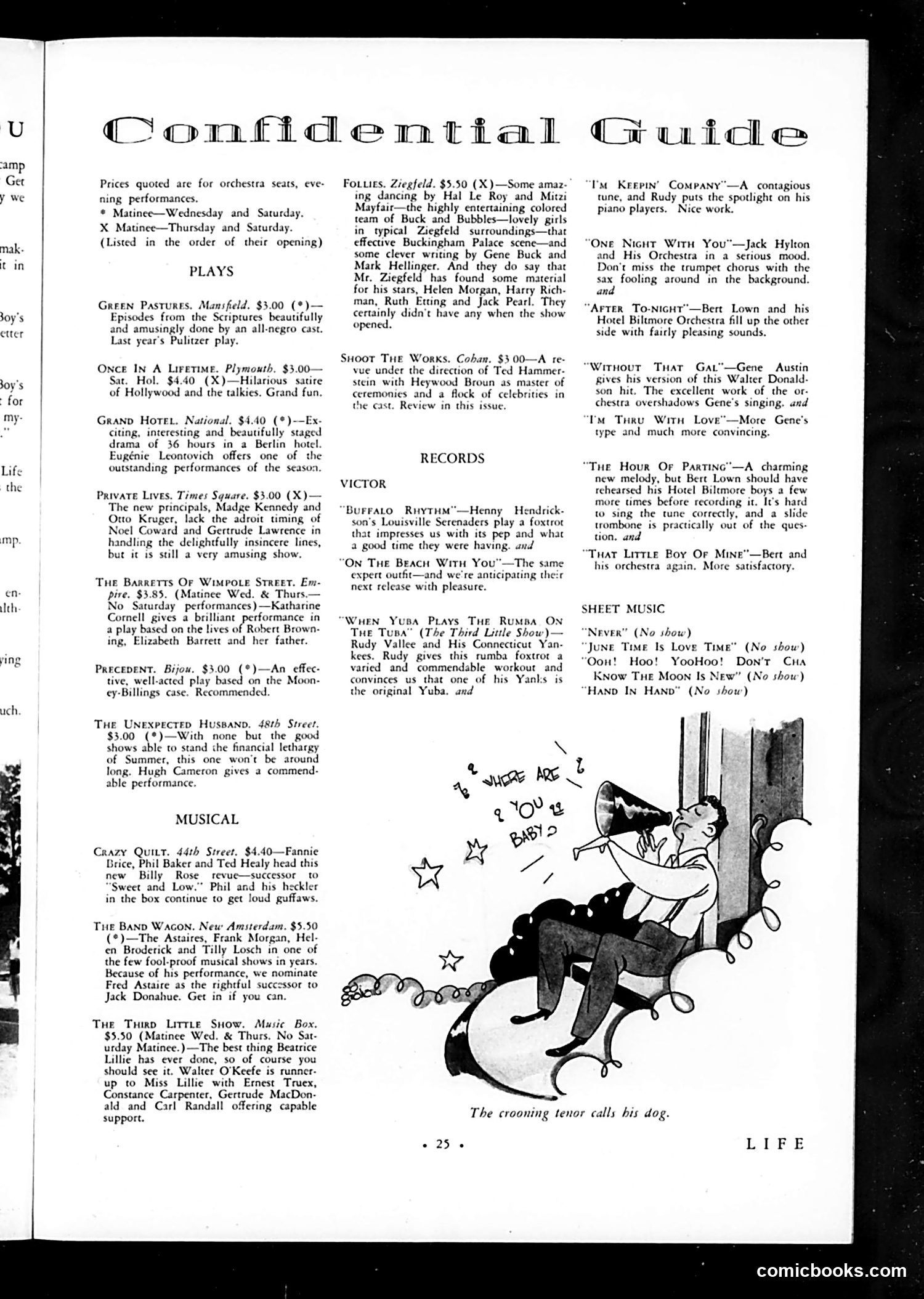
Explanation of This Page for Modern Readers This page is a theater and entertainment guide from Life magazine, listing Broadway plays, musicals, and phonograph records with prices and brief reviews. The content is entirely informational—not satirical. The plays reviewed include *Green Pastures* (an all-Black cast production), *Once in a Lifetime* (satirizing Hollywood), and *The Barretts of Wimpole Street* (starring Katharine Cornell). Musicals feature major stars like Fred Astaire and Beatrice Lillie. The small cartoon at the bottom shows a tenor dramatically calling his dog while holding sheet music—a visual pun on the phrase "the crooning tenor calls his dog." This is gentle humor about the popular crooning singing style of the era. There is no political content on this page. It's a straightforward entertainment guide typical of 1930s Life magazine's regular "Confidential Guide" feature helping readers choose shows and records.
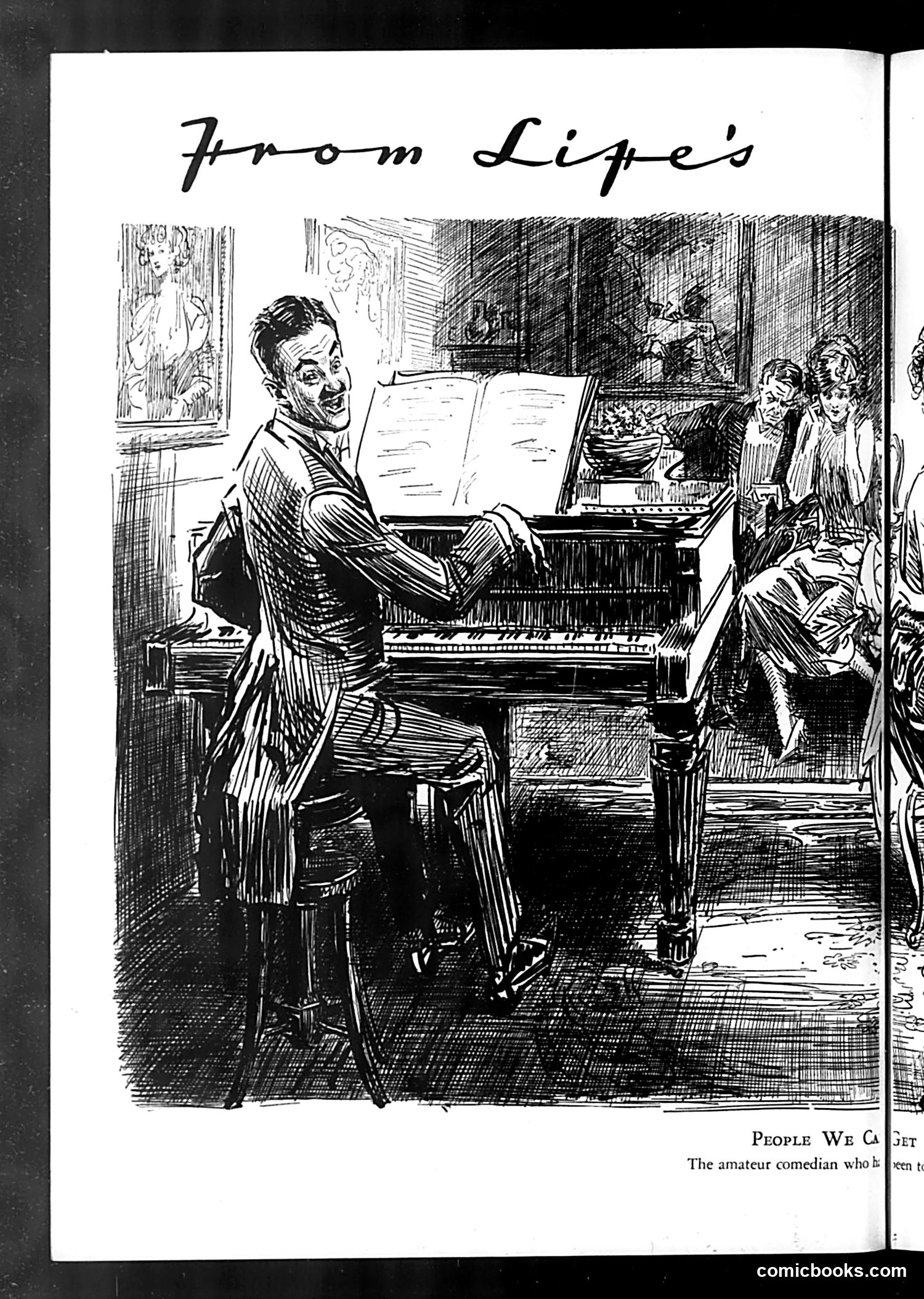
"From Life's" - The Amateur Comedian This page section features a sketch-style illustration of a man at a piano, turning toward the viewer with an exaggerated, comedic expression. The title "From Life's" suggests these are observations about real people or social types. The heading "People We Catch" (partially visible as "PEOPLE WE CA") indicates this is part of a recurring feature documenting social types or notable individuals. The caption mentions "The amateur comedian," suggesting this depicts someone who performs music or entertainment informally—likely in a domestic setting, given the home interior with paintings and seated observers. The satire appears to target amateur performers or social entertainers of the era, mocking their enthusiasm or pretensions. The exaggerated facial expression emphasizes the comedic subject matter typical of Life magazine's social satire.
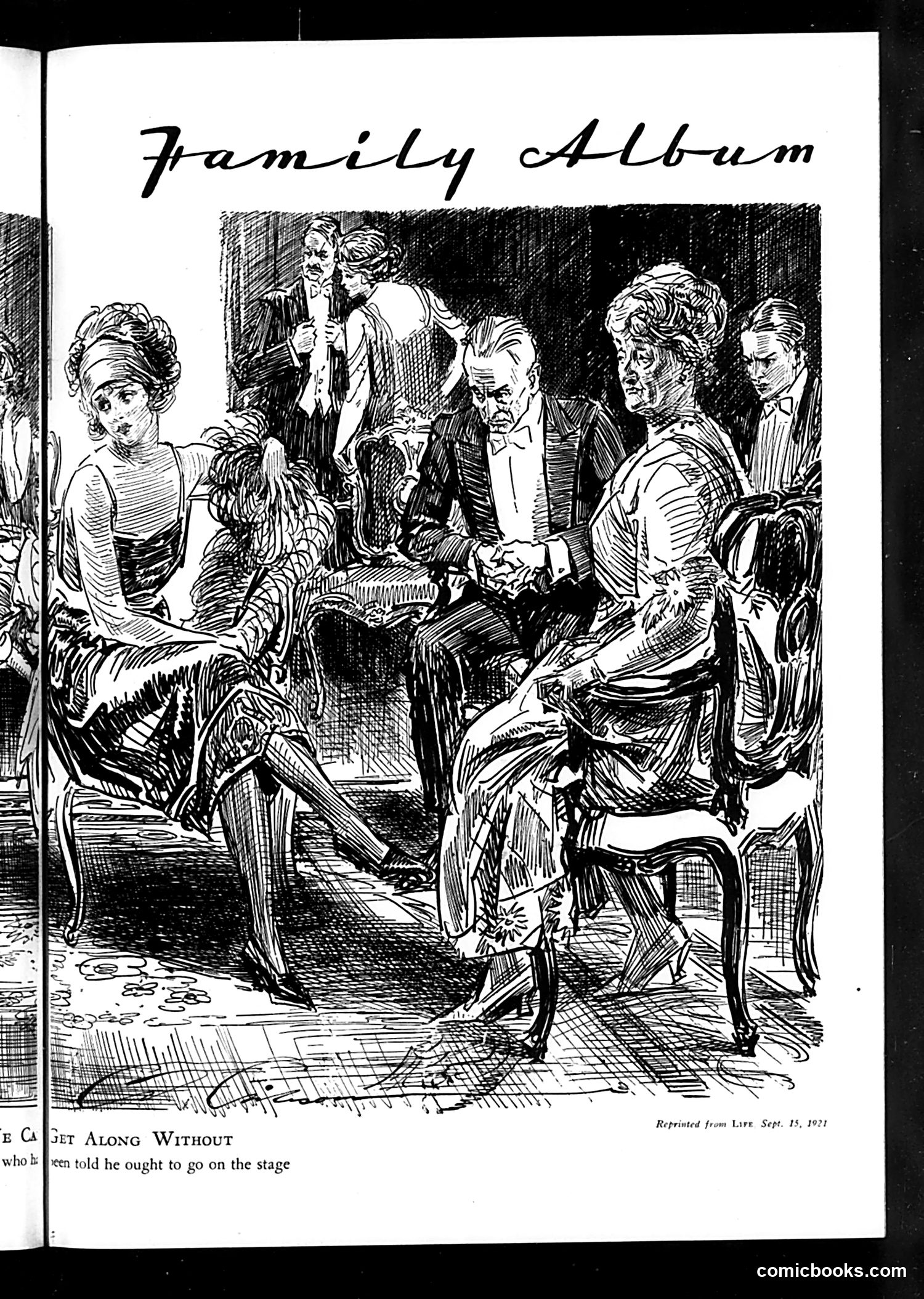
Family Album This is a satirical illustration from *Life* magazine (September 18, 1921) titled "Family Album." The sketch depicts an upper-class family gathering in a formal interior, with well-dressed men and women arranged in posed, theatrical attitudes. The caption fragment "ought to go on the stage" suggests the satire mocks either theatrical pretension or the artificial, performative nature of formal family gatherings. The exaggerated poses and expressions of the figures—particularly their somewhat strained or dramatic demeanor—reinforce the joke that these respectable, well-heeled citizens are essentially "performing" respectability rather than genuinely embodying it. This reflects 1920s satirical humor about bourgeois social conventions and the gap between public presentation and private reality.
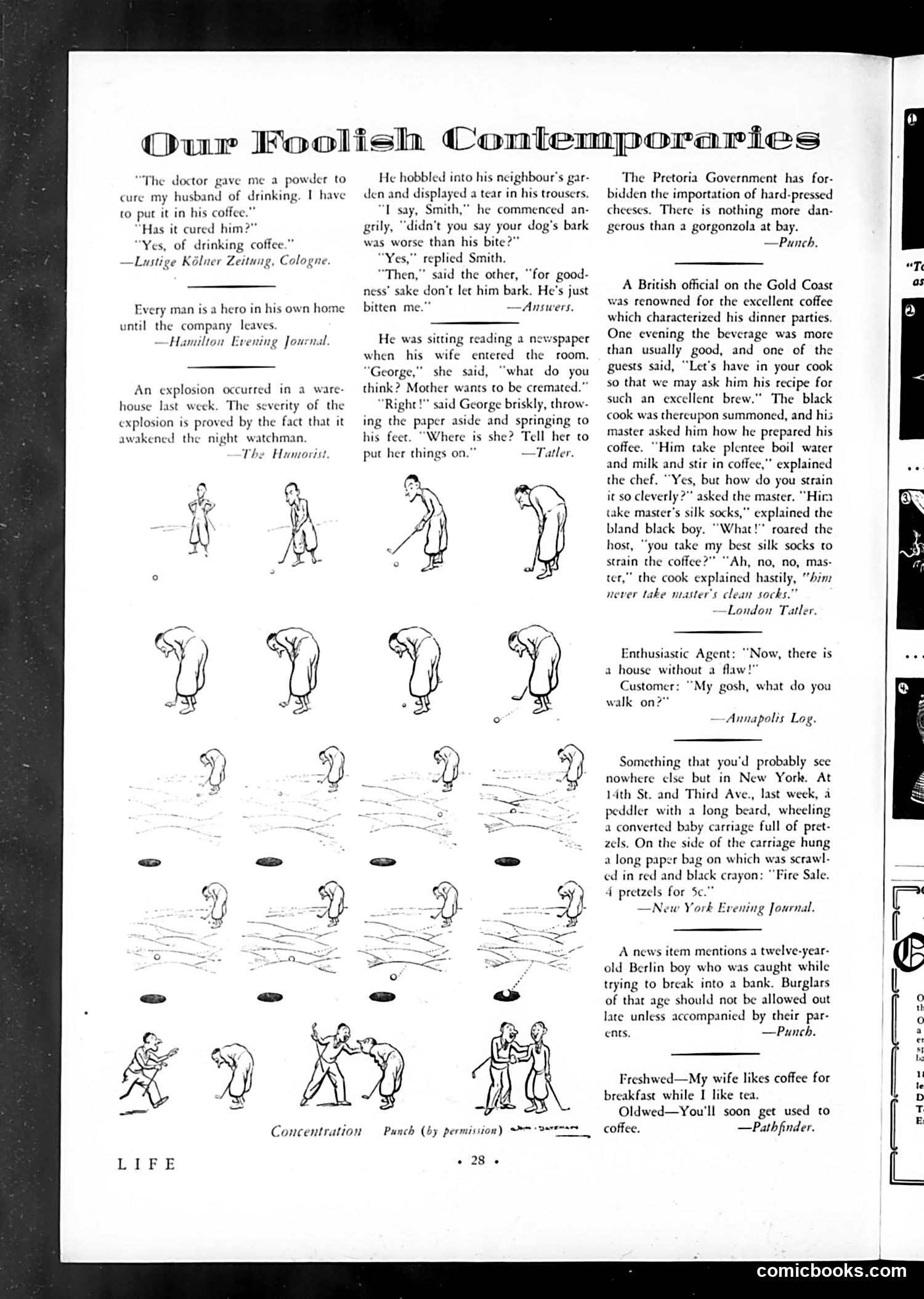
"Our Foolish Contemporaries" Analysis This page collects humorous anecdotes and a sequential comic strip (titled "Concentration") from various publications, satirizing everyday foolishness and miscommunication. Key jokes: - A wife secretly medicates her husband's coffee to stop his drinking—he stops drinking coffee instead - A man angry his neighbor's dog bit him, despite the owner claiming the bark was worse than the bite - A husband eagerly agrees to his wife's cremation, misunderstanding her intent - A British colonial official unknowingly uses his silk socks to strain coffee, prepared by his Black cook who deliberately withholds this detail - A real-world New York peddler selling pretzels as a "Fire Sale" The "Concentration" comic appears to depict a physical activity or game involving bending and coordination. The page reflects early-20th-century humor: domestic discord, class/colonial dynamics (the cook episode contains period racial attitudes), and urban American absurdity. The colonial anecdote is particularly revealing of contemporary British attitudes toward non-white servants.
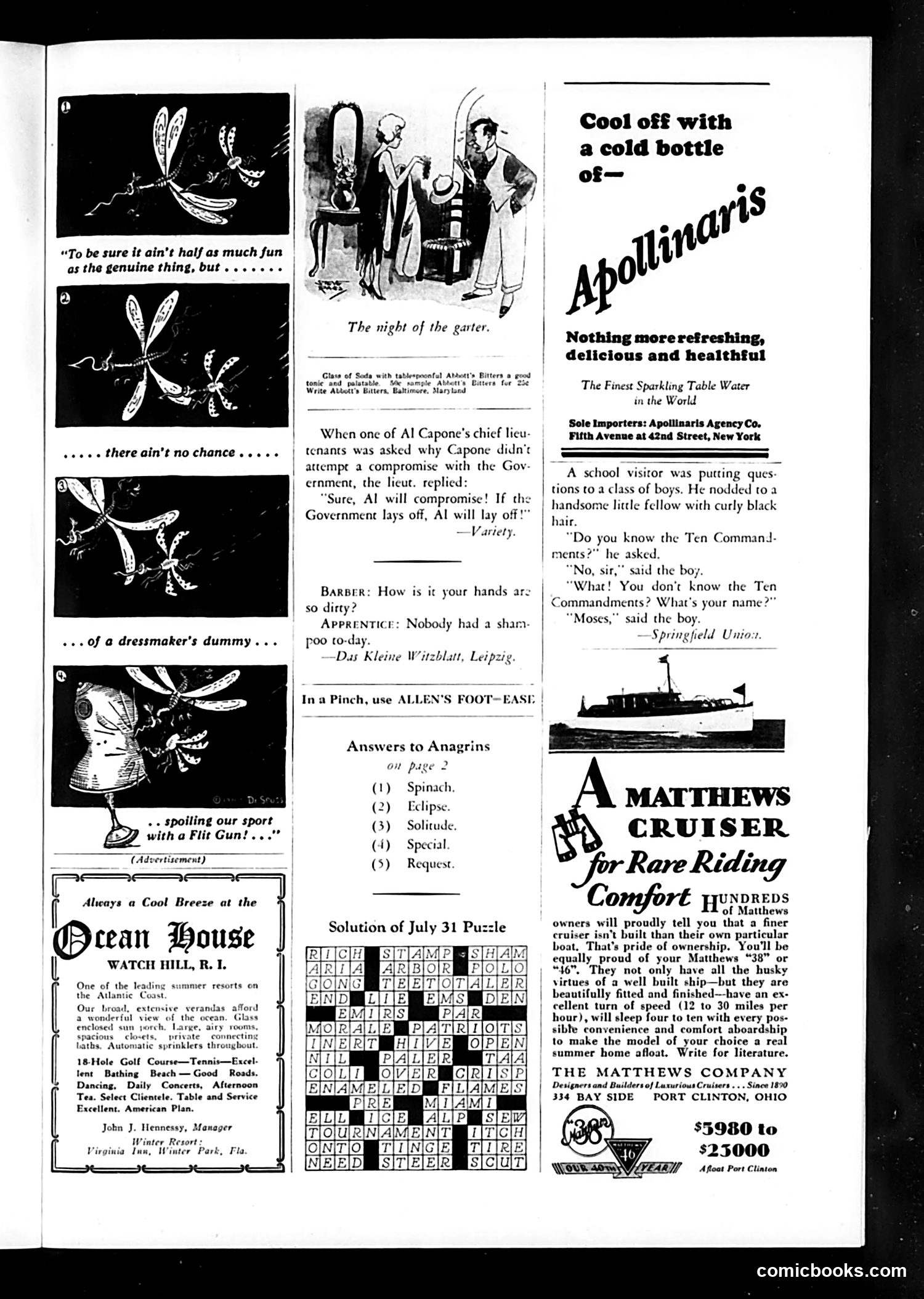
Explanation for Modern Readers This page contains three separate satirical pieces: 1. Capone Cartoon: References Al Capone's defiance of Prohibition enforcement. A lieutenant claims Capone will "compromise" only if the government abandons enforcement—a joke about his refusal to negotiate, suggesting he views law enforcement as toothless. 2. Barber Shop Joke: A German comic about a dirty apprentice claiming he "had no shampoo today"—wordplay on the German phrase for lacking soap. 3. Moses Joke: A school visitor asks boys if they know the Ten Commandments. When one handsome boy says "no," the visitor asks his name, and the boy replies "Moses"—humor based on the biblical irony that Moses *received* the Commandments. The remainder is advertising for Apollinaris sparkling water, Ocean House resort, and Matthews luxury cruisers—typical Life magazine content from the 1920s-30s era.
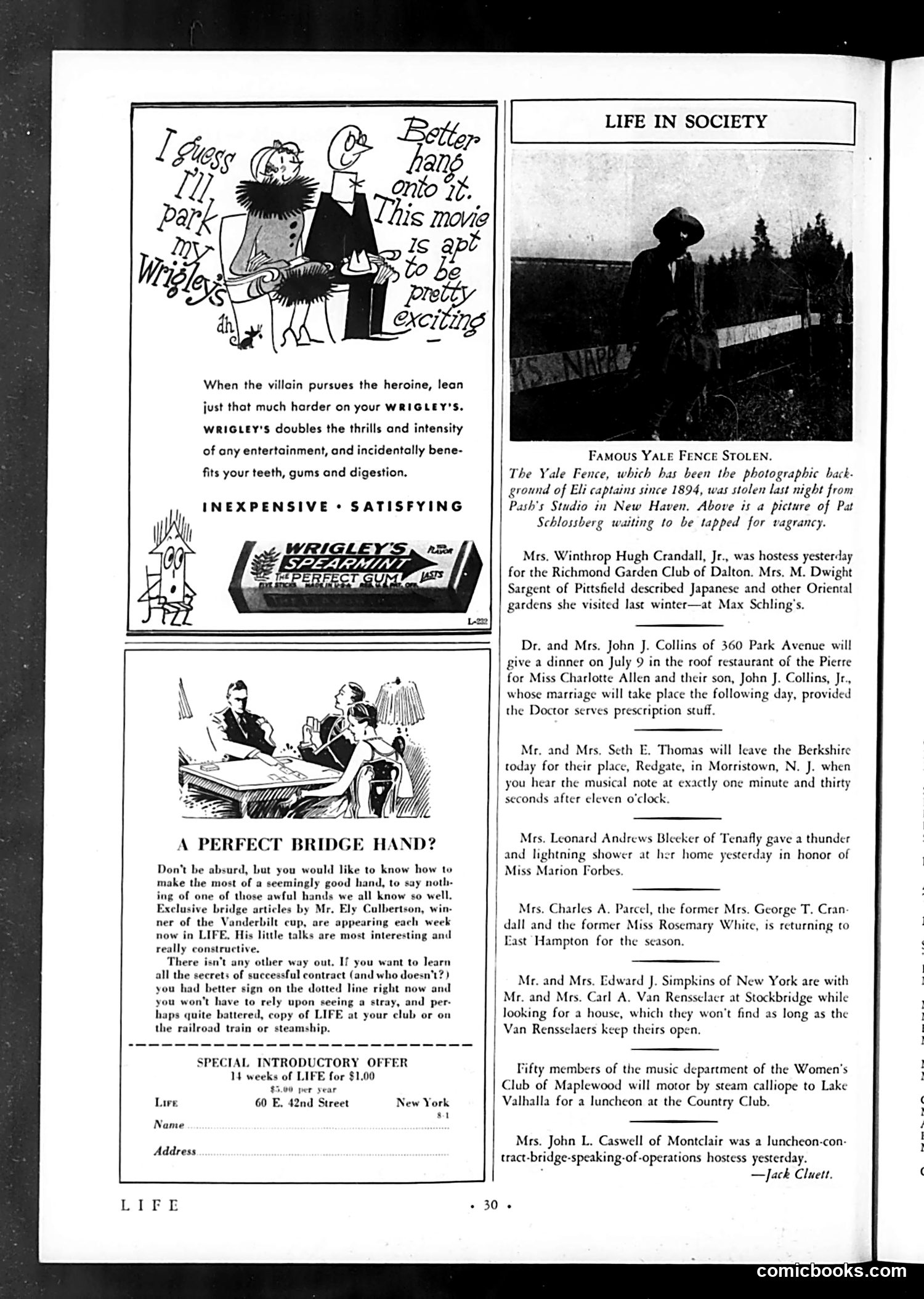
Life Magazine Page Analysis This page combines advertising with society gossip satire. The left side features two Wrigley's gum ads using cartoon humor, and a bridge-instruction advertisement promoting Ely Culbertson's contract bridge columns in Life magazine. The right side is a "Life in Society" gossip column that satirizes wealthy upper-class social activities through mock-serious reporting. Examples include: - A stolen "Yale Fence" photo prop with a joke about vagrancy - Garden club meetings at expensive florists - Engagements contingent on Prohibition ("prescription stuff") - A joke about guests overstaying their welcome - A humorous final item about a hostess discussing "contract-bridge-speaking-of-operations" (unclear, possibly mockingly pretentious jargon) The satire targets the trivial concerns and social pretensions of the wealthy elite during what appears to be the Prohibition era. The column's dry, deadpan tone makes the absurdity of these activities apparent to readers.
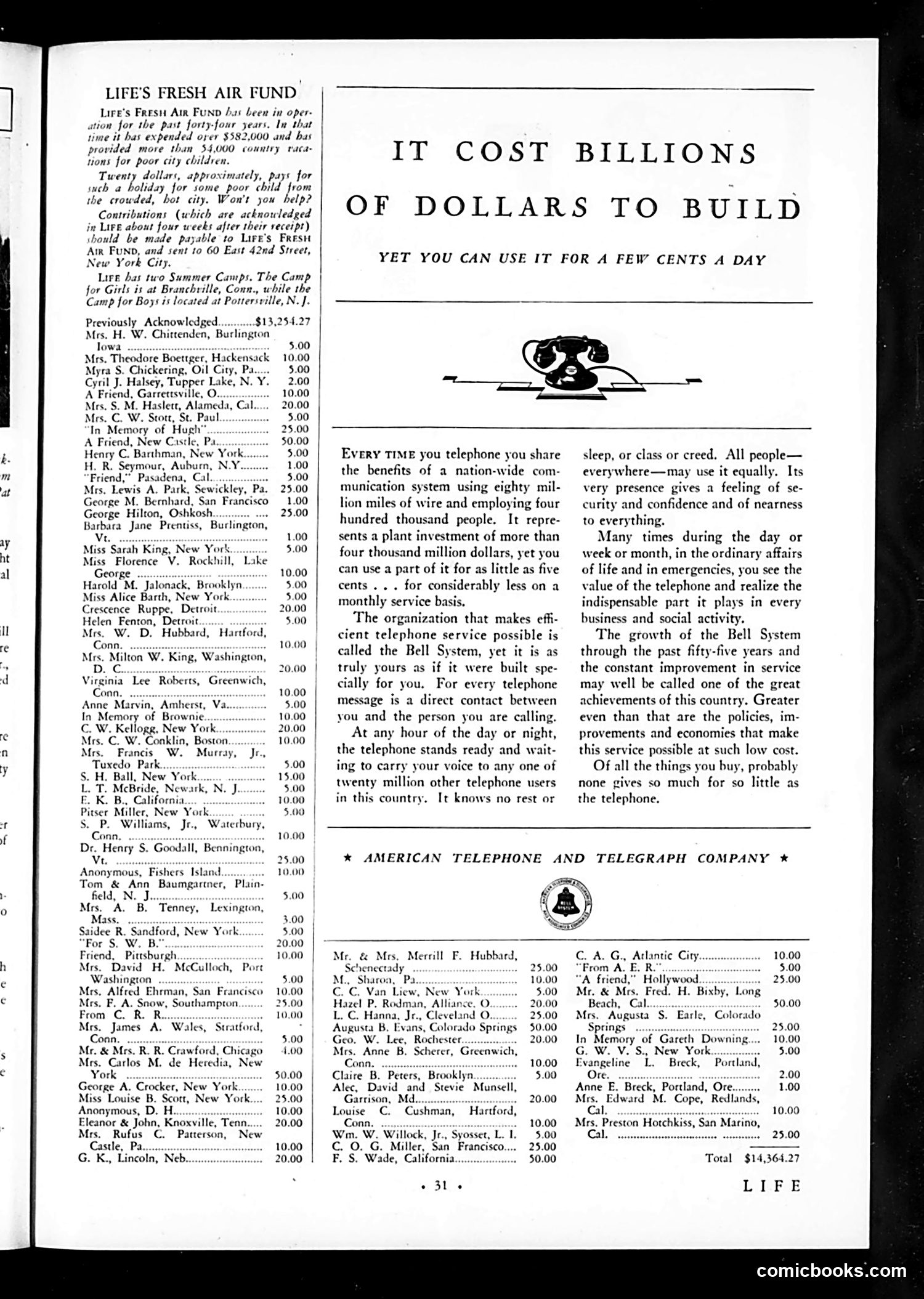
Page Analysis This is primarily a fundraising page for Life magazine's Fresh Air Fund, a charitable program providing country vacations for poor urban children. The left side lists donor contributions totaling over $13,000. The right side features an advertisement for American Telephone and Telegraph Company (Bell System). The ad employs a common early 20th-century marketing strategy: juxtaposing massive infrastructure investment against affordable consumer access. The headline "It Cost Billions of Dollars to Build / Yet You Can Use It for a Few Cents a Day" emphasizes the remarkable value proposition of telephone service—encouraging readers to appreciate the Bell System's achievement while subtly promoting its affordability and ubiquity. The accompanying illustration shows a simplified telephone switchboard mechanism, visualizing the complex technology behind the service. This advertisement represents corporate messaging during the era when telephone networks were considered modern marvels worthy of celebratory promotion in general-interest magazines.
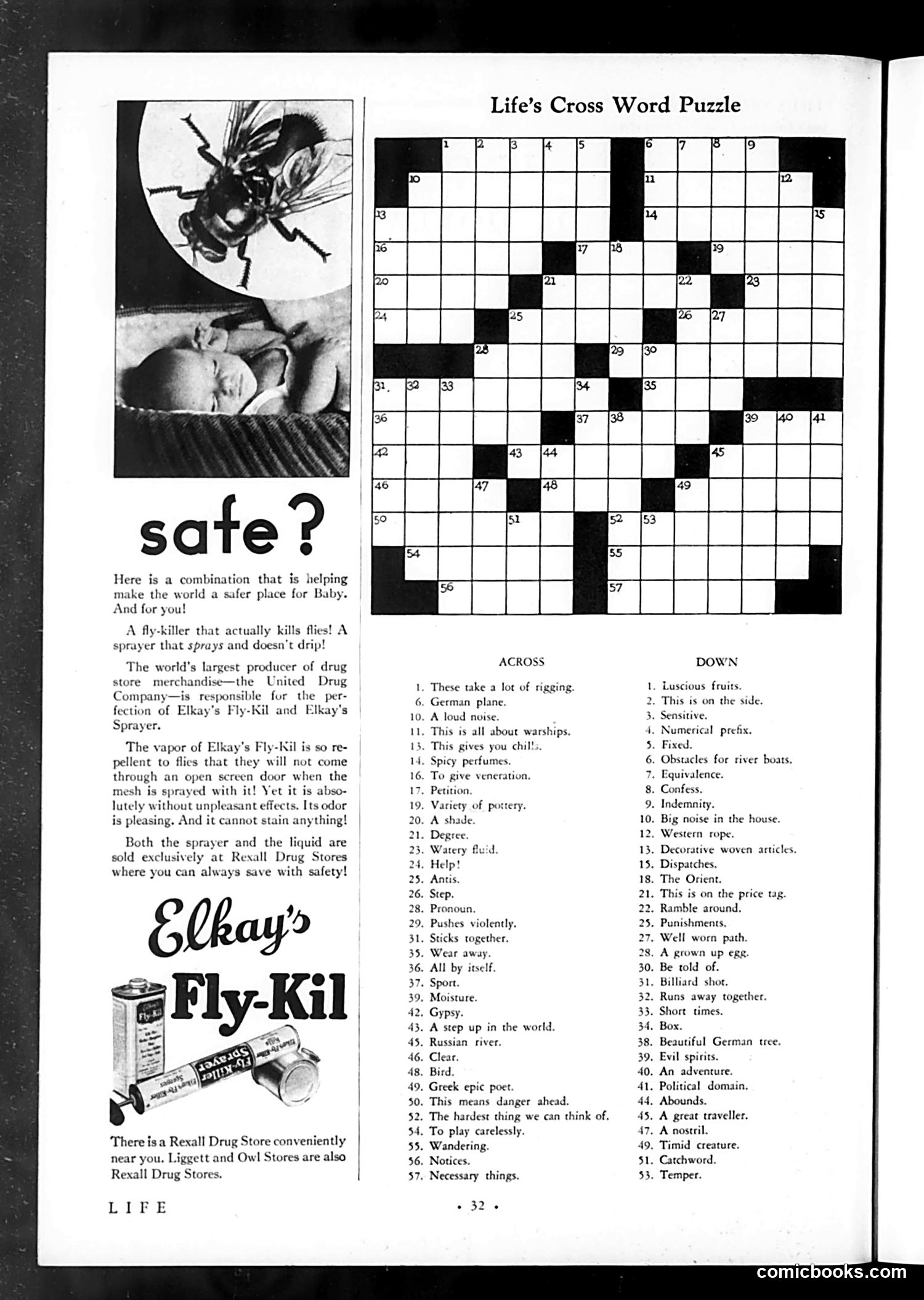
Life's Cross Word Puzzle Page Analysis This page is primarily advertising disguised as entertainment. The crossword puzzle itself is generic filler content typical of Life magazine. The actual content is a product advertisement for Elkay's Fly-Kil, a fly-killing spray sold through Rexall Drug Stores. The marketing hook frames pest control as a public health safety measure—"making the world a safer place for Baby"—suggesting flies posed a genuine disease threat to infants (a legitimate concern in the pre-DDT era). The advertisement emphasizes two product features: the spray kills flies effectively and the dispenser "doesn't drip," addressing practical consumer complaints. It credits the United Drug Company as the manufacturer and emphasizes the product's pleasant odor and non-staining properties. The accompanying photograph shows a fly and a sleeping baby, visually connecting pest control to child safety—a persuasive advertising technique linking the product to parental responsibility.
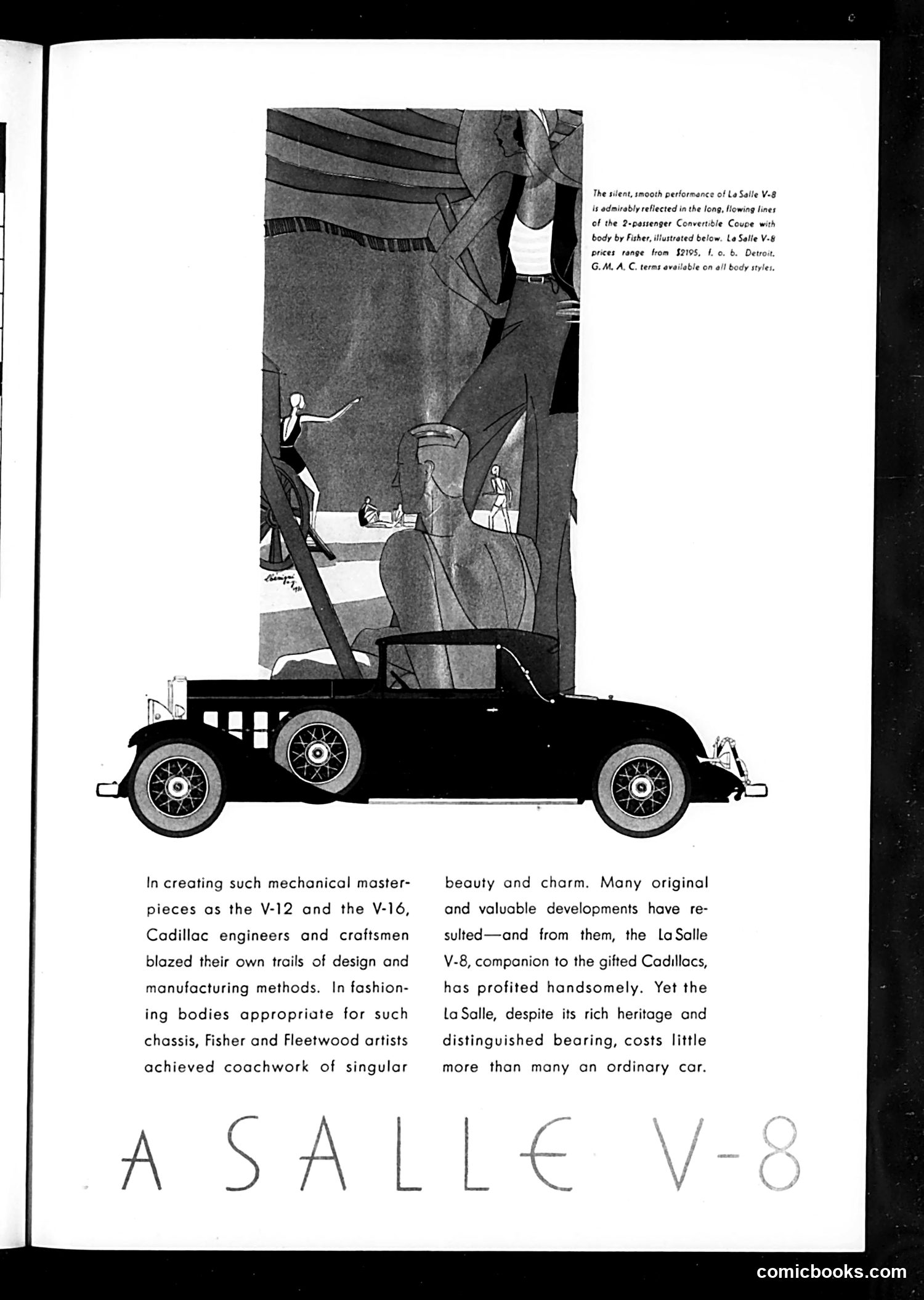
Analysis This is primarily an automobile advertisement, not political satire. The page promotes the LaSalle V-8, a luxury car made by General Motors. The illustration depicts a stylized convertible coupe shown in profile against an art deco background featuring fashionably dressed figures in what appears to be an elegant social setting. The imagery emphasizes sophistication and modern design. The text's key message: despite the LaSalle's prestigious engineering heritage (developed by Cadillac craftsmen and Fisher/Fleetwood body designers) and luxurious appearance, it costs only slightly more than ordinary cars—making it an accessible luxury option. The art deco style and references to "singular beauty and charm" reflect 1920s-30s advertising aesthetics, positioning the vehicle as both mechanically superior and socially aspirational for middle-class readers.
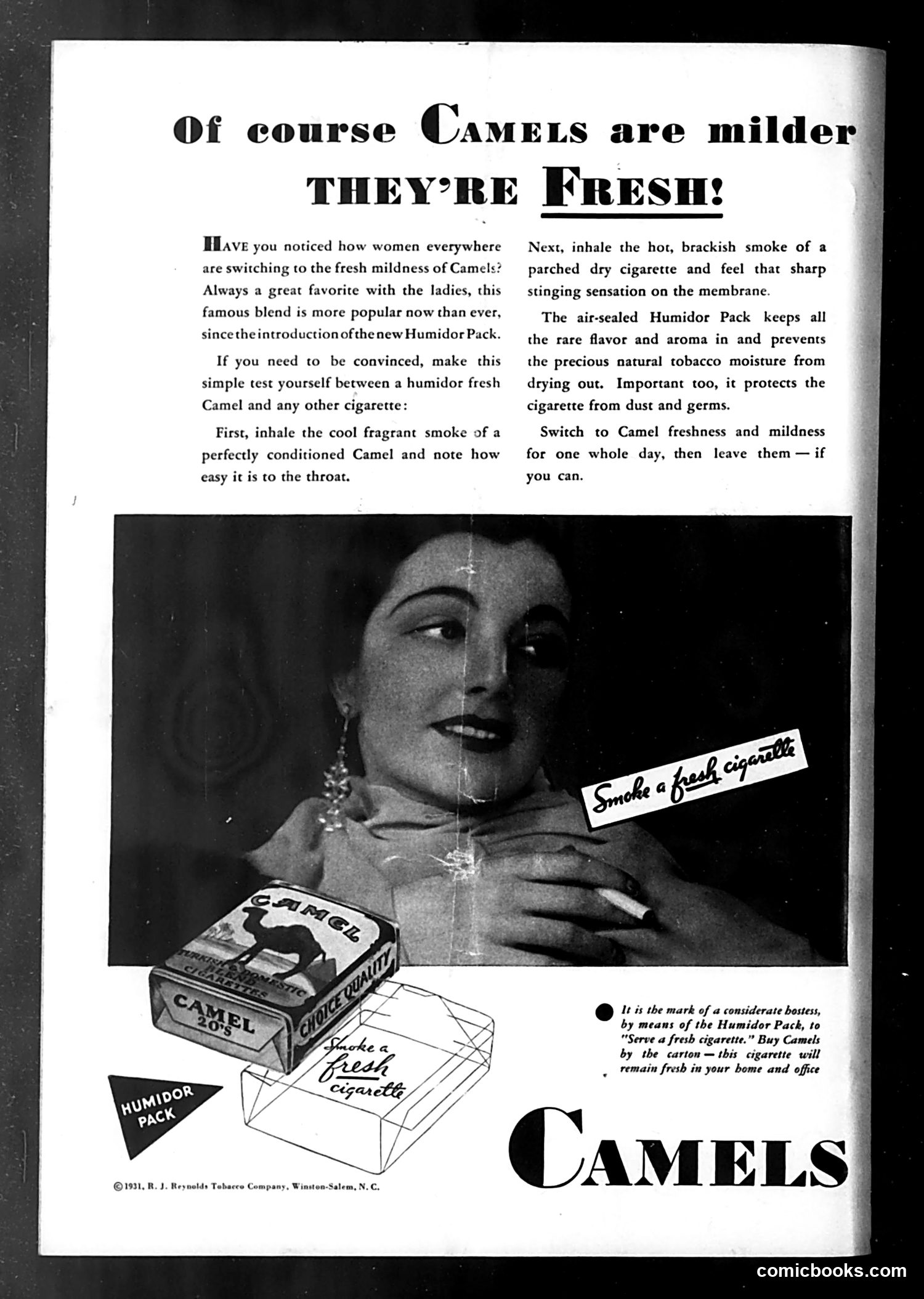
Analysis This is a cigarette advertisement, not political satire. It's a 1931 Camel cigarettes ad targeting women consumers. The page features a photograph of a smiling woman holding a cigarette, alongside product images of Camel packs and the new "Humidor Pack" (an air-sealed packaging innovation). The ad copy emphasizes that Camels are "milder" and "fresh," positioning them as especially appealing to female smokers—a deliberate marketing strategy, as the opening line states: "women everywhere are switching to the fresh mildness of Camels." The "Humidor Pack" is presented as a technological advantage: it keeps tobacco moist and protected from dust and germs, maintaining freshness. The ad encourages readers to compare Camels directly against unnamed competitors. For modern readers: This represents early 20th-century cigarette marketing that explicitly targeted women and made health-adjacent claims ("easy on the throat," "milder") that would be illegal today. The gendered approach—calling serving fresh cigarettes "the mark of a considerate hostess"—reflects period attitudes about women's roles.

I can see this is a nearly blank black page with "comicbooks.com" printed at the bottom right corner and what appears to be a white binding edge on the left side. The page shows significant age-related degradation with spots and marks throughout. This appears to be a back cover, blank page, or end matter from a publication, likely scanned from an archive. Without visible cartoon content, text, or illustrations to analyze, I cannot identify any political figures, social references, or satirical messaging. The page itself contains no discernible cartoon or substantive content for historical analysis.