life
Life — August 14, 1931
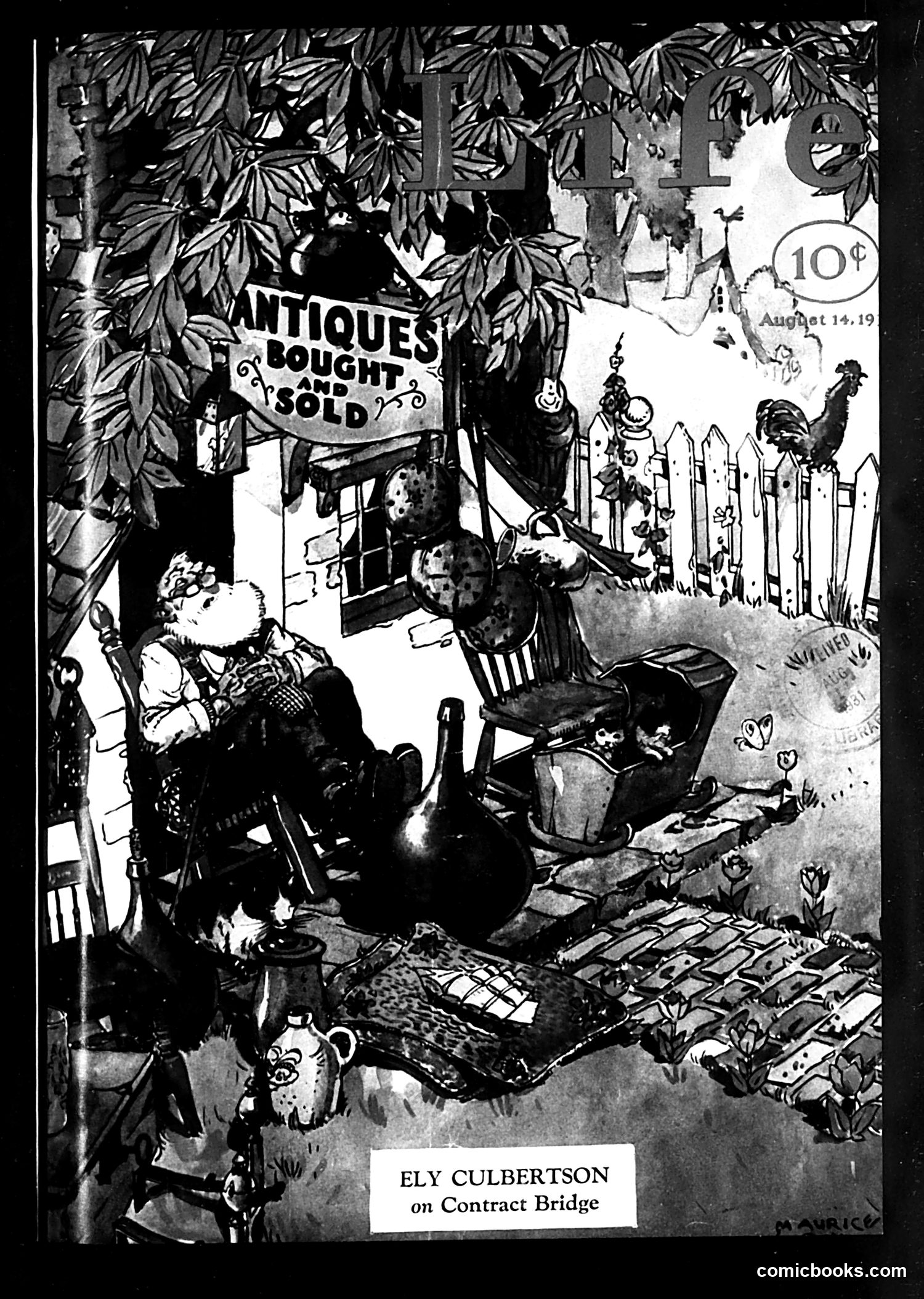
Analysis This appears to be a Life magazine cover from August 14, 1919 (price 10¢). The illustration is credited to "ELY CULBERTSON on Contract Bridge" and depicts an antique shop scene with an "ANTIQUES BOUGHT & SOLD" sign. The cartoon likely satirizes the popularity of Contract Bridge, a newly fashionable card game in 1919. The joke appears to connect bridge-playing with accumulating antiques—possibly suggesting that bridge players are either wasting time collecting old items, or that the game itself was becoming as dated as antiques. The charming domestic scene with figures in the garden and shop setting provides the visual context for this social commentary on contemporary leisure habits and consumer culture among the American middle class.
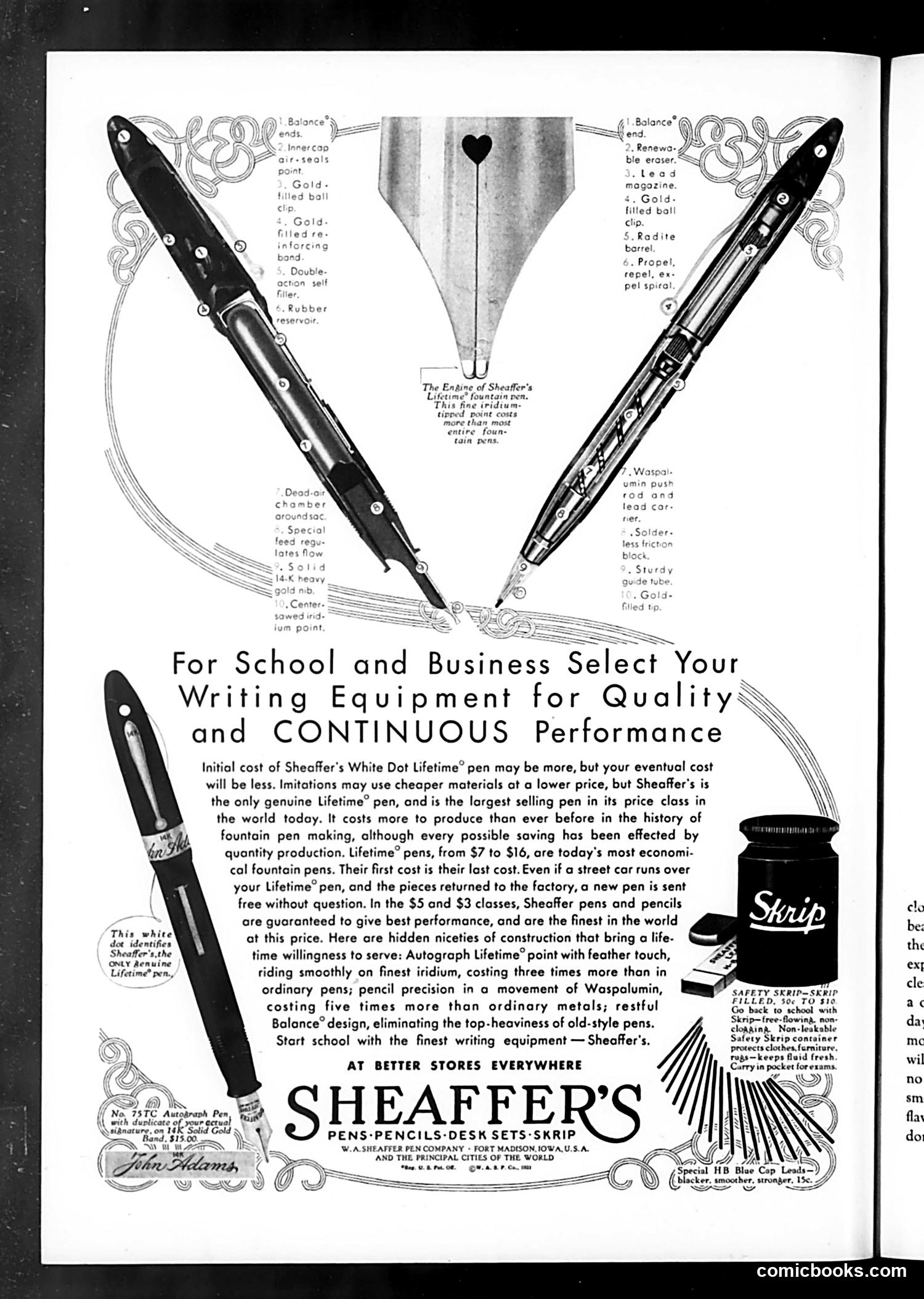
Content Analysis This is a full-page advertisement for Sheaffer's pens and writing supplies, not a political cartoon. The page contains no satire or social commentary. The ad features detailed technical illustrations of Sheaffer's fountain pens (labeled "Lifetime" pens) with cross-sections showing internal mechanisms like the gold nib, ink feed system, and ball-clip. There's also an illustration of the "Skrip" ink bottle. The marketing message emphasizes durability and quality: though initially more expensive than competitors, Sheaffer pens allegedly cost less over time due to superior construction. The ad claims these are "the largest selling pen in the world" and recommends them for "school and business." This represents typical mid-20th-century advertising copy focusing on product longevity and professional reliability.
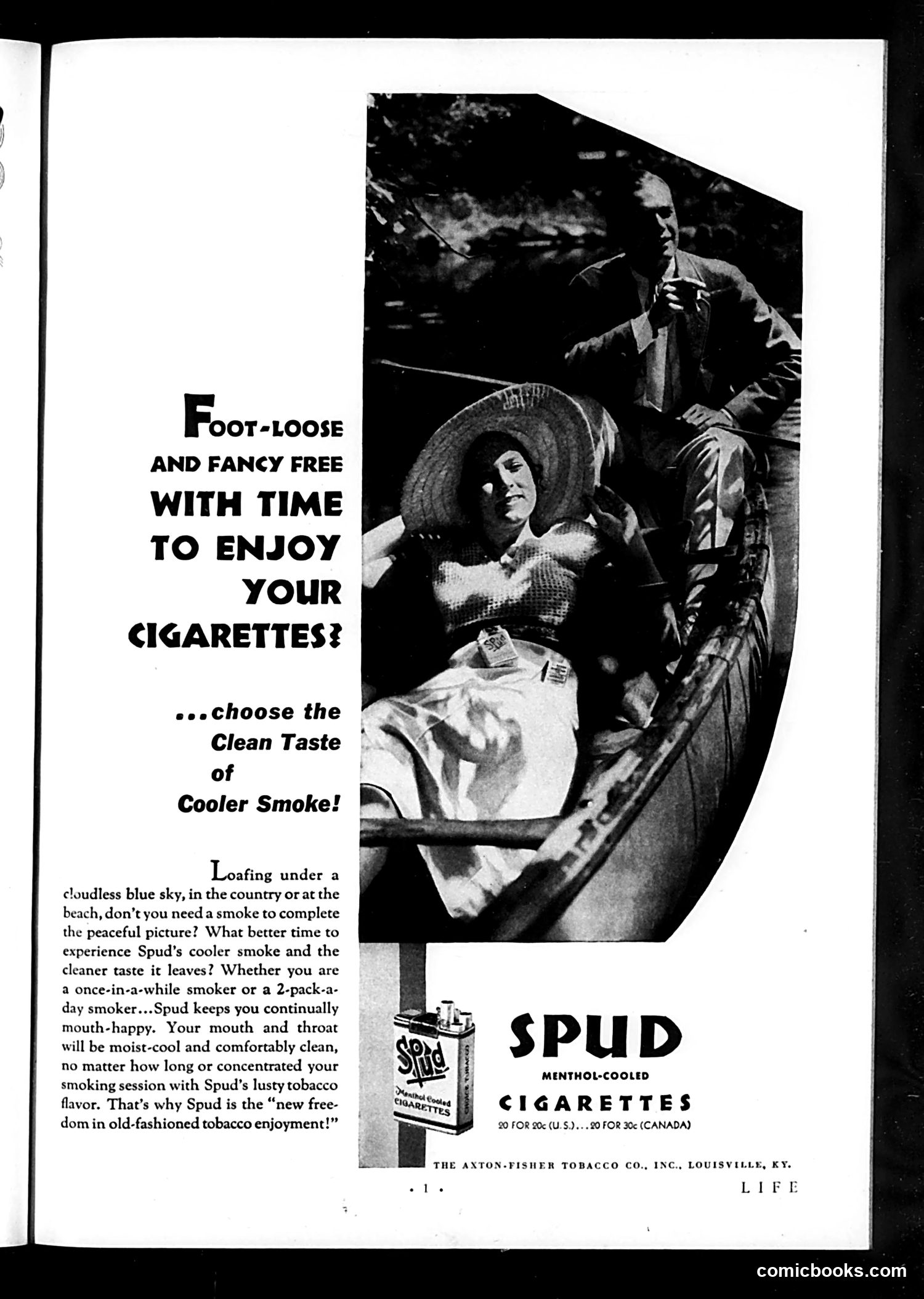
Analysis This is a cigarette advertisement, not satirical content. It's a vintage Spud menthol cigarettes ad from Life magazine, promoting "the Clean Taste of Cooler Smoke!" The ad features a romantic scene: a couple relaxing outdoors—a woman in a wide-brimmed hat and the man in casual attire. The copywriting emphasizes leisure and comfort, claiming Spud cigarettes keep your mouth "moist-cool and comfortably clean" during smoking. For modern readers: This reflects mid-20th century advertising's brazen health claims (now banned). "Clean taste" and "cooler smoke" were marketing language suggesting health benefits. The lifestyle imagery—carefree relaxation—was standard cigarette marketing targeting leisure-oriented consumers. The product is presented as enhancing enjoyment and social situations, a common approach before tobacco's dangers were widely acknowledged.
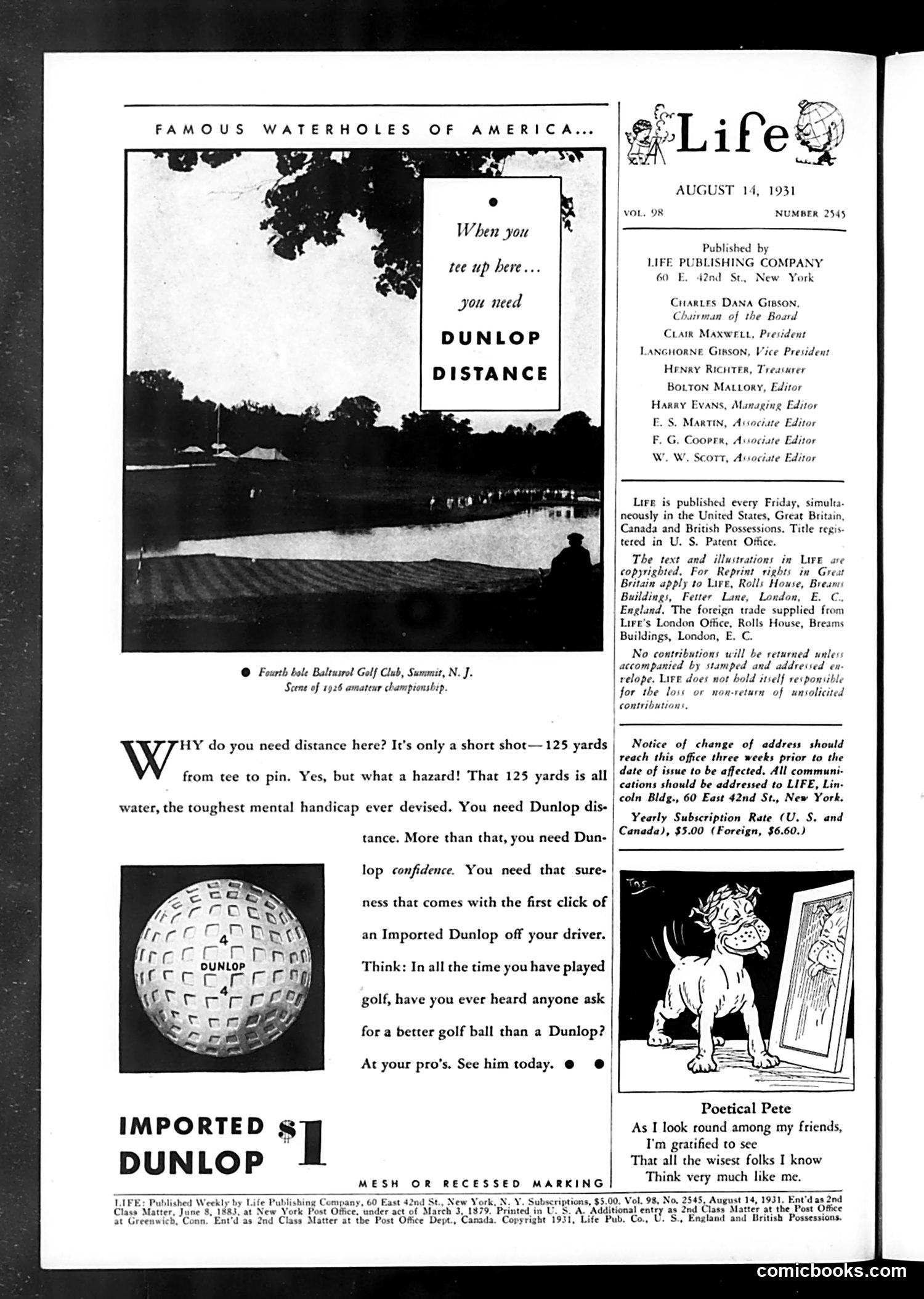
Content Analysis This page is primarily advertising, not satire or political commentary. The main content is a Dunlop golf ball advertisement (imported model, priced at $1). The ad uses the setup of a water hazard at "Fourth Isle Ballroad Golf Club, Summit, N.J." to argue that golfers need Dunlop balls for confidence and distance—claiming 125 yards across water requires superior equipment and reliability. The small cartoon at bottom right, titled "Poetical Pete," appears to be unrelated filler humor—a dog looking at a mirror with a humorous poem about the dog thinking "all the wisest folks I know / Think very much like me." The page also includes masthead information for *Life* magazine (August 14, 1931, Vol. 98) and publication details. This is a commercial page with minimal satirical content.
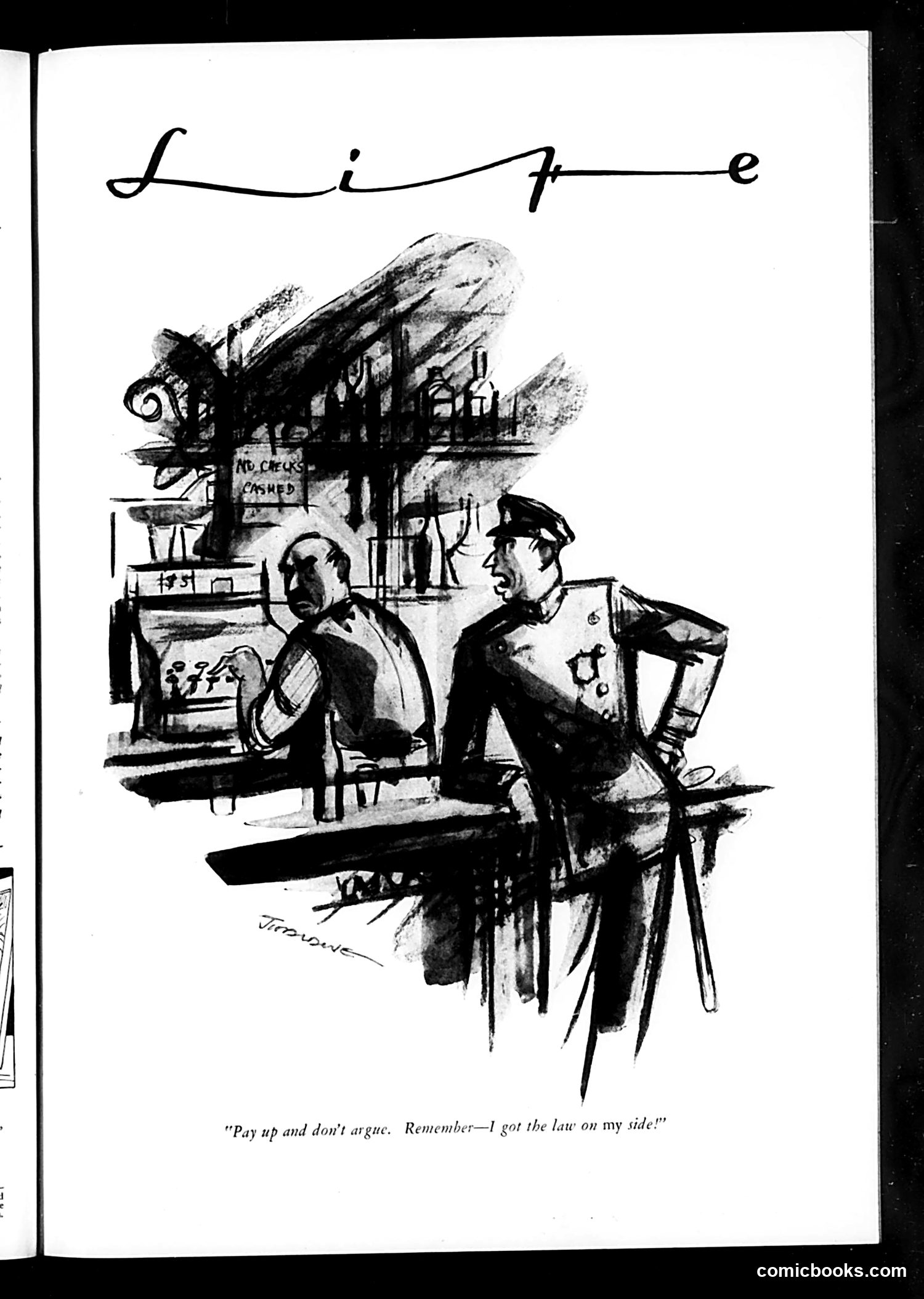
Analysis This cartoon satirizes police corruption or abuse of authority. The scene shows two men in what appears to be a police station or official building (note the desk and "No Checks Cashed" sign). One figure, likely a corrupt official or police officer, demands payment from another man while asserting "Pay up and don't argue. Remember—I got the law on my side!" The satire targets how those with legal authority exploit their position for personal gain, using their power to intimidate and extort from ordinary citizens. The phrase "got the law on my side" is ironic—rather than protecting people, the law becomes a tool for corruption. This reflects early-to-mid 20th century concerns about police misconduct and institutional abuse of power in American cities.
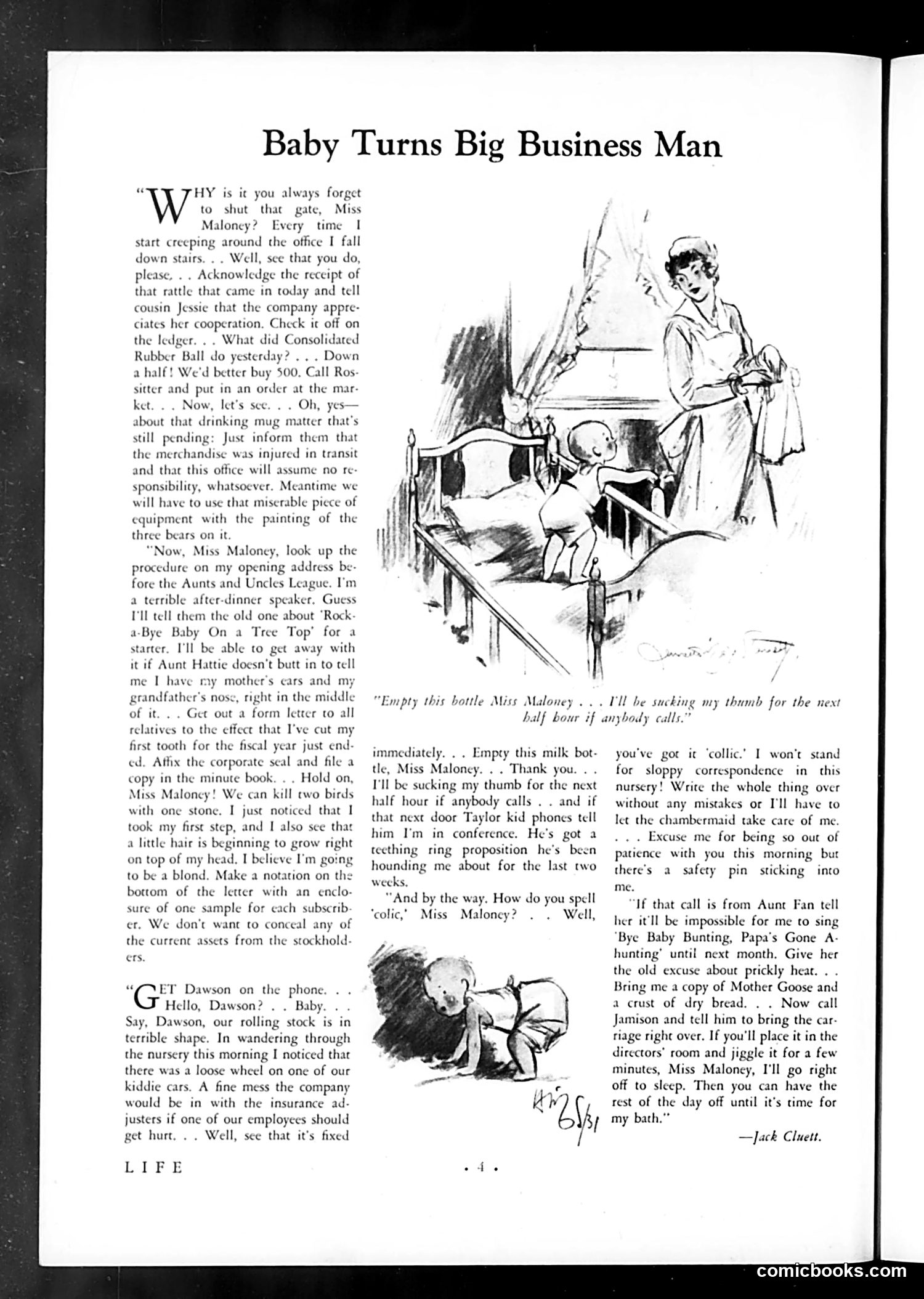
"Baby Turns Big Business Man" This satirical piece mocks the absurdities of corporate bureaucracy through a baby's perspective. A harried office manager (Miss Maloney) addresses an infant, treating it as a serious employee while delivering mundane workplace complaints: forgotten gates, damaged merchandise, ledger discrepancies, and equipment maintenance. The humor derives from the incongruity of conducting professional business with a baby—discussing "colic," teething, and bottle-feeding alongside corporate procedures, insurance liability, and stockholder concerns. The satirist (Jack Cluett) suggests that corporate management has become so mechanized and depersonalized that even infants could perform these roles equally well. The cartoons show the baby sitting at a desk and in a crib, visually reinforcing how infantilized adult corporate work has become—a common modernist critique of early 20th-century industrialization.
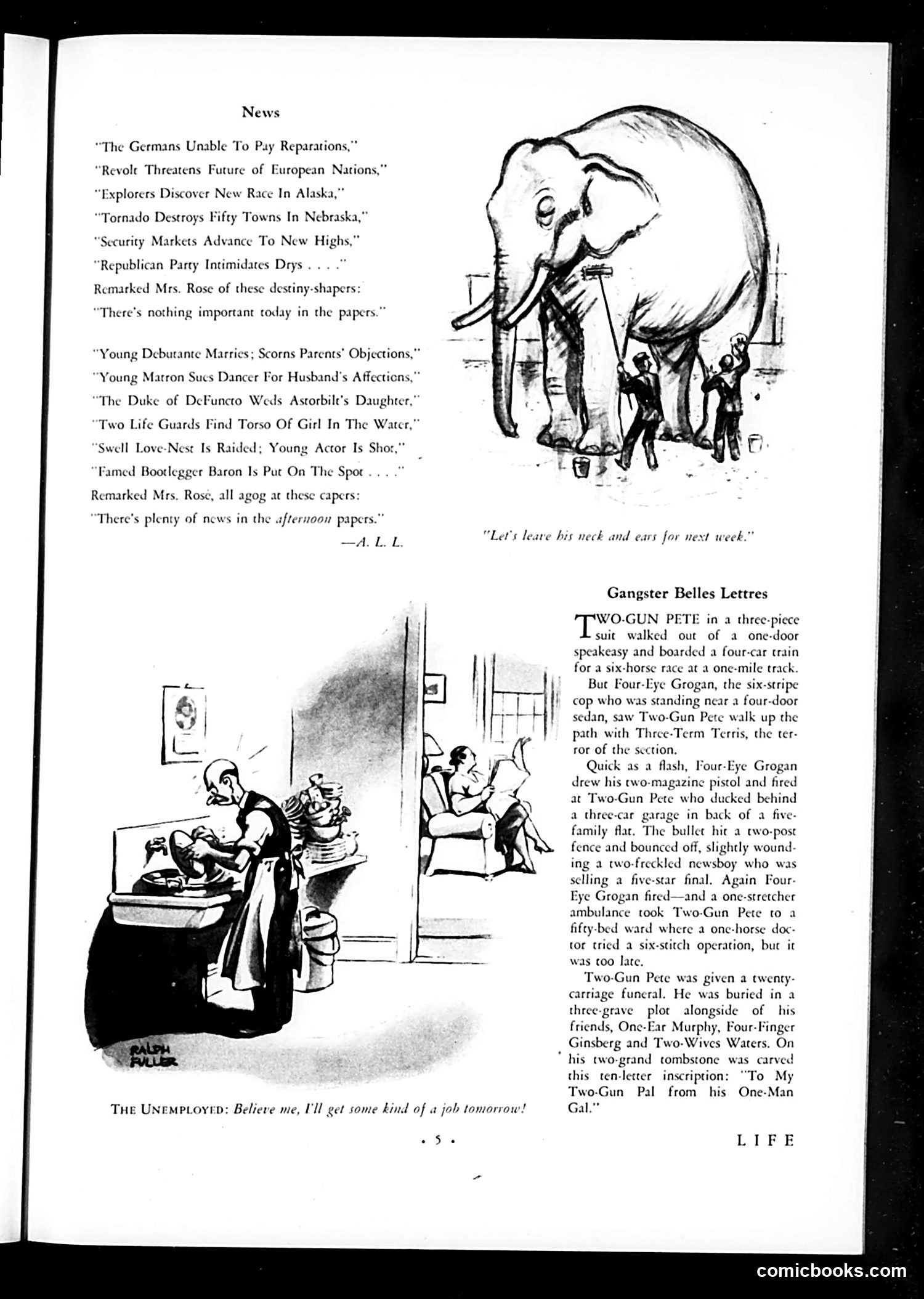
Analysis of Life Magazine Page The page contains two distinct elements: Top Section ("News"): A satirical poem by A. L. L. mocking newspaper headlines. Mrs. Rose dismisses serious global news ("Germans Unable To Pay Reparations," "Revolt Threatens Future of European Nations") as unimportant, but finds afternoon papers full of gossip about debutantes, actors, and society marriages. The accompanying elephant cartoon reinforces this critique—trivial human concerns dwarf against larger realities. Bottom Section ("Gangster Belles Letters"): A humorous crime narrative about "Two-Gun Pete," a gangster shot by "Four-Eye Grogan" during a train robbery. The dark comedy details Pete's death and twenty-carriage funeral, with his tombstone inscription reading "To My Two-Gun Pal from his One-Man Gal." Together, these pieces satirize 1920s American culture: society's obsession with celebrity gossip over substantive news, and the era's romanticization of gangster violence.
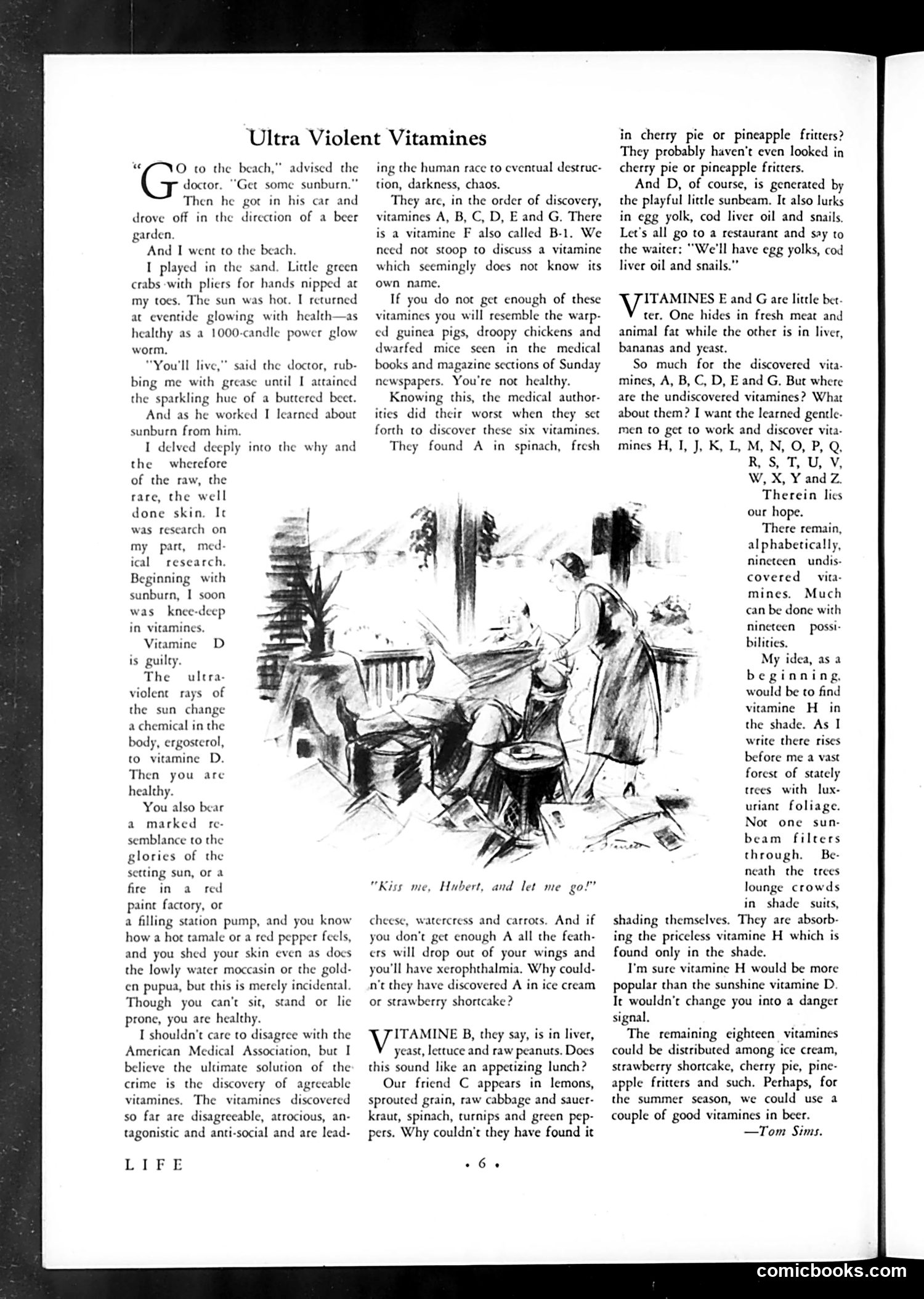
"Ultra Violent Vitamines" - Life Magazine This satirical article mocks the American medical establishment's obsession with newly discovered vitamins in the early 20th century. The text humorously suggests that doctors enthusiastically prescribe vitamins A through G (and hint at undiscovered H through Z) as cure-alls for various ailments, often without solid evidence. The accompanying sketch depicts a domestic scene where someone appears to be consulting about vitamins, likely illustrating the era's vitamin-craze mentality. The satire targets how Americans eagerly adopted vitamin science—sometimes excessively—treating these substances as panaceas. The title "Ultra Violent" suggests the aggressive marketing and promotion of vitamins was absurdly intense, poking fun at both medical professionals overstating benefits and consumers' gullible acceptance of nutritional fads.
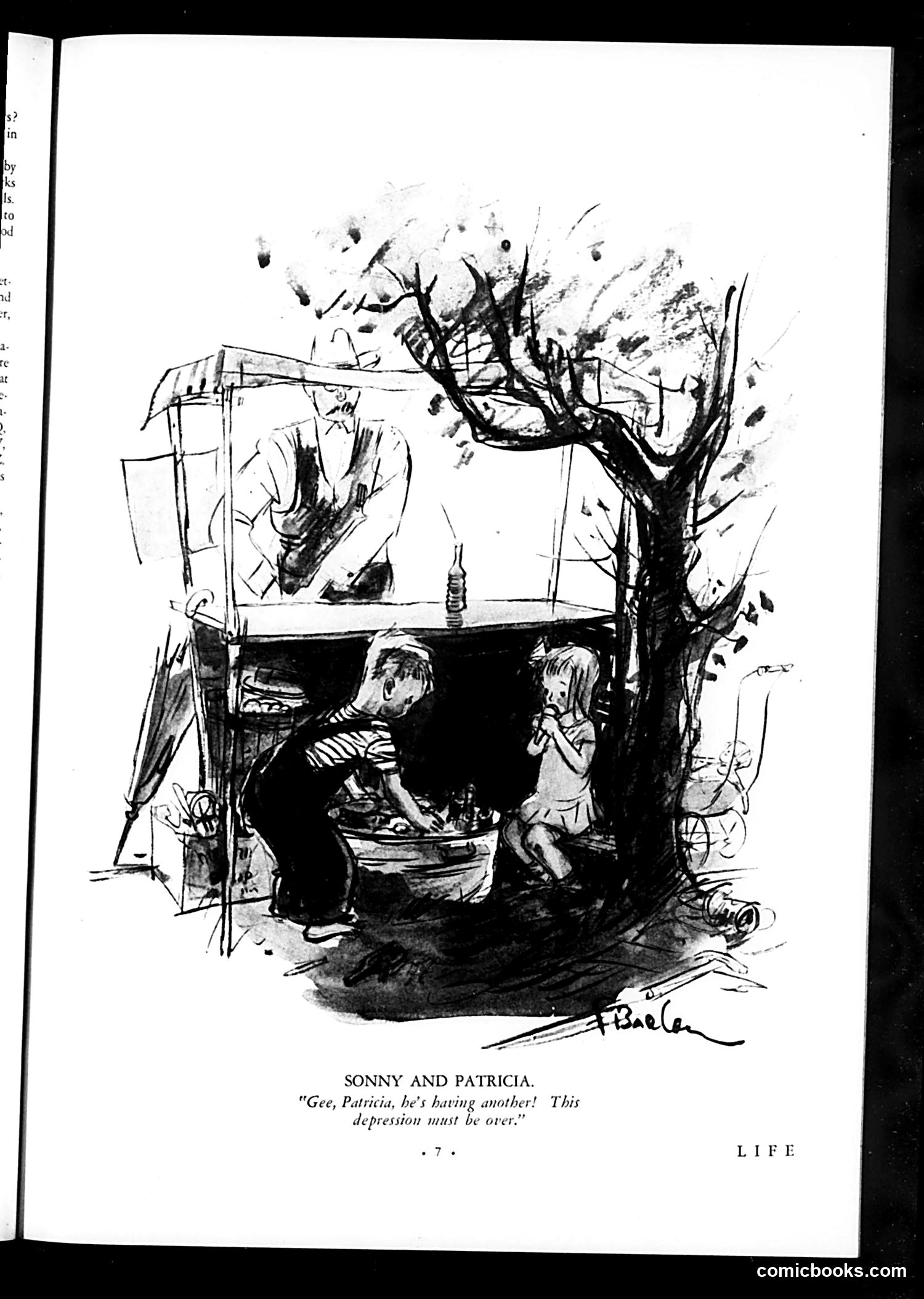
Explanation for Modern Readers This is a humorous domestic cartoon titled "Sonny and Patricia." The illustration shows a man sitting with two young children near a bare tree, apparently living in makeshift or impoverished conditions (suggested by the skeletal tree and sparse shelter). The caption reads: "Gee, Patricia, he's having another! This depression must be over." The joke relies on Depression-era context: the man interprets his wife's pregnancy as a sign that economic conditions are improving—suggesting families felt more optimistic about their financial futures. However, the visual evidence (poverty, bare surroundings) contradicts this optimism, creating dark satire about the gap between hope and harsh reality during the Great Depression.
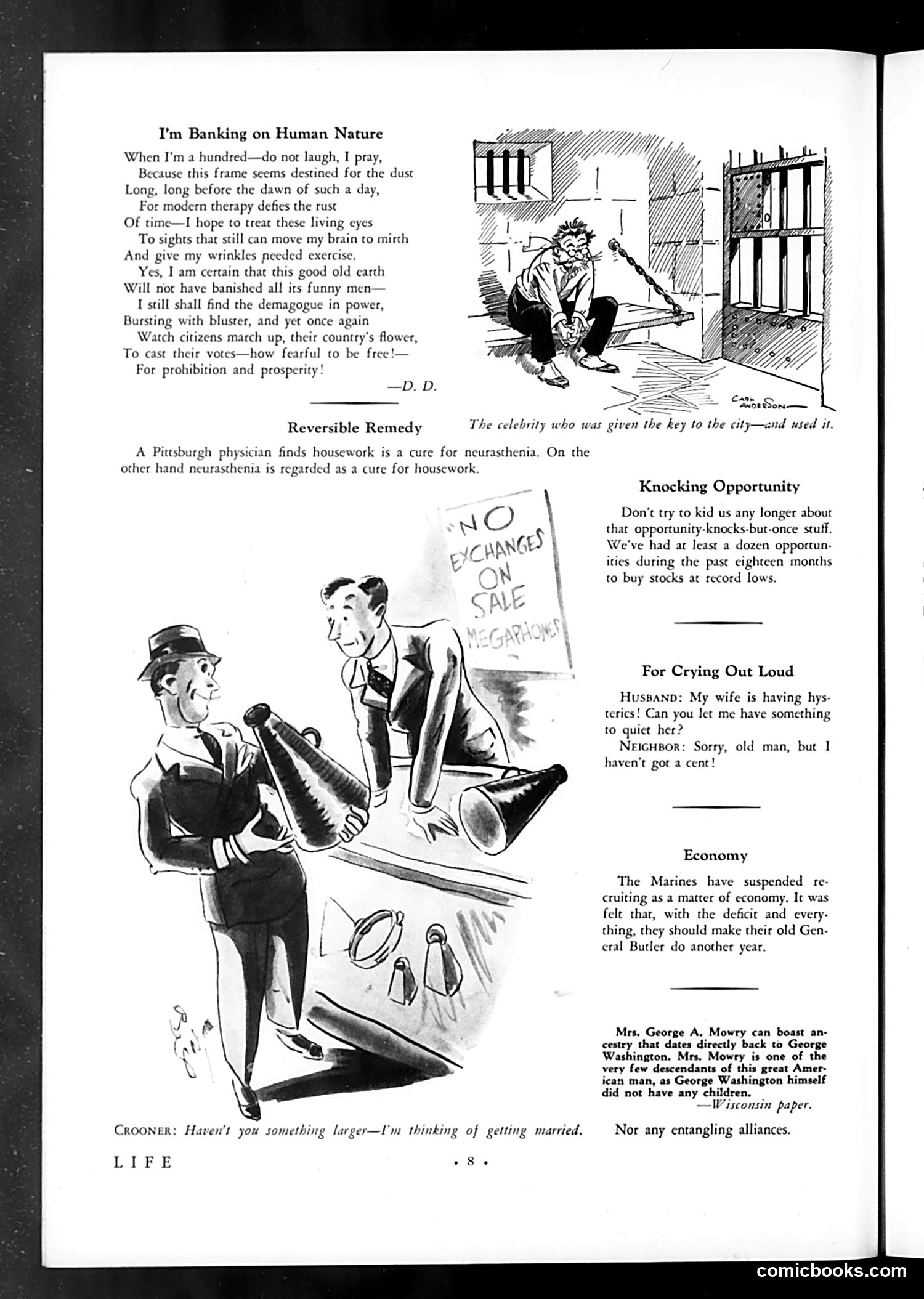
Explanation for Modern Readers This *Life* magazine page contains several satirical short pieces typical of early-20th-century humor. Top: "I'm Banking on Human Nature" is a poem by D.D. expressing optimism that human nature will preserve democracy despite current challenges. The illustration shows an elderly person in a cell, suggesting imprisonment or confinement. Middle: "Reversible Remedy" jokes that a Pittsburgh doctor claims housework cures neurasthenia (anxiety/nervous exhaustion), while housework itself causes the condition—a circular contradiction mocking pseudo-medical claims popular at the time. Bottom: The stock-exchange cartoon depicts a man telling another about marriage while holding a sign reading "No Exchanges on Sale," satirizing both financial markets and marriage as irreversible transactions. The brief text items mock contemporary social issues: hysteria, Marine recruiting cuts, and genealogical pretension.
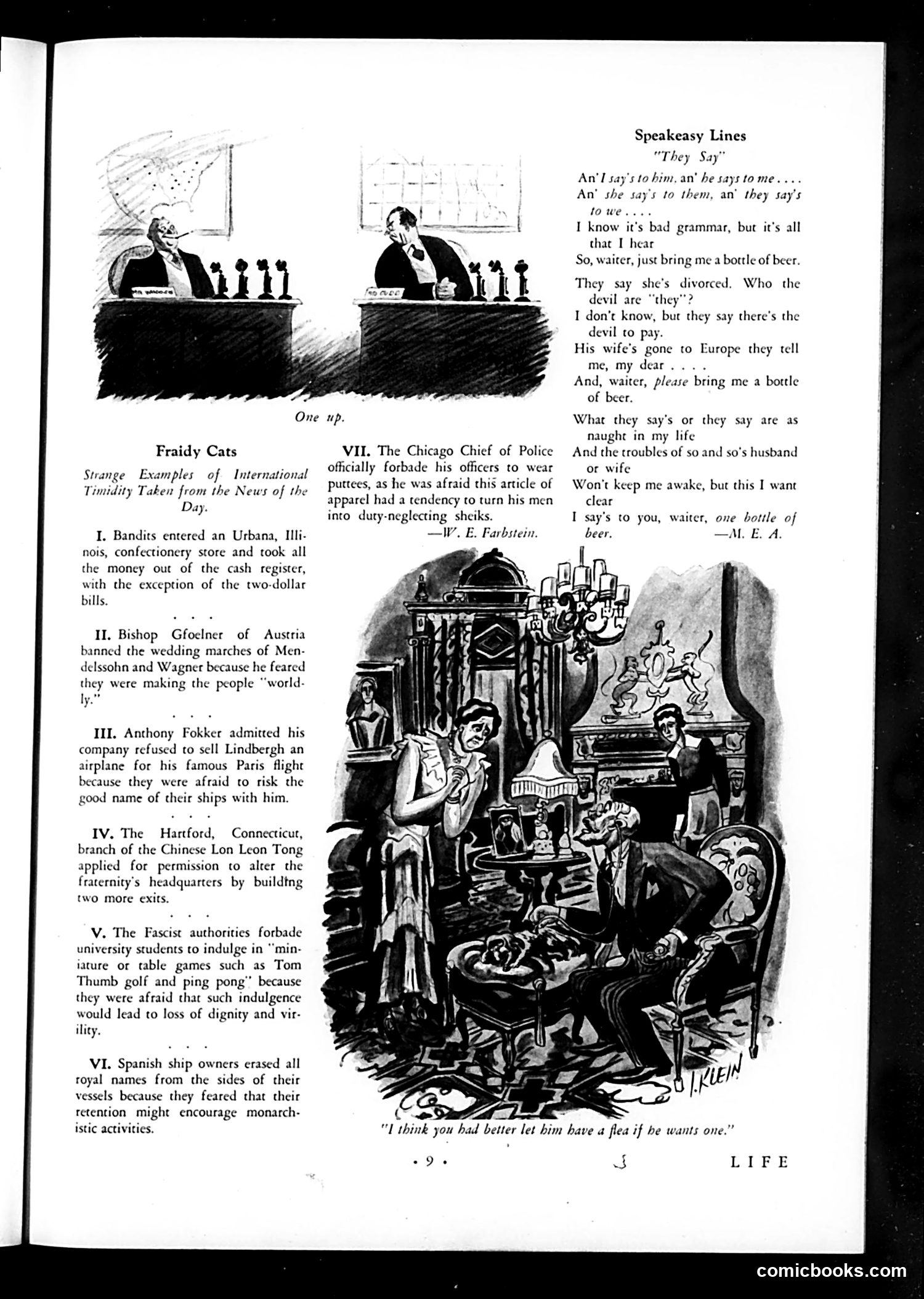
Page Analysis This page combines humor about contemporary social anxieties with satirical observations about international governance. "Speakeasy Lines" (top cartoon) satirizes Prohibition-era bar culture, where rumor and gossip spread—the waiter hears conflicting gossip about "they" and must deal with patrons' drinking demands amid marital scandal. "Fraidy Cats" lists seven instances where authorities or institutions banned activities due to unfounded fears: bandits stealing from cash registers, Austrian bishops banning Wagner, Fokker refusing Lindbergh's plane, Chinese businesses avoiding exits, Fascist authorities forbidding student games, and Spanish ship owners erasing royal names. The satire targets how fear—often exaggerated—drives censorship and control. Lower cartoon depicts industrial chaos, captioning "I think you had better let him have a pea if he wants one," suggesting indulgence amid disorder. The page mocks how fear-based reasoning justifies institutional overreach.
"Life Looks About" - Political Commentary Page This page from *Life* magazine contains three satirical pieces on American politics and society: "Prosperity Coming; Dr. Butler Already Here!" discusses Dr. Butler's optimistic economic predictions and his consistent Republican voting, suggesting his forecasts lack real political influence. "Dr. Murray Butler Returning from Europe" references Butler's observations about U.S. postwar obligations, particularly regarding Congress passing aid resolutions to war-affected nations. "Tut, Tut! Magicians!" satirizes the Society of American Magicians' reported campaign against fortune-tellers, estimating they spend $125 million annually on such services. The piece questions whether magicians should police what the author sees as a legitimate profession. The illustrations appear to be generic decorative cartoons rather than specific caricatures, supporting the text's satirical tone about credibility and influence.
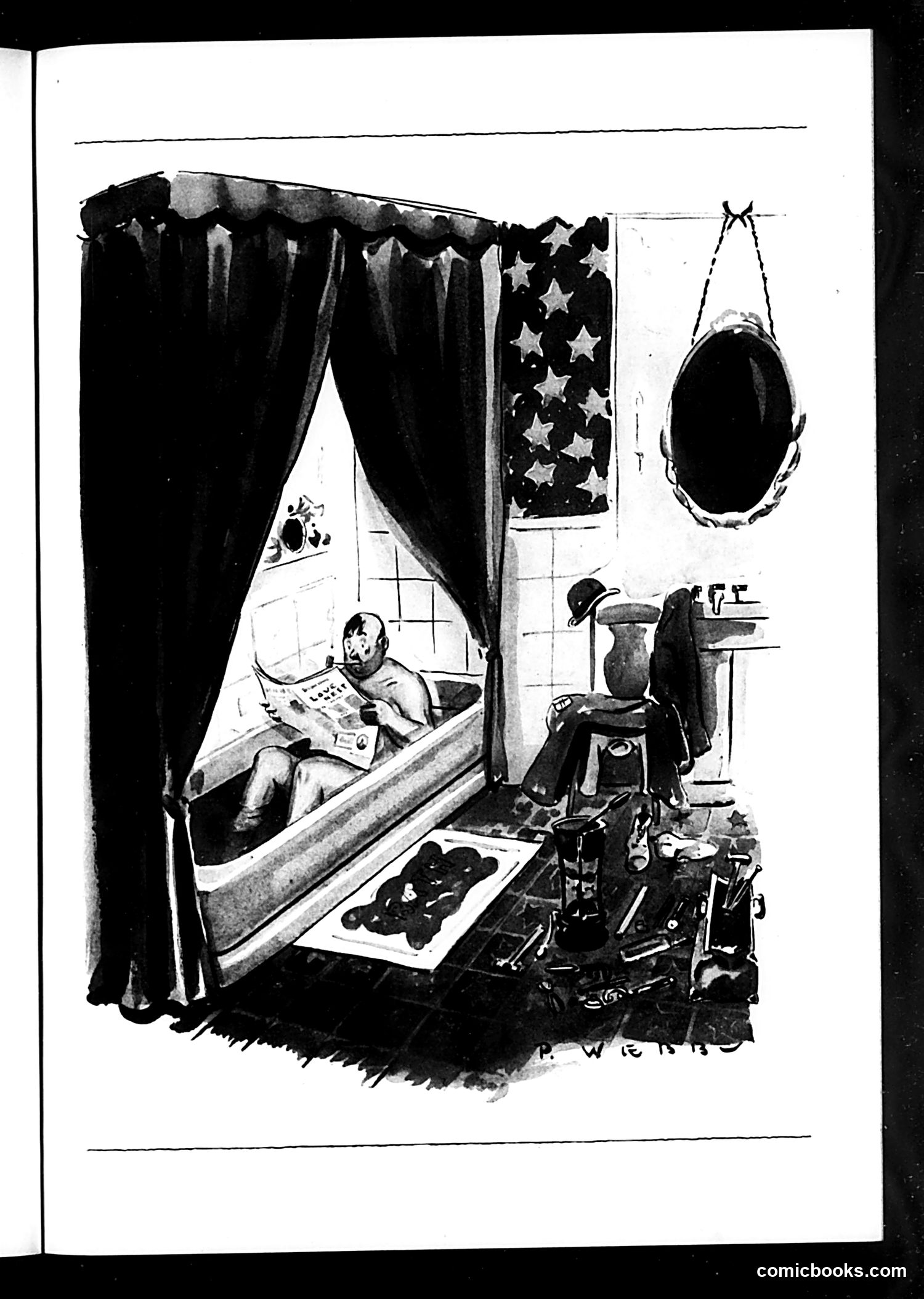
Analysis This black and white cartoon depicts a child in a bathtub reading a newspaper while surrounded by toys and bath items. The bathtub is enclosed by heavy curtains and decorated with stars and patriotic imagery. An oval mirror hangs on the wall above. The satire appears to target childhood isolation or over-protection, possibly reflecting American anxieties about sheltering youth from the outside world. The fortress-like bathtub enclosure with curtains suggests a child completely removed from reality, insulated within domestic space while consuming media (the newspaper). The patriotic decorations might ironically comment on nationalist or propagandistic influences in children's upbringing. Without visible OCR text, the specific historical context remains unclear, though the illustration style suggests early-to-mid 20th century American commentary on parenting, education, or media consumption among youth.
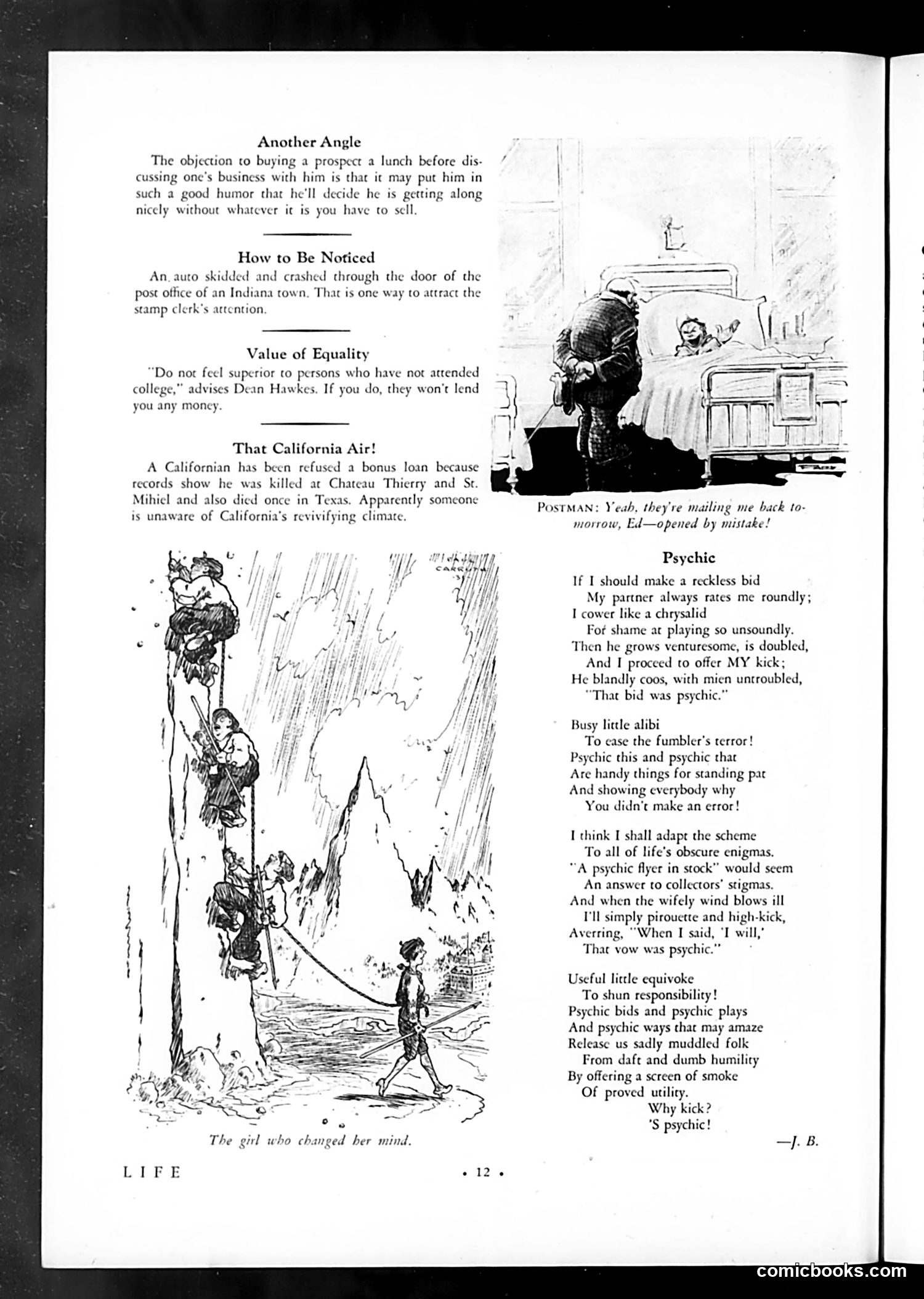
Analysis of Life Magazine Page 12 This page contains several brief satirical items and two cartoons: "Another Angle" mocks the practice of taking business prospects to lunch before negotiations—the joke being they'll feel obligated to buy. "How to Be Noticed" describes an auto accident at an Indiana post office as an attention-getting method. "Value of Equality" quotes Dean Hawkes advising against feeling superior to non-college attendees, humorously suggesting such superiority affects lending. The main cartoon (bottom left) depicts a mountaineer or guide leading climbers up a dangerous cliff face. The caption reads "The girl who changed her mind," suggesting she's reconsidering this perilous journey. The top right cartoon shows a postman with a housewife, joking about misdirected mail. The right column contains a poem titled "Psychic," a humorous piece about fortune-telling and psychic predictions, written by J.B.
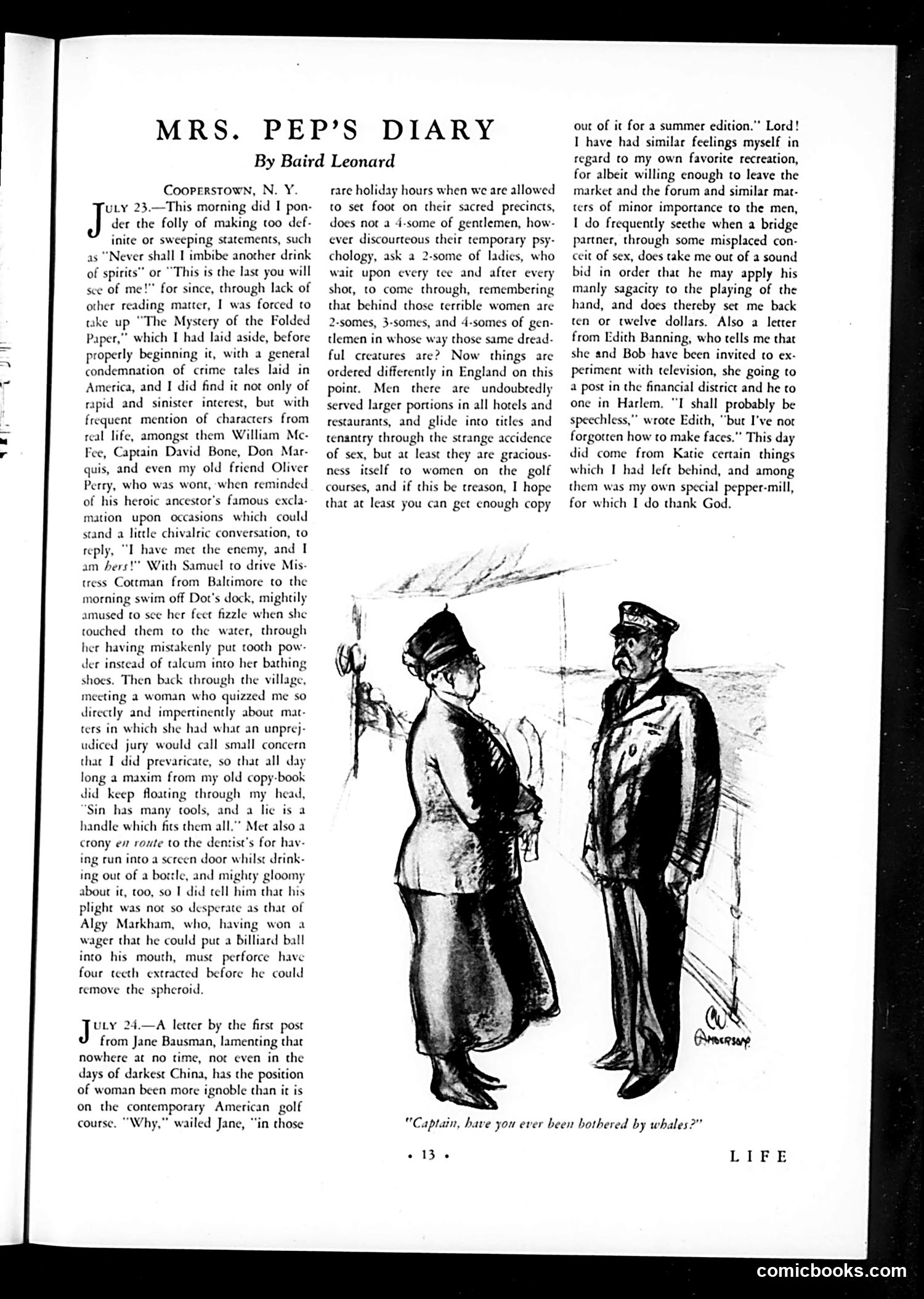
Mrs. Pep's Diary: "Captain, have you ever been bothered by whales?" This page features a humorous diary entry by Baird Leonard set in Cooperstown, N.Y. The accompanying sketch depicts a woman in fashionable dress speaking with a naval officer, with the caption asking if he's been bothered by whales. The diary entry itself is satirical social commentary about American leisure and pretension—mocking women who affect sophistication about golf courses, bridge games, and television, while gossiping about minor scandals. The specific naval exchange appears to be a non-sequitur joke playing on the absurdity of polite small talk, likely poking fun at forced social conventions and the ridiculous topics people use to fill awkward conversations in high society.
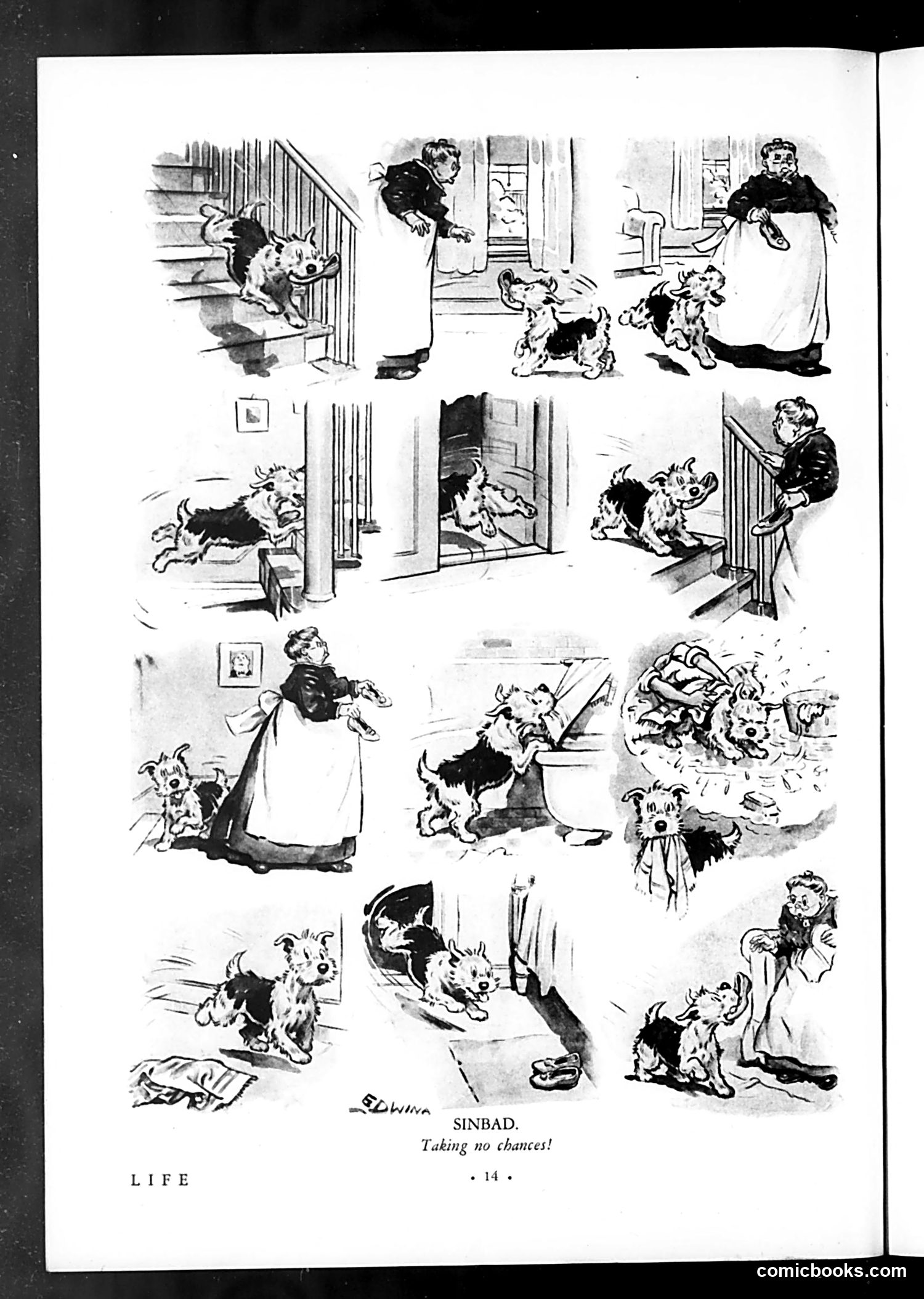
"Sinbad: Taking No Chances!" This is a humorous comic strip by an artist named Shinn depicting a mischievous dog (presumably named Sinbad, referencing the adventurous sailor character) causing chaos throughout a household. The strip shows the dog repeatedly getting into trouble—jumping on furniture, scattering belongings, frightening occupants, and generally wreaking havoc in multiple rooms. The caption "Taking no chances!" suggests the dog is relentlessly pursuing mischief without hesitation or restraint. The humor derives from the escalating mayhem and the exasperated reactions of the human inhabitants trying to manage the destructive pet. This appears to be a domestic comedy strip typical of *Life* magazine's satirical humor, poking fun at pet ownership rather than addressing political or social issues. The appeal would be to readers who owned similarly troublesome dogs.
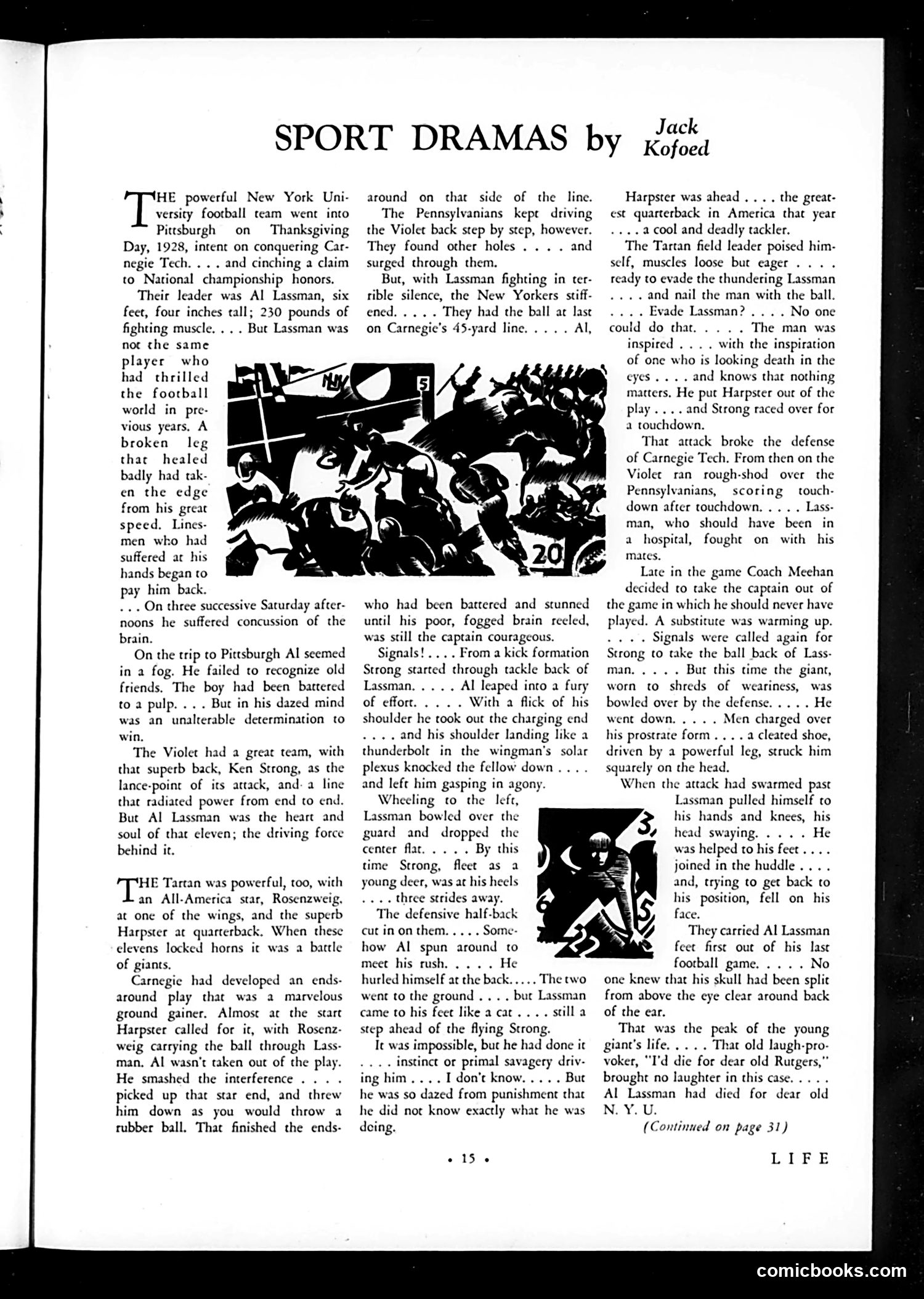
Sport Dramas by Jack Kofoed This is a sports narrative article about a 1928 Thanksgiving Day football game between New York University and Carnegie Tech. The story focuses on Al Lassman, NYU's star quarterback—described as physically imposing (6'4", 230 pounds)—who plays through injury and concussion to lead his team to victory. The two illustrations show intense football action: players colliding in scrums, with particular focus on Lassman's dramatic plays. The narrative emphasizes Lassman's courage and determination despite physical punishment, culminating in him carrying the ball for a crucial touchdown. This is straightforward sports journalism using dramatic storytelling rather than satire—celebrating athletic heroism and grit rather than mocking it.
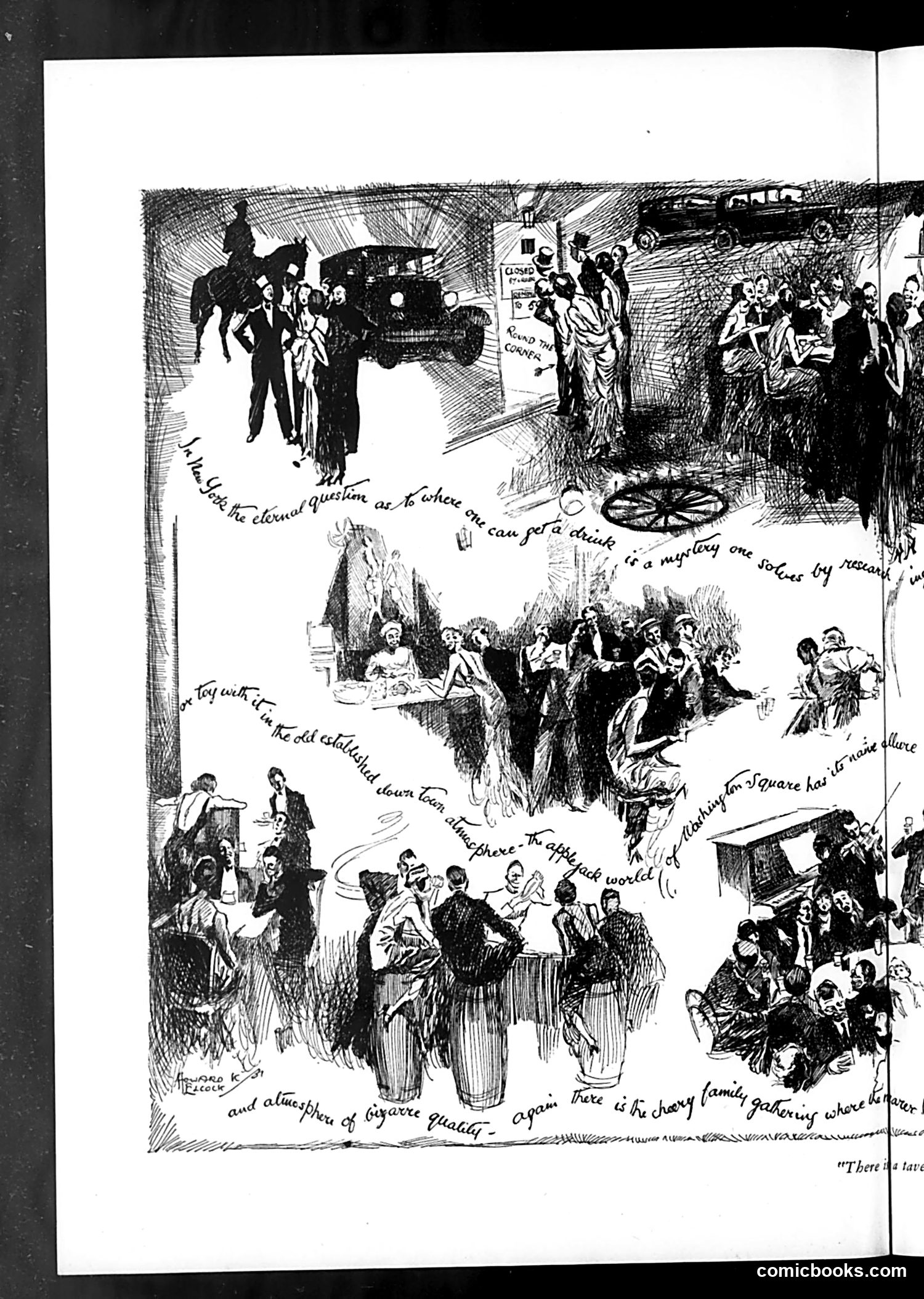
Political Cartoon Analysis This appears to be a satirical illustration depicting various social scenes in early 20th-century urban life. The sketch shows multiple vignettes: elegantly dressed people at what appears to be social gatherings, automobiles (suggesting modernity and wealth), and street scenes with working-class figures. The handwritten captions suggest commentary on class contrasts—references to "old established down town streets" and "Cherry family gathering" indicate satirical observation of social hierarchies. The illustration style and composition suggest critique of both wealthy society functions and urban street life disparities. However, without clearer OCR text or visible artist signature identification, I cannot definitively name the specific figures being caricatured or pinpoint the exact social/political references intended. The overall tone appears to mock class distinctions and modern urban society's contradictions.
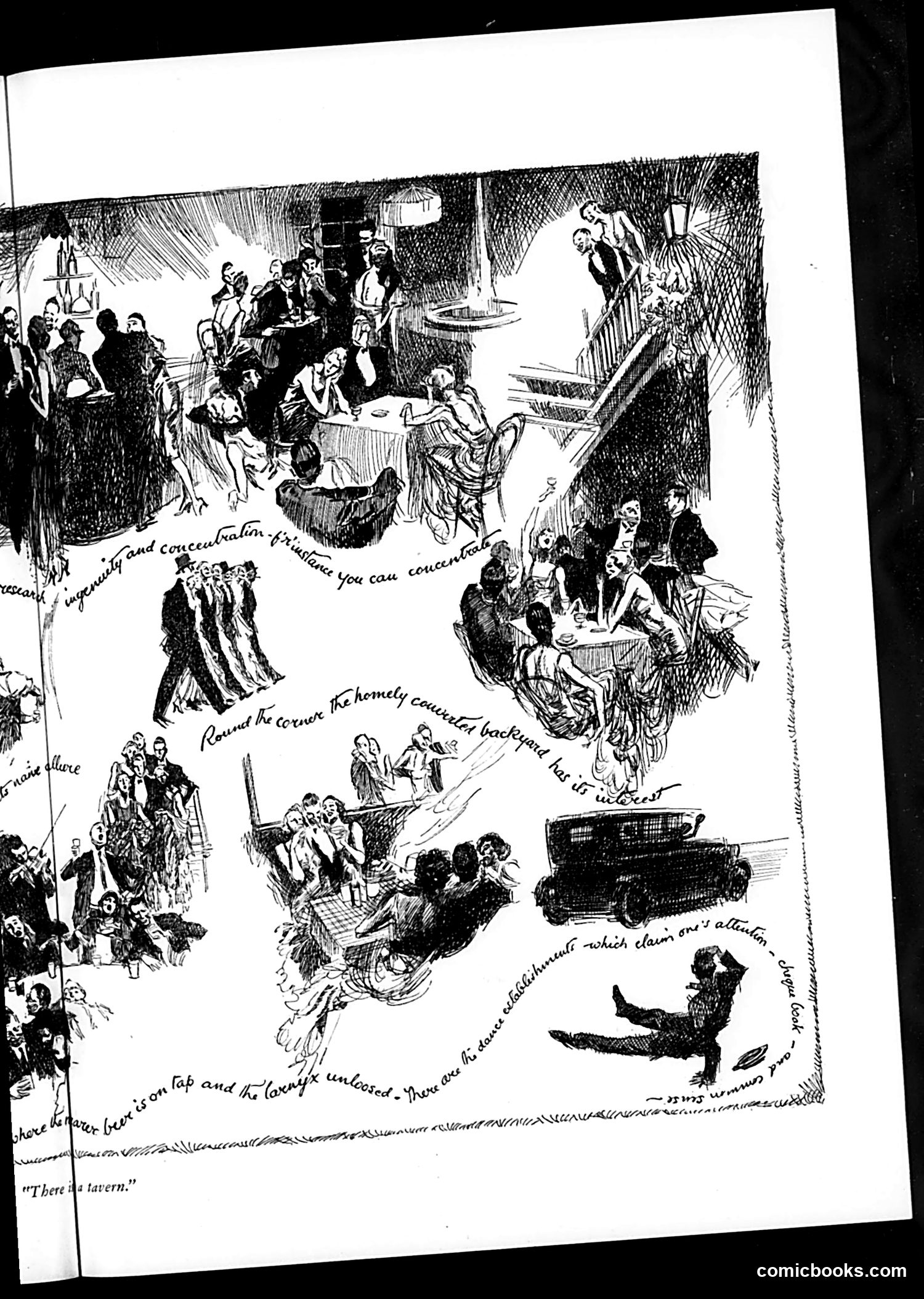
Analysis This appears to be a satirical illustration from *Life* magazine depicting a crowded social scene, likely at a tavern or nightclub (the caption reads "There is tavern"). The sketch shows multiple vignettes of socializing: people dining, conversing in groups, and what appears to be entertainment or performances occurring simultaneously. Handwritten annotations float across the image offering satirical commentary on social behavior—phrases like "Round the corner the chemist convert backyard her" and references to "concentration" and "attention" suggest mockery of shallow socializing and pretentious behavior. The style and composition mock the chaos and affectation of urban nightlife, possibly during Prohibition era (given the "tavern" reference). The crowded, overlapping scenes emphasize frivolity and social performativity rather than genuine connection, which appears to be the satire's target.
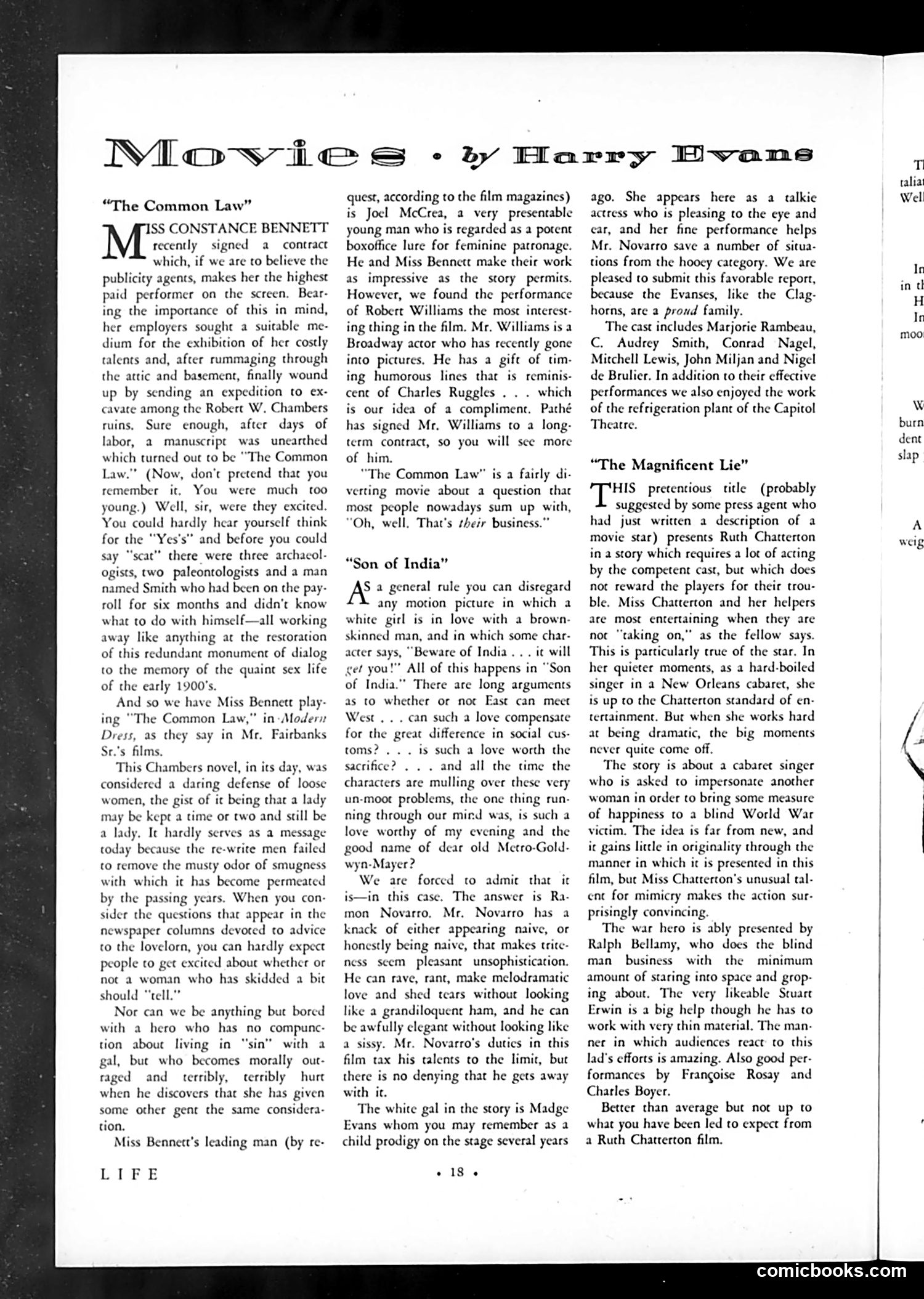
Movies by Harry Evans This page contains film reviews from *Life* magazine, not political cartoons. It discusses three movies: 1. "The Common Law" - starring Constance Bennett, praised for her performance opposite Robert Williams 2. "Son of India" - a romance between a white girl and brown-skinned man, featuring Ramon Novarro 3. "The Magnificent Lie" - starring Ruth Chatterton, about a cabaret singer impersonating another woman to help a blind World War I veteran The reviews evaluate acting performances and plot merit. The tone is typical entertainment criticism—some praise mixed with reservations. There's no discernible political satire here; this is straightforward movie criticism from the era when "talkie" films were relatively new.
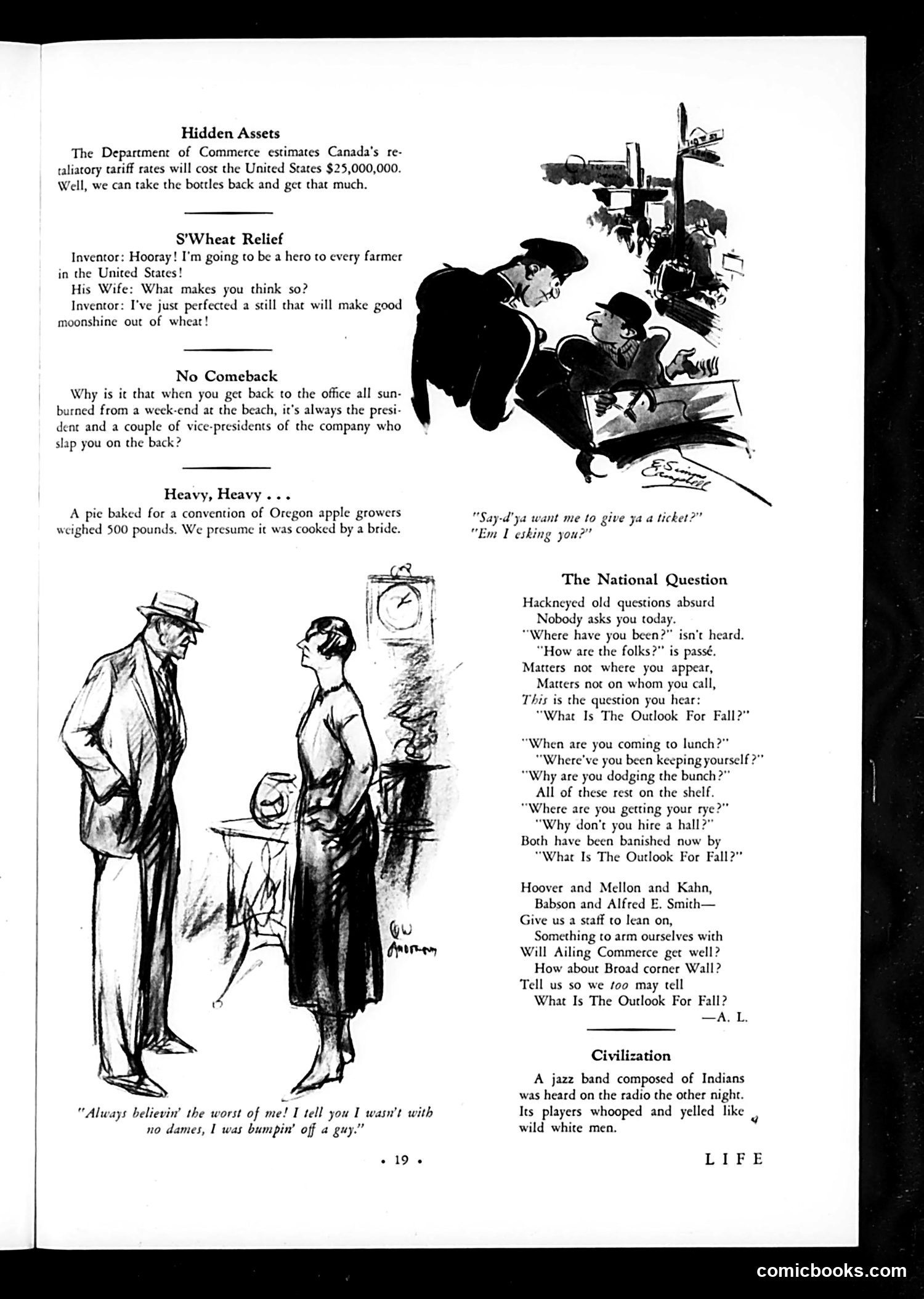
Analysis of Life Magazine Page 19 This page contains several brief satirical pieces and cartoons: "Hidden Assets" mocks Canada's retaliatory tariffs against the US, joking they'll cost America $25 million—but "we can take the bottles back and get that much," suggesting Americans will simply return empties for refunds. "S'Wheat Relief" satirizes a farmer-inventor claiming to perfect moonshine whiskey production, mocking both agricultural innovation and Prohibition-era bootlegging. "No Comeback" ridicules office workers returning sunburned from beach vacations, unable to escape executive ribbing. "The National Question" is a longer satirical poem mocking how Americans obsess over trivial small-talk questions like "What's the outlook for Fall?" rather than meaningful inquiries, naming prominent figures (Hoover, Mellon, Kahn) whose responses about economic recovery are dismissed as clichéd. The cartoons illustrate these domestic social observations with period-appropriate illustrations.
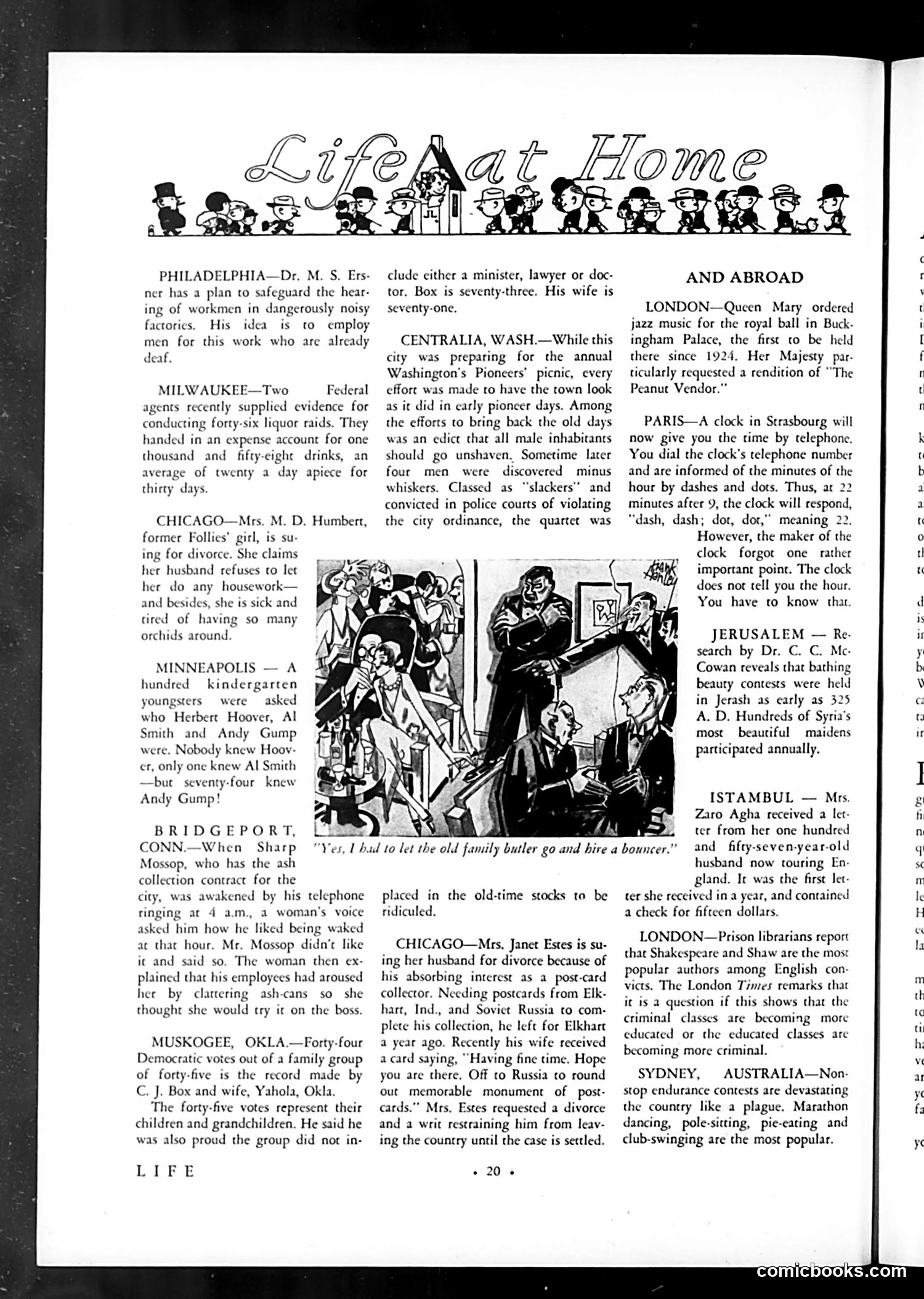
Life Magazine Satire Page Analysis This page from Life magazine (likely 1920s-1930s) collects humorous short anecdotes mocking American society and international absurdities. The central cartoon depicts a wealthy woman firing her butler to hire a "bouncer"—satirizing how Prohibition-era gangsterism and violence had infiltrated even elite households, requiring security rather than domestic service. The text vignettes mock various targets: a divorce suit over postcards (obsessive collecting), Milwaukee Prohibition agents expensing thousands of drinks during raids (corruption), kindergarteners recognizing comic-strip character Andy Gump but not political figures (cultural priorities), and a Centralia ordinance forcing men into beards then punishing those who shaved (absurd enforcement). International items ridicule technological failures (a telephone clock that can't tell the hour) and deflate historical "discoveries" (ancient beauty contests). The humor relies on deadpan absurdity—exposing institutional incompetence, marital discord, and the collision between modern and "pioneer" values.
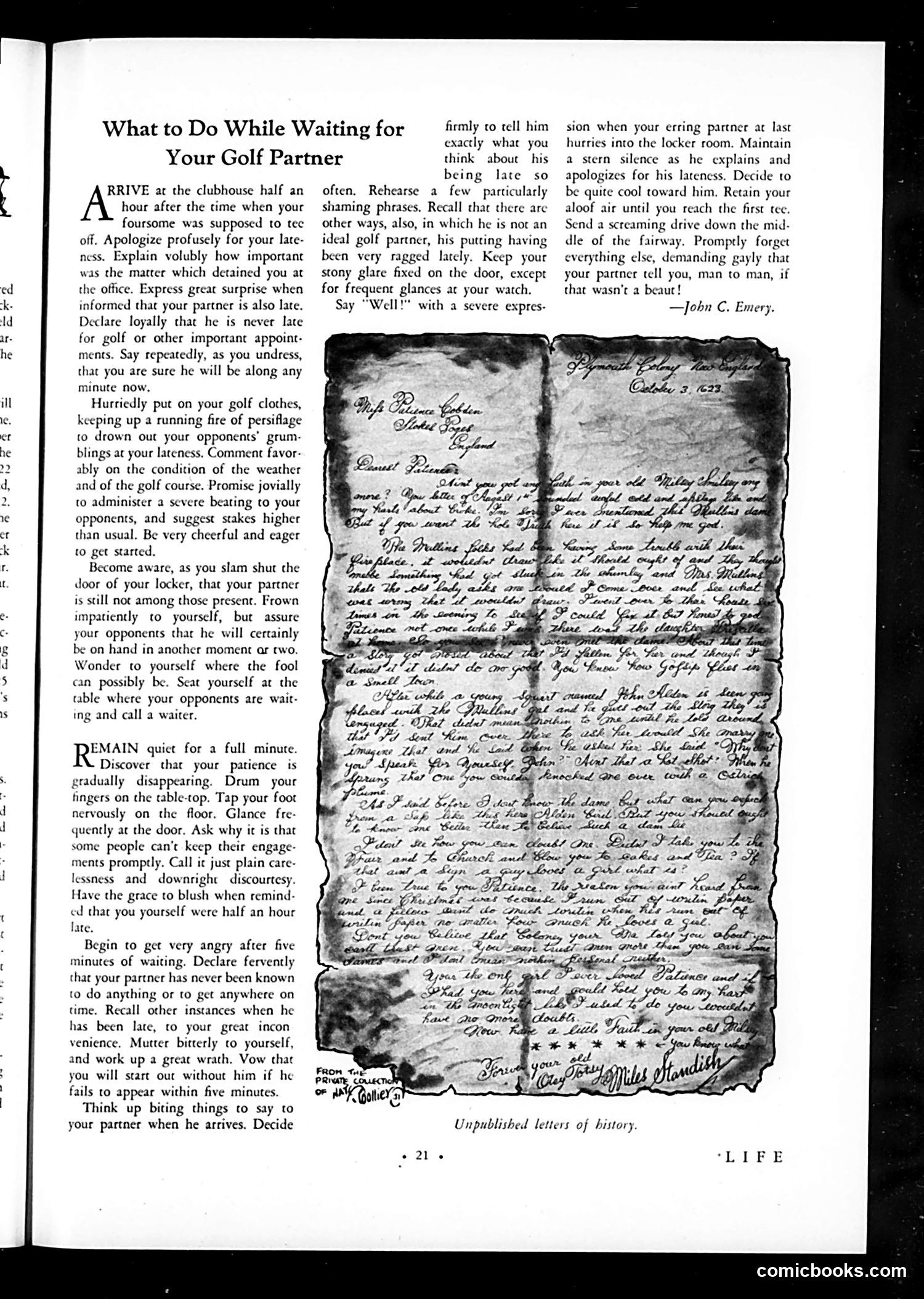
Analysis of "What to Do While Waiting for Your Golf Partner" This satirical article mocks the hypocrisy of golf etiquette and human behavior. The humor lies in the ironic contrast between what the narrator *intends* to do and what he actually *does*. The piece describes a golfer arriving late, then growing increasingly angry while waiting for his equally tardy partner. The narrator plans to deliver stern lectures about punctuality and his partner's other faults. However, the final lines reveal the joke: once the partner arrives and they reach the first tee, the narrator immediately forgets his grievance, hits an excellent drive, and cheerfully demands his partner's attention—completely abandoning his planned reproach. The accompanying handwritten "unpublished letter" (right side) appears to be a humorous historical document, though its content is largely illegible in this reproduction. The satire targets the common human tendency toward self-righteous indignation that evaporates instantly when circumstances change—a timeless observation about golf culture and male behavior more broadly.
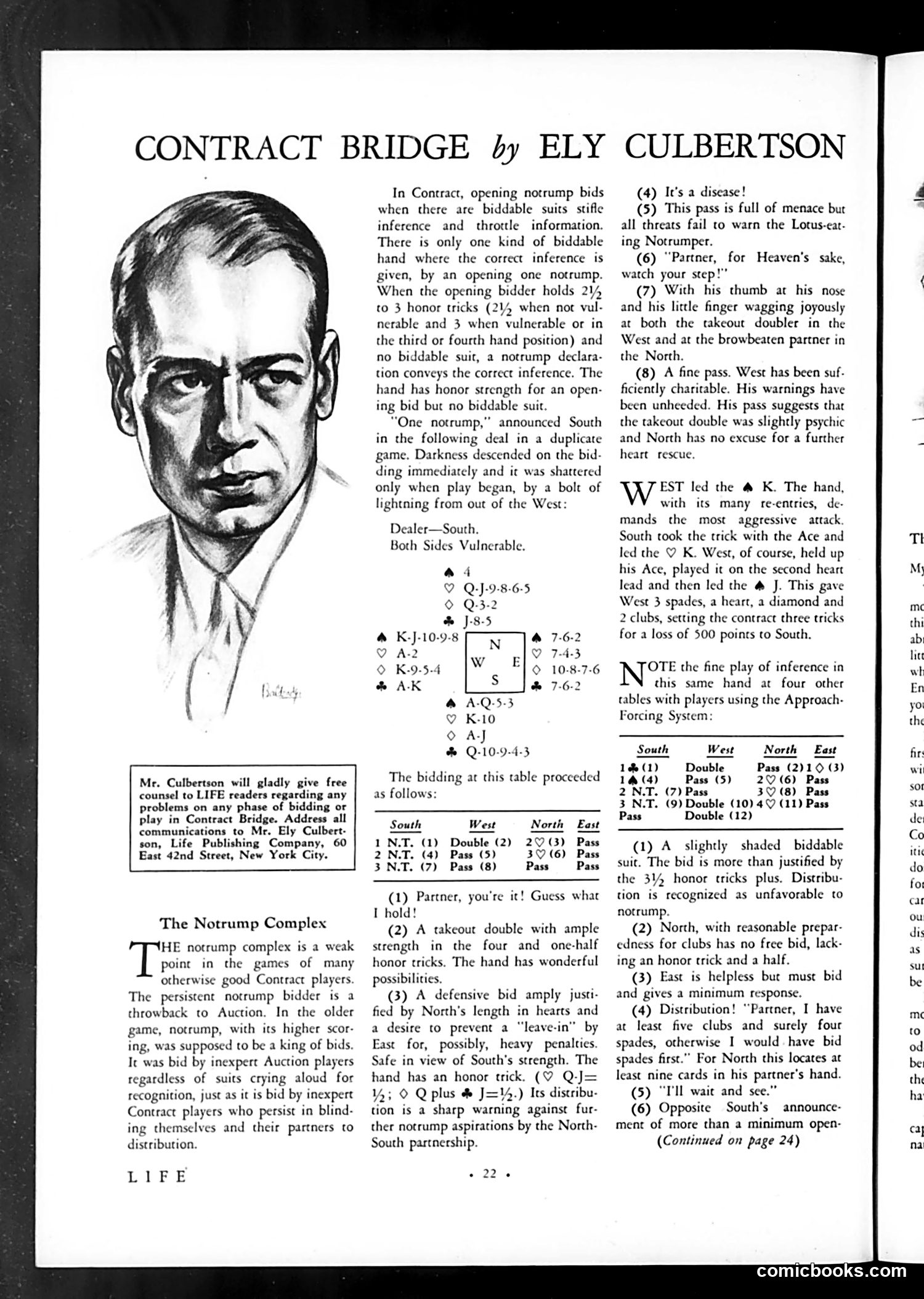
Contract Bridge Instruction, Not Political Satire This page contains no political cartoons or satire. It's an instructional article about Contract Bridge, the card game, written by Ely Culbertson, a prominent bridge expert of the era. The portrait shows Culbertson himself. The content explains a "notrump complex"—a weak bidding strategy in Contract Bridge where players overbid notrump contracts despite holding biddable suits. The article uses a specific hand example to demonstrate poor bidding decisions and their consequences. The "Approach-Forcing System" table at bottom compares inferior notrump bidding against superior strategic alternatives. This represents Life magazine's educational content, separate from its satirical cartoons. The magazine regularly featured instructional articles alongside humor and commentary.
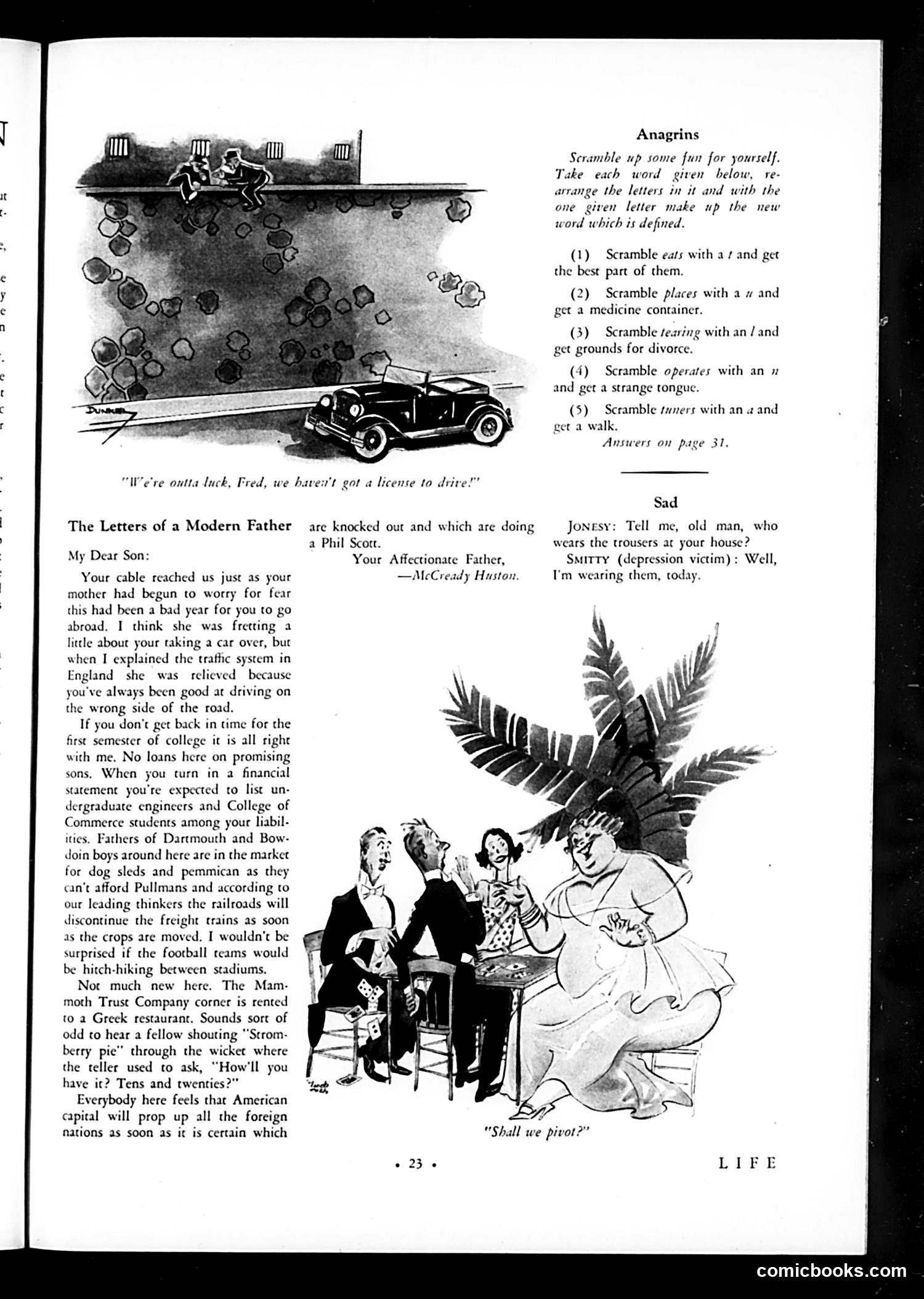
Life Magazine Page Analysis This page contains satirical commentary on 1920s-30s American life through multiple pieces: "The Letters of a Modern Father" mocks economic anxiety and social upheaval. The father's casual tone about his son potentially missing college, combined with dark references to financial collapse ("Mammoth Trust Company" converted to a Greek restaurant), reflects Depression-era uncertainty. His mention of fathers unable to afford Pullmans and speculation that railroads will fail shows satirical exaggeration of economic fears. The reference to "Phil Scott" (likely a boxer known for allegedly taking dives) suggests financial corruption. Top cartoon jokes about driving without a license—a commentary on reckless youth or disregard for regulations. "Shall we pirot?" cartoon depicts an angel or supernatural figure seemingly offering guidance to worried citizens, likely satirizing faith in divine or governmental solutions during economic crisis. The "Sad" joke presents Depression-era humor: a man wearing his own trousers (rather than expensive tailored ones) becomes a marker of economic hardship and emasculation. Overall, the page uses humor to process widespread financial anxiety and social displacement of the early 1930s.
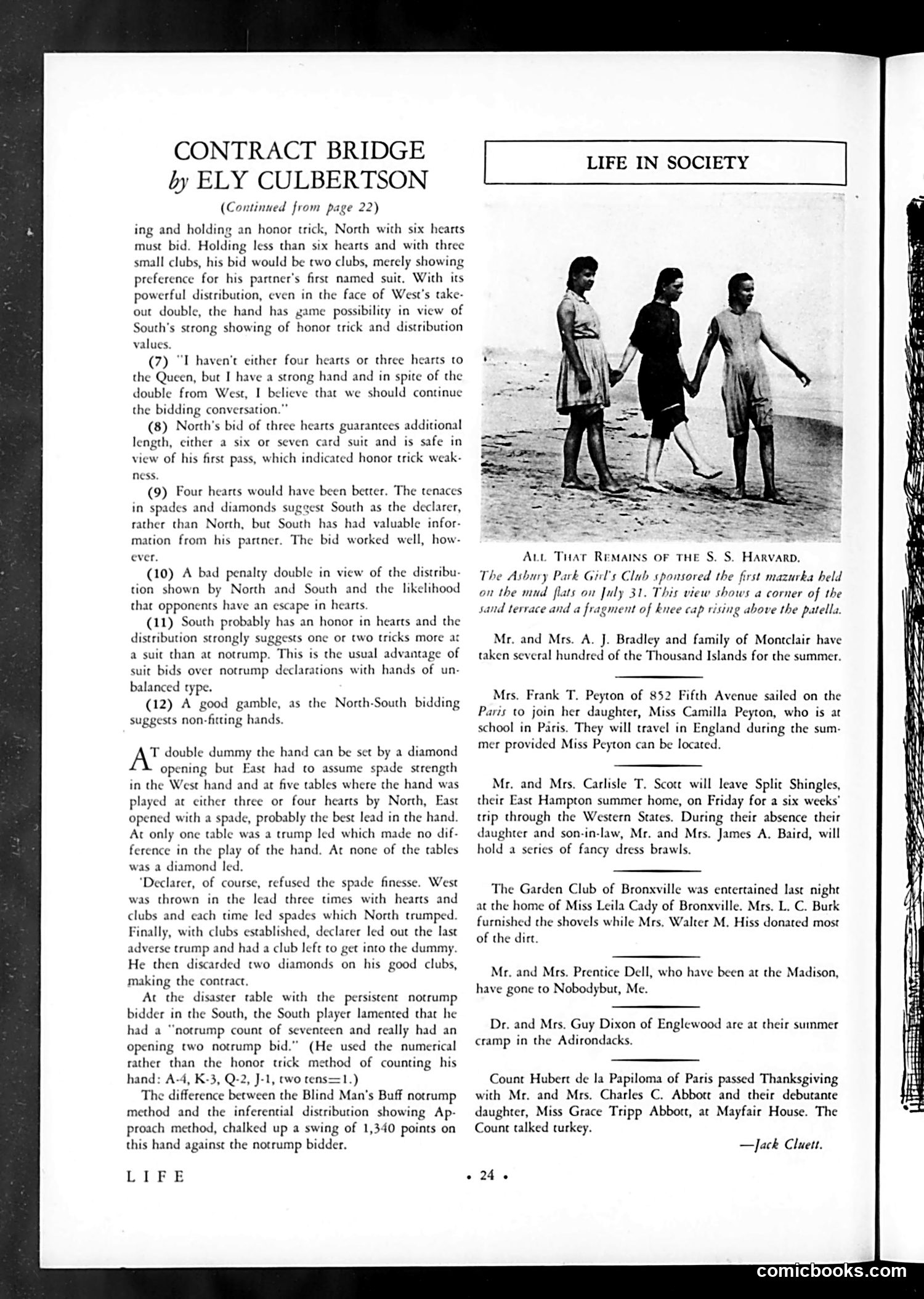
Content Analysis This page contains two distinct sections: Left side: A technical bridge column by Ely Culbertson, continuing a detailed hand analysis with numbered observations about bidding strategy and card play. This is educational content for contract bridge players. Right side: A "Life in Society" gossip column with a photograph and social notes. The image shows three young women on a beach, captioned as remnants of the S.S. Harvard. The accompanying text mockingly describes an Asbury Park Girl's Club event held on "mud flats," with a deliberately absurd anatomical detail ("fragment of knee cap rising above the patella"). The satire here targets high-society social reporting—Life is gently ridiculing the vapid nature of society column coverage by presenting mundane beach activities with exaggerated, pseudo-scientific language. The subsequent items list wealthy families' summer travel plans in the typical breathless tone of gossip columns. The juxtaposition suggests Life positioned sophisticated bridge instruction alongside gentle mockery of elite leisure culture.
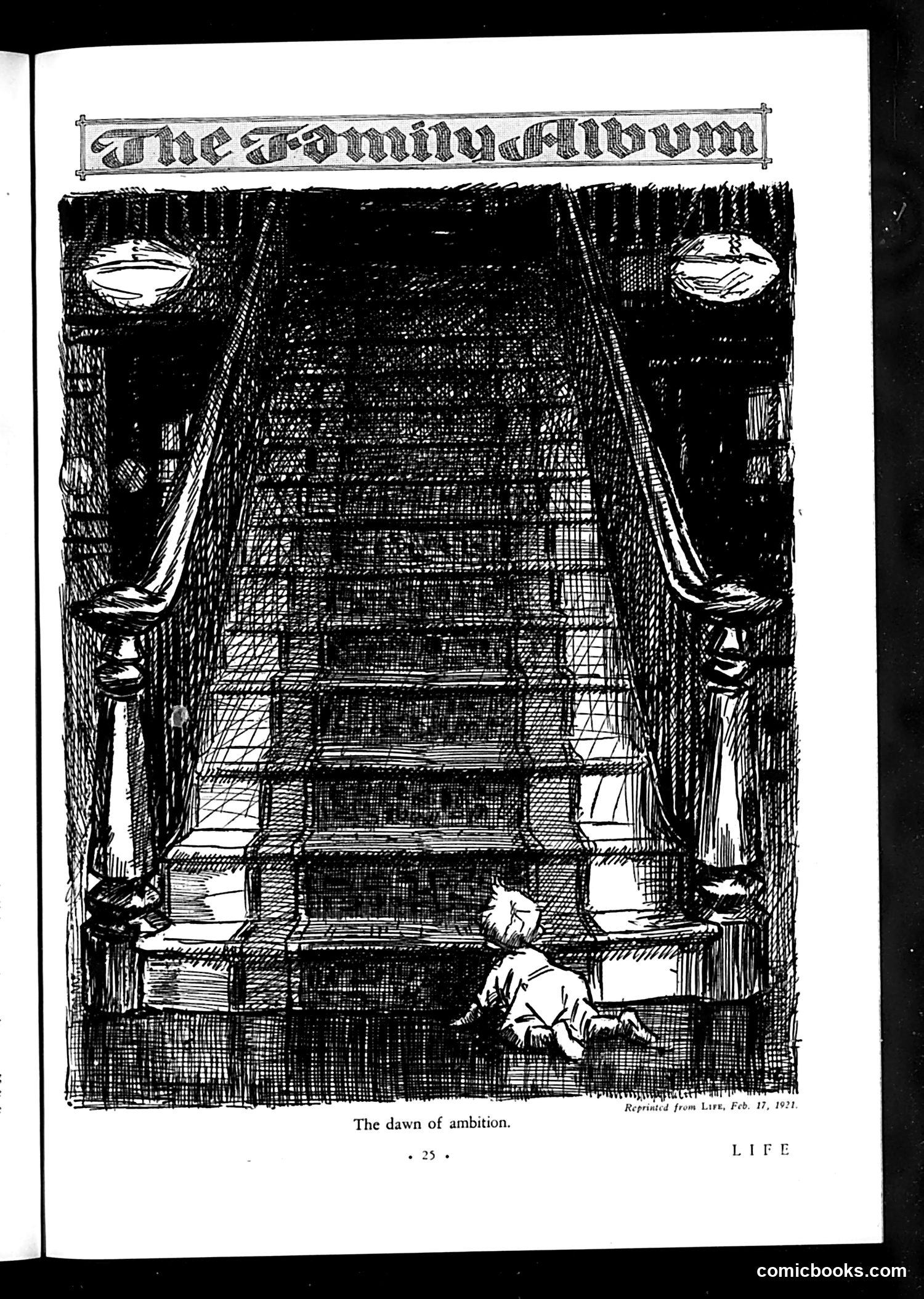
"The Dawn of Ambition" This editorial illustration depicts a baby crawling up a steep, shadowy staircase toward distant light—a metaphor for ambitious striving toward success or advancement. The architectural setting, with its dramatic perspective and architectural details (lamps, ornate railings), suggests institutional or societal structures that must be navigated. The satirical point appears to critique early ambition or the struggle for social/economic advancement. The baby's vulnerable position on the imposing staircase emphasizes how daunting such ambitions can be, or possibly mocks the foolishness of starting such a difficult climb from such a helpless state. Published in *Life* magazine (a respected satirical weekly), this likely commented on American aspiration and class mobility during the early 20th century.
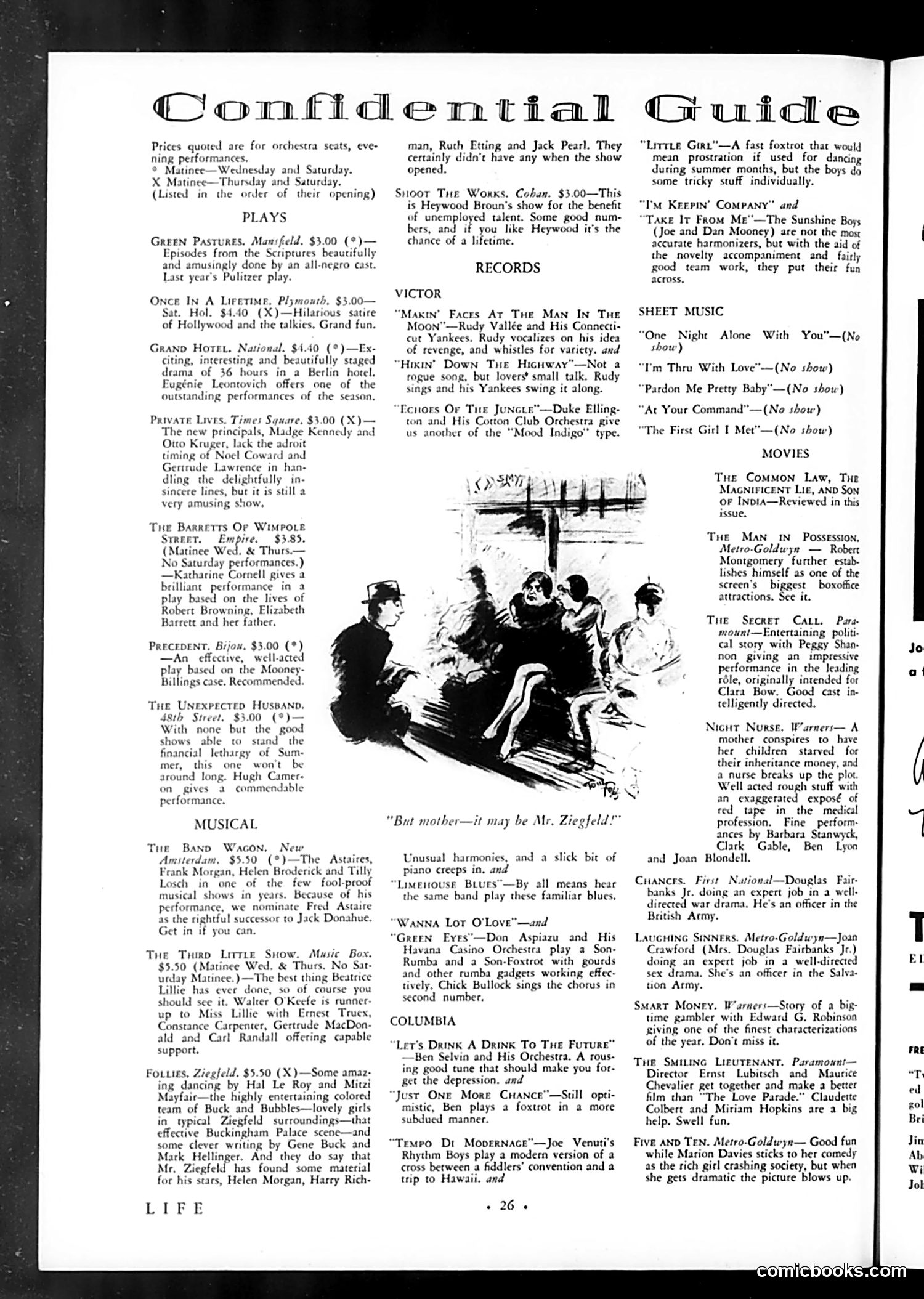
The Cartoon on This Page The single cartoon depicts a theater scene with a caption: "But mother—it may be Mr. Ziegfeld!" A woman lies reclined on what appears to be a chaise lounge while several men surround her. The joke satirizes Florenz Ziegfeld, the famous Broadway impresario known for producing lavish theatrical productions featuring attractive chorus girls. The cartoon plays on Ziegfeld's reputation for pursuing romantic relationships with his young performers. The humor lies in a mother's concern that a man visiting her daughter might be Ziegfeld himself—suggesting that an encounter with the powerful theater producer could lead to theatrical opportunity (or scandal, or both). It's a topical reference to Ziegfeld's well-known status as both a theatrical power broker and someone with a reported interest in his female performers.
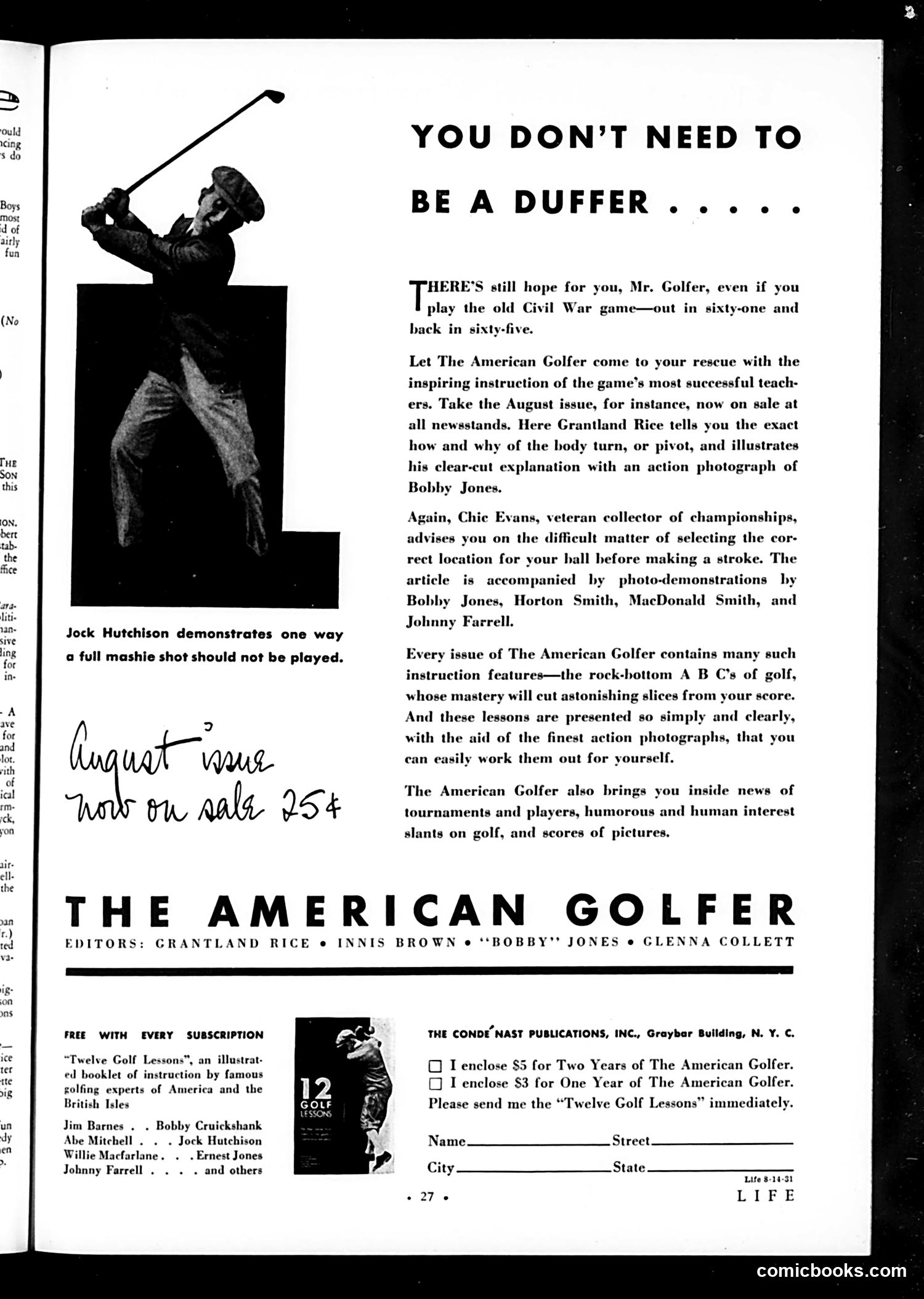
"You Don't Need to Be a Duffer" — *Life* Magazine Golf Advertisement This is primarily a subscription advertisement for *The American Golfer* magazine, not political satire. The "cartoon" is a humorous instructional photograph of golfer Jock Hutchison demonstrating an incorrect golf swing. The joke targets amateur golfers ("duffers") who play poorly—the text humorously suggests one golfer takes "sixty-one and back in sixty-five" (very high scores, referencing the Civil War). The ad promises instruction from famous golfers including Bobby Jones, Grantland Rice, and others to improve technique. The handwritten notation "August issue now on sale 25¢" indicates this advertisement itself appeared in an August 1931 *Life* issue, promoting *The American Golfer* magazine's instructional content. It's essentially a cross-publication marketing piece targeting golf enthusiasts of the era.
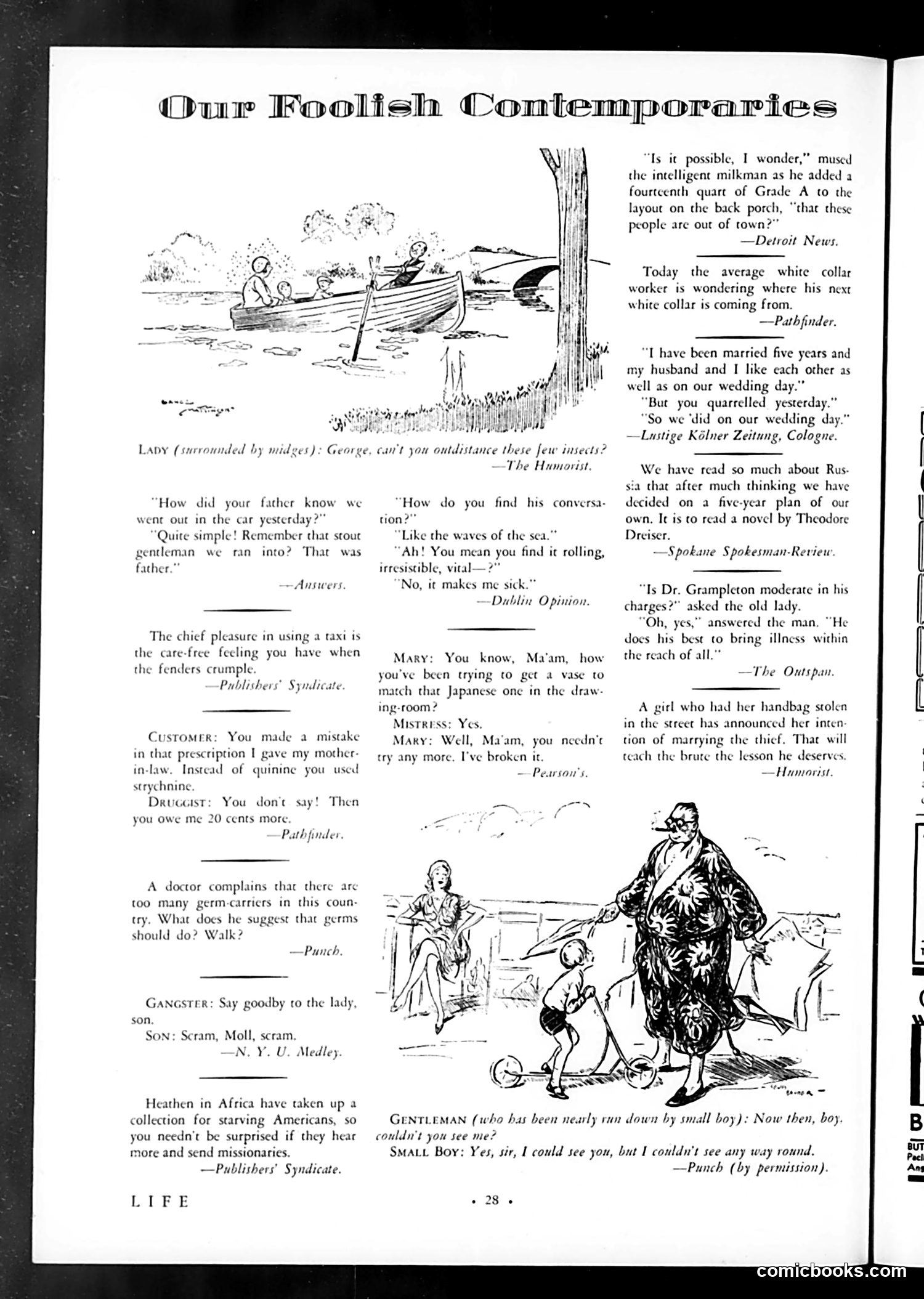
"Our Foolish Contemporaries" - Life Magazine Satire Page This is a humor compilation page from Life magazine featuring short jokes and witticisms from various sources, organized around a theme of contemporary foolishness. The cartoons and jokes mock everyday situations and human absurdity: - The boating cartoon ridicules a woman complaining about insects while surrounded by midges—she's oblivious to the obvious. - Economic anxiety appears in the Pathfinder quip about white-collar workers wondering "where his next white collar is coming from"—likely referencing Depression-era unemployment concerns. - Class commentary includes a druggist joke where a customer objects to strychnine instead of quinine for their mother-in-law, and the druggist charges *more*—darkly suggesting the poisoning was preferable. - Marital satire presents a couple claiming they quarreled on their wedding day too—normalizing marital discord. - The final cartoon shows a small boy unable to navigate around a gentleman—a visual gag about perspective and obstruction. The page reflects 1920s-30s middle-class preoccupations: marriage, health, economy, and social mishaps.
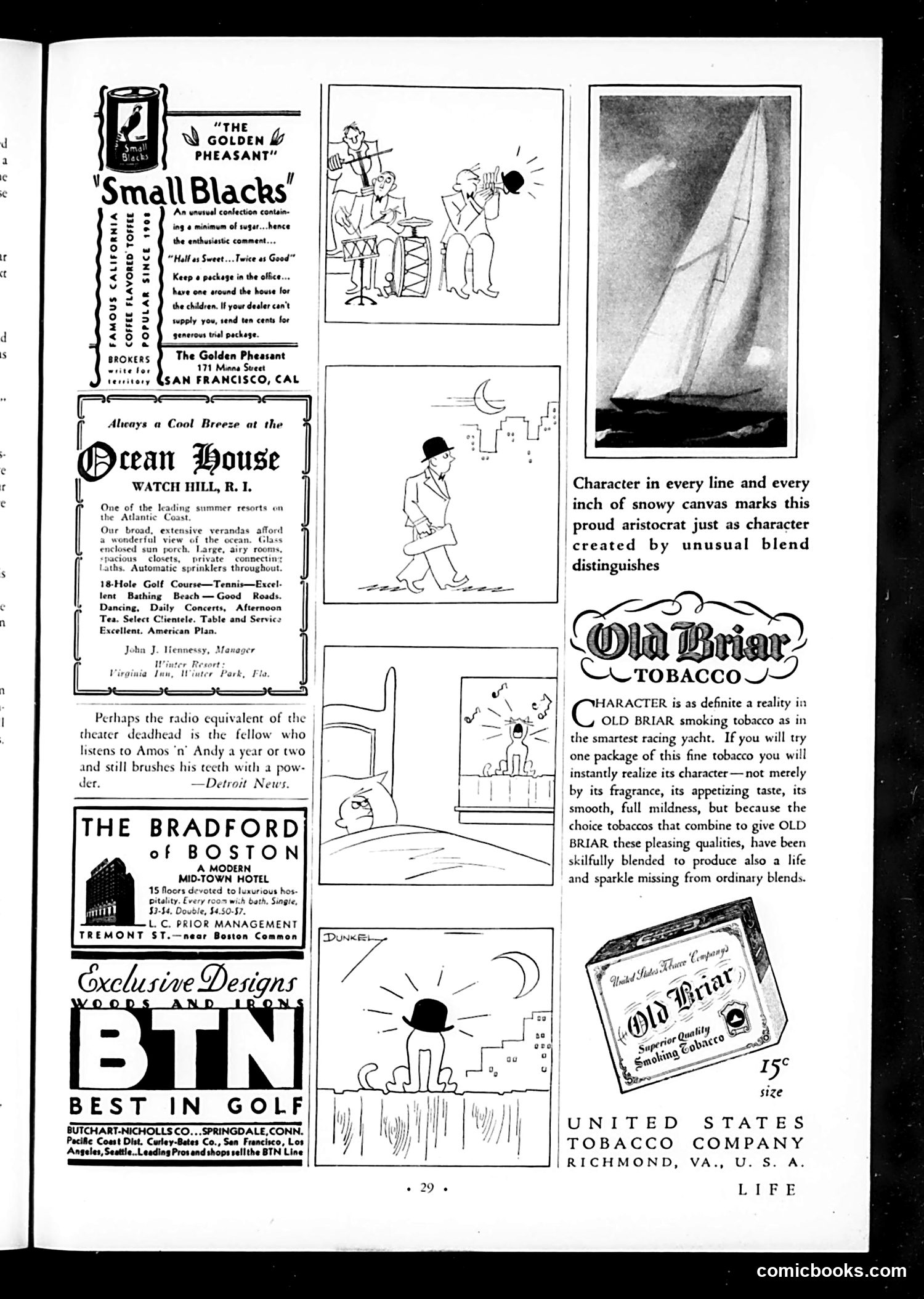
Page 29 Analysis: Mostly Advertisements with One Satirical Quip This page is primarily advertising, featuring resort hotels, golf equipment, candy, and tobacco products typical of 1920s-30s Life magazine. The only satirical content is a brief Detroit News quote mocking radio listeners who tune into the popular show "Amos 'n' Andy" for a year or two, then abandon it—comparing them to "deadheads" (freeloaders) at theaters who exploit free admission. The joke: casual listeners lack commitment, much like people who use cheap toothpaste despite hearing radio ads. The cartoons accompanying ads (showing office workers, people at desks, nighttime scenes) are generic illustrations promoting products rather than political satire. The Old Briar tobacco ad uses nautical imagery (racing yacht) as a metaphor for quality and character—common advertising rhetoric of the era. This reflects Life's mixed editorial-commercial format of the period.
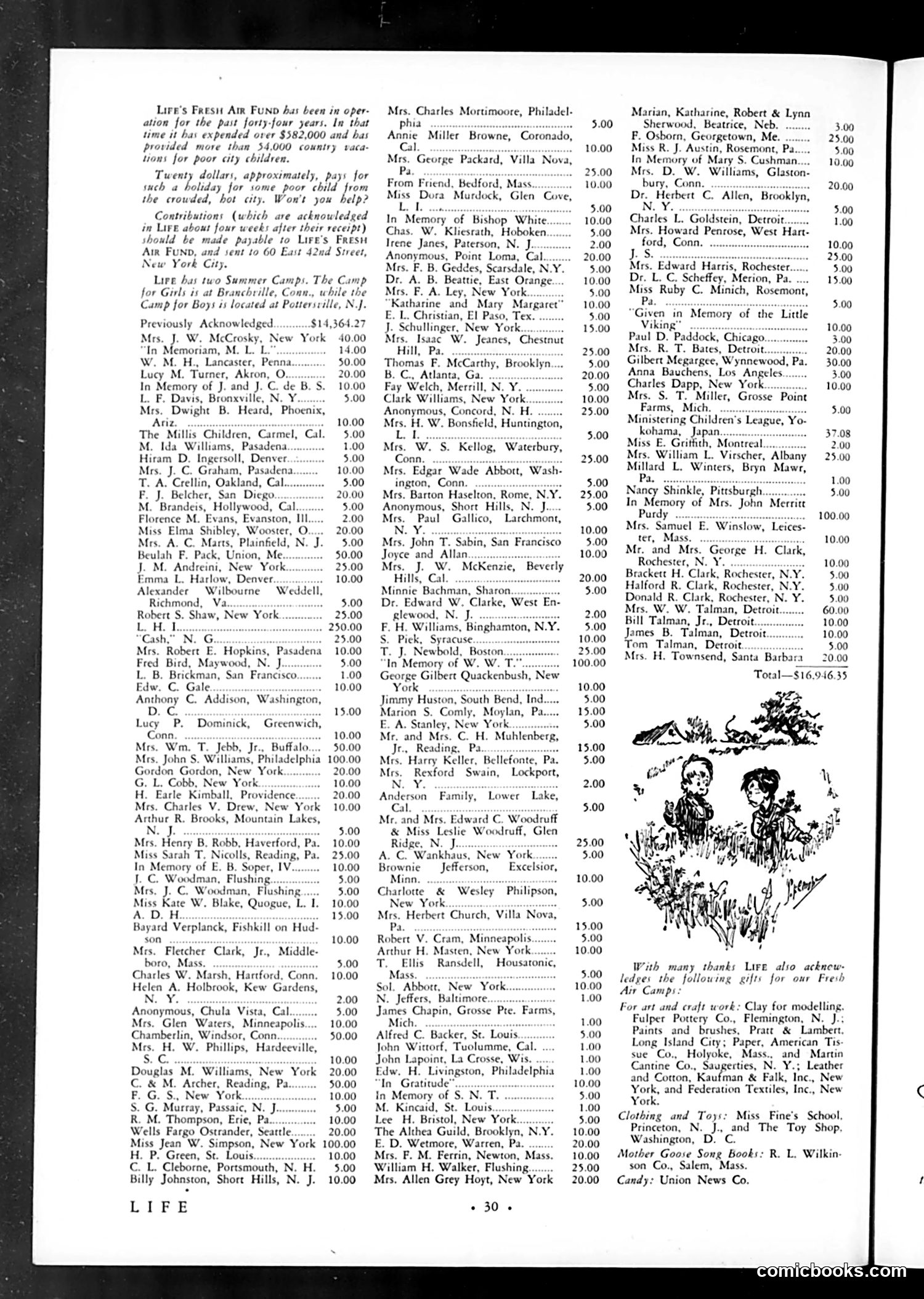
This page is primarily a fundraising appeal and donor acknowledgment list for Life magazine's Fresh Air Fund, a charitable organization providing summer camp vacations for poor urban children. The top section explains the Fund's mission: for approximately $20, readers can sponsor a city child's countryside vacation. The bulk of the page lists hundreds of donors and their contributions, ranging from $1 to $250. The small illustration at the bottom right depicts two children in a pastoral setting—likely representing beneficiaries of the Fund enjoying nature. Historical context: This reflects early 20th-century Progressive Era philanthropy, when middle and upper-class Americans viewed "fresh air" camps as moral and health interventions for impoverished city children. The extensive donor list demonstrates Life's role as a platform for elite charitable causes and suggests significant readership investment in such programs.
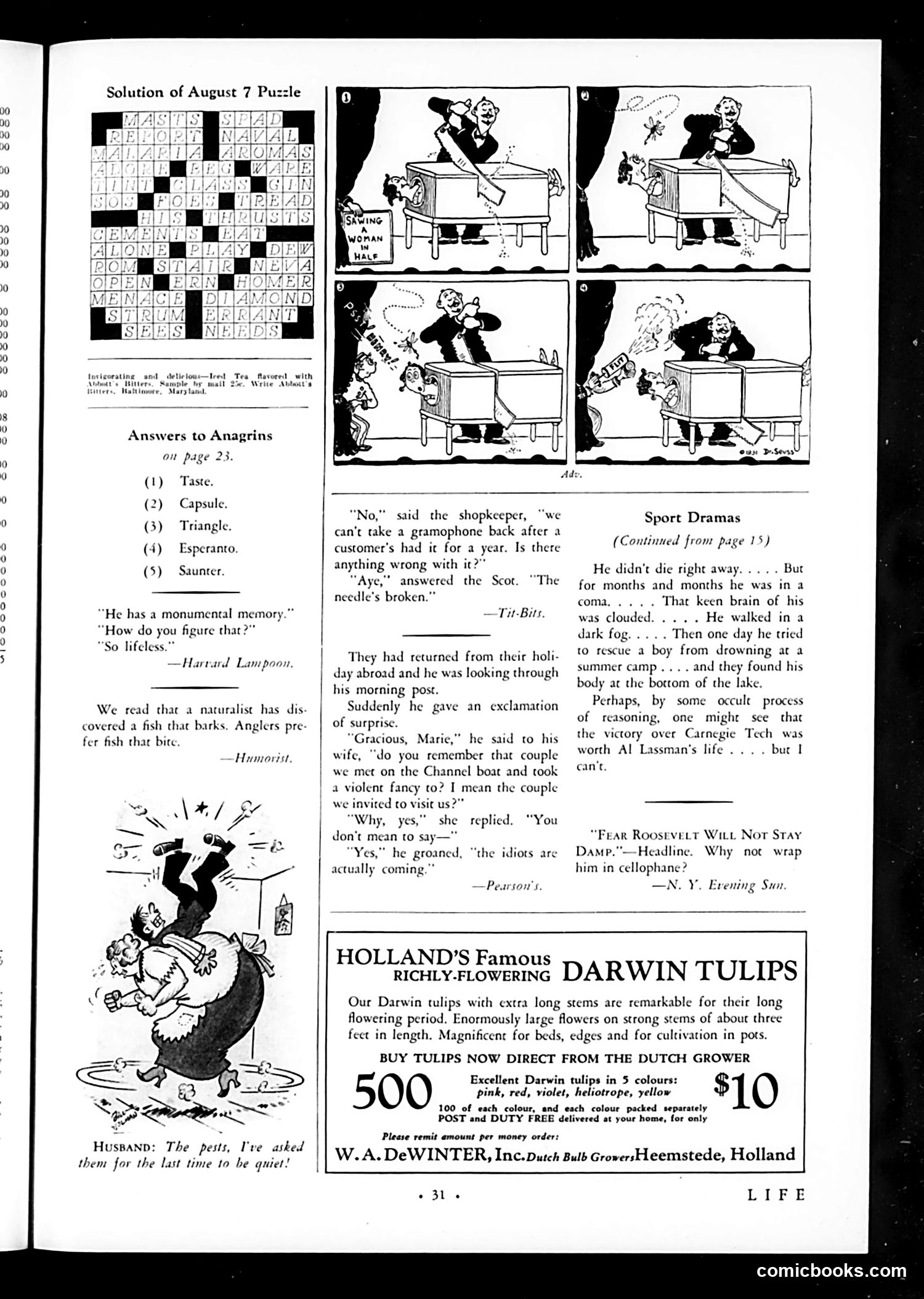
Life Magazine Page Analysis This page combines humor, advertising, and social commentary typical of early 20th-century *Life* magazine. The cartoons are brief jokes: one about a man with a "monumental memory" that's "lifeless" (Harvard Lampoon humor); another mocking a Scotsman's complaint about a gramophone with a broken needle; a third about an unwanted visit from acquaintances met on a boat. These reflect period concerns—gramophones as new technology, social anxiety about unexpected guests. The Sport Dramas section (continued from p. 15) appears to be serialized fiction about a young man's death, possibly from a swimming accident while heroically attempting a rescue. The large Darwin Tulips advertisement from a Dutch bulb grower dominates the lower half, offering 500 bulbs for $10 with "post and duty free" delivery—reflecting America's commercial relationship with European horticulture in this era. The page is primarily humorous miscellany and advertising, typical of *Life's* format as a general-interest magazine blending satire, short fiction, and commerce.
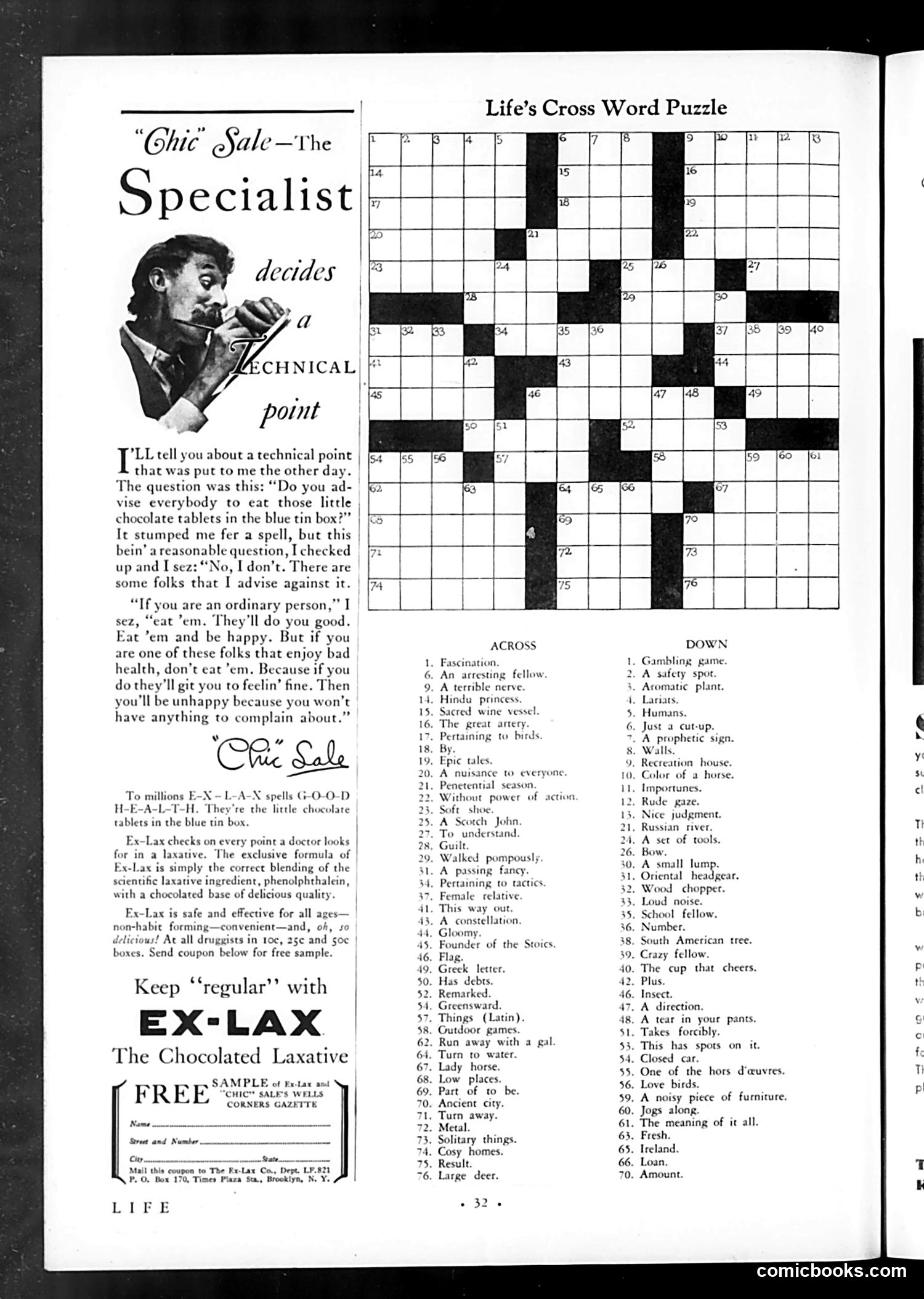
"Chic Sale" Advertisement Page with Crossword Puzzle This page is primarily an advertisement for Ex-Lax laxative disguised as editorial content in Life magazine. The left side features a monologue by "Chic Sale," a popular humorist character of the era, discussing laxatives in folksy, colloquial speech. Sale was known for this rustic persona. The humor plays on the delicate social awkwardness of advertising a bowel medication—Sale frames it as practical medical advice while maintaining comic distance through dialect ("I sez," "bein'"). The right side is a standard crossword puzzle titled "Life's Cross Word Puzzle," unrelated to the advertisement except as page fill. The entire piece exemplifies early 20th-century advertising strategy: embedding product promotion within entertainment content (the famous "Chic Sale" brand name) to make commercial messaging feel like genuine editorial humor rather than sales pitch. The tone is lighthearted and the "sample coupon" at bottom drives direct response.
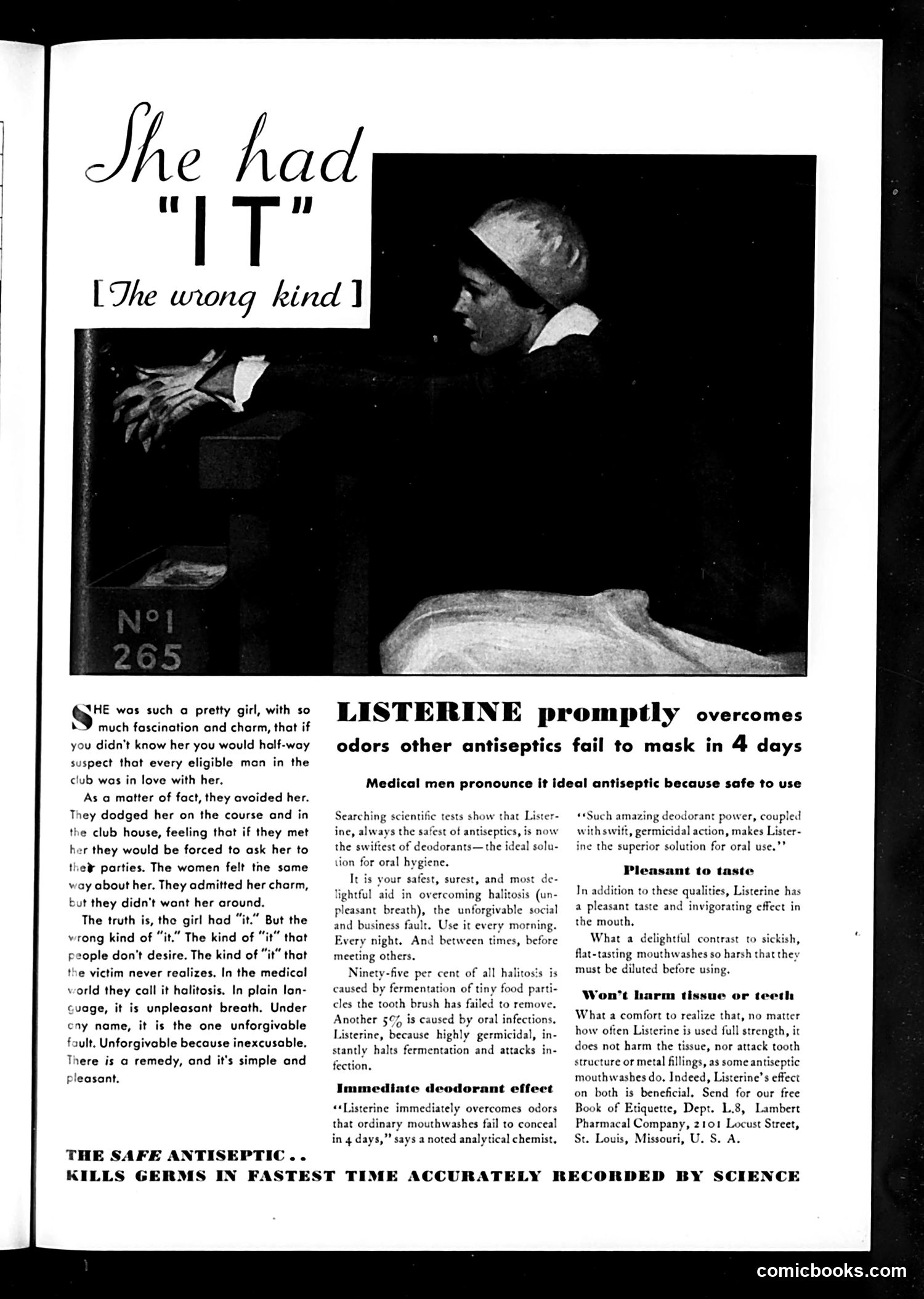
Analysis: "The Wrong Kind of 'It'" This is a Listerine mouthwash advertisement disguised as social satire, likely from the 1920s-30s. The cartoon depicts a young woman ostracized by her country club peers—avoided by men and women alike despite being attractive and charming. The joke's cruel punchline: she has halitosis (bad breath), "the wrong kind of 'it.'" The satire targets social anxieties of the era: in this competitive social hierarchy, a single invisible flaw—unpleasant breath—makes someone a pariah. No one will even tell her why she's shunned. The ad then presents Listerine as the solution to this social death, claiming it kills germs faster than competitors and works in just 4 days. This exemplifies early 20th-century advertising's manipulation of insecurity and shame to drive sales. The product's medical claims are emphasized to seem credible, while the real sell is social acceptance and romantic viability. For modern readers, it's a striking example of how advertising invented or exaggerated social anxieties to market solutions.
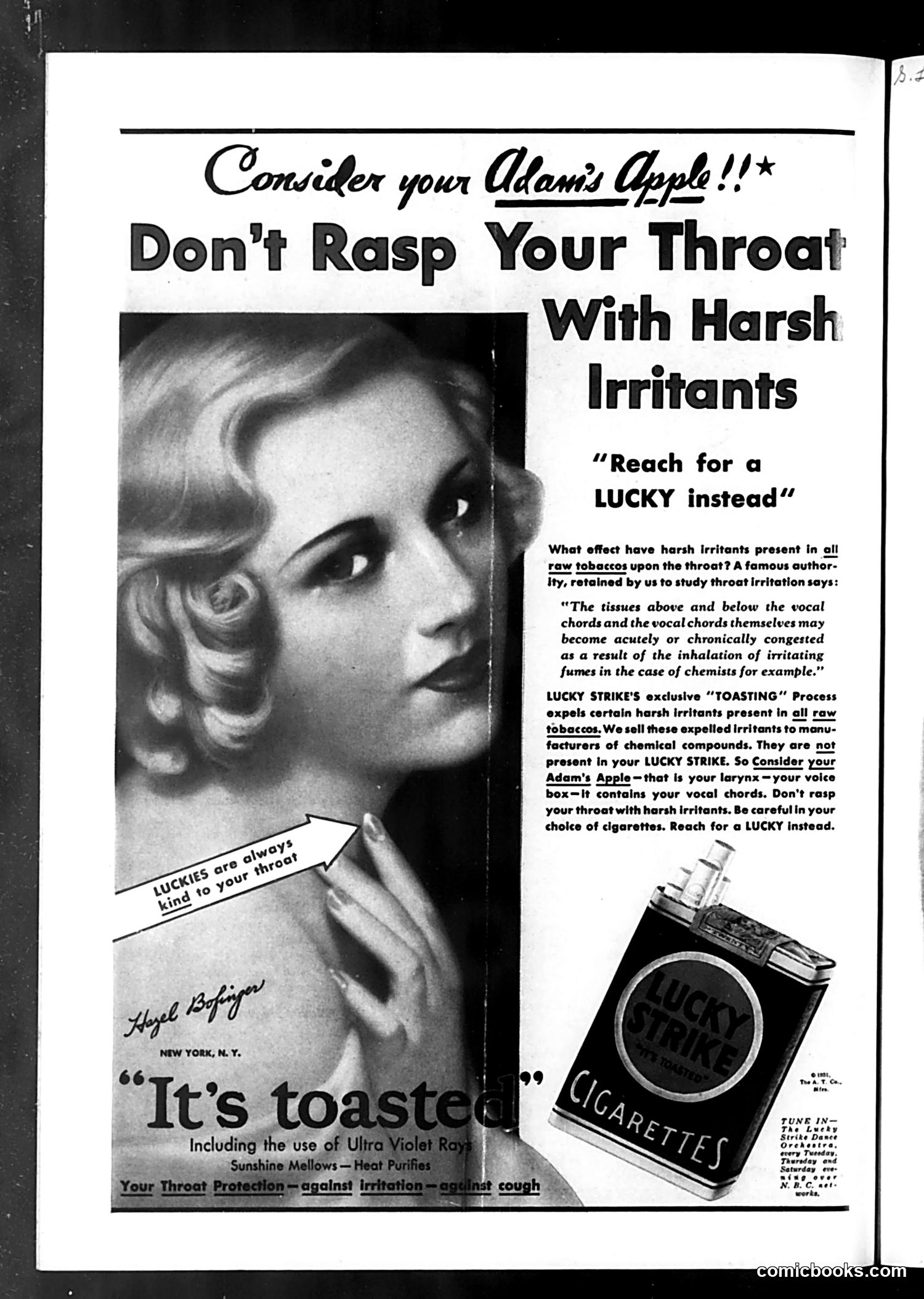
Lucky Strike Advertisement (Vintage Cigarette Marketing) This is a cigarette advertisement, not political satire. Lucky Strike employed a now-infamous marketing strategy: claiming their "Toasting" process removed harsh irritants from tobacco, making them safer than competitors' cigarettes. The ad features an actress (signed "Angel Balfour") and quotes a purported "famous authority" about throat irritation from raw tobacco. Crucially, Lucky Strike claims to sell the removed irritants to chemical manufacturers—a dubious assertion designed to seem scientifically credible. For modern readers: This represents pre-regulation tobacco advertising before the surgeon general's 1964 warning. Cigarette companies routinely made unsubstantiated health claims, citing vague "authorities" and pseudo-scientific processes. The ad equates smoking with vocal health—ironic given cigarettes' actual effects. Such campaigns are now illegal; this reveals how aggressively tobacco companies marketed despite knowing smoking's dangers.