life
Life — August 21, 1931
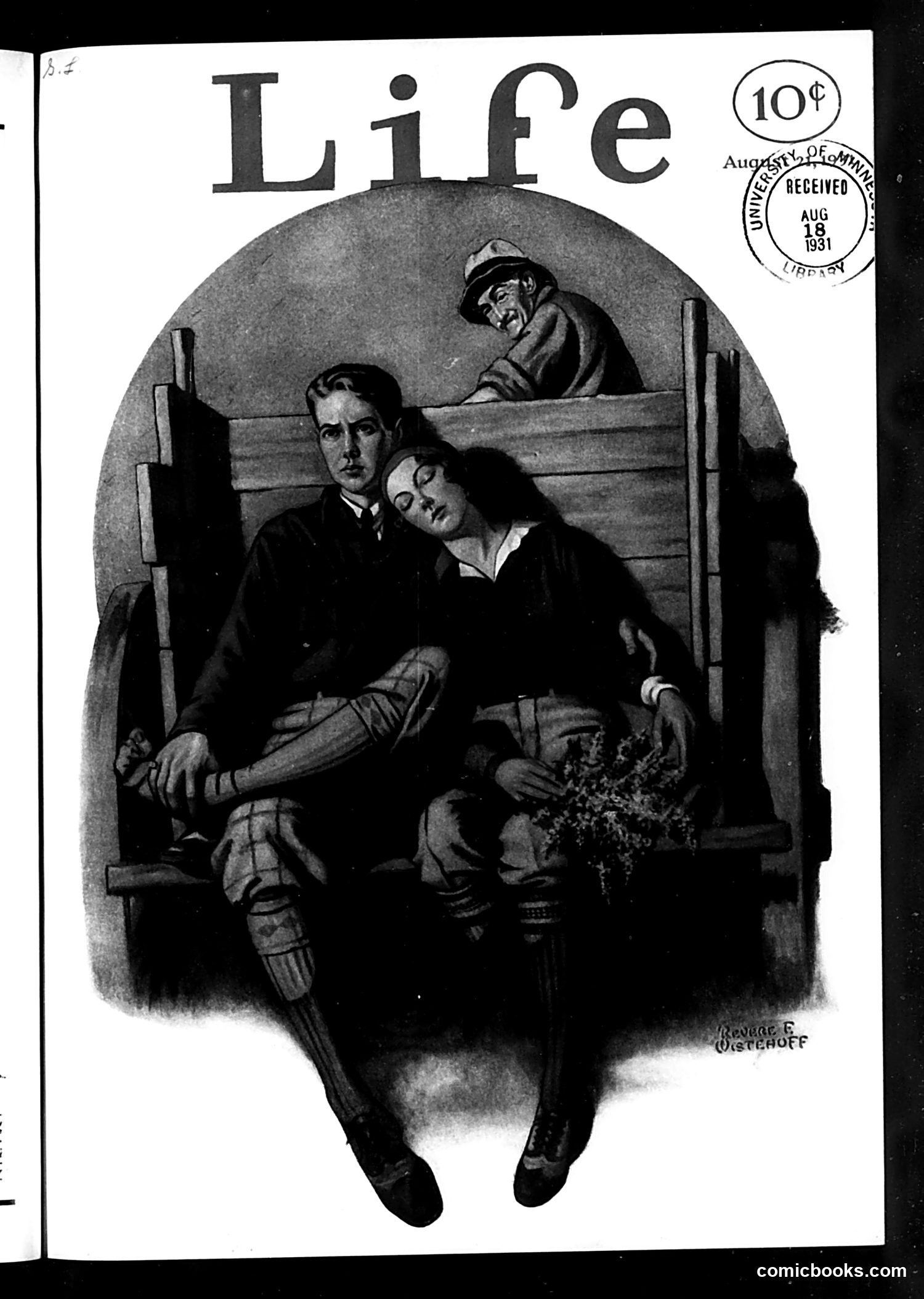
Life Magazine Cover Analysis This is a Life magazine cover from August 18, 1931, priced at 10 cents. The illustration by Norman E. Ostrihoff depicts three figures in what appears to be a boat or confined space. The image shows two men in formal attire in the foreground—one conscious, one appearing to faint or swoon—with a woman leaning against one of them. A third figure (possibly a boatman or operator) is visible in the background. Without additional OCR text or caption information visible on this page, the specific satirical target is unclear. However, given the 1931 date during the Great Depression, this likely references contemporary social or political commentary, though the exact meaning requires additional context not fully legible in this image.
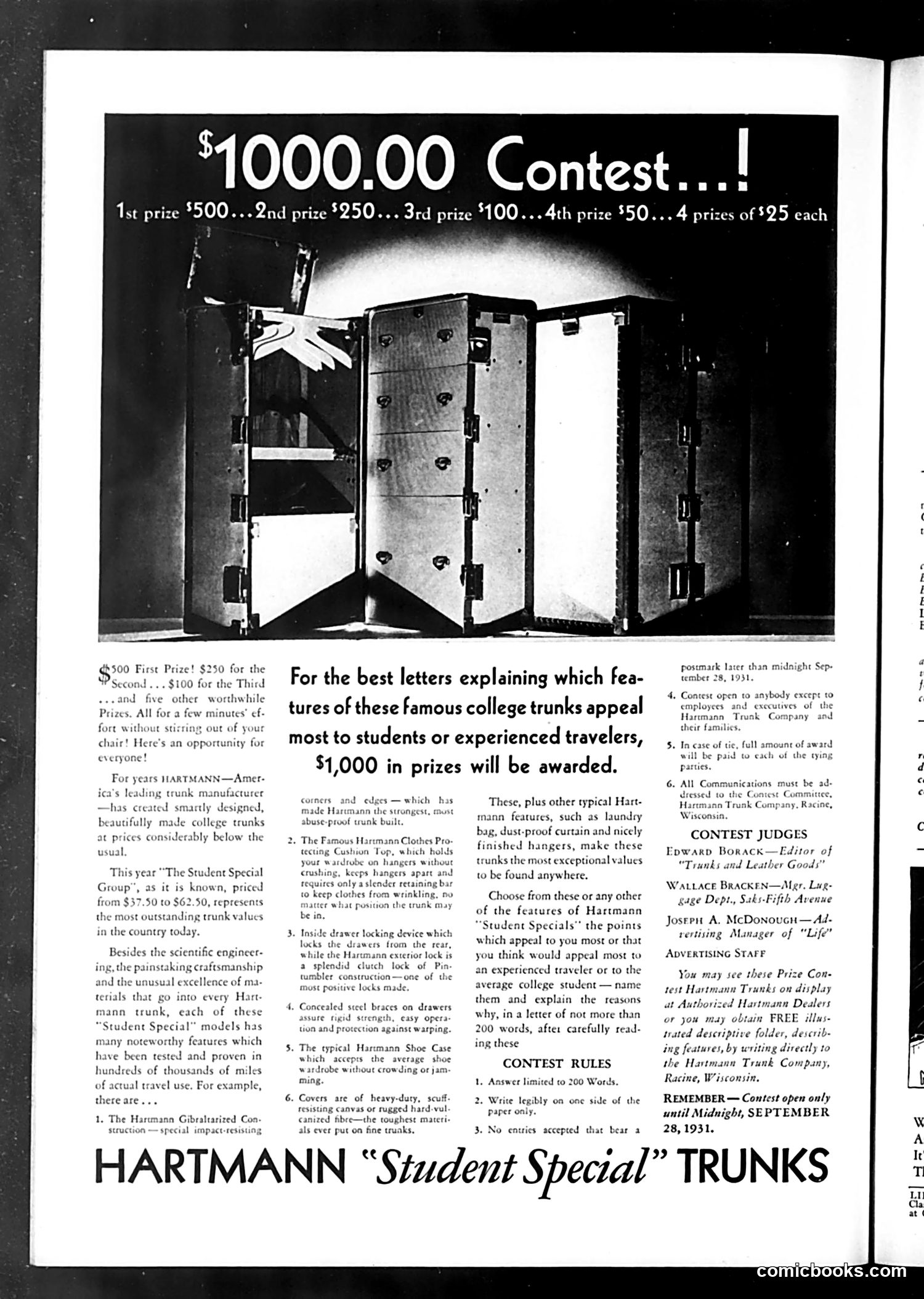
Analysis This is a straightforward advertisement, not satirical content. It's a 1931 Hartmann Trunk Company contest offering $1,000 in prizes for letters explaining which features of their "Student Special" college trunks appeal most to students and travelers. The ad emphasizes practical trunk features like durability, security locks, and organizational compartments. The contest judges include Edward Boraek (editor of *Trunks and Leather Goods*) and Wallace Bracken (advertising manager of *Life*). The visual shows an open trunk displaying its interior construction and compartments. There's no political satire or caricature—this is typical period advertising designed to drive consumer engagement through a writing contest, with the entry deadline of September 28, 1931 printed clearly.
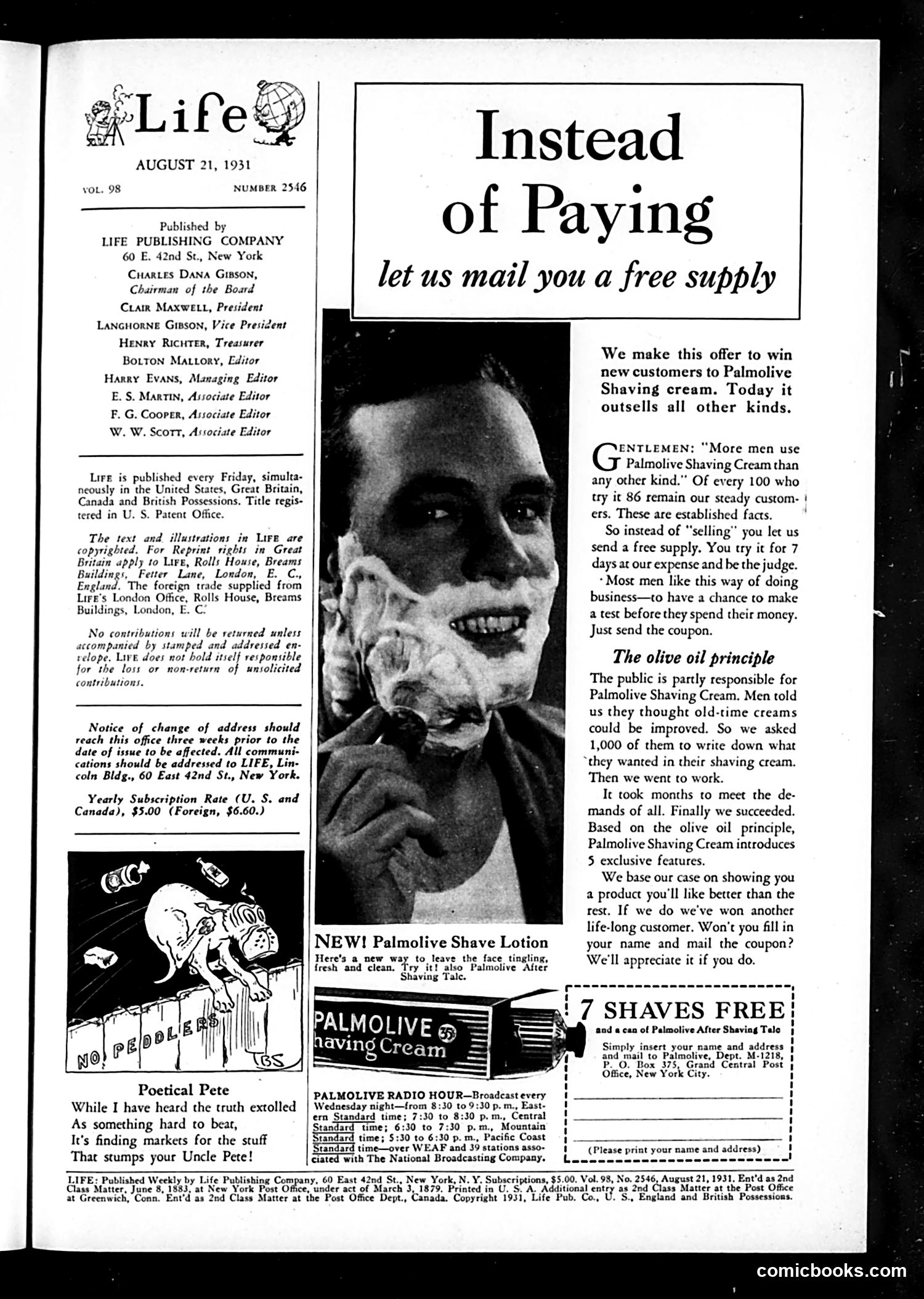
Analysis This page is primarily a Palmolive Shaving Cream advertisement (1931), not political satire. The large photograph shows a man's face during shaving, used to advertise the product's benefits. The accompanying text employs a marketing strategy called "the olive oil principle"—offering free samples to let customers test the cream before purchasing, based on their belief that most users would become loyal customers. The small cartoon labeled "Poetical Pete" at bottom left appears to be unrelated humor about someone named "Uncle Pete," though the joke's context is unclear from the visible text. This represents early 20th-century advertising strategy: using testimonial-style arguments and free trial offers to build consumer confidence in branded personal care products.
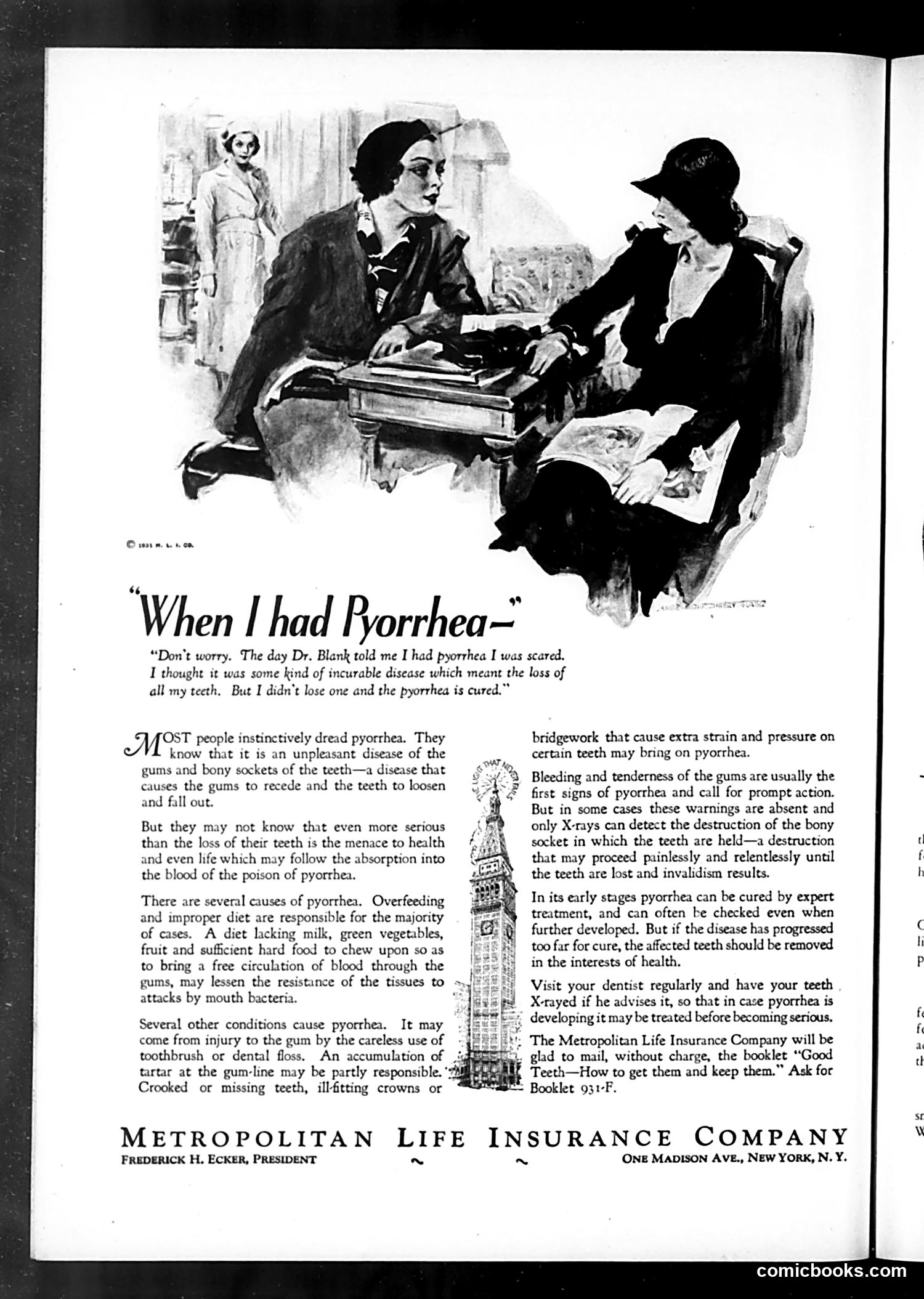
This is a health advertisement, not political satire. The Metropolitan Life Insurance Company uses a testimonial format to promote dental health awareness. A woman describes her experience with pyorrhea (now called periodontitis), a gum disease that causes tooth loss. The ad reassures readers that while pyorrhea sounds frightening, it's treatable with expert dental care and regular X-rays. The illustration shows two women—likely representing a patient consultation or social conversation about the condition. The advertisement emphasizes that insurance company literature ("Good Teeth—How to get them and keep them") is available free to readers. The piece reflects early-20th-century public health campaigns that used personal narratives and insurance companies' reach to educate Americans about preventive medicine and dental hygiene.
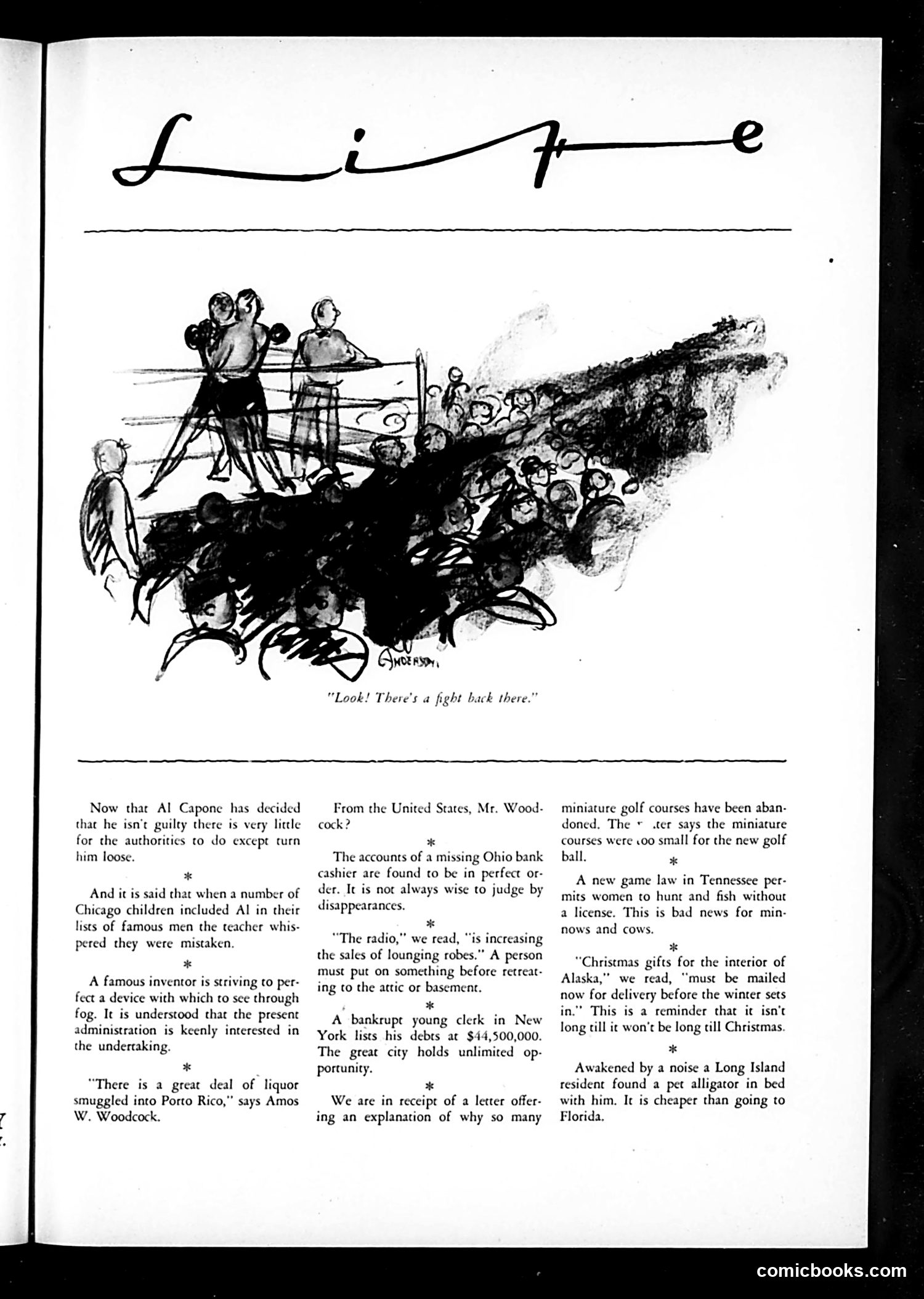
"Life" Satirical Page Analysis The cartoon depicts a boxing ring scene with the caption "Look! There's a light back there," satirizing public attention and distraction. The image shows boxers in a ring while a large crowd gathers behind them, suggesting the cartoon comments on how spectators or the public can be diverted from the main event. The text snippets below appear to be brief satirical items about contemporary issues: Al Capone's legal troubles, a missing Ohio bank cashier, Chicago children mistaking famous men for criminals, an inventor's fog-prevention device, liquor smuggling into Puerto Rico, and other topical humor. Without publication date visible, the Prohibition-era references (smuggled liquor) suggest this is from the 1920s-early 1930s. The overall page exemplifies *Life* magazine's format of mixing visual satire with brief comedic news commentary.
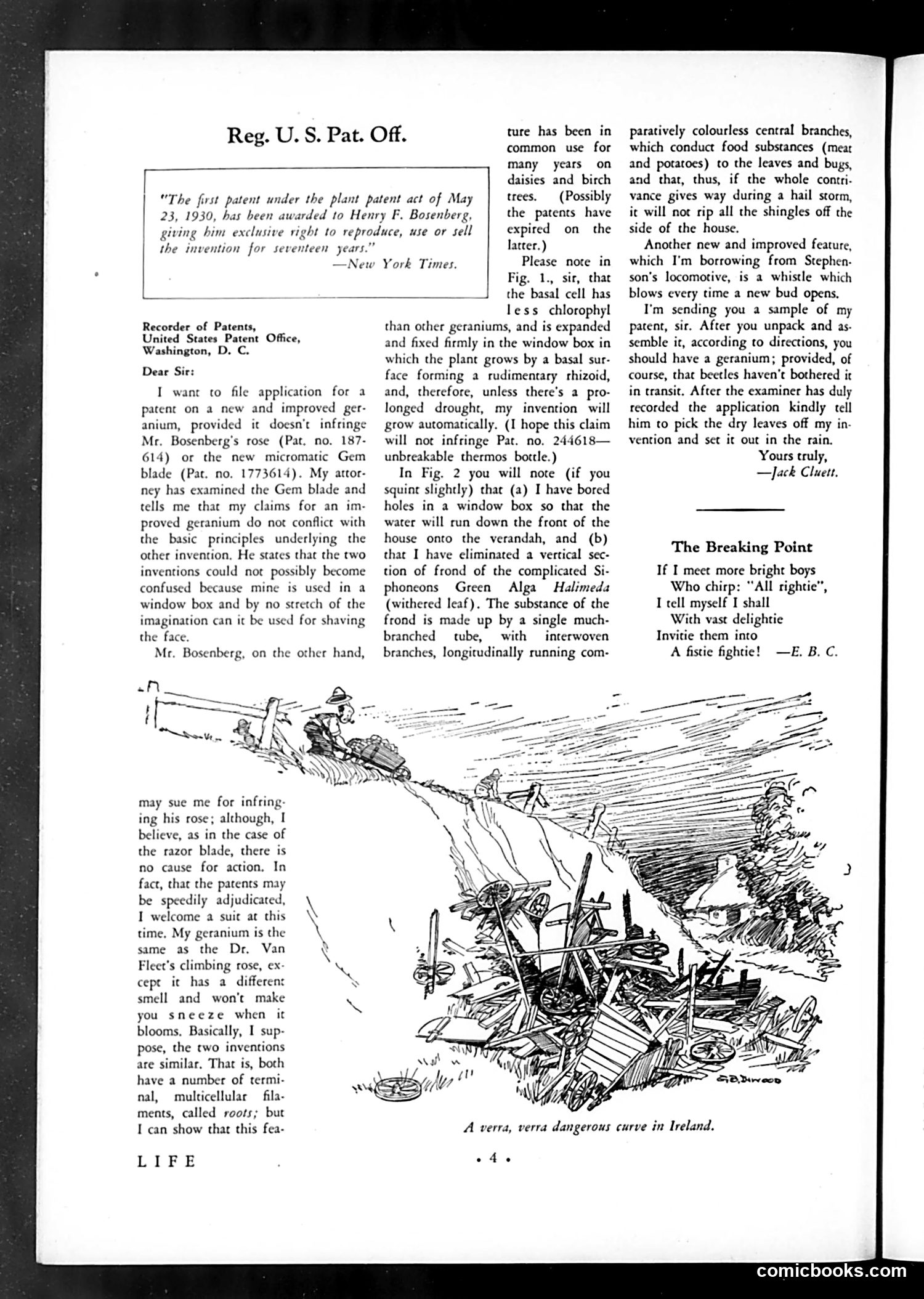
Analysis This page contains a patent office letter and a humorous illustration, not a political cartoon. The letter discusses a geranium patent invention, with the writer defending their improved geranium against potential infringement claims from Mr. Rosenberg's rose patent. The writer argues their inventions are sufficiently different and shouldn't be confused. The illustration depicts a chaotic Irish road accident ("A terra, verra dangerous curve in Ireland"), showing a horse-drawn cart that has crashed near a cliff edge with figures tumbling about. This is a period ethnic stereotype joke: the humor relies on depicting Irish people and Irish driving as reckless and accident-prone—a common prejudicial trope in early 20th-century American humor magazines. The poem "The Breaking Point" at right is unrelated.
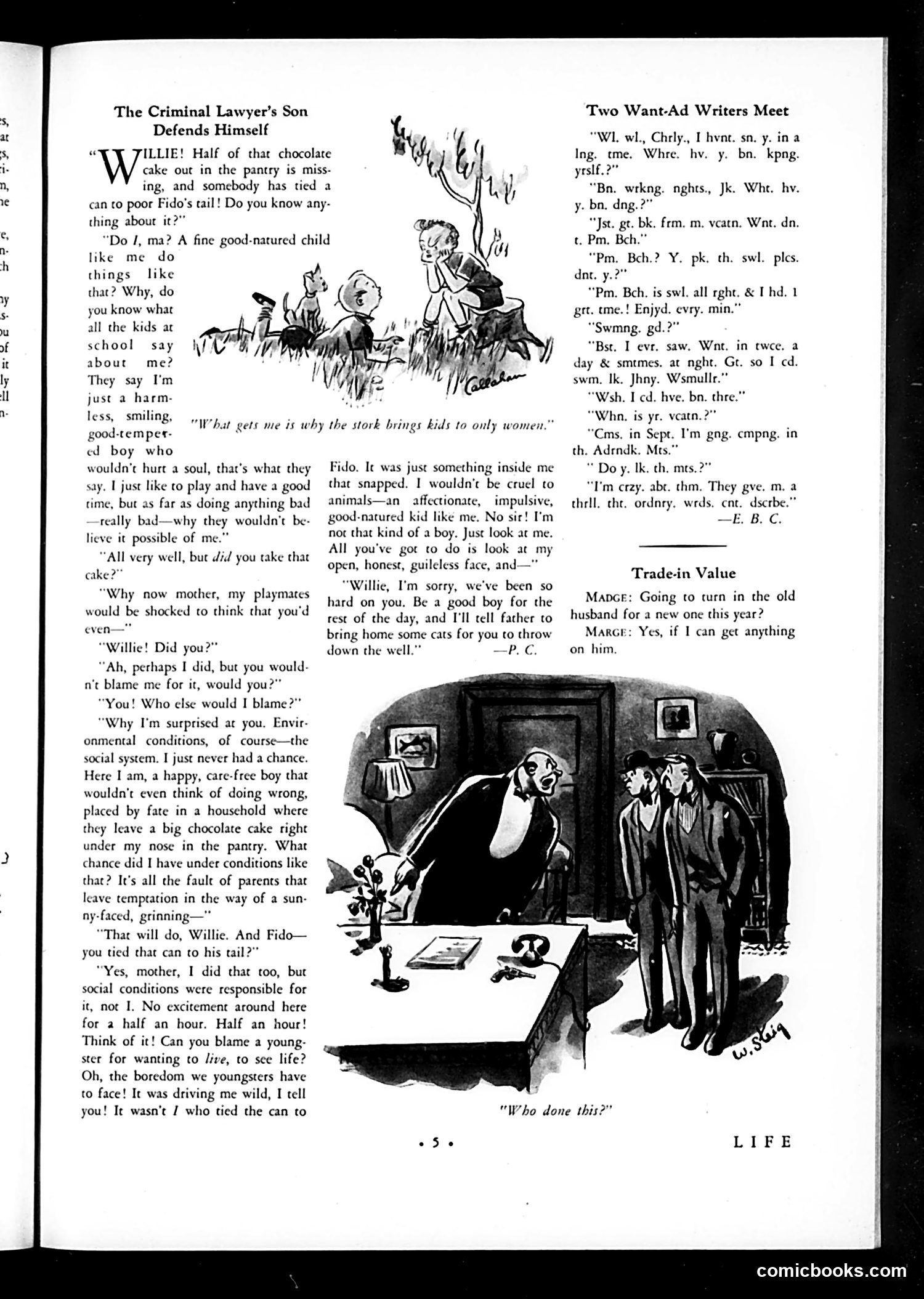
Analysis of Life Magazine Page This page contains three separate humor pieces typical of early-20th-century Life magazine: 1. "The Criminal Lawyer's Son Defends Himself": A dialogue where a boy, caught misbehaving, argues that environmental conditions—not his own nature—caused his wrongdoing. He blames "social system" and "parental conditions," suggesting satirical commentary on contemporary sociological arguments excusing criminal behavior. 2. "Two Want-Ad Writers Meet": A joke featuring coded abbreviations from classified advertisements, mocking the cryptic, abbreviated language job seekers used. 3. "Trade-in Value": A cartoon showing a wife proposing to trade in her old husband for a new one, satirizing consumer culture's "trade-in" concept applied to marriage—commentary on both consumerism and marital dissatisfaction. The humor reflects pre-1920s sensibilities and social anxieties.
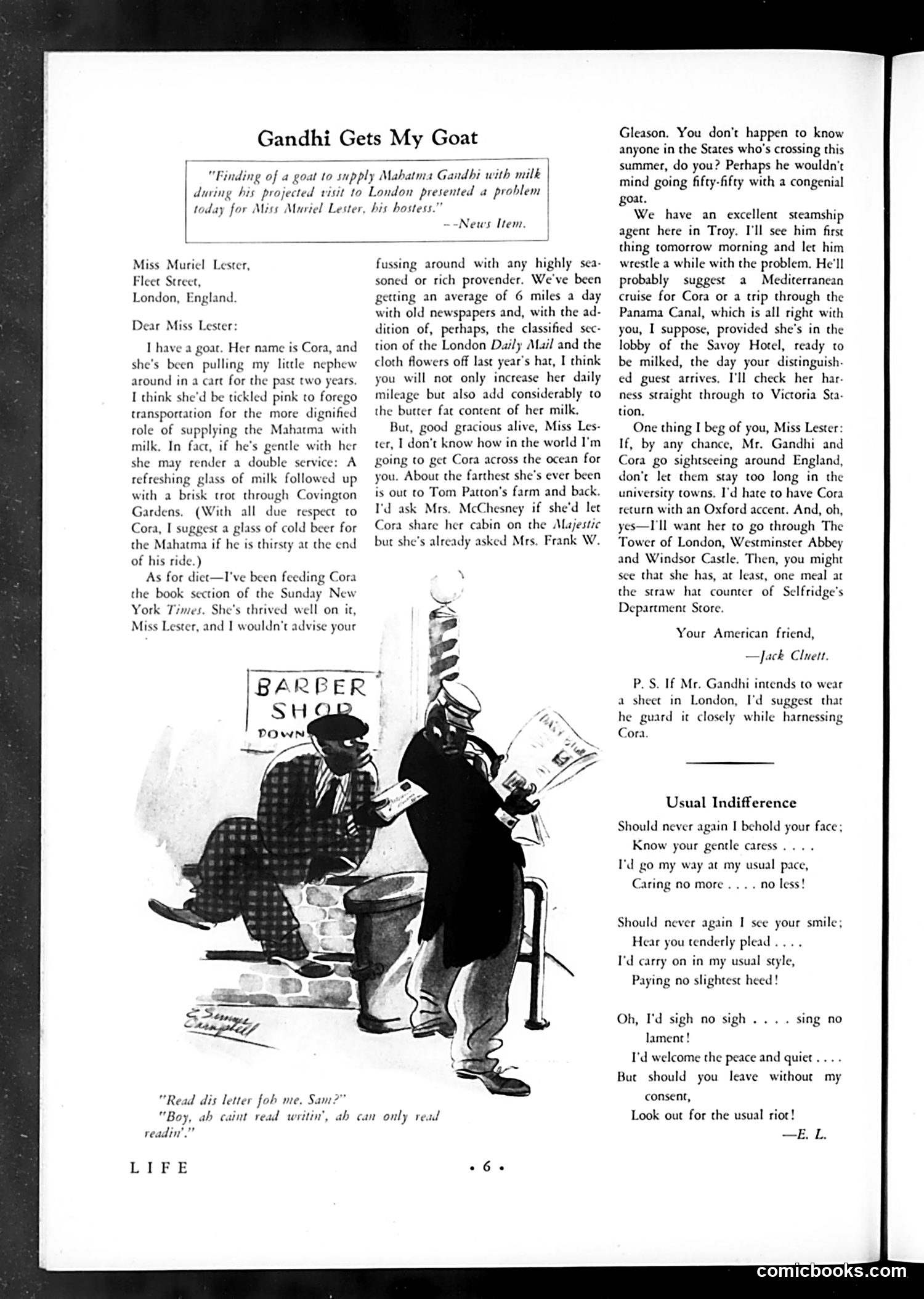
"Gandhi Gets My Goat" - Life Magazine This page satirizes plans to supply Mahatma Gandhi with milk via a goat during his visit to England. The letter from "Jack Cluett" (an American) humorously suggests the goat "Cora" be transported across the Atlantic and toured throughout England—visiting Oxford, the Tower of London, Westminster Abbey, and Selfridge's Department Store—before reaching Gandhi. The cartoon depicts a barber reading the letter aloud to a customer, with the caption "Read dis letter fob me, Sam?" The satire mocks both the elaborate logistics of Gandhi's visit and the absurdity of the goat's proposed English tour. It reflects 1930s American amusement at Gandhi's ascetic lifestyle and dietary practices, treating his milk-drinking habits as exotic fodder for comedy.
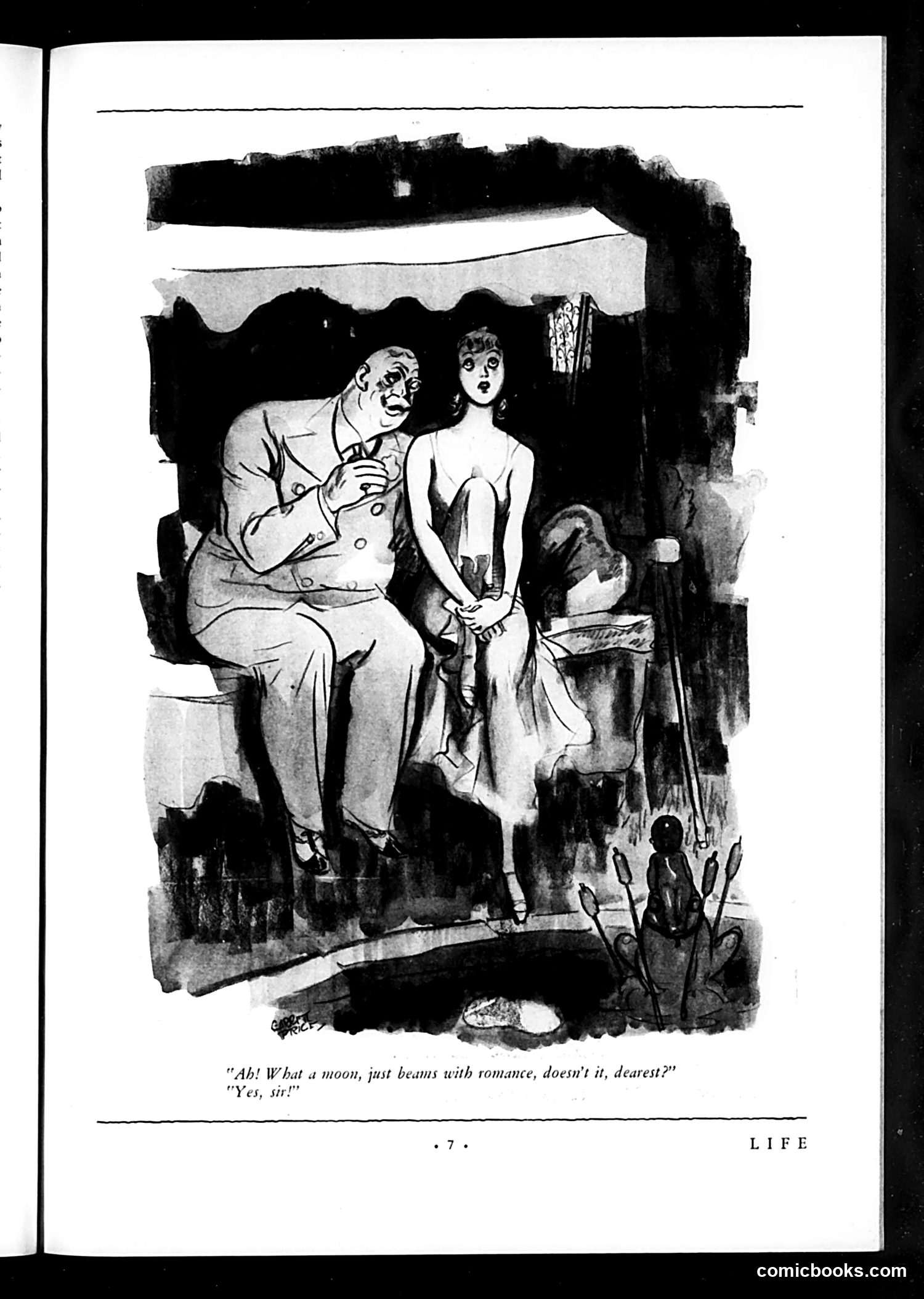
Cartoon Analysis This is a single-panel cartoon from *Life* magazine depicting a romantic scene under the moon. An older, portly man in a suit sits beside a young woman in what appears to be a park or public setting at night. The man gestures romantically toward the moon, saying "Ah! What a moon, just beams with romance, doesn't it, dearest?" to which the woman responds "Yes, sir!" The humor relies on the awkward dynamic: the significant age and physical difference between the characters, combined with the woman's formal "Yes, sir" response, suggests she's complying with rather than genuinely reciprocating his romantic overtures. The cartoon satirizes older men's attempts at seduction and the transactional or power-imbalanced nature of such encounters, likely commenting on social climbing or financial motivation in romantic relationships.
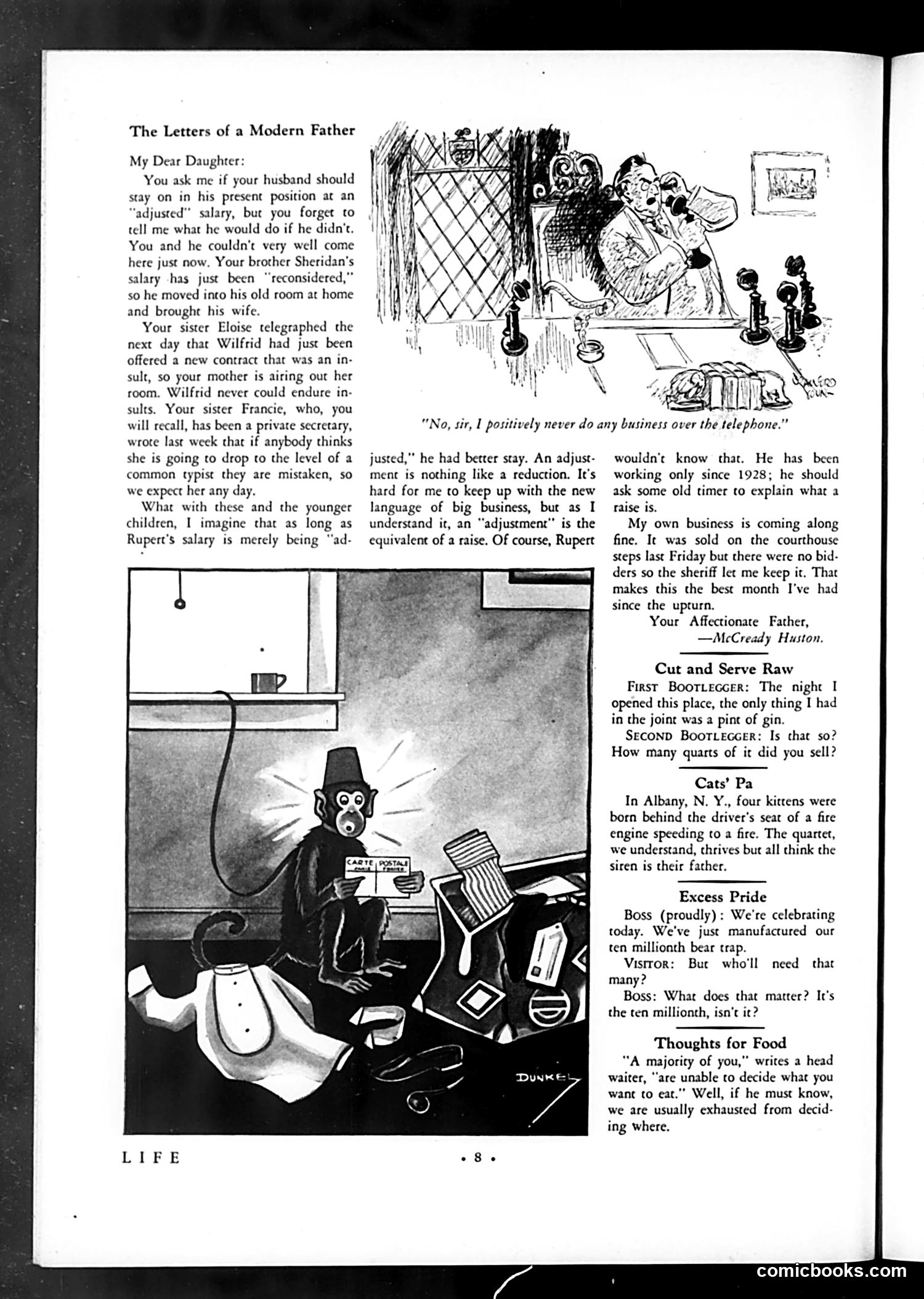
Explanation for Modern Readers This page from *Life* magazine contains several satirical humor pieces: Top Section: A letter from "McCready Huston" advises his daughter about her husband's job situation, discussing whether an "adjustment" (salary cut) versus a "raise" matters during economic hardship. The accompanying cartoon shows a figure at a telephone, illustrating businessmen's reluctance to conduct serious matters by phone. Middle Cartoon: Features a gas-masked figure amid scattered bottles and containers labeled "CASTLE PORTER," satirizing Prohibition-era bootlegging and the dangerous, unregulated alcohol trade. Bottom Sections: Brief humorous anecdotes mock business jargon ("adjustment" vs. "raise"), absurdist animal stories, and workplace observations—typical of *Life's* satirical commentary on American culture and economic anxieties, likely from the 1920s-1930s era.
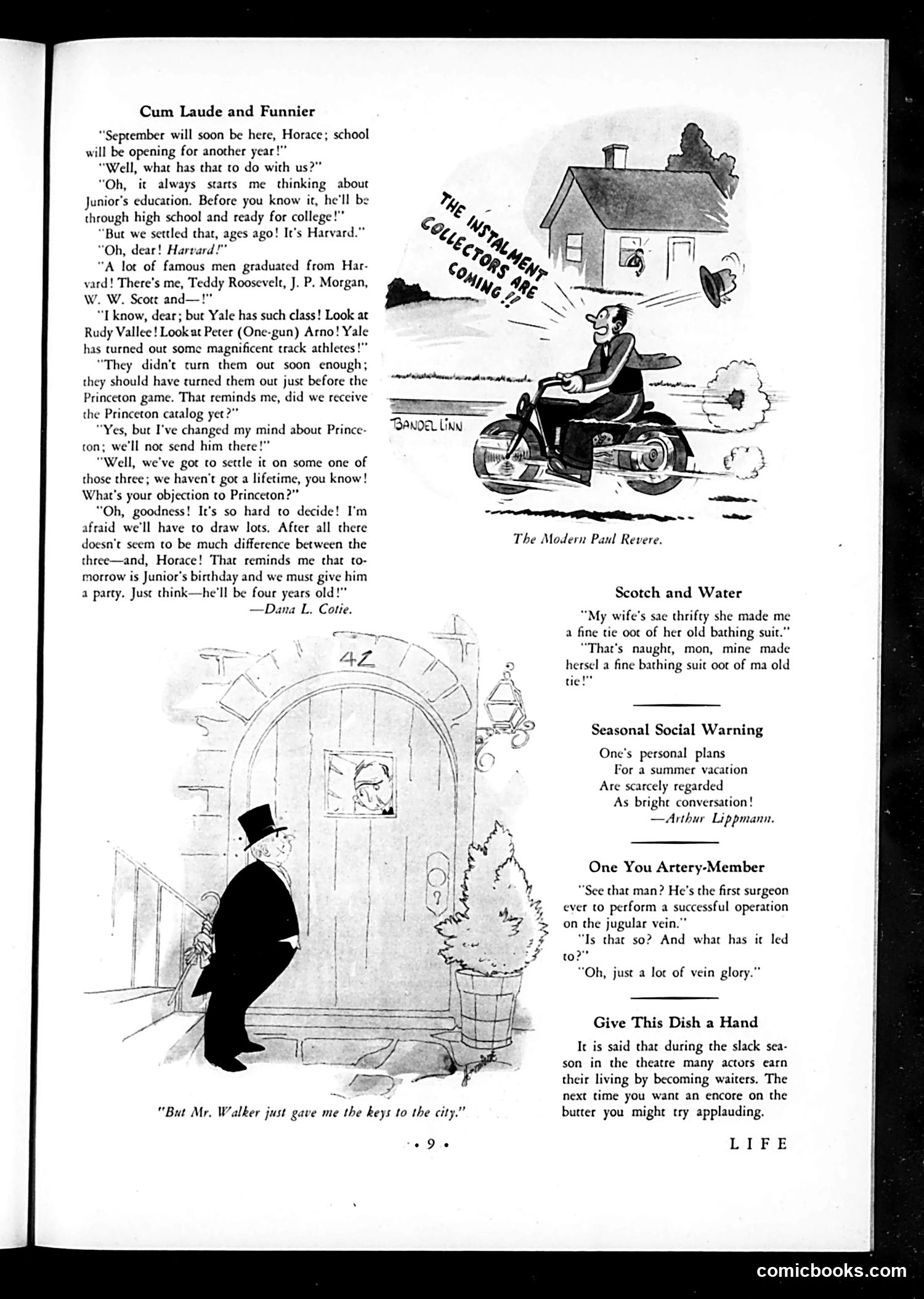
Analysis of Life Magazine Page 9 This page contains humorous prose pieces and cartoons satirizing American upper-class life. The top cartoon titled "The Modern Paul Revere" shows a man on a motorcycle announcing "the inhabitants, collectors are coming!" — mocking wealthy art collectors as a social threat comparable to British forces in the Revolutionary War. The bottom cartoon depicts a gentleman presenting "the key to the city" to another man, satirizing urban political patronage and insider access. The prose sections offer brief jokes about Scottish thriftiness, summer vacation planning, and theatre actors working as waiters during slow seasons — all gentle social satire targeting established conventions and class behaviors of the magazine's affluent readership.
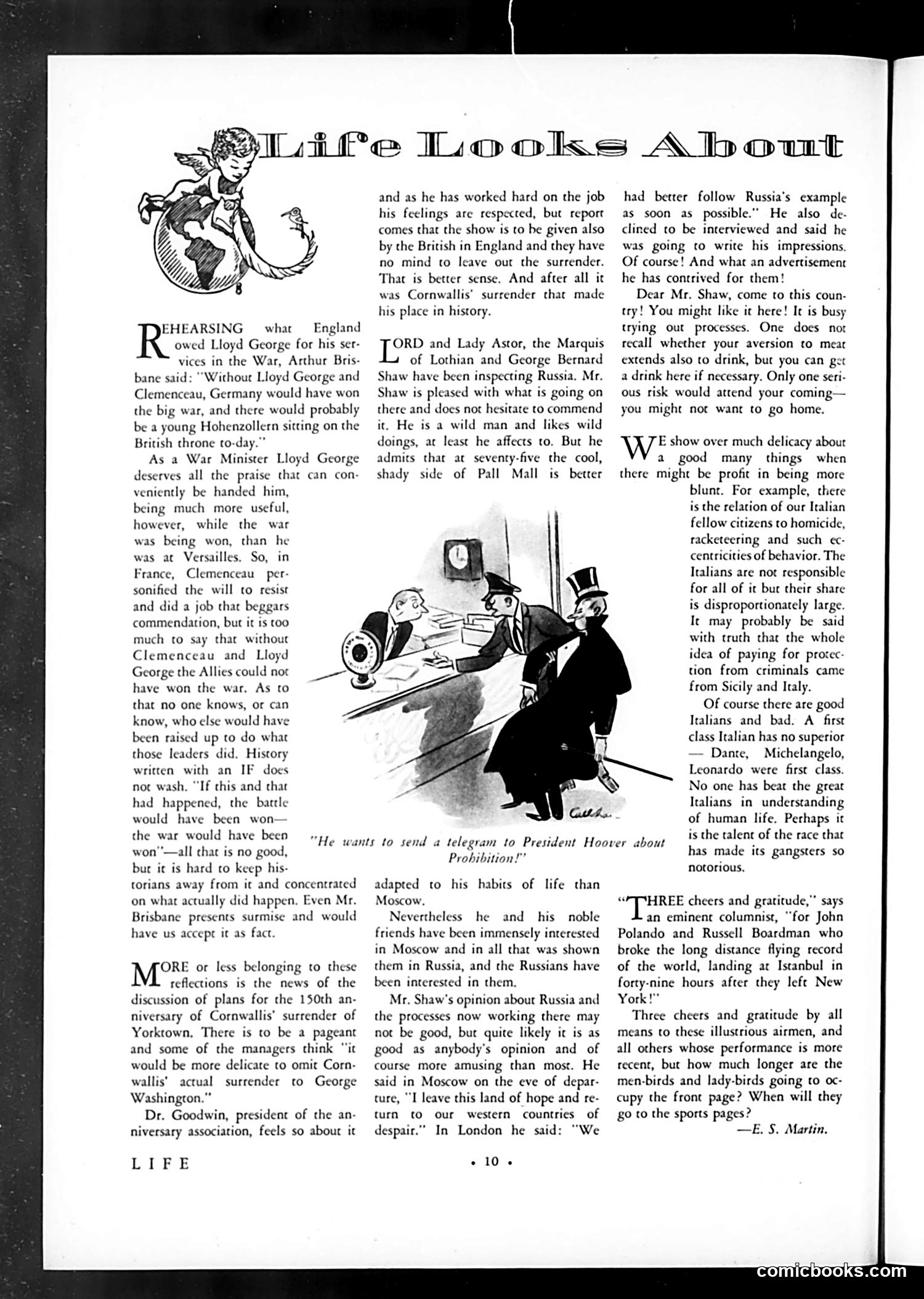
"Life Looks About" - Political Commentary Page This page contains editorial commentary on post-WWI politics rather than traditional cartoons. The main cartoon shows three figures at a desk labeled "He wants to send a telegram to President Hoover about Prohibition!" The satire targets: Cornwallis's surrender: The text discusses Lloyd George's wartime leadership versus his post-war role, referencing the 1500 anniversary of Cornwallis's surrender at Yorktown—implying current political "surrenders" are equally shameful. The cartoon: Appears to mock diplomatic efforts around Prohibition enforcement, with figures attempting to communicate with President Hoover about this contentious policy. Italian criminality: The article discusses organized crime's Italian connections, distinguishing between Italian cultural achievements (Dante, Michelangelo) and contemporary gangsterism. The overall tone critiques political ineffectiveness and moral compromise in 1920s American governance.
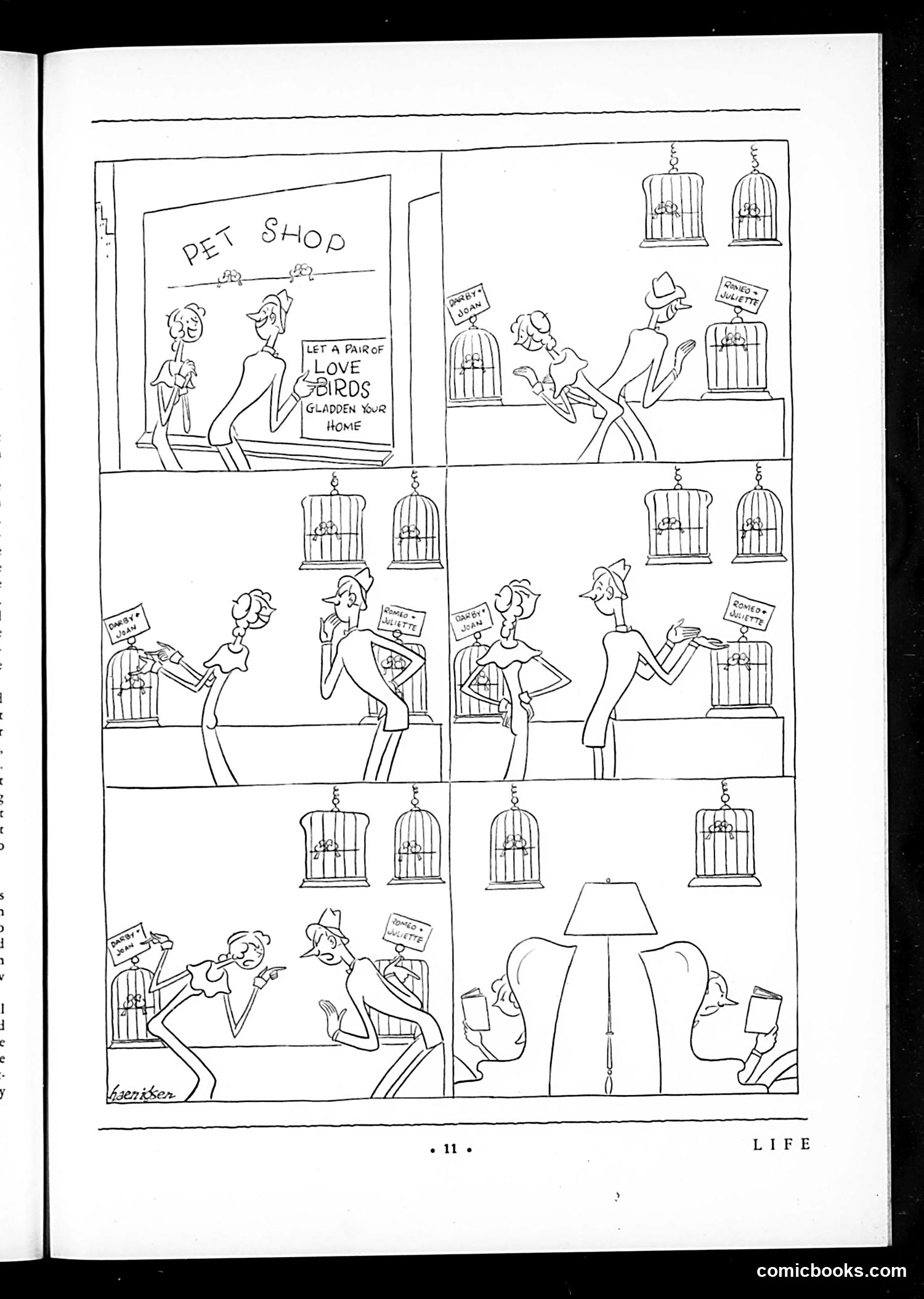
Pet Shop Comic Strip Analysis This is a humorous comic strip about a couple shopping at a pet store for "love birds" to take home. The shopkeeper displays caged birds while the customers—depicted as an attractive young couple in 1920s-30s style clothing—examine the merchandise. The joke plays on the double meaning of "love birds": literal caged birds sold as pets, versus the romantic connotation of the term. The strip shows the couple's escalating enthusiasm as they interact with various caged birds, with their animated gestures and expressions suggesting romantic interest in the birds themselves—creating absurdist humor through the mismatch between the literal pet transaction and the flirtatiousness typically associated with the phrase "love birds."
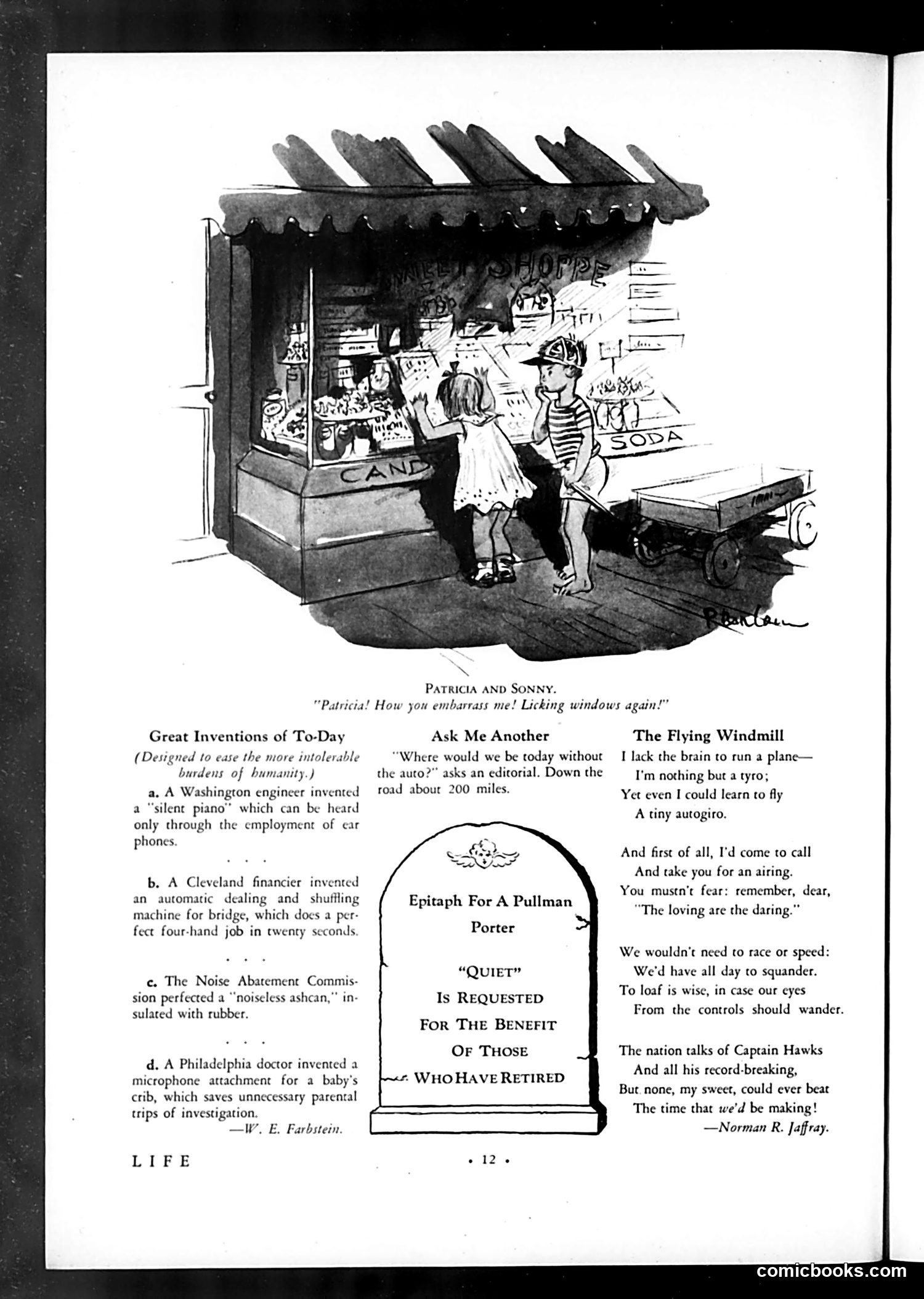
Analysis of Life Magazine Page 12 The main cartoon depicts a street candy/soda stand with a vendor and two children. The caption "Patricia! How you embarrass me! Licking windows again!" is a joke about window-licking—the children are literally licking the shop window display rather than purchasing items. Below are three sections: 1. "Great Inventions of To-Day": Lists four satirical "inventions" mocking modern conveniences (car phones, shuffling machines, noise abatement, microphone cribs)—poking fun at increasingly unnecessary gadgets. 2. "Ask Me Another": A trivia question about automobile dependency. 3. "The Flying Windmill": A humorous poem about learning to fly, credited to Norman R. Jaffray. The epitaph references a Pullman Porter. The overall tone satirizes modern life's absurdities and consumer culture.
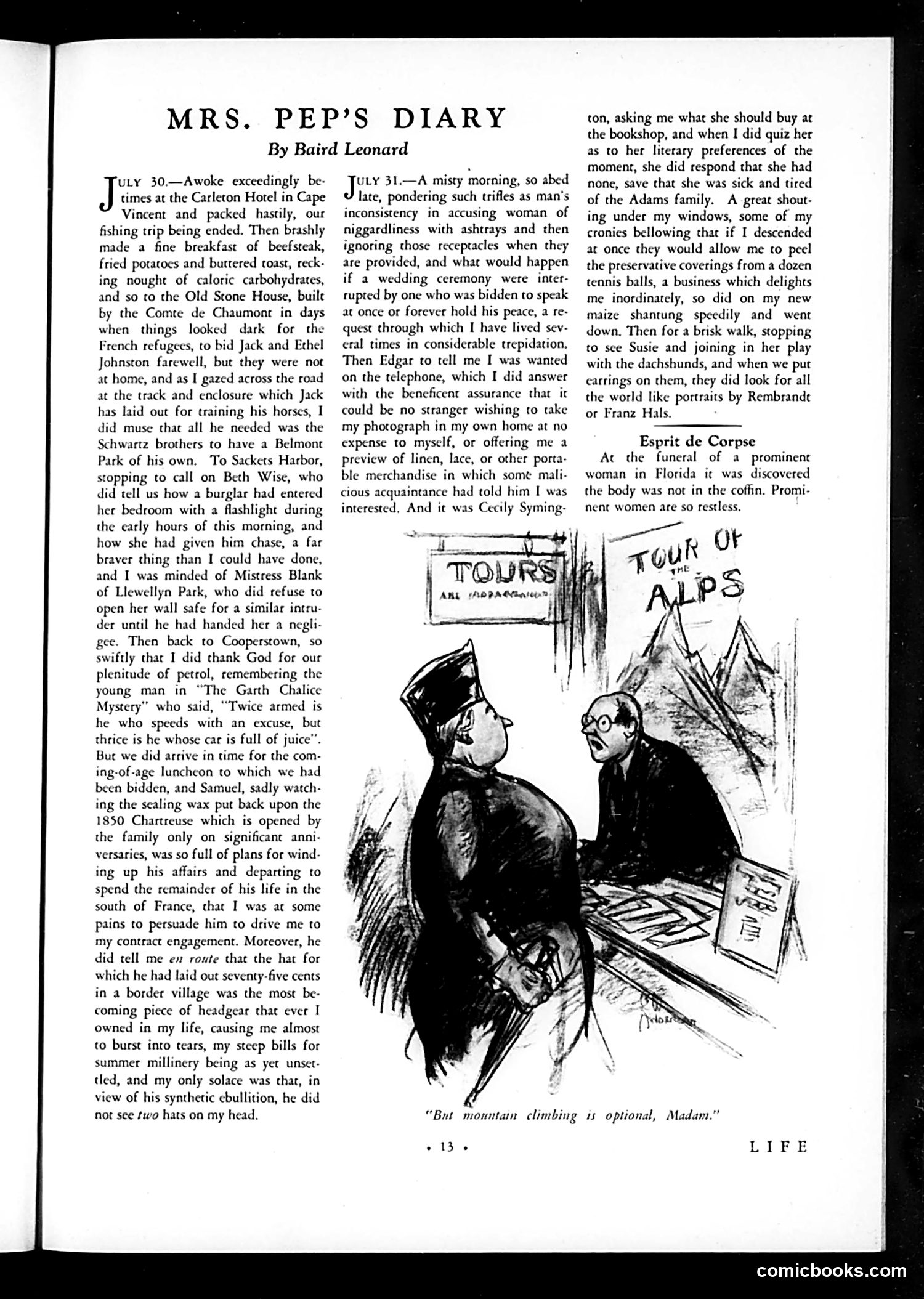
Analysis of Life Magazine Page This page contains "Mrs. Pep's Diary" by Baird Leonard, a humorous column documenting leisure travel experiences in Europe (Cape Town, French Riviera, Alps region). The accompanying cartoon depicts two tourists at what appears to be an Alpine tour office. One figure, drawn with exaggerated facial features characteristic of early 20th-century caricature, says to the tour operator: "But mountain climbing is optional, Madam." The satire targets wealthy tourists—particularly women—seeking luxury travel experiences while avoiding physical exertion. The joke mocks the expectation that tour companies should eliminate all inconvenience from "adventure" travel. The cartoon reflects period attitudes about gender, class tourism, and the emerging consumer expectation that comfort should accompany every leisure activity.
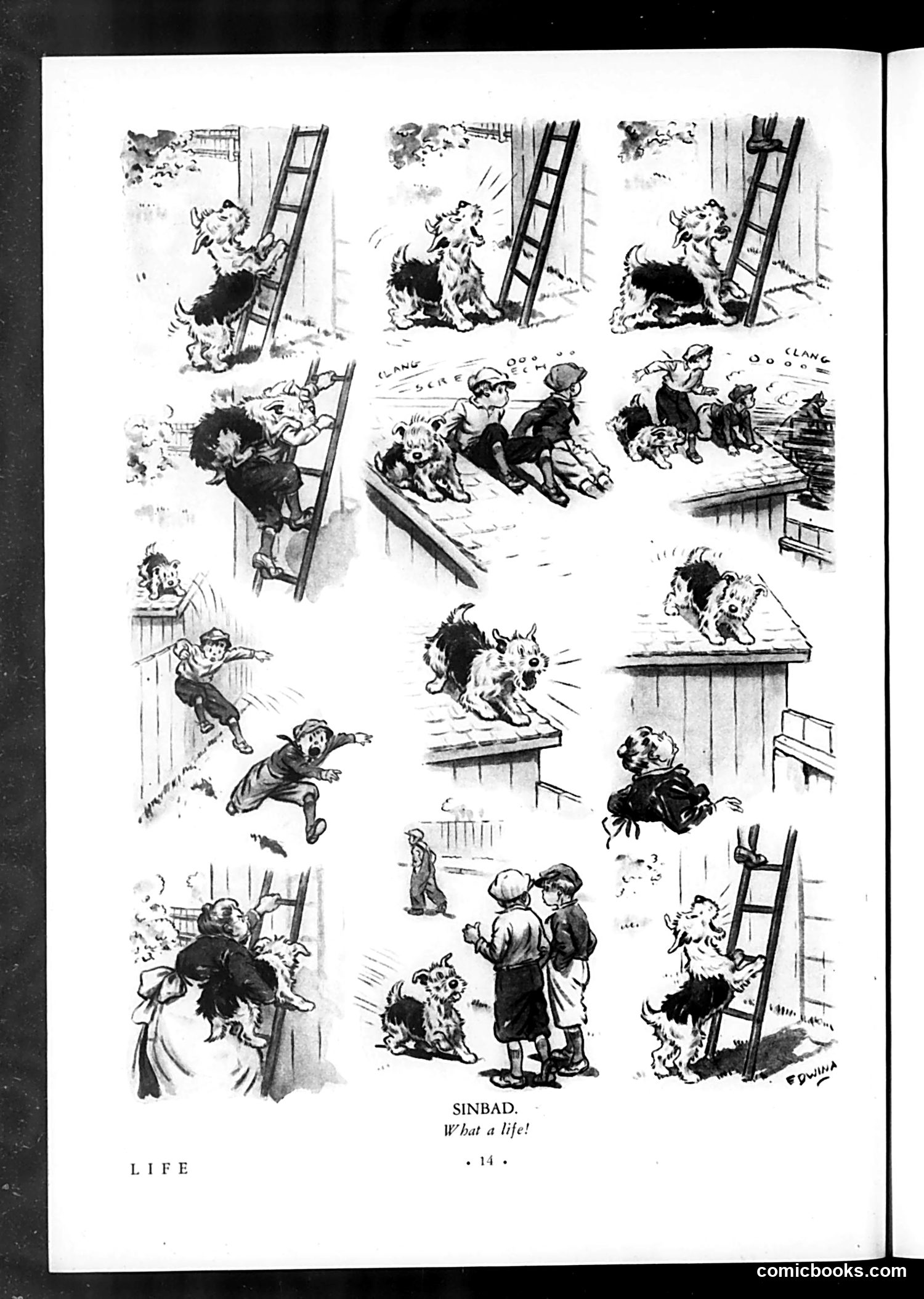
Analysis This is a humorous comic strip titled "Sinbad: What a Life!" depicting a mischievous dog causing chaos throughout a household. The strip shows the dog climbing ladders, running across roofs, jumping on furniture, and generally creating mayhem while humans attempt to manage or escape the destruction. The satire targets the challenges of pet ownership—specifically the exhausting, never-ending disruption an unruly dog brings to domestic life. Each panel escalates the absurdity: the dog knocks over ladders, terrorizes inhabitants, destroys property, and creates pandemonium that leaves everyone frazzled. The title's ironic phrase "What a life!" emphasizes the exasperation felt by the household members dealing with constant canine misbehavior. This was likely relatable humor for *Life* magazine's early 20th-century readership, poking fun at the universal frustrations of keeping a destructive pet indoors.
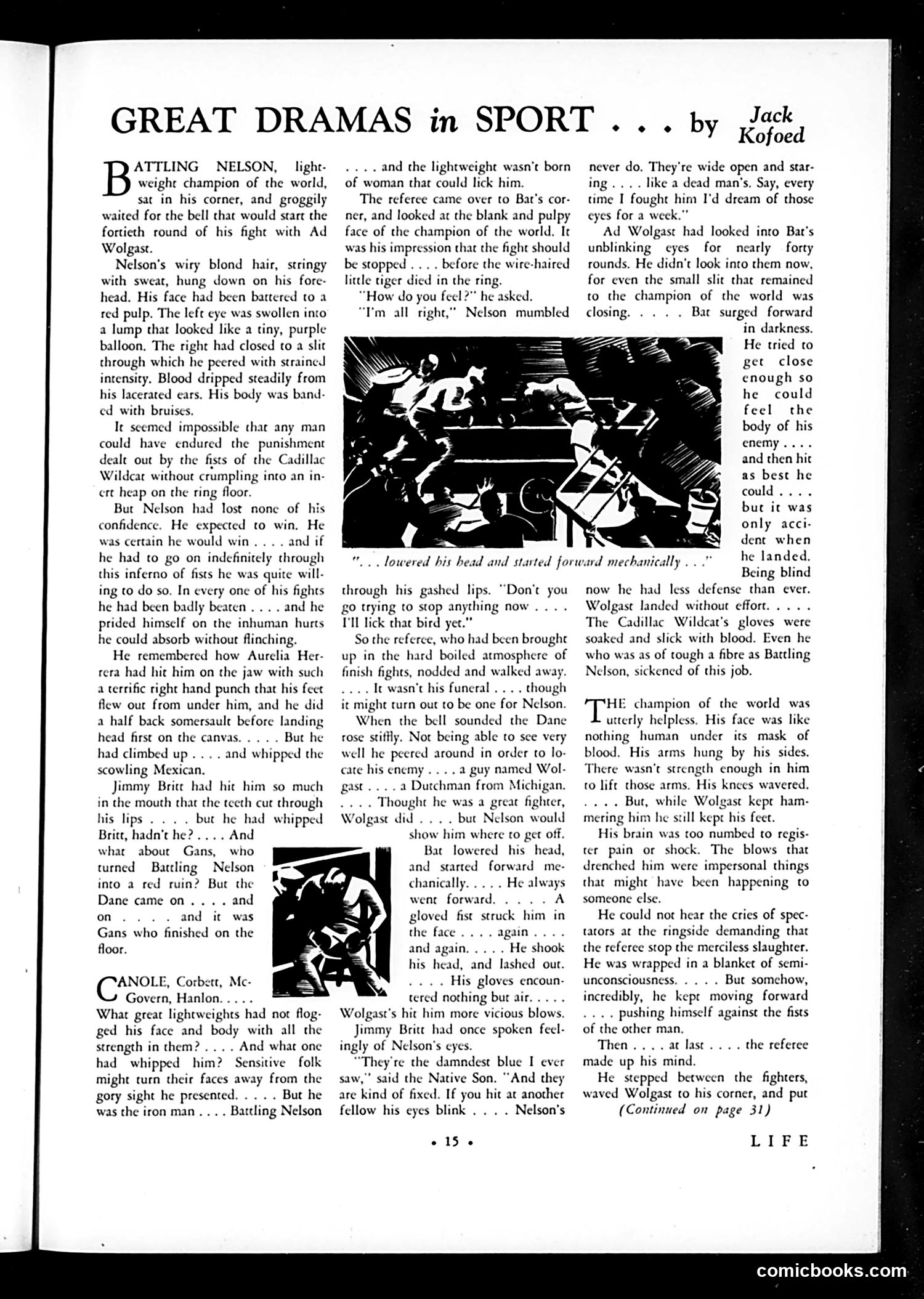
Analysis This is a sports drama story titled "Battling Nelson" by Jack Kofoed, featuring illustrations of a boxing match. The text describes a lightweight champion boxer named Nelson enduring brutal punishment during a fight with an opponent called "the Cadillac Wildcat." The narrative focuses on Nelson's physical deterioration—swelling eyes, bloodied face, bruised body—and his mental struggle to continue fighting despite accumulating damage. References to other boxers (Canole, Jimmy Britt, Gans) and a Native American fighter named Wolgast appear to establish boxing history context. The story emphasizes boxing's violent brutality and the champion's grim determination, presenting sport not as entertainment but as an examination of human endurance and suffering. The illustrations show the chaotic, bloody nature of early 20th-century prize fighting.
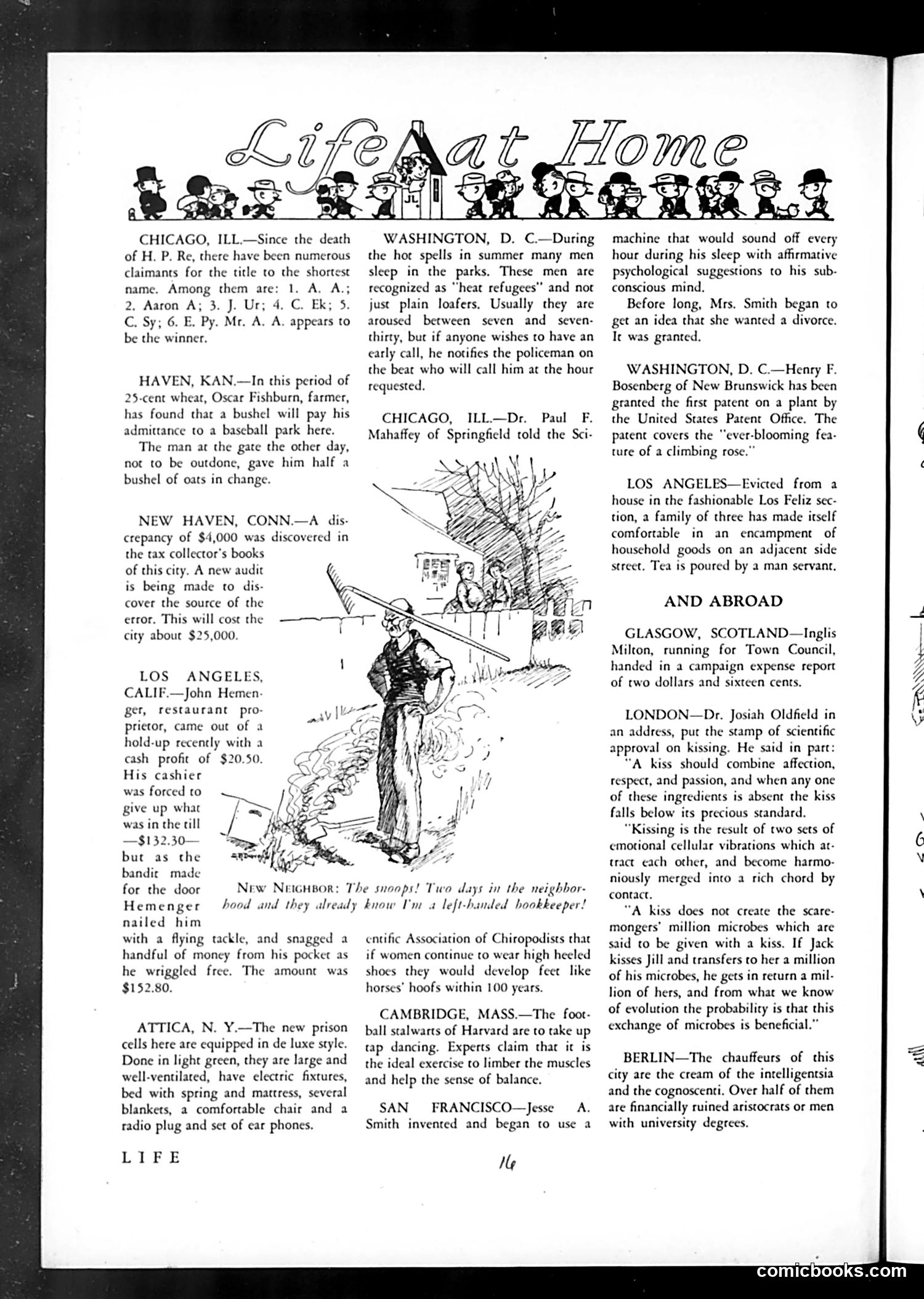
Life Magazine - "Life at Home" Page Analysis This page contains brief humorous anecdotes and social commentary rather than political cartoons. The one illustration shows a man being struck by what appears to be a door or plank, labeled "New Neighbor: The swoop! Two days in the neighborhood and they already know I'm a left-handed bookkeeper!" The joke plays on how quickly neighbors gossip and share personal information about newcomers. The physical comedy of the door strike underscores the chaotic intrusion into privacy that small-community life entails. The surrounding text items mock various situations: a farmer's confusion about baseball gate admission, Harvard students' tap-dancing exercises, and a chiropodists' association's concerns about women wearing high heels. These represent typical early 20th-century social satire—gentle mockery of everyday American life rather than partisan politics.
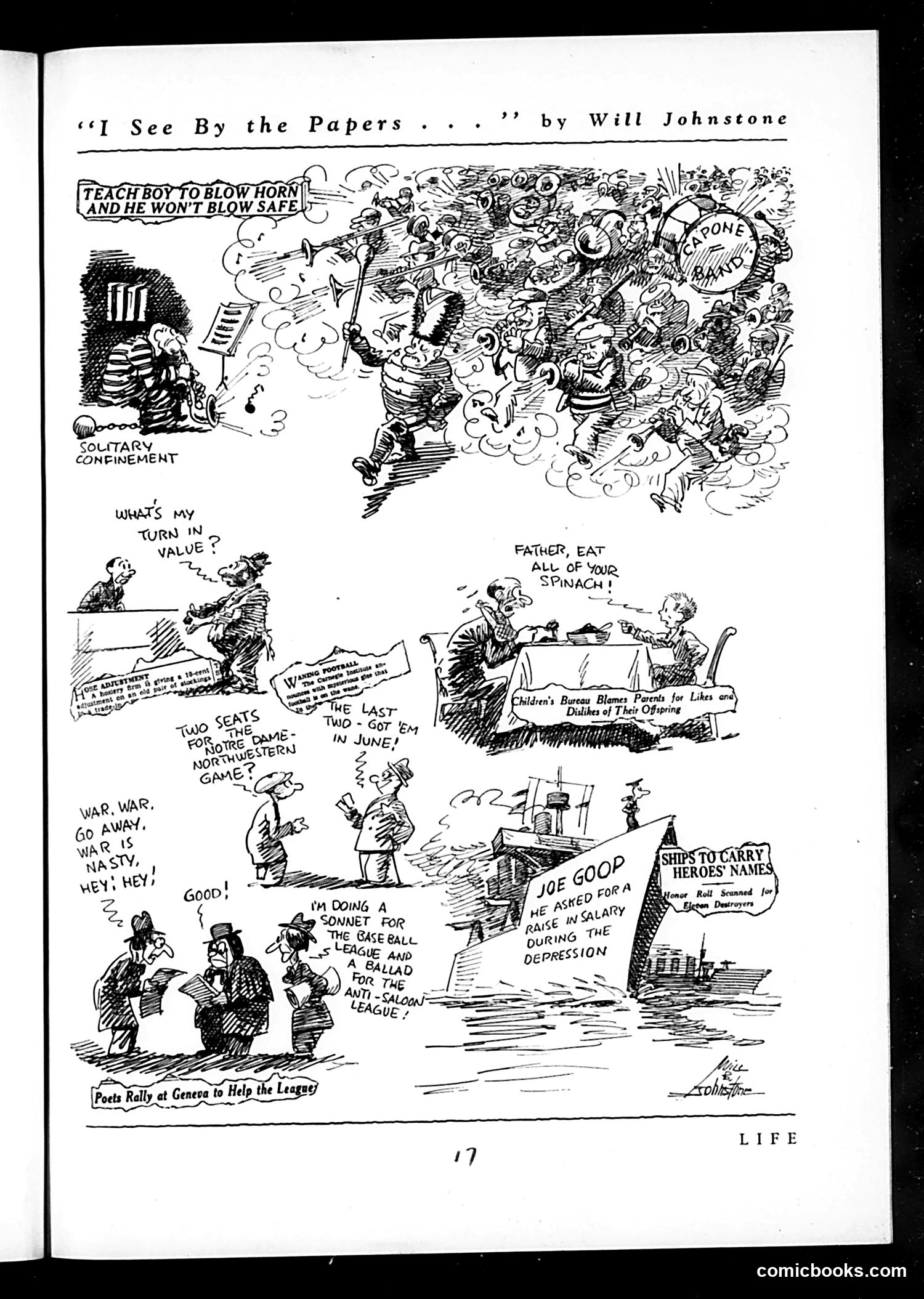
This satirical page by Will Johnstone depicts various wartime concerns during what appears to be WWI or the Great Depression era. The top panel shows chaos labeled "Fitchboy Blow Horn and He Won't Blow Safe" and "Apone," satirizing military or industrial safety failures. Below are several vignettes mocking American civilian life during hardship: Notre Dame football ticket scalping, a father demanding his son eat spinach (referencing Iron Man nutritional propaganda), poets rallying to help a baseball league, and Joe Good requesting a salary raise during the Depression. The final panel shows a military ship labeled "Ships to Carry Heroes Names," likely ironizing how vessels honored fallen soldiers while their families struggled economically. The overall message critiques how society prioritizes entertainment, trivial concerns, and profit over genuine wartime sacrifice and workers' needs.
Page Content Analysis This page contains film reviews by Harry Evans, not political cartoons. It discusses three movies: 1. "An American Tragedy" - A film adaptation of Theodore Dreiser's novel, criticized for failing to properly develop the protagonist's mental struggle and moral conflict. The reviewer notes the trial scenes are dramatically powerful but overly long. 2. "Politics" - A film featuring Marie Dressler, criticized as a waste of her talent. The review notes confusion among viewers about whether the character was actually Polly Moran (another actress) rather than Dressler. 3. "Nifty" - Apparently a lesser film directed by Charles F. Risquét. The page is a standard entertainment critique section, not satirical commentary on current events or political figures.
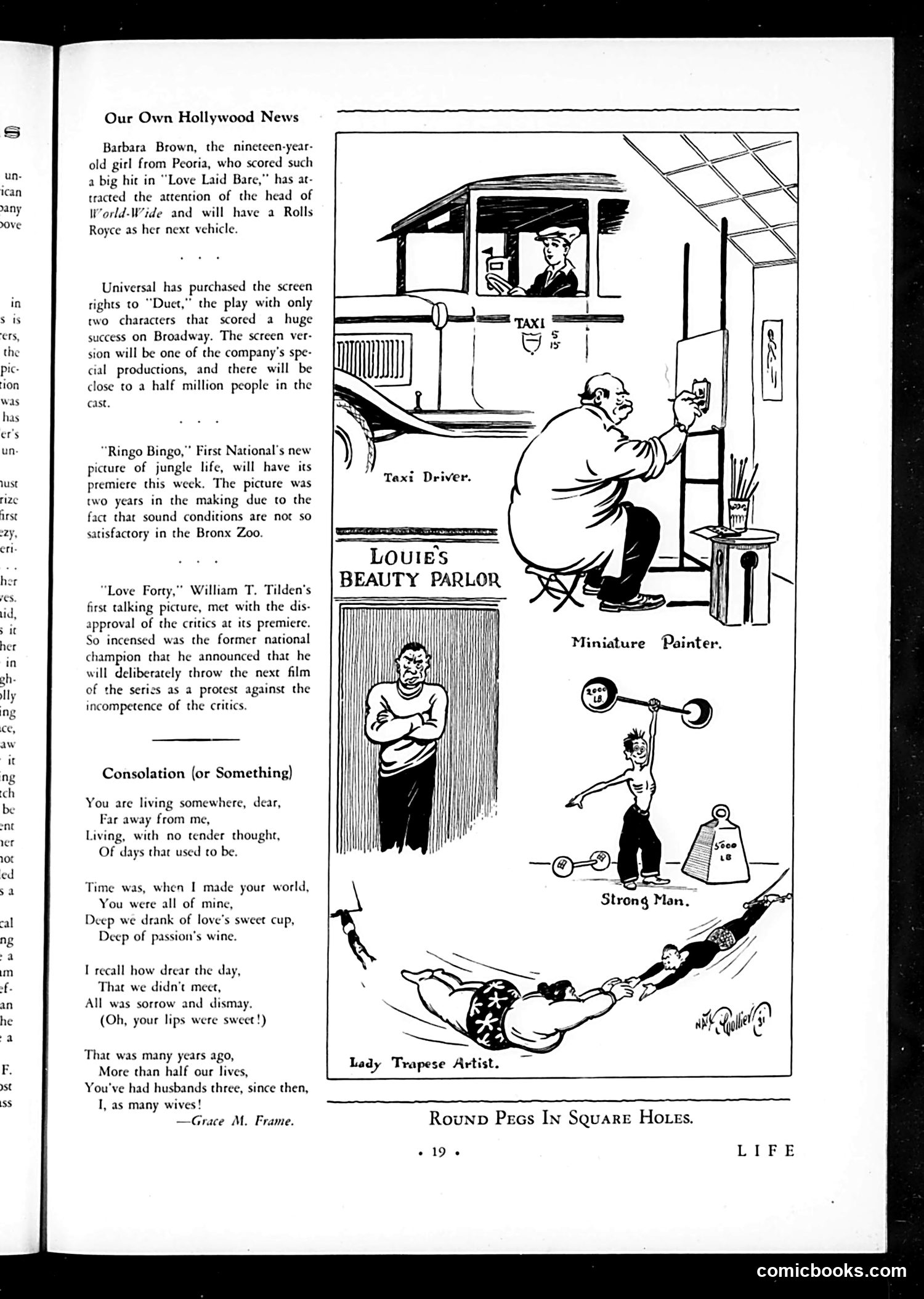
"Round Pegs In Square Holes" This page contains Hollywood industry news and four cartoon vignettes satirizing various professions and activities: 1. Taxi Driver - A portly man hailing a cab 2. Louie's Beauty Parlor - A man in a salon 3. Miniature Painter - An artist at tiny-scale work 4. Strong Man - A muscular figure with weights 5. Lady Trapeze Artist - An acrobat performing The title "Round Pegs In Square Holes" suggests these cartoons mock people ill-suited to their chosen professions. The humor derives from visual incongruity—each figure appears comedically mismatched to their profession. The accompanying text discusses early Hollywood films and actors, typical of Life magazine's entertainment coverage during the silent film era.
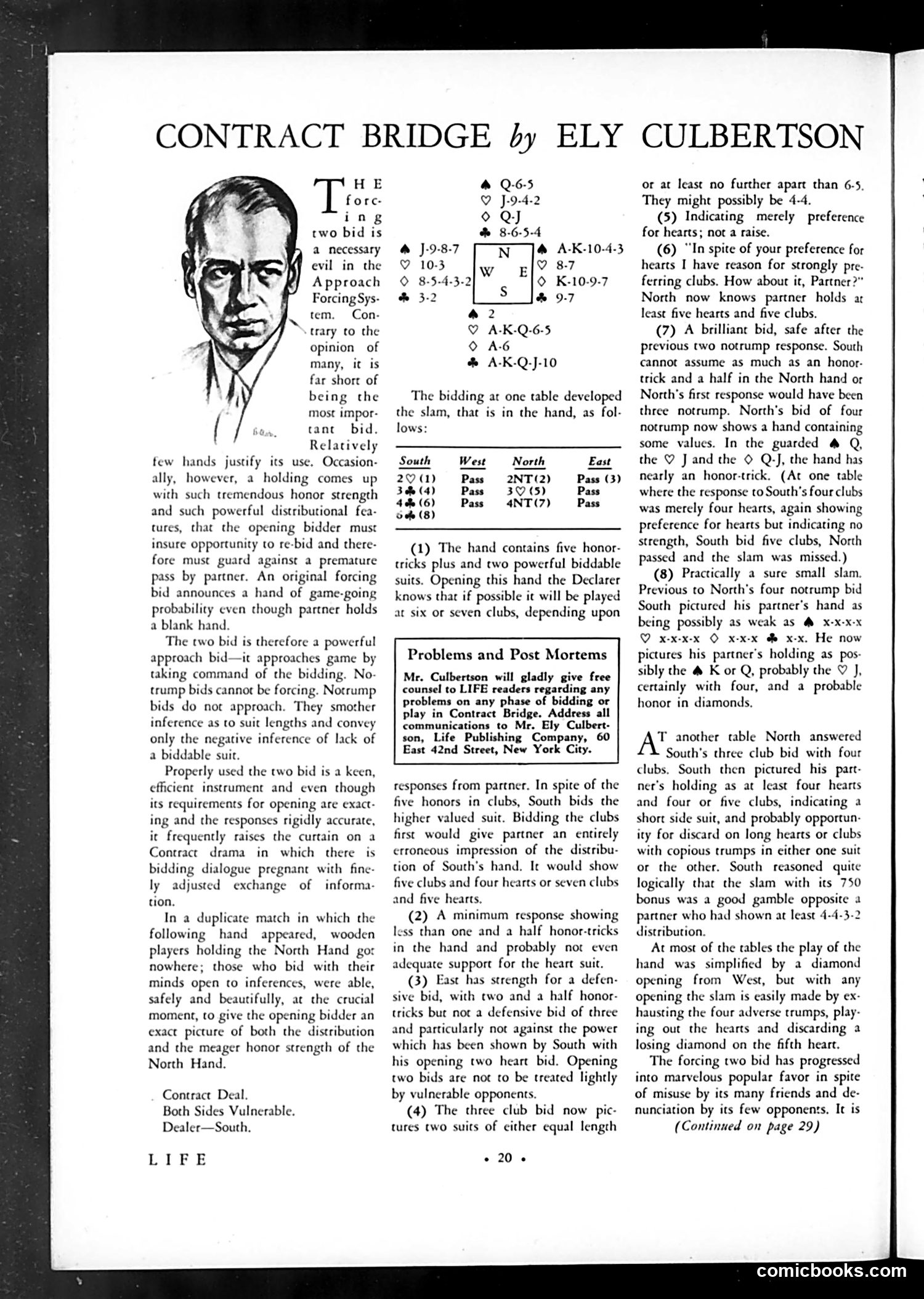
Contract Bridge Instruction, Not Satire This page contains no political cartoon or satire. It is a serious instructional article on Contract Bridge, the card game, written by Ely Culbertson, a prominent bridge expert of the era. The portrait shows Culbertson himself. The content explains forcing bids in bridge—specifically the "two bid" strategy—through a detailed hand example with numbered annotations explaining each bidding decision. A sidebar offers readers the chance to submit bridge problems to Culbertson for free expert analysis. This was educational content, not satire. The page demonstrates *Life* magazine's breadth beyond humor—it published serious instructional material alongside cartoons and jokes for a general audience interested in contract bridge, which was enormously popular in 1930s America.
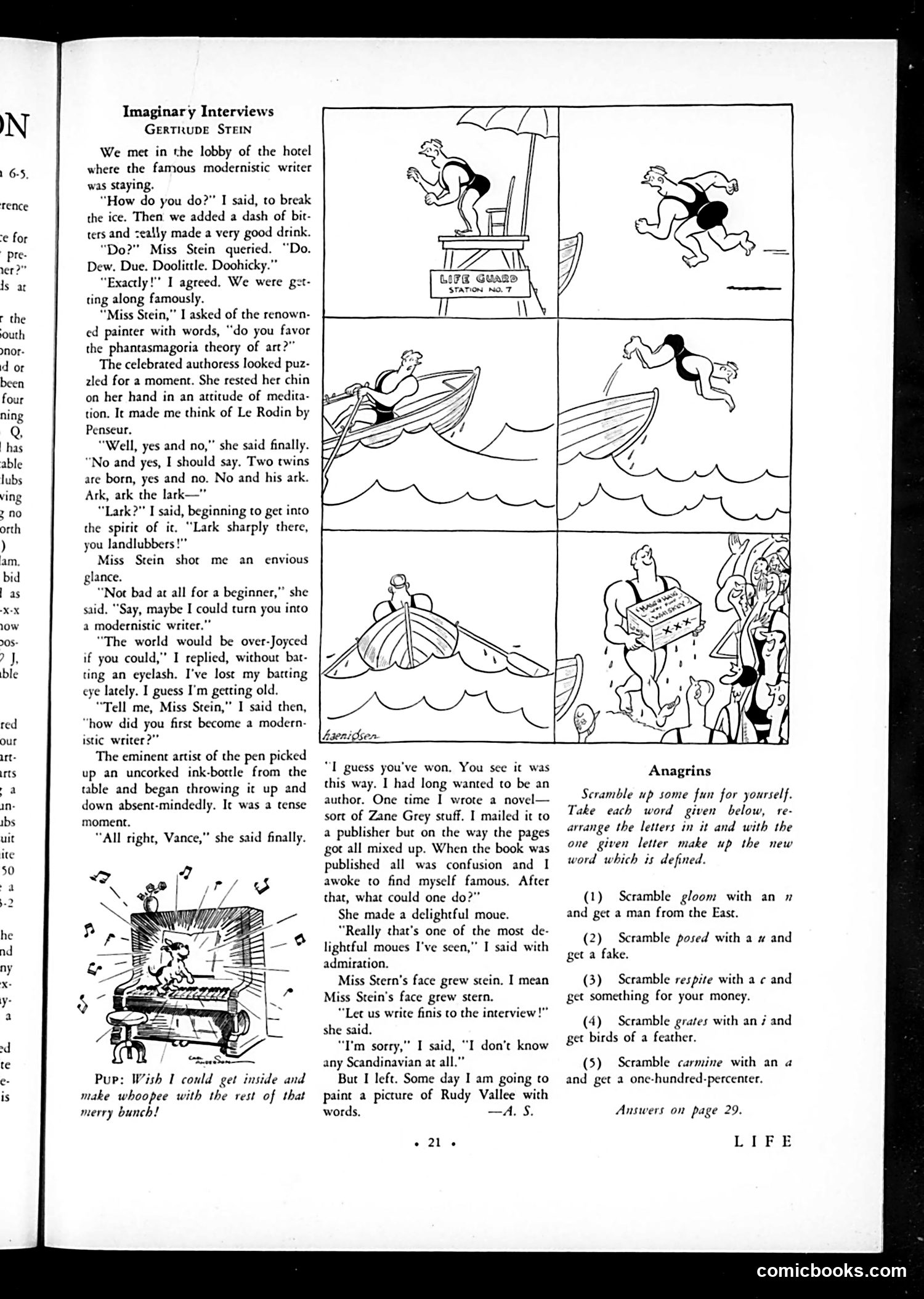
"Imaginary Interviews: Gertrude Stein" This is satirical mockery of modernist writer Gertrude Stein, famous for her experimental, repetitive writing style that many found deliberately obscure. The interviewer mimics her characteristic word-play ("Do. Dew. Due. Doolittle. Doohicky") to absurd effect, and Stein approves, suggesting she could "turn you into a modernistic writer." The joke culminates in her origin story: she accidentally became famous when a publisher received her pages out of order—implying her success derives from chaos rather than talent. Her response to a pun ("I don't know any Scandinavian") suggests even she cannot understand modernist obscurity. The accompanying illustrations show slapstick chaos (people falling, drowning, etc.), visually reinforcing the satire that modernism is nonsensical confusion rather than serious art. This reflects 1920s-30s skepticism toward avant-garde literature among mainstream audiences.
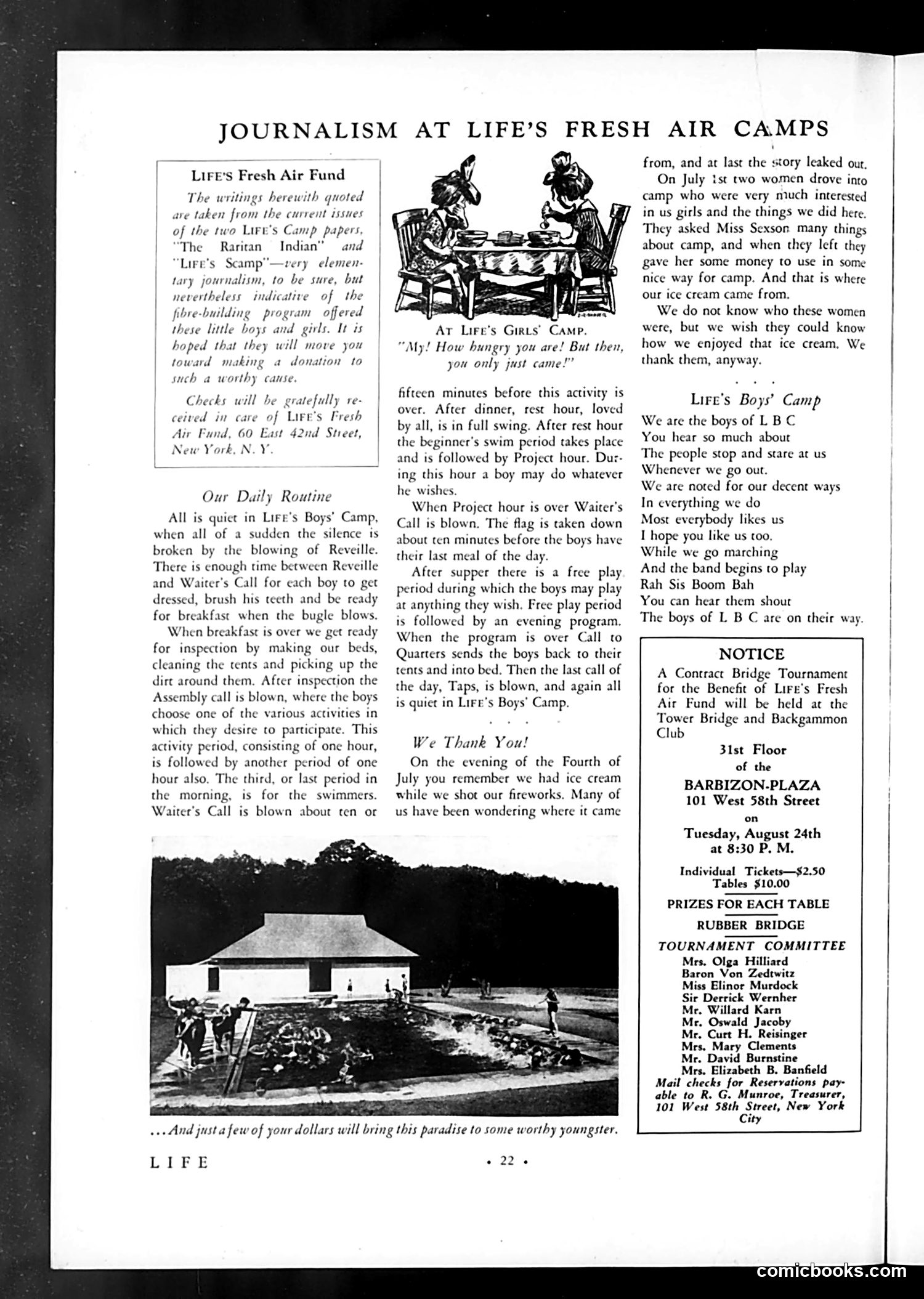
Explaining This Life Magazine Page to Modern Readers This is primarily informational content, not satire, featuring Life's Fresh Air Fund—a real charitable program providing summer camps for urban children. The page includes: 1. Two illustrated cartoons at top (not political satire): humorous vignettes of camp life—girls commenting on a boy's appetite upon arrival, showing the camps' casual, domestic character. 2. Camp writings: Two children's newspapers ("The Raritan Indian" and "Life's Scamp") are excerpted, describing daily routines with bugle calls, swimming, and structured activities. Life magazine frames these as charming evidence the camps build character. 3. Thank-you notes: Campers acknowledge anonymous donors whose money funded Fourth of July ice cream. 4. Fundraising notice: An August 24th bridge tournament at the Barbizon-Plaza hotel to raise money, listing committee members. The underlying message: modest charitable giving helps underprivileged city children experience summer camps—a "worthy cause" presented with gentle humor rather than critical satire. The page promotes both the program's value and participation in fundraising.
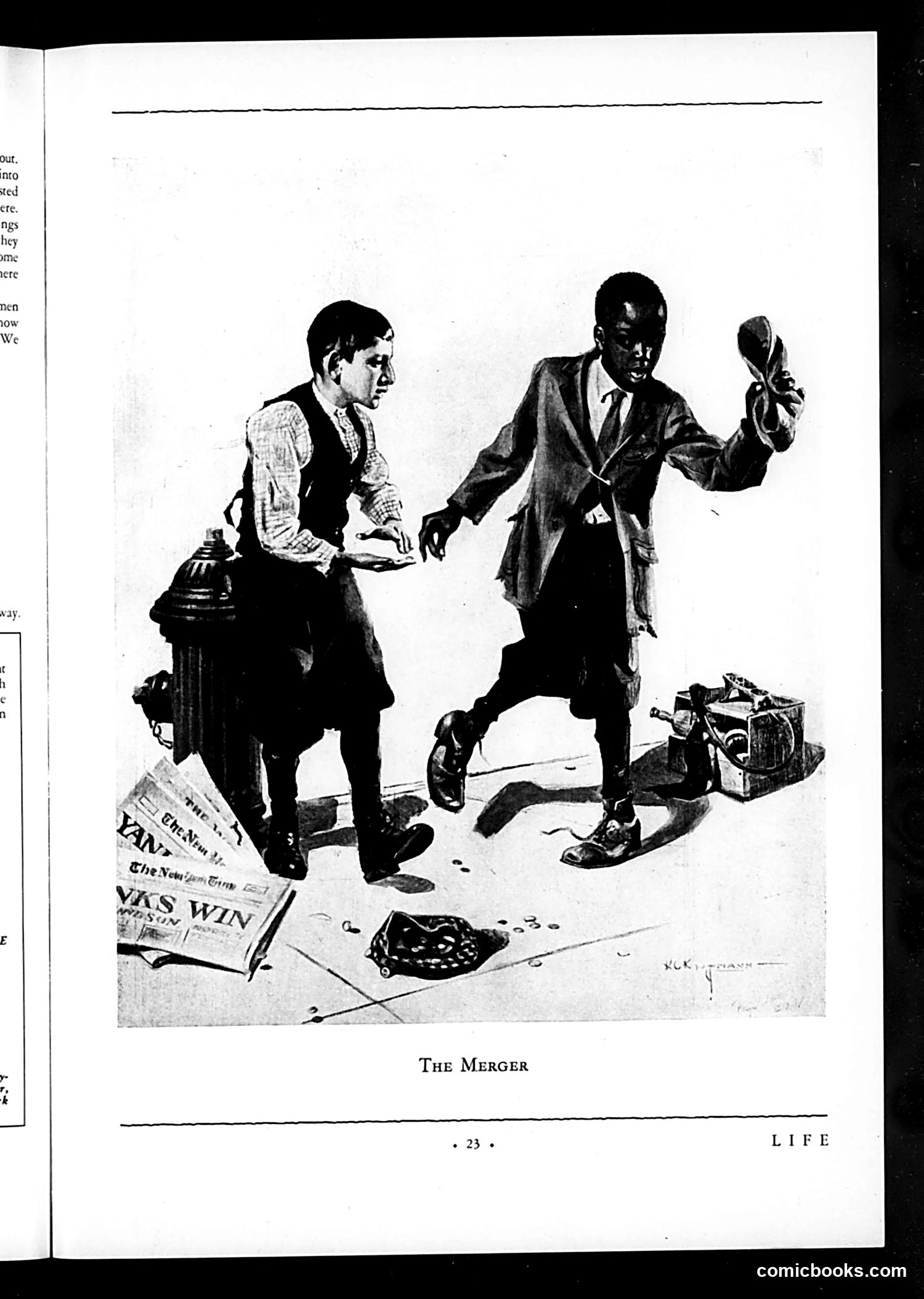
"The Merger" - Political Cartoon Analysis This cartoon satirizes a business merger or corporate consolidation. Two men in suits appear to be conducting a transaction—one holds up what looks like a document or agreement while the other examines it. Scattered around them are newspapers (including one reading "VANS WIN"), luggage, and various business materials, suggesting the upheaval and chaos of a major corporate deal. The caption "The Merger" and the visual clutter imply criticism of how mergers disrupt operations and scatter resources. The men's animated poses suggest either celebration or frantic negotiation. Without more specific text visible, the exact corporations or historical event referenced remains unclear, but the satire targets corporate consolidation's chaotic impacts on business and possibly workers.
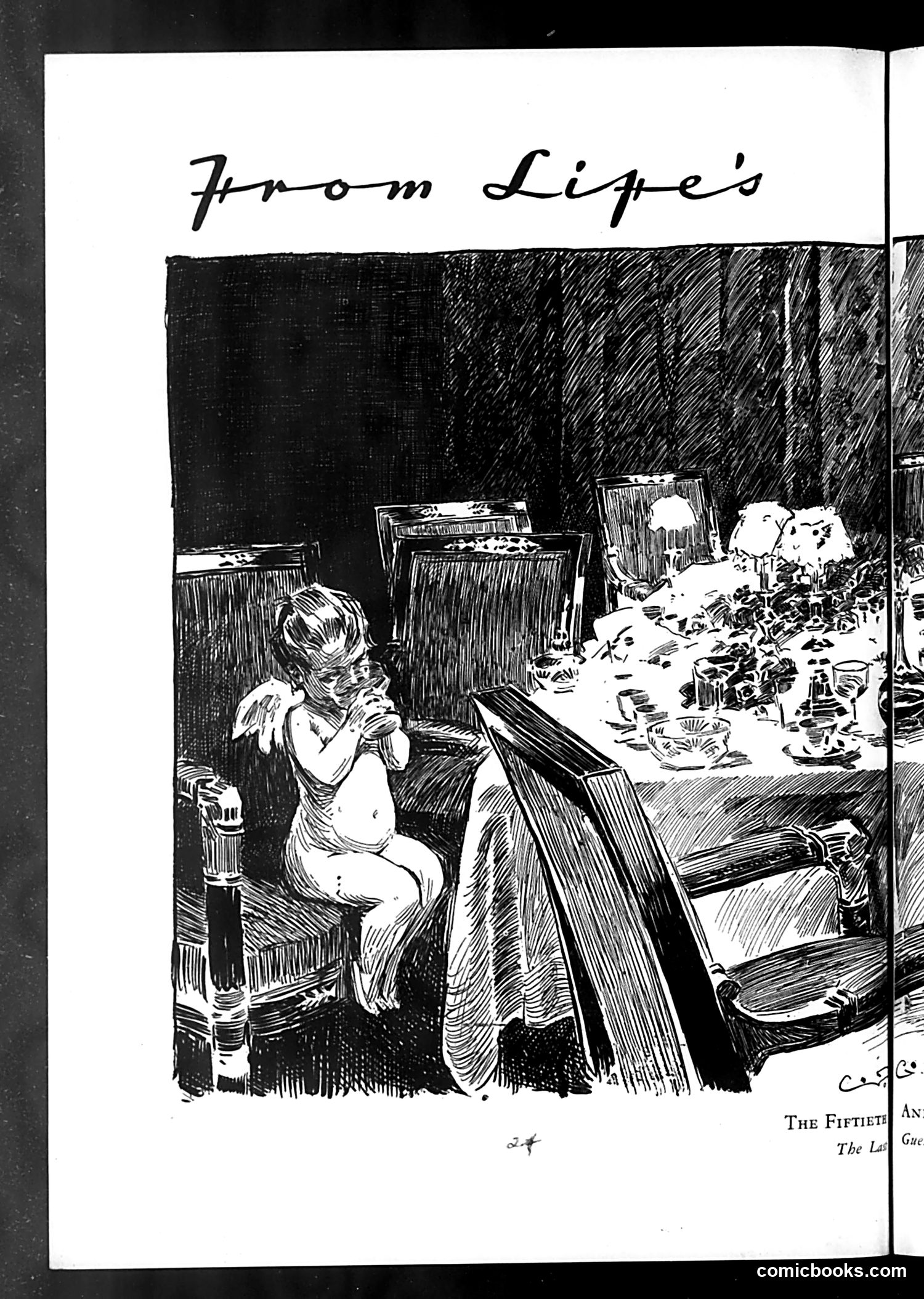
"From Life's" Cartoon Analysis This page contains a single satirical illustration titled "From Life's," depicting a cherubic cupid or cherub sitting alone at a table laden with food and drink, while appearing to pray or meditate. The dark, shadowed interior contrasts sharply with the figure's idealized form. The satire likely critiques excess or indulgence—possibly targeting wealthy individuals or a particular social class enjoying abundance while others struggle. The cherub's contemplative pose amid plenty creates ironic tension: a figure traditionally associated with innocence and love is surrounded by material excess. Without additional context or caption text, the specific political or social target remains unclear, though the composition suggests commentary on hypocrisy, greed, or the disconnect between spiritual values and material consumption common to Life magazine's satirical approach.
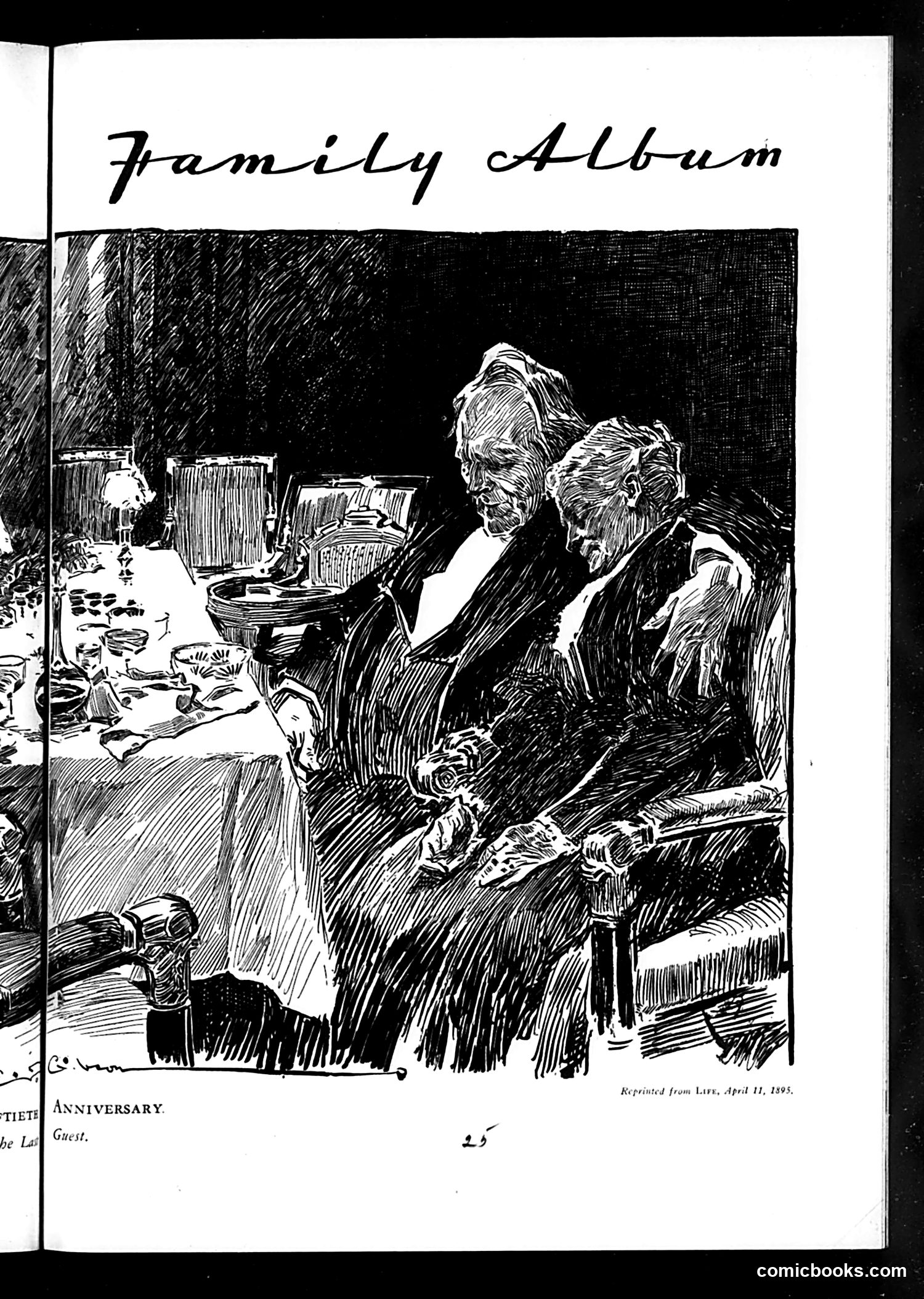
Family Album: Anniversary Guest This is a "Family Album" page from *Life* magazine (reprinted from April 11, 1895), featuring a single ink illustration labeled "Anniversary Guest." The cartoon depicts three elderly men in formal Victorian attire seated at a dinner table. The style and composition suggest this is satirical commentary on an anniversary celebration, though the specific identities of these figures are unclear from the image alone. The formal dinner setting and the emphasis on age and formal dress suggest satire about established social figures or institutions. Without additional context beyond what's visible—such as the original article text or caption specifics—the precise political or social target remains uncertain. The "guest" framing implies commentary about an unexpected or notable attendee at this commemorative event.
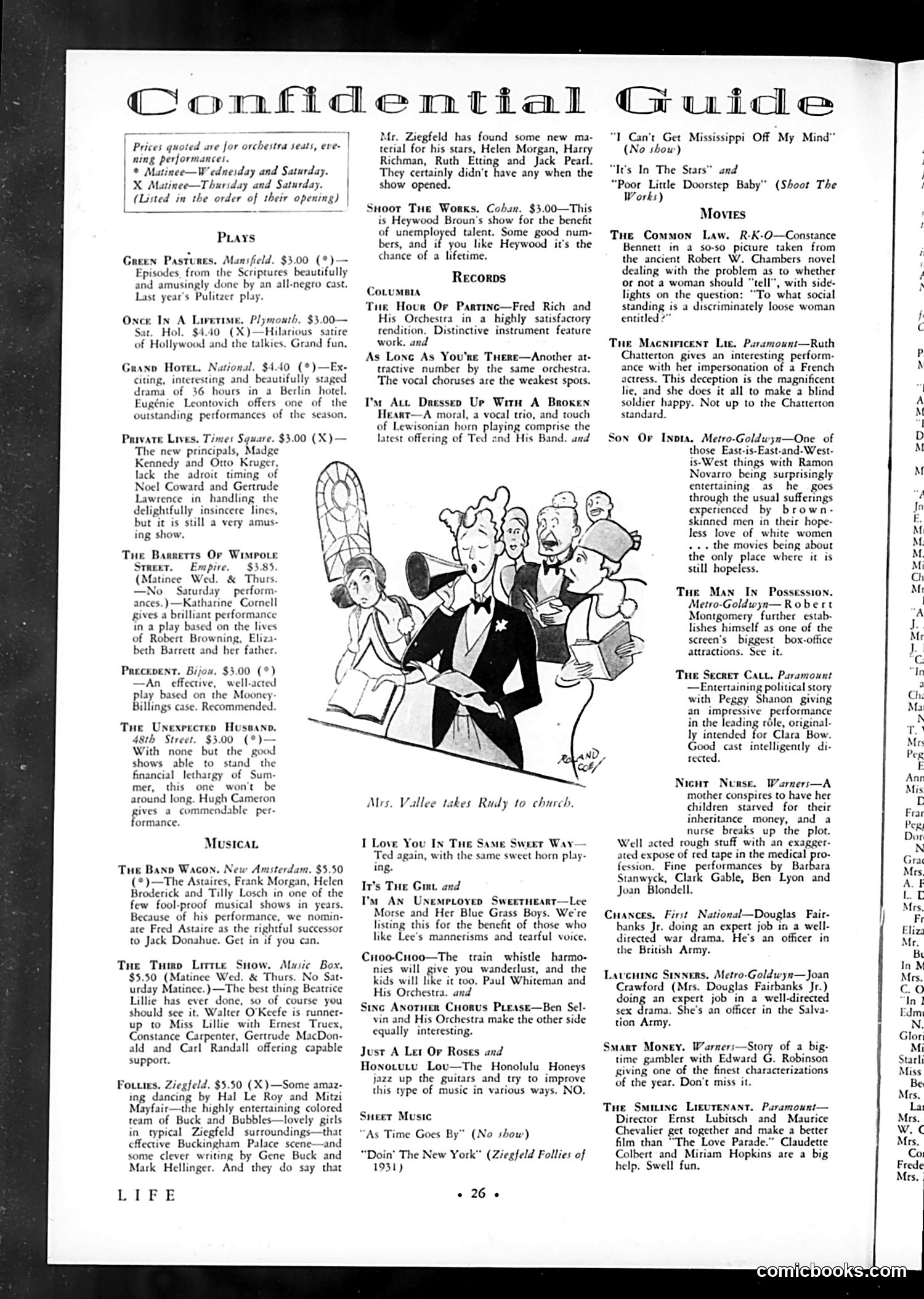
Confidential Guide Page Analysis This is a theater and entertainment review page from Life magazine, not primarily a political cartoon page. The single illustration shows a man in formal attire being physically restrained/pulled by several other figures—likely a humorous scene depicting social chaos or comedic mayhem at a formal event (the caption reads "Mrs. Vallee takes Rudy to church"). The page itself consists of contemporary Broadway theater, musical show, and phonograph record reviews from what appears to be the early 1930s. Reviews mention stars like Katharine Cornell, Fred Astaire, and Beatrice Lillie. One notable entry is "Precedent" based on the "Mooney Billings case"—a real 1916 labor murder trial—indicating topical theatrical subjects. The cartoon's specific satirical point is unclear without fuller context, but the restrained gentleman likely represents a comedic or satirical figure being "dragged" somewhere against his will—standard slapstick humor of the era.
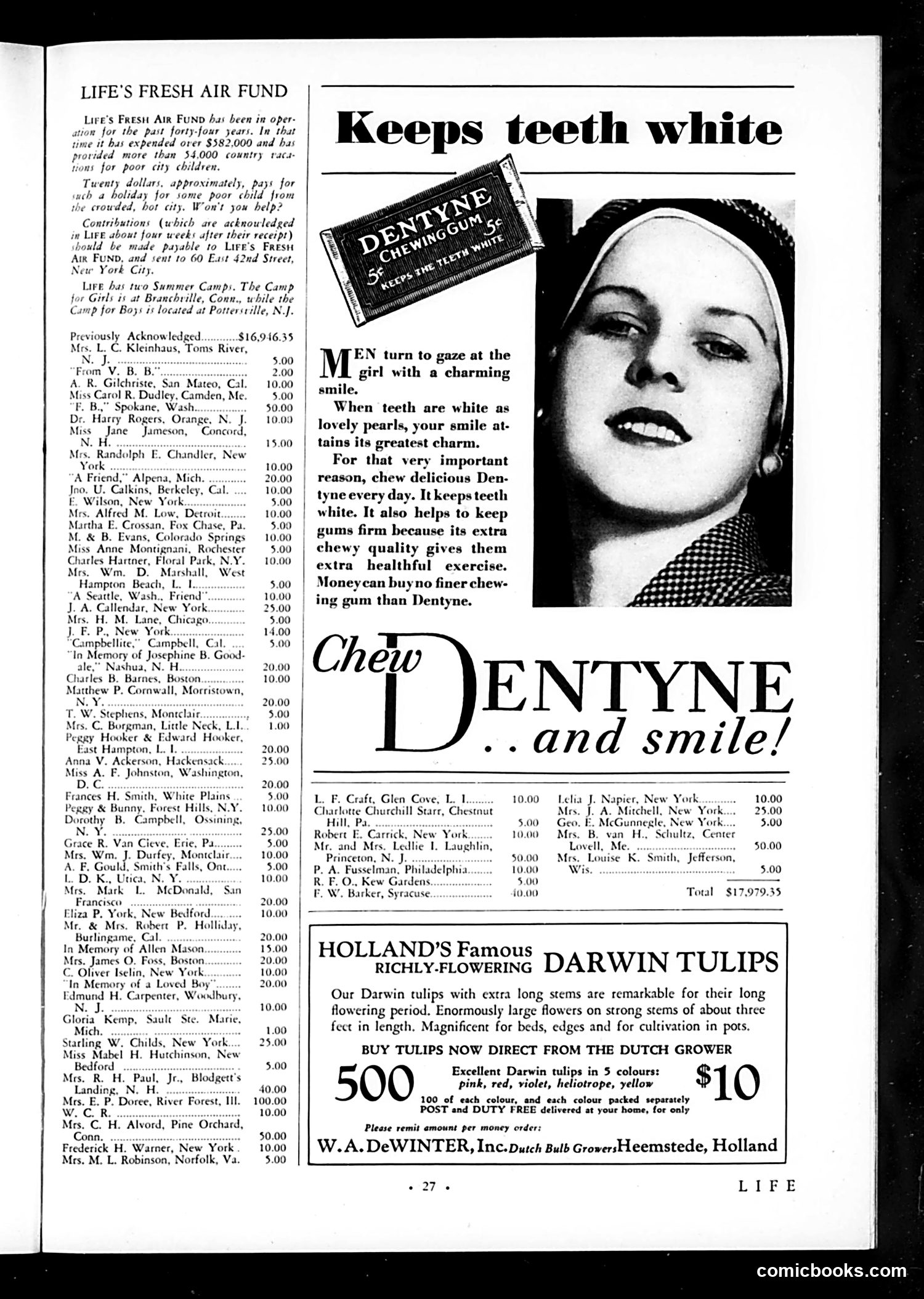
Analysis of Page 27, Life Magazine This page contains three distinct elements: a charitable fundraiser (top left), a chewing gum advertisement (center/right), and a seed catalog advertisement (bottom). The main advertorial content is a Dentyne gum ad featuring a glamorous woman's face and copy promoting teeth whitening. The pitch is straightforward—attractive teeth mean an attractive smile, which appeals to men. The ad promises Dentyne's "chewy quality" provides "healthful exercise" for gums while keeping teeth white. This reflects 1930s-40s advertising's emphasis on cosmetic dentistry and appearance as socially essential. The "Life's Fresh Air Fund" listing shows charitable donations for poor city children's summer vacations—a Depression-era social welfare program typical of the period. Contributions ranged from $1 to $100. The bottom advertises Darwin tulips from Holland, available by mail order for $10 per 500 bulbs—reflecting the popular mail-order gardening business of the era. No political satire appears here; this is primarily a commercial/charitable page.
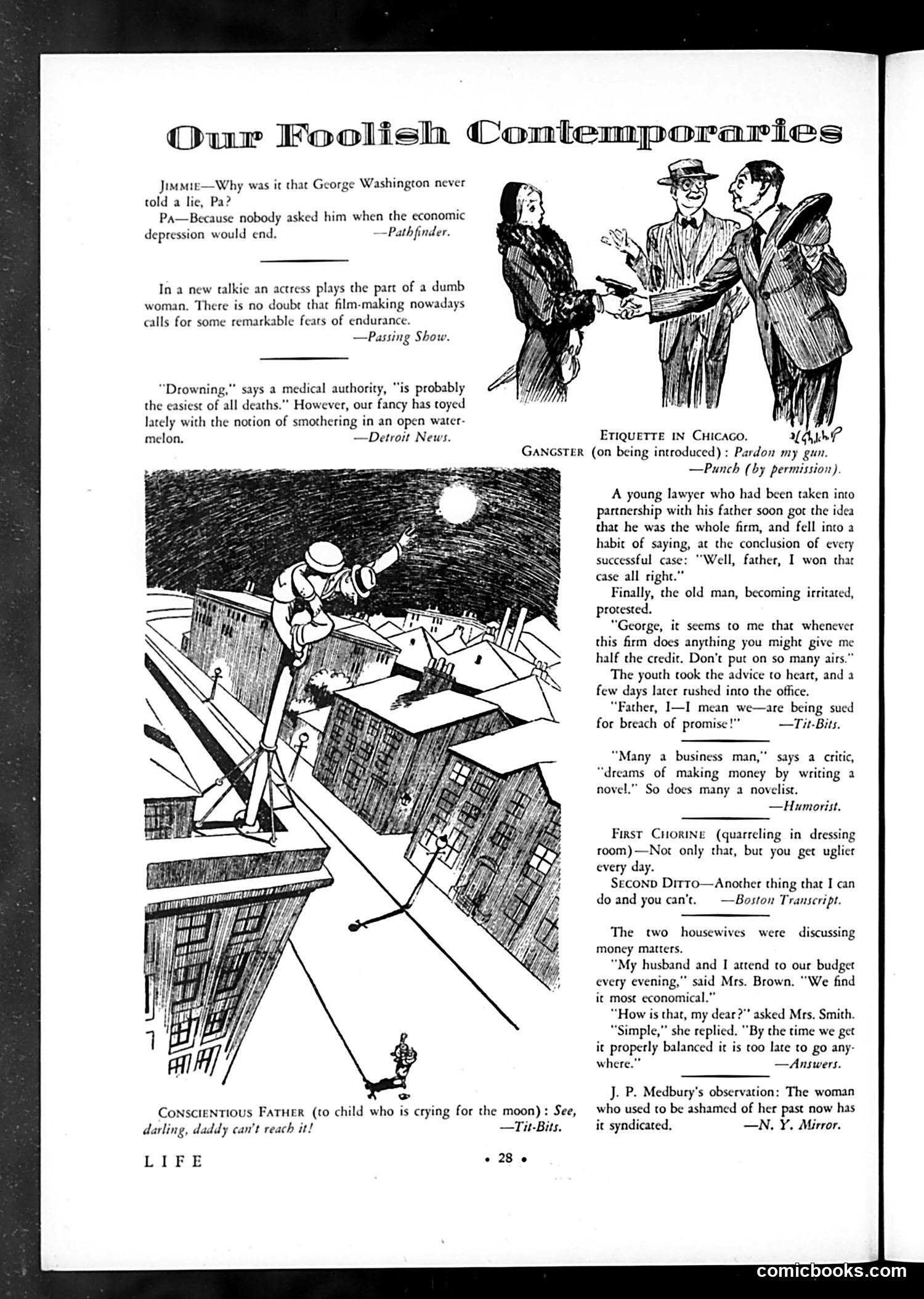
"Our Foolish Contemporaries" - Life Magazine Humor Page This is a humor compilation page featuring satirical jokes and cartoons mocking contemporary attitudes and behaviors of the era (appears to be 1930s, given depression reference). Key satirical points: - Washington joke: Mocks politicians' inability to predict economic recovery during the Great Depression - Chicago etiquette cartoon: Satirizes gangsters' casual violence ("Pardon my gun") - Young lawyer story: Ridicules arrogance and credit-hogging in professional partnerships - Drowning/watermelon: Dark humor about morbid topics - Business novels: Critiques both businessmen's literary aspirations and novelists' commercial motivations - Budget discussion: Satire of couples discussing finances so late they can't afford to go out anyway - Medbury's observation: Jokes about women's changed social morality—those once ashamed of their pasts now profit from publicity/syndication The page targets vanity, hypocrisy, economic anxiety, and modernizing social values through brief, punchy observations attributed to various publications.
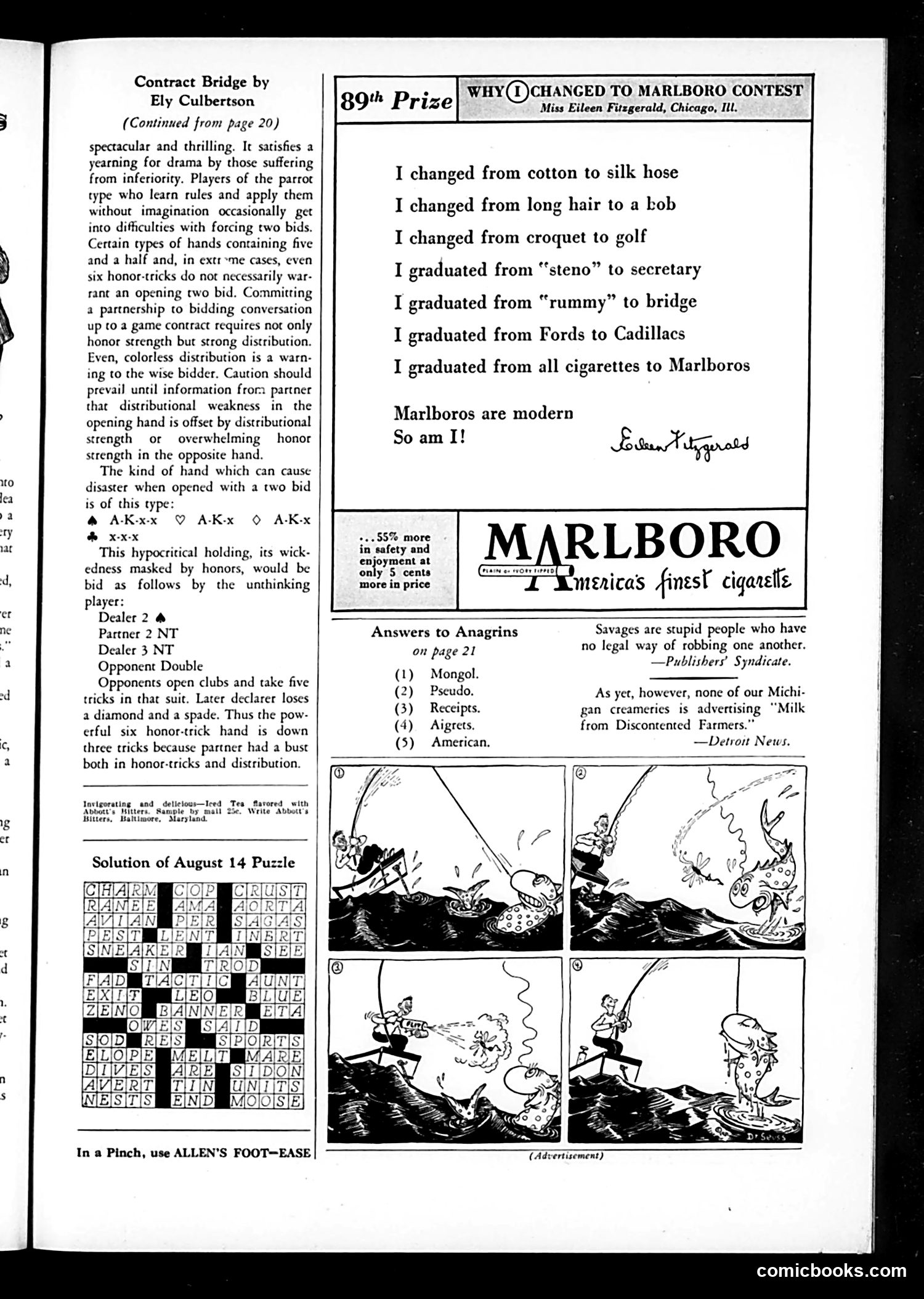
Page Analysis: Life Magazine Content This page contains a Marlboro cigarette advertisement disguised as editorial content. The "89th Prize" section presents a contest entry by Miss Eileen Fitzgerald from Chicago, listing lifestyle changes she made—from cotton to silk hose, croquet to golf, stenographer to secretary, and crucially, "from all cigarettes to Marlboros." The accompanying comic strip (four panels) depicts a figure fishing, apparently catching increasingly absurd things, illustrating the theme of "change" or transformation. Historical context: This represents mid-20th century advertising when cigarette promotions heavily targeted women by associating smoking with modernity, sophistication, and social advancement. The entry frames smoking Marlboros as part of upward mobility and contemporary femininity—changing hairstyles, activities, and social status alongside brand loyalty. The juxtaposition of bridge instruction, puzzles, and satirical quotes alongside this advertisement was typical of *Life* magazine's format mixing editorial and advertising content.
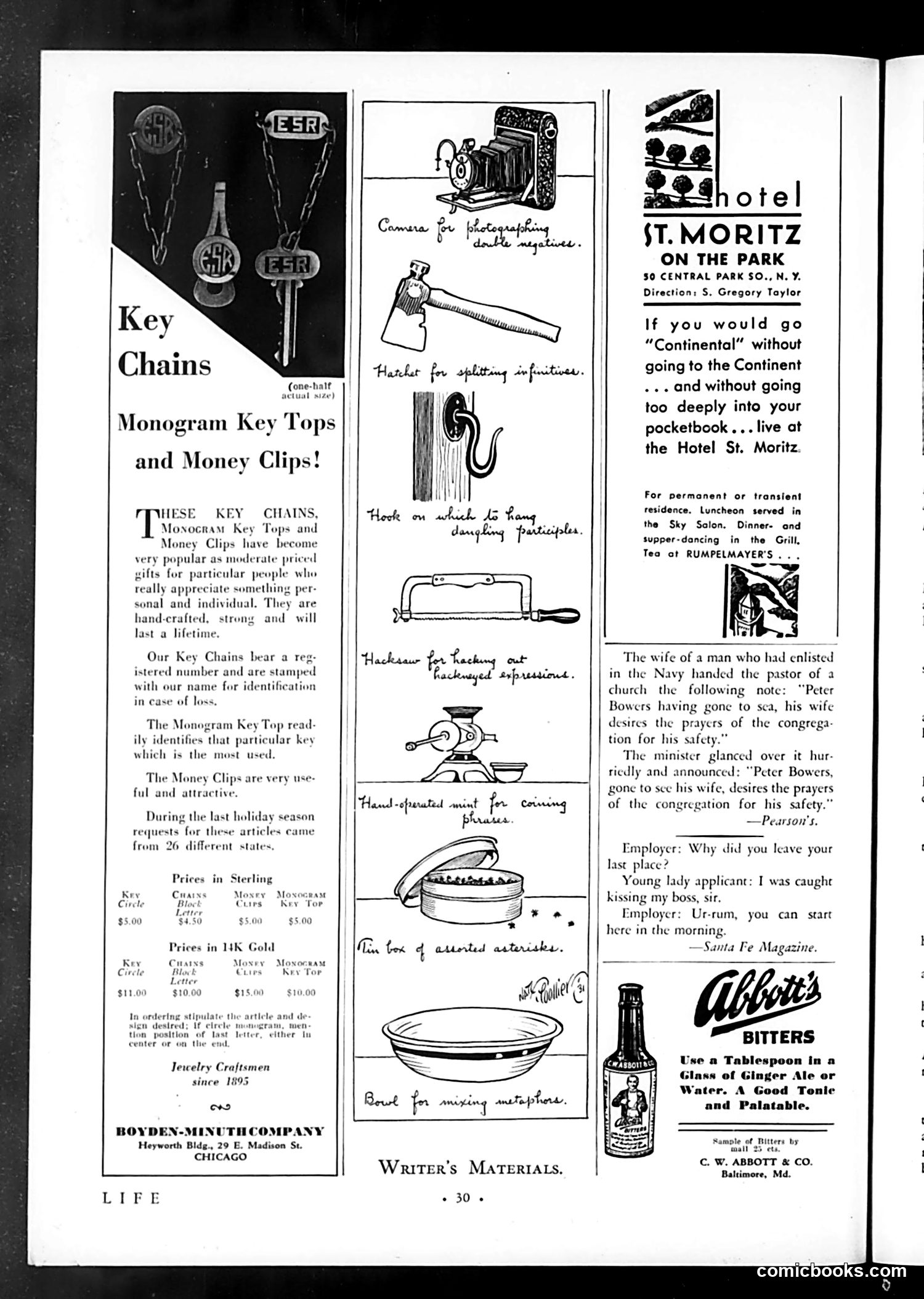
Page Analysis: Life Magazine Advertisement and Humor Section This page is primarily advertising content with brief humorous anecdotes interspersed. Left column: Jewelry advertisement for monogrammed key chains and money clips from Boyden-Minuth Company, marketed as personalized gifts. Prices listed in sterling silver and 18K gold. Center: "Writer's Materials"—illustrated product advertisements showing photography equipment and various kitchen/household tools with handwritten-style captions describing their uses. Right column: Hotel St. Moritz advertisement promoting affordable "Continental" living in New York City, followed by three brief jokes: 1. A wife's prayer request for her Navy-enlisted husband humorously misread as needing prayers for *her* safety 2. An employer hiring a woman caught kissing her previous boss 3. Abbott's Bitters tonic advertisement The humor relies on wordplay misunderstandings and mild workplace flirtation—typical early 20th-century magazine fare. No political content or significant satire appears on this page.
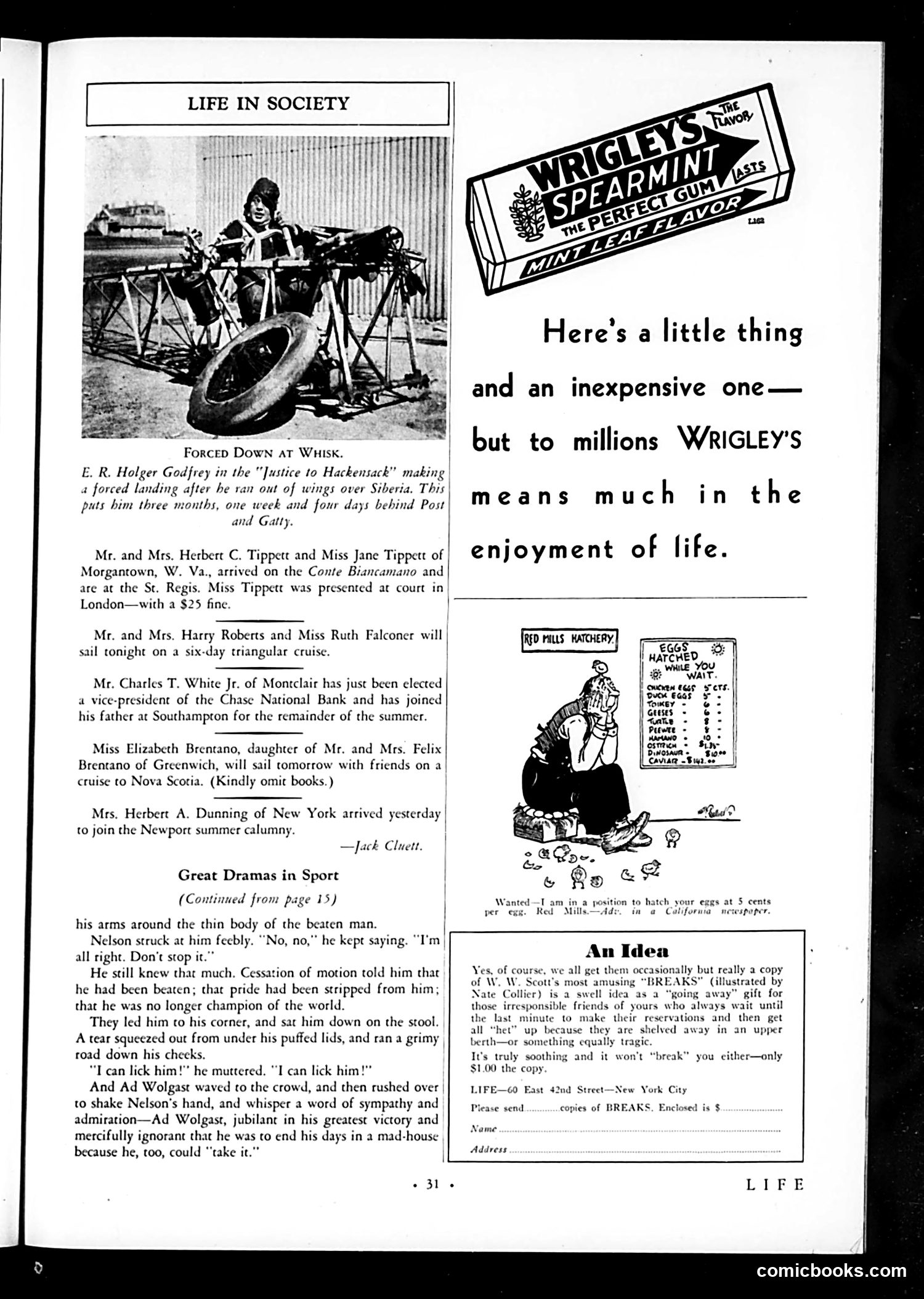
"Life in Society" Page Analysis This page from *Life* magazine combines social gossip with advertising and sports narrative. The "Life in Society" section is satirical society column reporting—mocking upper-class leisure activities (cruises, court presentations, bank promotions) with deadpan delivery. The "$25 fine" for Miss Tippett's court presentation is a humorous jab at aristocratic pretension. The main joke references E.R. Holger Godfrey's failed aviation stunt—he attempted a long-distance flight but crashed in Siberia, finishing far behind the record-setting Post and Gatty expedition. This mocks both the dare-devil aviation craze of the era and celebrity one-upmanship. The accompanying Wrigley's advertisement uses aspirational messaging ("means much in the enjoyment of life"), while lower sections include vintage classified ads (egg-hatching services) and a book promotion for W.W. Scott's "Breaks"—typical period advertising filler. The sports narrative fragment discusses boxer Ad Wolgast's victory over Nelson.
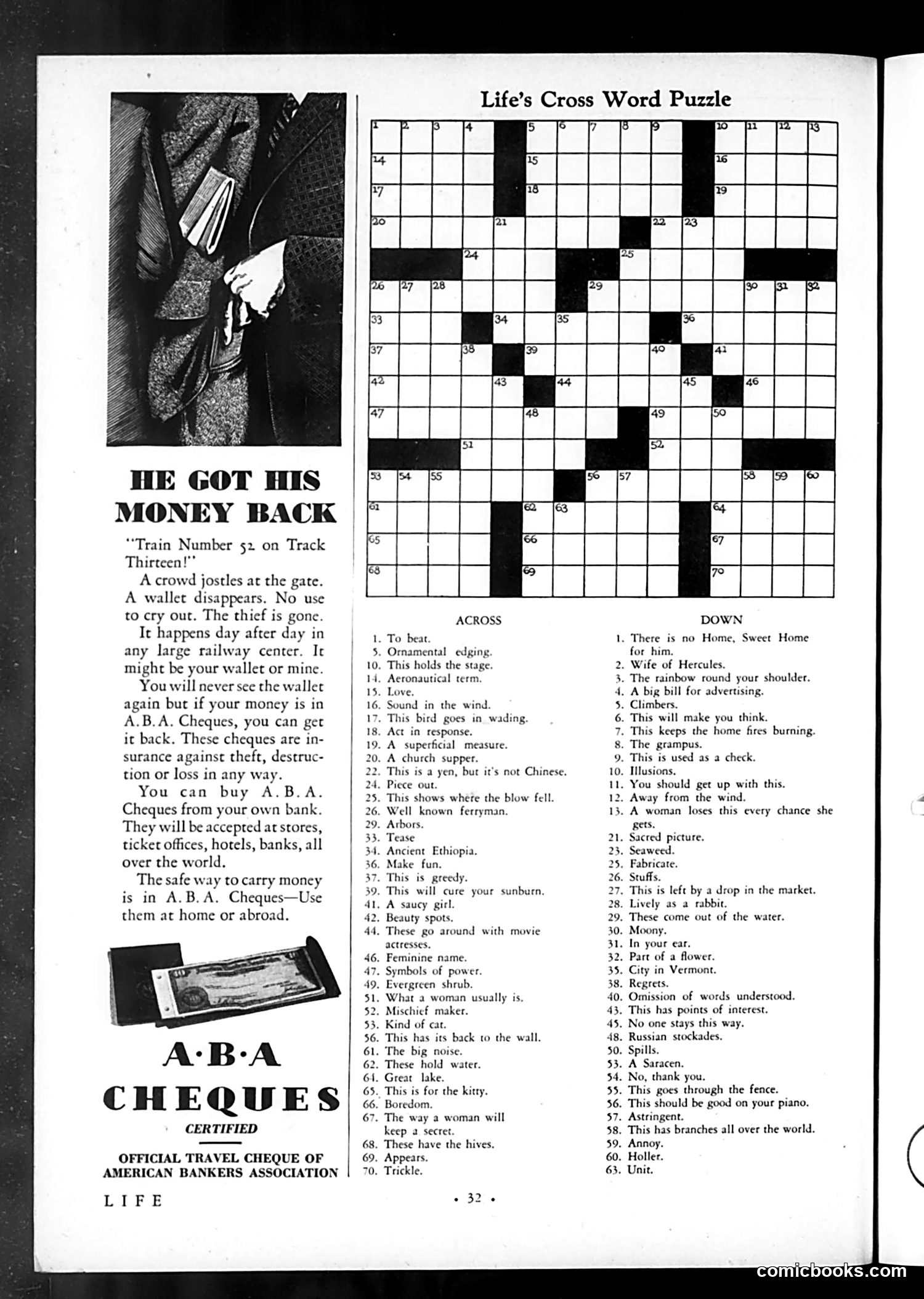
"He Got His Money Back" - A 1920s Travel Safety Advertisement This page is primarily a commercial advertisement for A.B.A. Traveler's Cheques (certified by the American Bankers Association), disguised as editorial content. The narrative scenario depicts a common urban crime: a pickpocket steals a wallet at a crowded railway station. The advertisement's moral is that while the physical wallet is lost forever, money carried as A.B.A. Cheques can be recovered—making them "insurance against theft, destruction or loss in any way." This reflects genuine 1920s travel anxieties: rail travel was common but carried real risks of theft in crowded stations. The cheques offered security and worldwide acceptance at "stores, ticket offices, hotels, banks, all over the world." The remainder of the page contains an unrelated crossword puzzle, which was standard filler entertainment in period magazines. There is no political satire here—this is straightforward product marketing leveraging practical consumer concerns.
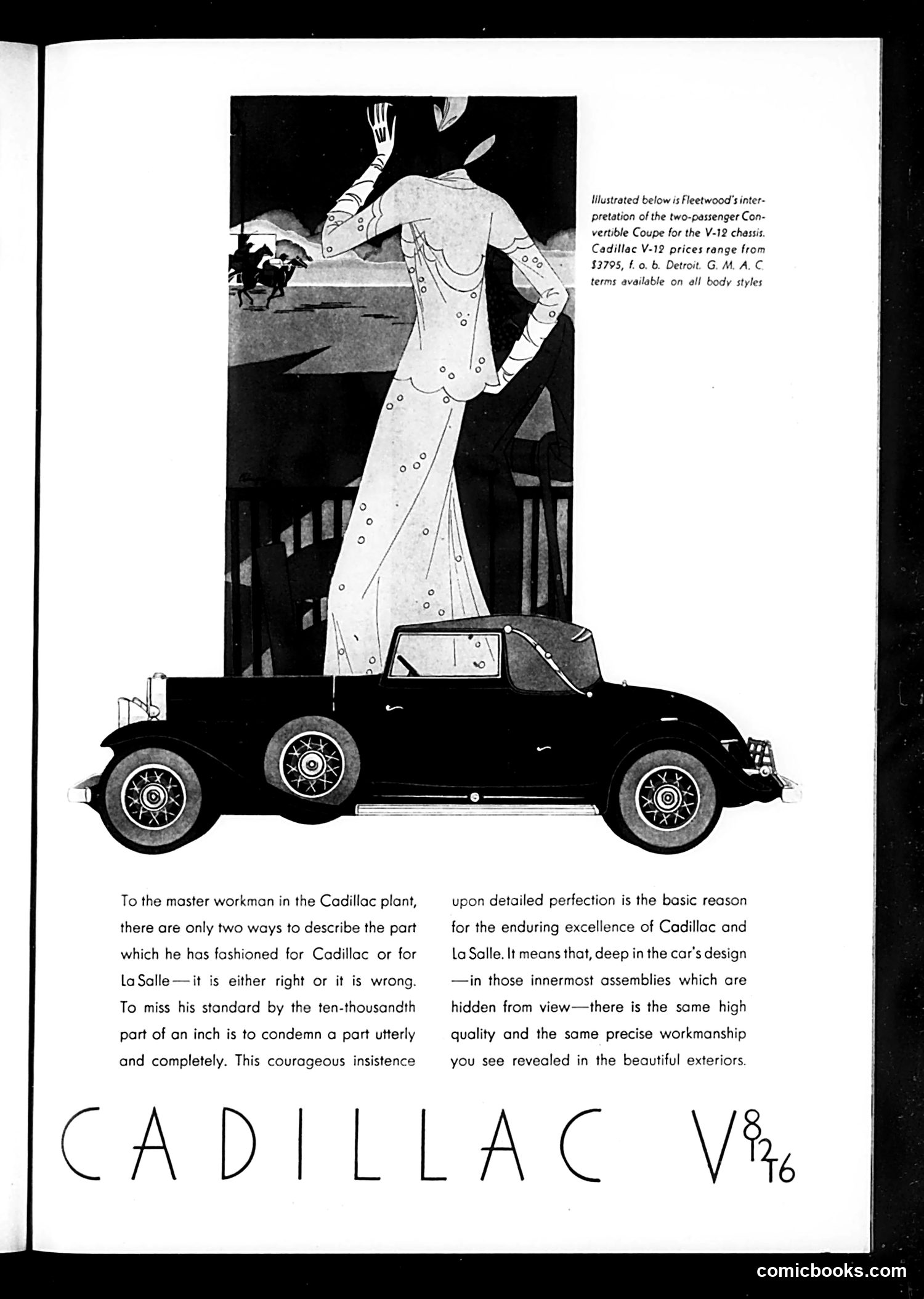
Cadillac V-12 Advertisement This is a luxury automobile advertisement, not political satire. The page promotes Cadillac's V-12 convertible coupe, priced from $3,795. The illustration depicts an elegantly dressed woman in 1920s fashion posed dramatically above the car, a common advertising technique of the era meant to associate the vehicle with sophistication and desirability. The text emphasizes Cadillac's manufacturing philosophy: extreme precision in all components—even hidden internal parts—must meet exacting standards (accurate to one ten-thousandth of an inch). This messaging contrasts quality craftsmanship with mass-production competitors, positioning Cadillac as a premium product where meticulous workmanship throughout justifies the luxury price. The advertisement targets affluent buyers who would appreciate both the car's visible elegance and its claimed engineering excellence.
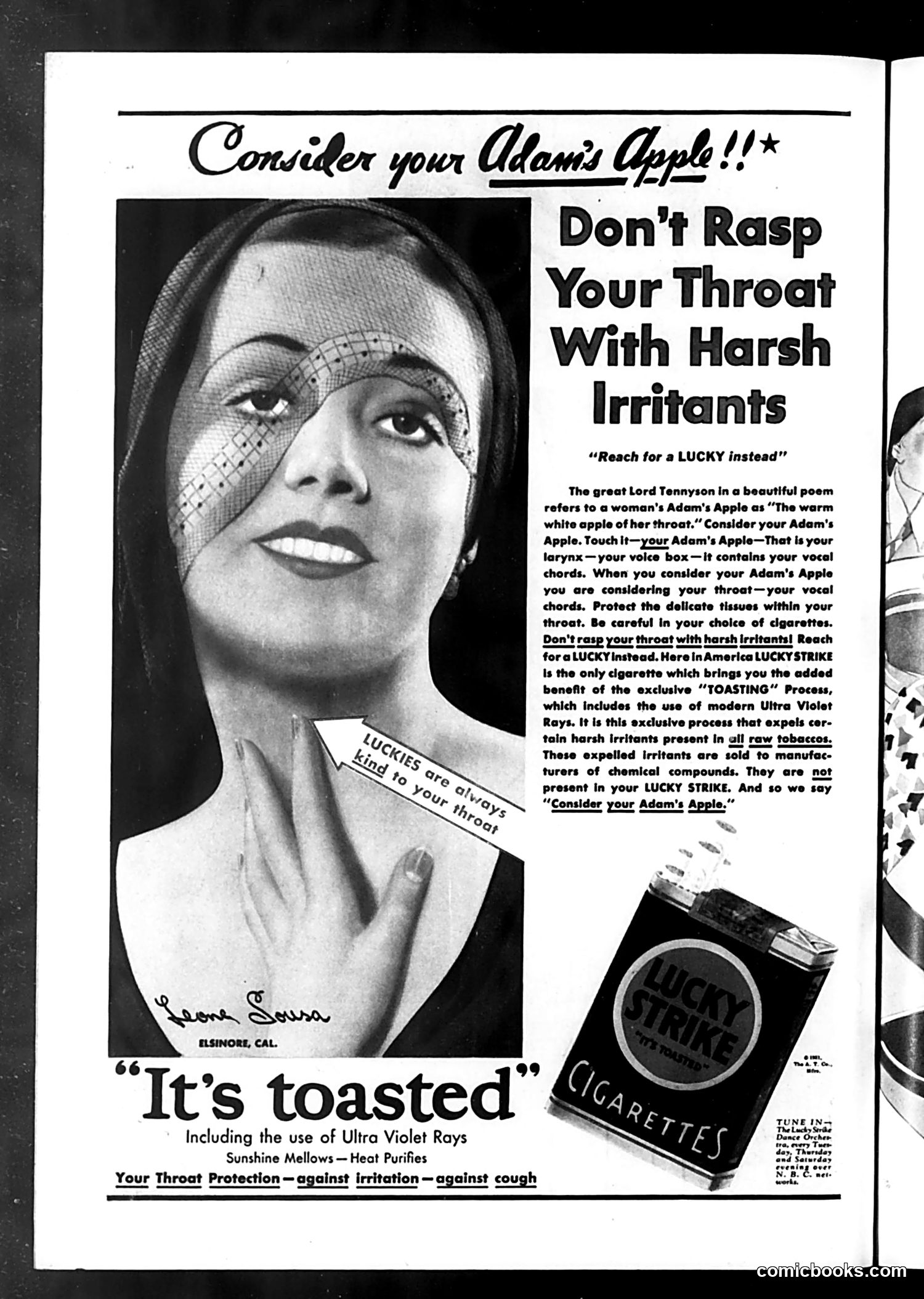
Analysis This is a Lucky Strike cigarette advertisement, not satire or political content. The page uses pseudo-scientific health claims to market cigarettes to consumers concerned about throat irritation. The ad features a woman's portrait (signed "Mona Sears, Elsinore, Cal.") with her hand at her throat, drawing attention to the Adam's Apple. The text employs flowery language (quoting Tennyson) to romanticize the throat while claiming Lucky Strike's exclusive "Toasting Process" with "Ultra Violet Rays" removes harsh irritants present in other tobaccos. For modern readers: This represents pre-1960s cigarette advertising before strict health regulations. The claim that Lucky Strikes are gentler than competitors—and somehow "protective"—would be considered absurd and illegal today. The ad exemplifies how tobacco companies once made unsubstantiated health claims to promote their products, exploiting consumer anxieties about smoking's effects.