life
Life — August 28, 1931
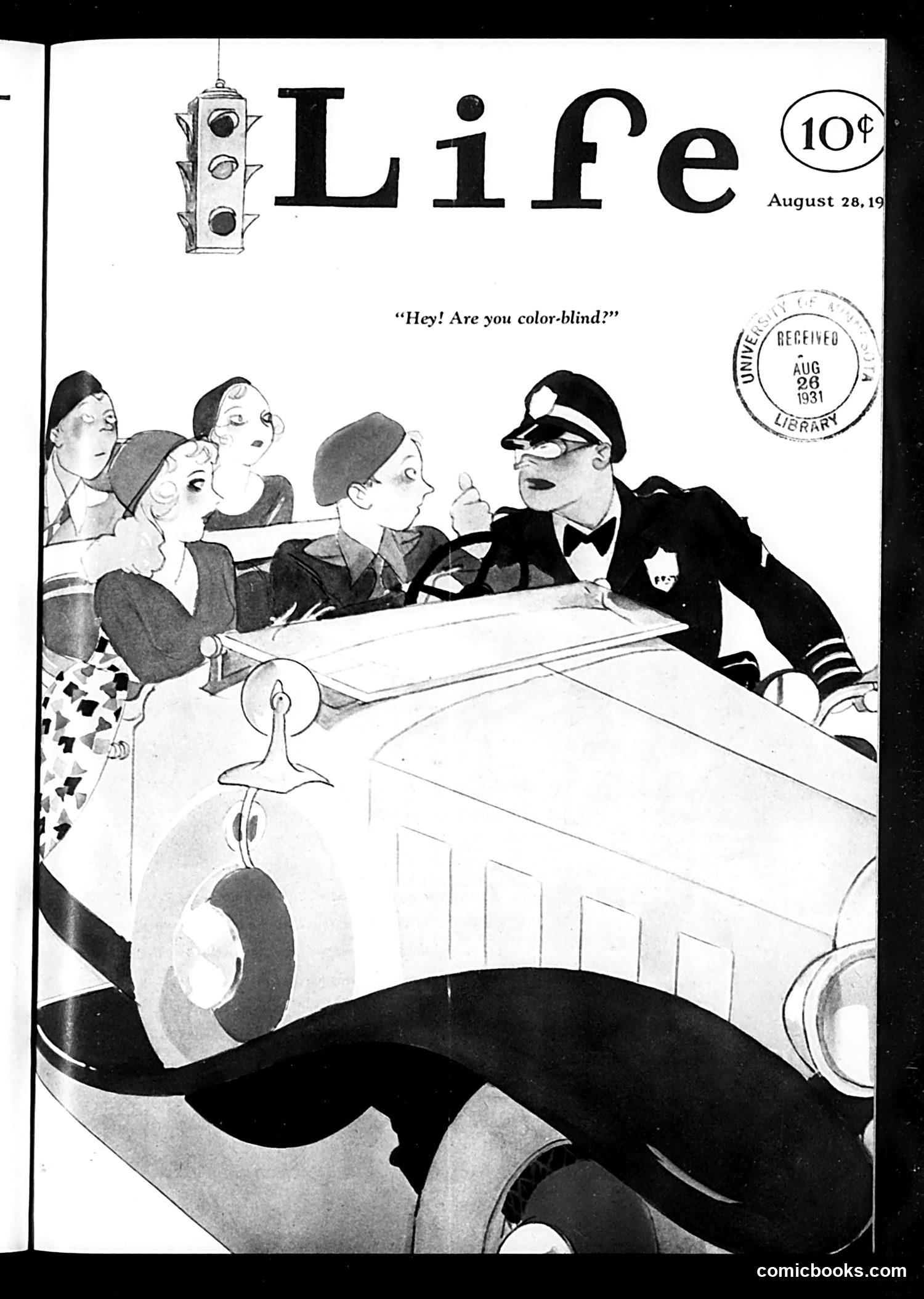
Analysis of Life Magazine Cover, August 28, 1931 This cover satirizes traffic safety, specifically the then-new traffic light system. The caption "Hey! Are you color-blind?" appears to mock drivers who ignore signal lights. The illustration shows a formal dining scene where a uniformed traffic officer (right) confronts well-dressed patrons at what appears to be a restaurant or nightclub. The visual joke conflates traffic signals with dining etiquette—the officer questions whether the diners are "color-blind" to the signals, suggesting reckless driving behavior. The humor relies on 1930s automotive safety concerns and the novelty of standardized traffic control. The formal attire of the civilians contrasts with the officer's authority, emphasizing that even respectable citizens flouted traffic laws. The cartoon critiques public disregard for emerging traffic safety regulations during the automobile's rise.

Analysis This is primarily a Goodyear tire advertisement, not political satire. The page compares the Goodyear Double Eagle tire to the Arch of Titus, a famous Roman monument. The advertisement argues that just as time has validated the arch's architectural excellence, time has proven the Double Eagle tire's superiority. The text states the tire has been "imitated, copied, patterned after" but maintains its reputation for quality. The juxtaposition is meant to elevate the tire by association with enduring classical achievement—suggesting the Double Eagle is equally timeless and reliable. For modern readers, this reflects early 20th-century advertising's strategy of connecting commercial products to cultural prestige and permanence. There is no political or satirical commentary present.
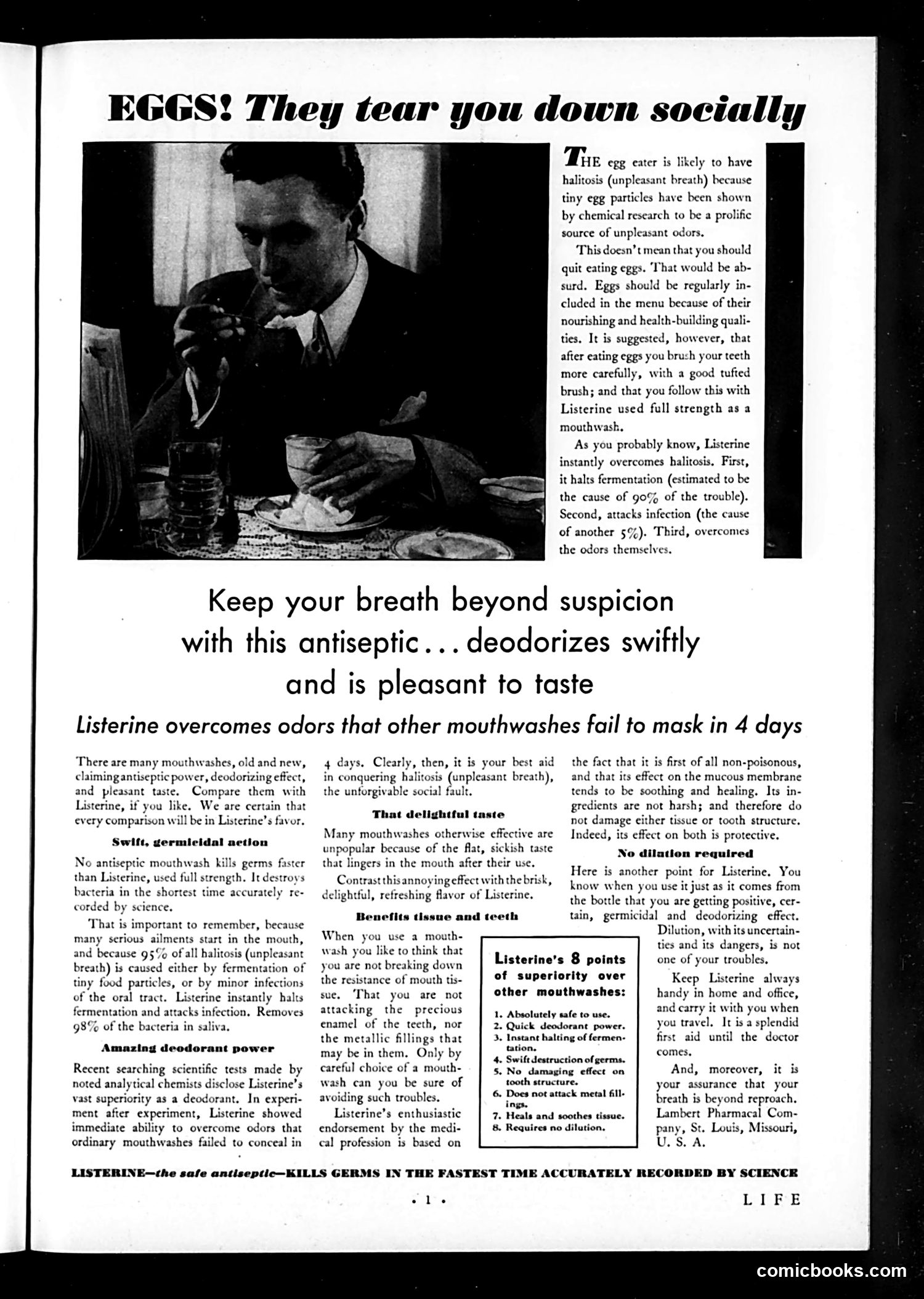
Analysis This is a Listerine advertisement, not political satire. The page uses social shame as a marketing tactic, common in early-to-mid 20th-century advertising. The headline "EGGS! They tear you down socially" warns that eating eggs causes halitosis (bad breath), which leads to social embarrassment. The photo shows a man at a dining table, presumably self-conscious about his breath around others. The ad claims Listerine mouthwash uniquely overcomes egg-related odors within 4 days, listing "8 points of superiority" over competitors. It emphasizes the product is "safe," works quickly, and tastes pleasant—addressing common objections to antiseptic mouthwashes of that era. This reflects vintage advertising's reliance on social anxiety to sell hygiene products.
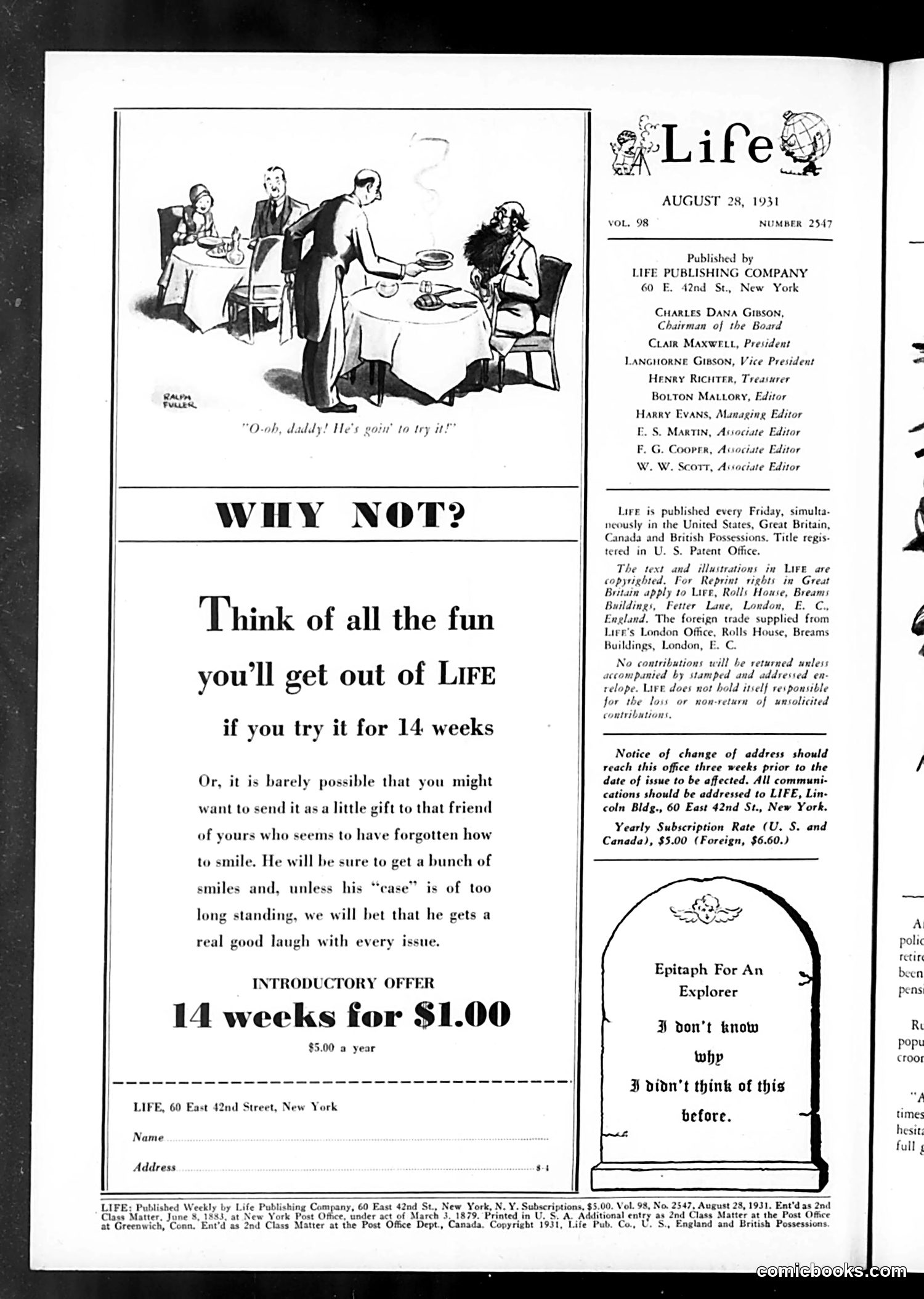
Analysis This is primarily a subscription advertisement page for Life magazine (dated August 28, 1931), not a political cartoon. The main cartoon at the top shows a dinner scene with the caption "O-oh, daddy! He's goin' to try it?" — a domestic humor gag about someone attempting something risky or unusual at table, likely food-related. Below is an introductory subscription offer: 14 weeks for $1.00 (versus $5.00 yearly). The pitch emphasizes Life as humor/entertainment that brings smiles and laughs. The bottom right shows a humorous epitaph: "I don't know whap / I bidn't think of this before" — mock-serious wordplay typical of Life's style. This is not satirical commentary but rather magazine promotion using light humor to attract readers during the Great Depression era.
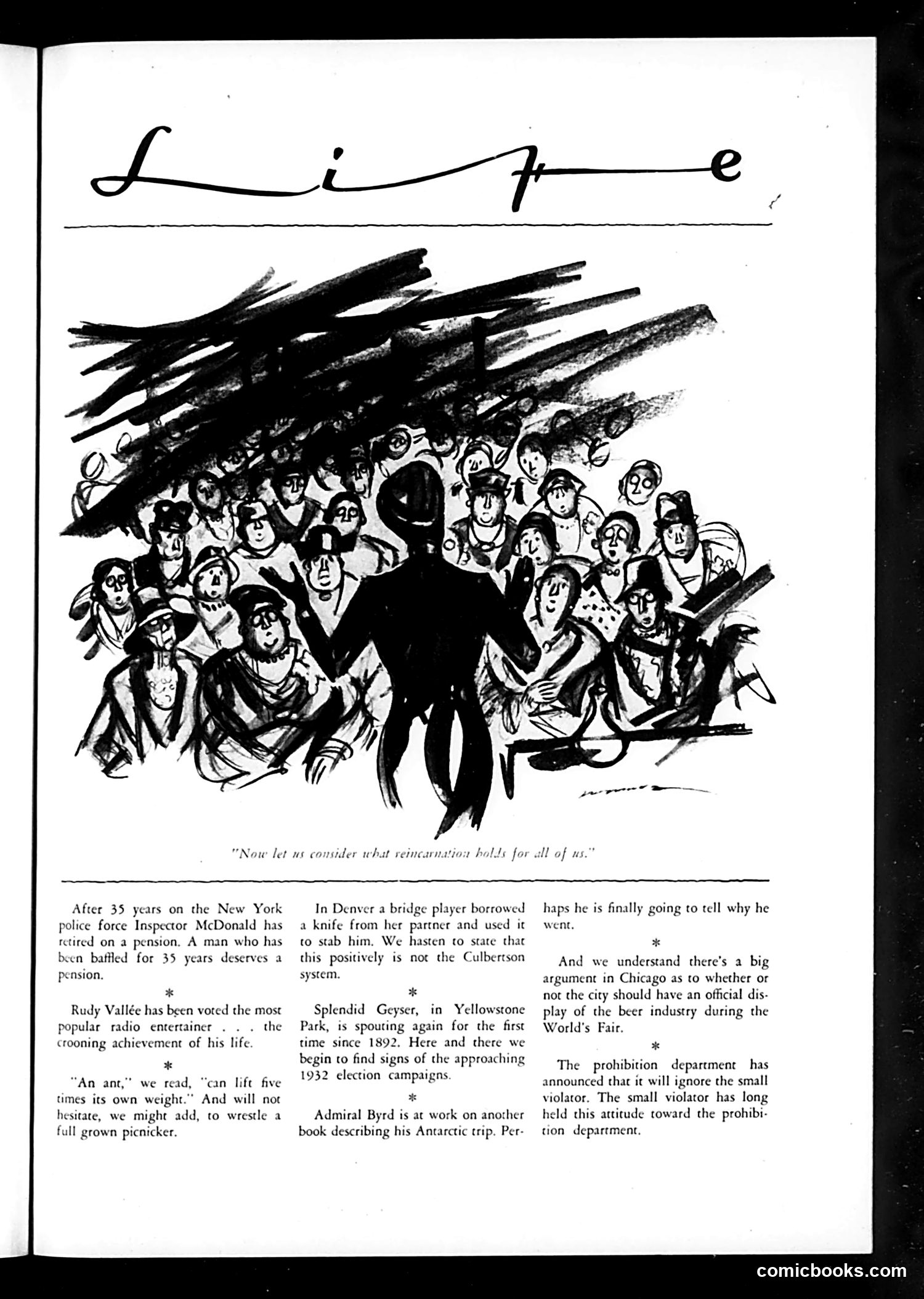
"Life" Page Analysis The main cartoon depicts a silhouetted figure addressing a crowd of concerned citizens, with the caption "Now let us consider what reincarnation holds for all of us." This appears to be political satire about reincarnation and afterlife philosophy, though the specific target is unclear from the image alone. The crowd's anxious expressions suggest satirizing public anxiety about some contemporary issue. Below the cartoon, brief news items mock various figures and policies: - Inspector McDonald's 35-year police pension - Rudy Vallée as a popular radio entertainer - Splendid Geyser's return to campaigning (likely 1932 election-related) - Admiral Byrd's Antarctic expedition book - Chicago's beer industry debate during Prohibition - The Prohibition department ignoring minor violators The page combines political commentary with social observation typical of *Life* magazine's satirical approach.
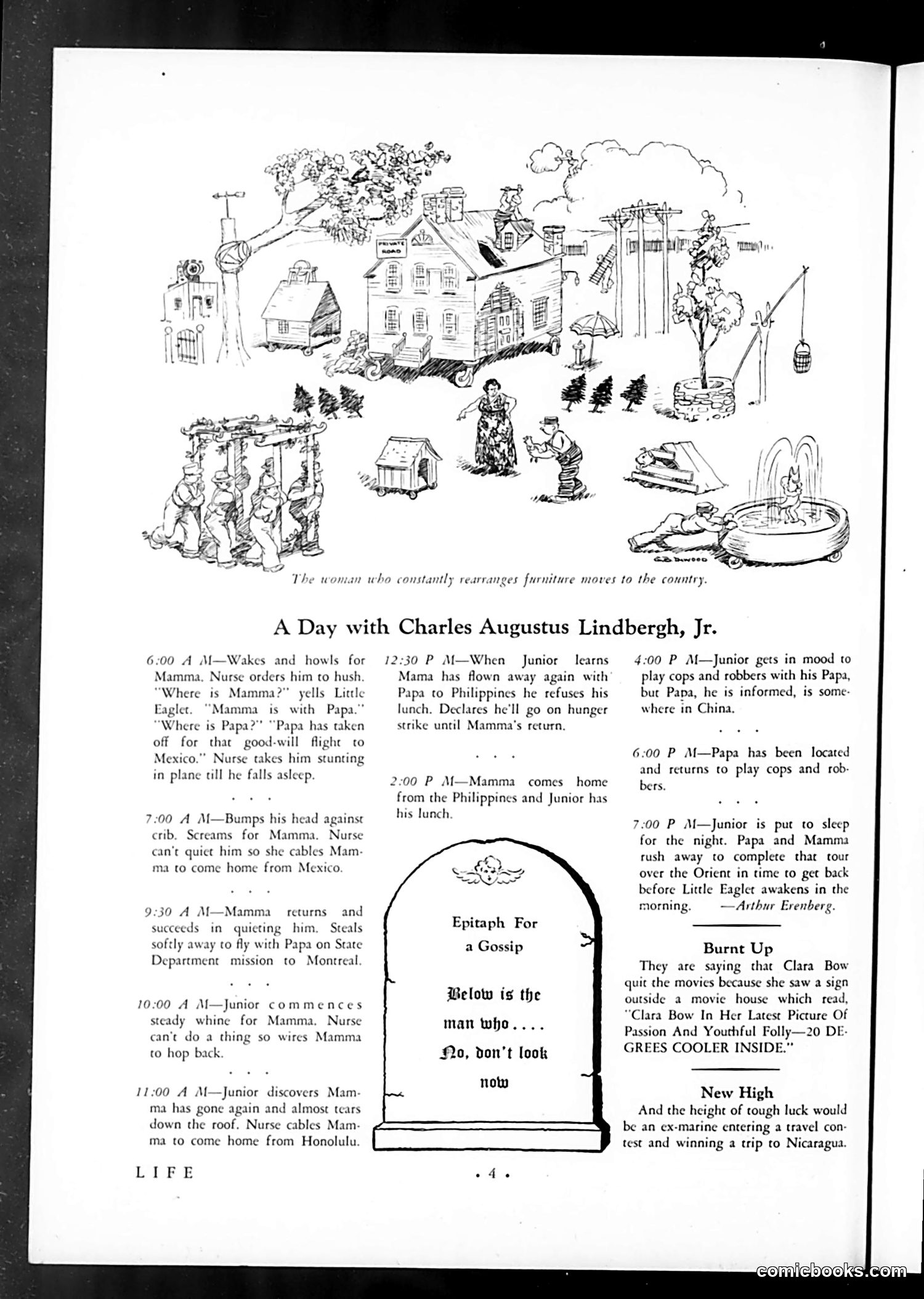
This page satirizes the daily chaos of Charles Augustus Lindbergh Jr.'s household. The illustration depicts a country estate with children, servants, and various domestic activities. The humor centers on Lindbergh's wife constantly rearranging furniture and moving to the country—a wealthy person's frivolous preoccupation. The day's schedule mockingly catalogs domestic absurdities: the child's nurse struggling with tantrums, parents constantly departing on trips (to Mexico, the Philippines, Honolulu), and the family perpetually playing catch-up. The satire targets upper-class excess and parental absenteeism during the 1920s-30s. By documenting every trivial household event in real-time, the piece ridicules both the Lindberghs' lifestyle and the era's celebrity culture obsession with documenting the famous family's mundane activities.
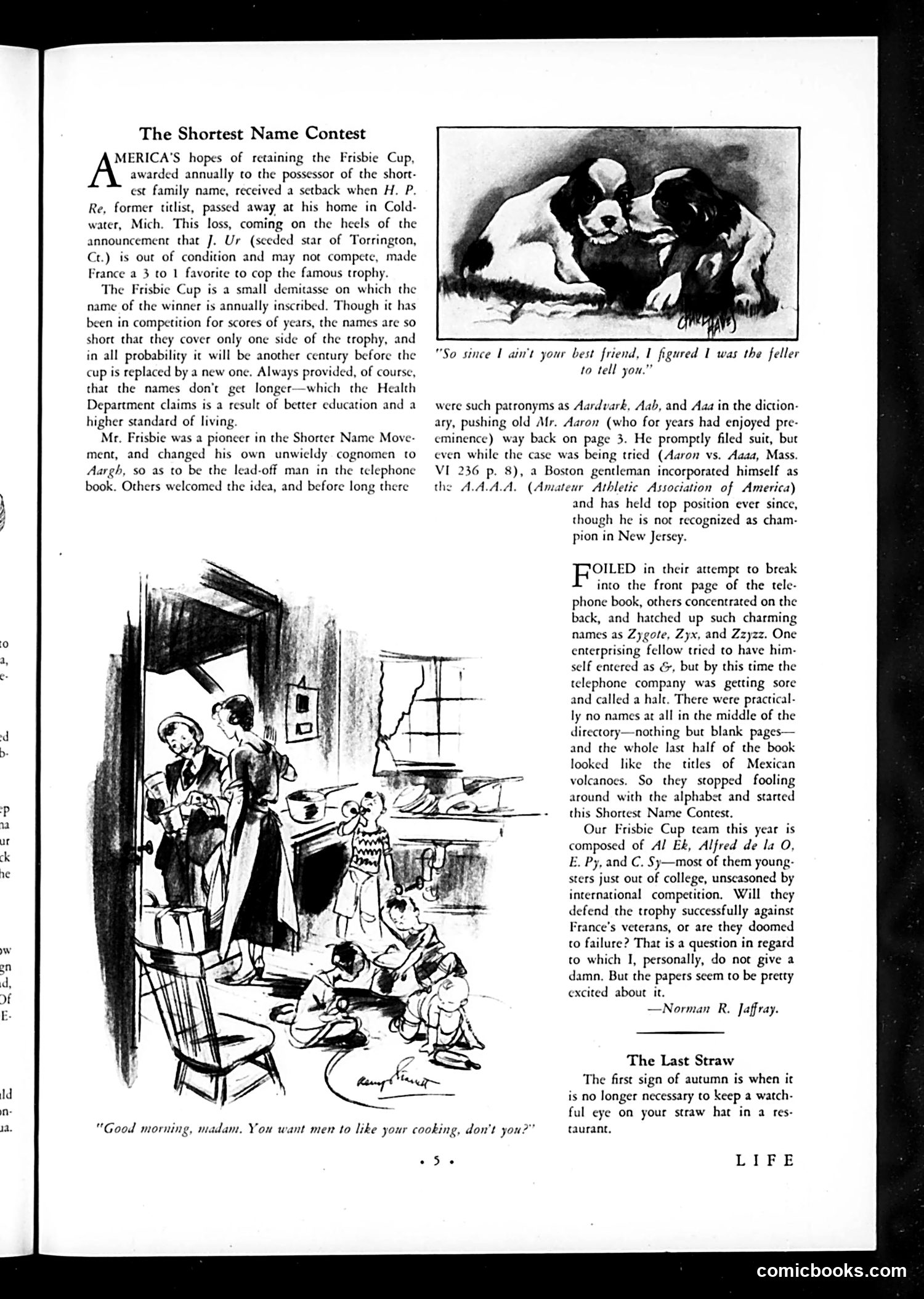
Analysis of "The Shortest Name Contest" This article satirizes a real 1920s trend where Americans sought extremely short names to get listed first in telephone directories. The Frisbie Cup awards the shortest family name annually. The article mocks contestants who adopted absurd single or double-letter surnames like Aardvark, Aah, Aaa, Zygote, Zyy, and Zzzz to gain competitive advantage. One man incorporated himself as the A.A.A.A. (Amateur Athletic Association of America) to secure prominence, though he went unrecognized. The accompanying cartoon shows a domestic scene where a woman asks a man, "Good morning, madam. You want men to like your cooking, don't you?"—a joke about changing one's name for social advantage, reflecting the era's absurd status-seeking behavior around telephone book placement and alphabetical ordering.
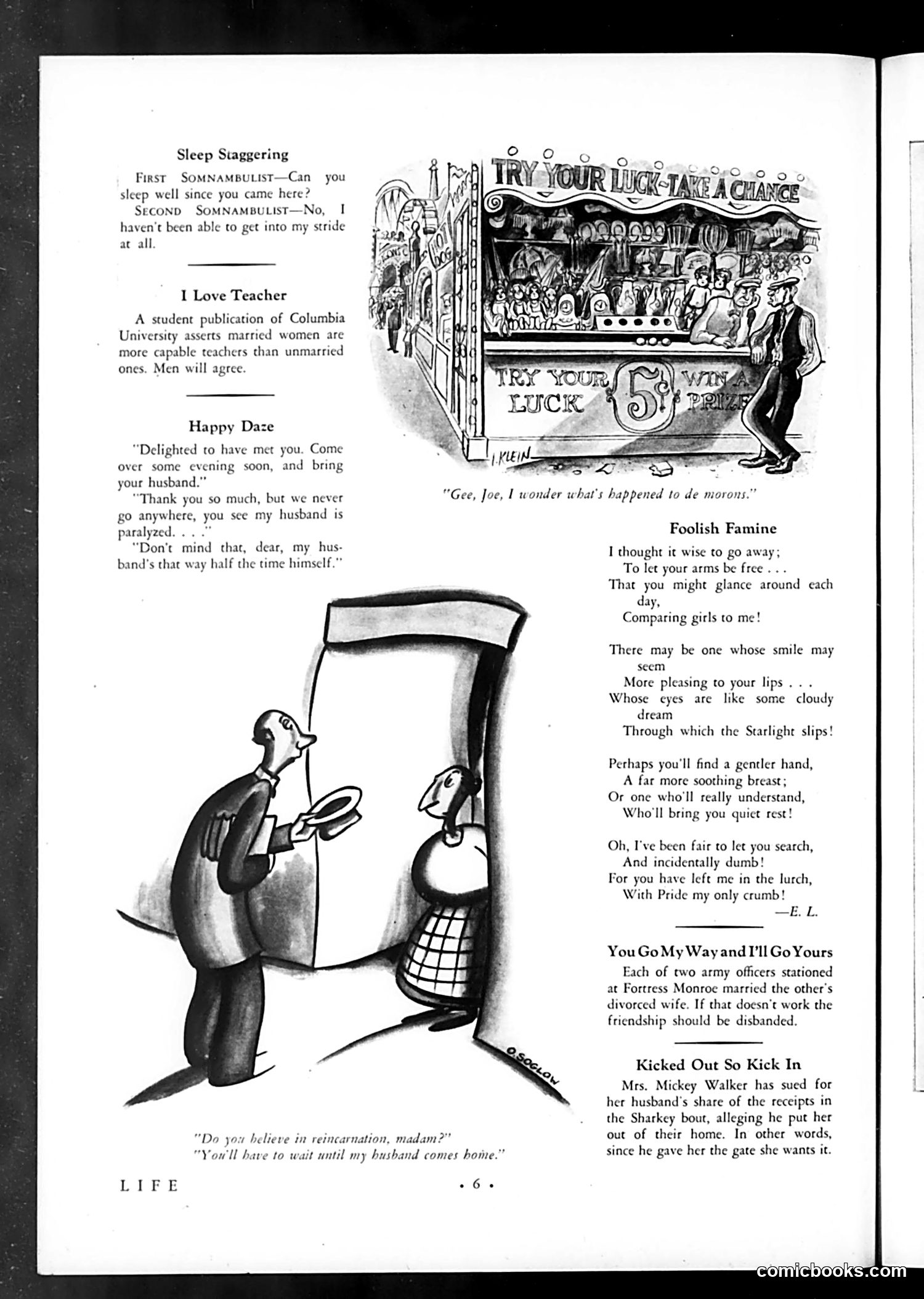
Analysis of Life Magazine Page This page contains several satirical pieces mocking married life and gender relations. "Sleep Staggering" opens with a brief joke about a somnambulist (sleepwalker) struggling to adjust to married life. "I Love Teacher" sarcastically asserts that married female teachers are superior to unmarried ones—a jab at assumptions about women's capabilities changing with marital status. "Happy Daze" depicts a wife inviting a guest while her husband is paralyzed, with her dismissing his condition as merely "half" his normal state—humor rooted in henpecking husband tropes. "Foolish Famine" is a longer poem about a man leaving his girlfriend, regretting it as he realizes other women might appeal to her more than him. The cartoons employ common early 20th-century domestic humor: wives dominating husbands, marriage as entrapment, and anxious romance.
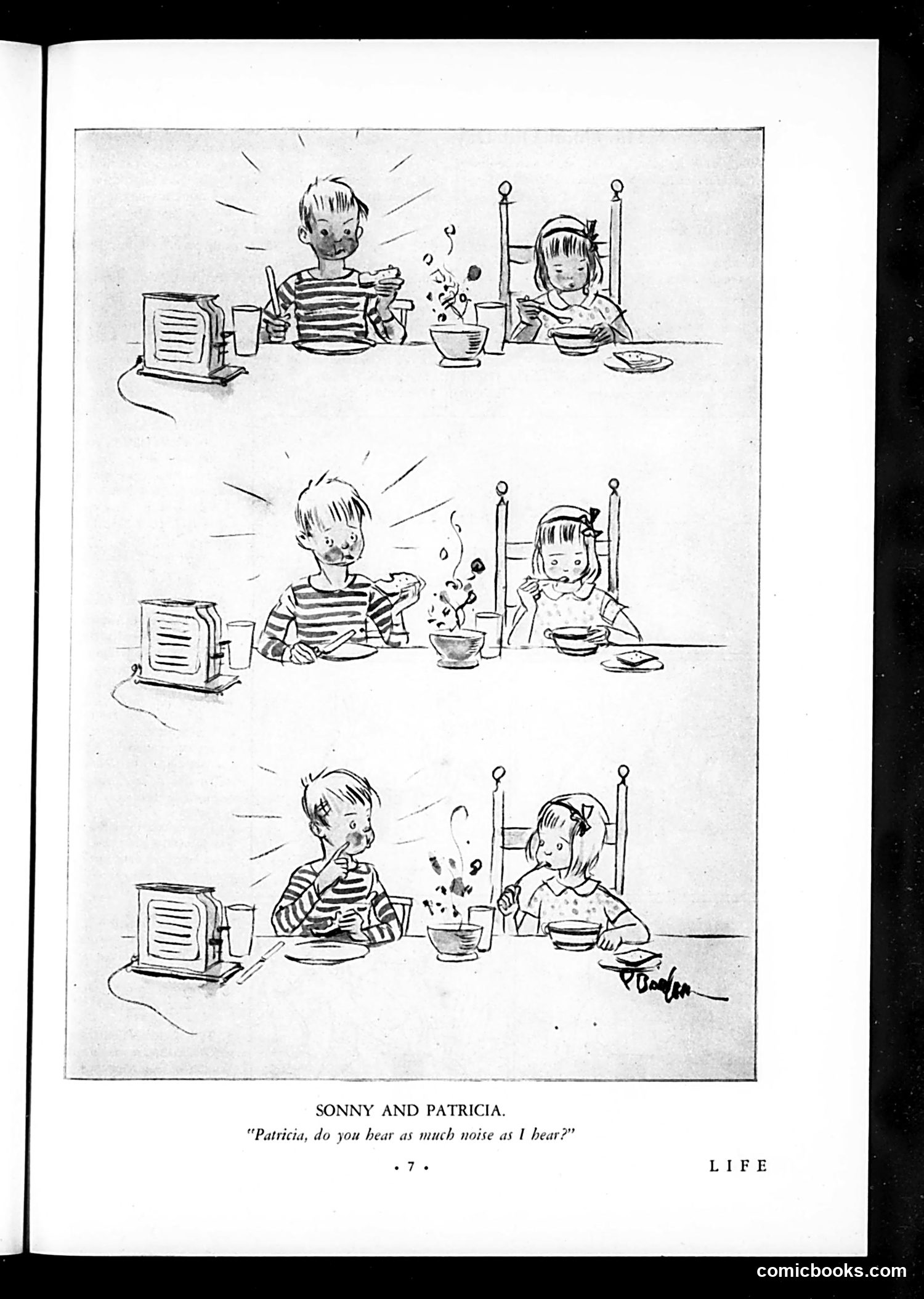
Sonny and Patricia This comic strip shows two children eating meals together at a table with a toaster visible on the left. The caption reads: "Patricia, do you hear as much noise as I bear?" The joke depicts the boy (Sonny) making noise while eating—shown by the radiating lines and scattered food particles in the final panels—while the girl (Patricia) eats quietly. The humor contrasts their table manners: he creates considerable noise and mess during eating, while she eats neatly and silently. This appears to be a gentle domestic humor piece about children's behavior at mealtime, likely poking fun at common complaints parents have about noisy eaters. The strip uses three sequential panels to build the comedic observation about table etiquette differences between the two children.
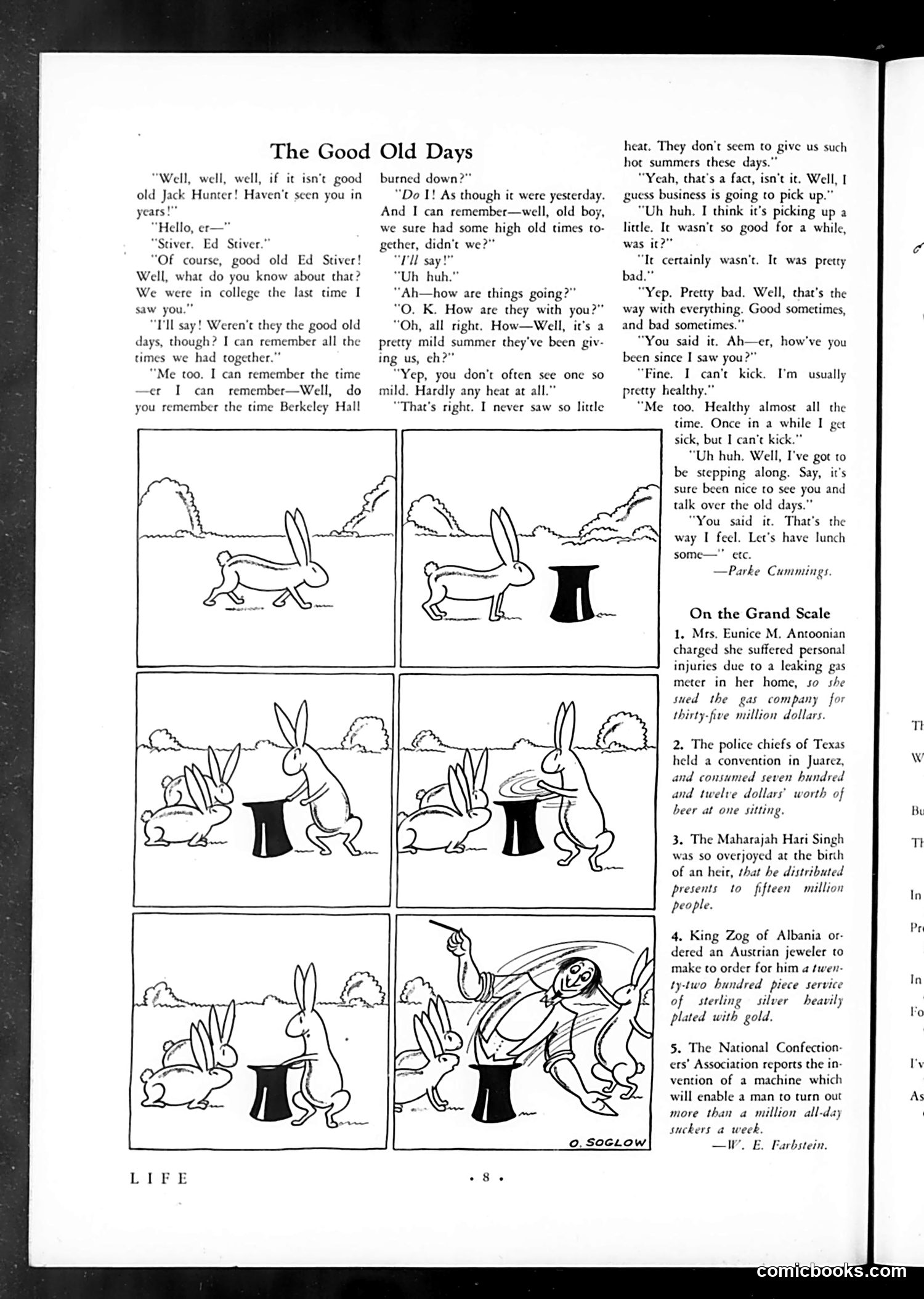
Analysis of "The Good Old Days" Page This page from *Life* magazine features a dialogue between two men reminiscing about better times, illustrated by O. Soglow's comic strip showing a magician repeatedly pulling rabbits from a hat. The Satire: The conversation nostalgically compares past summers (cooler, milder) to present heat and economic conditions. One speaker mentions Berkeley Hall and college days, while they discuss how "business is going to pick up" despite current hardship. The Point: The cartoon juxtaposes the men's optimistic talk with Soglow's repetitive magic trick—suggesting their hopes for improvement are as illusory and circular as pulling endless rabbits from a hat. It's commentary on false optimism during economic difficulty, likely from the Depression era, when people clung to hope while conditions remained unchanged.
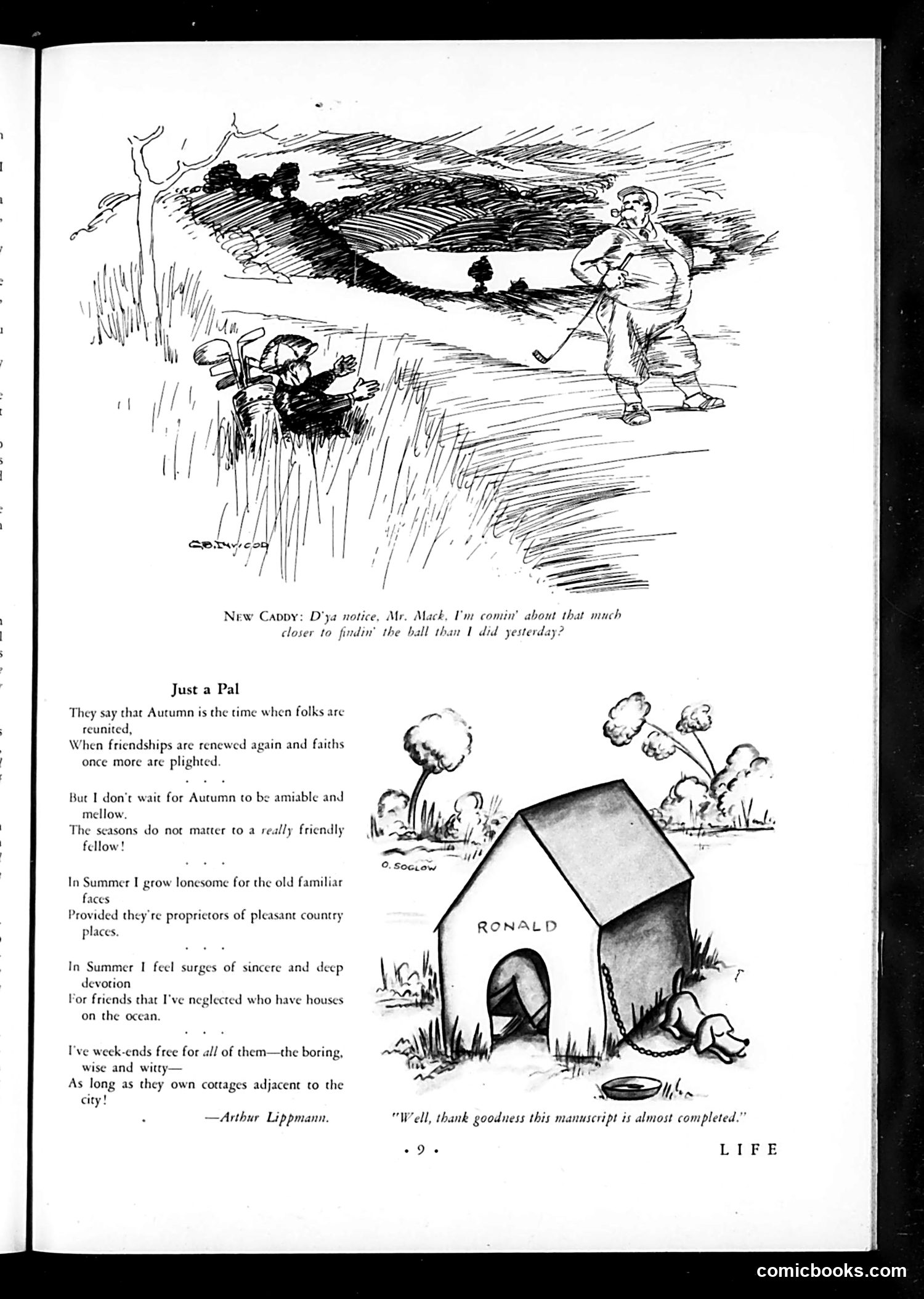
Analysis of Life Magazine Page Top Cartoon: A golf scene depicting a "New Caddy" (young golfer's assistant) speaking to "Mr. Mark." The caddy claims to be finding the golf ball much closer to the hole than yesterday's shot. This is a joke about either the caddy's dishonesty or incompetence—suggesting he's either fabricating the ball's improved position or is genuinely confused about golf distances. Bottom Section: "Just a Pal" is a poem by Arthur Lippmann about maintaining friendships year-round, not just seasonally. The accompanying illustration shows a dog house labeled "RONALD" with a small dog inside—a visual pun emphasizing that true friendship is constant ("really friendly fellow") regardless of circumstances, even for a humble pet.
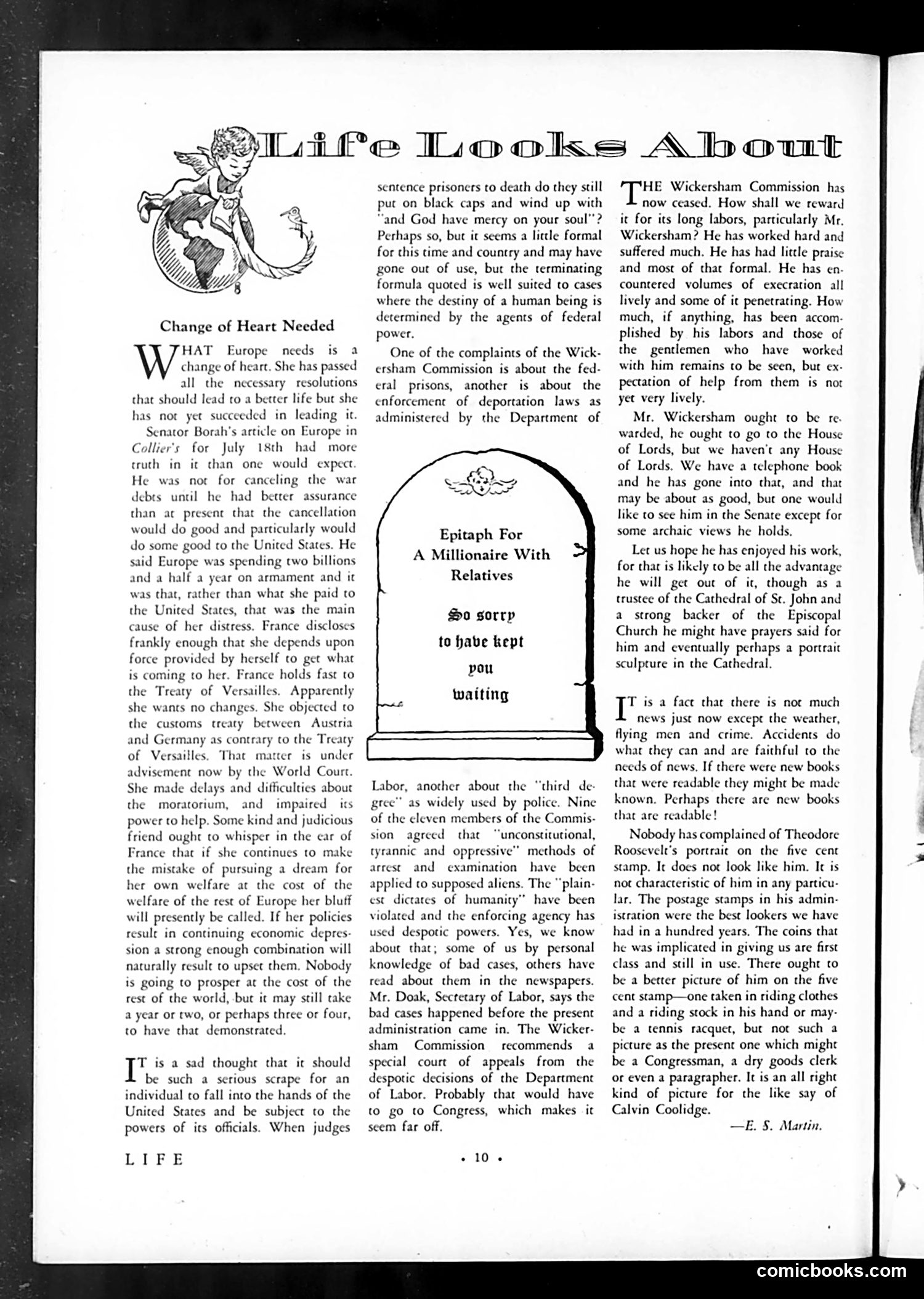
Analysis of Life Magazine Page This page satirizes European political and economic issues post-WWI, centered on a "Change of Heart Needed" editorial about Europe's financial dependency on the United States. The main cartoon depicts an epitaph for "A Millionaire With Relatives," showing a tombstone with the epitaph "So sorry to have kept you waiting." This appears to satirize wealthy individuals (likely American) whose delayed financial aid to desperate European nations prolongs their suffering—the "relatives" waiting for assistance. The editorial criticizes Europe's spending habits and dependence on American loans rather than achieving self-sufficiency. It argues Europe must reform economically rather than expect continued American financial rescue, particularly regarding post-war debt and reparations obligations. The sardonic humor mocks both European financial mismanagement and American reluctance to provide promised aid.
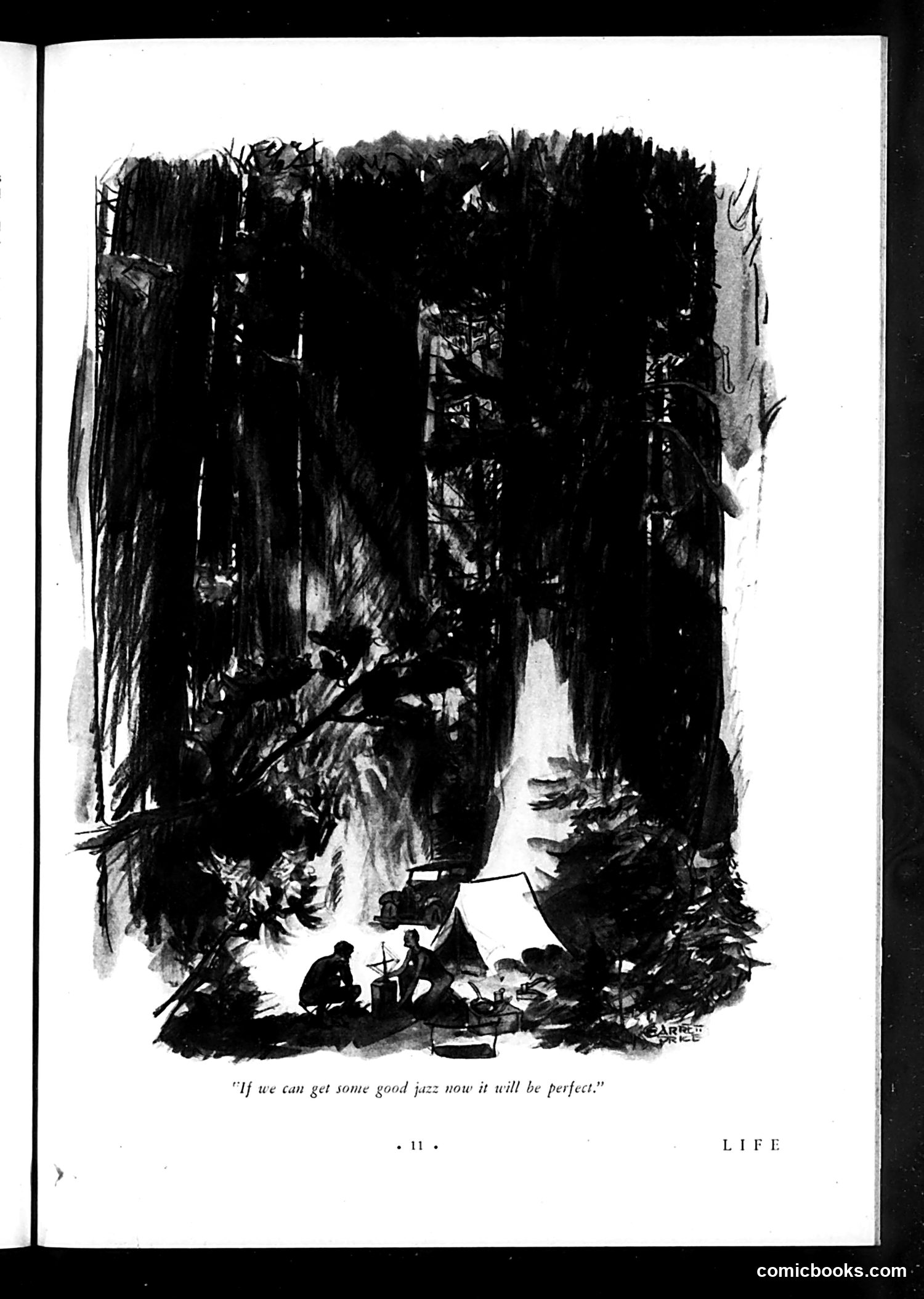
Cartoon Analysis This cartoon depicts campers or refugees huddled in a makeshift tent at the base of a massive cliff or canyon. The figures appear to be in a wilderness or displaced-persons camp setting, with minimal shelter and supplies visible. The caption reads: "If we can get some good jazz now it will be perfect." The satire works through contrast—the group is in clearly impoverished, uncomfortable circumstances with inadequate shelter and provisions, yet one person suggests that adding jazz music would make things "perfect." This mocks either naive optimism in dire situations or the notion that entertainment can compensate for material deprivation. The cartoon likely critiques either Depression-era hardship or contemporary social displacement, using humor to expose the gap between actual needs and superficial pleasures.
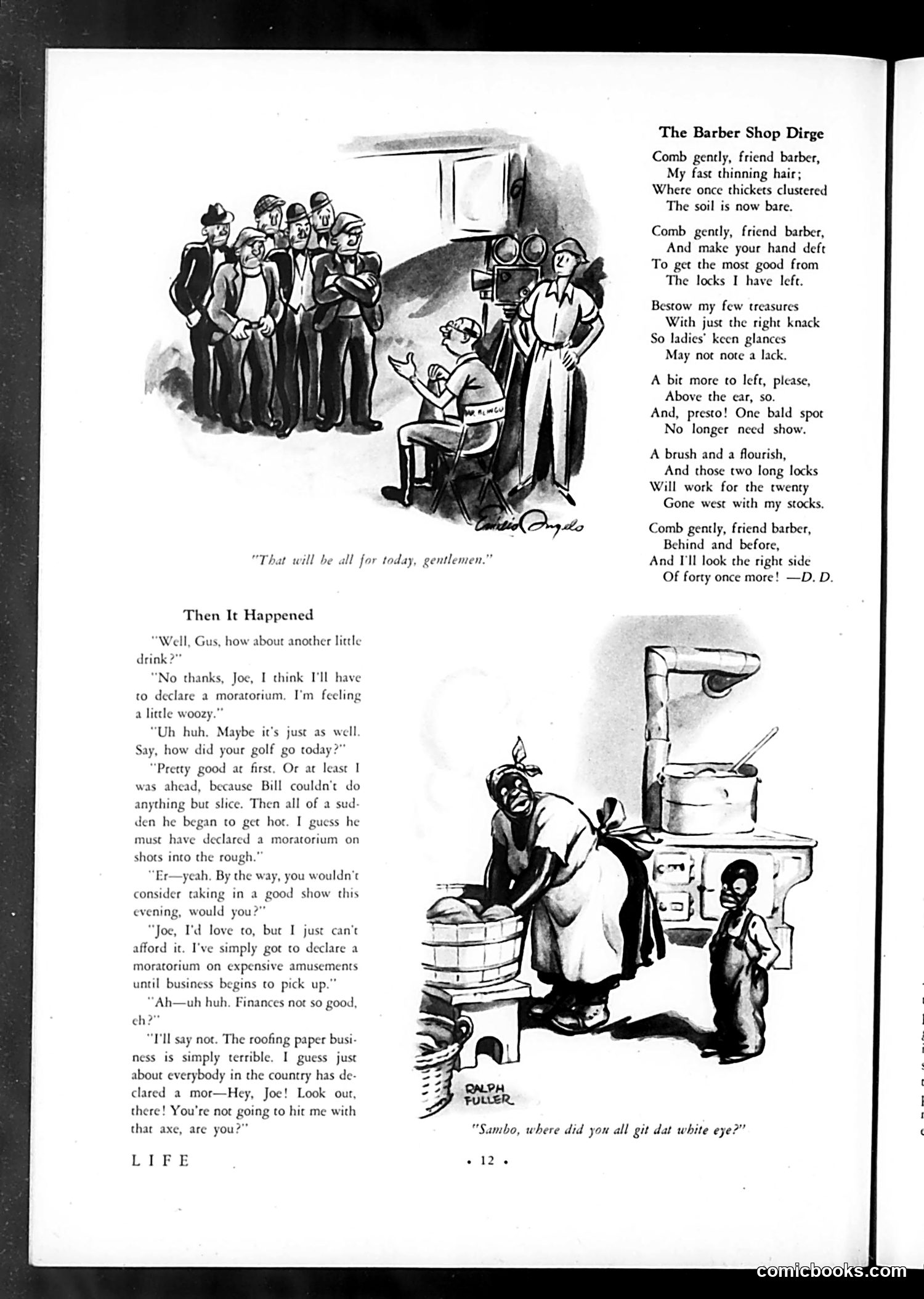
Analysis of Life Magazine Page 12 This page contains two pieces of humor from an early 20th-century American magazine: "The Barber Shop Dirge" (top right): A poem by D.D. about male baldness and hair loss. The speaker asks his barber to skillfully comb and style his remaining hair to conceal baldness—a comedic commentary on vanity and the anxiety men felt about losing hair. The humor lies in the detailed, somewhat desperate instructions to hide what appears to be significant baldness. "Then It Happened" (left): A dialogue between two men (Joe and Gus) discussing golf and finances. The joke concerns mounting business expenses and financial strain, with references to expensive amusements. The cartoon below depicts a domestic scene, likely illustrating the financial consequences of leisure activities during economically uncertain times. Both pieces satirize male concerns about appearance and economic anxiety common to the era.
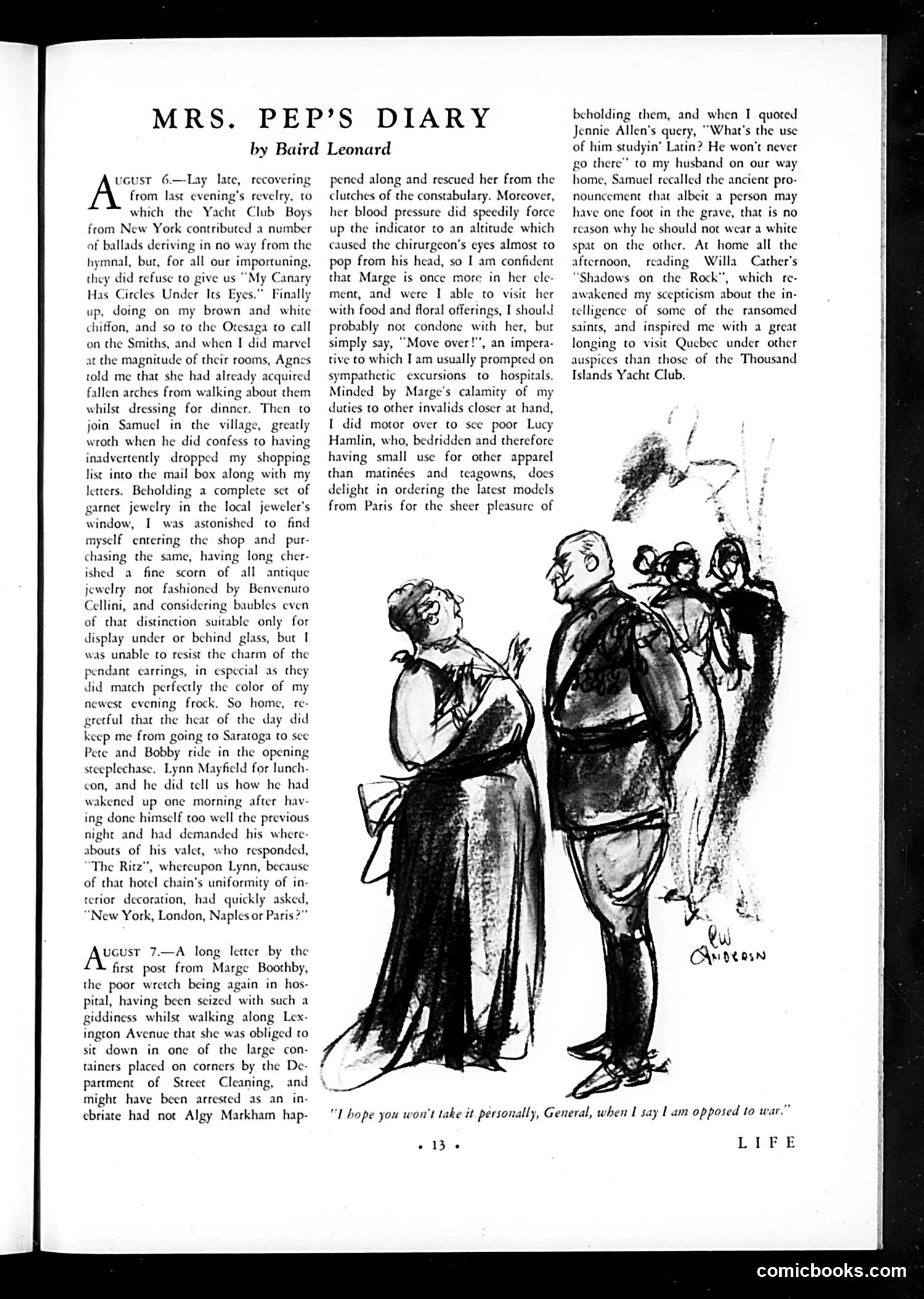
Analysis of "Mrs. Pep's Diary" Page This is a humorous diary entry by Baird Leonard from *Life* magazine, featuring a sketch by Cesare Viviani. The cartoon depicts a social scene where Mrs. Pep encounters a General at what appears to be a formal gathering. The caption reads: "I hope you won't take it personally, General, when I say I am opposed to war." The satire targets wealthy socialites who espouse pacifist sentiments while maintaining their luxurious lifestyles—Mrs. Pep spends her days shopping for jewelry and planning social visits. The joke highlights the disconnect between fashionable anti-war rhetoric among the upper classes and their comfortable detachment from actual conflict's consequences. The General's presence suggests this is wartime, making her casual opposition to war somewhat absurd given her privileged position.
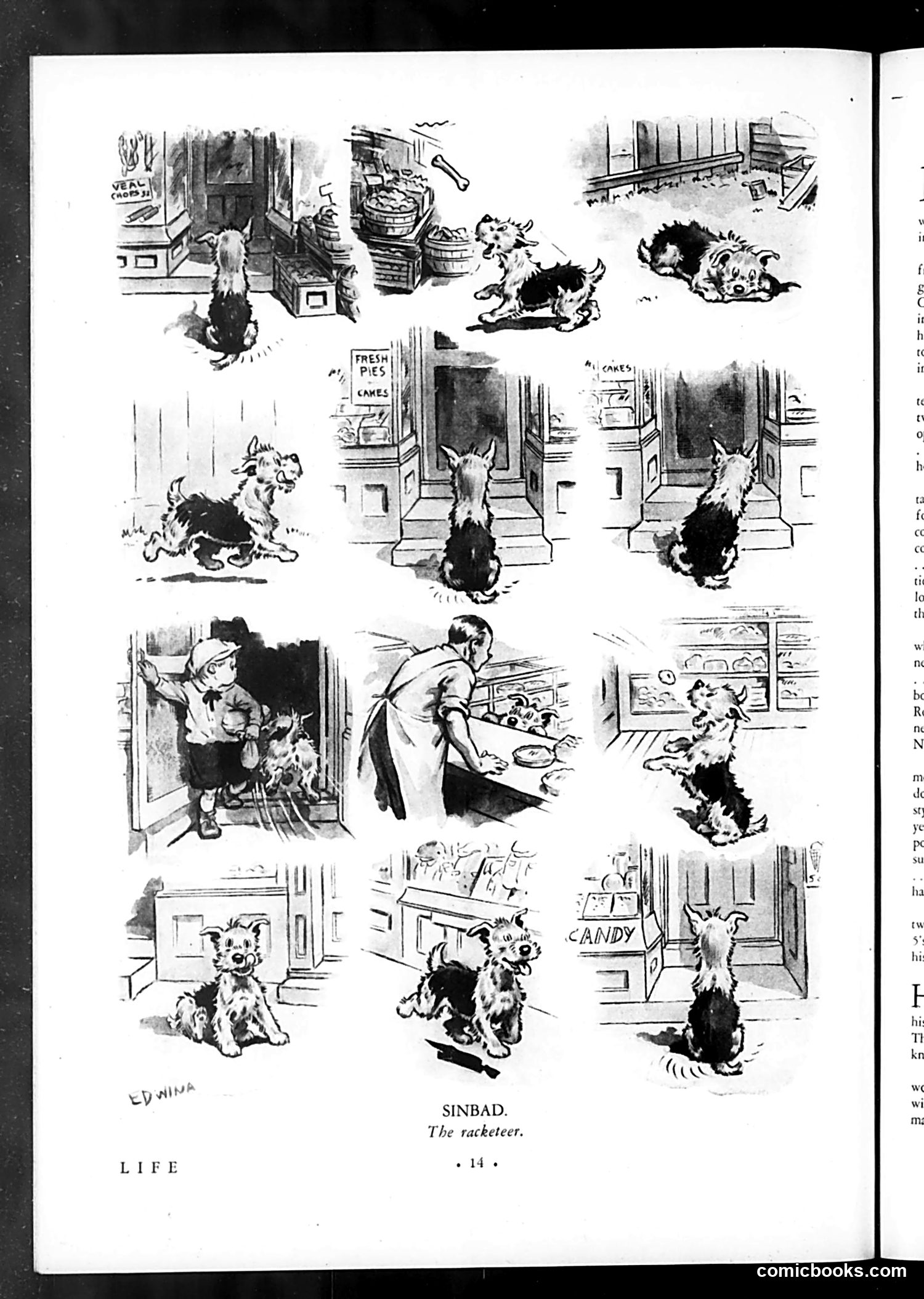
SINBAD the Racketeer This is a humorous cartoon series titled "Sinbad the Racketeer," playing on the famous Arabian Nights character. The strip depicts a scraggly dog (appearing to be named Sinbad) getting into mischief around town—stealing from bakeries labeled "Fresh Pies & Cakes," raiding garbage bins, confronting shopkeepers, and generally causing trouble in various storefronts and streets. The joke combines the legendary adventurer Sinbad with "racketeer" (1920s slang for a criminal/troublemaker), suggesting this dog is a petty criminal rather than a heroic sailor. It's lighthearted animal humor popular in early 20th-century magazines, using familiar literary references for comedic effect.
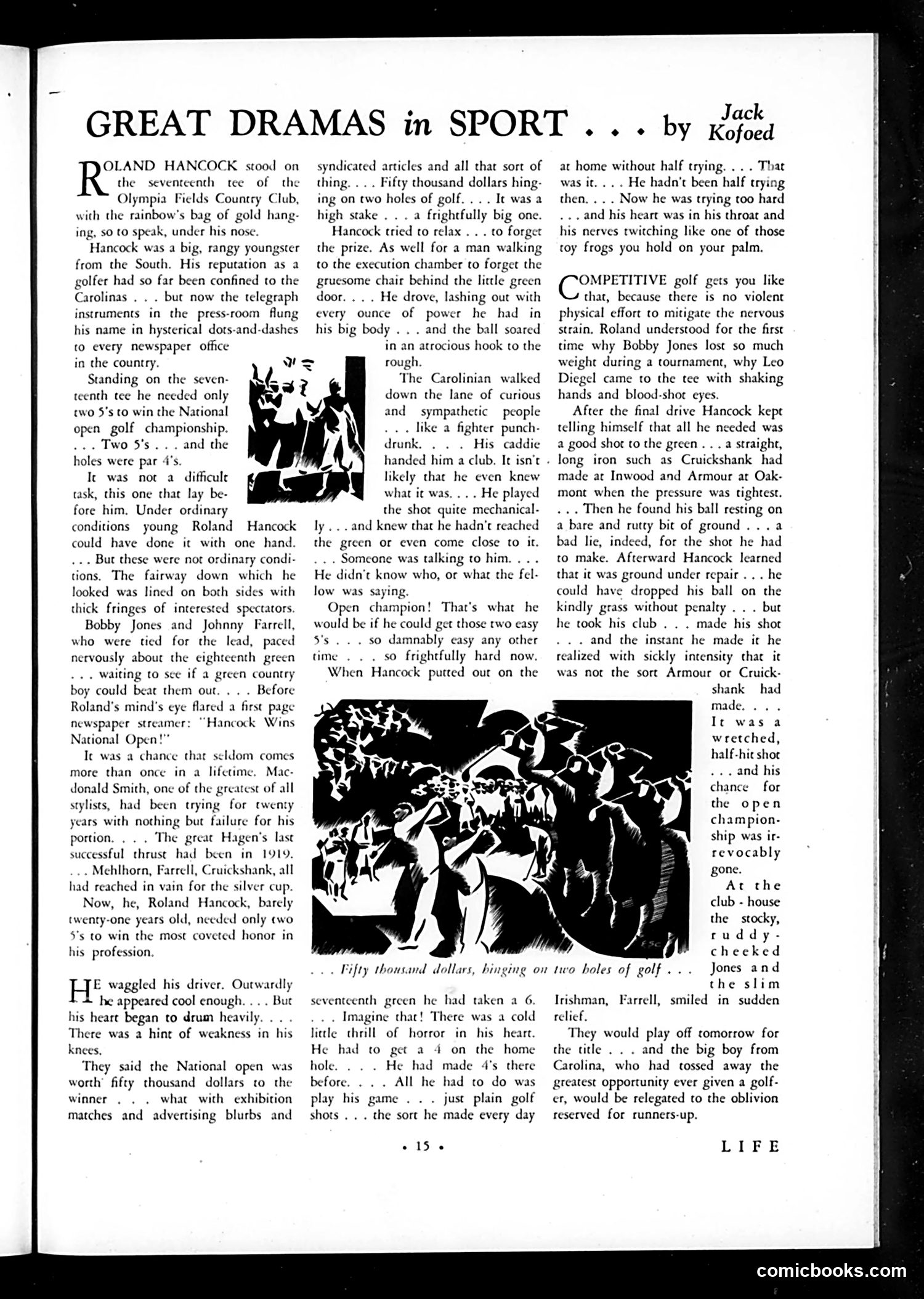
Analysis of "Great Dramas in Sport" by Jack Kofoed This page presents a golf narrative featuring Roland Hancock, a golfer competing in the National Open championship at Olympia Fields Country Club. The story describes Hancock's nervous breakdown during the tournament—he's so anxious he can barely hold his club. The two illustrations show the gallery of spectators reacting dramatically to his performance. The satire targets competitive golf's intense psychological pressure: Hancock struggles with a simple shot, loses confidence, and nearly throws away victory through mental collapse rather than physical inadequacy. The piece satirizes how golf—despite appearing genteel—inflicts violent emotional strain on competitors. The irony: Hancock's real opponent is his own mind, not other players.
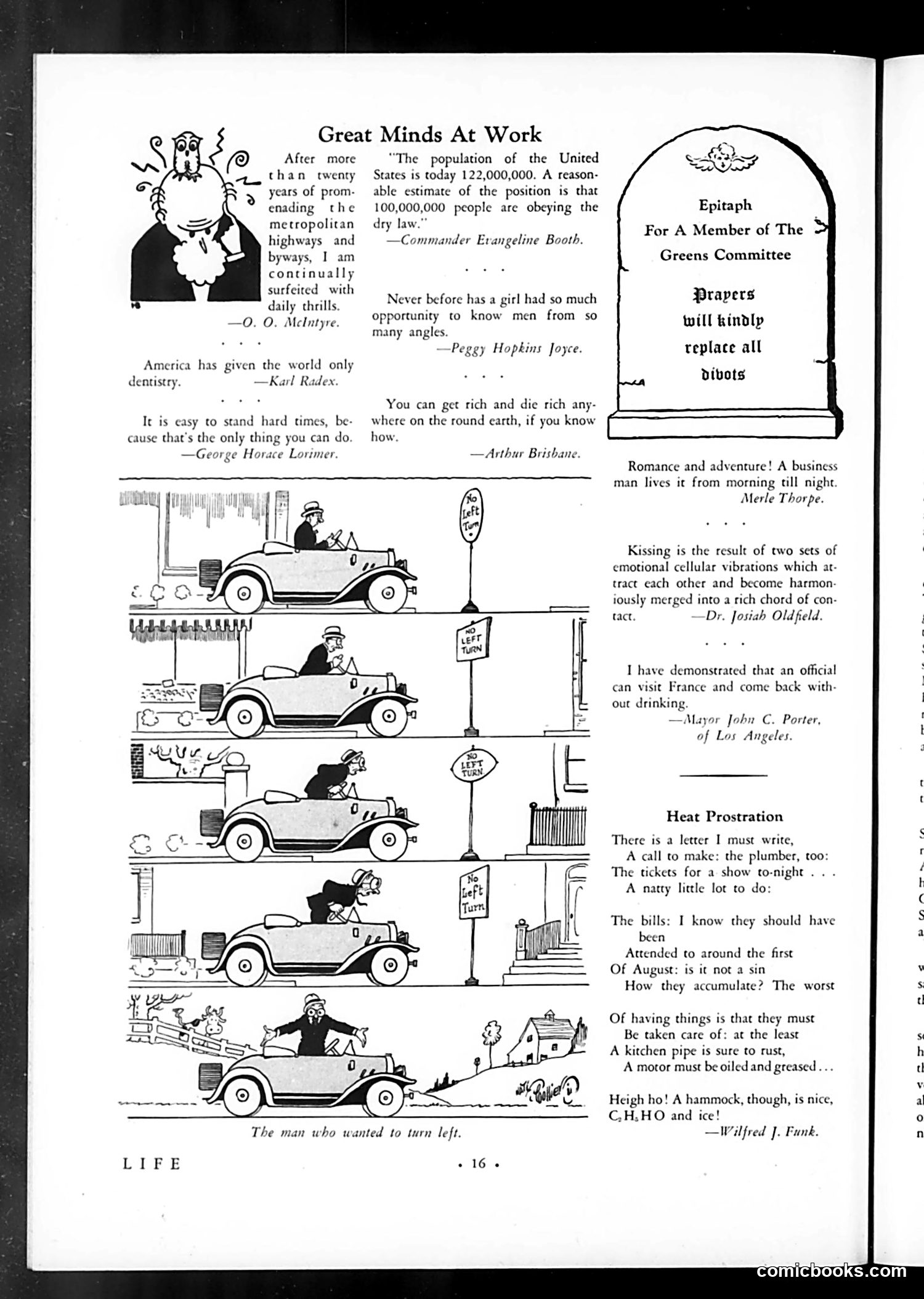
Analysis: "The Man Who Wanted to Turn Left" This sequential cartoon satirizes traffic enforcement and rules during the early automobile era. It shows a driver repeatedly attempting to turn left at various intersections, encountering increasingly absurd obstacles each time: traffic signs, barriers, buildings, and finally a rural landscape—suggesting either bureaucratic obstruction or the driver's complete incompetence. The humor lies in the futility of the driver's repeated failure to accomplish a simple task. This likely critiques either overly complicated traffic regulations of the period, or mocks drivers who cannot navigate basic road rules. The escalating chaos suggests society's frustration with early motoring culture and its unpredictable dangers. The page otherwise contains miscellaneous humorous quotations labeled "Great Minds At Work."
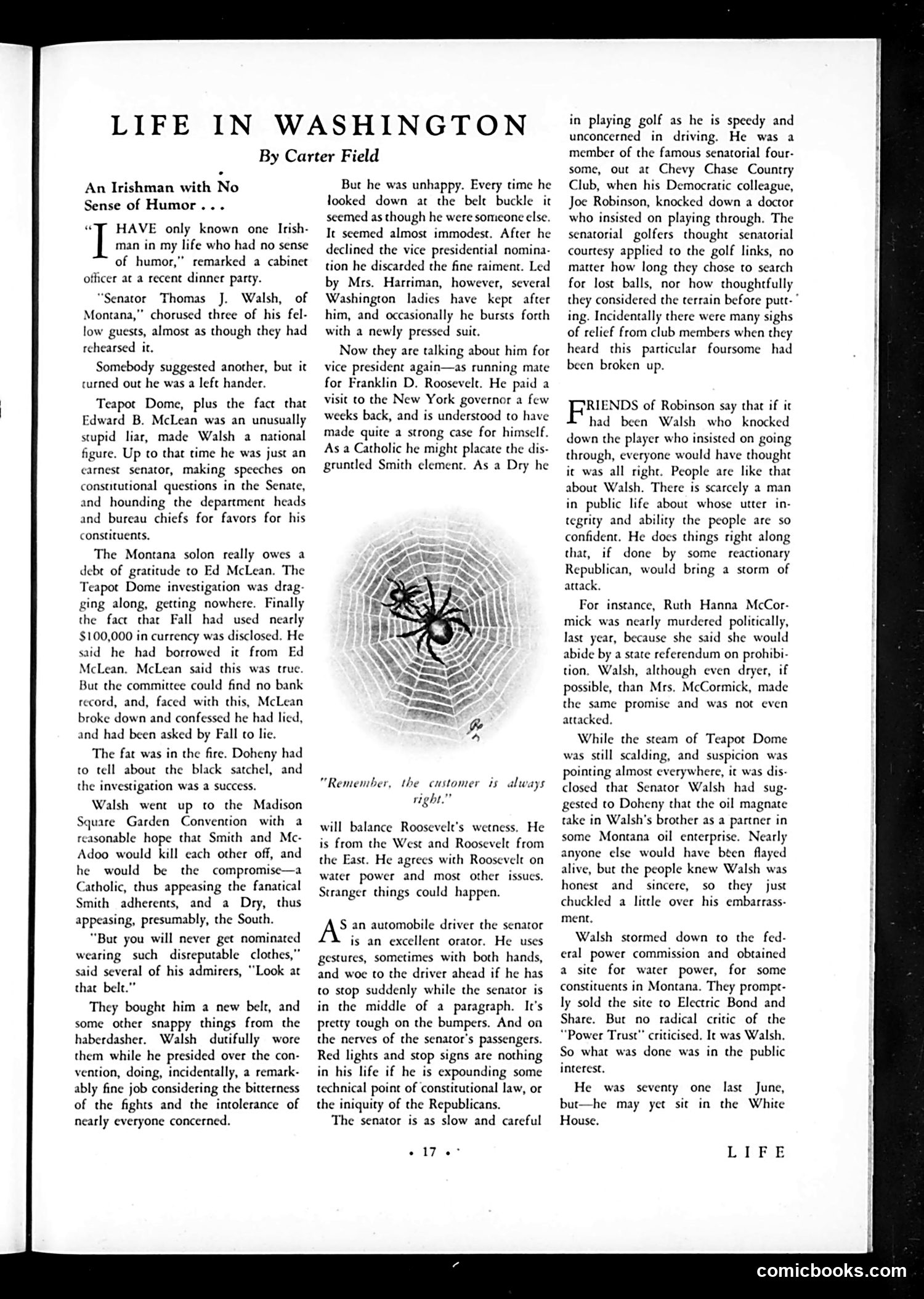
Analysis of "Life in Washington" by Carter Field This satirical column discusses Senator Thomas J. Walsh of Montana, an Irish-American politician known for lacking humor. The piece recounts Walsh's unsuccessful vice-presidential prospects and his role in the Teapot Dome scandal investigation—a major 1920s corruption case involving oil reserves. The cartoon (a spider web with a fly) appears to illustrate the "customer is always right" principle mentioned in the text, suggesting Walsh's careful navigation of political pressures. The satire targets Walsh's reputation for humorlessness and integrity, noting his effectiveness as a senator investigating corruption while suggesting his rigid personality made him politically vulnerable and unlikely to achieve higher office despite his competence.
This page contains film reviews by Harry Evans from Life magazine. It discusses three movies: "The Star Witness," "Reckless Hour," and "Transatlantic." The reviews are straightforward critical assessments of contemporary films, discussing plots, performances, and directorial choices. "The Star Witness" is praised for its moral courage in depicting gangster life, while "Reckless Hour" is noted as a book adaptation. "Transatlantic" receives mixed commentary, with Evans noting it features elaborate adjectives and a love intrigue/murder mystery aboard a ship. The page contains no visible political cartoons or satirical illustrations—it is purely text-based film criticism. Evans evaluates actors like Dorothy Mackaill and Greta Nissen, and discusses directorial merit throughout. This represents Life magazine's cultural criticism function rather than its satirical cartoon content.
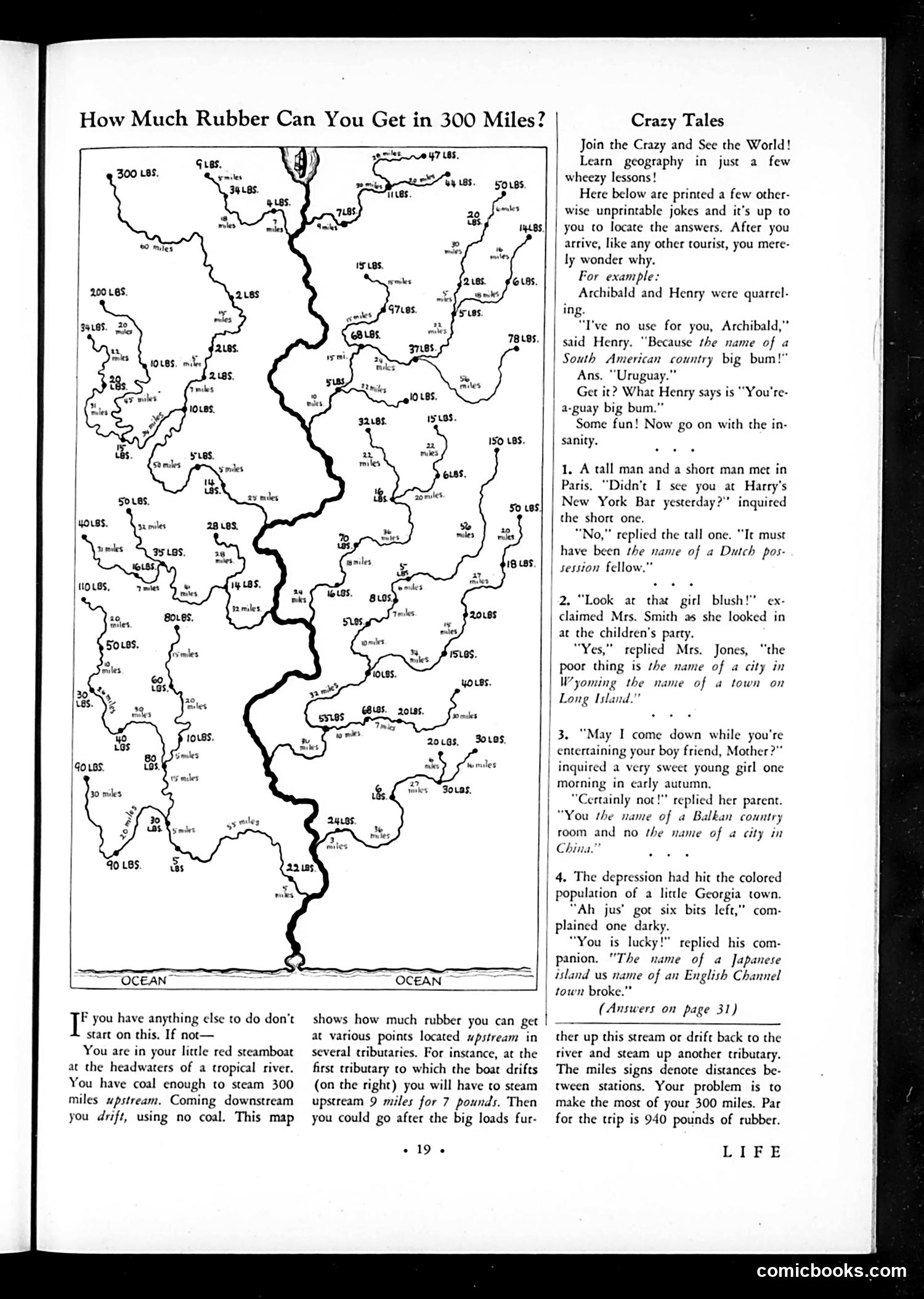
Analysis of Life Magazine Page This page contains two unrelated features: Left side: A geographic puzzle-map showing rubber quantities available at various points along a river system over 300 miles. Readers must calculate optimal stops to maximize rubber collection while steaming upstream with limited coal, then drifting downstream. This is a practical math puzzle dressed as adventure fiction—typical of Life's educational humor. Right side: "Crazy Tales" presents four brief jokes where punchlines turn on geography. Each involves a character mishearing or misidentifying a place name (Uruguay misheard as "you're-a-guy"; Dutch "session" as city name; Balkan country vs. Chinese city; Japanese island vs. English Channel town). The humor relies entirely on wordplay and geographic knowledge—Entertainment for readers familiar with world geography, now largely obscure to modern audiences.
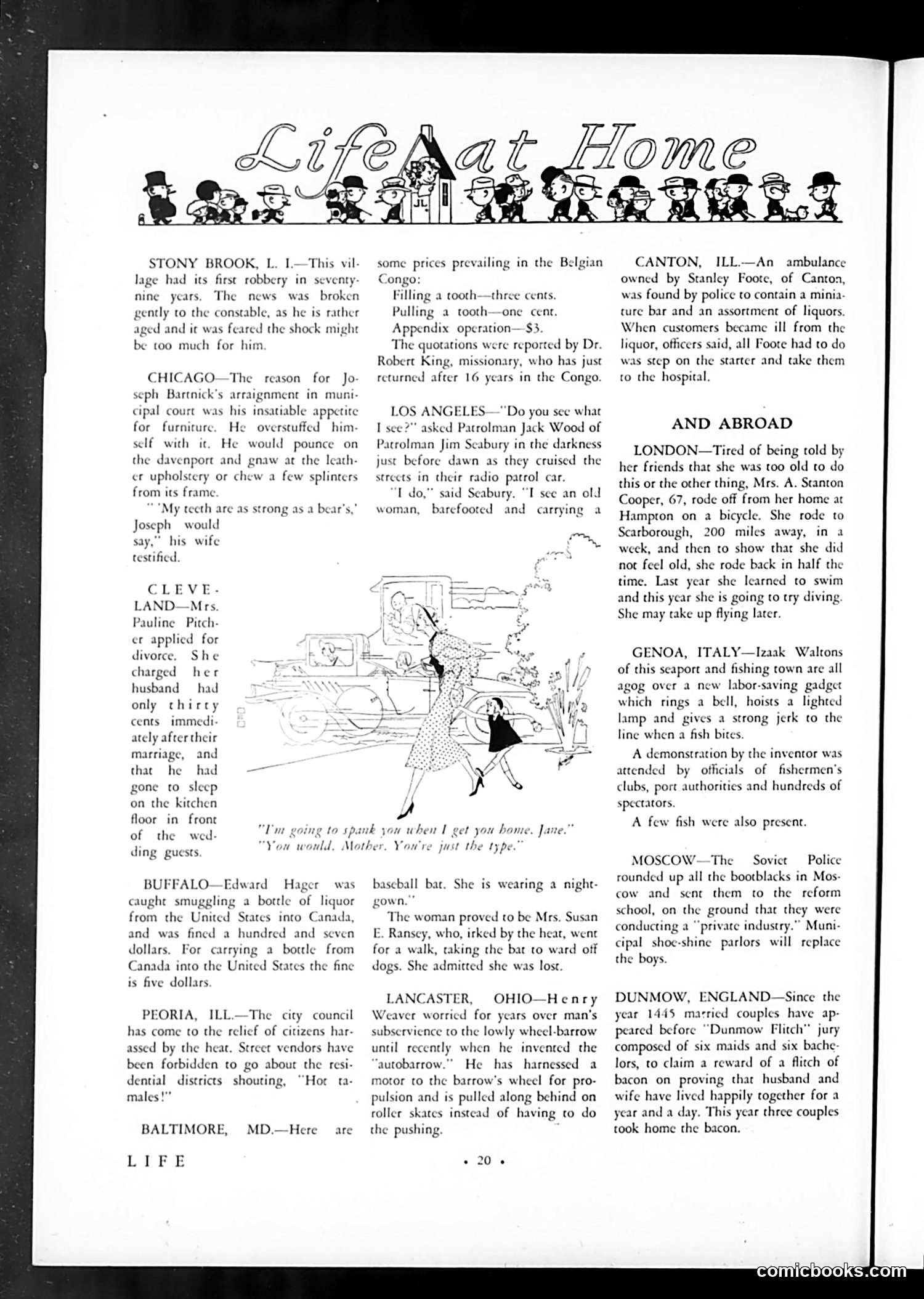
"Life at Home and Abroad" - Satire and Social Commentary This page compiles humorous anecdotes from American towns and international locations, using absurdity and irony to mock social conditions and human nature. Domestic humor targets peculiar local incidents: a man obsessively eating furniture; a woman walking at dawn with a baseball bat (mistaken for suspicious behavior); an ambulance doubling as a mobile bar. These mock small-town eccentricity and police inefficiency. The cartoon depicts a woman threatening to spank a child, illustrating domestic discord—likely mocking marriage or parenting. International items employ satirical contrast: Belgian Congo dental prices (exploitative colonialism), a Soviet crackdown on bootblacks (communist suppression of private enterprise), and a 67-year-old Englishwoman defying age stereotypes through cycling. The Genoa fishing gadget story climaxes absurdly: "A few fish were also present"—mocking grandiose invention demonstrations. Throughout, *Life* uses exaggeration and understatement to critique economic inequality, bureaucratic overreach, gender expectations, and technological pretension during the interwar period.
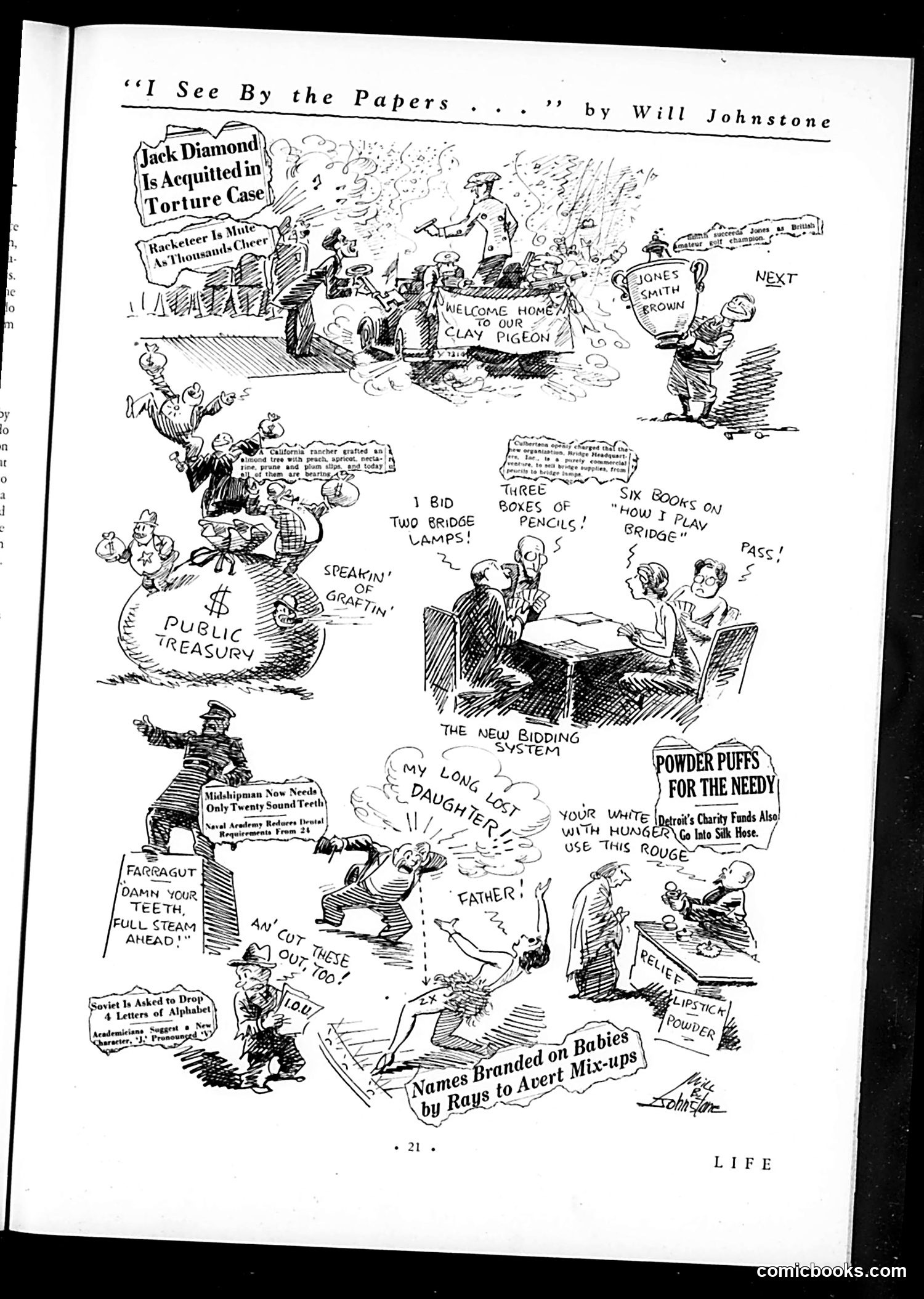
"I See By the Papers" - Political Cartoon Analysis This satirical page by Will Johnstone mocks various contemporary news items and social absurdities through interconnected vignettes. Key targets include: - Jack Diamond acquittal: References a criminal case, satirizing the legal system - Public Treasury waste: Depicts officials "speaking 'n graftin'" while raiding public funds - New bidding system: Mocks government procurement corruption - Naval Academy standards: Jokes about reducing dental requirements from 24 to 20 teeth—absurdist commentary on lowered military standards - Cosmetics/beauty industry: "Powder Puffs for the Needy" and "Names Branded on Babies by Rays" mock frivolous commercial exploitation - Bridge lamps/city projects: References to wasteful civic spending The overall theme criticizes political corruption, government waste, lowered standards, and commercial exploitation—common Life magazine targets. The crude, energetic sketching style emphasizes chaotic incompetence in governance and commerce during what appears to be the 1920s-30s era.
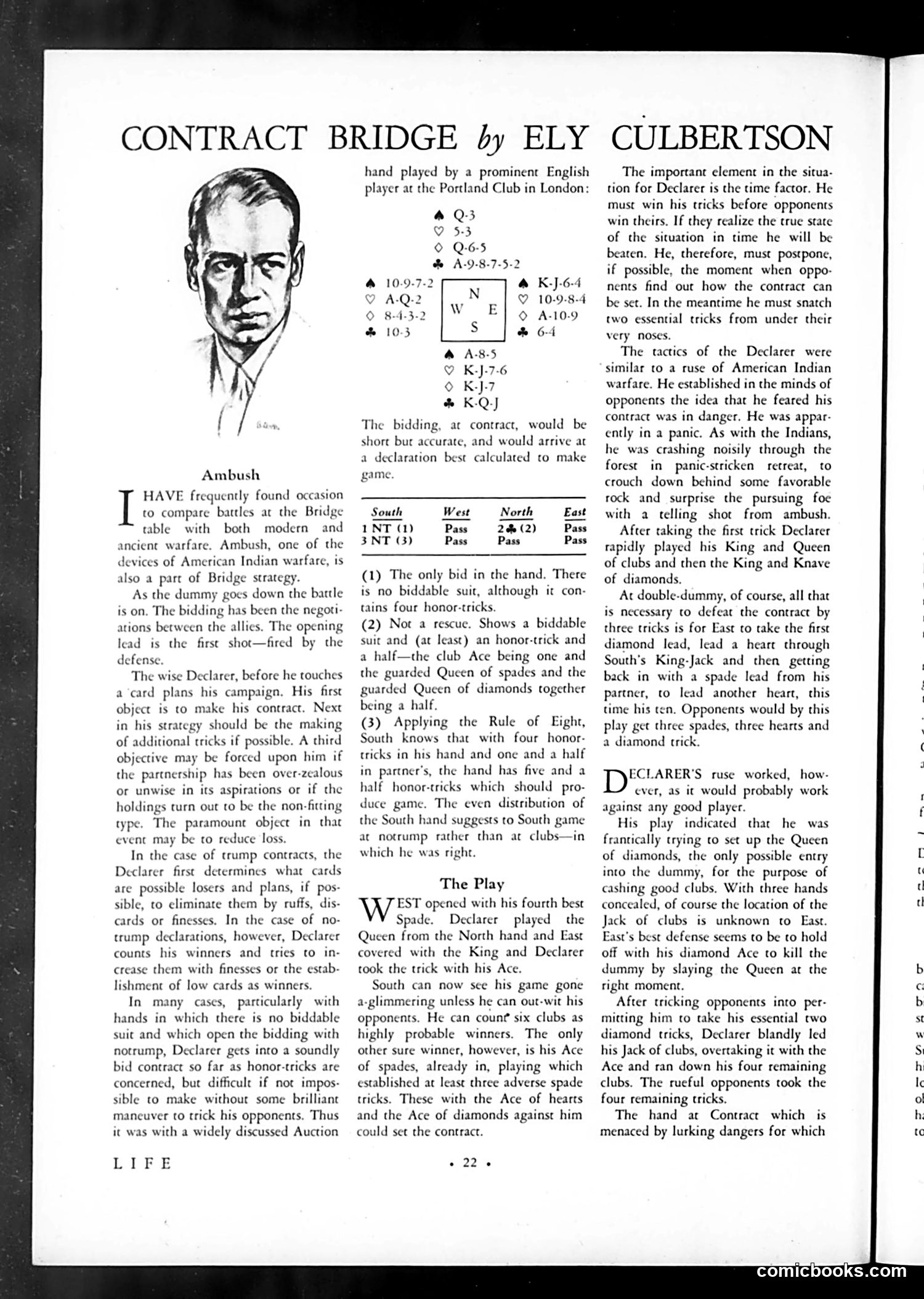
Contract Bridge Strategy by Ely Culbertson This page from *Life* magazine presents a bridge hand analysis rather than political satire. Ely Culbertson, a prominent bridge authority, explains a strategic card-play using a military metaphor—comparing bridge tactics to American Indian ambush warfare. The article discusses a real bridge hand played at London's Portland Club. Culbertson demonstrates how the Declarer must win tricks before opponents realize the contract's weakness, using deception as strategy. The "ambush" involves temporarily convincing opponents the hand is vulnerable while secretly executing winning plays. The piece exemplifies how bridge was treated as serious intellectual strategy in early 20th-century American culture—worthy of detailed magazine analysis. It's instructional rather than satirical, though it employs the period's common trope of comparing card-play to military tactics.
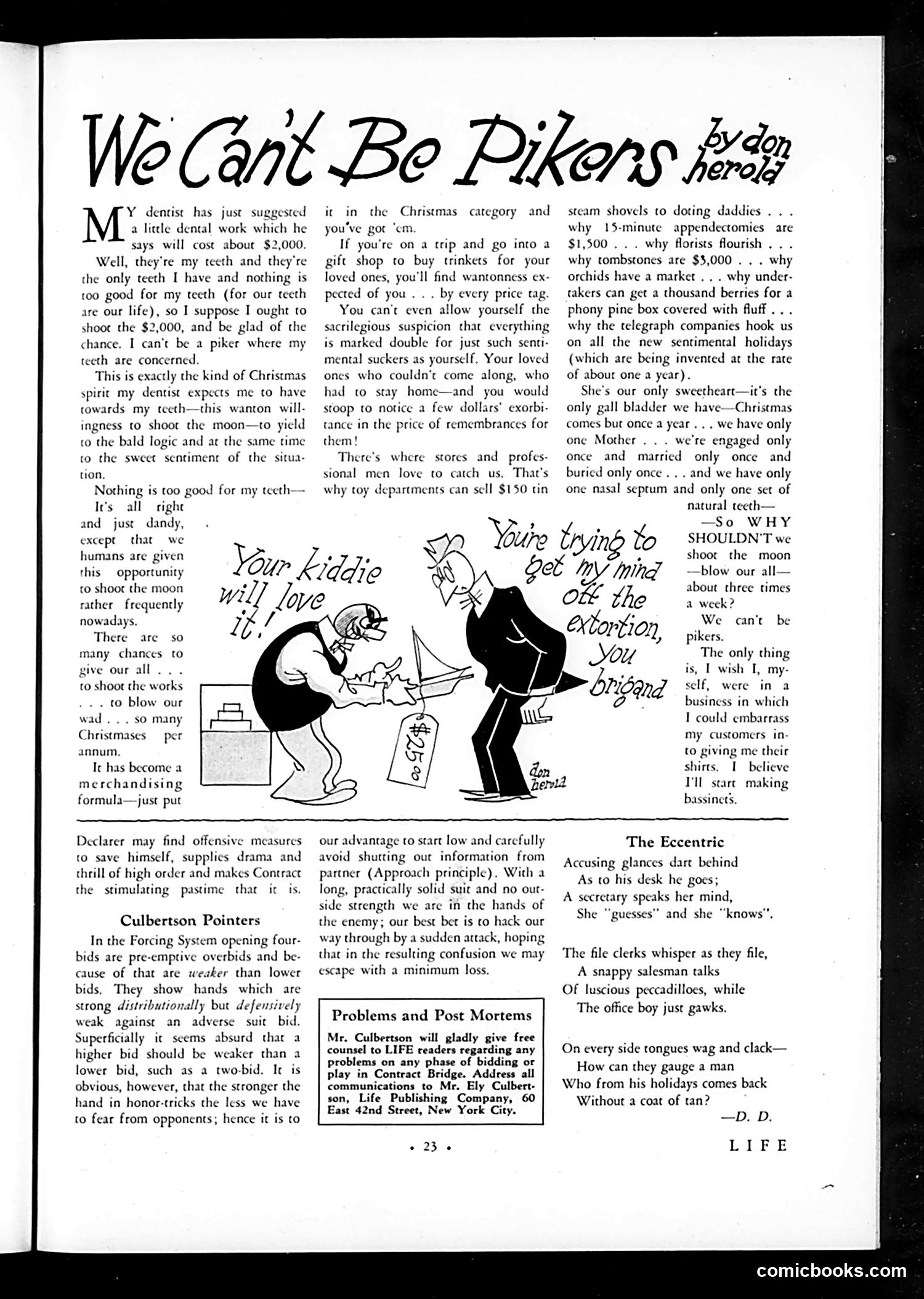
"We Can't Be Pikers" This page satirizes American consumer culture and sentimentality around Christmas spending. The main cartoon depicts a dentist convincing a patient to spend $2,000 on dental work by appealing to Christmas spirit and the idea that "nothing is too good" for one's teeth. The author's broader point: merchants exploit emotional occasions (Christmas, Mother's Day, funerals) to justify inflated prices. He lists examples—$150 tin toys, $1,500 appendectomies, $3,000 tombstones—arguing that because we have "only one mother," "only one set of natural teeth," we feel obligated to spend lavishly. The title "We Can't Be Pikers" (pikers = cheapskates) captures this social pressure: Americans feel ashamed appearing stingy on emotionally significant purchases, even when prices are unreasonably marked up. The satire critiques both merchants' manipulation and consumers' willingness to rationalize excessive spending through sentimentality. The page also includes bridge card game advice, unrelated to the main satire.
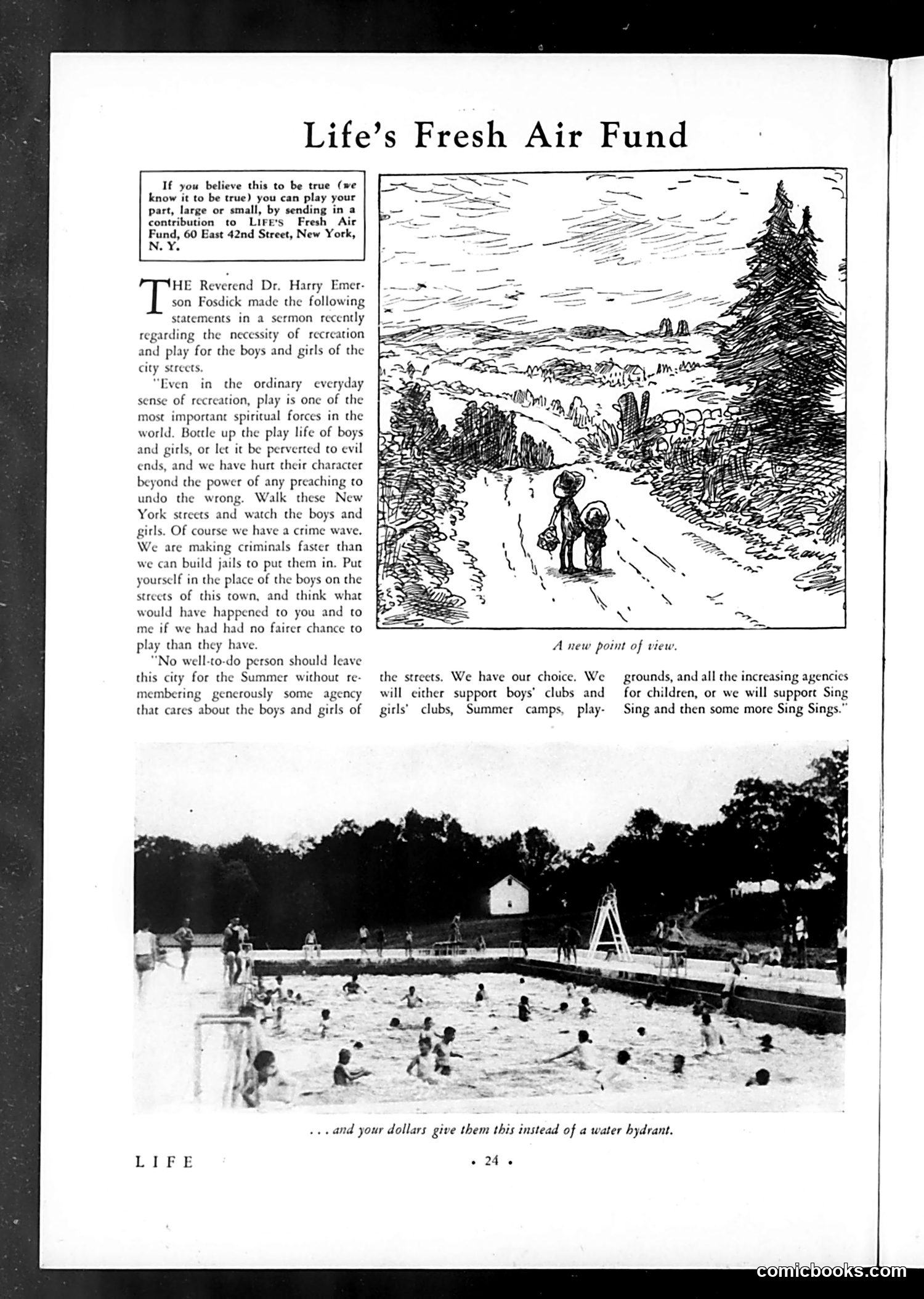
Life's Fresh Air Fund — Analysis This page advocates for Life Magazine's Fresh Air Fund, a charitable initiative providing recreation for poor urban children. The appeal quotes Reverend Dr. Harry Emerson Fosdick, a prominent progressive theologian, arguing that play is spiritually essential and that denying children recreation leads to crime. The satirical point (indicated by "and your dollars give them this instead of a water hydrant") is that wealthy New Yorkers must choose: fund proper recreational facilities and camps for street children, or effectively fund prisons ("Sing Sing" was a notorious prison). The two images contrast: an idyllic rural scene with children playing freely, versus a crowded public swimming pool—showing how even basic recreation is inadequate for dense urban populations. The sermon's final line presents a starkly utilitarian choice: support youth programs now or support the criminal justice system later. This reflects early-20th-century Progressive Era thinking linking poverty, crime prevention, and social responsibility.
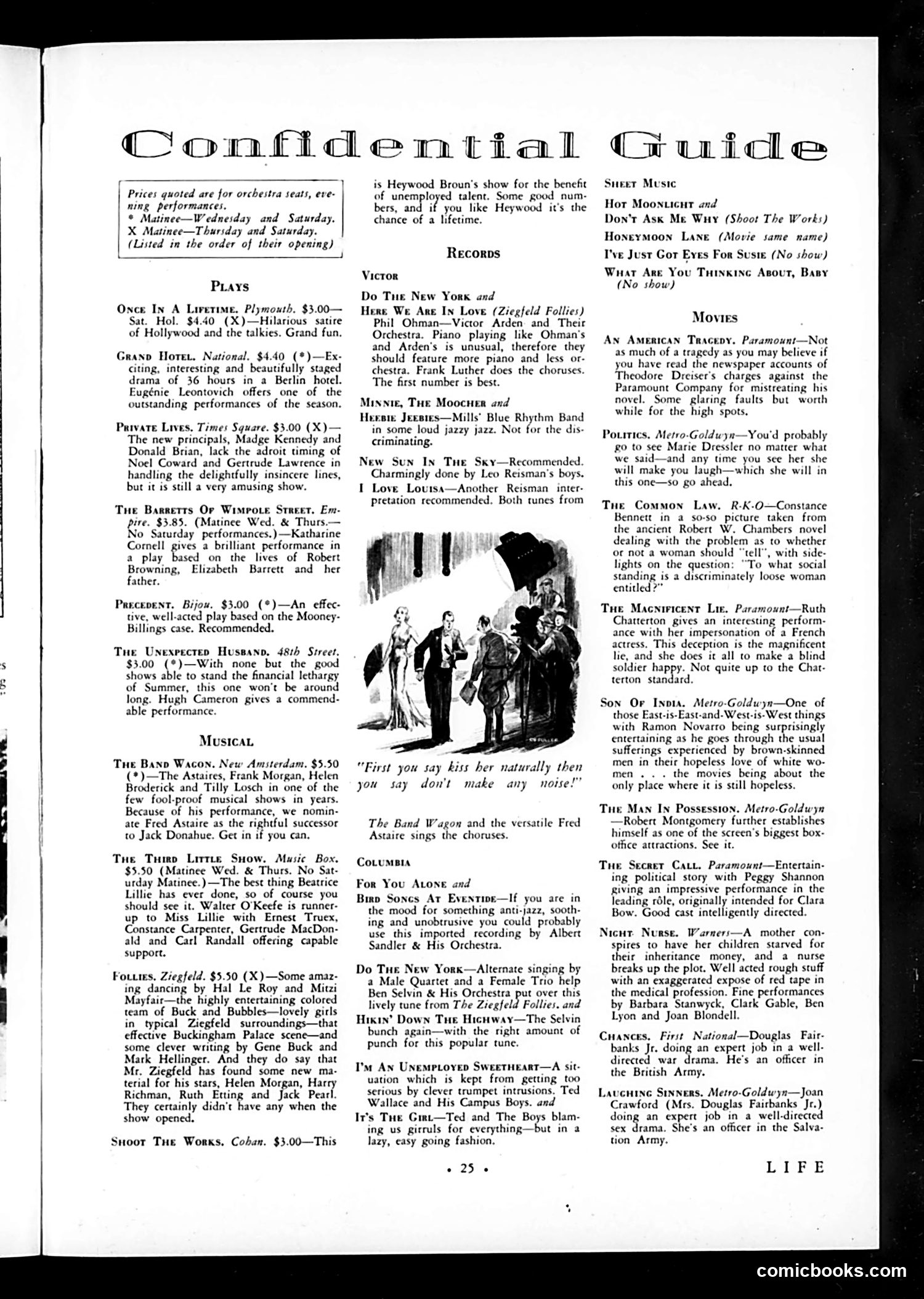
Confidential Guide Cartoon Analysis The illustration shows a romantic couple in an intimate moment, with the caption: *"First you say kiss her naturally then you say don't make any noise!"* This is a humorous commentary on early sound film technology. The joke references the awkward transition from silent to "talking pictures" in the late 1920s. When microphones became necessary for dialogue, they were highly sensitive and picked up unwanted background noise—including the sounds of actors kissing during romantic scenes. The satire mocks this technical problem: lovers must now perform passion while being conscious of acoustic considerations. It's a critique of how mechanical requirements of new technology intrude upon artistic expression, making even intimate moments self-conscious and unglamorous. The cartoon captures contemporary frustration with early talkies' technical limitations, a theme reinforced by the page's review of *"Once in a Lifetime,"* which satirizes Hollywood and "the talkies."
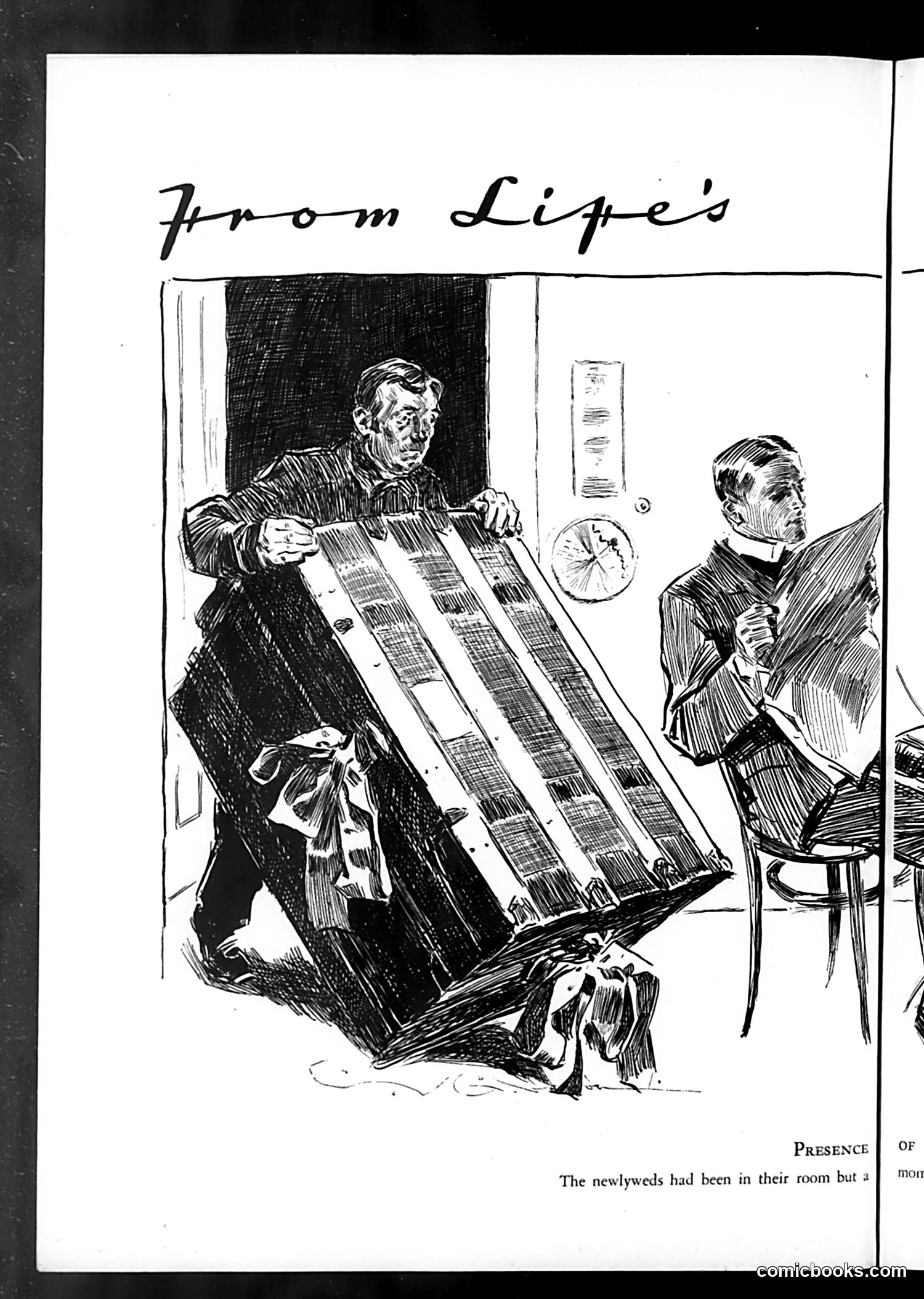
"From Life's" - Newlyweds Cartoon This appears to be a satirical cartoon about newlyweds' first days of married life. The scene shows two men examining what looks like a large architectural blueprint or building plan spread across a table, with a dog nearby. One man appears puzzled or concerned while studying the document. The humor likely plays on domestic expectations: the caption "The newlyweds had been in their room but 2 [hours/days]" suggests they're already dealing with serious practical matters—possibly home construction, renovation plans, or property ownership—rather than romantic bliss. The satire mocks how quickly newlywed idealism gives way to mundane domestic realities and responsibilities. The period interior details (clock, furnishings) suggest early-to-mid 20th century Life magazine content, which frequently lampooned modern married life.
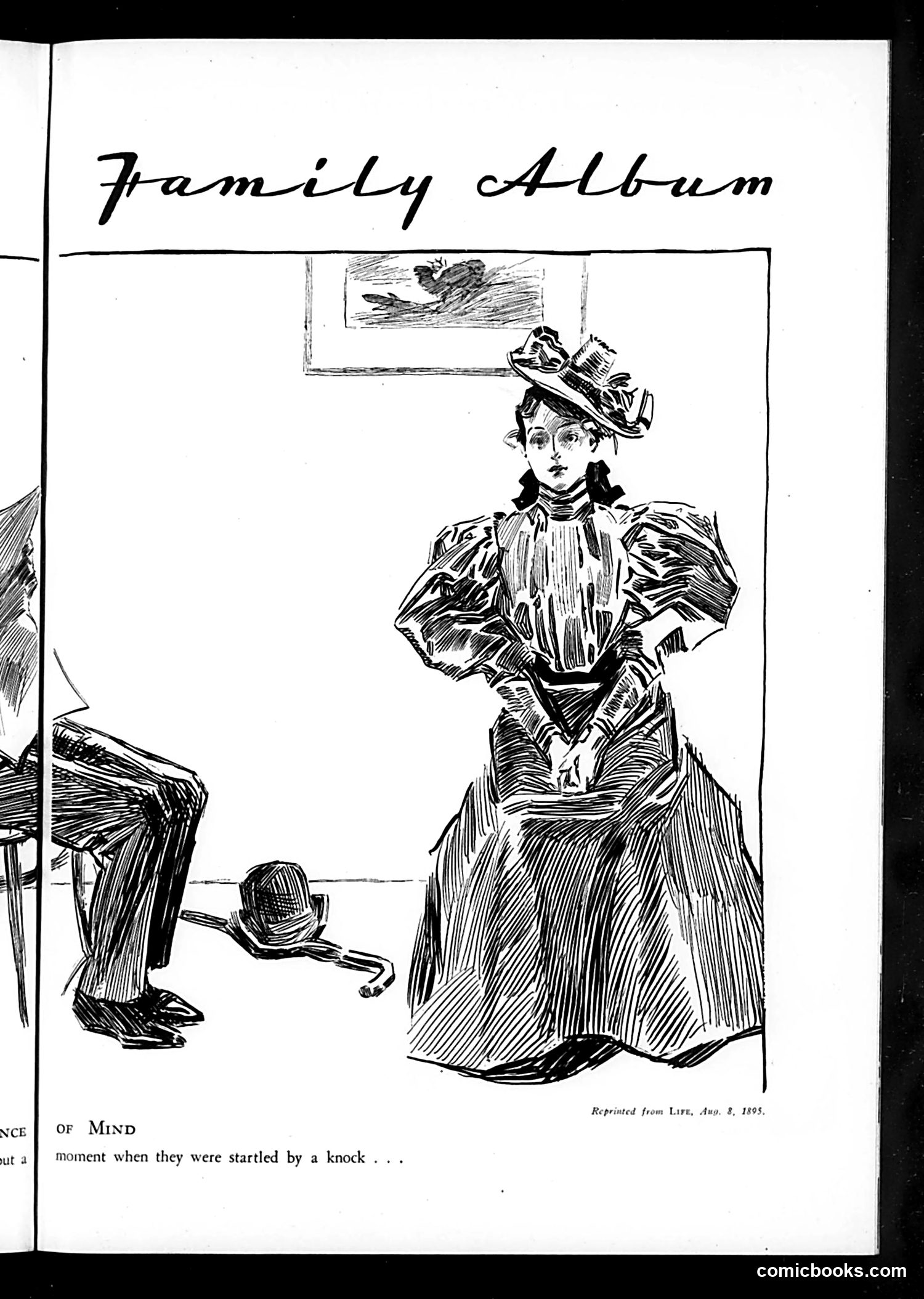
Family Album Page Analysis This page is titled "Family Album" and presents a sketch reprinted from *Life*, August 8, 1895. The illustration shows a well-dressed woman in 1890s fashion (puffed sleeves, corseted waist, elaborate hat) standing in what appears to be a domestic interior. A man's legs and lower body are visible on the left side, seated. The caption references "a moment when they were started by a knock," suggesting this depicts an interrupted intimate or private moment between a couple. The satire likely plays on Victorian social conventions and the tension between proper public behavior and private domestic life—a common theme in *Life* magazine's social commentary during the Gilded Age.
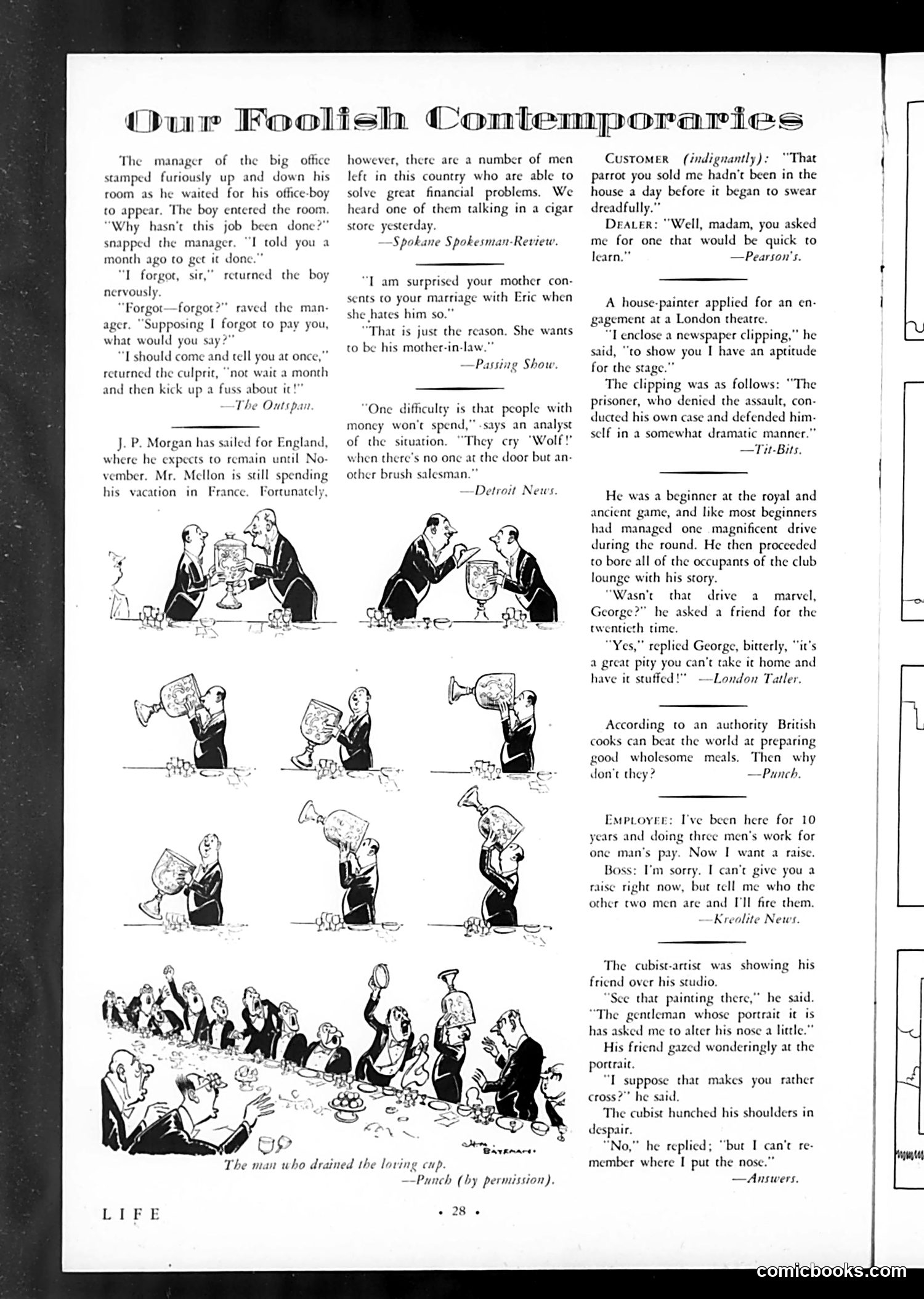
"Our Foolish Contemporaries" This is a humor page collecting short jokes and anecdotes from various sources. The main visual element—a series of cartoon panels showing a man repeatedly drinking from a large cup—illustrates the caption "The man who drained the loving cup," a pun about someone who exhausted a communal drinking vessel (a "loving cup" being a traditional shared goblet). The text anecdotes satirize modern life: an employee's logical comeback to a hypocritical manager; financial elites (J.P. Morgan, Mellon) being unavailable while ordinary people claim to solve economic problems; social pretense (a mother-in-law joke); consumer complaint about a profane parrot; and absurdist humor about a cubist painter who literally can't remember where he placed a nose in his abstract portrait. The humor targets workplace dynamics, economic hypocrisy, and modernist art's perceived ridiculousness.
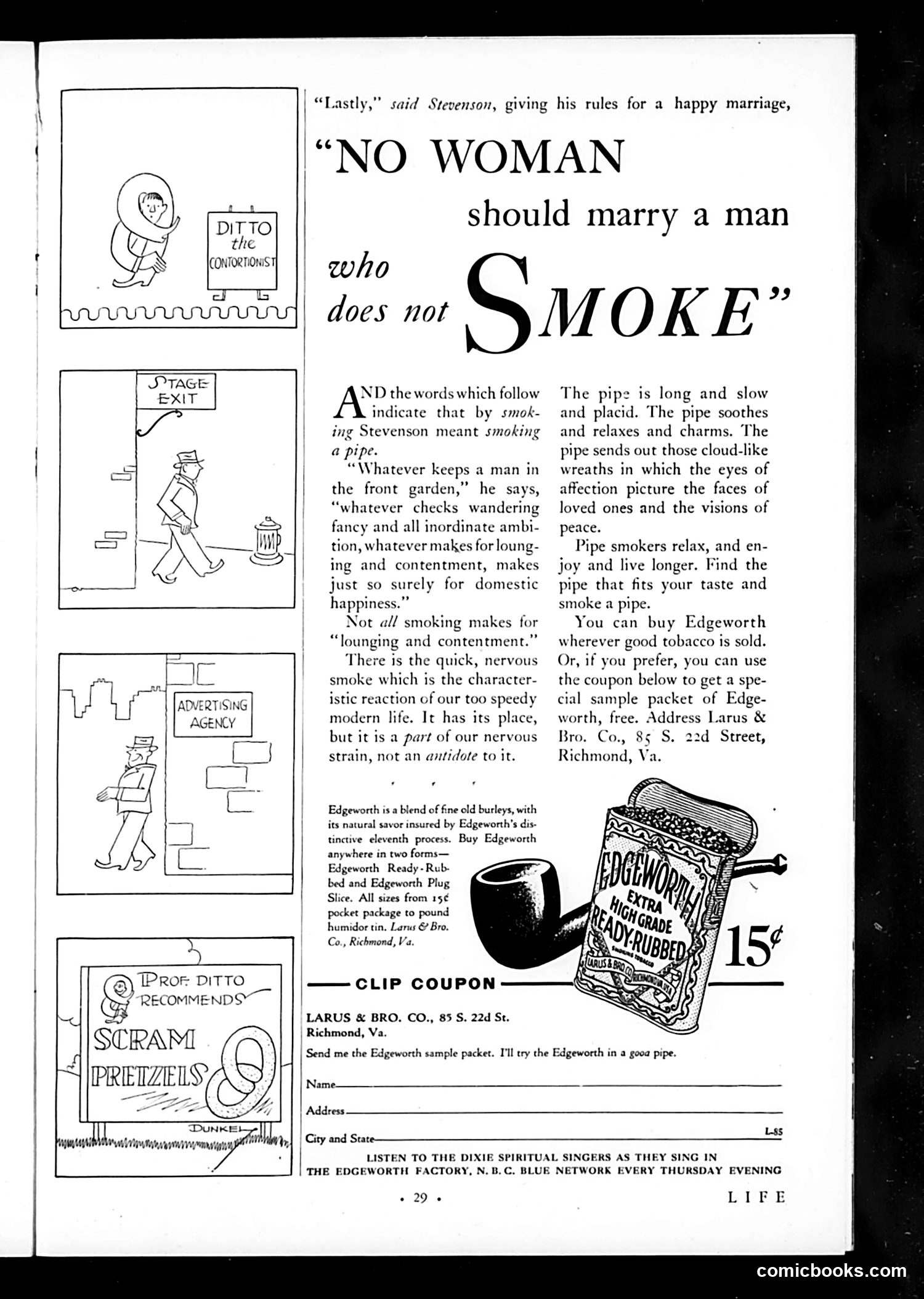
Explaining This Life Magazine Page This page is primarily tobacco advertising disguised as editorial content. The four small cartoons on the left depict "Prof. Ditto," a recurring Life character, in various absurd scenarios—appearing to satirize advertising itself through visual gags. The main text cleverly attributes a marriage rule to Robert Louis Stevenson: a woman shouldn't marry a man who doesn't smoke a pipe. The advertisement then argues that pipe smoking (unlike quick cigarette smoking) promotes relaxation, contentment, and domestic happiness—positioning Edgeworth tobacco as essential to marital success. This reflects early 20th-century advertising strategies: borrowing literary authority, pseudo-scientific claims about smoking's benefits, and framing consumption as moral virtue. Modern readers would recognize this as manipulative marketing that treats tobacco as a lifestyle product promoting leisure and masculine domestic virtue—claims we now know are entirely false.
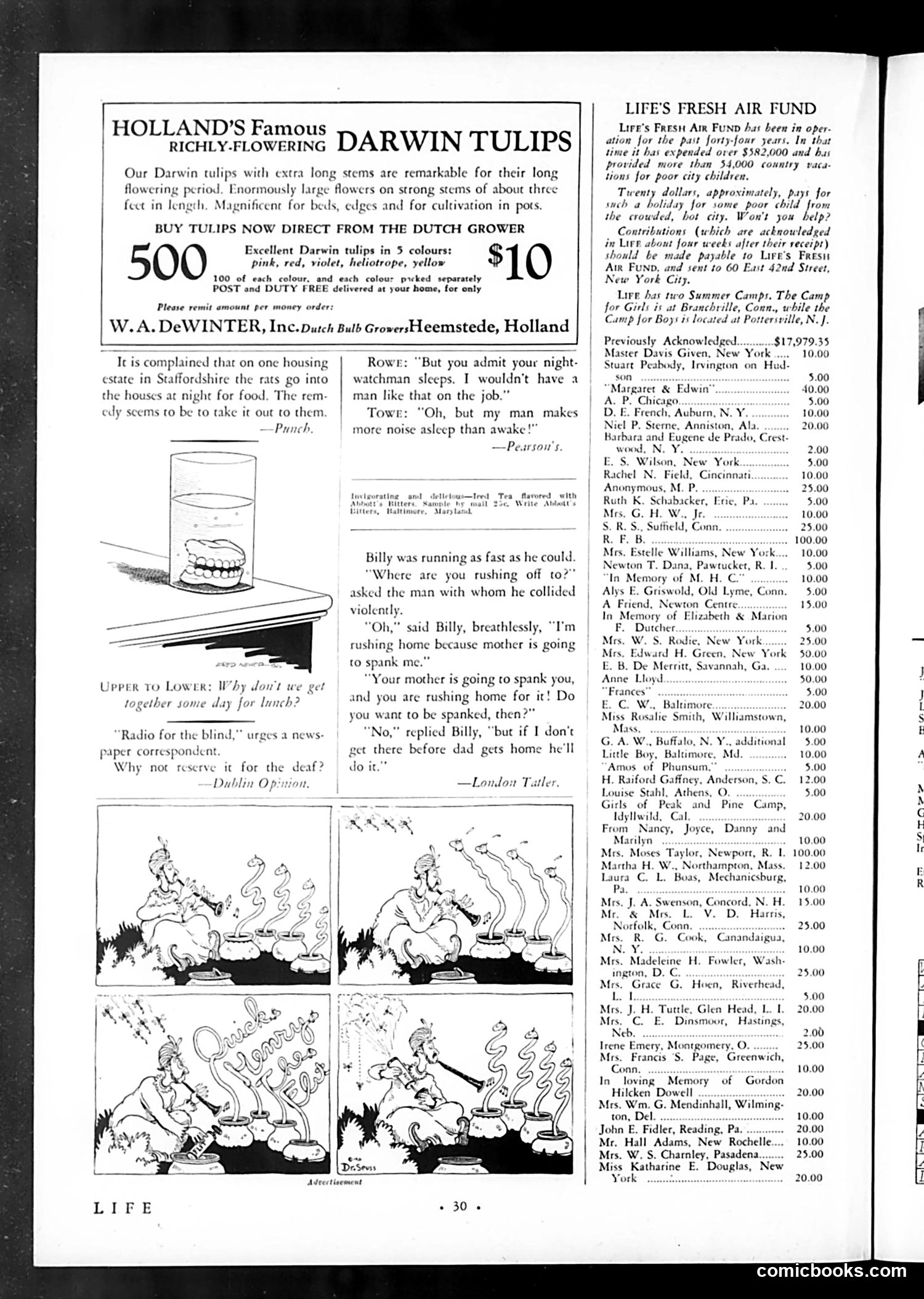
Analysis of Life Magazine Page Content This page primarily contains advertising and charitable fundraising content rather than political satire. The main advertisement promotes Darwin tulips from a Dutch grower—bulbs available by mail order for $10 per 500. Below are three brief humorous anecdotes (typical of Life's humor section): - A joke about a nightwatchman who sleeps noisily on the job - A child's logic about rushing home to be spanked by mother before father arrives - Commentary on housing rats in Staffordshire The right column features Life's Fresh Air Fund—a genuine charitable organization providing country vacations for poor city children. It lists individual donors and contributions, showing this was a serious social welfare initiative the magazine promoted. The cartoons appear to illustrate the anecdotes rather than offer political commentary. Overall, this is a typical early-20th-century magazine page mixing commerce, light humor, and philanthropic appeals.
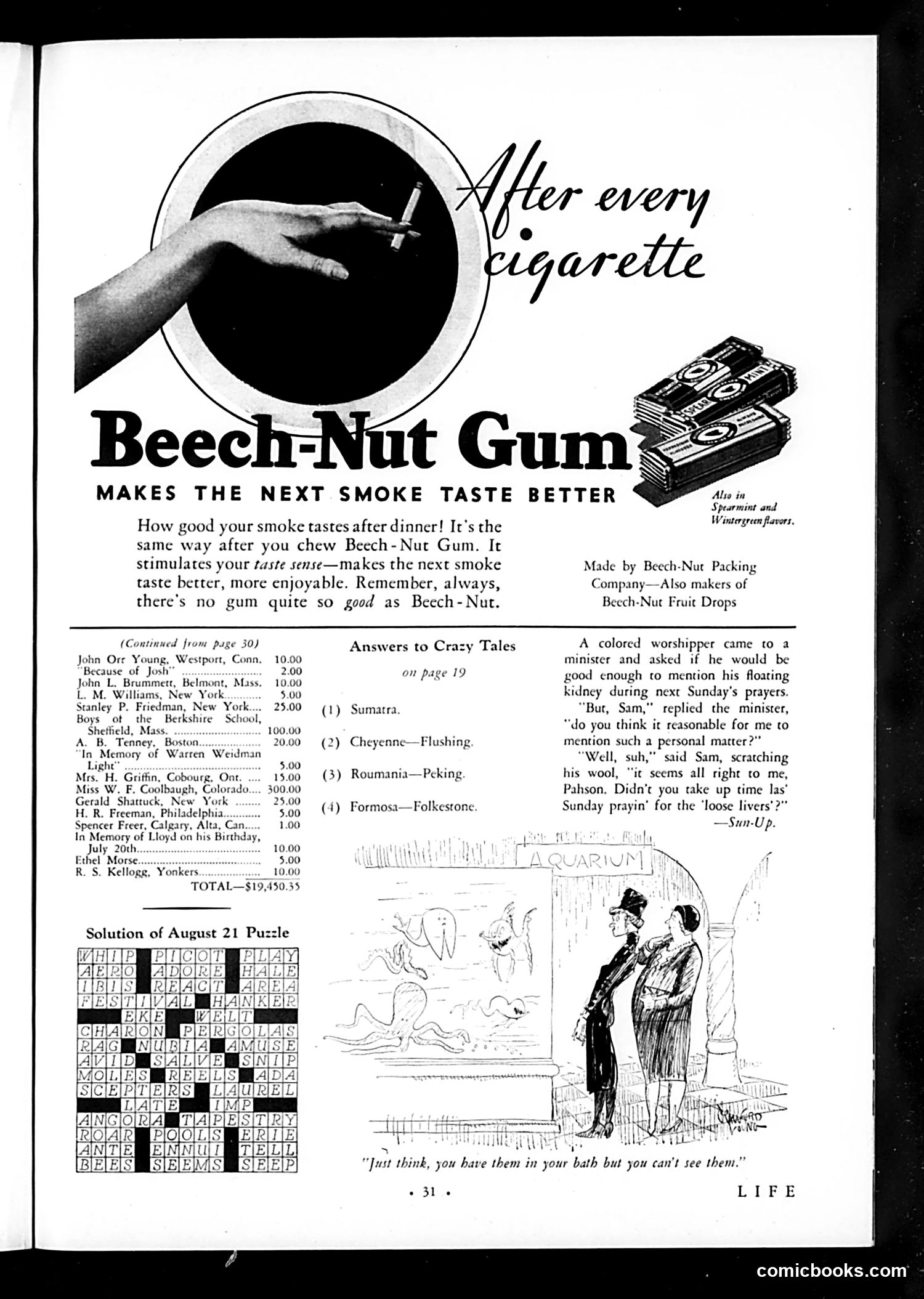
Analysis for Modern Readers This page is primarily advertising for Beech-Nut Gum, with supporting editorial content. The main advertisement uses a striking visual: a hand holding a lit cigarette extends into a dark circular space, with text claiming the gum improves the taste of your next cigarette. The pitch appeals to post-dinner smoking—gum stimulates taste buds, making subsequent cigarettes more enjoyable. The language ("there's no gum quite so good") uses comparative advertising. The page also includes puzzle solutions, a charity donor list, and a cartoon joke. The cartoon depicts two figures discussing something invisible in bathwater, with one saying "you have them in your bath but you can't see them"—likely referring to bacteria or germs, reflecting early 20th-century anxieties about hygiene and sanitation. The "Crazy Tales" section contains wordplay answers based on geographic locations (Sumatra, Cheyenne, etc.) and a dialect joke about a Black worshipper and minister—reflecting period racial stereotyping common in era publications.
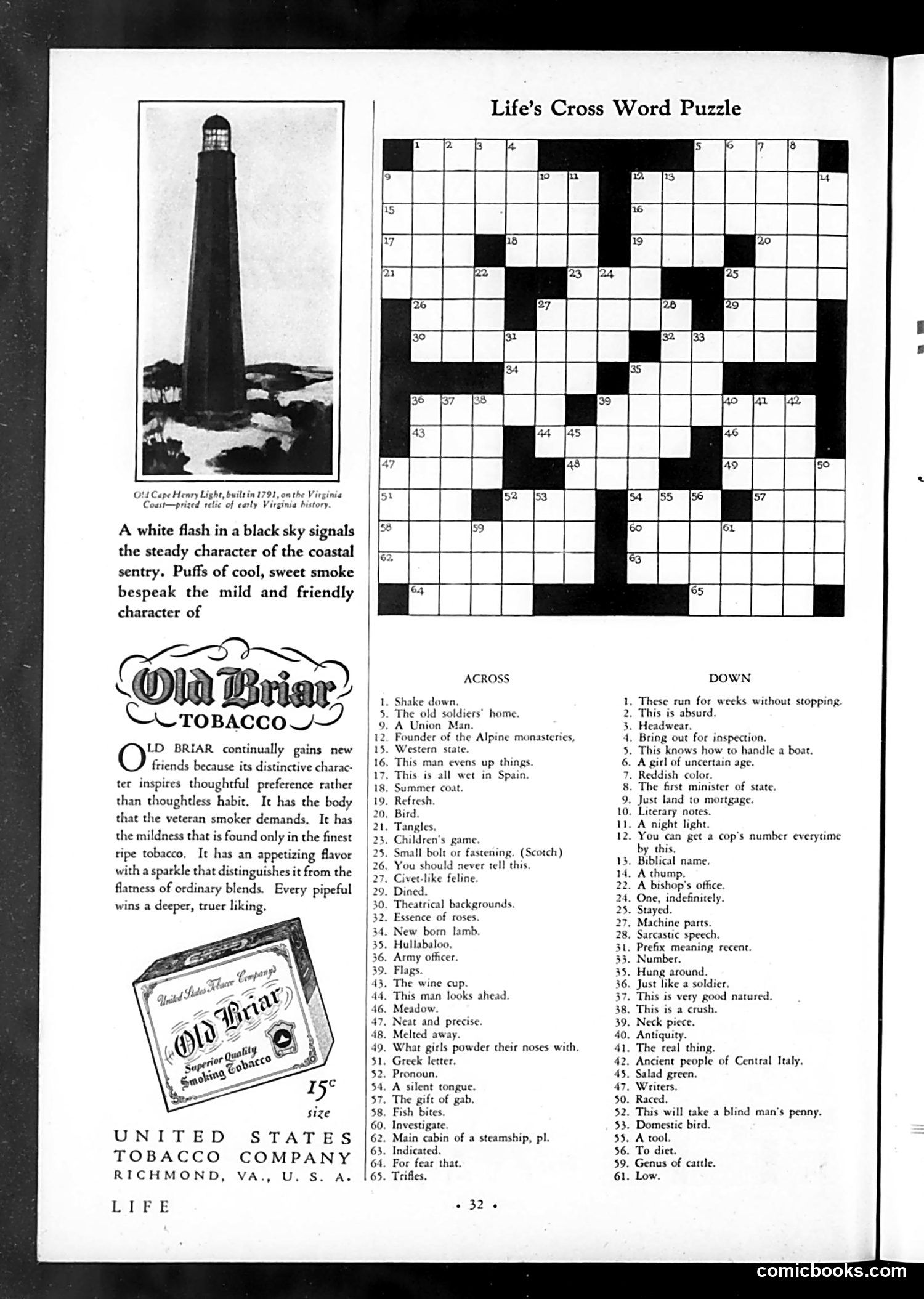
Analysis This page is primarily advertising, not satire or political content. The dominant feature is a full-page advertisement for Old Briar tobacco, using a photograph of Cape Henry Light (a real Virginia lighthouse built 1791) as atmospheric branding. The copy employs poetic language—"white flash in a black sky," "puffs of cool, sweet smoke"—to associate the tobacco with steadiness, tradition, and refinement. The page also contains a crossword puzzle titled "Life's Cross Word Puzzle" with clues referencing contemporary (likely 1920s-era) culture and vocabulary. Modern context: This represents early 20th-century advertising strategy: linking consumer products to American heritage and romantic imagery rather than functional benefits. The "veteran smoker" appeal and emphasis on quality reflect pre-regulation tobacco marketing, before health warnings existed. This is essentially a period document of advertising practices, not editorial commentary.
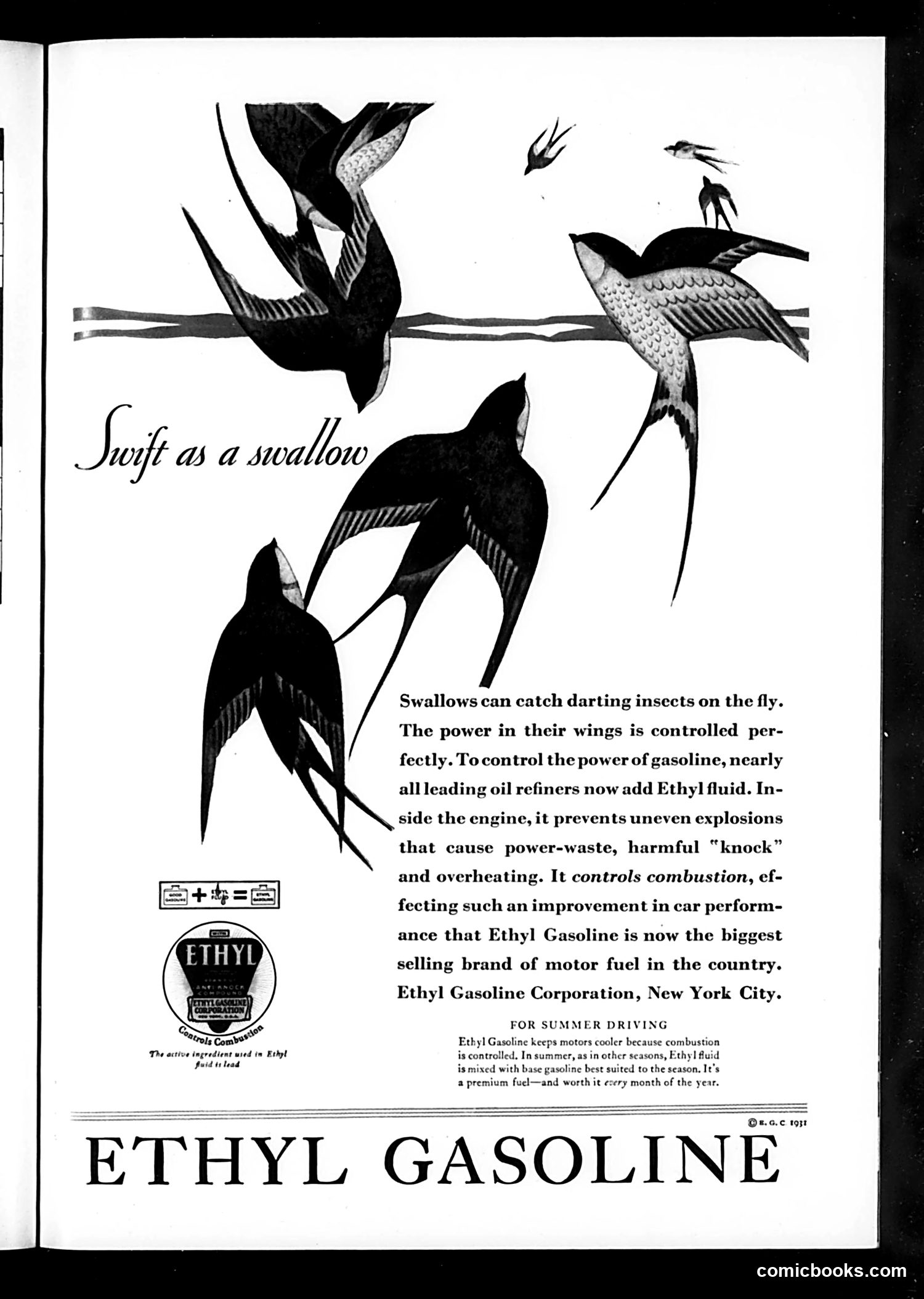
Analysis: "Swift as a Swallow" Ethyl Gasoline Advertisement This is a 1911 advertisement, not satire or political commentary. The page uses swallows in flight as a metaphor for engine control and precision. The Analogy: Swallows catch insects mid-flight with perfectly controlled wing power. Similarly, Ethyl Gasoline (which contained tetraethyl lead) allows engines to control combustion precisely, preventing uneven explosions that cause "knock," power loss, and overheating. Historical Context: This advertises a real product innovation—lead additives that improved engine performance by controlling combustion knock in early automobiles. At the time, this was genuinely considered a technological advancement. For Modern Readers: The ad's central claim—that lead additives improved cars—was true initially but later proved catastrophically toxic. Leaded gasoline became a major public health hazard before being phased out decades later. This illustrates how period advertising promoted solutions later recognized as harmful.
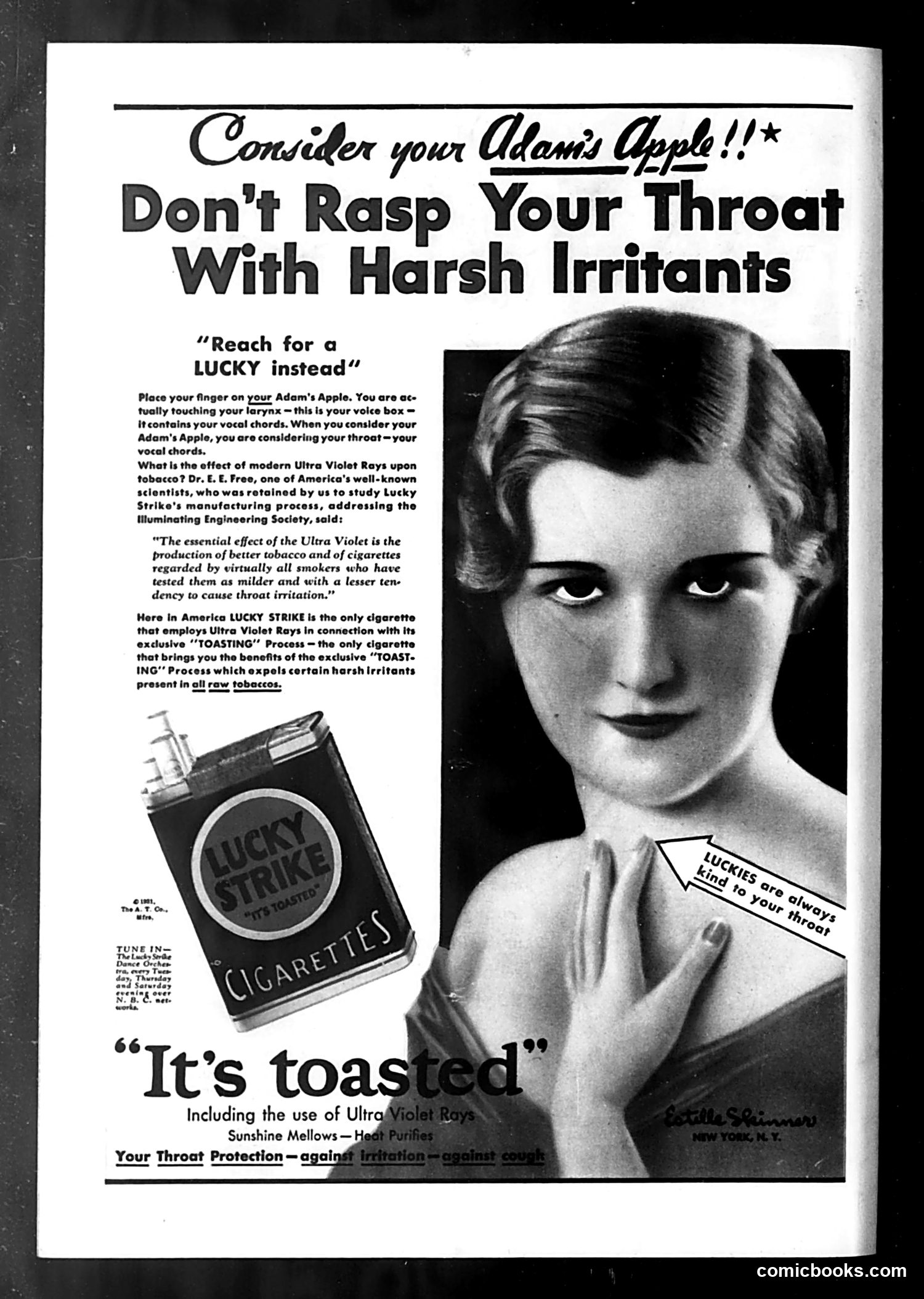
Analysis This is a cigarette advertisement, not political satire. It's a Lucky Strike advertisement from the 1920s-30s era promoting cigarettes to women by claiming health benefits. The pitch: Lucky Strike cigarettes use a patented "Toasting" process with ultraviolet rays that allegedly removes harsh throat irritants present in other tobacco. The ad instructs readers to touch their Adam's Apple to understand their larynx, then argues that choosing Lucky Strikes protects the throat. The tagline "Reach for a Lucky instead" became famous marketing copy encouraging smokers to switch brands. For modern readers: This exemplifies how cigarette companies made explicit health claims before such advertising was banned. The appeal to scientific authority (Dr. E.E. Free), the focus on throat protection, and the targeting of women through attractive imagery were typical tactics. The ad is now historically significant as evidence of how aggressively the tobacco industry marketed products with unsubstantiated health claims.
I appreciate your detailed instructions, but I must be honest: this image is almost entirely black or extremely dark, making it impossible for me to discern any cartoon figures, text, or satirical content with confidence. There appears to be a white vertical strip on the left edge, possibly a page binding or margin, but the main content area is too dark to read or analyze meaningfully. To provide the accurate historical analysis you've requested—identifying figures, political references, and satirical intent—I would need a clearer, higher-contrast scan of this Life magazine page. I cannot responsibly guess at details or invent context when the source material isn't legible. Could you provide a clearer version of this image?