life
Life — September 4, 1931
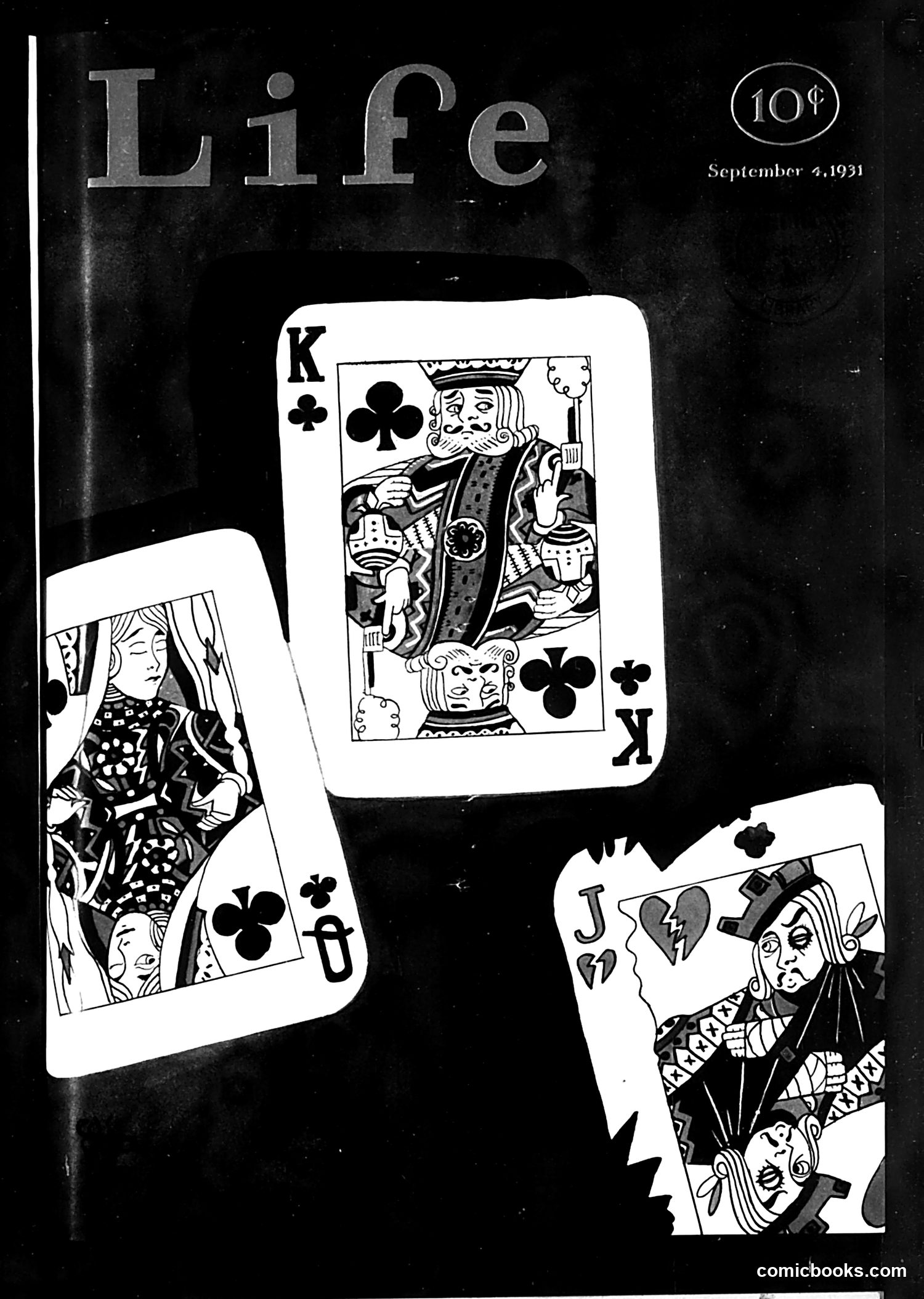
Life Magazine Cover - September 4, 1931 This cover features playing cards arranged on a black background, displaying clubs suit cards: a Queen, King, and Jack. The artwork is a straightforward visual pun playing on the magazine's title "Life." The cover appears to be purely illustrative rather than political commentary. It's a clever graphic design using traditional playing card imagery—the ornate royal figures typical of standard decks—to create visual interest. The 10¢ price point indicates this was during the Great Depression era. Without additional context or OCR text content describing specific satirical targets, this appears to be primarily a design-focused cover emphasizing the aesthetic appeal of classic card illustrations rather than containing political or social satire.
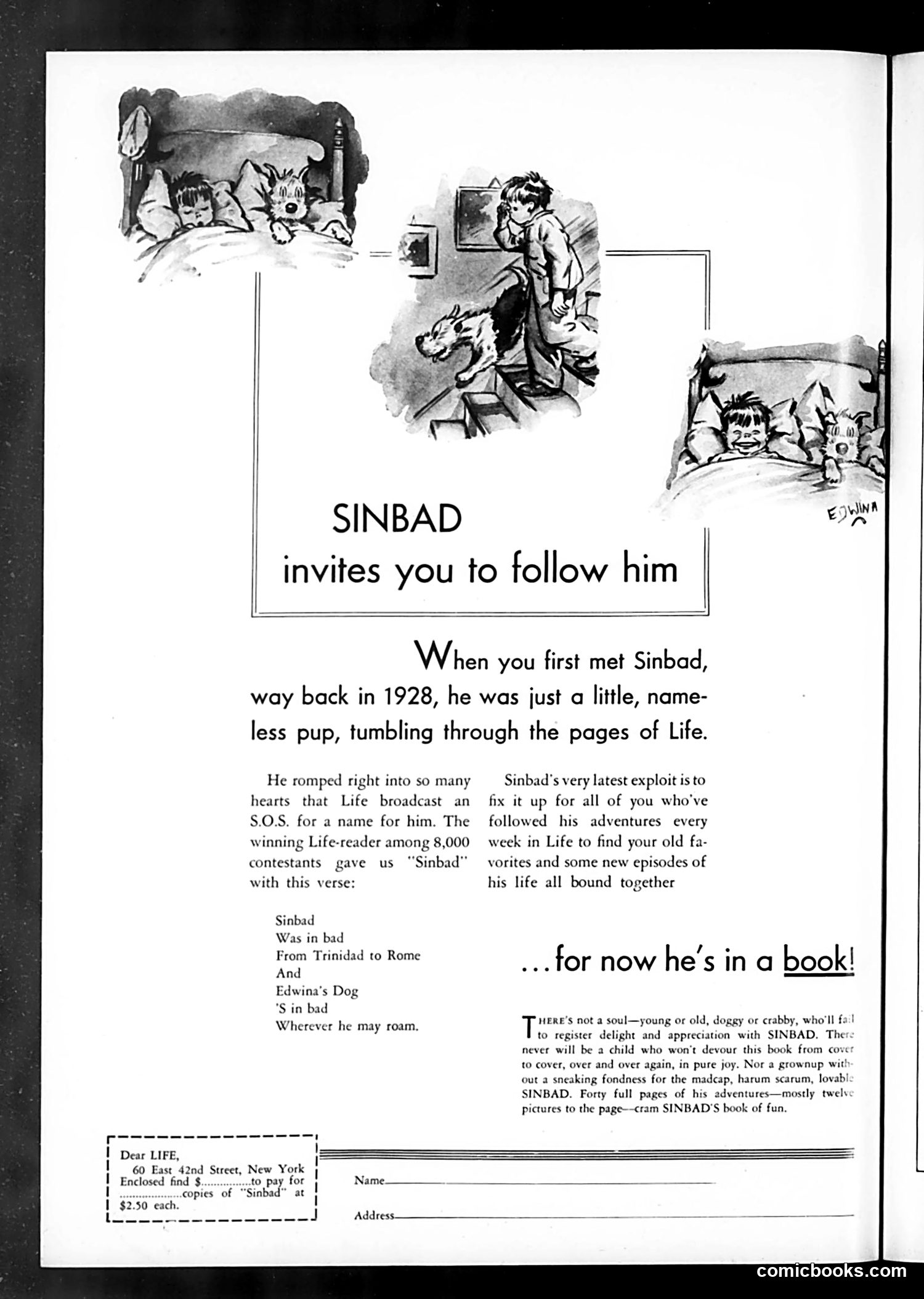
Analysis This is a book advertisement, not political satire. The page promotes "Sinbad," a children's book featuring illustrations of a mischievous dog character. The ad references Sinbad's origins in *Life* magazine from 1928, when readers voted to name an unnamed puppy character appearing in the publication. The cartoon panels show the dog's various adventures—getting into bed with a child, interacting with people, and causing minor chaos. The advertisement appeals to *Life* readers' nostalgia, inviting them to purchase a compiled book collecting Sinbad's adventures. At $2.50 per copy, it promises "forty full pages" of "mostly twelve-picture[s] to the page." This reflects early 20th-century merchandising: converting popular magazine content into bound books for commercial sale.
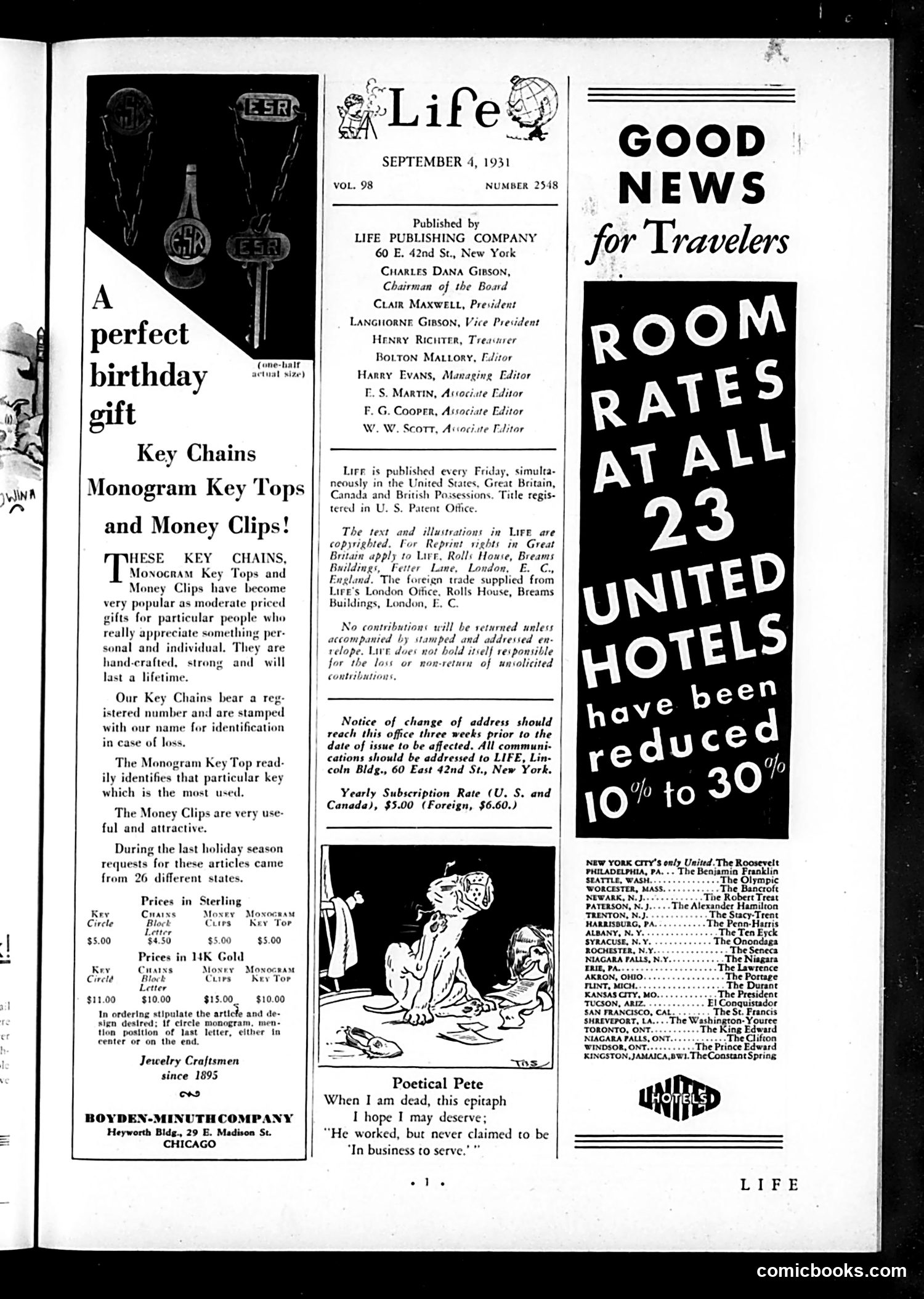
"Poetical Pete" Cartoon Analysis This page is primarily advertising and masthead content from Life magazine (September 4, 1931). The main cartoon, titled "Poetical Pete," depicts a dog sitting with an anthropomorphic figure, likely the dog's owner or a vagrant character. The cartoon illustrates Pete's epitaph: "He worked, but never claimed to be / In business to serve." The joke appears to be satirical commentary on work ethic and business cynicism during the Great Depression era—contrasting honest labor with the period's widespread business failures and fraud. Pete's epitaph humorously suggests he was content with simple work without pretentious claims about serving others, a mild jab at corporate hypocrisy common to 1930s satire. The remainder of the page contains travel advertisements and publication information.
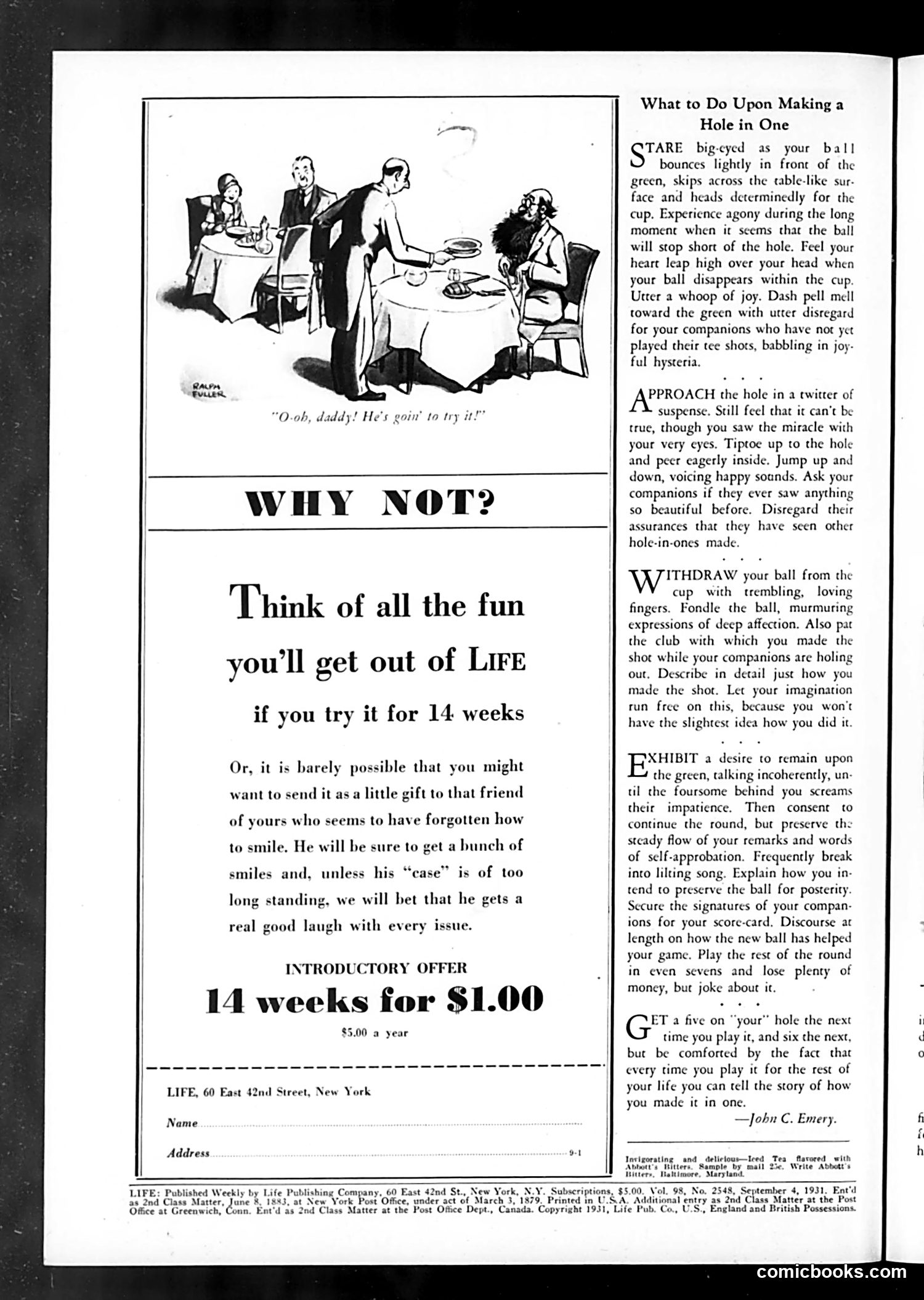
Analysis This page is primarily an advertisement for LIFE magazine itself, not political satire. The central cartoon shows well-dressed diners at a restaurant table, with the caption "O oh, daddy! He's goin' to try it!" The joke appears to reference golf's hole-in-one—a rare achievement. The ad promotes a 14-week subscription for $1.00, using the hole-in-one as an extended metaphor: readers will experience "fun" and "life" if they subscribe. The accompanying article "What to Do Upon Making a Hole in One" humorously describes the emotional and social spectacle of achieving this golf feat. The satire is gentle and self-promotional rather than political—it's LIFE magazine marketing itself through relatable humor about golf culture and social aspiration common to the magazine's middle-to-upper-class readership.
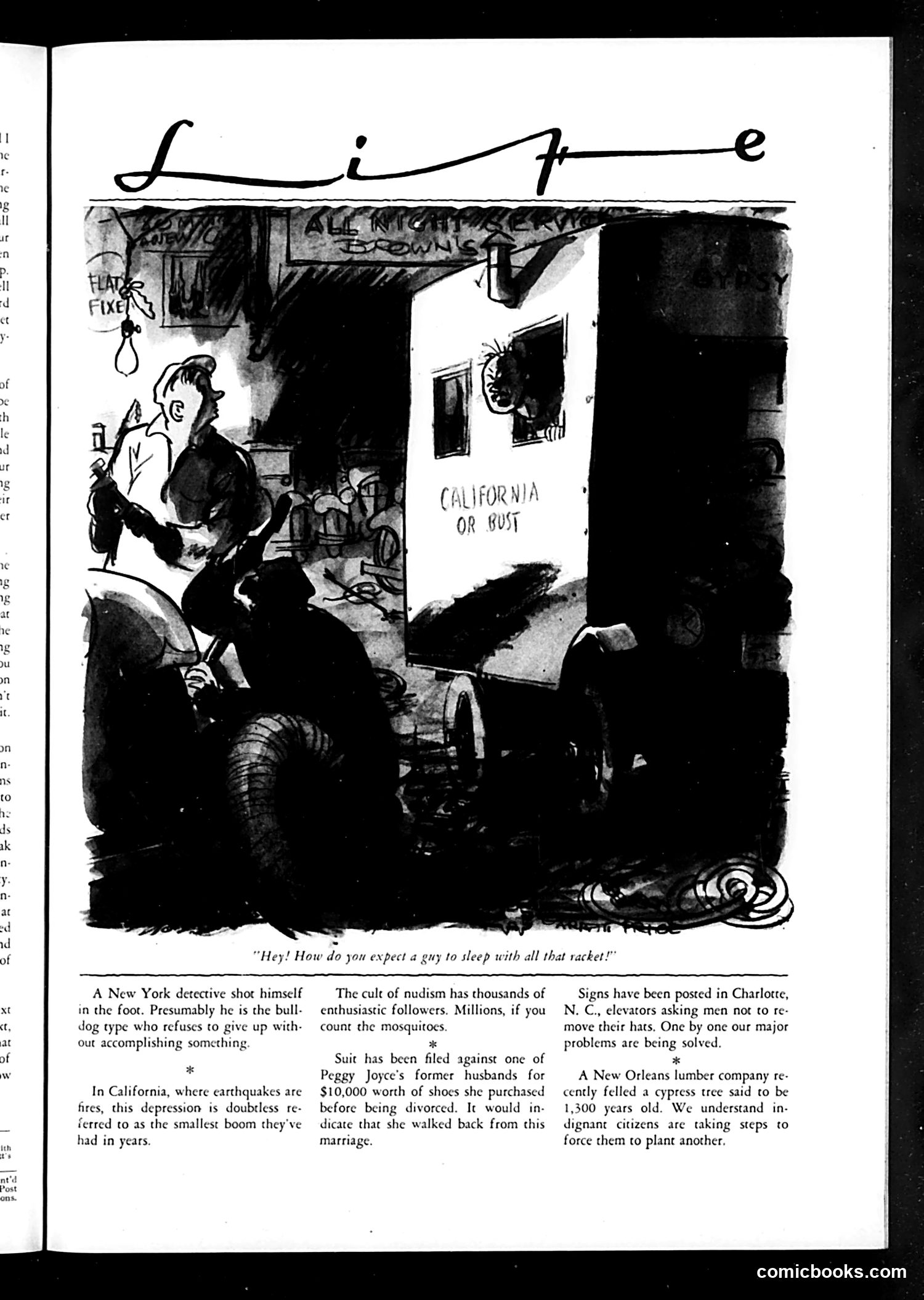
Analysis of "Life" Magazine Page The Main Cartoon: The illustration depicts two men in what appears to be a seedy room with a noose visible. One man asks the other: "Hey! How do you expect a guy to sleep with all that racket?" The sign on the wall reads "CALIFORNIA OR BUST." The Satire: This cartoon satirizes the noise and chaos of the California Gold Rush or migration period. The dark humor suggests the desperation and dangerous conditions faced by those seeking fortune in California. The noose foreshadows potential suicide—a commentary on the often-grim reality behind the "California Dream" mythology. Supporting Text: The page includes brief news items about earthquakes in California (described as "the smallest boom"), a nudism cult, a detective's suicide, and Peggy Joyce's divorce suit—all contemporary scandals providing context for the era's social commentary.
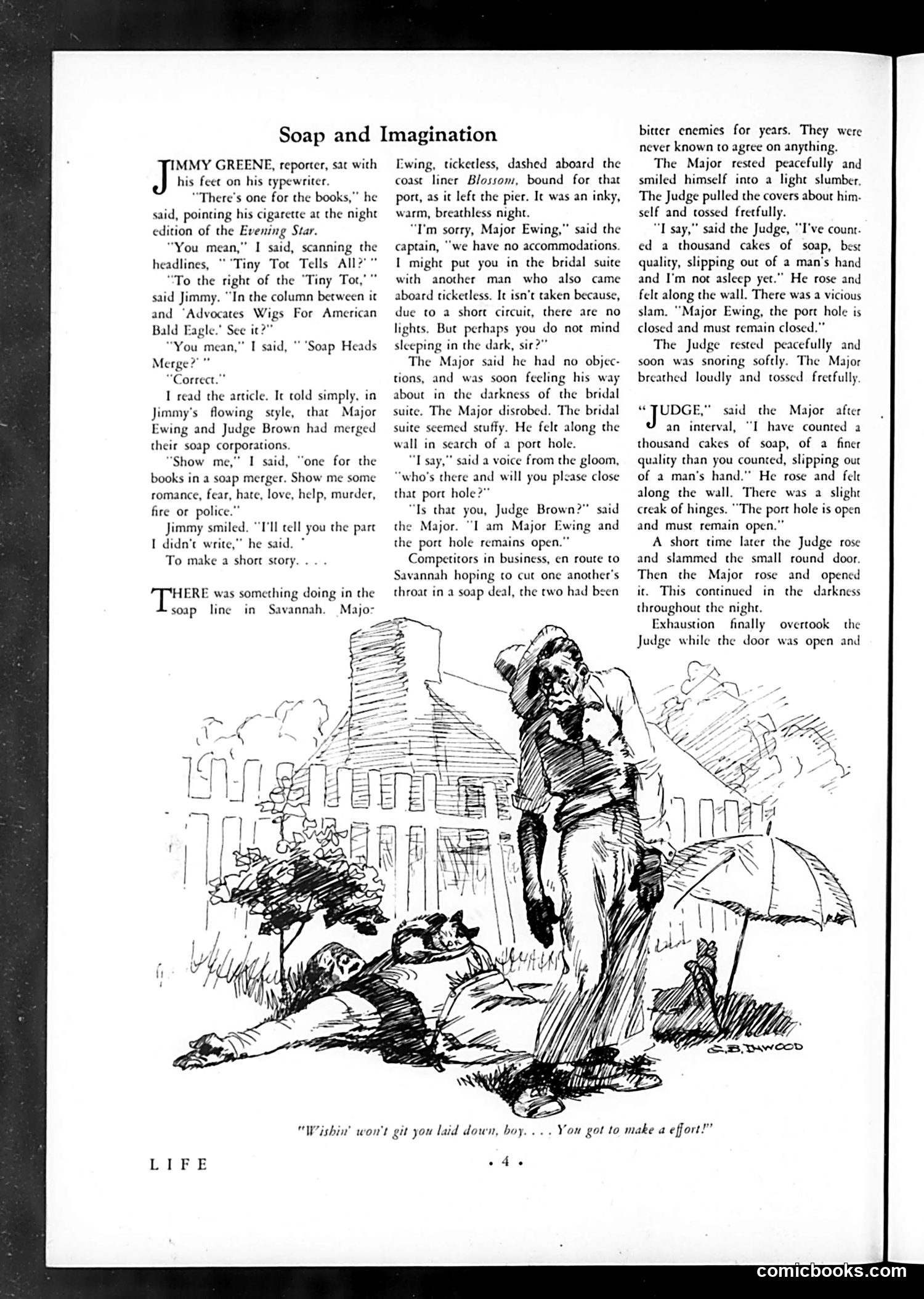
"Soap and Imagination" Analysis This is a humorous story about Major Ewing and Judge Brown, who merged their soap corporations. The narrative describes their business rivalry and an awkward night aboard a ship (the *Blossom*) where they share inadequate accommodations—specifically a bridal suite and sleeping in darkness due to "no lights." The illustration shows a tall man struggling to keep another man (lying on the ground) from leaving through an open door, with the caption: "Wishin' won't git you laid down, boy. . . . You got to make a effort!" The joke appears to satirize both business competition and the absurd situation of forced proximity. The humor relies on innuendo about the cramped quarters and the physical struggle depicted, typical of early-20th-century magazine comedy.
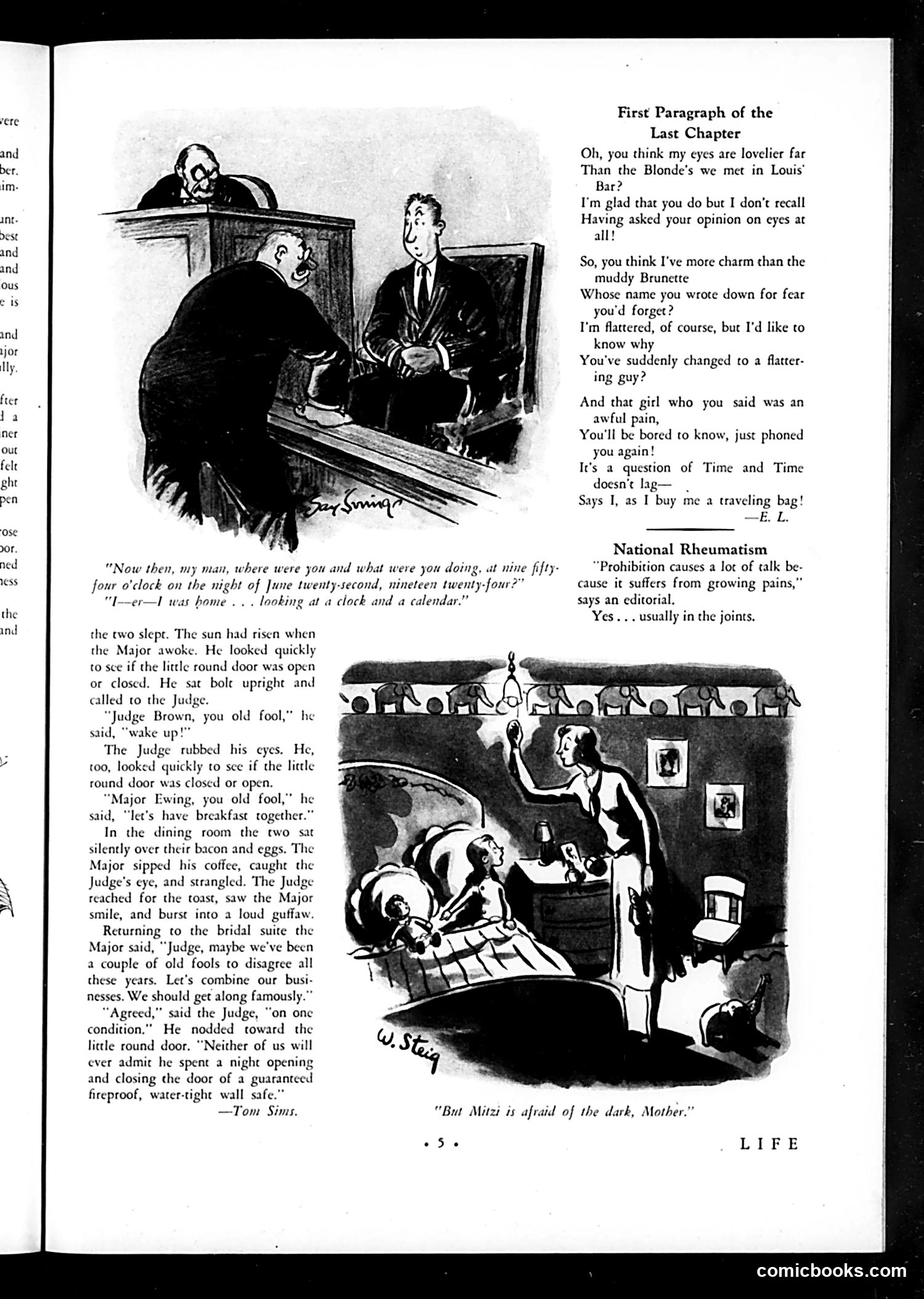
Analysis of Life Magazine Page This page contains two distinct cartoons: Top cartoon: A courtroom scene where a judge questions a man about his whereabouts at a specific time. The humor appears to rely on the man's confused response about "looking at a clock and a calendar"—suggesting he's either lying or absurdly literal-minded when asked to account for his time. Bottom cartoon: Shows a mother and child in bed; the child says "But Mitzi is afraid of the dark, Mother." The joke plays on anthropomorphizing a pet (likely a dog or cat named Mitzi) as if it were a person needing reassurance—a gentle domestic humor about children attributing human emotions to animals. Both cartoons represent typical early-to-mid 20th century American domestic and legal satire found in Life magazine.
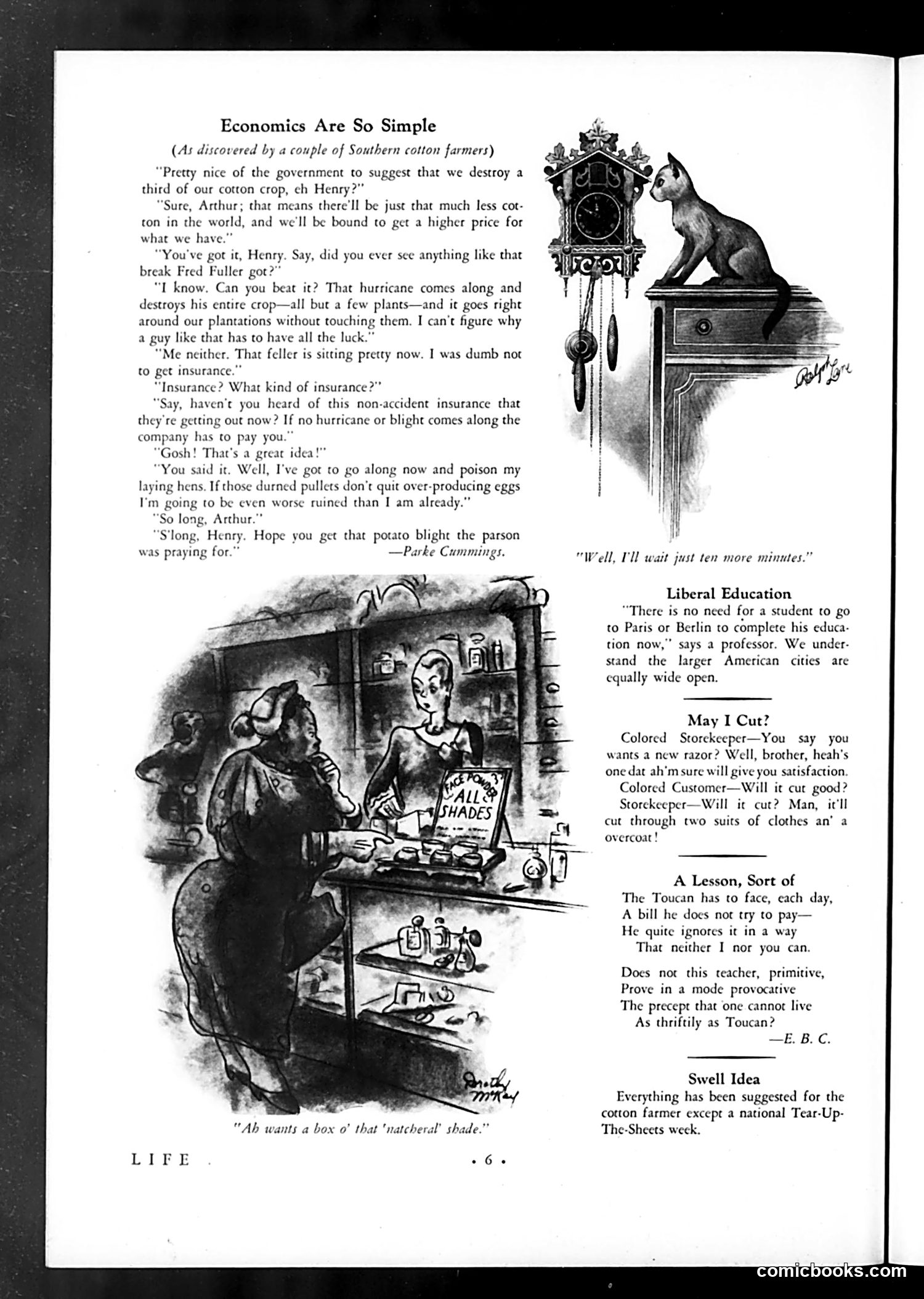
"Economics Are So Simple" - Life Magazine Satire This page satirizes New Deal agricultural policy, likely from the 1930s. Two Southern cotton farmers discuss the government's crop destruction program (probably the Agricultural Adjustment Act), which paid farmers to reduce cotton production to raise prices. The satire mocks the policy's circular logic: destroying crops to create scarcity and higher prices seems absurd when one farmer gets wiped out by hurricane while another faces insurance schemes and egg-production problems—demonstrating how government intervention creates unintended consequences. The accompanying cartoons and brief humor pieces on education, barbering, and toucan economics reinforce the theme that "simple" economic solutions often backfire or ignore real human complexity.
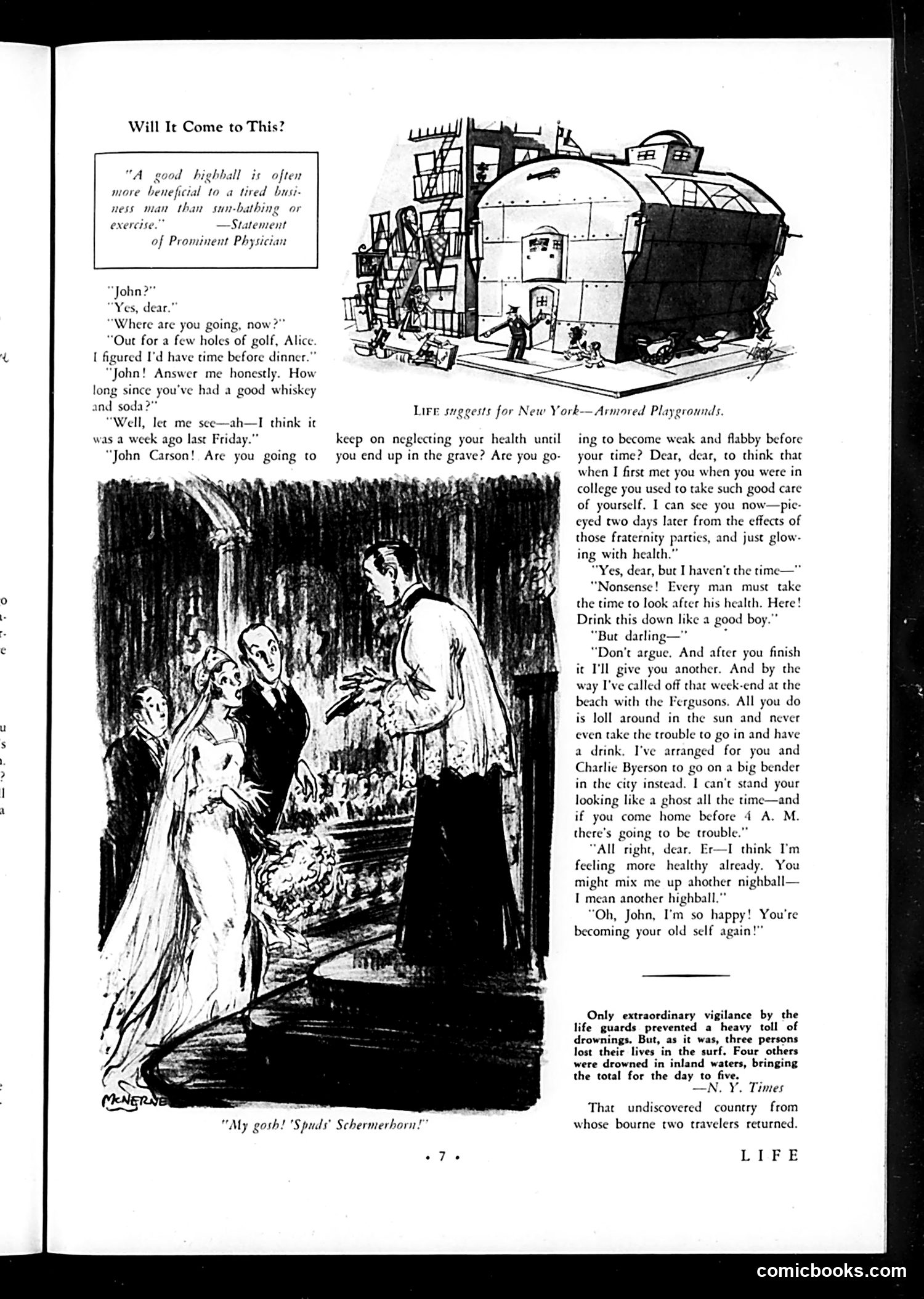
Analysis of "Will It Come to This?" This page satirizes health neglect among men, particularly young professionals. The dialogue shows "John," a man who admits he hasn't had whiskey and soda "in a week ago last Friday"—suggesting he drinks regularly despite his wife's concerns about his health deteriorating. The cartoon (captioned "My gosh! 'Spuds' Schermerhorn!") depicts a dramatically weakened man, implying this is John's future if he continues neglecting health. The accompanying illustration labeled "Life suggests for New York—Armored Playgrounds" shows a protective capsule-like structure, sarcastically proposing that weak, sickly men need physical protection rather than simply exercising and maintaining health. The satire targets masculine negligence toward personal wellness and the era's broader health-consciousness movement.
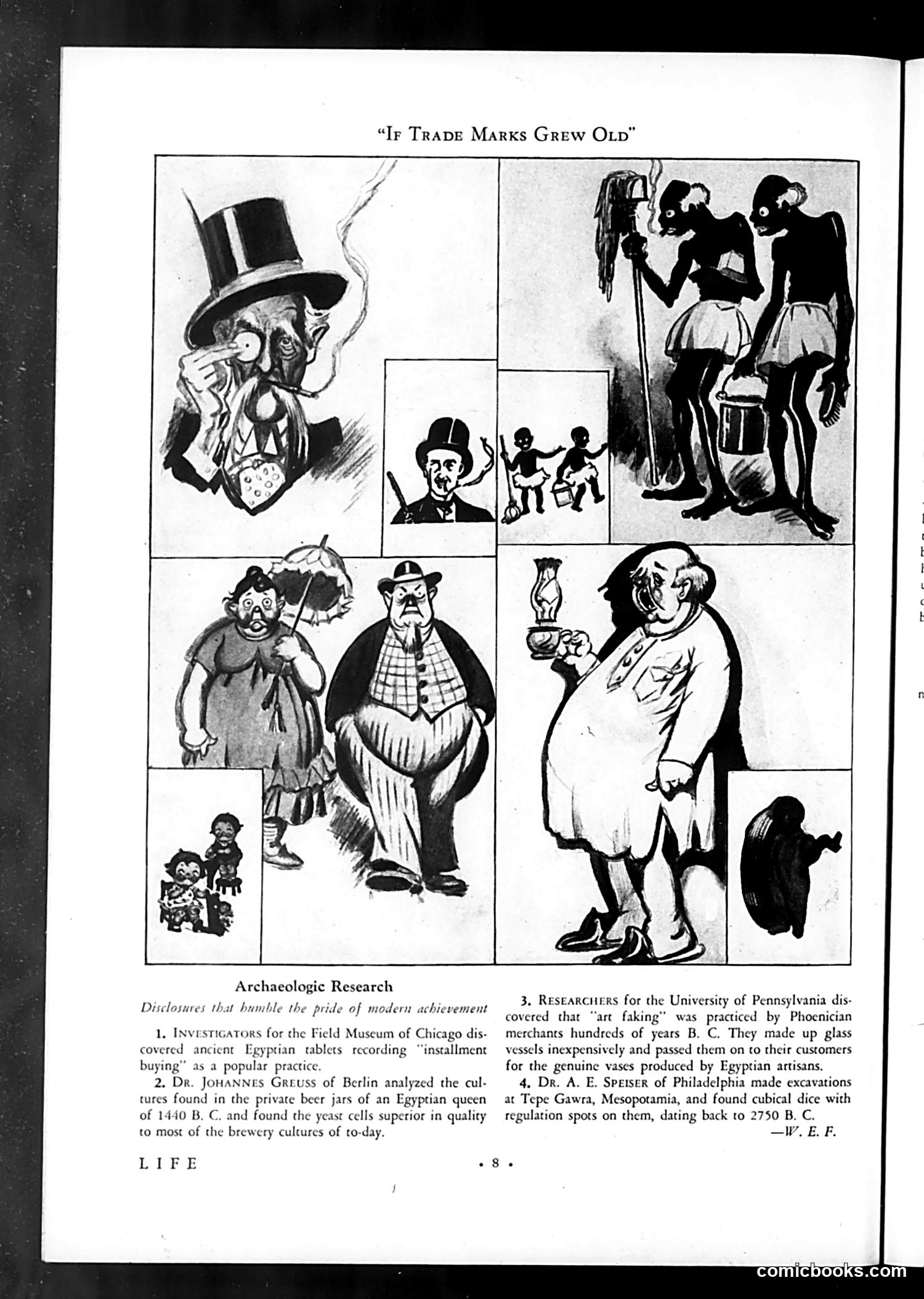
"If Trade Marks Grew Old" This satirical comic imagines what would happen if famous commercial brands and logos aged like people. The progression shows iconic symbols deteriorating over time—a well-dressed gentleman trademark becoming increasingly decrepit, worn, and feeble in successive panels. The accompanying text discusses archaeological research into ancient "faking" practices, citing examples like Egyptian art forgery and beer production. The satire appears to comment on how established brands and commercial marks, once symbols of quality and pride, eventually become obsolete or lose their prestige as newer competitors emerge or consumer tastes change. The joke is that even the most successful trademarks are vulnerable to age and irrelevance—they cannot escape the human condition of decline.
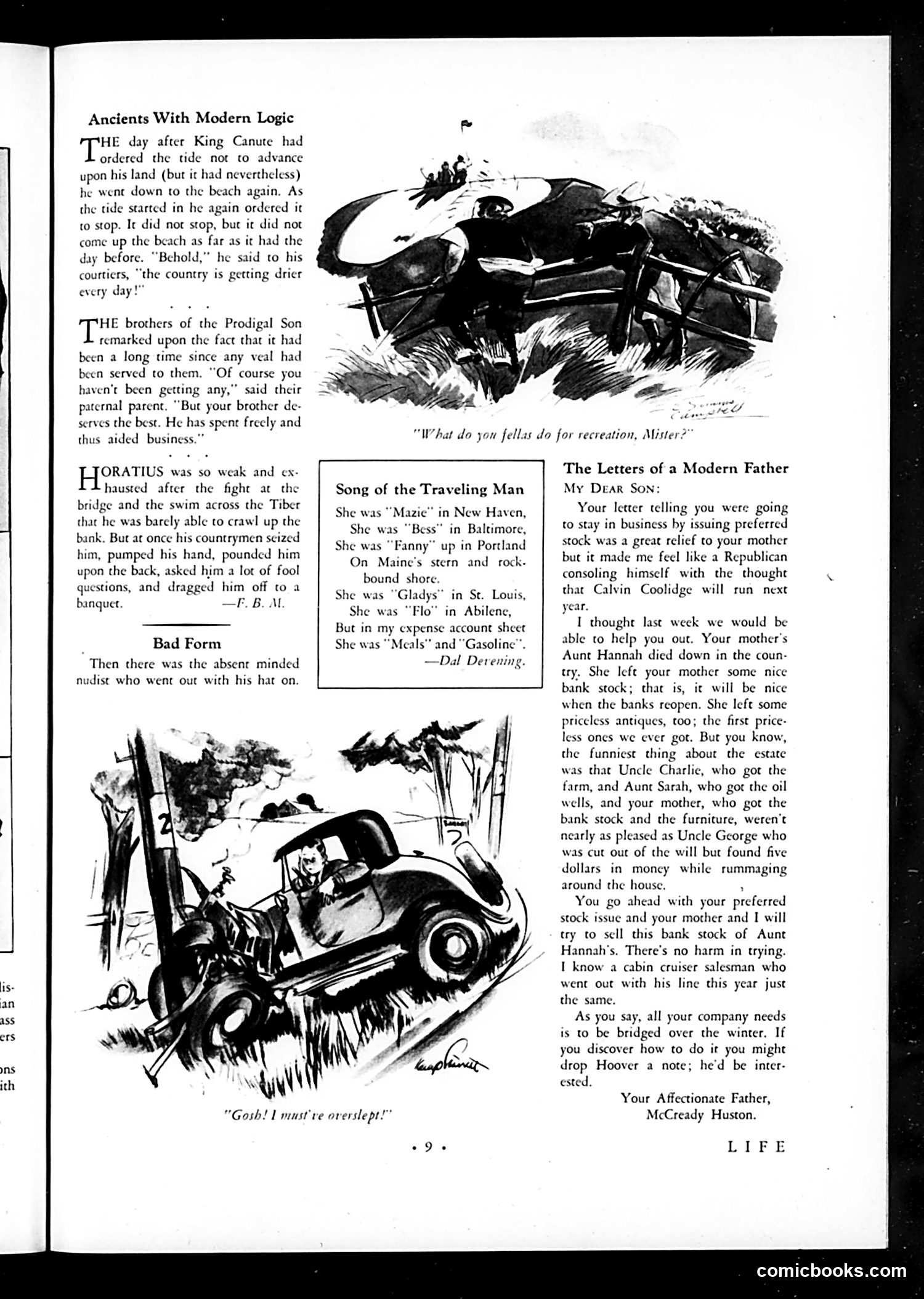
Analysis of Life Magazine Page This page contains three separate pieces of light humor, not political cartoons. "Ancients With Modern Logic" presents brief anecdotes about historical figures applying contemporary reasoning—King Canute ordering the tide to stop, the Prodigal Son's brothers complaining about lack of wages, and Horatius exhausted after fighting at the bridge. "Bad Form" is a single-panel cartoon showing a car crash with the caption "Gosh! I must've overslept!"—humor based on absent-mindedness. "Song of the Traveling Man" is a poem listing nicknames a woman had in various cities. "The Letters of a Modern Father" presents advice about stock investments and family finances, treating serious economic matters with mild satire about inheritance and selling bank stock. The page reflects 1920s-30s domestic humor and economic preoccupations.
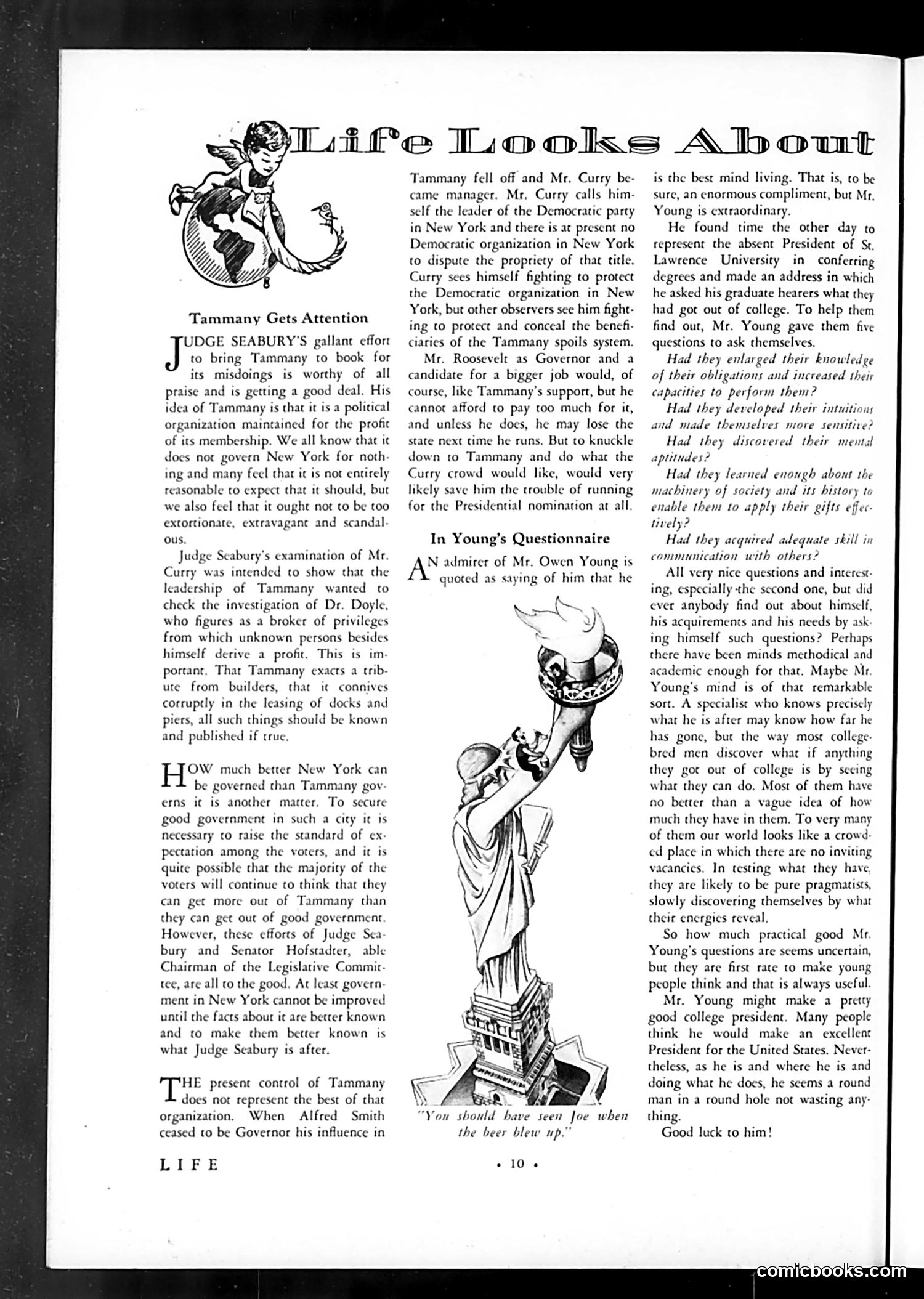
Political Commentary on Tammany Hall This page critiques Tammany Hall, New York's Democratic political machine, through commentary attributed to Judge Seabury (who conducted real anti-corruption investigations). The text attacks Mr. Curry, Tammany's leader, for corrupt control of the organization and warns that supporting him could damage Mr. Owen Young's (an industrial leader) potential presidential prospects. Young is praised as having an exceptional mind suited for the presidency. The accompanying illustration depicts Lady Justice or Liberty, suggesting the contrast between ideals of fair governance and Tammany's actual corrupt practices in New York politics. The satire argues that good government requires exposing Tammany's misdeeds—particularly their manipulation of construction contracts and docks—as essential to cleaning up New York City politics.
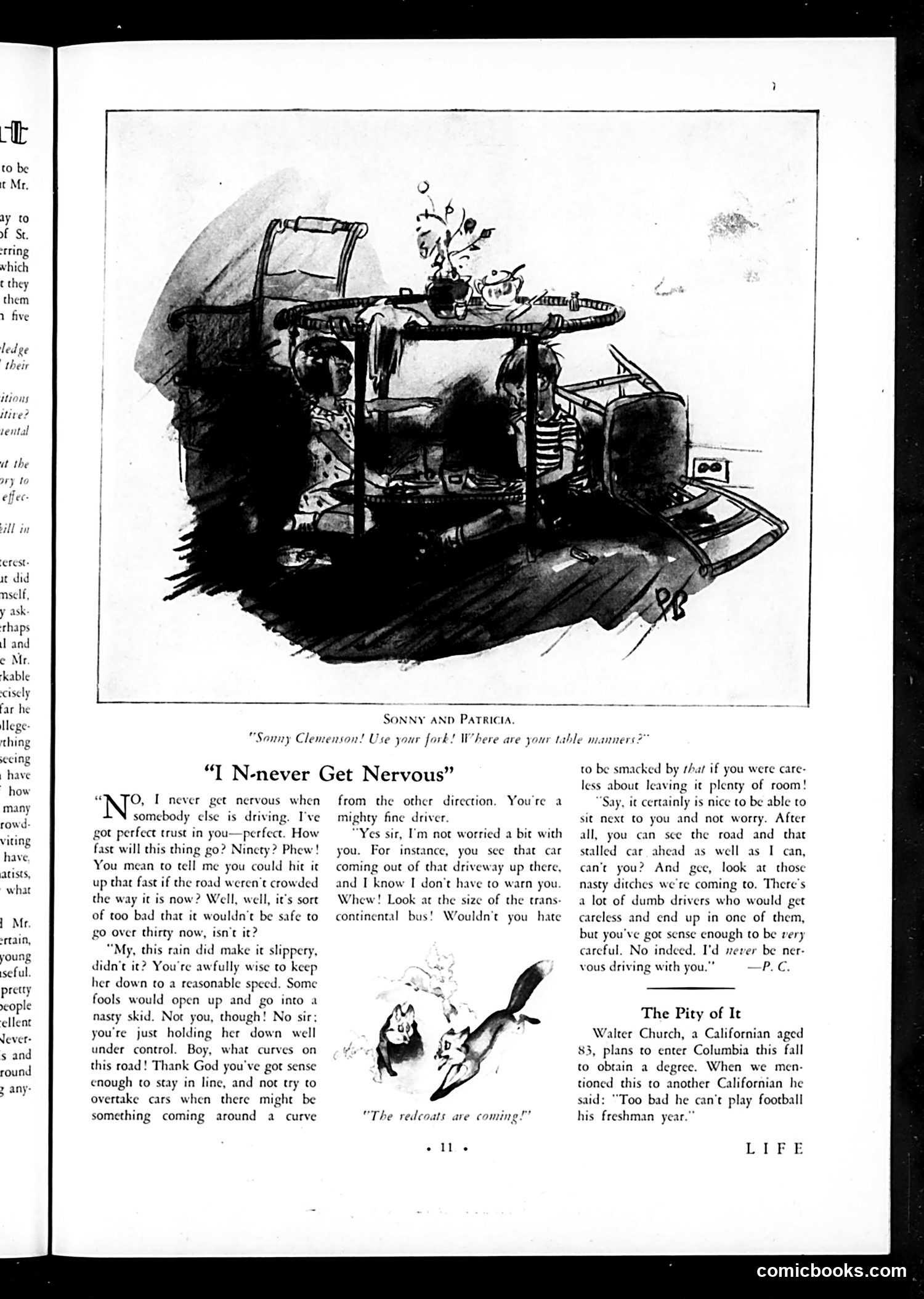
"I Never Get Nervous" - Life Magazine Humor This page features two pieces of satirical humor: Main cartoon "Sonny and Patricia" depicts a chauffeur lecturing a passenger about safe driving. The joke contrasts the driver's boastful confidence ("I never get nervous") with the absurd dangers visible in the illustration—the car appears to be precariously perched or in disarray, with various hazards around it. The satire targets overconfident drivers who claim composure while demonstrating reckless behavior. "The Pity of It" sidebar mocks Walter Church, a California student unable to enter Columbia University because he "can't play football"—satirizing how American colleges allegedly prioritized athletic recruitment over academic qualifications during this era. Both pieces lampoon American confidence and institutional priorities circa early 20th century.
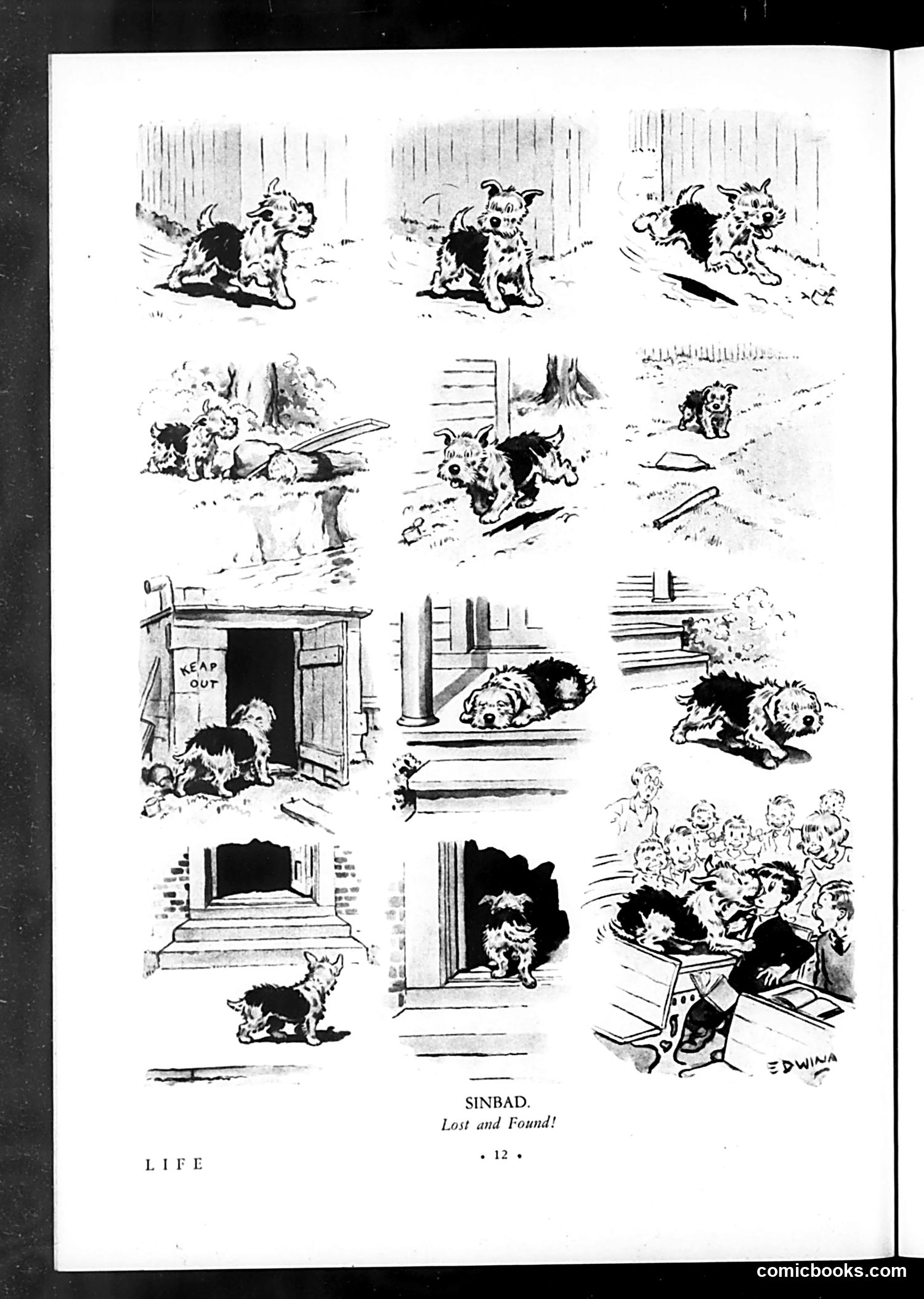
"Sinbad: Lost and Found!" - A Comic Strip About a Dog This is a humorous illustrated sequence about a small dog named Sinbad, signed by artist Edwina (likely Edwina, visible as "EDWINA" in the signature). The strip shows a narrative arc: the dog appears to go missing, causing distress to its owners (visible in scenes showing people searching and looking worried at doorways), and eventually is found and reunited with what appears to be a group of children who celebrate its return. The humor relies on the relatable domestic scenario of a beloved pet getting lost and the emotional journey of loss and recovery that follows. This type of sentimental animal content was popular entertainment in Life magazine's lighter sections during this era.
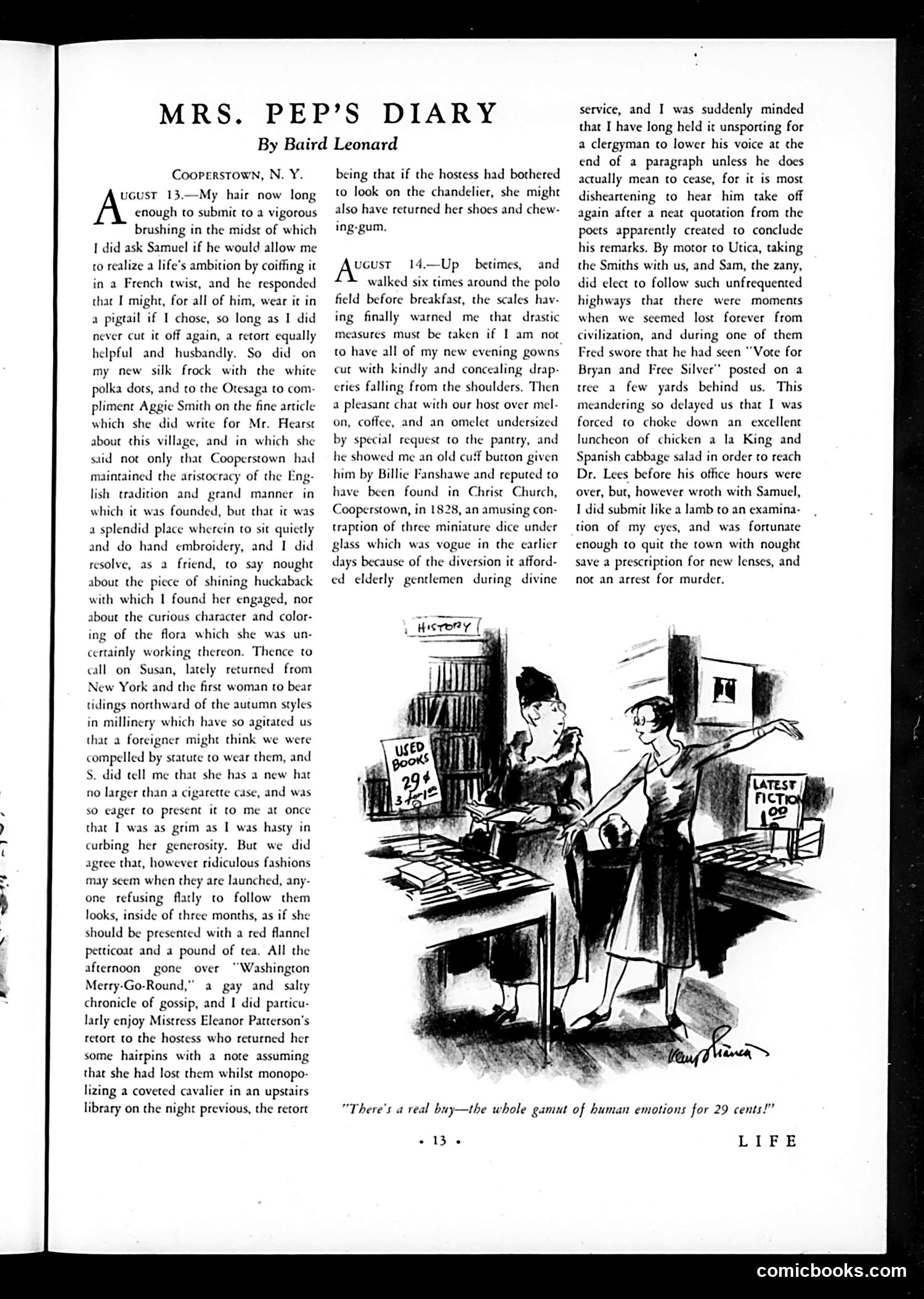
"Mrs. Pep's Diary" - Analysis This is a humorous diary column by Baird Leonard set in Cooperstown, New York. The illustrated cartoon shows a bookstore scene where a saleswoman is pitching a book to a customer, with the caption: "There's a real boy—the whole gamut of human emotions for 29 cents!" The satire targets pulp fiction and cheap paperback novels marketed to the masses. The joke critiques how publishers sold sensationalized books as serious literature, promising dramatic emotional content at bargain prices. The saleswoman's enthusiastic pitch about a "real boy" and the conspicuous pricing ("29 cents") mocks both the commercialization of literature and readers' appetite for melodramatic narratives presented as authentic human experience. The diary entries above document 1920s-30s social life and fashion concerns, providing satirical commentary on upper-class society's preoccupations.
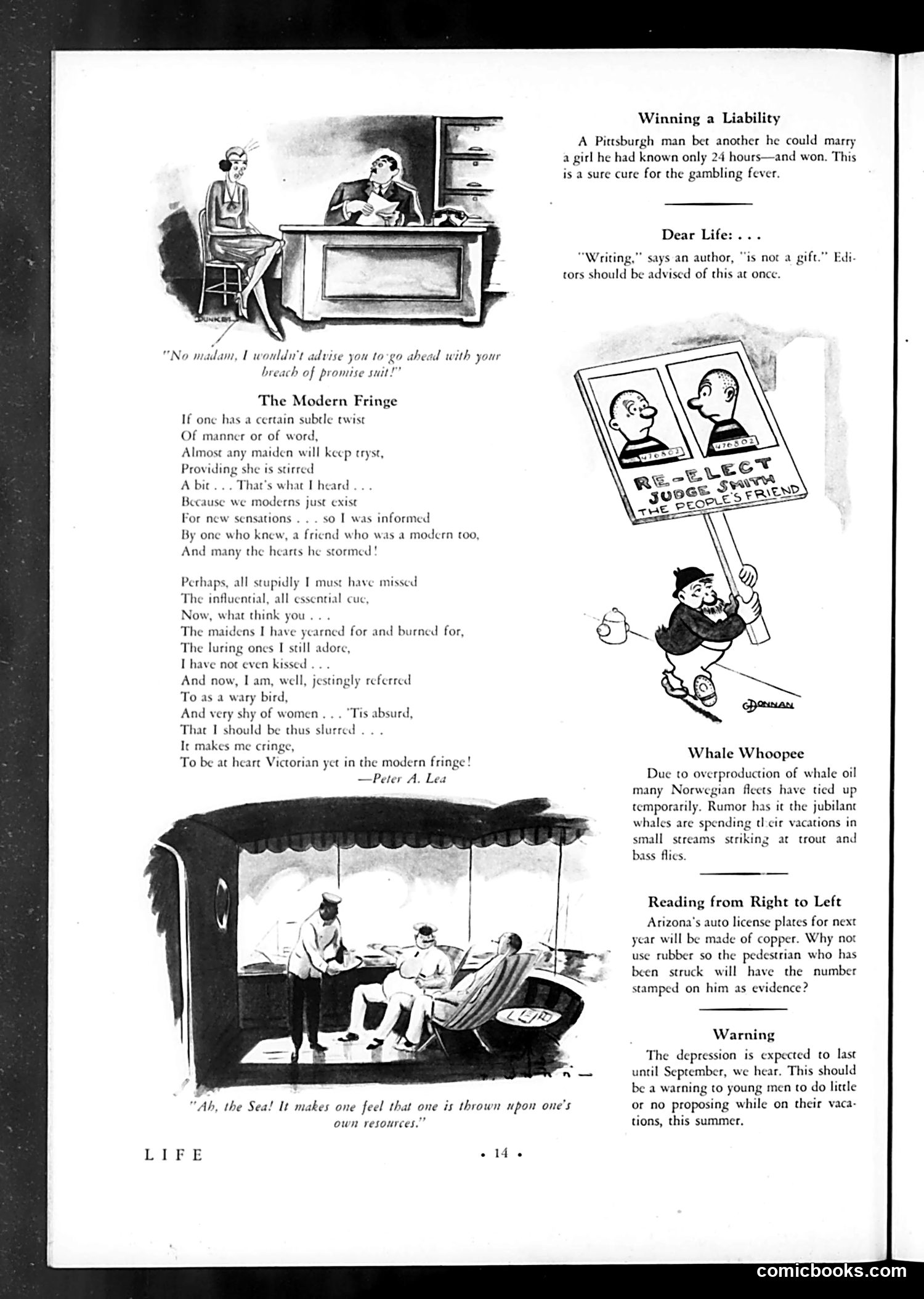
Analysis of Life Magazine Page 14 This page contains several satirical humor pieces typical of Life magazine's format: "Winning a Liability": A joke about a Pittsburgh man betting he could marry a girl he'd known only 24 hours—presented as a cure for gambling addiction. "The Modern Fringe": A poem by Peter A. Lea critiquing modernism and "modern" women who adopt superficial mannerisms to seem sophisticated, while remaining "Victorian" at heart. It mocks pretentious bohemianism. Beach cartoon: Shows people at the seaside, with the caption suggesting vacation brings out human vulnerability ("thrown upon one's own resources"). "Whale Whoopee": Reports Norwegian whaling fleet disruptions due to overproduction. "Reading from Right to Left": A joke about Arizona switching to copper license plates and whether rubber would mark struck pedestrians as "evidence." "Warning": A practical note warning young men against proposing during the Depression (expected to last until September).
"Life in Washington" by Carter Field This satirical column discusses Senator George Moses of New Hampshire, a Republican figure whom the author portrays as politically powerful yet intellectually limited. The piece mocks Moses's expense accounts (spending government funds on vacations at Glacier Park and Palm Beach), his influence despite lacking eloquence or diplomatic skill, and his opposition to the League of Nations. The satire suggests Moses represents a type of politician—powerful but cynical, unqualified for higher office (he allegedly lost the vice presidency bid), yet influential in Republican circles. The column criticizes his expense-padding and suggests he's manipulated by more sophisticated politicians, while portraying him as a somewhat ridiculous figure in Washington politics during the 1920s era.
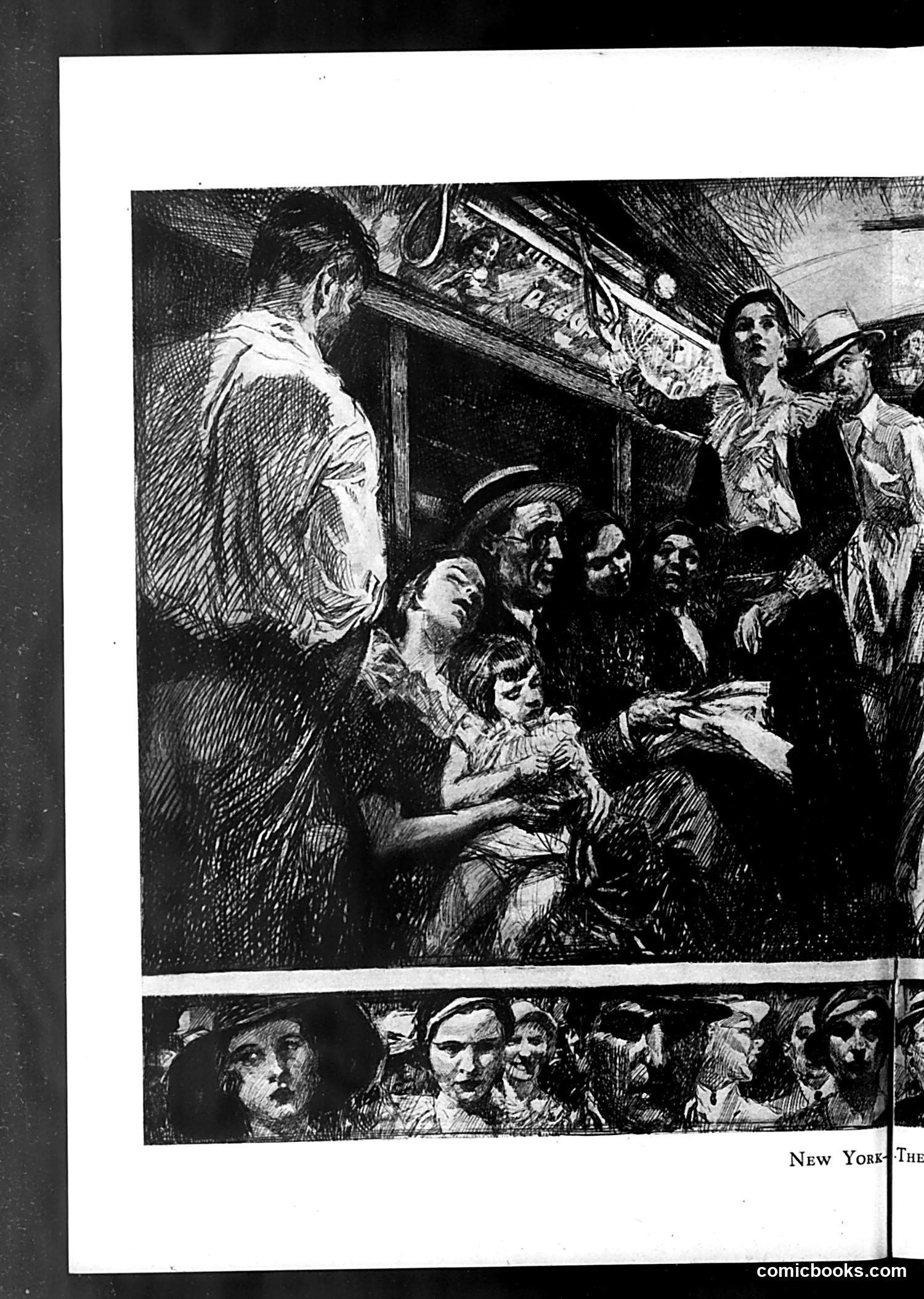
Analysis This appears to be a social commentary illustration depicting a crowded indoor scene, likely from early 20th-century New York (as indicated by "NEW YORK" at bottom). The sketch shows a tall figure in light clothing on the left addressing or interacting with a woman holding a child, while numerous other figures crowd around them, wearing hats typical of the era. The style and composition suggest this satirizes some form of public social service, charitable work, or government intervention. The gathered crowd of working-class men and the prominent positioning of the mother and child indicate the cartoon likely critiques either inadequate social welfare, overcrowded institutions, or questionable charitable practices of the period. Without clearer text or additional context, the specific satirical target remains unclear.
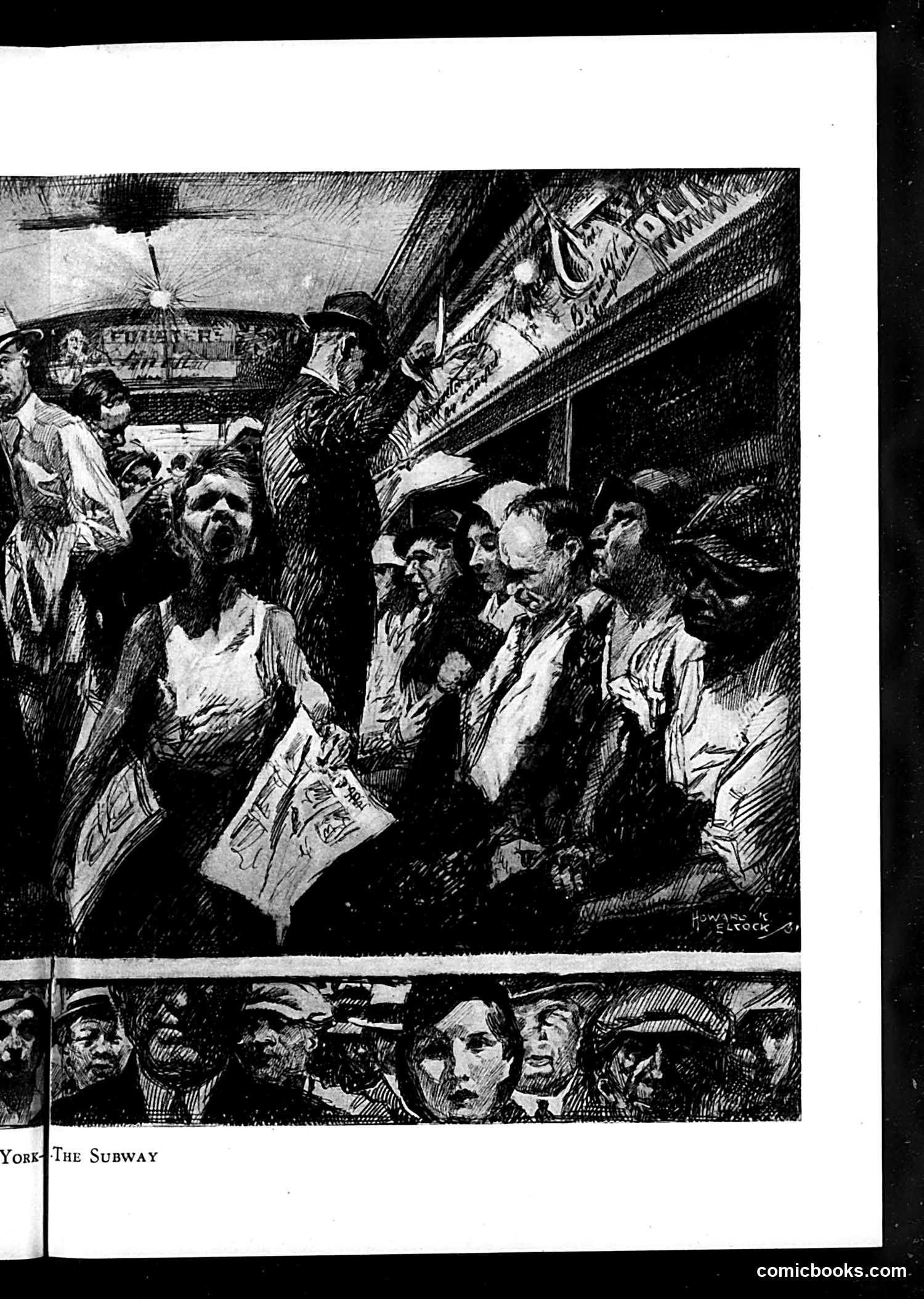
"The Subway" — New York Life Cartoon This satirical illustration depicts a crowded New York City subway car, showing working-class commuters packed tightly together. The artist (signed "Elcock") captures the chaos and discomfort of urban mass transit through expressive sketching. The satire targets the poor conditions of subway travel—overcrowding, lack of space, and the indignity of commuting. Visible signage and advertising in the background suggest this is commentary on commercialism within public transportation. The lower panel appears to show additional figures, possibly emphasizing the relentless crush of passengers. This reflects early-20th-century social commentary about industrialization's toll on ordinary New Yorkers and the inadequate infrastructure for the growing urban population. The cartoon critiques both transit conditions and city life's dehumanizing aspects.
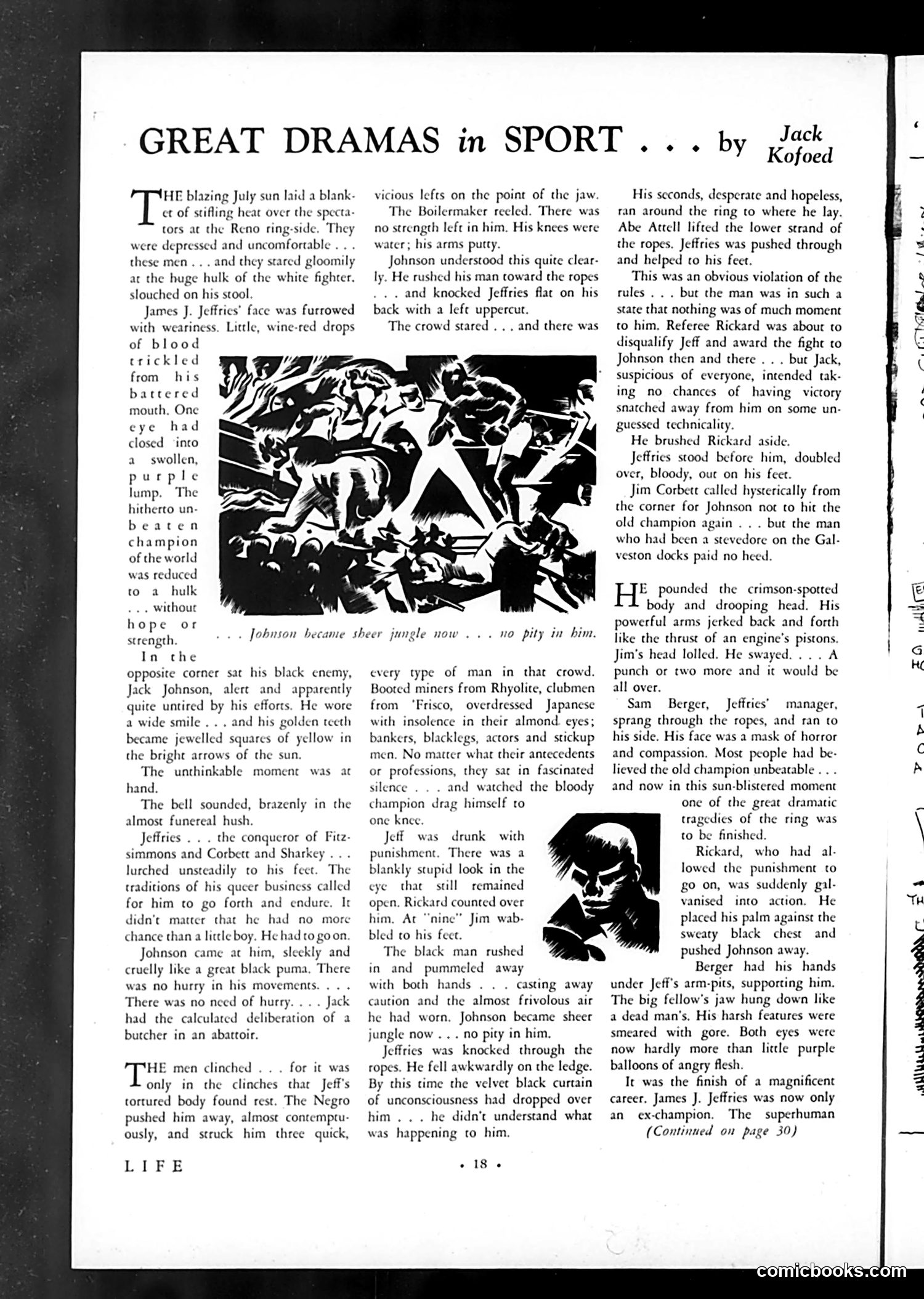
Analysis of "Great Dramas in Sport" by Jack Kofoed This page depicts a boxing match story featuring James J. Jeffries (the white fighter) versus Jack Johnson (the black fighter, identified as "his black enemy"). The narrative describes a brutal fight where Johnson defeats Jeffries, who is reduced to unconsciousness. The historical context: This likely references the famous 1910 heavyweight championship bout between these actual boxers. Johnson's victory over the white champion was controversial during the Jim Crow era, sparking racial tensions. The article's language—emphasizing Johnson's dominance and describing the crowd's shock—reflects period attitudes about race and boxing. The illustrations show the intense brutality of their encounter, presented as a dramatic sporting "great drama."
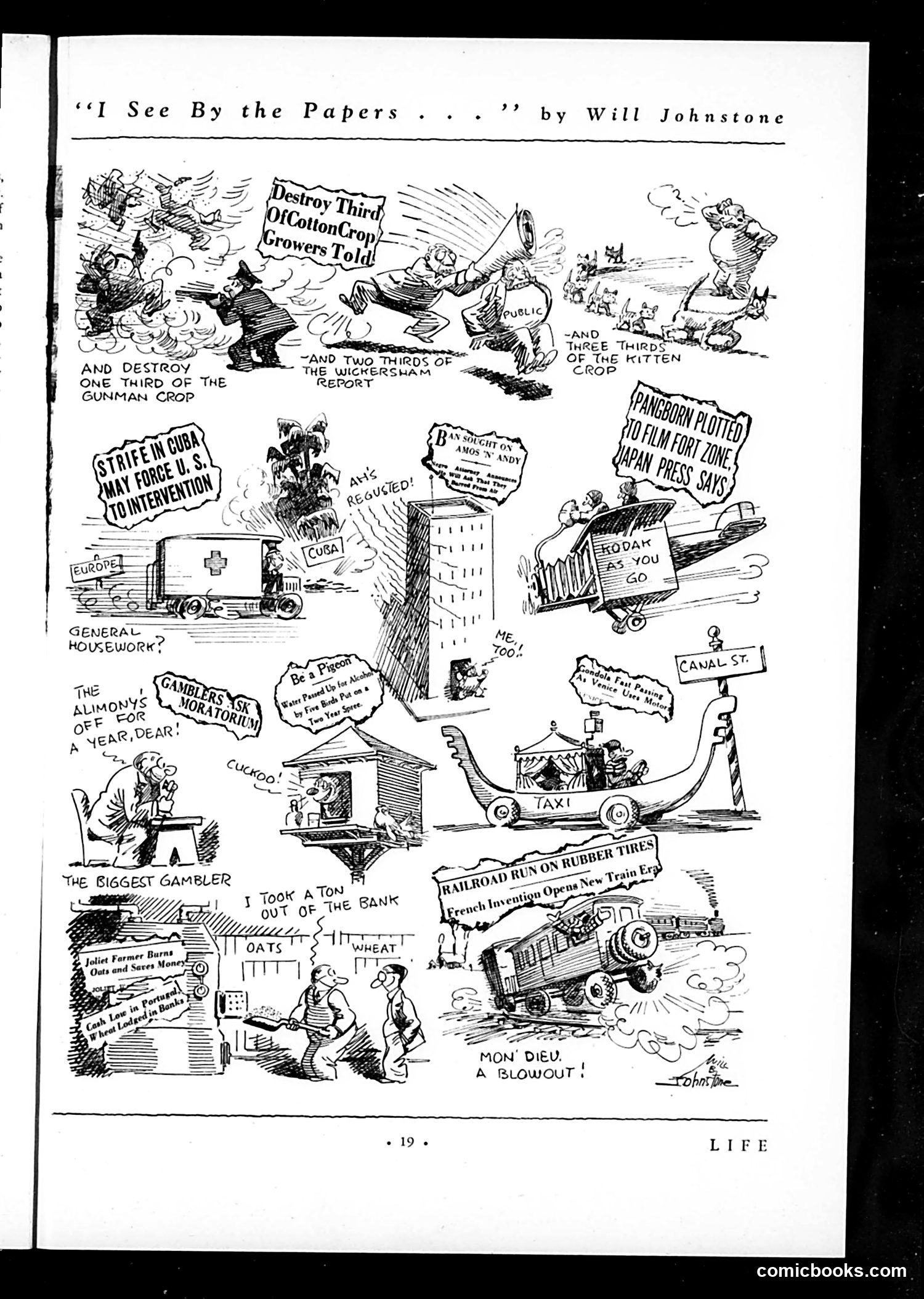
"I See By the Papers" by Will Johnstone This satirical cartoon page collects absurdist news items in the style of early 20th-century humor. The jokes mock various contemporary events and figures: - Agricultural crisis: references to destroying cotton crops and wheat surpluses, mocking farm policy discussions - International tensions: "Strike in Cuba," "Pangborn Plotted," Japanese press coverage suggest geopolitical concerns - Financial mishaps: "The Biggest Gambler" and banking references reflect economic anxiety - Absurdist items: a "Railroad Run on Rubber Tires" and "French Invention Opens New Train Era" mock technological claims - Local color: references to Chicago locations (Caval Street), gamblers, and farmers The cartoon employs exaggeration and wordplay to satirize news sensationalism, government policy failures, and dubious modern inventions—typical Life magazine fare mocking contemporary society's follies.
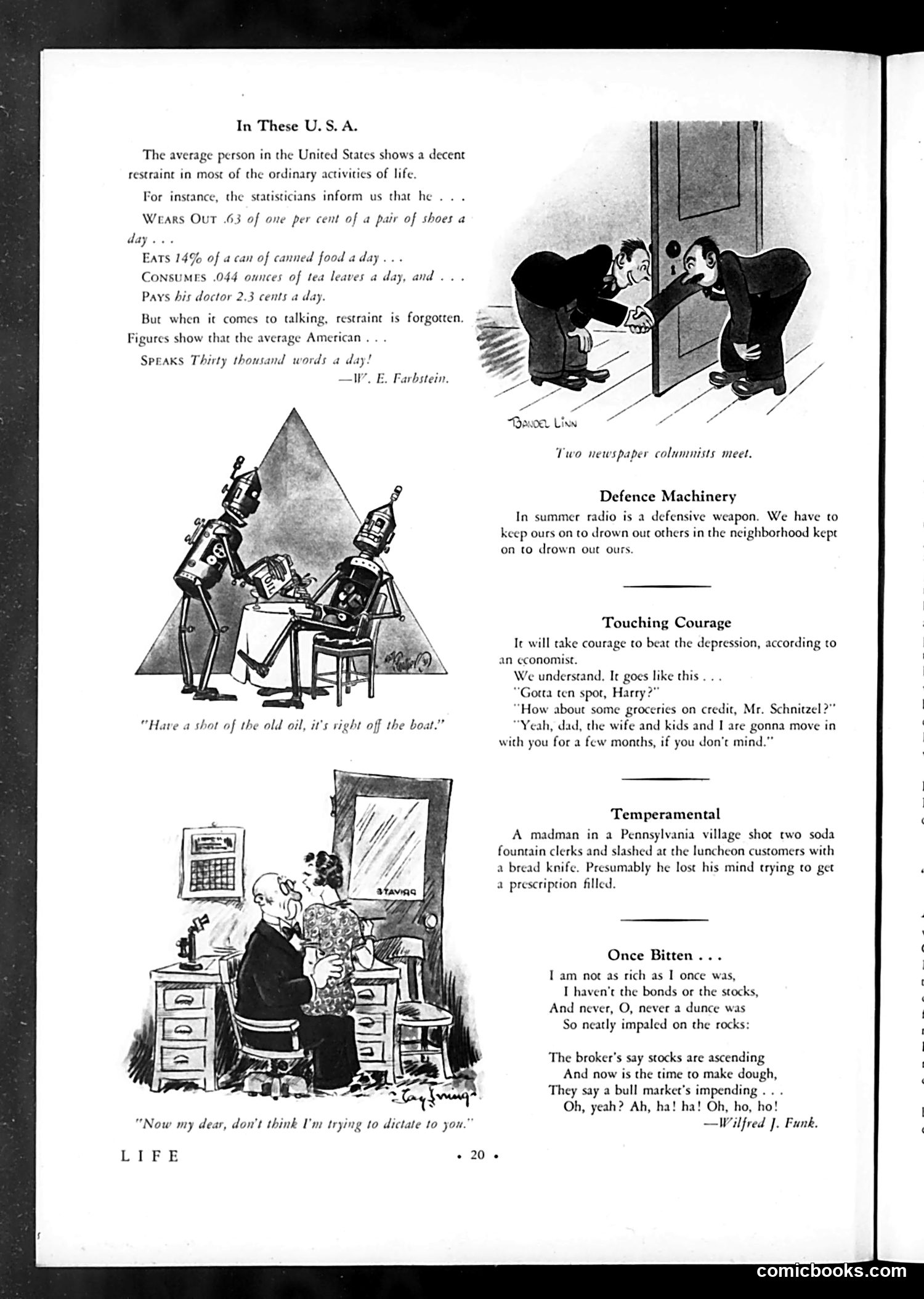
Life Magazine Satire Page Analysis This page from *Life* magazine satirizes American behavior and Depression-era anxieties through interconnected commentary and cartoons. The opening section humorously contrasts Americans' restraint in consumption (precise statistics on shoe wear, food, tea) with their complete lack of restraint in talking—speaking 30,000 words daily. This establishes the page's theme: Americans talk excessively. The cartoons illustrate this: two newspaper columnists meet while apparently gossiping; a man at a desk appears to be talking endlessly to his wife. The "Defense Machinery" section extends the joke—radio becomes a weapon to drown out neighbors' noise. "Touching Courage" presents Depression-era desperation as humorous dialogue: begging for money, requesting grocery credit, and moving in with relatives—framed as requiring courage rather than shame. "Once Bitten" and "Temperamental" sections continue satirizing current hardships: stock market losses and mental breakdown over prescription frustrations during economic collapse. The overall message: Americans talk excessively about their problems rather than addressing them.
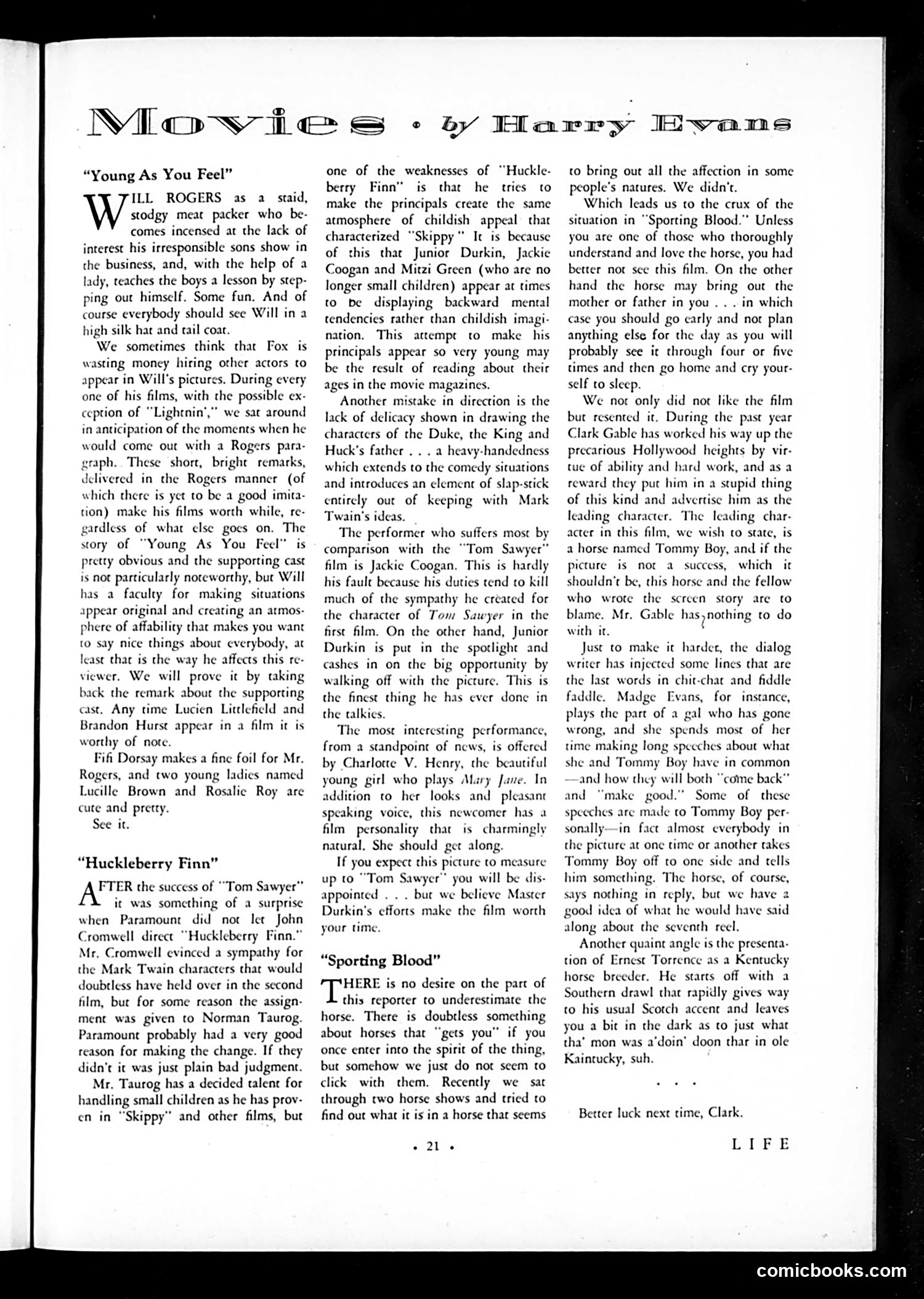
"Movies" by Harry Evans - Life Magazine Film Reviews This page contains three film reviews from Life magazine's "Movies" column by Harry Evans, circa mid-1920s. "Young As You Feel" praises Will Rogers' comedic timing and personality, noting that audiences attend his films primarily to see Rogers himself rather than the supporting cast or plot. The reviewer suggests Fox Studios wastes money hiring other actors, as Rogers' natural charm and witty remarks are the film's main attraction. "Huckleberry Finn" critiques director Norman Taurog's approach, comparing it unfavorably to the previous "Tom Sawyer" film directed by John Cromwell. Evans argues Taurog's tendency to play up childish appeal (successful in his film "Skippy") backfires here, making adult actors Junior Durkin and Jackie Coogan appear unnaturally juvenile. The review praises newcomer Charlotte V. Henry's performance. "Sporting Blood" (partially visible) discusses horse racing film elements. The reviews exemplify 1920s film criticism focused on star power, direction choices, and performance comparisons.
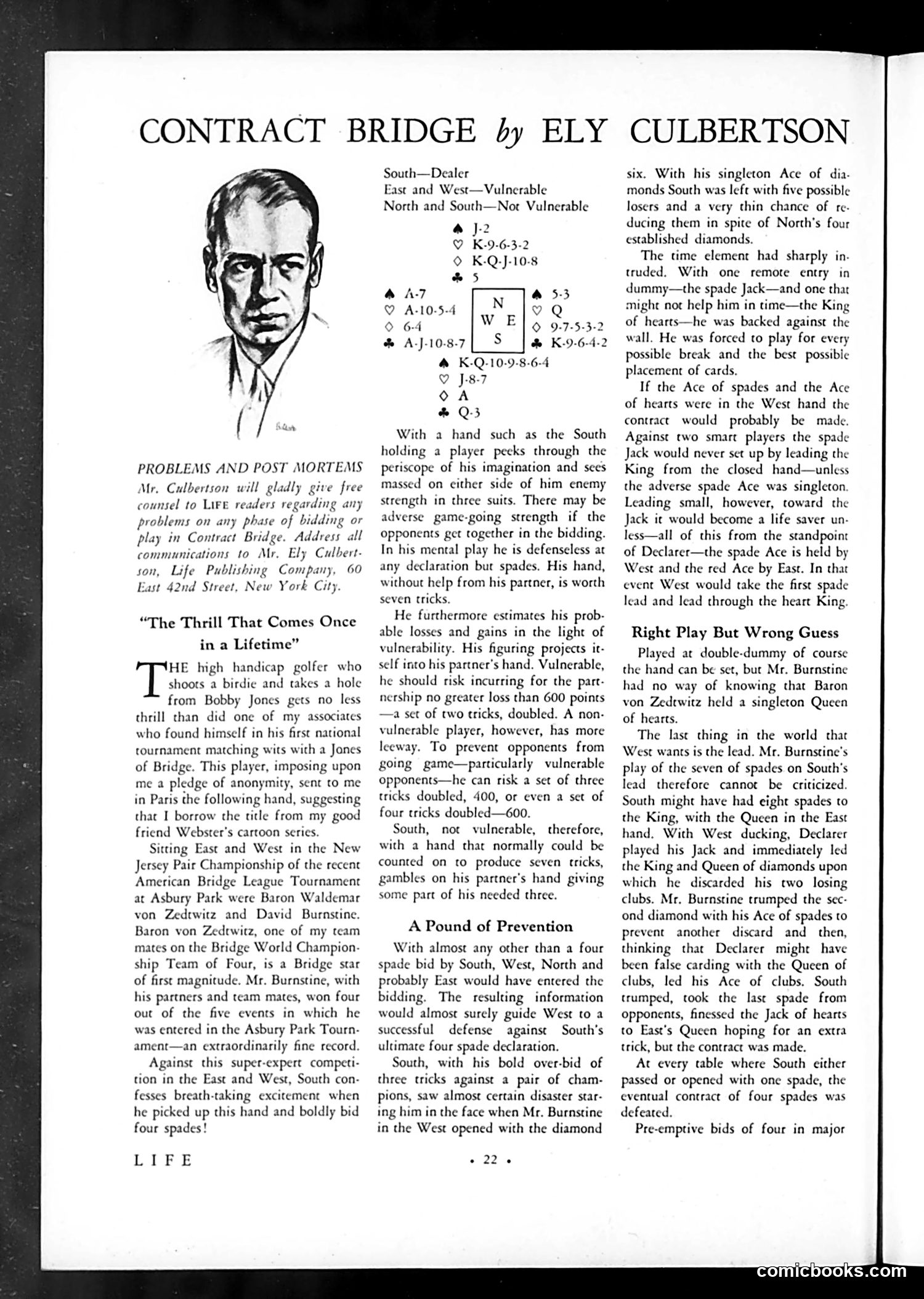
Contract Bridge Strategy Analysis from Life Magazine This page features Ely Culbertson, a famous bridge expert of the early 20th century, analyzing a contract bridge hand. The content is instructional rather than satirical—it's a legitimate bridge column. The article discusses a dramatic hand from the New Jersey Pair Championship at Asbury Park, featuring elite players Baron Waldemar von Zedtwitz and David Burnstine (described as champions). The narrative celebrates an anonymous South player's "thrill" in boldly bidding four spades despite risky circumstances—a vulnerable position requiring favorable card distribution. The analysis explains the strategic reasoning: aggressive bidding prevents opponents from entering the auction and gaining information. The headline alludes to Webley's cartoon series, using golf and bridge as comparable competitive pursuits. This reflects bridge's status in 1930s popular culture as sophisticated entertainment for educated readers. The column provides free expert counsel to Life readers, establishing Culbertson as an authoritative bridge personality.
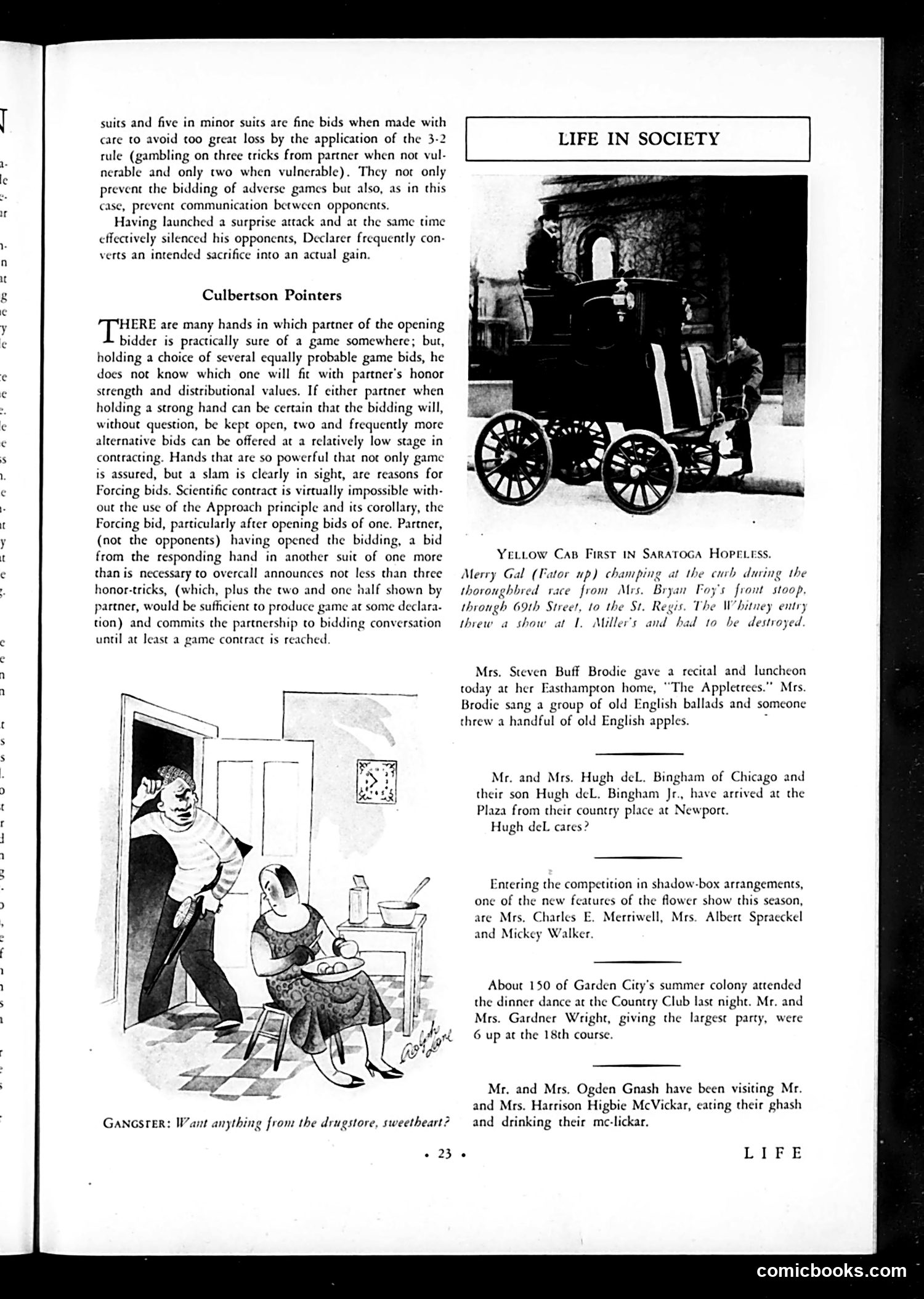
Life Magazine Society Page Analysis This page combines bridge strategy instruction with satirical "society gossip" commentary typical of Life magazine's humor. The Main Cartoon: Shows a man at a drugstore counter asking a woman, "Want anything from the drugstore, sweetheart?"—a domestic scene humorously captioned "GANGSTER," playing on 1920s-30s slang where "gangster" meant a confident, assertive person. The Satire: The "Life in Society" section mocks wealthy upper-class figures through exaggerated anecdotes: - A horse race where a thoroughbred had to be "destroyed" after a minor mishap - A recital where attendees threw apples (suggesting hostile reception to Mrs. Brodie's singing) - Society names like "Ogden Gnash" eating "ghash" with "mc-lickar"—obvious puns mocking pretentious socialites The Intent: Life ridicules the trivialities and assumed superiority of the wealthy elite, suggesting their concerns (thoroughbred racing, society recitals, country club dinners) are absurd and their dignity fragile.
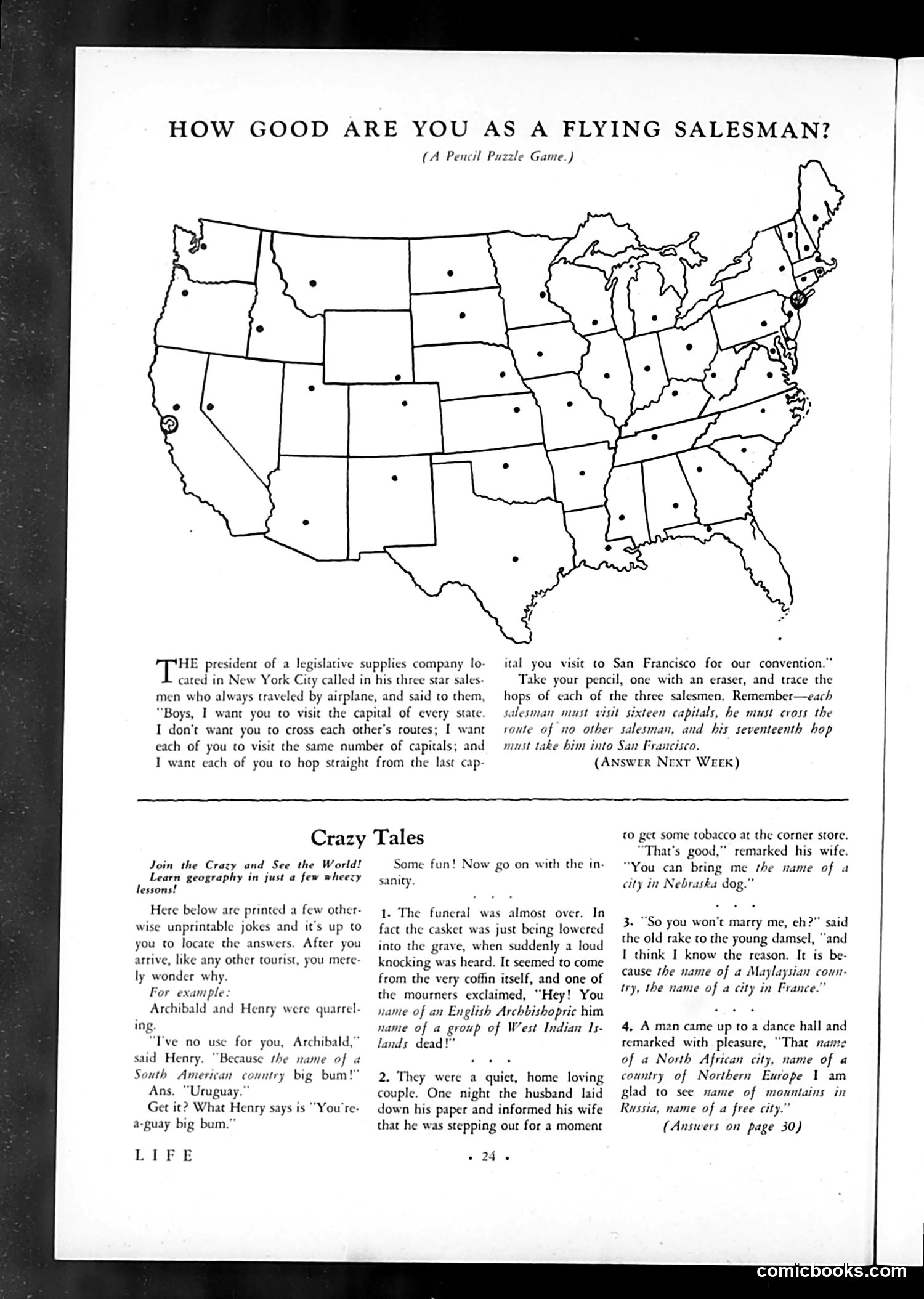
"How Good Are You as a Flying Salesman?" — Life Magazine Puzzle Page This page presents two geography-based puzzles for readers: Main Puzzle: A logic problem where three traveling salesmen must each visit exactly sixteen state capitals via airplane, with non-crossing routes, before meeting in San Francisco. Readers use a pencil to trace the paths on the US map provided. "Crazy Tales" Section: A series of pun-based riddles disguised as anecdotes. The jokes work by embedding geographical place names into sentences where they sound like regular words. For example, the first joke's punchline is "Canterbury" (an English archbishopric) and "West Indies" hidden in the phrase about a corpse. Purpose: These were common early-20th-century educational diversions—playful ways to teach geography while entertaining readers. The humor relies on phonetic wordplay: "You're-a-guay" sounds like "Uruguay"; similar tricks apply throughout. The page reflects *Life* magazine's lighter editorial approach alongside satire, offering puzzle-solving entertainment typical of the era's popular periodicals.
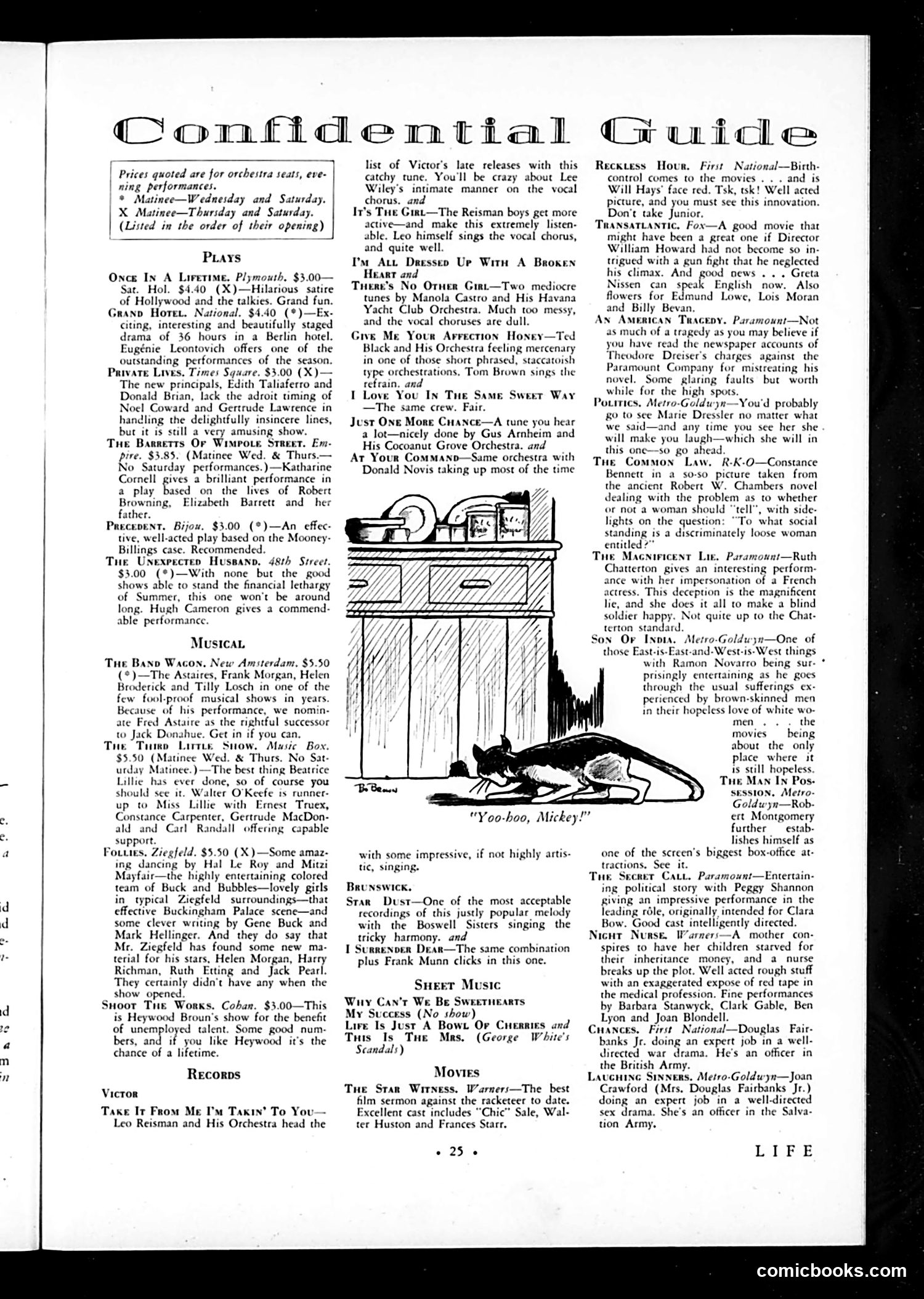
Analysis of "Confidential Guide" Page This page from *Life* magazine is primarily a theater and entertainment guide rather than a political cartoon. It contains no political satire or caricature. The content includes: 1. Theater reviews of Broadway plays and musicals (e.g., "Once in a Lifetime," "The Band Wagon," "Follies") 2. A single cartoon illustration labeled "Yoo-hoo, Mickey!" showing a silhouetted figure on the ground calling out—likely a casual, non-satirical gag unrelated to politics 3. Music record reviews from Victor Records, covering current popular songs and orchestras The page functions as an entertainment guide for affluent readers, listing show times, prices, and critical opinions. There is no discernible political commentary, social satire, or caricature of public figures on this particular page. It represents *Life*'s role as a lifestyle magazine for the urban leisure class of its era.
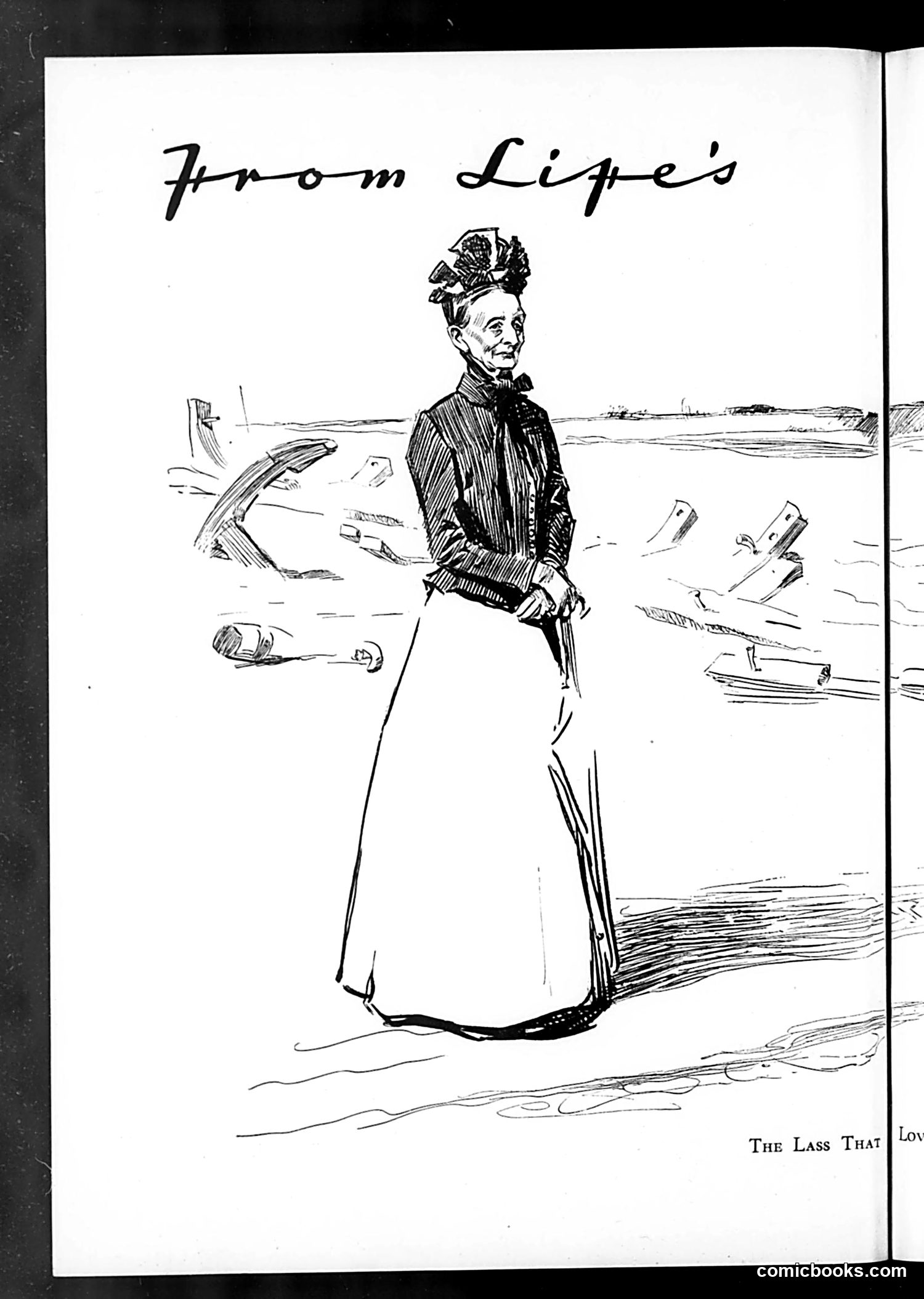
"From Life's" - The Lass That This satirical illustration depicts a fashionably dressed woman standing amid shipwreck debris on a beach. The title "From Life's" and the visible caption fragment "The Lass That" suggest this is part of a serialized story or ongoing satirical feature in Life magazine. The woman's elegant attire—fitted jacket, long skirt, and elaborate hat—contrasts sharply with the surrounding destruction, creating ironic humor. The specific reference and narrative context are unclear from this page alone, but the image appears to satirize either romantic adventure narratives popular in the era, or perhaps comments on feminine resilience or vanity in the face of disaster. Without additional context or visible date, the exact social commentary remains uncertain.
"That Loved a Sailor" - Life Magazine, August 4, 1898 This appears to be a title page or section divider for a story or comic titled "That Loved a Sailor," reprinted from Life's August 4, 1898 issue. The illustration shows a portrait of a woman's face in an oval frame, flanked by what appear to be sailor's arms or insignia at the top—a visual pun linking the title's romantic theme to maritime imagery. The content likely references a sentimental or humorous story about romance involving a sailor, a common subject in 1890s popular entertainment. Without seeing the actual story content, the specific satirical or comedic point remains unclear, though the playful graphic treatment suggests Life's typical approach: gentle mockery of sentimental Victorian romance tropes.
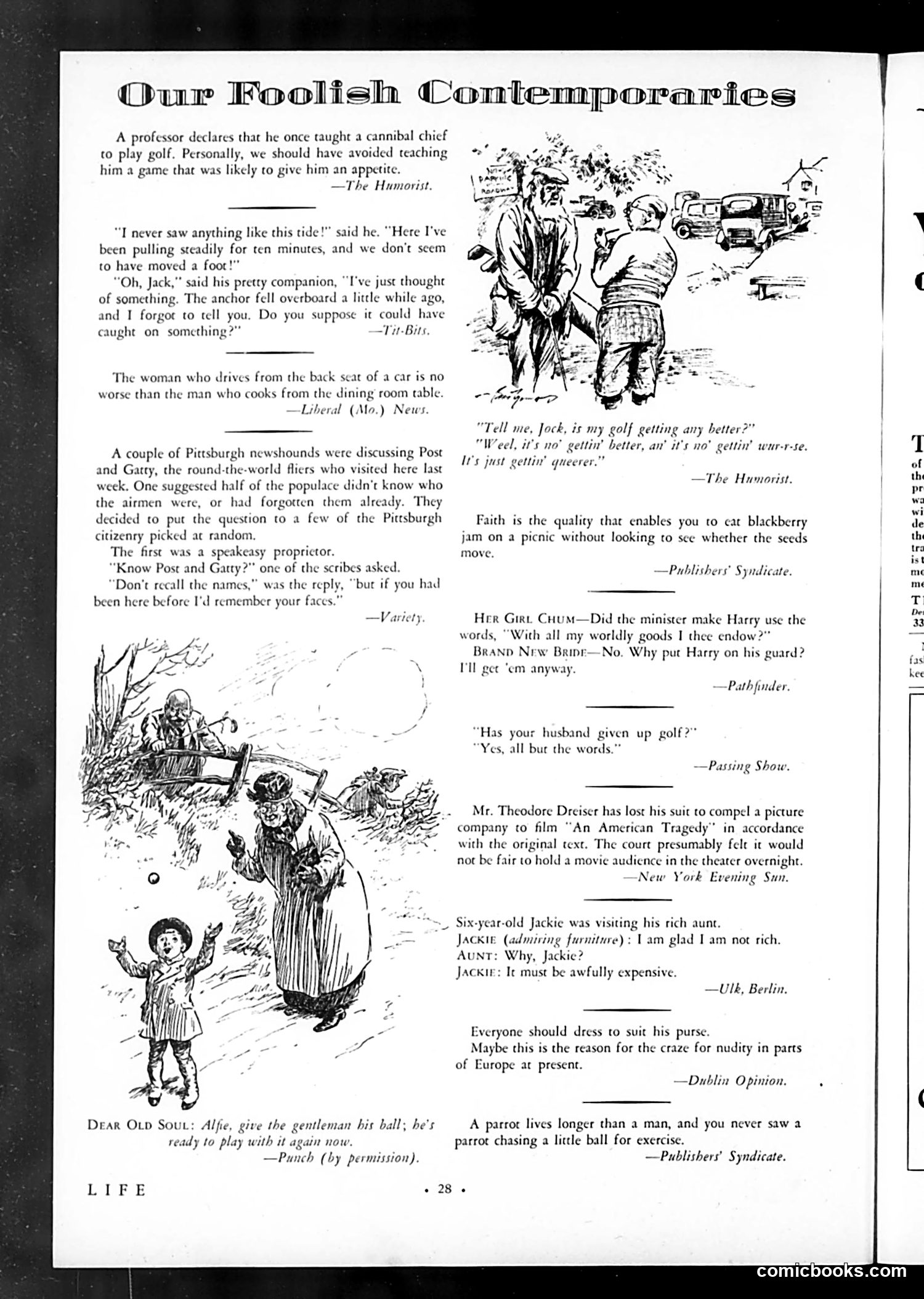
"Our Foolish Contemporaries" This is a satirical humor page collecting brief jokes and observations from various publications, mocking contemporary foolishness circa the 1920s-30s. Key targets include: Social absurdities: A woman forgetting to retrieve a dropped anchor while boating; backseat drivers and armchair cooks; people dressing beyond their means. Modern anxieties: References to Post and Gatty (famous aviators), Theodore Dreiser's censorship battles over *An American Tragedy*, and concerns about "nudity craze in Europe"—reflecting contemporary moral debates. Gender roles: Jokes about wives vs. husbands, and a minister ensuring a groom doesn't know his bride's wealth before marriage. Human nature: Observations that faith enables blind acceptance, parrots outlive humans without chasing balls, and people forget famous visitors' names but remember faces. The cartoons show domestic/leisure scenarios reinforcing these themes. The humor is gentle social commentary rather than political satire—poking fun at universal human foibles and contemporary middle-class anxieties.
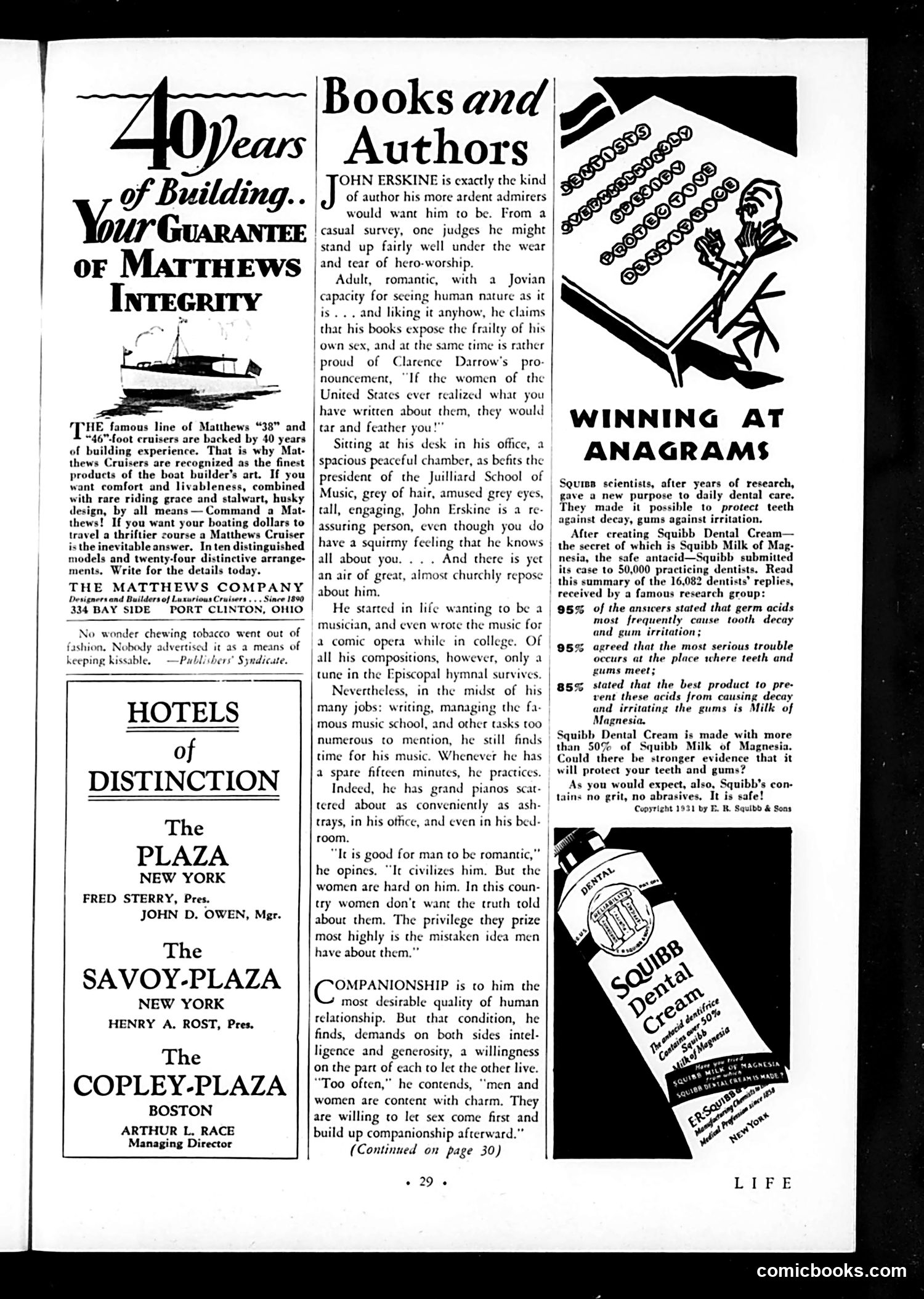
Analysis of Page 29, Life Magazine This page is primarily advertising and literary content, not political satire. The main elements are: "Books and Authors" section: A profile of John Erskine, composer and president of the Juilliard School of Music. The text describes him as a romantic intellectual who writes about human nature and male frailty. A notable quote attributes to Clarence Darrow praise for Erskine's critical portrayal of women—suggesting his work exposes uncomfortable truths about gender relations. Key joke in the profile: Erskine's observation that women prefer men's *mistaken* ideas about them over truth—a commentary on gender dynamics of the era. Advertisements: The page features luxury hotel ads (Plaza, Savoy-Plaza, Copley-Plaza), a Matthews boat company ad emphasizing 40 years of integrity, and a Squibb Dental Cream ad with dubious health claims. Minor quip: A one-liner mocking tobacco advertising's shift from health claims to "kissability." The page reflects 1920s attitudes toward courtship, gender relations, and consumer marketing rather than political commentary.
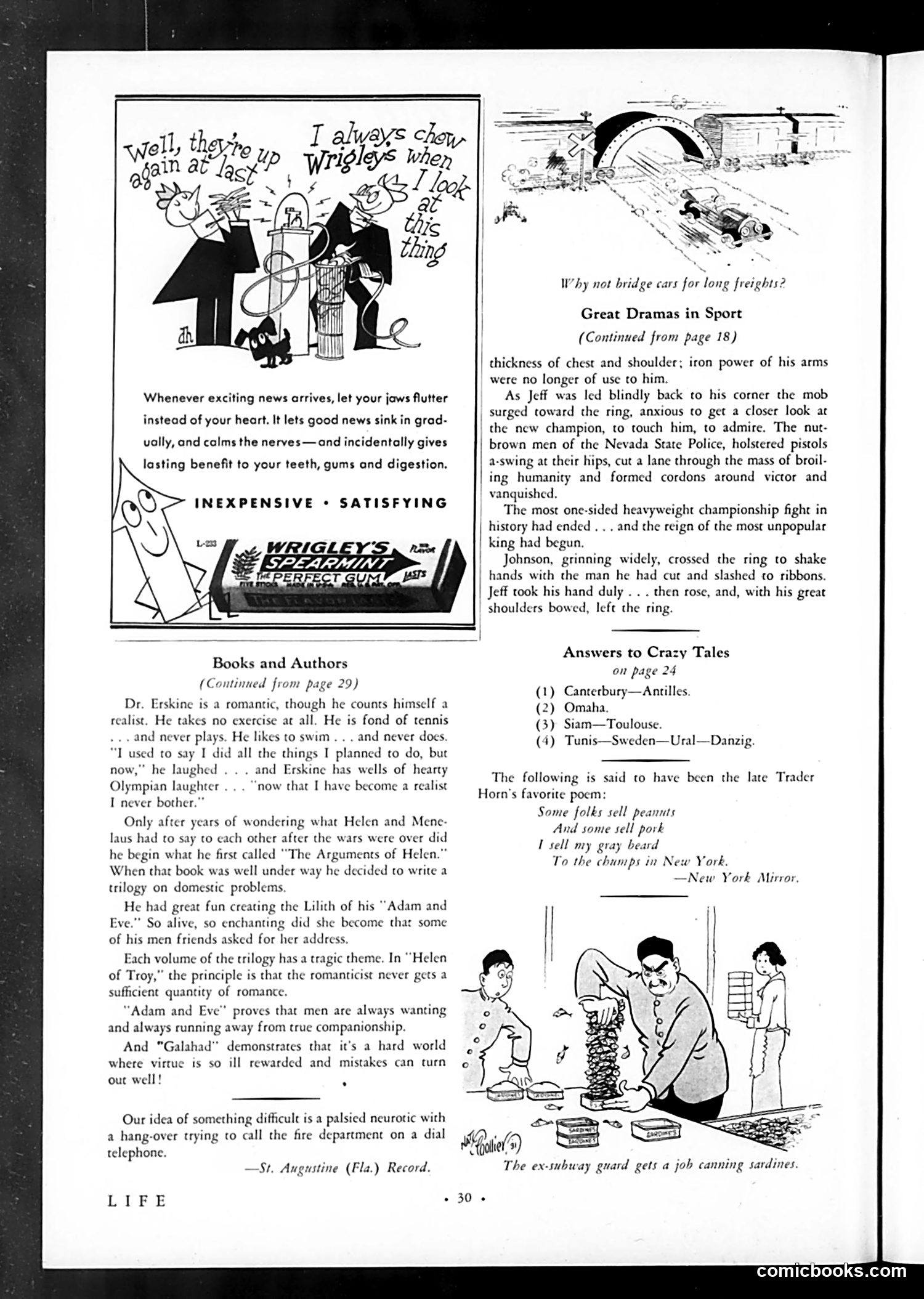
Page 30 of Life Magazine: Content Analysis This page contains three distinct sections: Wrigley's Gum Advertisement (top left): A cartoon promoting chewing gum as a way to digest exciting news calmly. The satire targets nervous reactions to sensational headlines—the ad humorously suggests gum steadies the nerves and benefits teeth/digestion. Books and Authors Column: Reviews author John Erskine, noting his ironic contradiction—he claims to be a "realist" yet never exercises or swims despite enjoying both. The column discusses his trilogy on domestic themes (*Helen of Troy*, *Adam and Eve*, *Galahad*), noting the romanticist protagonist never achieves satisfaction. Sports Article (continued): Describes what appears to be Jack Johnson's heavyweight boxing championship victory, describing the "most one-sided" and "most unpopular" championship fight in history. The vanquished fighter (likely Jim Jeffries) is led away blindly while the victor shakes his hand. The page also includes a cartoon joke about an ex-subway guard finding employment canning sardines, and puzzle answers.
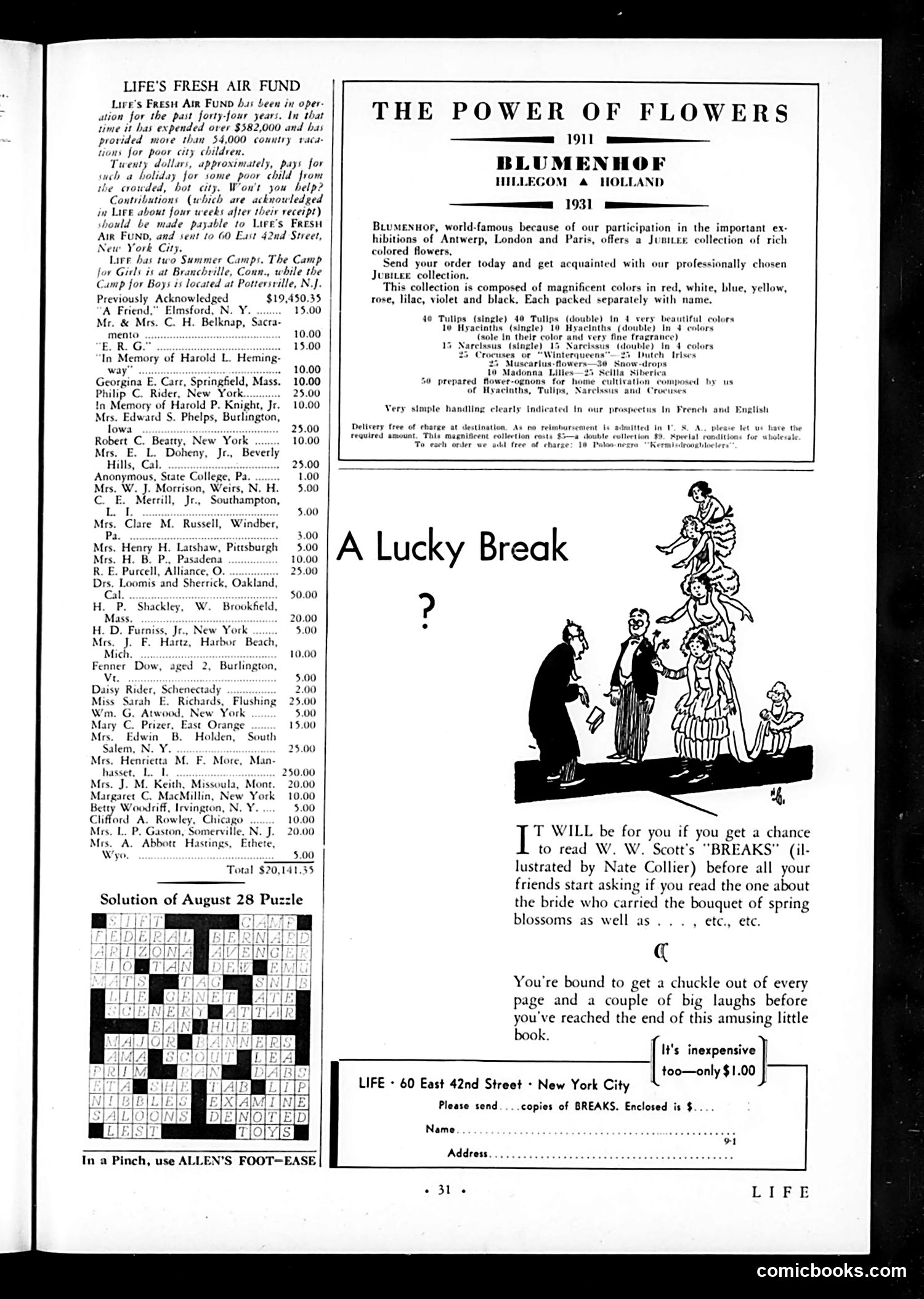
Explanation for Modern Readers This page primarily contains charitable fundraising and advertising rather than political satire. The left side lists donations to Life's Fresh Air Fund, a longstanding charitable program (44 years old by 1931) providing country vacations for poor urban children—about $20 per child. Contributors' names and amounts are listed, totaling over $20,000. The center features an advertisement for Blumenhof, a Dutch flower company selling bulbs and seeds through mail order. The right side shows "A Lucky Break?"—a cartoon advertisement for a humorous book called *"Breaks"* by W.W. Scott (illustrated by Nate Collier), priced at $1.00. The simple illustration depicts well-dressed adults and children, suggesting the book contains light, family-friendly humor about social situations (the caption mentions a bride with spring blossoms). This is a lighthearted pitch to readers to purchase the book before their friends spoil the jokes. The page reflects 1931 American life: charitable giving, mail-order commerce, and affordable entertainment during the Depression era.
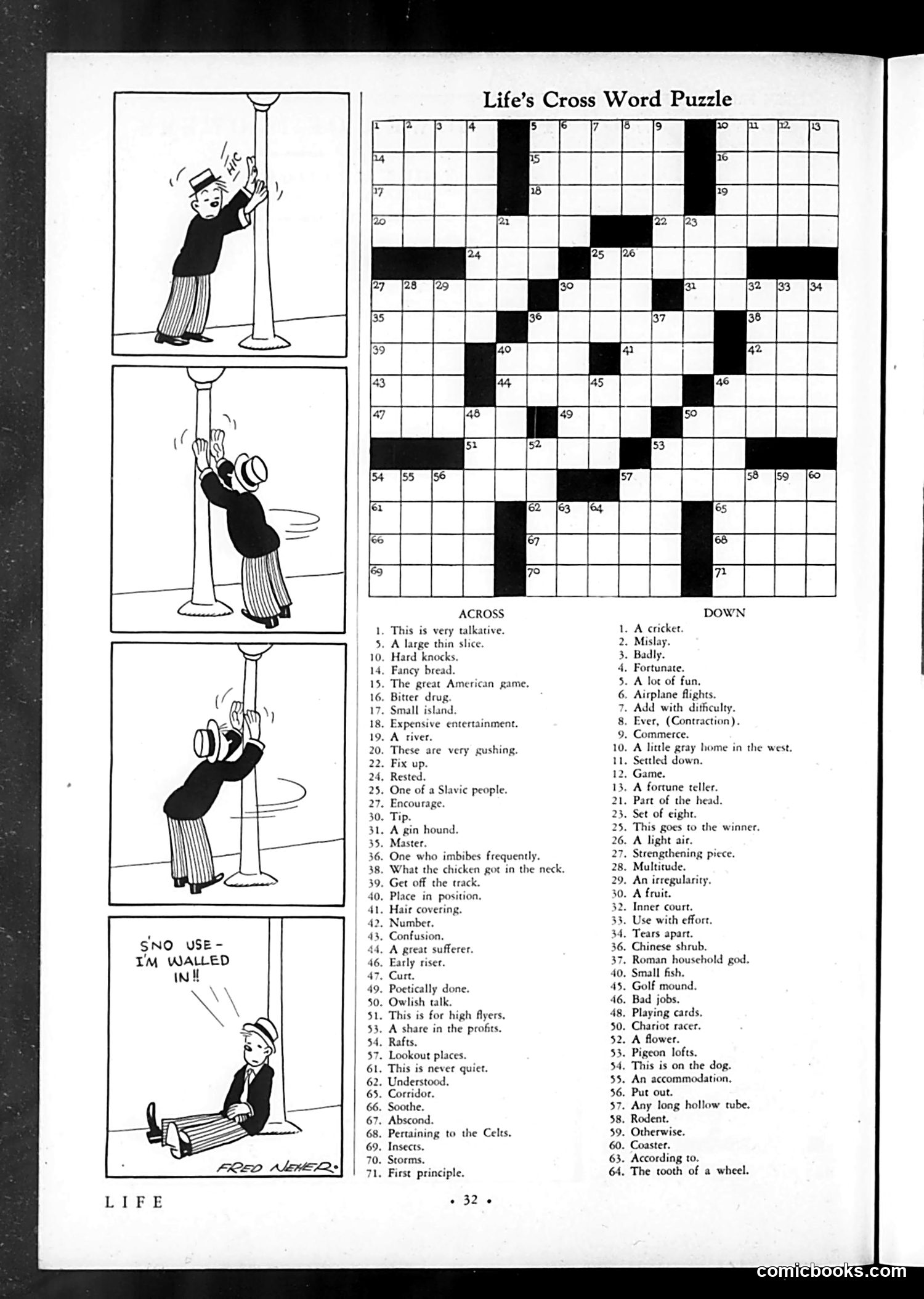
Life's Cross Word Puzzle Page This page presents a crossword puzzle with accompanying cartoon illustrations. The cartoons depict a man repeatedly interacting with a street lamp—first juggling beneath it, then struggling with it, and finally sitting trapped beside it with the caption "SNO USE—I'M WALLED IN!" The humor appears to be slapstick and absurdist: the character's escalating misadventures with an inanimate object suggest either drunkenness or general incompetence, culminating in a sense of helpless resignation. The phrase "walled in" suggests feeling trapped or defeated by circumstances. The crossword itself contains period-appropriate clues referencing 1920s-30s culture: references to drinking ("gin hound," "one who imbibes frequently"), American entertainments ("great American game" = baseball), and contemporary idioms. The puzzle functioned as entertainment for readers, typical of Life magazine's satirical humor—combining visual comedy with wordplay to engage its audience.
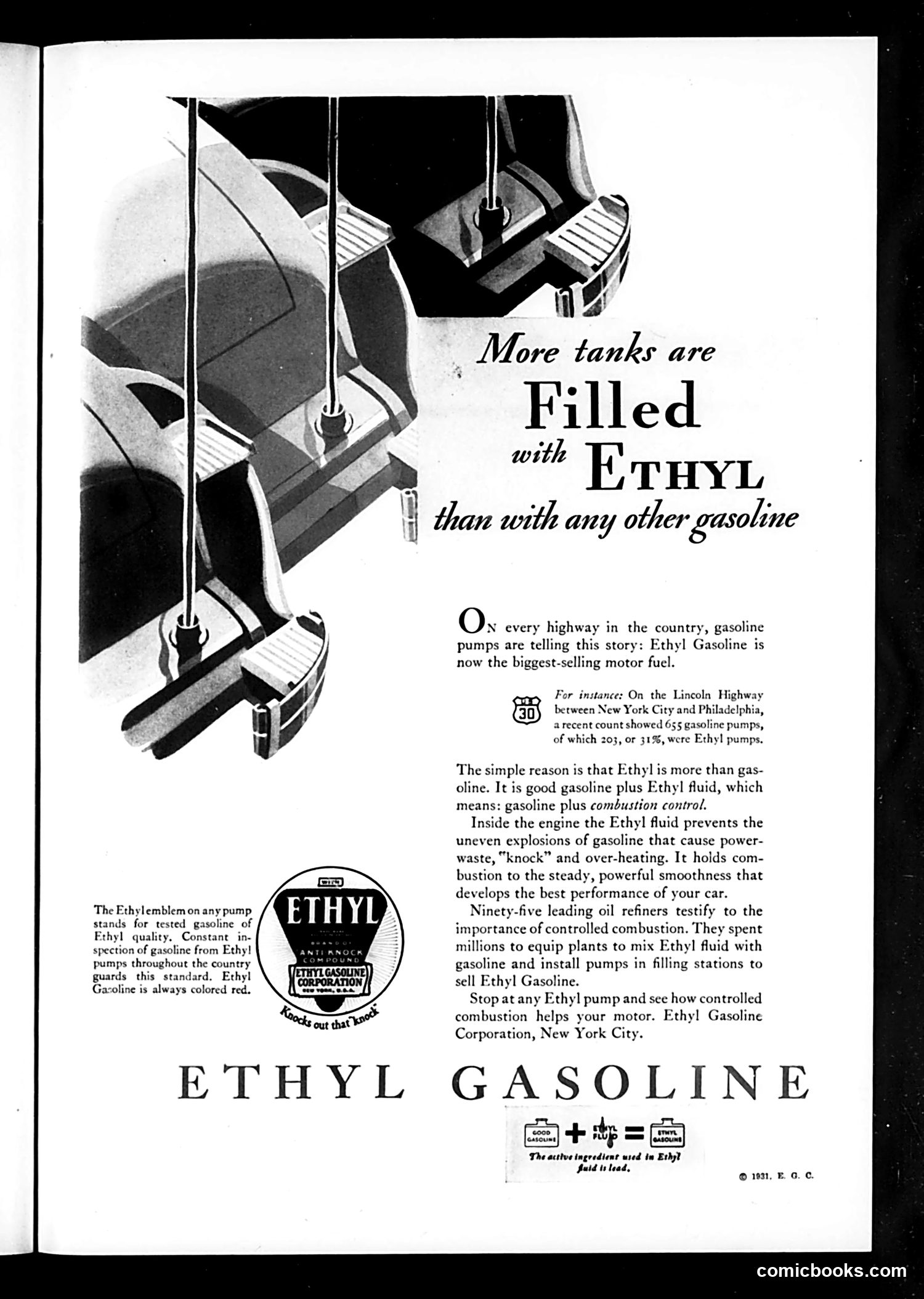
Ethyl Gasoline Advertisement (1931) This is not satire or political commentary—it's a straightforward advertisement for Ethyl Gasoline, a commercial product from the Ethyl Gasoline Corporation. The page promotes Ethyl as a superior motor fuel containing tetraethyl lead, an additive that reduces engine "knock" and improves performance. The illustration shows gas pump nozzles from an overhead view. The advertiser cites market dominance claims (e.g., 31% of pumps on the Lincoln Highway are Ethyl pumps) and explains the product's benefit: "combustion control" that prevents uneven explosions. Modern context: Today this advertisement is historically significant because tetraethyl lead, though effective as an anti-knock agent, is a neurotoxin that caused widespread environmental and public health damage. Lead was eventually phased out of gasoline in the 1970s-80s due to its toxicity. The ad's casual equation at bottom—showing lead as the "active ingredient"—represents a now-infamous example of an industry promoting a dangerous substance before its health risks were widely acknowledged.
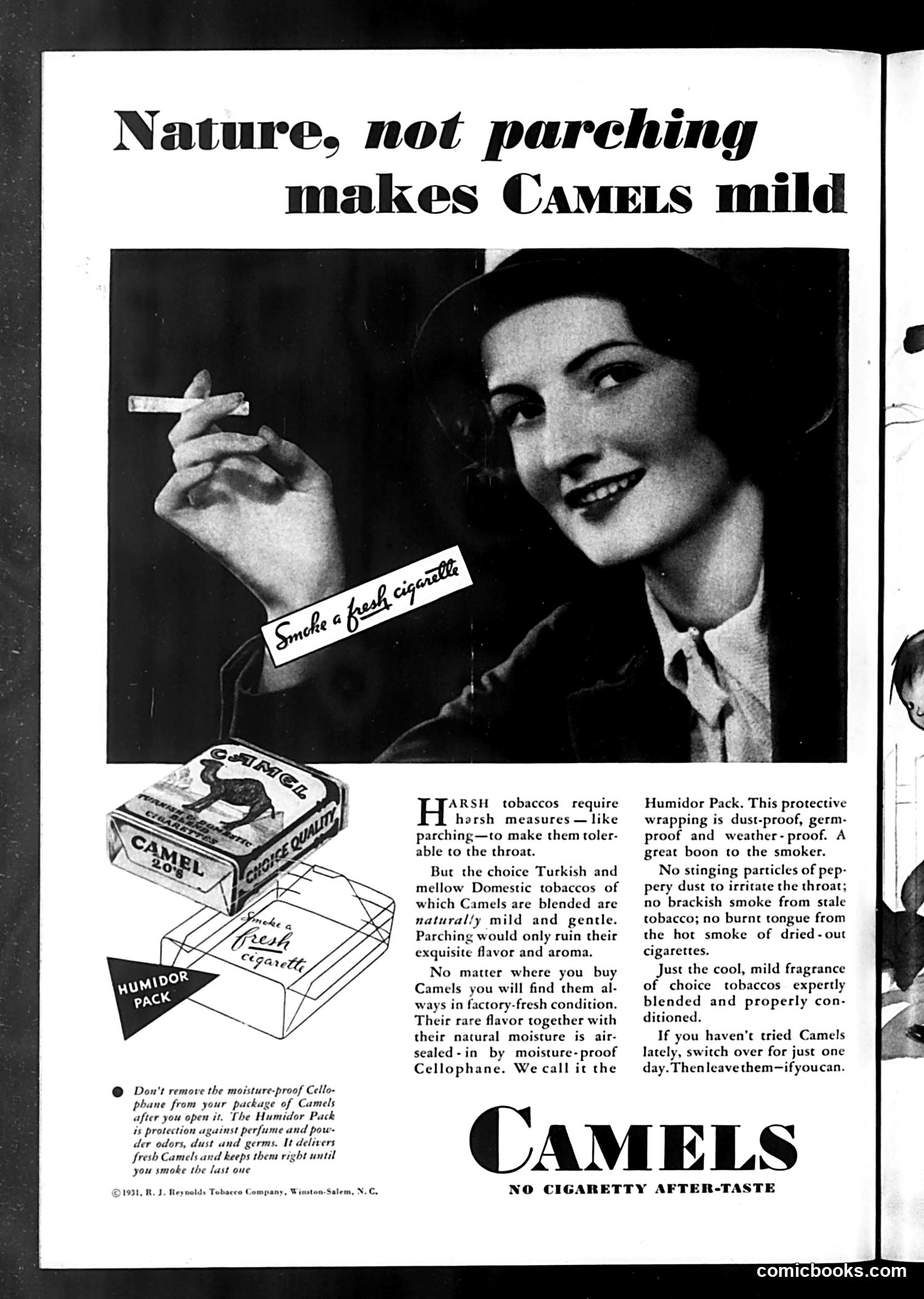
Camel Cigarettes Advertisement, 1931 This is a cigarette advertisement, not political satire. It promotes Camel brand cigarettes using a woman holding a lit cigarette as the central image. The ad's main argument: Camels are "naturally mild" because they use quality Turkish and Domestic tobaccos that don't require harsh "parching" (heat treatment) to be tolerable. Competitors presumably used inferior tobacco requiring parching, making them harsher. The "Humidor Pack" (moisture-proof Cellophane wrapping) is presented as a key feature—keeping cigarettes fresh, preventing staleness and "dried-out" smoke that causes throat irritation and "burnt tongue." The tagline promises "NO CIGARETTY AFTER-TASTE," addressing a consumer complaint about stale-cigarette flavor. For modern readers: this reflects 1930s advertising before health warnings, when manufacturers openly marketed cigarettes' sensory qualities (mild flavor, fresh taste, no aftertaste) without acknowledging addiction or health risks.