life
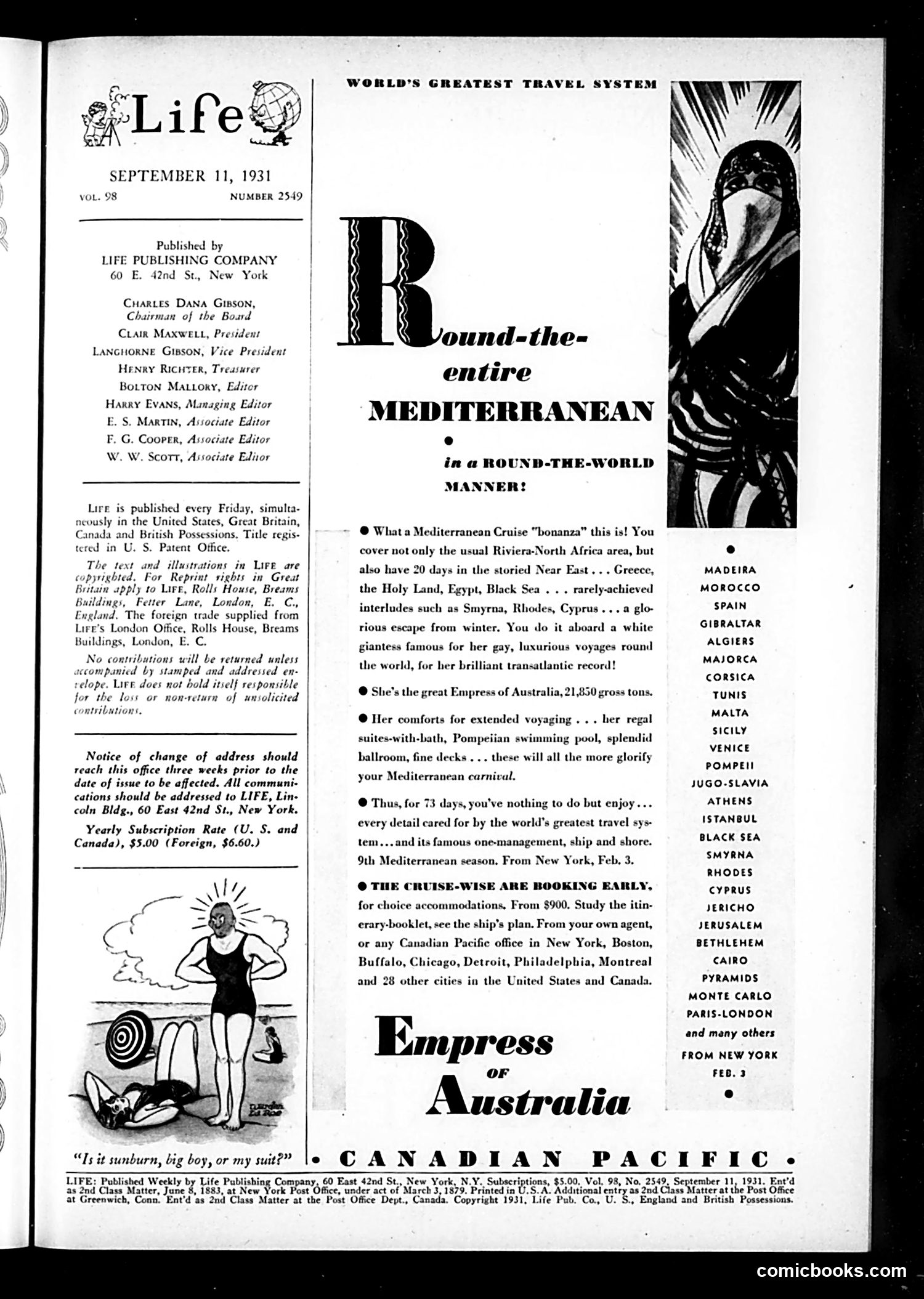
Life — September 11, 1931
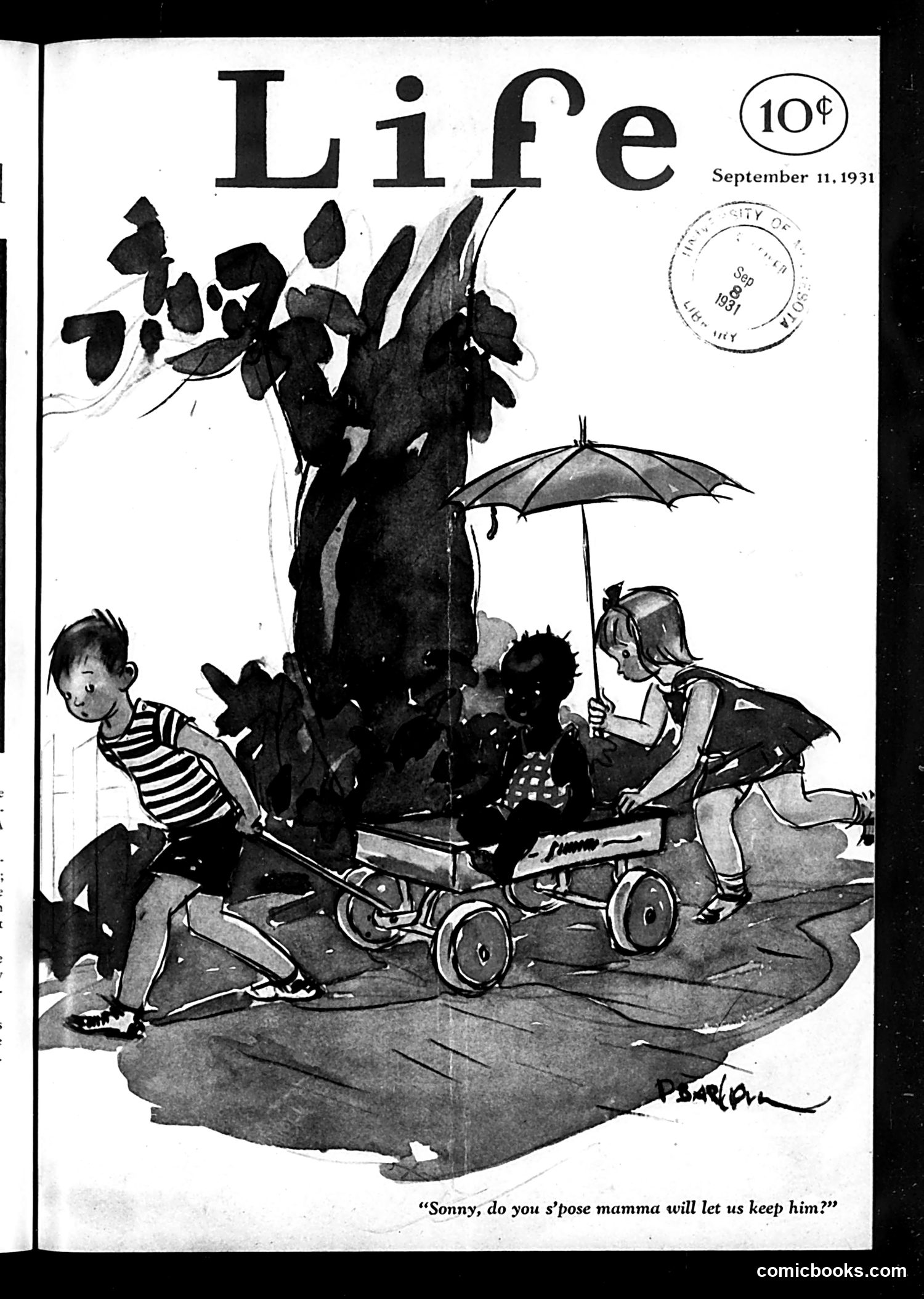
Life Magazine, September 11, 1931 This cover illustration shows children playing with toy vehicles beneath a wilted tree during what appears to be rainy weather. One child holds an umbrella while others sit in small pedal cars or similar toys. The caption reads: "Sonny, do you s'pose mamma will let us keep him?" The cartoon likely satirizes Depression-era parenting and economic hardship. The wilted, dying tree and gloomy weather establish a bleak mood. The children's question suggests they've found something or someone (possibly a stray animal or homeless person, unclear from the image alone) and are hoping their mother will allow them to keep it despite financial constraints. The joke plays on Depression-era scarcity and parents' difficult choices about what they could afford to support.
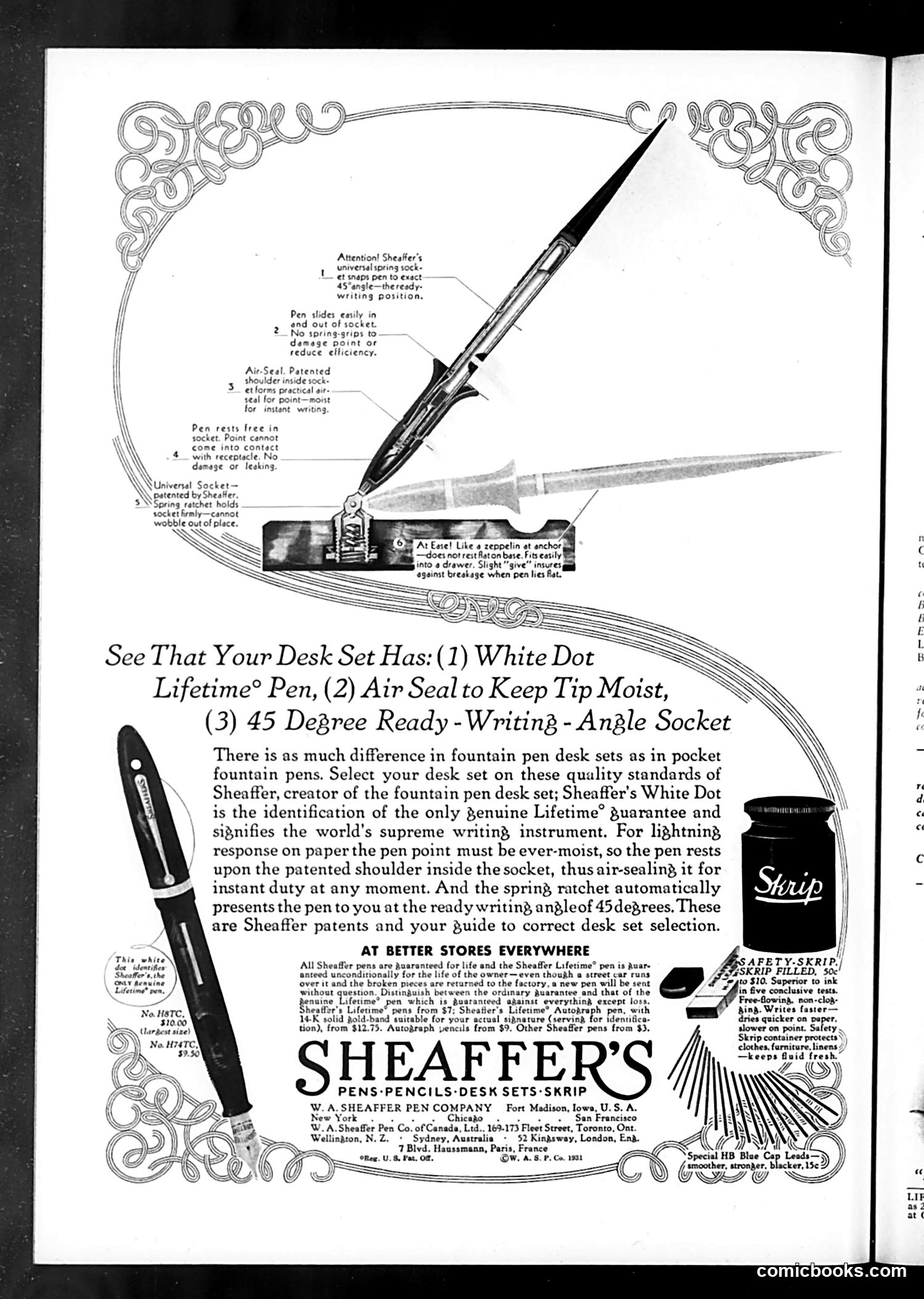
Content Analysis This is not a political cartoon or satirical content—it's a full-page advertisement for Sheaffer's fountain pens and desk sets, circa early 20th century. The ad features detailed technical illustrations of a Sheaffer fountain pen with numbered callouts explaining features like the "Air-Seal" cap, the 45-degree writing angle socket, and the pen's ability to keep the tip moist. A small pen image on the left shows the "White Dot" branding. The text emphasizes quality standards and patented design features, positioning Sheaffer's as superior to competitors. Small product images show the pen itself and a "Safety Scrip" desk set component. The ornate decorative border is typical 1920s-era magazine design. This is purely commercial marketing, not satire.
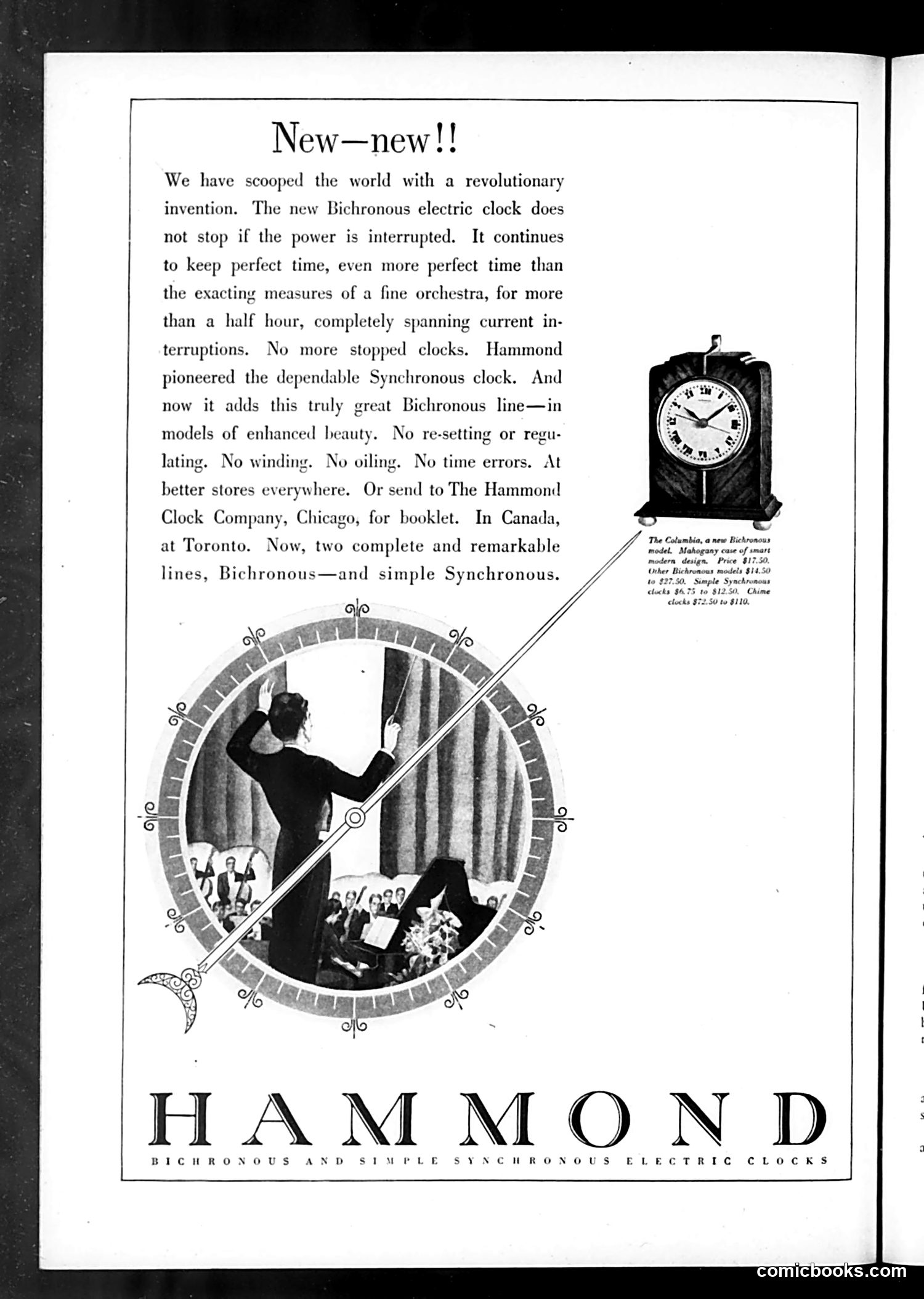
Hammond Electric Clocks Advertisement This is a product advertisement, not political satire. It promotes Hammond's new "Bichronous" electric clocks, which represent a technological advancement: they continue keeping time even if power interrupts, maintaining accuracy for over half an hour without electricity. The surreal imagery depicts a conductor leading an orchestra inside a giant clock face, visualizing the advertisement's claim that these clocks keep "perfect time, even more perfect time than the exacting measures of a fine orchestra." The accompanying table-model clock shows pricing ($14.50-$37.50 for Bichronous; $9.75-$12.50 for Synchronous models). This illustrates early 20th-century advertising strategy: using artistic imagery and bold claims about technological superiority to market consumer electronics.
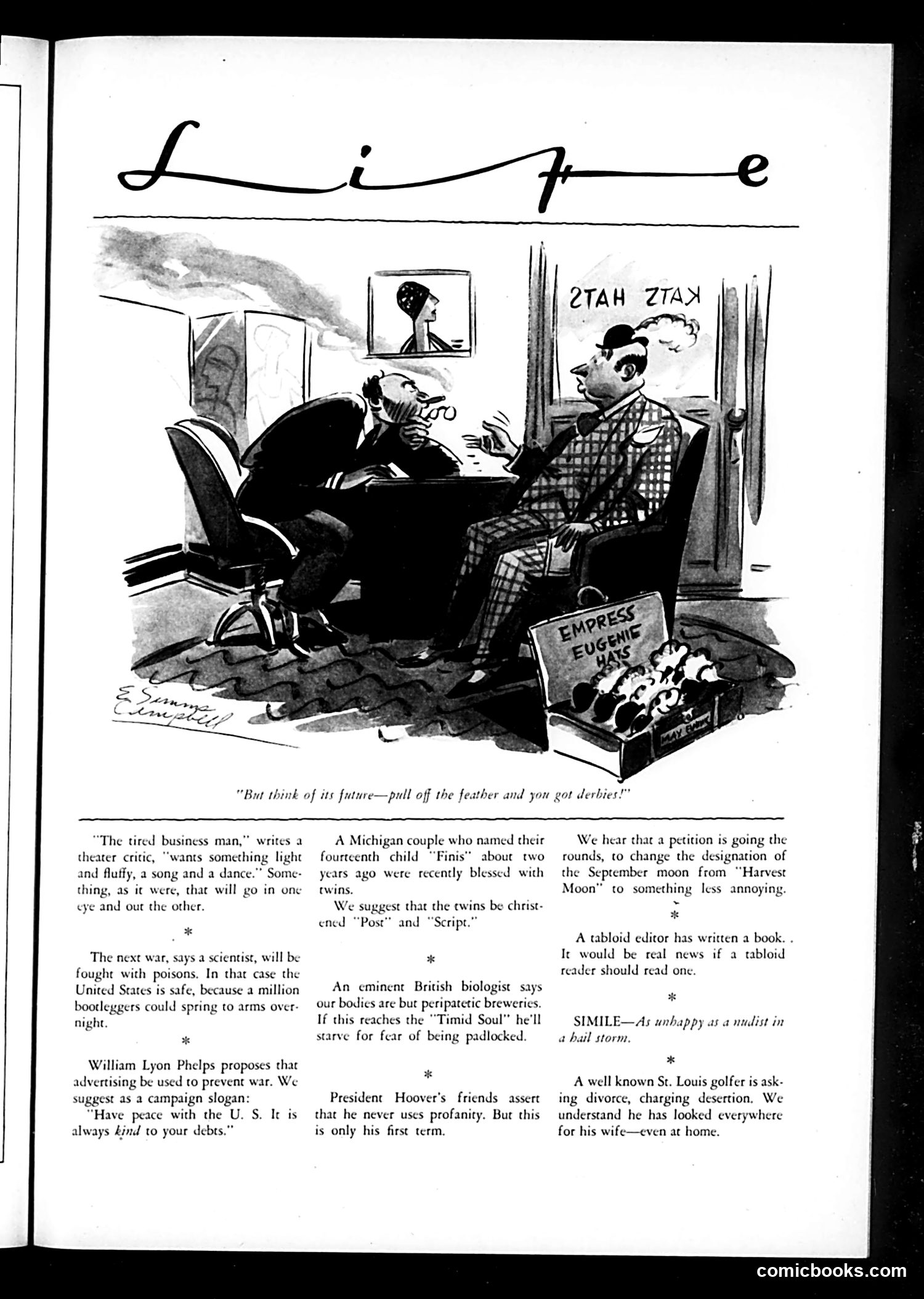
"Life" Page Analysis The main cartoon depicts two men at a desk, with a box labeled "EMPRESS EUGENE'S HATS" visible. The caption reads: "But think of its future—pull off the feather and you got derbies!" This appears to be satirizing early 20th-century fashion trends. The joke concerns women's elaborate hats (associated with Empress Eugénie, wife of Napoleon III) being so extravagant that removing decorative feathers would leave plain men's hats underneath—mocking the excess of women's millinery fashion. The surrounding text contains brief miscellaneous humor items typical of *Life* magazine's format, including quips about business, science predictions, naming conventions, and marital situations. The overall page exemplifies the magazine's satirical commentary on contemporary American society and fashion.
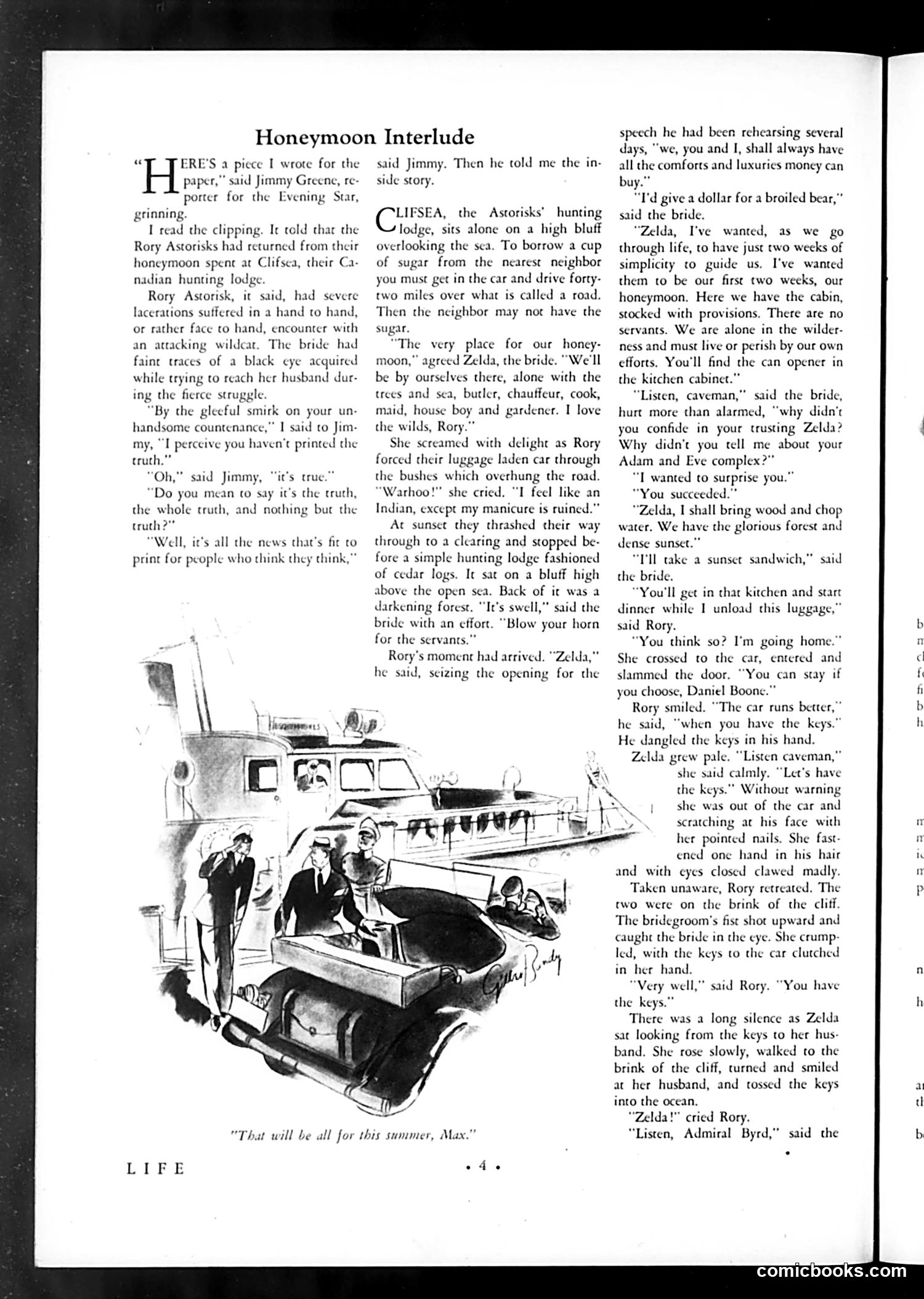
"Honeymoon Interlude" This is a humorous short story with an accompanying illustration, not a political cartoon. The narrative satirizes newlywed dynamics through a domestic conflict: a bride and groom arrive at their honeymoon lodge, where the groom (Roy) prioritizes going home over staying, and the bride (Zelda) responds by throwing the car keys into the ocean in anger. The satire targets early 20th-century marriage expectations—the bride's desire for romantic isolation versus the groom's casual indifference, and the bride's dramatic, vengeful response to rejection. The illustration shows their car and boat at a coastal lodge, visualizing the story's setting. The piece appears to be light social commentary on honeymoon culture and marital conflict rather than political satire.
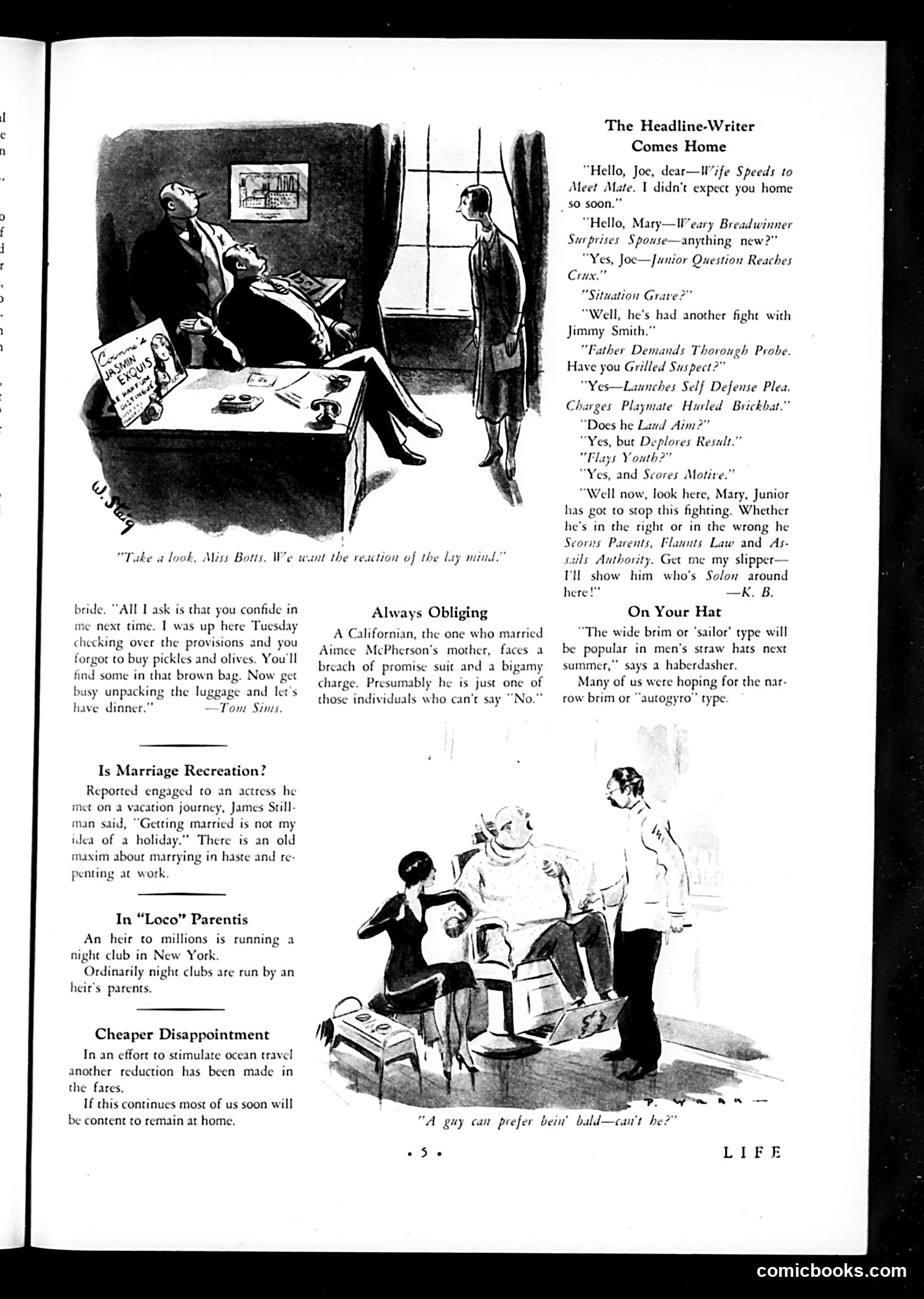
"The Headline-Writer Comes Home" This satirical piece mocks sensationalist newspaper headlines of the era. The cartoon shows a husband returning home, where his wife greets him with domestic news. Rather than conversing normally, he responds by mentally translating her everyday remarks into exaggerated tabloid headlines—"Wife Speeds to Meet Mate," "Weary Breadwinner Surprises Spouse," "Junior Question Reaches Crisis," etc. The satire targets how headline-writers of the period reduced human experience to dramatic, inflated language. The joke is that this professional deformation has so consumed the man that he cannot perceive ordinary life without sensationalizing it. The accompanying brief items ("Always Obliging," "Is Marriage Recreation?") continue this theme of satirizing contemporary social customs and newspaper culture.
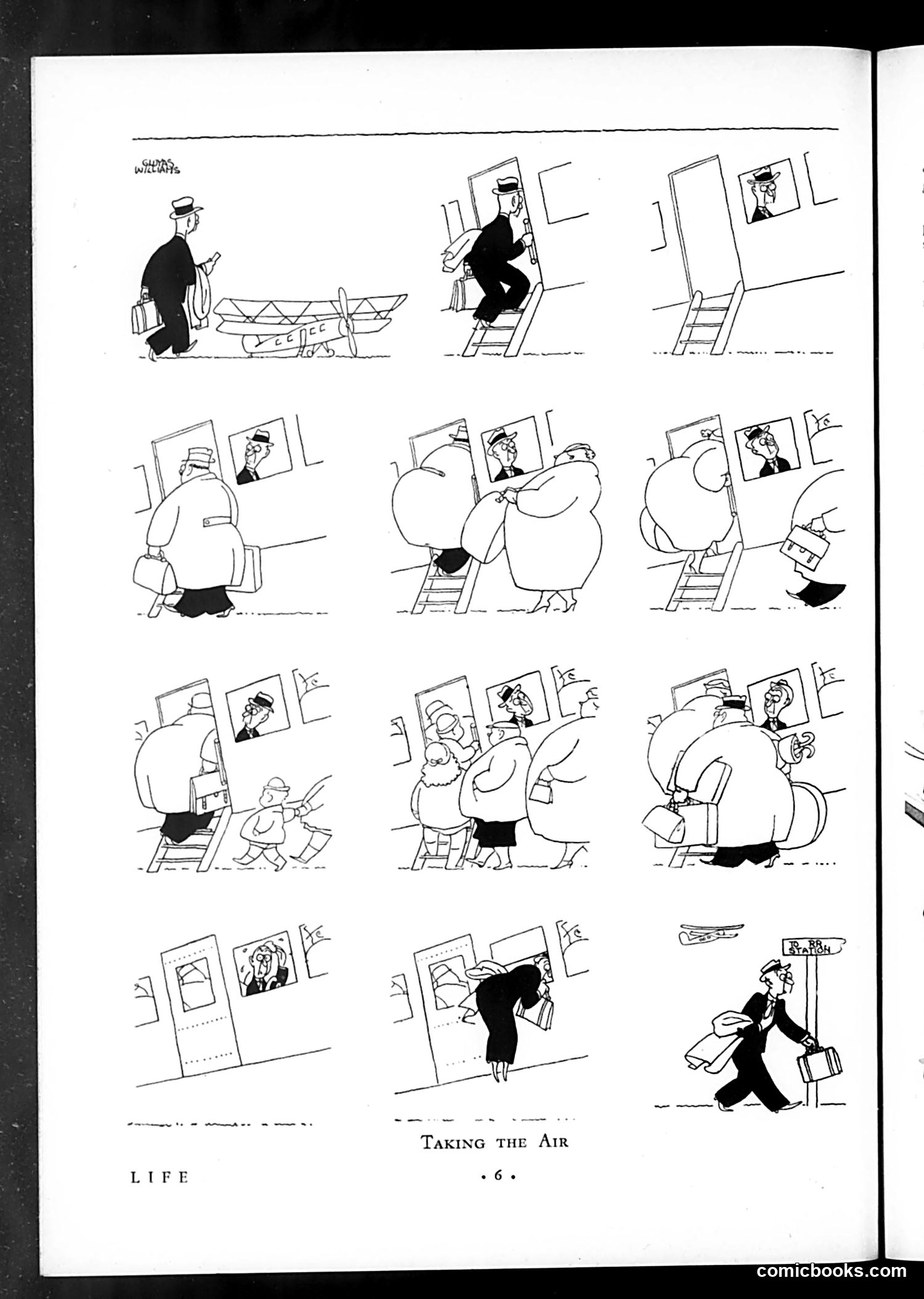
"Taking the Air" - Life Magazine Cartoon This is a sequential comic strip satirizing airplane travel, likely from the early-to-mid 20th century when commercial aviation was novel and passengers were often portly businessmen. The narrative shows a well-dressed gentleman with a briefcase boarding an aircraft. As the plane fills with other passengers, they become increasingly squeezed together due to their generous proportions. The cramped conditions worsen progressively through the panels, with passengers literally wedged against each other. The joke critiques both the absurdity of early airplane design's limited capacity and the physical reality of transporting large numbers of overweight passengers in confined spaces. The satire mocks both the passengers' size and the aviation industry's optimistic expectations about passenger comfort.
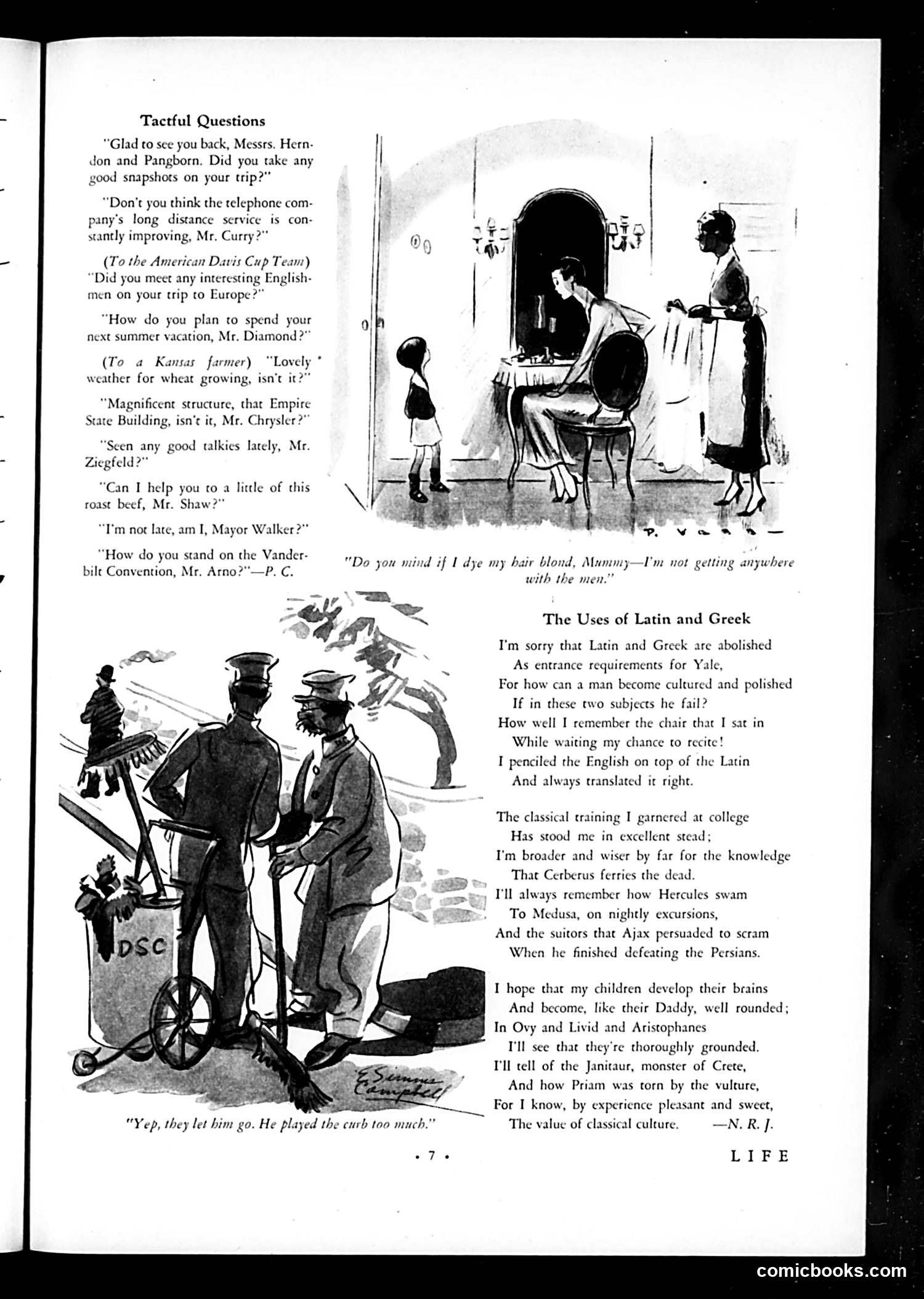
Analysis of Life Magazine Page This page contains two distinct elements: "Tactful Questions" (top left): A collection of supposedly innocent but pointed questions asked to various businessmen and public figures—critiquing their recent trips, business practices, and public statements. The satire lies in feigning politeness while making barbed observations about corporate performance and leadership. Top right cartoon: Shows a woman at her hair salon, worried about hair dye staining. The humor plays on anxieties about women's grooming practices and cosmetic use. Bottom cartoon: Depicts what appears to be a disabled or injured man being escorted away, with the caption "Yep, they let him go. He played the curb too much"—dark satire about workplace accidents or disability. "The Uses of Latin and Greek": A poem defending classical education's value despite changing curriculum requirements, reflecting early 20th-century debates about educational modernization versus traditional learning.
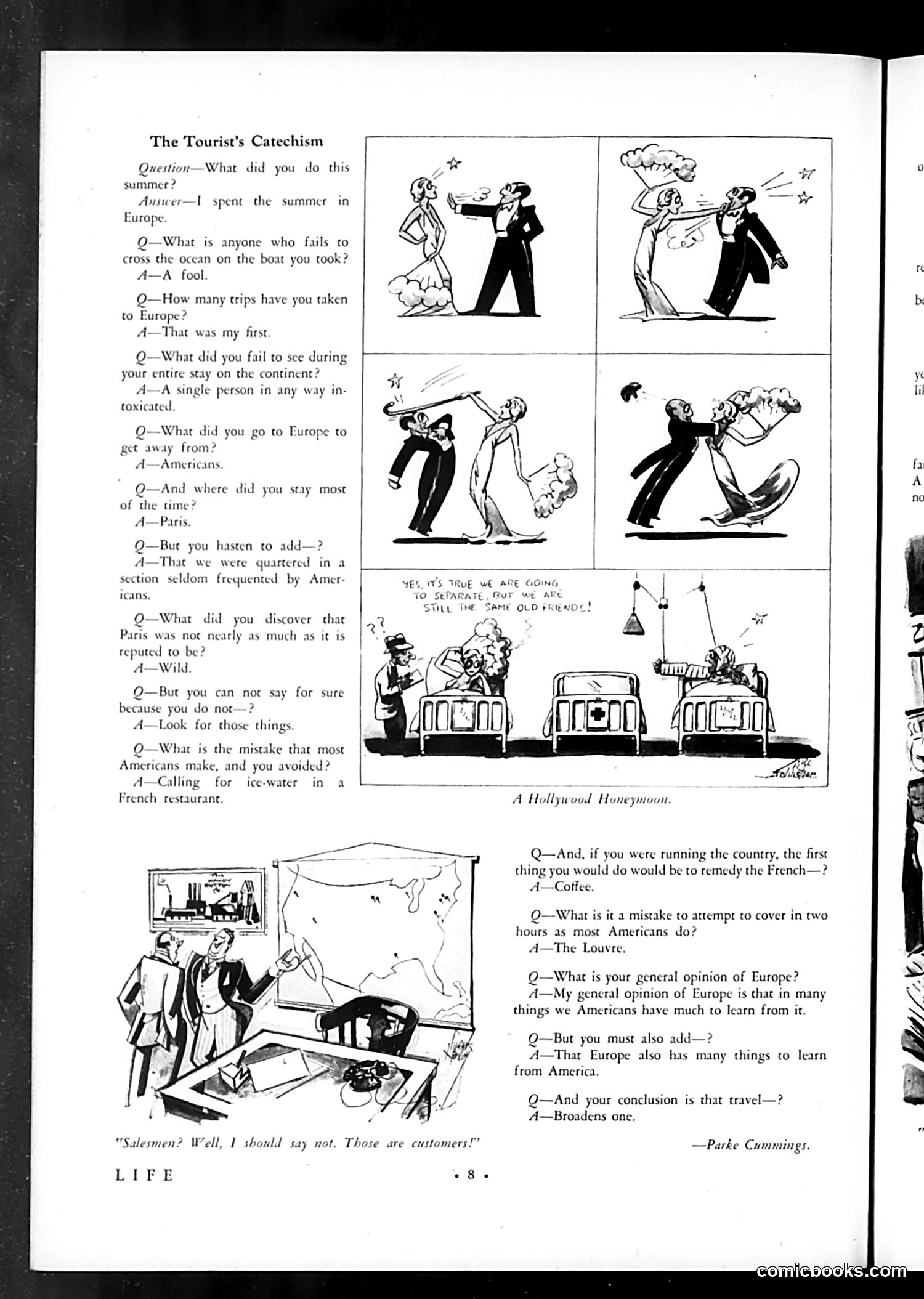
"The Tourist's Catechism" - Life Magazine Satire This satirical Q&A mocks American tourists returning from European vacations. The humor targets: Common tourist behaviors: - Spending summers in Europe as a status symbol - Failing to experience authentic culture despite extensive travel - Quarreling with spouses during trips - The cliché of visiting Paris repeatedly Specific American tourist mistakes: - Ordering ice-water in French restaurants (culturally inappropriate) - Rushing through major sites like the Louvre in mere hours - Complaining about French customs The cartoons illustrate these stereotypes: couples arguing, women being "swept away," and the final image shows a "Hollywood Honeymoon" with separated cars—implying even newlyweds can't enjoy travel together. The satire's point: American tourists travel abroad not for genuine cultural understanding, but for bragging rights and status, while remaining fundamentally disconnected from—and critical of—foreign cultures.
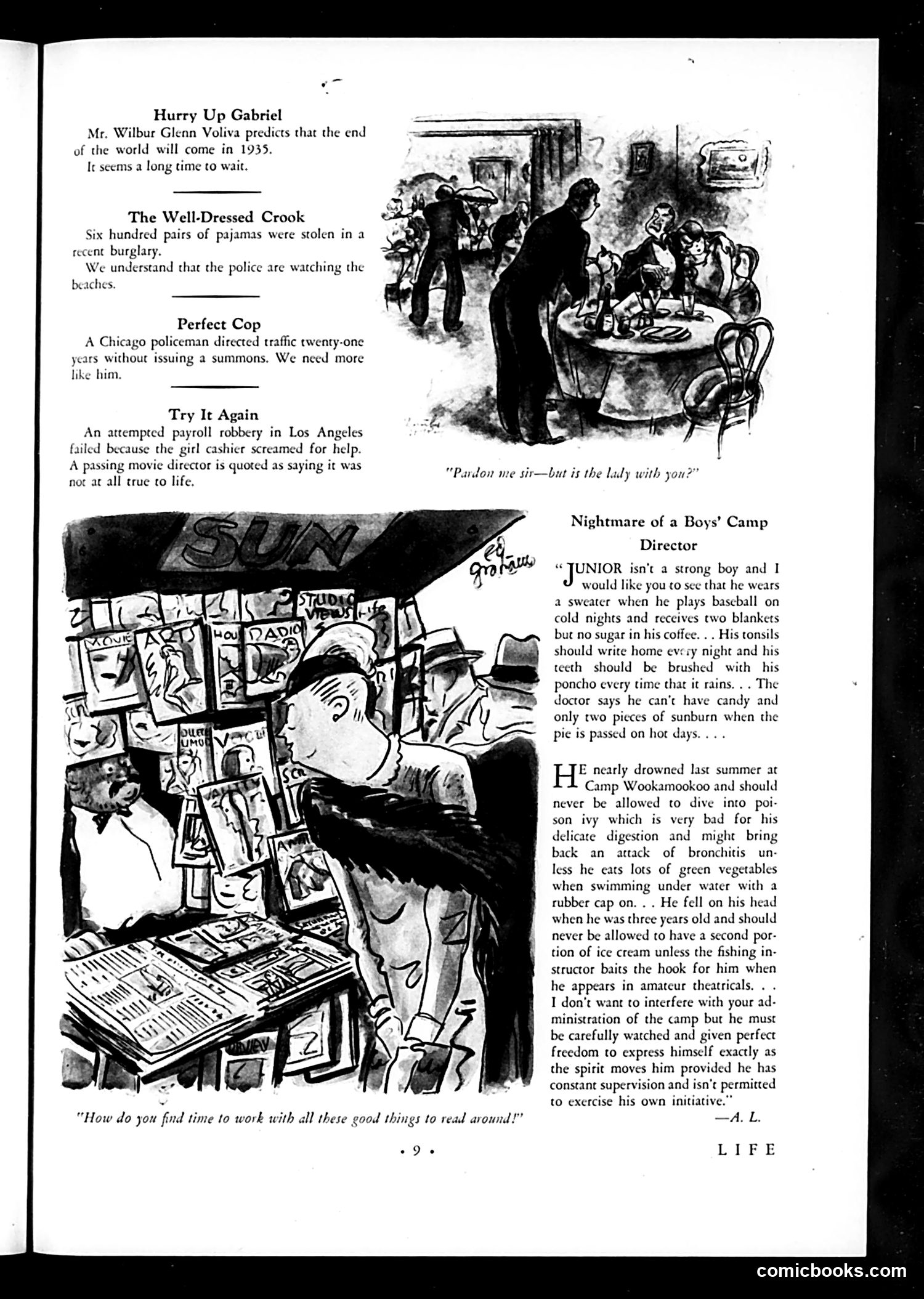
Life Magazine Page Analysis This page contains brief humorous news items and two cartoons satirizing American life. Top cartoon depicts a dinner scene with the caption "Pardon me sir—but is the lady with you?" The joke plays on social awkwardness and assumptions about relationships. Bottom cartoon shows a newsstand vendor overwhelmed by reading materials, captioned "How do you find time to work with all these good things to read around!" This satirizes the explosion of available publications and media competing for people's attention—a modern consumer culture problem. The right-hand column features advice from a boys' camp director detailing absurdly overprotective instructions for a camper named "Junior," satirizing helicopter parenting and excessive parental anxiety about children's welfare and minor injuries.
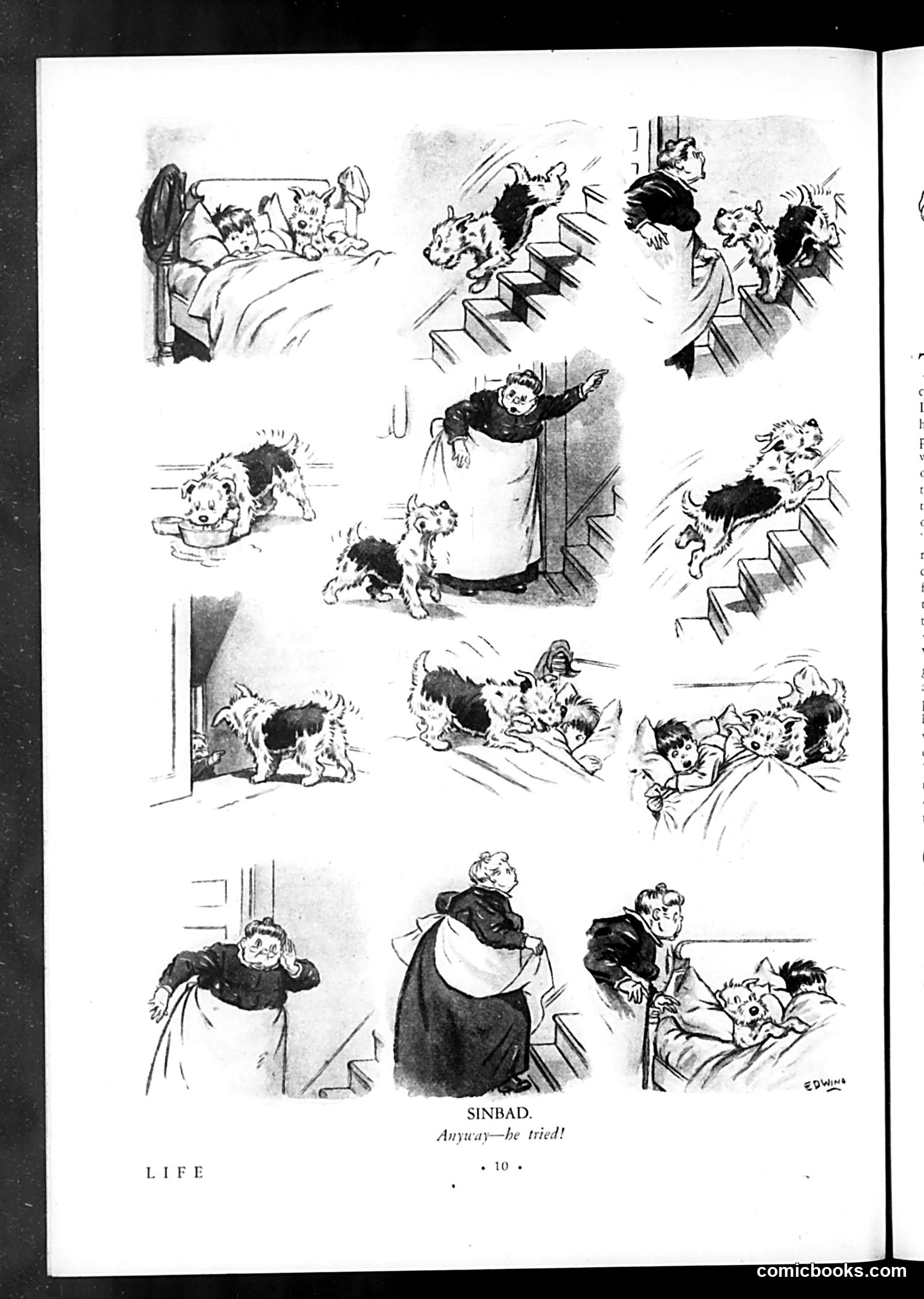
Analysis of "Sinbad: Anyway—he tried!" This is a satirical comic strip about Sinbad the Sailor, the legendary character from *Arabian Nights*. The sequence depicts Sinbad repeatedly attempting various schemes or adventures, only to fail each time—shown through a series of panels where he encounters obstacles, gets chased by animals (appears to be dogs), is thrown down stairs, and otherwise comes to comedic grief. The phrase "Anyway—he tried!" suggests the humor lies in Sinbad's persistent but hapless efforts despite constant failure. This likely parodies both the famous adventurer's legendary exploits and contemporary attitudes about ambition versus reality. The artist's signature appears to be "EDWillard" or similar.
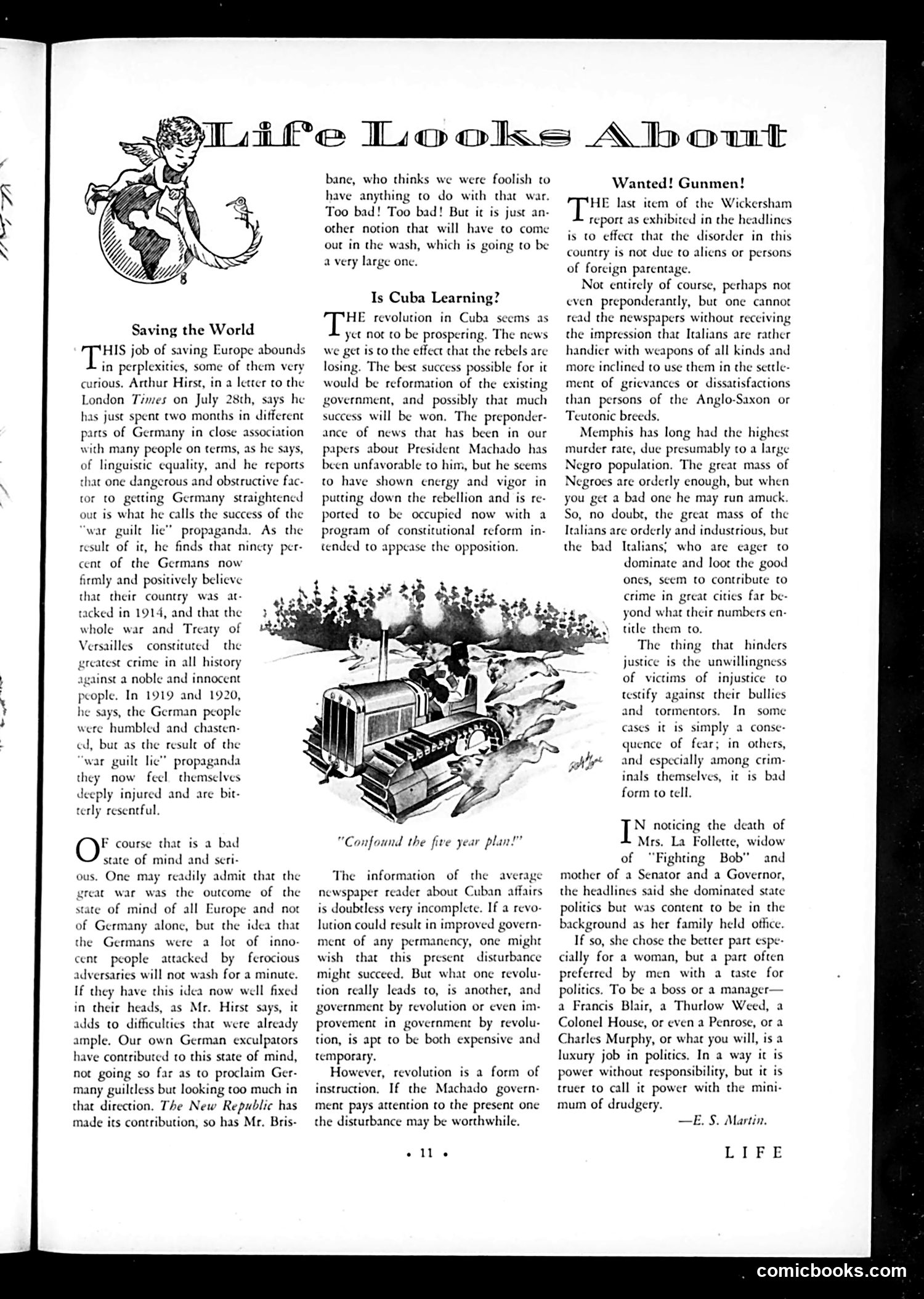
Analysis of Life Magazine Page 11 This page contains three opinion pieces about post-WWI politics. The main cartoon titled "Confound the fire year plan!" depicts a tractor crushing military equipment, satirizing Soviet economic policy. The image suggests skepticism about the Soviet Union's ambitious industrialization goals, portraying them as destructive to military readiness. The text sections address: 1. "Saving the World" — critiques German war guilt propaganda and argues Germans now resent the Treaty of Versailles 2. "Is Cuba Learning?" — discusses Cuba's post-revolution instability and questions whether the new government can establish order 3. "Wanted! Gunmen" — blames Italian crime on native criminality rather than foreign influence The overall tone reflects American conservative skepticism toward revolutionary governments and post-war instability.
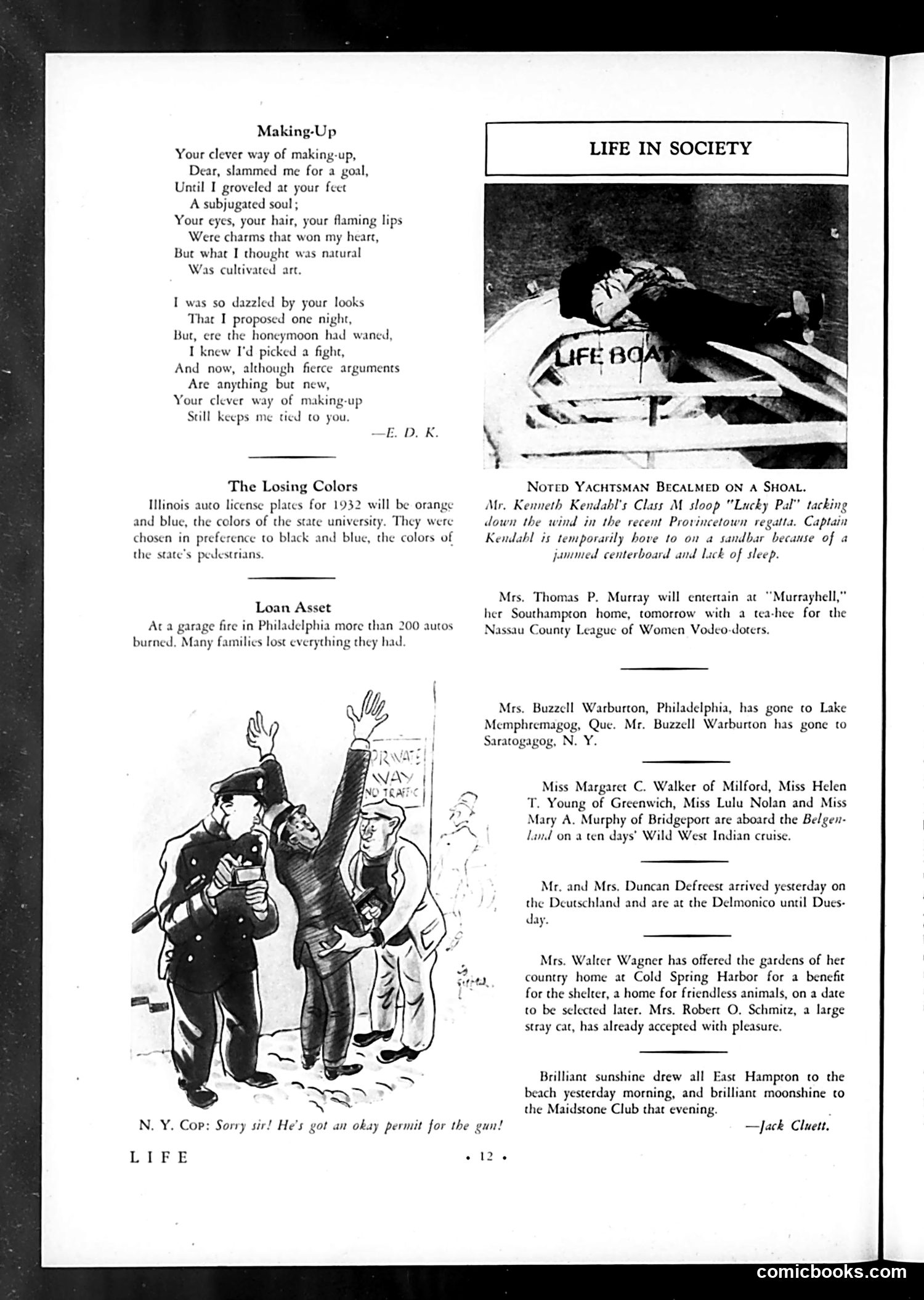
Analysis of Life Magazine Page 12 This page combines poetry, social commentary, and humor typical of 1930s Life magazine. The cartoon depicts a New York City police officer telling someone "Sorry sir! He's got an okay permit for the gun!" — satirizing the absurdity of permit systems during Prohibition era crime waves. The visual of armed civilians reflects anxiety about urban violence and inadequate law enforcement. "The Losing Colors" notes Illinois changing its 1932 auto license plates from orange/blue to black/blue, satirizing bureaucratic decision-making. "Loan Asset" references the Philadelphia garage fire where families lost belongings — dark humor about insurance and disaster. The "Life in Society" section contains society gossip and travel notices typical of the era's magazine format, aimed at upper-class readers.
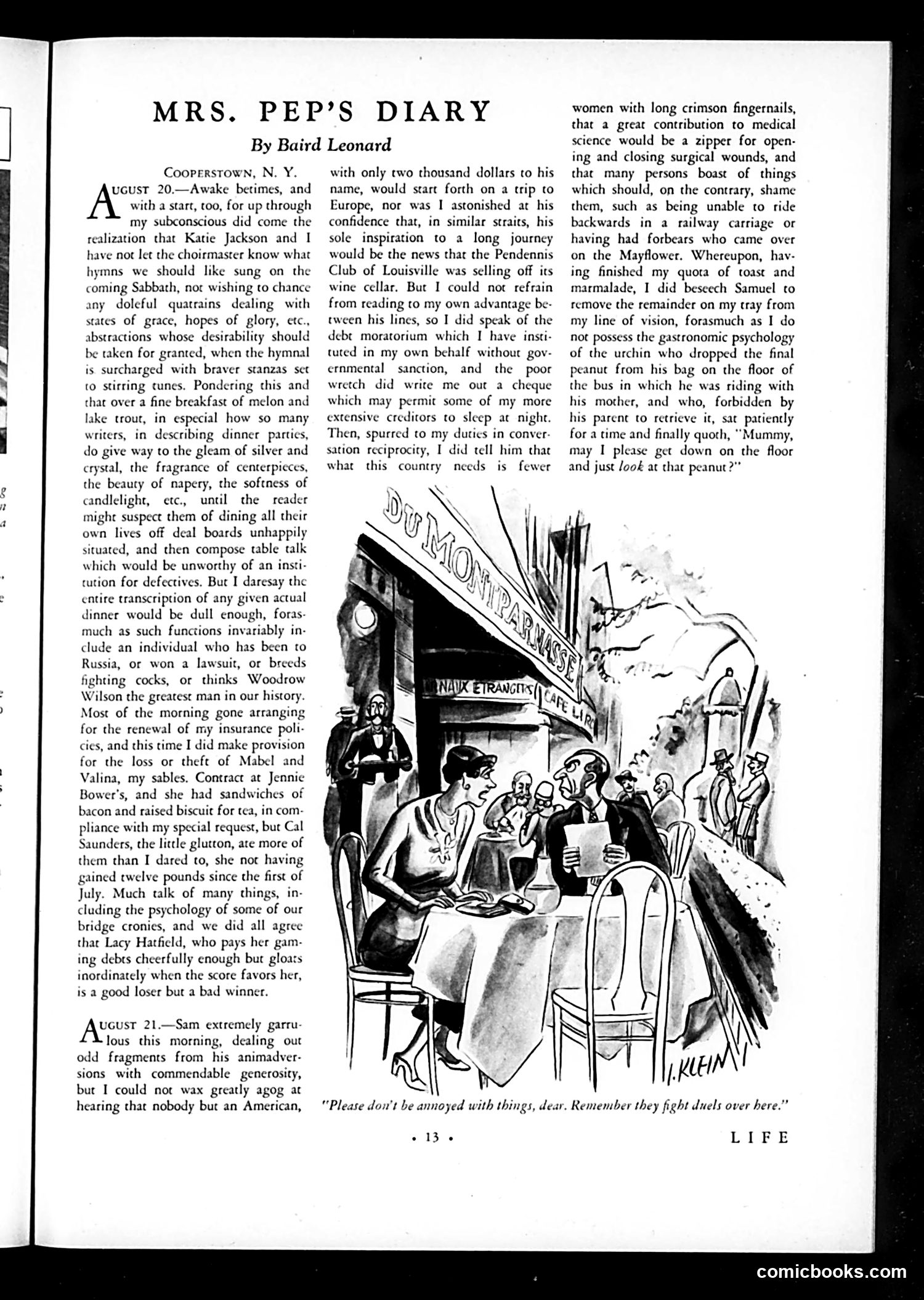
Mrs. Pep's Diary Analysis This page from *Life* magazine features a satirical diary entry by Baird Leonard dated August 20-21, set in Cooperstown, N.Y. The accompanying cartoon illustrates a social dinner scene at what appears to be a restaurant or club ("Dumpy's"). The humor targets upper-class American social pretension. The diarist mocks wealthy acquaintances obsessed with trivial concerns—insurance policies, servants, bridge games—while affecting worldliness. The cartoon's caption, "Please don't be annoyed with things, dear. Remember they fight duels over here," suggests Europeans (likely French, given "duels") treat serious matters more dramatically than Americans. The satire critiques American materialism and social climbing among the leisure class, contrasting it with perceived European sophistication and honor-bound culture.
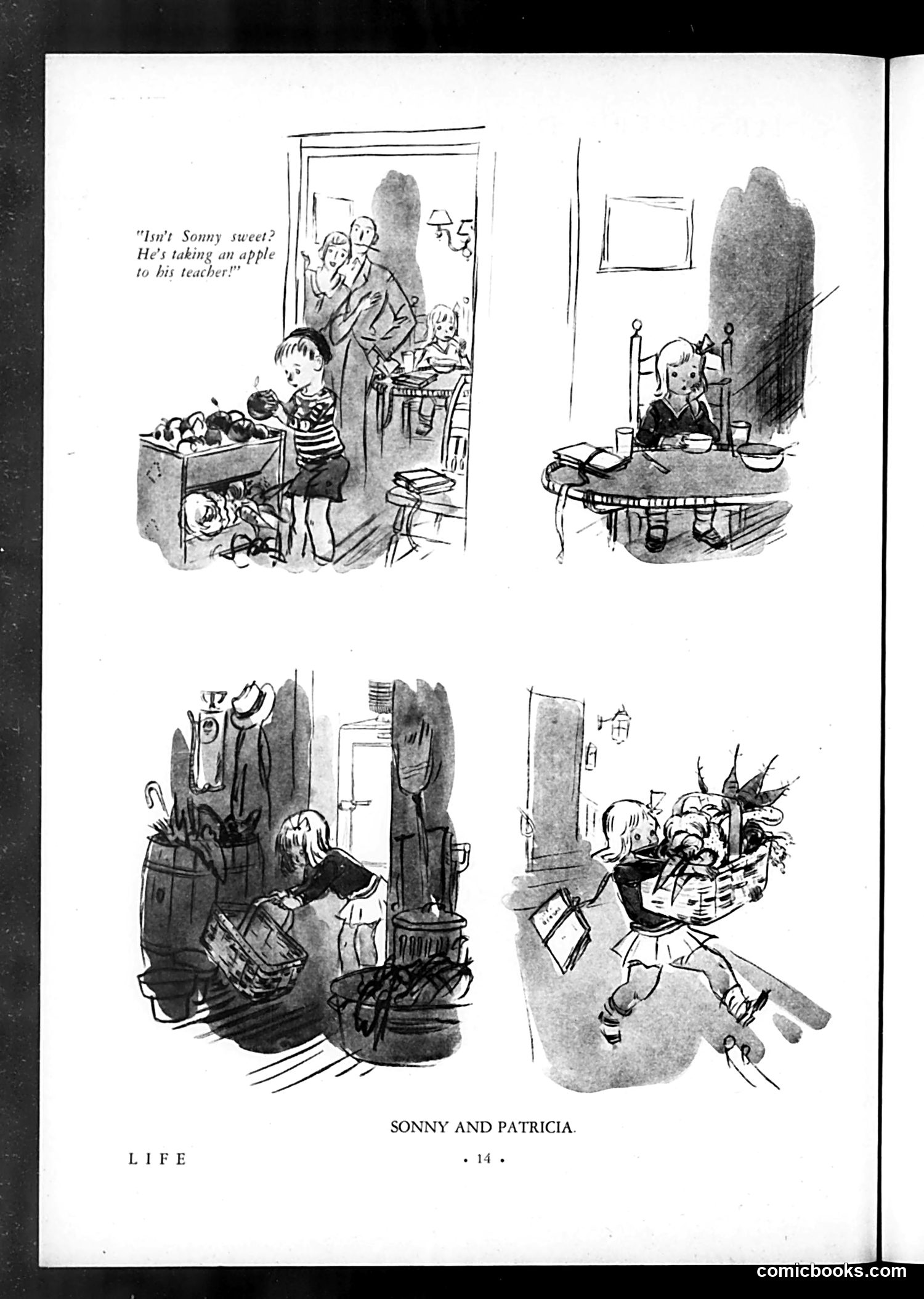
"Sonny and Patricia" Comic Strip Analysis This is a four-panel domestic humor strip titled "Sonny and Patricia" from *Life* magazine (page 14). The strip depicts a relatable parenting scenario: a mother asks her son if he's taking an apple to his teacher—a common childhood gesture of respect or bribery toward educators. The humor escalates across the panels, showing increasingly chaotic consequences. What begins as an innocent question about a single apple becomes a comedic disaster, with the child apparently absconding with an enormous pile of apples or produce, ultimately causing mayhem and destruction. The joke satirizes both childhood mischief and parental expectations about teaching respect to children through simple gestures.
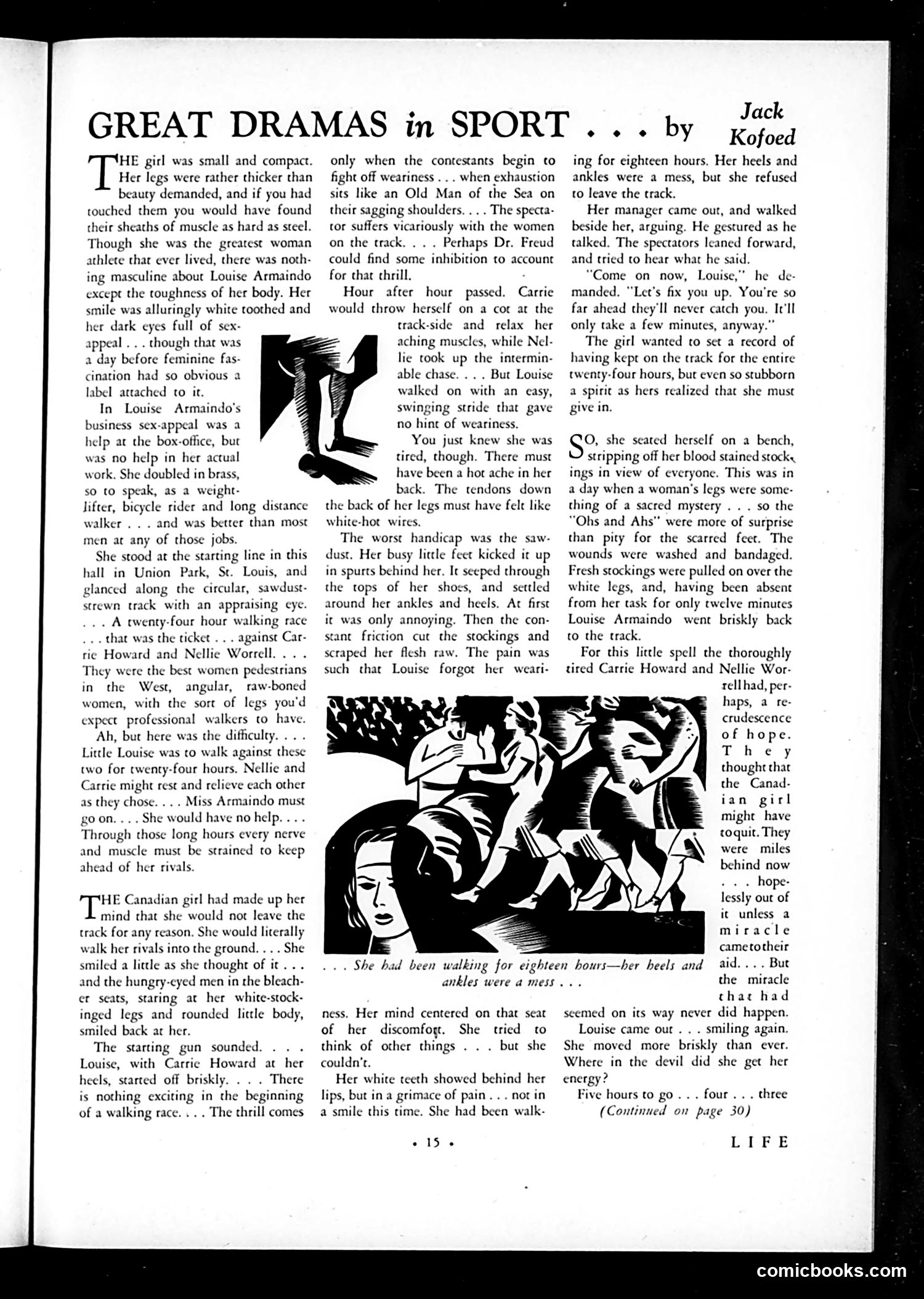
"Great Dramas in Sport" by Jack Kofoed This appears to be a sports narrative article rather than political satire. The text describes a women's endurance walking race, featuring competitors Louise Armiando, Carrie Howard, and Nellie Worrell—described as "the best women pedestrians in the West." The accompanying illustration shows the exhausted female walkers in dramatic physical distress during their twenty-four-hour competition. The narrative emphasizes the grueling physical toll: bloody feet, aching muscles, and mental endurance required. This reflects early-1900s attitudes toward women's athletics—portraying female competitors as remarkable precisely *because* they're women attempting "masculine" feats of endurance. The dramatic language and imagery sensationalize their suffering rather than celebrate their achievement, which would seem patronizing to modern readers.
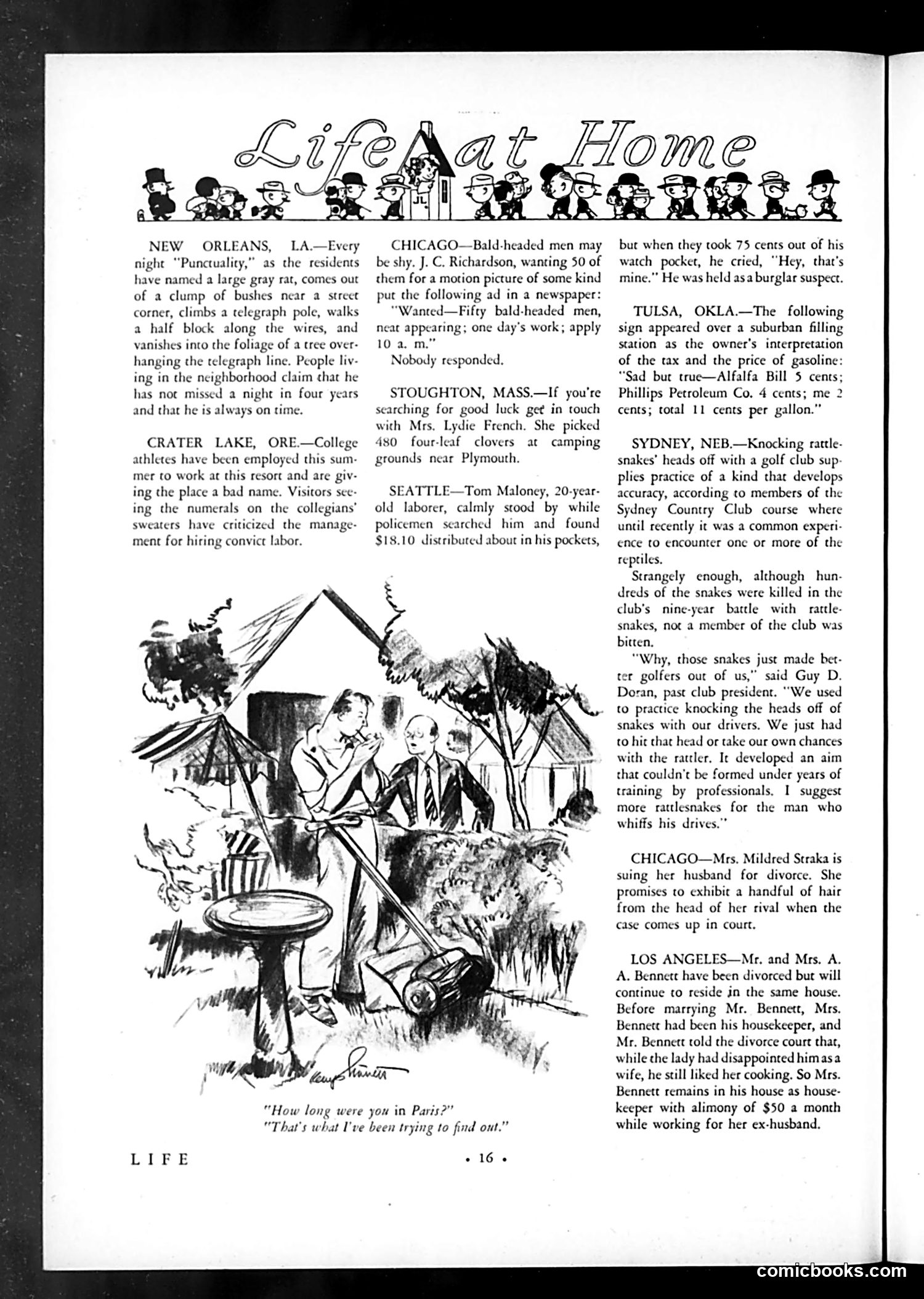
Life Magazine "Life at Home" Page Analysis This page presents humorous anecdotes from various American cities, a typical Life magazine format. The central cartoon depicts a couple in Paris—a man and woman sitting outdoors. The woman asks, "How long were you in Paris?" and the man replies, "That's what I've been trying to find out." The joke satirizes marital discord: the husband's evasive answer suggests he's been avoiding his wife or concealing his whereabouts. This plays on common 1920s-30s themes of infidelity and domestic tension. The surrounding "Life at Home" stories mock various social situations—a rat problem in New Orleans, bald men being cast for film roles in Chicago, a woman's good luck finding clovers, and a man holding $18.10in loose change. These brief anecdotes represent everyday American life presented for satirical humor.
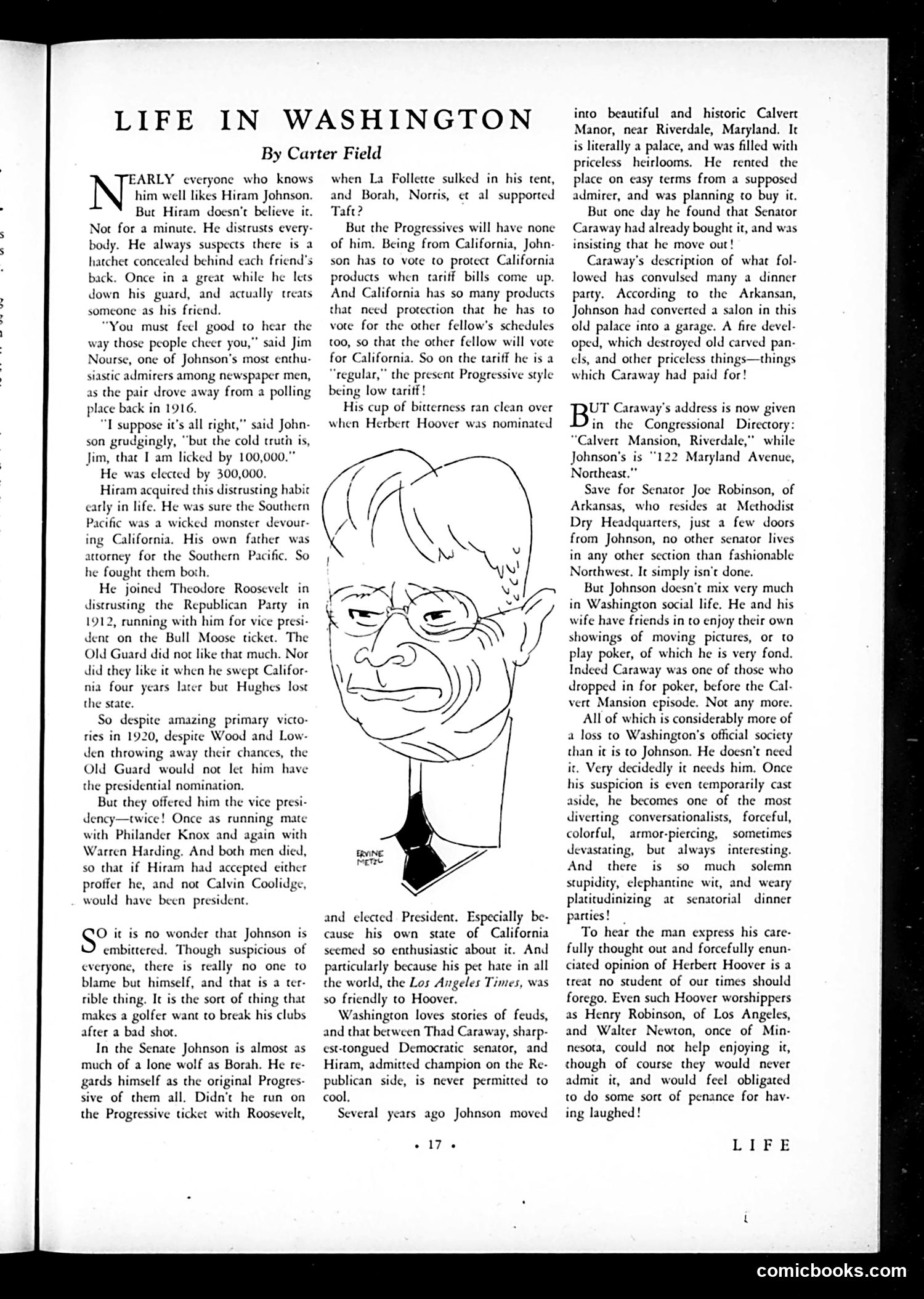
Political Cartoon Analysis: "Life in Washington" by Carter Field This page satirizes Senator Hiram Johnson of California through a caricatured portrait. The article describes Johnson as a perpetually suspicious, lone-wolf figure in the Senate—distrustful of colleagues and always suspecting hidden motives. The cartoon emphasizes his cantankerous personality through exaggerated facial features (prominent nose, furrowed brow). The text explains Johnson's political isolation: he refused to support fellow Progressives and was rejected as a vice-presidential candidate twice. The satire critiques Johnson's inability to work cooperatively in Washington society, noting he avoids social events and poker games. The piece suggests his suspicion and combativeness, while "always interesting," make him unpleasant company—a cautionary portrait of political inflexibility and paranoia.
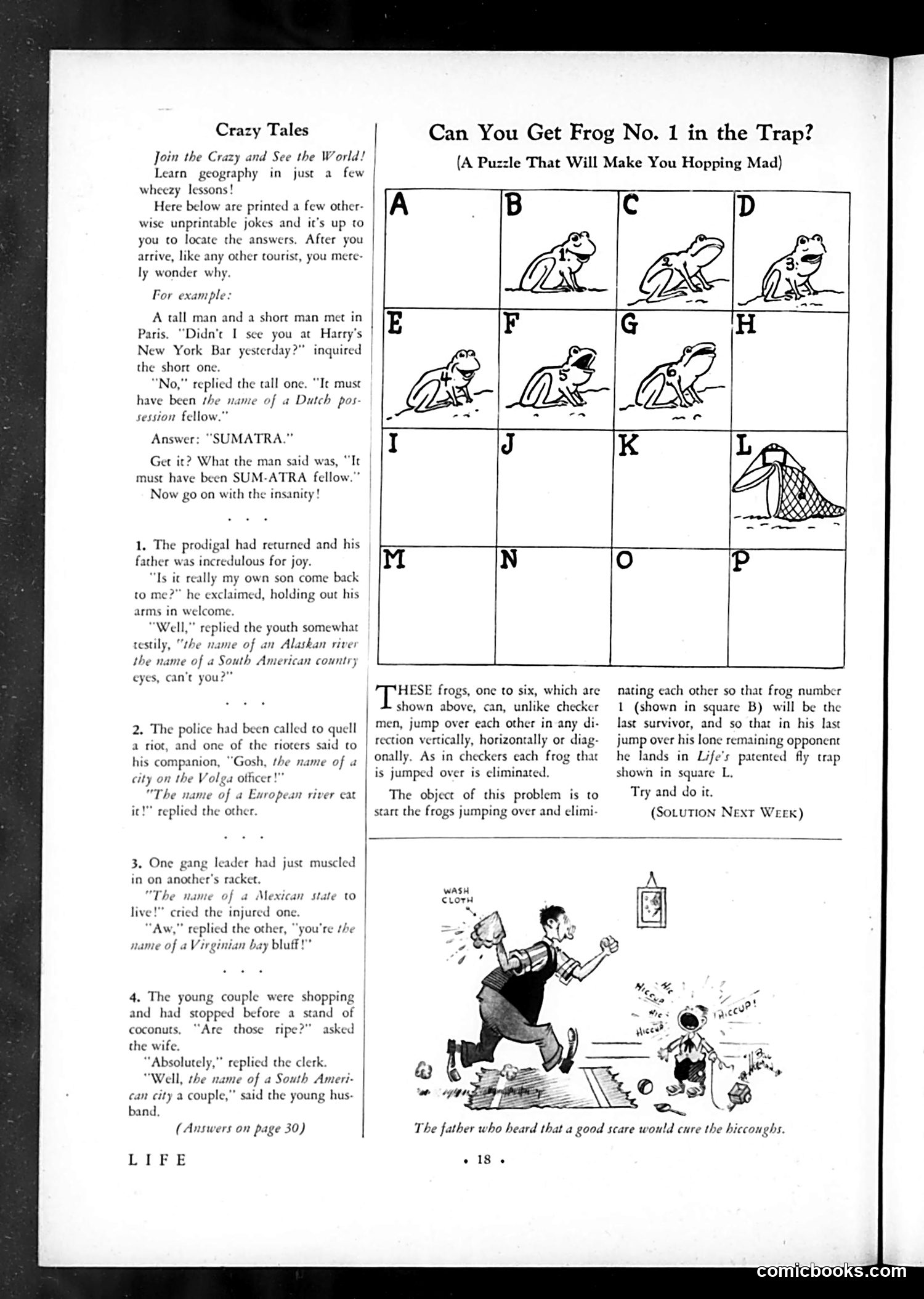
Explanation for Modern Readers This page from *Life* magazine contains two distinct sections: Left side ("Crazy Tales"): A humor column presenting geography-based puns. Each joke relies on wordplay where a geographical location sounds like an ordinary word or phrase (e.g., "Sumatra" → "Sum-a-tra"). Examples include references to Alaskan rivers, the Volga, and Mexican states used as punchlines. This was popular early-20th-century magazine humor. Right side: A logic puzzle featuring illustrated frogs that can "jump" over each other like checkers pieces. The goal is to manipulate frog positions to trap frog #1 in square L. Bottom cartoon: Shows a father being startled by domestic chaos—spilled items, a child, and scattered objects—illustrating the caption's reference to getting "a good scare would cure the hiccoughs" (a folk remedy). The content reflects vintage *Life* magazine's mix of wordplay, puzzles, and domestic humor typical of its era.
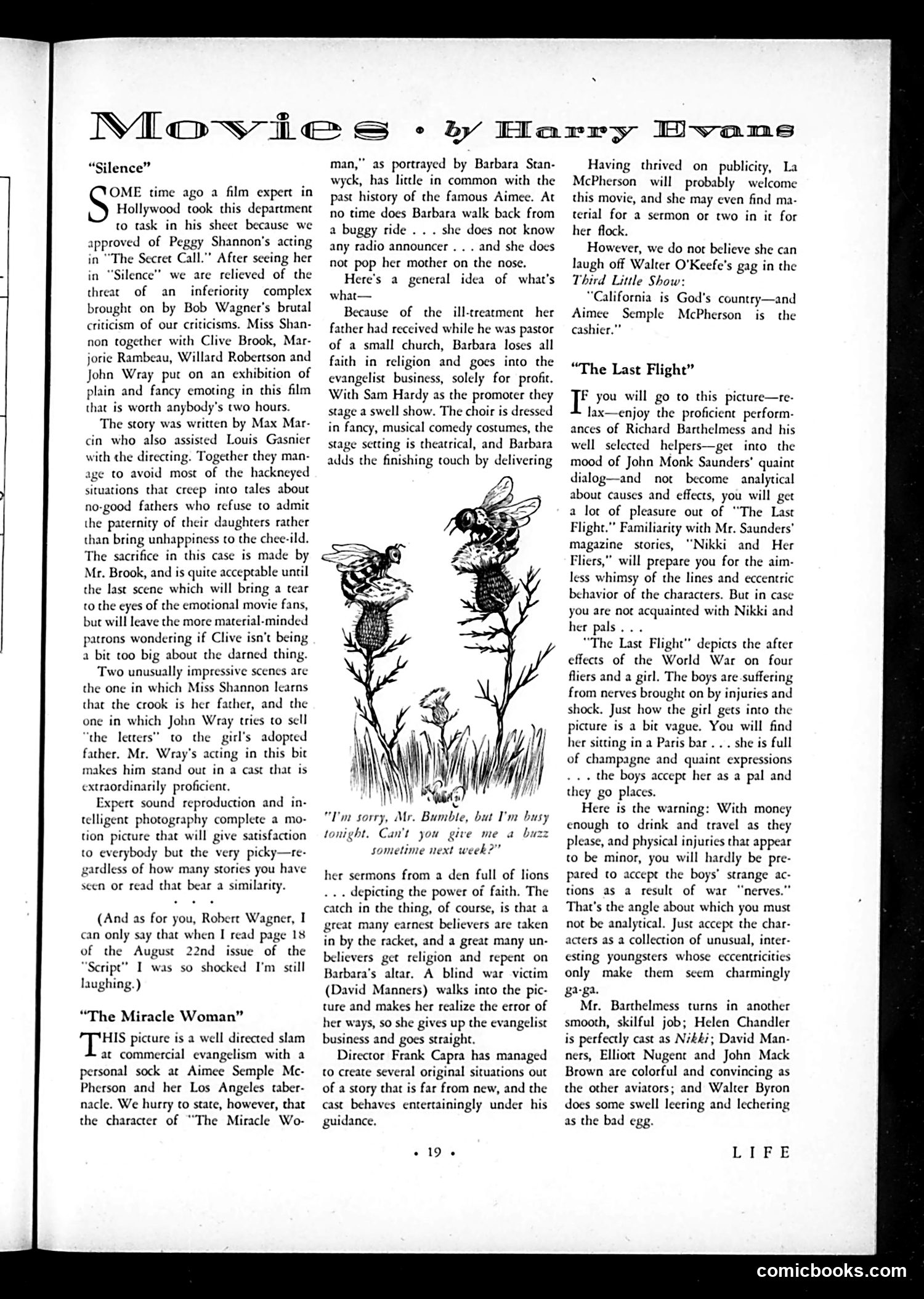
Movie Reviews from Life Magazine This page contains film reviews by Harry Evans covering four movies: "Silence," "The Miracle Woman," "The Last Flight," and a third film mentioned. The central illustration shows bees on flowers, accompanying a caption: "I'm sorry, Mr. Bumble, but I'm busy tonight. Can't you give me a buzz sometime next week?" This is a visual pun—the image depicts actual bees while "buzz" refers to telephone calls, playing on the double meaning of the word. The reviews discuss plot summaries and acting performances. There's criticism of "Silence" for its storyline about religious hypocrisy and loss of faith. The tone is that of entertainment criticism rather than political satire, offering judgments on cinema quality and narrative merit for contemporary audiences.
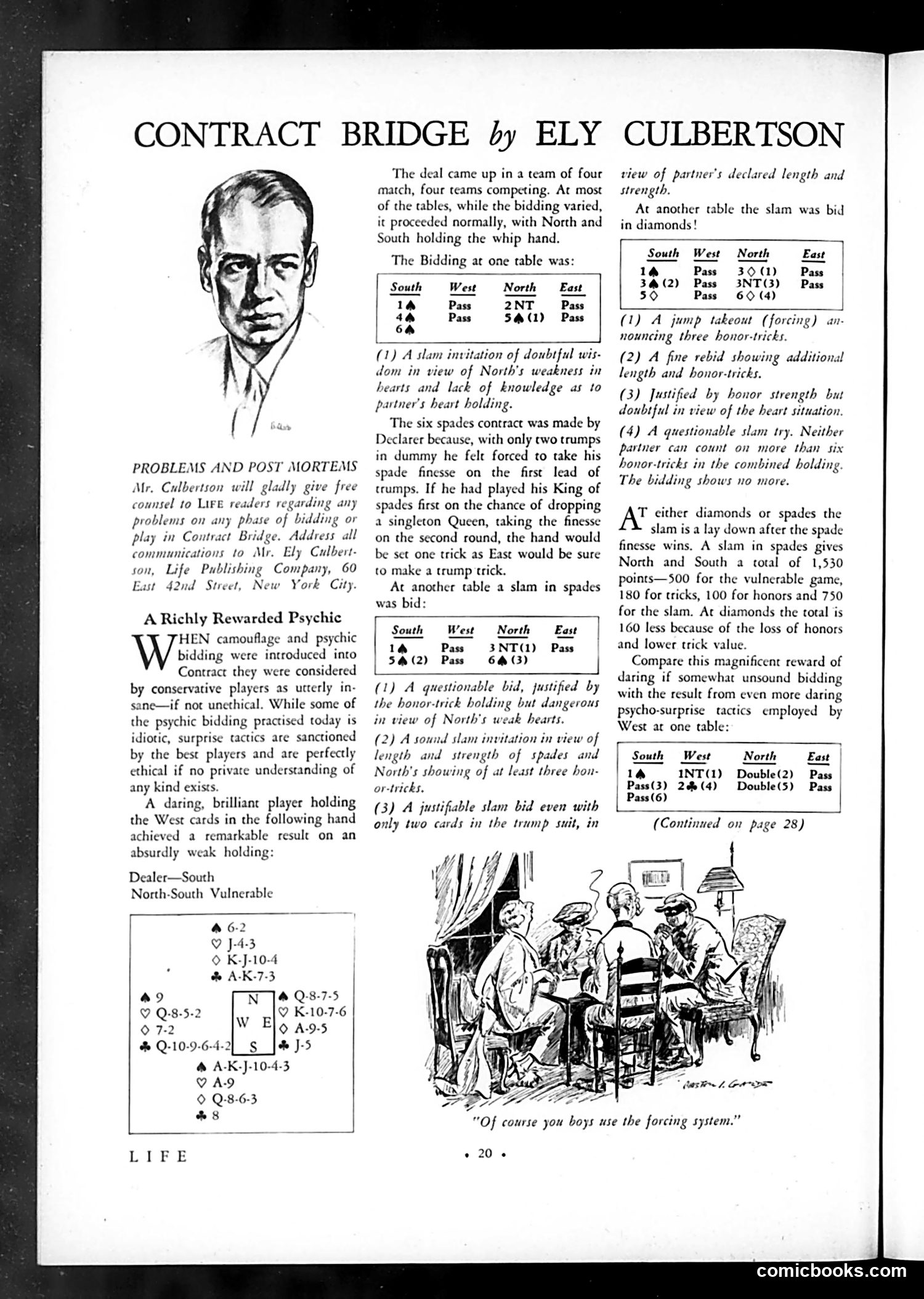
Contract Bridge Column Analysis This page is a bridge instruction column by Ely Culbertson, the famous contract bridge expert of the 1930s-40s. It's not satirical but rather educational content for Life magazine readers. The main content shows three different bidding sequences for the same bridge hand, demonstrating how conservative versus daring "psychic bidding" (strategic bluffing with weak hands) can yield dramatically different results. Culbertson analyzes each bid's merit, noting that while some psychic tactics seem "idiotic," they're ethical if no secret understanding exists between partners. The cartoon at bottom—showing four men at a bridge table with the caption "Of course you boys use the forcing system"—humorously depicts bridge players' assumption that everyone follows standard conventions, likely reflecting contemporary bridge culture's pretentiousness. The "Problems and Post Mortems" section invites readers to send Culbertson questions about their own bridge play, positioning him as an authority solving disputes.
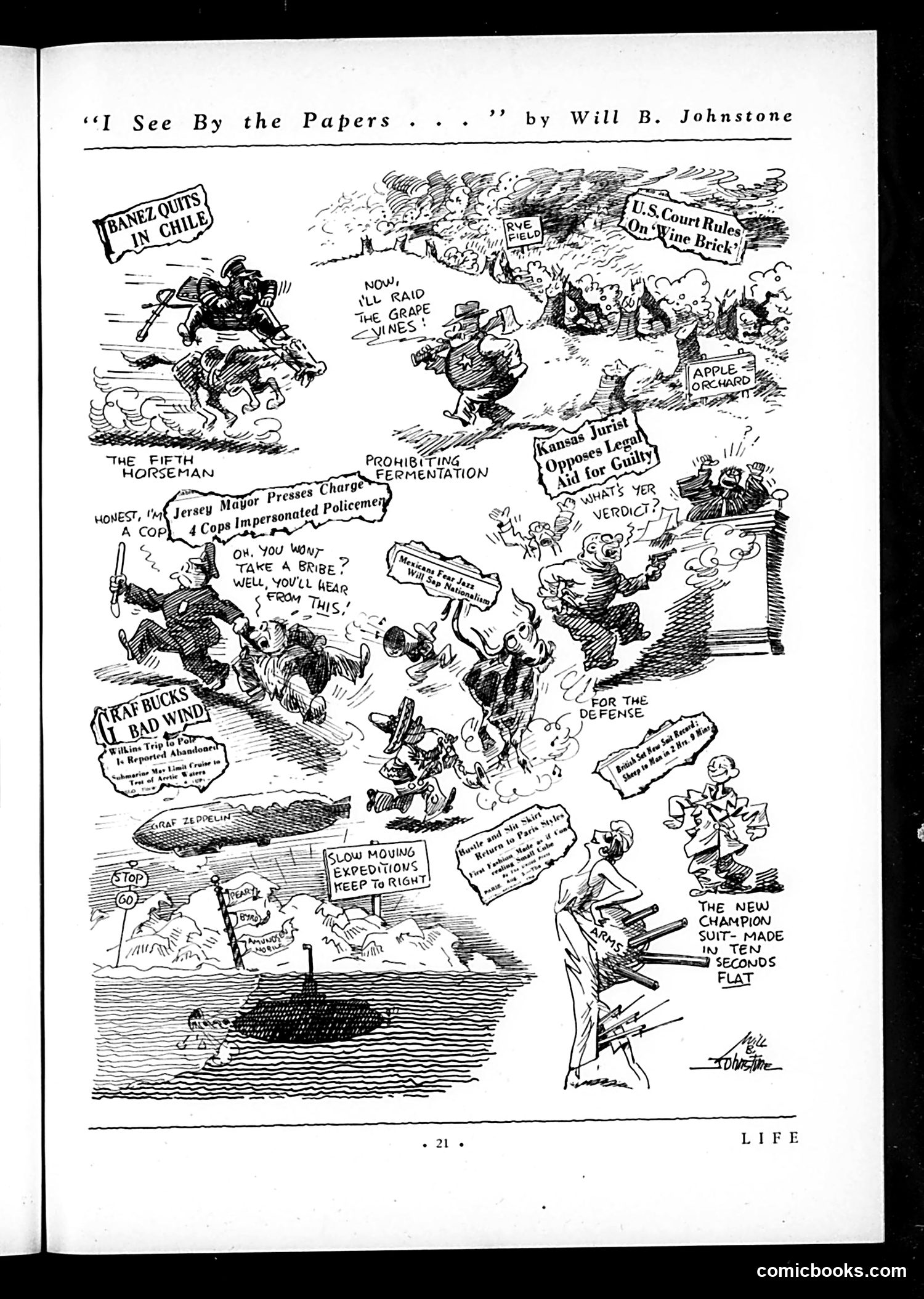
"I See By the Papers" Political Cartoon Analysis This satirical cartoon by Will B. Johnstone comments on early 1920s Prohibition enforcement scandals. The scattered vignettes critique corruption and hypocrisy: "The Fifth Horseman" references Prohibition as a catastrophic force alongside the biblical apocalypse. Jersey Mayor and police references likely allude to local corruption during Prohibition's enforcement—politicians and cops accepting bribes ("Take a bribe? Well, hear this..."). "Prohibiting Fermentation" mocks the futility of alcohol bans. Other panels reference grape raids, Kansas court rulings on liquor, and Arbuckle trials (a contemporary scandal). "The New Champion Suit" appears to joke about someone's downfall—possibly suggesting Prohibition's failures make someone a "champion" of ruin. The overall point: Prohibition created systemic corruption, with officials profiting while pretending enforcement works. The cartoon's chaos reflects the era's legal and moral confusion around the 18th Amendment.
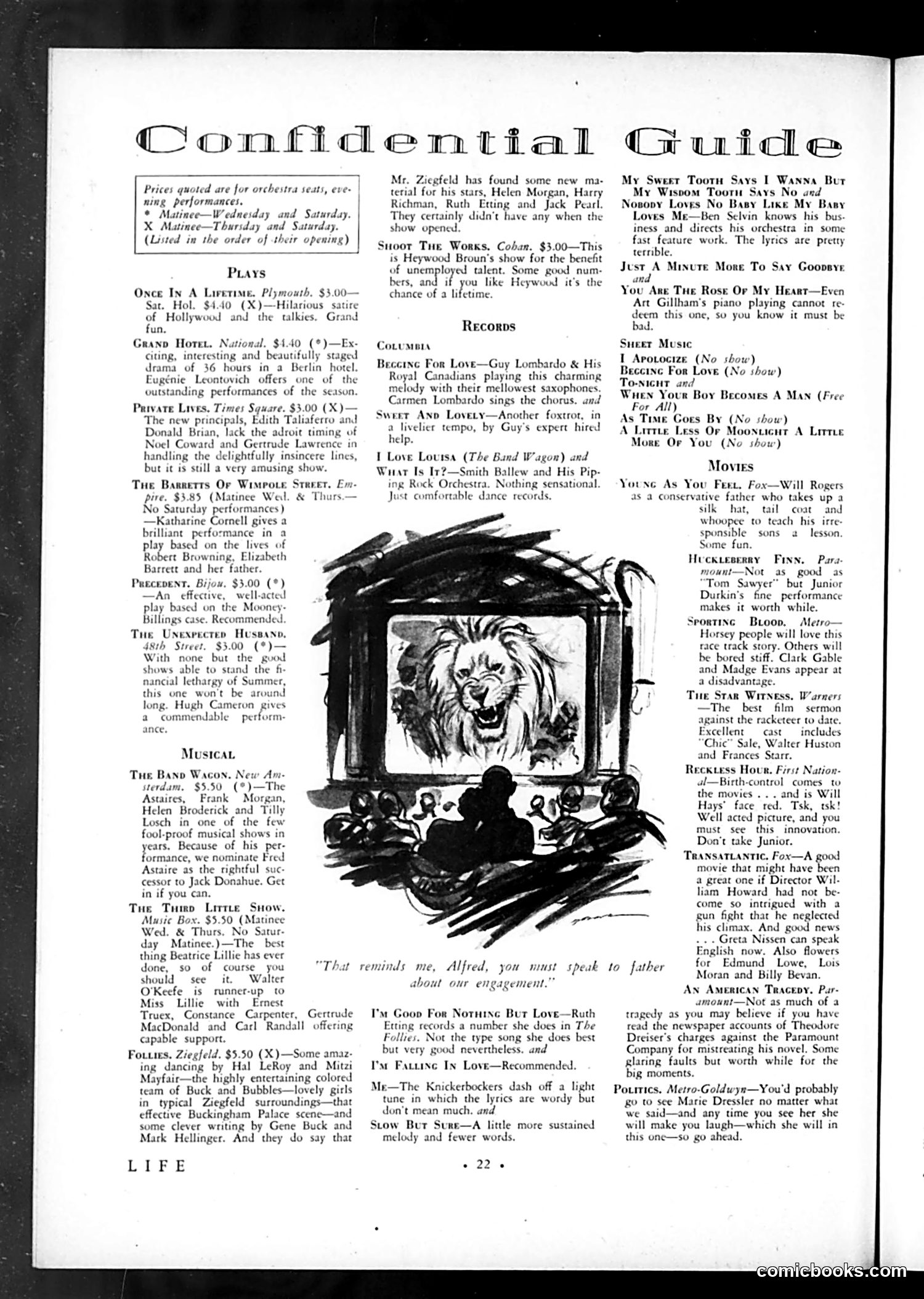
"Confidential Guide" — Life Magazine Theater & Entertainment Page This is a theater guide for Broadway productions, likely from the late 1920s (based on references to Fred Astaire and Florenz Ziegfeld's shows). The central cartoon depicts a couple watching a movie on what appears to be an early television or projection screen, with the woman saying to her companion, "That reminds me, Alfred, you must speak to father about our engagement." The humor is straightforward domestic satire: the woman uses the distraction of entertainment to broach the serious topic of their engagement with her boyfriend—implying she's manipulating the moment when he's least prepared to object. The page itself is a practical entertainment guide listing theater prices, performance times, and brief critical reviews of current Broadway productions and popular recordings. There's no overt political content; it's primarily consumer information formatted as witty commentary on New York entertainment options.
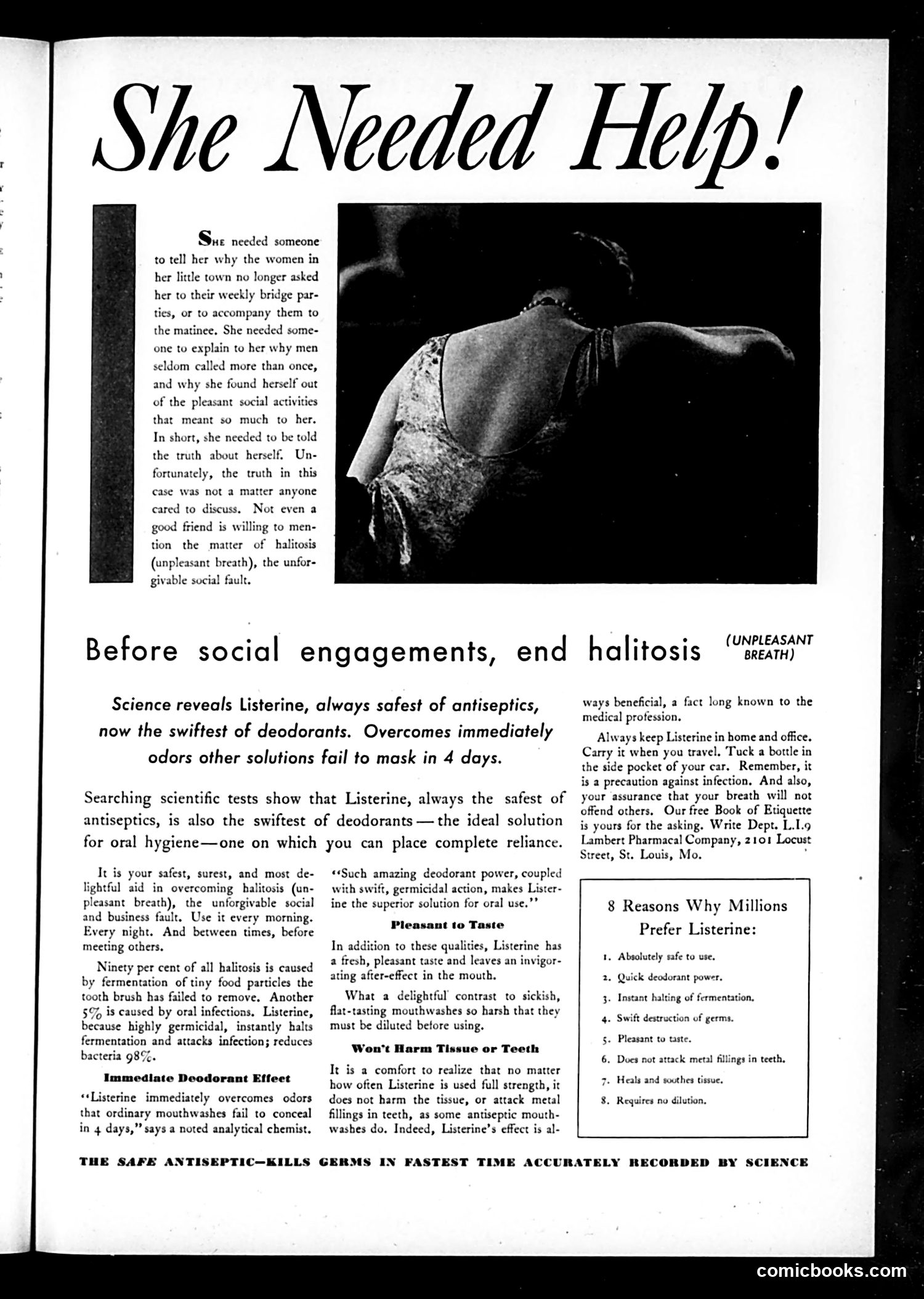
Listerine Advertisement Analysis This is a Listerine mouthwash advertisement, not political satire. It uses a common advertising strategy of the era: social shame to sell a product. The narrative depicts an unnamed woman socially ostracized—excluded from bridge parties and social events—because she has halitosis (bad breath). The advertisement exploits the anxiety that this "unforgivable social fault" makes her unmarriageable and friendless. Even close friends won't tell her the problem, the text claims. The solution: Listerine mouthwash, marketed as "safe" and effective where competitors fail. The ad emphasizes scientific credibility, claims it kills 98% of bacteria, and assures users it won't damage teeth or tissue. This reflects early-20th-century marketing tactics: creating social anxiety about personal hygiene (a common strategy in Depression-era advertising) and positioning the product as necessary for social acceptance and respectability.
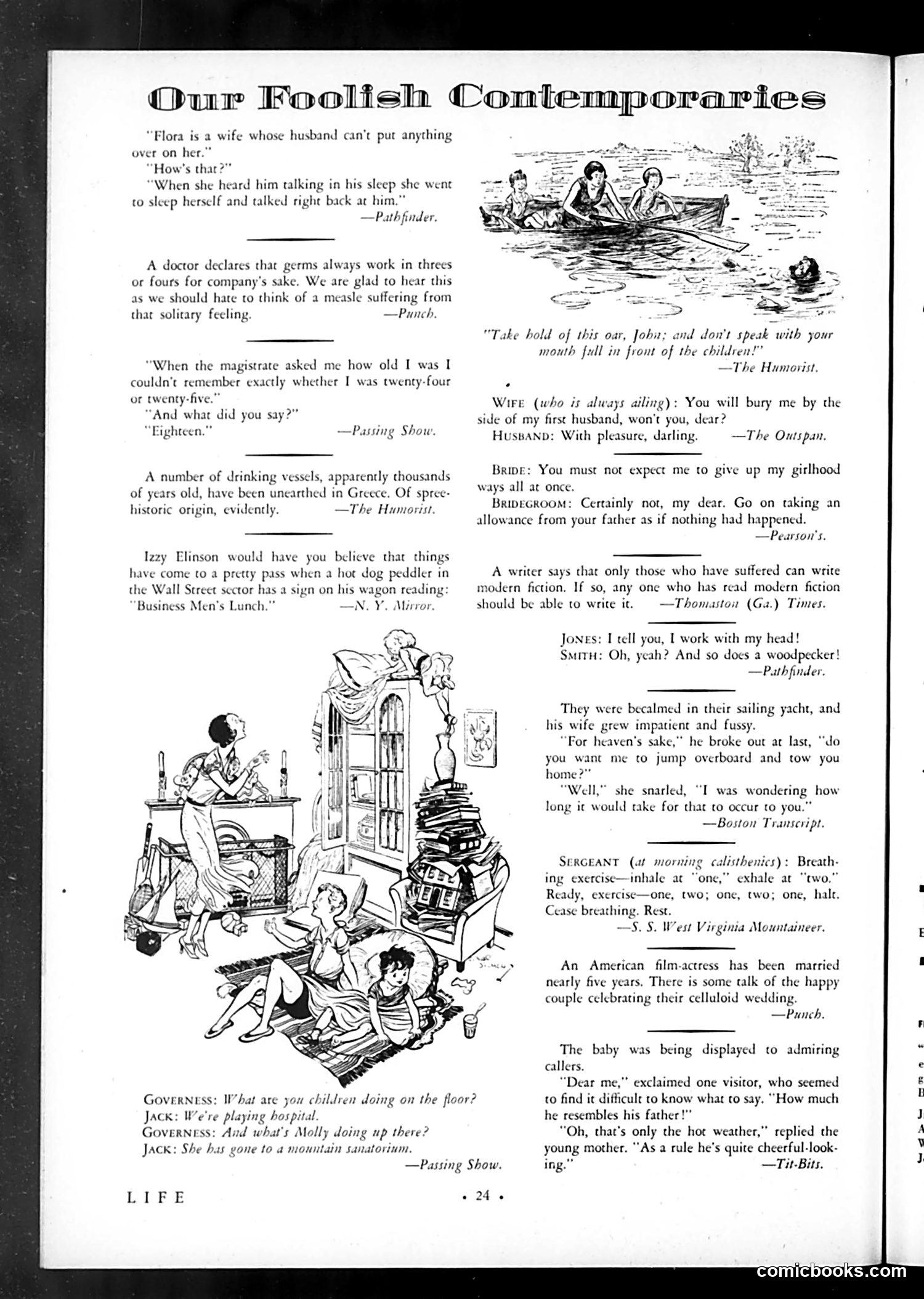
"Our Foolish Contemporaries" - Life Magazine Humor Page This is a humor collection page from *Life*, featuring brief jokes and witticisms sourced from various contemporary publications (Punch, Pathfinder, etc.). The content satirizes early 20th-century social conventions and relationships. Key themes: - Marriage absurdities: Wives outsmarting husbands; brides resisting domestic change; wives nagging during leisure activities - Medical/scientific pretension: A doctor's dubious claim about germs working "in threes or fours" - Social climbing: A hot dog vendor on Wall Street advertising "Business Men's Lunch"—mocking aspiring working-class entrepreneurs The cartoon depicts children playing "hospital" with a governess, using furniture as props—innocent domestic humor about imaginative play. The satire targets Victorian-era gender dynamics, pseudo-scientific claims, and emerging urban commercialism. For modern readers, the repeated wife-as-nag trope reflects period attitudes toward women that would later be challenged.
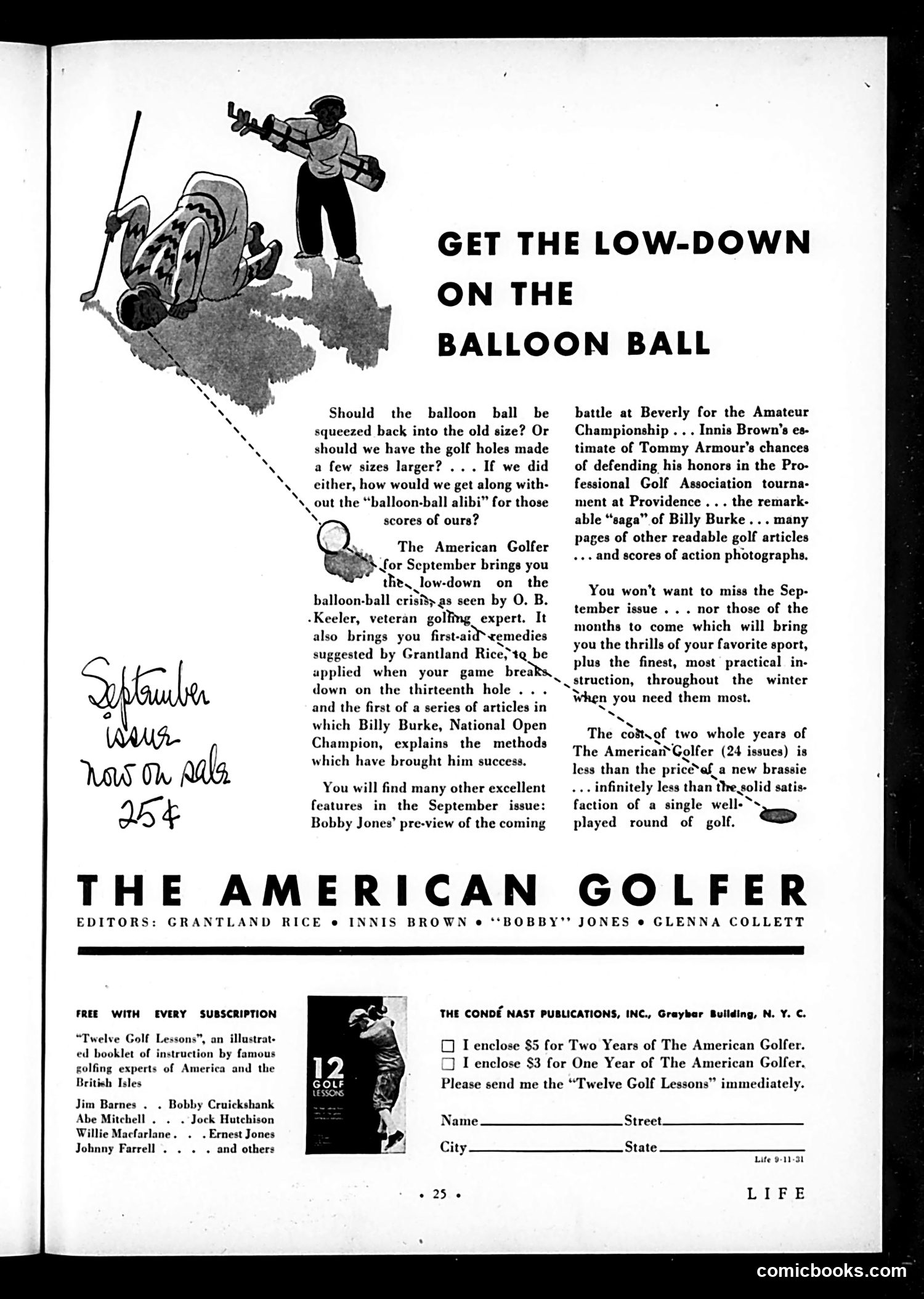
"Get the Low-Down on the Balloon Ball" This is primarily advertising for *The American Golfer* magazine, disguised as editorial content. The "balloon ball" refers to an actual 1930s golf controversy: manufacturers produced larger golf balls, which some golfers blamed for poor performance—the "balloon-ball alibi" for bad scores. The cartoon illustrates this debate: golfers are shown struggling, with the implication that equipment changes, not player skill, explain poor play. The page promises expert analysis from famous golfers including Bobby Jones and Billy Burke on whether balls should be resized or holes enlarged. The humor is gentle: it satirizes how golfers rationalize failure by blaming equipment rather than accepting responsibility. The advertisement positions *The American Golfer* magazine as the authoritative source for understanding this manufactured controversy and improving one's game through proper instruction.
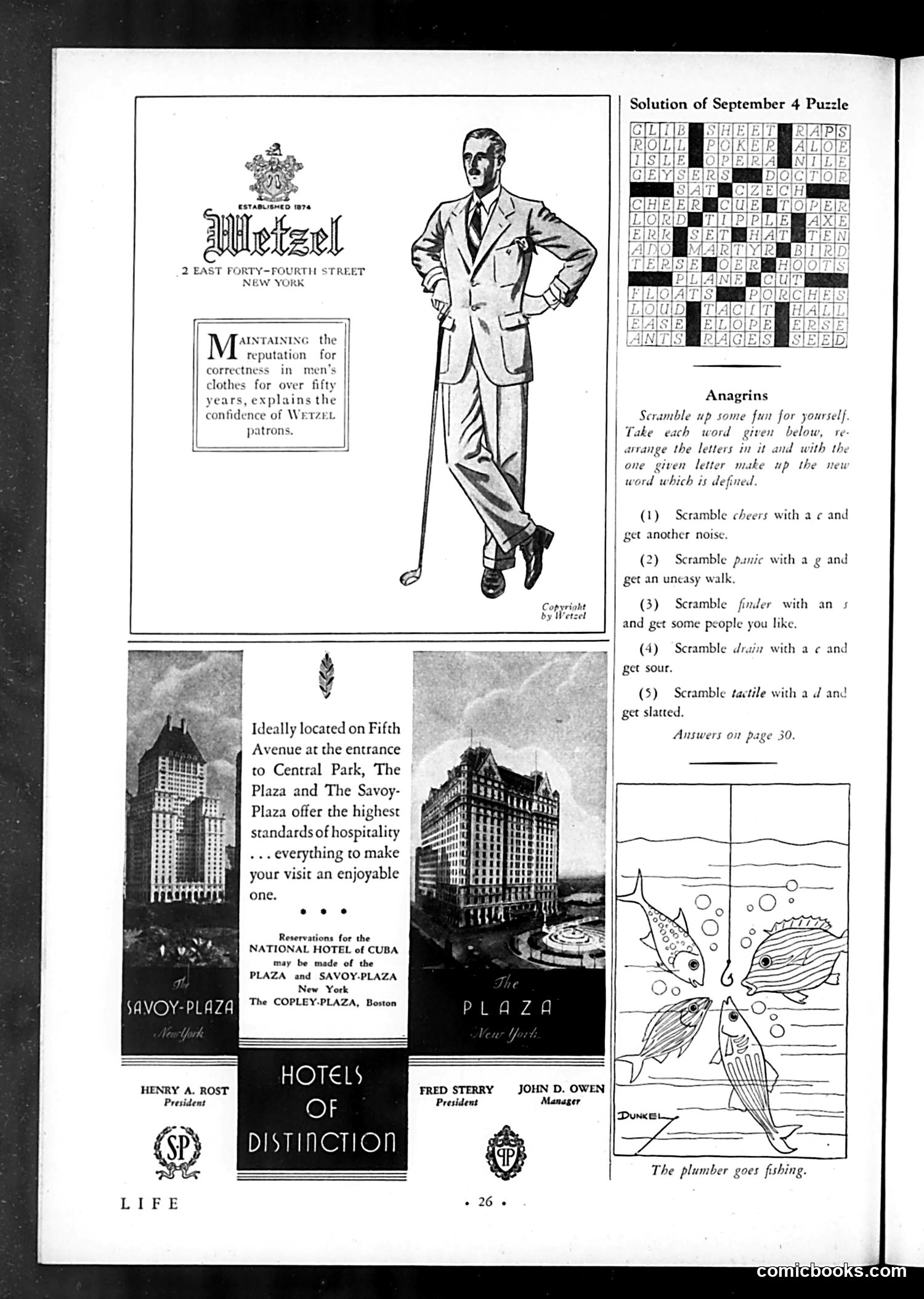
Analysis of Life Magazine Page This page is primarily advertising and puzzle content, not political satire. The main visual element features a Wetzél menswear advertisement showing a well-dressed man in a business suit with a golf club, emphasizing the brand's fifty-year reputation for "correctness in men's clothes." Below are ads for luxury hotels ("Hotels of Distinction")—the Plaza and Savoy-Plaza in New York, and the Copley-Plaza in Boston—targeting affluent travelers seeking high-end hospitality. The right column contains a word puzzle (anagrams) and a cartoon showing fish underwater, titled "The plumber goes fishing," illustrating one of the puzzle answers. Context for modern readers: This represents 1920s-era advertising aimed at upper-class men concerned with proper business attire and luxury accommodations—reflecting an era when such refinement signaled social status. The puzzle is typical recreational content Life magazine offered readers.
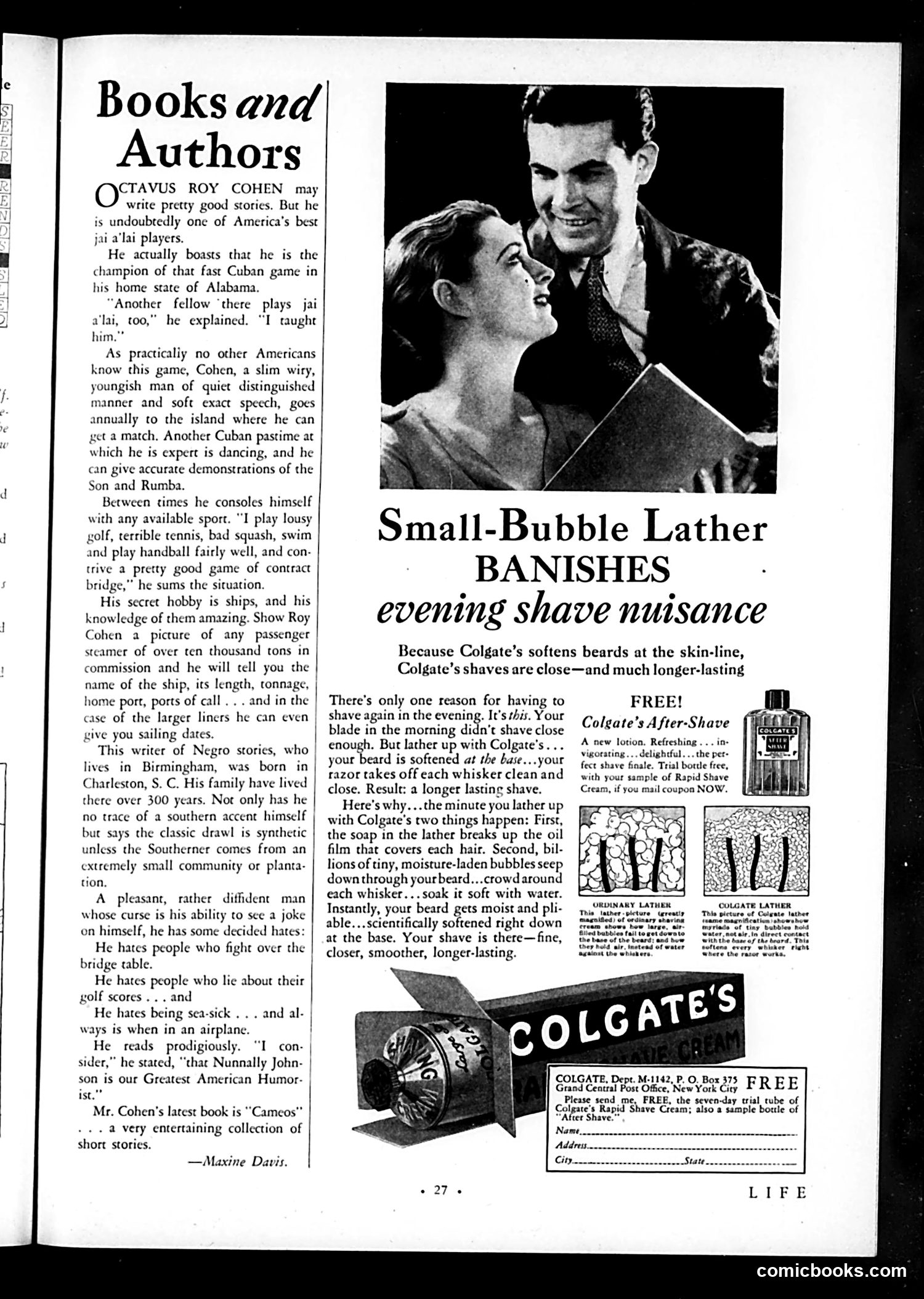
Content Analysis: Life Magazine Page This page contains two unrelated items: Left side: A "Books and Authors" profile of Octavus Roy Cohen, a Birmingham-based writer of "Negro stories" (as the text states). The article emphasizes Cohen's unexpected expertise: he's apparently an excellent jai alai player, dancer, and ship enthusiast despite being a literary figure. The humor derives from the contrast between his quiet, distinguished manner and his diverse, somewhat obscure athletic interests. Right side: A Colgate shaving cream advertisement featuring a domestic scene of a man and woman. The ad promotes "small-bubble lather" as solving the "evening shave nuisance"—the problem of needing to shave twice daily. It uses pseudo-scientific language about how soap breaks oil films and moisture-laden bubbles soften beard hair at the base, enabling a closer, longer-lasting shave. These are entirely separate editorial and advertising content with no connection between them.
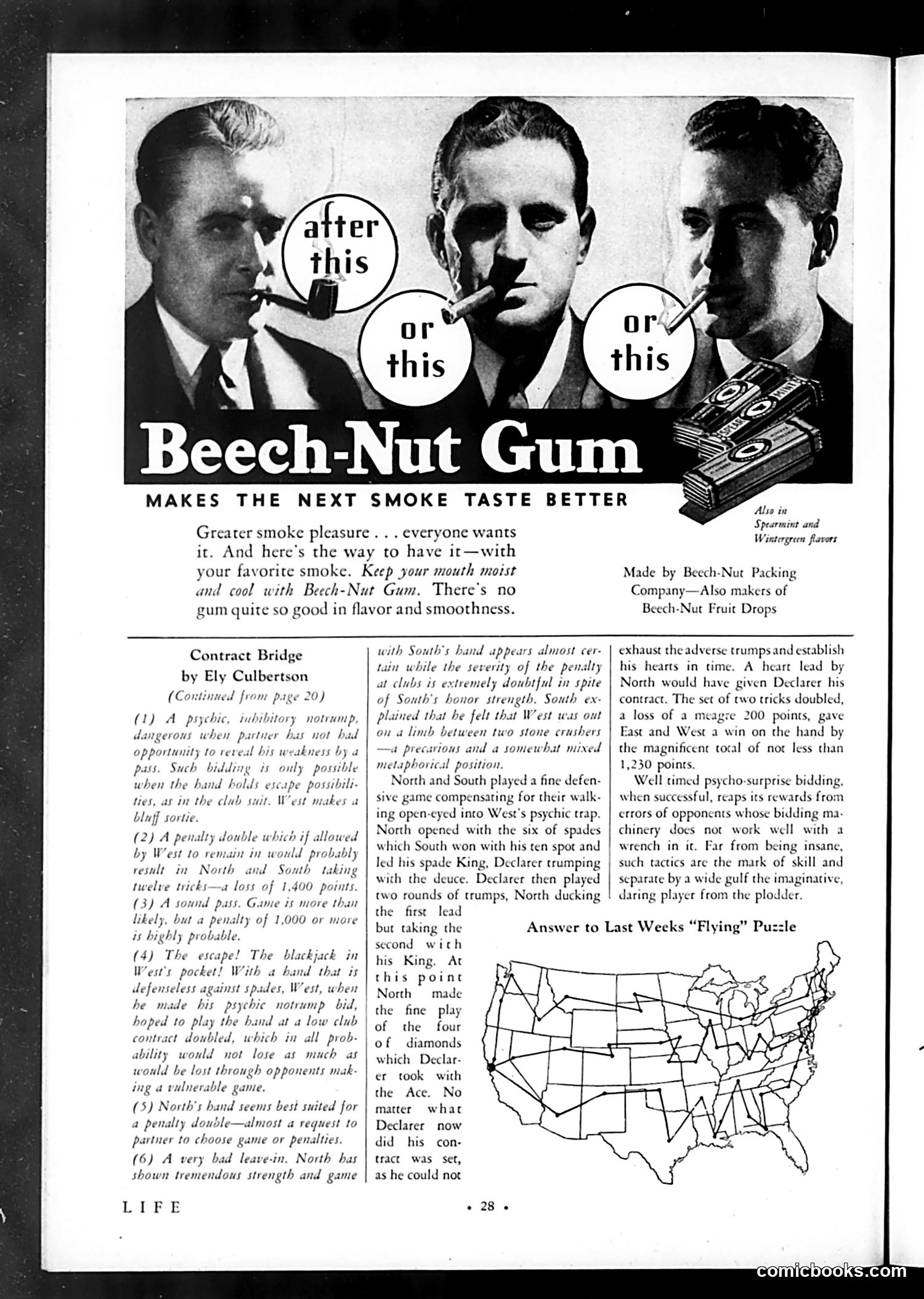
Beech-Nut Gum Advertisement with Contract Bridge Column This page is primarily a product advertisement for Beech-Nut Gum, featuring three men's faces with speech bubbles offering choices: "after this," "or this," or "or this"—presumably showing different pipe and tobacco options. The tagline promises the gum will "make the next smoke taste better" by keeping the mouth moist and cool. The bulk of the page contains an unrelated Contract Bridge instructional column by Ely Culbertson, a famous bridge authority of the era, analyzing specific bidding strategies and hand plays with detailed numbered points. There is no political satire or caricature on this page. It's a straightforward commercial advertisement combined with recreational content typical of Life magazine's mixed editorial-advertising format from this period.
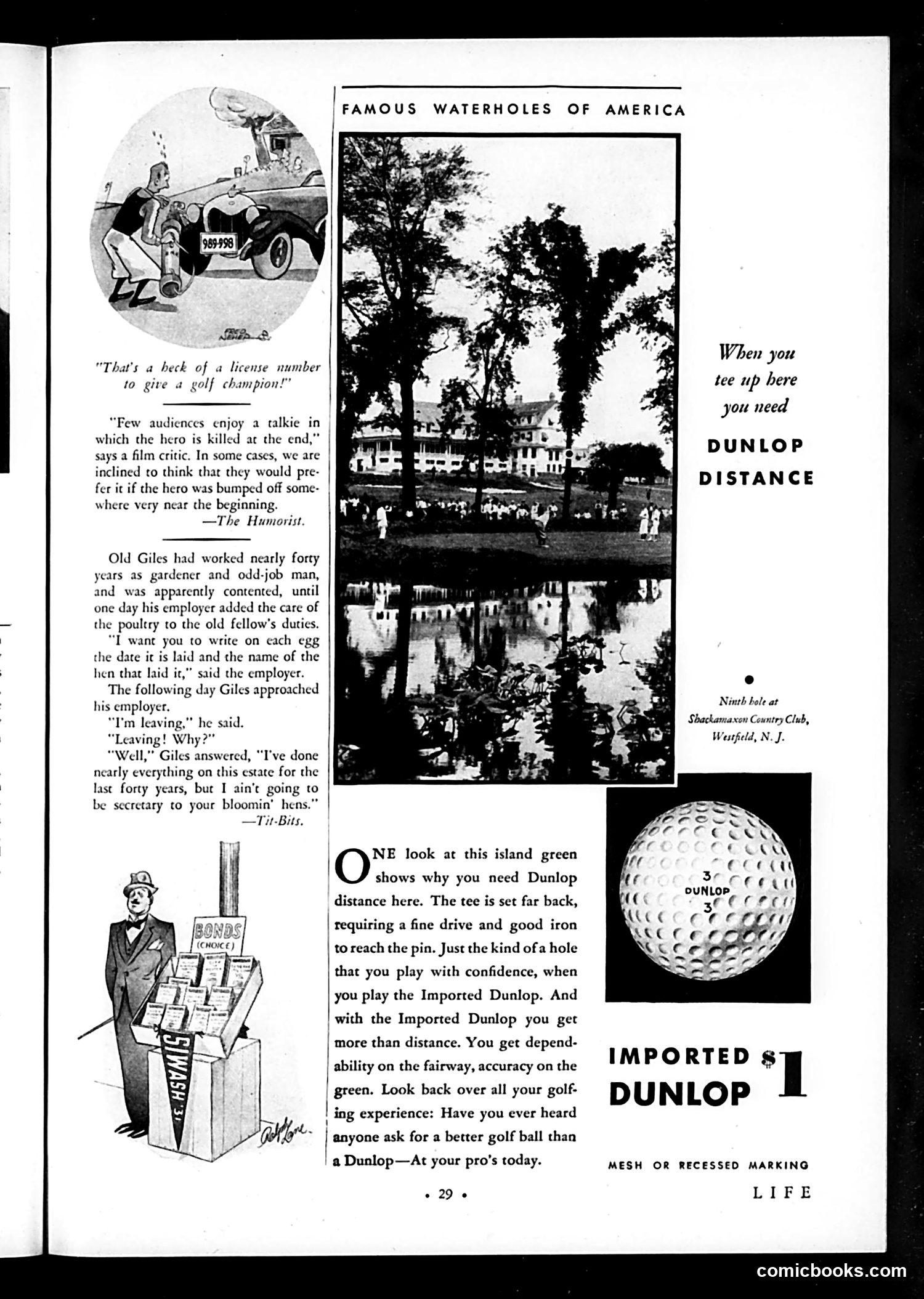
Life Magazine Page Analysis This page combines humorous short anecdotes with a golf ball advertisement. The three jokes satirize modern inconveniences: 1. License plate joke: A golfer receives an unflattering license number, mocking the randomness of bureaucratic assignments. 2. Film criticism: Satirizes pretentious movie critics who prefer talking pictures to end badly, poking fun at art-house attitudes. 3. The gardener story: Old Giles, a long-suffering employee who accepts increasingly absurd duties, finally quits when asked to label each egg with laying dates and hen names. The satire targets both unreasonable employers and workers' breaking points—he'll do anything except clerical work for poultry. The Dunlop golf ball advertisement uses a country club photograph to promote "distance" and reliability, claiming superior fairway and green performance. The ad addresses golfers directly as potential customers at their local pro shop.
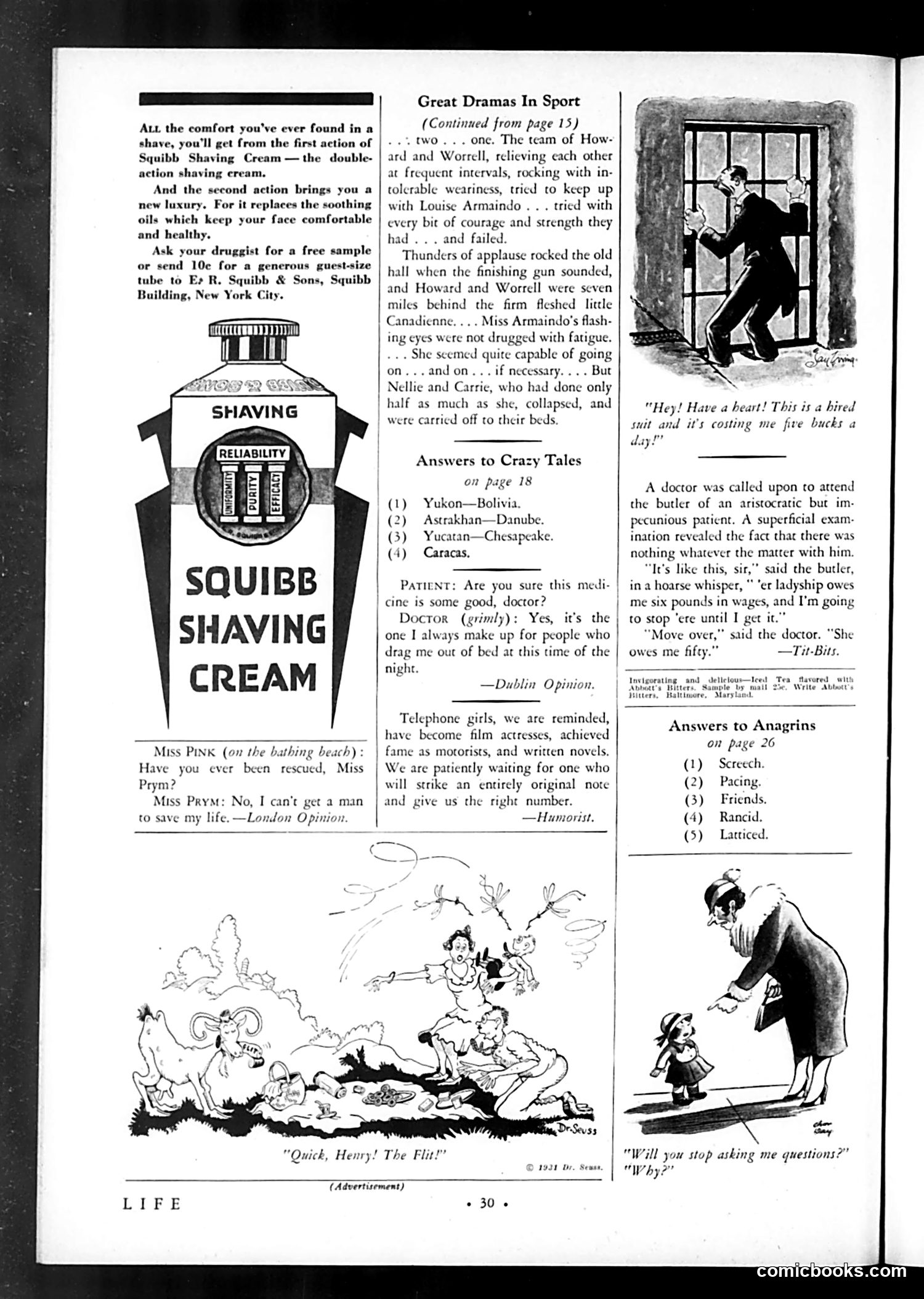
Life Magazine Page Analysis This page mixes advertising, humor, and sports content typical of early 20th-century Life magazine. Main Elements: The Squibb Shaving Cream advertisement dominates the left side, promoting a "double-action" cream with soothing oils. The humor sections include brief satirical jokes: - A "bathing beach" joke about a woman unable to find a man to "rescue" her (playing on romantic rescue fantasies) - A doctor joke mocking patients who summon physicians at inconvenient hours - A jab at telephone operators who've become actresses and motorists but never "give us the right number" Two cartoon illustrations show domestic/social scenarios: a man in a rented suit complaining about cost, and a woman interrogating a child about questions. A sports narrative describes Louise Armaindo, apparently a female endurance athlete, outpacing male competitors (Howard and Worrell) in what appears to be a competitive race or feat of stamina—unusual for the era and likely noteworthy. The page reflects period attitudes toward gender roles and class while documenting women's emerging participation in athletics and professions.
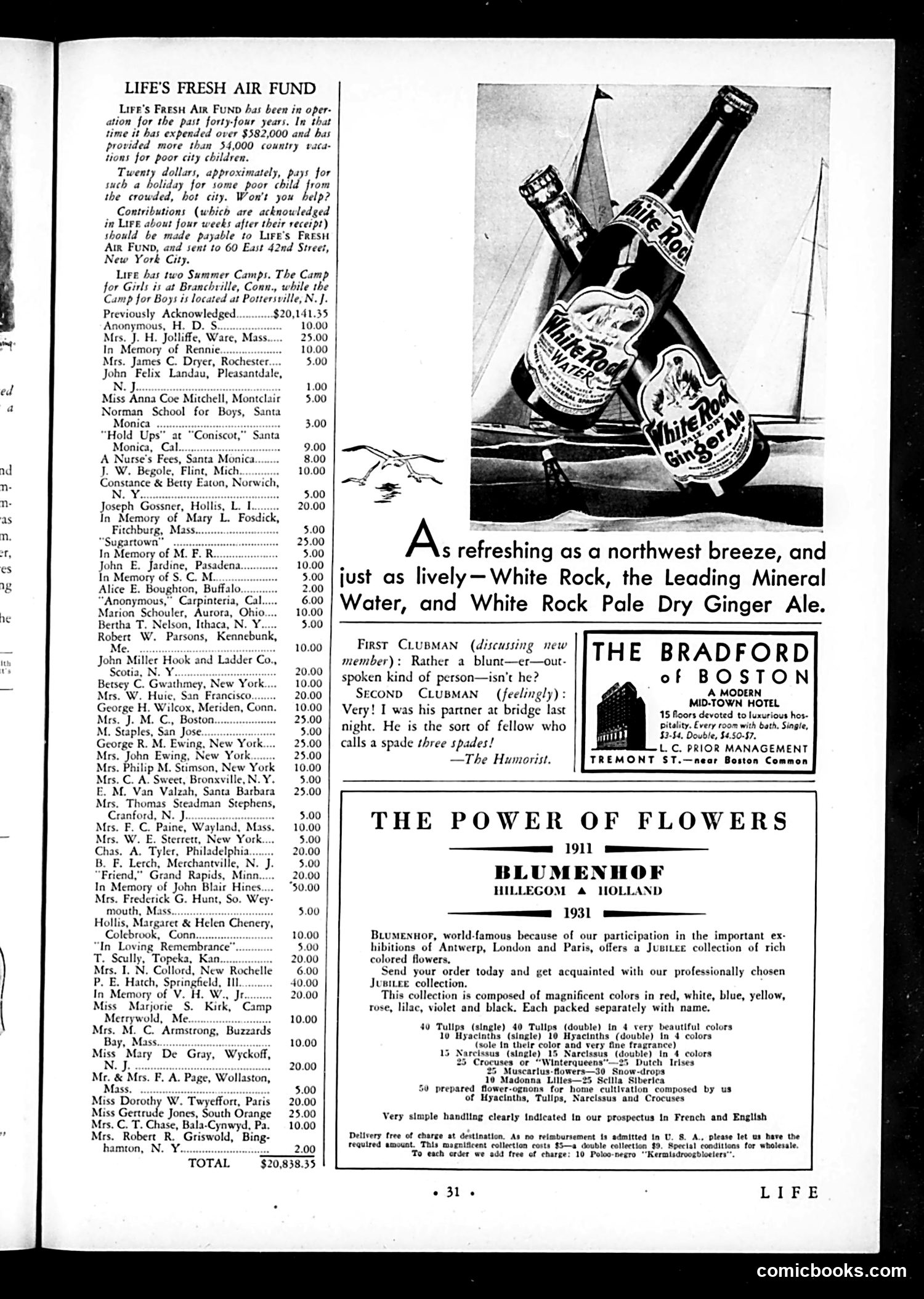
Life Magazine Page Analysis This page combines charity fundraising with advertisements and humor. The main content is Life's Fresh Air Fund, a 44-year-old charitable program providing $20+ country vacations for poor city children. The page lists donations totaling $20,838.35, presented as community contributions from readers nationwide. The small cartoon features two clubmen discussing a new member. The joke turns on the phrase "calls a spade a spade"—a common idiom meaning someone speaks bluntly. The second clubman exaggerates this to "calls a spade three spades," suggesting the newcomer is so aggressively forthright he inflates even his honesty into dishonesty at the bridge table (implying cheating at cards). The advertisements—White Rock mineral water and The Bradford Hotel—occupy the remaining space, typical of Life's mixed content format. The page reflects early 20th-century American magazine structure: charitable appeals interspersed with commercial advertising and light social humor targeting an affluent, educated readership.
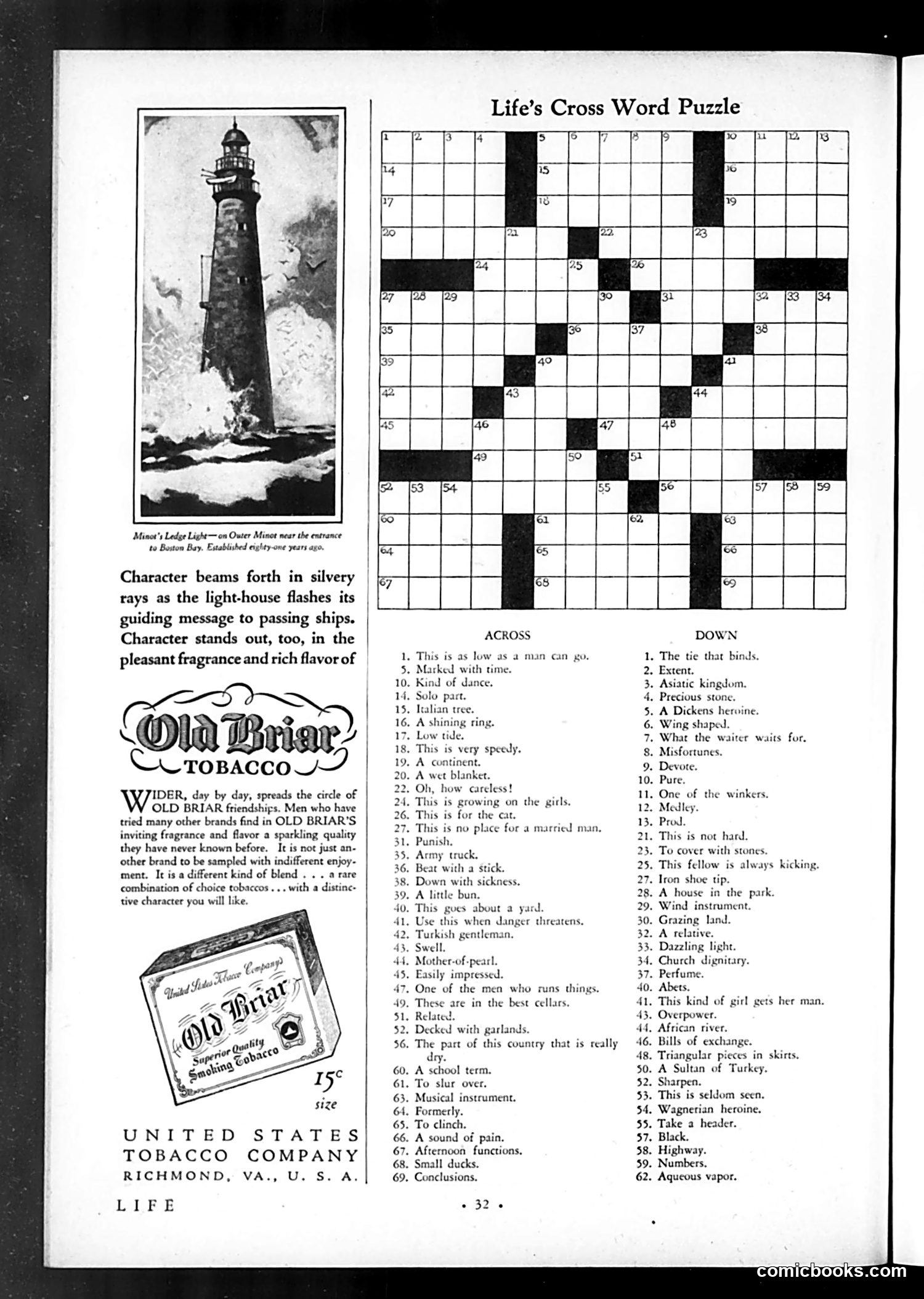
Life Magazine Cross Word Puzzle Page This page is primarily advertising disguised as editorial content. The dominant feature is a crossword puzzle titled "Life's Cross Word Puzzle," but the real purpose is promoting Old Briar tobacco through an extended advertisement. The lighthouse image and accompanying text use the metaphor of a beacon's "character" shining through to pitch tobacco's distinctive qualities. The ad copy emphasizes that Old Briar stands apart from competitors—it's not "just another brand" but possesses rare "character" and "distinctive" blend. Below sits a smaller Old Briar cigarette pack advertisement. The crossword itself appears designed to entertain readers while keeping the brand prominent. This represents early 20th-century advertising integration—disguising promotion as entertainment to bypass reader resistance. The puzzle clues are generic wordplay with no tobacco connection, making the ads appear editorial rather than commercial. This reflects pre-regulation tobacco marketing, when cigarette companies advertised prominently in mainstream magazines without today's health warnings or restrictions.
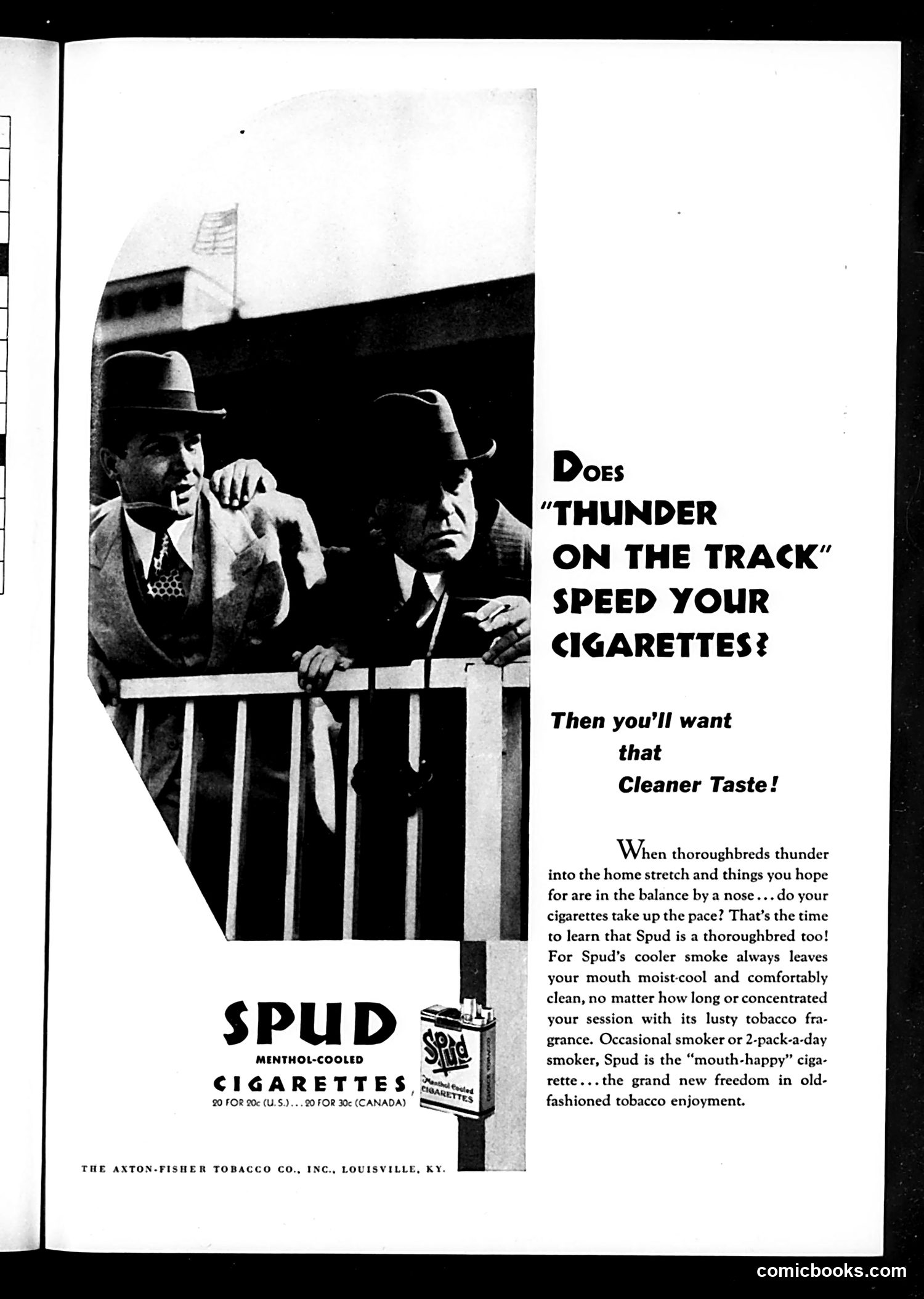
Spud Cigarettes Advertisement This is a vintage cigarette advertisement, not political satire. The page shows two men in suits and fedoras watching a horse race from what appears to be a viewing box, with an American flag visible. The ad uses horse racing as a metaphor for smoking intensity. The tagline asks whether "Thunder on the Track" (a racing reference) speeds up cigarette consumption, then pivots to promoting Spud's "cleaner taste" and menthol-cooling properties. The copy claims Spud's smoke keeps your mouth "moist-cool and comfortably clean" regardless of smoking duration. The central conceit equates Spud cigarettes with thoroughbred horses—both are presented as refined, reliable products. This was typical mid-20th-century advertising strategy: associating consumer products with desirable qualities (speed, quality, sophistication) through elaborate metaphors. The ad targets both casual and heavy smokers with promises of a superior smoking experience.
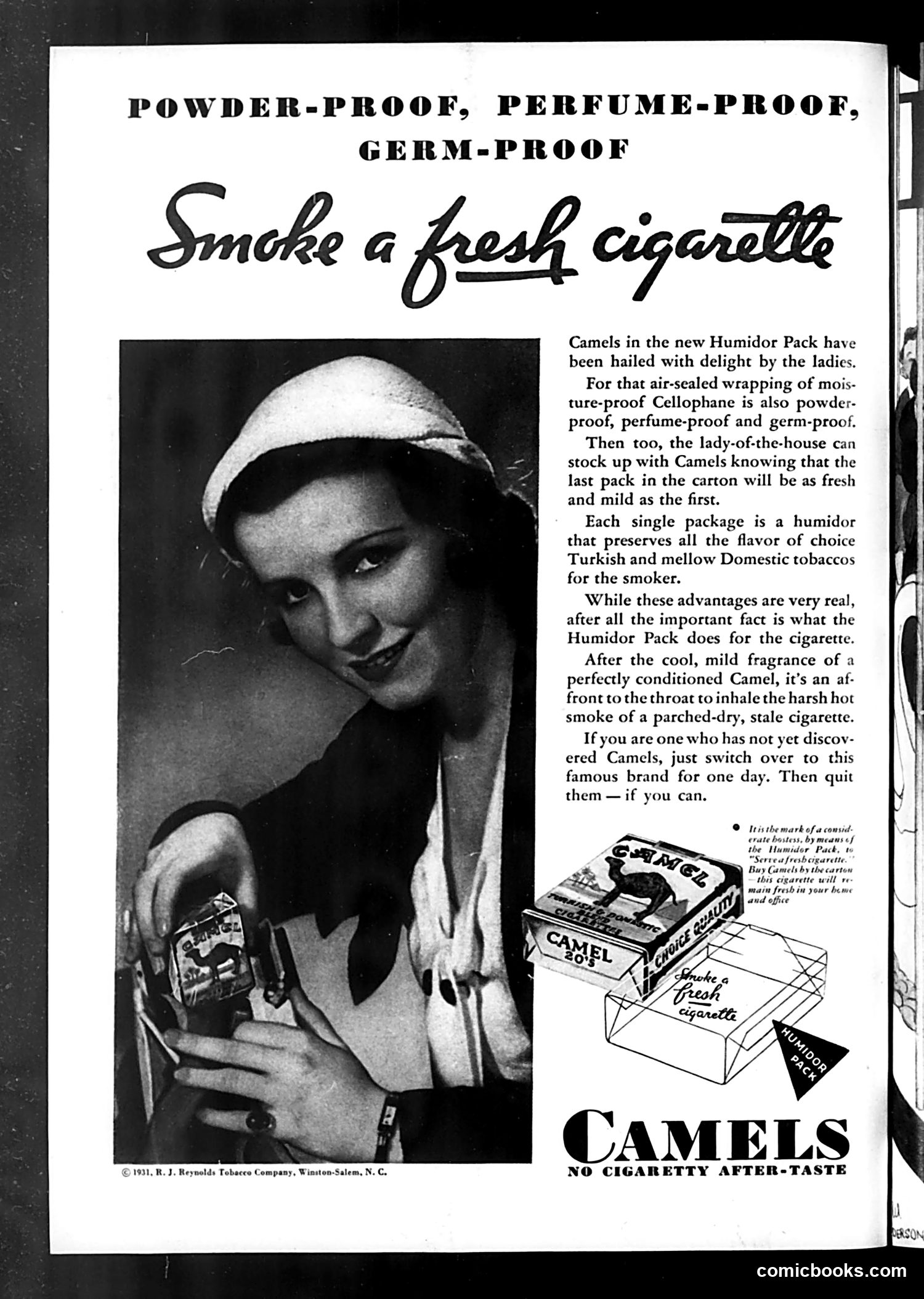
Analysis This is a cigarette advertisement, not satire or political commentary. It's a 1931 Camel cigarettes ad targeting women. The image shows a woman in 1930s fashion examining a Camel cigarette pack. The ad emphasizes the new "Humidor Pack"—cellophane wrapping designed to keep cigarettes fresh and protect them from powder, perfume, and germs. This appeals specifically to female consumers by suggesting the packaging prevents contamination from cosmetics and personal products. The copy uses a subtle psychological tactic: it challenges smokers to "switch over" for one day, then confidently asserts they'll be unable to quit ("if you can"). The tagline "No Cigarette After-Taste" addresses a common complaint about smoking. This reflects early 1930s marketing strategy: luxury branding, scientific claims about product quality, and direct appeals to women as independent consumers—then a relatively novel advertising approach.