life
Life — September 18, 1931
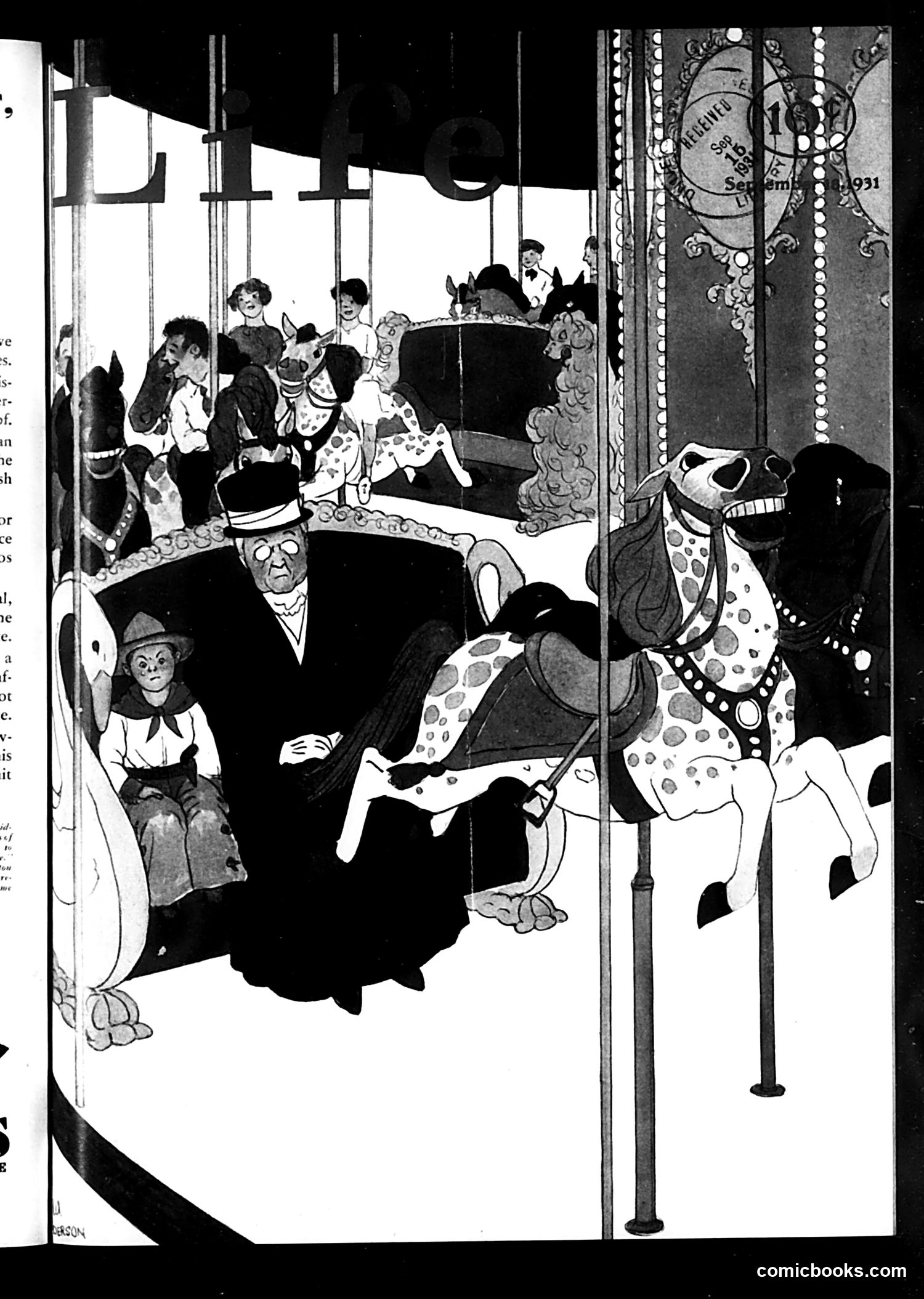
Carousel Ride Satire This illustration depicts a merry-go-round scene with exaggerated, caricatured figures. The central focus is a well-dressed man in a top hat seated beside a woman on a carousel horse. The style and caricatured faces suggest this is political or social satire, likely from the 1920s-1930s era based on the artistic style. The ornate carousel decorations and the formal dress of the figures suggest commentary on wealth, leisure, or social pretension. However, without clearer text identifying specific political figures or events on this page, I cannot definitively identify which contemporary politicians or social issues are being satirized. The grotesque facial features and exaggerated proportions are typical of Life magazine's satirical approach to social commentary of the period.
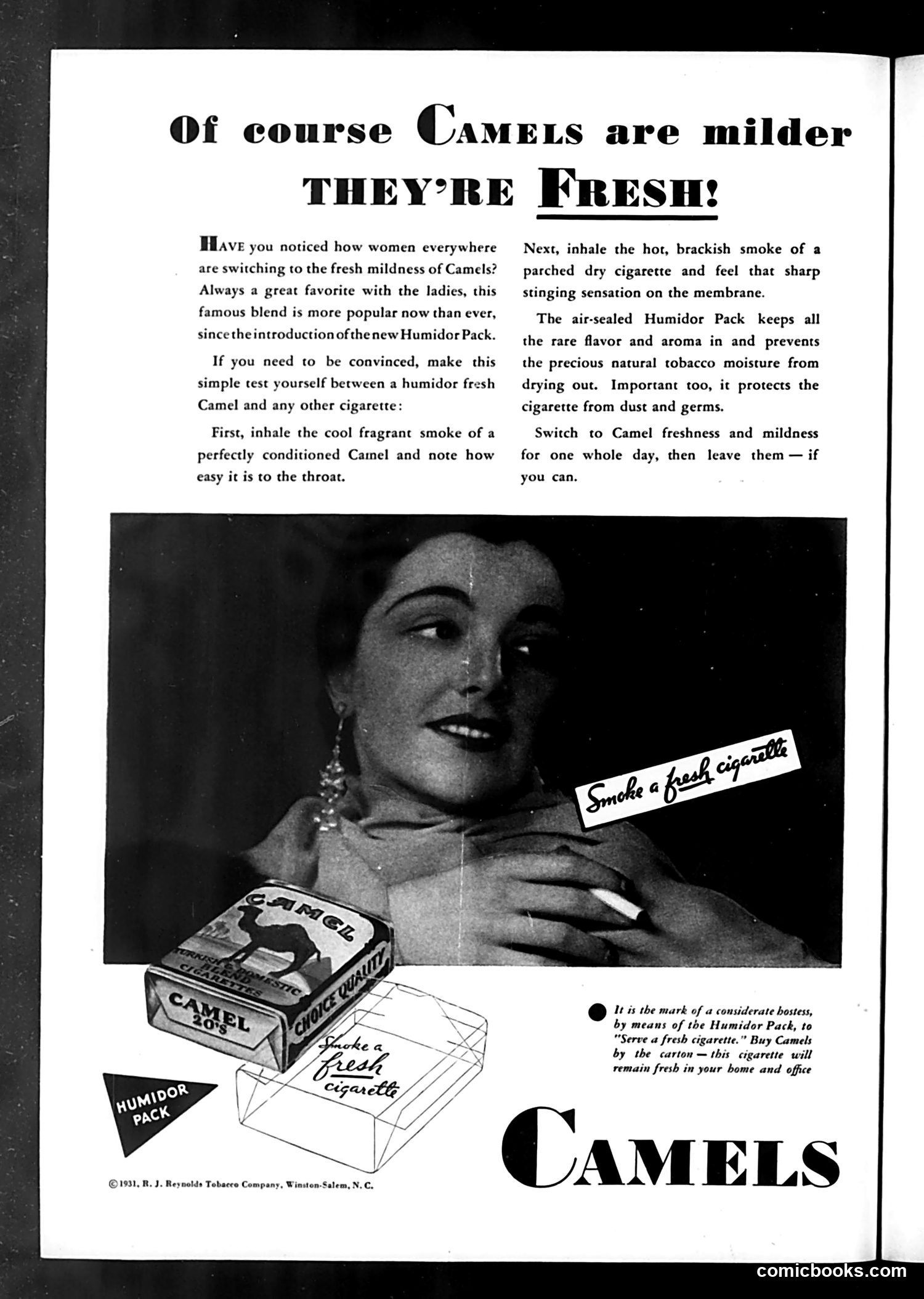
Analysis This is a Camel cigarette advertisement, not satire or a political cartoon. The page promotes Camel's "Humidor Pack" to women, claiming the product keeps cigarettes fresh through special air-sealing. The ad features a photograph of a smiling woman holding a cigarette, with text encouraging readers to test Camel's "freshness and mildness" against competitors. It emphasizes the Humidor Pack's ability to preserve tobacco moisture and protect against "dust and germs." The tagline "Smoke a fresh cigarette" and closing text suggest buying Camels "by the carton" ensures home freshness. Historical context: This reflects early-to-mid 20th-century tobacco marketing targeting women during an era when smoking was promoted as fashionable and safe—claims later proven false.
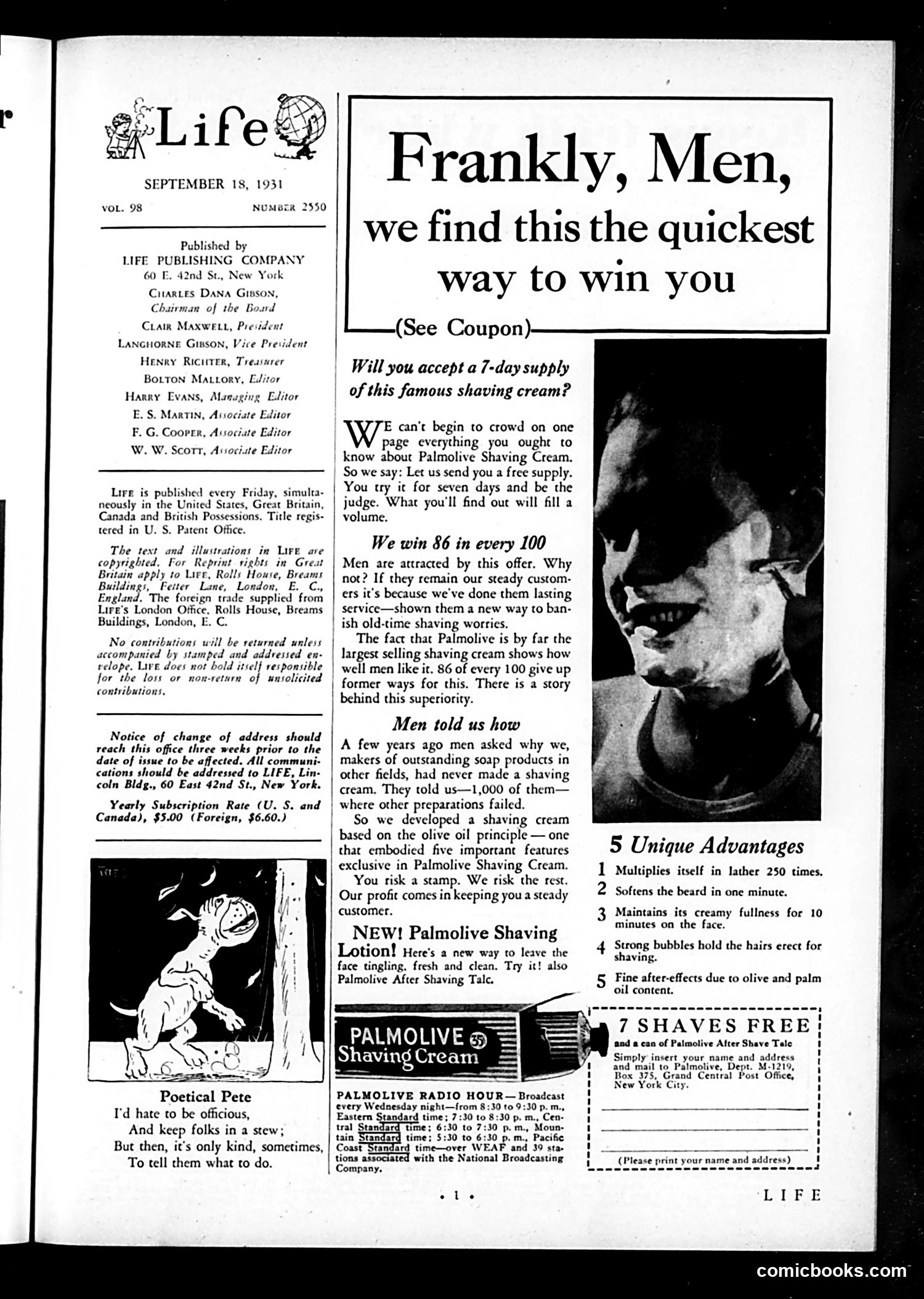
Analysis This page is primarily a Palmolive Shaving Cream advertisement (circa 1931), not political satire. The small cartoon titled "Poetical Pete" in the lower left appears to be a humorous filler piece about someone wanting to be "efficacious" but being "only kind, sometimes." The main content uses the advertising hook "Frankly, Men, we find this the quickest way to win you"—a direct sales pitch offering a free 7-day supply. The ad emphasizes that 86 of every 100 men who try Palmolive switch to it permanently, attributing success to olive oil ingredients. The photograph shows a man shaving, demonstrating the product's lathering qualities. This is straightforward commercial advertising rather than political or social satire—typical content for Life magazine's revenue model in the early 1930s.
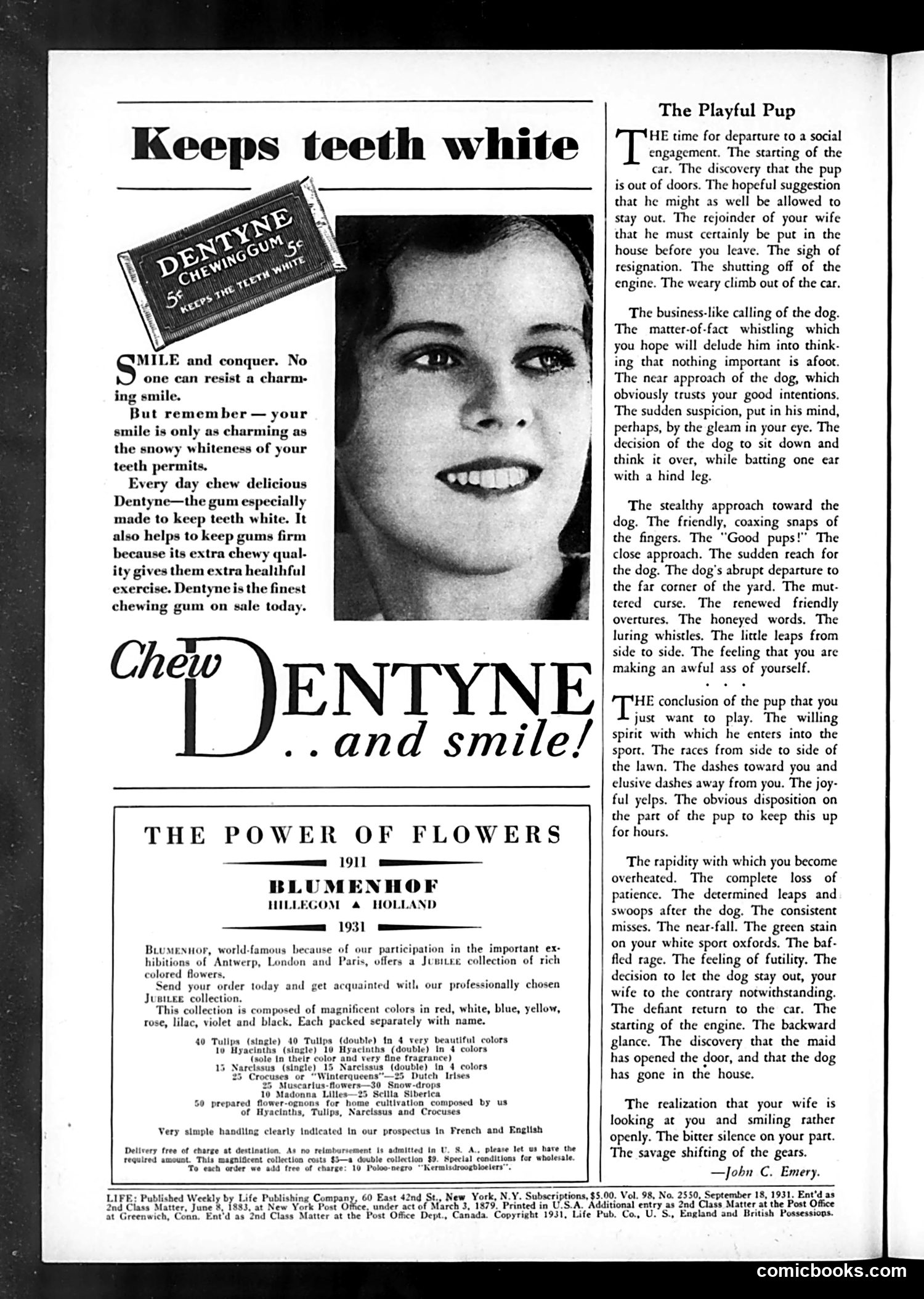
Analysis of Life Magazine Page (September 18, 1931) This page contains two advertisements, not political cartoons: 1. Dentyne Chewing Gum Ad (top): Features a smiling woman's photograph with copy emphasizing that chewing gum keeps teeth white and helps maintain oral health. The tagline is "Chew Dentyne...and smile!" 2. Blumenhof Flower Bulbs Advertisement (bottom): Promotes mail-order flower bulbs for spring planting, listing various tulip and hyacinth varieties. It includes ordering information and pricing. Neither item contains satire or political commentary. This is a standard advertising page from Life magazine's 1931 era, when the publication regularly interspersed commercial advertisements throughout editorial content to generate revenue.
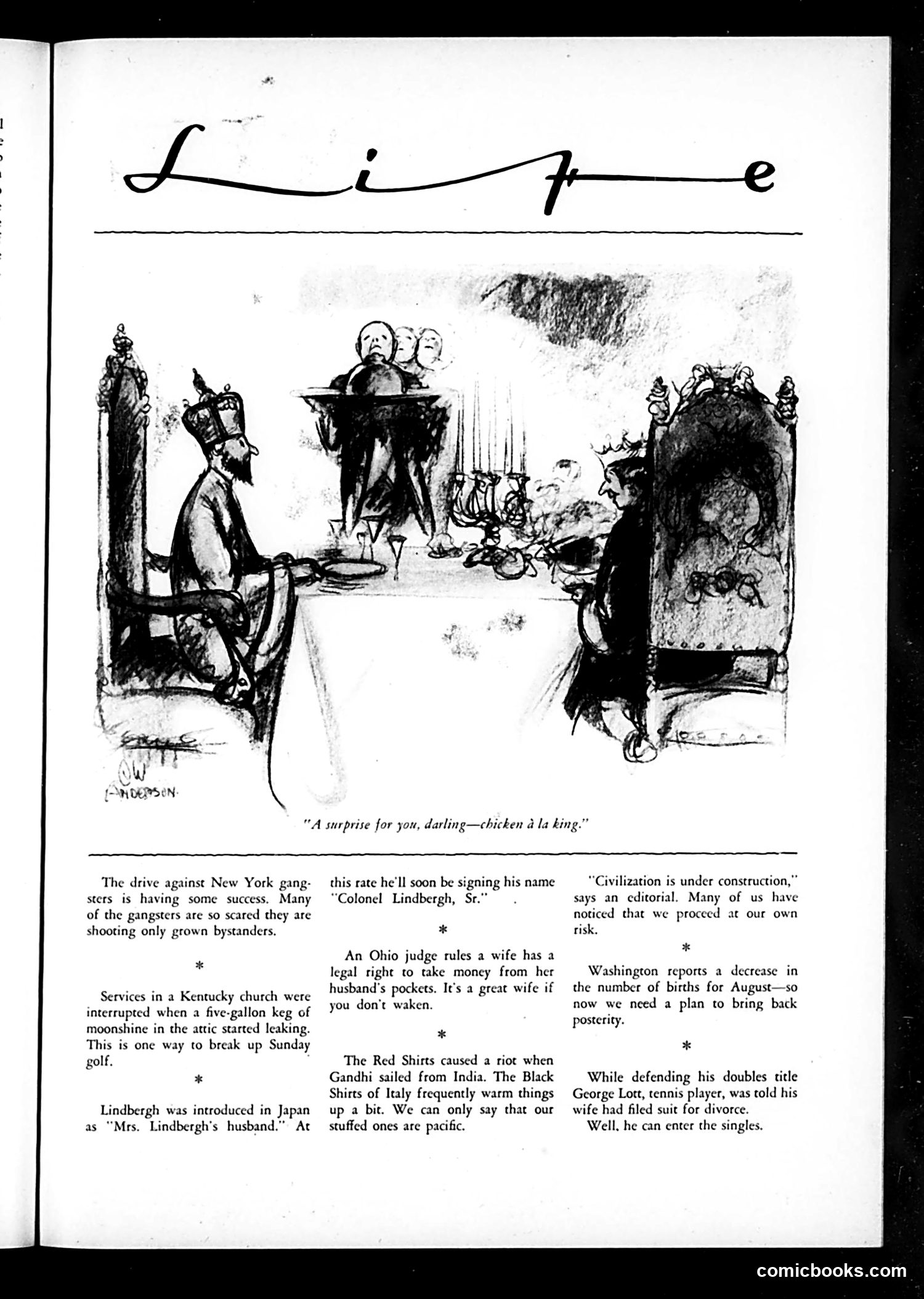
"Life" Magazine Page Analysis This page contains a satirical cartoon titled "A surprise for you, darling—chicken à la king" depicting what appears to be a formal dinner scene. The cartoon likely mocks elaborate or pretentious dining, with the visual suggesting a contrast between expectation and reality. Below the cartoon, the page includes several brief satirical news items, including references to: - Gang violence in New York - Colonel Lindbergh (likely Charles Lindbergh, famous aviator) - Lindbergh being introduced in Japan as "Mrs. Lindbergh's husband" - Legal disputes (a wife's right to her husband's money) - Political unrest in India - A tennis player named George Lott The items mock contemporary social, legal, and political topics through deadpan humor typical of 1920s-30s satirical journalism.
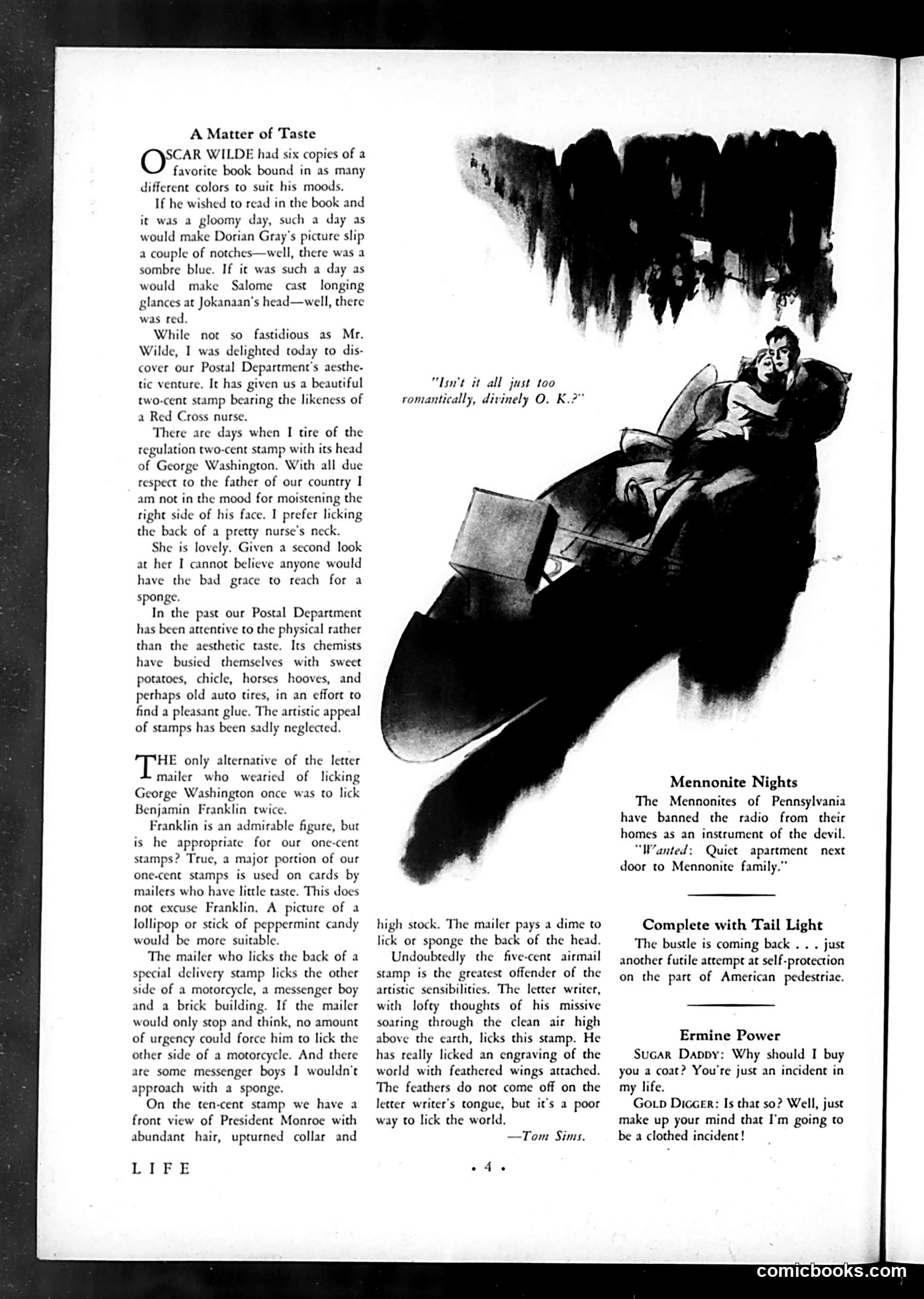
"A Matter of Taste" - Life Magazine Satire This article satirizes the U.S. Postal Department's aesthetic choices. The author humorously critiques the "two-cent stamp bearing the likeness of a Red Cross nurse" and the regulation stamp featuring George Washington, objecting to Washington's stern expression. The main illustration depicts a couple in an intimate moment inside a large envelope or postal container—a visual joke about the postal theme. The caption reads: "Isn't it all just too romantically, distantly O. K.?" The satire mocks the Post Office's focus on practical glue composition (sweet potatoes, chicle, horse hooves) rather than artistic design. The author suggests alternatives like Benjamin Franklin or lollipops would be more tasteful for licking than current stamps. It's a lighthearted complaint about government neglect of aesthetic appeal in everyday objects.
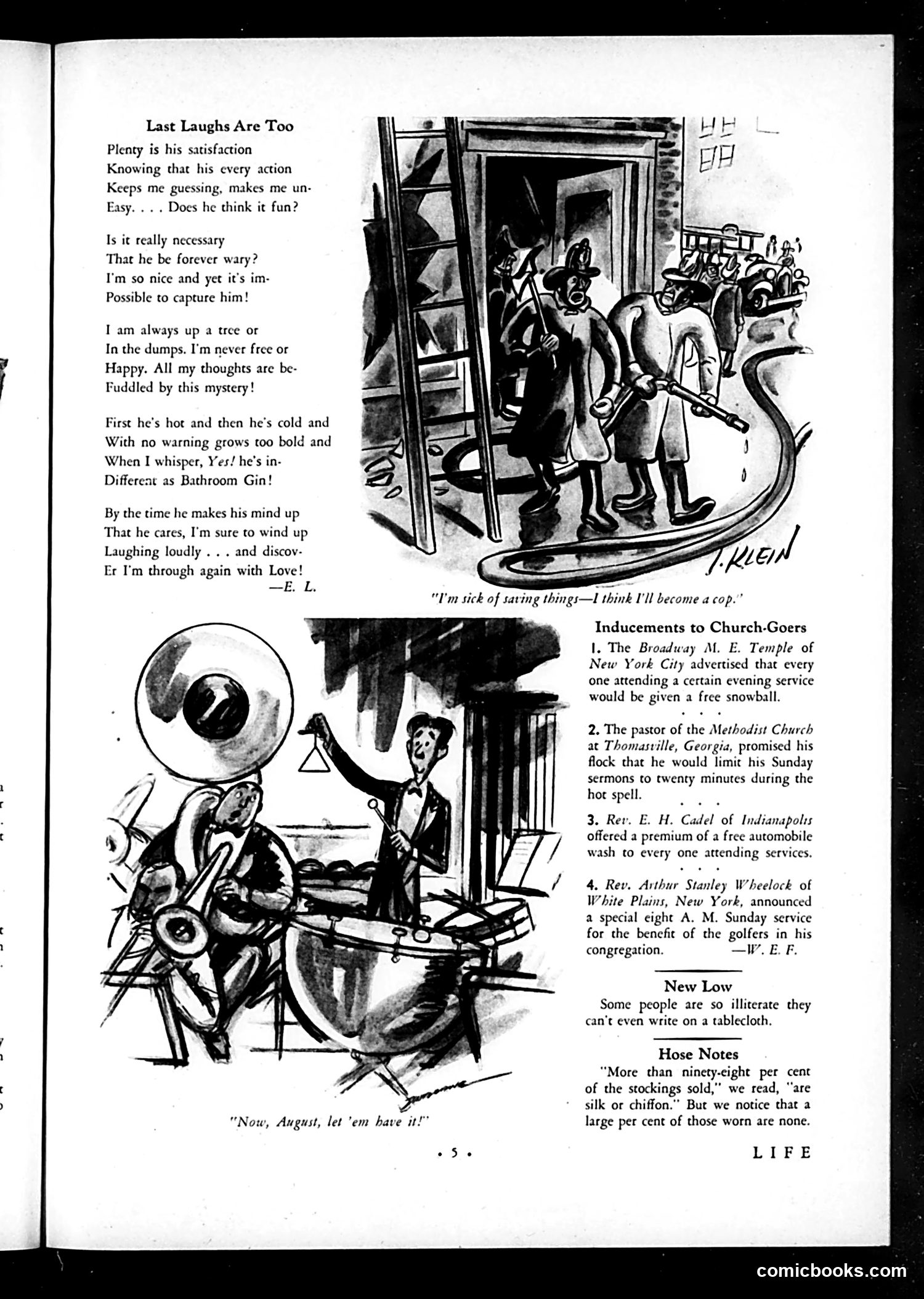
Analysis of Life Magazine Page This page contains satirical commentary on dating and relationships. "Last Laughs Are Too" is a poem about a frustrating romantic partner who is unpredictable and emotionally exhausting—alternating between hot and cold, making the narrator perpetually uncertain. The top cartoon depicts a woman threatening to become a cop if her boyfriend continues "taving things"—likely meaning his unreliable or deceptive behavior. The humor relies on exaggerated threat as relationship commentary. The lower cartoon shows a man at what appears to be cooking equipment, with the caption "Now, August, let 'em have it!"—likely satirizing either domestic disputes or humorous cooking mishaps. The "Inducements to Church-Goers" section sarcastically catalogs various churches' unusual offerings (snowballs, shortened sermons, automobile washes, golf services) to attract attendance, mocking churches' desperation to fill pews during summer.
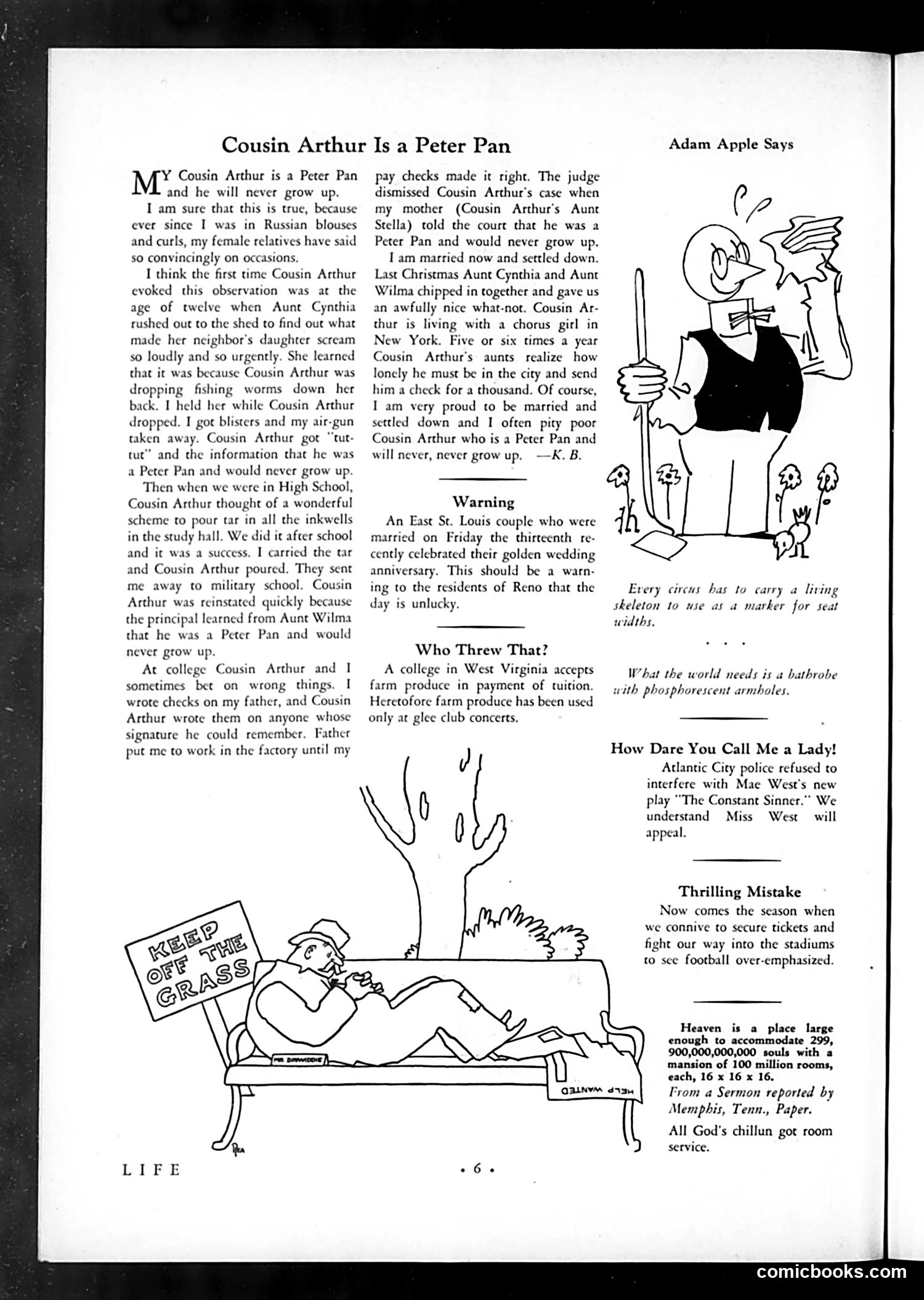
Analysis of Life Magazine Page 6 This page contains several short satirical pieces and cartoons typical of Life's humor section: "Cousin Arthur Is a Peter Pan" — A personal essay mocking the author's cousin who never matured, using "Peter Pan" (the boy who never grows up) as a metaphor for arrested development. The piece uses childhood anecdotes to humorously document this character flaw. "Who Threw That?" — A cartoon showing a man lounging while holding a "Keep Off the Grass" sign, satirizing people who demand others follow rules they themselves ignore. The remaining brief items are typical Life humor segments: short, punchy observations about contemporary life (marriage, police, theater, football fandom, and religion). These showcase Life's style of accessible, lighthearted social commentary aimed at general readers.
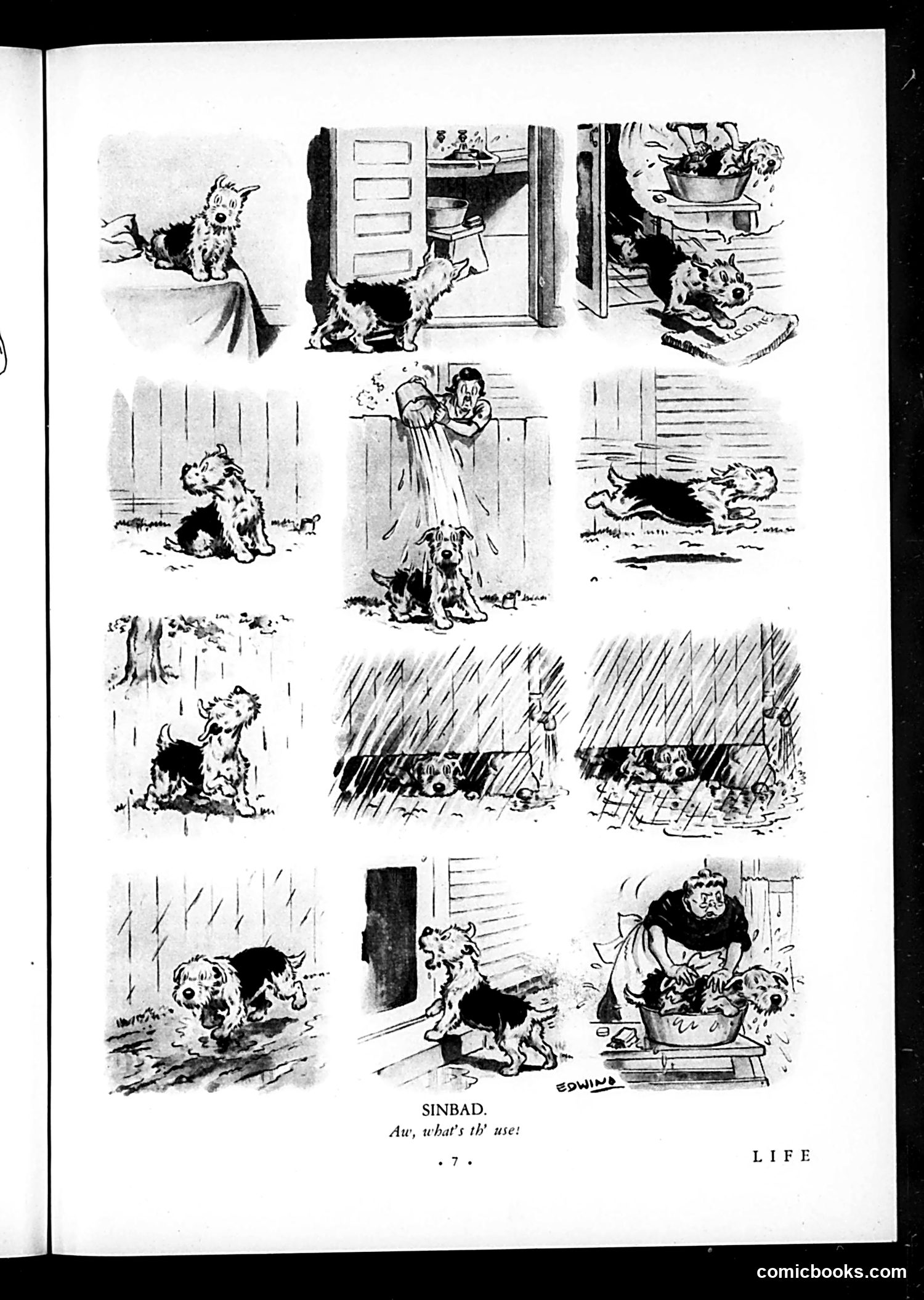
Analysis of "Sinbad: Aw, what's th' use!" This is a comic strip by Sinbad (the artist's signature is visible) featuring a small, scrappy dog character experiencing a series of misfortunes across nine panels. The sequence shows the dog encountering various domestic troubles: being shooed away from a table, getting drenched by water, facing a bath, running from rain, and ending up soaking wet and dejected. The caption "Aw, what's th' use!" captures the dog's resignation to its perpetually bad luck. This appears to be a gentle, humorous strip about a lovable underdog (literally) perpetually defeated by circumstance—likely appealing to readers who identified with small creatures or individuals facing life's minor indignities. The humor derives from relatable domestic scenarios rather than political satire.
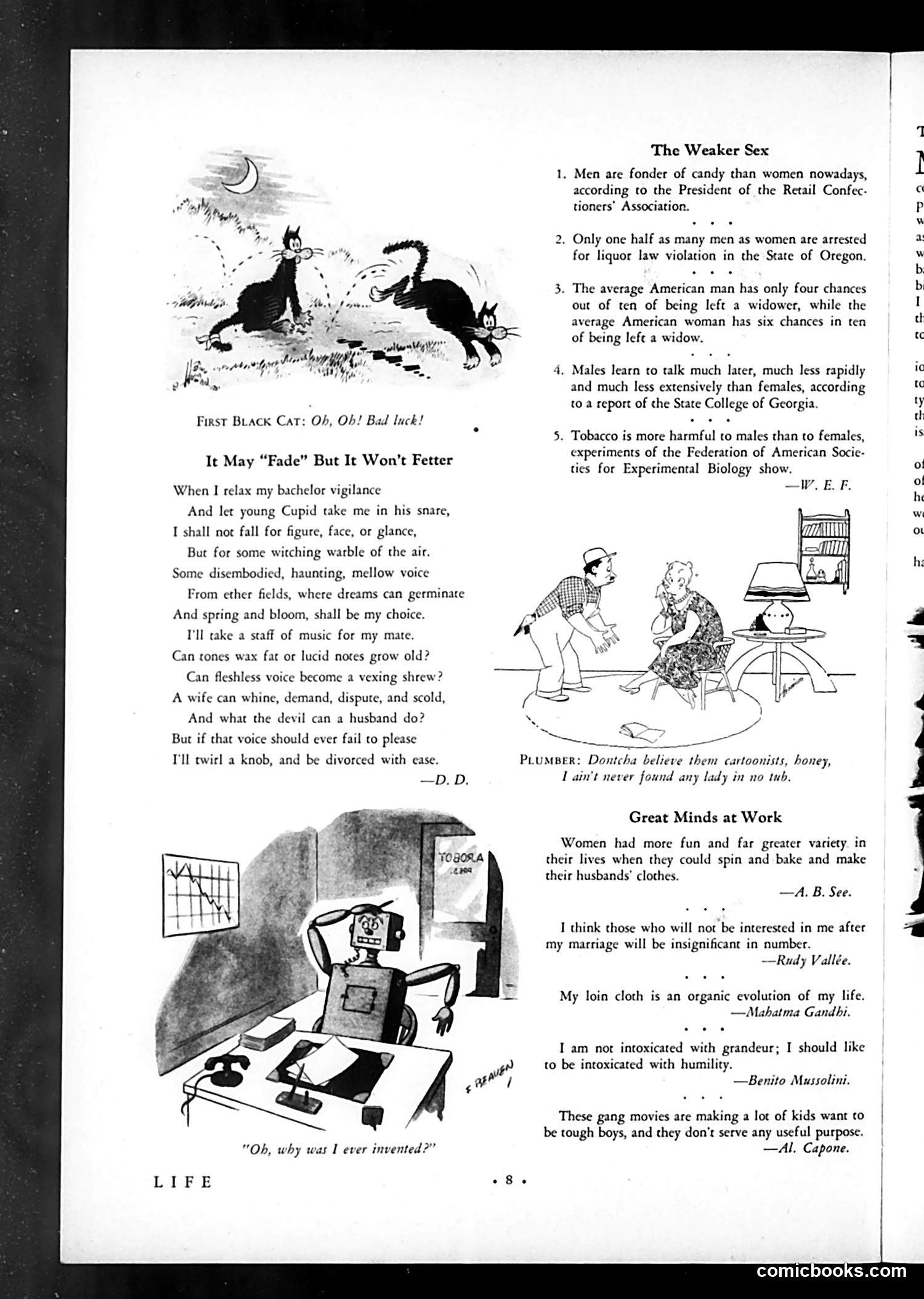
Analysis of Life Magazine Page 8 This page satirizes gender stereotypes through multiple pieces: "The Weaker Sex" section presents ostensibly factual claims (men eat more candy, higher widower rates for men) that ironically contradict the title—suggesting men, not women, are actually the "weaker" sex. "It May Fade But It Won't Fetter" is a poem about a bachelor rejecting marriage, humorously listing domestic grievances (nagging wives, demanding spouses). The robot cartoon ("Oh, why was I ever invented?") shows a frustrated inventor surrounded by failed equipment, satirizing male inventors' struggles—possibly mocking the notion that men are logical problem-solvers. "Great Minds at Work" presents humorous quotes from famous figures (Gandhi, Mussolini, etc.) about domestic life and marriage, suggesting even great men are preoccupied with trivial domestic concerns, further undermining male superiority claims.
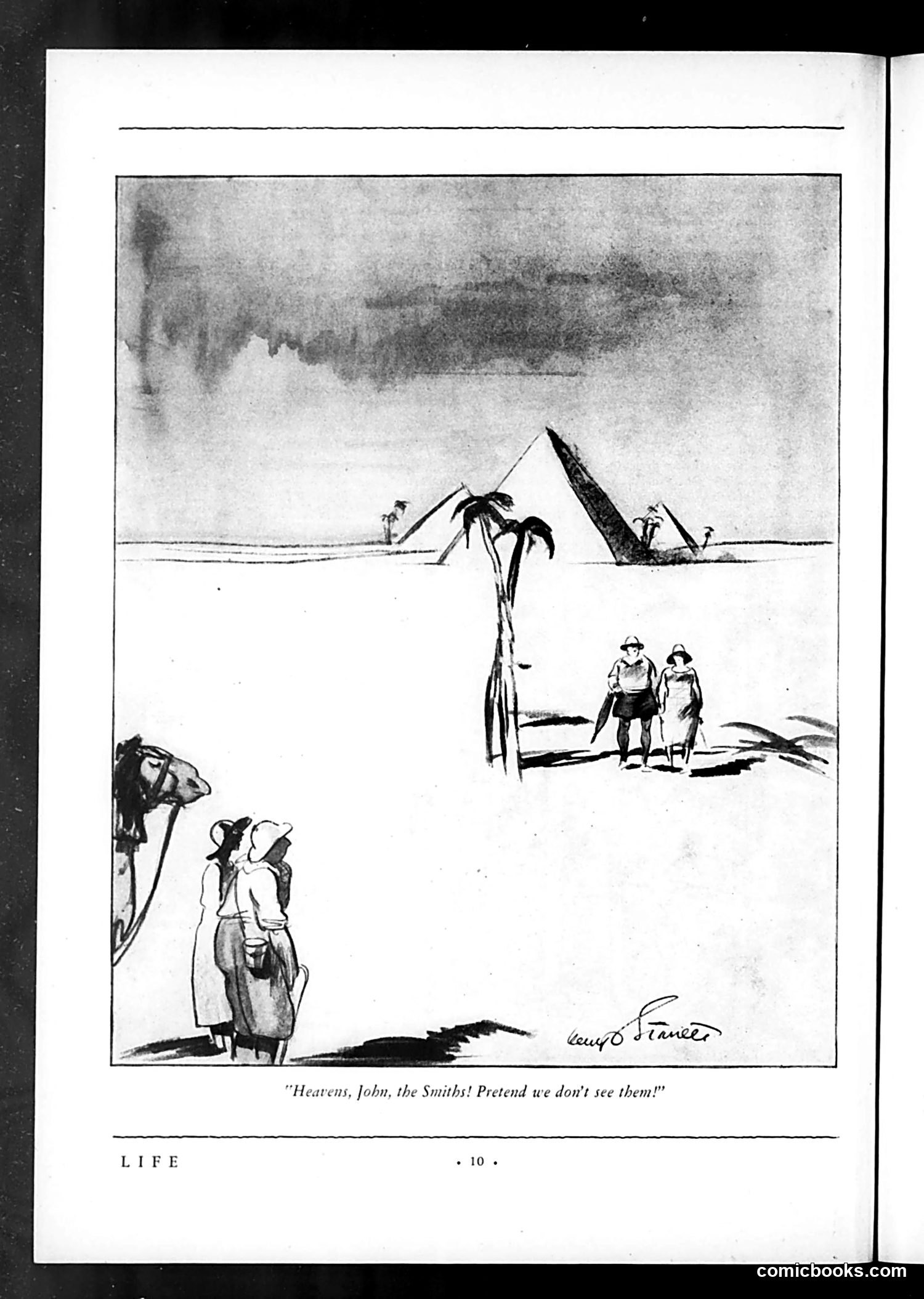
Cartoon Analysis This cartoon depicts a shipwreck scene where a couple on the left observe other survivors in the distance. The woman says to her husband John: "Heaven, John, the Smiths! Pretend we don't see them!" The satire targets social snobbery and class consciousness. Even in a life-or-death maritime disaster, the couple prioritizes avoiding acknowledgment of their social acquaintances (the Smiths), suggesting they consider them beneath their station. The humor lies in the absurdity of maintaining social pretense during a catastrophe—the ultimate commentary on how some people's concern for social status overrides basic human decency and survival instincts. The cartoon mocks the artificiality and rigidity of social hierarchies among the upper classes.
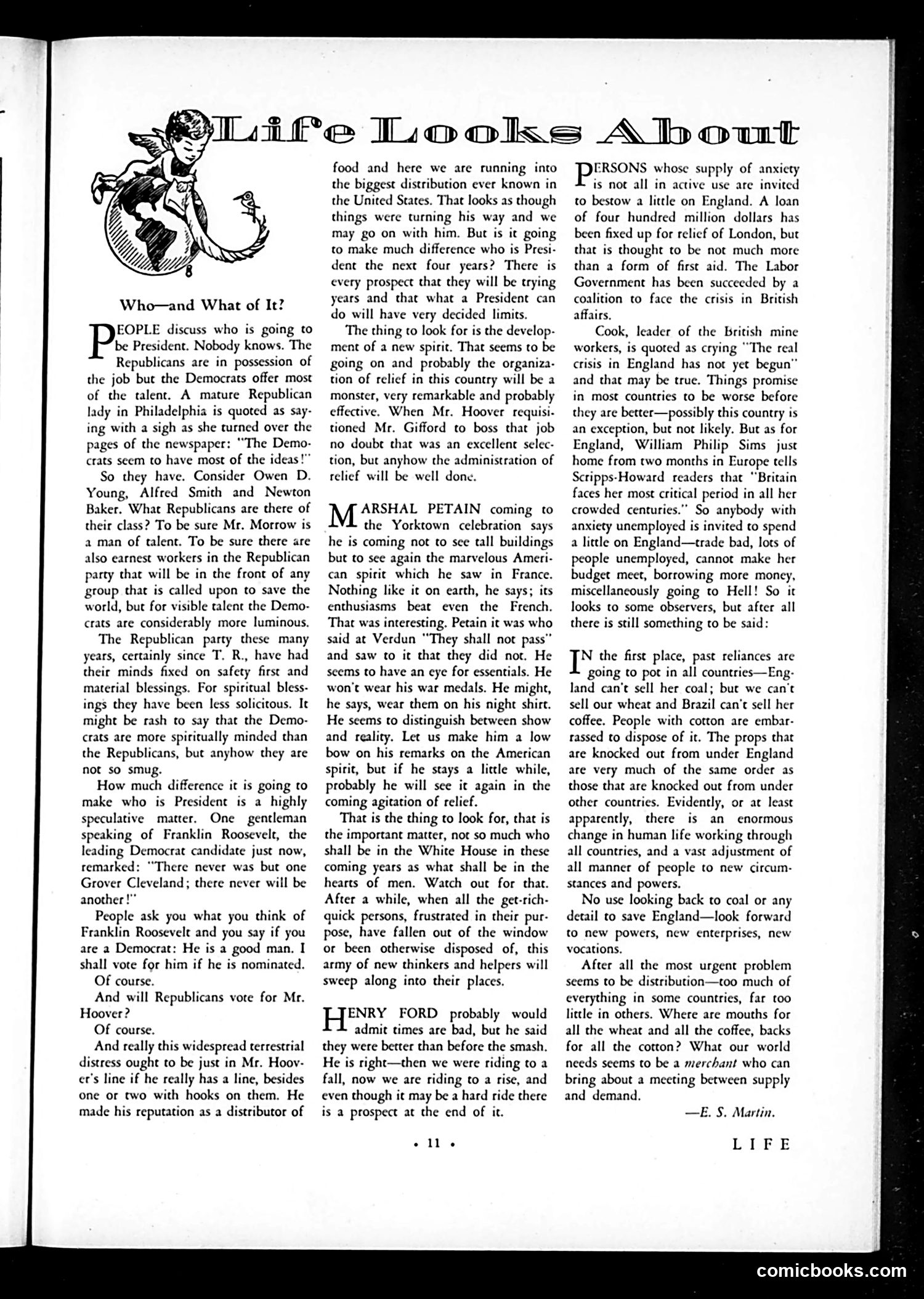
"Life Looks About" — Political Commentary, circa 1932 The page contains political commentary on the 1932 U.S. presidential election. The author discusses potential Republican candidates (Owen D. Young, Alfred Smith, Newton Baker) and notes Democrats possess "most of the talent." The piece references Franklin D. Roosevelt as the leading Democratic candidate, suggesting he represents a "new spirit" in relief efforts. It criticizes President Hoover's distribution record and suggests Roosevelt's administration will make "very decided limits" on presidential power. The commentary also discusses Marshal Pétain's visit to America, praising his American spirit over French nationalism, and addresses economic distribution problems—wheat, coffee, cotton surpluses—arguing a "merchant" is needed to balance supply and demand globally. The small illustration shows a cherub or child figure, likely symbolizing hope or relief.
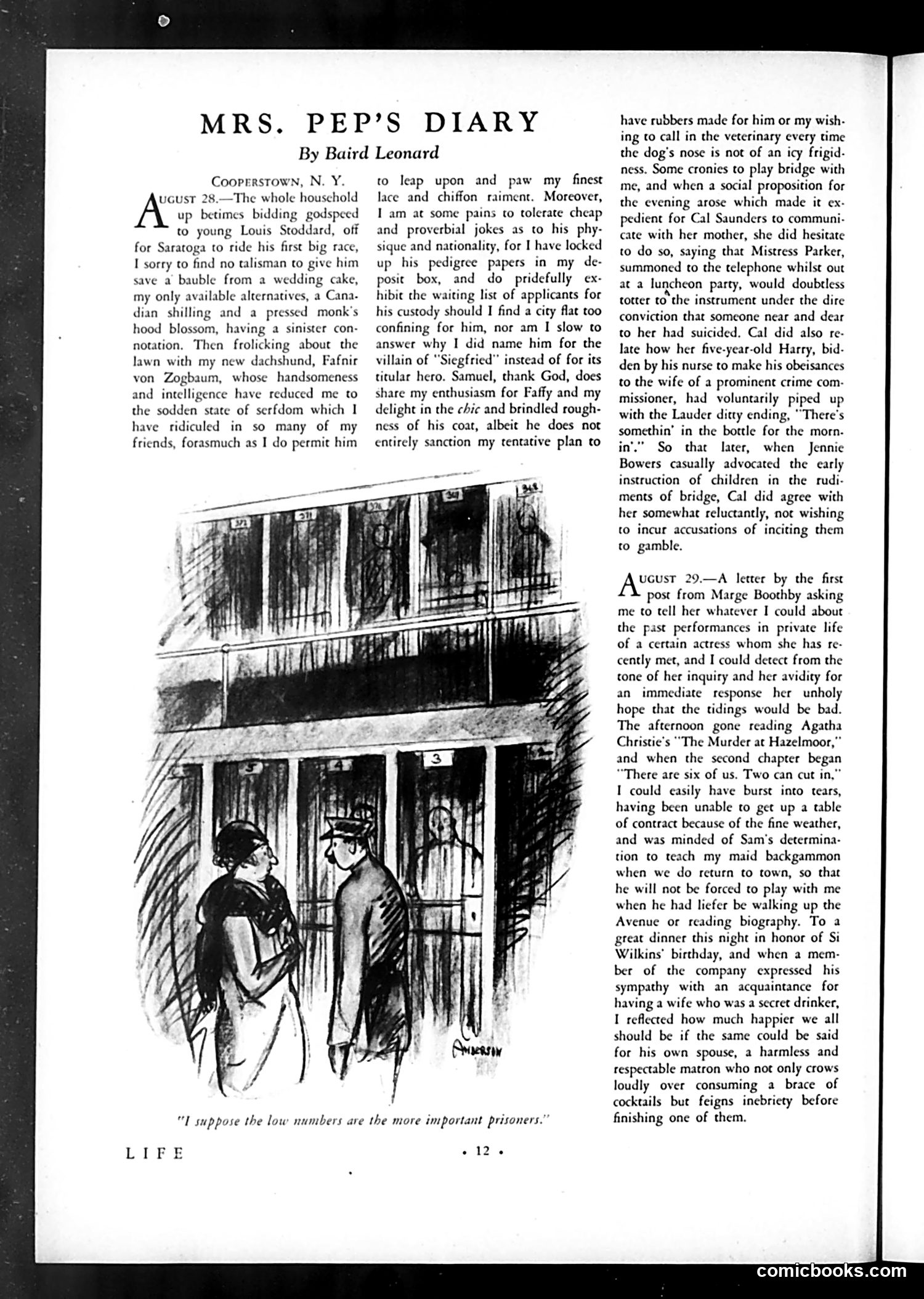
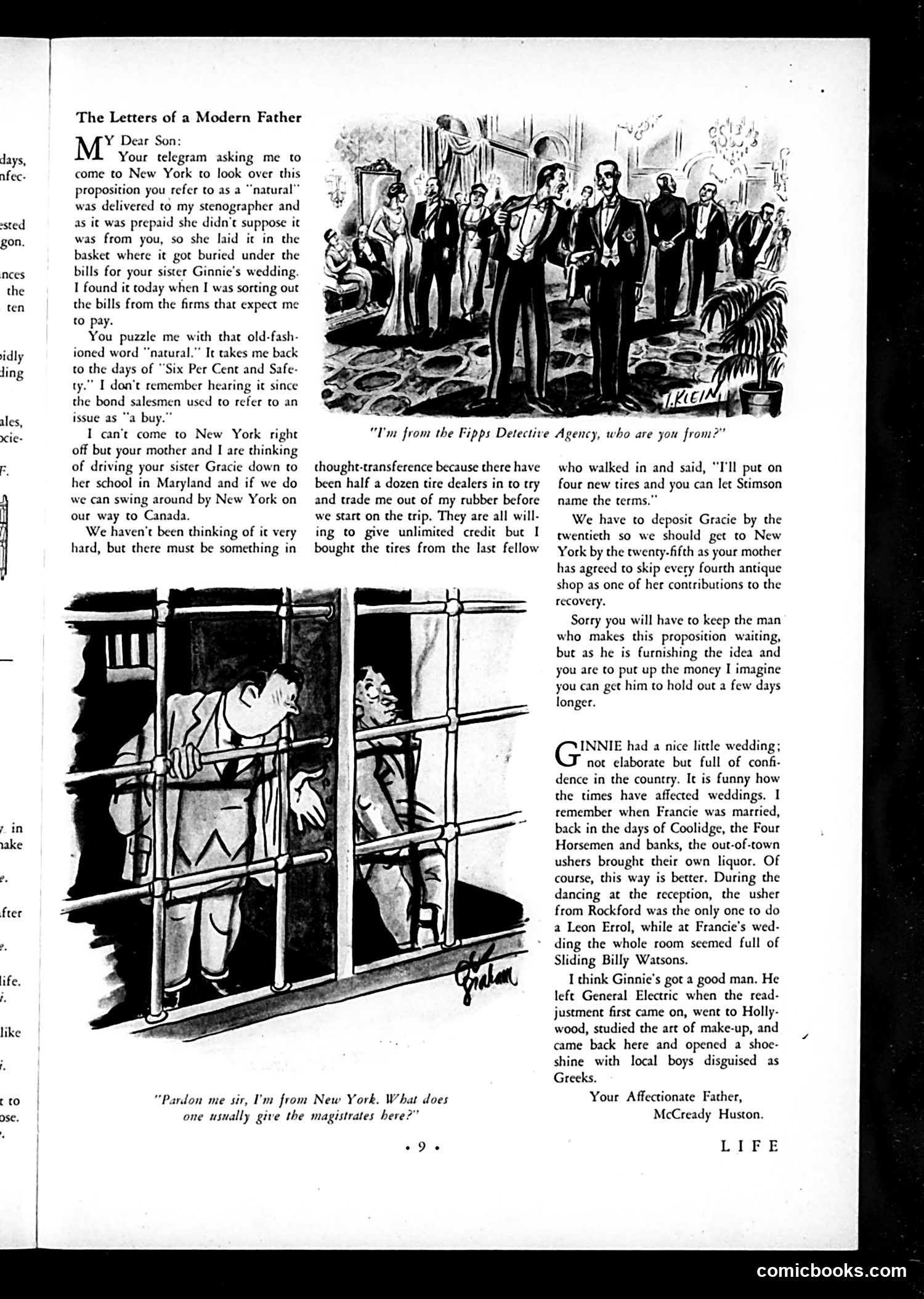
"Mrs. Pep's Diary" by Baird Leonard This is a humorous diary entry from August 28-29, featuring Mrs. Pep's observations about household life in Cooperstown, N.Y. The accompanying sketch shows two figures at what appears to be a doorway or window, illustrating the caption: "I suppose the low numbers are the more important prisoners." The humor derives from domestic situations: Mrs. Pep's frustrations with a new dachshund named Fafnir, social pretensions among acquaintances, and gossip about an actress's personal life. The "prisoners" caption likely refers to a bridge game, sarcastically treating card game rankings as mock imprisonment. This represents typical *Life* magazine humor of the era—satirizing upper-middle-class social conventions, marital dynamics, and everyday absurdities through a woman's witty observations.
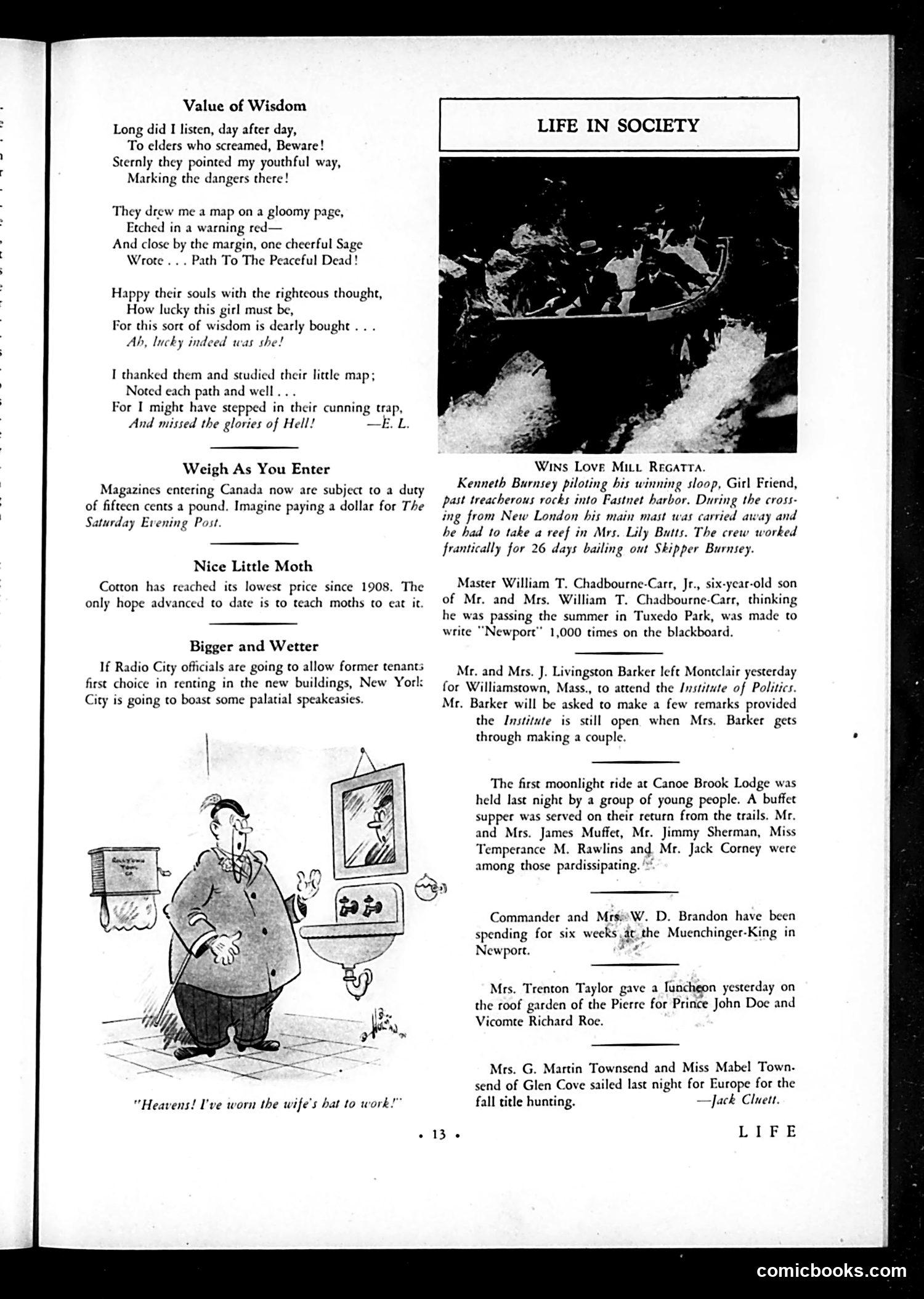
Explanation for Modern Readers The main cartoon shows a man wearing his wife's hat to work, captioned "Heaven! I've worn the wife's hat to work!" This satirizes early 20th-century gender roles and masculinity anxieties. The joke relies on the social embarrassment a man would face wearing women's clothing—suggesting he's so desperate or confused that he'd commit this social transgression. It mocks both male vanity and the rigid gender conventions of the era, where crossing gender boundaries in appearance was considered shamefully ridiculous. The surrounding "Life in Society" section contains brief social announcements about local events, sailboat races, and social gatherings among the wealthy—typical society-page content that Life magazine parodied through its satirical commentary on upper-class life.
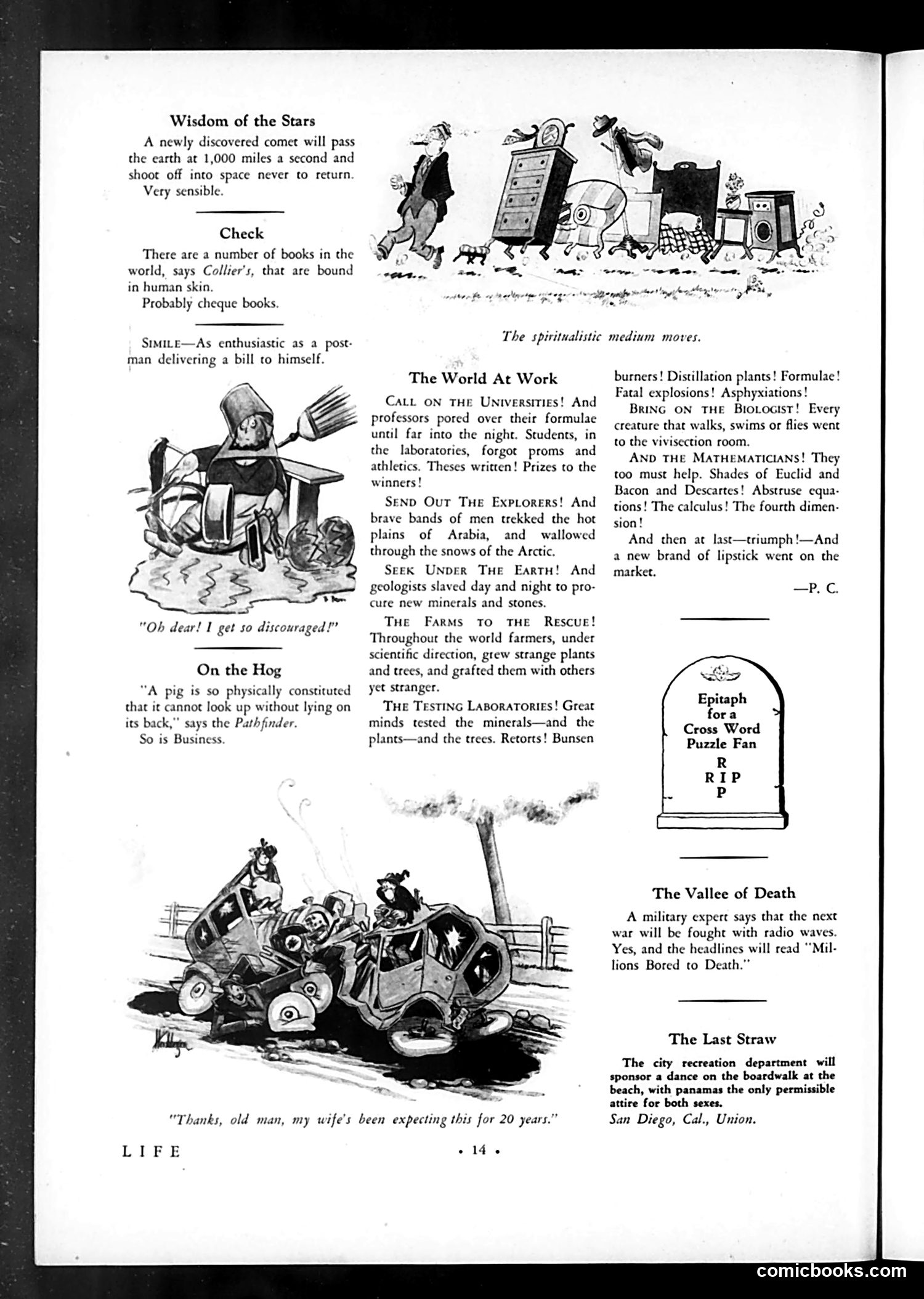
Analysis of Life Magazine Page 14 This page contains satirical humor pieces typical of early-to-mid 20th century Life magazine. "The World At Work" is a mock-heroic poem celebrating various professions—universities, explorers, farmers, geologists, and testing laboratories—as if they're noble endeavors. The satire mocks the grandiose language used to describe ordinary scientific and industrial work, particularly the comma-separated lists of dramatic phrases ("burners! Distillation plants! Formulae!") that elevate mundane activities to epic status. The cartoons depict everyday frustrations: an overly enthusiastic postman, a discouraged scholar, and a car accident victim. "On the Hog" jokes that pigs and businessmen are similarly constituted—unable to function without lying down. The overall tone satirizes how modern society romanticizes work and progress while ignoring practical realities.
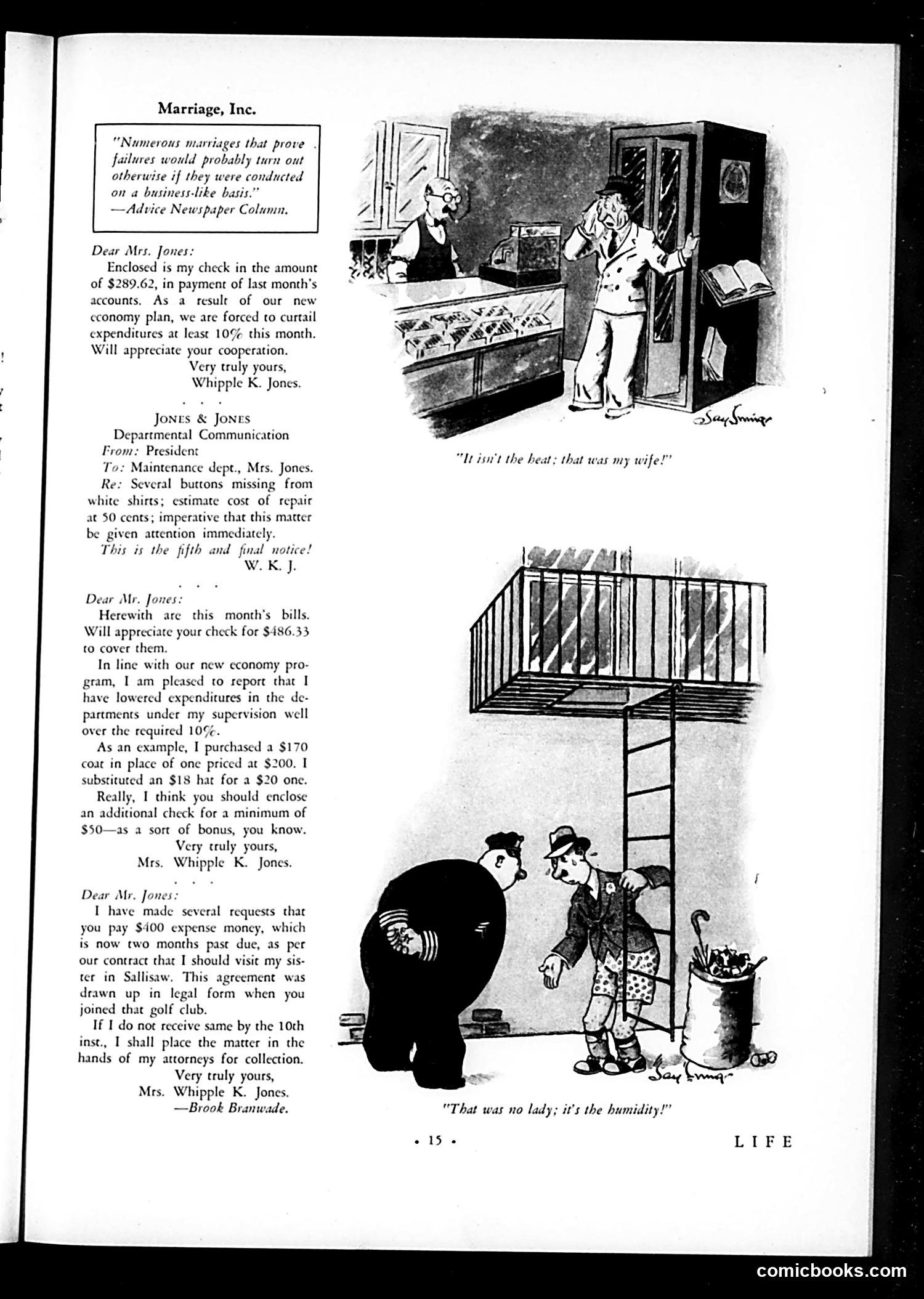
"Marriage, Inc." - Life Magazine Satirical Page This page satirizes the business-like management of modern marriage through fictional correspondence between Mr. and Mrs. Whipple K. Jones at "Jones & Jones Department Communication." The letters mock treating marriage as a corporate enterprise: the husband sends expense reports and cost-cutting memos (reducing a $200 shirt repair to $170); the wife demands reimbursement for visiting her sister and threatens legal action if not paid. The accompanying cartoons reinforce this absurdity—one shows a man claiming a woman isn't his wife (suggesting marital transaction disputes), while another depicts two men literally trading wives like commodities. The satire targets post-1920s trends of applying rigid business efficiency to personal relationships, critiquing how commercialization was infiltrating intimate life.
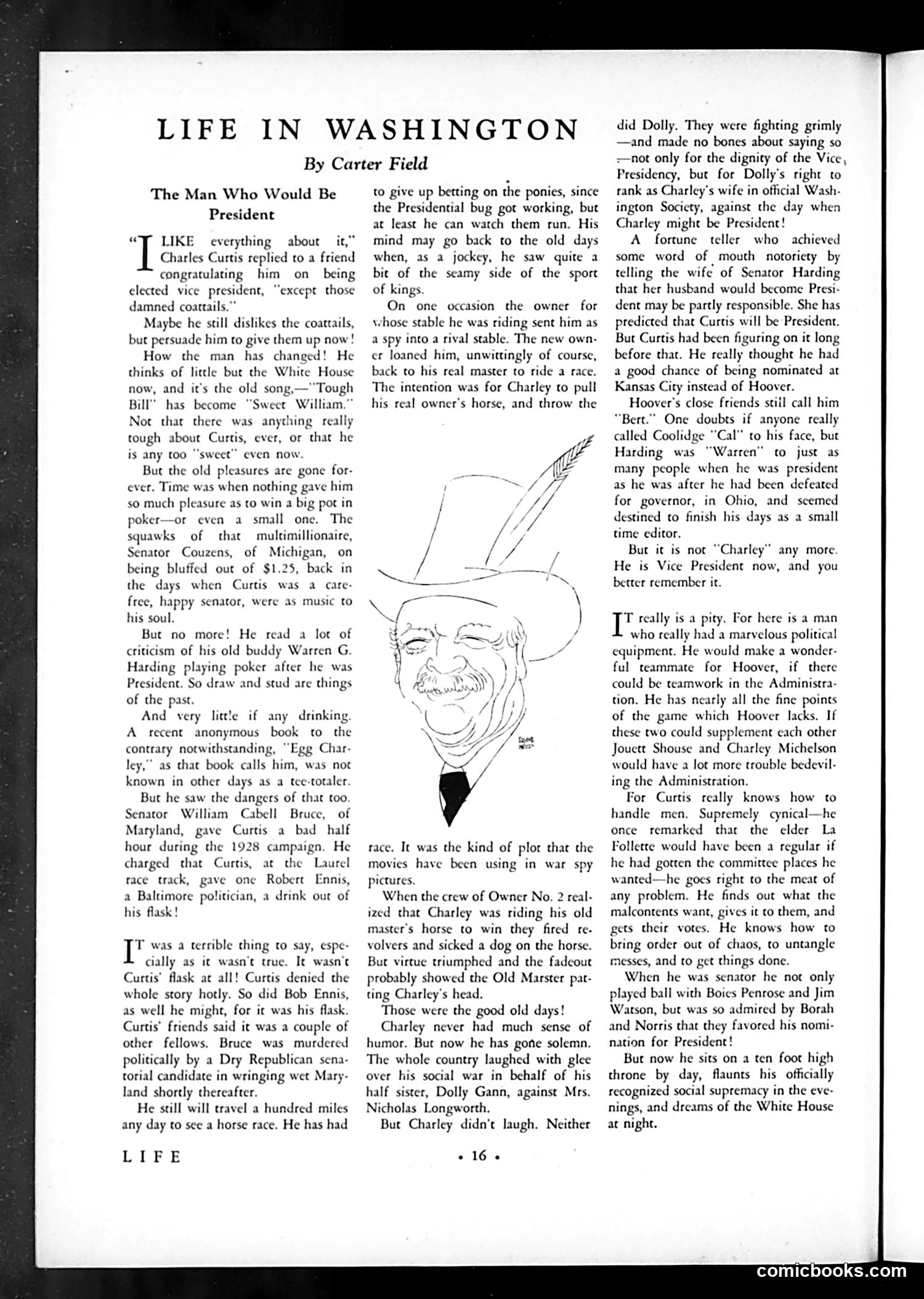
Political Commentary on Charles Curtis as Vice President This Carter Field column satirizes Charles Curtis, Vice President under Herbert Hoover. The piece mocks Curtis's past as a poker-playing politician who enjoyed gambling and drinking—vices now requiring discretion given his elevated position. The central joke concerns Curtis's transformation from a colorful, fun-loving senator into a staid, socially ambitious vice president. Field notes Curtis must now carefully manage his public image, particularly regarding his half-sister Dolly Gann's social prominence in Washington society—a real controversy of the era. The accompanying sketch caricatures Curtis with exaggerated features. Field suggests Curtis possesses political skills that could benefit Hoover's administration, yet his old-guard personality conflicts with the dignity his office demands—a commentary on the gap between politicians' private conduct and public personas.
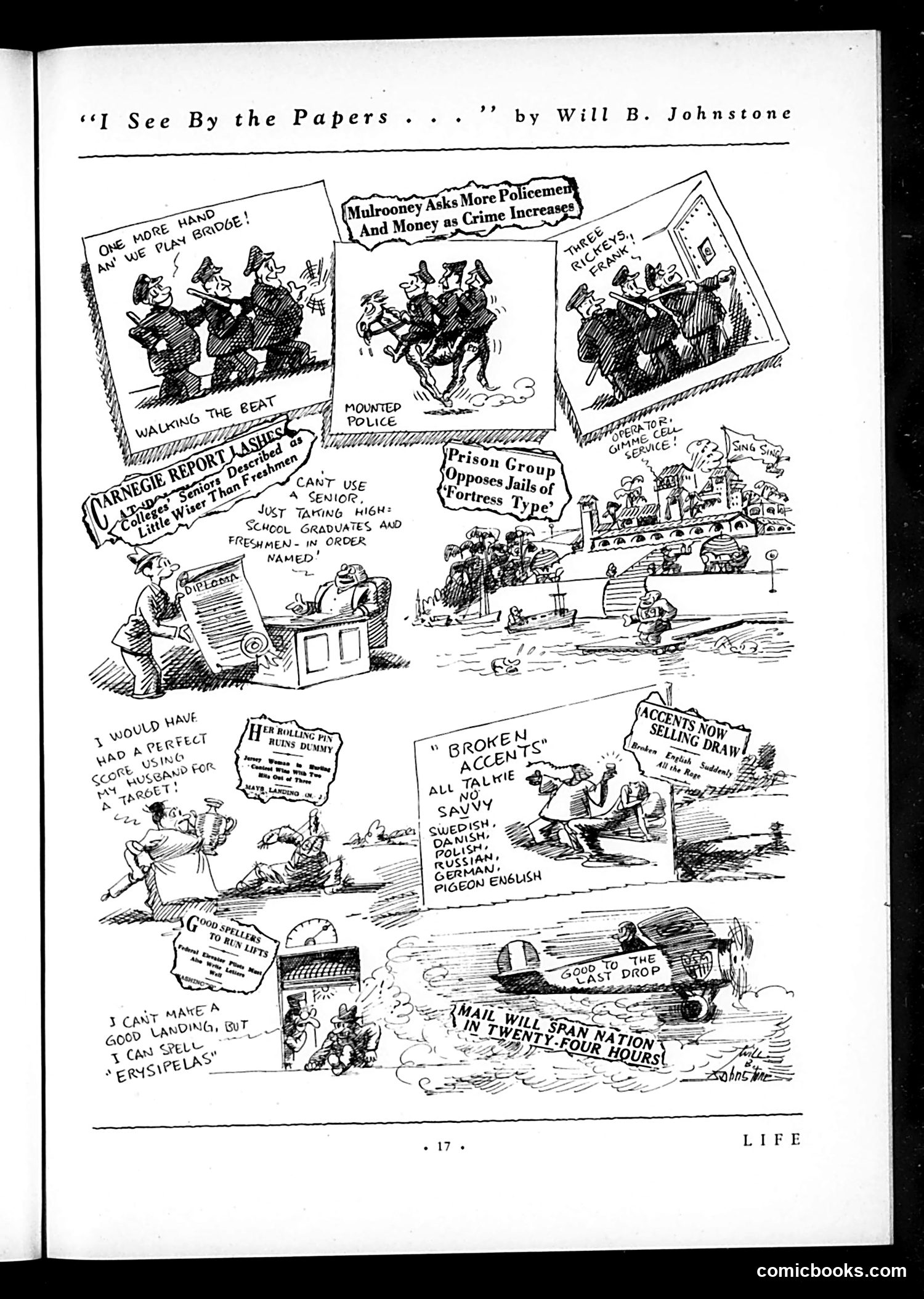
"I See By the Papers..." by Will B. Johnstone This satirical page collects several contemporary news items as visual gags: Top panels: Mock police requests for more funding and mounted police, suggesting authorities constantly seek budget increases. Middle section: A "Prison Group Opposes Jails of Fortress Type" headline, with absurdist commentary about education curricula and spelling. Bottom panels: Joke about linguistic difficulties—someone claiming they can't master "good landing" despite speaking multiple languages, and mail delivery promises ("mail will span nation in twenty-four hours"). The overall effect satirizes newspaper headlines' often contradictory, absurd, or overpromising nature. The cartoonist mocks bureaucratic requests for resources, educational debates, and unrealistic technological promises—typical fodder for satirical magazines of this era.
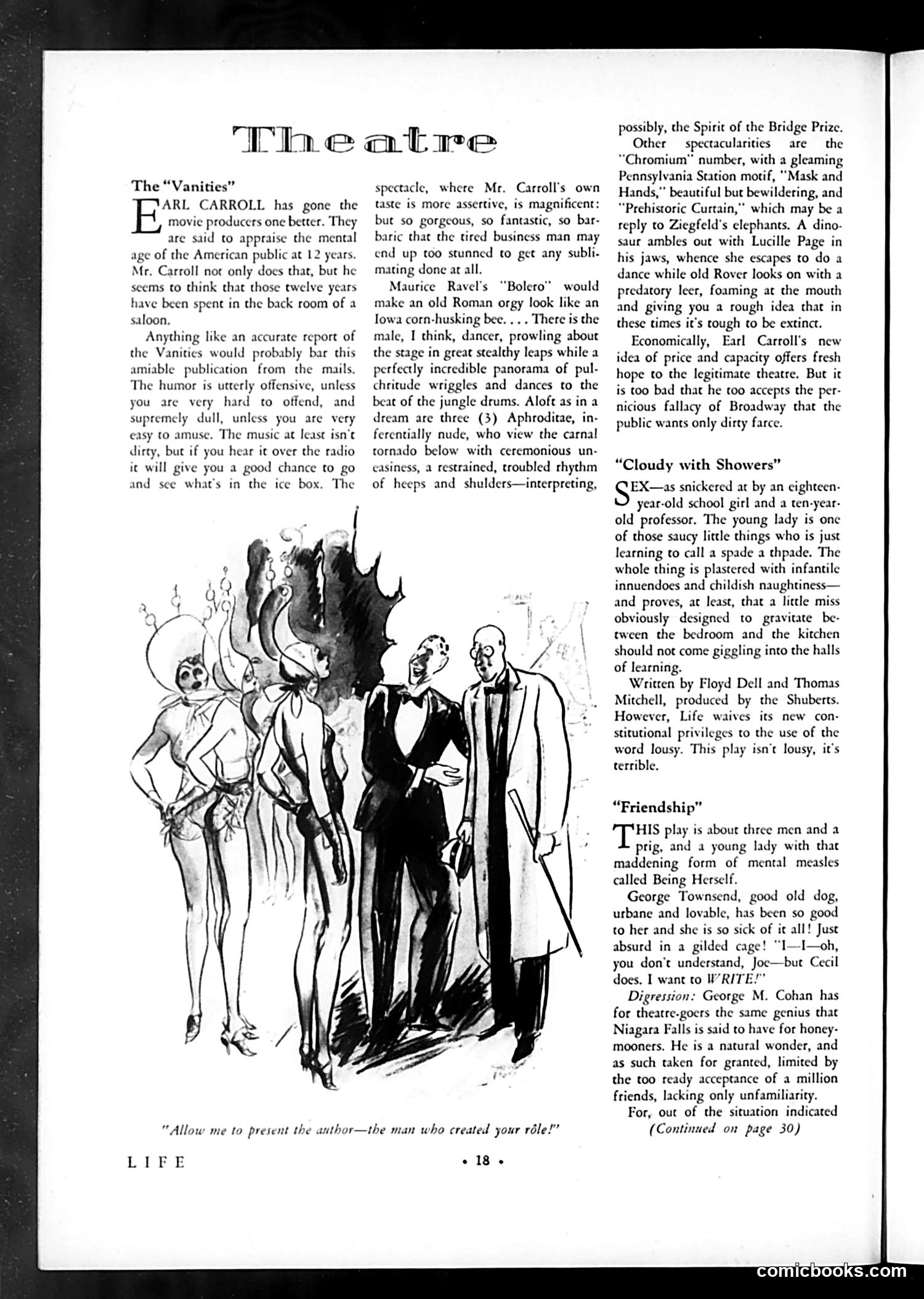
Theatre Reviews - Life Magazine This page contains three theatre reviews with an illustration of performers in formal attire with stylized female figures. "The 'Vanities'" — Critic Earl Carroll is praised for improving movie producers' standards. The review mocks the show's music as offensive and dull, recommending radio or ice box viewing instead. Carroll apparently ran a theatrical spectacle emphasizing visual excess over substance. "Cloudy with Showers" — A comedy about an eighteen-year-old schoolgirl and ten-year-old professor, criticized as infantile and designed to appeal only to those finding bathroom humor amusing. "Friendship" — Described as a play about three men, a pig, and a woman with "mental measles called Being Herself." The review notes George M. Cohan's directorial talent but suggests his acceptance of mediocrity limits his work.
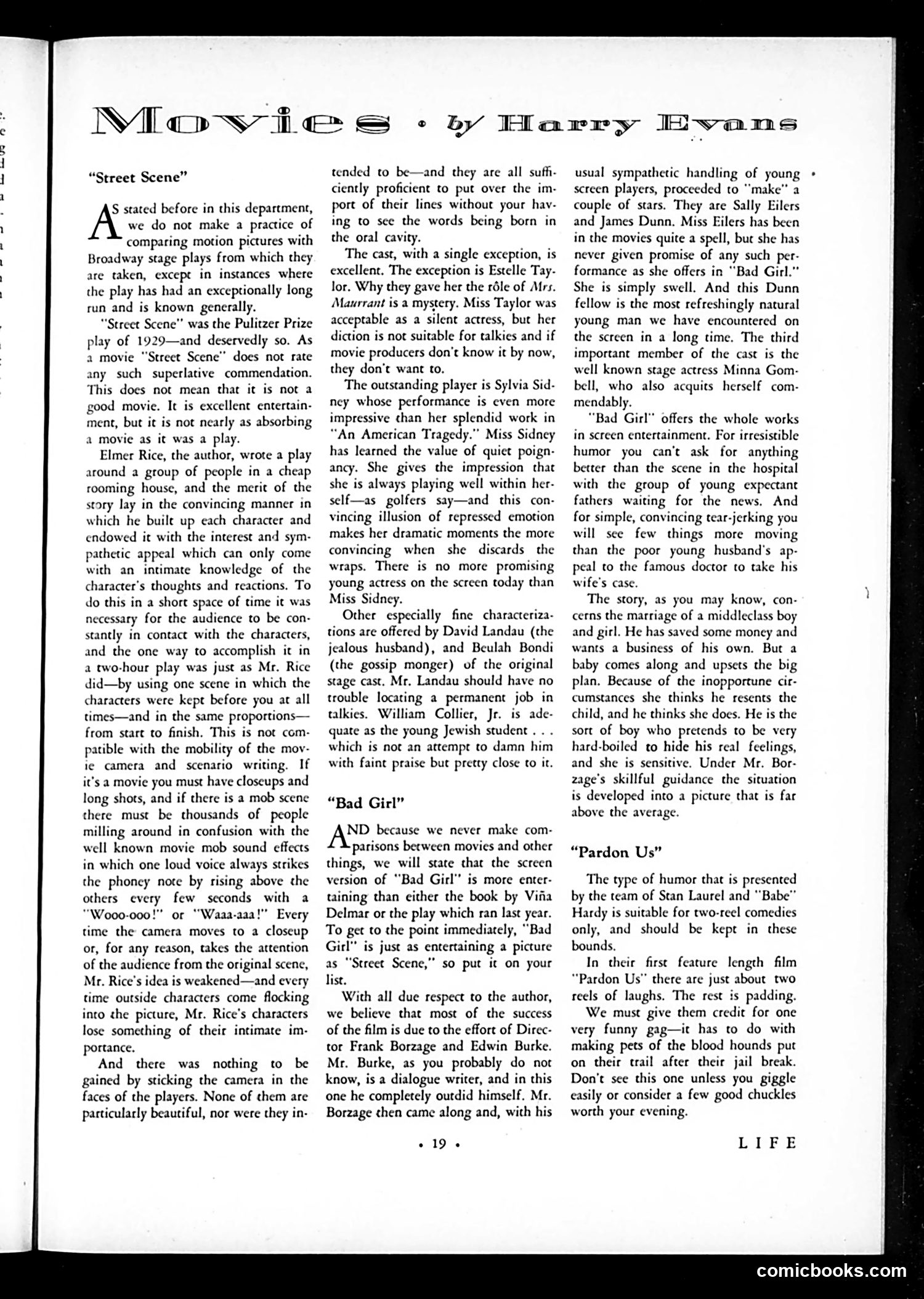
Movies by Harry Evans - Life Magazine Film Criticism This page contains three film reviews by Harry Evans, a Life magazine critic. Rather than cartoons, it presents column-style criticism of contemporary films. "Street Scene" discusses a stage-to-screen adaptation with strong ensemble acting, praising Sylvia Sidney's restrained performance while criticizing other cast members' suitability for talking pictures. "Bad Girl" reviews a film adaptation considered more entertaining than its source material, with credited directors Frank Borzage and Edwin Burke. "Pardon Us" reviews a Stan Laurel and "Babe" Hardy (Laurel and Hardy) comedy, praising its humor while acknowledging it's primarily slapstick entertainment designed for easy laughs rather than sophisticated comedy. The page reflects 1920s-early 1930s cinema's transition to sound film and the challenge of adapting stage plays to screen.
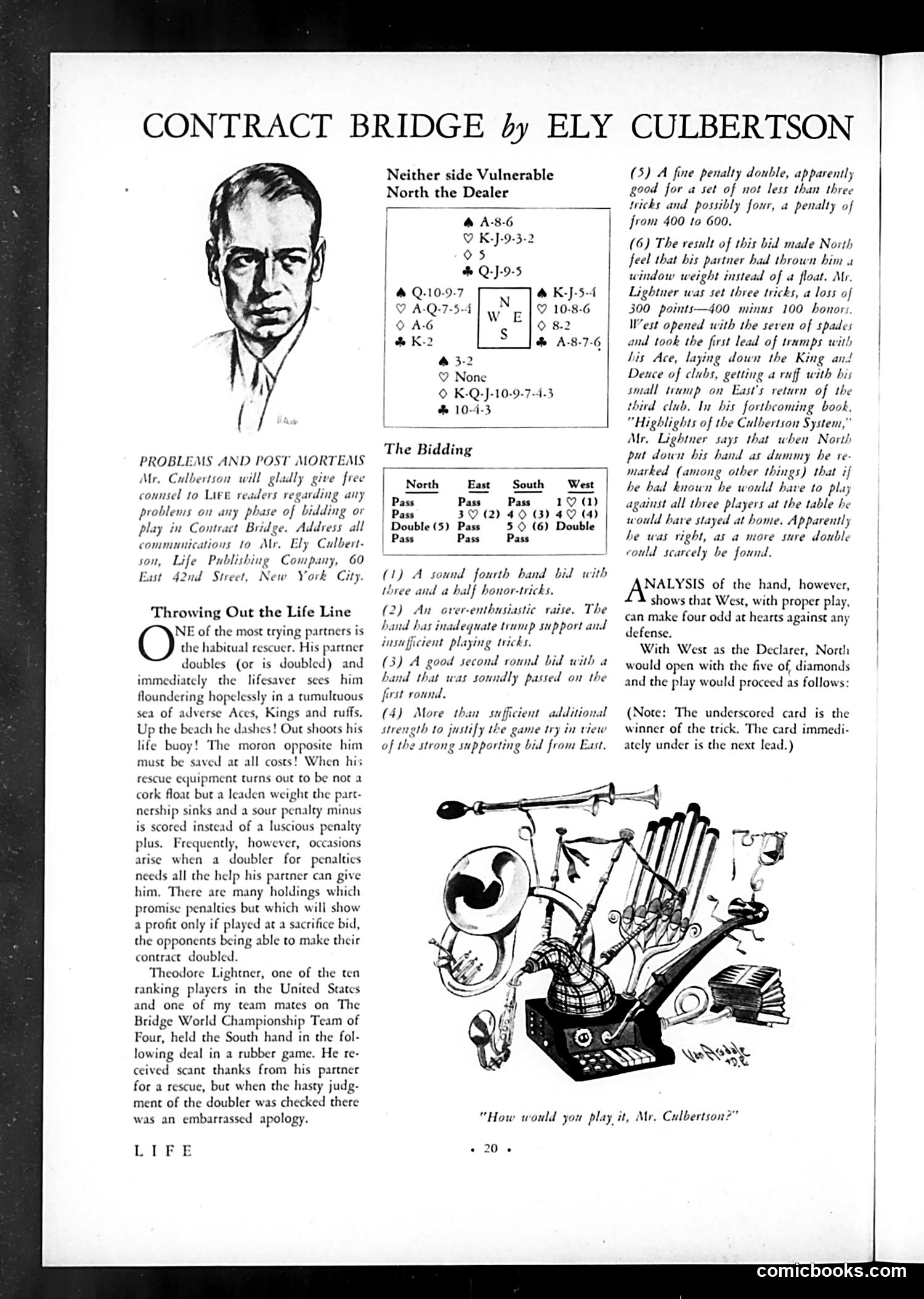
Contract Bridge Analysis by Ely Culbertson This page from *Life* magazine is not a political cartoon but rather an instructional bridge column by renowned contract bridge expert Ely Culbertson. The content teaches readers about penalty doubles and rescue bidding in the card game. The main lesson concerns "the habitual rescuer"—a bridge partner who impulsively attempts to save their doubled partner from a bad contract, often making things worse. Culbertson illustrates this with a real hand held by Theodore Lightner, a top American bridge player. The example shows how a well-intentioned rescue bid (5 clubs) backfired, losing points when West could have actually made 4 hearts—meaning the original double was misguided. The illustrated bridge instruments and the caption "How would you play it, Mr. Culbertson?" are humorous touches inviting reader participation in this competitive bridge analysis.
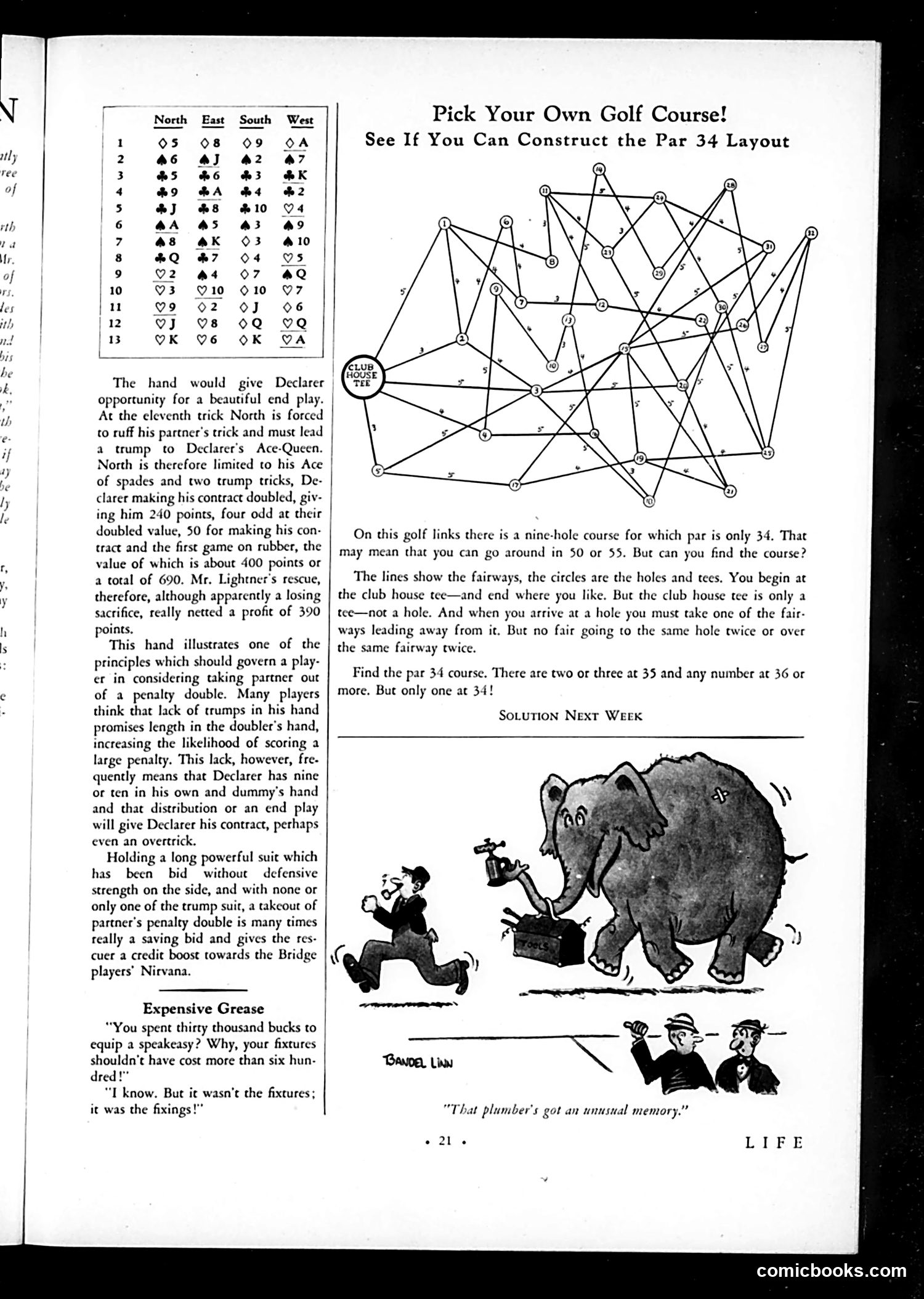
Explanation for Modern Readers This is a bridge card game instruction page from Life magazine, featuring two main elements: Main Content: A detailed bridge hand analysis explaining strategic play, penalty doubles, and takeout decisions. The text discusses a specific dealt hand and the mathematical scoring involved—entirely technical bridge instruction with no satire intended. Sidebar Puzzle: A "Pick Your Own Golf Course" puzzle where readers must trace a nine-hole course with par 34 through an interconnected network diagram. Small Cartoons: Three brief gag illustrations: 1. A man chasing an elephant labeled "DANIEL LYNN" 2. Two men discussing a plumber with the caption "That plumber's got an annual memory" "Expensive Grease" joke: A speakeasy owner's pun—the "fixings" (bribes to police/politicians) cost more than actual fixtures during Prohibition. This page reflects 1920s-30s Life: mixing bridge instruction, word puzzles, and topical humor referencing Prohibition-era corruption, all aimed at educated leisure-class readers.
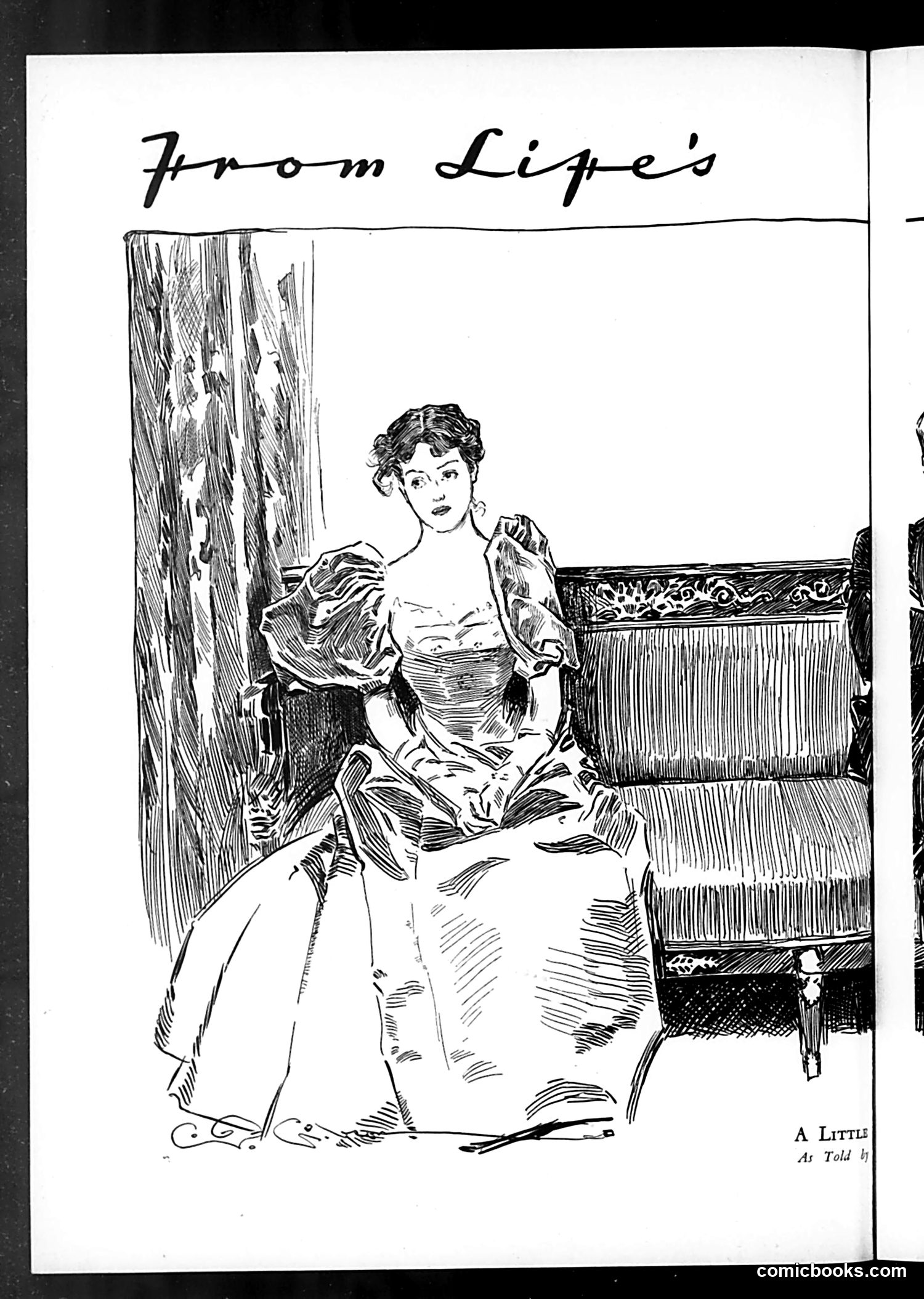
Analysis This page from *Life* magazine features an illustration titled "From Lipe's" showing a fashionably dressed woman seated on a sofa in an elegant interior setting. The drawing style is characteristic of early 20th-century satirical illustration, using ink linework typical of the period. The OCR text is largely corrupted and unreadable, making it difficult to identify the specific satirical content or social commentary intended. The illustration itself appears to depict high-society fashion and domestic leisure—subjects *Life* frequently satirized—but without legible accompanying text, the precise target of the satire remains unclear. The image may comment on women's fashion, social pretension, or upper-class life, but the specific joke or reference cannot be reliably determined from the corrupted text.
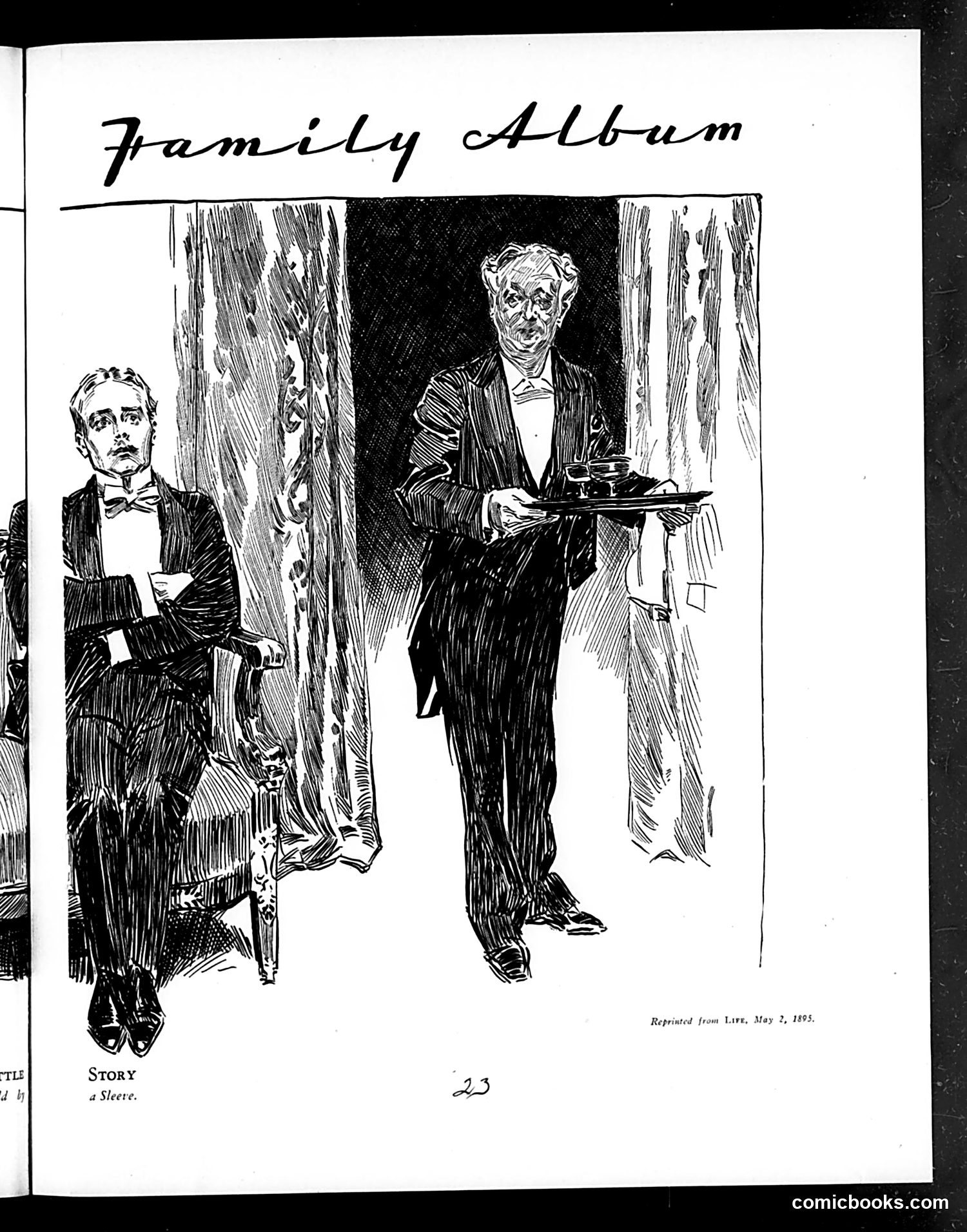
Family Album - "Story a Sleeve" This page from *Life* magazine (May 2, 1883) presents a satirical sketch titled "Story a Sleeve." The illustration shows two men in formal evening wear: one seated on the left looking nervous or contemplative, and another standing on the right holding what appears to be a serving tray, dressed as a waiter or servant. The title "Story a Sleeve" suggests social commentary about class distinction and servant culture. The sketch likely satirizes Victorian-era dining etiquette or the relationship dynamics between employer and servant. The formal dress and interior setting indicate upper-class domestic life, with the humor presumably deriving from an awkward social interaction or unspoken tension between these figures during a formal meal service.
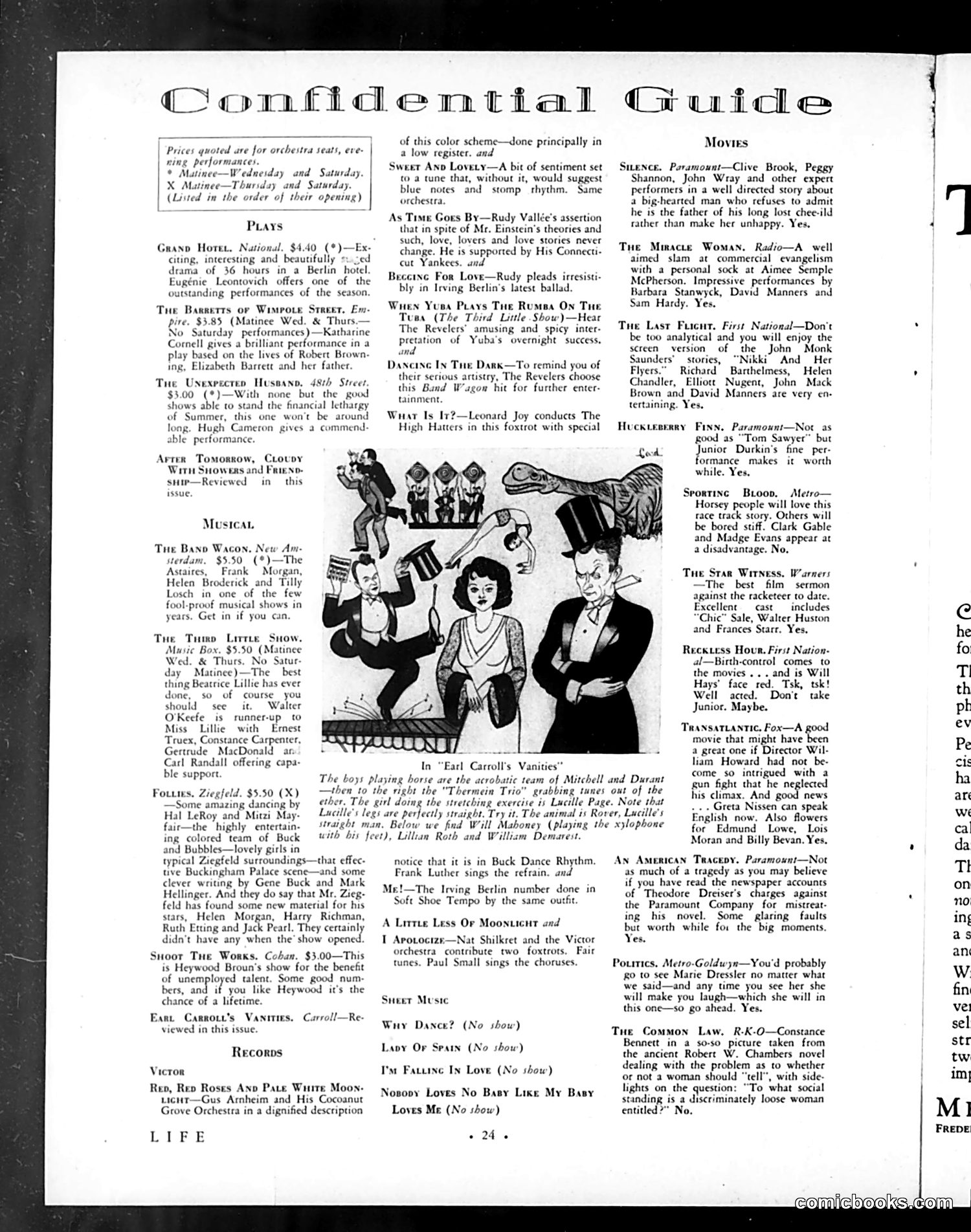
Understanding This Life Magazine Page This page is a theater and entertainment guide from Life magazine's "Confidential Guide" section, listing Broadway shows, musicals, and recordings currently playing. The central illustration depicts a scene from "Earl Carroll's Vanities," a famous Broadway revue (variety show). The cartoon shows acrobats, dancers, and performers in typical Ziegfeld-style entertainment—the annotated image identifies specific performers like the acrobatic team "Mitchell and Durant," dancer Lucille Page, and others performing stunts. The reviews are brief, gossipy critiques typical of Life's satirical style. For instance, the reviewer of "The Band Wagon" jokes you should "get in if you can"—suggesting it's so popular tickets are scarce. References to Rudy Vallée and Beatrice Lillie indicate these were major entertainment stars of the era. This reflects 1920s-30s American popular entertainment culture, when Broadway revues and musical theater were dominant mass entertainment before film's dominance.
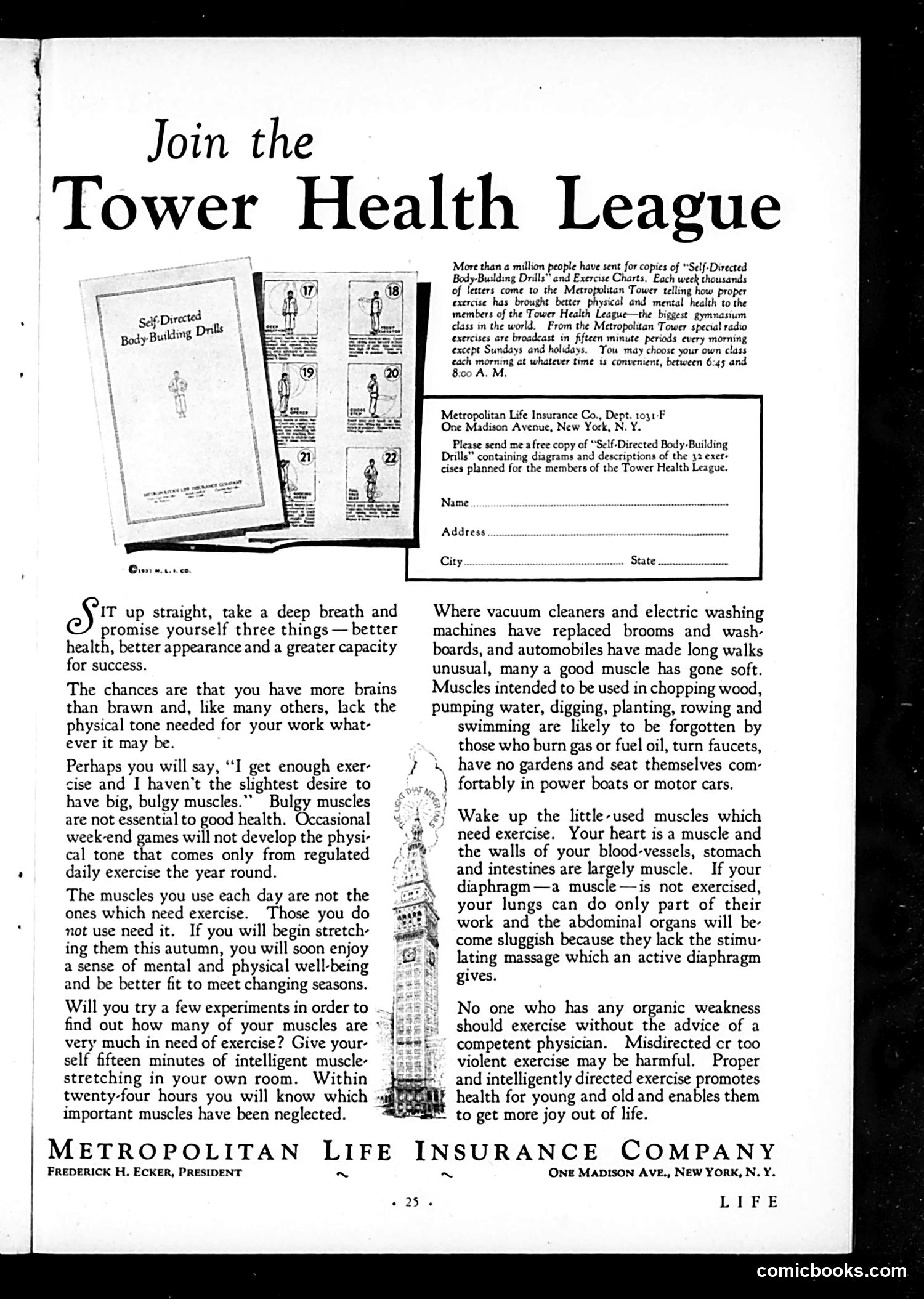
Tower Health League Advertisement Analysis This is a health promotion advertisement by Metropolitan Life Insurance Company, not a political cartoon. It promotes the "Tower Health League," a fitness program broadcast from the Metropolitan Tower in New York. The page addresses early 20th-century sedentary lifestyle concerns. Modern readers might miss the context: automobiles, vacuum cleaners, and washing machines had recently replaced physical labor, causing "good muscles" to "go soft." The ad targets office workers with "more brains than brawn" who lack daily exercise. The pitch uses pseudo-scientific language about "little-used muscles" and the diaphragm to justify systematic exercise routines. It's fundamentally a business strategy: Metropolitan Life sold insurance and benefited from healthier policyholders, so they promoted free exercise programs and mailed instructional pamphlets to build brand goodwill while gathering customer contact information. This represents early corporate wellness marketing disguised as public health advocacy.
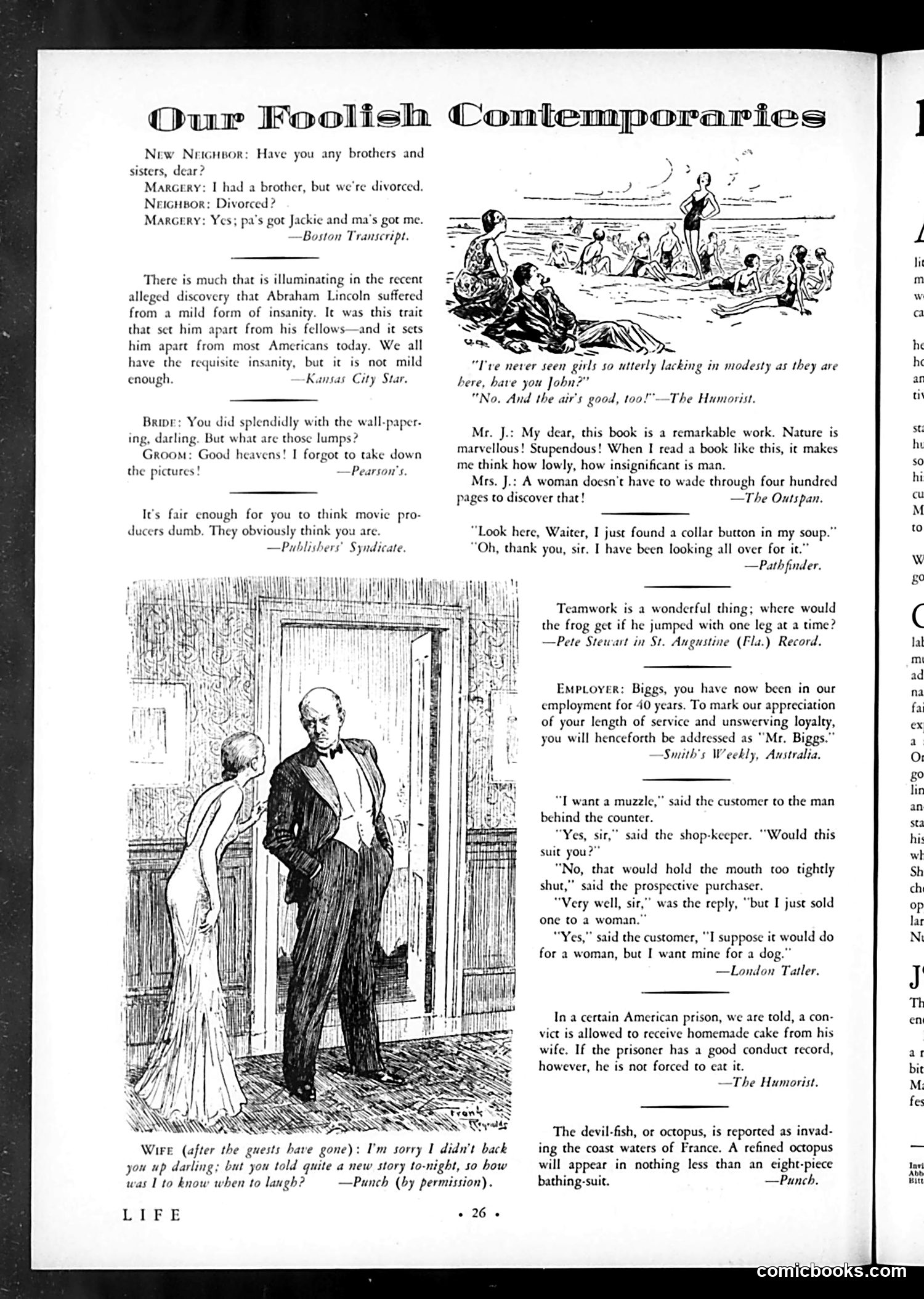
"Our Foolish Contemporaries" - Life Magazine Satire Page This page collects brief satirical jokes and observations from various contemporary sources, organized under the heading "Our Foolish Contemporaries." The humor targets social absurdities of the era. Key items include: a child describing her divorced brother as if he were a possession divided between parents (commenting on divorce's casual treatment); a jab at Abraham Lincoln scholarship suggesting Americans lack his "mild insanity"; domestic mishaps like wallpaper lumps hiding forgotten pictures; and gender-based ridicule (a woman buying a muzzle for a dog, implying women should wear one instead). The illustration shows a husband and wife in an awkward domestic moment, likely relating to the accompanying "Wire" caption about the wife fabricating a story during company. The overall tone reflects early 20th-century satirical conventions: mocking modern life's pretensions, marital discord, and gendered stereotypes through brief, punchy quips sourced from newspapers and magazines.
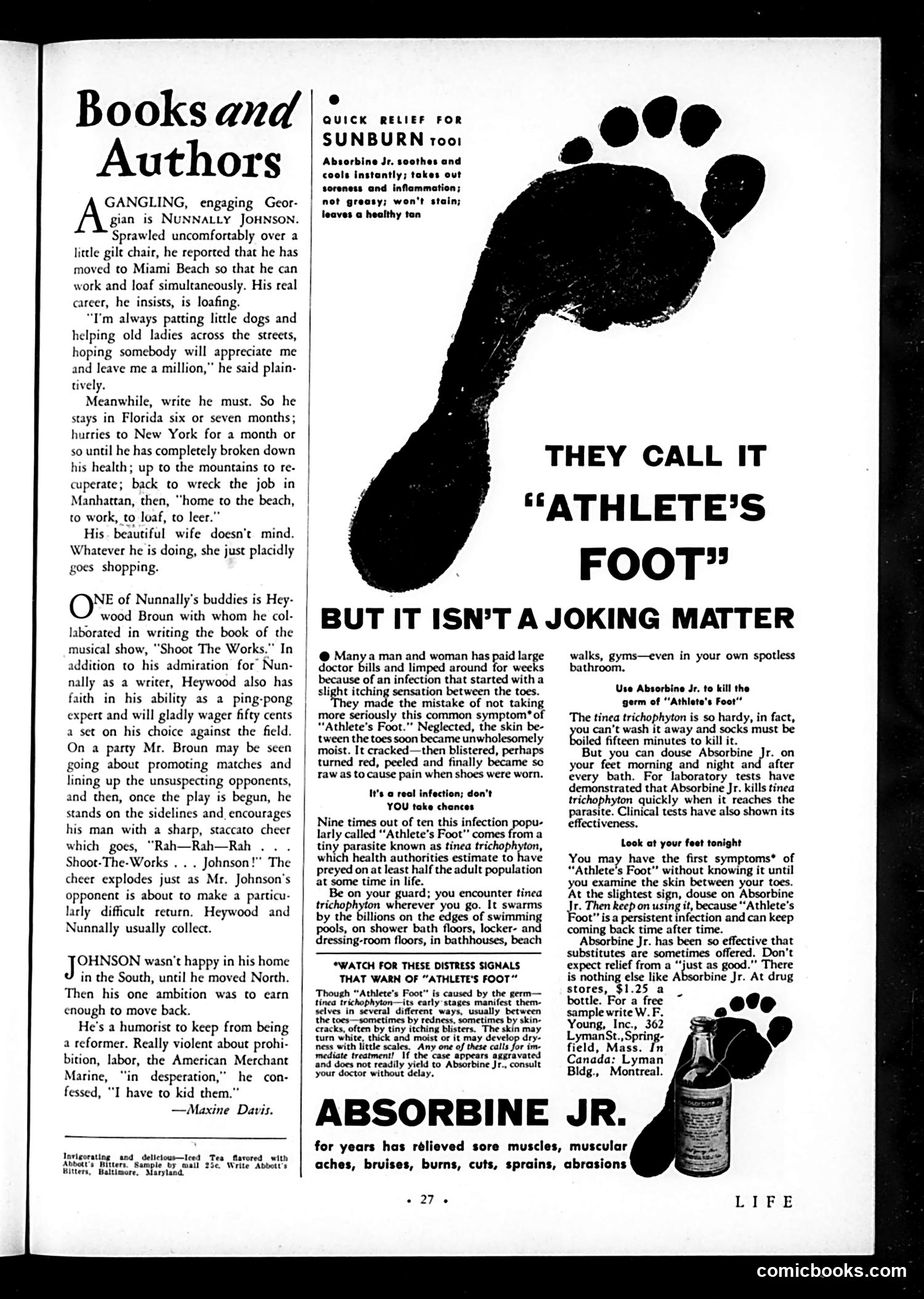
"Books and Authors" / Absorbine Jr. Advertisement Page This Life magazine page combines a celebrity profile with a vintage medical advertisement. The "Books and Authors" section profiles writer Nunnally Johnson, a Georgian humorist who reportedly moved to Miami Beach to balance work and leisure. The piece humorously describes his lifestyle: seasonal migrations between Florida, New York, and the mountains to manage his health, punctuated by his stated ambition of "patting little dogs and helping old ladies" hoping for inheritance. His friend Heywood Broun is mentioned as a collaborator and ping-pong gambling enthusiast. The tone is affectionate satire of artistic temperament and bohemian living. The Absorbine Jr. advertisement dominates the right side, promoting a remedy for "Athlete's Foot"—a fungal infection caused by tinea trichophyton. The ad uses fear-based marketing typical of 1930s-40s advertising, detailing symptoms (itching, cracking, blistering) and warning about transmission in public pools and bathhouses. It emphasizes this is a "real infection" requiring serious treatment, not a joke, and encourages readers to watch for early warning signs before infection worsens.
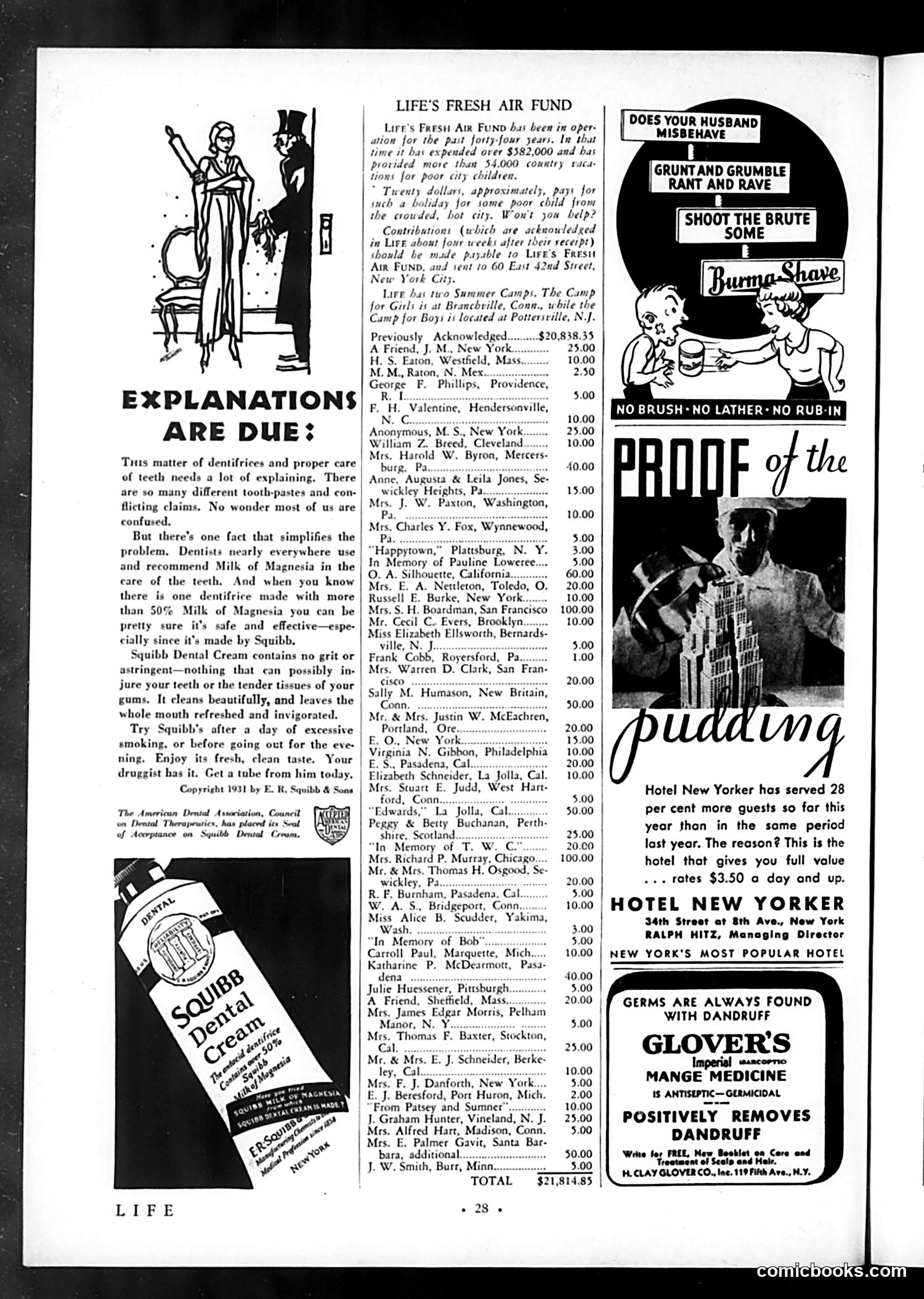
Page Analysis: Life Magazine, circa 1931 This page contains three distinct elements: Main Content: A Squibb toothpaste advertisement disguised as editorial advice about dental care. The ad claims dentists recommend "Milk of Magnesia" dentifrices and positions Squibb's product as safe because it contains 50% Milk of Magnesia with "no grit or astringent." Left Column: Life's Fresh Air Fund fundraising appeal—a legitimate charitable program providing country vacations for poor city children. The extensive list shows donor names and amounts, totaling $21,814.85. Right Side: Advertisements for Burma-Shave shaving cream, Hotel New Yorker, and Glover's mange medicine. The Burma-Shave ad humorously depicts marital discord ("Does Your Husband Misbehave?") as solvable through better grooming. The page reflects 1931 commercial culture: advertising mixed seamlessly with editorial content, charitable giving as social responsibility, and consumer products marketed as solutions to social embarrassment.
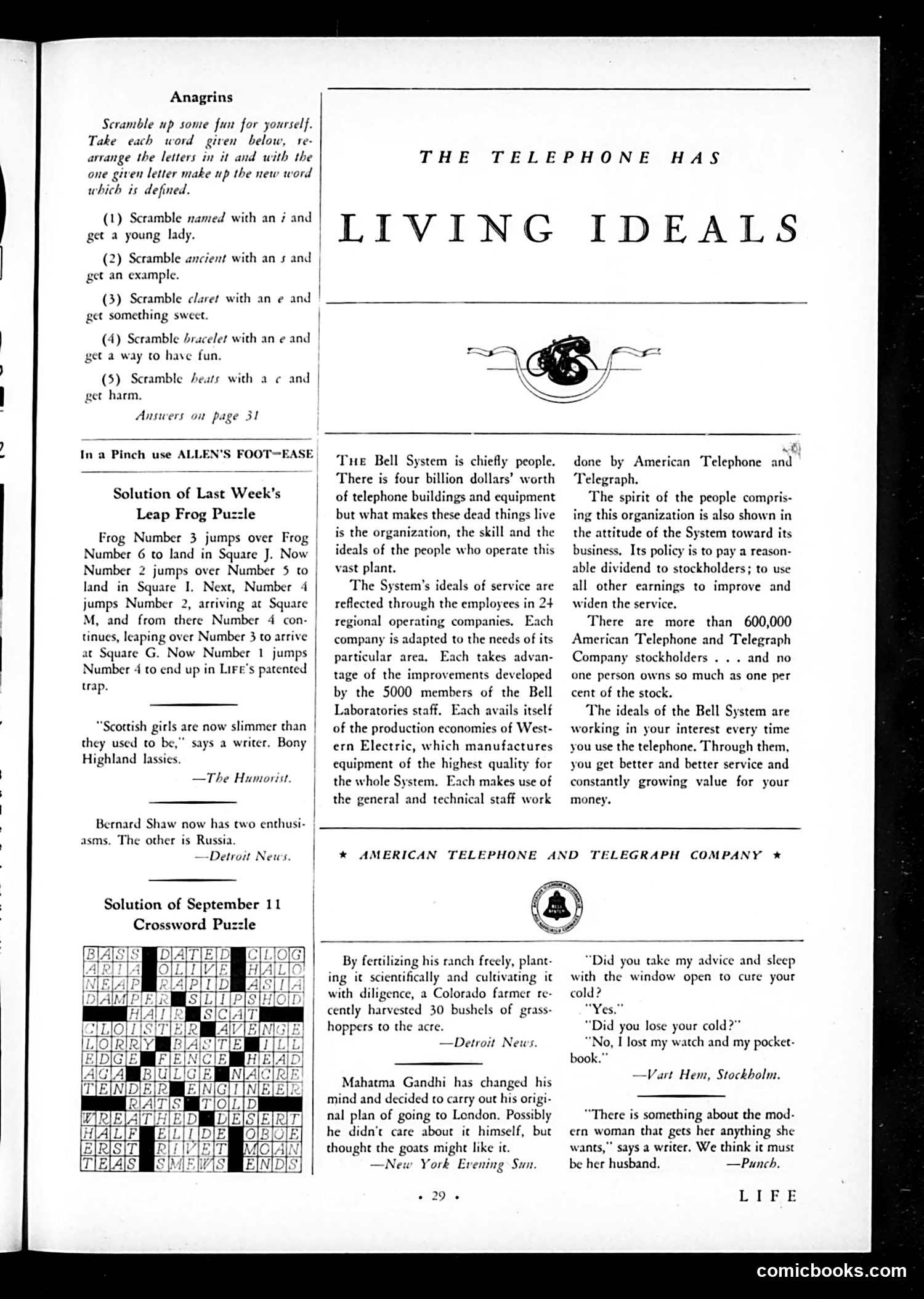
Life Magazine Page Analysis This page contains puzzles and advertisements rather than political cartoons. The main content includes: 1. "Anagrins" — a word-scramble puzzle where readers rearrange letters to form new words with definitions (e.g., scramble "named" with an "i" to get a girl's name). 2. Solutions to previous puzzles — answers to a "Leap Frog" puzzle and a crossword. 3. A Bell System advertisement — presents the telephone company's corporate ideology, emphasizing that the organization is "chiefly people" despite being a massive industrial system. It boasts 600,000 stockholders with no single person owning more than 1% — framing this as democratic capitalism benefiting the public. 4. Short humorous items — brief jokes from various publications about Scottish girls, Bernard Shaw, Gandhi, and modern women. The page is primarily entertainment and advertising, not satire or political commentary. The Bell ad is corporate public-relations messaging typical of the era.
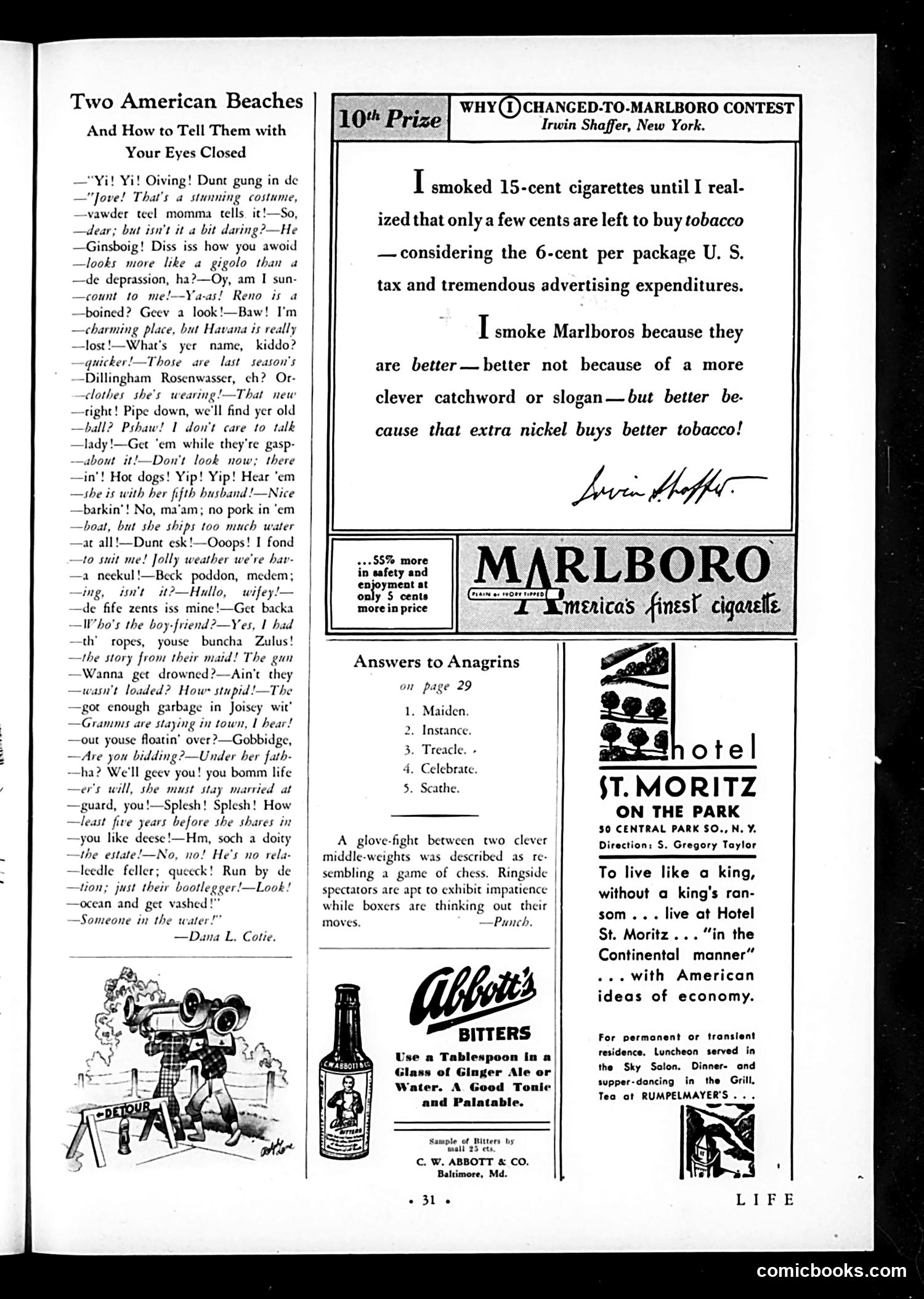
Analysis of This Life Magazine Page This page satirizes class differences between American beach resorts through exaggerated dialect humor. "Two American Beaches" contrasts a working-class beach (likely Coney Island) with an upscale resort (possibly Miami or Atlantic City) by reproducing the distinctive speech patterns of each crowd—heavy immigrant accents and malapropisms for the working class, refined affectations for the wealthy. The humor relies on period stereotypes: Yiddish-inflected English, Irish working-class speech, and snobbish upper-class pretension. References to "bootleggers," "five husbands," and class anxieties reflect 1920s concerns during Prohibition. The rest of the page contains advertisements (Marlboro cigarettes, Abbott's Bitters, St. Moritz Hotel) and unrelated content, making this primarily an advertising/feature magazine page rather than focused editorial commentary.
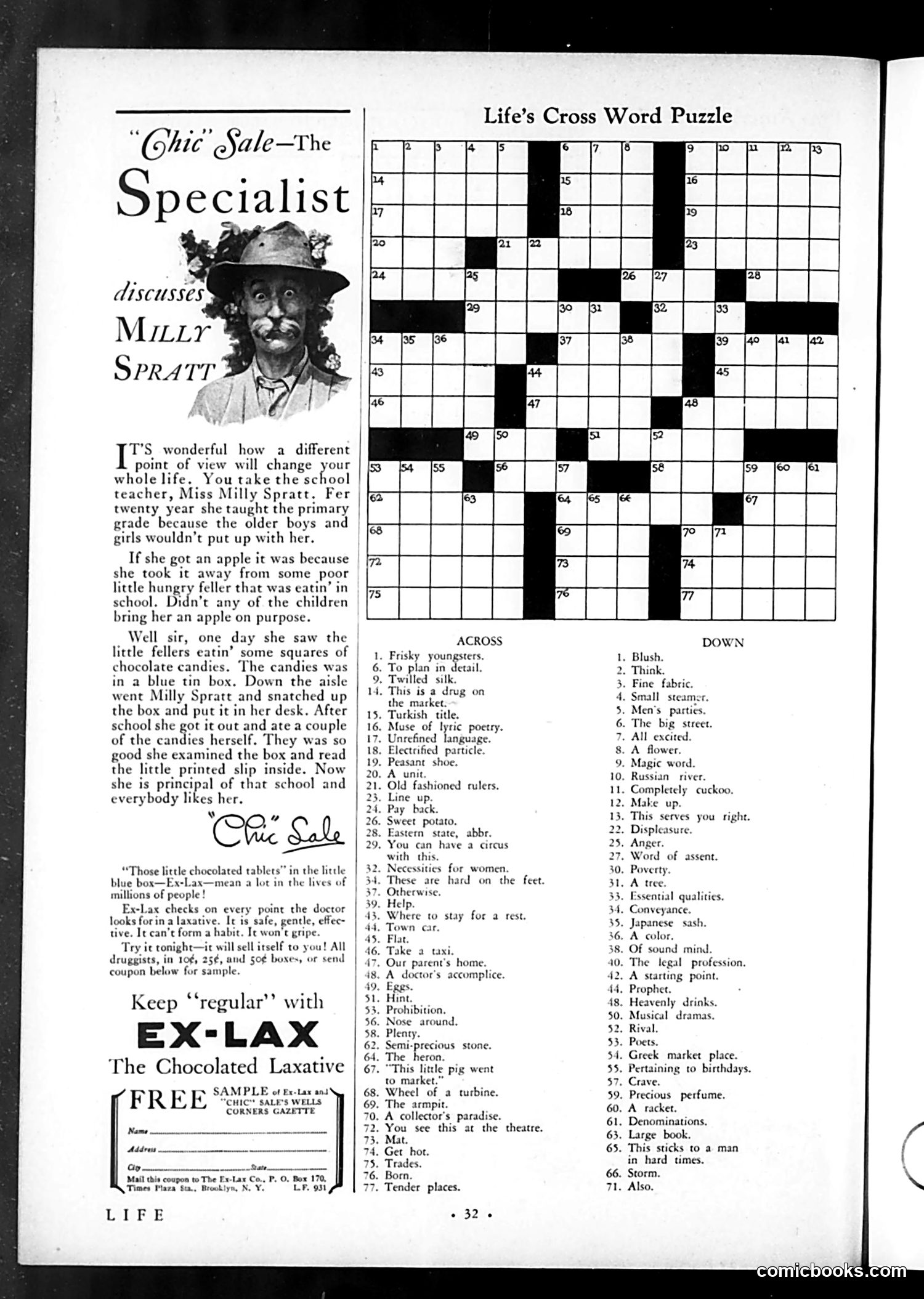
"Chic Sale's" Story About Miss Milly Spratt This page features a humorous short story by "Chic Sale," a popular American humorist known for folksy rural narratives. The story describes how schoolteacher Miss Milly Spratt transforms from being disliked (students won't bring her apples) to beloved principal after discovering fancy chocolates in a blue tin box and eating them. The joke satirizes social climbing and superficiality: Spratt's entire reputation changes not because she improves as a person, but because she adopts the affectations of refined taste (enjoying expensive chocolates). The implication is that people judge others by appearances and consumption rather than character—a gentle mockery of 1920s American class consciousness. The page also includes a crossword puzzle and an advertisement for Ex-Lax laxative ("The Chocolated Laxative"), which humorously undercuts the chocolate candy story's romantic tone with decidedly unglamorous bodily functions.
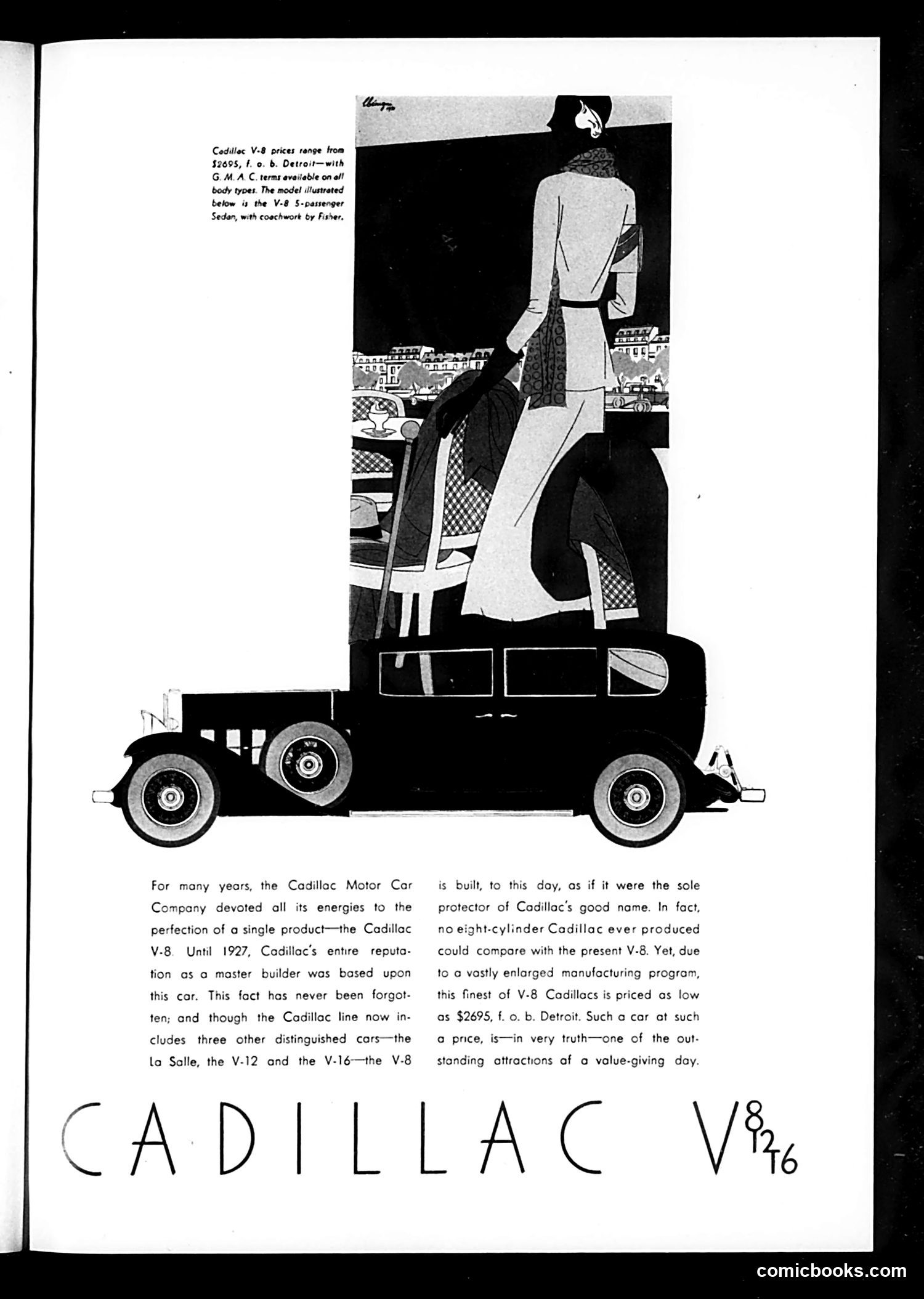
Analysis This is automobile advertising, not satire or political commentary. It's a Cadillac V-8 advertisement from Life magazine. The page features a stylized illustration of a fashionable woman in 1920s dress standing beside/on a Cadillac sedan, with a cityscape backdrop. This was standard luxury car advertising imagery of the era—associating automobiles with elegance and modern sophistication. The text emphasizes Cadillac's manufacturing prestige: the company historically focused exclusively on perfecting the V-8 model until 1927, building its reputation on single-product excellence. The advertisement's key appeal is that despite expanded product lines (La Salle, V-12, V-16), the V-8 maintains this exacting standard—yet now costs only $2,695, positioning it as an accessible luxury vehicle during the era of mass production. The "value-giving day" reference likely dates this to the economically optimistic late 1920s pre-Crash period.
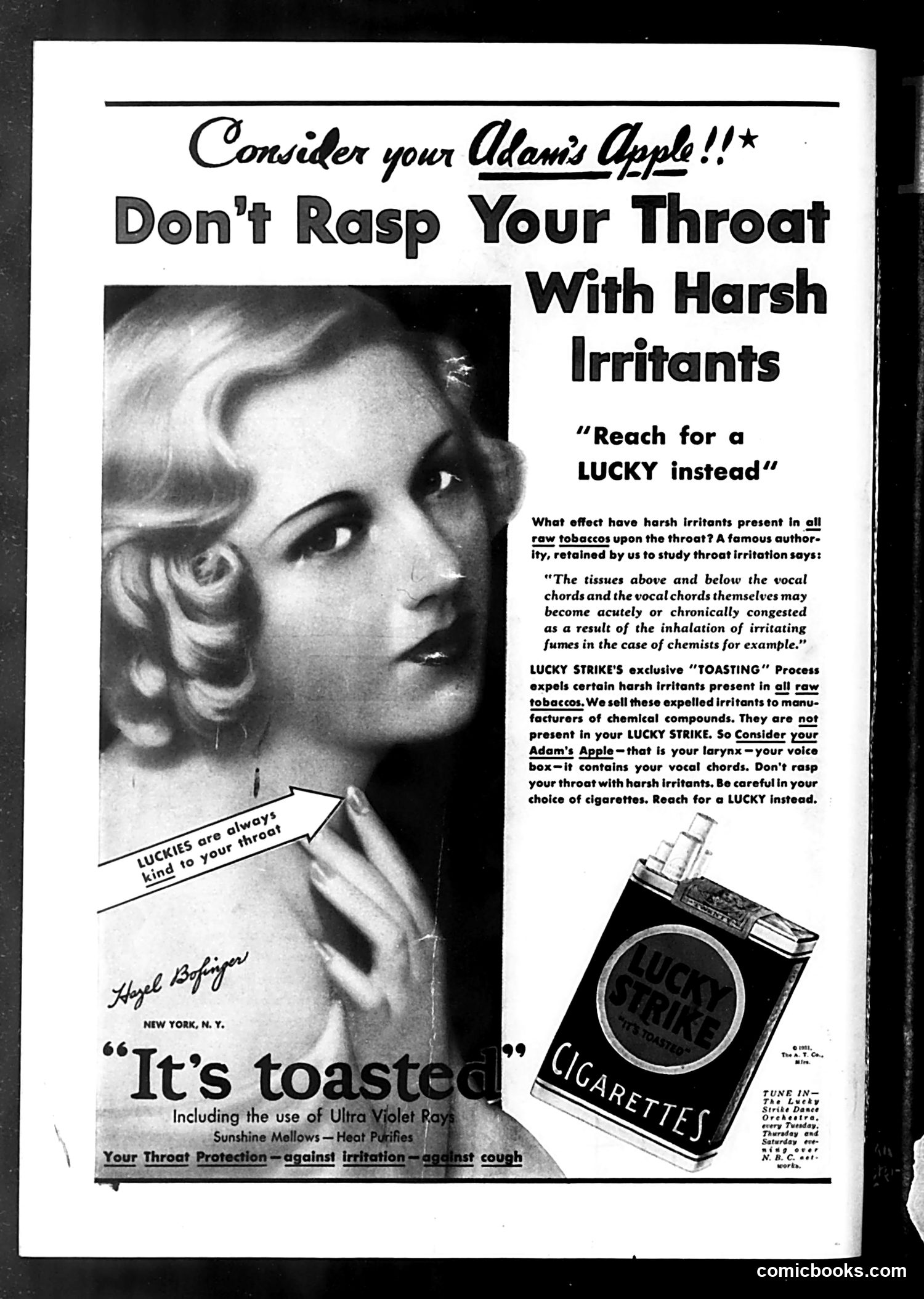
Lucky Strike Cigarette Advertisement This is a Lucky Strike cigarette advertisement, not political satire. It features actress Hazel Bolonya endorsing the product by warning against harsh throat irritants in competing cigarettes. The ad's key claim: Lucky Strike's exclusive "Toasting" process removes irritants present in raw tobacco, protecting the vocal cords (the "Adam's Apple"). This was marketing strategy positioning Lucky Strike as the gentler choice. The humor/irony for modern readers: the ad literally warns against throat damage while selling cigarettes—a product we now know causes serious health problems. The pseudo-scientific language about "expelled irritants" being sold to chemical manufacturers lends false credibility. This represents pre-regulation cigarette advertising that could make explicit health claims, a practice now illegal. The ad exemplifies how tobacco companies once marketed cigarettes as *safe*, even beneficial.