life
Life — September 25, 1931
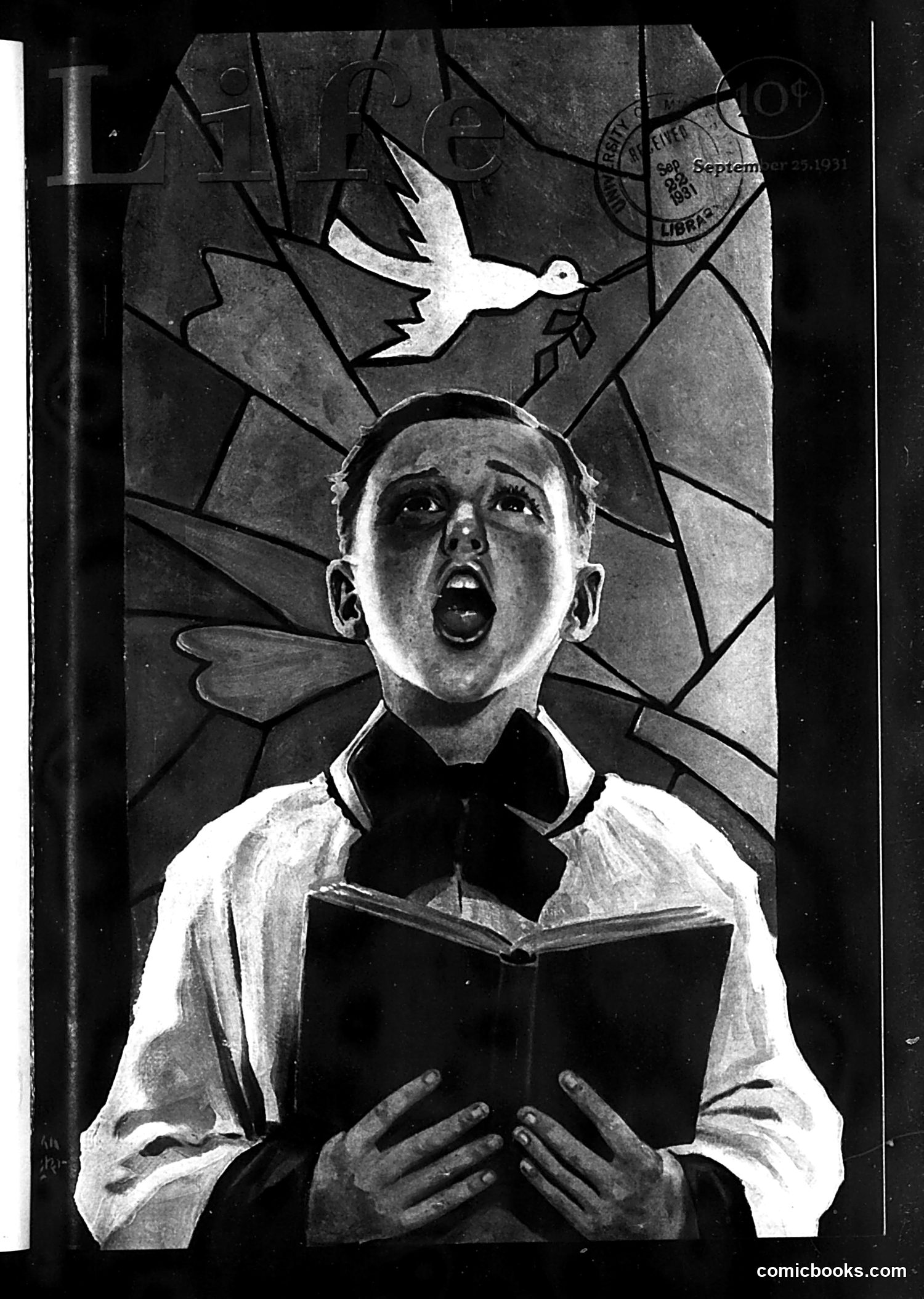
Analysis This appears to be a religious or moral satire from Life magazine (dated September 23, 1931, visible on the stamp). The image shows a young choirboy or altar boy in white robes with a black bow tie, holding an open hymnal or prayer book, gazing upward with an expression of spiritual rapture or exaggerated piety. Above his head is a starburst or divine light pattern with a white dove—a traditional Christian symbol of the Holy Spirit. The composition satirizes either excessive religious fervor in youth, the performative nature of religious expression, or possibly hypocrisy in religious institutions. The boy's theatrical expression suggests the satire critiques overwrought religiosity rather than genuine faith. Without additional text context, the specific target of the joke remains unclear.
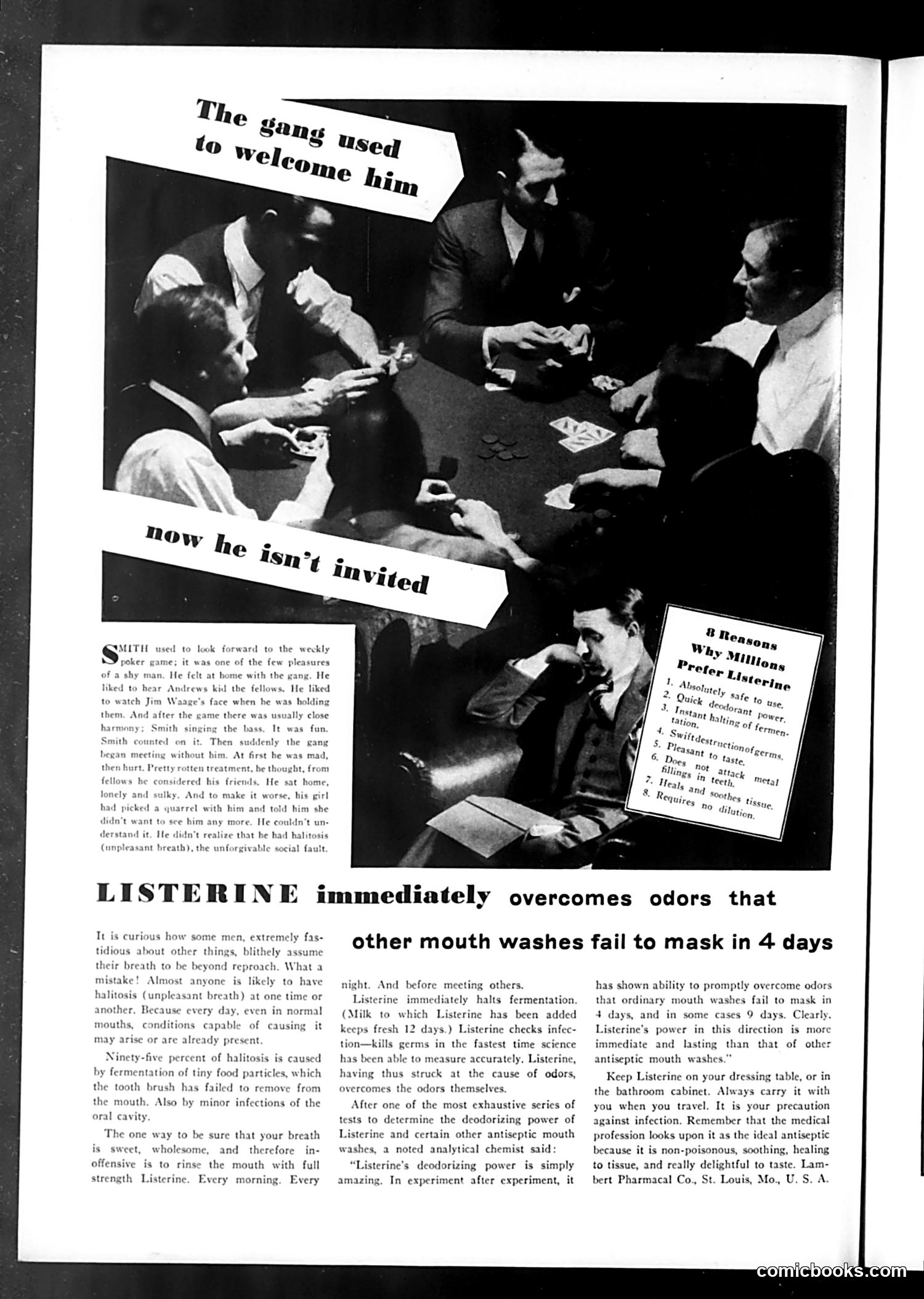
Analysis This is a Listerine advertisement disguised as social commentary, not genuine satire. The top image shows men playing cards, with the caption "The gangs used to welcome him / now he isn't invited." The ad uses shame-based marketing—a common early-20th-century tactic—to suggest that poor oral hygiene causes social rejection. The accompanying text and sidebar list "8 Reasons Why Millions Prefer Listerine" (including "Absolutely safe to use" and "Swift-destroying of germs"). The "Smith" narrative describes a man excluded from social gatherings due to bad breath, positioning Listerine as the solution to social ostracism. This exploits anxiety about social standing rather than addressing genuine health concerns. The advertisement represents how companies weaponized embarrassment to drive product sales.
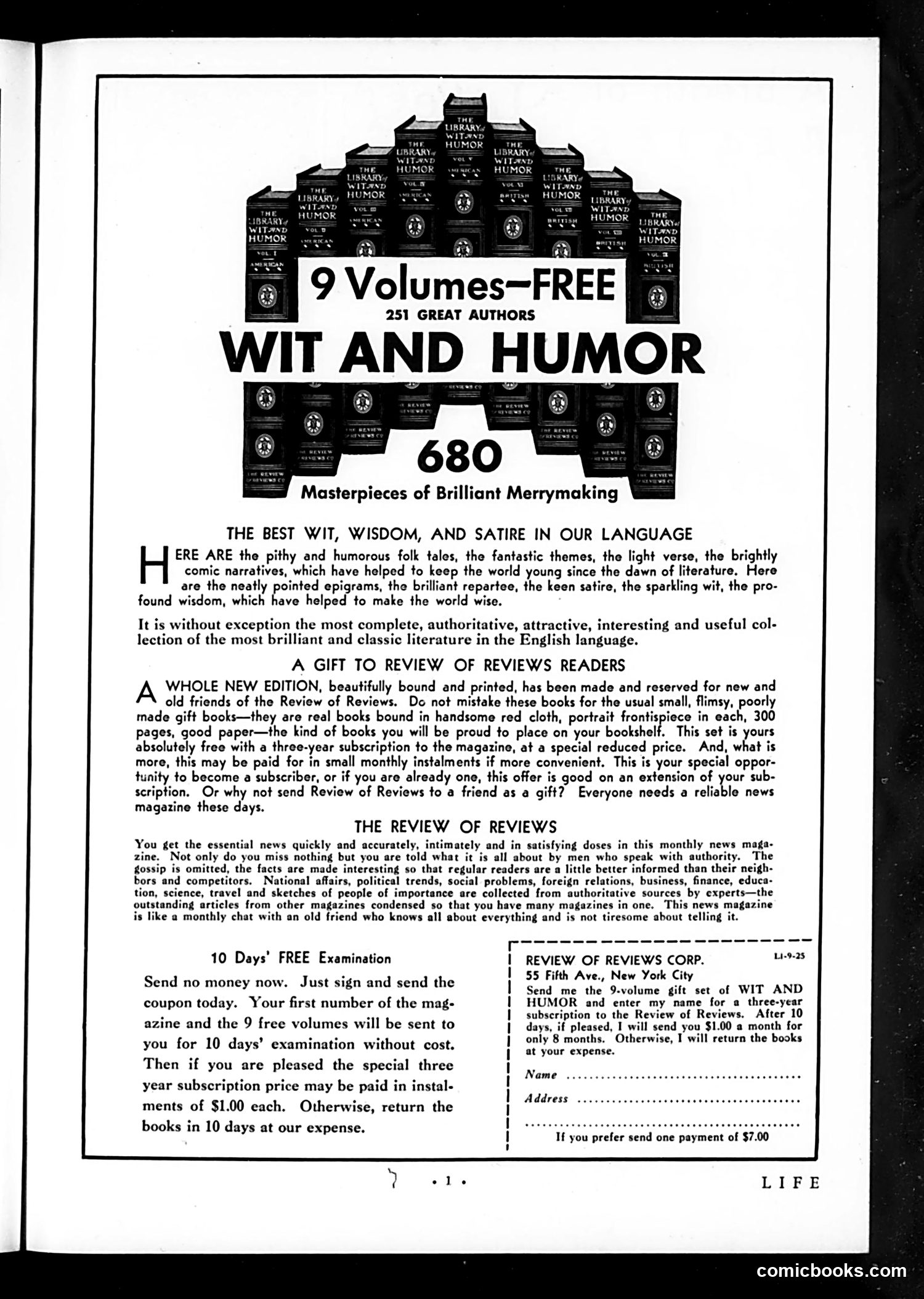
Analysis This is primarily an advertisement page, not a political cartoon. It promotes a 9-volume book collection of "Wit and Humor" by 251 great authors, offering 680 pieces of humorous writing. The page emphasizes the collection's value as a comprehensive anthology of English-language wit, satire, and epigrams. The marketing pitch targets educated readers seeking literary quality and reliable information—note the emphasis on the books being "beautifully bound and printed" with "good paper." Below is a subscription offer for *Review of Reviews* magazine, promising a 10-day free examination period. The tone reflects early 20th-century direct-mail marketing: readers could examine merchandise risk-free before committing to payment. There are no political cartoons or satirical commentary here—this is straightforward period advertising.
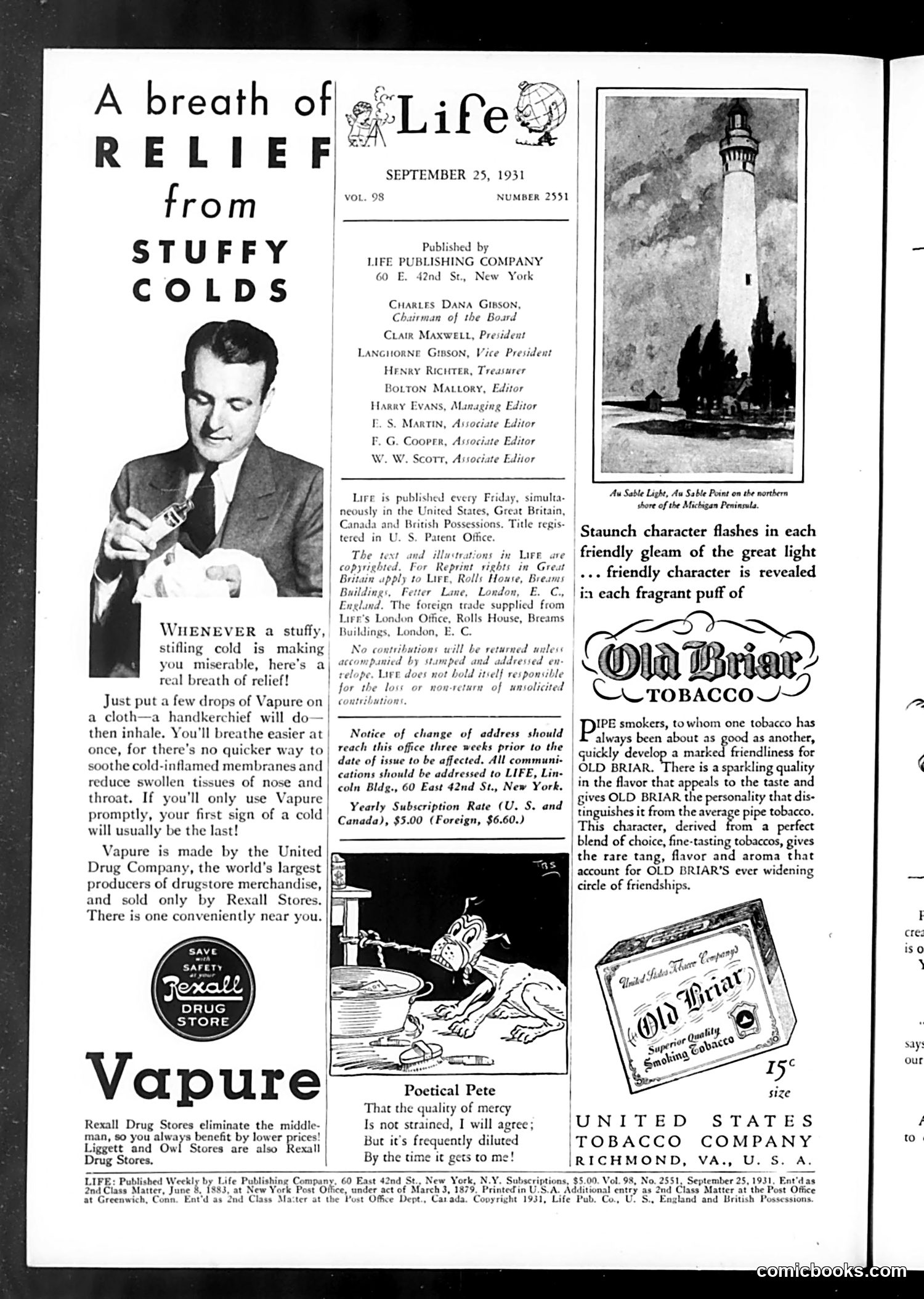
Page Analysis This is primarily a masthead and advertising page from Life magazine (September 25, 1931, Vol. 98, No. 2531). The left side features an advertisement for Vapure, a cold remedy sold at Rexall Drug Stores, showing a man with a stuffy cold. The pitch emphasizes quick relief through inhalation. The right side contains an advertisement for Old Briar Tobacco (15¢), emphasizing its quality and distinctive flavor. The center includes a cartoon titled "Poetical Pete" depicting someone in distress—likely satirizing someone's bad poetry or melodramatic writing ("That the quality of mercy / Is not strained, I will agree; / But it's frequently diluted / By the time it gets to me!"). The magazine masthead identifies key staff including Editor Bolton Mallory and Managing Editor Harry Evans. Overall, this is a standard magazine page mixing publication information with period advertising.
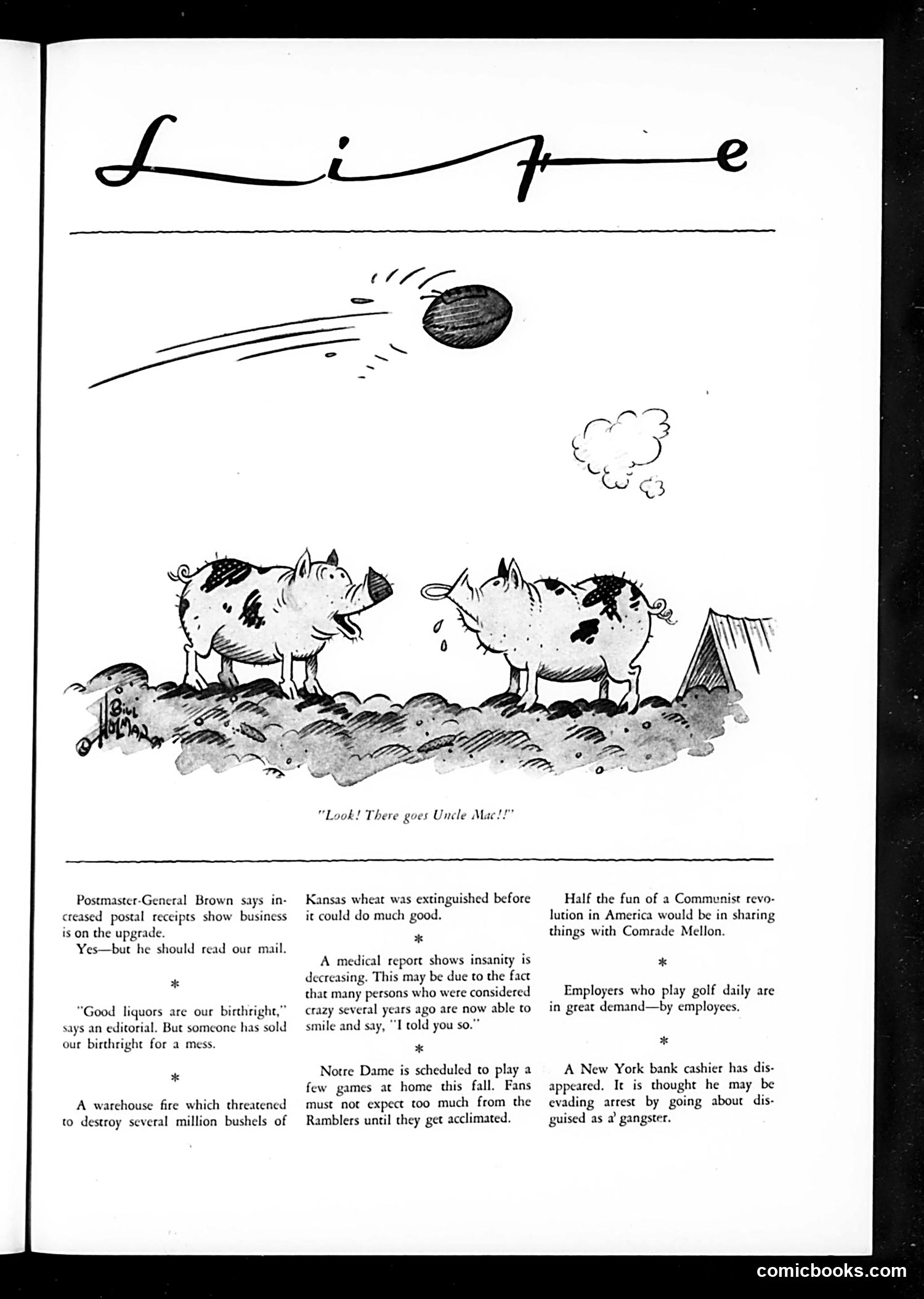
"Life" Magazine Page Analysis The main cartoon titled "Look! There goes Uncle Mac!" depicts two pigs observing something flying overhead—likely representing a UFO or aircraft. The visual joke appears to satirize rural or unsophisticated observers mistaking an unusual sight for a famous person ("Uncle Mac"). Below, the page contains brief satirical commentary on contemporary issues: - Postmaster-General Brown's claimed business improvement - Kansas wheat shortage - Decreasing insanity rates - Comrade Mellon (likely Secretary of Treasury Andrew Mellon, mocked as communist) - Notre Dame football - A bank cashier evading arrest by disguising himself The items mock public figures, current events, and social absurdities typical of Life magazine's satirical approach during this era.
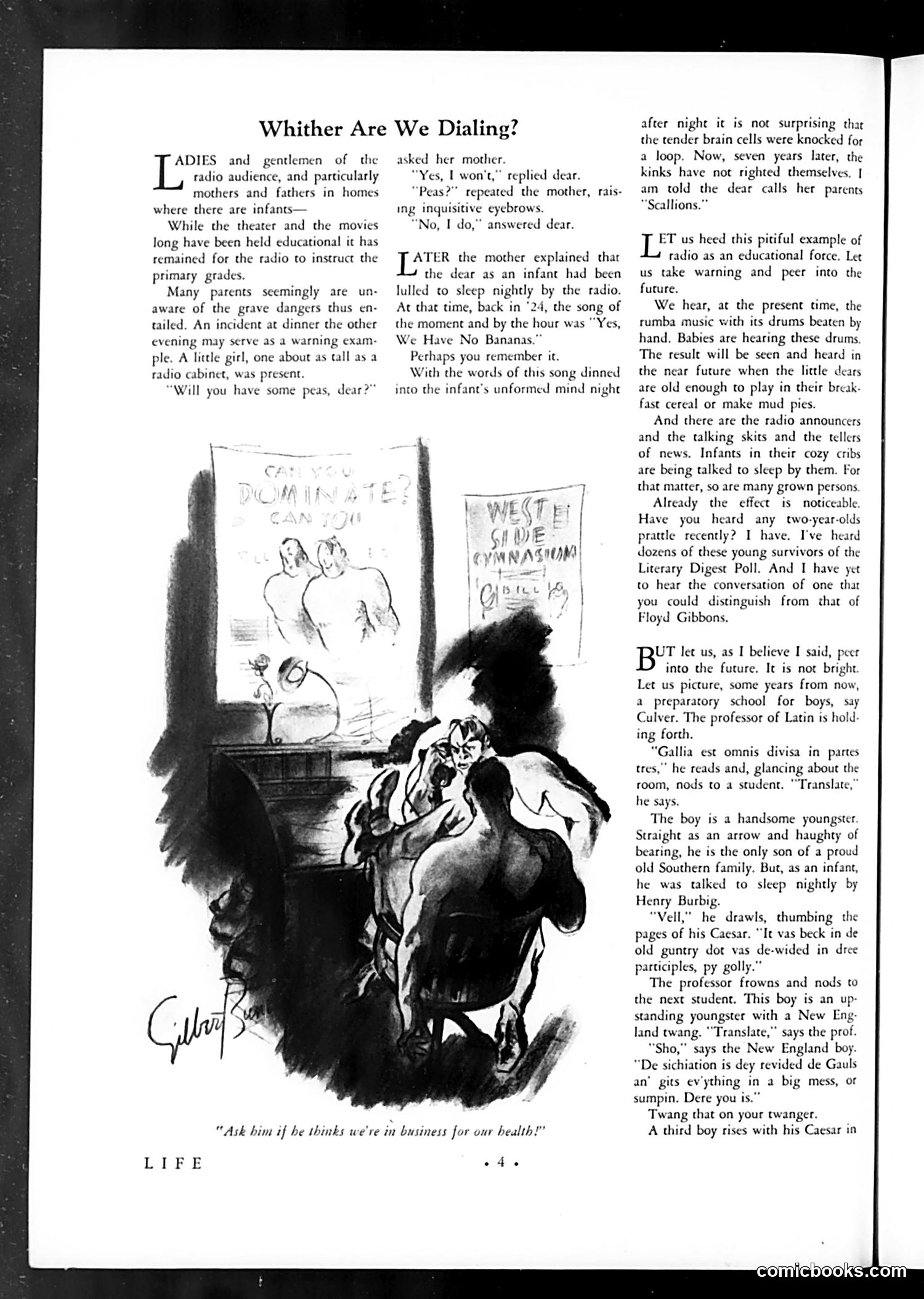
"Whither Are We Dialing?" - Life Magazine Satire This article critiques radio's influence on children's development. The large illustration shows a grotesque figure emerging from a radio—caricaturing how radio content is warping young minds. The text warns that parents unknowingly expose infants to radio programming (rumba music, advertisements, news broadcasts) during formative years. The author sarcastically contrasts this with preparatory school Latin instruction, suggesting radio creates intellectually stunted children who speak in garbled phrases. The cartoon's exaggerated monster-like figure represents the feared outcome: children corrupted by unfiltered radio exposure rather than proper education. This reflects 1920s-30s anxiety about new media's effects on youth—a predecessor to later concerns about television, video games, and internet content.
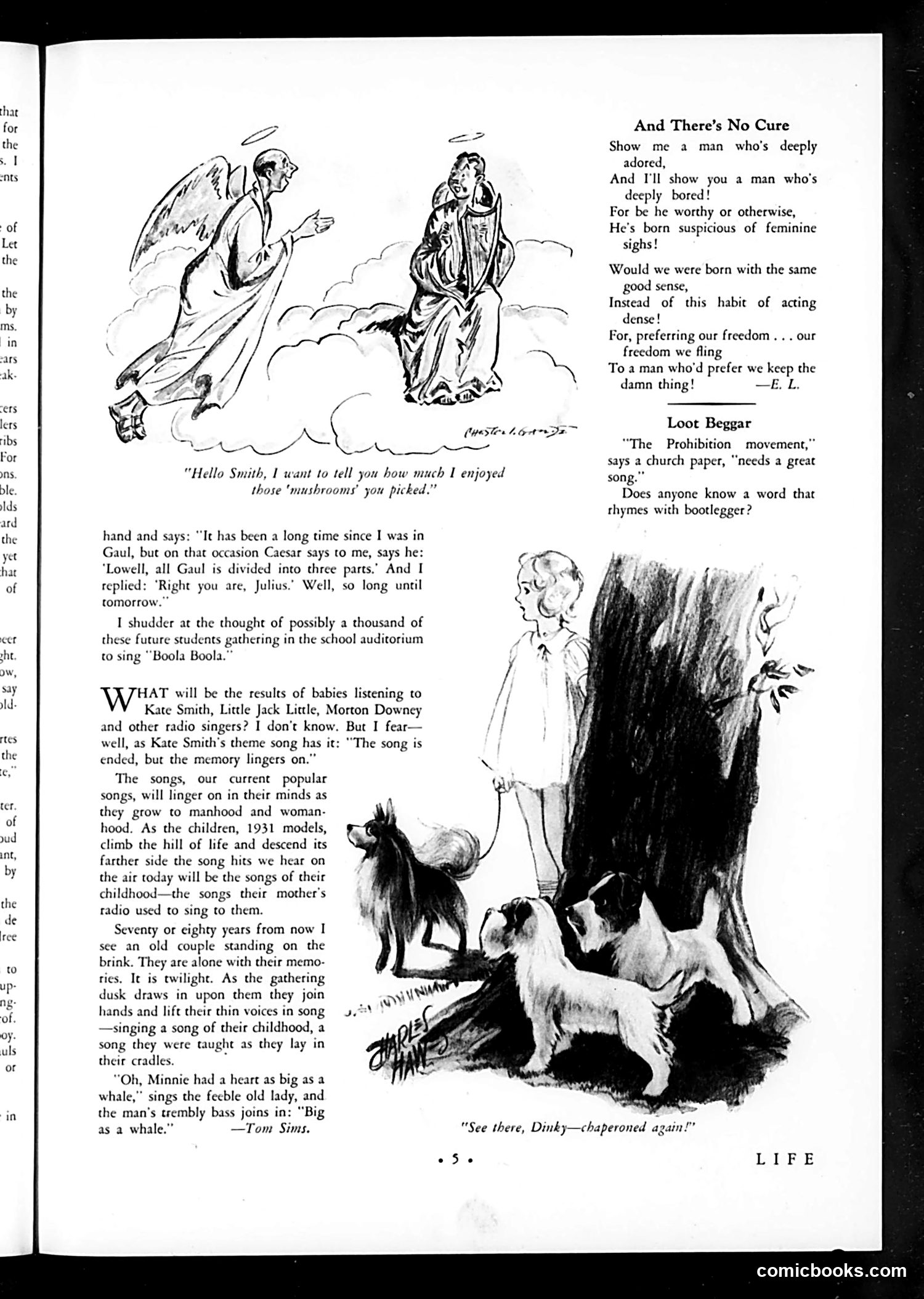
Analysis of This Life Magazine Page This page critiques gender relations through two cartoons and accompanying satirical text. The top cartoon shows an angel speaking to a woman in heaven, joking that he wants to tell her "how much I enjoyed those 'mushroom' you picked"—likely a double entendre about something the woman served or did during life. The bottom cartoon depicts a woman being "chaperoned again" by two dogs while walking—satirizing strict social conventions requiring women to have chaperones in public to maintain respectability. The accompanying text titled "And There's No Cure" argues that men and women are fundamentally incompatible due to inherent personality differences. The author expresses frustration with both genders' fixed characteristics, suggesting the incompatibility is incurable. Overall, the page satirizes 1930s gender relations, courtship restrictions, and the perceived impossibility of genuine male-female compatibility.
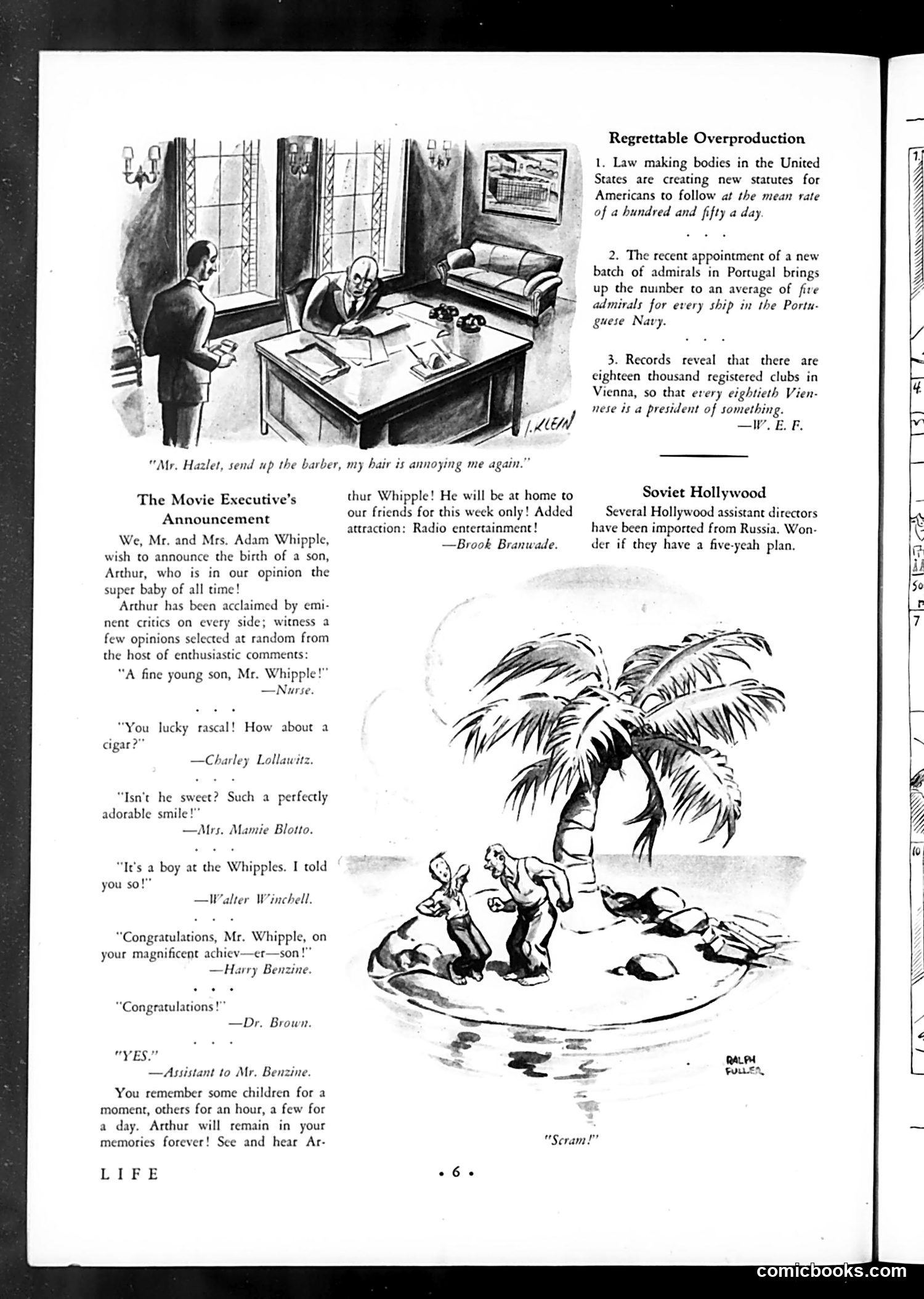
Page Analysis This page contains a humorous office cartoon titled "Mr. Hazlet, send up the barber, my hair is annoying me again." It depicts an executive at his desk, apparently so busy or stressed that he wants the barber brought to his office rather than leaving work. Below is "The Movie Executive's Announcement"—a satirical birth announcement for a character named Arthur Whipple, with mock congratulations from Hollywood figures (Norma Talmadge, Charley Chaplin, etc.). The humor lies in treating a fictional child like a major industry event. The page also includes a cartoon titled "Scram!" showing people fleeing under a palm tree, and a section on "Soviet Hollywood" about Russian film directors. The satire targets Hollywood's self-importance and the excesses of busy executives.
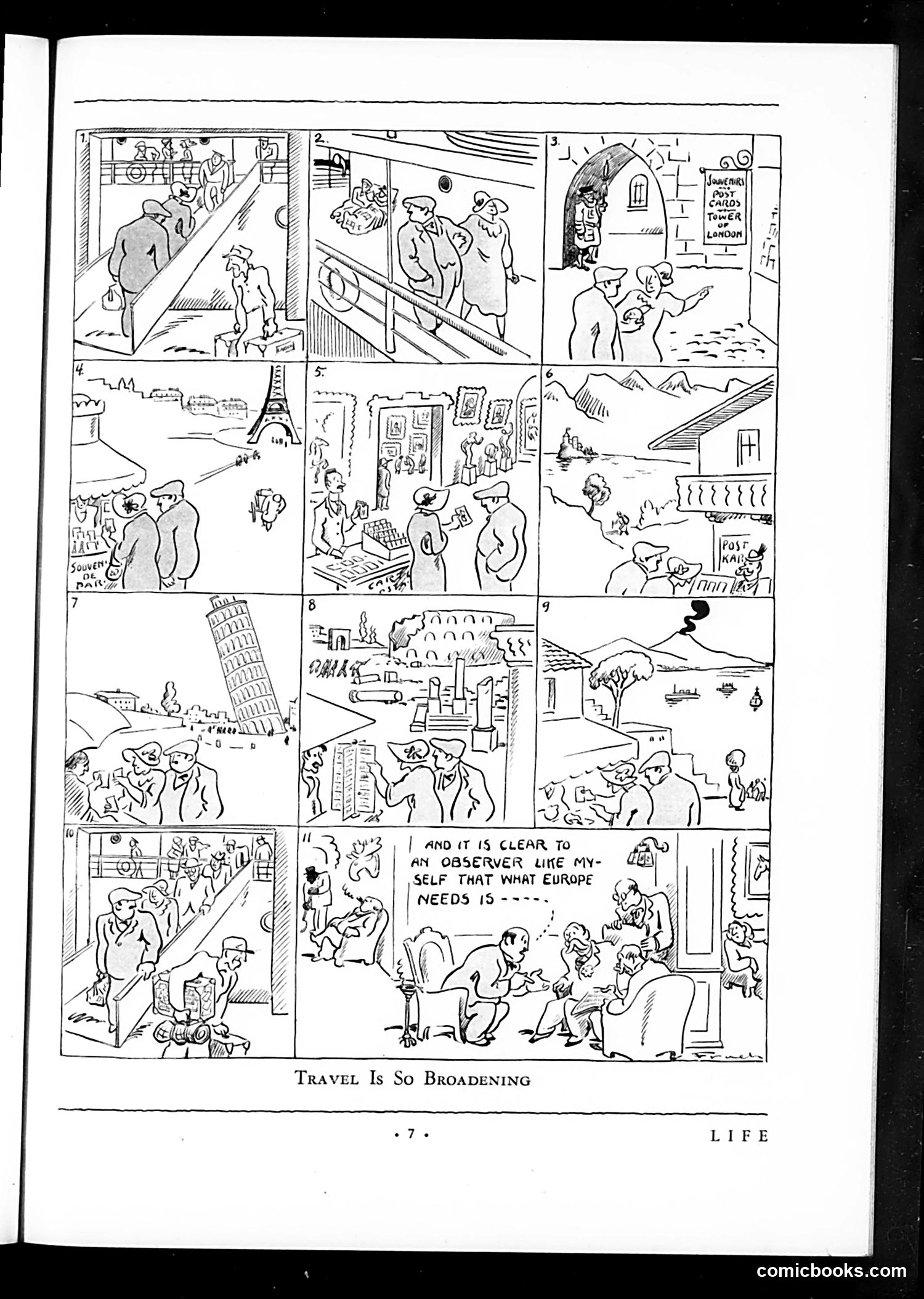
"Travel Is So Broadening" This comic strip satirizes European tourism in the interwar period. The narrative follows a traveler visiting iconic landmarks—London (panel 3), Paris (panel 4), and Pisa (panel 7)—purchasing souvenirs and sightseeing. The final panels reveal the satire's point: despite visiting multiple countries and cultures, the tourist concludes Europe's need is unclear, while surrounded by children and ordinary people. The joke suggests that superficial tourism—collecting postcards and visiting monuments—doesn't actually broaden one's understanding of Europe's real social conditions or needs. This reflects 1920s-30s skepticism about whether leisure travel genuinely educated travelers or merely provided escapist entertainment while ignoring deeper social and economic realities abroad.
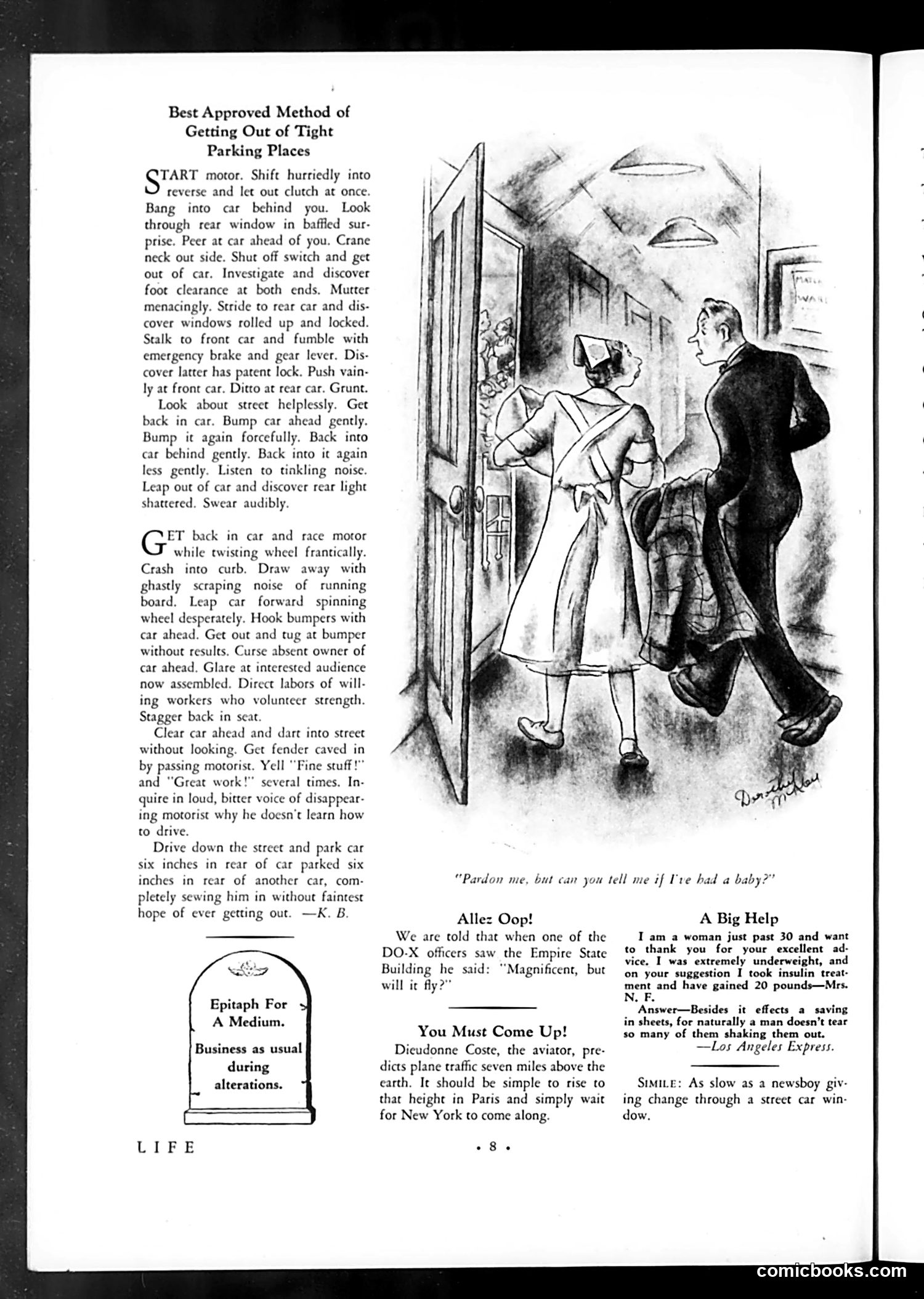
Explanation for Modern Readers This page satirizes the frustration of parallel parking in tight urban spaces—a common 1920s-30s problem. The main article, "Best Approved Method of Getting Out of Tight Parking Places," humorously presents increasingly chaotic and destructive "solutions": hitting nearby cars, scraping curbs, damaging bumpers, and recruiting bystanders to push. The detailed instructions are mock-serious, exaggerating the aggressive behavior drivers resort to when trapped. The cartoon depicts a woman observing a man emerging disheveled from such an ordeal, with the caption "Pardon me, but can you tell me if I've had a baby?"—implying the effort has left him as exhausted as childbirth. The side humor includes brief jokes about aviation and weight gain, typical of the magazine's miscellaneous satirical content.
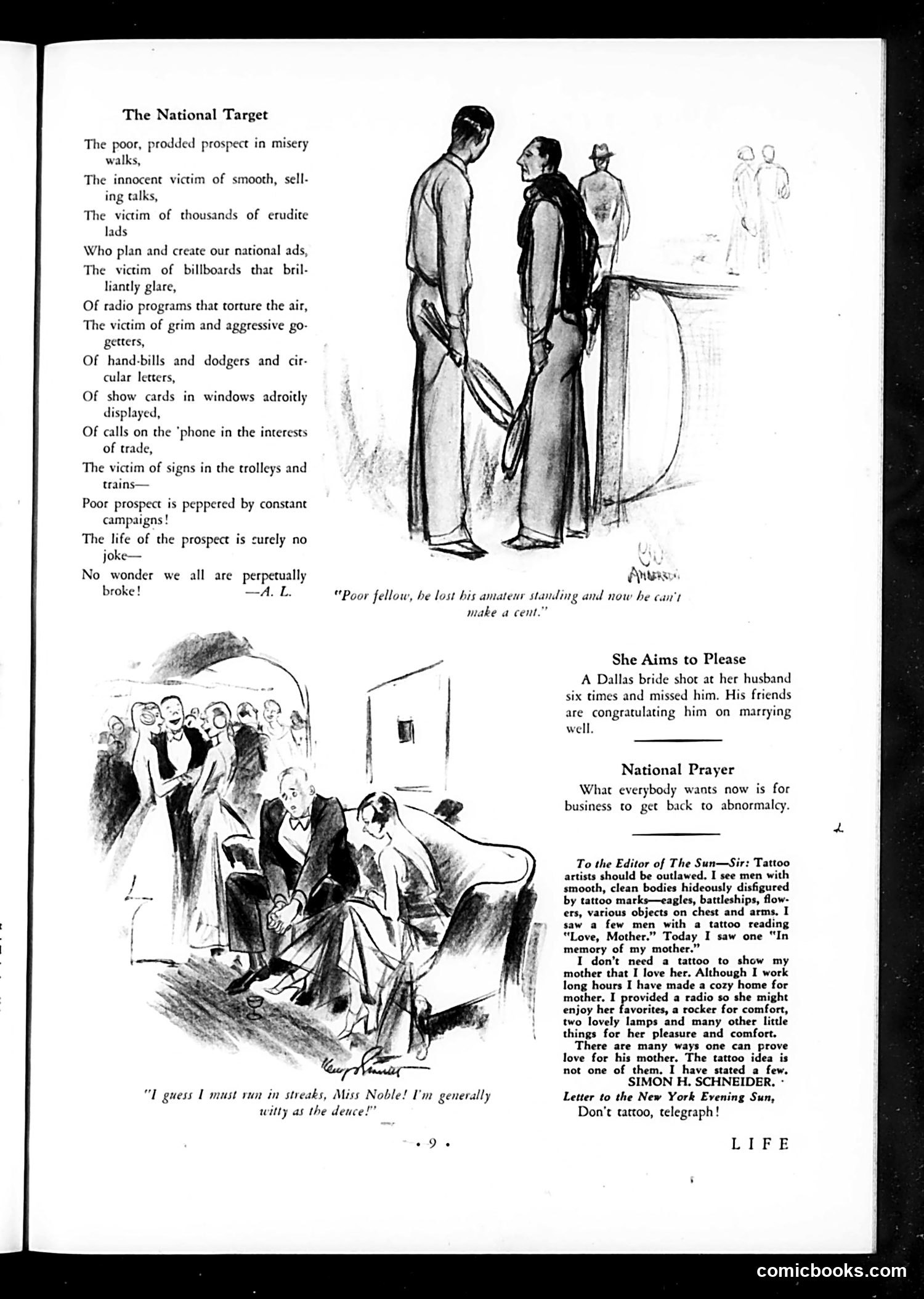
Analysis of Life Magazine Page This page contains three satirical pieces targeting advertising and commercial culture: "The National Target" (poem by A.L.) critiques how ordinary people are relentlessly targeted by advertising—billboards, radio programs, handbills, phone calls, and street signs. The accompanying cartoon shows a man being literally "hit" by advertising, suggesting consumers are helpless victims of commercial bombardment. "She Aims to Please" jokes about a Dallas bride shooting her husband, with friends congratulating the marriage—dark humor about matrimonial discord. Letters to the Editor debate tattoos as expressions of love (one writer defends them; another opposes), and another letter advocates for business normalization. The overall theme critiques the invasiveness of 1920s-30s commercial culture and its inescapable presence in American life.
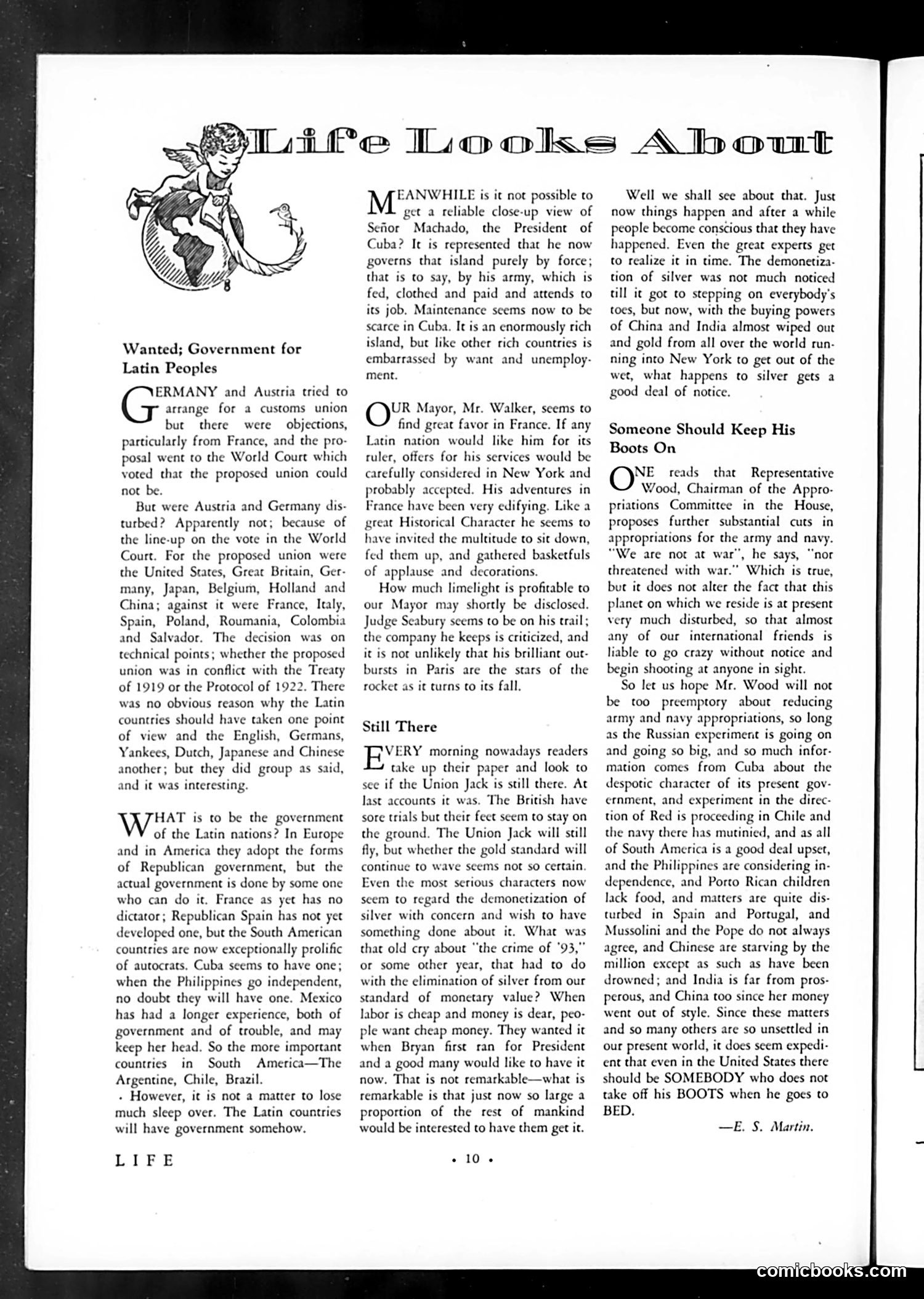
"Life Looks About" - Political Commentary Page This satirical commentary page criticizes Latin American governance and international politics. The masthead illustration shows a cherub-like figure, likely representing "Life" magazine's editorial voice. The main article "Wanted: Government for Latin Peoples" argues that Latin American nations, particularly Cuba under Señor Machado, are governed "purely by force" through military control. The piece criticizes the proposed union of nations voted down by the World Court, suggesting Latin countries need stable democratic government rather than military dictatorships. Subsequent sections mock Mayor Walker's popularity in France, satirize Representative Wood's military appropriations concerns, and comment on currency devaluation and international economic instability. The overall tone suggests frustration with authoritarian Latin American rule and its global repercussions.
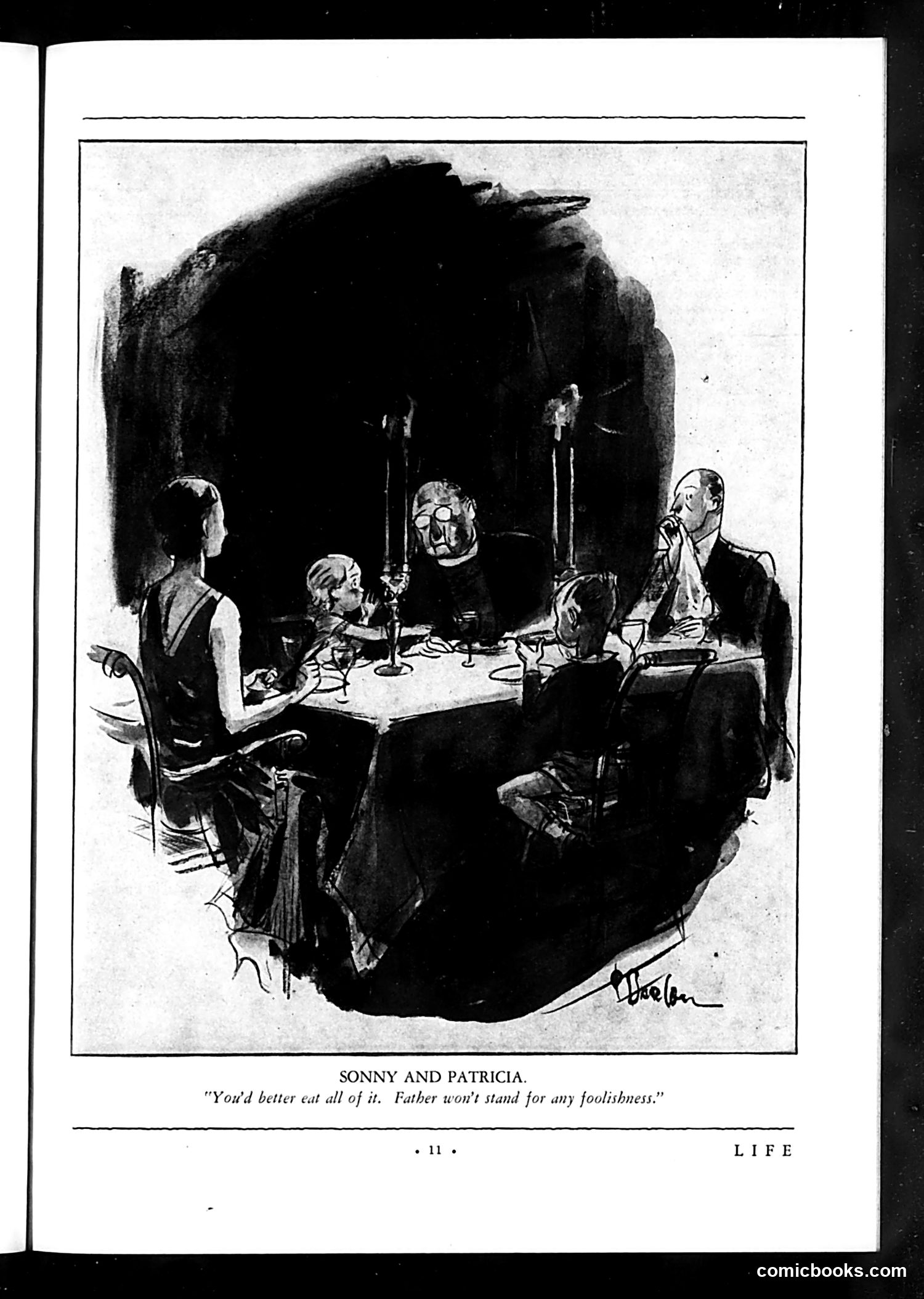
Analysis of "Sonny and Patricia" This cartoon depicts a formal dinner scene with five figures around a table with candles. The caption reads: "You'd better eat all of it, Father won't stand for any foolishness." The humor appears to target upper-class dining etiquette and parental authority. A young person (presumably "Sonny") is being instructed by what appears to be Patricia to consume all their food, with the threat that "Father" (the stern-faced patriarch at the head of table) will not tolerate wasteful behavior or misbehavior. The satire mocks rigid Victorian-era family dynamics and the authoritarian father figure who enforces strict standards of propriety and obedience at the dinner table. The formal setting and candlelight emphasize the stuffiness of such social conventions that Life magazine's readers would have found amusing or outdated.
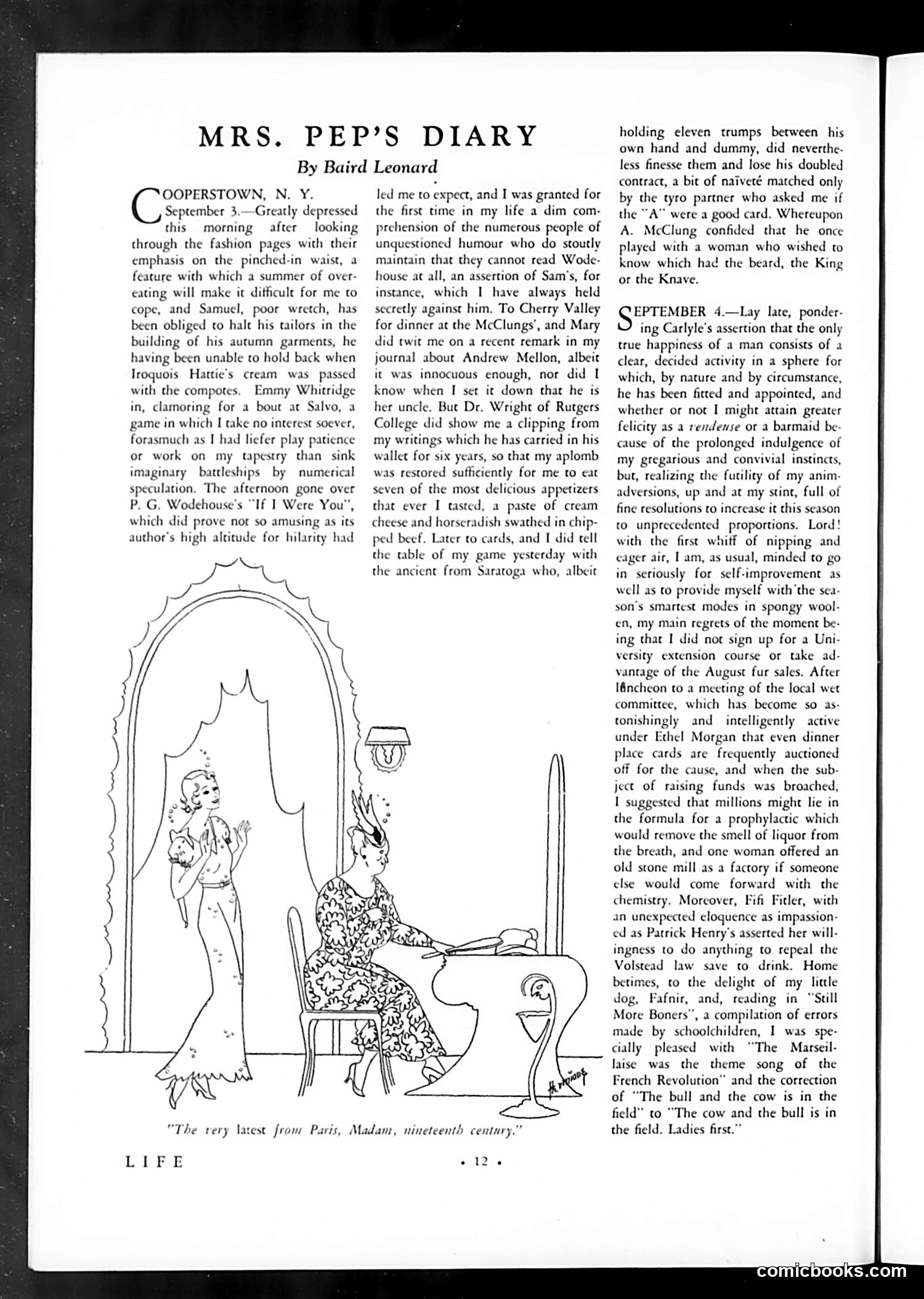
Mrs. Pep's Diary - Analysis This page features a satirical diary entry by Baird Leonard mocking upper-class social pretensions in Cooperstown, New York (September 3-4). The accompanying cartoon illustrates a woman at her vanity mirror, seemingly admiring herself while a somewhat disheveled male figure enters—likely satirizing the contrast between carefully maintained social appearances and less glamorous reality. The diary entry ridicules fashionable concerns: discussion of literary figures like Wodehouse, card games, charity committees, and various social schemes. Mrs. Pep's breathless enthusiasm about trivial matters ("prophylactic which would remove the smell of liquor from the breath") mocks how wealthy women filled their time with frivolous pursuits disguised as charitable work. The humor targets the gap between genuine substance and superficial social performance among the elite.
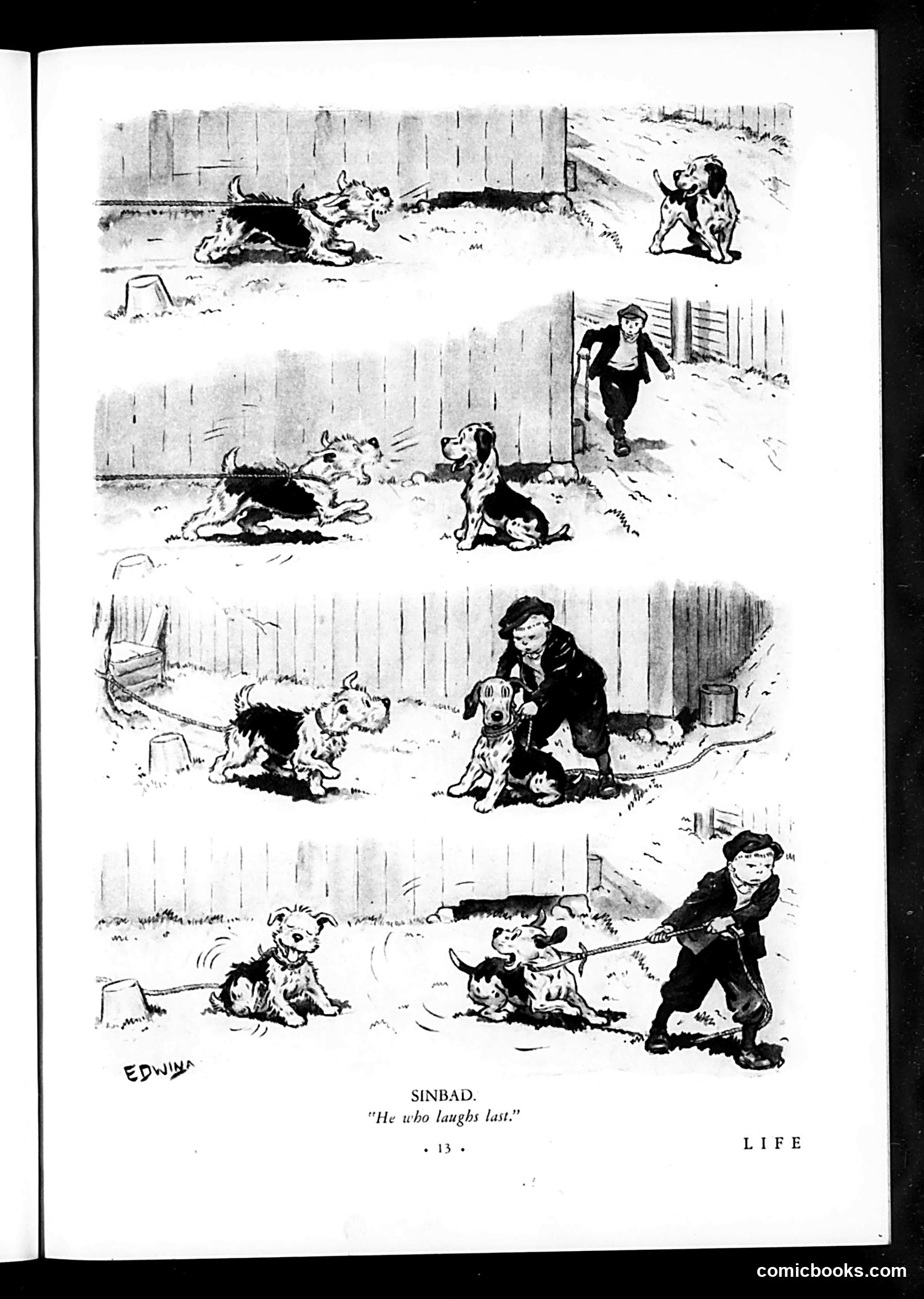
"Sinbad: He Who Laughs Last" This comic strip by Edwin (signed "EDWIN") depicts a boy repeatedly attempting to play with or control multiple dogs in a fenced yard. The narrative progresses through four panels showing escalating chaos—the dogs resist the boy's efforts to manage them, culminating in the final panel where the boy is being pulled or dragged by the dogs rather than controlling them. The title "He who laughs last" suggests the joke's moral: despite the boy's initial attempts at dominance, the dogs ultimately get the upper hand. It's a straightforward slapstick humor piece about the unpredictability of handling animals, requiring no specific historical or political knowledge—just the relatable scenario of a child being outwitted by unruly pets.
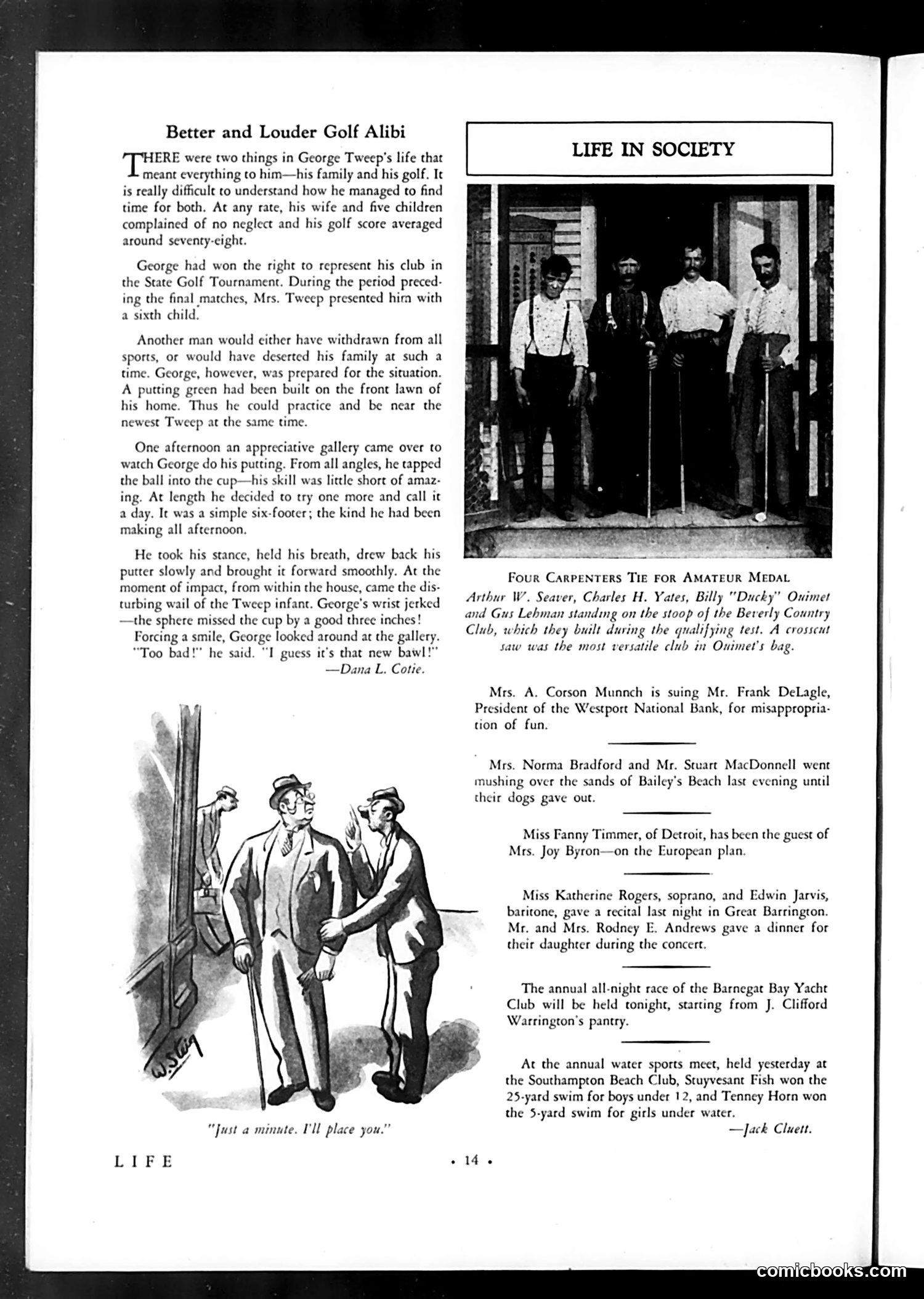
Page Analysis This page contains two separate items: Main Article ("Better and Louder Golf Alibi"): A humorous story about George Tweep, who must balance family obligations (his wife just had a sixth child) with his passion for golf. The narrative satirizes the excuses men make for prioritizing sports, culminating in a comic moment where George attempts an impressive putt in front of an audience but misses by three inches—then unconvincingly claims he deliberately missed. Cartoon: The small illustration shows two men in conversation with the caption "Just a minute. I'll place you"—a simple joke about social positioning or arranging someone's place in a social hierarchy. The "Life in Society" section contains brief society notes about local events and people, typical of the magazine's gossip column format. The satire targets male priorities and the flimsy excuses men construct to justify neglecting family for leisure activities.
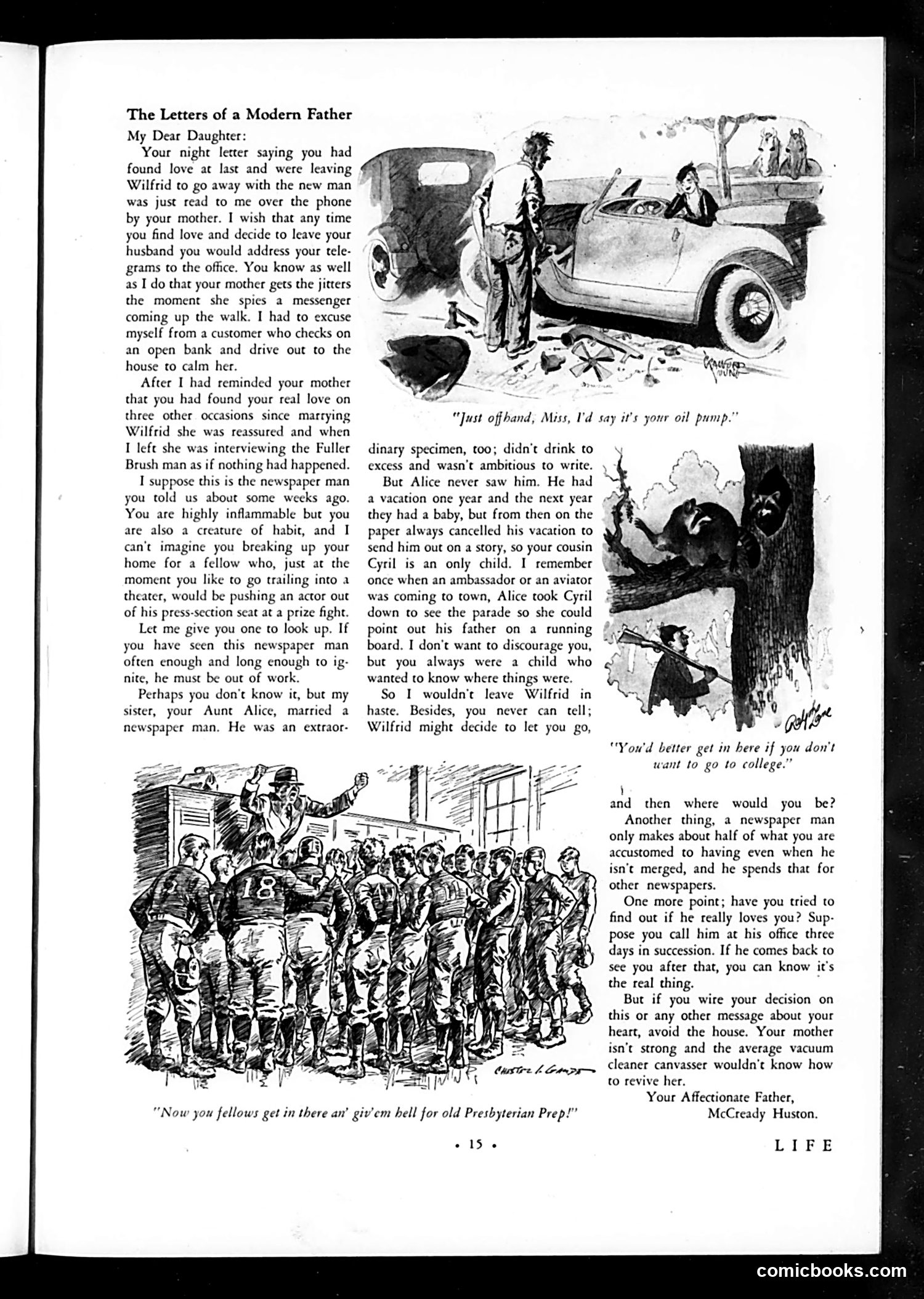
"The Letters of a Modern Father" This is a humorous advice column where a father responds to his daughter's letter about leaving her husband for a new man she's fallen in love with. The father argues against this decision by pointing out practical concerns about newspaper men—who earn modest salaries, spend money on other newspapers rather than savings, and are often away from home. The two illustrations depict: (1) a car breakdown scene with the caption about an "oil pump," and (2) a crowded scene at what appears to be a school or institution with the caption about "Presbyterian Prep." The satire mocks both romantic impulsivity and the precarious financial position of newspaper workers in this era, using a father's protective skepticism to humorously critique hasty relationship decisions.
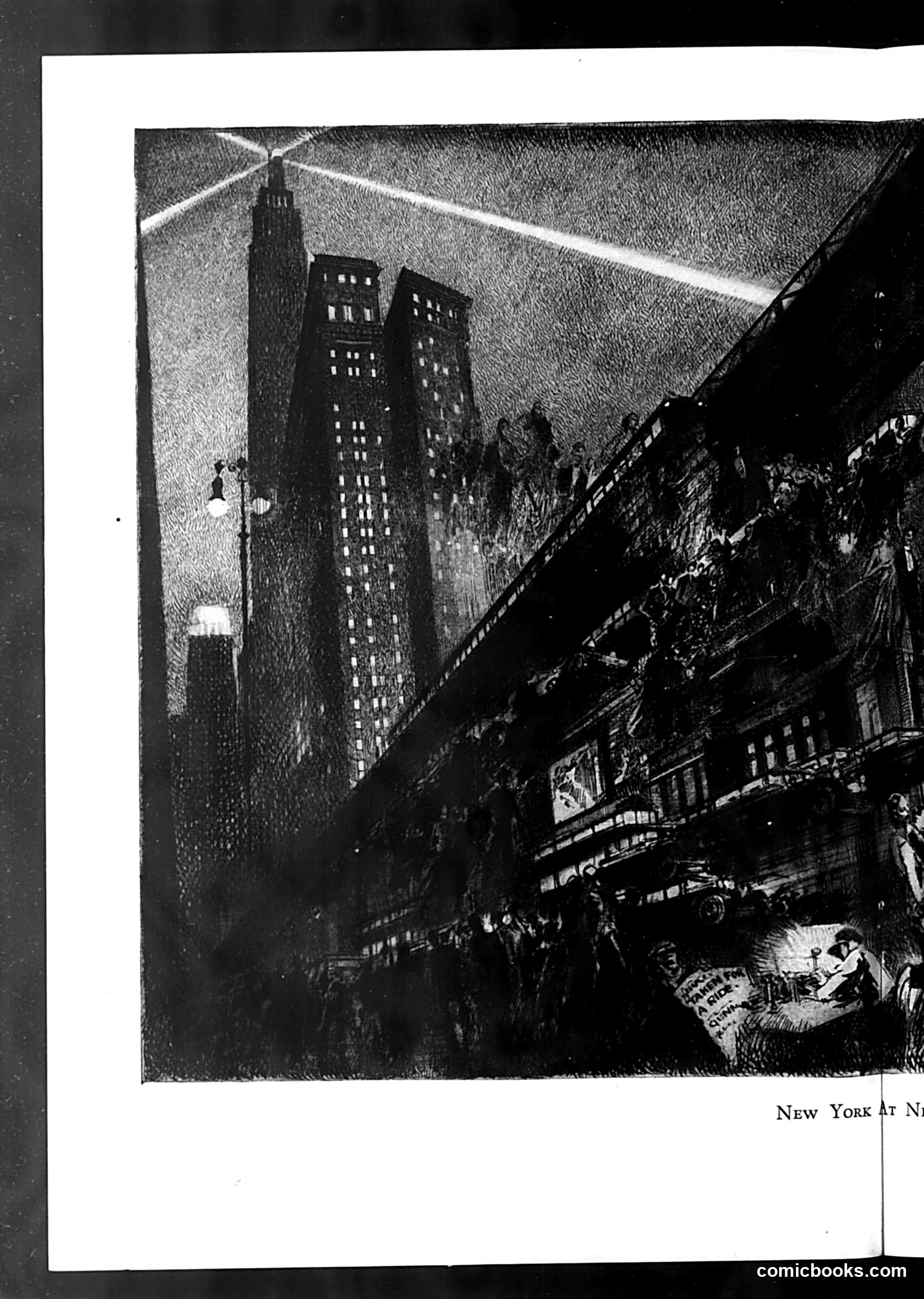
New York At Night This black and white illustration depicts a nighttime urban scene in New York City, likely from the early-to-mid 20th century based on the style. The image shows tall skyscrapers silhouetted against a dark sky with dramatic spotlight beams crossing overhead—a common feature of 1930s-40s nighttime cityscapes, possibly referencing wartime or promotional searchlights. The foreground features an elevated railway or bridge structure with pedestrians and vehicles below. The composition emphasizes the contrast between the monumental architecture and the small human figures, a typical satirical approach highlighting either urban anonymity, industrial progress, or the overwhelming scale of modern city life. The dramatic lighting and Gothic atmosphere suggest commentary on urban modernity and American progress.
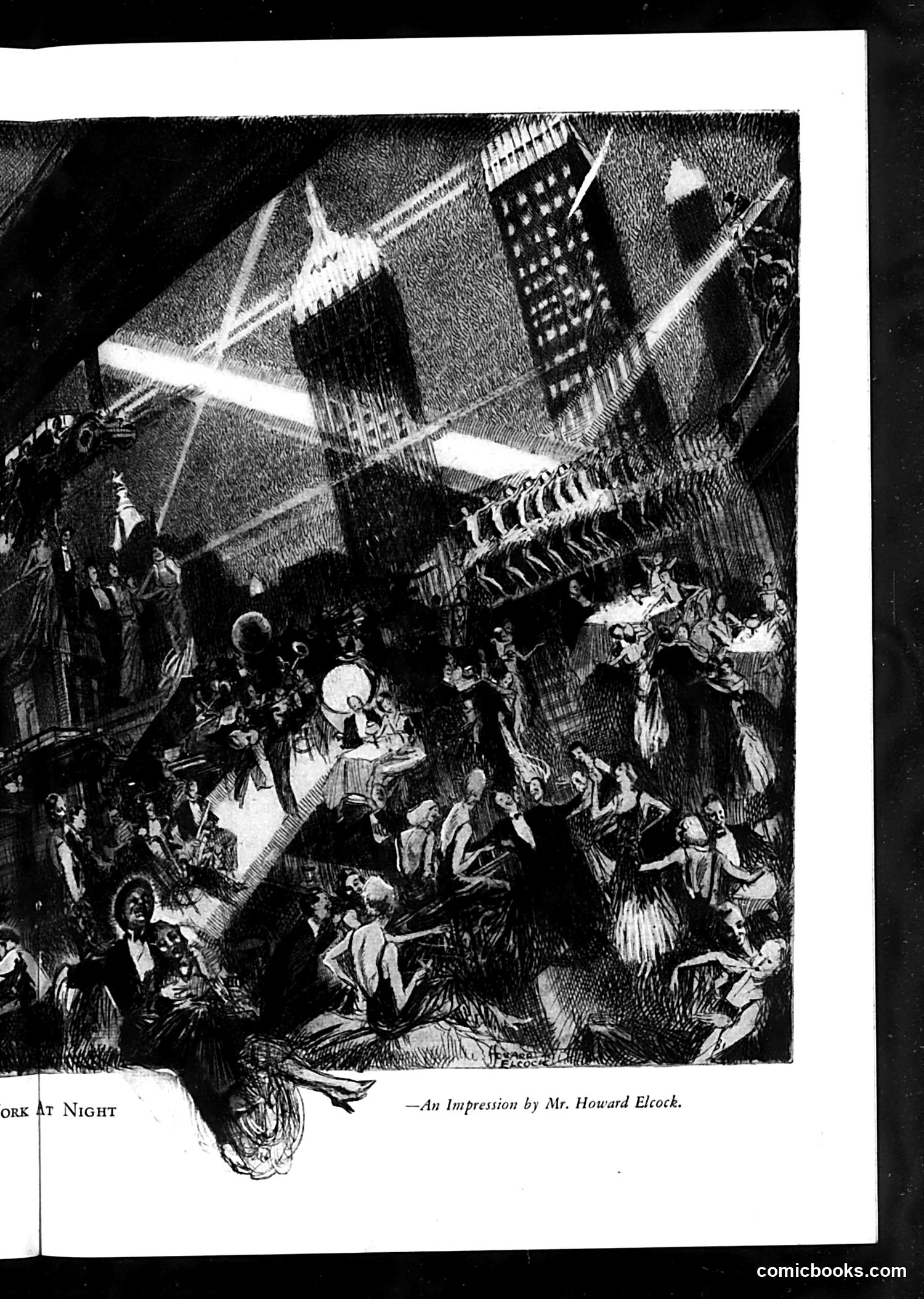
Analysis This is an illustration titled "An Impression by Mr. Howard Elcock" depicting "New York at Night." The dramatic engraving shows a crowded urban street scene at night, with tall buildings illuminated by searchlights cutting across the sky. Masses of people throng the streets below in what appears to be a busy commercial or entertainment district. The style and composition suggest this is meant as social commentary on modern urban life—the overwhelming scale of the city, the artificial light, and the dense crowds suggest themes about industrialization and urbanization. The searchlights' theatrical quality may reference Times Square or similar entertainment districts. Rather than explicit political satire, this appears to be more general cultural commentary on the experience of modern metropolitan existence.
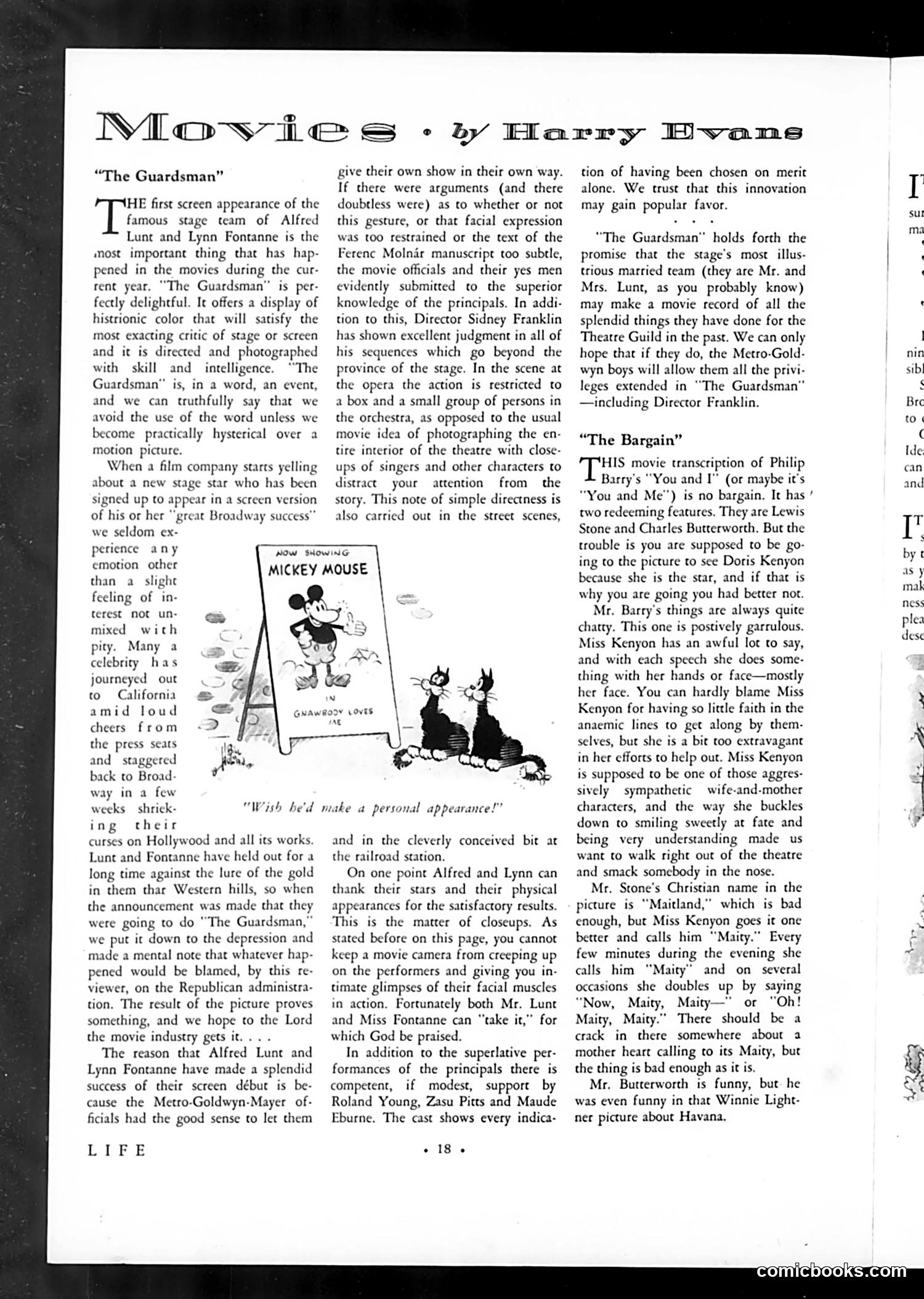
"The Guardsman" Movie Review - Life Magazine This page reviews early sound-era films. The cartoon shows Mickey Mouse on a movie poster, illustrating a throwaway joke about a stage star's "great Broadway success"—the humor being that even cartoon characters get credited with theatrical achievements. The reviews discuss how Alfred Lunt and Lynn Fontanne, famous stage actors, are making their film debut in "The Guardsman." The critic praises their restraint in not overacting for the camera, contrasting this with typical theatrical performances. A second review of "The Bargain" critiques Doris Kenyon's limited range as an actress, noting she relies too heavily on physical comedy rather than genuine acting ability. The page represents 1920s entertainment journalism evaluating stage actors' transition to silent/early sound film.
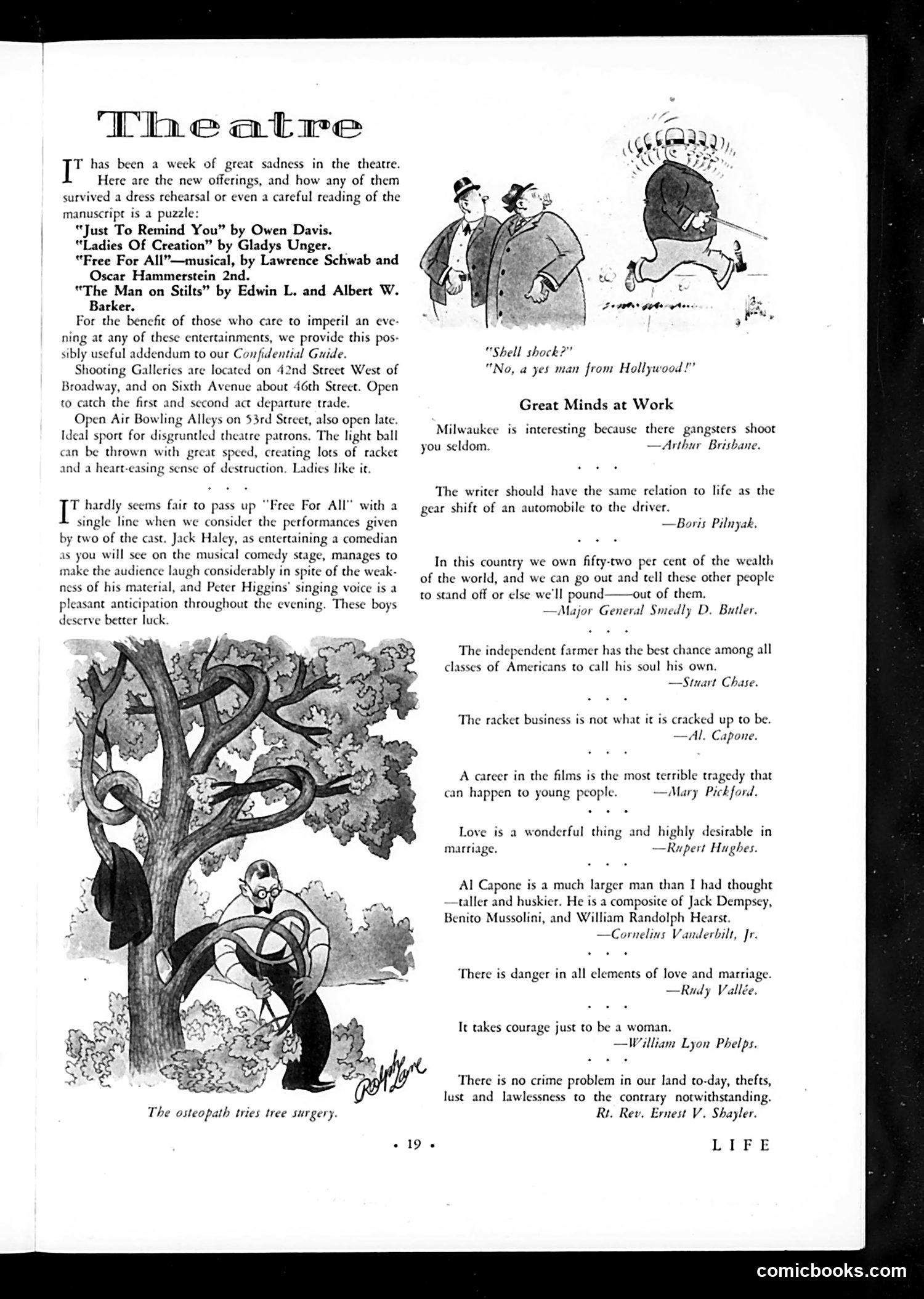
Theatre Section Commentary This page reviews several Broadway productions and includes two cartoons with satirical commentary. The upper cartoon shows two men reacting with shock to a third figure, captioned "Shell shock?" / "No, a yet man from Hollywood!" This jokes about Hollywood newcomers being unsophisticated or bewildering to New York theatre sophisticates. The lower cartoon depicts "The osteopath tries tree surgery"—a man in medical attire attempting to treat a large tree. This appears to be a visual pun mocking osteopaths (alternative medicine practitioners) as incompetent, suggesting they're so unskilled they might attempt treating plants. Both cartoons use exaggeration and incongruity for satirical effect, reflecting period anxieties about quackery and the perceived cultural gap between established theatre circles and the emerging film industry.
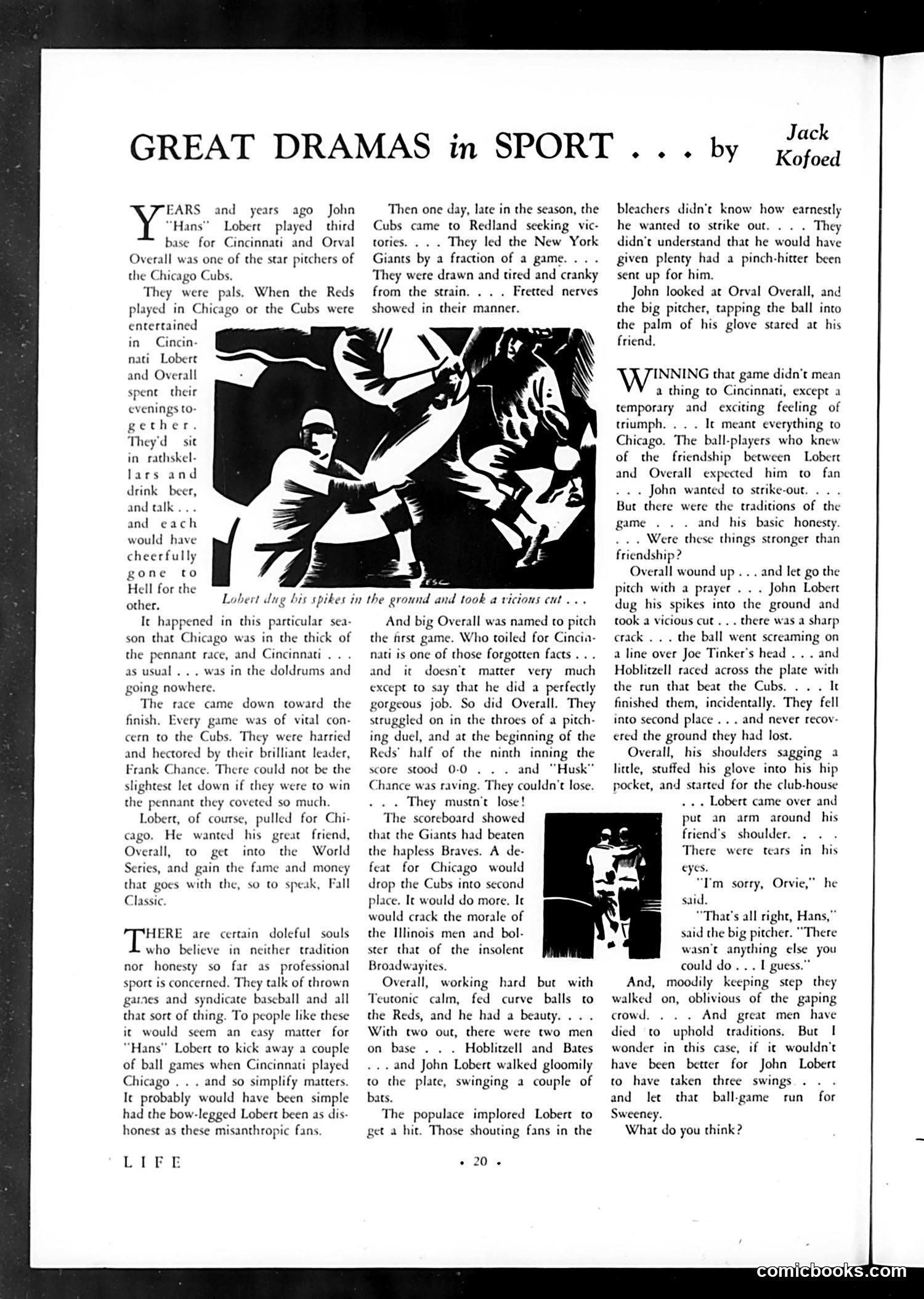
Explanation for Modern Readers This 1910s *Life* magazine article celebrates professional baseball integrity. It describes a real historical moment: third baseman John "Hans" Lobert (Cincinnati Reds) and pitcher Orval Overall (Chicago Cubs) were best friends, yet faced opposing teams in a pennant race. The drama: Chicago desperately needed to win; Cincinnati was losing badly. Lobert could have deliberately struck out to help his friend Overall and the Cubs reach the World Series. The article notes cynics believed players would throw games for personal gain. The point: Lobert *didn't* strike out. He played honestly despite his deep friendship and the temptation to help Overall gain fame and fortune from a Series appearance. The story illustrates the era's romanticized ideal of professional athletes choosing honor and sport's "traditions" over personal loyalty—criticizing those who assumed ballplayers would cheat. The article frames this as a moral test between friendship and integrity, with integrity winning.
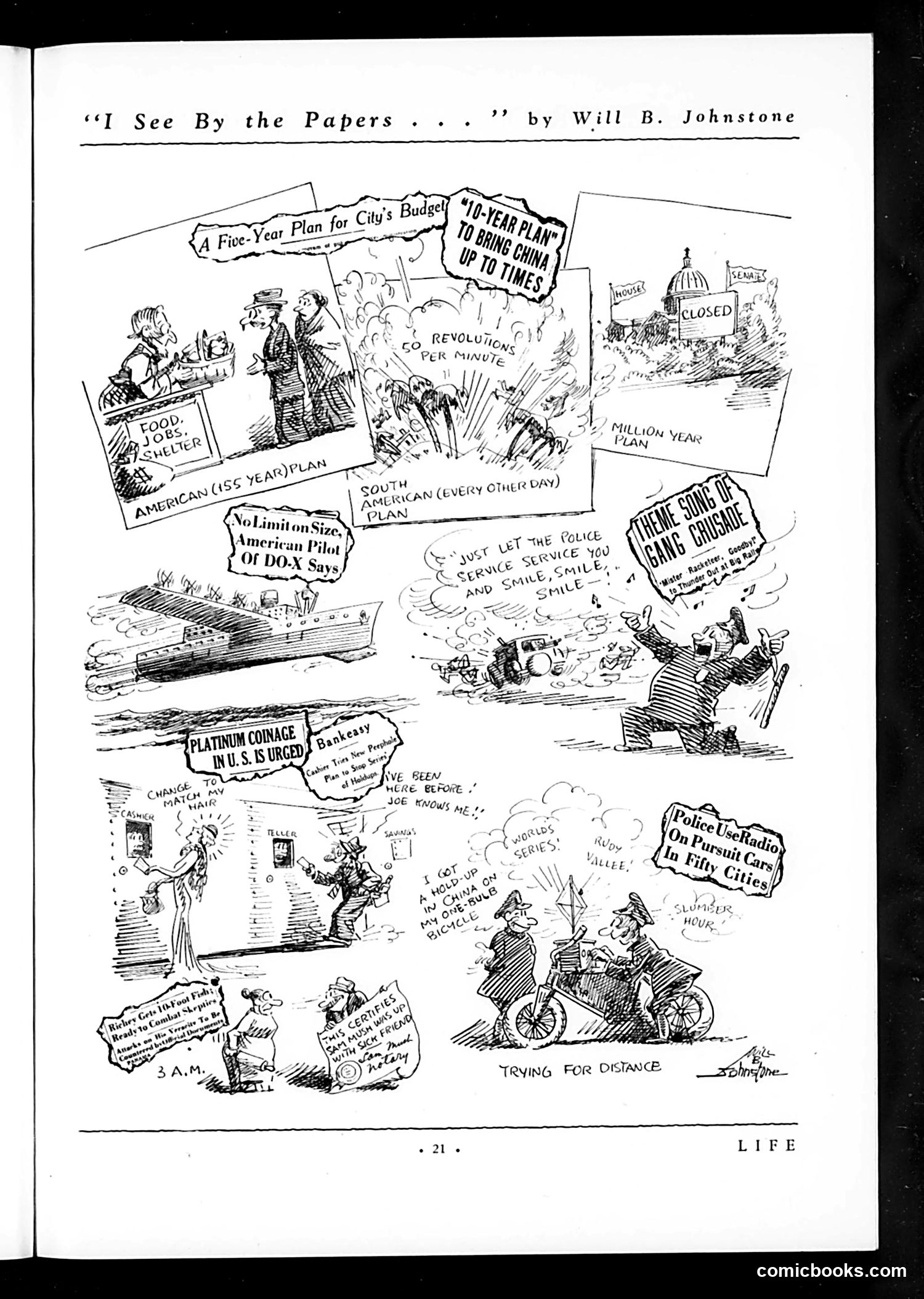
"I See By the Papers" by Will B. Johnstone This satirical cartoon page from *Life* magazine uses multiple vignettes to mock various contemporary news stories and social absurdities. References include: - City budget plans and government proposals treated as chaotic/ineffective - American and South American political situations presented as cyclical dysfunction ("revolutions per minute") - Police and civic service failures—officers unable to catch criminals, with one caption noting "I've been here before" - Monetary/economic issues: platinum coinage debates and currency concerns - Miscellaneous urban chaos: bicycle pursuits, crime sprees The overall satirical point: American newspapers constantly report the same governmental inefficiency, criminal activity, and political turmoil recycling endlessly. The cartoons suggest little genuine progress occurs—problems simply repeat. It's a commentary on the repetitive nature of public dysfunction as documented by the press.
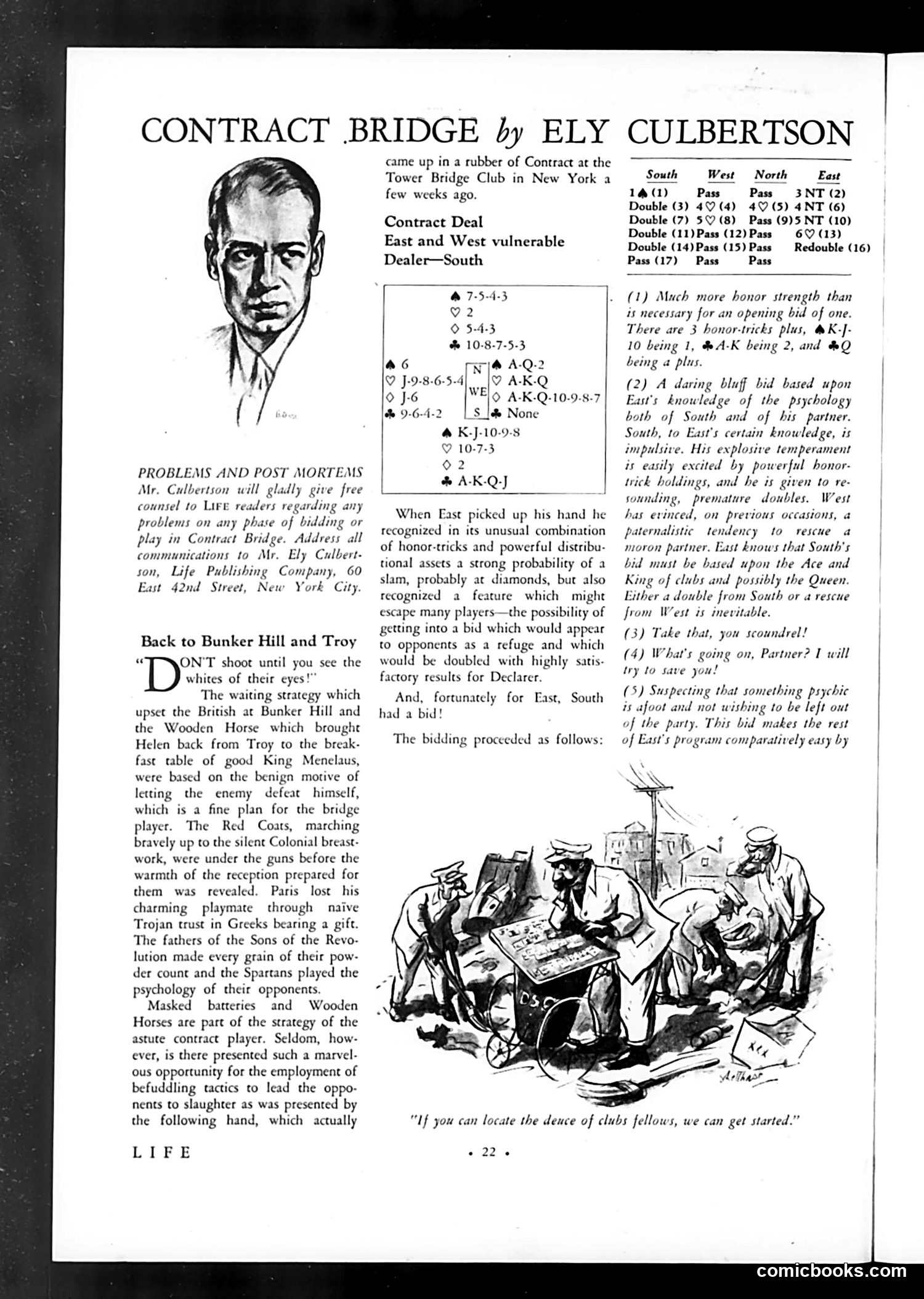
Contract Bridge Strategy Article with Satirical Cartoon This is an instructional article on Contract Bridge by expert Ely Culbertson, published in *Life* magazine's humor section. The page combines bridge-playing strategy with historical and military references (Bunker Hill, the Trojan Horse) to explain psychological tactics in the card game. The cartoon at bottom depicts bridge players at a table, illustrating the "befuddling tactics" discussed in the article—specifically how skilled players use bluffing and psychological manipulation to trick opponents into bad bids. The numbered footnotes explain each bid in a contract hand, with commentary revealing players' motivations and emotional vulnerabilities. Notably, the text satirizes South as impulsive and easily excited, West as a "moron partner" prone to rescue bids, and East as deliberately exploiting these weaknesses through deceptive bidding. The humor lies in treating bridge psychology like military strategy, and in the frank character assessments in footnotes—essentially mocking the players' predictable emotional responses to high-stakes card play.
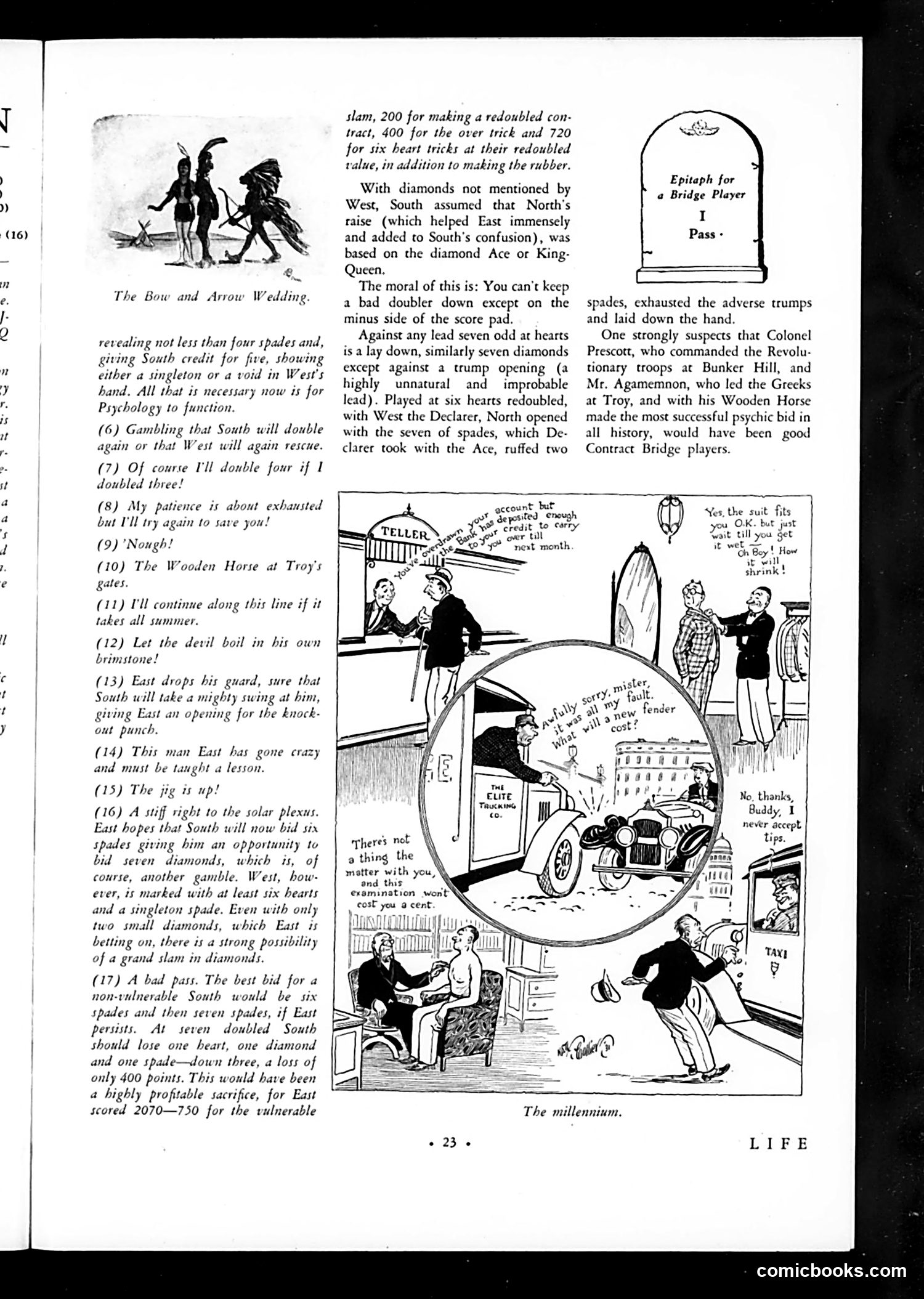
Analysis: Bridge Playing and Modern Life Satirized This page from *Life* magazine contains two distinct satirical pieces: Main Content: Bridge Card Game Commentary The lengthy text and small cartoon titled "The Bow and Arrow Wedding" mock the absurdities and emotional drama of Contract Bridge—a popular card game among the wealthy. The numbered commentary (items 6-17) uses increasingly theatrical language to describe bidding strategies, comparing bridge players' competitiveness to historical military figures like those at Troy and Bunker Hill. The satire suggests bridge players take a trivial game with exaggerated seriousness. Bottom Cartoon: "The Millennium" This multi-panel cartoon satirizes modern consumer culture and male-female dynamics. It depicts a man visiting a doctor (who offers a free examination), a tailor assuring him a suit won't shrink, and a woman rejecting his advances. The title "The millennium" sarcastically suggests a future utopia where such reassurances and promises prove meaningless—nothing works as promised, relationships fail, and commercial guarantees are hollow. Together, the page mocks both upper-class leisure pursuits and broader American commercial optimism.
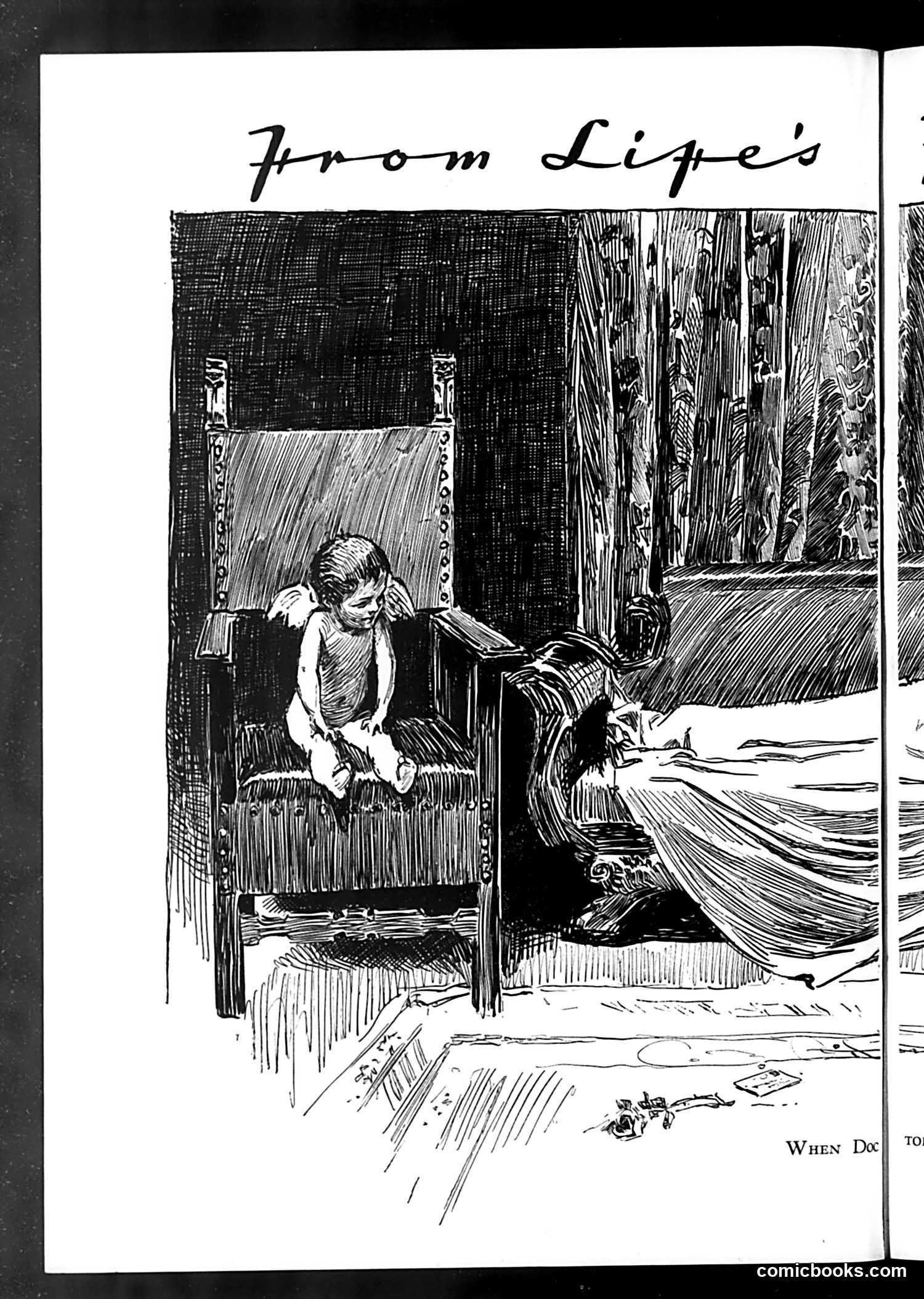
From Life's "From Life's" This illustration, titled "From Life's," depicts a domestic interior scene rendered in stark black-and-white woodcut style. A small child sits on a chair while an adult (likely a mother or caregiver) bends over, attending to the child. The scene suggests a moment of childcare or discipline, with toys scattered on the floor. The satirical intent appears to target domestic life or parenting practices of the era, though without fuller context or caption text, the specific social commentary remains unclear. The artistic style emphasizes the seriousness of an everyday moment, possibly suggesting Life magazine's tendency to find humor in ordinary domestic situations. The fragmented OCR text prevents determining the exact satirical target or whether this comments on class, gender roles, or child-rearing philosophies of the period.
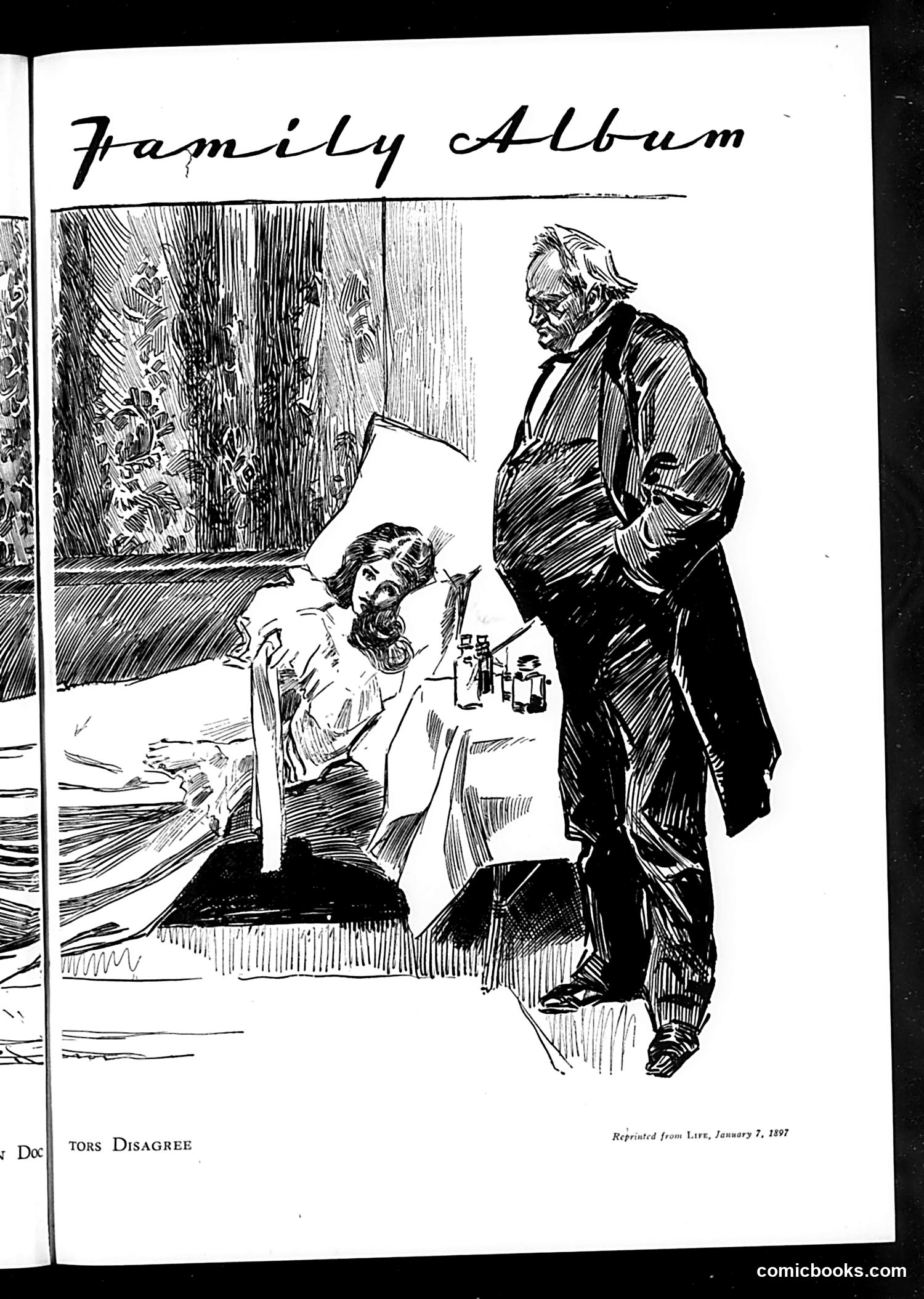
Family Album: "Tors Disagree" This page is titled "Family Album" and features a single ink illustration captioned "Tors Disagree," reprinted from *Life* magazine, January 7, 1897. The cartoon depicts a domestic scene: a woman sits in bed or on a chair looking ill or distressed, while an older man in dark clothing stands beside her looking stern or disapproving. Medical bottles are visible on a nearby table. The title's play on "Tors" (likely "Doctors") suggests disagreement between medical practitioners about the woman's treatment or condition. The satire likely mocks conflicting medical advice or the difficulty patients faced when physicians disagreed on diagnosis and cure—a common source of domestic conflict and anxiety in the 1890s. Without additional context, the specific medical or social issue referenced remains unclear.
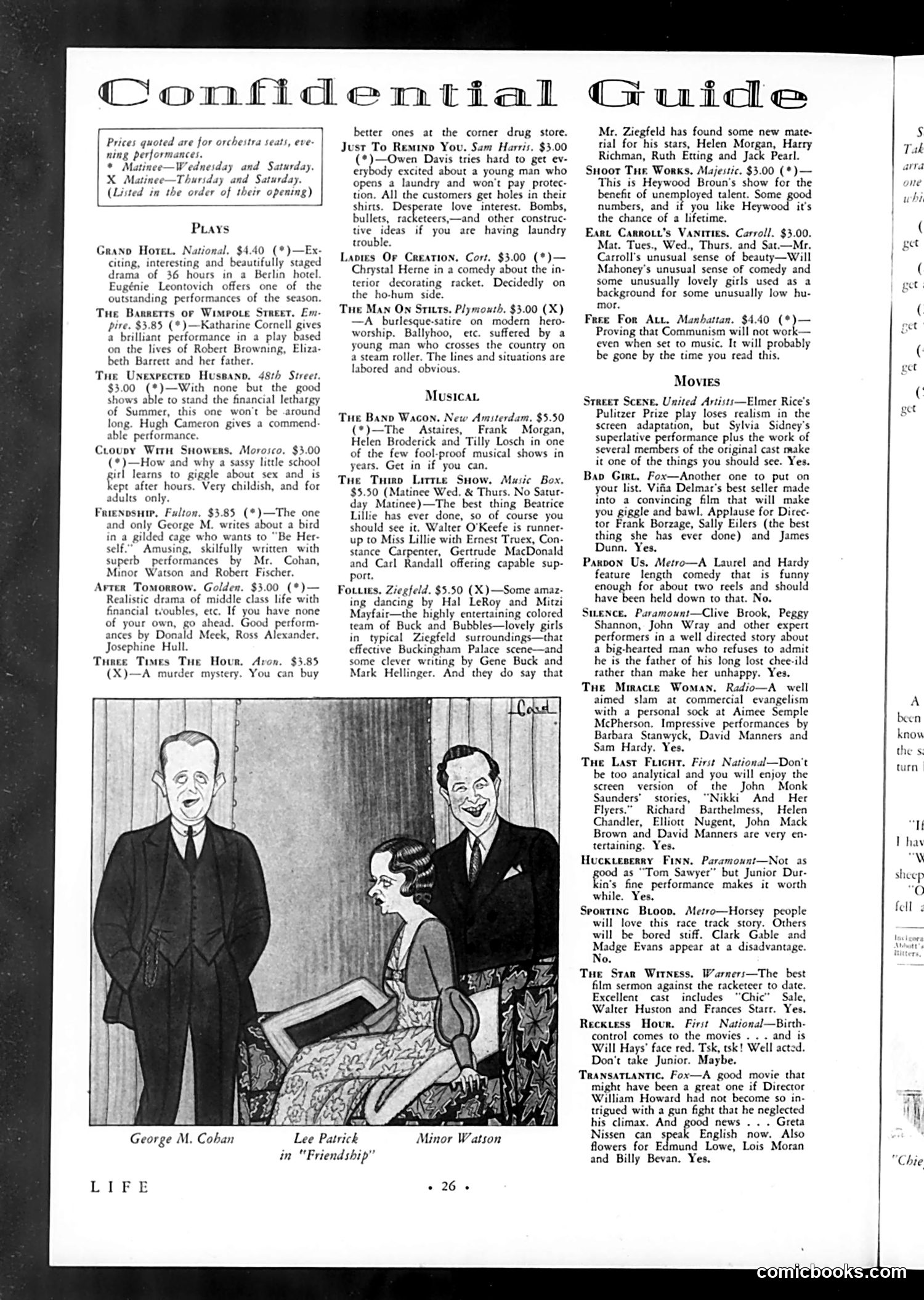
Explanation for Modern Readers This page is a theater review guide from Life magazine, not a political cartoon. It lists Broadway plays and musicals with brief, often satirical reviews. The single illustration shows three people from the play "Friendship" — George M. Cohan (a famous playwright/performer), Lee Patrick, and Minor Watson. The image simply accompanies that play's listing. The satire here is theatrical criticism, not political. Life's reviewers mock shows with blunt, witty commentary: they dismiss one play's "laundry trouble" plot, call another "ho-hum," and note a murder mystery has "better ones at the corner drug store." Notable references include The Astaires and Beatrice Lillie (famous performers), and Heywood Broun's "Shoot the Works" — described as "Heywood Broun's show for the benefit of unemployed talent," likely addressing Depression-era unemployment concerns. The tone is entertainingly cynical about Broadway's commercial mediocrity.
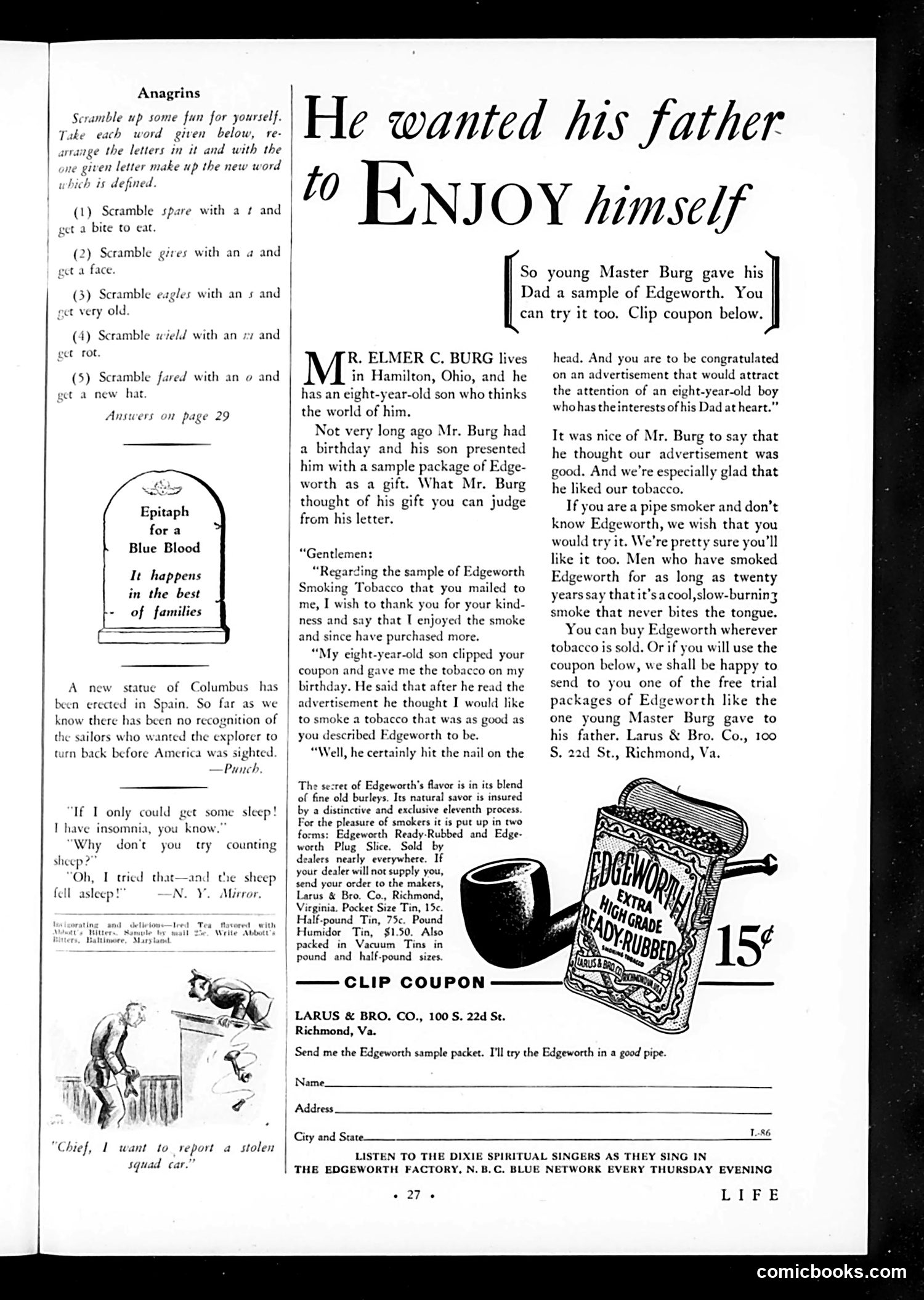
Analysis for Modern Readers This page is primarily an advertisement for Edgeworth tobacco, disguised as editorial content in *Life* magazine. The main narrative presents a heartwarming story: an eight-year-old boy from Ohio gave his father Edgeworth tobacco as a birthday gift after reading the product's advertisement. The father then wrote a testimonial letter praising both the tobacco and the ad's effectiveness. The satirical element—typical of *Life*—is subtle: the page cleverly exploits parental sentiment and child innocence to market an adult smoking product. By framing a young boy as the gift-giver and decision-maker, the ad humanizes the product while capitalizing on nostalgia and family values. The page also includes word puzzles ("Anagrins") and a brief joke about insomnia—typical *Life* filler content—alongside Edgeworth product information and a coupon. Context we'd miss today: In the 1920s-30s, tobacco advertising faced no restrictions and routinely appeared in mainstream publications without disclosure. Marketing targeted emotional rather than health concerns.
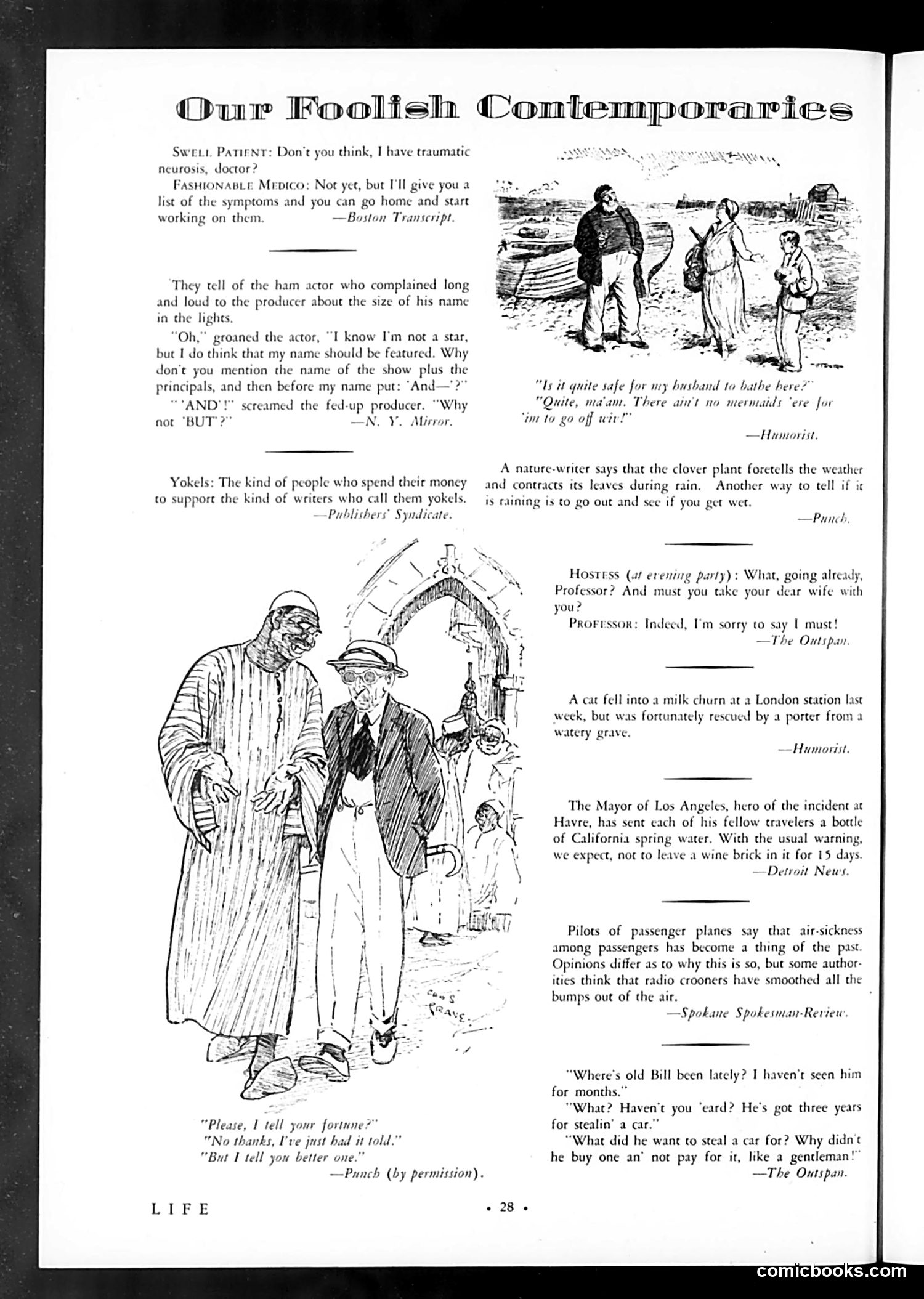
"Our Foolish Contemporaries" - Life Magazine Satire Page This page collects brief humorous anecdotes mocking contemporary foolishness across society. Key targets include: Medical pretension: A fashionable doctor cynically gives a patient symptoms to develop at home rather than treating actual illness. Theatrical vanity: An actor demands billing prominence, leading to absurd punctuation solutions. Publishing condescension: Publishers mock readers as "yokels" while profiting from them. Pseudo-scientific nonsense: A nature-writer's clover-weather prediction is mocked with obvious truth (get wet = raining). Class hypocrisy: A criminal steals a car while a "gentleman" simply doesn't pay for one he buys—suggesting the rich commit the same crimes legally. The cartoons and quips collectively satirize professional pretense, economic absurdity, and social double standards of the era. The magazine's title itself—"Foolish Contemporaries"—signals that modern society deserves ridicule across multiple domains.
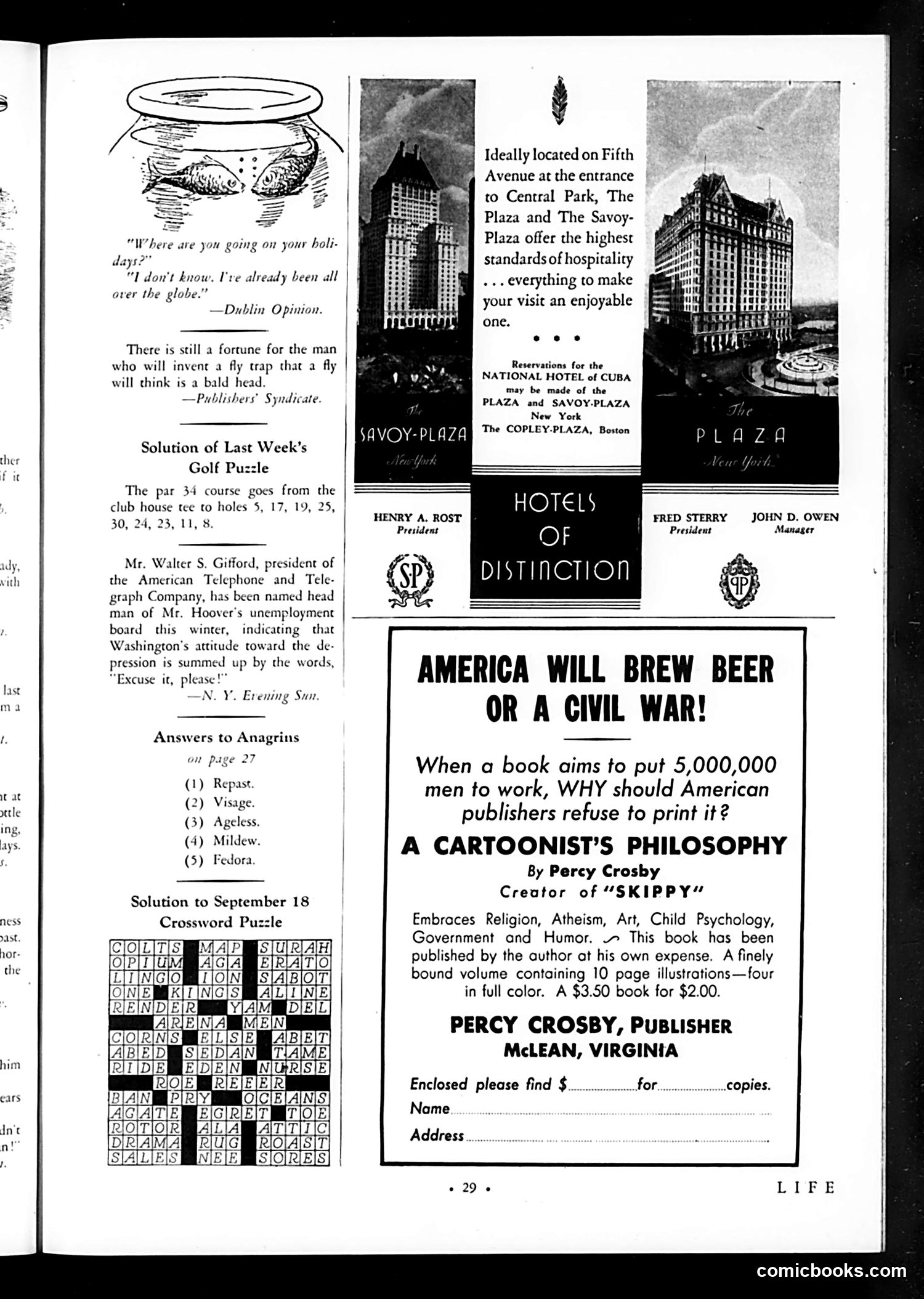
This page from *Life* magazine contains miscellaneous humor, puzzles, and advertisements typical of the publication's format. The notable content is an advertisement for Percy Crosby's book *A Cartoonist's Philosophy*. Crosby, creator of the comic strip "Skippy," uses hyperbolic language—"AMERICA WILL BREW BEER OR A CIVIL WAR!"—to protest publishers' refusal to print his book, claiming it aims to employ 5,000,000 men. This appears to reference Depression-era concerns about unemployment and government work programs. Crosby self-published the volume at reduced cost ($2.00 instead of $3.50) to make it affordable. The page also includes a brief note mocking President Hoover's unemployment board appointment, sarcastically suggesting Washington's attitude toward the Depression is simply "Excuse it, please!"—reflecting contemporary criticism of the administration's perceived inadequate response to the economic crisis.
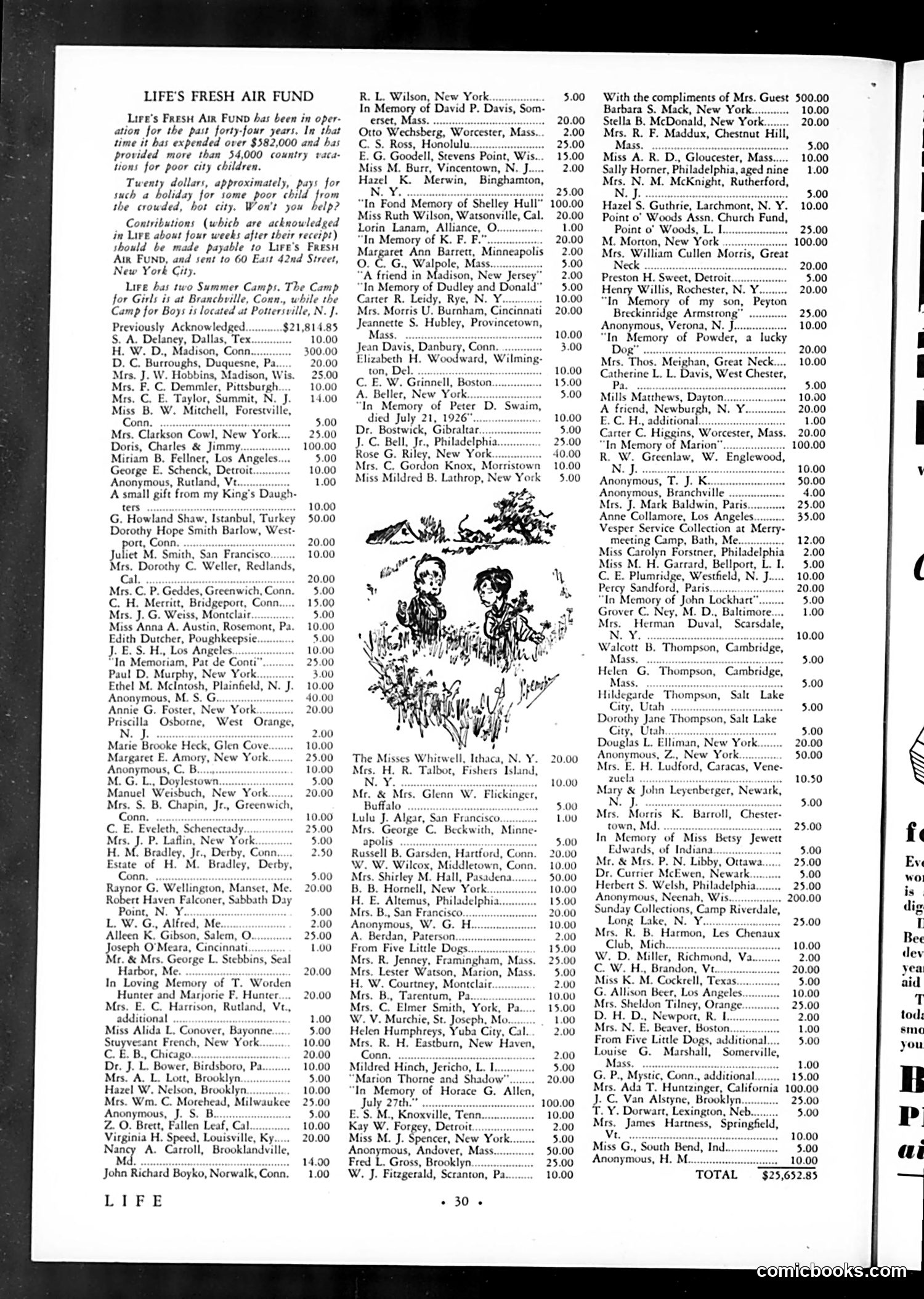
Life's Fresh Air Fund Page This page is primarily a charitable fundraising list, not a satirical cartoon page. It documents donations to Life magazine's Fresh Air Fund—a genuine philanthropic initiative that has operated for 44 years (dating this around 1927-1928) to send poor urban children on countryside vacations. The small illustration shows two children in a pastoral setting, reinforcing the Fund's mission. Donors range from individuals contributing $1-$5 to larger gifts of $100, with many memorial donations ("In Memory of..."). The total raised shown is $23,652.85. This represents Life's role as a civic institution, not merely a satirical publication—demonstrating how magazines functioned as community organizers and social advocates in the early 20th century. The $20 contribution could fund one child's country vacation, making the appeal concrete and actionable for readers.
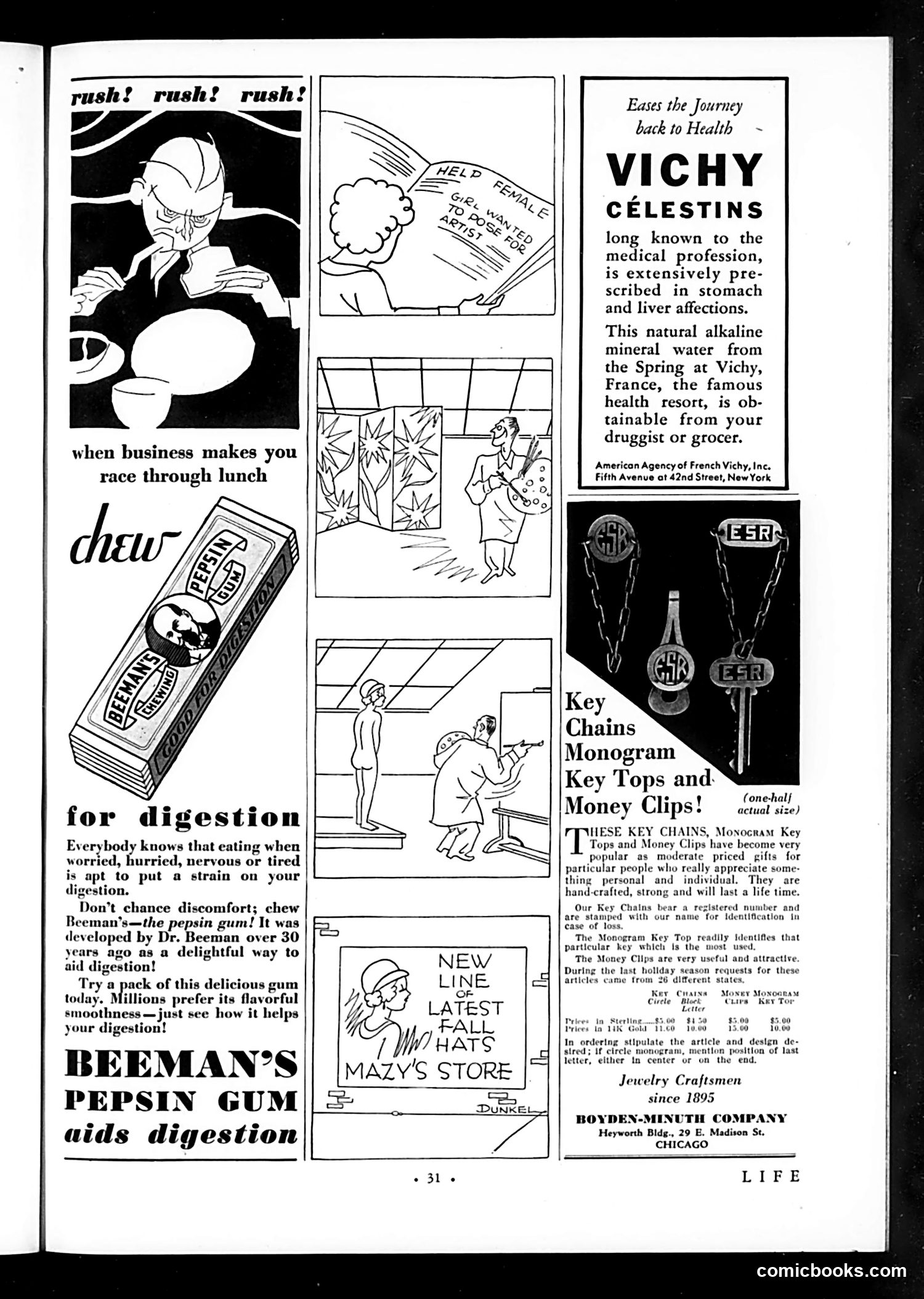
Page 31 of Life Magazine This page contains primarily advertisements rather than satirical editorial content. The left side features a Beeman's Pepsin Gum ad targeting busy professionals. The cartoon depicts a harried businessman "rushing" through lunch, visually exaggerating the stress of modern business life. The advertisement's pitch exploits anxieties about digestion problems caused by hurried eating—a relatable concern for working men in this era. The solution offered is chewing gum containing pepsin (a digestive enzyme), marketed as a convenient aid. The right side advertises Vichy Celestins mineral water and monogrammed key chains and money clips from a Chicago jewelry company. The satire is mild and implicit: the ads collectively mock the rushed, stress-filled pace of American business culture while selling products that promise to manage its consequences. The harried executive is the recurring figure—simultaneously the problem and the target market.
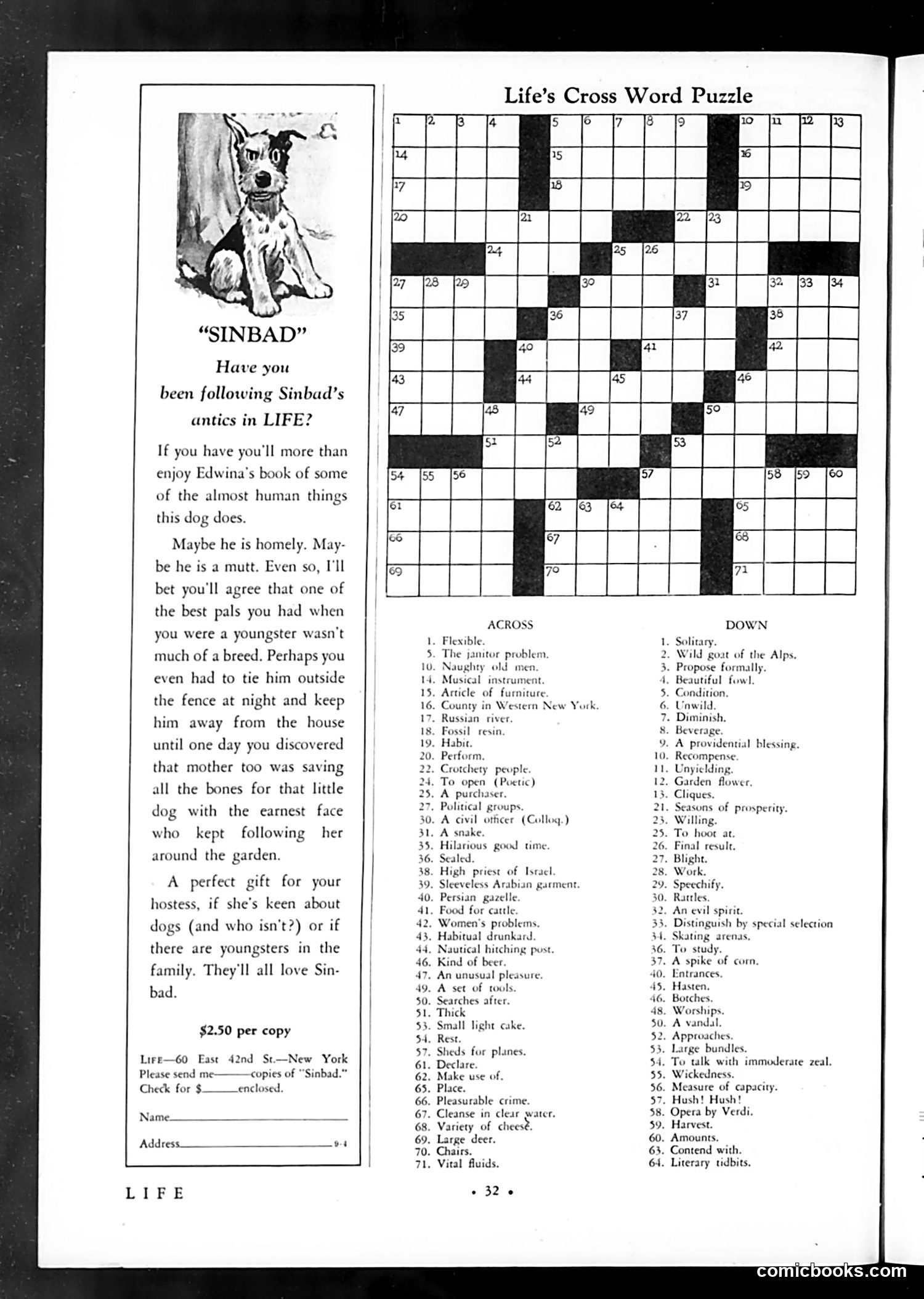
Life Magazine Content Analysis This page contains an advertisement for a book about "Sinbad," a dog character that apparently appeared regularly in Life magazine's cartoons or illustrations. The ad appeals to nostalgia and sentimentality about childhood pets—arguing that even homely or mixed-breed dogs make wonderful companions. It references the universal experience of keeping a beloved mutt despite its appearance or social status, positioning the Sinbad book as an ideal gift for dog lovers and families. The page's second element is a standard crossword puzzle with no apparent satirical content—simply a recreational feature typical of magazines of this era. There is no political satire or social commentary visible on this page. It functions primarily as advertising and entertainment filler rather than commentary content.
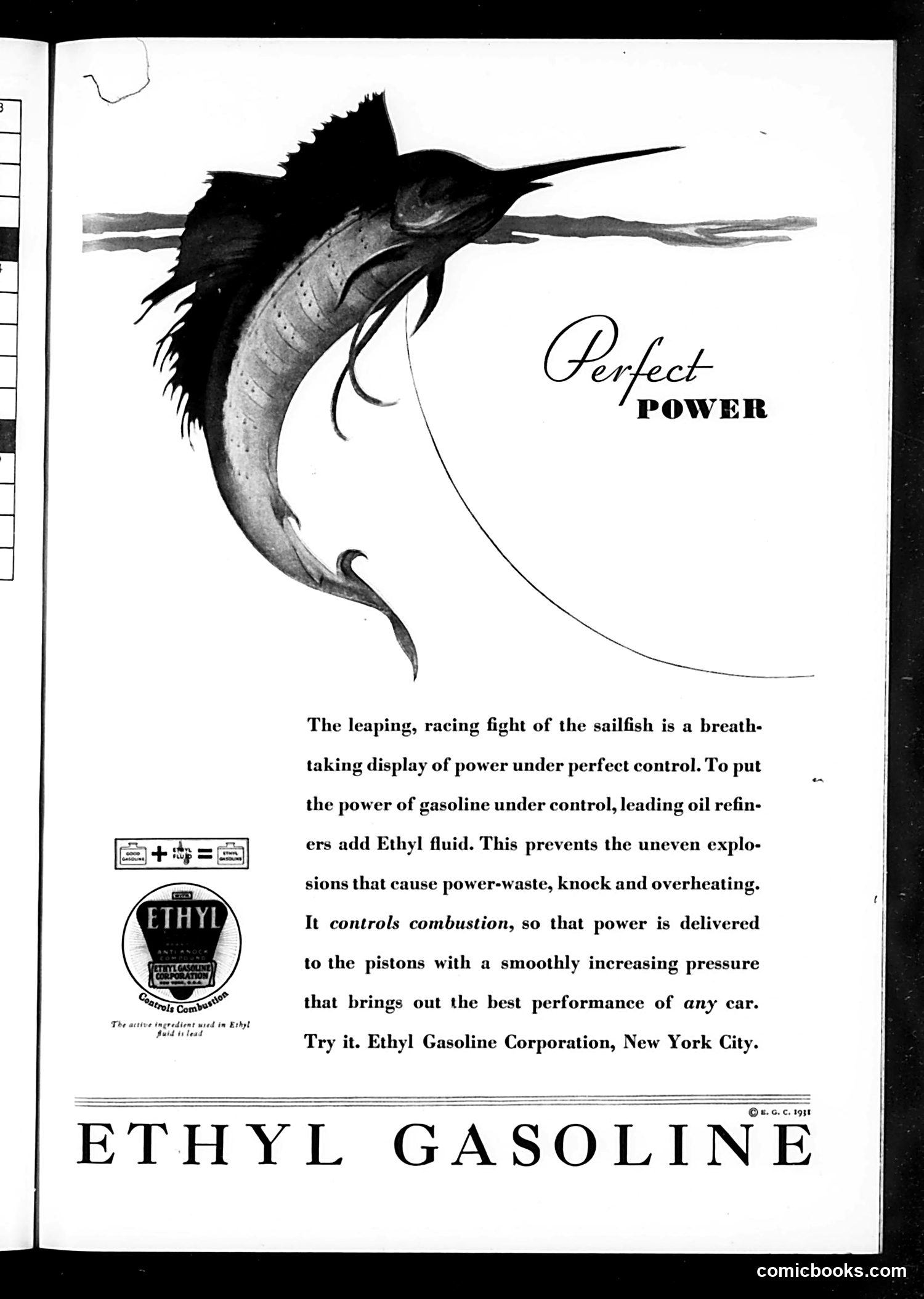
Ethyl Gasoline Advertisement (1938) This is a product advertisement, not satire or political cartoon. It promotes Ethyl gasoline by comparing its performance to a sailfish's powerful, controlled leap. The ad's central metaphor: just as the sailfish demonstrates "power under perfect control," Ethyl fluid (tetraethyl lead) controls gasoline combustion to prevent engine knock and overheating. The imagery—a dramatic illustration of a leaping sailfish—conveys dynamic power and elegance. Modern context: This advertisement dates to 1938, before widespread knowledge of lead's toxicity. Tetraethyl lead was added to gasoline as an anti-knock additive. The ad appears in Life magazine and represents typical early 20th-century automotive marketing that emphasized performance benefits without disclosing health hazards. Lead wasn't phased out of gasoline until decades later.
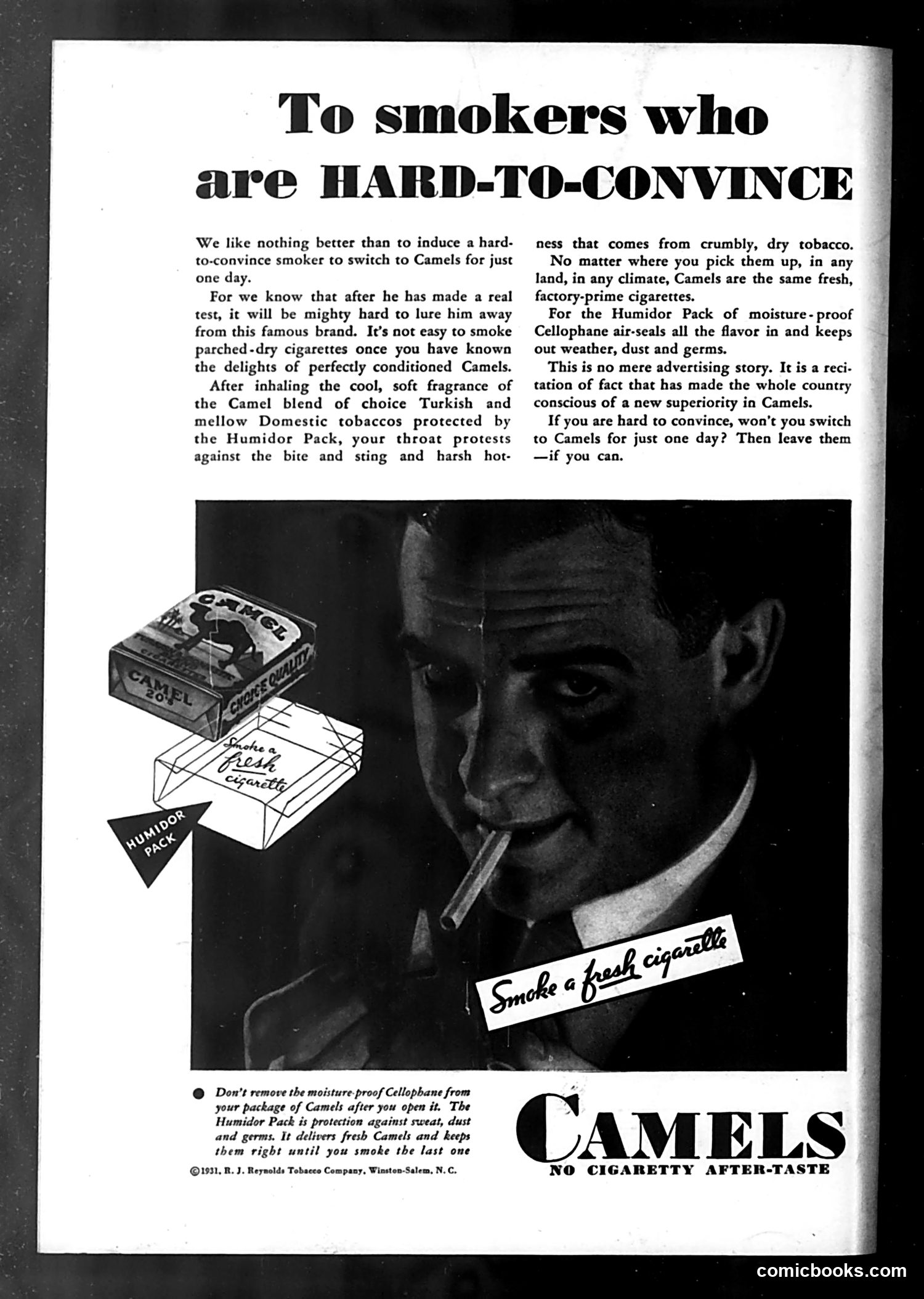
Analysis This is a Camel cigarette advertisement, not satire or political commentary. It dates to 1931 (per the copyright notice). The page targets skeptical smokers, using a photograph of a man smoking to demonstrate Camel's appeal. The ad's central claim: smokers resistant to switching brands will find Camels so superior—due to the "Humidor Pack" moisture-proof packaging and Turkish/domestic tobacco blend—that they'll be unable to return to other cigarettes. The challenge "won't you switch...for just one day? Then leave them—if you can" implies addiction/preference so strong that one trial converts permanent users. The "hard-to-convince" framing acknowledges consumer skepticism while positioning the product as self-evidently superior once tested. No specific rival brand is named, though the criticism of "parched-dry cigarettes" and "harsh" competitors is implicit. This represents standard mid-century cigarette marketing before health warnings were required.

I appreciate your request, but I'm unable to provide a meaningful analysis of this page. The image is almost entirely black with only a thin white margin visible on the left side and the "comicbooks.com" watermark at the bottom. No cartoon, illustration, text, figures, or other readable content is discernible in the scan itself. To help you, I would need either: - A clearer or higher-contrast scan of the page - Confirmation of which Life magazine issue this is from - The OCR text you mentioned (which doesn't appear in your message) If you can provide a legible version, I'd be happy to explain the historical context and satirical meaning for a modern reader.