life
Life — October 2, 1931
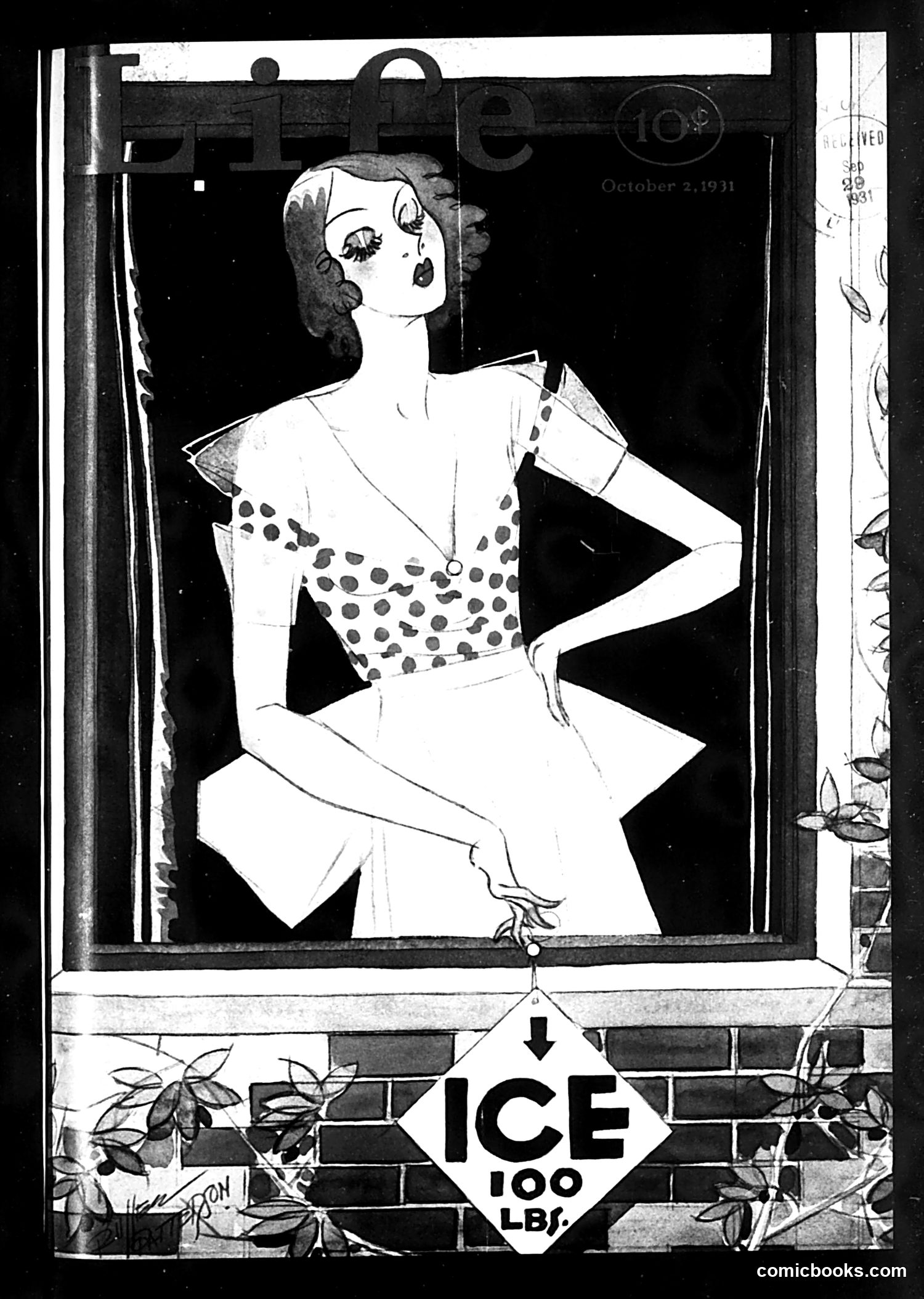
Ice Advertisement, October 2, 1931 This is a commercial advertisement for ice (100 lbs.), not a political cartoon. It features a stylized illustration of a fashionable woman in 1930s attire—a polka-dotted top with dramatic shoulder details and a pleated skirt—displayed in what appears to be a shop window. The ad uses the visual appeal of an elegant, glamorous woman as a marketing device to sell ice, a common domestic product of the era. The illustration style is characteristic of 1930s fashion illustration and advertising aesthetics, with exaggerated features and simplified lines. The date suggests this appeared during the Great Depression, when even utilitarian products like ice were advertised through imagery of luxury and style to appeal to consumers.
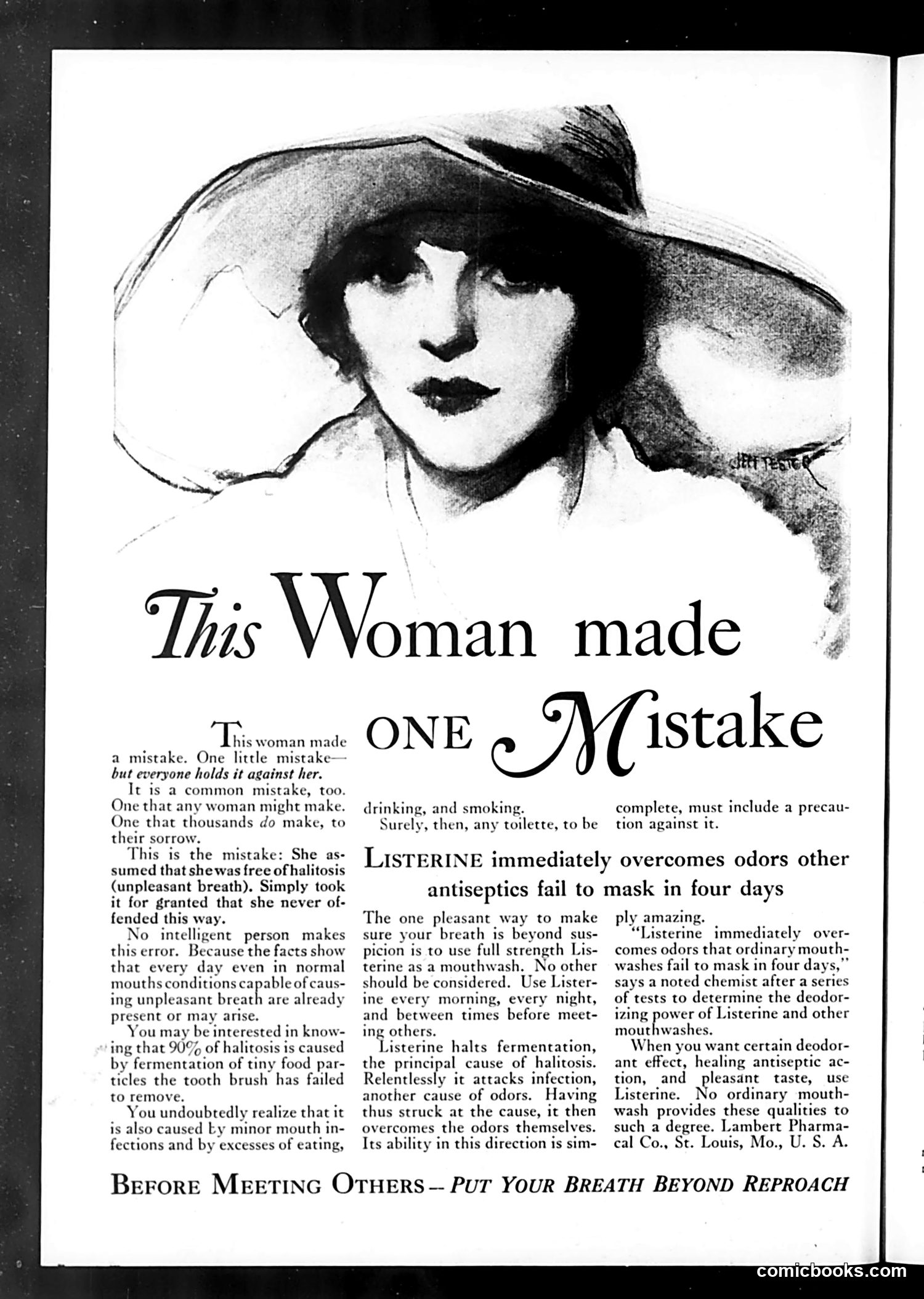
Analysis This is a Listerine mouthwash advertisement, not political satire. The illustration shows a fashionable woman in 1920s attire (cloche hat, bob haircut) who made "one mistake"—assuming she had good breath hygiene. The ad uses shame-based marketing common to the era, warning that halitosis (bad breath) causes social rejection. The text claims that 90% of halitosis results from food fermentation in the mouth, and that Listerine is uniquely effective at halting fermentation and killing odor-causing bacteria. The tagline "Put Your Breath Beyond Reproach" emphasizes social acceptability. This exemplifies early 20th-century advertising that exploited insecurity about personal hygiene to sell products—a practice now considered manipulative by modern standards.
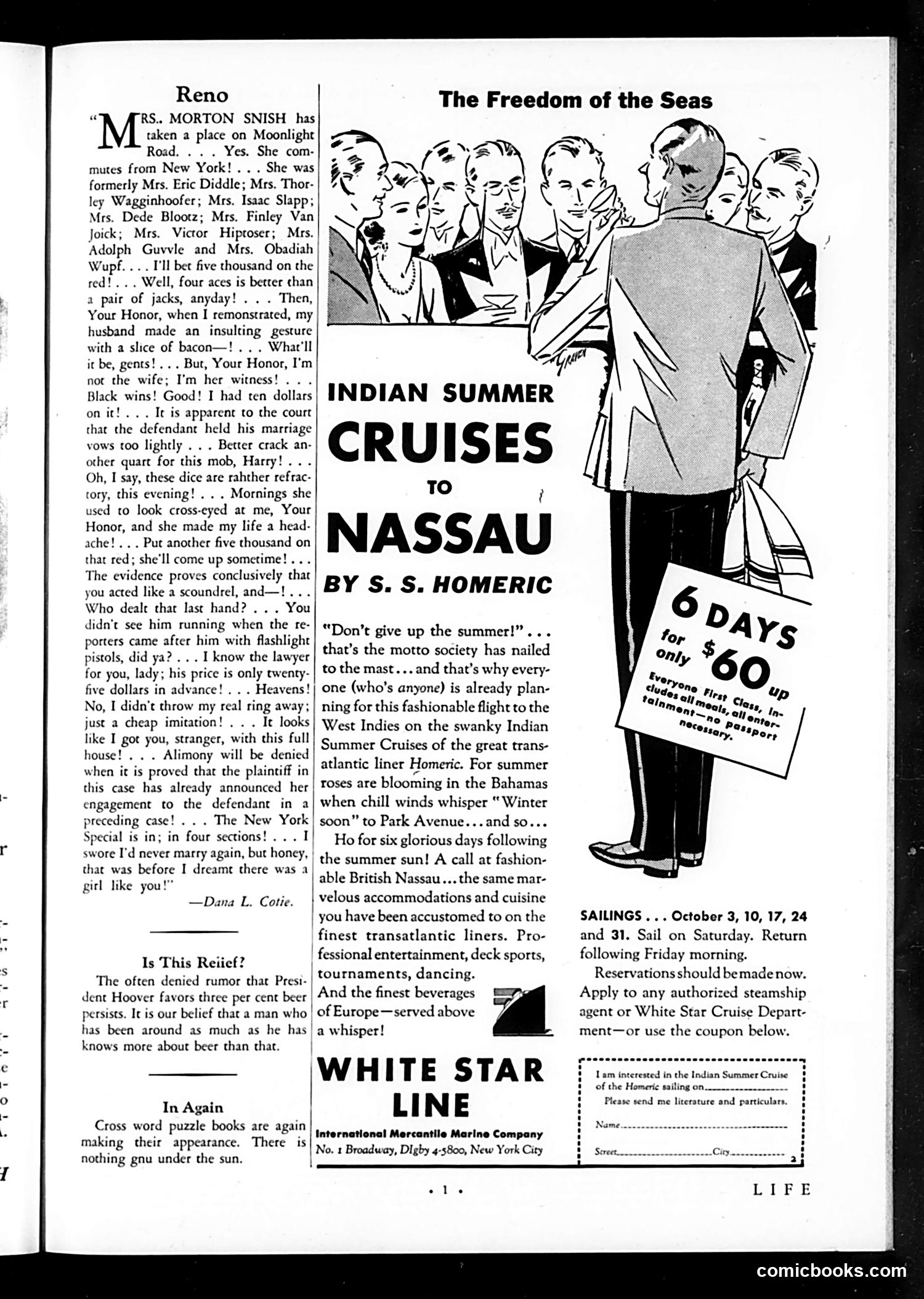
"Reno" Column and Advertisement Analysis This page combines a satirical gossip column with a cruise ship advertisement. The "Reno" column (left) is a social commentary piece mocking high-society court cases, likely referencing Reno, Nevada—famous for quick divorces. The columnist sarcastically reports on wealthy socialites and their legal troubles, with names like Mrs. Morton Snish and references to marital disputes and alimony. The tone is mockingly sympathetic to defendants facing embarrassing testimony. The main advertisement promotes Indian Summer cruises to Nassau via the S.S. Homeric, targeting affluent readers who could afford luxury travel. The illustration shows well-dressed passengers, emphasizing sophistication and escape. Together, the page satirizes the wealthy leisure class—those embroiled in messy divorces in one section advertised leisure cruises in another—reflecting 1920s-30s attitudes toward American affluence and social scandal.
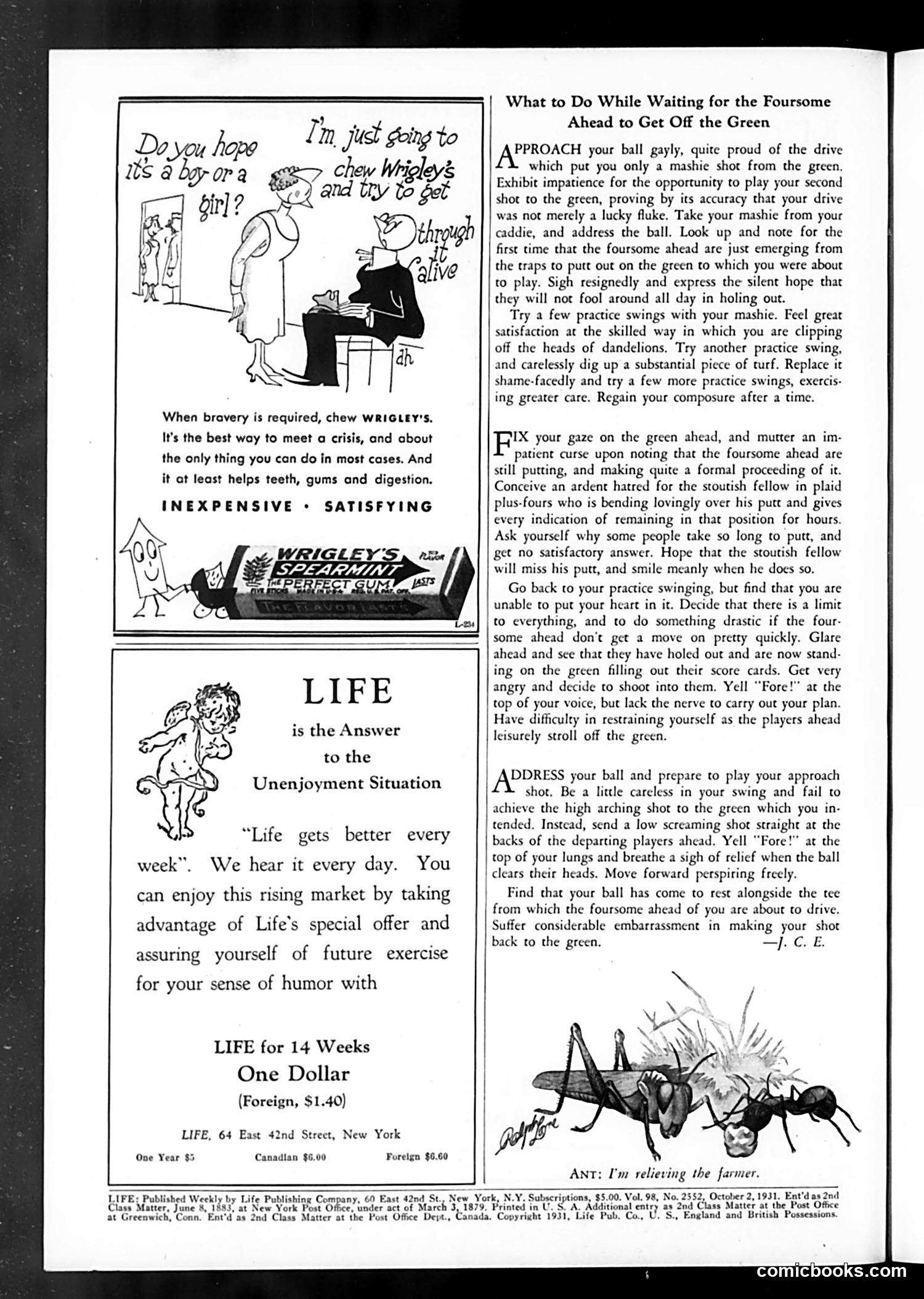
Analysis of Life Magazine Page (October 2, 1931) This page contains a humorous golf article titled "What to Do While Waiting for the Foursome Ahead to Get Off the Green," written by J.C.E. The satire mocks the frustration of slow golf play in the 1930s. The cartoon at top shows a man asking his wife hopefully if they're having "a boy or a girl," while she responds she's going "to chew Wrigley's and try to get through it alive"—a joke about enduring boredom through gum-chewing. The main article satirically advises impatient golfers to practice swings, curse slow players ahead ("stoutish fellow"), deliberately botch shots, and disturb faster foursomes—essentially describing increasingly rude and destructive behavior as comic frustration escalates. An ant cartoon at bottom provides comic relief unrelated to golf.
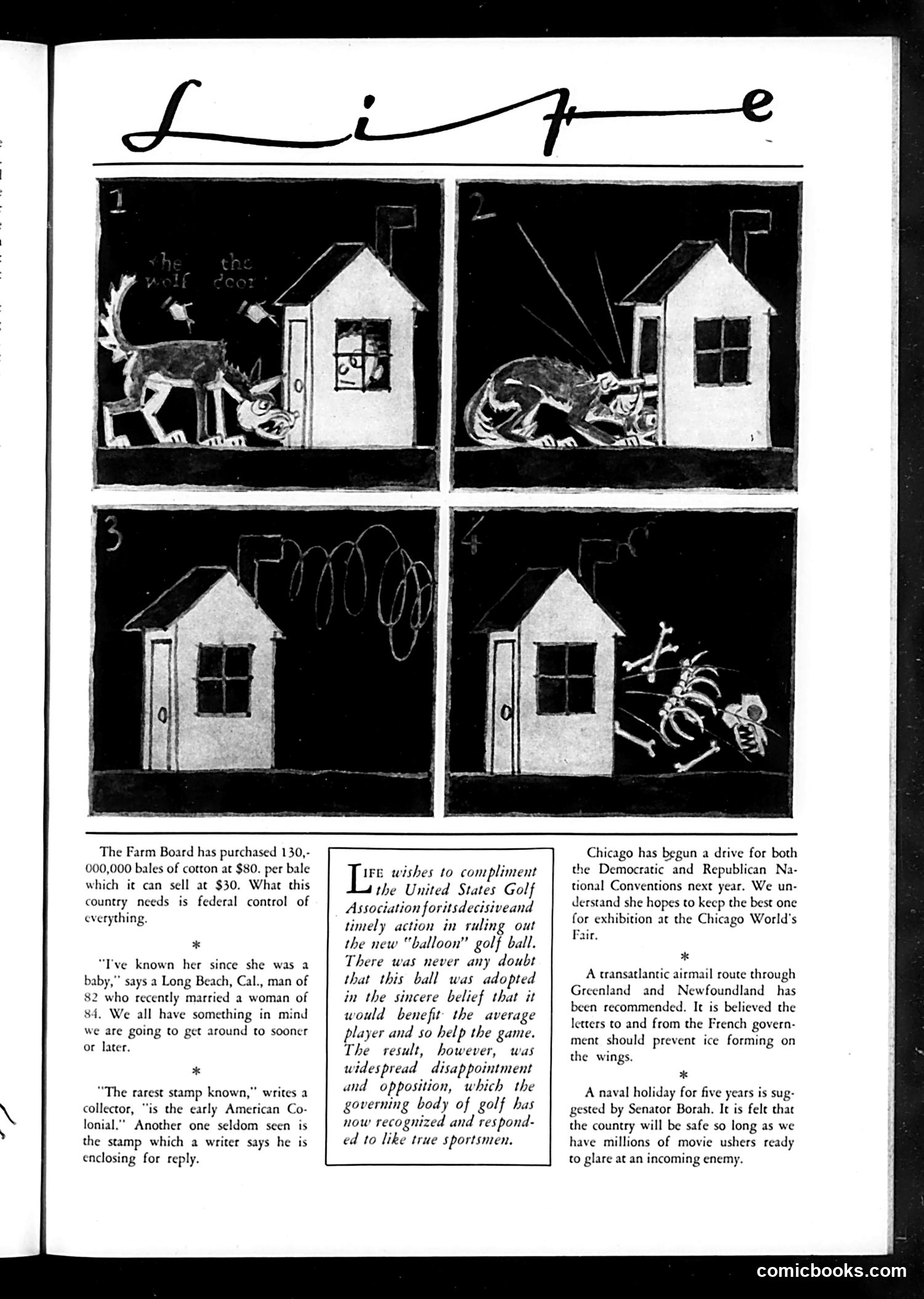
"Life" Page Analysis This page contains a four-panel cartoon titled "Life" (top right) depicting a narrative sequence involving a small house and various creatures or figures approaching it at night. The panels progress from panel 1 (wolf at door) through panel 4 (appears to show a bee or insect). The text below discusses unrelated topics: cotton purchasing by the Farm Board, stamp collecting, golf ball standardization, transatlantic airmail routes, and naval holidays. The cartoon's meaning is unclear from the image alone—the dark panels and stylized figures make specific identification difficult. Without clearer details or contemporary context, I cannot confidently explain what social or political commentary this sequence intended to convey to 1920s-30s readers.
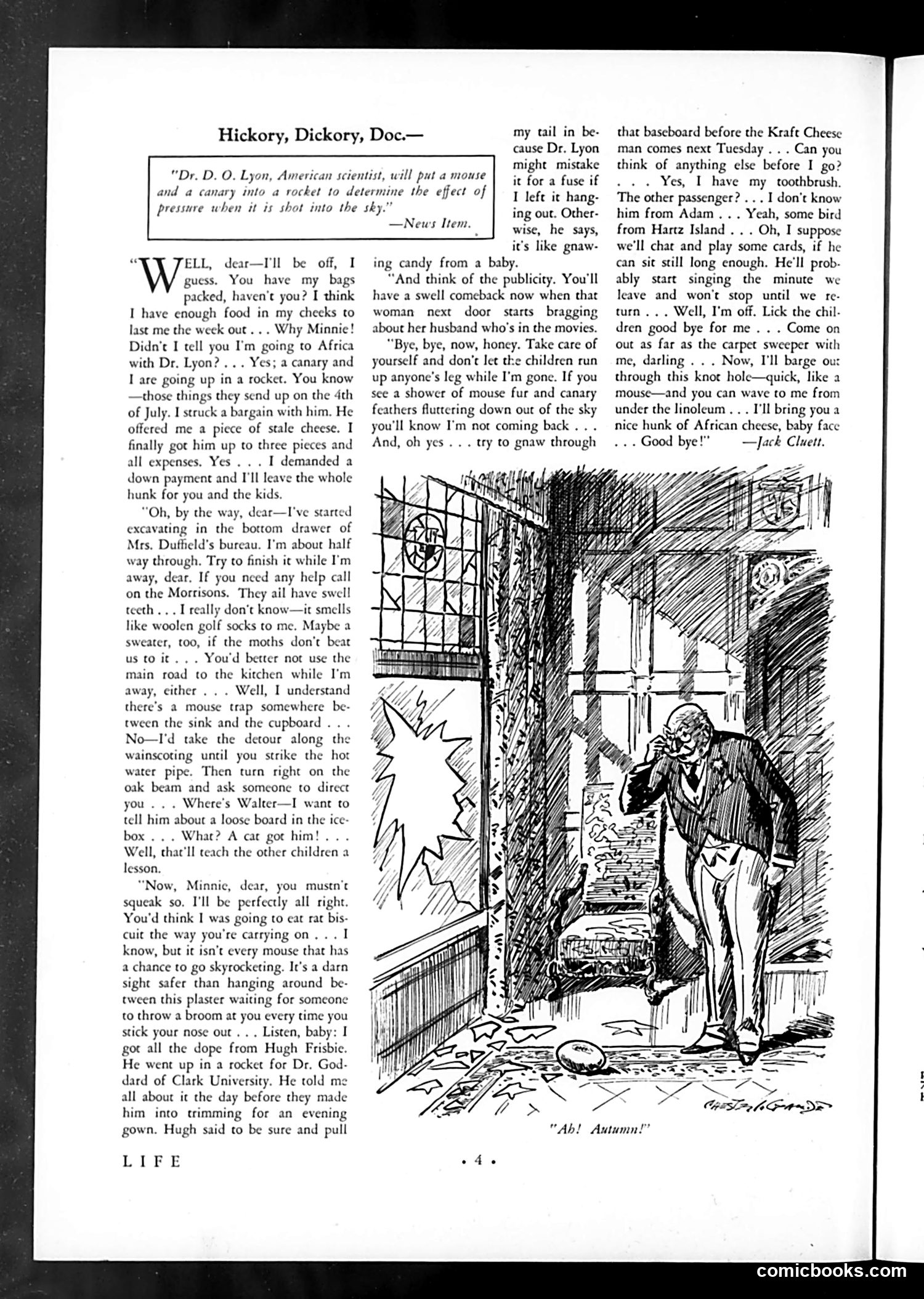
Analysis of "Hickory, Dickory, Doc" This page features a humorous domestic narrative rather than political satire. A woman describes her preparations before departing on a trip to Africa with Dr. Lyon (referenced in the news item as a scientist studying air pressure effects). She's negotiating with her husband about household management during her absence—mentioning mouse traps, woolen golf socks, moths, and the need to avoid the main kitchen road. The illustration shows a man discovering a mouse in what appears to be a basement or cellar, exclaiming "Ah! Autumn!" The joke appears to be that autumn brings mice indoors, making the woman's practical concerns about pest control timely and justified. The satire gently mocks both domestic anxieties and the absurdity of detailed household instructions before departure.
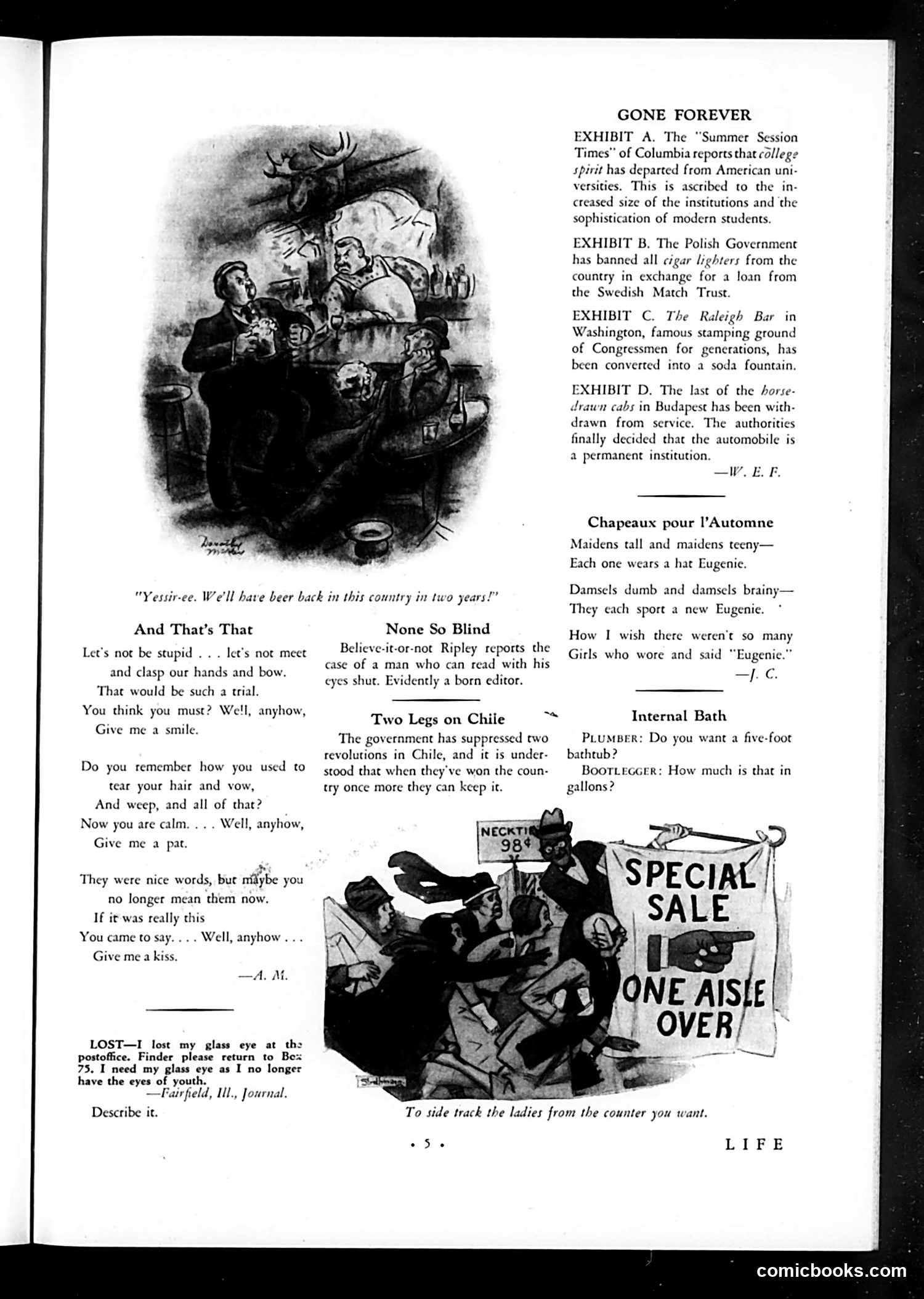
Analysis This page from Life magazine contains satirical commentary and humorous items: "Gone Forever" section: Four brief satirical observations about vanishing American institutions—the college spirit, Polish cigars (banned due to a Swedish Match Trust loan dispute), Washington D.C.'s famous Raleigh Bar (now a soda fountain), and Budapest's horse-drawn cabs (replaced by automobiles). Poems and humor items: Short pieces with social commentary, including complaints about women wearing the name "Eugenie" and a plumber/bootlegger dialogue about bathtub size. Main cartoon: Shows a vendor hawking a "special sale" at what appears to be a necktie counter, with the caption about distracting ladies from other purchases—a lighthearted joke about retail marketing tactics and male-female consumer behavior. The overall tone reflects early 20th-century American satire mocking modern commercial culture and social changes.
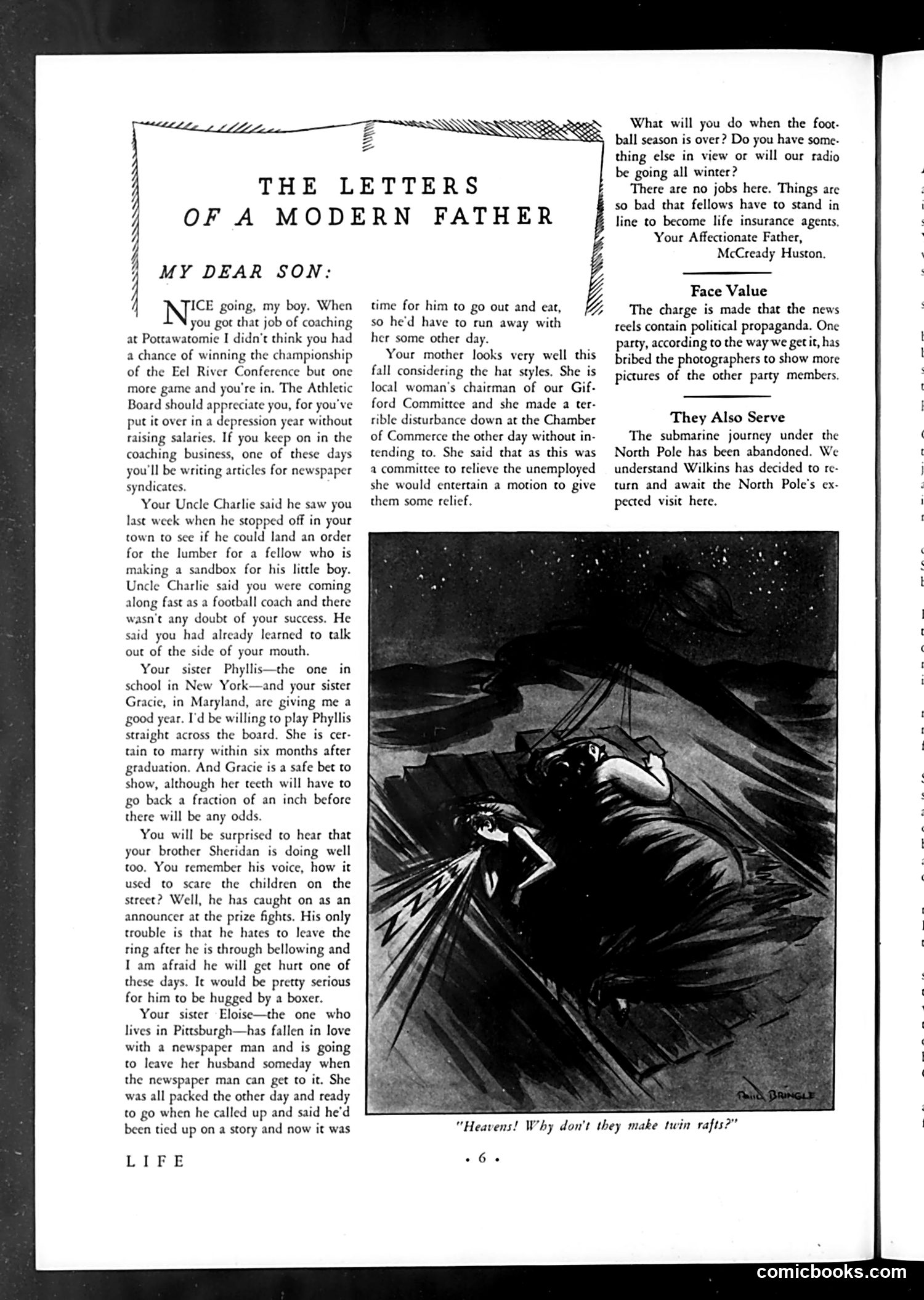
Analysis of Life Magazine Page This page presents "The Letters of a Modern Father," a humorous column addressed to the writer's son. The accompanying illustration depicts a man in bed appearing distressed or uncomfortable, with the caption "Heaven! Why don't they make twin rafts?" The cartoon likely satirizes marital sleeping arrangements—a common comedic topic in early-to-mid 20th century publications. The "twin rafts" reference suggests the husband wishes for separate beds from his wife, humorously depicting marital discord through the metaphor of floating apart. The letter itself discusses the son's coaching career and family news about his siblings, maintaining a lighthearted tone typical of Life's satirical family humor. The illustration complements this domestic comedy theme without referencing specific political figures or events.
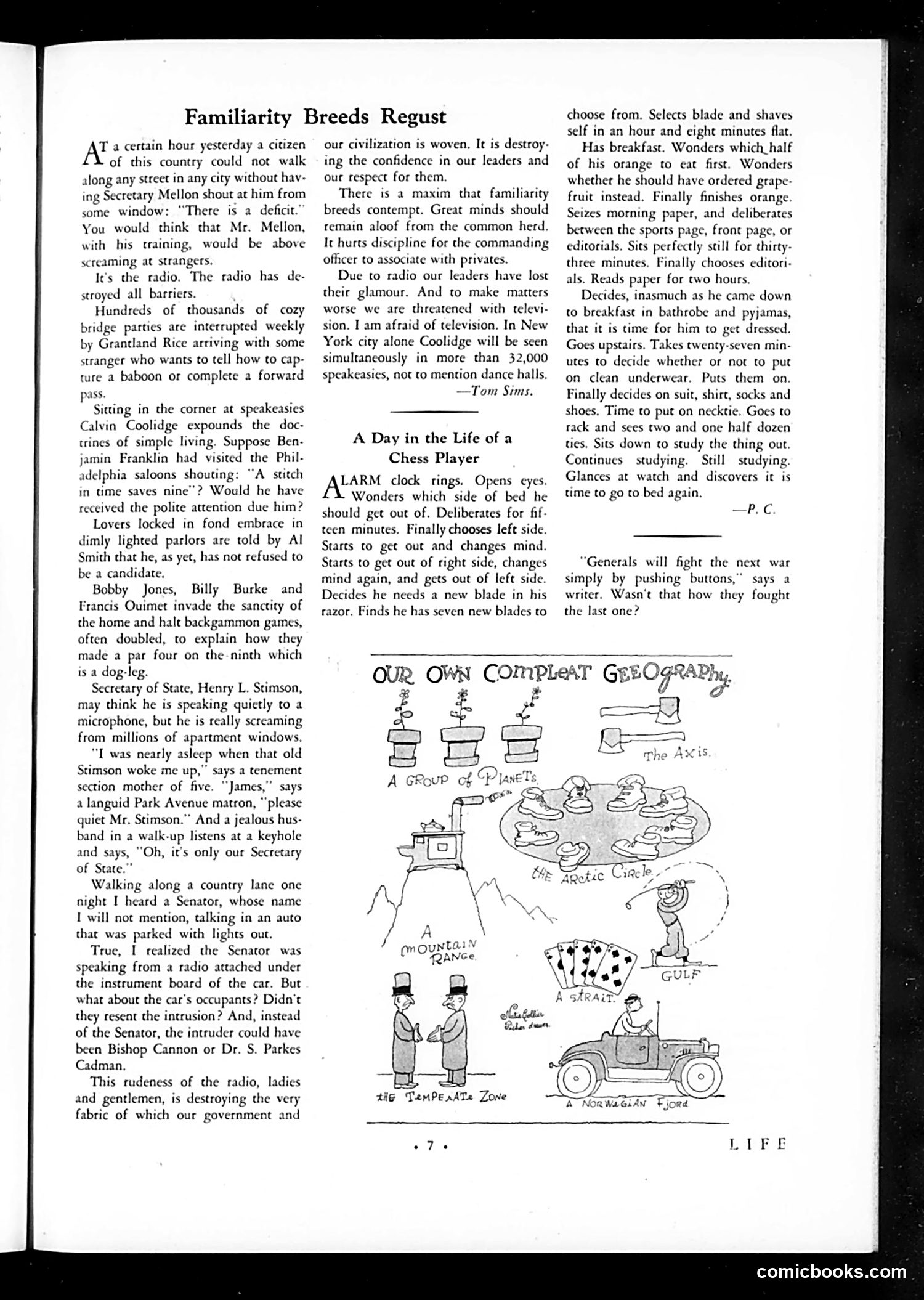
Analysis: "Our Own Compleat Geography" This page contains satirical commentary on American civic life and a humorous illustrated map titled "Our Own Compleat Geography." The map is a playful, exaggerated representation of American geography and social activities. It depicts various regions labeled with activities: "A Group of Golfers," "The Arctic Circle," "A Mountain Range," "The Temperate Zone," and "A Norwegian Fjord." Each label pairs real geographic terms with humorous social scenes—golfers, card players, an automobile—suggesting Americans recognize their own leisure activities and social spaces better than actual geography. The satire mocks American geographical ignorance by conflating familiar social pastimes with geographic features, implying citizens were more invested in recreation and everyday life than understanding their nation's actual landscape and territories.
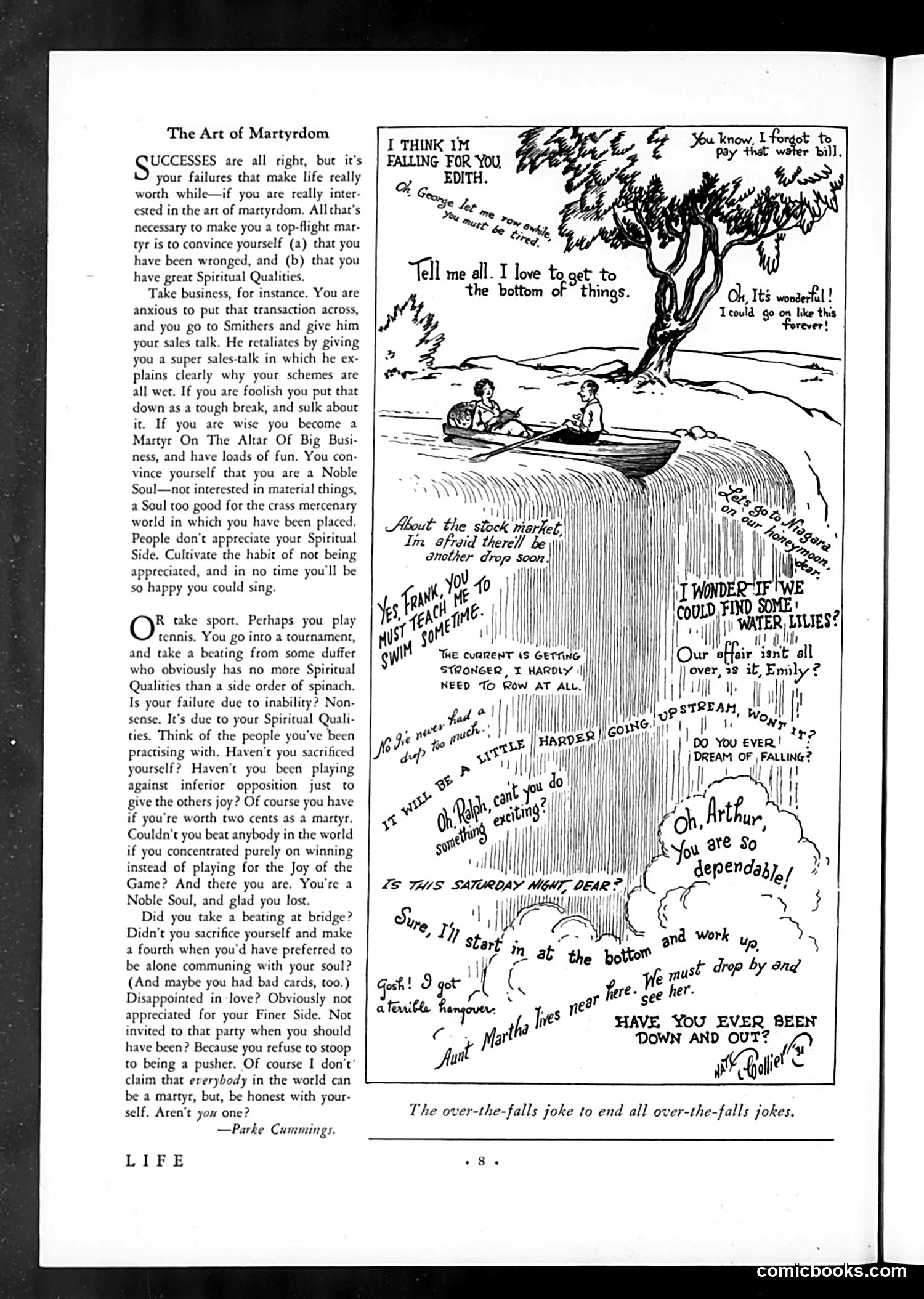
"The Art of Martyrdom" - Life Magazine Page This page combines an essay on martyrdom by Parke Cummings with a cartoon about Niagara Falls. The essay advises readers to accept life's failures gracefully—to become a "Martyr On The Altar Of Big Business" rather than complain, suggesting spiritual dignity in suffering defeat. The cartoon depicts people in a boat discussing going over Niagara Falls. One character (Edith) mentions an "Aunt Martha" who "lines near" the falls, and another suggests they could find water lilies. The bottom caption jokes: "The over-the-falls joke to end all over-the-falls jokes." This appears to mock the era's obsession with Niagara Falls stunts and daredevil acts—treating the famous waterfall as both a tourist attraction and a casual conversation topic, satirizing American thrill-seeking culture.
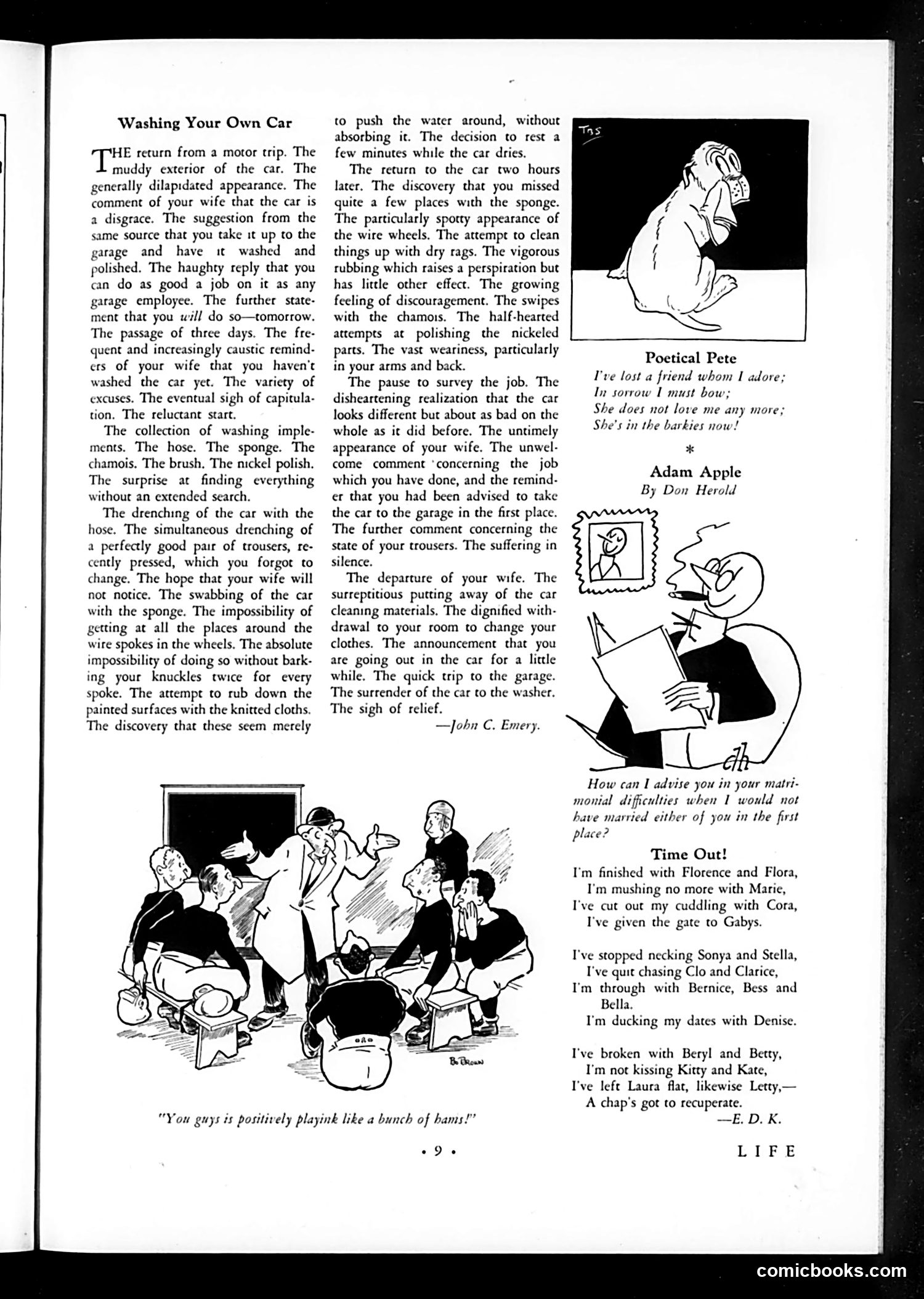
Content Analysis This page contains three humorous pieces about everyday domestic life, likely from the 1920s-30s era based on the illustration style. "Washing Your Own Car" (left column) is a comedic essay by John C. Emery satirizing the husband's attempt to wash the family car himself—a task he discovers is far more difficult and exhausting than anticipated. The humor lies in the gap between his initial confidence and the brutal reality of manual labor. "Poetical Pete" (top right) is a brief verse lamenting a lost friend, written in sentimental style that the illustration undercuts with comic effect. "Adam Apple" and "Time Out!" are short humorous poems about romantic relationships and dating, capturing period attitudes toward courtship and relationship cycles with lighthearted cynicism. The bottom cartoon depicts people engaged in what appears to be a casual, messy group activity, with the caption suggesting playful disorder.
"Life Looks About" - Political Commentary Page This page contains three opinion pieces rather than cartoons. The visible illustration shows a cherub-like figure, likely decorative. "Clothes and the Man" compares historical dress to character, using Mahatma Gandhi and Mayor Walker of New York as examples. The piece humorously notes Gandhi's simple garments versus Walker's formal attire, suggesting clothes reveal personality—Walker is "master of dress" while Gandhi embodies homely simplicity. "Lippmann Comes Back" welcomes political columnist Walter Lippmann back to *The Herald-Tribune*, praising his perspective on world affairs and civilization's state. "Papacy, Whither Bound?" questions the Catholic Church's declining influence, suggesting it may lose political power. The piece speculates whether the Church could remain relevant in a changing world, referencing potential revolution affecting Rome.
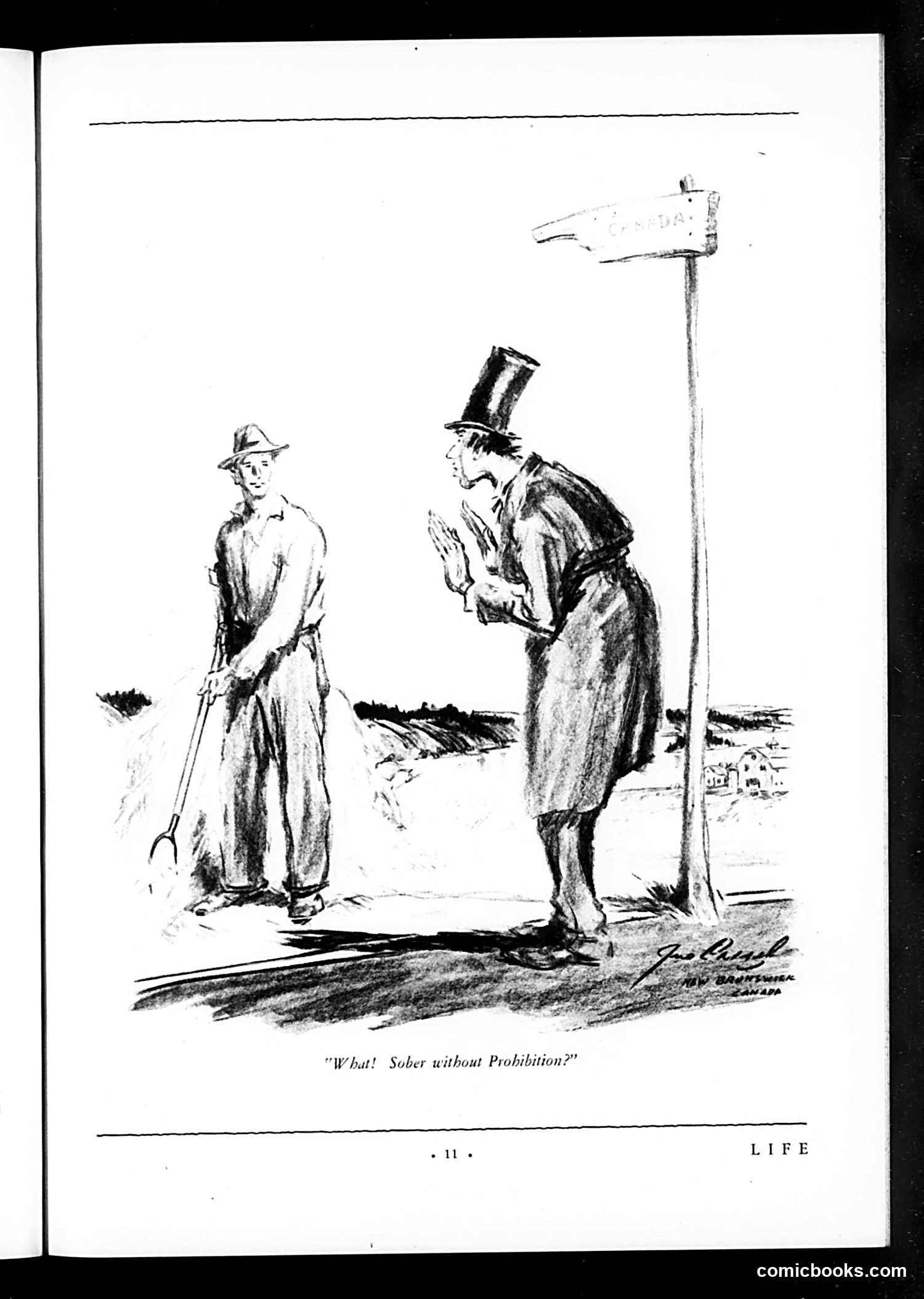
"What! Sober without Prohibition?" This cartoon satirizes Prohibition-era hypocrisy. A well-dressed gentleman in a top hat appears shocked to encounter a working-class man with a shovel who claims to be sober—implying this is surprising or unbelievable. The joke targets the contradiction between Prohibition's stated goal (eliminating alcohol use) and the reality that drinking continued widely, particularly among the wealthy and well-connected (represented by the top-hatted figure). The cartoon suggests that finding someone actually sober during Prohibition was noteworthy, mocking both the policy's failure and the assumption that sobriety was unusual. The contrast between the two men's appearances emphasizes class dimensions of the drinking culture under Prohibition.
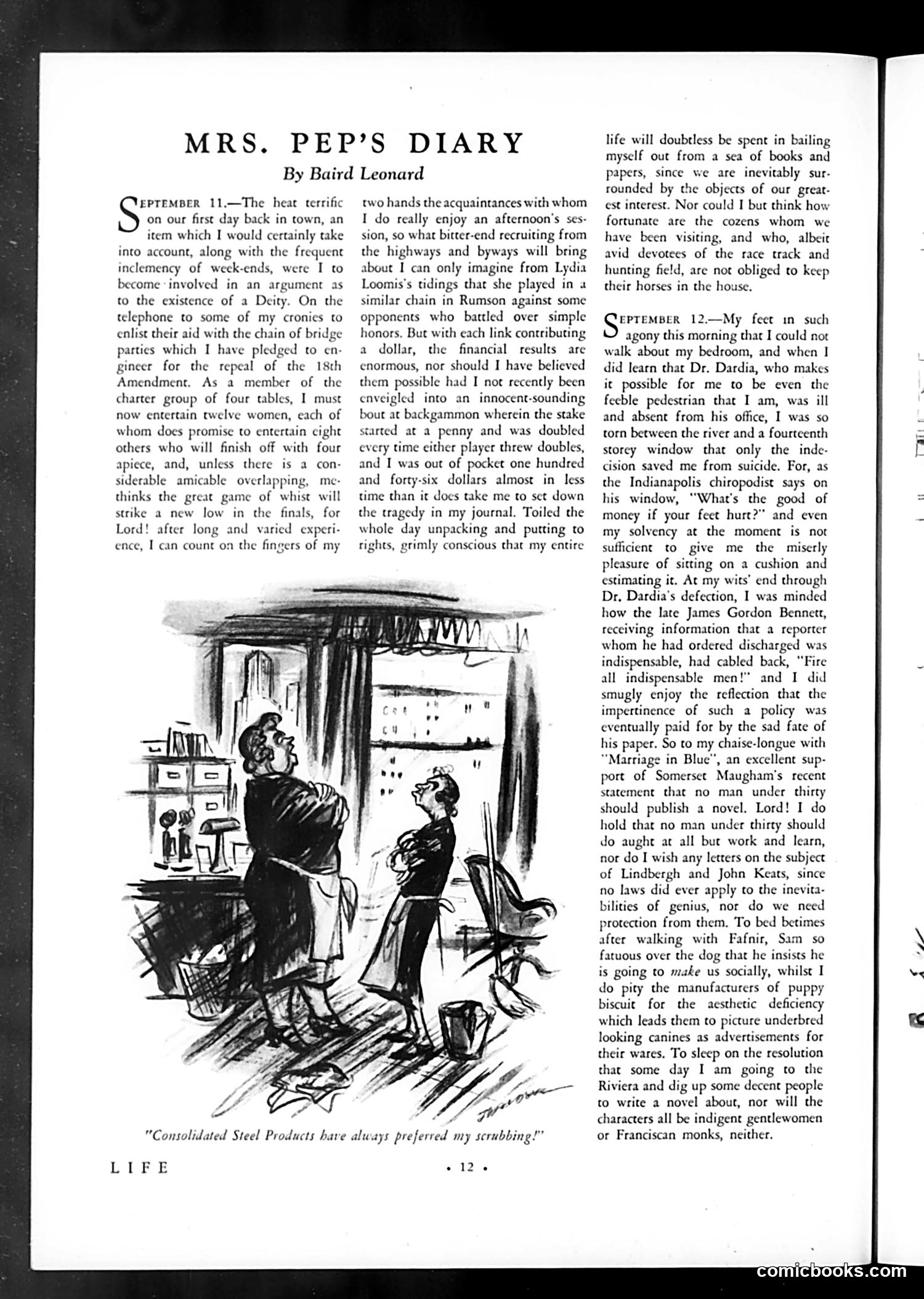
Analysis of "Mrs. Pep's Diary" Page This is a satirical diary entry by Baird Leonard from Life magazine, featuring a sketch of a woman at a window. The cartoon illustrates the entry dated September 12, depicting Mrs. Pep observing someone (likely Dr. Dardia based on the text) passing by outside. The satire targets wealthy, leisured women's preoccupations: the entry humorously catalogs shallow concerns—bridge parties, gossip about horse racing, servants, and social pretension. The caption's joke ("Consolidated Steel Products have always preferred my scrubbing!") suggests ironic pride in domestic products, mocking women's consumer culture and their obsession with household goods as status symbols. The piece satirizes the idle rich during this era, their vacuous social calendars, and materialistic values.
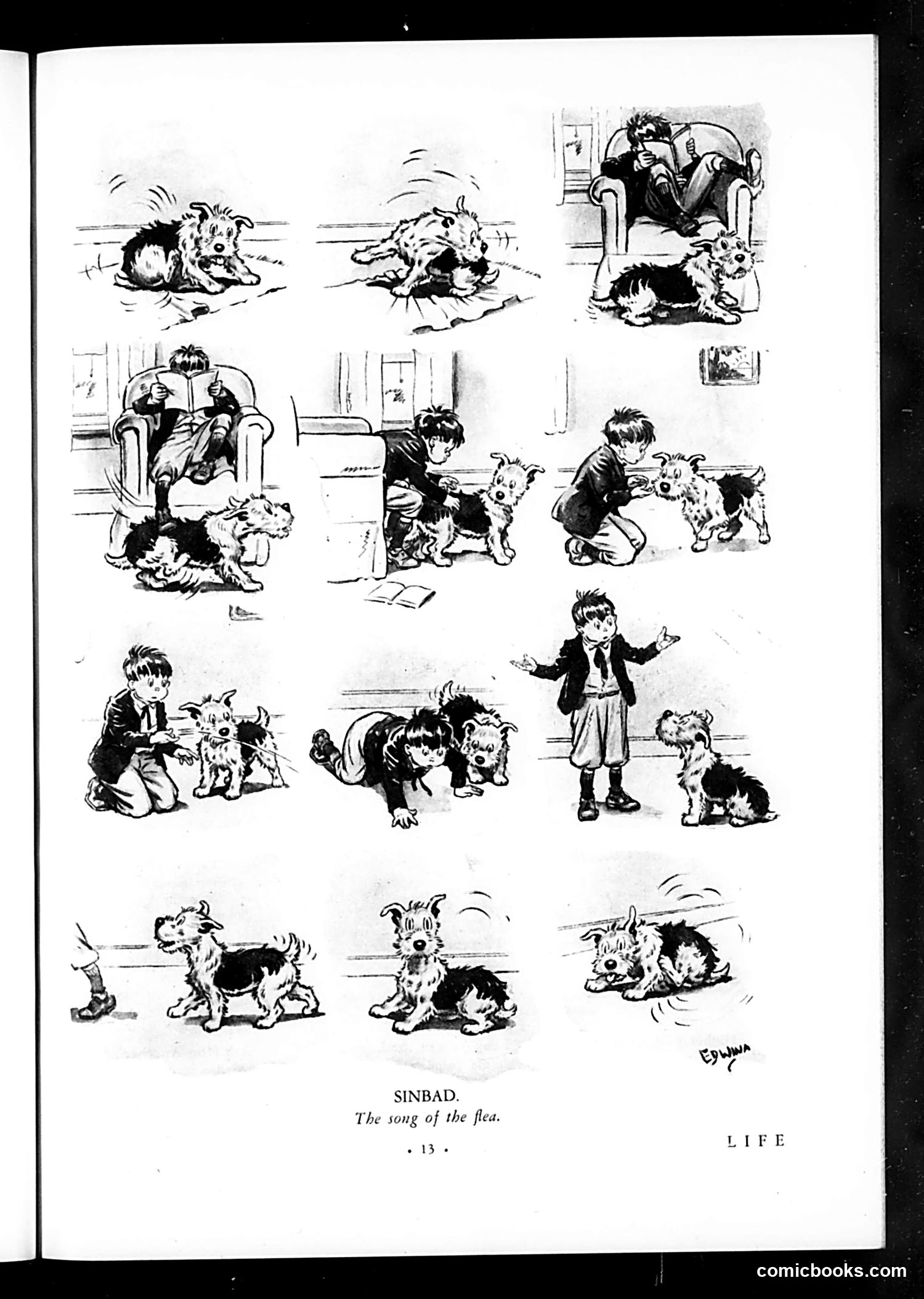
"Sinbad: The Song of the Flea" This page presents a humorous illustrated sequence by an artist signed "Equiman" (or similar). The title "Sinbad" and subtitle "The song of the flea" reference the famous Arabian Nights sailor, playfully subverting the epic tale. The cartoon depicts a small, scrappy dog (playing the role of "Sinbad") encountering fleas—shown as the dog's persistent tormentors across multiple panels. The sequence progresses through domestic indoor scenes where a man and child attempt to manage the dog's flea problem through various means: inspection, bathing, and general frustration. The joke satirizes the universal domestic annoyance of pet fleas and the futile efforts to eliminate them, treating the dog's struggle against fleas as a mock-heroic adventure.
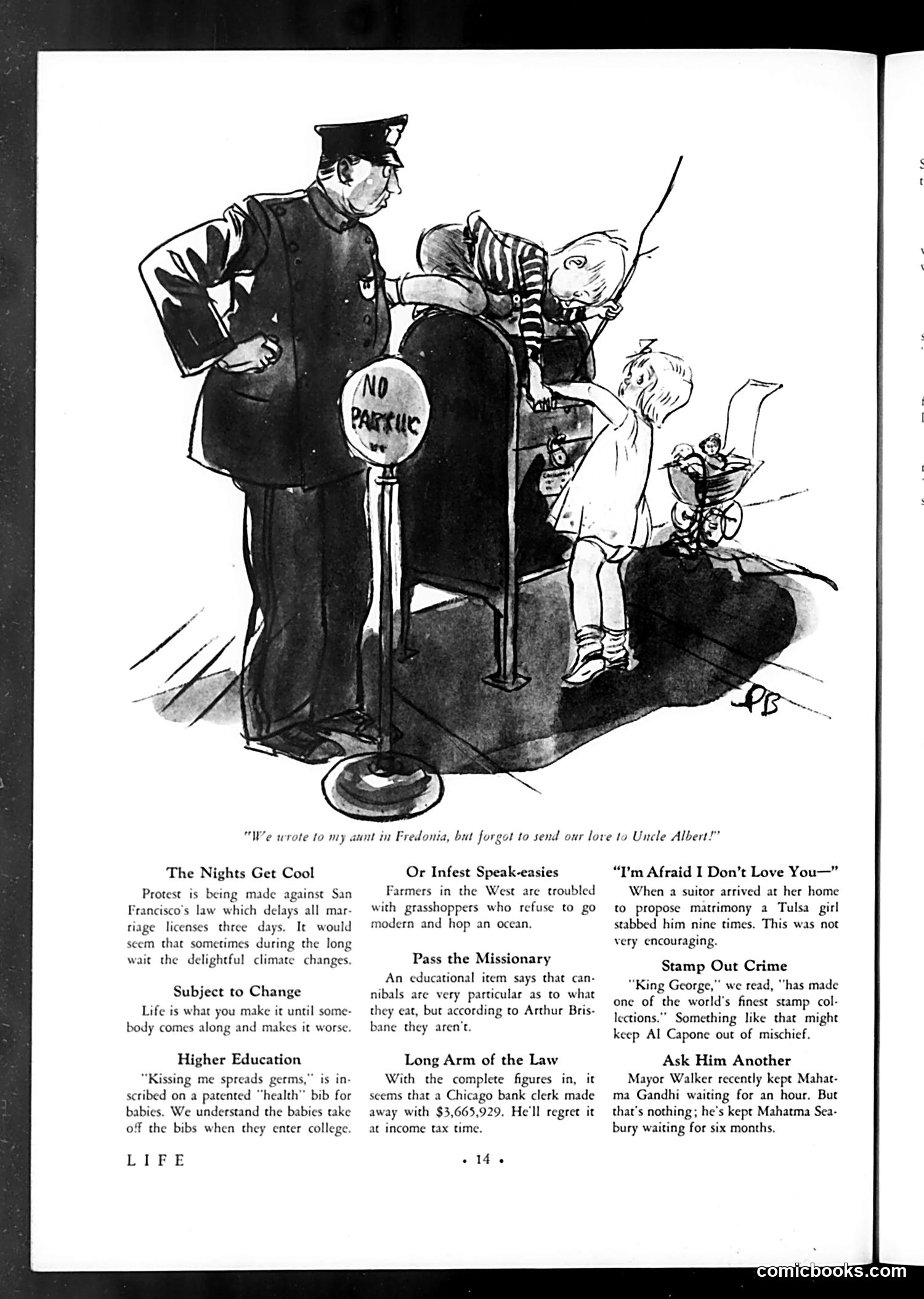
Analysis of Life Magazine Page The main cartoon depicts a uniformed police officer confronting children near a "No Parking" sign. The caption reads: "We wrote to my aunt in Fredonia, but forgot to send our love to Uncle Albert!" This is a satirical commentary on overzealous enforcement. The joke suggests the officer is so focused on parking violations that he's interrupting children—implying petty, misplaced priorities in law enforcement. The page also contains brief humor items on various social topics: protest delays in San Francisco, grasshoppers refusing modernization, a failed marriage proposal, health claims on baby bibs, banking fraud, organized crime, and political figures (likely referencing "King George," Al Capone, and Gandhi). The satire targets bureaucratic rigidity, false advertising, and crime—typical concerns of the era's Life magazine commentary.
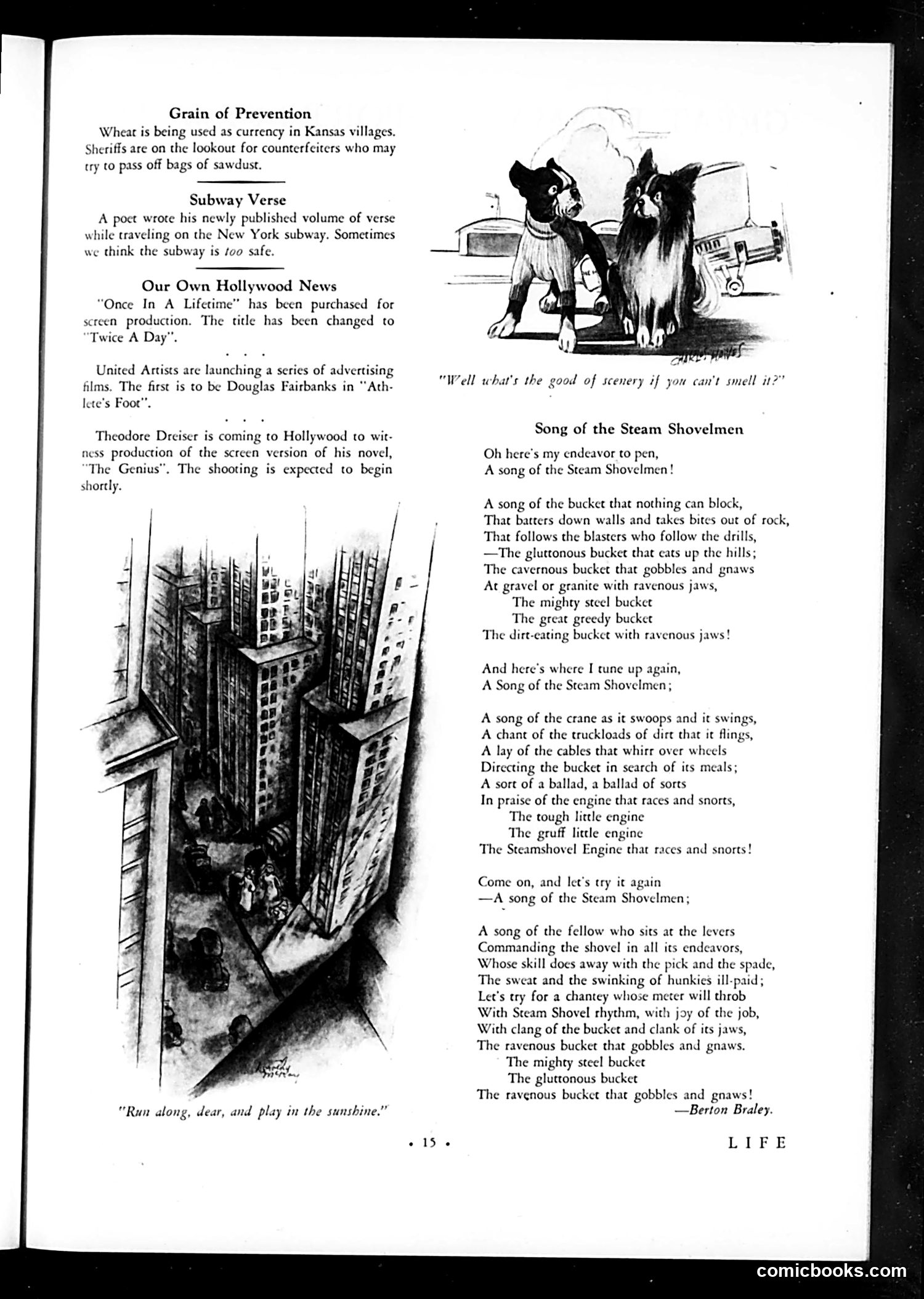
Analysis of LIFE Magazine Page This page contains brief news items and literary content rather than political cartoons. The "Grain of Prevention" note satirizes counterfeit currency circulating in Kansas villages—sheriffs watch for fake sawdust being passed as money, a reference to Depression-era fraud. The "Subway Verse" item mocks a poet publishing verse about New York's subway system, joking that the subway itself feels "too safe"—likely critiquing the poet's overwrought concern. The Hollywood News section reports on film industry developments: Douglas Fairbanks in an advertising series and Theodore Dreiser adapting his novel "The Genius" for screen. The main literary feature is Berton Bixley's "Song of the Steam Shovelmen"—celebratory verse about industrial construction equipment and workers, rendered with somewhat whimsical, repetitive language emphasizing machinery sounds and labor.
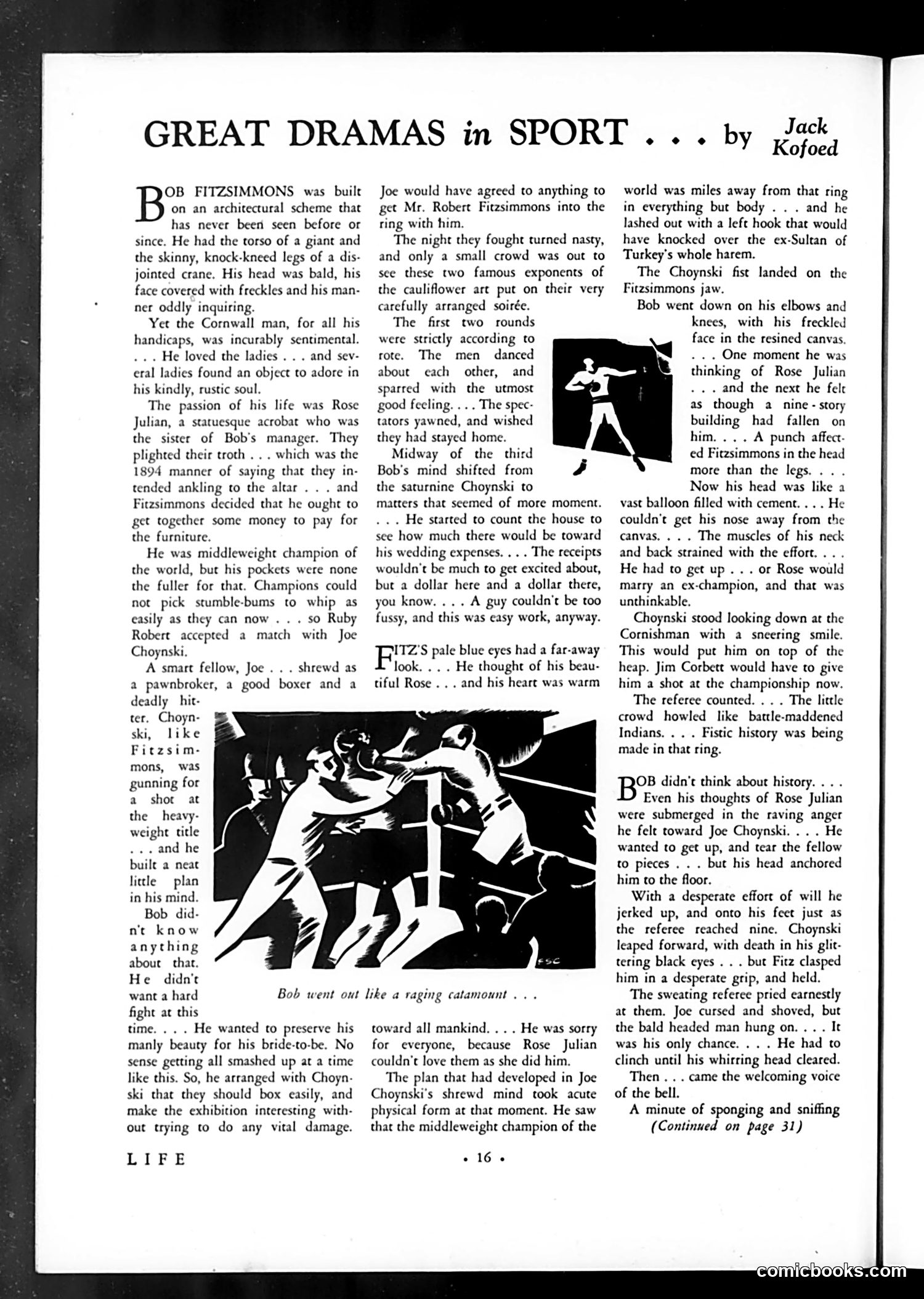
"Great Dramas in Sport" by Jack Kofoed This is a serialized boxing story illustrated with dramatic black-and-white artwork. The narrative focuses on Bob Fitzsimmons, a real heavyweight boxing champion, and his fight against Joe Choyinski over Rose Julian, a woman both men were romantically interested in. The story depicts a boxing match arranged to settle their rivalry, with Fitzsimmons determined to impress Rose Julian despite his financial struggles. The illustrations show dynamic fight scenes—one captioned "Bob went out like a raging calamaunt"—emphasizing the brutal physicality of prize fighting. This appears to be sports fiction rather than satire, reflecting early 20th-century Life magazine's interest in boxing narratives and romantic drama intertwined with athletic competition.
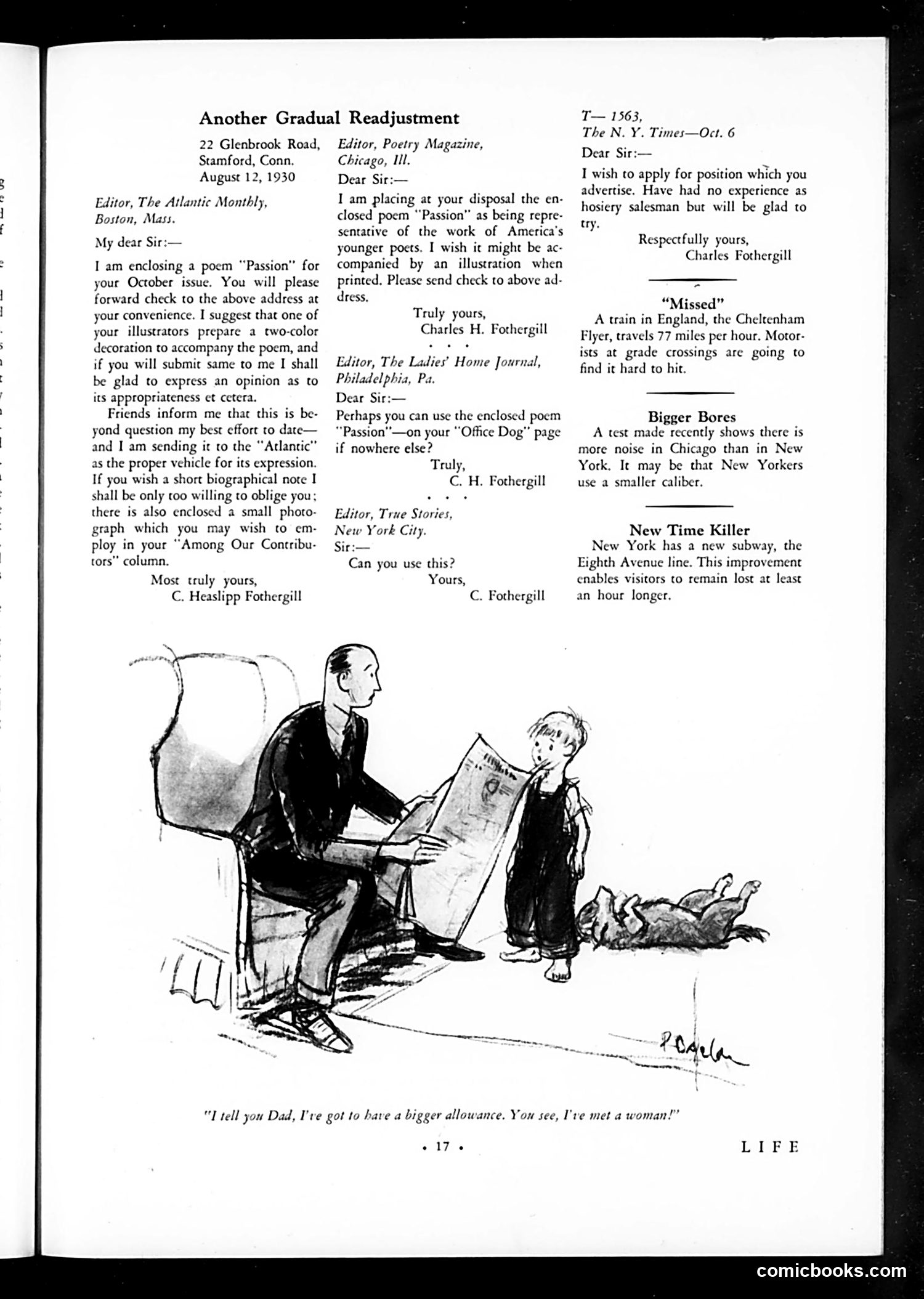
Analysis of Life Magazine Page (October 6, 1930) This page contains letters to editors and a single-panel cartoon. The cartoon depicts a young boy telling his father: "I tell you Dad, I've got to have a bigger allowance. You see, I've met a woman!" The Joke: The humor relies on the boy's naive conflation of romantic interest with financial obligation. He's suggesting he needs more money specifically because he's begun dating—implying either that impressing women requires spending, or that he's already being financially manipulated by a girlfriend. This reflects 1930s gender stereotypes about women being materialistic and men bearing financial responsibility in courtship. The boy's earnest, matter-of-fact delivery to his bemused father amplifies the comedy. The surrounding letters discuss poetry submissions and miscellaneous observations about trains and subway improvements.
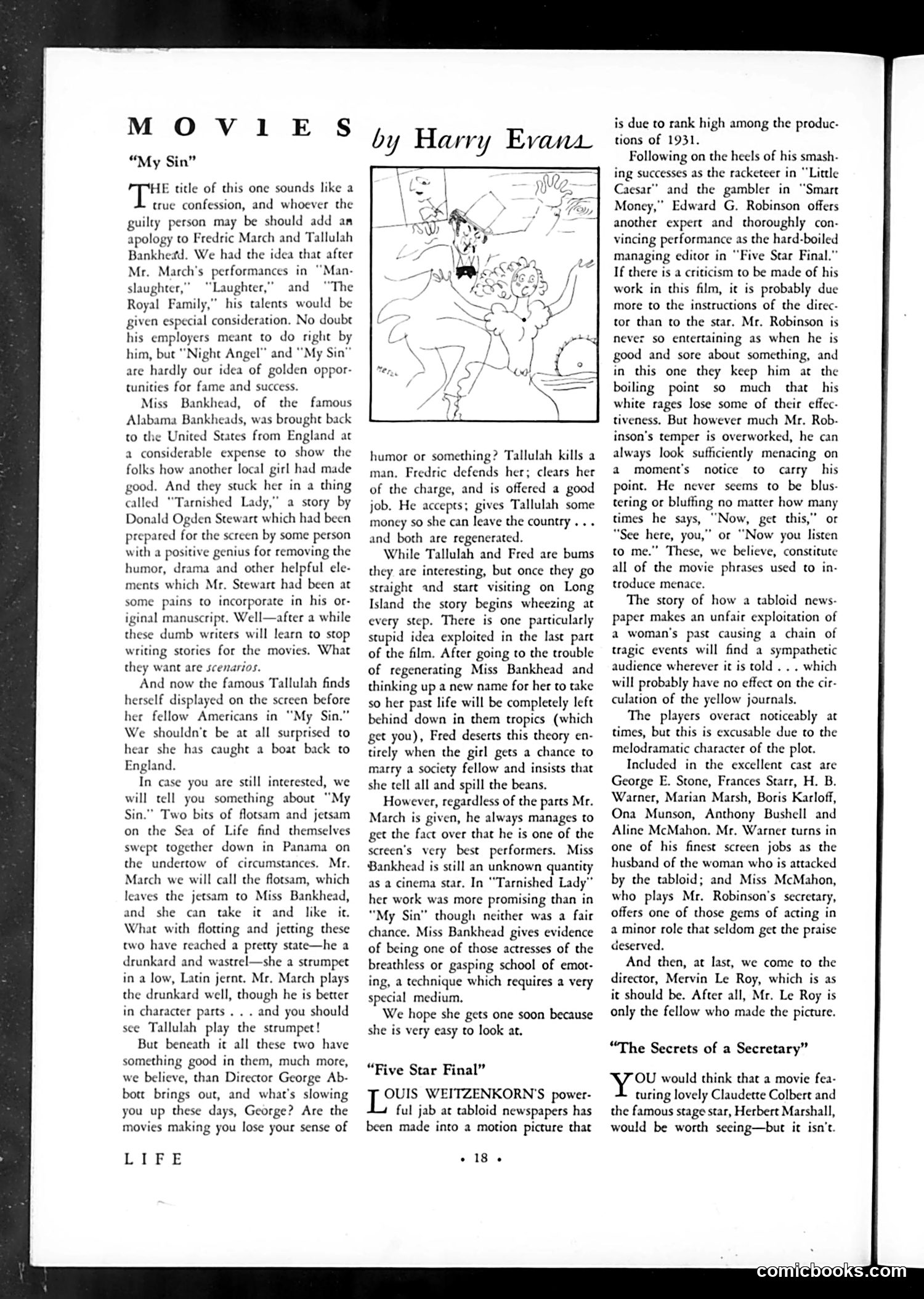
"My Sin" Movie Review Cartoon Analysis The cartoon illustrates a scene from the film "My Sin," featuring what appears to be a woman in an elaborate dress or costume being held aloft by a man. The drawing is sketchy and somewhat comedic in style. The accompanying review by Harry Evans discusses the film's plot about Miss Bankhead, a woman with a scandalous past brought back from England. The cartoon likely depicts a comedic or dramatic moment from the movie—possibly the "flotsam and jetsam" scene Evans mentions involving characters in Panama. The overall tone is satirical toward 1931 Hollywood productions, gently mocking melodramatic plots involving "fallen women" and their attempts at respectability, which were common film subjects of that era.
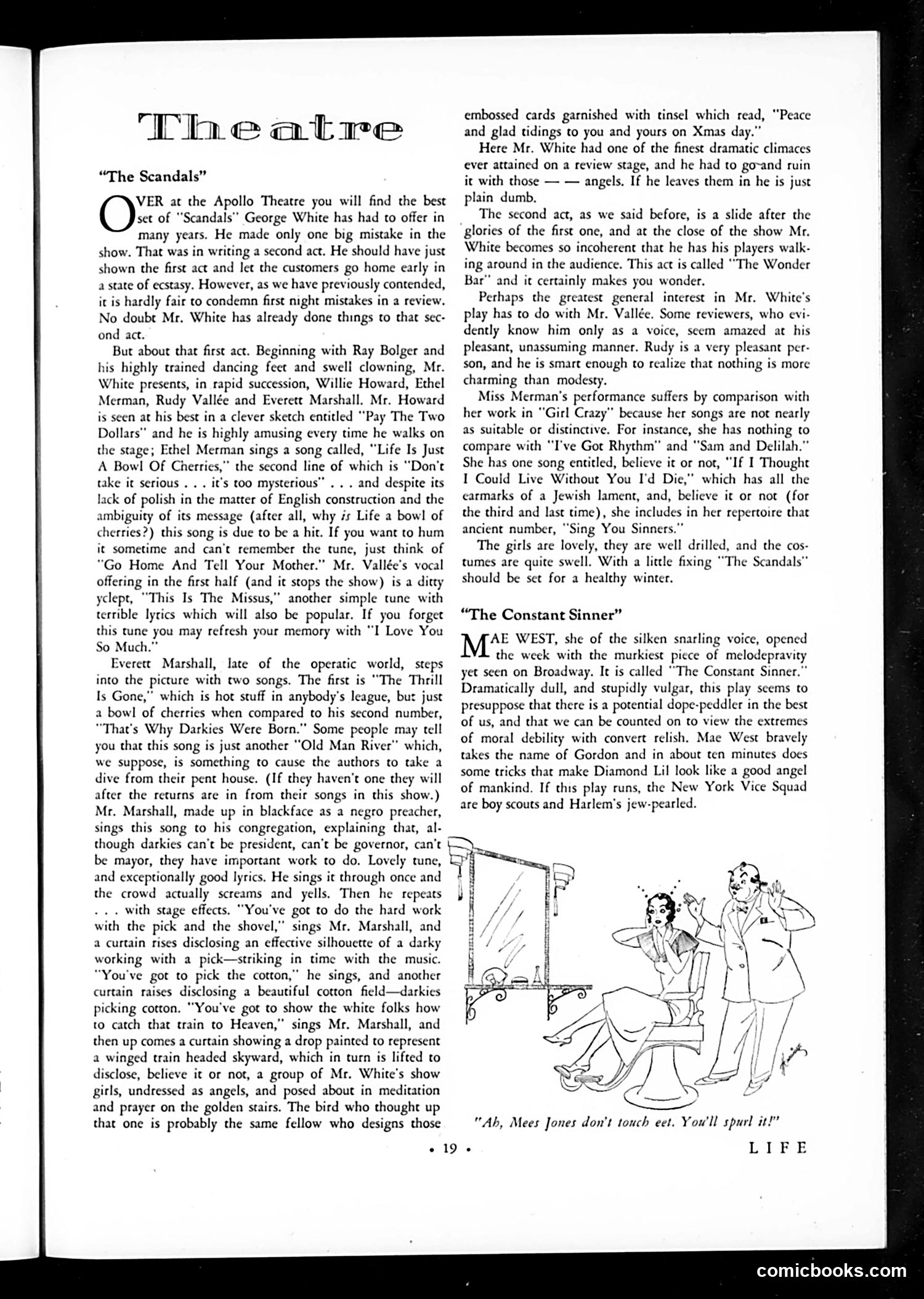
Theatre Review Analysis This page reviews Broadway shows from an era when theatrical blackface performance was standard entertainment. The text discusses "The Scandals" (starring George White) and "The Constant Sinner." The cartoon depicts a scene from one of these productions, showing performers in period costume around what appears to be a theatrical set piece. The caption reads "Ah, Mes Jones don't touch eet. You'll spoil it!" The review explicitly describes Everett Marshall performing in blackface as "a negro preacher," treating this as unremarkable entertainment. The text critiques the shows' quality and performances rather than the racist performance practices themselves—this reflects the casual normalization of blackface in 1920s-30s American theatre. The cartoon likely illustrates a comedic moment from the stage show, though the specific dramatic context is unclear from the image alone.
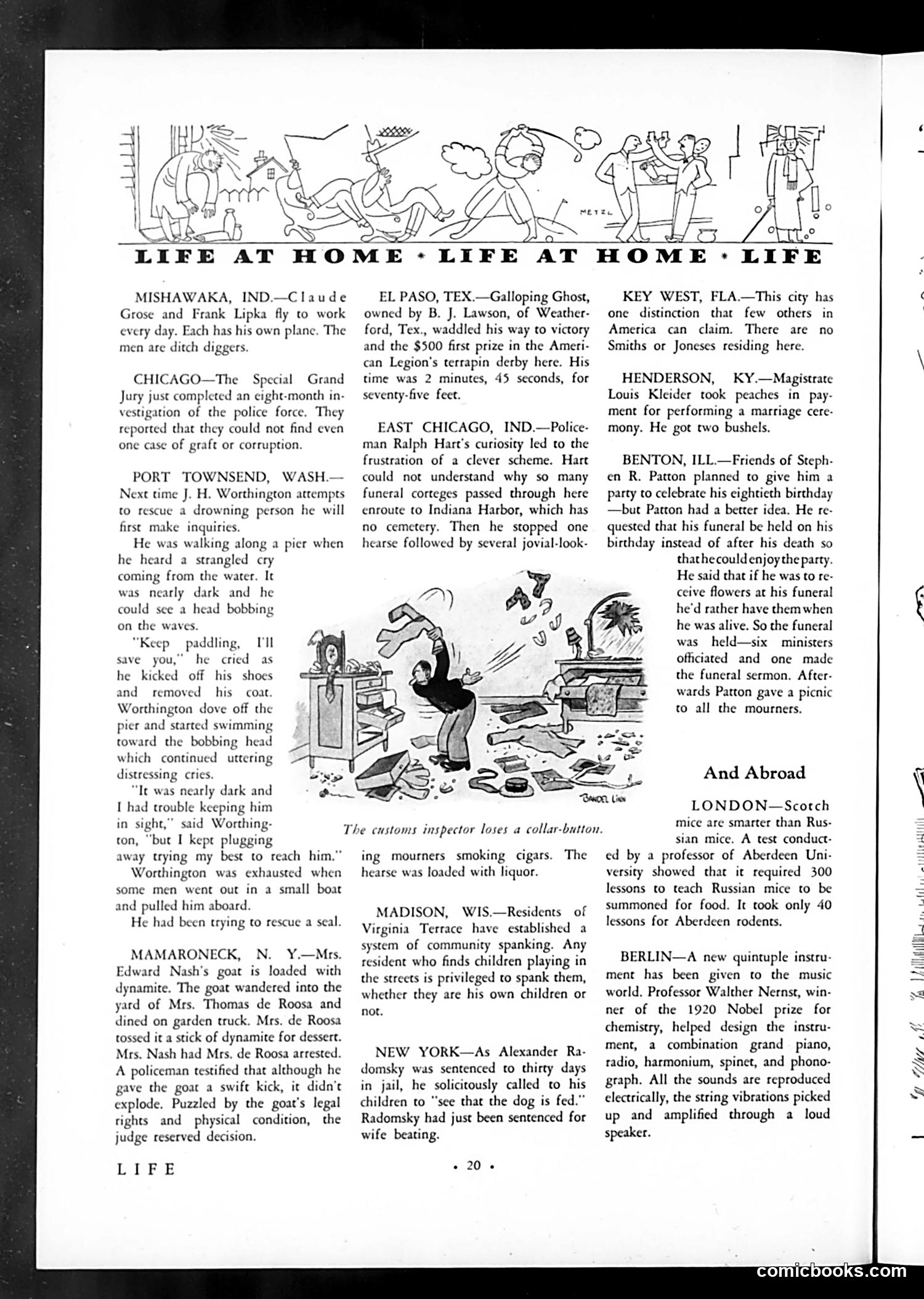
"Life at Home and Abroad" — Satirical Anecdotes Page This page from *Life* magazine presents absurdist, humorous anecdotes celebrating American eccentricity and incompetence. The cartoon shows a customs inspector losing a collar-button amid chaos—likely satirizing bureaucratic inefficiency. The stories mock various American institutions and behaviors: a Chicago police jury finding zero corruption (obviously false); a man rescuing a seal thinking it's a drowning person; a goat surviving dynamite; an East Chicago policeman discovering hearses smuggling bootleg liquor during Prohibition; and a community spanking system in Wisconsin. The tone is lighthearted social satire, poking fun at small-town quirks, regulatory absurdity, and American self-delusion. The "And Abroad" section includes a jab at Russian intelligence (via mice), reflecting Cold War attitudes. Overall, this reflects *Life's* satirical purpose: exposing American folly through exaggerated but plausible vignettes.
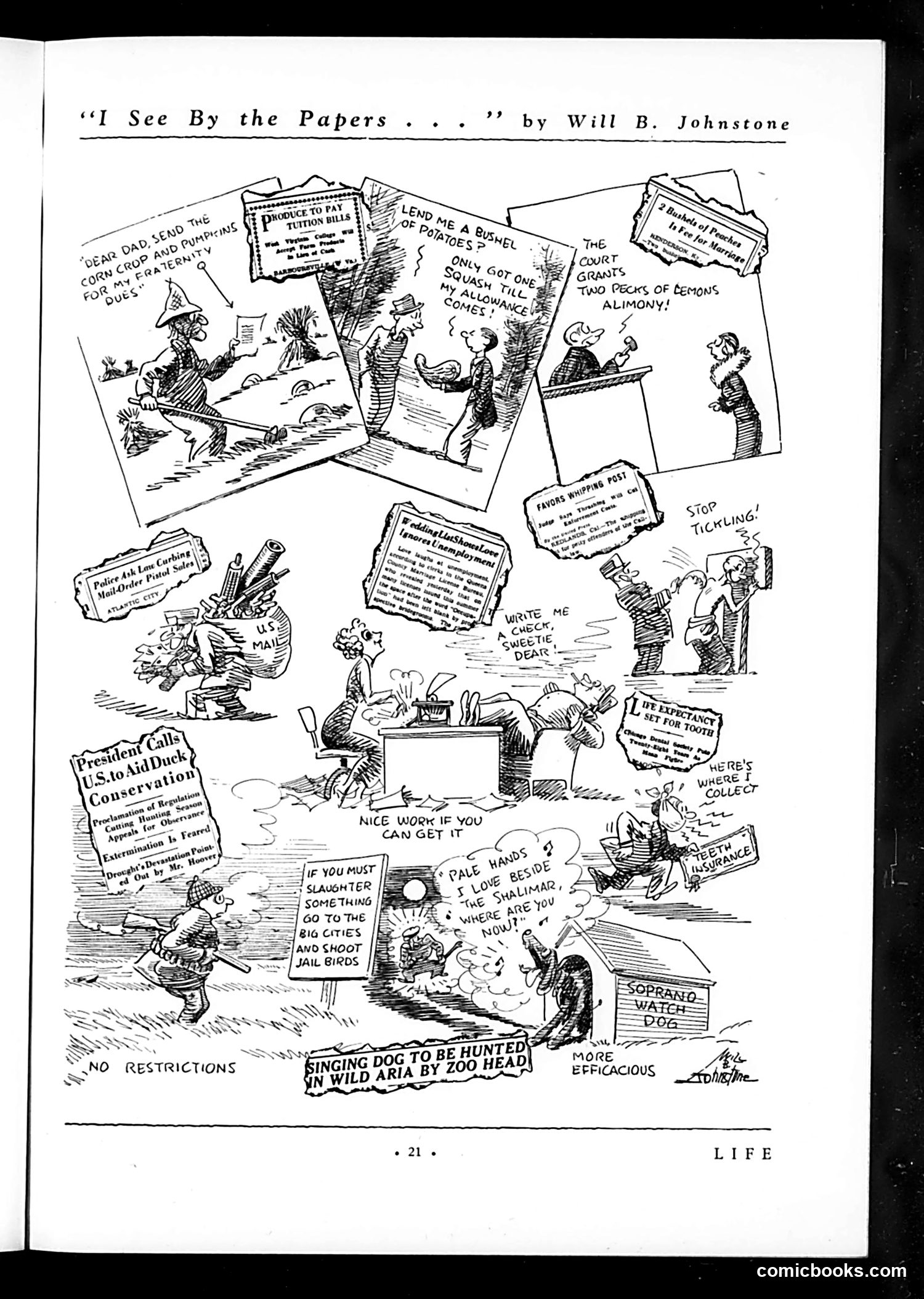
"I See By the Papers..." by Will B. Johnstone This satirical cartoon collage mocks absurd newspaper headlines and human folly. A central figure drowns in papers documenting ridiculous news items and complaints: demands for crop insurance, potato loans, court cases involving alimony (appearing twice, suggesting divorce scandals were common news), conservation calls, and various petty grievances. The cartoon's title references a common newspaper column format. Johnstone satirizes how newspapers amplify trivial complaints and competing demands on authority figures—suggesting society is drowning in petty lawsuits, financial requests, and scandal. The "singing dog to be hunted" and other absurd headlines mock sensationalism. The overall message: newspapers obsess over frivolous human drama rather than substantive issues, creating chaos and distraction.
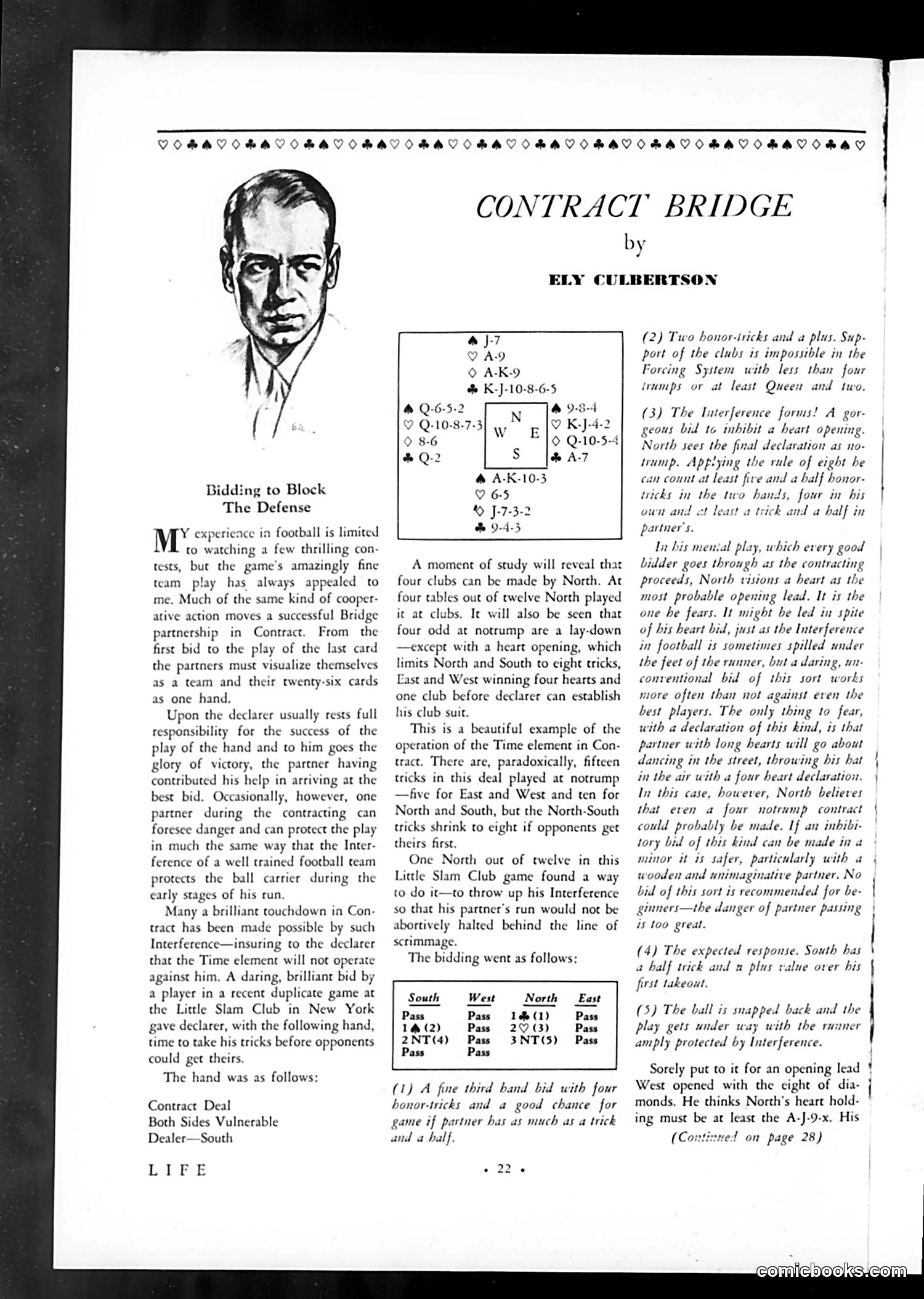
Contract Bridge Article Analysis This page is not a cartoon or satire—it's an instructional article about Contract Bridge, the card game. The only illustration is a portrait of author Ely Culbertson, a prominent bridge expert and popularizer of the game. The article uses a football analogy to explain bridge strategy: just as a football team uses "interference" to protect the ball carrier, a bridge player can use strategic bidding to protect their partner's plan. The author describes a specific hand from a "Little Slam Club" game in New York where one player executed a clever bid—the "Interference"—to prevent opponents from making a destructive heart opening lead. This is educational content for *Life* magazine readers, reflecting the bridge-playing culture among educated Americans of the era. No political or satirical commentary is present—it's straightforward instruction dressed in accessible sporting language.
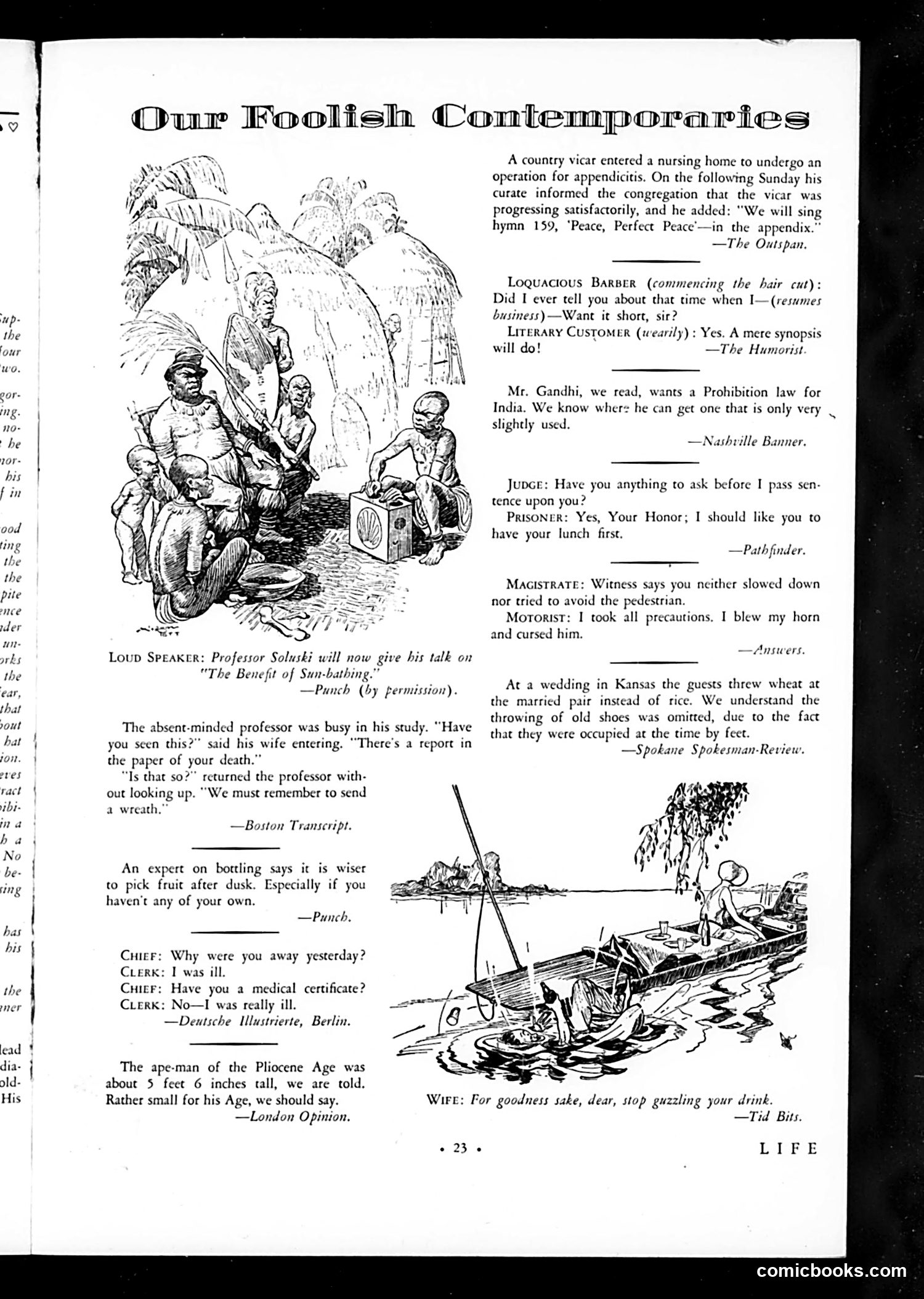
"Our Foolish Contemporaries" This page collects brief satirical anecdotes and jokes mocking human foibles and absurdities. Key targets include: Absent-minded intellectuals: A professor is so detached he doesn't react to news of his own death, calmly suggesting they send a wreath—mocking scholarly obliviousness. Bureaucratic pedantry: A clerk claims genuine illness but lacks a medical certificate, highlighting rigid workplace rules. Verbal excess: A barber and a chatty customer exchange—the customer wants brevity after enduring constant talking, mocking garrulous professionals. Gandhi reference: A contemporary jab at the Indian independence leader's recent Prohibition advocacy, suggesting America's failed Prohibition experiment could be repurposed. Social awkwardness: Various scenarios (judicial prisoners, motorists, wedding guests) show people behaving illogically or hypocritically. The humor relies on wordplay, irony, and observational comedy about everyday human contradictions—typical of early-20th-century Life magazine's format of reprinting witty tidbits from various publications.
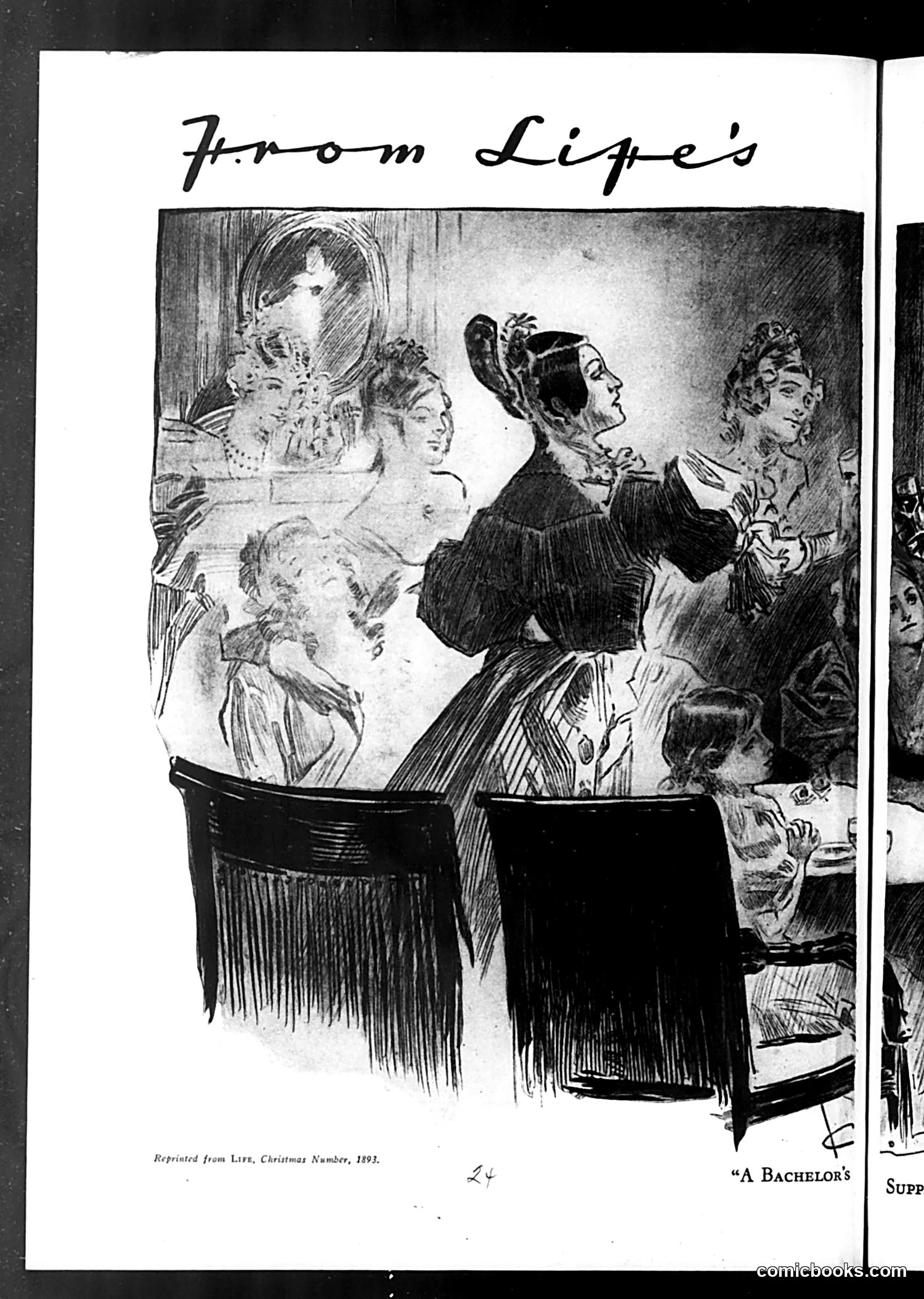
"A Bachelor's" - Life Magazine, Christmas 1893 This sketch, reprinted from Life's 1893 Christmas issue, depicts a social scene of upper-class women and a well-dressed man. The title "From Life's" and the caption "A Bachelor's" (partially visible) suggest this is satirizing bachelor social life or romantic entanglements among the wealthy. The drawing shows what appears to be a gathering where a bachelor is surrounded by fashionably-dressed women in elaborate period clothing. The scene likely mocks either the bachelor's romantic predicaments, the women's pursuit of marriage, or the artificial social rituals of Victorian courtship among the leisure class. Without the full caption, the specific satirical point remains unclear, but Life magazine regularly lampooned aristocratic pretension and romantic social games of this era.
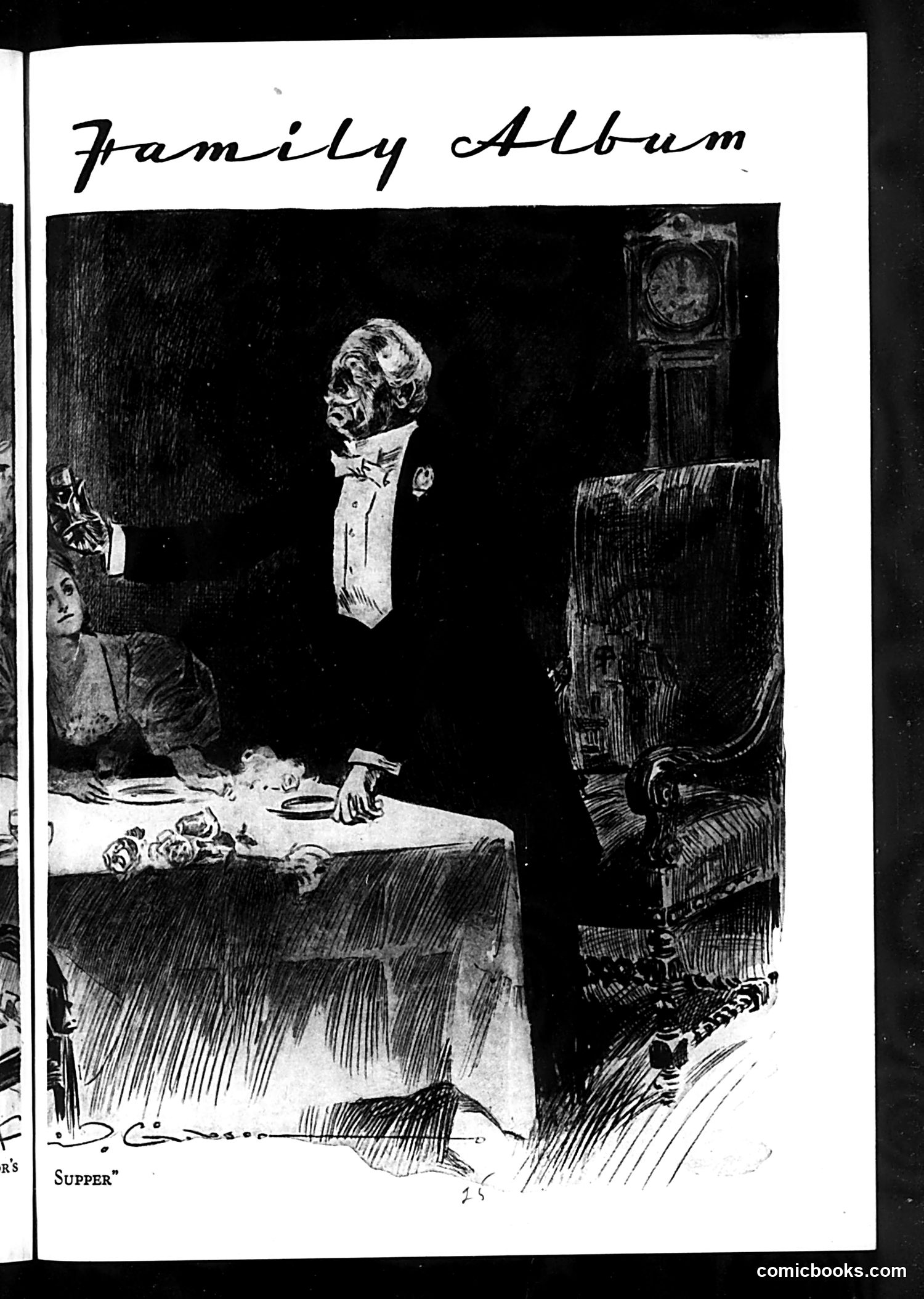
Analysis of "Family Album" - "Supper" This appears to be a satirical sketch from *Life* magazine showing a formal dinner scene. A distinguished older gentleman in formal attire (tuxedo and bow tie) stands at a dining table where a woman sits. A grandfather clock and elegant furnishings indicate a wealthy household. The title "Supper" and the formal presentation suggest this is satirizing upper-class dining customs or social pretension. The gentleman's somewhat austere expression and formal posture, combined with the "Family Album" heading, likely mocks Victorian or Gilded Age bourgeois respectability and dinner etiquette. Without additional context about the cartoonist or publication date, the specific social critique remains somewhat unclear, though it appears to lampoon genteel society's rigid formality around meals and domestic life.
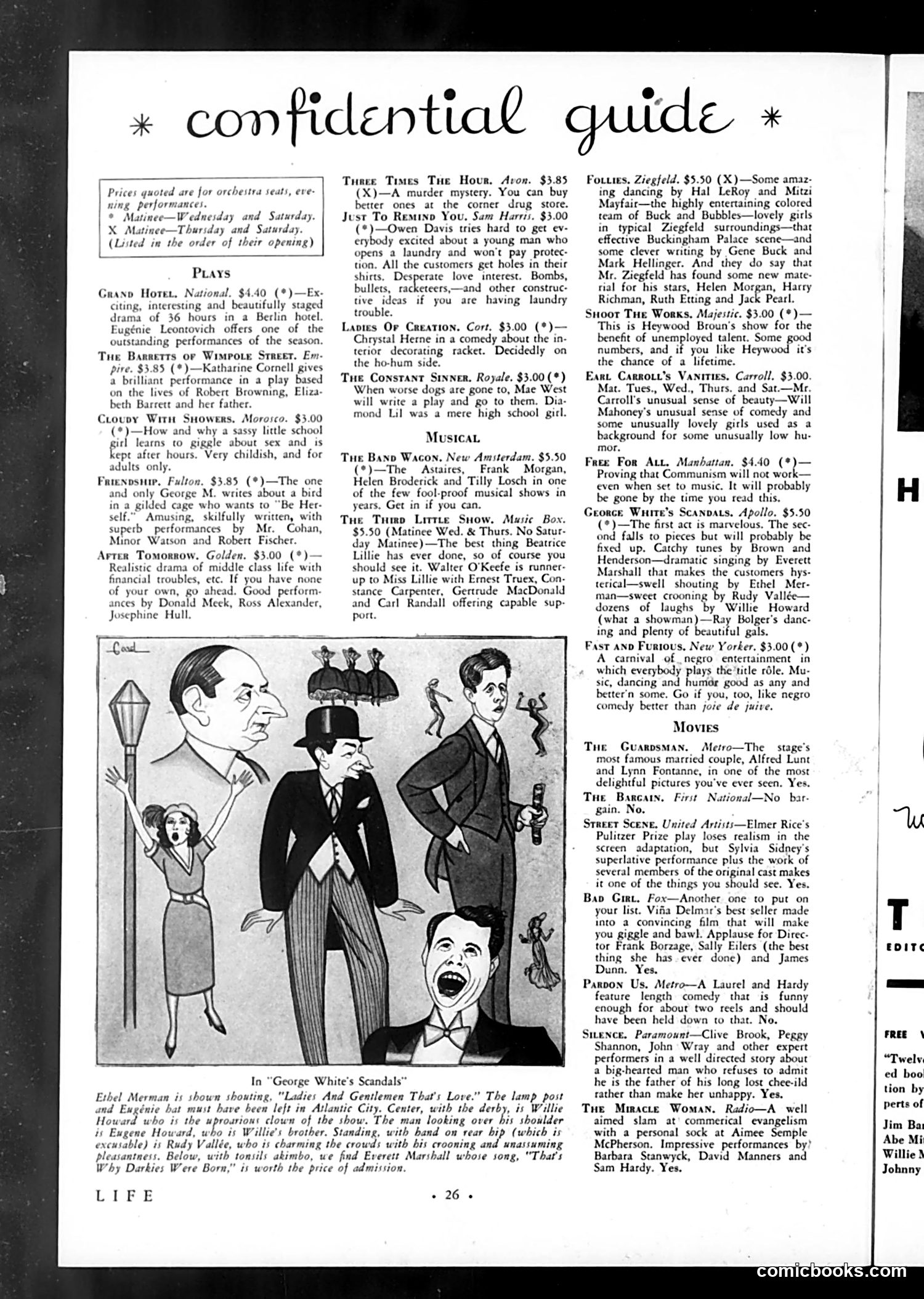
"George White's Scandals" — Entertainment Guide Satire This page from *Life* magazine reviews Broadway shows and musicals. The central cartoon illustrates the revue "George White's Scandals," featuring caricatured performers: Ethel Merman (shouting), Willie Howard (the "uproarious clown" with derby), his brother Eugene Howard, Rudy Vallée (crooning), and Everett Marshall (singing). The satire targets entertainment excess and star power. The caption mocks Vallée's "unassuming pleasantness" while depicting his narcissistic prominence. Willie Howard's physical comedy ("tonsils akimbo") represents slapstick vaudeville humor. The magazine's reviews themselves employ sardonic wit—dismissing murder mysteries as worse than drugstore paperbacks, and noting Mae West's play follows predictable patterns. The overall tone suggests *Life*'s sophisticated audience viewed Broadway entertainment as entertaining but fundamentally frivolous, especially during the Depression era when unemployed performers were still appearing in shows.
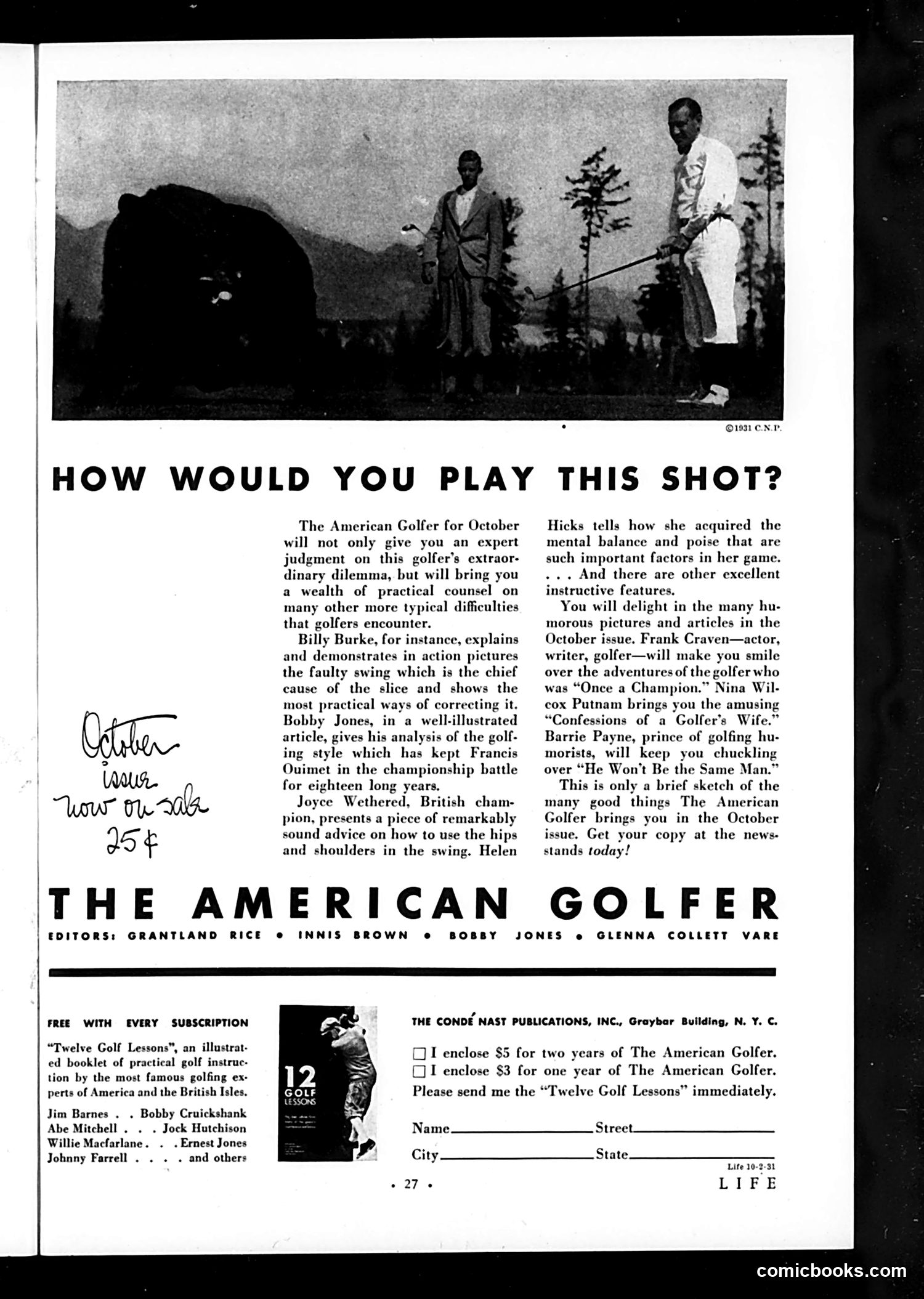
"How Would You Play This Shot?" — The American Golfer Advertisement This is primarily a subscription advertisement for *The American Golfer* magazine (October 1931 issue), not a political cartoon. The page features a photograph of golfers on a course with the headline posing a golf instruction question. The advertisement promotes the magazine's content by listing famous golf experts of the era—Billy Burke, Bobby Jones, Joyce Wethered, Helen Hicks, Francis Ouimet—who contributed instructional articles. It also advertises humorous golf-related content by writers like Frank Craven and Barrie Payne. The small handwritten note in the margin appears to be a personal inscription, possibly from someone associated with the publication. The advertisement offers a subscription incentive: a free illustrated booklet titled "Twelve Golf Lessons" featuring instruction from prominent American and British golf professionals. This was typical 1930s magazine marketing strategy, bundling instructional content to attract golfers.
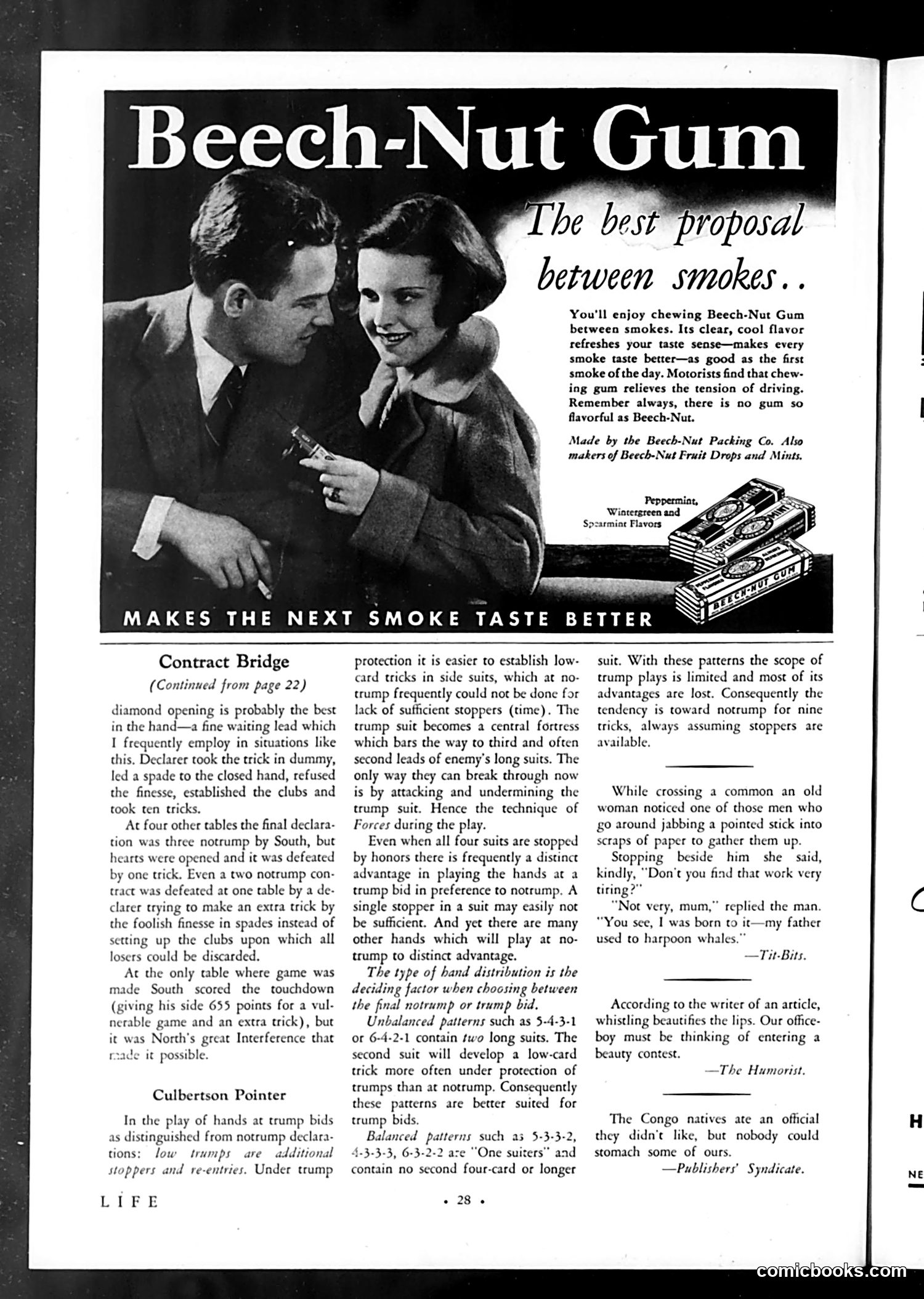
Page Analysis This page is primarily advertising (top half) with filler content below. The Beech-Nut Gum advertisement shows a man and woman in 1930s dress. The tagline "The best proposal between smokes" is a play on words—suggesting gum-chewing as a romantic interlude, while literally promoting the product for use between cigarettes. The ad appeals to motorists by claiming gum relieves driving tension, reflecting the era's automobile culture. The remaining text contains: - A Contract Bridge column discussing card-playing strategy (unrelated to politics/satire) - Several short humor snippets from publications like *Tit-Bits* and *The Humorist*—brief jokes about a street sweeper, office-boy whistling, and cannibals None of this content is satirical or political. The page appears to be a standard magazine filler combining advertising with light entertainment and how-to content typical of *Life* magazine's format during this period.
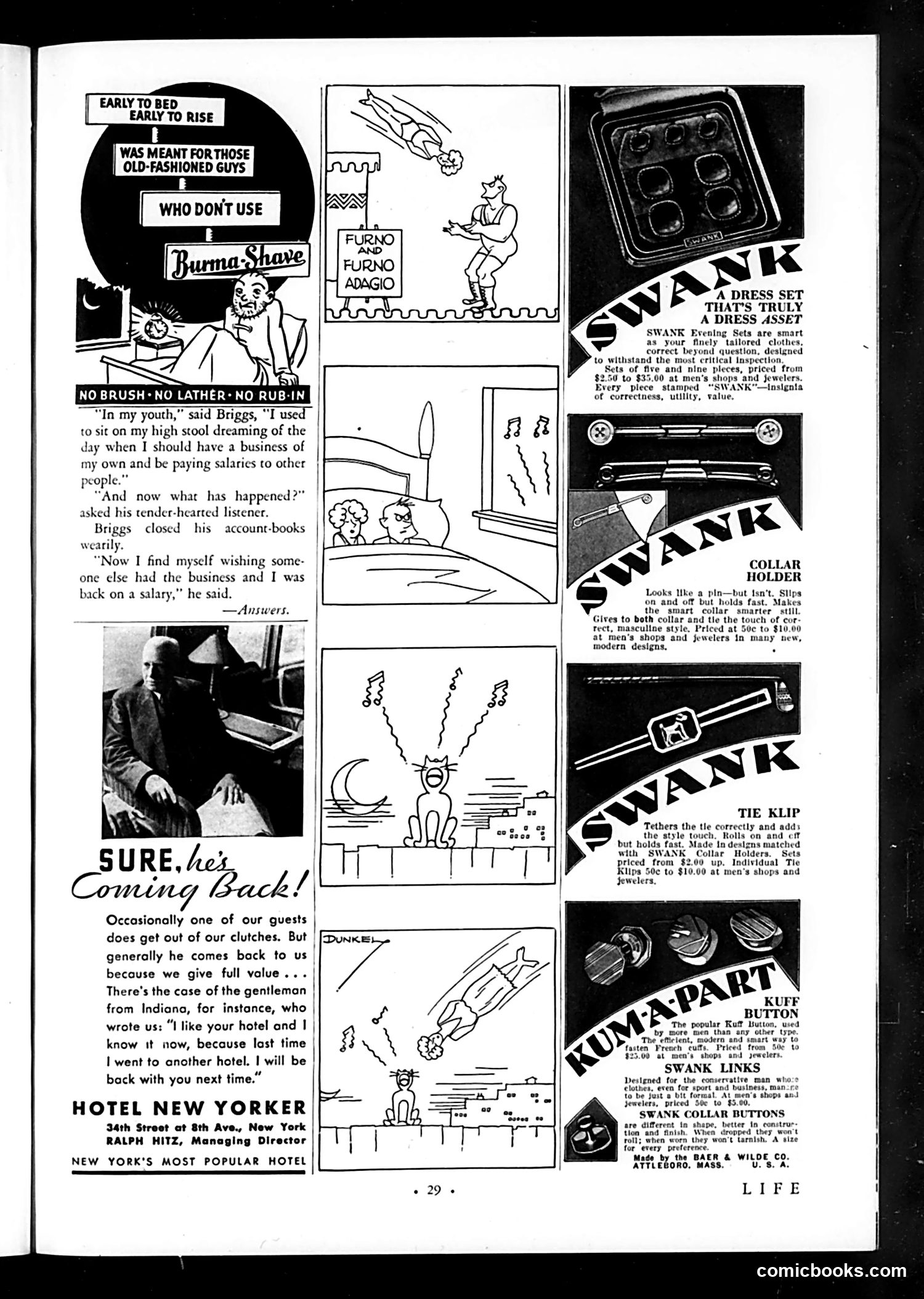
Political Cartoon & Advertising Page Analysis This page contains vintage advertising alongside a satirical cartoon about business ambition. The main cartoon illustrates an ironic reversal: a man named Briggs once dreamed of owning his own business and employing others. Now successful, he regrets his ambition—he wishes someone else owned the business so he could return to the simpler life of a salaried employee. The humor targets the American dream's false promise: entrepreneurship appears glamorous from below but proves exhausting once achieved. The Burma-Shave advertisement at top left mocks "old-fashioned guys" who don't use their product, positioning modern shaving convenience as progressive. The rest of the page showcases men's accessories (Swank dress sets, collar holders, tie clips, cuff buttons) typical of 1930s-40s men's fashion advertising, emphasizing correctness and masculine style. The Hotel New Yorker advertisement uses the Briggs cartoon's theme ironically: guests leave but return because the hotel provides superior value—inverting the cartoon's message about regret.
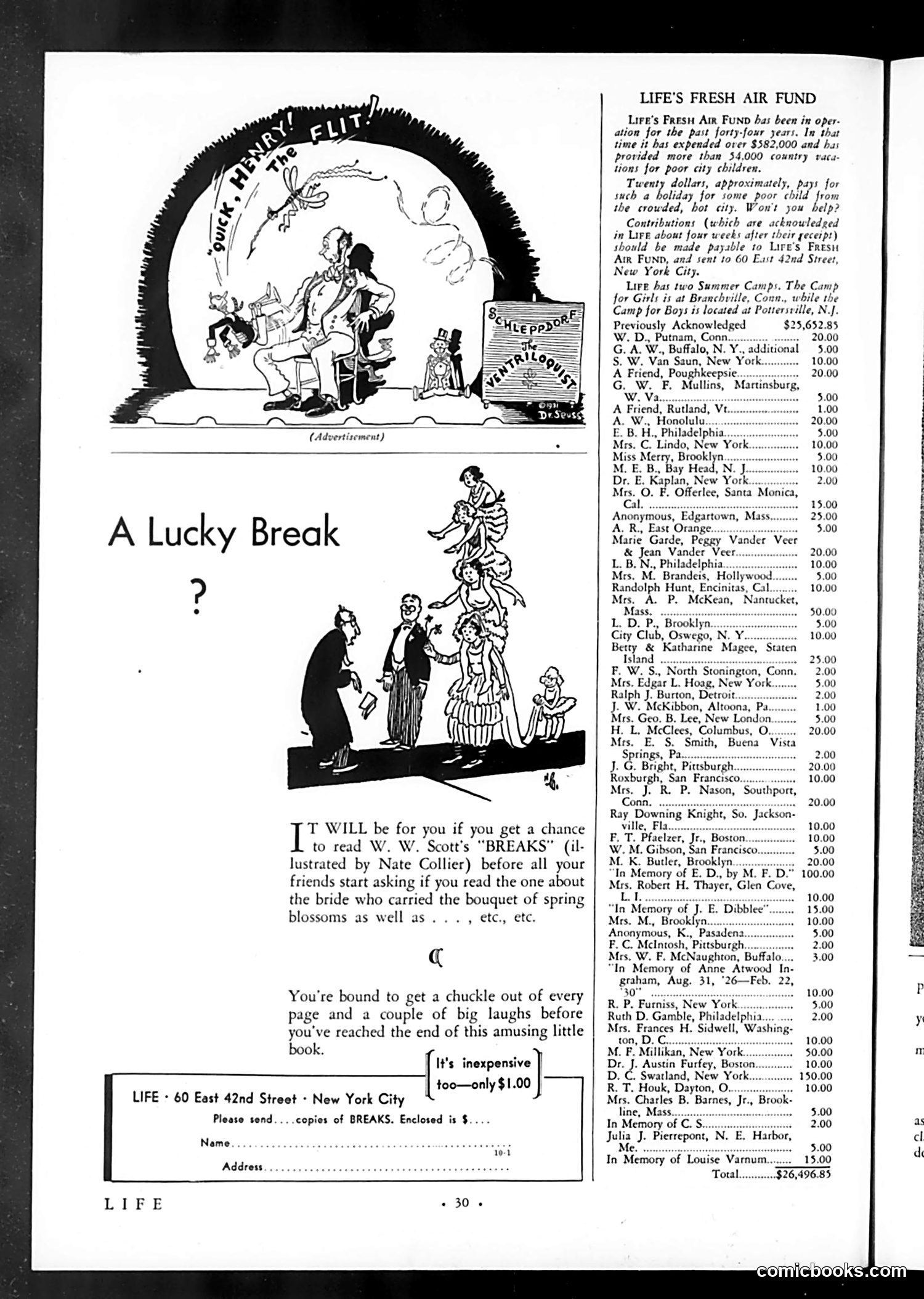
Analysis for a Modern Reader This page combines two unrelated elements: a satirical cartoon advertisement and a charitable fundraising appeal. "A Lucky Break" Cartoon: The illustration depicts what appears to be a working-class or immigrant family (suggested by their dress and demeanor) encountering a well-dressed man in a top hat—likely representing wealth or opportunity. The caption's double meaning plays on "break" as both a stroke of good fortune and a comedic pause, teasing readers about W.W. Scott's illustrated humor book called "Breaks." Life's Fresh Air Fund Appeal: The right column lists donations to a legitimate charitable organization that provided summer camp vacations for poor urban children—a Progressive Era social reform effort. The fund had operated 44 years and served over 34,000 children, with donations ranging from $1 to $150. The Satire: Life magazine juxtaposes lighthearted humor about luck and social mobility against real poverty, inviting readers to both laugh at comic misfortune and contribute to actual charitable relief. The $1 price for the humor book itself serves as a gentle fundraising pitch.
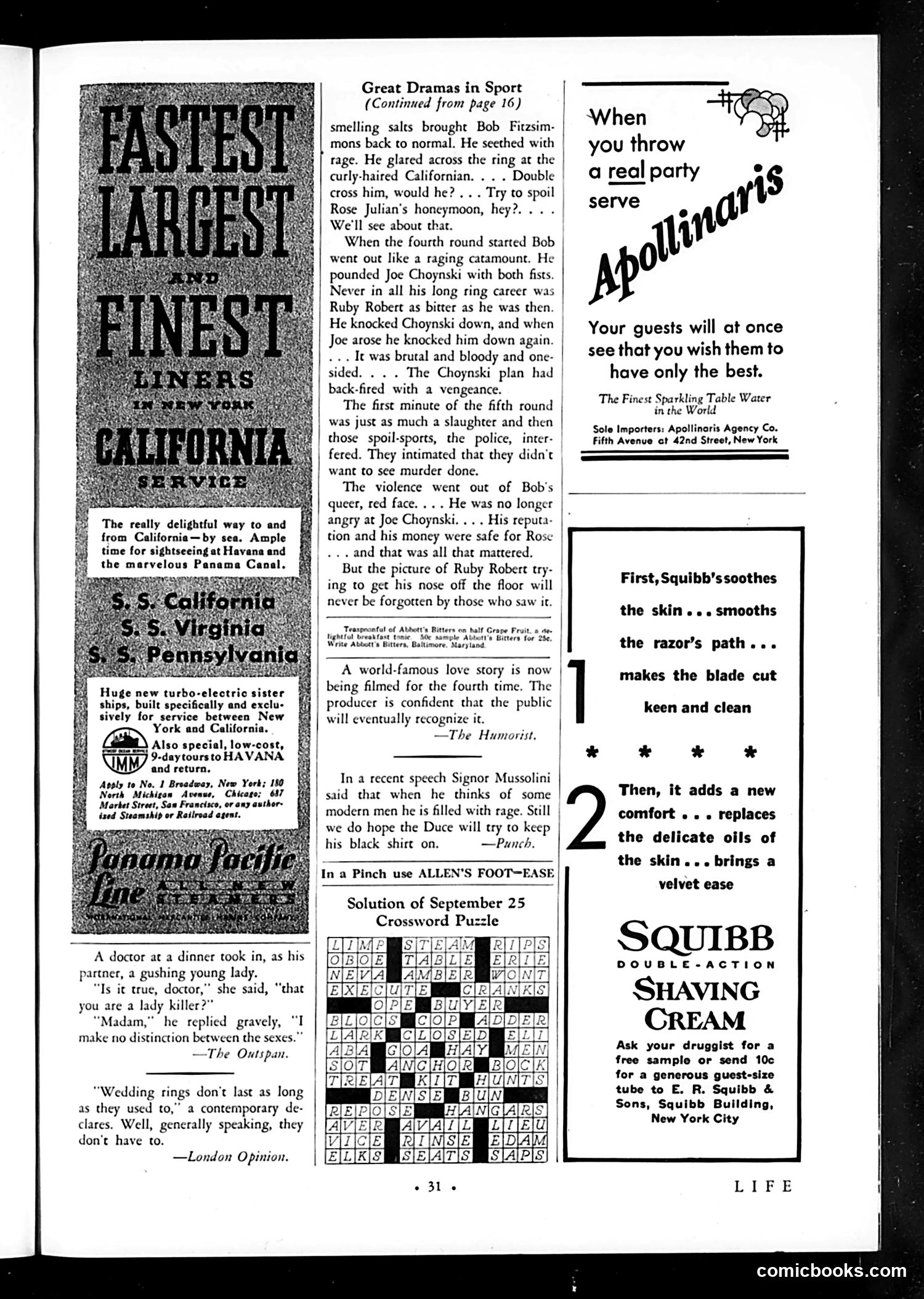
Page 31 of Life Magazine: Sports Drama and Social Humor This page mixes advertisements with satirical short jokes typical of Life's format. The main content is a continued boxing narrative about "Ruby Robert" (likely referring to boxer Ruby Robert Fitzsimmons) fighting Joe Choynski over a woman named Rose Julian. The story depicts a brutal, jealous fight where Robert overwhelms Choynski until police stop the match. The page also includes three brief satirical jokes: one about a doctor claiming he makes "no distinction between the sexes" when called a "lady killer"; another mocking that wedding rings "don't last as long as they used to" because marriages are shorter; and a quip about Mussolini's rage at "modern men" while wearing his fascist black shirt. The remaining content is advertising (cruise ships, foot powder, shaving cream, sparkling water). The boxing narrative and jokes reflect 1920s-30s social attitudes about masculinity, jealousy, and marital instability presented for comedic effect.
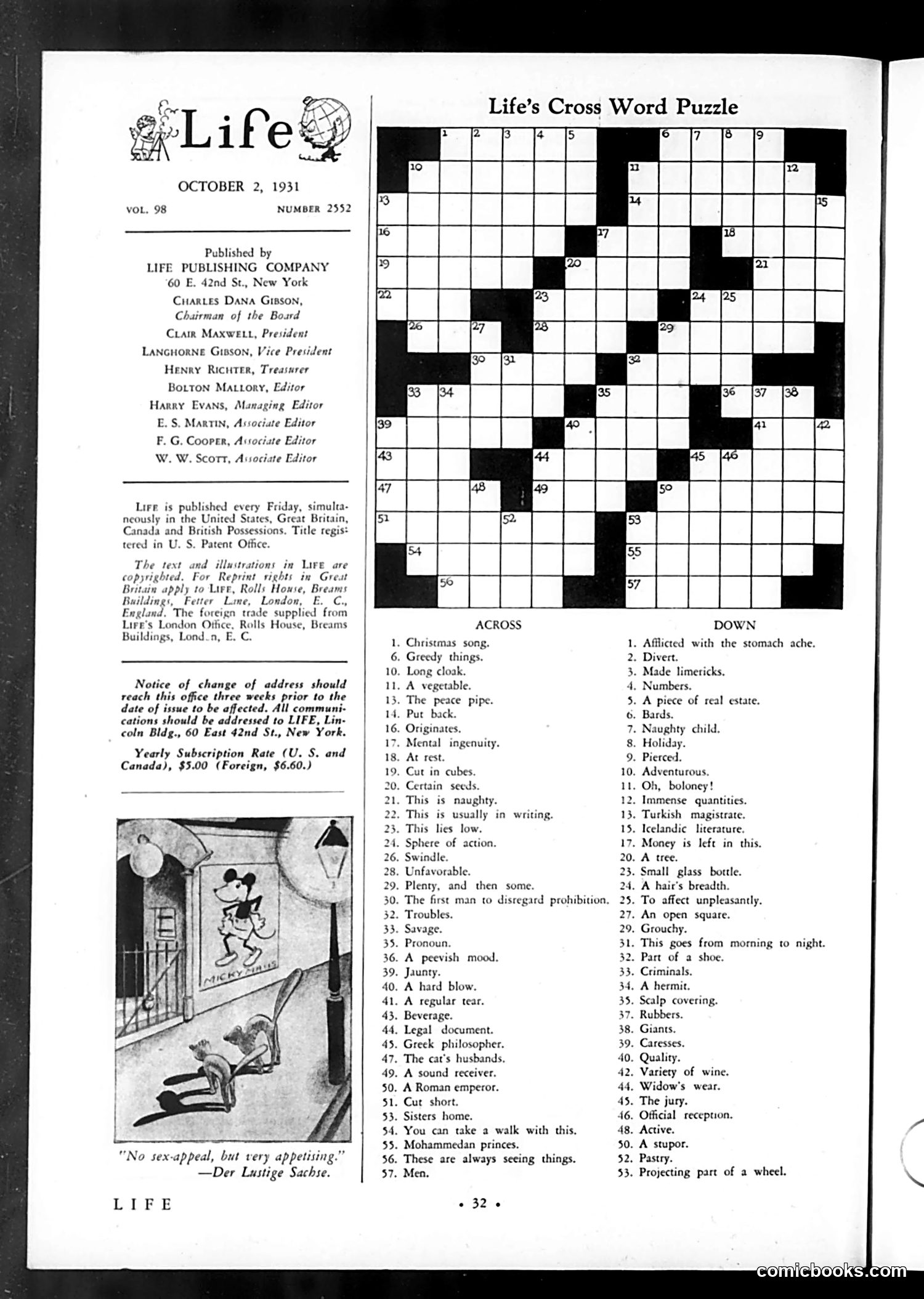
Life Magazine, October 2, 1931 This page is primarily masthead and puzzle content, not political satire. The main feature is a crossword puzzle titled "Life's Cross Word Puzzle." The single cartoon below depicts a domestic scene: a man lounges in a chair while a woman stands nearby. The German caption translates roughly to "No sex appeal, but very appetizing," suggesting a joke about the woman's lack of glamour but domestic utility—typical 1930s humor about marriage and gender roles. The publication information dates this to October 1931, during the Great Depression's early stages. Life was a prestigious American satirical weekly magazine. The crossword clues are standard wordplay for the era, with no apparent political content—mostly definitions of ordinary words and concepts.
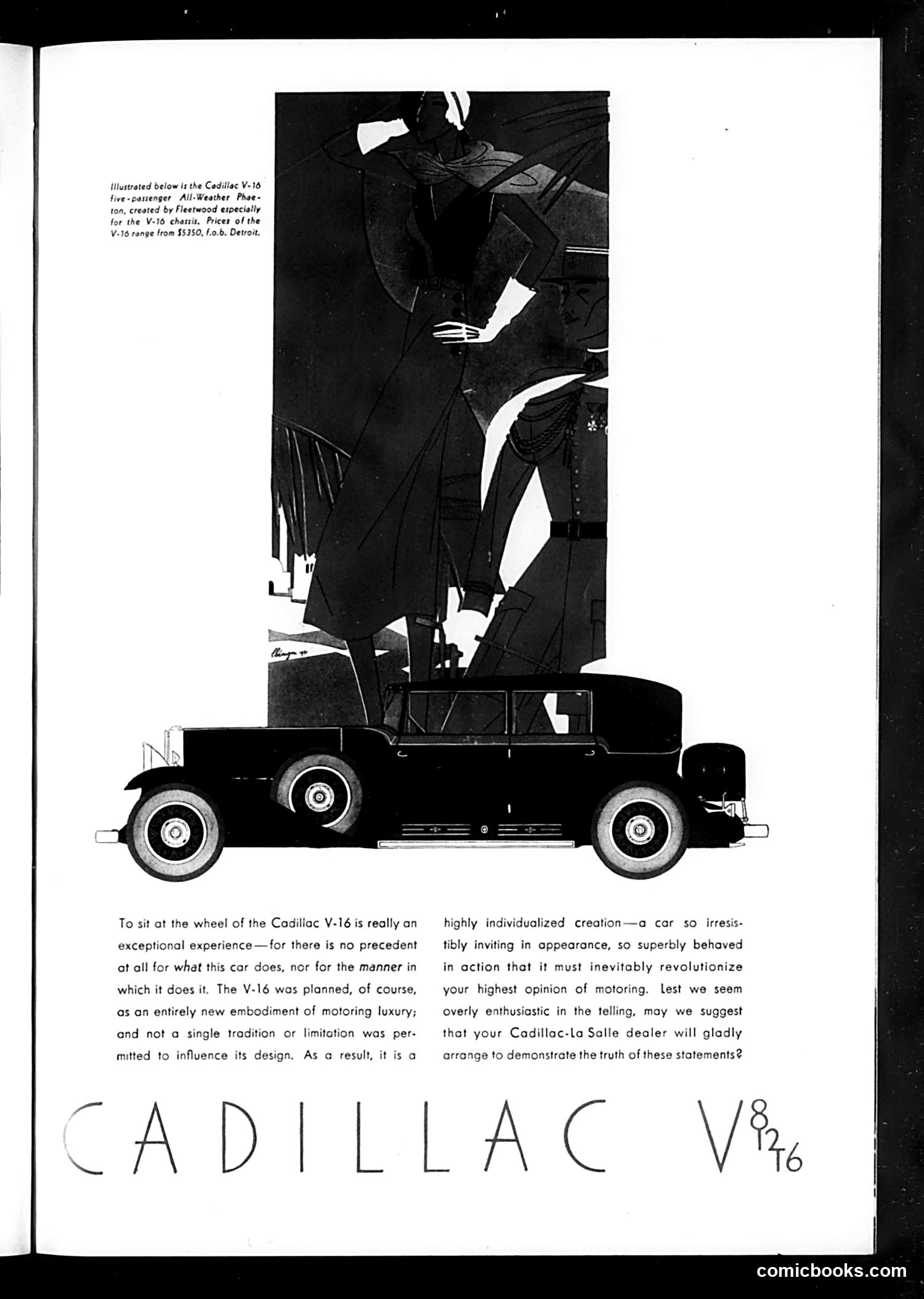
Cadillac V-16 Advertisement This is a luxury automobile advertisement, not political satire. The page promotes Cadillac's new V-16 model, a high-end five-passenger car manufactured by Fleetwood. The illustration shows the vehicle in elegant silhouette, emphasizing its sleek design. The accompanying text makes extravagant claims typical of 1920s-30s advertising—that the car is revolutionary, unprecedented, and will transform the owner's "highest opinion of motoring." The language is deliberately hyperbolic ("irresistibly inviting," "superbly behaved"). The advertisement targets wealthy buyers by stressing exclusivity and innovation. The phrase "entirely new embodiment of motoring luxury" and mention of the dealer network suggest this was premium marketing material aimed at affluent consumers during the pre-Depression era when such vehicles represented peak American automotive achievement. There is no political cartoon or satire present on this page.
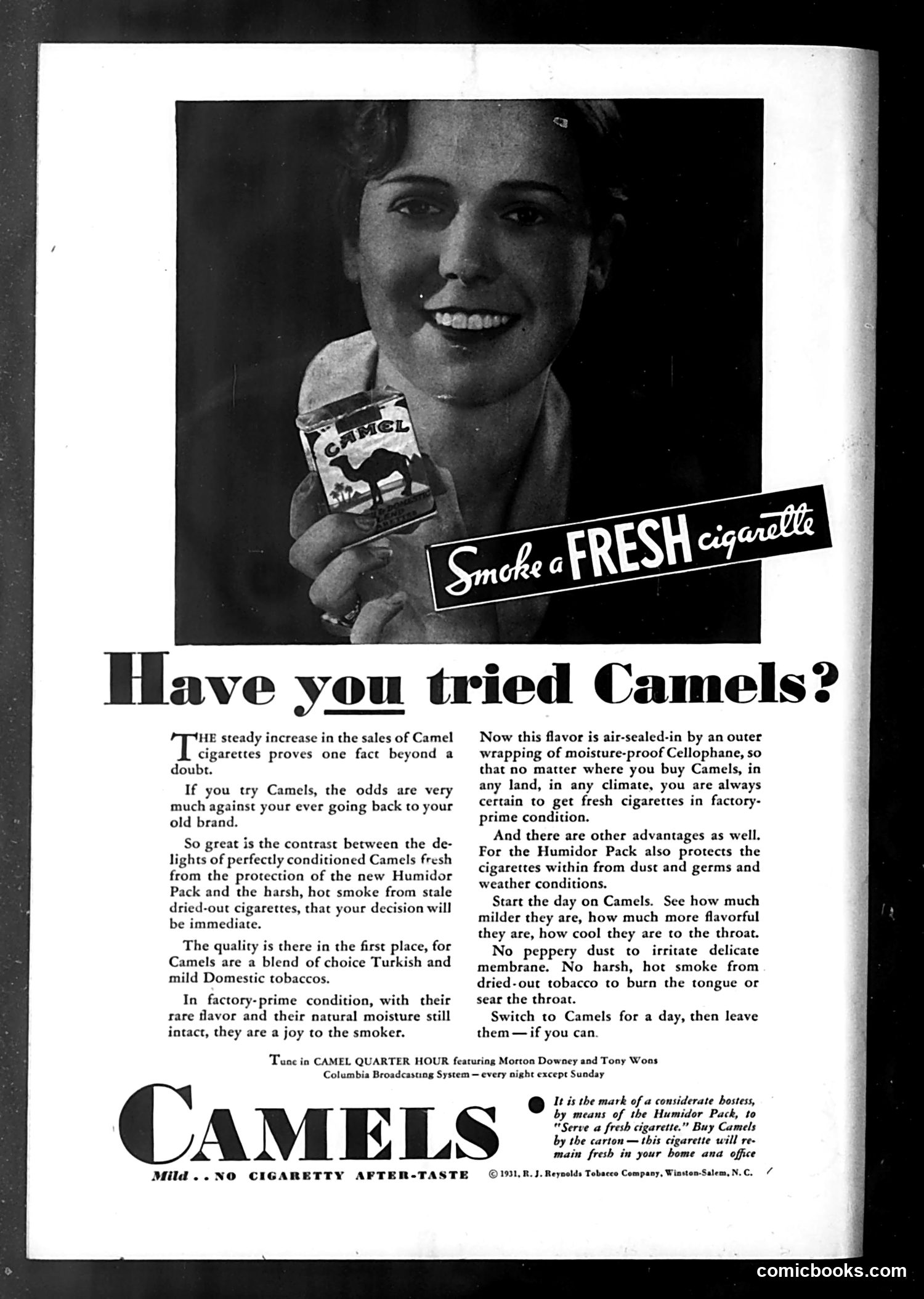
Advertisement Analysis This is a Camel cigarette advertisement, not political satire. The page promotes Camels' new "Humidor Pack"—moisture-proof cellophane packaging designed to keep cigarettes fresh. The image shows a smiling woman holding a Camel pack, exemplifying the marketing strategy of the era: attractive endorsers to sell cigarettes. The ad's pitch emphasizes: - Superior freshness compared to competitors' "stale dried-out cigarettes" - Milder smoke and no throat irritation - The innovation of sealed packaging for consistent quality - Social aspiration (serving fresh cigarettes marks a "considerate hostess") For modern readers, the jarring element is the casual health claims—advertising cigarettes as mild, cool, and non-irritating without health warnings. This reflects pre-1960s advertising freedom before tobacco's dangers were widely acknowledged and regulated. The radio tie-in ("Camel Quarter Hour") was typical mid-20th-century product integration.

I can see this is a nearly blank or extremely dark page from what appears to be a historical publication, with only "comicbooks.com" visible at the bottom right. The image is too dark and lacks sufficient visible content for me to identify any cartoons, caricatures, political figures, or satirical commentary. There may be printed material present that isn't visible due to image quality or reproduction issues, but I cannot reliably discern what it depicts or analyze its historical or political meaning based on what's actually visible here. A clearer scan or higher-contrast version would be needed for accurate analysis.