life
Life — October 9, 1931
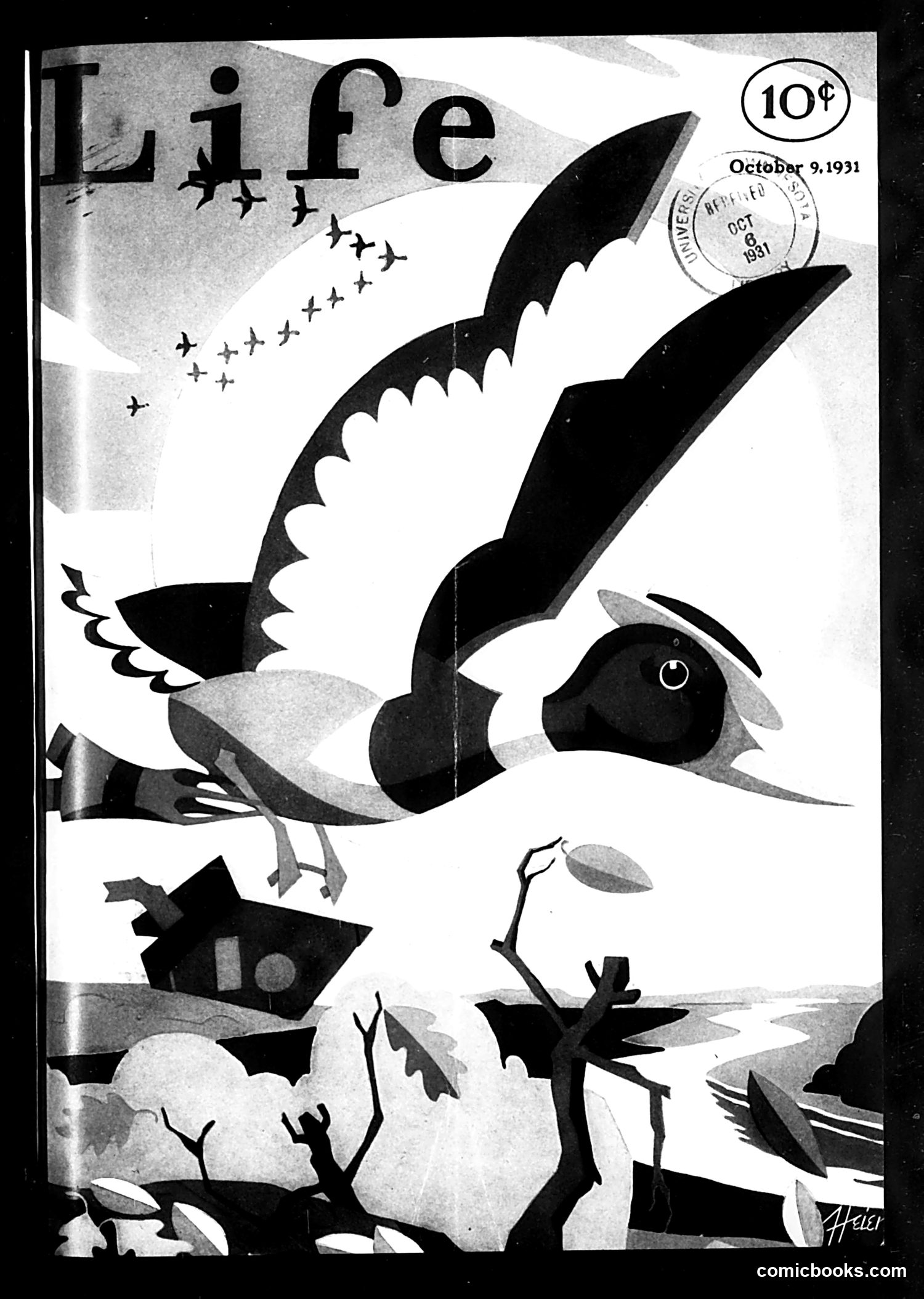
Life Magazine Cover, October 9, 1931 This is a stylized Art Deco cover illustration (signed "Adler") depicting a bird in flight, likely a dove or similar species, rendered in bold black silhouettes with gray tones. The bird carries what appears to be a small house or dwelling structure in its beak or talons, while smaller birds fly in formation above. Below, bare branches and autumn foliage suggest a seasonal setting. The composition suggests themes of migration, displacement, or relocation—possibly referencing homelessness or housing during the Great Depression era (1931 timing supports this). The precise satirical target remains unclear without accompanying text, though the imagery likely comments on contemporary social or economic conditions affecting shelter and stability.
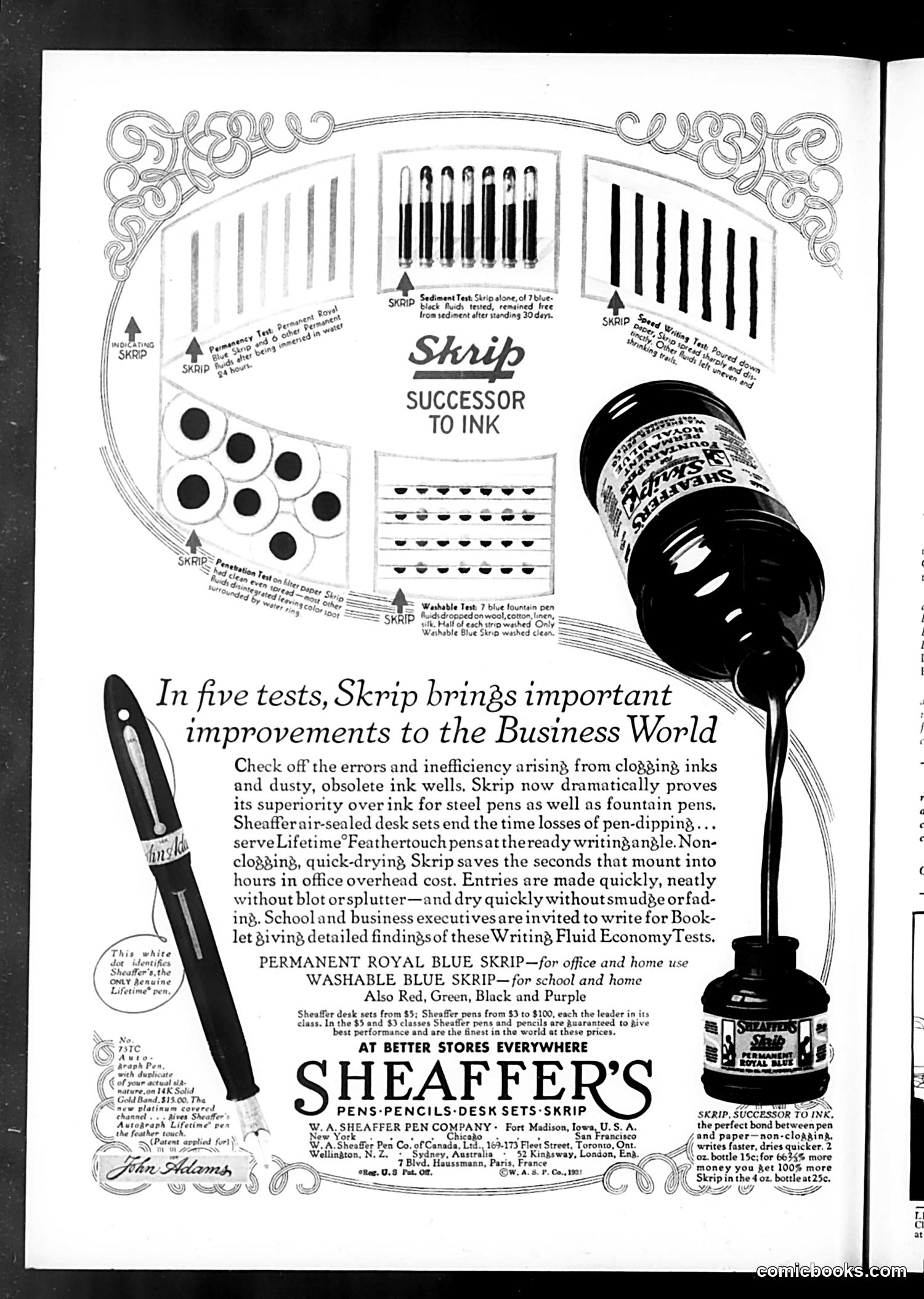
This is an Advertisement, Not Satire This page is a commercial advertisement for Sheaffer's Skrip writing fluid and fountain pens, not political or social satire. The content shows product testing diagrams demonstrating Skrip's superiority over traditional ink—comparing sediment levels, washability, and performance across multiple writing instruments. The "five tests" mentioned tout improvements like non-clogging formulas and quick-drying properties. The large fountain pen illustration and ink bottle are product images. The testimonial from what appears to be a signature (possibly an endorser) adds credibility. The advertisement emphasizes business efficiency—how Skrip eliminates pen-maintenance time losses in offices—appealing to mid-20th century workplace productivity concerns. This is straightforward commercial marketing rather than editorial commentary.
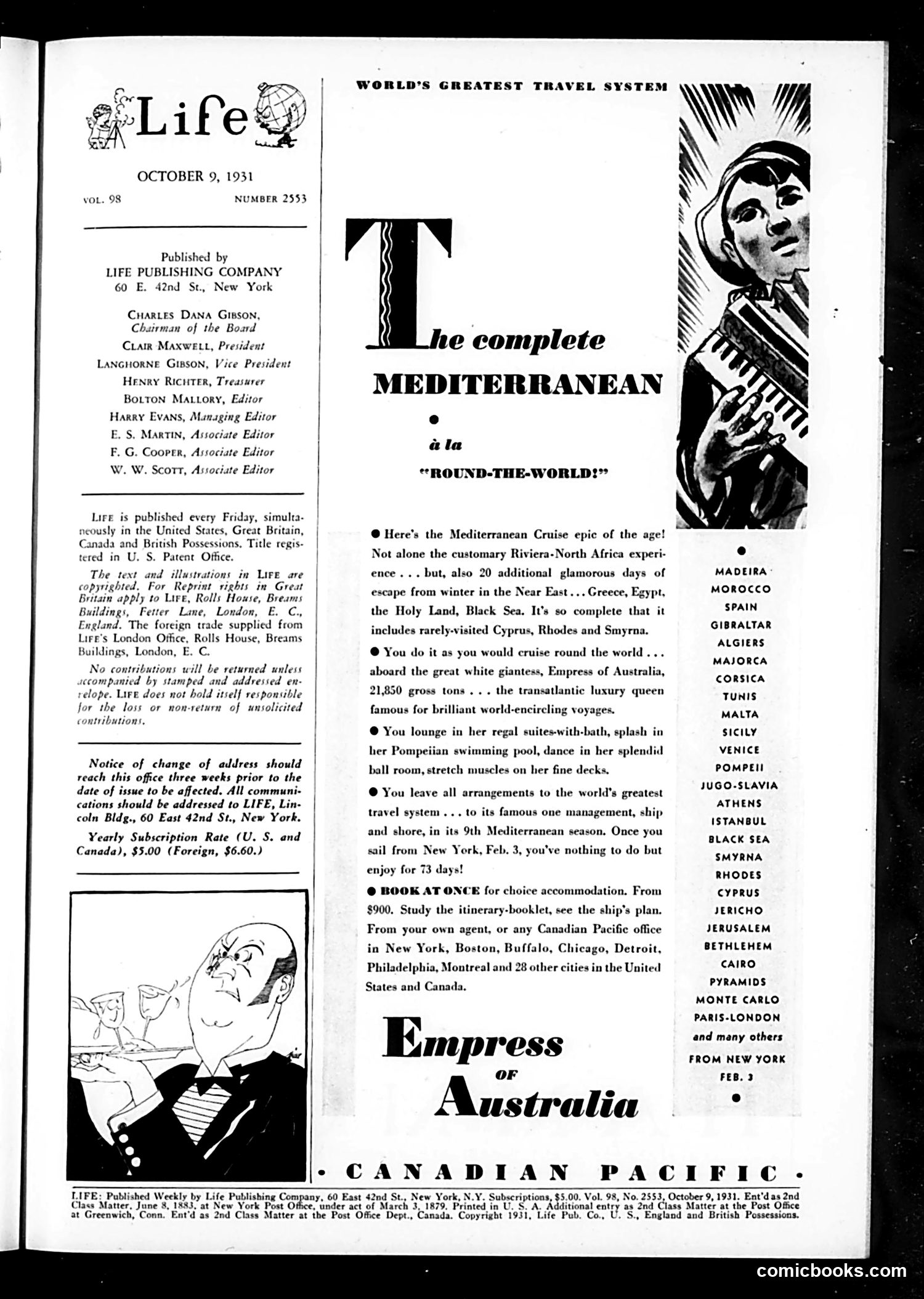
Page Analysis: Life Magazine, October 9, 1931 This page is primarily advertising content for a Mediterranean cruise aboard the Empress of Australia, operated by Canadian Pacific shipping lines. The advertisement dominates the right side, listing exotic destinations (Egypt, Greece, Cyprus, Jerusalem, Cairo, etc.) and promoting luxury accommodations starting at $900. The small cartoon on the left appears to be editorial filler — a simple sketch of a man's face in what seems a humorous or exaggerated style, likely unrelated to the cruise advertisement. Without clearer context or caption visible, the cartoon's specific satirical point is unclear from this image alone. The page itself serves as a masthead for Life Publishing Company, with staff listings and subscription information.
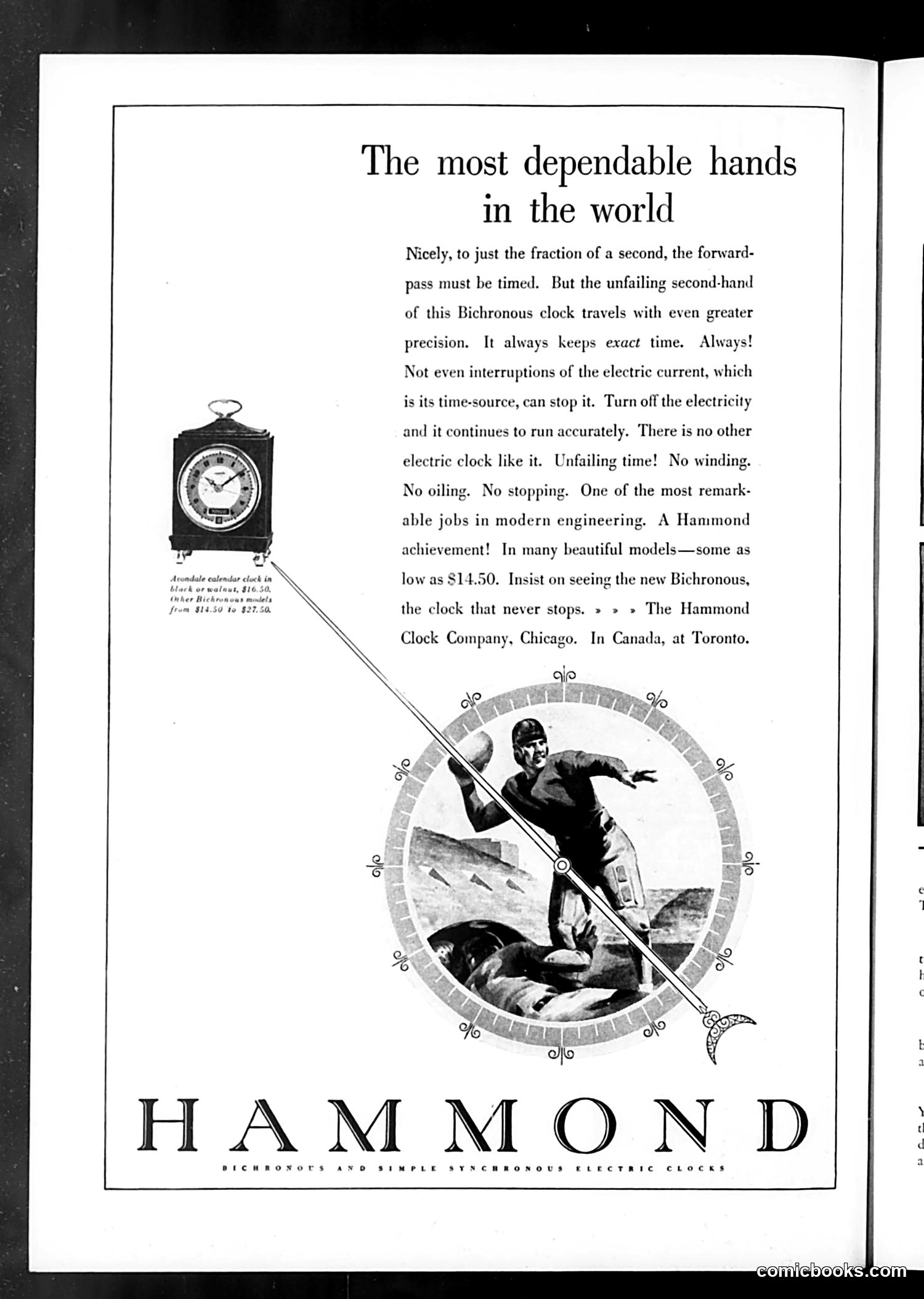
Hammond Clock Advertisement This is a product advertisement, not satire or political commentary. The page promotes Hammond's Bichronous electric clocks, manufactured by the Hammond Clock Company in Chicago (with Canadian distribution in Toronto). The ad emphasizes the clock's reliability: it keeps "exact time" continuously, even if electricity is interrupted. The image shows a football player kicking a field goal, where the clock face replaces the ball—a visual metaphor suggesting the clock's precision and dependability, qualities valued in sports as in timekeeping. The ad highlights modern engineering achievement and positions the product as superior to mechanical clocks, requiring no winding or oiling. Models are advertised starting at $14.50. This reflects early 20th-century enthusiasm for electric-powered convenience in consumer goods.
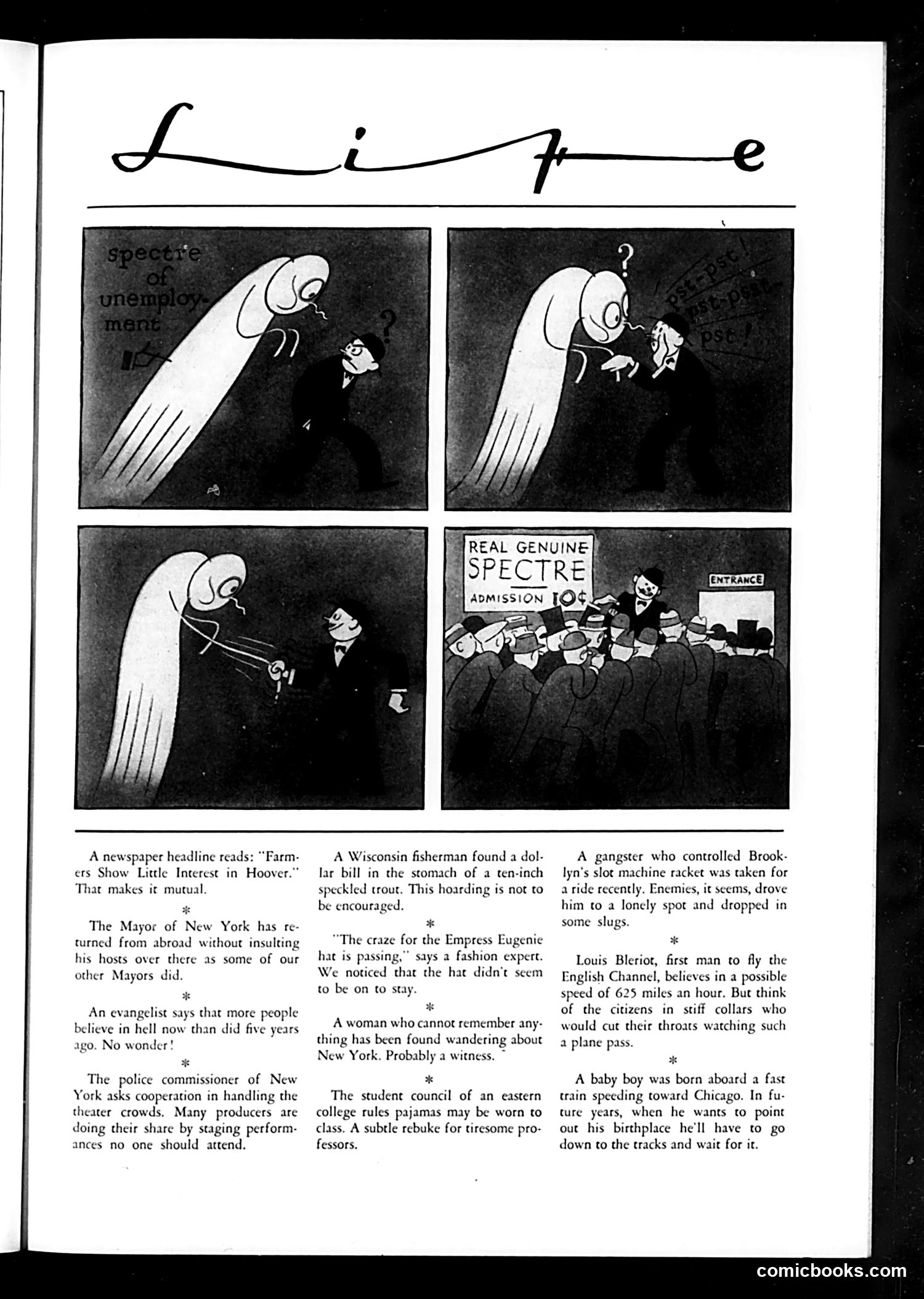
"Life" Satirical Page Analysis This page features a four-panel comic titled "Spectre of Unemployment" depicting a ghostly specter haunting a small man in formal dress—likely representing a businessman or unemployed worker during an economic downturn (possibly the Great Depression era, given the imagery). The specter progressively menaces the figure across three panels, then transforms into a circus-like attraction in the fourth panel, where crowds pay admission to see a "Real Genuine Spectre." The satire critiques how unemployment—initially terrifying—becomes commodified entertainment. The accompanying humorous anecdotes below mock various social absurdities of the period. The overall message: societal anxieties become trivialized spectacles, and serious economic problems are reduced to amusing oddities rather than addressed seriously.
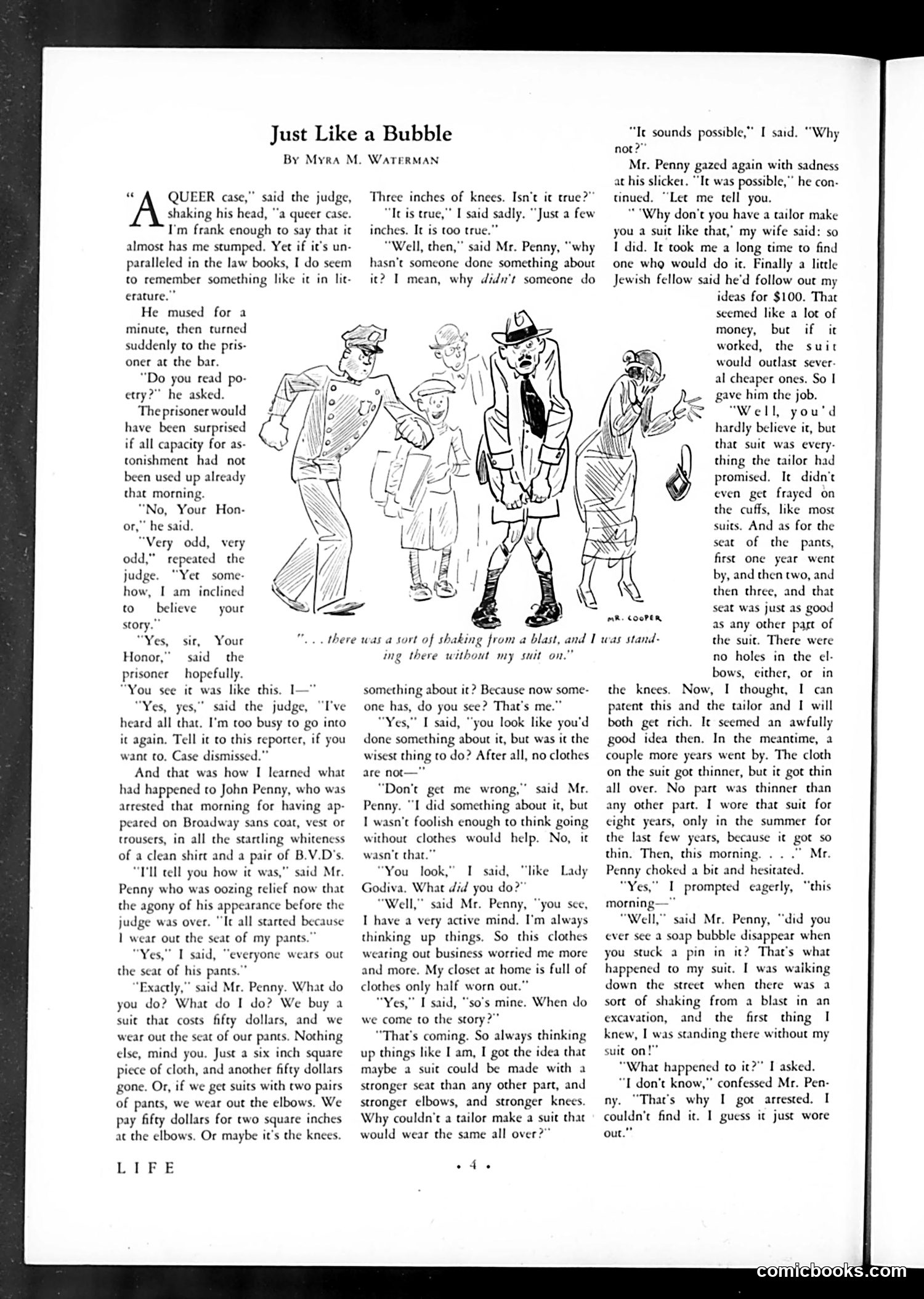
"Just Like a Bubble" by Myra M. Waterman This satirical story concerns a man arrested for wearing an unworn suit without proper clothes underneath. A judge finds the case bizarre—the prisoner explains he bought an expensive suit ($100, a substantial sum at the time) to avoid wearing out cheaper clothes. The tailor promised durability but failed to reinforce key stress areas (knees, elbows, seat). The satire mocks both consumer anxiety about clothing costs and manufacturers' false advertising claims. The "bubble" reference suggests the suit's promises—like a soap bubble—were insubstantial and burst upon contact with reality. The illustration depicts characters discussing this absurd legal case, highlighting early 20th-century concerns about product quality and economic value.
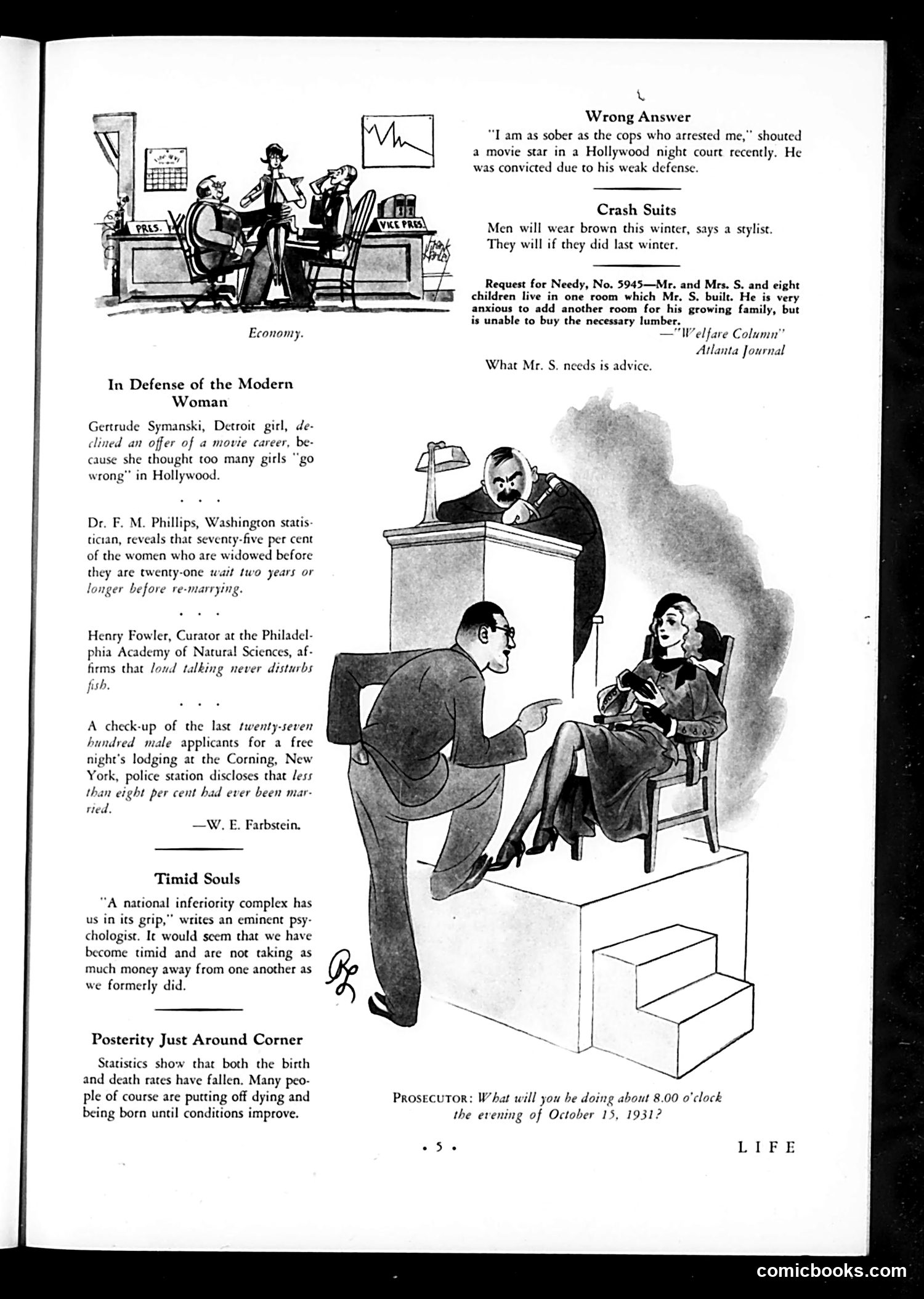
Explanation of Life Magazine Page Content This page contains several satirical pieces about contemporary social issues: "Wrong Answer" mocks a movie star's weak legal defense in a conviction case. "Crash Suits" predicts brown suits will be fashionable winter wear, with a joking reference to last winter's trends. Main Cartoon: Shows a prosecutor questioning a woman about her plans for the evening of October 13, 1931. The illustration satirizes courtroom proceedings, likely referencing a prominent trial from that era (unclear which specific case without additional context). "In Defense of the Modern Woman" defends women against criticism about Hollywood career choices, citing statistics about widow remarriage and animal behavior to argue women are practical and rational. The other short pieces discuss statistics about birth rates, timidity in American society, and urban housing needs—typical satirical commentary on 1930s American life.
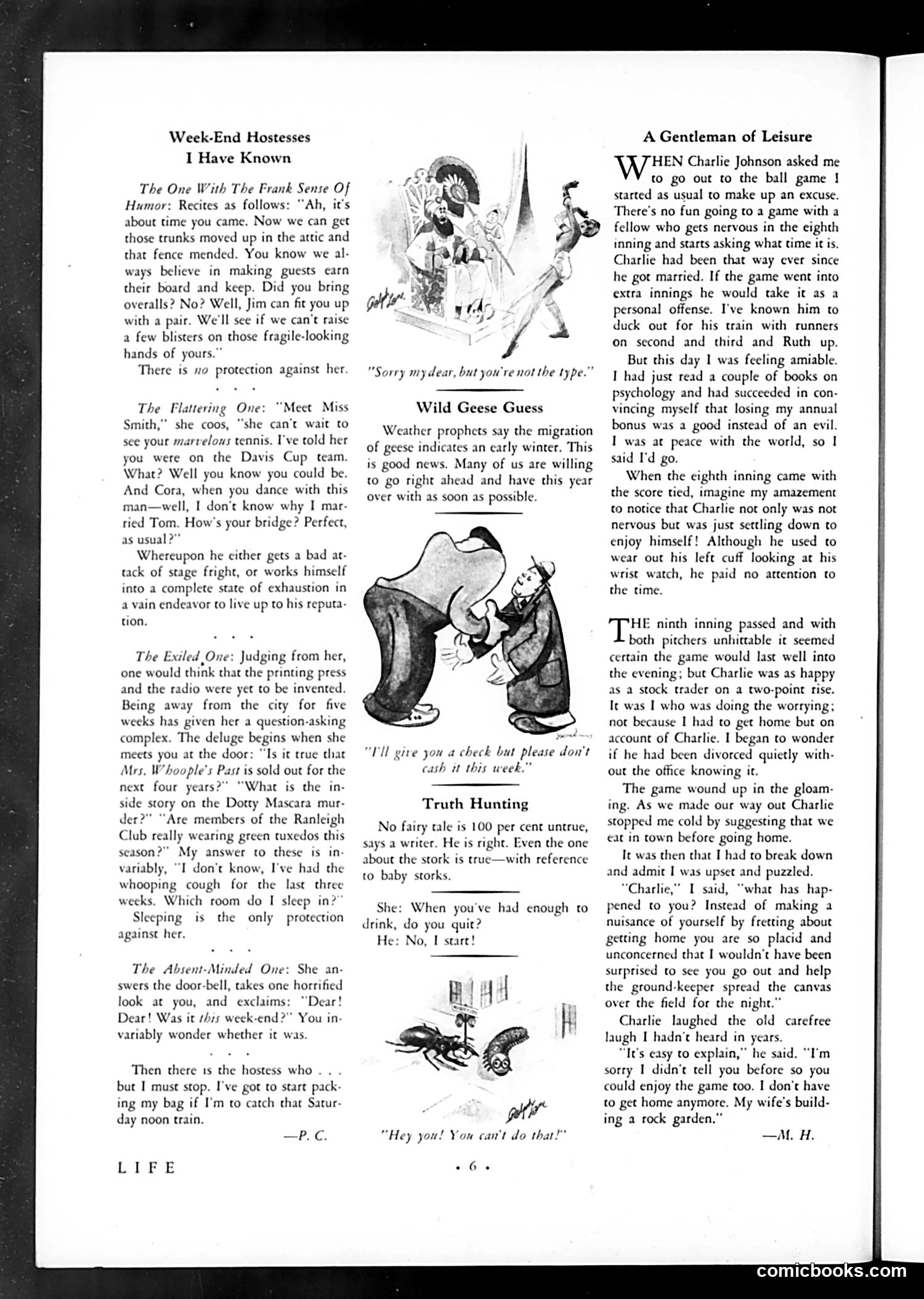
Analysis of Life Magazine Page This page contains three humorous short pieces about social etiquette, primarily targeting upper-class or leisure-class behavior: "Week-End Hostesses I Have Known" satirizes various types of female hosts—from the overly blunt ("frank sense of humor") to the anxiously flattering to the exhausted. The jokes mock predictable, tiresome social behaviors. "A Gentleman of Leisure" features Charlie Johnson, a husband reluctant to attend a baseball game. The humor lies in his gradual mood shift from annoyance to contentment, subverting expectations. His wife mentions building a rock garden—suggesting domestic preoccupations that contrast with his leisure activities. "Truth Hunting" and "Wild Geese Guess" are brief, single-joke pieces about seasonal migration and alcohol consumption. The accompanying cartoons illustrate these social scenarios with period-appropriate drawings. Overall, the page reflects 1920s-30s satirical humor targeting middle to upper-class social conventions and gender dynamics.
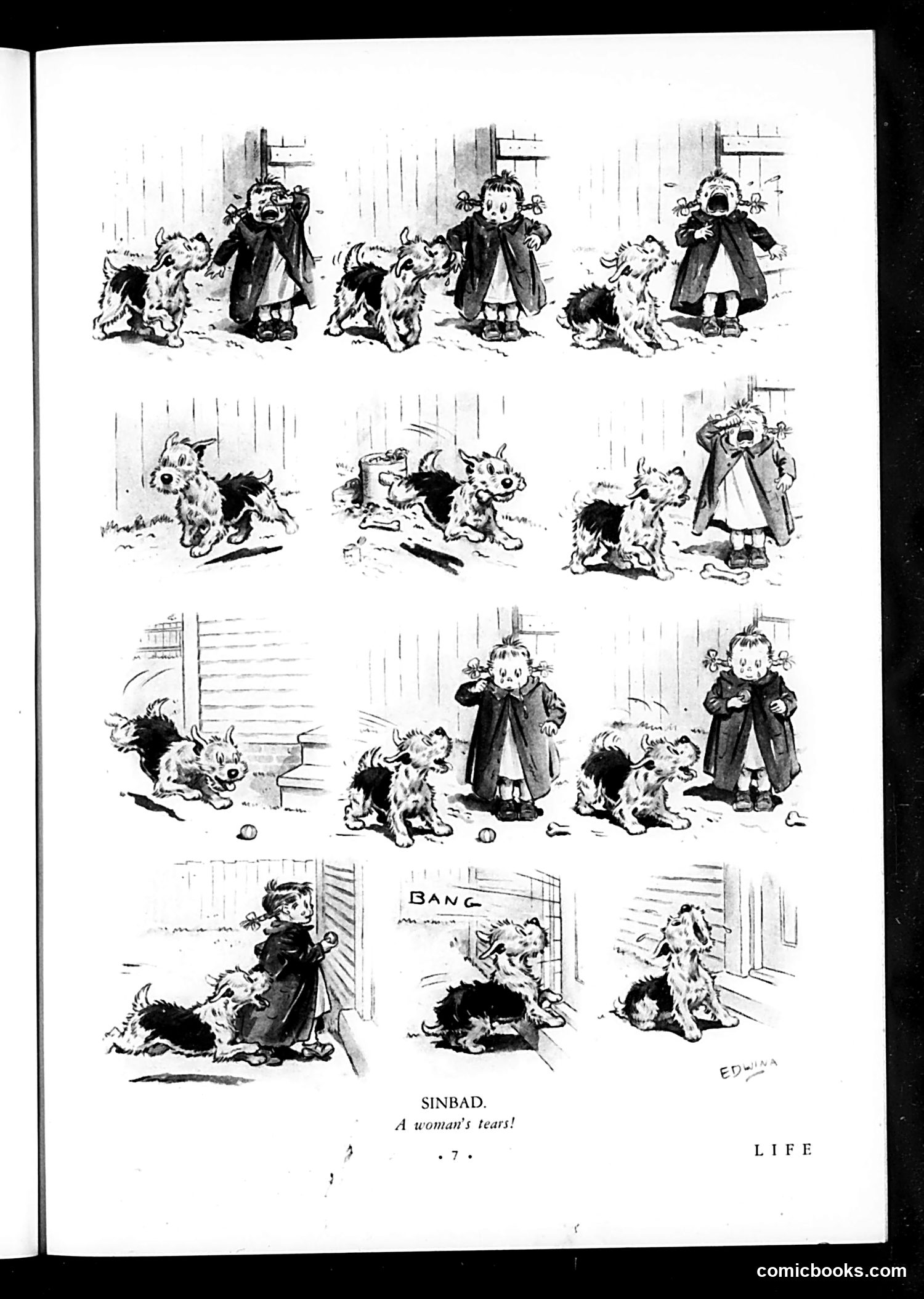
Analysis of "Sinbad: A Woman's Tears!" This comic strip appears to depict a slapstick narrative involving a man (presumably "Sinbad") and small dogs in rainy conditions. The sequence shows: 1. Top rows: The man experiencing various misfortunes with the dogs—being pulled, tripped, or knocked down 2. Bottom sequence: A door marked "BANG" suggests physical comedy culminating in collision or impact The title "A woman's tears!" suggests the rain represents a woman's emotional distress, likely sarcastically. The joke appears to be that the man's comedic suffering—repeatedly being bested by small dogs in bad weather—is somehow connected to female sadness, playing on period stereotypes about women's emotional sensitivity and the chaos it supposedly causes others. The humor relies on exaggerated physical comedy and gendered stereotyping typical of early 20th-century satire.
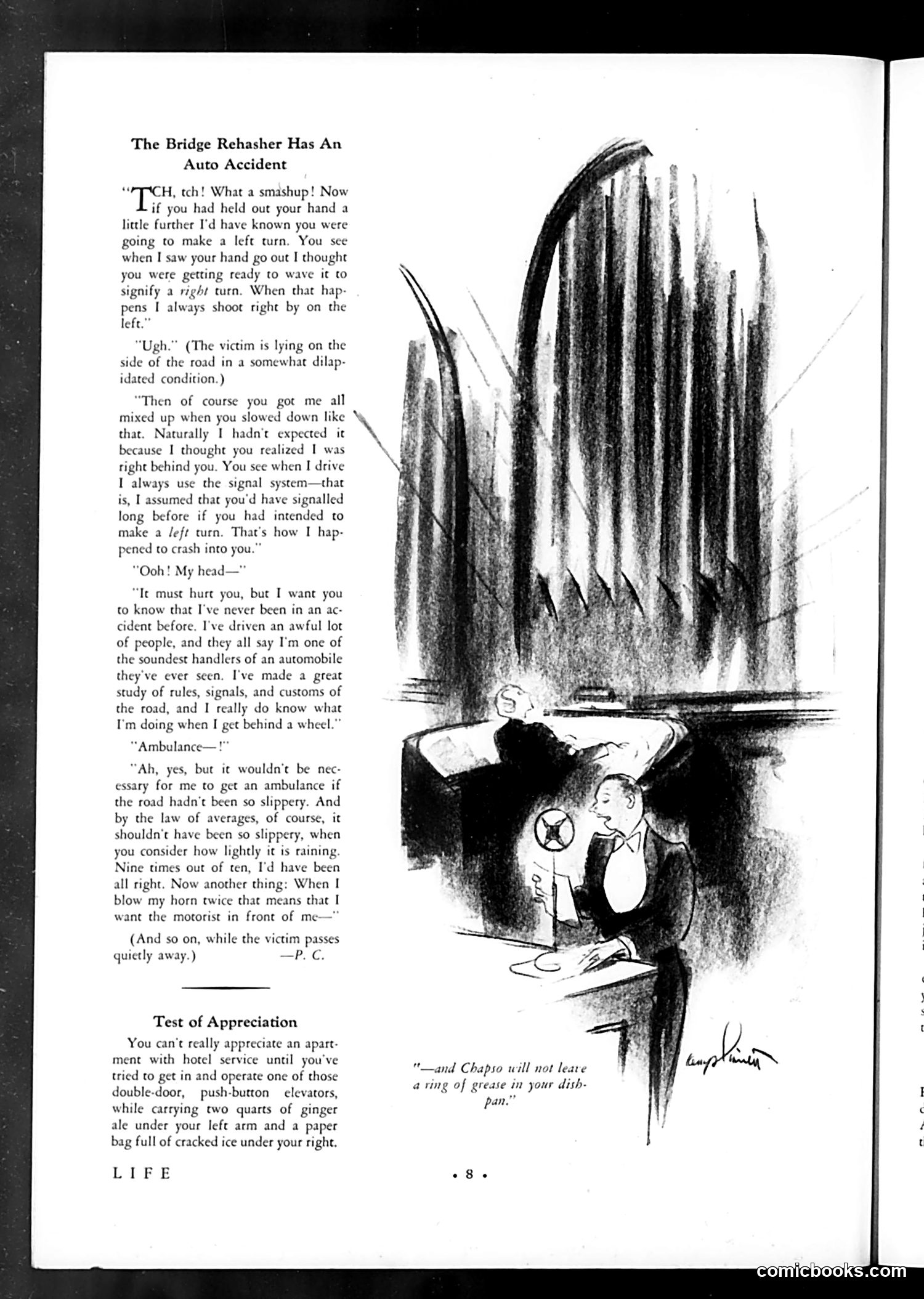
Analysis: "The Bridge Rehasher Has An Auto Accident" This satirical piece mocks a self-important driver who causes an accident while lecturing the victim about proper driving etiquette. The "bridge rehasher" (likely a reference to someone who obsessively recounts details, particularly about bridge-playing or similar social activities) blames the victim for poor hand signals, claiming nine times out of ten he'd have been "all right." The cartoon illustrates the driver's hypocrisy: he lectures extensively about road rules and signal systems while simultaneously demonstrating reckless driving. The satire targets arrogant people who pontificate about propriety while their actions contradict their words—a common target of Life magazine's humor. The second piece, "Test of Appreciation," briefly notes difficulty appreciating apartment living until operating elevators while carrying awkward items.
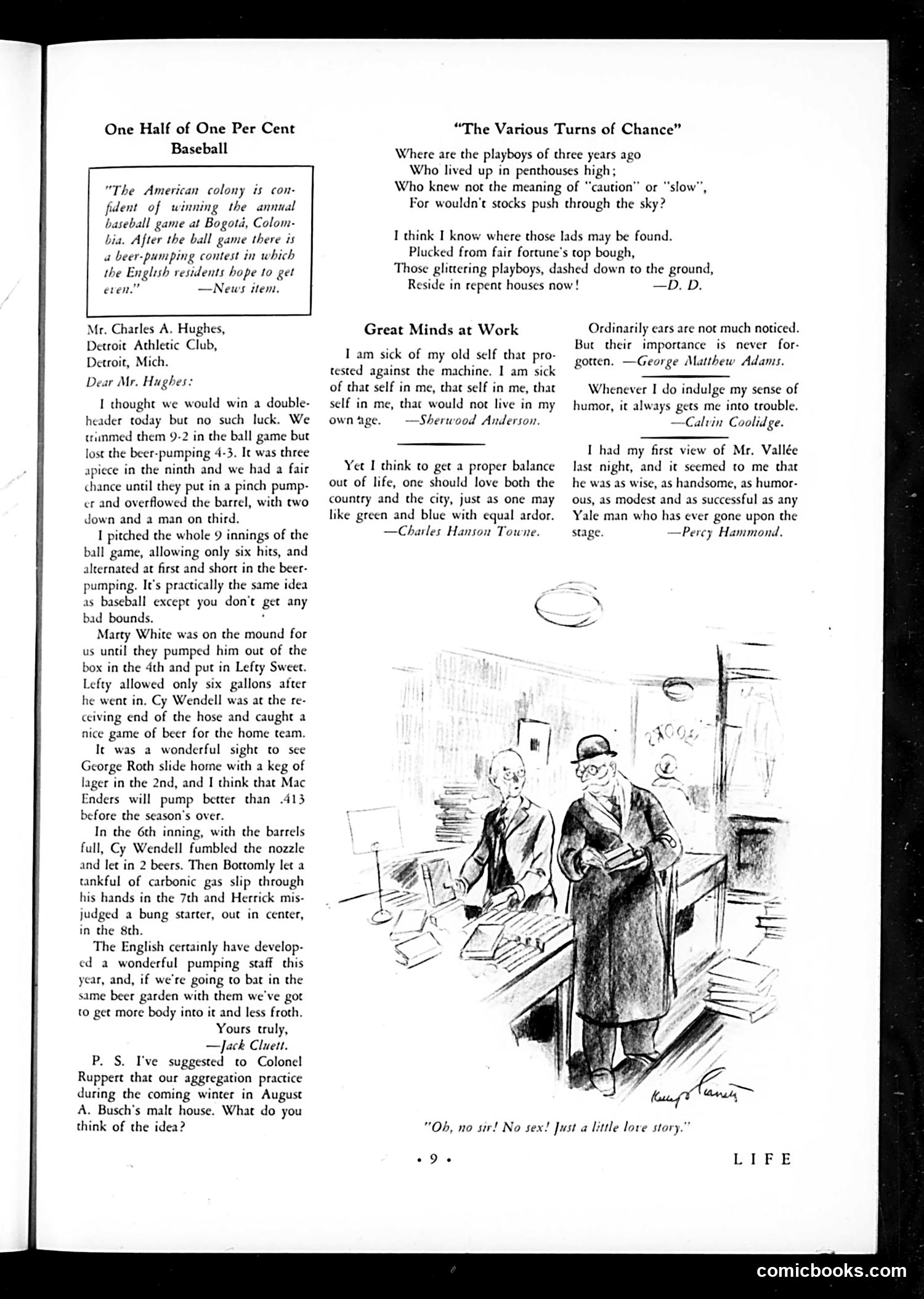
Analysis of Life Magazine Page 9 This page contains two distinct sections: "One Half of One Per Cent Baseball" (left): A letter from Jack Cluett at Detroit Athletic Club describing an unusual beer-garden baseball game where players pump beer instead of playing normally. The account details absurdist modifications—pumping barrels, allowing only six gallons per inning, fumbling nozzles—creating satirical commentary on baseball's rules and competitive nature. "The Various Turns of Chance" (right): A poem by D.D. nostalgically asking what became of playboys from three years prior who lived carefree lives, suggesting they've "dashed down to the ground" and now live in ordinary houses. "Great Minds at Work" (bottom right): A sketch showing two well-dressed men at a desk with the caption "Oh, no sir! No sex! Just a little love story." This likely satirizes editorial standards or publishing conventions of the era regarding acceptable content.
Life Magazine Page Analysis This page contains three satirical columns discussing contemporary political and social issues circa late 1920s-early 1930s. The header cartoon shows a cherub or cupid figure, introducing commentary on President Hoover's planned visit to Detroit to address the American Legion. The text notes Hoover is the leading Republican presidential candidate, while Governor Roosevelt (Franklin D. Roosevelt) is "easily the leading candidate for the Democratic nomination." The columns address marriage and divorce debates among Episcopalians in Denver, the gold standard's impact on economies (particularly post-WWI France and Britain), and Mayor Walker's European diplomatic trip. The satire targets both political uncertainty regarding the upcoming presidential election and contemporary moral/economic debates of the era.
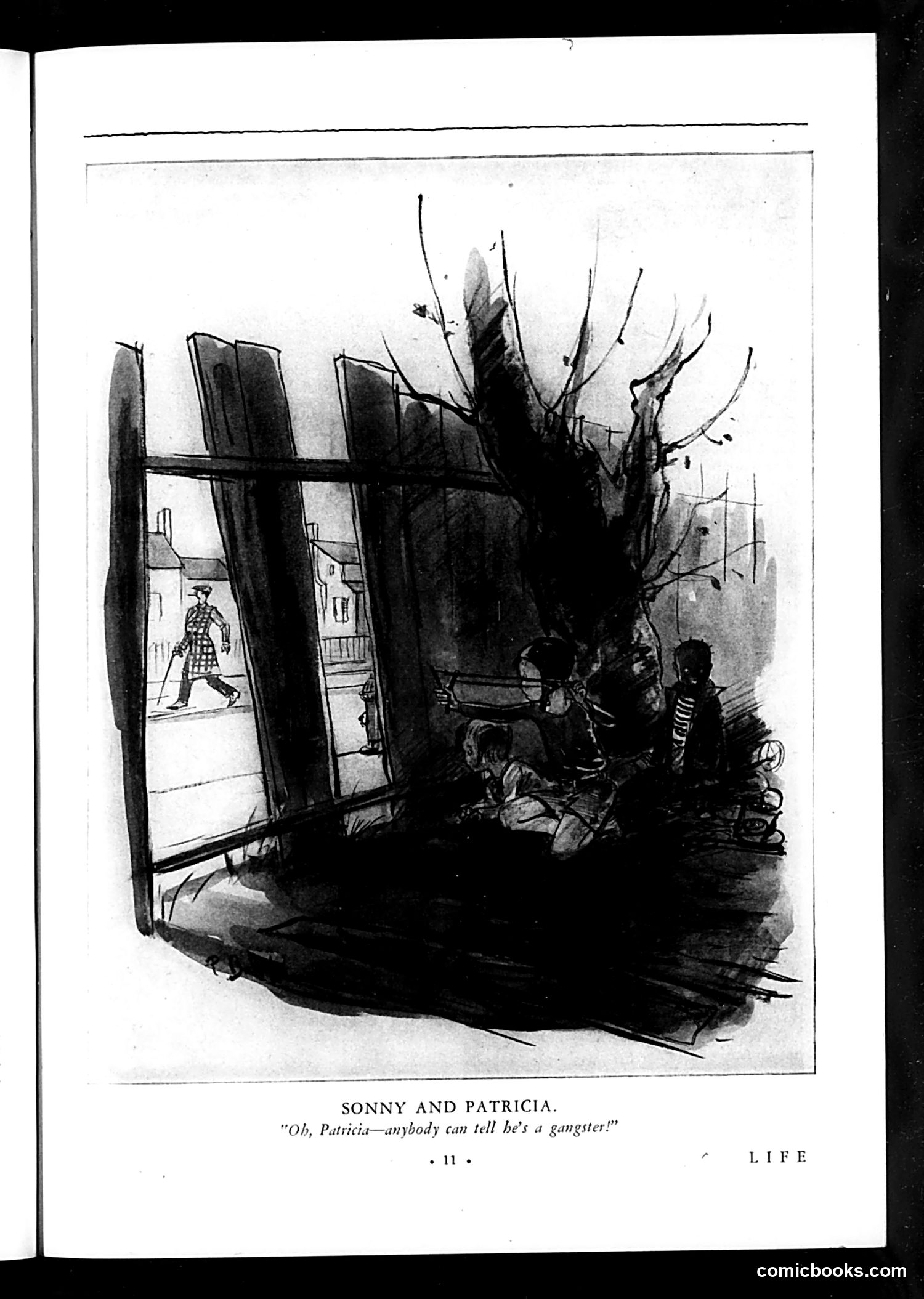
Analysis: "Sonny and Patricia" This cartoon depicts a domestic scene where characters labeled "Sonny" and "Patricia" appear to be inside a home, with figures visible through a window outside. Patricia's dialogue—"Oh, Patricia—anybody can tell he's a gangster!"—suggests she's warning about someone's criminal associations or appearance. The heavy shadows and dramatic illustration style emphasize the serious tone. The cartoon satirizes early 20th-century anxieties about crime, urban danger, and how to identify "gangsters" by appearance or reputation. The domestic interior contrasts with the external threat, reflecting period concerns about crime infiltrating respectable homes and communities. The humor relies on social stereotypes about gangster appearance and behavior that Life's readers would have recognized.
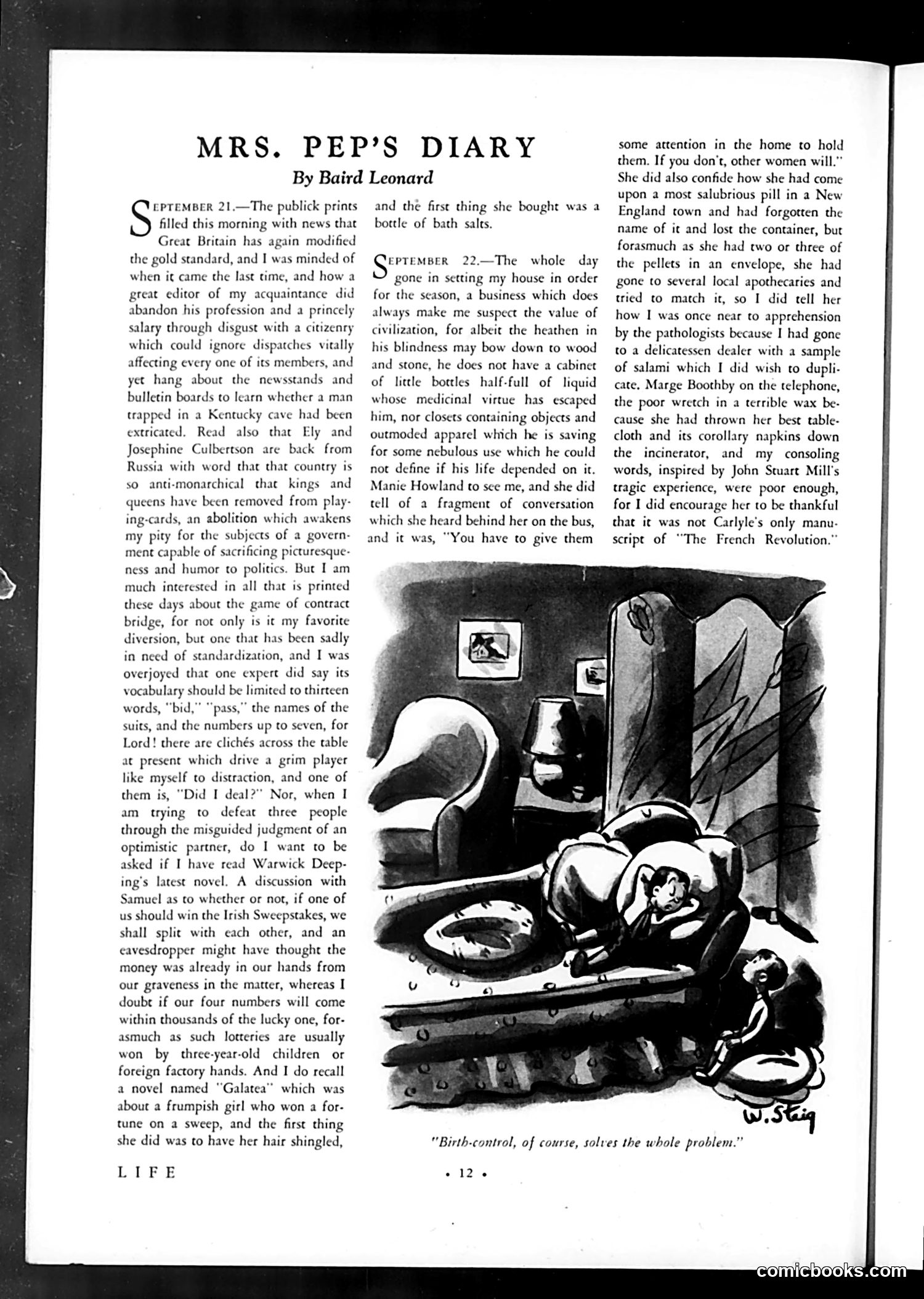
Mrs. Pep's Diary: Birth Control Satire This page from *Life* magazine contains "Mrs. Pep's Diary" by Baird Leonard, a humorous column dated September 21-22. The accompanying cartoon depicts a woman surrounded by numerous children and household items in apparent chaos. The satire addresses birth control, a controversial social issue of the early 20th century. Mrs. Pep describes acquiring bath salts and pills from apothecaries, then confides her anxieties about her large family and cluttered home. The cartoon's caption—"Birth-control, of course, solves the whole problem"—delivers ironic commentary: birth control is presented as the obvious solution to domestic overwhelm caused by multiple children. The humor targets both women's domestic struggles and society's resistance to discussing contraception openly during this period.
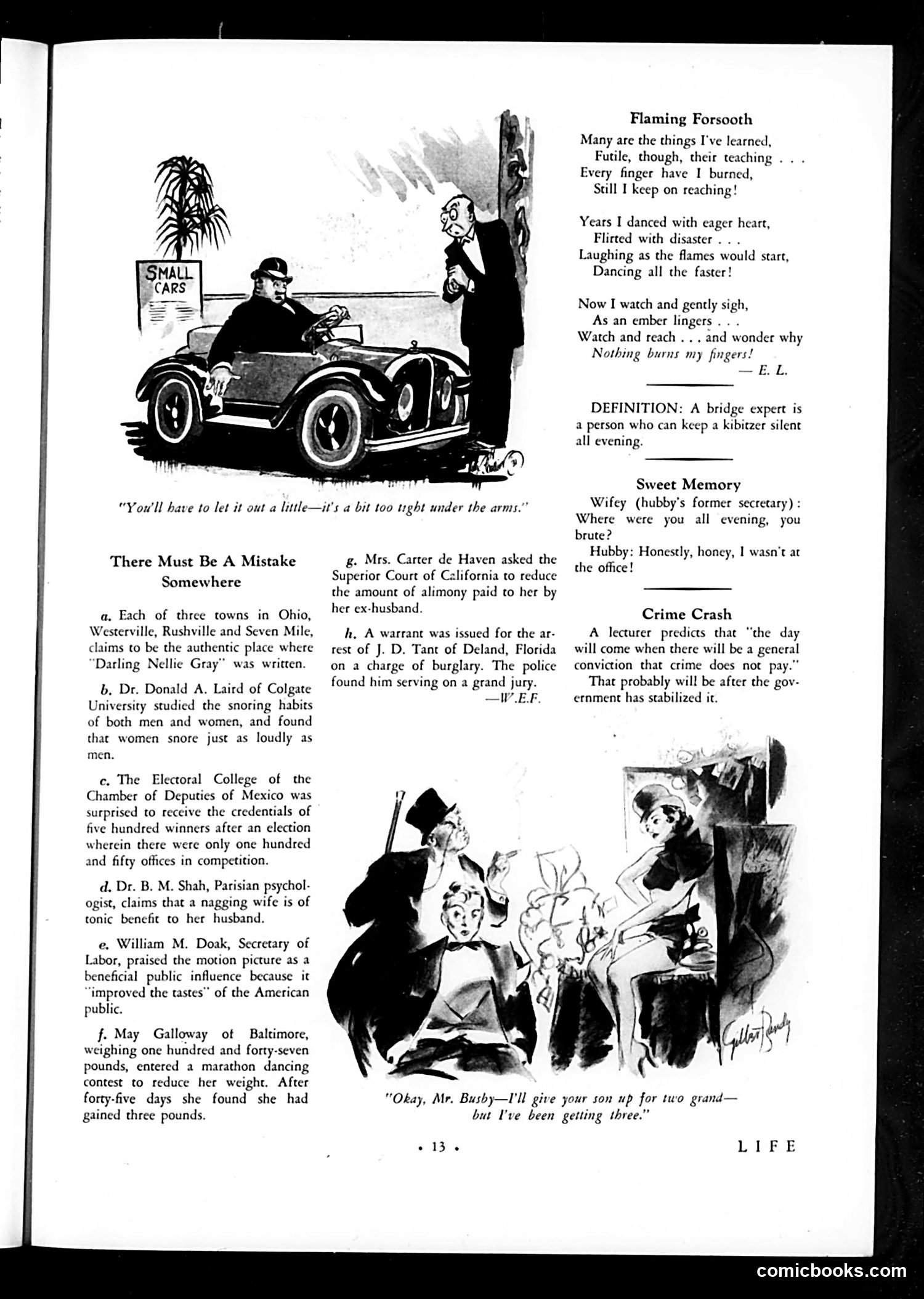
Analysis of Life Magazine Page 13 Top Cartoon: Shows a man in a small car at a dealership ("Small Cars" sign visible). A salesman is telling him the vehicle is "a bit too tight under the arm"—a joke about cramped space in compact automobiles. This reflects 1920s-30s consumer culture and the emerging market for smaller, more affordable vehicles. "Flaming Forsooth" poem by E.L. appears to be autobiographical, describing someone who once danced recklessly with flames but now watches cautiously—likely about aging and lost youthful abandon. Lower cartoons include unrelated humor about bridge experts, spousal mishaps, and crime predictions—typical satirical magazine fare mocking daily domestic life and social institutions. The page is general entertainment content rather than political commentary.
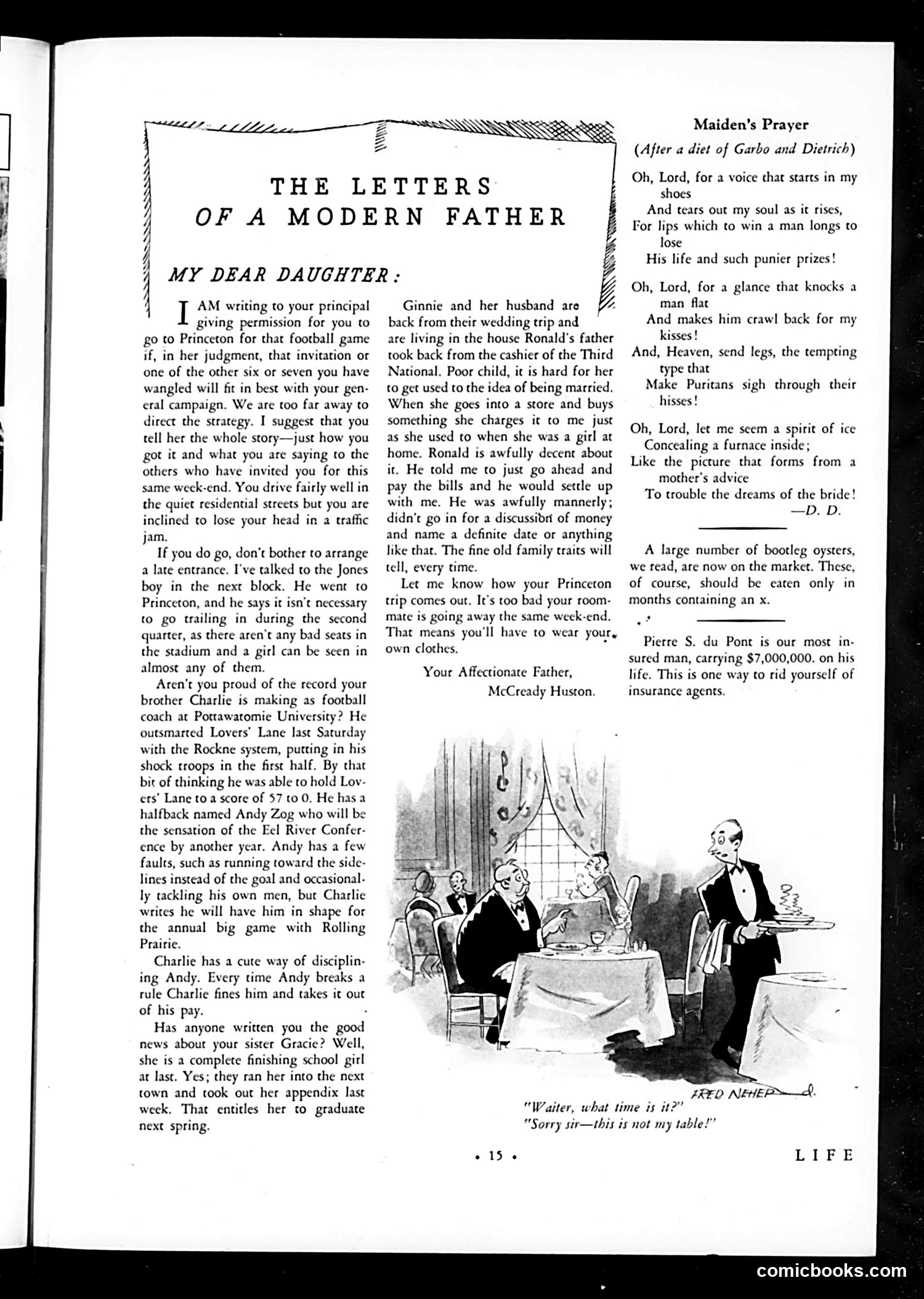
Analysis of Life Magazine Page This page contains a letter from "McCready Huston" to his daughter about family matters—her Princeton visit, her brother Charlie's football coaching success, and her sister Gracie's appendectomy. The letter discusses practical domestic concerns typical of the era. The cartoon below depicts a waiter at what appears to be a formal dinner, addressing a diner with "Waiter, what time is it?" / "Sorry sir—this is not my table!" The humor relies on the absurdist premise that a waiter has confused tables and cannot help the customer—a simple gag about service-industry incompetence. The "Maiden's Prayer" poem in the right column is satirical verse about romantic desires, attributed to "D.D." (author unclear). A brief note about bootleg oysters appears below.
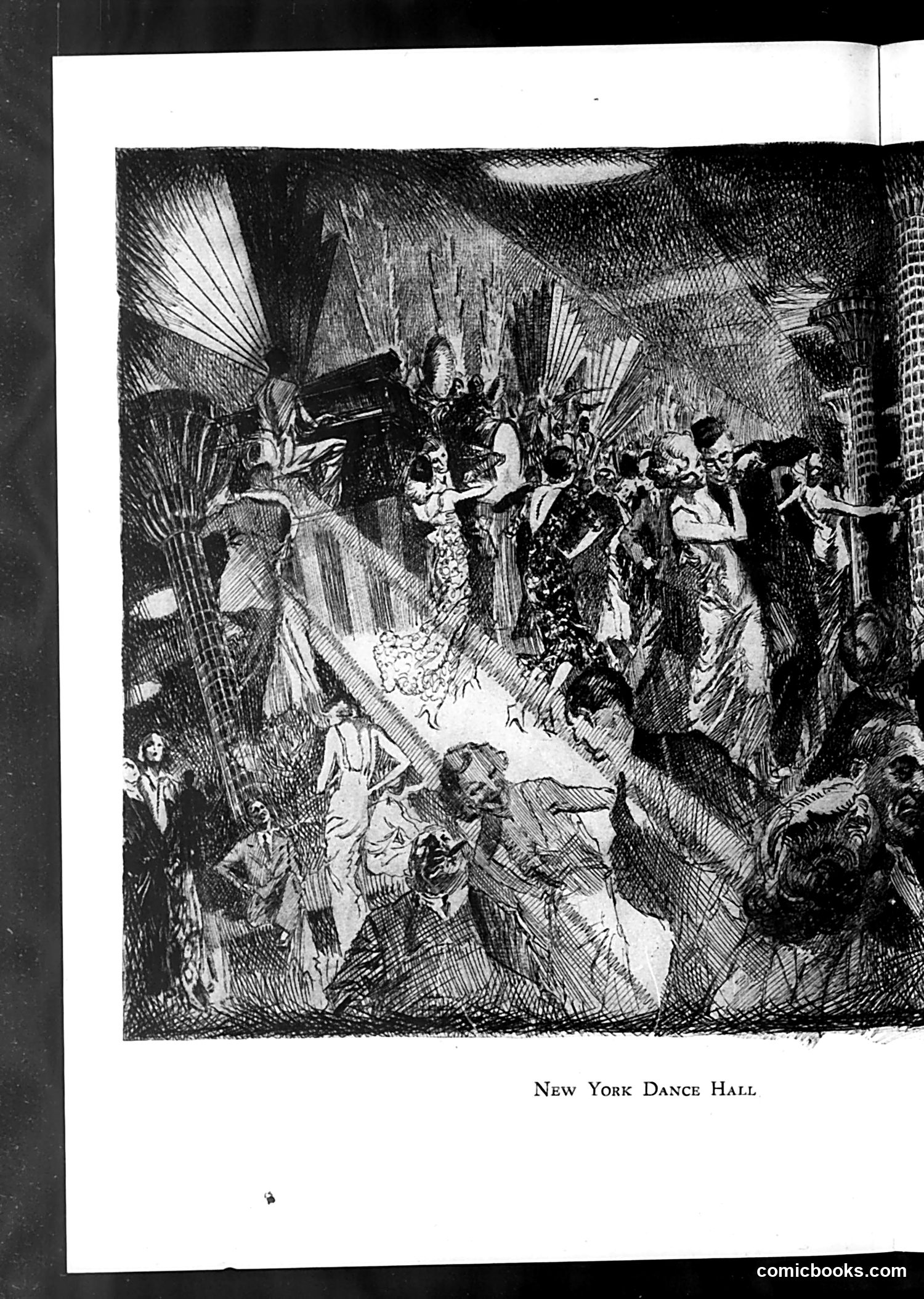
New York Dance Hall This etching depicts a lively scene at a New York dance hall, showing a crowded, energetic venue filled with musicians and dancers. The dramatic lighting and cross-hatched shading create an intense, somewhat chaotic atmosphere typical of early 20th-century urban nightlife. The satire likely targets the perceived decadence or moral concerns surrounding dance halls—which were controversial establishments of the era, often associated with working-class recreation, jazz culture, and social mixing that scandalized more conservative Americans. The exaggerated, dramatic artistic style emphasizes the scene's supposed chaos and excess, reflecting contemporary anxieties about modern urban entertainment and changing social mores.
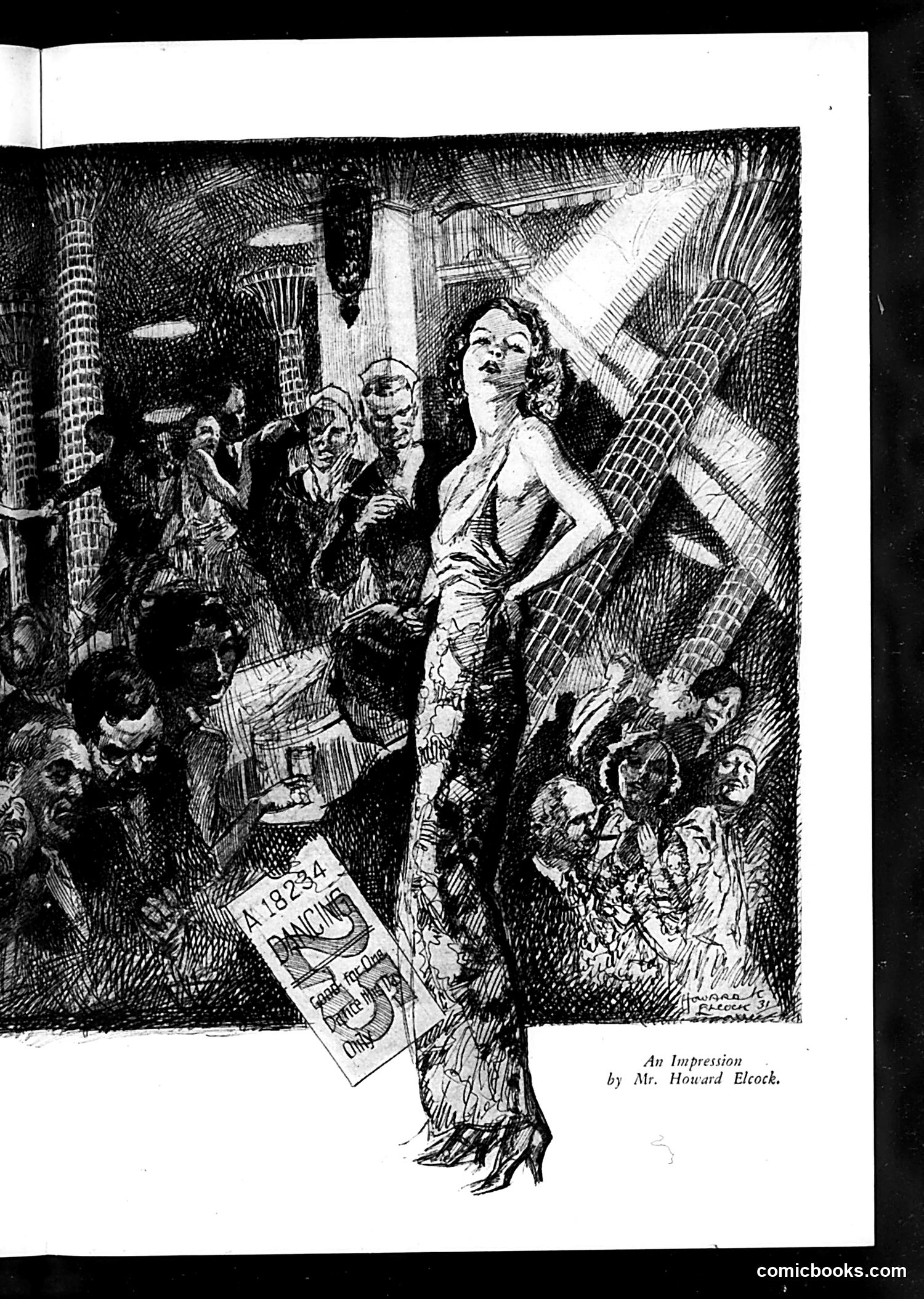
Analysis of "An Impression" by Howard Elcock This is a satirical illustration titled "An Impression" by Howard Elcock, depicting what appears to be a cabaret or nightclub scene from the 1920s-1930s era (based on the Art Deco styling and fashion). The central figure is a scantily-clad female performer on stage, surrounded by leering male patrons in formal dress. A visible sign reading "1892 BANQUET" (partially visible) appears to reference a specific event or establishment. The satire likely mocks the seediness of urban nightlife culture—contrasting the glamorous performer with the crude behavior of her audience. The crude expressions and exaggerated features emphasize the artist's critical view of such venues as centers of moral questionability. The drawing style employs heavy crosshatching to convey a gritty, sleazy atmosphere typical of social commentary from this period.
Analysis This is a movie review column by Harry Evans from Life magazine, not a political cartoon. The page contains three film reviews with no illustrations visible in the image provided. The reviews discuss: 1. "Alexander Hamilton" — praising George Arliss's performance in this biographical film 2. "This Modern Age" — critiquing a romantic comedy about an American chorus girl in England 3. "Waterloo Bridge" — reviewing Robert E. Sherwood's story adapted for film, praising Mae Clark's performance The tone is typical of entertainment criticism: evaluating acting, plot, and production quality for readers interested in cinema. There is no political satire or caricature visible on this page—it's straightforward film journalism from Hollywood's early sound era.
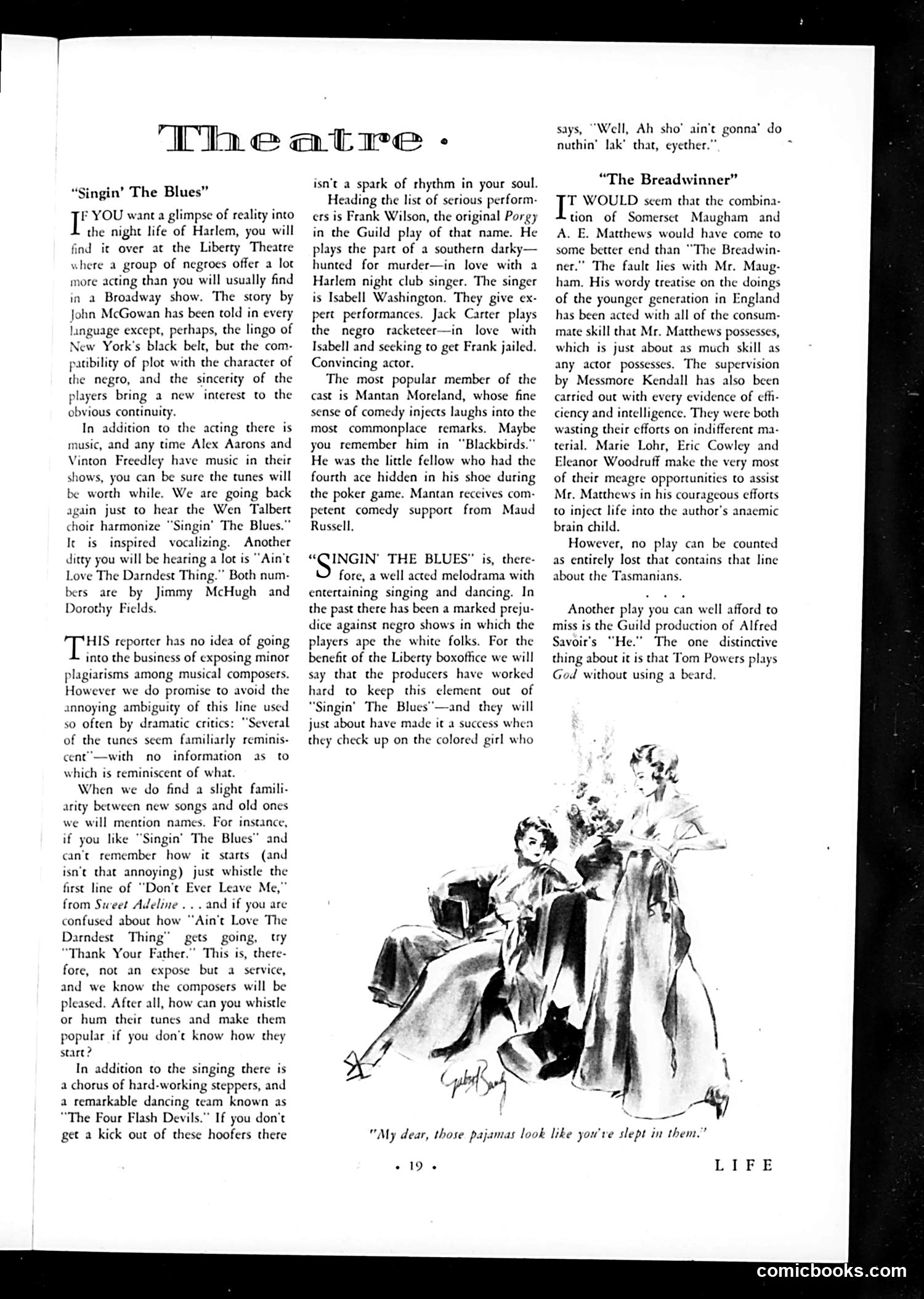
Theatre Review Page Analysis This page reviews Broadway productions, focusing on two shows: "Singin' the Blues" and "The Breadwinner." The main cartoon depicts a woman in pajamas being observed by a man, with the caption "My dear, those pajamas look like you've slept in them." The joke relies on the double meaning of "slept in"—suggesting either comfortable wear or infidelity. The text discusses the cast and quality of these productions, mentioning actors like Isabell Washington and noting that "Singin' the Blues" features singing and dancing with "The Four Flash Devils." The reviews praise the acting and staging while critiquing some material as derivative or uninspired. The cartoon's humor targets 1920s social norms around women's appearance and domestic propriety—a common satirical subject in period publications.
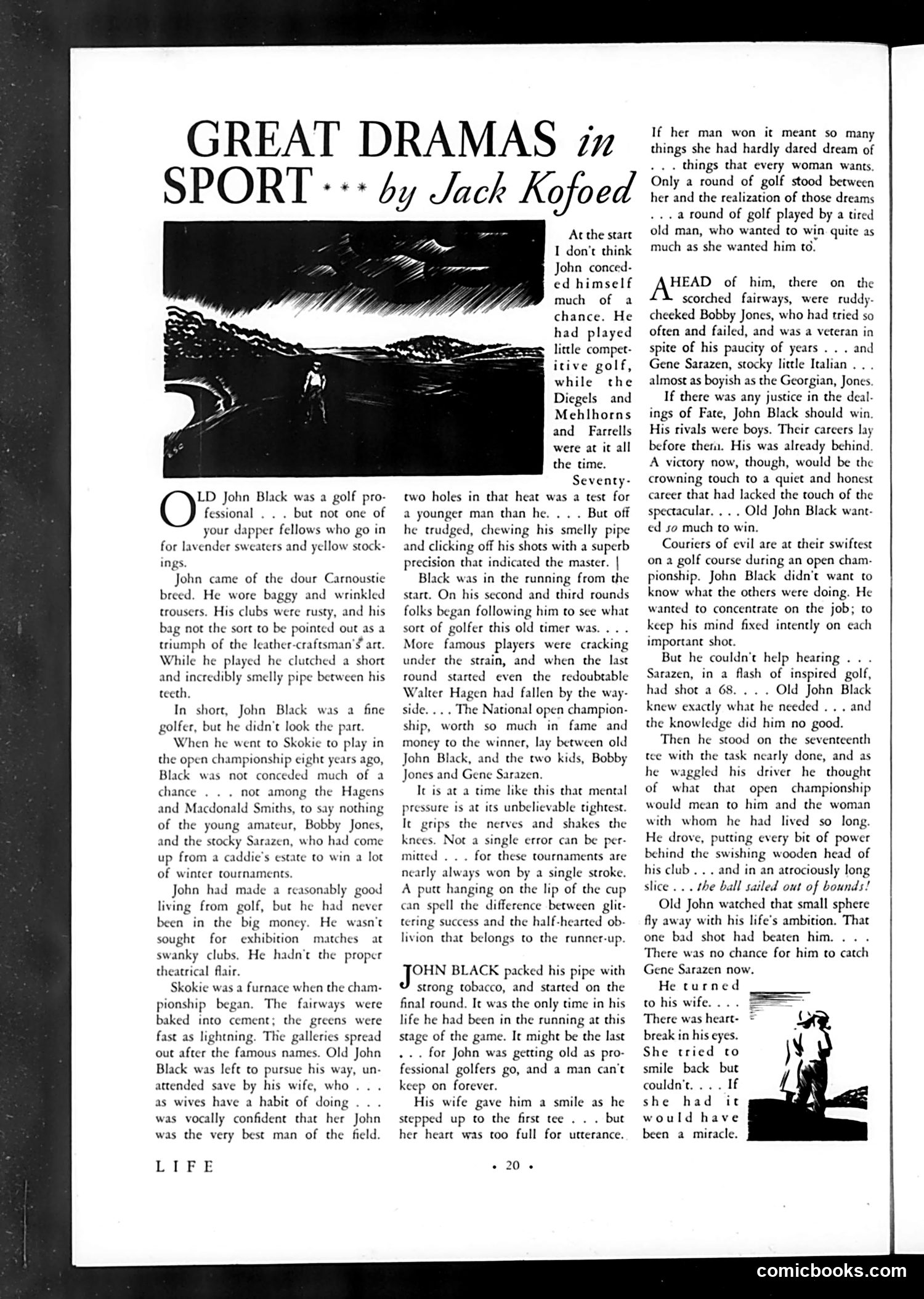
"Old John Black" — A Golf Story from Life Magazine This is a serialized fiction story by Jack Kofoed, not a political cartoon. It depicts an underdog narrative in professional golf circa the 1920s. The Story: Old John Black, an unfashionable golf professional from Scotland (Carnoustie), competes in the National Open Championship at Skokie despite being overlooked and underestimated. He faces famous rivals including Walter Hagen and young amateurs Bobby Jones and Gene Sarazen. Black is described as a fine golfer who lacks the "theatrical flair" and swanky appearance of competitors—he wears wrinkled clothes and smokes a smelly pipe. The Appeal: The narrative celebrates the dignity of an aging working-class professional against glamorous, celebrated rivals. His devoted wife believes in him when galleries ignore him. The tension builds around whether this overlooked man can win before age forces retirement from the sport. This reflects 1920s sentimental interest in golf as both sport and character test.
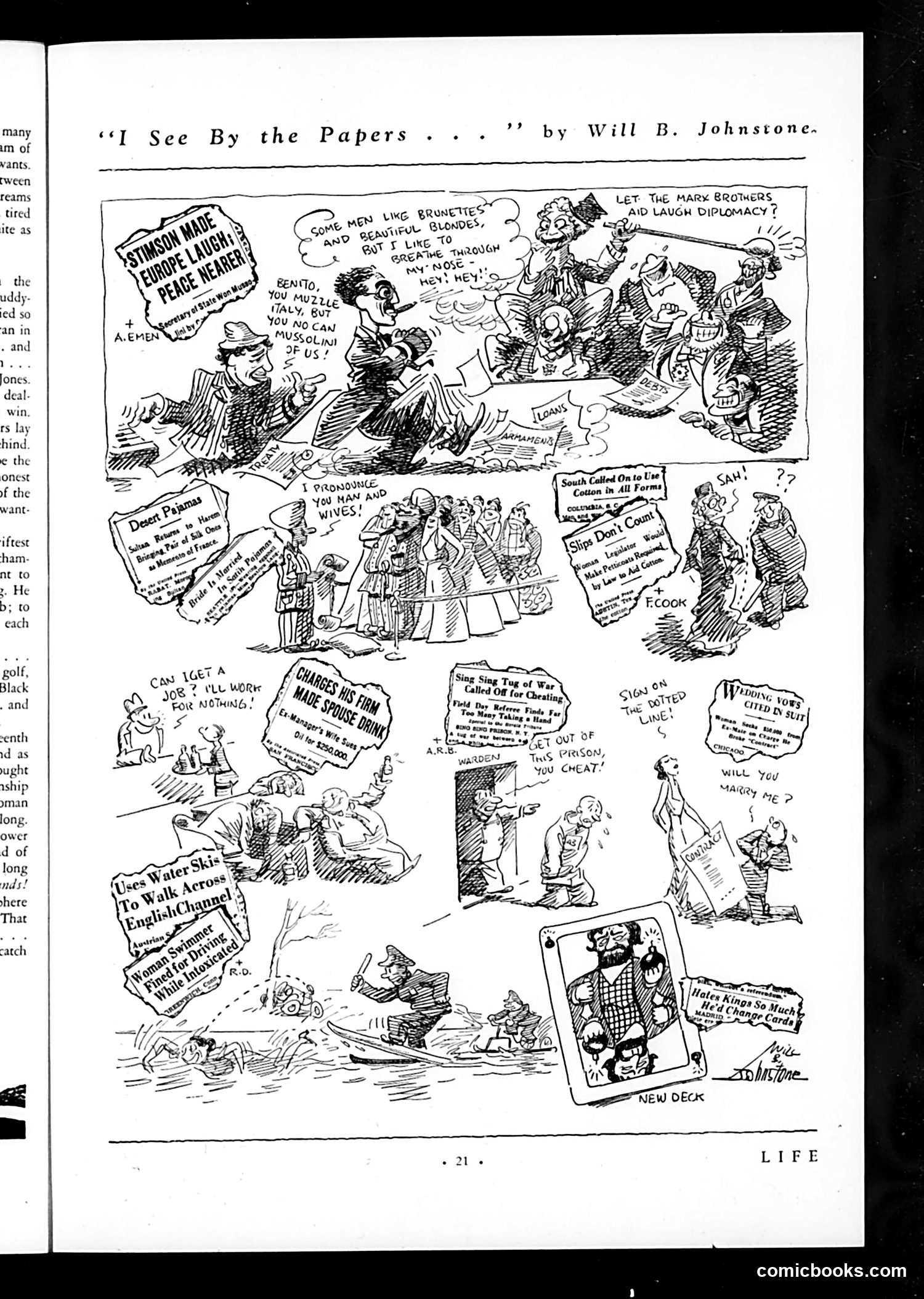
"I See By the Papers" by Will B. Johnstone This satirical cartoon collection comments on contemporary news through interconnected vignettes. The top panel references Mussolini and Italian fascism, with a character breaking through ("beautiful blondes"). Other panels mock: - The Marx Brothers (comedy troupe) and diplomacy - Cotton production and agricultural issues - Prison escapes and crime - Marriage proposals - Water/canal engineering projects - A playing card labeled "New Deck" (unclear reference) The cartoon's title—"I See By the Papers"—signals this is satirizing newspaper headlines and public discourse. Johnstone uses absurdist humor and exaggeration to deflate serious political and social topics of the era, making fun of everything from fascism to romantic entanglements. The style is typical of 1920s-30s American satirical comics.
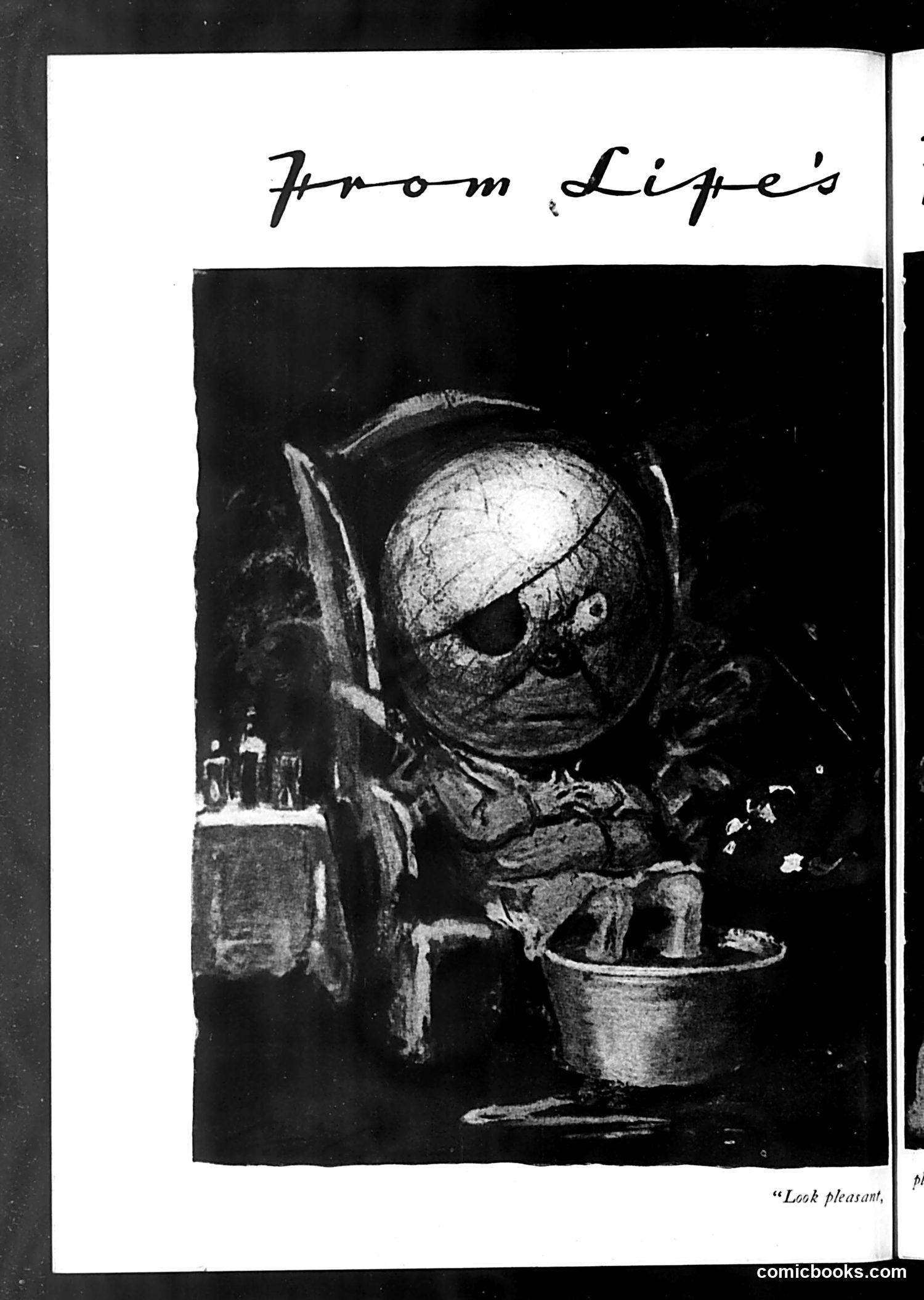
Analysis This page is titled "From Life's" and features a single black-and-white photograph or illustration. The image shows what appears to be a grotesque head or skull with a large bandaged forehead, positioned above a cooking pot containing various objects. A figure (partially visible on the left) appears to be directing or posing the head. The caption reads "Look pleasant," suggesting this is satirical commentary on forced cheerfulness or artificial presentation. Without additional context from the magazine issue, the specific target of this satire is unclear—it could reference political figures, social pretension, or medical/scientific quackery of the period. The grotesque imagery and sardonic caption suggest Life's typical approach: mocking hypocrisy or absurdity through dark humor. The technical quality and composition suggest this may be a staged photograph rather than a drawing.
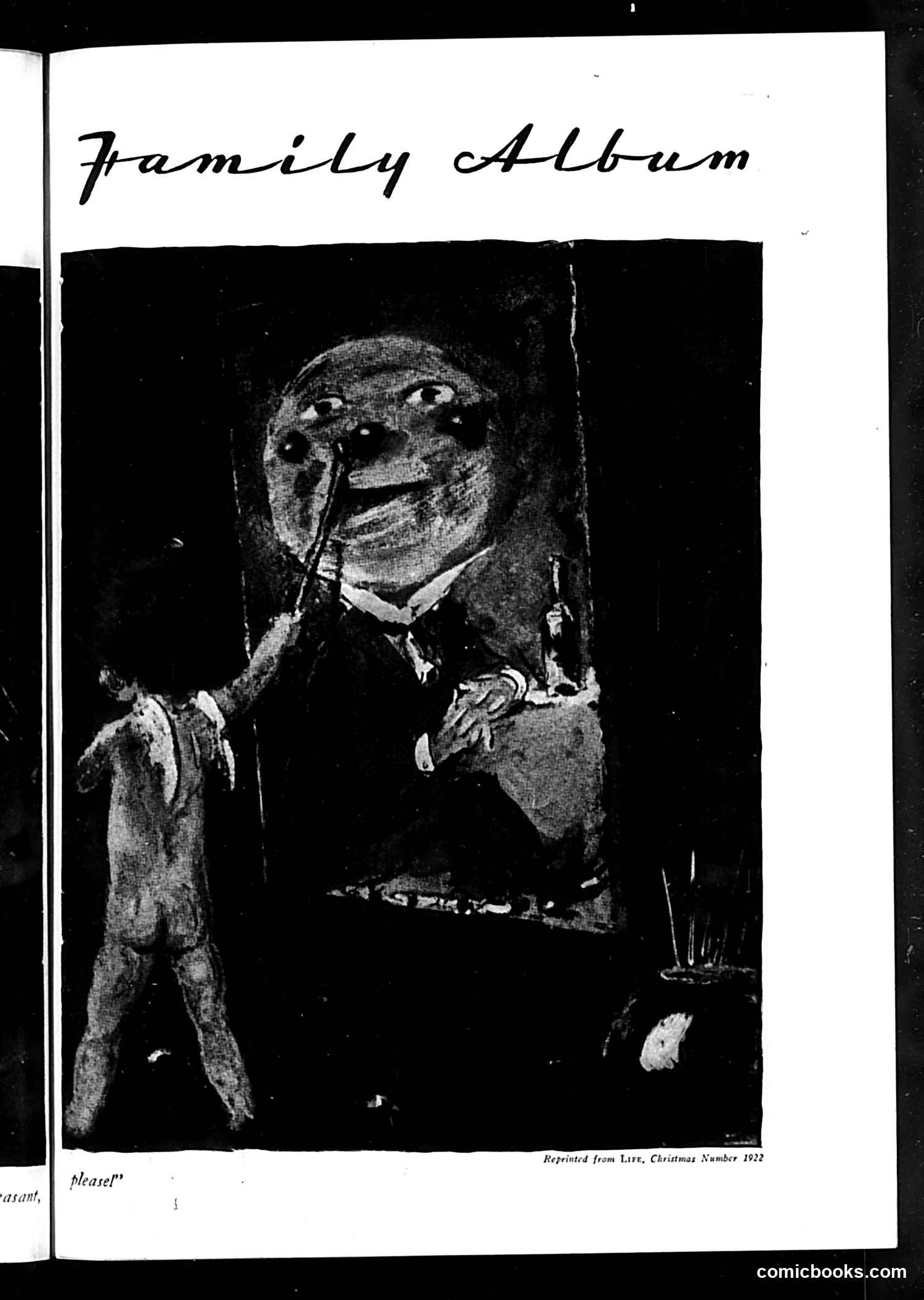
Family Album Page Analysis This page from Life magazine's Christmas 1922 issue shows a grotesque caricatured figure in formal dress holding what appears to be a pipe or similar object. The figure has exaggerated facial features typical of early-20th-century satirical art. The caption fragment "please?" and the word "Family Album" suggest this is part of a satirical series featuring recognizable public figures of the era presented in humorous or unflattering ways. However, without additional context or clearer identifying text, I cannot definitively identify which specific political or social figure is being caricatured here. The grotesque style was common in Life's satirical humor of the period, typically targeting politicians, celebrities, or prominent personalities of the day.
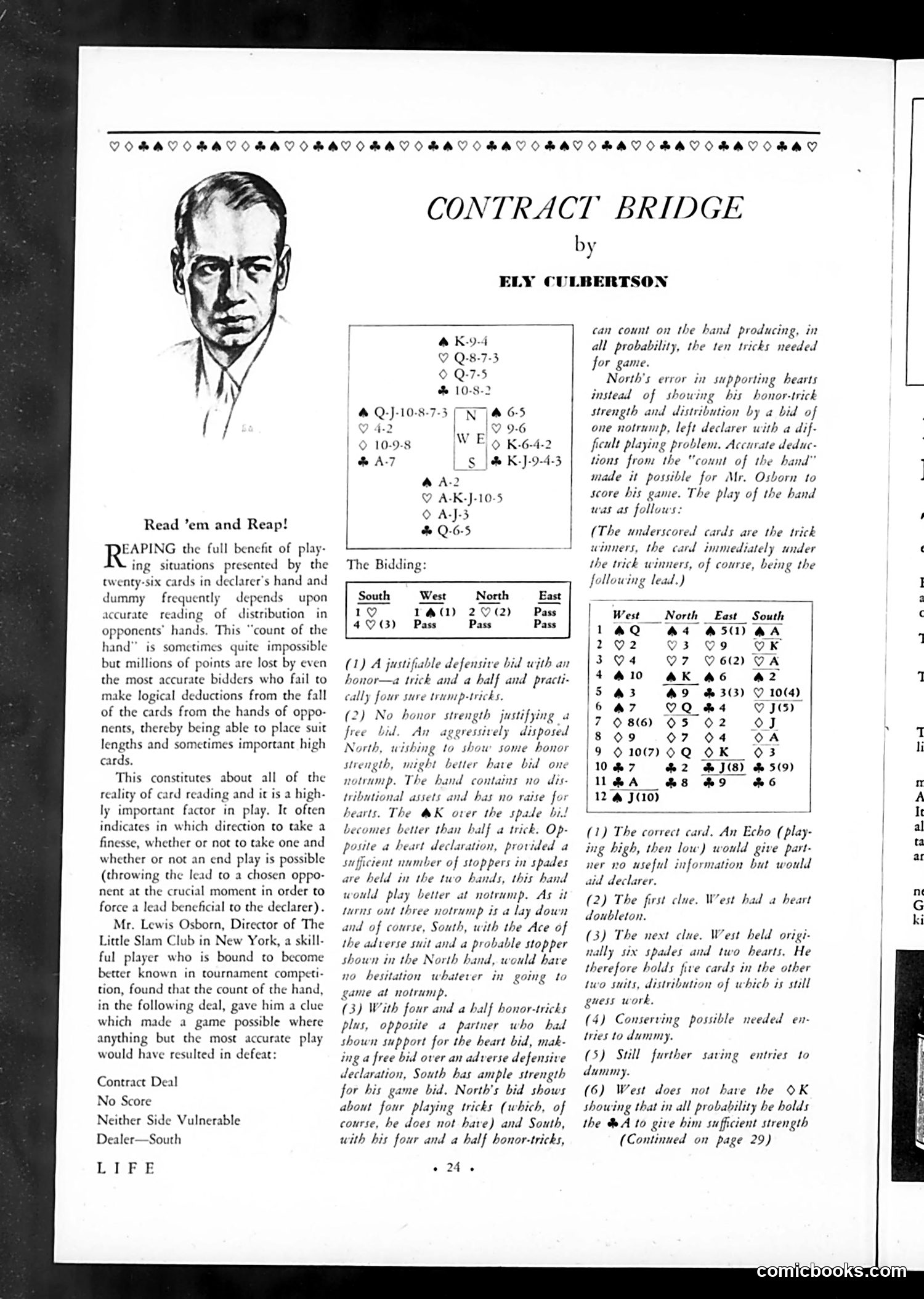
Contract Bridge Instruction, Not Satire This page is not satirical content but rather instructional material about contract bridge, the card game. It features a bridge lesson by Ely Culbertson, a renowned bridge authority of the early-to-mid 20th century. The portrait shows Culbertson himself. The page demonstrates a specific bridge deal, explaining how accurate "counting" of cards in opponents' hands enables skilled play. The example shows how Lewis Osborn, director of The Little Slam Club in New York, used deductive reasoning about card distribution to successfully play a difficult contract. This is educational content teaching readers strategy and logical thinking in bridge—a game that required genuine analytical skill and was popular among educated audiences of the era. The "Read 'em and Reap!" headline is a pun suggesting readers will profit from learning these techniques.
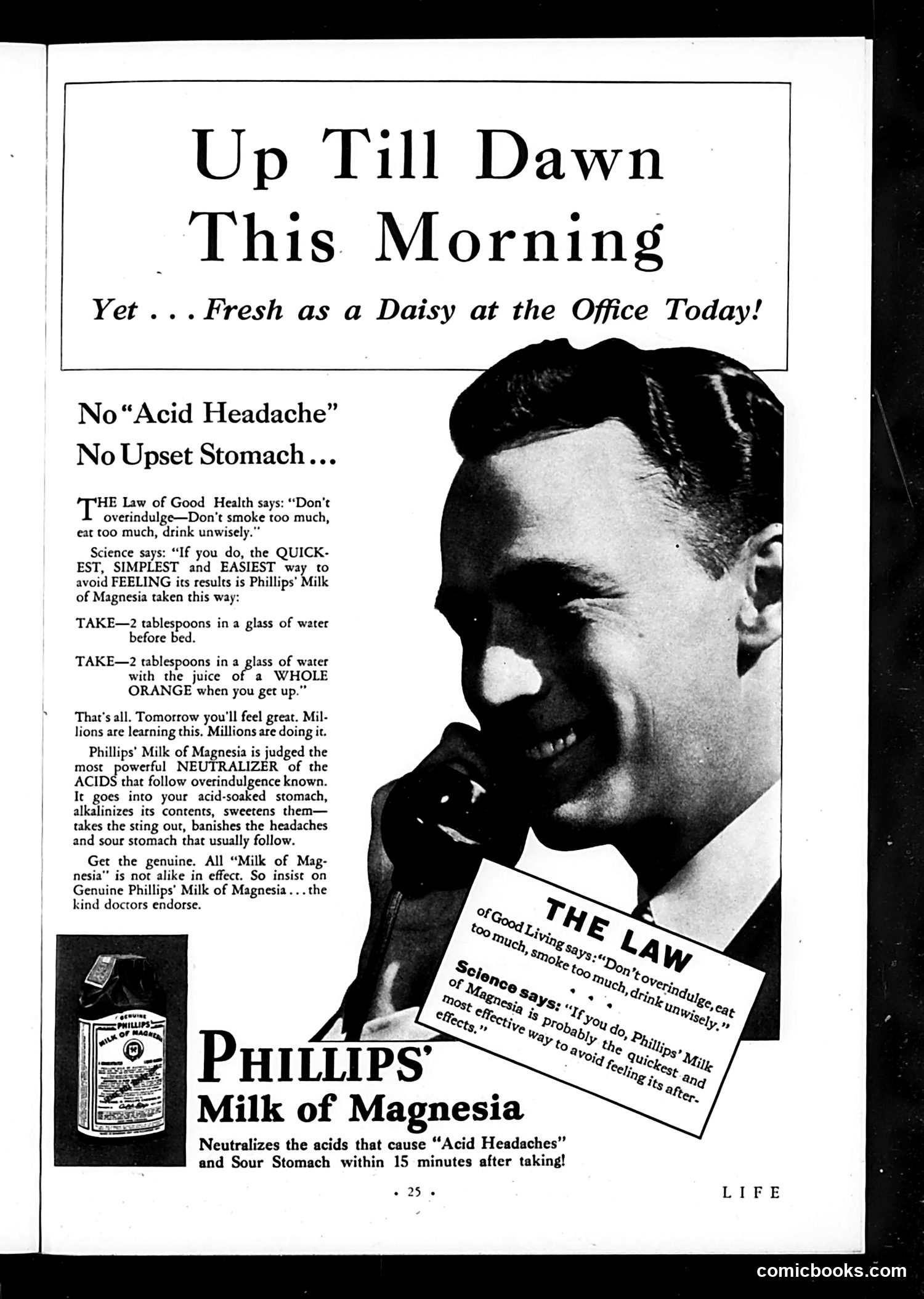
Analysis This is a vintage advertisement, not satire or political commentary. It promotes Phillips' Milk of Magnesia as a hangover cure for people who stayed out late drinking and carousing. The ad targets white-collar workers (the man appears to be a businessman) promising they can party all night and still arrive "fresh as a daisy" at the office the next morning. The humor is gentle and aspirational rather than satirical—the implied joke is that staying up late causes "acid headaches" and stomach upset, which this antacid will cure. The "Law of Good Health" framing (don't overindulge, smoke, or drink unwisely) is ironic: the ad actually enables overindulgence by suggesting consequences can be erased chemically. This reflects 1920s-30s consumer culture, where modern products promised to solve lifestyle problems, and the optimistic notion that chemistry could remedy excess without behavioral change.
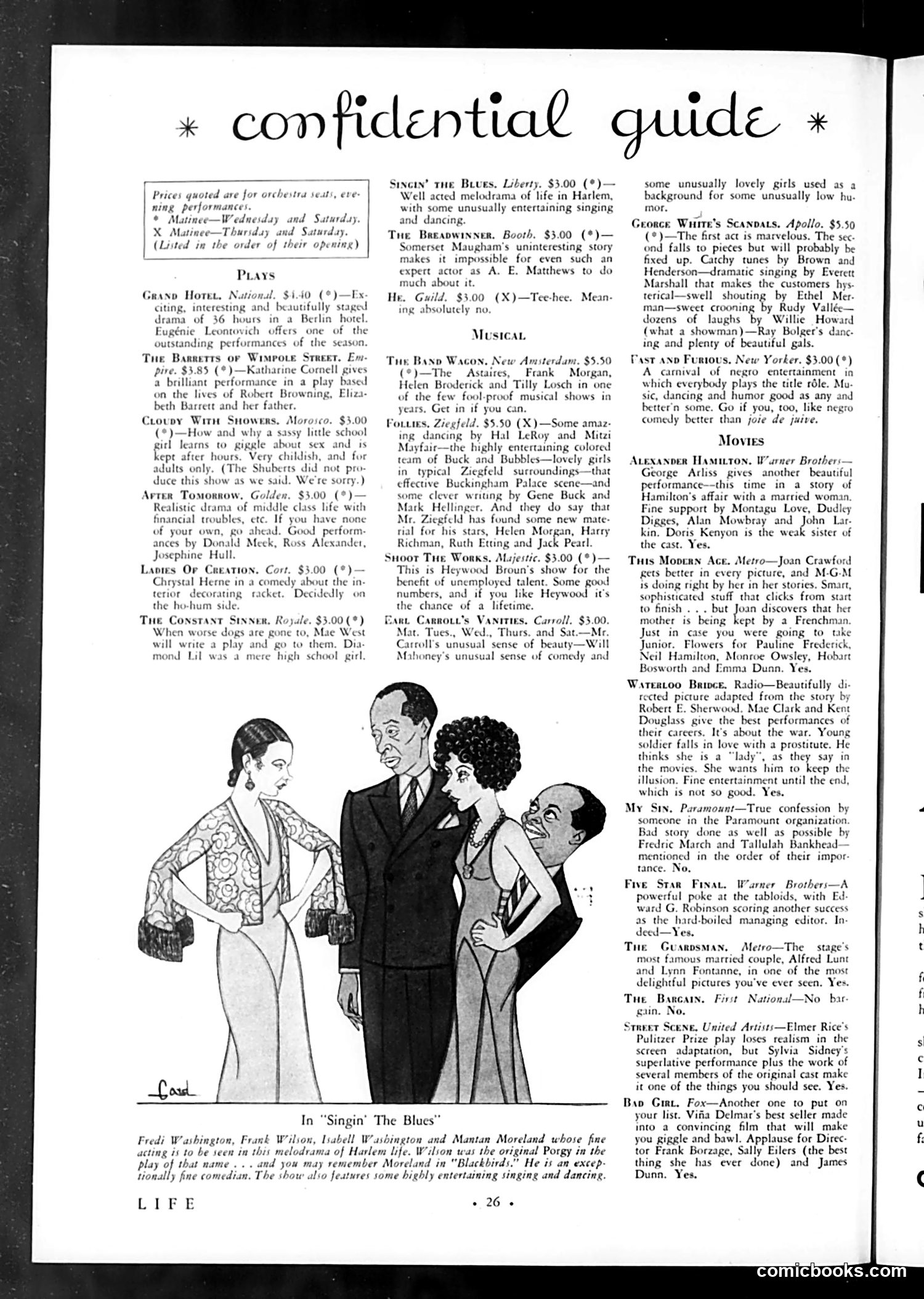
Understanding This Life Magazine Theater Guide This page is a "Confidential Guide" to Broadway shows from the 1930s, reviewing plays and musicals with brief critiques and ticket prices. The illustration depicts a scene from "Singin' the Blues" at the Liberty Theatre, showing four well-dressed Black performers in an urban setting. The reviews use period-appropriate language reflecting 1930s entertainment criticism. Notable: several shows feature Black performers ("Singin' the Blues," "George White's Scandals," "Fast and Furious"), which was relatively significant for Broadway at that era, though the guide's language and framing reflect the casual racial attitudes of the time. The reviews themselves are straightforward theater criticism—praising performances, commenting on plots, and offering recommendations. The "(*)" symbols indicate special matinee performances. This represents mainstream entertainment journalism from the Depression era, showing which shows were considered worthwhile Broadway attractions.
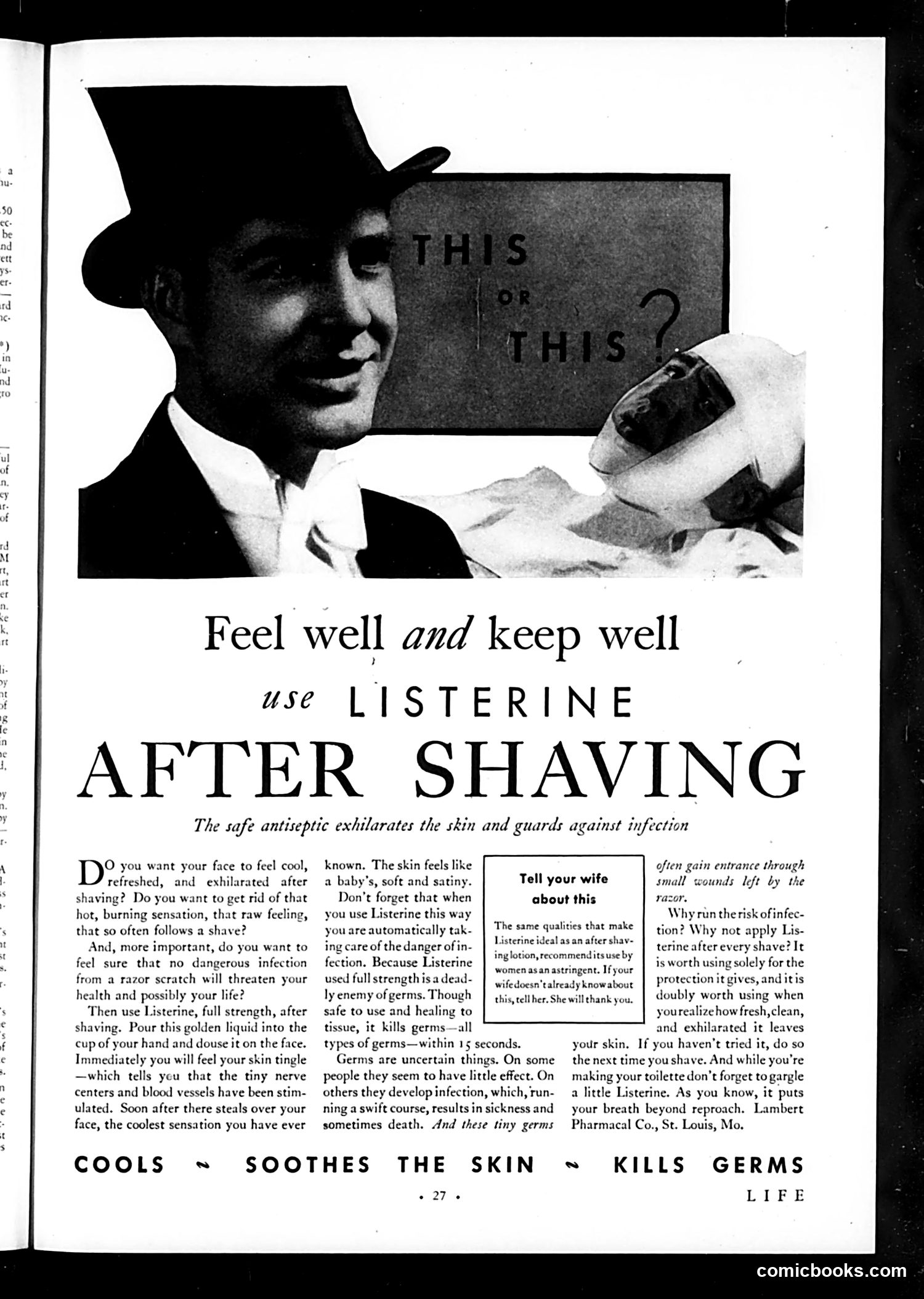
Listerine After-Shaving Advertisement This is a Listerine advertisement, not political satire. It promotes the antiseptic mouthwash/aftershave product by addressing post-shaving discomfort. The ad features a well-dressed man in a top hat presenting a choice ("THIS or THIS?") between two razor blades—likely contrasting a poor shave versus the results promised when using Listerine. The sales pitch emphasizes that Listerine provides cooling relief, kills germs that could cause infection from razor cuts, and leaves skin feeling "soft and satiny." A secondary pitch targets wives, suggesting they use it as an astringent for skincare. By modern standards, the ad's dramatic language about infection and death from shaving nicks seems overwrought. The appeal to tell one's wife reflects early-20th-century gender dynamics where men controlled household product knowledge. The product claims would face FDA scrutiny today.
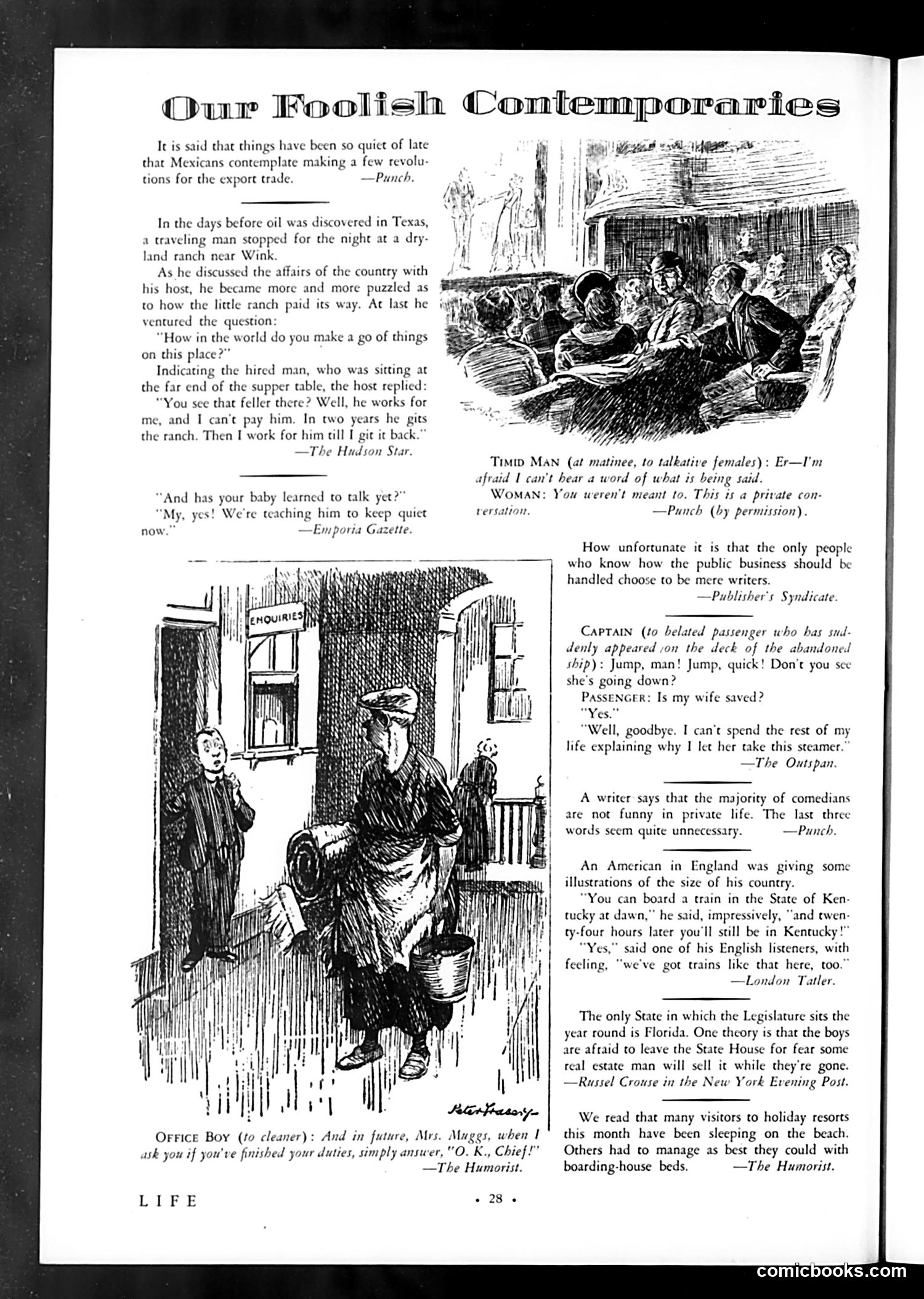
"Our Foolish Contemporaries" – Life Magazine Satire Page This page collects brief humorous anecdotes and jokes satirizing contemporary society and human folly. Key items include: Texas Ranch Story: Mocks rural poverty and creative debt arrangements—a ranch owner can't pay his hired man, so agrees to give him the ranch in two years, then work for him to reclaim it. Sharp commentary on agricultural economics. The Office Boy Cartoon: Shows a cleaner and office boy; the joke plays on workplace hierarchy and the boy's future use of military-style responses ("O.K., Chief!"). Various One-Liners: Mock talkers in movie theaters, the irony that writers criticize public affairs despite having no power to change them, a husband valuing escape over his wife's safety, and British complacency about train travel. The Cartoon (top right): Depicts a crowded indoor scene, likely a theater or social gathering, illustrating one of the accompanying anecdotes about conversation. The page's overall theme: satirizing contemporary American and British social pretensions, inefficiency, and human absurdity through witty, biting observations from various contemporary newspapers and magazines.
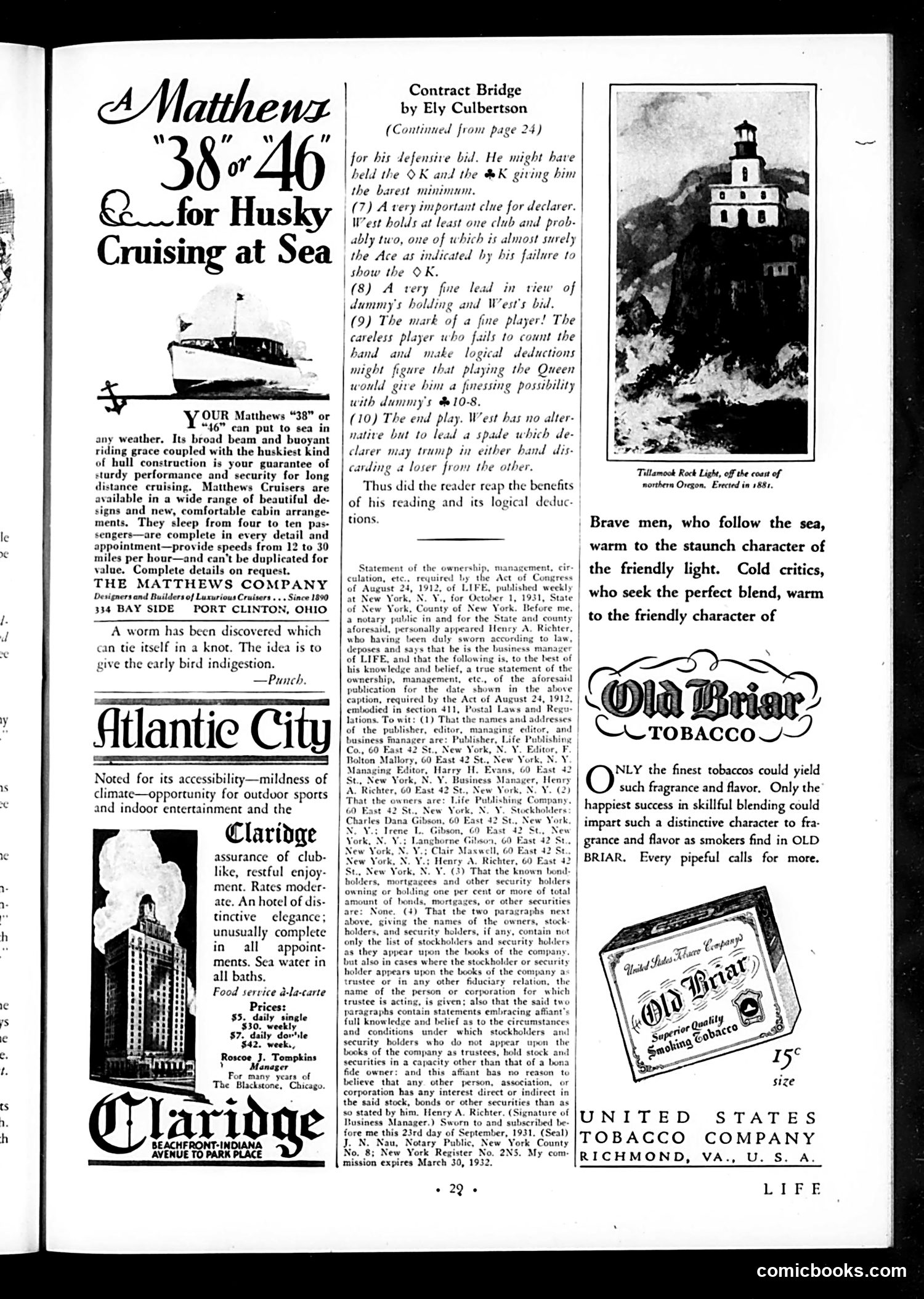
Analysis of Life Magazine Page Content This page is primarily advertising and business notices, not political satire or comics requiring historical context. The visible content includes: - Matthews boat advertisement: Promoting luxury cruising vessels ("38" or "46") for ocean travel—standard transportation advertising from the 1930s era. - Atlantic City hotel advertisement: The Claridge hotel promoting beachfront accommodations and amenities—typical tourism marketing. - Old Briar tobacco ad: Marketing cigarettes with nostalgic branding ("friendly light," "friendly character")—common pre-warning-label tobacco advertising. - Contract Bridge column by Ely Culbertson: Educational content about card game strategy. - Small humor item (attributed to Punch): A wordplay joke about a worm tying itself in knots to give "the early bird indigestion." The page also contains legal ownership/circulation statements required by postal regulations. There are no identifiable political cartoons, caricatures, or satirical commentary requiring historical unpacking. This appears to be a standard interior magazine page mixing advertising with instructional and light entertainment content.
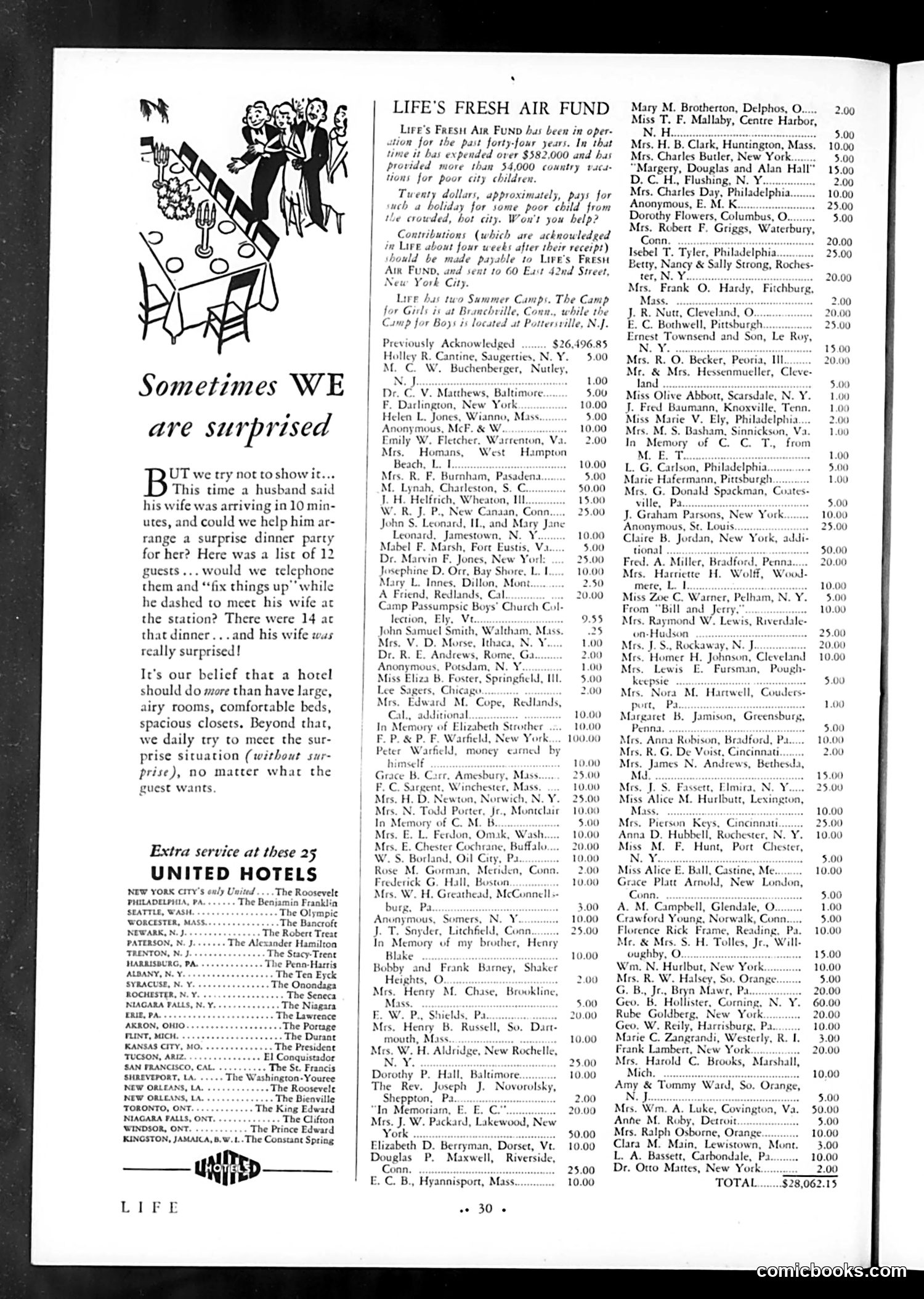
Analysis This page is primarily advertising and charitable fundraising, not political satire. The cartoon at top left illustrates a hotel's service pitch: a husband arranges a surprise dinner party for his arriving wife through hotel staff coordination—"14 at that dinner...and his wife was really surprised!" The message: quality hotels provide exceptional, personalized service beyond basic amenities. The bulk of the page promotes the Life's Fresh Air Fund, a 44-year-old charitable program providing country vacations to poor city children. It had spent over $582,000 serving 54,000 children, with donations of $20 funding one child's holiday. The page lists two summer camps (girls' in Connecticut, boys' in New Jersey) and publishes contributor names and amounts—a standard fundraising technique showing accountability and encouraging giving through recognition. The "Extra service" section advertises 25 United Hotels across North America as reliable, service-minded establishments. This is essentially a charitable appeal wrapped in advertising, typical of Life magazine's mixed editorial-commercial content in this era.
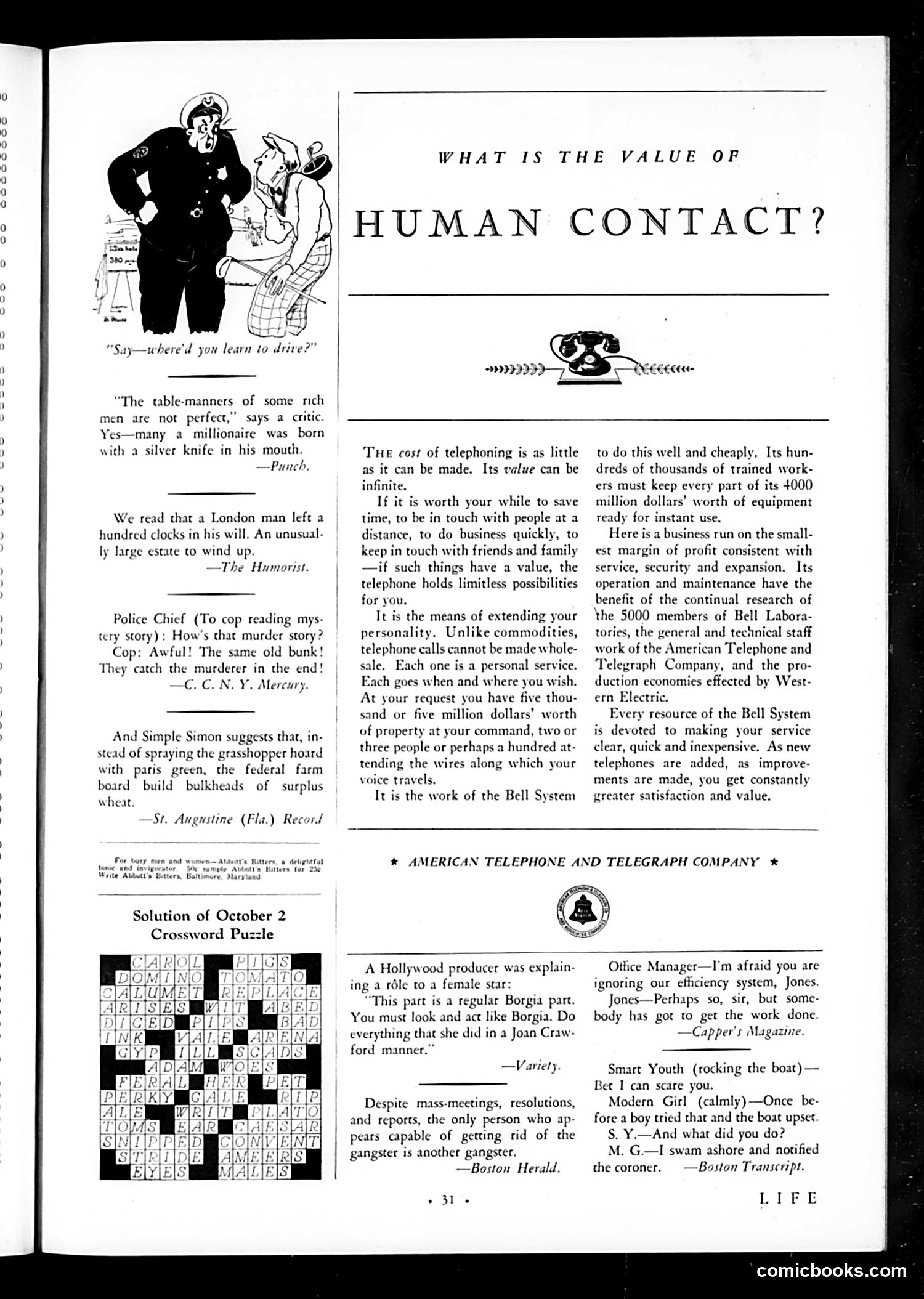
Analysis of Life Magazine Page This page contains multiple humor sections typical of Life's satirical format: Top cartoon: A portly authority figure (appears to be a driving instructor or police officer) questions a young driver about where he learned to drive. The joke plays on the phrase "table manners of rich men"—the implication being the young driver learned reckless behavior from wealthy people's poor conduct. Main content: A Bell Telephone System advertisement disguised as editorial content, arguing that telephoning's value is "infinite" despite low cost. It promotes the telephone as essential for business, family connection, and personality extension. Bottom jokes: Four brief humorous anecdotes about Hollywood absurdity, gangster violence, workplace efficiency conflicts, and a darkly comic exchange between flirtatious youth in a boat. The final joke's punchline—the modern girl calmly noting she "swam ashore and notified the coroner"—suggests the previous boy died in a similar incident, making her unmoved by the current threat. These pieces represent typical 1920s-30s Life humor: witty one-liners mixing social observation with dark comedy.
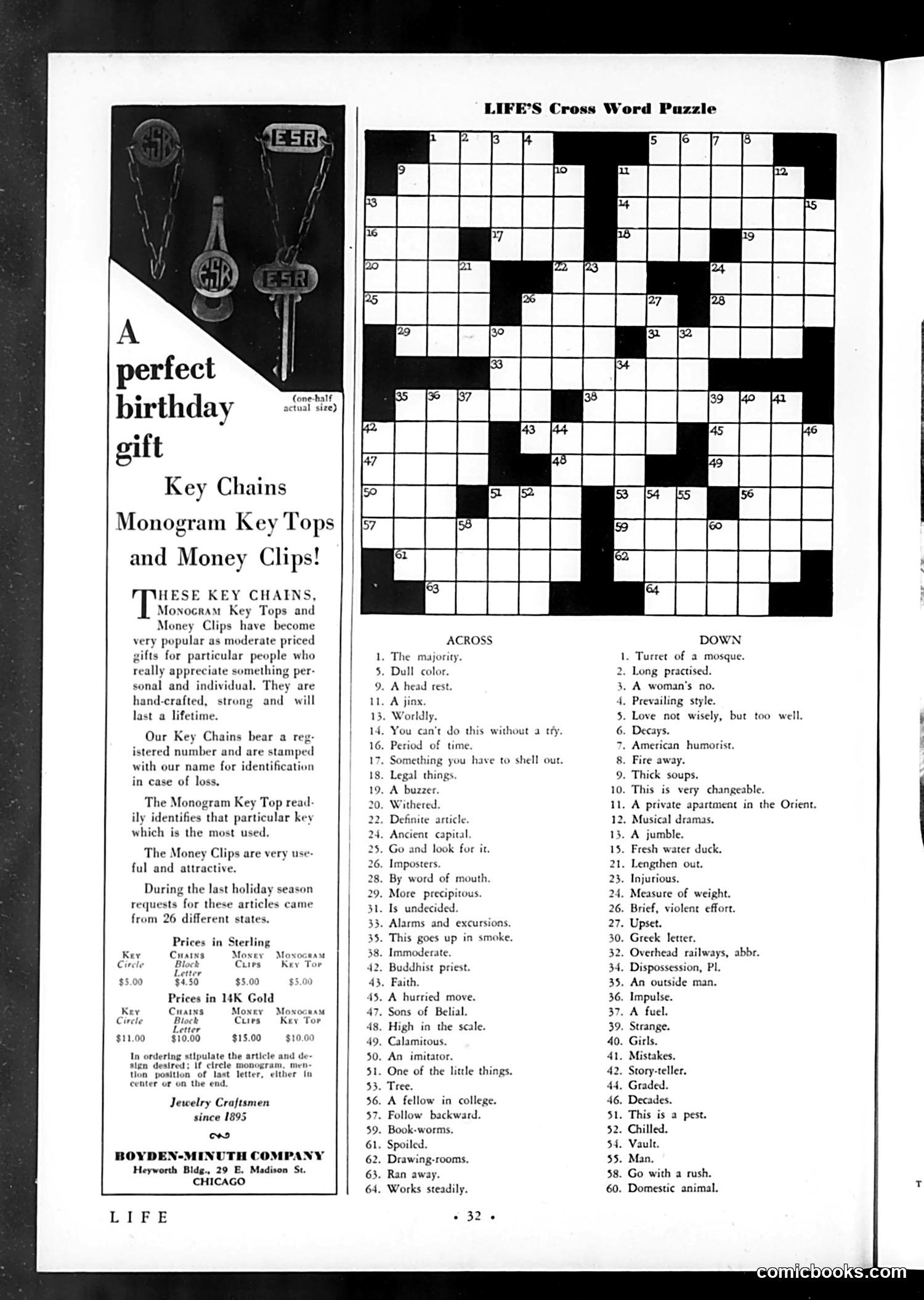
Analysis for Modern Readers This page is primarily advertising and a crossword puzzle, not satirical content. The main feature is a LIFE magazine crossword puzzle. Below it is a full-page advertisement for the Boyden-Minuth Company, a jewelry firm based in Chicago that has operated since 1895. The ad promotes personalized key chains, monogram key tops, and money clips as "perfect birthday gifts." These items are described as hand-crafted, durable, and suitable for people "who really appreciate something personal and individual." The company offers pricing in both sterling silver and 14K gold, with prices ranging from $3 to $15. They note that during the holiday season, orders came from 26 different states, suggesting a mail-order business. The satire or humor is minimal on this page—it's straightforward product marketing typical of early-to-mid 20th-century magazine advertising, emphasizing personalization and quality craftsmanship as reasons to purchase luxury gift items.
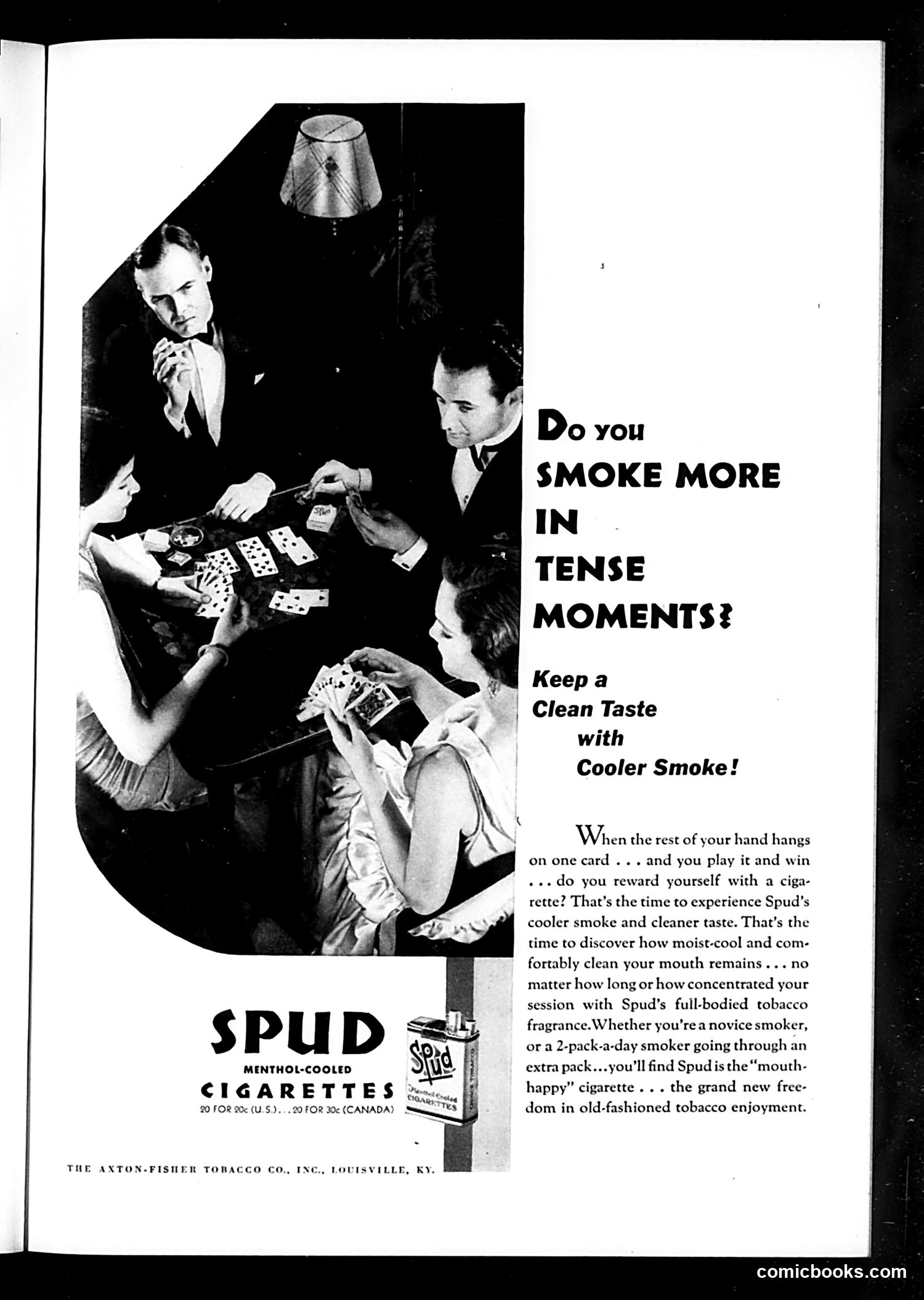
Spud Cigarettes Advertisement This is a cigarette advertisement, not political satire. It promotes Spud menthol-cooled cigarettes by depicting a poker game scene—four men and a woman playing cards under dramatic lighting. The ad's appeal targets stress-relief smoking: the headline asks if smokers consume more cigarettes during "tense moments," then pitches Spud as the solution for maintaining a "clean taste" during extended smoking sessions. The social context reflects mid-20th-century attitudes where: - Smoking during high-stakes activities (gambling) was normalized and even glamorized - Menthol cigarettes marketed themselves as "cooler" and "cleaner" (claims later proven false) - Advertising directly linked smoking to stress management and social situations The image uses dramatic film-noir styling to make smoking appear sophisticated and necessary during intense moments. This type of messaging would become heavily regulated after the Surgeon General's 1964 warning about smoking's health risks.
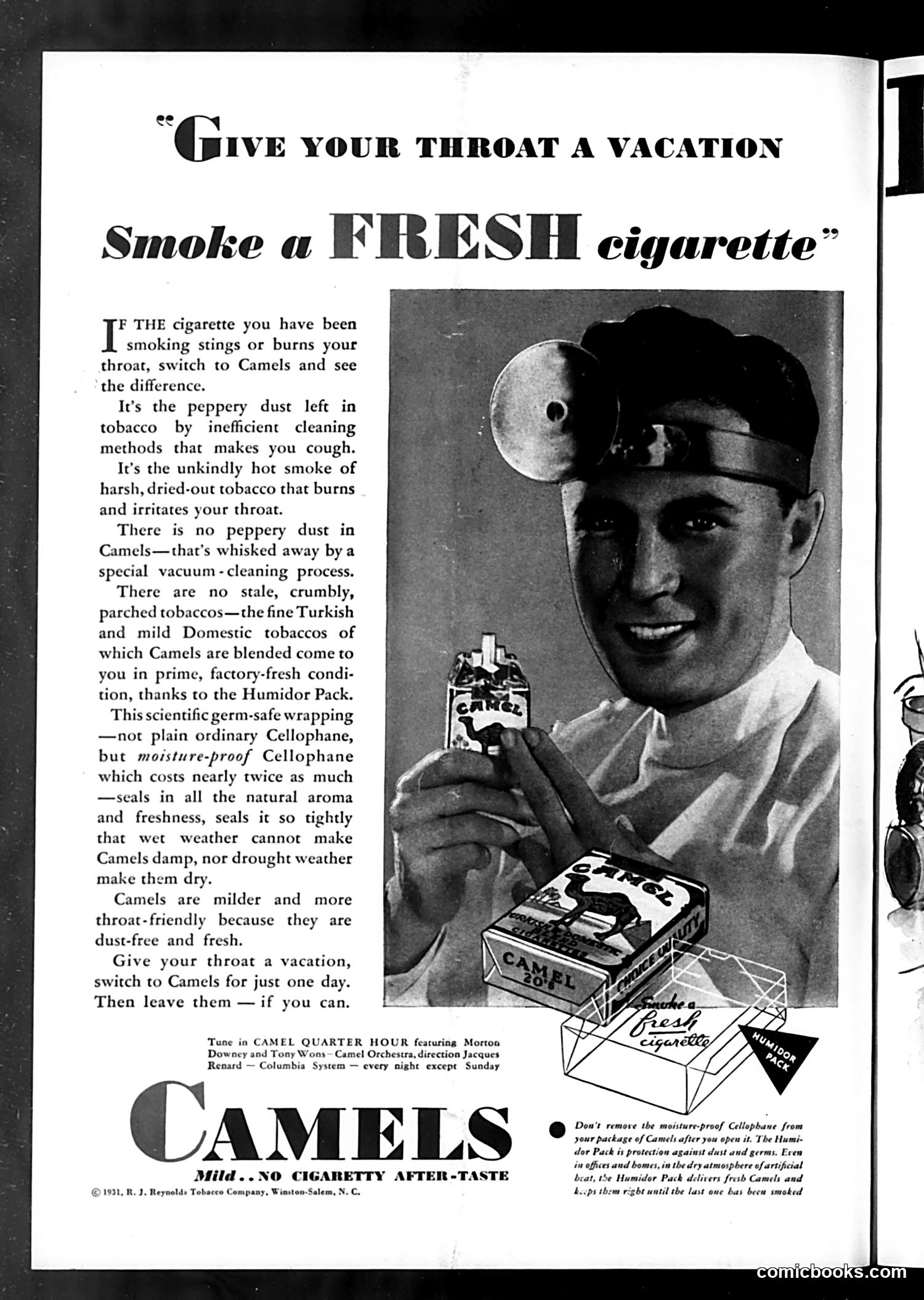
Camel Cigarettes Advertisement, 1931 This is a cigarette advertisement, not satire or political commentary. It promotes Camel brand cigarettes to a modern reader by claiming health benefits now recognized as false. The ad features a young man in athletic wear (appearing to be a baseball player, given the cap and glove) endorsing Camels as a "fresh" alternative to other brands. The central claims are: - Competitors' cigarettes contain "peppery dust" causing throat irritation - Camels use a special vacuum-cleaning process and moisture-proof "Humidor Pack" wrapping to keep tobacco fresh - This makes them "milder" and "throat-friendly" These marketing assertions—that cigarettes can be made safe or healthy through packaging and cleaning—are now understood as deceptive. The ad also mentions a radio program ("Camel Quarter Hour") as part of the brand's contemporary advertising strategy.