life
Life — October 16, 1931
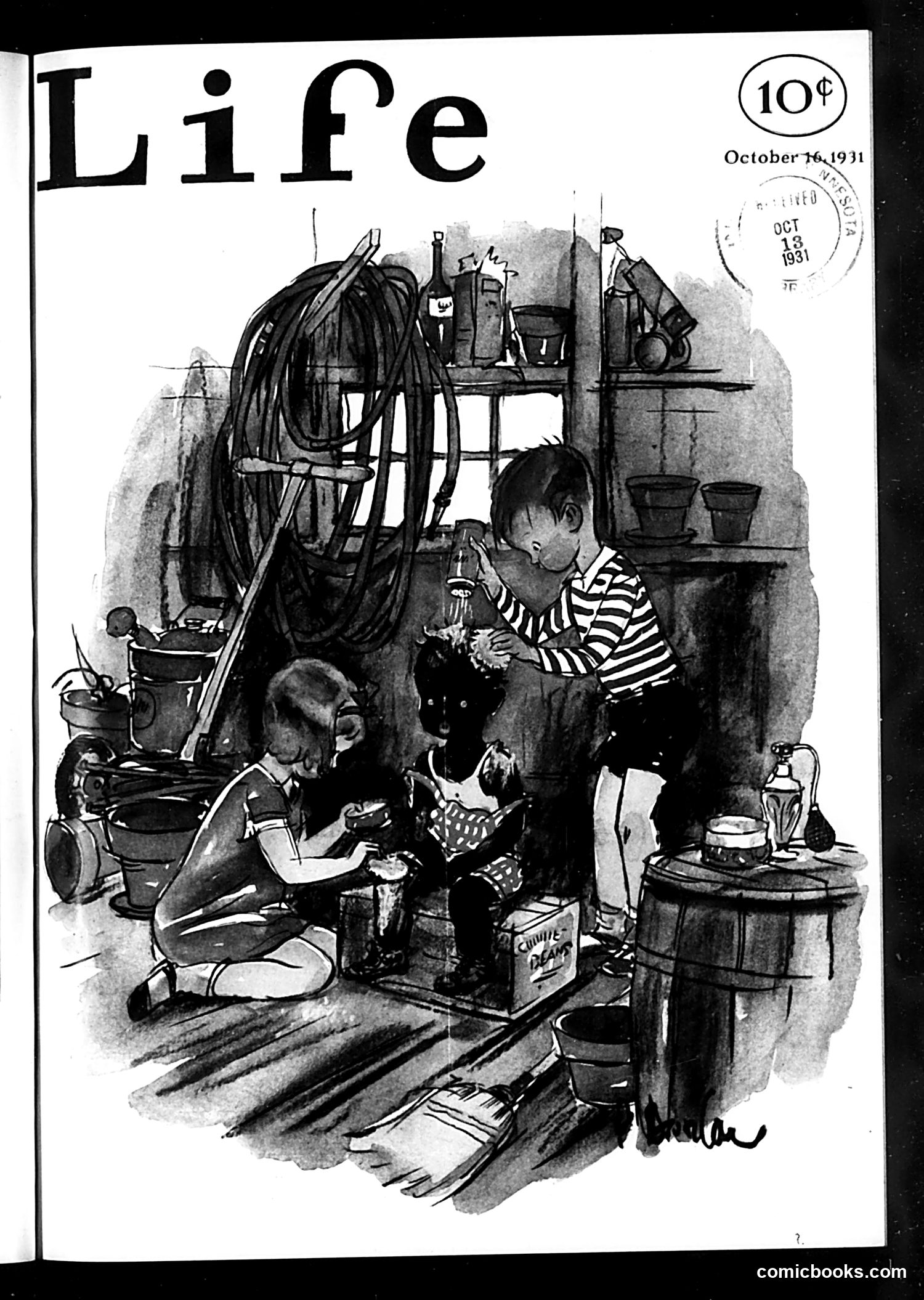
Life Magazine Cover, October 16, 1931 This illustration depicts children playing in what appears to be a basement or cramped living space during the Great Depression. The scene shows makeshift conditions: coiled rope, buckets, tools scattered about, and sparse furnishings. One child holds what appears to be a "Skeeter" brand product box. The satire comments on Depression-era poverty and how children made do with whatever they found, turning utility items and salvage into playthings. The cramped, cluttered basement setting contrasts sharply with the idealized childhood play depicted in typical magazine covers of the era. This reflects 1931's economic hardship, when many families lived in inadequate housing with few resources for entertainment or comfort—a pointed social commentary on American conditions during the early Depression years.
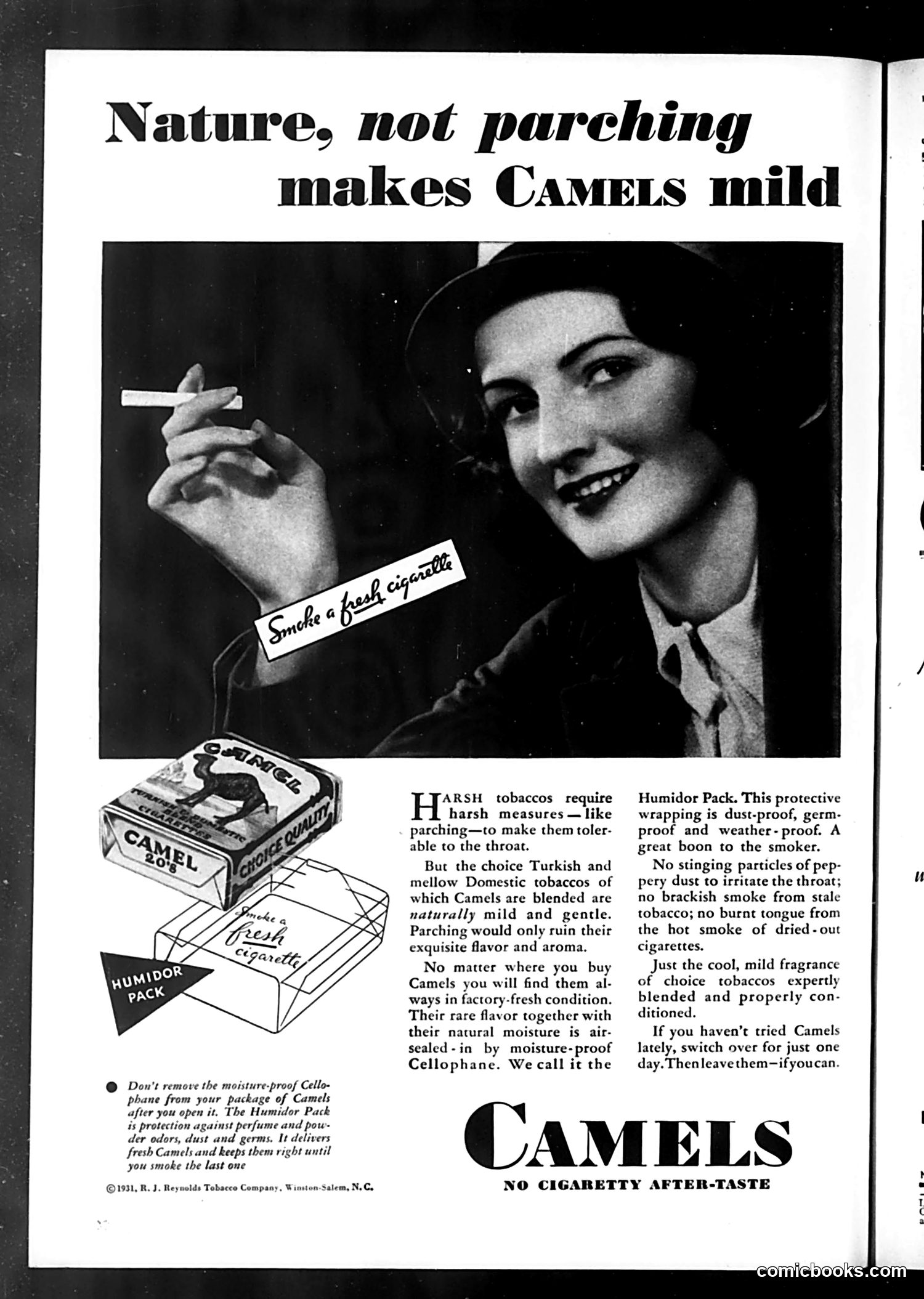
Analysis This is a Camel cigarette advertisement, not political satire. The page dates to 1931 (visible copyright mark). The ad features a woman holding a cigarette with the tagline "Smoke a fresh cigarette." The headline claims "Nature, not parching makes CAMELS mild." The advertisement's argument: harsh tobaccos require protective measures like parching (a drying process), which damages flavor. Camel's Turkish and Domestic tobacco blend is "naturally mild and gentle," requiring no such processing. The "Humidor Pack" (moisture-proof wrapping) preserves freshness. The ad emphasizes no "stinging particles," "brash smoke," or "cigarette after-taste." For modern readers: this represents vintage tobacco marketing using pseudo-scientific health claims—assertions that would be illegal under today's FDA regulations governing cigarette advertising.
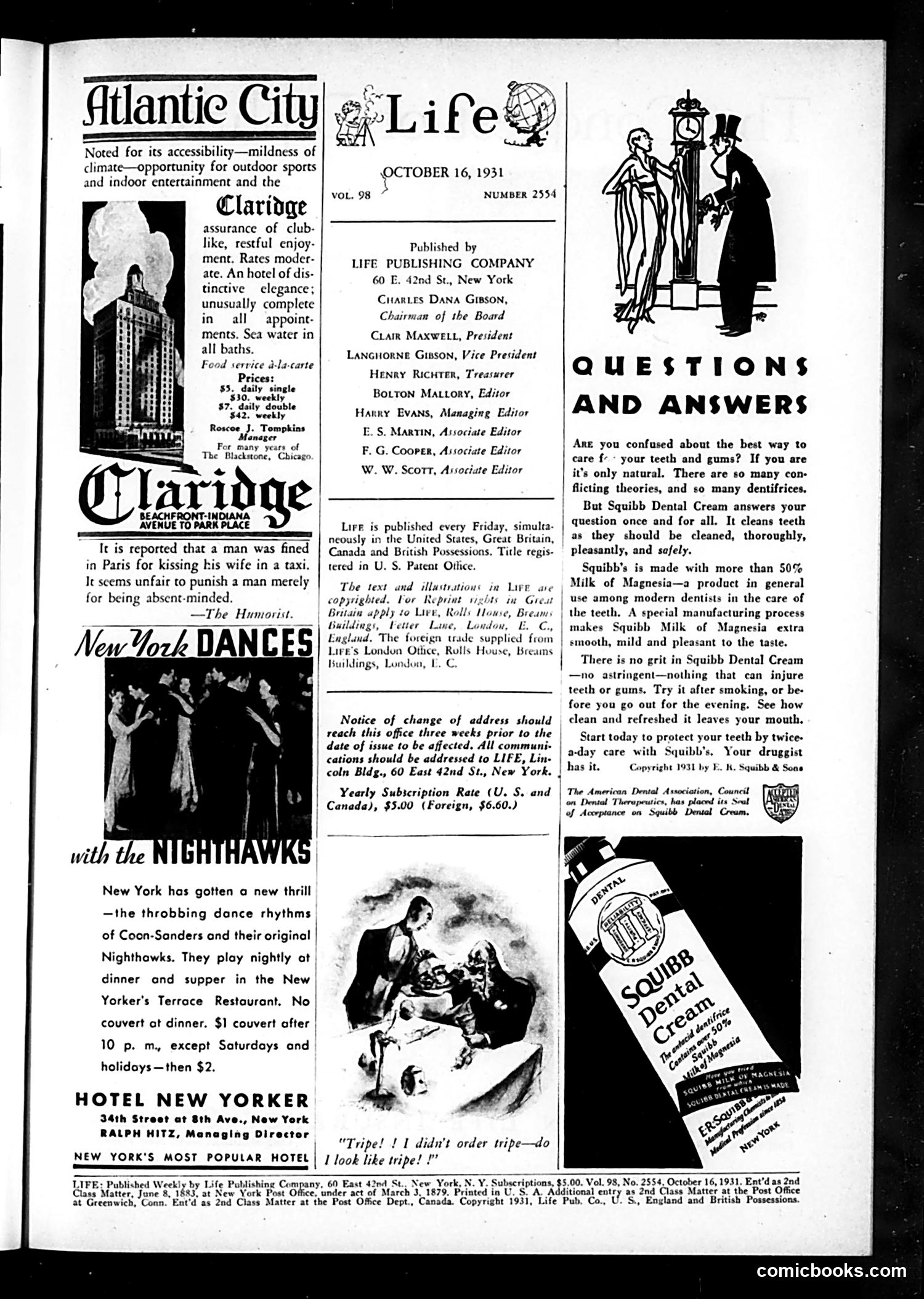
Analysis of Life Magazine, October 16, 1931 This page is primarily advertisements and publishing information rather than political satire. The main visual content includes: 1. Hotel advertisements for Atlantic City's Claridge Hotel and the Hotel New Yorker in Manhattan 2. New York Dances with the Nighthawks — promoting Coon-Sanders and their band at the New Yorker's Terrace Restaurant 3. Squibb Dental Cream advertisement featuring a product bottle and endorsement text The only satirical element is a small "Questions and Answers" humor section with a Paris taxi joke about a man fined for kissing his wife (marked as absent-minded). The page reflects 1931 entertainment and consumer culture during the early Great Depression, emphasizing leisure activities, dining, and dental hygiene products.
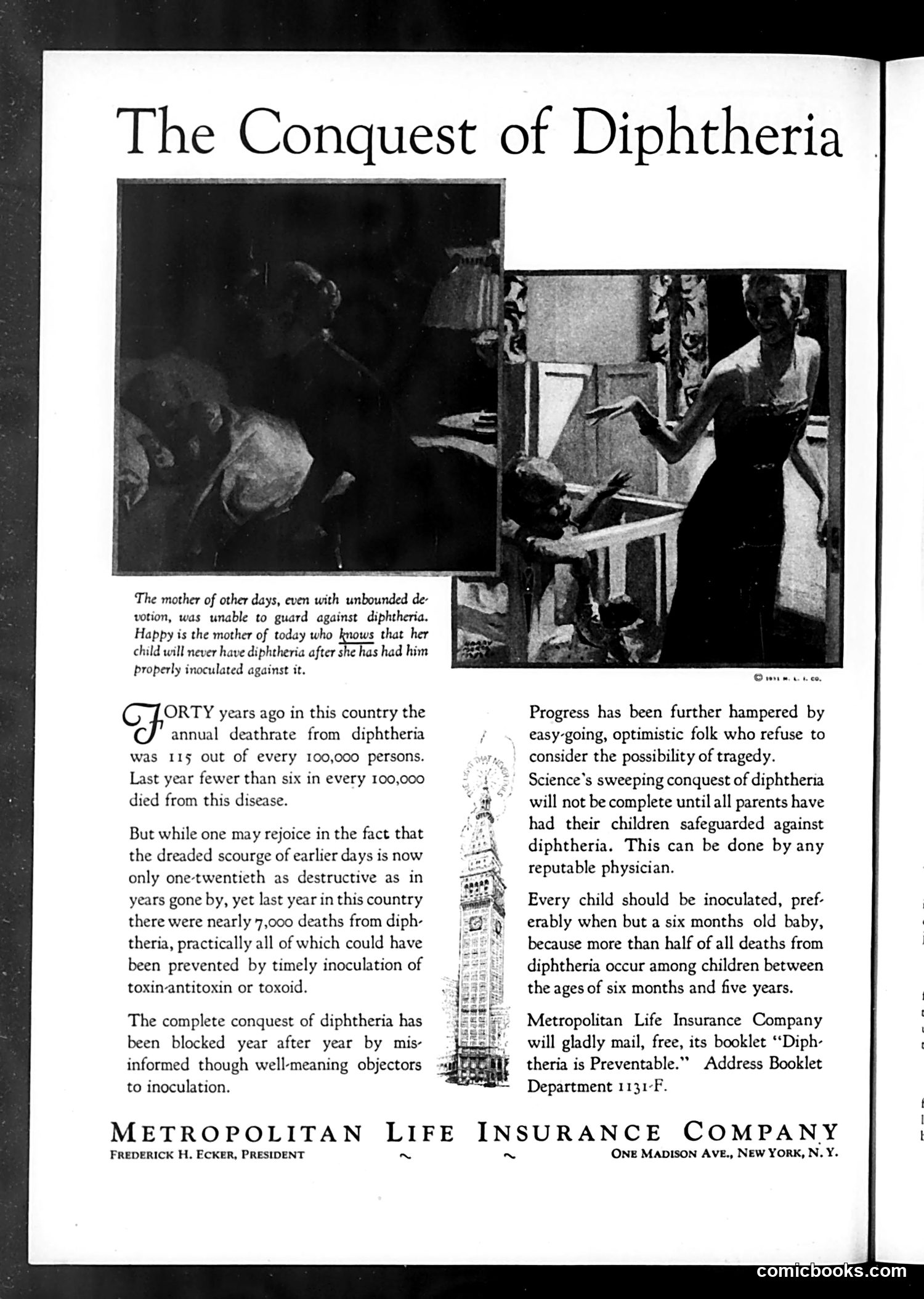
"The Conquest of Diphtheria" This is a public health advertisement by Metropolitan Life Insurance Company, not satire or political commentary. The page advocates for diphtheria vaccination, presenting it as a medical triumph. The two photographs show medical inoculation scenes: healthcare workers administering vaccines to children. The accompanying text criticizes vaccine skeptics as "easy-going, optimistic folk who refuse to consider the possibility of tragedy," arguing that parents who fail to inoculate their children endanger them. The message is straightforward public health promotion: diphtheria deaths dropped dramatically through vaccination, and "every child should be inoculated, preferably when but a six months old baby." The company offers a free informational booklet to encourage adoption of this preventive medical practice.
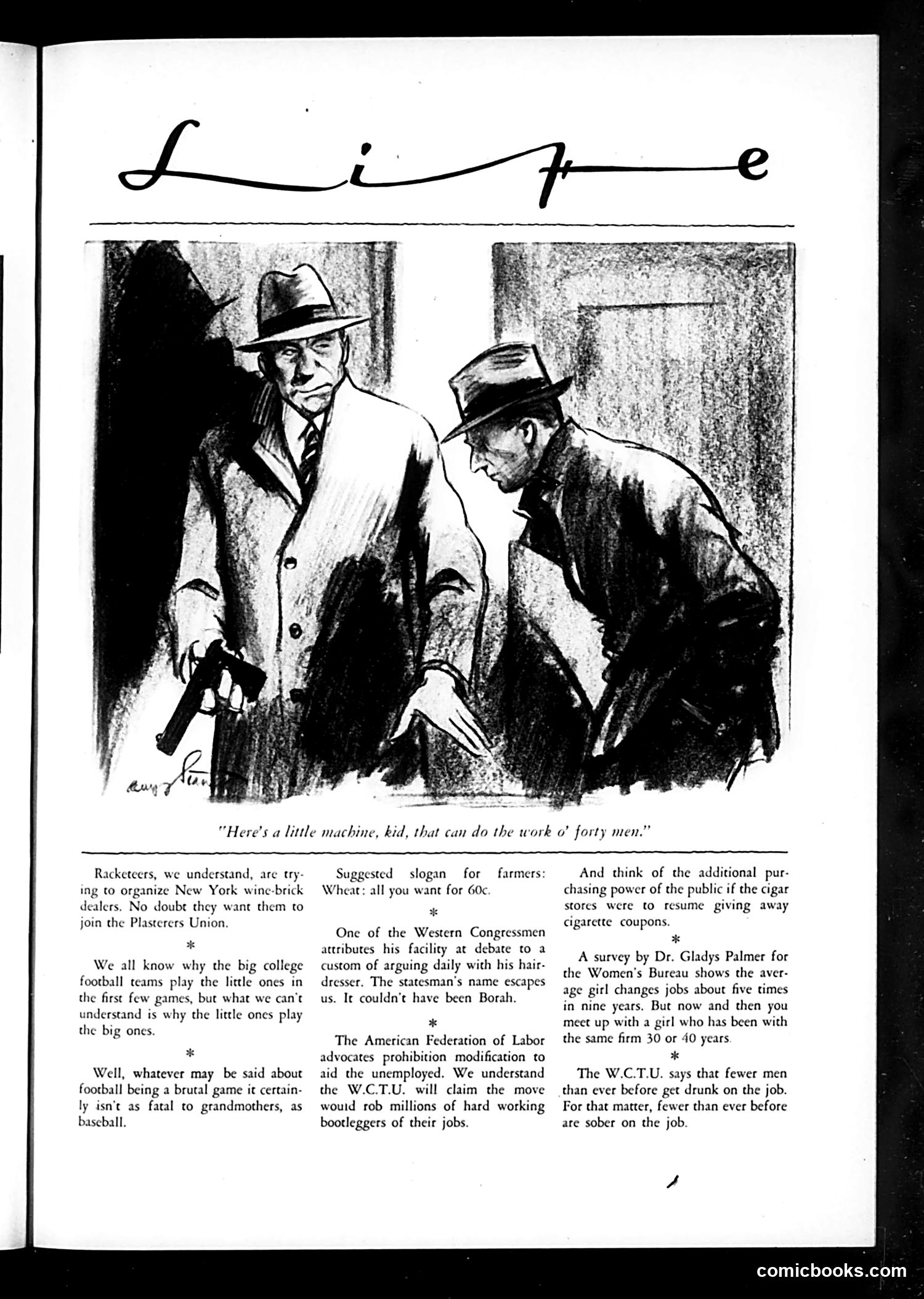
Explanation for Modern Readers The cartoon depicts two men in fedoras showing a third figure "a little machine, kid, that can do the work o' forty men"—likely representing labor-saving machinery or automation. The surrounding text satirizes various contemporary issues: racketeers organizing New York wine-brick dealers to join the Plasterers Union; college football's brutality compared to baseball; the American Federation of Labor's opposition to prohibition modification, fearing job losses; and workplace sobriety claims by the W.C.T.U. (Women's Christian Temperance Union). The cartoon's dark humor suggests labor displacement anxiety—machines replacing workers—while the surrounding commentary mocks union protectionism and temperance advocacy as self-serving interests masquerading as worker protection or moral reform.
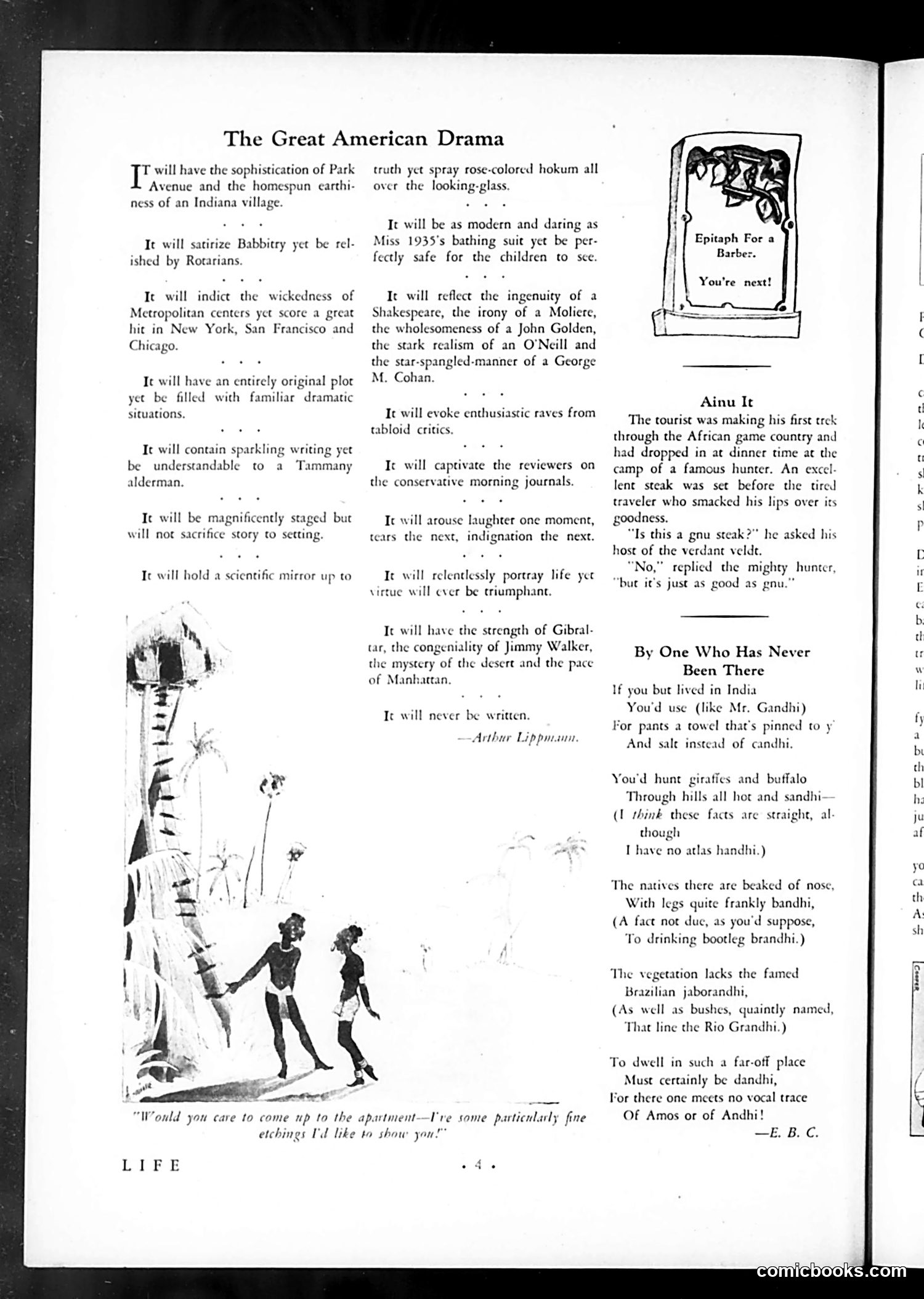
"The Great American Drama" - Life Magazine Satire This page satirizes aspirations for a distinctly American theatrical masterpiece. The left column lists pretentious qualities the play will supposedly possess—sophistication yet earthiness, originality yet familiarity, modern yet safe for children—mocking contradictory demands from audiences and critics. The satirical point: American theater cannot simultaneously satisfy Park Avenue sophistication, Rotarian sensibilities, Metropolitan and Midwestern tastes, and conservative morning newspapers. It's impossible to write something both daring and universally acceptable. The illustration (lower left) depicts colonizers or hunters with a large tree, accompanying a humorous anecdote about a safari experience. The page mocks how American cultural aspirations are often diluted by competing commercial and social pressures, preventing genuine artistic innovation.
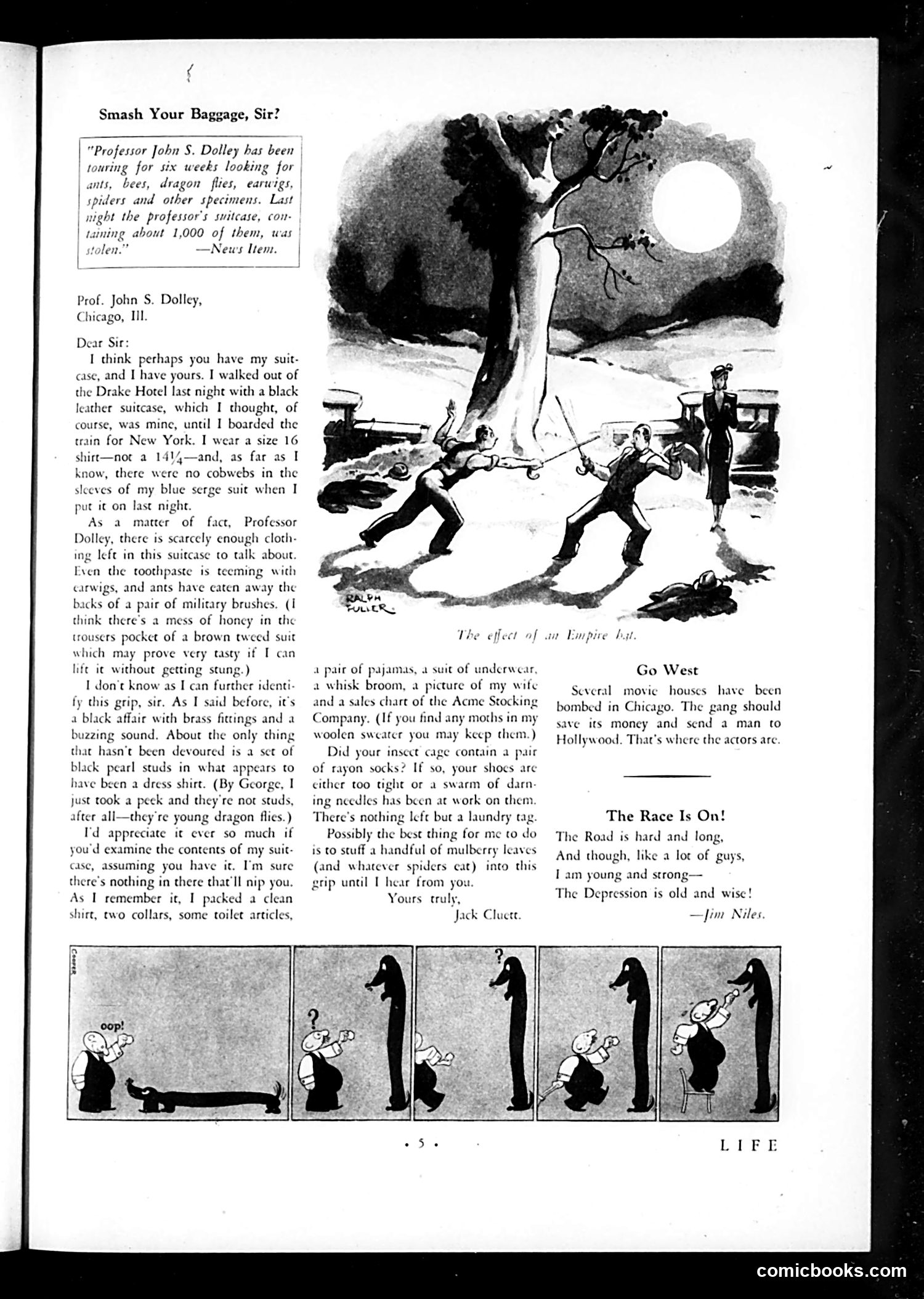
Page Analysis: Life Magazine Main Content: A humorous letter from Jack Cluett to Professor John S. Dolley regarding a stolen suitcase mix-up at the Drake Hotel in Chicago. Cluett describes the confusion of swapping luggage and catalogs the bizarre contents of Dolley's suitcase—specimens including dragon flies, newts, and insects—mocking the professor's scientific collecting hobby. The satire targets academic eccentricity and absent-minded scholars. Illustration: A large cartoon depicts men being flung by a giant tree during what's labeled "The effect of an Empire Jolt," referencing the Empire State Building (completed 1931), suggesting natural disaster or seismic activity as contemporary anxiety. Bottom Comic Strip: A simple four-panel sequence showing a man repeatedly attempting to address a tall woman, likely a visual gag about height disparity or social awkwardness. The page reflects 1930s preoccupations with modern urban life and academic culture.
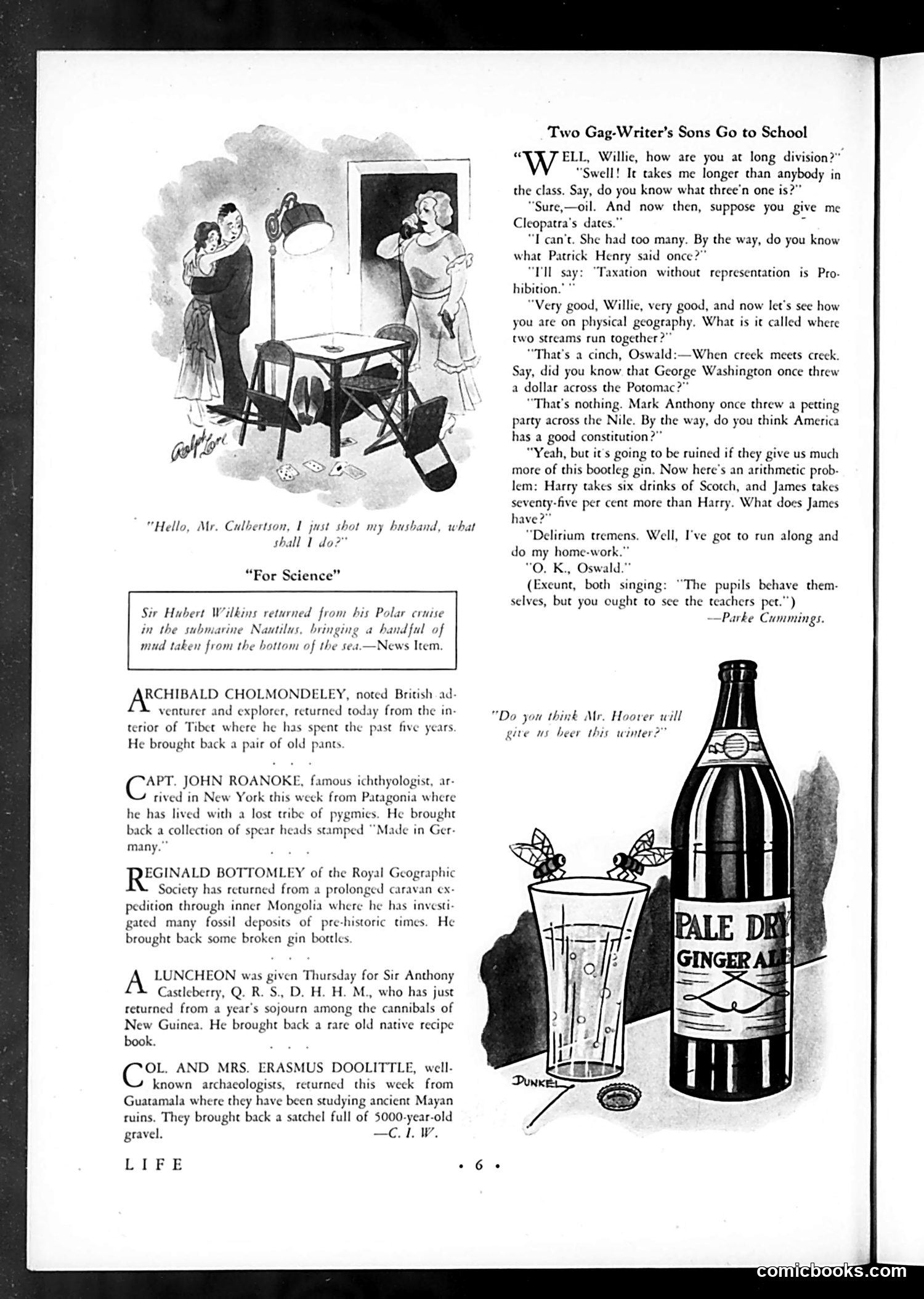
"Two Gag-Writer's Sons Go to School" This cartoon satirizes two schoolboys—Willie and Oswald—whose fathers are professional comedy writers ("gag-writers"). The joke is that these boys mindlessly repeat famous historical facts and witticisms they've memorized, mimicking their fathers' profession. Willie recites Patrick Henry's "Taxation without representation is Prohibition," while Oswald mangles geography definitions and references to George Washington and Mark Anthony. The satire targets both the boys' rote learning and their fathers' profession: comedy writers who mechanically recycle established jokes and historical references. The caption suggests the teacher is exasperated by this performative, derivative wit rather than genuine education. It's social commentary on inherited mediocrity and the emptiness of professional joke-writing.
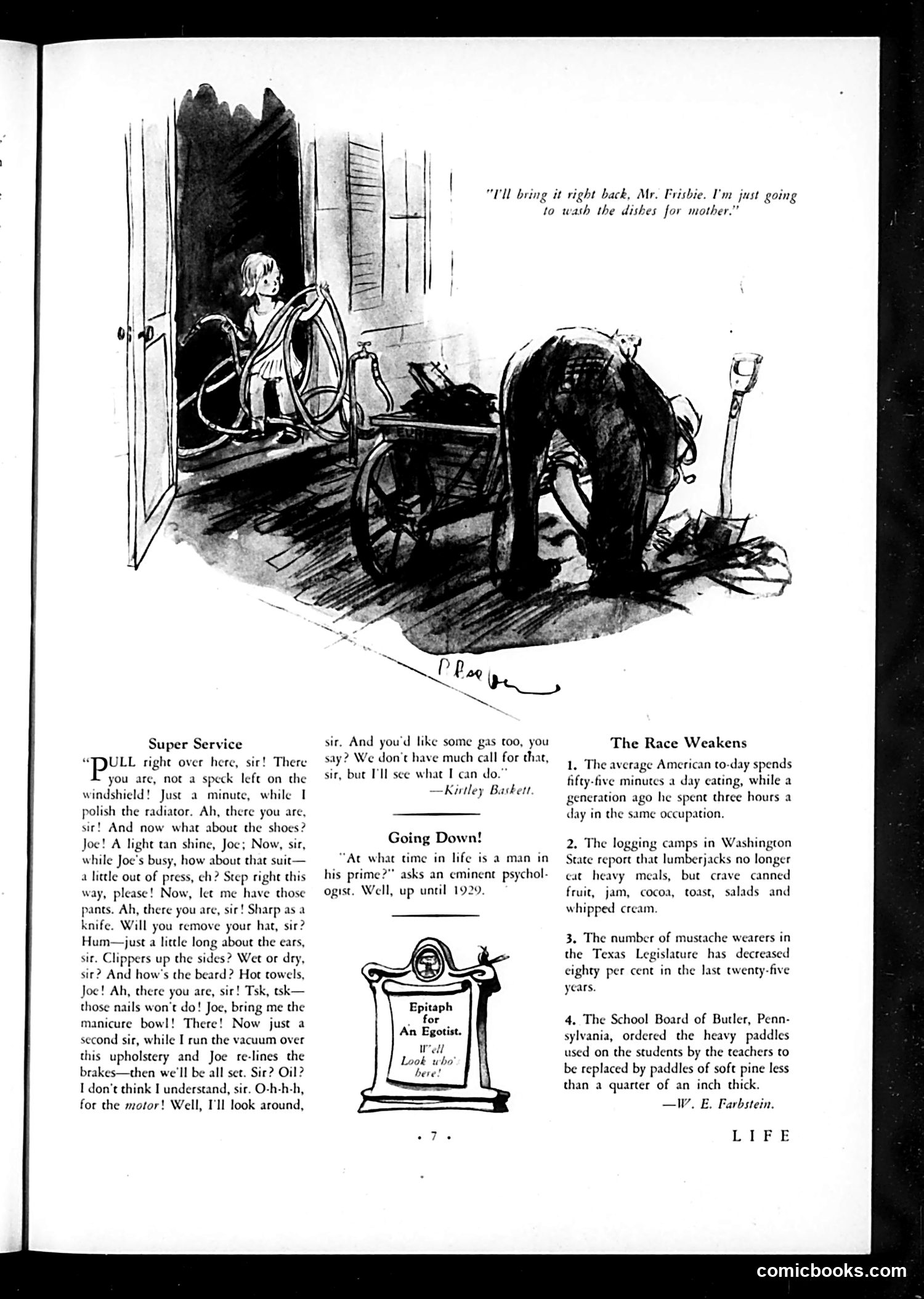
"I'll Bring It Right Back, Mr. Fribbie" This page from *Life* magazine contains a cartoon and three separate humorous sections. The main cartoon depicts a young person at a doorway speaking to "Mr. Fribbie," promising to return quickly after washing dishes. A horse-drawn cart waits outside, suggesting the person may not return promptly—the humor lies in the implied broken promise. Below are three brief sections: "Super Service" (a comedic dialogue about excessive car maintenance), "Going Down!" (a psychological observation about life's struggles), and "The Race Weakens" (satirical observations about declining American vigor, mentioning logging camps and mustache-wearing legislators—suggesting physical deterioration of society). The page represents *Life's* characteristic early-20th-century approach: gentle social satire mixed with whimsical illustrations.
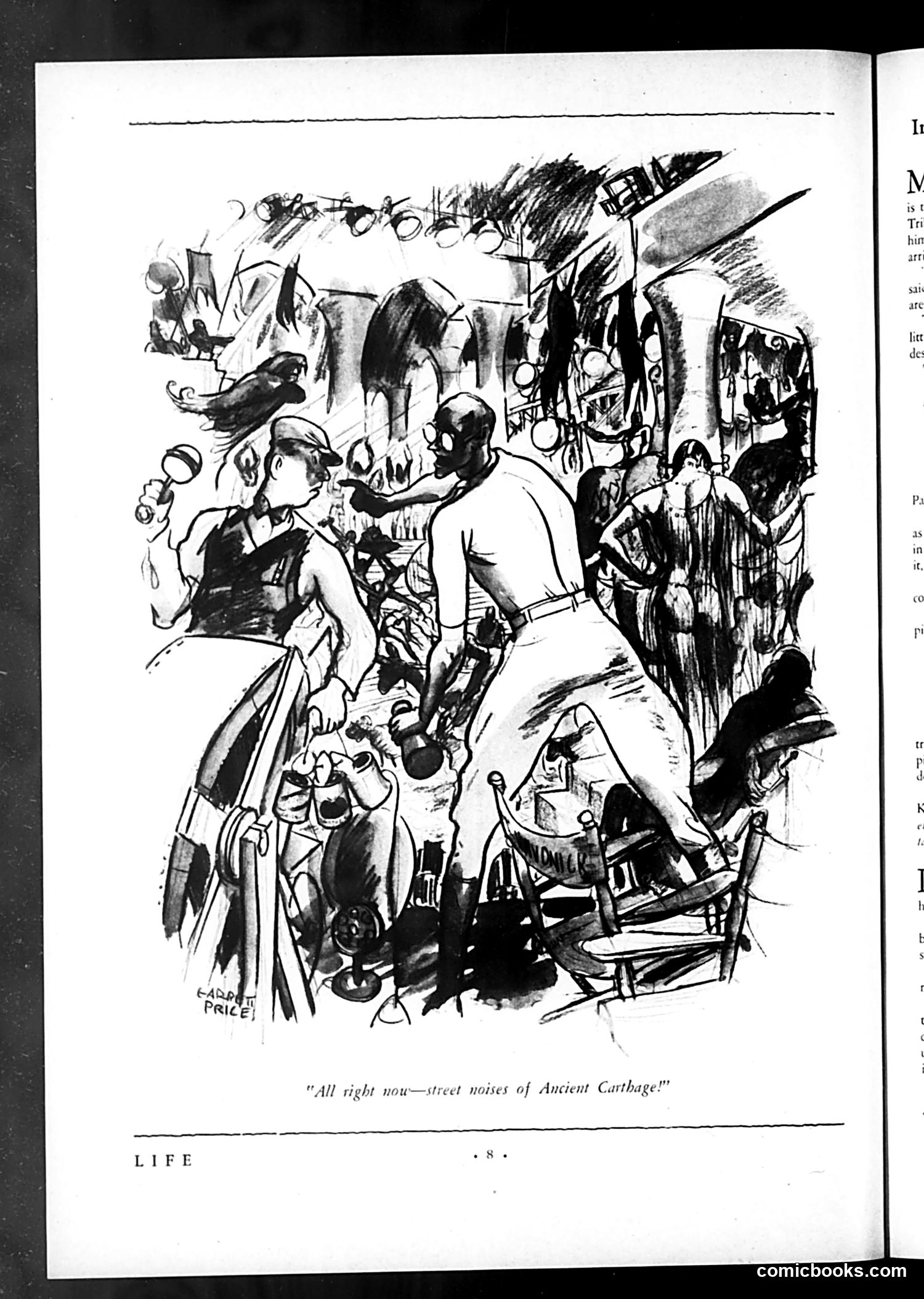
Cartoon Analysis This satirical cartoon by Cesare Maccari shows a chaotic street scene captioned "All right now—street noises of Ancient Carthage!" The sketch depicts a crowded, raucous marketplace or public space with numerous figures engaged in various activities—juggling, performing, gesturing animatedly, and creating general tumult. The satire appears to mock contemporary urban chaos by comparing modern city commotion to ancient Carthage, implying that modern civilization hasn't advanced much from antiquity in terms of public disorder. The exaggerated, energetic linework emphasizes the pandemonium. This commentary likely reflects early 20th-century anxieties about urbanization and social disorder in rapidly growing American cities.
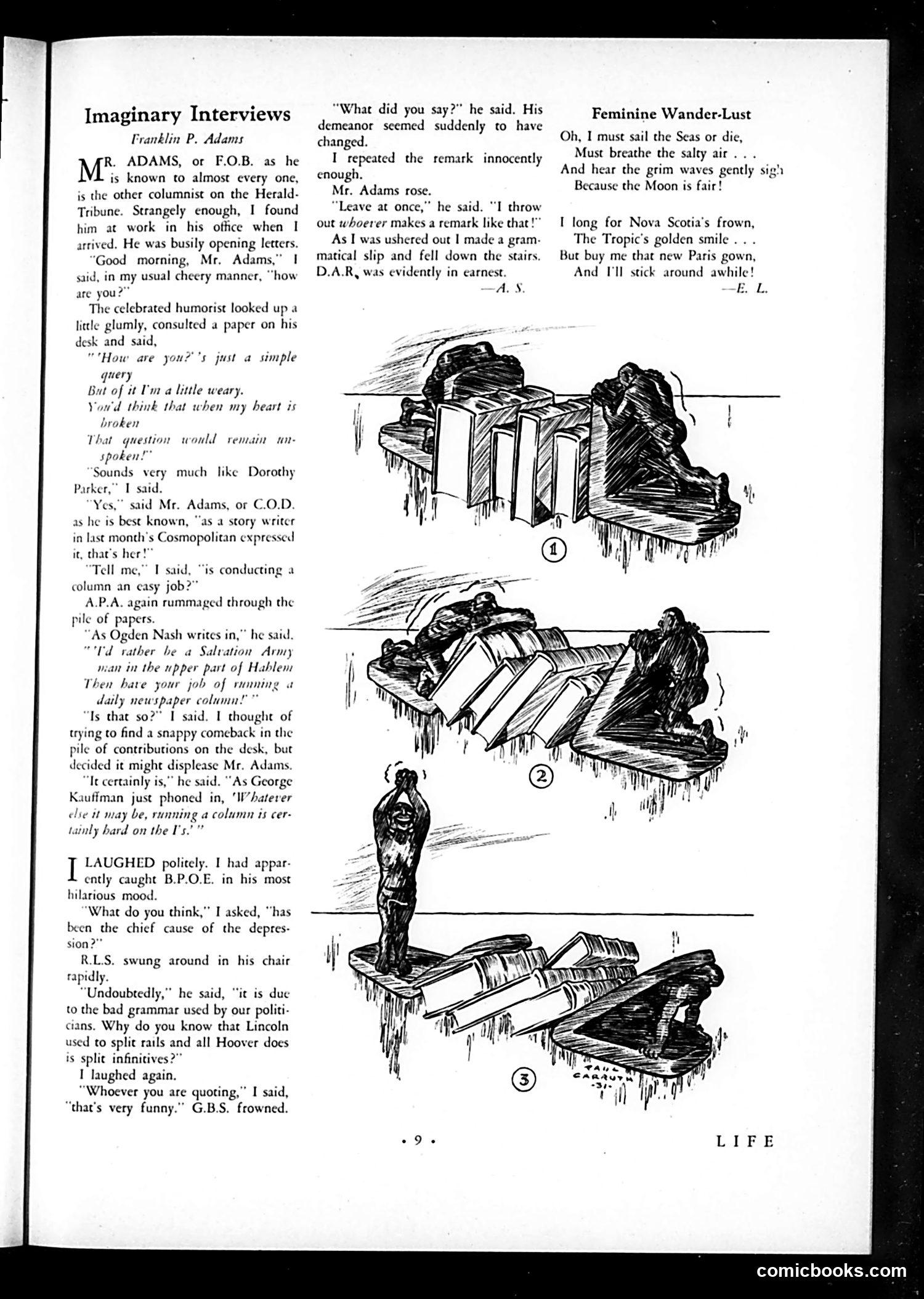
Analysis of This Life Magazine Page This page contains an interview column titled "Imaginary Interviews" by Franklin P. Adams featuring humorist Mr. Adams. The text shows Adams bantering with the interviewer about conducting newspaper columns, with references to writers like Dorothy Parker and Ogden Nash. The right side features three numbered pen-and-ink sketches labeled "Feminine Wander-Lust," illustrating a poem about yearning for travel. The drawings show figures with luggage in increasingly precarious or weighted-down positions, humorously depicting the burden of wanderlust. The political humor in the interview targets politicians' poor grammar and Lincoln's historical rail-splitting, used as a satirical jab at contemporary political discourse and hypocrisy. The overall tone is light, conversational satire typical of Life's cultural commentary.
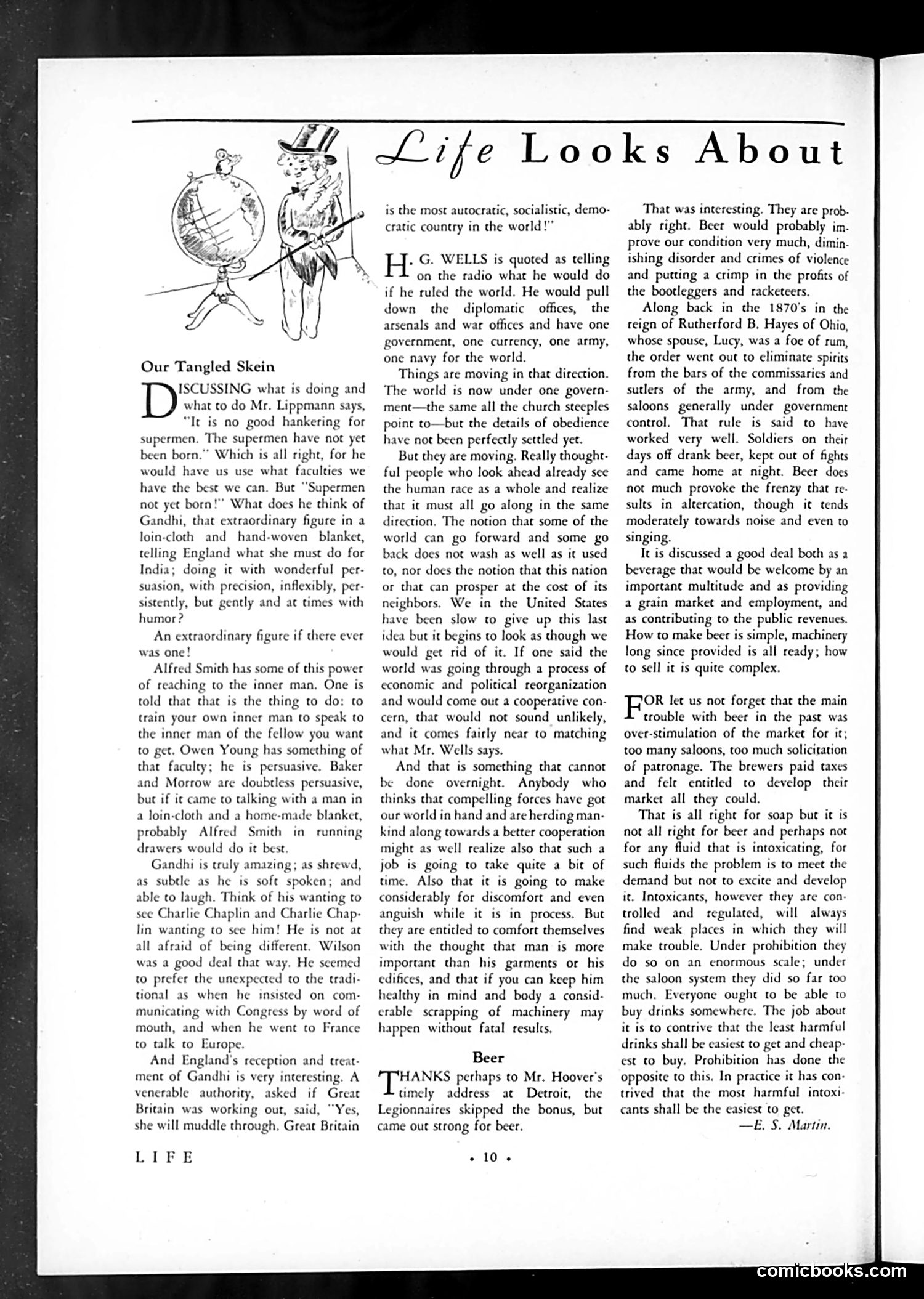
"Our Tangled Skein" Cartoon Analysis The cartoon depicts two figures manipulating a globe like a tangled ball of yarn. One appears to be a politician or statesman (unclear which specific figure), while the other seems to represent a military or governmental authority. The accompanying article discusses H.G. Wells's vision for world government—consolidating diplomatic offices, currencies, armies, and navies. The cartoon satirizes the complexity and difficulty of actually reorganizing global institutions, suggesting that despite idealistic plans for world unity, the practical "tangling" of international affairs makes such reorganization far more complicated than it appears. The satire implies that well-intentioned proposals for world order founder on the messy reality of existing power structures and competing interests.
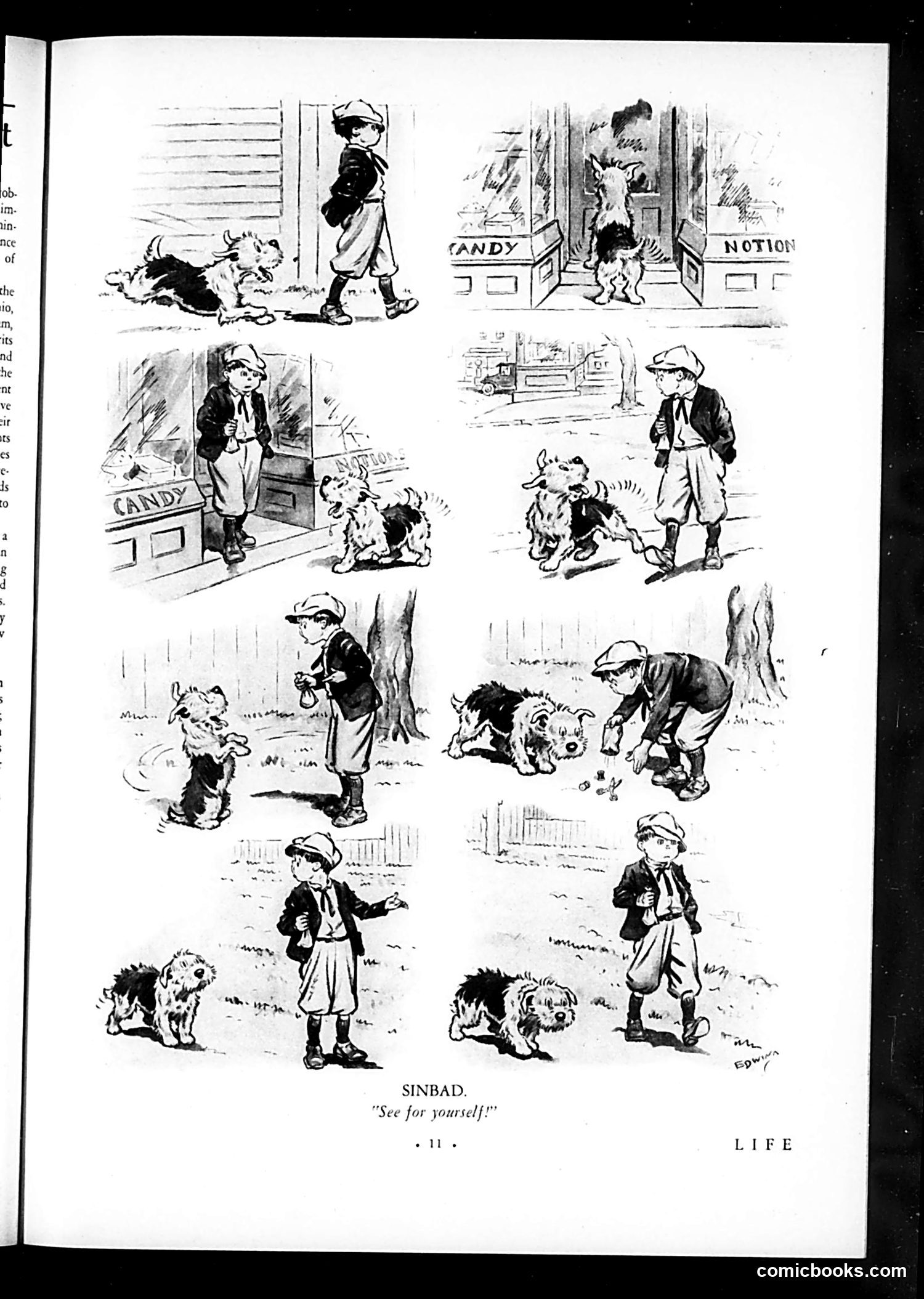
"Sinbad: See for yourself!" This is a comic strip sequence showing a boy and his dog in various scenarios. The title "Sinbad" references the famous sailor from Arabian folklore, and the caption "See for yourself!" suggests the strip demonstrates something through visual narrative rather than explanation. The sequence depicts the boy and dog in different situations—at shops, outdoors, and in various domestic settings—likely illustrating the dog's behavior or personality through action. The strip appears to be demonstrating character traits humorously across multiple panels. Without additional context about the specific character "Sinbad" or the publication date, the exact satirical or social commentary intent remains unclear, though the format suggests it's meant to be entertaining domestic humor typical of early-to-mid 20th century Life magazine comics.
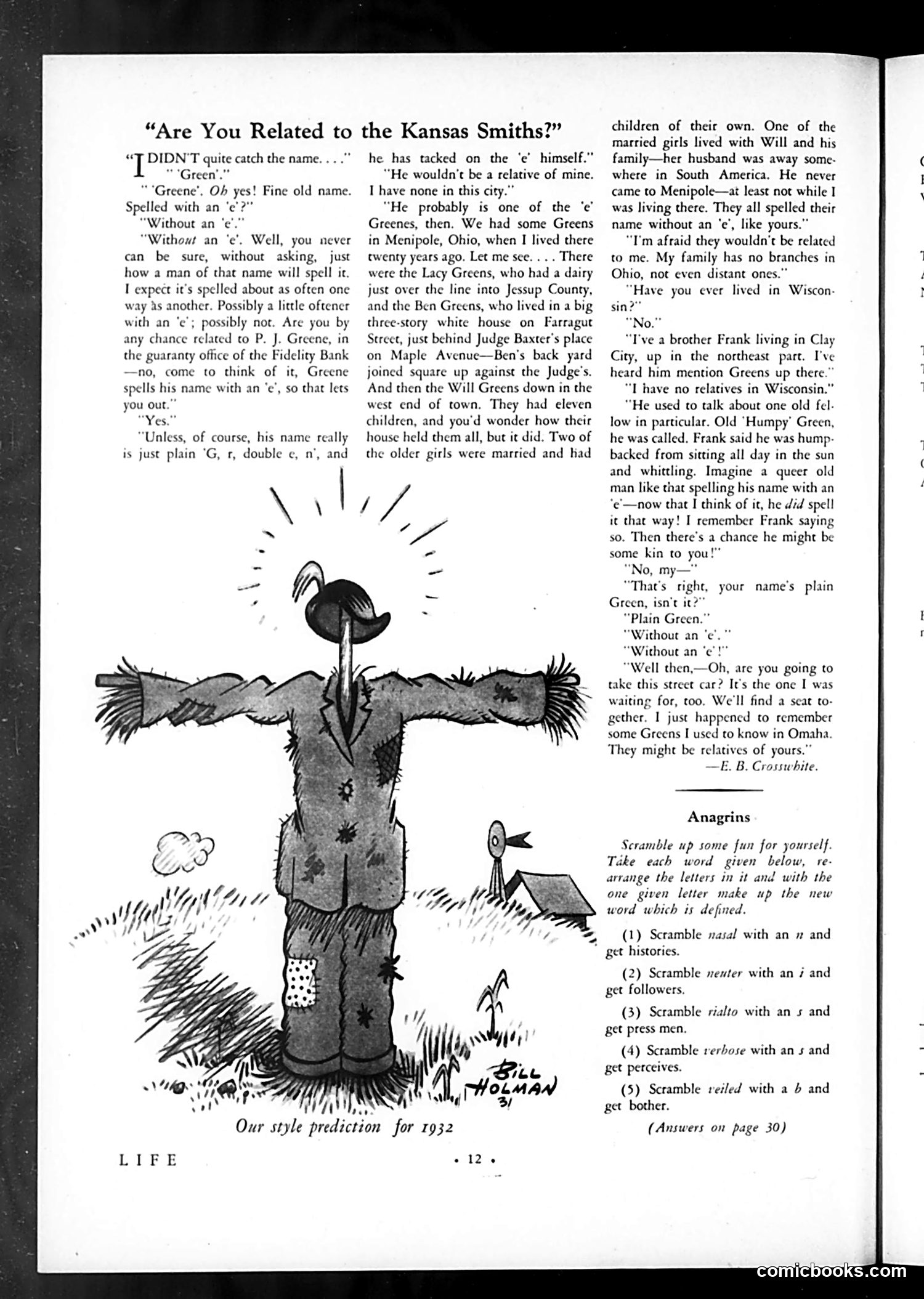
"Our Style Prediction for 1932" - Satire of Fashion Forecasting This cartoon satirizes fashion prediction magazines' tendency to make absurd "style forecasts." The illustration shows a scarecrow in a field—apparently Life's humorous prediction for what people will wear in 1932. The joke mocks the pretension of fashion authorities who claim to predict upcoming trends with certainty. By depicting a scarecrow as the year's fashion statement, Life suggests that fashion predictions are often ridiculous and disconnected from reality. The surrounding text about the "Kansas Smiths" (discussing name spelling variations) appears unrelated to the fashion satire, suggesting this is a magazine layout combining multiple short humor pieces.
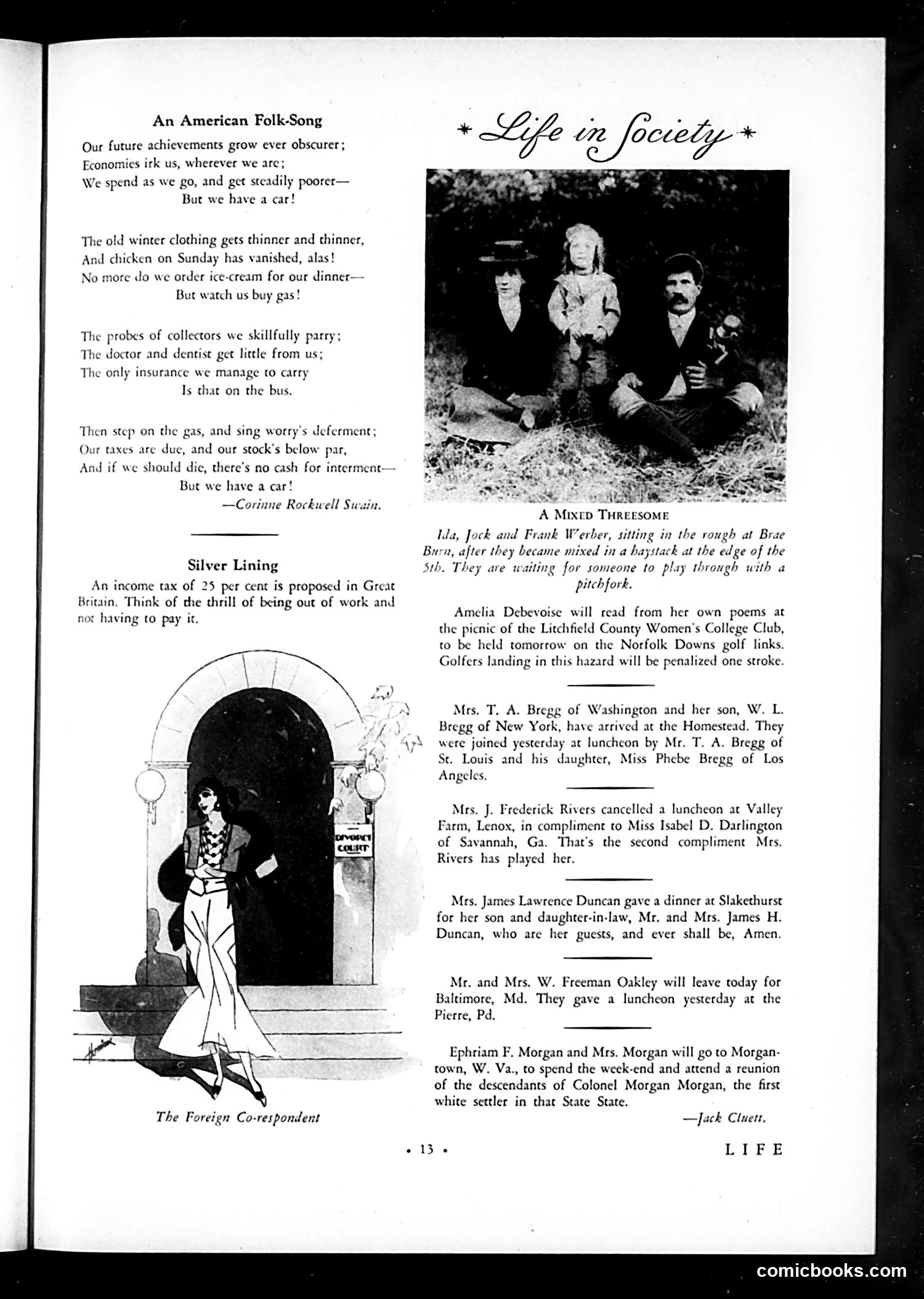
Analysis of Life Magazine Page 13 "An American Folk-Song" (left): A satirical poem by Coriane Rockwell Swain mocking economic hardship during what appears to be the Great Depression. It catalogs deteriorating living conditions—thinner clothing, vanished Sunday chicken dinners, unpaid doctors and dentists—yet insists "But we have a car!" The joke satirizes Americans' prioritization of automobile ownership over basic necessities, suggesting car culture has become almost absurdly central to identity despite financial collapse. "The Foreign Correspondent" (illustration): A stylized woman in 1920s-30s attire entering an archway, likely satirizing female international journalists or society columnists of the era—glamorous but somewhat frivolous figures reporting on social events rather than serious news. "Life in Society" (right): Social gossip column featuring local events and visitor announcements, typical magazine filler content of the period.
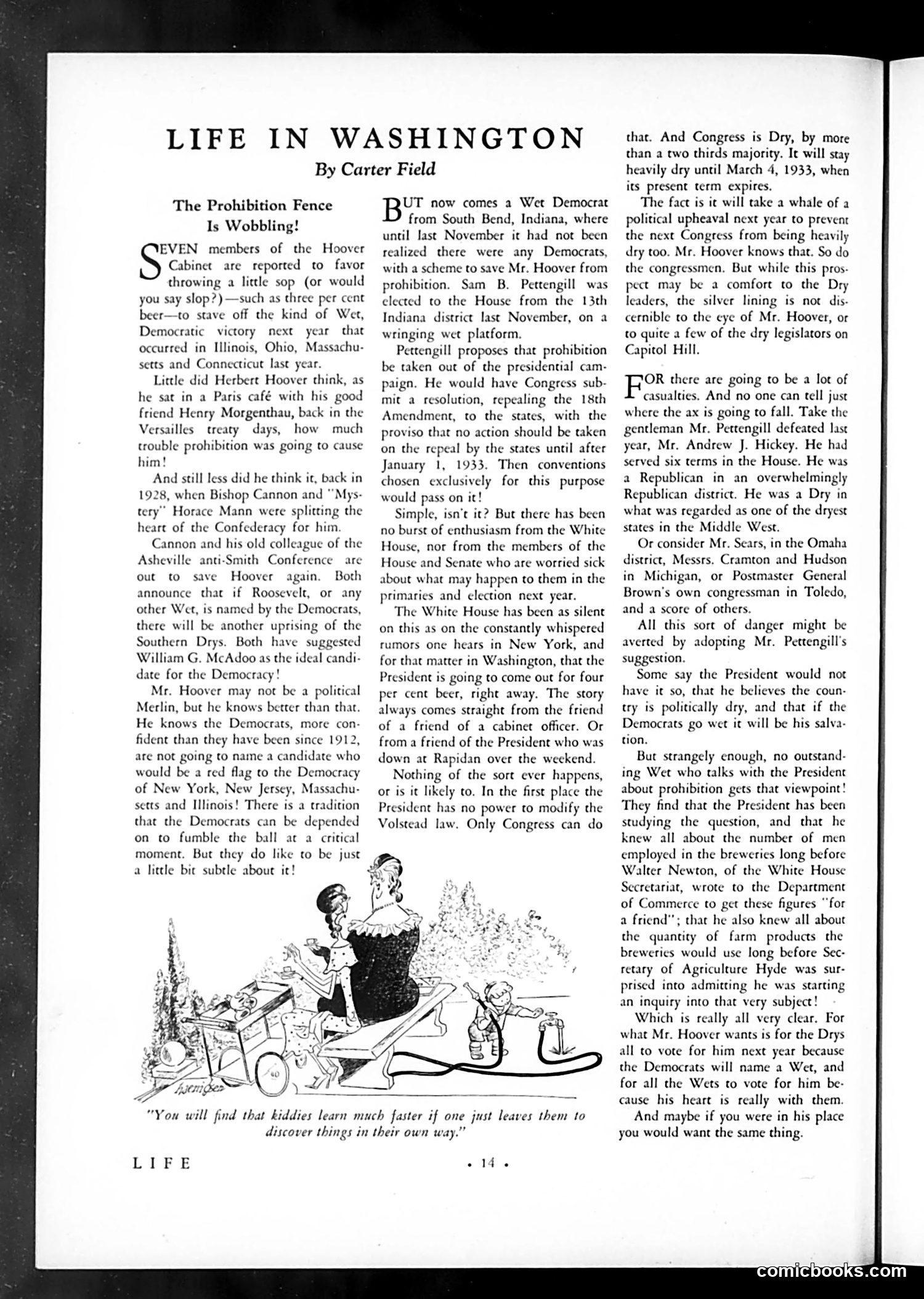
"Life in Washington" - Prohibition Commentary This 1932 satirical article by Carter Field mocks the political maneuvering around Prohibition's repeal. The main cartoon depicts a car labeled with prohibition symbolism careening out of control, with figures representing politicians scrambling to manage the chaos. Key references: - Sam B. Pettengill: A Democratic congressman from Indiana proposing that states, not Congress, control Prohibition's repeal - President Hoover: Portrayed as trying to manage the "wet vs. dry" political crisis - The cartoon critiques how both parties are using Prohibition as a political football—Democrats may nominate a "Wet" to attract voters, while Republicans worry about losing dry supporters The satire suggests politicians care more about electoral advantage than consistent principle on this divisive issue.
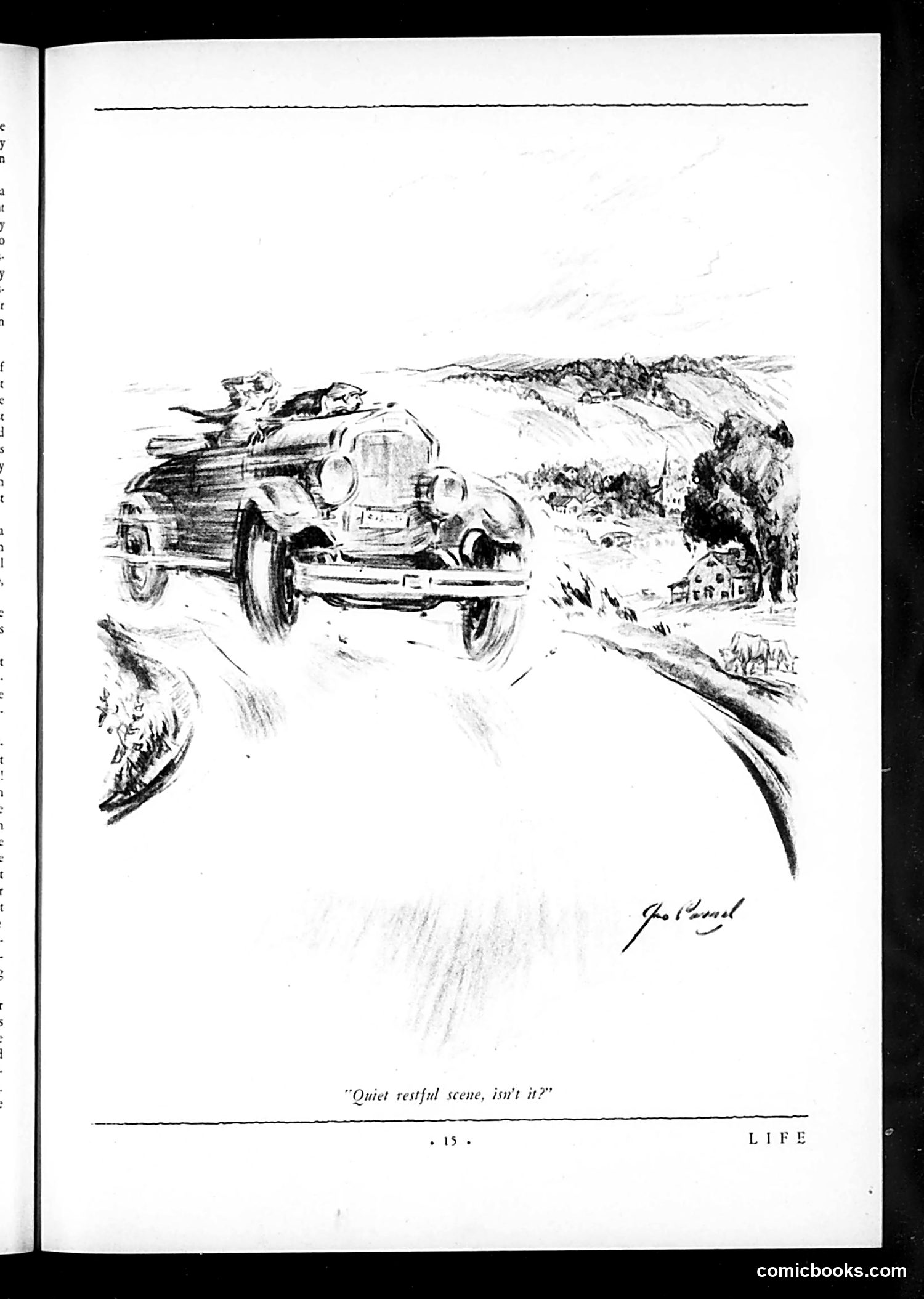
Analysis of Life Magazine Page 15 This is a sketch-style cartoon signed by Jo Doolin showing an automobile on a rural road with two figures inside. The caption reads: "Quiet restful scene, isn't it?" The satire appears to be about automobile safety or the dangers of early motorcar travel. The exaggerated, dynamic linework and the positioning of the vehicle suggest motion or instability rather than the "quiet restful scene" the caption ironically describes. The rural landscape setting and the occupants' apparent tension contrast with the caption's claim of peacefulness. Without additional context about the specific era or automobile models depicted, the exact target of the satire—whether commenting on vehicle reliability, road conditions, or driving hazards—remains somewhat unclear, though the ironic commentary on automobile danger seems evident.
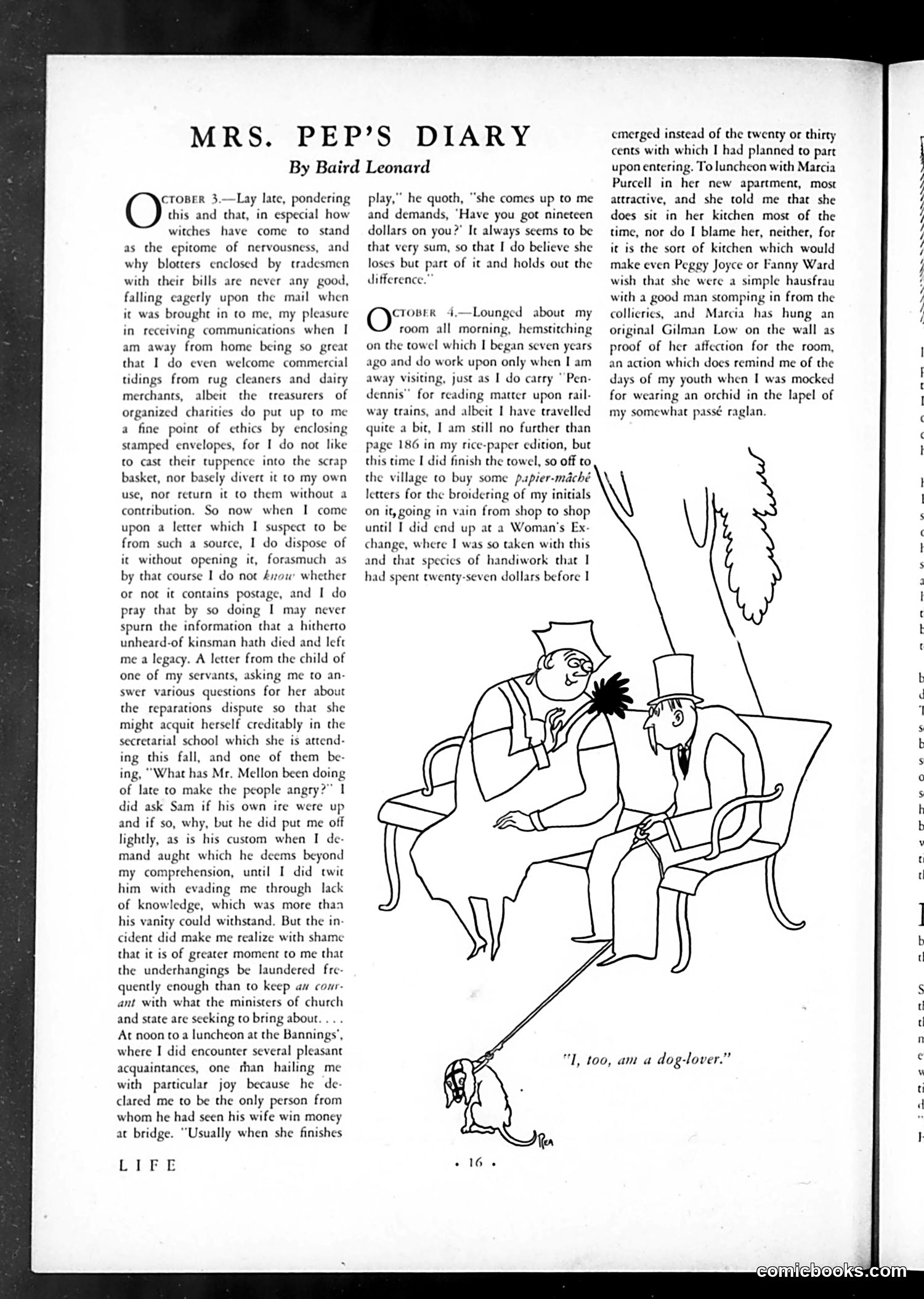
"Mrs. Pep's Diary" by Baird Leonard This is a humorous diary column satirizing upper-class social life. The October 3-4 entries mock the pretensions and petty concerns of wealthy women: complaining about tradesmen, obsessing over trivial expenses (nineteen dollars), and fretting over servants' loyalty and household management. The cartoon illustrates a social scene where a woman sits between two men on a sofa. The caption reads "I, too, am a dog-lover," suggesting ironic commentary on superficial socializing—the woman or her companions are performing affection or shared interests for social acceptance rather than genuine connection. The satire targets the vapid concerns and artificial social conventions of the leisure class during this era.
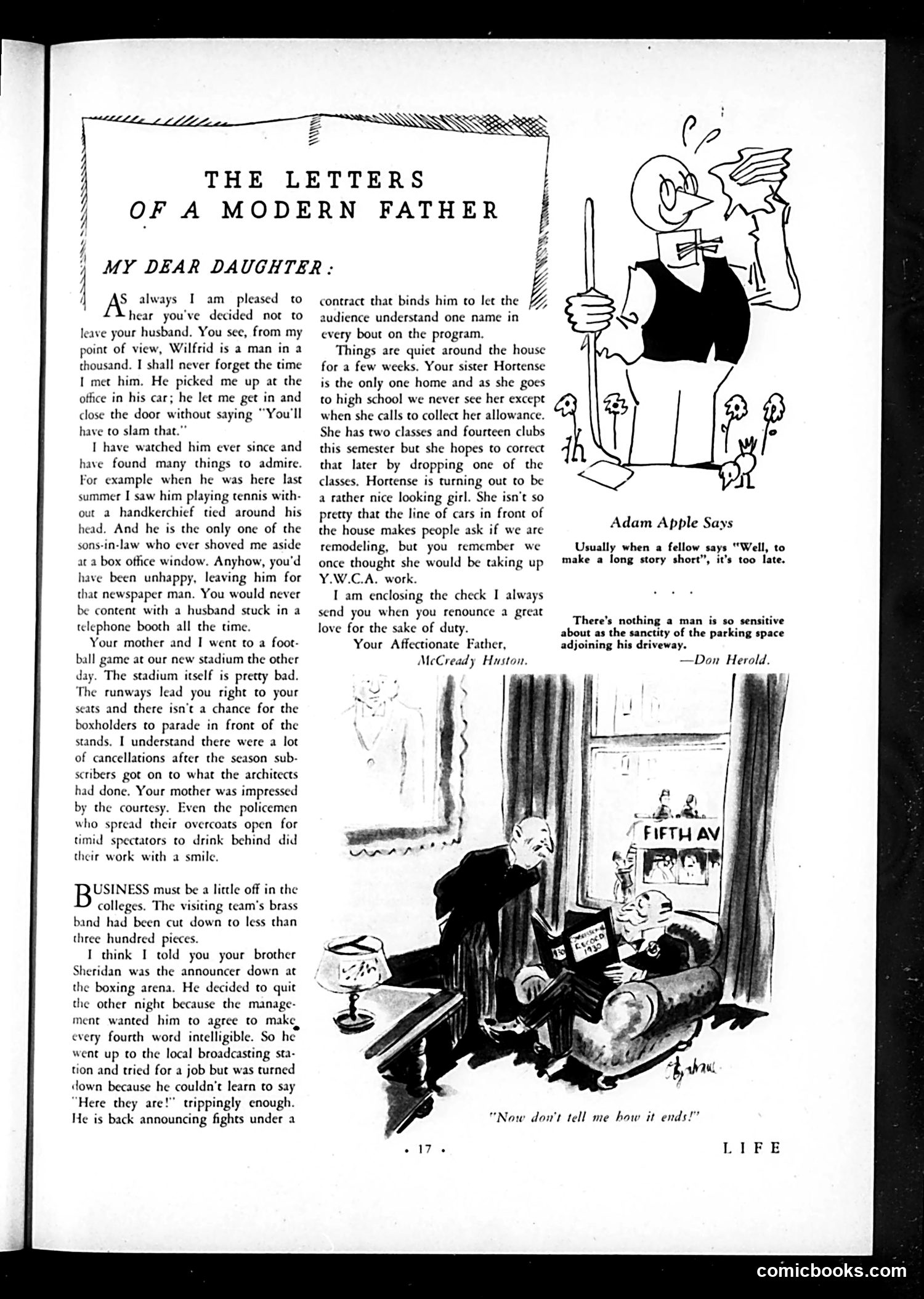
Analysis of "The Letters of a Modern Father" This is a humorous column presented as a father's letter to his daughter about family life. The main cartoon shows a domestic scene where a man lounges while listening to a radio program ("Fifth Avenue"), with the caption "Now don't tell me how it ends!"—satirizing how people avoid spoilers. The column itself humorously describes the father's observations: his husband Wilfred's quiet domesticity, his daughter Hortense's busy school life and social clubs, and his son Sheridan's failed attempt at radio broadcasting (he couldn't pronounce "Here they are!" clearly enough). The satire targets everyday modern American life—suburban routines, radio culture, and children's activities—presenting it all with gentle, affectionate humor typical of *Life* magazine's social commentary.
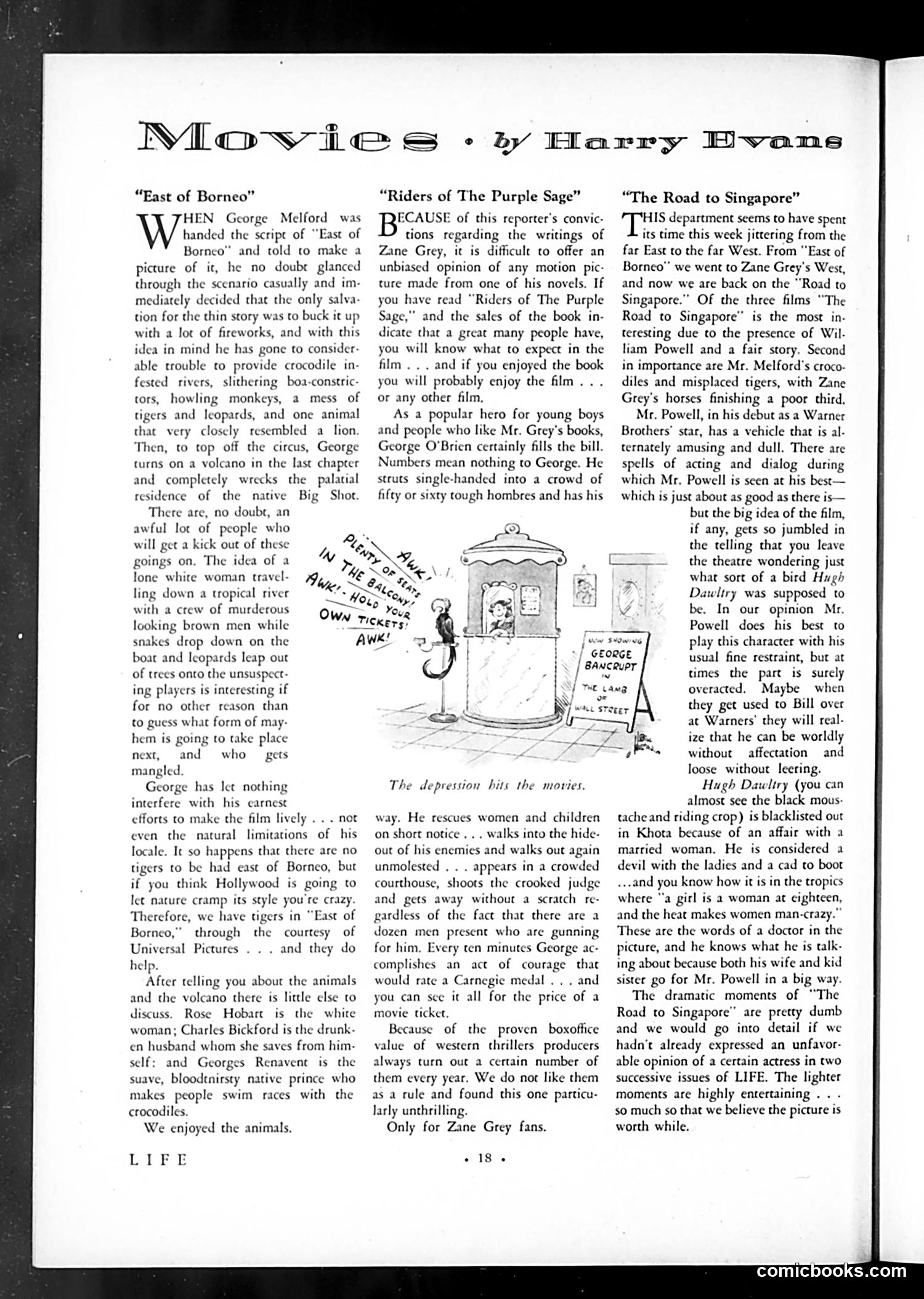
"Movies" by Harry Evans - Life Magazine Movie Reviews This page contains three film reviews by Harry Evans. The visible cartoon illustrates a scene from "East of Borneo," showing a man buying a movie ticket from a booth labeled "GEORGE MELFORD THE LION STREET" while another figure swings from what appears to be jungle vines—a visual joke about the film's exotic locale and action-adventure elements. The reviews discuss 1930s Hollywood films, their stars (George O'Brien, William Powell, Zane Grey adaptations), and plot quality. Evans critiques whether films successfully adapt their source material and evaluates the acting performances. The tone is satirical but informative, typical of Life magazine's entertainment criticism from this era.
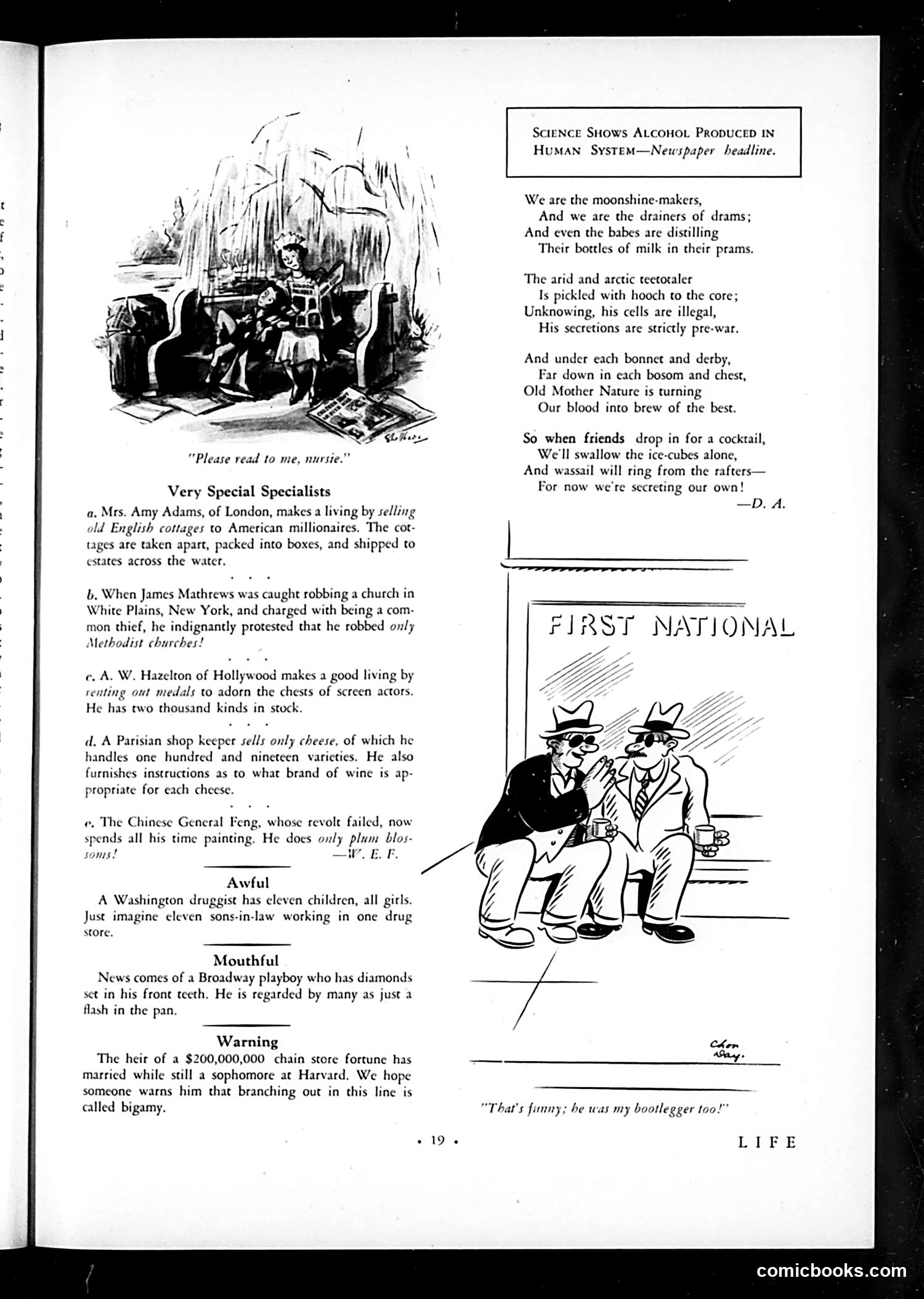
Analysis of Life Magazine Page 19 This page contains satirical commentary on various social types and professions circa the 1920s-30s. The main cartoon depicts two men in suits and hats at what appears to be a bar or restaurant, with one saying "That's funny; he was my bootlegger too!" This references Prohibition-era bootlegging, when illegal alcohol distribution was widespread and socially normalized across classes. The surrounding "Very Special Specialists" section mocks eccentric professionals: a woman selling dismantled English cottages, a church robber, a costume designer, a cheese merchant, and a Chinese general-turned-painter. The tone is humorous exaggeration of unusual but real occupational niches. The top poem about alcohol production in the human body appears to be satirizing contemporary scientific claims about internal fermentation.
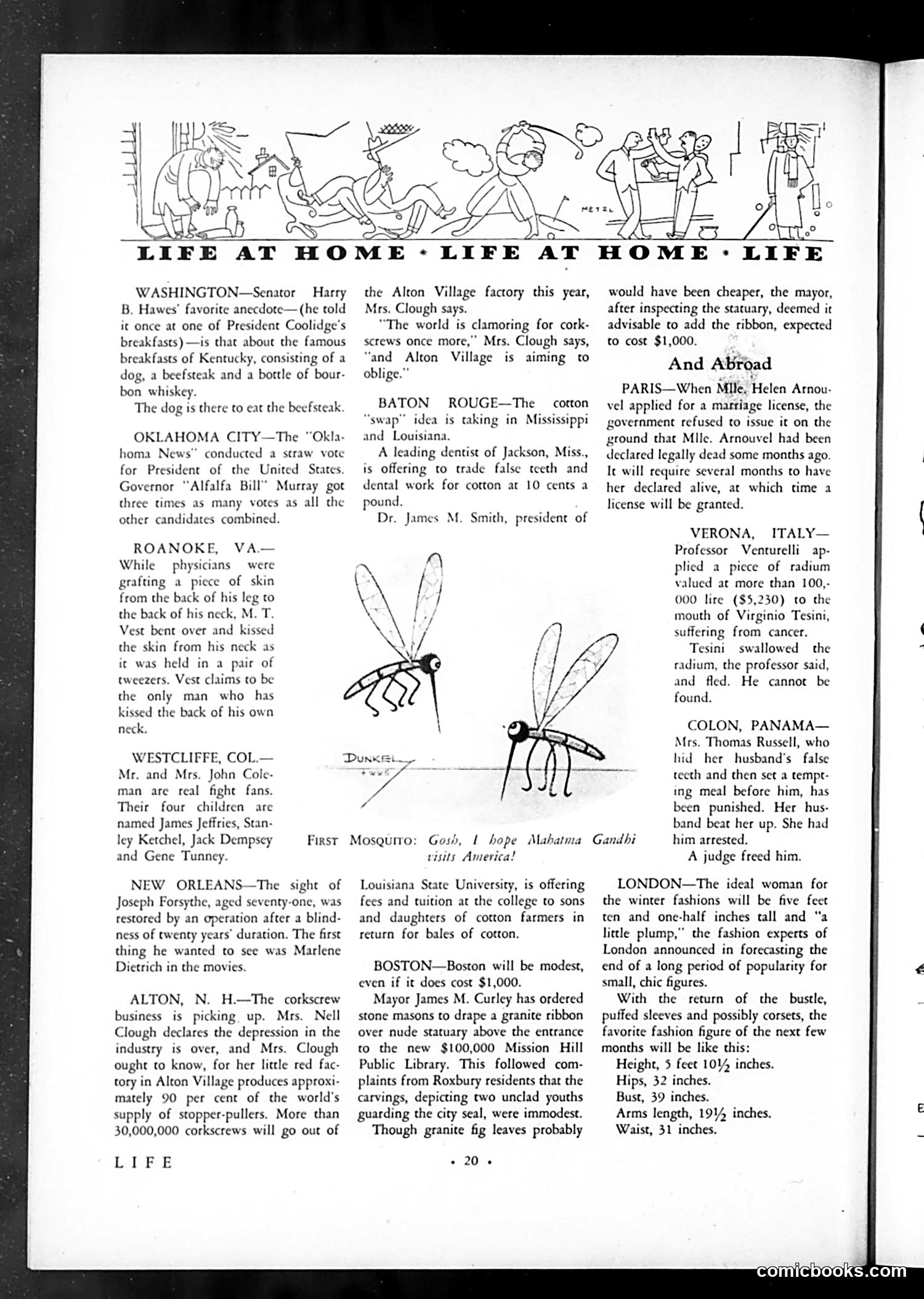
Explanation for Modern Readers This "Life at Home/And Abroad" page is a satirical humor column consisting of brief anecdotes rather than traditional political cartoons. The single cartoon shows two mosquitoes, with one saying "Gosh, I hope Mahatma Gandhi visits America!"—a joke referencing Gandhi's fame and apparent appeal to Americans, suggesting mosquitoes would welcome him as a blood donor. The text items are humorous vignettes mocking American and international absurdities. Notable examples: an Oklahoma straw vote showing "Alfalfa Bill" Murray winning overwhelmingly (satirizing questionable polling); Boston spending $1,000 to drape nude statuary with granite ribbon (mocking prudishness); and a French bureaucratic nightmare where a woman declared legally dead cannot marry. The "And Abroad" section similarly ridicules international oddities: a professor fleeing after giving a patient radium, and a judge freeing a husband who beat his wife for hiding his false teeth. The humor targets institutional incompetence, social hypocrisy, and human absurdity across cultures.
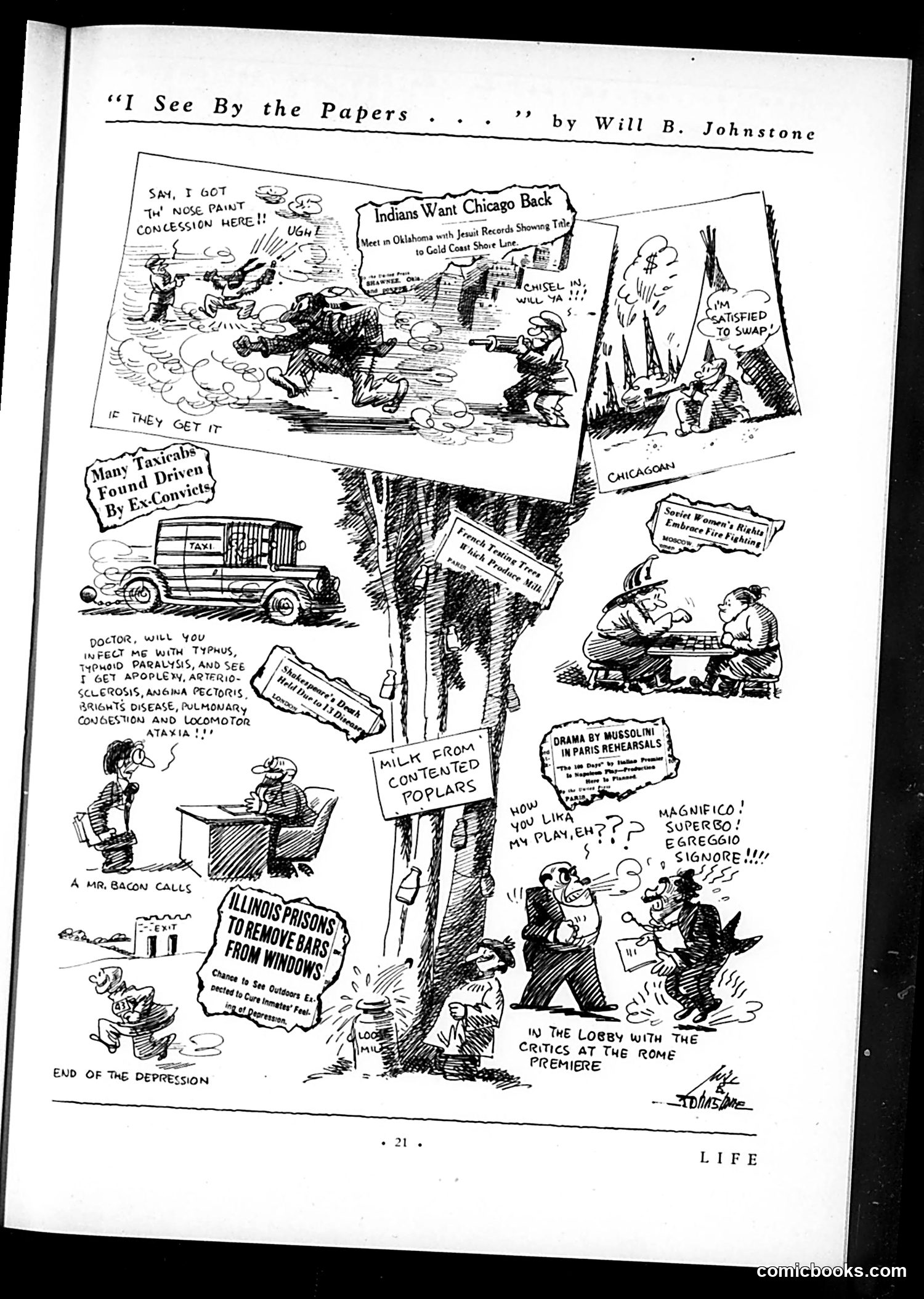
"I See By the Papers" - Political Satire Commentary This cartoon page by Will B. Johnstone satirizes contemporary news headlines through vignettes. The central tree displays clipped newspaper stories reflecting early 1930s concerns: Native Americans seeking return to Chicago; taxi drivers displaced by ex-convicts; Illinois prisons removing bars from windows (likely cost-cutting during Depression); milk from "contented poplars" (mocking advertising); and a doctor offering to infect a patient with multiple diseases (possibly satirizing dubious medical treatments or insurance schemes). Lower panels mock entertainment figures and events: "A Mr. Bacon calls" (unclear reference); Italian fascist Mussolini rehearsing a play in Paris; and "lobby with critics at Rome premiere" (likely mocking Mussolini's theatrical ambitions). The "End of the Depression" caption at bottom-left shows someone in a trash bin—darkly suggesting Depression poverty persists despite optimistic headlines. The overall point: newspapers report absurd stories masking grim reality.
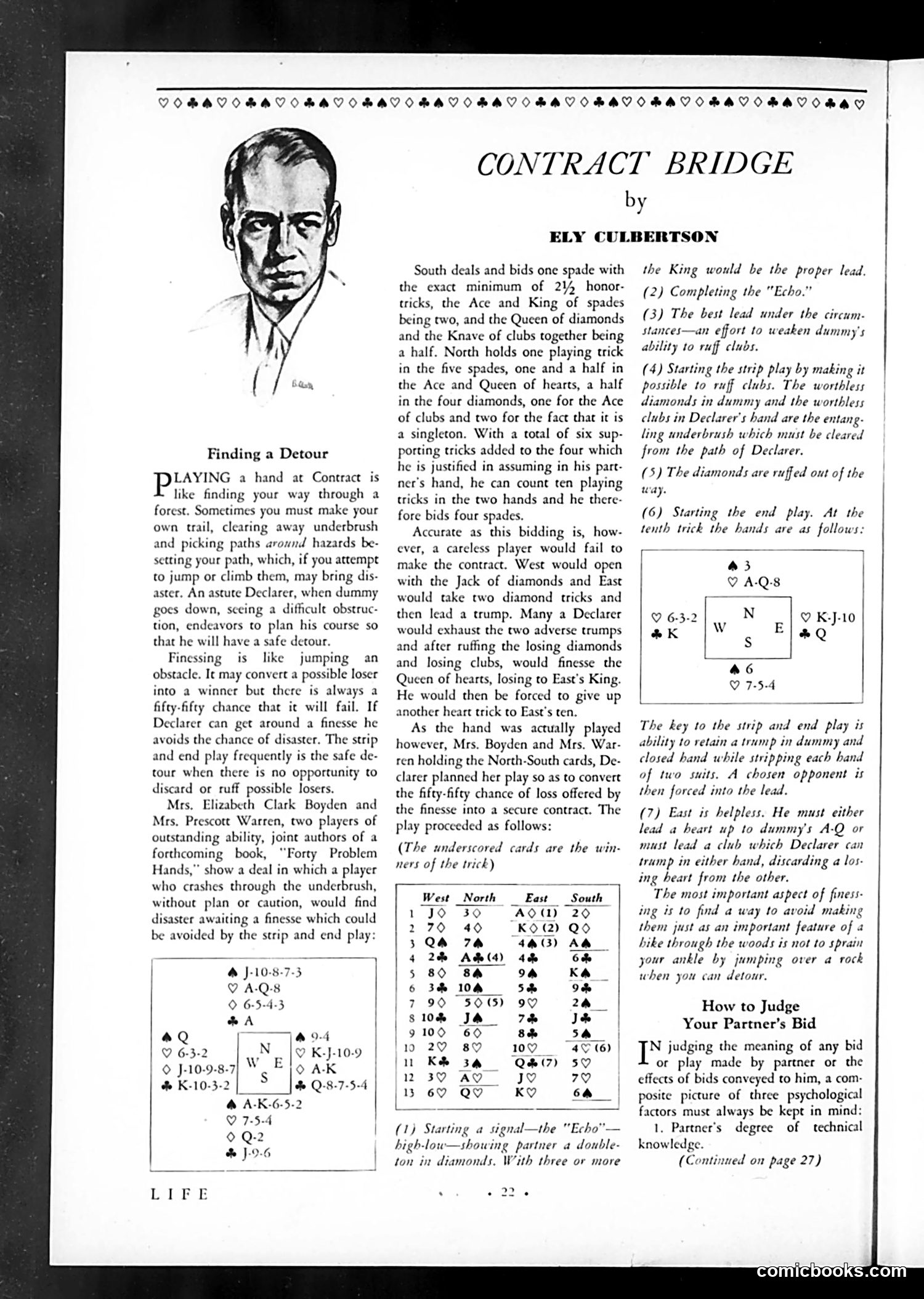
Contract Bridge Strategy Article This page is not a political cartoon but rather an instructional article on Contract Bridge, the card game. It appears in *Life* magazine's regular feature section (page 22). The content, written by Ely Culbertson (a famous bridge authority of the era), uses a forest-navigation metaphor to explain bridge strategy to readers. It teaches "the strip and end play"—an advanced technique for avoiding risky card plays. The article features an actual dealt hand analyzed by Elizabeth Clark Boyden and Prescott Warren, two prominent bridge players authoring a forthcoming instructional book. Their hand demonstrates how skilled players avoid a "finesse" (a fifty-fifty gamble) by instead carefully planning a safer route to victory—clearing away "underbrush" (worthless cards) before executing the final plays. This is straightforward instructional content aimed at *Life*'s educated readership interested in improving their bridge game.
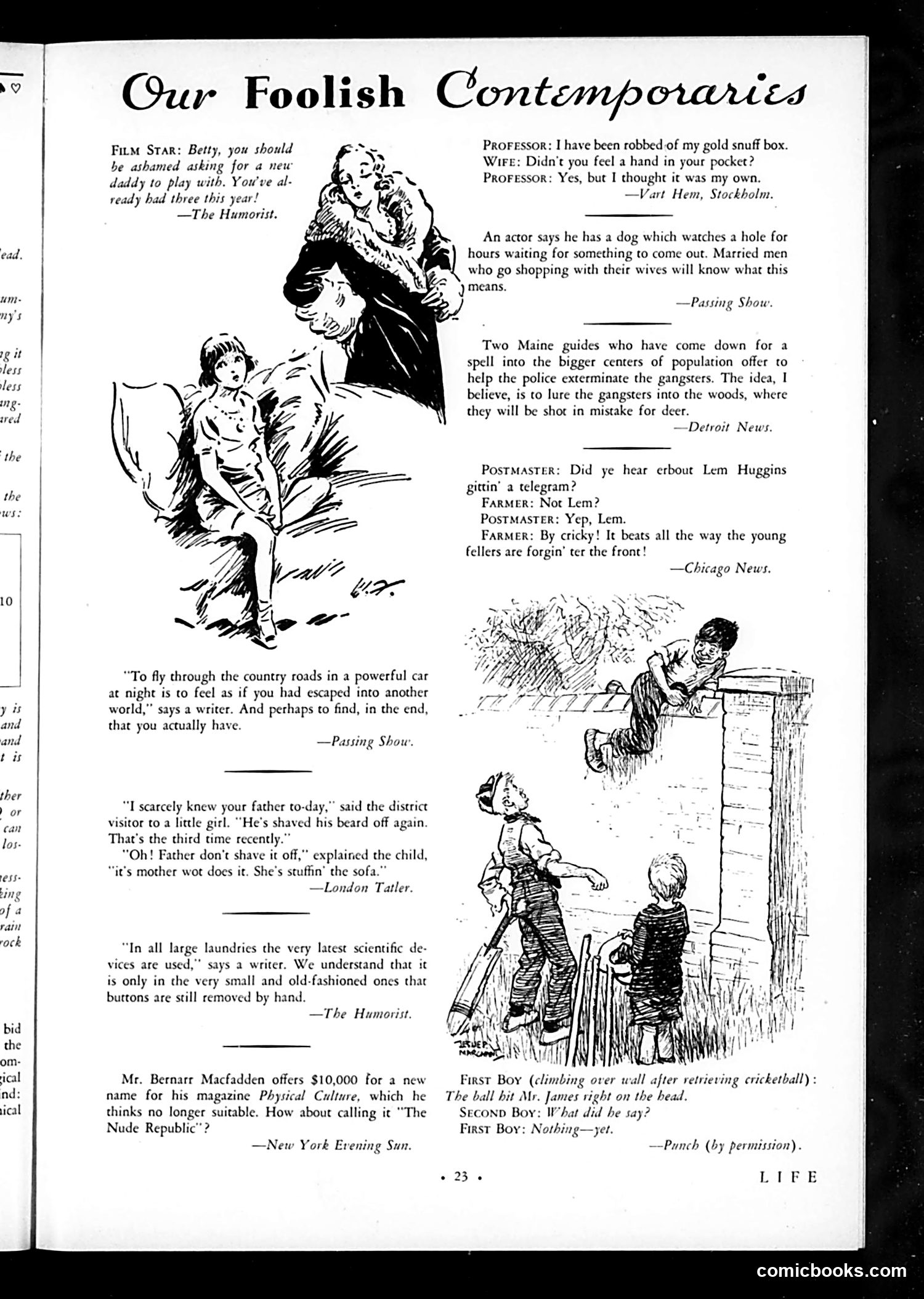
"Our Foolish Contemporaries" This page collects humorous anecdotes and cartoons satirizing modern absurdities. The title itself indicates Life magazine's format: mocking contemporary foibles through brief jokes sourced from newspapers worldwide. Key themes include marital discord (wives controlling husbands, serial divorces), rural simplicity (Maine guides, farmers), modernization's oddities (laundries removing buttons by machine, powerful cars), and generational change (young men enlisting in war). The cartoons illustrate domestic scenes—a woman stuffing a sofa with her husband's beard, children playing cricket. The satire targets middle-class pretension and social change: professors absent-minded about theft, actors' dogs as metaphors for marriage, Macfadden's magazine needing rebranding. The page reflects 1920s American and British humor—gently mocking but not politically charged—focused on everyday contradictions rather than serious commentary. It's compiled from multiple publications, a common Life feature.
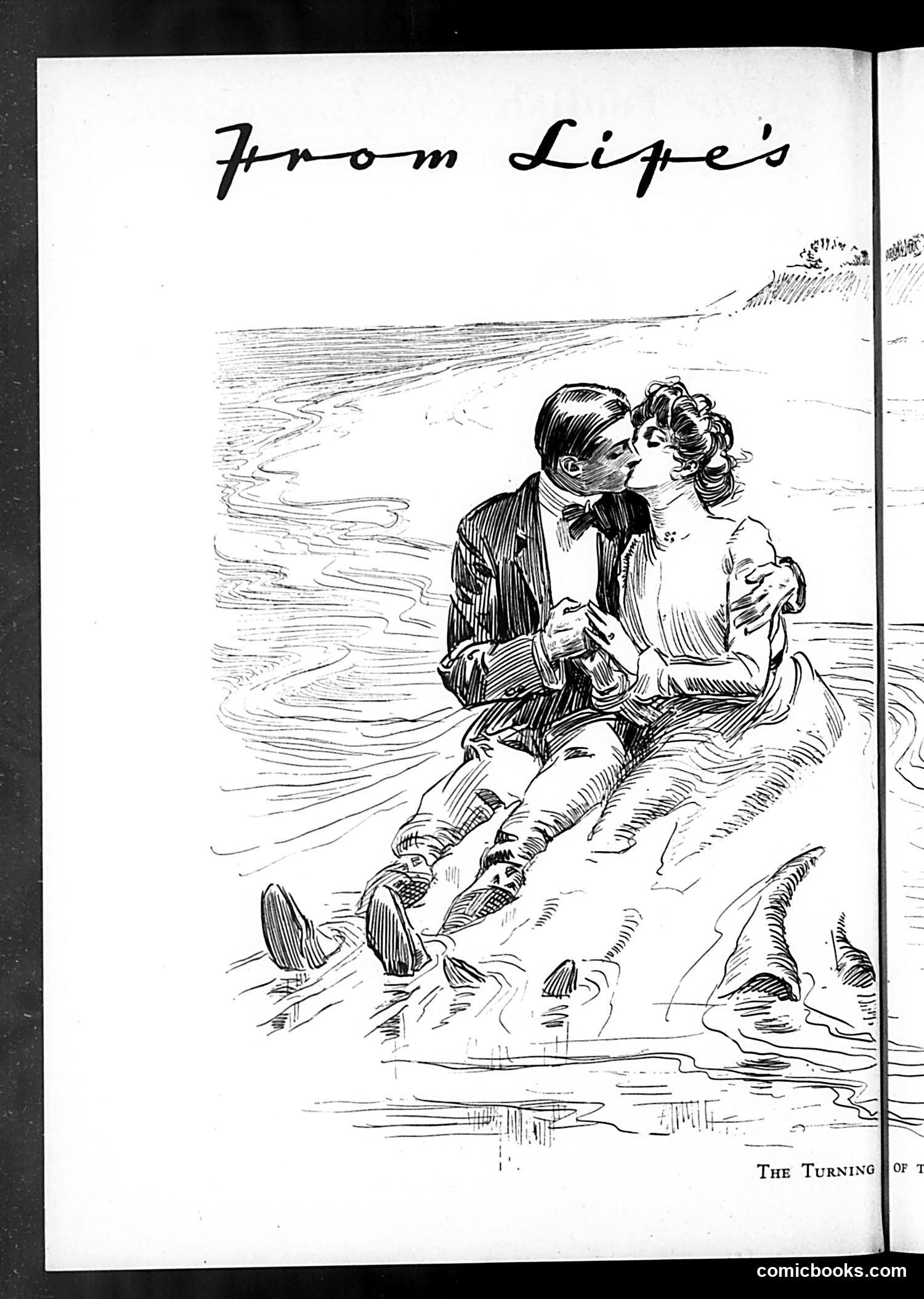
"From Life's" - Romantic Beach Scene This page header introduces content from *Life* magazine's satirical section. The illustration depicts a romantic couple kissing on a beach, rendered in pen-and-ink style typical of early-to-mid 20th century magazine illustration. The man wears formal attire (suit and bow tie) while the woman is in a light dress—suggesting either a formal outing or comedic contrast between his overdressed appearance and the casual beach setting. The caption fragment "The Turning of..." is incomplete, likely referencing a romantic plot point or story title. Without full context or visible artist signature, the specific satirical intent remains unclear, though the juxtaposition of formal dress with intimate beach romance suggests humor about courtship conventions or social propriety of the era.
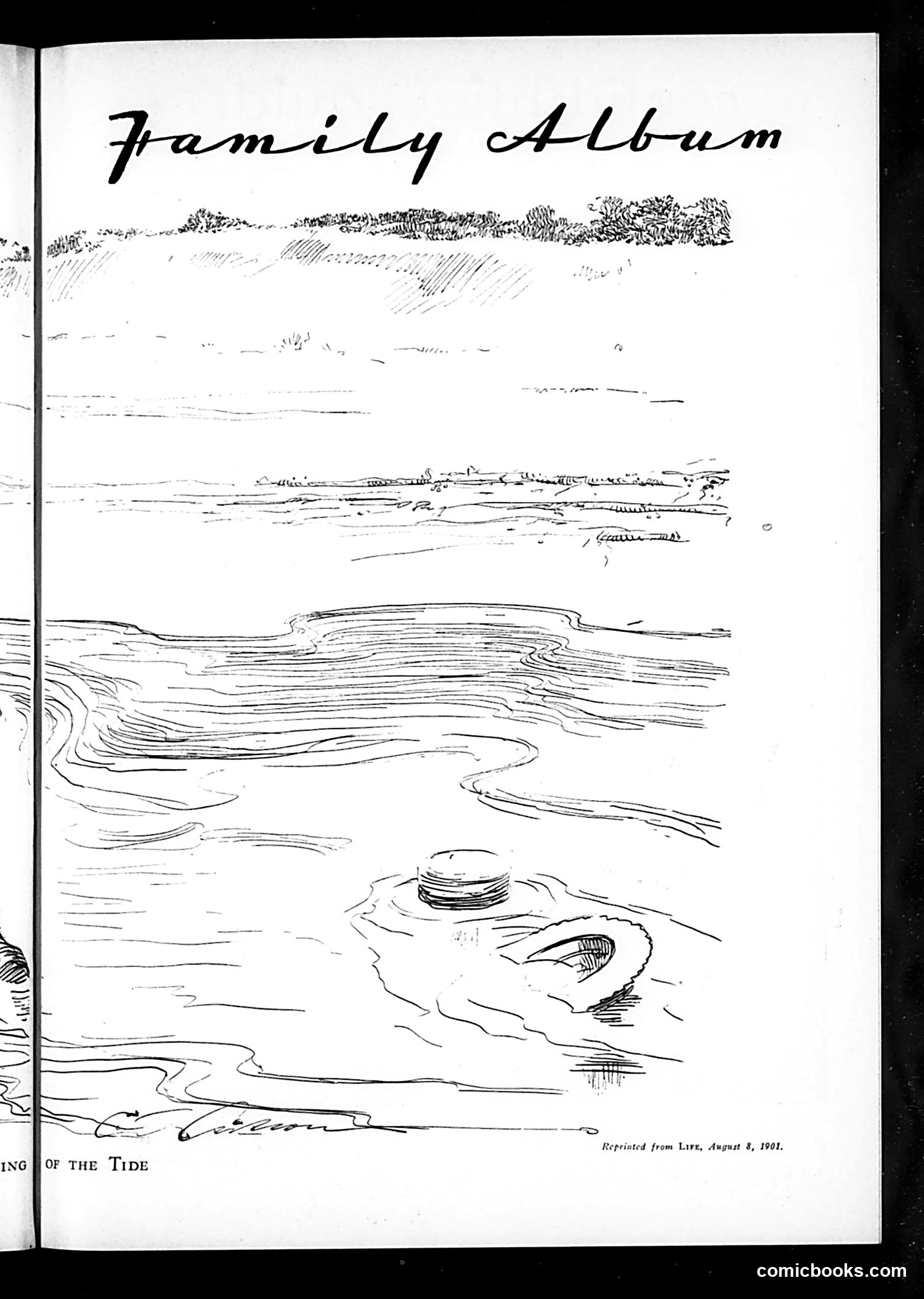
Family Album Page Analysis This appears to be a title or section page from *Life* magazine (dated August 8, 1901) labeled "Family Album." The page contains several sketch-style drawings arranged vertically, including landscape scenes with water, tide pools or coastal features, and what appears to be geological or naturalistic illustrations. The caption "Reprinted from Life, August 8, 1901" and partial text "ING OF THE TIDE" suggest this relates to tidal or coastal phenomena. However, without clearer OCR text or more distinct imagery, the specific satirical or political content remains unclear. The drawings appear more scientific or illustrative than overtly humorous, suggesting this may be an educational or nature-focused feature rather than political satire.
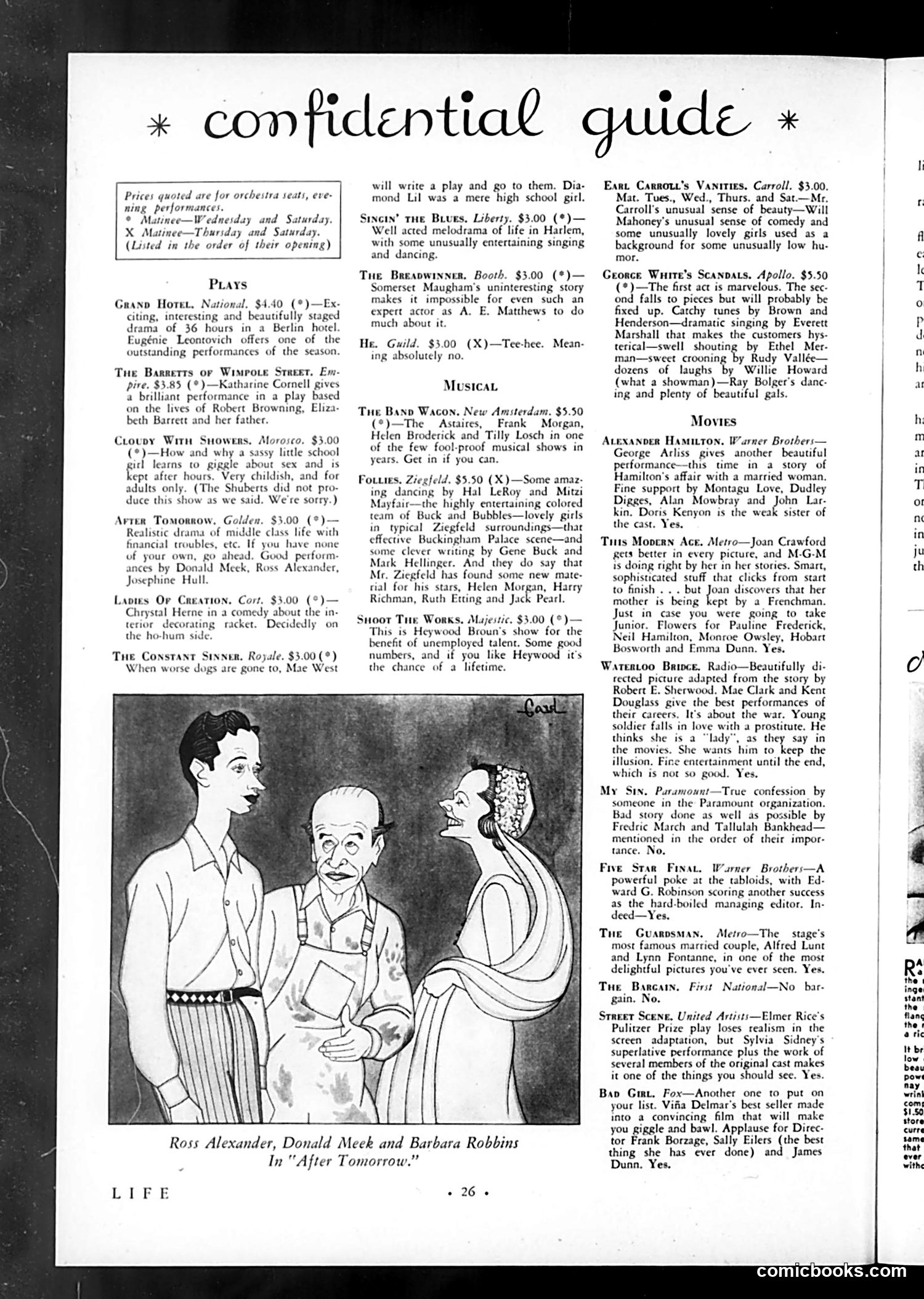
Analysis of "Confidential Guide" Page from Life Magazine This is a theater and entertainment review page, not primarily satirical. It's a "Confidential Guide" to Broadway shows, musicals, and movies currently playing, with prices and brief critical assessments. The single illustration shows three figures from "After Tomorrow"—a play reviewed here, featuring actors Ross Alexander, Donald Meek, and Barbara Robbins. The cartoon depicts what appears to be a domestic or comedic scene with period costume. The reviews themselves employ characteristic Life magazine snark: they're sharply opinionated, often dismissive (calling Somerset Maugham's play "uninteresting," labeling one show "ho-hum"), and sometimes crude in their humor. The Mae West reference jokes about her reputation for adult content. This page reflects 1930s entertainment tastes and critical standards—frank, sometimes catty commentary on Broadway and Hollywood productions for the magazine's educated urban readership.
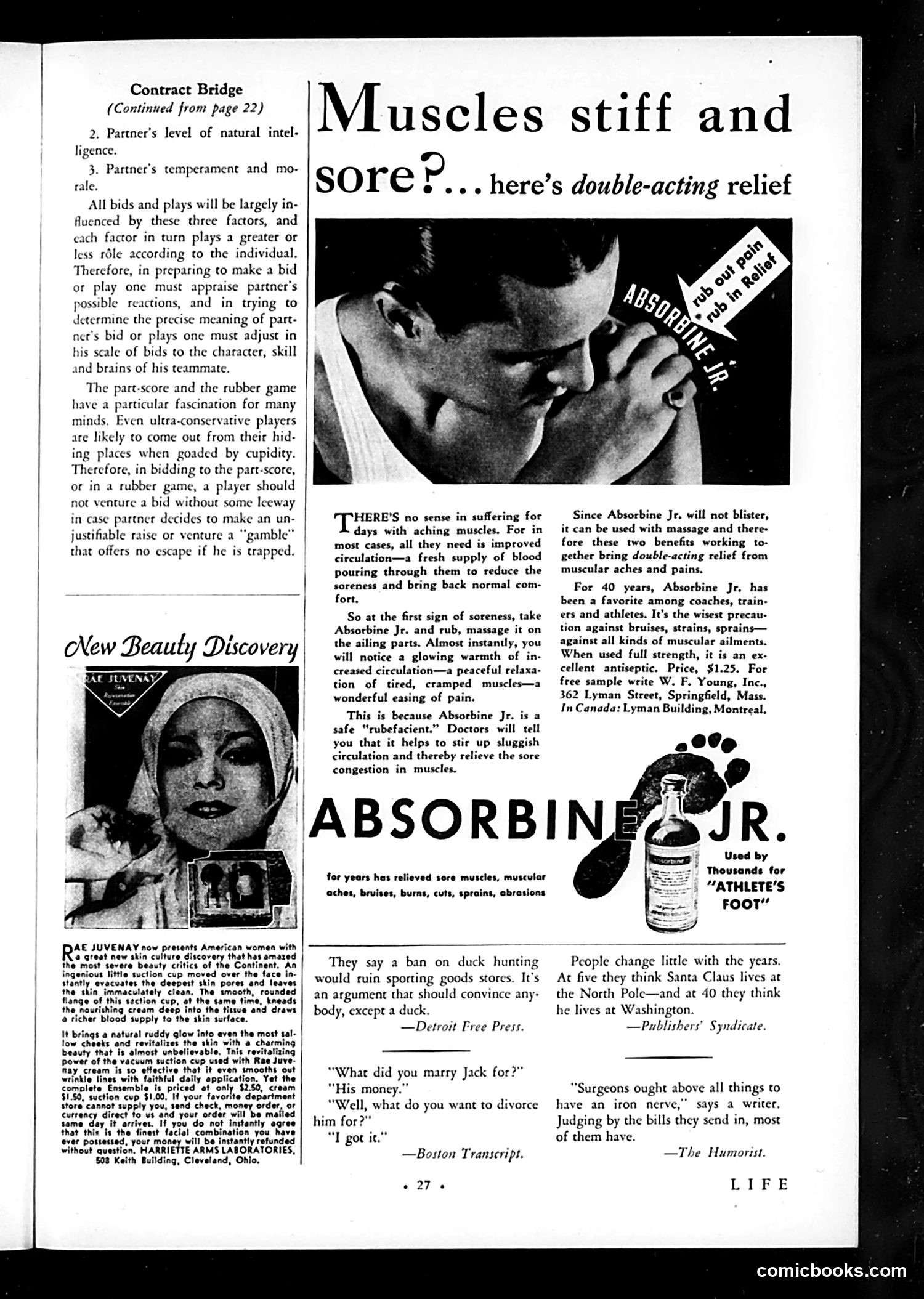
Page Analysis: Life Magazine Advertisement and Humor Section This page is primarily advertising and light humor, not political satire. The main content consists of: 1. Absorbine Jr. Advertisement (center/right): A product pitch for a liniment sold for muscle soreness and athletic injuries. The ad features a photograph of someone rubbing the product on their arm, emphasizing its "double-acting" benefit—improved circulation plus massage. The text claims 40 years of use among coaches and athletes. 2. Miscellaneous Humor Snippets (bottom): Brief jokes about duck hunting bans, divorce, and surgeons' bills—standard light fare typical of Life's humor section. 3. Beauty Product Ad (left): Rae Juvenay face cream advertisement. No political content or recognizable caricatures appear. This is a commercial/entertainment page from what appears to be a mid-20th century issue, typical of Life's mixed advertising and humor format.
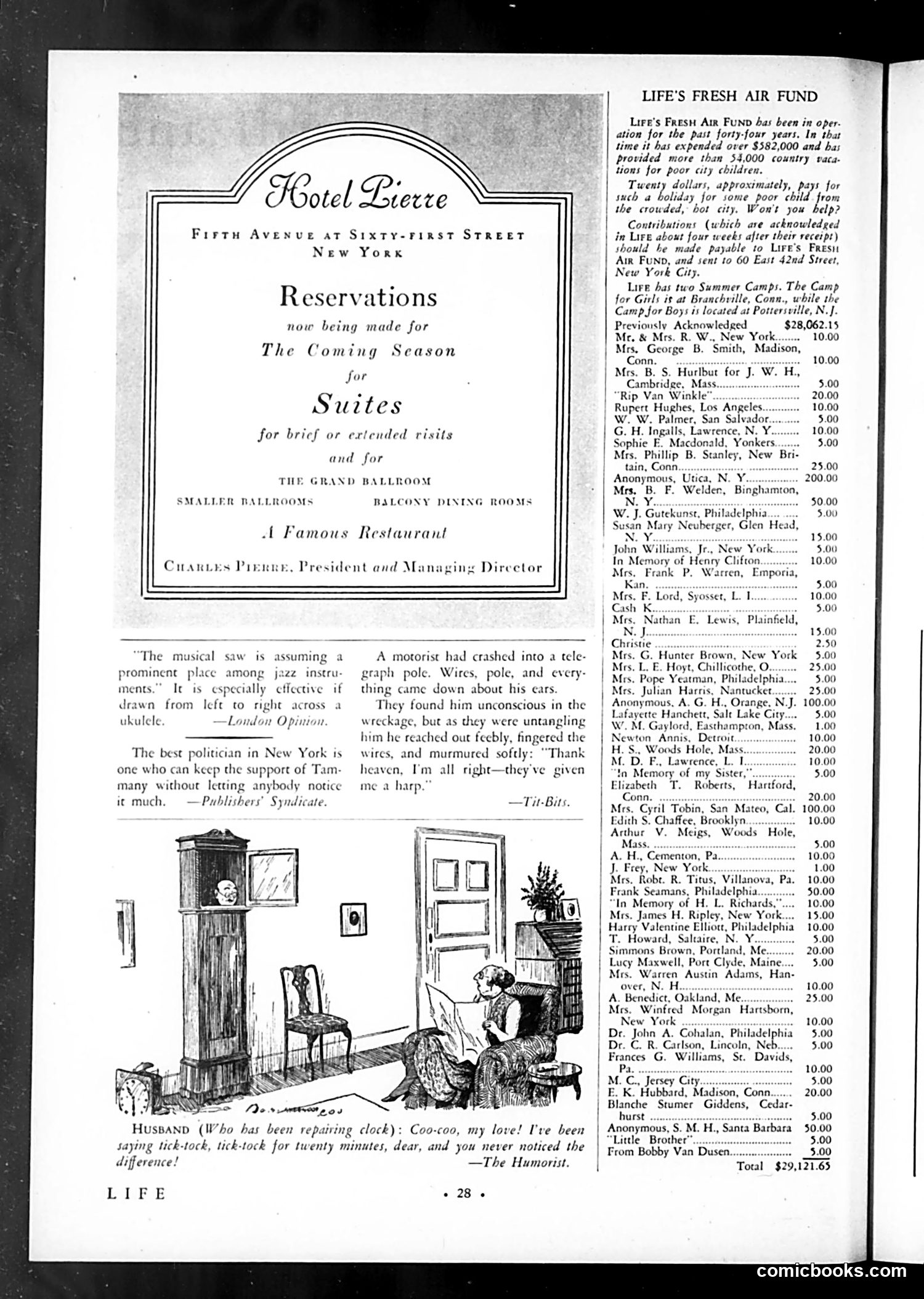
Life Magazine Page Analysis This is primarily a fundraising page for Life's Fresh Air Fund, a charitable program providing summer vacations for poor city children. The page features a Hotel Pierre advertisement and two unrelated short humorous anecdotes. The cartoon/illustrations show: 1. A domestic scene depicting a husband repairing a clock while his wife complains he's been saying "tick-tock" for twenty minutes without fixing anything—a joke about male incompetence at household repairs. The satirical content includes brief anecdotes: one about a musical saw becoming popular in jazz, and another about a motorist who crashes into a telegraph pole, then—despite being unconscious and severely injured—regains enough awareness to feel for harp strings, joking he's gone to heaven. The bulk of the page lists donations to Life's Fresh Air Fund, emphasizing the magazine's charitable mission while soliciting further contributions from readers. This was typical of Life's public-service approach during this era.
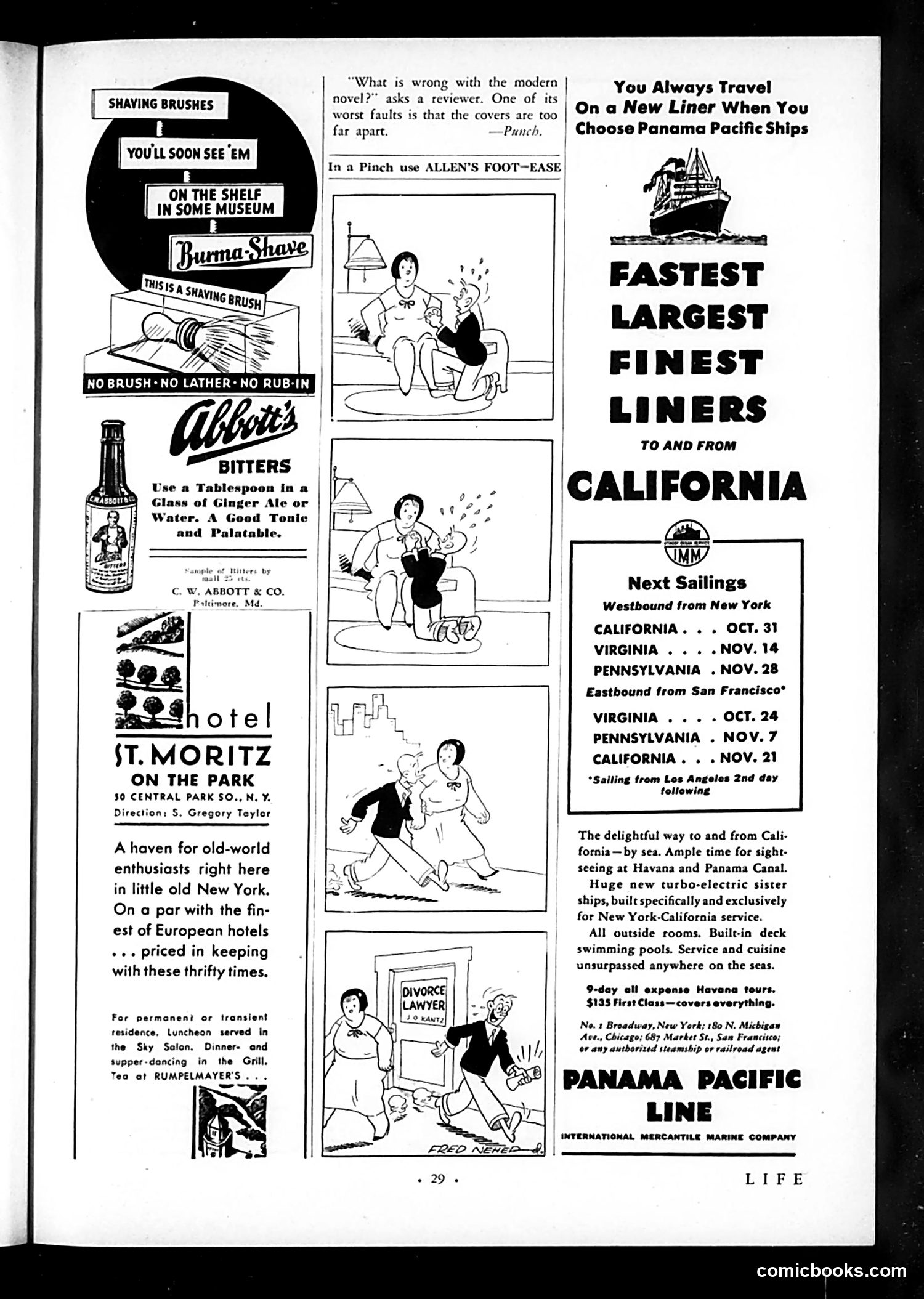
Analysis of Life Magazine Page This page is primarily advertising, with one small reprinted joke at the top. The central cartoon depicts a woman consulting a "DIVORCE LAWYER" while children cling to her legs—a visual gag about marital dissolution. The joke, credited to "FRED NEHER," satirizes the commonplace nature of divorce in modern America, presenting it as a routine legal matter worthy of comedic treatment. The page also includes a meta-joke from *Punch* magazine about modern novels: their worst fault is that "the covers are too far apart"—a quip suggesting books are getting thicker and wordier. The remaining content consists of advertisements for Abbott's Bitters, the St. Moritz Hotel, Allen's Foot-Ease, and the Panama Pacific shipping line—typical commercial placements in a 1920s-era *Life* magazine. The page number indicates this is page 29 of the publication.
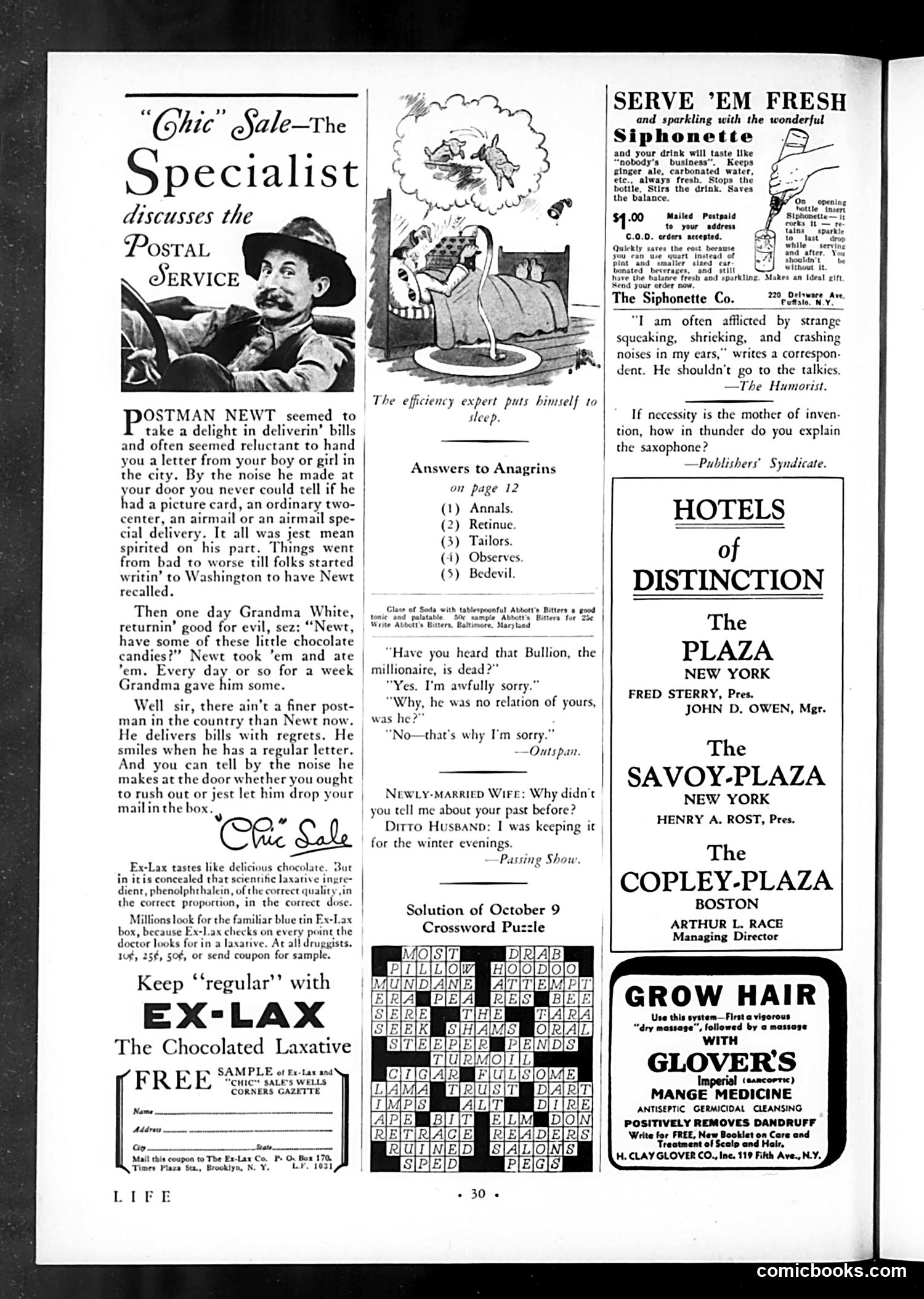
"Chic" Sale's Postal Service Satire This page features humorist "Chic" Sale's story about Postman Newt, a deliberately grumpy mail carrier who makes noise at doors and seems to resent his job. The satirical point: Newt's attitude improves dramatically after Grandma White kindly gives him Ex-Lax chocolate laxatives daily for a week. The implication—that constipation caused his bad behavior—is the crude joke anchoring this advertisement for Ex-Lax. The humor relies on early 20th-century popular entertainment conventions: rural dialect ("writin' to Washington"), an everyman protagonist, and a miraculous transformation through a commercial product. Sale was a famous monologuist known for such folksy, sentimental-yet-satirical stories. The page also includes period jokes about talking pictures ("talkies") and marriage, plus hotel and hair-product advertisements typical of *Life* magazine's mixed content format.
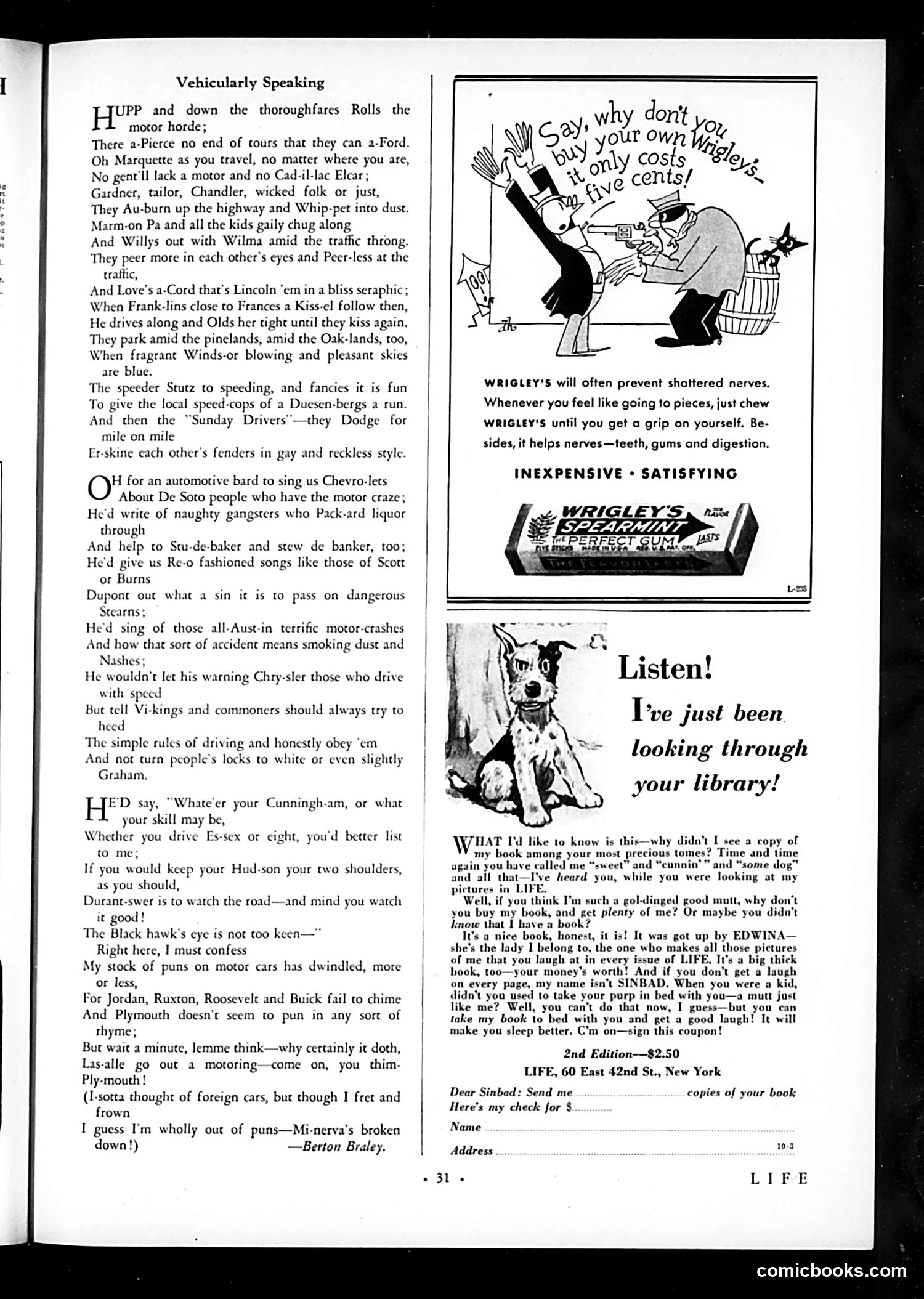
"Vehicularly Speaking" - A Pun-Filled Auto Industry Satire This page from *Life* magazine features a lengthy humorous poem by Berton Braley that puns relentlessly on automobile brand names popular in the 1920s-1930s. The joke depends on recognizing car manufacturers: Pierce-Arrow, Ford, Marquette, Cadillac, Gardner, Chandler, Auburn, Whippet, Marmon, Willys, Lincoln, Studebaker, Dodge, Stutz, Duesenberg, Chevrolet, DeSoto, Packard, and others are woven into verses about courtship and reckless driving. The satire mocks both automotive excess (the "motor horde" congesting roads) and dangerous driving culture—speeding, racing cops, reckless parking. The poem ironically positions itself as moral instruction while celebrating the very behaviors it ostensibly warns against. The right side contains an unrelated advertisement for Wrigley's gum and a book promotion featuring "Sinbad," a dog character from *Life* magazine's regular features.
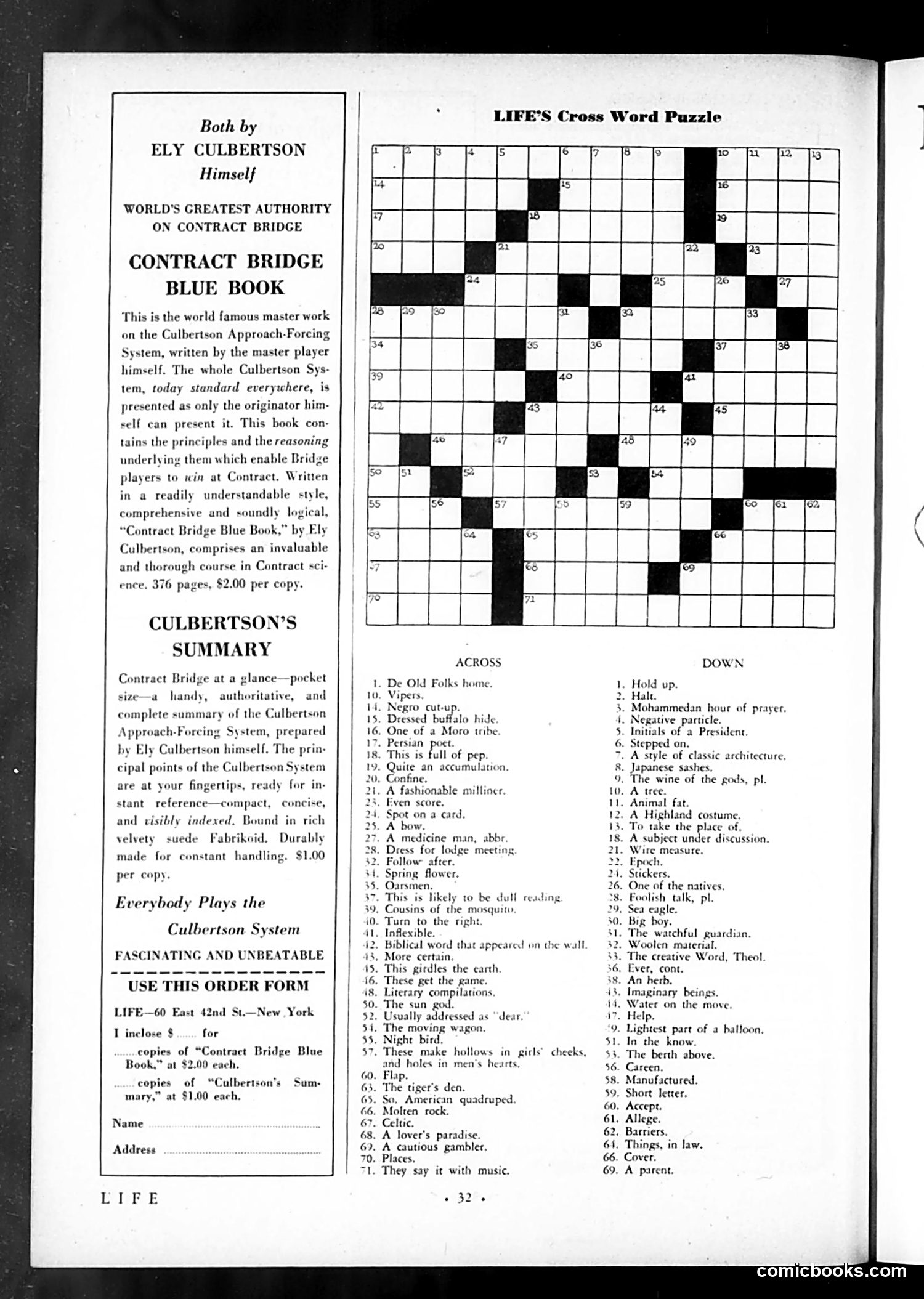
Content Analysis This page is primarily advertising and a crossword puzzle, not political satire. The left side promotes Ely Culbertson's "Contract Bridge Blue Book"—instructional texts on contract bridge, the card game. Culbertson is identified as "World's Greatest Authority on Contract Bridge." The ads emphasize that he invented the Culbertson System (presented as the modern standard) and offers two books: a comprehensive 376-page manual ($2.00) and a pocket summary ($1.00). The right side contains LIFE magazine's crossword puzzle with standard clues like "Negro cut-up" (13 Across), reflecting period terminology without satirical intent—these are straightforward puzzle definitions. There is no political cartoon or social satire here. This is a typical early-to-mid 20th century magazine page combining advertising with a leisure activity (crossword solving), targeting readers interested in the popular pastime of contract bridge.
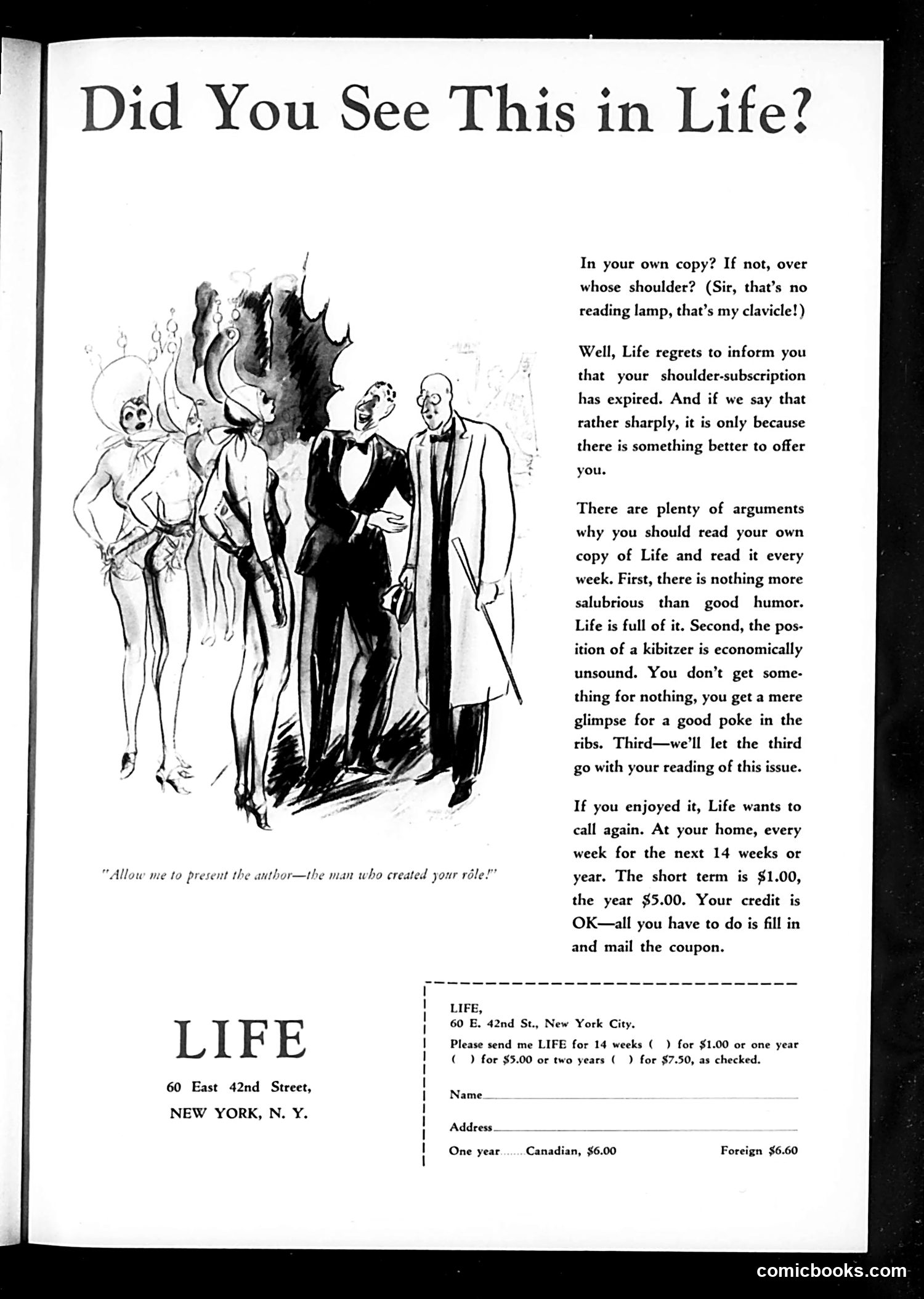
Analysis: Life Magazine Subscription Advertisement This is primarily a subscription renewal advertisement for Life magazine, a satirical American publication. The cartoon illustrates the magazine's humorous pitch to lapsed readers. The illustration shows a formal scene where a man in formal wear presents an elegantly dressed woman to two other gentlemen, with the caption sarcastically framing her as "the author—the man who created your rôle!" The joke satirizes the awkwardness of reading over someone's shoulder—a "shoulder-subscription" without paying. The text employs comedic self-awareness: Life playfully chides readers who've let subscriptions lapse, admitting they were reading free copies "over someone's shoulder." The magazine then makes its pitch through humor rather than hard sell, emphasizing that good satire ("good humor") is worth the modest cost ($1 for 14 weeks; $5 yearly). This reflects early 20th-century magazine marketing—using wit to encourage paid subscriptions from an audience accustomed to "borrowing" copies from friends.
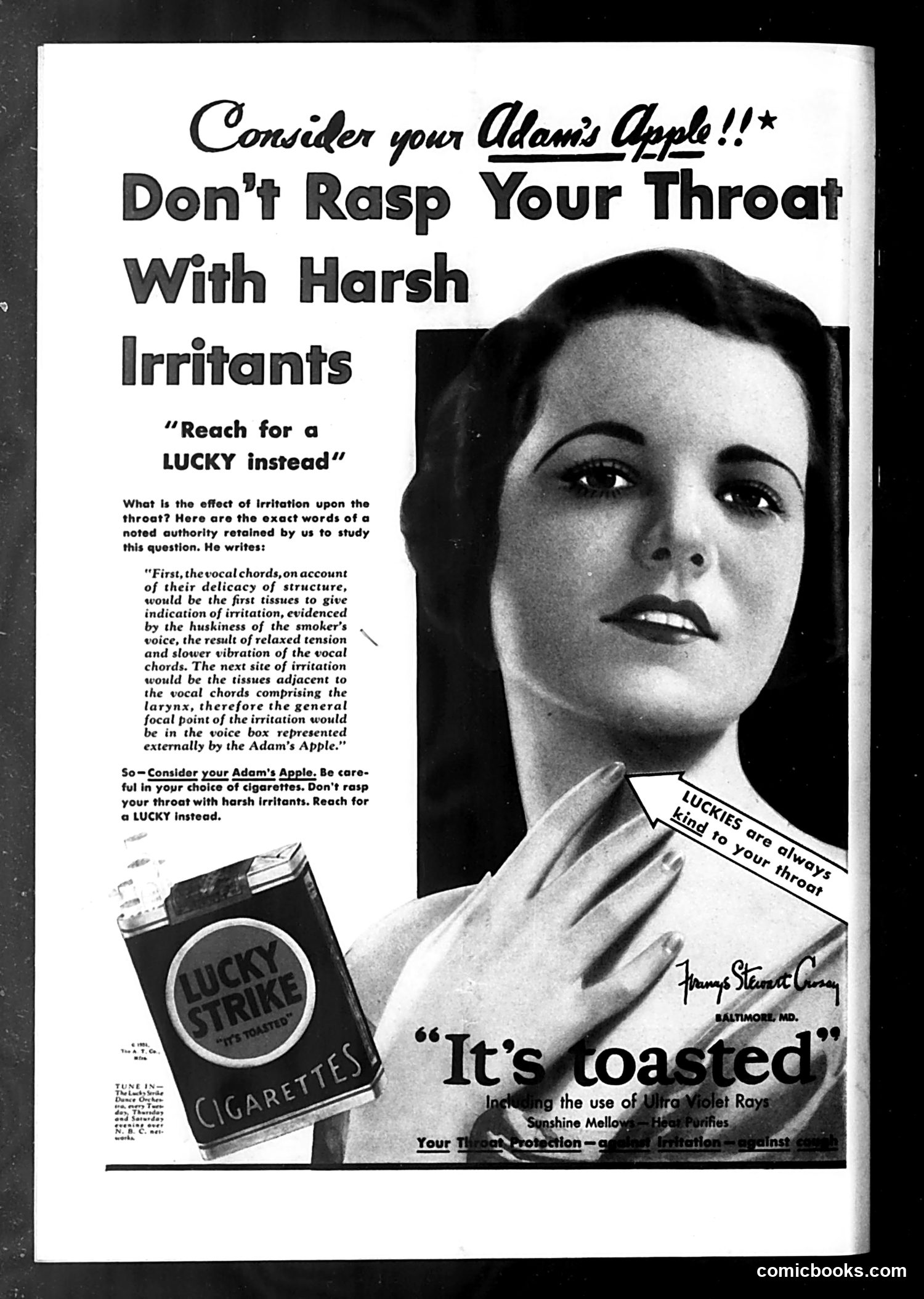
Lucky Strike Cigarette Advertisement This is a Lucky Strike cigarette advertisement, not satire or political commentary. It's a genuine commercial from the era when tobacco companies made unsubstantiated health claims. The ad argues that smoking Lucky Strikes won't irritate your throat because they're "toasted." It quotes a purported medical authority explaining how smoking damages vocal cords and the larynx (the "Adam's Apple"), then suggests Lucky Strikes are gentler than competitors' "harsh irritants." For modern readers: This represents the tobacco industry's pre-regulation marketing tactics, when cigarette companies could make false health claims without FDA oversight. The phrase "It's toasted" was Lucky Strike's actual advertising slogan. The ad features an attractive woman endorsing the product—a common strategy targeting women smokers. This would be illegal advertising today.
I can see this is a mostly blank or extremely dark page from Life magazine with minimal visible content. The OCR text only returns "comicbooks.com," which appears to be a watermark rather than actual magazine content. The image itself is too dark to reliably identify any cartoons, caricatures, figures, or satirical content. Without being able to see the actual cartoon artwork or read legible text, I cannot accurately identify political/social references, explain the satire, or determine what historical moment this addresses. To properly analyze this page's meaning for a modern reader, a clearer or higher-contrast image would be needed.