life
Life — October 23, 1931
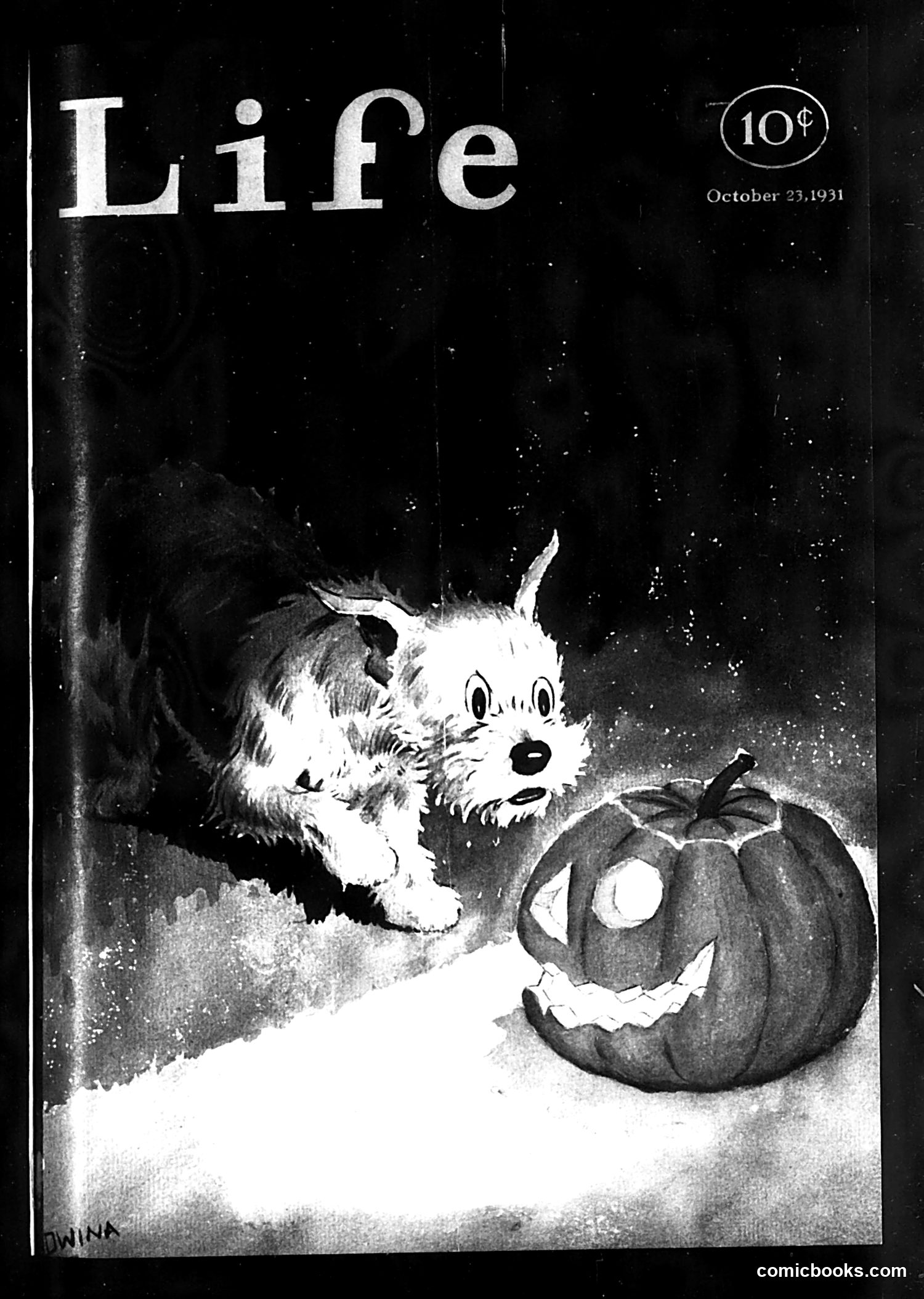
Life Magazine Cover, October 23, 1931 This is a cover illustration (signed by the artist "IWINA") depicting a small, fluffy dog encountering a carved jack-o'-lantern pumpkin. The dog appears startled or curious, with wide eyes, while the pumpkin sports a traditional grinning face with triangular eyes and mouth. The image is a straightforward Halloween-themed illustration rather than political satire. It plays on the common comedic scenario of a pet's surprised reaction to a carved pumpkin—treating the jack-o'-lantern as if it were a real character or threat. This was a popular type of wholesome, domestic humor for *Life* magazine's audience during the early 1930s. The ten-cent price and October date confirm this as seasonal Halloween content.
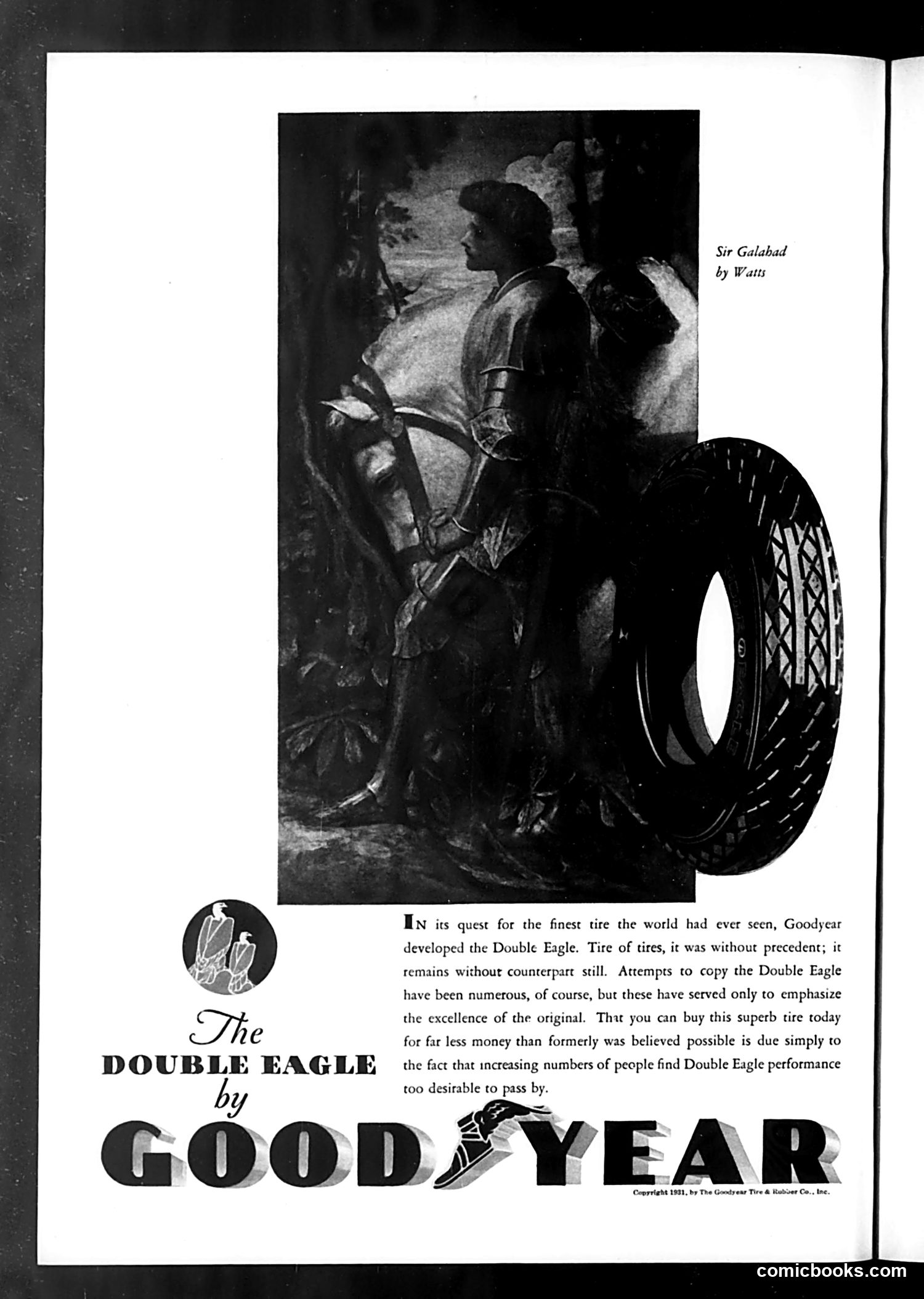
Analysis This is a Goodyear tire advertisement, not political satire. The page features a classical artwork titled "Sir Galahad by Watts" showing a medieval knight on horseback, repurposed to advertise the "Double Eagle" tire. The ad's strategy links the tire to nobility and excellence: just as Sir Galahad represents the finest knight in Arthurian legend, Goodyear's Double Eagle tire represents "the finest tire the world had ever seen." The text claims competitors have tried copying it but failed, and credits the tire's affordability to increasing consumer demand. The eagle logo appears in the lower left corner. This is commercial messaging using cultural prestige rather than political commentary—a common early 20th-century advertising approach associating products with idealized imagery.
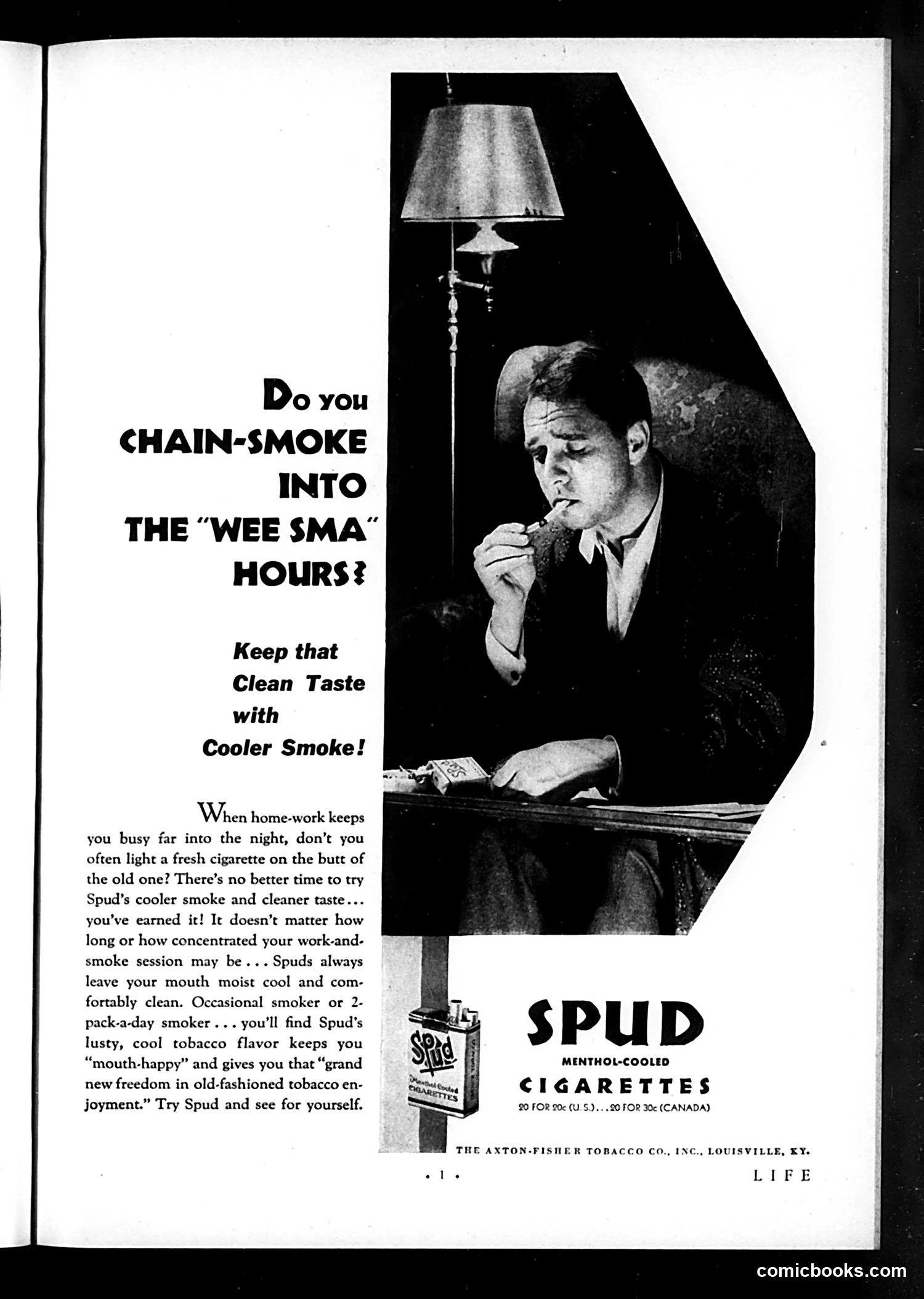
Analysis This is a cigarette advertisement, not satire or political commentary. The ad promotes Spud brand menthol-cooled cigarettes manufactured by Axton-Fisher Tobacco Co. in Louisville, Kentucky. The image shows a man working late at night, chain-smoking cigarettes. The ad's pitch exploits this scenario: the headline asks if the reader chain-smokes during "wee sma" hours" (small hours of the morning), then suggests Spud cigarettes as a solution because they allegedly keep the mouth "moist cool and comfortably clean" even with heavy smoking. This reflects mid-20th century advertising that normalized chain-smoking as normal workplace behavior and explicitly marketed cigarettes as a solution to smoking's own unpleasant effects—a claim now recognized as deceptive.
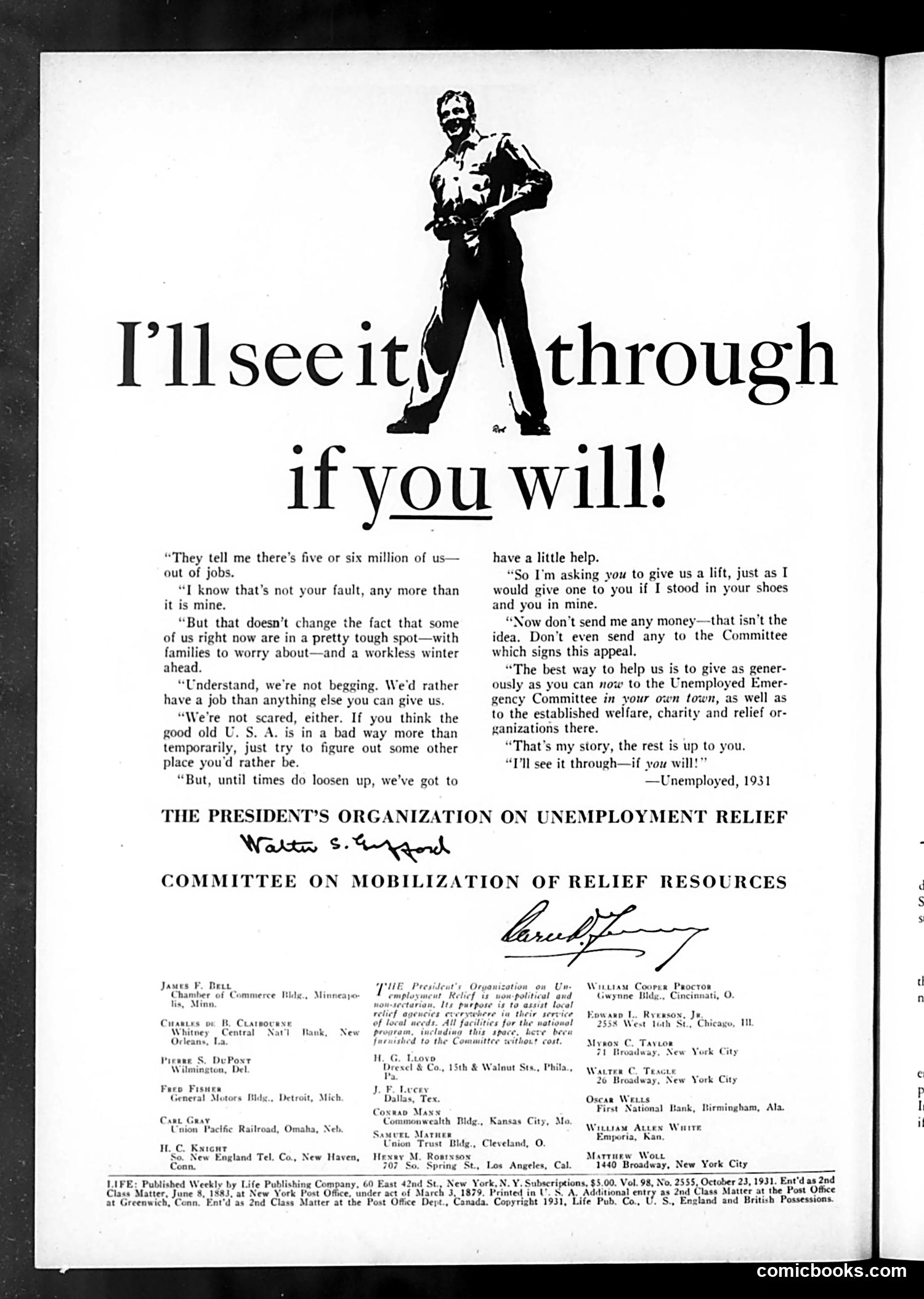
Analysis This page from Life magazine (October 23, 1931) promotes The President's Organization on Unemployment Relief, a Depression-era charity initiative. The illustrated figure appears to be an unemployed man appealing directly to readers. The central message is: "I'll see it through if you will!"—a pledge that mutual effort can address mass joblessness. The text presents the man's perspective: unemployment isn't shameful, jobs are preferable to charity, and Americans shouldn't send money to national committees but rather support local emergency relief organizations in their own towns. This reflects Depression-era philosophy emphasizing community responsibility and self-reliance over federal intervention. The appeal targets middle-class readers to voluntarily support local relief efforts alongside the president's organization, acknowledging "five or six million" unemployed while avoiding federal welfare expansion.
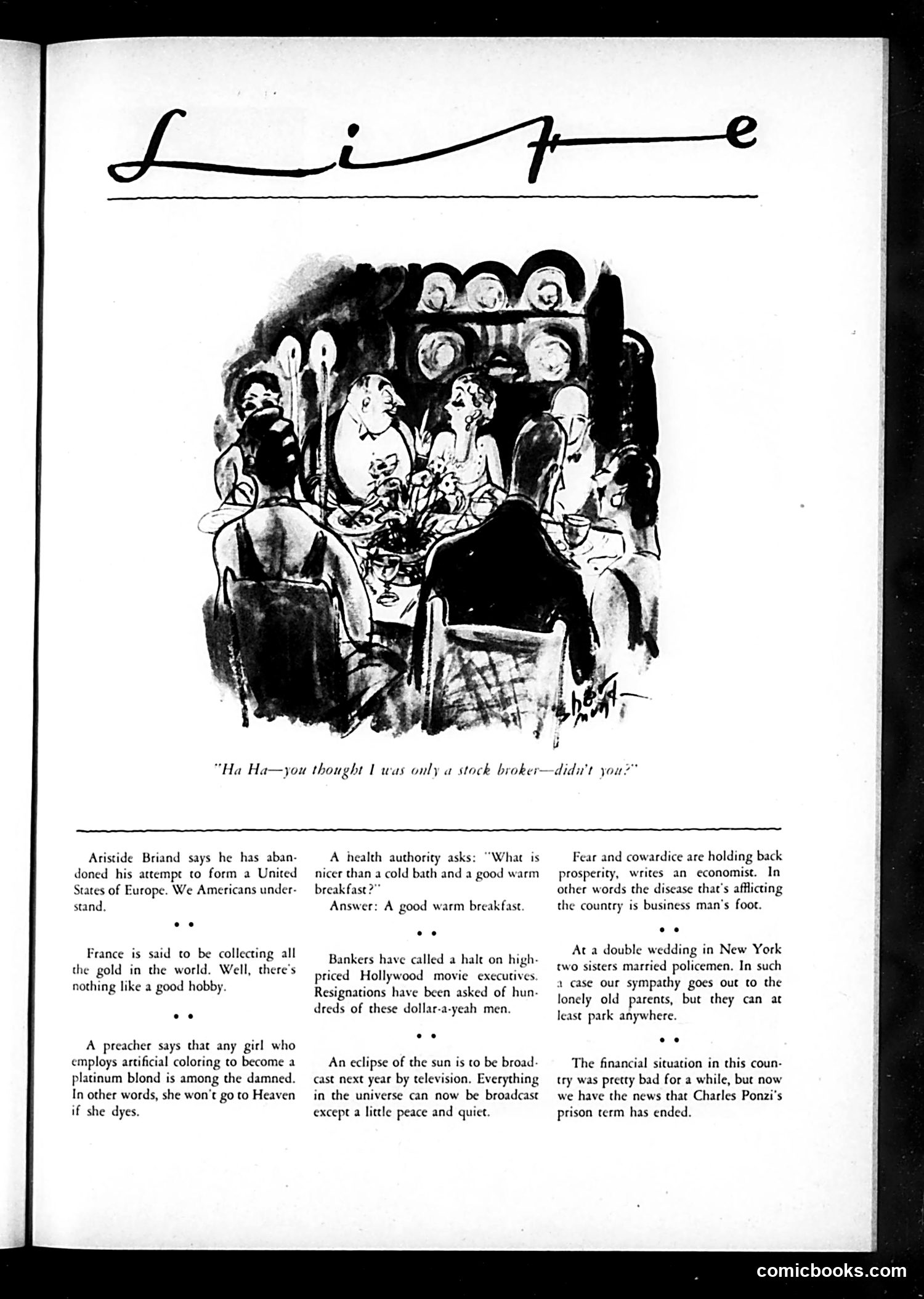
Political Cartoon and Satire Analysis This page from *Life* magazine contains a single cartoon and several brief satirical quips. The cartoon shows a dinner party scene where one guest tells another: "Ha-Ha—you thought I was only a stock broker—didn't you?" The joke satirizes social pretension and hidden identities among the wealthy. The implication is that the stock broker possesses additional, apparently more impressive credentials or status that have been concealed. Given the dinner party setting and formal dress, this appears to mock how financially successful individuals strategically reveal accomplishments to enhance their social standing. The accompanying quips on the page address various topics—European politics, religious hypocrisy, and business concerns—typical of *Life*'s satirical commentary on contemporary American society and current events.
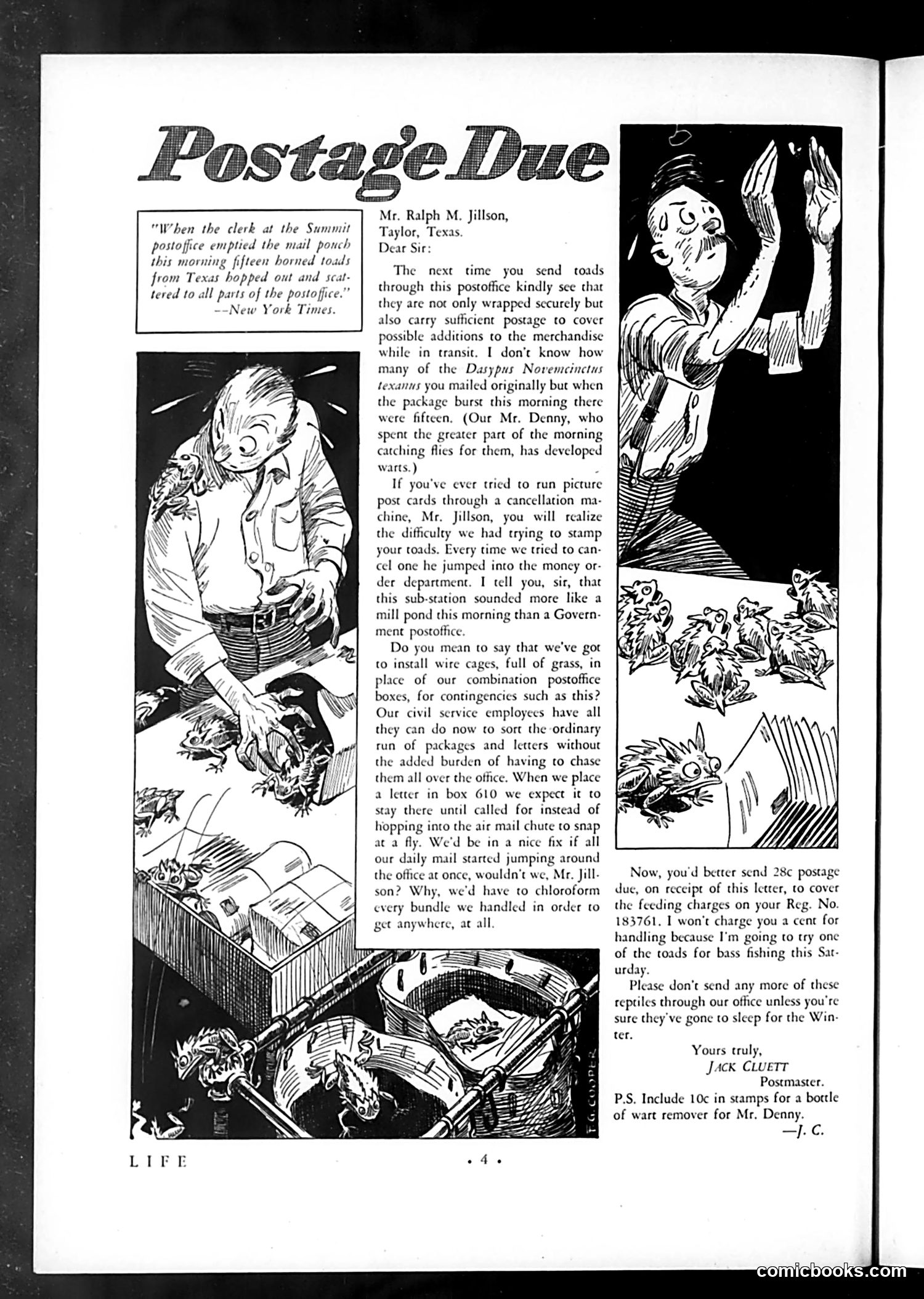
"Postage Due" Satirical Letter This is a humorous complaint letter from "Jack Cluett, Postmaster" to Mr. Ralph M. Jillson in Taylor, Texas, who apparently mailed live toads through the U.S. mail. The satire depicts the chaos that ensued: fifteen toads escaped the package, scattered throughout the post office, and caused havoc among staff. The accompanying illustrations show a bewildered postal worker surrounded by hopping toads and mail in disarray. The joke satirizes both the absurdity of mailing live animals and the postal service's bureaucratic inflexibility. Cluett's deadpan tone—treating the toad invasion as merely a "postage due" issue requiring additional stamps—mocks how government agencies respond to ridiculous situations with procedure rather than common sense. The P.S. about "wart remover for Mr. Denny" adds to the absurdist humor.
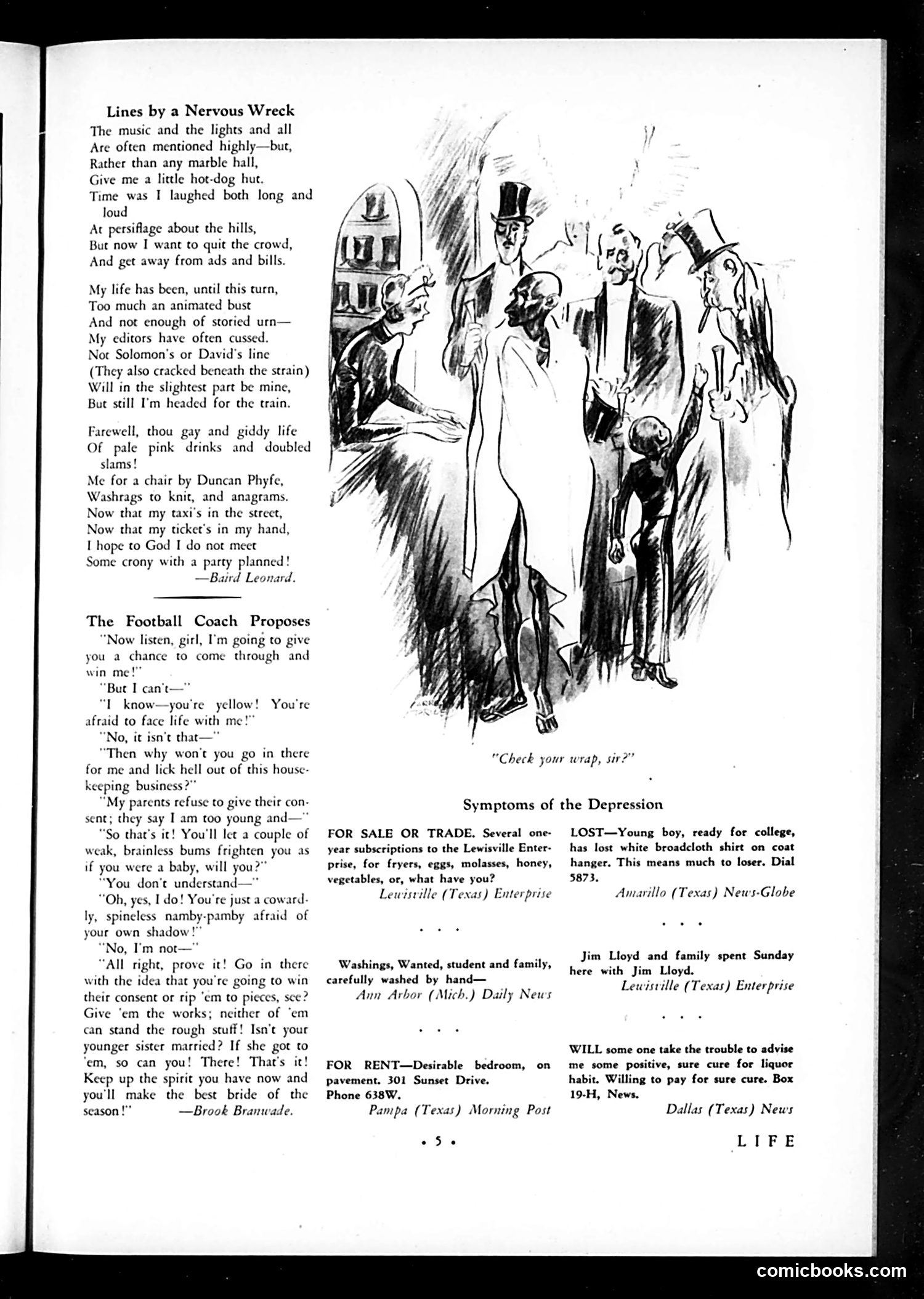
Analysis of This Life Magazine Page This page contains literary and social commentary rather than political cartoons. The main poem, "Lines by a Nervous Wreck" by Baird Leonard, satirizes modern urban anxiety—the author laments his chaotic life ("animated bust," "too much...sordid urn") and yearns to escape to the countryside ("a little hot-dog hut"). The accompanying sketch shows well-dressed urbanites, likely depicting the sophisticated city crowd the poem critiques. Below, "The Football Coach Proposes" presents a humorous dialogue where a coach pressures a reluctant young man to prove his courage by winning a girl's consent through persistence—satirizing both aggressive coaching mentality and contemporary courtship assumptions that men should overcome female resistance. The "Symptoms of the Depression" section contains period classifieds and personal notices, reflecting economic hardship.
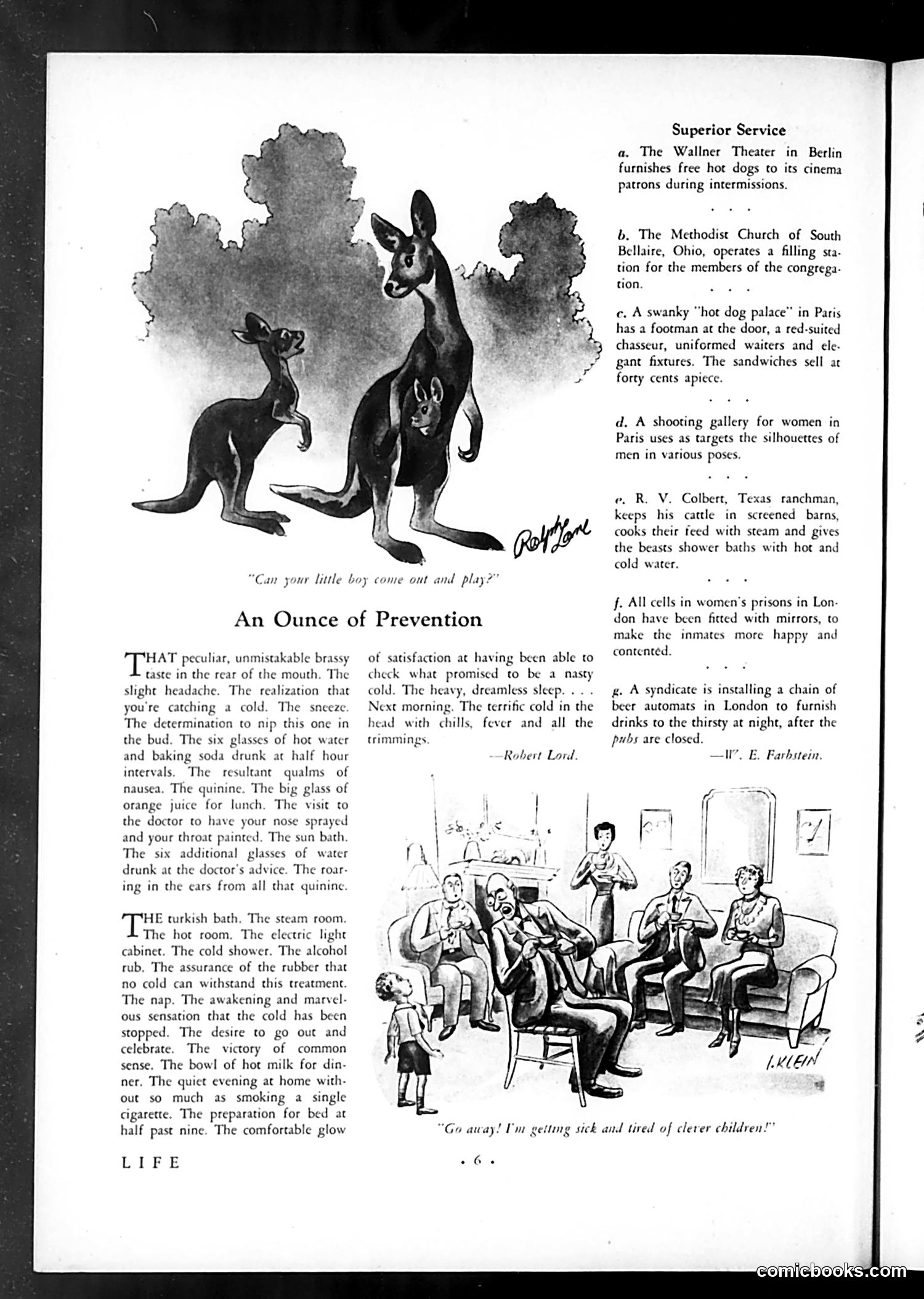
Page Analysis: "An Ounce of Prevention" This page satirizes over-the-top cold remedies popular in the early 20th century. The article "An Ounce of Prevention" mocks the elaborate, excessive treatments prescribed for colds—hot water glasses, baking soda, quinine, orange juice, nose spraying, Turkish baths, steam rooms, electric light cabinets, cold showers, and alcohol rubs. The cartoon at top shows kangaroos asking "Can your little boy come out and play?"—likely commenting on how cold prevention keeps children indoors under constant treatment. The lower cartoon depicts an exasperated parent surrounded by children, complaining "Go away! I'm getting sick and tired of clever children!"—suggesting the irony that obsessive health protocols create more parental frustration than actual wellness. The "Superior Service" section notes various unusual amenities at establishments worldwide.
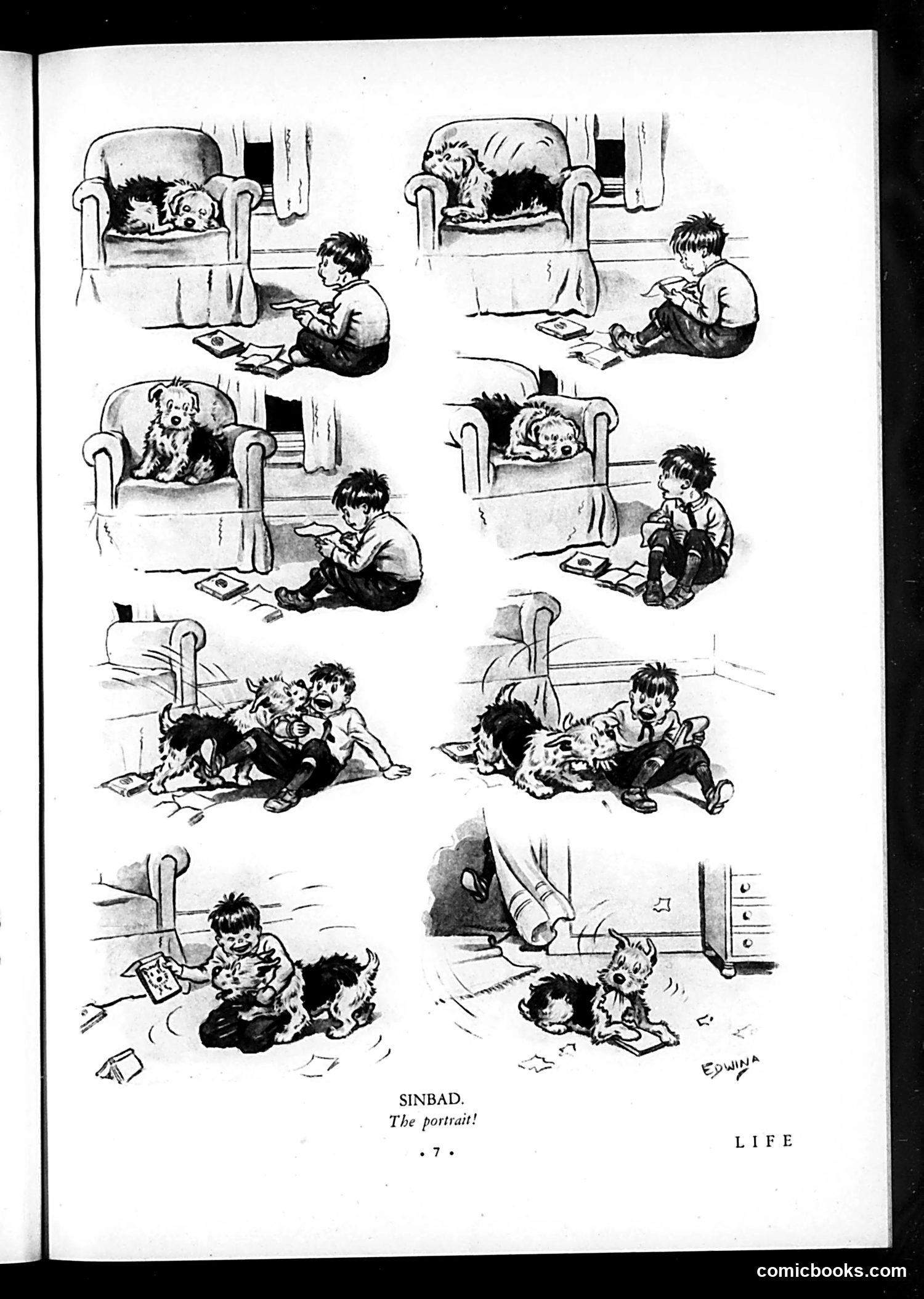
"Sinbad: The Portrait!" — Life Magazine This is a humorous comic strip depicting a child's attempt to paint a portrait of what appears to be a dog or shaggy animal sitting in an armchair. The sequence shows the escalating chaos: the child starts calmly sketching while the animal sits still, but progressively the animal becomes more active and playful, eventually leading to complete pandemonium where child and animal are rolling around together on the floor, with art supplies scattered everywhere. The joke plays on the difficulty of getting a pet to sit still for a portrait—a relatable domestic scenario. The title "Sinbad" likely refers to the animal character. The satire gently mocks both artistic ambition and pet behavior, showing how best-laid plans collapse into cheerful disorder. It's a lighthearted commentary on everyday family life with animals.
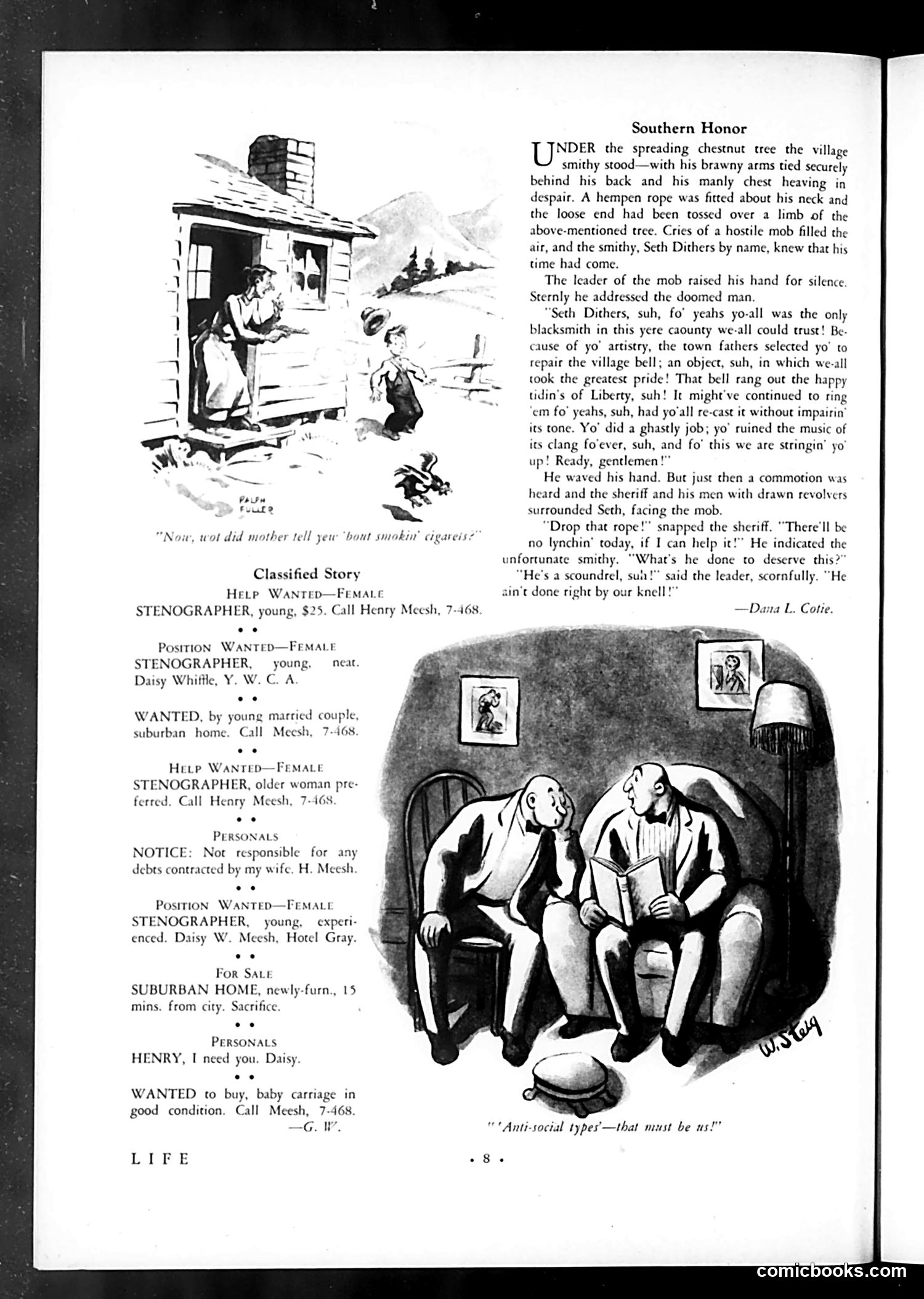
Analysis This page contains two distinct elements: "Southern Honor" story (top): A narrative illustration depicting a lynch mob threatening a Black blacksmith named Seth Dithers. The sheriff intervenes to prevent lynching, with dialogue suggesting the mob's justification was that Dithers damaged a village bell. The story critiques mob violence and racial injustice in the American South, presenting the sheriff as a voice of legal order against vigilante execution. Bottom cartoon: Two men in an interior discuss an "Anti-social type"—likely referring to someone of unconventional beliefs or behavior. The satire appears to mock how society labels nonconformists as dangerous threats. The page juxtaposes serious social commentary about racial violence with lighter satire about social conformity, both reflecting early 20th-century American anxieties about morality and social order.
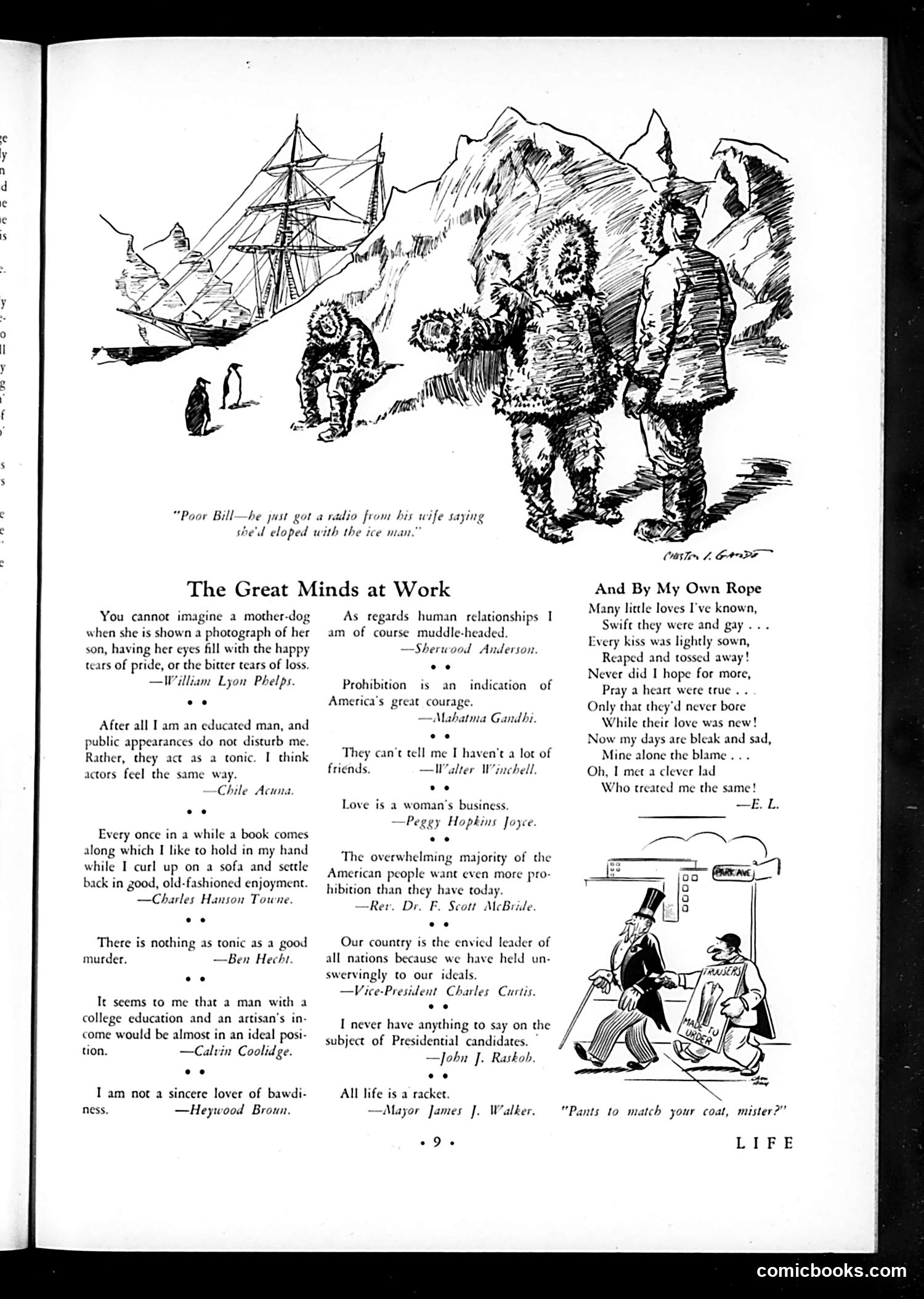
Analysis of Life Magazine Page This page combines satirical quotes ("The Great Minds at Work") with two cartoons. The top cartoon depicts Arctic explorers and a ship, with the caption "Poor Bill—he just got a radio from his wife saying she'd eloped with the ice man." This is a joke about infidelity: the "ice man" was a common Depression-era profession (delivering ice for iceboxes), and the humor relies on the irony that Bill receives devastating news while isolated in the Arctic. The bottom cartoon shows a tailor fitting clothes to a customer, captioned "Pants to match your coat, mister?" This appears to be a straightforward retail joke, possibly suggesting mismatched fashion or economic struggles where customers cannot afford matching suits. The quotes represent various public figures commenting on serious topics like prohibition, love, and American ideals.
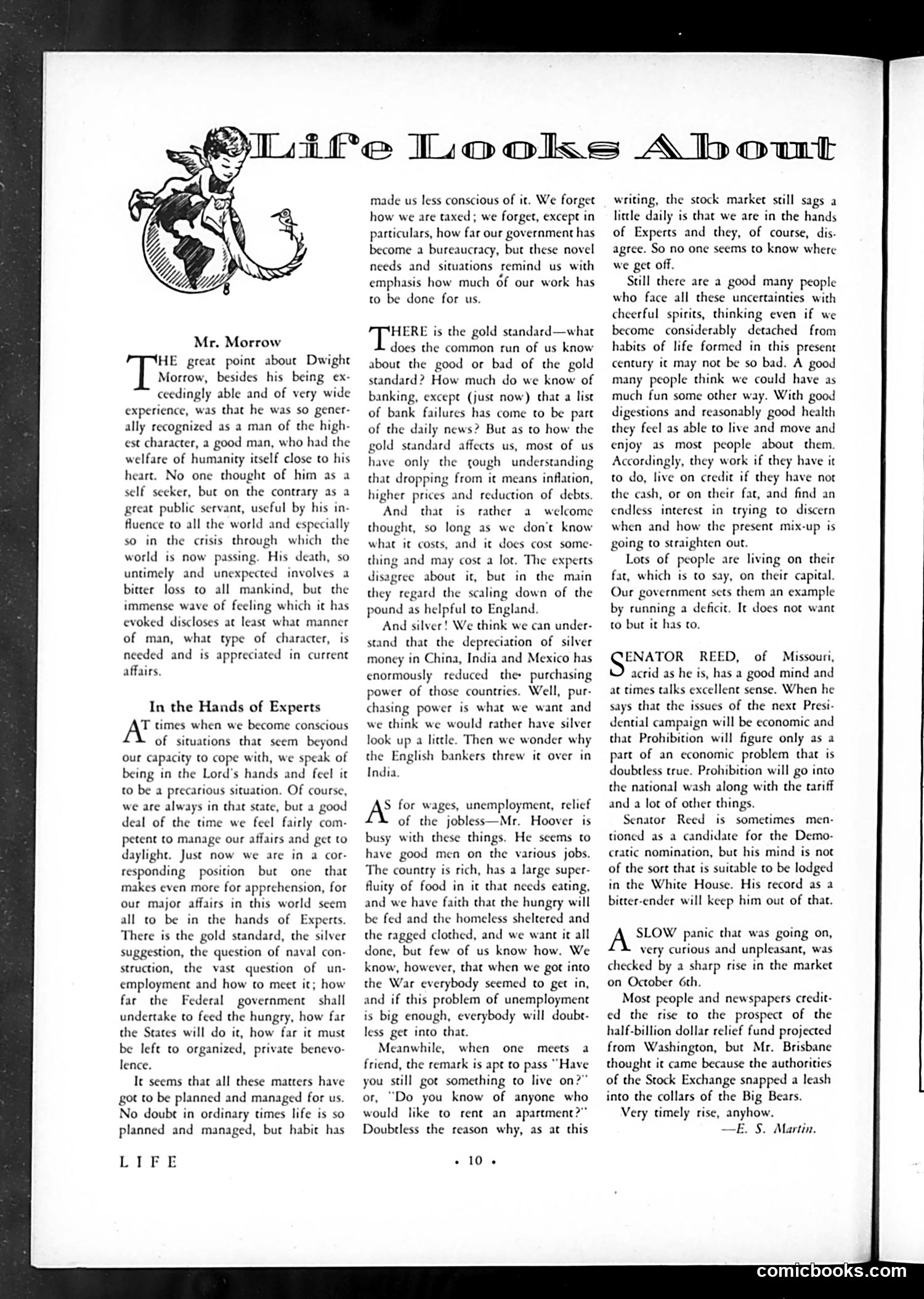
Political Commentary on Economic Crisis The page features "Life Looks About," a satirical column discussing early 1930s economic troubles. The illustration shows a cherub or cupid figure—likely representing either naive optimism or misplaced hope—observing financial chaos. The text critiques experts and politicians managing the economic crisis, referencing the gold standard debate, banking failures, unemployment, and relief efforts. It mentions Senator Reed of Missouri and President Hoover's unemployment policies, plus a stock market panic on October 6th. The satire targets how ordinary citizens feel helpless while "experts" bungle affairs, how people anxiously discuss unemployment and housing shortages, and how politicians offer vague reassurances. The cherub's confused expression suggests the absurdity of expecting divine intervention—or expert competence—during genuine economic hardship.
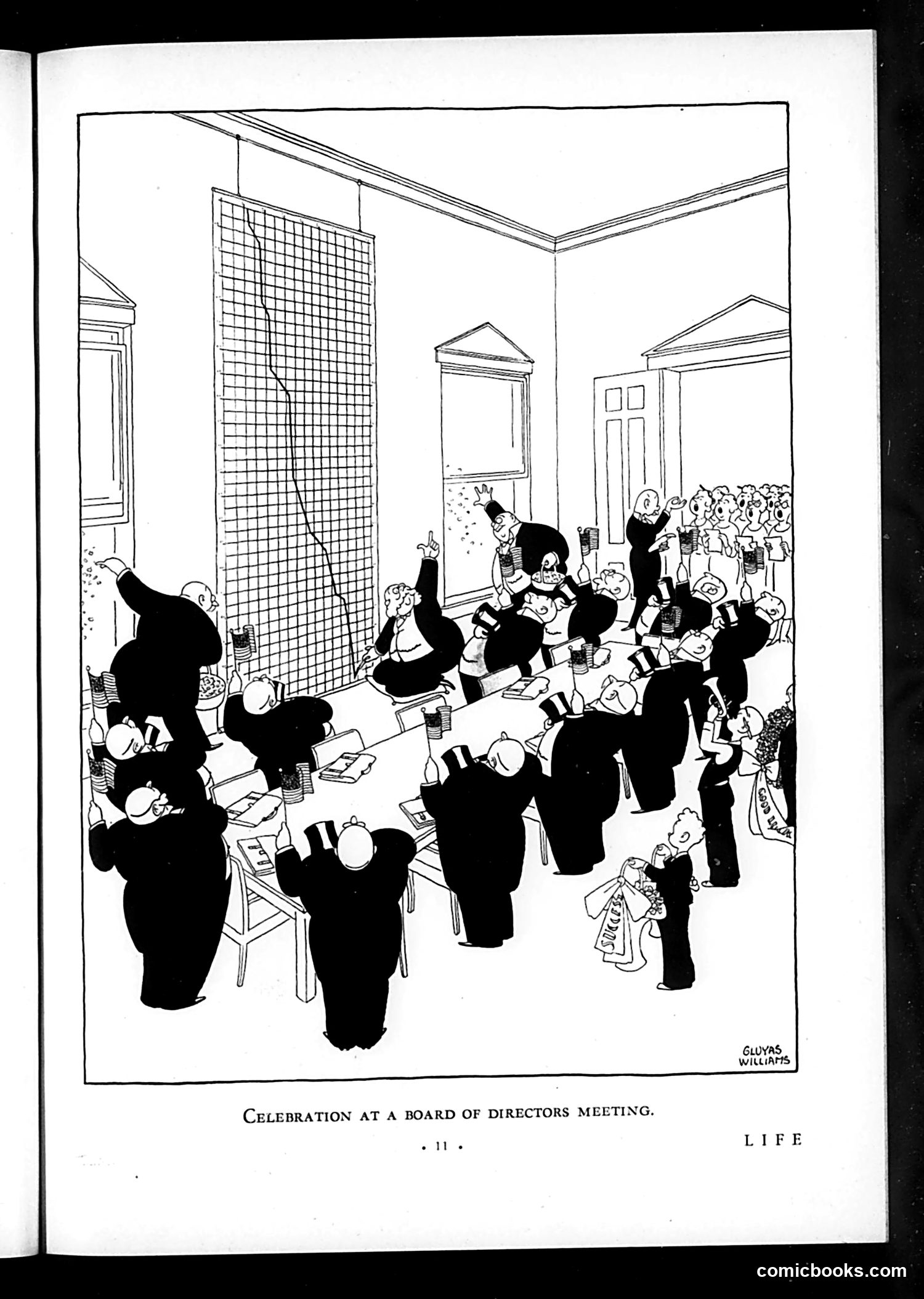
Explanation for Modern Readers This Gluyas Williams cartoon satirizes corporate formality and stuffy business culture. The caption reads "Celebration at a Board of Directors Meeting," depicting what appears to be a festive gathering—note the children running around and casual activity—yet all the adult board members are rendered as completely black silhouettes wearing top hats and formal attire, sitting rigidly at a table. The joke targets the contrast between an ostensible "celebration" and the severe, joyless conformity of corporate executives. The faceless black figures suggest these businessmen are interchangeable, personality-free functionaries bound by rigid formality. Even at a supposedly celebratory event, they maintain their stiff, humorless demeanor. It's social commentary on how corporate culture demands absolute conformity at the expense of genuine human emotion or individuality.
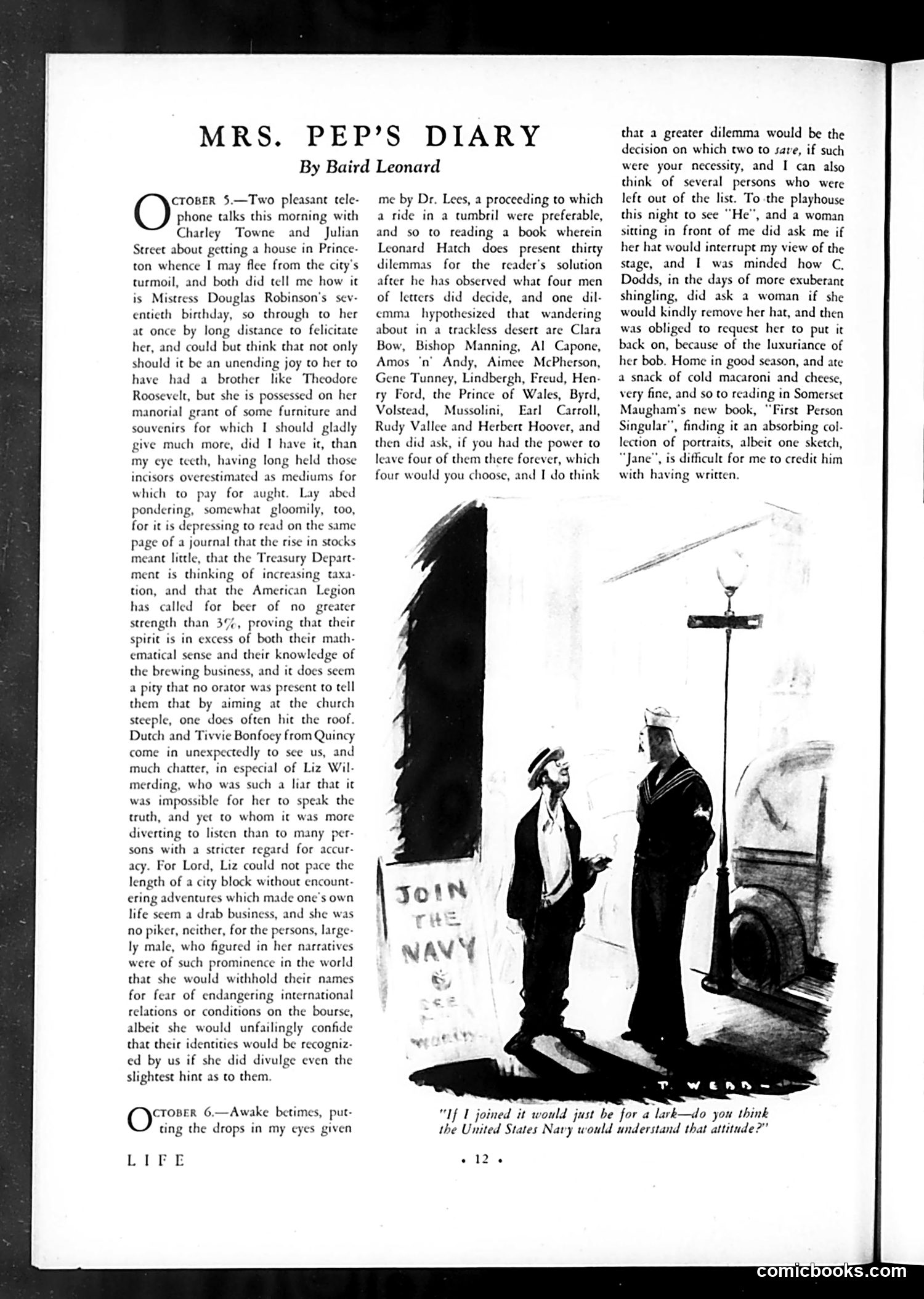
"Mrs. Pep's Diary" Analysis This is a satirical diary entry by Baird Leonard from *Life* magazine, dated October 5-6. The accompanying cartoon depicts a naval recruitment scene, with a sailor standing beneath a "JOIN THE NAVY" sign, speaking to a woman near a cross. The cartoon's caption reads: "If I joined it would just be for a lark—do you think the United States Navy would understand that attitude?" The satire targets both military recruitment propaganda and attitudes toward military service during what appears to be the WWI era. The joke mocks someone (likely male) suggesting he'd join the Navy casually "for a lark" (amusement), implying the Navy wouldn't tolerate such frivolous motivation. It satirizes the gap between recruitment messaging and actual military expectations of serious commitment.
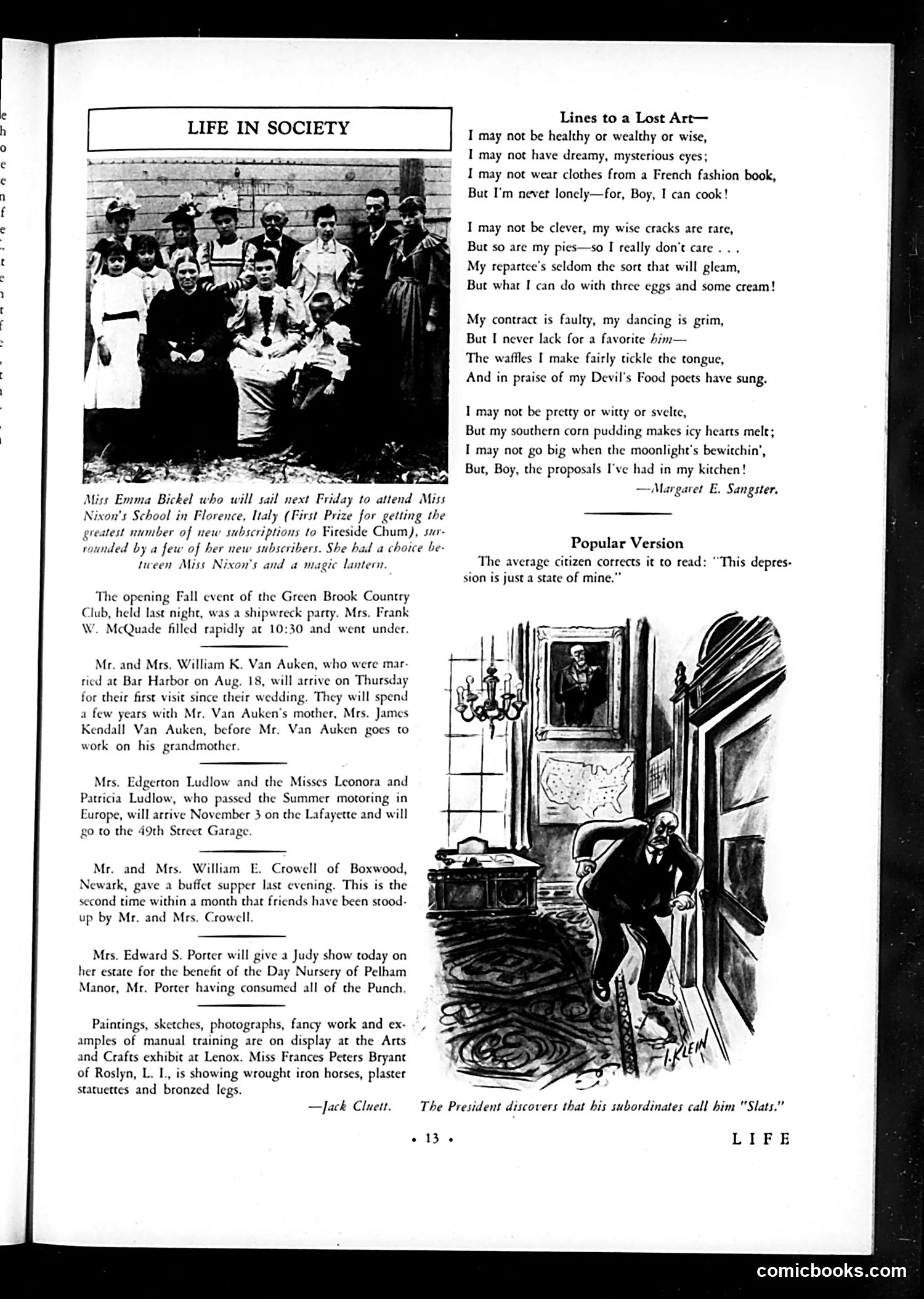
Analysis of Life Magazine Page 13 This page contains society gossip and a single-panel cartoon titled "The President discovers that his subordinates call him 'Slatt.'" The cartoon satirizes workplace hierarchy and informality. It shows a boss discovering his employees use a disrespectful nickname for him behind his back. The humor lies in the gap between formal authority and how subordinates actually regard their superior—they're irreverent when he's absent but must be deferential in his presence. The "Slatt" nickname appears to be a derogatory or mocking term, suggesting the subordinates view their president with contempt despite his official status. This satirizes the hypocrisy and power dynamics of office culture—how authority figures are often mocked by those beneath them. The accompanying text documents society events and social announcements typical of Life's "Life in Society" section.
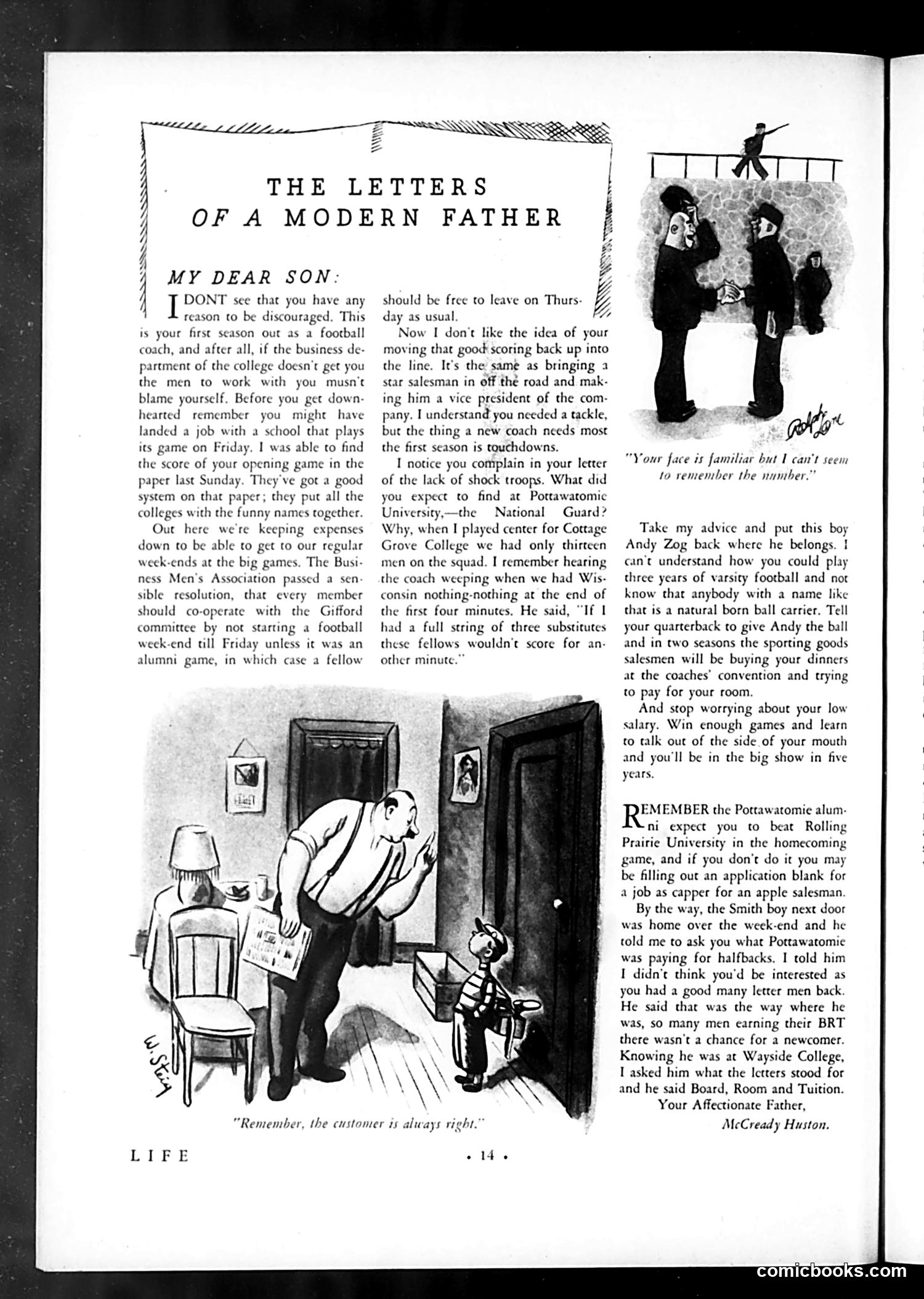
Analysis of "The Letters of a Modern Father" This is a humorous advice column from Life magazine featuring a father's letter to his son about coaching football. The satire mocks several early 20th-century college sports issues: Main Jokes: - The father criticizes the son's complaint about "shock troops" (substitute players), revealing how colleges fielded inadequate rosters - He dismisses concerns about low salary by promising future success and fame - He mocks the player "Andy Zog," suggesting even qualified athletes were being outshone by inferior substitutes Social Context: The cartoons illustrate the father's patronizing, outdated advice—showing a man lecturing a small boy about business acumen and the "customer is always right" mentality applied to coaching. The satire targets how early college football prioritized winning over player welfare, fair compensation, and merit-based selection, reflecting broader Progressive Era concerns about commercialization in amateur athletics.
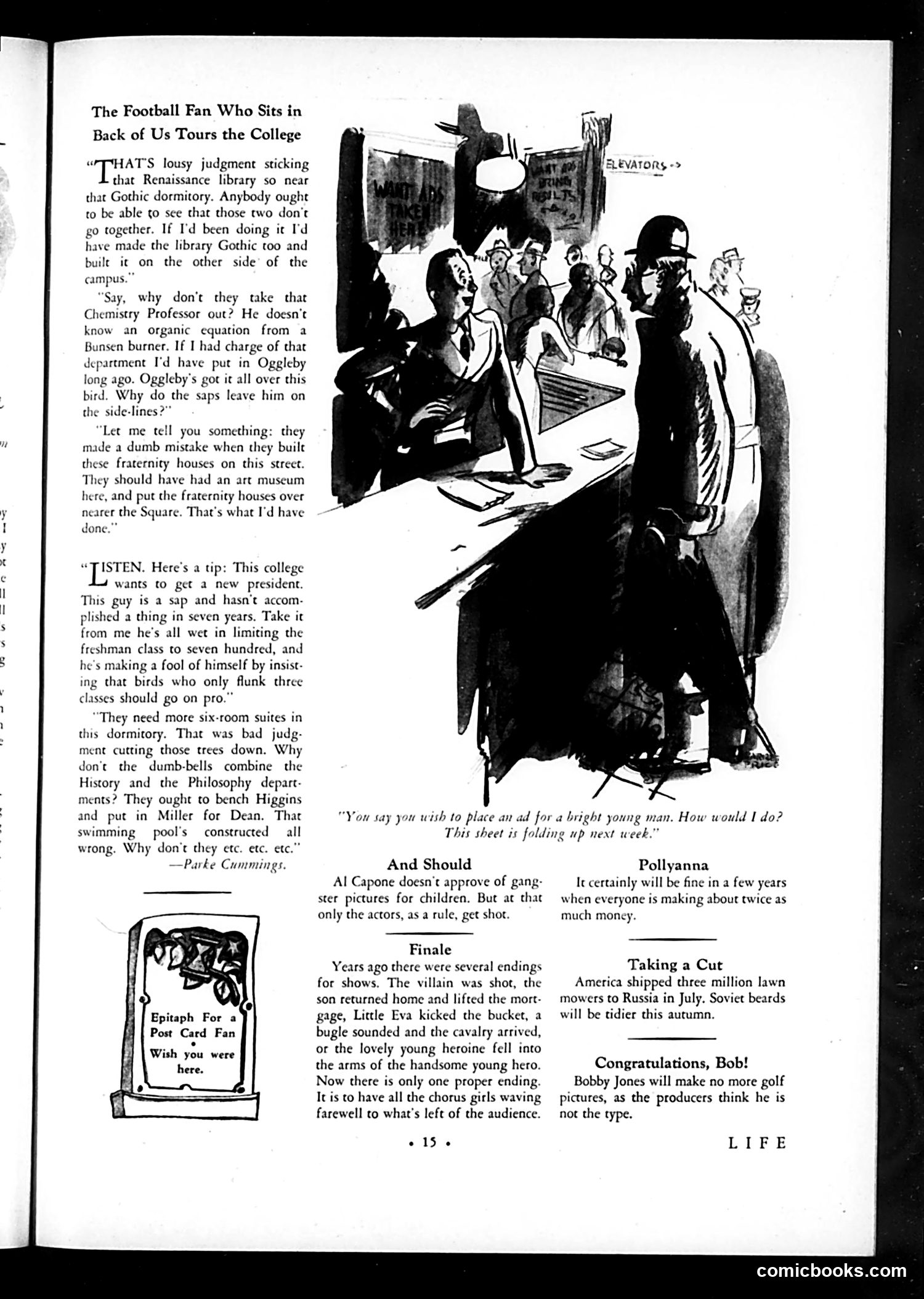
Analysis of "The Football Fan Who Sits in Back of Us Tours the College" This satirical piece mocks a self-appointed college "expert"—a loud, opinionated spectator who constantly criticizes campus administration while lacking actual authority or accomplishment. The humor centers on his hypocritical complaints: he dismisses the Chemistry Professor as incompetent, criticizes architectural decisions (the Gothic library and dormitory placement), attacks fraternity house placement, and demands the president be replaced—yet he "hasn't accomplished a thing in seven years" and is "making a fool of himself." The attribution to "—Parke Cummings" identifies the author. The cartoon satirizes armchair critics and know-it-alls who freely denounce institutional decisions without expertise, responsibility, or constructive alternatives. It's a timeless critique of confident ignorance.
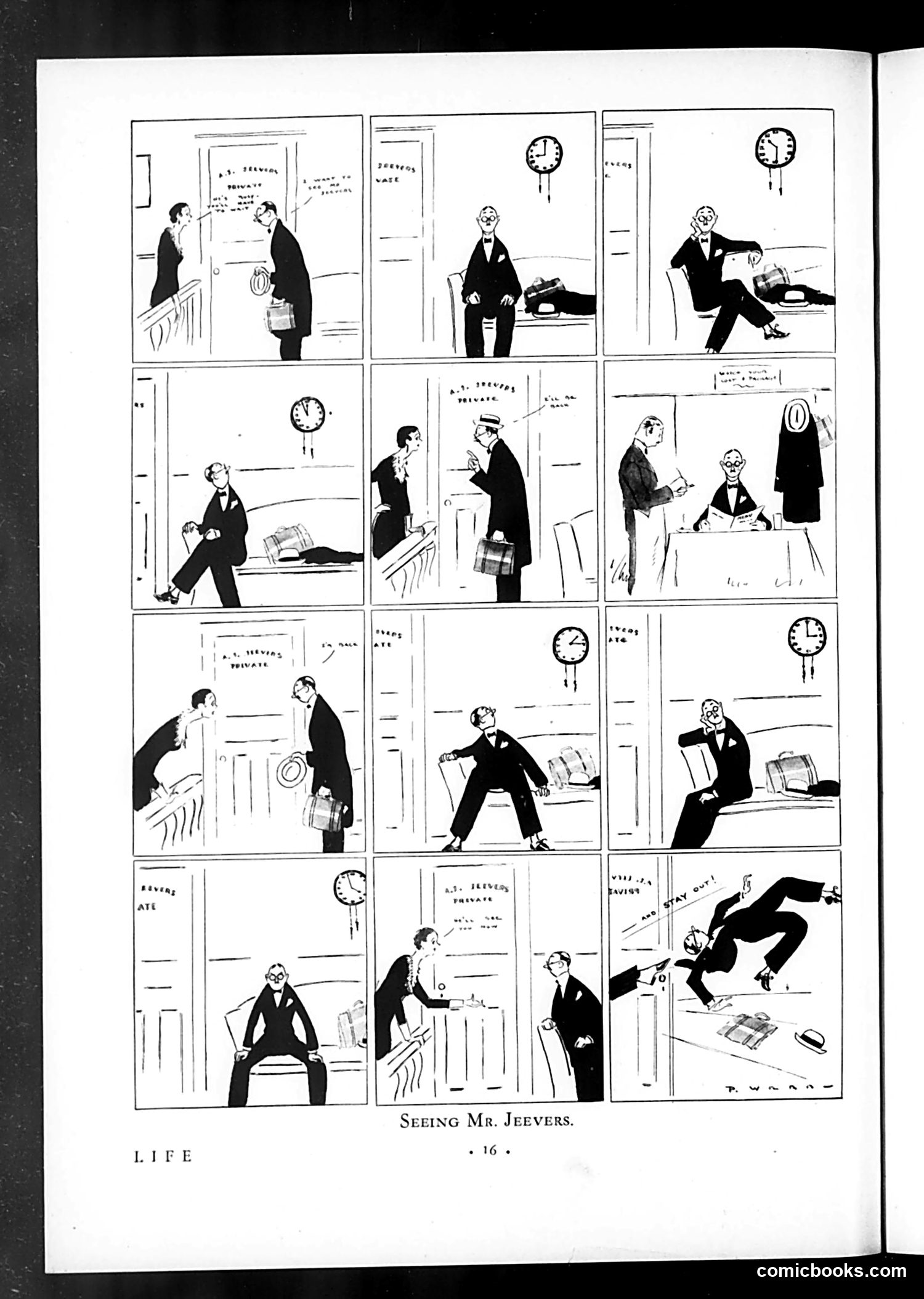
"Seeing Mr. Jeevers" This is a sequential comic strip showing a man repeatedly attempting to see someone named "Mr. Jeevers" at what appears to be an office building. The humor derives from the classic bureaucratic runaround: the protagonist encounters various obstacles—locked doors, busy secretaries, people blocking his path, and general office chaos—that prevent him from accessing his target. The final panel shows him literally flying out a window in frustration, suggesting the absurdity has driven him to desperation. This satirizes early 20th-century office culture and the difficulty of accessing important people through layers of administrative gatekeeping. The exaggerated physical comedy emphasizes the mounting frustration of dealing with institutional bureaucracy.
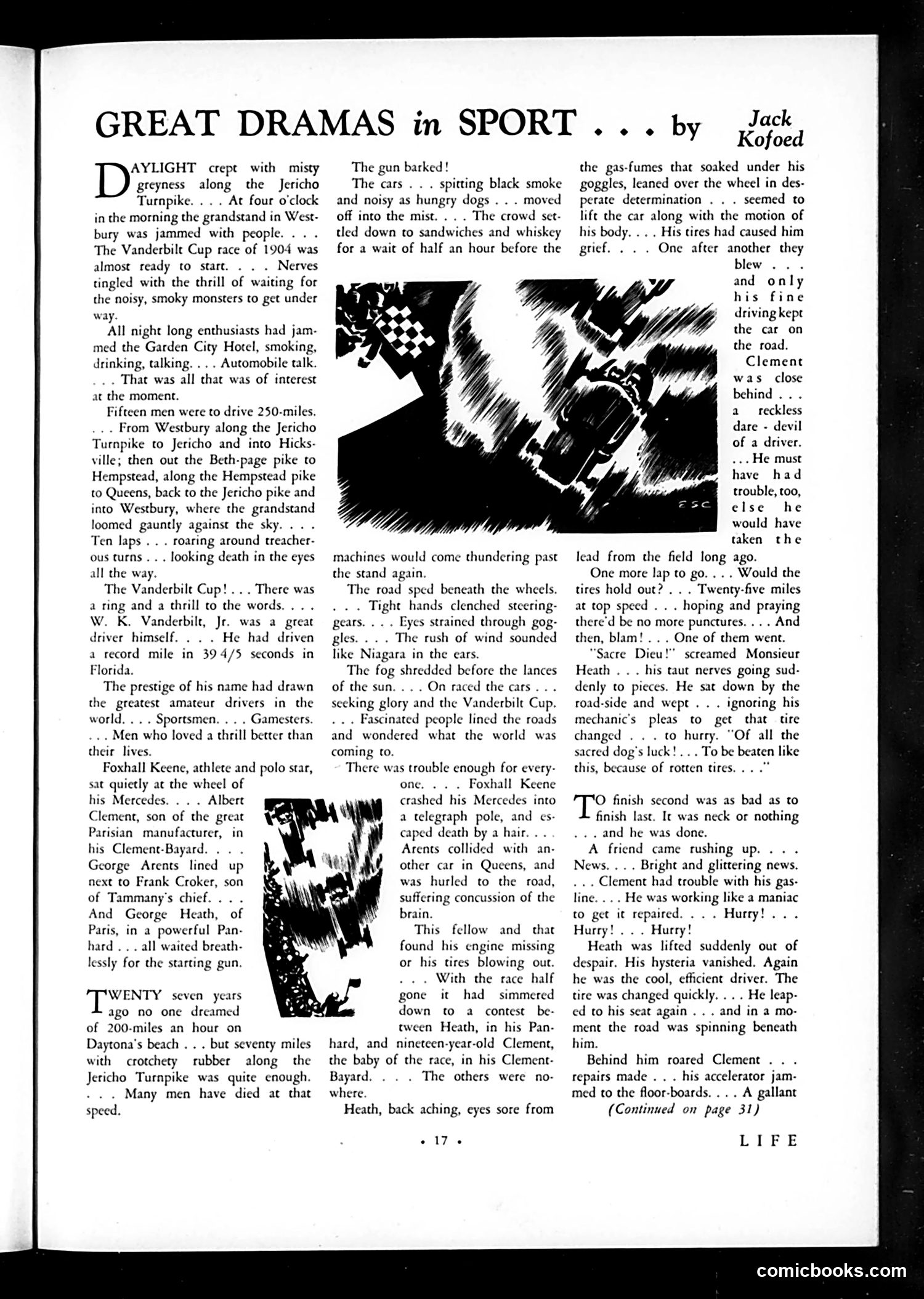
Analysis This page contains "Great Dramas in Sport" by Jack Kofoed, a narrative article about early automobile racing, specifically the 1904 Vanderbilt Cup race on Long Island. The two dramatic illustrations show racing cars in dangerous conditions—fog, high speeds, and mechanical failures. The article describes the 250-mile race with vivid detail: drivers like W.K. Vanderbilt Jr. and Foxhall Keene competing, cars hitting telegraph poles, crashes, and tire blowouts. The text emphasizes the sport's extreme danger and the drivers' nerve required to compete. This reflects early 1900s racing's combination of wealthy amateur drivers, experimental vehicles, and minimal safety—presented here as thrilling human drama rather than sport.
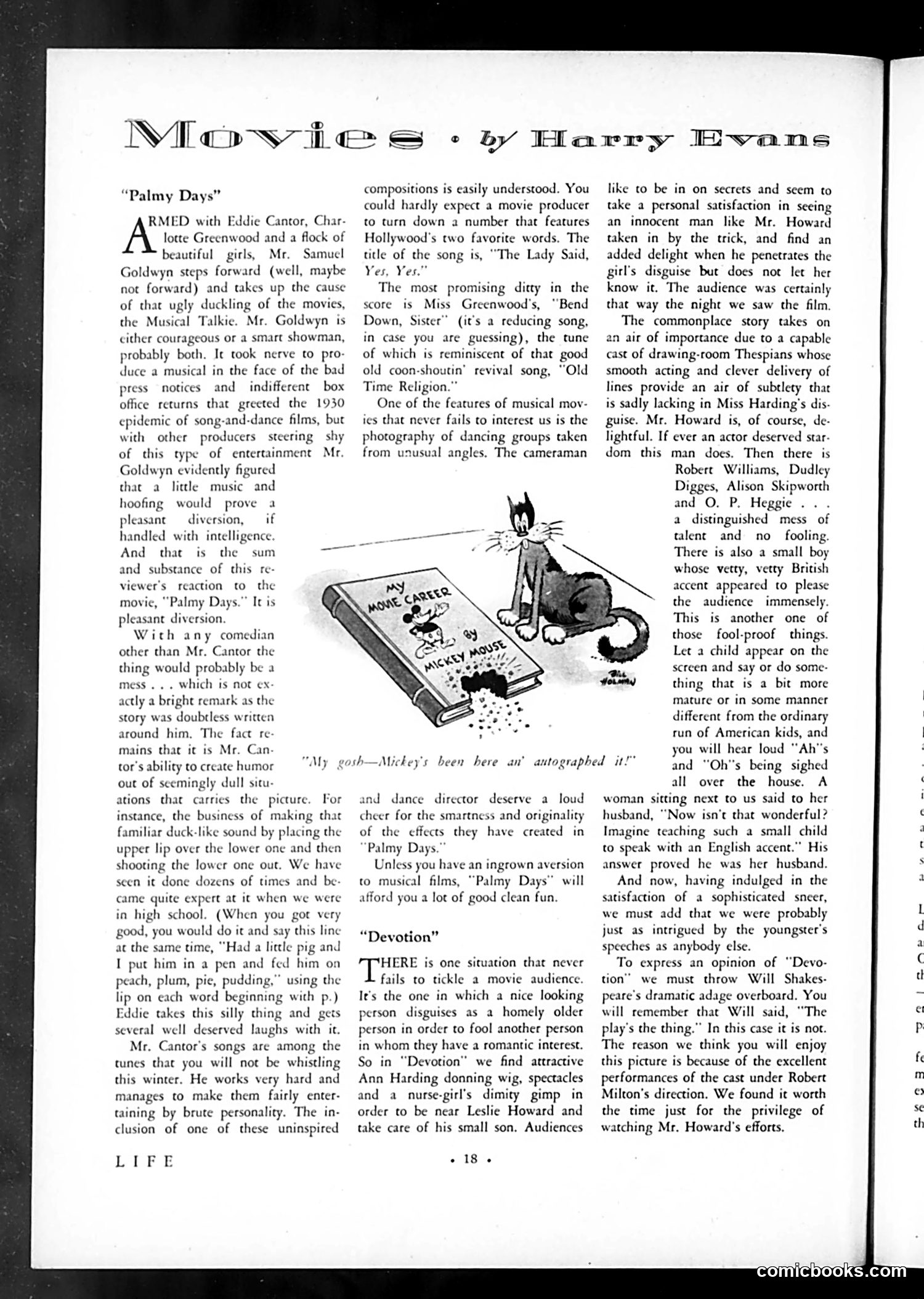
Analysis of Life Magazine Page This page reviews three 1930s Hollywood films. The central cartoon illustrates a review of "Palmy Days," showing Mickey Mouse autographing a book for a cat character. The joke references Mickey's massive popularity in that era—the film's appeal is enhanced by association with the famous cartoon character, suggesting Hollywood was leveraging Mickey's stardom to boost box office appeal. The reviews discuss Eddie Cantor and Leslie Howard vehicles. The Mickey cartoon serves as visual commentary on Hollywood's marketing strategies: studios capitalized on popular entertainment figures to draw audiences, even when those figures appeared only tangentially in films. The illustration is satirical commentary on 1930s cinema's reliance on celebrity cross-promotion rather than story quality.
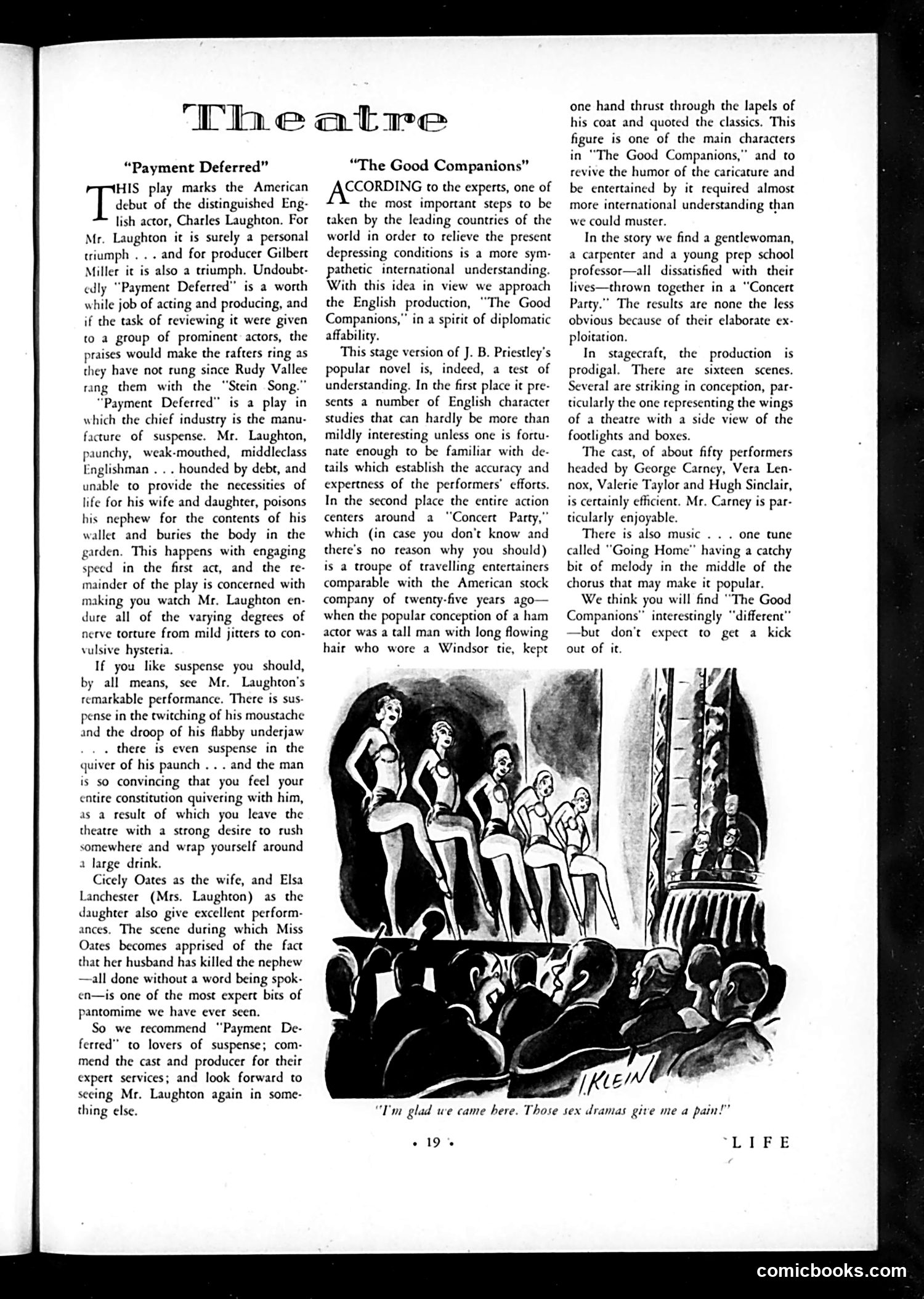
Theatre Reviews Page This is a theatre review page from *Life* magazine featuring two play critiques. The main cartoon illustrates "The Good Companions," showing performers on stage entertaining an audience. The caption reads: "I'm glad we came here. Those sex dramas give me a pain!" The satire targets contemporary theatre trends—specifically the popularity of sexually explicit or scandalous plays. The audience member's complaint suggests that explicit "sex dramas" were fashionable but tiresome, making lighter entertainment like "The Good Companions" (a stage adaptation of J.B. Priestley's novel) a refreshing alternative. The reviews praise both "Payment Deferred" and "The Good Companions" for their acting quality, with particular emphasis on Charles Laughton's performance in the former.
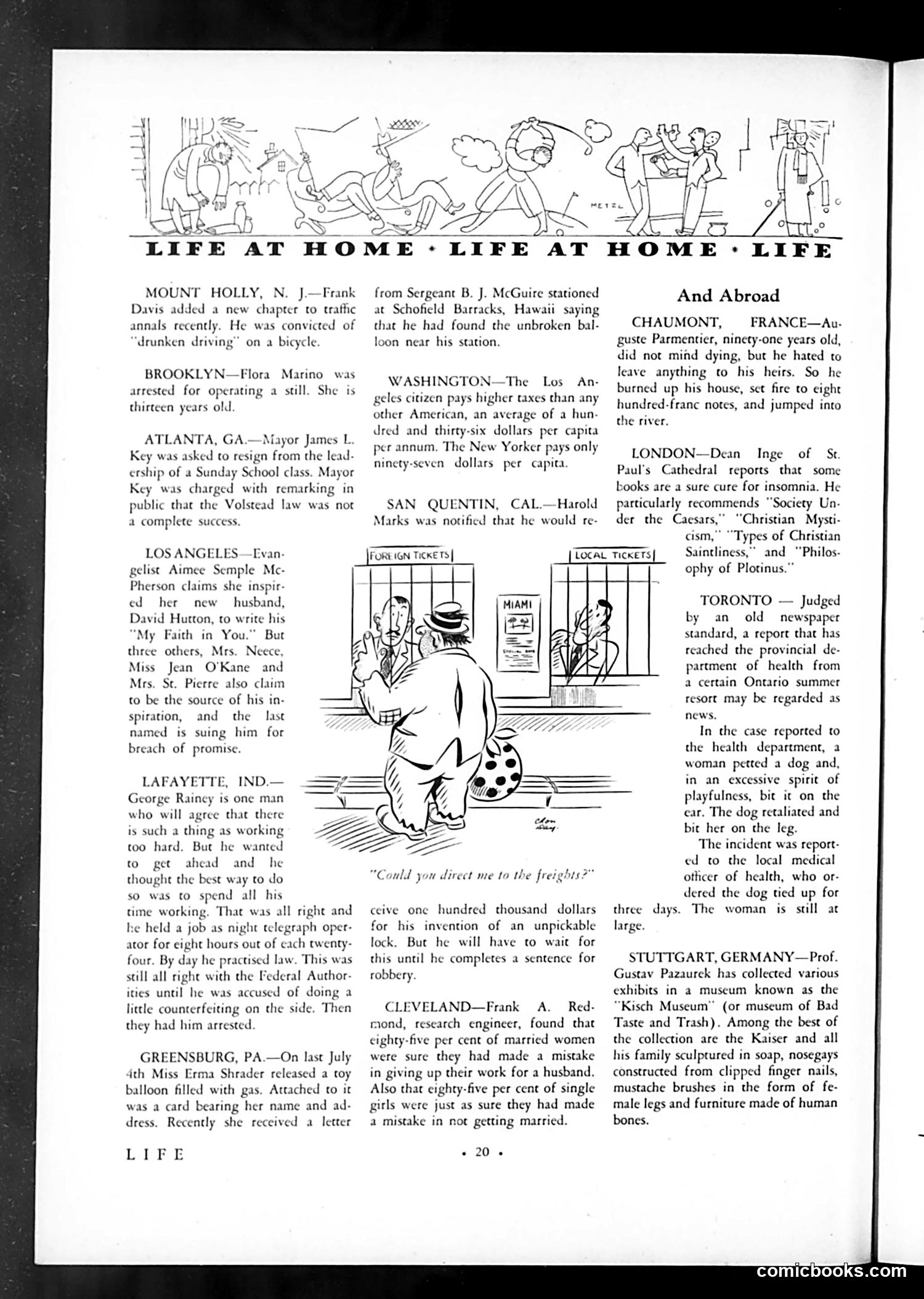
Analysis of "Life at Home" Page This page satirizes absurd legal enforcement and bureaucratic absurdities of Prohibition-era America (early 1920s). The cartoon shows a man with a palette at a ticket window, captioned "Could you direct me to the freights?" — likely mocking confusion over competing ticket systems or urban infrastructure. The column presents darkly comic news snippets highlighting the law's failures and public attitudes: - A man convicted of "drunken driving" on a bicycle (mocking strict enforcement) - A thirteen-year-old arrested for operating a still (Prohibition's perverse effects on youth) - An Atlanta mayor pressured to resign for publicly doubting Prohibition's success - A San Quentin prisoner getting wealthy from an invention but unable to claim it The section "And Abroad" contrasts American follies with European stories, suggesting American society's particular grip of Prohibition-driven dysfunction. The Cleveland item concludes with mordant wit: 85% of married women regretted leaving work, while 85% of single women regretted not marrying—satirizing both choices as losing propositions. Overall, it's sharp satire of Prohibition's unintended consequences.
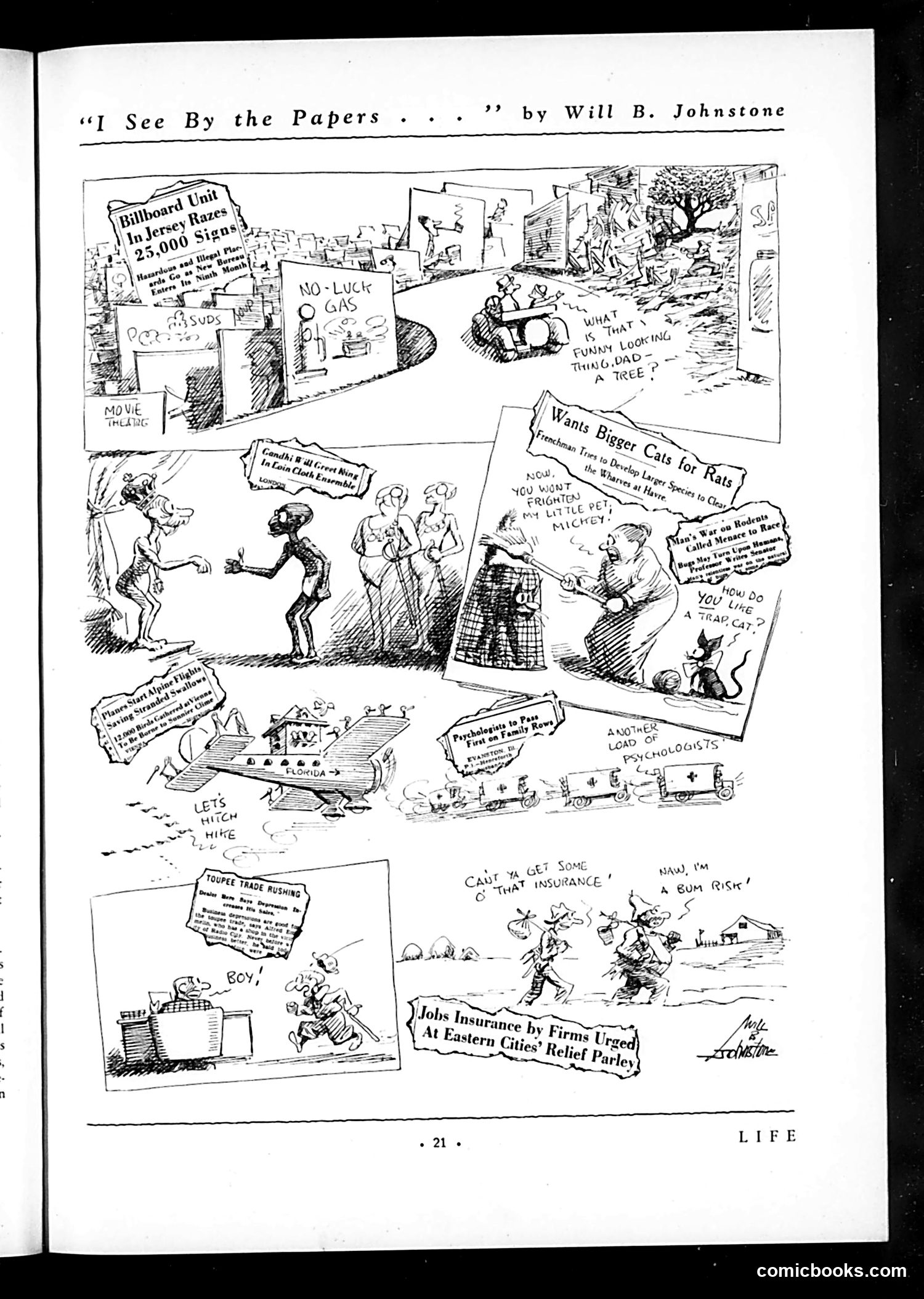
This is a satirical comic page by Will B. Johnstone titled "I See By the Papers," a format commenting on contemporary news and advertisements. The cartoon mocks various get-rich-quick schemes and dubious products advertised in newspapers of the era, including: - A billboard advertising 25,000 signs in Jersey - Advertisement schemes involving "Plants Bigger Cats for Rats" - Correspondence courses claiming to teach psychology - Insurance schemes and "Trumpet Trade Nursing" - A final panel about "Jobs Insurance by Firms Urged At Eastern Cities' Relief Parley" The humor derives from exposing absurd or fraudulent newspaper advertisements targeting vulnerable or desperate people. This reflects 1920s-30s concerns about consumer fraud and the proliferation of questionable ads in print media promising easy money, unusual pet solutions, and dubious professional training—common satirical targets during economically uncertain periods.
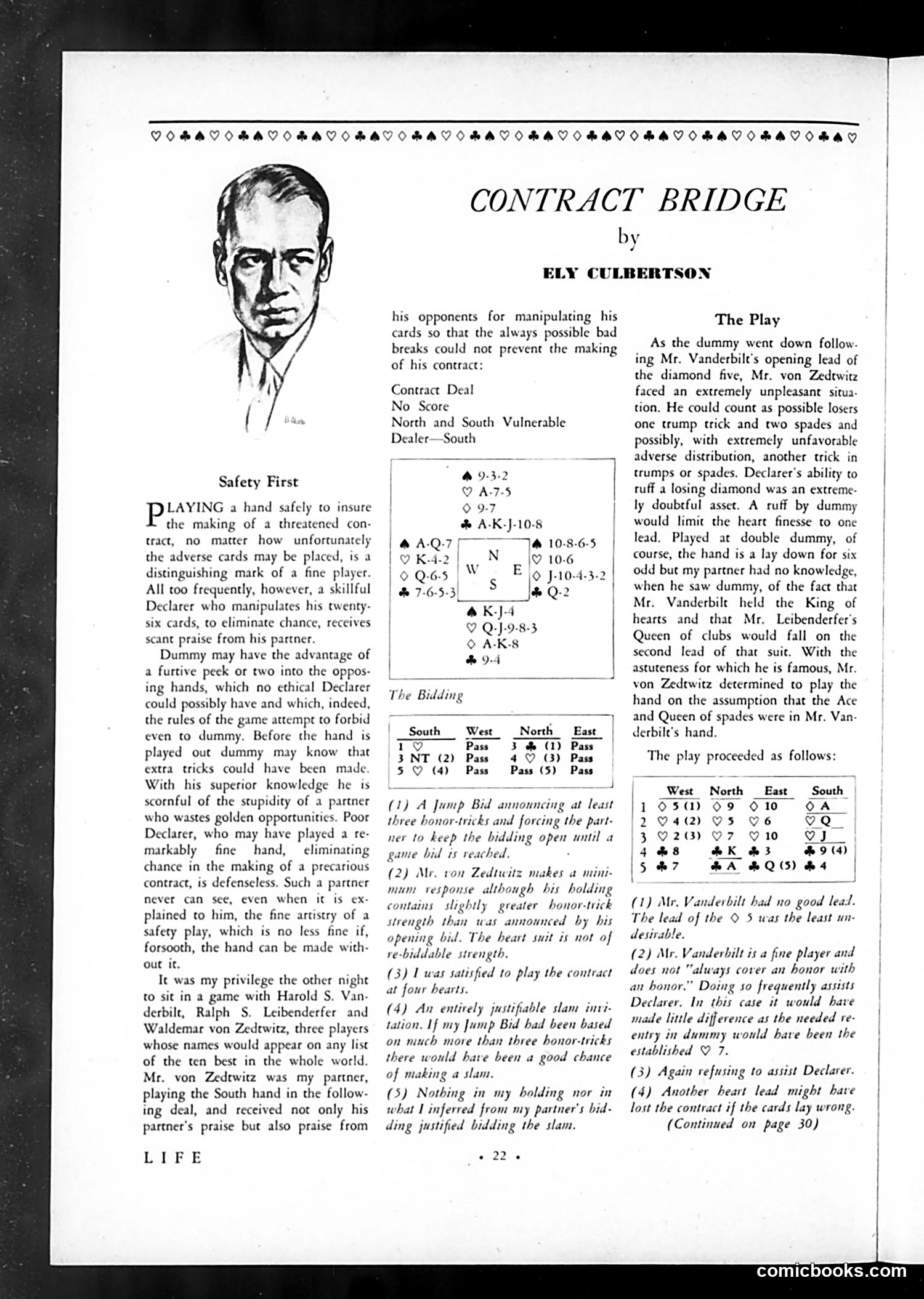
Contract Bridge Analysis This page is not satirical cartoon content but rather instructional bridge-game analysis by Ely Culbertson, a famous bridge authority. The portrait shows Culbertson himself. The article explains "Safety First" in contract bridge—a strategic principle where players make safe plays to guarantee contract success, even when riskier plays *might* yield extra tricks. Culbertson argues that executing such technically sound plays deserves recognition, though partners often fail to appreciate them. He illustrates with a specific hand played by Waldemar von Zedewitz (named as one of the world's ten best players) against Harold Vanderbilt and Ralph Leibenderfer. Von Zedewitz successfully navigated difficult card distribution through careful play management, earning praise from opponents—a rarity that Culbertson celebrates as exemplifying masterful bridge technique. This is educational content about card-game strategy, not social or political satire.
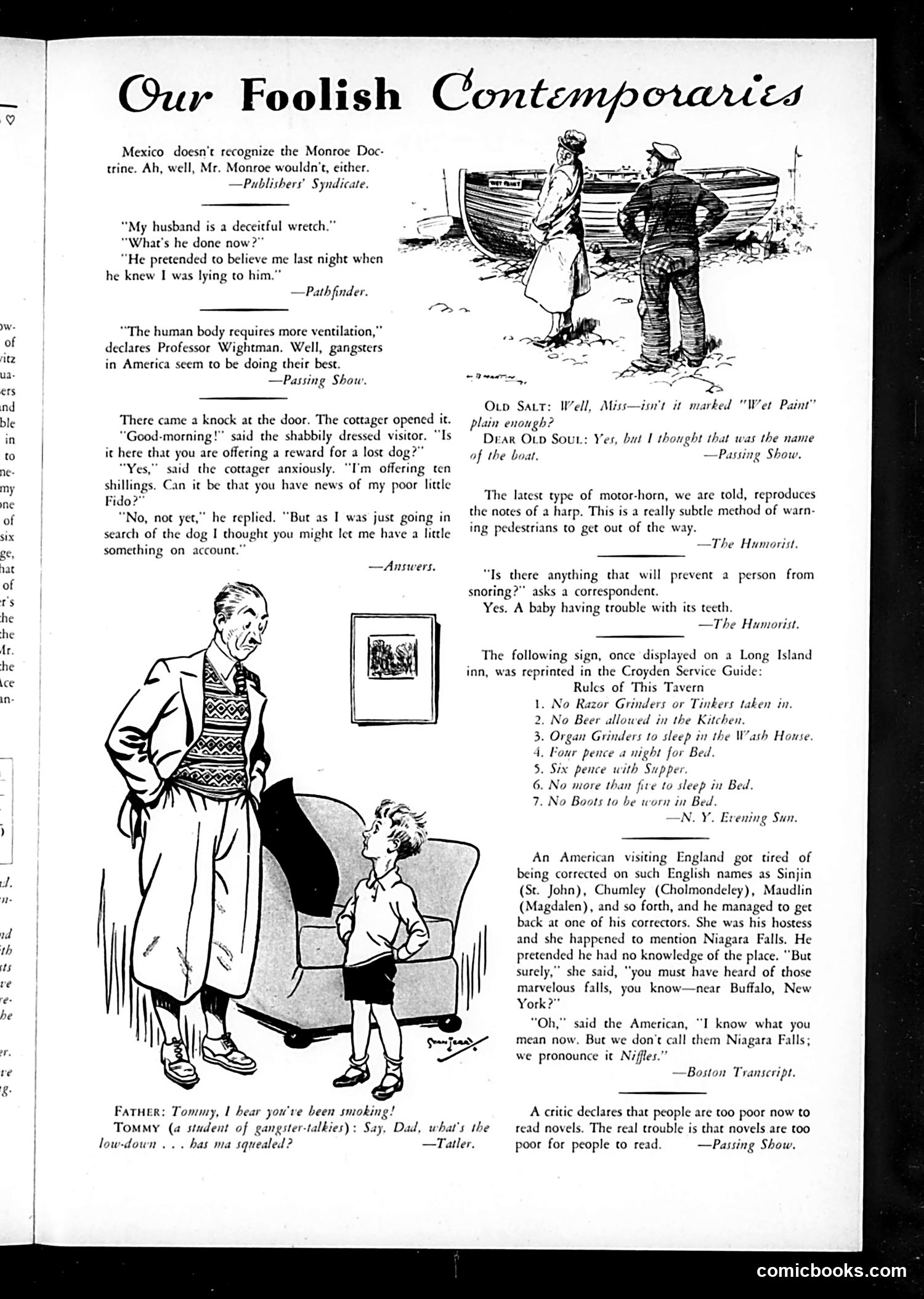
"Our Foolish Contemporaries" This is a humor column collecting satirical quips and jokes from various publications. The cartoons and anecdotes mock contemporary social absurdities: Visual cartoons: One shows a father catching his son smoking; the boy responds in gangster slang ("What's the low-down... has ma squealed?"), satirizing how crime movies influence youth speech. Another depicts a man and child at a boat, where she's touched "Wet Paint," assuming it's the boat's name—mocking obliviousness. Recurring themes: The jokes target marital dishonesty, pretentious English pronunciation customs, shabby con artists, modern motor-horn noise pollution, and movie culture's effect on language. One anecdote ridicules an American tourist who retaliates against British name-correction by mispronouncing "Niagara Falls" as "Niffles." The collection represents early 20th-century American satire of urban modernity, class pretension, and mass media influence—presented as humorous "foolishness" of the era.
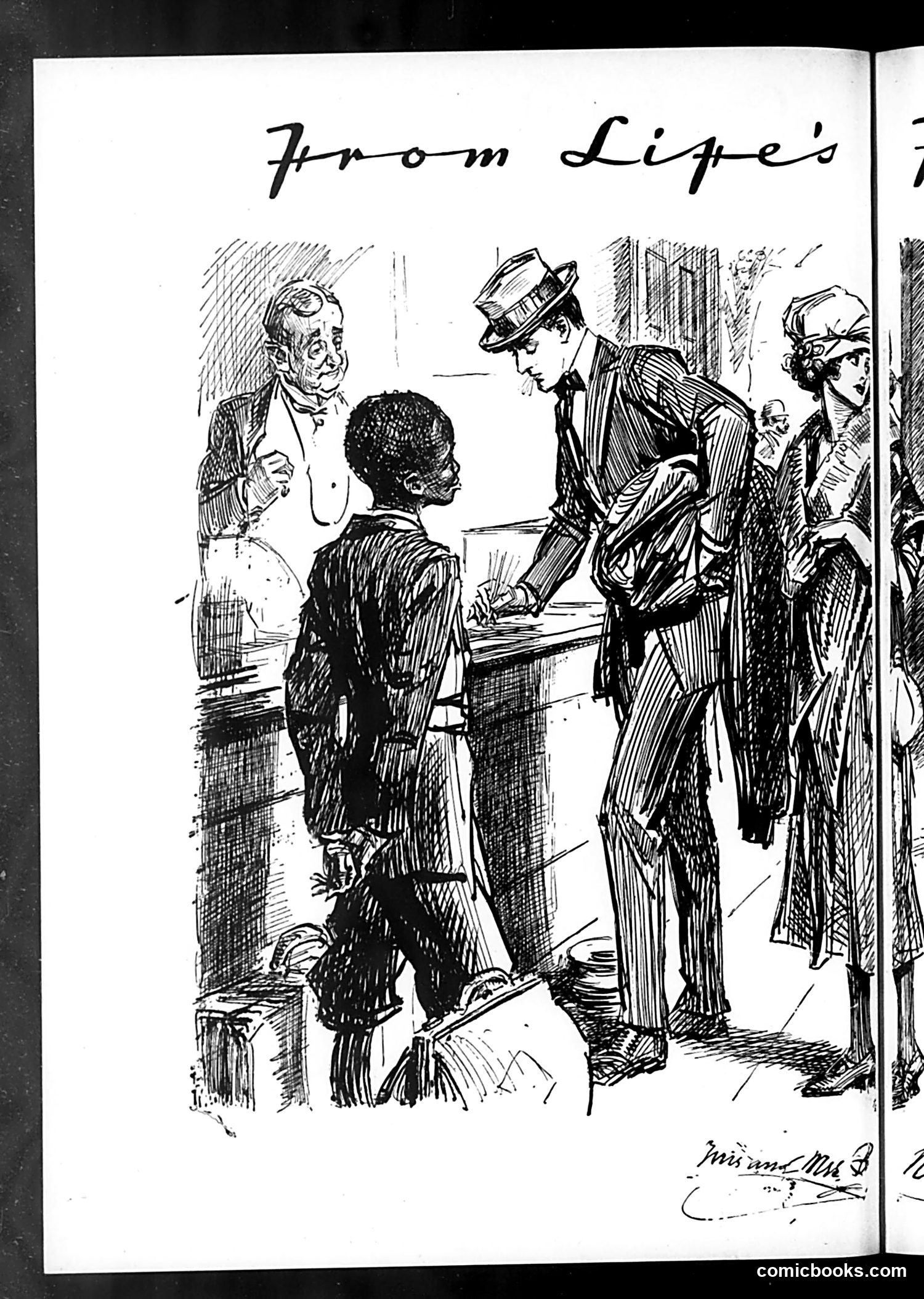
"From Life's" - Cartoon Analysis This page heading "From Life's" appears to introduce satirical illustrations. The sketch shows what seems to be a formal or official setting with several well-dressed men in suits and hats interacting with a Black man in the center. The composition suggests a social commentary on racial dynamics or class interaction in early 20th-century America. The detailed crosshatching technique is characteristic of Life magazine's satirical style from that era. However, the OCR text is too corrupted to provide the caption or context that would clarify the specific social or political commentary being made. Without the accompanying text, the precise satirical point remains unclear, though the racial and class composition of the scene suggests commentary on contemporary social attitudes or interactions.
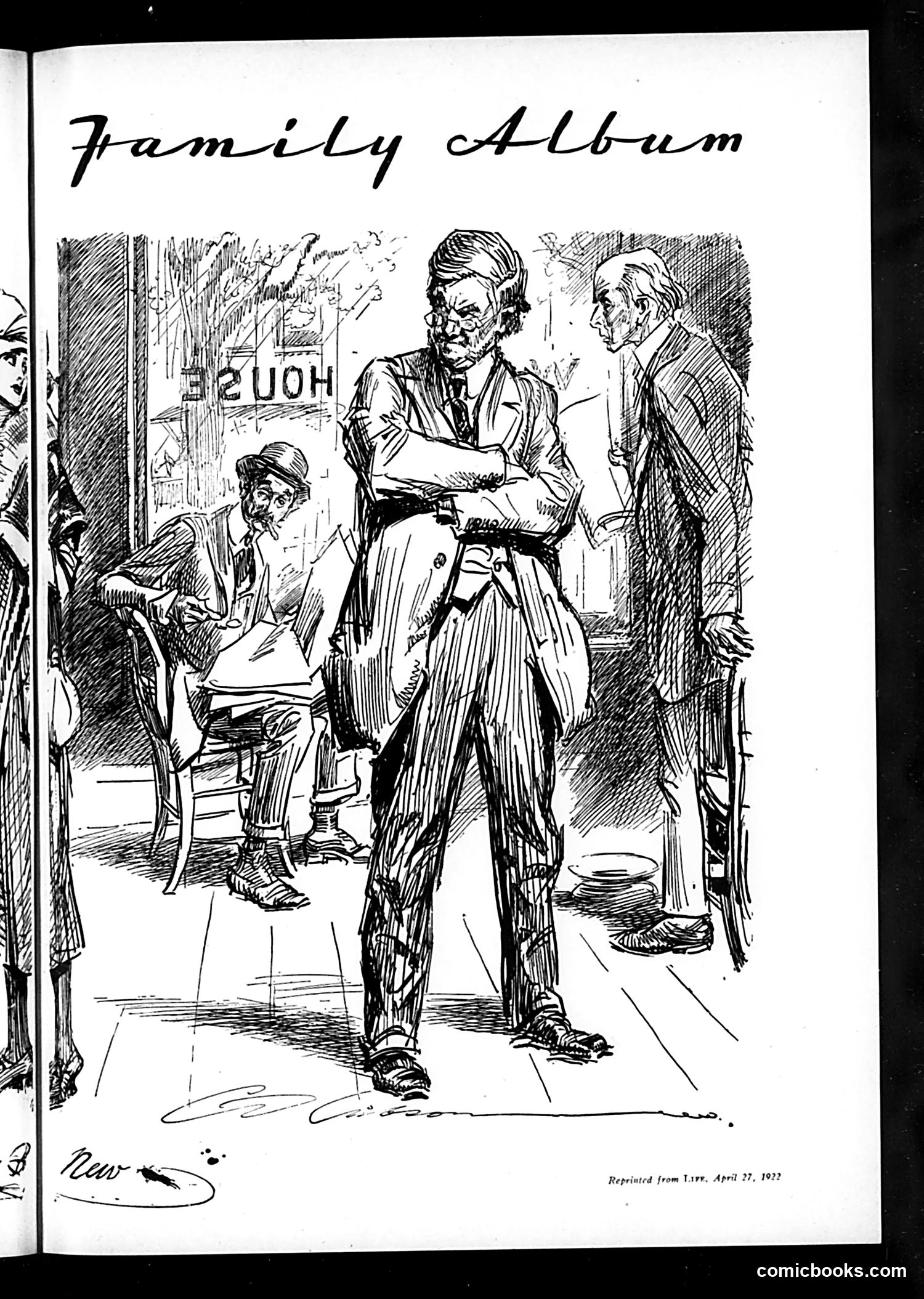
Family Album This page is titled "Family Album" and appears to be a satirical sketch from *Life* magazine (April 27, 1922). The drawing shows what appears to be a domestic scene with multiple figures in an interior setting. The sketch uses cross-hatching in a style typical of early 20th-century editorial illustration. However, the OCR text provided is largely illegible and doesn't offer clear context about the specific satire or joke. Without readable caption text or identifying labels visible in the image itself, I cannot definitively explain who these figures represent or what social/political commentary the cartoonist intended. The scene appears domestic in nature, but the specific satirical point remains unclear from the information available.
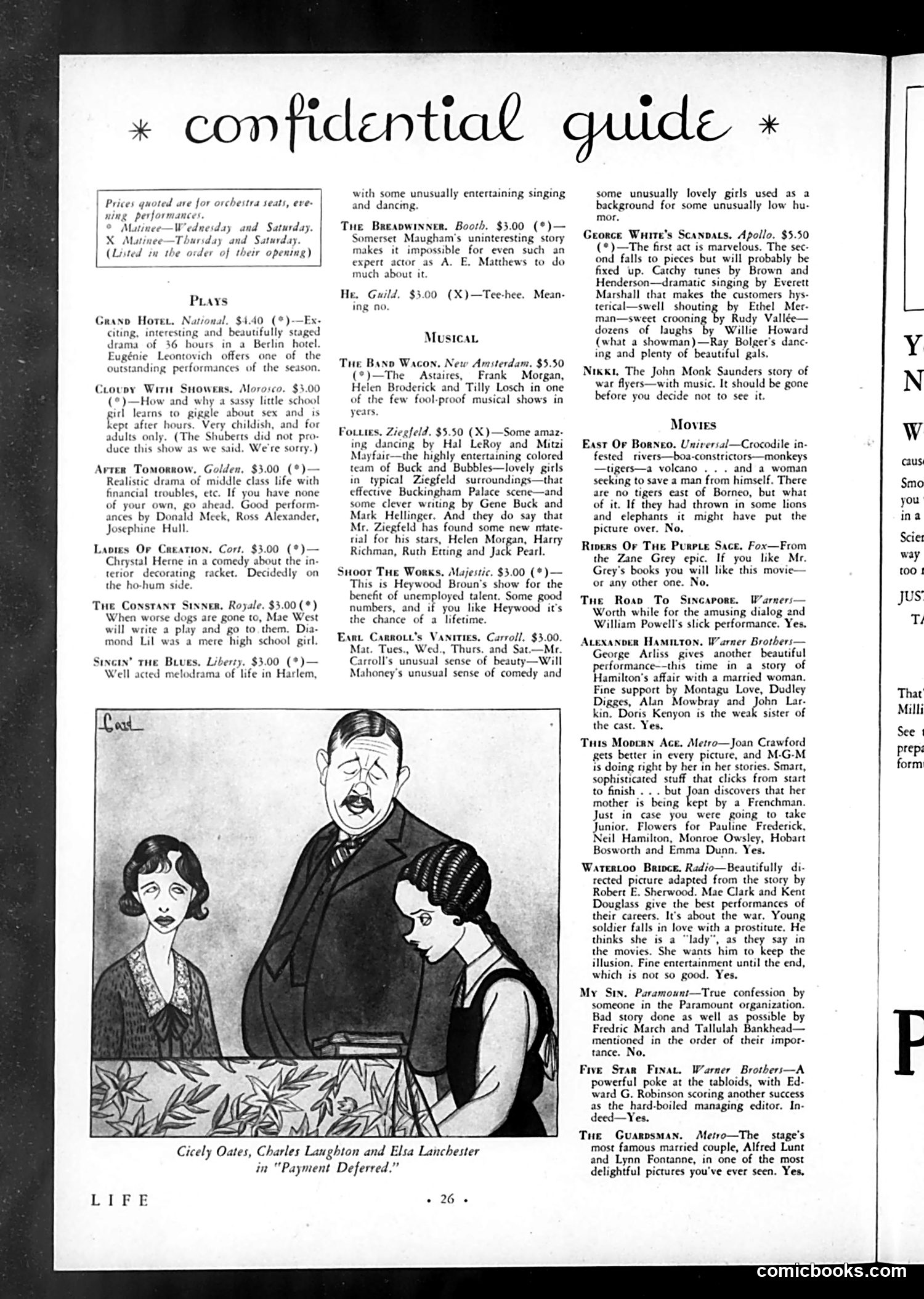
Understanding This Life Magazine Page This is a theater and entertainment review page from Life magazine's "Confidential Guide" section, circa early 1930s. The illustration shows three figures from the play "Payment Deferred" (featuring actors Cicely Oates, Charles Laughton, and Elsa Lanchester), depicting what appears to be a dramatic domestic scene. The page reviews Broadway plays, musicals, and films with brief, often sarcastic critiques. Notable: reviews use symbols like (*) and (X) to indicate ticket prices and ratings. The tone is characteristically snide—praising performances while mocking weak plots, calling one show "decidedly on the ho-hum side" and another's humor "unusually low." The reviews reference contemporary stars (Mae West, the Astaires, Rudy Vallée, Willie Howard) and producers (Ziegfeld). This page documents popular entertainment and critical taste of the Depression-era theater world, capturing how magazines guided educated audiences toward quality entertainment.
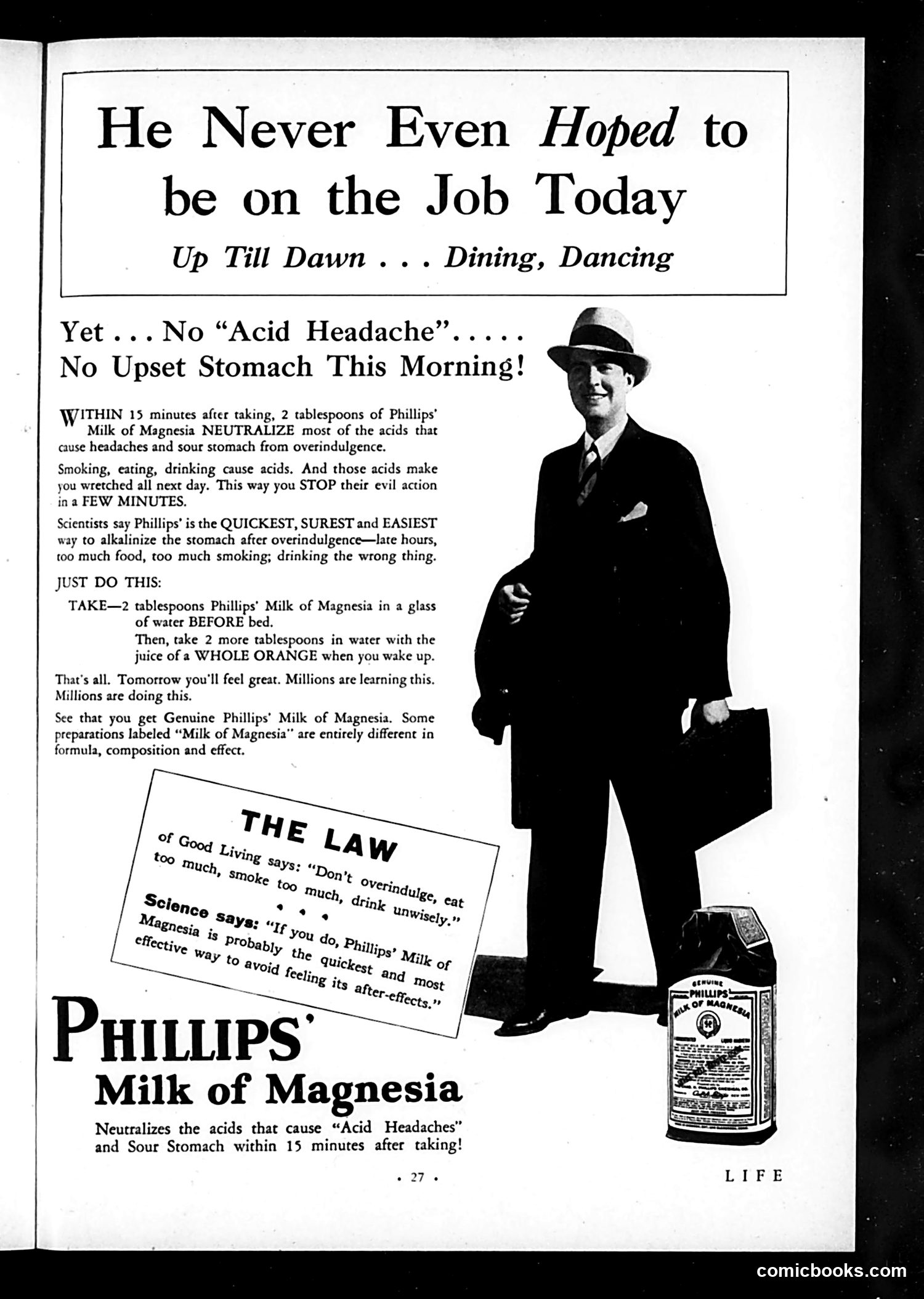
Analysis This is a Phillips' Milk of Magnesia advertisement, not political satire. The page depicts a well-dressed businessman in a hat and suit carrying a briefcase—representing a successful professional or executive. The ad's premise satirizes the contradiction between hedonistic nightlife and work obligations: the man partied all night ("Up Till Dawn... Dining, Dancing") yet must still perform his job. The joke is that Phillips' antacid allows him to do so without suffering consequences—no headaches or upset stomach despite overindulgence. "The Law of Good Living" box frames the message: overindulgence causes suffering, but Phillips' offers the "quickest, surest" remedy. The advertisement explicitly addresses the product's use for hangovers and digestive distress from smoking, eating, and drinking excess. This reflects early 20th-century attitudes toward patent medicines and casual marketing of stomach remedies for alcohol-related ailments.
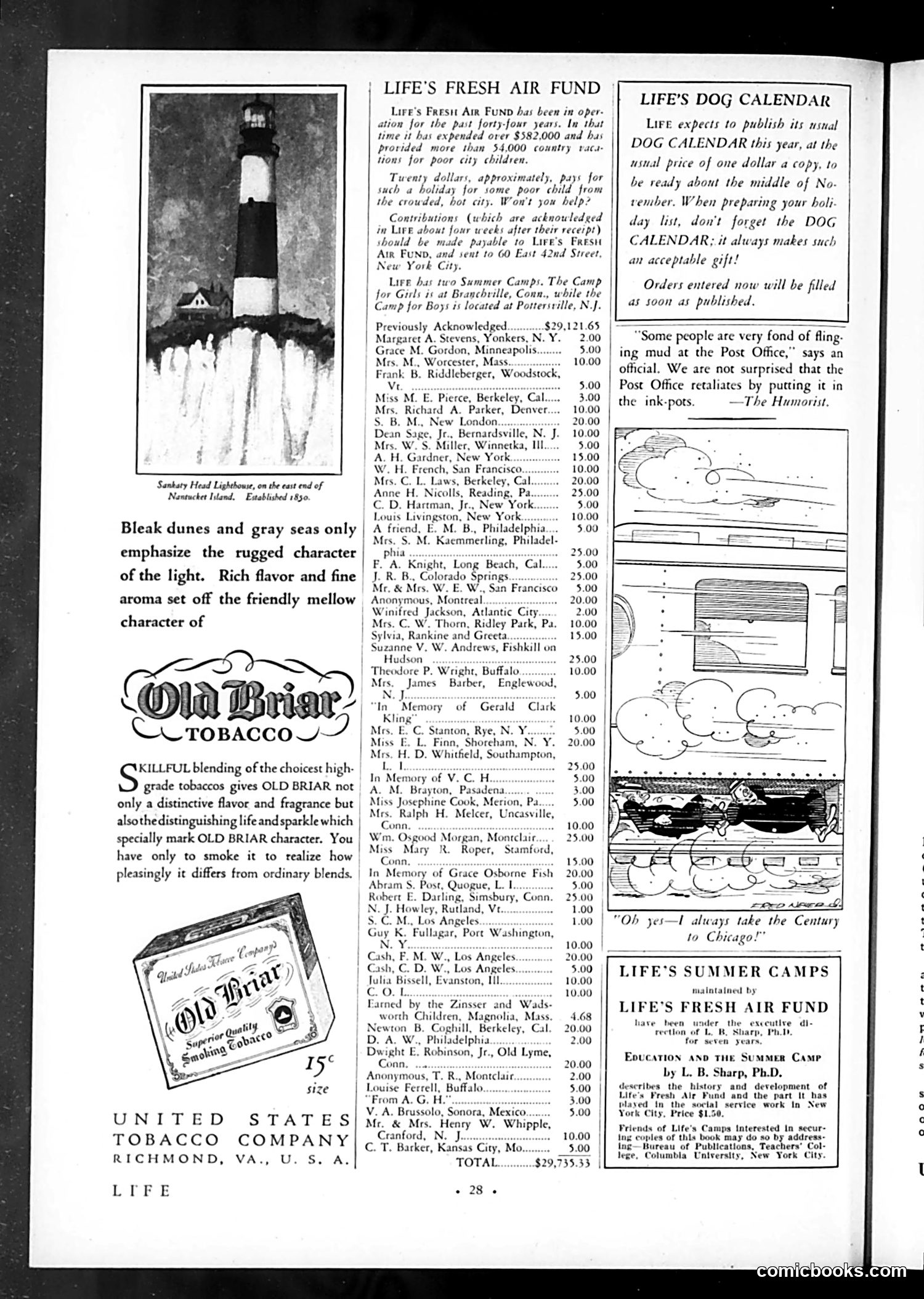
Page Analysis: Life Magazine (Circa 1940s) This page is primarily charitable fundraising and advertising with minimal satirical content. The main substance includes: Life's Fresh Air Fund — A decades-old charity providing country vacations for poor urban children. The listed donations suggest wealthy contributors; one entry notes "In Memory of Gerald Clark," indicating memorial giving. Life's Dog Calendar — A humorous aside noting that Post Office workers deliberately place mud in ink-pots to retaliate against people who "fling mud at the Post Office." This is mild office humor rather than political satire. Old Briar Tobacco Advertisement — A straightforward commercial featuring Sentry Head Lighthouse imagery, emphasizing the product's distinctive character. The page reflects 1940s American philanthropy and consumerism without significant political commentary. The "Dog Calendar" joke assumes readers' familiarity with Post Office friction—likely referencing bureaucratic complaints common to the era—but offers no deeper satirical critique.
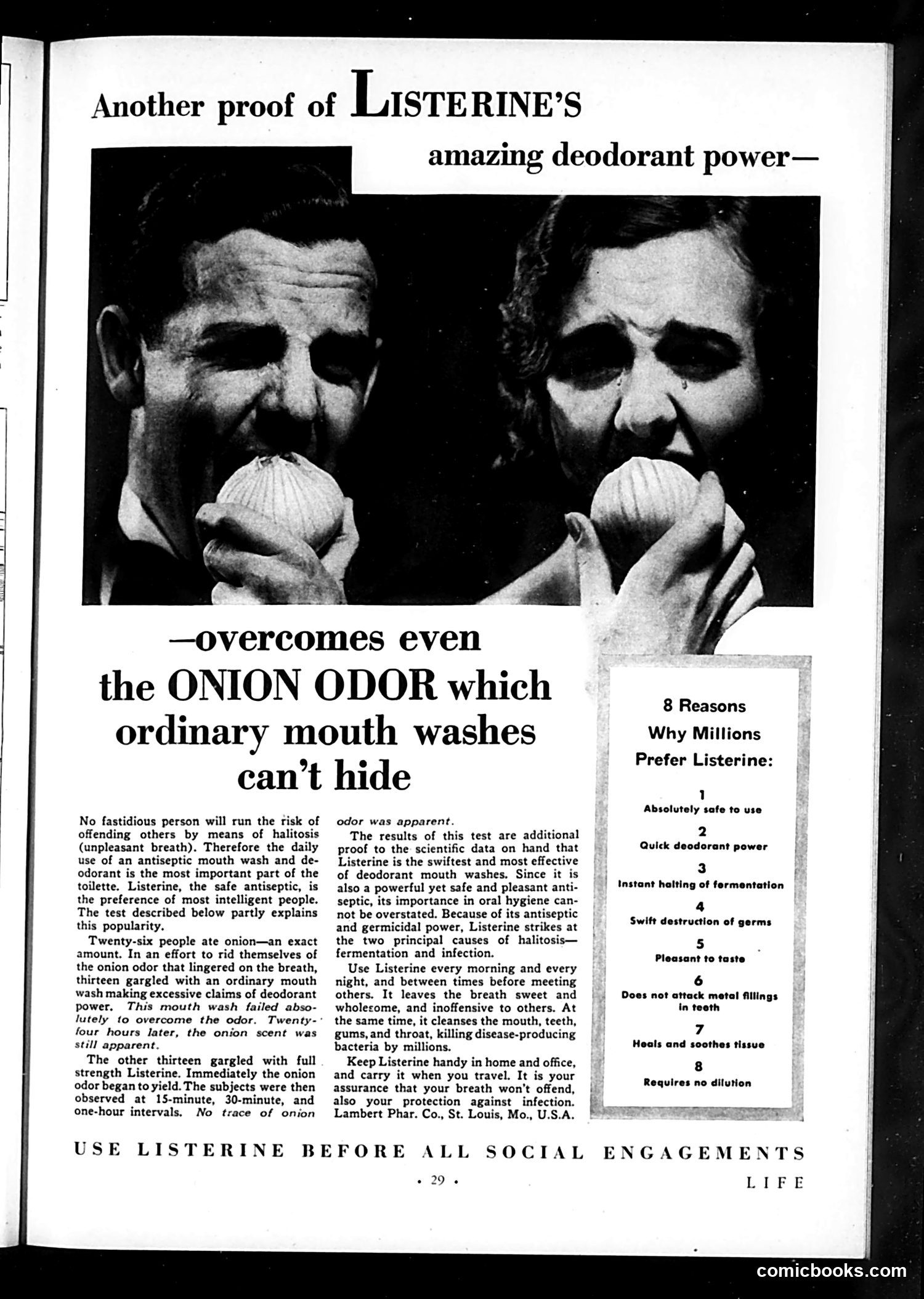
Listerine Advertisement Analysis This is a vintage advertisement, not political satire—though it reveals period attitudes about social anxiety and hygiene marketing. The "test" compares two groups who ate onions: one using generic mouthwash (failed), one using Listerine (succeeded). The black-and-white photos show men holding onions near their faces, demonstrating the product's claimed effectiveness. The satirical *framing* (not the ad's intent) exposes early 20th-century marketing tactics: exaggerated health claims, pseudo-scientific "testing," and shame-based selling. The emphasis on "halitosis" and social offensiveness reflects 1920s-30s anxieties about body odor as a social liability. Modern readers should note: Listerine's actual deodorant power is minimal; the ad conflates killing bacteria with eliminating odor. The "8 reasons" list includes dubious claims ("heals tissue," "instant halting of fermentation") typical of unregulated pharmaceutical advertising before FDA oversight. This represents an era when personal hygiene products were sold primarily through fear of social rejection.
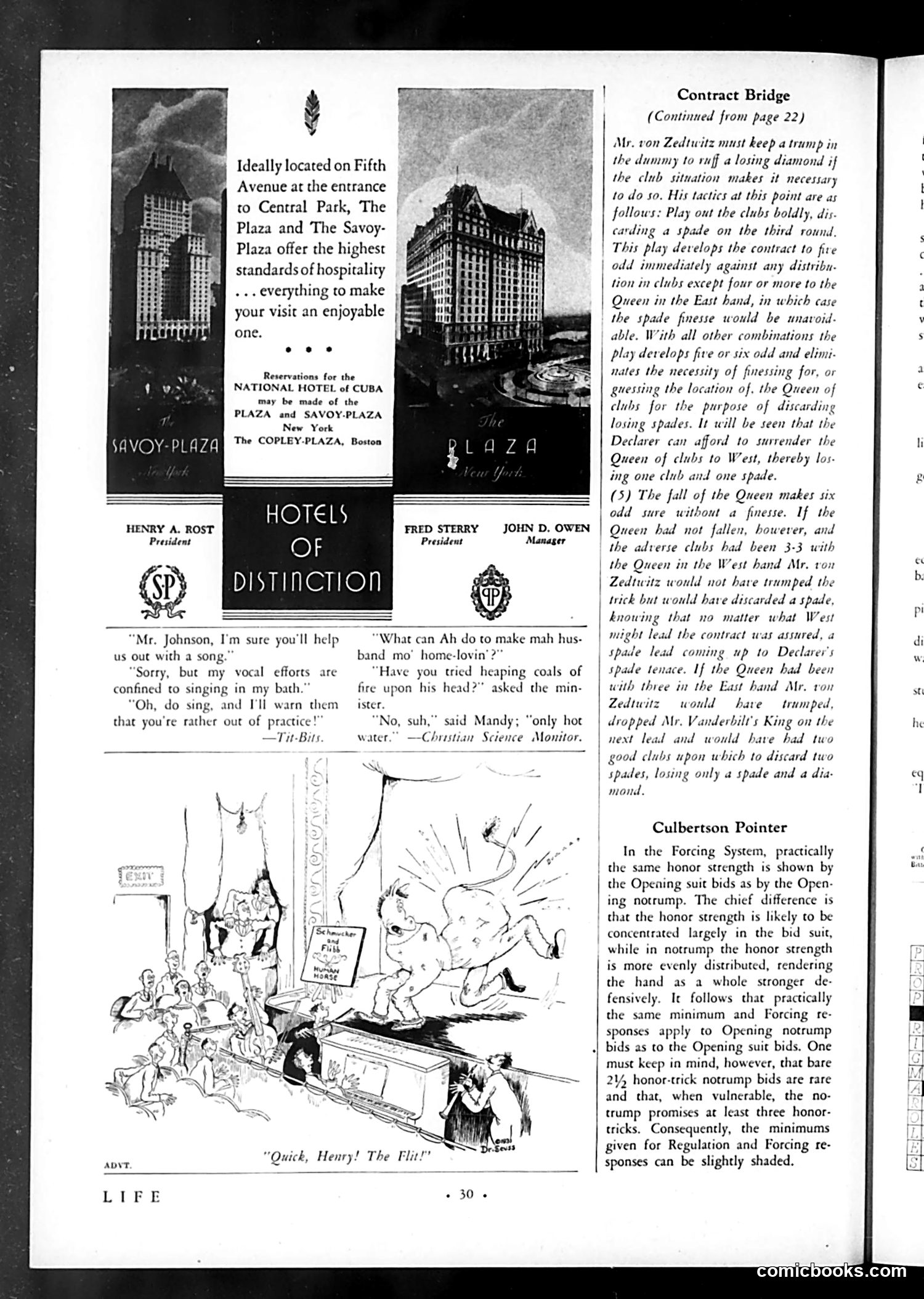
Analysis of Life Magazine Page This page is primarily advertising and instructional content rather than satirical political cartoons. The upper section contains hotel advertisements for luxury Manhattan establishments (Plaza, Savoy-Plaza, Copley-Plaza) and a Cuban resort, emphasizing hospitality and elegance. The middle features two brief humorous anecdotes with mild social satire: one mocks a man's reluctance to sing in public (suggesting masculine embarrassment), and another contains a joke about a Black woman named Mandy asking advice about making her husband "home-lovin'"—the humor derives from the minister's biblical suggestion being misunderstood as literal arson, playing on stereotypes of working-class Black dialect and domesticity. The cartoon labeled "Quick, Henry! The Flit!" appears to be an advertisement for Flit insecticide, showing domestic chaos—a common commercial trope of the era. The bulk of the page is devoted to a Contract Bridge instructional column by presumably the Culbertson school of bridge strategy, offering technical card-game analysis. Overall, this is a typical Life magazine page mixing advertisements, light humor, and instructional content rather than political satire.
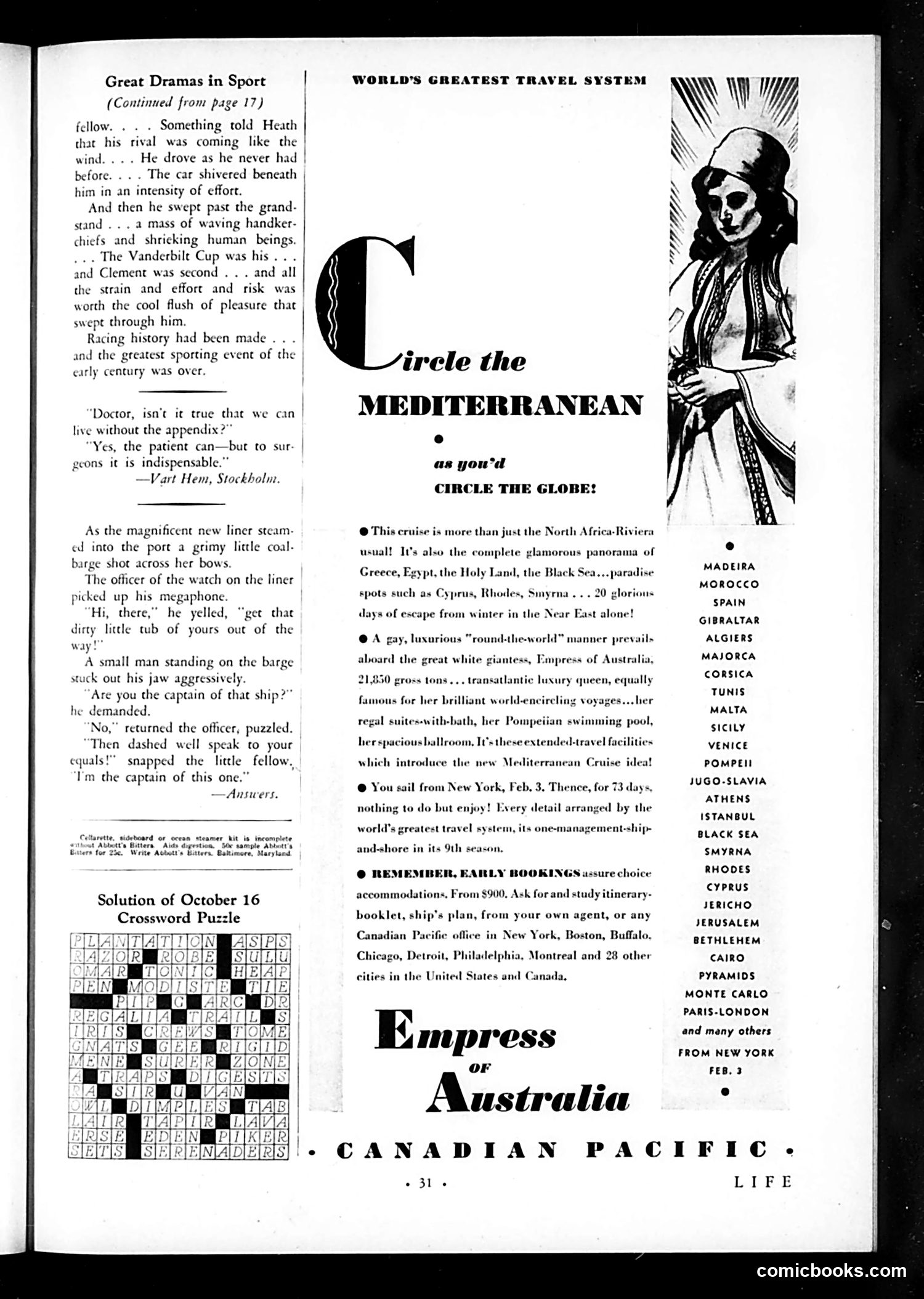
Life Magazine Page Analysis This page combines sports fiction with travel advertising. The upper section concludes a serialized story about automobile racing, specifically the Vanderbilt Cup—a real early 20th-century racing competition. The narrative dramatizes the intensity and risk of competitive motorsport, ending with the protagonist's victory. Below that are two humorous anecdotes: one mocking doctors' financial dependence on patient ailments, and another satirizing class pretension—a lowly barge captain demands respect from a ship's officer by insisting on speaking only to equals. The right side is a full-page advertisement for the Empress of Australia cruise ship, promoting Mediterranean voyages. The illustration shows a figure in exotic dress, emphasizing the "glamorous" foreign destinations. This reflects the era's aspirational travel marketing, targeting wealthy Americans seeking luxury leisure voyages to historically significant locations (Egypt, Holy Land, Greece). The page reflects 1920s consumer culture and social attitudes about travel, class, and entertainment.
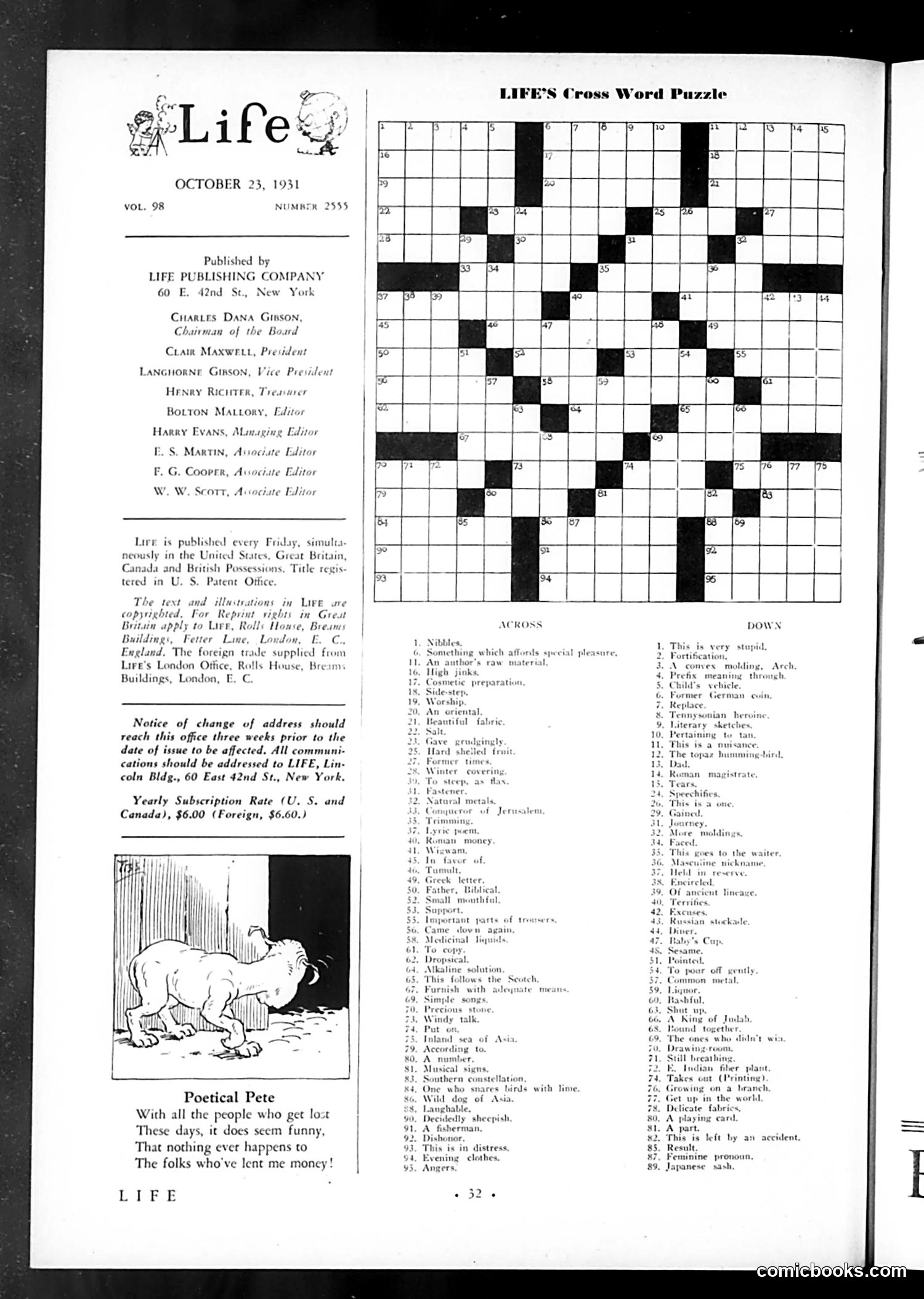
"Poetical Pete" Cartoon Analysis This brief cartoon on Life's contents page presents a satirical poem about financial irresponsibility during the Great Depression (October 1931). "Pete" observes that despite widespread economic hardship—many people are financially "lost"—there's an ironic exception: those who borrowed money from him seem mysteriously protected from misfortune. The joke relies on bitter Depression-era humor: while society collapses around them, debtors apparently escape consequences through some cosmic injustice. The cartoon mocks both human nature (people conveniently forget debts) and the absurdity of Depression economics, where normal rules seem suspended. The accompanying illustration shows a dejected figure, reinforcing the satirical tone about financial anxiety and the difficulty of collecting debts during economic crisis.
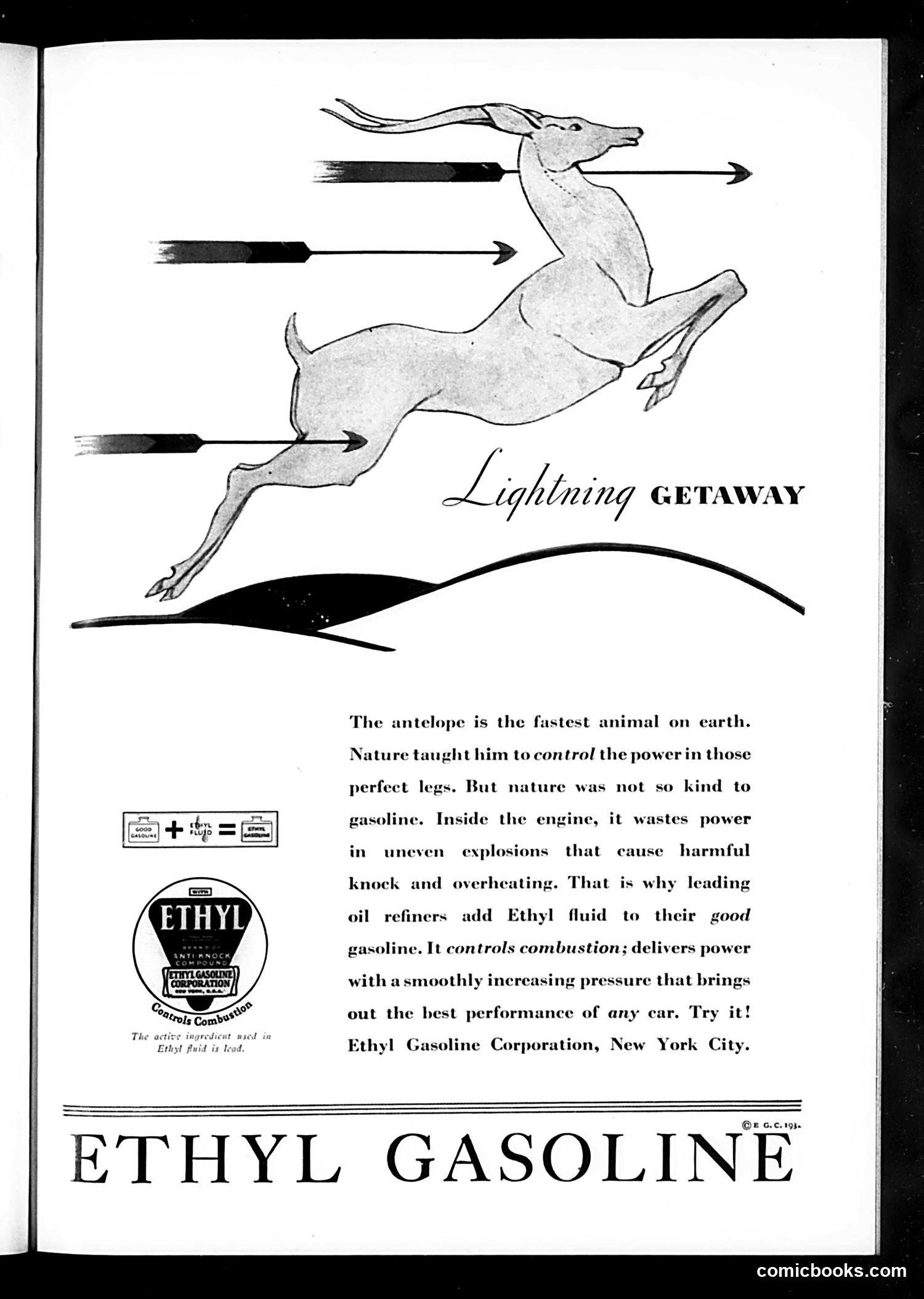
Analysis This is an advertisement for Ethyl Gasoline, not satire or political commentary. The "Lightning Getaway" illustration depicts an antelope in mid-leap, with arrows pointing to its body parts—a visual analogy comparing the animal's natural speed and control to what Ethyl gasoline promises cars. The ad's central argument: nature gave antelopes perfect leg control, but gasoline engines suffer from "uneven explosions" causing knock and overheating. The solution is Ethyl fluid (tetraethyl lead), an anti-knock additive that controls combustion for smoother power delivery. For modern readers: this represents pre-regulation automotive marketing. Tetraethyl lead, promoted here as performance-enhancing, was later discovered to be highly toxic and was phased out of gasoline in the 1970s-80s due to public health concerns. The advertisement exemplifies how products once marketed as beneficial were later recognized as harmful.
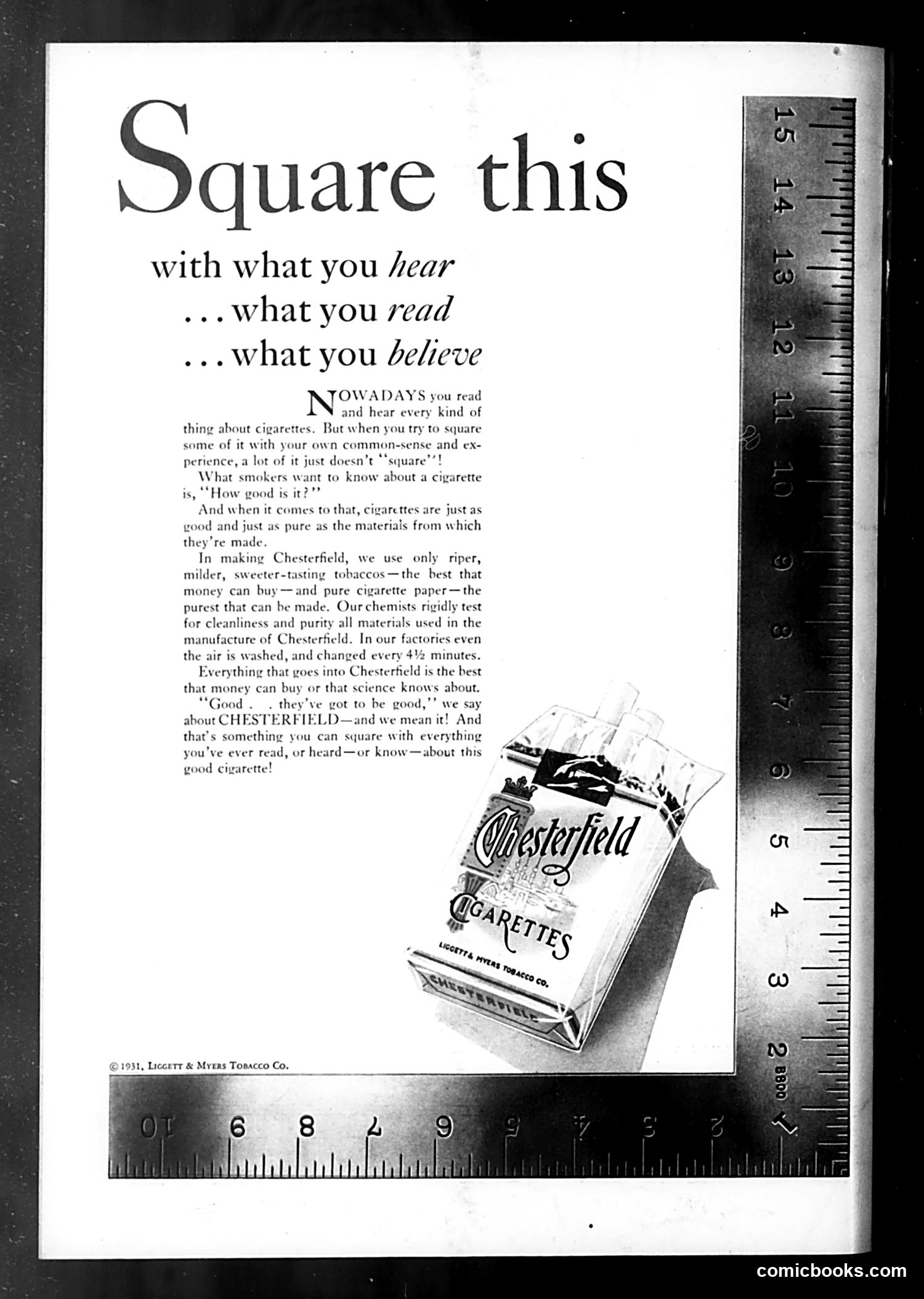
Analysis This is a Chesterfield cigarette advertisement, not satire or political commentary. Dated 1931, it's a straightforward commercial persuasion piece. The ad's central gimmick is the word "square"—a colloquial 1930s term meaning to reconcile or match up contradictory things. It challenges readers to verify Chesterfield's quality claims against "what you hear...read...believe" about cigarettes generally. The copy responds to contemporary skepticism about cigarette marketing by emphasizing manufacturing standards: superior tobacco, pure paper, rigorous chemical testing, and even air filtration in factories. This appeals to "common-sense" verification rather than vague lifestyle claims. The accompanying product shot shows the Chesterfield package prominently, with a ruler for scale—suggesting precision and measurable quality. By modern standards, the ad's claims appear absurdly unsubstantiated and the entire premise deeply ironic, since cigarettes are now known to be harmful. But in 1931, such quality-assurance rhetoric was considered persuasive corporate messaging.
I cannot reliably read this page. The image is almost entirely black with minimal visible detail, and the OCR text appears to be corrupted gibberish (repeated letters and fragments like "ee on Om in On onan"). Without being able to see the actual cartoon content or read legible text, I cannot identify figures, political references, or explain any satire or joke. This may be a scanning or digitization error, or the page may be too dark/damaged to analyze. To provide accurate historical analysis as requested, I would need a clearer image where the illustrations and text are actually readable.