life
Life — October 30, 1931
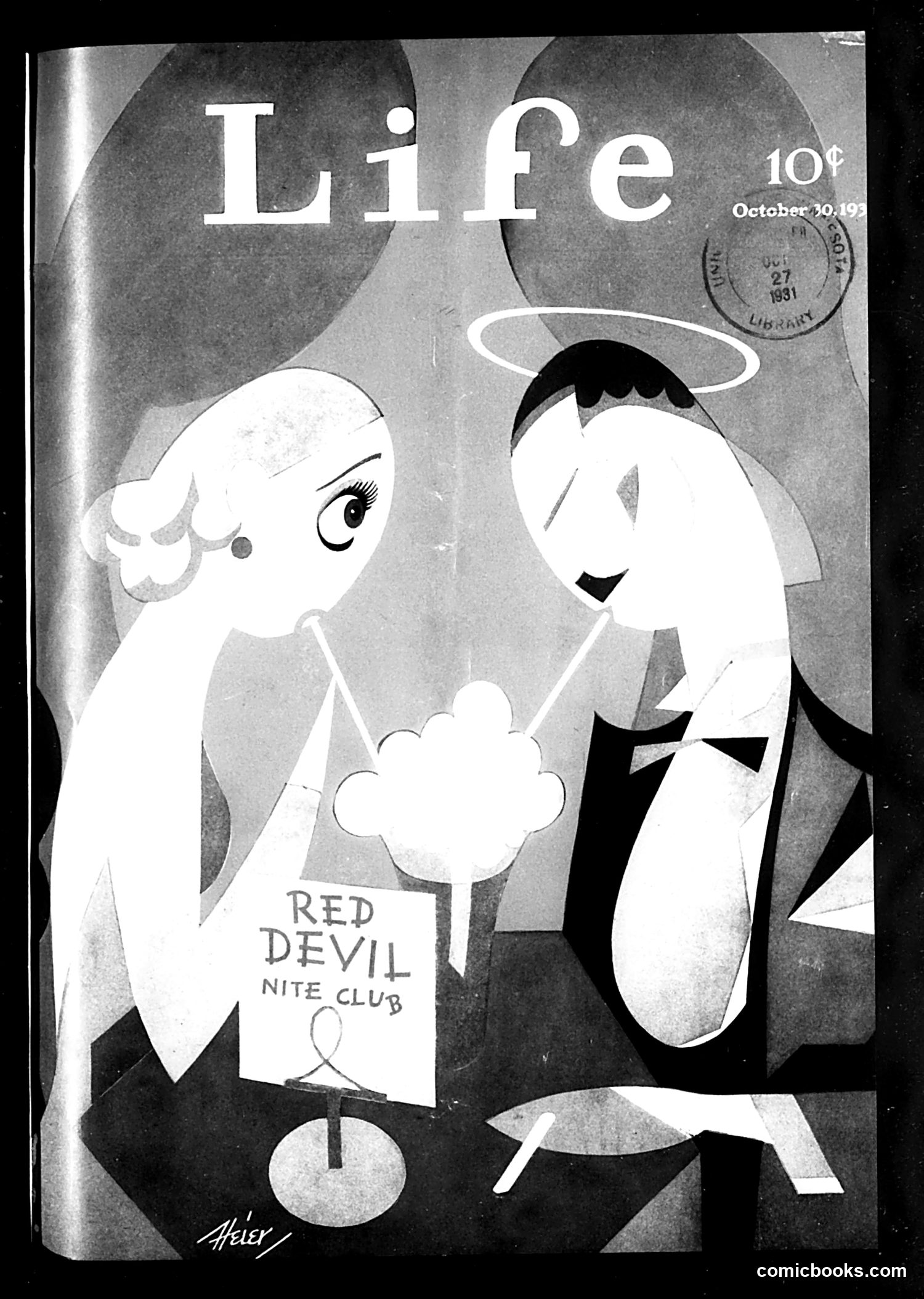
Life Magazine Cover Analysis This is the October 20, 1931 cover of Life magazine, priced at 10 cents. The illustration by Aler depicts two stylized figures at what appears to be the "Red Devil Nite Club" (visible on a sign they're holding). The cartoon likely satirizes 1930s nightlife and Jazz Age culture. One figure wears a halo, suggesting angelic pretense, while the other sports a bow tie and appears more devilish—a visual contrast emphasizing hypocrisy about morality in speakeasy culture. The "Red Devil" club reference suggests prohibition-era illicit drinking establishments that operated despite legal bans. The juxtaposition of the halo'd "good" figure with the "devil" figure comments on the moral ambiguity and hidden nature of 1930s nightclub society, where respectable citizens frequented illegal establishments.
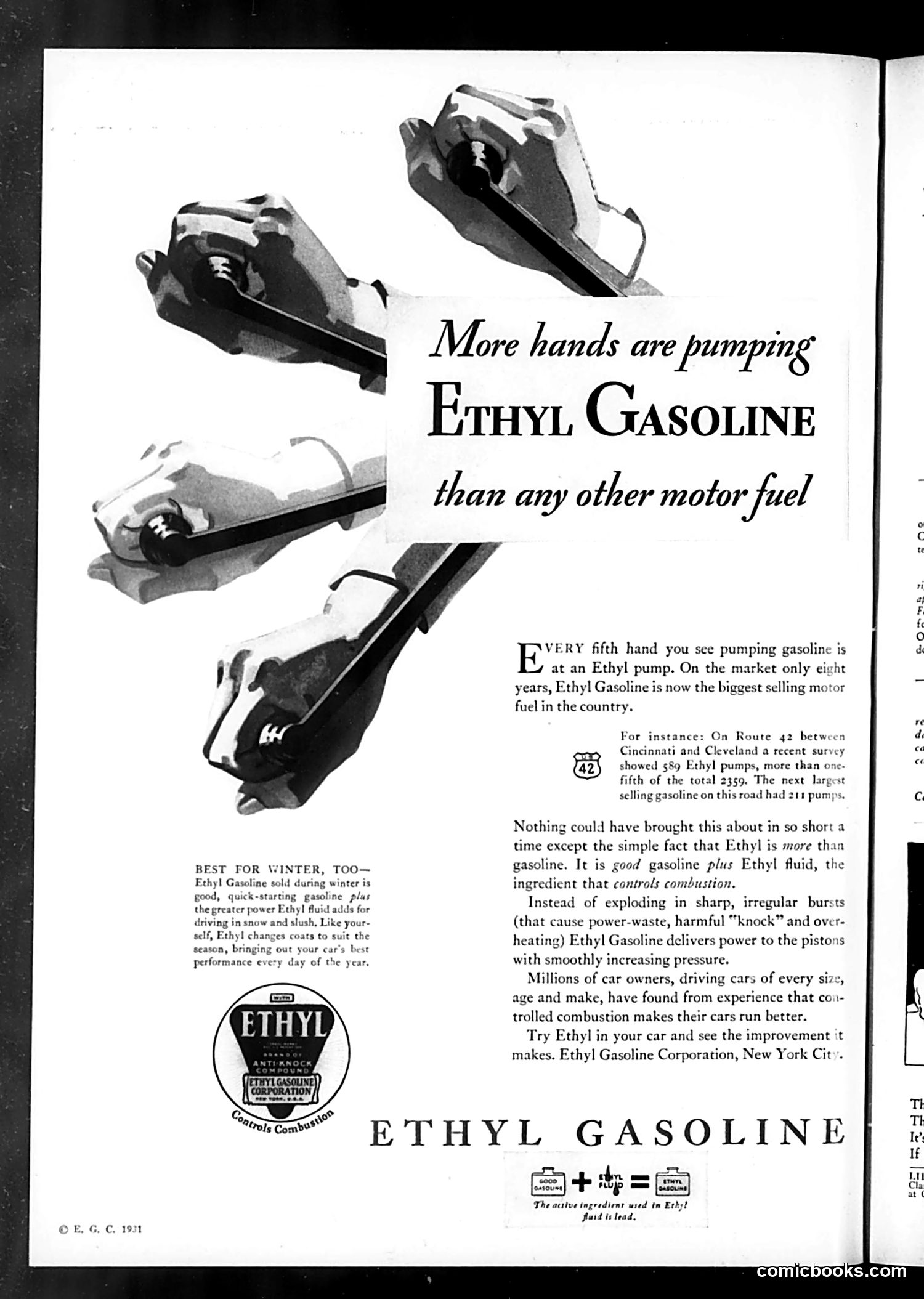
Ethyl Gasoline Advertisement This is a straightforward advertisement, not satire or political commentary. The page promotes Ethyl Gasoline, a motor fuel product from the Ethyl Gasoline Corporation (New York City). The four photographs show hands at gas pumps, emphasizing that Ethyl is the market's best-selling fuel. The ad claims that "every fifth hand" belongs to an Ethyl pump customer, citing Route 42 between Cincinnati and Cleveland as evidence. The pitch emphasizes Ethyl's superiority: it contains an "Ethyl fluid" that "controls combustion," enabling smoother engine performance without harmful "knock." The ad targets car owners broadly, promising improved performance through controlled fuel combustion. The era and marketing approach suggest this dates to the 1920s-1930s, when leaded gasoline was widely promoted without health concerns.
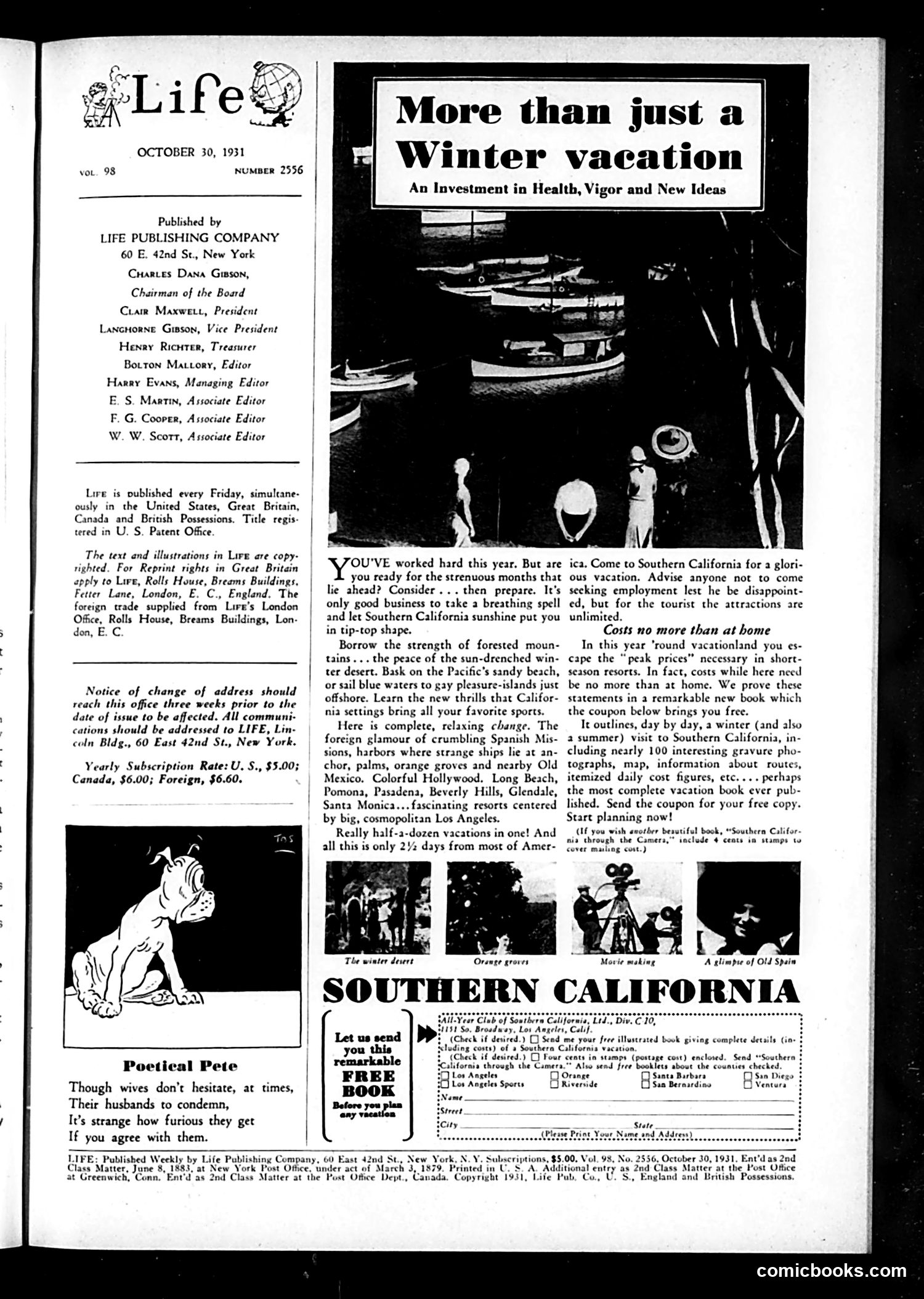
Life Magazine Page Analysis (October 30, 1931) This page is primarily an advertisement for Southern California tourism, occupying most of the right side. The ad promotes winter vacations as "more than just a vacation" — framed as an investment in health and vigor. It emphasizes Southern California's accessibility (2½ days from most of America) and includes photos of attractions: desert scenery, orange groves, movie-making, and "a glimpse of Old Spain." The left side contains a small illustration labeled "Poetical Pete" — a cartoon bulldog — accompanying a brief humorous verse about wives getting "furious" when husbands disagree with them. Given the October 1931 date, this advertisement reflects the Great Depression era, when affordable leisure travel to California was promoted as economically accessible rejuvenation for working Americans. The ad's emphasis on cost and health benefits targets Depression-era readers seeking affordable escape.
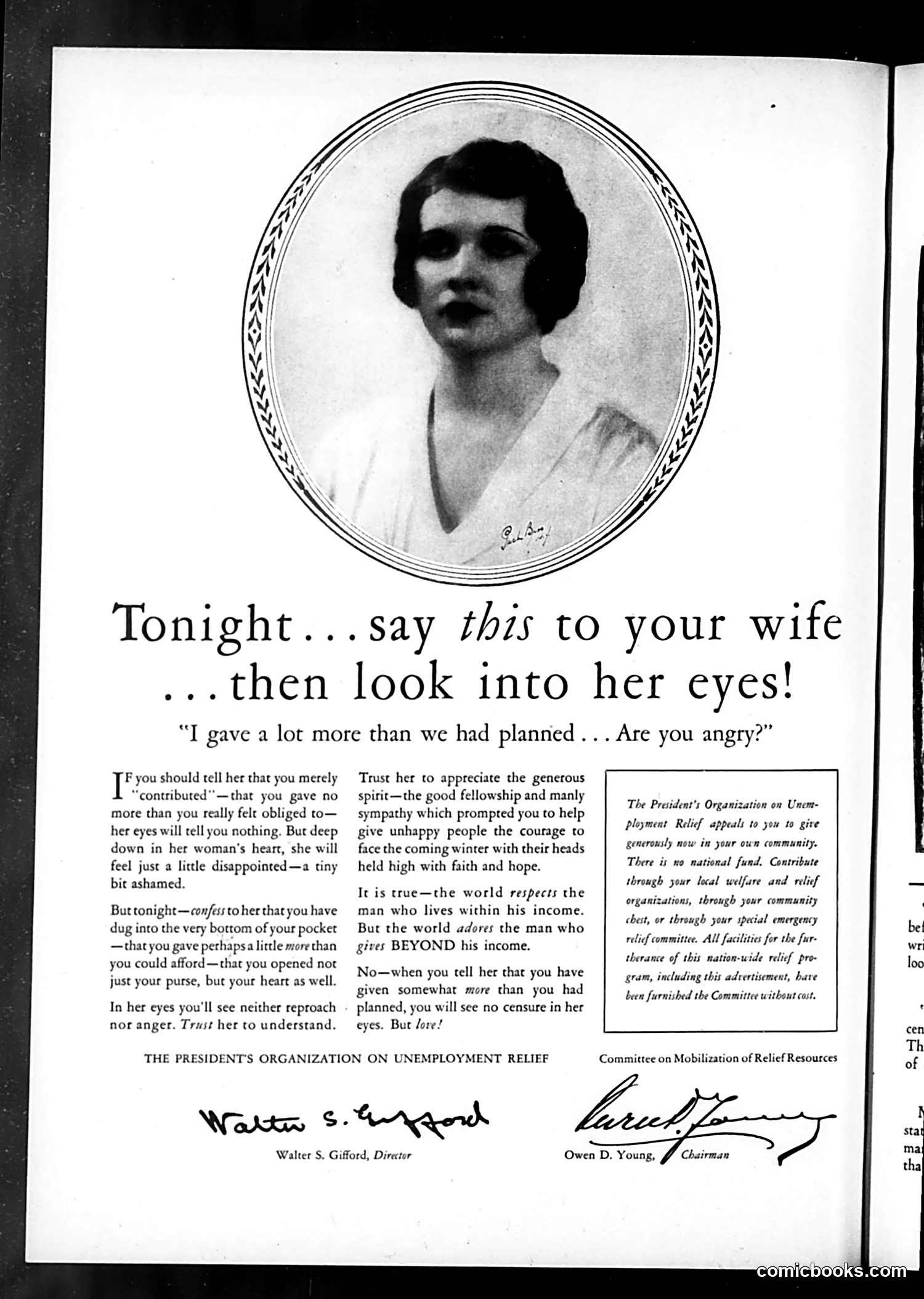
Advertisement for Unemployment Relief, circa 1930s This is a public service advertisement rather than political satire. It features an oval portrait photograph of a woman and appeals to male readers to donate generously to unemployment relief. The ad's emotional argument: Tell your wife you've given "more than we had planned" to relief efforts. The text suggests that wives will respect husbands who give beyond their means, seeing this as moral generosity rather than financial irresponsibility. Signed by Walter S. Gifford (Director) and Owen D. Young (Chairman) of the President's Organization on Unemployment Relief, this reflects Depression-era fundraising that emphasized patriotic duty and masculine honor to motivate charitable donations during severe economic crisis.
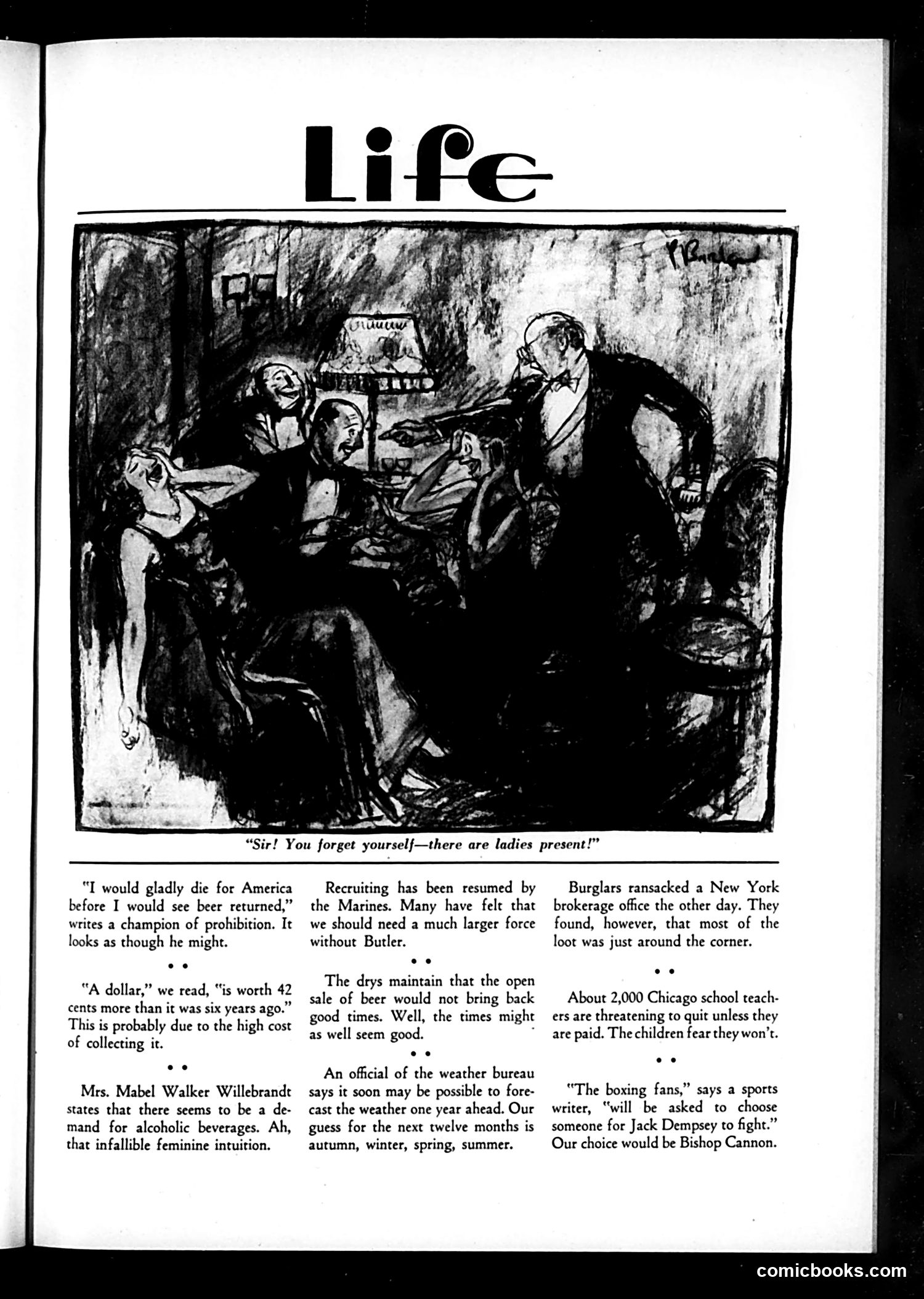
Life Magazine Satire Page Analysis This page contains a sketch and several brief satirical news items typical of Life magazine's humor format. The Cartoon: Shows a formal gathering where a man is gesturing animatedly while others (including women) are present. The caption "Sir! You forgot yourself—there are ladies present!" suggests he's made an improper remark or displayed crude behavior in mixed company—satirizing violations of early 20th-century social etiquette standards. The News Items mock various contemporary issues: - Prohibition advocacy (drinking beer) - Economic inflation (dollar value declining) - Weather forecasting unreliability - School teacher labor disputes - Marine recruitment needs - Crime and burglary - Boxing entertainment choices These brief quips exemplify Life's satirical approach to current events and social commentary.
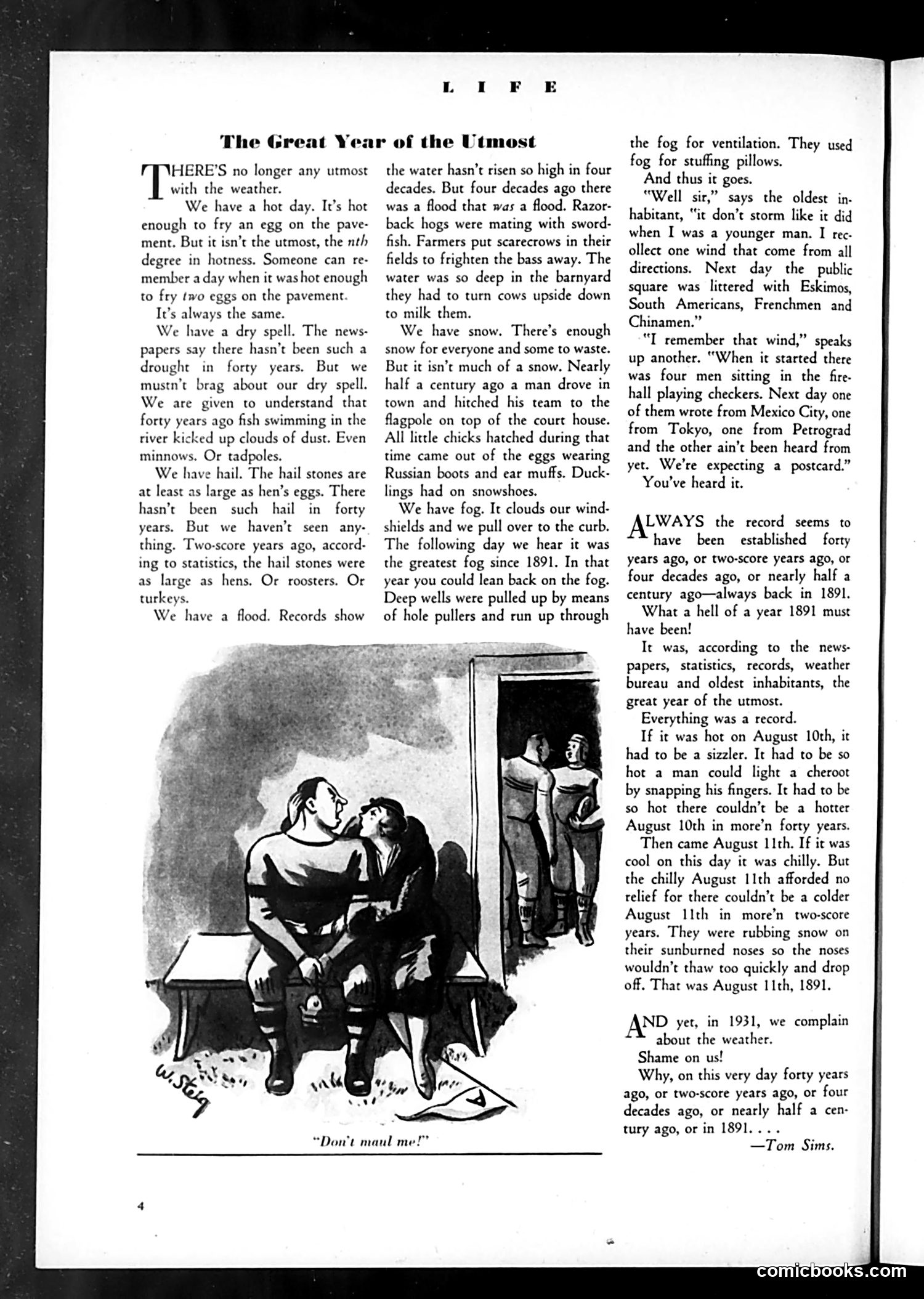
"The Great Year of the Utmost" - Life Magazine Satire This article by Tom Sims satirizes extreme weather claims and record-breaking obsession in 1931. The piece mocks how every weather event gets called "the worst in forty years"—a recurring exaggeration. The cartoon shows two people indoors during oppressive heat, with one saying "Don't maul me!" The illustration contrasts indoor discomfort with the article's theme: people complaining about weather despite living through relatively ordinary conditions. Sims argues that Americans shamefully grumble about 1931's weather while referencing the supposedly unprecedented "Great Year of the Utmost" from 1891—implying modern complaints pale compared to historical extremes, or that record-chasing narratives are inherently unreliable. The satire targets both media sensationalism and public amnesia about actual past hardships.
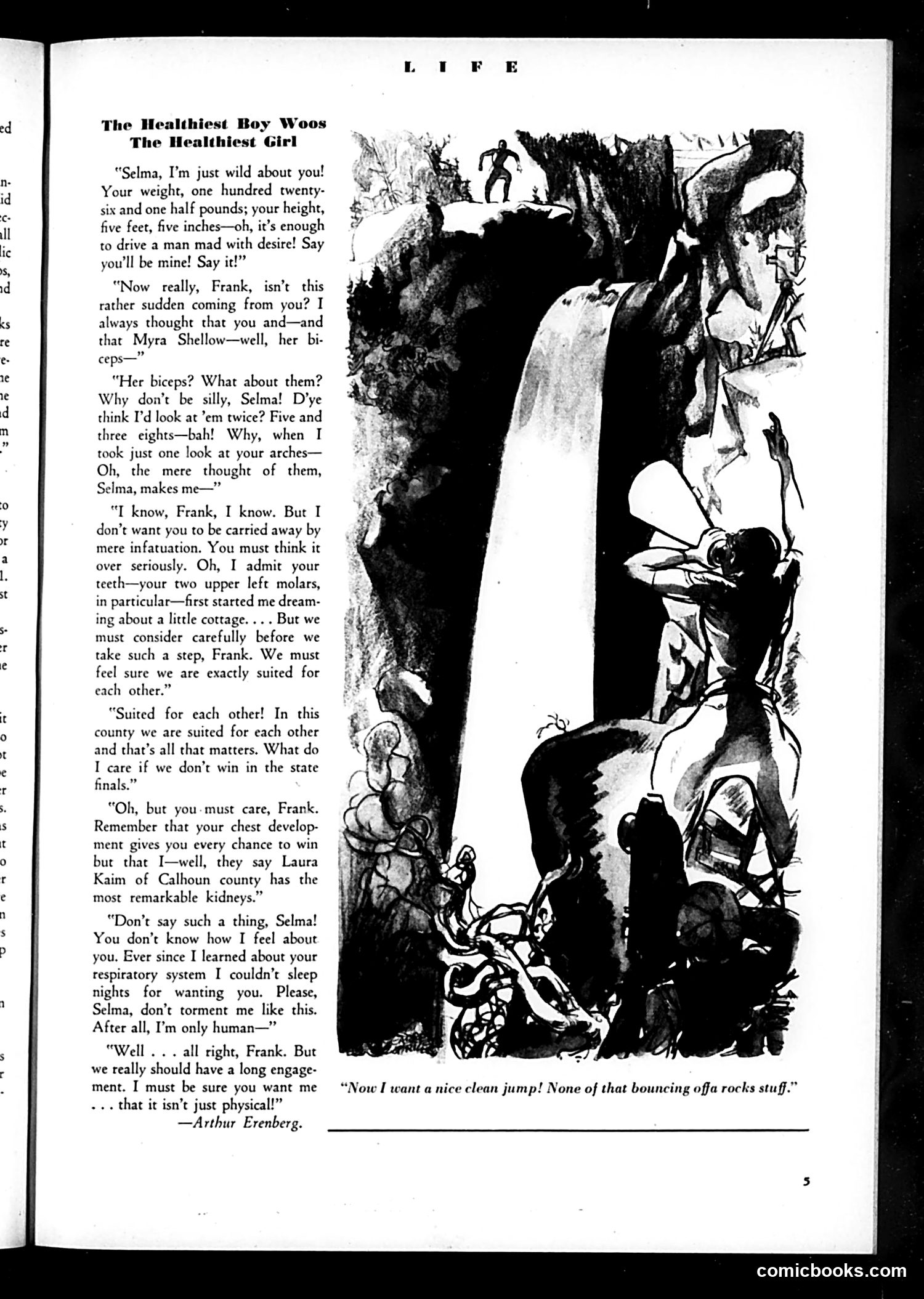
"The Healthiest Boy Woos The Healthiest Girl" This appears to be a satirical romantic dialogue between two young people obsessed with physical fitness and health metrics. Frank boasts about his measurements (126.5 pounds, 5'5", muscular development), while Selma counters with her own physical attributes—her biceps and notably her kidneys, which she claims are "the most remarkable" in Calhoun county. The satire targets early 20th-century health-obsession culture, where physical fitness and organ function became romantic selling points. The couple's discussion of kidneys, respiratory systems, and chest development as desirable traits mocks the era's pseudo-scientific health movements and the reduction of human attraction to measurable bodily attributes. The illustration shows them hiking, reinforcing the "healthy lifestyle" theme.
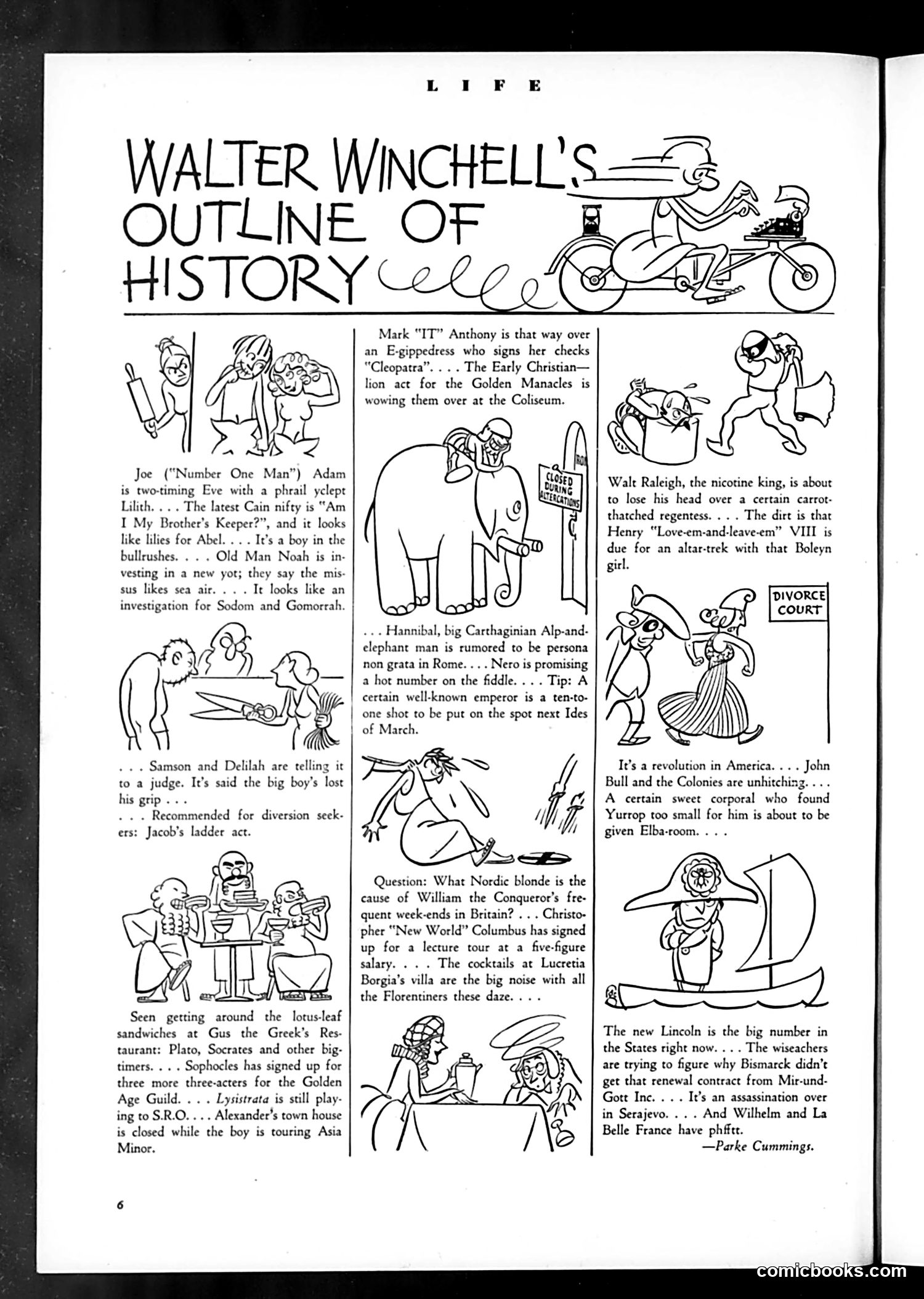
Walter Winchell's Outline of History This is a humorous satirical column by Parker Cummings that uses cartoons to mock historical figures and contemporary celebrities through absurdist comparisons. The format pairs famous historical moments with modern (1920s-30s) gossip and scandals. For example, it compares Adam and Eve to contemporary figures, references Mark Anthony and Cleopatra alongside modern celebrities, and mocks historical figures like Hannibal, William the Conqueror, and Christopher Columbus. The column concludes with topical references to American politics (John Bull and the Colonies), and contemporary entertainment/scandal involving figures like Lincoln (likely a film), Bismarck, and others. The satire suggests history simply repeats through different scandals and human foibles—both ancient and modern tragedies boil down to similar moral failures and gossip.
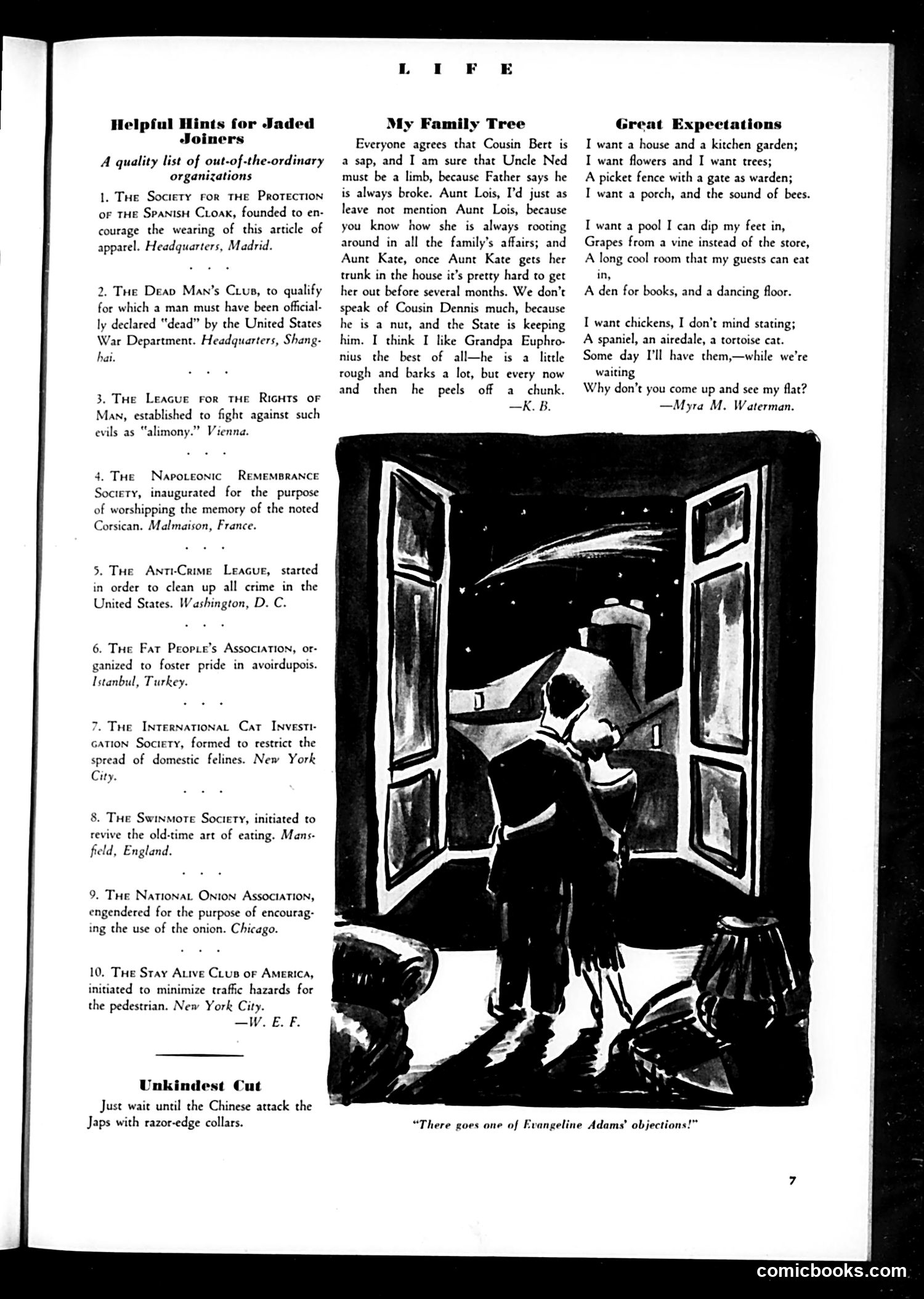
Analysis of Life Magazine Page 7 The main illustration shows a figure looking out a window at night, with the caption "There goes one of Evangeline Adams' objections!" This references Evangeline Adams, a famous early 20th-century astrologer whose predictions were widely publicized and often mocked. The left column contains satirical "helpful hints" listing absurdist fictional organizations (the Society for Protection of Spinsters, Dead Man's Club, etc.)—pure satire poking fun at America's proliferation of niche clubs and organizations. The poem "Great Expectations" and "My Family Tree" offer gentle domestic humor about wanting a home, garden, and various pets, with comedic family member descriptions. The cartoon likely jokes that something Adams predicted (possibly about fate or destiny) has now ironically come to pass, mocking both astrology and celebrity prediction culture.
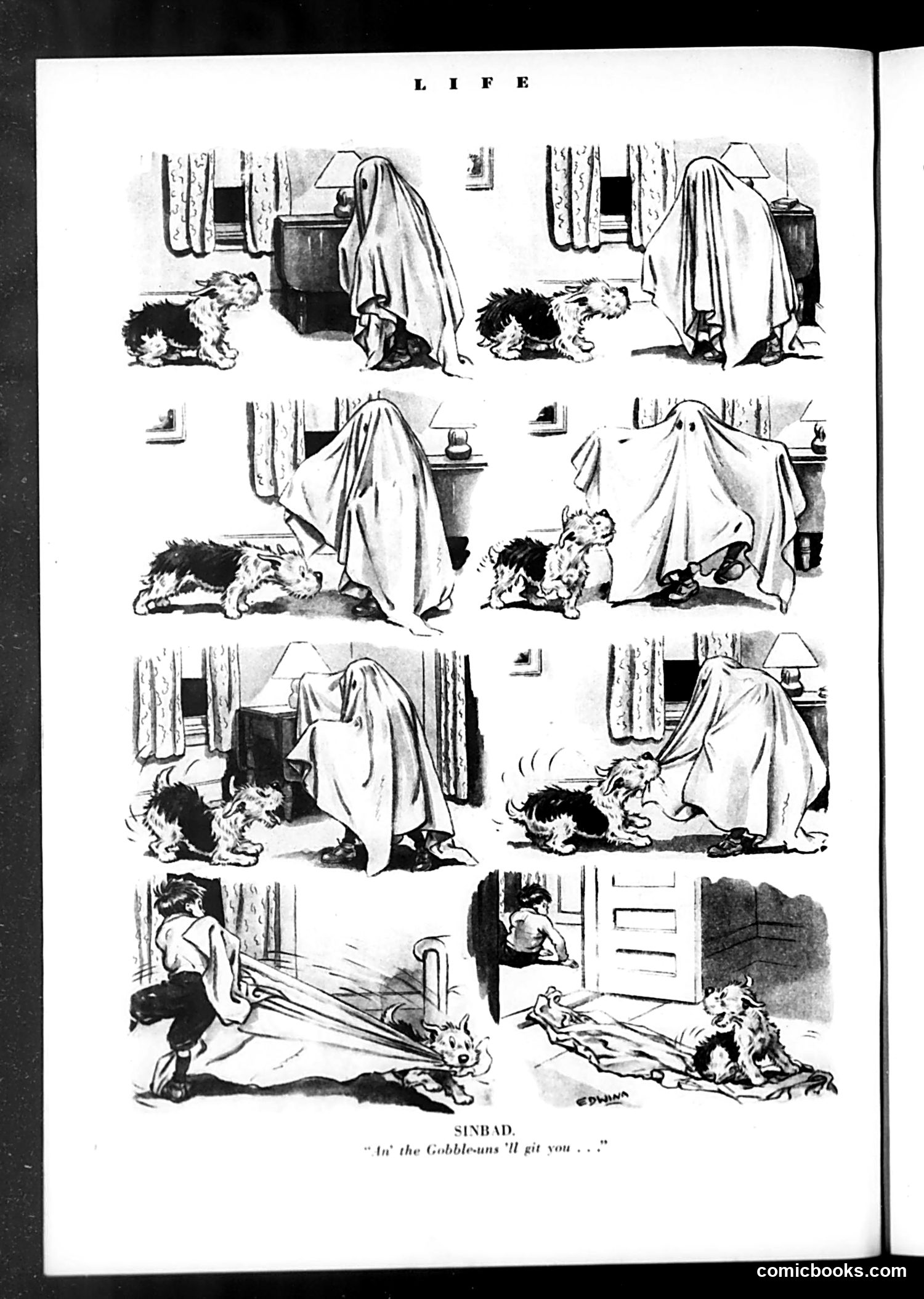
"Sinbad" Comic Strip Analysis This appears to be a humorous multi-panel strip titled "Sinbad" with the caption "In the Goblin's I'll git you..." The narrative shows a cloaked figure (the "Goblin") pursuing a small character through a domestic interior, progressing from bedroom scenes through hallways and finally outdoors. The strip plays on the familiar trope of a threatening supernatural pursuer chasing an increasingly panicked victim. The humor derives from the contrast between the goblin's menacing intent and the domestic, mundane setting—a bedroom with curtains and lamps. The escalating chaos and the victim's visible fear create slapstick comedy. The reference to "Sinbad" (the legendary sailor) appears ironic, as this is domestic comedy rather than exotic adventure. This represents typical early 20th-century American satirical comic humor blending supernatural folklore with everyday domestic life.
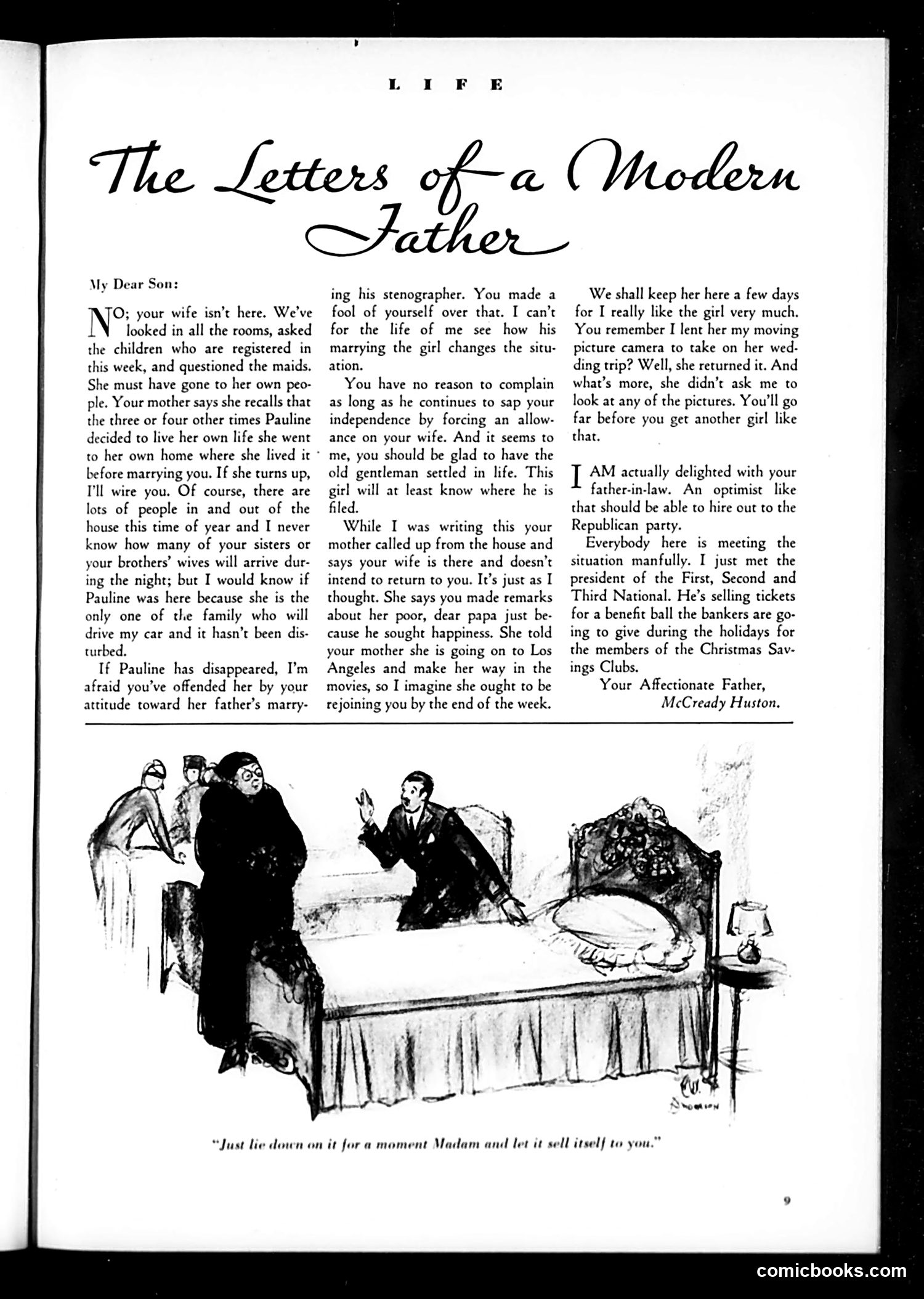
"The Letters of a Modern Father" This satirical piece mocks upper-class family dysfunction. A father writes to his absent son about his wife's disappearance—she's apparently left him, possibly to pursue a film career in Los Angeles. The satire targets the son's marriage to a girl the father-in-law dislikes, and the wife's discontent with her restricted domestic role. The cartoon illustrates the chaos: a woman lies in bed while men gather around, suggesting marital or health crisis. The caption, "Just lie down on it for a moment Madam and let it sell itself to you," appears to reference furniture sales or advertising. The piece critiques modern marriage instability, women's dissatisfaction with traditional roles, and wealthy families' social pretensions—common themes in Life's social satire.
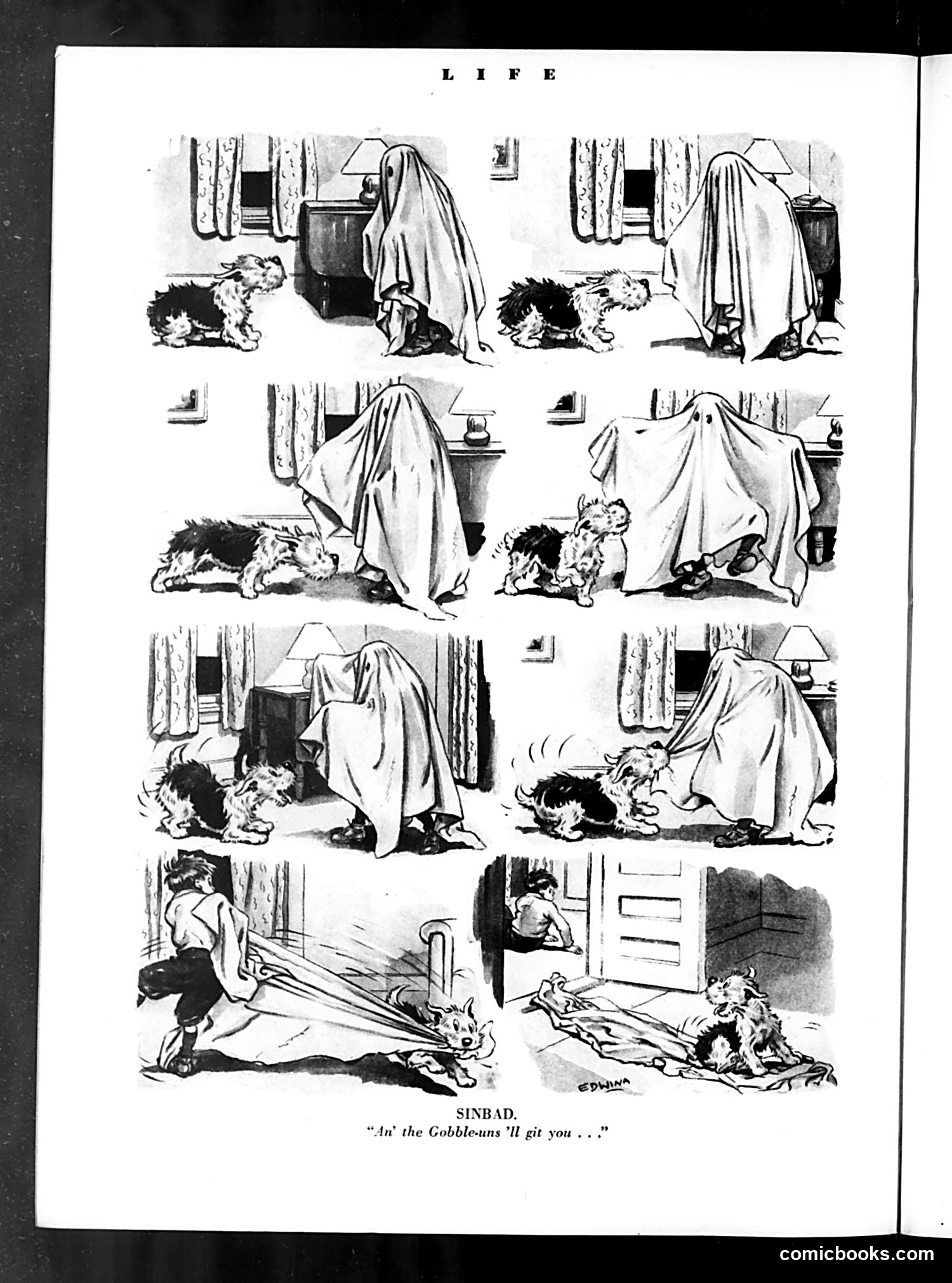
Analysis of "Sinbad" Cartoon This is a humorous comic strip sequence titled "Sinbad" with the caption "An' the Gobbleuns 'll git you..." The strip depicts a woman (likely a mother or caregiver) using a classic parenting threat to frighten small children into obedience. In each panel, she dramatically drapes fabric over herself while children cower in fear, apparently believing she's a monster or supernatural creature. The final panels show the children fleeing in terror. The humor derives from the relatable domestic scenario: using scary tales and theatrical threats to discipline misbehaving children—a common parenting tactic of the era. The reference to "Gobbleuns" (likely from James Whitcomb Riley's poem "Little Orphant Annie") reinforces the folk-tale, bedtime-story quality of the threat. The satire gently mocks both parental discipline methods and children's gullibility.
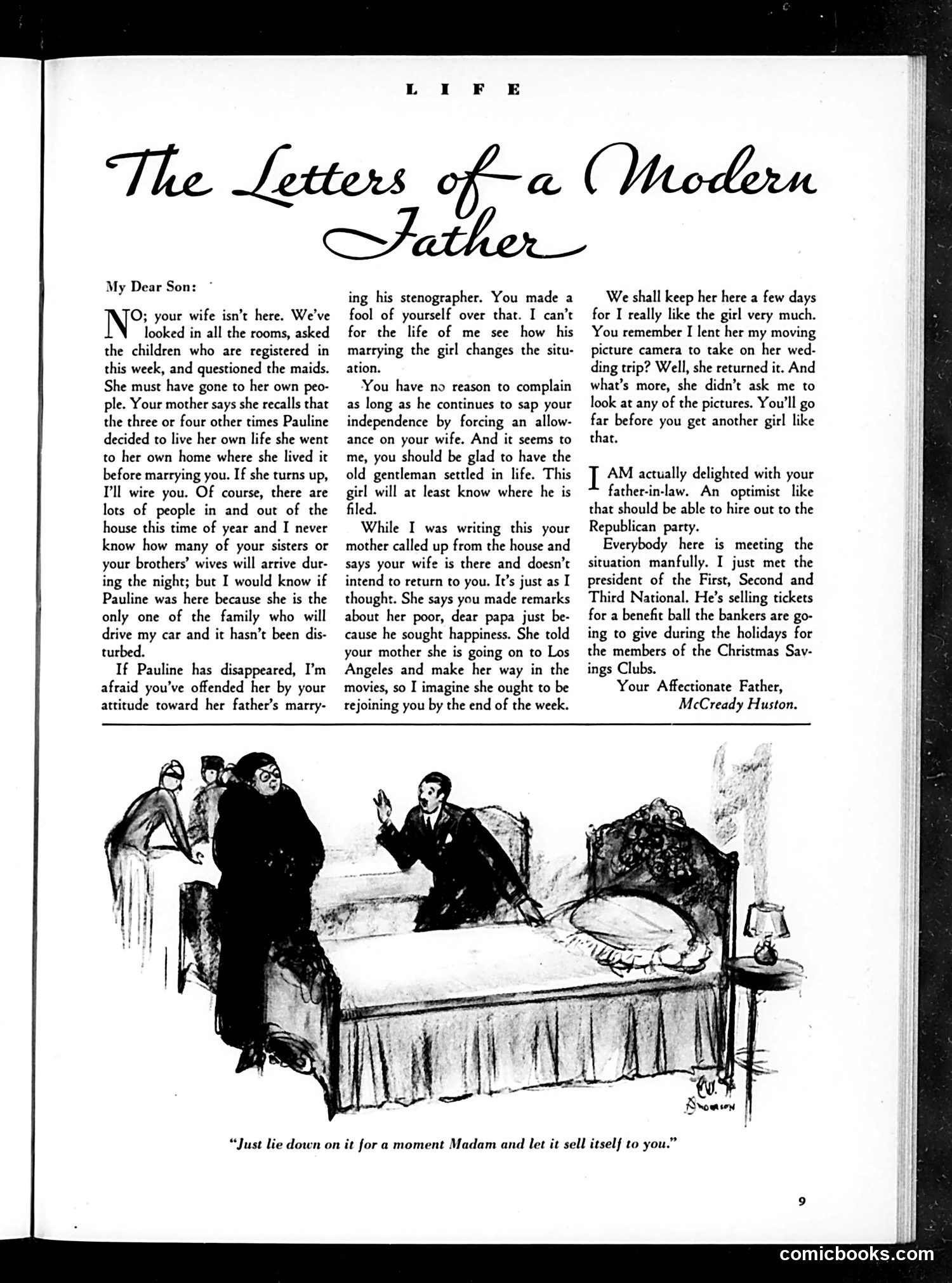
"The Letters of a Modern Father" This satirical piece mocks a father's response to his son's marital troubles. The father's letter dismisses his son's wife's disappearance with crude indifference, joking that she's probably left him and suggesting the son should be "glad" to have an "old gentleman settled in life." The accompanying cartoon depicts a furniture salesman encouraging a well-dressed man to test a bed ("Just lie down on it for a moment Madam and let it sell itself to you"), likely satirizing both commercialism and marital discord through double entendre. The satire targets early 20th-century masculine attitudes—the father's callousness toward marriage, his concern with social propriety over genuine feeling, and the general trivialization of women's agency and domestic unhappiness by men of his class.
Analysis of "Life Looks About" Page This satirical page contains three separate commentary pieces: 1. "Turning the Kaleidoscope" discusses Bertrand Russell's book "The Scientific Outlook," using an anecdote about Pavlov's dog and electrical stimulus as metaphor for stock market panic behavior. 2. "Gandhi No Joke" reports that Gandhi declined a U.S. visit, rejecting treatment as a spectacle. The author argues Gandhi shouldn't be in "the show business" despite his importance to India. 3. "Oriental Agitations" predicts potential Sino-Japanese conflict, questioning whether China could militarily resist Japan—a prescient concern given 1930s geopolitical tensions. The page reflects pre-WWII anxieties about economic instability, celebrity culture, and Asian power dynamics. The small illustration shows figures examining a globe, reinforcing themes of global observation and analysis.
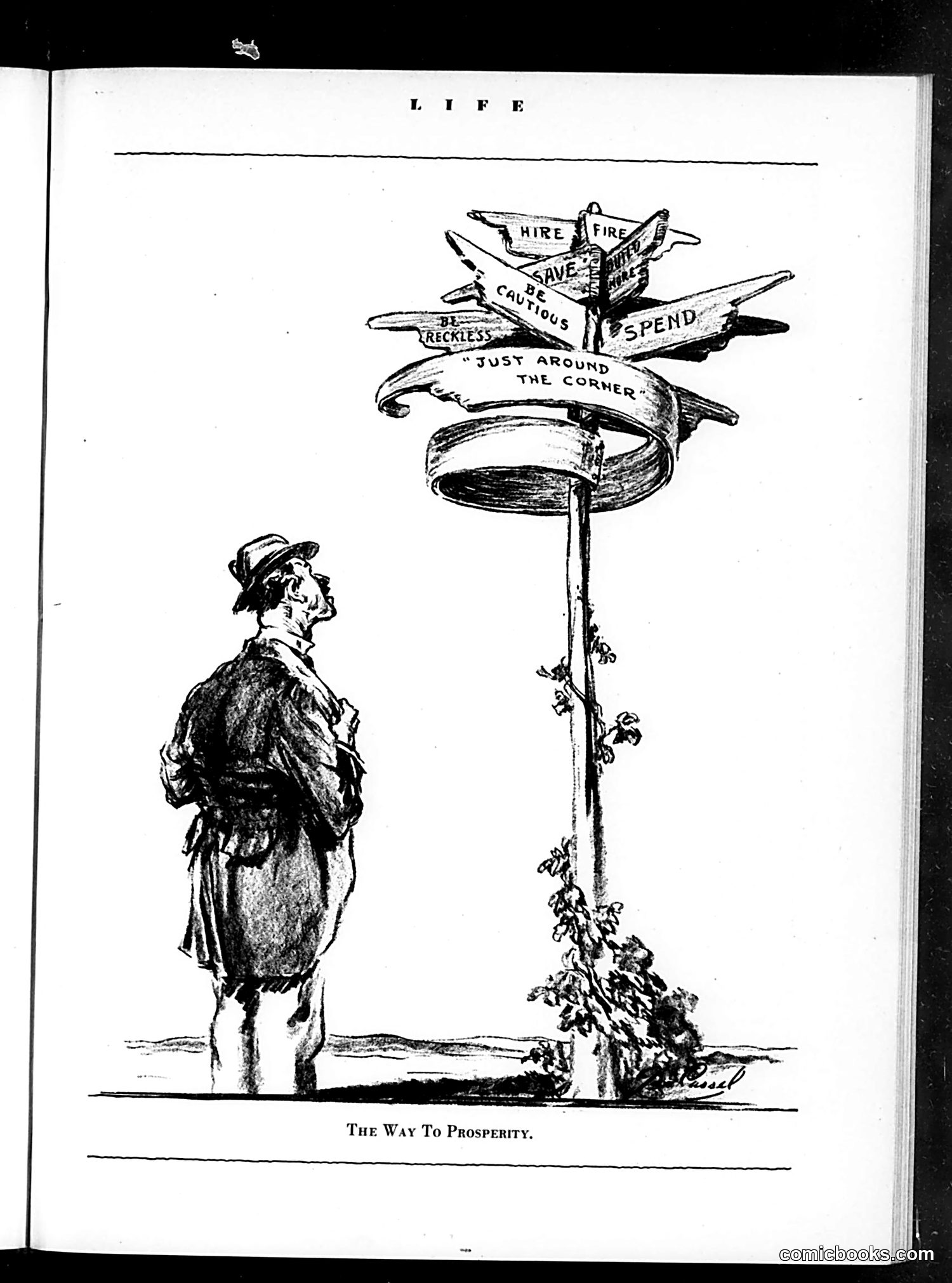
"The Way To Prosperity" This satirical cartoon depicts a man in late 19th or early 20th-century dress gazing upward at a signpost. The signpost's multiple arms point in contradictory directions, each labeled with conflicting advice: "HIRE," "FIRE," "SAVE," "SPEND," "RECKLESS," "CAUTIOUS," and "JUST AROUND THE CORNER." The satire mocks the confusion of economic advice available to businessmen and the public during what appears to be an uncertain economic period. Rather than a clear path to prosperity, the cartoon suggests that competing, contradictory guidance leaves people bewildered about which direction to follow. The "just around the corner" phrase likely references empty promises of imminent prosperity—a common refrain during economic downturns.
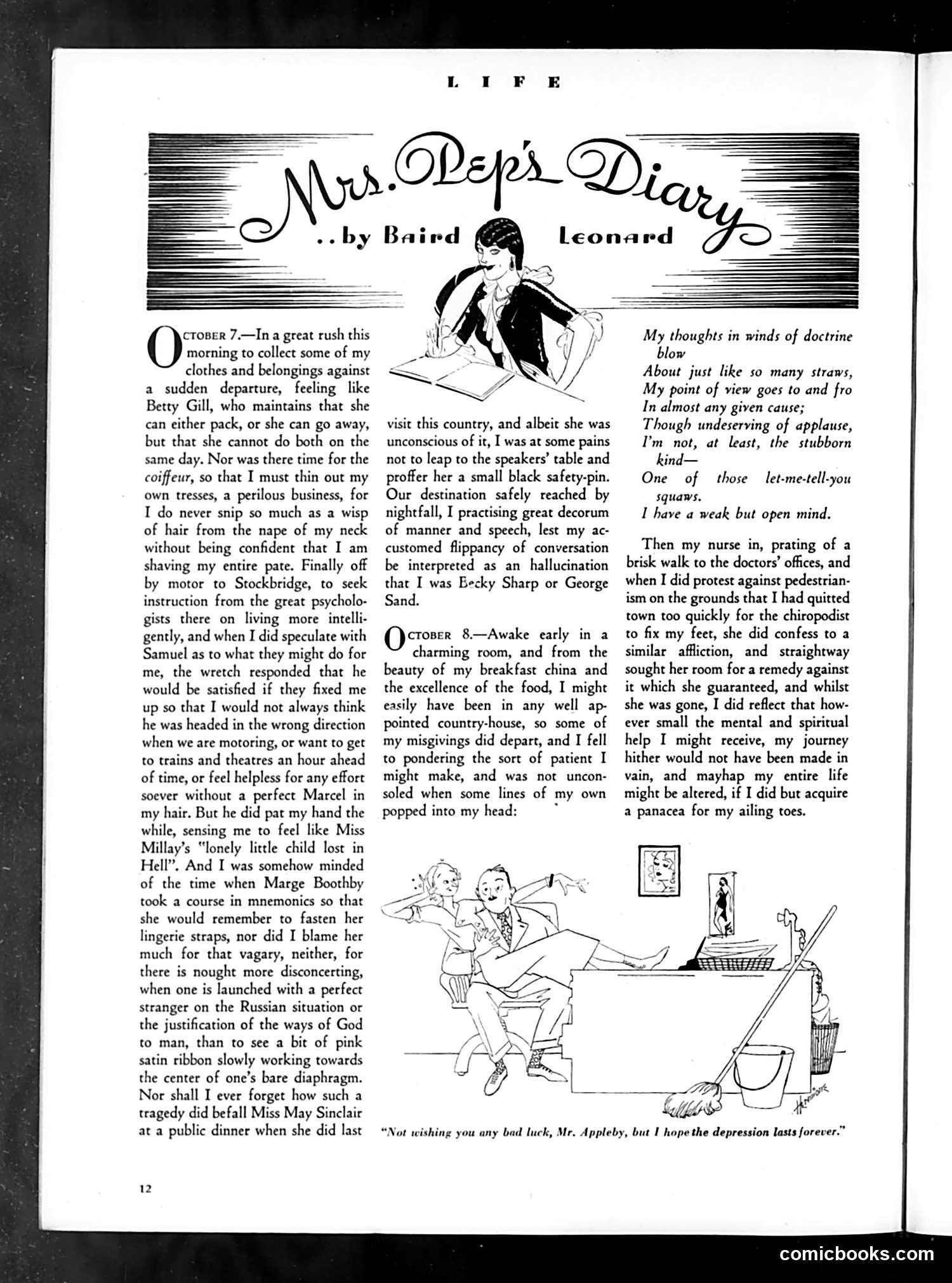
Mrs. Pep's Diary by Baird Leonard This is a humorous diary column featuring a society woman's observations from October 7-8. The entry satirizes upper-class anxieties: she frets over her appearance (hair, clothes) before traveling, seeks psychological advice about life direction, and documents minor social embarrassments—including her nurse's confession about abandoning her for a chiropodist's care. The accompanying illustration shows domestic chaos: a woman being attended by servants while managing household tasks. The caption's joke about hoping "the depression lasts forever" references the 1920s-30s economic crisis, suggesting even wealthy households were affected or anxious about finances. The satire targets privileged women's preoccupations with appearance, social status, and self-importance, while obliquely acknowledging broader economic hardship.
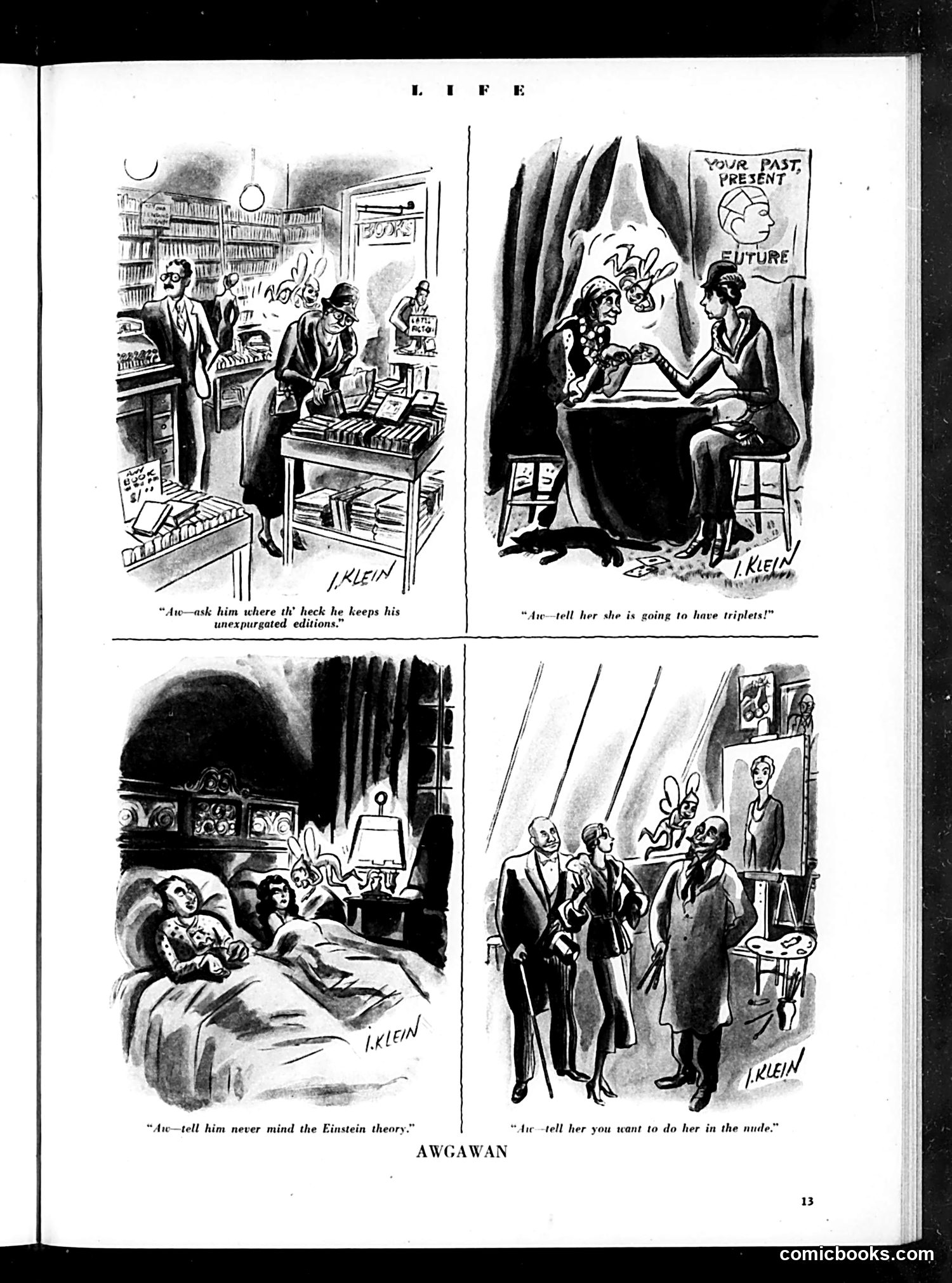
Four Cartoons on "Life" and Modern Relationships These four cartoons by I. Klein satirize contemporary domestic life, likely from the early-to-mid 20th century. The humor centers on relationships and marital anxieties: 1. Top left: A bookstore scene about "unexpurgated editions"—likely referencing risqué or sexually explicit literature becoming available. 2. Top right: A fortune teller predicts "triplets," suggesting anxieties about large families. 3. Bottom left: A bedroom scene referencing Einstein's theory—joking that complex physics is less mysterious than intimate relationships. 4. Bottom right: A social gathering where someone suggests posing for a portrait "in the nude"—poking fun at artistic pretension and modern social conventions. The overall theme mocks evolving attitudes toward sexuality, science, and social propriety in modern life.
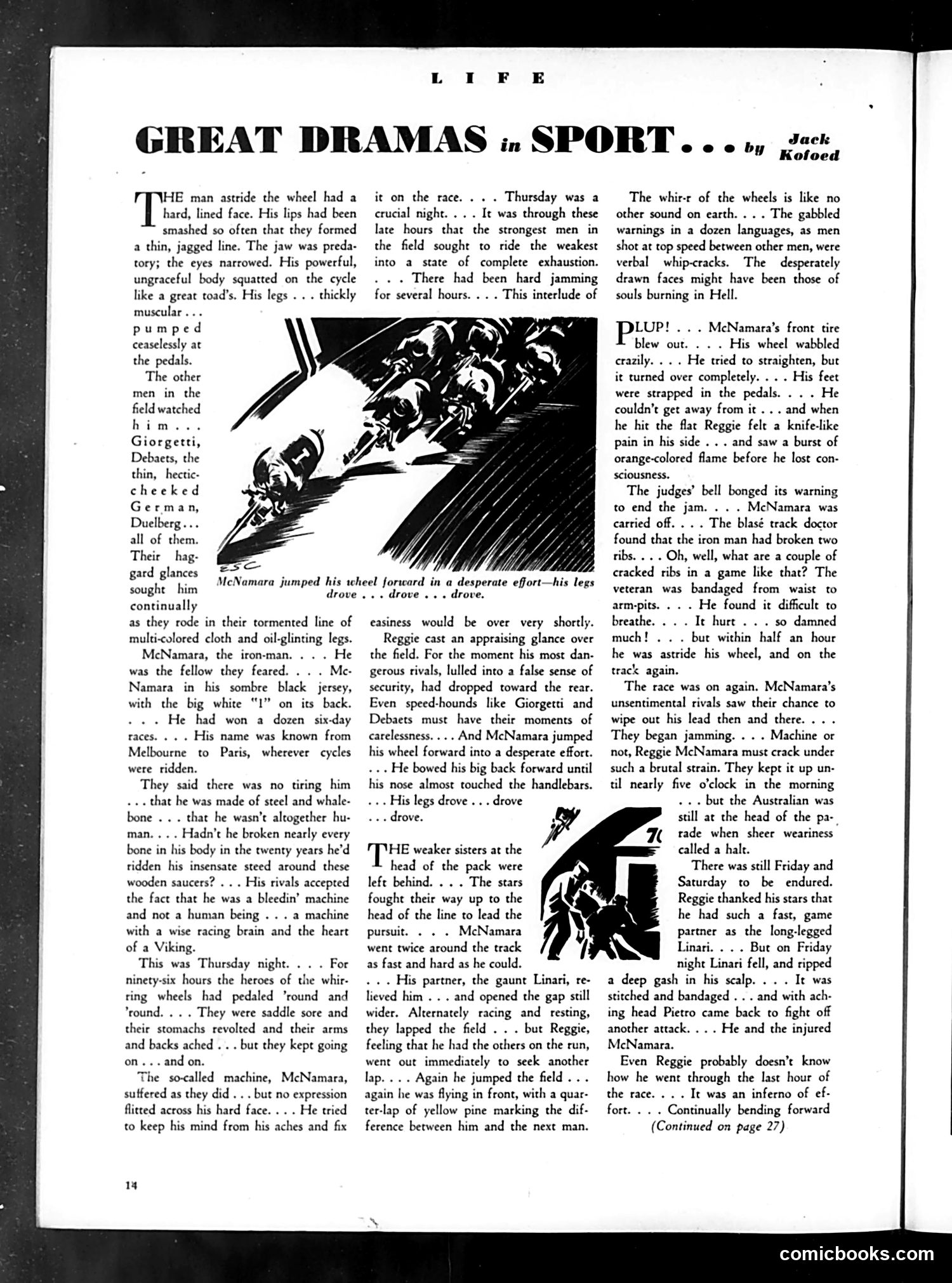
"Great Dramas in Sport" by Jack Koloed This article, illustrated with a dramatic black-and-white illustration, describes an endurance cycling race. The main figure is McNamara, an "iron man" cyclist competing in a grueling multi-day race against rivals including Giorgetti (German), Debaets (Belgian), and Linari (Italian). The narrative emphasizes the brutal physical toll: exhaustion, injuries, crashes, and near-collapse. McNamara pushes through despite a blown tire, broken ribs, and a deep scalp wound to maintain his lead. The satire lies in treating competitive cycling as epic drama—elevating a sporting endurance test to Homeric tragedy, complete with noble suffering and international rivalry. It's a humorous celebration of both the sport's brutality and the cyclists' determination.
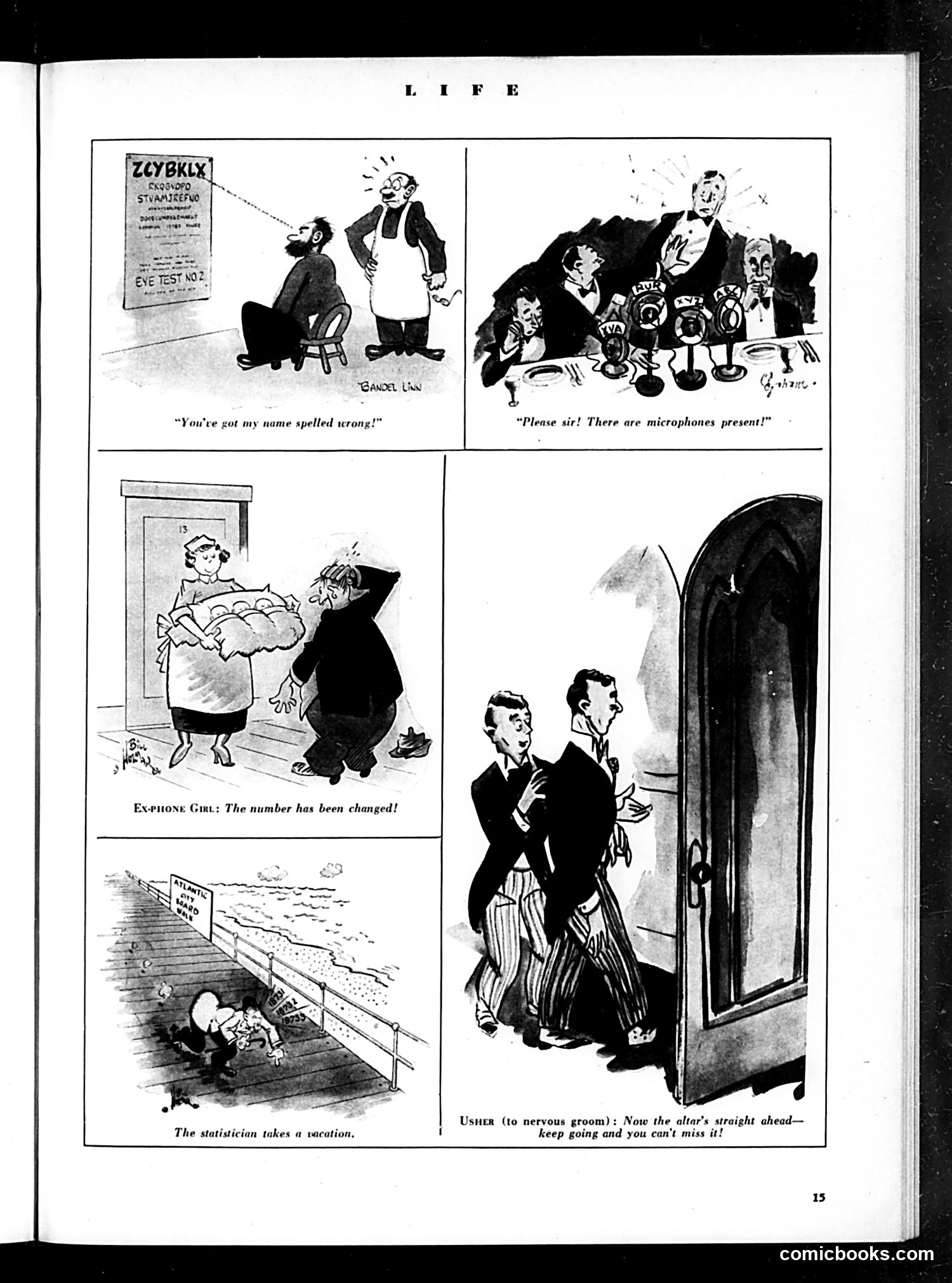
Analysis of Life Magazine Cartoons This page contains six unrelated gag cartoons satirizing everyday situations: 1. Eye test mishap: A man's name is misspelled on an optometrist's sign. 2. Microphone embarrassment: A formal dinner guest is warned microphones are present—likely referencing radio broadcasts where unguarded remarks could be publicly heard. 3. Phone number change: An exchange girl informs a caller their number has changed, a common inconvenience in early telephone systems. 4. Statistician's vacation: A humorous scene of someone supposedly "taking a vacation." 5. Usher's instructions: A nervous groom is directed to proceed straight ahead at what appears to be a wedding ceremony. These are gentle, domestic humor pieces reflecting early-to-mid 20th century American life, technology, and social anxieties around new communication systems.
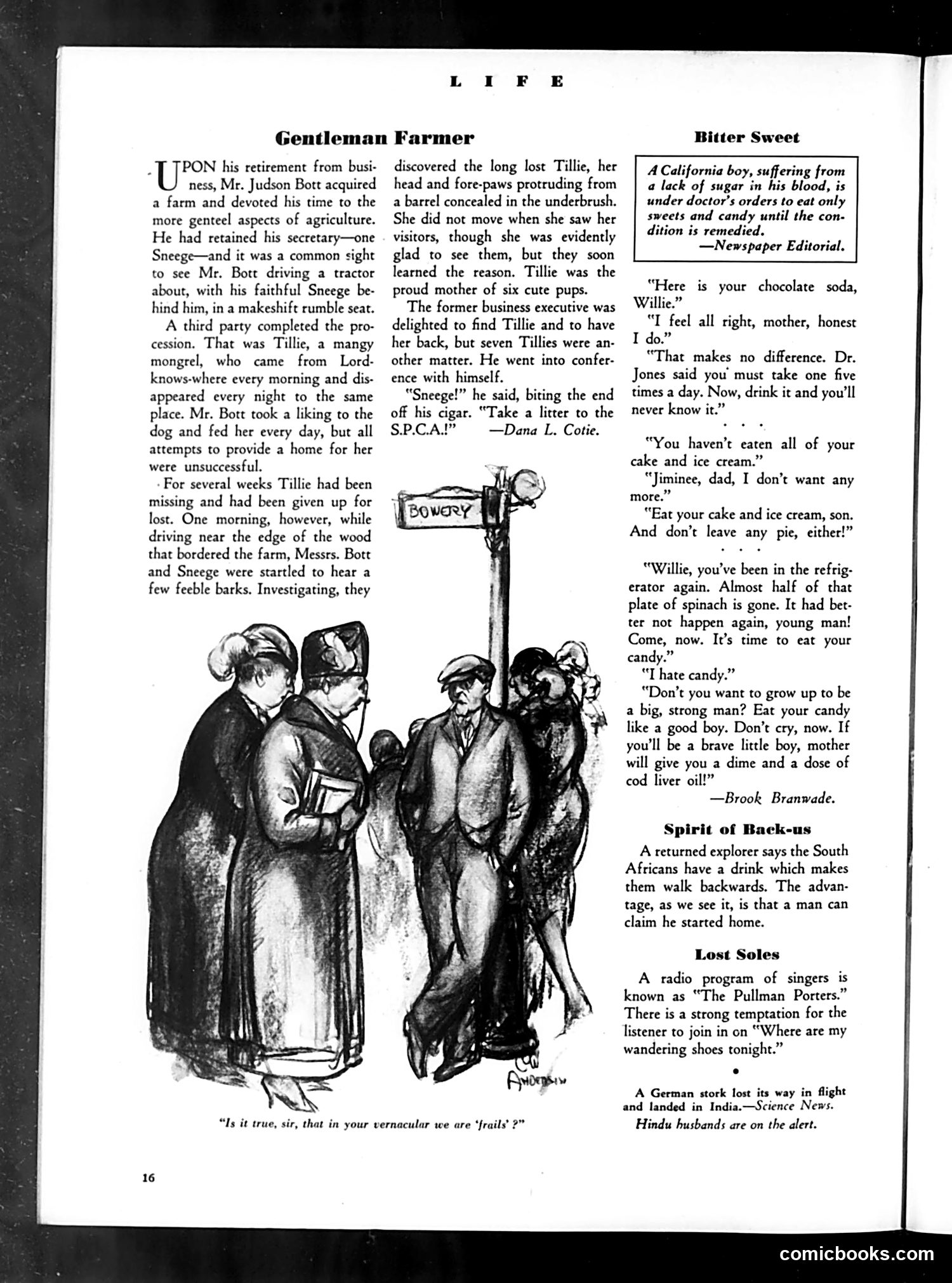
Analysis of Life Magazine Page This page contains three separate satirical items rather than a unified cartoon: 1. "Gentleman Farmer": A story about a retired businessman who acquires a farm and a mongrel dog named Tillie. The humor derives from urban sophistication meeting rural life—the executive struggles with farm realities while the dog produces unwanted puppies. 2. "Bitter Sweet": A domestic humor piece depicting a mother coaxing her reluctant son to eat desserts and candy for health reasons (doctor's orders), inverting typical parental food restrictions. 3. "Spirit of Back-us," "Lost Soles," and brief notes: Short joke items about South African drinks, a radio program of singers, and a stork landing in India. The page represents *Life's* characteristic early-20th-century approach: gentle domestic satire and observational humor targeting middle-class American life rather than political commentary.
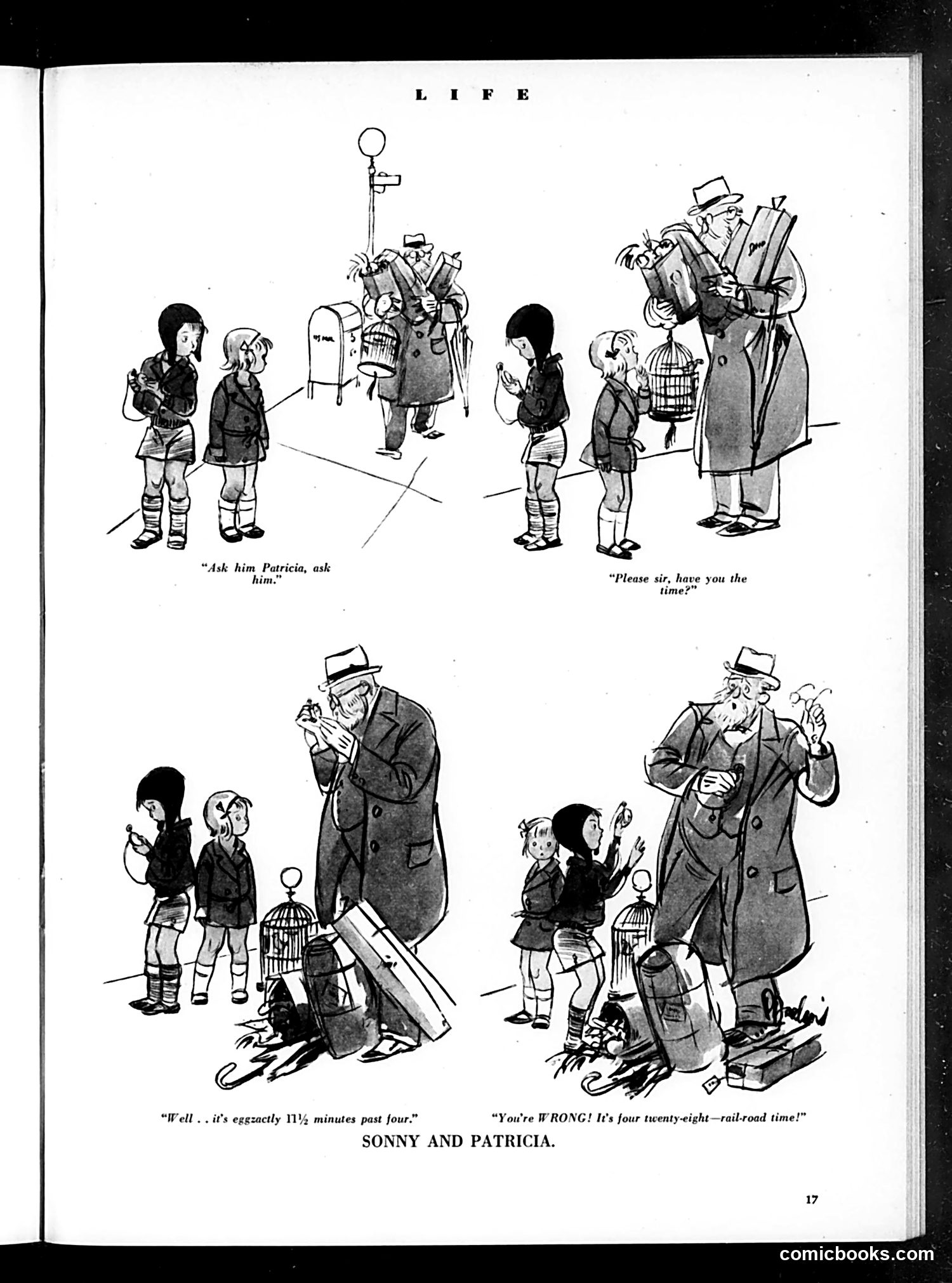
"Sonny and Patricia" - Life Magazine Cartoon This is a four-panel comic strip about two children asking strangers for the time. The humor relies on a period-specific joke: the children are checking whether adults actually know what time it is. In the 1920s-30s (Life's era), this appears to satirize absent-minded or distracted adults—the well-dressed men shown are so preoccupied they either miscalculate or get the time entirely wrong. The final panel's punchline—"You're WRONG! It's four twenty-eight—rail-road time!"—suggests the children possess more accurate knowledge than the supposedly competent adults they're testing. The satire mocks adult incompetence and the children's superior awareness, a common comedic trope in this era's humor magazines.
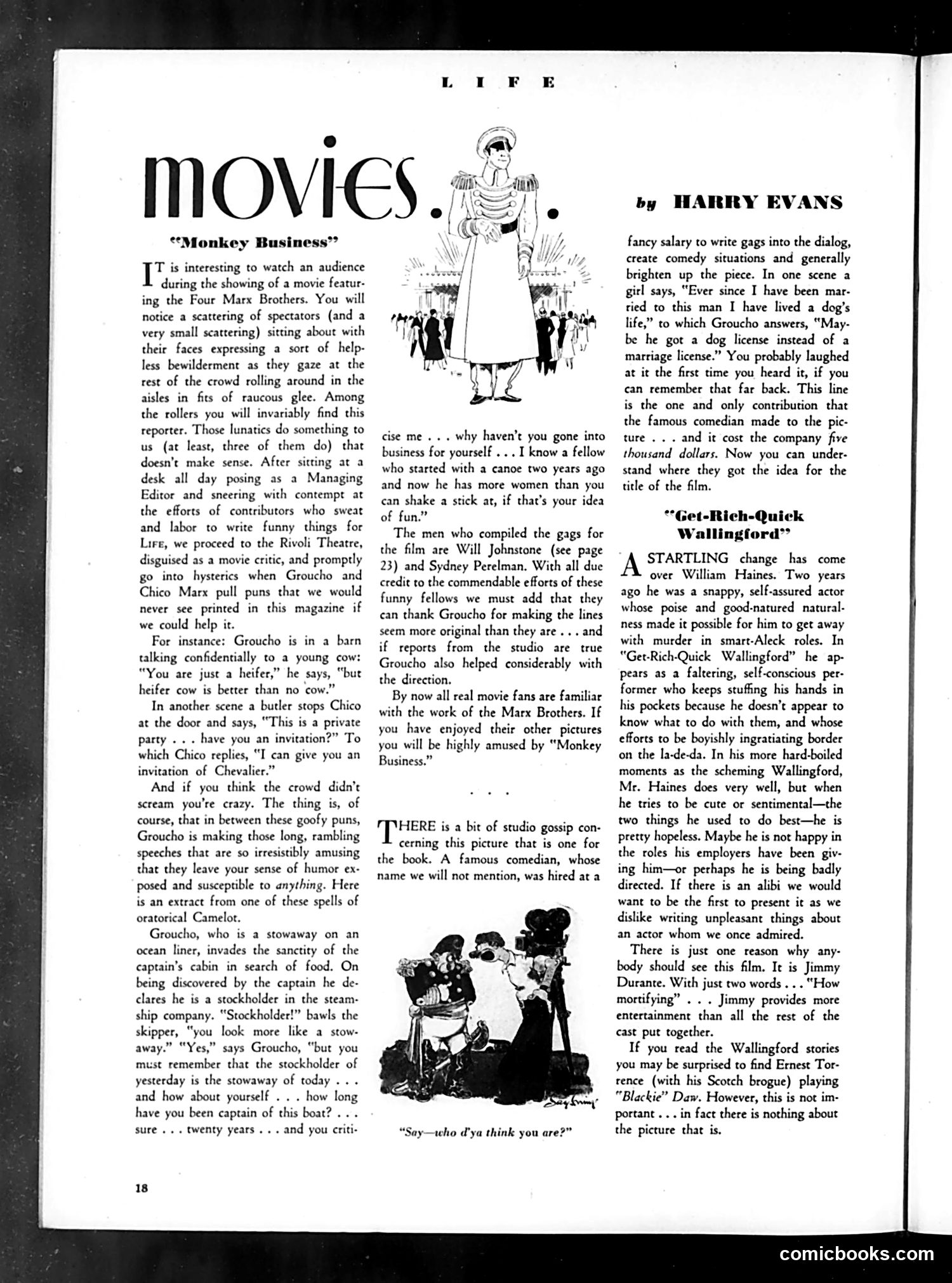
"Monkey Business" Movie Review This is a film review by Harry Evans of the Marx Brothers' comedy "Monkey Business," praising their anarchic humor while poking fun at both their comedy style and Hollywood economics. The satire: Evans describes attending the film as a "movie critic" but admits the Marx Brothers' absurdist humor—puns, non-sequiturs, and rambling speeches—reduces him to helpless laughter despite his professional cynicism. He quotes their jokes (a heifer pun, a Maurice Chevalier impersonation) to illustrate their appeal. The gossip item: Evans reveals that a famous (unnamed) comedian was hired at enormous expense ($5,000) but contributed only one line to the entire film: a joke about a dog license instead of a marriage license. This serves as satire on Hollywood's wasteful spending and the inflated salaries paid to established comedians, contrasting with the Marx Brothers' superior creative output. The cartoons show Groucho in theatrical pose and the scene being referenced.
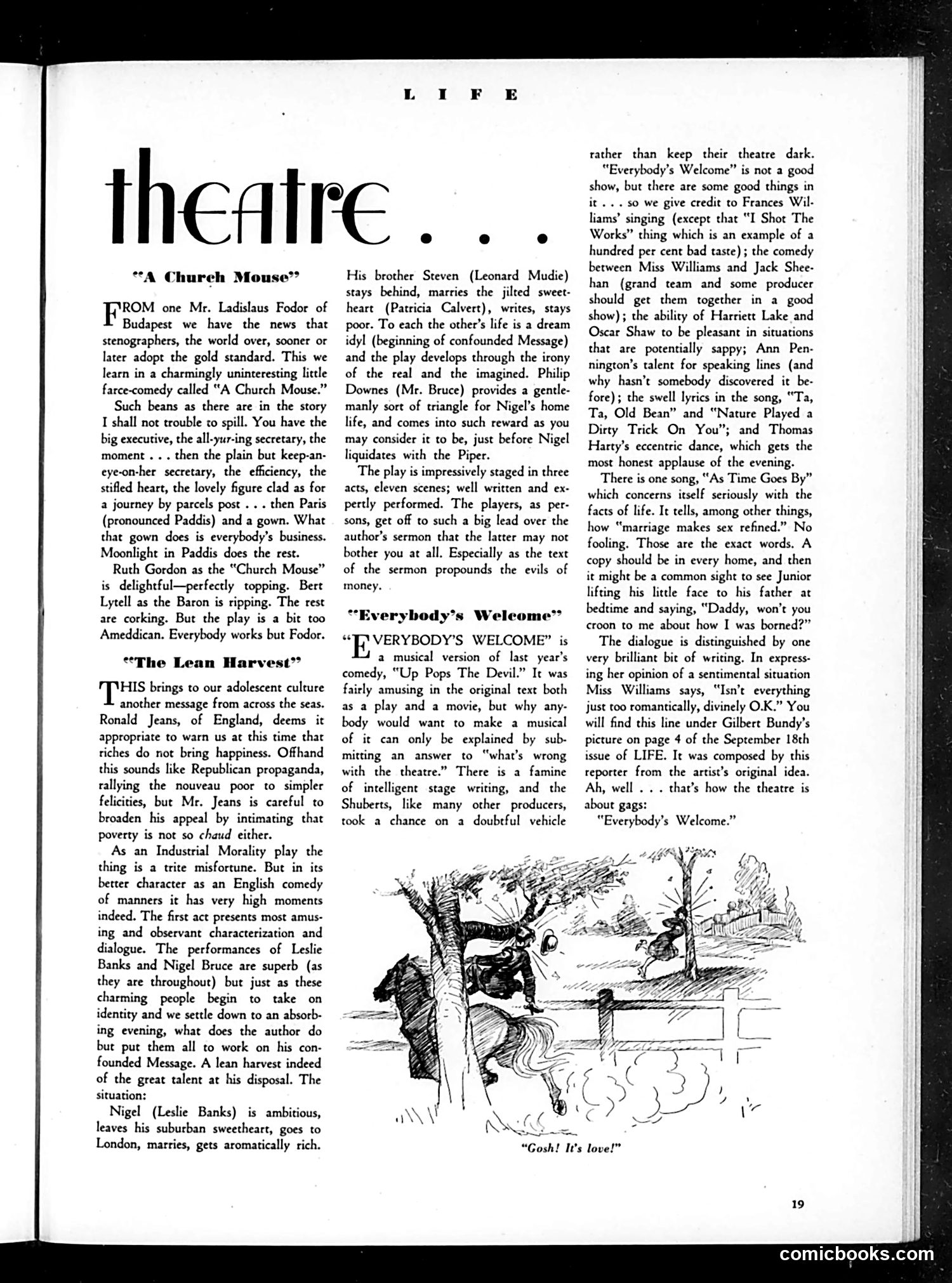
Theatre Reviews from Life Magazine This page contains theatre criticism rather than political cartoons. The critic reviews three Broadway productions: "A Church Mouse" — A Hungarian farce-comedy about stenographers and romance in Paris. The reviewer praises actors Ruth Gordon and Bert Lytell but finds the play too "American" in sensibility. "The Lean Harvest" — An English comedy of manners about two brothers with contrasting life choices (ambitious vs. humble). The critic appreciates the witty first act and strong performances by Leslie Banks and Nigel Bruce, but complains the author undermines this with heavy-handed moralizing about wealth's emptiness. "Everybody's Welcome" — A musical adaptation of the comedy "Up Pops The Devil." The reviewer dismisses it as a mediocre vehicle produced only because theatres lack better scripts, though Frances Williams's singing receives praise. The small illustration shows a romantic couple outdoors with the caption "Gosh! It's love!" — apparently illustrating typical romantic comedy themes.
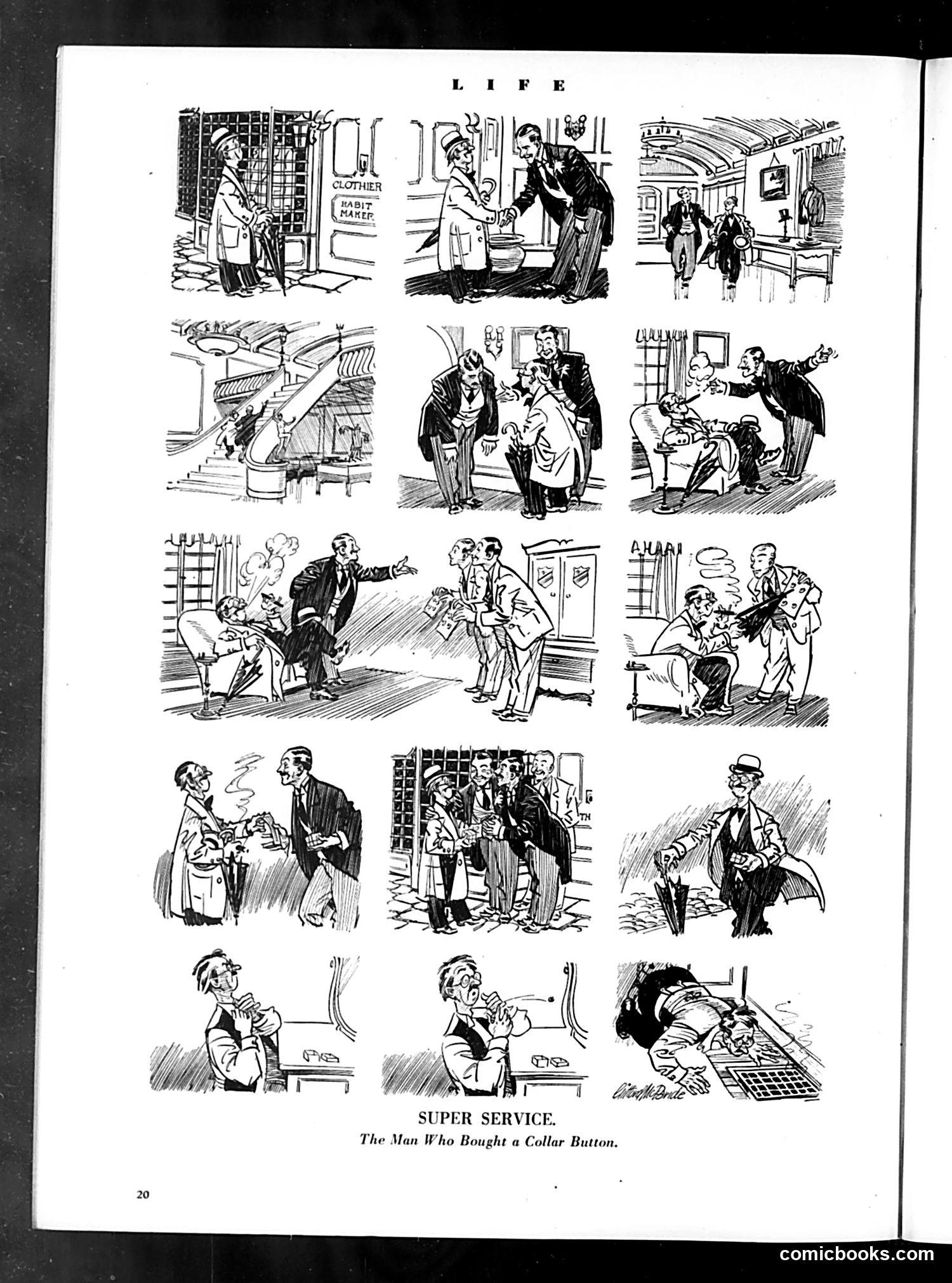
This is a multi-panel satirical comic titled "Super Service: The Man Who Bought a Collar Button." The narrative follows a customer's experience purchasing a single collar button, which escalates absurdly through exaggerated "customer service." The joke satirizes over-the-top retail service practices of the era. What should be a simple transaction becomes an elaborate production: the clothier provides excessive attention, multiple employees get involved, paperwork multiplies, and the customer is shuttled between departments and officials. By the final panels, the man appears overwhelmed and exhausted by the process. The satire targets the pretentious "super service" culture where businesses complicate routine transactions with unnecessary formality and bureaucracy, turning a trivial purchase into an exhausting ordeal. The humor lies in the disproportion between the item's insignificance and the elaborate service apparatus surrounding it.
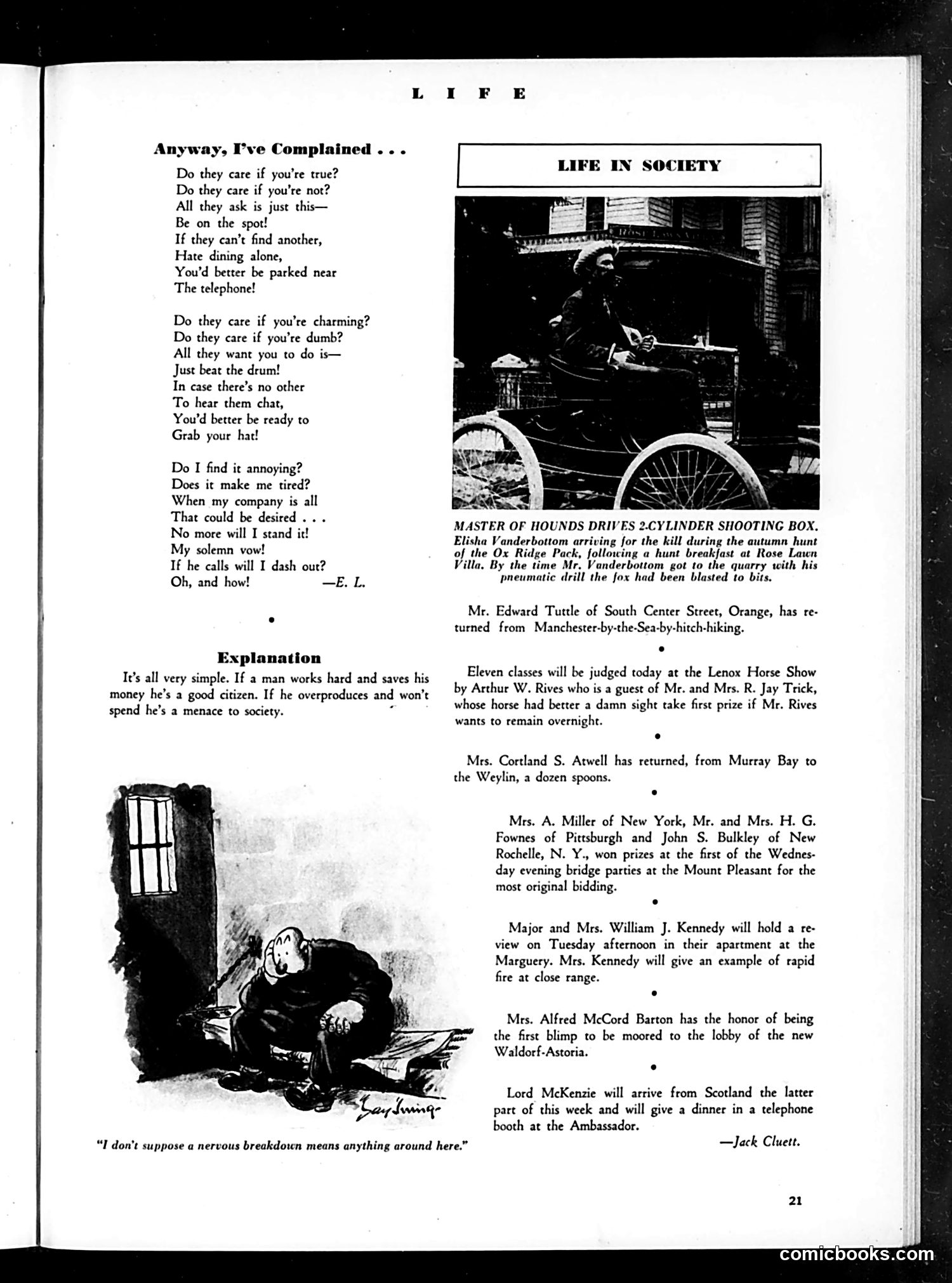
Life Magazine Page Analysis This page satirizes high-society social obligations and wealth-based absurdity. The poem "Anyway, I've Complained..." mocks how wealthy socialites demand constant availability from companions—treating people as obligatory entertainment props rather than individuals with autonomy. The speaker (likely female) resents being expected to rush out whenever called, regardless of her own desires. The accompanying cartoons and society gossip items extend this mockery. They ridicule the idle rich through exaggerated, surreal scenarios: a hunter using a pneumatic drill to hunt foxes, a woman described as "the first blimp" moored to a hotel, a dinner held in a telephone booth. The "Explanation" sardonically inverts economic logic, suggesting spenders are good citizens while savers are societal menaces—mocking both capitalist ideology and wealthy conspicuous consumption. The bottom cartoon shows someone having a nervous breakdown, sardonically suggesting emotional collapse is beneath notice in this world of privilege. The overall effect mocks wealthy society's shallow materialism and dehumanizing social rituals.
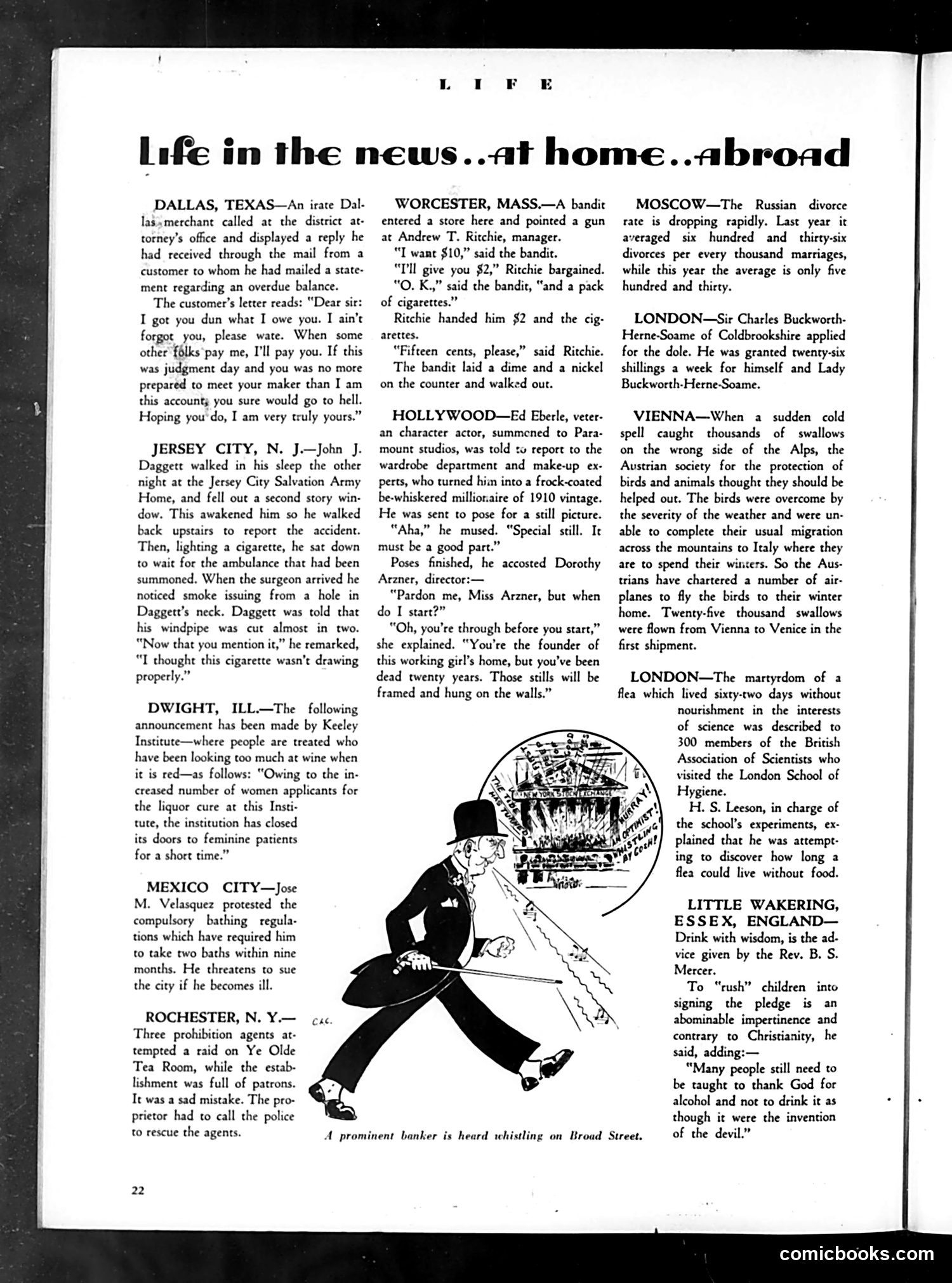
Analysis of Life Magazine Page This page from *Life* magazine presents a collection of humorous news briefs satirizing human folly and social absurdities circa the 1920s-30s. The cartoon shows a banker whistling while walking—a visual gag accompanying the text about a "prominent banker" on Broad Street, likely mocking Wall Street obliviousness or financial confidence during uncertain economic times. The briefs mock various targets: a deadbeat debtor's blasphemous letter to a creditor; a man so oblivious he doesn't notice his windpipe is nearly severed; Prohibition's failures (agents needing police rescue from an angry mob); a bandit so incompetent he negotiates his own ransom downward; a Hollywood extra unknowingly posing as a dead character; and class irony (an English nobleman receiving welfare). The satire skewers American incompetence, Prohibition's unpopularity, economic desperation, and social pretension—reflecting 1920s-30s anxieties about law enforcement, class stability, and common sense.
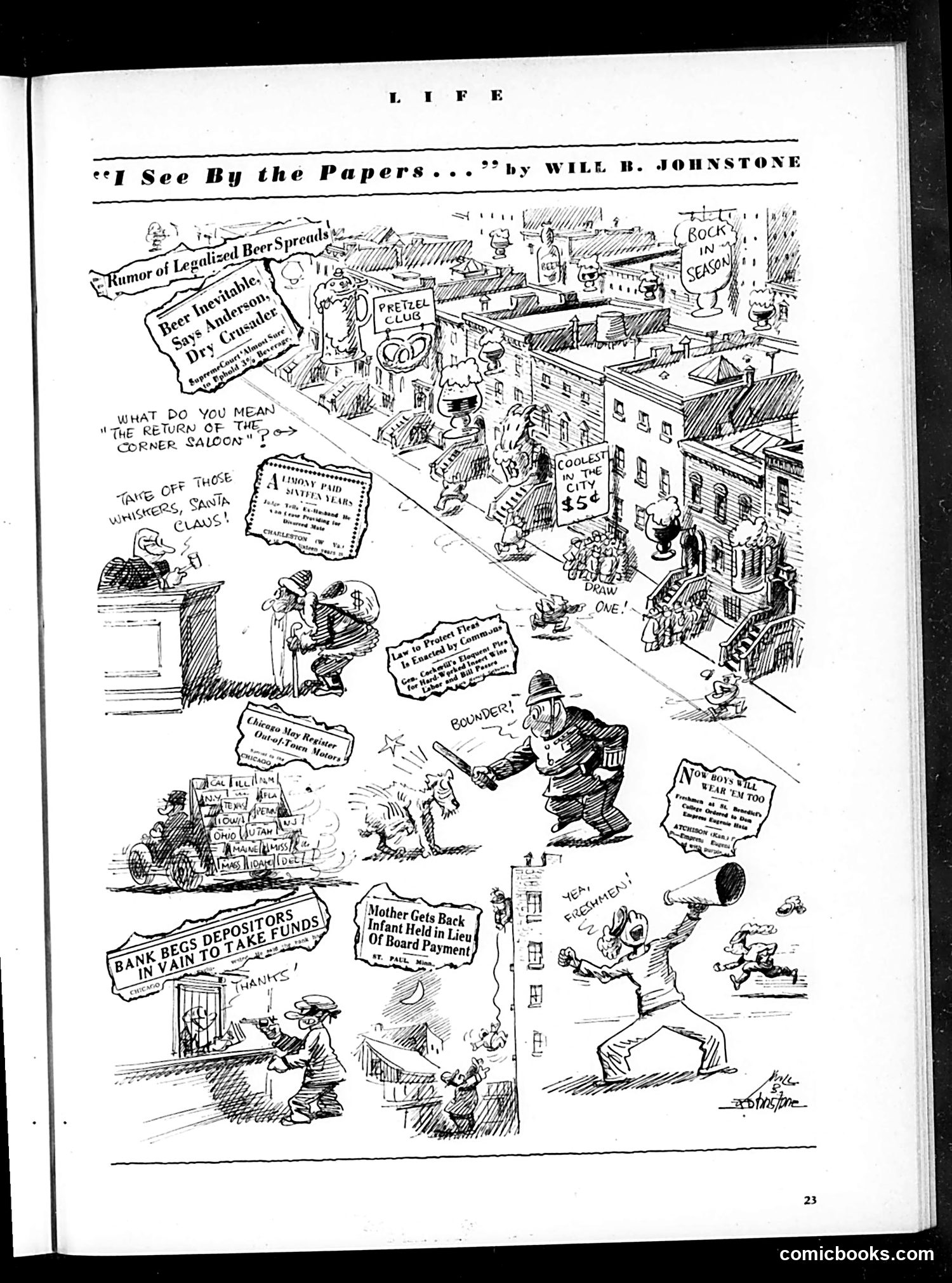
Analysis This is a satirical comic by Will B. Johnstone about Prohibition-era America. The central joke plays on newspaper headlines about "the return of the corner saloon" — despite the legal ban on alcohol (Prohibition, 1920-1933). The cartoon depicts various illegal drinking activities: basement speakeasies, hidden alcohol sales, and people evading law enforcement. Visual gags include references to beer distribution methods, bootleggers, and corrupt officials. Other panels mock related social problems: bank embezzlement, mothers seeking child support payments, and domestic chaos blamed on alcohol consumption. The satire suggests Prohibition failed to eliminate drinking—it merely drove it underground into illicit operations, corruption, and crime. The title ironically suggests the "corner saloon" never actually disappeared; it just became invisible and illegal.
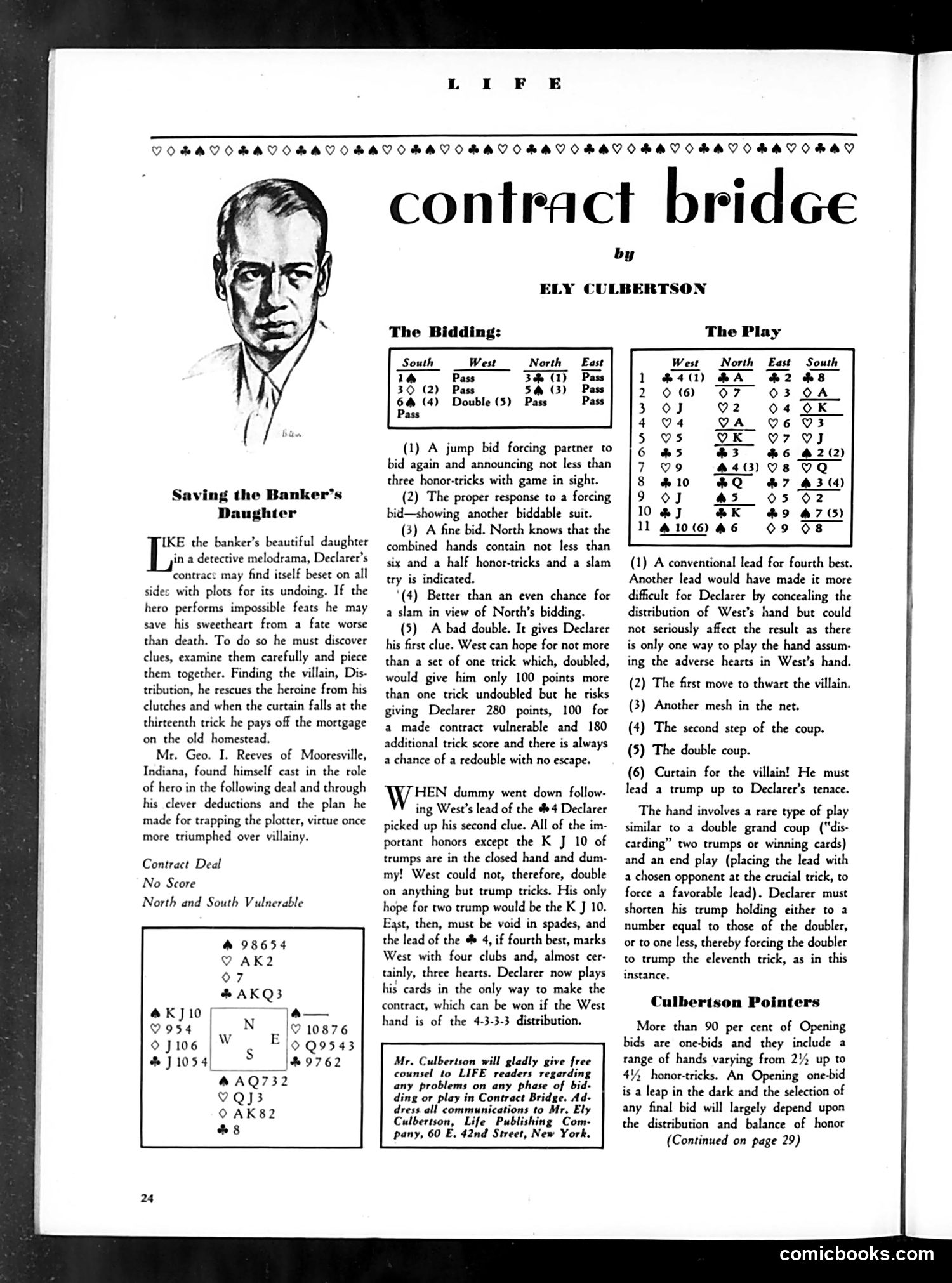
Contract Bridge Article from Life Magazine This page contains an instructional bridge column by Ely Culbertson, a famous contract bridge expert of the early 20th century. Rather than satire or political commentary, it's an educational feature using a melodramatic framing device. The "cartoon" is the narrative conceit: Culbertson describes bridge strategy as if rescuing "the banker's beautiful daughter" from a "fate worse than death"—comparing card-playing strategy to a detective story where the "villain" is mathematical distribution. A real hand dealt to Mr. George I. Reeves of Indiana illustrates how deductive reasoning and careful play can overcome seemingly impossible odds. The article teaches advanced bridge technique (end-plays, coups) using playful language. This reflects bridge's popularity as sophisticated entertainment among educated American readers in this era. The content is entirely instructional, not satirical.
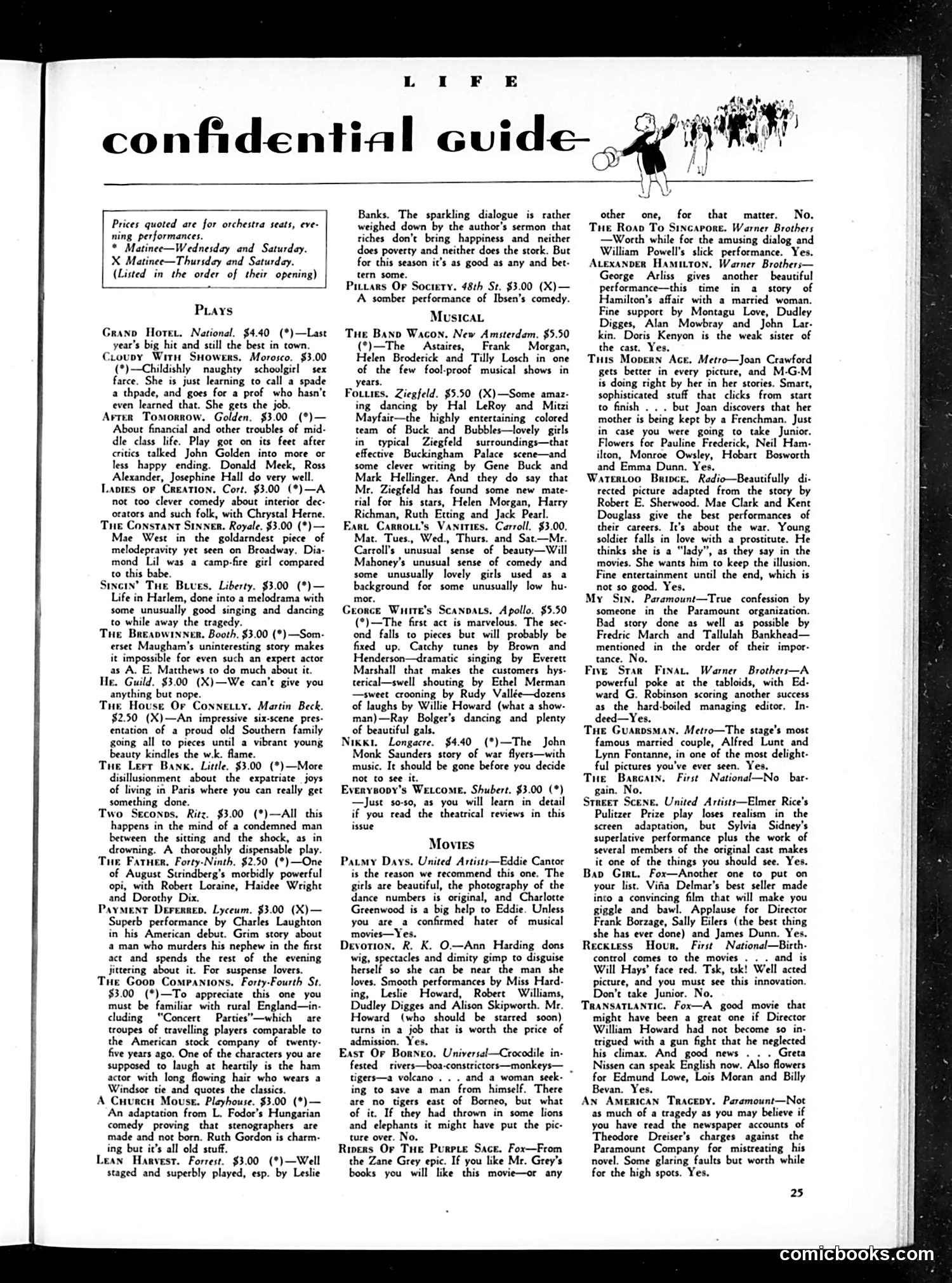
"Confidential Guide" to Broadway Shows (circa 1928-1930) This is a theater review page listing Broadway productions with prices and brief critiques. Rather than satire, it's a practical consumer guide for New York theatergoers, written in a sardonic, gossipy tone typical of Life magazine's theater criticism. The reviews use witty putdowns and backhanded compliments. For example, "Crooked Wisdom" is called a "childishly naughty schoolgirl sex farce," while "The Constant Sinner" features Mae West in "the goldarndest piece of melodepravity yet seen on Broadway." The page includes both dramatic plays and musicals, noting performers like Charles Laughton (making his American debut) and the Astaire siblings. Prices range from $2.50-$5.50 for orchestra seats. The humor lies in the critic's acerbic observations about plot and performance quality—revealing which shows are worthwhile versus which audiences should skip. This democratizes theater criticism for middle-class readers seeking entertainment value for their money.
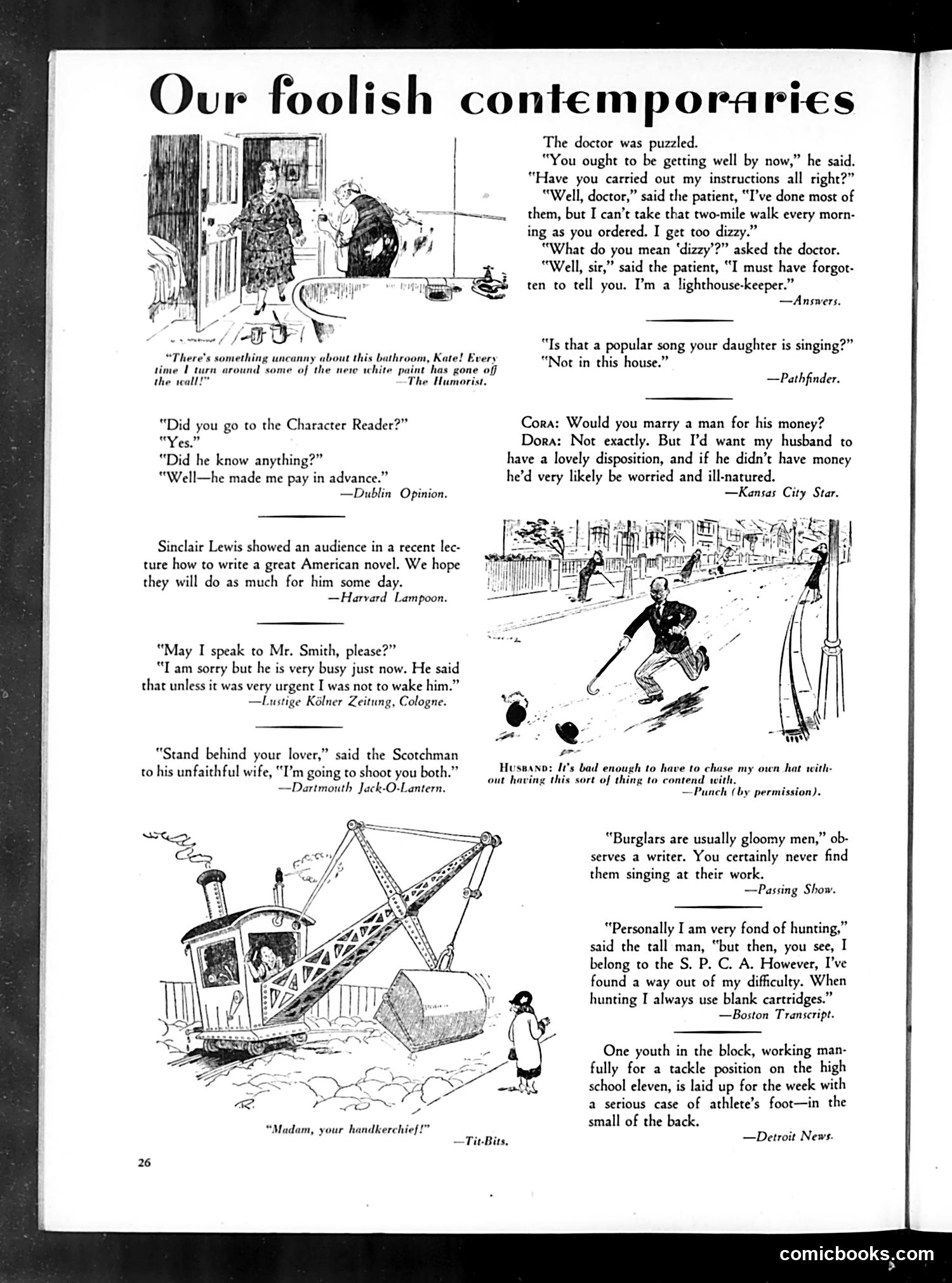
"Our Foolish Contemporaries" - Page Analysis This page collects brief humorous anecdotes from various international publications, satirizing human folly and absurdity. Key jokes include: - A lighthouse-keeper patient blaming dizziness on his occupation—the doctor's medical advice (morning walks) is rendered nonsensical by the patient's actual job. - A character reader who demands payment upfront, suggesting charlatans exploit gullibility. - A woman's pragmatic take on marriage: she'd accept a poor man only if he had a pleasant disposition, otherwise poverty would make him "worried and ill-natured"—mocking romantic ideals. - A man belonging to the S.P.C.A. (animal welfare society) who hunts using blank cartridges—highlighting hypocrisy and absurd compromises. - A schoolboy claiming "athlete's foot" in his back to avoid sports—obvious malingering. The cartoons mock professional incompetence, fraud, contradictory morality, and transparent excuses. The sourcing from Dublin Opinion, Harvard Lampoon, and Punch indicates these are reprinted gags from contemporary humor magazines, making it a digest of period comedy reflecting early 20th-century satire.
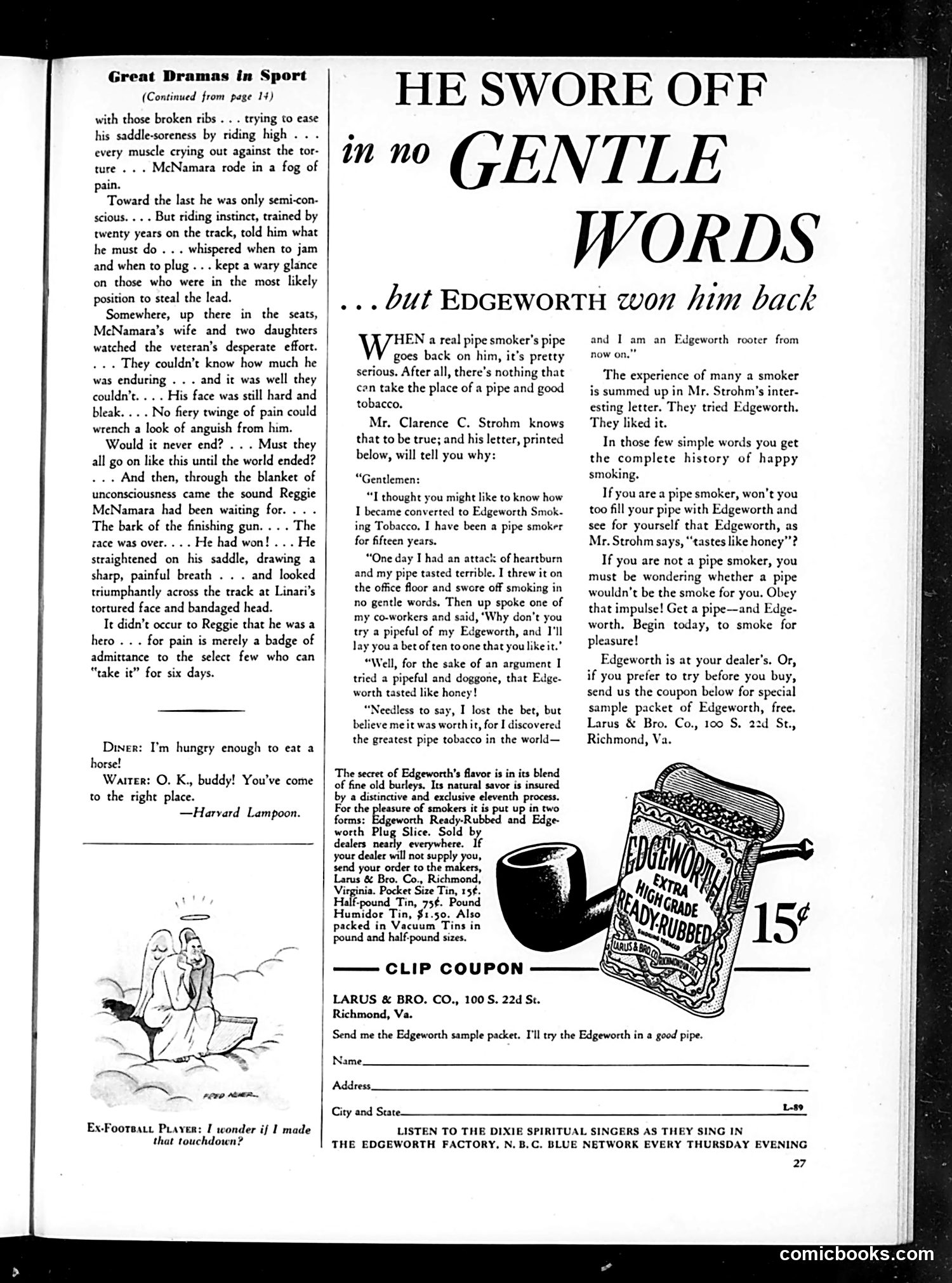
Analysis for Modern Readers This page combines a sports narrative with tobacco advertising. The top section concludes a serialized story about "Reggie McNamara," a horse-racing jockey who endures severe pain (broken ribs, exhaustion) to win a six-day race—celebrating masculine toughness and stoicism as virtues. The main content is an advertisement for Edgeworth pipe tobacco, structured as testimonial marketing. A customer named Clarence C. Strohm describes swearing off smoking due to heartburn, then being convinced by a coworker to try Edgeworth, which allegedly tastes "like honey." The ad uses this narrative to suggest the product can win over even skeptics. The small cartoons are unrelated humor: a diner joke about eating horse meat, and an ex-football player's self-doubt. The historical context: this reflects 1920s-30s attitudes normalizing smoking and using emotional appeals in advertising. The emphasis on masculine suffering and tobacco's restorative powers reflects period values now widely rejected.
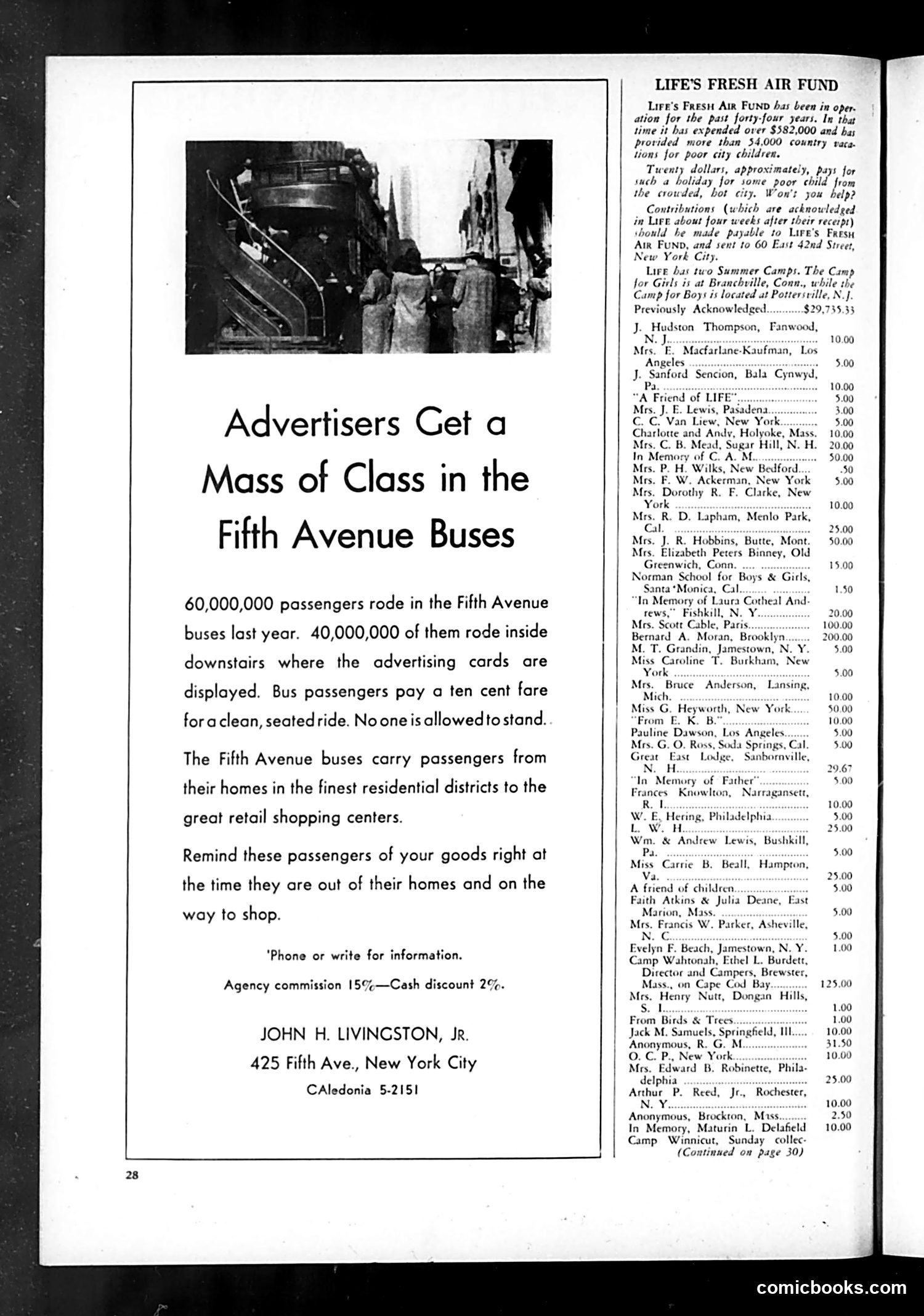
Advertisers Get a Mass of Class in the Fifth Avenue Buses This page combines advertising with charity fundraising for Life magazine's Fresh Air Fund. The left side is a paid advertisement by John H. Livingston Jr., promoting advertising services on Fifth Avenue buses. The pitch: 60 million passengers rode these buses annually, 40 million downstairs where ads display. Buses serve wealthy residential districts going to shopping centers—so advertisers can reach affluent consumers "right at the time they are out of their homes and on the way to shop." The right side lists donations to Life's Fresh Air Fund, which has spent over $382,000 providing country vacations for poor city children over 44 years. The juxtaposition is pointed: one page sells luxury consumer reach; the adjacent page solicits modest donations ($1-$125) to give disadvantaged urban children summer camps. This reflects 1920s-30s progressive magazine culture mixing commercial enterprise with charitable causes.
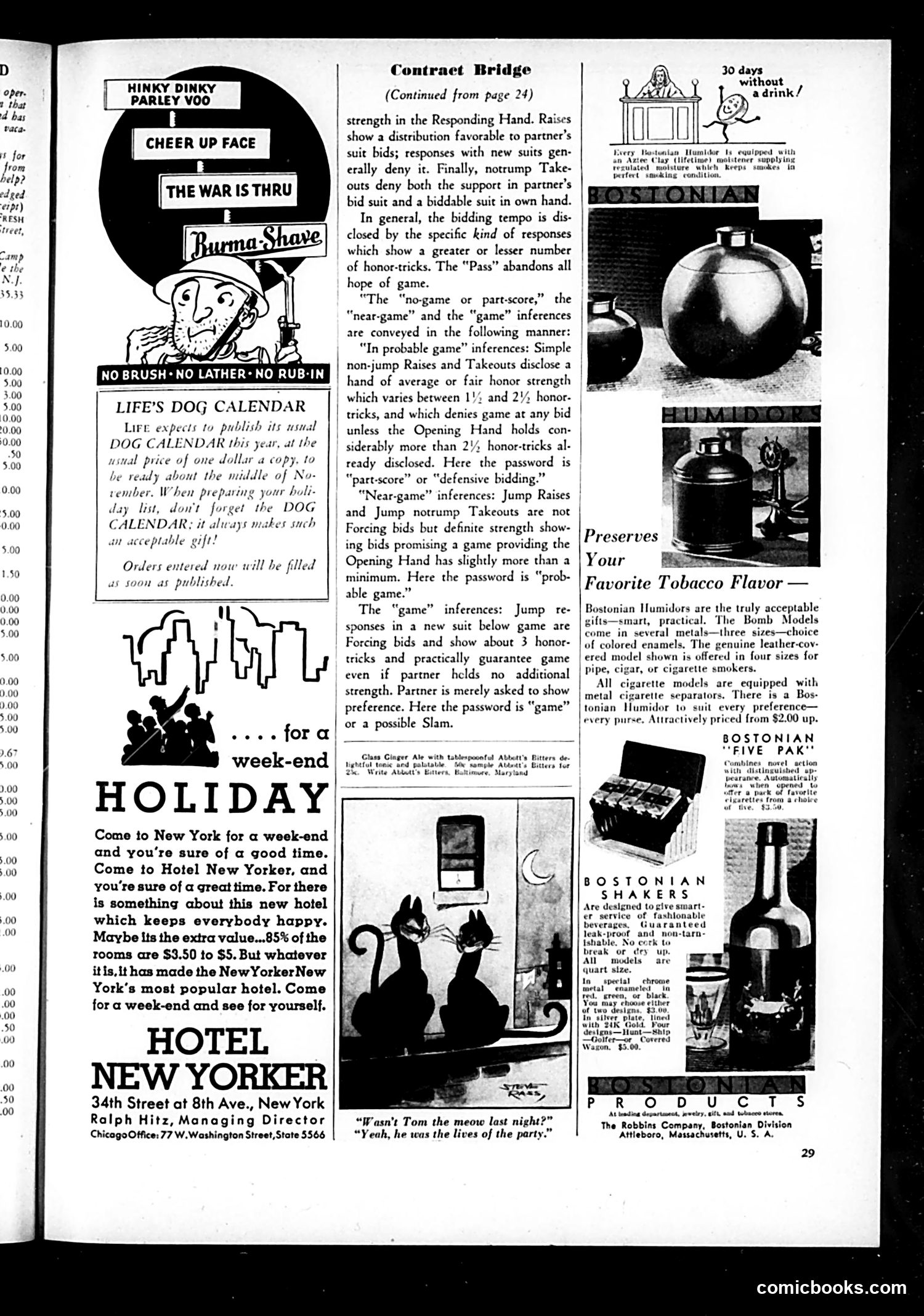
Analysis of Life Magazine Page Content This page combines advertising with bridge card game instruction and light humor. The left side features advertisements including a "Life's Dog Calendar" promotion and a Hotel New Yorker advertisement. The small cartoon at bottom left shows two stylized black cat silhouettes by a window at night, with dialogue: "Wasn't Tom the meow last night?" / "Yeah, he was the lives of the party." This is a pun-based joke playing on feline behavior—"meow" and "lives" (cats having nine lives) are cat-related wordplay, suggesting Tom was the life of a social gathering. The top left box contains WWI-era references: "Hinky Dinky Parley Voo," "Cheer Up Face," and "The War is Thru"—popular American song titles from the 1918 armistice period, used here as section headers or slogans. The remainder is instructional text on Contract Bridge bidding strategy and product advertisements for Bostonian humidors and wine decanters.
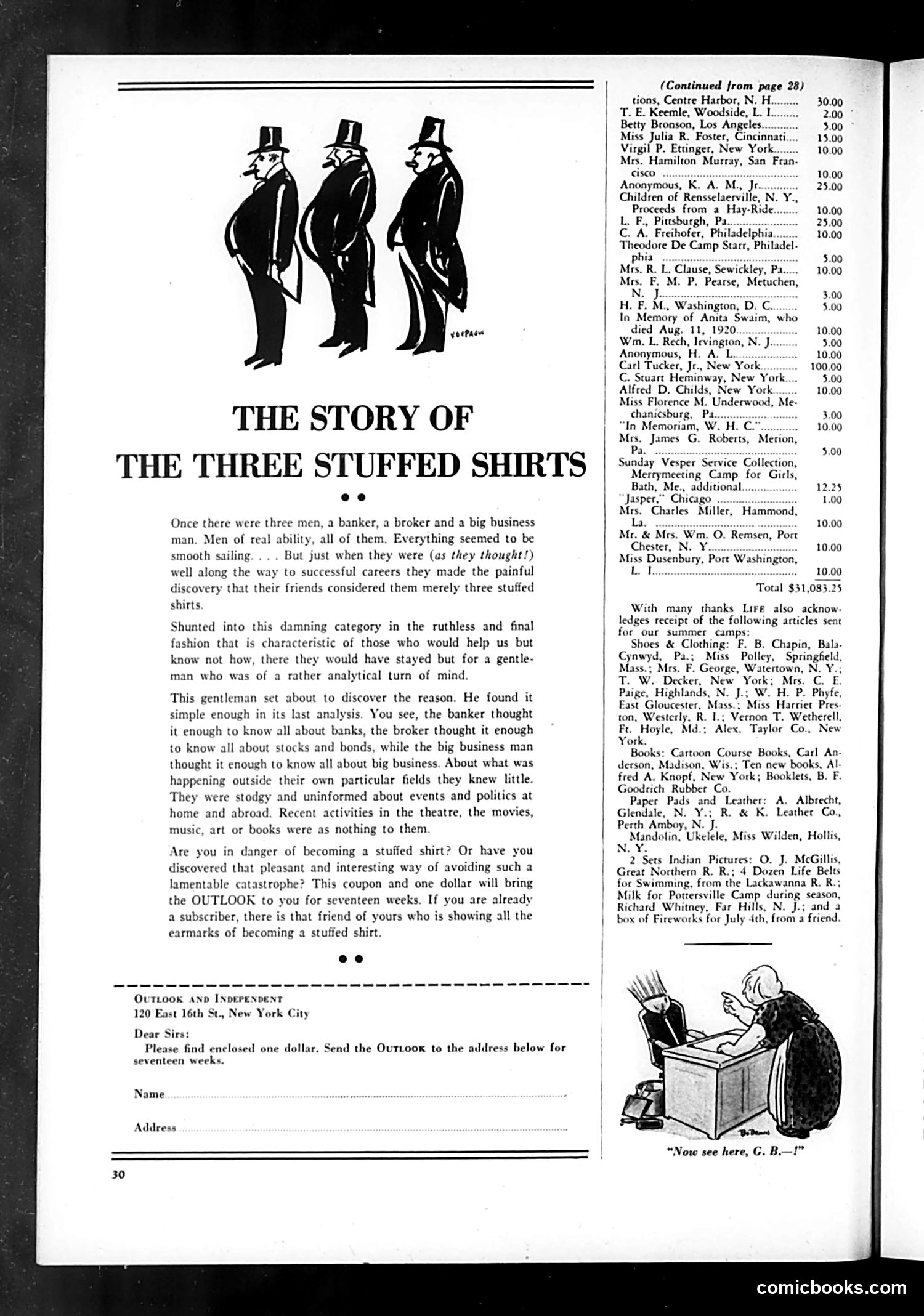
"The Story of the Three Stuffed Shirts" This is a satirical advertisement for *Outlook* magazine, not a political cartoon. The three illustrated figures represent three types of successful professional men—a banker, broker, and businessman—who, despite their expertise in their respective fields, are dismissed as "stuffed shirts" by their peers. The satire mocks their narrow intellectualism: each knows only his own specialty and remains ignorant of current events, politics, theater, movies, music, and art. The piece suggests that true cultivation requires broad knowledge beyond one's profession. The advertisement positions *Outlook* as the cure for this intellectual provincialism, inviting readers to subscribe (for one dollar) to avoid becoming equally hollow and tedious. This reflects early 20th-century American values emphasizing well-rounded, cultured gentlemen who engage with culture beyond business.
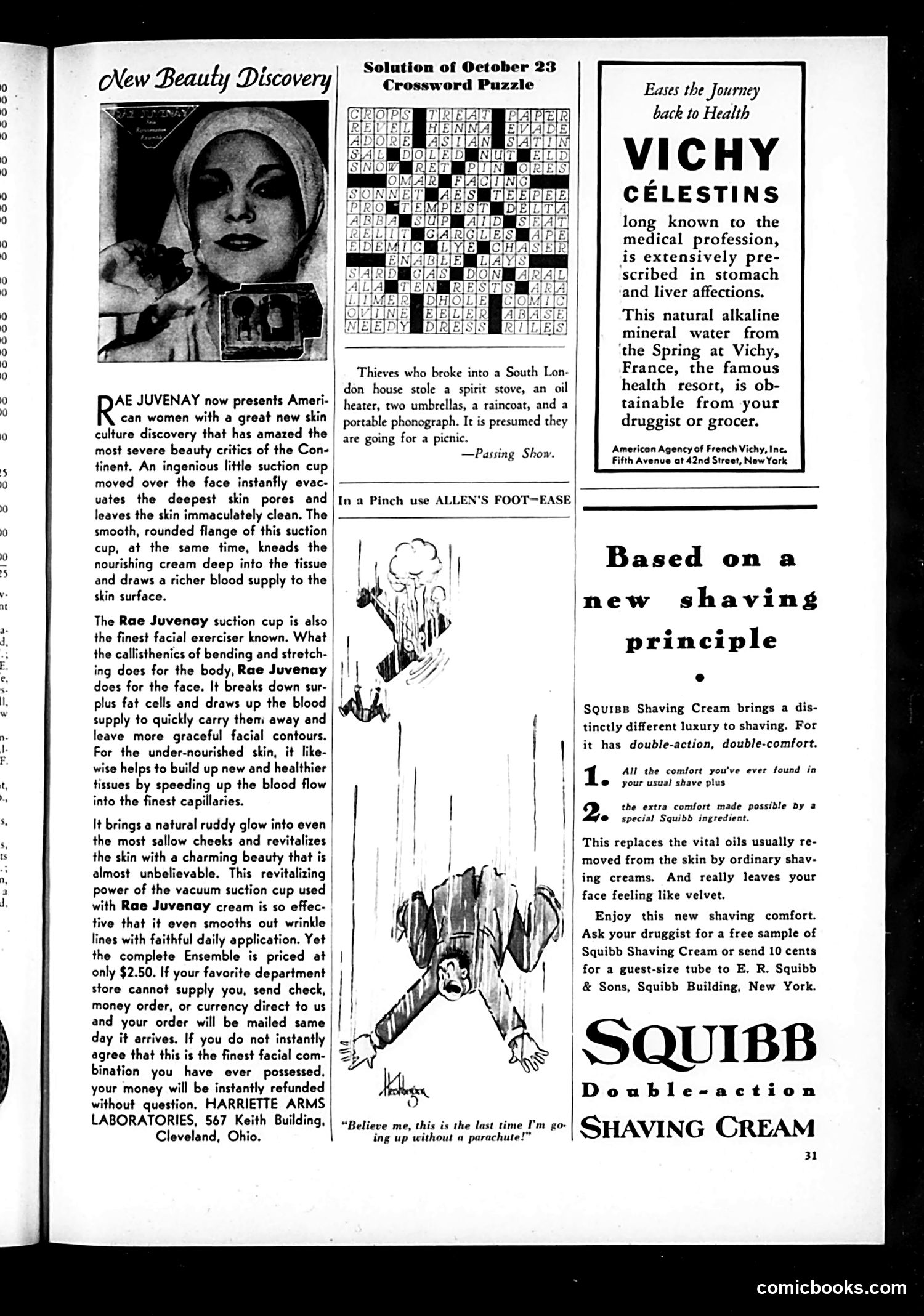
Analysis of Life Magazine Page Content This page is primarily advertisements and product promotions rather than political satire. The main content includes: "New Beauty Discovery" (left): Advertises the "Rae Juvenay" suction cup facial device, claiming it cleanses pores, exercises facial muscles, reduces wrinkles, and improves skin tone. The ad promises money-back guarantees and targets women seeking beauty improvements. Small cartoon (center): A brief joke from *Passing Show* about burglars stealing household items and a phonograph, supposedly heading for a picnic—simple absurdist humor without political content. Bottom cartoon: A small illustration of someone falling without a parachute, with the caption "Believe me, this is the last time I'm going up without a parachute!"—typical slapstick humor. Right side: Advertisements for Vichy mineral water (health/digestive aid) and Squibb Shaving Cream. The page reflects 1920s-30s consumer culture and beauty standards, with ads targeting women's appearance anxieties through dubious medical claims—common for the era before modern FDA regulations.
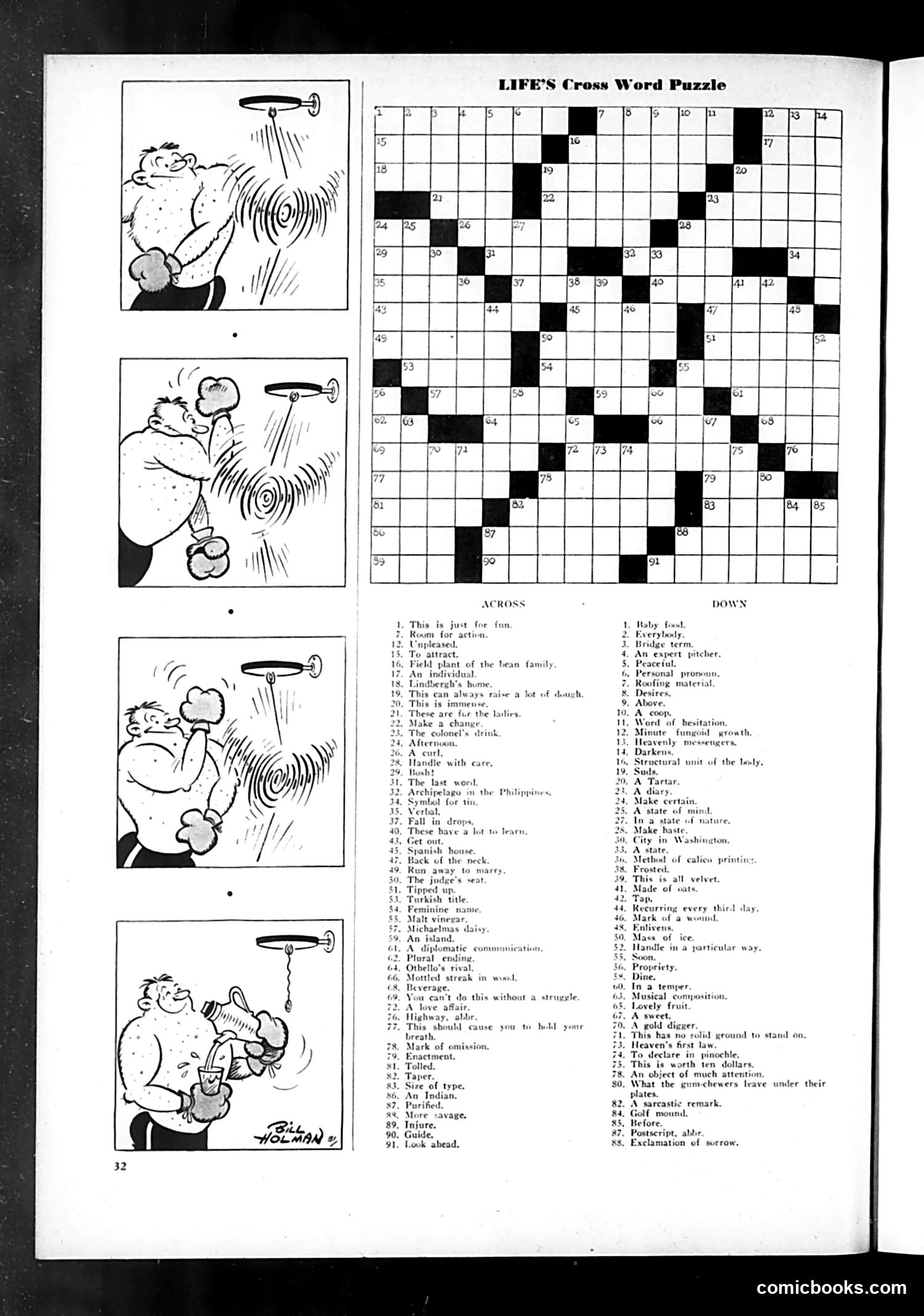
Analysis of LIFE Magazine Crossword Page This page presents LIFE's Cross Word Puzzle—a standard entertainment feature from the magazine, not political satire. The left side contains four cartoon panels by artist Wollman showing a rotund man repeatedly attempting to use a small trumpet or horn, with varying degrees of comedic failure and exertion. The cartoons illustrate physical humor—the man struggles, sweats, and appears increasingly frustrated with the instrument, likely depicting a "man versus machine" or "struggle with a simple task" theme common to early 20th-century comic art. The right side is a full crossword puzzle grid with 91 clues (Across and Down). The clues are typical crossword fare: wordplay, definitions, and riddles ("This is just for fun," "Room for action," "To attract," etc.). This is pure entertainment content—the cartoons provide visual humor while the crossword puzzle offers readers an interactive diversion. There is no political commentary or satirical commentary visible on this page. It represents the magazine's entertainment rather than editorial function.
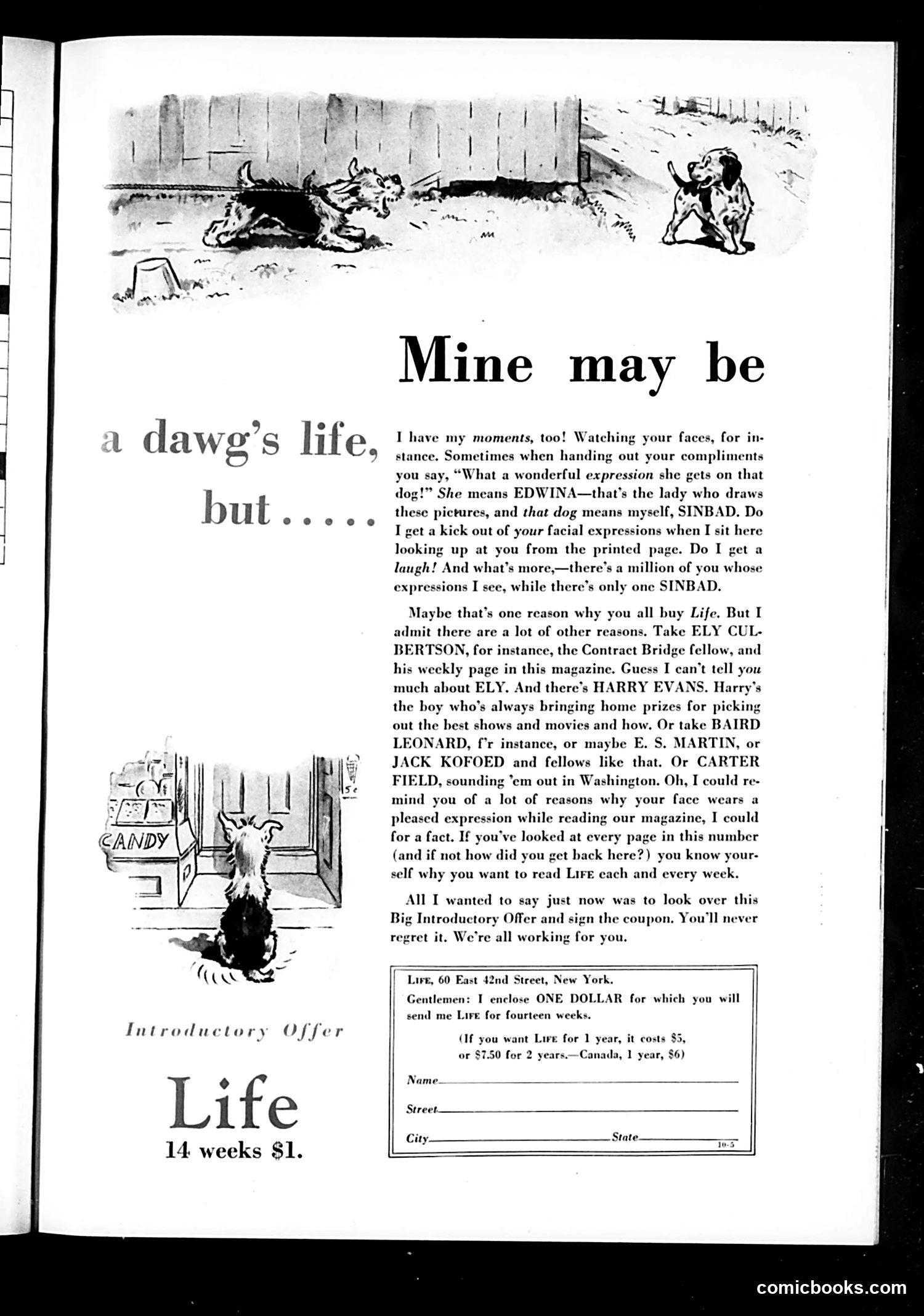
Life Magazine Subscription Advertisement This is primarily a subscription advertisement for *Life* magazine, disguised as editorial content. A cartoon dog named Sinbad speaks directly to readers, claiming credit for the magazine's appeal alongside named contributors: Ely Culbertson (Contract Bridge expert), Harry Evans (entertainment critic), Baird Leonard, E.S. Martin, Jack Kofoed, and Carter Field (Washington correspondent). The satire is gentle: Sinbad complains that while readers praise "Edwina" (the cartoonist who drew him) for the dog's expressions, he—the actual dog—deserves recognition. This anthropomorphic humor serves the advertisement's real purpose: convincing readers that *Life*'s diverse content warrants the $1 introductory offer for 14 weeks. The page reflects early 20th-century magazine culture, where humor publications like *Life* relied on celebrity contributors and featured cartoons as major draws.
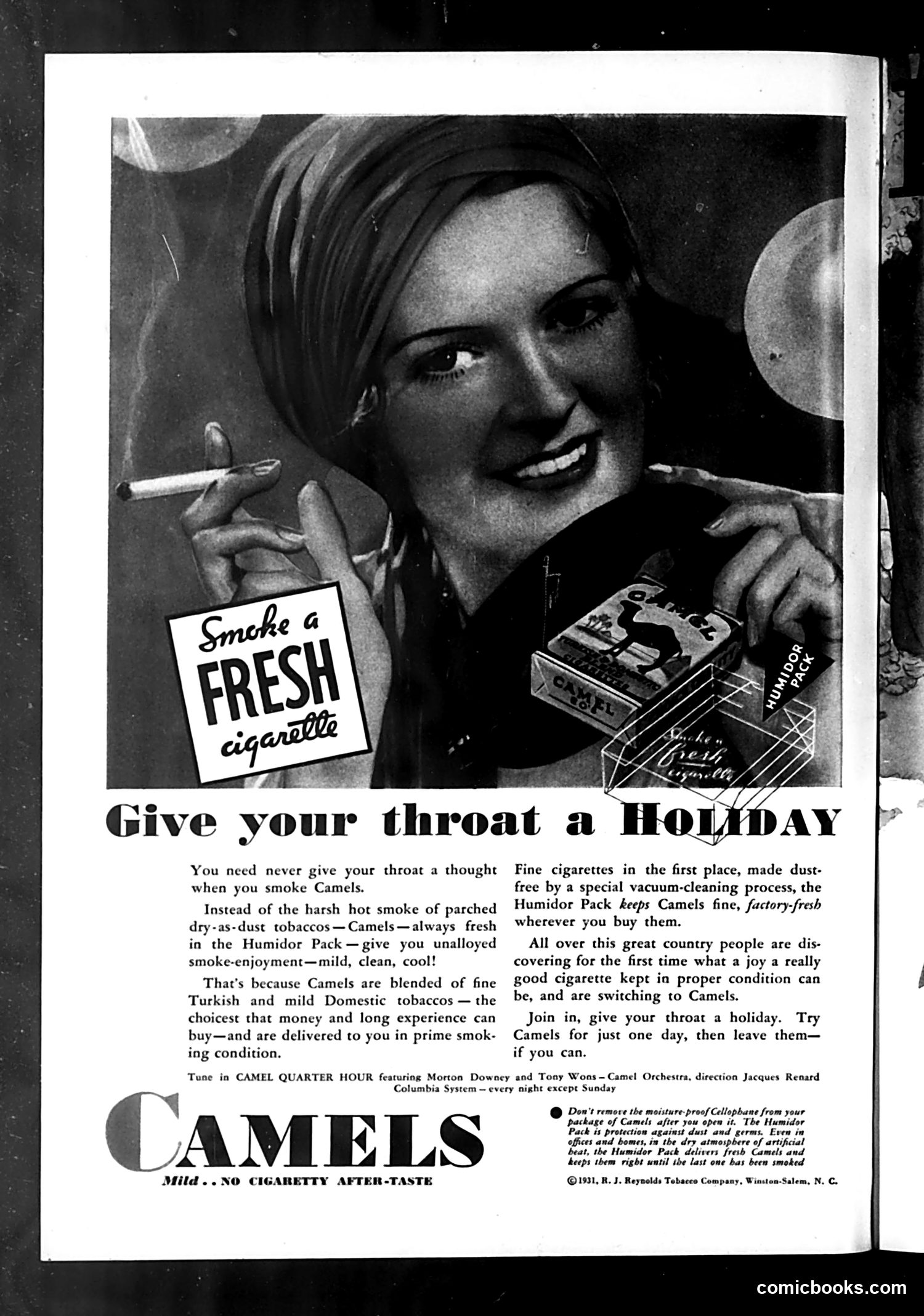
Camel Cigarette Advertisement (1931) This is a cigarette advertisement, not political satire. It features a woman in 1930s styling holding Camel cigarettes, promoting them as a "fresh" smoking experience. The ad's pitch relies on now-obsolete marketing claims: Camels are "mild" and "clean" because of their "Humidor Pack," a moisture-proof wrapper that supposedly keeps tobacco fresh. The tagline "Give your throat a holiday" and "no cigarette after-taste" promise health-conscious smoking. The copy emphasizes switching from "harsh" competing brands, suggesting cigarette competition was intense by 1931. References to radio programming (the "Camel Quarter Hour") show cigarette companies' heavy media investment during this era. Modern context: This predates widespread knowledge of smoking's health dangers. The casual promotion of nicotine addiction ("try for one day, then leave them—if you can") is now shocking, though the unconscious humor wasn't intentional.