life
Life — November 6, 1931
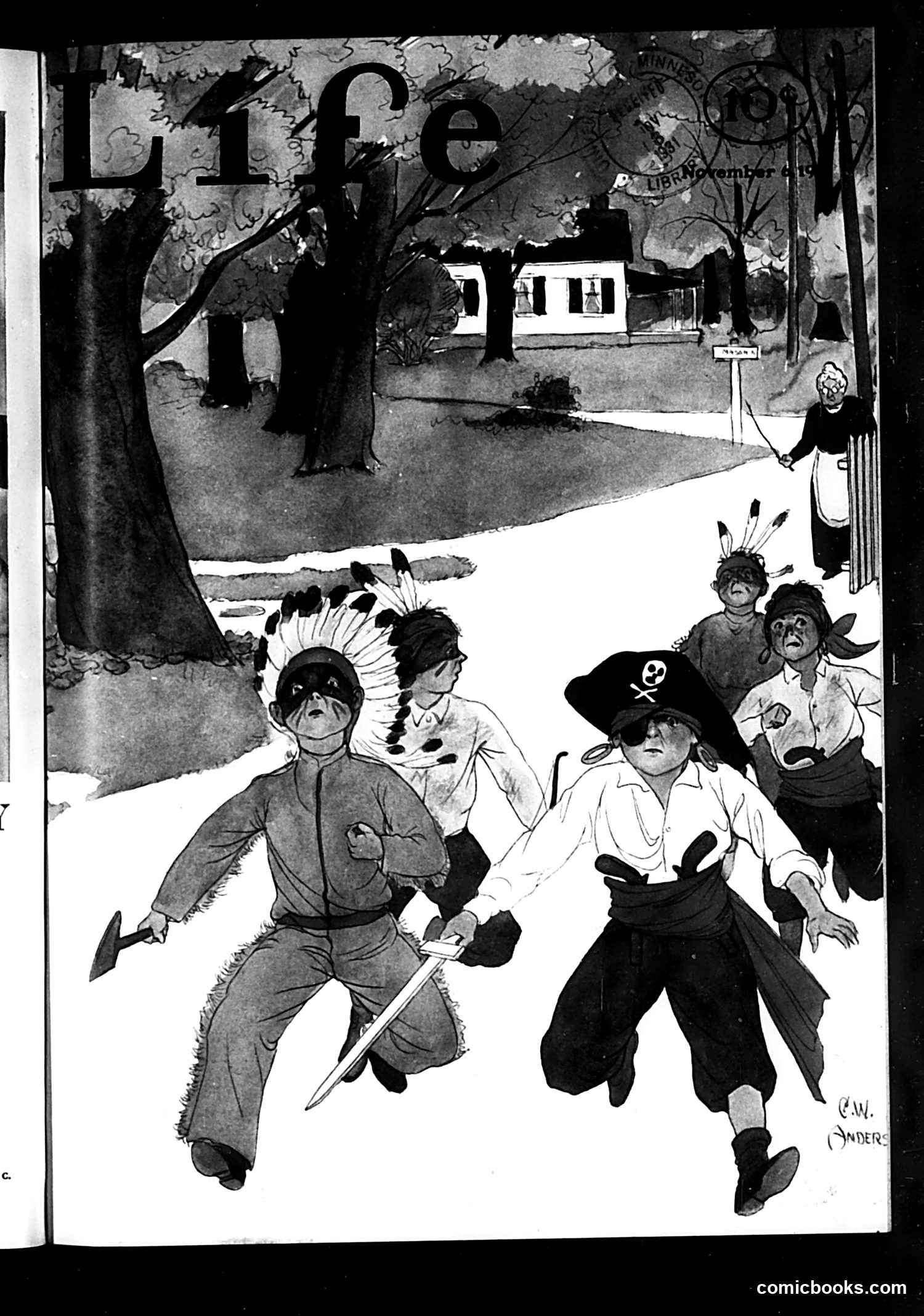
Political Cartoon Analysis This satirical illustration depicts children engaged in imaginative play, costumed as Native Americans and a pirate. The cartoon appears to critique or comment on children's recreational games and popular cultural role-playing of the early 20th century. The image shows children in stereotypical "Indian" headdresses with tomahawks, and another child in pirate costume with skull-and-crossbones hat, running through a snowy landscape. In the background, a house and bare trees suggest a suburban American setting. The satire likely mocks either the romanticization of Native Americans and pirates in children's entertainment, or comments on how American youth were socialized through such play activities. The exaggerated expressions and dynamic poses emphasize the absurdity or commentary Life magazine intended about prevailing cultural attitudes toward these figures.
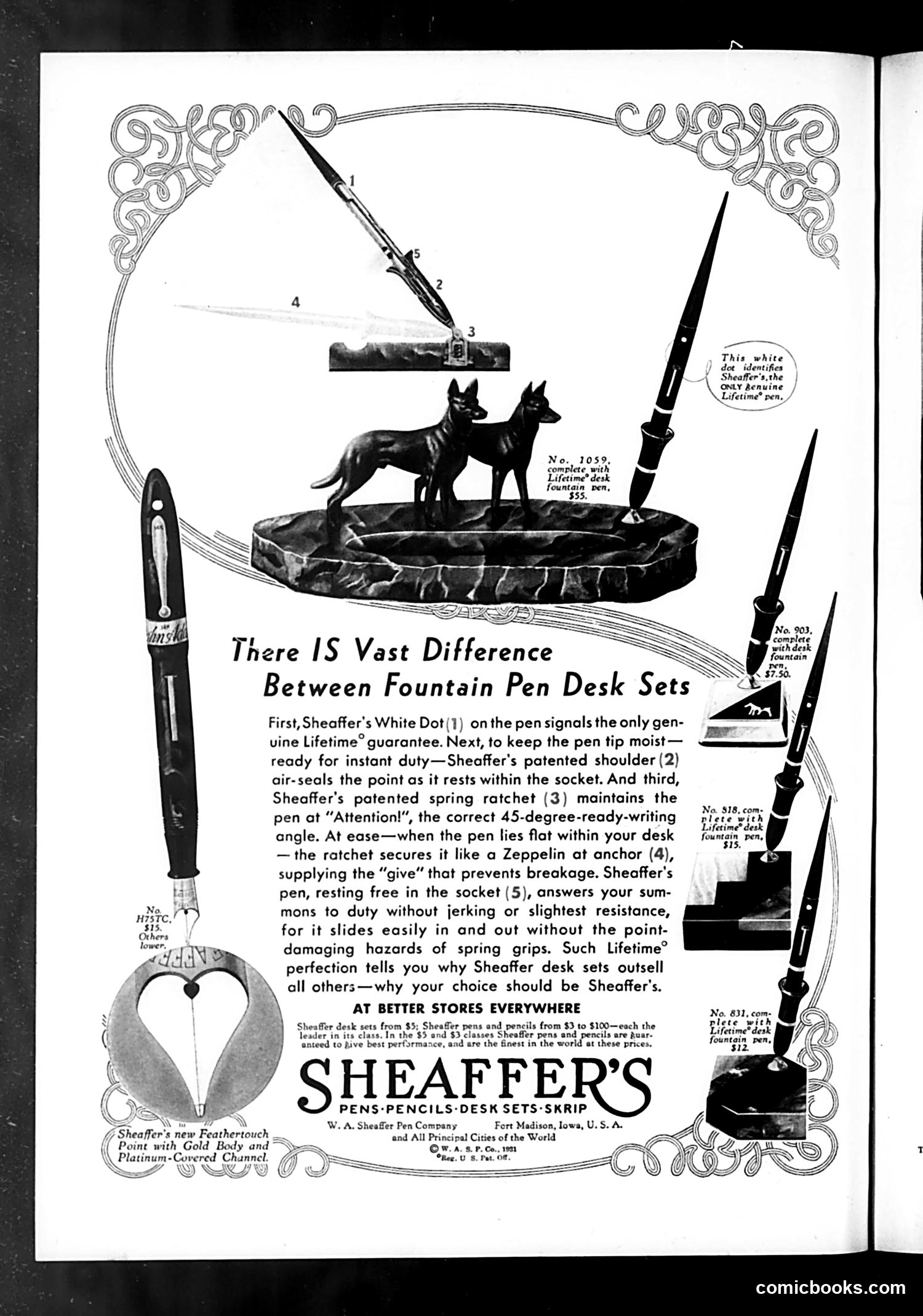
Content Description This is a Sheaffer fountain pen advertisement, not political satire or a cartoon. The page promotes Sheaffer desk sets by highlighting design features that distinguish their products from competitors. The central image shows two dogs on a decorative base with various pens displayed around them. The numbered callouts (1-5) identify Sheaffer's patented features: the "White Dot" guarantee mark, a shoulder mechanism to keep the pen moist, a spring ratchet maintaining proper writing angle, a Zeppelin-style anchor preventing breakage, and a free-resting socket design. The dogs serve as decorative imagery rather than carrying symbolic meaning—typical ornamental elements for luxury desk sets of this era. The advertisement emphasizes engineering superiority and build quality to justify premium pricing ("$100—each").
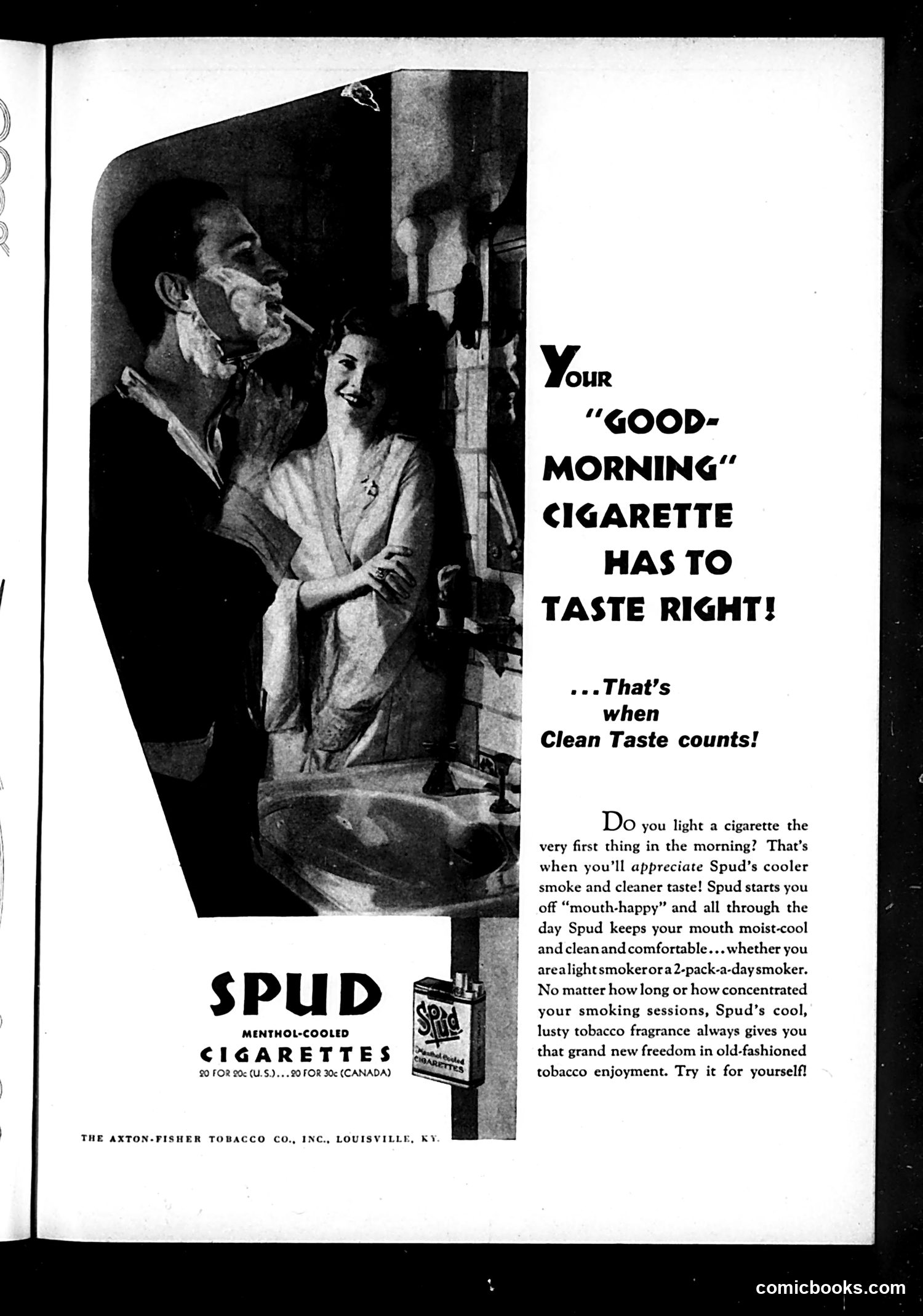
This is a cigarette advertisement, not satire or political commentary. It's a Spud Menthol-Cooled Cigarettes ad from The Axton-Fisher Tobacco Co. (Louisville, KY). The ad shows a couple in what appears to be a domestic morning scene. The headline promises that a "good-morning" cigarette will "taste right" because of Spud's "clean taste." The copy emphasizes the product's menthol cooling, claiming it keeps the mouth "moist-cool and clean" throughout the day, whether you're a light or heavy smoker. This reflects mid-20th-century tobacco marketing that aggressively promoted cigarettes as health-conscious, refreshing, and essential to daily comfort—claims that would be illegal today. The imagery normalizes smoking as a routine domestic pleasure.
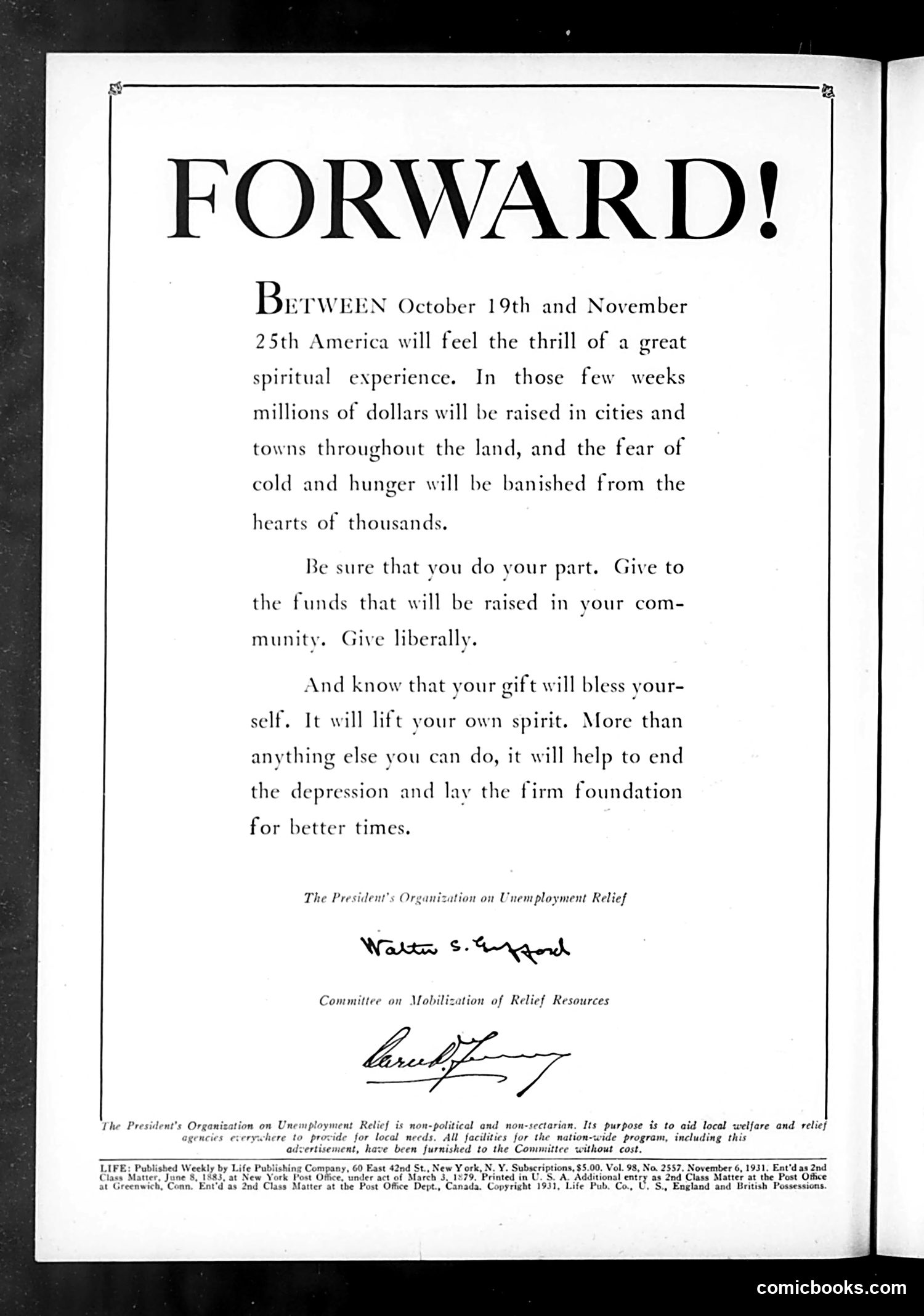
Analysis This is not a cartoon page, but rather a public service announcement/appeal document dated November 6, 1931. The page urges Americans to donate to unemployment relief between October 19 and November 25. It's signed by Walter S. Gifford (President's Organization on Unemployment Relief) and appears to include another signature from the Committee on Mobilization of Relief Resources. Historical context: This dates to the Great Depression. The appeal emphasizes charitable giving will "banish fear of cold and hunger" and "help end the depression." It reflects early Depression-era reliance on private charitable fundraising rather than government programs—a policy approach that would soon prove inadequate, leading to New Deal programs. The religious language ("spiritual experience," "bless yourself") reflects how charitable giving was framed morally during this period.
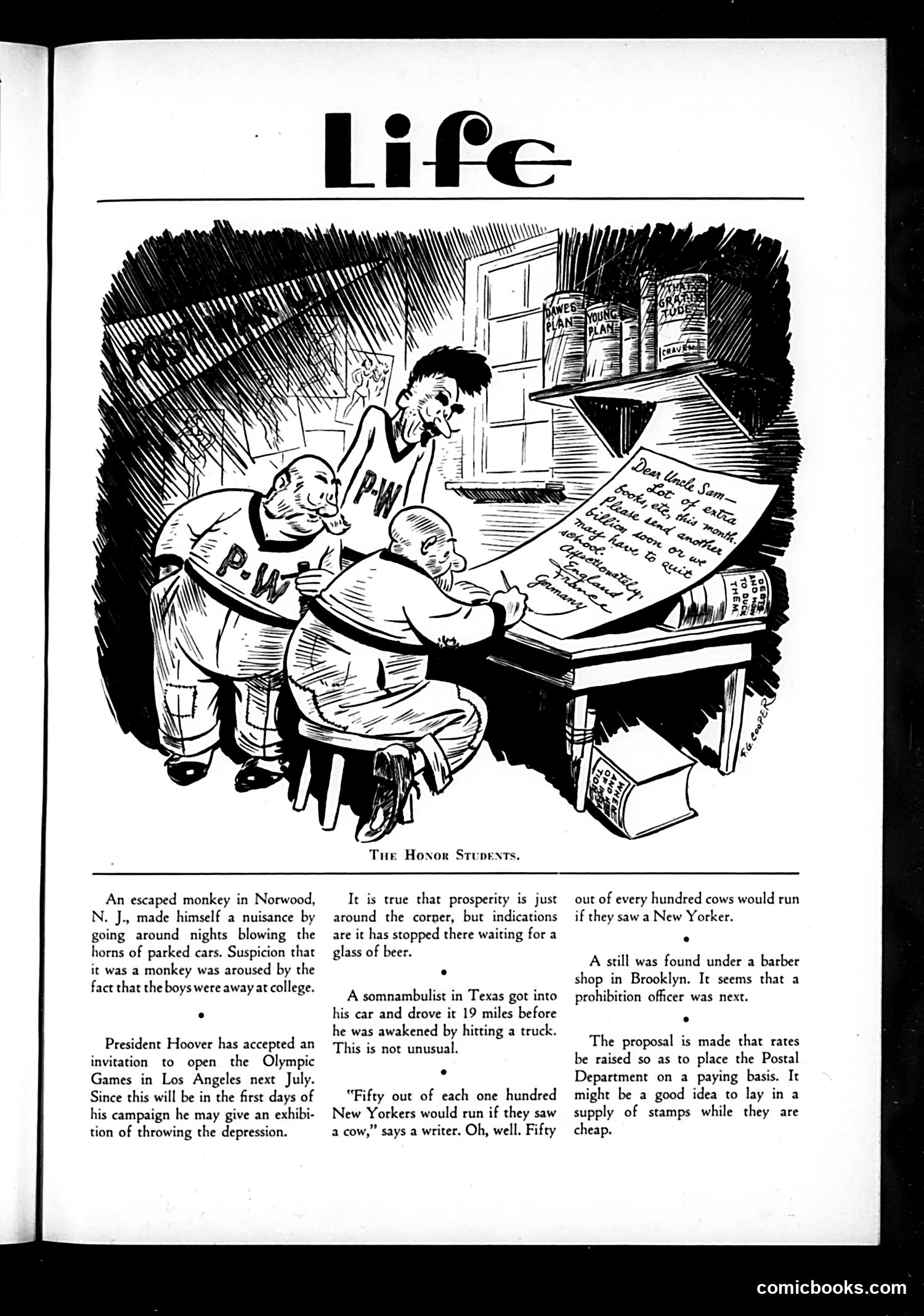
"The Honor Students" Analysis This satirical cartoon depicts three young men wearing "P.W." armbands, seated at a desk studying papers. The illustration mocks college students, likely from a prestigious institution. The caption "The Honor Students" is ironic—the accompanying text reveals these are not academically distinguished pupils but rather troublemakers. One anecdote mentions boys "away at college" who were actually elsewhere causing mischief (blowing horns near parked cars in Norwood, N.J.). The "P.W." armbands likely reference a fraternity or college organization. The satire suggests a gap between students' reputations as "honor" pupils and their actual behavior—implying they receive academic credit while engaging in pranks and delinquency. This critiques both the students' hypocrisy and institutional oversight during what appears to be the 1920s Prohibition era.
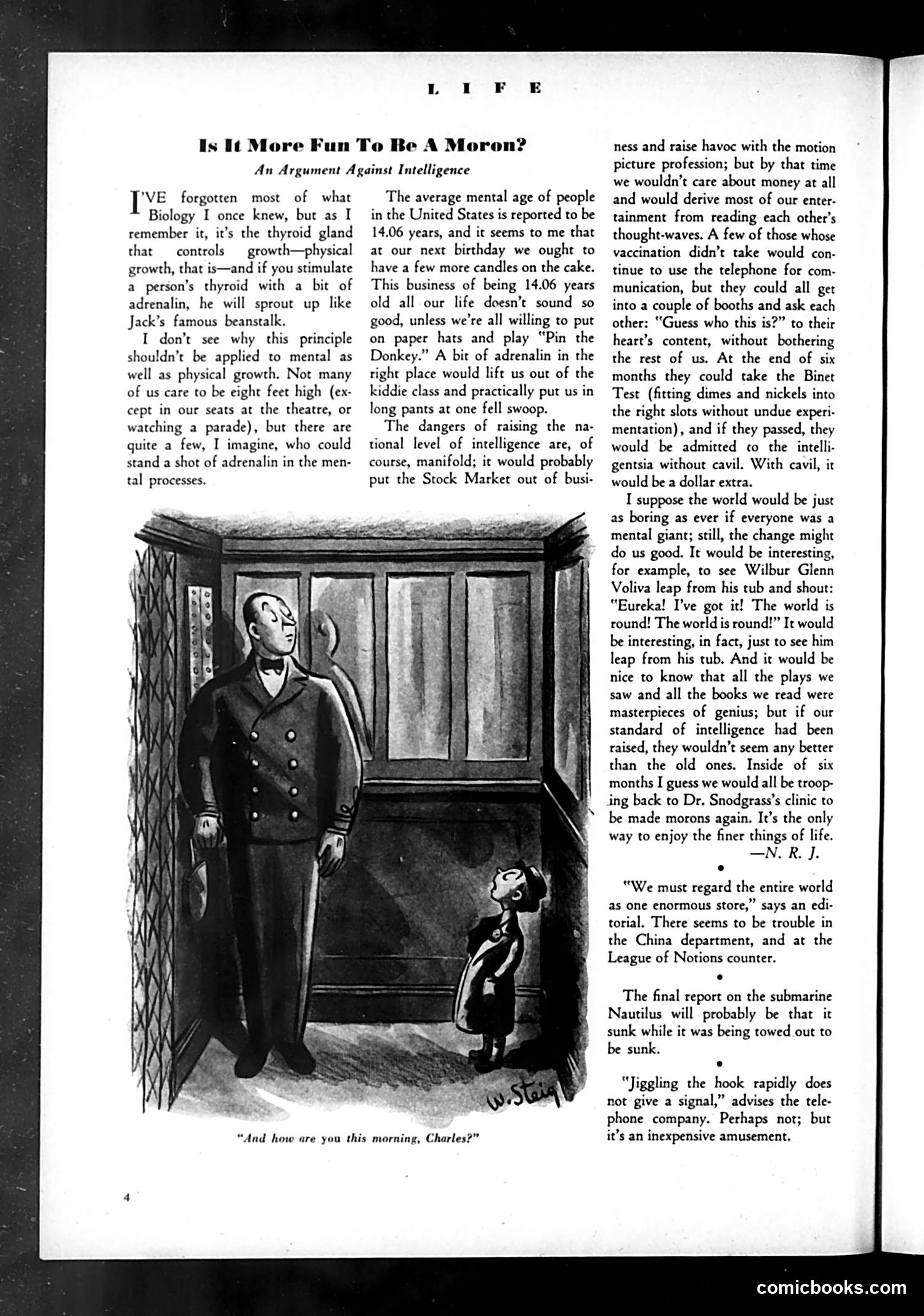
Analysis of "Is It More Fun To Be A Moron?" This satirical article argues *against* valuing intelligence, using absurdist humor. The main cartoon shows a tall man in formal dress looking down at a tiny child, captioned "And how are you this morning, Charles?" The joke appears to be about physical stature—the adult towers over the child—but the article's title suggests the irony: society might prefer unintelligence because smart people cause problems (stock market crashes, etc.). The text references the "average mental age" of Americans as 14.06 years and sarcastically proposes solutions like intelligence tests with financial rewards, suggesting such systems are impractical and society functions better with widespread mediocrity. The humor relies on inverting conventional wisdom about intelligence being desirable.
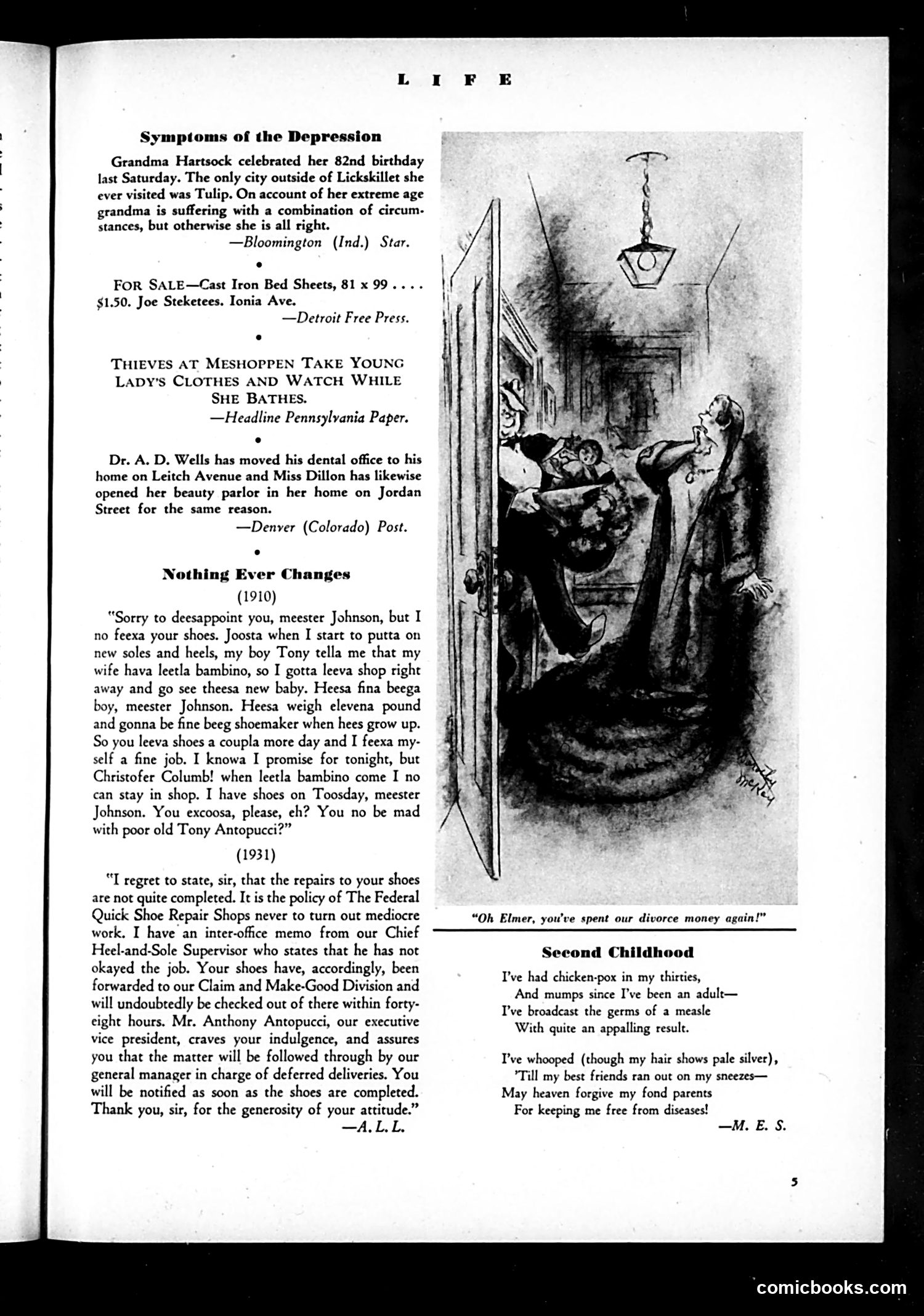
Analysis of Life Magazine Page The main cartoon depicts a domestic quarrel, captioned "Oh Elmer, you're spent our divorce money again!" The image shows a woman confronting a man in what appears to be a modest home interior, with a hanging lamp above. The satire targets the absurdity of a couple spending money allocated for divorce proceedings on other expenses, suggesting financial irresponsibility within troubled marriages. This reflects early 20th-century attitudes toward divorce as both scandalous and financially consequential. The page also includes miscellaneous content: advertisements for cast-iron bed sheets and shoe repair services, personal notices, and a poem titled "Second Childhood" by M.E.S. The overall tone is lighthearted social commentary typical of Life magazine's satirical approach to American domestic and consumer culture.
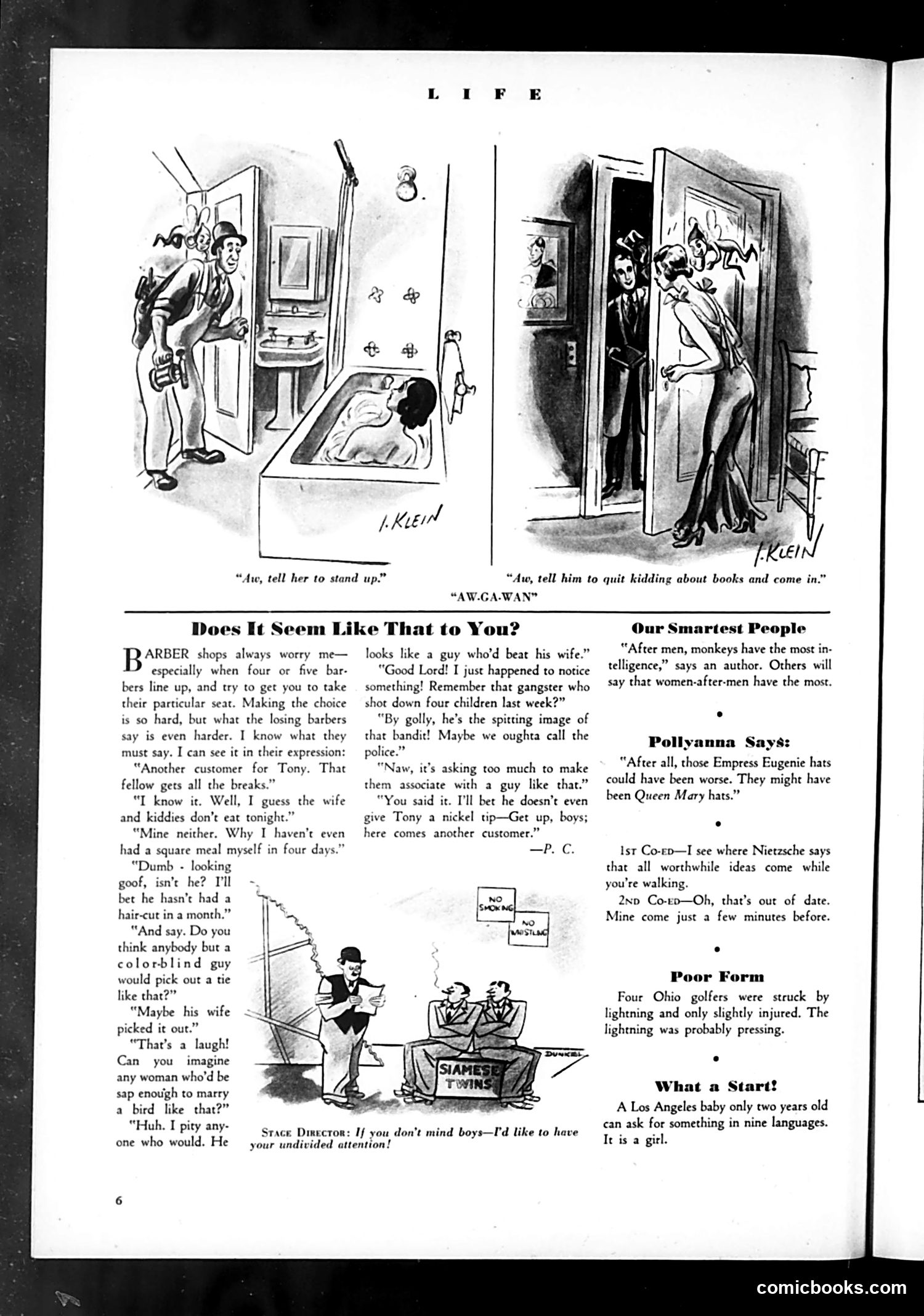
Page Analysis: Life Magazine Humor Section This page contains three distinct humor pieces: Top Cartoons (by I. Klein): Two bathroom-related gags about domestic life—a husband being told to stand up in a bathtub, and a woman telling a man to stop discussing books and enter a room. "Does It Seem Like That to You?" A barber's monologue complaining about married life—wives picking restaurant seats, husbands not eating well, suggesting marriage is fundamentally miserable. The satire targets domestic dissatisfaction and male anxiety about matrimony. "Our Smartest People" Short humorous observations, including a quip that women-after-men possess more intelligence than men themselves—likely satirizing gender relations and male ego. Bottom section: Brief amusing anecdotes about stage directors, lightning strike survivors, and a multilingual toddler—typical light filler humor for the era. The page reflects early-to-mid 20th-century domestic satire conventions.
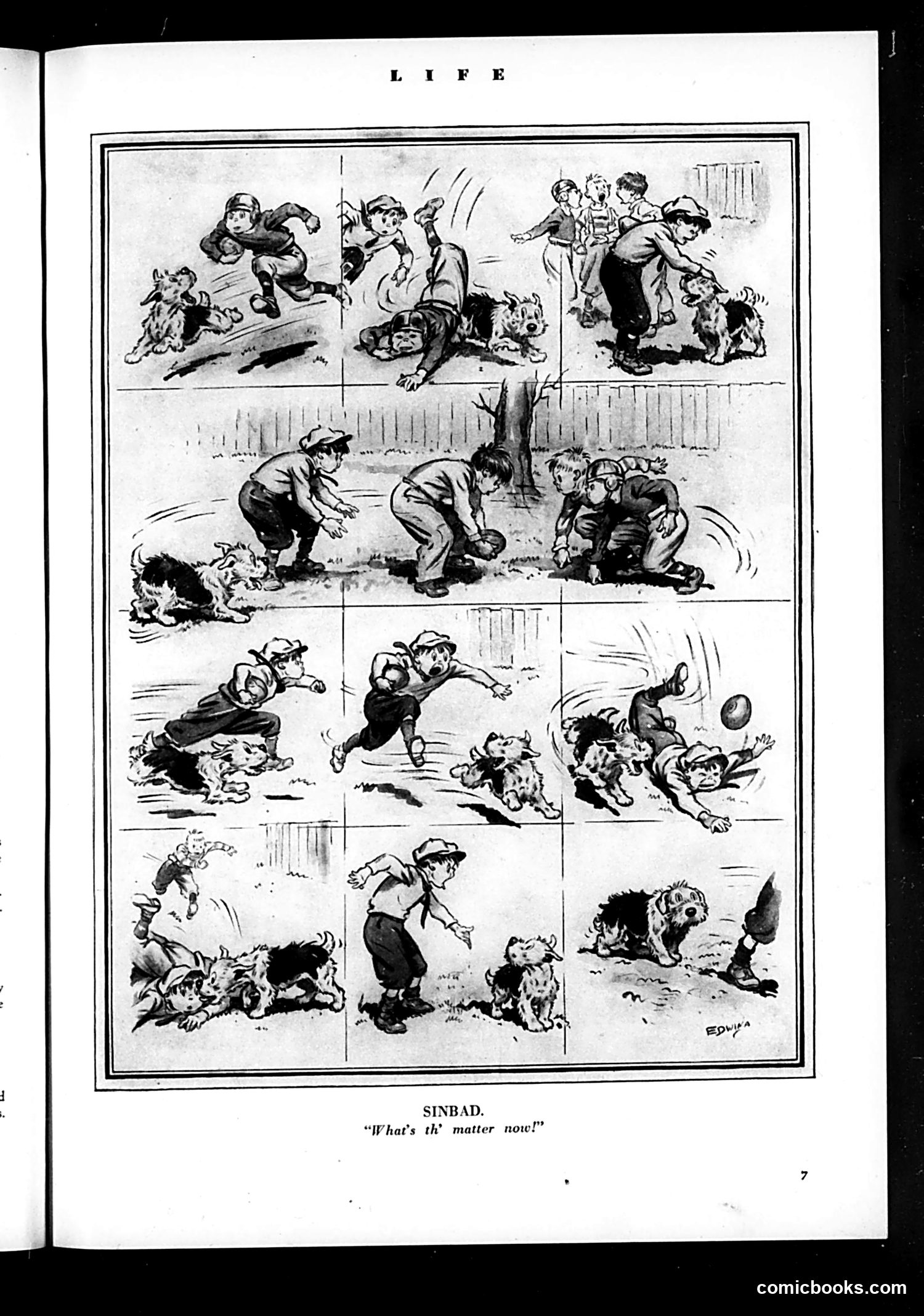
Sinbad: "What's th' Matter Now?" This comic strip shows a boy (Sinbad) and his dog repeatedly getting into mischief with other children and dogs. The sequential panels depict escalating chaos—chasing, tumbling, fighting, and general roughhousing in what appears to be a neighborhood or street setting. The satire targets childhood behavior and parental exasperation. The phrase "What's th' Matter Now?" suggests an adult (likely a parent) repeatedly asking why the children keep causing trouble. The humor comes from the relentless, cyclical nature of children's play-fighting and the inevitable messy consequences—mud, torn clothes, and general disorder. This reflects early 20th-century attitudes about boyish mischief as both inevitable and somewhat amusing, though frustrating to adults managing households.
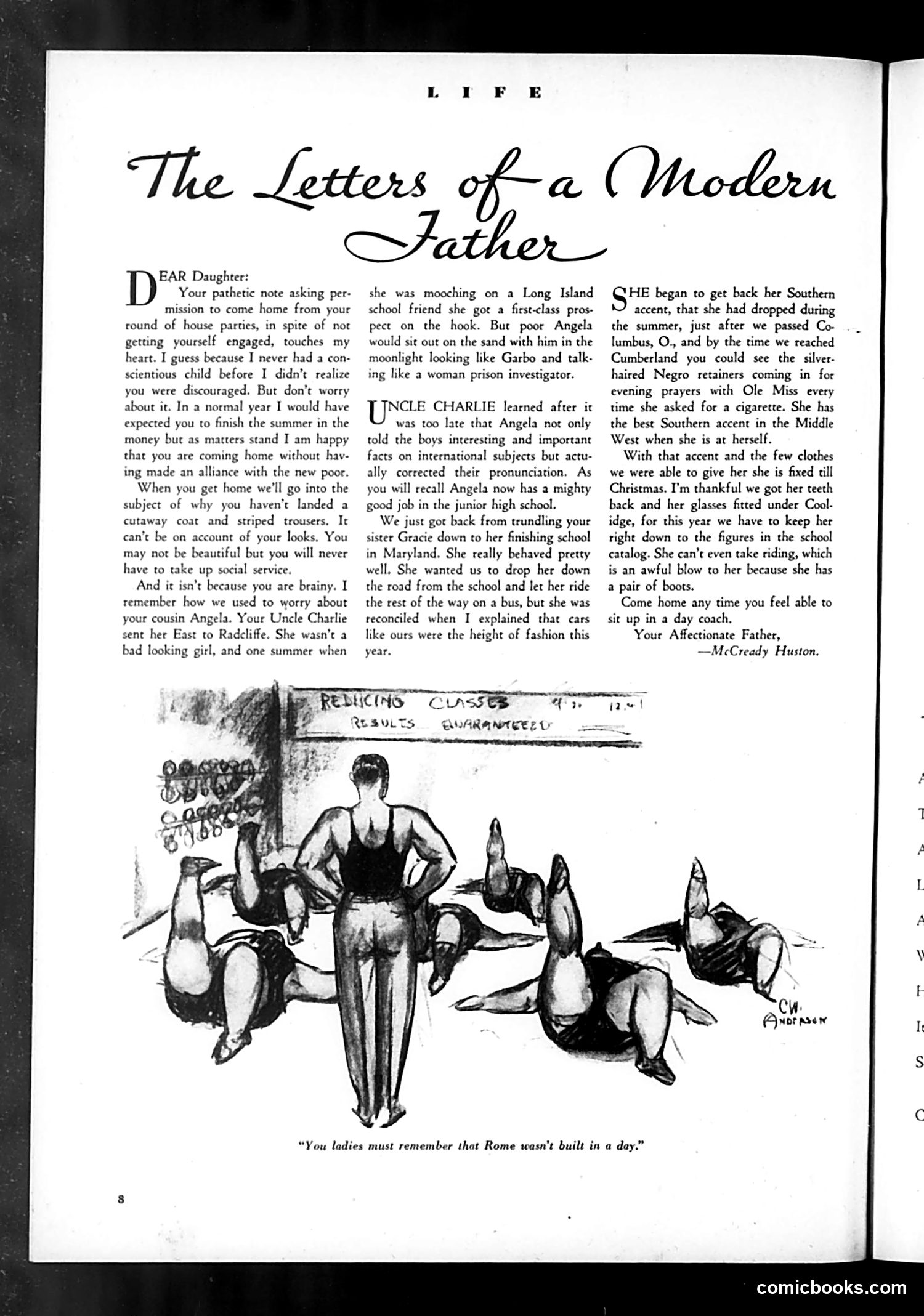
Analysis This page features "The Letters of a Modern Father," a humorous advice column. The illustration depicts a father instructing his daughter and her friends about physical fitness or exercise classes, with the caption "You ladies must remember that Rome wasn't built in a day." The cartoon satirizes modern parenting and youth culture of the era. The father's comment—a common proverb about patience—appears to reference the girls' exercise routine or physical training, suggesting he's humorously cautioning them against expecting quick results from fitness efforts. The text discusses the father's various concerns about his daughter's life: her social activities, friendships, school progress, and summer plans. The overall tone mocks the earnest, somewhat old-fashioned advice fathers give to their daughters about conduct and ambition in what the magazine presents as a "modern" context.
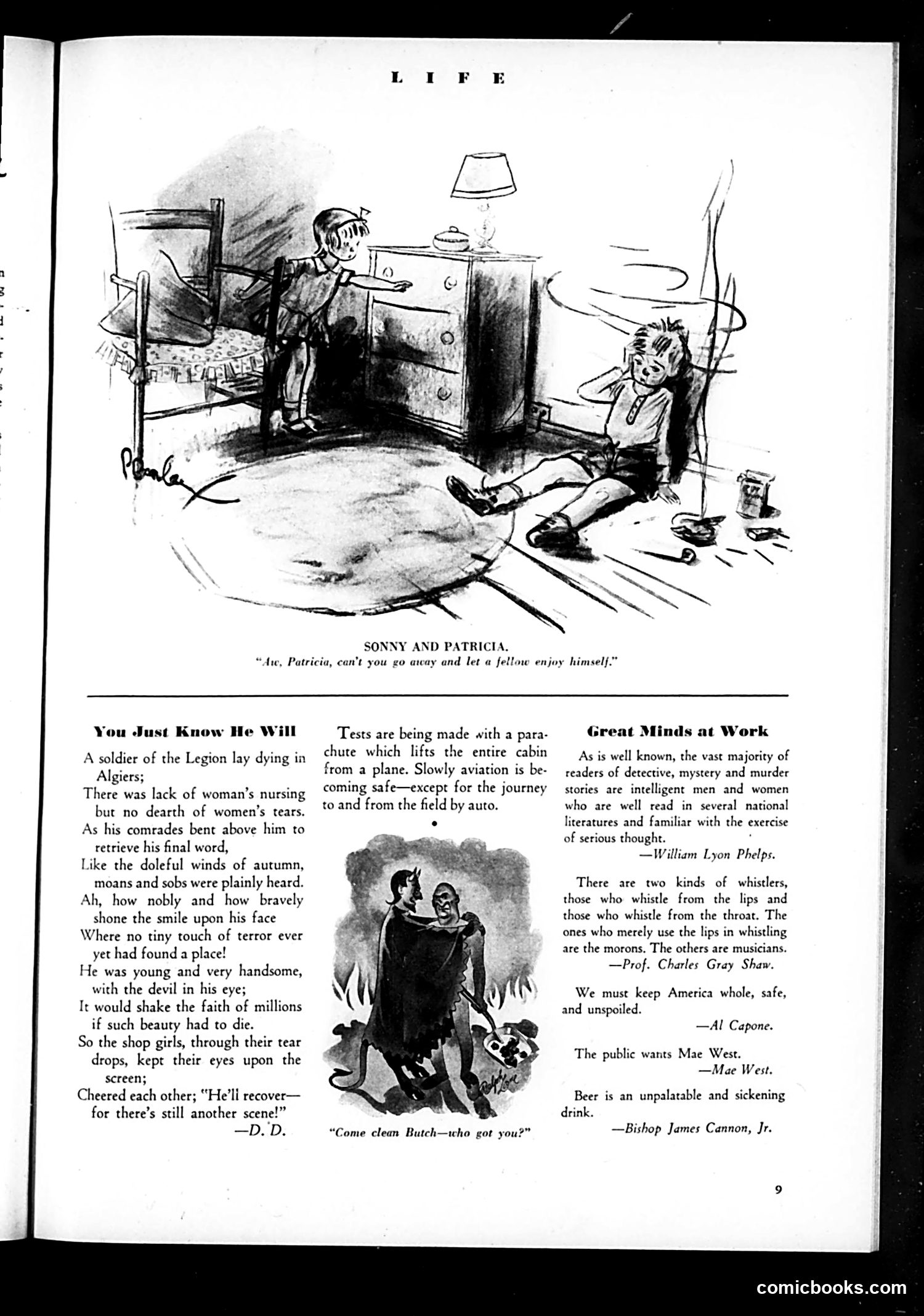
Analysis of Life Magazine Page This page contains a cartoon titled "Sonny and Patricia" showing two children in a messy room with furniture and scattered toys. The caption reads: "Au, Patricia, can't you go away and let a fellow enjoy himself?" The humor targets spoiled or bratty children—a common satirical subject. The boy appears annoyed at being interrupted by a girl, suggesting period-typical gender dynamics and sibling conflict. Below are unrelated sections including a poem "You Just Know He Will" about a dying soldier, and a "Great Minds at Work" section featuring quotations from recognizable figures like Al Capone, Mae West, and William Lyon Phelps on various social topics (aviation safety, whistling, prohibition, etc.). The overall page mixes domestic humor with contemporary social commentary.
Analysis This page from *Life* magazine features an article titled "Life Looks About: The Passing of a Benefactor," discussing Thomas Edison's legacy and character. The small cartoon at top shows two figures—apparently a child and adult—playing with a globe and telescope, illustrating themes of discovery and invention. The article praises Edison as an exceptional self-made inventor who, despite lacking formal education, achieved remarkable discoveries. The author (E. S. Martin) argues that Edison's deafness didn't hinder his brilliance and notes his humble origins and modest lifestyle despite wealth. The piece contrasts Edison favorably with purely capitalist figures like Henry Ford, emphasizing Edison's focus on innovation over profit-seeking. The overall tone celebrates Edison as an admirable "benefactor" to humanity through his scientific contributions rather than his financial success.
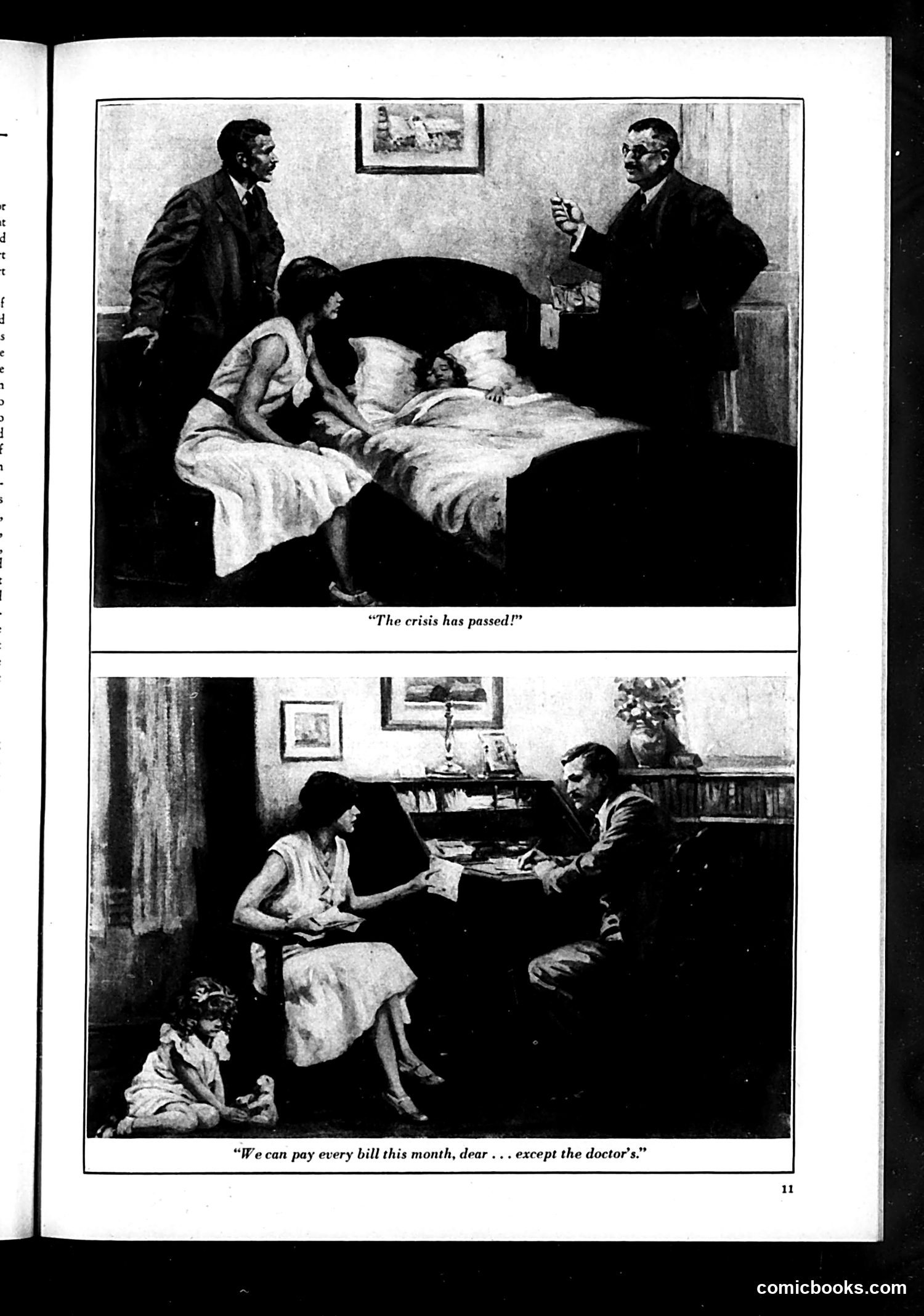
Analysis This page contains two satirical scenes about medical debt, a persistent social concern. Top panel: Captioned "The crisis has passed!" shows a woman in bed with a child, while two men in suits (appearing to be doctors) confer above them. The irony suggests the medical emergency has resolved, but financial hardship remains. Bottom panel: Captioned "If e can pay every bill this month, dear . . . except the doctor's," depicts a couple reviewing household finances with a child present. The husband hands papers to his wife, indicating they can manage most expenses but cannot afford the physician's bill. Both scenes satirize the economic burden of medical care on ordinary families—the doctor's fee represents an impossible expense even for households managing other obligations. This reflects early-20th-century anxieties about healthcare accessibility and cost.
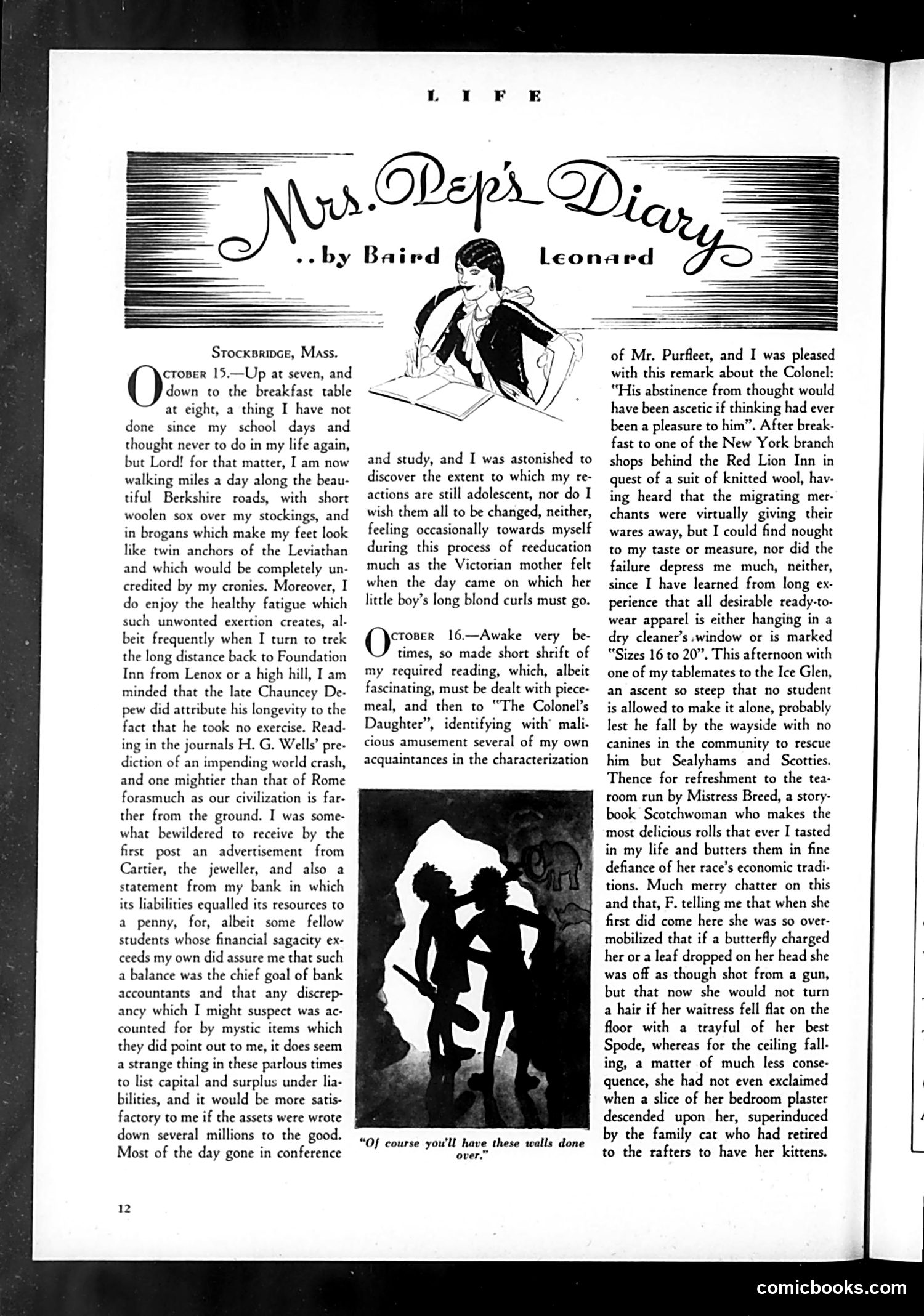
"Mrs. Pep's Diary" by Baird Leonard This is a serialized humor column set in Stockbridge, Massachusetts. The October 15-16 entries describe mundane upper-middle-class life: the narrator's physical exertion during a country walk, shopping for knitted wool, and social activities at a local tearoom. The silhouette illustration depicts two figures in conversation, captioned "Of course you'll have these walls done over." This appears to reference domestic renovation concerns—likely satirizing the preoccupations of leisure-class women with home improvement and interior decoration. The column's humor relies on gentle mockery of provincial New England society, women's daily routines, and the trivial concerns of comfortable but not wealthy households. No specific political figures or major events are referenced—the satire targets social types and domestic culture generally.
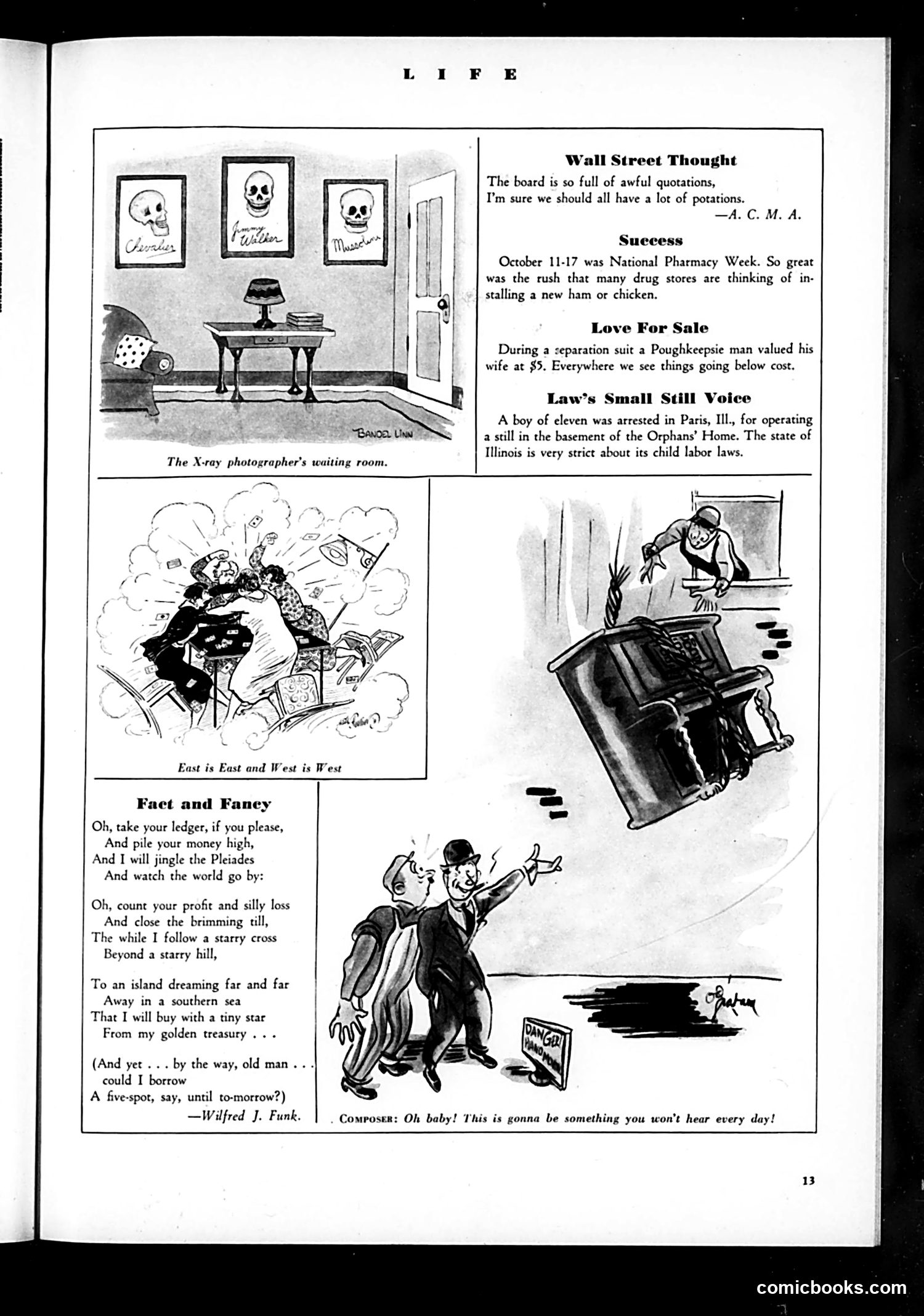
Explanation for Modern Readers This LIFE magazine page contains satirical content from an era when stock market speculation was rampant: Top cartoon ("X-ray photographer's waiting room"): Shows framed skulls labeled with names—a dark joke about financial ruin. The X-ray room setting suggests investors are being examined and found to be "dead" financially. "East is East and West is West": Depicts a figure drowning in financial chaos—another commentary on investment losses. "Fact and Fancy" (poem by Wilfred J. Funk): Contrasts fantasies of wealth ("count your profit," "golden treasury") with reality ("could I borrow / A five-spot"). This satirizes the gap between investment dreams and actual financial hardship. The overall theme: mocking investors' delusions during what appears to be a period of market turmoil, likely the 1920s pre-crash era.
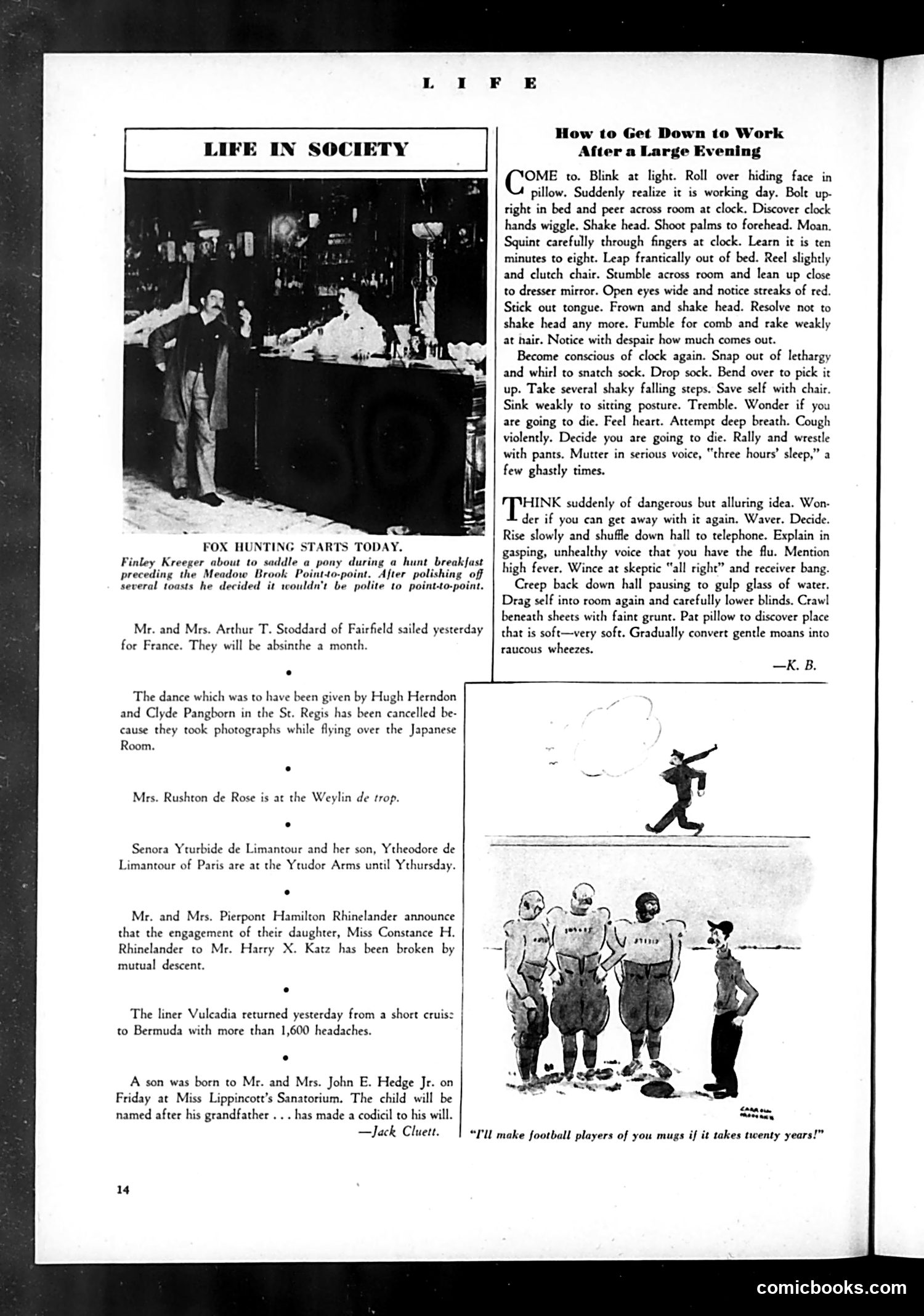
Analysis of Life Magazine Page This page contains social satire typical of Life magazine's humor section. The main article, "How to Get Down to Work After a Large Evening" (signed K.B.), humorously describes the physical misery of recovering from a night of heavy drinking—hiding from light, discovering a hangover, stumbling through morning routines, and attempting to function despite feeling terrible. The accompanying illustrations show slapstick physical comedy: a figure stumbling/falling and people (appearing to be football players based on their uniforms) in clumsy poses. The caption "I'll make football players of you mugs if it takes twenty years!" suggests coaching or athletic training themes. The left column contains society gossip items about wealthy individuals' travel and engagements, typical Life magazine content. The overall satire targets hangovers and morning-after regret as universal upper-class experiences.
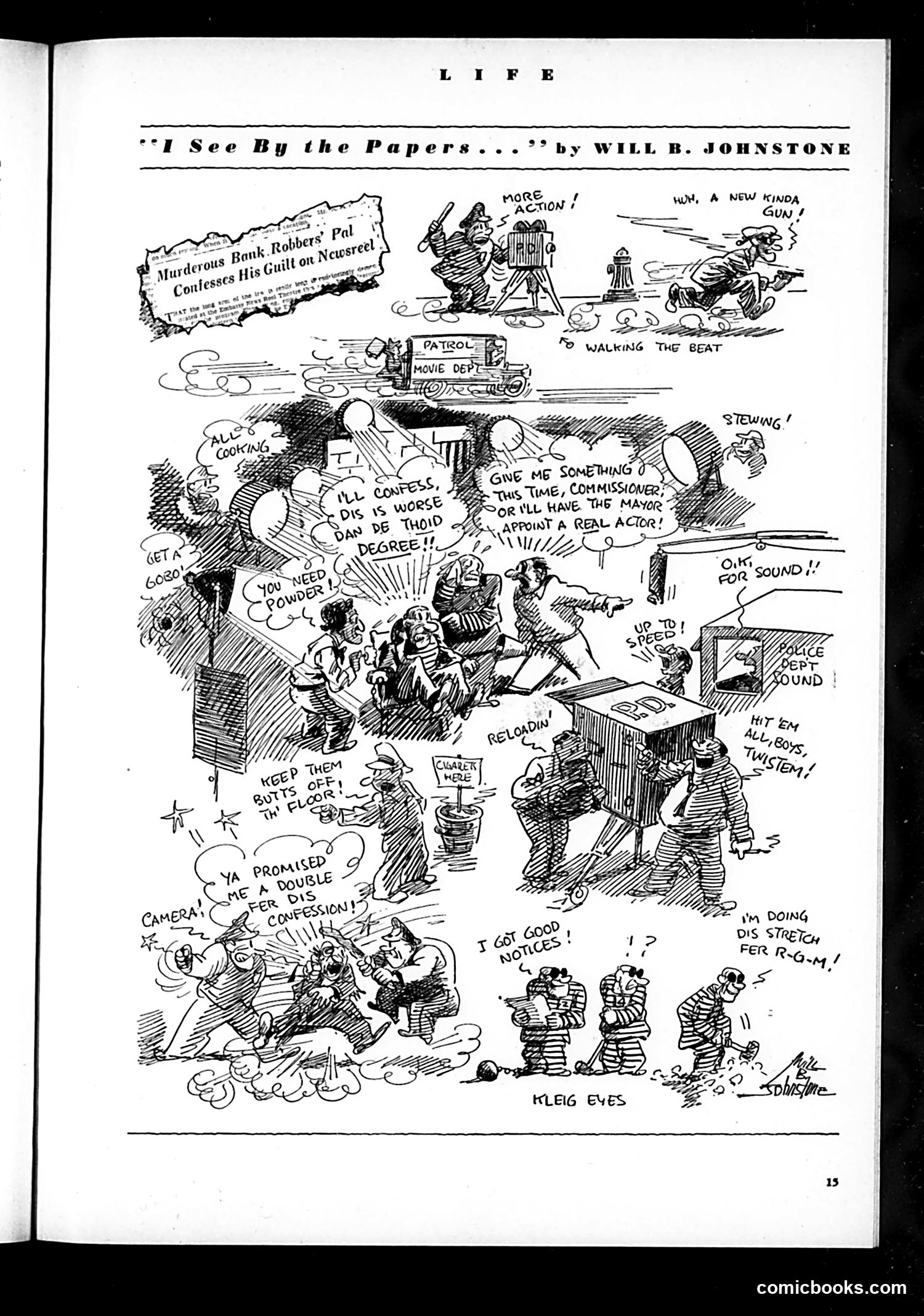
"I See By the Papers..." by Will B. Johnstone This cartoon satirizes early film production, specifically movie studio management and police interference with filmmaking. The chaotic scene depicts: - A film crew shooting an action sequence with a "Patrol Movie Dept." vehicle - Police and studio personnel arguing about scene authenticity and permissions - Dialogue referencing confessions, arrests, and complaints about "worse than a 'hold' degree" - References to getting "good notices" and stretched contracts for R.G.M. (likely Metro-Goldwyn-Mayer) - Police demanding "sound" documentation and threatening to appoint "a real actor" The satire mocks the collision between film studios' desire for realism and actual law enforcement's need for permits and control over street filming. It portrays movie-making as chaotic and overly complicated by bureaucratic interference.
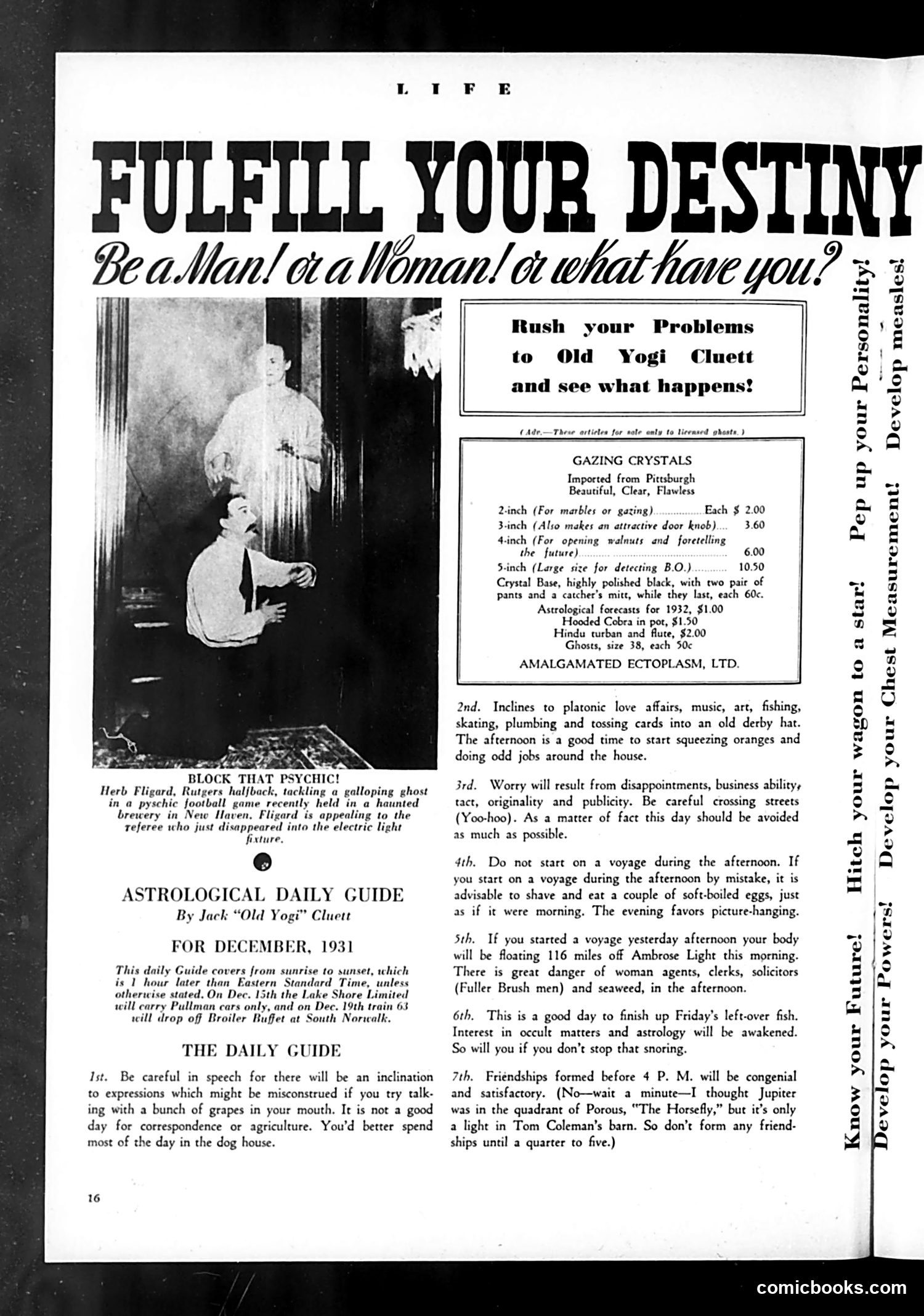
Analysis of Life Magazine Page (December 1931) This page satirizes spiritualism and fortune-telling, popular during the Depression era. The photograph labeled "BLOCK THAT PSYCHIC!" shows Herb Filgard, a Rutgers halfback, supposedly "tackling a galloping ghost in a psychic séance held in a haunted brewery in New Haven." The joke mocks both spiritualism as fraud and the era's fascination with the supernatural. The "Astrological Daily Guide" by "Old Yogi" Cluett parodies horoscope advice, offering absurd predictions (like warning against afternoon voyages or promising Jupiter in someone's barn). The adjacent advertisement for "Gazing Crystals" and mystical items reinforces the satire—Life is simultaneously mocking spiritualism while the magazine profits from ads targeting believers seeking guidance during economic hardship.
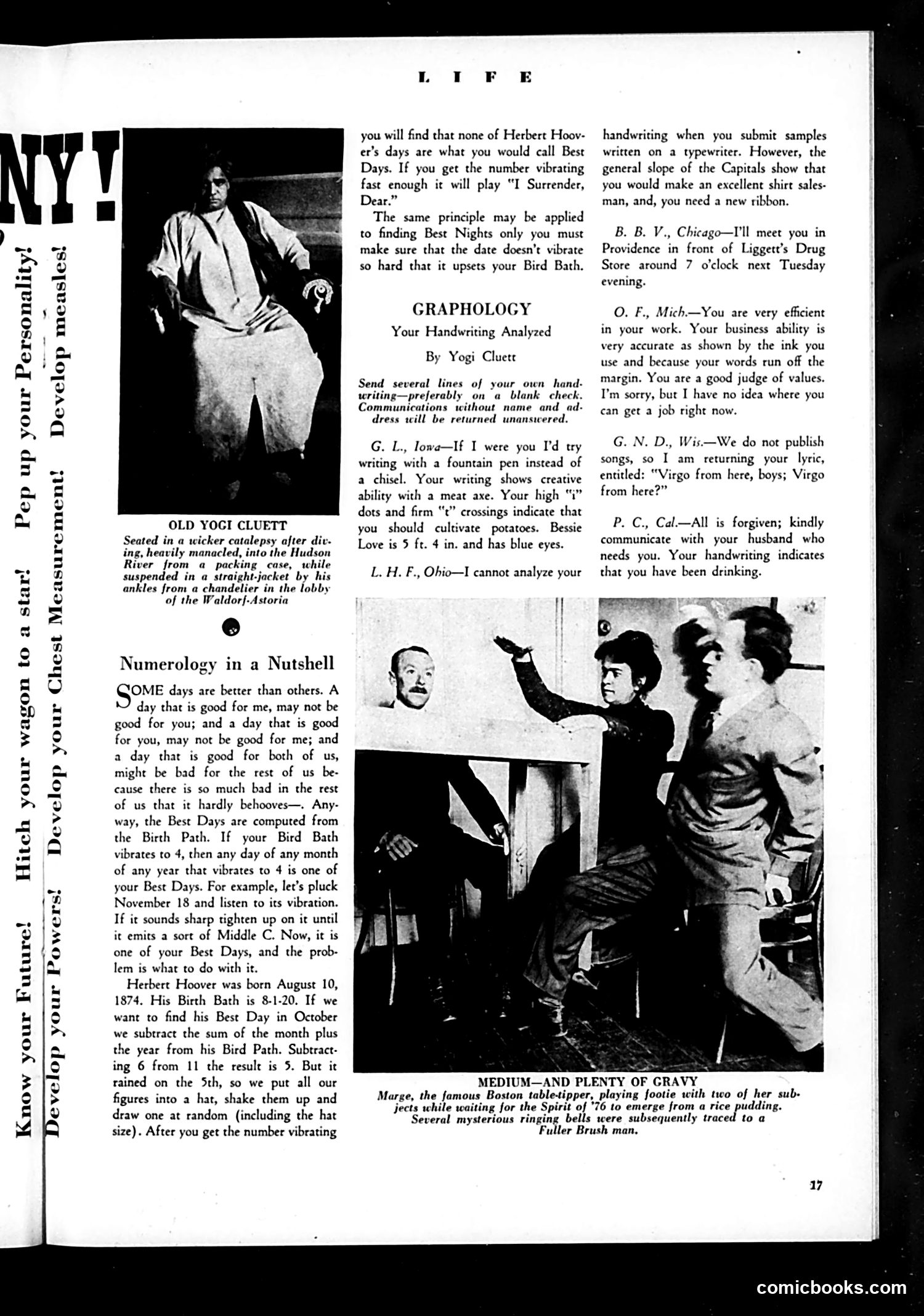
Analysis This page contains advice columns and spiritualist content rather than political satire. The main elements are: "Numerology in a Nutshell" discusses calculating "Best Days" from one's birth date—a numerological practice popular in the 1920s-30s. It references Herbert Hoover's birth date (August 10, 1874) as an example, suggesting he had "Best Days" for decision-making based on number vibrations. "Graphology" by Yogi Cluett offers handwriting analysis advice. The bottom photograph labeled "Medium—and Plenty of Gravy" appears to show a séance or spiritualist demonstration, with figures gathered around what the caption suggests is a table-tipping séance attempting to contact spirits. These represent period fascinations with numerology, handwriting analysis, and spiritualism—pseudosciences that appealed to many Americans during this era.
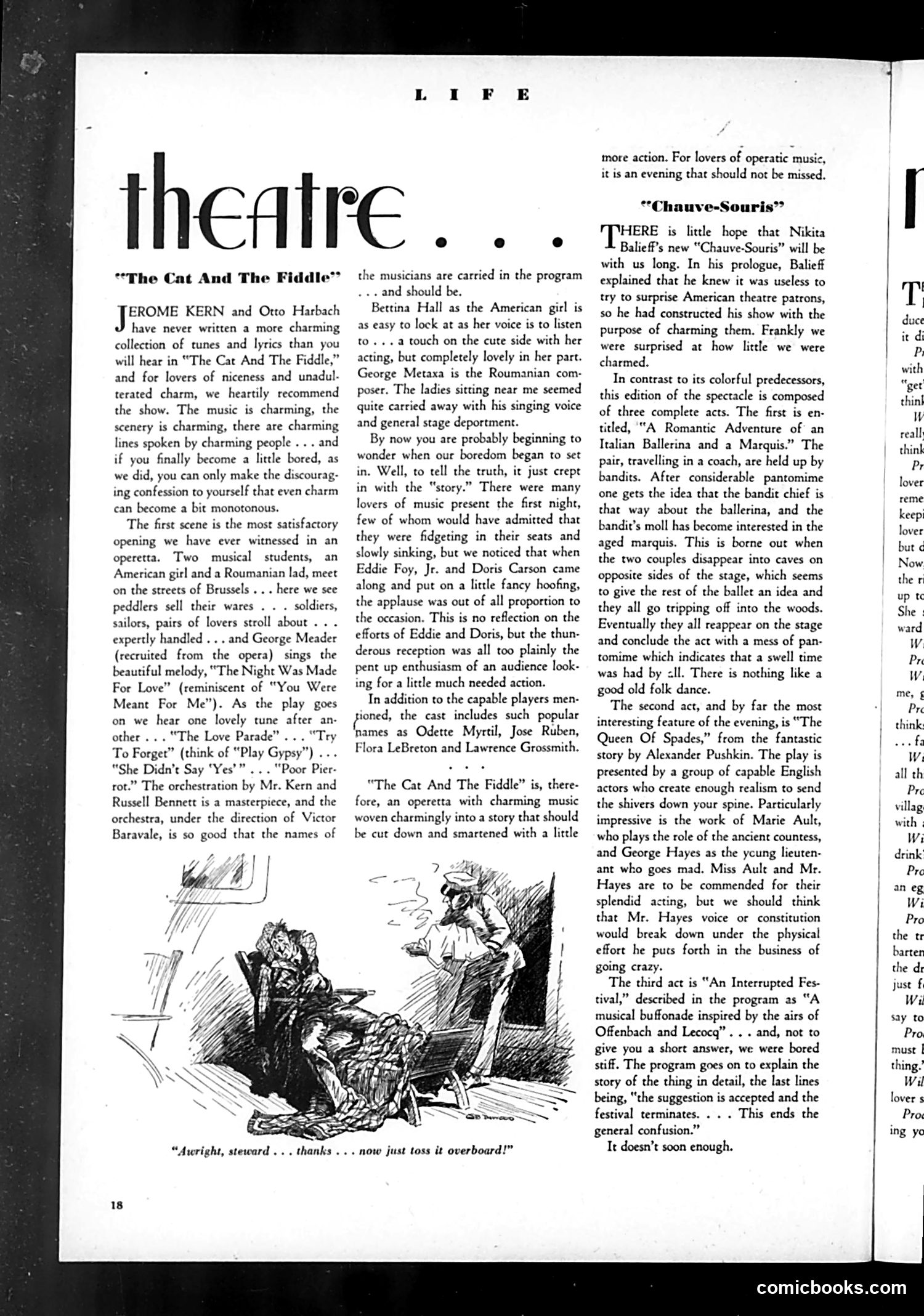
Theatre Review: "The Cat and the Fiddle" This page reviews Jerome Kern and Otto Harbach's operetta "The Cat and the Fiddle." The accompanying sketch depicts a theatrical scene with two figures in period costume—likely representing characters from the production. The review praises the show's charming music and scenery, noting it offers pleasant escapism. The critic mentions specific performers and songs, particularly highlighting "The Night Was Made For Love" as a beautiful melody. The review indicates this operetta provides light entertainment with engaging orchestration under conductor Victor Baravalle. The sketch's caption—"Alright, steward . . . thanks . . . now just toss it overboard!"—suggests comedic absurdity, though its specific reference within the operetta is unclear from this excerpt alone.
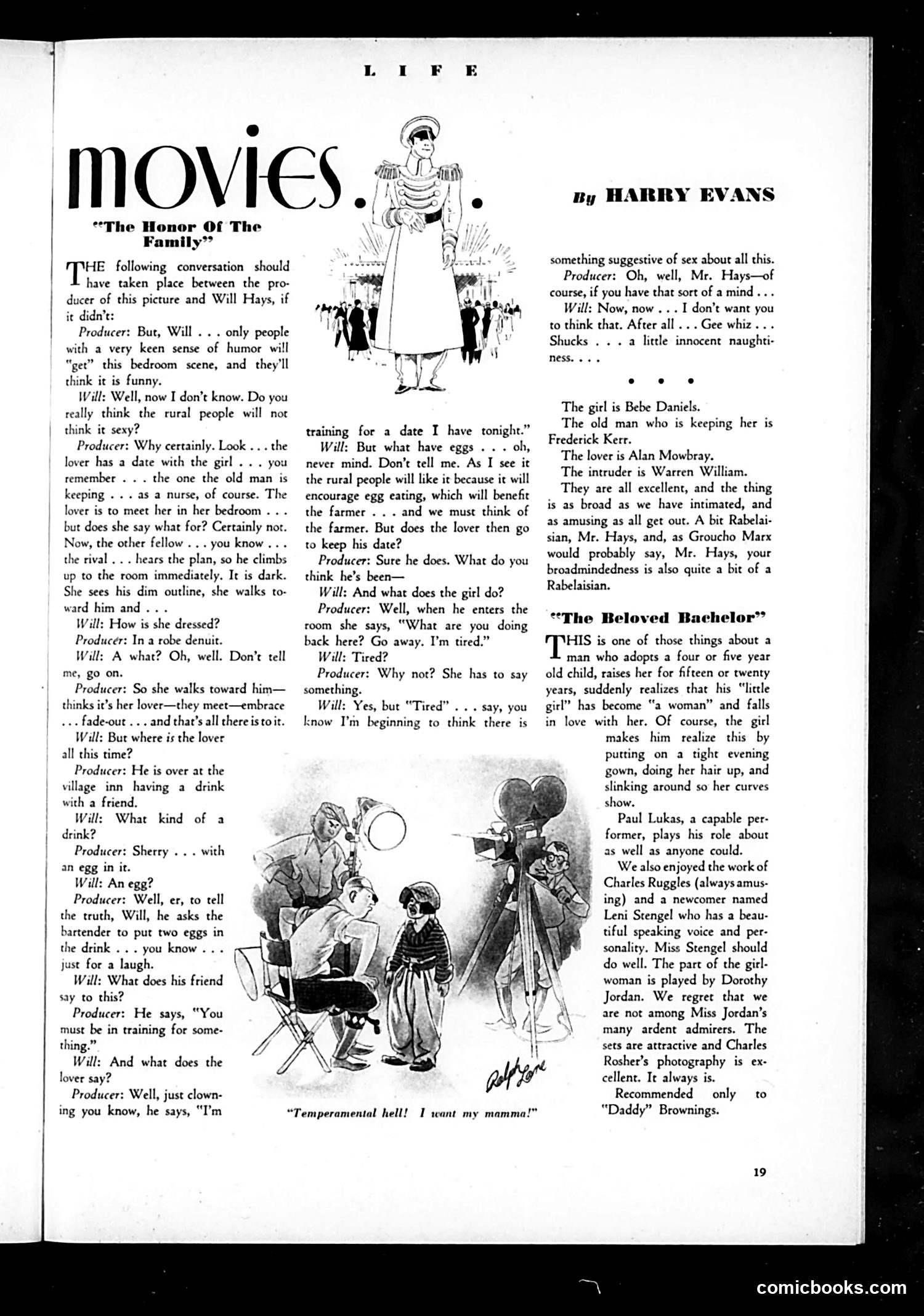
Analysis of "The Honor of the Family" - Life Magazine Movie Column This page contains a satirical movie review by Harry Evans discussing a bedroom scene from an unnamed film. The humor centers on a conversation between a film producer and director about staging a seduction scene with "rural people" as the audience. The satire mocks Hollywood's condescending attitudes toward rural/farm audiences. The producer suggests adding "eggs" to a drink and emphasizes that farmers will appreciate the scene because it relates to "egg eating," treating rural viewers as simple-minded. The accompanying illustration shows a film crew shooting a scene with actors and equipment, satirizing how producers cynically calculate what will appeal to different audiences based on stereotypes rather than genuine dramatic merit. The second review discusses "The Beloved Bachelor," a film featuring various actors in a coming-of-age storyline.
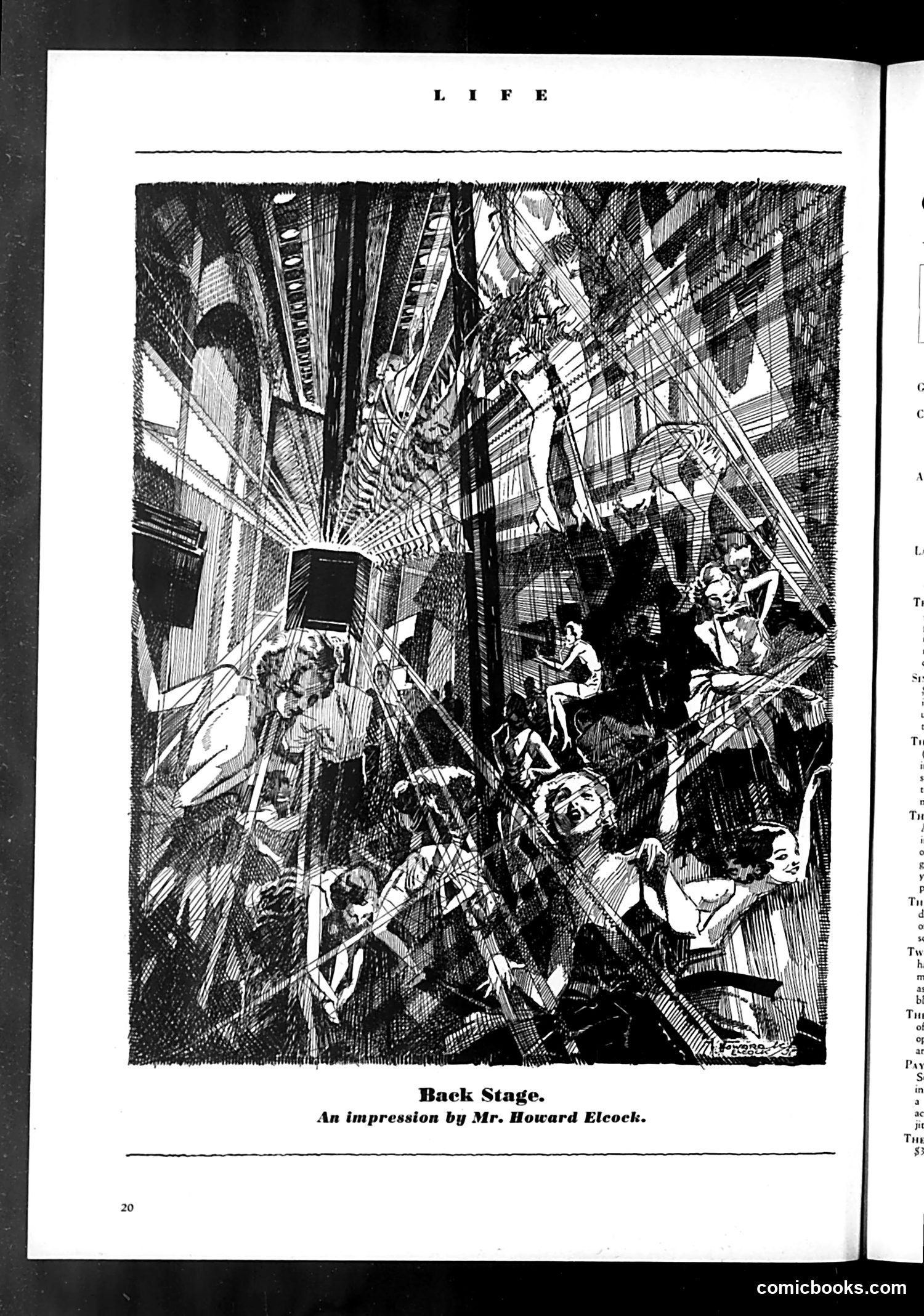
Back Stage This is an illustration titled "Back Stage: An impression by Mr. Howard Elcock," depicting a chaotic theater backstage scene. The intricate cross-hatched drawing shows numerous figures—performers, stagehands, and theatrical workers—crowded amid scenery, props, and equipment in tight, cramped conditions. The perspective emphasizes the visual confusion and frenetic activity. The satire likely comments on the disorganized, hectic reality behind theatrical productions—contrasting the polished performances audiences see onstage with the messy, crowded labor that enables them. The composition's dense linework and cramped figures suggest claustrophobia and barely-controlled chaos. Without additional context about the specific publication date or theatrical references, the broader point appears to be satirizing the unglamorous, often overwhelming conditions theater workers actually endured.
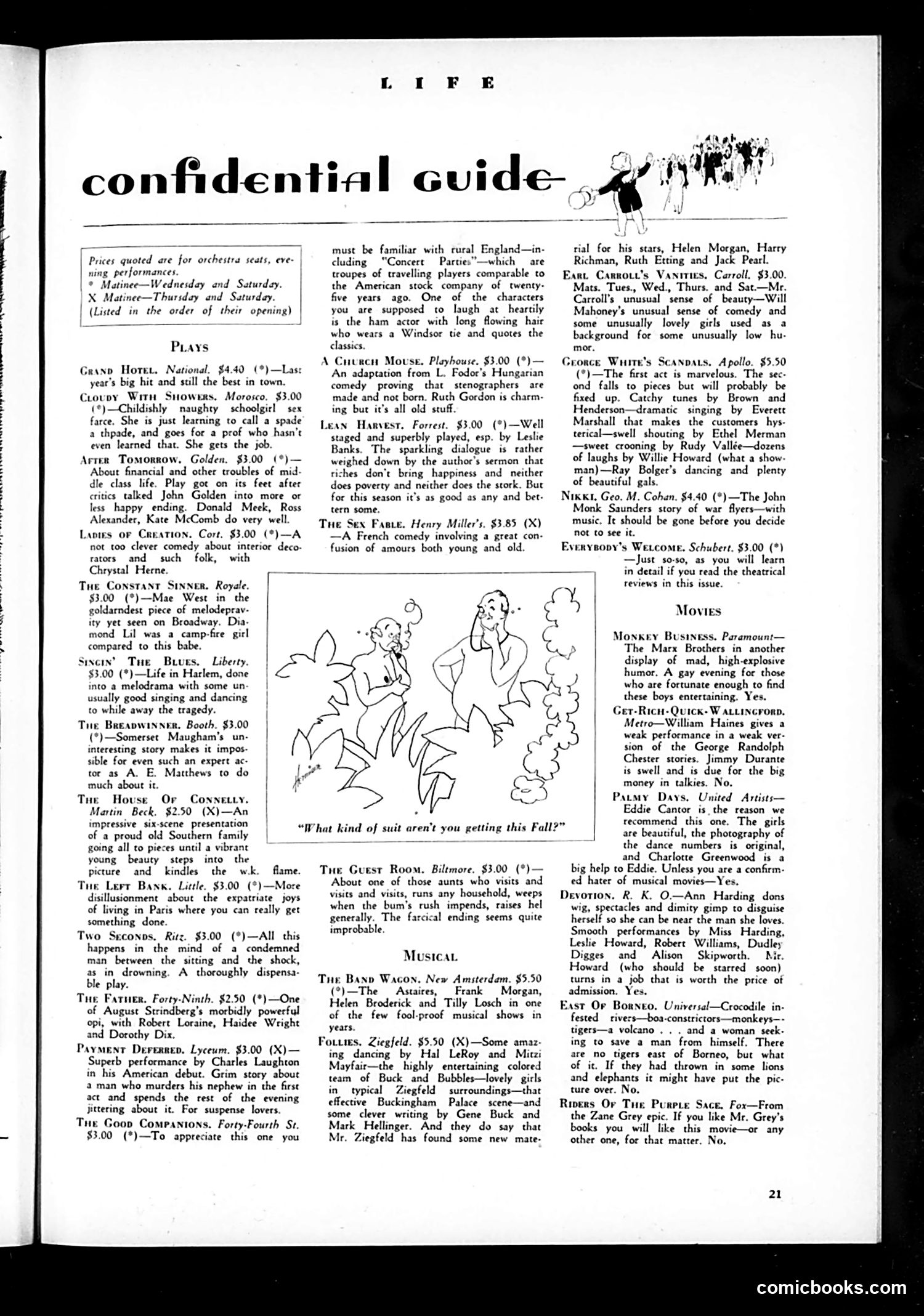
Analysis of Life Magazine Page This is a theater review page from Life magazine's "Confidential Guide" section, listing Broadway plays and musicals with brief critiques and ticket prices (ranging $2.50-$5.50). The single cartoon shows figures falling or tumbling with the caption: *"What kind of suit aren't you getting this Fall?"* This appears to be a visual pun about men's fashion—the figures are literally "falling" (out of their suits), making a joke about updating one's wardrobe for the new season. The reviews themselves reveal 1920s-30s theater culture: Mae West appears in notably scandalous roles; reviews reference "Harlem" entertainment; and there's commentary on contemporary concerns (financial troubles, expatriate disillusionment in Paris). The tone is witty and snobbish—dismissing some shows as "childishly naughty" or "not too clever." The asterisks denote matinee schedules, indicating this was practical entertainment guidance for a middle-to-upper-class readership seeking Broadway evening entertainment.
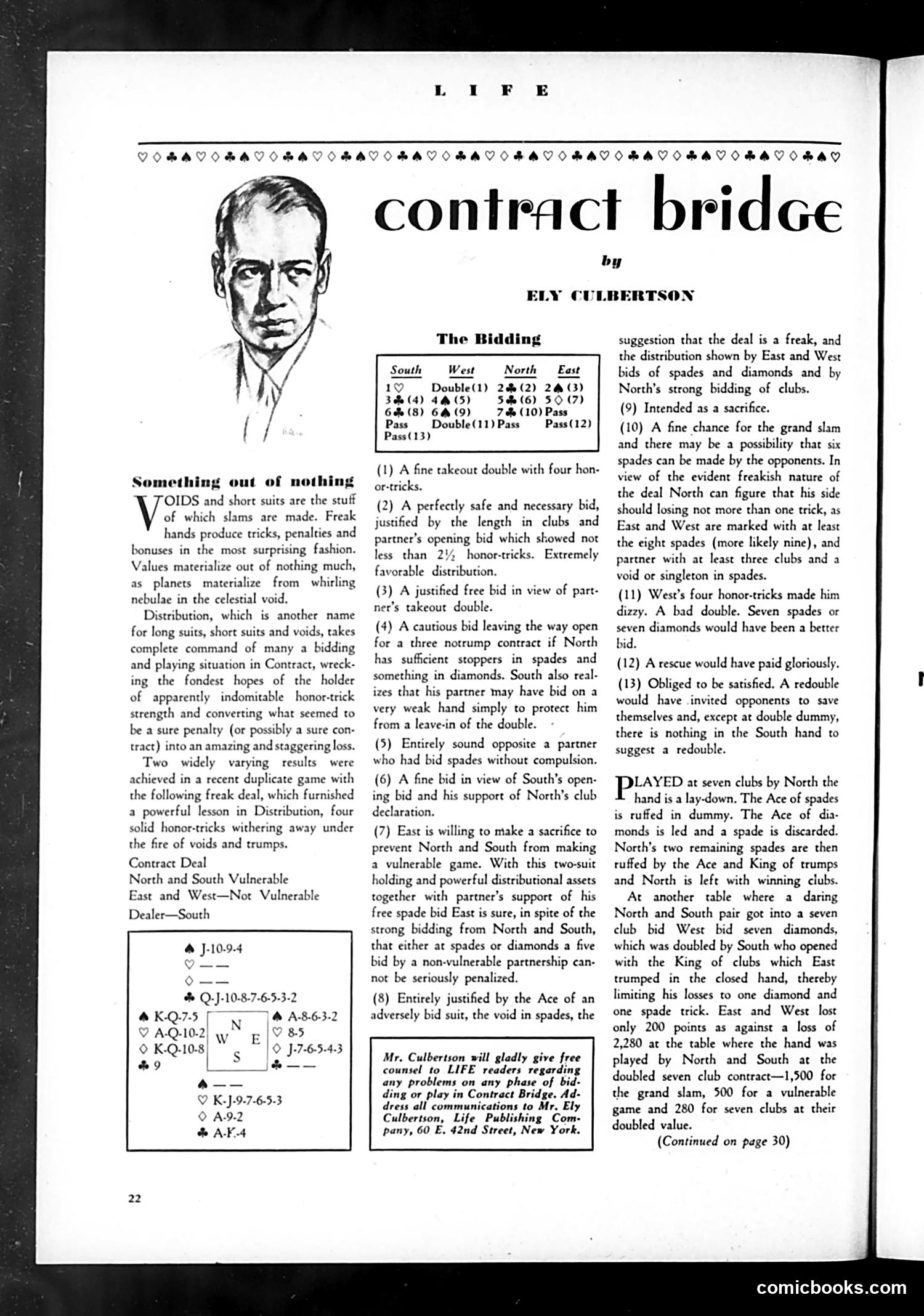
Contract Bridge Column Analysis This page features an instructional article on Contract Bridge by Ely Culbertson, a renowned bridge expert. Rather than satire or political commentary, it presents a detailed analysis of a specific bridge hand ("freak deal"), examining the bidding strategies and decision-making processes of four players. The article's title, "Something out of Nothing," refers to how bridge hands with unusual distributions of suits and voids can produce unexpected and dramatic results—high-value contracts or penalties emerging from seemingly weak holdings. The content is educational: Culbertson annotates each bid (numbered 1-13) with strategic explanations, teaching readers about distribution, honor-tricks, and risk assessment in bidding. The hand diagram shows the dealt cards for all four players. This represents Life magazine's bridge advice column, offering readers expert coaching rather than humor or social commentary.
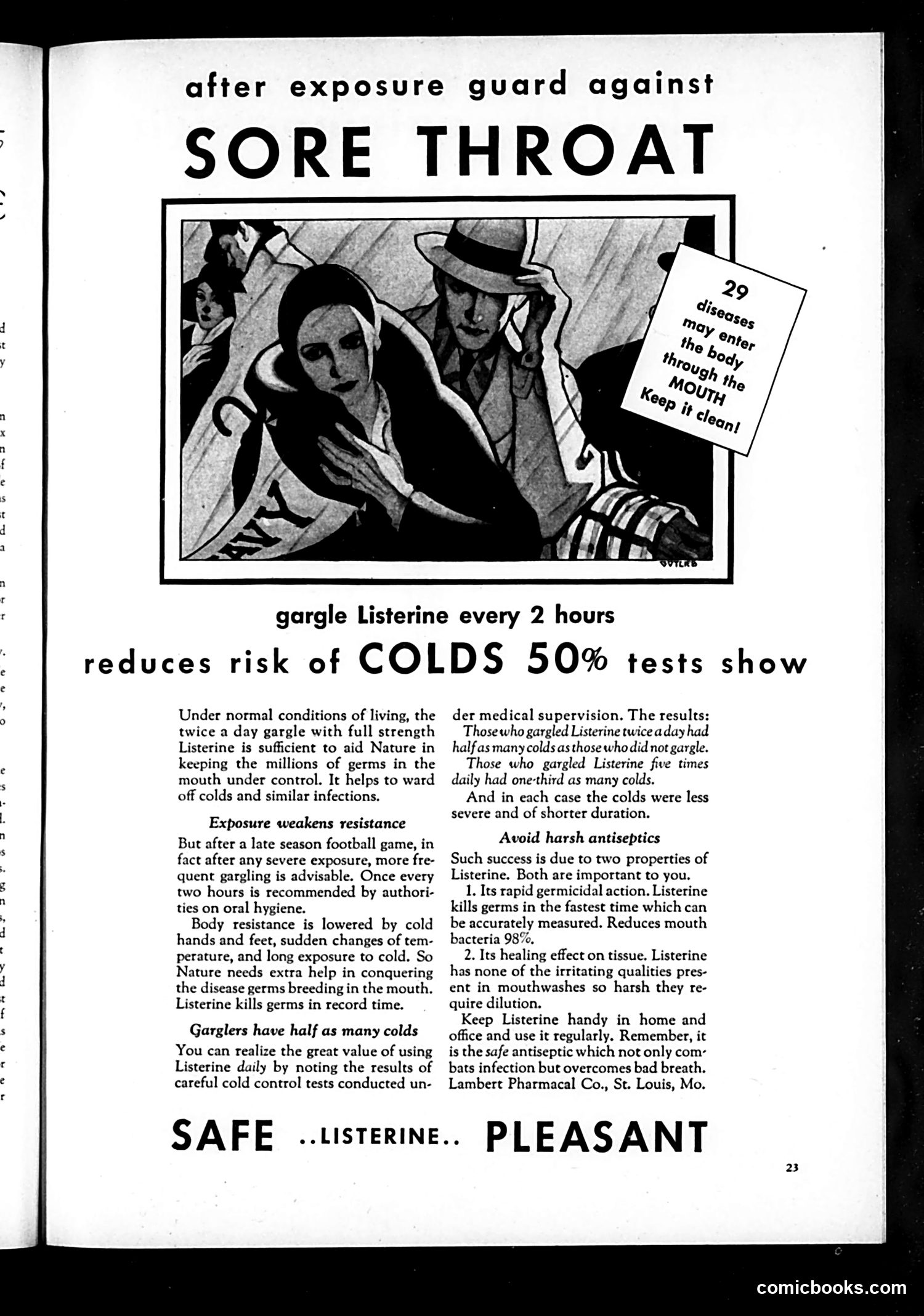
Analysis: Listerine Advertisement This is a Listerine mouthwash advertisement, not satire—it's a genuine commercial pitch from an era (appears to be 1930s-40s) when such claims were unregulated. The image shows a man and woman in formal attire (he in a fedora and coat, she wrapped in blankets) appearing ill after exposure to cold weather. The accompanying text promotes gargling Listerine to prevent sore throats and colds, claiming it "reduces risk of COLDS 50%." The advertisement reflects pre-FDA era medicine marketing: it makes dramatic health claims ("kills germs in record time," "reduces mouth bacteria 98%") without modern scientific scrutiny. The casual reference to "late season football game" exposure and weakened body resistance reflects period anxieties about contagion. For modern readers, this exemplifies how mouthwash was once marketed as a serious medical prophylactic rather than merely for breath freshening—a claim modern dentistry has largely debunked.
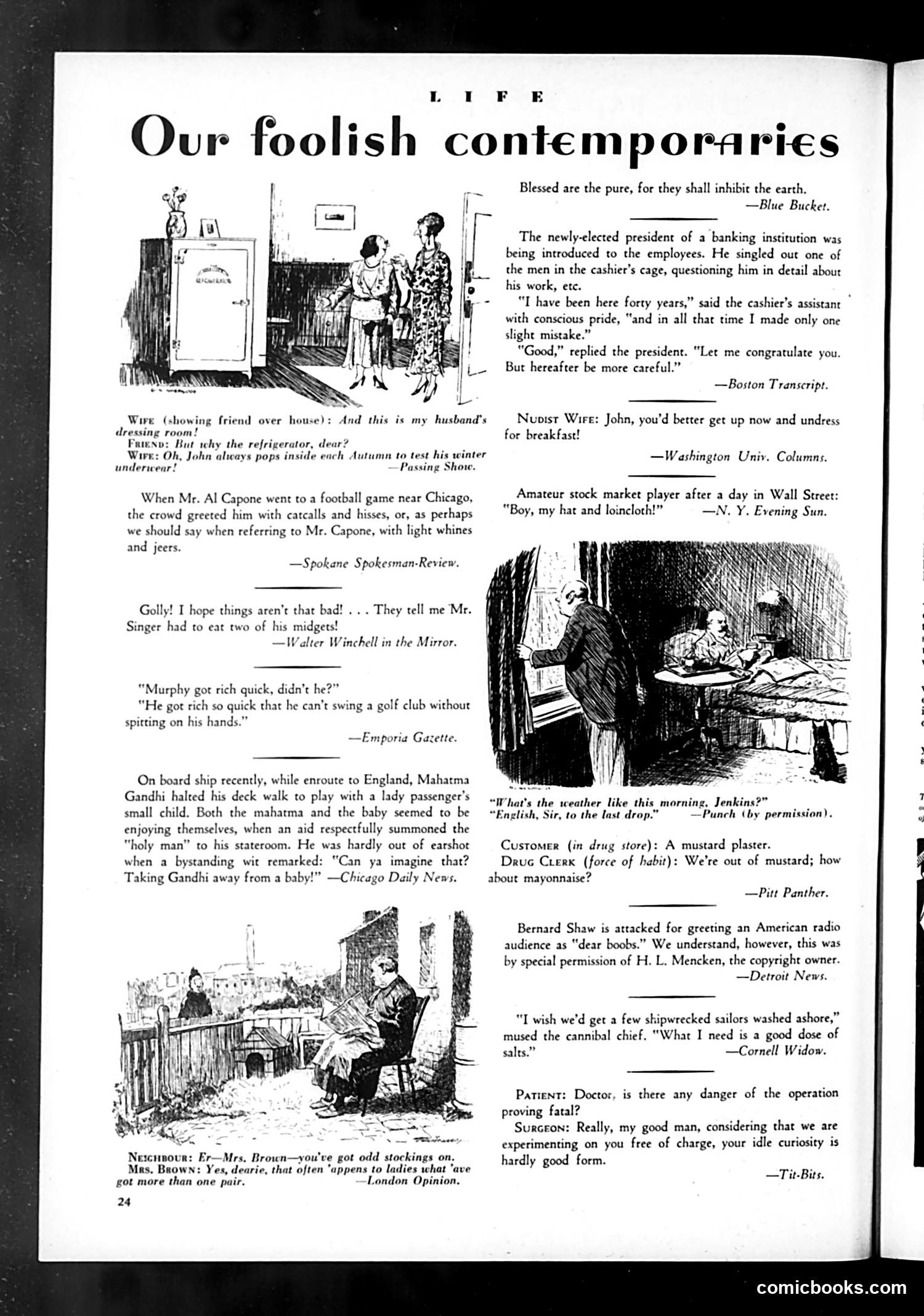
"Our Foolish Contemporaries" - Life Magazine Satire Page This page collects brief humorous anecdotes mocking contemporary figures and social absurdities. Key targets include: Al Capone: The famous gangster's appearance at a Chicago football game drew hostile crowd reactions—the joke being that even describing his reception requires euphemism ("light whines" instead of "catcalls"). Mahatma Gandhi: Referenced in an anecdote about him being called away from playing with a child to attend to business—the humor lies in suggesting his "holy" status is incongruous with ordinary interruptions. General Social Foibles: Most items mock everyday pretension: husbands storing winter clothes in refrigerators, nouveaux riches unable to golf without spitting, stock market amateurs losing their clothes, and a doctor experimenting on a free patient while dismissing death concerns as "idle curiosity." The page exemplifies Life's satirical approach: deflating pomposity, mocking excess wealth and social climbing, and finding humor in human contradiction. The sourcing (various newspapers and college humor columns) indicates Life compiled topical humor from contemporary sources.
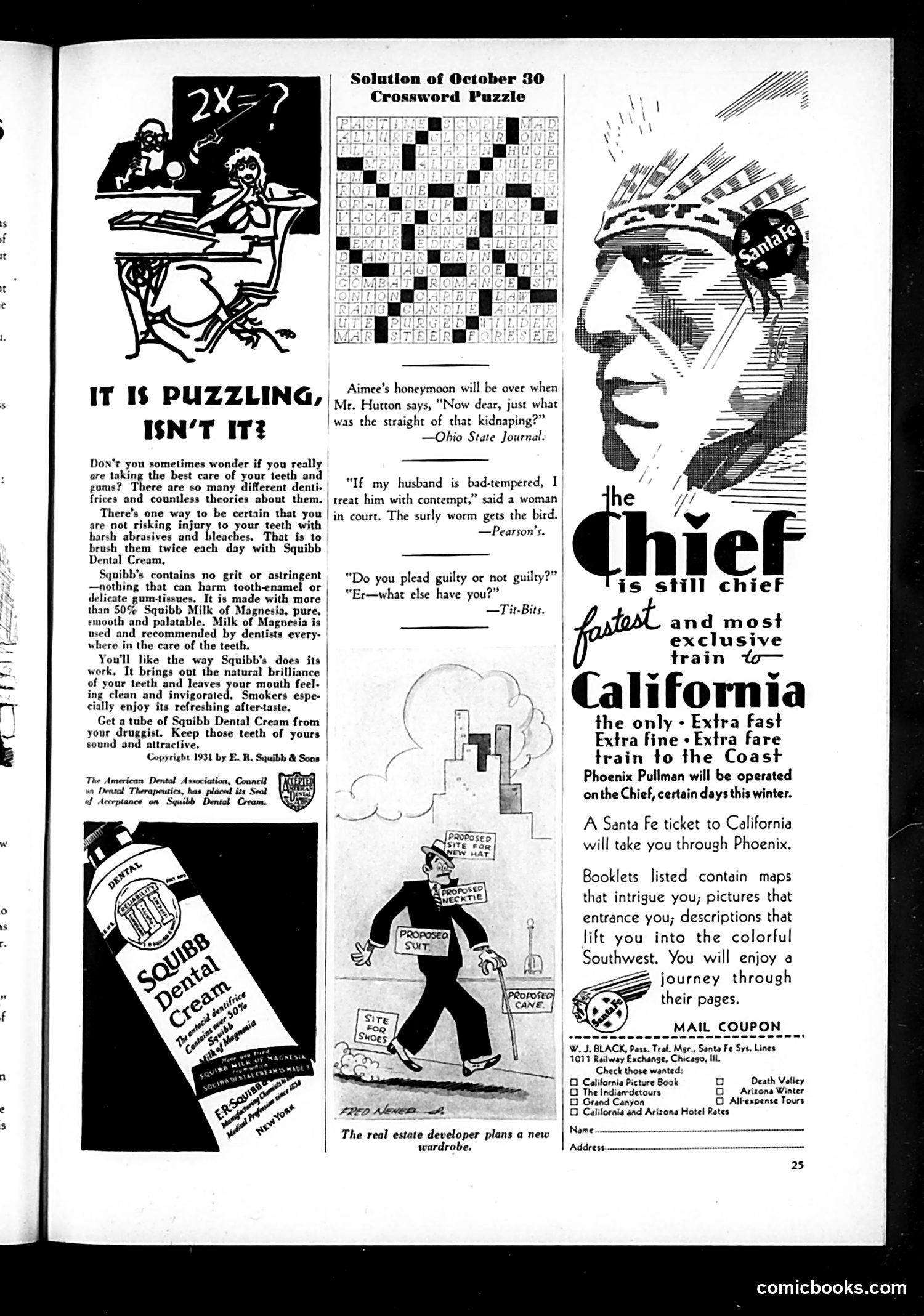
Analysis of Page Content This page contains primarily advertisements rather than political commentary. The main elements are: 1. Squibb Dental Cream ad (left): A 1931 commercial promoting toothpaste with Milk of Magnesia, emphasizing it contains no harsh abrasives. The cartoon shows a student struggling with math—a generic "puzzling" image to hook readers. 2. Brief humorous quotes (center): Three short jokes about marriage, court testimony, and bad temperament—typical light humor filler common in magazines of this era. 3. Santa Fe Railway "Chief" train ad (right): Promotes a luxury passenger train to California, featuring a Native American chief caricature as the brand image. The accompanying cartoon shows a "real estate developer" in various outfit changes—a mild joke about changing wardrobes for a new venture. The page reflects 1931 advertising conventions, including casual ethnic stereotyping (the Native American imagery) that would be considered offensive today. There is no significant political satire present.
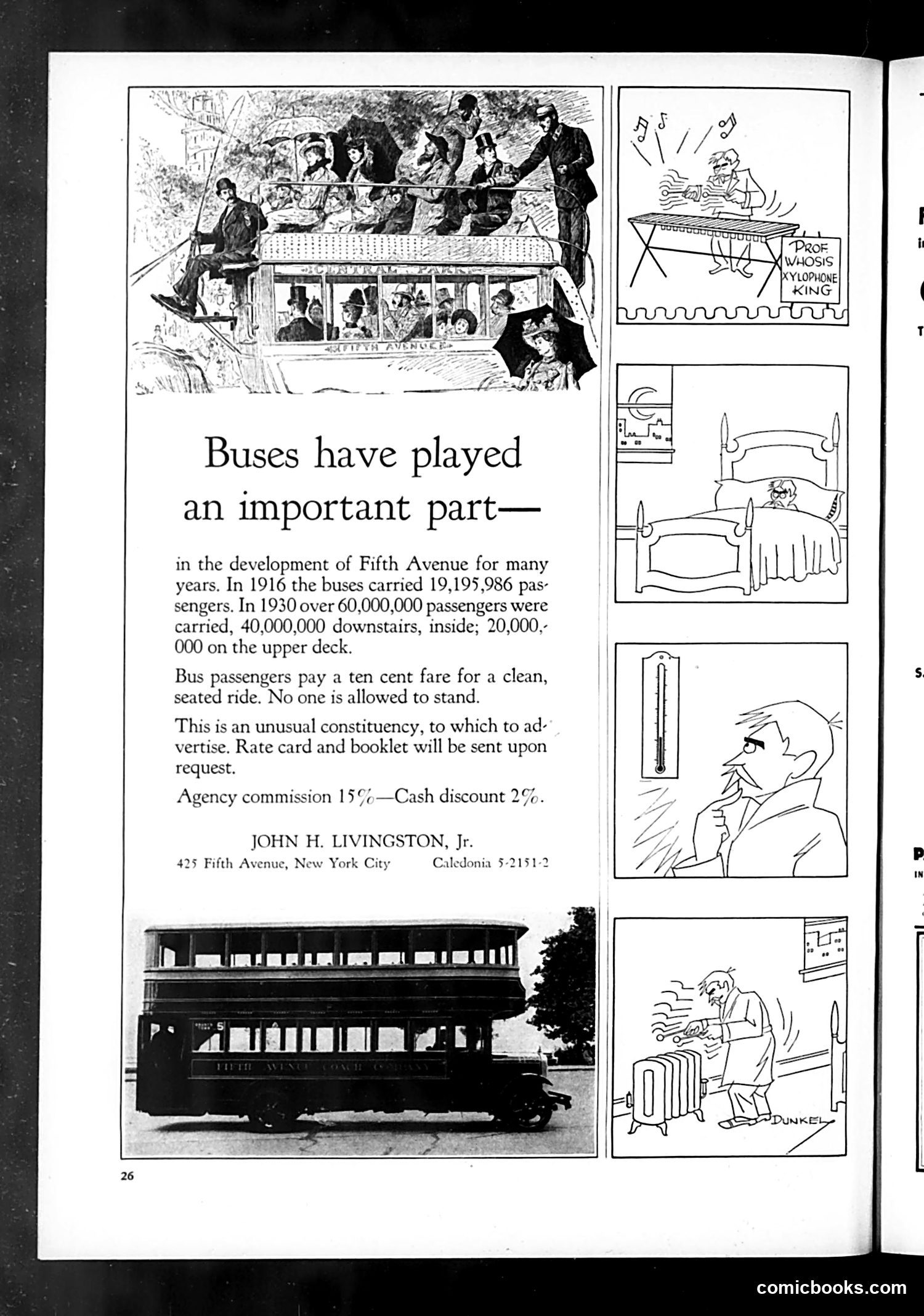
Analysis of Life Magazine Advertisement Page This is primarily advertising copy for John H. Livingston Jr.'s bus service on Fifth Avenue, not political satire. The page promotes double-decker buses as an advertising medium for reaching affluent passengers. The text highlights that buses transported millions annually (19 million in 1916, 60 million by 1930), offering "clean, seated" rides at ten cents—notably prohibiting standing, suggesting a premium service. The accompanying cartoons on the right are generic humor sketches depicting everyday situations (someone in bed, checking temperature, moving furniture), unrelated to the buses themselves. The satire is subtle and economic rather than political: Livingston is pitching Fifth Avenue buses as a valuable advertising platform precisely because their passengers represent "an unusual constituency"—wealthy, seated, captive riders representing desirable consumers. The humor lies in treating bus commuters as a demographic target rather than mere transportation users.
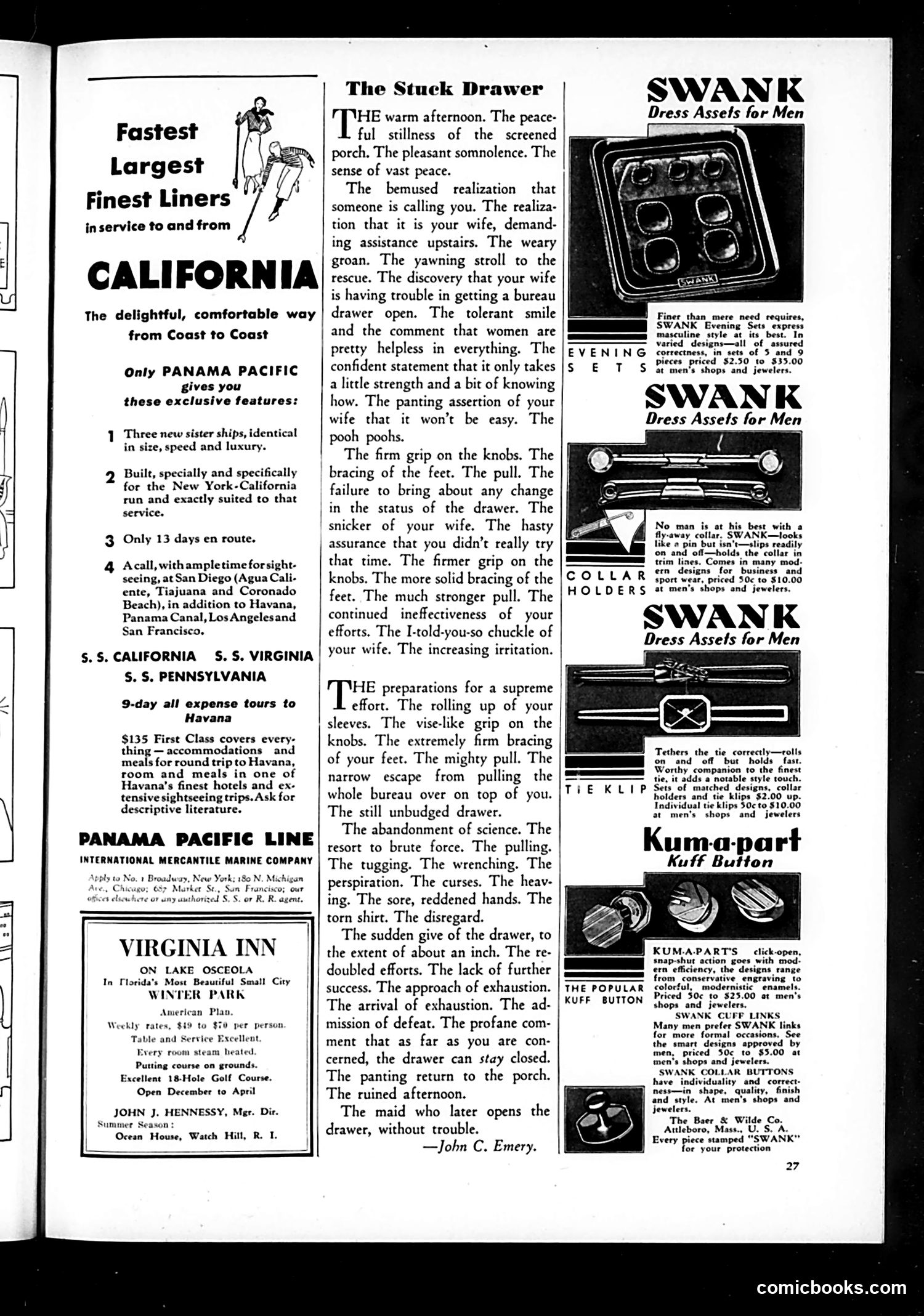
"The Stuck Drawer" - A Domestic Comedy This is primarily a humorous short story by John C. Emery, not a political cartoon. The piece satirizes masculine pride and incompetence through a relatable domestic scenario: a husband confidently—but unsuccessfully—attempts to open a stuck bureau drawer for his wife. The humor lies in the predictable male ego: the husband's initial dismissive attitude ("women are pretty helpless in everything"), his escalating physical efforts (firm grips, bracing feet, mighty pulls), mounting frustration, and eventual defeat—all undermined when "the maid who later opens the drawer, without trouble." The satire gently mocks masculine overconfidence and the gap between perceived capability and actual results. It's gentle social commentary on gender dynamics and household life, typical of *Life* magazine's satirical approach. The story is framed by period advertisements for cruise lines, hotels, and men's accessories (Swank cufflinks and collar holders), reflecting 1920s-30s consumer culture.
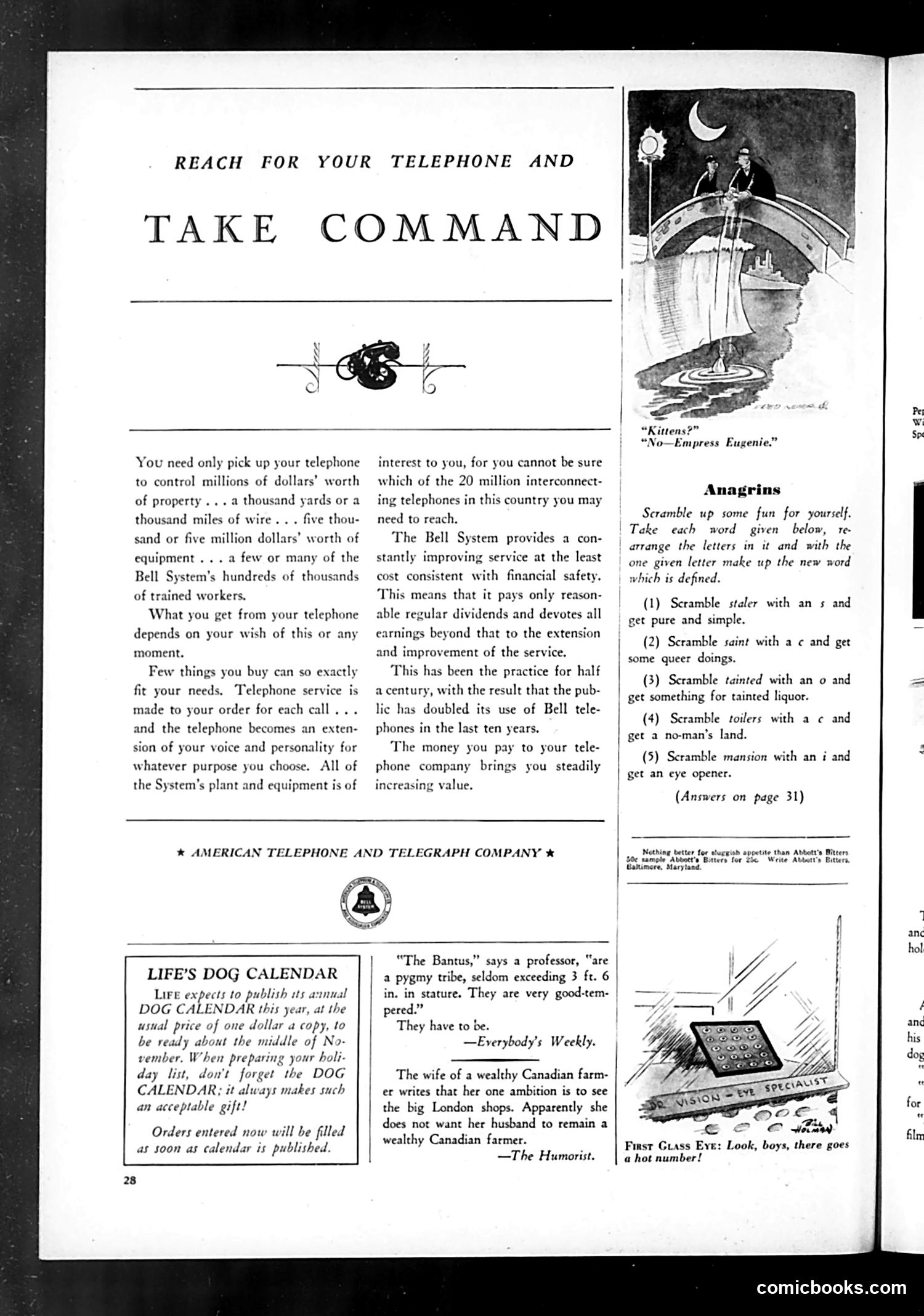
Analysis of Life Magazine Page This is primarily a Bell Telephone System advertisement disguised as editorial content, promoting the telephone as a tool of personal power and control. The ad's rhetoric—"Take Command," ability to control "millions of dollars' worth of property"—uses grandiose language to market phone service as essential infrastructure for business and personal mastery. The page also contains: - "Kittens?" / "No—Empress Eugenie": A small cartoon suggesting someone mistook a woman's appearance or identity, likely satirizing either fashion pretension or historical knowledge gaps. - "Anagrins": A word puzzle feature (unrelated to satire). - Humorous filler quotes poking gentle fun at social observations: Bantus being "good-tempered" by necessity, and a Canadian farmer's wife wanting to leave rural life for London shopping. - A "First Glass Eye" caption about a technological novelty, presented as whimsy. The page reflects early 20th-century Life magazine's mix of corporate advertising, light social humor, and puzzles targeting middle-class readers.
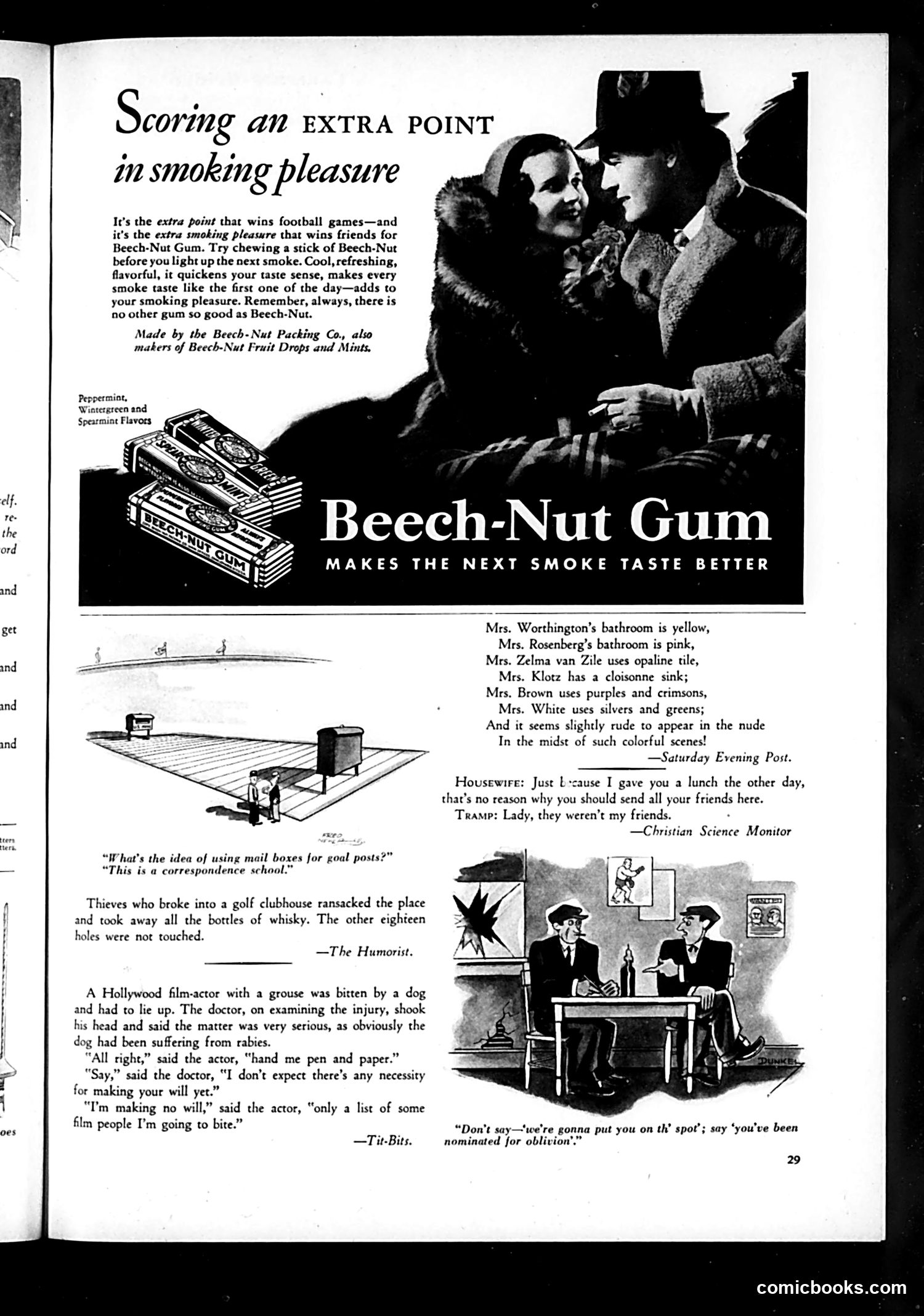
Page Analysis: Life Magazine This page is primarily a Beech-Nut Gum advertisement (top half) featuring a photograph of two men and a woman in winter clothing, with text claiming the gum enhances smoking pleasure. Below the ad are several brief humor pieces typical of Life's satirical content: - A poem mocking women's obsession with colorful bathroom fixtures - A joke about a vagrant claiming the housewife's lunch guests were not actually his friends - A golf club theft joke playing on "holes" (implying Prohibition-era whisky smuggling) - A Hollywood actor joke where, after being bitten by a rabid dog, he quips he'll bite film industry people in revenge The final cartoon shows two men at a desk, with one saying the other has been "nominated for oblivion"—satirizing euphemistic Hollywood language. Context: These reflect 1920s-30s preoccupations: Prohibition, gender stereotypes, and Hollywood's growing cultural influence. The humor is mild, observational rather than pointed political satire.
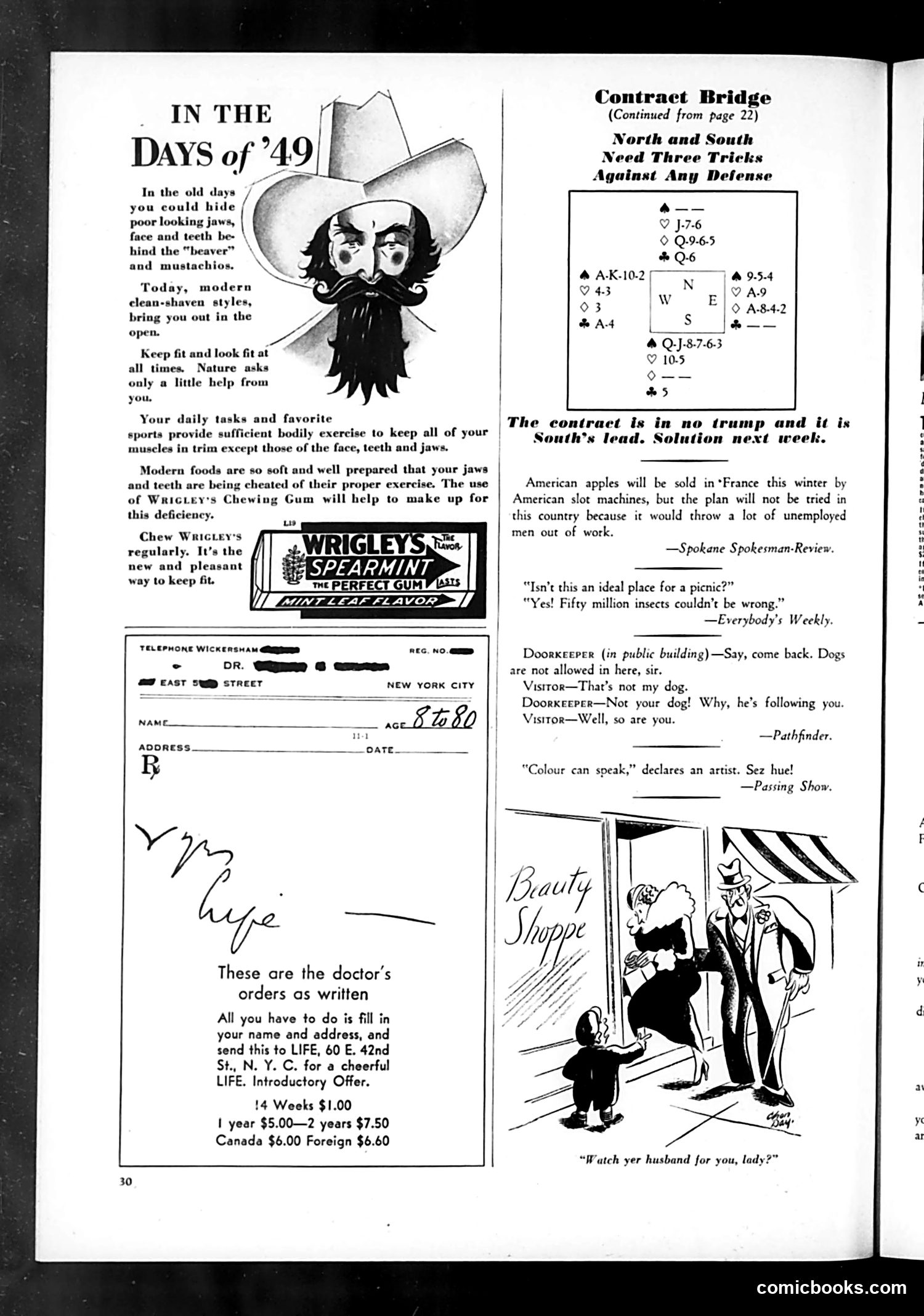
Analysis for Modern Readers This page combines advertising with satirical commentary typical of 1920s *Life* magazine. Left side: A Wrigley's gum advertisement uses pseudo-scientific health messaging. It argues that modern soft foods don't exercise facial muscles, so chewing gum compensates—a humorous exaggeration of product benefits. The cowboy illustration references 1920s nostalgia ("Days of '49"). Right side: Contains a contract bridge column (a popular game), followed by brief satirical "news items" mocking contemporary absurdities: American slot machines selling apples in France, a picnic joke about insects, and a doorkeeper/visitor exchange playing on ambiguous pronouns for comic effect. The humor: These short items satirize modern life's peculiarities—technological solutions to invented problems, bureaucratic confusion, and consumer culture. The page reflects *Life's* role as a witty commentary magazine mixing entertainment, advertising, and social observation for educated urban readers.
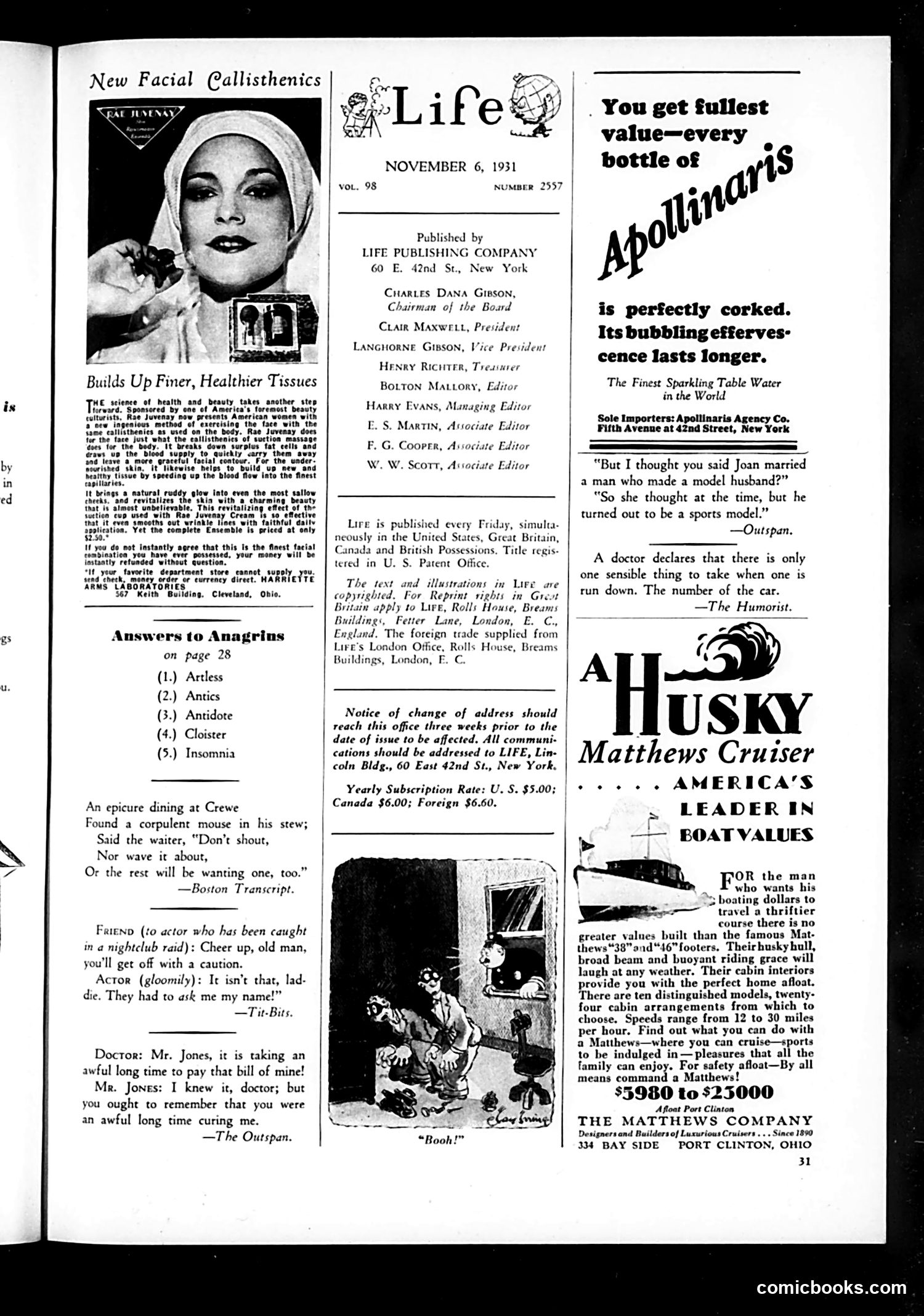
Life Magazine Page Analysis (November 6, 1931) This page is primarily advertising and light humor rather than political satire. The main content includes: "New Facial Callisthenics" advertisement: Promotes Rae Juvenay facial exercise products, claiming they build "finer, healthier tissues" through a "scientific method." This reflects 1930s beauty culture's embrace of pseudo-scientific fitness claims. Humor section: Several brief jokes typical of the era—a mouse in stew, an actor caught in a nightclub raid, a doctor's unpaid bill. These are conventional comedic anecdotes, not satirical commentary. Advertisements: Apollinaris sparkling water and Matthews Cruiser boats dominate the right side, targeting affluent readers during the Great Depression (note the 1931 date). The page lacks significant political or social satire—it's representative of Life as a magazine balancing light humor, consumer advertising, and lifestyle content for middle-to-upper-class readers.
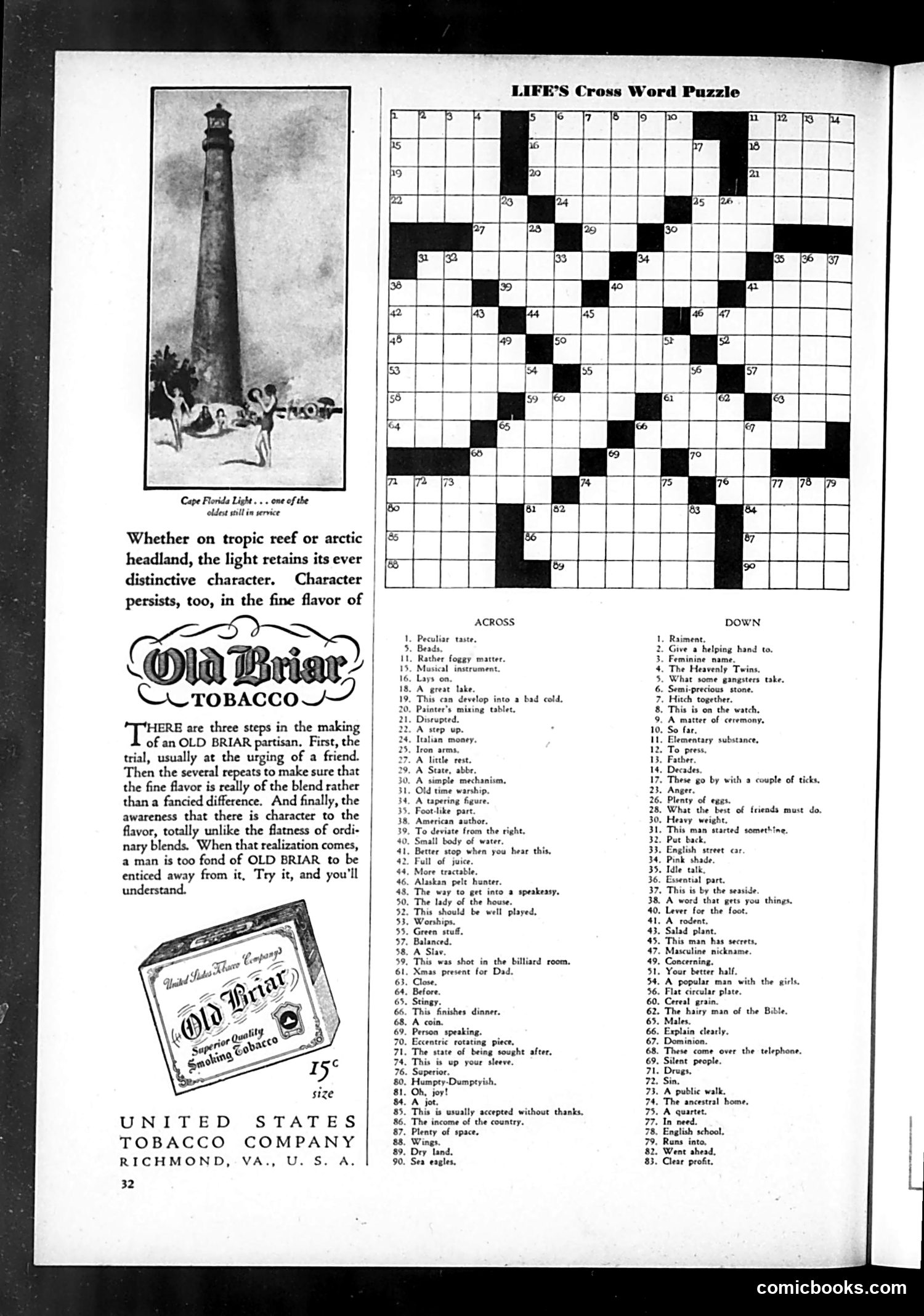
LIFE Magazine Page Analysis This page is primarily advertising, not satire or political commentary. The dominant content is an Old Briar Tobacco advertisement featuring a lighthouse (Cape Florida Light) and promotional text about the cigarette brand's distinctive flavor. The ad uses the lighthouse as a metaphor for character and reliability—qualities the company claims persist in their tobacco blend. The page also contains a crossword puzzle ("LIFE's Cross Word Puzzle") with clues, which was common entertainment content in magazines of this era. There is no political cartoon or satirical commentary visible on this page. The lighthouse image is purely illustrative advertising rather than editorial commentary. The United States Tobacco Company (Richmond, VA) is promoting their product through lifestyle and character association rather than any socially critical message.
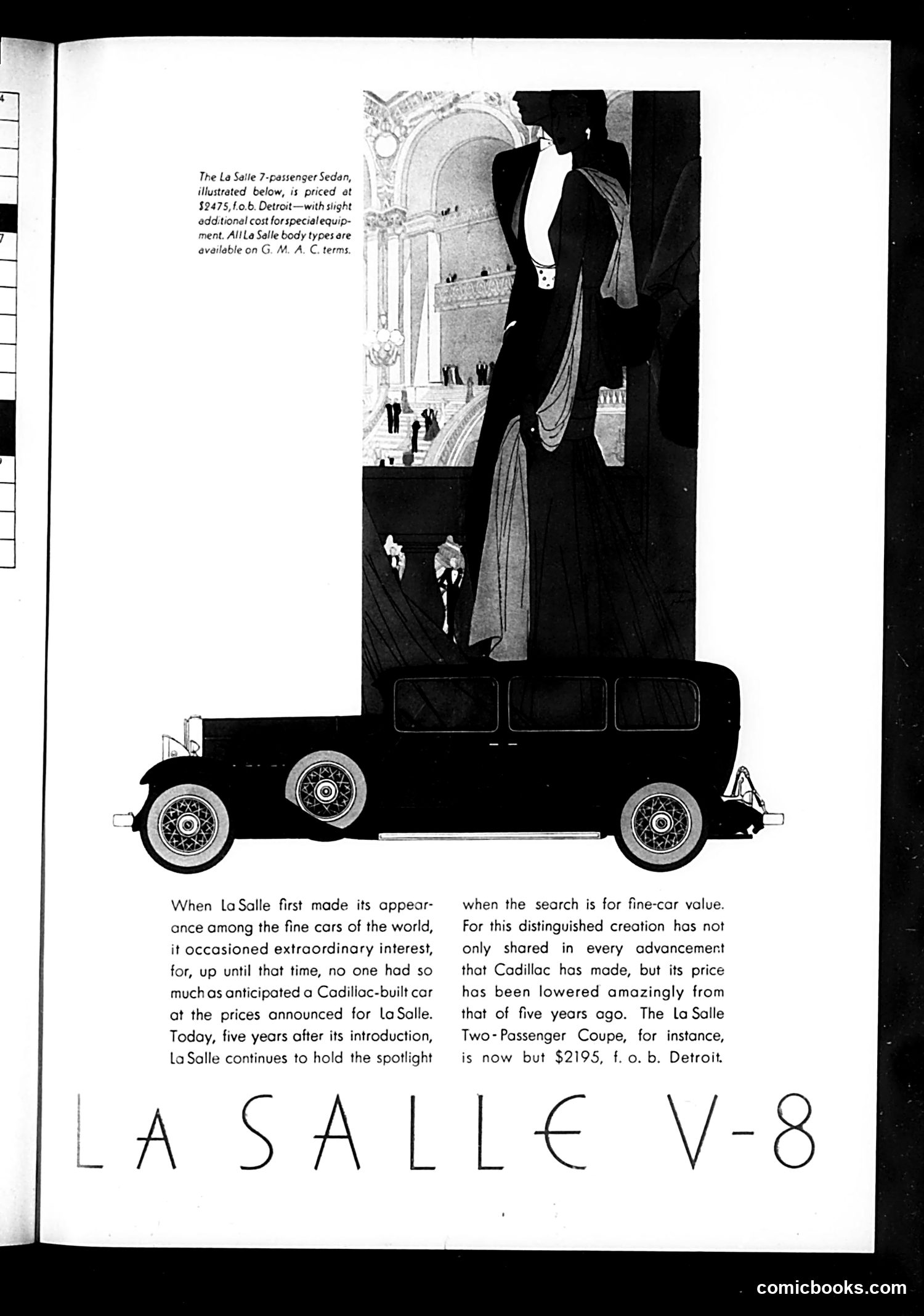
Analysis This is a car advertisement, not a political cartoon. It promotes the La Salle V-8, a luxury automobile manufactured by Cadillac. The page features an elegant illustration of a well-dressed couple in formal attire (tuxedo and evening gown) posed against an architectural backdrop suggesting sophistication and wealth. The car itself is shown in silhouette at the bottom. The advertisement's appeal is purely aspirational: it associates the La Salle with fine taste, social status, and refinement. The text emphasizes that this is a "Cadillac-built car" at lower prices than competitors—positioning it as luxury made accessible to the upper-middle class. For modern readers: This represents Depression-era luxury marketing (based on pricing and GM financing availability), when automobiles signified social position and the ad sells not transportation but identity and prestige.
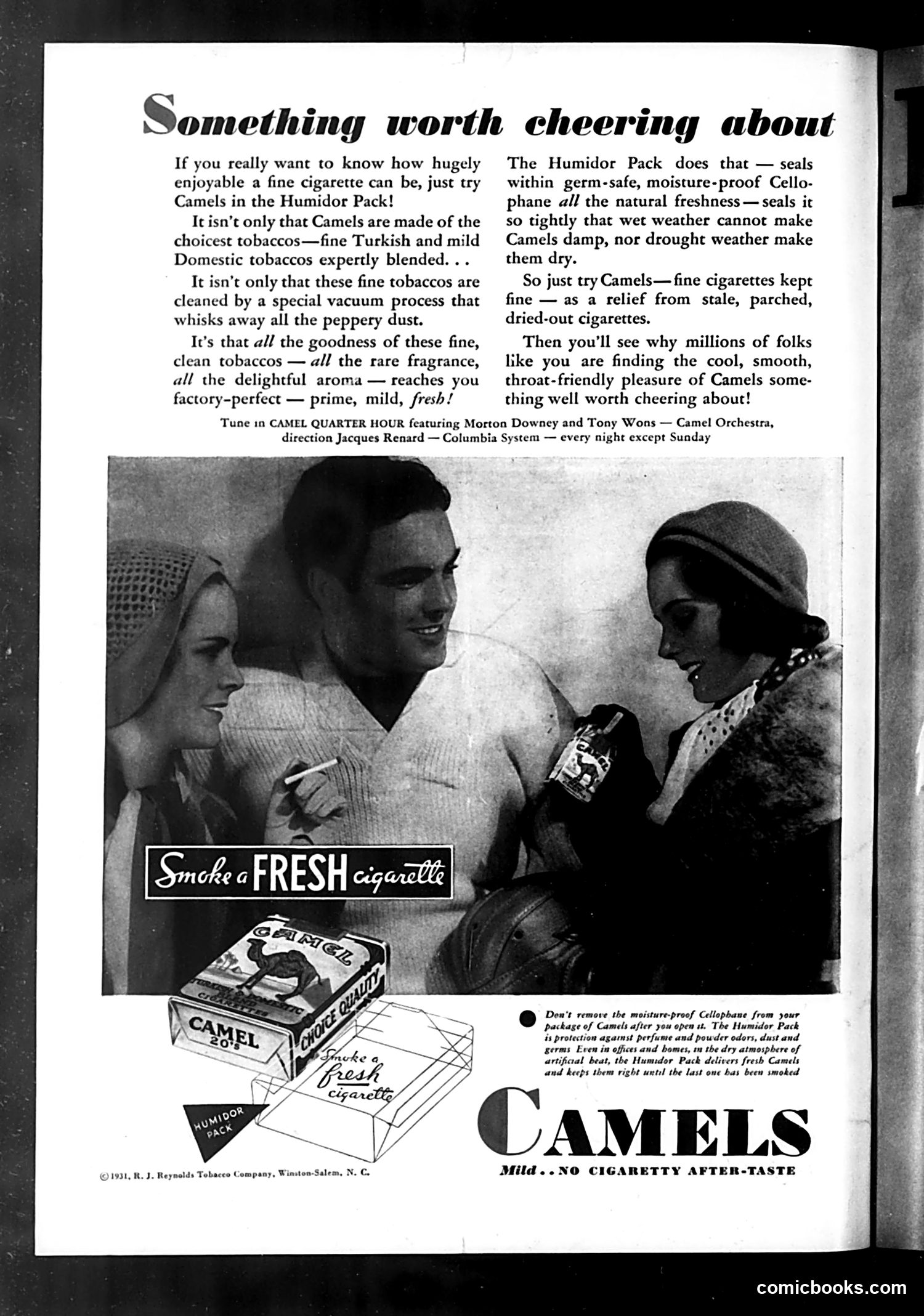
Advertisement Analysis This is not satire or political commentary—it's a straightforward cigarette advertisement from 1931. The page promotes Camel cigarettes' "Humidor Pack," a moisture-proof cellophane wrapper marketed as keeping cigarettes fresh. The photograph shows three well-dressed people examining a cigarette, presenting smoking as sophisticated and socially desirable. Key selling points emphasized: - Fine Turkish and domestic tobacco blends - Vacuum-cleaned tobacco - Sealed packaging protecting against humidity and dryness - Associated with a radio program ("Camel Quarter Hour") - Claims of "mild" taste with "no cigaretty after-taste" By modern standards, the advertisement is remarkable for its health-indifferent marketing—it touts freshness and taste while completely ignoring health risks. The image and text present smoking as an unquestionable social good, reflecting early 20th-century attitudes before widespread awareness of tobacco's dangers became public knowledge.