life
Life — November 13, 1931
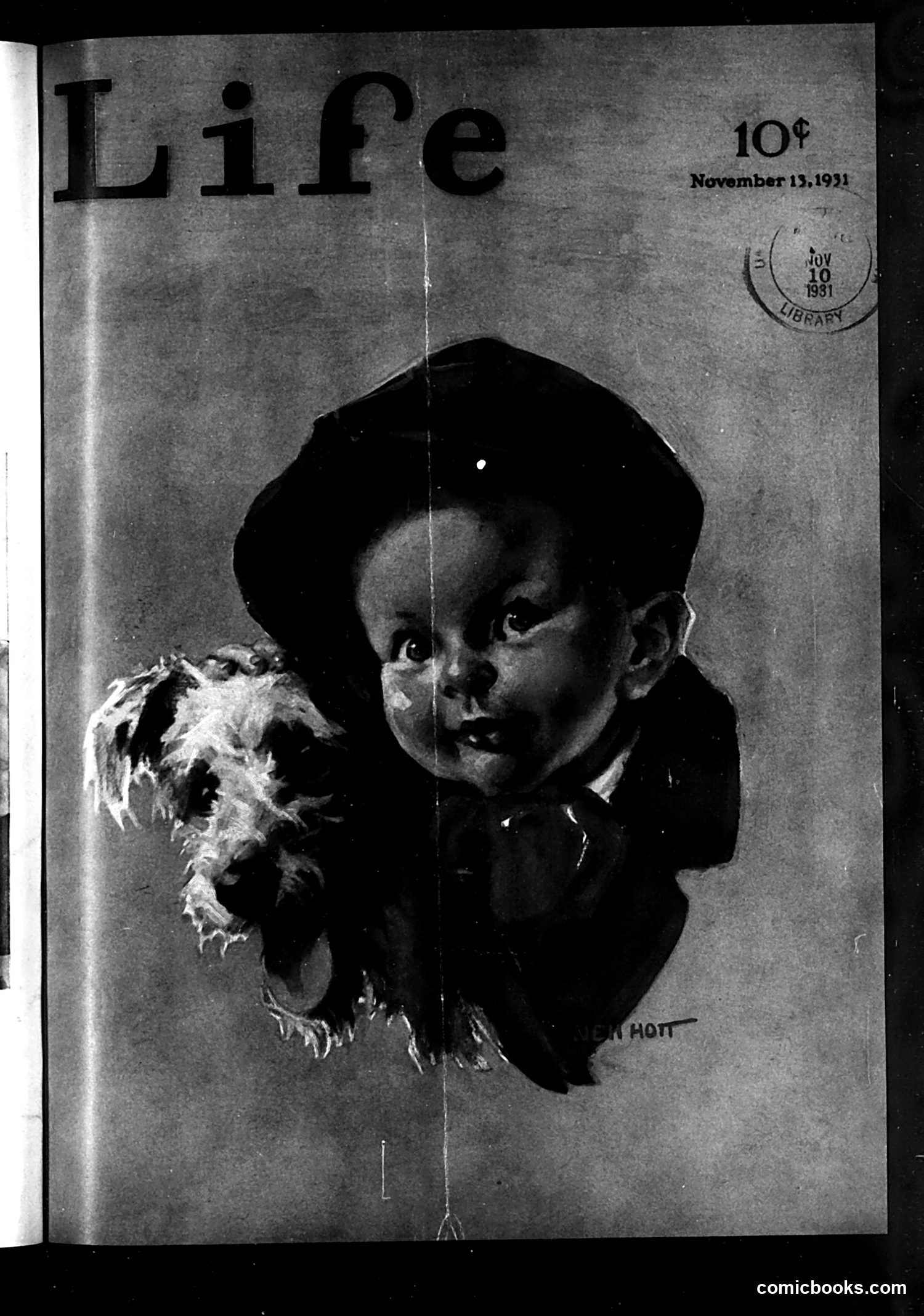
Life Magazine Cover Analysis - November 13, 1931 This cover depicts a young child wearing a cap, holding a small terrier-type dog. The illustration is signed "N HOTT" (the artist's name). Without additional OCR text visible on this cover page, the specific satirical message is unclear. However, given the November 1931 date—during the Great Depression—the cover likely carries social commentary about childhood, family, or economic conditions of that era. The innocent pairing of child and pet may be either sentimental or ironic commentary on American life during economic hardship. The cover price of 10¢ is typical for Life magazine of this period. The library stamp indicates this was preserved in an archive.
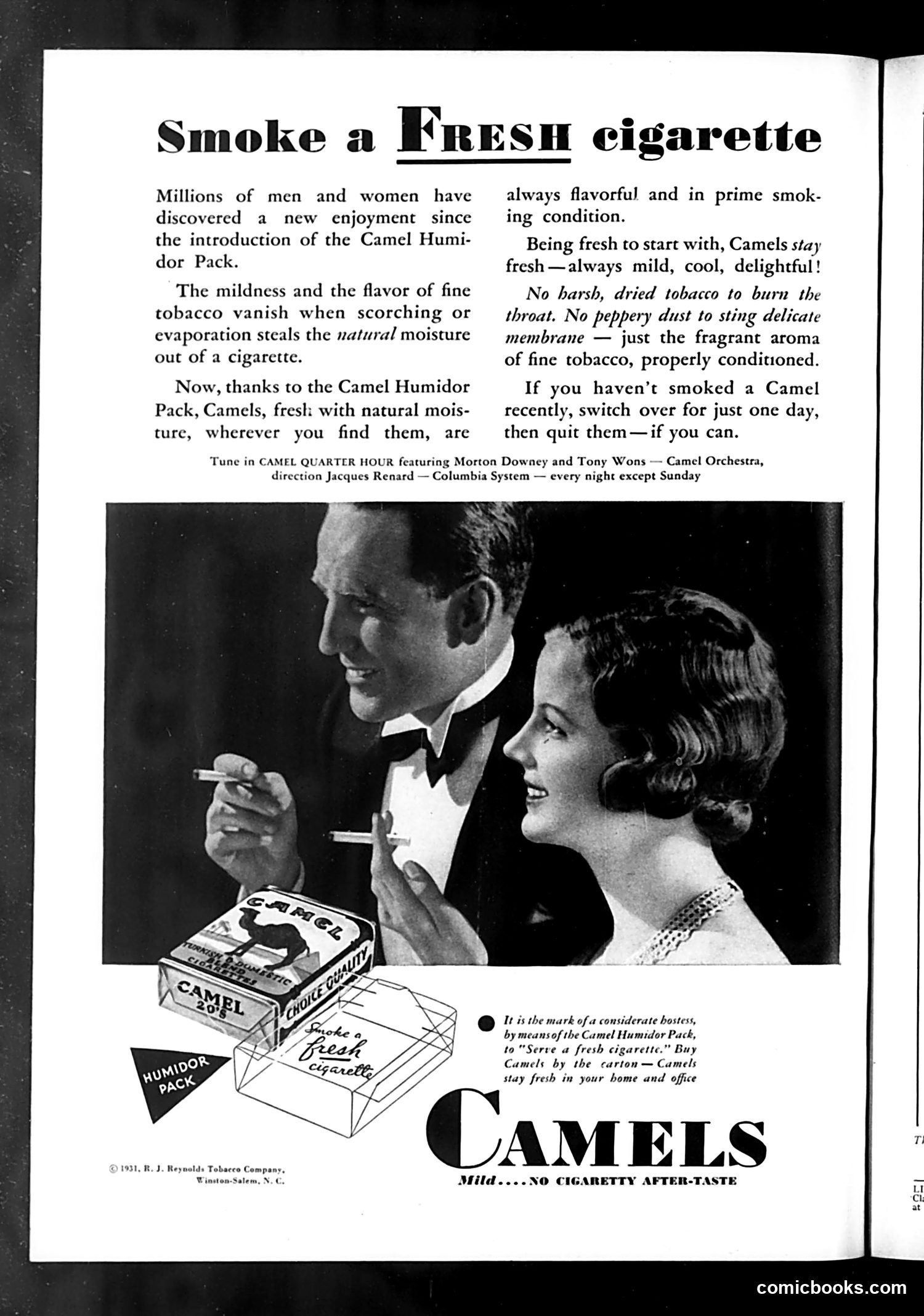
Analysis This is a Camel cigarette advertisement, not political satire. The page shows a well-dressed couple in formal evening wear smoking cigarettes, with Camel cigarette boxes displayed below. The ad promotes the "Camel Humidor Pack," claiming it keeps cigarettes fresh by maintaining natural moisture. Key claims include: cigarettes stay "mild, cool, delightful," without "harsh, dried tobacco" or "peppery dust." The tagline "Mild... NO CIGARETTE AFTER-TASTE" emphasizes smoothness. A mention of the "CAMEL QUARTER HOUR" radio program suggests this is from the 1930s-1940s. For modern readers: This represents an era when cigarette advertising freely targeted consumers without health warnings, using lifestyle imagery of sophistication and glamour to market tobacco products.
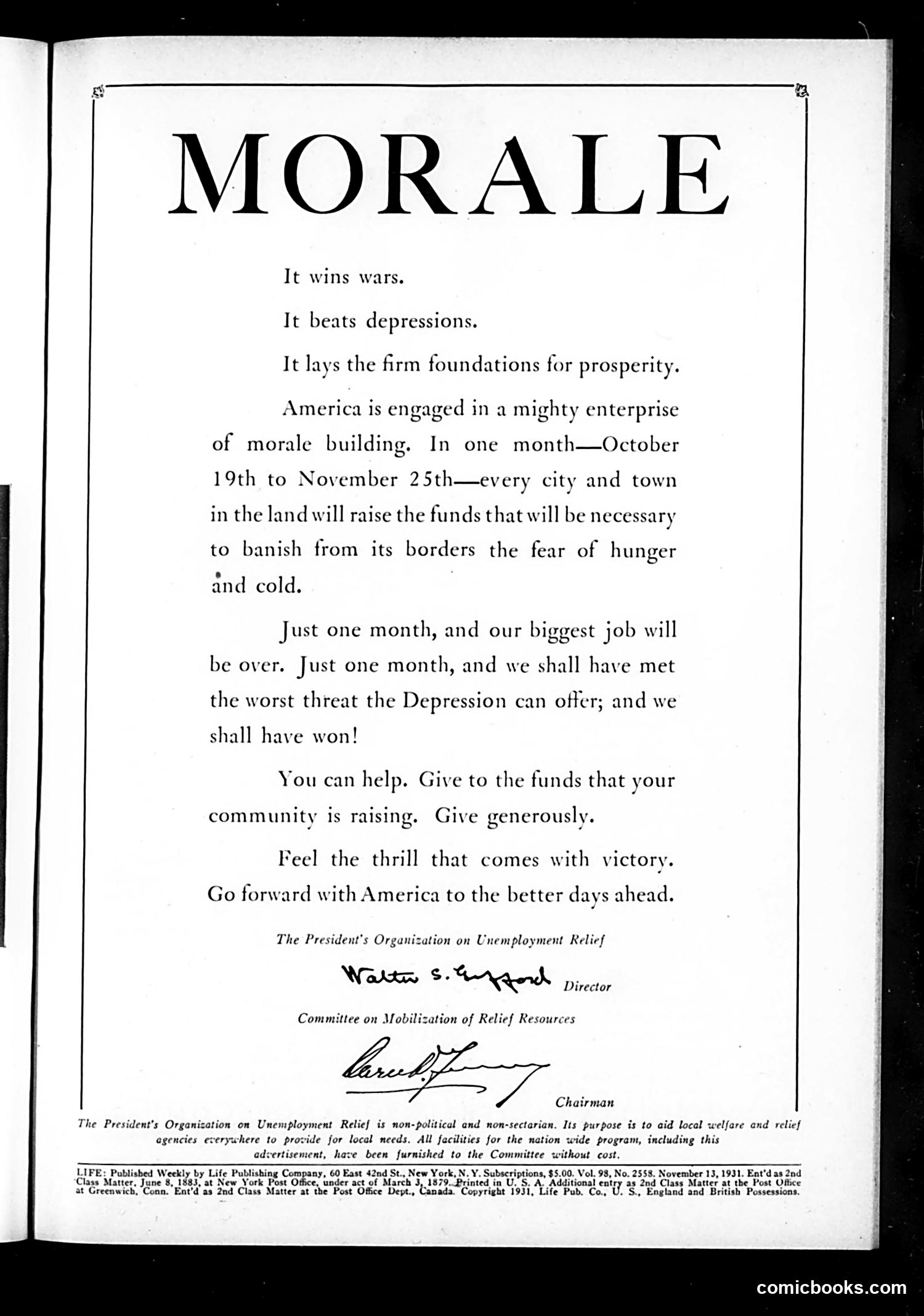
Analysis This is a public service announcement, not satire or cartoon. It's a full-page advertisement promoting Depression-era charitable giving during October 19–November 25 (year unclear from visible text, but context suggests early 1930s). The page appeals to American patriotism and moral duty, claiming that organized charitable fundraising can "banish" hunger and cold within one month. It's signed by Walter S. Gifford as Director of the President's Organization on Unemployment Relief, and another official as Chairman of the Committee on Mobilization of Relief Resources. The text emphasizes moral virtue ("Feel the thrill that comes with victory"), framing charitable donation as both patriotic duty and personal satisfaction—typical Depression-era messaging that encouraged private charity as a solution to widespread poverty.
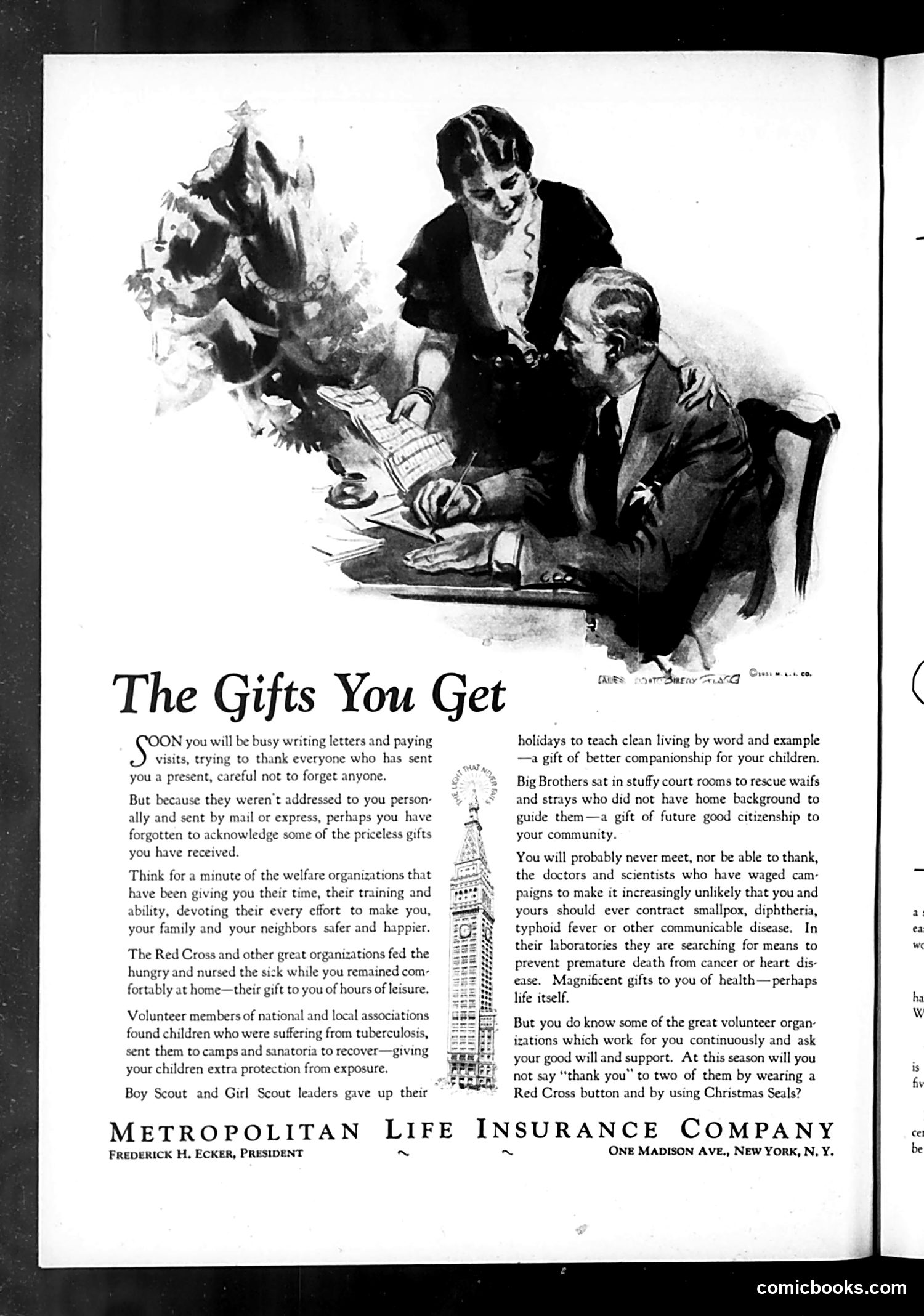
"The Gifts You Get" - Metropolitan Life Insurance Advertisement This is a corporate advertisement, not satire. Metropolitan Life Insurance uses the heading "The Gifts You Get" to frame charitable organizations as invisible benefactors during the Christmas season. The illustration shows a man and woman examining Christmas gifts together. The text argues that while people receive tangible presents, they should recognize the "priceless gifts" provided by volunteer organizations: the Red Cross, welfare organizations, Boy Scouts, Girl Scouts, and medical researchers combating disease. The ad's point is philanthropic messaging—encouraging readers to support these organizations (notably mentioning Red Cross buttons and Christmas Seals) while subtly associating Metropolitan Life with civic goodness. This was common Depression-era corporate messaging promoting charitable giving and social responsibility.
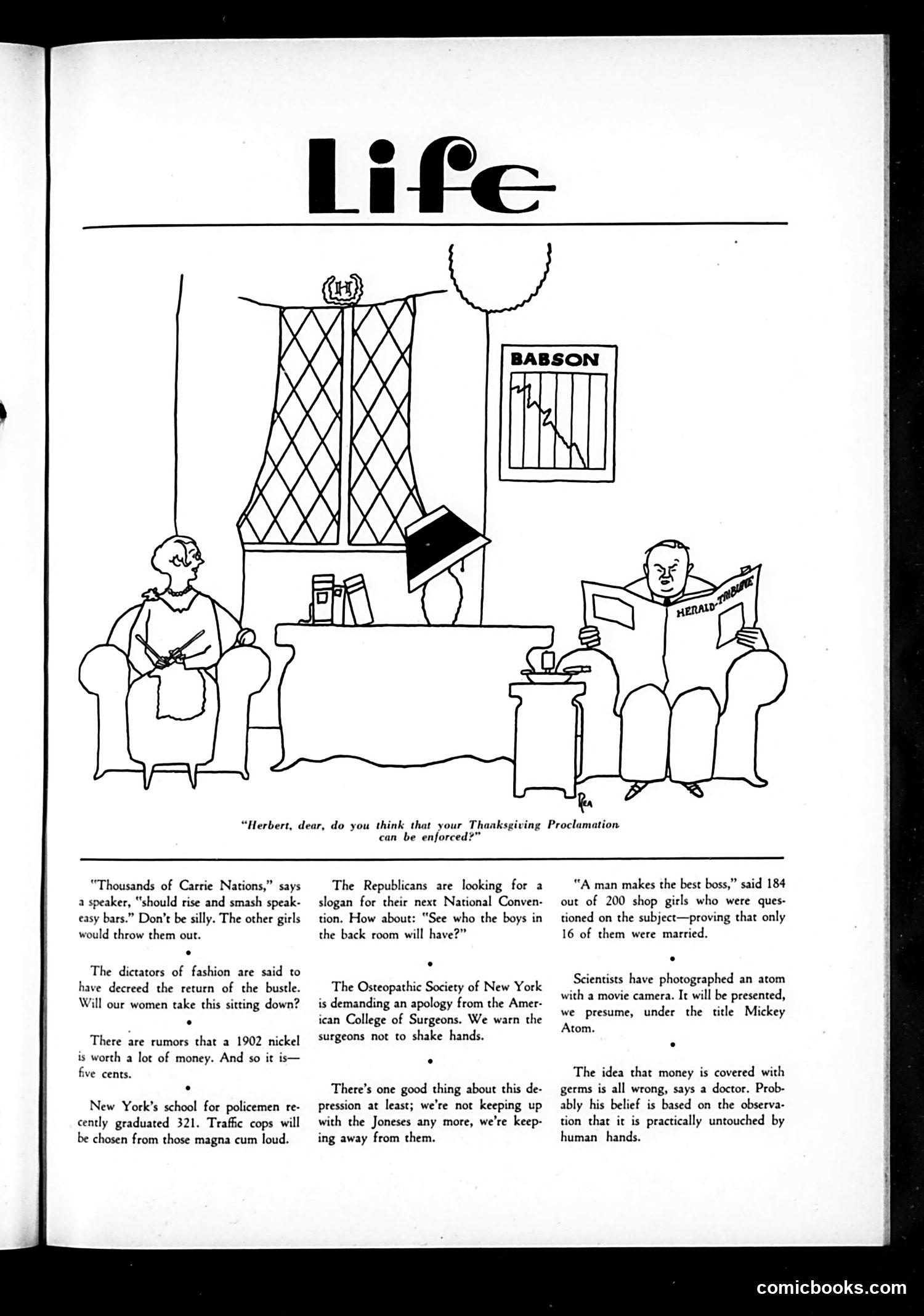
Life Magazine Cartoon Analysis The main cartoon depicts a domestic scene where a wife asks her husband, "Herbert, dear, do you think that your Thanksgiving Proclamation can be enforced?" The husband figure labeled "HERBERT" (likely President Herbert Hoover) reads a newspaper titled "HERALD-TRIBUNE" while seated. The satire mocks Hoover's authority to enforce a Thanksgiving proclamation—suggesting his executive power was questionable or ineffectual, possibly during the Great Depression when citizens faced food scarcity. The accompanying text snippets are satirical observations about contemporary issues: fashion trends, medical colleges, and money hygiene. The overall page uses humor to critique governmental authority and social conditions of the era.
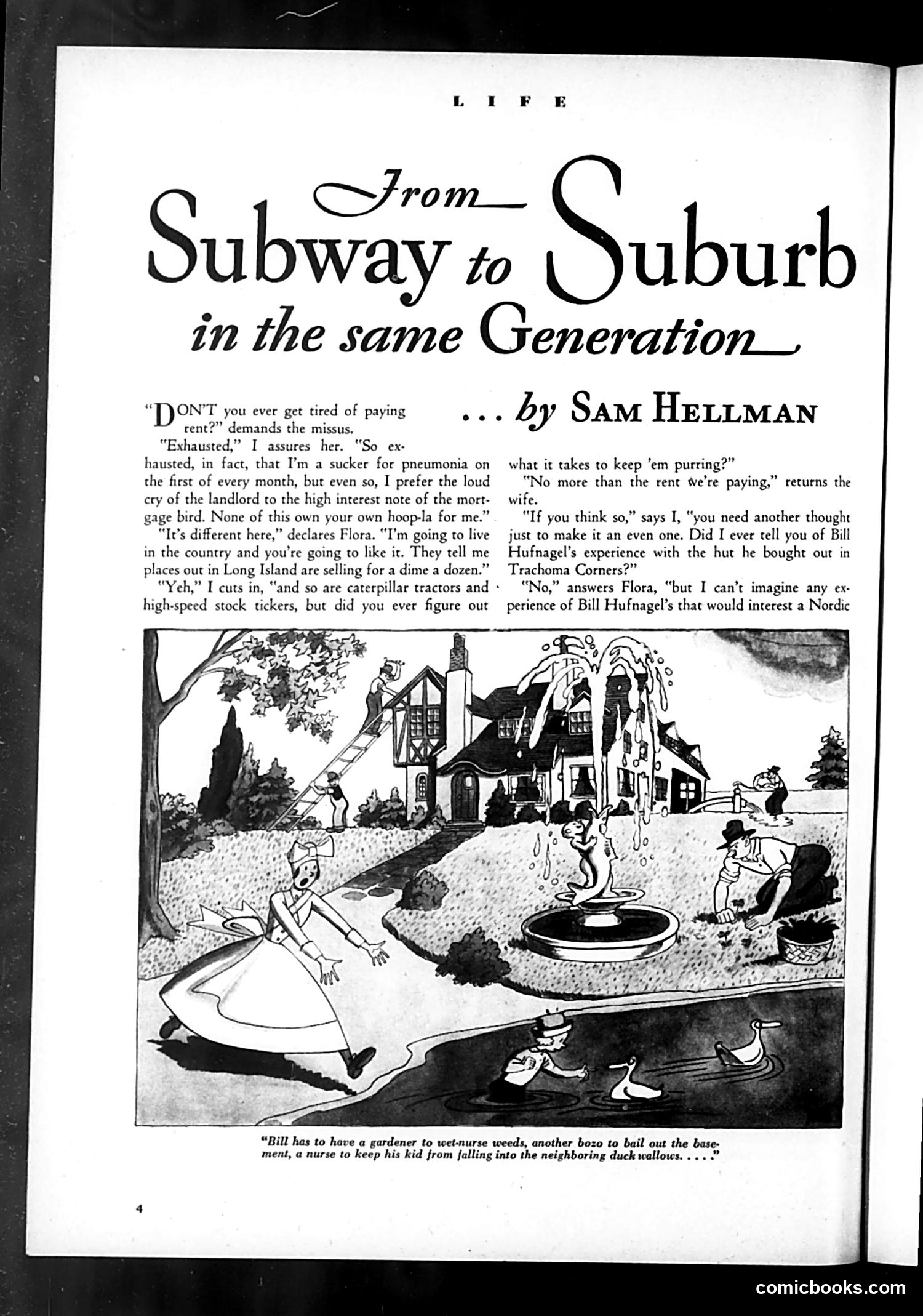
"From Subway to Suburb in the Same Generation" This satirical piece by Sam Hellman contrasts urban and suburban life through a dialogue between a tired city tenant and an optimistic suburbanite. The cartoon depicts an idealized suburban scene with a house, manicured lawn, and recreational activities. The satire targets post-World War II aspirations: the city dweller complains about constant rent payments and landlord complaints, while the suburban character promotes homeownership on Long Island as escape. However, the humor undercuts suburban dreams—the caption reveals that maintaining a house requires hiring multiple workers (gardener, plumber, nurse) to handle endless problems, suggesting suburban life is actually *more* burdensome than apartment living, despite its apparent idyll. The piece mocks the suburban fantasy as costly and complicated, not the liberation it promised.
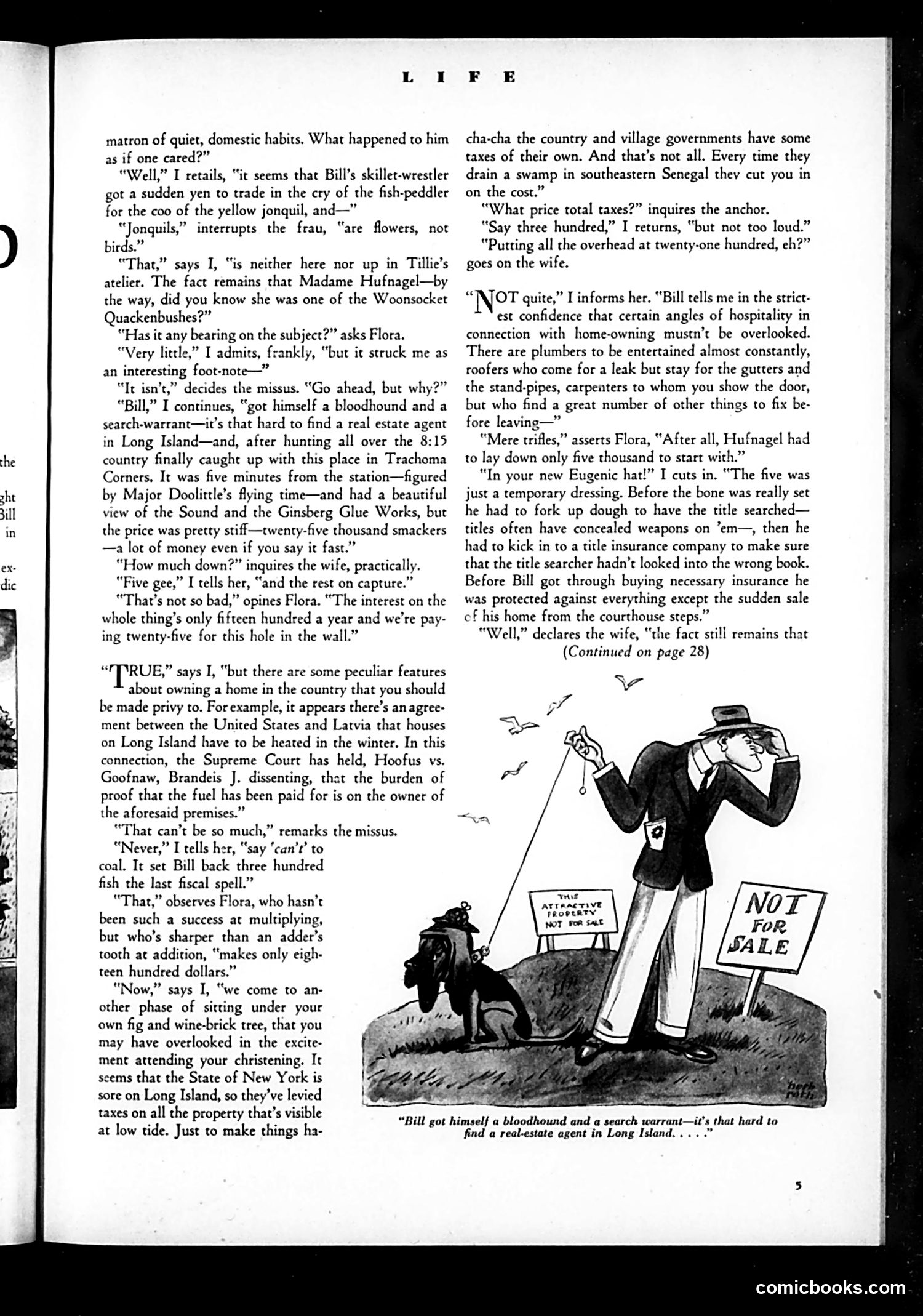
Cartoon Analysis This cartoon satirizes the difficulties of buying rural property in Long Island, New York. A man in formal attire (the prospective buyer) holds a search warrant and a "NOT FOR SALE" sign, while a bloodhound searches the ground beside him. The caption explains: "Bill got himself a bloodhound and a search warrant—it's that hard to find a real-estate agent in Long Island...." The joke mocks the scarcity of real estate agents willing to work in Long Island at that time, suggesting you'd need law enforcement tools and tracking dogs just to locate one. The accompanying text discusses Long Island property taxes, heating costs, and insurance complications—implying the area's bureaucratic and financial burdens made it an unattractive market for agents and buyers alike.
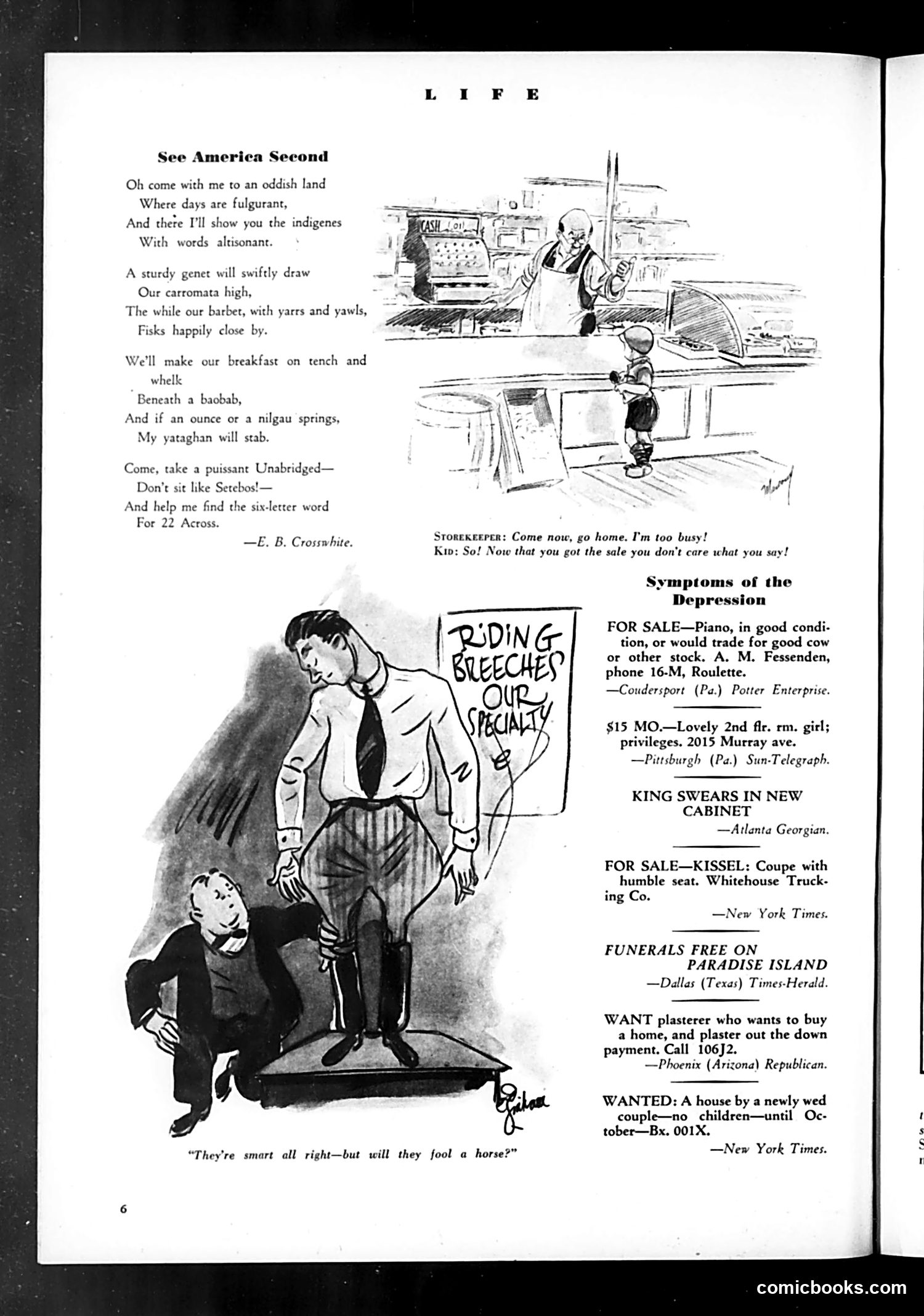
Analysis of Life Magazine Page This page is primarily classified advertising ("Symptoms of the Depression") mixed with satirical content. The main cartoon depicts a tall woman in a suggestive pose with a sign reading "RIDING BREECHES OUR SPECIALTY" while a small man below asks, "They're smart all right—but will they fool a horse?" The joke satirizes both fashion trends and economic desperation during the Great Depression. The woman's exaggerated figure and the absurdist juxtaposition suggest that even ridiculous or compromising fashion choices were being marketed aggressively during hard times. The page-top poem "See America Second" humorously invites readers to visit undeveloped America as a cheap alternative tourism option—another Depression-era joke about reduced circumstances and lowered expectations.
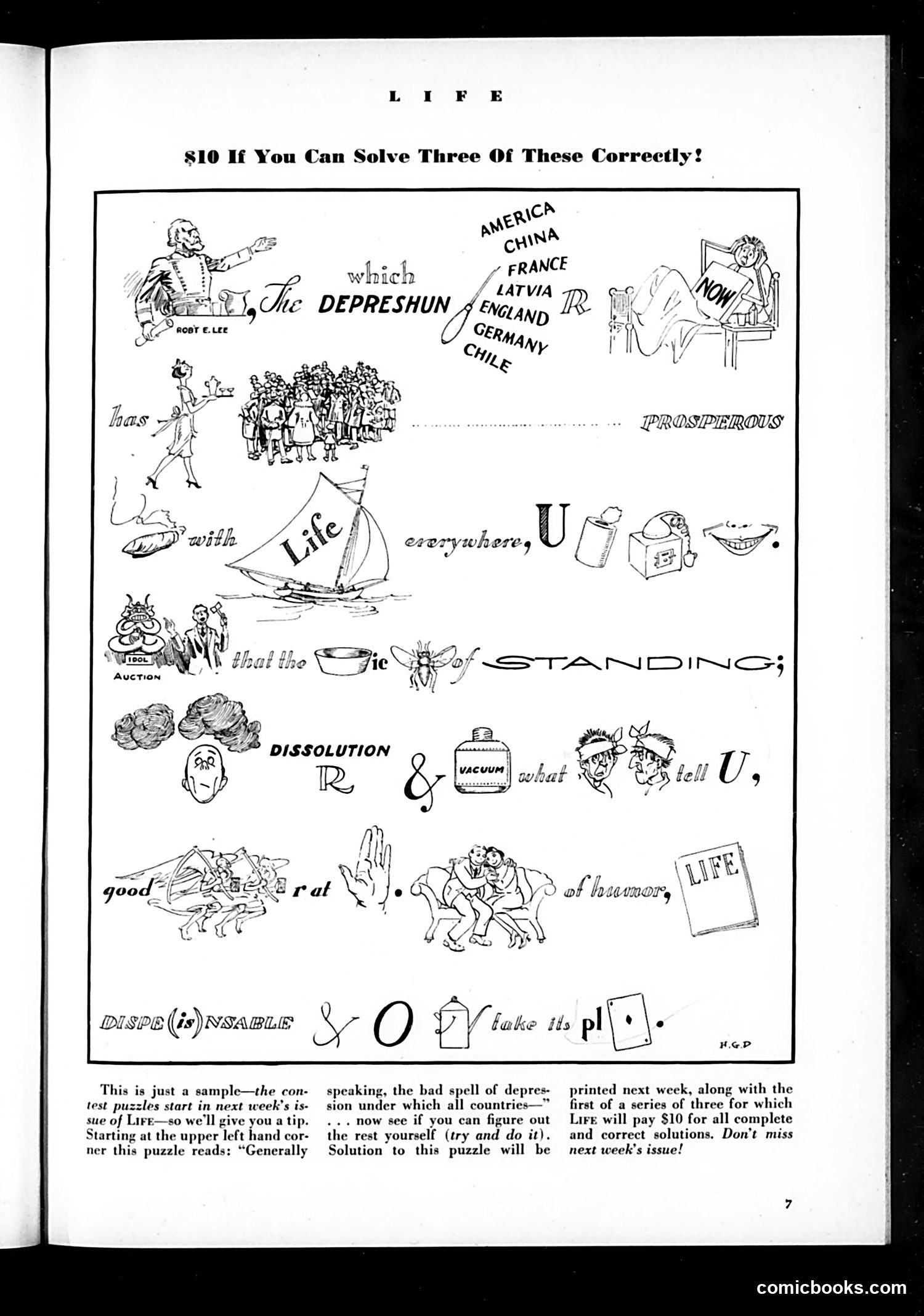
Analysis This page presents a visual word-puzzle contest from *Life* magazine. The challenge asks readers to solve a rebus about "The Depreshun" (Depression) affecting multiple countries listed at top: America, China, France, Latvia, England, Germany, and Chile. The puzzle uses illustrated symbols and words to create a cryptic message. Key visual elements include a boat labeled "Life," various figures in distress, an auction scene, and references to "dissolution" and economic hardship. The scattered images of poverty (empty bowls, auction scenes, struggling people) reinforce Depression-era suffering. This appears to be commentary on the Great Depression's global reach, using satire and wordplay typical of *Life's* satirical approach. Readers competed to decode the hidden message for a $10 prize, with solutions promised in the following week's issue.
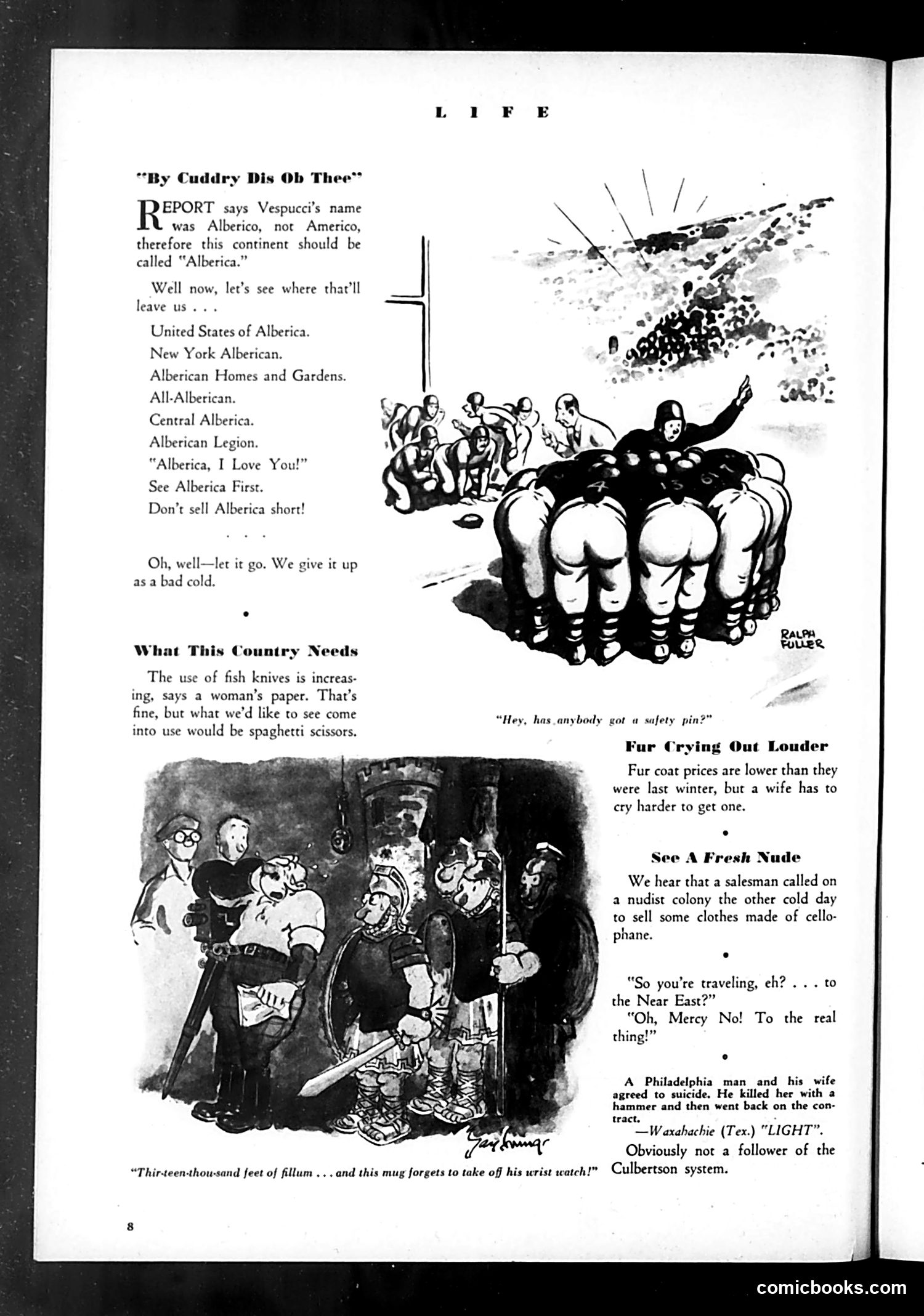
Analysis of Life Magazine Page This page contains three satirical pieces typical of early 20th-century American humor: 1. "By Cuddry Dis ob Thee": Mocks a reported naming dispute about explorer Vespucci—whether the continent should be called "Alberica" instead of "America." The joke lists absurd resulting names (New York Alberican, Alberican Legion, etc.) to ridicule the impracticality of renaming an entire continent based on a historical detail. 2. "What This Country Needs": A woman's paper suggests spaghetti scissors as a useful invention, poking fun at impractical consumer product suggestions. 3. "Fur Crying Out Louder" and other brief items are one-liners about contemporary concerns: fur coat prices, nudist colonies, and a dark anecdote about suicide—typical of Life's mix of light and dark humor. The cartoons use exaggeration and absurdist logic to satirize both historical pedantry and consumer culture.
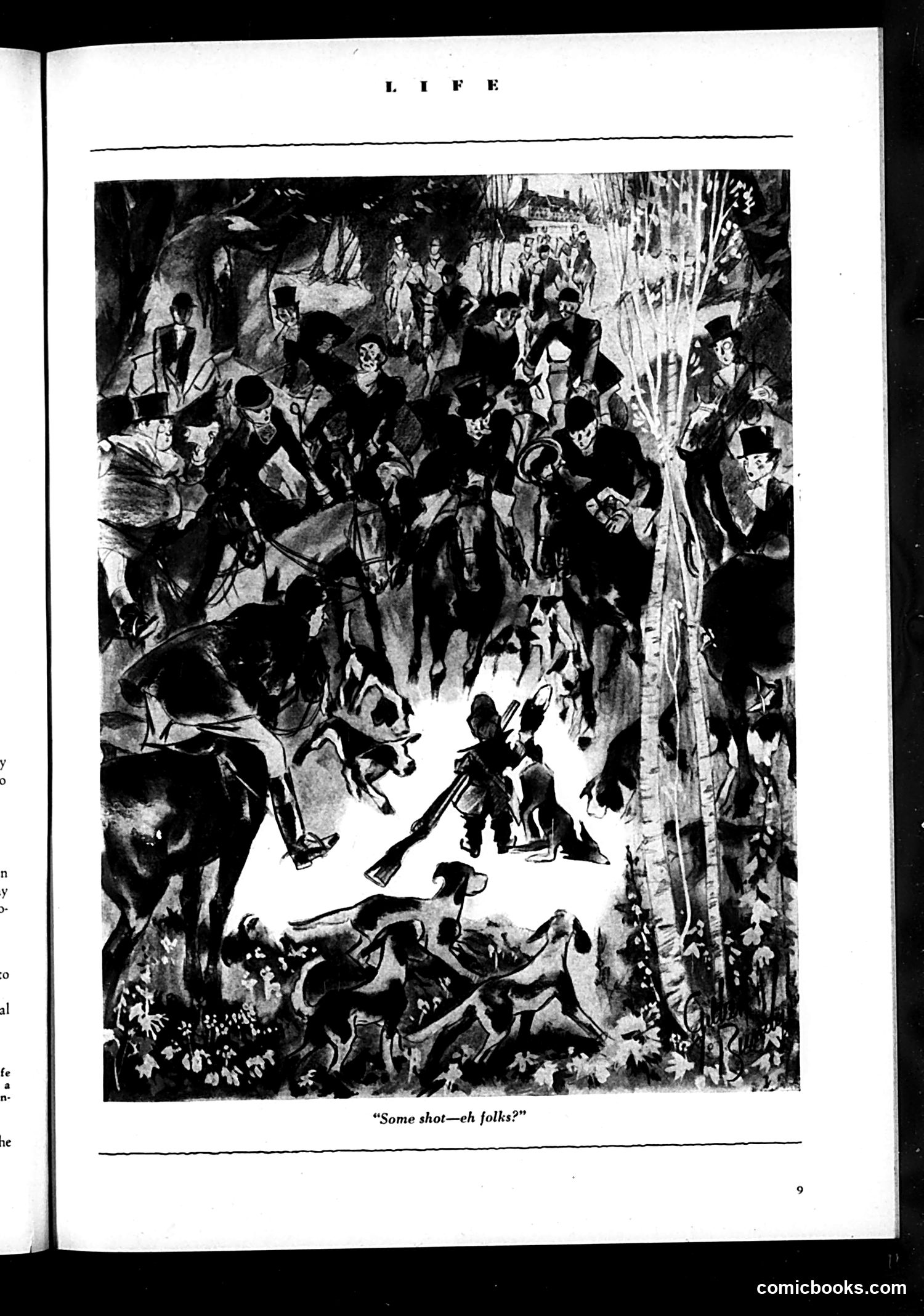
Analysis of "Some shot—eh folks?" This illustration depicts a chaotic street scene with well-dressed figures in top hats and formal attire gathered around what appears to be a shooting incident or confrontation. The central bright area suggests gunfire or violence. The caption "Some shot—eh folks?" uses colloquial language to reference a recent shooting event, treating a serious matter with satirical levity—a characteristic Life magazine approach. The crowd's casual demeanor and formal dress suggest this mocks how society or the press treated violent incidents as entertainment or fodder for gossip. Without additional context (date, byline), I cannot identify the specific incident referenced. However, the satire appears to critique public indifference to or sensationalization of urban violence during the period this magazine was published.
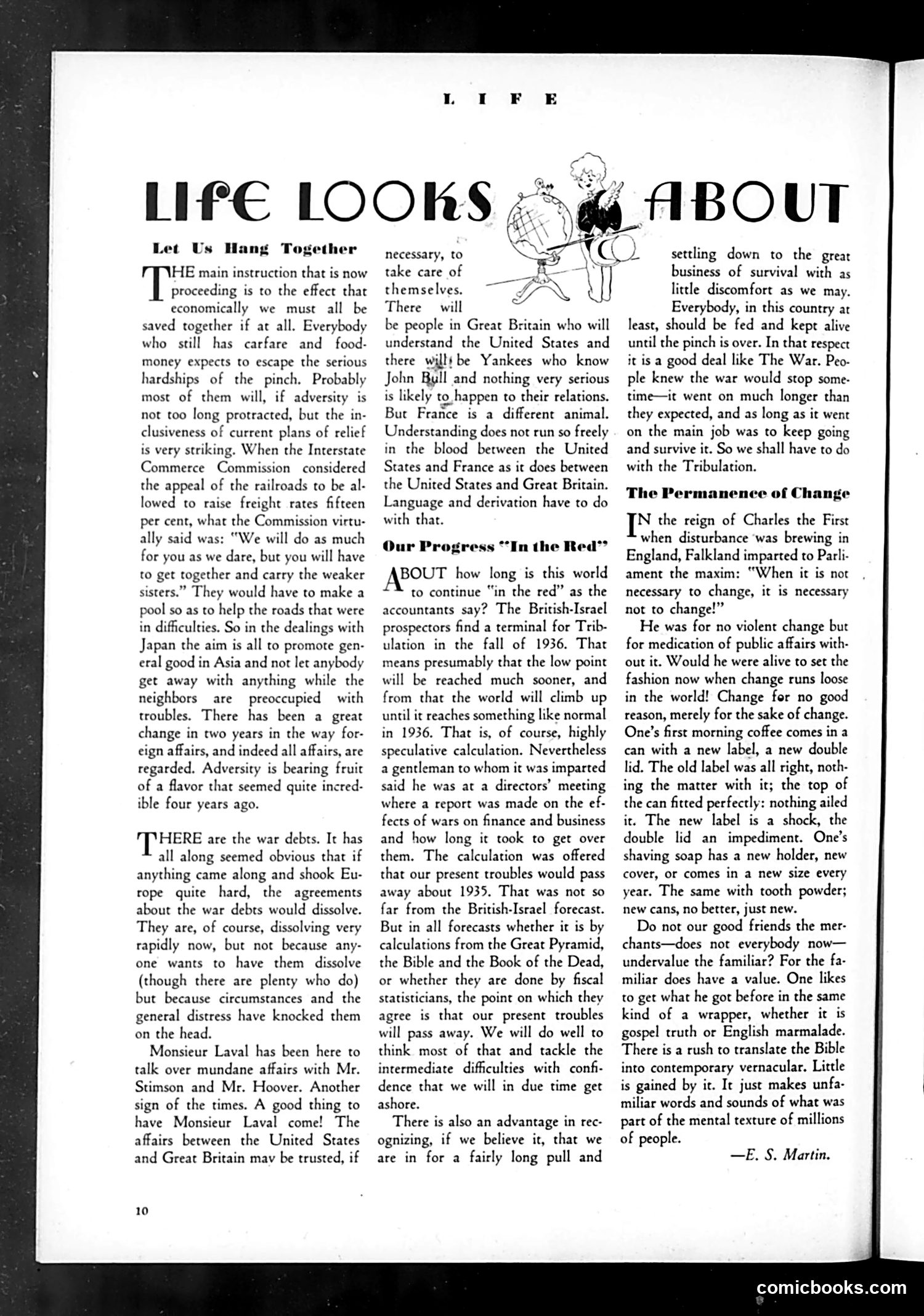
Analysis This page from *Life* magazine contains three articles rather than political cartoons. The masthead illustration shows two figures examining a globe, accompanying the article "Life Looks About." The main content discusses post-WWI economic cooperation and international relations. References include: - War debts between nations (likely U.S., Great Britain, France following WWI) - Monsieur Laval (French politician) visiting to discuss affairs with U.S. and British leaders - British-Israeli forecasts about economic recovery by 1936 - The philosophy that change is necessary but should be managed carefully E.S. Martin's concluding piece argues against devaluing the familiar—using the example of changing product labels—suggesting people resist unnecessary modernization. The tone is cautiously optimistic about international cooperation while advocating for stability amid post-war economic uncertainty.
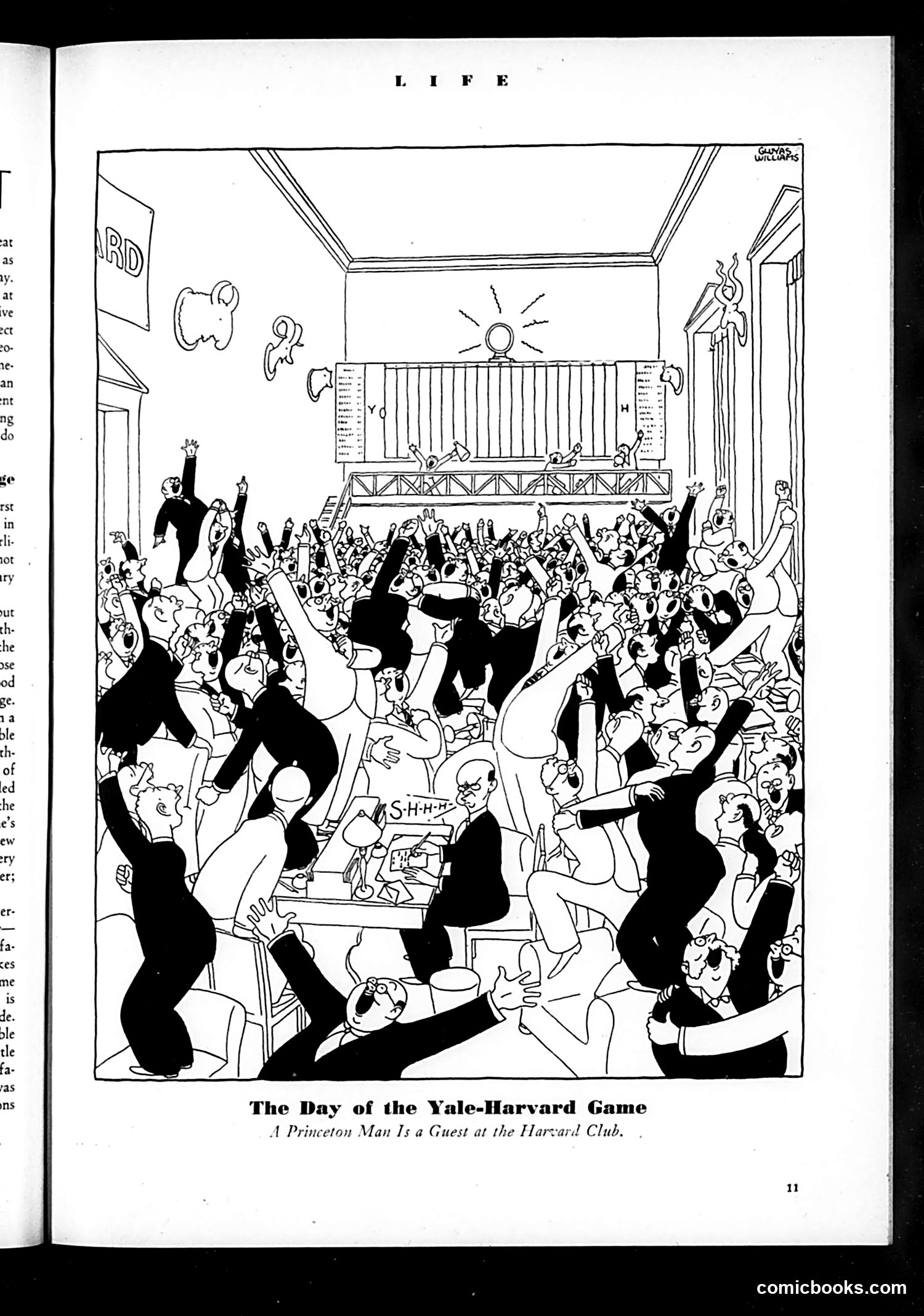
"The Day of the Yale-Harvard Game" This cartoon depicts a chaotic scene at the Harvard Club during the famous Yale-Harvard football rivalry game. The subtitle indicates "A Princeton Man Is a Guest at the Harvard Club." The satire centers on the intense passion and pandemonium surrounding this Ivy League football competition. The crowded interior shows formally-dressed gentlemen in various states of excitement—some jumping, gesturing wildly, and displaying exaggerated emotional reactions to the game's action. A scoreboard is visible in the background. The humor lies in contrasting the refined, dignified setting of an exclusive club with the utterly unrestrained, almost animal-like behavior of its typically composed members when consumed by sports fever. The outsider (the Princeton man) presumably observes this spectacle with bemusement, highlighting how this rivalry transforms respectable gentlemen into frenzied enthusiasts.
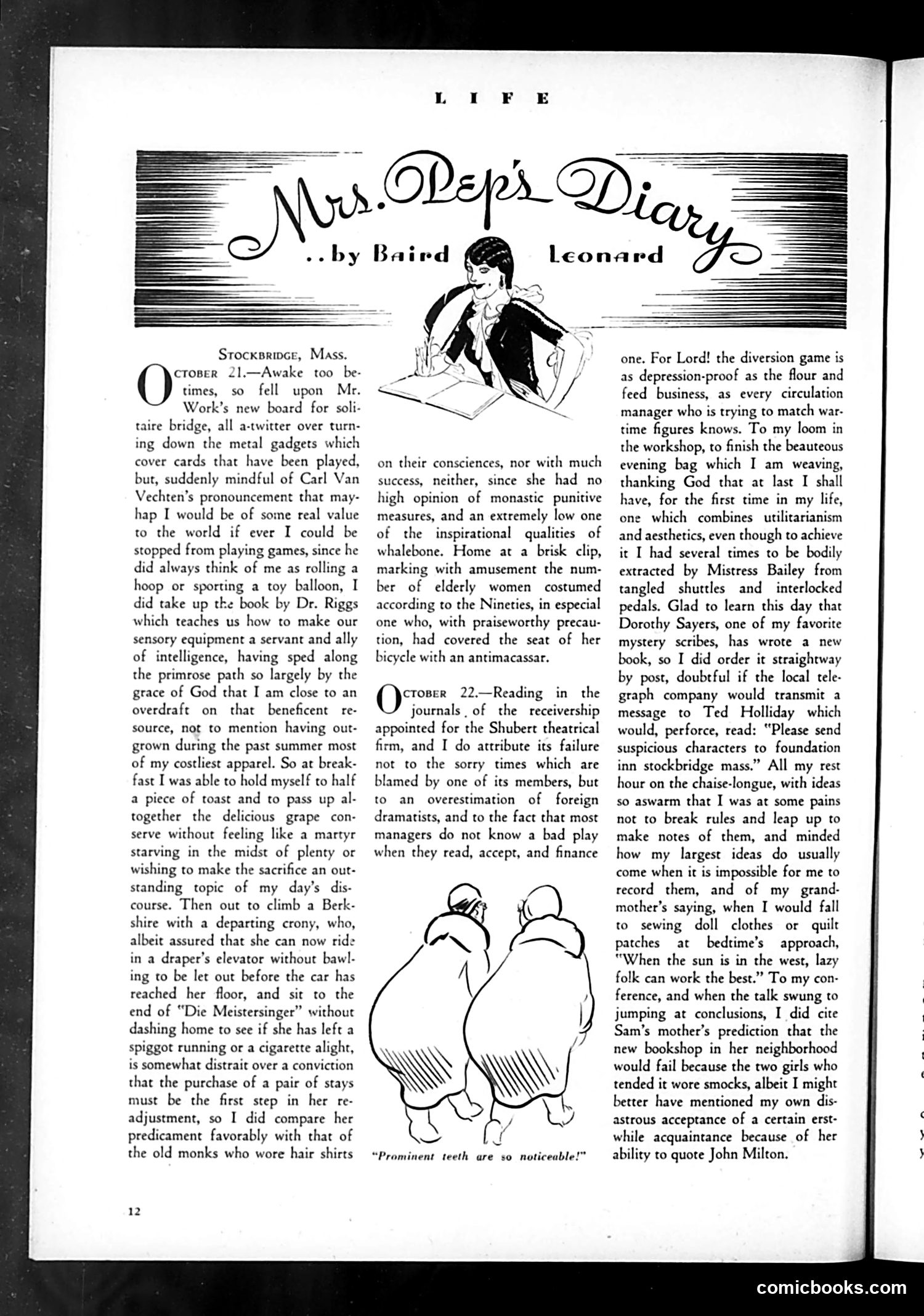
Mrs. Pep's Diary by Baird Leonard This is a humor column featuring diary entries from October 21-22. The small illustration shows two rotund figures from behind, captioned "Prominent teeth are so noticeable!" The diary entries satirize domestic and social life. October 21st describes the writer's frustration with a solitaire card game and her discovery of a new book by Dr. Riggs on sensory education. October 22nd discusses attending theatrical journals and references a failed "Shubert theatrical man," critiquing foreign dramatists and theater managers for poor play selection. The humor relies on mundane observations about home life, failed cultural institutions, and the writer's wry commentary on people's teeth and fashion choices. It's a gentle domestic satire typical of Life magazine's social humor.
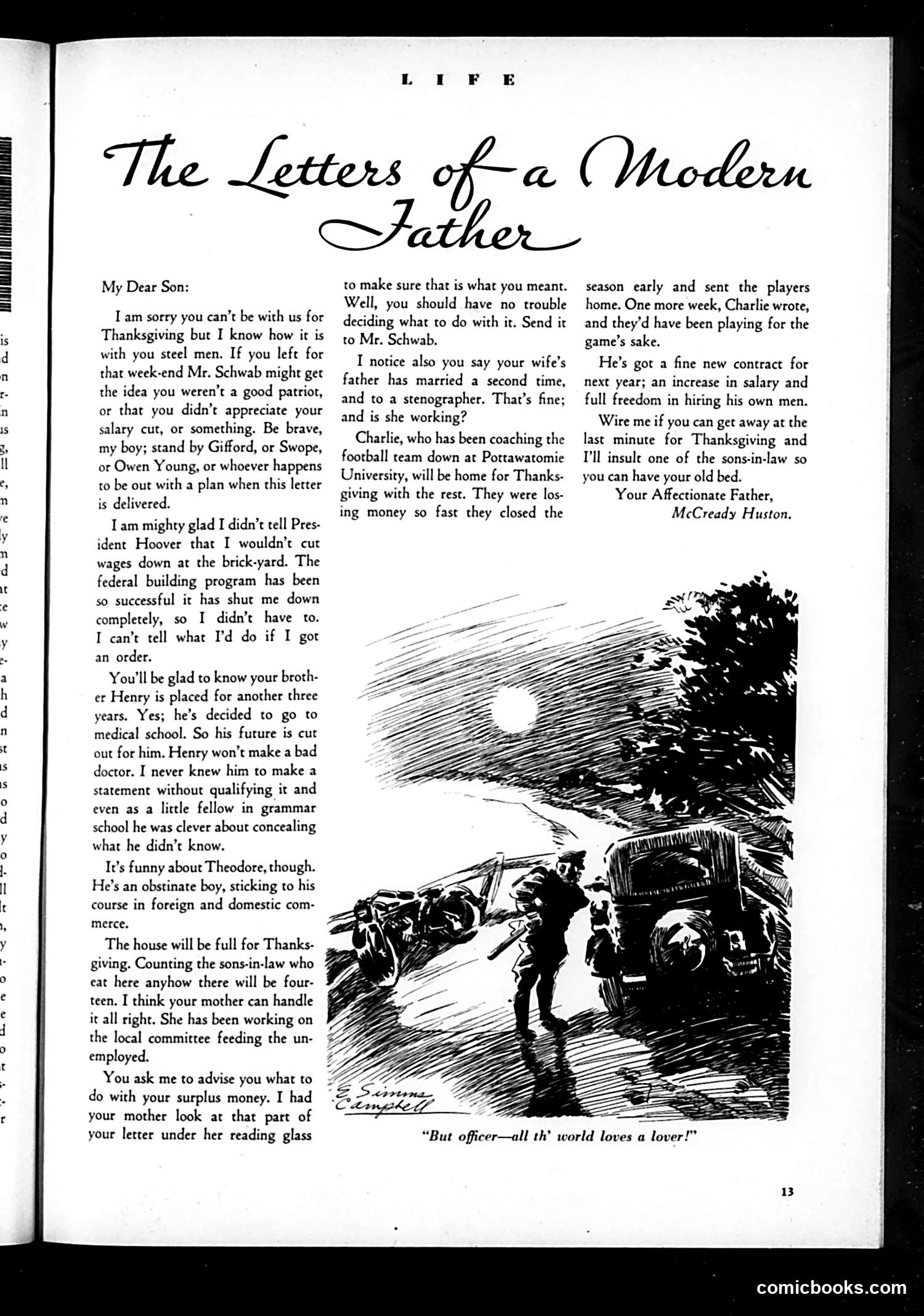
"The Letters of a Modern Father" This is a humorous letter from a father to his son, addressing practical matters during what appears to be the Depression era (based on references to wage cuts, unemployment relief, and federal building programs). The accompanying illustration shows a traffic accident or roadside scene with a policeman and civilians around a damaged car, captioned "But officer—all th' world loves a lover!" The joke appears to be that someone is using romantic sentiment as an excuse or explanation for reckless driving that caused the accident. The letter itself offers paternal advice on managing finances and career decisions, with mentions of family members (Henry going to medical school, Theodore in commerce). The tone is warmly satirical about fatherly wisdom and household management during economically uncertain times.
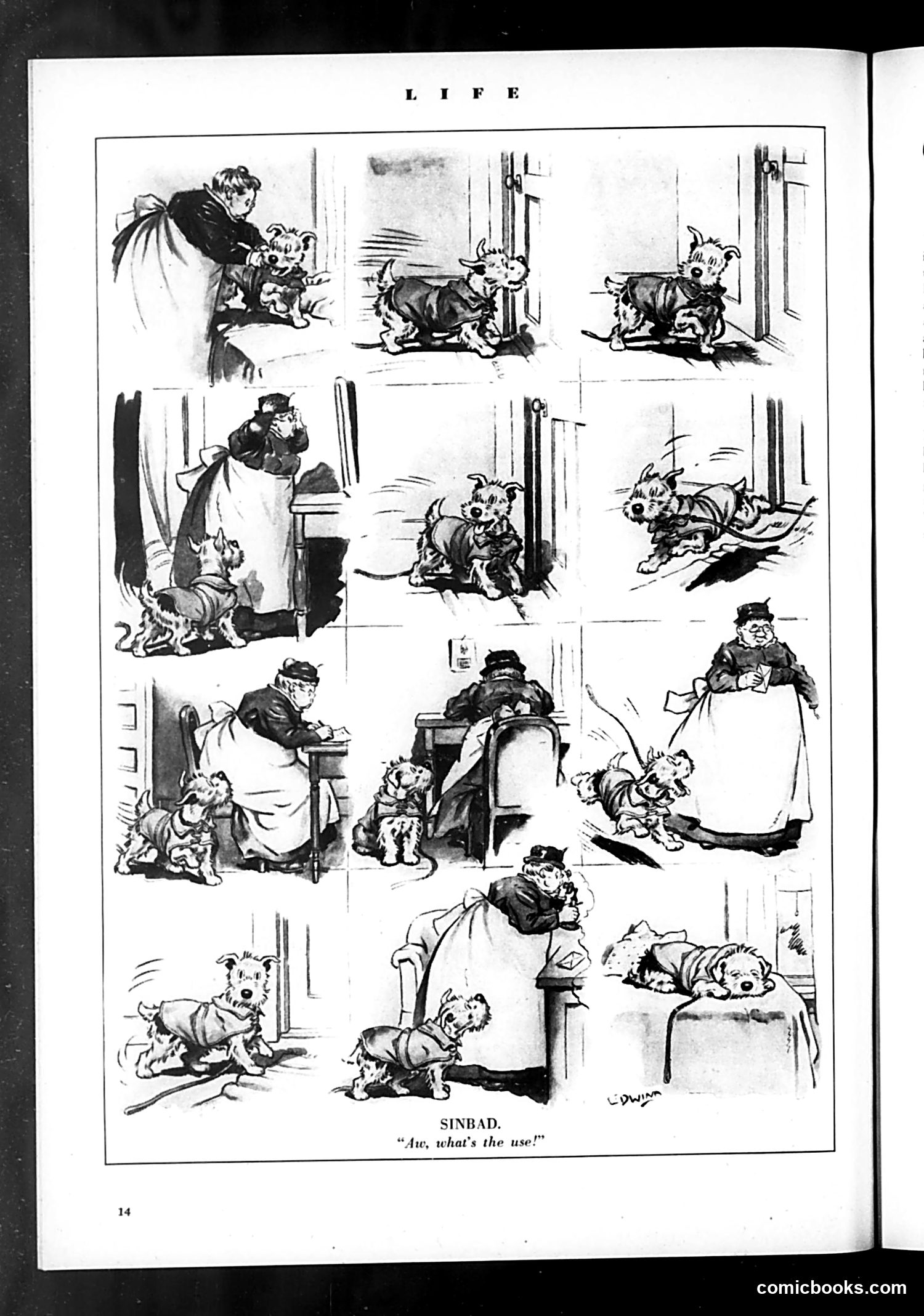
"Sinbad: 'Aye, What's the Use!'" This comic strip depicts a small, disheveled dog named Sinbad repeatedly causing domestic chaos and mischief throughout a household. Across multiple panels, the dog knocks things over, creates mess, and generally disrupts the lives of the people trying to manage him—including what appears to be servants or household staff. The satire appears to target the futility of attempting to control or discipline an unruly pet. The caption "Aye, what's the use!" suggests resignation: no matter what efforts the humans make to maintain order, the dog's destructive nature proves unstoppable. This likely resonated with early 20th-century readers as relatable domestic humor about the chaos pets introduce to orderly households.
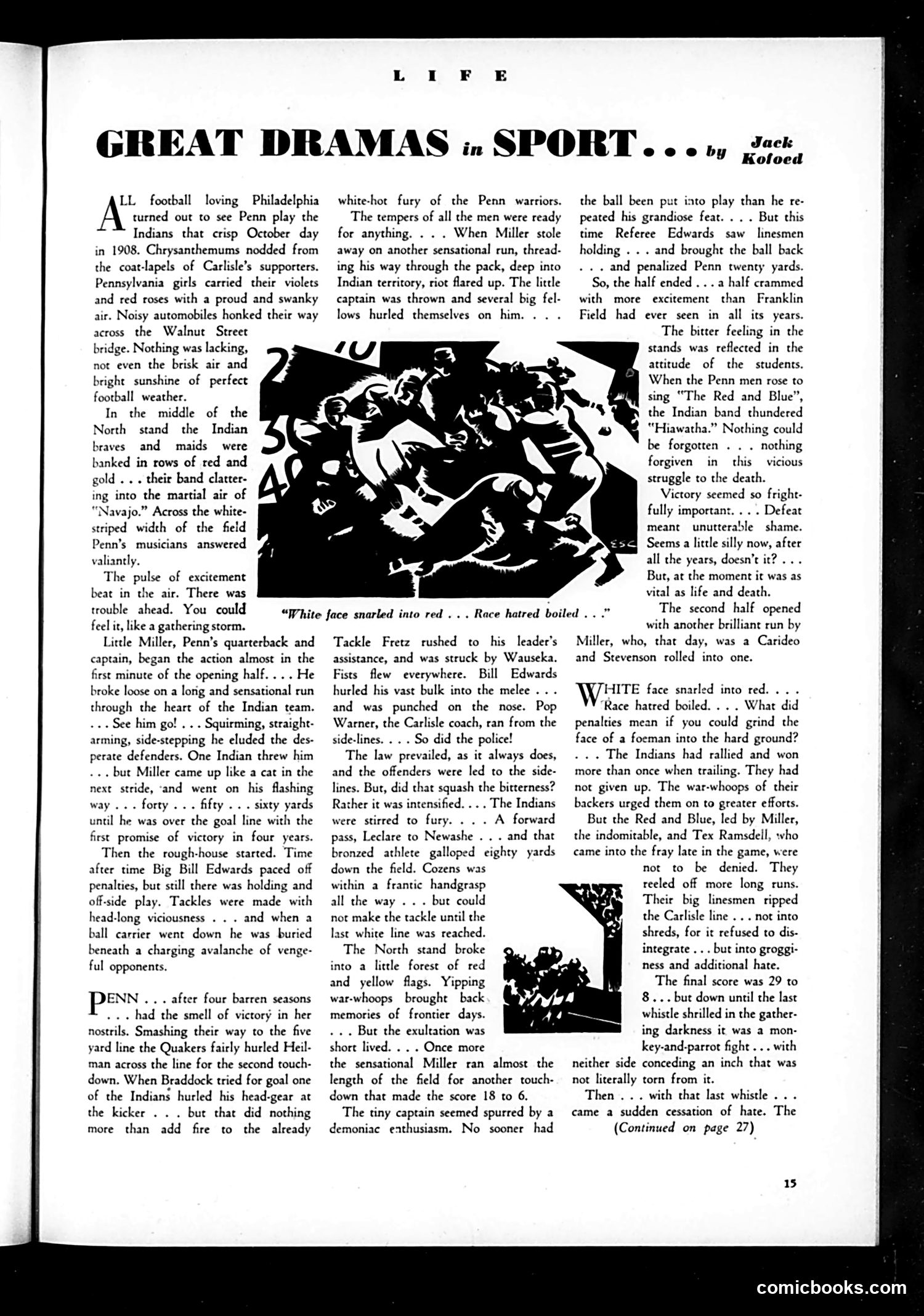
Analysis of "Great Dramas in Sport" This is a sports narrative article by Jack Kofoed describing a 1908 Penn vs. Carlisle Indian football game. The two dramatic illustrations show violent game action—players in aggressive tackle sequences with the caption "White face snarled into red.... Race hatred boiled...." The article frames the game as a dramatic racial confrontation between the all-white University of Pennsylvania team and the Carlisle Indian Industrial School team. The violent imagery and language ("Race hatred," "struggle to the death") reflects early-20th-century attitudes that sensationalized contests between white and Native American athletes as existential cultural conflicts rather than mere sporting events. The illustrations emphasize physical brutality and racial tension, treating the football game as a symbolic battleground reflecting broader contemporary race anxieties.
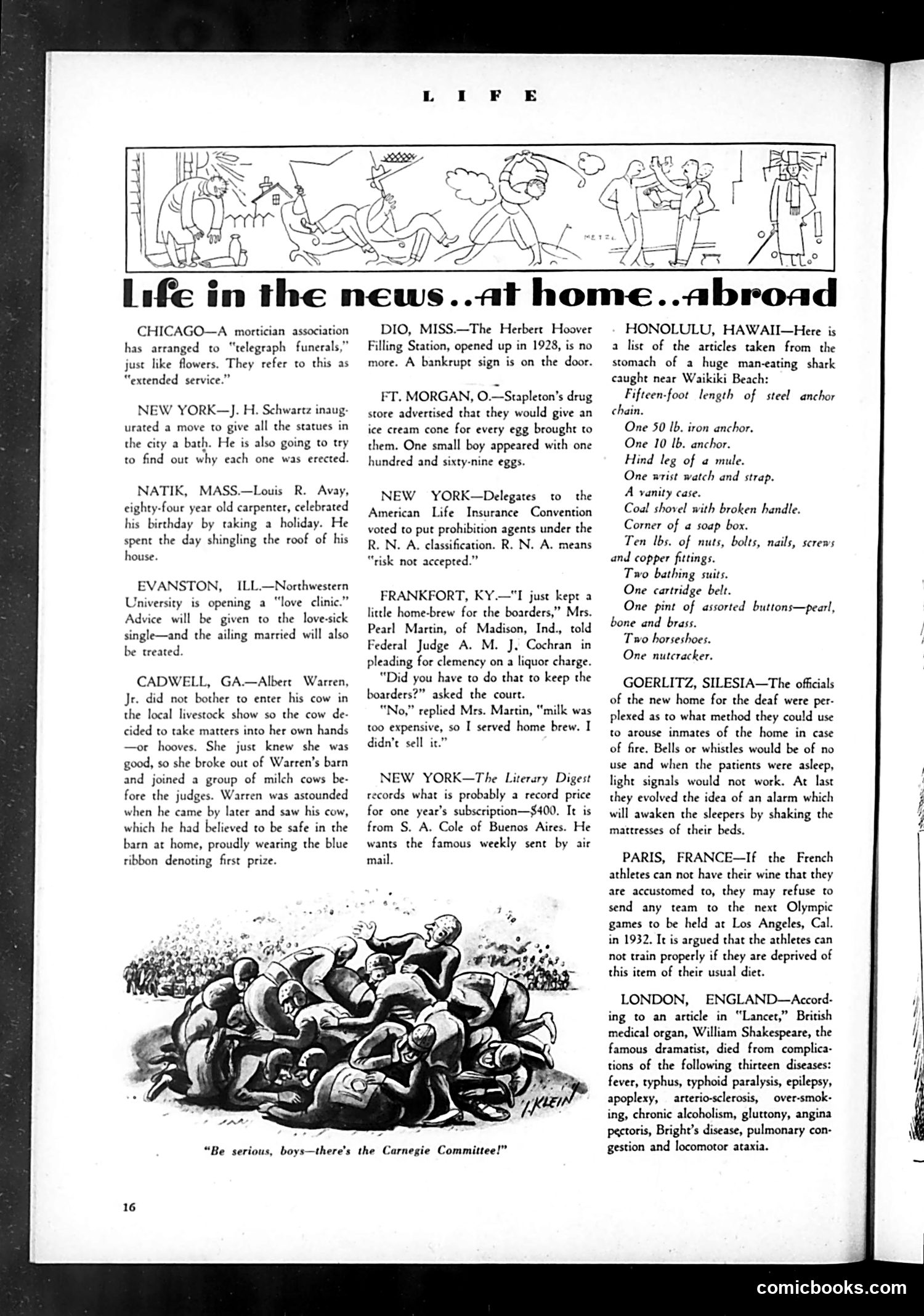
"Life in the News" - Page Analysis This is a satirical news digest page featuring brief humorous items from across America and abroad. The main illustration depicts a rugby scrum or pile-up with the caption "He serious, boys—there's the Carnegie Committee!" The joke references the Carnegie Committee (likely investigating some matter), sarcastically suggesting that even in a chaotic physical struggle, participants should behave seriously because an oversight body is watching. It's gentle institutional satire. The surrounding text covers miscellaneous oddities: a mortician offering "telegraph funerals," a drugstore ice cream promotion, a carpenter celebrating his birthday by shingling his roof, and international items about shark stomach contents in Hawaii and French Olympic athletes' wine rations. The page exemplifies *Life* magazine's format: collecting absurd real-world news items for satirical effect.
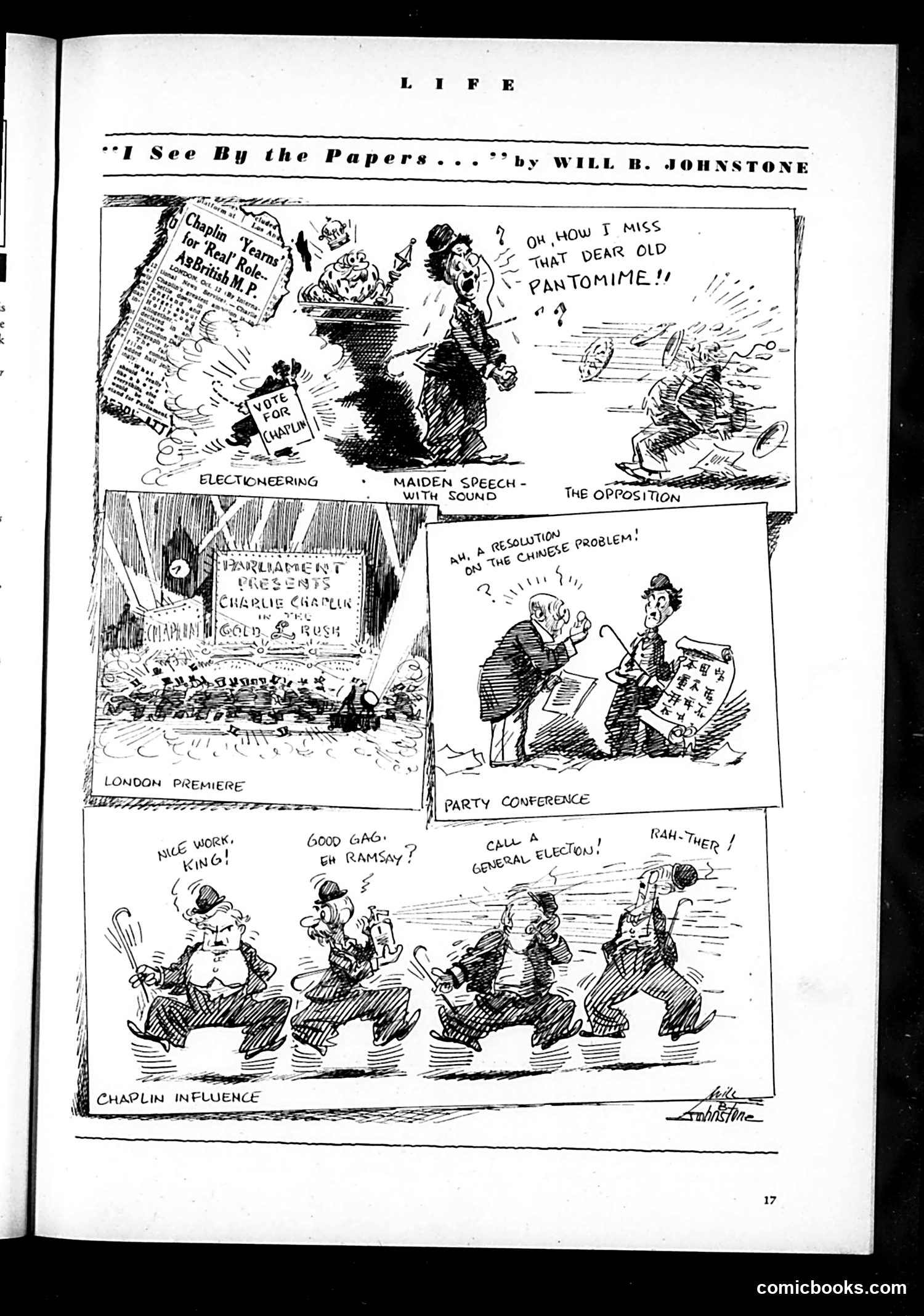
"I See By the Papers..." by Will B. Johnstone This satirical cartoon page mocks Charlie Chaplin's growing political influence in the 1920s. The panels depict: 1. "Electioneering" - A newspaper announces Chaplin's involvement in voting 2. "Maiden Speech with Sound" - Chaplin making his first public political statement 3. "The Opposition" - Political rivals scrambling in response 4. "London Premiere" - A theatrical event celebrating Chaplin 5. "Party Conference" - Politicians debating "a resolution on the Chinese problem" 6. "Chaplin Influence" - Political figures dancing to Chaplin's tune, exclaiming "Nice work, king!" and "Call a general election!" The cartoon satirizes how the famous film comedian's celebrity status had become so powerful that politicians were allegedly following his lead on policy matters, reducing serious governance to entertainment-driven spectacle.
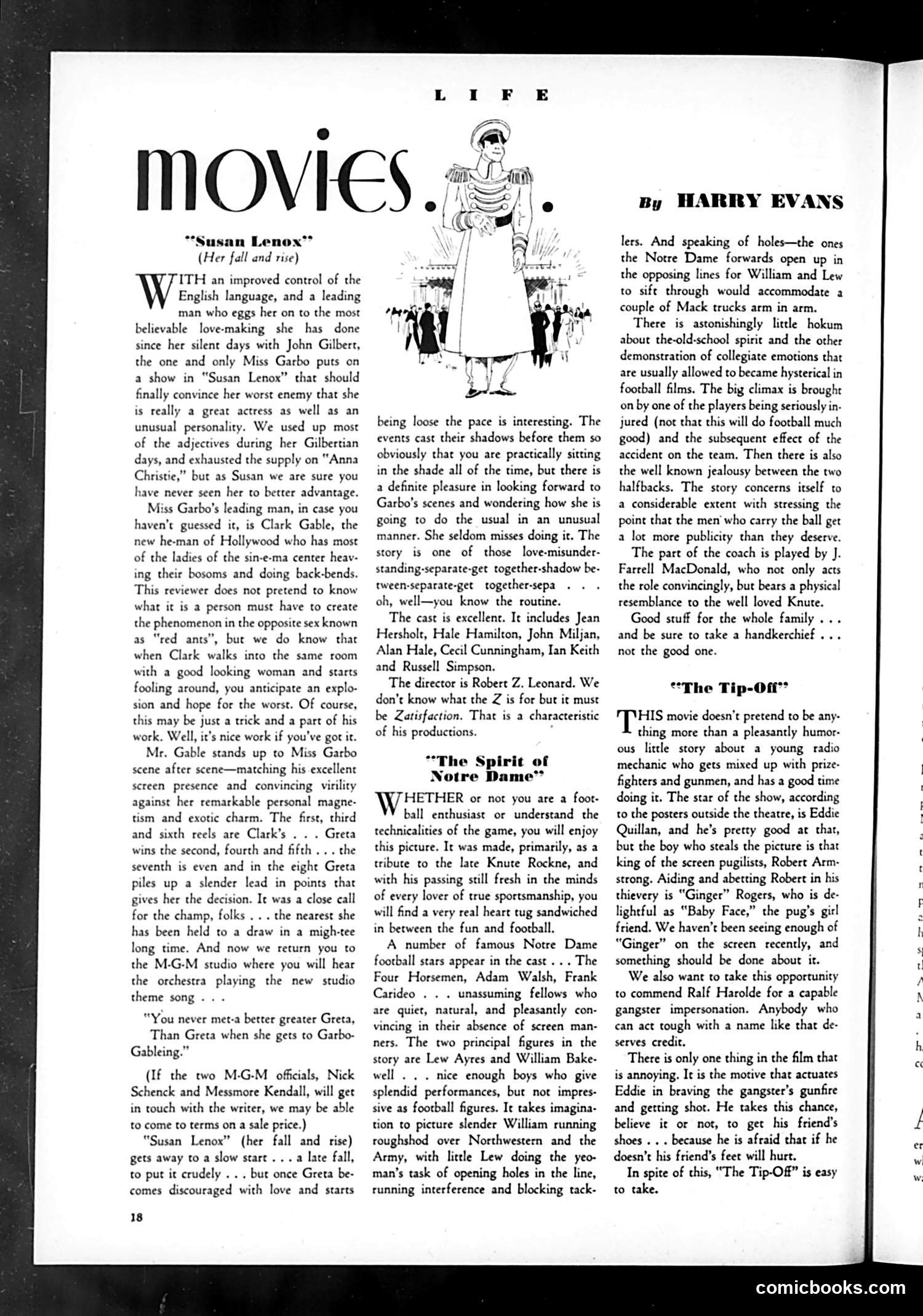
Movie Reviews Page from Life Magazine This is a movie review column by Harry Evans covering three films. The illustrated figure at the top appears to be a woman in military or formal dress, likely related to one of the reviewed films. The reviews discuss: 1. "Susan Lenox" — praising actress Greta Garbo's improved English and screen presence against Clark Gable 2. "The Spirit of Notre Dame" — a football film featuring Notre Dame football stars and actors, with commentary on its blend of sports and romance 3. "The Tip-Off" — a crime comedy about a radio mechanic involved with gangsters The content reflects 1930s Hollywood interests: silent-film-era star Garbo's talkie transition, the novelty of real athletes in narrative films, and crime-comedies. The reviews emphasize star power and entertainment value rather than artistic merit.
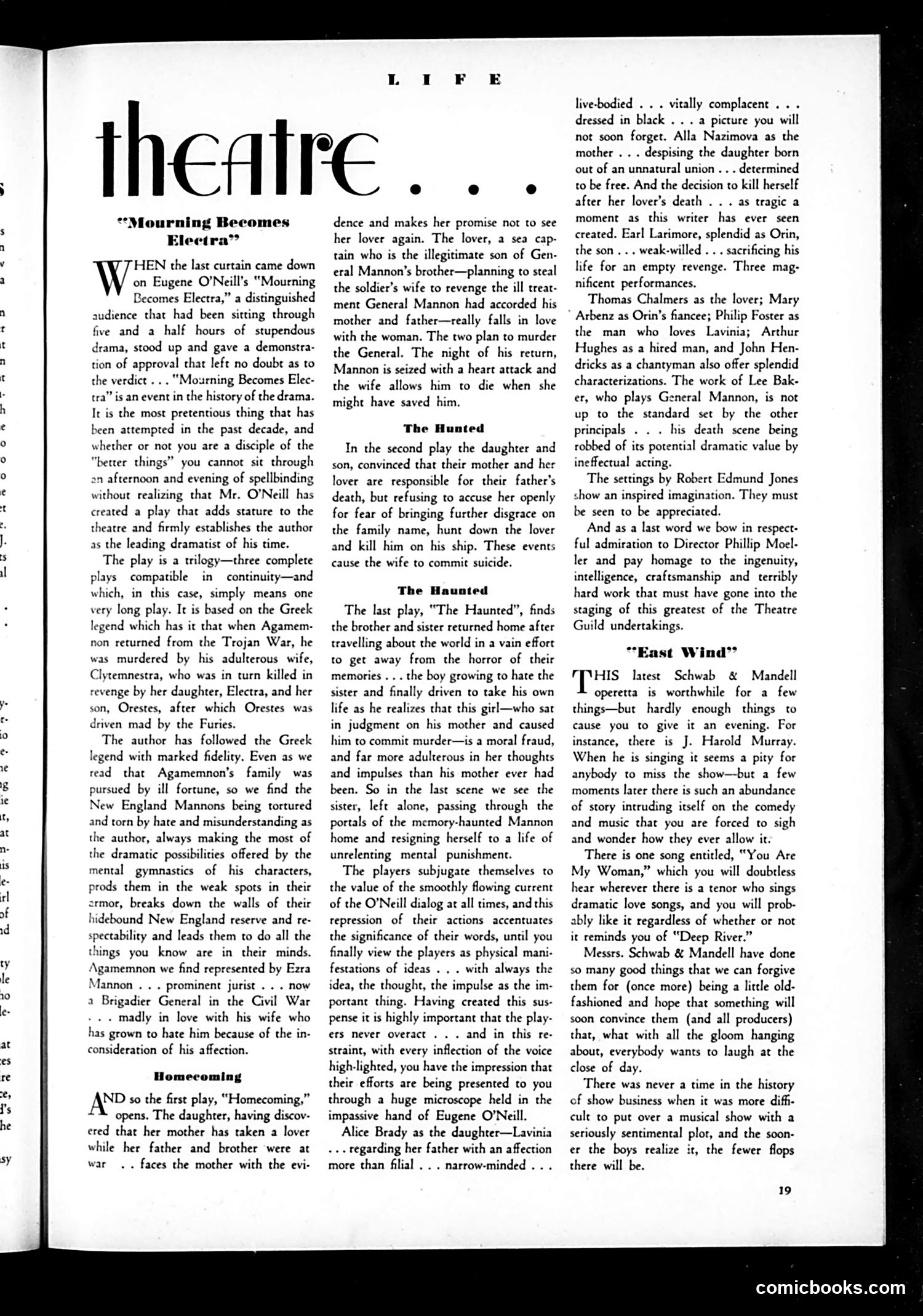
Theatre Reviews from Life Magazine This page contains theatre reviews, not political cartoons. It discusses three plays: 1. "Mourning Becomes Electra" - Eugene O'Neill's trilogy adaptation of the Greek Agamemnon legend, set in post-Civil War America. The review praises O'Neill's dramatic skill and the cast's performances. 2. "The Hunted" - The second play of the trilogy, involving murder, family disgrace, and suicide. 3. "East Wind" - A Schwab & Mandell opera the reviewer finds forgettable, though acknowledging the composers' talent. The critic notes it's musically competent but dramatically weak. The page is primarily critical analysis rather than satire or cartooning—it's a serious theatre column evaluating contemporary dramatic works.
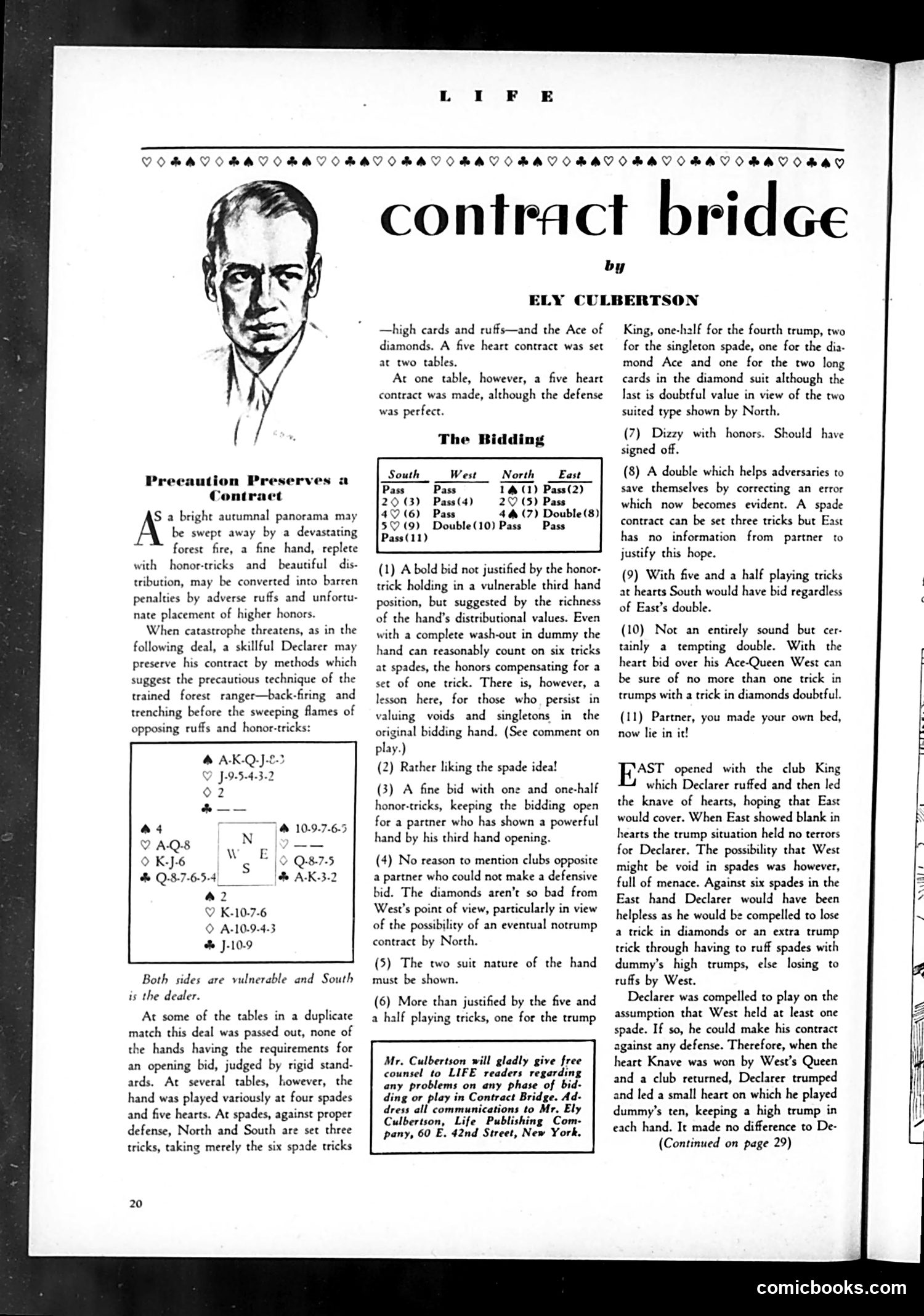
Contract Bridge Analysis for Modern Readers This page is not political satire but rather instructional content about Contract Bridge, a card game. The portrait shows Ely Culbertson, a famous bridge expert and author who wrote the definitive rules and strategy guides for the game in the 1930s-40s. The article analyzes a specific bridge hand, using numbered annotations to critique players' bidding and play decisions. Terms like "honor-tricks," "ruffs," and "vulnerable" are bridge jargon. The forest fire metaphor in the opening—comparing catastrophic hand loss to devastation—is simply colorful writing typical of Life magazine's style. The page includes an offer for readers to submit bridge problems to Culbertson for expert analysis, reflecting Life's role in popularizing recreational games and hobbies during this era. This is educational/entertainment content, not commentary on politics or society.
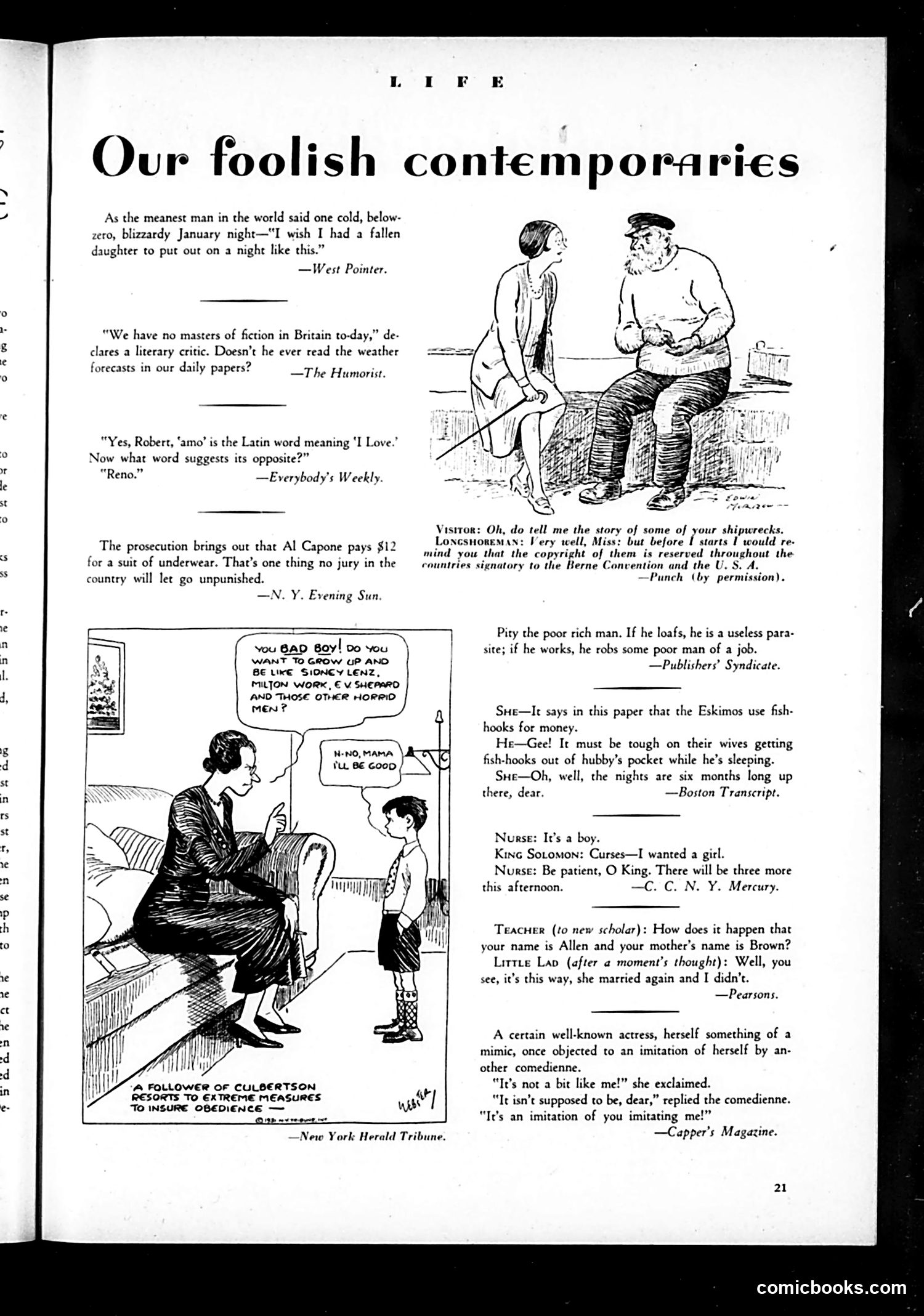
"Our Foolish Contemporaries" This page collects humorous quotes and a cartoon satirizing contemporary society and culture. The main cartoon depicts a mother disciplining a child by invoking the names of bridge players—Culbertson, Lenz, Work, and Shepard—as cautionary examples of "horrid men," suggesting bridge was a consuming social obsession among adults. The surrounding witticisms mock various targets: British literary pretensions, the use of "Reno" (where divorce was obtainable) as the opposite of the Latin word for love, Al Capone's extravagant spending despite criminal prosecution, wealthy men facing lose-lose moral judgments, and various domestic absurdities. The overall tone lampoons contemporary American life—divorce culture, materialism, obsessive hobbies, and class contradictions—with gentle, urbane humor typical of Life magazine's satirical approach during this period (likely 1920s-1930s).
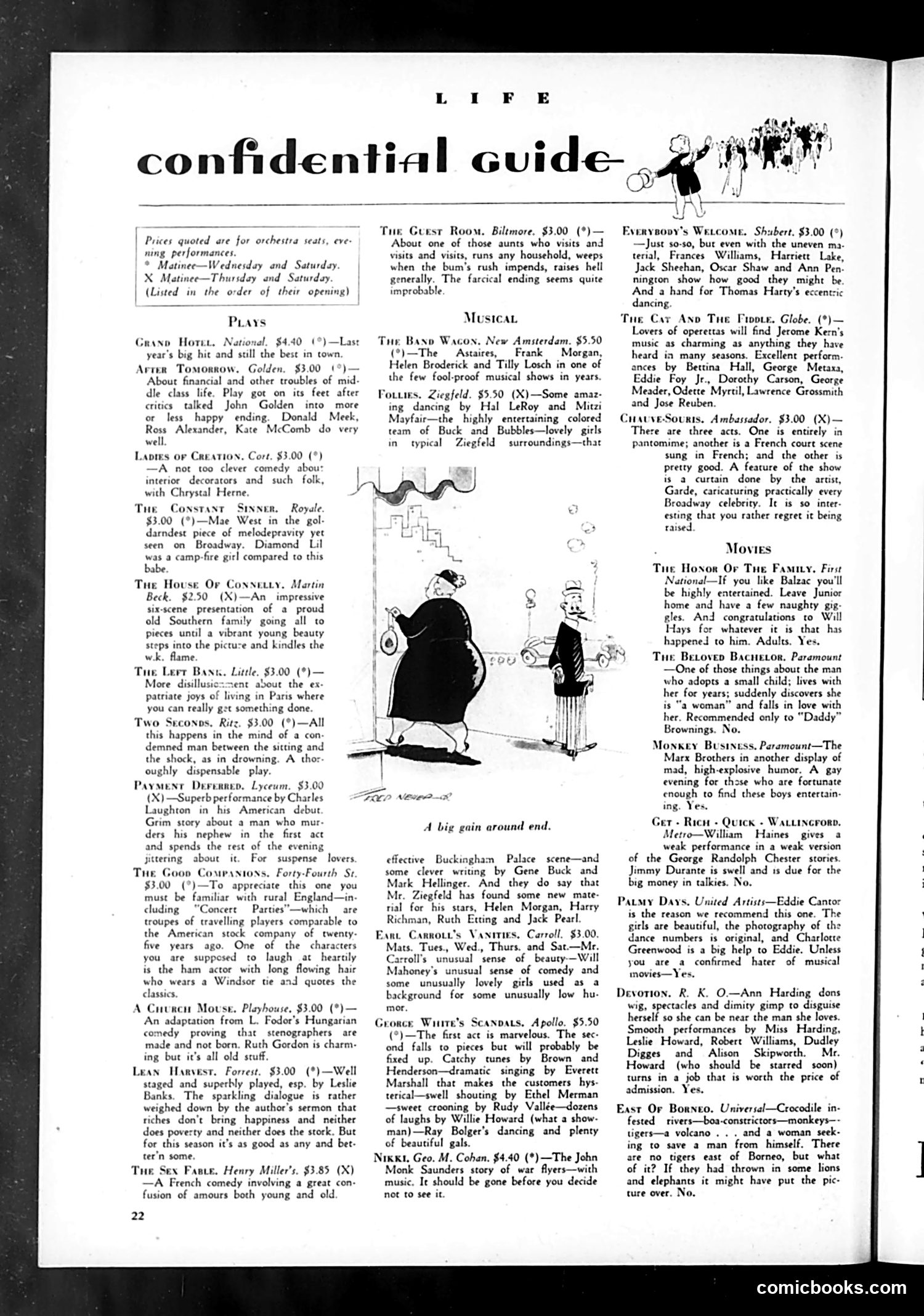
Analysis of Life Magazine Page This page is a theater and entertainment guide—not primarily a political cartoon, though it contains one illustration. The single cartoon depicts a woman in fashionable 1930s dress speaking to a man, captioned "A big gain around end." The joke appears to reference a woman's clothing or figure, likely commenting on fashionable silhouettes of the era, though the specific satire is unclear without additional context. The bulk of the page consists of brief, snappy reviews of Broadway plays and musicals, written in Life's signature satirical style. Reviewers mock productions with backhanded compliments—praising actors while dismissing plots, or noting that familiar entertainment remains "as good as any and better'n some." References to Mae West, the Astaires, and Ziegfeld productions reflect popular entertainment of the early 1930s. The tone is sophisticated and urbane, targeting readers familiar with theater culture.
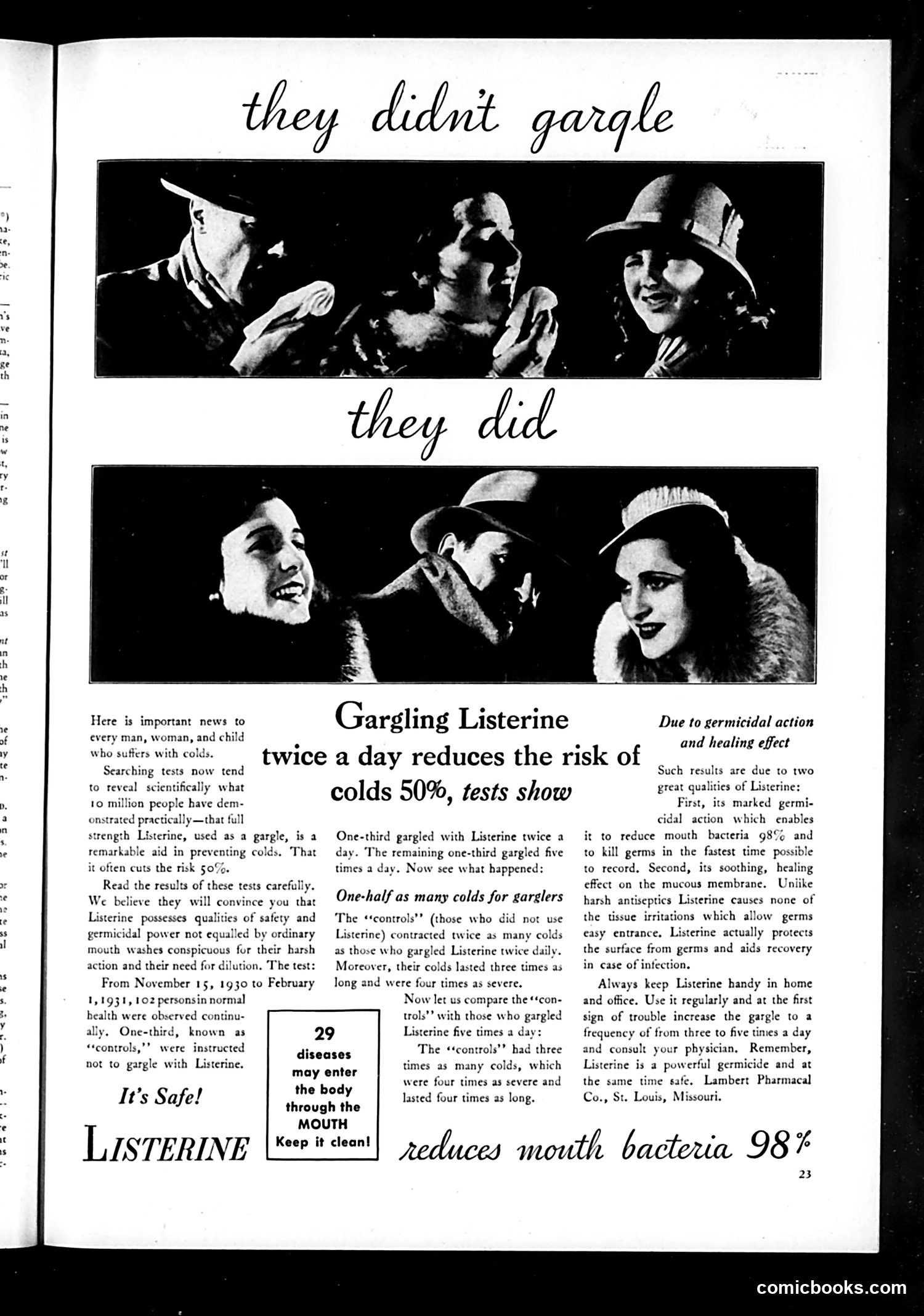
Analysis of This Listerine Advertisement This is primarily a product advertisement, not satire or political commentary. The page promotes Listerine mouthwash using pseudo-scientific claims common to 1930s marketing. The top images show people gargling (the caption "they didn't gargle / they did" contrasts outcomes). The advertisement claims clinical testing from November 1930–February 1931 proved that gargling Listerine twice daily reduces cold risk by 50%, while those gargling five times daily saw even better results. The "satire" of the page lies in its absurd methodology and exaggerated claims typical of early 20th-century advertising: the comparison groups are oddly small, the statistical presentation is crude, and the promise that a mouthwash prevents colds ignores actual viral transmission. Modern readers would recognize this as misleading marketing dressed in pseudo-scientific language—exactly the kind of health claim now regulated by the FDA.
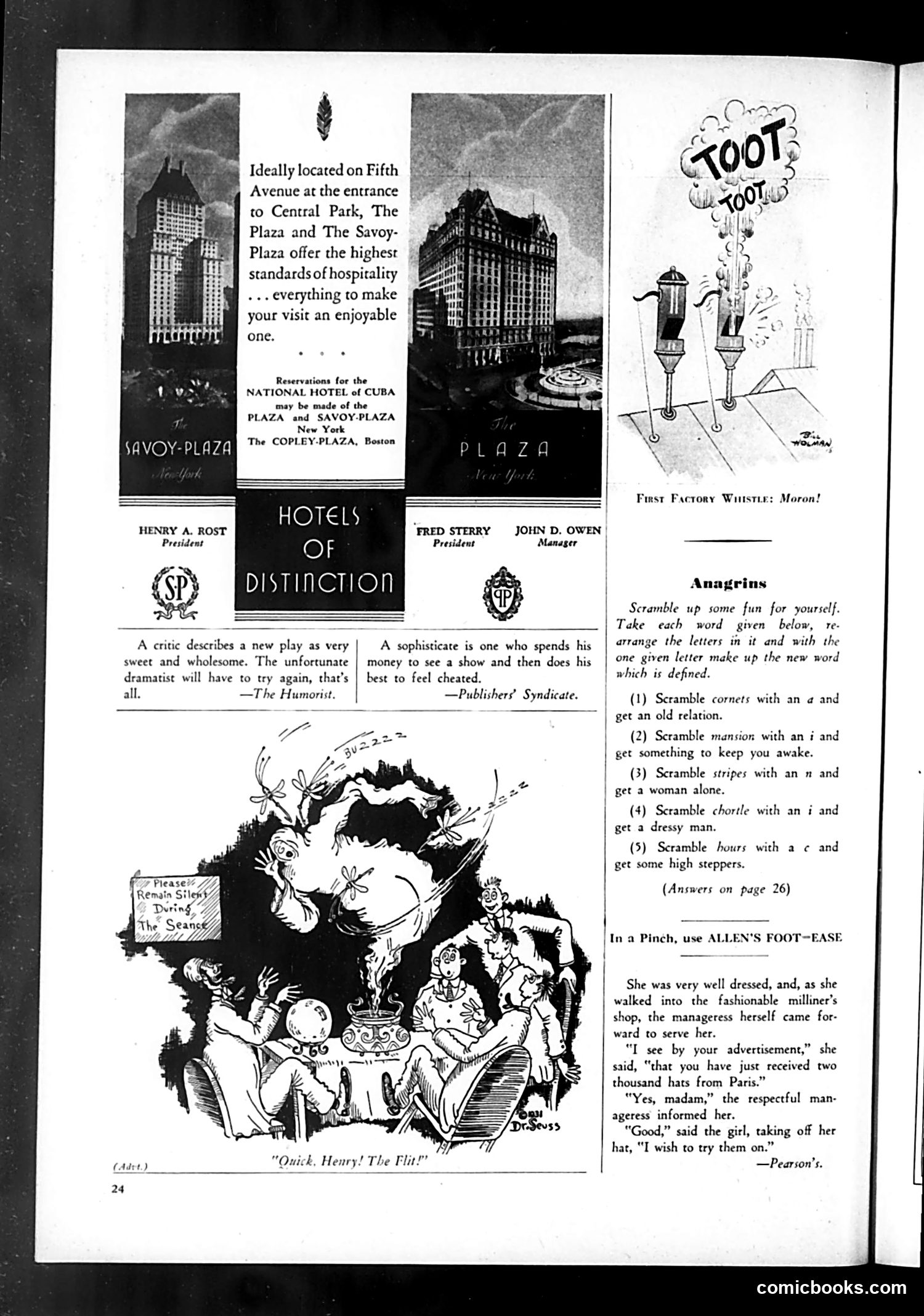
This page is primarily advertising and entertainment content rather than political satire. The top section features hotel advertisements for luxury Manhattan properties (Savoy-Plaza, Plaza) positioned as high-end hospitality destinations near Central Park and Fifth Avenue—appealing to wealthy travelers. Below that is a humor section with two unrelated jokes: one mocking theater critics who praise mediocre plays, another about sophisticates who pay to see shows only to complain. The main cartoon, captioned "Quick, Henry! The Flit!", depicts a chaotic domestic scene with people swatting insects. "Flit" was a commercial insecticide brand—this is an advertisement disguised as humor, playing on the product's popularity for pest control. The right side contains a word puzzle ("Anagrams") and a brief anecdote about a woman trying on Paris hats—typical light entertainment filler. Overall: This is a typical Life magazine page mixing paid advertising with light humor, not political commentary. The "satire" is gentle social observation, not sharp critique.
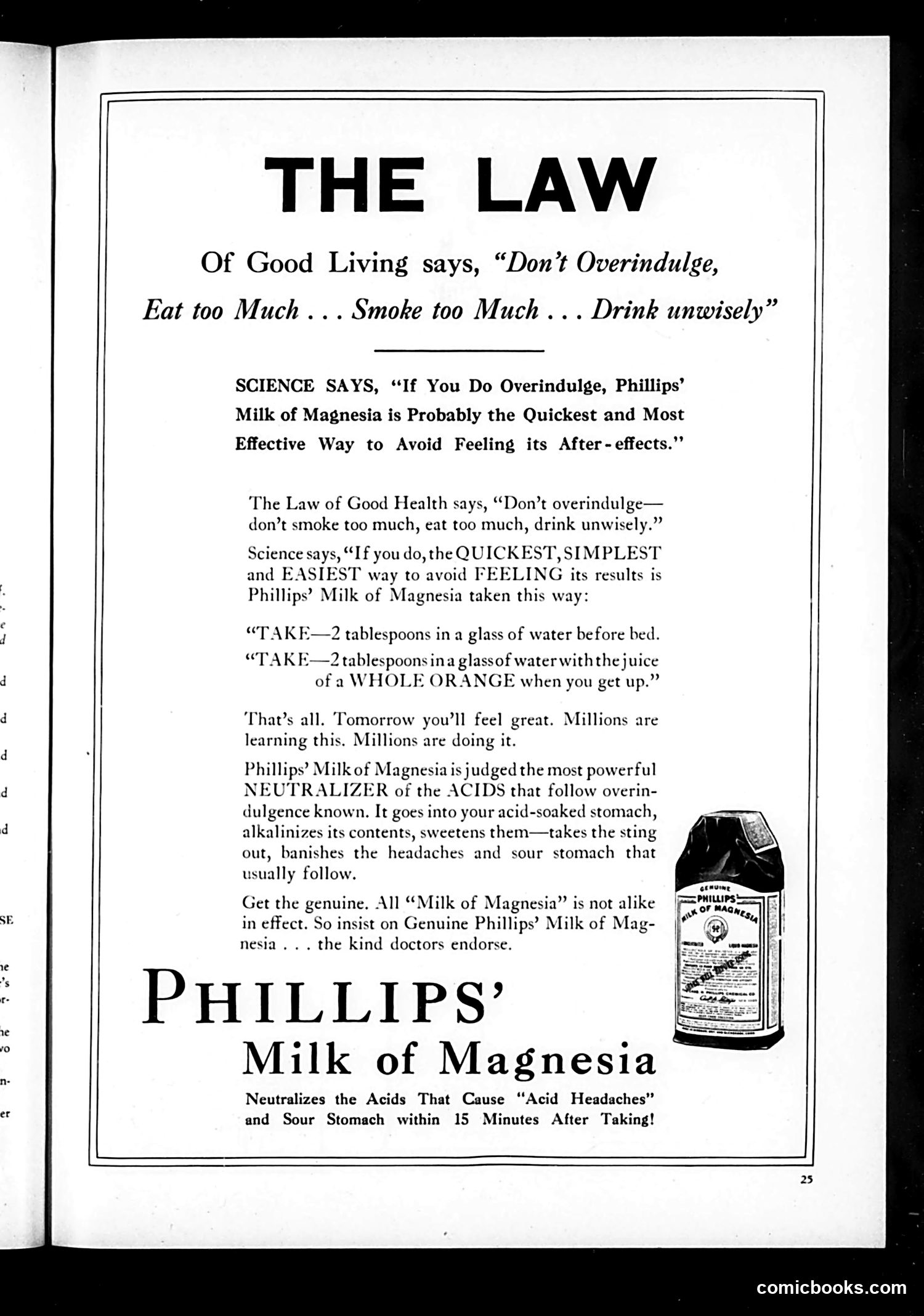
This is a vintage advertisement rather than a political cartoon. The page presents a satirical contrast between idealistic health advice and practical reality. The satire works by acknowledging the gap between "The Law of Good Living" (don't overindulge) and human behavior. Rather than condemn excess, the ad pivots to offering Phillips' Milk of Magnesia as a consequence-management solution—essentially saying: "You'll overindulge anyway, so here's how to fix the aftermath." The humor targets middle-class Americans who made dietary and drinking indulgences despite knowing better, positioning the antacid as a modern convenience that permits guilt-free excess. The repeated emphasis on speed ("15 minutes," "quickest") appeals to busy consumers wanting instant relief. For modern readers, this reflects early 20th-century marketing that normalized casual health problems as inevitable byproducts of leisure and consumption, with pharmaceutical solutions as enablers rather than warnings against excess.
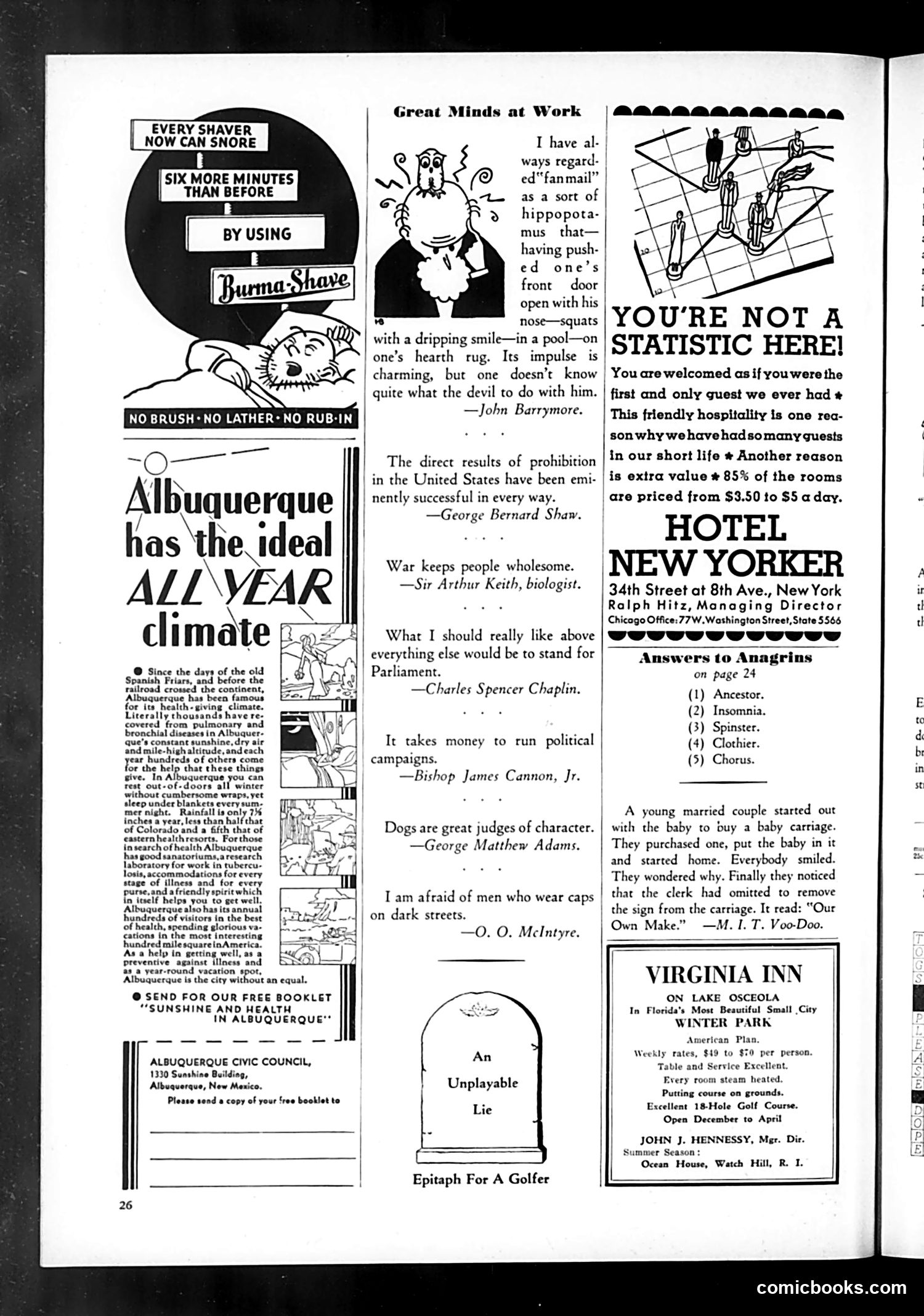
Explaining This Life Magazine Page to Modern Readers This page mixes advertisements with a "Great Minds at Work" humor section featuring famous figures offering quotations—some sincere, some satirical. The Cartoons/Jokes: - A Burma-Shave advertisement (shaving cream) uses the standard roadside-sign format popular in that era - An Albuquerque tourism ad promotes the city's climate for health (reflecting period beliefs about "health resorts" for tuberculosis and respiratory illness) - A small golf epitaph cartoon plays on the phrase "unplayable lie"—a golf term repurposed as commentary on a golfer's dishonesty The "Great Minds" Section: Famous people (John Barrymore, George Bernard Shaw, Charlie Chaplin, etc.) offer quotations. Some appear genuine; others seem chosen for ironic effect—like Shaw praising Prohibition's "success" (widely viewed as failed by the 1920s-30s) or Chaplin expressing desire to enter Parliament (humorous given his status as entertainer, not politician). Advertisements for Hotel New Yorker and Virginia Inn round out the page, typical of Life's revenue model. The page reflects 1920s-30s American commercial culture and satirical humor sensibilities.
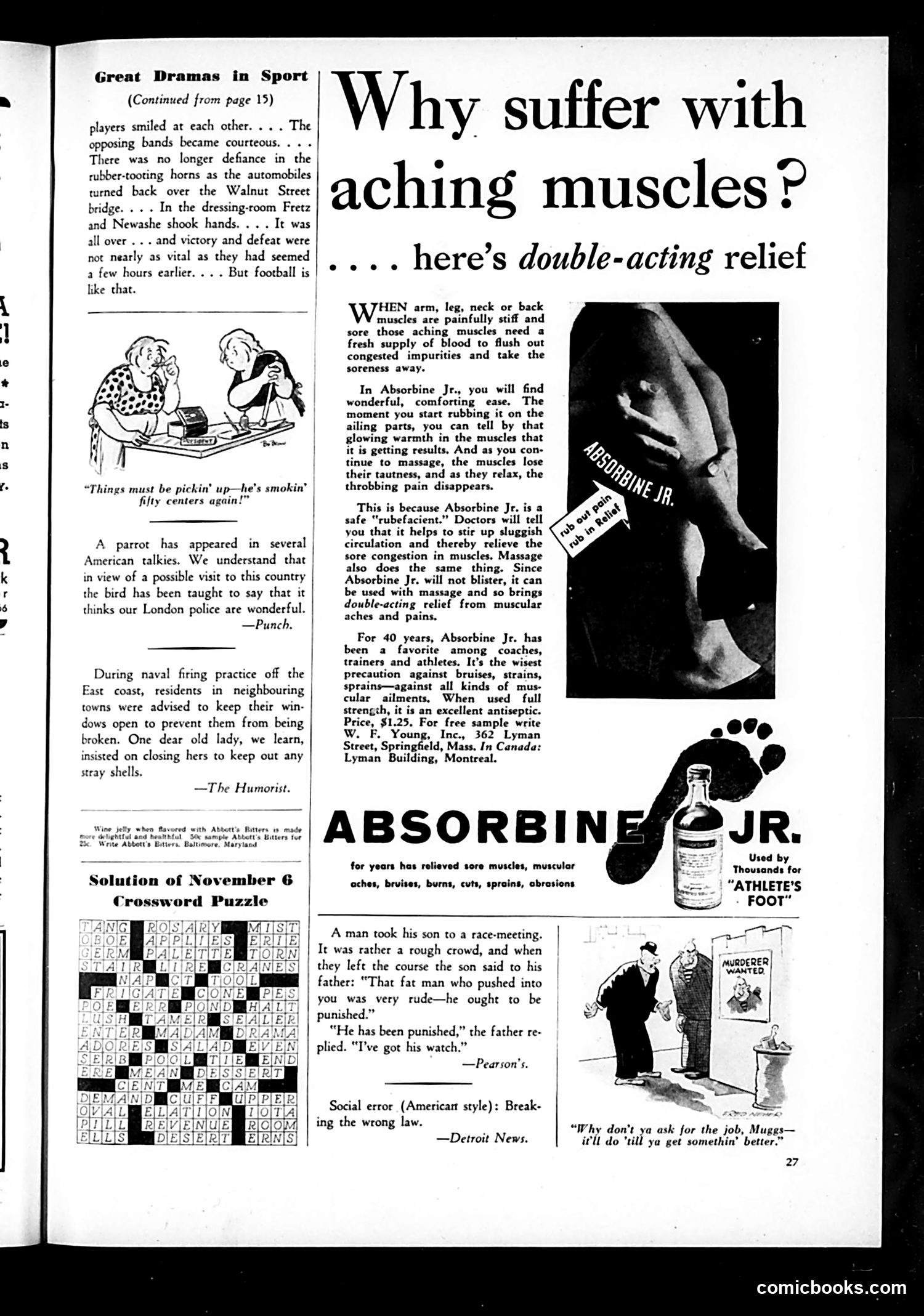
Analysis of Page 27 Content This page mixes sports editorial content, advertisements, and humor pieces typical of Life magazine's satirical format. "Great Dramas in Sport" (top left) concludes a narrative about a football game between rivals Fretz and Newashe, emphasizing how the intensity of competition fades after the game ends—a commentary on sportsmanship. The cartoons below are brief jokes: one involves a parrot taught to praise London police (British satire about American filmmaking); another depicts an elderly woman closing windows during naval practice to keep out stray shells (absurdist humor about wartime precautions). The main advertisement promotes Absorbine Jr., a liniment for sore muscles marketed to athletes and coaches, emphasizing its "double-acting" pain relief through increased circulation and massage. Bottom humor pieces include a joke about theft disguised as justice, and a cartoon about job-seeking during economic hardship—suggesting Depression-era anxieties about employment. The page reflects 1930s-40s Life magazine's blend of sports commentary, consumer advertising, and gentle social satire.
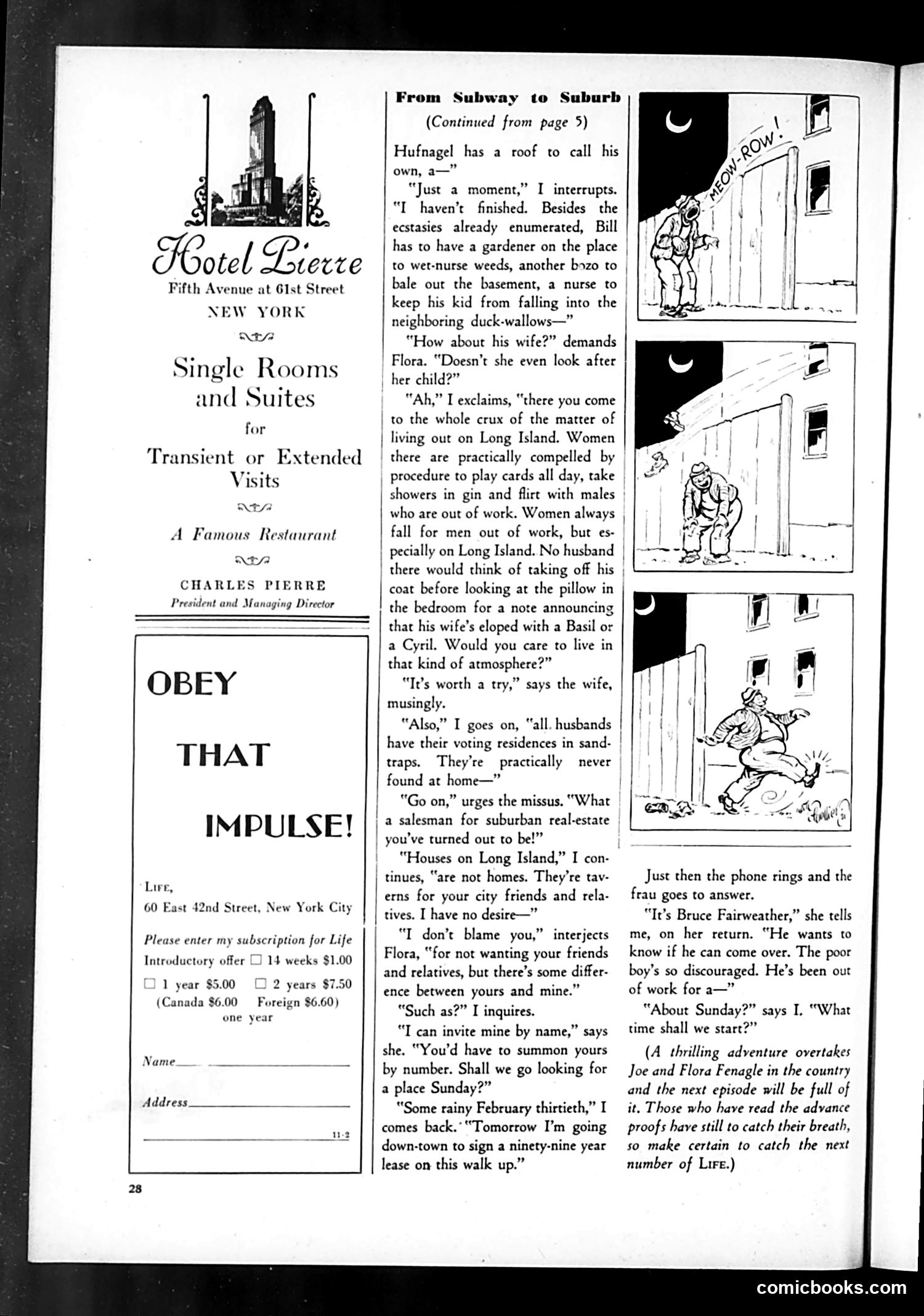
"From Subway to Suburb" - Page Analysis This page contains a serialized humorous story about a couple (Joe and Flora Fenagle) debating whether to move to suburban Long Island. The narrator satirizes 1920s suburban living through exaggerated complaints: wealthy homeowners need armies of servants (gardeners, nurses, workers), yet suburban wives are bored and compelled to play cards all day while flirting with unemployed men. The joke hinges on period anxieties about both suburban pretension and gender roles. The wife ultimately trumps his resistance by pointing out she can invite *her* relatives by name, while he must summon his "by number"—implying his are numerous and undistinguished. The story mocks the absurdity of aspiring to suburban "homes" that function merely as taverns for city friends. The three small cartoon panels illustrate the couple's nighttime discussion. This reflects Life magazine's satirical focus on contemporary American social climbing and the newly emerging suburban phenomenon.
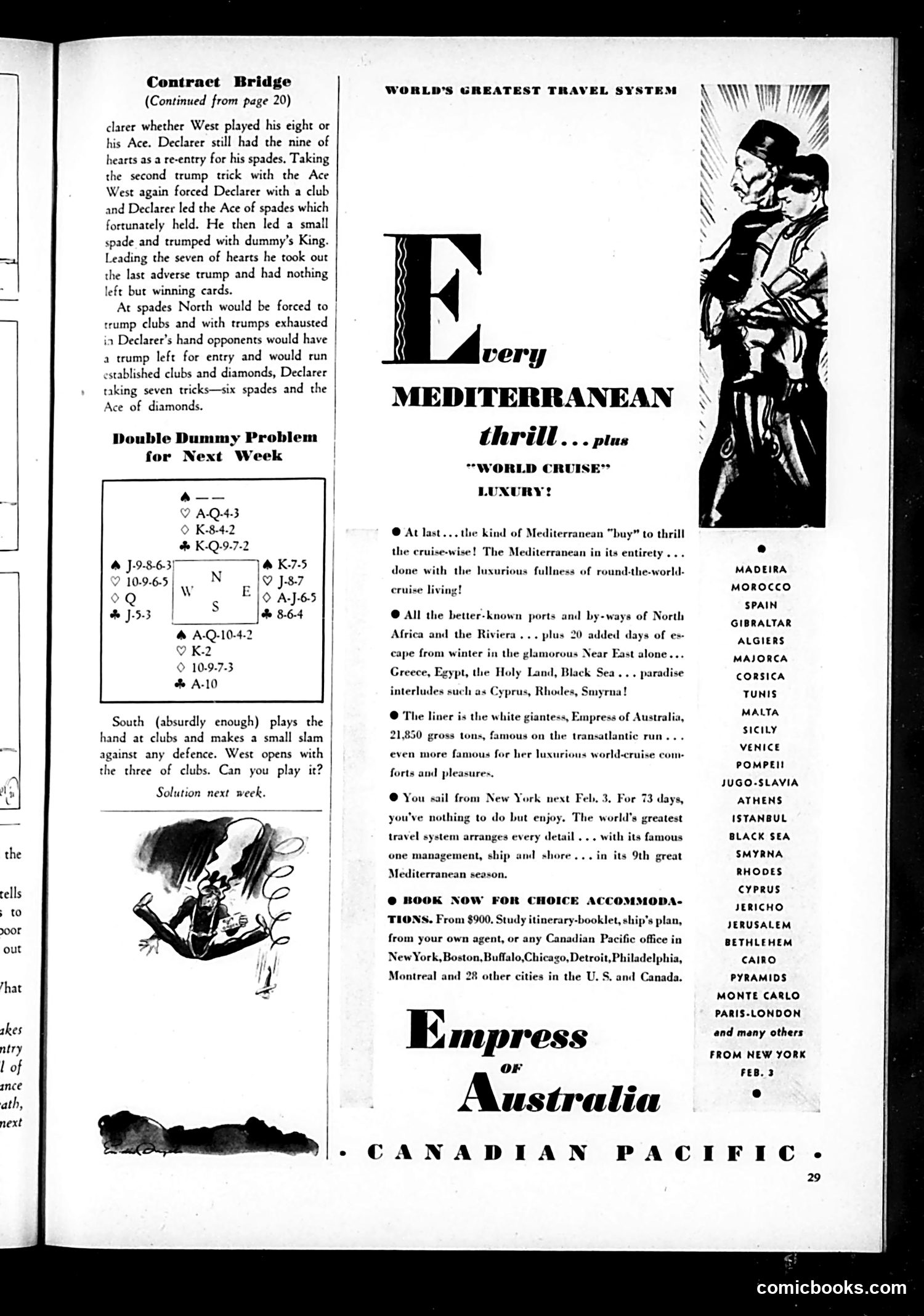
Analysis of Life Magazine Page Content This page is primarily advertising, not political satire. It contains: 1. Contract Bridge Column (top left): A continuation of bridge instruction, explaining card-playing strategy, with a "Double Dummy Problem" puzzle for readers to solve next week. 2. "World's Greatest Travel System" Advertisement (right side): A Canadian Pacific cruise line advertisement promoting Mediterranean luxury voyages aboard the *Empress of Australia*. The ad emphasizes exotic ports (Greece, Egypt, the Holy Land, North Africa) and departs from New York February 3rd for 73 days. The illustration shows two well-dressed travelers, reflecting the advertisement's appeal to wealthy leisure travelers of the era. The listed destinations and ship details are factual promotional content. No political cartoon or satire is present on this page. It's a straightforward magazine layout combining instructional content with period travel advertising targeting affluent readers.
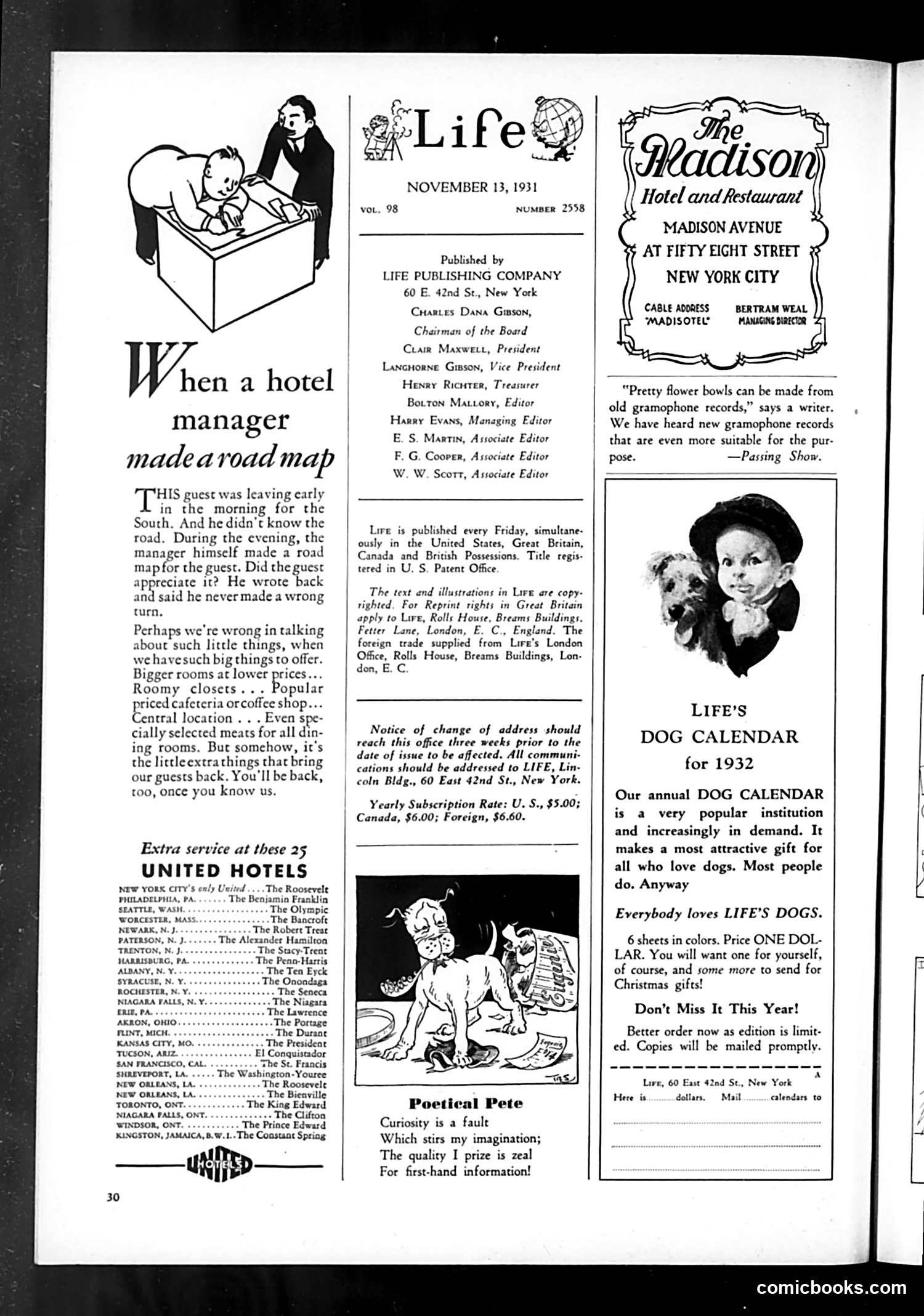
Analysis of Life Magazine Page (November 13, 1931) This page is primarily advertising and promotional content rather than political satire. The main feature is a hotel industry advertisement for United Hotels, using a gentle humor piece about a hotel manager who drew a personalized road map for a departing guest. The joke illustrates the company's philosophy: small personal touches create customer loyalty better than merely offering basic amenities. This reflects 1931 Depression-era marketing—emphasizing service and attention when price competition was fierce. The page also advertises Life's annual Dog Calendar for 1932, a recurring publication that was apparently popular with readers. A small verse titled "Poetical Pete" appears at bottom, making a mild joke about curiosity versus zeal for information—likely commentary on the magazine's own investigative approach. The publication details and hotel listings occupy the center, establishing Life's institutional authority and reach across major American cities during the early 1930s. No political cartoons or satirical commentary about current events appears on this page.
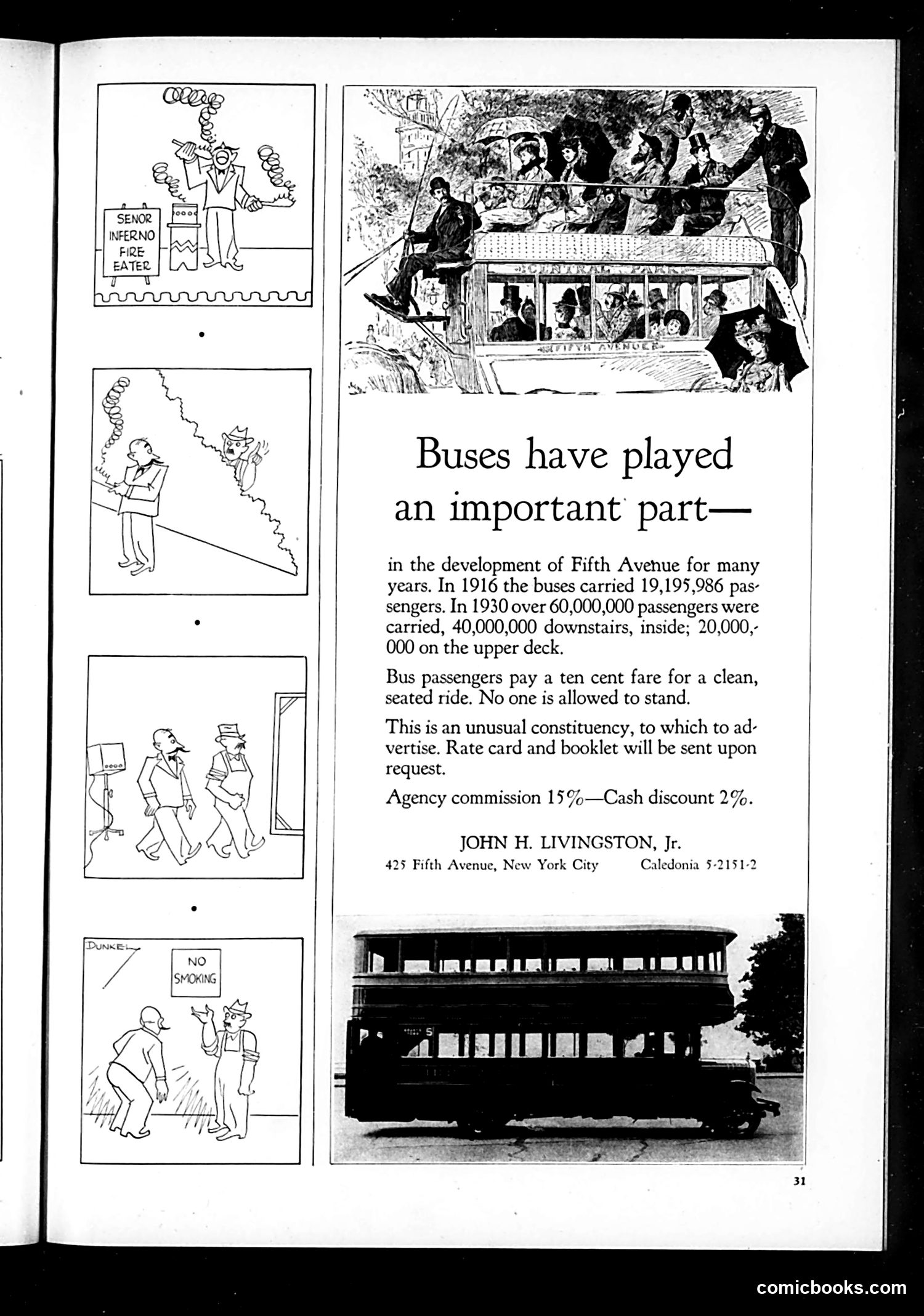
Analysis of Page 31 This page primarily features advertising for bus transit on Fifth Avenue, not political satire. The four small cartoons on the left are humorous vignettes illustrating common bus passenger behaviors and etiquette issues: a man juggling packages, someone using a telephone, passengers boarding, and a "no smoking" enforcement scene. The advertisement emphasizes the buses' appeal as a clean, seated transportation option where standing is prohibited—positioning this as a luxury service. The text highlights impressive passenger statistics (19.2 million in 1916; over 60 million by 1930) to demonstrate Fifth Avenue's importance as a commercial corridor. The lower photograph shows a double-decker bus, then a modern conveyance. The ad targets potential advertising clients by noting the captive, affluent audience riding these buses represents an "unusual constituency" for marketing. This is essentially a business solicitation for advertising space on buses rather than social or political commentary.
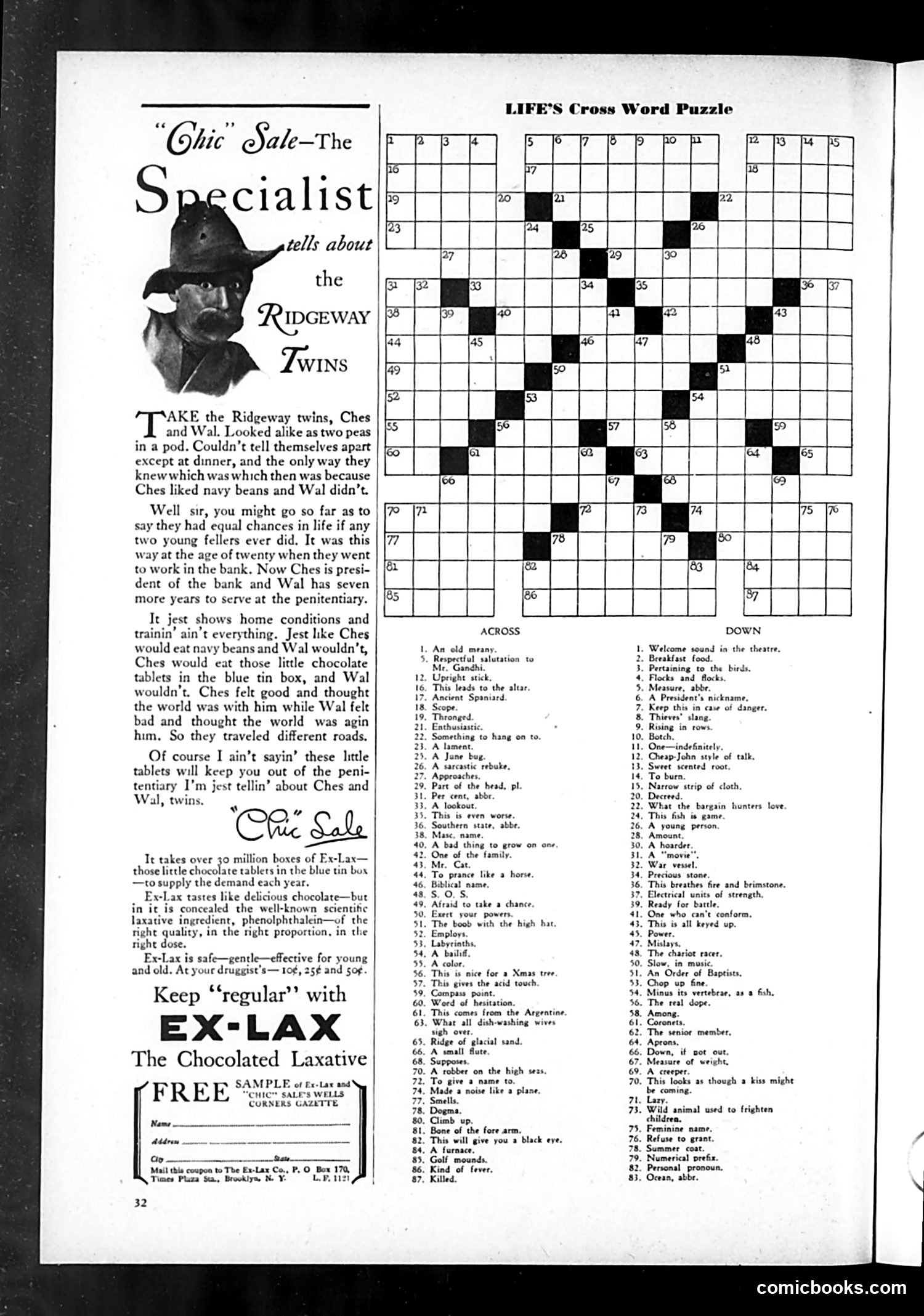
"Chic Sale" Advertisement with Moral Tale This page features an advertisement for Ex-Lax laxative tablets disguised as folksy storytelling by "Chic Sale," a popular humorist character of the era. The narrative presents identical twins—Ches and Wal Ridgeway—who had equal opportunities but diverged dramatically: Ches became a bank president while Wal serves seven years in the penitentiary. The moral lesson attributes their different fates to personal habits and attitude: Ches ate Ex-Lax tablets and "felt good," while Wal refused them and "thought the world was agin him." This is vintage 1920s-30s advertising pseudoscience, suggesting that bowel regularity directly influences moral character and life success. The implication—that constipation leads to criminality while laxative use promotes virtue—appears absurd today but reflects genuine period beliefs linking physical health to moral/social outcomes. The folksy narrator lends false authority to the pitch.
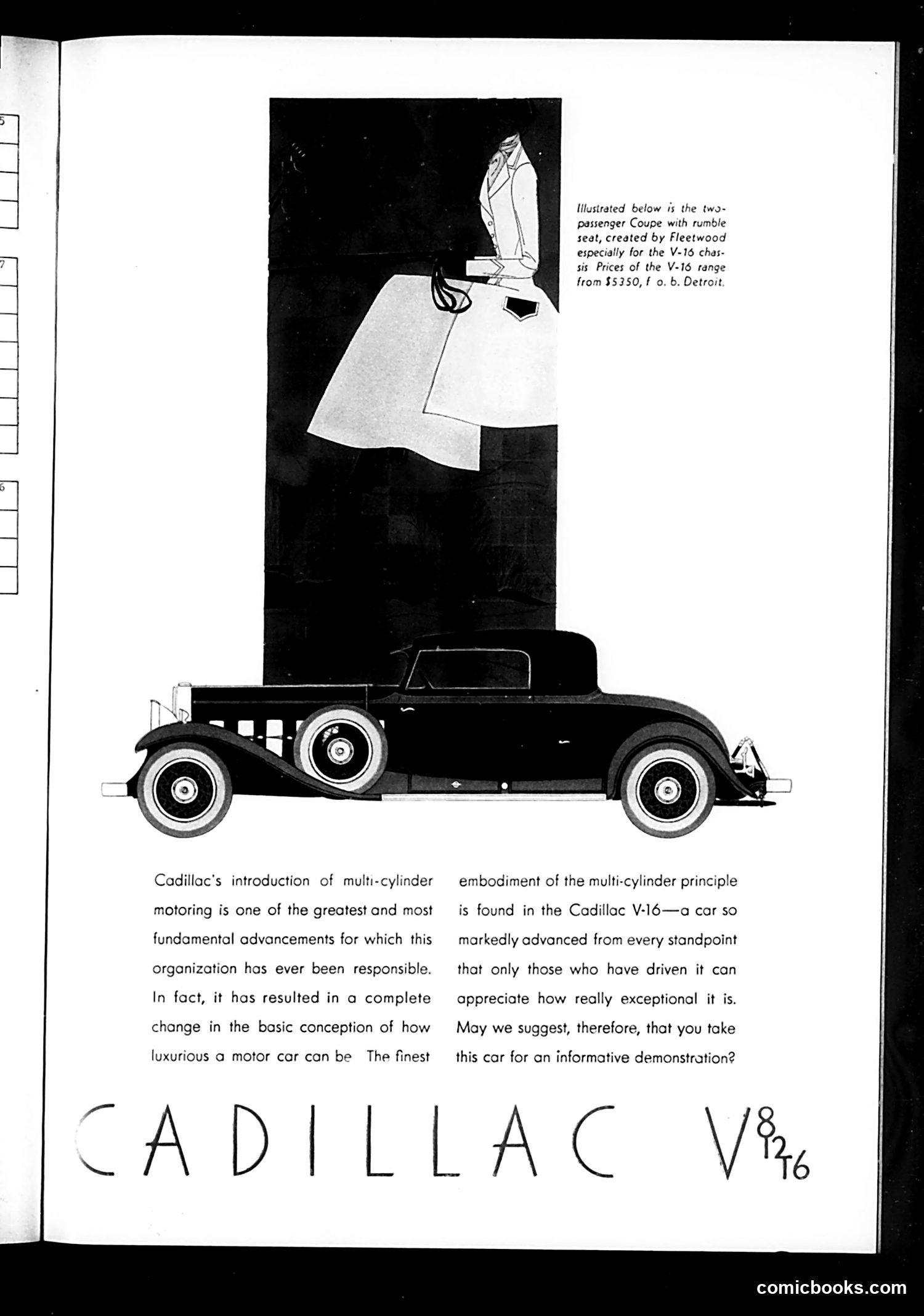
Analysis This is a Cadillac automobile advertisement, not political satire. It promotes the Cadillac V-16, a luxury car featuring a multi-cylinder engine—presented as a major technological advancement. The page displays a side-profile illustration of the sleek black roadster and an inset showing a two-passenger coupe with rumble seat, designed by Fleetwood. The text emphasizes the V-16's engineering superiority and invites potential buyers to test drive the vehicle, with prices starting at $5,350 (Detroit). The ad's tone reflects 1920s-30s marketing: emphasizing mechanical innovation and luxury as markers of prestige. There is no satire or political content—this is straightforward commercial promotion celebrating automotive engineering as a sign of American industrial achievement and corporate innovation.
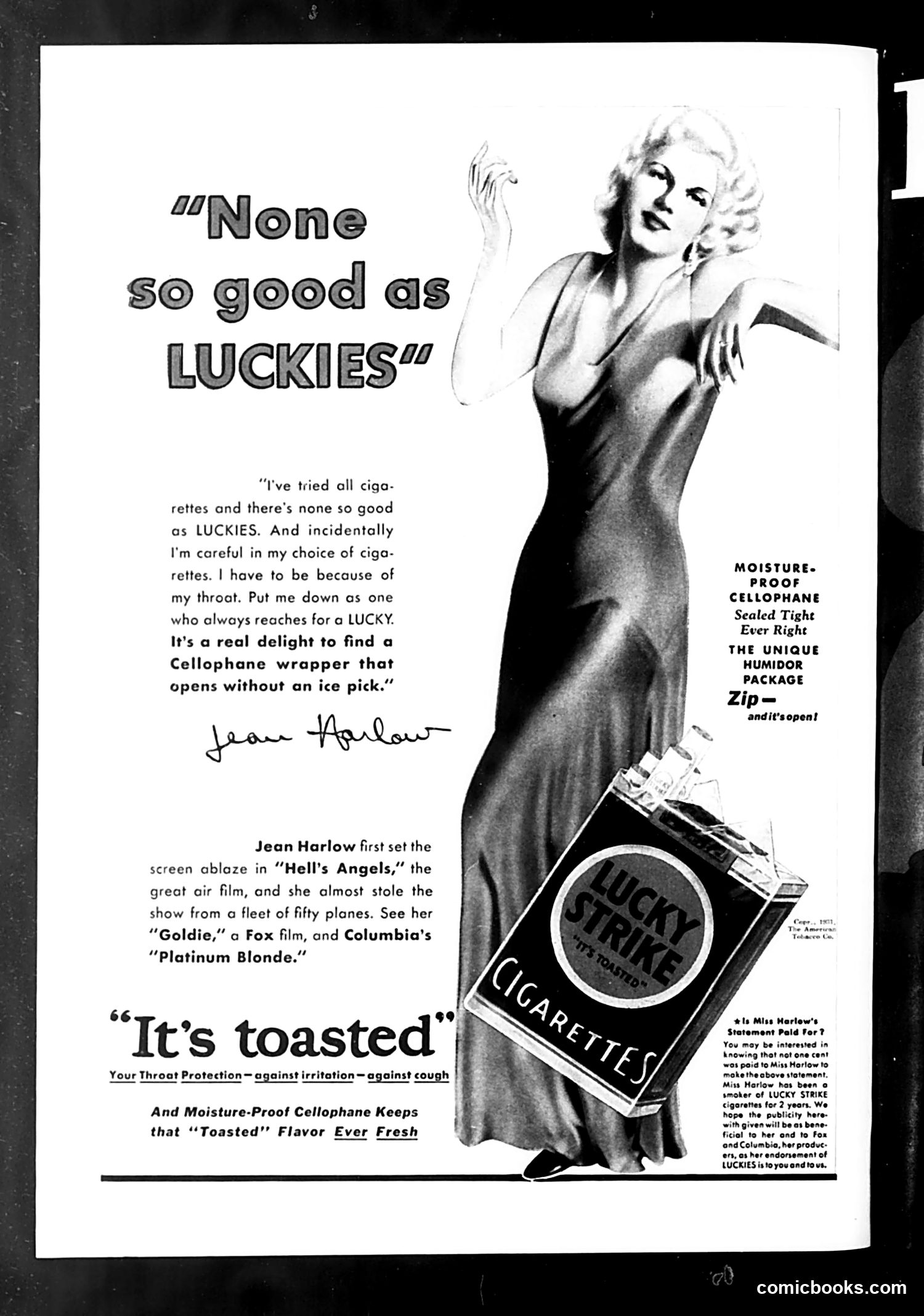
This is a Lucky Strike Cigarette Advertisement This is not political satire—it's a straightforward commercial advertisement featuring actress Jean Harlow as a celebrity endorser. The page promotes Lucky Strike cigarettes, emphasizing their "toasted" flavor and new moisture-proof cellophane packaging with a zip opening (presented as a convenience improvement over needing "an ice pick" to open previous packages). Harlow, a famous Hollywood star from films like "Hell's Angels" and "Platinum Blonde," provides a glamorous testimonial claiming she prefers Luckies for throat protection. The advertising strategy leverages her celebrity status and sex appeal to sell cigarettes—a common mid-20th century marketing tactic before cigarette advertising restrictions. For modern readers: this represents an era when tobacco companies used major film stars in advertisements and made health claims ("throat protection") that would now be illegal and widely recognized as false.