life
Life — November 20, 1931
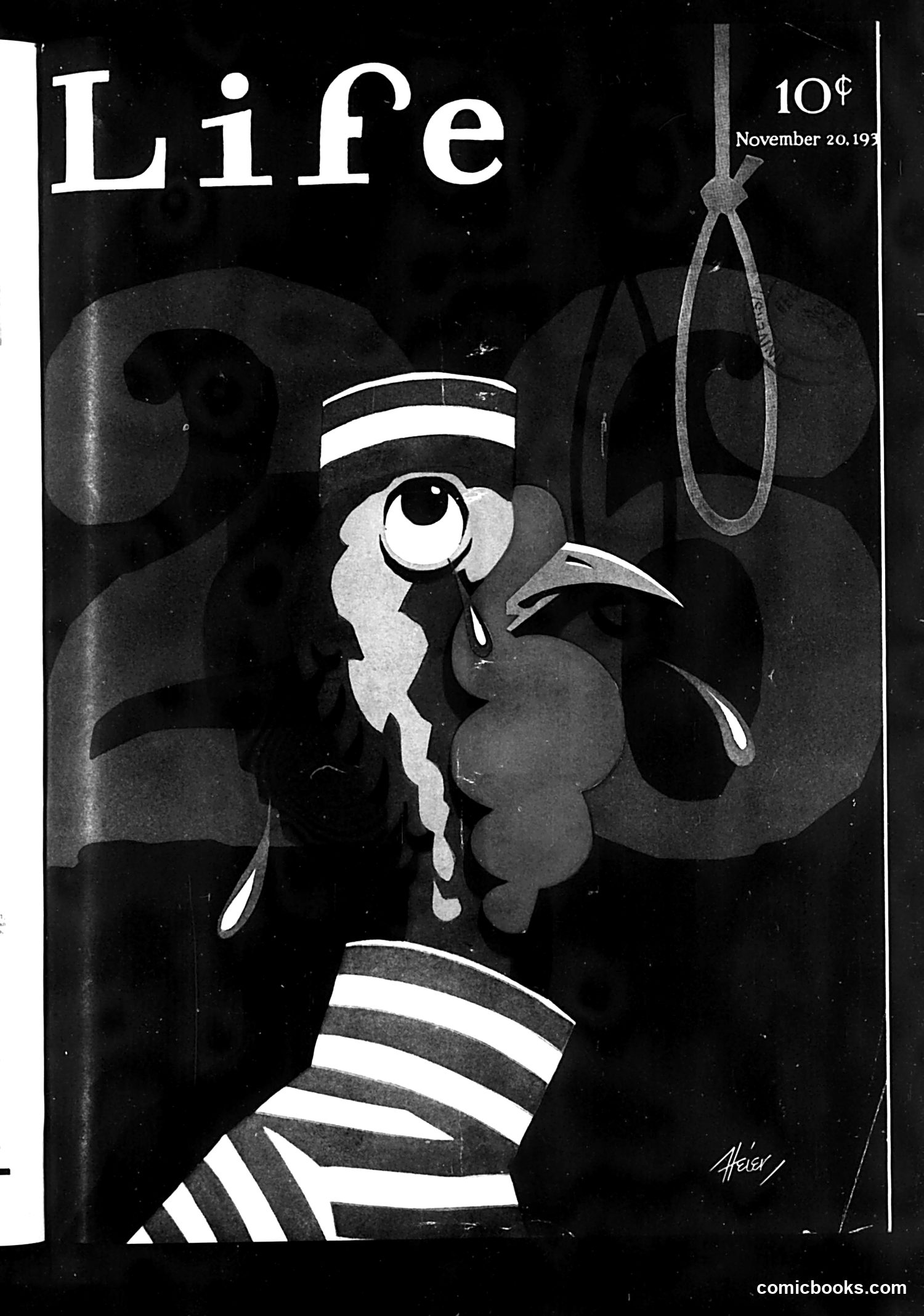
Analysis of Life Magazine Cover (November 20, 1931) This cover depicts a caricatured figure in a sailor's uniform with an exaggerated, sorrowful expression—large tearful eye, downturned mouth—surrounded by dark, ominous shapes including what appears to be a noose. The styling suggests despair or suicide imagery. Published during the Great Depression (November 1931), this likely satirizes the economic crisis and its psychological toll on Americans, particularly those in maritime/naval occupations facing unemployment. The sailor represents the common working man devastated by financial collapse. The artist's signature appears to read "Aker" (unclear if full name). The 10¢ price reflects early-Depression-era costs. The overall message critiques the national mood of hopelessness during this economic catastrophe.
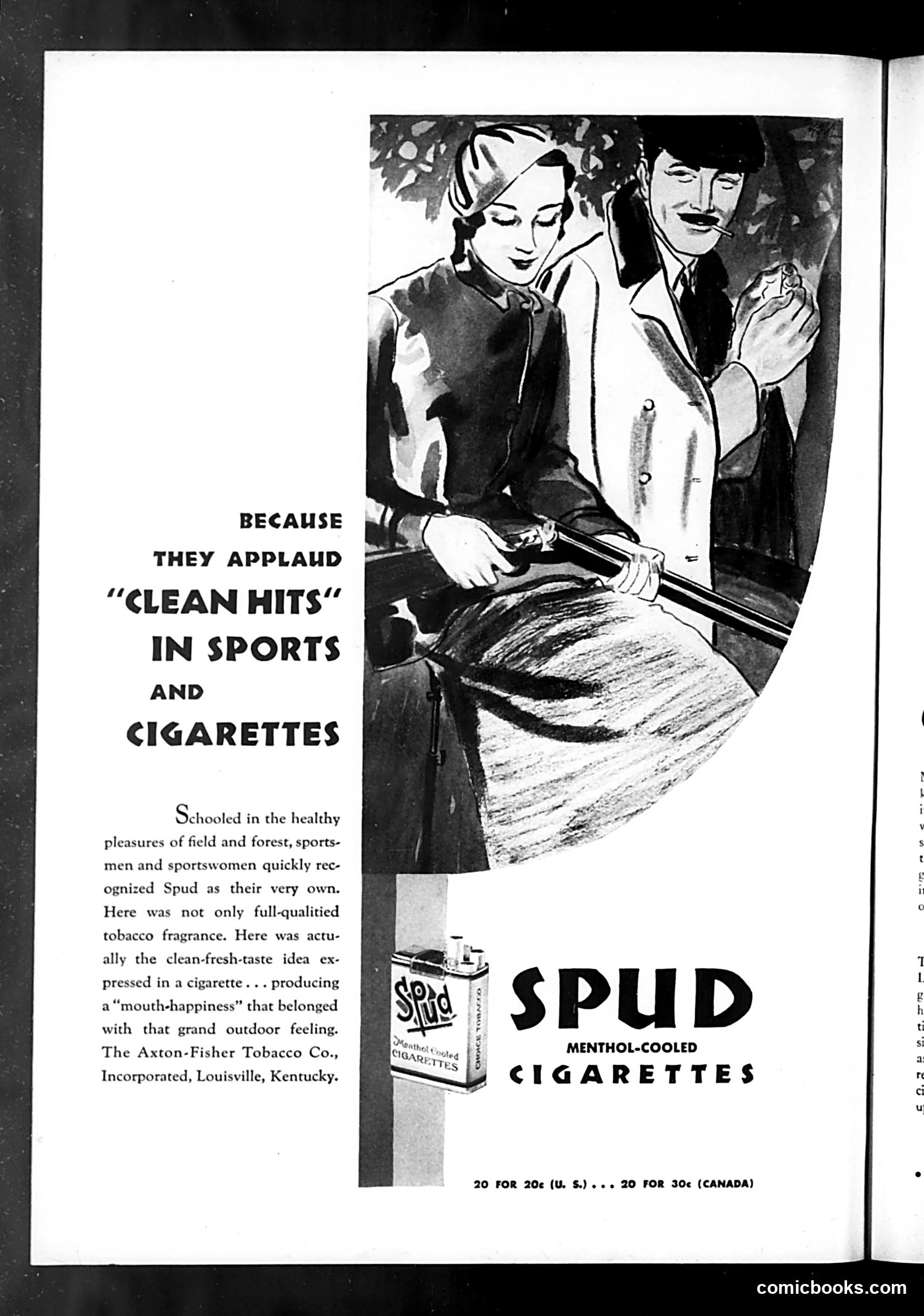
Historical Advertisement Analysis This is a cigarette advertisement, not satire. It's a vintage Spud menthol cigarette ad from the Axton-Fisher Tobacco Company (Louisville, Kentucky) that exploits the association between smoking and sports. The ad depicts well-dressed men and women in what appears to be a hunting or outdoor sporting context. The headline cynically claims consumers applaud "clean hits" in both sports AND cigarettes—falsely equating athletic vigor with smoking. The text describes how "sportsmen and sportswomen" recognized Spud's "clean-fresh-taste" as matching their "grand outdoor feeling." For modern readers: This represents early tobacco marketing that deliberately targeted active, healthy demographics by linking cigarettes to athleticism and outdoor recreation—tactics now recognized as deceptive health claims. Such advertising is illegal today.
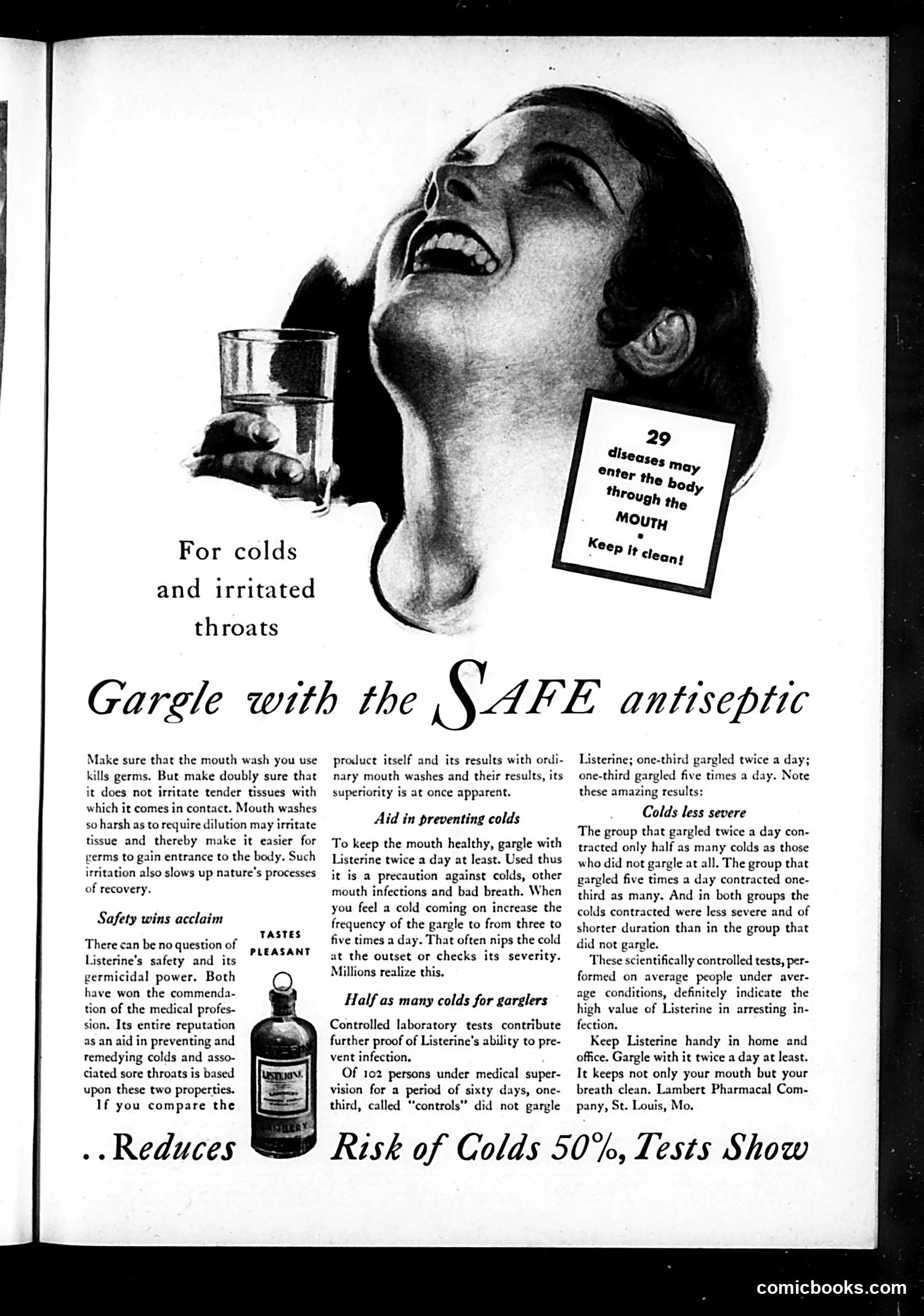
Analysis This is a vintage advertisement, not political satire. It promotes Listerine mouthwash as a cold remedy, using exaggerated imagery of a man gargling with his head tilted back and mouth wide open. The ad makes specific health claims typical of early-to-mid 20th century marketing: that gargling with Listerine twice daily reduces cold risk by 50% according to "tests." It emphasizes preventing colds by maintaining mouth hygiene and warns that "29 diseases may enter the body through the MOUTH." The page includes a product bottle image and clinical-sounding language ("controlled laboratory tests," "medical supervision") to establish credibility. By modern standards, these claims would be considered misleading medical advertising—the product's actual efficacy against colds is far more limited than implied.
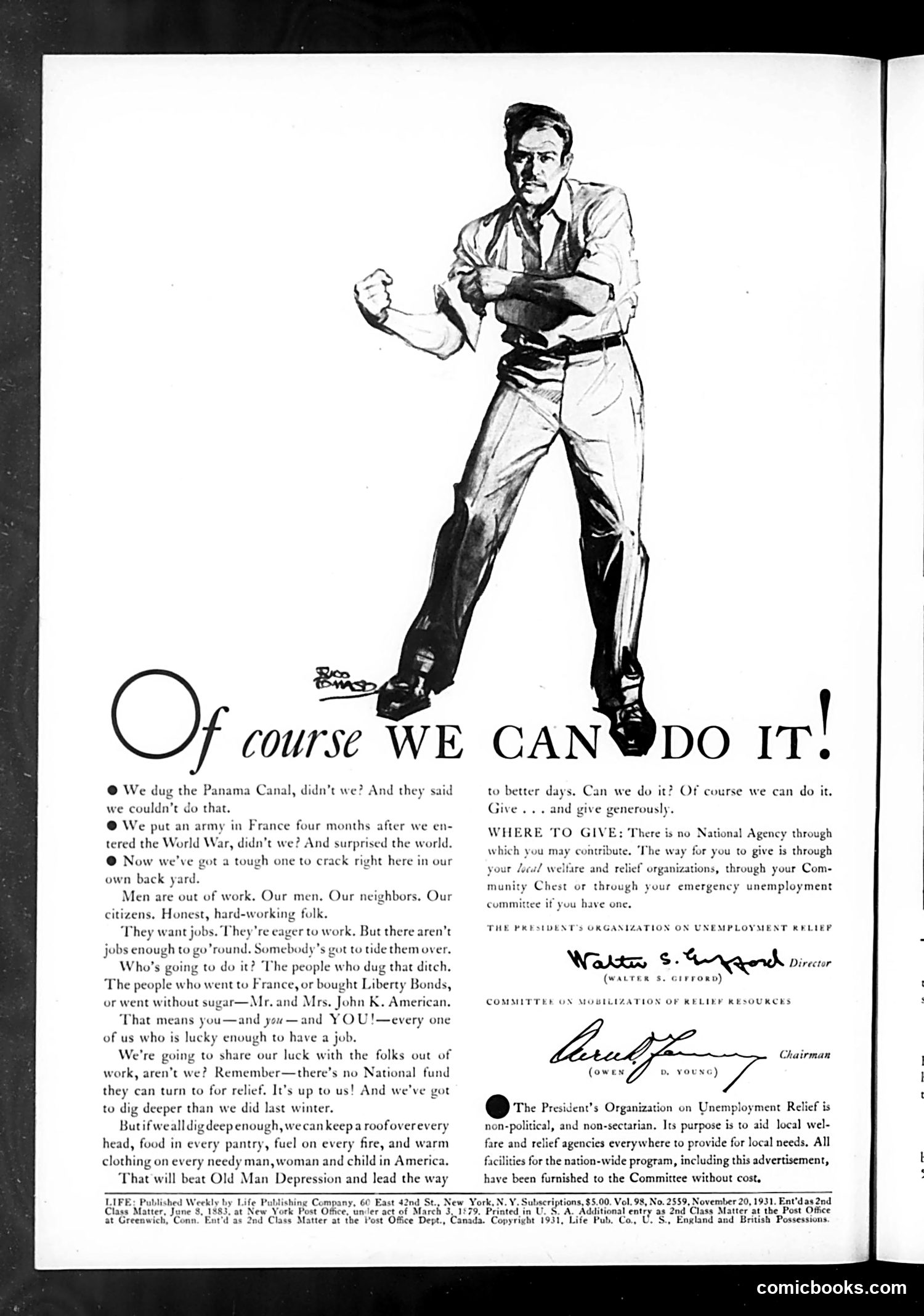
"Of Course We Can Do It!" — Depression-Era Relief Appeal This 1931 Life magazine page presents a patriotic call for charitable giving during the Great Depression. The illustration shows a determined man in working clothes in a boxing stance, symbolizing American resilience and "can-do" spirit. The text references major national achievements—the Panama Canal, WWI victory in France—to argue Americans can overcome economic crisis through private charity and community relief efforts. It appeals to employed citizens to support jobless neighbors through local welfare organizations and community chests. Notably, this represents the pre-New Deal approach: relying on voluntary private donations rather than government programs. The President's Organization on Unemployment Relief (credited at bottom) represented Herbert Hoover's philosophy of private-sector solutions before Franklin D. Roosevelt's expanded federal relief programs took over.
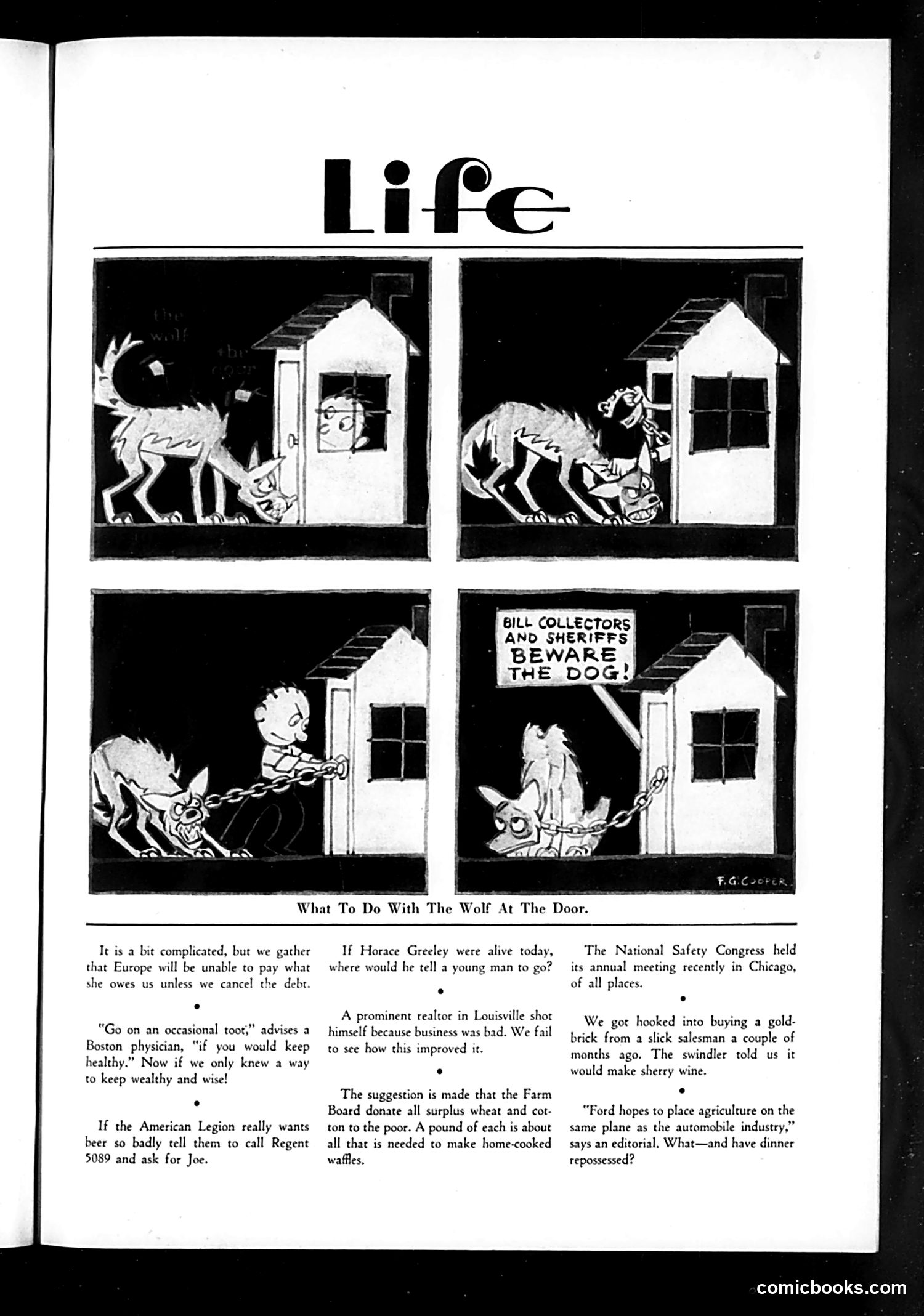
"Life" Magazine - "What To Do With The Wolf At The Door" This four-panel comic satirizes debt collection during economic hardship. The phrase "wolf at the door" is a metaphor for creditors threatening foreclosure or seizure of property. The strip shows a homeowner progressively chaining up an aggressive dog (the "wolf") to keep bill collectors and sheriffs away. The final panel depicts a warning sign: "BILL COLLECTORS AND SHERIFFS BEWARE THE DOG!" The humor relies on inverting the threat—instead of fearing the wolf (debt), the debtor weaponizes a guard dog against creditors themselves. This reflects Depression-era anxieties about losing homes to foreclosure and mocking both creditors' aggressive collection tactics and desperate homeowners' resistance to them.
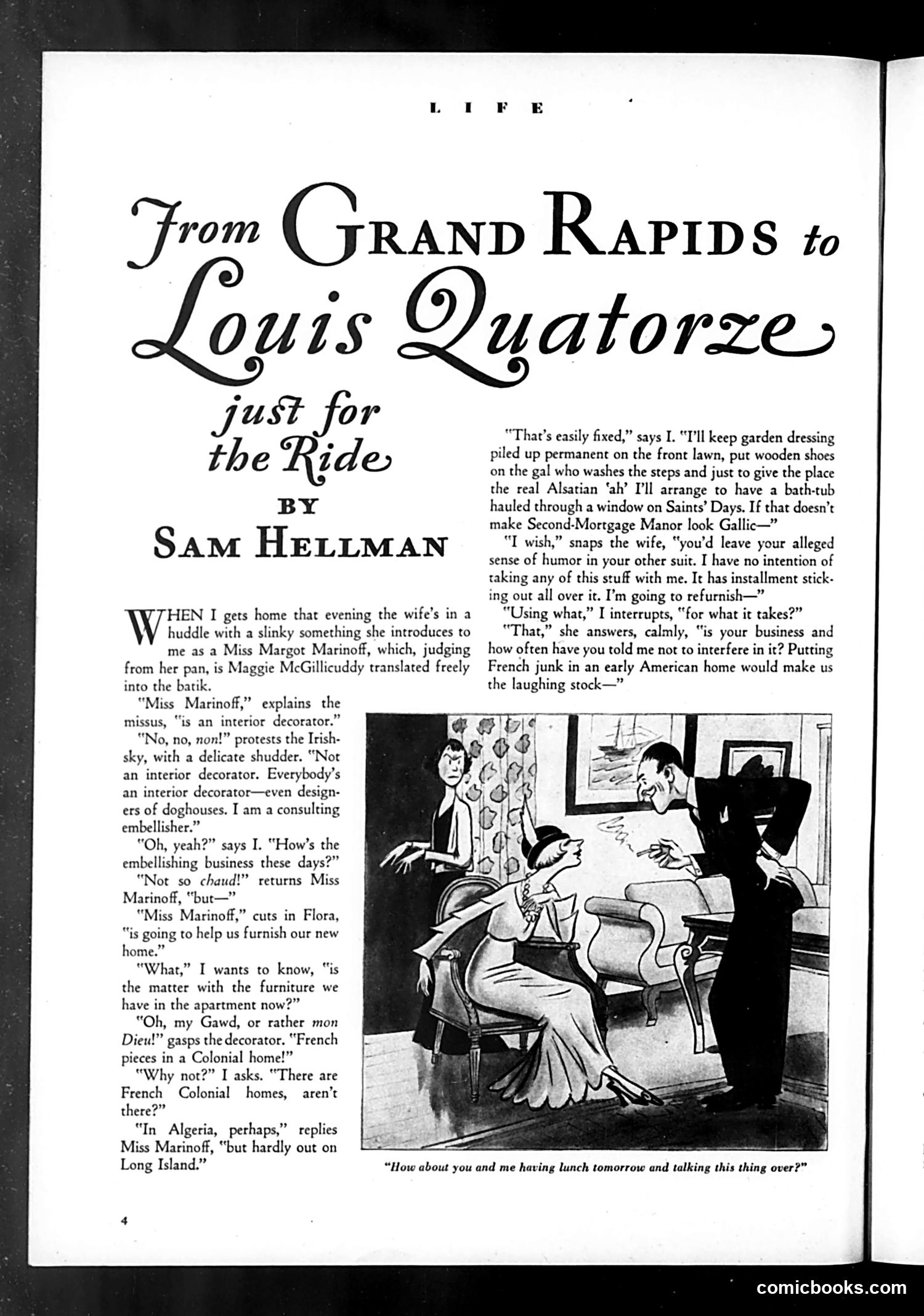
Analysis for Modern Readers This is a humorous domestic story by Sam Hellman titled "From Grand Rapids to Louis Quatorze just for the Ride." It depicts a typical 1920s marital conflict about home decoration and furnishing. The plot: A husband returns home to find his wife has hired an interior decorator (Miss Margot Marinoff) to redesign their apartment. The wife dismisses the husband's concerns about their existing furniture, while he protests against expensive "French Colonial" decorating choices. The satire mocks the emerging trend of professional interior decorators and the social pretensions of middle-class Americans mimicking aristocratic European styles. The title jokes that they're adopting Louis XIV (Versailles-level) grandeur just for a ride to New York. The cartoon illustrates the couple discussing their plans while the decorator gestures enthusiastically—capturing the era's class anxieties about taste and conspicuous consumption.
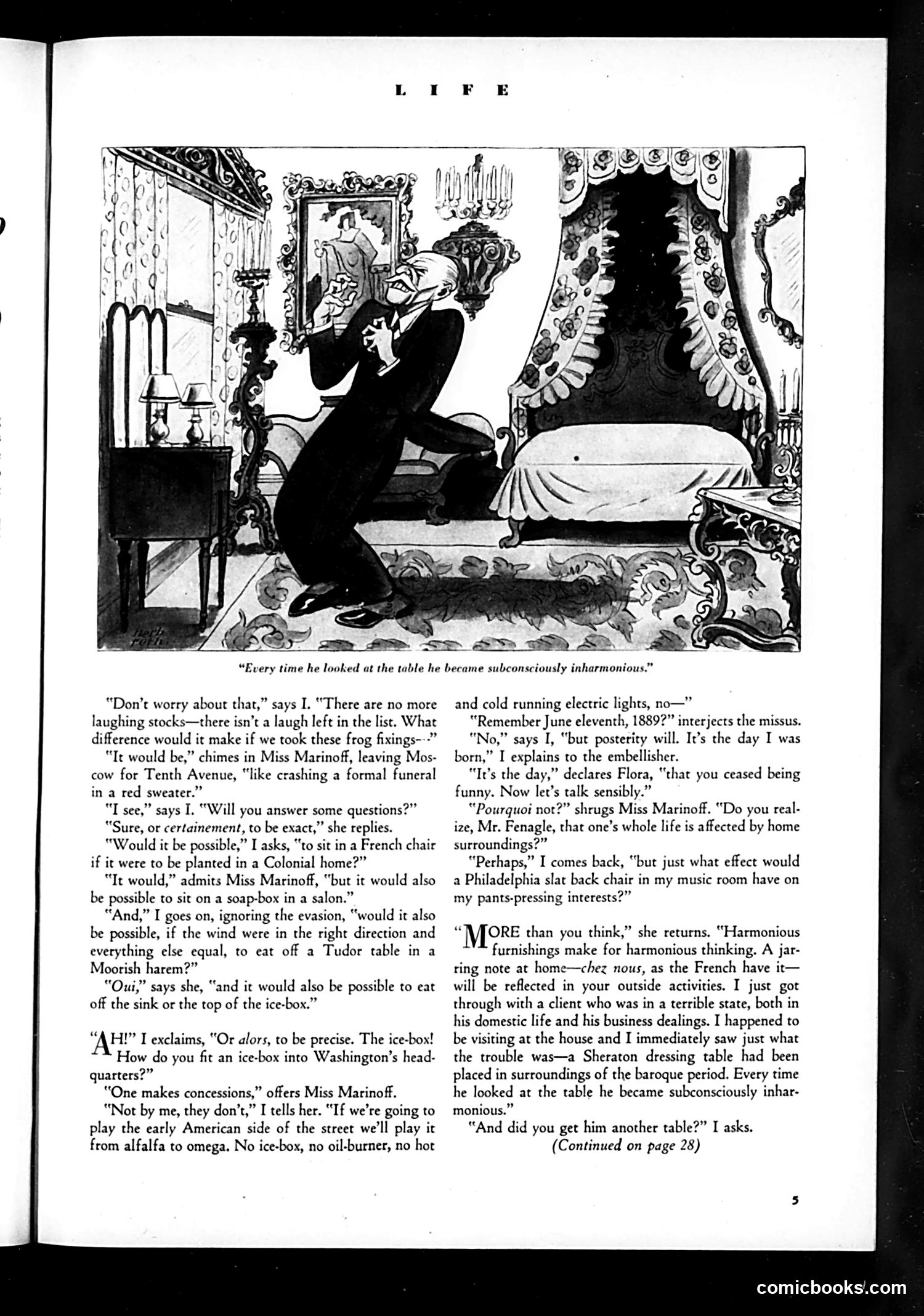
Explanation for Modern Readers This page contains a satirical dialogue illustrated by a cartoon showing a man in formal attire examining a painting in an ornate bedroom. The humor centers on interior design and "harmonious furnishings." The conversation mocks pretentious home decorating theory—specifically the idea that furniture and décor placement affects one's behavior and thinking. A character named Miss Marinoff argues that "harmonious furnishings make for harmonious thinking," citing how a baroque-period table made a man "subconsciously inharmonious" every time he looked at it. The satire targets early-20th-century aesthetic philosophy that attributed psychological effects to interior design choices—a notion the author ridicules by suggesting absurd solutions like replacing the offending table, as if furniture directly controls human temperament and behavior.
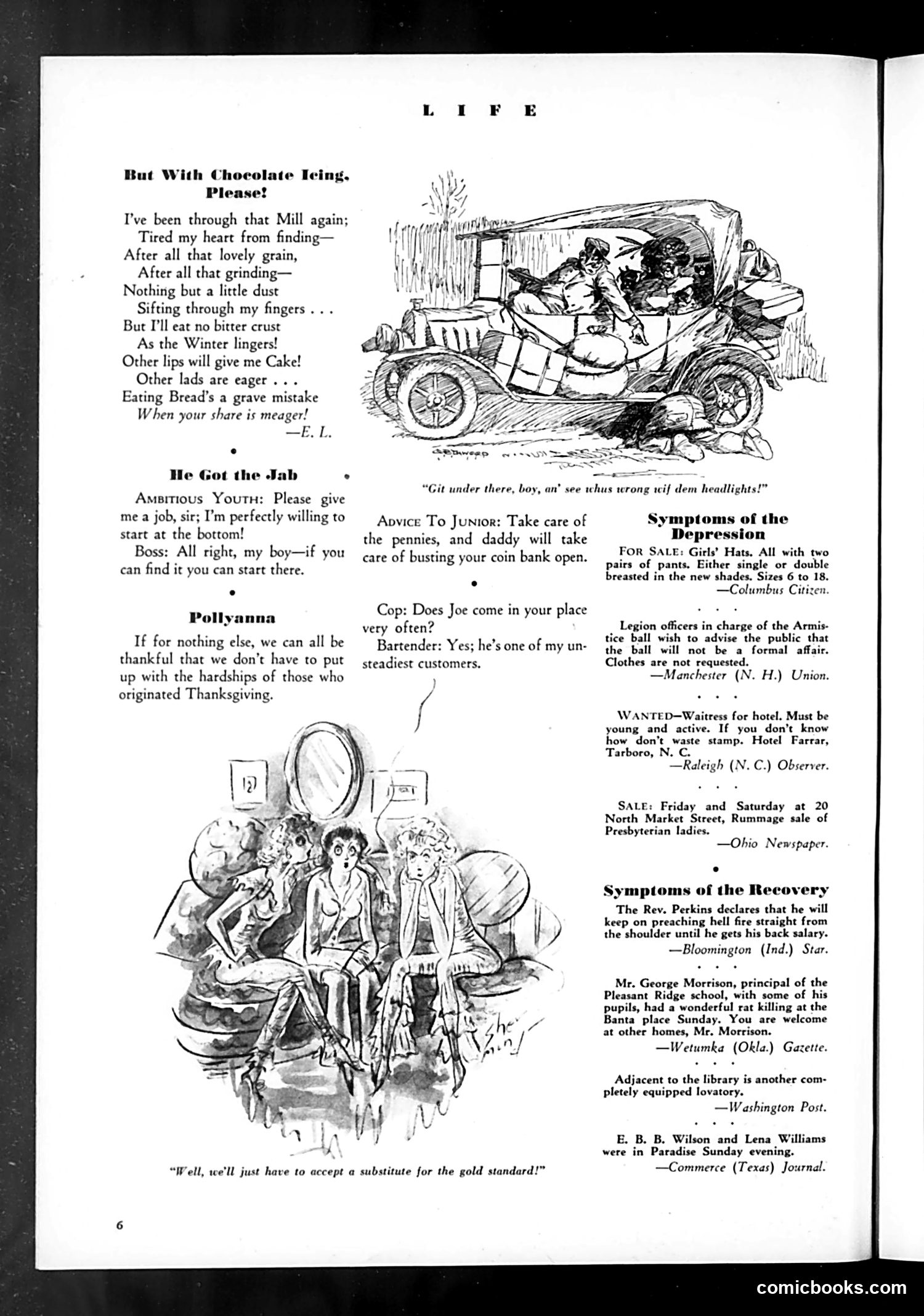
"Life" Magazine Page Analysis This page combines humorous poetry, satirical illustrations, and classified ads typical of early 20th-century Life magazine. "But With Chocolate Icing, Please!" mocks unemployment and economic desperation—a job-seeker's willingness to accept any work, even eating "nothing but a little dust." The poem criticizes poverty wages and false promises. "He Got the Jab" satirizes workplace hierarchy: an ambitious youth willing to start at the bottom, while a boss offers only menial labor prospects. The main illustration depicts three women in a giant teacup discussing financial insecurity ("substitute for the gold standard"), reflecting post-WWI economic anxiety and women's financial dependence. The right column contains genuine classified advertisements and social notices, grounding the satire in real contemporary concerns about employment, sales, and social events.
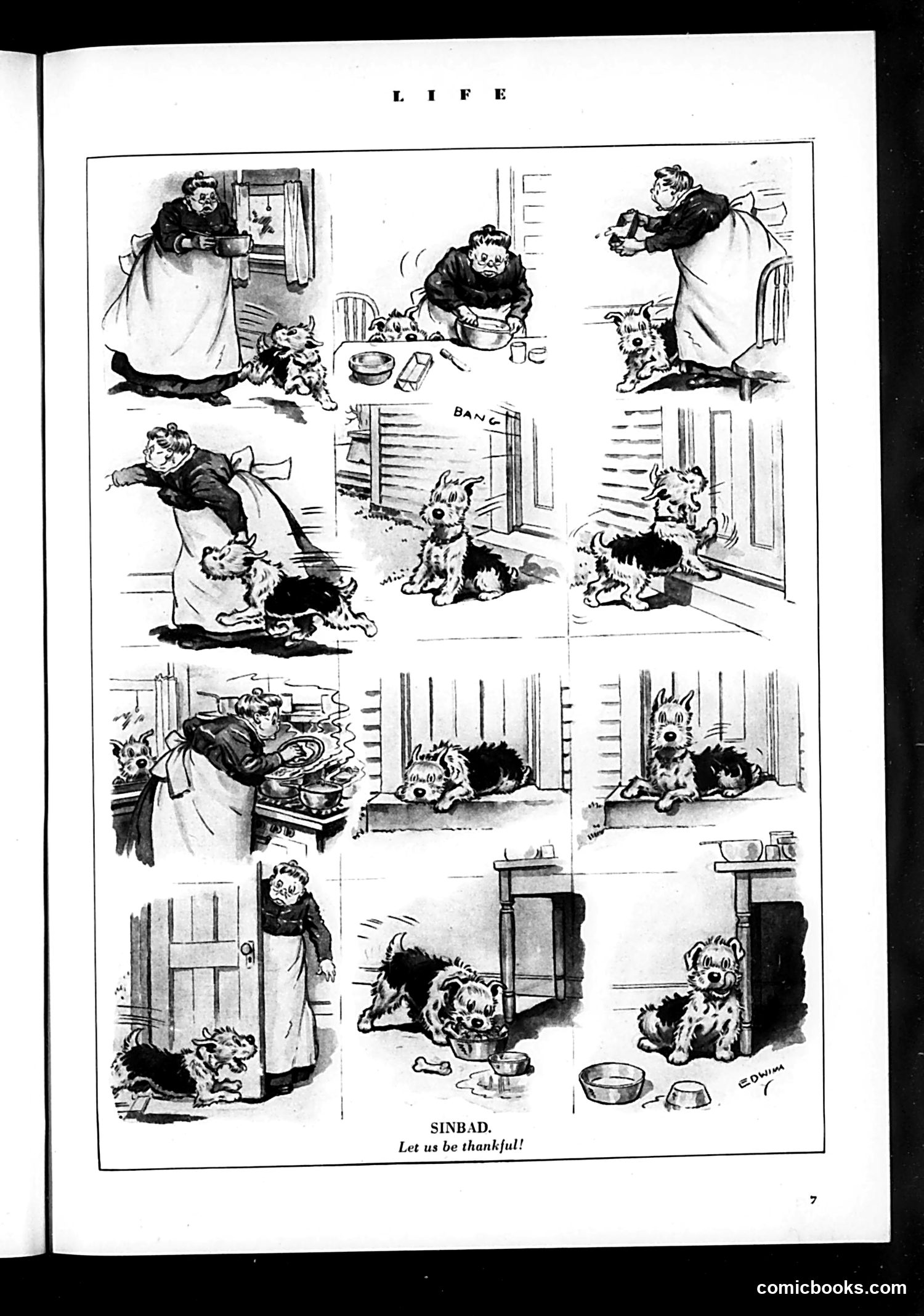
"Sinbad: Let us be thankful!" This is a humorous comic strip following a small dog named Sinbad through various domestic scenes. The narrative appears to show Sinbad being chased away from the kitchen by a woman, expelled from the dining room, and generally shooed from the house—until the final panels reveal him contentedly eating from his own bowl, accompanied by the caption "Let us be thankful!" The satire plays on the contrast between the dog's mistreatment throughout the day and his ultimate gratitude for receiving his own meal. It's a gentle commentary on perspective and appreciation, suggesting that even modest provisions deserve thankfulness. The comic employs visual humor typical of early-to-mid twentieth-century magazine comics, with exaggerated expressions and movement lines.
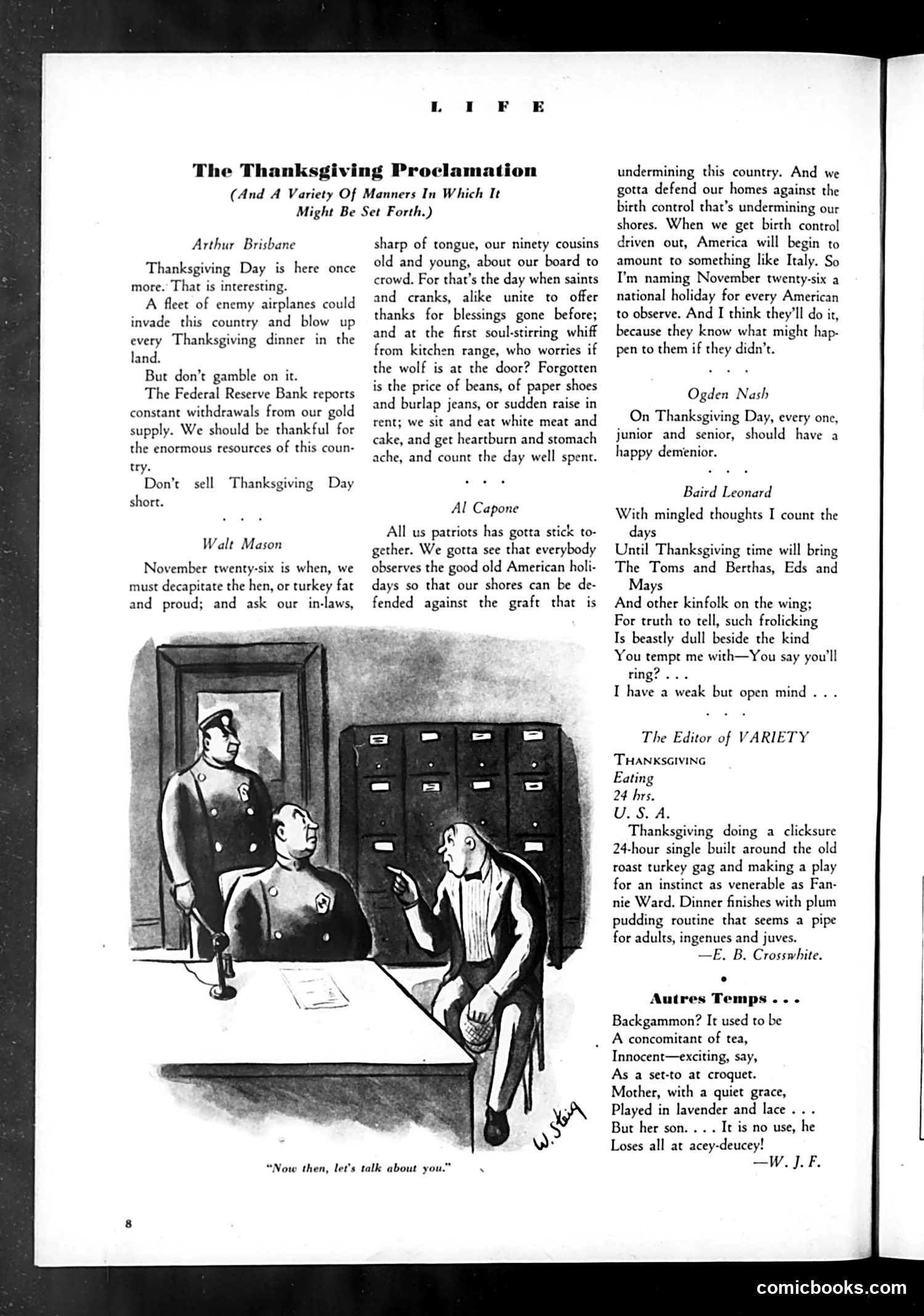
"The Thanksgiving Proclamation" - Life Magazine This page satirizes Thanksgiving observance during what appears to be a period of national concern (likely WWI era, given references to "defending our shores" and birth control undermining the country). The cartoon depicts three military or government officials in an office, with the caption "Now then, let's talk about you." The image suggests bureaucratic interrogation or surveillance—poking fun at government overreach during patriotic holidays. The accompanying essays mock various approaches to Thanksgiving: Walt Mason warns against enemy airplanes attacking dinner; Al Capone (likely a fictional insertion) insists patriots observe the holiday; others offer humorous takes on the tradition. The overall tone ridicules how Thanksgiving becomes weaponized for political purposes rather than remaining a simple family observance.
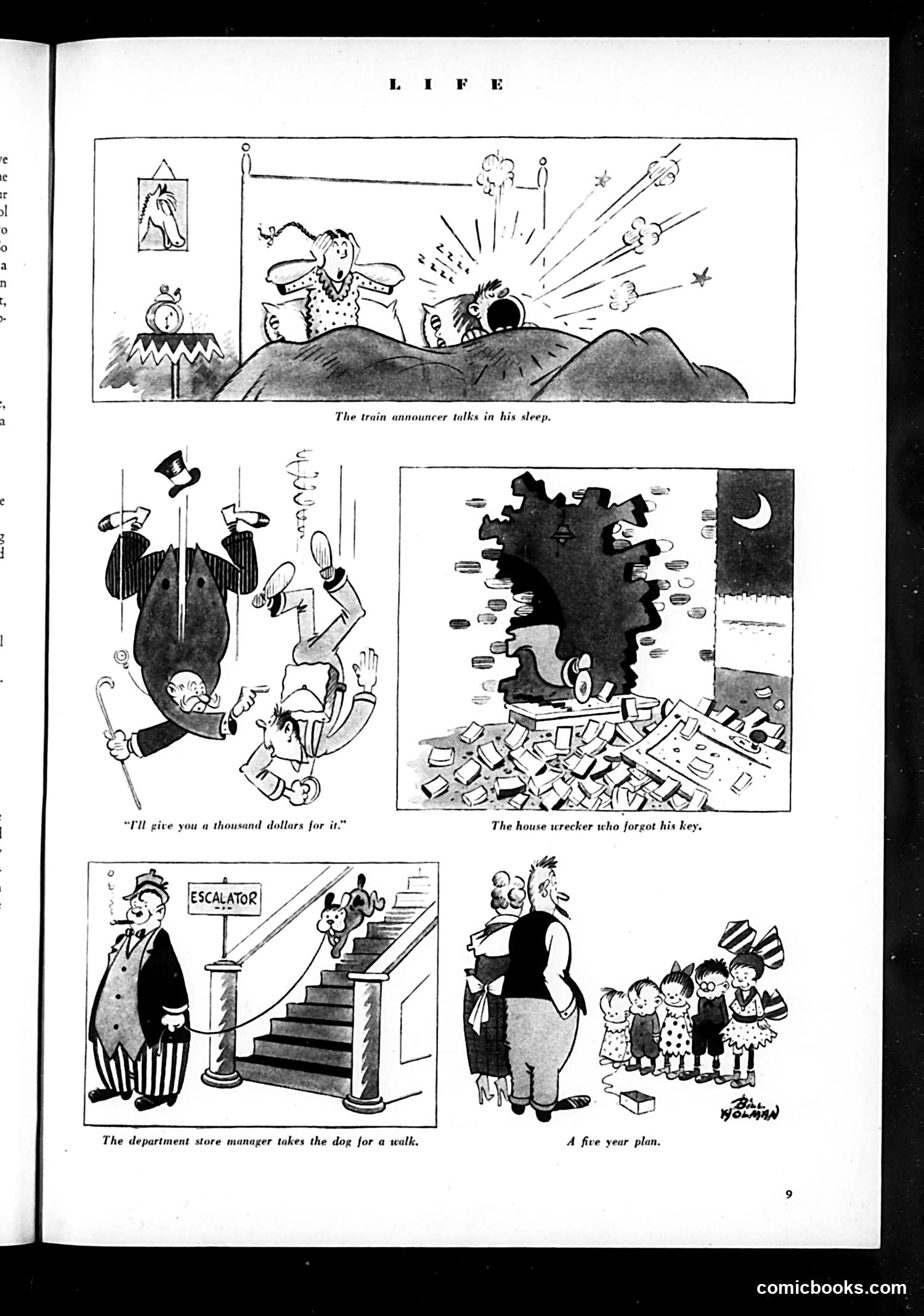
Analysis of Life Magazine Page This page contains five separate satirical comic vignettes on common human situations: 1. "The train announcer talks in his sleep" — A sleepy conductor dreams so vividly about work that explosions burst from his head, disturbing nearby passengers. 2. "I'll give you a thousand dollars for it" — A businessman dangling upside down desperately bargains with a small figure, likely satirizing obsessive materialism. 3. "The house wrecker who forgot his key" — A man's silhouette is surrounded by debris, commenting on destructive absent-mindedness. 4. "The department store manager takes the dog for a walk" — Shows role reversal where the large manager appears dwarfed beside an escalator. 5. "A five year plan" — An adult surrounded by children represents ambitious family planning. The humor relies on exaggeration and everyday absurdities rather than specific political commentary.
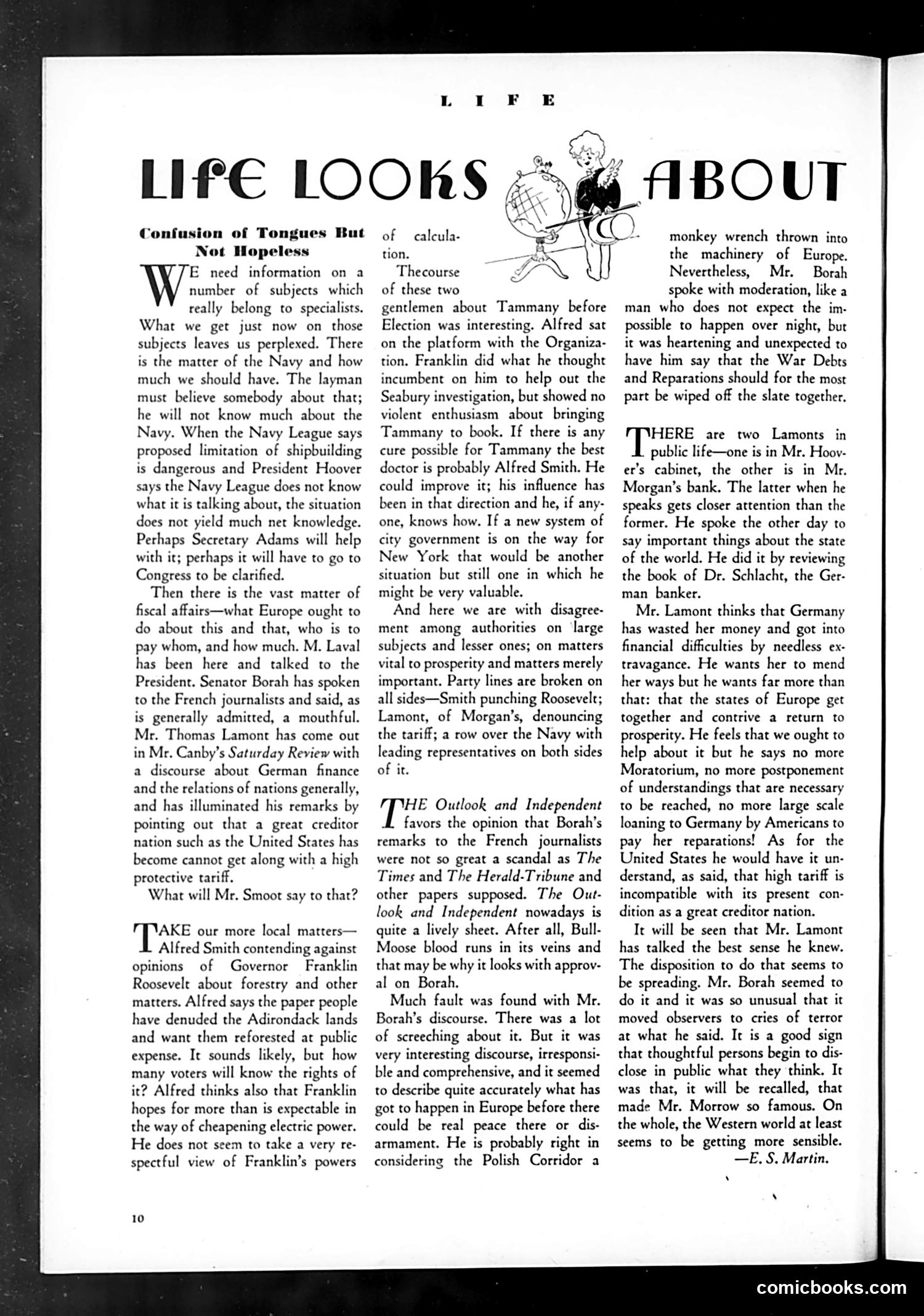
Political Commentary from Life Magazine This page critiques contemporary political figures and debates circa the 1920s. The main cartoon depicts a figure holding a globe, seemingly representing international affairs confusion. The text discusses several named politicians: Alfred Smith (debating forestry policy with Governor Franklin Roosevelt), Senator Borah (making controversial remarks to French journalists about war debts and German reparations), and Mr. Lamont (a banker commenting on European financial troubles). The satire targets government confusion over major policy matters—naval shipbuilding, fiscal affairs, and post-WWI European economics—where officials appear ignorant or contradictory. The piece mocks how different political figures make conflicting statements about complex international issues, suggesting American leadership lacks coherent understanding of pressing world problems.
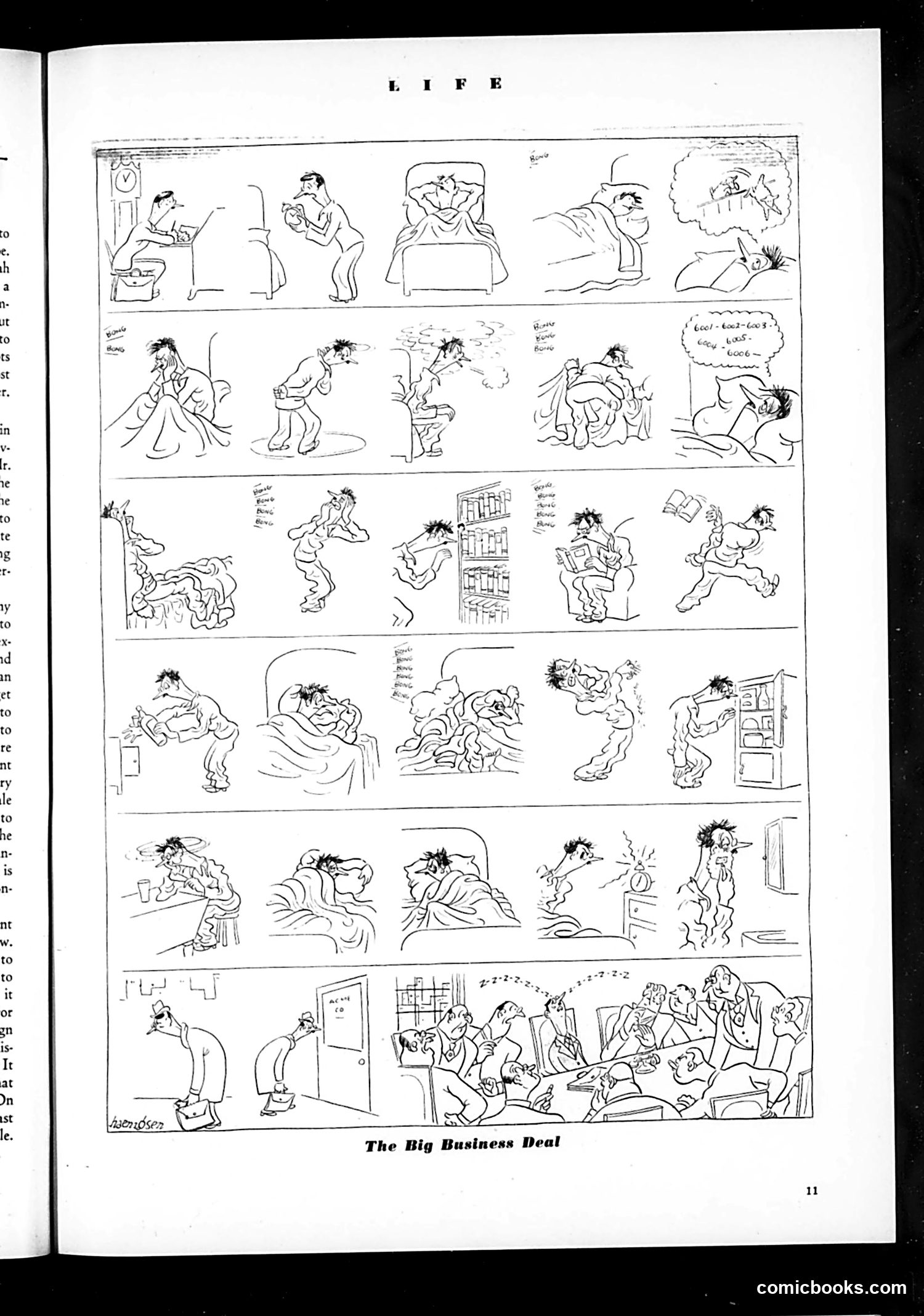
"The Big Business Deal" This satirical comic strip depicts a man's chaotic domestic life, progressing from morning routine through escalating household disasters. The sequence shows: 1. Top rows: Daily frustrations—bathroom mishaps, struggling with clothing, childcare chaos 2. Middle sections: Increasing domestic violence and disorder—fighting with family members, furniture destruction 3. Final panel: A crowded business meeting where the exhausted man appears to conduct important negotiations The satire: The contrast between the man's tumultuous home life and his need to maintain professional composure suggests how American businessmen juggled domestic stress while conducting serious corporate affairs. The title "The Big Business Deal" ironically equates managing a chaotic household to major business transactions. The comic mocks both domestic dysfunction and the emotional labor required to separate personal from professional life.
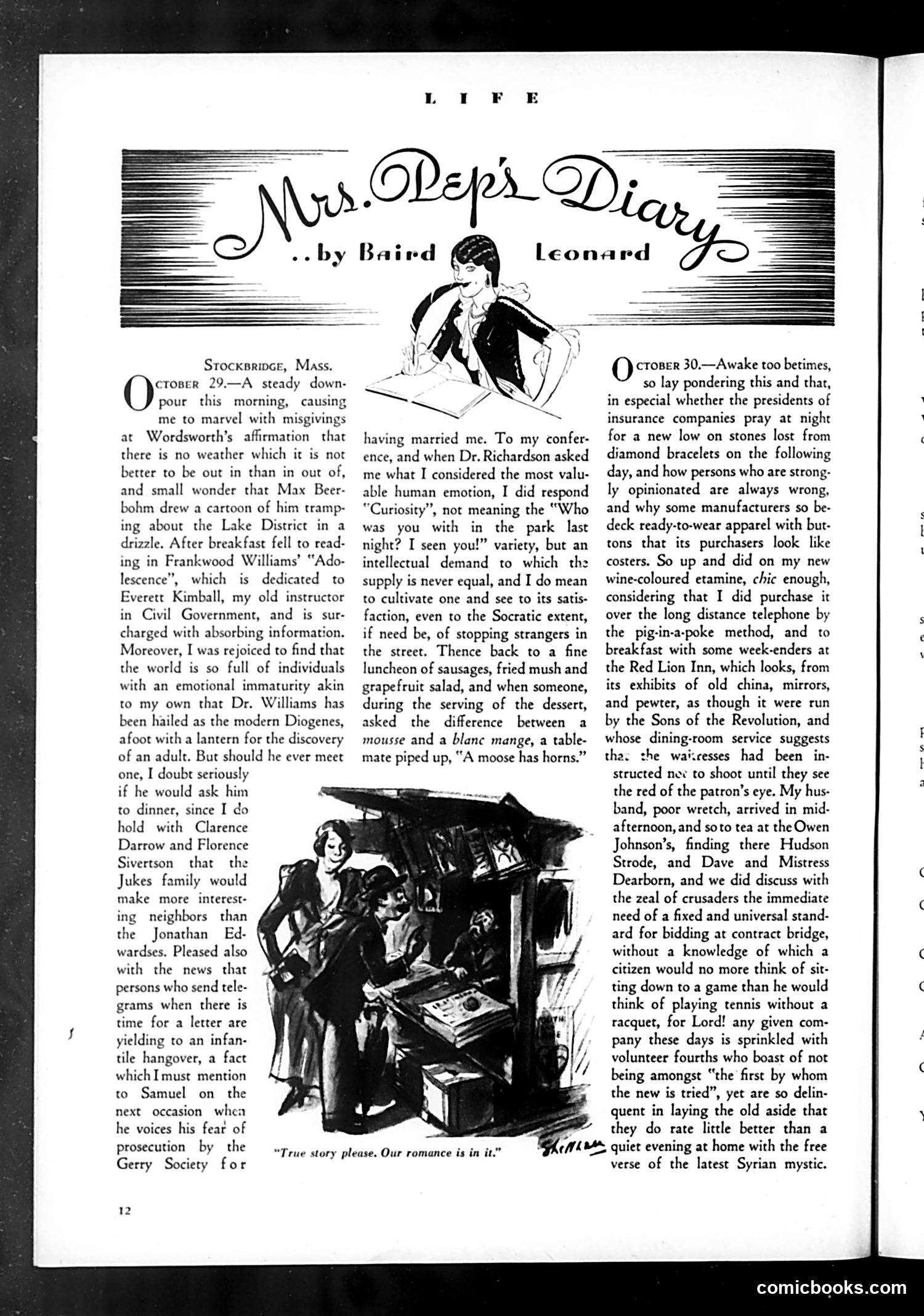
Mrs. Pep's Diary - October 29-30 This is a diary entry column by Baird Leonard featuring Mrs. Pep's personal observations. The illustration shows a woman at a desk writing, with a caption "True story please. Our romance is in it." The diary entry itself contains social commentary typical of 1920s Life magazine satire. Mrs. Pep discusses weather, references to Dr. Richardson and marriage, mentions of Civil Government instructor Everett Kimball, and observations about "modern Diogenes" with a lantern. The text includes humorous social criticism about insurance company presidents, manufacturers, and bridge-playing society members—satirizing upper-class leisure activities and pretensions. The right column continues her observations about tea at the Oven Johnson's, mentioning Hudson Strode and discussions of contract bridge, ultimately mocking the triviality of volunteer activities and "the latest Syrian mystic."
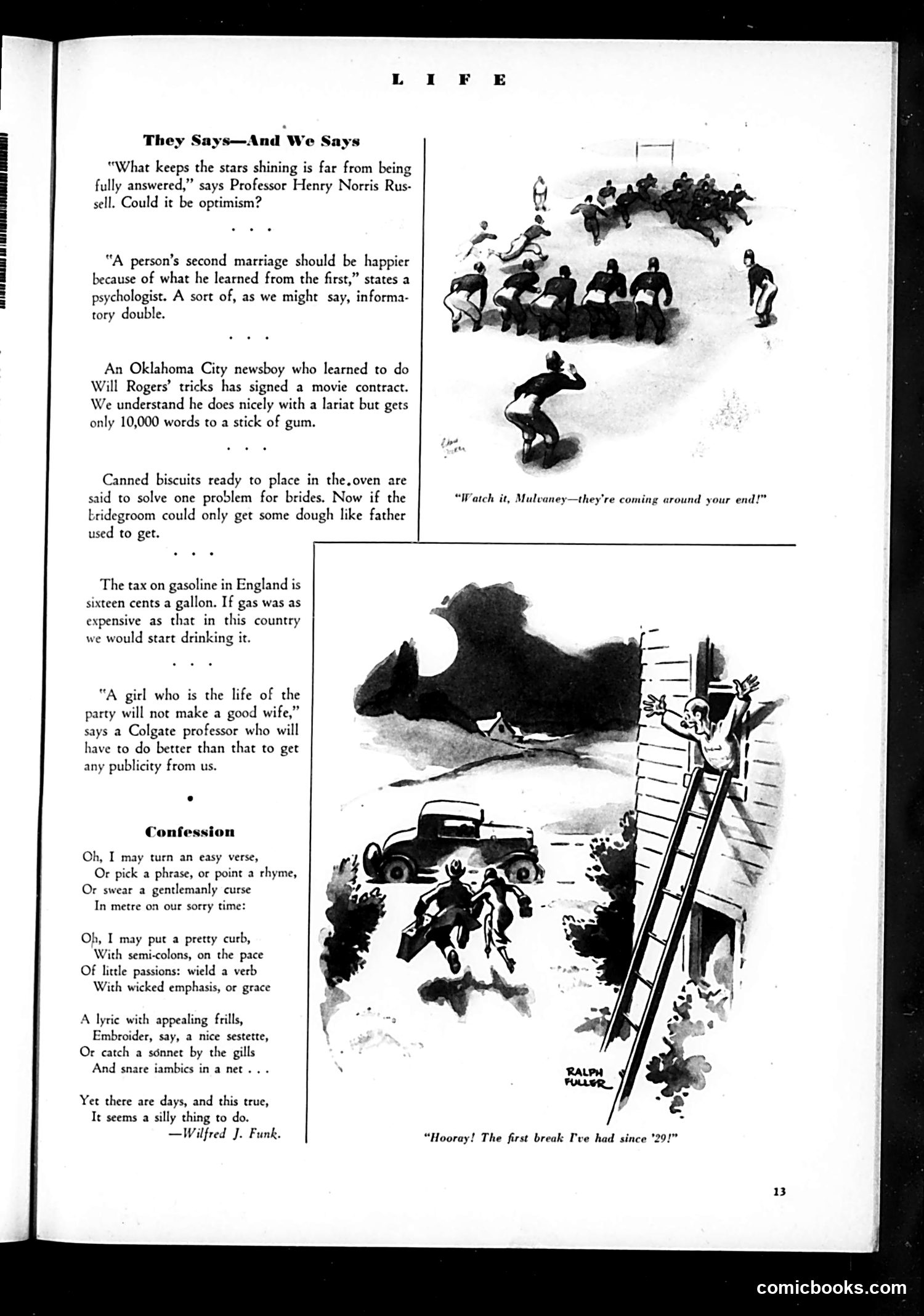
Analysis of Life Magazine Page 13 This page contains two unrelated sections: "They Say—And We Says" (left column): A satirical advice column mocking contemporary observations, including quips about optimism, second marriages, Will Rogers' movie contract, bride problems, English gasoline taxes, and party girls as wives. Two Cartoons (right side): 1. Top: Figures on a snowy slope with someone on skis, captioned "Watch it, Maloney—they're coming around your end!" – likely satirizing skiing mishaps or competitive sports. 2. Bottom (signed Ralph Fuller): A car has crashed through a house's wall/ladder. Someone exclaims "Hooray! The first break I've had since '29!" – referencing the 1929 stock market crash, suggesting the speaker's finances have been so dire that a car accident through their home is welcome relief.
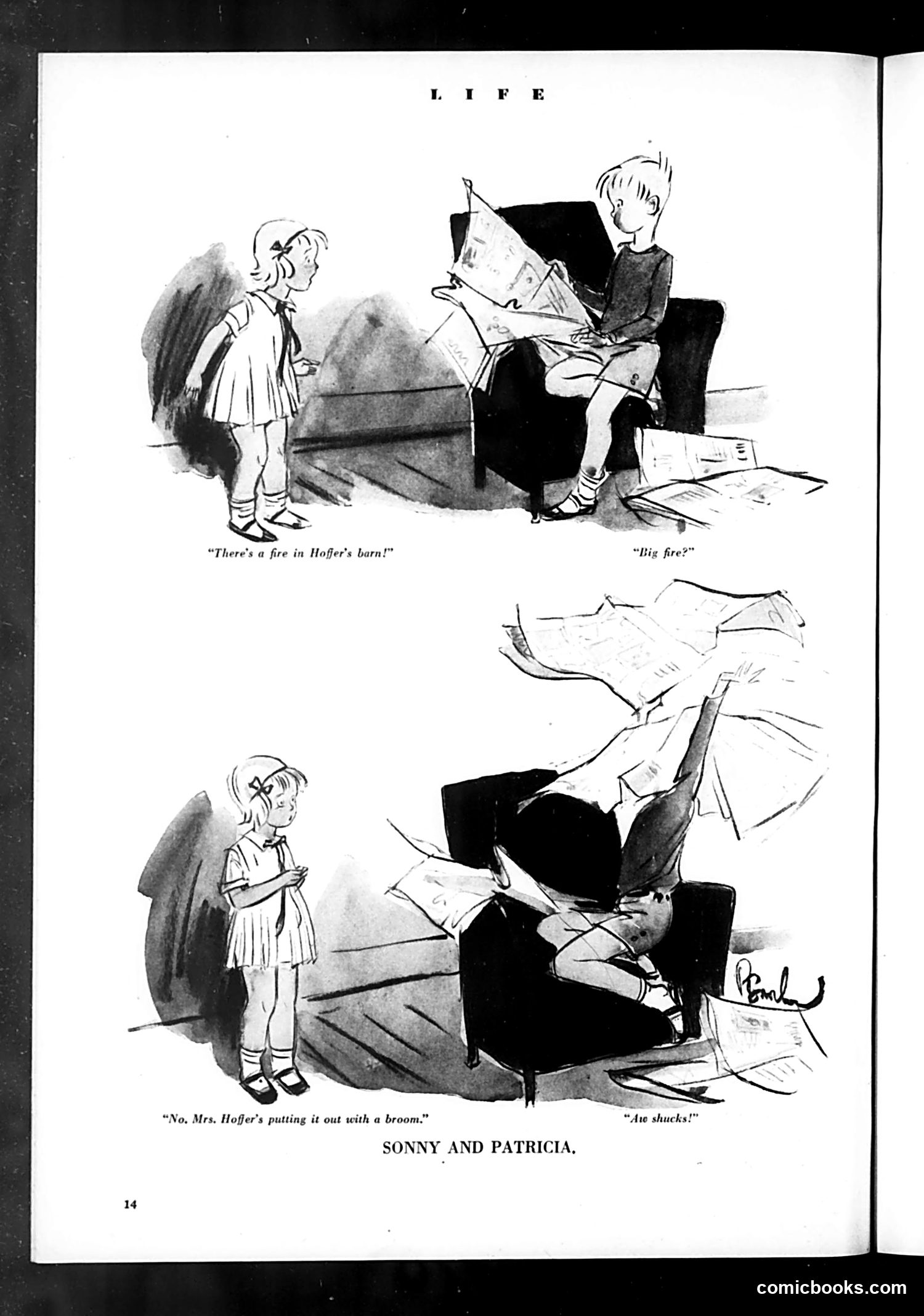
"Sonny and Patricia" Comic Strip Analysis This is a children's comic strip showing two young characters dealing with a domestic mishap. The narrative sequence depicts: 1. A child alerting another child to a fire in "Hoffer's barn" 2. The second child asking "His fire?" 3. A scene of firefighting efforts with someone using a broom 4. An adult exclaiming "Aw shucks!" in frustration The humor appears to be gentle and domestic rather than political—it's a simple situational comedy about children reporting an emergency and adults managing the resulting chaos. The "Life" magazine context suggests this was family-friendly entertainment content rather than satirical commentary. The strip's charm lies in the children's earnestness and the adults' exasperation at the situation.
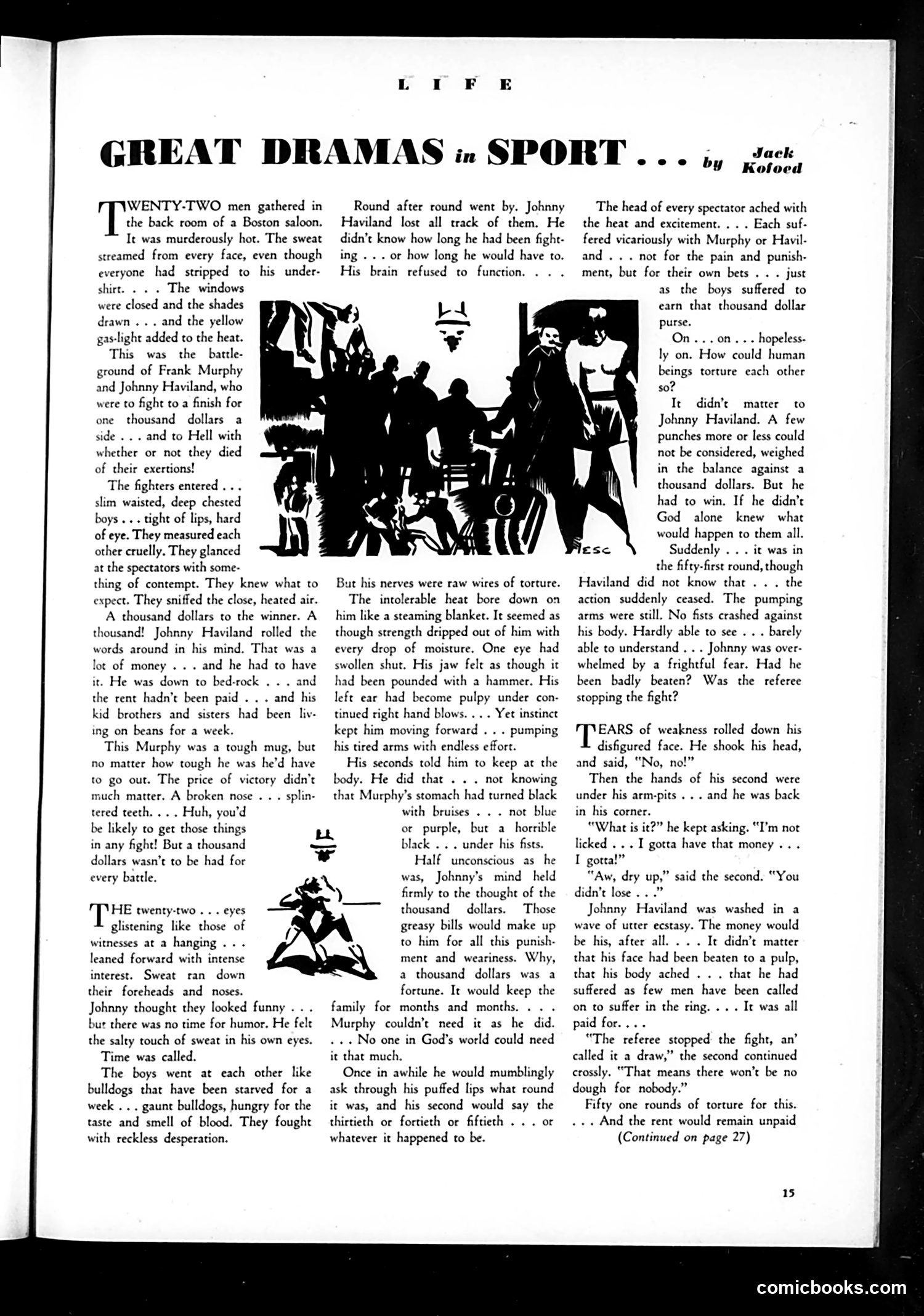
"Great Dramas in Sport" - Boxing Story This is a narrative illustration about a boxing match between Frank Murphy and Johnny Haviland, fighting for a $1,000 purse in a Boston saloon. The story depicts the brutal reality of early 20th-century boxing: 22 spectators watch in a sweltering, closed room as the fighters pummel each other, driven by desperation rather than sport. The satire critiques how human desperation makes entertainment of suffering. Johnny, nearly beaten unconscious, fights on because he needs the money—his family is literally starving. The passage emphasizes the grotesque spectacle: onlookers sweating from heat and excitement while the fighters endure punishment for survival wages. This reflects period concerns about exploitative working-class entertainment and economic inequality.
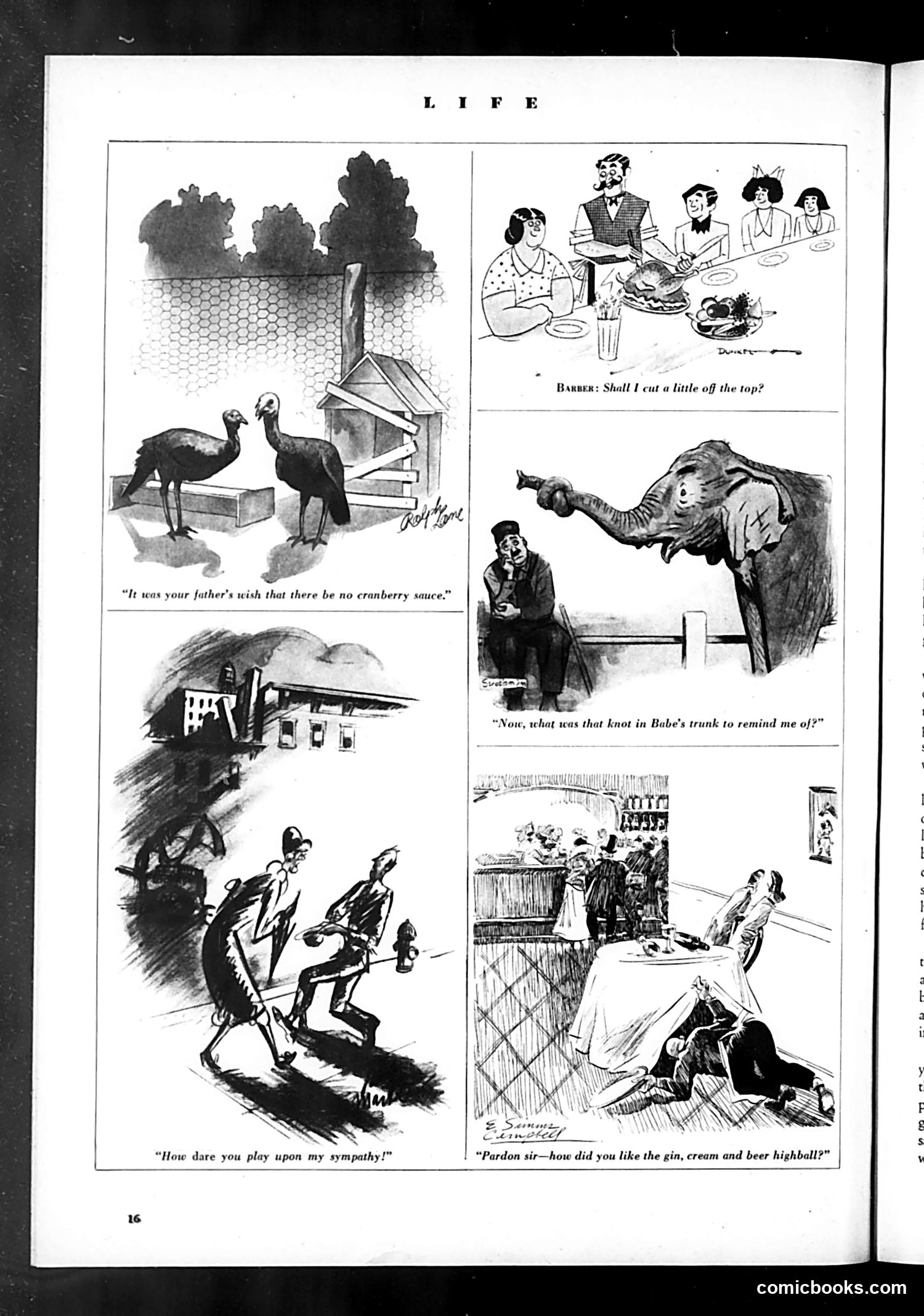
Life Magazine Page - Comic Cartoons This page contains five unrelated satirical cartoons typical of Life's humor format: 1. Ostriches and cranberry sauce: A domestic dispute about a deceased father's wishes regarding food preferences. 2. Barber scene: A barber asks to "cut a little off the top" — likely poking fun at either fashion or male grooming habits. 3. Elephant and man: References "Babe's trunk" as a memory aid, playing on the elephant's trunk for comedic effect. 4. Two men in shadow: A dark joke about exploiting someone's sympathy or emotional vulnerability. 5. Horse race scene: A man appears injured after a fall, with a quip about gin and beer consumption at the racetrack. The cartoons reflect early-to-mid 20th century American social humor targeting domestic life, drinking culture, and physical misadventure.
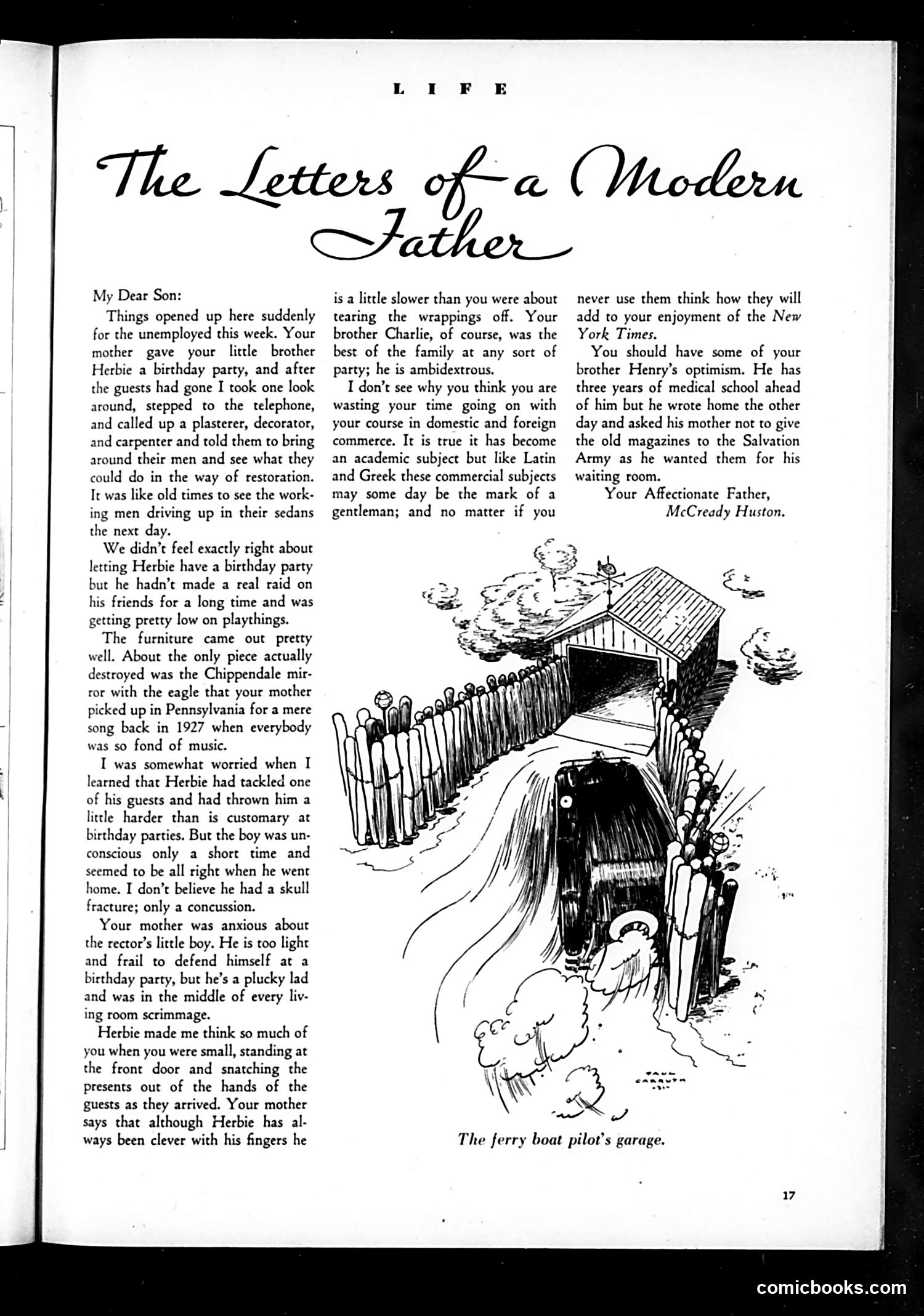
Analysis: "The Letters of a Modern Father" This is a personal letter column, not political satire. The father (McCready Huston) writes to his son about family matters: an unemployed brother, nephew Herbie's rowdy birthday party where guests caused property damage (destroying a Chippendale mirror), and the boy's academic pursuits in commerce versus classical subjects. The accompanying illustration shows "The ferry boat pilot's garage"—a comedic domestic scene of what appears to be a makeshift boat or vehicle in someone's yard, likely illustrating the chaos and practical mishaps the letter describes. The humor is gentle, domestic Americana rather than political commentary—focused on the amusing challenges of managing an active household during what appears to be the 1920s-1930s era.
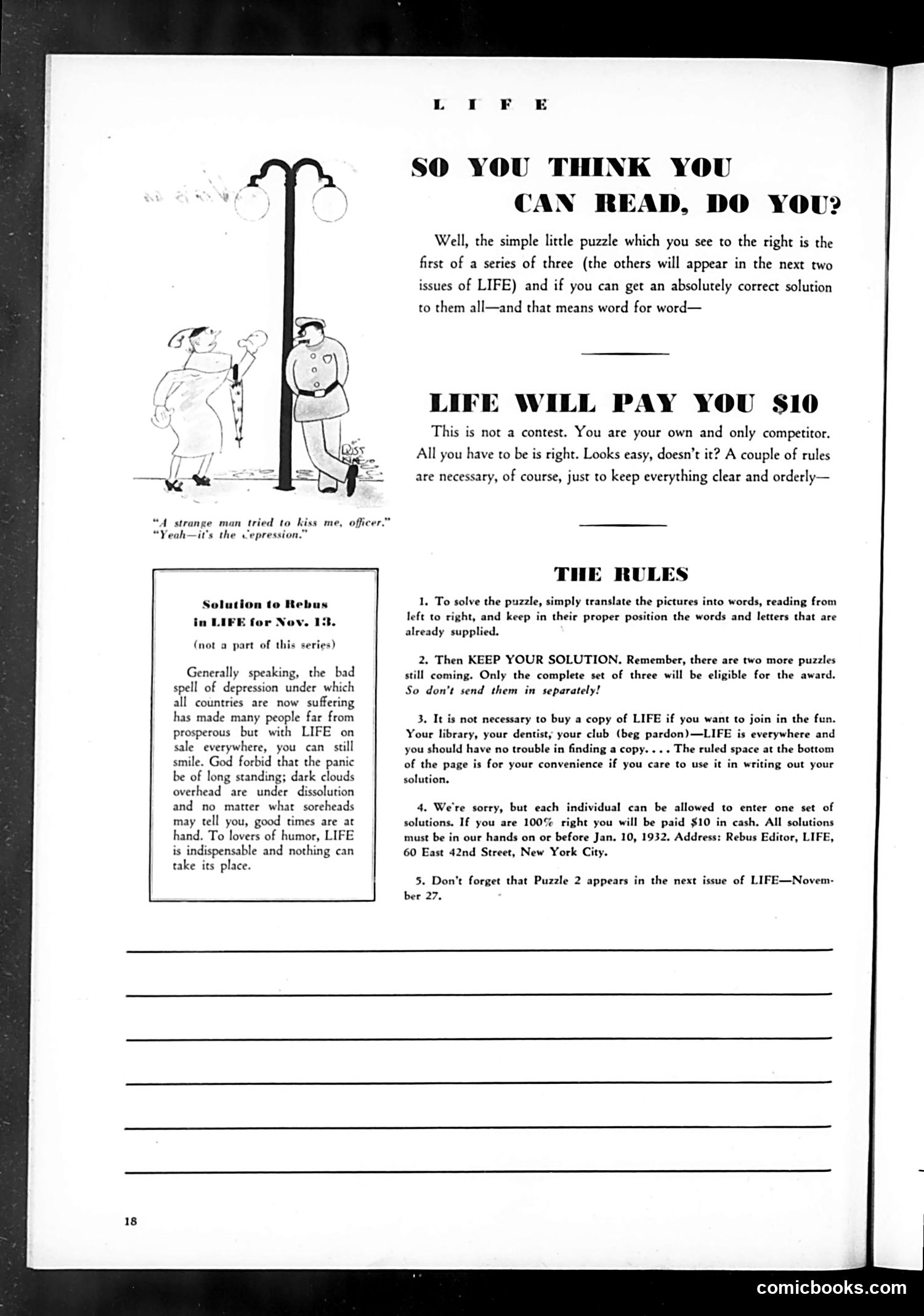
Analysis This page is primarily a puzzle competition announcement rather than political satire. The main content presents a three-part rebus puzzle series, offering a $10 prize for correct solutions submitted to LIFE magazine. The cartoon illustration shows two figures at a lamppost—one appears to be a police officer confronting another person. The caption reads: "I strange man tried to kiss me, officer." "Yeah—it's the expression." This is a simple joke about ambiguous expression: the humor relies on the phrase "the expression" being misinterpreted as facial expression rather than the act of kissing itself, creating a double meaning. The page includes rules for the puzzle competition, noting that all three puzzles must be solved completely to be eligible for the prize.
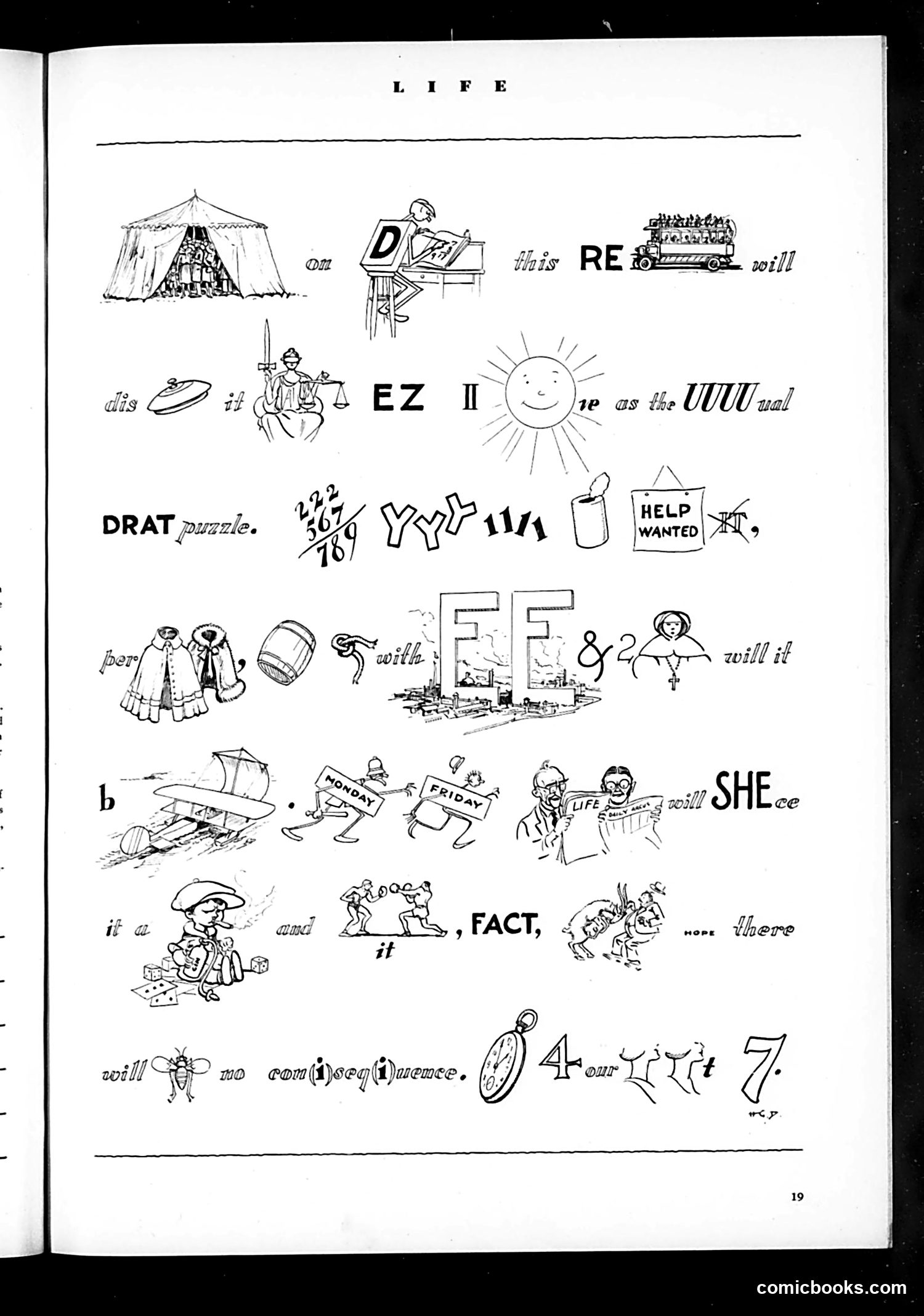
Analysis of This Life Magazine Puzzle Page This is a rebus puzzle page—a word puzzle combining images, letters, and symbols to spell out phrases. The page title "LIFE" and visual clues guide readers to decode hidden messages. Examples visible include: - A tent with "D" = "canvas" (can-vas) - "EZ" with a sun = "easy" - Mathematical fractions and "DRAT" = financial/economic references - Days of the week (Sunday/Friday) with figures = temporal wordplay - A compass and "4 our" = navigational puns The puzzles appear to contain topical references (possibly Depression-era economics, given the "HELP WANTED" sign and financial imagery), but without clearer resolution or a visible date, specific historical references remain unclear. This format was typical LIFE magazine entertainment—accessible, clever wordplay for general readers.
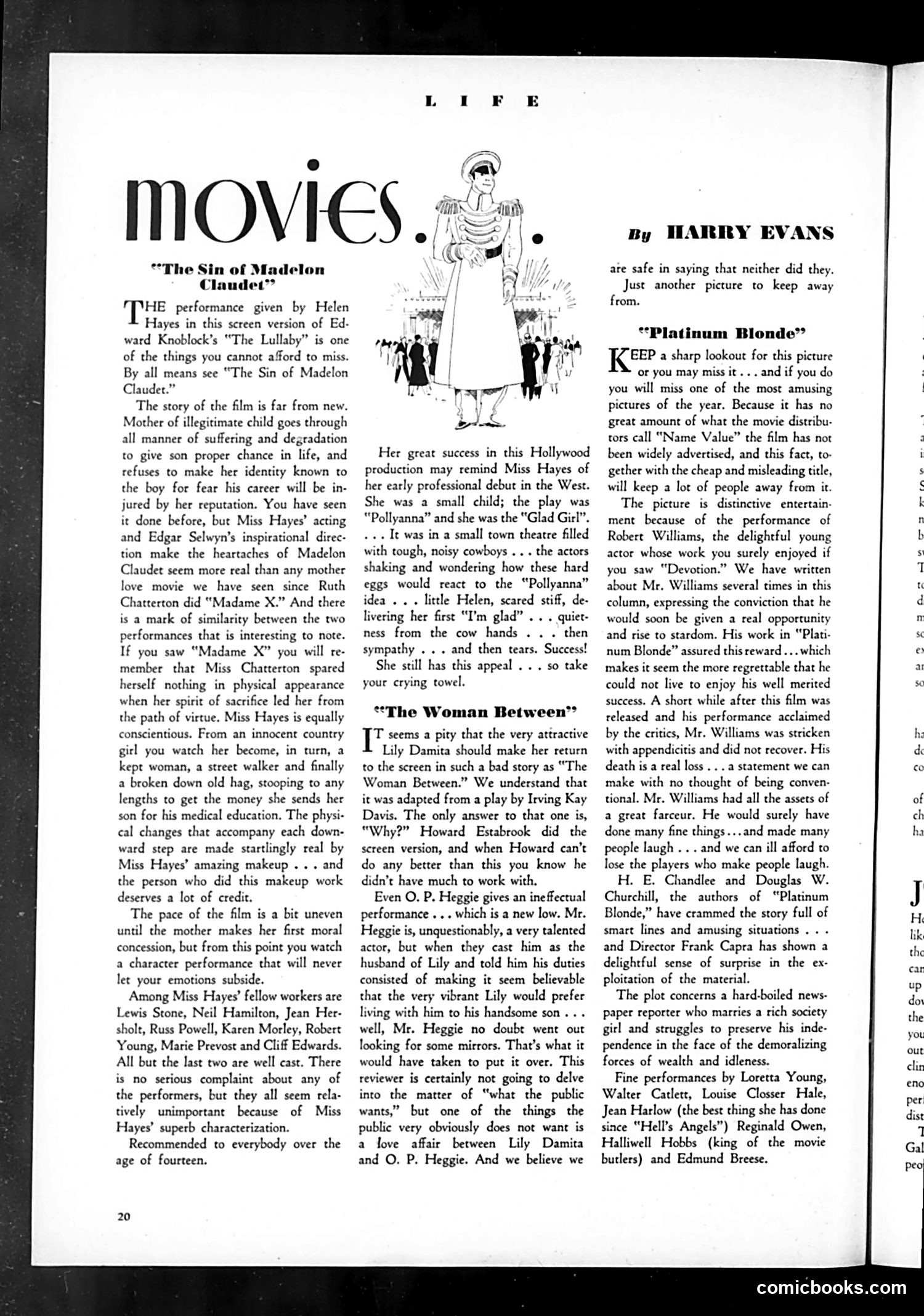
Life Magazine Movie Reviews - Context for Modern Readers This page contains film reviews by Harry Evans from Life magazine's entertainment section. The main review covers Helen Hayes in "The Sin of Madelon Claudet," a melodrama about a mother who sacrifices herself for her illegitimate son's future while hiding her identity from him. The reviewer praises Hayes's performance and physical transformation throughout the film—from innocent country girl to "kept woman, street walker and finally a broken down old hag"—comparing her commitment to Ruth Chatterton's earlier performance in "Madame X," a similar plot. A secondary review critiques "The Woman Between," finding fault with the adaptation and O. P. Heggie's performance, sarcastically suggesting only mirrors could make audiences believe the "vibrant" Lily Damita would prefer her on-screen husband to his handsome son. The cartoon above depicts a glamorous woman surrounded by admirers, likely illustrating the Hollywood star system being discussed. These were typical "weepie" melodramas of early 1930s cinema.
Theatre Reviews from Life Magazine This page contains two theatre reviews from Life's drama section, critiquing Broadway productions. "Here Goes The Bride" — Peter Arno (a famous cartoonist) produced this play about the Reno divorce scene. Life's reviewer dismisses it as a weak show, praising only the dancing, music, and chorus girls while criticizing the uninteresting dialogue and plot. The implication: Arno should stick to cartooning. "The Roof" — John Galsworthy's play features hotel guests during a fire, testing their character. The reviewer finds it intellectually interesting but dramatically disappointing—it builds tension but fails to deliver sufficient dramatic payoff. The critique notes that paper flames are unconvincing and smoke so thick actors cannot take bows. Both reviews use a common Life format: witty dismissal mixed with occasional praise for specific performers or design elements, while overall suggesting these theatrical ventures fall short of critical standards.
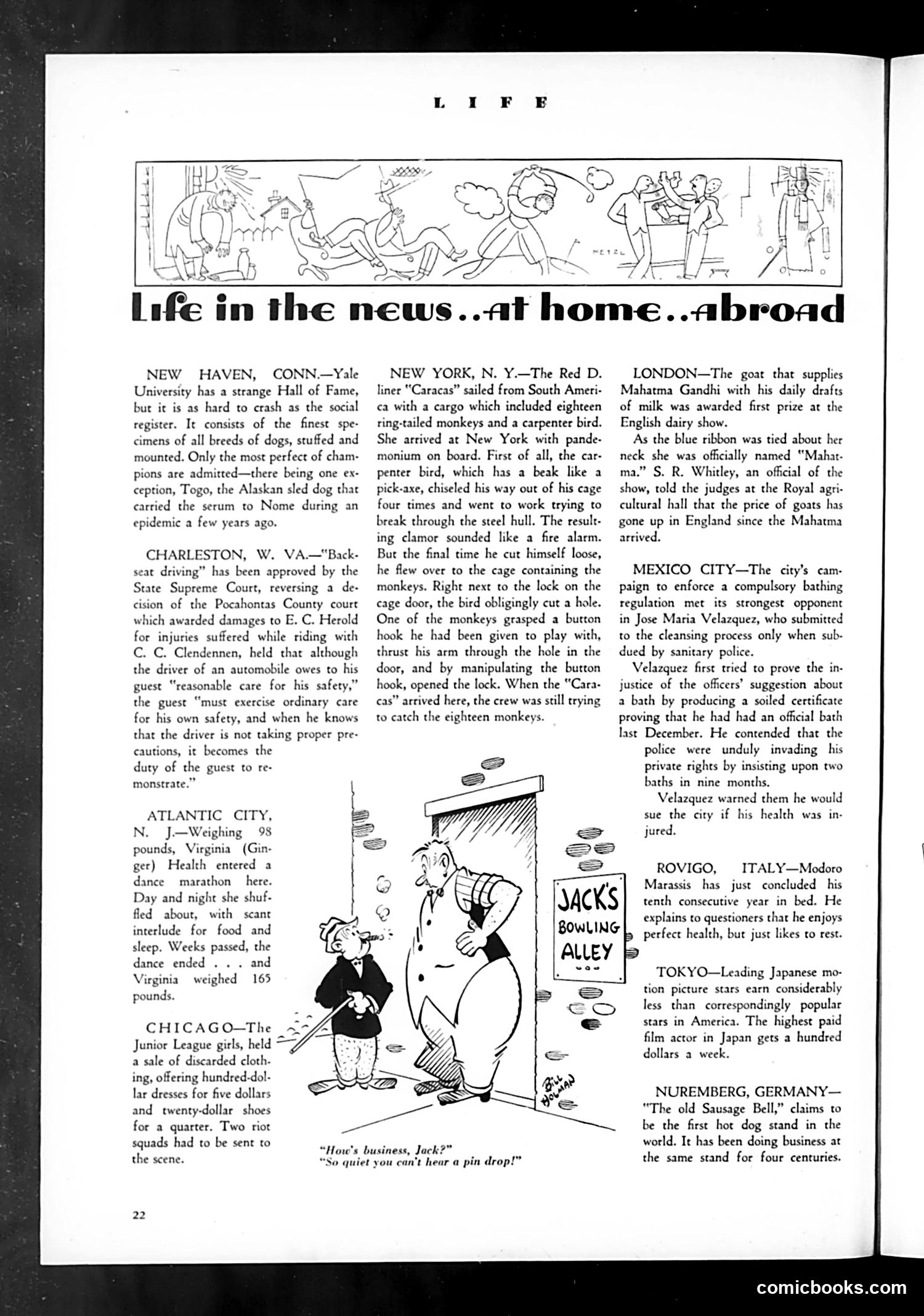
"Life in the News" - Page Analysis This page collects oddball human-interest stories from around the world. The main cartoon shows a bowling alley attendant confronting a man about noise—the joke being the absurdity of complaining about sound in a bowling alley, where pins crashing is constant. The surrounding news briefs humorously highlight eccentric behavior: a woman dancing for weeks until exhausted, a West Virginia court ruling that passengers must backseat-drive if needed, an Indian independence leader's goat winning a dairy prize (implying his celebrity inflates goat prices in England), a Mexican man refusing mandatory bathing, and an Italian who's spent ten years voluntarily in bed. The tone is lighthearted mockery of human peculiarity. A ship carrying monkeys and a carpenter bird creates chaos when the bird helps monkeys escape—played for comedic value. These stories assume readers find ordinary people's unusual choices amusing rather than troubling. The page epitomizes *Life* magazine's satirical approach to documenting everyday human oddity.
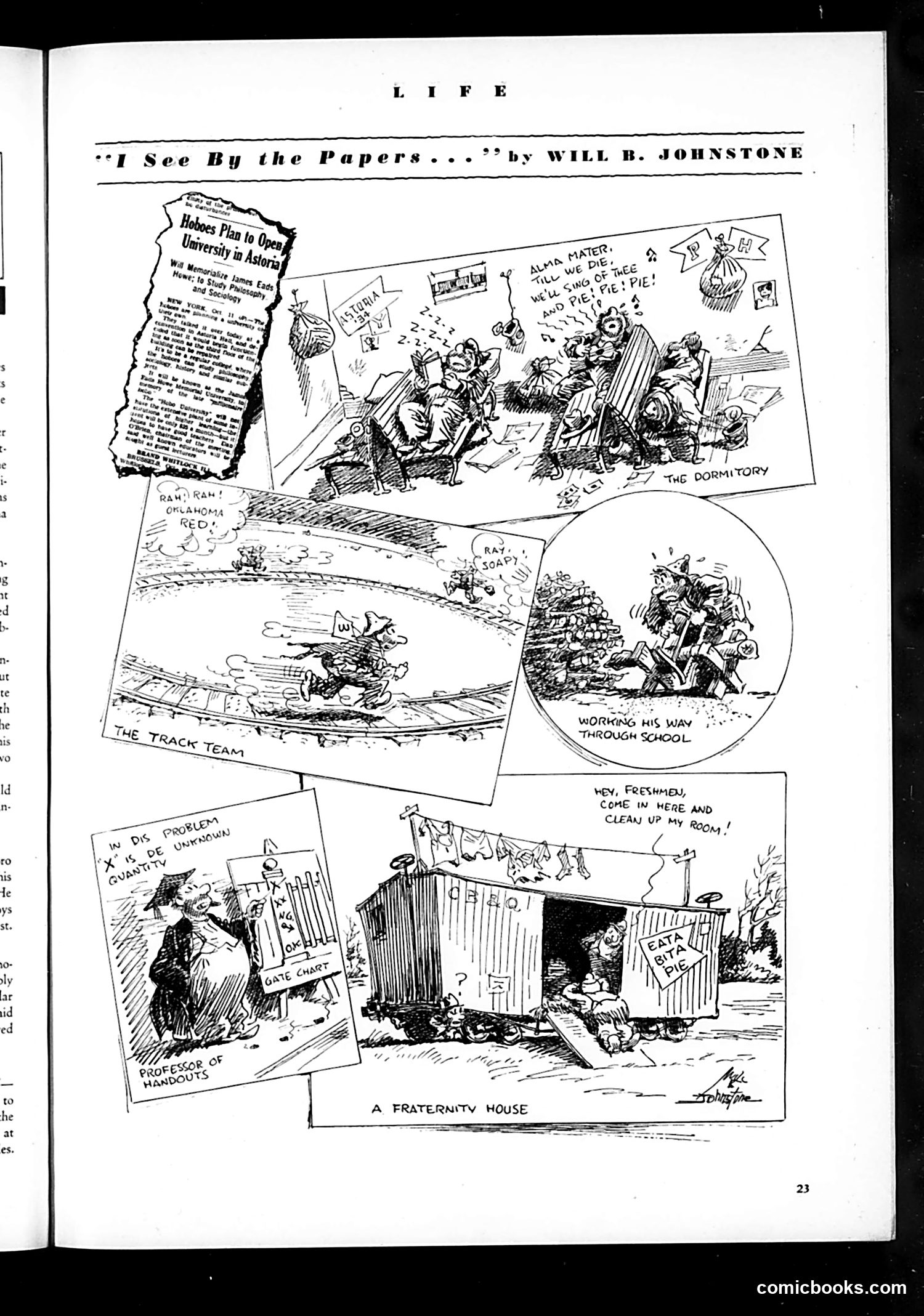
"I See By the Papers" by Will B. Johnstone This satirical cartoon series mocks college life and student experiences. The top panel shows dormitory chaos—students singing, partying, and causing mayhem in what's labeled "the dormitory." The middle panels depict a track team and a student "working his way through school" by doing various jobs. The bottom panel shows a "fraternity house" where a freshman is ordered to clean rooms—satirizing hazing rituals and the exploitation of new students by upper classmen. A small inset labeled "Professor of Handouts" appears to reference academic concerns. The cartoon critiques the contrast between college's supposed educational mission and the actual student experience of disorder, menial labor, and fraternity abuse. The humor targets institutional hypocrisy regarding student welfare and education.
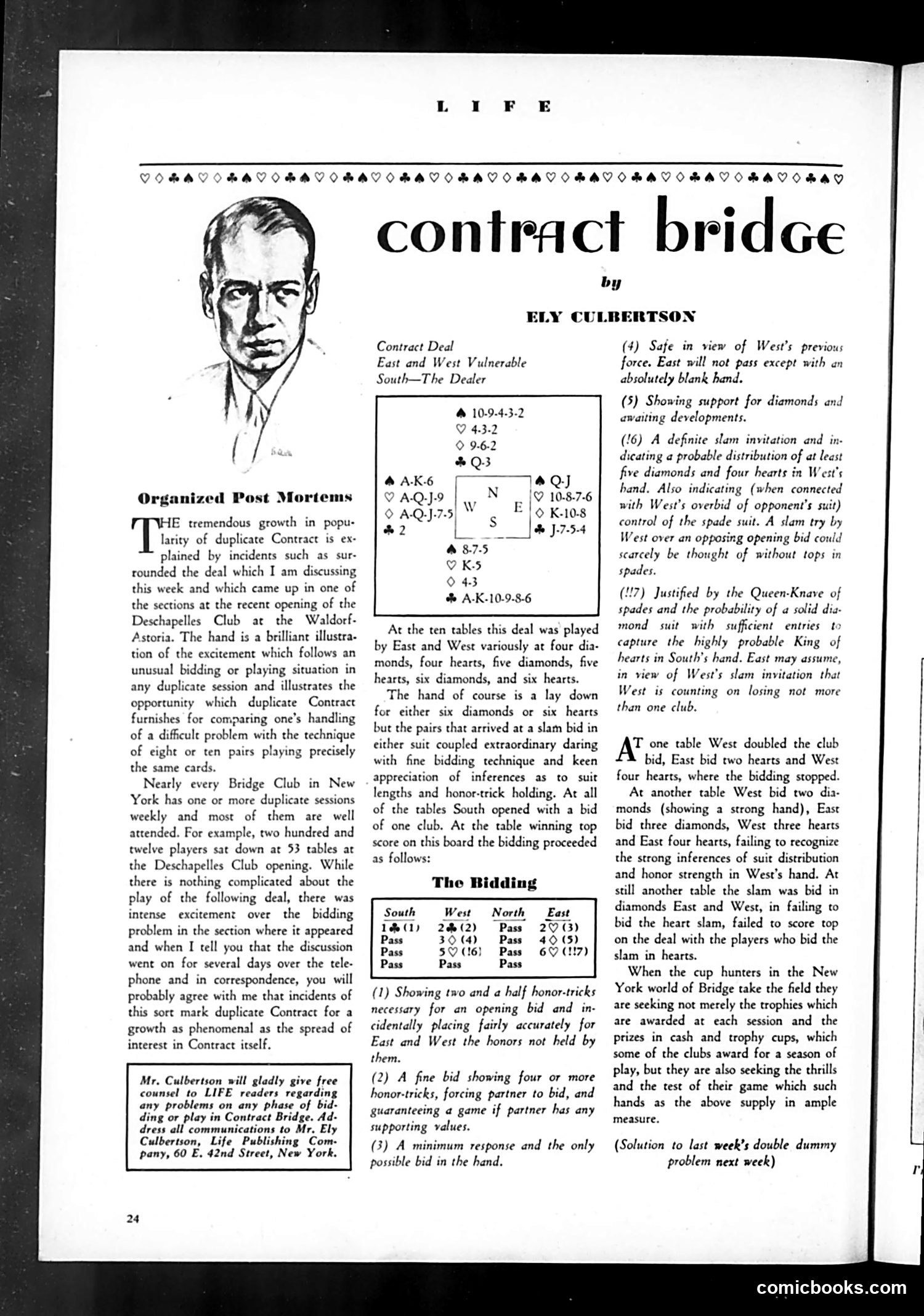
Contract Bridge Analysis for Modern Readers This page features Ely Culbertson, a famous bridge expert, analyzing a real contract bridge hand that caused heated debate at the Waldorf-Astoria's Deschapelles Club opening. The Context: Duplicate contract bridge—where multiple pairs play identical hands to compare results—had become enormously popular in 1930s New York. The article explains this boom by showcasing an actual hand that sparked multi-day telephone and mail discussions among players. The Point: This isn't satire or political commentary. Rather, it's a *substantive instructional article* demonstrating why duplicate bridge captivated affluent New Yorkers: the competitive excitement of comparing one's strategic decisions against others playing the same cards. The hand illustrates how subtle bidding choices and inferences about opponents' hidden cards could lead to different contract levels—some pairs bid six hearts, others six diamonds—creating genuine intellectual debate about optimal play. The article validates bridge's appeal as both a social activity and a serious skill-testing game worthy of serious analysis.
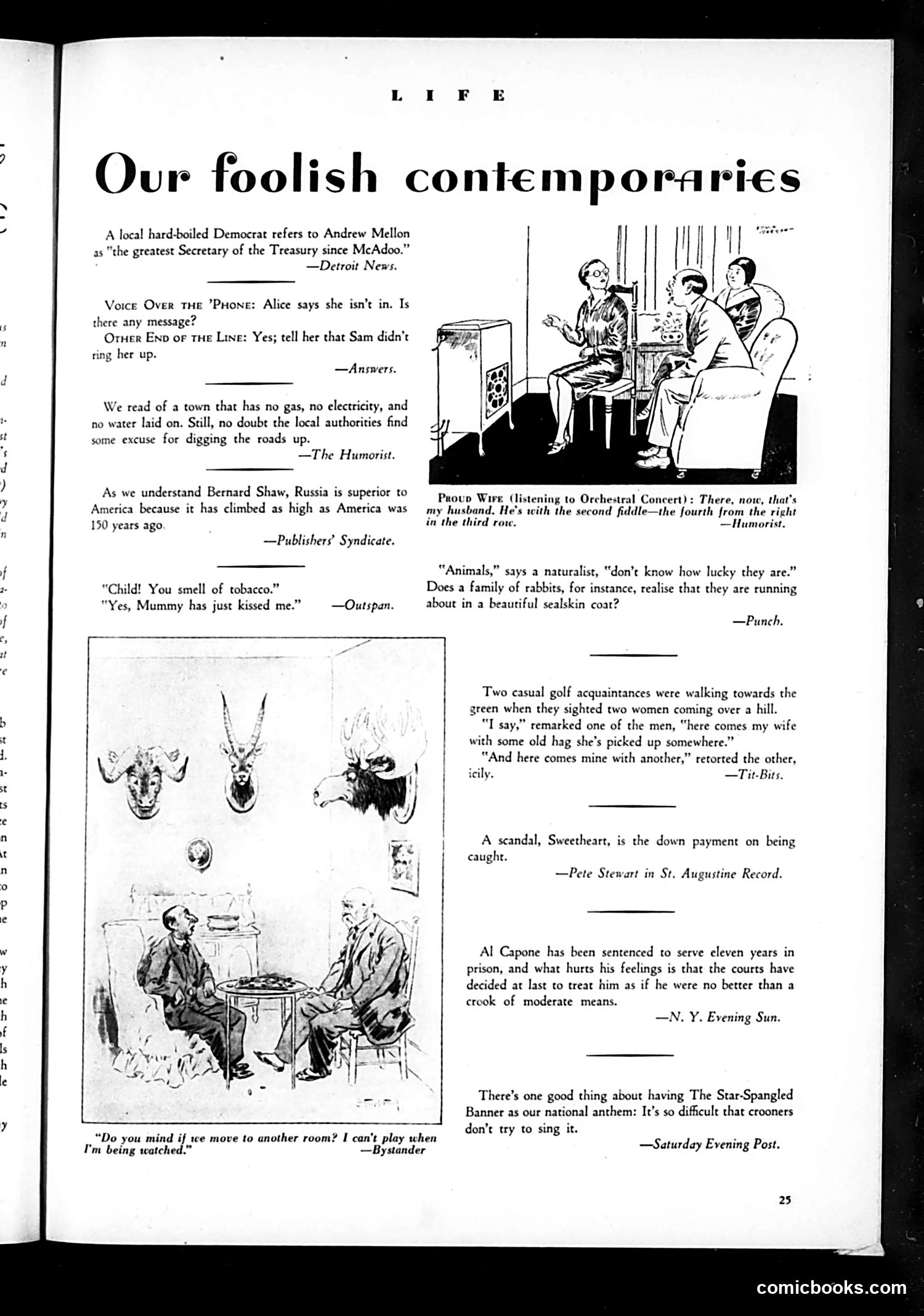
Analysis of Life Magazine Satire Page This page collects brief satirical quips from various sources targeting early 1930s American society and politics. Key references: - Andrew Mellon: Treasury Secretary under Hoover, criticized by Democrats as overly favorable to the wealthy - Al Capone: The gangster's 1931 conviction for tax evasion is mocked—courts finally treating him like an ordinary criminal rather than untouchable crime boss - Bernard Shaw/Russia comparison: Likely referencing Shaw's controversial 1931 Soviet visit, when Western intellectuals debated whether communist Russia surpassed capitalist America The humor targets: - Political hypocrisy (Democrats praising a Republican Treasury Secretary) - Marital discord and infidelity - Class anxiety (rabbits in sealskin coats) - British reserve and marital coldness - Municipal corruption and infrastructure failures - The difficulty of "The Star-Spangled Banner" The cartoons themselves are modest illustrations accompanying the written jokes rather than primary satirical images. The overall tone reflects mid-Depression-era American skepticism toward institutions, politicians, and social conventions.
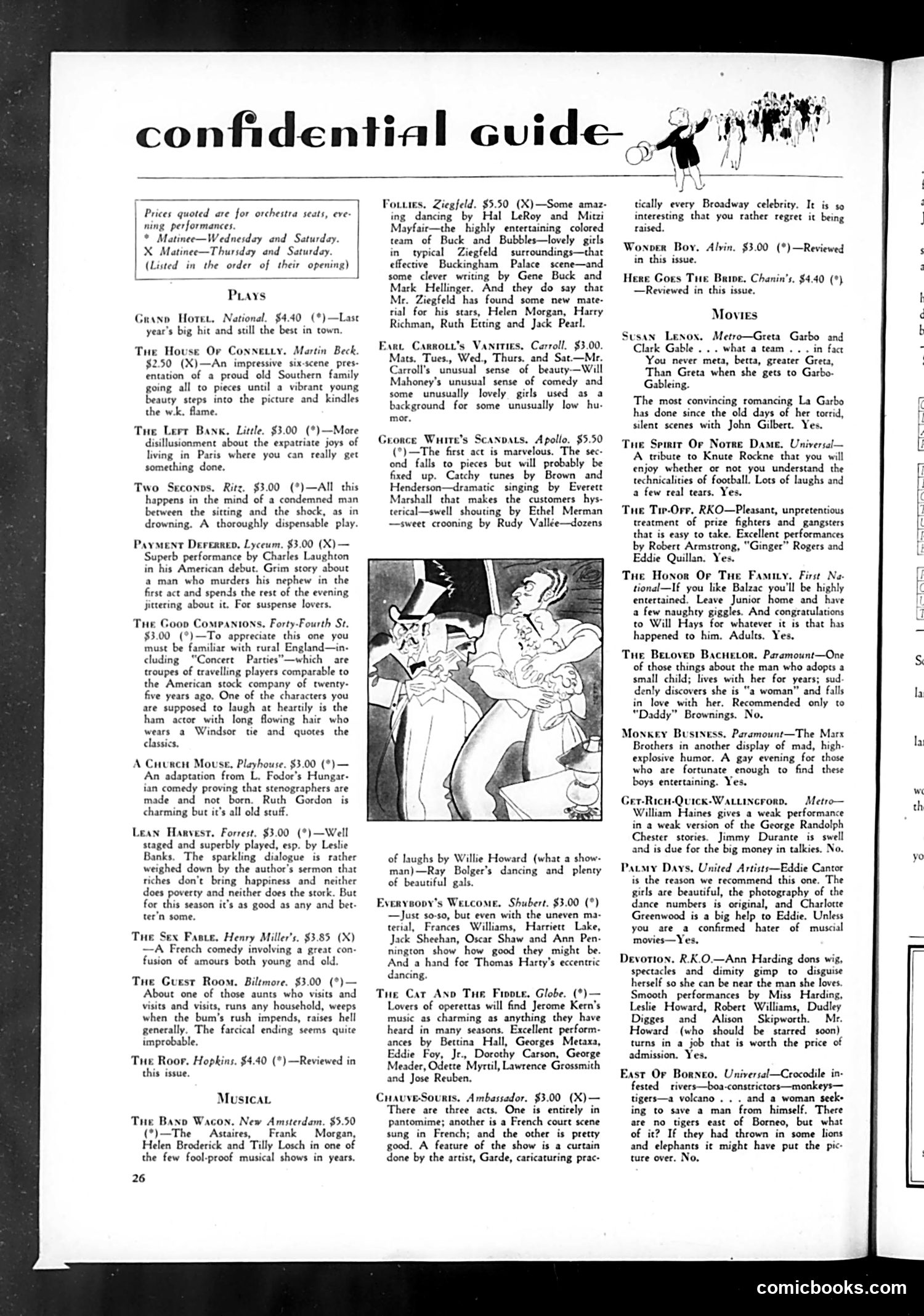
Understanding This 1930 Life Magazine Theater Guide This page is a theater review section from Life magazine—not political satire. It's a "Confidential Guide" to Broadway shows currently running, with brief critical assessments of plays and musicals. The content includes: - Plays like *The Grand Hotel*, *Payment Deferred* (noting Charles Laughton's American debut), and *The Roof* - Musicals including the Astaires in *The Band Wagon* and *Ziegfeld Follies*, praised for dancers Hal LeRoy, Mitzi Mayfair, and the team "Buck and Bubbles" The small illustration appears to be a theatrical scene sketch, typical of entertainment journalism. Key context for modern readers: This reflects 1920s-30s Broadway culture, with prices ($3-5.50), references to now-obscure performers, and mentions of "Ziegfeld" (the famous producer Florenz Ziegfeld). The tone is witty and gossipy—characteristic of Life's satirical voice applied to entertainment criticism rather than politics.
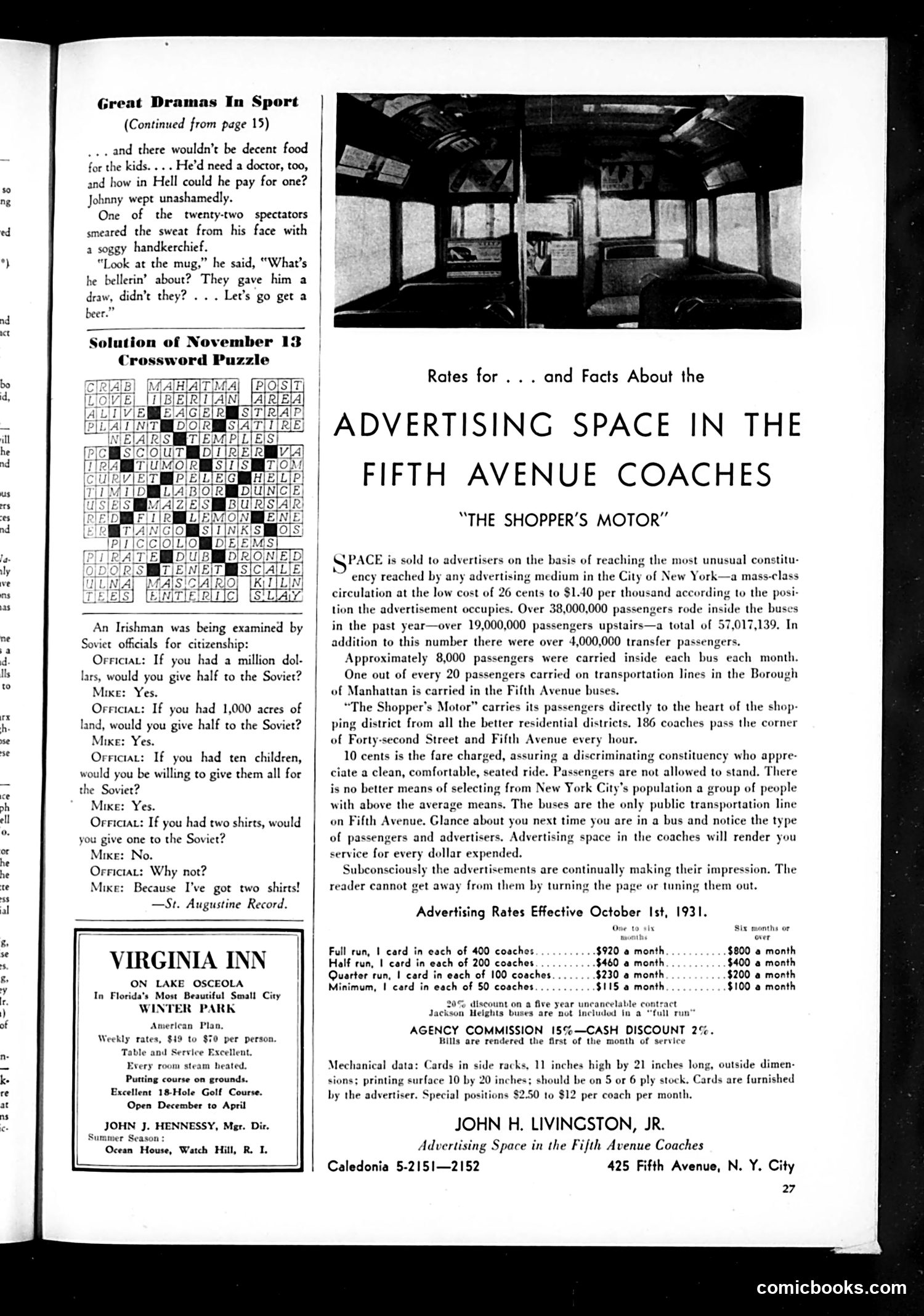
Analysis This page contains primarily advertising and administrative content, not political cartoons. The main feature is an advertisement for Fifth Avenue Coaches' bus advertising space in New York City (1931). It highlights that buses reach 57 million annual passengers—a valuable demographic of middle and upper-class shoppers—at competitive rates (26 cents to $1.40 per thousand impressions). The pitch emphasizes buses as "The Shopper's Motor," claiming they efficiently deliver affluent consumers to shopping districts. Below is a Soviet citizenship joke: an Irishman agrees to give away money, land, and children to the Soviet state, but refuses to give up one of his two shirts—the punchline being that only material self-interest matters to him. At the top is a brief sports anecdote about a struggling boxer named Johnny, illustrating working-class hardship during Depression-era sports. A callous spectator dismisses his emotional breakdown despite receiving prize money. The page reflects 1931 economic anxieties and advertising strategies targeting affluent urban consumers via public transit.
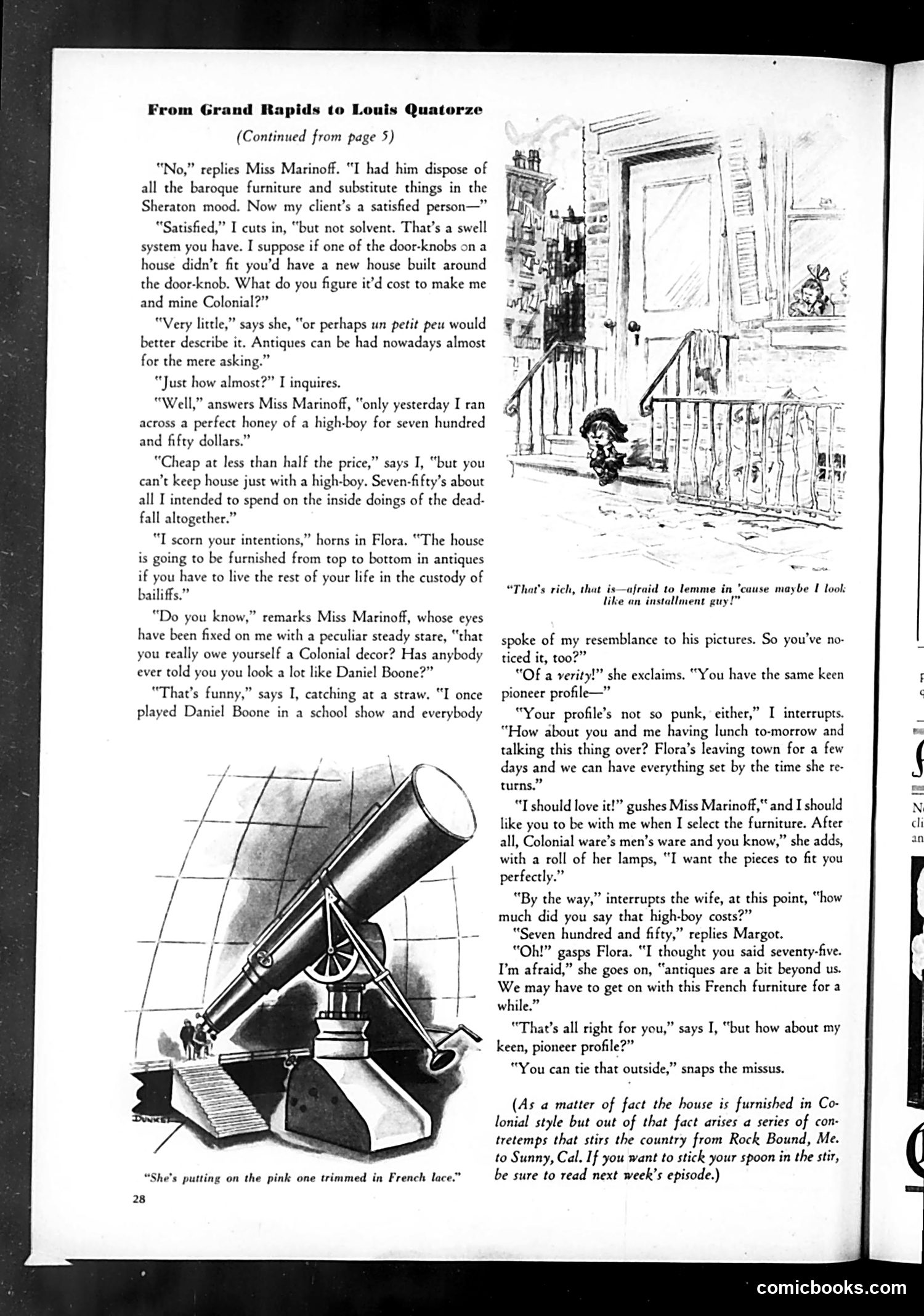
Life Magazine Satire: "From Grand Rapids to Louis Quatorze" This is a serialized domestic comedy satirizing 1920s consumer culture and interior design trends. A narrator and his wife Flora consult interior designer "Miss Marinoff" about furnishing their home in Colonial style. The satire targets: The extravagance of antique collecting: Marinoff casually mentions a highboy costing $750—an enormous sum the narrator budgeted for his entire interior. She dismisses this as "cheap at less than half the price," mocking the irrational spending of wealthy clients on authentic antiques. Marital tension over spending: Flora insists on expensive Colonial furnishings despite financial reality; the narrator protests the cost. Gender dynamics: Marinoff flatters the narrator by comparing him to Daniel Boone, attempting to manipulate him into accepting higher expenses. His wife, suspicious, catches the designer's scheming. The cartoon on the page (telescope labeled "She's putting on the pink one trimmed in French lace") appears to illustrate related domestic spy themes. The episode's title references Grand Rapids furniture manufacturing versus expensive period pieces—the core joke of American consumerism.
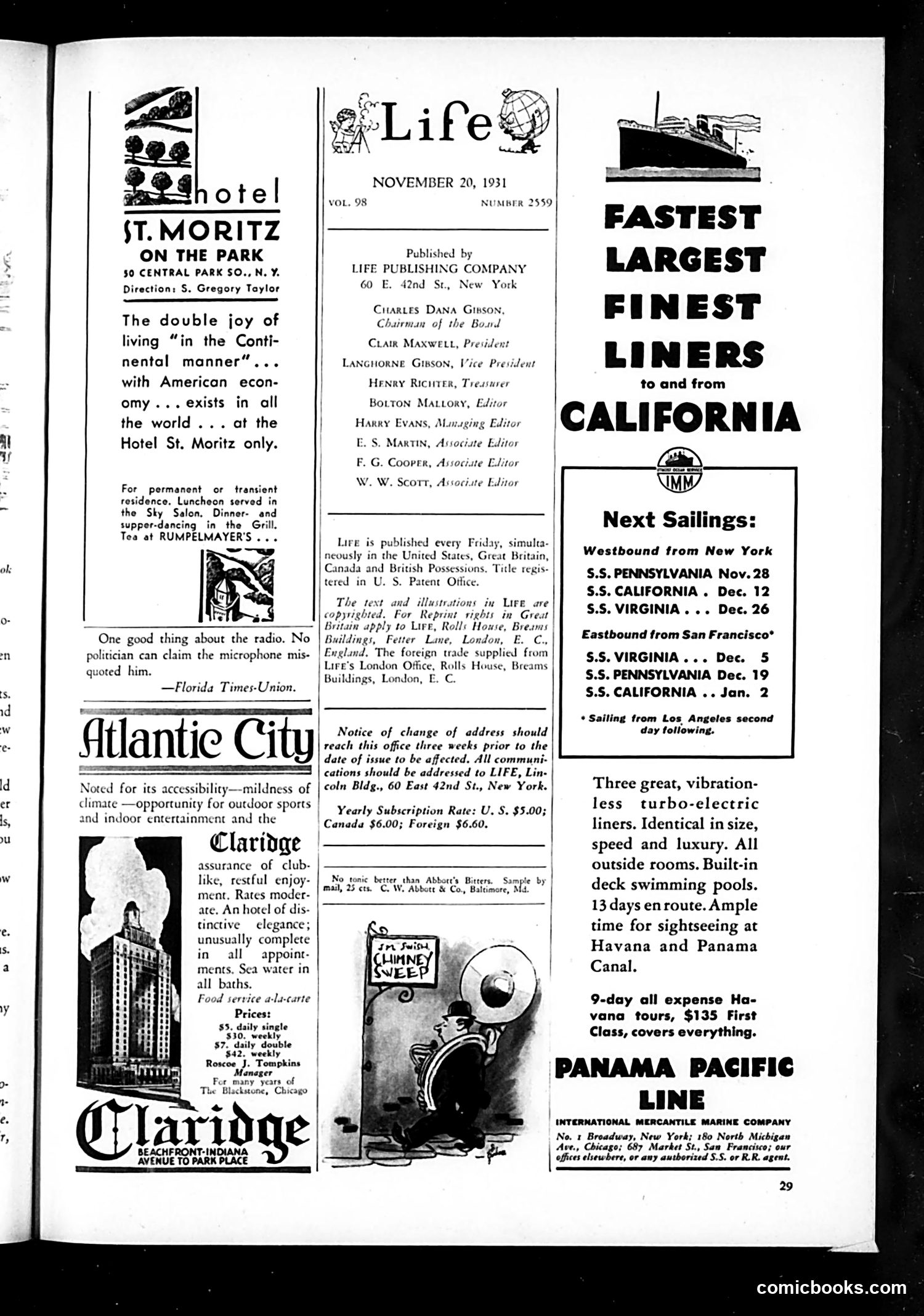
Life Magazine, November 20, 1931 This is primarily a cover/contents page with advertisements and masthead information rather than satirical cartoons. The one political joke visible is a brief quip from the *Florida Times-Union* stating that "one good thing about the radio" is that "no politician can claim the microphone misquoted him." This appears to reference the growing power of radio broadcasting in the early 1930s—a relatively new medium where politicians' words were recorded and broadcast live, making it harder to deny or reframe what they'd said. The joke mocks politicians' typical habit of disavowing unflattering quotes. The rest of the page consists of hotel and cruise ship advertisements (St. Moritz, Atlantic City's Claridge, and the Panama Pacific Line), reflecting Depression-era luxury travel marketing aimed at Life's affluent readership.
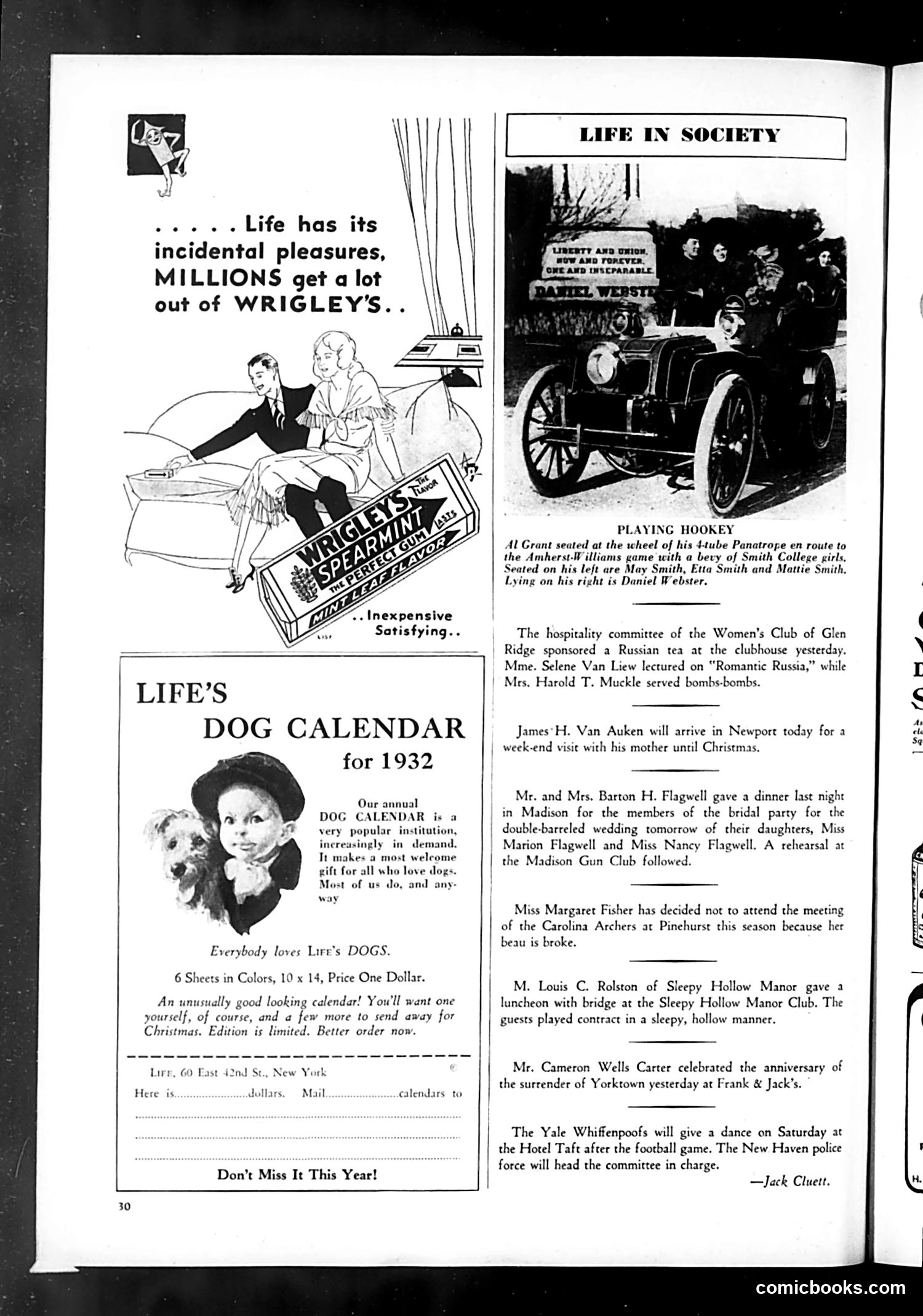
"Life in Society" Page Analysis This page combines advertisement and social column content typical of 1930s Life magazine satire. The Wrigley's cartoon (top left) mocks consumerism through a couple sharing chewing gum—a visual pun suggesting gum as an "incidental pleasure" that millions enjoy cheaply. The satire is gentle: even life's small luxuries come from mass-market products. "Playing Hookey" (top right photo) humorously documents college students skipping classes to attend a football game, with names like "Daniel Webster" (the famous statesman) apparently given to a passenger—suggesting the carefree absurdity of college social life. The Dog Calendar advertisement promotes a novelty product—a 1932 calendar featuring dogs, positioned as a perfect gift. "Everybody loves Life's DOGS" appeals to sentimentality while advertising the magazine itself. The society column provides satirical fodder through mundane announcements of teas, dinners, and social events among the wealthy and idle, capturing the era's class-conscious leisure culture.
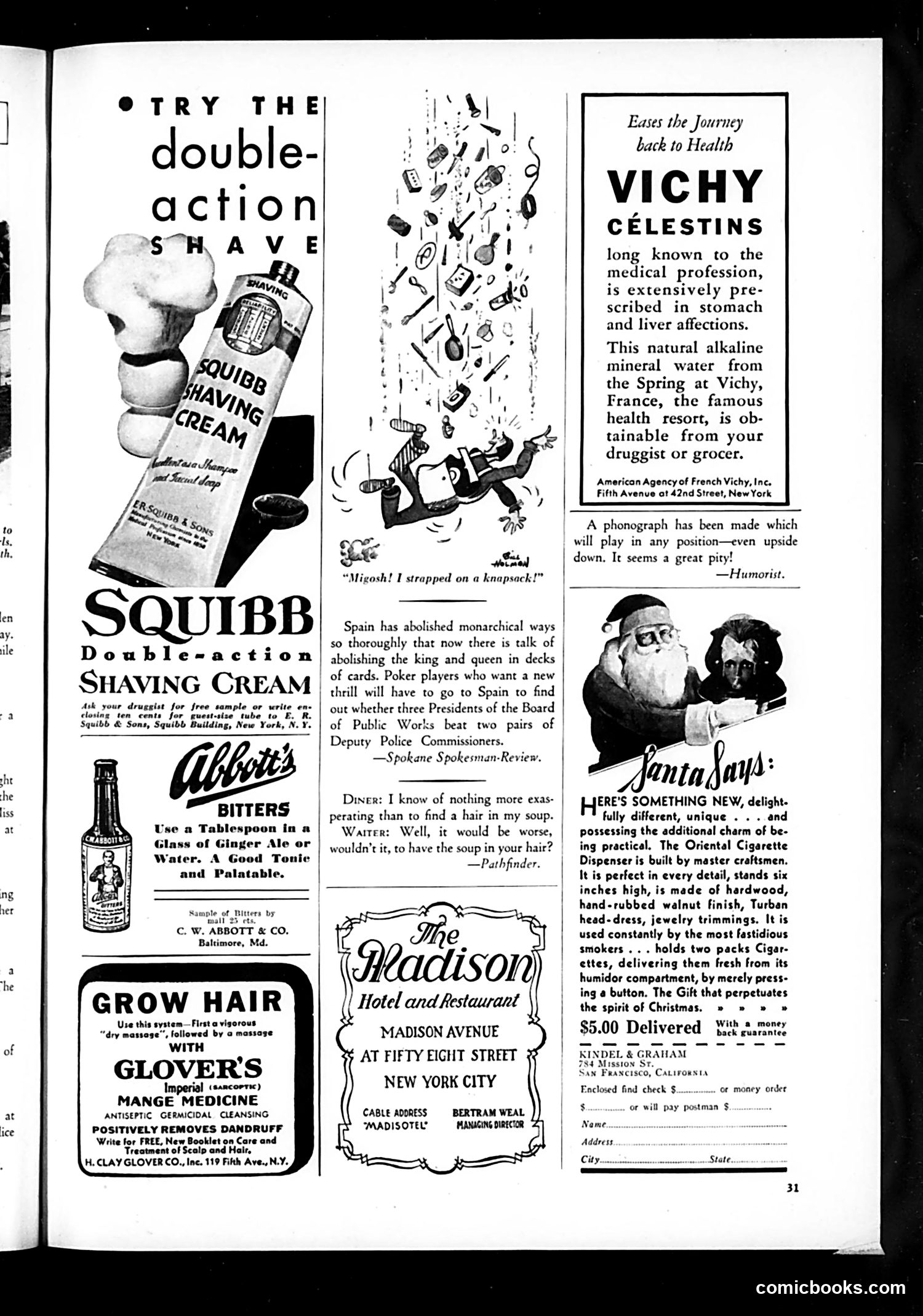
Analysis of Page 31 Content This is primarily a advertising page from Life magazine, not a political cartoon page. The page contains multiple product advertisements typical of the era, interspersed with brief humorous items. The notable satirical content includes: 1. Spain joke: References Spain's abolition of monarchical symbols from playing cards (king and queen removed), joking that poker players seeking thrills would need to visit Spain to see if "three Presidents of the Board of Public Works beat two pairs of Deputy Police Commissioners"—mocking the absurdity of replacing monarchy with obscure bureaucratic titles. 2. Hair-in-soup joke: A classic waiter-and-diner exchange about finding a hair in soup being preferable to having soup in one's hair—wordplay humor. 3. Phonograph joke: Brief quip that a phonograph playable upside-down "seems a great pity"—implying people might use it to avoid hearing unwanted music. The bulk of the page features period advertisements for shaving cream, hair tonics, bitters, cigarette dispensers, hotels, and mineral water—typical 1920s-30s consumer goods marketing.
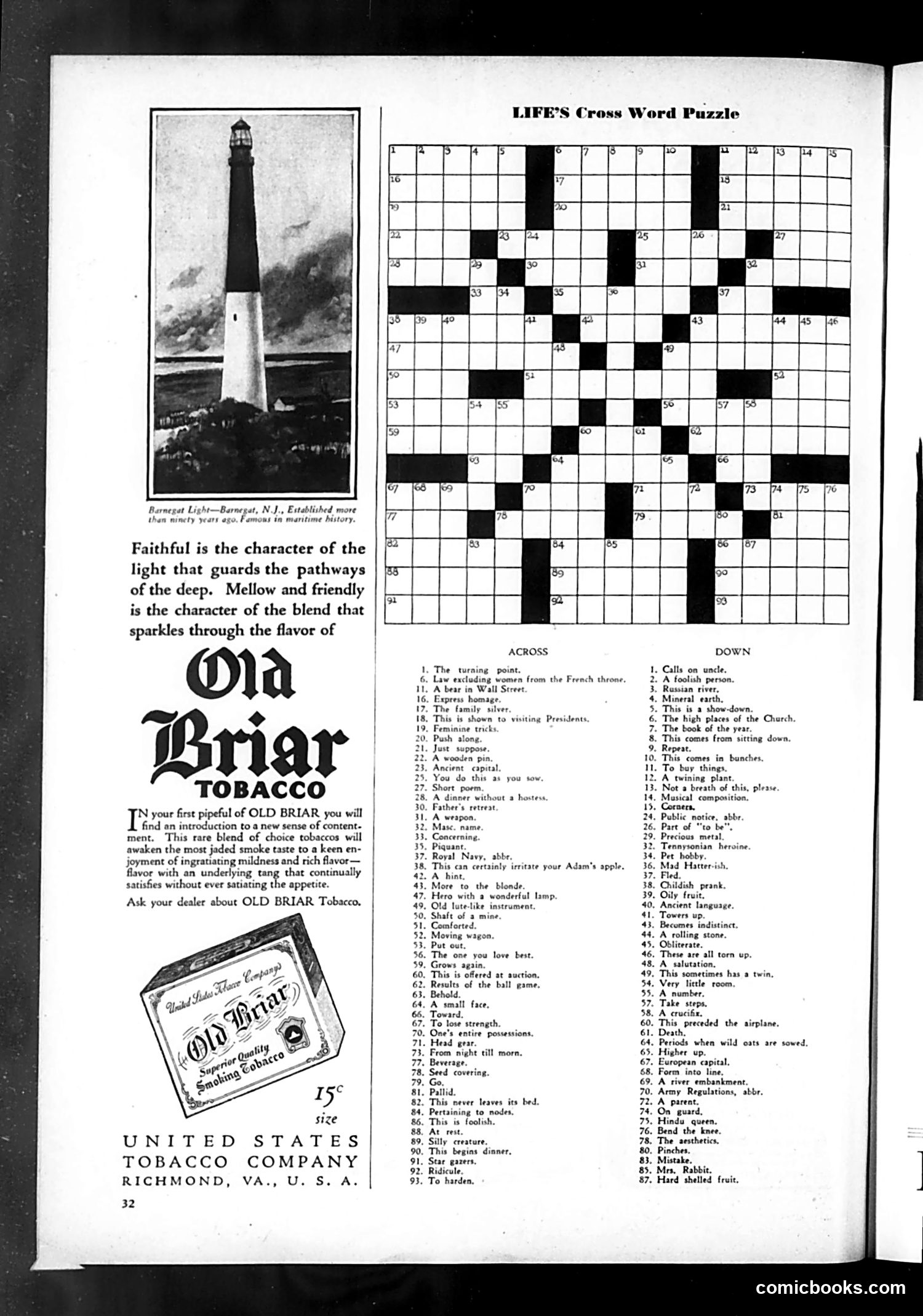
What This Page Contains This is primarily a crossword puzzle page with advertising, not a political cartoon. The page features: 1. A photograph of Barnegat Light lighthouse in New Jersey with poetic text about its faithfulness 2. An Old Briar Tobacco advertisement comparing the tobacco's reliability to the lighthouse's steadfast character—the implicit message being that this product is as dependable and comforting as a trusted beacon 3. A full crossword puzzle with 93 clues The tobacco ad uses the lighthouse as a metaphor for trustworthiness and consistency. There is no satire or political commentary here. This is a straightforward commercial page designed to entertain readers while promoting a tobacco brand, typical of early-to-mid 20th century magazine advertising.
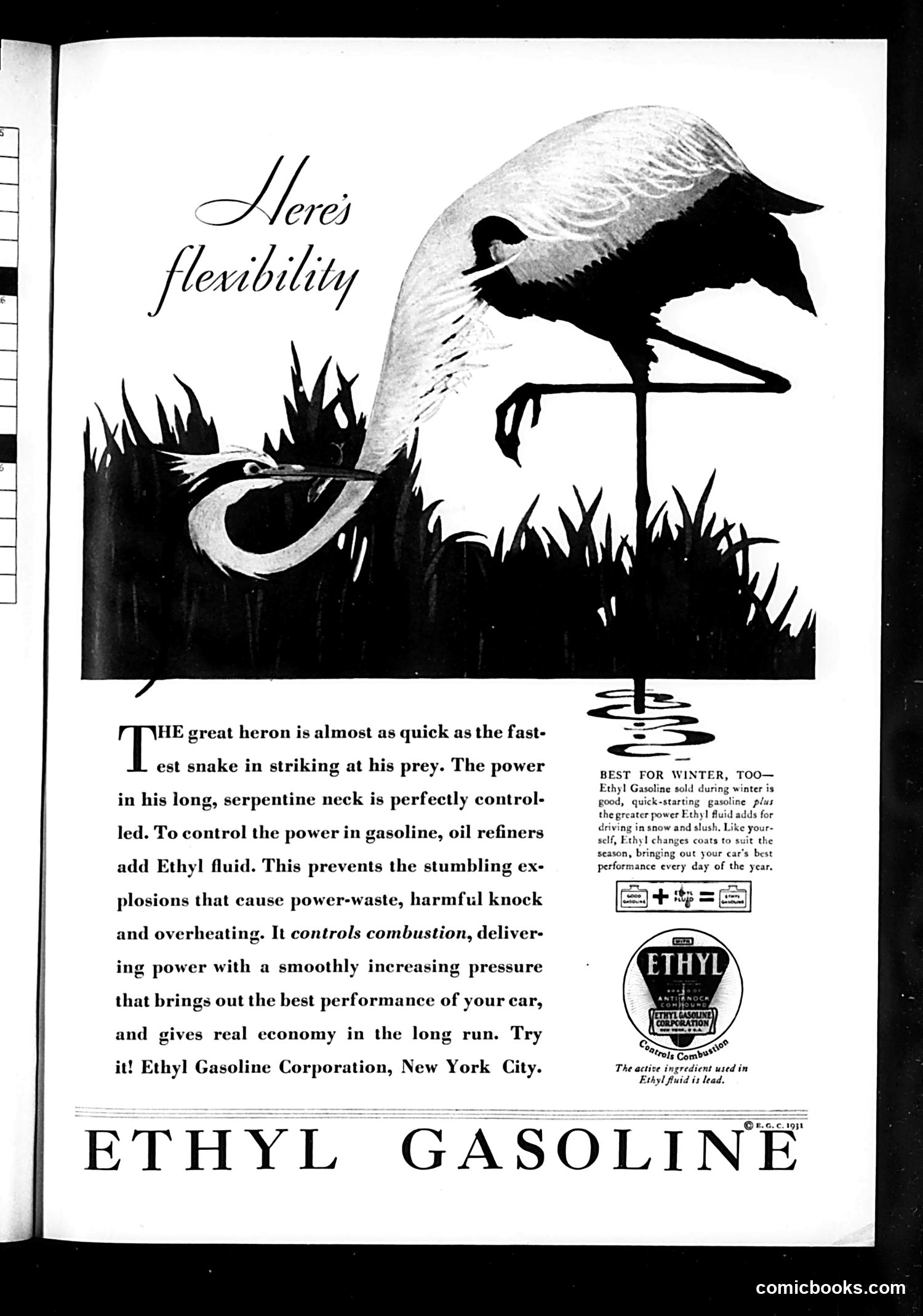
Analysis This is primarily an advertisement for Ethyl Gasoline, not political satire. The page uses an extended visual metaphor comparing a hunting heron's controlled striking power to the controlled combustion power of Ethyl gasoline. The cartoon depicts a great heron catching a snake, illustrating "flexibility" and precision control. The text explains that just as the heron's "serpentine neck" delivers controlled power when striking prey, Ethyl fluid controls gasoline combustion to prevent engine knock, explosions, and overheating—delivering smooth, efficient power. The advertisement promises better car performance and fuel economy year-round, with a note that the "active ingredient" is lead (leaded gasoline, common then but later recognized as harmful). This reflects early 20th-century advertising that used nature metaphors and animal imagery to sell automotive products to consumers.
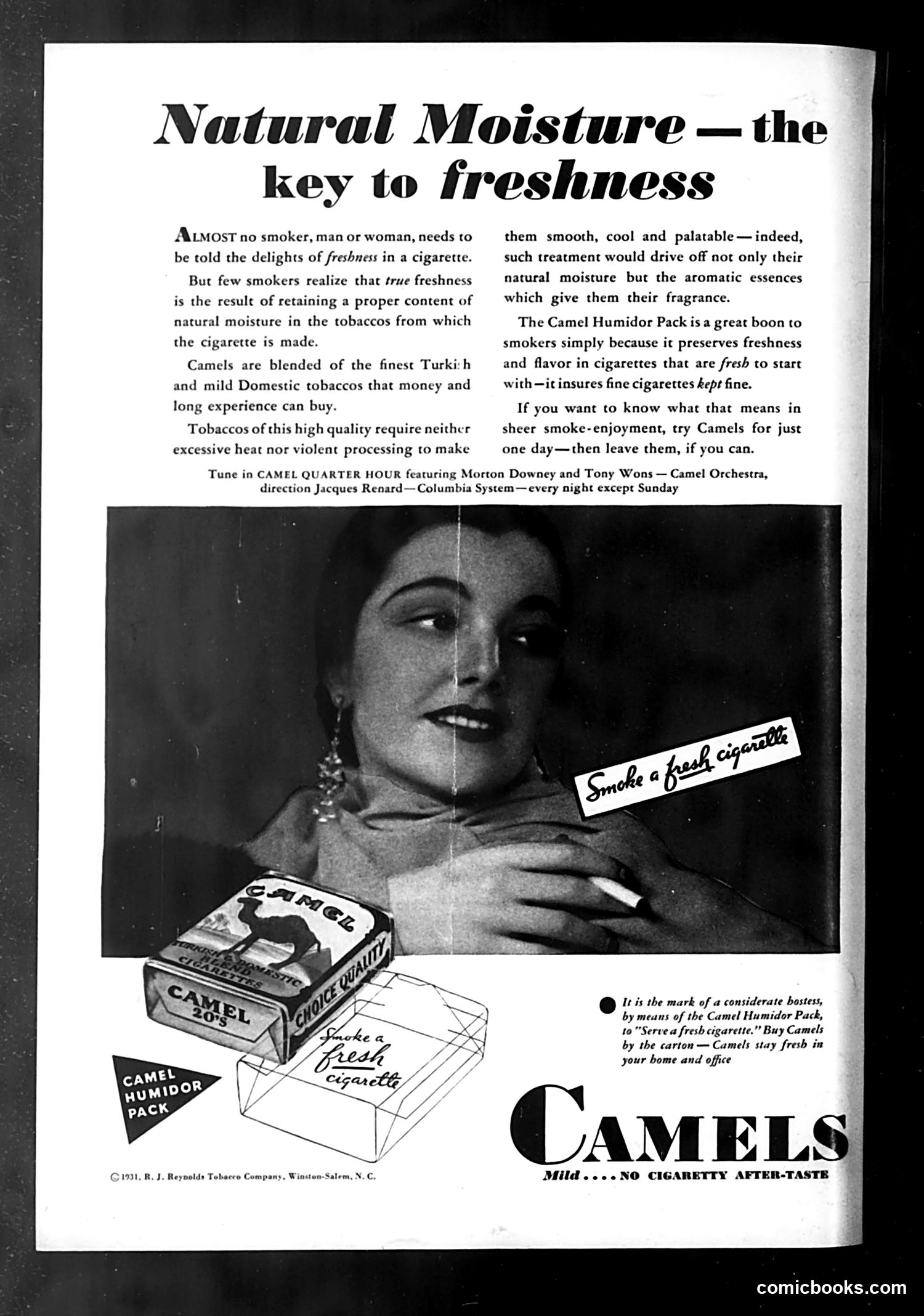
This is a 1931 Camel cigarette advertisement, not satire or political commentary. The page promotes the Camel Humidor Pack—a moisture-preserving cigarette package. The ad argues that "true freshness" depends on retaining natural moisture in tobacco, and that Camel's special packaging preserves this quality better than competitors. The photograph shows an elegant woman smoking, positioning cigarettes as a sophisticated social accessory. The tagline "Smoke a fresh cigarette" emphasizes freshness as a selling point, while "Mild....NO CIGARETTY AFTER-TASTE" addresses common smoker complaints. The ad also promotes Camel's radio program ("Camel Quarter Hour") as entertainment tie-in marketing. By modern standards, the health claims are striking—the ad frames moisture retention as purely beneficial, with no acknowledgment of smoking's dangers. This represents pre-warning-label advertising when cigarettes were marketed as luxury consumer goods without health disclaimers.
I can see this is a page from Life magazine with "comicbooks.com" credited at the bottom, but the image itself is almost entirely black or severely underexposed, making it impossible to discern any cartoon content, text, figures, or caricatures with any clarity. Without being able to see the actual illustrated content or read the text on the page itself, I cannot identify specific political figures, social references, or explain the satire or humor intended. To properly analyze this as a historical political cartoon from Life magazine, I would need a clearer, properly exposed image where the artwork and accompanying text are legible.