life
Life — November 27, 1931
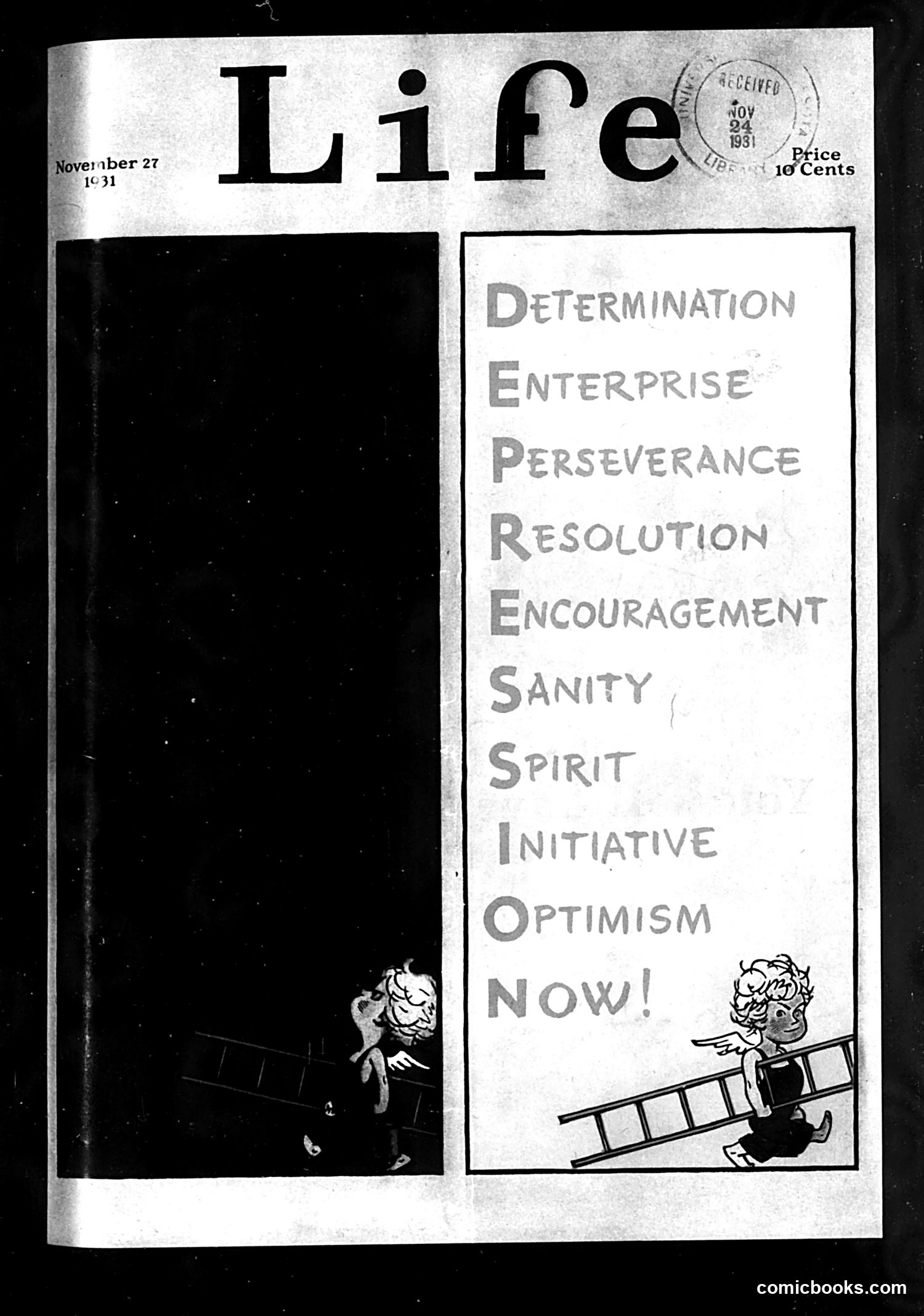
Life Magazine, November 27, 1931 This appears to be a title page or cover featuring an acrostic poem spelling "DEPRESSION NOW!" using words like Determination, Enterprise, Perseverance, Resolution, Encouragement, Sanity, Spirit, Initiative, Optimism. The left side shows a dark, mostly black panel with small cartoon figures at the bottom. The right panel contains the motivational acrostic with illustrated cherubs or cupids at the corners carrying a ladder. Context: Published during the Great Depression (1929-1939), this is satirical commentary on American optimism and self-help rhetoric during economic crisis. The contrast between the dark left panel and the cheerful right side—with its earnest list of virtues—appears to mock the gap between official encouragement and harsh economic reality. The magazine uses irony to critique hollow motivational messaging when people were genuinely suffering.
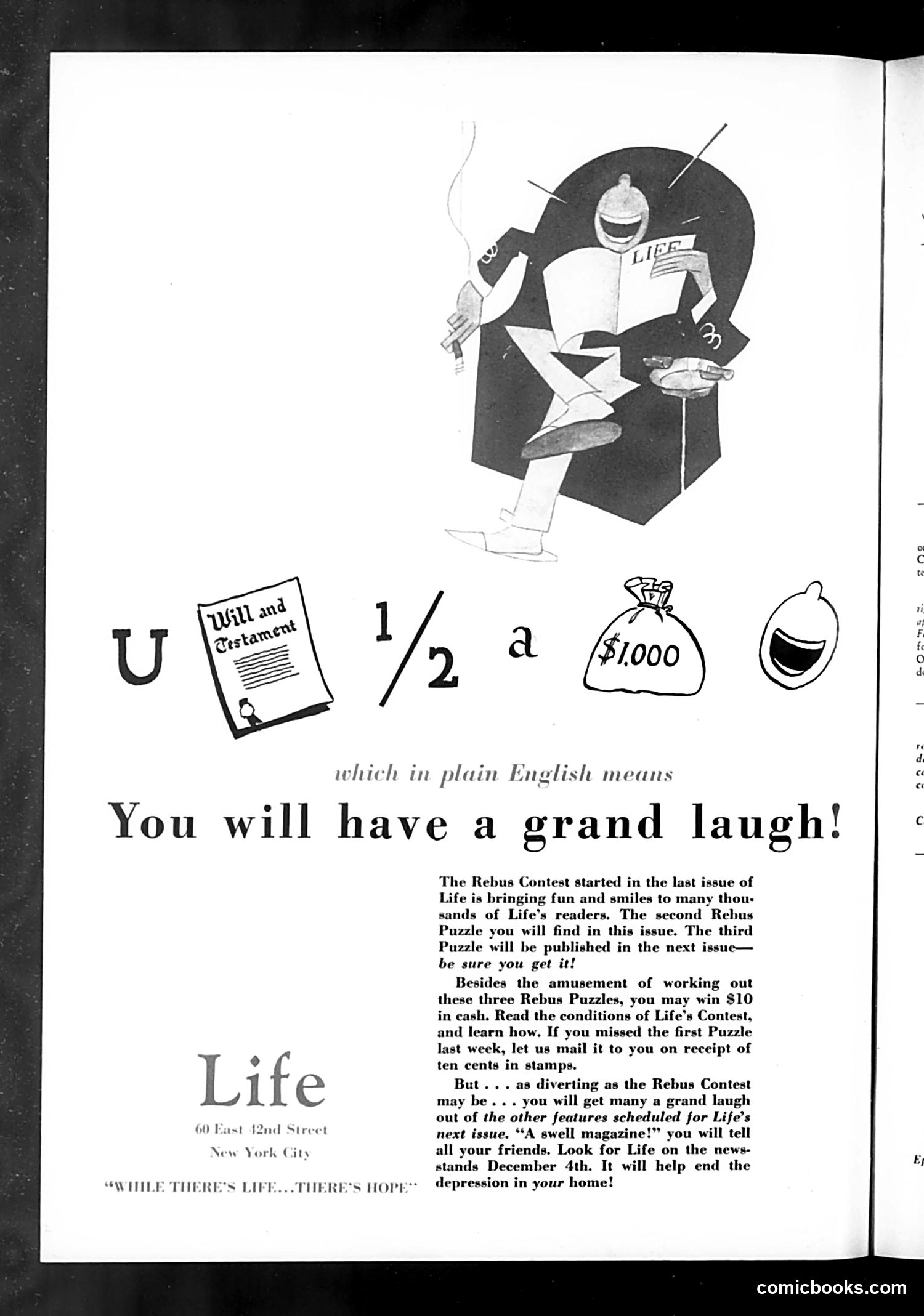
Analysis This is a rebus puzzle advertisement for *Life* magazine's contest. The visual riddle reads: "U [Will and Testament] 1/2 a [$1000 money bag] [laughing face]" The solution translates to: "You will have a grand laugh!" (as the text confirms). The cartoon above shows a well-dressed gentleman in a chair smoking, reading a newspaper labeled "LIFE," embodying the magazine's target affluent audience. The rebus puzzle itself uses visual symbols instead of words—a common 1930s-40s parlor game format. The contest promised $10 cash prizes and positioned *Life* as sophisticated entertainment to "end the depression in your home." This reflects the magazine's role as humorous escape during economic hardship, appealing to middle and upper-class readers seeking genteel amusement.
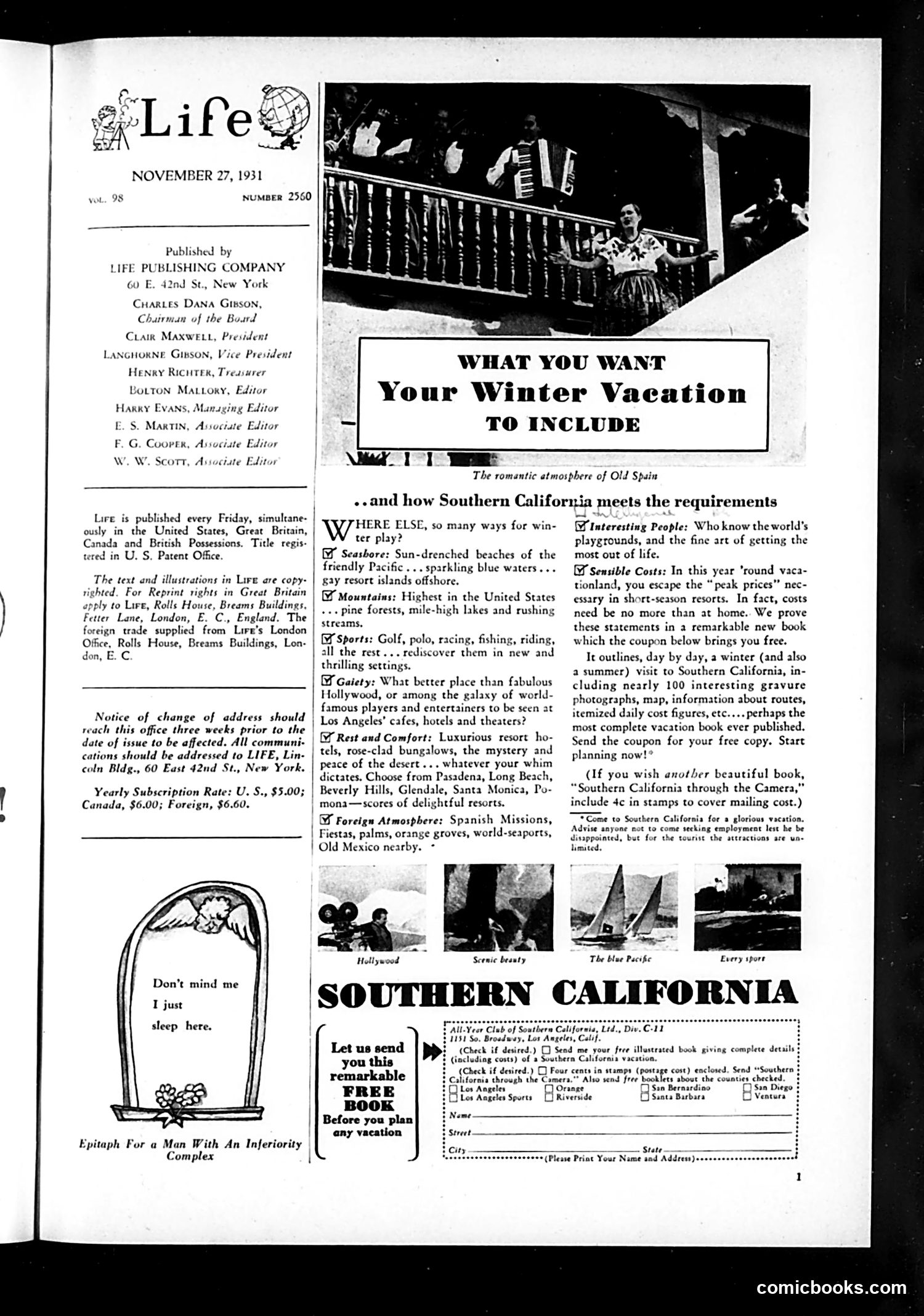
Analysis This page is primarily advertising content for Southern California tourism, not political satire. The main feature is a travel advertisement promoting winter vacations to Southern California, highlighting beaches, mountains, golf, entertainment venues (Hollywood), and Spanish colonial missions. The only cartoon on the page is a small, unrelated sketch at bottom left: a coffin with the epitaph "Epitaph For a Man With An Inferiority Complex" and the figure inside saying "Don't mind me I just sleep here." This is a generic joke about self-deprecation, not political commentary. The page reflects 1931 tourism marketing and leisure culture during the Great Depression era, offering escape through vacation planning.
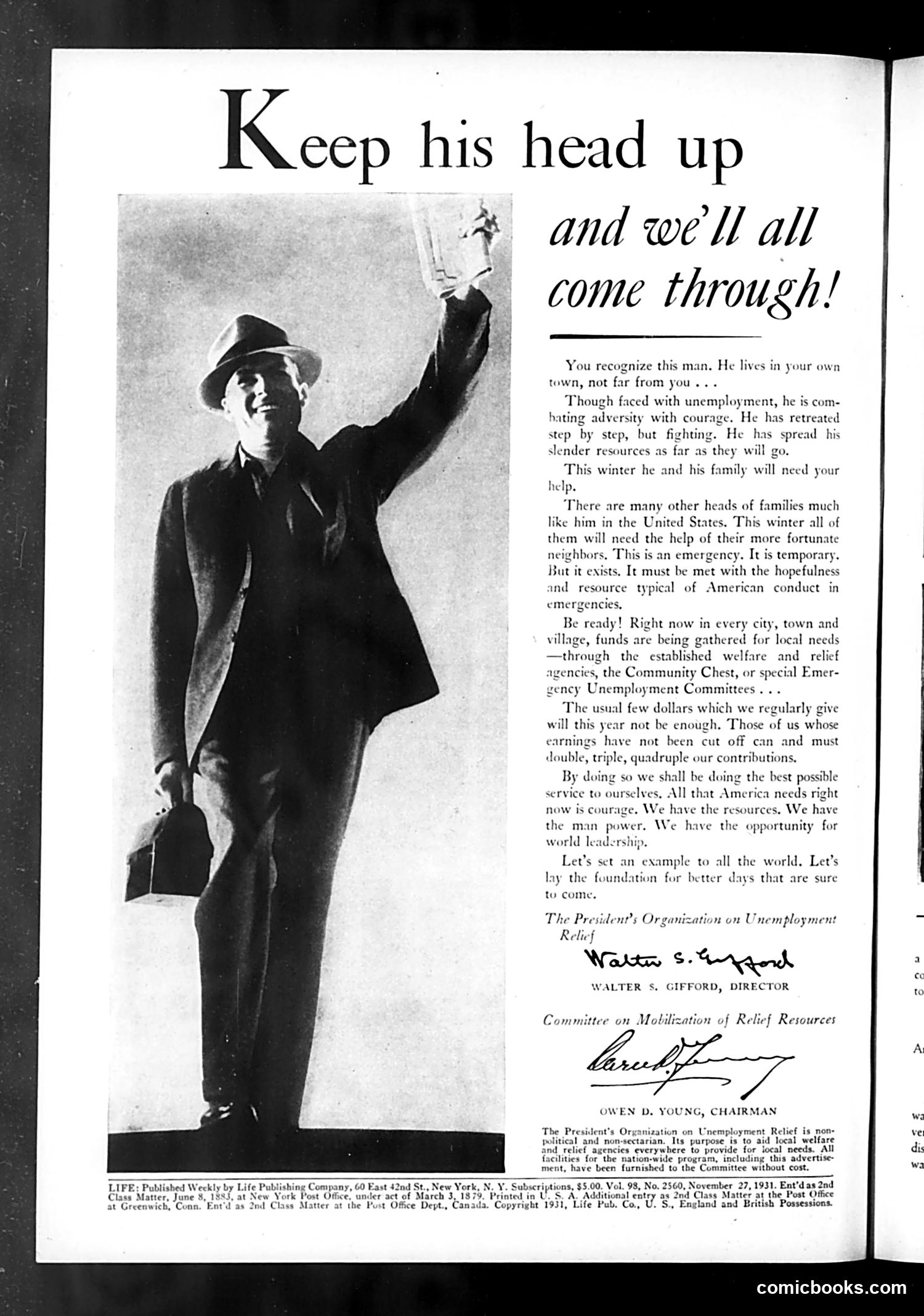
Analysis: "Keep His Head Up" (Life Magazine, November 27, 1931) This is not satire—it's a earnest relief appeal during the Great Depression. The image shows an unemployed man with fist raised in determined resolve, symbolizing resilience during economic crisis. The text, signed by Walter S. Gifford (Director of the President's Organization on Unemployment Relief) and Owen D. Young (Chairman), urges Americans to dramatically increase charitable donations. It acknowledges widespread unemployment and argues that regular contributions won't suffice—those with stable incomes must "double, triple, quadruple" their giving. The appeal frames Depression relief as a patriotic duty and moral emergency requiring community support through established welfare agencies, emphasizing American resourcefulness and leadership. This predates federal welfare programs, relying on voluntary charitable action.
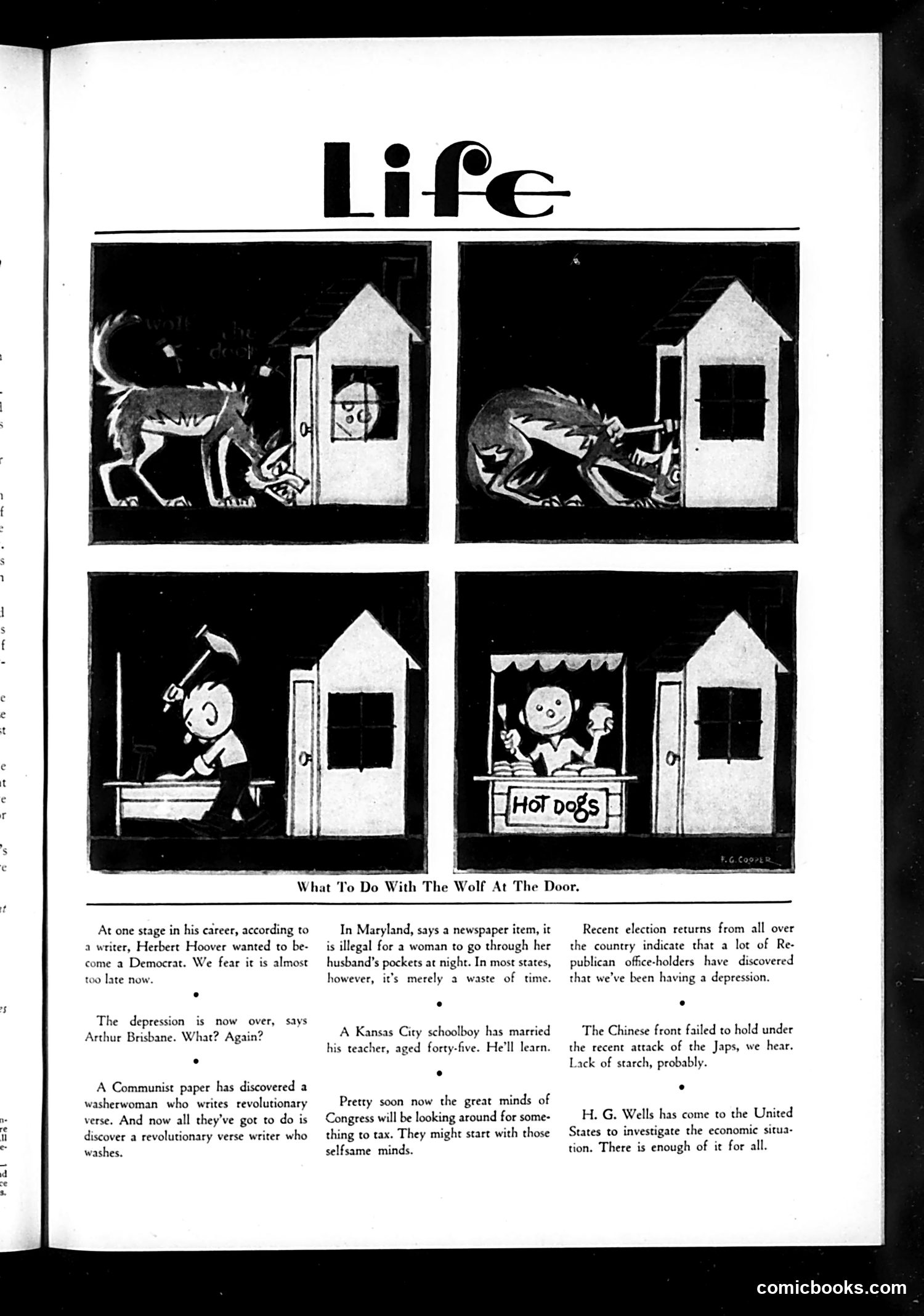
"What To Do With The Wolf At The Door" This four-panel comic satirizes responses to economic hardship. The sequence shows a man confronting a threatening wolf (representing poverty/financial crisis) outside a small house: Panel 1-2: The man tries to fight the wolf off with increasingly desperate measures. Panel 3: He attempts to ignore it through distraction (shown bathing). Panel 4: He opens a "Hot Dogs" stand, suggesting entrepreneurial escape from poverty. The accompanying text references the Great Depression's aftermath with dark humor—joking that Herbert Hoover wanted to become a Democrat because it's "almost too late now," and mocking political responses to economic suffering. The overall message critiques inadequate solutions to widespread want during this economically turbulent period.
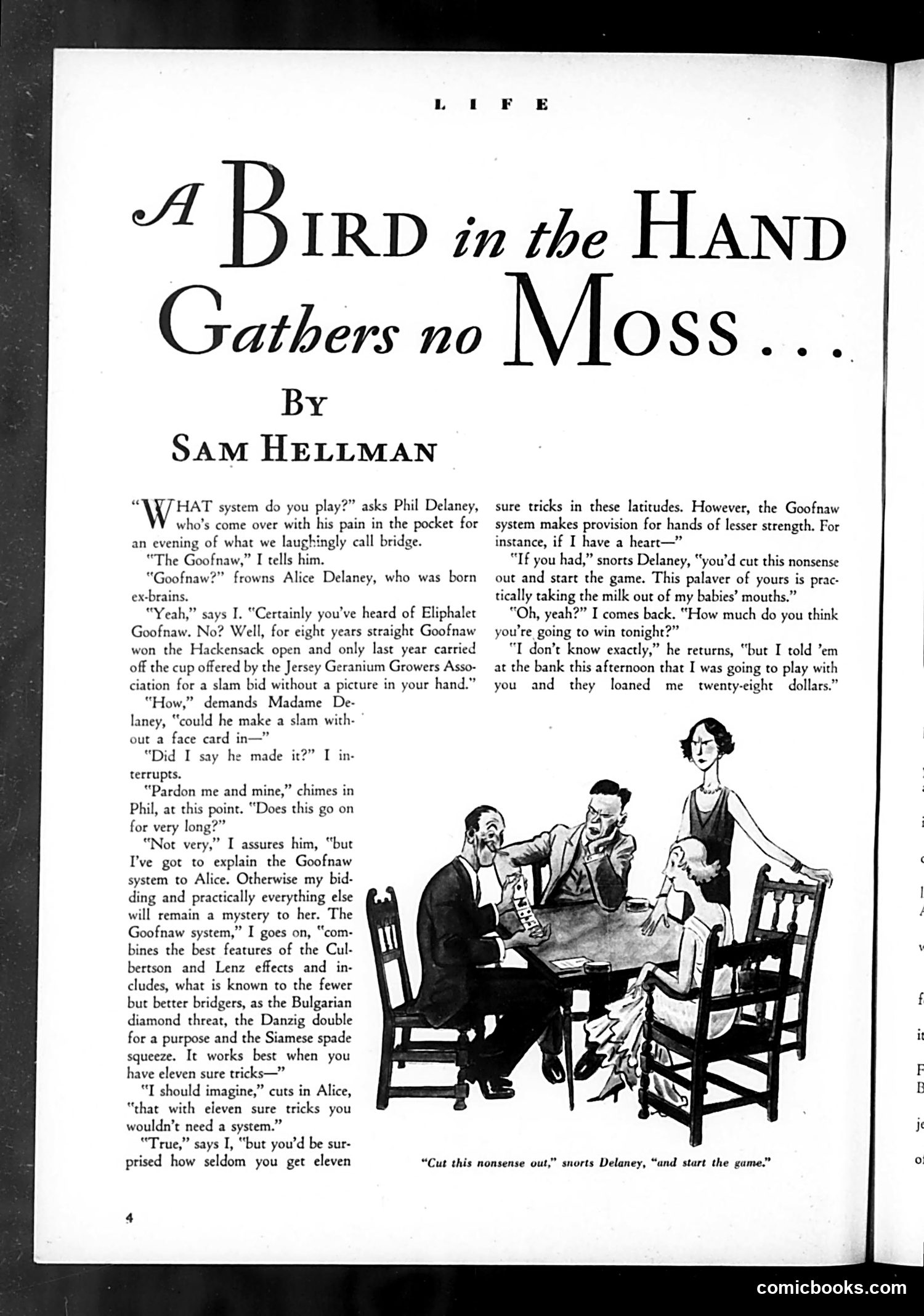
"A Bird in the Hand Gathers no Moss" This is a humorous article by Sam Hellman about bridge card game strategy, specifically the "Goofnaw" system. The illustration shows three men and a woman at a card table engaged in bridge. The satire targets the proliferation of complex bridge systems and bidding conventions popular in the 1920s-30s. Phil Delaney is trying to explain the Goofnaw system—which absurdly combines features of various established systems (Culbertson, Lenz effects, Bulgarian diamond threat, Danzig double, Siamese spade squeeze)—to his wife Alice. The joke is that bridge had become so complicated with competing methodologies that players needed elaborate systems just to play socially. The humor mocks both pretentious bridge enthusiasts and the snake-oil-like promotion of competing systems.
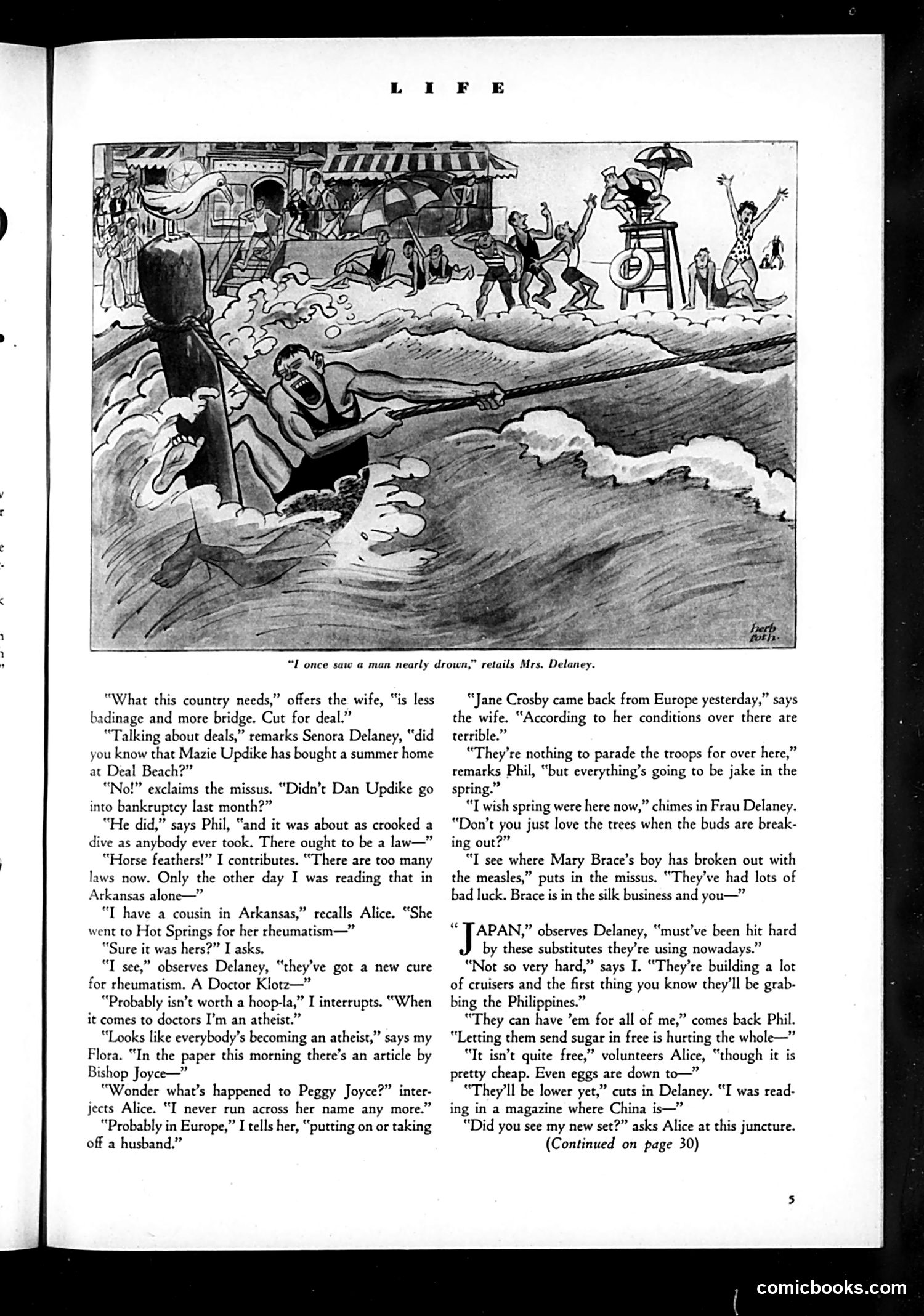
Analysis of Life Magazine Page This page features a cartoon and accompanying gossip column showcasing early 20th-century American social commentary. The cartoon depicts a man nearly drowning while beachgoers enjoy themselves above—illustrating the disconnect between leisure and crisis, likely satirizing class indifference or social apathy. The column comprises domestic chatter among women discussing neighbors: failed business ventures (Dan Updike's bankruptcy), travel (Hot Springs for rheumatism), medical treatments, and romantic gossip. References to "Japan," building cruisers, and the Philippines suggest contemporary imperial anxieties. The satire targets the trivial preoccupations of the leisure class—bridge games and rheumatism cures—while global affairs proceed. The tone is characteristically arch, mocking both provincial small-talk and the speakers' obliviousness to larger world events.
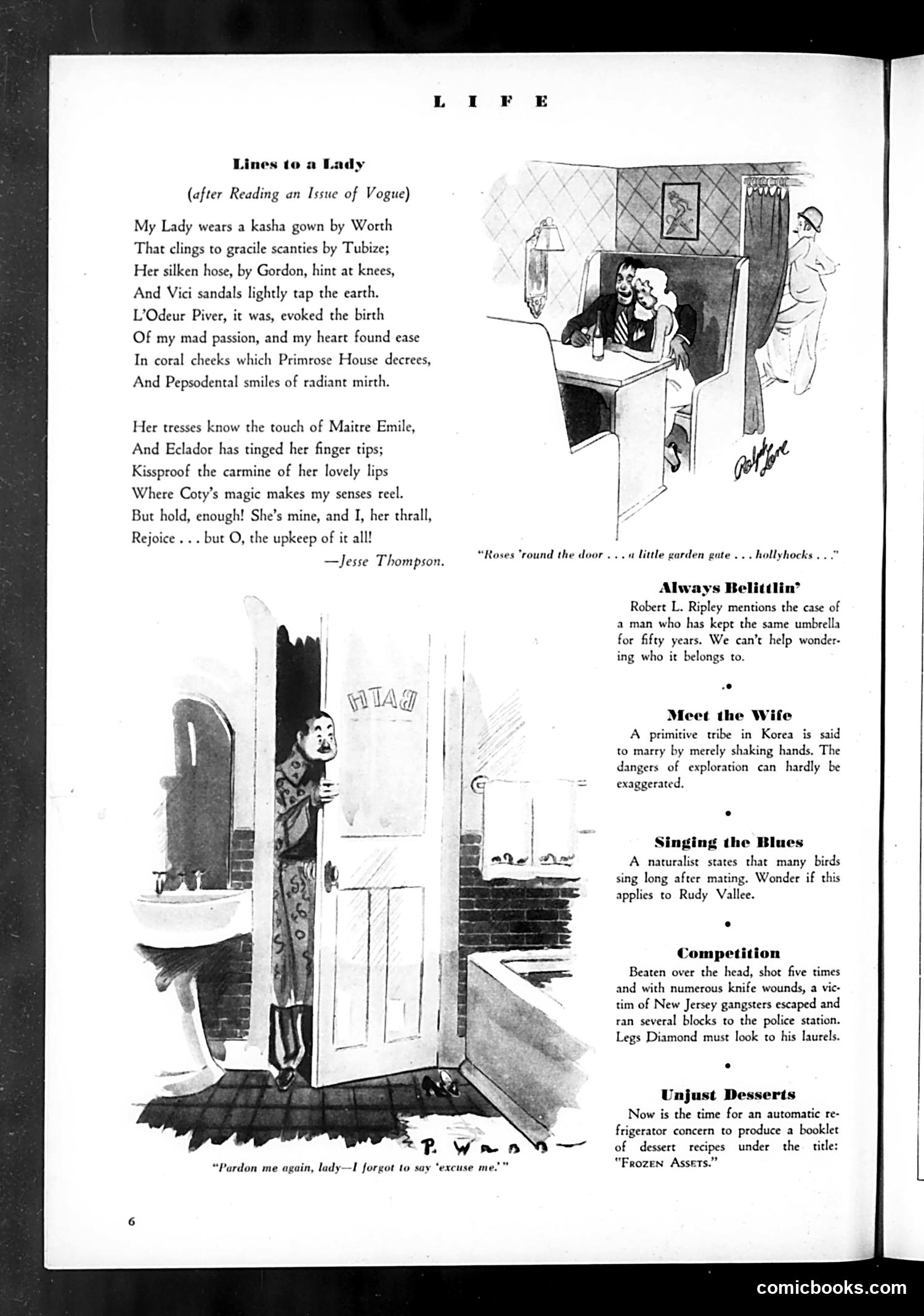
Analysis: Life Magazine Page (Fashion & Humor Section) The page features "Lines to a Lady" by Jesse Thompson, a poem celebrating a fashionable woman wearing luxury brands (Worth gown, Tubize fabrics, Gordon stockings, Vici sandals, Primrose House cosmetics, Pepsodent toothpaste). The poem humorously catalogs high-end products while affecting romantic passion. Two cartoons accompany this: 1. Upper right: A couple in what appears to be a bedroom or dressing room, with suggestive positioning and the caption about "roses 'round the door." 2. Lower left: A woman in a bathtub, with a man peering from behind a door, captioned "Pardon me again, lady—I forgot to say 'excuse me.'" Both cartoons use bathroom/bedroom settings for mild innuendo—typical of 1920s-era Life magazine's sophisticated humor targeting middle-class readers.
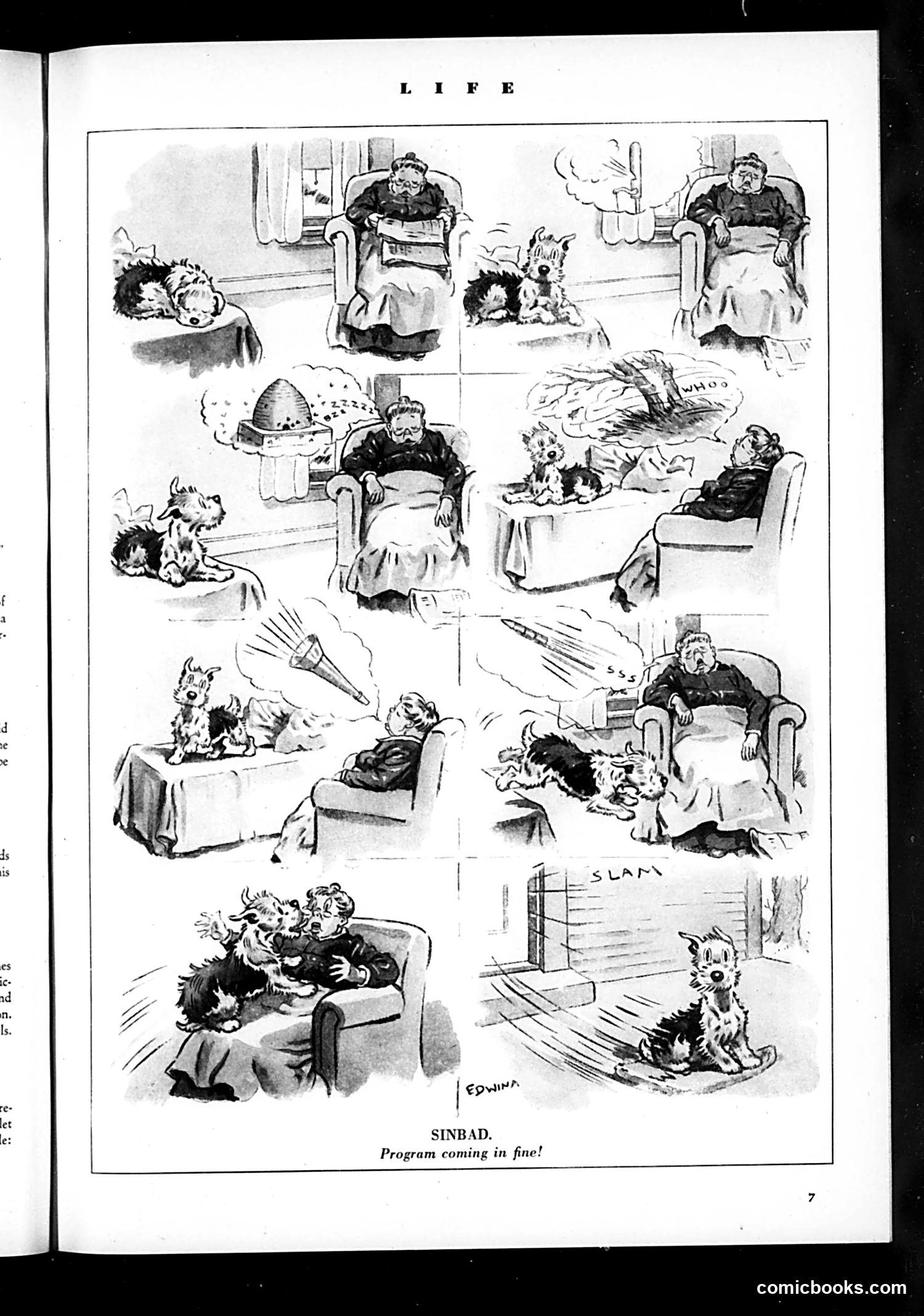
Analysis of "Sinbad" Cartoon This is a comic strip satirizing domestic life with a woman and small dogs. The repeated sequence shows an elderly woman in a chair with mischievous terriers causing increasingly chaotic situations—jumping on furniture, creating mess, and generally disrupting the household. The caption "Sinbad. Program coming in fine!" suggests she's listening to a radio program (likely the adventure serial "Sinbad") while the dogs wreak havoc around her. The humor lies in the contrast between her calm attention to entertainment and the destructive animal antics surrounding her. This reflects early 20th-century American humor about domestic pets as uncontrollable household nuisances, played for visual comedy through the sequential panel format.
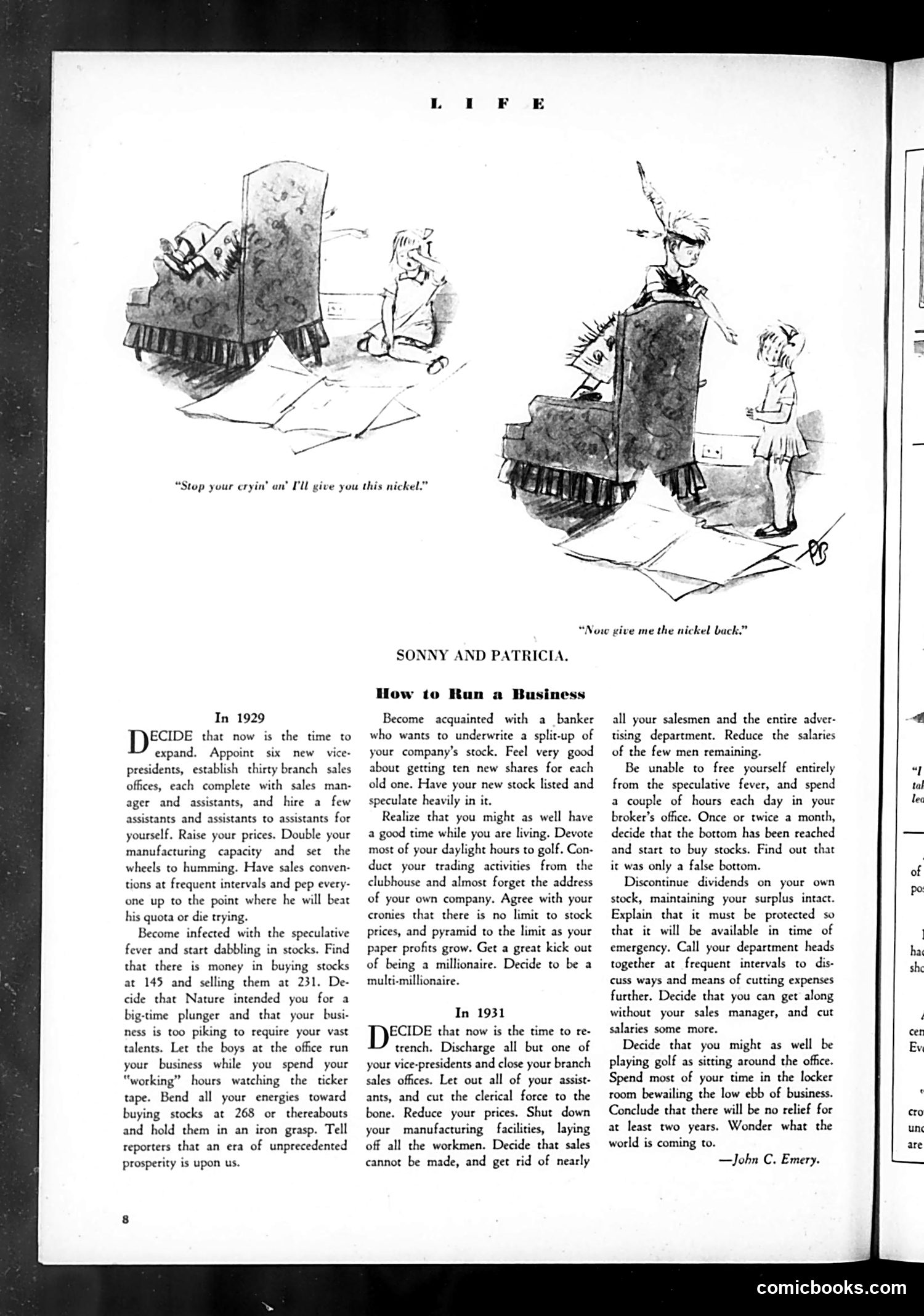
Analysis of Life Magazine Page This page contains two cartoon panels titled "Sonny and Patricia" showing a child negotiating with an adult (likely a parent) over money. The first panel depicts the child crying, saying "Stop your cryin' an' I'll give you this nickel." The second shows the child returning the nickel, saying "Now give me the nickel back." The satire mocks childhood manipulation tactics and parental weakness—the joke being the child's successful strategy of theatrical distress to extract payment, then reclaiming the bribe. Below the cartoon is "How to Run a Business," a satirical article with separate 1929 and 1931 sections. It mocks business practices during the economic boom and subsequent Great Depression collapse through mock-advice: expanding recklessly, stock speculation, and then the opposite during the crash—cutting staff, closing offices, and abandoning workers.
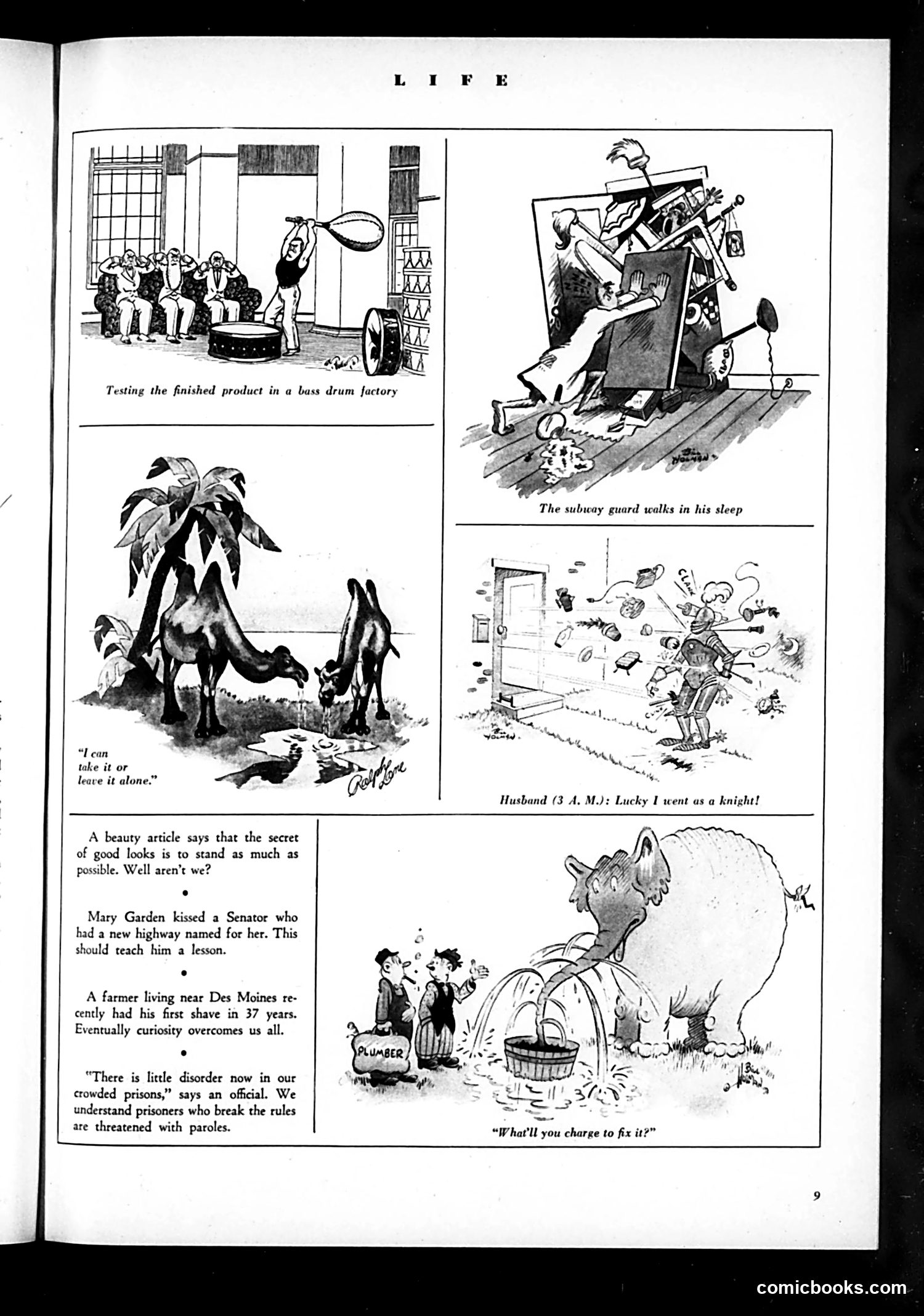
Analysis of Life Magazine Page 9 This page contains six separate humor cartoons and brief satirical items typical of Life magazine's format: 1. Bass drum factory scene: Tests a finished product by having someone play it violently while seated figures observe—satirizing product quality testing. 2. Subway guard sleeping: Shows a guard asleep while chaos erupts around him—mocking negligent security. 3. "I can take it or leave it alone": A domestic scene with unclear specific reference, though the quoted phrase suggests someone's indifference. 4. Husband as knight: Wife sends husband out unprepared, satirizing modern marriage dynamics. 5. Elephant plumber: A humorous scenario about repair costs. The text items mock beauty standards, political corruption (Mary Garden/Senator reference), rural life, and prison conditions. These represent typical 1920s-era American social satire targeting contemporary manners and politics.
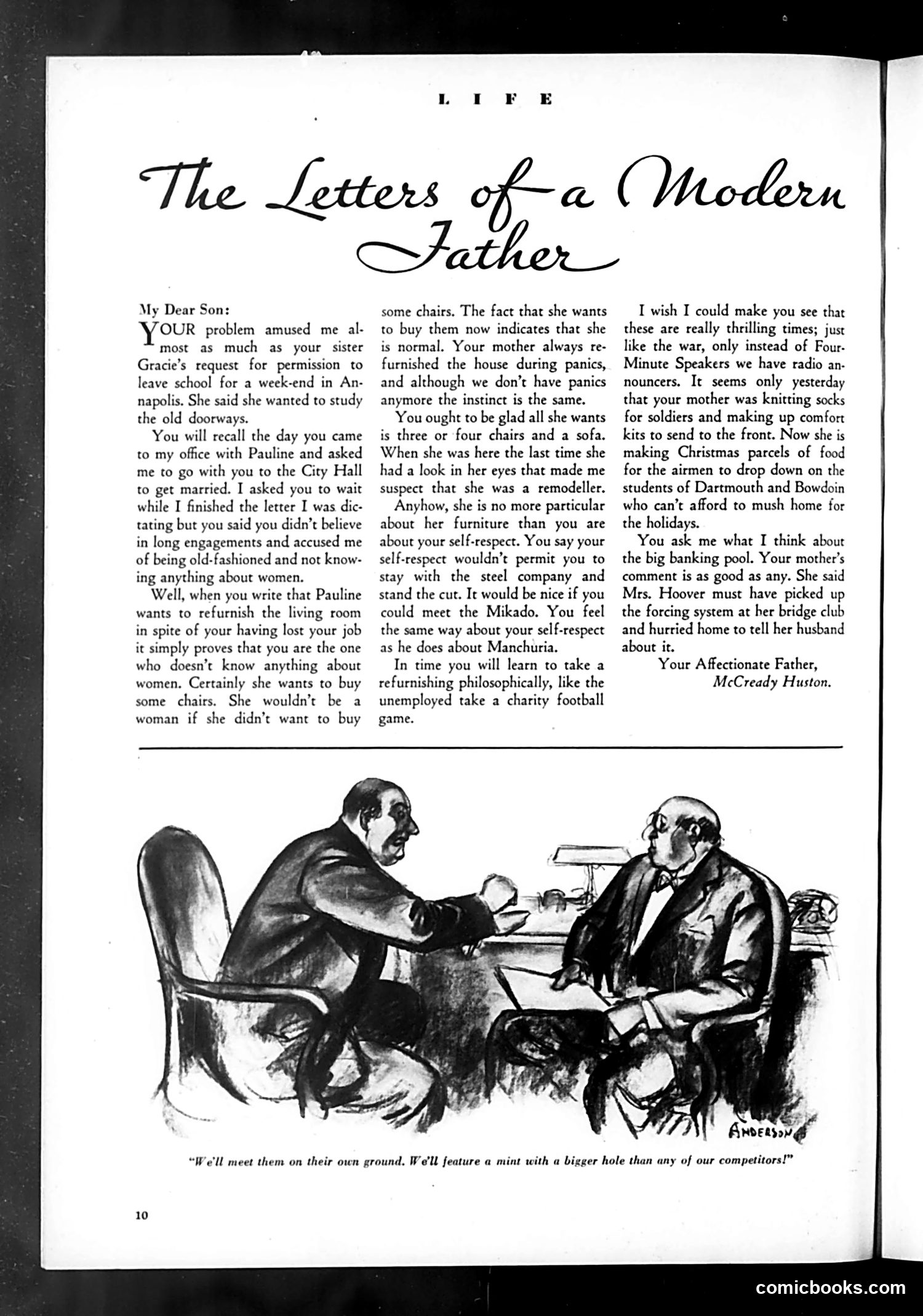
"The Letters of a Modern Father" This satirical advice column depicts a father (McCready Huston) responding to his son's complaint about the son's fiancée Pauline wanting to refurnish their living room. The father's response is gently mocking: he argues that the son's objection reveals ignorance about women. The father suggests that wanting to improve the home is normal feminine behavior, and the son should accept it—even comparing refusing her wishes to being "old-fashioned." The accompanying cartoon shows two businessmen in discussion, with one saying they'll "meet them on their own ground" and "feature a mint with a bigger hole than any of our competitors!"—likely satirizing absurd corporate competition strategies. The piece humorously skewers both masculine stubbornness about domestic matters and commercial absurdity.
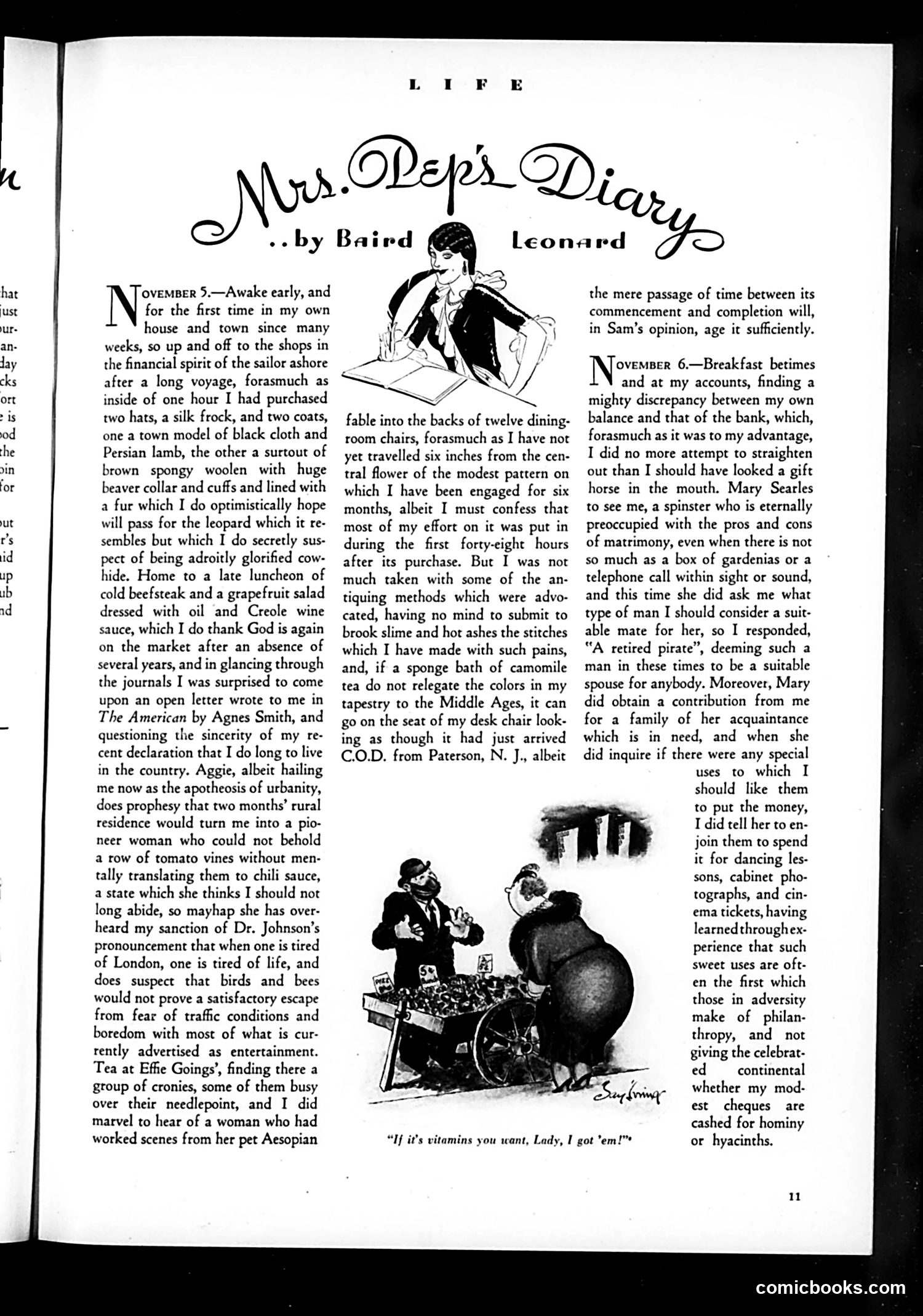
Mrs. Pep's Diary Analysis This is a satirical diary column by Baird Leonard from *Life* magazine, dated November 5-6. The cartoon illustrates an encounter between a fashionable woman and a street vendor selling vegetables from a cart, with the caption: "If it's vitamins you want, Lady, I got 'em!" The satire targets 1920s-era health fads and consumerism. The vendor's crude pitch mockingly suggests that even common produce from a street cart qualifies as a modern "health product." The diary entry itself satirizes urban upper-class pretension—the narrator's obsession with newly purchased fashionable clothing and her anxieties about keeping up appearances, juxtaposed against mundane domestic concerns. The humor lies in deflating the supposed sophistication of wealthy society life.
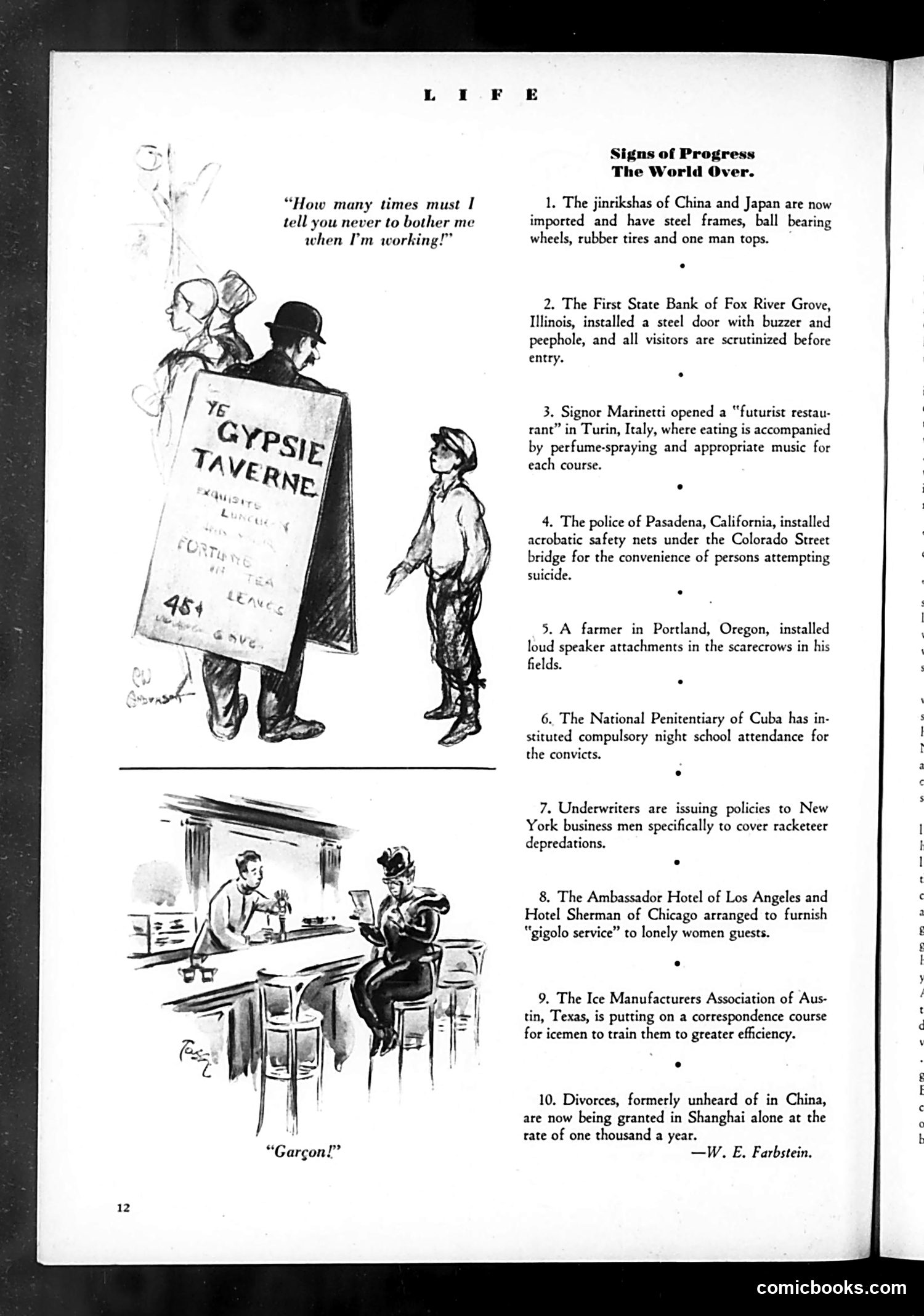
Analysis of Life Magazine Page: "Signs of Progress The World Over" This page presents satirical "signs of progress" highlighting absurd modern innovations worldwide. The cartoons mock contemporary overreach: Top cartoon: A worker complains about constant interruptions while wearing a sandwich board advertising "Ye Gipsie Taverne." The satire targets commercial invasiveness—even laborers can't escape advertising. Bottom cartoon labeled "Garçon!": A waiter serves a customer in what appears to be a restaurant. The accompanying item (#8) references hotels providing "gigolo service" to lonely women guests, satirizing the commercialization of companionship and increasingly transactional social services. The numbered list (items 1-10) mocks innovations ranging from practical (jinrickshas with steel frames, bank security) to absurd (suicide safety nets, scarecrow loudspeakers, correspondence courses for icemen). The satire critiques modern society's attempt to mechanize and commercialize every aspect of life.
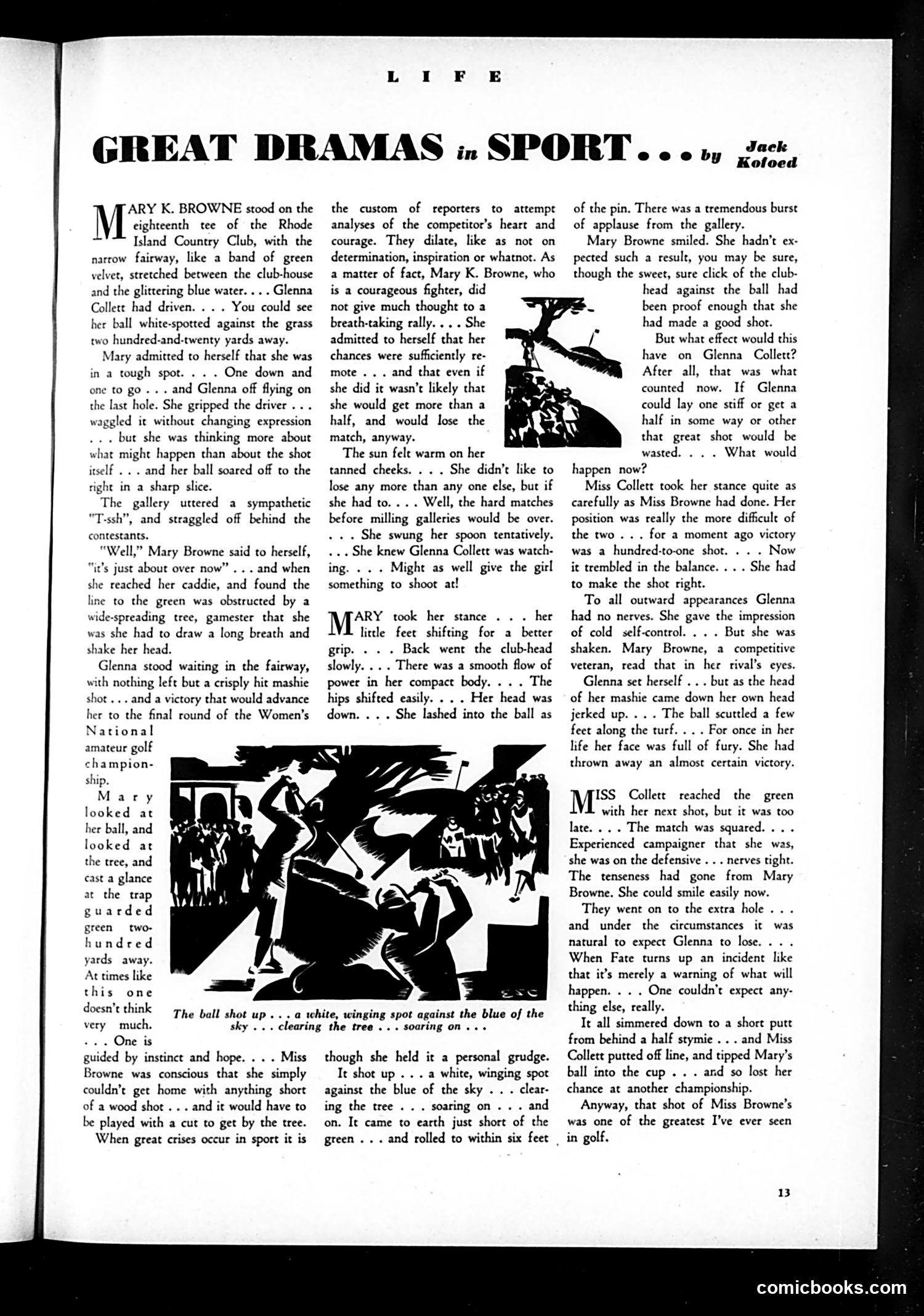
"Great Dramas in Sport" - Golf Match Analysis This is a sports narrative by Jack Koloed describing a Women's National Amateur Golf Championship match between Mary K. Browne and Glenna Collett. The accompanying illustration depicts the dramatic moment when Browne's ball shot up "a white, winging spot against the blue of the sky," clearing a tree and landing on the green—a crucial shot in their competition. The text emphasizes the psychological and physical drama of competitive golf: Browne's composed determination versus Collett's apparent nervousness. The narrative celebrates women's athletic competition, highlighting how Browne's superior shot-making and mental toughness nearly secured victory, though Collett ultimately won. This reflects 1920s-30s coverage celebrating women's sports achievements.
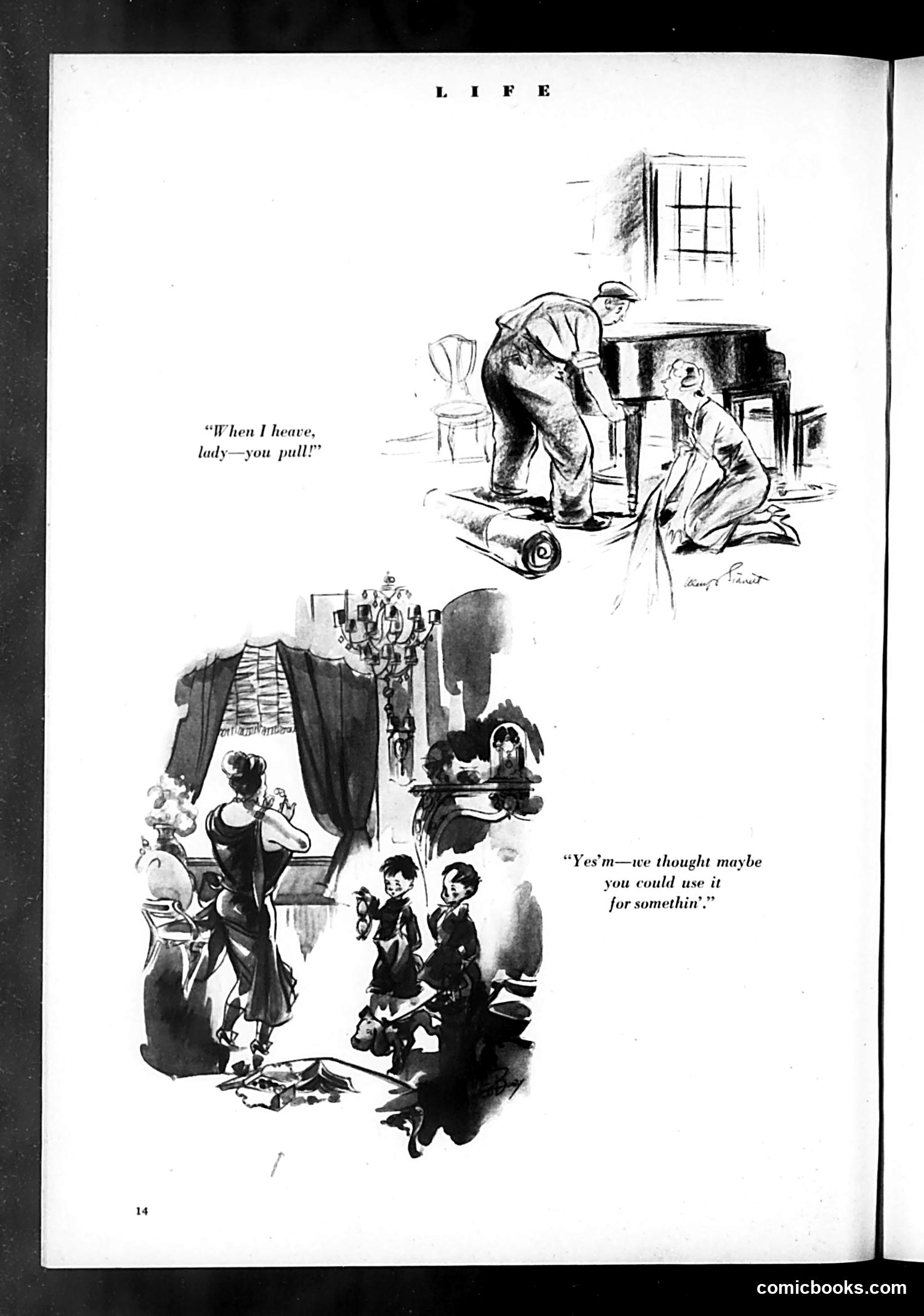
Analysis of Life Magazine Page This page contains two separate cartoon jokes about domestic life: Top cartoon: A working man (appearing to be a laborer or tradesman) instructs a woman: "When I leave, lady—you pull!" The humor derives from his giving her instructions on operating some household device or mechanism, likely implying she lacks mechanical competence or understanding. Bottom cartoon: Multiple figures (appearing to be family members or household staff) present something to a departing man, saying "Yes'm—we thought maybe you could use it for somethin'." The joke appears to mock either an unwanted gift or an item the household wants him to remove, playing on domestic friction or miscommunication between family members. Both cartoons employ gentle domestic satire typical of Life magazine's humor about marriage and household dynamics.
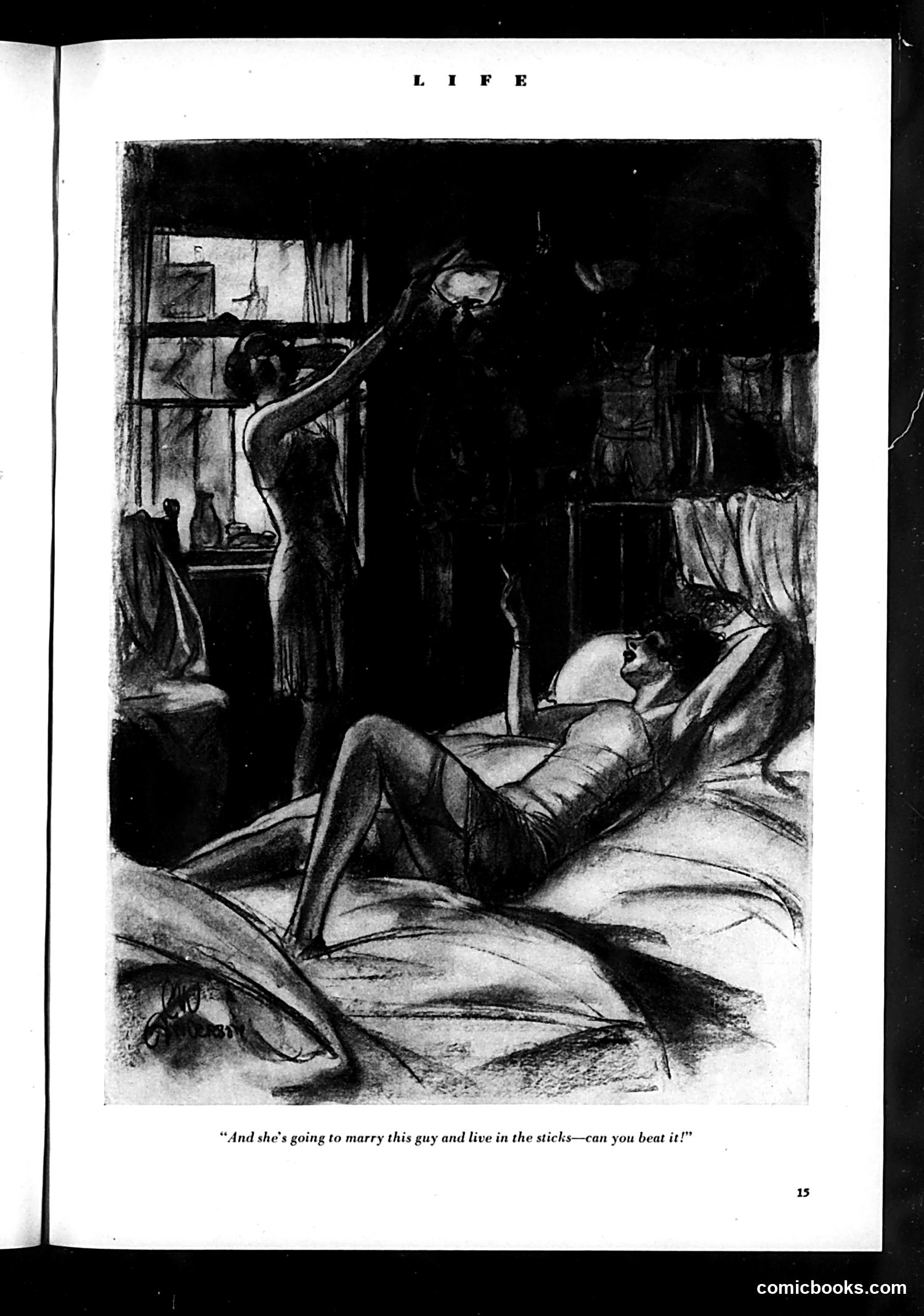
This is a satirical illustration from *Life* magazine showing a domestic scene. A woman reclines on a bed while a man stands nearby, and another figure appears at the window or doorway. The caption reads: "And she's going to marry this guy and live in the sticks—can you beat it!" The satire targets attitudes about marriage and rural life. The speaker expresses shock that a woman would choose to marry a man and move to rural areas ("the sticks")—suggesting this represents an undesirable or lower-status life choice. The illustration's tone and composition mock both the couple's decision and the speaker's class-conscious disapproval. The cartoon reflects early 20th-century urban attitudes viewing rural life as socially inferior, making the woman's choice seem inexplicably foolish to sophisticated city dwellers.
Life Magazine Page Analysis This page contains three opinion columns rather than cartoons. The small illustration shows a child with a globe, accompanying the "Life Looks About" header. "War, Maybe; But Prices Rise" discusses economic concerns during potential international conflict, mentioning rising silver and wheat prices, and geopolitical tensions involving China, Japan, Russia, Poland, Germany, Italy, and France. "Intelligent Power Needed" argues Europe requires strong leadership to prevent war, critiquing the capacity of democratic governments. "Prohibitionism" debates drug prohibition policy, discussing whether the Harrison anti-narcotic act is effective. The author (E. S. Martin) questions prohibitionists' logic, suggesting they've failed with alcohol and may similarly fail with drugs, arguing bootleggers will persist regardless of laws. The page reflects early 20th-century Progressive Era concerns about government intervention, international stability, and social policy effectiveness.
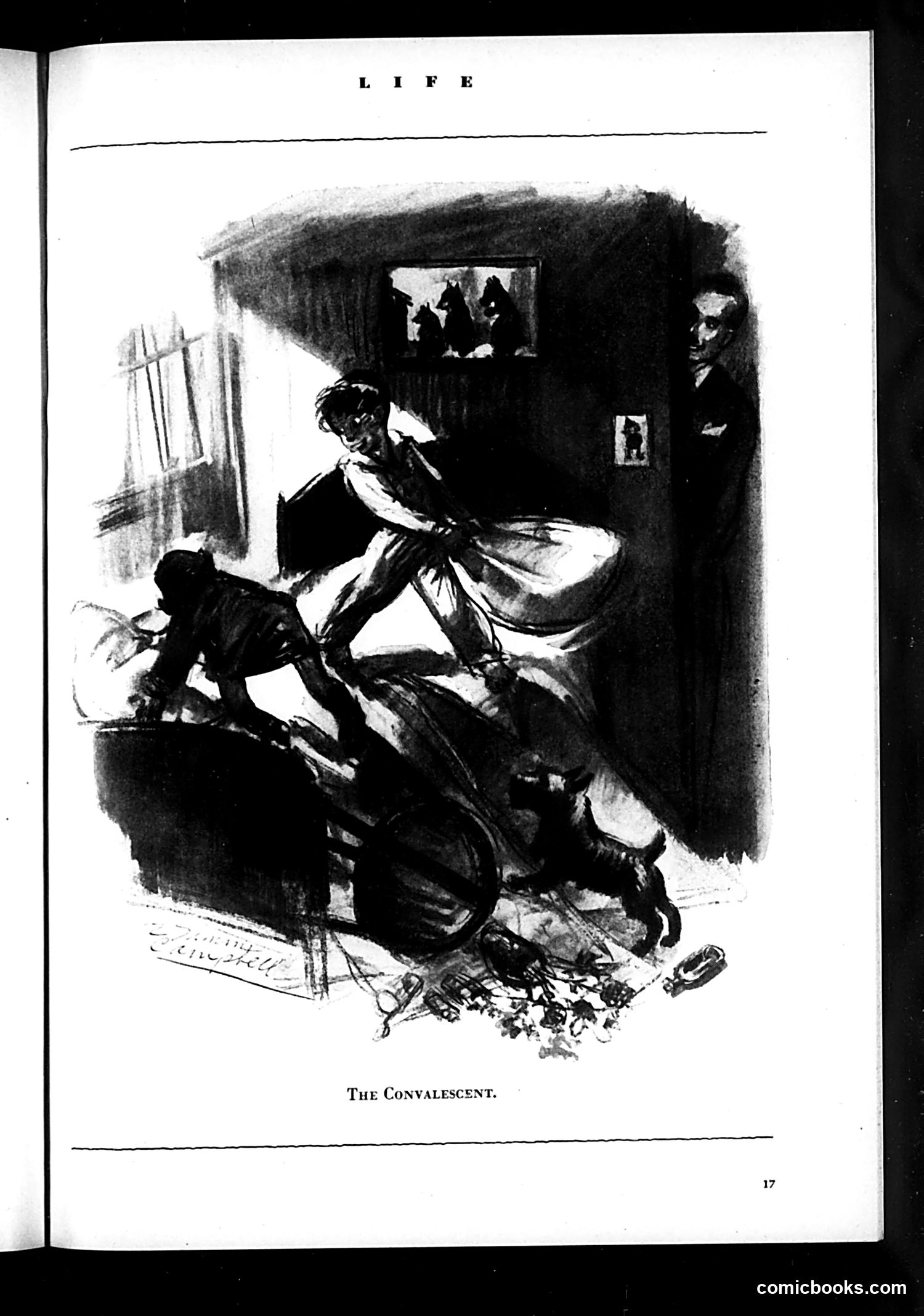
"The Convalescent" This satirical cartoon depicts a bedridden figure in an invalid's state, attended by what appears to be medical or political figures standing nearby. The composition suggests someone recovering from illness or, metaphorically, a political entity in decline requiring care. Without clearer identification of the specific figures or visible date, the precise political reference remains uncertain. However, the title "The Convalescent" suggests commentary on a weakened political leader, institution, or nation in recovery. The formal observers in the background may represent politicians, physicians, or concerned parties monitoring the situation. The artwork style and *Life* magazine context indicate this likely satirizes early 20th-century American politics, though the specific subject requires additional historical documentation to confirm with certainty.
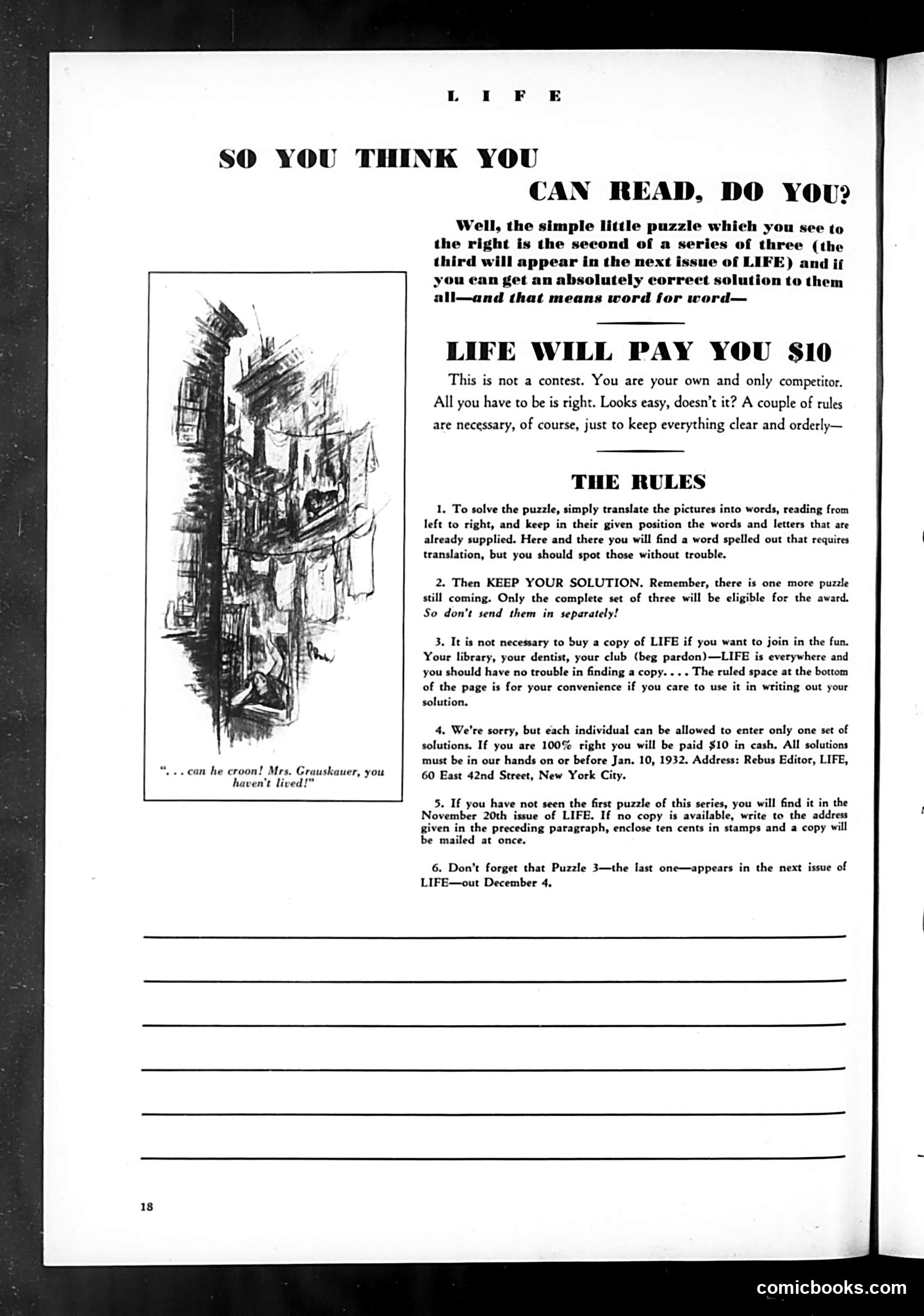
Analysis This page presents a puzzle contest, not political satire. The illustration shows a sketchy urban street scene with tall buildings and figures, captioned: "...can be crown! Mrs. Gruenbauer, you haven't lived!" Readers must translate the picture into words, following given letter positions, to solve a rebus-style puzzle. LIFE magazine offered $10 to solvers who correctly completed all three puzzles in the series (the first appeared in November, the third would follow in December 1931). The rules emphasize this is self-competition (not a contest against others), requiring complete accuracy across all three installments for prize eligibility. The page functions as an intellectual entertainment feature typical of 1930s magazines, using visual-to-verbal translation as the challenge mechanism.
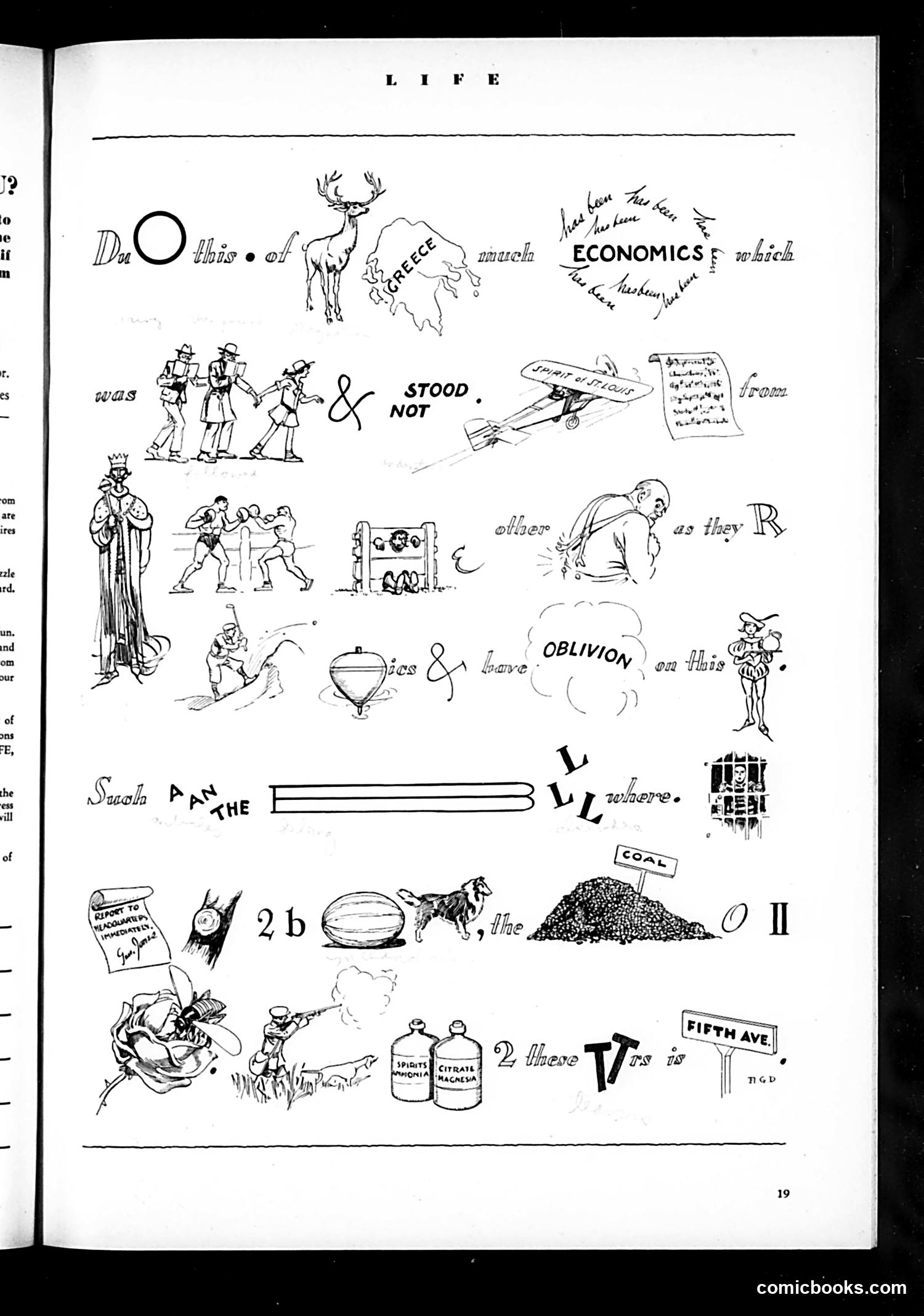
"Do's and Don'ts of Economics" This page presents a visual rebus or puzzle mocking economic principles and perhaps political hypocrisy during what appears to be an economic crisis period (likely Depression-era, given Life magazine's satirical focus). The cartoons use visual puns: a deer labeled "FLORENCE" (unclear reference), soldiers marked "STOOD NOT," an airplane, and various figures. Key phrases include "ECONOMICS," "OBLIVION," and a large letter "L" repeated ("all where"). The bottom section contains cryptic sequences with coal imagery, vegetables, and a street sign for "Fifth Ave." The overall point appears to satirize confused or contradictory economic policies—the visual chaos and wordplay suggesting that economic "rules" are nonsensical or hypocritical. Without clearer identification of specific political figures or events referenced, the exact targets remain ambiguous to modern readers.
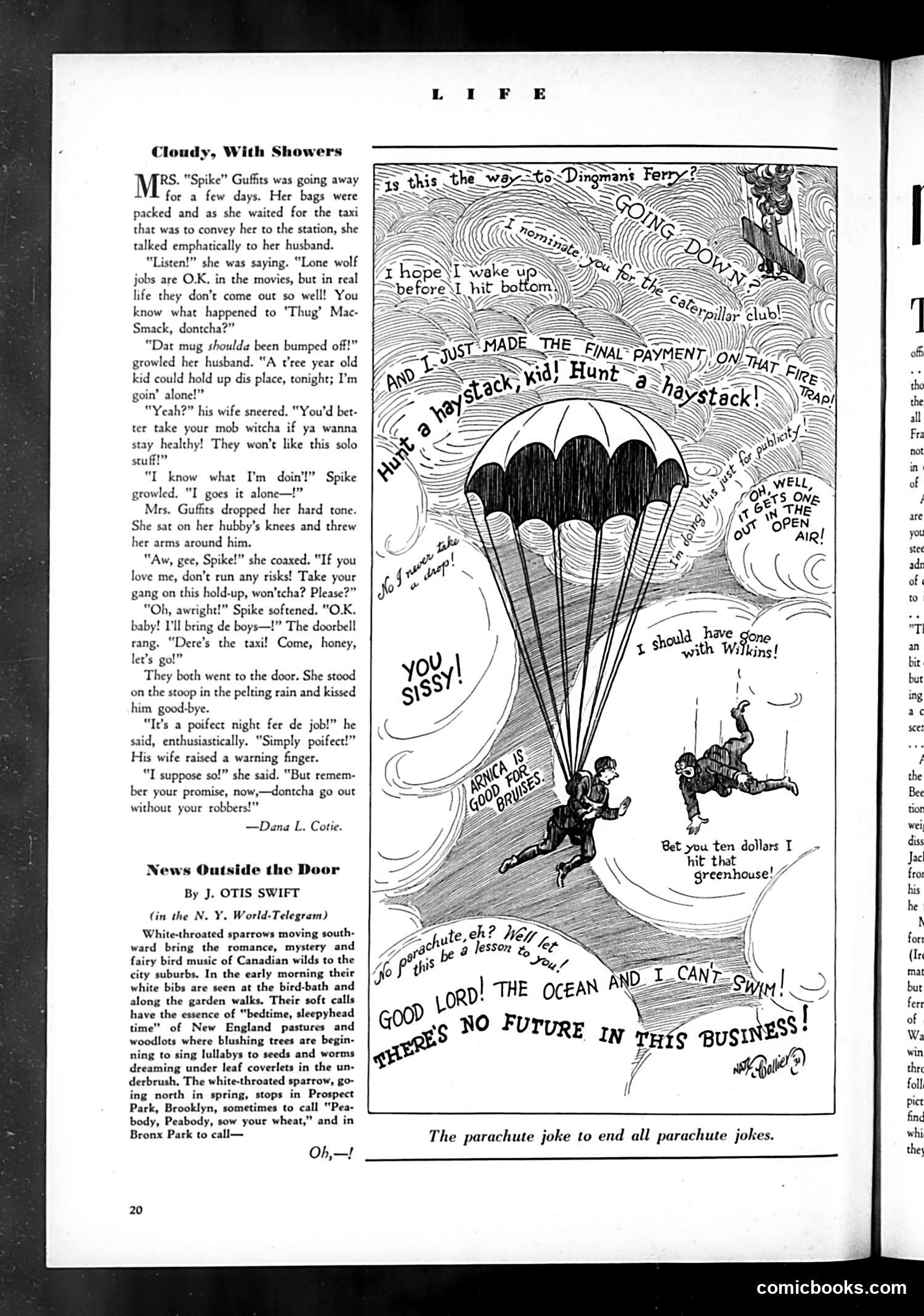
Analysis: "The Parachute Joke to End All Parachute Jokes" This page contains two unrelated pieces. The left column presents "Cloudy, With Showers," a short humorous story about Mrs. "Spike" Guffits, a gangster's wife, convincing her husband to take his criminal gang along on a robbery rather than work solo—for safety. It's domestic comedy playing on 1920s-30s gangster stereotypes and working-class dialect. The dominant image is a single-panel cartoon captioned "The parachute joke to end all parachute jokes." It depicts a person in free-fall without a parachute, uttering increasingly desperate pleas ("I hope I wake up before I hit bottom," "There's no future in this business!"). The joke subverts the traditional parachute-failure punchline by having the falling figure simply acknowledge the absurdity of their situation—making dark humor from certain death rather than offering a twist ending. The accompanying "News Outside the Door" column describes migrating white-throated sparrows—unrelated nature writing.
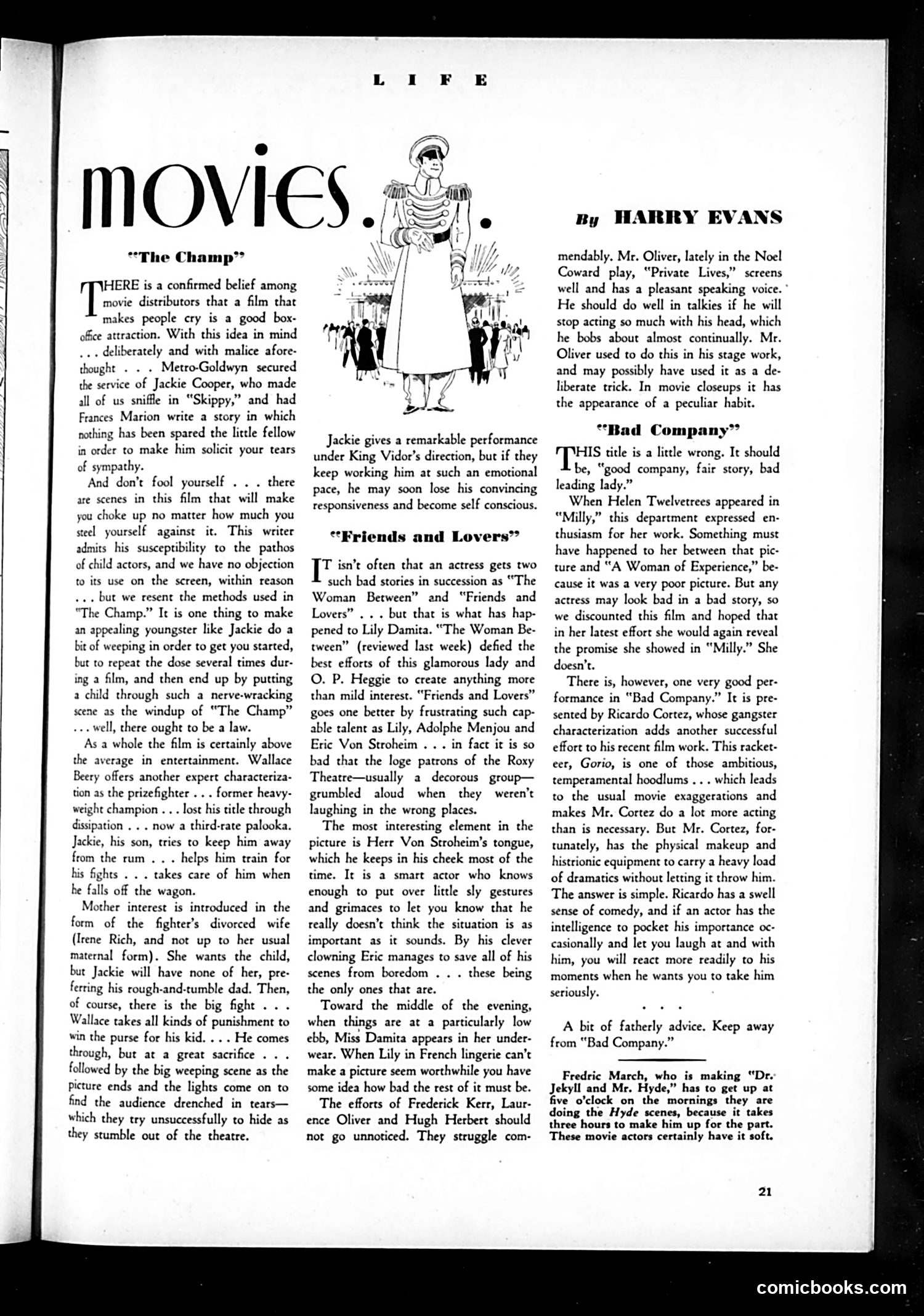
Life Magazine Movie Review (circa 1931) This page contains three film reviews by Harry Evans. The main illustration shows a boxer (Wallace Beery from "The Champ") towering over a crowd, reflecting the article's critique of the film's manipulative emotionalism. "The Champ": Evans praises the entertainment value and performances by Beery and child actor Jackie Cooper, but criticizes Metro-Goldwyn's deliberate strategy of repeatedly exploiting Cooper's tears to manipulate audience sympathy. He argues this crosses an ethical line—using child actors for pathos is acceptable "within reason," but "The Champ" overdoes it to the point where "there ought to be a law." "Friends and Lovers": Evans dismisses this film as so poorly written that even capable actors like Lily Damita, Adolphe Menjou, and Erich von Stroheim cannot salvage it. He notes that von Stroheim alone succeeds through subtle comedic gestures, and jokes that when "Lily in French lingerie" can't save a picture, it's hopeless. The reviews reflect 1930s concerns about exploitative filmmaking practices and the limits of star power.
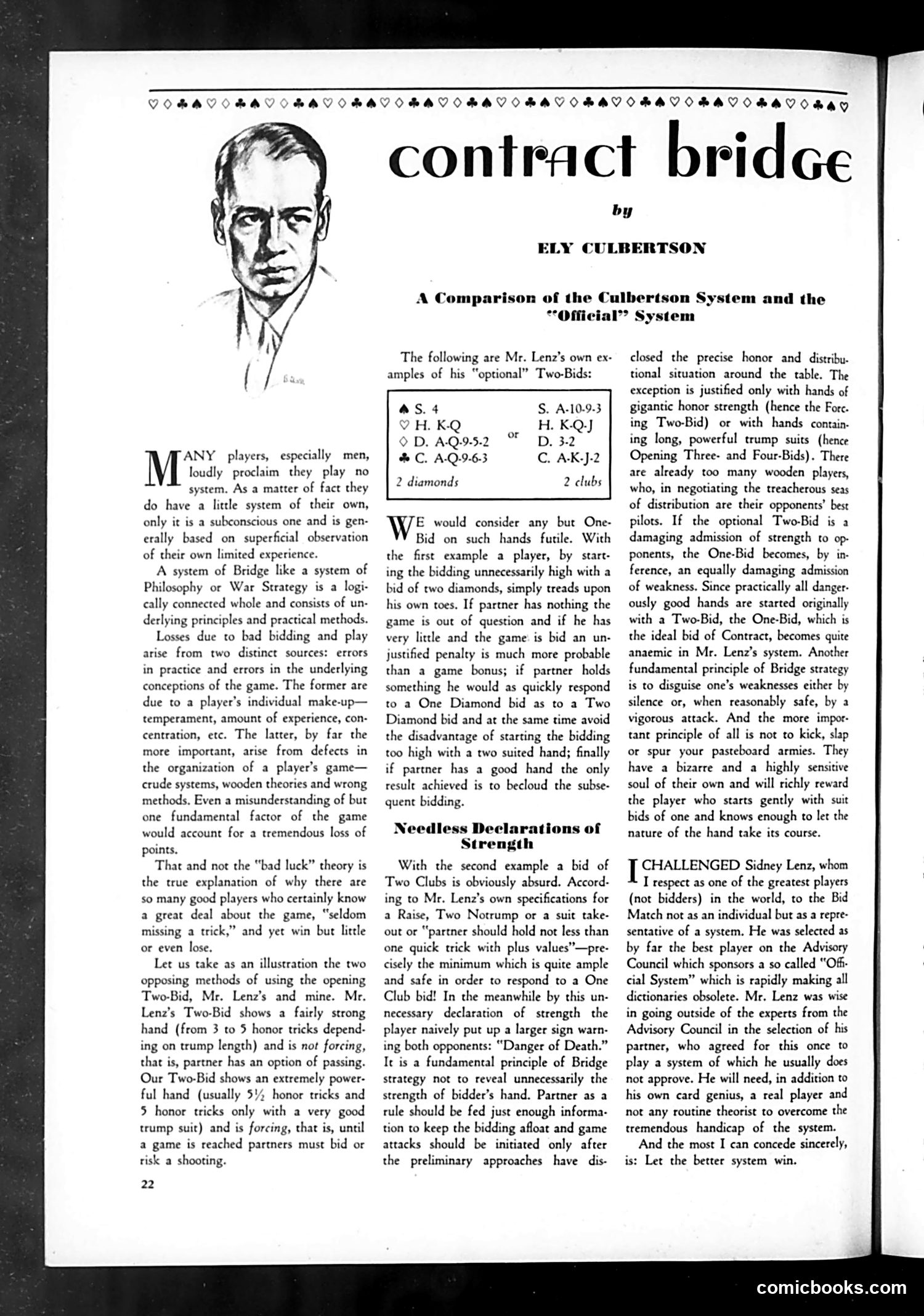
Analysis for Modern Readers This is a bridge strategy article, not a political cartoon. It's by Ely Culbertson, a prominent contract bridge expert, comparing his bidding system to a rival's (Sidney Lenz's). The content is a technical critique: Culbertson argues Lenz's "Two-Bid" opening strategy is flawed because it reveals hand strength unnecessarily to opponents without strategic advantage. Culbertson advocates for concealing information longer in the bidding process. The portrait shows Culbertson himself. This represents an important early-20th-century moment when bridge was treated with intellectual seriousness—compared to philosophy and war strategy. The article debates foundational principles rather than luck, reflecting broader 1920s-30s cultural enthusiasm for systematized games and scientific approaches to leisure activities. There is no satire here; it's a straightforward (if competitive) strategic analysis in Life magazine's non-fiction section.
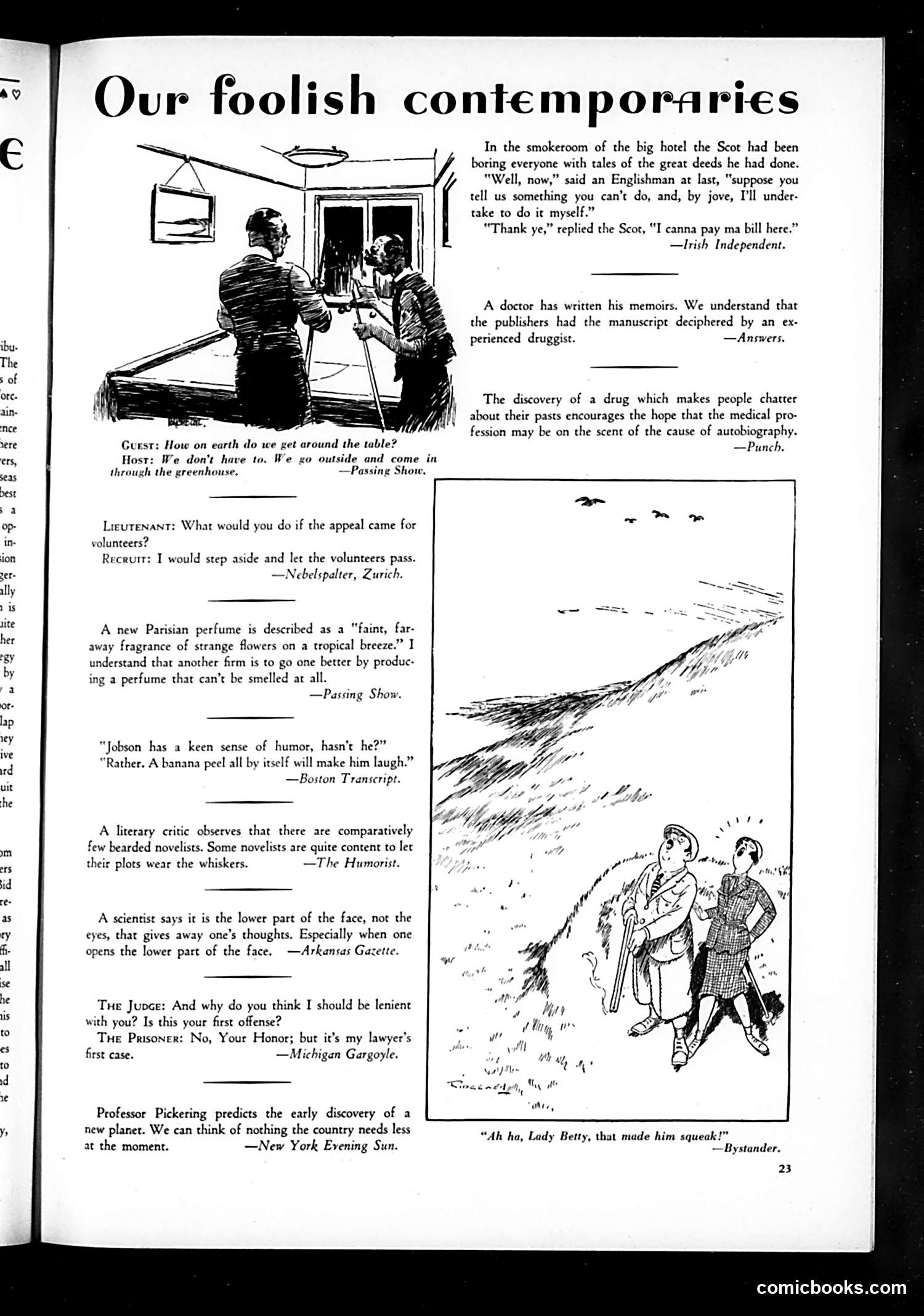
"Our Foolish Contemporaries" This page collects brief humorous anecdotes and jokes from various international publications, arranged as satirical commentary on contemporary society. The main cartoon shows a man and woman on a hillside; the caption "Ah ha, Lady Betty, that made him squeak!" suggests physical comedy—likely the woman has startled or pinched the man. The text snippets mock various social types: a boastful Scotsman who can't pay his bill, doctors writing self-aggrandizing memoirs, people oversharing their pasts, cowardly military recruits, and dim-witted humor enthusiasts. The reference to "Professor Pickering predicting a new planet" appears to satirize scientific speculation as frivolous when practical concerns matter more. The overall tone is gentle ridicule of human folly—pretension, cowardice, vanity, and poor judgment—typical of *Life* magazine's satirical approach to contemporary manners and morals.
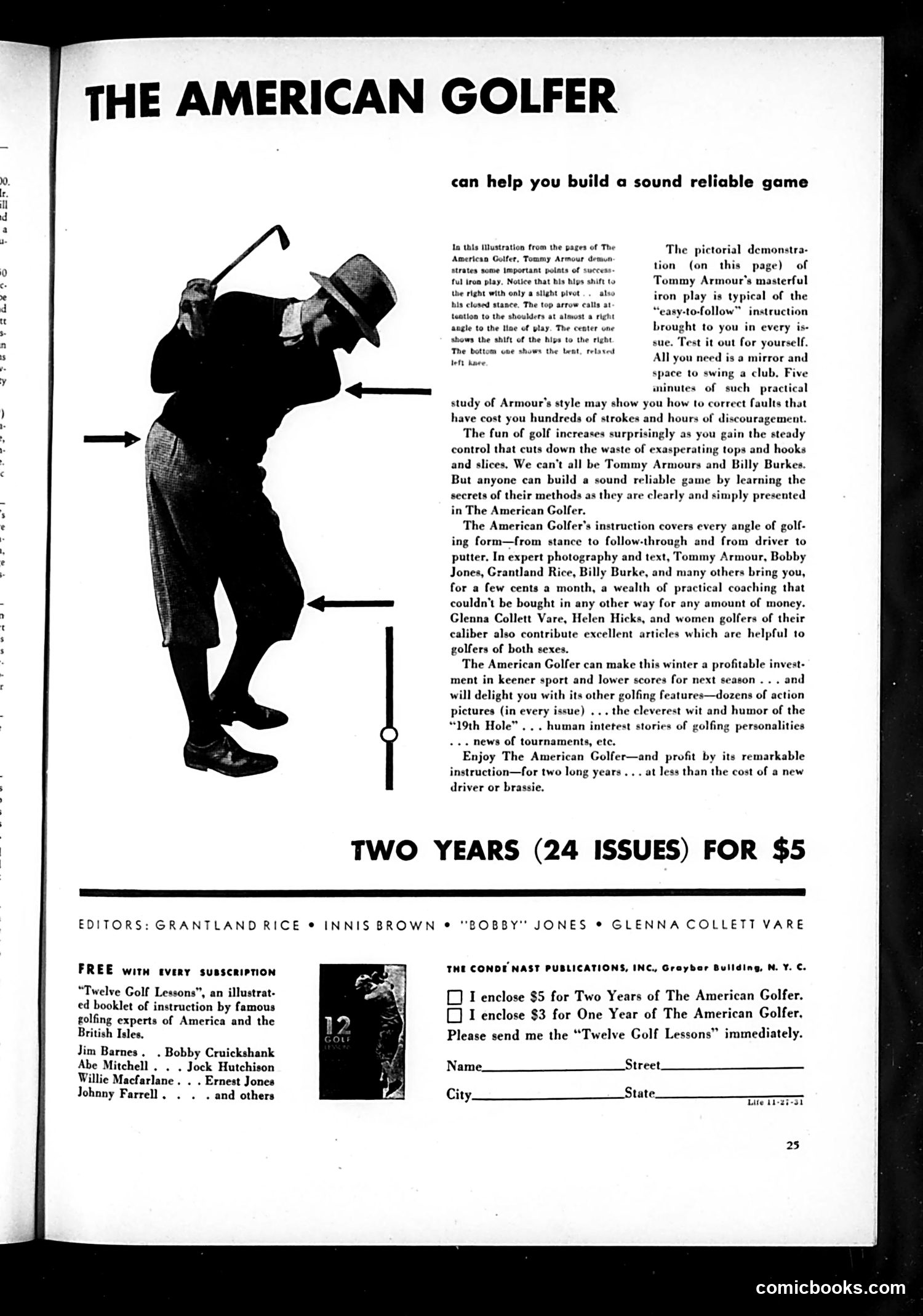
The American Golfer Advertisement This is a subscription advertisement for *The American Golfer* magazine, not political satire. It features golfer Tommy Armour demonstrating proper iron-play technique, with arrows indicating hip shift, shoulder rotation, and knee position. The copy promotes the magazine as affordable instruction from famous golfers including Bobby Jones, Grantland Rice (a legendary sportswriter), and Billy Burke. The pitch emphasizes that readers need not be champions to improve—anyone can learn "sound reliable game" through the magazine's clear instruction and photography. A free booklet of "Twelve Golf Lessons" is offered with subscription. The ad targets amateur golfers seeking winter self-improvement at modest cost ($5 for two years). This reflects early-20th-century American enthusiasm for golf as an accessible, instructional leisure activity.
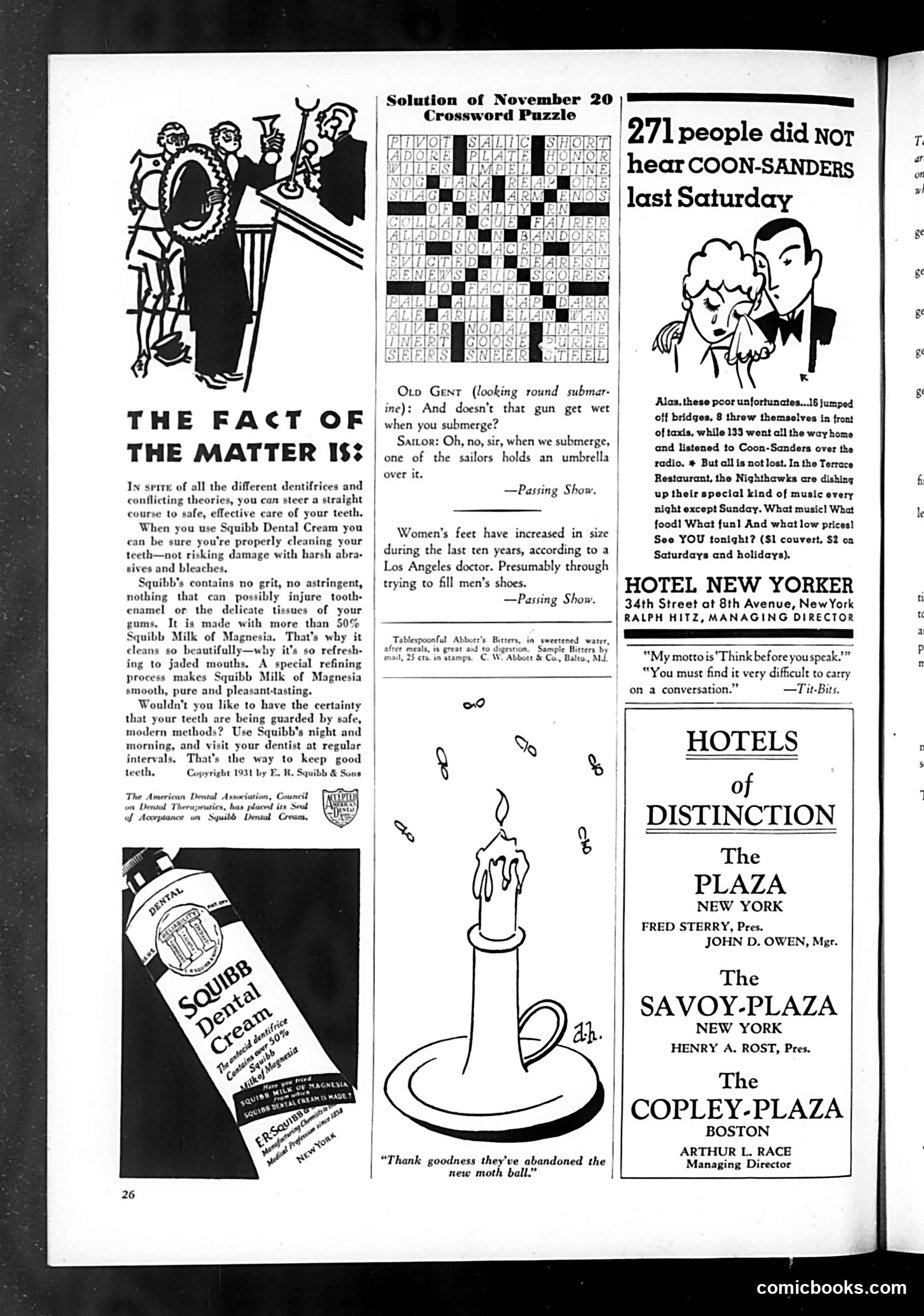
Analysis of Life Magazine Page (Circa 1931) This page is primarily advertising and light humor rather than political satire. Key elements: The Main Cartoon (moth ball): A visual gag showing a candle with a moth nearby. The caption "Thank goodness they've abandoned the new moth ball" is a pun—playing on "moth ball" (the insecticide) versus an actual ball/dance event. It's mild wordplay humor typical of 1930s publications. The Submarine Joke: A brief comic about sailors protecting a gun from water during submersion—simple observational humor about naval procedures. The "Coon-Sanders" Advertisement: References a radio jazz band popular in the 1930s. The joke lists absurd reasons 271 people *didn't* hear them broadcast, promoting both the band and the Terrace Restaurant's competing live music. Bulk Content: The page is dominated by advertisements—dental cream (Squibb), hotels (Plaza, Savoy-Plaza, Copley-Plaza), and digestive bitters. These are straightforward commercial pitches typical of Life's revenue model, not satirical commentary. The page reflects 1930s consumer culture and entertainment rather than political messaging.
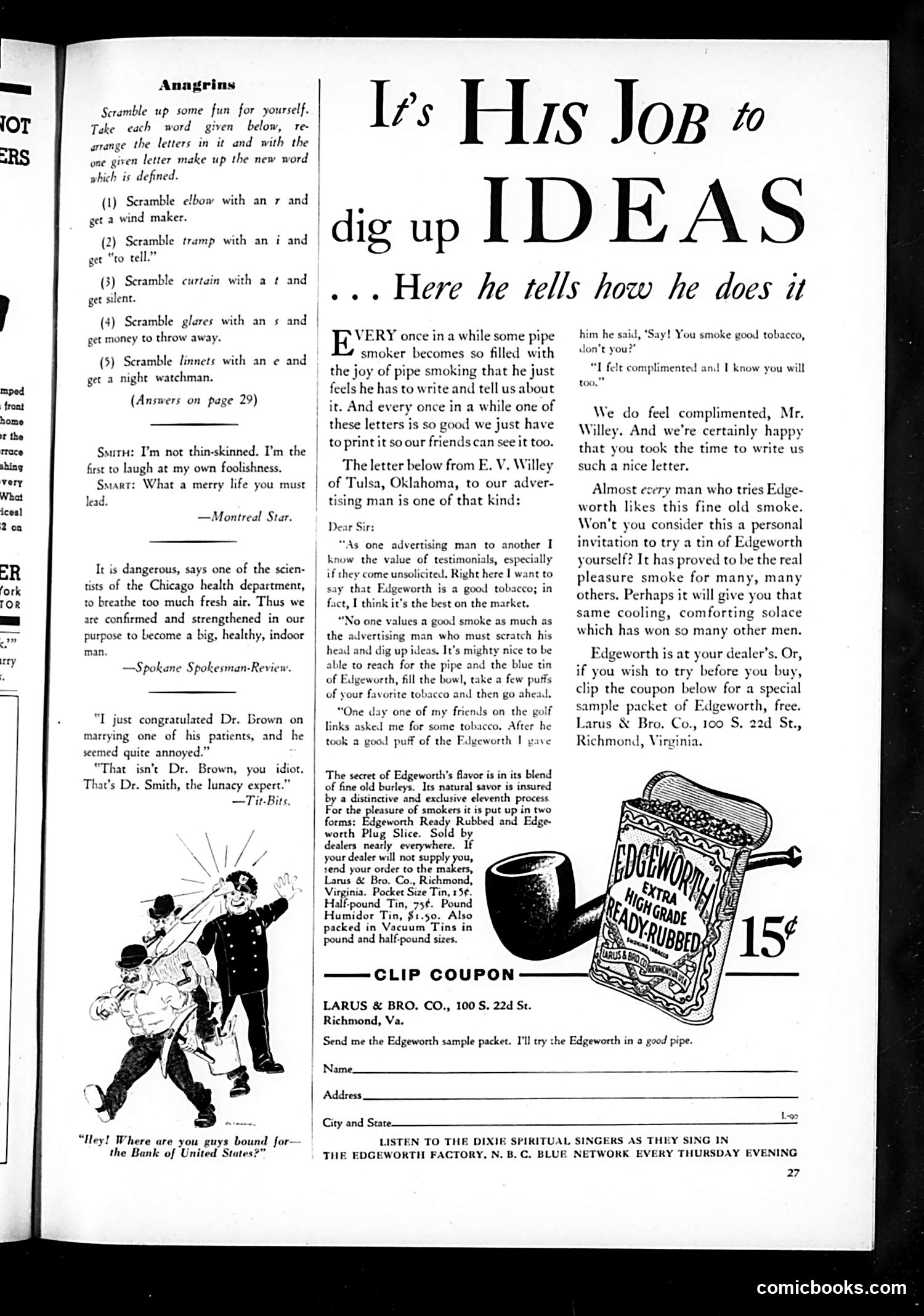
Analysis This page is primarily an Edgeworth tobacco advertisement disguised as editorial content. The "letter" from E. V. Willey of Tulsa is a testimonial ad presented as genuine reader mail—a marketing technique common in early 20th-century magazines. The cartoon at bottom left depicts a chauffeur or uniformed driver excitedly directing passengers, with the caption joking about heading to "the Bank of United States"—likely a reference to financial instability or banking concerns of the era. The upper section contains word-puzzle anagrams ("Anagrins") and brief jokes from various publications, typical filler content. The tobacco ad's pitch emphasizes how Edgeworth satisfies the stressed advertising man who needs mental clarity—a targeted appeal to professional workers. The "exclusive eleventh process" claim and multiple product formats (plug, rubbed, tins) reflect competitive tobacco marketing of this period. The coupon offering a free sample was standard direct-response advertising technique. Modern context: This represents pre-regulation tobacco advertising when health concerns were absent and testimonials (potentially fabricated) were standard practice.
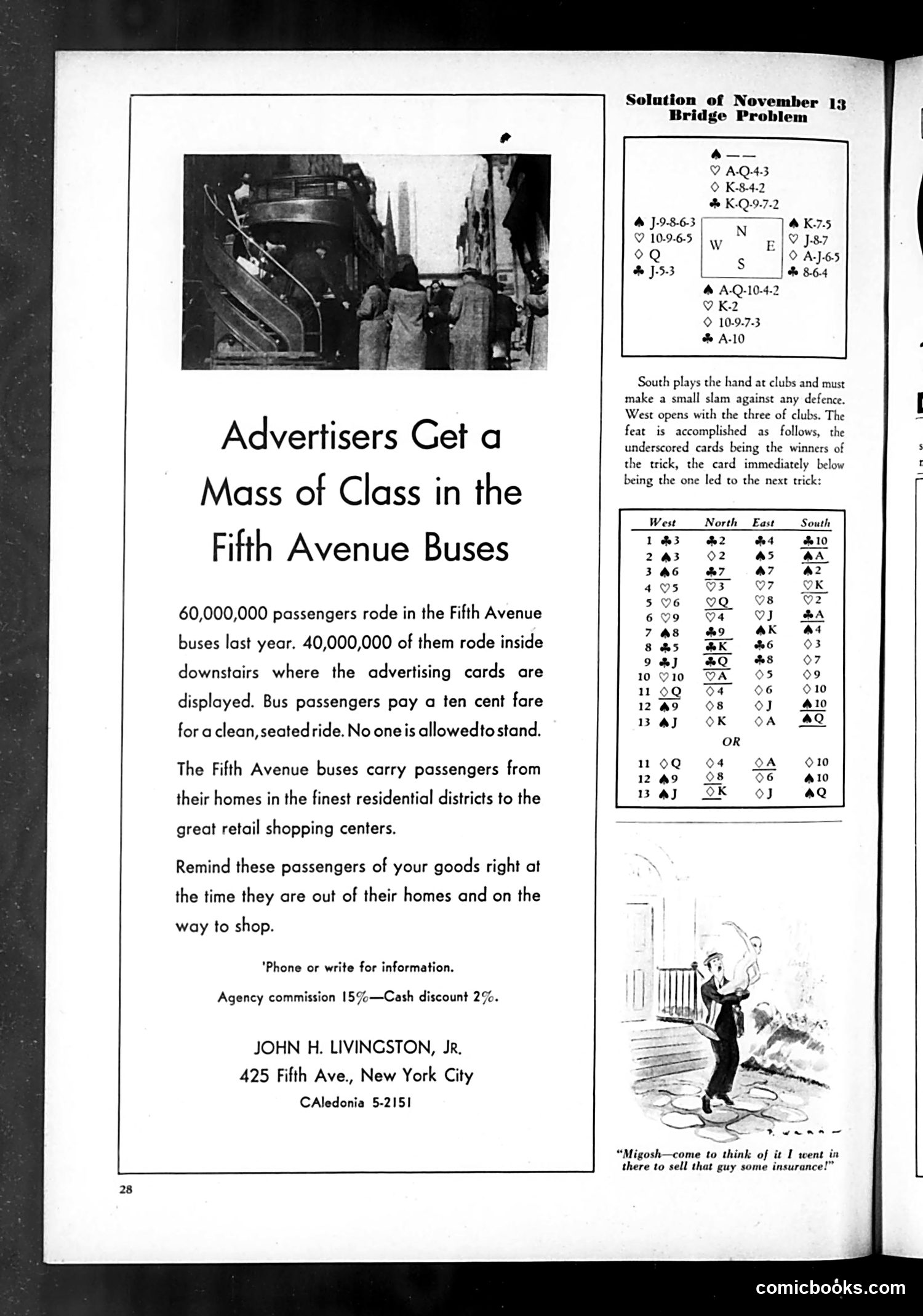
Analysis of Page 28 This page contains two distinct elements: Left side: An advertisement by John H. Livingston, Jr. promoting advertising space on Fifth Avenue buses. The pitch targets advertisers, highlighting that 40 million passengers annually see ads in the downstairs seating areas—mostly affluent shoppers traveling between residential districts and retail centers. It's a straightforward commercial pitch offering captive-audience advertising to wealthy consumers at optimal moments (while shopping). Right side: A bridge card game solution and an unrelated cartoon. The cartoon depicts a man on a fire escape, apparently having sold insurance to someone in a building. The joke appears to be about an insurance salesman unexpectedly finding a sales opportunity in an unusual location—the humor lying in the incongruity of conducting business from a fire escape. The page juxtaposes practical advertising strategy with humorous sidebar content typical of Life magazine's mixed editorial format.
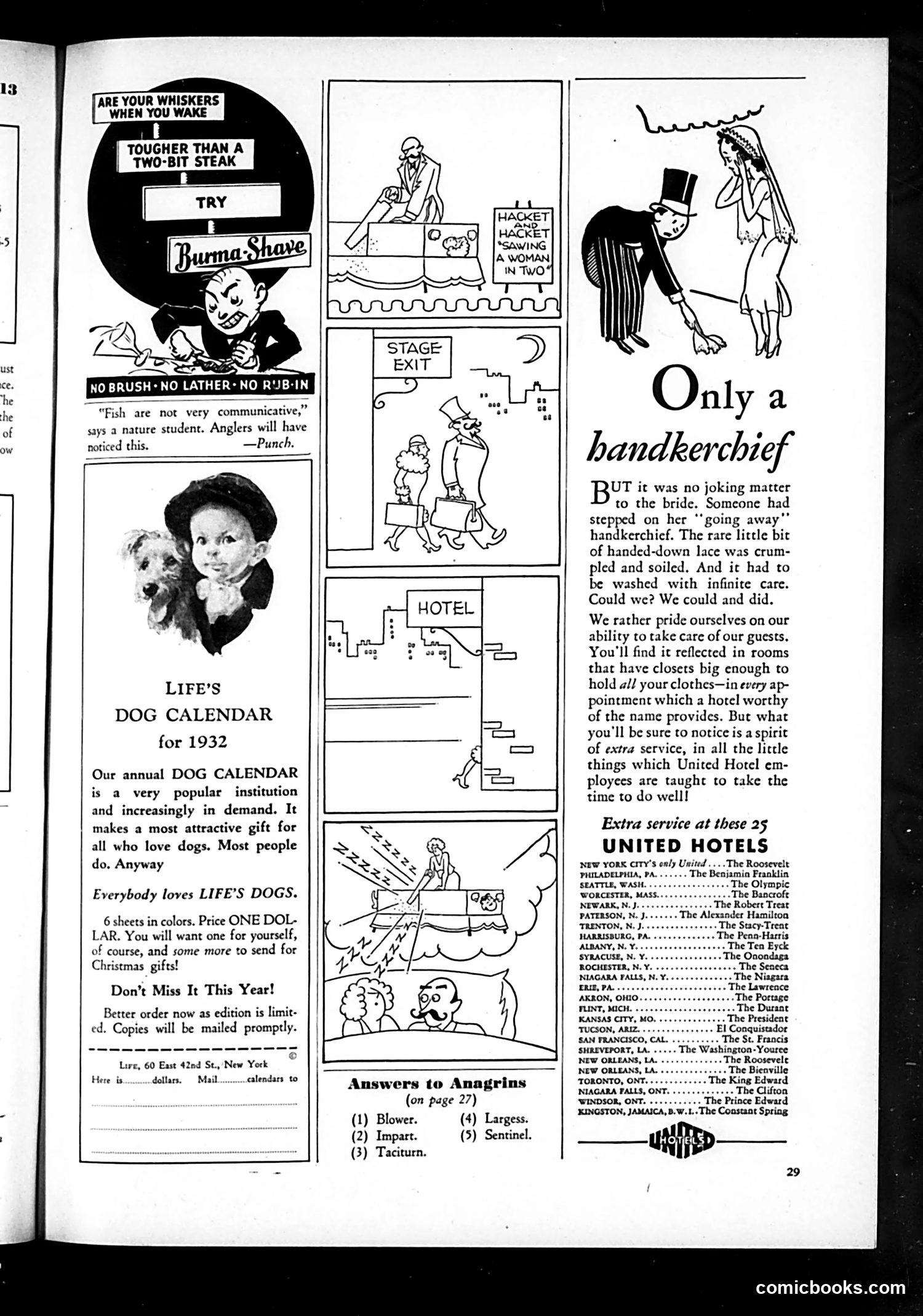
Page 29 Analysis: Life Magazine (1932) This page mixes advertisements with light humor. The Burma Shave ad (top left) uses comedic copywriting to market shaving cream, claiming whiskers are "tougher than a two-bit steak"—typical early 1930s advertising hyperbole. The "Only a handkerchief" story (right side) presents a brief domestic anecdote about a bride whose delicate heirloom handkerchief gets soiled, leading into a United Hotels advertisement emphasizing superior guest services and attention to detail—the hotel promises to carefully launder such precious items. The "Life's Dog Calendar for 1932" (left) promotes an annual product featuring dog photographs, positioned as a popular gift item. The accompanying fish/angler joke ("Fish are not very communicative") is mild observational humor typical of the era. The page is primarily commercial content—three separate advertisements disguised as editorial or promotional material, reflecting 1930s magazine publishing practices where advertising and content blended seamlessly.
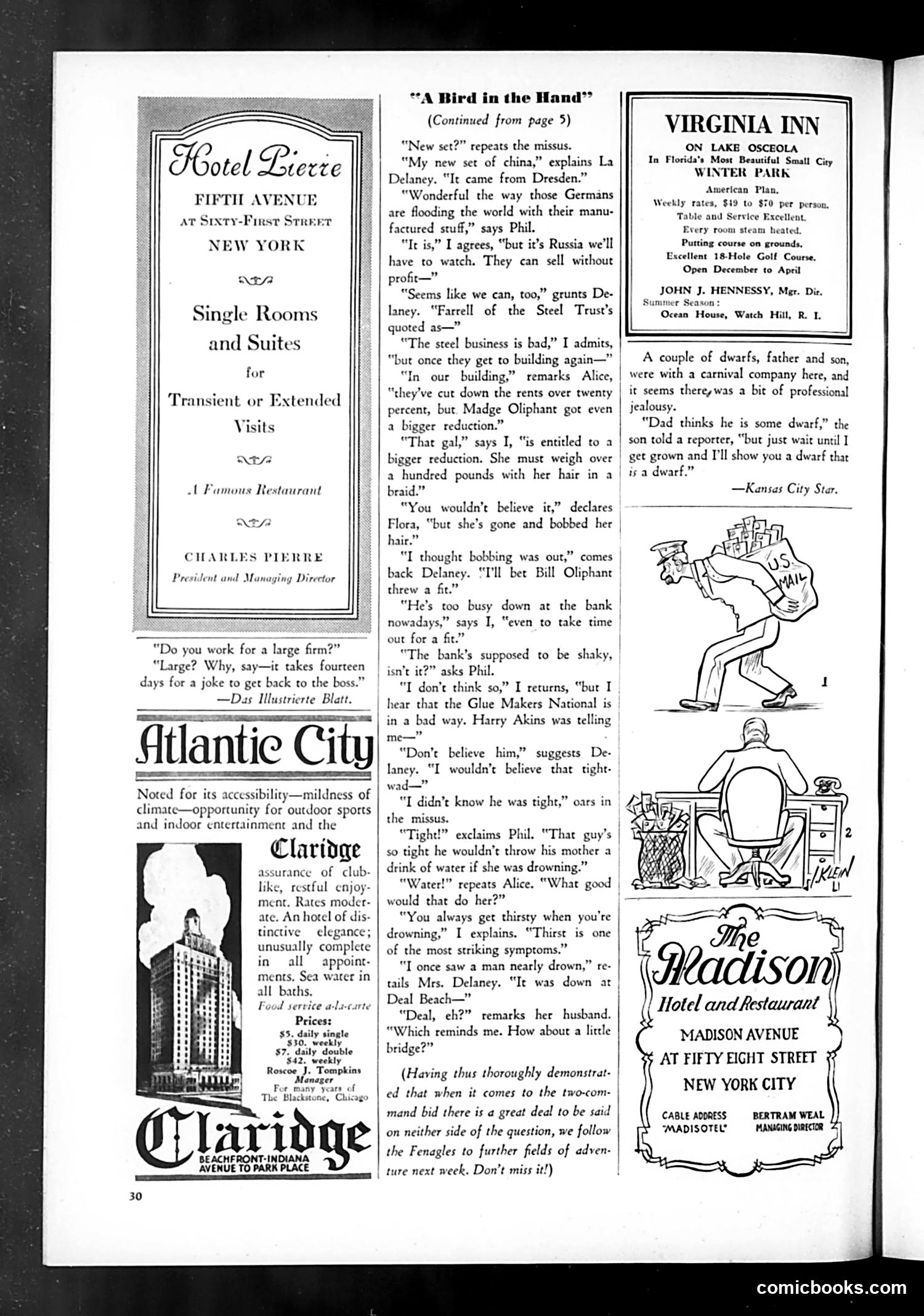
This page is primarily advertising for hotels and restaurants, with minimal editorial content beyond two brief joke items. The two cartoons/jokes shown are: 1. "A Bird in the Hand" (continued story): A domestic conversation where characters gossip about acquaintances—discussing German manufactured goods, Russian competition, banking troubles, the Glue Makers National bank's financial problems, and someone named Bill Oliphant. The dialogue culminates in someone nearly drowning at Deal Beach. The humor appears to rest on mundane social chitchat and tangential non-sequiturs rather than political satire. 2. Kansas City Star anecdote: Two carnival dwarfs—father and son—compete professionally. The son boasts to a reporter he'll surpass his father's abilities once grown, playing on the absurdist irony that he's already a dwarf. Both items reflect period concerns (banking stability, business conditions) and period attitudes toward physical difference treated as entertainment fodder. The page functions primarily as a commercial vehicle for luxury travel and hospitality advertising.
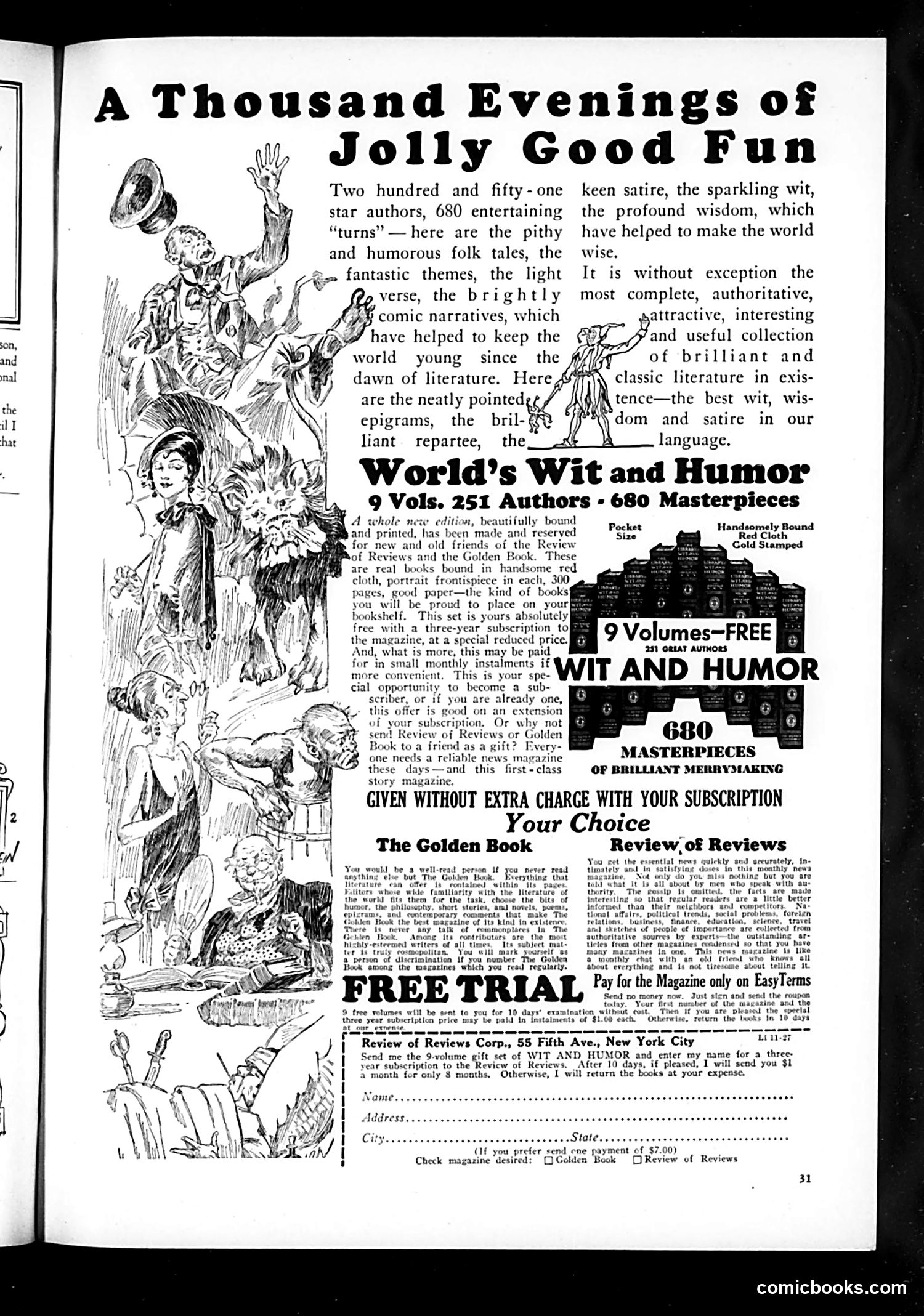
Analysis This page is primarily advertising, not editorial content. It promotes a 9-volume book set called "World's Wit and Humor" containing 251 authors and 680 literary selections—classical wit, epigrams, satire, and humorous tales. The decorative illustration on the left shows caricatured figures in period dress engaged in jovial, comedic activities (drinking, gesturing theatrically)—visual representatives of the "jolly good fun" promised by the product. The pitch emphasizes that this is "the most complete, authoritative" collection of wit and satire "in our language," appealing to readers of *Review of Reviews* magazine. It offers a 10-day free trial, then installment payments ($1/month for 8 months, or $7 upfront). For modern readers: This represents early 20th-century publishing marketing—positioning literature collections as prestigious home furnishings for educated consumers. The emphasis on "classic literature" and "brilliant" content reflects an era when owning such bound sets signaled intellectual status.
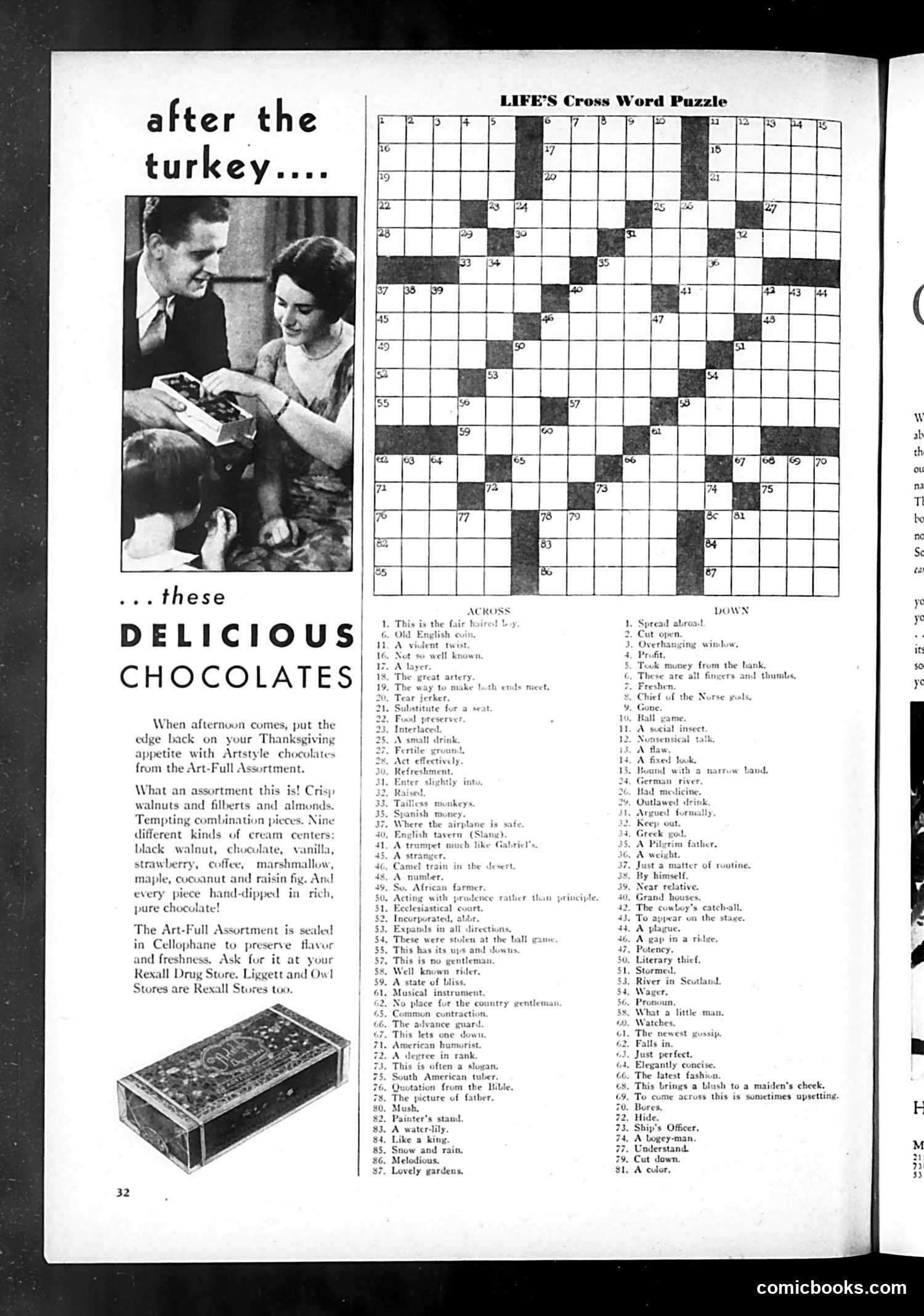
"After the Turkey" - Life Magazine Advertisement This page is primarily a Thanksgiving-themed advertisement for Artstyle chocolates, not political satire. The photograph shows a man and woman exchanging chocolates, with text suggesting that after eating turkey at Thanksgiving dinner, one should revive their appetite with these "delicious chocolates." The ad emphasizes the product's appeal: nine varieties of cream-filled centers (walnut, chocolate, vanilla, strawberry, coffee, marshmallow, maple, coconut, and raisin fig), each hand-dipped in chocolate and sealed in cellophane for freshness. It directs readers to purchase at Rexall Drug Stores. The page also features a crossword puzzle, which was standard magazine content of the era. This is commercial advertising content, not editorial commentary or satire.
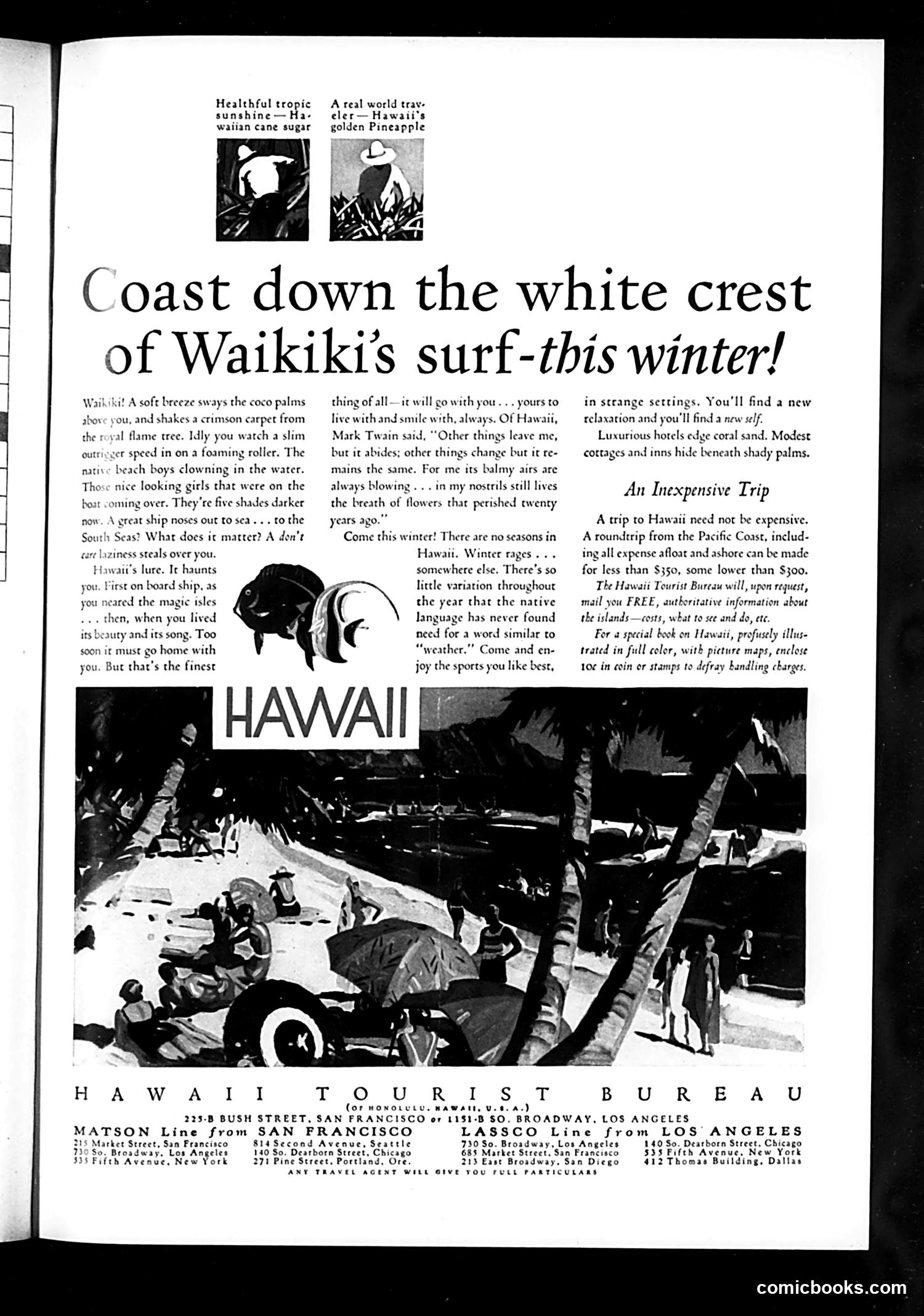
Hawaii Tourist Bureau Advertisement (Life Magazine) This is primarily a travel advertisement, not political satire. It promotes Hawaiian tourism during winter months, emphasizing escapism and tropical leisure. The page features two small product images at top (Hawaiian cane sugar and pineapple) and a large beach scene photograph showing tourists relaxing under palm trees at Waikiki. The copy uses romantic, idealized language about Hawaii's eternal spring-like climate and romantic appeal—referencing Mark Twain to lend cultural prestige. It addresses middle-class anxieties by emphasizing affordability ($300-350 round-trip from the Pacific Coast). The "cartoon" element is minimal—mainly decorative line illustrations of surfers and beach scenes. There's no political commentary or satirical intent visible. This reflects how Life magazine functioned partly as an advertising vehicle for leisure travel during the pre-WWII era, when Hawaii tourism was being actively promoted to American mainlanders as an accessible luxury destination.
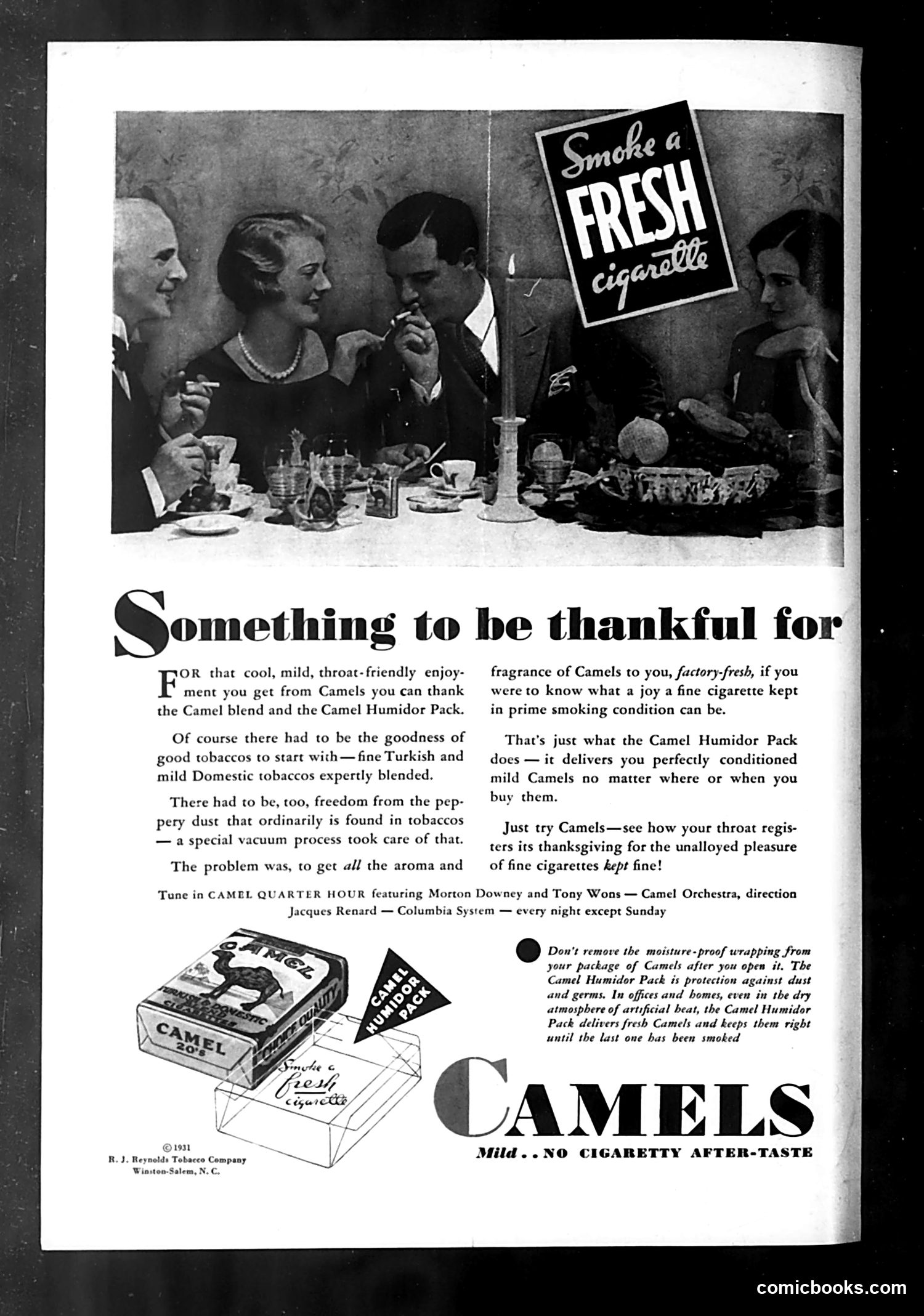
Analysis This is a cigarette advertisement, not political satire or editorial cartooning. The page promotes Camel cigarettes to a mid-20th century audience. The image shows well-dressed men and women at a formal dinner, smoking and socializing—meant to associate Camels with sophistication and social status. The headline "Something to be thankful for" frames smoking as a lifestyle benefit worthy of gratitude. The ad emphasizes the "Camel Humidor Pack," a moisture-proof wrapper claimed to keep cigarettes fresh. It highlights the blend of Turkish and domestic tobaccos, a "vacuum process" removing dust, and promises "no cigaretty after-taste"—addressing common smoking complaints. Modern readers should note: this reflects an era when cigarette advertising was unrestricted and ubiquitous in mainstream media, before health risks were widely acknowledged or advertised. The aspirational imagery and pseudoscientific claims about freshness and purity represent normalized marketing tactics now prohibited.

I can see this is a very dark, low-contrast black and white image from what appears to be a historical publication. The page is almost entirely black with only faint details barely visible—some circular spiral patterns or designs appear in the lower right portion, and there's a white border on the left side suggesting this is a scanned page. The OCR text only shows "comicbooks.com," which appears to be a watermark rather than actual page content. Unfortunately, the image quality is too poor for me to identify any specific figures, read any text, or determine what cartoon or content this page contains. I cannot reliably explain the satire or historical references without being able to see the actual content clearly.