life
Life — December 1931
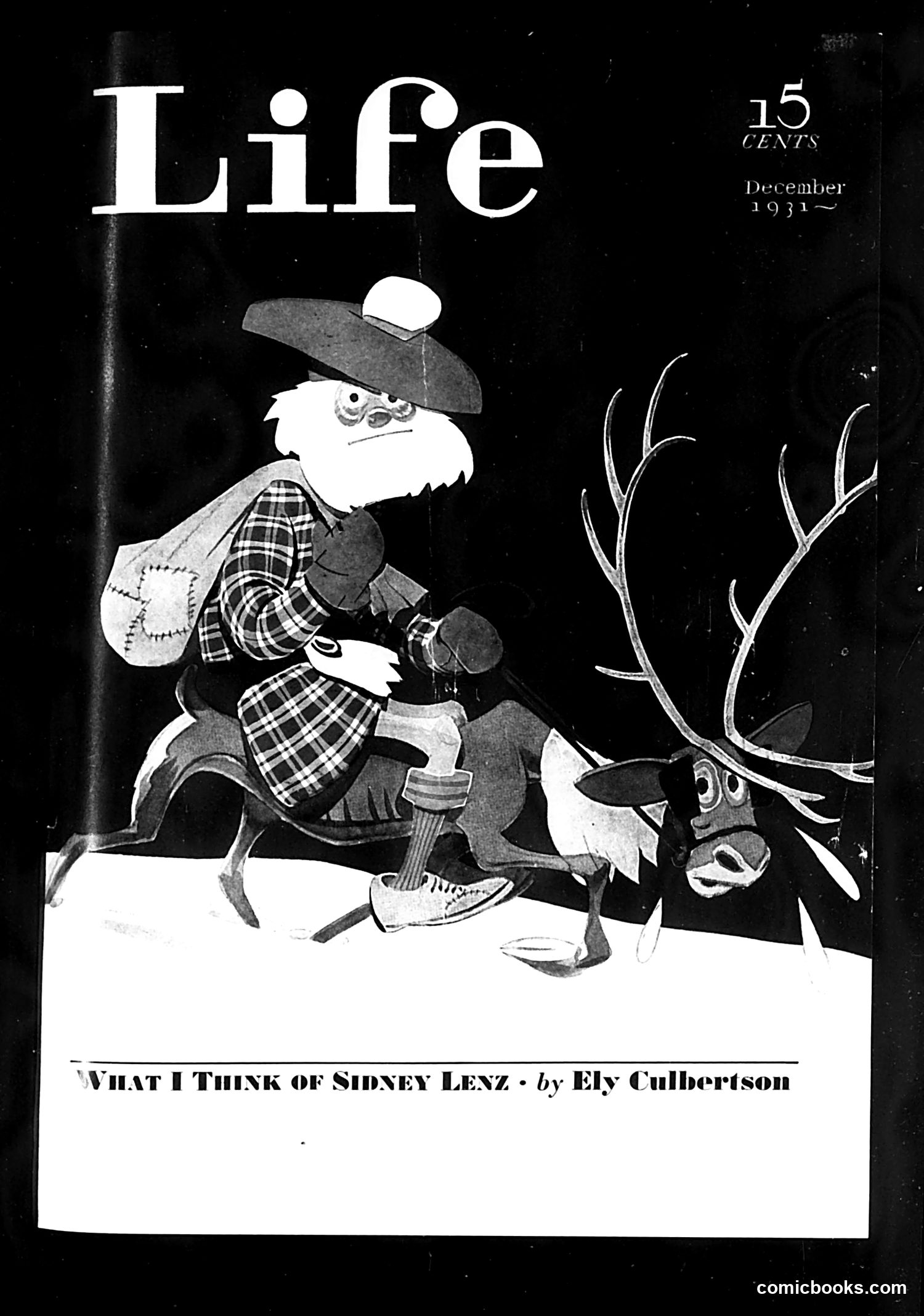
Life Magazine, December 1931 This is a title page for Life magazine's December 1931 issue (15 cents). The cover illustration shows a caricatured eagle character dressed as a cowboy or frontiersman—wearing a plaid shirt, wide-brimmed hat, and carrying a rifle—riding what appears to be a reindeer with prominent antlers. The visible text promises an article titled "What I Think of Sidney Lenz - by Ely Culbertson," suggesting the issue contains commentary on Sidney Lenz, likely a bridge player, by Ely Culbertson, a famous bridge champion of the era. The eagle-as-cowboy imagery suggests American frontier themes, though the specific satirical point requires seeing the full article inside the magazine.
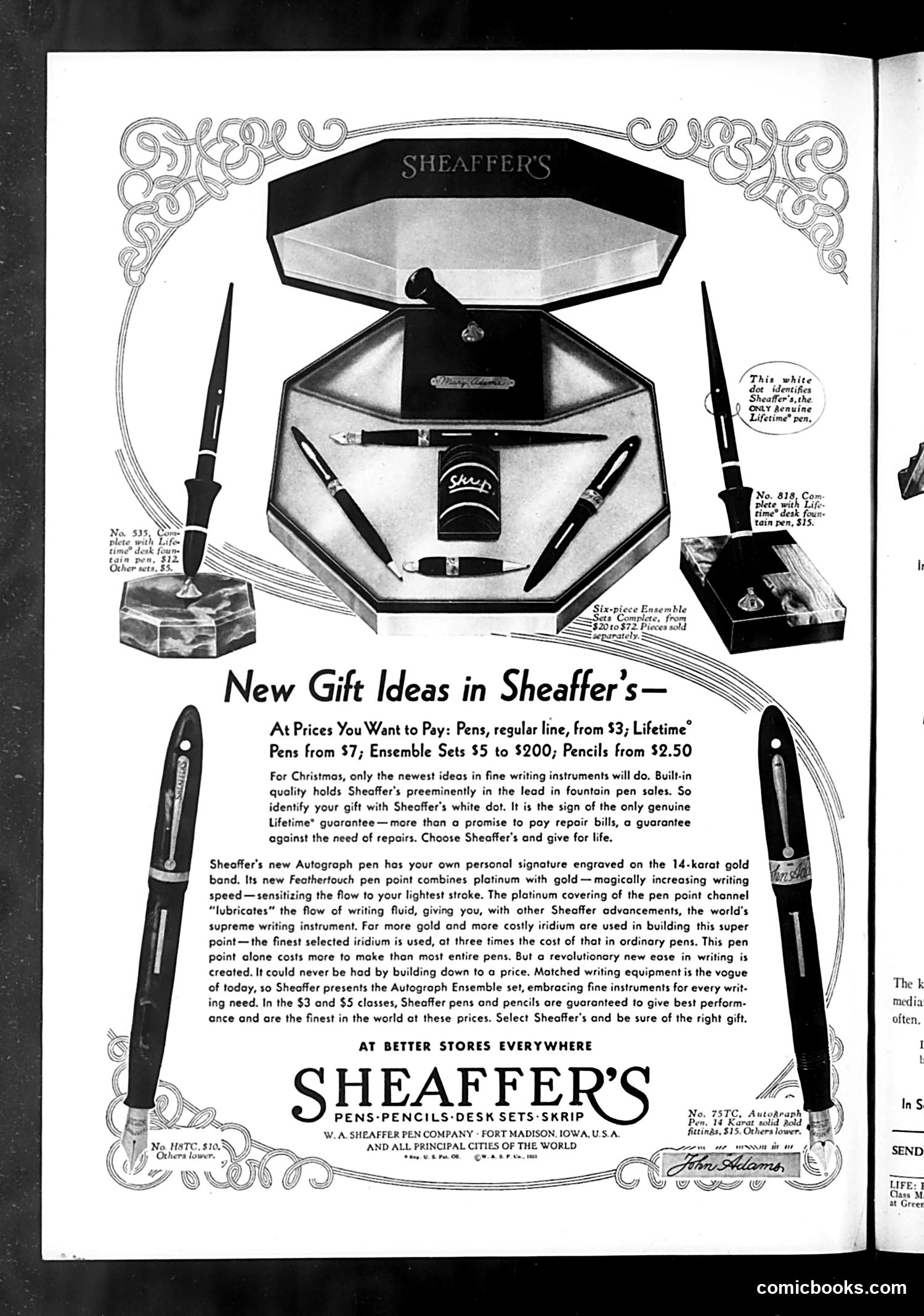
Analysis This is a Sheaffer's fountain pen advertisement, not a political cartoon. The page promotes "New Gift Ideas in Sheaffer's" with product photography showing elegant writing instruments and desk sets arranged in an octagonal display box. The ad emphasizes luxury features: the "Lifetime" guarantee, platinum and gold components, and the prestigious "white dot" identifier of genuine Sheaffer pens. Prices range from $3 to $200, positioning these as gifts for affluent consumers. The ornamental border design is period-appropriate for 1920s-30s advertising aesthetics. There is no political satire or social commentary—this is straightforward luxury goods marketing targeting wealthy gift-buyers during what appears to be a holiday shopping season.
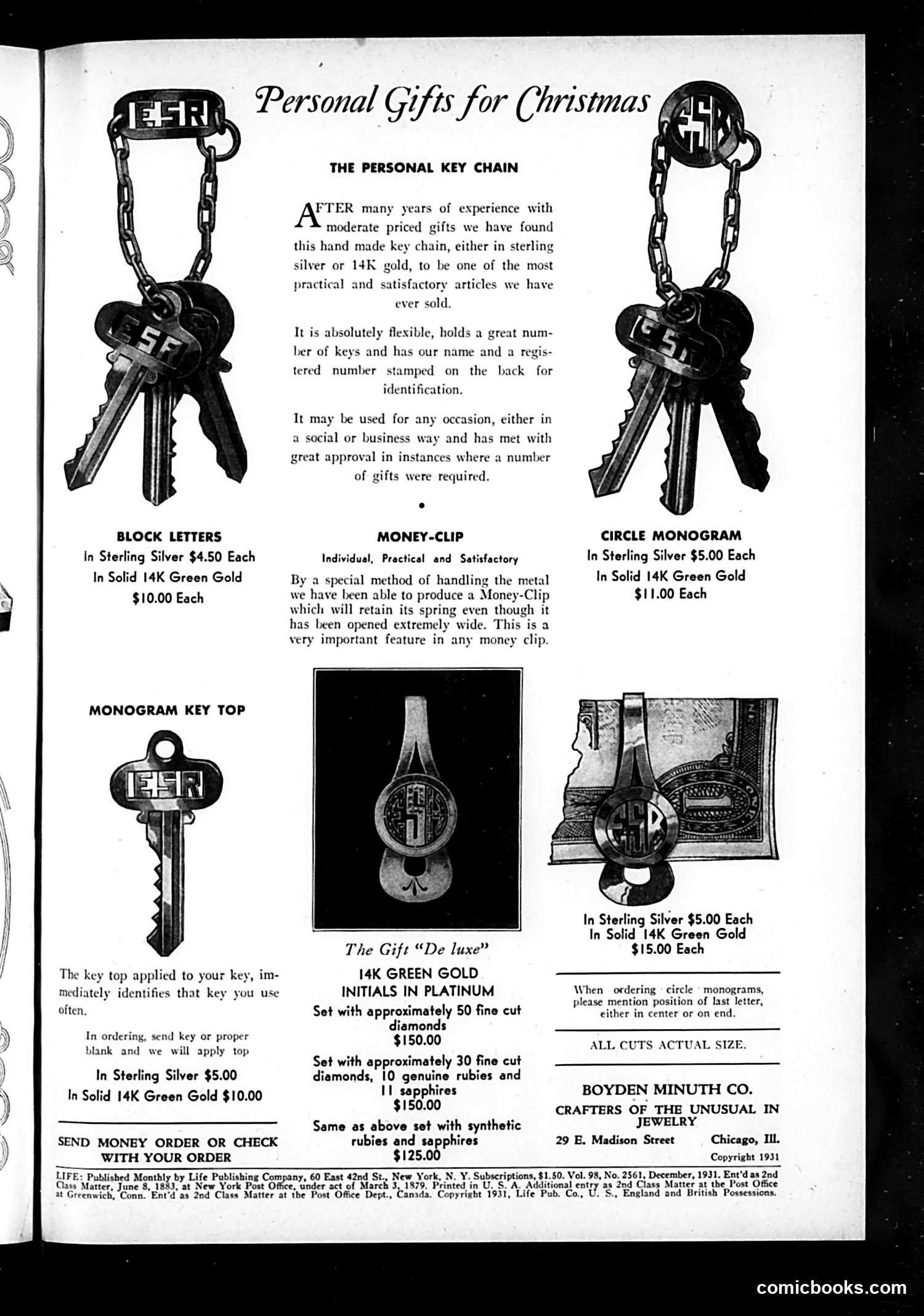
Analysis This is not a cartoon page but rather a Christmas gift advertisement from Life magazine (Copyright 1931). It promotes personal gifts from Boyden Minuth Co., a Chicago jewelry company. The page showcases various personalized items: key chains in sterling silver or 14K gold, money clips, and monogrammed key tops. The centerpiece is "The Gift 'De luxe'"—a 14K green gold item with platinum initials and diamonds, priced at $150. There is no political satire or cartoon content. This is straightforward period advertising emphasizing practical, customizable gifts for both social and business occasions. The design reflects 1931 Art Deco styling typical of the era's luxury goods marketing.
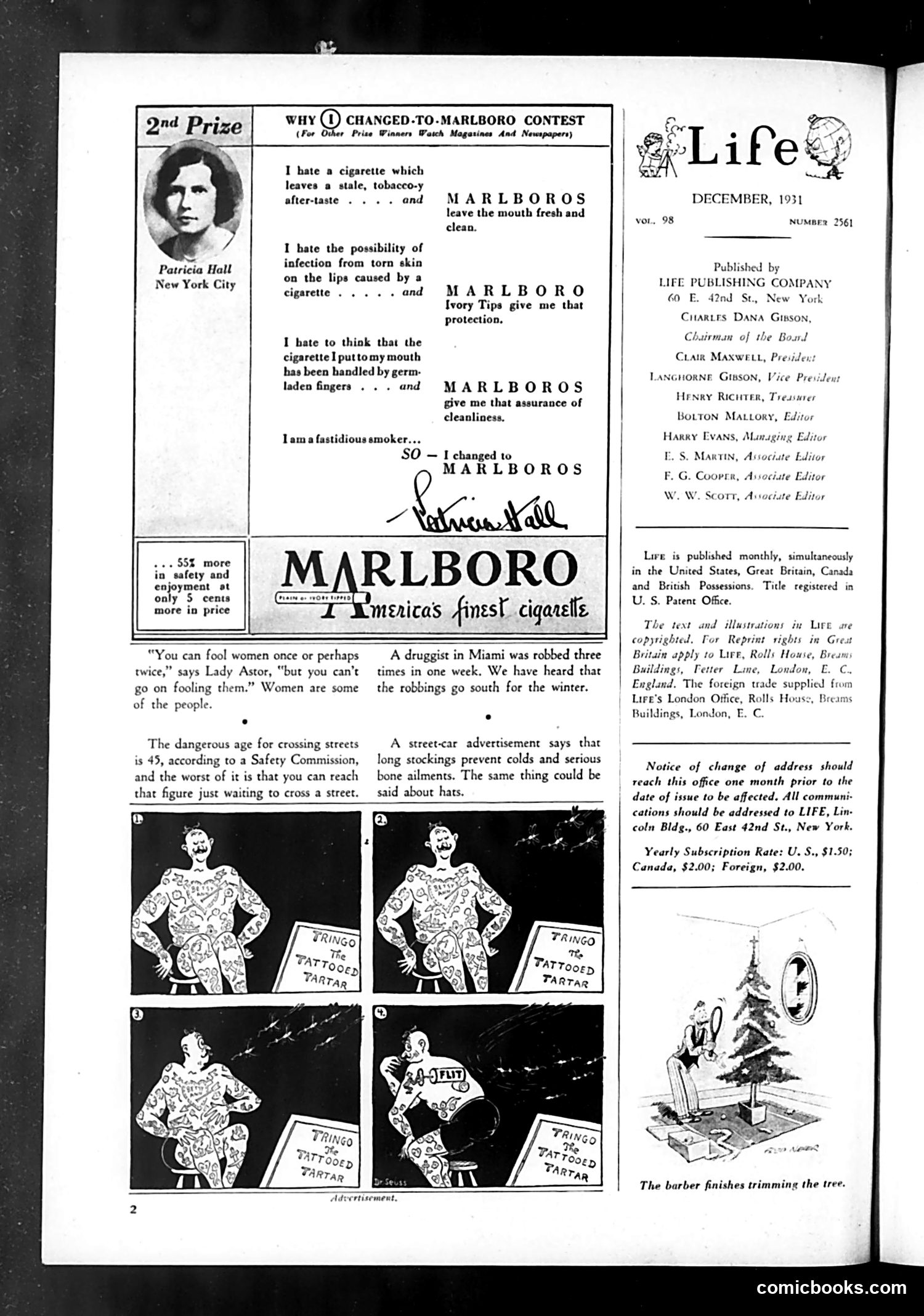
Life Magazine, December 1931: Page Analysis This page combines a Marlboro cigarette advertisement featuring Patricia Hall (2nd Prize winner in a "Why I Changed to Marlboro" contest) with unrelated content including a four-panel comic strip about "Fringo the Tattooed Tartar" and a holiday cartoon. The Marlboro ad presents Hall's testimonial about cigarette quality—addressing common smoking concerns like stale taste, lip infections, and hygiene. This reflects 1931 advertising strategies that addressed health anxieties by emphasizing product cleanliness rather than denying risks. The "Fringo" comic appears to be a nonsense humor strip popular in 1930s Life magazine, depicting absurdist scenarios. The page also includes brief satirical quips about Lady Astor, street safety, and robbery—typical of Life's miscellaneous humor format.
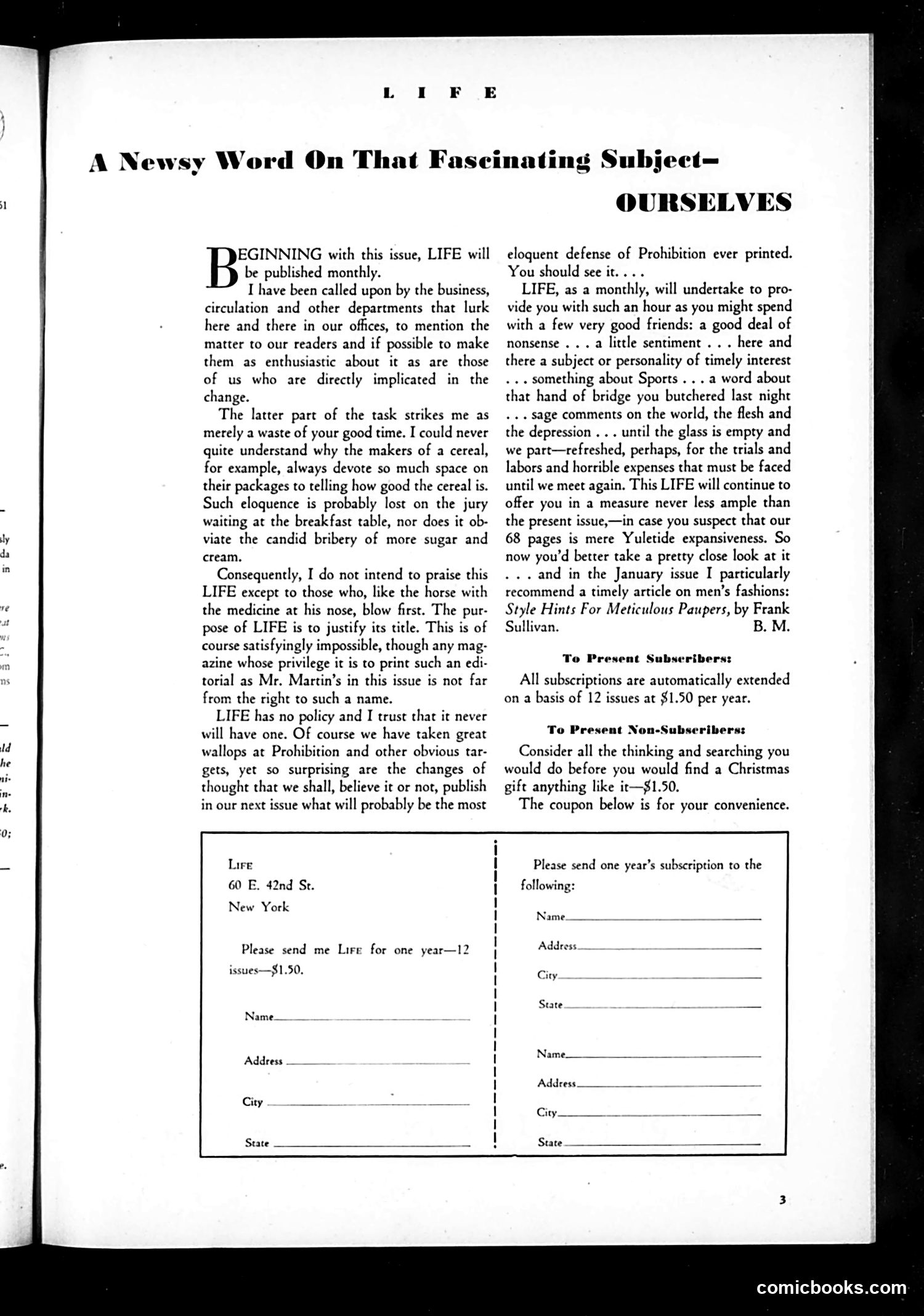
Analysis This is primarily a title page and subscription advertisement for *Life* magazine's first monthly issue, rather than a satirical cartoon page. The text is an editorial statement explaining *Life*'s mission: to publish monthly with "good deal of nonsense," sentiment, and timely commentary on sports, current events, and society. The editor (B.M., likely referring to the magazine's leadership) promises content lighter than typical journalism—good for entertaining friends between substantive reading. The page includes two subscription forms offering one year (12 issues) for $1.50, with spaces for gift subscriptions. There are no political cartoons visible on this page—it functions as an introductory manifesto establishing the magazine's humorous, accessible tone for what appears to be a newly launched or relaunched publication.
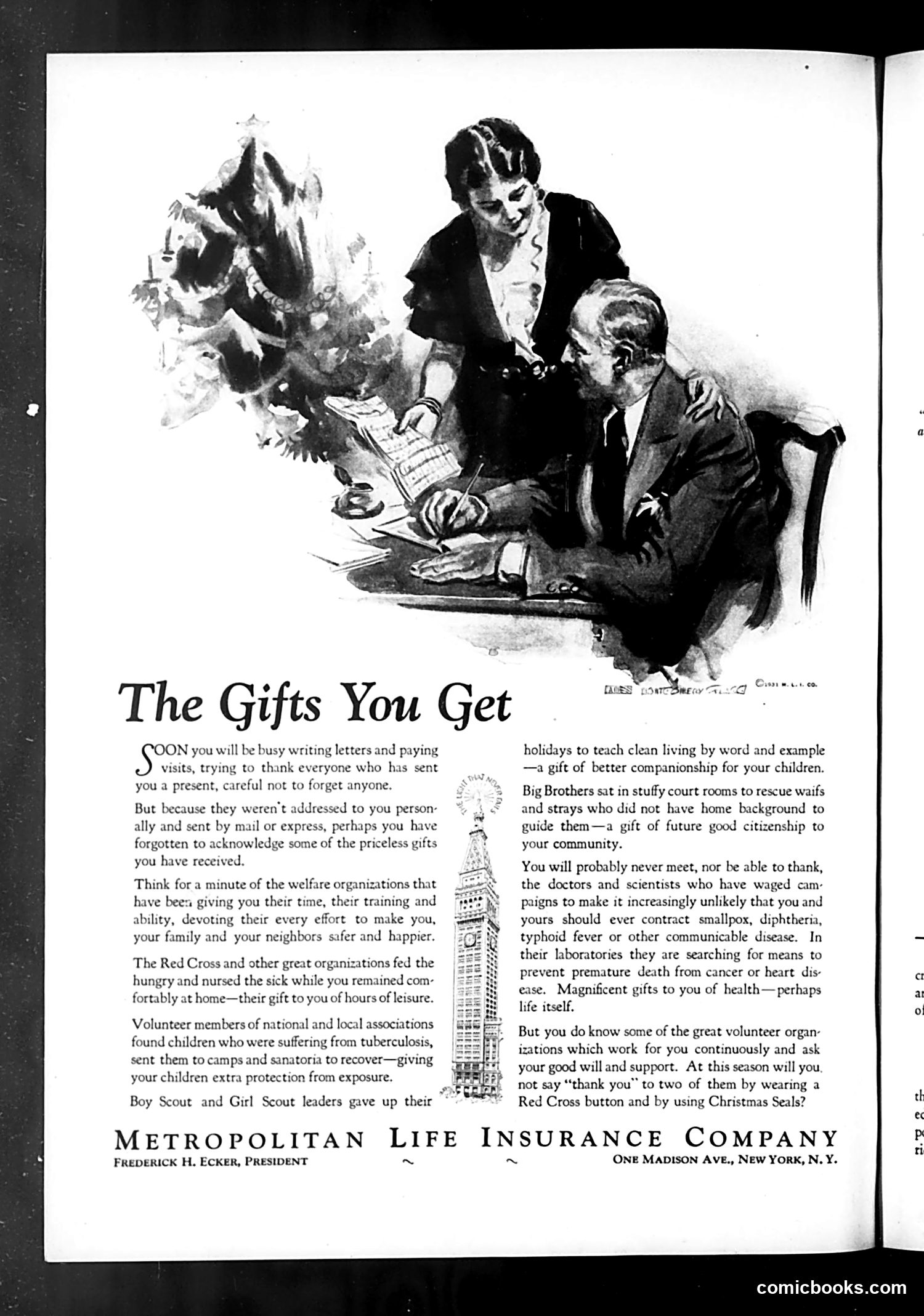
"The Gifts You Get" - Metropolitan Life Insurance Advertisement This is a full-page advertisement, not satire or political commentary. The illustration shows a woman standing between two men examining what appears to be documents or correspondence, depicting the act of writing thank-you letters. The ad's message uses the holiday season to encourage readers to reflect on charitable organizations—the Red Cross, welfare organizations, Boy Scouts, Girl Scouts—that have provided "priceless gifts" of service during the year. It argues these organizations deserve recognition and support, suggesting readers donate via Red Cross buttons or Christmas Seals. The "gift" framing recontextualizes charitable giving and volunteerism as reciprocal benefits to one's family and community, positioning Metropolitan Life Insurance as aligned with civic virtue and social responsibility.
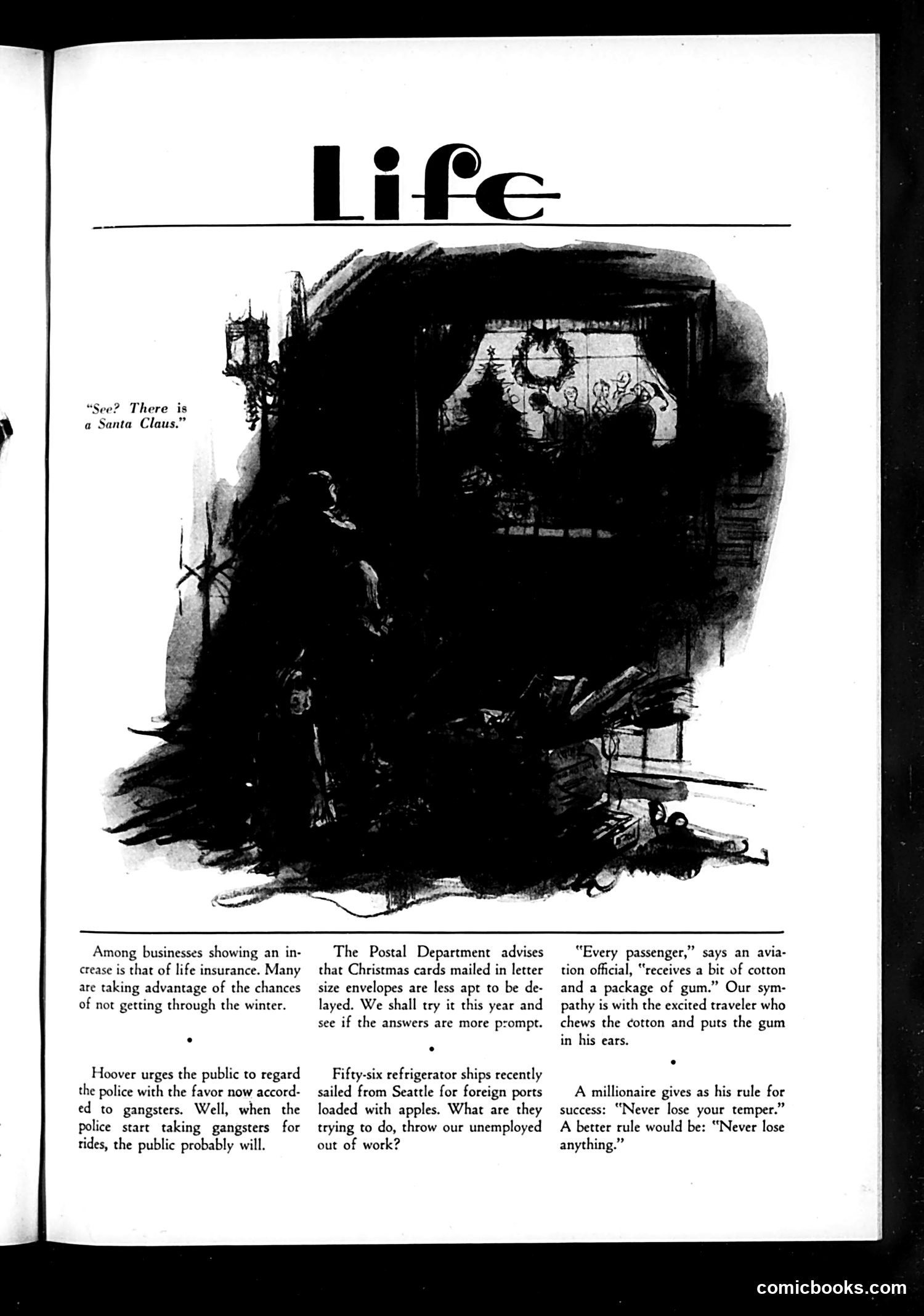
Analysis of Life Magazine Page This page contains a satirical illustration titled "See? There is a Santa Claus" paired with brief commentary pieces. The main cartoon depicts a silhouetted figure looking through a window at a Christmas scene, suggesting childhood wonder about Santa's existence. The surrounding text addresses practical Depression-era concerns: life insurance business growth, postal advice about Christmas card delays, refrigerated apple shipments from Seattle (likely addressing unemployment), aviation cotton-gum products, and police tactics against gangsters. The "Santa Claus" title appears ironic—juxtaposing innocent holiday imagery with contemporary economic hardship and crime issues. The overall page mixes festive sentiment with sharp social commentary about 1930s American life, typical of *Life* magazine's satirical approach to current events and social conditions.
Analysis of "What Christmas Message This Year?" by E.S. Martin This is a text essay, not a cartoon. It's a editorial commentary on economic inequality and corporate consolidation during what appears to be the early 20th century (references to 1899 and William James suggest this period). The piece critiques big business monopolies that are eliminating small manufacturers and merchants, creating poverty and unemployment. Martin argues that wealthy corporations are prioritizing profit over human welfare, particularly during Christmas season—traditionally associated with charity. The essay advocates for redistribution of wealth to help "the hungry and unemployed" and warns that unchecked corporate consolidation threatens individual liberty and equality of opportunity. The "Christmas message" Martin proposes is essentially a call for social reform and economic justice—a radical statement for its era.
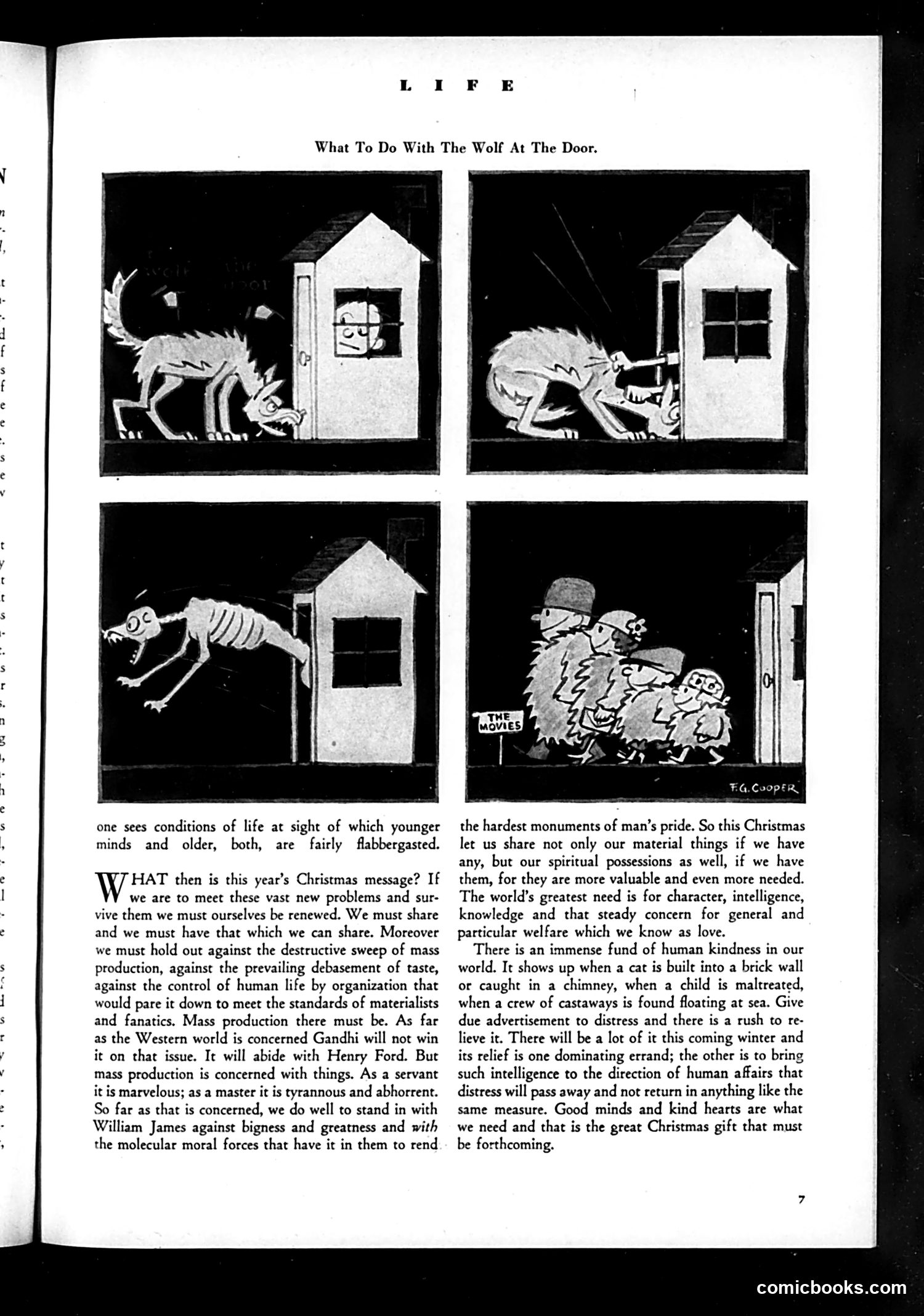
"What To Do With The Wolf At The Door" This four-panel cartoon by T.G. Cooper illustrates the idiom "the wolf at the door"—meaning poverty or financial hardship. The sequence shows a person in a house confronted by an actual wolf: 1. Top left: Wolf scratches at the door 2. Top right: Person attempts to fight it off with a stick 3. Bottom left: Person appears to be hiding or fleeing 4. Bottom right: Multiple figures (appearing to be soldiers or officials) are called in to deal with the threat The accompanying editorial text discusses Christmas charity and addressing social welfare needs. The cartoon satirizes inadequate individual responses to economic hardship, suggesting that serious social problems require collective institutional action rather than personal defense alone.
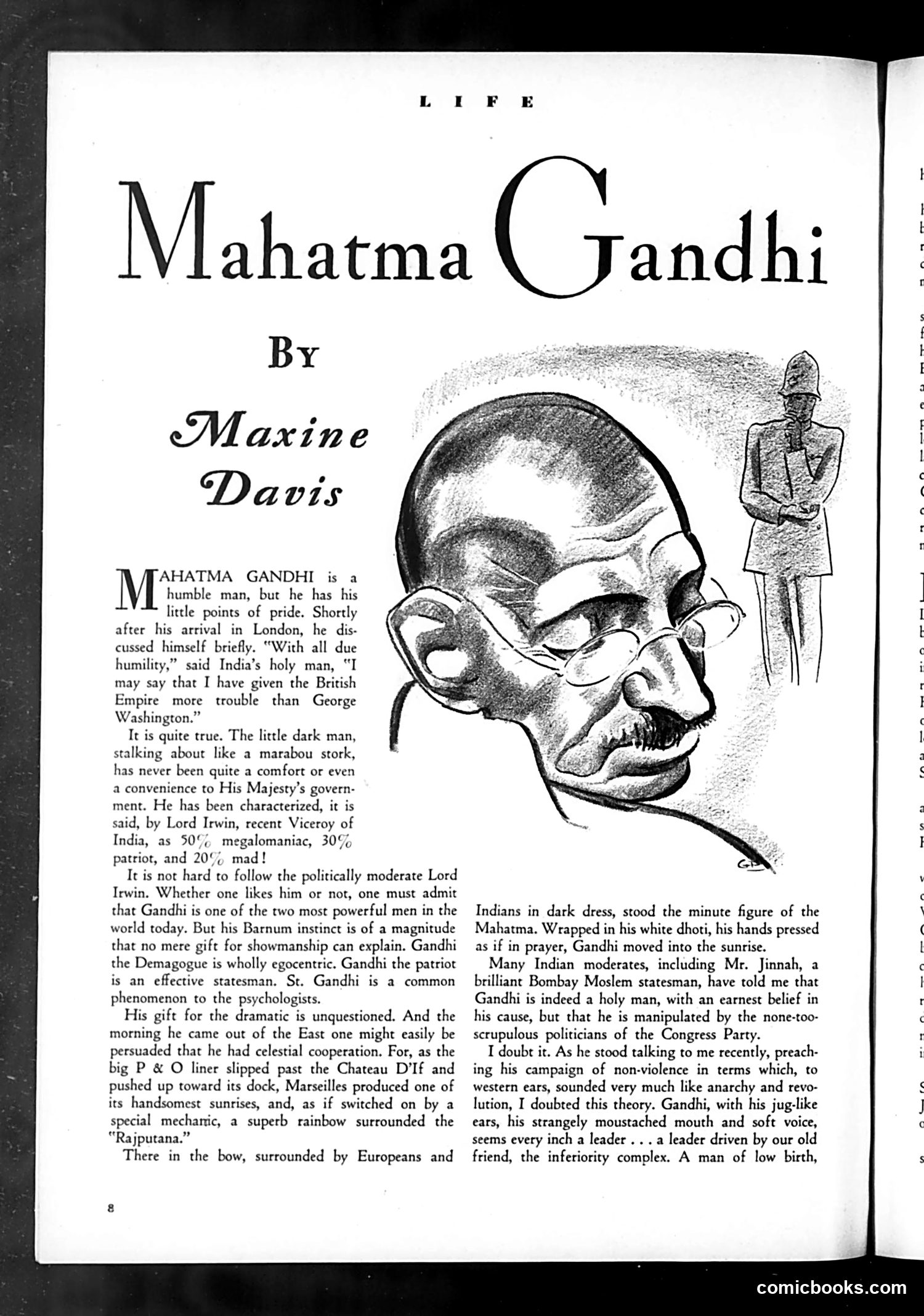
Analysis: "Mahatma Gandhi" by Maxine Davis (Life Magazine) This article presents a satirical political portrait of Mahatma Gandhi. The caricature exaggerates his distinctive features—glasses, thin face, and prominent ears—in a mocking style typical of 1920s-30s Life magazine satire. Davis characterizes Gandhi as a "humble man" whose actual power is far greater than his modest appearance suggests. She references Lord Irwin's characterization of him as "50% megalomaniac, 30% patriot, and 20% mad," indicating British colonial skepticism about his motives. The article suggests Gandhi manipulates Indian moderates and Congress politicians through non-violence rhetoric, while actually being driven by an "inferiority complex." The satire portrays him as a shrewd political operator whose apparent humility masks significant ambition and influence—a common Western criticism of Gandhi during India's independence movement.
Commentary on Gandhi and British Rule This page is a political-historical essay (not a cartoon) discussing Mohandas Gandhi's character and independence movement. The author presents a critical perspective on Gandhi, describing him as physically unattractive ("one of the uglest men") but intellectually formidable. The text covers Gandhi's opposition to British rule—his advocacy for boycotts, passive resistance, and non-payment of taxes—which the author views as insincere, arguing Gandhi's real grievance was lack of recognition for Indian officers in the British military. The piece mocks Gandhi's ascetic practices (spinning wheel, simple diet) as performative "sanctity" and includes a dismissive anecdote about his costume ("plus fours" vs. "minus fours"). It expresses skepticism that Gandhi would genuinely support Indian independence if Britain made concessions.
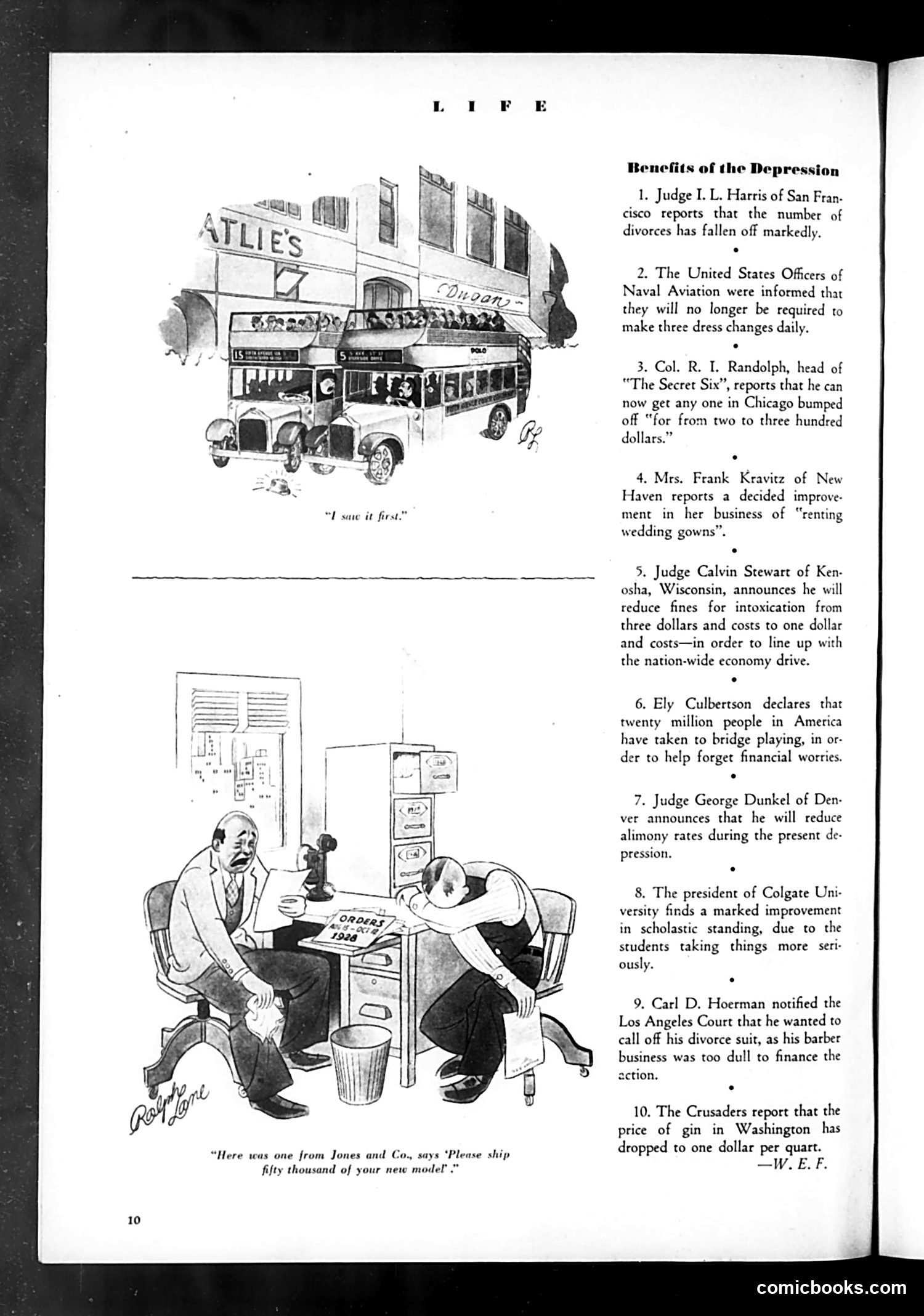
"Benefits of the Depression" - Life Magazine Satire This page satirizes supposed "silver linings" during the Great Depression through humorous anecdotes and cartoons. The top cartoon shows a crowded multi-story building labeled "ALLIES" with various businesses, captioned "I saw it first"—likely mocking competition and desperation during economic hardship. The bottom cartoon depicts two men in an office, one appearing distressed while reading documents, with the caption about ordering "fifty thousand of your new model"—satirizing how businesses struggled with inventory and demand during the Depression. The numbered list (1-10) presents ostensibly "positive" Depression outcomes: reduced divorces, lower crime rates, price drops, and increased bridge-playing. The satire lies in treating economic devastation's side effects as genuine benefits, mocking those seeking optimistic narratives during genuine hardship. The tone is darkly humorous, highlighting Depression-era hardship through ironic inversion.
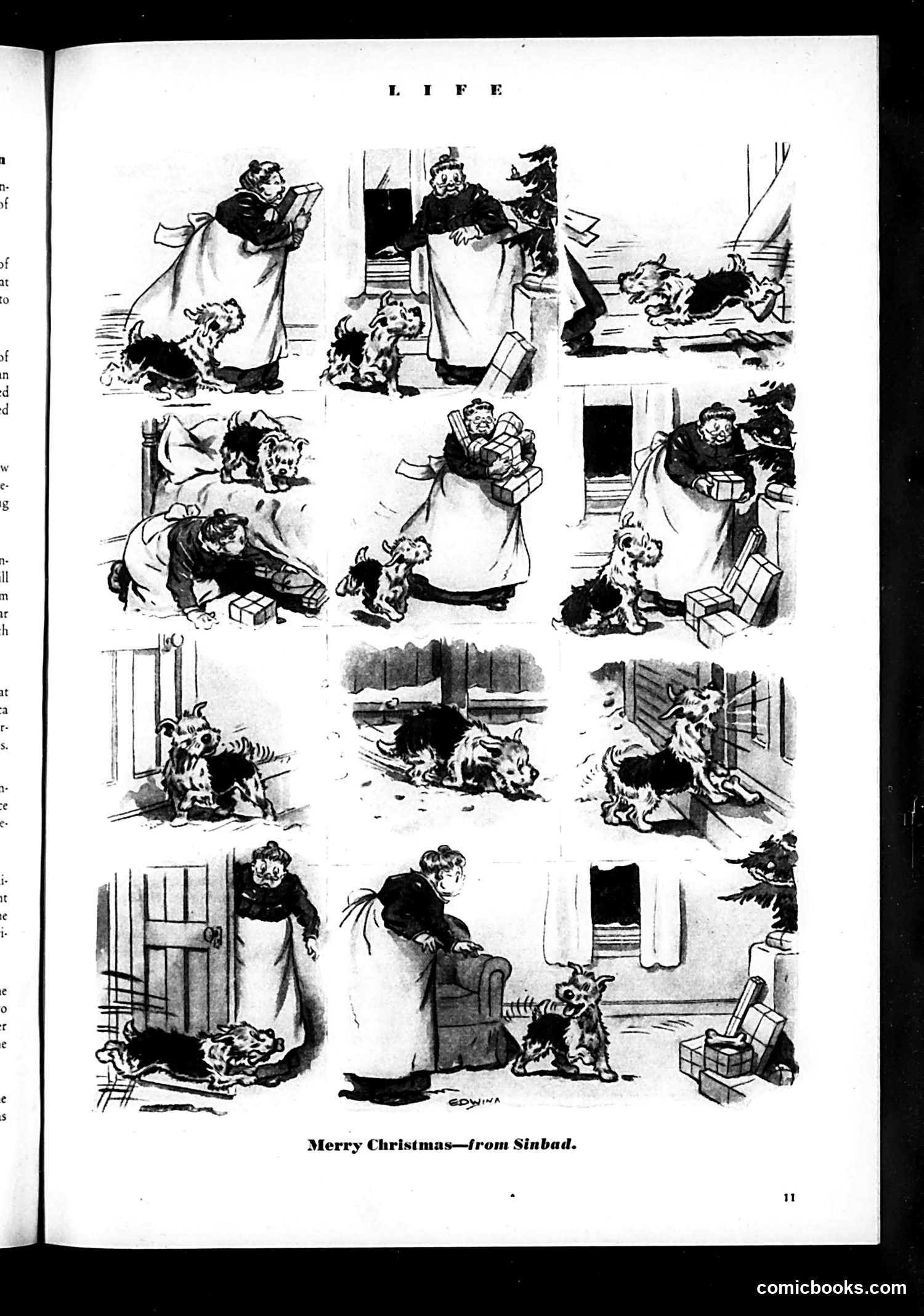
"Merry Christmas—from Sinbad" This page shows a humorous comic strip featuring small dogs and their interactions with people during Christmas. The strip depicts various domestic scenes: adults carrying packages and gifts, children playing with puppies, dogs receiving presents, and general holiday chaos as pets create mischief around wrapped boxes and household items. The title references "Sinbad," likely the name of a particular dog character. The humor derives from the contrast between humans' Christmas preparations and the dogs' innocent disruption of those plans—typical slapstick comedy of the early-to-mid 20th century satirical magazine *Life*. The strip captures common domestic holiday experiences: pets knocking over decorations, getting into packages, and generally complicating family celebrations. It's gentle, observational humor about the realities of celebrating Christmas with animals in the house.
Analysis: "What I Think of Sidney Lenz" by Ely Culbertson This article by Ely Culbertson analyzes Sidney Lenz, apparently a rival bridge player. The piece uses bridge competition as a metaphor for understanding personality and strategy—comparing psychological patterns in card games to military intelligence and political behavior. Culbertson suggests that observing how Lenz plays reveals his inner character: his intellectual pride, his focus on winning through psychological tactics rather than technical skill, and his emotional investment in victory. The author implies Lenz compensates for lack of genuine scientific mastery with showmanship ("squeeze plays") and magical tricks. The satirical point: competitive games reveal true personality better than formal credentials, and Lenz's reliance on spectacle masks intellectual limitations—a common early-20th-century critique of bridge celebrity culture.
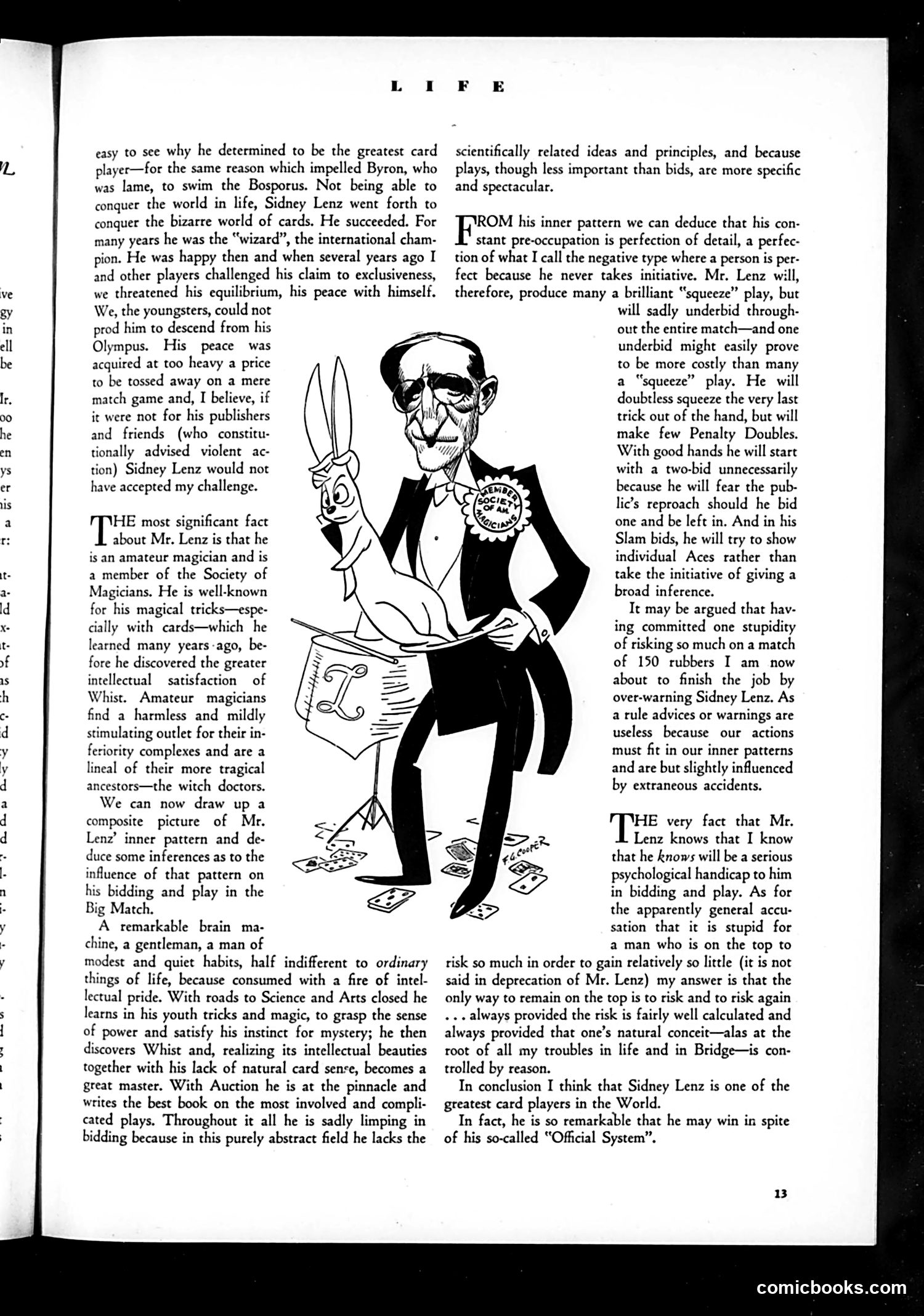
Sidney Lenz: Bridge Champion Caricature This page profiles Sidney Lenz, described as "the greatest card player" and amateur magician. The caricature depicts him as a skeletal, dapper gentleman holding playing cards and scissors, surrounded by scattered cards. The satire centers on Lenz's reputation for aggressive, high-stakes bridge play. The author criticizes his "negative type" strategy—cautious bidding that produces few dramatic wins—and warns that Lenz's tendency to overtrick through calculated risk-taking, while intellectually impressive, may ultimately prove costly. The piece suggests that despite his mastery of bridge's abstract principles, his actual competitive success relies less on strategy than on chance. The skeleton imagery appears to reference both his gaunt appearance and perhaps his clinical, death-like approach to the game.
Analysis of "Broadcastings by Montague Glass" This is a satirical column by Montague Glass discussing various political figures and international issues of the era. The text critiques: 1. Mr. Dreiser's Kentucky visit — apparently a controversial trip by an American author/social commentator 2. International gambling/lottery systems — Glass satirizes government lotteries in Italy, France, and Latin countries as morally corrupting 3. A Santa Monica scandal — Glass reports on a brother-in-law involved in a police collision incident, humorously noting the Chief of Police's awkward position defending family honor The column uses humor to critique governmental corruption, particularly regarding lotteries that exploit working-class citizens. Glass employs irony throughout, suggesting that respectable figures like Dreiser and police officials often compromise their principles when personal interests are involved. The satire targets both institutional dishonesty and social hypocrisy.
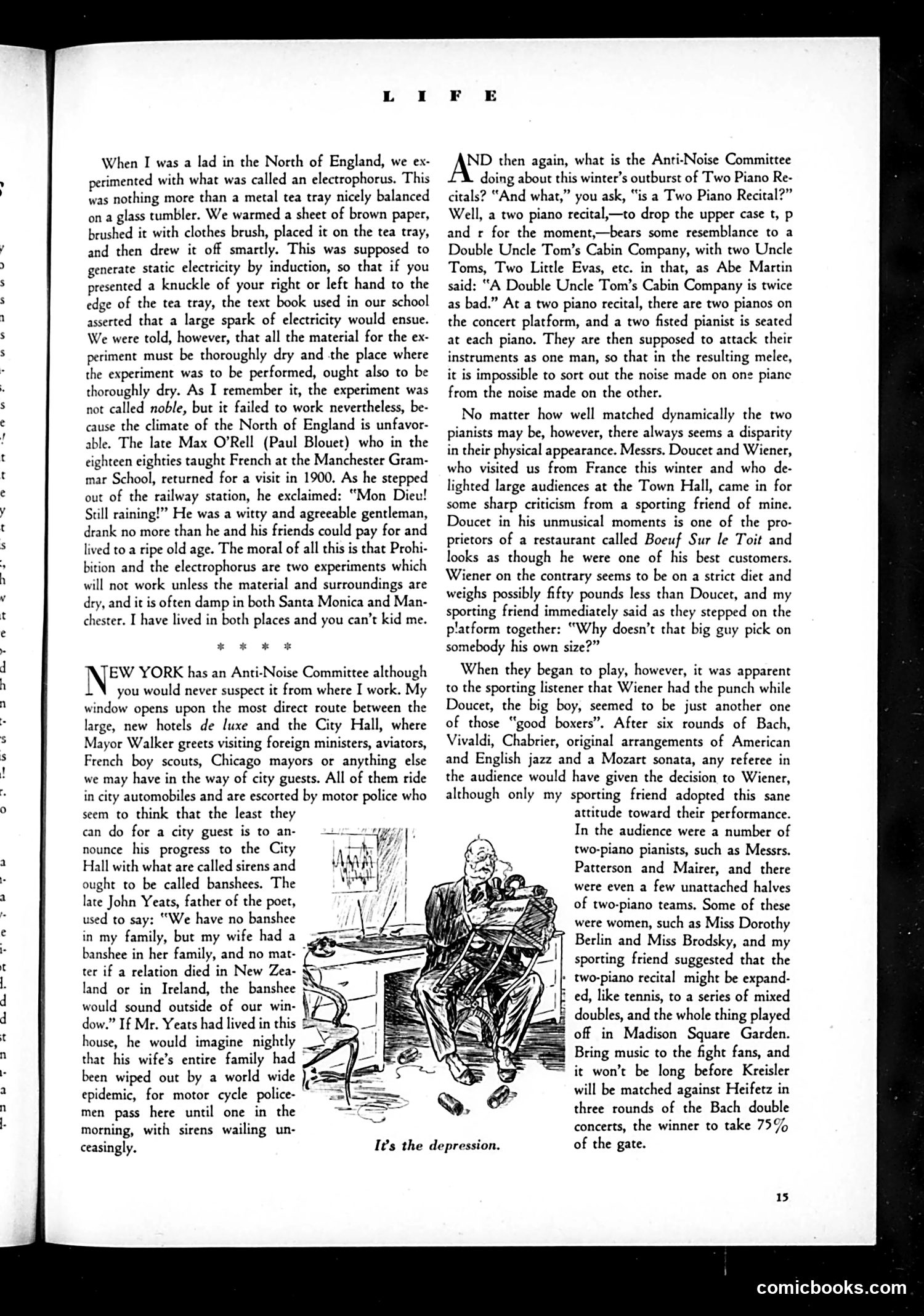
Analysis of "It's the Depression" Cartoon The single cartoon on this page depicts two men sitting together during what the caption identifies as "the depression"—clearly referencing the Great Depression economic crisis. The illustration shows one figure appearing distressed or dejected while seated with another man. The cartoon's humor relies on the grim social context: during the Depression, unemployment, poverty, and despair were widespread American experiences. By simply captioning the image "It's the depression," the cartoonist uses ironic understatement—the visual of two men in apparent misery becomes darkly comedic through this matter-of-fact labeling. The surrounding text discusses New York's Anti-Noise Committee and two-piano recitals, suggesting this magazine page juxtaposes Depression-era hardship with frivolous cultural concerns of the wealthy.
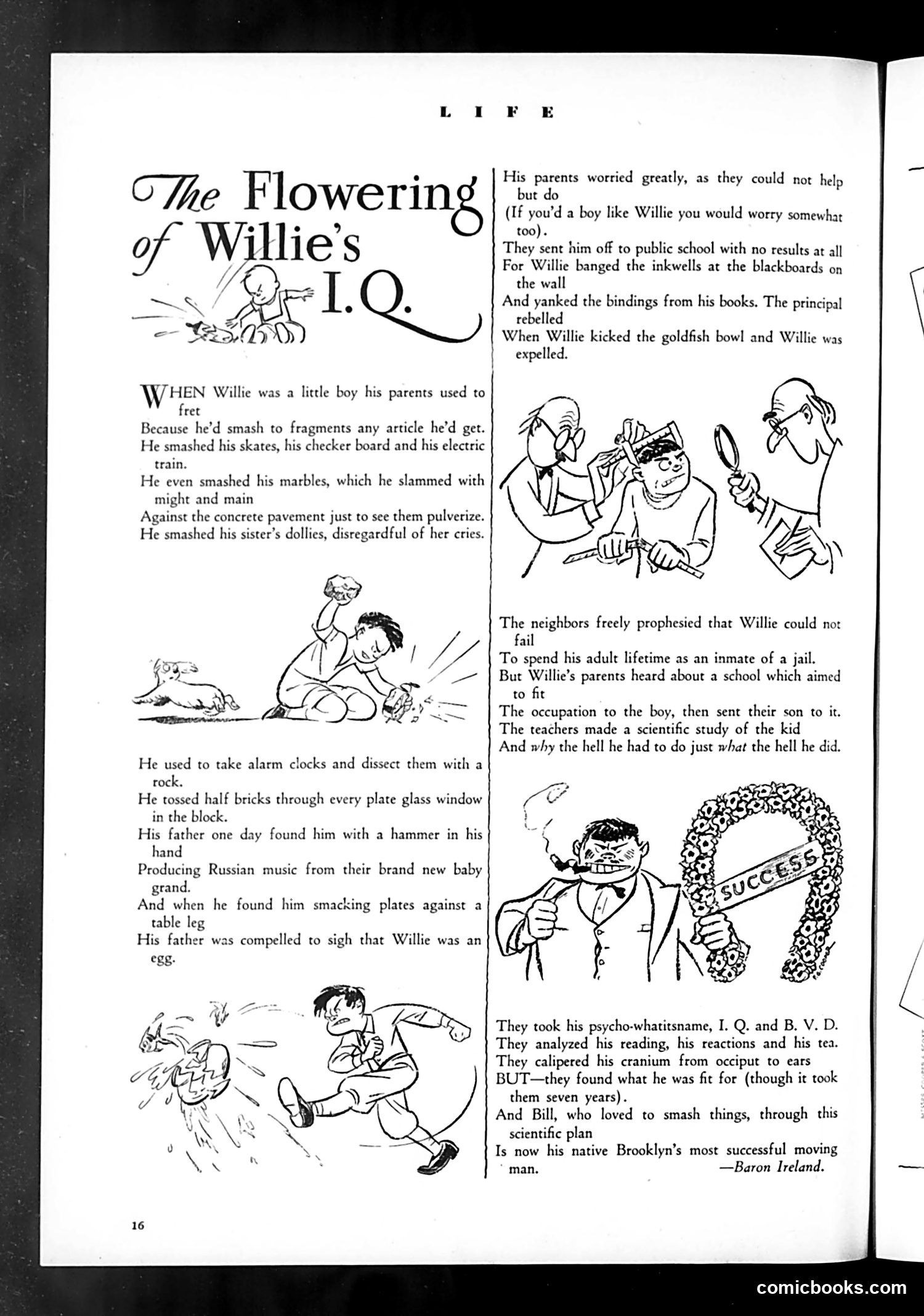
"The Flowering of Willie's I.Q." This satirical article mocks a destructive boy named Willie through the lens of early 20th-century educational psychology. The humor rests on contrasting Willie's destructive behavior—smashing toys, breaking windows, destroying household items—with pseudo-scientific analysis. The joke: When Willie's exasperated parents finally consult a specialized school, educators conduct elaborate psychological testing (measuring cranium, analyzing reactions) to scientifically determine *why* Willie destroys things. Rather than simply recognizing destructive impulses, the experts legitimize Willie's behavior through formal study. The satire targets both the "problem child" and the era's faith in scientific solutions to behavioral problems. By story's end, Willie becomes Brooklyn's "most successful moving man"—his destructive energy redirected into a productive career. The piece ridicules how pseudo-scientific education repackages troublemaking as untapped talent requiring proper channeling.
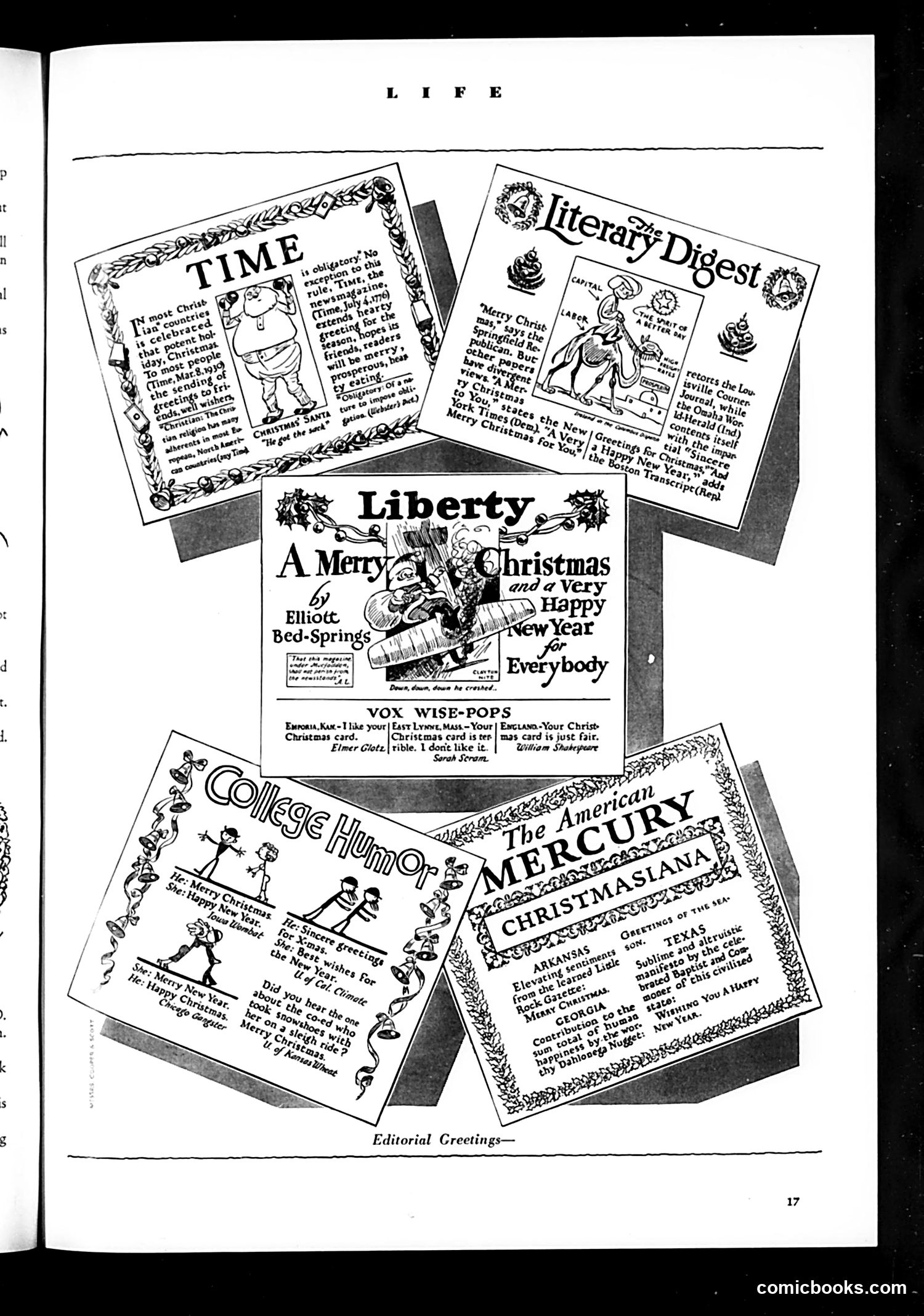
Editorial Greetings This page displays Christmas and New Year greeting cards from various publications—*TIME*, *Literary Digest*, *Liberty*, *College Humor*, and *The American Mercury*—arranged as a visual showcase of "Editorial Greetings." Each card offers holiday wishes in the style of that publication. For instance, the *Liberty* card features Santa by Elliott Bed-Springs with the tagline "A Merry Christmas and a Very Happy New Year for Everybody." Below it, "Vox Wise-Pops" presents humorous quotes about Christmas cards from various figures, suggesting satire about commercialized holiday customs. This appears to be a lighthearted feature celebrating how different magazines and their editorial voices approach seasonal greetings—displaying their distinct personalities and humor styles through their holiday messages.
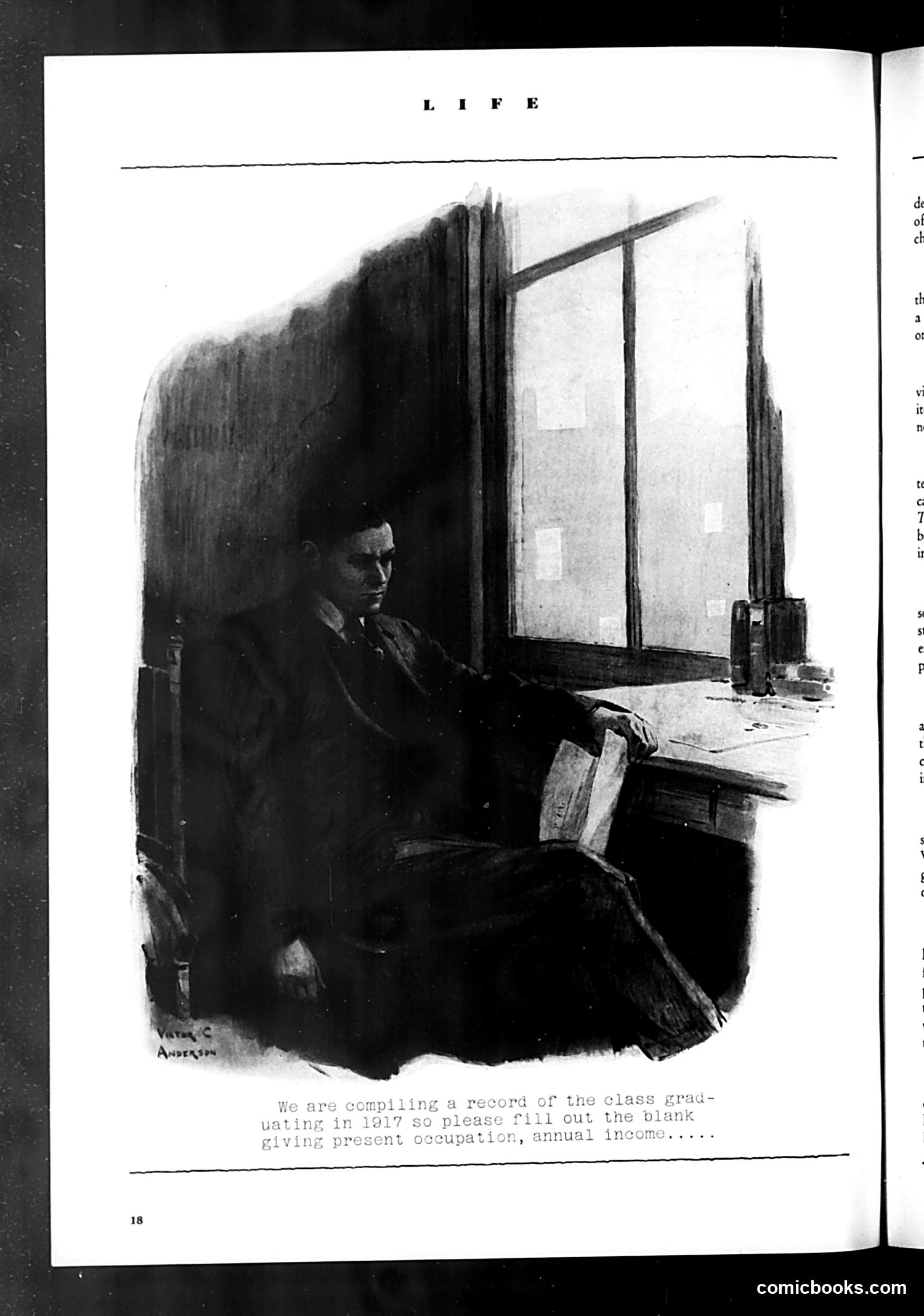
This page from *Life* magazine shows an illustration of a person sitting at a desk by a window, holding what appears to be a book or document. The caption requests: "We are compiling a record of the class graduating in 1917 so please fill out the blank giving present occupation, annual income...." The satire appears to target the class of 1917—likely recent graduates facing economic uncertainty, possibly during or shortly after World War I. The joke hinges on the awkwardness of requesting income information from young graduates who may have little or no earnings. The figure's posture and the sparse, bare office setting suggest the implied difficulty or embarrassment of admitting minimal income during an economically uncertain period. The satire mocks the presumption of asking recent graduates about substantial earnings.
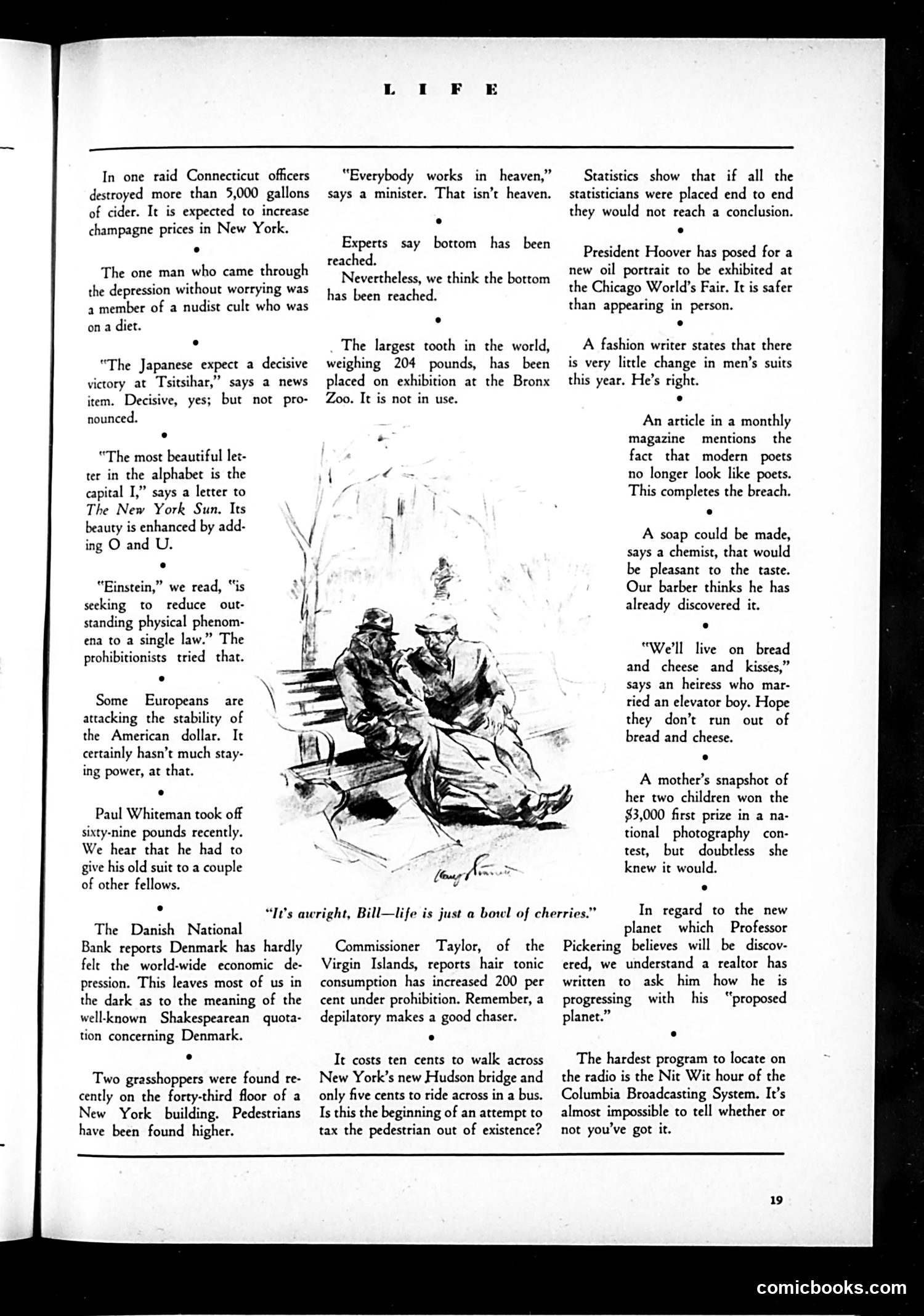
Analysis of Life Magazine Page This page contains brief humorous observations and anecdotes rather than political cartoons. The central illustration shows two men sitting on a bench, captioned "It's alright, Bill—life is just a bowl of cherries," a popular optimistic saying of the era. The text items mock various targets: statisticians, fashion consistency, modern poets, economic instability of the dollar, and prohibitionist attempts to create tasteless soap. One item references Einstein and unified field theory. Another jokes about an heiress marrying an elevator boy, expressing hope they won't run out of "bread and cheese" (slang for money). The humor relies on contemporary references—prohibition, the Hudson Bridge, radio programming—that would have resonated with 1930s readers but require historical context for modern audiences.
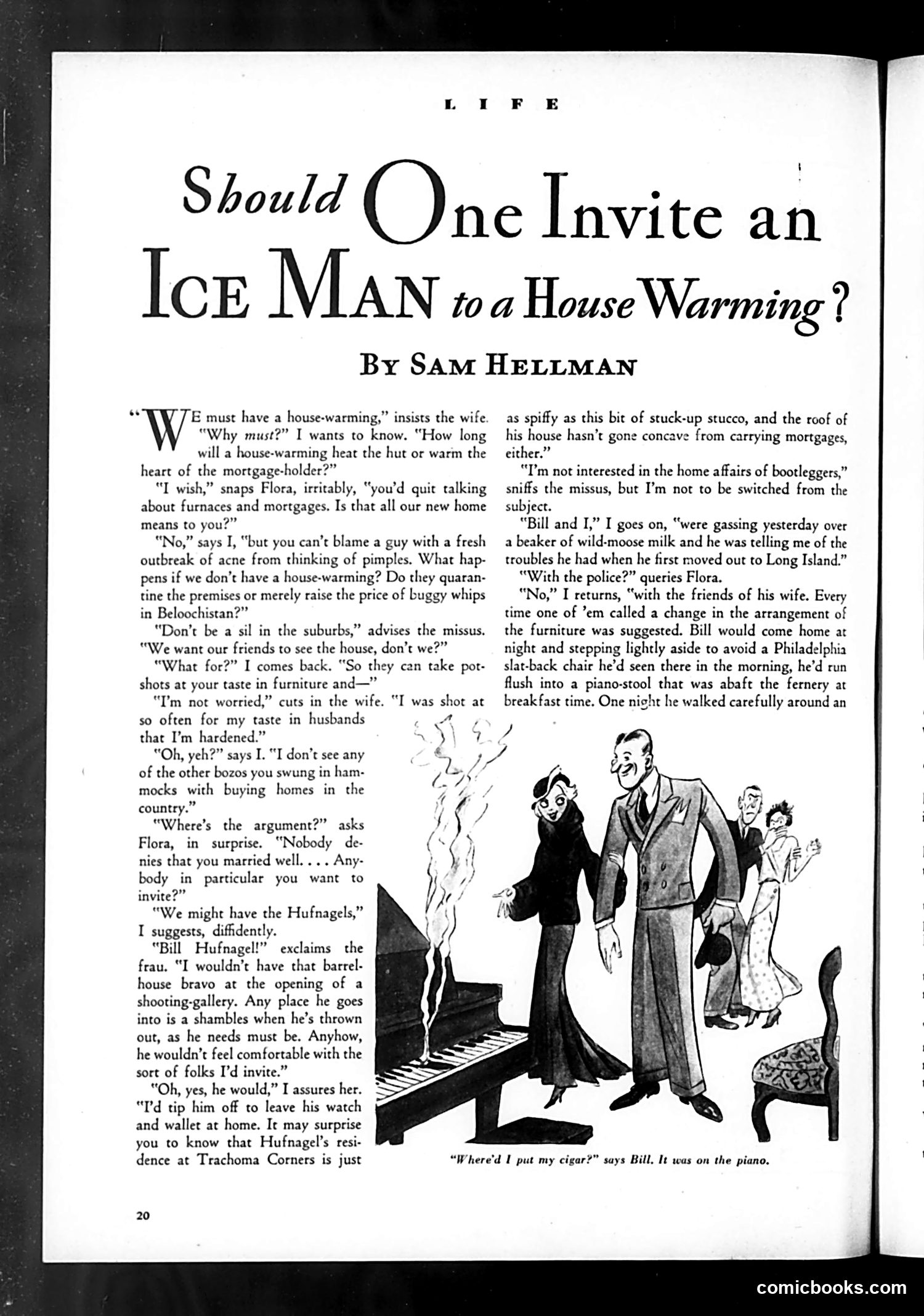
Explanation for Modern Readers This is a humorous domestic-life article by Sam Hellman satirizing house-warming parties and social pretension among the newly suburban middle class. The narrator and his wife Flora argue about hosting a housewarming. Flora wants to show off their new home to friends; the narrator resists, complaining about mortgages and home maintenance. When he suggests inviting their friend Bill Hufnagel, Flora recoils in snobbish horror, calling him a "barrel-house bravo" and referencing his residence at "Trachoma Corners" (a disparaging place-name joke). The ironic payoff: the narrator reveals Hufnagel's house is actually as nice as theirs. The anecdote about Hufnagel's wife constantly rearranging furniture—causing him to stumble into pianos and chairs—satirizes both the chaos of new suburban living and wives' obsessive home decoration. The satire targets 1920s suburban anxiety about status, home ownership, and maintaining appearances for guests.
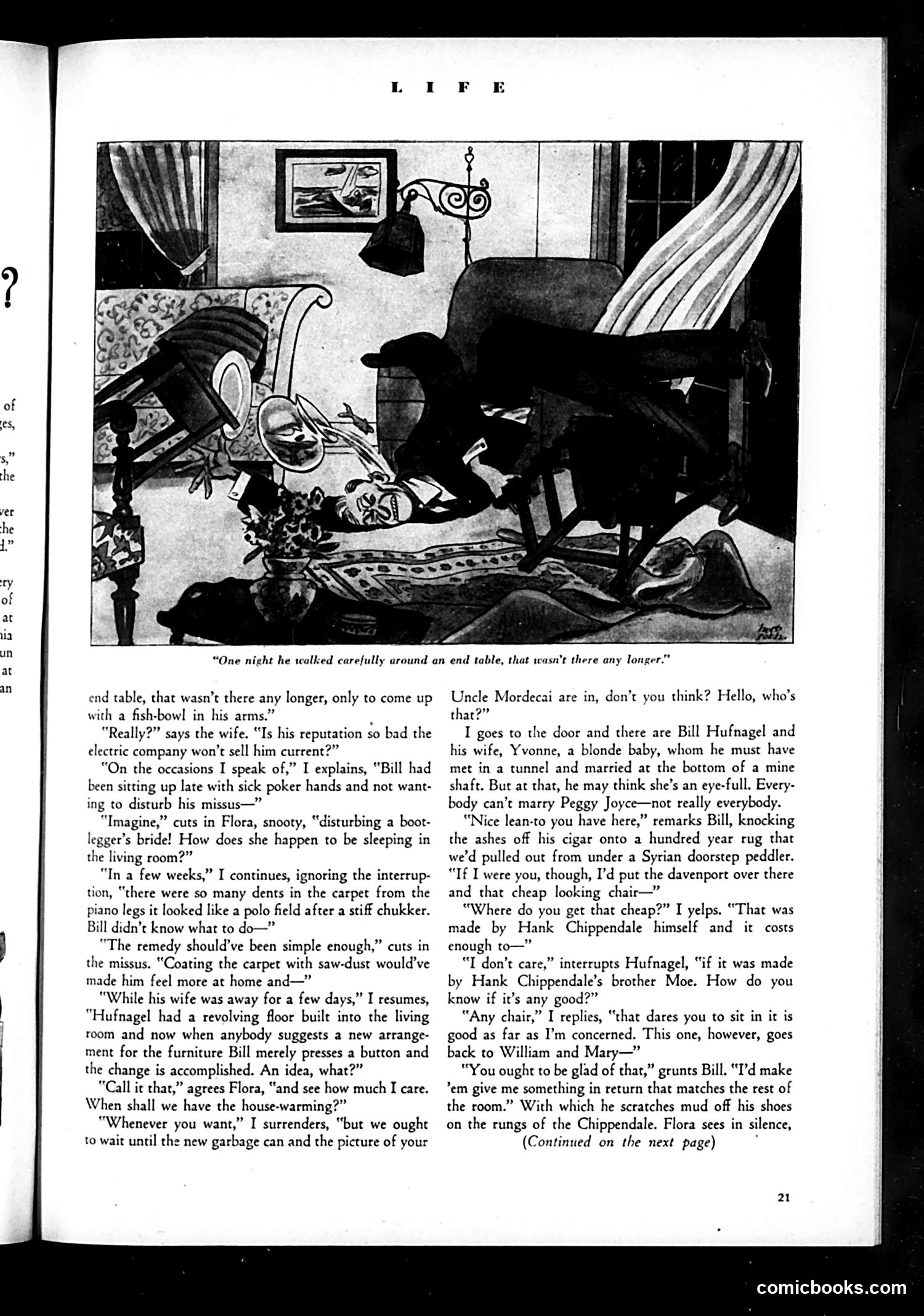
Satire Explanation This is a humorous narrative about social pretension and the nouveau riche. The story mocks Bill Hufnagel, a wealthy but uncouth man (likely a bootlegger, given references to his wife being a "bootlegger's bride" during Prohibition). The joke centers on Hufnagel's ostentatious wealth combined with complete lack of refinement. He installs a motorized rotating floor in his living room to rearrange furniture by button-press—an absurdly extravagant solution to a trivial problem. Yet despite his money, he remains tactless: he insults fine antique furniture ("made by Hank Chippendale"), treats valuable rugs carelessly, and defaces a William and Mary chair by scraping mud on it. The satire targets 1920s wealthy industrialists and criminals who accumulated sudden fortunes but lacked cultural education or manners. His wife Yvonne is dismissed as a blonde trophy wife "met in a tunnel." The cartoon illustrates this clash between wealth and worthiness—money cannot purchase taste or respect.
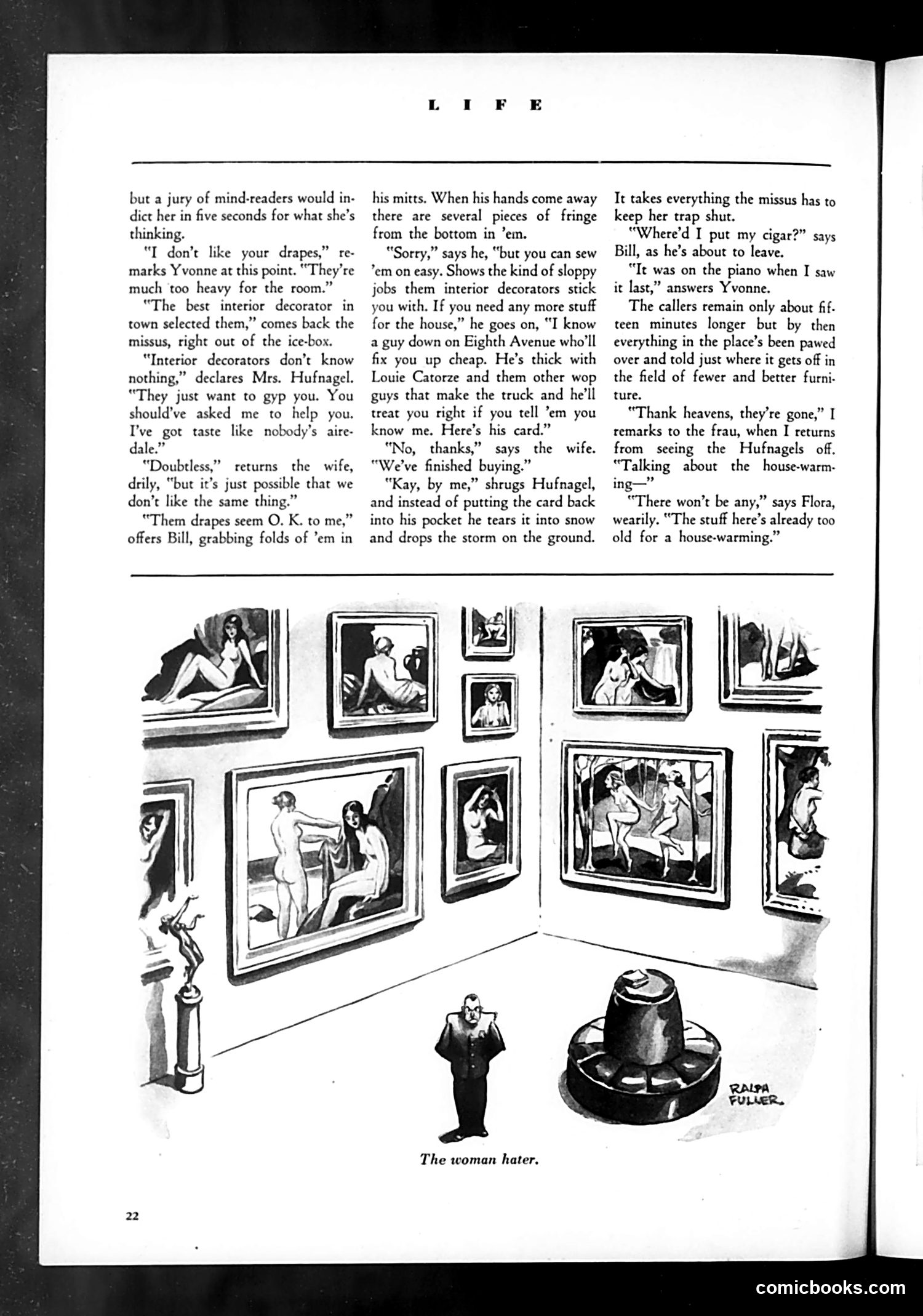
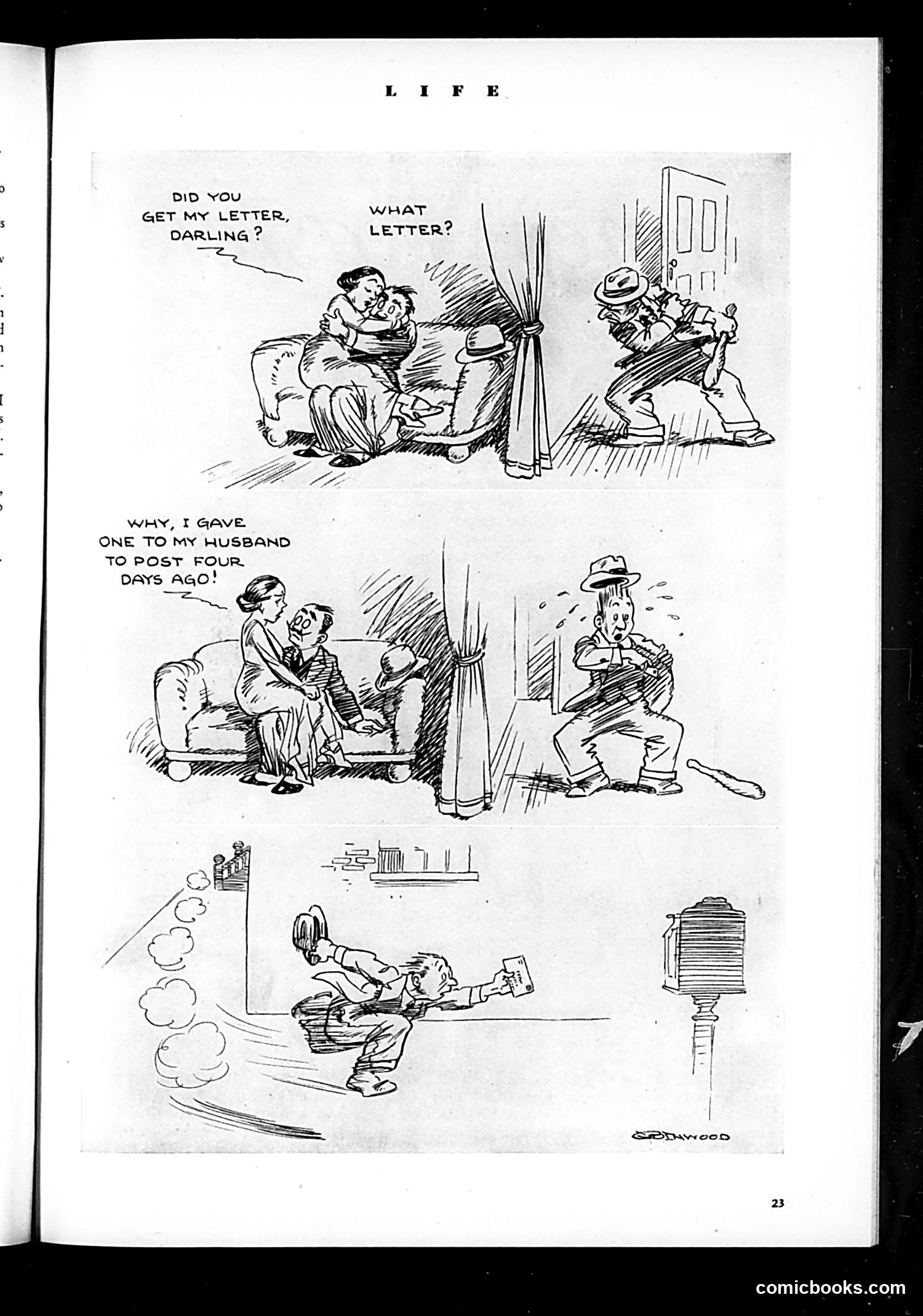
"The Woman Hater" — Life Magazine Cartoon Analysis This cartoon satirizes the obnoxious houseguest, specifically Mrs. Hufnagel, who visits a couple's home and behaves with breathtaking rudeness. She insults their interior decorating choices, boasts of her own superior taste, disparages professional decorators as swindlers, and attempts to connect them with cheap furniture dealers ("Louie Catorze and them other wop guys"—using a derogatory ethnic slur common to the era). The husband Bill, equally boorish, damages the drapes while grabbing them and dismissively discards the furniture dealer's card by tearing it into pieces. The wife must silently endure their vulgarity and lack of consideration. The cartoon's title and the final caption—"The stuff here's already too old for a house-warming"—deliver the satirical punch: the hosts' home has been so thoroughly criticized and psychologically "worn out" by these tactless visitors that it no longer feels new or worth celebrating. The satire targets working-class rudeness and social insensitivity among certain types of guests.
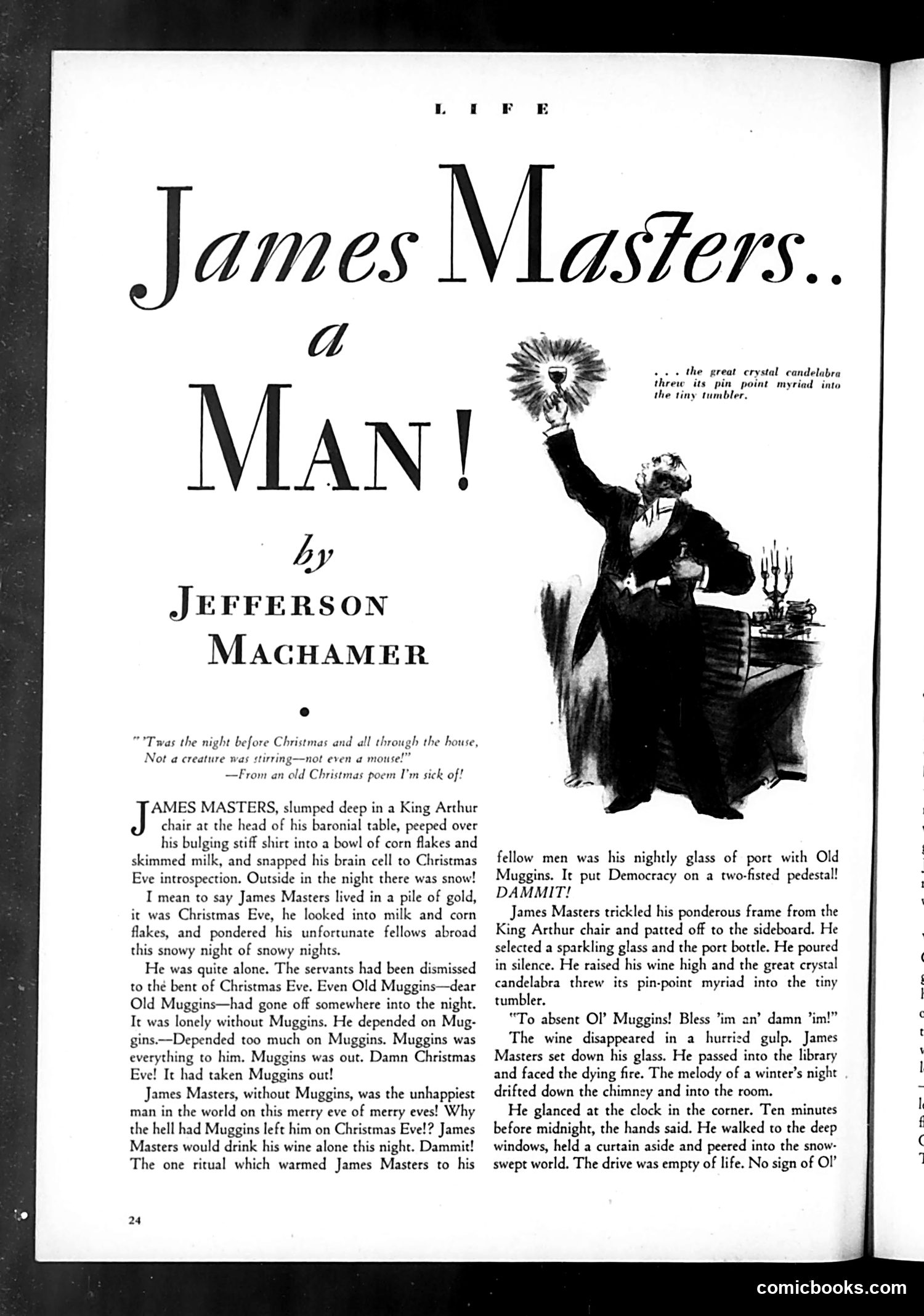
Analysis: "James Masters...a Man!" by Jefferson Maughamer This is a short story—not a political cartoon—satirizing wealthy, isolated upper-class men. James Masters is a rich businessman sitting alone on Christmas Eve, dependent on his servant "Old Muggins" for emotional connection. The satire centers on Masters's self-pitying loneliness: he lives in luxury ("a pile of gold") yet finds life meaningless without his servant's company. His nightly ritual of drinking port *with* Muggins supposedly puts "Democracy on a two-fisted pedestal"—mocking the idea that casual servant relationships represent democratic values. The humor lies in exposing Masters's pathetic condition: a wealthy man so emotionally hollow that the absence of a working-class companion ruins his entire evening. The opening parody of "'Twas the Night Before Christmas" signals the author's contempt for sentimental holiday fiction. This critiques class dynamics and upper-class emotional bankruptcy during the interwar period.
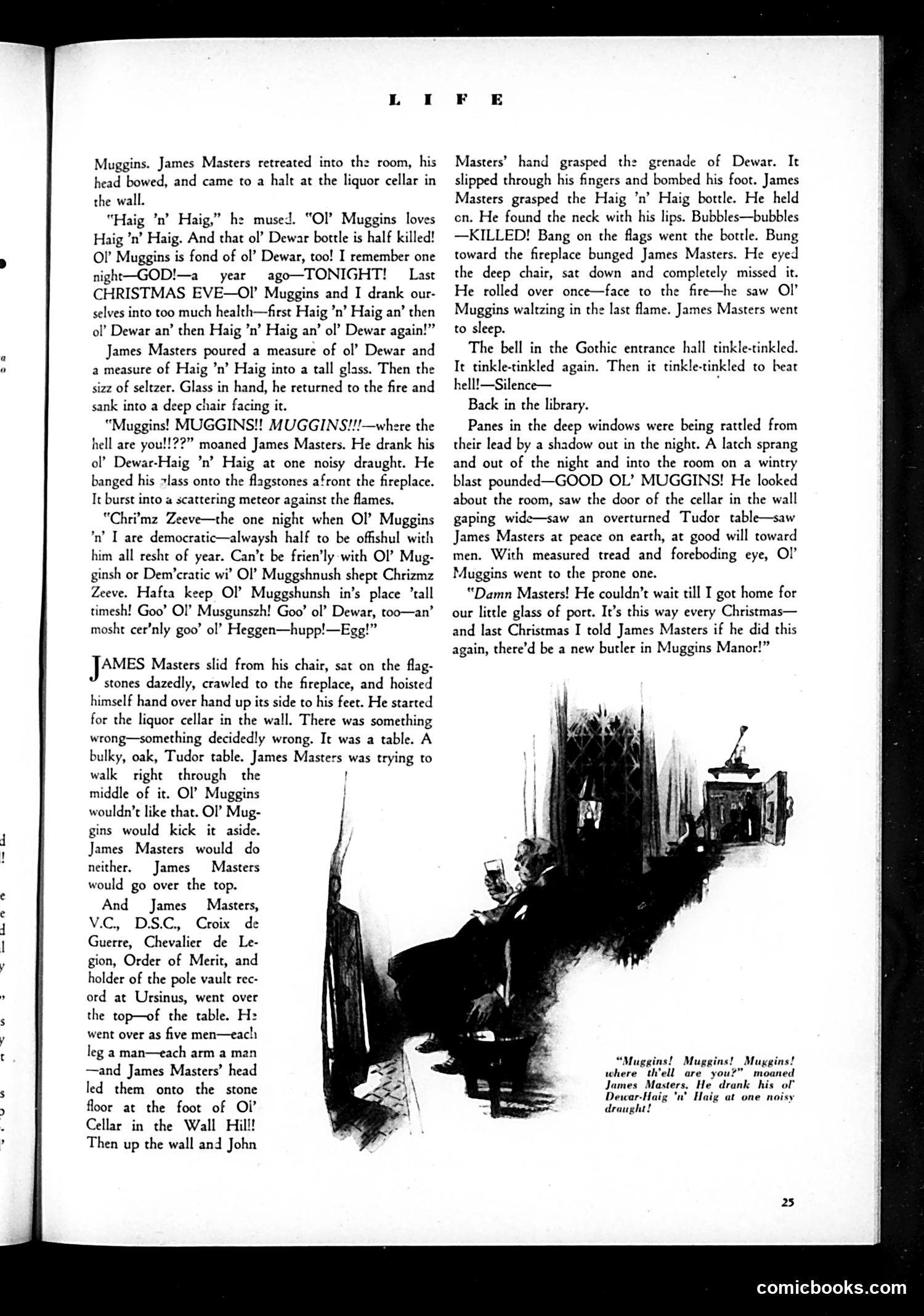
Analysis of "Life" Magazine Page This appears to be a humorous fiction story rather than a political cartoon. The narrative satirizes the British class system and master-servant relationship through comedic drunkenness. The Setup: James Masters, a decorated war veteran with numerous military honors, gets intoxicated on Christmas Eve drinking Dewar and Haig whisky brands (real products being advertised through the story). He repeatedly calls for his butler, Muggins. The Satire: The joke centers on role reversal. Masters—despite his prestigious titles and accomplishments—becomes so drunk he attempts to climb over a table like a soldier going "over the top" in WWI trench warfare. When Muggins finally arrives, the normally subservient butler takes a superior, disapproving tone toward his inebriated employer, threatening to quit. The Point: This mocks the pretense of upper-class authority and dignity, showing how alcohol and foolishness can reduce even decorated gentlemen to ridiculous dependence on their servants' goodwill.
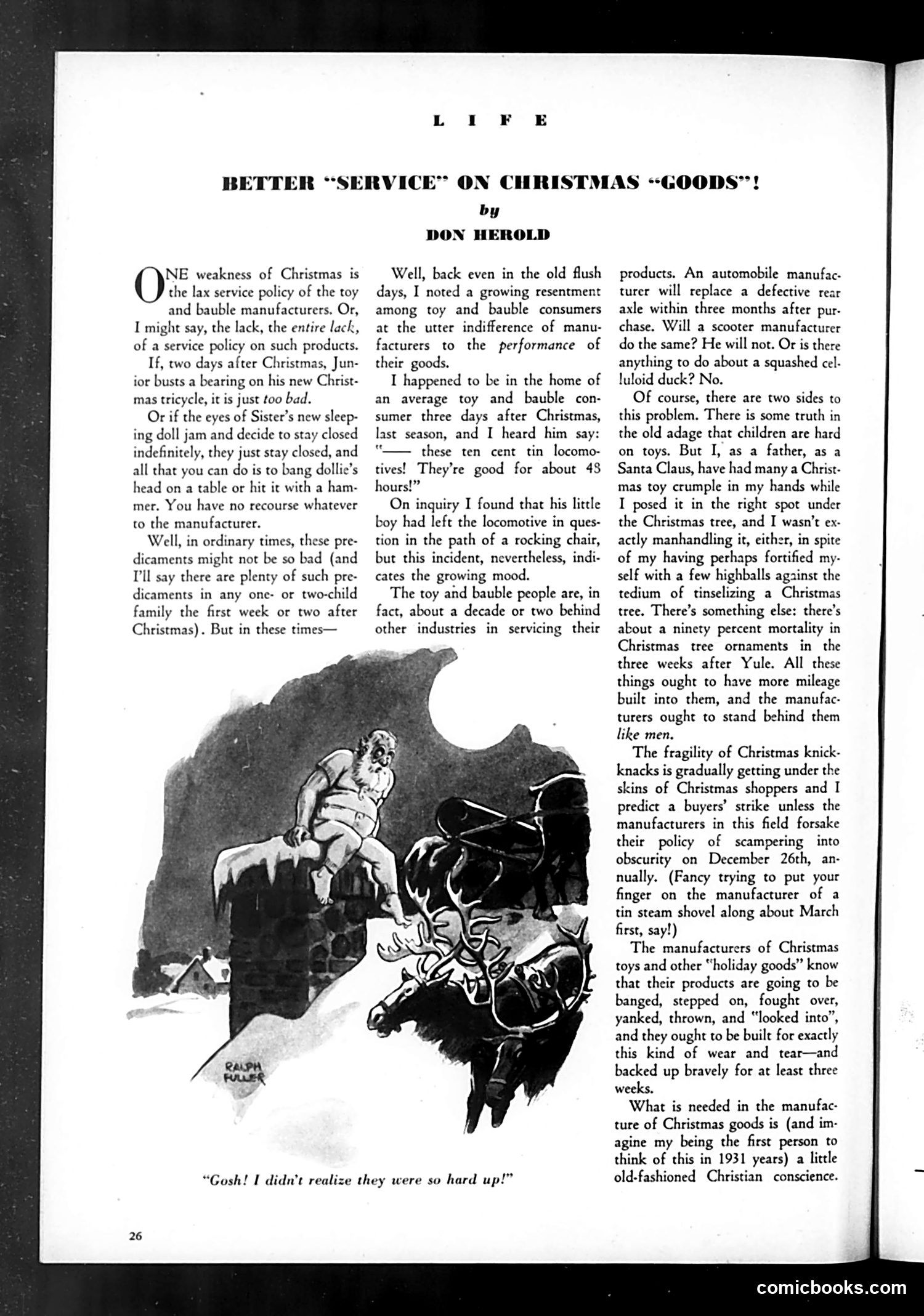
Analysis of "Better 'Service' on Christmas 'Goods'!" This 1931 satirical essay by Don Herold critiques toy and novelty manufacturers for shirking responsibility for defective products. The cartoon depicts Santa looking dismayed at broken Christmas toys. The complaint: Unlike automobile manufacturers who warranty defects for months, toy makers vanish after December 26th with no accountability. Children's toys—tin locomotives, dolls, ornaments—break quickly, either from normal wear or manufacturing defects, yet consumers have no recourse. The social context: During the Depression (note the 1931 reference), this warranty gap frustrated gift-givers and parents. The author predicts a "buyers' strike" unless manufacturers stand behind products for at least three weeks post-Christmas. The satire's point: Herold ironically concludes that what's needed is "old-fashioned Christian conscience"—arguing toy makers should honor Christmas's moral spirit by taking responsibility for their goods, not cynically exploit the season's urgency then vanish. The illustration's caption—"Gosh! I didn't realize they were so hard up!"—sarcastically suggests manufacturers claim poverty to justify poor quality, contrasting with the holiday's charitable ideals.
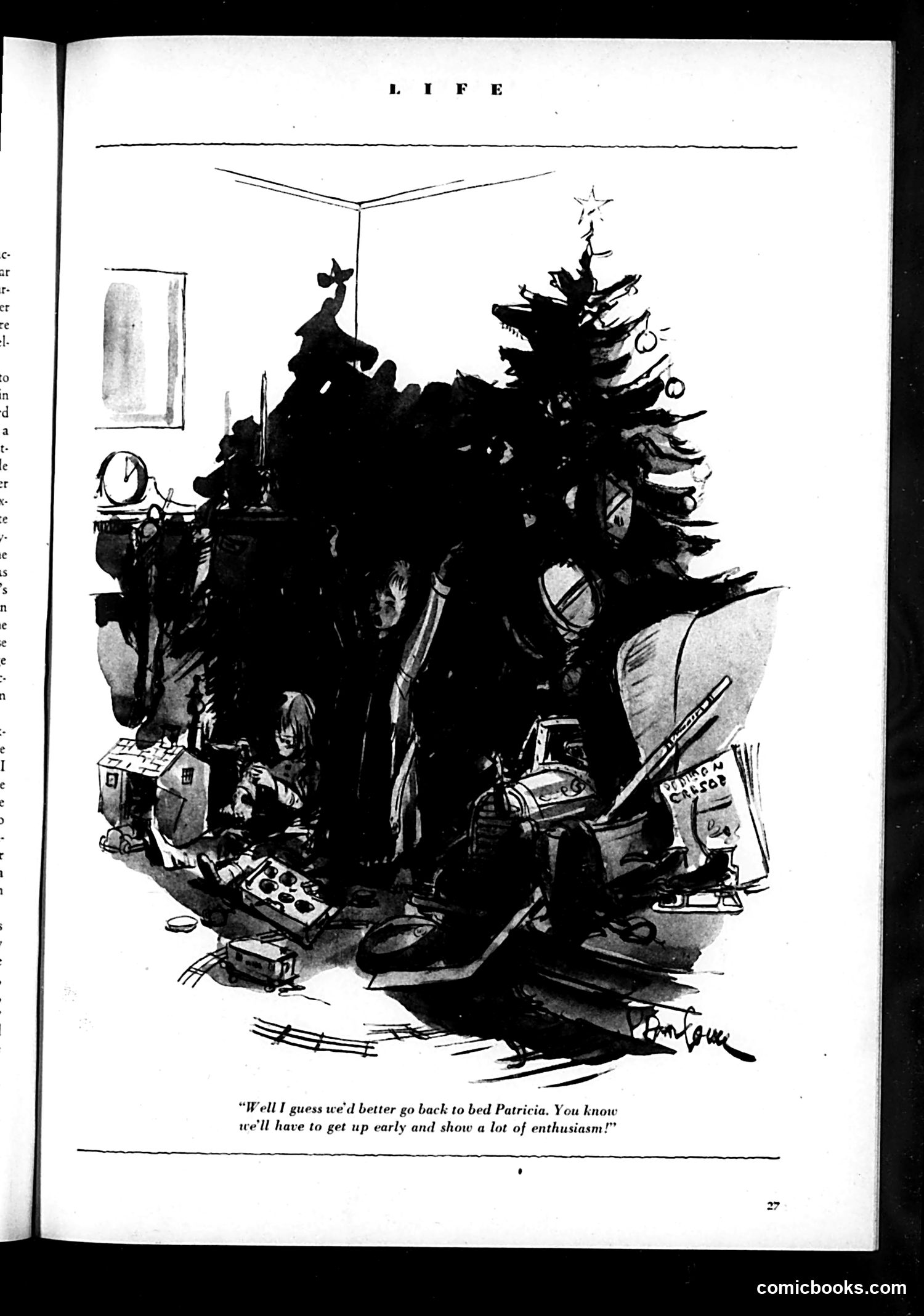
Political Cartoon Analysis This cartoon depicts a chaotic Christmas morning scene with parents surveying the wreckage of torn wrapping paper, toys, and holiday debris. The caption's reference to "Patricia" and going "back to bed" suggests these are exhausted parents. The satire targets post-war consumer culture and the commercialization of Christmas. The parents must feign enthusiasm despite the chaos and expense, performing parental joy for their children despite obvious fatigue. The "show a lot of enthusiasm" line mocks the performative nature of middle-class holiday obligations—the need to appear cheerful and engaged regardless of actual feelings about materialism and exhaustion. This reflects mid-century anxieties about suburban conformity and consumer expectations during the American post-WWII economic boom.
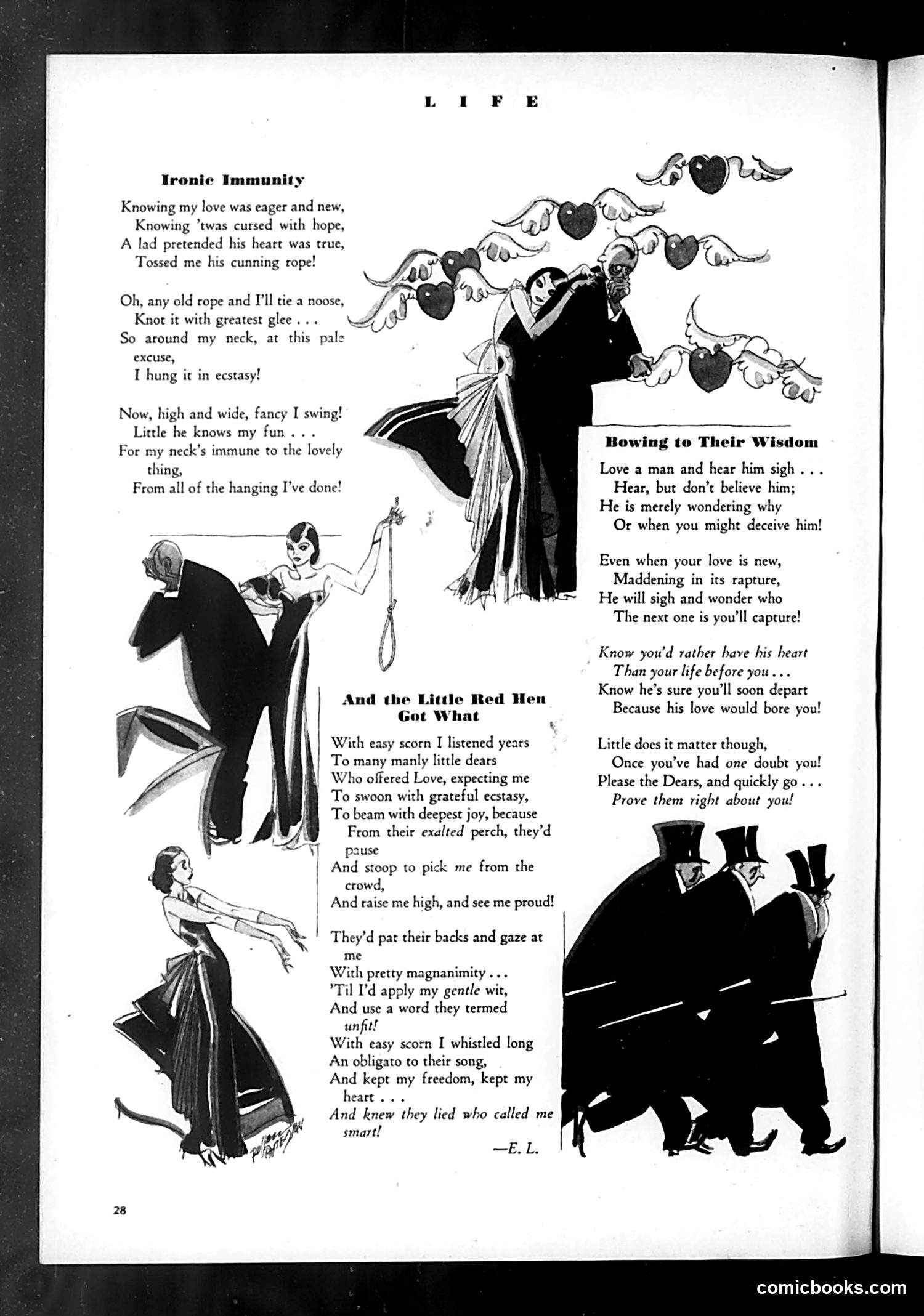
Analysis: Three Satirical Poems on Romance and Gender This page contains three poems with accompanying illustrations satirizing romantic relationships and gender dynamics of the era. "Ironic Immunity" mocks a woman who, having been repeatedly deceived by suitors, has become emotionally hardened—her "neck's immune" to romance's snares. The gallows imagery suggests she's made a dark joke of heartbreak. "The Little Red Hen Got What" depicts a woman who rejected multiple male suitors with wit and sarcasm, maintaining her independence and freedom rather than accepting their condescending offers of love. "Bowing to Their Wisdom" takes a cynical turn, advising women that men are inherently suspicious and unfaithful—they'll always wonder about rival lovers. The final stanza darkly suggests women should simply confirm these low expectations and leave. The overall message: men are deceitful manipulators; women must either harden themselves emotionally or accept male infidelity as inevitable. The tone is sardonic commentary on romantic disillusionment, likely reflecting post-WWI cynicism about relationships.
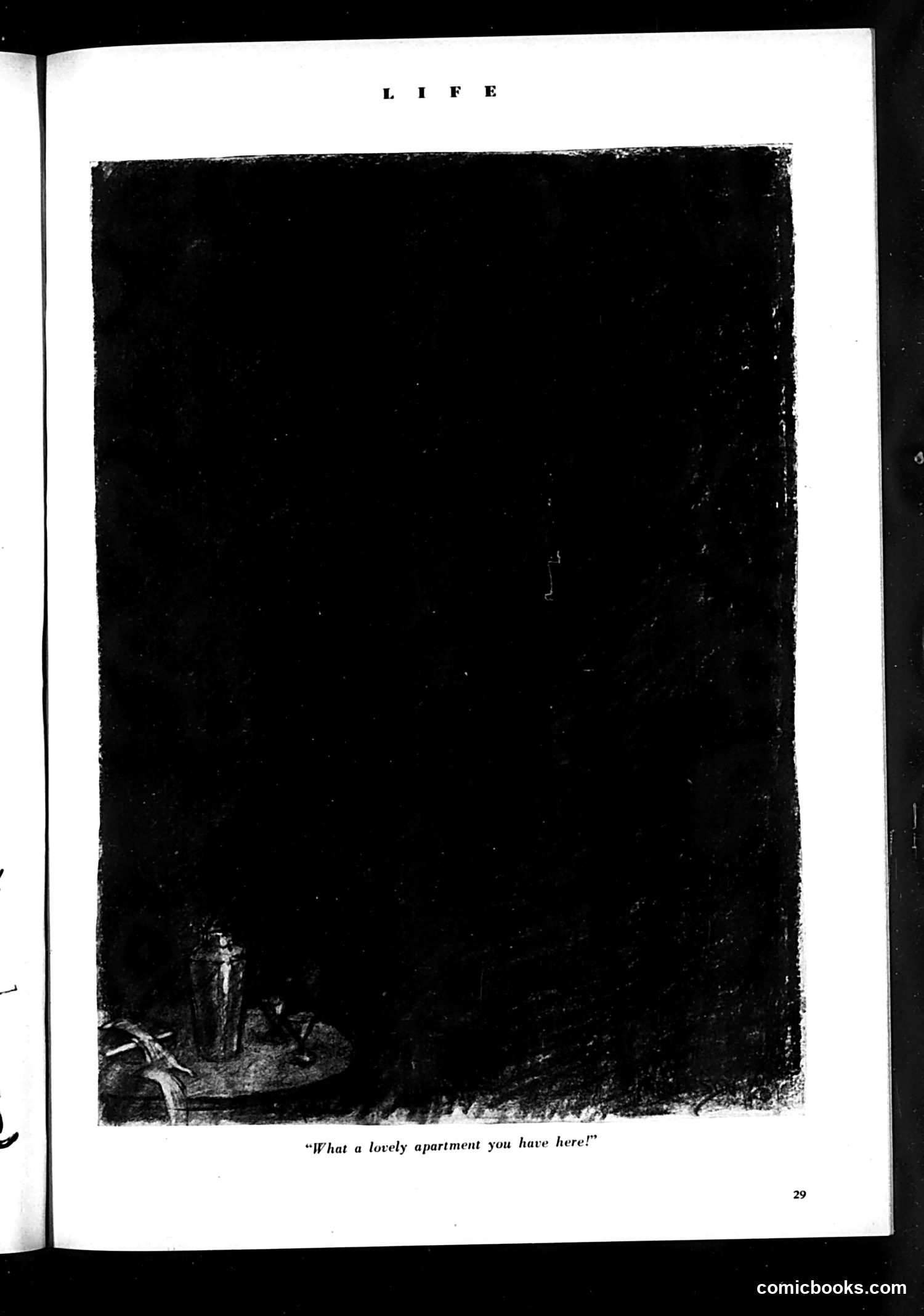
This page from *Life* magazine shows a single cartoon with minimal text. The image depicts a darkened interior space—appears to be an apartment—with a single figure visible in shadow at the bottom left. The caption reads: "What a lovely apartment you have here!" The satire appears to target either poor living conditions or the absurdity of polite social commentary in the face of obvious squalor. The joke likely hinges on the contrast between the speaker's courteous compliment and what the darkened, sparse setting actually suggests—either extreme poverty, neglect, or deliberate minimalism that would make such praise laughable or ironic. Without additional context about the magazine's date or surrounding articles, the specific social commentary remains unclear.
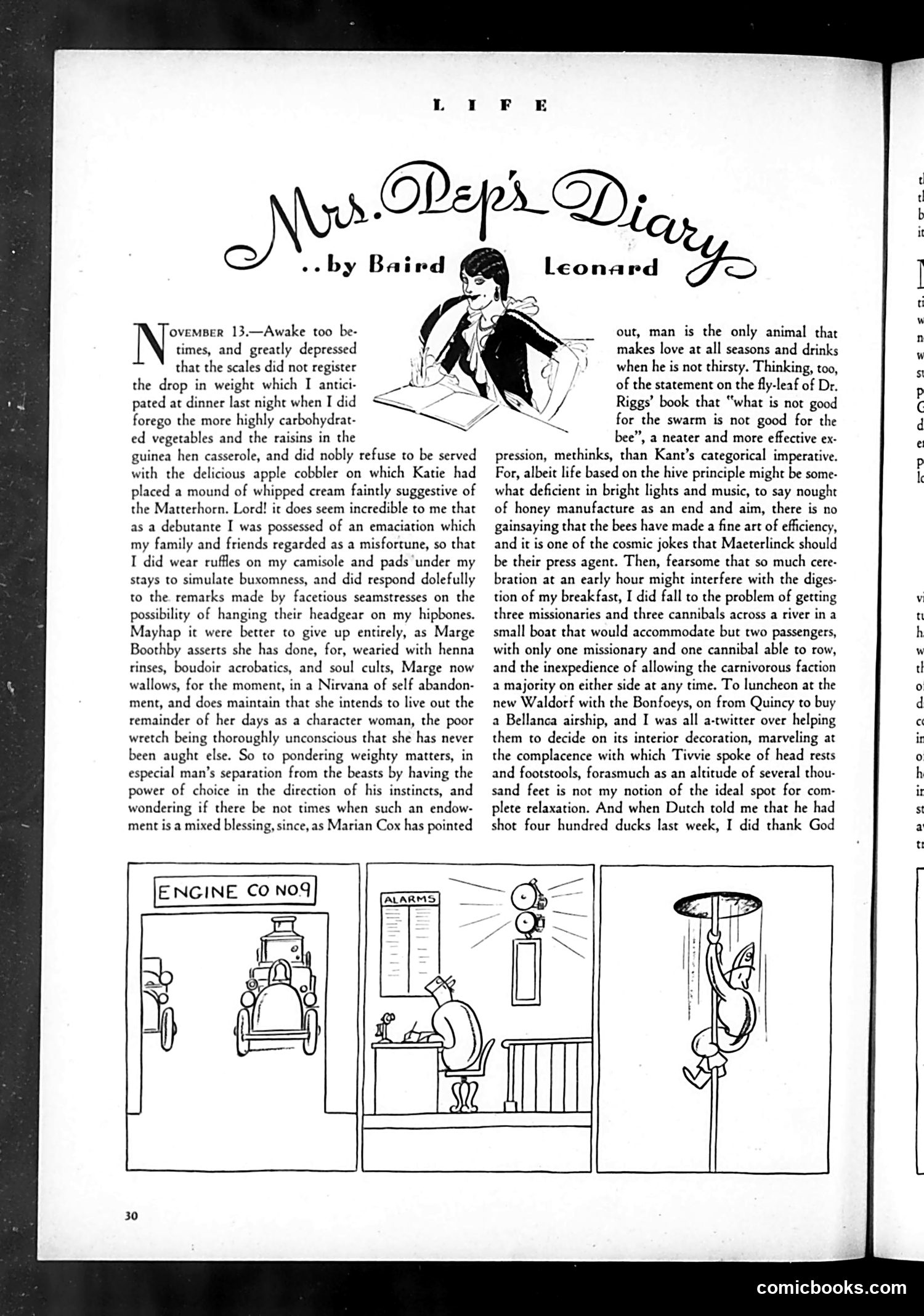
Mrs. Pep's Diary: A 1920s Society Column Satire This is a humorous diary entry by "Mrs. Peps" satirizing wealthy upper-class women of the 1920s. The author mocks: The subject: An anxious debutante obsessed with weight loss, who starved herself at dinner despite delicious food, then despaired the scales didn't register her sacrifice. The satire: The piece ridicules the shallow preoccupations of society women—dieting fads, "soul cults," beauty treatments ("henna rinses, boudoir acrobatics")—while juxtaposing them with pretentious intellectual references (Kant, Maeterlinck, Dr. Riggs) to expose the artificiality of their sophistication. The humor: The contrast between grandiose philosophical musings about human nature and trivial daily activities (shopping for airplane decorations, discussing duck hunts) demonstrates how these women appropriate intellectual discourse without genuine understanding. The three cartoons below appear to show domestic/social mishaps, reinforcing the comedic tone.
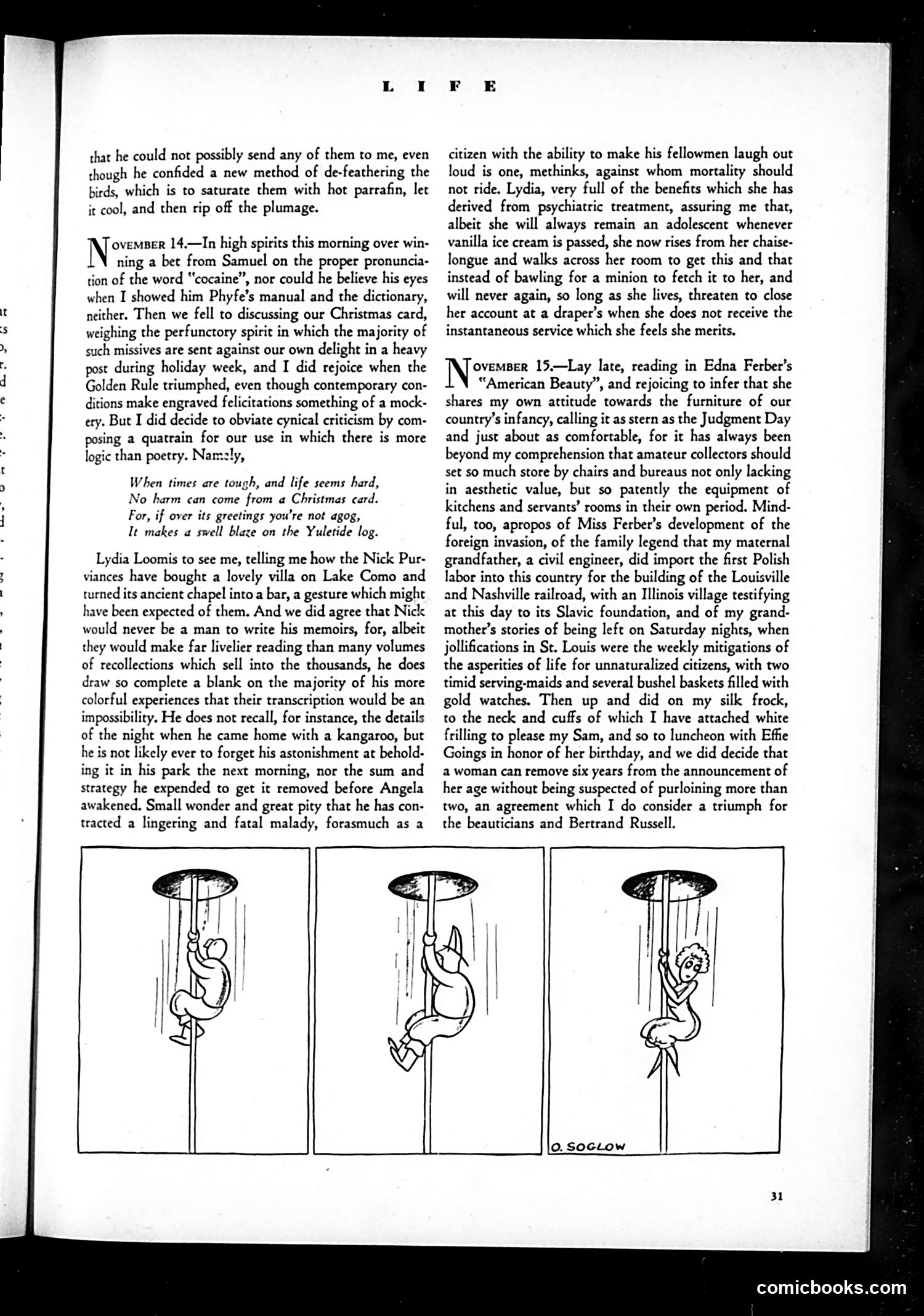
Life Magazine Cartoon Analysis This page from *Life* magazine contains a three-panel cartoon by O. Soglow (signed lower right) depicting a figure on a rope or cord descending from a ceiling fixture in three sequential poses—swinging, mid-descent, and ascending. The cartoon appears to illustrate physical comedy or slapstick humor involving someone being lowered or hoisted mechanically. The surrounding text is a diary-style column discussing social observations, including commentary on Christmas cards, wealthy acquaintances (the Purviances with their Italian villa), and period furniture collecting. The diary entries mention "cocaine" pronunciation and psychiatric treatment, reflecting 1920s-30s social preoccupations. The cartoon's specific satirical target remains unclear without additional context, though it likely comments on contemporary social situations or physical predicaments referenced in the accompanying text. The mechanical apparatus suggests either domestic inconvenience or absurdist humor typical of *Life*'s style.
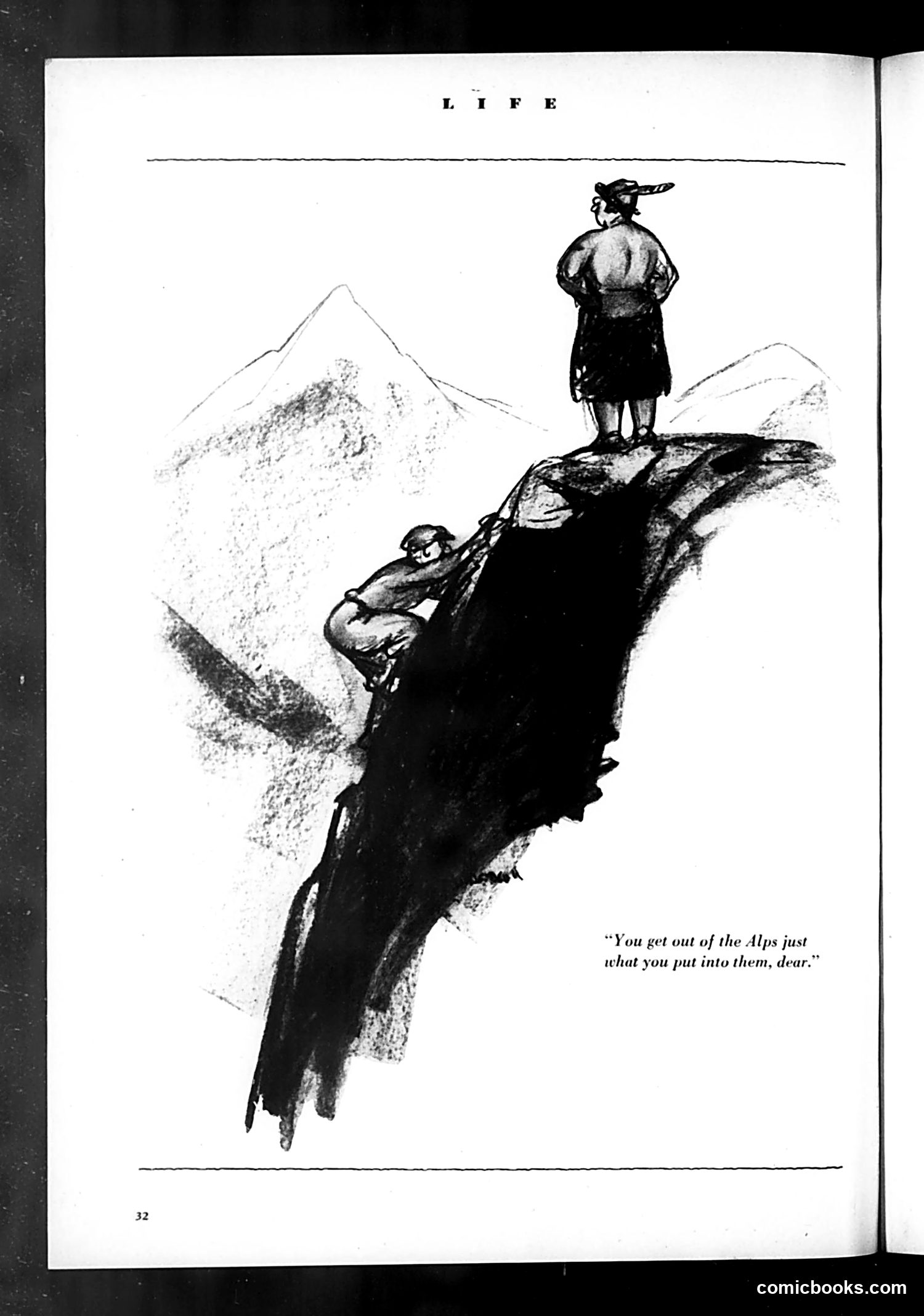
Analysis of Life Magazine Cartoon This cartoon illustrates a saying about effort and reward using Alpine mountaineering as a metaphor. The image shows two figures on a steep mountain peak: one person standing atop, surveying the vista with satisfaction, while another struggles below, clinging to the rocky slope. The caption—"You get out of the Alps just what you put into them, dear"—suggests that mountaineering (and by extension, life pursuits) rewards proportionally to one's effort and commitment. The standing figure represents successful ambition and perseverance, while the struggling figure depicts inadequate effort or preparation. This reflects early 20th-century Life magazine's typical moralizing satire about hard work, self-improvement, and social aspiration—common themes in American periodicals of that era.
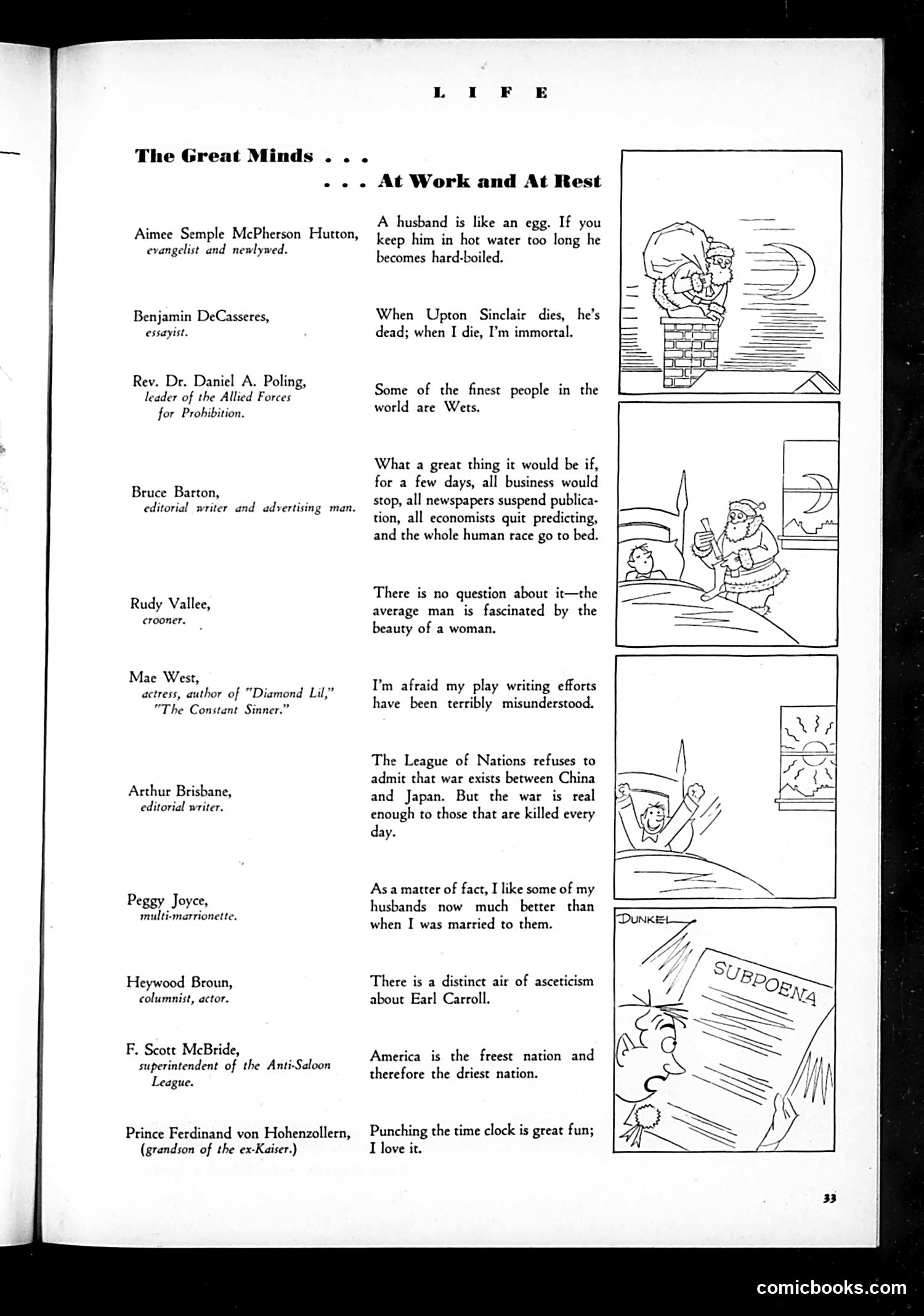
"The Great Minds... At Work and At Rest" This satirical feature pairs famous 1920s-30s celebrities with sardonic, often self-revealing quotations. The page mocks prominent public figures through mock-wisdom: evangelist Aimee Semple McPherson's quip about husbands becoming "hard-boiled," Peggy Joyce's admission she prefers some ex-husbands to current ones (referencing her notorious serial marriages), and Mae West's defensive claim about misunderstood playwriting. Key targets include Prohibition leaders (Rev. Poling, F. Scott McBride) undercut by Bruce Barton's and Benjamin DeCasseres's cynical observations, and Arthur Brisbane's jab at Prohibition's hypocrisy: "America is the freest nation and therefore the driest nation." The cartoons appear unrelated slice-of-life vignettes. The satire works through juxtaposition—famous names saying unexpectedly candid or foolish things, exposing vanity, hypocrisy, and self-contradiction among prominent figures of the era.
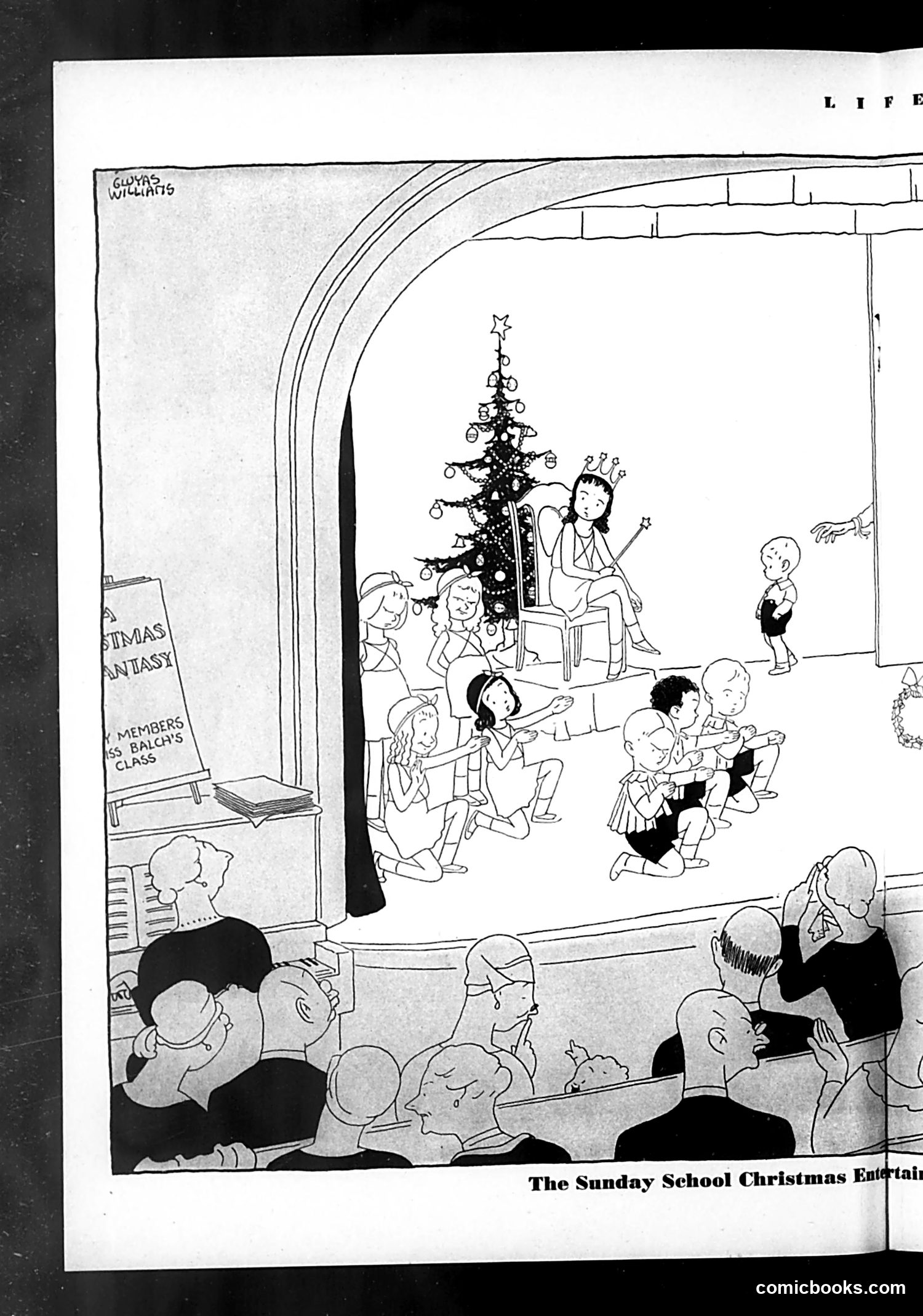
This illustration depicts a Sunday School Christmas entertainment—a common early 20th-century church social event. The scene shows children performing on stage before an audience of adults seated in what appears to be a church or school auditorium. On stage, a young girl wearing a crown sits beside a decorated Christmas tree, apparently playing a queen or similar character in a nativity or holiday pageant. Other children in various costumes perform around her. The audience members below watch intently, with their heads visible in silhouette. The cartoon gently satirizes the earnest sentimentality of these church performances and the adults' indulgent attention to children's amateur theatrical efforts—a familiar ritual of American religious and educational institutions of that era. The artist is credited as Gluyas Williams.
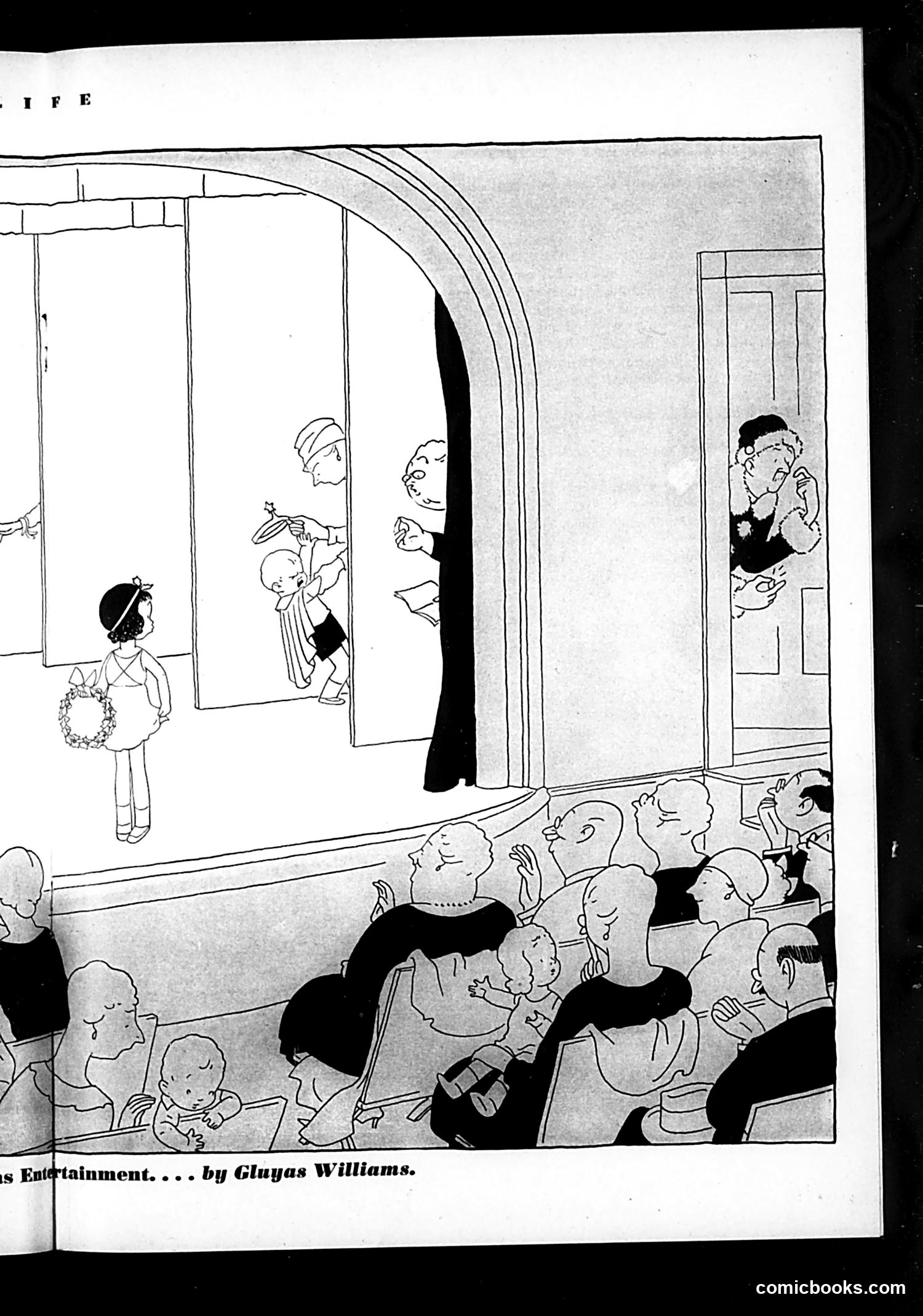
Analysis of Life Magazine Cartoon by Gluyas Williams This cartoon depicts a theatrical or entertainment venue scene. A woman in the foreground holds a wreath, appearing to be part of a stage performance or presentation. On stage, figures in various costumes are visible—including what appears to be a child performer, adults in formal dress, and a tall figure in black (possibly meant to be dramatic or villainous). The audience below watches intently. The satire likely mocks pretentious or overwrought theatrical productions, possibly satirizing the entertainment industry's tendency toward melodrama or excessive spectacle. The specific identities of performers remain unclear from the image alone, but the cartoon's humor derives from contrasting the performers' earnest theatrical gestures with audience reactions, suggesting commentary on popular entertainment tastes or theatrical conventions of the era.
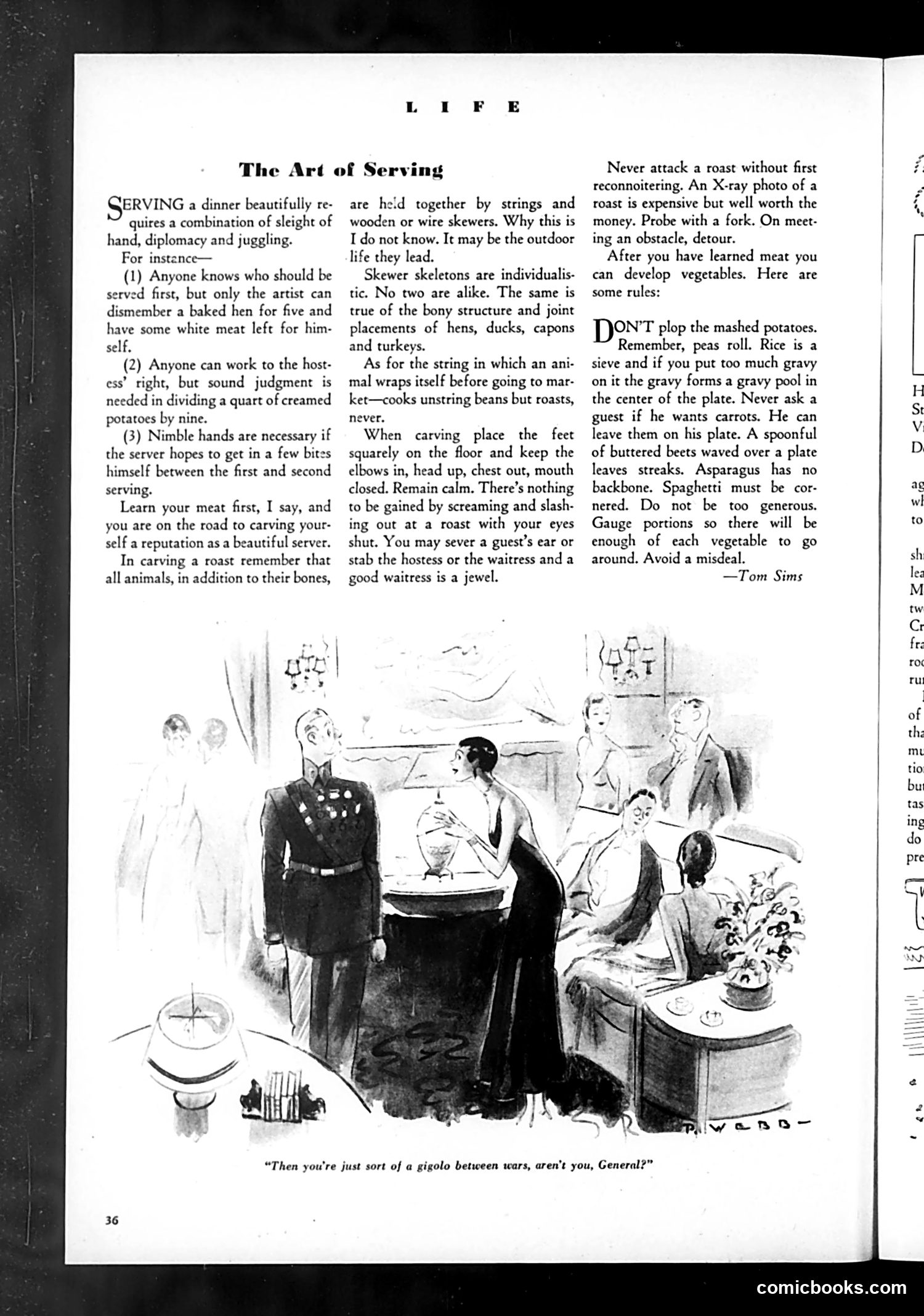
"The Art of Serving" — Life Magazine Satire This page combines practical dining etiquette instruction with satirical humor about servants and household dynamics in the early-to-mid 20th century. The main cartoon depicts a formal dinner party where a waitress serves a military officer (identifiable by his dress uniform and medals). The caption—"Then you're just sort of a gigolo between wars, aren't you, General?"—is a flirtatious jab, suggesting the officer's peacetime social role is frivolous compared to his wartime duties. It's a gentle mockery of military vanity. The accompanying text humorously addresses servants' and servers' real challenges: carving meat skillfully, portioning food fairly, and sneaking bites between courses. The satirical tone lies in treating these practical servant tasks as an "art form" requiring diplomacy and finesse—elevating mundane work while gently mocking both the pretensions of formal dining and the exploitation of service workers who must serve others while hungry themselves. The byline credits Tom Sims as author.
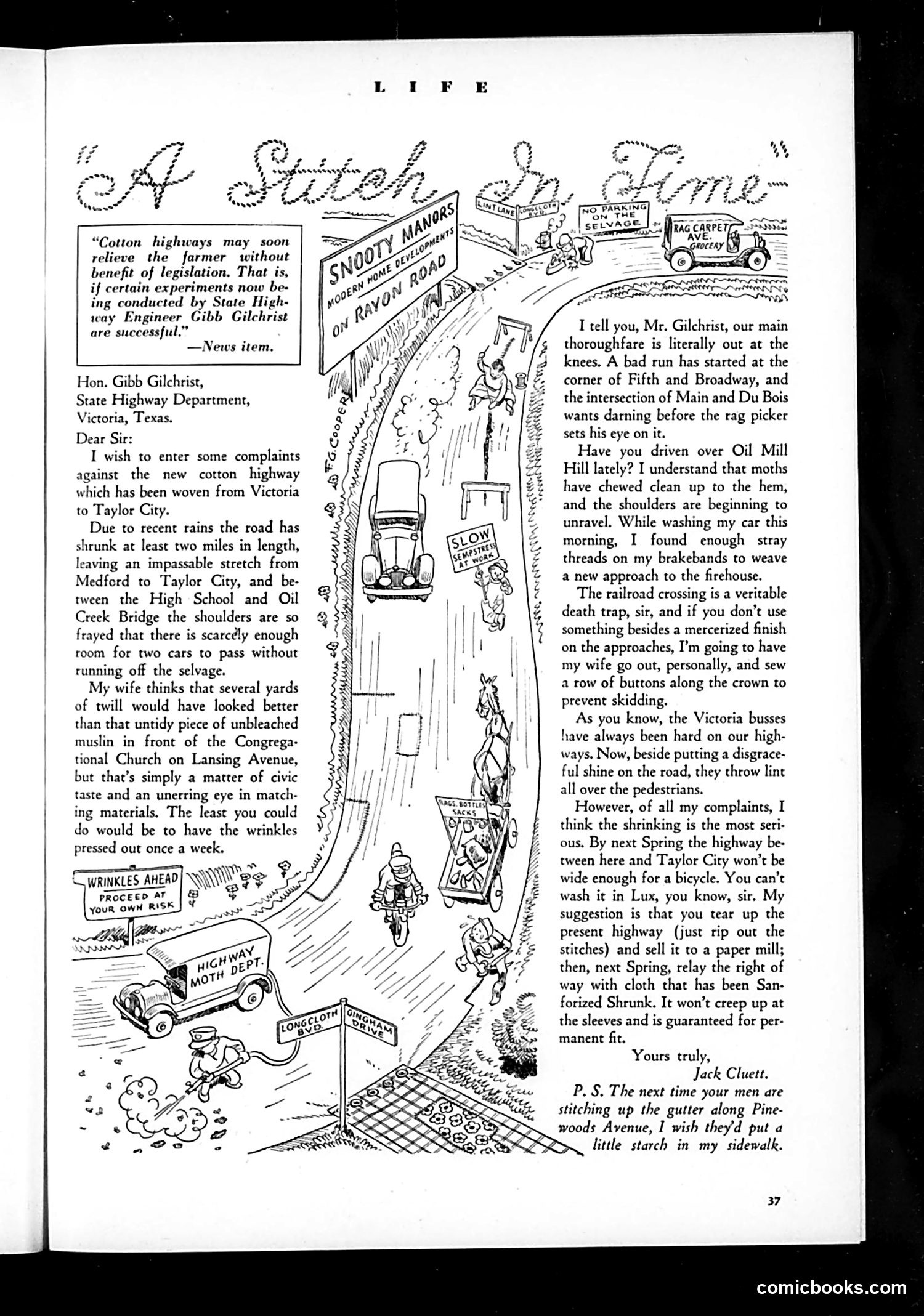
Explanation for Modern Readers This satirical piece mocks an actual 1920s experiment by Texas State Highway Engineer Gibb Gilchrist to build roads from cotton fibers. The letter, purportedly from "Jack Cluett," treats the cotton highway as if it were actual fabric, describing problems in textile terminology: shrinkage, fraying, wrinkles, lint shedding, and unraveling. The humor lies in the absurdity of the premise—a road made of cloth would obviously fail catastrophically. The cartoonist uses this extended metaphor to ridicule both the impractical experiment and the deteriorating actual roads in Victoria, Texas, which are genuinely poor. By describing real road damage (potholes, shoulder erosion, dangerous crossings) in fabric-care language, the satire simultaneously mocks the government's wasteful experimentation while highlighting the serious infrastructure problems residents actually face. The accompanying cartoon shows the "cotton highway" with actual fabric imagery alongside normal traffic.
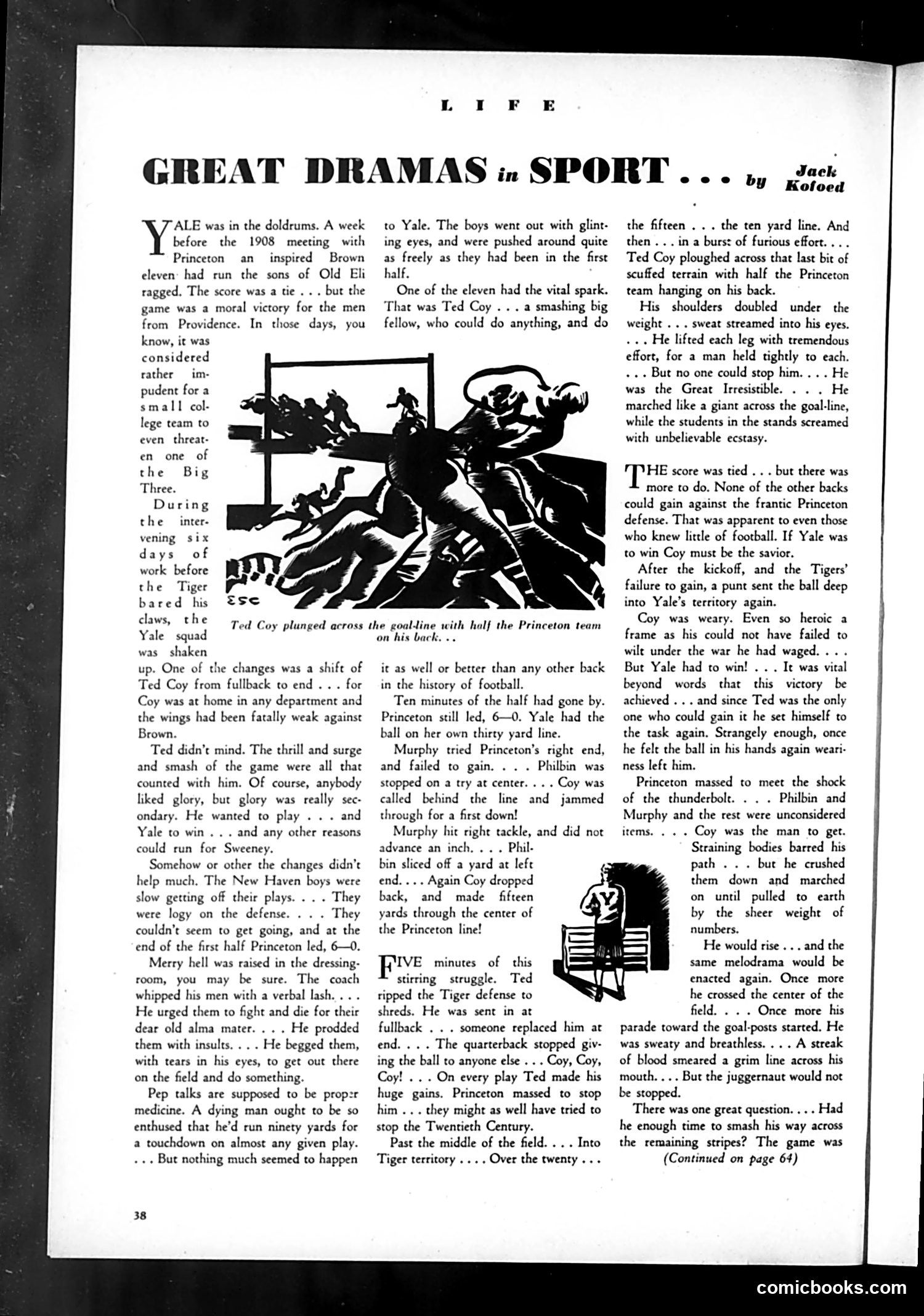
"Great Dramas in Sport: Ted Coy" (Life Magazine, 1908) This article celebrates Ted Coy, Yale's football star, during the 1908 Yale-Princeton game. The narrative uses dramatic sports writing to lionize Coy as a superhuman athlete—"The Great Irresistible"—who single-handedly transforms Yale's losing effort into a tie by plunging repeatedly through Princeton's defense. The large dramatic illustration depicts Coy being tackled by multiple Princeton players as he crosses the goal line, visually emphasizing his determination against overwhelming opposition. For modern readers: this represents early-1900s college football hero-worship, when individual athletes were mythologized in popular magazines. The "Big Three" colleges (Yale, Harvard, Princeton) dominated American football discourse. The piece illustrates how sports journalism of this era used romanticized, almost epic language to describe athletic achievement—a precursor to modern sports celebrity culture.
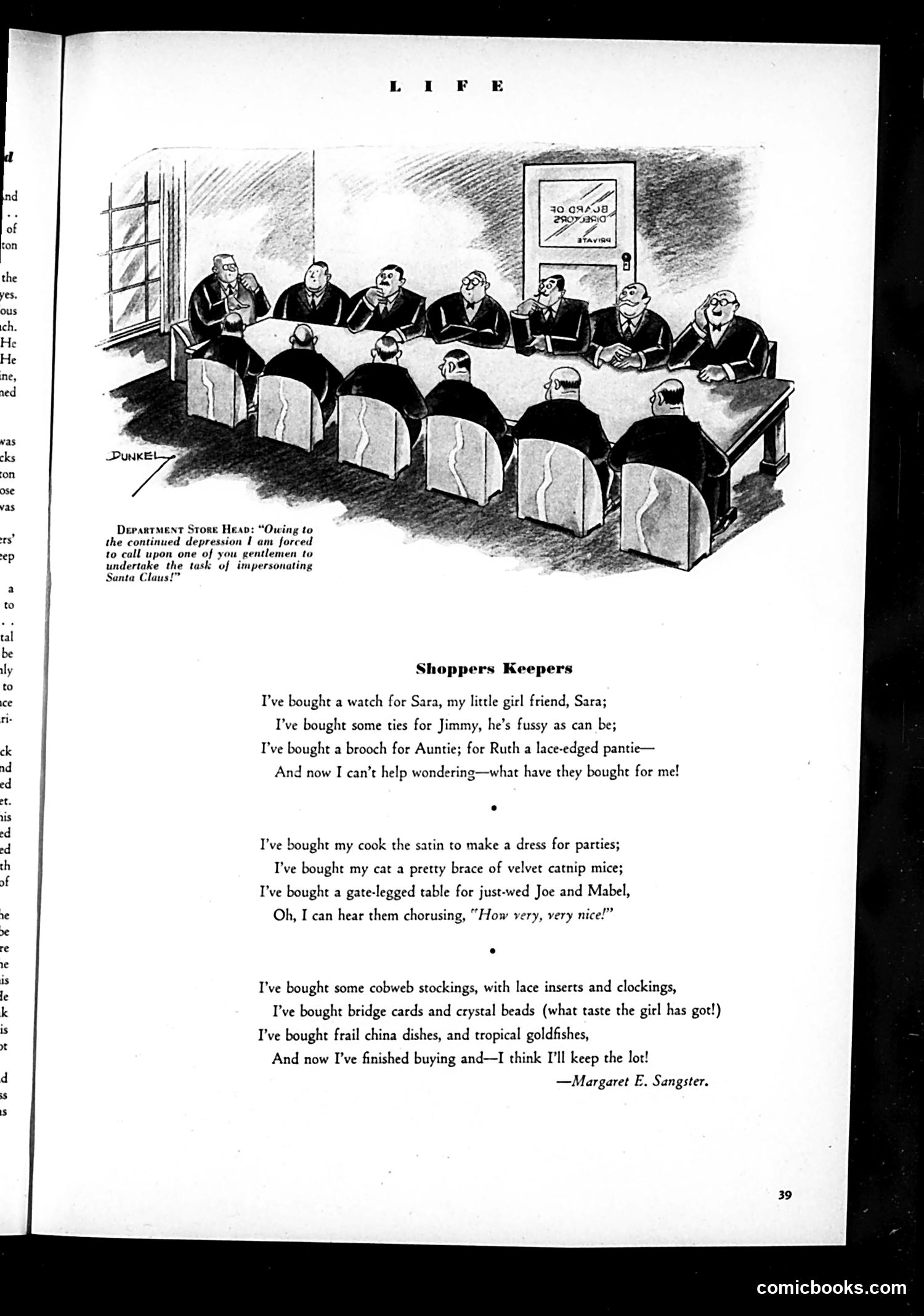
Explanation for Modern Readers The Cartoon: During the Great Depression, a department store manager forces an employee to play Santa Claus—a darkly humorous comment on economic hardship. The joke: even Santa has become a grim necessity rather than joyful tradition. The Poem "Shoppers Keepers": A satirical piece about holiday gift-giving anxiety and consumerism. The speaker buys lavish gifts for others (a watch, ties, brooch, satin fabric, furniture, jewelry, china) while anxiously wondering what they'll receive in return. The punchline subverts expectations: having spent all their money on others, they've "finished buying" and sarcastically decide to "keep the lot"—meaning they have nothing left to give themselves, or they're selfishly reconsidering their generosity. The satire targets Depression-era consumer culture and the social pressure of gift-giving, suggesting both financial strain and materialistic anxiety during hard times.
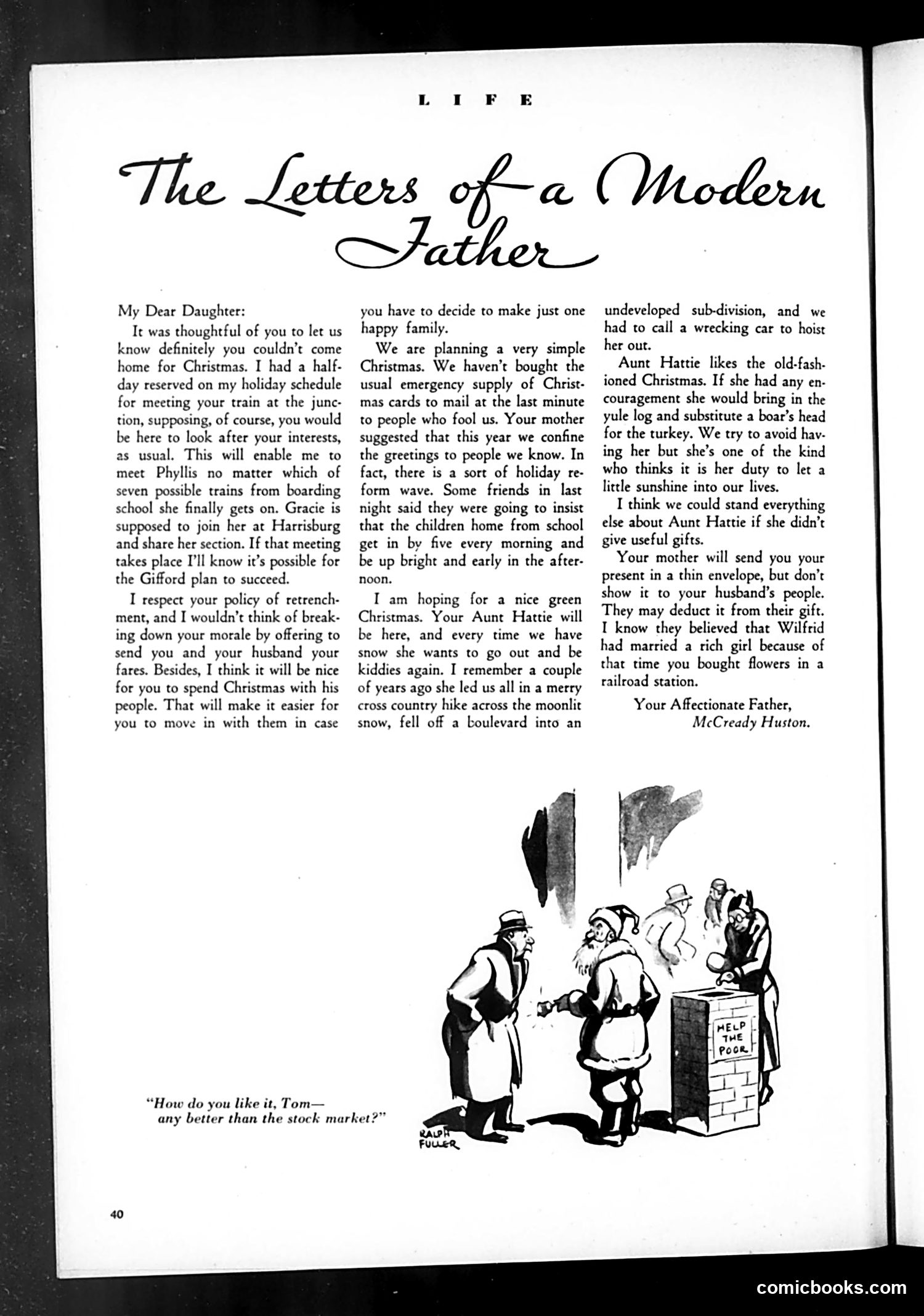
"The Letters of a Modern Father" This satirical piece from Life magazine presents a father's letter to his daughter about a Depression-era Christmas, accompanied by a cartoon about economic hardship. The Letter's Satire: The father's tone is ostensibly understanding but dripping with passive-aggressive complaint. He claims respect for her "retrenchment" (economic cutbacks) while highlighting his disappointment about her absence and hinting at financial strain ("won't think of breaking down your morale by offering to send you...your fares"). The humor lies in exposing middle-class anxiety about appearances—worrying about appearing poor to in-laws, sending gifts in "thin envelopes," the awkward simplicity of a wartime Christmas. The Cartoon: Below depicts men discussing economic hardship, with one asking another "How do you like it, Tom—any better than the stock market?" This references the devastating 1929 stock market crash that triggered the Great Depression. The "Help the Poor" sign suggests widespread poverty. Context: This page satirizes how Americans maintained social pretense despite economic devastation during the 1930s Depression, when financial collapse destroyed fortunes and Christmas gift-giving became a marker of class status.
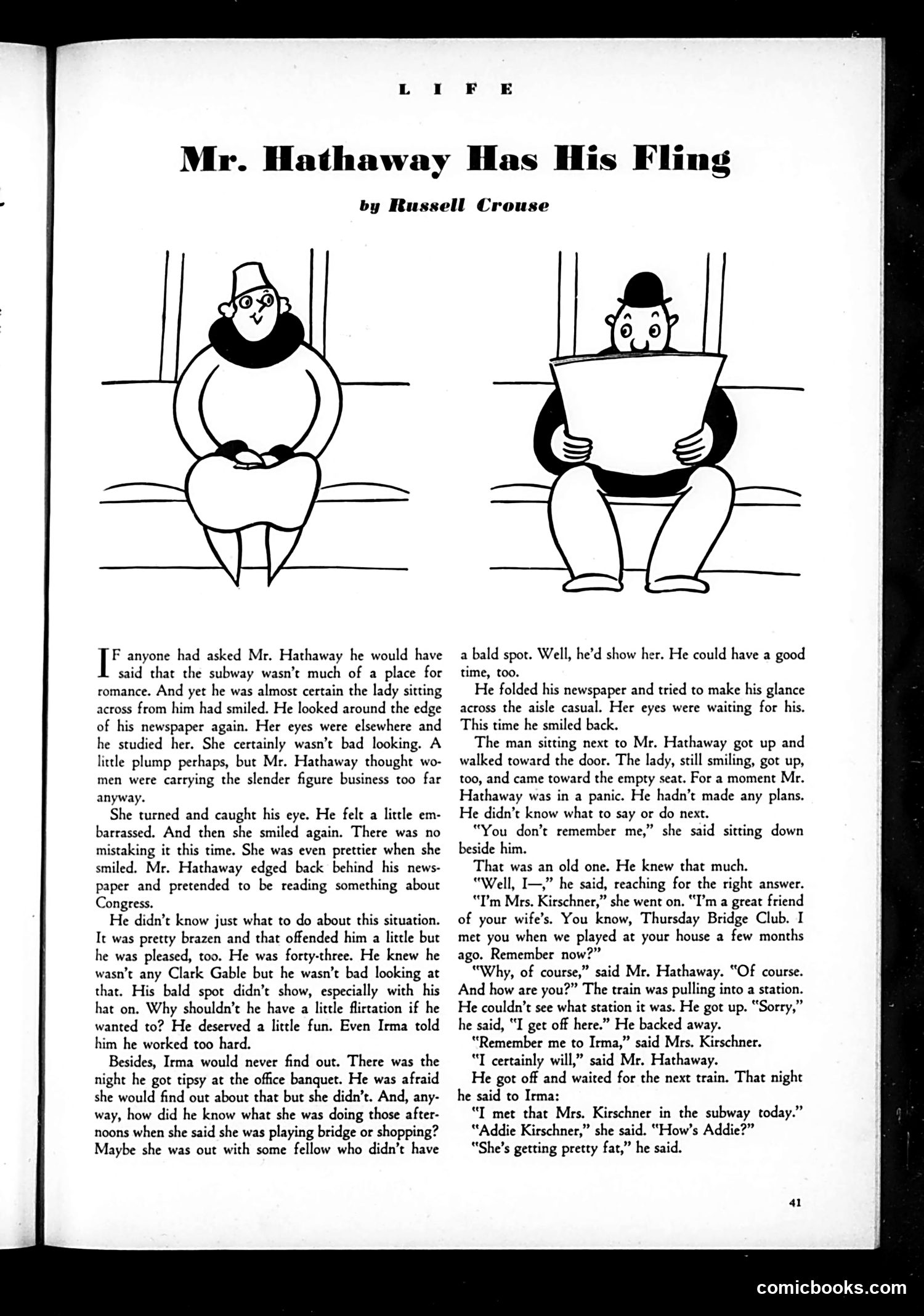
"Mr. Hathaway Has His Fling" This is a humorous short story (not a political cartoon) by Russell Crouse about suburban infidelity and its comic deflation. The Setup: Mr. Hathaway, a middle-aged man with a bald spot, notices an attractive woman smiling at him on the subway. He fantasizes about having a romantic "fling," justifying it by suspecting his wife Irma of her own secret activities. The Joke: When the woman approaches and sits beside him, she reveals herself as Mrs. Kirschner, a friend of his wife's from their bridge club. Mortified, he immediately flees at the next station. The Point: The satire mocks the self-deception of middle-aged men who imagine themselves as romantic figures despite their ordinariness. Hathaway's brief fantasy of infidelity collapses instantly when confronted with reality. His parting insult about the woman getting "pretty fat" shows petty defensiveness—deflecting his embarrassment onto her appearance. The piece satirizes both male vanity and the mundane suburban world these characters inhabit.
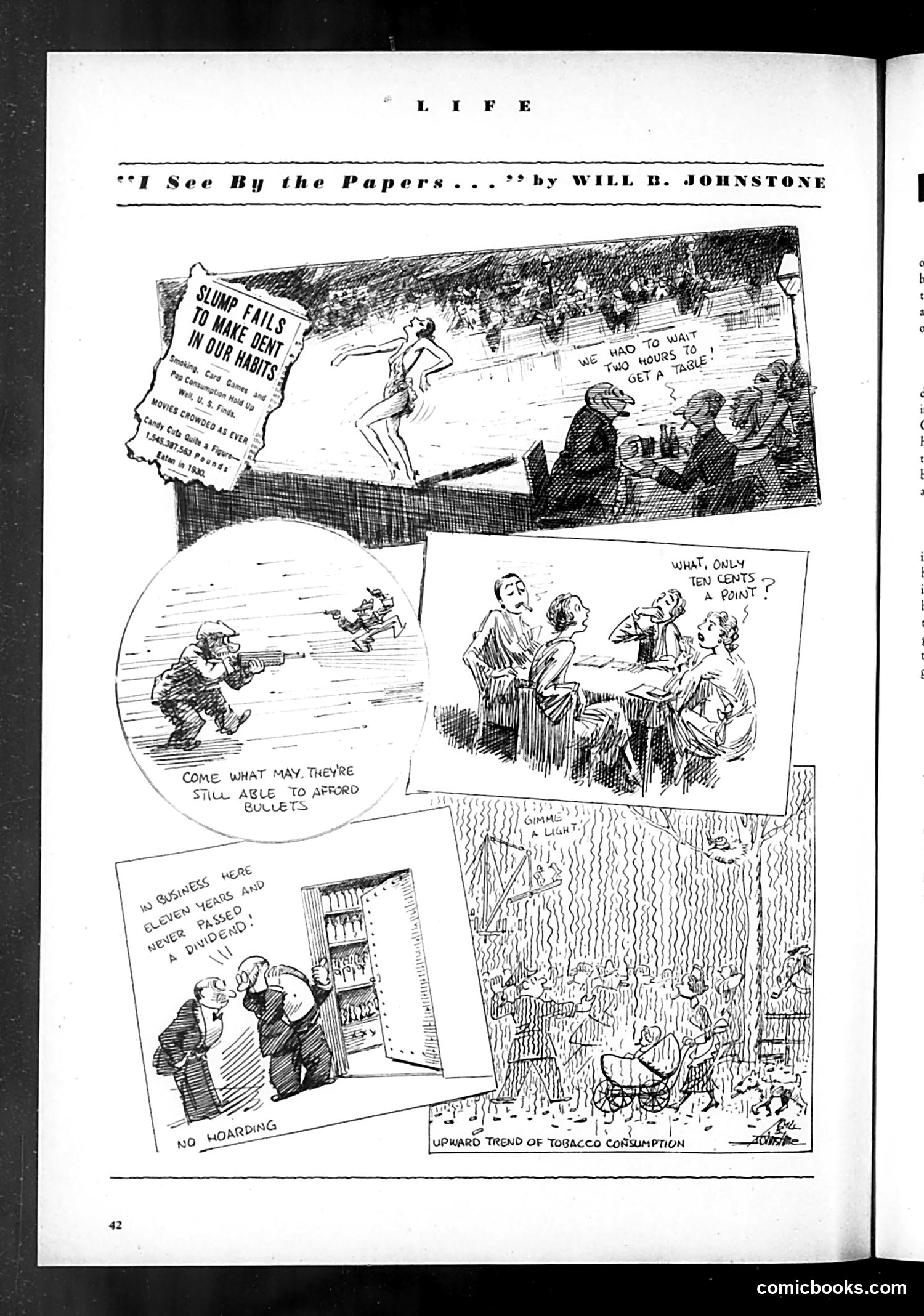
"I See By the Papers" by Will B. Johnstone This satirical page critiques American social problems through interconnected vignettes: Top panel: A swimmer advertises "slum fails to make dent in our habits," suggesting wealthy indifference to poverty. Left circle: A gunman notes the wealthy "still able to afford bullets"—likely referencing crime or violence amid economic inequality. Upper right: Restaurant patrons complain about wait times, highlighting class contrast. Lower left: "No hoarding" sign comments on business practices during apparent scarcity. Bottom panel: "Upward Trend of Tobacco Consumption" depicts crowded, poor conditions while consumption rises—satirizing how vice persists despite poverty. The overall message critiques how wealth insulates the privileged from social problems, while vice consumption increases regardless of hardship. The cartoons suggest systemic failure to address inequality.
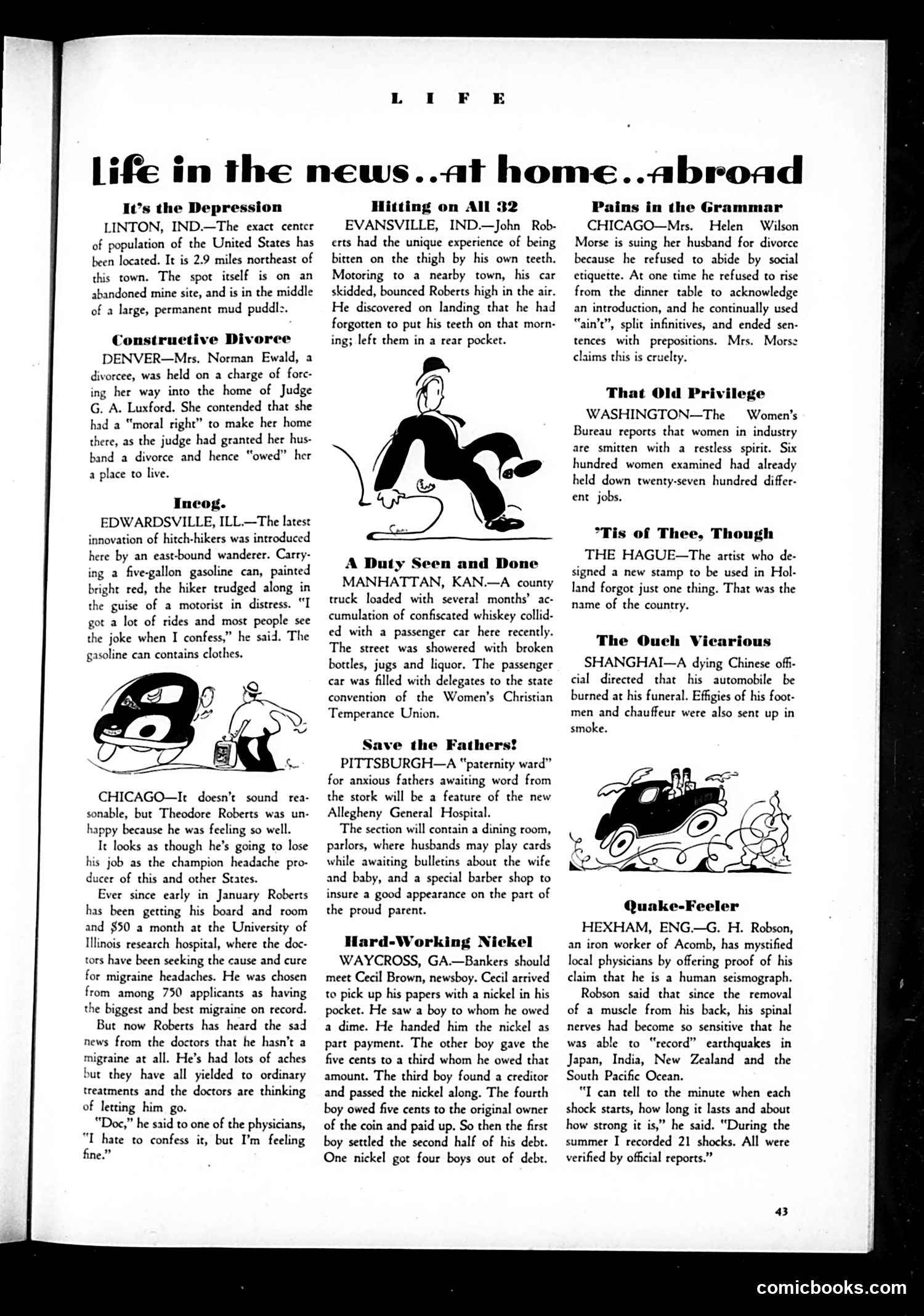
Life Magazine Humor Page Analysis This 1930s Life page collects Depression-era anecdotes with light satirical cartoons. Key items: "It's the Depression": The geometric center of U.S. population sits in an abandoned mine's mud puddle—ironic commentary on American geography and economic decay. "Constructive Divorce": A woman claims a "moral right" to live in a judge's home after he divorced her husband, absurdly literalizing legal obligations during economically desperate times. "Hitting on All 32": A man's dentures fall from his pocket during a car accident and accidentally bite his thigh—slapstick misfortune. "A Duty Seen and Done": Prohibition irony—a truck of confiscated whiskey crashes into Women's Christian Temperance Union delegates, showering them with liquor they oppose. "Save the Fathers!": A hospital creates a "paternity ward" with lounges and barber shops for waiting fathers—gently mocking male anxiety during childbirth. The cartoons (simple line drawings of hapless figures) underscore the humorous tone. Overall, the page presents Depression hardships through comedic human-interest stories, mixing absurdity with social commentary.
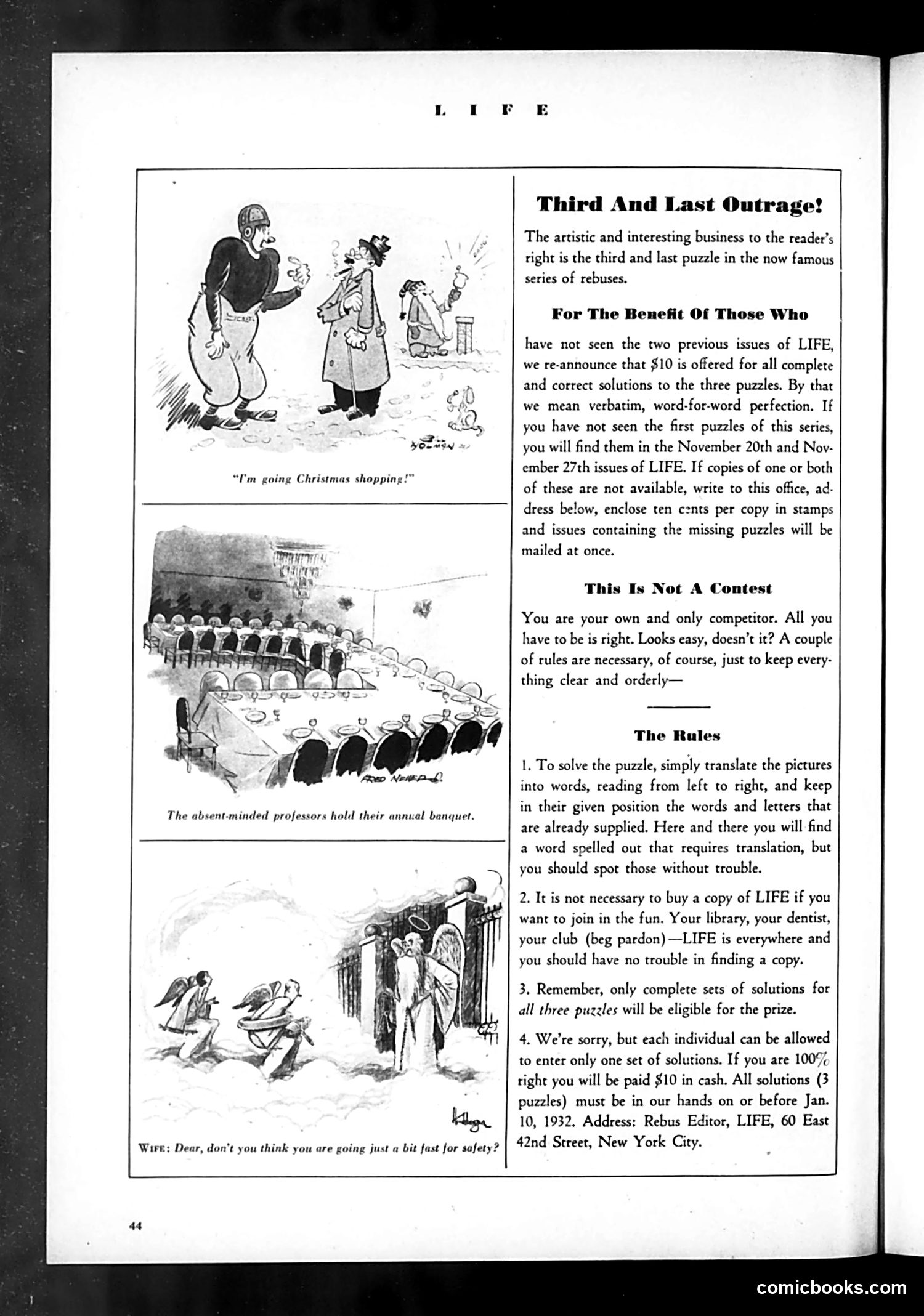
Life Magazine Rebus Puzzle Page (circa 1931) This page announces the final installment of a three-part visual puzzle series in *Life* magazine. Readers must translate the cartoon illustrations into words—a "rebus" puzzle format popular in early 20th-century publications. The four cartoons shown contain visual puns and wordplay meant to represent common phrases or expressions. The top cartoon depicts a man and woman with shopping bags; another shows absent-minded professors at a banquet; another features figures on what appears to be a ledge or precipice. The magazine offers a $10 cash prize (substantial in 1931) for correct solutions to all three puzzles, requiring word-for-word accuracy. The puzzle emphasizes accessibility—readers needn't buy *Life*; library or borrowed copies suffice. This was a common engagement mechanism for magazines, encouraging repeated reading and community participation while requiring no purchase to enter.
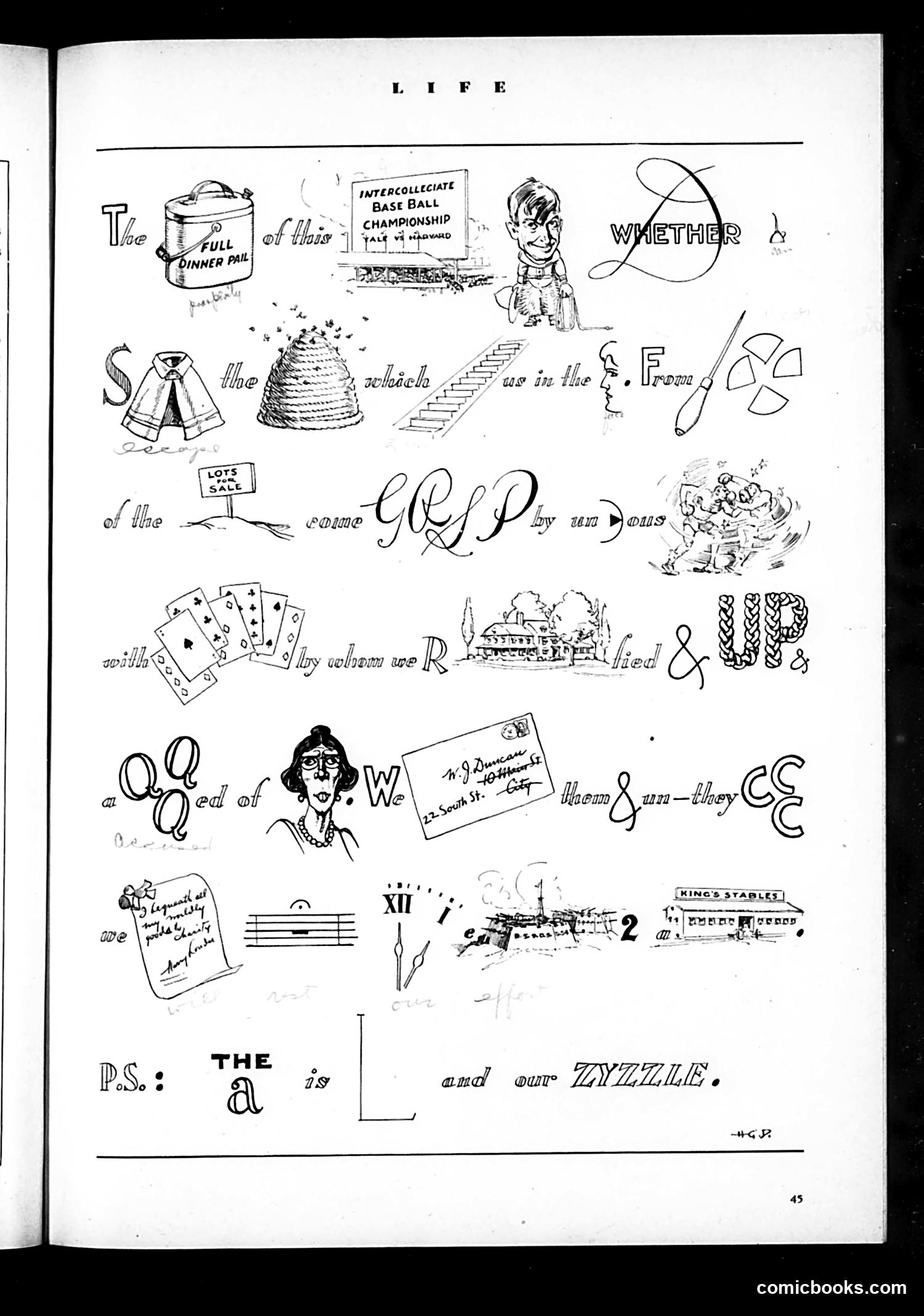
Explanation for Modern Readers This appears to be a rebus puzzle or word-game page from Life magazine's "Life" section rather than traditional political satire. The cartoonist uses visual puns and drawings to spell out phrases or sentences. Visible elements include: - "The Dinner Pail" (cooking pot) - "Intercollegiate Base Ball Championship" - Various illustrations (clothing, beehive, stairs, profile, playing cards, train, address envelope) - Playing card suits and the letters "R" and "U" - A woman's face illustration - Roman numeral "XIII" - Text fragments like "Whether," "From," "GRRP," "QQ," and "CC" The page reads as interconnected visual riddles meant to be decoded by readers—a popular parlor game format of the era. The final line reads "P.S.: THE a IS and our ZUZZLE" (likely "PUZZLE"), suggesting this entire page IS the puzzle itself that readers are meant to solve. Context: These rebus puzzles were common entertainment in early 20th-century American magazines.
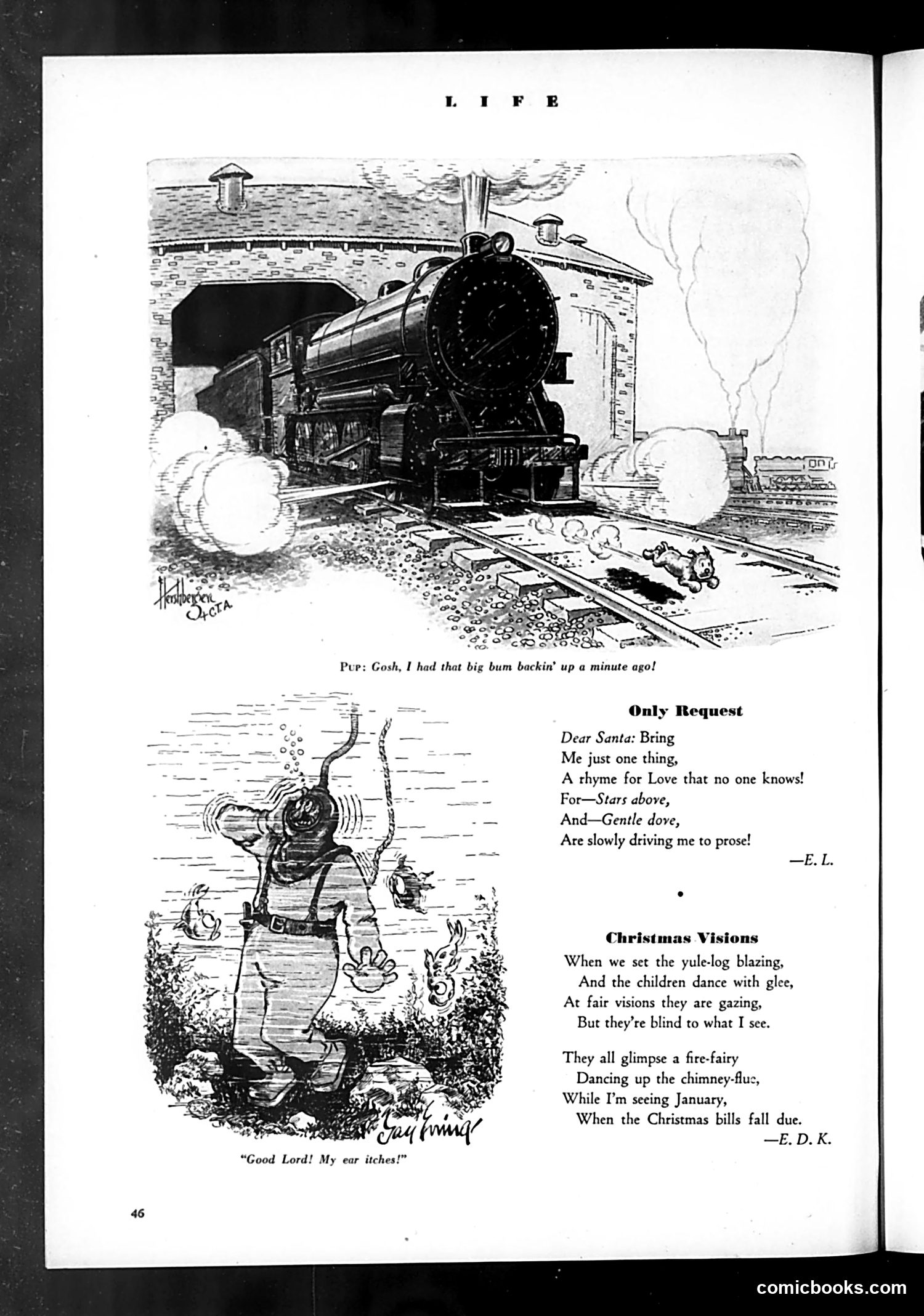
Page 46 Analysis: Life Magazine Humor This page contains three unrelated humorous pieces typical of early-to-mid 20th century Life magazine: 1. Top cartoon: A steam locomotive emerges from a tunnel while a small dog nearby reacts with alarm. The caption plays on the visual—the dog's ear itches from the loud noise, creating a simple physical comedy joke. 2. "Only Request": A poem (attributed E.L.) humorously portrays a writer struggling to find a rhyme for "love" in poetry, feeling driven toward prose instead. It's gentle literary self-mockery. 3. "Christmas Visions": A satirical poem (E.D.K.) contrasts children's innocent holiday joy with an adult's cynical awareness of post-Christmas financial burden—specifically January bills. The humor derives from the gap between festive sentiment and economic reality, a relatable joke for Depression-era or post-war readers facing genuine financial stress.
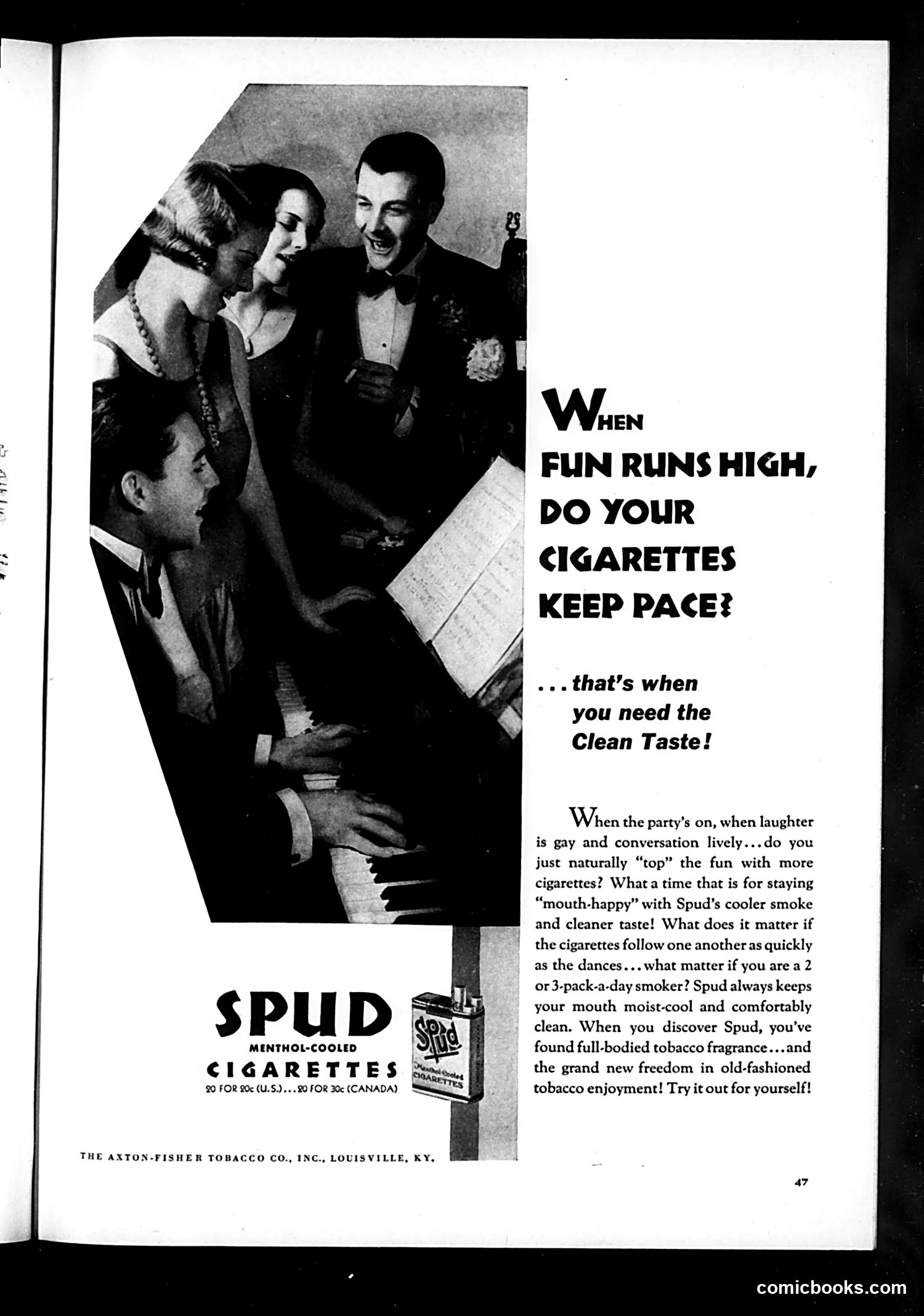
Analysis: Spud Cigarettes Advertisement This is a cigarette advertisement, not satire or political commentary. It depicts a social scene—a party or gathering where well-dressed people are enjoying themselves, with one man at a piano. The ad's pitch is straightforward: Spud menthol cigarettes are marketed as the ideal companion for social fun. The copy suggests that heavy smoking ("2 or 3-pack-a-day") is perfectly normal and should "keep pace" with party enjoyment. The cigarette is sold on claims of "cleaner taste" and keeping the mouth "moist-cool and comfortably clean"—language designed to address smokers' mild discomfort about tobacco use. Modern context: This advertisement normalizes heavy smoking as aspirational lifestyle behavior tied to social sophistication and leisure. The casual mention of heavy daily consumption would be shocking to modern readers; such claims are now illegal. The ad exemplifies pre-health-warning tobacco marketing that targeted social anxiety and peer pressure.
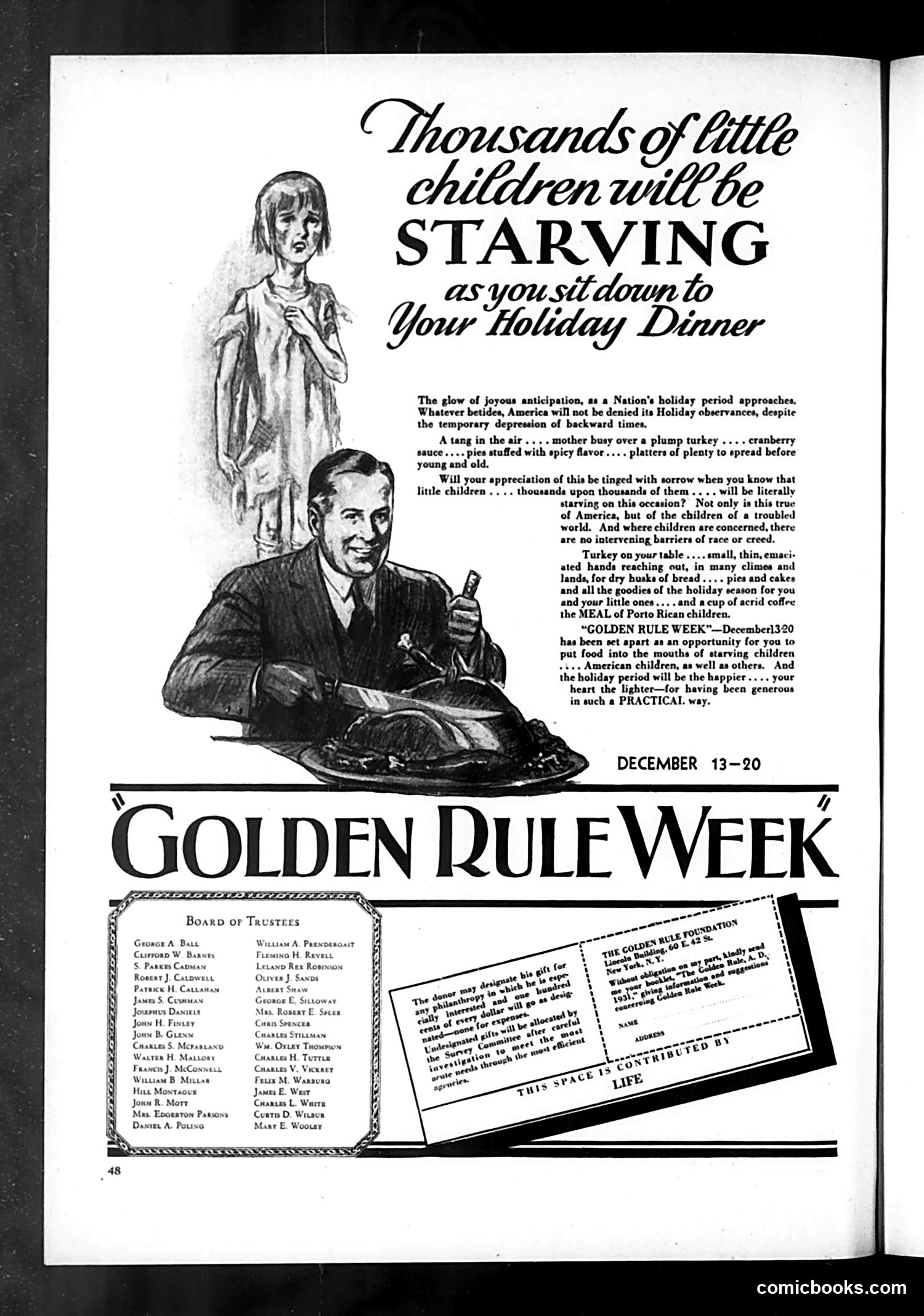
Golden Rule Week Charity Appeal (1920) This is a charitable advertisement, not political satire. It promotes "Golden Rule Week" (December 13-20), a fundraising campaign to feed starving children during the 1920 holiday season. The appeal uses emotional contrast: a well-fed man sitting down to a lavish turkey dinner while a starving child stands nearby in rags. The text explicitly states thousands of children—American and international (specifically mentioning Porto Rican children)—will be literally starving during Christmas. The "Golden Rule" reference (treating others as you'd wish to be treated) frames charitable giving as a moral obligation. The campaign asks donors to contribute food for hungry children, making holiday generosity "practical" rather than sentimental. The Board of Trustees listed represents prominent donors legitimizing the cause. This reflects post-WWI humanitarian concerns about global poverty and childhood welfare.
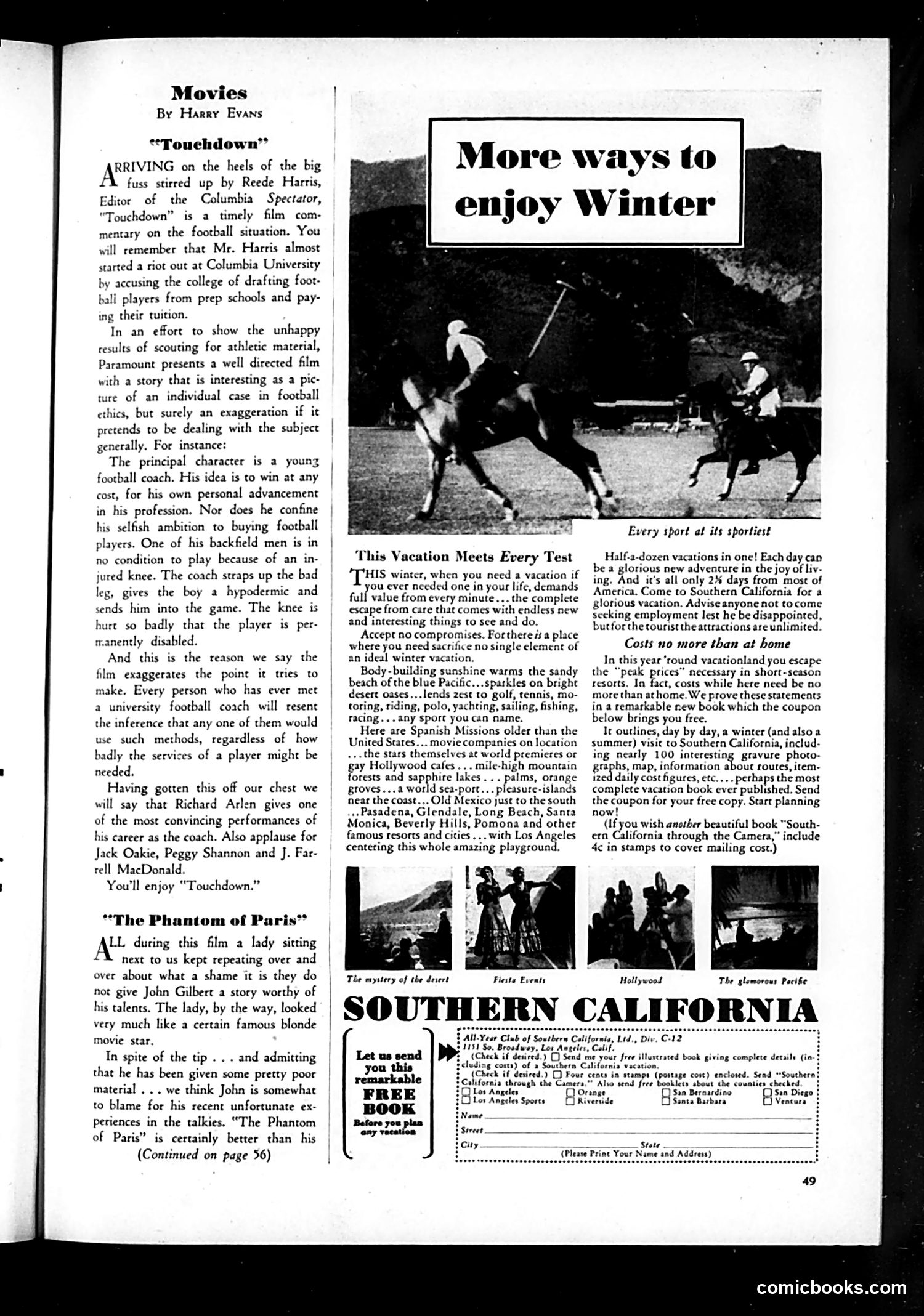
Page 49 Analysis: Life Magazine Movie Reviews and Travel Advertisement Movie Reviews Section: Harry Evans reviews two films. "Touchdown" critiques a Paramount film about college football ethics, referencing recent controversy at Columbia University where editor Reede Harris accused the college of illegally recruiting prep school players and paying tuition. The film depicts an unethical coach who injures a player through negligence. Evans argues the film exaggerates—suggesting no real coach would behave so recklessly—though he praises lead actor Richard Arlen's performance. The brief "Phantom of Paris" review suggests actor John Gilbert deserves better material for talking pictures, though Evans notes Gilbert bears some blame for his recent career difficulties. Advertisement Section: The bottom half is a large travel advertisement for Southern California, promoting winter vacation activities (golf, tennis, horseback riding, sailing, fishing) amid Spanish missions, movie studios, and exotic locations. It includes a tear-out coupon requesting a free vacation book.
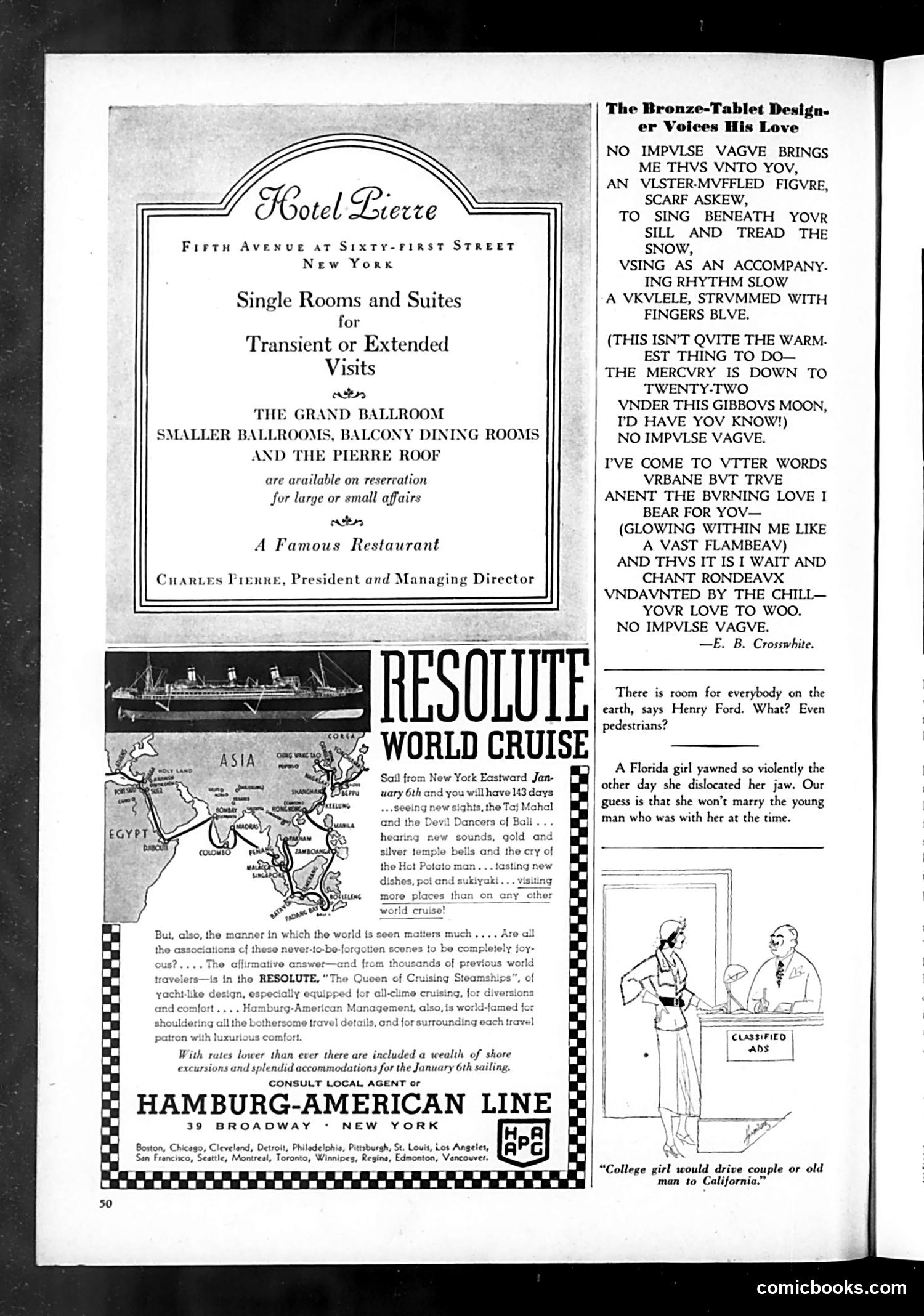
Explanation for Modern Readers This page is primarily advertisements (Hotel Pierre, Hamburg-American cruise line) with a few humorous items interspersed. The main joke content includes: "The Bronze-Tablet Designer Voices His Love" — A satirical poem by E.B. Crosswhite mocking overwrought romantic poetry. The speaker serenades a woman outside her window in freezing weather (20-degree temperatures), using affected, archaic language ("VAGVE," "THVS," "VKVLELE") and pretentious poetic forms (rondeaux). The joke is that despite romanticizing his passion as a "vast flambeav" [sic], he's actually miserable in the cold—undermining the sincere sentiment he claims. Henry Ford quote: A brief joke referencing Ford's famous statement about mass production creating space for everyone, sardonically asking whether pedestrians count—likely a jab at automobile culture's dangers to foot traffic. The classified ad shows a woman seeking a driver for cross-country travel, a straightforward personal ad with no apparent satirical angle. Overall, this is a typical Life magazine page mixing commercial advertising with light social satire.
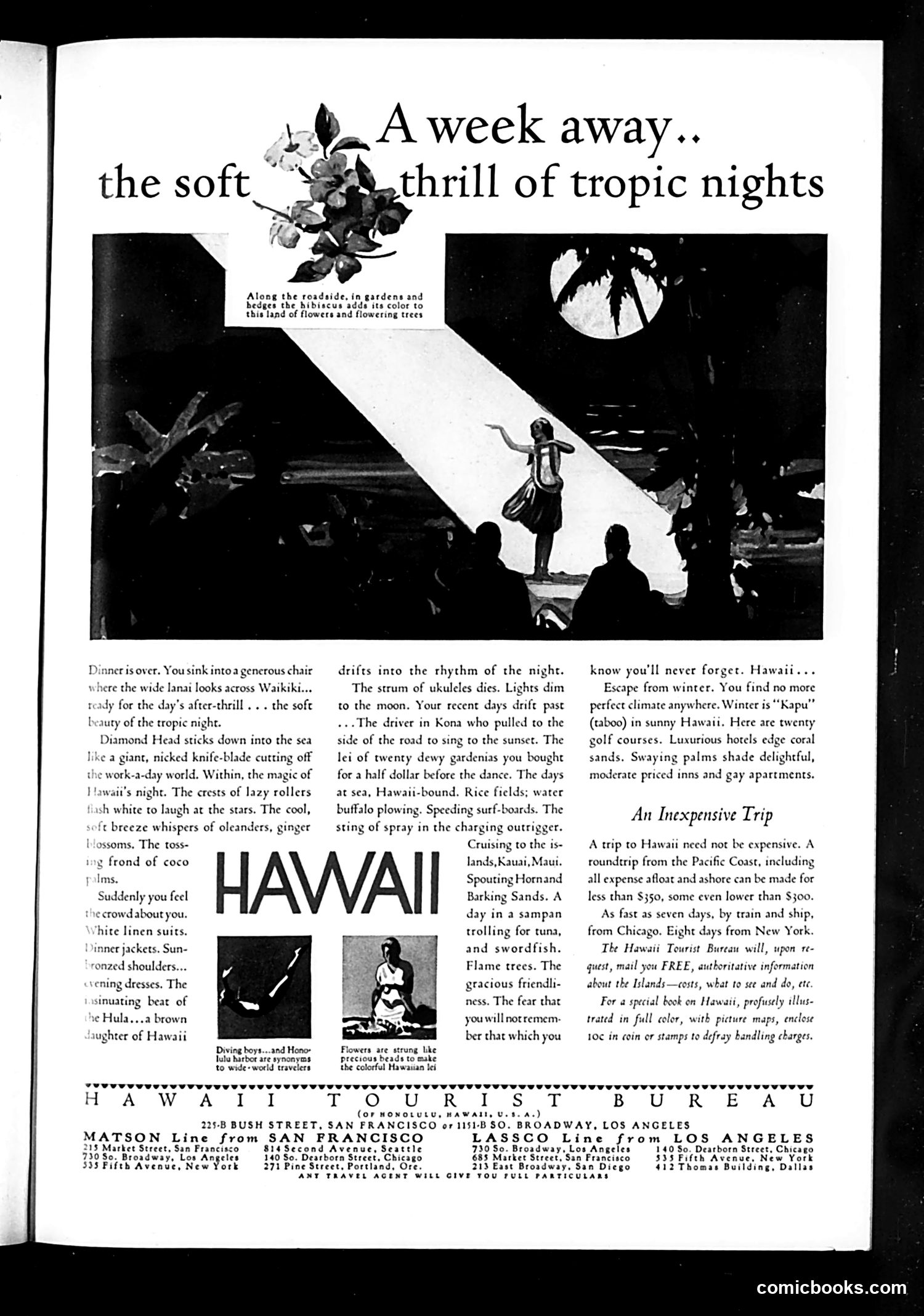
Hawaii Tourism Advertisement (Life Magazine) This is a travel advertisement, not a political cartoon. It promotes Hawaii as a vacation destination through romantic imagery and text. The page depicts idealized tropical leisure: a woman in a Hawaiian setting under moonlight, diving boys, traditional hula dancers, and lush landscapes. The accompanying prose romanticizes Hawaii's natural beauty—Diamond Head, coral reefs, lei-making, ukuleles—presenting it as an exotic escape from American winter. The key selling point: Hawaii is affordable. The ad emphasizes trips costing under $350 from the Pacific Coast, accessible by train and ship within a week, making it attainable for middle-class Americans. This reflects early 20th-century tourism marketing, when Hawaii (a U.S. territory since 1898) was being promoted as an accessible luxury destination. The imagery emphasizes native Hawaiian culture and natural beauty as tourist attractions, alongside modern amenities like golf courses and hotels.

This page is primarily an advertisement, not political satire. It showcases a photogravure reproduction of a portrait titled "Louise" by artist Leon Gordon. The image depicts a woman in dark clothing seated in a contemplative pose against a dark background, rendered in high-contrast black and white tones typical of early photographic printing. The advertisement promotes Powers Reproduction Corporation's services as photo engravers specializing in "highest grade printing plates" for reproduction work. The company's New York address and telephone number are provided as contact information. The portrait serves as a sample demonstrating the quality of their photoengraving capabilities—essentially advertising their technical proficiency through this artistic example.
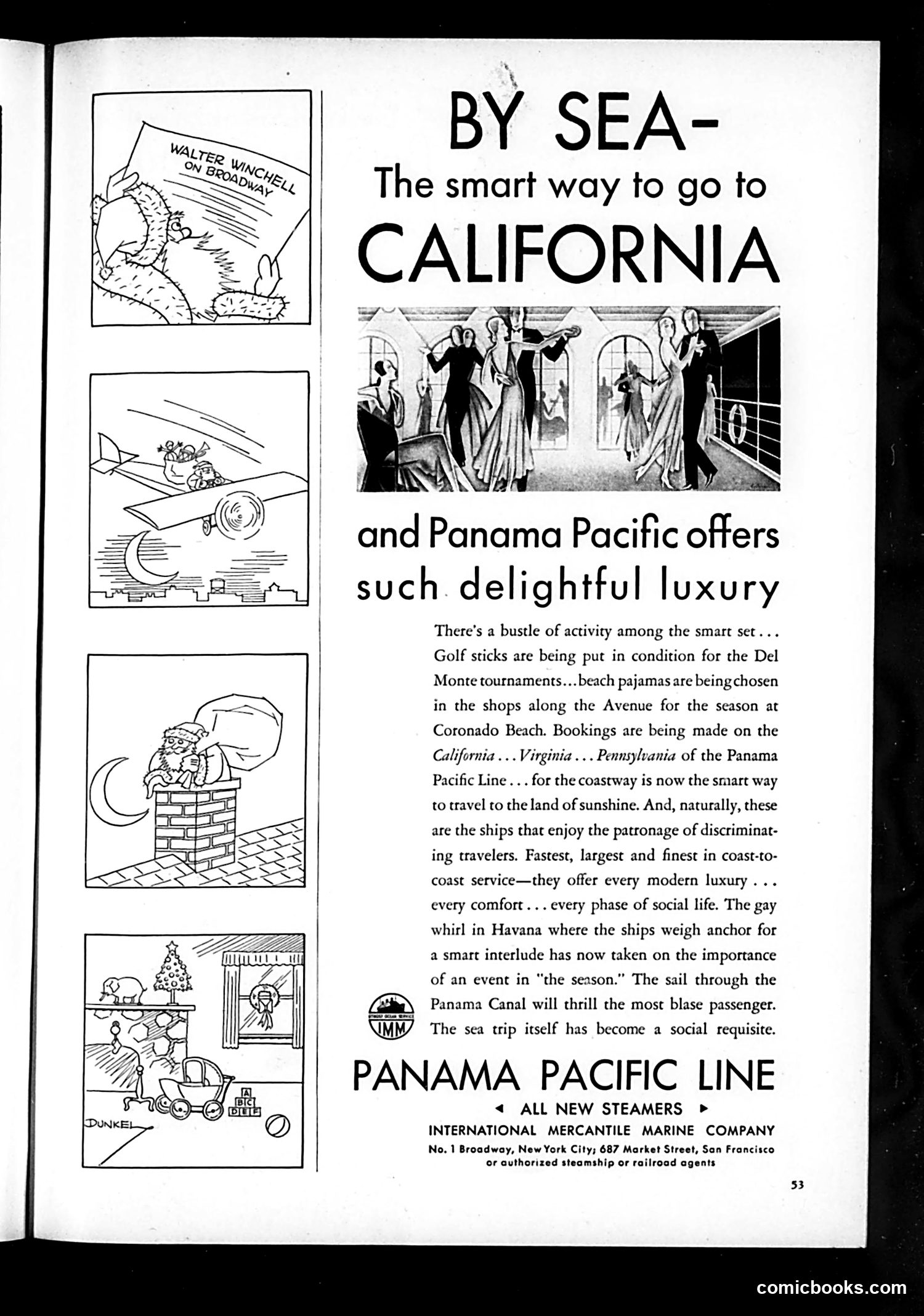
Analysis This is primarily a cruise line advertisement, not political satire. The Panama Pacific Line promotes luxury steamship travel to California as aspirational leisure for wealthy Americans. The four cartoon vignettes on the left appear to illustrate whimsical travel scenes (featuring what looks like a crab, an airplane, Santa Claus, and unclear figures), likely meant as charming decorative elements rather than satirical commentary. The advertisement targets "the smart set"—affluent travelers for whom sea travel to California has become a social status marker. It emphasizes luxury, exclusivity, and leisure activities (golf tournaments, beach resorts, Havana stopovers, Panama Canal transit). The copy treats ocean voyages as fashionable necessities rather than mere transportation. This reflects 1920s-era luxury cruise marketing, when transatlantic and coastal voyages were expensive, prestigious experiences for the wealthy. The tone is entirely promotional, not critical or satirical.
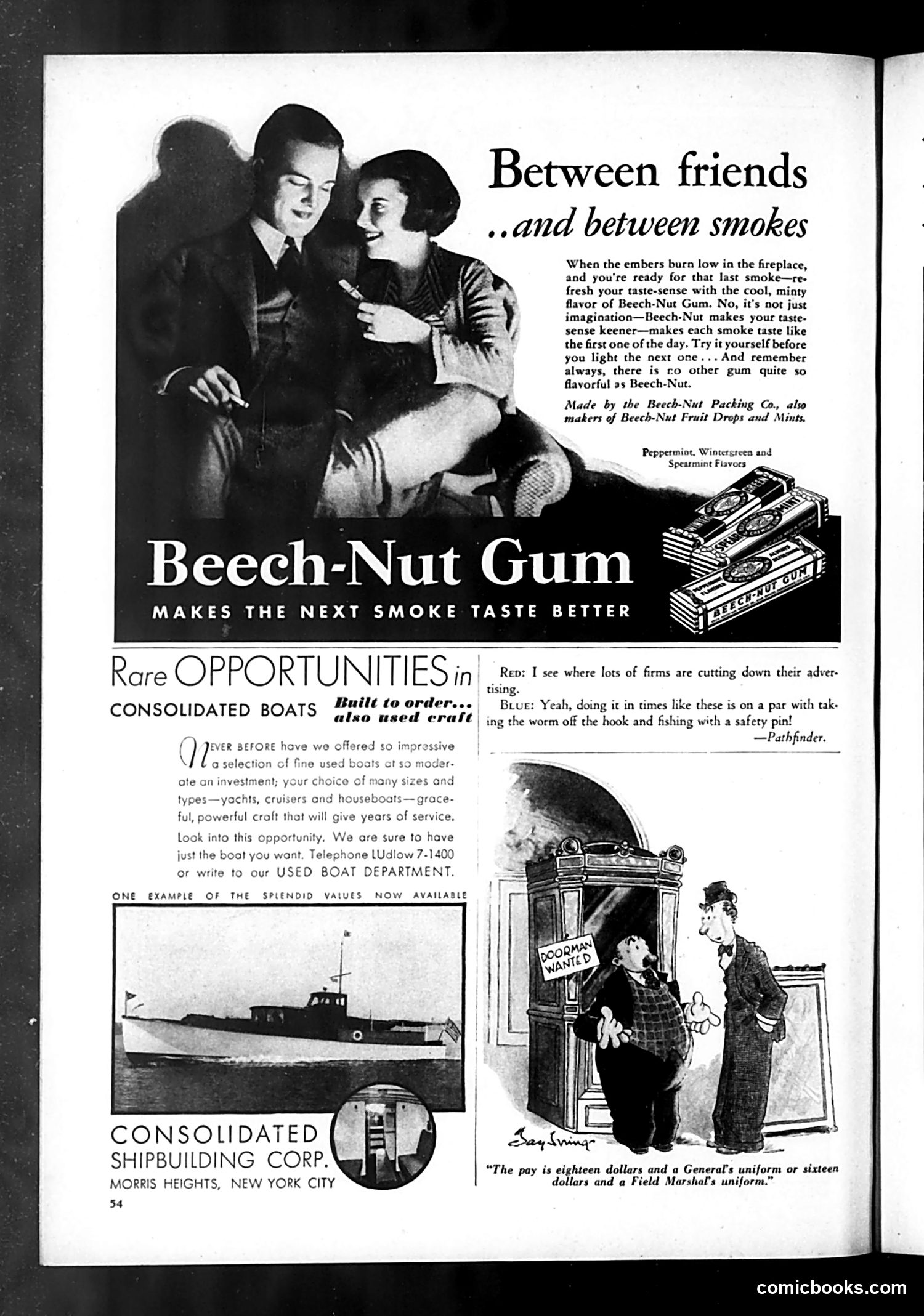
Page Analysis This is primarily an advertising page from Life magazine, not a political cartoon page. It contains two main advertisements: 1. Beech-Nut Gum ad (top): Shows three people by a fireplace promoting gum as a palate cleanser between cigarettes—a straightforward consumer pitch reflecting mid-20th-century smoking culture. 2. Consolidated Boats ad (lower left): Offers used boats for sale, emphasizing variety and value. The page includes two small comic strips: - A "Red/Blue" dialogue joke about firms cutting advertising during economic hardship, comparing it to fishing without bait - A cartoon about military pay disparities, joking that different uniforms command different wages These comics appear unrelated to each other and serve as filler content. The page reflects Depression-era or wartime economic concerns about reduced business spending and military compensation issues.
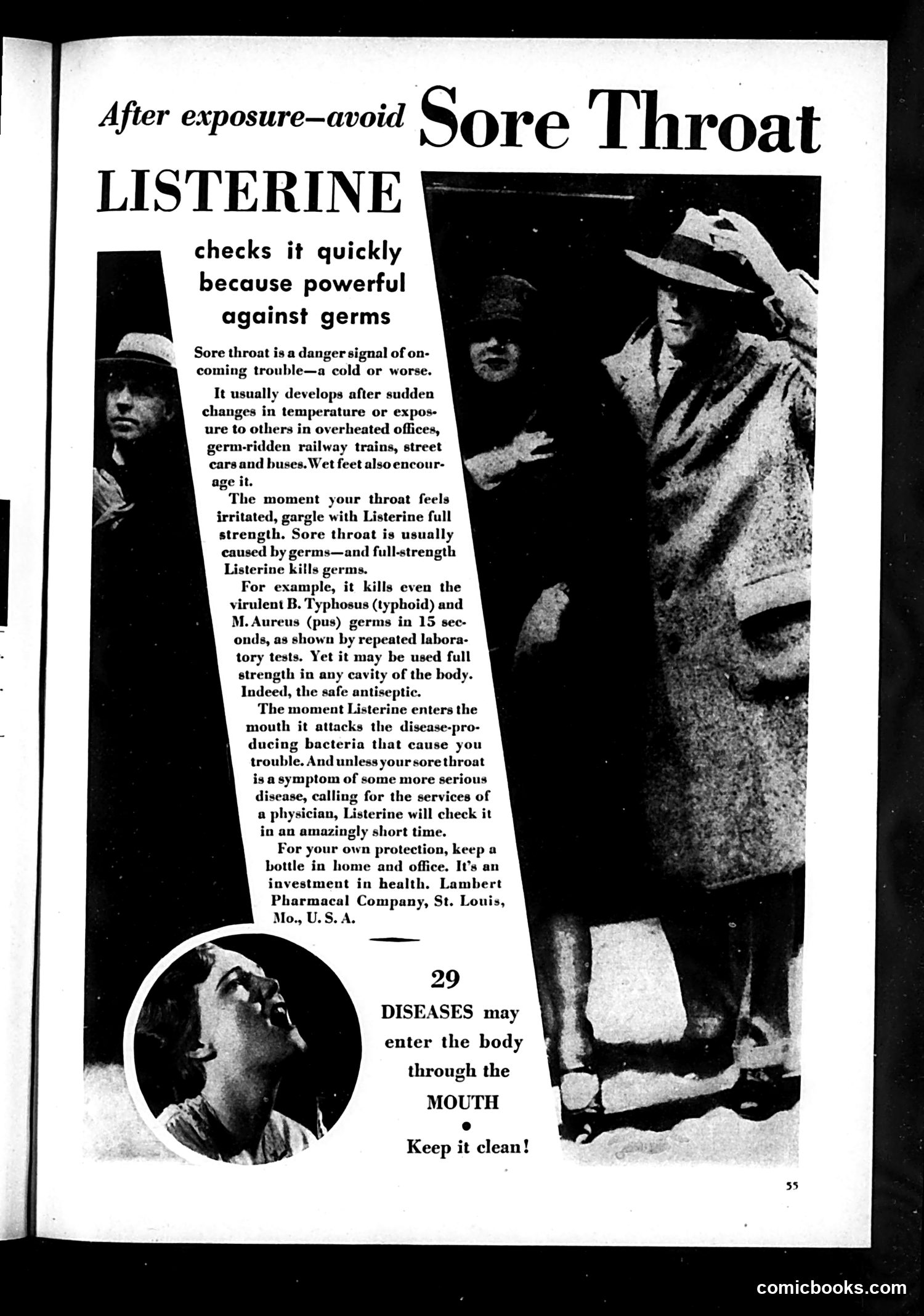
Analysis for Modern Readers This is a Listerine mouthwash advertisement, not satire or political commentary. The page uses period-appropriate health messaging to market the product. The ad claims Listerine kills dangerous bacteria (specifically naming typhoid and staph germs) in 15 seconds, positioning it as a preventative health measure. The photographs show ordinary people in everyday situations—public transportation and offices—to illustrate where "germ-ridden" exposure occurs. The rhetoric reflects early-20th-century germ theory anxiety: sore throats are presented as dangerous warning signs, wet feet are blamed for illness, and the mouth is identified as a disease entry point. By modern standards, these claims are exaggerated; contemporary medicine wouldn't recommend full-strength mouthwash as a primary cold remedy. The bottom line—"29 DISEASES may enter the body through the MOUTH"—is typical alarmist marketing of the era, designed to create health anxiety that the product purports to solve. This was standard advertising practice before modern FDA regulations.
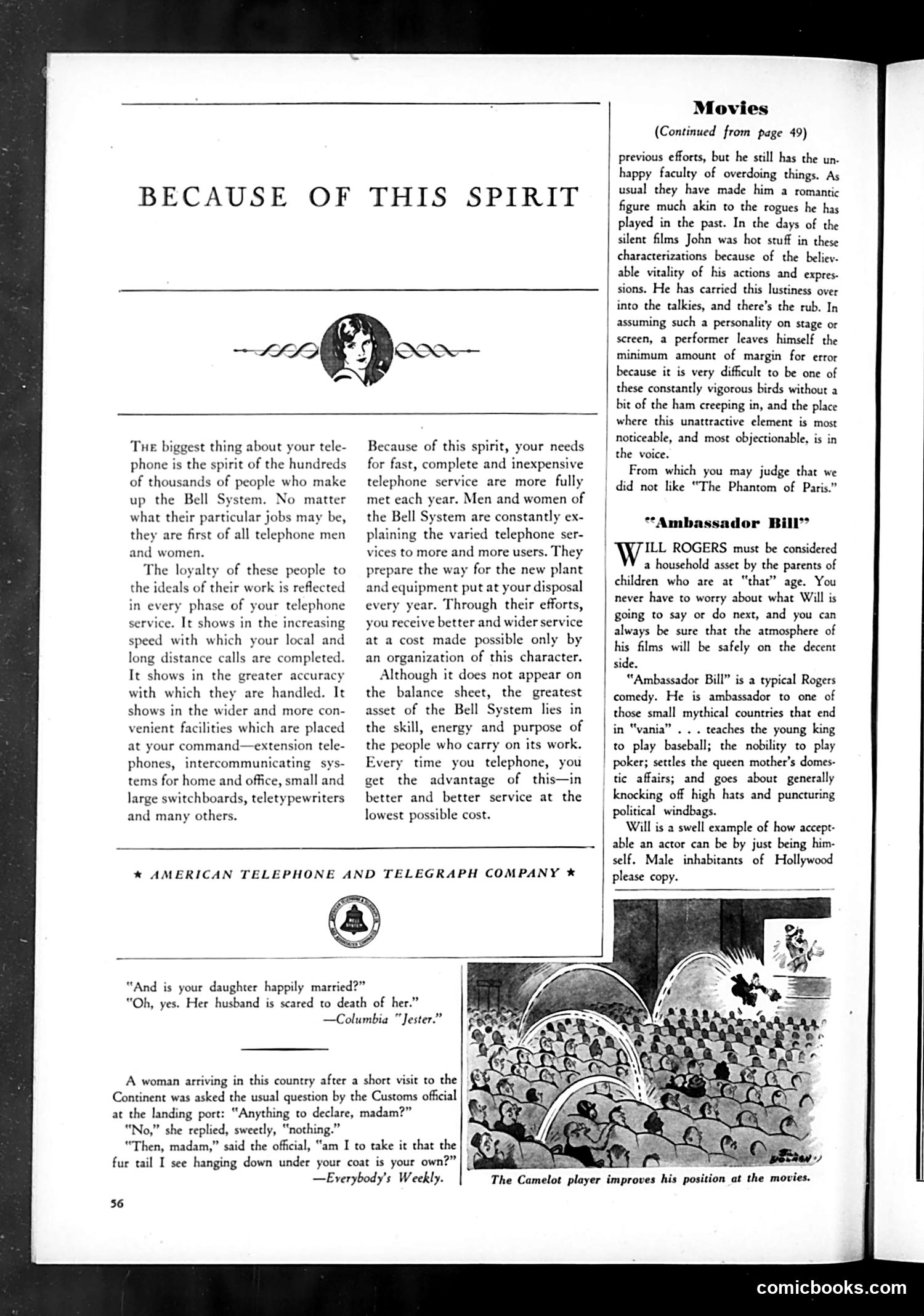
Life Magazine Page Analysis This page contains a Bell System telephone advertisement (left) and movie reviews (right), with period humor interspersed. The advertisement celebrates Bell System workers' dedication, arguing their "spirit" justifies service quality and costs—a corporate values pitch typical of early 20th-century advertising. The humor snippets reflect period attitudes: A joke about a wife being intimidating to her husband (common domestic humor of the era), and a Customs official's jest about a woman smuggling a fur coat by claiming it's her own body hair—playing on anxieties about European travelers and tariff evasion. The movie review section criticizes an actor (name unclear from image) for overacting in talkies compared to silent films, arguing his vigorous style works better without dialogue. Will Rogers receives praise as wholesome, family-safe entertainment—his ambassador comedy teaching nobility to play baseball represents his folksy, educational humor appeal. The cartoon at bottom shows an audience at a Camelot-themed film, illustrating popular cinema of the period.
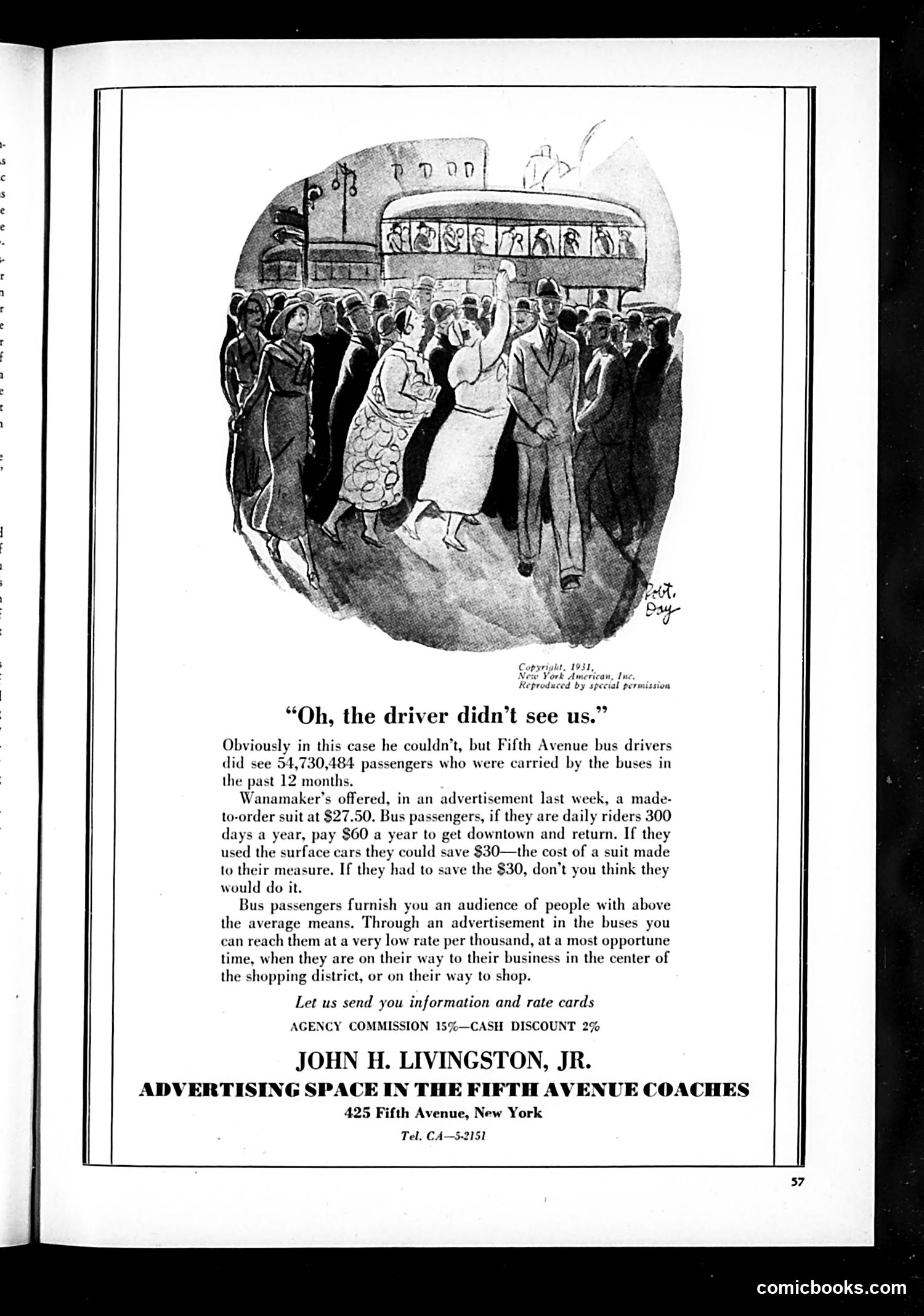
Analysis This is primarily an advertisement for bus advertising space, not a satirical cartoon critique. The cartoon depicts a crowded Fifth Avenue bus with the caption "Oh, the driver didn't see us"—likely referencing a pedestrian accident. However, the ad uses this darkly to pivot toward its actual pitch: Fifth Avenue buses carry millions of passengers annually (54.7 million in the past year), making them an excellent advertising medium. The sales argument targets potential advertisers: bus riders are affluent commuters (the ad notes they can afford $27.50 suits) traveling during peak shopping hours in Manhattan's commercial districts. Advertising in buses reaches this desirable demographic at low cost-per-thousand rates during optimal moments—when they're heading to work or shopping. The ad offers standard terms: 15% agency commission and 2% cash discount. Context: This reflects 1920s-30s urban transportation and consumer culture, when buses were relatively new mass-transit options and targeted advertising to captive commuter audiences was an emerging marketing strategy.
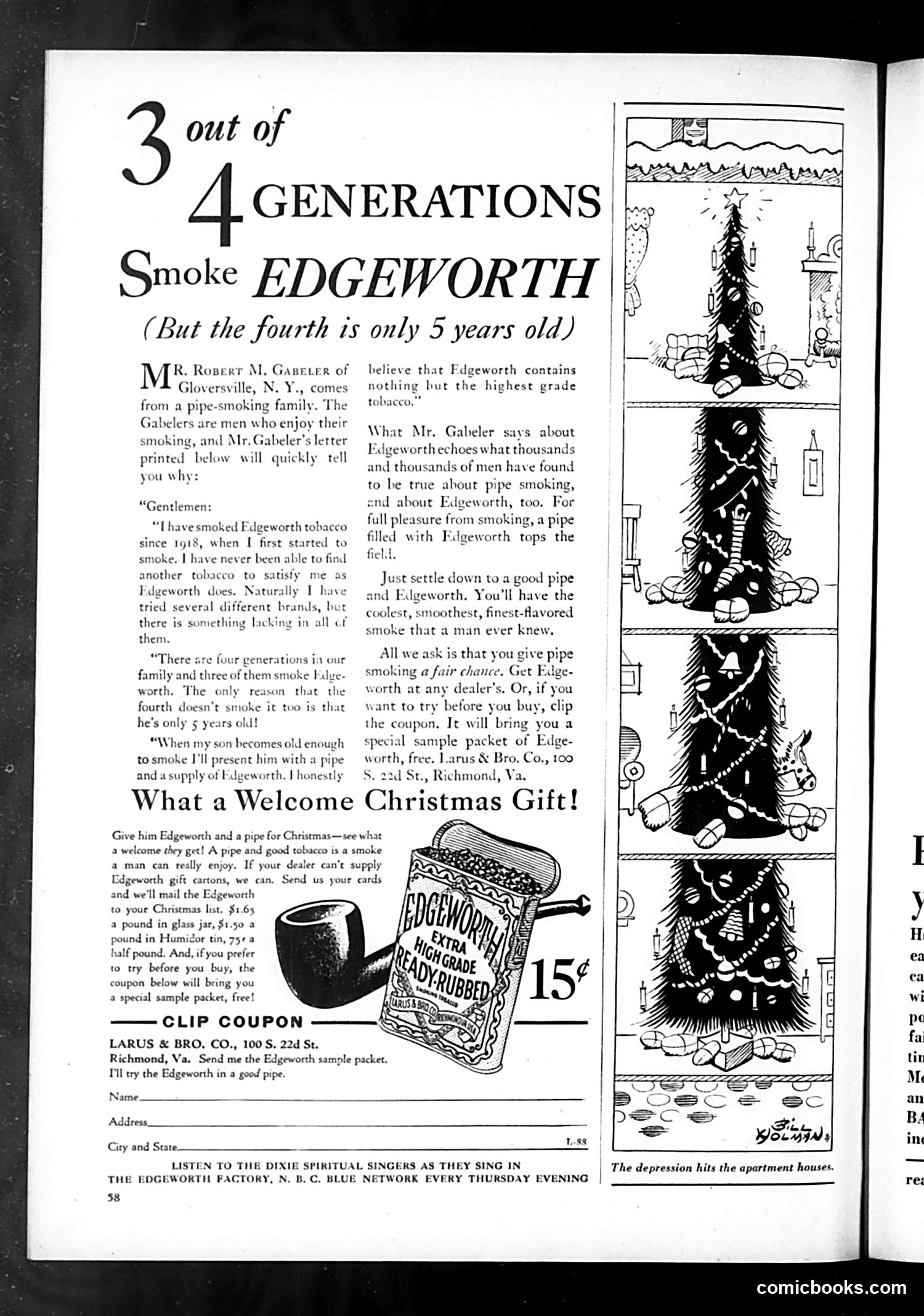
Analysis This is primarily a tobacco advertisement for Edgeworth pipe tobacco, not political satire. The page features a testimonial from Robert M. Gabeler of Gloversville, N.Y., claiming three generations of his family smoke Edgeworth since 1918, with a humorous note that the fourth generation (his 5-year-old son) doesn't yet smoke. The right side shows an illustration of a Christmas tree decorated with tobacco-related items, labeled "The depression hits the apartment houses"—a mild visual joke about Depression-era indoor celebrations. The advertisement emphasizes product loyalty across generations and positions pipe smoking as an aspirational male activity suitable for Christmas gifting. The coupon offers free samples. A radio tie-in mentions the "Dixie Spiritual Singers" at the Edgeworth factory. What's notable for modern readers: This normalizes marketing tobacco to multiple generations and uses family tradition as a sales pitch—practices now prohibited by law.
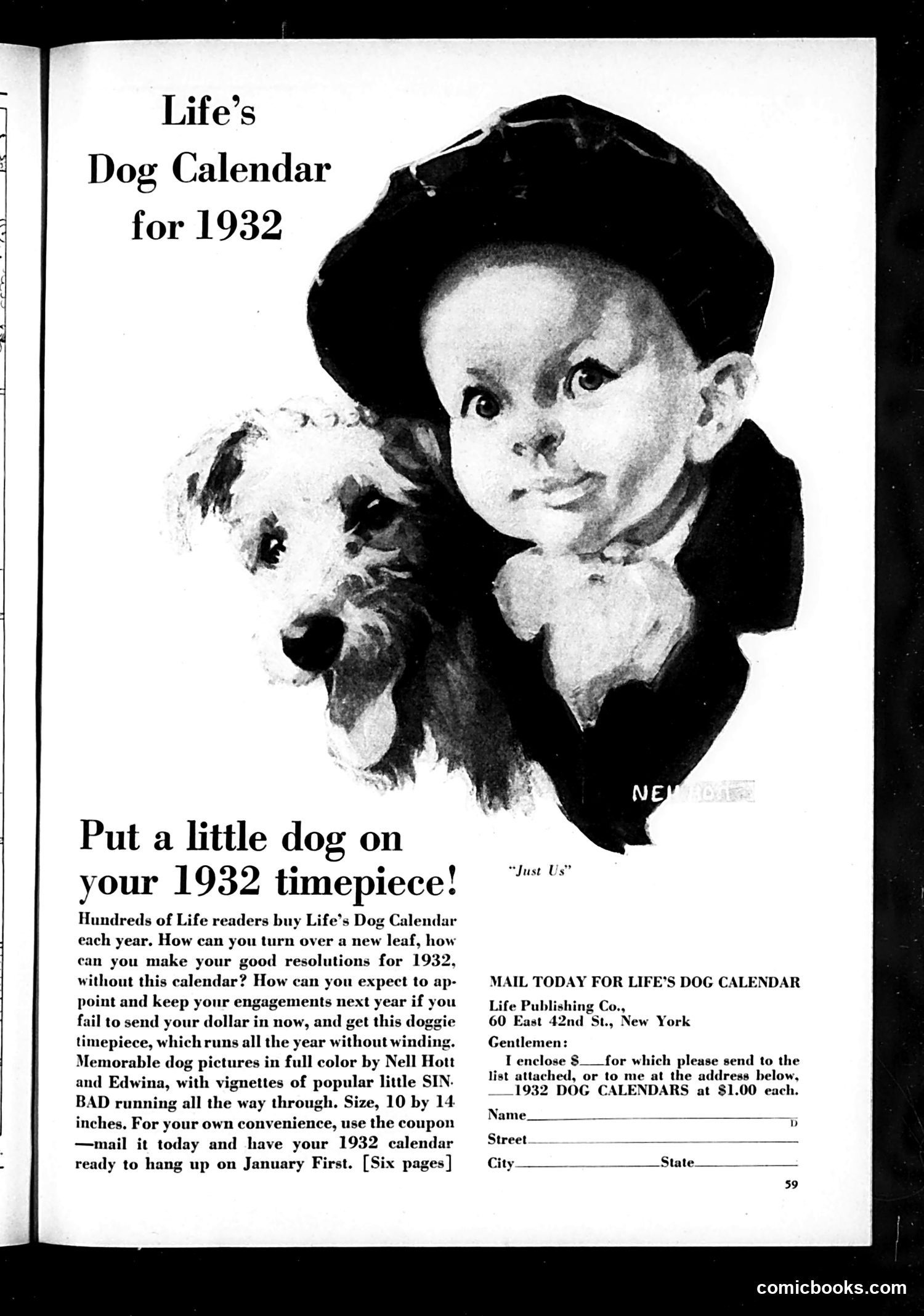
Life's Dog Calendar Advertisement (1932) This is primarily a mail-order advertisement rather than editorial satire. Life magazine is promoting its annual "Dog Calendar" as a consumer product—a wall calendar featuring dog illustrations that "runs all the year without winding" (a humorous reference to it being a mechanical timepiece). The accompanying image shows a child's face paired with a dog, captioned "Just Us," illustrating the calendar's appeal. The copy uses mild humor and rhetorical persuasion ("How can you...without this calendar?") to encourage purchase at $1.00 each. The advertisement references artists Nell Hott and Edwina, and mentions "popular little SINBAD" (likely a dog mascot), suggesting the calendar featured recognizable cartoon characters of the era. This reflects 1932's commercial culture: novelty calendars and pet-themed merchandise were popular gift items, and Life leveraged its readership as a captive market for branded products.
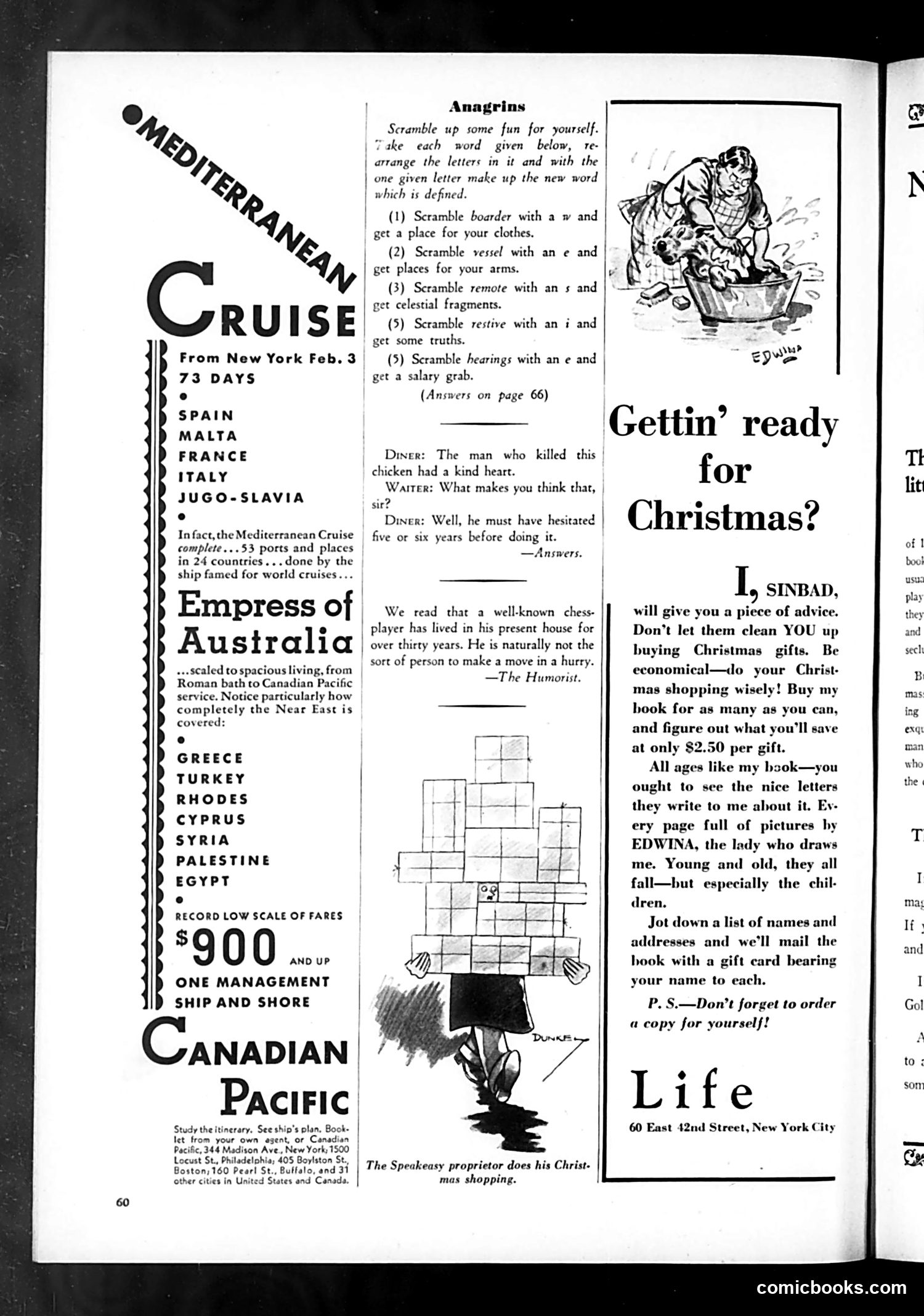
Satirical Content from Life Magazine This page mixes advertisements, word puzzles, and humor typical of early 20th-century Life magazine. The main cartoon (bottom center) depicts a speakeasy proprietor doing Christmas shopping—a topical reference to Prohibition-era illegal bars. The humor lies in the irony: someone profiting from illegal alcohol sales is now engaging in legitimate Christmas commerce, suggesting the contrast between underworld activity and ordinary domestic life. The cartoon shows a figure carrying wrapped packages, presumably Christmas gifts, emerging from or associated with speakeasy culture. The page also features period jokes (like the chess player avoiding moves), word puzzles (anagrams), and advertisements for Mediterranean cruises and Life magazine itself promoting books as economical gifts. The speakeasy reference dates this to the Prohibition period (1920-1933), when such establishments operated illegally in America.
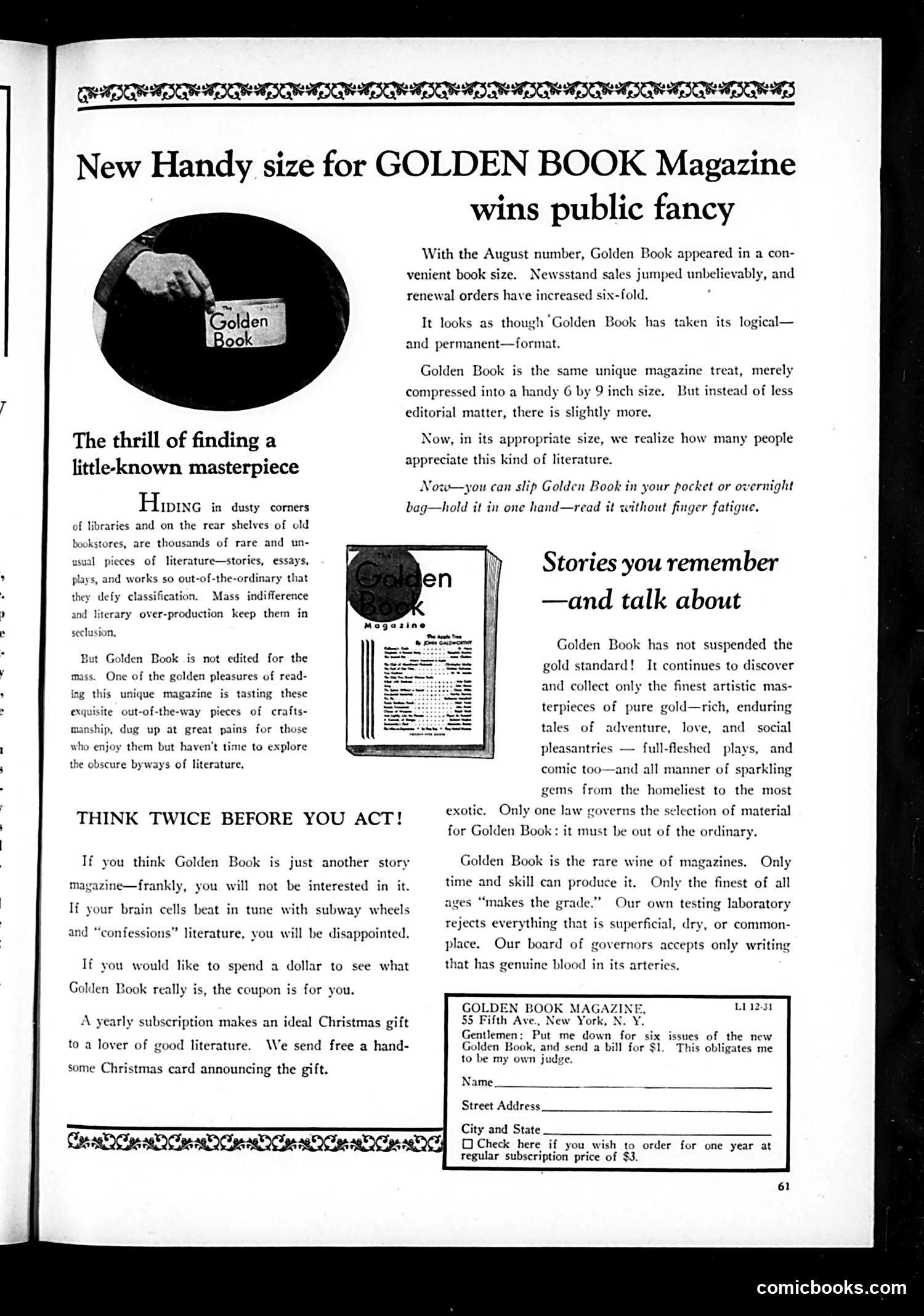
Golden Book Magazine Advertisement This is a full-page advertisement (not satire or political commentary) promoting *Golden Book Magazine's* new pocket-sized format. The publication had recently shrunk from a larger size to a handy 6-by-9 inch dimension, and sales "jumped unbelievably" with "renewal orders increased six-fold." The ad targets educated readers seeking literary quality—positioning Golden Book as a curated magazine of rare stories, essays, and plays "hidden in dusty corners" of libraries. It explicitly warns away casual readers ("If your brain cells beat in tune with subway wheels and 'confessions' literature, you will be disappointed"), appealing instead to discerning intellectuals. The marketing emphasizes portability ("slip Golden Book in your pocket") and exclusivity—stories "you remember—and talk about"—with a rigorous editorial standard: "only the finest of all ages 'makes the grade.'" A subscription offer ($1 for six issues, $3 yearly) appears at bottom, positioned as an ideal Christmas gift for "a lover of good literature."
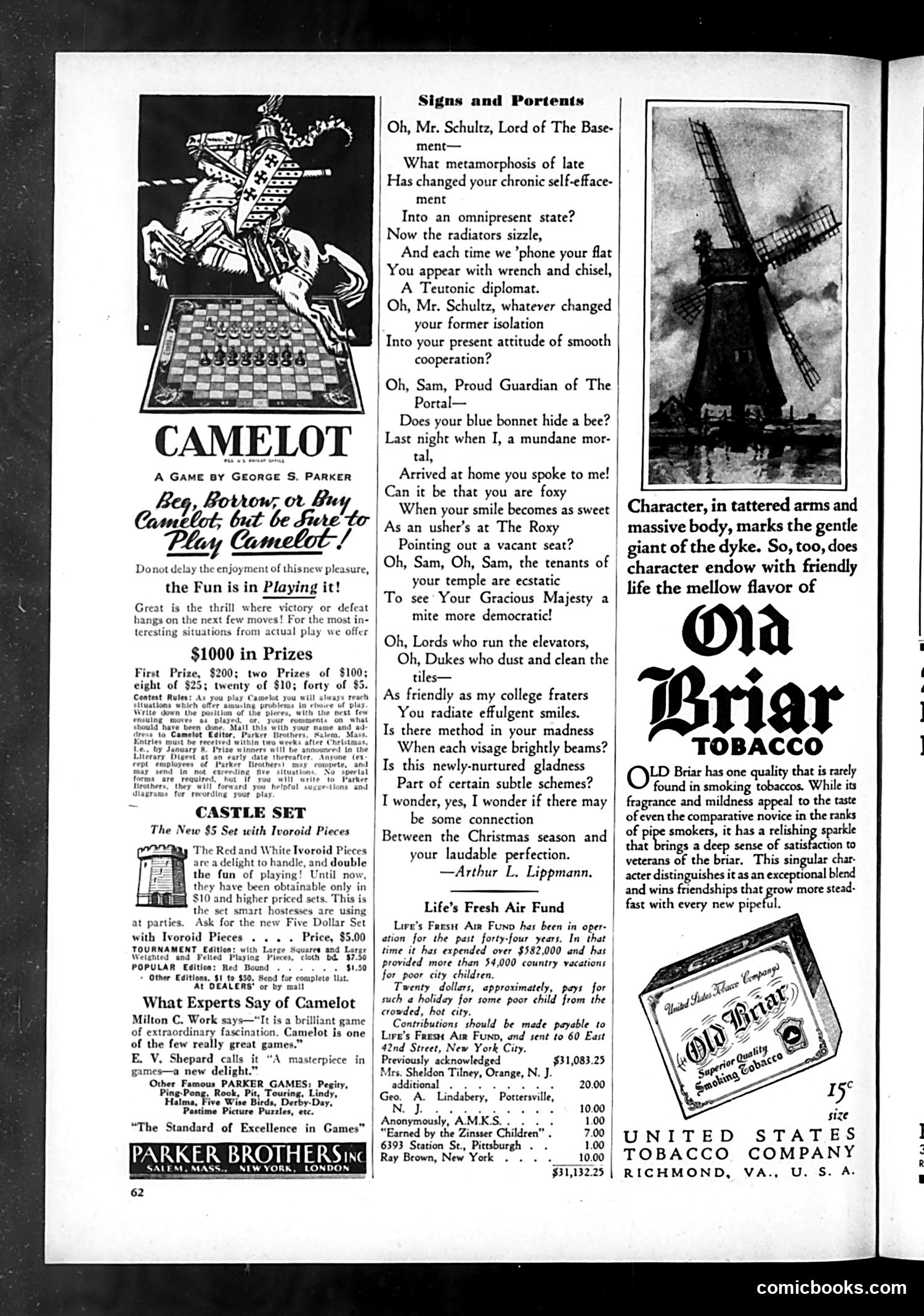
"Signs and Portents" Satire Explained This poem by Arthur L. Lippmann satirizes the sudden friendliness of building staff—a basement superintendent named Schultz, a doorman named Sam, and elevator operators—toward tenants. The poem mocks their abrupt transformation from indifferent to aggressively helpful and cheerful. The satire's point: these workers are clearly motivated by expected Christmas tips rather than genuine attitude change. The poem repeatedly questions their "madness" and hints at "subtle schemes," before explicitly revealing the connection to "the Christmas season" as the cause of their "laudable perfection." This reflects a common social complaint: service workers perform friendliness strategically around holidays when tips are anticipated, dropping the pretense afterward. The humor lies in the poem's mock-serious tone treating obvious mercenary behavior as a mysterious "metamorphosis" requiring investigation.
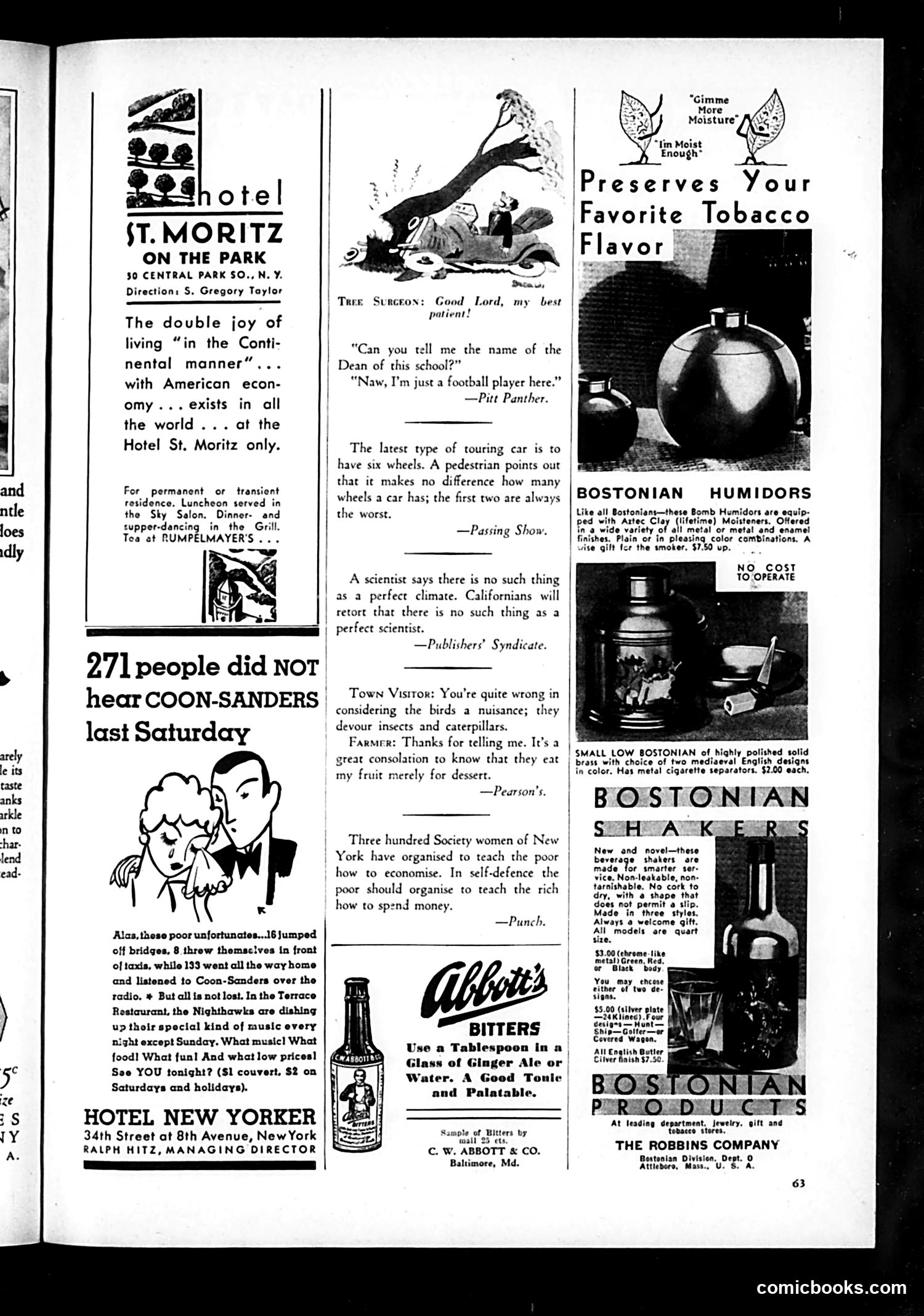
Analysis of Life Magazine Page Content This page is primarily advertising with several short humor pieces interspersed. The main cartoon shows a "tree surgeon" treating an injured tree, with the caption "Good Lord, my patient!"—a pun on the double meaning of "patient" (medical) applied to a tree. Below sits a dark joke: "271 people did NOT hear COON-SANDERS last Saturday," followed by absurdist humor claiming 16 jumped off bridges and 133 went home to listen to them on radio instead. The "Coon-Sanders" reference is to the Coon-Sanders Nighthawks, a popular jazz/dance band of the 1920s-30s. The humor mocks their popularity and the desperation people supposedly feel to hear them live. Other brief jokes mock: a football player ignorant of his school's dean, the uselessness of extra car wheels, California's weather, and class economics (wealthy women teaching poor people to economize). The remainder of the page is vintage product advertising: hotels, bitters, tobacco humidors, and beverage shakers—typical of 1920s-era Life magazine.
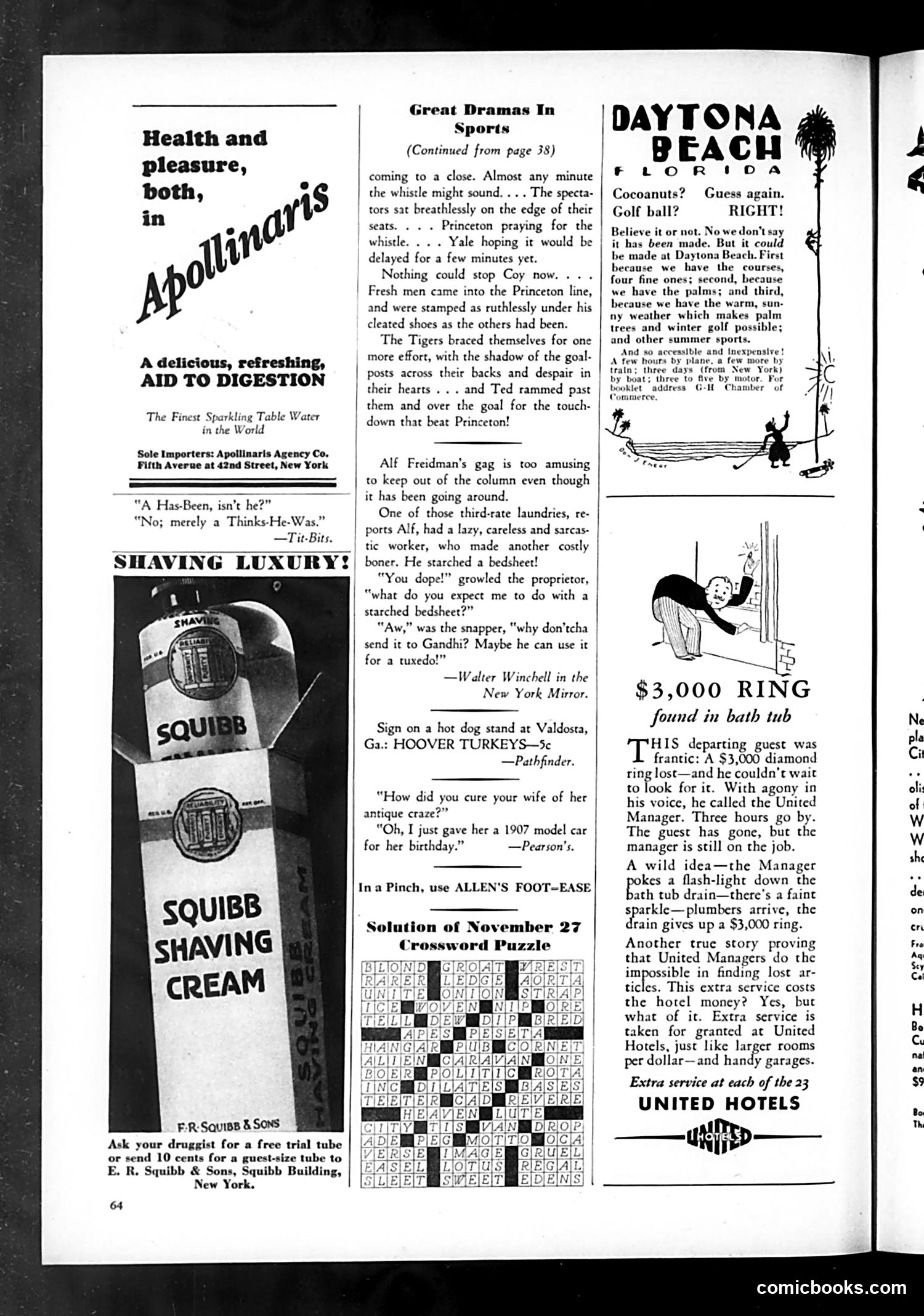
Content Analysis for Modern Readers This page is primarily advertising and humor columns, not political satire. Key elements: Advertisements: Apollinaris sparkling water, Squibb shaving cream, Daytona Beach tourism, and United Hotels dominate the page. Sports Column: "Great Dramas in Sports" recounts a college football game (appears to be Yale vs. Princeton), dramatizing a winning touchdown by a player named Coy. The narrative style is breathless and melodramatic—typical period sports journalism. Humor Items: Brief jokes, including one referencing Gandhi (likely 1920s-30s context, when Gandhi was prominent in Indian independence), and quips about "has-beens" and antiquated ideas. "$3,000 Ring" Story: A short anecdote about a hotel manager heroically recovering a lost diamond ring from a bathtub drain—promotional content for United Hotels' customer service. The page reflects 1920s-era American magazine content: sports coverage treated as drama, casual cultural references, and lifestyle advertising targeting middle-class readers.
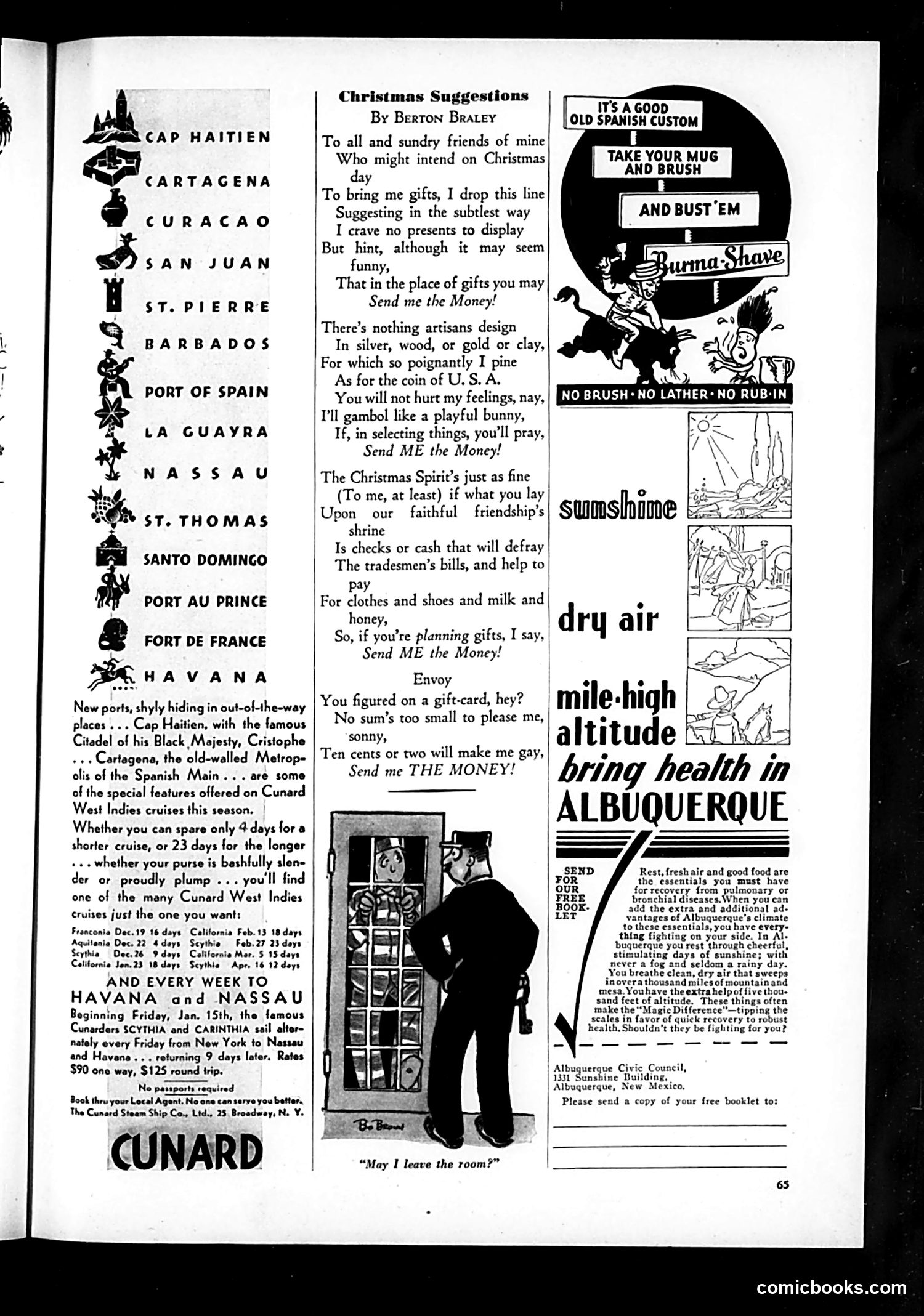
Analysis of Page 65 This page mixes advertising with light satirical verse. The dominant content is Berton Brayley's "Christmas Suggestions" poem, a humorous plea asking friends to give him money instead of physical gifts. The satire is straightforward: the speaker argues that cash is more practical than artisanal goods, repeatedly insisting "Send ME the Money!" The poem's refrain turns Christmas gift-giving into a comedic negotiation where even "ten cents or two" would satisfy him. The page also contains period advertisements: Cunard cruise lines promoting Caribbean voyages to ports like Havana and Nassau, and an Albuquerque health tourism pitch touting the city's altitude and dry air for respiratory recovery. A cartoon labeled "May I leave the room?" accompanies the ads but is unclear without additional context. The overall tone reflects Depression-era pragmatism—humor deflating consumerism by celebrating cash as the most honest gift.
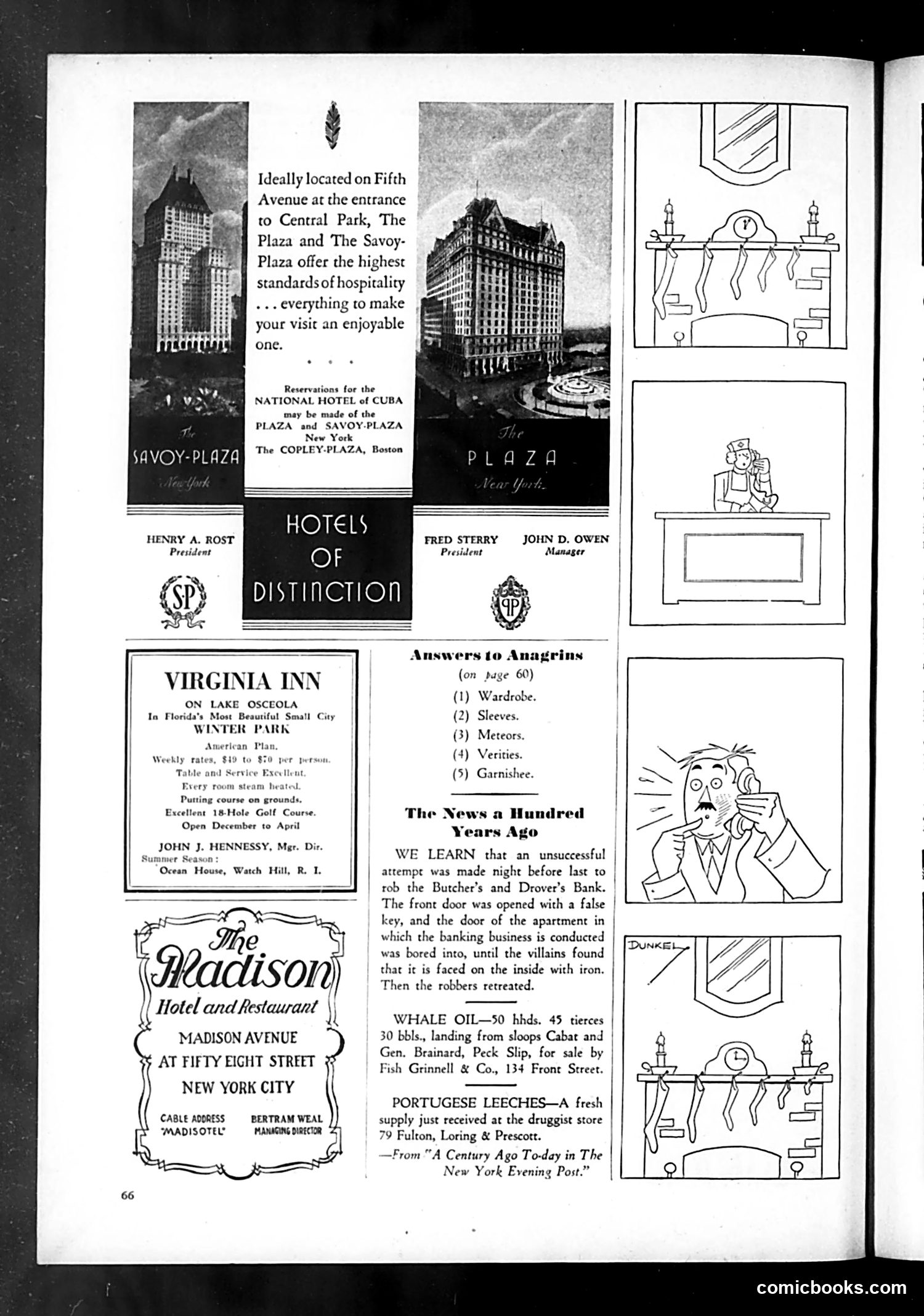
Page Content Analysis This page is primarily advertising and filler content from Life magazine. The top half features hotel advertisements (Savoy-Plaza, Virginia Inn, The Madison) targeting affluent travelers. The bottom section contains a humor feature titled "The News a Hundred Years Ago," reprinting snippets from the New York Evening Post from circa 1823. These snippets—about a failed bank robbery, whale oil sales, and Portuguese leeches at a drugstore—are presented as quaint period curiosities for modern (1920s) readers. The humor derives from the mundane, antiquated nature of 19th-century commerce and crime compared to contemporary urban life. On the right are small cartoon illustrations and an "Answers to Anagrins" (anagrams) puzzle from an earlier page. The page serves primarily to fill space between substantive editorial content with advertisements and light entertainment.
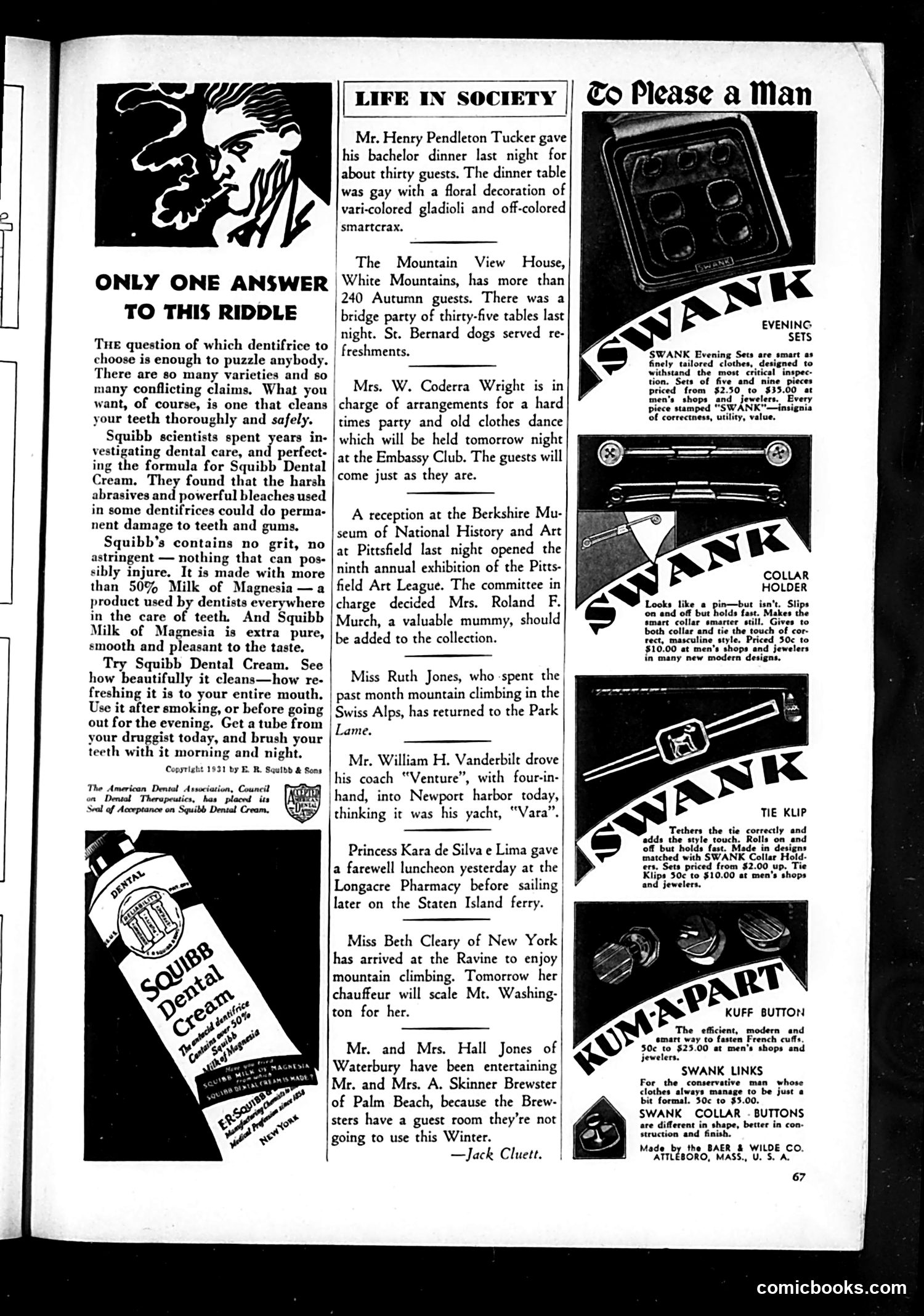
Life Magazine Page Analysis This page combines a Squibb toothpaste advertisement with a "Life in Society" gossip column that satirizes wealthy socialites through absurdist humor. The Advertisement: Squibb Dental Cream claims superiority by containing no harsh abrasives—just 50% Milk of Magnesia—making it safe for teeth and gums. It bears the American Dental Association's seal of approval. The Satire: The society column mocks the pretensions and eccentricity of the wealthy elite. The jokes rely on deadpan absurdity: William Vanderbilt mistakes his coach for his yacht; a "valuable mummy" is added to an art museum collection; a chauffeur will scale Mt. Washington instead of the employer; guests are entertained merely because their hosts have unused guest rooms. Mrs. Roland F. Murch being described as "a valuable mummy" is particularly cutting—implying the wealthy socialite is as lifeless as an actual artifact. The column satirizes upper-class leisure pursuits as simultaneously frivolous and ridiculous, poking fun at their disconnection from reality.
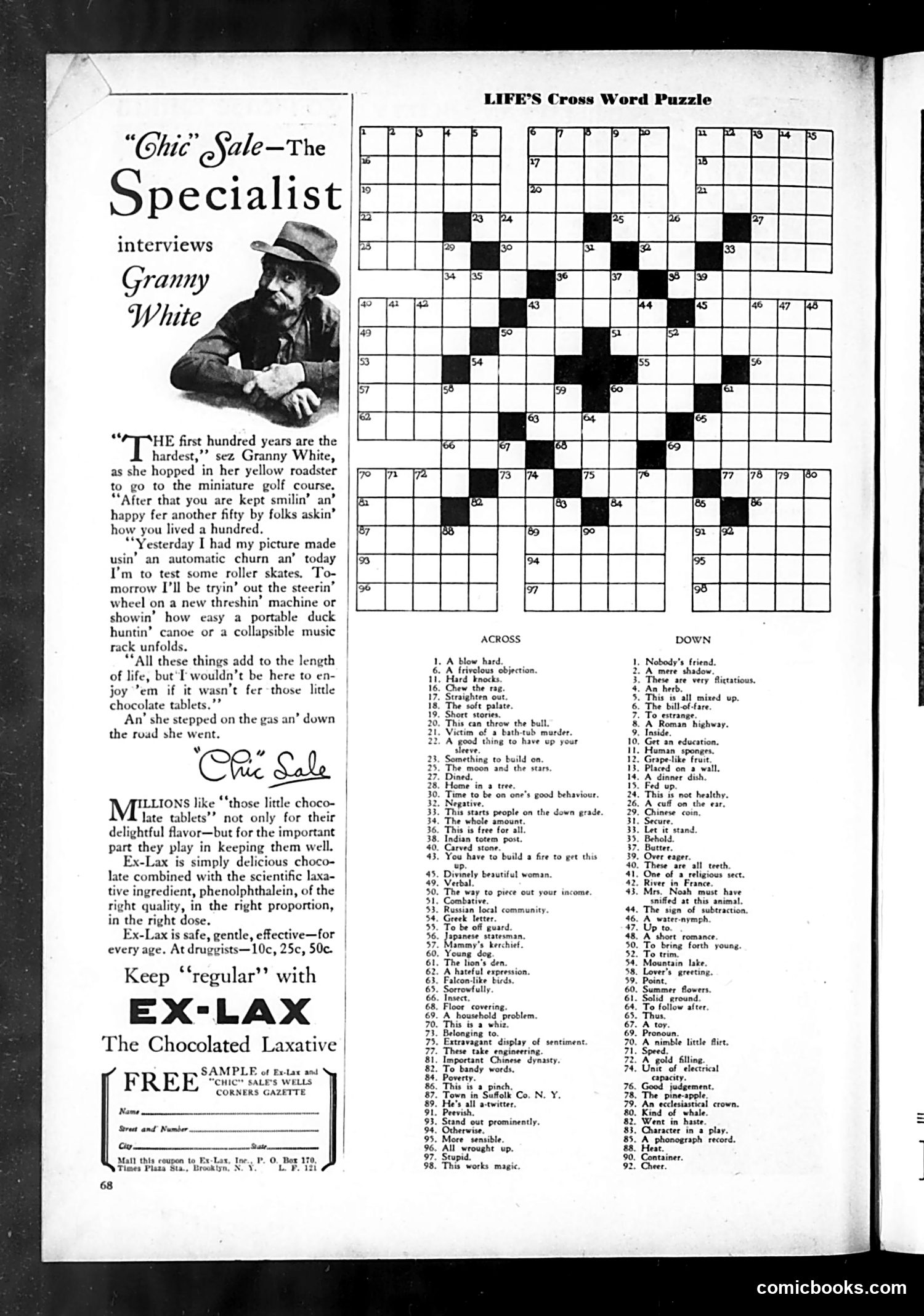
"Chic" Sale and Ex-Lax Advertisement This page combines a humorous interview with advertising. "Chic" Sale (a real humorist known for folksy monologues) interviews "Granny White," a centenarian woman who attributes her longevity to Ex-Lax laxative chocolates. The satire targets the era's obsession with longevity and product endorsements: Granny is constantly being used to promote modern gadgets (roller skates, threshing machines, canoes) yet credits her survival to a simple laxative. The joke plays on 1920s-30s advertising culture, where elderly figures were used to sell health products. The crossing of "serious longevity advice" with the mundane reality of digestive health creates gentle comedy. The text suggests that despite all these modern conveniences, what *really* keeps you alive is regular bowel function—presented as a matter-of-fact folk wisdom that punctures pretentiousness. The crossword puzzle below is unrelated advertising content.
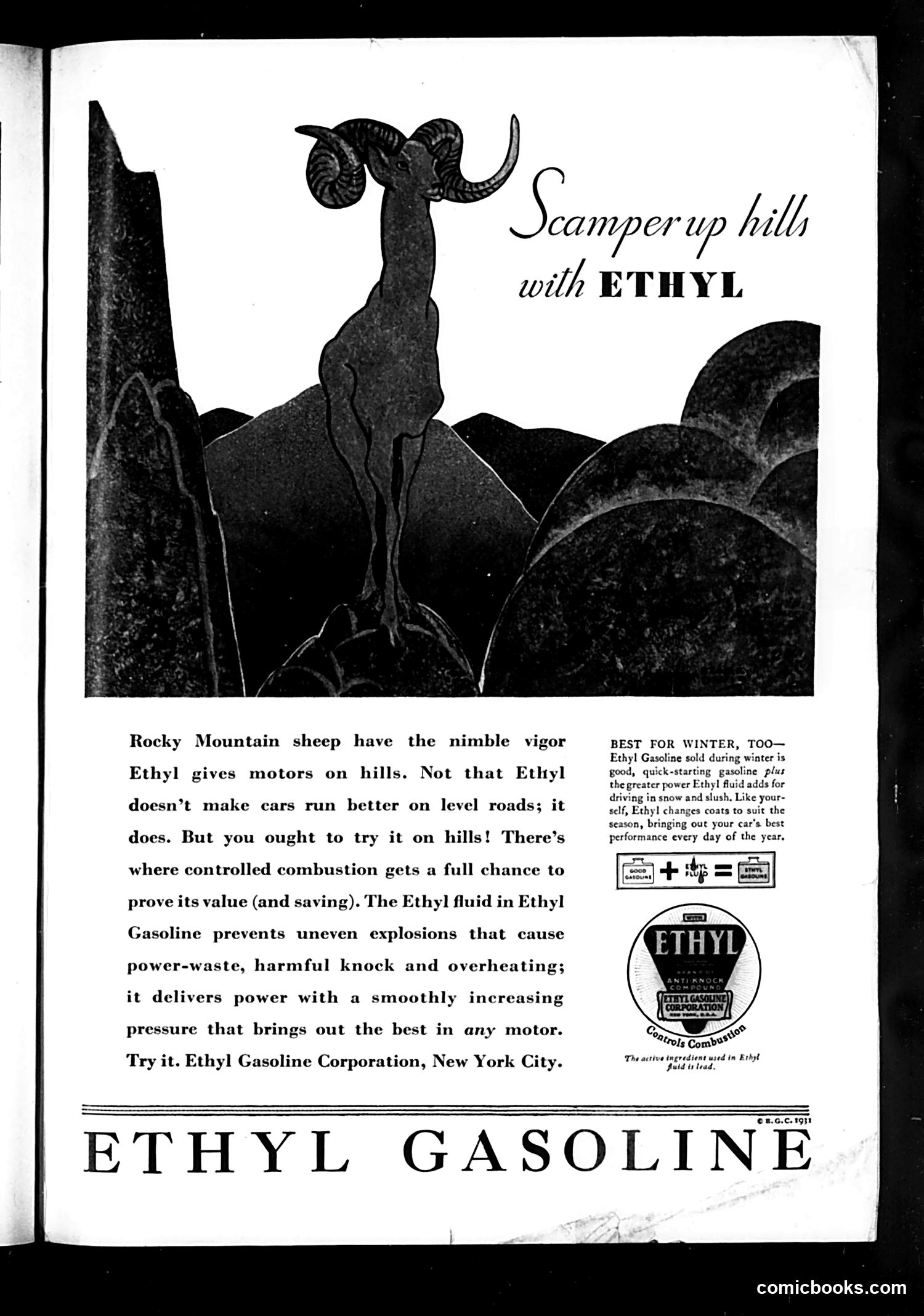
Ethyl Gasoline Advertisement Analysis This is a full-page advertisement, not satire or political commentary. The image shows a stylized Rocky Mountain bighorn sheep climbing steep hills, used as a metaphor for engine performance. The ad's central claim: Ethyl Gasoline's additive ("Ethyl fluid") enables motors to perform better on hills—where combustion dynamics are most taxed—by preventing uneven explosions, knock, and overheating. The sheep symbolizes nimbleness and vigor needed for difficult terrain. The sidebar notes Ethyl's winter advantage: better cold-starts and traction in snow. Context for modern readers: This advertises leaded gasoline (tetraethyl lead was the "Ethyl" additive). While effective at reducing engine knock, lead would later be recognized as highly toxic and was phased out starting in the 1970s due to environmental and health damage. The 1938 date and advertising approach reflect pre-health-awareness marketing practices.
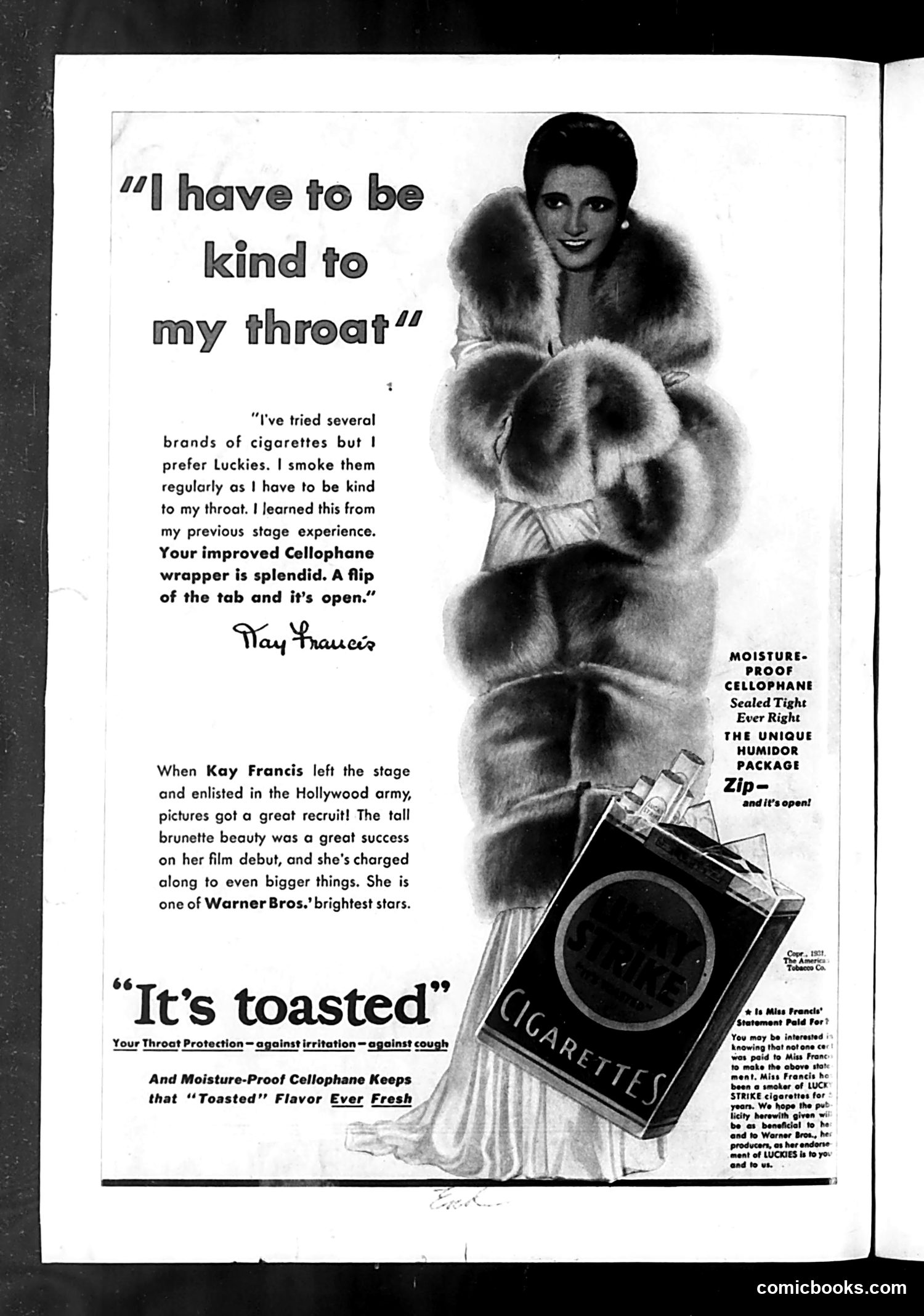
This is a cigarette advertisement, not political satire This page is a Lucky Strike cigarette ad featuring actress Kay Francis, a Warner Bros. star. The ad uses her endorsement—claiming she smokes Luckies to protect her throat due to her stage experience—to market the product's supposed health benefits. The "toasted" claim and throat-protection messaging were common cigarette marketing tactics of the era, before health dangers were widely acknowledged. The fine print at bottom honestly discloses that Francis was paid for the endorsement. For modern readers: This represents pre-regulation cigarette advertising that explicitly marketed cigarettes as throat-protective and health-conscious—claims later proven false. The moisture-proof cellophane packaging is presented as a consumer convenience feature. This reflects an era when such advertising was legal and commonplace, before the surgeon general's warnings and advertising restrictions.

I can see this appears to be a blank or nearly blank page from a publication, with only a footer reading "comicbooks.com" visible. The page itself contains no discernible cartoon, illustration, text content, or political commentary that I can analyze. Without visible content to examine, I cannot identify any figures, caricatures, political references, or satirical points. This may be a blank page from the original publication, a scanning artifact, or the image may not have captured the intended content properly. To provide meaningful analysis of a Life magazine cartoon or article, I would need a page with visible illustrations, text, or other content elements present.