life
Life — January 1932
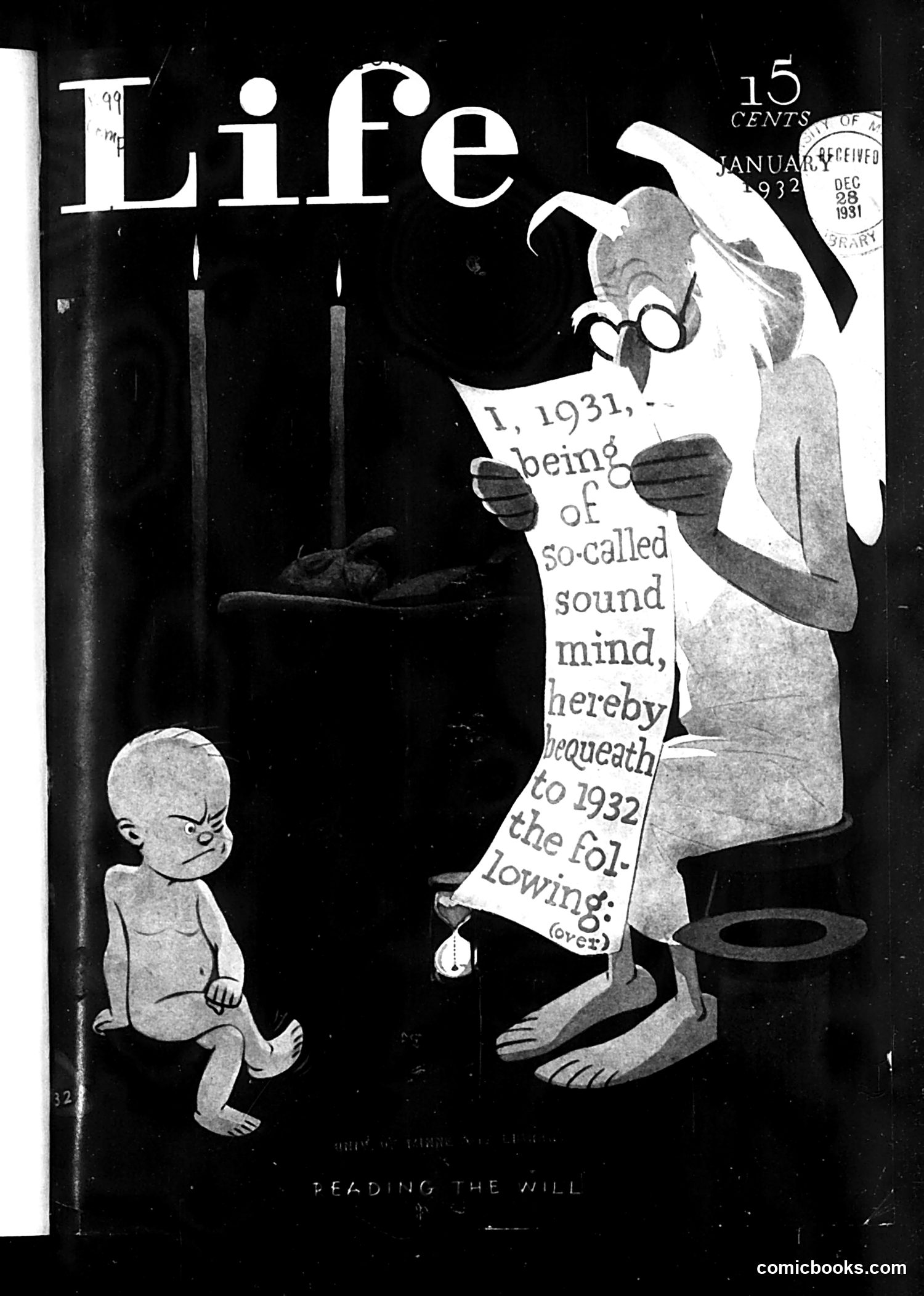
"Reading the Will" - Life Magazine, January 1931 This cartoon satirizes the economic consequences of the 1929 stock market crash. A grotesque, skeletal figure (representing Death or financial ruin) reads a will to a distressed infant (symbolizing the upcoming generation or the nation's future). The will's text states the figure has been "of so-called sound mind" from 1931 through 1932, bequeathing "the following" — presumably debts and economic hardship. The joke targets how the crash's destruction will burden children born into this depression era. The "sound mind" phrase is darkly ironic, suggesting those responsible for the crash claimed rationality while causing catastrophic damage. The image reflects 1931's grim economic outlook during the Great Depression's early years.
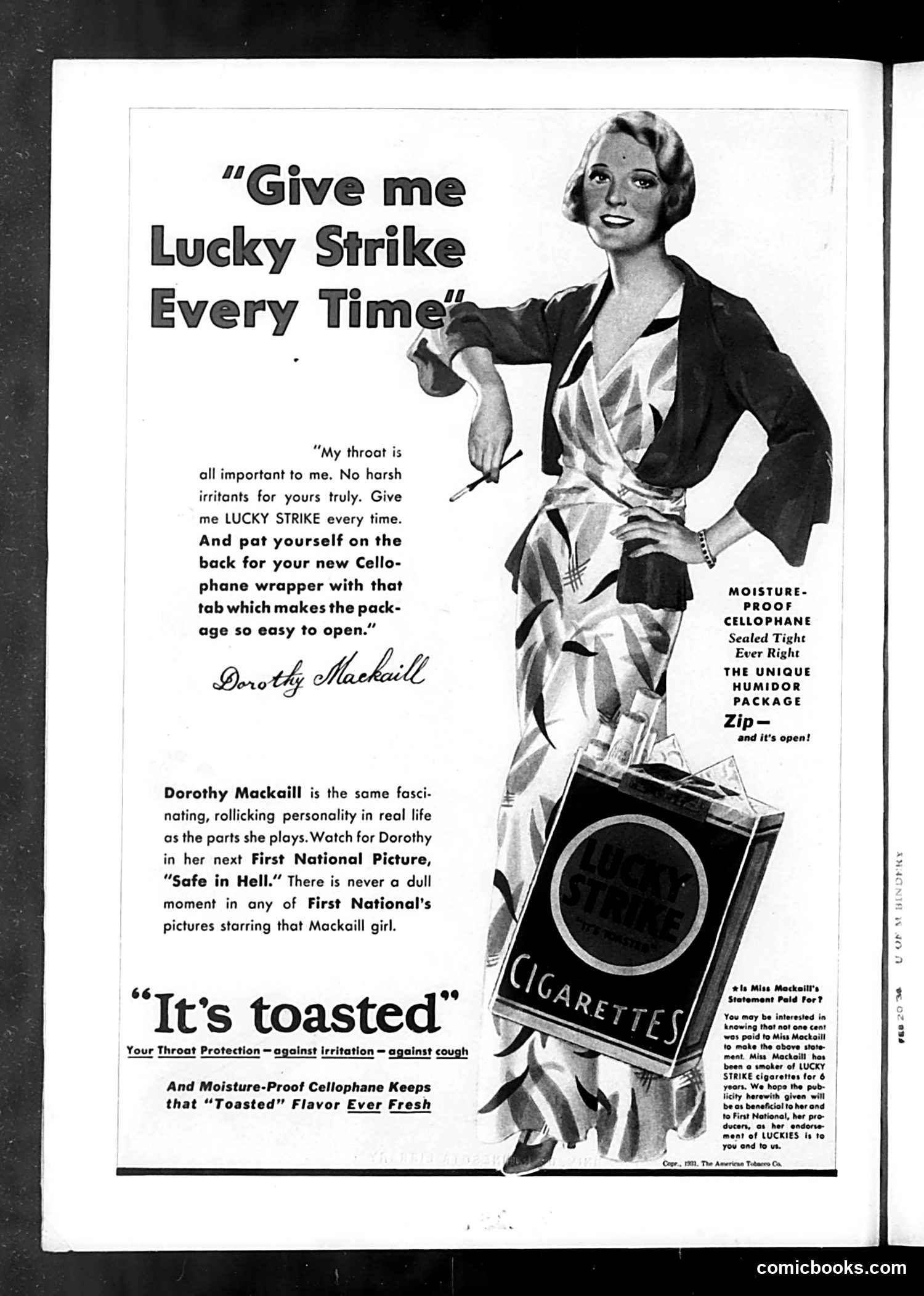
Analysis This is a cigarette advertisement, not satire or political commentary. It features actress Dorothy Mackaill endorsing Lucky Strike cigarettes, claiming the product provides "throat protection" through a "toasted" process and moisture-proof cellophane packaging. The ad references Mackaill's upcoming film "Safe in Hell" (a First National Picture), positioning her as a glamorous spokesperson. The tagline "It's toasted" emphasizes throat protection—a common health-related marketing claim from the 1920s-30s era, before tobacco's dangers were widely acknowledged. This reflects the historical period when cigarette companies routinely made health claims and used celebrity endorsements without regulatory restrictions. Modern readers should note such advertising would be illegal today.
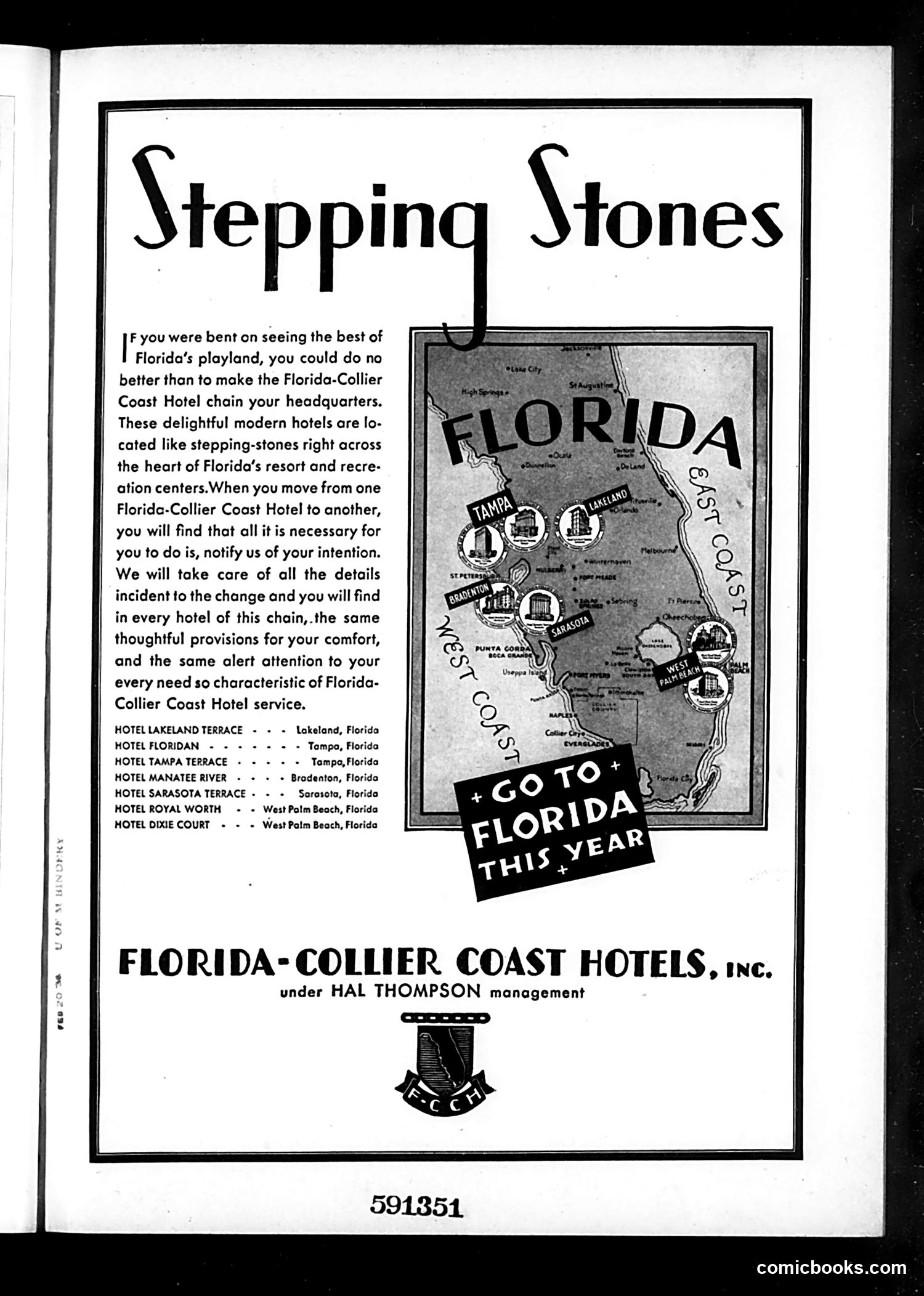
Analysis This page is not a cartoon or satire — it's a straightforward advertisement for the Florida-Collier Coast Hotels chain, likely from the 1930s-1940s based on the styling. The ad uses the metaphor of "stepping stones" to describe the hotel chain's strategic locations across Florida's west coast. It lists seven hotels positioned from Tampa through the Keys, presented as convenient stops for tourists traveling through the state. The map shows these hotel locations marked as visual "stepping stones" along Florida's coastline. The headline "Go to Florida This Year" is a period tourism promotion. This appears in *Life* magazine's advertising section rather than its editorial/satirical content. There is no political commentary or caricature — merely promotional travel advertising under HAL THOMPSON's management.
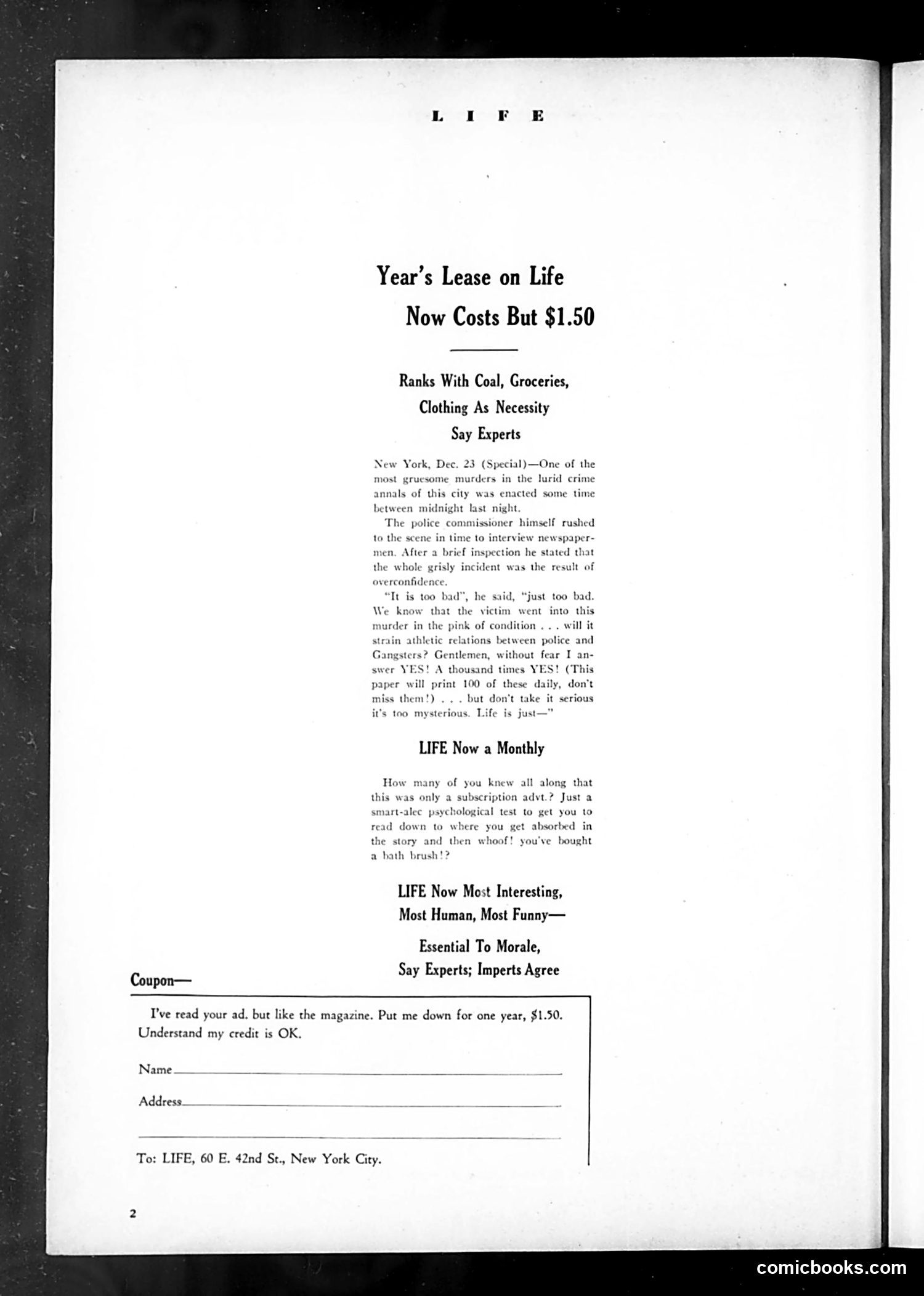
Analysis This is primarily an advertisement page for Life magazine, not a political cartoon. The page announces Life's conversion to a monthly publication at $1.50 per year—positioning it as an affordable necessity comparable to "coal, groceries, clothing." The opening section includes a satirical news item about a police commissioner's dismissive response to a murder, using exaggerated language ("too bad," "Life is just—") to mock both crime reporting and public indifference to violence. This appears to be sample satirical content meant to showcase Life's editorial voice. The coupon invites subscriptions, emphasizing the magazine's appeal as "most interesting, most human, most funny" and claiming it's "essential to morale." This targets readers seeking affordable entertainment during what appears to be an economically constrained period.
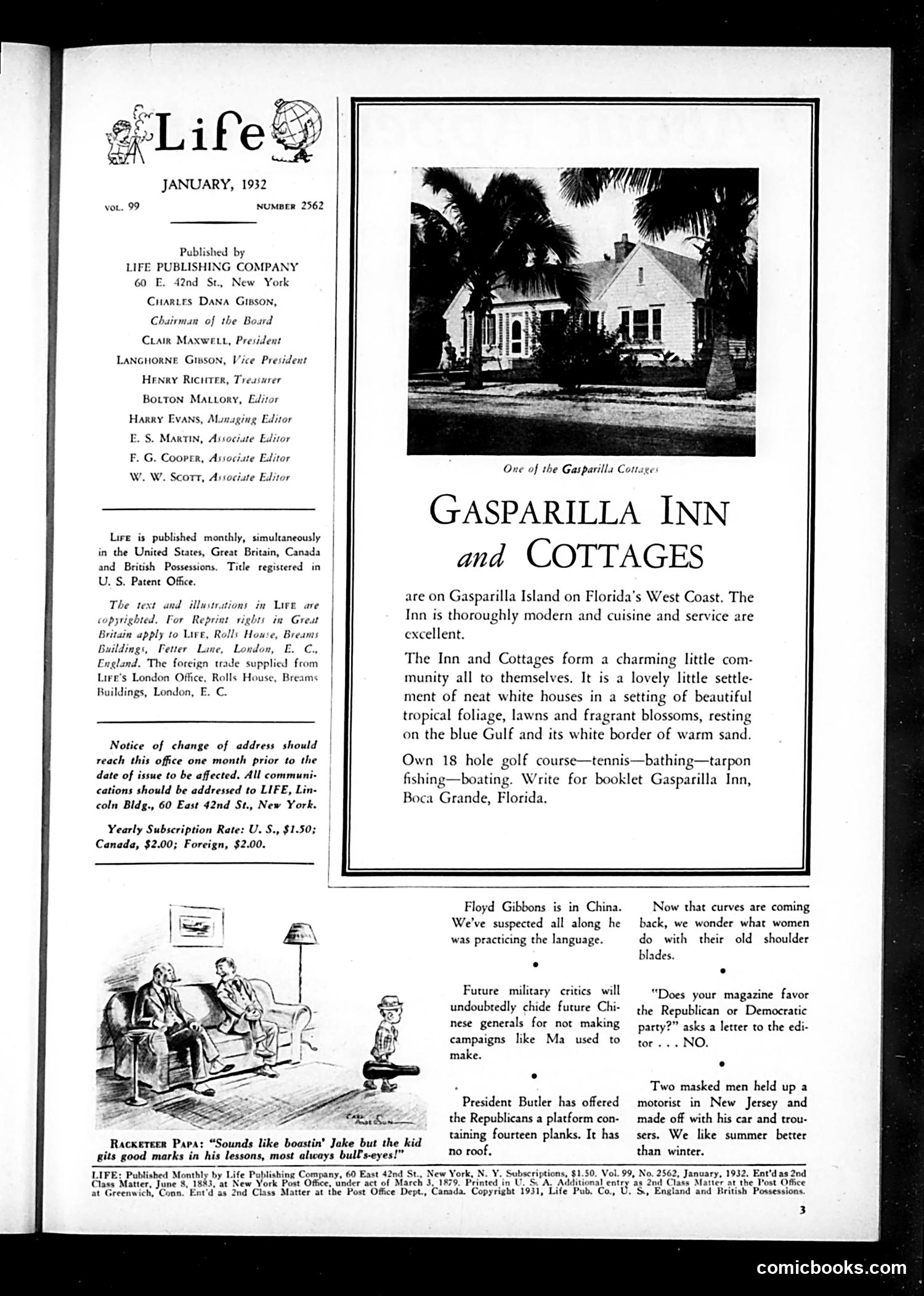
Analysis This is primarily a magazine masthead and advertisement page rather than satirical content. The top section lists Life magazine's publication details (January 1932, Vol. 99) and editorial staff. The main content is a commercial advertisement for the Gasparilla Inn and Cottages on Florida's Gulf Coast, featuring a photograph of a white cottage surrounded by palm trees. Below is a single cartoon labeled "RACKETEER PAPA," depicting two men on a couch with a child. The caption suggests satire about parenting: the father figure boasts that his son gets "good marks in his lessons, most always bull's-eyes!" — a dark joke conflating academic success with criminal marksmanship, possibly satirizing organized crime culture during Prohibition era (1920s-1933). The remaining text consists of brief social commentary snippets unrelated to the cartoon.
Analysis This is a public health advertisement, not political satire. The Metropolitan Life Insurance Company published this educational notice about appendicitis, a serious and often fatal condition in the early 20th century. The page responds to a mother's letter describing her loss of a child to acute appendicitis. It aims to prevent similar tragedies by instructing readers on proper emergency response: avoid food/water/medicine, never use laxatives (which could rupture an inflamed appendix), and call a doctor immediately. The only visual element is a decorative building illustration (likely Metropolitan Life's headquarters). This is straightforward medical guidance, not commentary or satire—reflecting the era's high appendicitis mortality rates before antibiotics and reliable surgical techniques existed.
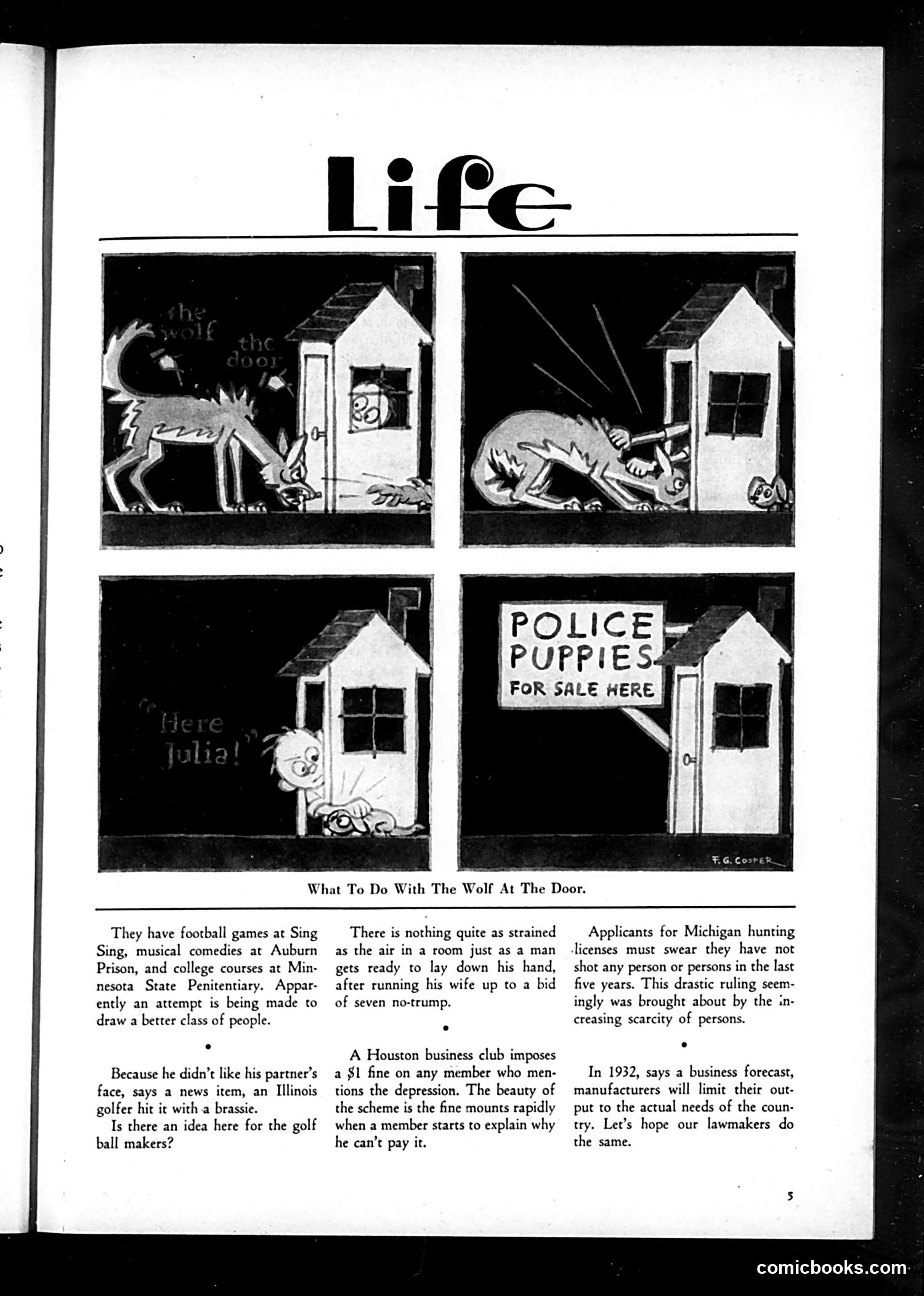
"What To Do With The Wolf At The Door" This four-panel comic by T.G. Cooper uses the "wolf at the door" (a metaphor for poverty or financial hardship) as literal imagery. The panels show a starving wolf repeatedly approaching a small house. The final panel reveals the solution: a sign advertising "Police Puppies For Sale Here"—implying the wolf can be dealt with by selling police dogs, or satirically, that law enforcement offers a commercial solution to economic desperation. The accompanying text snippets discuss various social absurdities: competitive activities at prisons, marital disputes, hunting license requirements, and business austerity measures during the Great Depression era. The overall page satirizes American responses to economic hardship and social problems through quirky, darkly humorous anecdotes and visual gags.
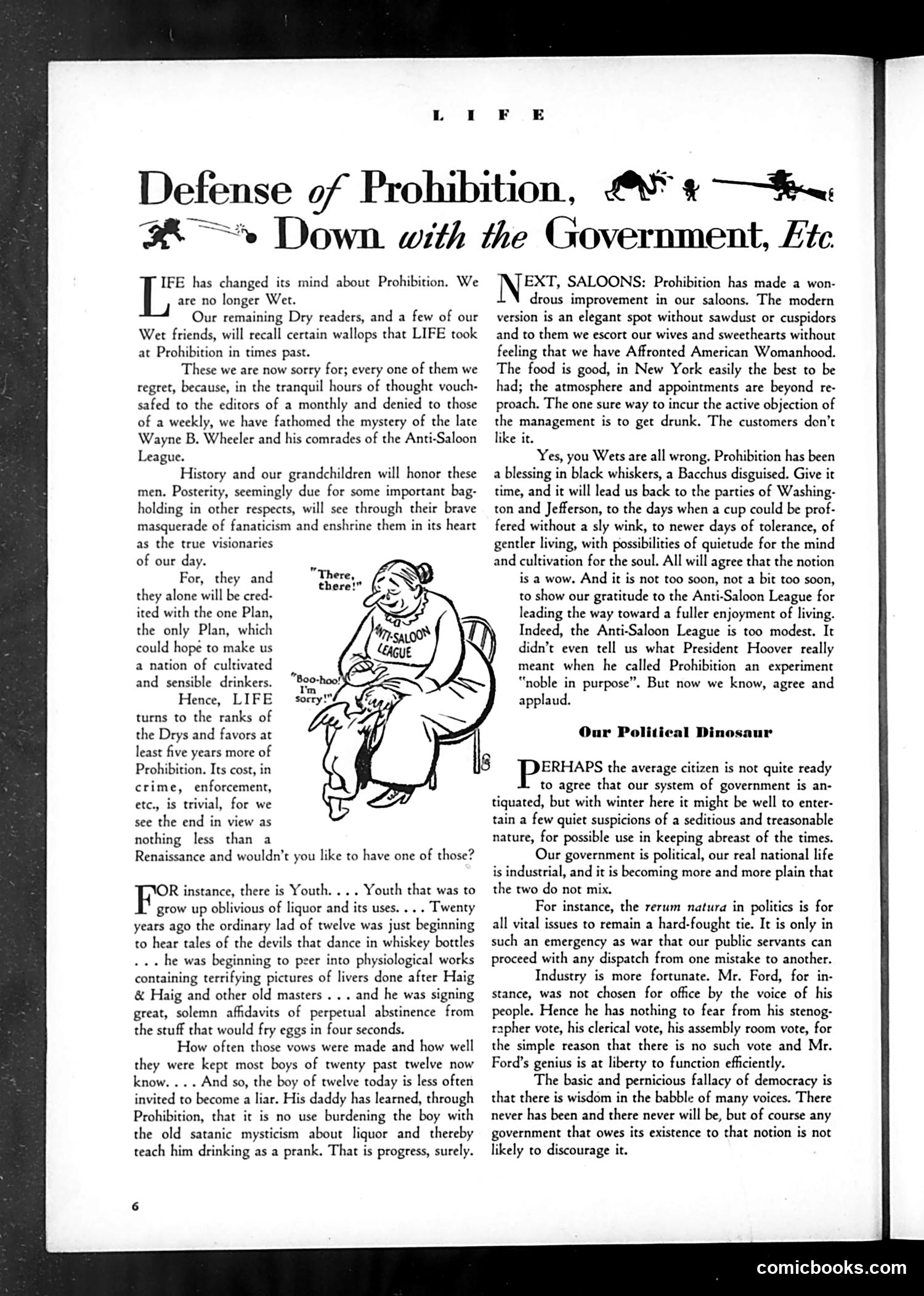
"Defense of Prohibition" - Life Magazine Satire This page satirizes the debate over Prohibition (the 1920-1933 ban on alcohol). Life magazine, initially supporting Prohibition, now recants—admitting they regret their earlier anti-saloon editorials and wallpapers. The cartoon depicts a rotund figure labeled "Anti-Saloon League," the organization that championed Prohibition. The satire argues Prohibition has *failed*: it made speakeasies more elegant than saloons, encouraged drunkenness, and proved unenforceable. The second article, "Our Political Dinosaur," compares the government to an outdated creature, criticizing Prohibition as governmental overreach that contradicts American values of liberty. The overall message: Life's editors are reversing course, now viewing Prohibition as misguided social engineering rather than moral progress.
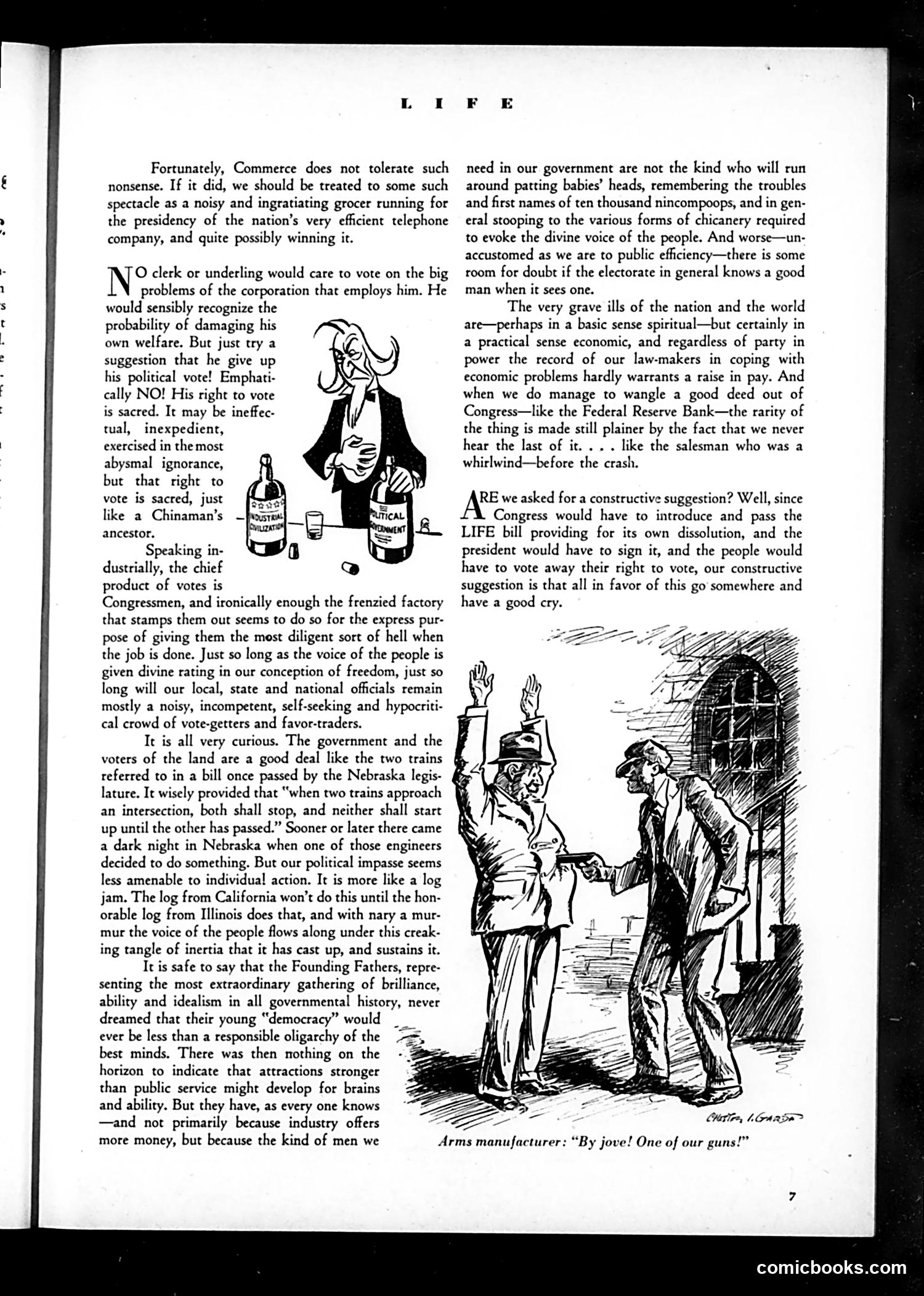
Life Magazine Satire Analysis This page critiques American democracy and governance through two cartoons. Upper cartoon: Shows a caricatured politician with bottles labeled "Political" items, satirizing how Congress produces legislation as a factory product—implying politicians are mass-produced and interchangeable rather than thoughtful leaders. Lower cartoon: Depicts an arms manufacturer showing a gun to a uniformed military or government official, with the caption "By jove! One of our guns!" This mocks the cozy relationship between defense contractors and government, suggesting arms manufacturers profit from close ties to military/political power. The text criticizes voters for electing incompetent officials, compares government gridlock to a train collision, and laments that democracy produces "noisy, incompetent" leaders rather than attracting capable minds to public service. The satire suggests industry attracts better talent because it offers higher pay and prestige.
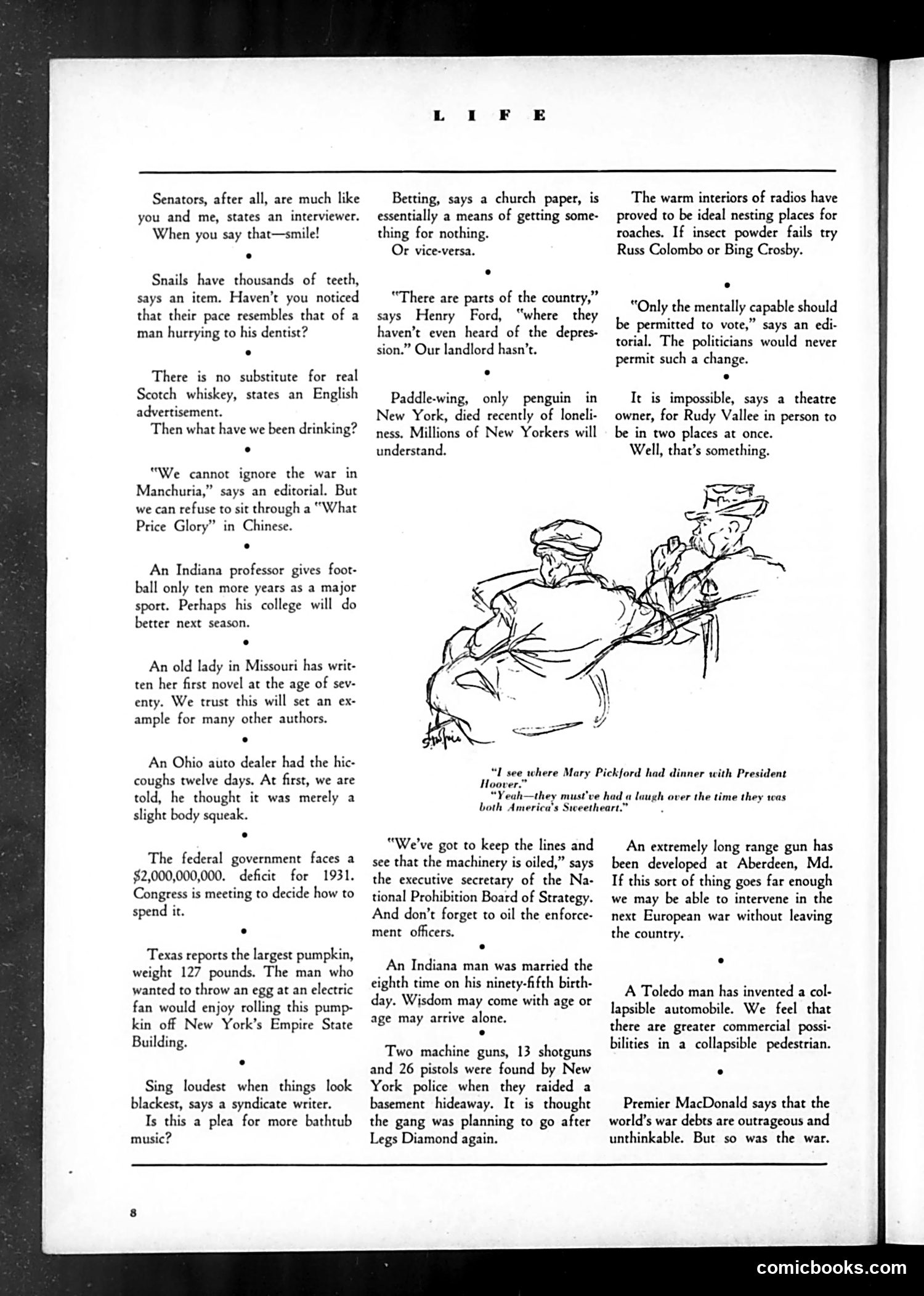
Analysis of Life Magazine Page This page contains a single cartoon depicting two figures in period dress (likely 18th or 19th century based on clothing) sharing a meal. The caption references "Mary Pickford had dinner with President Hoover," suggesting these figures represent those two historical figures, with the implication they "must've had a laugh over the time they were both America's Sweetheart." The joke relies on early 1930s context: Mary Pickford was a famous silent-film actress, while President Herbert Hoover's popularity was collapsing during the Great Depression. The satire suggests both were once celebrated American figures—"sweethearts"—now diminished in relevance, making their hypothetical dinner conversation darkly humorous about faded fame and political failure.
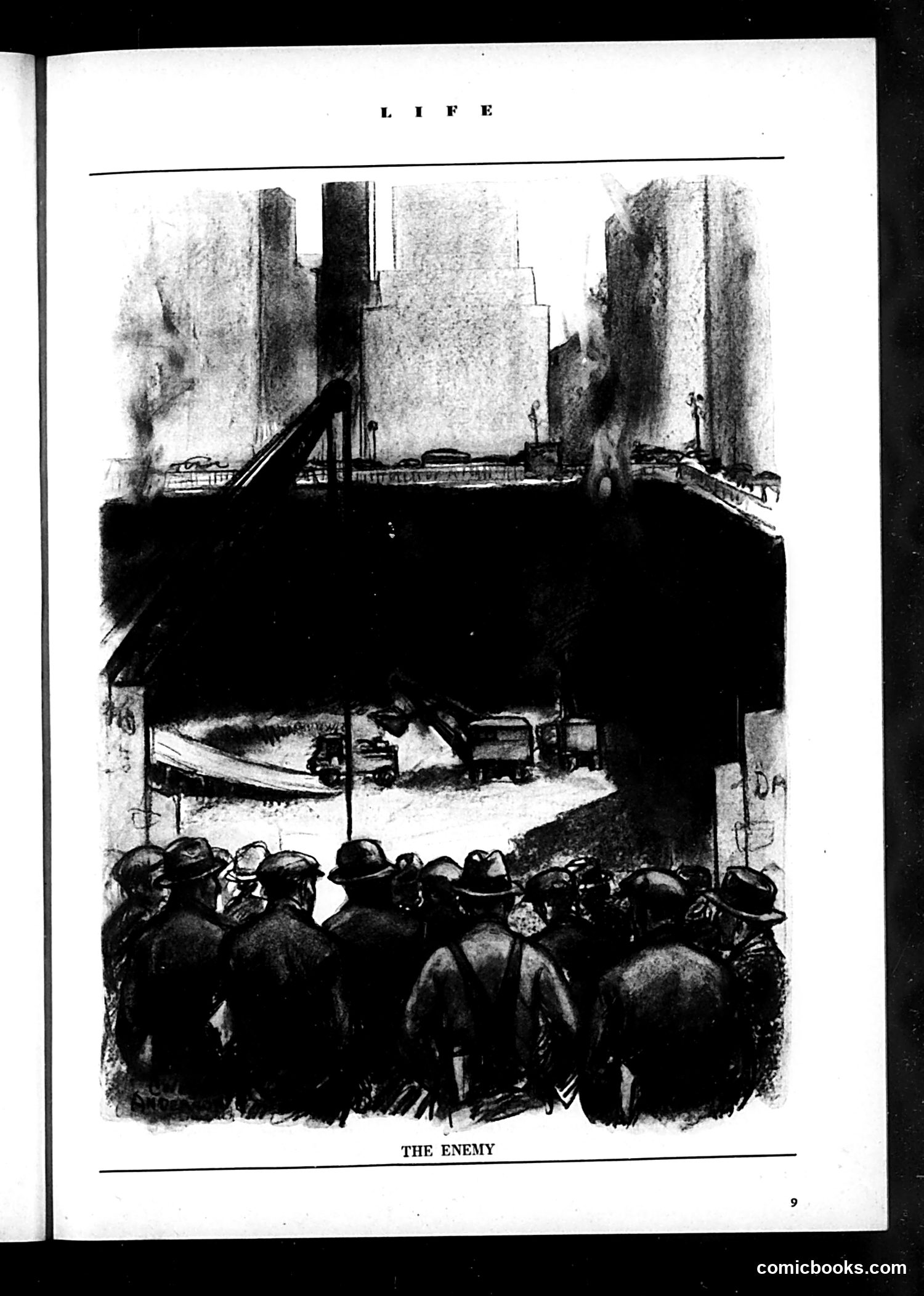
"The Enemy" This illustration depicts a large crowd of soldiers wearing military helmets, viewed from behind as they gaze upward at an industrial cityscape with tall buildings and factory smokestacks belching smoke. The composition creates a stark contrast between the dark mass of troops in the foreground and the gray, ominous urban landscape above. The title "The Enemy" suggests the city itself—or what it represents—is the adversary. This likely refers to either enemy industrial capacity during wartime, or possibly critiques militarism and industrialization as threats to human life. The anonymous soldiers facing the imposing cityscape emphasizes individual soldiers as small against vast mechanized forces of war or industry. The mood is ominous and dehumanizing.
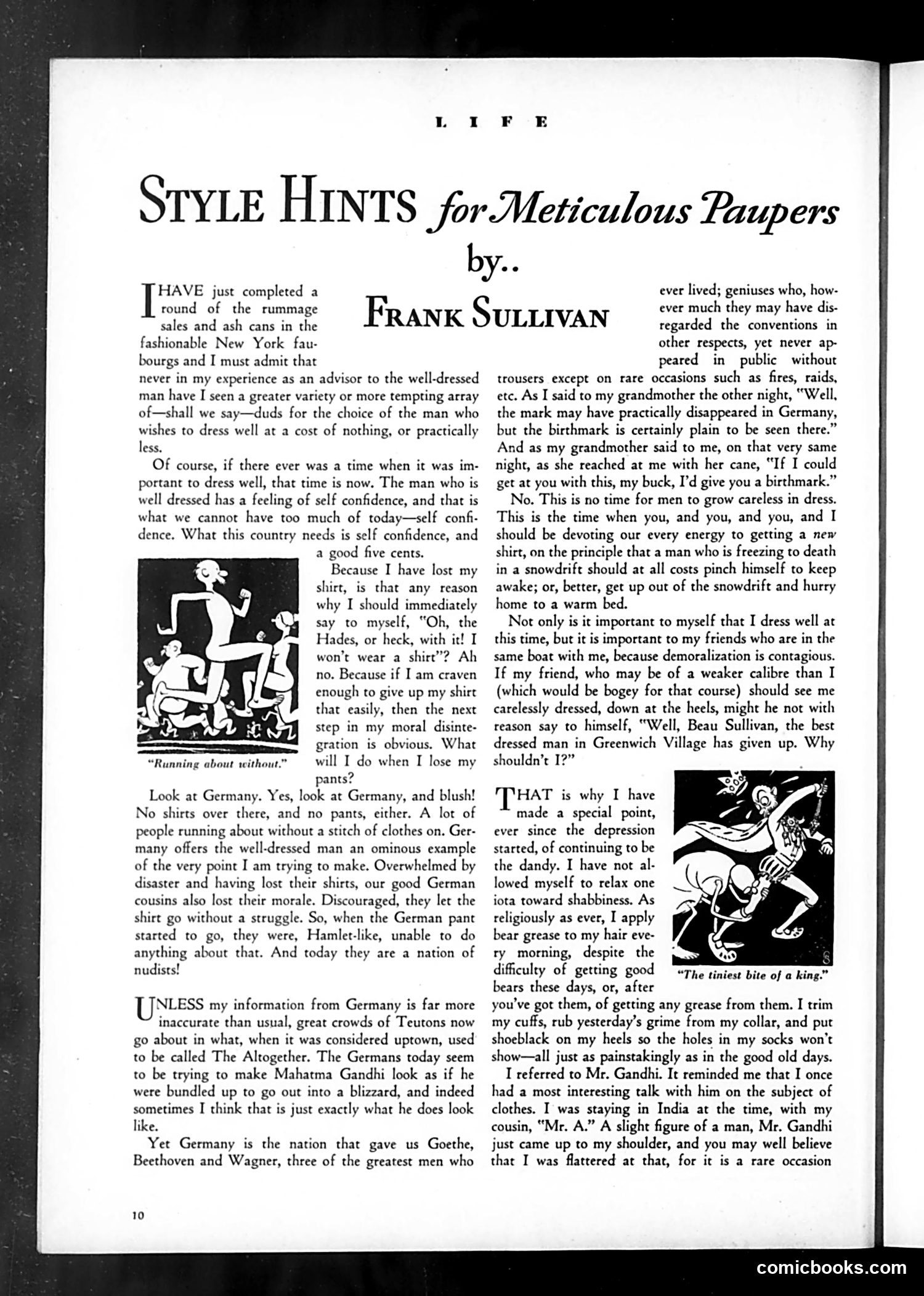
Analysis of "Style Hints for Meticulous Paupers" by Frank Sullivan This satirical piece mocks Depression-era poverty through fashion advice. Sullivan argues that maintaining proper dress is essential for morale and self-respect during economic hardship. The cartoon labeled "Running about without" depicts a figure lacking clothing, illustrating Sullivan's opening anecdote about losing one's shirt—both literally and financially. A second illustration shows a figure in exaggerated motion, captioned "The tiniest bite of a king," likely referencing maintaining dignity on minimal resources. Sullivan references Germany's post-WWI economic collapse and mentions Gandhi to illustrate how even great figures face material deprivation. The satire critiques both the Depression's severity and society's obsession with appearances even amid widespread poverty—suggesting that proper dress becomes an almost religious obligation when everything else fails.
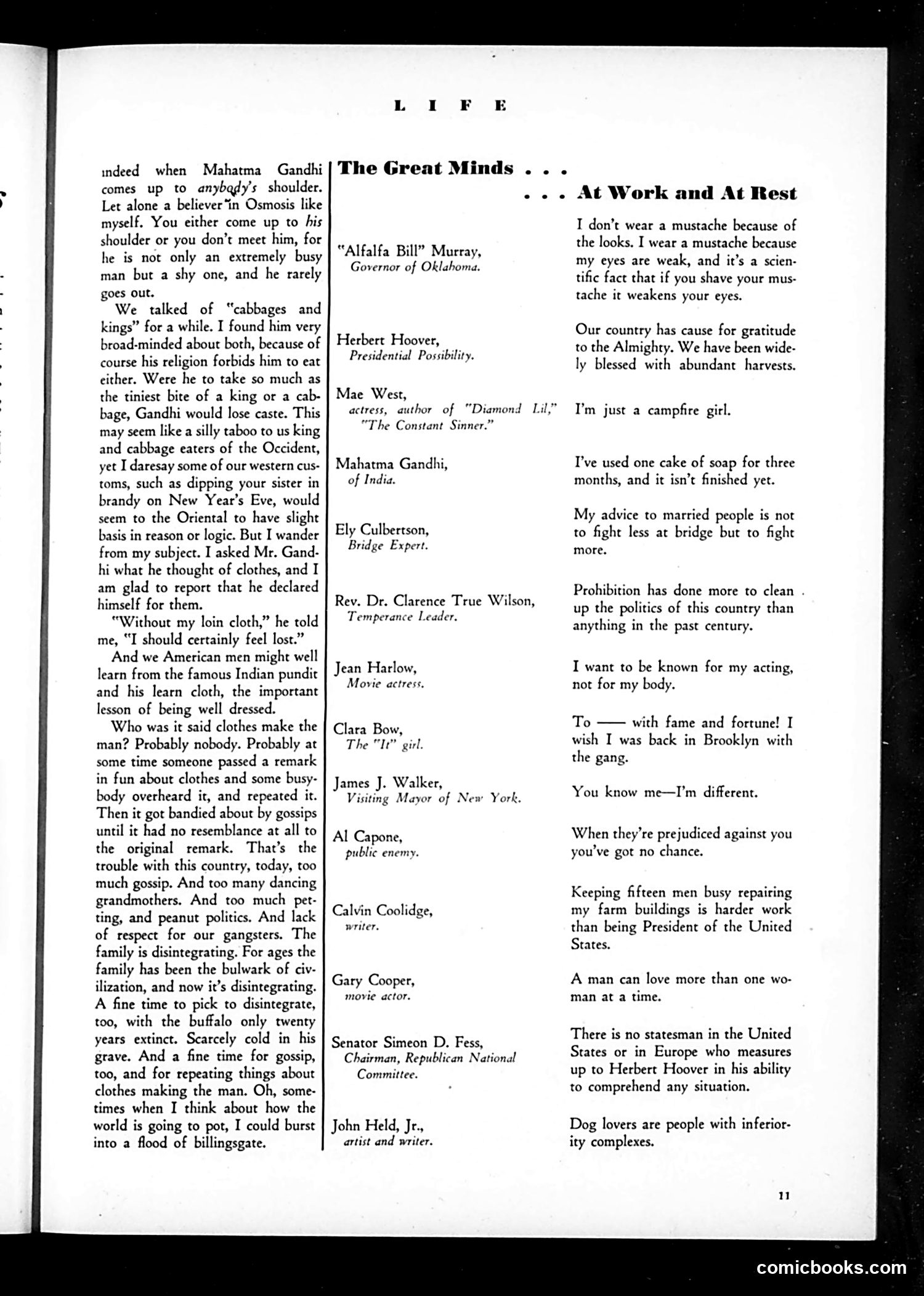
"The Great Minds at Work and at Rest" - Life Magazine Page This page presents a column of witty one-liners attributed to famous contemporary figures. The left side contains a longer essay about Mahatma Gandhi's attitude toward Western clothes and materialism, contrasting Eastern and Western values. The right side lists quotable remarks from notable 1920s-30s personalities including "Alfie Bill" Murray (Oklahoma governor), Herbert Hoover, Mae West, Clara Bow, Al Capone, and others. The satire juxtaposes serious statesmen (Hoover, Coolidge) with entertainers (Mae West, Gary Cooper), criminals (Capone), and cultural figures, suggesting all deserve equal consideration as "great minds." The quotes range from the profound to the trivial, satirizing how celebrity opinions were treated as wisdom in popular media.
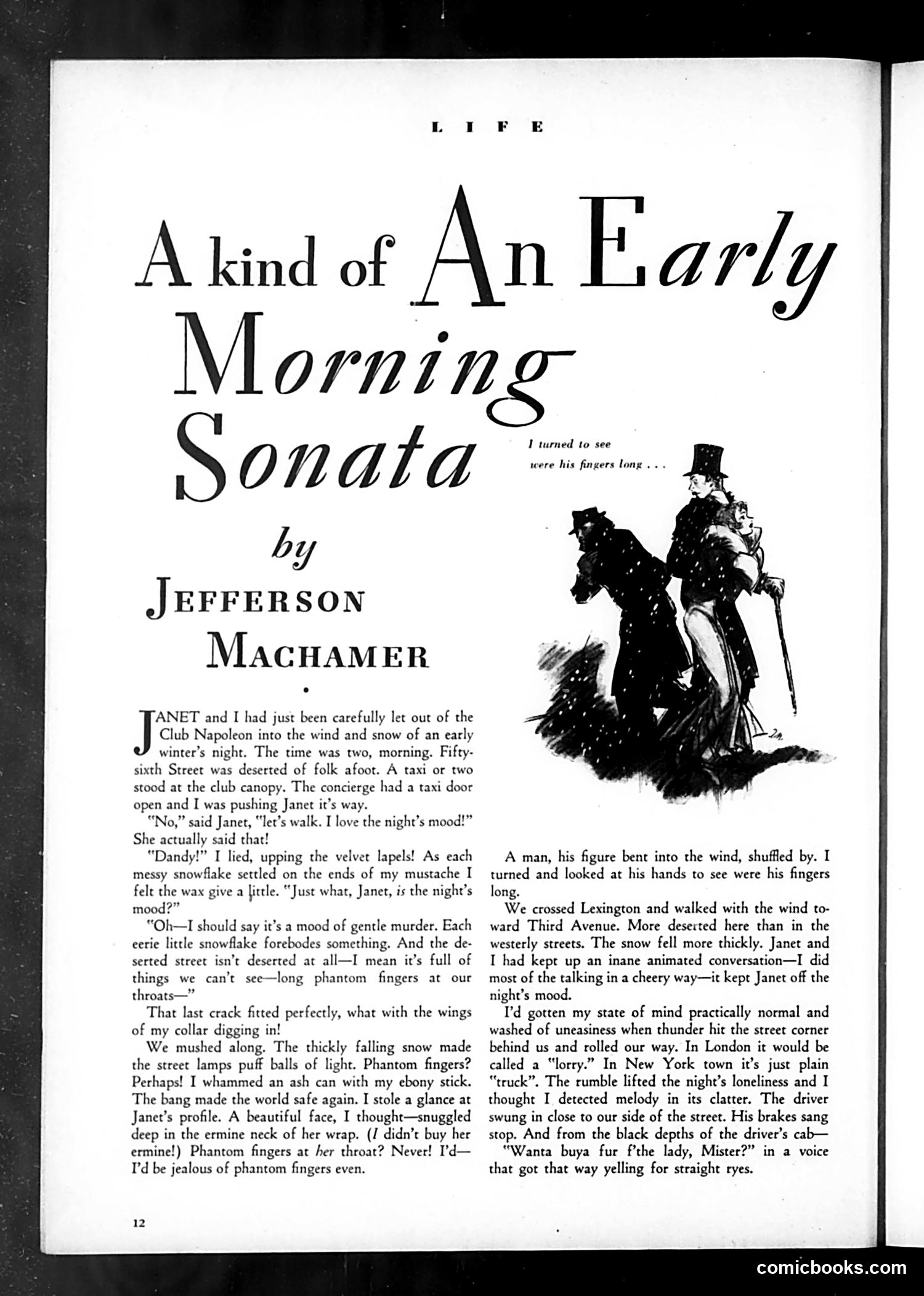
"A Kind of An Early Morning Sonata" by Jefferson Machamer This page presents the opening of a short story accompanied by an illustration. The story depicts two people—Janet and the narrator—leaving a nightclub (Club Napoleon) on a snowy early morning in New York City. The illustration shows a elegantly dressed man in a top hat alongside a woman in winter attire, walking through snow. The narrative establishes a romantic mood, with the narrator admiring Janet's beauty and poetic nature. References to "phantom fingers" and the "night's mood" create atmospheric, slightly mysterious tone. The story appears to be a light romantic or comedic piece typical of Life magazine's literary content, set in 1920s-30s urban New York.
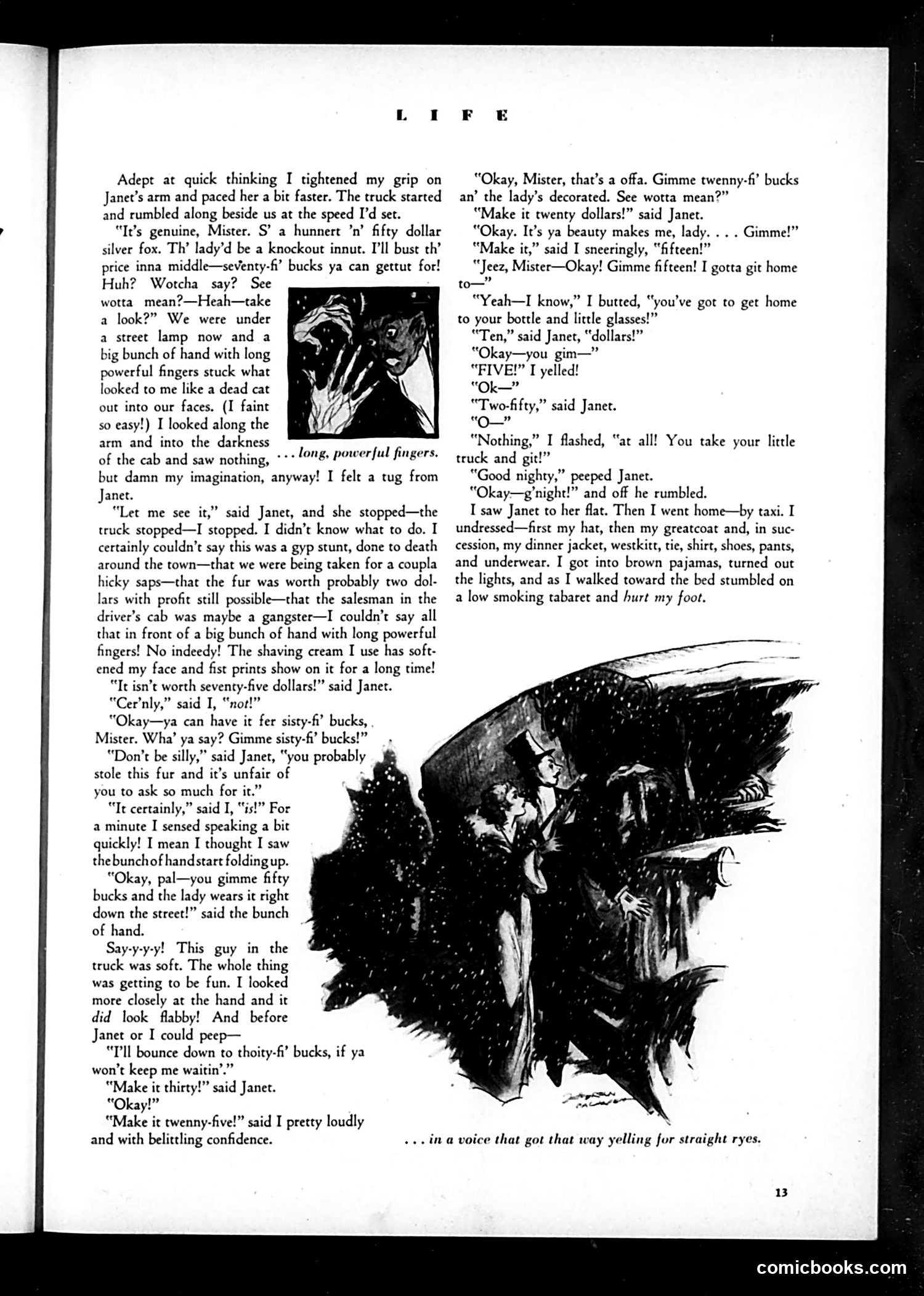
Analysis This page is from a narrative fiction piece titled "LIFE," not a political cartoon. The text describes a streetside encounter involving a fur coat transaction, with dialogue between characters named Janet and the narrator. The two illustrations are literary accompaniments: the upper image shows "long, powerful fingers" (emphasizing menace), while the lower illustration depicts a figure "in a voice that got that way yelling for straight eyes"—suggesting someone hardened by street life. The content appears to be crime or noir fiction, depicting working-class urban characters negotiating over what may be a stolen fur. The dialogue uses period slang ("gimme fifty bucks," "gim") consistent with early-to-mid 20th century street vernacular. This is narrative entertainment, not political satire.
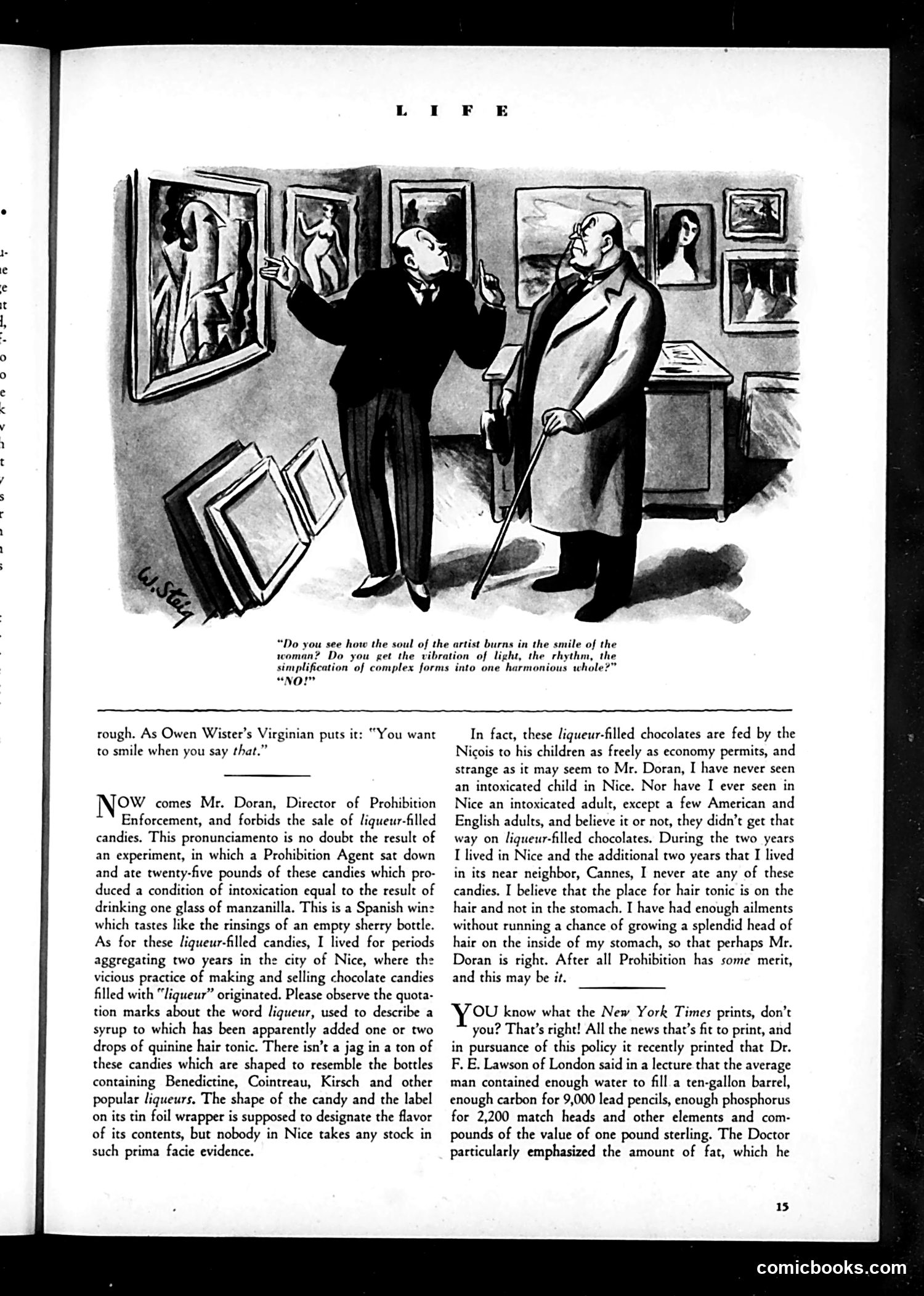
Explanation for Modern Readers This cartoon satirizes Mr. Doran, Director of Prohibition Enforcement, shown on the right examining artwork in a gallery. The joke contrasts artistic appreciation with Prohibition policy: the caption asks if Doran perceives "the soul of the artist" in art, yet answers "NO"—suggesting he lacks such refinement. The article then criticizes Doran's ban on liqueur-filled chocolates, calling it excessive. The author argues these candies pose no intoxication risk (citing European experience), making the prohibition absurd overreach. This reflects 1920s Prohibition era debates: while the cartoon itself doesn't identify specific individuals beyond "Mr. Doran," it attacks a government official for what the writer views as puritanical, art-blind enforcement of alcohol restrictions.
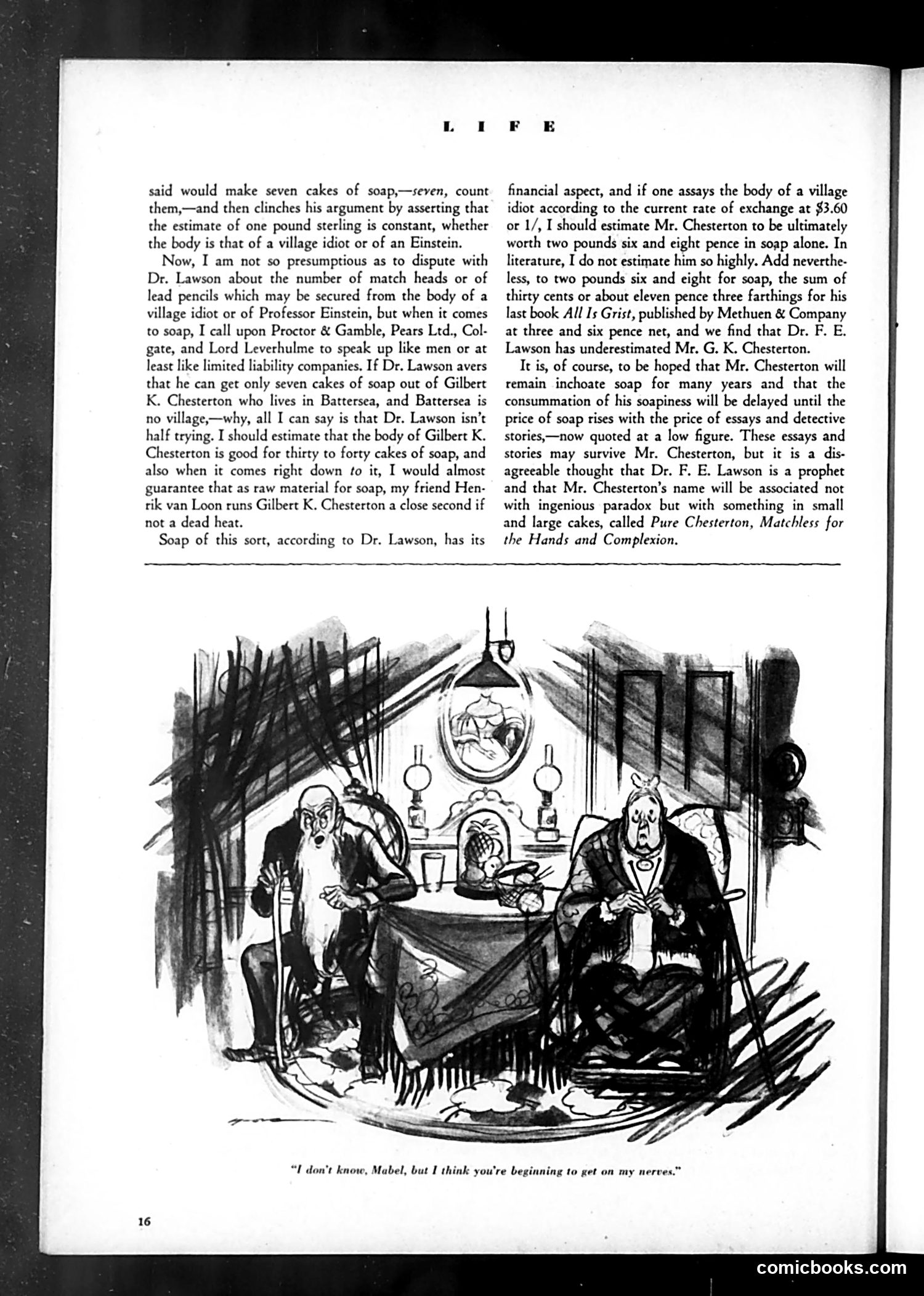
Political Satire: Chesterton and Lawson Debate This page satirizes a heated public dispute between G.K. Chesterton (a prominent English writer) and Dr. Lawson over an absurd calculation: how many soap cakes could be made from a "village idiot's" body. The author ridicules Dr. Lawson's pedantic argument about exchange rates and soap production, suggesting it's intellectually dishonest. The cartoon below depicts three figures in what appears to be a séance or supernatural gathering, with the caption "I don't know, Mabel, but I think you're beginning to get on my nerves." The cartoon seems to mock the pseudoscientific nature of the debate itself—treating the soap discussion as equally mystical and absurd as communicating with spirits.
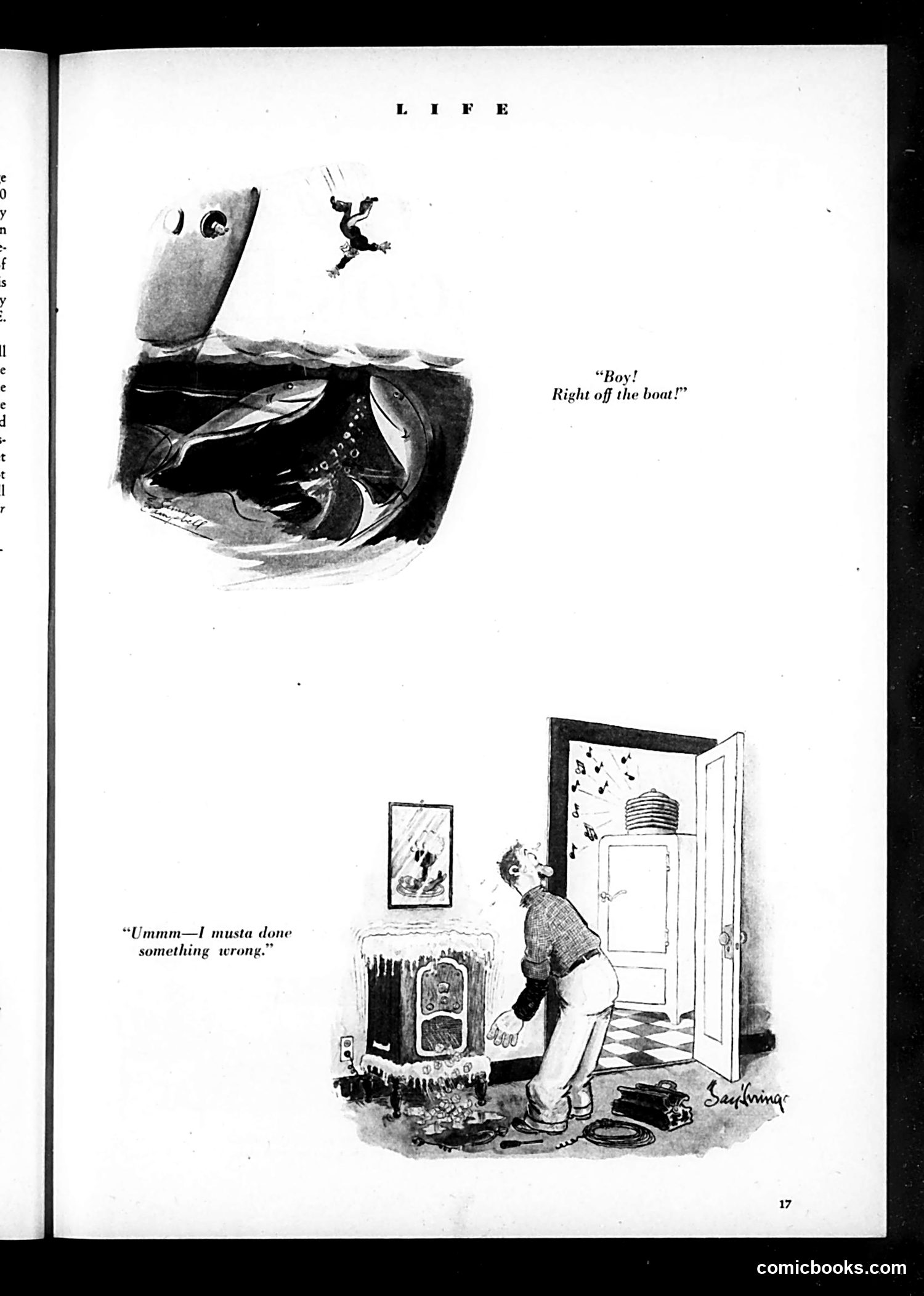
Two Cartoons from Life Magazine Top cartoon: A figure is ejected from a boat with the caption "Boy! Right off the boat!" This appears to be satirizing immigration—depicting someone literally being thrown out immediately upon arrival, likely commenting on anti-immigrant sentiment or treatment of newcomers. Bottom cartoon: A man stands in a doorway looking confused, with broken/malfunctioning radio equipment visible. The caption reads "Ummm—I musta done something wrong." The setting suggests domestic life, and the joke appears to be about a man blaming himself for technical problems (the radio malfunction), possibly satirizing how people—especially men—might irrationally self-blame for mechanical failures, or alternatively mocking domestic incompetence. Both are signed by the cartoonist Sadubar/Sadhmar.
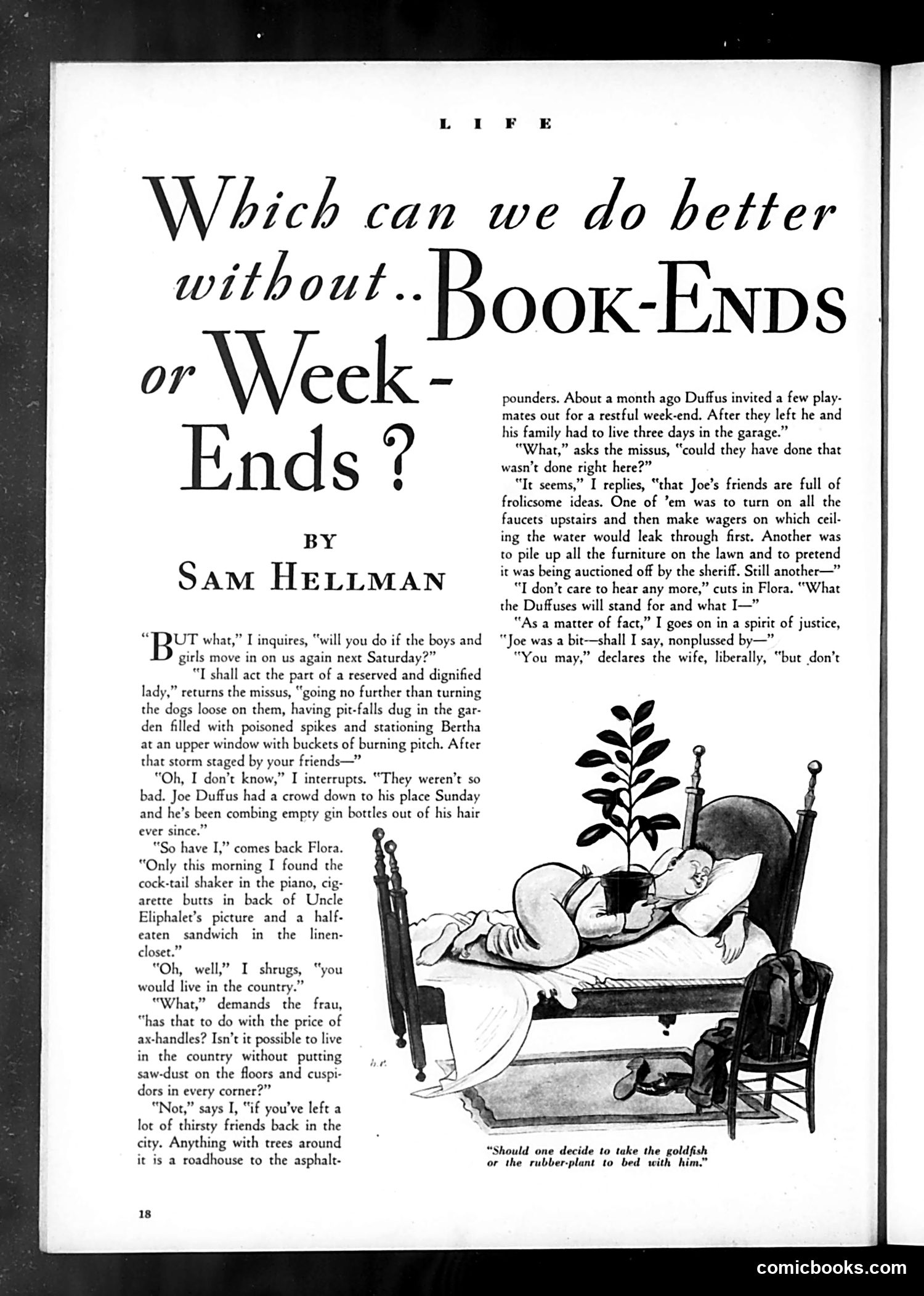
Analysis This is a humorous short story by Sam Hellman titled "Which can we do better without—Book-Ends or Week-Ends?" The accompanying illustration shows a man relaxing in bed with a potted plant, surrounded by rifles and a chair. The satire addresses the tension between urban and country living during what appears to be the early 20th century. The protagonist debates whether weekend escapes to the countryside are worth the chaos they bring. The text humorously catalogs the disorder caused by houseguests—overflowing gin bottles, scattered cigarette butts, broken furniture pretended to be auctioned off. The satire mocks both the disruption of domestic life caused by social entertaining and the pretentious idea of rural retreats as refined relaxation. The illustration's absurd domestic scene reinforces the satirical point: even attempts at peaceful respite become cluttered and chaotic.
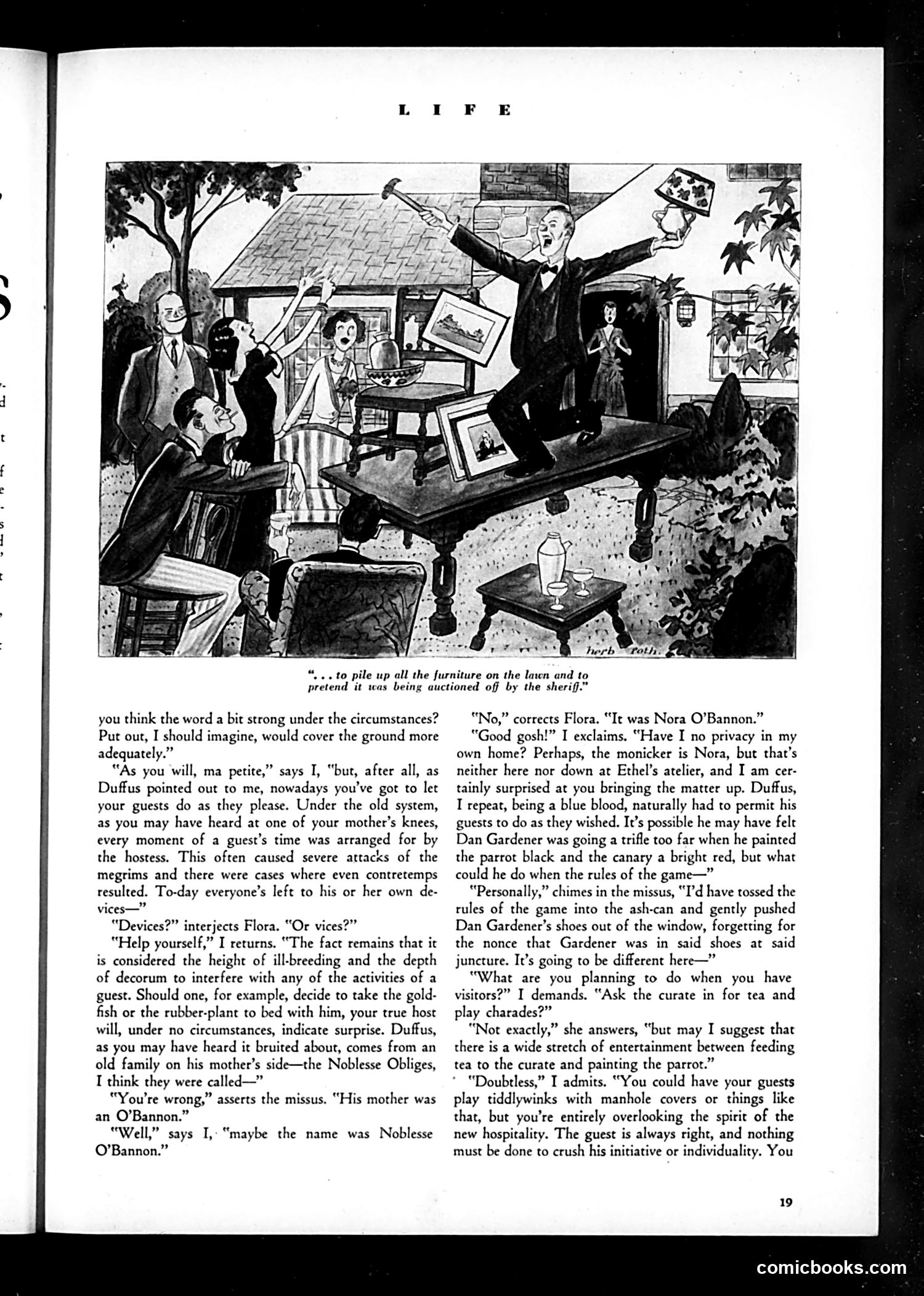
Analysis of Life Magazine Page This page satirizes upper-class etiquette and social pretension regarding house guests. The illustration depicts a chaotic home auction scene where furniture is being sold off the lawn while guests are present—a deliberately absurd scenario. The dialogue between characters (Flora, Duffus, and a missus) debates whether this violates social decorum. The satire targets the rigid "old system" of rigid guest entertainment rules that Duffus represents. The counterargument champions modern hospitality: allowing guests autonomy and freedom rather than micromanaging their every moment. The joke critiques how upper-class hosts obsess over maintaining appearances and controlling guest experiences, when modern hosts should trust guests to entertain themselves. The auction chaos visualizes this clash between stuffy Victorian propriety and relaxed modern attitudes.
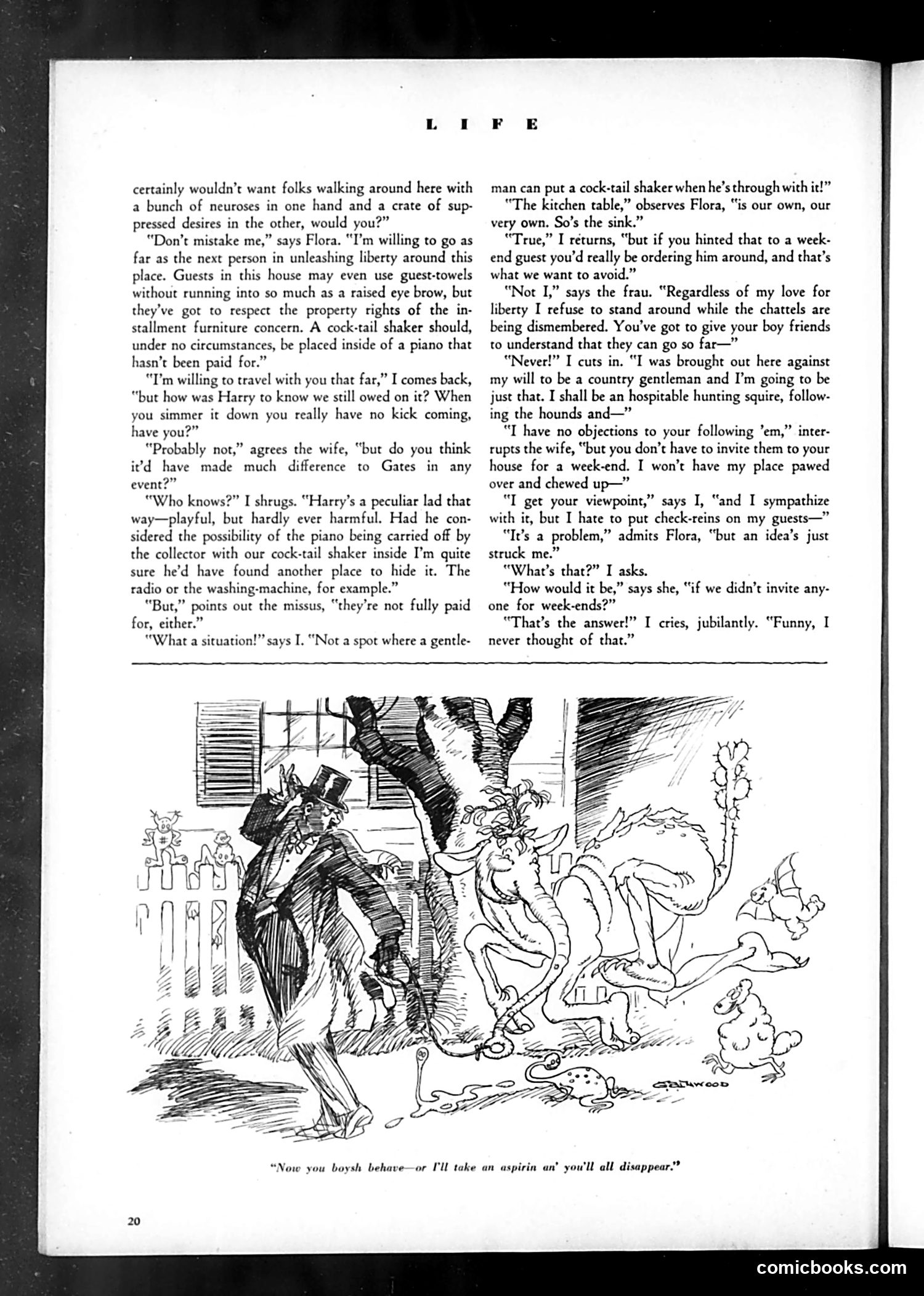
Analysis of Life Magazine Page This page satirizes the tension between modern social liberalism and property anxiety in 1920s-30s middle-class America. A married couple debates hosting weekend guests—specifically a friend named Harry who carelessly hid a cocktail shaker inside their unpaid-for piano. The wife (Flora) espouses "liberty" and progressive values but obsesses over protecting their installment-plan furniture from damage or repossession. The husband wants to play the gracious "country gentleman" host without restrictions. The satire targets the contradiction: they claim to embrace freedom and unconventional behavior, yet are enslaved by financial anxiety over consumer goods they don't actually own. The cartoon's grotesque illustration—showing a devil-like figure threatening them—reinforces this moral panic. The punchline undercuts both positions: their "solution" is simply to stop inviting guests entirely—avoiding the problem rather than resolving the underlying conflict between their aspirations and economic reality.
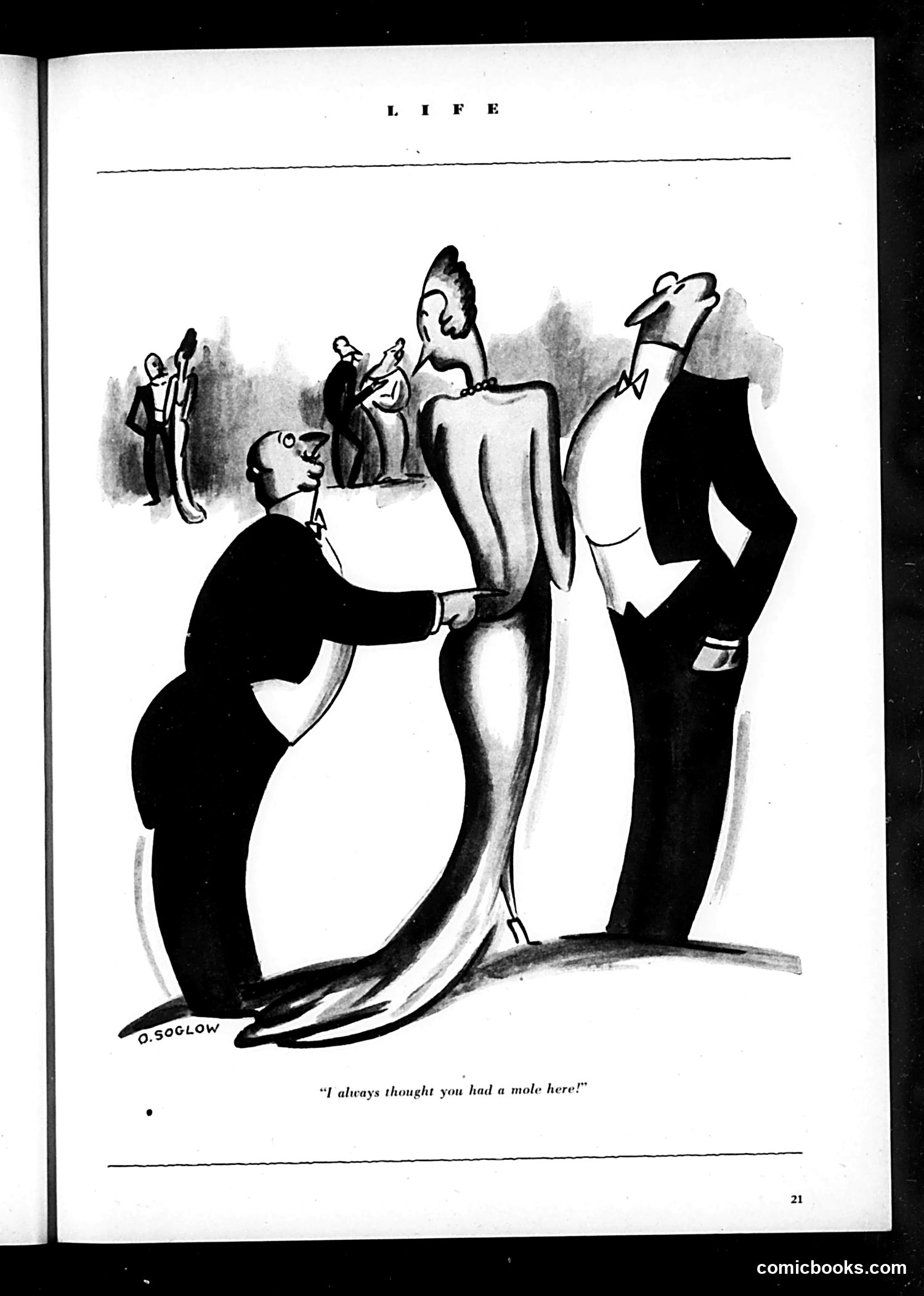
Cartoon Analysis This is a satirical cartoon from *Life* magazine showing a man in formal attire examining a nude female figure, while two other figures observe in the background. The caption reads "I always thought you had a mole here!" The humor appears to target infidelity or marital deception: the man's comment about a mole suggests he's pretending familiarity with this woman's body, implying either he's mistaken her for someone else, or he's being caught with an unfamiliar companion. The formal dress of the observers in the background suggests this may be a social or party setting where such a discovery would be particularly embarrassing. The satire mocks duplicity in relationships and the awkwardness of being caught in compromising situations. Without more historical context, the specific social commentary remains somewhat unclear.
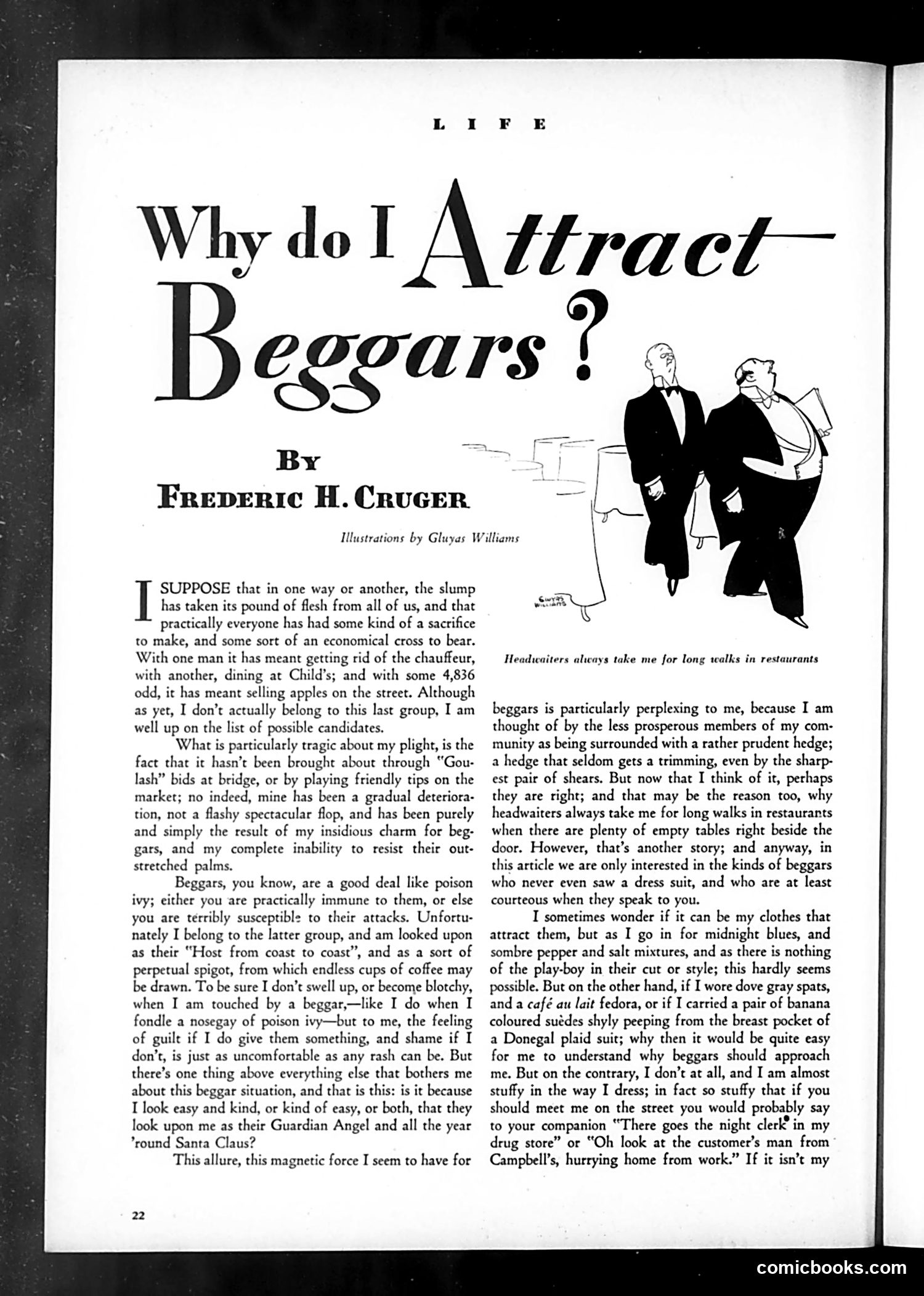
"Why Do I Attract Beggars?" — Life Magazine Satire This humorous essay by Frederic H. Cruger, illustrated by Gluyas Williams, uses the Great Depression as its backdrop. The author puzzles over why beggars constantly approach him for money, despite his unremarkable appearance and modest dress. The satire operates on multiple levels: Cruger claims he's nearly broke himself (possibly headed toward selling apples on the street like Depression-era unemployed), yet he's chronically unable to refuse beggars. He examines possible explanations—his clothes are stuffy and undistinguished, his manner neither particularly kind nor easy—yet concludes he possesses some inexplicable "magnetic force" that draws the desperate to him. The cartoon illustration shows well-dressed men, likely depicting the author's bewilderment at his unwanted status as society's perpetual charity dispenser. The humor lies in Cruger's self-deprecating admission that he cannot resist being exploited, combined with Depression-era anxiety about everyone's precarious economic position.
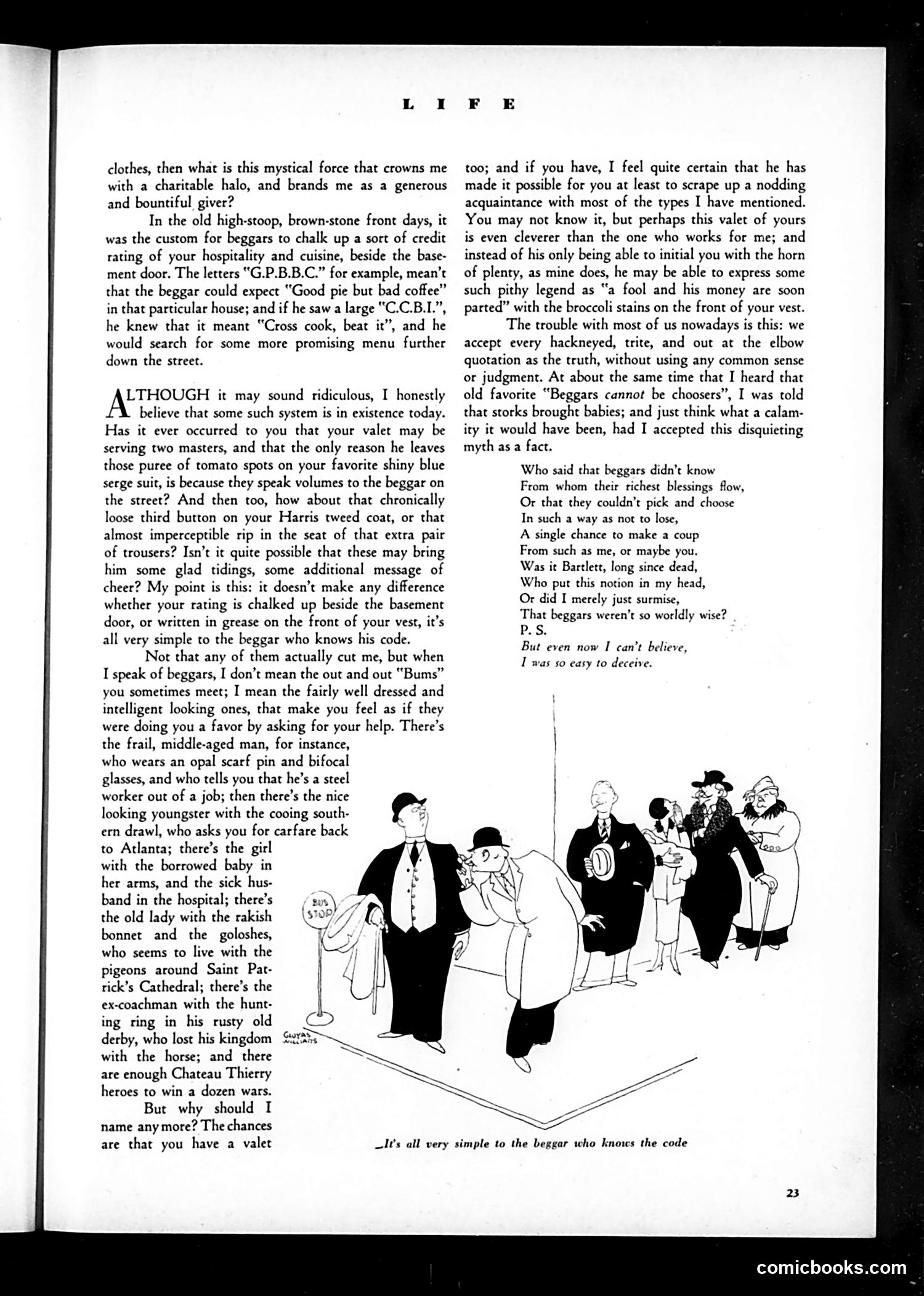
Satire Explained for Modern Readers This Life magazine piece satirizes American class hypocrisy and self-deception about charity. The author argues that wealthy people convince themselves beggars operate on a secret "code"—that servants deliberately sabotage their appearance (stains, loose buttons, torn clothing) to signal to panhandlers which households are generous. The cartoon depicts various "deserving poor" types: an unemployed steelworker, a southern girl needing carfare, a woman with a sick husband, an elderly woman feeding pigeons at a cathedral, and a WWI veteran ("Chateau Thierry heroes"). The satire's point: rather than acknowledge that valets are simply careless, or that we should help the poor regardless, the wealthy construct elaborate mental rationalizations. The caption—"It's all very simple to the beggar who knows the code"—mocks this self-serving mythology. The piece suggests middle-class Americans avoid confronting poverty's reality by treating it as a system of coded messages only the clever understand.
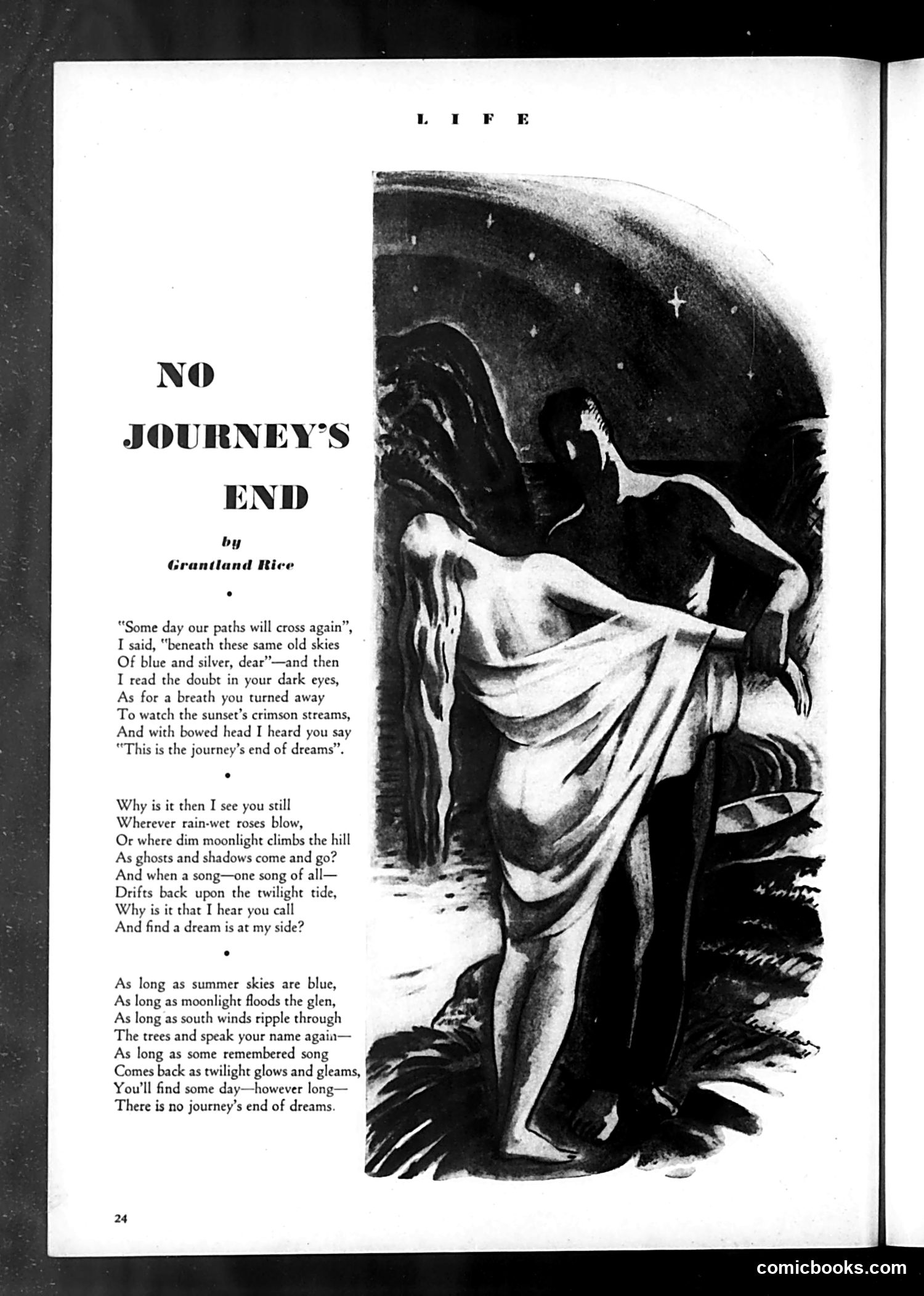
"No Journey's End" Analysis This is a romantic poem by Grantland Rice, not political satire. It appears in *Life* magazine (a general-interest publication that mixed humor, commentary, and literature). The piece explores the persistence of memory and love after separation. A speaker recalls parting from a beloved, who declared their romance "the journey's end of dreams"—suggesting finality and loss. However, the poem's central argument is that such endings are illusory: the beloved haunts the speaker through sensory triggers (roses, moonlight, songs) and remains emotionally present. The accompanying illustration—a dreaming or reclining figure gazing upward amid stars and darkness—visualizes this theme of emotional persistence and spiritual connection transcending physical absence. The tone is melancholic but ultimately hopeful: love endures beyond literal journeys' endings.
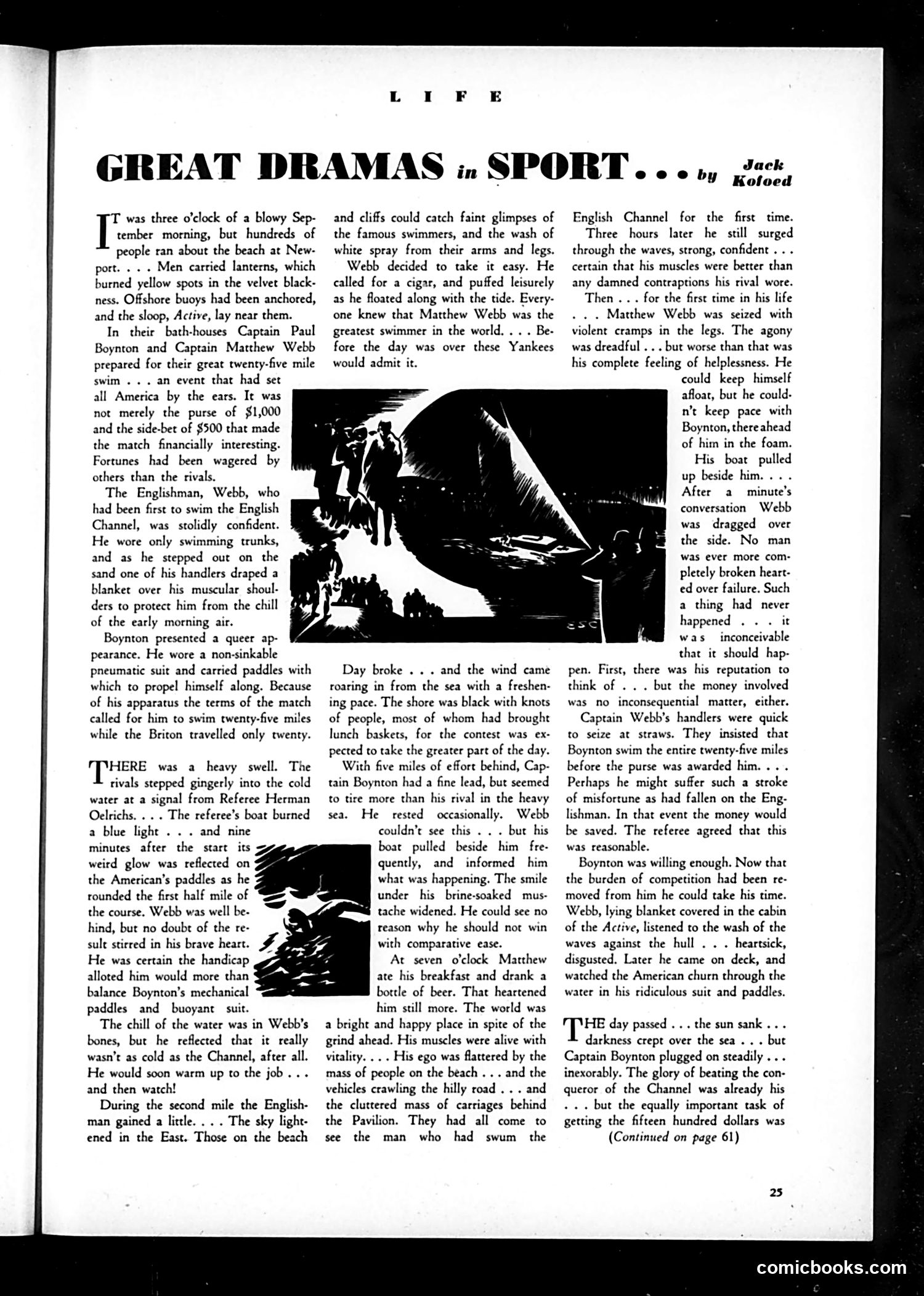
"Great Dramas in Sport" - Matthew Webb's Channel Swimming Victory This article celebrates Captain Matthew Webb, a real historical figure who was the first person to swim the English Channel (1875). The narrative dramatizes a 25-mile swimming race between Webb and Captain Paul Boynton, an American competitor. The story emphasizes Webb's confidence and superiority despite Boynton's mechanical advantages—Boynton wore a pneumatic suit and used paddles, while Webb swam in only trunks, yet still had to cover an extra five miles as a handicap. The article portrays Webb as the superior natural swimmer, with his British achievement (crossing the Channel) establishing his dominance. The two illustrations show the swimmers in the water during their race. This reflects the era's fascination with competitive swimming as a major sporting spectacle, drawing large crowds and significant wagering. Webb ultimately triumphed, reinforcing British athletic superiority in popular American media.
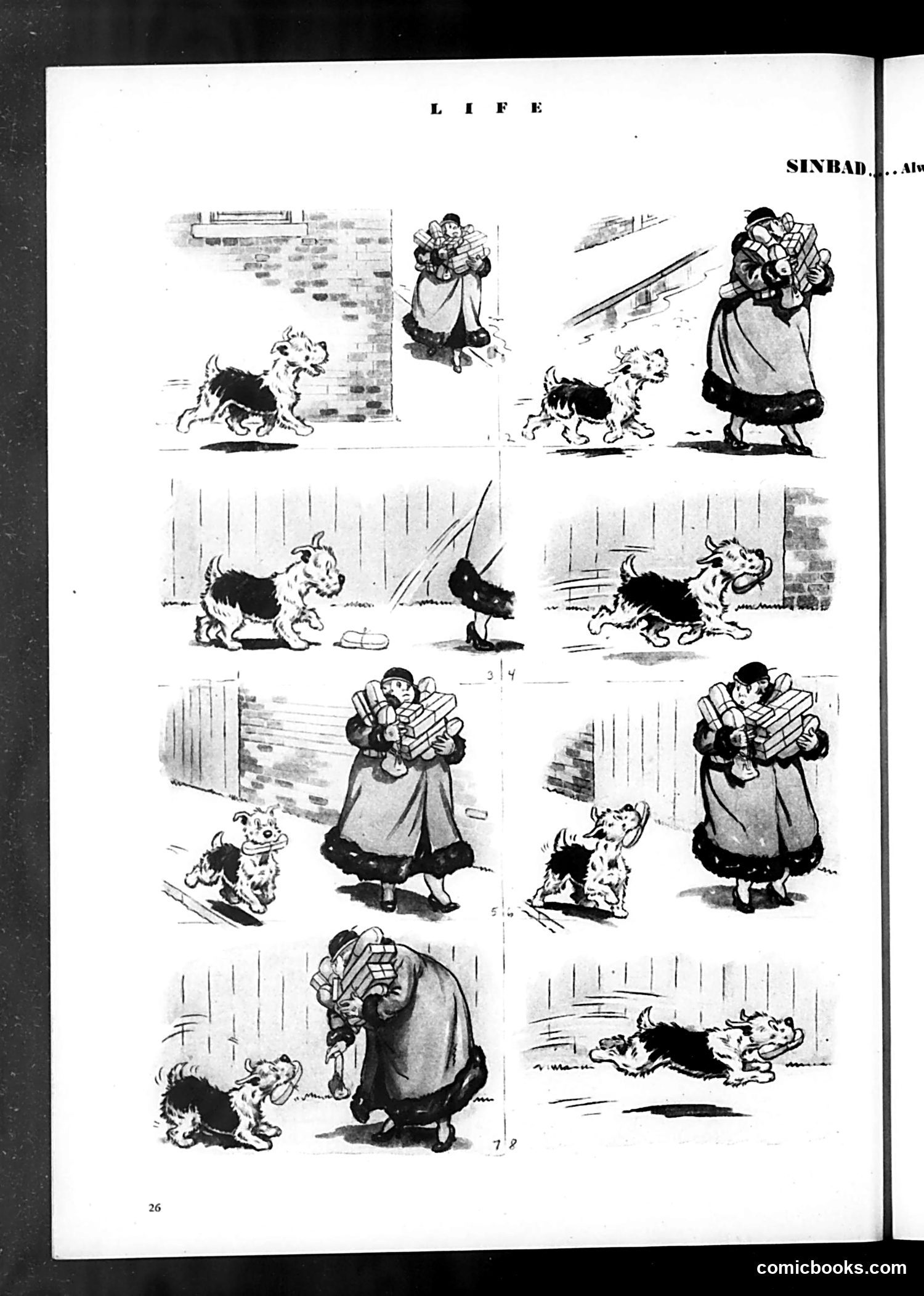
Analysis This page from *Life* magazine presents a sequential comic strip featuring a small dog and an elderly woman carrying firewood. The narrative appears to show the dog's mischievous behavior: it steals or scatters the woman's carefully gathered firewood bundle, causing her repeated frustration as she attempts to collect and carry the wood. The humor derives from the classic slapstick trope of a pet's innocent destructiveness creating domestic chaos. The woman's exasperated reactions—struggling to hold the growing pile while the dog playfully interferes—would have resonated with early 20th-century readers familiar with household inconveniences and pet-related mishaps. This is straightforward comedic illustration rather than political satire, appealing to *Life*'s audience through relatable domestic scenarios and animal antics.
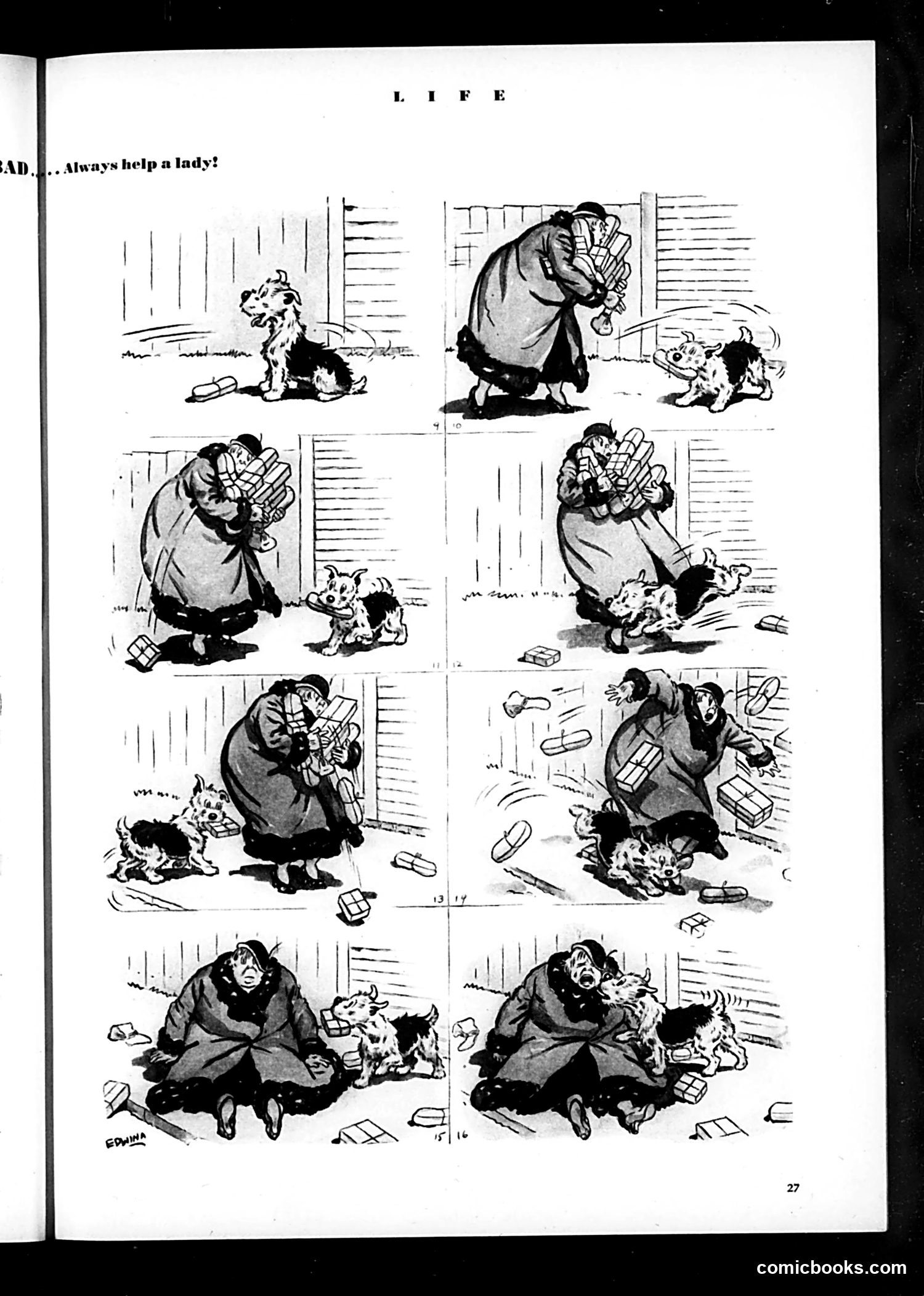
Analysis of "Always help a lady!" cartoon This sequential comic strip satirizes chivalrous behavior toward women. A well-dressed gentleman encounters a poorly-dressed woman struggling with an armload of packages in the rain. Through eight panels, he repeatedly "helps" her by taking her parcels—only to have them repeatedly fall apart, spill, or create chaos. The woman's appearance deteriorates comically with each mishap. The satire targets the gap between genteel social conventions (men should assist women) and practical reality. The gentleman's persistent "help," despite mounting disasters, mocks both rigid adherence to outdated etiquette and the condescending assumption that all women need male assistance. By the finale, both figures are covered in wreckage, suggesting such rigid chivalry may be counterproductive.
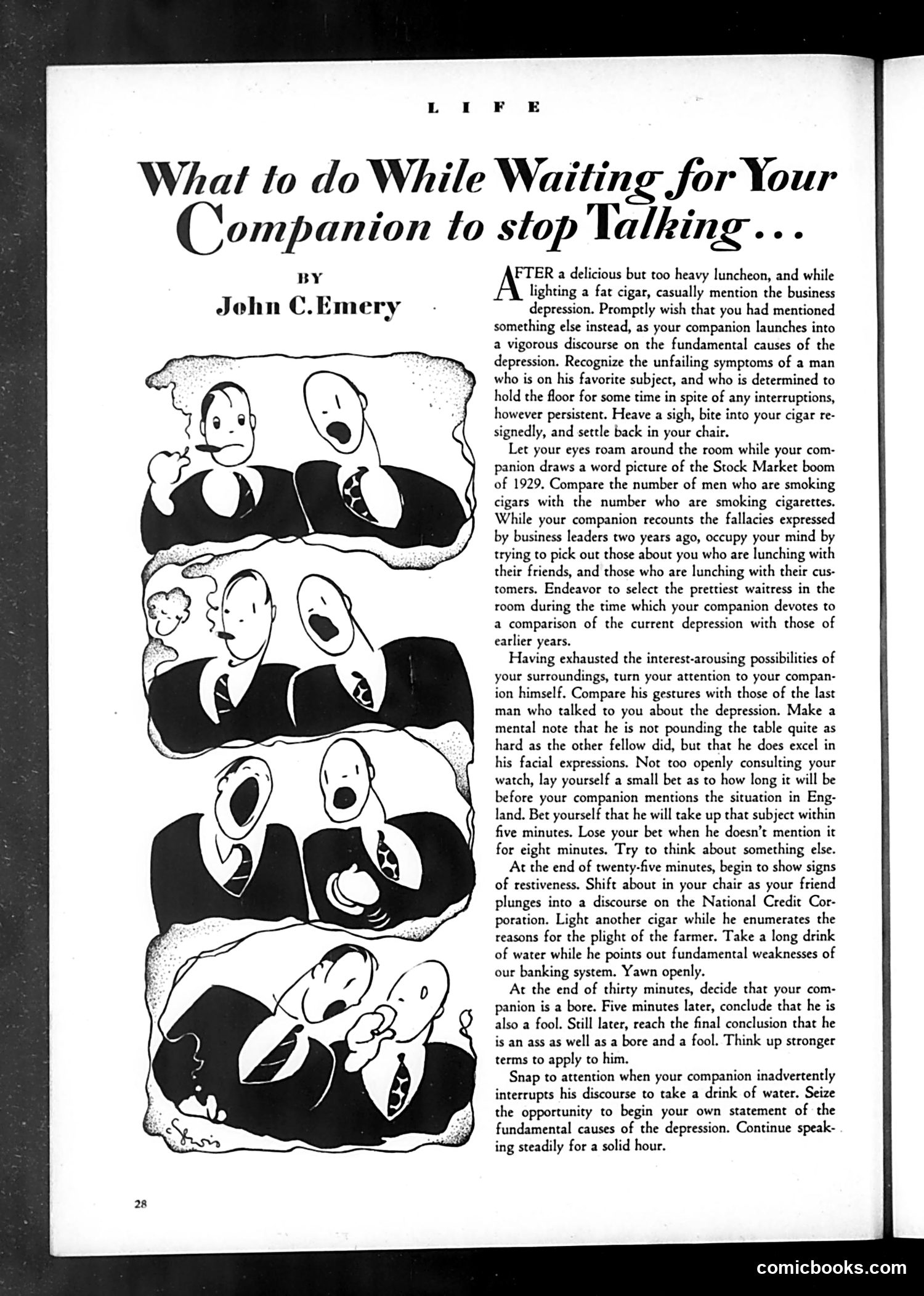
Analysis This is a humorous advice piece by John C. Emery satirizing social etiquette during the Great Depression. The cartoon illustrations show a man's progressively exasperated facial expressions as his lunch companion drones on about economic collapse. The satire targets two things: first, the Depression-era tendency of businessmen to obsessively discuss the 1929 stock market crash and economic causes at social gatherings; second, the hypocrisy of polite society—the piece advises the reader to endure a bore with fake patience, only to hypocritically launch into an equally tedious hour-long monologue themselves. The illustrations track escalating frustration (boredom, irritation, exasperation) as the companion talks. The joke's punchline is that the advice-giver becomes exactly what they despise: an insufferable bore who won't stop talking. This reflects 1930s social anxiety about the Depression's pervasiveness in conversation and the performative patience required in business lunches.
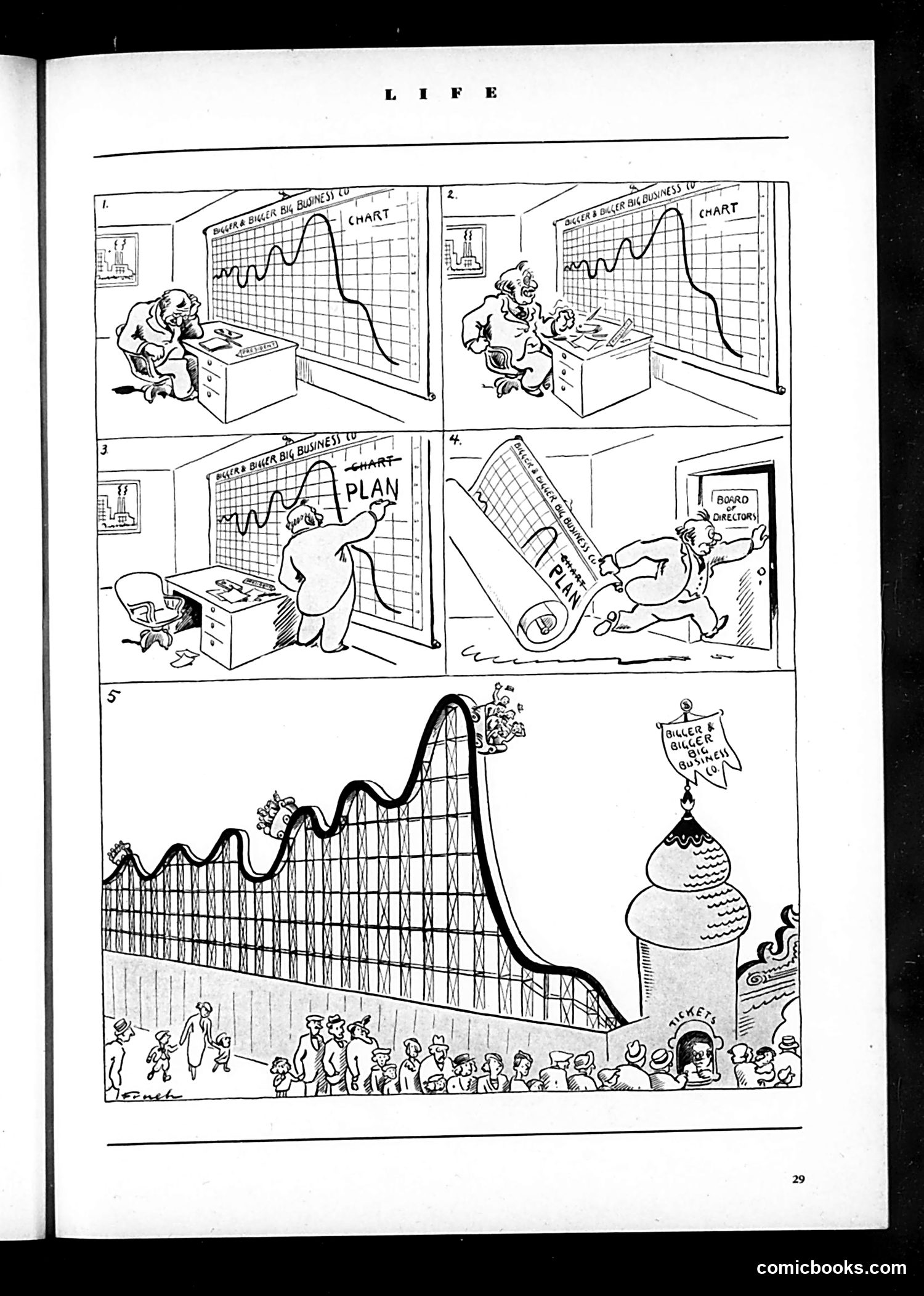
"Roller Coaster" Business Satire This six-panel cartoon satirizes wildly volatile business cycles, likely from the 1920s-30s era. Panels 1-4 show a businessman obsessively monitoring his "Bigger & Bigger Business" stock chart, watching it rise and fall while consulting his "Plan" and reviewing a "Board of Directors" folder—depicting the frantic activity surrounding speculative markets. Panel 5 delivers the punchline: the business chart's dramatic peaks and valleys literally transform into a roller coaster that people are riding for entertainment at what appears to be an amusement park. The labeled cart reads "Bigger & Bigger Business IV." The satire mocks how businessmen treat volatile markets like thrilling rides, and suggests their frenzied efforts merely create entertainment value rather than substantive economic growth. The cartoon critiques the disconnect between business activity and actual productive value.
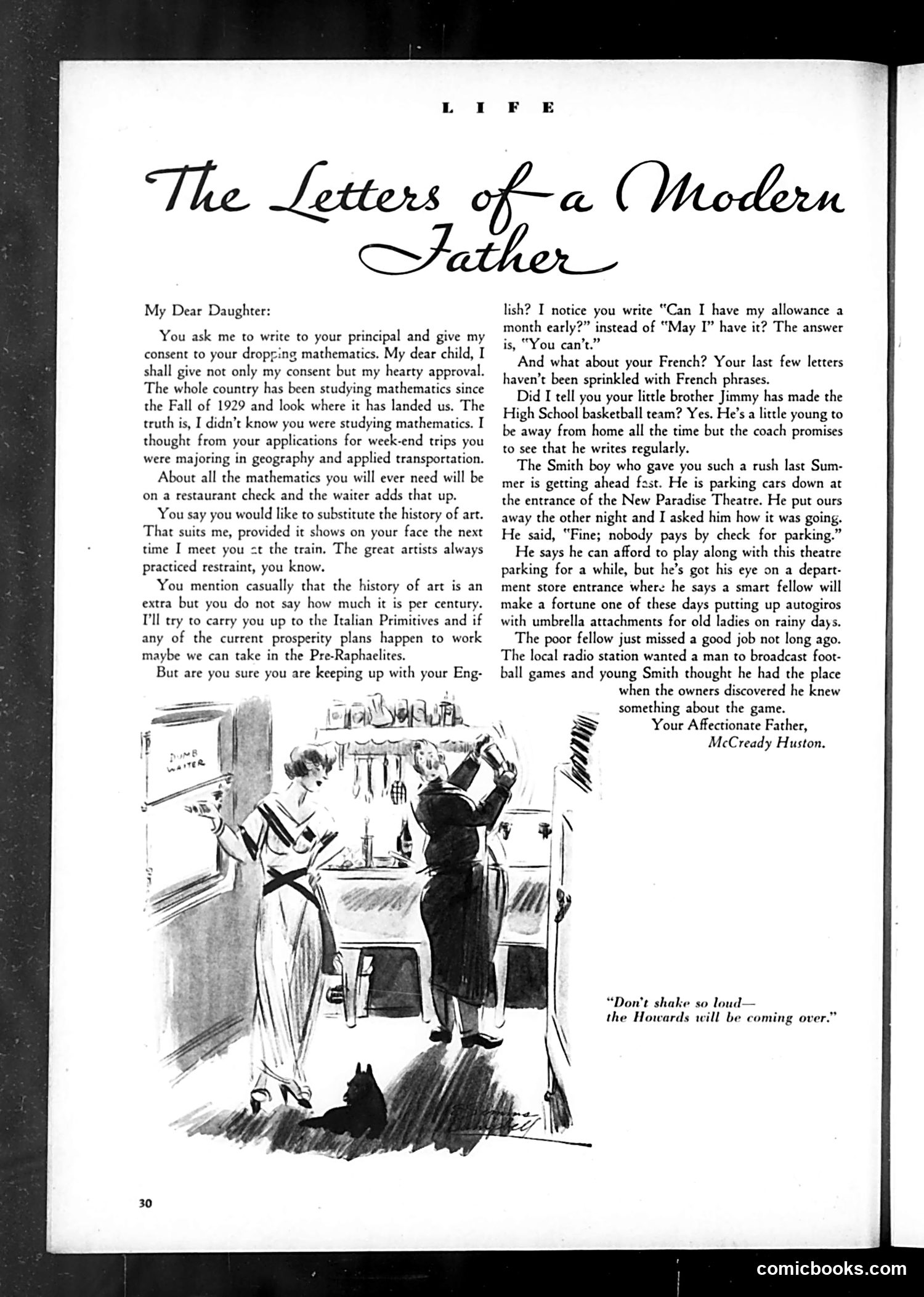
"The Letters of a Modern Father" This is a humorous advice column disguised as a father's letter to his daughter, satirizing 1930s upper-middle-class family life and social anxieties. The father's points lampoon Depression-era concerns: he approves dropping mathematics because "the whole country has been studying mathematics since the Fall of 1929 and look where it has landed us"—a jab at how financial expertise failed to prevent the stock market crash and Great Depression. The satire targets parental hypocrisy (he admits not reading her applications) and shallow social pretension (he cares more about her appearance than actual learning). The anecdotes about young Smith—a neighbor getting ahead through parking cars and entrepreneurial schemes—mock 1930s social climbing and get-rich-quick optimism. The cartoon below depicts a woman cooking while a man gestures urgently; the caption "Don't shake so loud—the Howards will be coming over" mocks keeping-up-with-the-Joneses status anxiety. The piece satirizes how Depression anxieties, class consciousness, and consumer culture shaped American domestic life.
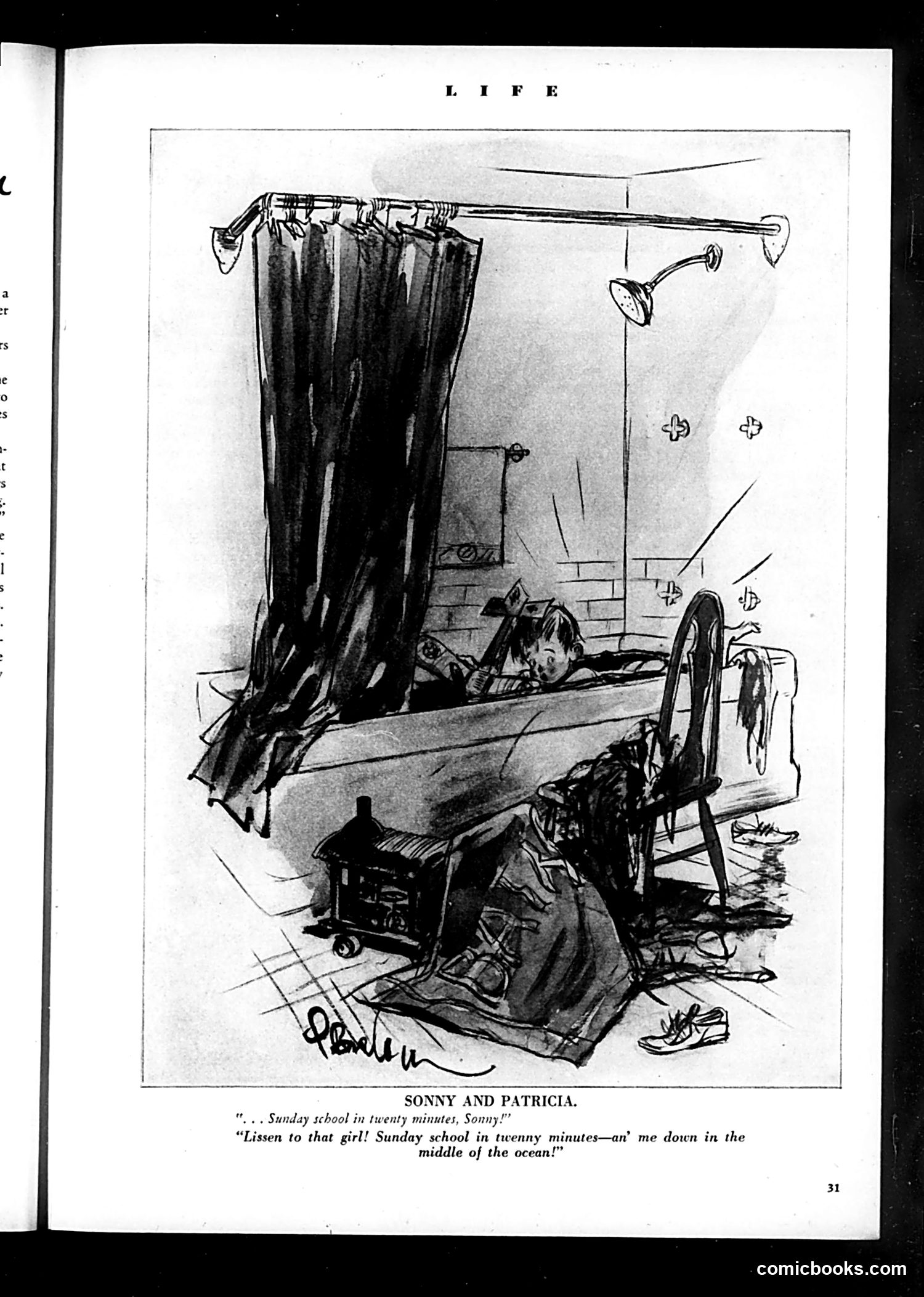
"Sonny and Patricia" This cartoon depicts a domestic humor scene showing a child deeply absorbed in play with toy boats in what appears to be a bathtub. An adult (likely a parent) reminds "Sonny" that Sunday school begins in twenty minutes, but the boy protests he's "down in the middle of the ocean"—demonstrating a child's imaginative immersion in play. The joke relies on the contrast between adult responsibilities (religious education, timekeeping) and childhood's capacity for complete imaginative absorption. The child views his bathtub as an actual ocean, making the impending interruption seem absurd from his perspective. This reflects early-20th-century Life magazine's frequent satirical treatment of generational differences and the comic chaos of child-rearing, emphasizing how children's priorities differ humorously from adults'.
"Mrs. Pep's" Diary Column by Baird This is a society gossip/lifestyle column from *Life* magazine, not a political cartoon. The text is a first-person diary entry from "Mrs. Pep" (likely a fictional persona) recounting November 27-28 social observations in New York theater and society circles. The column name-drops theatrical figures like Helen Hayes and producer Gilbert Miller, mentions playwright Ferenc Molnár, composer Jerome Kern, and writer Rufus King. It references Broadway shows ("Hamlet," "The Good Fairy," "The Cat and the Fiddle," "Mourning Becomes Electra"). The humor is gentle, society-page satire—mocking wealthy patrons' pretensions (a millionairess amused by "Hamlet" as a funny name), celebrating celebrities, and depicting leisured life's trivial concerns. The illustration shows a woman at a desk, presumably the diarist. This reflects 1920s-30s *Life* magazine's focus on urban sophistication and theatrical gossip for educated readers.
"Pep's Diary" by Leonard This is a society gossip column disguised as a personal diary, a popular Life magazine feature. The illustration shows a street scene, likely depicting one of the anecdotes described. The column recounts witty observations about wealthy socialites and their foibles. Key references include: Lydia Loomis's triumphant confrontation with a traffic officer; someone's mother in financial straits reduced to supporting a gigolo in Europe; Marge Boothby's impulsive nature and rescue-prone tendencies; and a quote from George Stark suggesting moral compromise for economic recovery ("never mind the morals"—likely commentary on post-WWI pragmatism). The satire targets upper-class privilege, social pretension, and the casual acceptance of moral flexibility among the wealthy during hard times. The tone is arch and knowing, mocking these characters' concerns through understated humor.
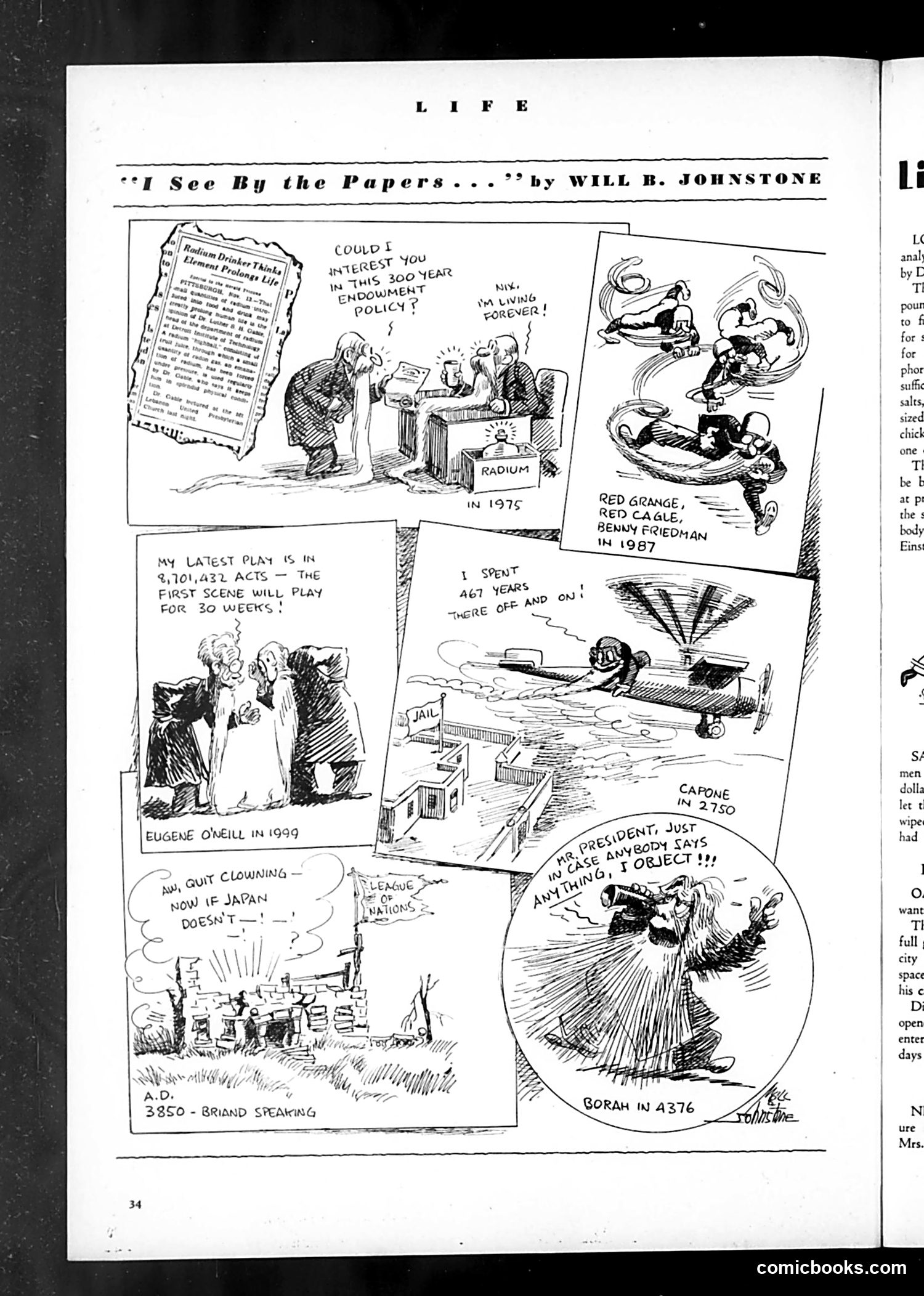
"I See By the Papers" Analysis This satirical cartoon by Will B. Johnstone mocks overly optimistic predictions about the future. The central joke contrasts absurdly extended timelines with famous figures: - Eugene O'Neill (1999): His play would run 30 weeks with over 4 million acts—mocking both his notoriously long works and theatrical hype. - Red Grange/sports figures (1987): References famous athletes, suggesting exaggerated longevity claims. - Borah (4376 A.D.): Senator William Borah speaking eternally into the distant future—a jab at long-winded politicians. - A.D. 3850 (Briand Speaking): References Aristide Briand, a French politician, continuing ad infinitum. The cartoon satirizes media sensationalism and how publications ("papers") make grandiose predictions that prove ridiculous when examined critically—a core function of Life magazine's satirical mission.
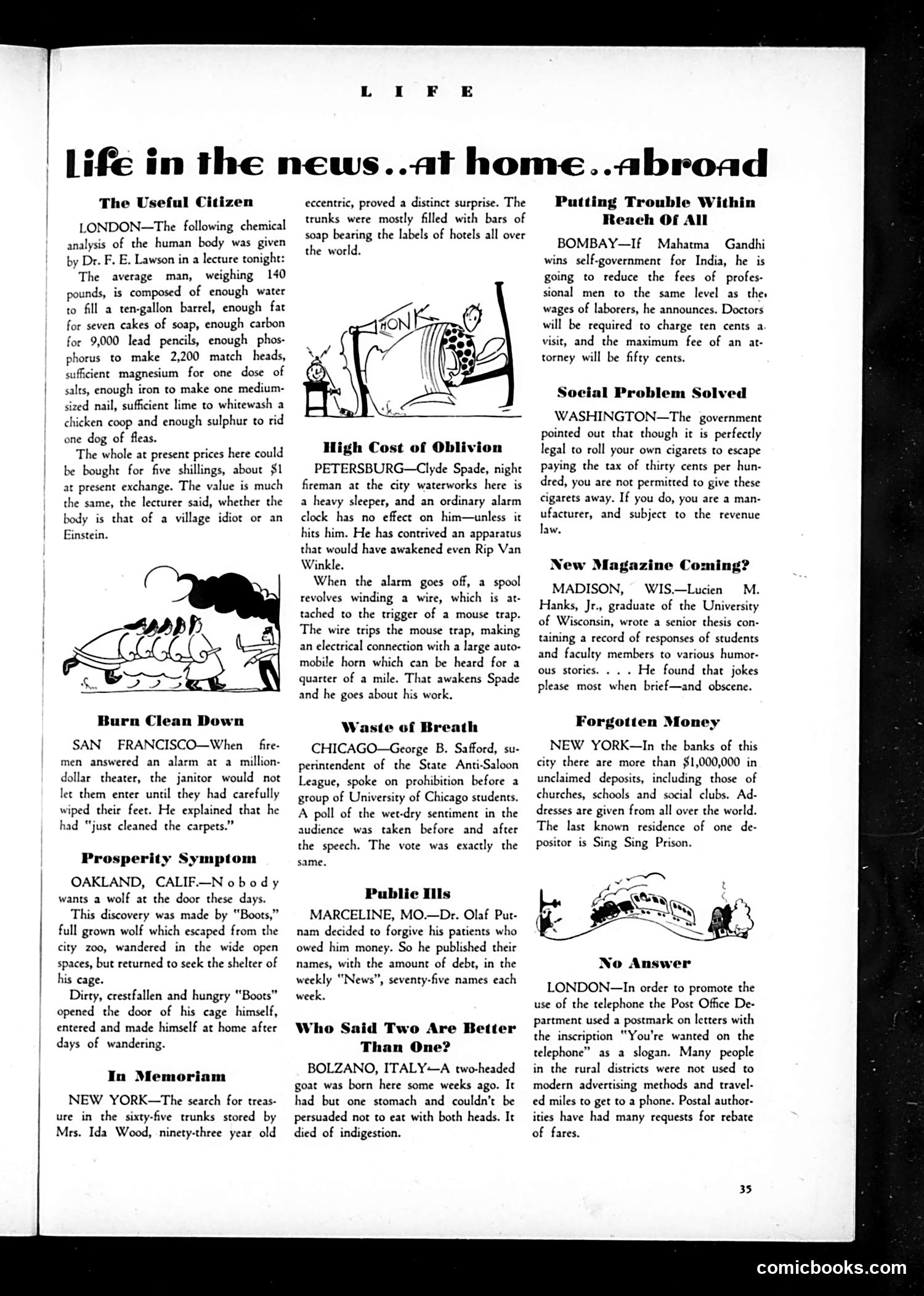
Life Magazine Satire Page Analysis This page collects humorous news briefs satirizing human nature and social absurdities. The cartoon shows a man operating an elaborate alarm system (mouse trap triggering an automobile horn) — illustrating the "High Cost of Oblivion" story about a fireman's extreme solution to oversleeping. The page's humor derives from exaggerated real situations: a janitor protecting carpets over firefighter access, a zoo wolf preferring captivity to freedom (mocking prosperity claims), a two-headed goat dying from its own gluttony, and a doctor publicly shaming debtors in the newspaper. The Gandhi reference mocks idealistic wage-equalization proposals as impractically generous. The cigarette taxation joke satirizes government loopholes and regulatory absurdity. A London lecturer reducing human value to chemical components costing five shillings critiques materialism. Throughout, Life presents ordinary people and institutions behaving illogically, finding comedy in bureaucratic red tape, vanity, and human contradiction — characteristic of 1920s-30s satirical journalism.
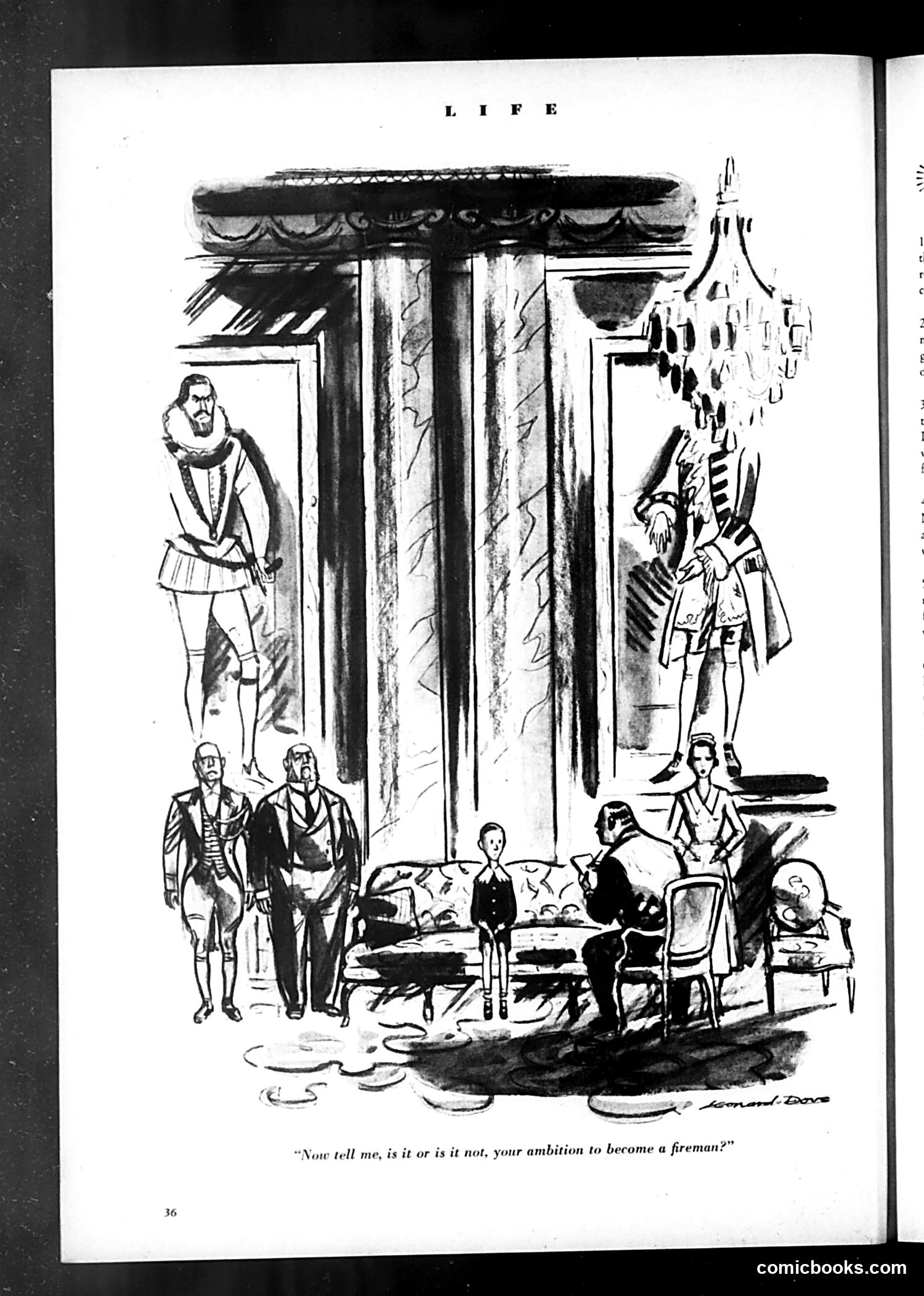
Life Magazine Cartoon Analysis This single-panel cartoon satirizes class aspiration and social mobility. A formal interior (grand columns, elegant furnishings) depicts what appears to be aristocratic or upper-class figures observing a young boy. An adult—likely the boy's parent or guardian—asks him: "Now tell me, is it or is it not, your ambition to become a fireman?" The humor targets the perceived presumptuousness of working-class ambitions. To the wealthy characters present, a fireman's career represents a dramatic social step *down*, treating such honest labor as laughably beneath their station. The cartoon satirizes snobbish attitudes about "respectable" professions versus manual trades, mocking the rigid class consciousness of the era's elite who view firefighting as unsuitable for someone in their social circle. The artist's signature reads "Leonard Dove."
"Astrological Daily Guide for January" This page is a satirical parody of popular astrology columns that were common in early 20th-century magazines. The humor derives from presenting astrology's supposed predictive power as absurdly mundane and self-contradictory. The satire works by: Absurd specificity: Entries prescribe oddly detailed activities ("reshingling chicken coops," "soldering loose joints") presented with false certainty. Self-contradiction: The same activities are declared both good and bad on different days without logical explanation. Mock-seriousness: Supernatural claims mix with domestic trivia—spiritual experiences share space with wheelbarrow repair advice. Personal diary intrusions (entries 7-9): The narrator admits errors and revises predictions retroactively, undermining astrology's authority. Contemporary references: Mentions of Charles Evans Hughes and Lindbergh anchor this to the 1920s-30s era, when such pseudo-scientific advice was genuinely popular and profitable. The piece mocks readers' gullibility regarding astrology while satirizing its pretense to predict everyday life.
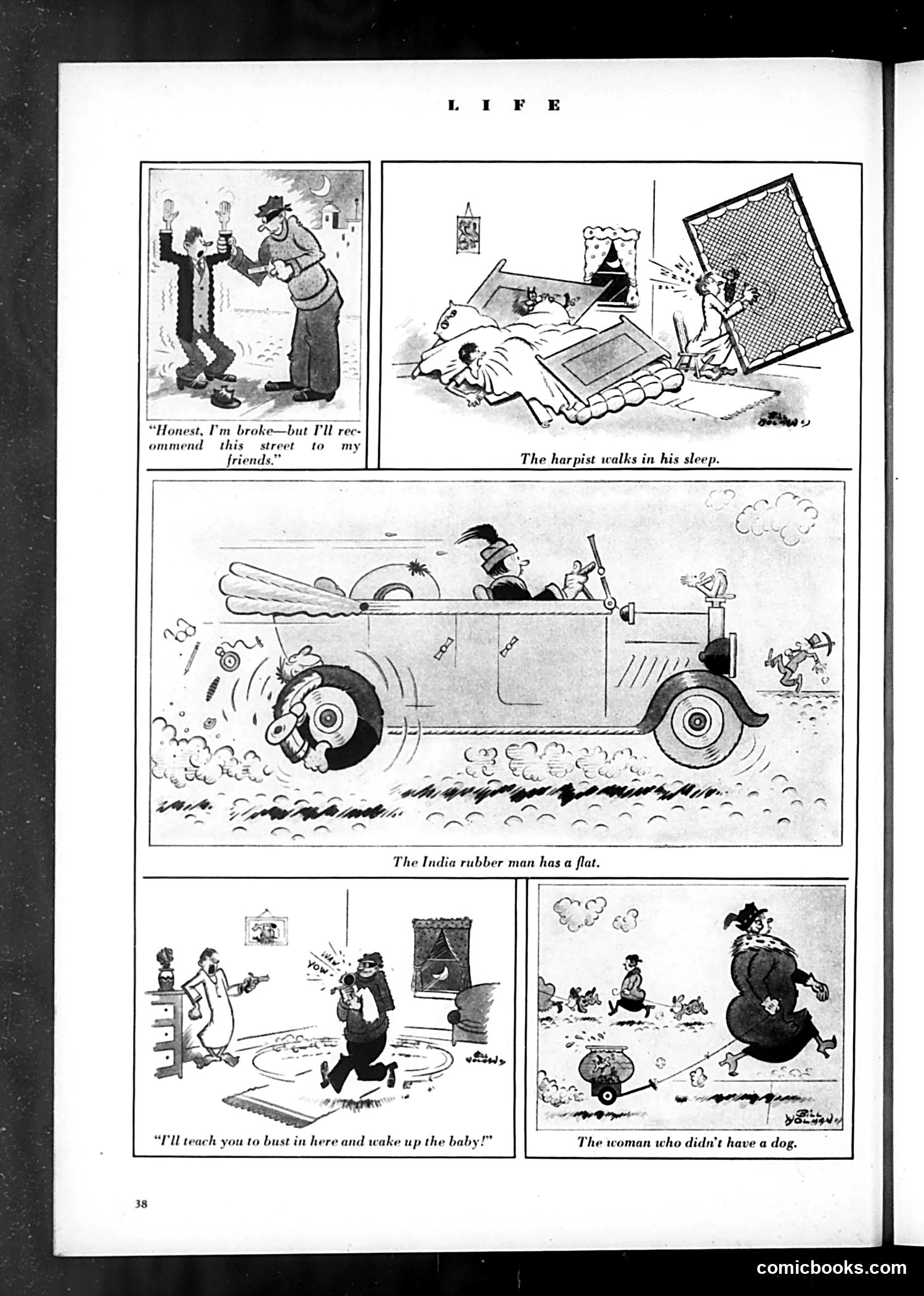
This page contains four separate comic gags from Life magazine's humor section: 1. Top left: A beggar tells a well-dressed man he's broke but will recommend the street to friends—satirizing panhandling and social climbing even among the destitute. 2. Top right: "The harpist walks in his sleep"—showing a sleeping musician creating chaos with his instrument, a visual pun on sleepwalking. 3. Middle: "The India rubber man has a flat"—an elasticity joke about a flexible performer experiencing car trouble, playing on the double meaning of "flat." 4. Bottom: Two related gags: a woman threatening an intruder to teach him not to disturb her baby, and "The woman who didn't have a dog"—implying she compensates through other means (unclear without fuller context, but likely a domestic humor reference). These are simple, pun-based humor strips typical of early 20th-century magazine comedy.
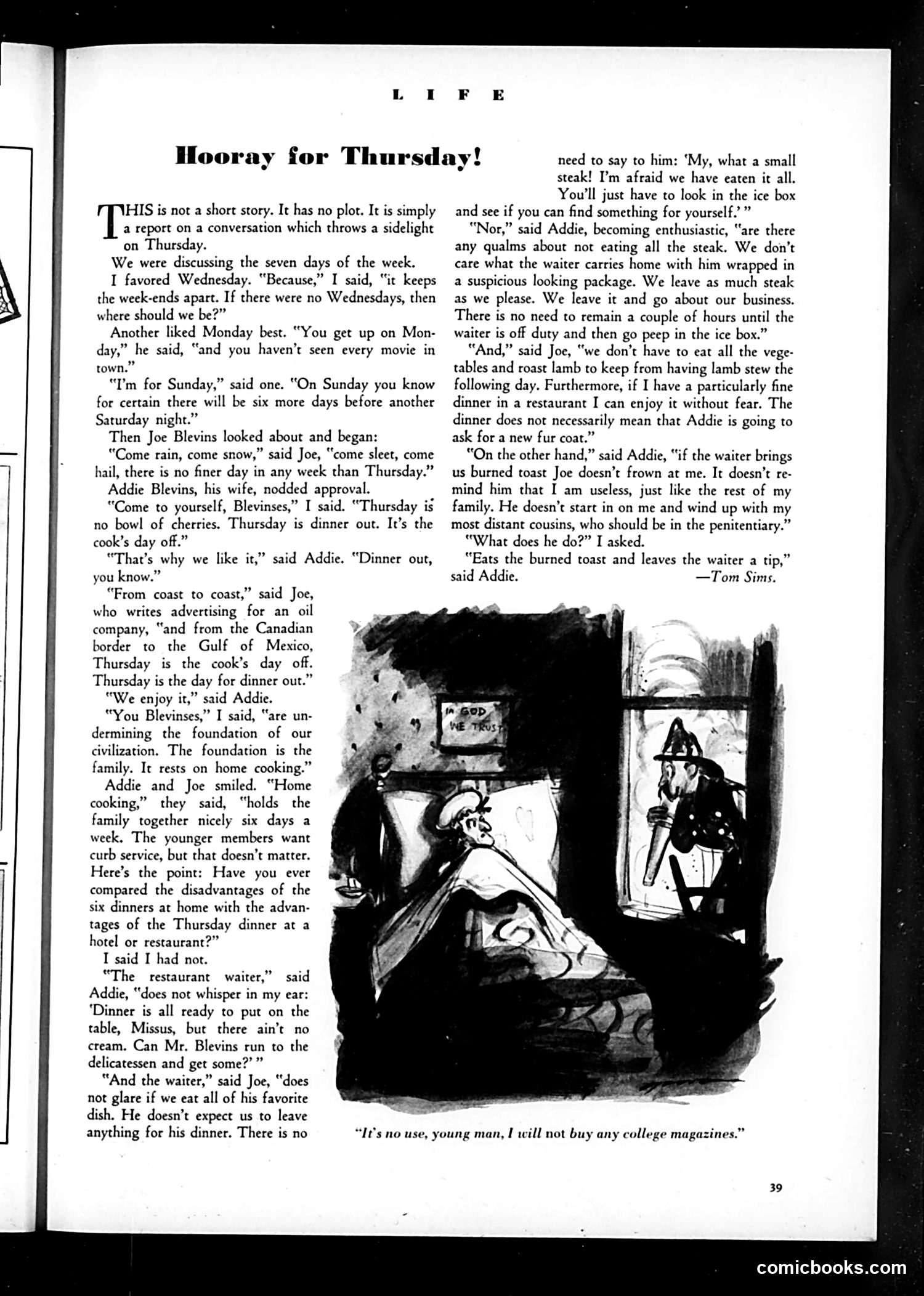
"Hooray for Thursday!" - Life Magazine Satire This humorous piece satirizes middle-class domestic life and marital dynamics of the era (appears early-to-mid 20th century). The narrator discusses why different people prefer different weekdays, leading Joe and Addie Blevins to enthusiastically champion Thursday—traditionally "the cook's day off" when families dine out at restaurants. The satire targets the tension between home and restaurant dining: at home, wives must worry about running errands for missing ingredients, husbands scrutinize portions, and complaints about leftovers create family friction. The narrator protests this undermines family "civilization" built on home cooking, but the Blevinses counter that restaurant dining eliminates these anxieties—waiters don't expect perfect meals or judge their appetites. The accompanying cartoon (showing a man refusing to buy college magazines) is unrelated. The piece's humor derives from the couple's earnest, detailed defense of shirking domestic responsibility, exposing unspoken resentments in household economics and marital obligation.
Analysis for Modern Readers This 1930s *Life* magazine article by E.S. Martin critiques three interconnected issues under the Hoover administration: Political Context: - Japan in Manchuria: References Japan's 1931 invasion, a major international crisis Secretary of State Stimson struggled to address - War Costs & Taxes: Post-WWI economic burden; Martin argues reconstruction spending (roads, cars, modern infrastructure) created ongoing expenses beyond war reparations - "Mrs. President": The title's third element, developed in the second section, satirizes extending the Vice President succession to his widow—a curious governmental practice allowing a deceased senator's widow to fill his seat The Satire's Point: Martin equates destructive taxation to wartime destruction itself. New York buildings are demolished to avoid taxes rather than generate revenue—economically self-defeating. He personifies taxes as "predatory insects" worse than actual pests, blaming "irresponsible and extravagant people" (likely referring to both government and wealthy tax-avoiders). The Joke: Government incompetence and greed destroy wealth as effectively as warfare, yet receive less scrutiny.
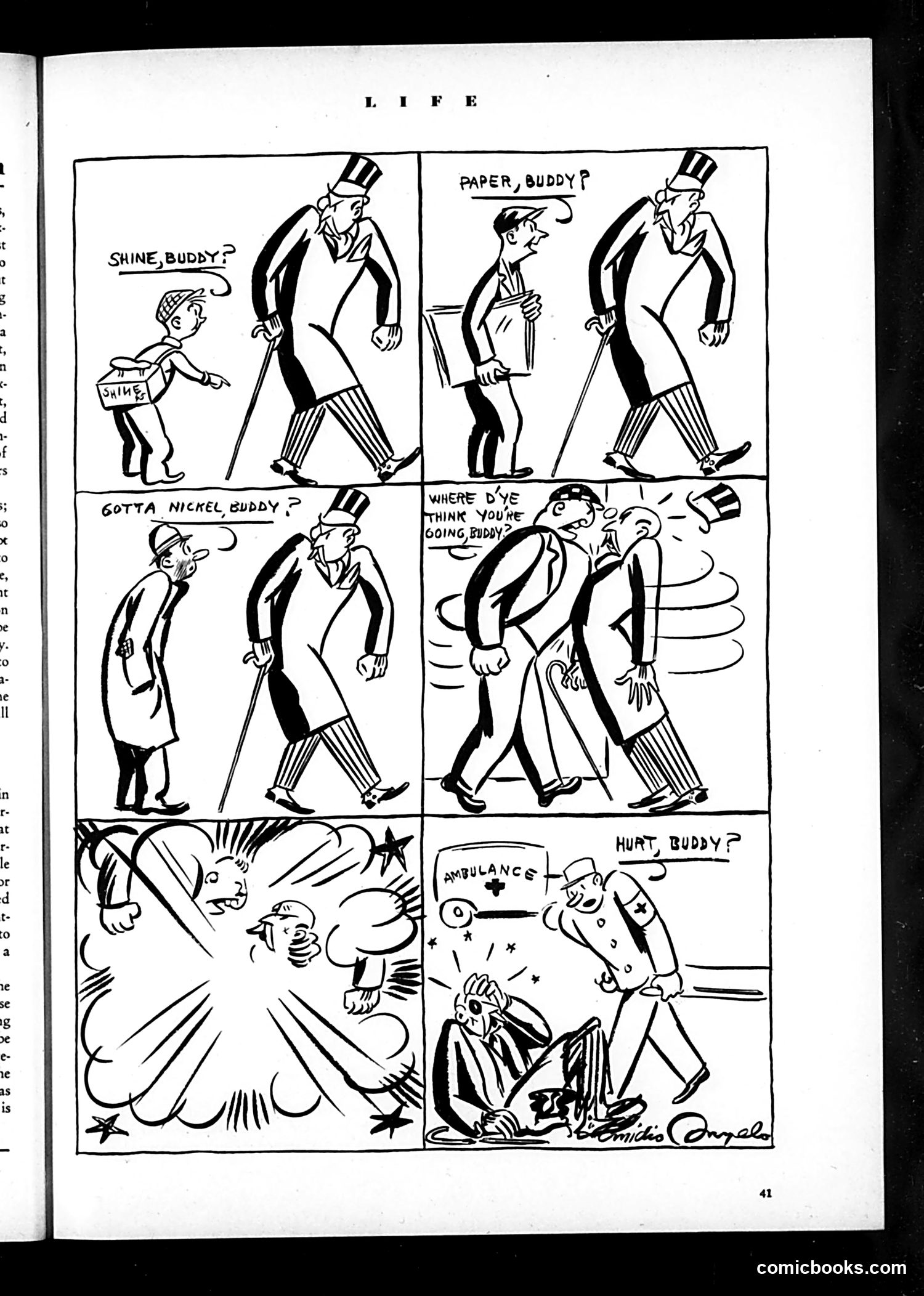
"Life" Comic Strip Analysis This six-panel comic strip satirizes wealth disparity and class conflict. A wealthy man in top hat and formal wear (representing the upper class or "fat cat") is repeatedly accosted by a working-class child asking for money ("shine, buddy?" "paper, buddy?" "nickel, buddy?"). The wealthy man consistently refuses or ignores the child's requests. The strip escalates to slapstick when the child apparently causes some kind of accident or explosion (panel 5), resulting in the wealthy man being taken away in an ambulance in the final panel, with someone asking "hurt, buddy?"—a dark joke reversing their earlier power dynamic. The satire critiques indifference to poverty and suggests class tensions may have violent consequences.
Analysis for Modern Readers This is not a cartoon page but rather a theater review column titled "Manhattan Presents" by Alison Smith. It describes the theatrical season in New York during summer 1931. Smith discusses the emotional arc of theater seasons: how promising they seem when distant, yet how frequently they disappoint. The column notably celebrates Eugene O'Neill's "Mourning Becomes Electra"—a Greek-structure trilogy that had just opened at the Guild Theatre—as a major success that revived critical and public interest in serious drama after a disappointing season of failed plays. The piece also mentions other productions like Robert Sherwood's "Reunion in Vienna" and plays titled "Brief Moment," "Counsellor-at-Law," and "Cynara," using them to illustrate how theater both disappoints expectations and occasionally delivers memorable experiences that resonate long after seasons end. This is essentially a nostalgic, somewhat cynical reflection on theatrical culture and audience expectations.
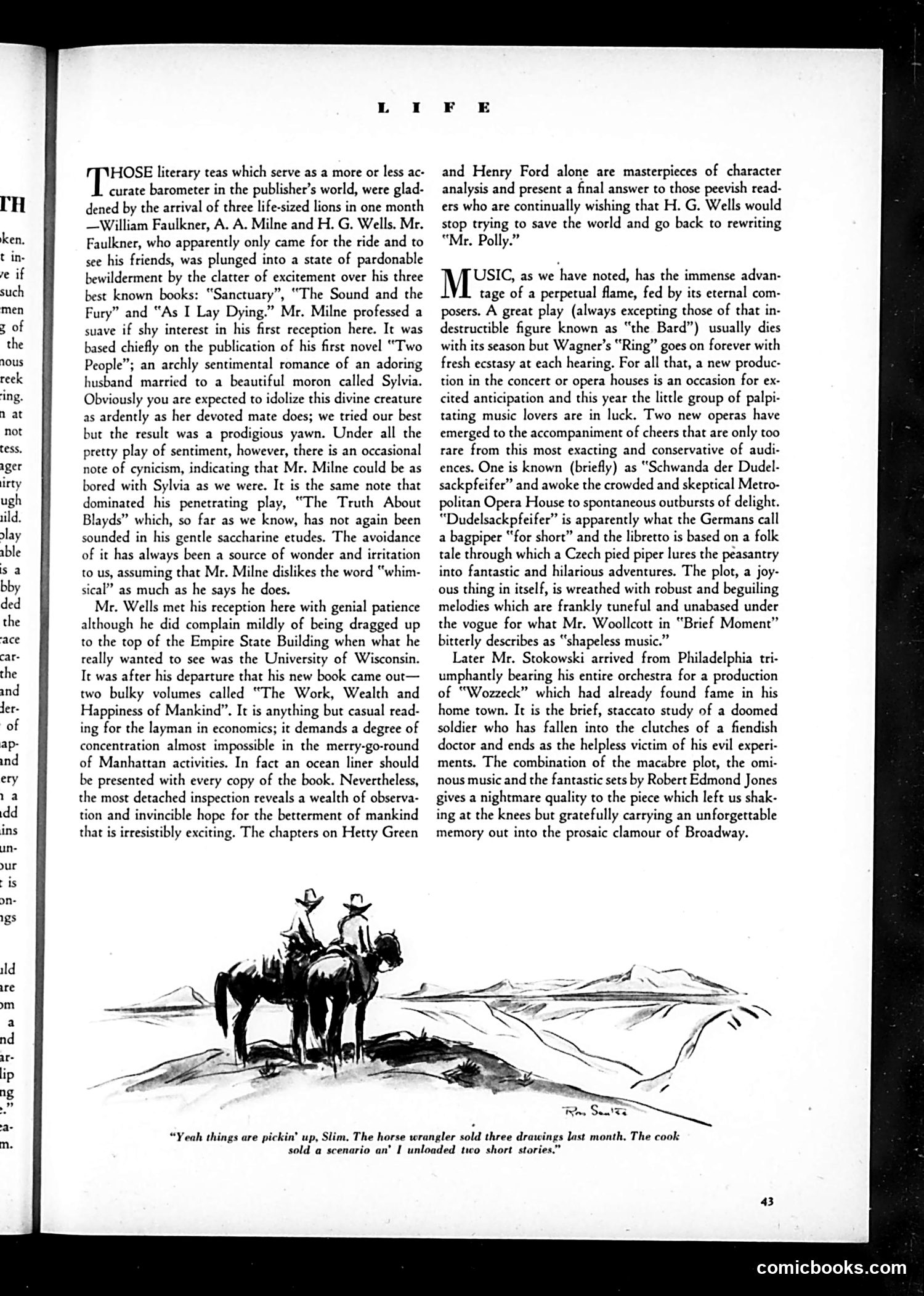
Analysis of This Life Magazine Page This page from *Life* magazine reviews recent literary and musical arrivals in New York, likely from the late 1920s. The text discusses three famous authors visiting the city—William Faulkner, A.A. Milne, and H.G. Wells—with the critic offering witty assessments of their work and receptions. The cartoon at the bottom depicts two cowboys on horseback in a Western landscape. The caption reads: "Yeah things are pickin' up, Slim. The horse wrangler sold three drawings last month. The cook sold a scenario an' I unloaded two short stories." The satire: This is mocking the 1920s literary boom and the ease with which even common folk could profit from writing. It suggests that amid the excitement over major literary figures, anyone—even ranch hands—could apparently sell stories and scenarios, satirizing the era's voracious appetite for written content and the perceived lowering of literary standards.
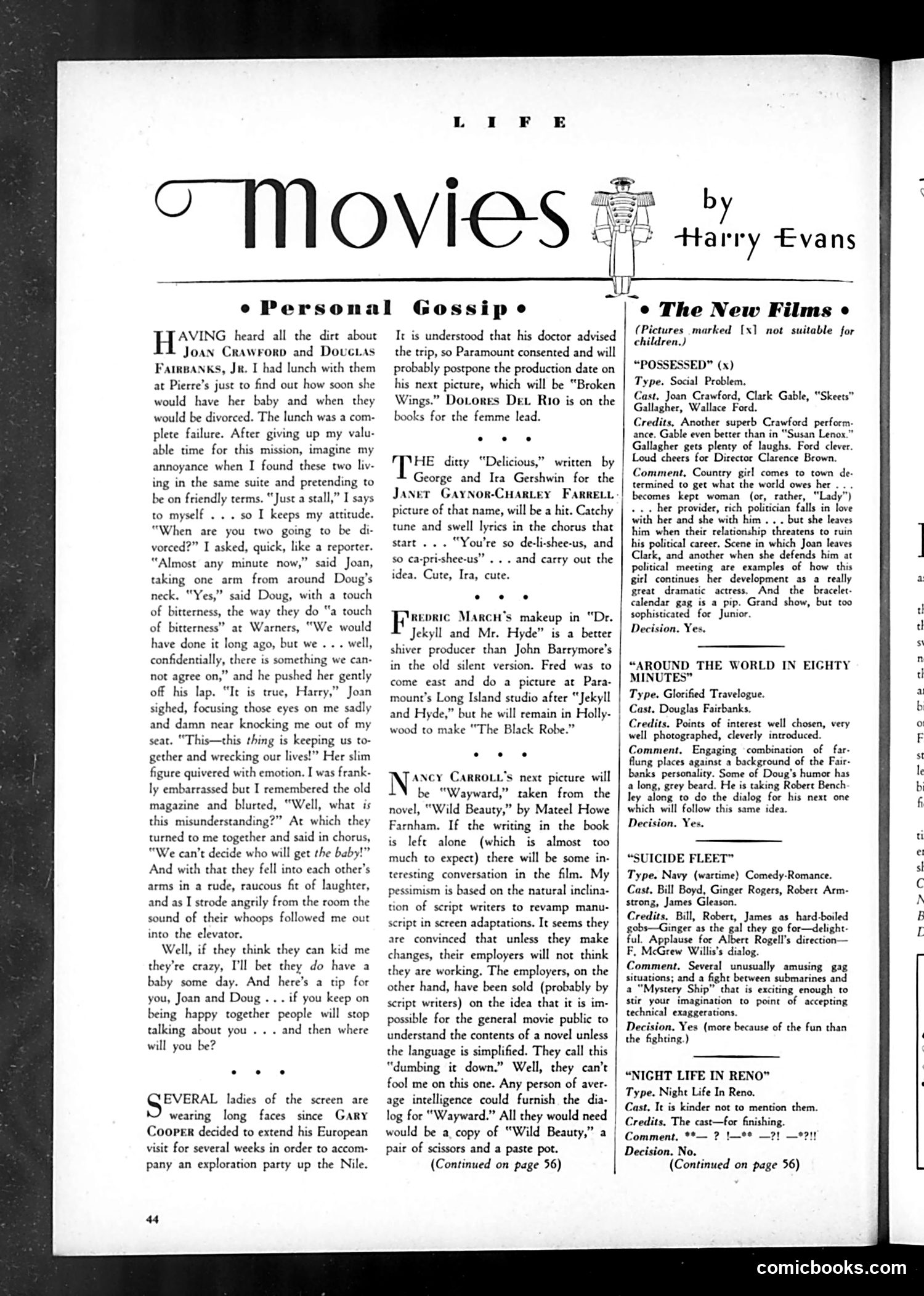
Life Magazine Movie Column Analysis This page contains gossip and industry news about 1920s-30s Hollywood film stars, written by Harry Evans. The "Personal Gossip" section mocks celebrities through a satirical anecdote about Joan Crawford and Douglas Fairbanks Jr., portraying them as performing marital discord for publicity while actually being happy together. The joke targets how stars manipulated their public images—the narrator expected scandal but caught them laughing, suggesting their "troubles" were fabricated theater. The column also covers industry developments: Gary Cooper extending his European trip, Fredric March's makeup work in "Dr. Jekyll and Mr. Hyde" compared favorably to John Barrymore's silent version, and script adaptations being "dumbed down" for audiences. The satire critiques both star management and screenwriters' condescension toward moviegoers' intelligence.
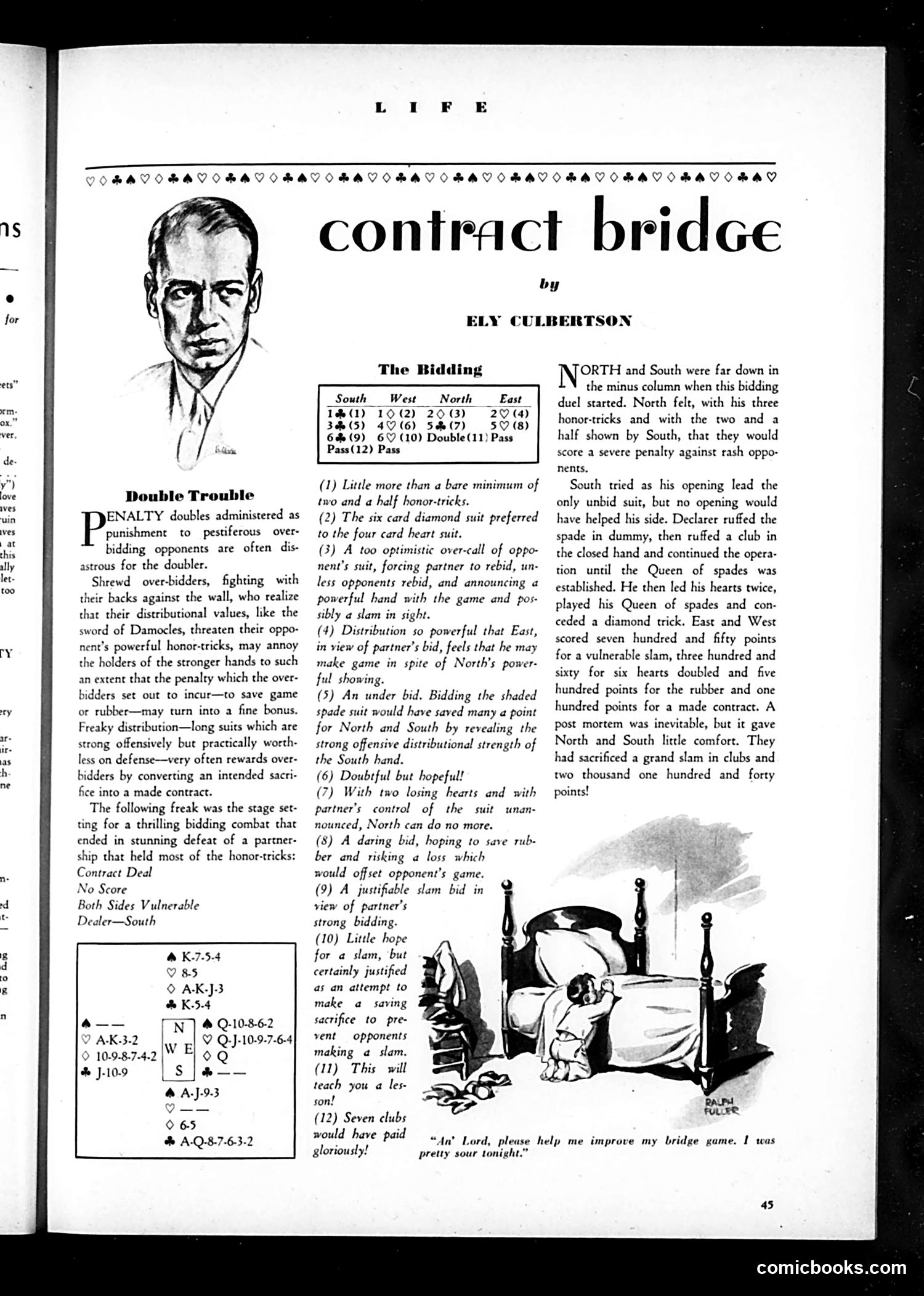
Content Analysis This page features a contract bridge instructional article by Ely Culbertson, a famous bridge expert. It's not political satire but rather bridge strategy instruction. The main content explains a specific bridge hand—a cautionary tale about "Double Trouble." The article demonstrates how aggressive bidding and doubling penalties can backfire. The scenario shows North and South players making risky bids to prevent opponents from scoring, but their strategy fails disastrously, costing them 2,140 points. The cartoon at bottom (by Ralph Fuller) offers light humor: a man praying in bed, asking God to improve his bridge game after the evening's losses—a joke about bridge frustration rather than political commentary. This represents Life magazine's non-political content—the publication mixed satirical commentary with lifestyle, sports, and games coverage. The bridge article and accompanying illustration reflect the game's popularity among educated American audiences in this era.
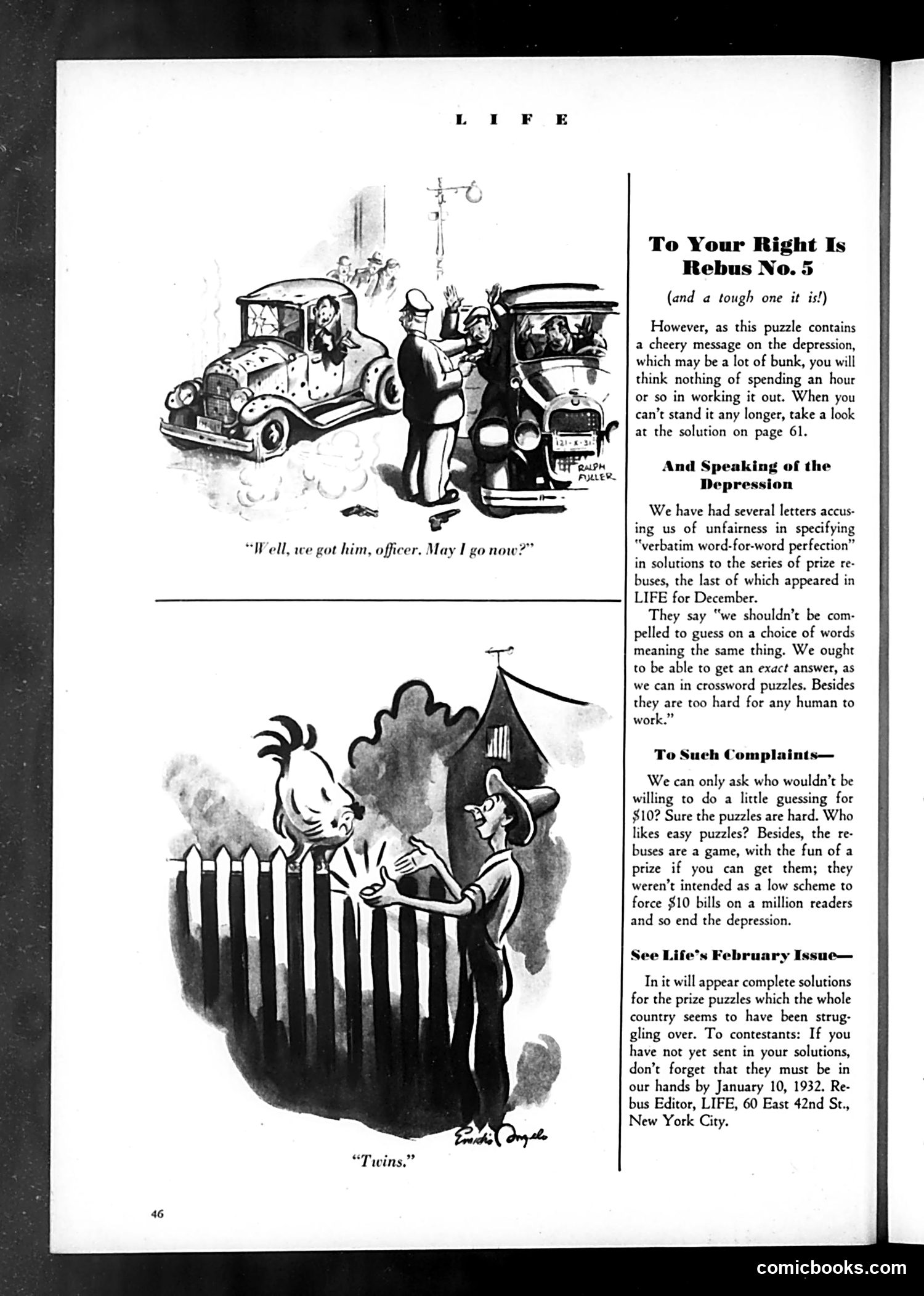
Life Magazine Rebus Puzzle Page (circa 1931-32) This page features two cartoons accompanying a puzzle contest during the Great Depression. The top cartoon shows a traffic accident where an officer asks an injured driver "Well, we got him, officer. May I go now?"—likely satirizing how even in crisis, people prioritize escaping rather than helping. The bottom cartoon titled "Twins" depicts a man at a fence with two identical babies, suggesting confusion or absurdity. The text reveals Life magazine was running a rebus puzzle contest offering $10 prizes—significant money during Depression hardship. Readers had complained the puzzles were unfairly difficult and required "guessing" on word choices. Life's editors responded defensively: they questioned who wouldn't work hard for $10, defended puzzle difficulty as entertaining, and dismissed complaints as excessive. The ironic tone suggests Life viewed this as harmless entertainment while simultaneously acknowledging Depression-era financial desperation. Solutions would appear in February 1932, with a January 10 deadline for submissions.
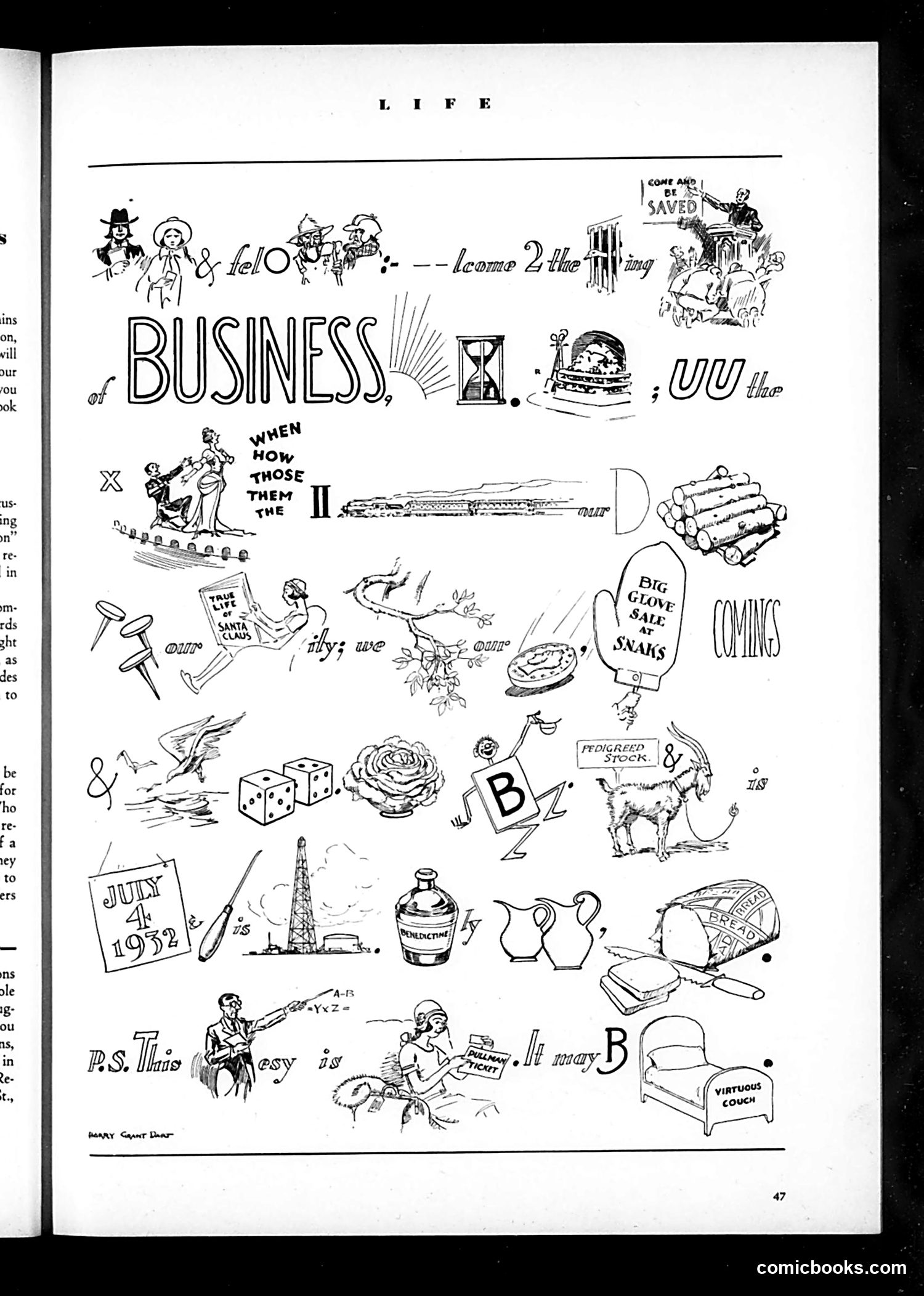
"Come and Be Saved" - A Business Satire This is a visual rebus puzzle titled "Come and Be Saved—Home 2 the King of Business." It uses illustrated symbols and wordplay to create a hidden message or riddle about American business and commerce circa 1952 (visible date). The cartoon combines religious salvation imagery ("Come and Be Saved") with commercial elements: a train, logs, oil derrick, food items, dice, stock certificates, and a "virtuous couch." The puzzle structure—with scattered objects and cryptic text fragments—suggests readers must decode the meaning. The satire appears to mock either how business promises salvation/prosperity to Americans, or how commercial interests exploit religious language. The "June 1952" date and "Frog Breed Stock" references suggest topical business or market commentary, though the specific target remains unclear without solving the complete rebus.
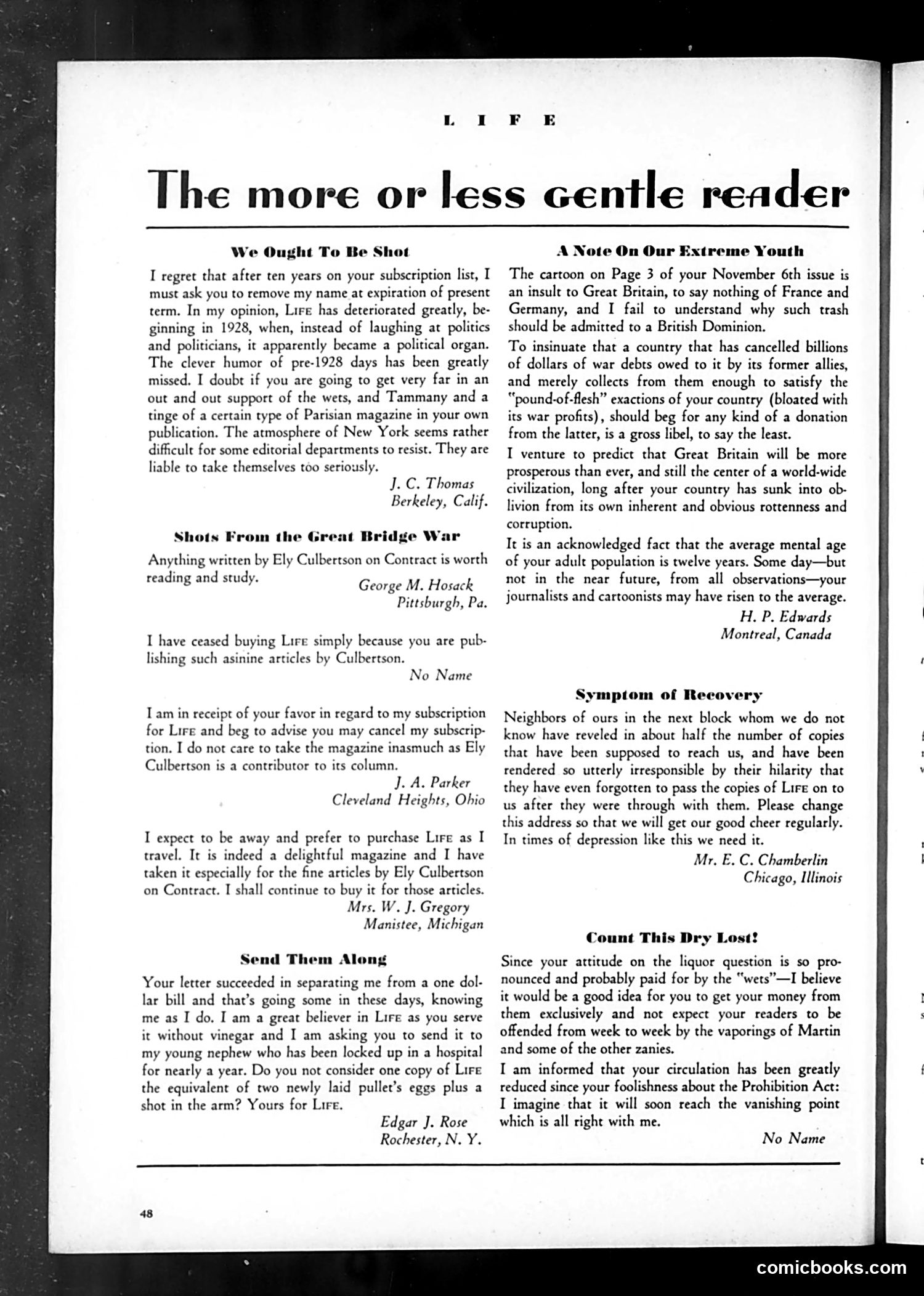
Life Magazine Letters Page Analysis This is a "Letters to the Editor" page from *Life* magazine, likely from the late 1920s or early 1930s. Rather than containing cartoons, it showcases reader responses to the magazine's editorial direction and content. The letters reveal significant controversy over two main issues: 1. Political Shift: J.C. Thomas criticizes *Life* for abandoning pre-1928 political humor to become an explicit political organ, supporting "wets" (Prohibition opponents) and Tammany Hall (a New York political machine). 2. Bridge Column Controversy: Multiple readers either praise or condemn *Life*'s publication of Ely Culbertson's contract bridge articles—apparently a divisive editorial choice. 3. Anti-American Sentiment: H.P. Edwards (from Canada) angrily attacks a cartoon mocking Britain's post-WWI financial situation, calling Americans immature and corrupt. The letters collectively show *Life* navigating 1920s-30s cultural debates: Prohibition, partisan politics, and America's international reputation.
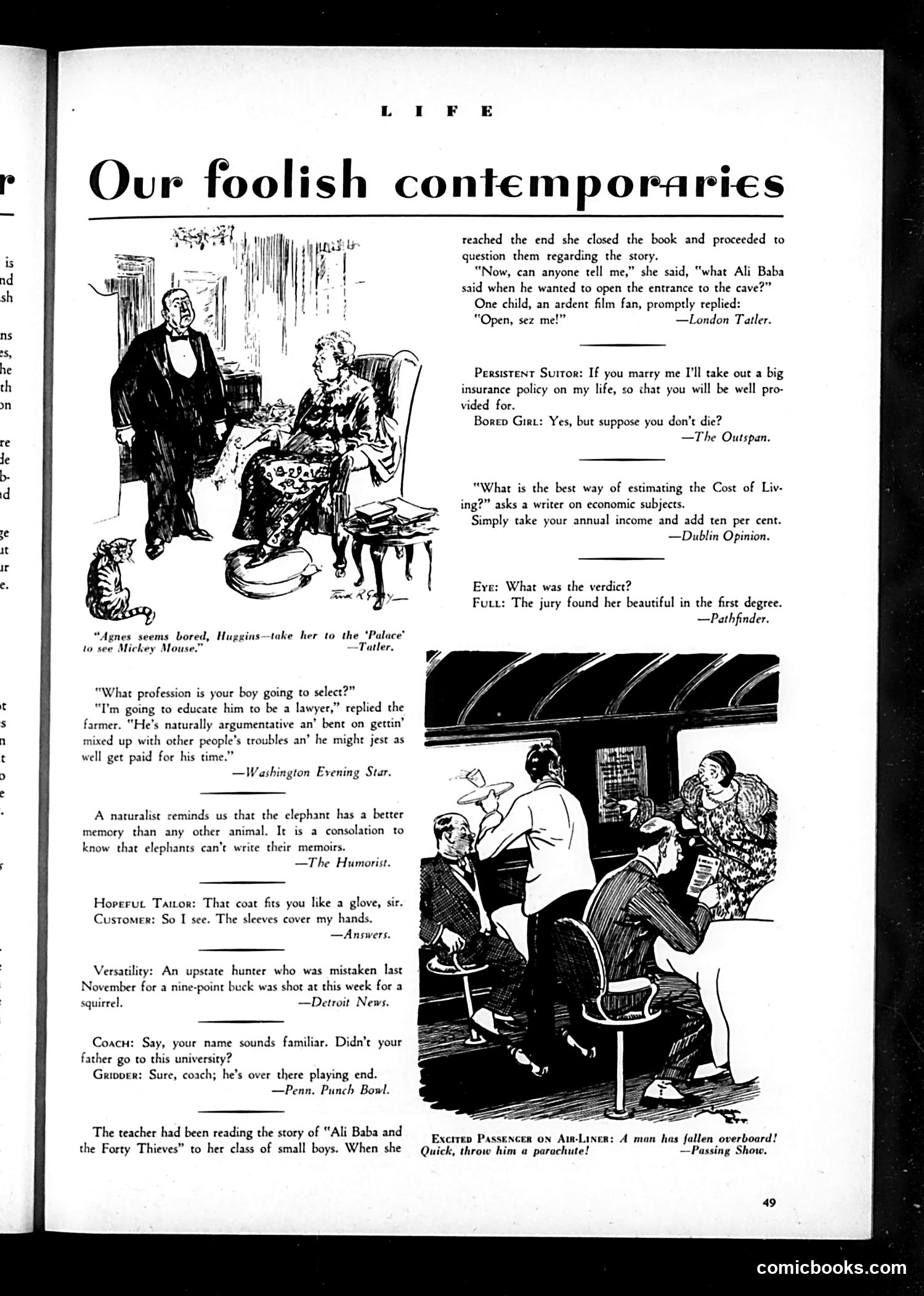
"Our Foolish Contemporaries" - Life Magazine Satire Page This page collects short humorous quips mocking contemporary attitudes and logic. Key targets include: Film culture: A child references Mickey Mouse and cinema instead of classical literature (Ali Baba), suggesting movies are replacing traditional education. Modern romance: A suitor's marriage proposal based on life insurance is rejected with practical skepticism about his survival. Economic anxiety: Post-war cost-of-living concerns are mocked—simply add 10% to your income to estimate expenses, a sardonic comment on inflation. Gender and courts: A jury finds a woman "beautiful in the first degree," satirizing frivolous legal judgments. Generational change: A farmer educates his son as a lawyer specifically to profit from arguing—mocking both legal culture and shifting rural values. The two illustrations show domestic and travel scenes with comedic misunderstandings. The page's overall tone reflects 1920s-30s anxieties about modernity, leisure, economics, and social change, presented through gentle, absurdist humor typical of *Life* magazine's satirical approach.
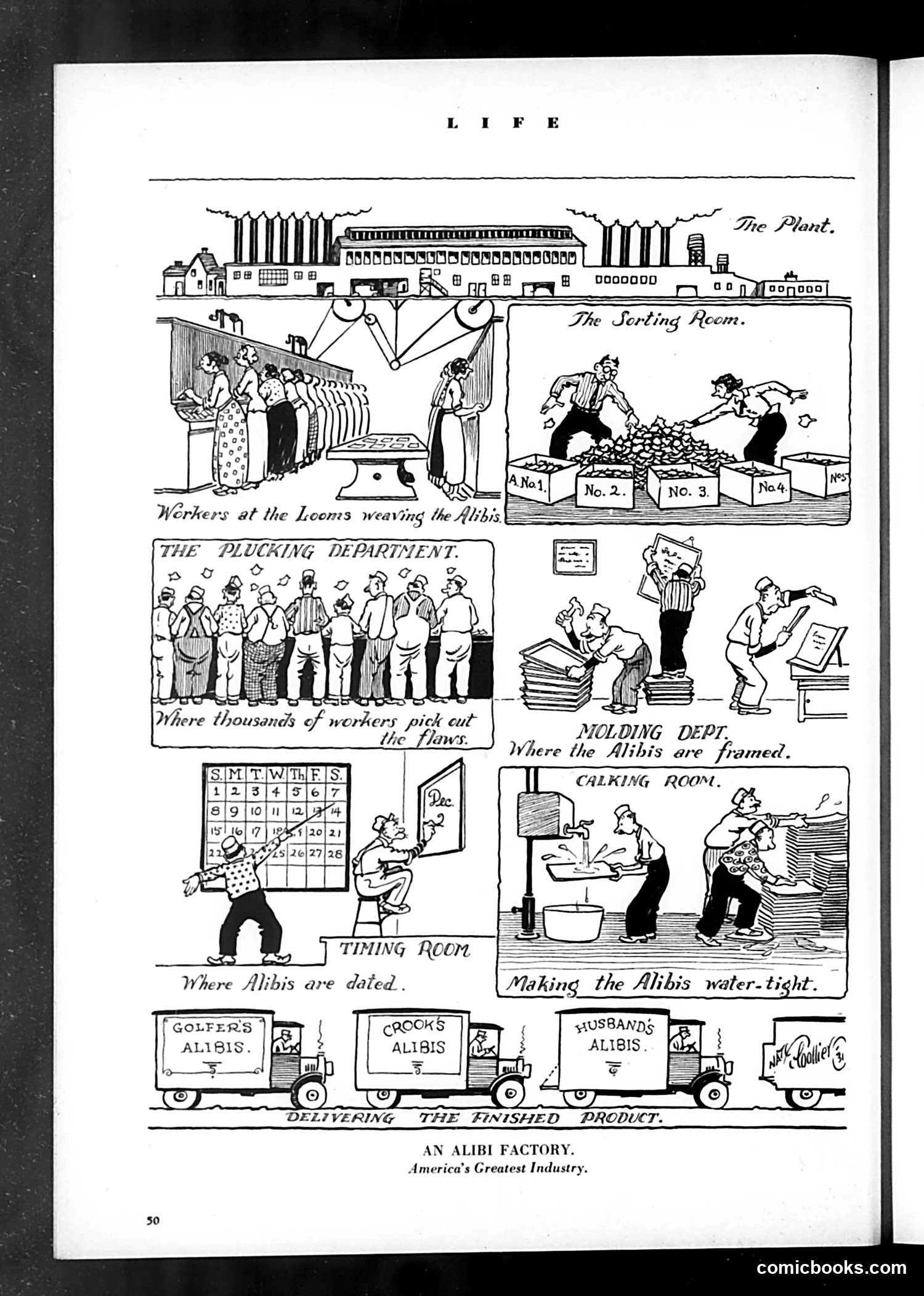
"An Alibi Factory" Satire This satirical diagram mocks the manufacture of excuses—"alibis"—as if it were an industrial process. The cartoon presents a fictional factory with multiple departments ("Plucking," "Molding," "Timing," "Calking") where alibis are produced, quality-controlled, and distributed to various consumer types: "Golfers' Alibis," "Crooks' Alibis," and "Husbands' Alibis." The joke targets men's habitual dishonesty in three social contexts: recreational golf (excuses for poor play), criminal activity, and marital deception. By depicting excuse-making as "America's Greatest Industry," Life satirizes how commonplace and systematized male lying has become in American culture. The visual parallel to actual factory production—with workers, quality assurance, and commercial distribution—amplifies the critique through absurdist humor, suggesting excuses are manufactured and refined as seriously as real products.
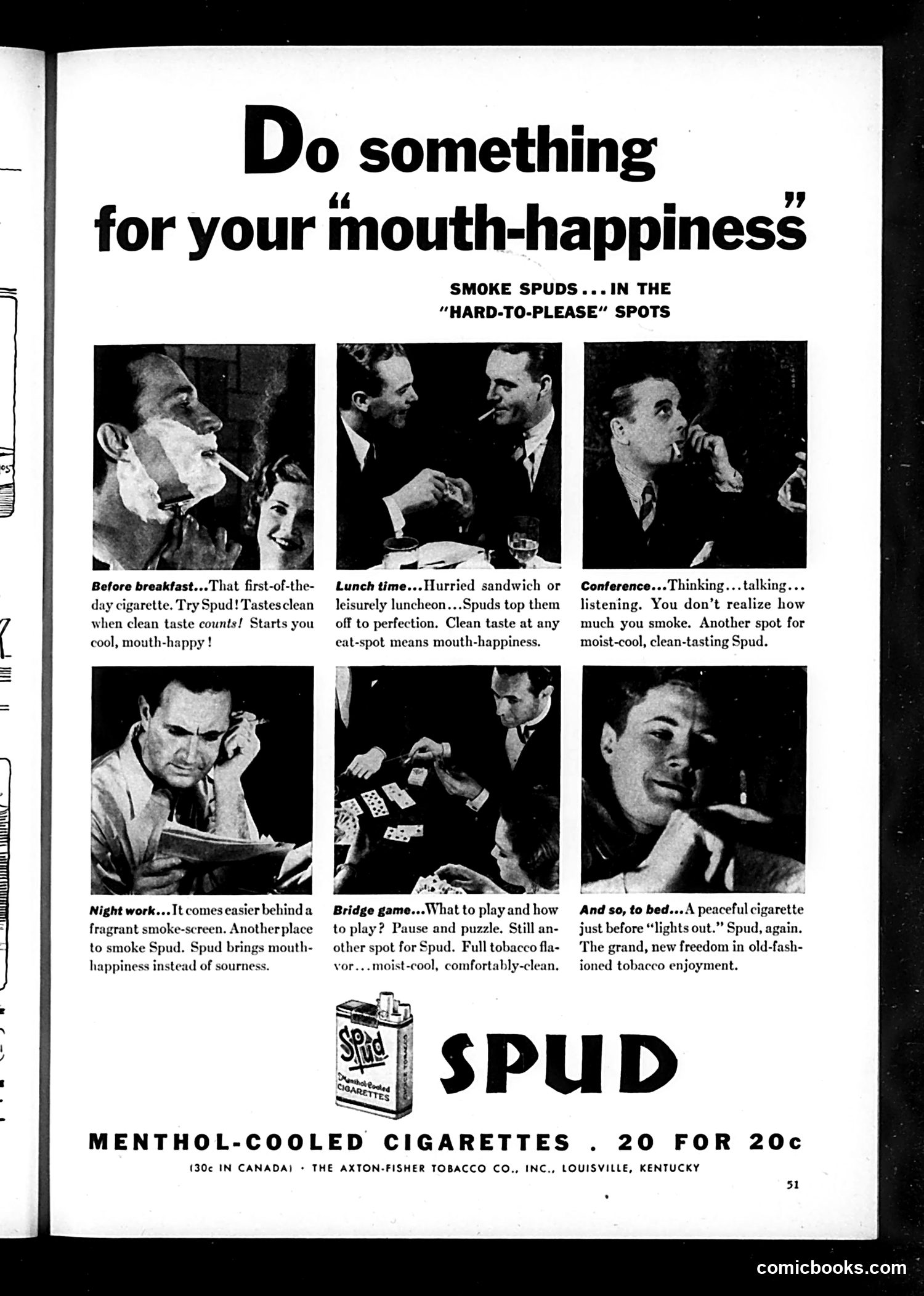
Spud Cigarettes Advertisement This is a vintage cigarette advertisement, not satire or political commentary. It promotes Spud menthol-cooled cigarettes (20 for 20¢) by depicting six everyday scenarios where smoking supposedly brings "mouth-happiness": breakfast, lunch, work, conferences, card games, and bedtime. The ad uses black-and-white photographs of men in mid-century settings engaging in these activities while smoking. The marketing strategy positions cigarettes as enhancing normal daily routines—a common advertising approach of that era before health warnings were required. The term "mouth-happiness" is the copywriter's coined phrase emphasizing the product's claimed pleasant, clean taste. This represents mid-20th century advertising that normalized and glamorized smoking across all social contexts, particularly targeting men's work and leisure activities.
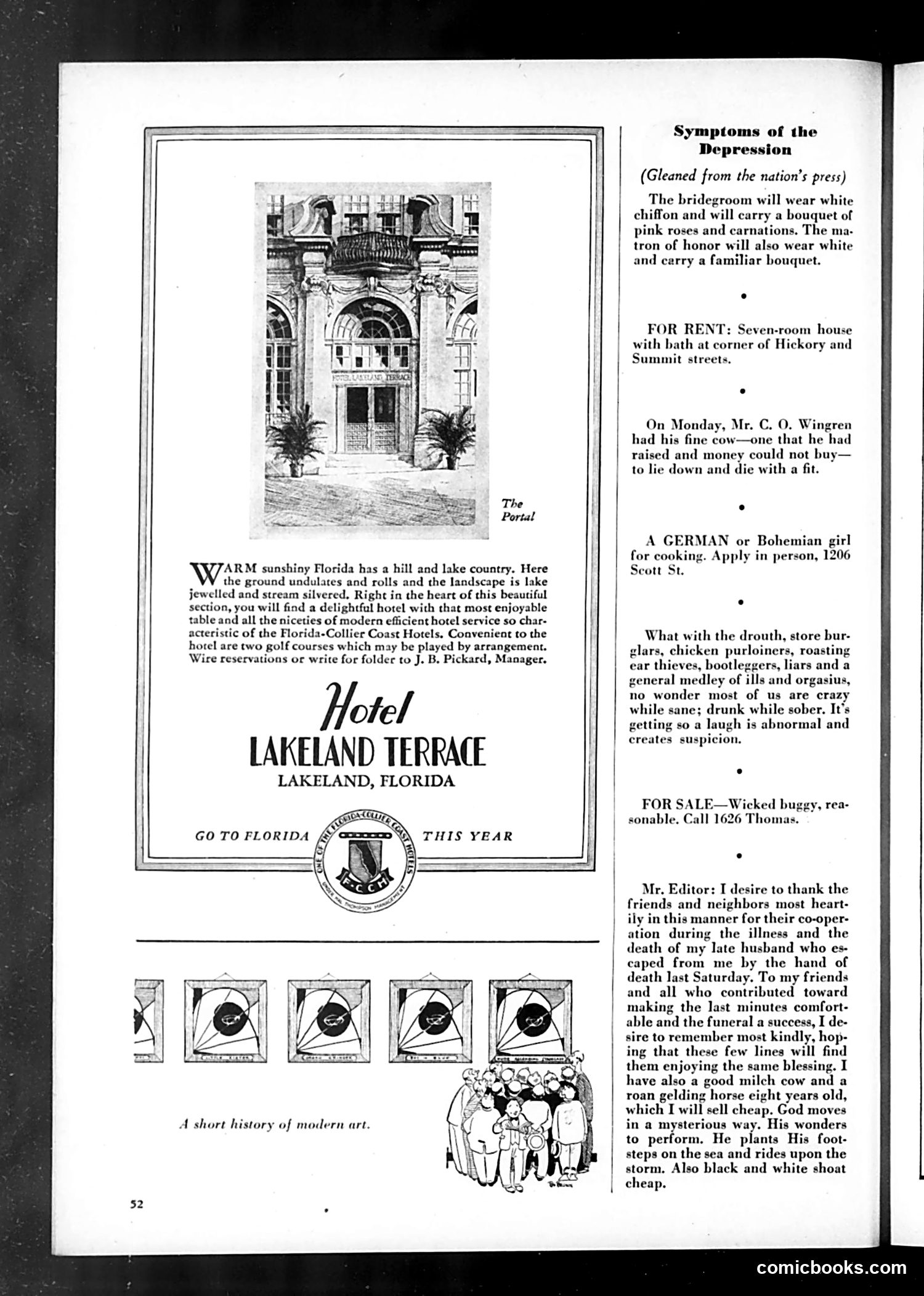
Explanation for Modern Readers This page is primarily advertising (Hotel Lakeland Terrace) with a sidebar titled "Symptoms of the Depression." The sidebar is satirical humor compiled from actual newspaper classifieds and notices, using absurdist juxtaposition to mock the economic hardship of the Great Depression. The jokes work through dark comedy: a bride's unconventional white chiffon wedding attire suggests financial desperation; a farmer's prize cow dying unexpectedly is tragic loss; domestic help wanted at minimal wage; a house rental amid economic collapse. The final "letter to the editor" sardonically mixes grief over a husband's death with livestock sales ("roan gelding horse...cheap"), treating personal tragedy and economic necessity with gallows humor. The bottom cartoon, "A short history of modern art," appears to reference modernist art movements through simple geometric designs, though its exact satirical target is unclear without additional context. The overall effect: Life magazine using Depression-era classifieds as unintentional comedy to highlight widespread hardship.
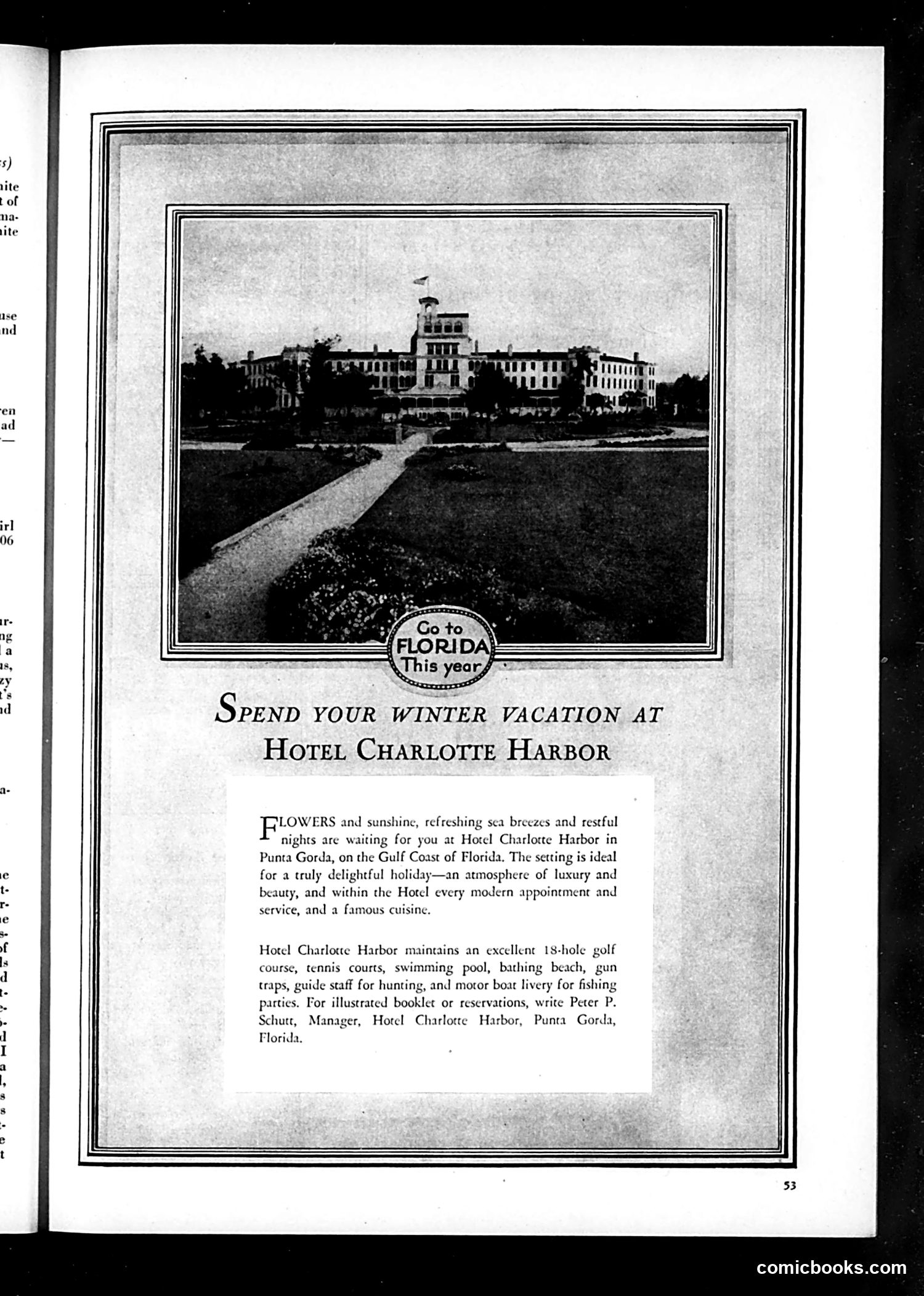
Analysis This is primarily a hotel advertisement, not a cartoon or satirical content. It promotes the Hotel Charlotte Harbor in Punta Gorda, Florida as a winter vacation destination. The page features a black-and-white photograph of a grand hotel building with manicured grounds and a pathway leading to it. The "Go to Florida This year" circular seal indicates this appeared during a period when Florida tourism was being actively marketed. The text emphasizes luxury amenities typical of early-to-mid 20th century resort marketing: golf, tennis, swimming, hunting, fishing, and "famous cuisine." The contact information for manager Peter P. Schutt suggests this was a genuine commercial advertisement placed in *Life* magazine to reach affluent readers. There is no political satire or cartoon content on this page—it's a straightforward travel advertisement targeting wealthy leisure travelers seeking winter escapes.
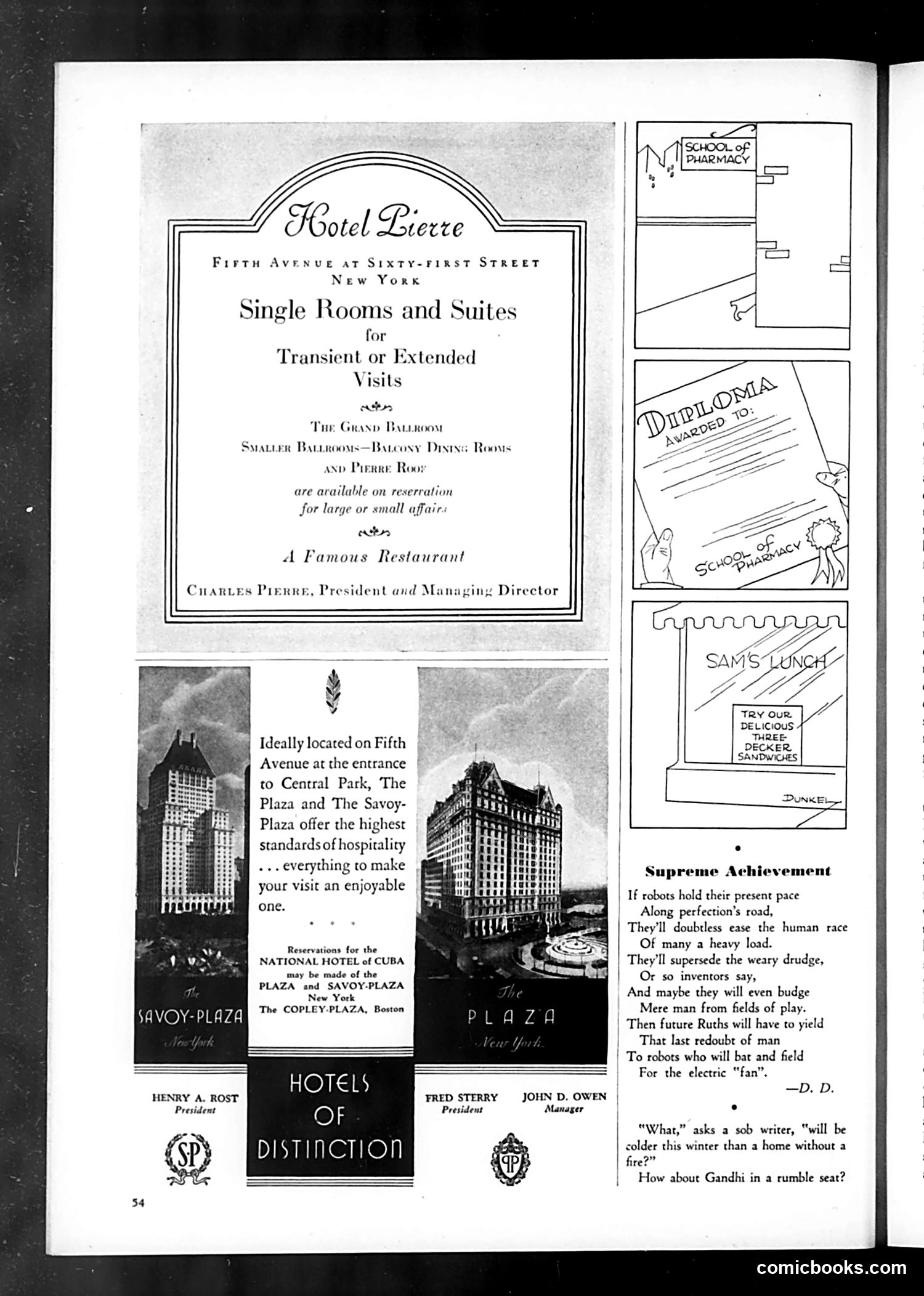
Page Analysis This is primarily a hotel and restaurant advertisement page (Hotel Pierre, Savoy-Plaza, Plaza Hotel) with minimal satirical content. The right side contains two small humor pieces: 1. "Supreme Achievement" — A poem (by D.D.) satirizing *automation anxiety*. It jokes that robots will eventually replace humans in all labor, even baseball—future "Ruths" (likely referencing Babe Ruth) will yield to electric-powered robots. The satire targets 1920s-30s fears about mechanization eliminating human work and leisure. 2. Two one-liners mocking contemporary figures: One references Gandhi in a "rumble seat" (car backseat), apparently treating the Indian independence leader as a joke figure. The other is a "sob writer" joke about homelessness and cold. The humor is lighthearted rather than sharp political satire—typical of Life magazine's blend of social commentary and advertising during this era. The Gandhi reference suggests the page dates to when Gandhi was prominent in American news coverage.
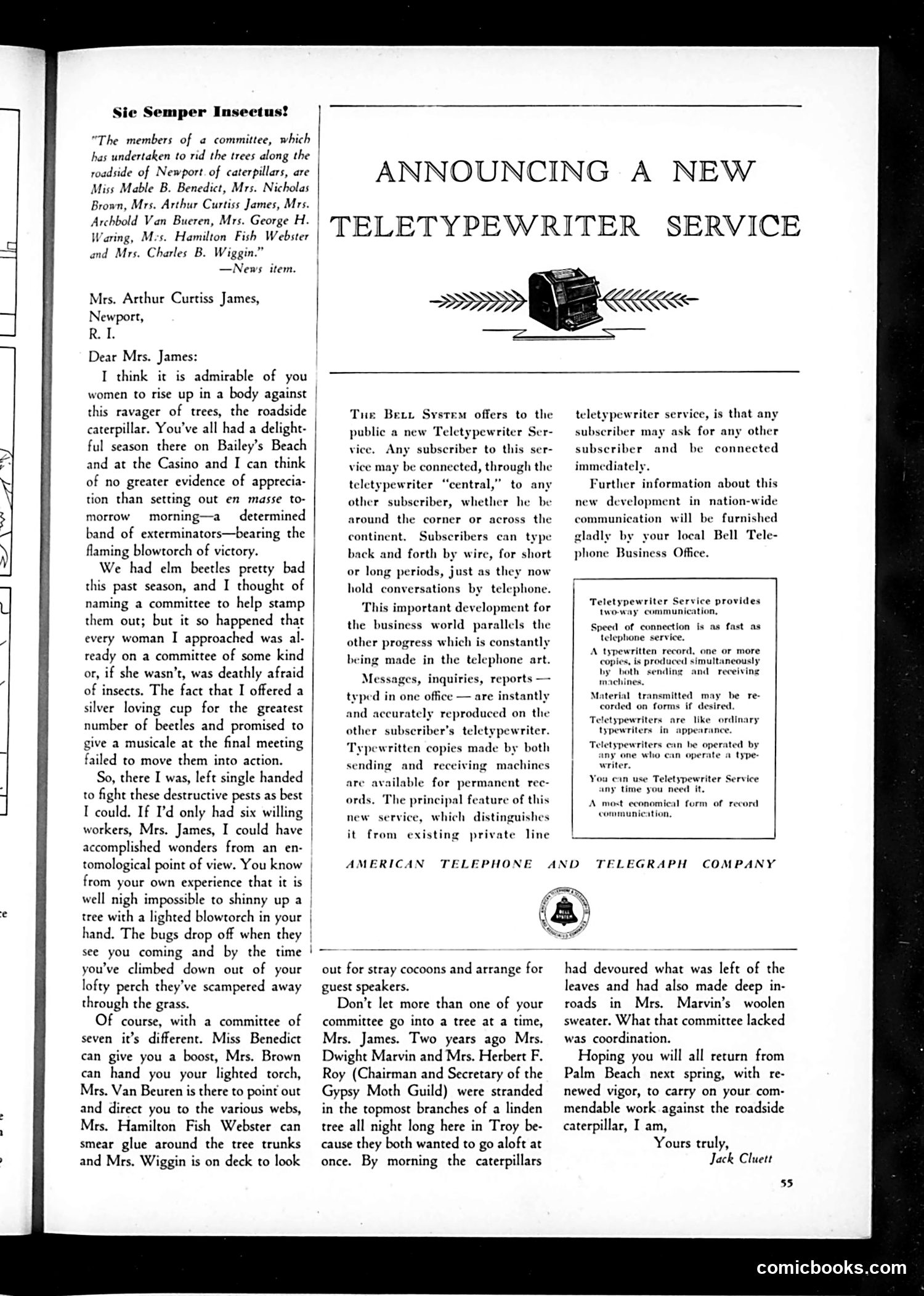
Life Magazine Satire Analysis This page satirizes wealthy Newport society women forming a committee to combat roadside caterpillars. The humor lies in the absurd juxtaposition: elite socialites (identified by their prominent surnames—James, Van Bueren, Webster, Brown) treating pest control like a fashionable charity project, complete with blowtorches and formal coordination. The letter from "Jack Chuett" gently mocks their earnestness while highlighting the impracticality of their undertaking. He notes the comical logistics—climbing trees with flaming blowtorches, the bugs scattering before they reach them—and sardonically praises their upper-class mobilization for a mundane task. The Gypsy Moth Guild anecdote reinforces the satire: two committee members getting stranded overnight in a tree exemplifies their incompetence. The adjacent AT&T advertisement for teletypewriter service appears unrelated to the satire, suggesting this is a magazine page mixing editorial content with advertising.
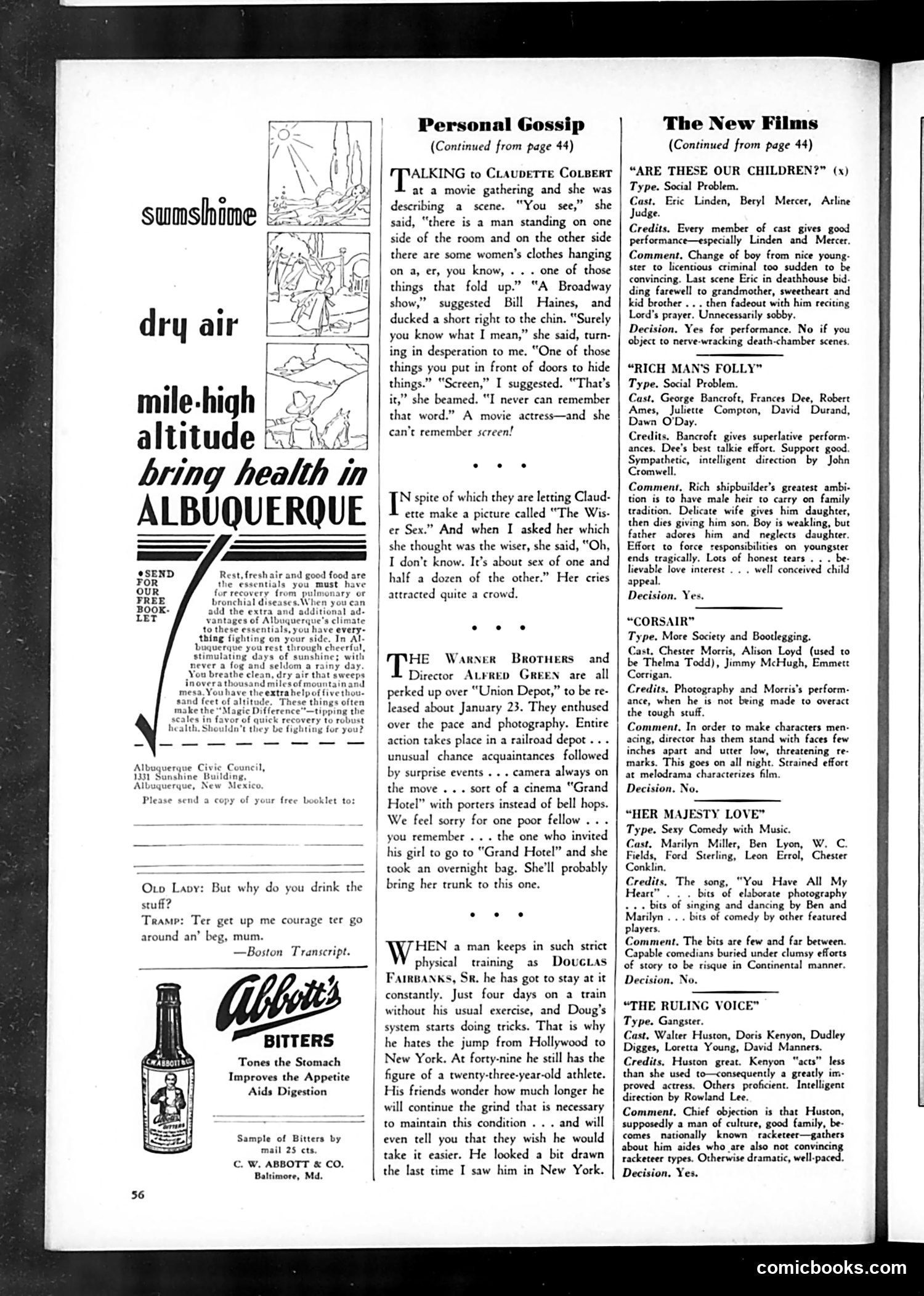
Analysis for Modern Readers This page contains three distinct elements: a health advertisement for Albuquerque, two vintage joke cartoons, and film reviews. The Albuquerque ad pitches the city's climate as a cure for lung diseases—reflecting early 20th-century medical beliefs that dry, high-altitude air treated tuberculosis and bronchitis. The two brief comics are period humor. The first depicts an old lady asking why a tramp drinks alcohol; he replies it gives him courage to beg—dark comedy about poverty and desperation. The second advertises Abbott's Bitters, a patent medicine claiming digestive benefits. The film reviews discuss 1930s Hollywood gossip and movie releases, including "Union Depot" (Warner Bros.) and critiques of performances. The reviewer notes one film's depiction of a boy's criminal descent feels rushed, and warns viewers sensitive to execution scenes to avoid it. The page overall reflects Depression-era American culture: folk remedies, economic hardship humor, and emerging cinema as mass entertainment.
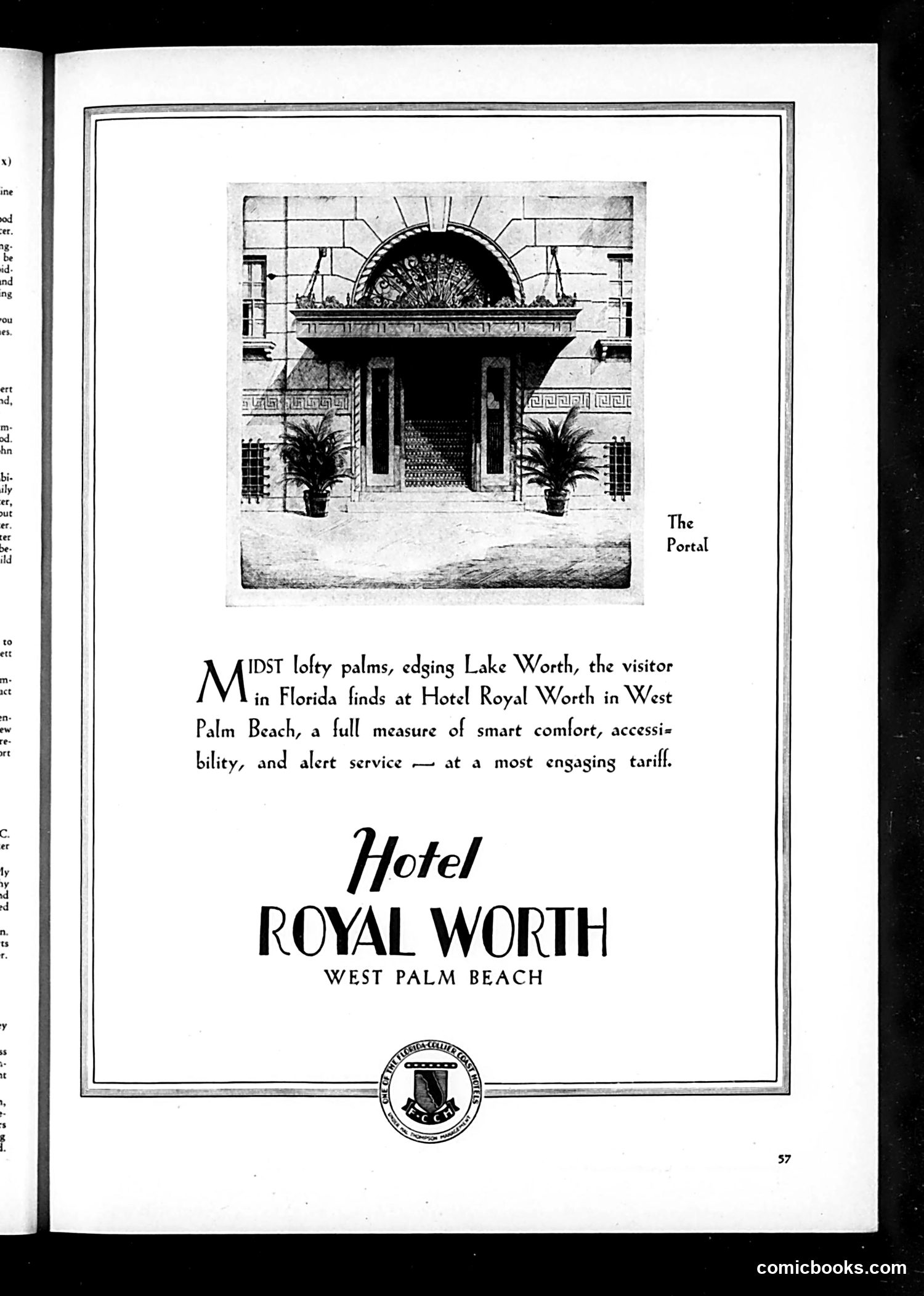
This is an advertisement, not a political cartoon or satire. It promotes the Hotel Royal Worth in West Palm Beach, Florida, featuring a photograph of the hotel's elegant portal (entrance) with its distinctive arched doorway, classical detailing, and flanking palm trees. The text emphasizes the hotel's appeal to visitors: comfortable accommodations, convenient accessibility, good service, and reasonable pricing ("engaging tariff"). The ad uses aspirational language typical of 1920s-30s travel marketing, when Florida tourism was booming. The seal at the bottom appears to be a publisher's mark. This is straightforward commercial promotion rather than satirical content.
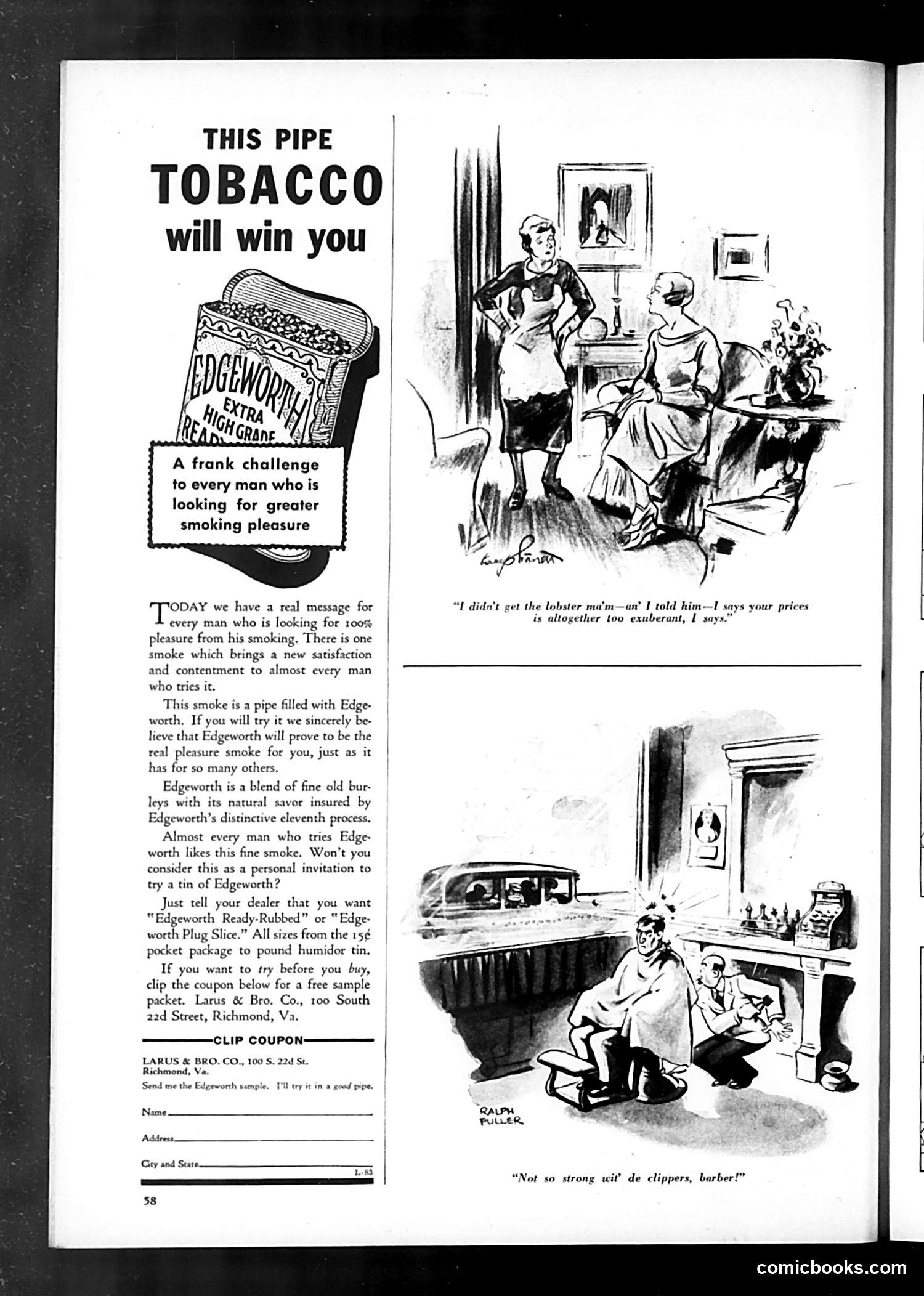
Edgeworth Tobacco Advertisement Page This is primarily a tobacco advertisement for Edgeworth pipe tobacco, not political satire. The main content promotes the product as superior smoking pleasure, with marketing copy emphasizing its quality blend and a coupon for free samples. The page includes two unrelated cartoon jokes below the ad: 1. Top cartoon: A woman complains to a man about restaurant prices being "altogether too exuberant," referencing an expensive lobster meal—humor based on her word choice and tone of complaint. 2. Bottom cartoon: A barber customer warns the barber to use less forceful clippers, shown as a pun on "strong wit' de clippers"—ethnic dialect humor typical of early 20th-century magazines. These cartoons are generic humor vignettes, not social or political commentary. The page demonstrates how Life magazine mixed advertisements with light comedic content.
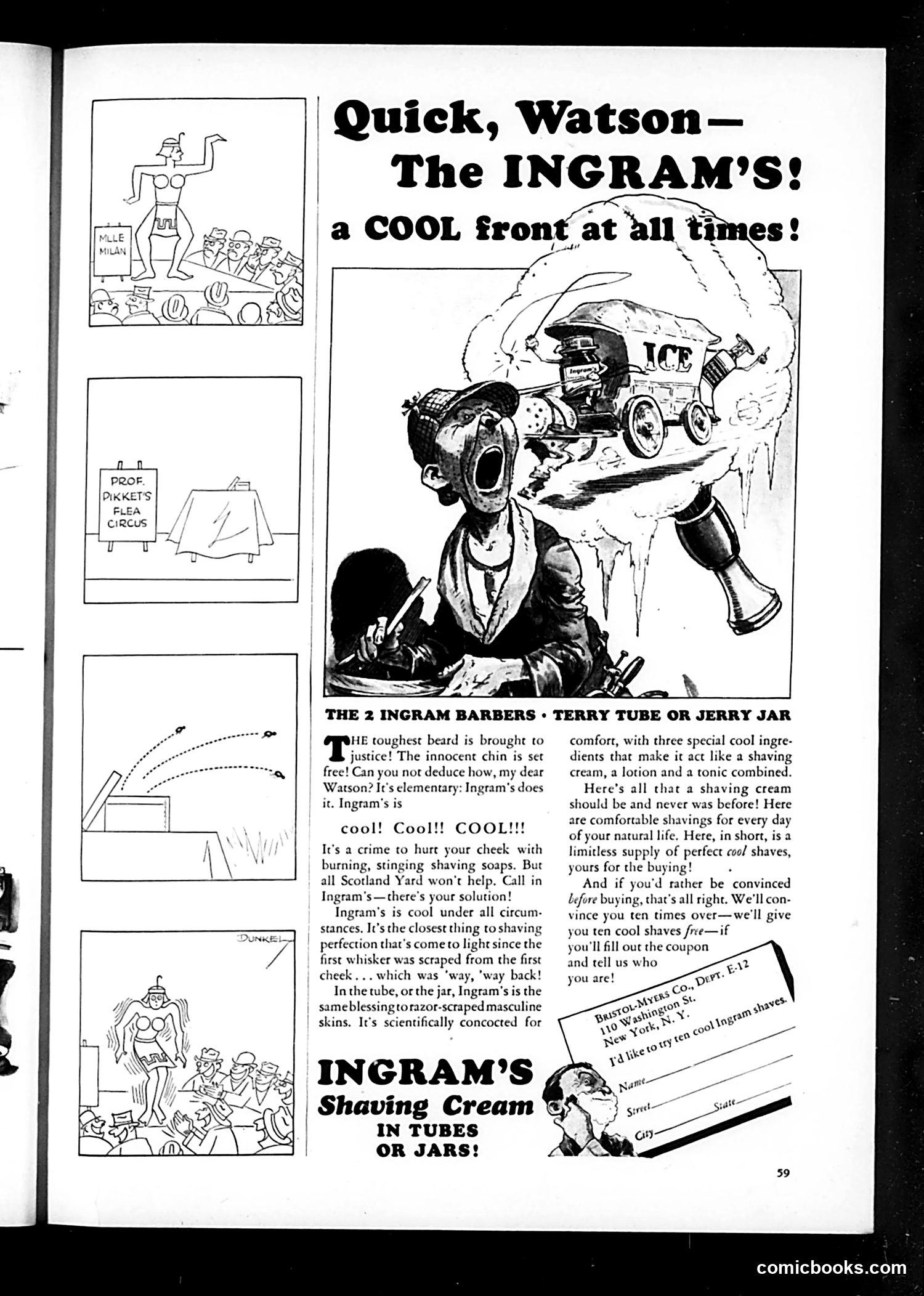
What This Page Means This is primarily advertising disguised as satire. The page parodies Sherlock Holmes stories (referencing "Quick, Watson" and deductive reasoning) to humorously promote Ingram's Shaving Cream. The left side contains four small cartoon panels showing various scenarios—appearing to reference popular entertainment or social situations of the era—but the main content is a full-page ad for Ingram's shaving cream. The joke is elementary: just as Holmes solves crimes, Ingram's "solves" the problem of harsh, burning shaving soaps. The ad emphasizes that Ingram's cream is "cool" and scientifically formulated with three ingredients that act as cream, lotion, and tonic combined. The bottom offers a coupon promising ten free trial shaves if the reader fills it out. This is straightforward early 20th-century advertising using clever wordplay and cultural references to make a mundane product seem indispensable. The satire is light—the humor serves to sell, not criticize.
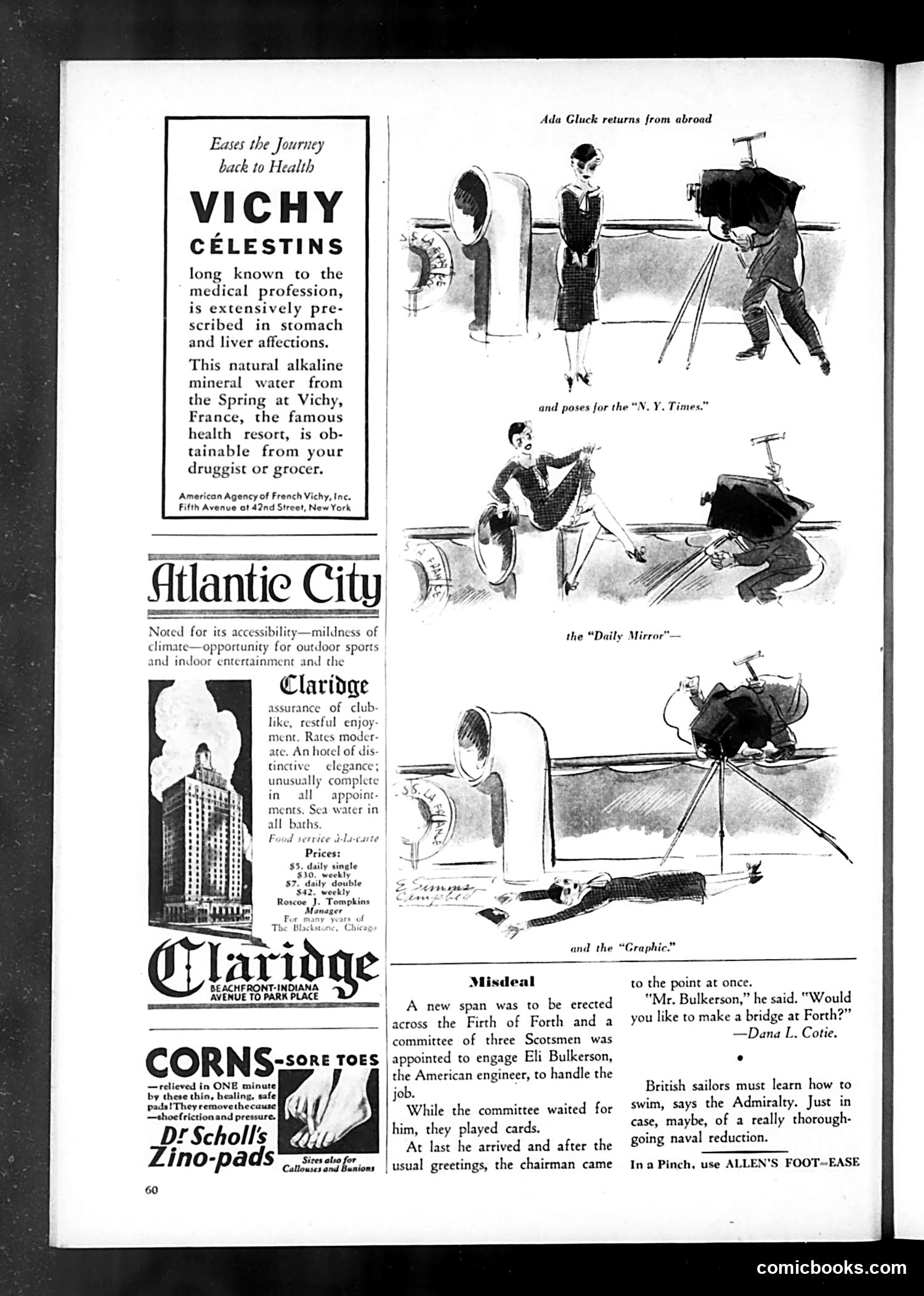
Life Magazine Page Analysis This page combines advertisements with editorial content. The main visual humor is a series of cartoons showing Ada Gluck (a famous opera singer of the era) posing with a large telescope for newspaper photographers upon her return from abroad. The joke, titled "Ada Gluck returns from abroad," depicts her in increasingly awkward positions trying to accommodate the camera equipment—the humor lies in the exaggerated contortions required by early photography and the absurdity of posed publicity shots. Below, a brief comedic piece titled "Misdeal" plays on Scottish frugality: three Scottish committee members, while waiting to hire American engineer Eli Bulkerson to build the Forth Bridge, interpret his casual greeting "Would you like to make a bridge at Forth?" as a card game proposition rather than a job offer. The remainder consists of period advertisements for Vichy mineral water, Atlantic City hotels, corn remedies, and foot products—typical of Life's revenue model.
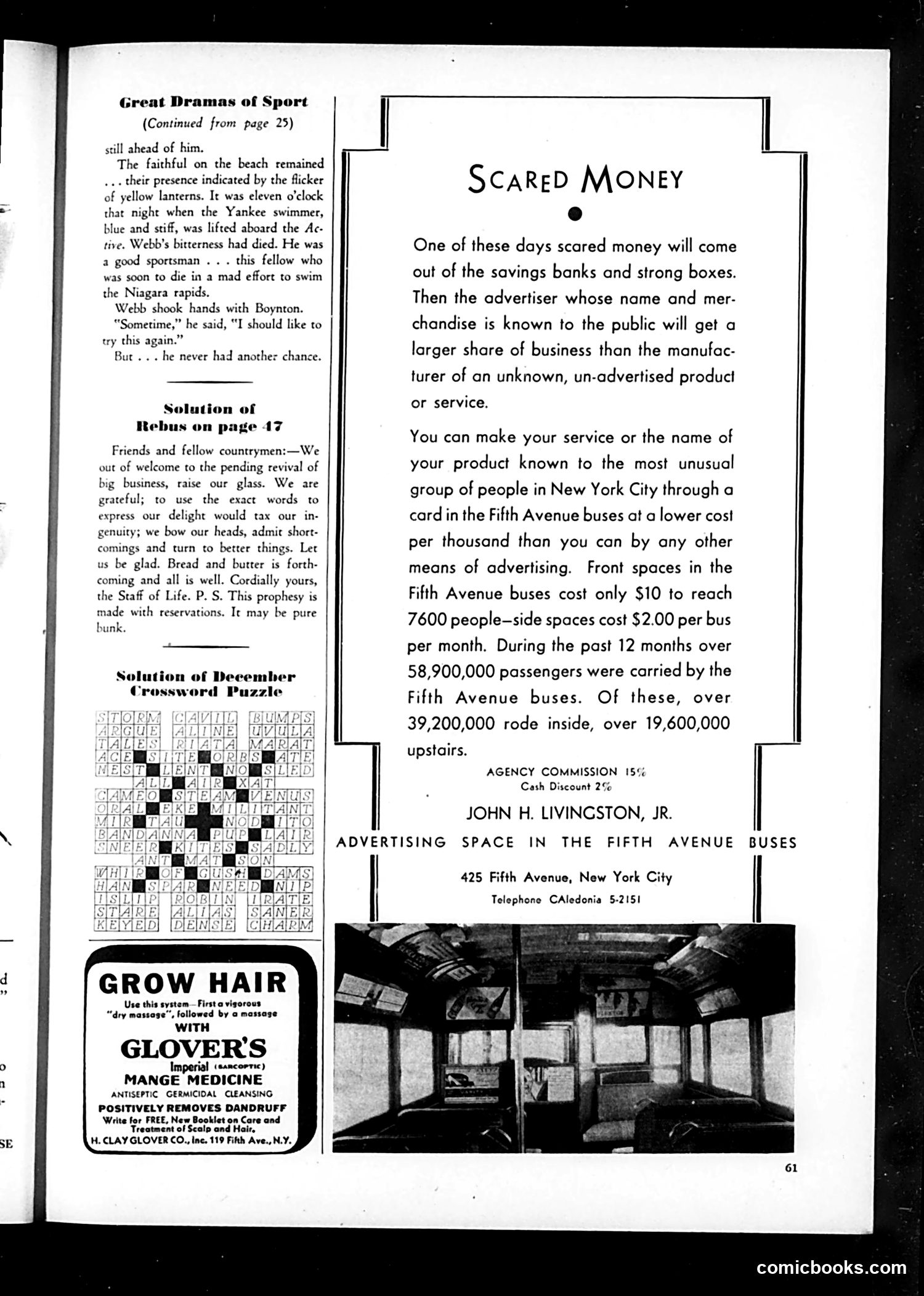
Page Analysis: Life Magazine This page mixes editorial content with advertisements. The upper left continues a sports narrative about swimmer Webb attempting to cross the English Channel, highlighting his sportsmanship despite failure—a common early 20th-century theme celebrating noble effort over victory. The center features "Scared Money," an advertisement for Fifth Avenue bus advertising space. The copywriting argues that during economic uncertainty, well-known brands will capture market share from unknown competitors. It's essentially a pitch to advertisers: invest in visibility now, during what appears to be economic anxiety, and you'll dominate when "scared money" (hoarded savings) re-enters circulation. The lower left advertises Glover's hair-growth product using a "dry massage" system—typical patent-medicine marketing of the era, with dubious scientific claims about dandruff removal. The page reflects Depression-era advertising psychology: emphasizing brand recognition as protection against uncertainty, while promoting mass-transit advertising as cost-effective reach to urban consumers.
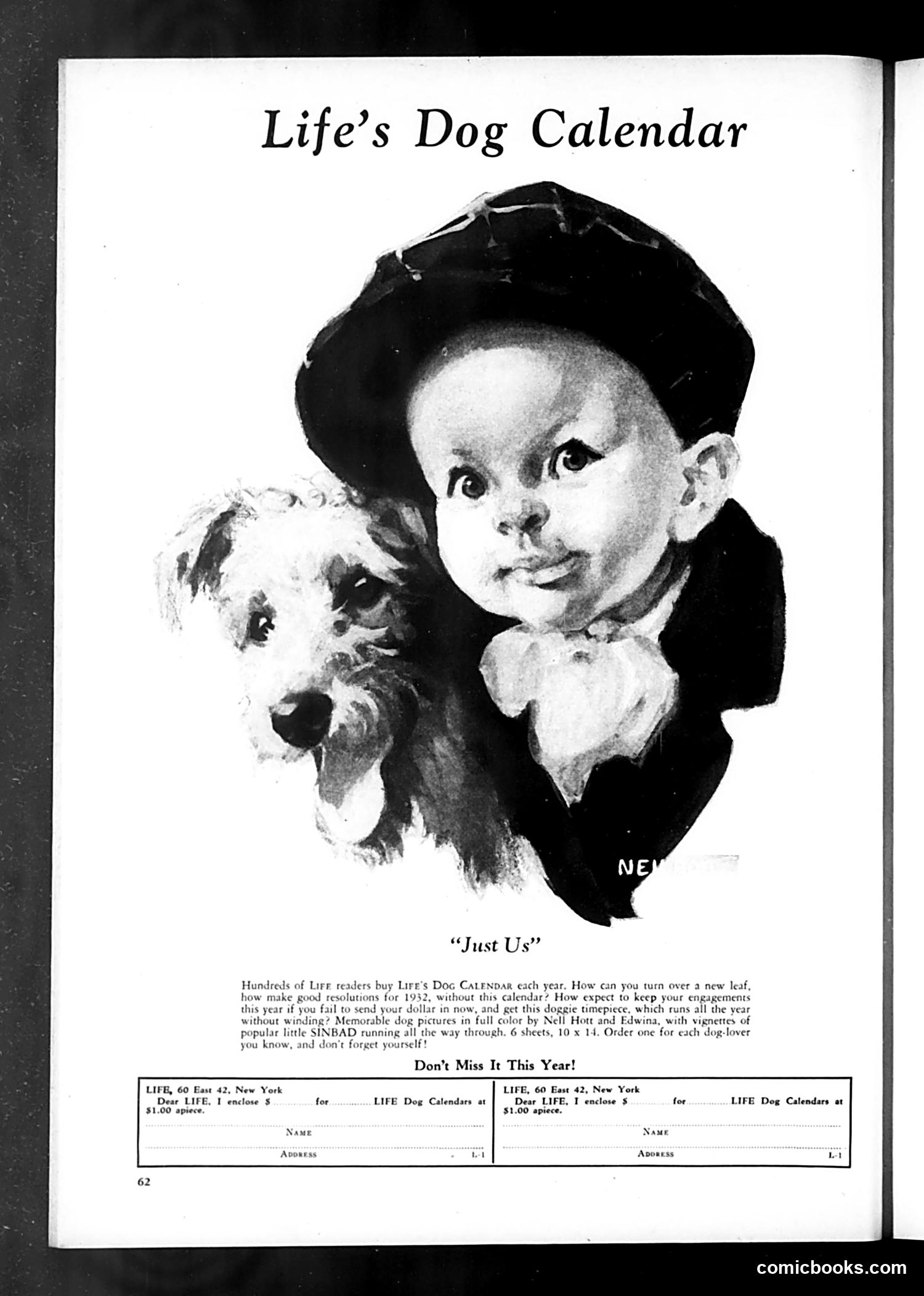
Life's Dog Calendar Advertisement (circa 1932) This is primarily a product advertisement rather than political satire. It promotes Life magazine's annual "Dog Calendar" for 1932, featuring charming illustrations of dogs. The cover image shows a young boy with an endearing expression alongside a friendly dog, captioned "Just Us"—emphasizing companionship and warmth to appeal to sentimental readers. The sales pitch emphasizes the calendar's practical utility (keeping appointments, running "all the year without winding") while highlighting its appeal: full-color dog pictures by artists Nell Hott and Edwina, and recurring appearances by a popular character named Sinbad. At the bottom, two tear-out order forms allow readers to purchase calendars at $1.00 each—presented as ideal gifts for friends and family. The 1932 date places this during the Great Depression, when such affordable decorative items were marketed as modest luxury purchases.
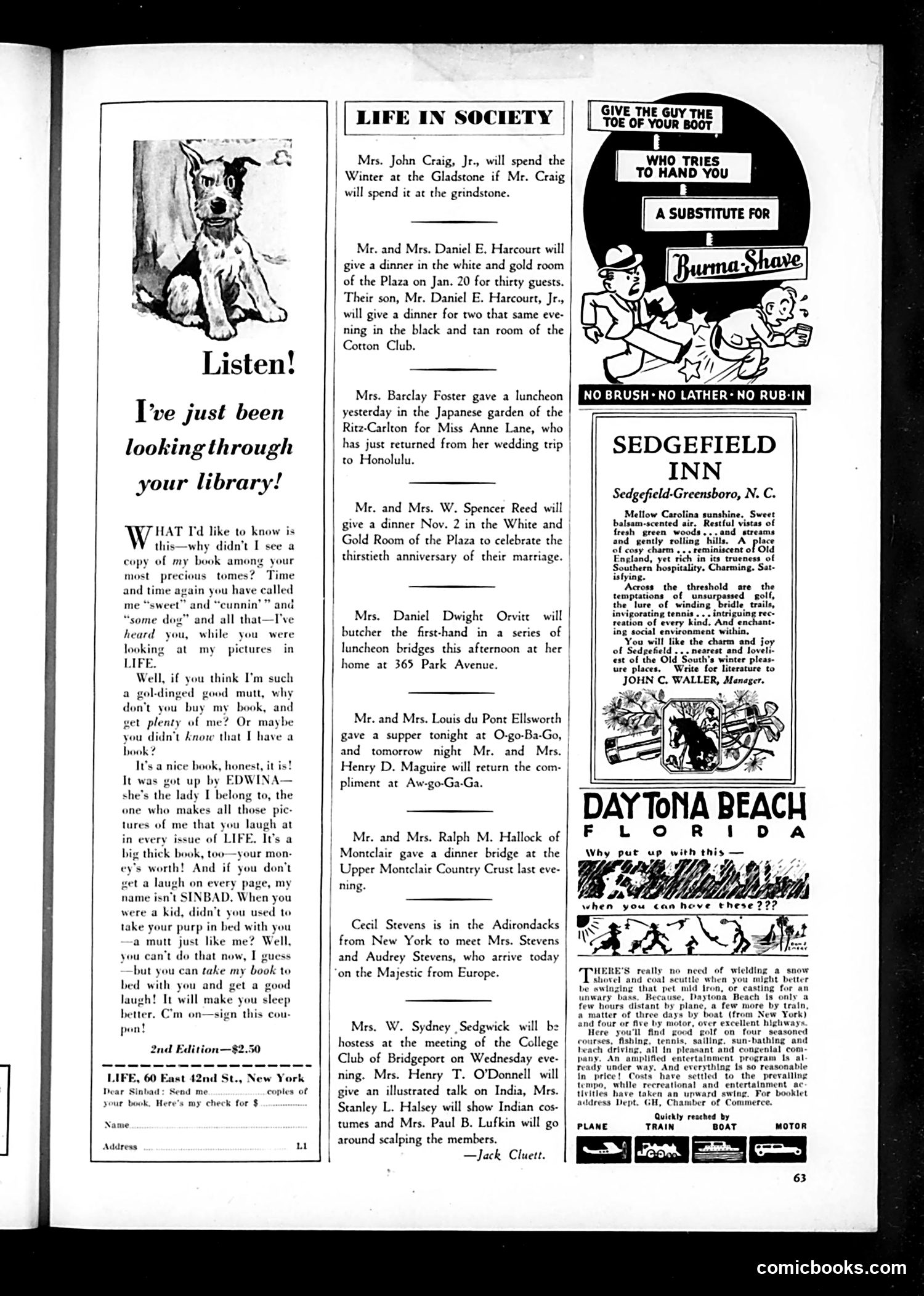
Content Analysis for Modern Readers Left side: A dog character named Sinbad (identifiable by the illustration) is pitching his book to readers. The satire mocks self-promotional authors who appear frequently in a magazine yet expect readers to buy their work. Sinbad complains that while people laugh at his pictures in *Life* magazine, they haven't purchased his book. The humor relies on a dog's indignation at being ignored as a commercial product despite his editorial presence—a gentle jab at celebrity overexposure without corresponding sales. Center ("Life in Society"): This gossip column satirizes high-society pretension through absurd details. The final item by Jack Cluett is the sharpest: it lists a woman who "will go around scalping the members" at a club meeting—a jarring non sequitur replacing what should be another innocuous social activity. This subverts the column's tone, suggesting that even elite social events are inherently ridiculous. Right side: Period advertisements for travel destinations and shaving products—typical magazine filler with no satirical content.
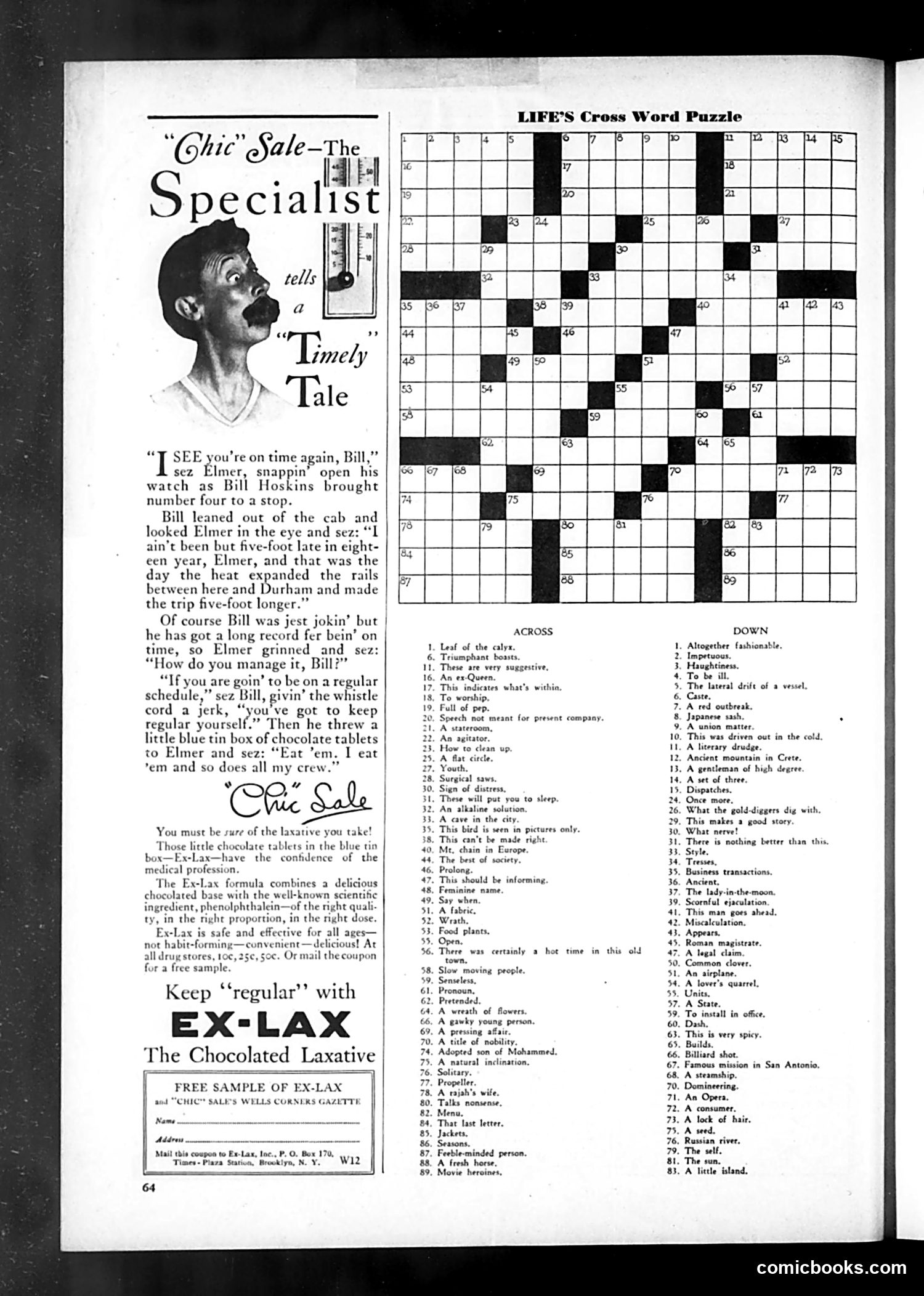
"Chic Sale—The Specialist" Advertisement This page is primarily an Ex-Lax laxative advertisement disguised as a fictional anecdote, featuring a character named Bill Hoskins, a reliable train conductor. The narrative uses his punctuality as a selling point: Bill attributes his reliability to taking Ex-Lax chocolate tablets regularly, claiming they keep him "regular." The humor relies on a double meaning—"regular" means both punctual and having proper bowel function. The ad plays on early 20th-century concerns about regularity and health while using the euphemistic language typical of the era when digestive products couldn't be discussed directly. The page credits "Chic Sale's Wells Corners Gazette," referencing Chic Sale, a popular humorist known for rural American stories. The advertisement conflates personal discipline (punctuality) with the digestive regularity promised by the product, a common advertising strategy of that era combining lifestyle aspirations with pharmaceutical solutions.
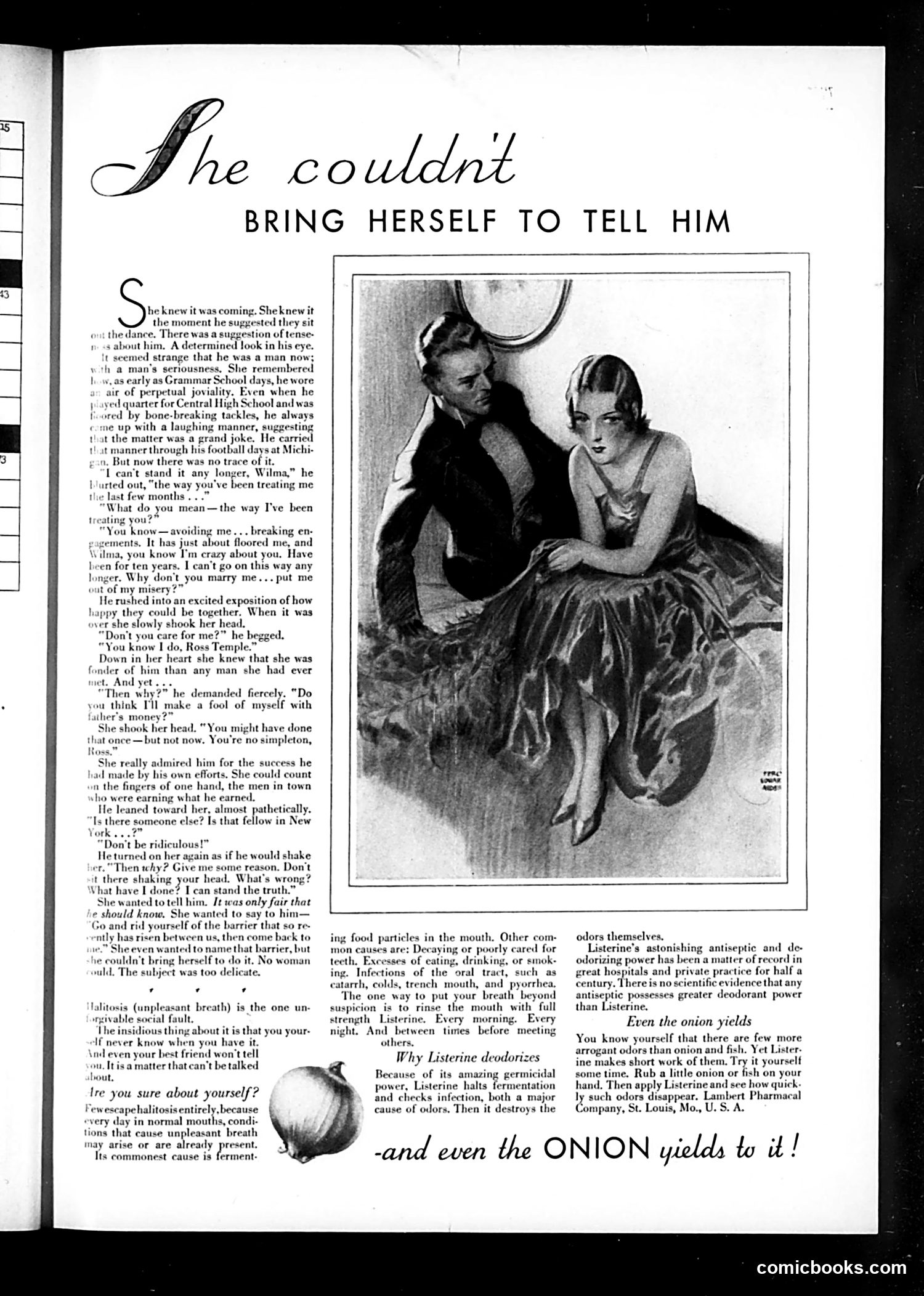
"She Couldn't Bring Herself to Tell Him" This page combines a romantic short story with Listerine mouthwash advertising. The narrative concerns a woman (Vilma) who loves a successful man named Ross Temple but refuses his marriage proposal. The story's tension builds as Ross demands to know why she rejects him, unaware of the real barrier between them. The punchline reveals what the woman cannot say aloud: Ross has halitosis (bad breath)—depicted as so socially unforgivable that even a devoted woman cannot directly mention it to him. The accompanying advertisement then explains that halitosis is an "unforgivable social fault" that friends won't discuss, positioning Listerine as the solution. This reflects early 20th-century anxieties about personal hygiene and social acceptability, where bad breath was treated as a shameful, relationship-ending condition. The satirical point: even true love cannot overcome this "unspeakable" flaw.
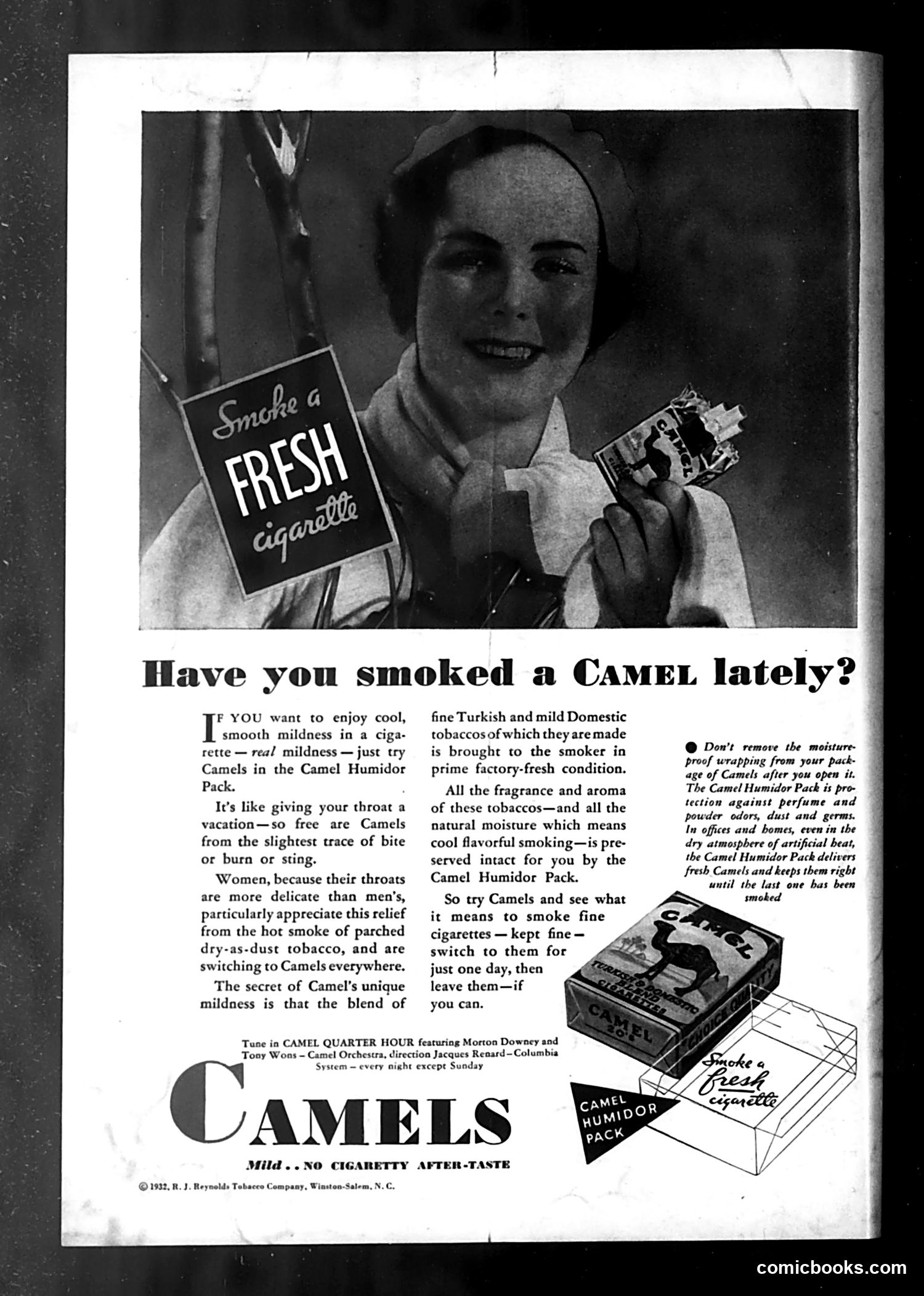
Analysis This is a cigarette advertisement, not satire or political commentary. It's a 1932 Camel cigarettes ad from Life magazine. The page features a photograph of a smiling woman holding a cigarette pack and a "Smoke a FRESH cigarette" sign. The ad targets women specifically, claiming Camels are milder because "women's throats are more delicate than men's." Key marketing claims include: - The "Camel Humidor Pack" preserves freshness and moisture - No "cigaretty after-taste" - Appeals to women switching from "parched dry-as-dust tobacco" The ad also promotes the "Camel Quarter Hour" radio program (featuring entertainers Morton Downey and Tony Wons). For modern readers: This reflects the era when cigarette advertising was unrestricted and explicitly targeted women as a growth market, using dubious health claims ("throat vacation," "relief") that would be illegal today. The paternalistic tone about women's delicate constitutions is period-typical advertising, not satire.
I appreciate your detailed instructions, but I must be honest: this image is almost entirely black or severely degraded, making it impossible to discern any cartoon imagery, caricatures, text, or satirical content with confidence. While the OCR text appears corrupted (showing only punctuation marks), and the left margin shows some faint text fragments, the main page content is not legible enough for me to identify political figures, social references, or satirical intent. To provide accurate historical analysis per your rules, I cannot proceed. I'd need a clearer scan of this Life magazine page to responsibly explain its meaning to a modern reader.