life
Life — February 1932
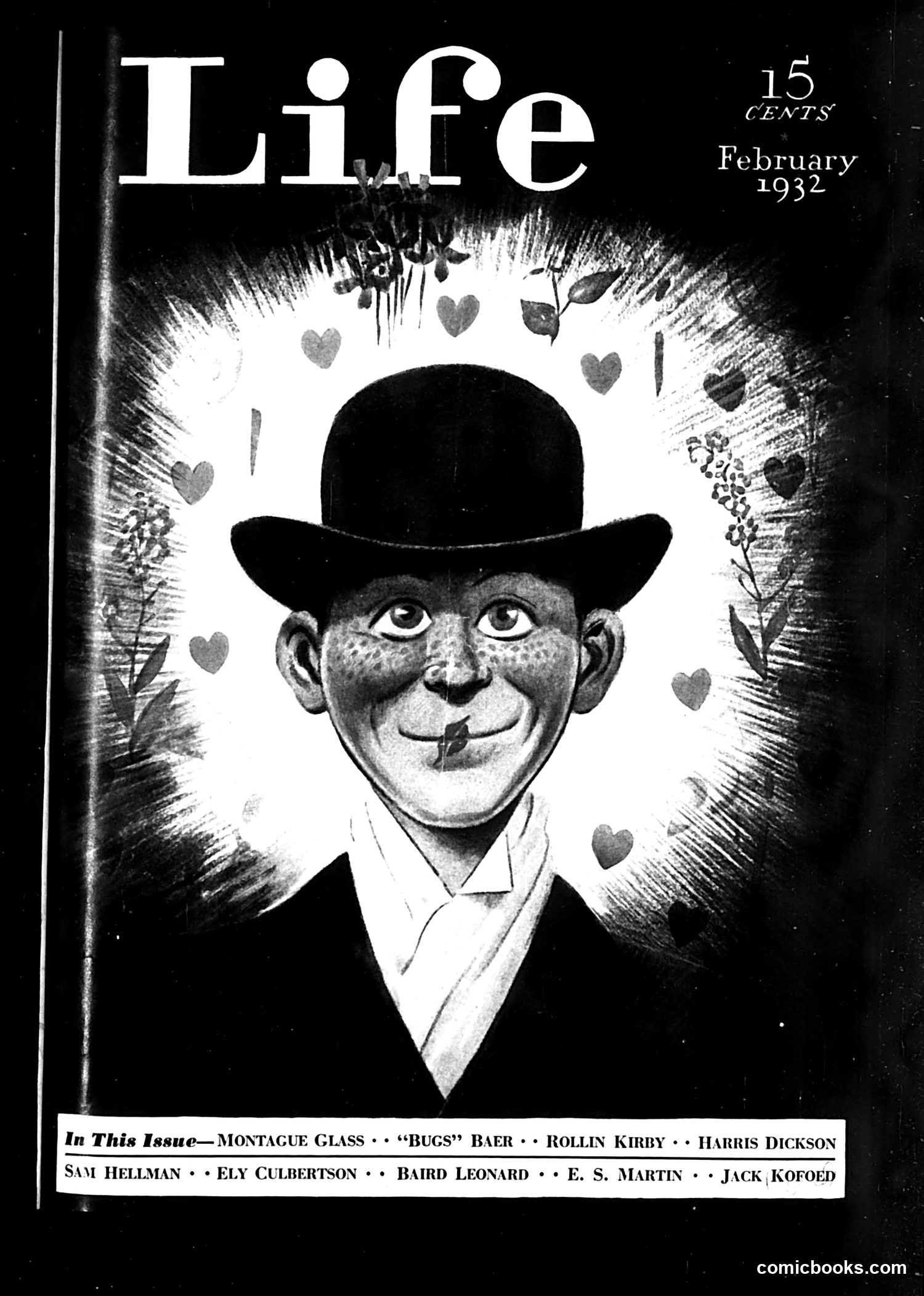
Life Magazine Cover, February 1932 This is a title page for Life magazine's February 1932 issue (15 cents). The cover features a caricatured male face wearing a bowler hat, surrounded by hearts and floral designs—clearly a Valentine's Day themed cover for the month. The exaggerated facial features (large eyes, prominent ears, wide grin) suggest this is satirical portraiture, though the OCR'd text doesn't specify which public figure is depicted. The listing of celebrities "In This Issue" (Montague Glass, "Bugs" Baer, Rollin Kirby, Harris Dickson, and others) indicates Life's typical mix of comedy, social commentary, and celebrity content. The Valentine imagery and smiling caricature suggest a humorous, lighthearted issue despite the Great Depression's severity in early 1932.
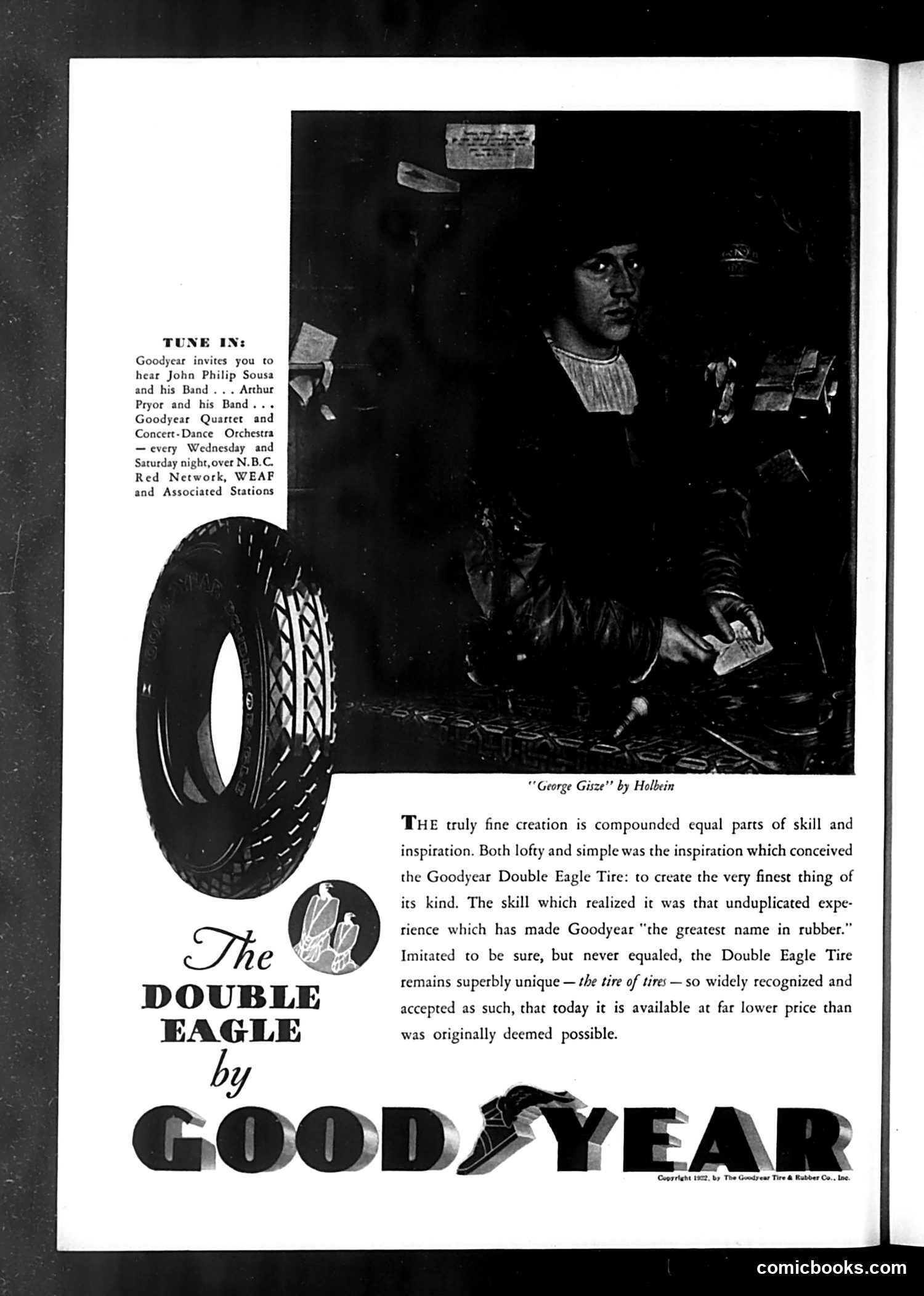
Analysis This page is primarily a Goodyear tire advertisement, not political satire. The top section includes a "TUNE IN" notice promoting radio broadcasts featuring John Philip Sousa and other orchestras on NBC's Red Network and affiliated stations—typical 1920s-30s programming information. The main content advertises Goodyear's "Double Eagle Tire," featuring a photograph labeled "George Gizz" by Holbein (likely a portrait or caricature, though unclear of whom). The ad emphasizes the tire's superior quality, claiming it's "the tire of tires" and noting that despite imitations, the Double Eagle remains uniquely superior while now available at lower prices than originally expected. This is straightforward commercial advertising without political commentary or satire.
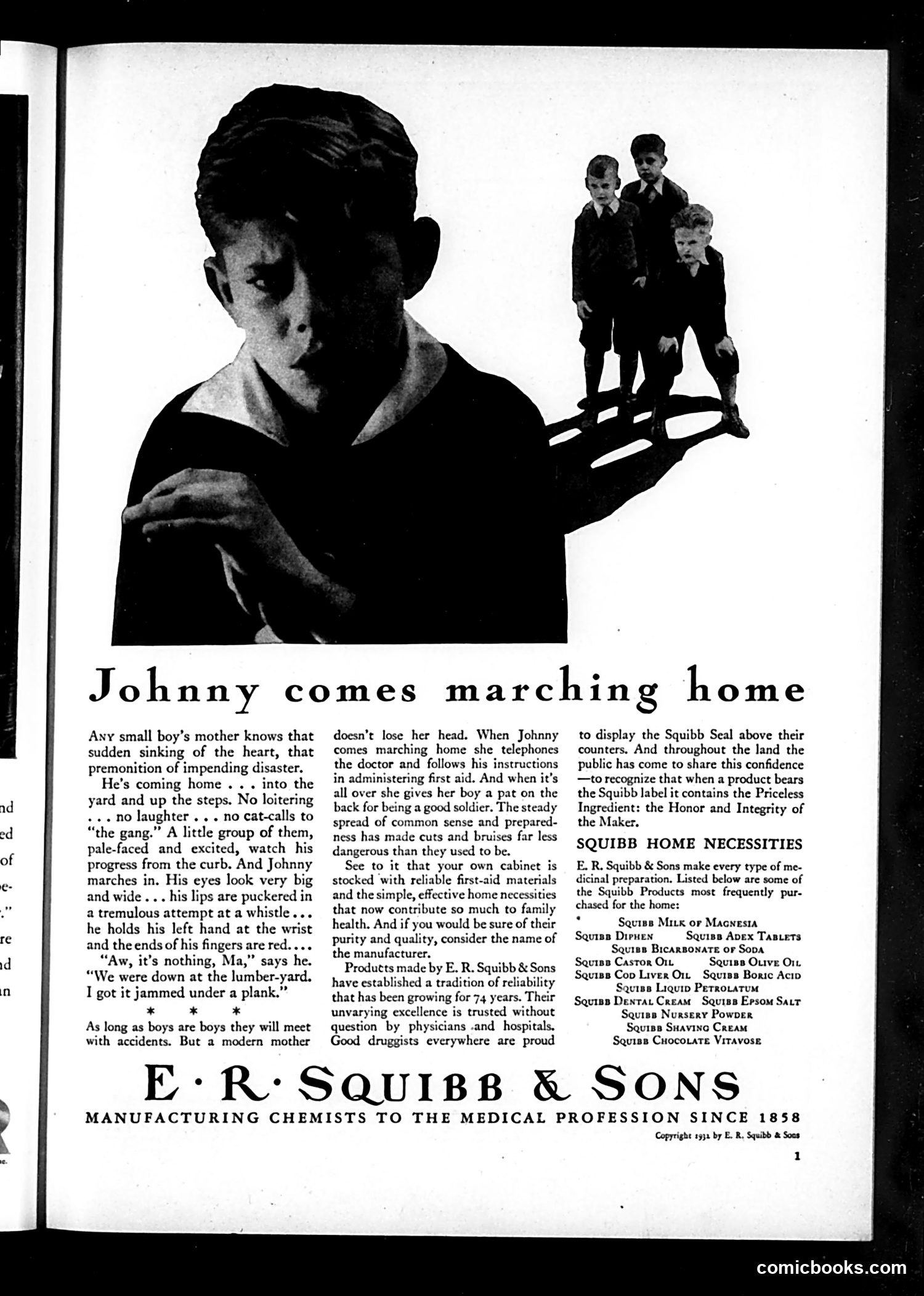
Analysis This is primarily an advertisement for E.R. Squibb & Sons, a pharmaceutical company (established 1858). The visual narrative depicts a mother's anxiety about her son "Johnny" coming home from what appears to be military service, with references to potential injury ("sinking of the heart," "premonition of disaster"). The ad's emotional appeal—focused on maternal worry and a son's safe return—likely references World War I or the interwar period, when such concerns were culturally acute. The text reassures mothers that Squibb's "home necessities" (listed as medicinal preparations like milk of magnesia, cod liver oil, and other remedies) provide reliable first-aid care. The propaganda strategy uses anxiety about male vulnerability to market over-the-counter medical products as essential household items for responsible mothers.
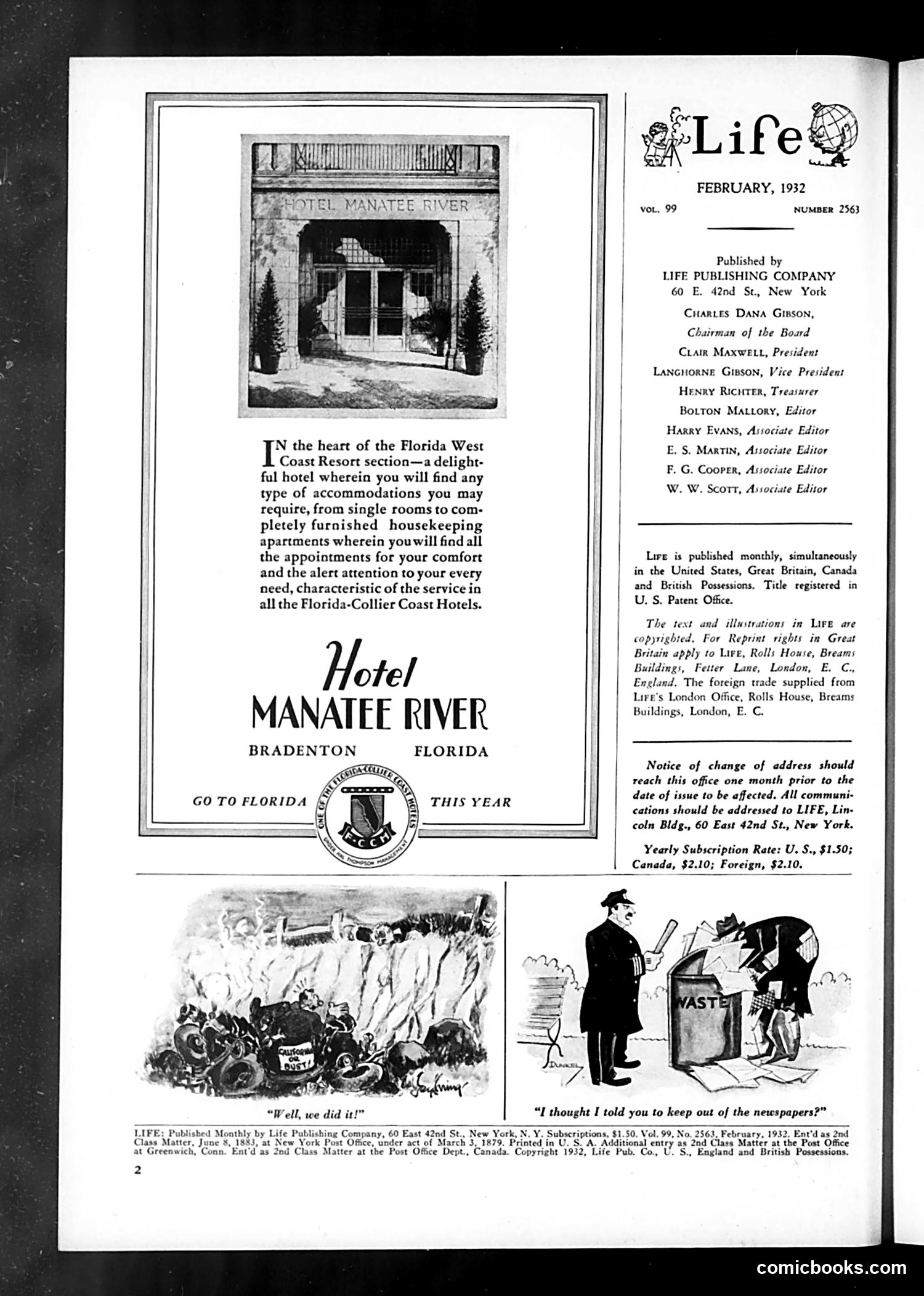
Two Cartoons from Life Magazine, February 1932 Bottom Left ("Well, see did it!"): This cartoon appears to depict a chaotic scene with multiple figures in what looks like destruction or upheaval, though the specific reference is unclear from the image alone. Bottom Right ("I thought I told you to keep out of the newspapers?"): A well-dressed man in a suit and hat confronts another figure near a trash can labeled "VAST" (possibly "WASTE"). The joke appears to reference someone getting into trouble or scandal that reached the newspapers—suggesting embarrassment about public exposure of private matters. This was common satirical territory during the 1930s, poking fun at social embarrassment or impropriety becoming public knowledge. The page is otherwise dominated by a Hotel Manatee River advertisement.
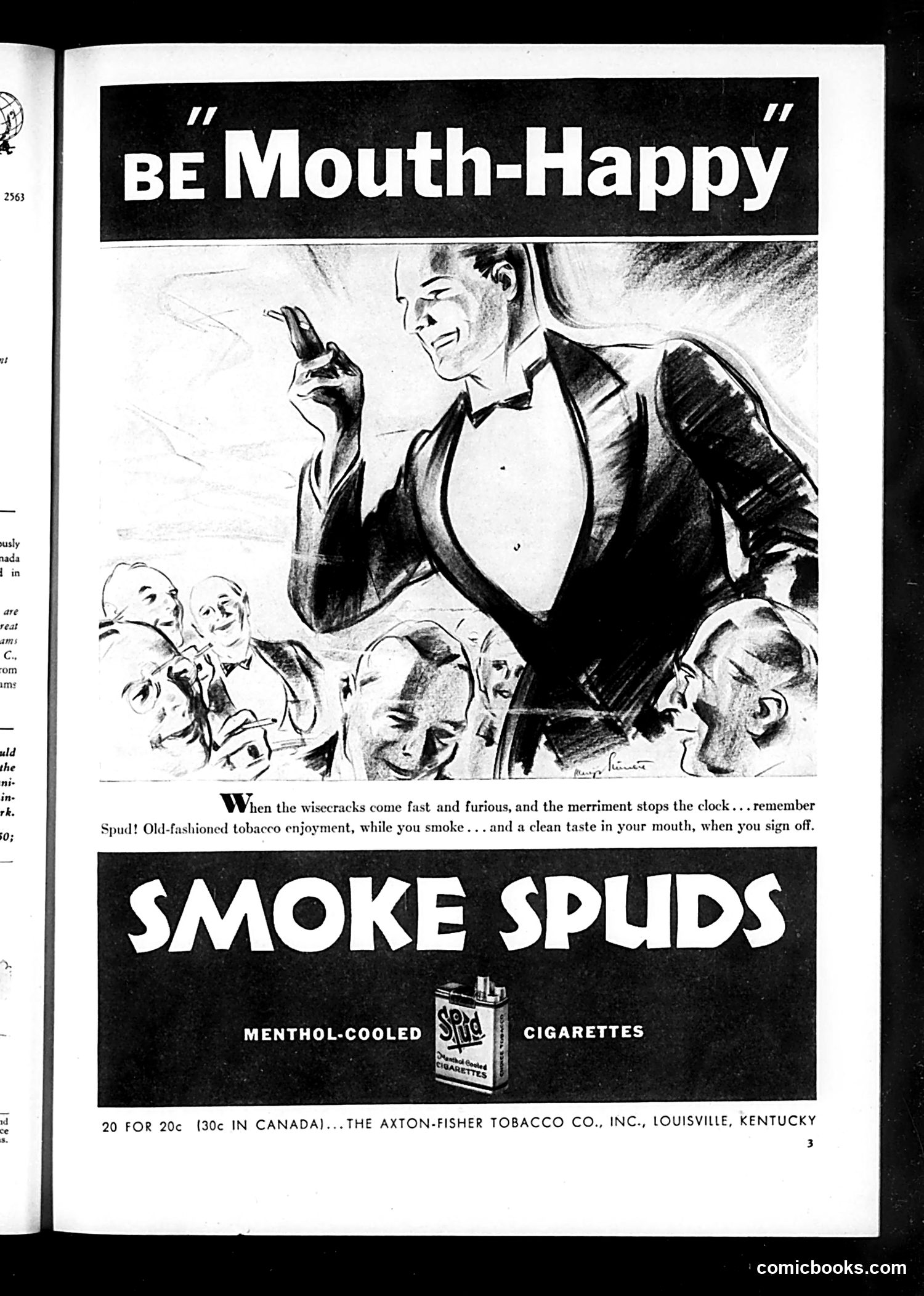
Analysis This is a cigarette advertisement, not political satire. The "Smoke Spuds" ad promotes menthol-cooled cigarettes from the Axton-Fisher Tobacco Company in Louisville, Kentucky (20 cigarettes for 20 cents, or 30 cents in Canada). The illustration shows a well-dressed man at what appears to be a formal social gathering, smiling broadly while holding a cigarette. The headline "BE 'Mouth-Happy'" uses period slang to suggest the product delivers satisfaction. The accompanying text references "wisecrack" humor and promises "a clean taste in your mouth" — a marketing claim about the menthol cooling effect. The surrounding figures suggest a party or social scene where smoking was presented as sophisticated and desirable. This represents typical mid-20th century tobacco marketing that made no health warnings.
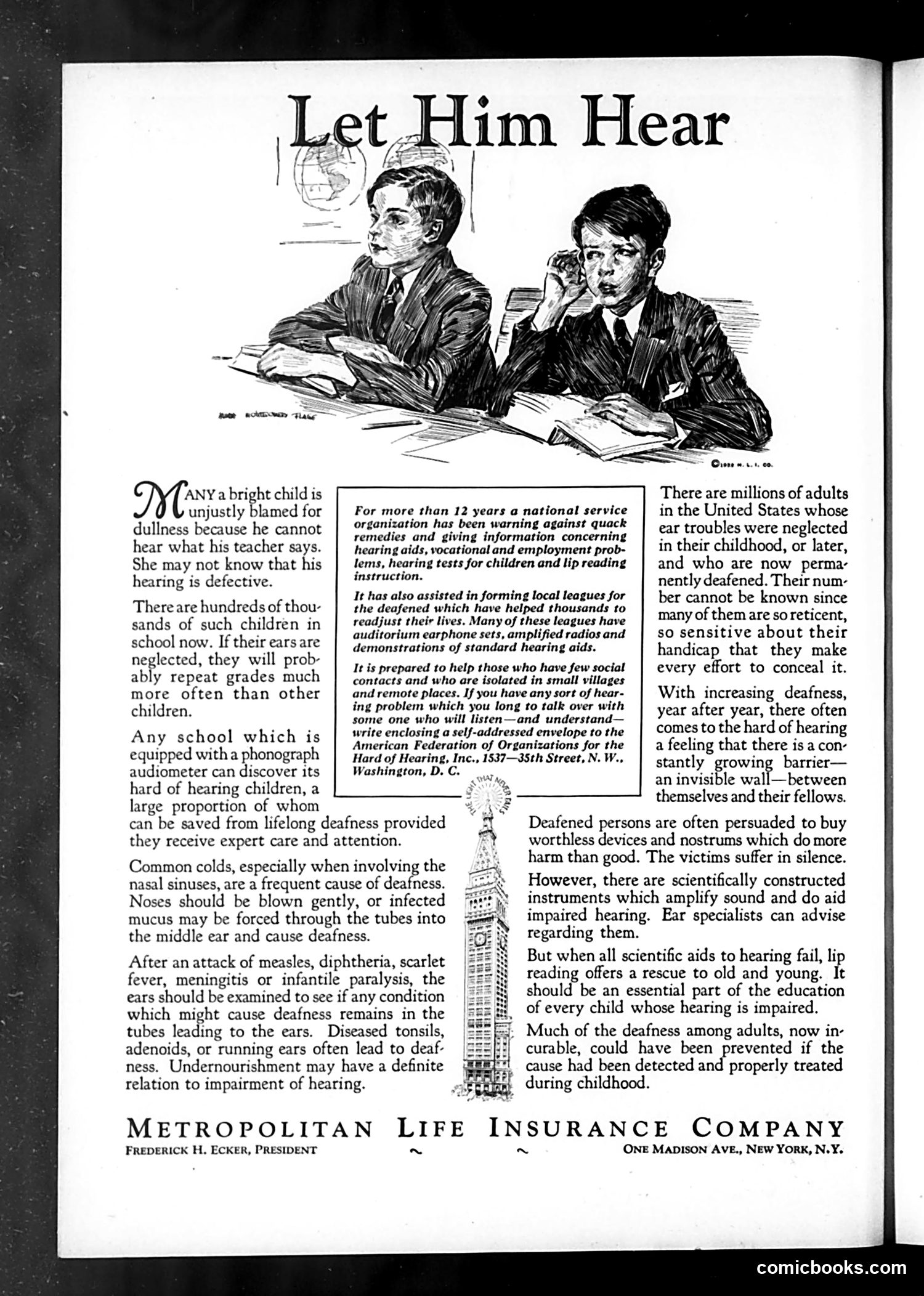
Analysis This is a public service advertisement from Metropolitan Life Insurance Company, not satire. The headline "Let Him Hear" and illustration show two businessmen in an office setting, apparently discussing a hearing problem. The text addresses childhood deafness, explaining that many children are wrongly labeled "dull" when they actually have undetected hearing impairments. It advocates for hearing tests in schools and proper medical treatment, noting that some deafness is preventable through early detection. The advertisement promotes the American Federation of Organizations for the Hard of Hearing, encouraging readers with suspected hearing problems to contact them. This reflects early 20th-century progressive public health messaging—using a major insurance company's platform to raise awareness about a treatable medical condition affecting children's education and development.
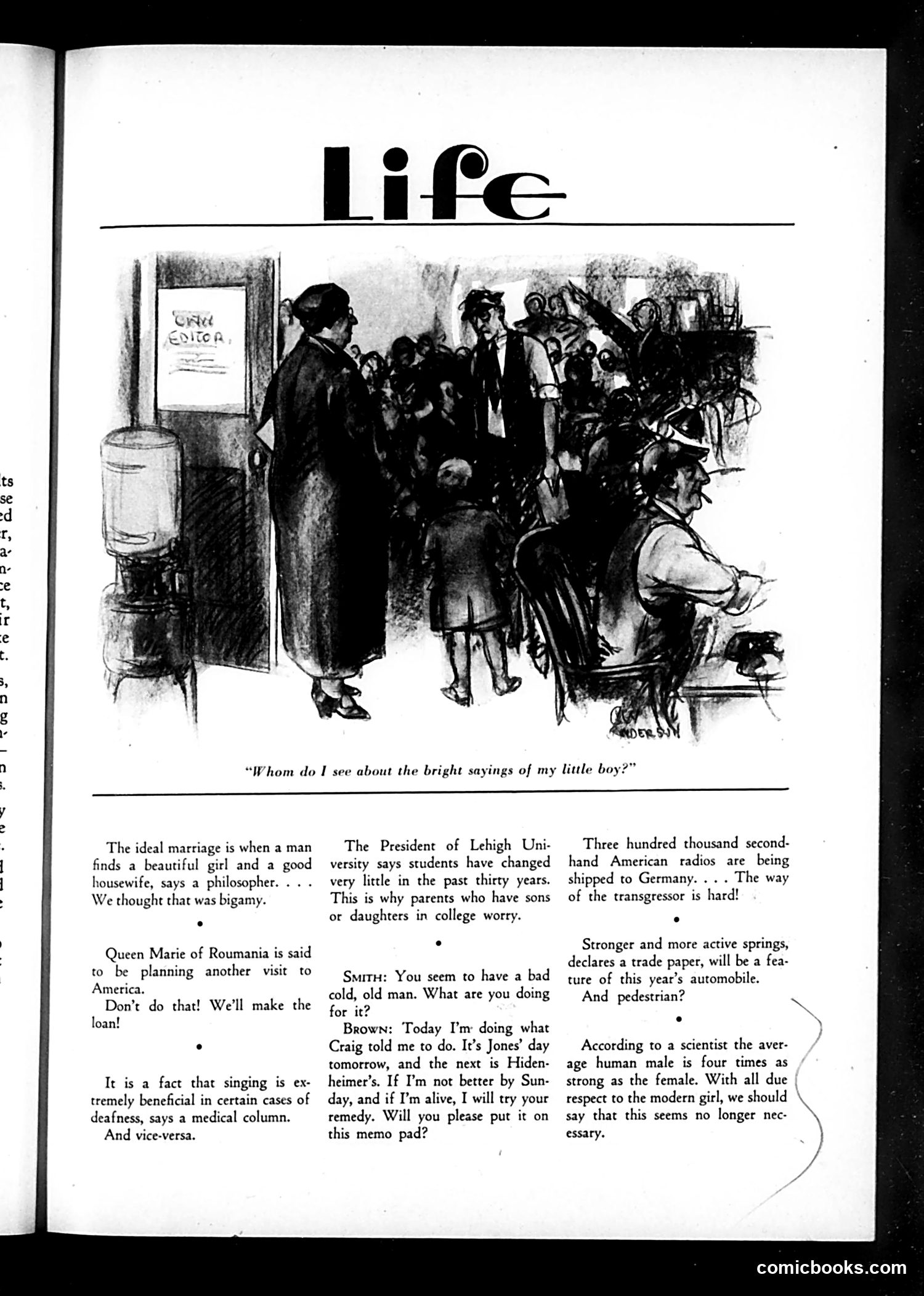
Analysis of Life Magazine Page The main cartoon depicts a crowded doctor's or clinic waiting room, with the caption: "Whom do I see about the bright sayings of my little boy?" The satire plays on parents' anxiety about their children's precocious or embarrassing remarks. The crowded office suggests this is a widespread concern requiring professional help—likely a psychiatrist or physician—implying that bright children's candid observations pose such a social problem that parents need expert intervention to manage them. The page also includes brief humorous snippets about marriage philosophy, Queen Marie of Romania's visit to America, singing as medical treatment, and automobile springs. These represent typical Life magazine satirical commentary on contemporary social and technological topics.
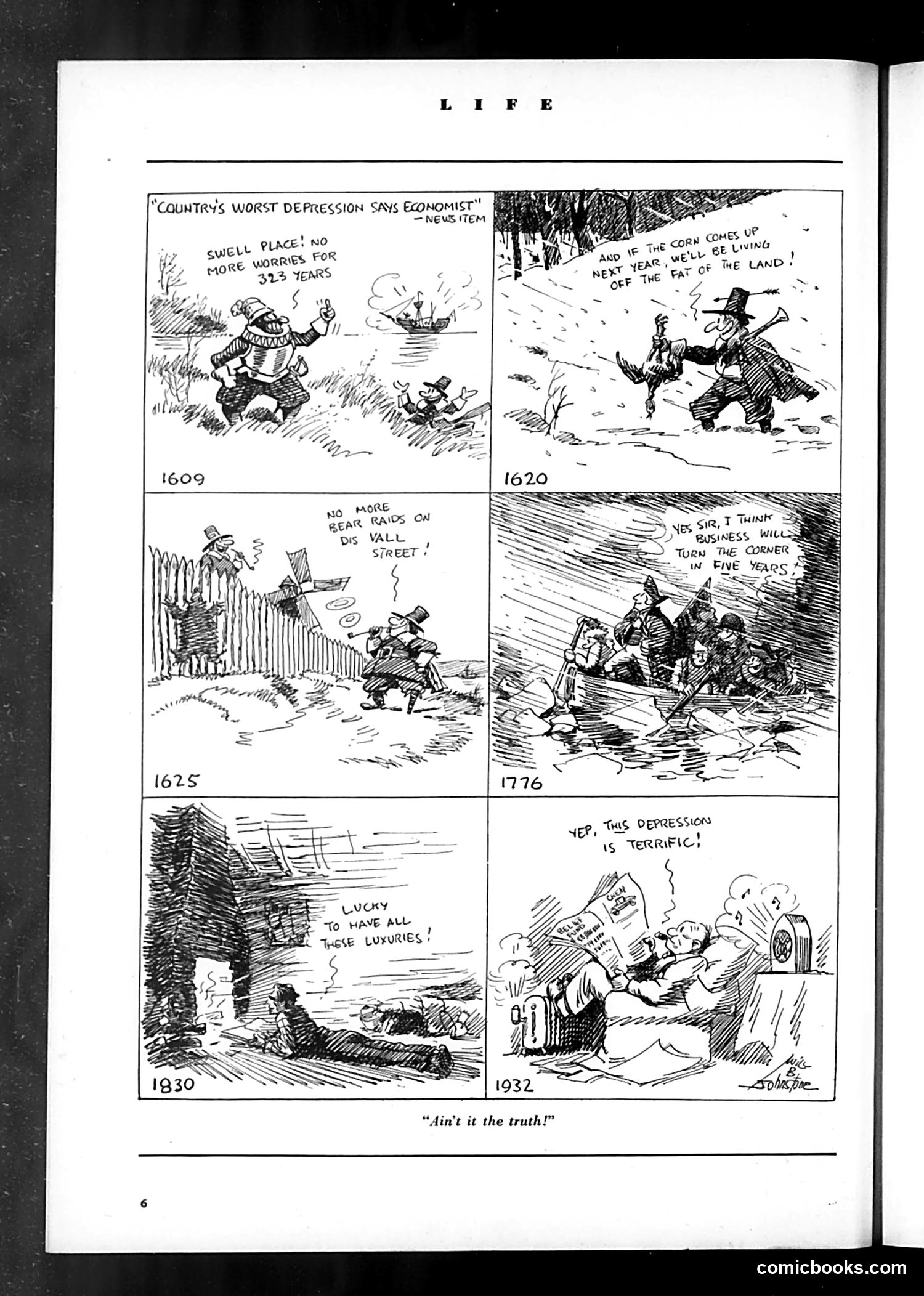
Political Cartoon Analysis: "Country's Worst Depression Sans Economist" This six-panel cartoon traces American economic hardship from 1609 to 1932, titled "ain't it the truth!" The comic sarcastically compares historical disasters—starvation (1609), crop failure (1620), Indian raids (1625), flood (1716), and famine (1830)—to the 1932 Great Depression. In 1932, a figure lies in bed reading newspaper headlines about the depression, remarking "Yep, this depression is terrific!" while surrounded by financial ruin. The satire suggests that despite claiming to have "economists" advising the country (unlike previous eras), Americans are experiencing economic collapse as severe as actual disasters their ancestors faced. The joke criticizes economists' failure to prevent or manage the Depression.
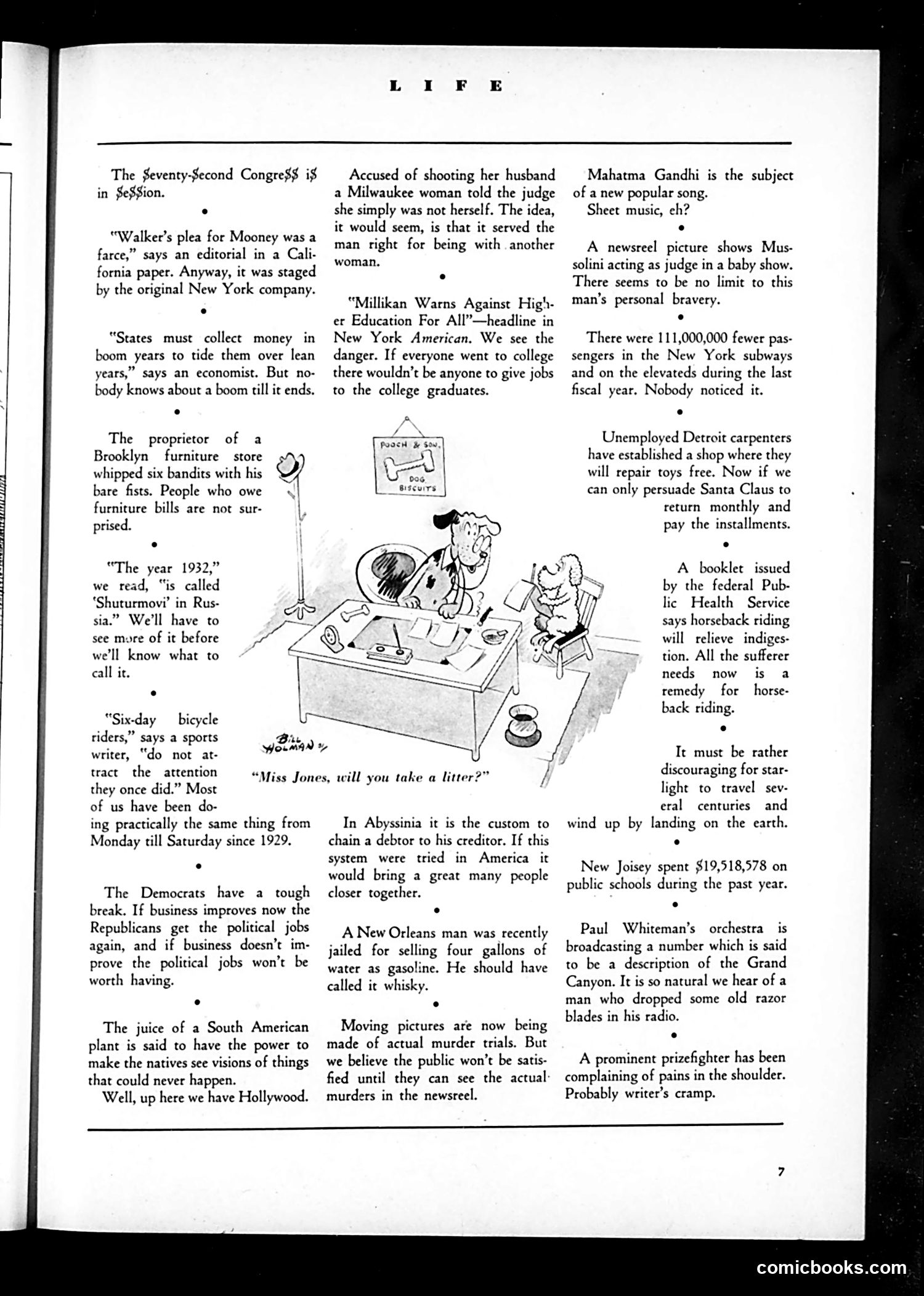
Analysis of Life Magazine Page 7 The main cartoon shows a disheveled man at a desk captioned "Miss Jones, will you take a litter?" - a pun playing on "letter" versus "litter," suggesting the office is in complete disarray with trash/mess scattered about. The page consists primarily of brief satirical news items and observations rather than political cartoons. Topics include: - Congressional proceedings and political job-switching between Democrats and Republicans - Economic commentary on 1932 as "Shutdown" year - Social observations (Brooklyn furniture store owner fighting bandits, unemployed Detroit carpenters repairing toys) - Humorous notes on odd laws in Abyssinia and New Orleans selling "water" as whiskey The humor is light, domestic satire reflecting Depression-era American life and minor political ironies rather than hard-hitting political commentary.
Analysis of Life Magazine Page This is a text-only editorial page with no cartoons or illustrations visible. The article "Go On Living!... Gandhi and the Pope... England's Destiny" by E.S. Martin discusses three topics: 1. Economic hardship: Commentary on lean times and survival during what appears to be economic difficulty 2. Gandhi and the Pope: Martin suggests the Pope appropriately discouraged Gandhi's ascetic practices, arguing that going without material comforts isn't necessary for salvation 3. Winston Churchill and British destiny: Martin praises Churchill's views on English-speaking nations' superiority and their likely future dominance, while acknowledging the British can be "hard fighters" and "greedy and cruel" The piece reflects early-to-mid 20th century attitudes about Western superiority and Anglo-American partnership.
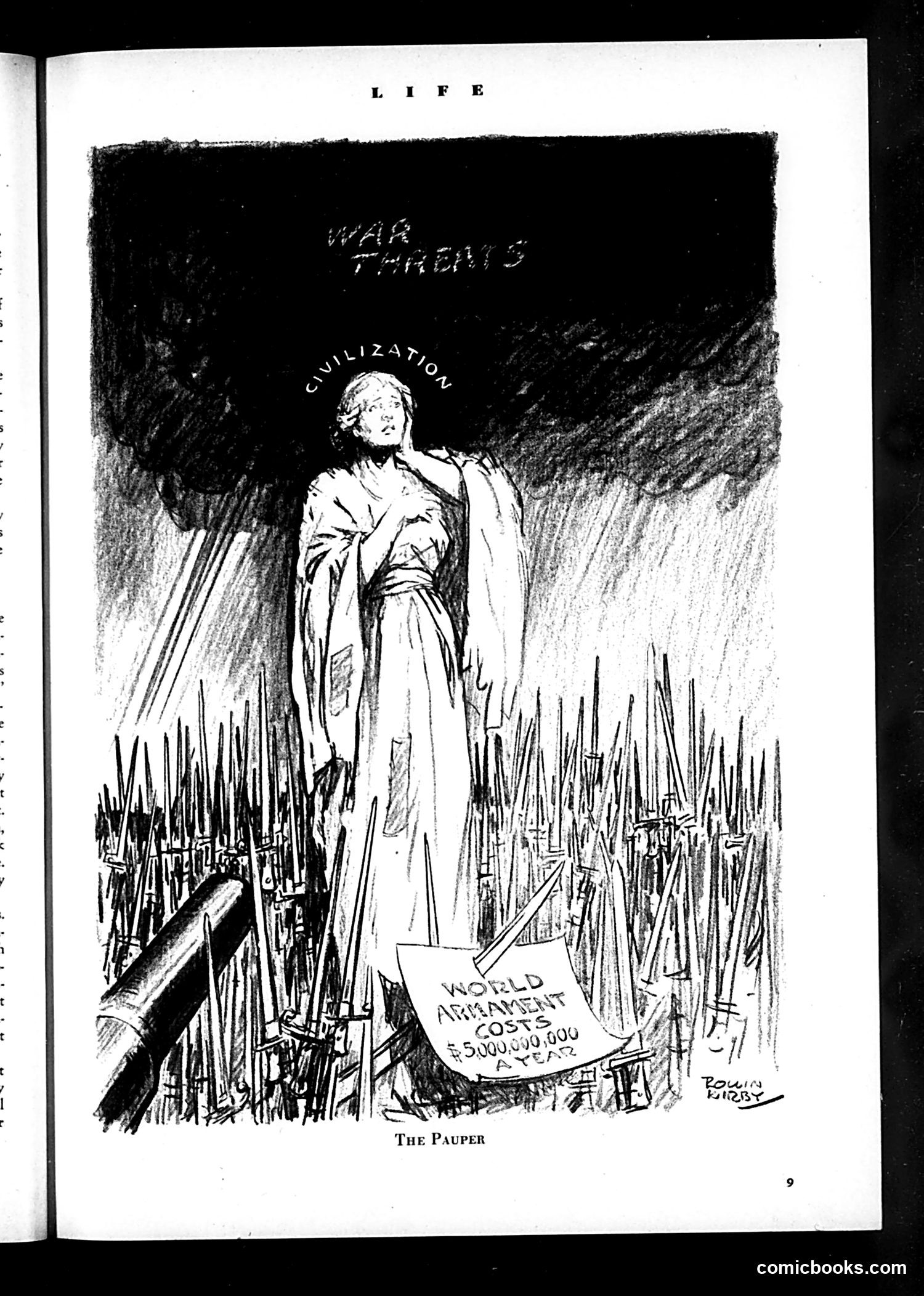
"The Pauper" - Political Cartoon Analysis This cartoon depicts a winged female figure labeled "Civilization" standing amid a field of bayonets and weapons. She holds a document reading "World Armament Cost $5,000,000,000 P.A." (per annum). The satire: The image criticizes massive global military spending as fundamentally at odds with civilization itself. The contrast between the ethereal, benevolent figure of Civilization and the forest of weapons surrounding her suggests that such enormous defense budgets undermine rather than protect civilization. The title "The Pauper" reinforces this irony—despite vast wealth, civilization is impoverished by militarism. This likely reflects post-World War I anxieties about arms races and the enormous costs of modern warfare. The cartoon advocates for disarmament by showing military spending as incompatible with civilized society.
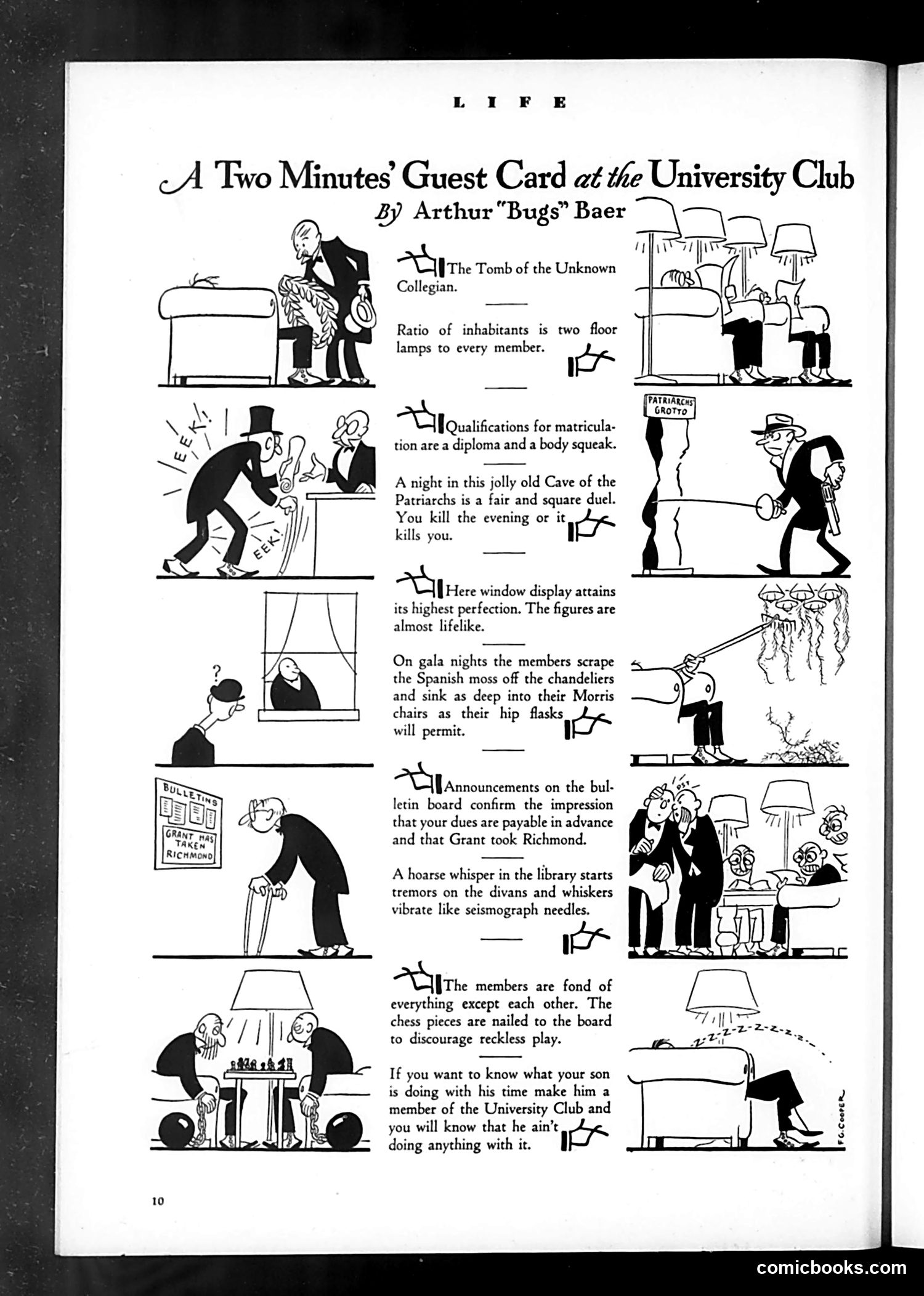
Analysis of "A Two Minutes' Guest Card at the University Club" This satirical piece by Arthur "Bugs" Baer mocks the University Club, a prestigious men's social institution. The cartoons humorously describe club features and member behavior through exaggerated observations: - The "Tomb of the Unknown Collegian" and overcrowded lighting suggest the club feels ancient and stuffy - "Qualifications for matriculation are a diploma and a body squeak" pokes fun at admission standards - References to members scraping "Spanish moss" from chandeliers and sinking into Morris chairs mock their sedentary, aging nature - A bulletin board joke about dues and "Grant took Richmond" (likely a historical/financial reference) satirizes administrative inefficiency - The final observation—that membership keeps sons occupied doing nothing—suggests the club's primary function is providing idle distraction for wealthy men's sons The humor targets old-money institutions and their purposelessness.
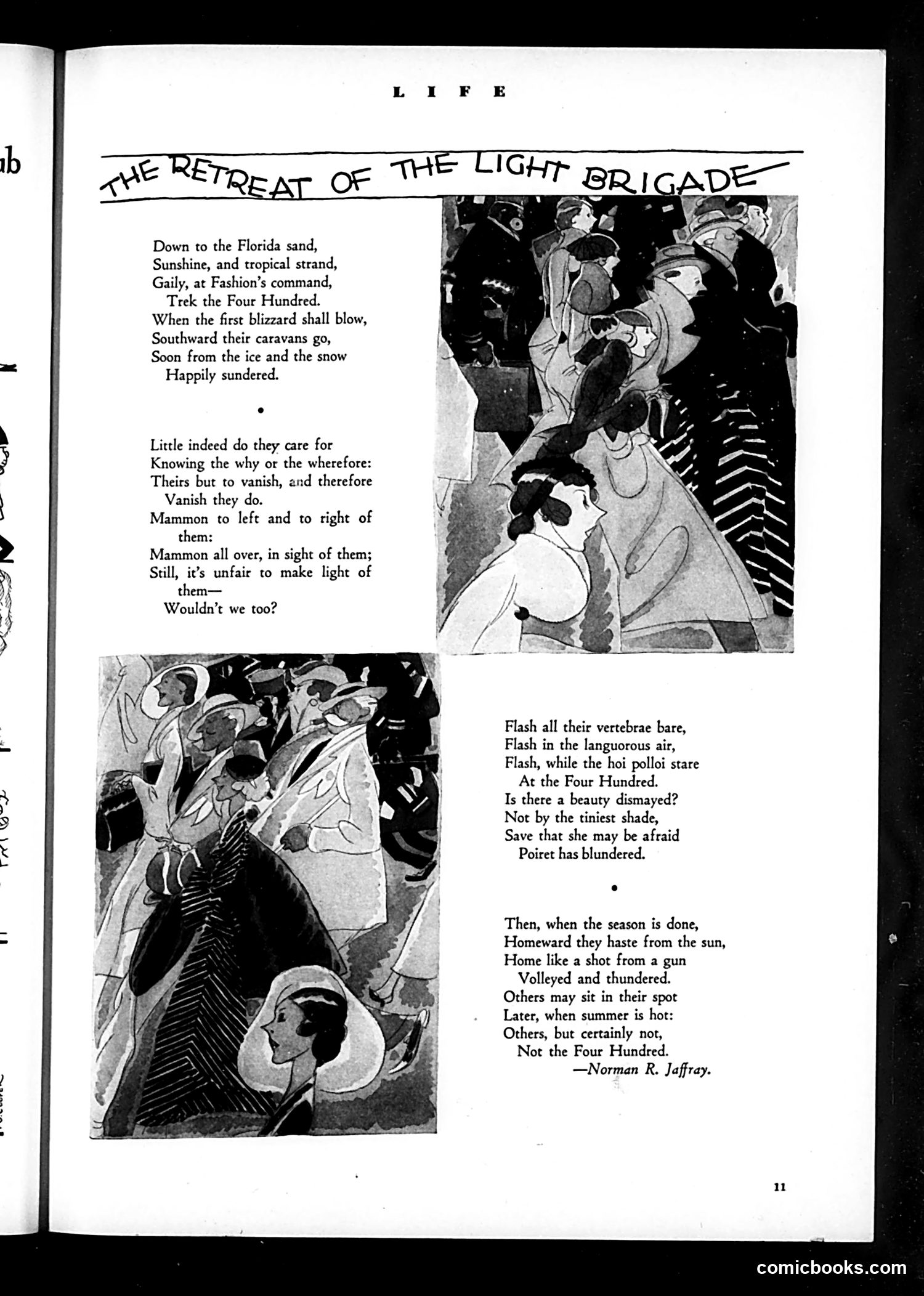
"The Retreat of the Light Brigade" This satirical poem by Norman R. Jaffray mocks the seasonal migration of wealthy Americans to Florida, particularly during winter. "The Four Hundred" refers to New York's social elite—those in high society. The cartoons show fashionably dressed people (appearing to be members of this upper class) heading south when "the first blizzard shall blow." The satire targets their superficial priorities: they care nothing for understanding *why* they flee, only that fashion dictates they do. The poem's closing stanza mocks their seasonal routine with military imagery ("shot from a gun"), suggesting their predictable, mindless herd behavior. The reference to "hoi polloi" emphasizes the exclusivity these elites maintain while fleeing the cold.
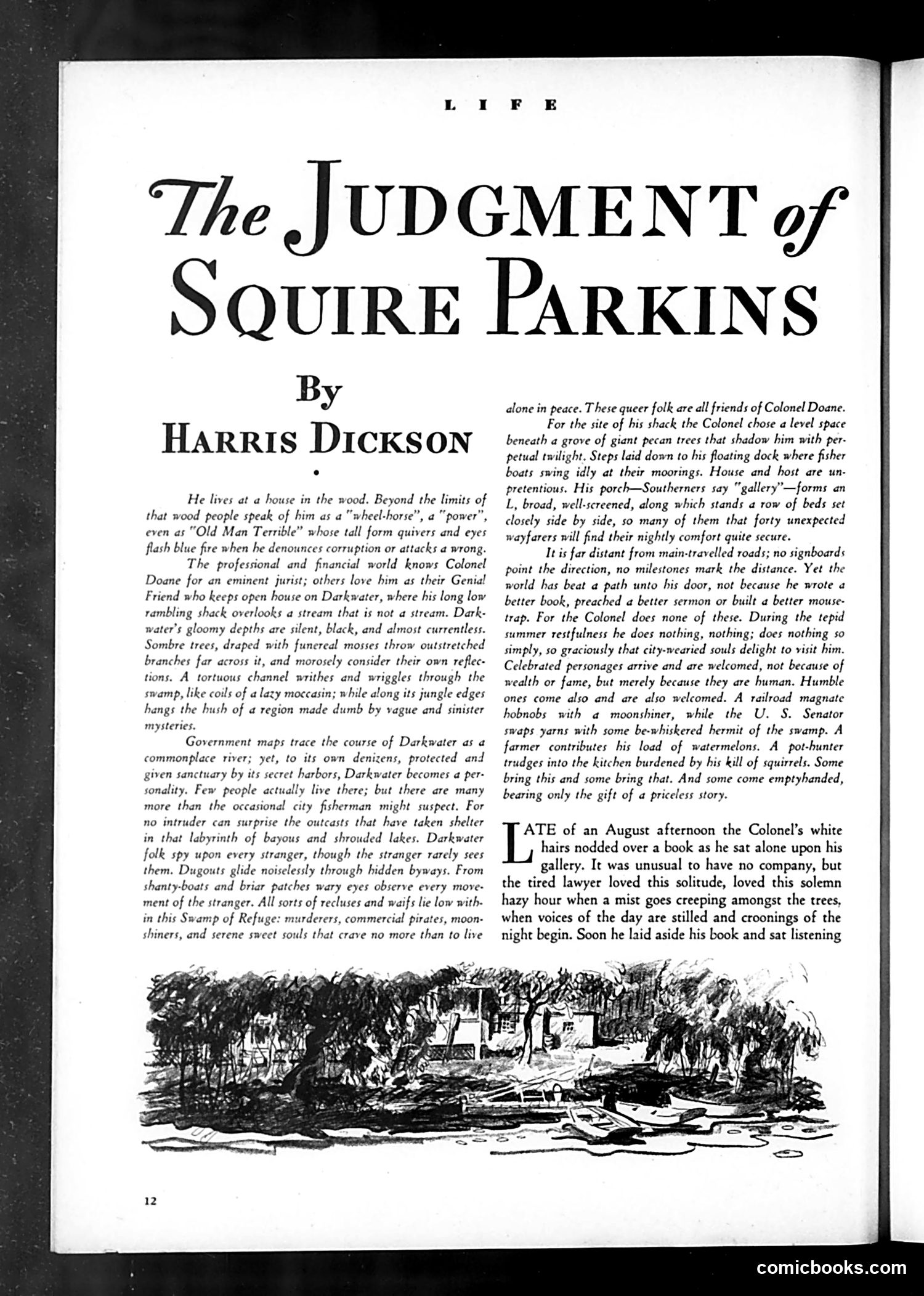
"The Judgment of Squire Parkins" by Harris Dickson This is a story opening page, not a political cartoon. The narrative describes Colonel Doame, who lives in an isolated house in a swamp near Darkwater. The text characterizes him as a gentleman eccentric—someone the local government maps can't quite locate, whose home attracts various marginalized people: escaped prisoners, fugitives, and those seeking refuge. The illustration shows his house surrounded by swamp vegetation and water. This appears to be a fiction piece exploring themes of isolation, sanctuary, and social outsiders, rather than satirical commentary on specific political figures or contemporary events. The story seems designed as literary entertainment for *Life* magazine's readers.
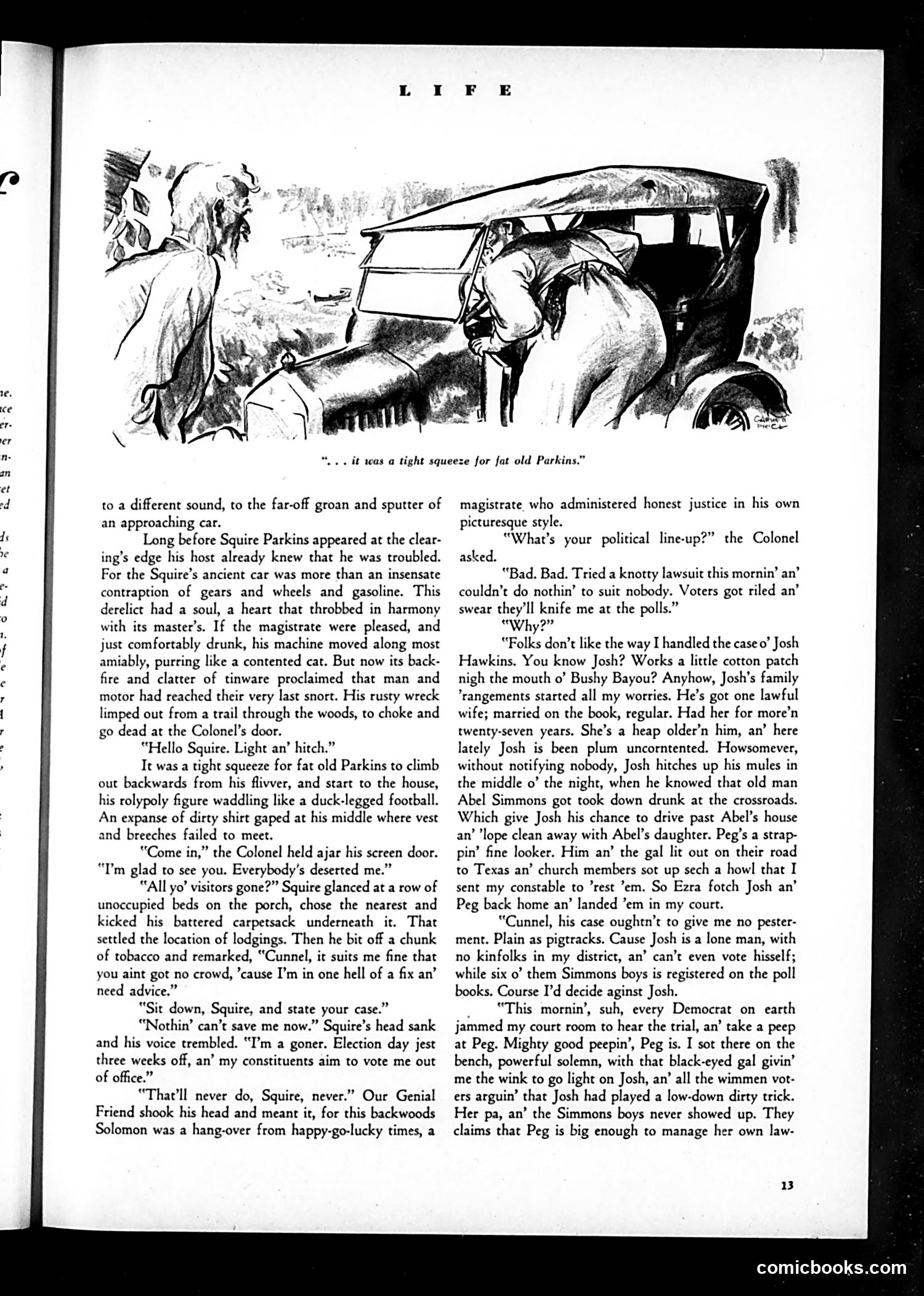
Political Cartoon Analysis The cartoon depicts a rural political dispute involving "Squire Parkins" and a broken-down automobile. The text reveals this is satirizing rural voting bloc politics and election-day disputes in early 20th-century America. The cartoon mocks the political leverage of rural voters like Parkins: a magistrate fears losing electoral support over a car repair failure. The narrative details conflicting claims about a lawsuit and voting influence—Josh Hawkins versus "Peg," whose supporters threaten political retaliation. The satire targets machine politics and local corruption: how magistrates dispense "honest justice in his own picturesque style" while voters leverage electoral power over personal grievances. The broken automobile symbolizes the mechanical breakdown of honest governance when political advantage supersedes justice.
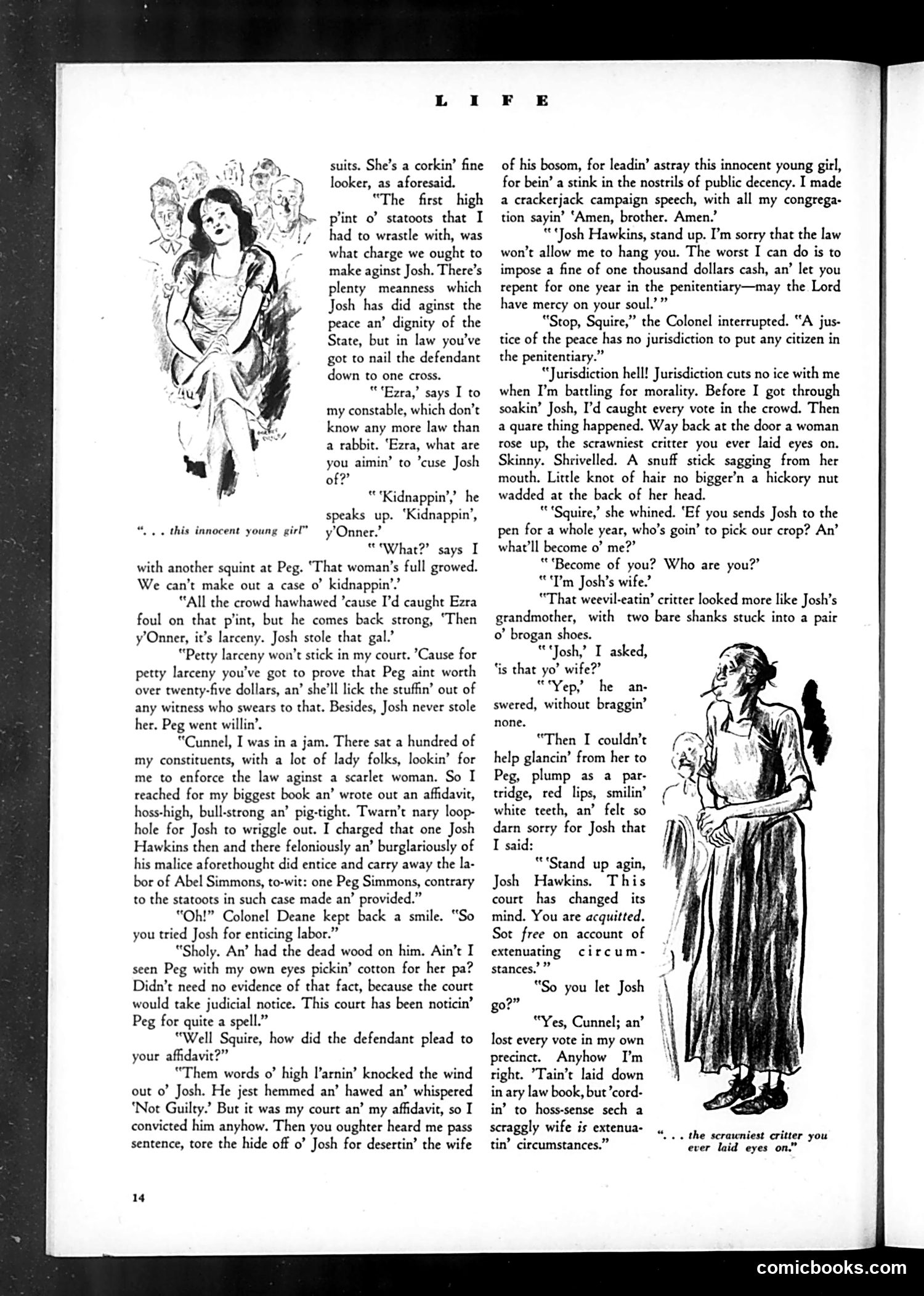
Analysis of This Life Magazine Page This page presents a satirical courtroom narrative about a woman named Peg accused of theft. The text describes a judge (Colonel Deane) presiding over a case where Josh Hawkins stands accused of stealing from Peg Simmons, though the actual defendant appears unclear from the OCR. The satire targets the legal system's ineffectiveness and class dynamics. The narrative mocks formal legal proceedings through dialect-heavy dialogue, suggesting rural or working-class characters navigating courtroom formality. References to "jurisdiction" and "penitentiary" satirize bureaucratic language clashing with common sense. The two illustrations show women in period dress, likely depicting Peg (described as "scrawny" with "bare shanks") and another character. The overall satire critiques how the justice system handles cases involving poor or marginalized people, using humor to expose legal absurdities.
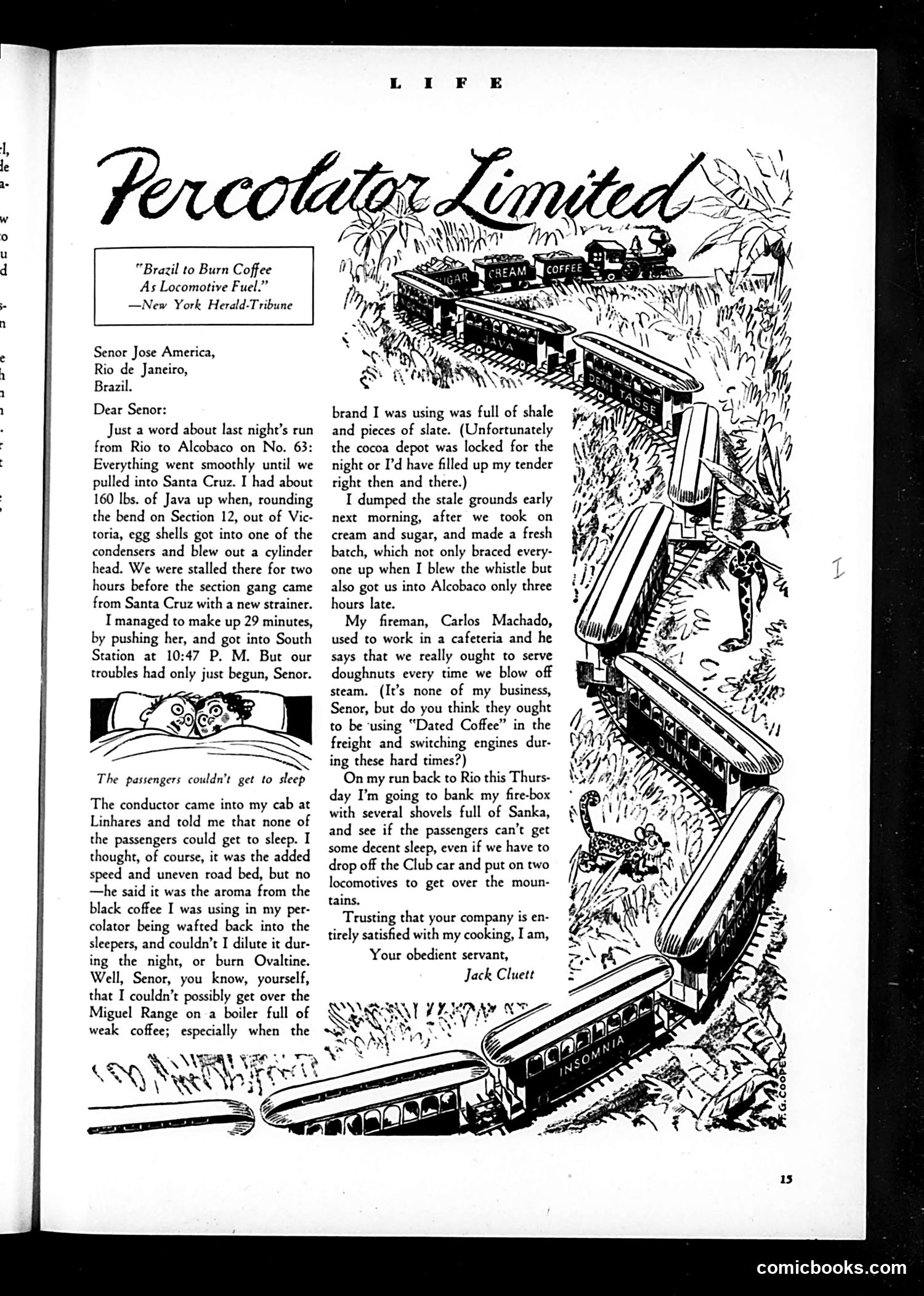
Percolator Limited: A Humorous Letter About Brazilian Railway Coffee This page presents a satirical letter from "Jack Cluett," a locomotive fireman on the Rio-to-Alcobaco railway in Brazil, to his employer, Senor Jose America. The humor centers on the absurd practice of using coffee as locomotive fuel. Cluett describes operational mishaps—passengers unable to sleep due to coffee aroma, boiler problems from weak coffee, and delays caused by using the cocoa depot's contents instead. He suggests the company switch to cheaper "Dated Coffee" for freight engines. The satire mocks both inefficient industrial practices and likely pokes fun at Brazil's coffee economy. The accompanying illustration shows the impossibly oversized "Percolator Limited" train, emphasizing the absurdity of the premise through visual exaggeration.
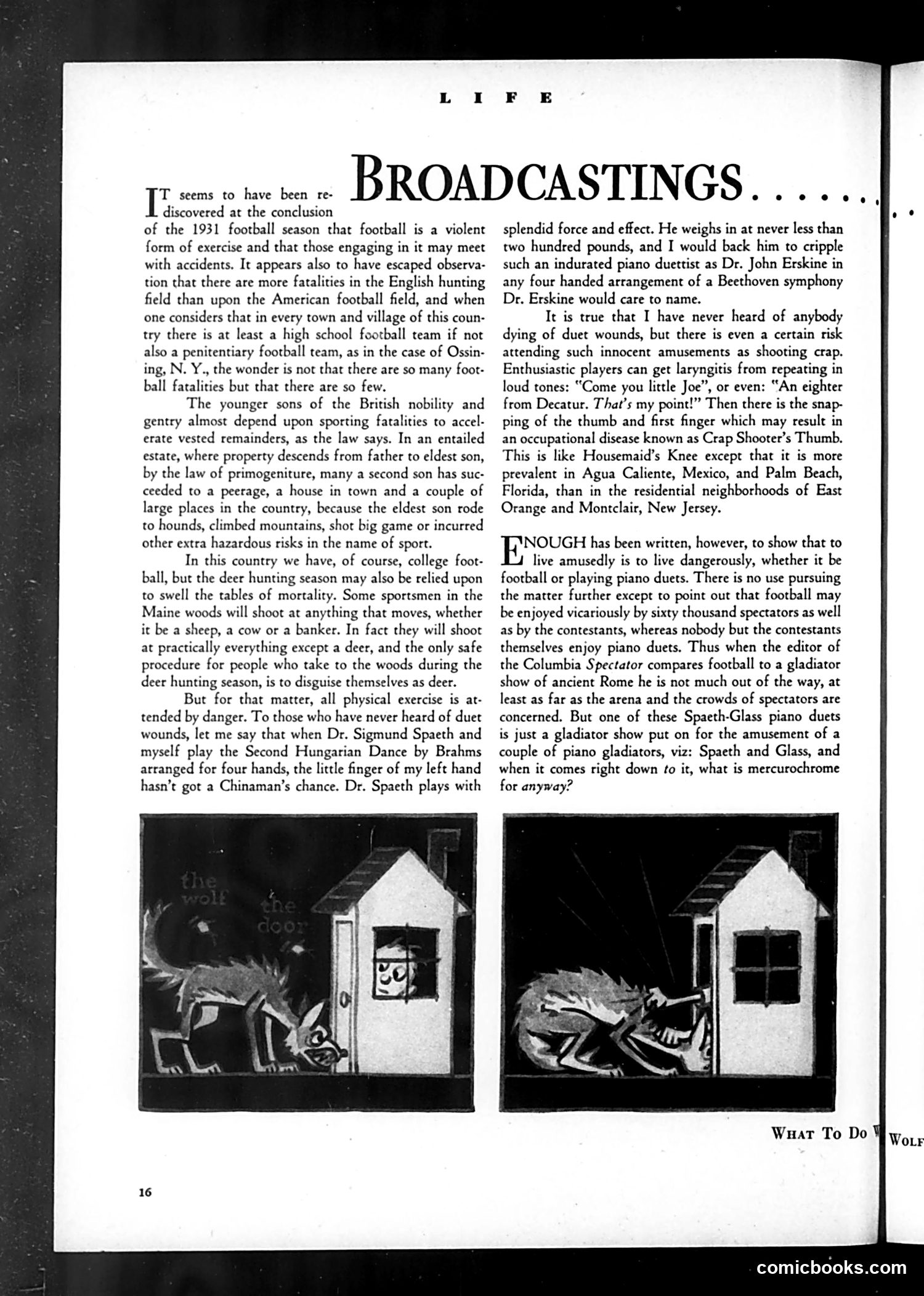
Analysis of "Broadcastings" Page This satirical article critiques the dangers of various sports and activities, using piano duets as an unexpected comparison. The text discusses football fatalities and hunting accidents in America, then pivots to argue that even seemingly genteel activities like four-hand piano playing carry risks—Dr. Jim Erskine allegedly cannot manage Beethoven without danger due to his weight and forceful playing style. The two cartoon panels below (labeled "What To Do When a Wolf") appear to show humorous scenarios of someone in a small house confronted by a wolf—likely illustrating practical survival advice or safety precautions in a comedic manner. The overall satire suggests American attitudes romanticizing dangerous "sporting" pursuits while overlooking hazards in everyday activities.
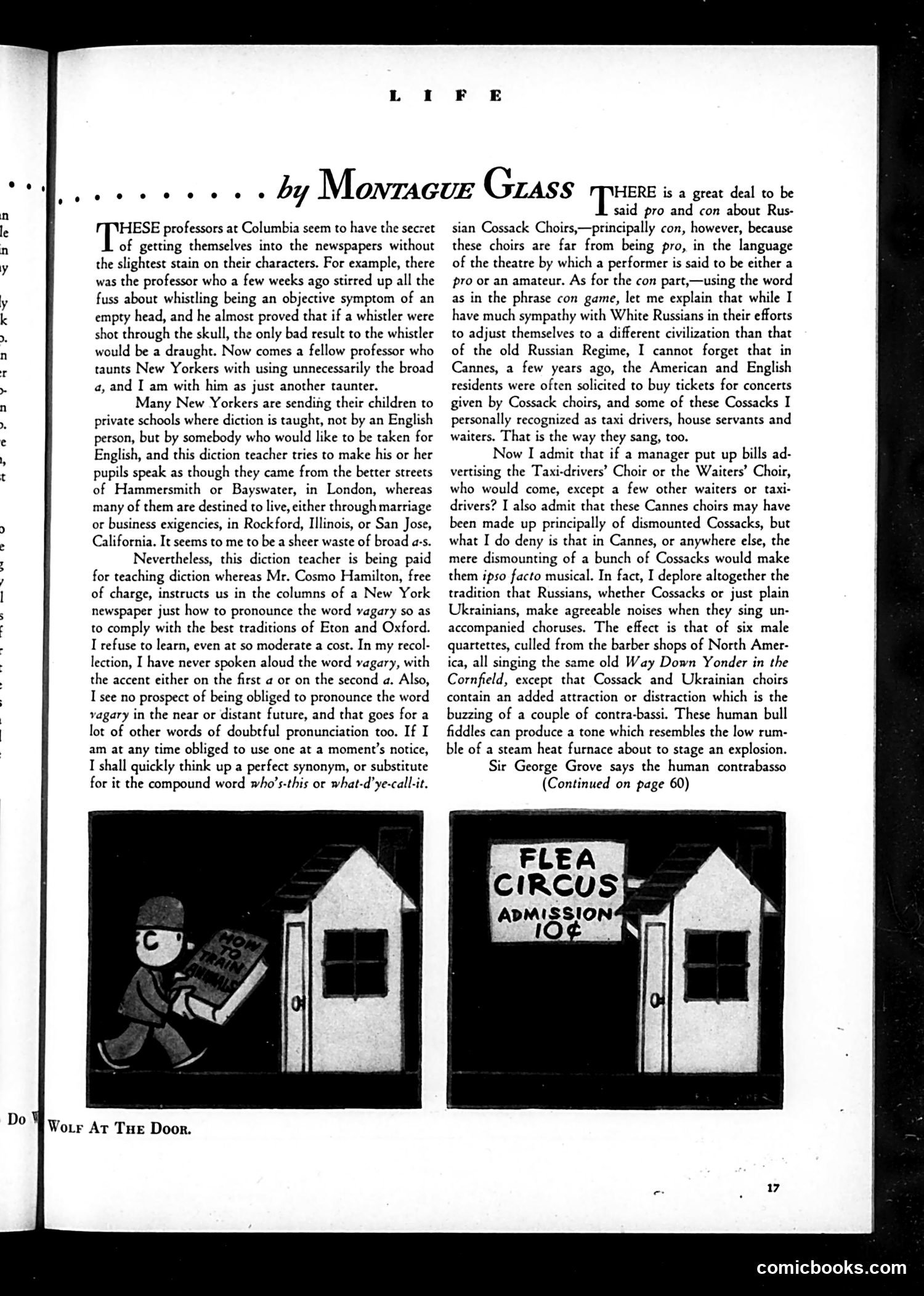
"Wolf At The Door" Cartoon Analysis This two-panel cartoon satirizes economic hardship and false advertising. The left panel shows a man desperately posting a notice ("Wolf At The Door") on a house—depicting poverty and eviction threats. The right panel reveals the "solution": the same house now advertises a "Flea Circus" for 10¢ admission. The satire is bitter: when facing destitution, people resort to exploitative schemes. Rather than addressing real poverty, they attempt to profit from public gullibility by charging admission to see fleas. The cartoon mocks both the desperation that drives such ventures and the public's willingness to pay for worthless entertainment—a commentary on economic inequality and exploitation during what appears to be a Depression-era publication.
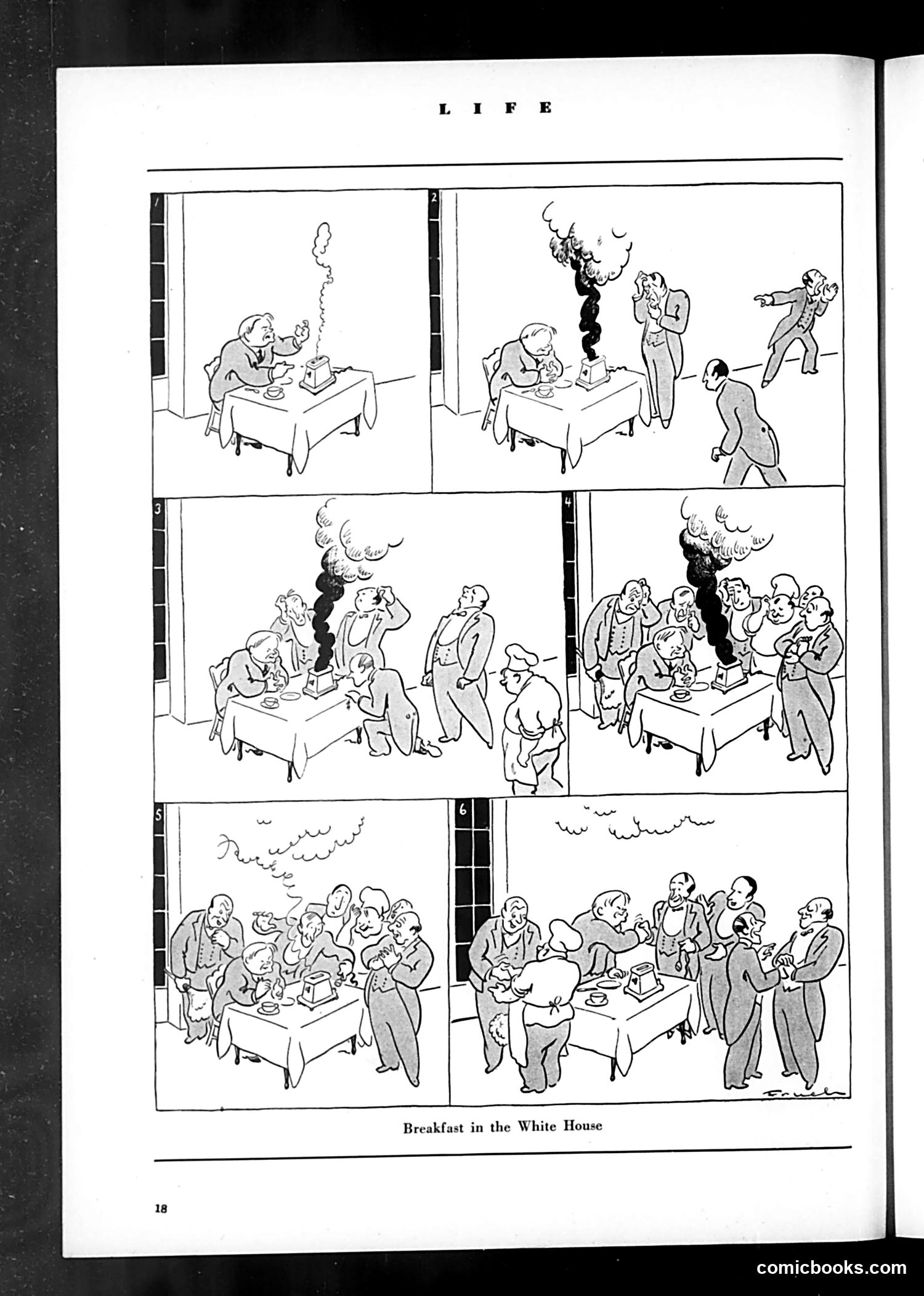
"Breakfast in the White House" - Political Satire This six-panel comic depicts a humorous progression of a White House breakfast, likely from the early 20th century based on the art style and publication in *Life* magazine. The satire shows an escalating chaos scenario: it begins with one man alone at a table, then grows to include increasingly crowded scenes with numerous guests, culminating in what appears to be a chaotic mob scene by the final panels. The joke likely satirizes either: - The growing accessibility/chaos of White House social functions - Political patronage and the influx of office-seekers - Presidential hospitality overwhelmed by demand The specific political target remains unclear without additional context, but the visual humor relies on the contrast between formal White House dining and absurd overcrowding.
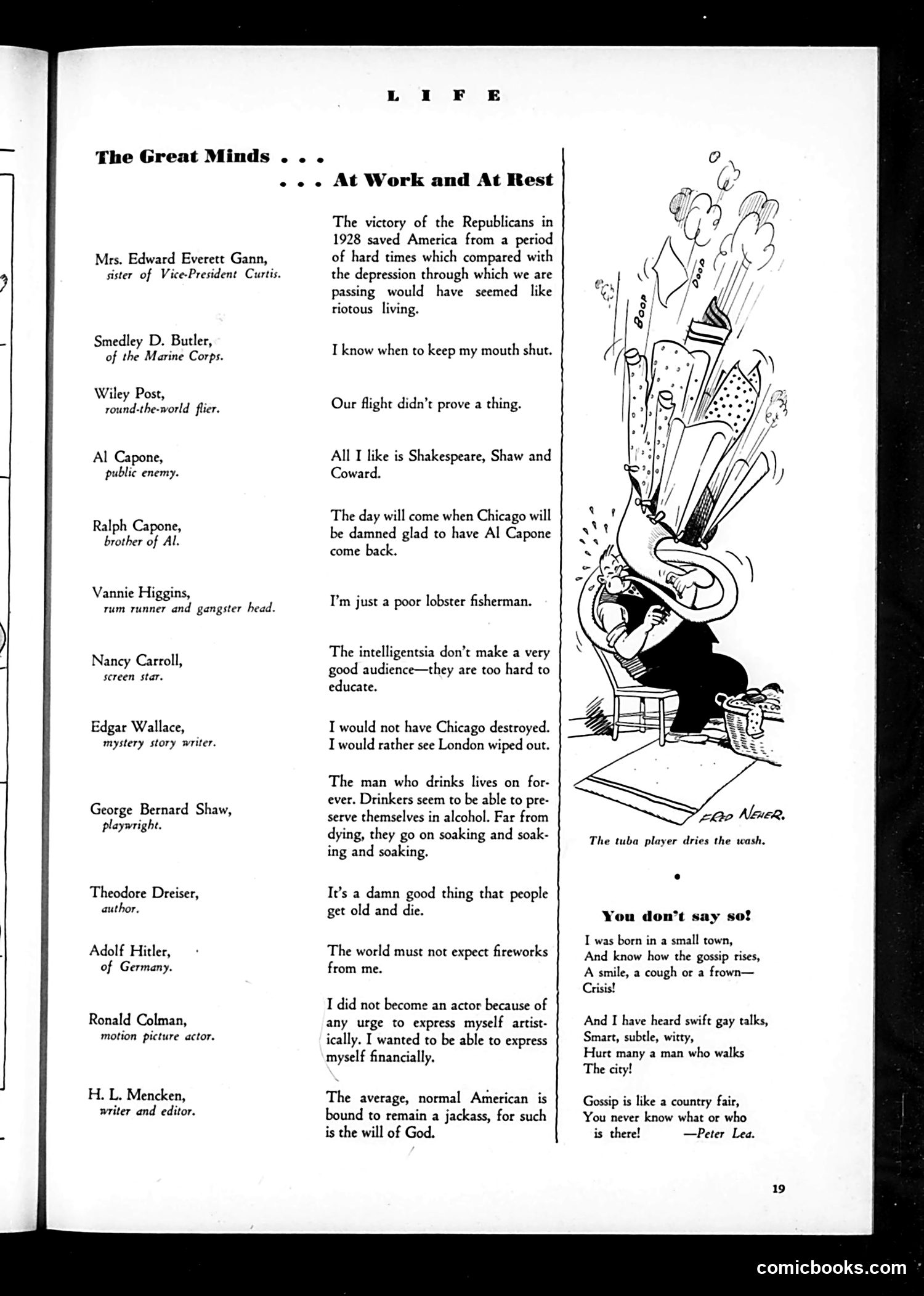
Analysis of Life Magazine Page 19 This page features "The Great Minds... At Work and At Rest," a satirical section pairing famous figures with their purported quotes or philosophies. The left column lists celebrities, politicians, and public figures (including Al Capone, Adolf Hitler, and Ronald Colman) alongside cynical or revealing statements attributed to them. The cartoon on the right depicts a tuba player drying laundry—a visual non-sequitur illustrating the absurdist humor. The lower section, "You don't say so!" uses ironic statements about small-town gossip and city life, attributed to "Peter Lea." The satire mocks both celebrity pretension and contemporary social attitudes through juxtaposition of famous names with banal or unflattering quotes, reflecting Life magazine's tradition of irreverent social commentary during what appears to be the interwar period.
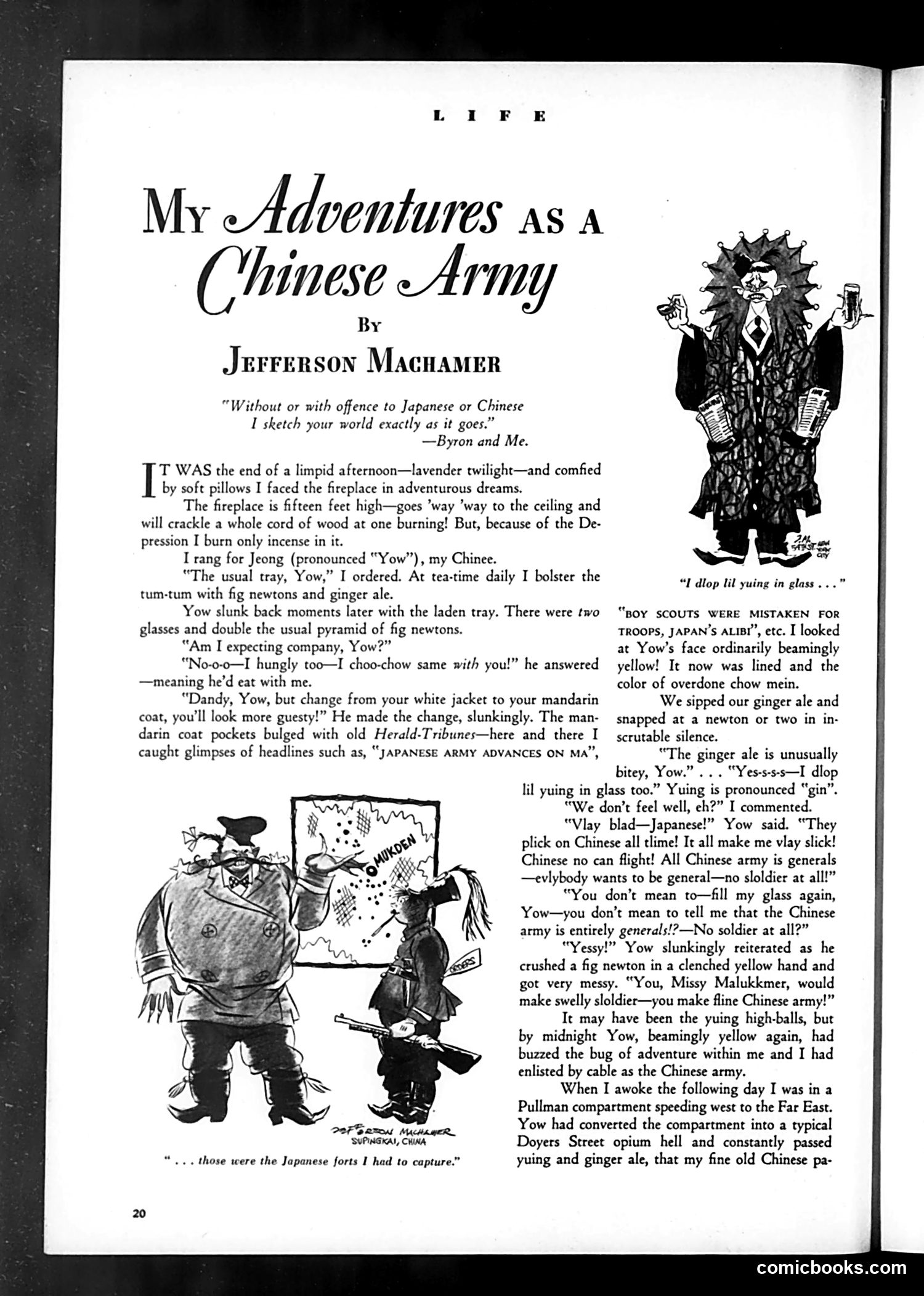
"My Adventures as a Chinese Army" - Satire Analysis This 1930s satirical piece by Jefferson Machamer mocks both American ignorance of Asian affairs and the era's casual racial stereotyping. The narrative presents a wealthy American who, through drunken whimsy and a stereotyped Chinese servant character named "Yow," impulsively enlists in the Chinese Army to fight Japan. The satire operates on multiple levels: it ridicules the protagonist's frivolous decision-making, parodies the broken-English "Oriental servant" character type common in period entertainment, and critiques both Chinese military ineffectiveness (portrayed as all generals, no soldiers) and American detachment from serious international conflict. The cartoons and exaggerated dialect reinforce the period's casual racial caricature while the plot itself—enlistment via drunken impulse—satirizes American superficiality toward geopolitical crises during the Sino-Japanese conflict (1937+).
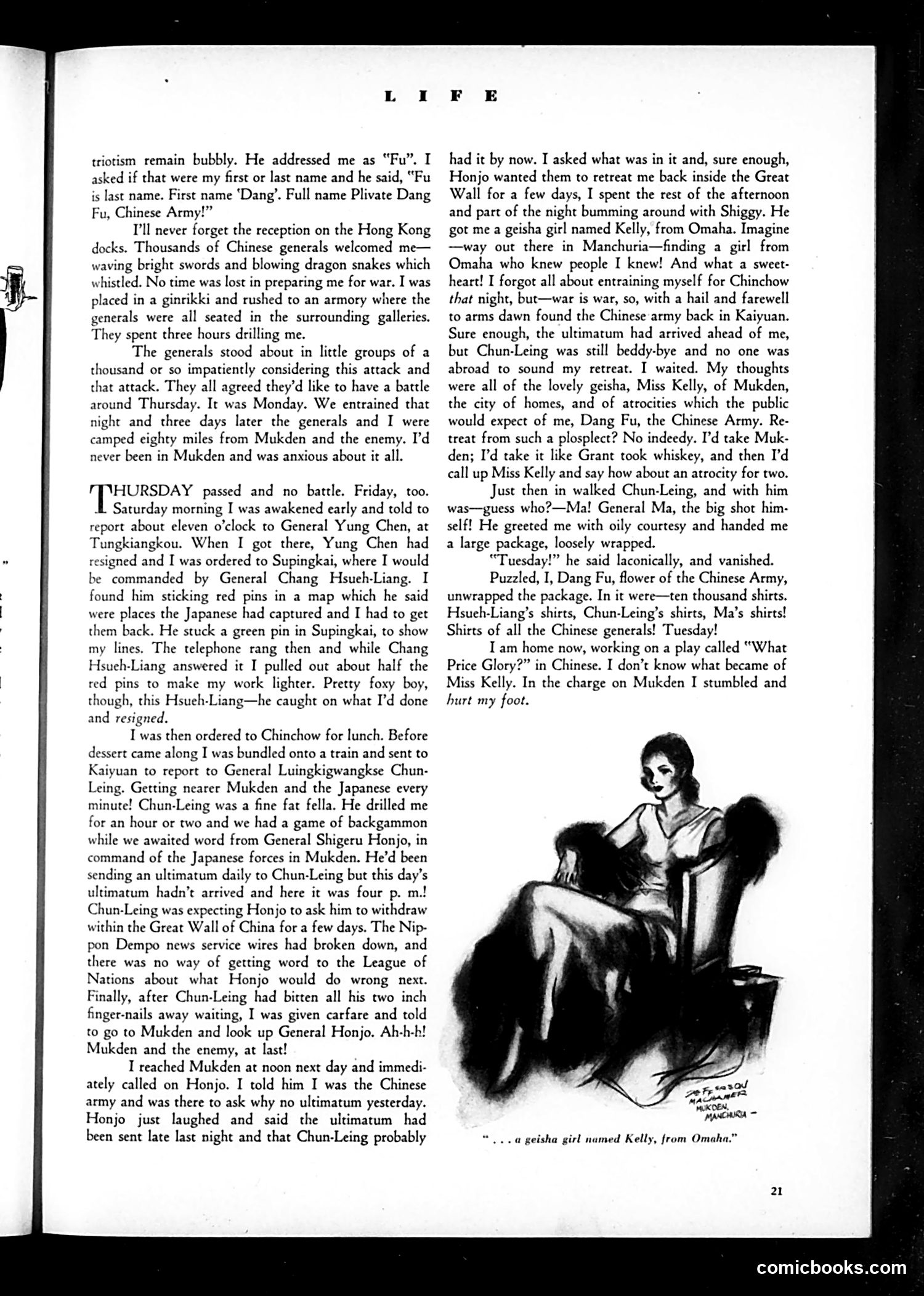
Political Satire in Life Magazine This page contains a humorous first-person account mocking the Russo-Japanese War (likely the 1931 Mukden Incident). The narrator, apparently an American, describes being thrust into command of the Chinese Army despite complete incompetence—he pulls red pins off a map to lighten his workload, gets distracted by a geisha girl named Kelly, and generally bumbles through military operations. The satire targets multiple subjects: Chinese military disorganization (generals endlessly deliberating, constantly reassigning the narrator); Japanese aggression (General Honjo issuing ultimatums); American naiveté (the protagonist finding an Omaha girl in Manchuria); and the absurdity of international conflict generally. The accompanying illustration shows a woman (likely Kelly, the geisha) in a suggestive pose, reinforcing the joke that romantic distraction trumps military duty. The overall tone is cynical about warfare and the incompetence of military leadership during this period.
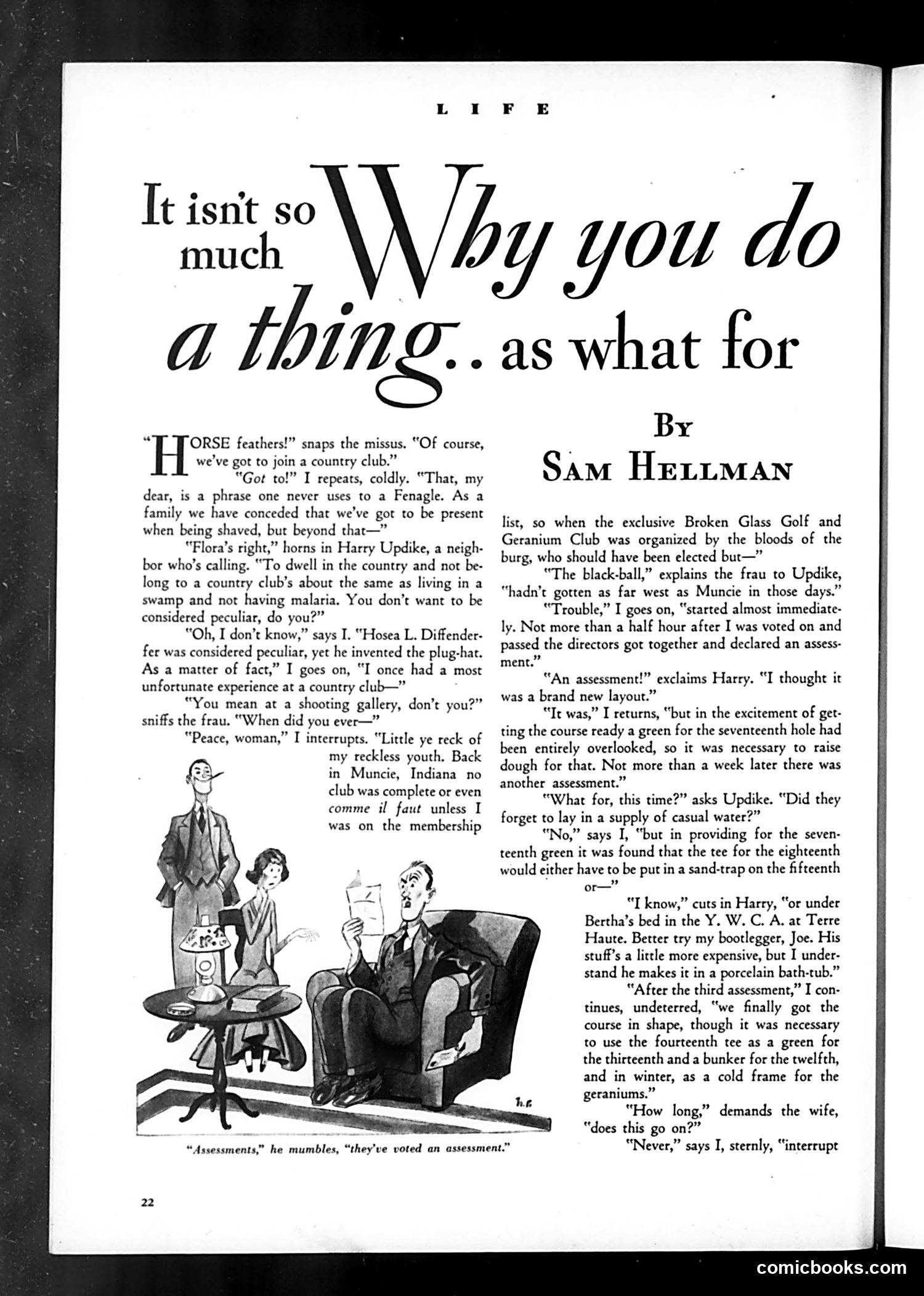
Explanation for Modern Readers This is a humorous short story by Sam Hellman satirizing country club culture and the hidden costs of membership. The narrator resists joining an exclusive "Broken Glass Golf and Geranium Club," citing past experience. His anecdote illustrates the absurdity: after joining a similar club in Muncie, Indiana, members faced repeated "assessments" (special fees) to fix design problems—greens built in wrong locations, requiring bizarre workarounds like using one hole's tee as another hole's green, or a bunker where a green should be. By winter, they're using the golf course as a cold frame for geraniums (plants). The joke mocks the pretentiousness and poor planning of country clubs, their constant financial demands disguised as emergencies, and members' acceptance of ridiculous solutions. The cartoon (showing the narrator telling the story) and his wife's exasperation emphasize how absurd these memberships are—you pay repeatedly for incompetence while being socially pressured to participate in an exclusive club that barely functions.
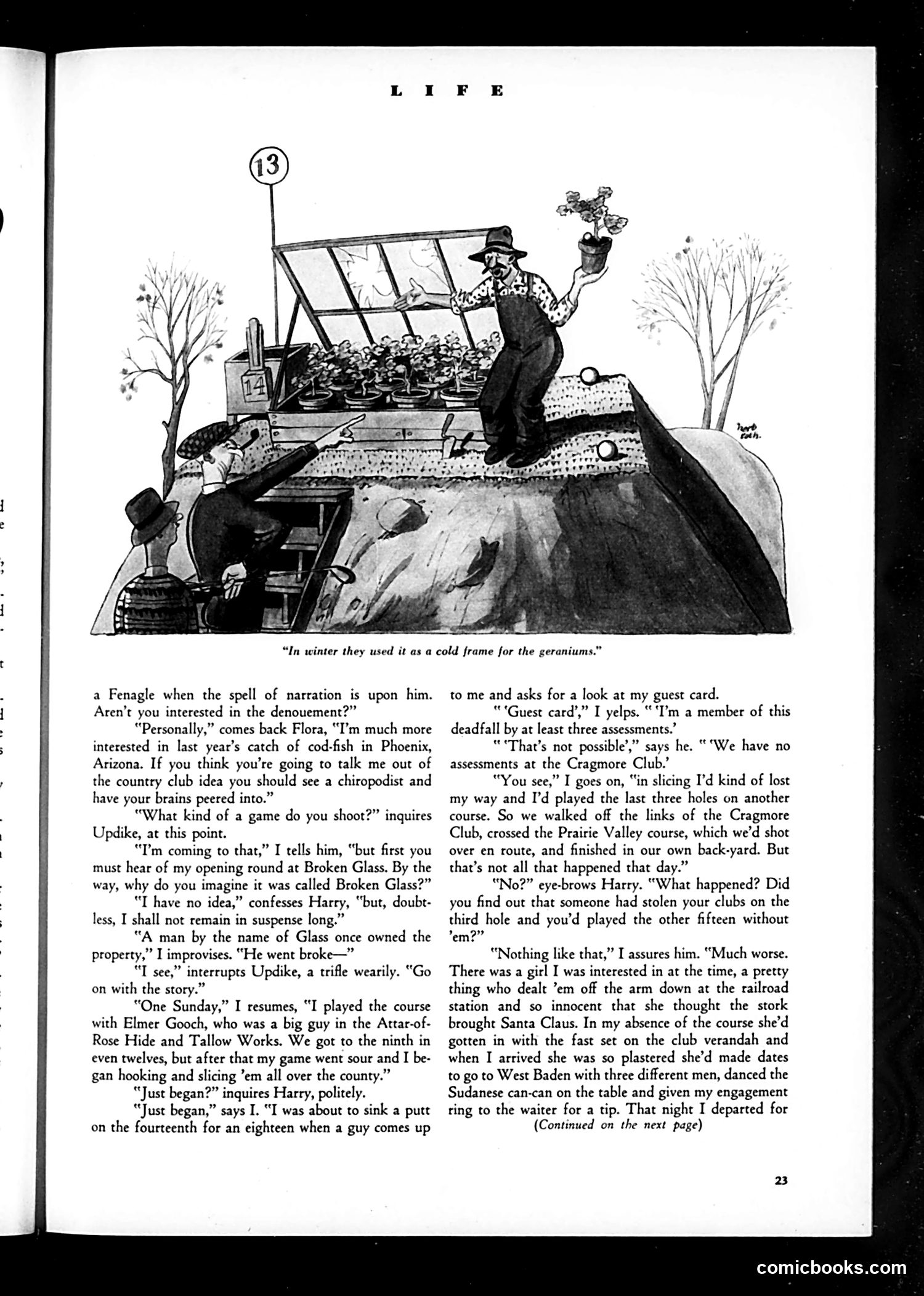
Analysis of Life Magazine Page This page features a single cartoon (#13) depicting men on a large potato engaged in gardening, with the caption "In winter they used it as a cold frame for the geraniums." The accompanying text is a humorous short story about a tedious raconteur boring his friends with an unnecessarily complicated golf anecdote. The narrator keeps getting sidetracked—discussing Arizona codfish, a chiropodist, and irrelevant details about "Broken Glass" course—while his increasingly impatient listener (Harry Updike) makes polite but weary interruptions asking him to continue. The satire targets social types common to 1920s America: the boorish country-club storyteller who lacks self-awareness about how he bores audiences, and the frustrated listener forced to endure rambling narratives at leisure-class gatherings. The potato cartoon appears unrelated to the text—typical of Life's miscellaneous layout mixing visual gags with prose humor.
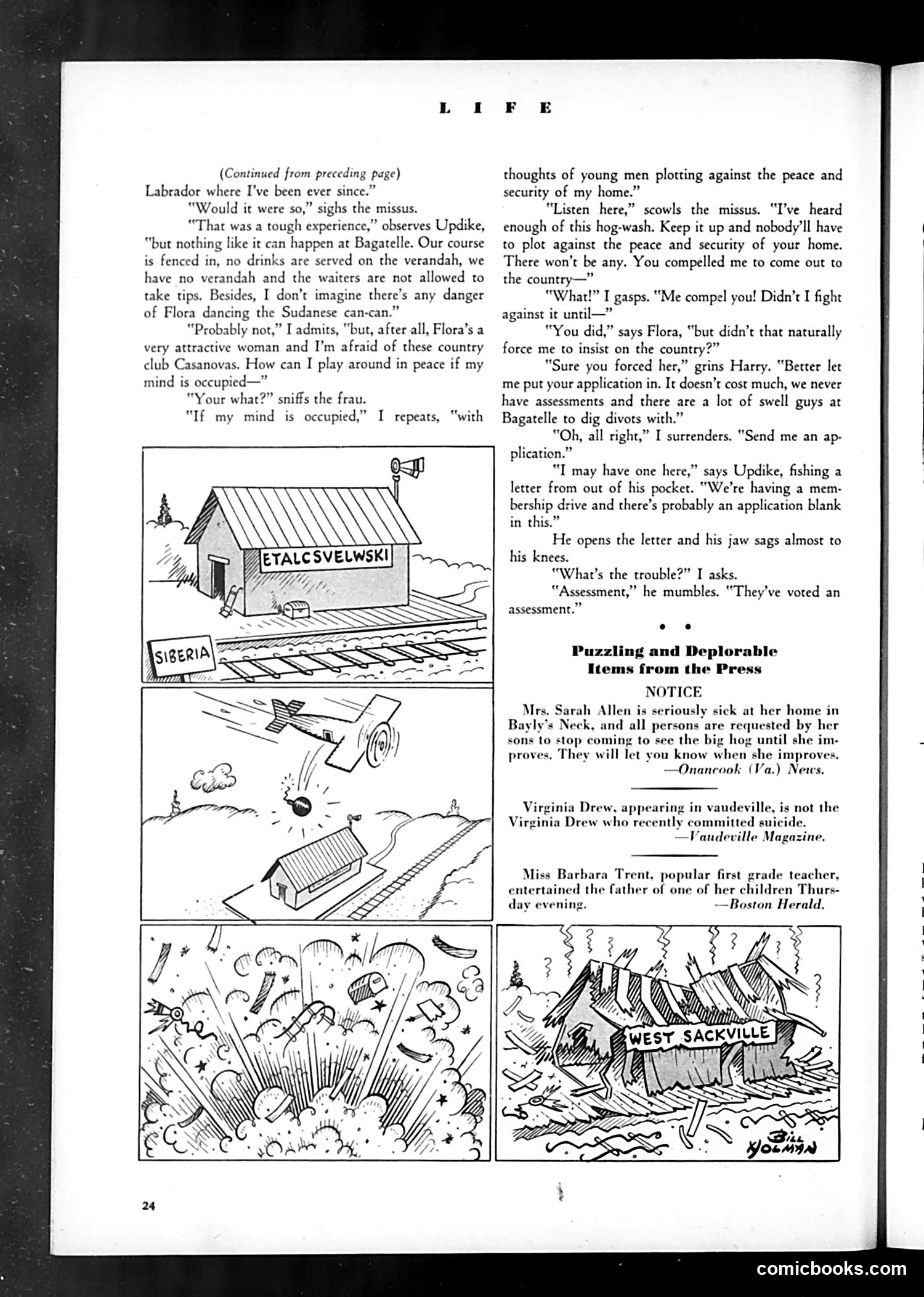
"Life" Magazine Satire Analysis This page contains two satirical elements: Main Story (top): A humorous domestic dispute about joining a country club called "Bagatelle." The narrator's wife Flora forces him to apply, but when he receives the membership letter, he discovers the club has voted to assess members—a financial burden he didn't anticipate. The satire mocks the hidden costs and social pressures of exclusive clubs, where membership seems free until surprise assessments arrive. "Puzzling and Deplorable Items" section: This is Life's signature humor feature—reprinting absurd newspaper notices and announcements that reveal unintentional comedy through poor word choice or awkward phrasing. Examples: a notice asking visitors to stop seeing "the big hog" (unclear reference), a disclaimer distinguishing one Virginia Drew from a suicide victim, and a Boston Herald line about a teacher entertaining "the father of one of her children" (implying infidelity or illegitimacy through awkward wording). The cartoons below illustrate slapstick comedy unrelated to the text above.
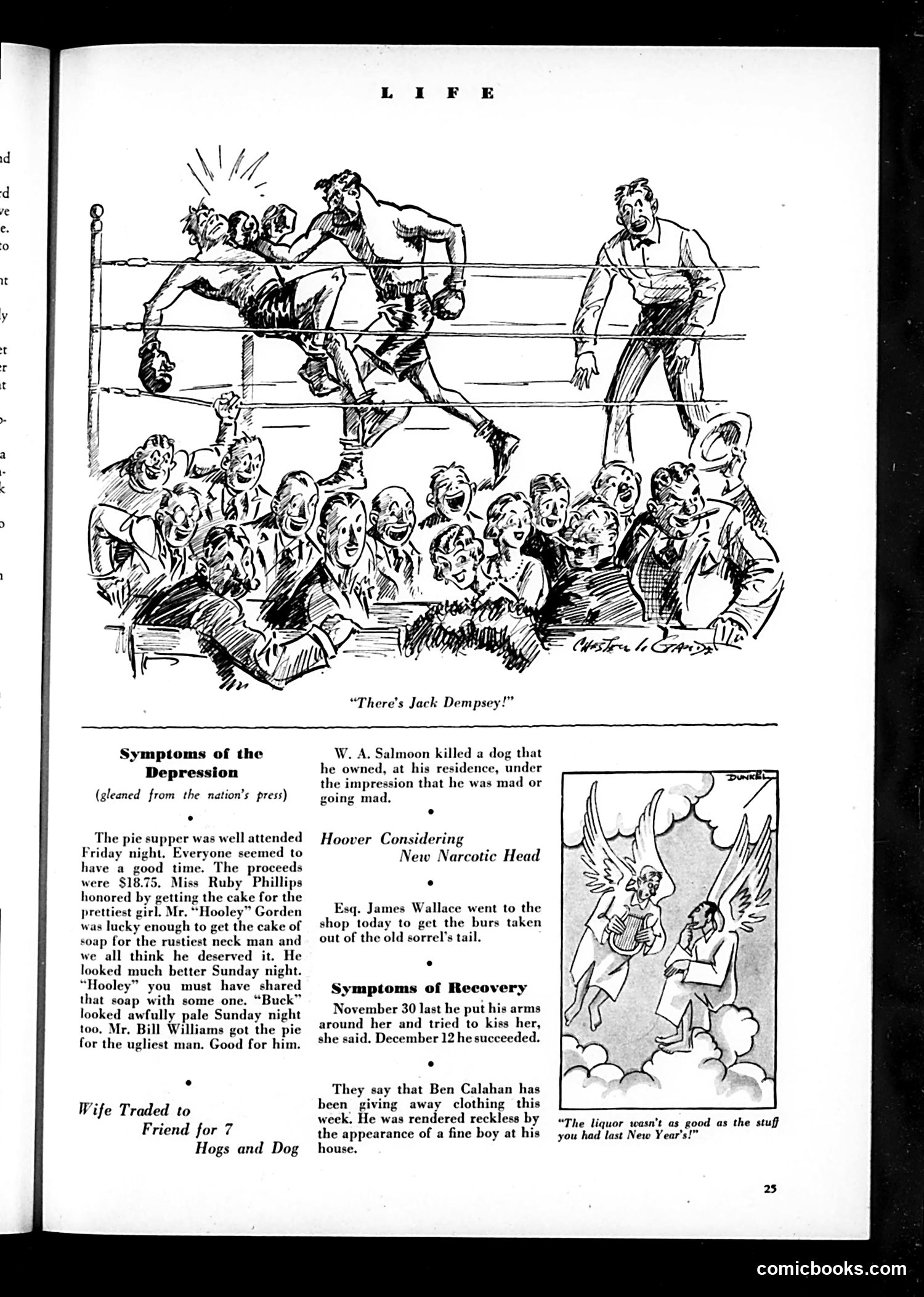
Life Magazine Satire Page Analysis This page collects Depression-era social humor from small-town newspapers. The top cartoon shows a boxing match with spectators excitedly shouting "There's Jack Dempsey!"—likely referencing the famous boxer, suggesting ordinary people's fascination with celebrity during hard times. The text snippets mock small-town life during the Great Depression: pie suppers as fundraisers, people trading wives for livestock (suggesting economic desperation), and Prohibition-era references ("New Narcotic Head," liquor quality complaints). "Symptoms of Recovery" presents modest romantic progress and a man giving away clothes after a child's birth as signs the economy might be improving. The overall satirical point: Life magazine is collecting these absurd, mundane, and darkly humorous dispatches from America's heartland to comment on Depression conditions—showing both the resourcefulness and the degradation of ordinary Americans coping with economic collapse. The humor is sardonic rather than comforting.
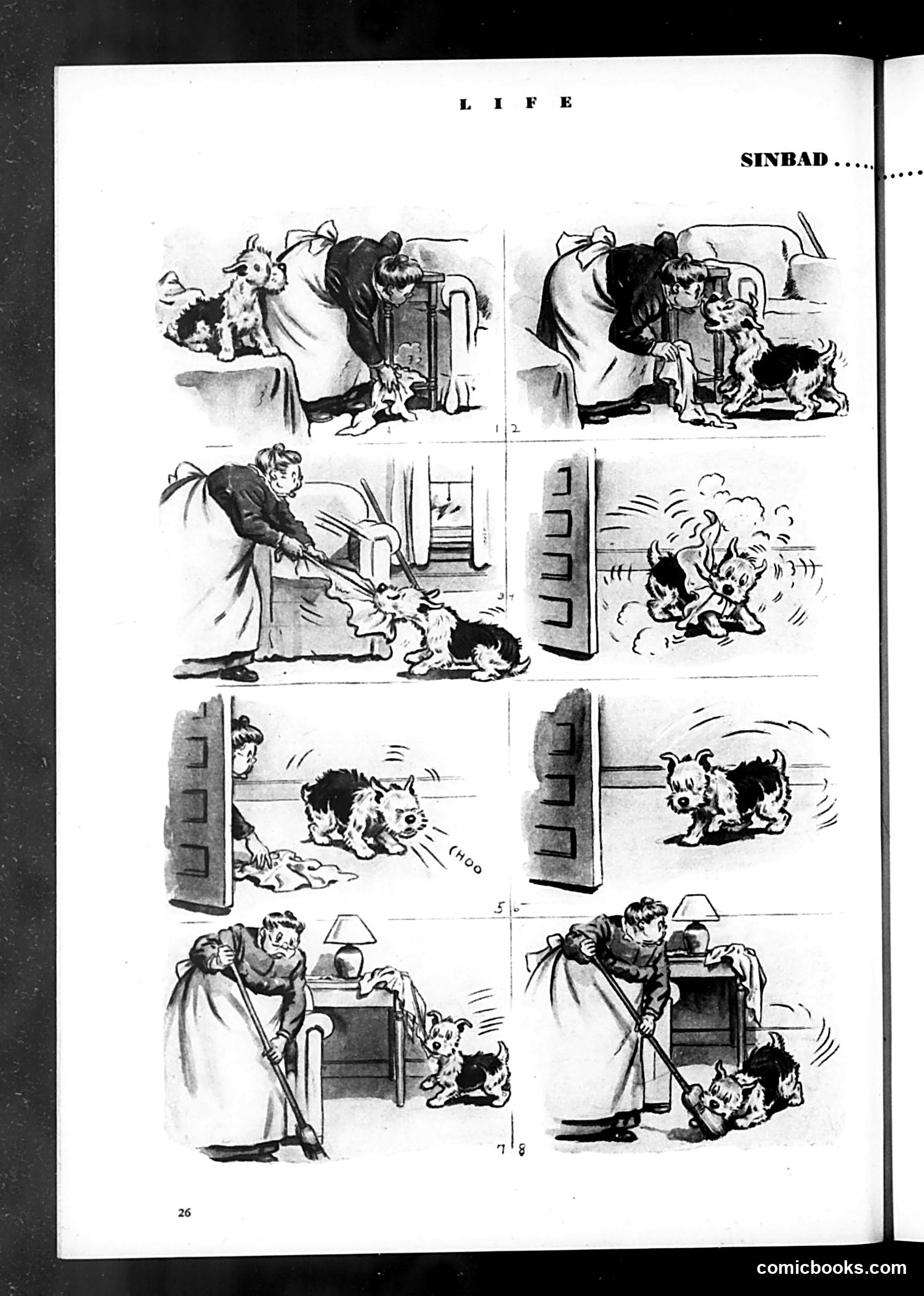
Sinbad Comic Strip Analysis This appears to be a sequential comic strip titled "Sinbad," likely a humorous adaptation of the classical Arabian Nights tale. The narrative shows a man (presumably Sinbad) encountering various animals—dogs or similar creatures—in increasingly chaotic situations. The sequence progresses from initial friendly interaction, through escalating mischief (the animals cause destruction indoors), to the man's exasperation as he attempts to remove them from his home. The final panels show him sweeping or using a broom to drive the animals out. The humor derives from slapstick comedy and the escalating chaos typical of early-to-mid 20th century comic entertainment—a civilized person losing control to animal mischief, a common satirical theme mocking domestic disorder or loss of authority.
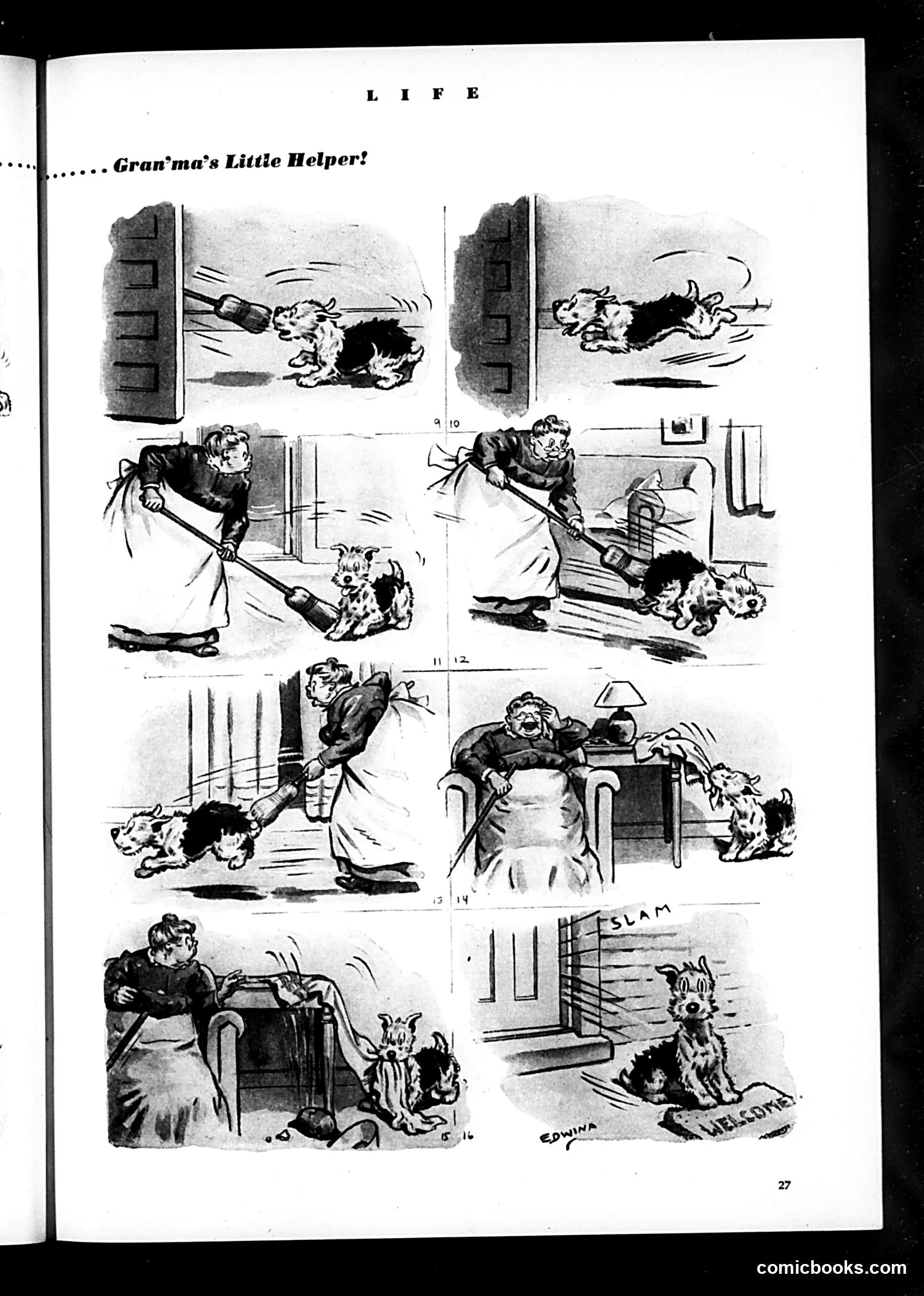
"Grandma's Little Helper!" This is a humorous comic strip showing a grandmother repeatedly using a small dog as a household cleaning tool. In sequential panels, she sweeps floors with it, uses it to dust furniture, and otherwise employs the animal as a mop or brush for various domestic chores—the dog being small and furry enough to serve this purpose. The joke relies on the absurdist humor common to early 20th-century Life magazine comics: the literal, impractical application of something (a living dog) to accomplish a mundane task in the most ridiculous way possible. It's gentle domestic satire poking fun at both household drudgery and the resourcefulness (or desperation) of housewives. The dog remains good-natured throughout, fitting the sentimental tone typical of period humor.
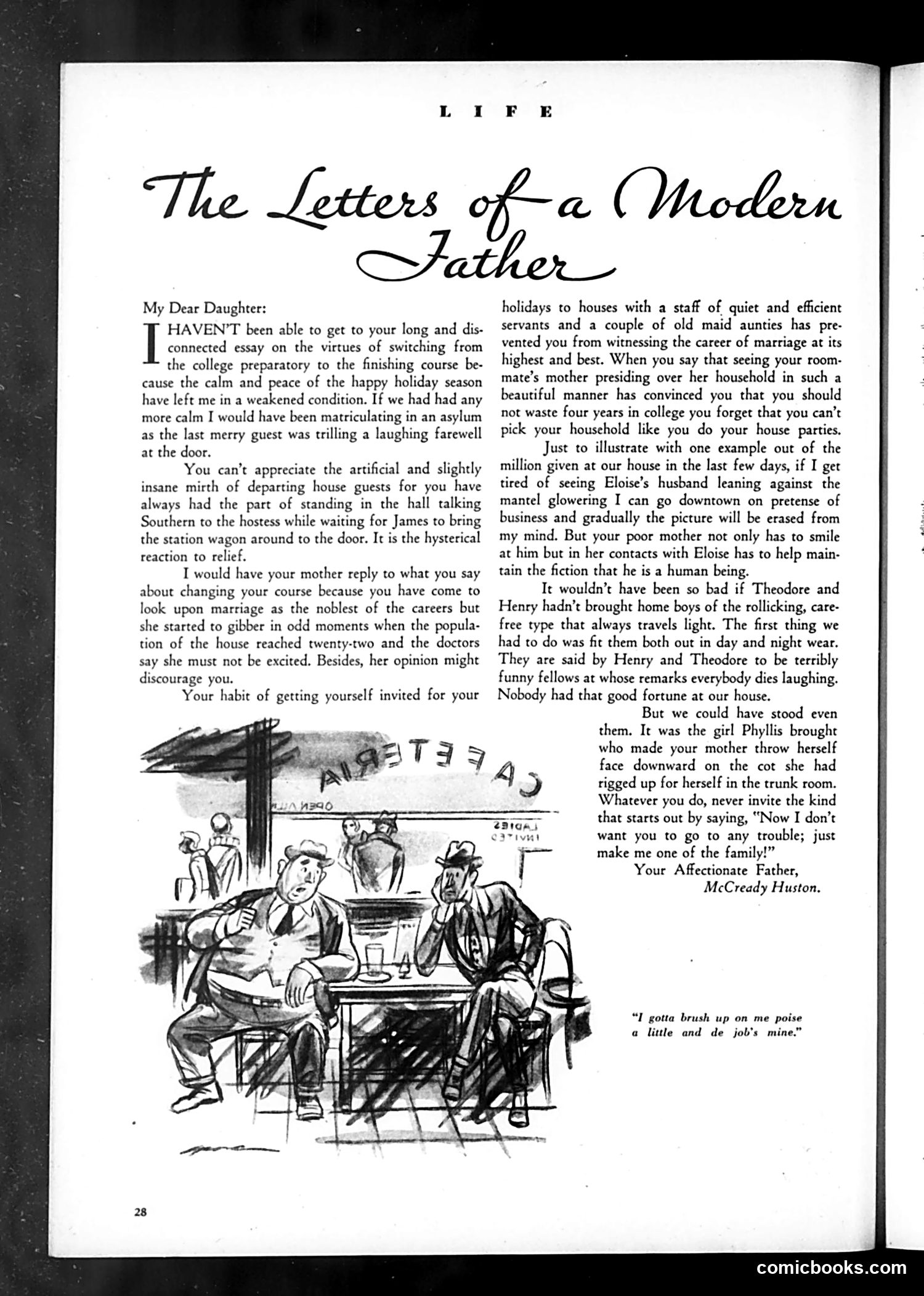
"The Letters of a Modern Father" This satirical piece mocks upper-class domestic life and parental anxieties circa the 1920s-30s. The father, McCready Huston, writes to his daughter about her considering leaving college for "finishing school" — a status symbol for marriage preparation among wealthy families. The satire targets: - Holiday guest chaos: The exaggerated description of 22 houseguests creating hysteria reflects anxiety about managing social obligations and servants - Marriage as career: The daughter views marriage through rose-tinted glimpses at her roommate's "beautiful" household, unaware of real marital friction - Unwelcome guests: Theodore and Henry bring "rollicking, care-free" boys requiring expensive outfitting; worse is Phyllis's guest who feigns humility ("don't want trouble... make me family") — clearly insincere social climbing - Female exhaustion: The mother's breakdown suggests the hidden exhaustion behind maintaining gracious hospitality The illustration shows a café scene with figures, possibly depicting the social performances described. The joke: Modern domesticity requires performing contentment while managing impossible social demands — education might be preferable to this.
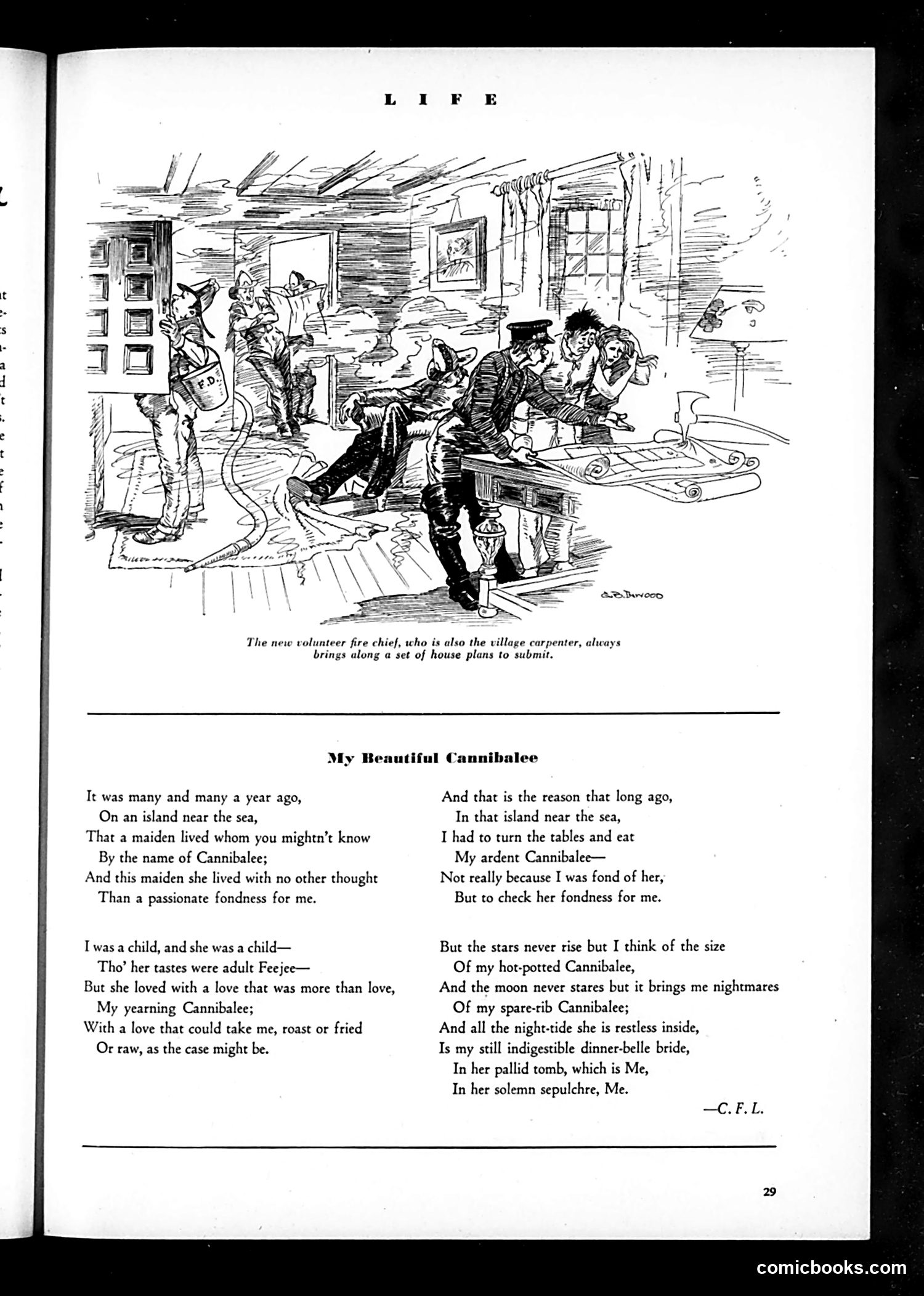
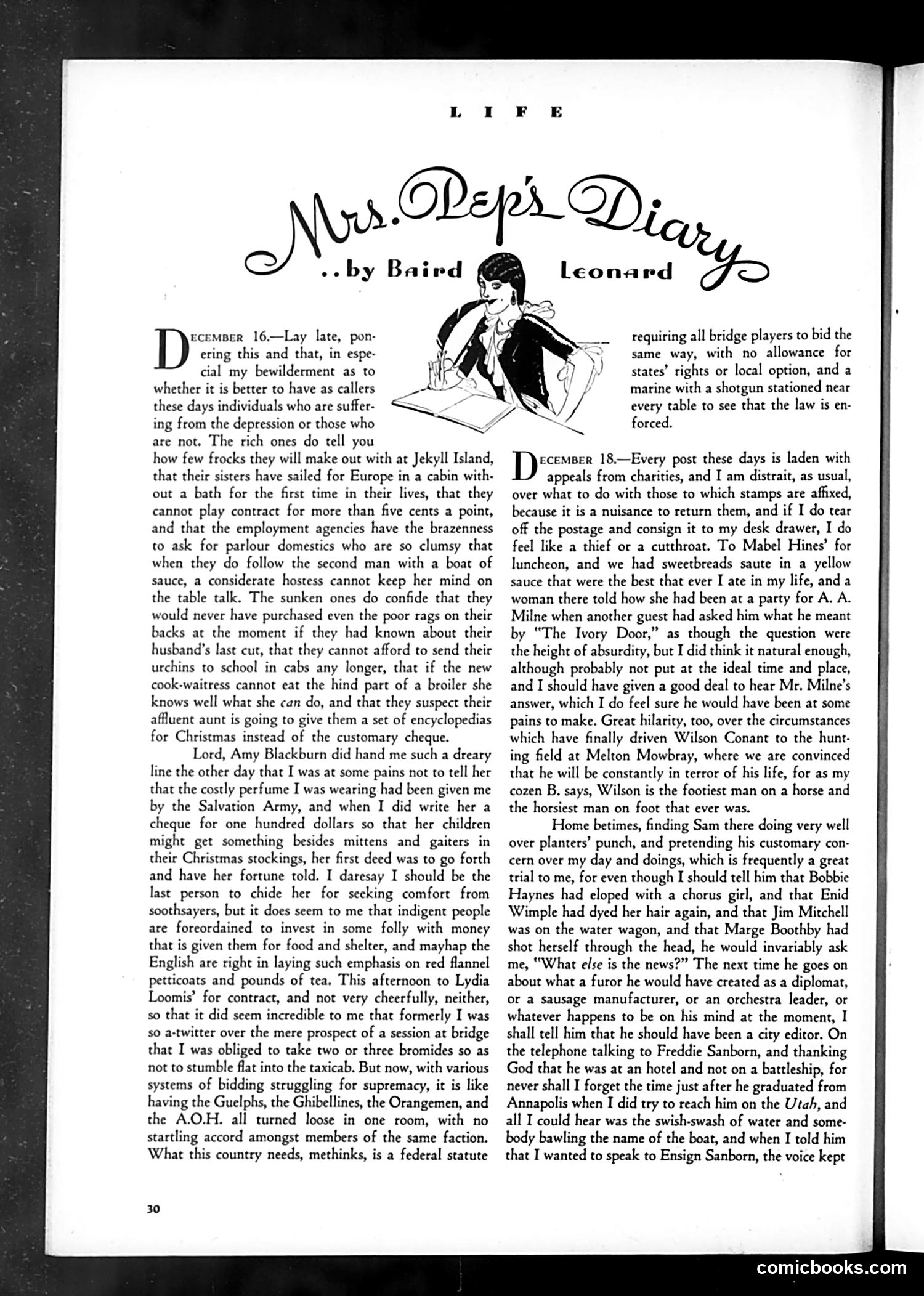
"Mrs. Pep's Diary" by Baird Leonard This is a society gossip column satirizing Depression-era social pretensions. The diarist mocks wealthy people complaining about hardship (fewer dresses, sisters roughing it in European cabins without baths, can't afford five-cent contract bridge) alongside genuinely struggling people seeking false comfort through fortune-telling. The satire targets class hypocrisy: the rich's trivial complaints versus the poor's desperate grasping at solutions. A secondary joke mocks bridge players and the chaos of competing bidding systems—comparing rival factions (Guelphs, Ghibellines, Orangemen, A.O.H.) to suggest bridge disputes are as heated and pointless as historical sectarian conflicts. The overall tone is gentle mockery of upper-class anxiety during economic collapse, suggesting the narrator's own ambivalence about Depression-era socializing.
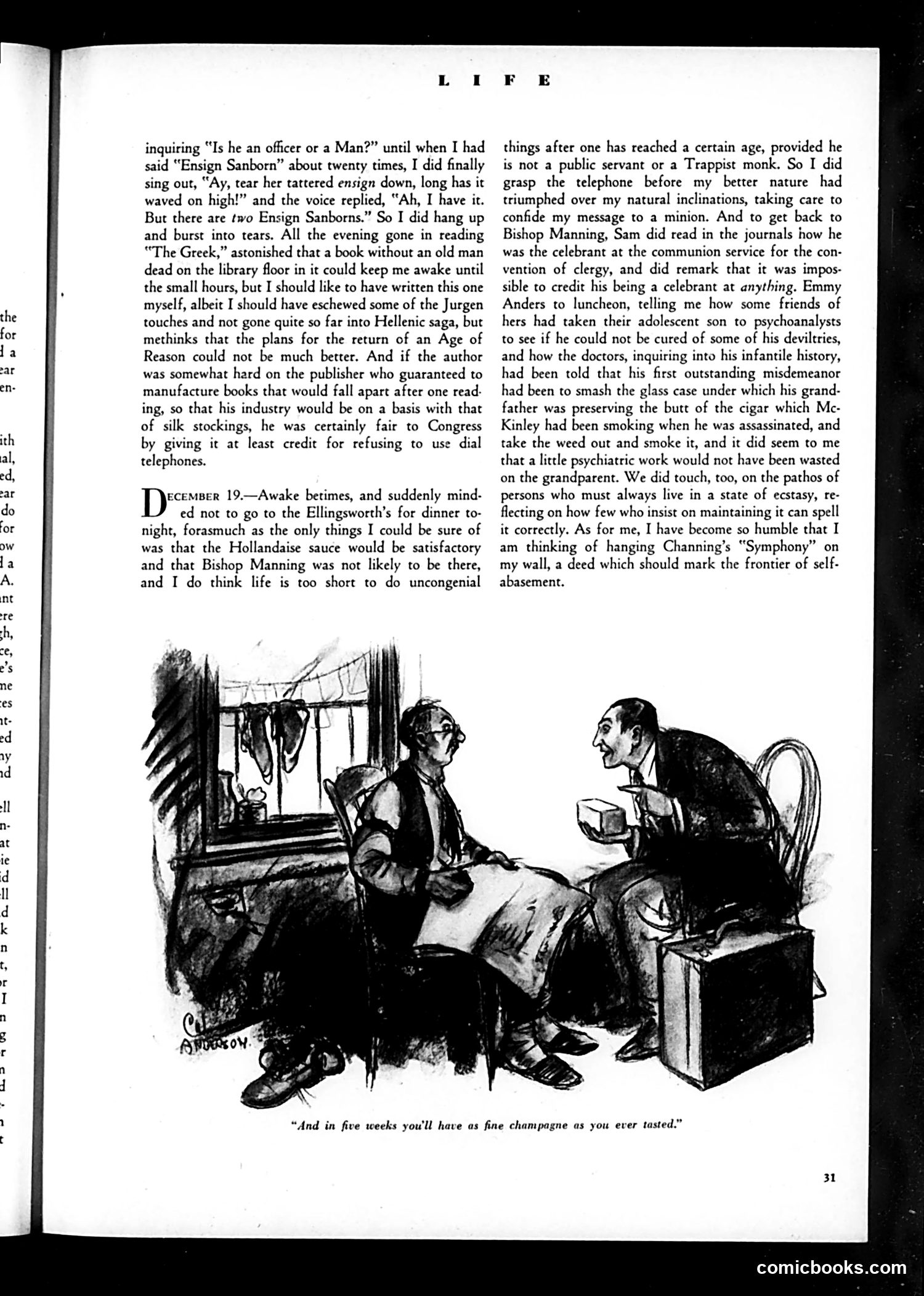
Life Magazine Cartoon Analysis This page contains a diary-style column with an accompanying illustration. The cartoon depicts two men in conversation—one seated, one standing with a briefcase—with the caption: "And in five weeks you'll have as fine champagne as you ever tasted." The joke appears to reference Prohibition-era bootlegging. The standing figure, likely a bootlegger or illegal liquor dealer, is making a sales pitch to the seated customer, promising quality contraband champagne within five weeks. This satirizes the black-market alcohol trade that flourished during Prohibition (1920-1933), when such underground transactions were common. The accompanying text discusses various social observations, including critiques of Bishop Manning, psychoanalysis trends, and literary tastes—typical of Life's satirical commentary on contemporary American life and manners. The cartoon's humor derives from the casual, matter-of-fact way the illegal transaction is portrayed, reflecting Life's irreverent approach to Prohibition-era realities.
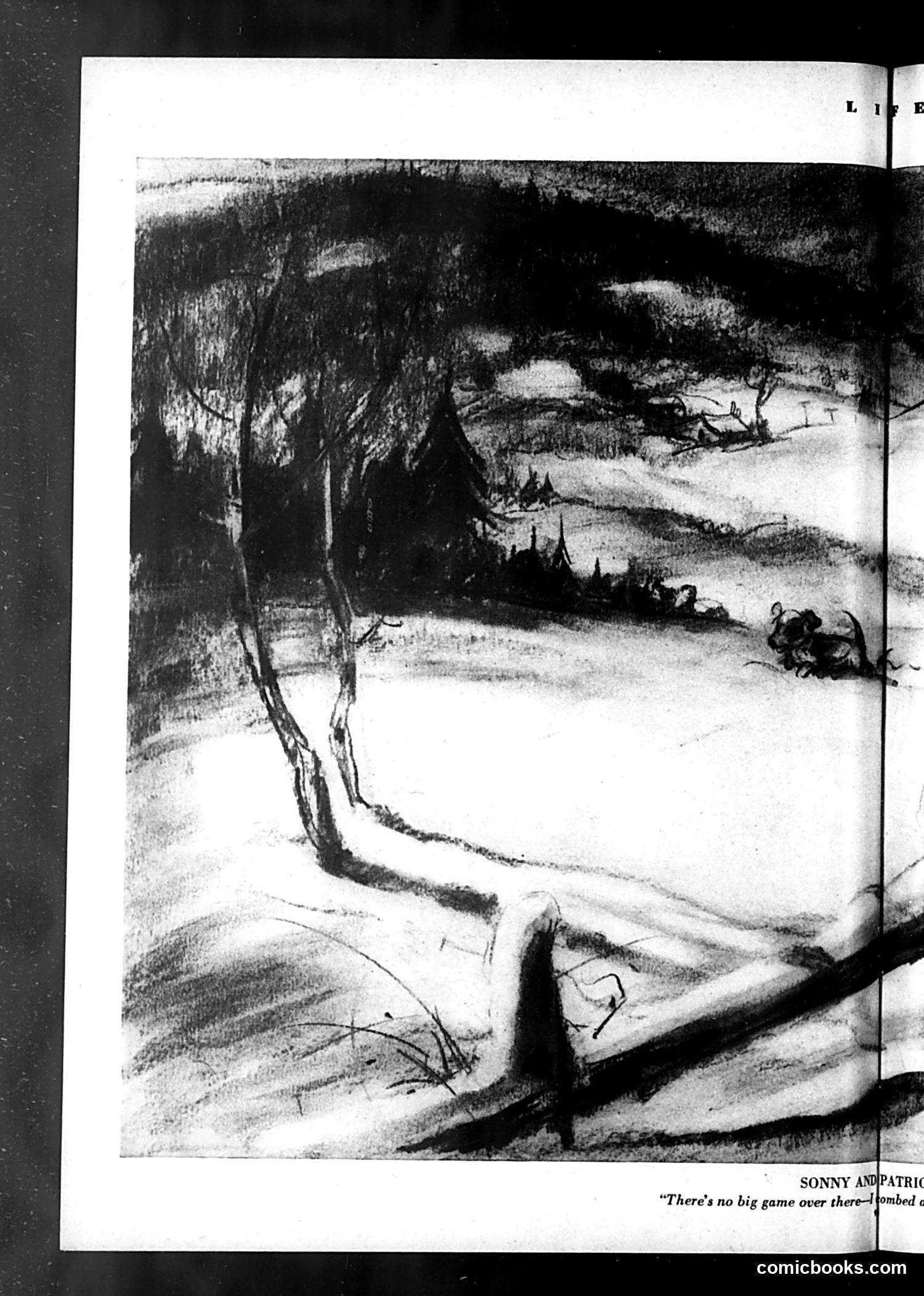
Analysis This appears to be a winter scene from a comic or illustrated story titled "Sonny and Patrick." The image shows a snowy landscape with bare trees, fallen logs, and what appear to be figures in the distance on the frozen terrain. The caption reads: "There's no big game over there—" (text appears cut off mid-sentence). The context suggests this is likely a humorous or adventure narrative rather than political satire. The incomplete dialogue implies one character is warning another against pursuing something in a desolate winter setting. Without additional pages or context, the specific characters' identities and the full narrative point remain unclear, though the scene appears to depict some kind of outdoor expedition or adventure during winter.
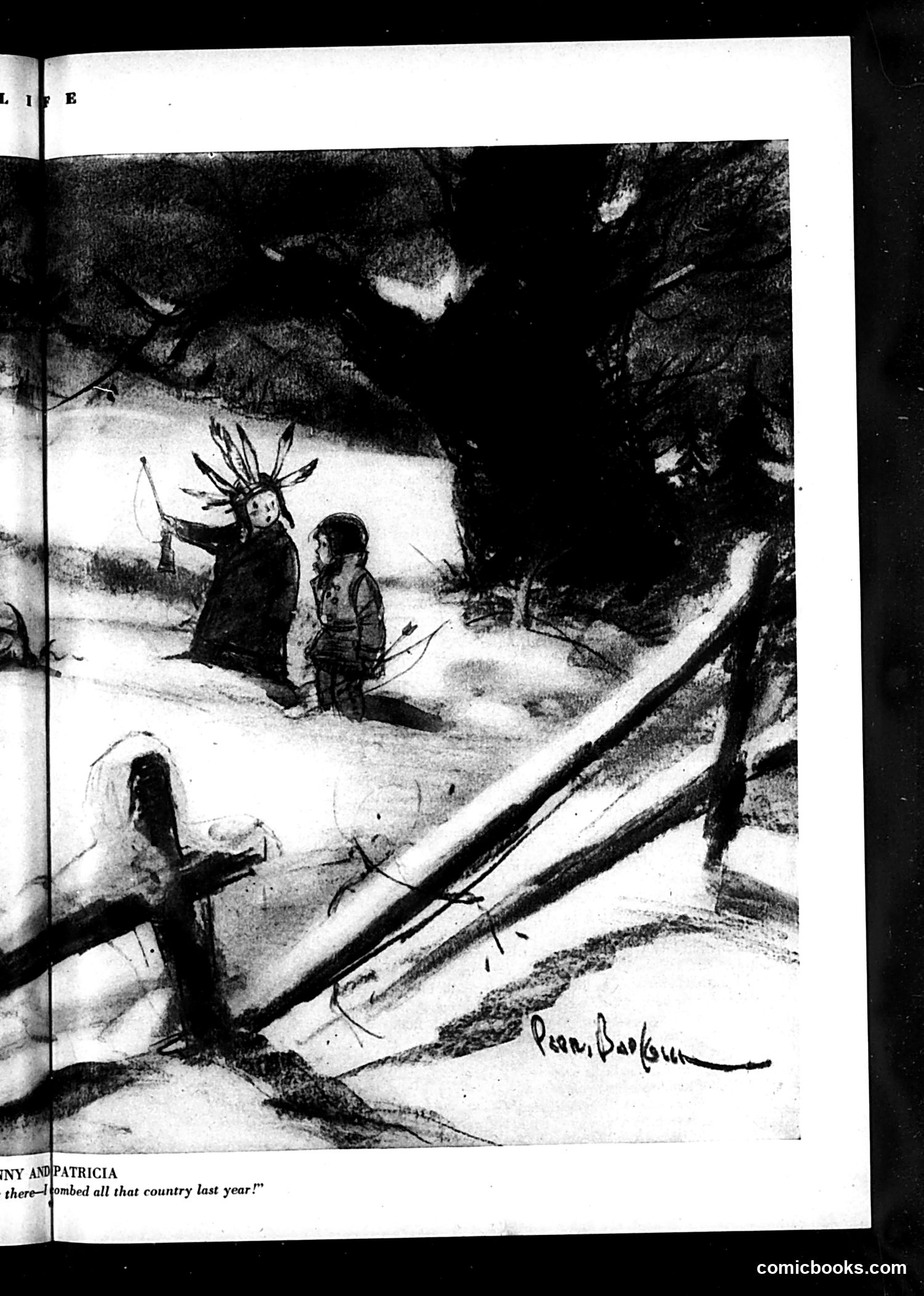
This appears to be a satirical cartoon signed "Ralph Barton" depicting a conversation between two figures in a snowy landscape with fallen logs. One figure has an exaggerated headdress with spiky protrusions, suggesting a Native American caricature. The other is a smaller child-like figure. The partial caption "...bombed all that country last year!" references military bombing campaigns. Without the full context or publication date visible, this likely satirizes either World War I or II-era military actions, with the dialogue suggesting someone recounting destructive bombing campaigns to a Native American figure—possibly ironizing American violence and territorial history. The satire's exact target remains unclear without complete text.
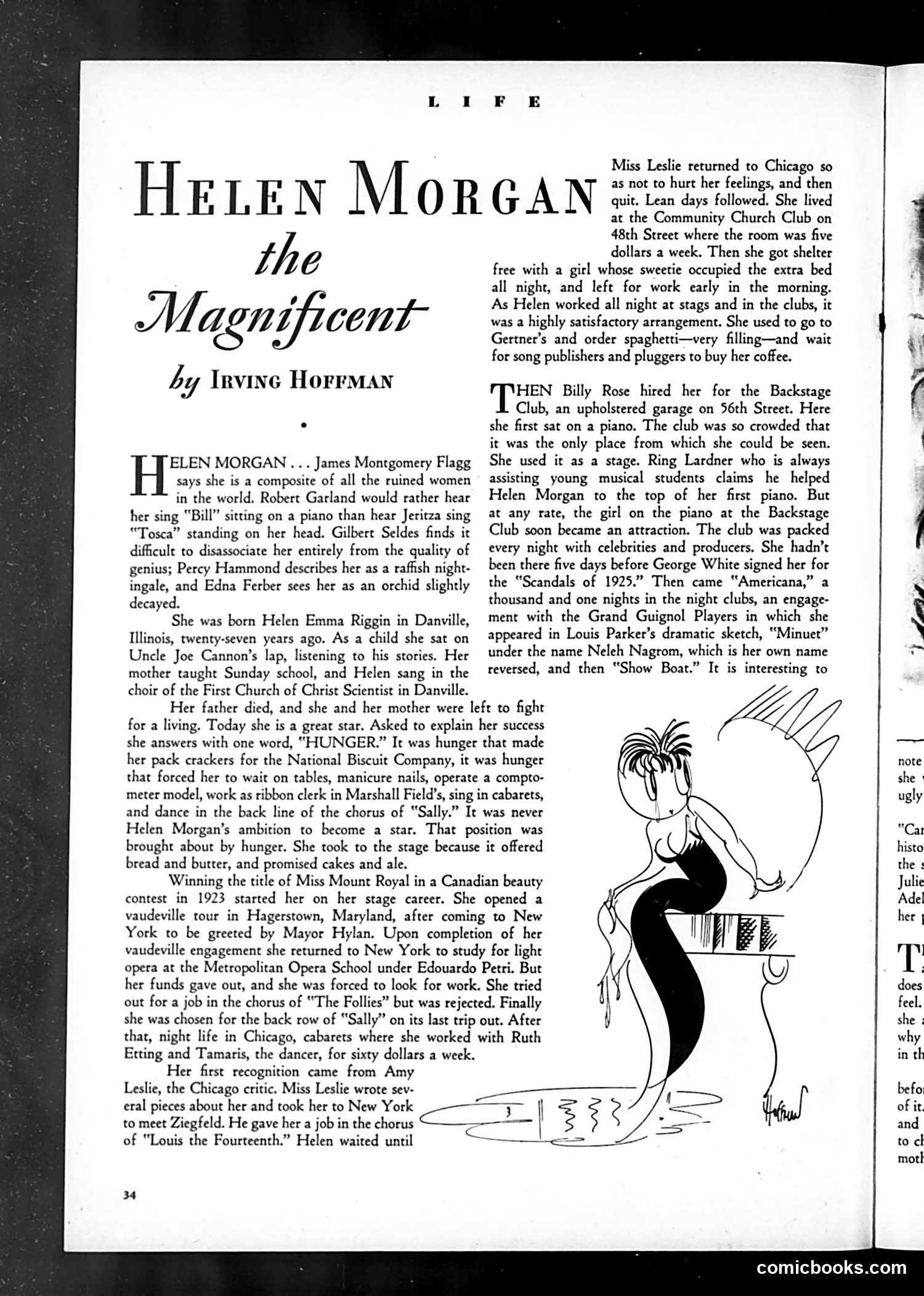
Helen Morgan: The Magnificent This is a biographical profile of Helen Morgan, a 1920s entertainer, by Irving Hoffmann with illustration by James Montgomery Flagg. The piece traces Morgan's rise from poverty—born in Danville, Illinois to a widow—through desperation (working as a ribbon clerk, waitress, and chorus dancer) to stardom, driven entirely by hunger rather than ambition. The cartoon shows Morgan seated on a piano, her signature pose that made her famous at the Backstage Club on 56th Street. The article emphasizes that her success stemmed from economic necessity, not artistic aspiration. Famous critics like Gilbert Seldes and Edna Ferber are quoted praising her unique quality. The profile celebrates the "self-made" entertainer whose determination and talent overcame class barriers—a compelling narrative for *Life* magazine's readership in the prosperous 1920s. Morgan later became famous for her role in "Show Boat."
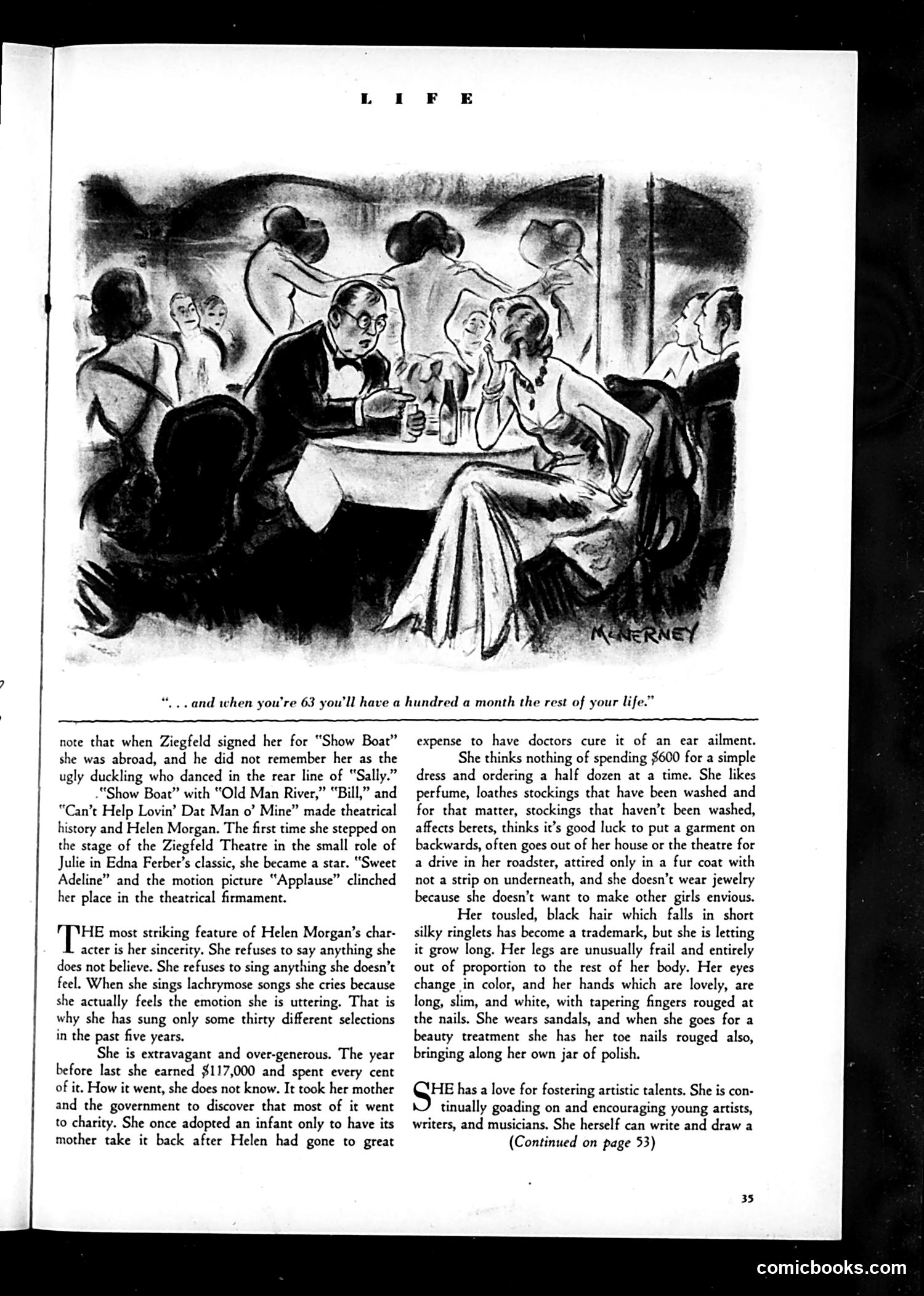
Analysis of This Life Magazine Page This page profiles Helen Morgan, a Broadway star of the 1920s-30s. The cartoon depicts a dinner scene where a man in formal wear discusses financial security with an attractive woman—likely illustrating Morgan's extravagant lifestyle and her need for stable income. The text reveals Morgan's paradoxes: a major theatrical talent (known for *Show Boat* and *Applause*) who earned $117,000 annually yet spent every cent, donating most to charity. She's portrayed as emotionally sincere but financially reckless—refusing to wear jewelry so others won't feel envious, yet spending $600 on single dresses. The satirical angle critiques the era's tensions between artistic integrity and commercialism: Morgan refuses to perform songs she doesn't genuinely feel, limiting her repertoire to thirty selections, even as she generates substantial income. The cartoon's caption about earning "$100 a month for life" at 63 ironically contrasts with her actual boom-and-bust financial reality, suggesting the precarity of show business wealth.
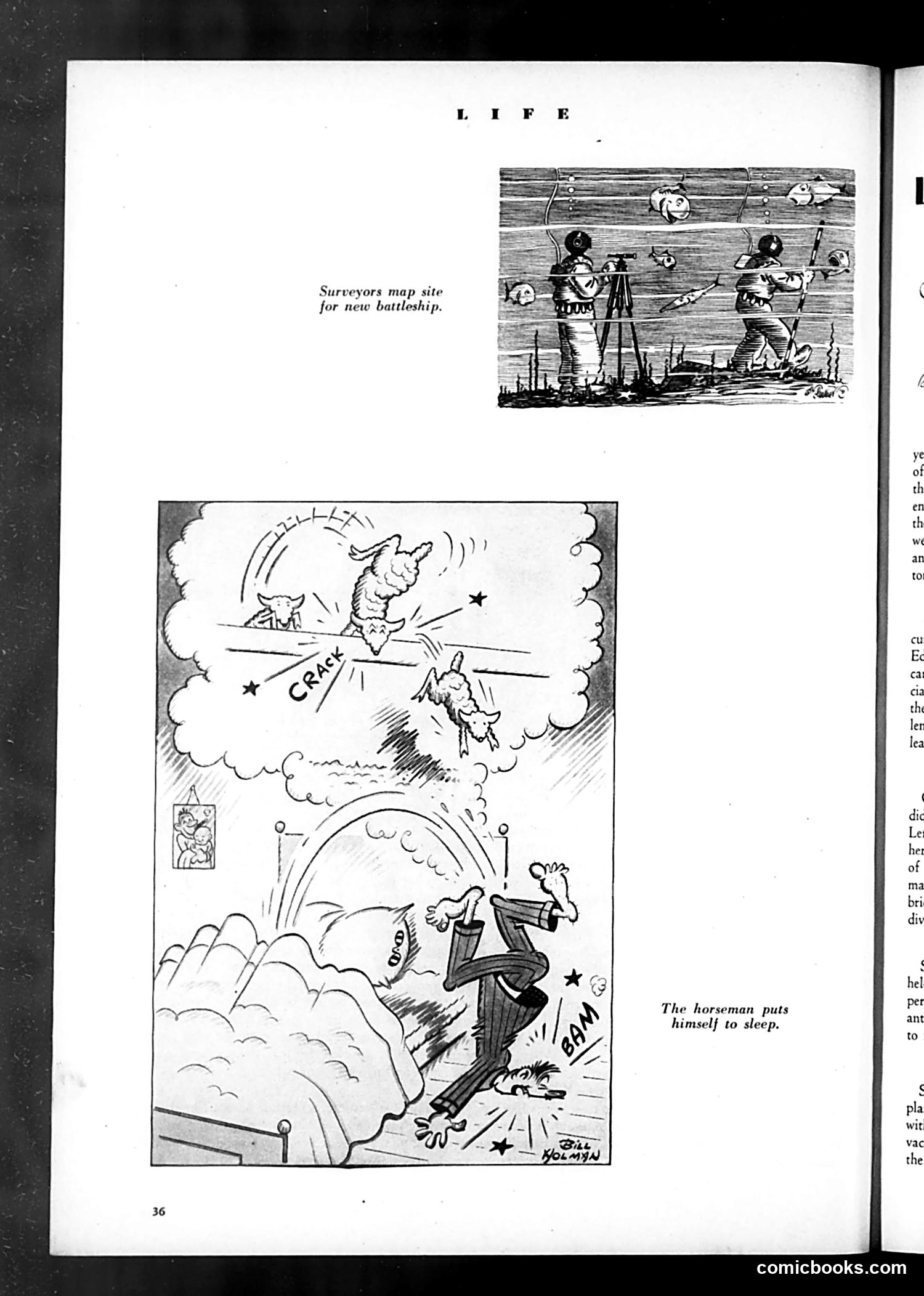
Political Cartoon Analysis: Life Magazine Page 36 This page contains two cartoons satirizing military and political matters: Top cartoon: "Surveyors map site for new battleship" depicts surveyors and construction equipment preparing a naval construction site—likely commenting on America's expanding military-industrial complex or naval buildup during an unspecified period. Bottom cartoon: "The horseman puts himself to sleep" shows a figure on horseback apparently dreaming or hallucinating amid clouds. The dream-bubble contains what appears to be conflict or chaos ("CRACK"), with stars suggesting explosions or violence. The figure seems to be imagining or fantasizing about warfare while trying to rest. Both cartoons appear critical of military spending and warmongering attitudes, though the specific historical context remains unclear without publication date or additional documentation.
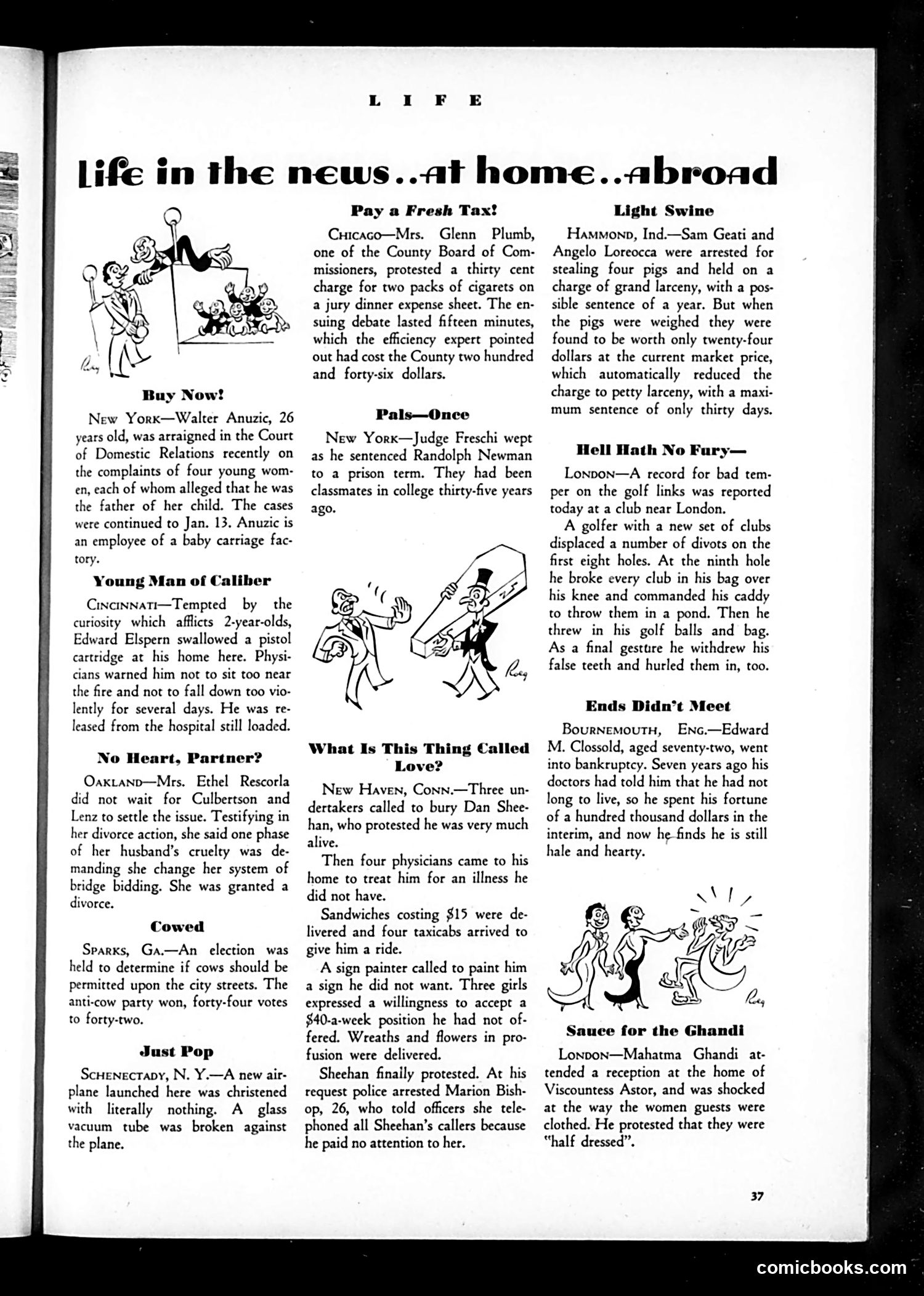
Life Magazine "Life in the News" Page Analysis This is a humor page featuring short, absurdist news items satirizing human behavior and bureaucratic inefficiency. The cartoons and stories mock various social situations: Key satirical points: - "Pay a Fresh Tax": Ridicules government waste—a 15-minute debate over cigarette charges costs $246 in official time. - "Young Man of Caliber": Dark humor about a toddler swallowing a bullet cartridge; the pun suggests the boy is now literally "loaded." - "What Is This Thing Called Love?": Absurdist comedy where an undertaker's attention to a living man (Dan Sheehan) creates cascading unwanted services—doctors, food, taxis, painters—because a woman (Marion Bishop) keeps calling people, revealing obsessive romantic pursuit. - "Hell Hath No Fury": A golfer's explosive tantrum, culminating in throwing his false teeth into a pond, illustrates male rage. - Other items mock domestic drama, divorce courts, and bureaucratic voting procedures. The page's tone is cynical yet lighthearted, reflecting 1920s-30s magazine humor that found comedy in life's petty indignities and human folly.
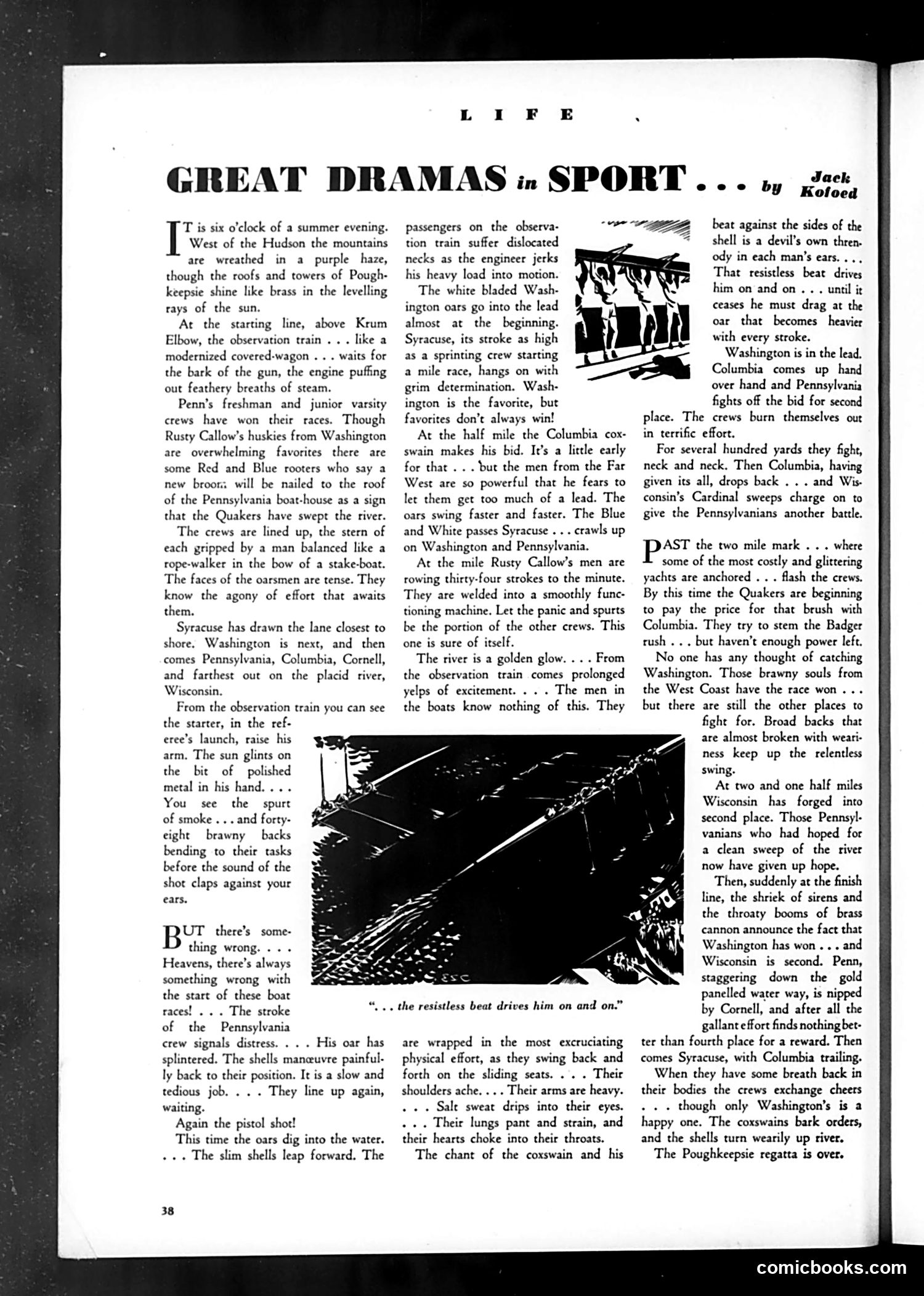
"Great Dramas in Sport" by Jack Koloed This is a dramatic narrative essay about a collegiate rowing regatta, likely from the 1920s-30s, depicting a race among major universities (Pennsylvania, Washington, Columbia, Syracuse, Cornell, Wisconsin). The piece is not satirical but rather a vivid, literary celebration of competitive rowing. The two illustrations show the observation train following the race and rowers in intense physical exertion. The text emphasizes the drama of athletic competition: equipment failures, strategic positioning, and the psychological and physical toll on athletes. The "satire" is gentle and affectionate—poking mild fun at the sport's inherent theatricality (equipment breaking, false starts) while ultimately celebrating the nobility of athletic struggle. It's sports journalism written as dramatic narrative, treating collegiate rowing with the gravitas of classical drama, appealing to Life magazine's educated, leisure-class readership who followed these competitions.
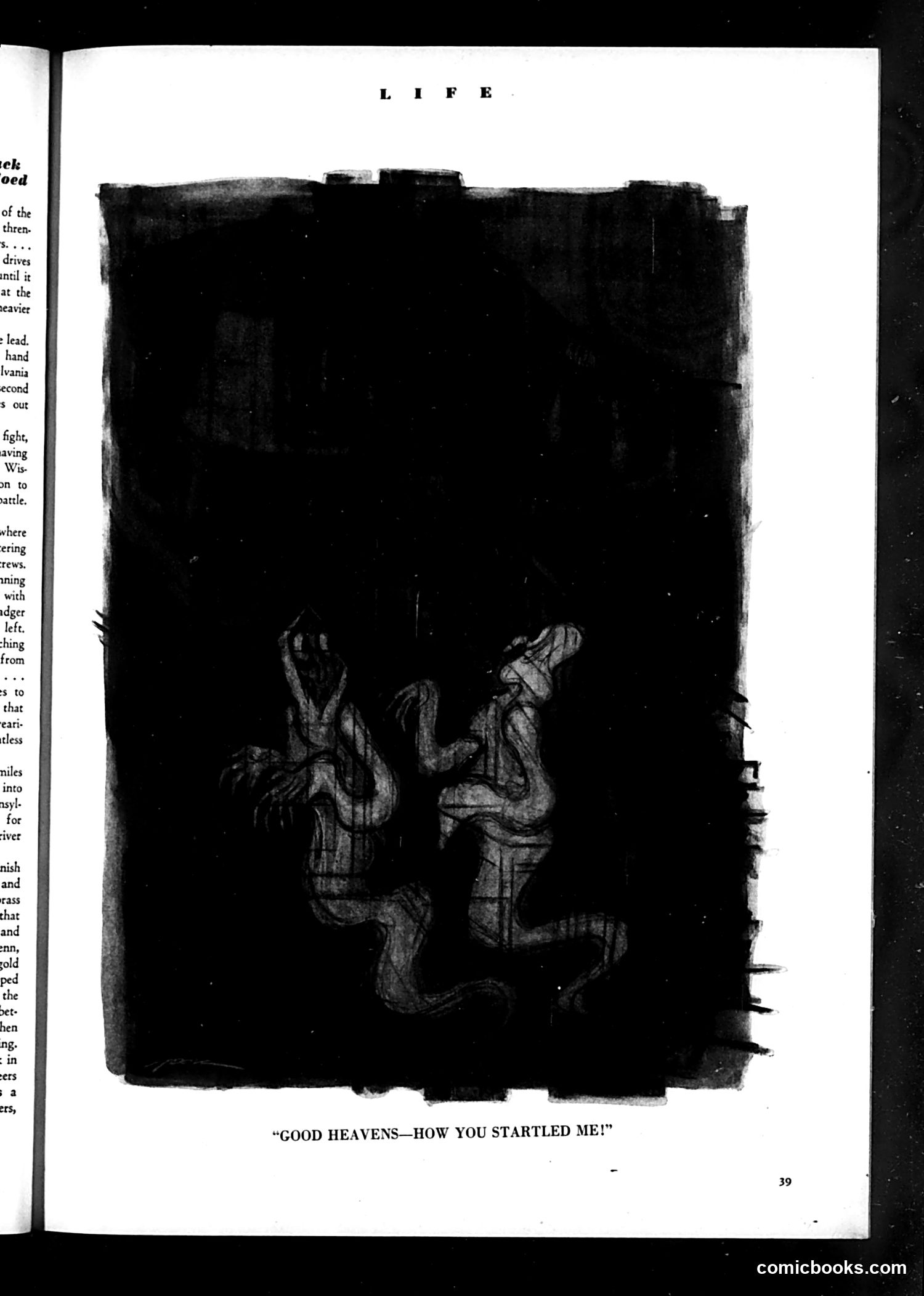
Analysis This page from *Life* magazine features a single cartoon with the caption "Good Heavens—How You Startled Me!" The illustration depicts two figures in what appears to be a dark interior space, drawn in a sketchy, dramatic style with heavy blacks. The specific identities of the figures are unclear from the image alone. Without additional context about the publication date or surrounding text, the precise political or social reference cannot be determined with certainty. The humor appears to rely on a surprise encounter or unexpected meeting between the two characters, suggesting either a comedic situation of mistaken identity or an awkward social moment. The page number indicates this is page 39 of the publication.
Analysis of This Life Magazine Article This is a book review column, not a cartoon page. Alison Smith discusses Rose Macaulay's 1921 novel *Potterism*, using it to critique contemporary literary criticism and book recommendations. The satire targets: 1. Overly-protective literature: Smith mocks Mrs. Potter (a fictional character), a sentimental novelist who writes "safe" books for young women, avoiding anything morally challenging or philosophical. 2. Absurd reader loyalty: The column humorously notes Potter's daughter Clare is so devoted to her mother's work that she falsely accuses a book reviewer of writing a negative article about her mother's books—and when corrected, offers circular logic defending herself. 3. Reviewing standards: Smith uses this example to satirize how book recommendations can arouse "bitter resentment" among critics, particularly referencing Galsworthy's *Maid in Waiting* heading contemporary bestseller lists. The underlying point: contemporary literary taste favors bland, morally unchallenging fiction over honest, intelligent writing.
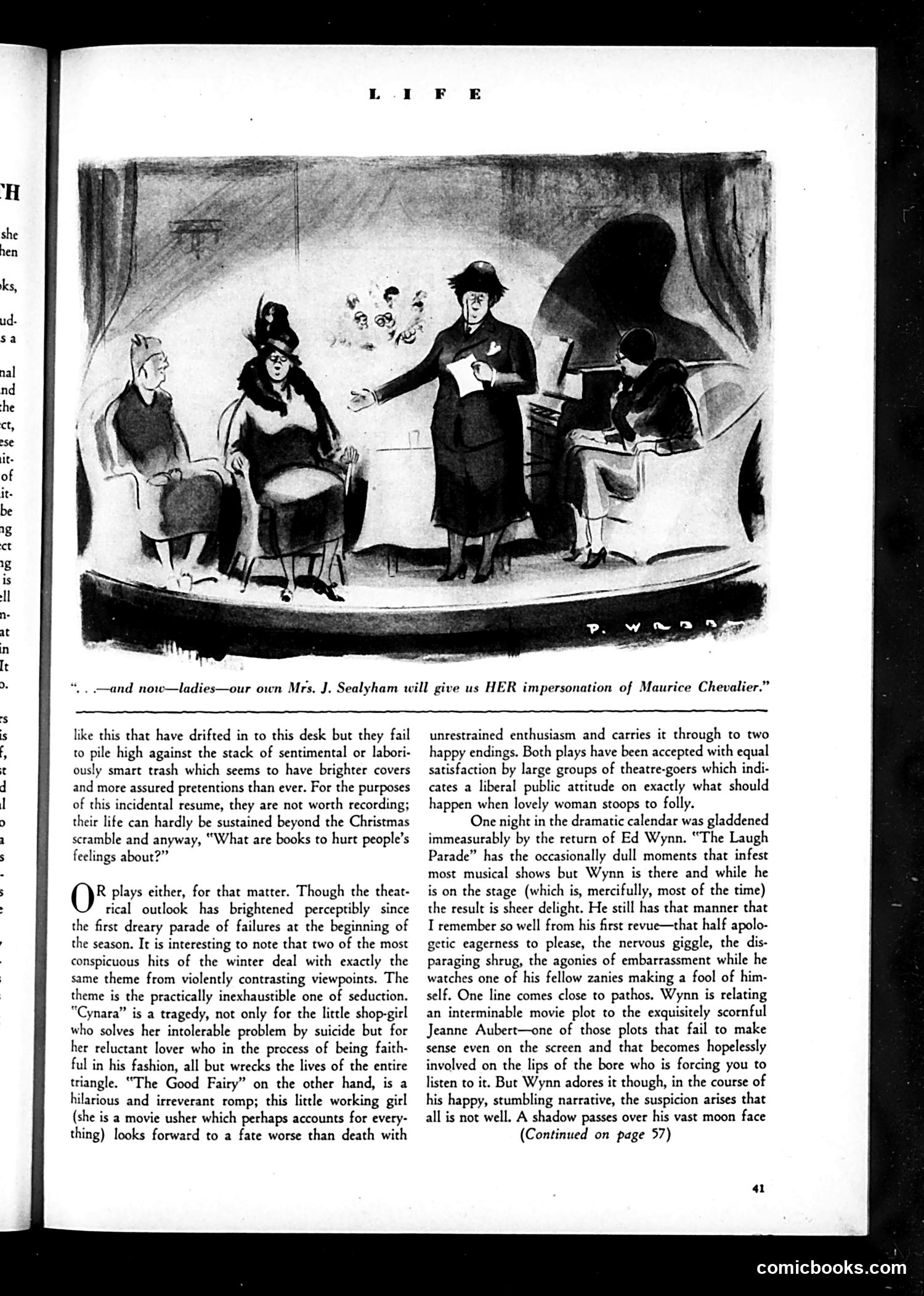
Analysis The cartoon depicts a theatrical parlor scene where a woman labeled "Mrs. J. Sealyham" is about to perform an impersonation of Maurice Chevalier, the famous French entertainer and actor known for his distinctive accent and charm. The satire targets amateur theatrical performances—likely a society event or charity show where wealthy or socially prominent women would perform imitations of celebrities. The humor lies in the absurdity of "Mrs. J. Sealyham" (possibly a dog breed reference, as Sealyham is a terrier) attempting to capture Chevalier's sophisticated French persona. The audience's anticipatory expressions suggest they expect either entertainment or amusement at her attempt. The accompanying text discusses contemporary theater, praising performances by Ed Wynn and discussing plays like "Cynara" and "The Good Fairy," establishing this as 1930s theatrical criticism. The joke mocks the pretensions of amateur performers and the social world that indulges such entertainment.
Analysis for Modern Readers This is a movie gossip and criticism column from Life magazine (1920s-30s), not a political cartoon. The page contains three anecdotes about Hollywood stars and the film industry: 1. Gloria Swanson anecdote: A friend plays a prank by giving the famous silent film actress an ice cream cone at the opera, which she eats loudly, shocking other patrons. The joke mocks the pretentiousness of high society and Hollywood's contrived image. 2. Hollywood Boulevard bench scandal: Life satirizes a scheme where the film industry charges famous actors $48 to have their names on commemorative benches—essentially selling vanity back to the stars themselves. The humor targets Hollywood's commercial exploitation and stars' susceptibility to flattery. 3. "The Struggle" film critique: Evans criticizes D.W. Griffith's poorly-made film while accusing newspapers of publishing favorable reviews in exchange for advertising revenue. This exposes media corruption and the film industry's mutual back-scratching with press. The underlying satire targets Hollywood's superficiality, commercialism, and the corrupting influence of money on both the industry and media coverage.
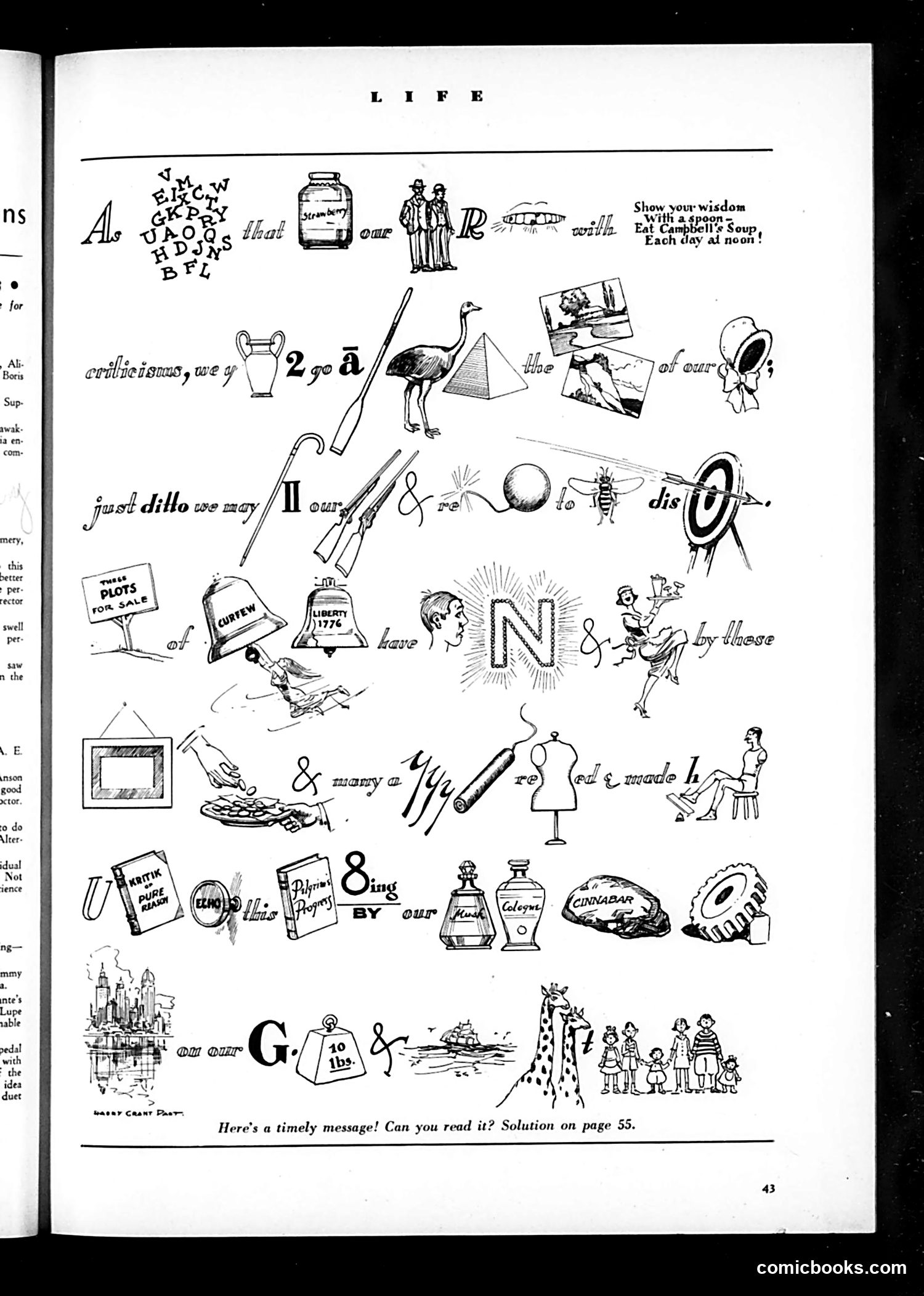
This is a rebus puzzle rather than political satire. The page presents a visual riddle using drawings, symbols, and text fragments that combine to form a hidden message or phrase. Key elements visible include: Campbell's Soup, an ostrich, a pyramid, photographs, a vase, an ostritch, a rifle, bells labeled "Liberty 1776," an "N," a dress form, perfume bottles labeled "Cinnabar," various product containers, a weight scale, and a giraffe with people. The instruction "Here's a timely message! Can you read it? Solution on page 55" confirms this is a puzzle where readers decode the visual elements into words or a phrase. Without seeing page 55's solution, the exact message remains unclear, but the "timely" reference suggests it addressed contemporary 1920s-1930s concerns. The Campbell's Soup tagline at top ("Eat Campbell's Soup, Each day at noon") hints the puzzle may relate to consumerism or daily life.
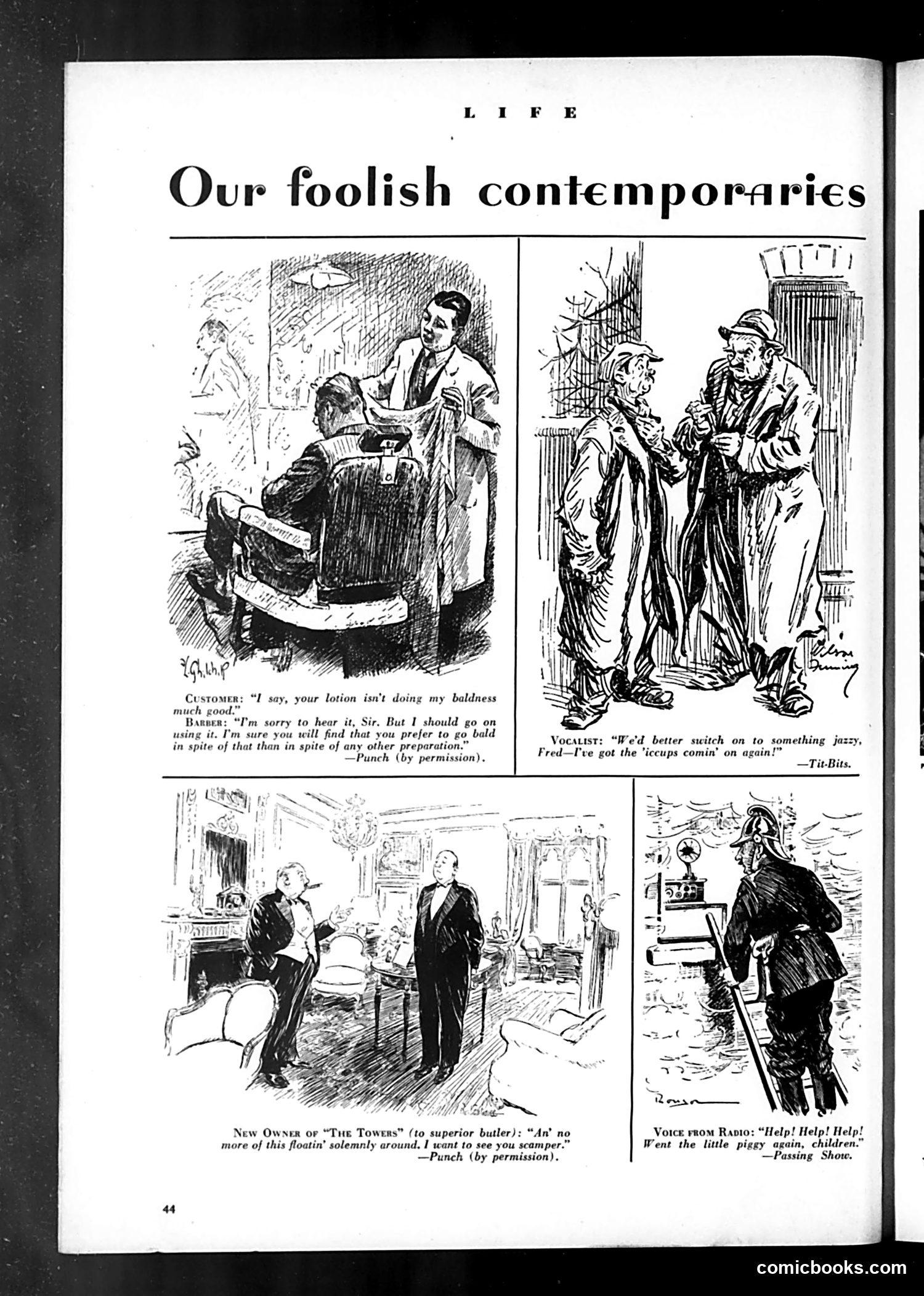
"Our foolish contemporaries" This page collects four satirical cartoons mocking various social absurdities of the era: 1. Baldness lotion scam: A con artist sells useless hair-loss treatment, cynically suggesting the customer will prefer going bald with *his* product than with competitors'—pure salesmanship masking fraud. 2. Radio hiccups: A jazz vocalist can't perform properly due to hiccups, treating radio broadcasting as casual entertainment rather than professional. 3. New money vulgarity: A nouveau-riche homeowner demands his butler "scamper" rather than walk solemnly—mocking the pretentiousness and poor taste of newly wealthy industrialists. 4. Children's radio: A radio broadcast trivializes farm animals ("piggy") for entertainment, suggesting dumbed-down programming for children. The recurring theme: modern life produces foolish people and false promises. These Punch and Tit-Bits reprints satirize social climbing, quackery, and lowbrow mass media.
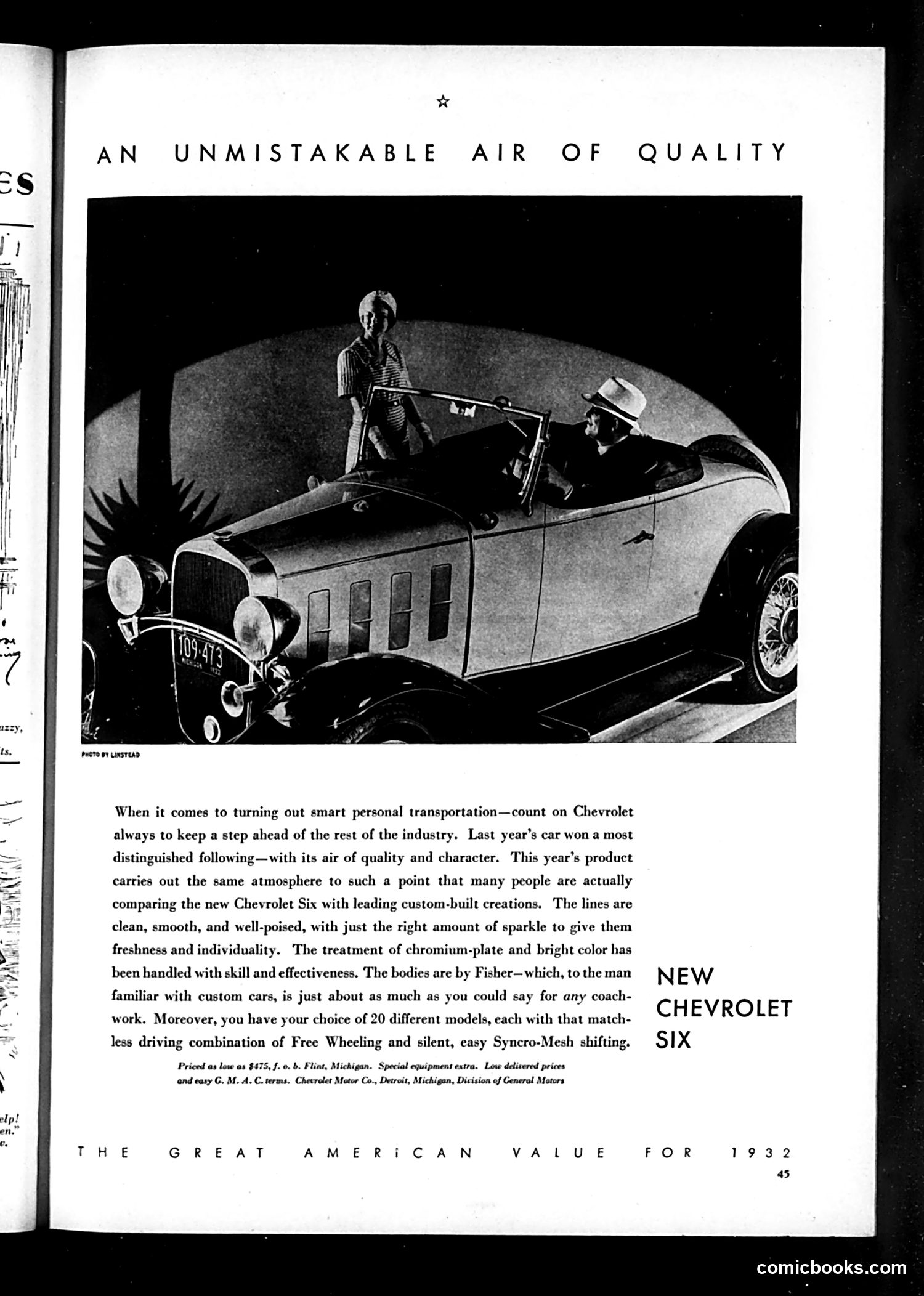
Analysis This is a Chevrolet automobile advertisement, not a political cartoon or satire. It appears from a 1932 *Life* magazine (based on the tagline "The Great American Value for 1932"). The image shows two figures in period clothing posing with a Chevrolet Six convertible—likely meant to evoke sophistication and aspirational leisure. The advertisement's central claim is that Chevrolet offers "quality" comparable to expensive custom-built cars, despite its affordable price (starting at $475). Key selling points emphasized: Fisher bodies, chromium plating, "Free Wheeling" and "Syncro-Mesh shifting" (technical features then-novel), and 20 model choices. The headline "An Unmistakable Air of Quality" directly addresses Depression-era consumers seeking value. This reflects 1932 marketing strategy: positioning mass-produced vehicles as democratizing luxury during economic hardship.
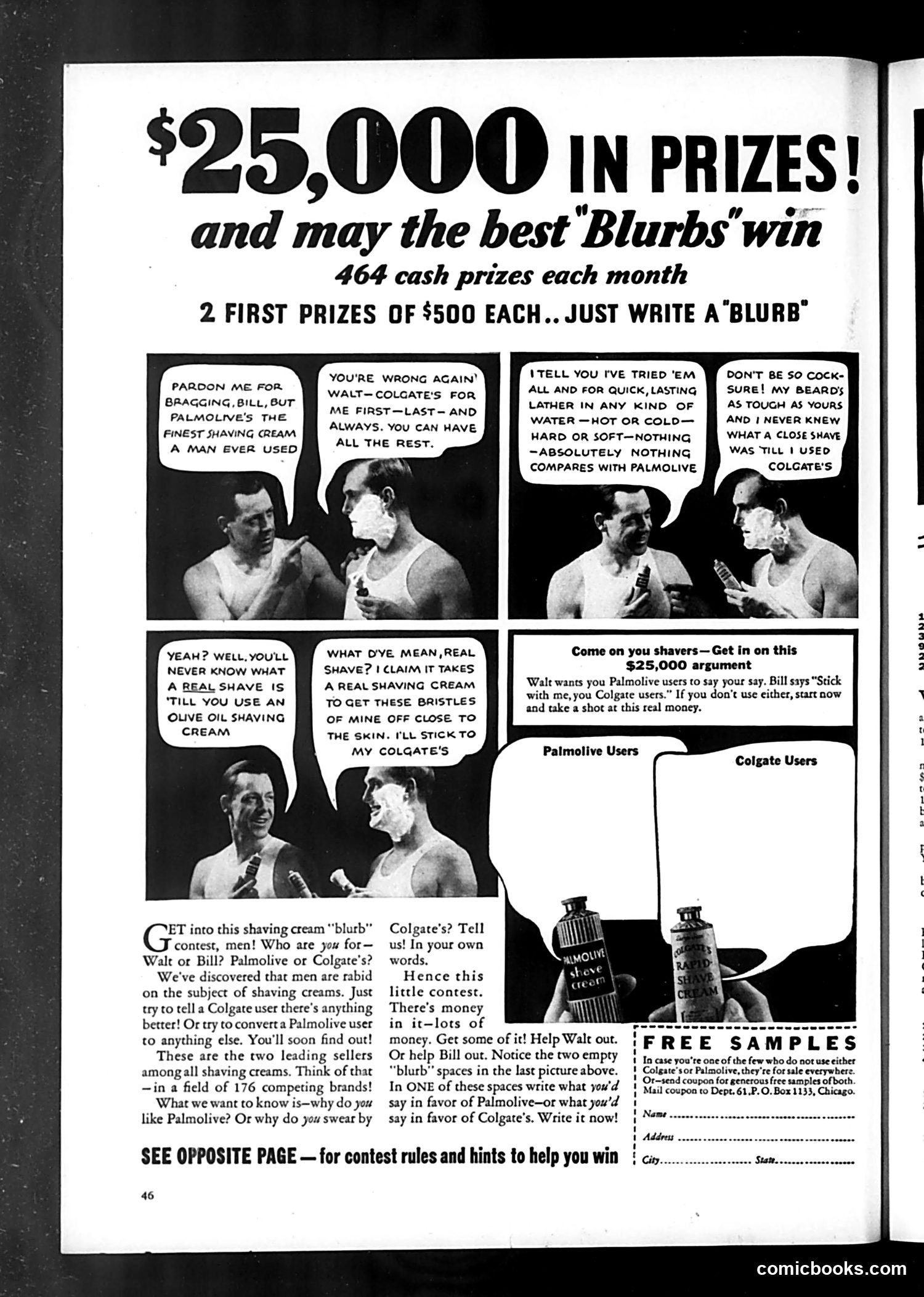
A Vintage Shaving Cream Advertising Contest This page is primarily advertising masquerading as editorial content—a 1930s-40s promotional gimmick. Two men named Walt and Bill argue over whether Palmolive or Colgate's is the superior shaving cream, with exaggerated claims about lather, closeness of shave, and skin protection. The "contest" invites readers to write persuasive "blurbs" favoring either brand for cash prizes ($25,000 total). The satire is mild: the page gently mocks how passionately men defend mundane consumer products, treating a choice between two nearly identical shaving creams as a matter of personal honor or masculine identity. The comic panels show the debate escalating absurdly, while the surrounding text frames this consumer loyalty as surprisingly fierce market competition. This reflects mid-20th century advertising's strategy of creating brand personality and emotional attachment to commodities.
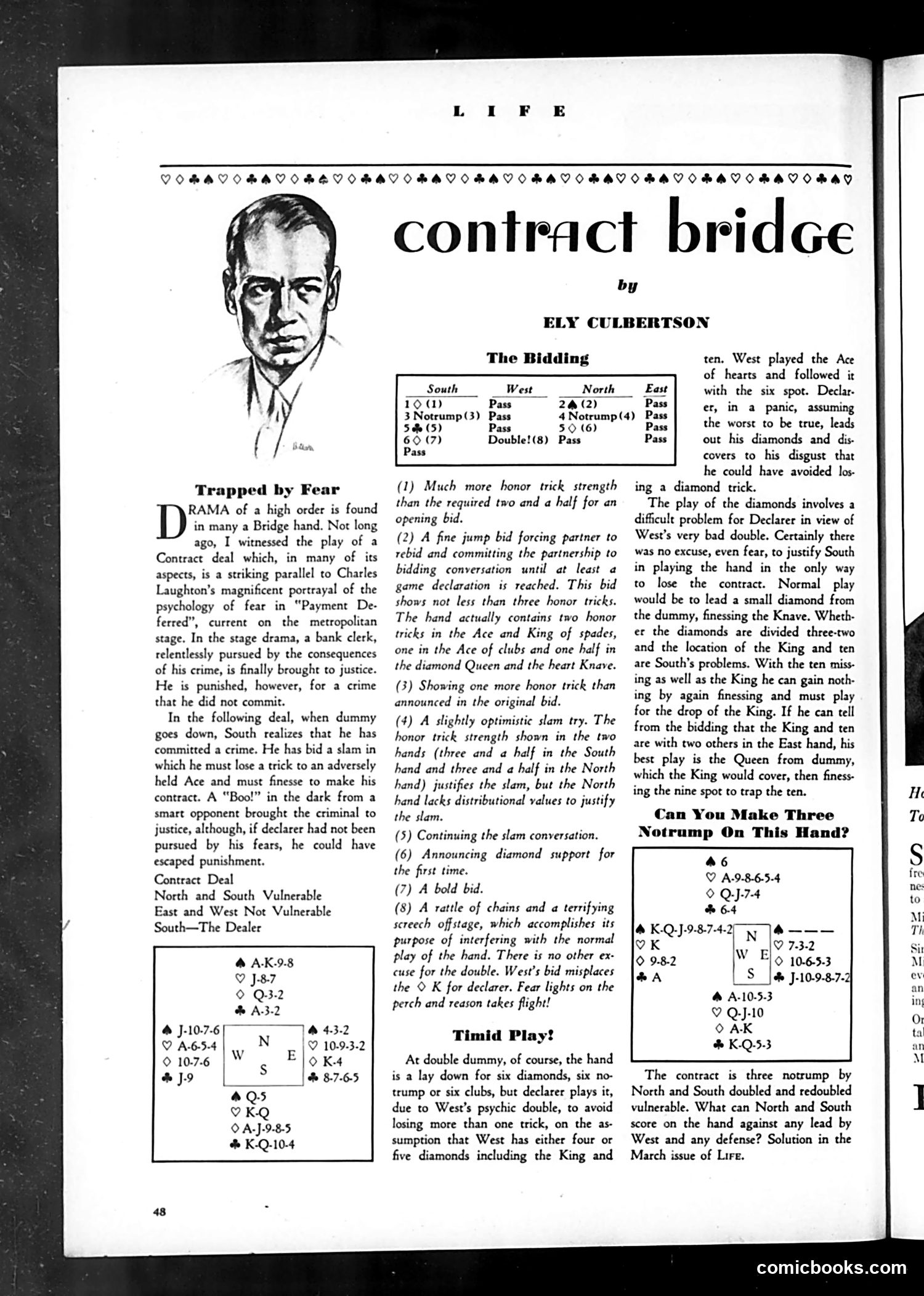
Contract Bridge Analysis for Modern Readers This page contains an instructional article about Contract Bridge (a card game) by Ely Culbertson, written as a dramatic narrative. The article uses a theatrical metaphor: it compares a bridge player's mistakes to Charles Laughton's 1931 film "Payment Deferred," where an innocent man is punished for a crime he didn't commit. The central "joke" or lesson: A South player bids an ambitious "slam" (winning all or nearly all tricks). West makes a psychological "double" (a challenge bet) that isn't based on actual cards—merely a bluff meant to intimidate. This succeeds. The panicked South then plays poorly and loses tricks he could have won, essentially punishing *himself* through fear rather than actual bad cards. The double was essentially a theatrical trick ("a rattle of chains and a terrifying screech offstage")—sound and fury signifying nothing, yet psychologically effective. The page includes the hand's cards and detailed bidding explanation for bridge players to learn from this cautionary tale about how fear—not mathematics—sabotages good play.
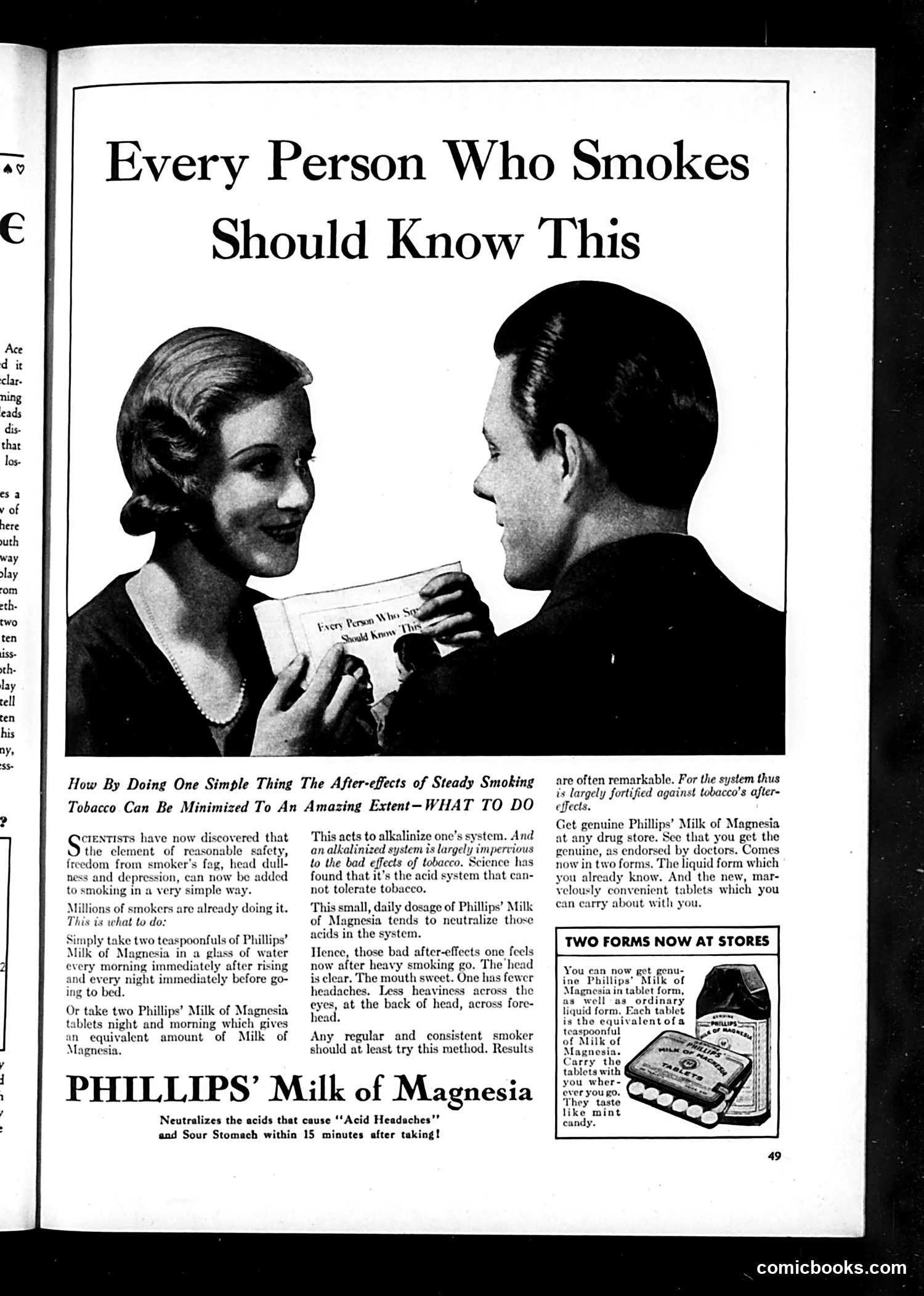
Analysis for Modern Readers This is not a cartoon or satire—it's a genuine advertisement for Phillips' Milk of Magnesia, presented as health advice. The page shows a man and woman examining a pamphlet titled "Every Person Who Smokes Should Know This." The text promotes taking Phillips' Milk of Magnesia twice daily to counteract smoking's negative effects (headaches, mouth sourness, dullness) by "alkalinizing" the body's acid system. Historical context: This reflects early-20th-century attitudes when smoking's health risks were poorly understood and products openly marketed "solutions" to mitigate symptoms rather than discouraging the habit itself. The advertisement treats smoking as a normal, acceptable behavior requiring only chemical management—not cessation. The two product forms shown (liquid and tablets) emphasize convenience for regular smokers. This represents pre-warning-label era marketing where health claims were unregulated and often pseudoscientific.
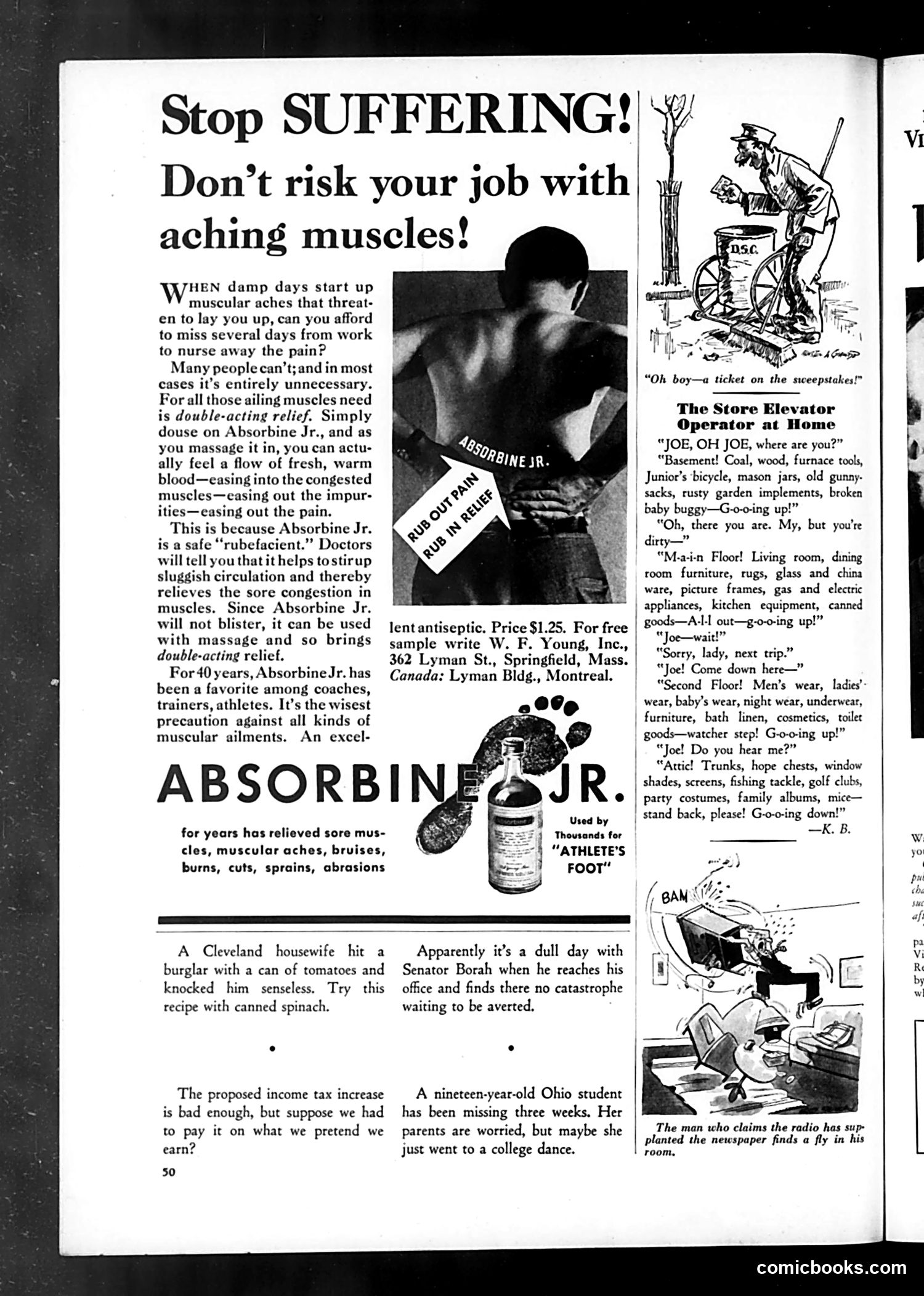
Analysis for Modern Readers This page is primarily advertising and humor content from Life magazine's satirical section. Main Advertisement: Absorbine Jr., a liniment product promising muscle pain relief. The ad targets working people who can't afford sick days, emphasizing it won't cause blistering and has been used by athletes for 40 years. The Cartoons/Jokes: - "The Store Elevator Operator at Home": A domestic humor piece where a husband mimics his workday elevator announcements while doing basement chores, illustrating how job routines invade home life. - Brief satirical quips mock contemporary topics: income tax increases, Senator Borah's dramatic politics, a missing college student's whereabouts, and radio's supposed superiority to newspapers. Social Context: These reflect 1930s-40s concerns—economic anxiety about taxes and employment, gender roles (housewife calling her working husband), technology disruption, and youth culture. The elevator operator joke implies working-class monotony bleeding into personal relationships. The page captures Life's blend of consumer advertising alongside topical social commentary through short, punchy humor.
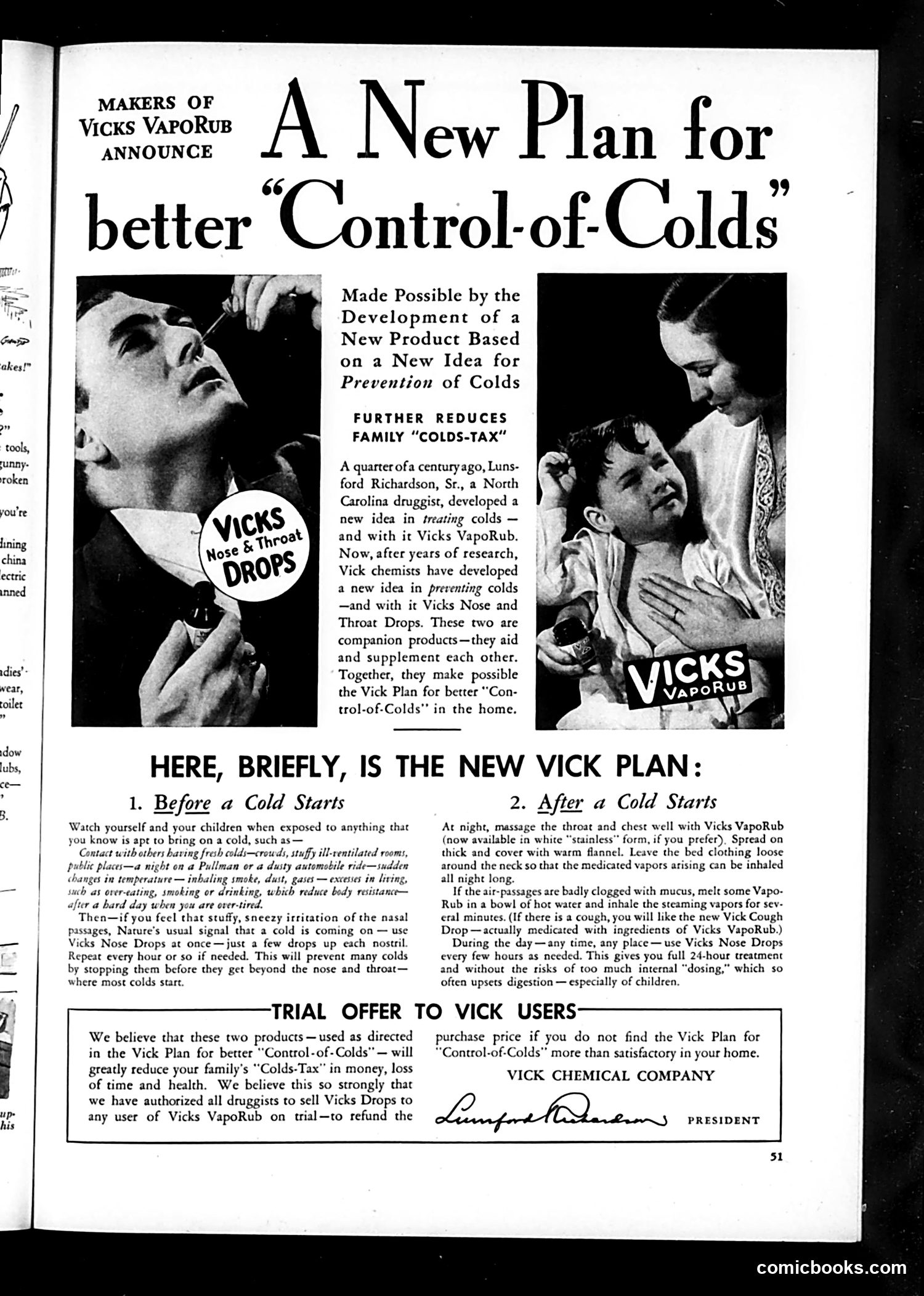
Analysis This is not a cartoon or satire—it's a vintage advertisement for Vicks VapoRub products, likely from the 1920s-1930s based on styling and typography. The page promotes a two-product "Vick Plan" combining VapoRub and a new product, Vicks Nose and Throat Drops, to prevent and treat colds. It credits Lunsford Richardson Sr., a North Carolina druggist, as the originator of the VapoRub concept "a quarter of a century ago." The advertisement uses domestic imagery—an adult attending to a sick child—to appeal to family health concerns. The key selling point is the "Colds-Tax" concept: framing colds as an economic burden on households through lost time and money. A "trial offer" promised refunds if users weren't satisfied, a common early-20th-century marketing technique. The signature at bottom appears to be from Vick Chemical Company's president, adding authority. This represents straightforward product marketing, not political or social satire.
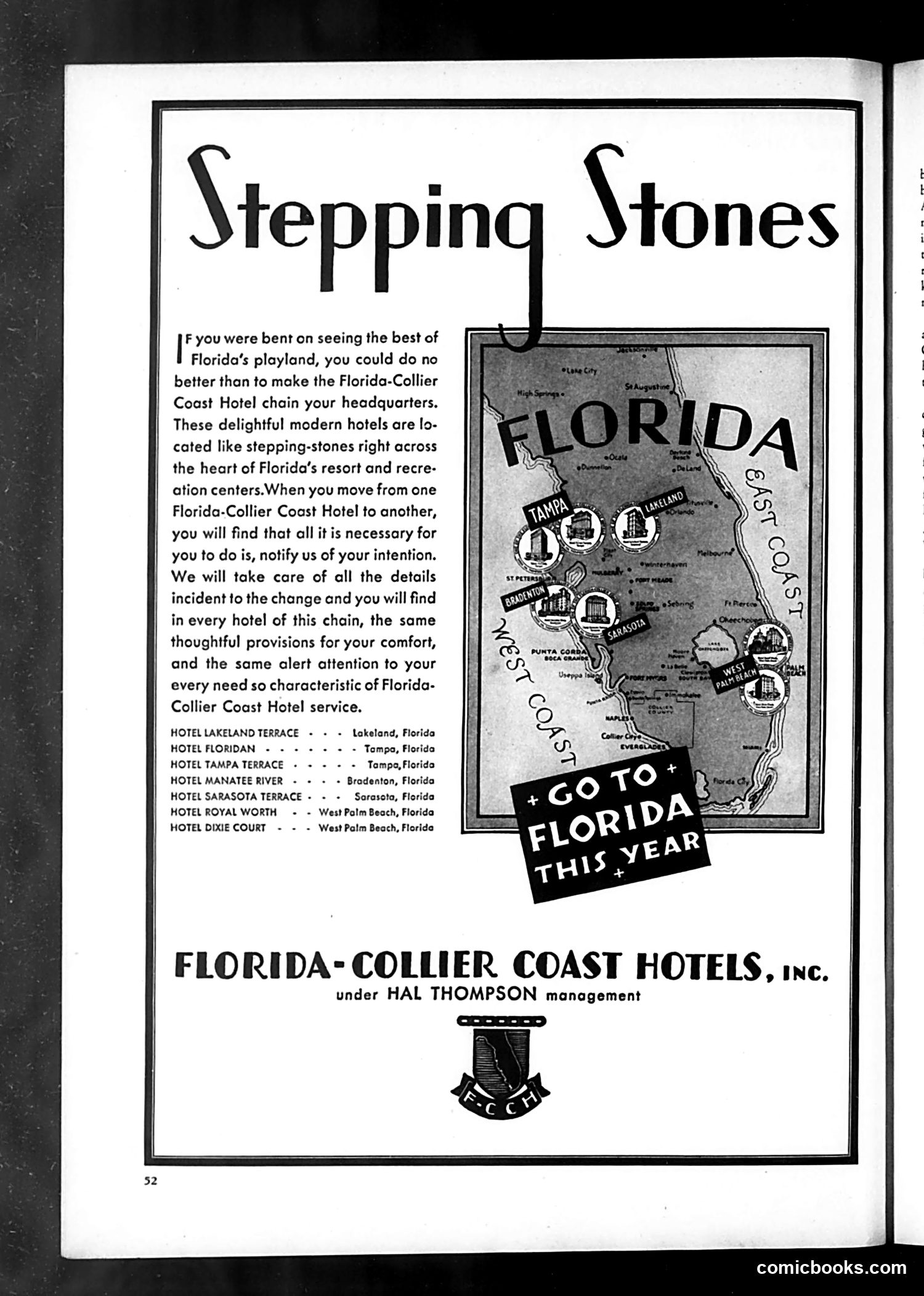
Analysis This is primarily a hotel chain advertisement, not a political cartoon or satire. It promotes the Florida-Collier Coast Hotels, Inc., managed by Hal Thompson, featuring seven locations across Florida's west coast and central regions. The "Stepping Stones" metaphor describes hotels positioned strategically across Florida's resort areas, allowing tourists to move seamlessly between locations while the hotel chain handles logistics. The accompanying map shows hotel locations from Tampa and Lakeland down to the Naples/Punta Gorda area. The phrase "Go to Florida This Year" reflects post-Depression/wartime travel encouragement—likely from the 1930s-40s era based on typography and design style. This is essentially travel industry marketing rather than satire or commentary. The "stepping stones" concept emphasizes convenience and coordinated service across multiple properties, a novel hotel chain concept for that period.
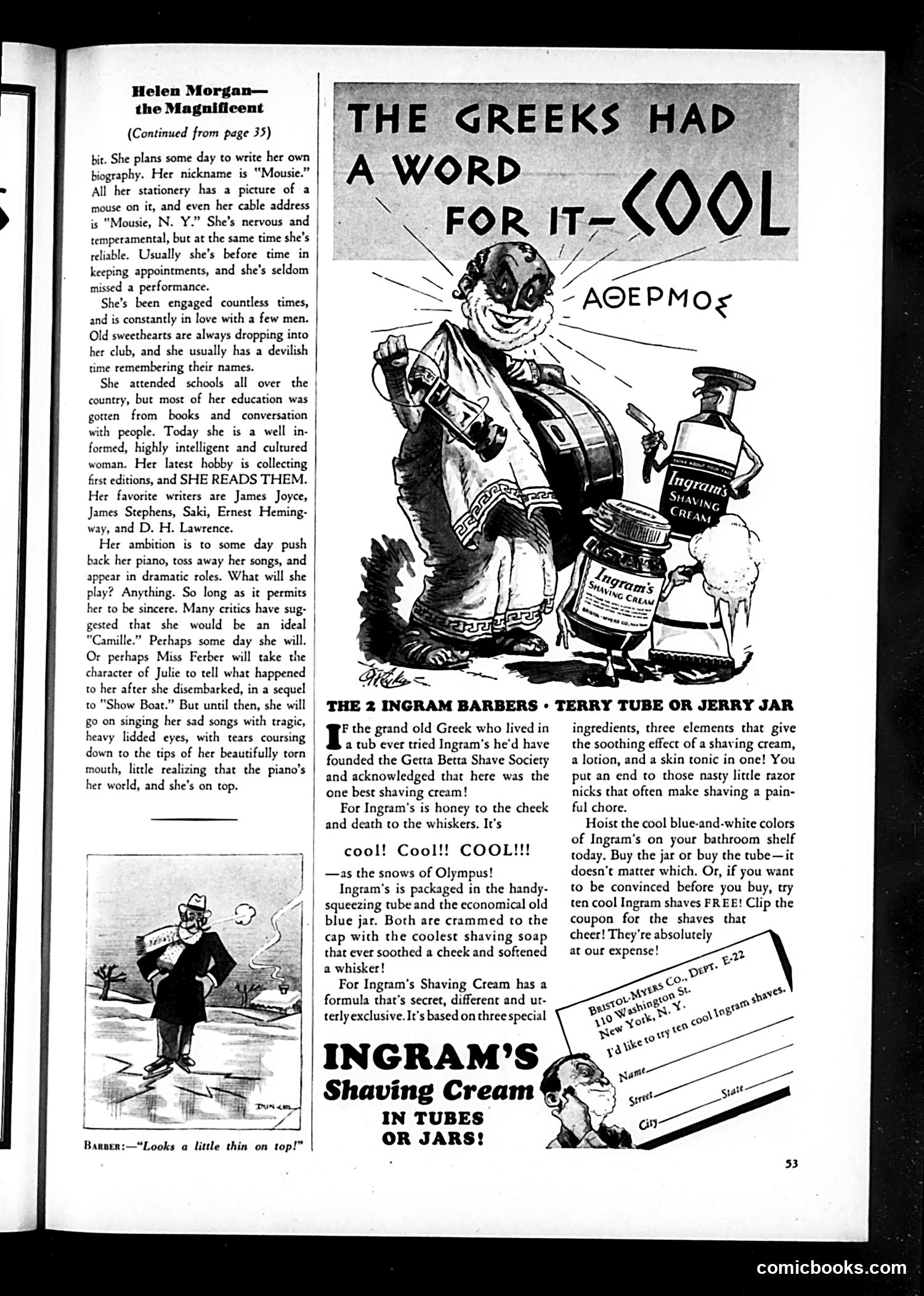
Analysis for Modern Readers This page contains two distinct elements: a biographical article about Helen Morgan (a 1920s-30s entertainer) and an advertisement for Ingram's Shaving Cream. The Helen Morgan Section: A profile of the popular singer/performer Morgan, known by the nickname "Mousie." The text describes her as cultured, well-read, temperamental but reliable, and perpetually romantic. It notes her ambition to transition from singing to dramatic acting. This is straightforward celebrity journalism typical of Life magazine's content. The Ingram's Advertisement: The advertisement uses a Greek philosopher (Diogenes, who famously lived in a tub) as a humorous classical reference. The joke plays on the Greek word "aōermos" (cool), claiming that if even this ancient ascetic had tried Ingram's shaving cream, he would have founded a "Getta Betta Shave Society." The small cartoon below shows a barber saying "Looks a little thin on top!"—a visual pun about hair loss, advertising the product's soothing properties for sensitive scalp skin.
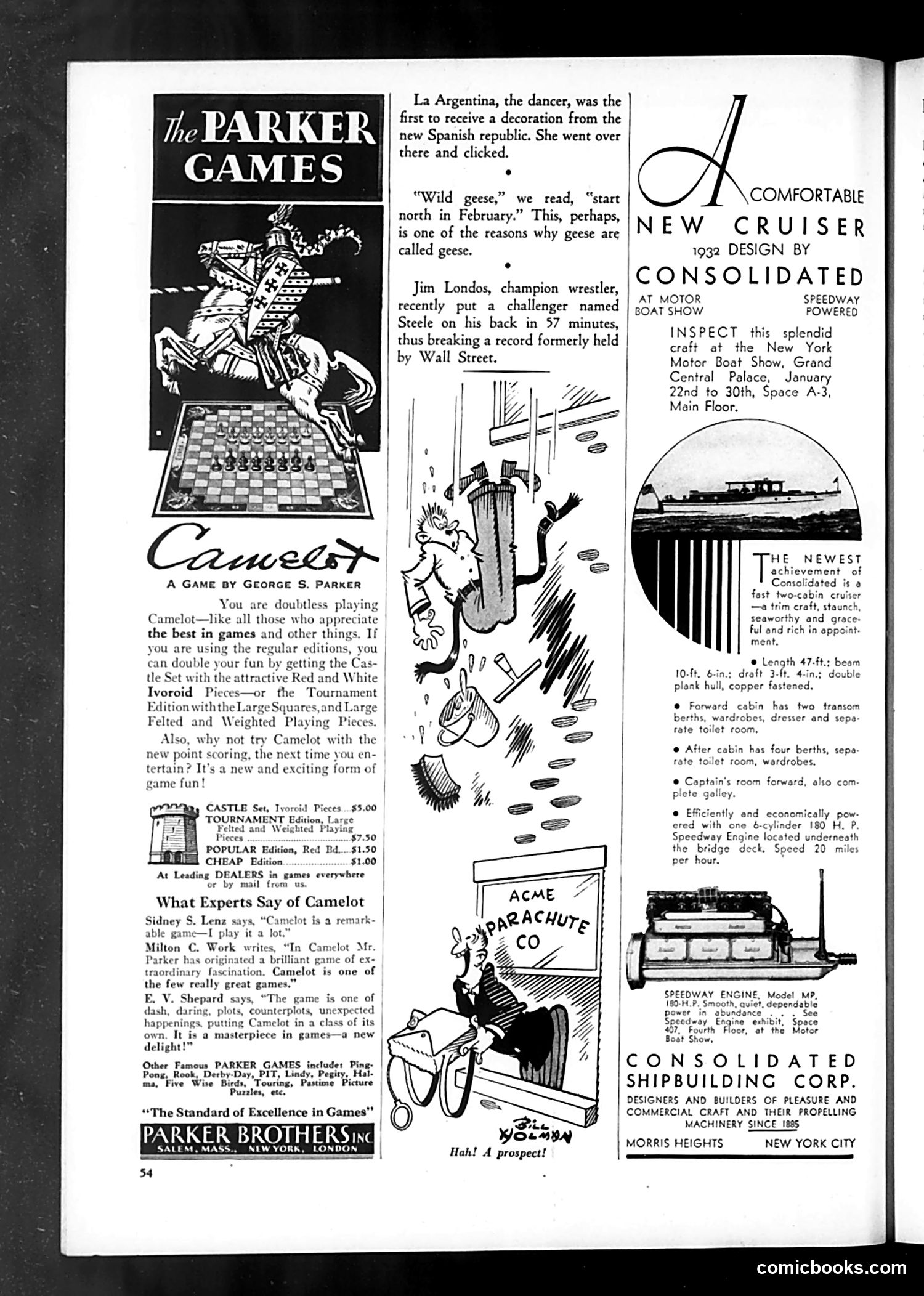
Content Analysis This page is primarily advertisements and product promotions rather than political satire. The dominant content includes: Parker Games Advertisement: Promotes "Camelot," a board game, with endorsements from gaming experts praising its strategic complexity and entertainment value. Brief Satirical Items: Three short, unrelated jokes appear mid-page: - A pun about "La Argentina" (a Spanish dancer) receiving a republic decoration - Wordplay connecting "wild geese" starting north in February to why they're called "geese" - A quip about wrestler Jim Londos breaking a Wall Street record—likely referencing the 1929 stock market crash and ongoing Depression, sardonically suggesting Wall Street's poor financial performance Boat Advertisements: The right side features luxury cruiser and marine engine advertisements for the 1932 Motor Boat Show. The page reflects 1930s consumer culture during the Depression, mixing light humor with advertisements for leisure products and games—suggesting entertainment as affordable escape from economic hardship.
Explanation for Modern Readers This page contains two distinct elements: a rebus-puzzle instruction article and corporate advertising. The Rebus Article explains how to solve word-picture puzzles—a popular 1920s parlor game. The example shown ("A DEMOCRACY IN INDUSTRY") uses visual puns: letters arranged alphabetically mean "all the letters," jam jars represent "jam," male figures mean "males," etc. These were considered intellectually entertaining, comparable to modern crosswords. The Bell System Advertisement is propaganda disguised as civic messaging. It claims the telephone company operates as a "democracy in industry" because profits are modest and ownership is distributed among 600,000 shareholders. This was corporate PR countering labor criticism and antitrust concerns—the company was actually a near-monopoly. The claim that "no one owns as much as one per cent" obscures concentrated power while celebrating modest employee wages as evidence of fairness. The juxtaposition suggests Life magazine published both entertainment and sponsored content promoting corporate benevolence narratives.
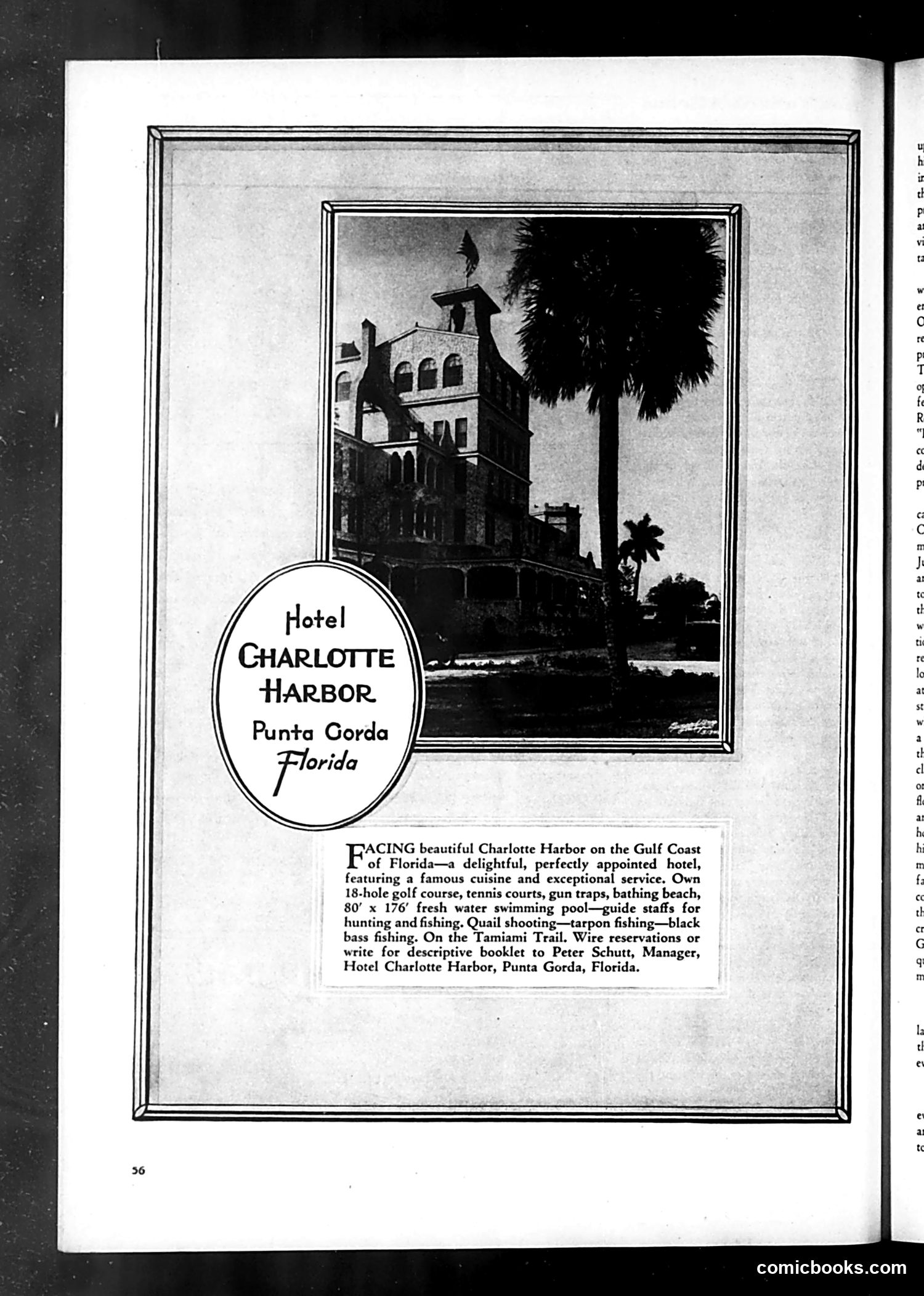
Analysis This page is not a cartoon or satire—it's a hotel advertisement. The Hotel Charlotte Harbor in Punta Corda, Florida is promoting itself as a leisure destination for wealthy tourists. The dramatic photograph shows the hotel's tower silhouetted against palm trees on Florida's Gulf Coast. The text emphasizes luxury amenities: an 18-hole golf course, tennis, swimming pool, and recreational activities like hunting, fishing, and quail shooting. It mentions the "famous cuisine and exceptional service," positioning the hotel as an upscale resort. The contact information directs inquiries to the manager, Peter Schutt. This represents early-20th-century American tourism marketing to affluent visitors seeking winter leisure in Florida—then an emerging destination for the wealthy.
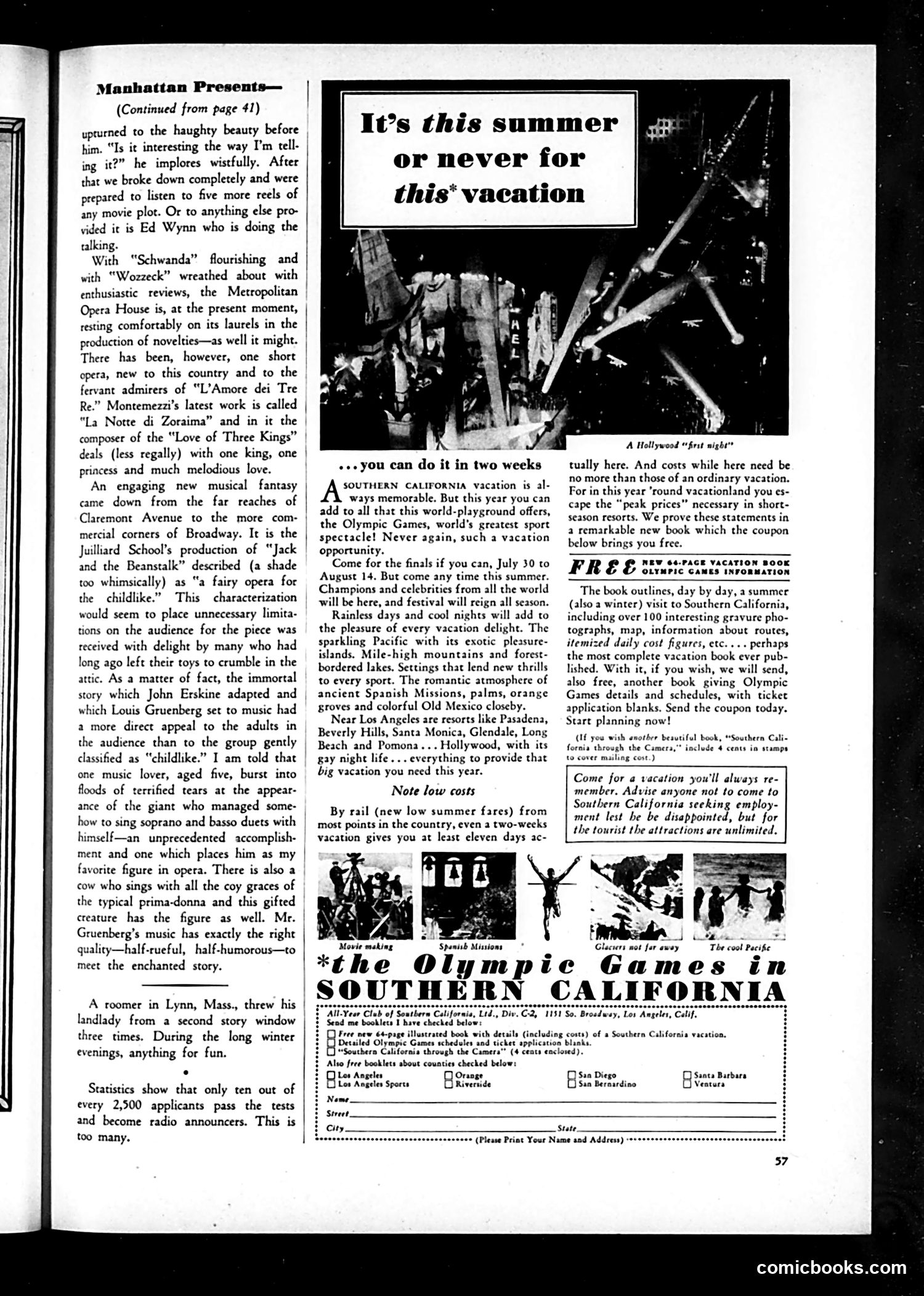
Content Analysis: Life Magazine Page 57 This page combines entertainment commentary with vacation advertising. The Editorial Content discusses Manhattan theater and opera, including Ed Wynn's performance style, Metropolitan Opera productions ("Schwanda," "Wozzeck"), and Juilliard School's "Jack and the Beanstalk" opera adaptation. The tone is lighthearted cultural criticism—praising Wynn's engaging delivery and the unexpected appeal of children's material to adult audiences. The Satire appears in the closing line: statistics showing only 1 in 250 radio announcer applicants succeed, followed by the quip "This is too many"—a joke suggesting radio announcers are overrepresented or mediocre. The Large Advertisement (right side) promotes Southern California vacations timed with the Olympic Games (July 30-August 14). It emphasizes affordable rail travel, coastal attractions, and celebrity presence—classic 1930s tourism marketing targeting Depression-era vacationers seeking affordable leisure. The page reflects pre-war American culture: theater criticism, radio's emerging prominence, and tourism promotion during economically constrained times.
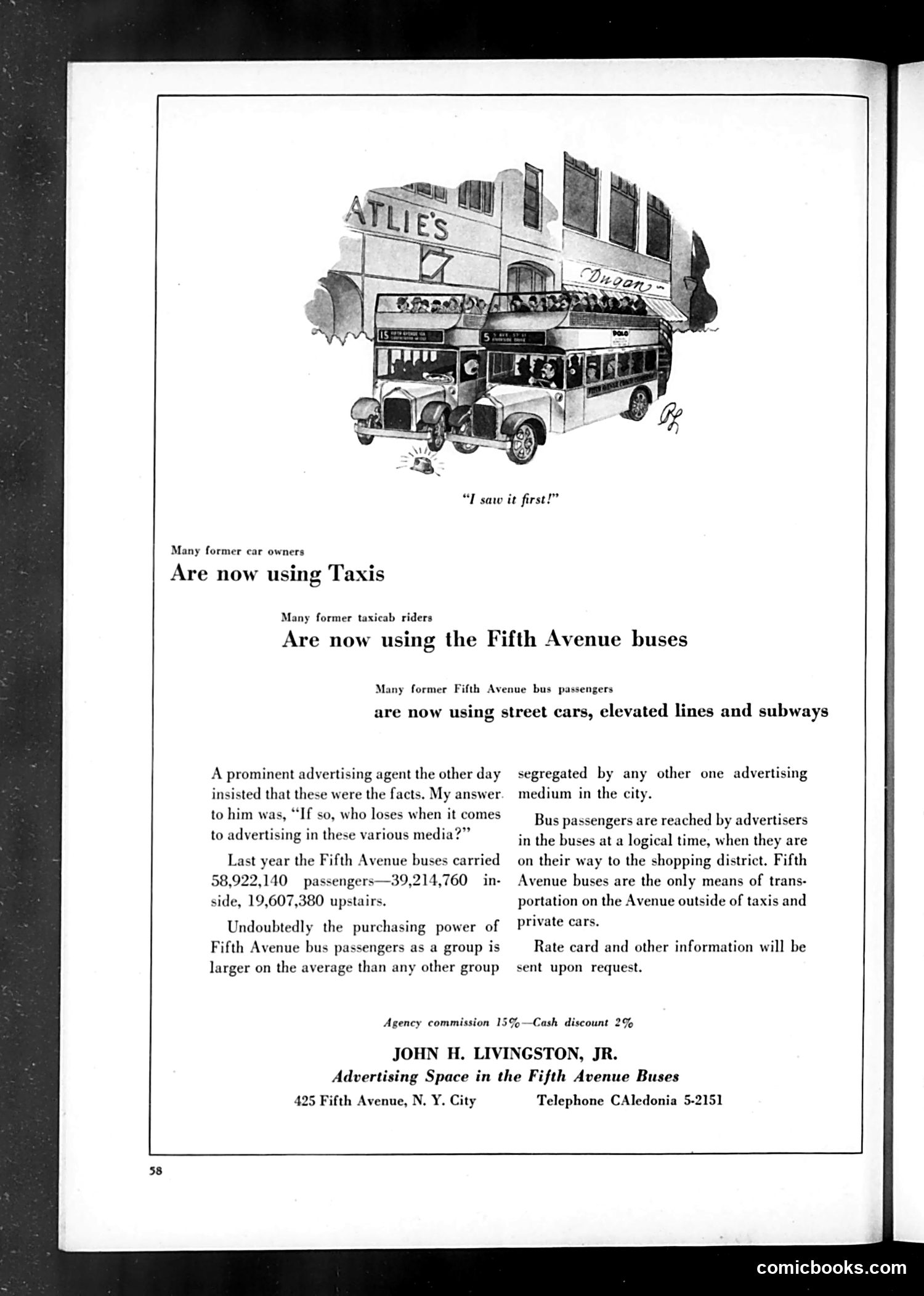
Analysis This is primarily an advertisement for Fifth Avenue bus advertising space, not satirical content. The cartoon illustrates a humorous chain-reaction argument about urban transportation modes. The sketch shows vehicles stacked together (bus, cars, trolley) with the caption "I saw it first!" — a playful visual joke suggesting competition between transportation types. The text below uses this as a rhetorical setup: the author claims that car owners switched to taxis, taxi riders switched to buses, and bus riders switched to subways/street cars — implying constant migration between modes. The advertiser (John H. Livingston, Jr.) then counters this logic by arguing that despite this competition, Fifth Avenue buses reached nearly 59 million passengers annually, making them an excellent advertising medium. He emphasizes that bus riders are wealthy shoppers captured at the optimal moment — traveling to shopping districts. The "who loses?" question is rhetorical: nobody loses advertising value on the buses, he argues, because their ridership numbers and demographic quality are superior. This reflects Depression-era urban transportation economics and advertising competition.
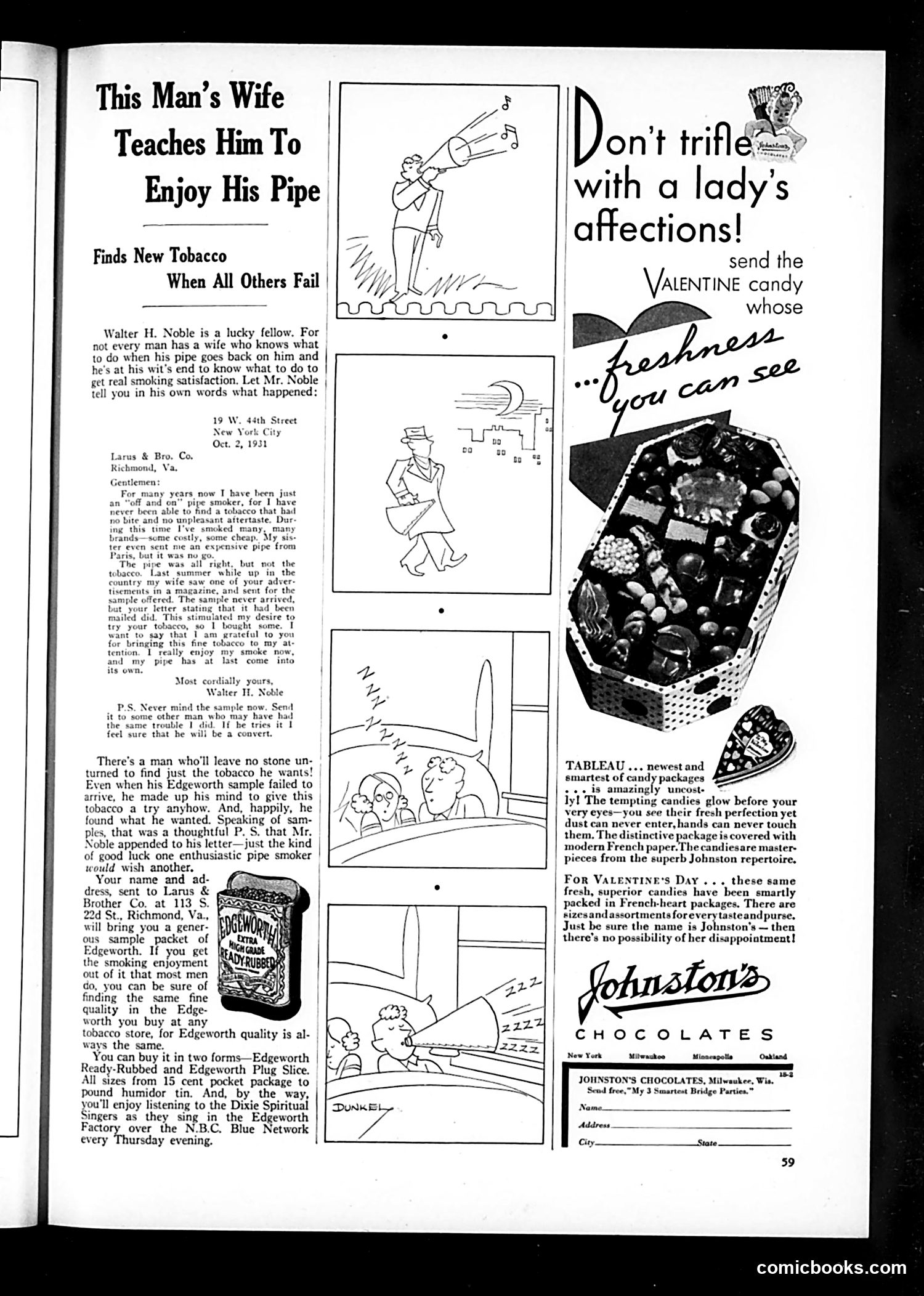
Analysis of Life Magazine Page 59 This page contains two distinct advertisements from the 1920s: Left side: Edgeworth Tobacco ad presents a testimonial letter from Walter H. Noble praising pipe tobacco. His wife solved his smoking frustration by finding Edgeworth brand, which he claims has no bite or aftertaste. The narrative frames the wife as a problem-solver attending to her husband's comfort—a common domestic trope of the era. The accompanying cartoons show humorous pipe-smoking scenarios. Right side: Johnston's Chocolates Valentine's Day ad warns men not to "trifle with a lady's affections" and recommends sending Johnston's chocolates as the safe romantic gesture. The "Tableau" candy package is depicted as pristine and untouched—emphasizing freshness and quality suitable for wooing. This reflects period gender conventions where men purchased luxury goods to demonstrate romantic devotion. Both ads appeal to early-20th-century gender roles: wives manage household comfort; men prove affection through consumption.
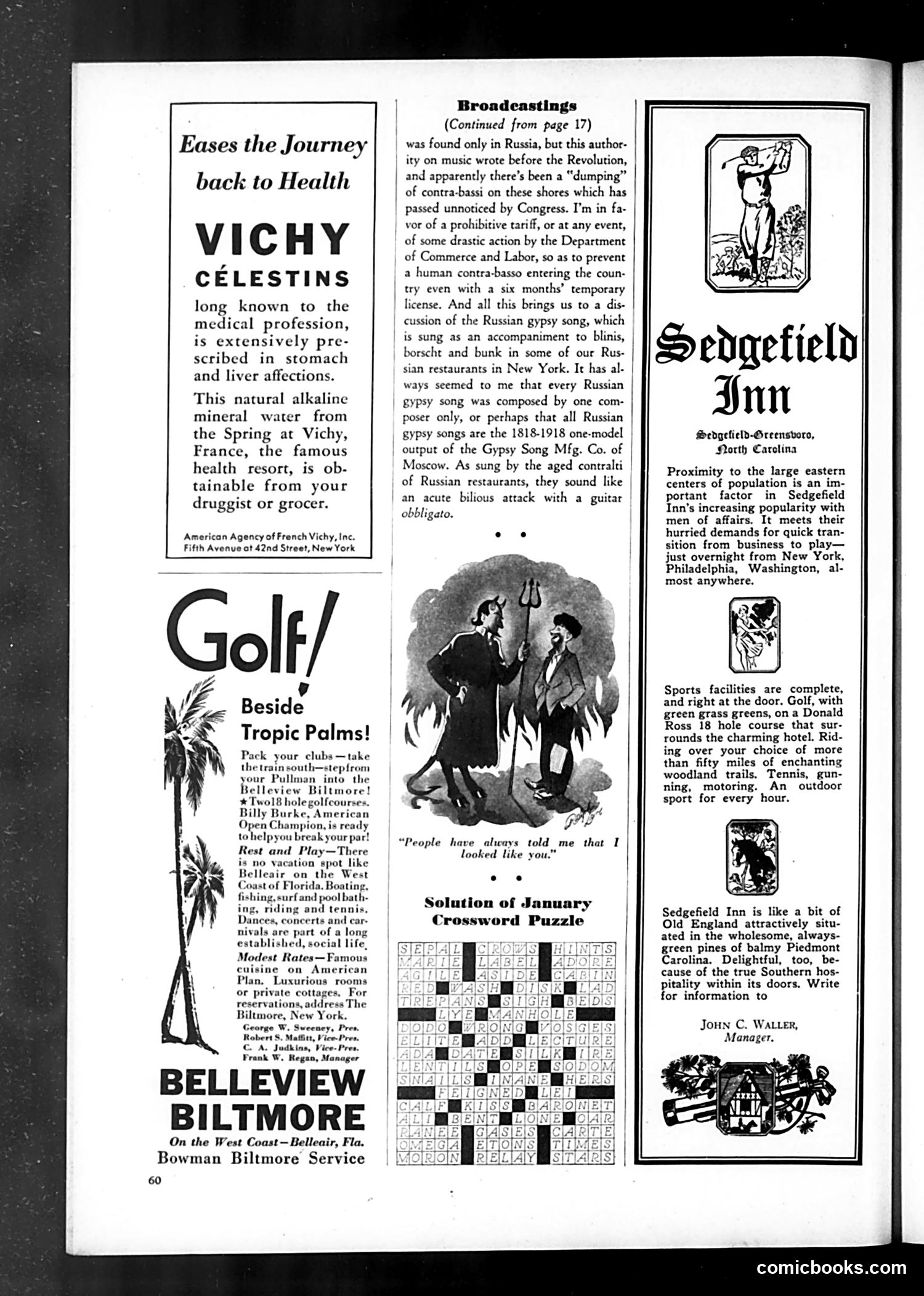
Page 60: Advertisements and Social Commentary This page is primarily advertisements for luxury hotels and health products, typical of Life magazine's revenue model. However, the "Broadcastings" column (continued from page 17) contains satirical commentary on Russian culture infiltrating America. The writer humorously complains about Russian contra-bass instruments and gypsy songs appearing in New York Russian restaurants, mock-seriously proposing tariffs to prevent their "dumping" on American shores. The satire mocks both protectionist trade politics and the perceived homogeneity of Russian gypsy music—claiming all such songs sound identical, as if manufactured by a single "Gypsy Song Mfg. Co. of Moscow." The cartoon depicts two figures (appears to be devils or demons) with the caption "People have always told me that I looked like you"—likely satirizing mistaken identity or doppelgänger humor, though context is unclear. The ads promote upper-class leisure: Florida golf resorts, mineral water, and Southern inns—reflecting 1920s affluence and travel culture.
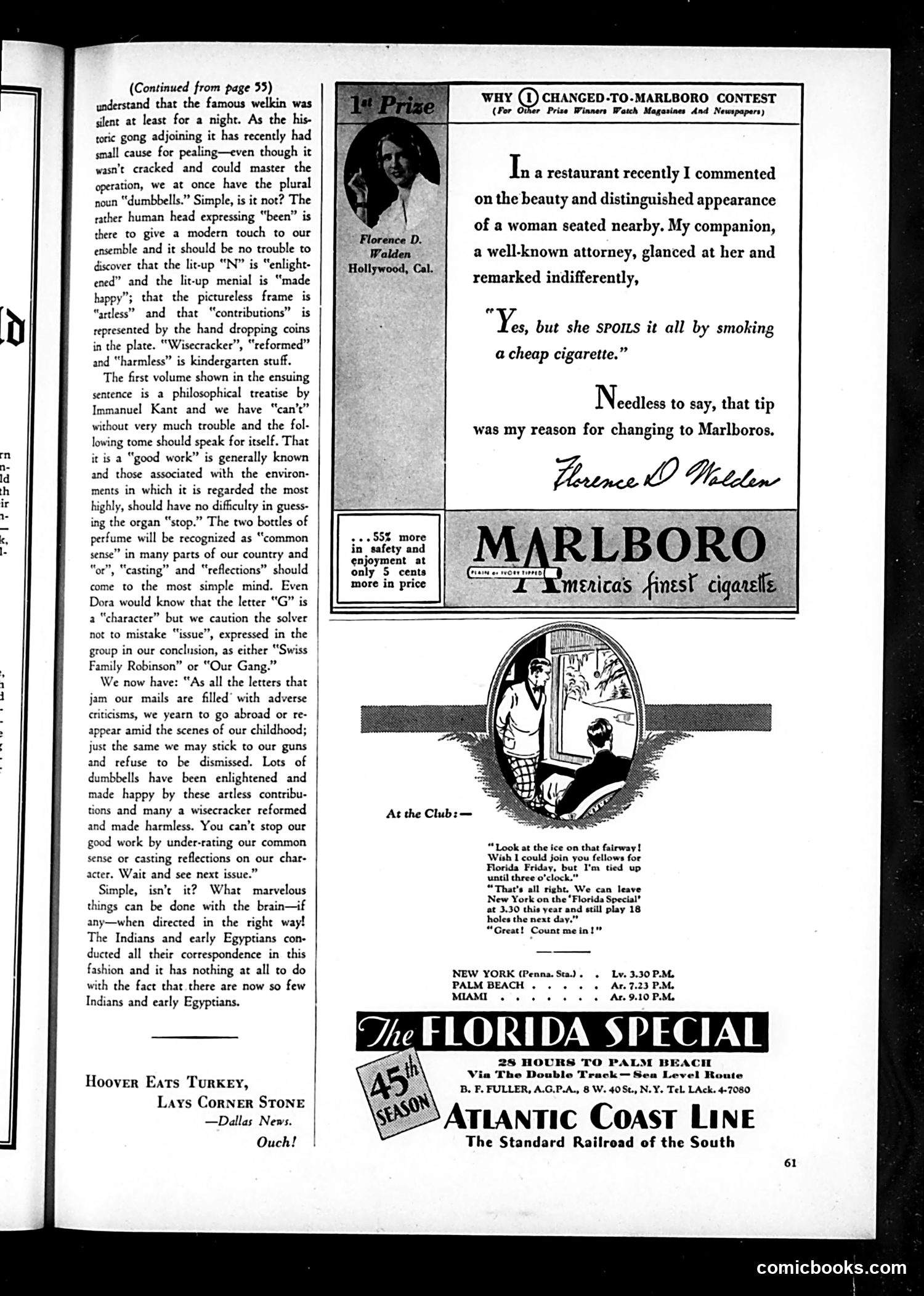
Analysis of Life Magazine Page This page contains two distinct pieces of content: The Wordplay Puzzle The lengthy text describes an elaborate rebus or visual word puzzle—a popular early-20th-century entertainment form. The author explains how various visual elements (dumbbells, a lit-up "N," coins in a plate, perfume bottles, etc.) combine to spell out a complete philosophical message about persistence and good work. The puzzle concludes with a joke mocking Native Americans and ancient Egyptians, suggesting they used this indirect communication method, which "has nothing at all to do with the fact that there are now so few Indians and early Egyptians"—a dark, period-typical joke. Advertisements The page features two ads: a Marlboro cigarette contest where a woman's beauty is "spoiled" by smoking cheap cigarettes (she switches to Marlboro), and an Atlantic Coast Line railroad advertisement promoting the "Florida Special" train service with departure/arrival times. The puzzle reflects Life's era as a sophisticated humor magazine for educated readers who enjoyed complex wordplay and lateral thinking.
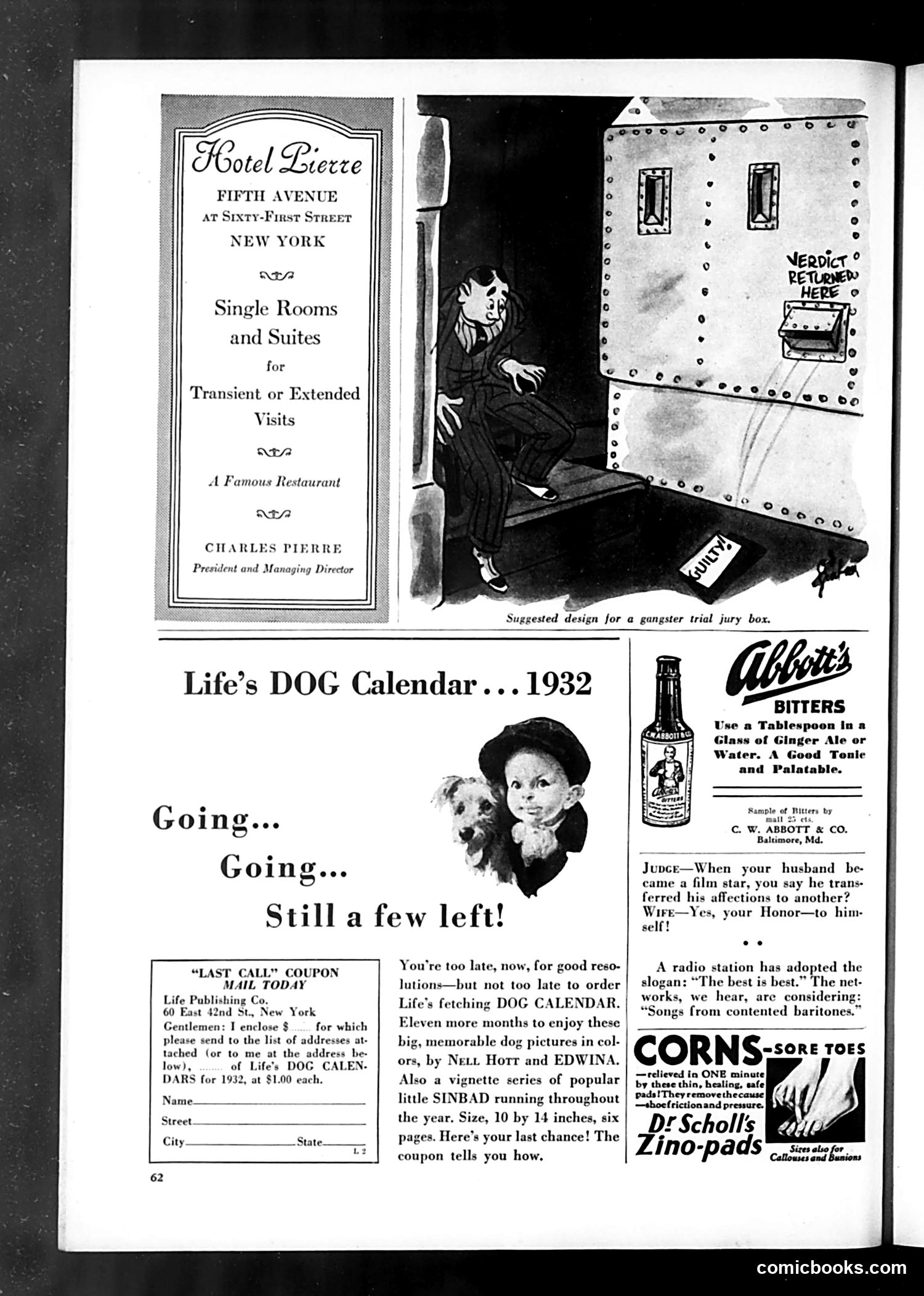
Analysis of Life Magazine Page (1932) This page is primarily advertising and promotional content rather than political satire. The main cartoon—a woman sitting in what appears to be a riveted metal box labeled "CORONER" with text reading "VERDICT RETURNED HERE"—is a visual gag about a gangster trial jury box, likely referencing the contemporary prevalence of organized crime trials during Prohibition. The page features multiple product advertisements (Abbott's Bitters, Dr. Scholl's corn pads) and a hotel advertisement for the Hotel Pierre. A secondary humor piece presents a judge-and-wife joke about a man becoming a film star. The most substantial content is a promotional push for Life's DOG Calendar for 1932, featuring illustrations by Nell Hott and Edwina, with a cartoon character named Sinbad. The "Going...Going...Still a few left!" headline creates urgency for calendar orders. The page reflects 1932 consumer culture and light entertainment humor typical of Life magazine's format.
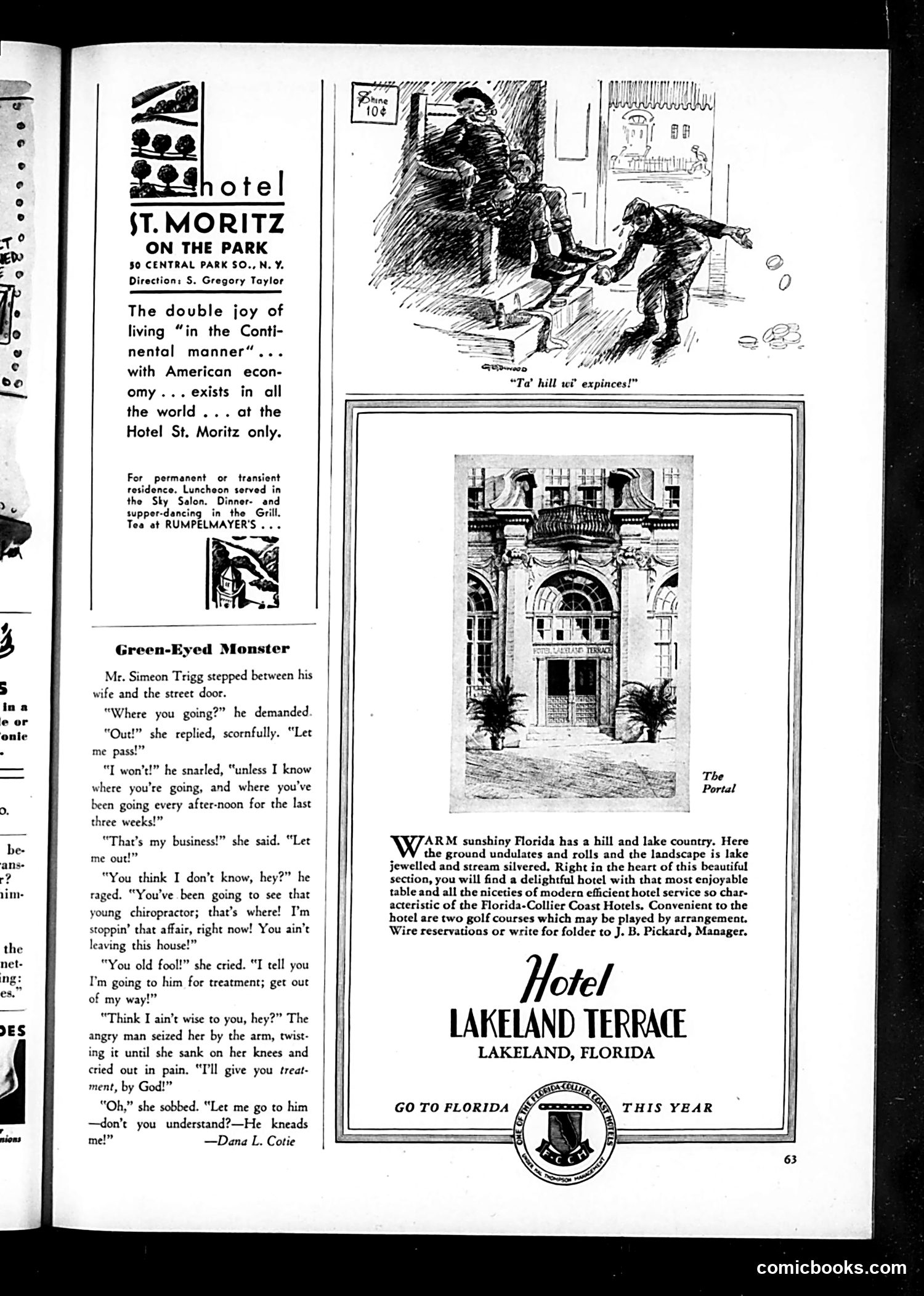
Political-Social Context Analysis This page contains two distinct elements: The "Green-Eyed Monster" Comic Story (left): A domestic dispute narrative where Mr. Simeon Trigg becomes jealously enraged upon discovering his wife visits a young chiropractor for treatment. The story satirizes masculine jealousy and controlling behavior—the husband assumes infidelity despite her innocent explanation. The punchline depends on the double meaning of "kneads" (the chiropractor's therapeutic technique) versus the husband's violent "treatment." This reflects early 20th-century anxieties about women's independence and changing gender dynamics. Hotel Advertisements (right): The remainder is commercial advertising for luxury hotels—St. Moritz in New York and Lakeland Terrace in Florida—promoting upscale leisure travel and "continental" living with "American economy." The juxtaposition suggests this Life magazine page mixed satirical social commentary about domestic life with aspirational advertising, targeting affluent readers.
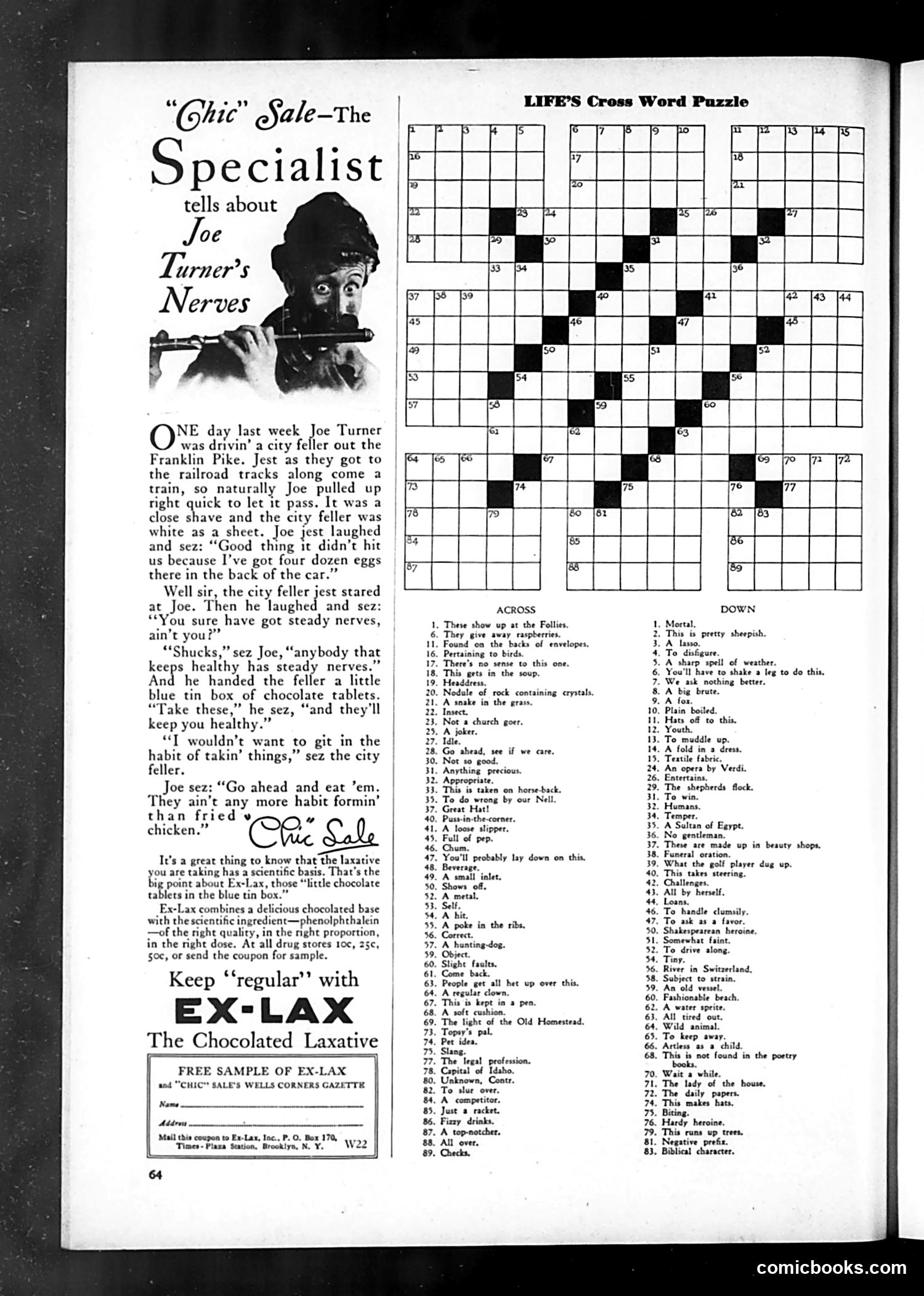
"Chic" Sale's Joe Turner Story This page features a humorous anecdotal story by "Chic" Sale, a popular American humorist known for rural/folksy humor. The narrative describes Joe Turner, a country driver, who nearly hits a train while transporting eggs. When a nervous city passenger expresses amazement at Turner's calm nerves, Turner credits his composure to eating Ex-Lax chocolate tablets and offers some to the feller. The joke plays on the double meaning: the city man initially misinterprets Turner's claim about "steady nerves" as a health benefit, when Turner is actually promoting a laxative. The humor derives from the rural-versus-urban contrast and the awkwardness of casually discussing digestive health. The story serves as advertising copy for Ex-Lax, a chocolated laxative product. The crossword puzzle and coupon below are typical Life magazine features from this era.
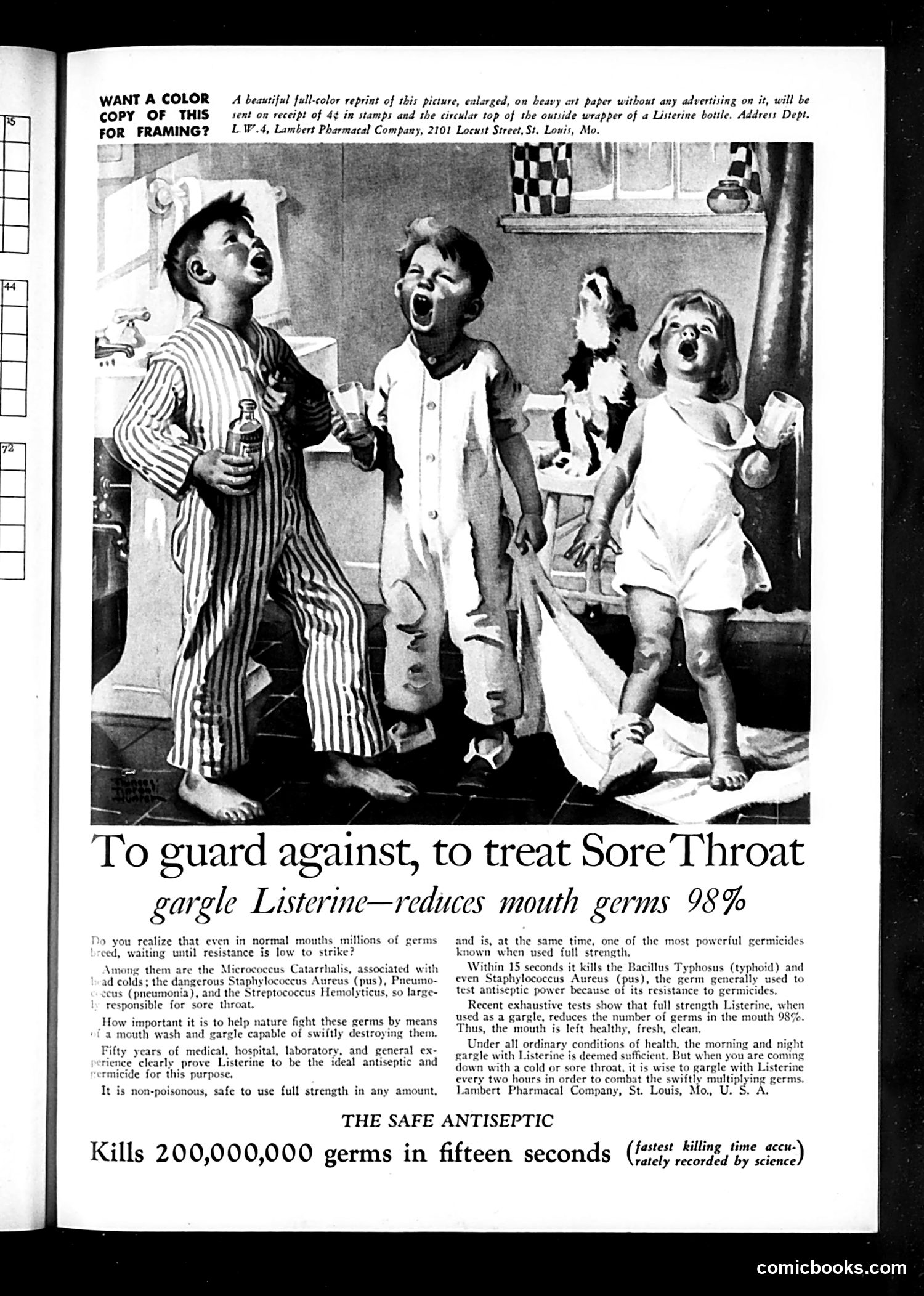
Analysis for Modern Readers This is a Listerine advertisement, not political satire. The page uses fear-based marketing common in early 20th-century advertising. The image shows children with exaggerated, distressed expressions—mouths wide open—to dramatize sore throats and illness. The ad claims Listerine kills 200 million germs in 15 seconds and reduces mouth germs by 98%. What's notable historically: The advertisement lists specific bacteria by scientific name, lending false authority. It exploits parental anxiety about children's health. The offer of a color print for 4¢ and bottle-wrapper tops was typical mail-in promotion tactics of the era. For modern readers: This represents pre-FDA regulation medicine advertising, when companies made aggressive germicide claims without today's required substantiation. The emotional manipulation through children's frightened faces, combined with pseudo-scientific language, exemplifies advertising practices that would now face regulatory scrutiny.
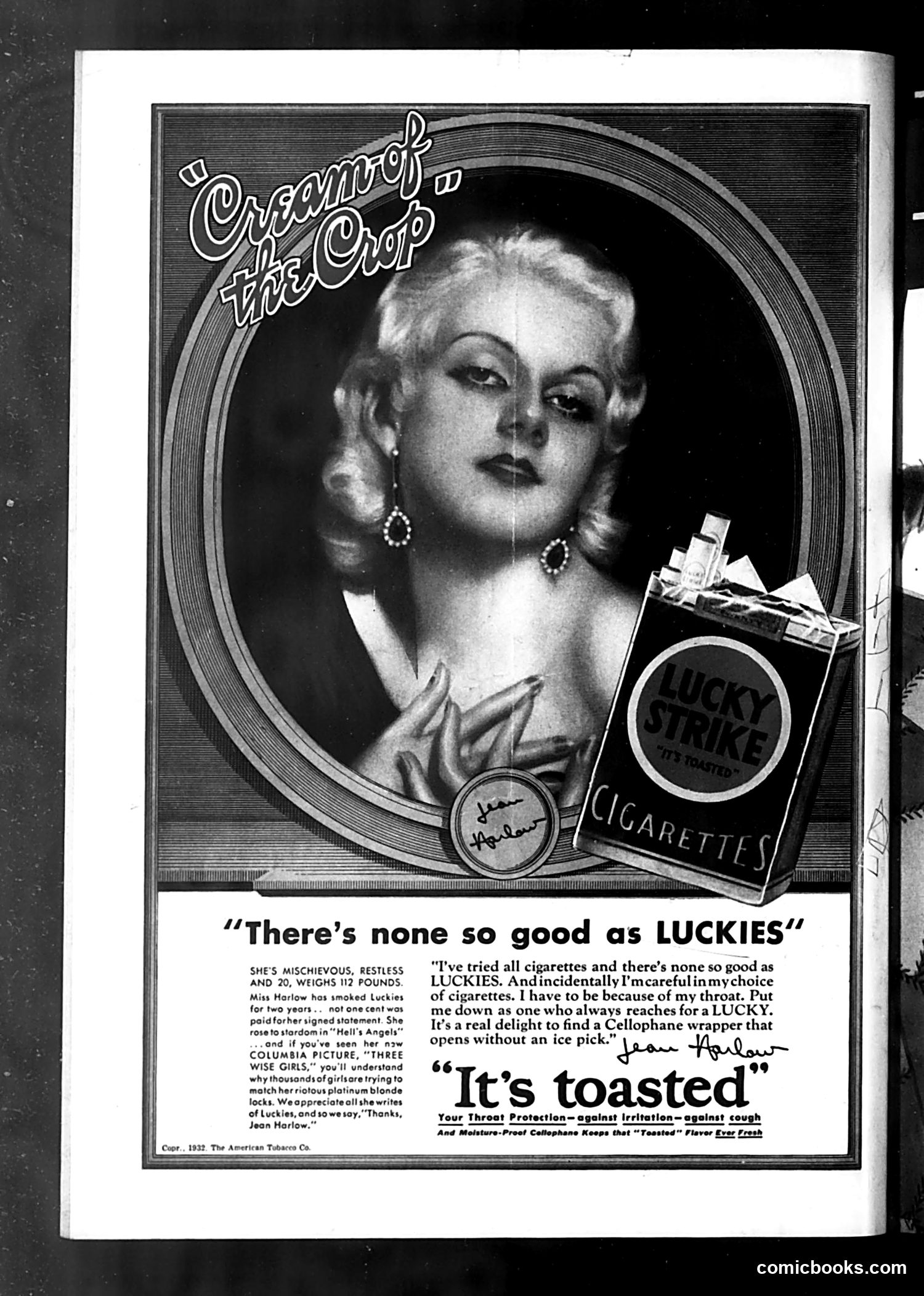
Analysis This is a cigarette advertisement, not satire or political content. It features actress Jean Harlow endorsing Lucky Strike cigarettes in 1932. The pitch: Harlow claims she's "careful" about cigarettes due to her throat and prefers Luckies. The ad emphasizes the product's "toasted" process and cellophane wrapper that "opens without an ice pick"—a practical selling point addressing consumer frustration with packaging of the era. What's notable for modern readers: This represents pre-regulation tobacco advertising when celebrities could publicly endorse cigarettes without legal restriction, and health warnings were absent. The ad explicitly links smoking to an attractive, glamorous movie star to influence consumer choice—a marketing tactic now prohibited. The tone treats cigarette smoking as a sophisticated, health-conscious choice rather than acknowledging any health risks. This reflects early-1930s advertising standards, before the surgeon general's warnings and restrictions on celebrity tobacco endorsements became law.