life
Life — March 1932
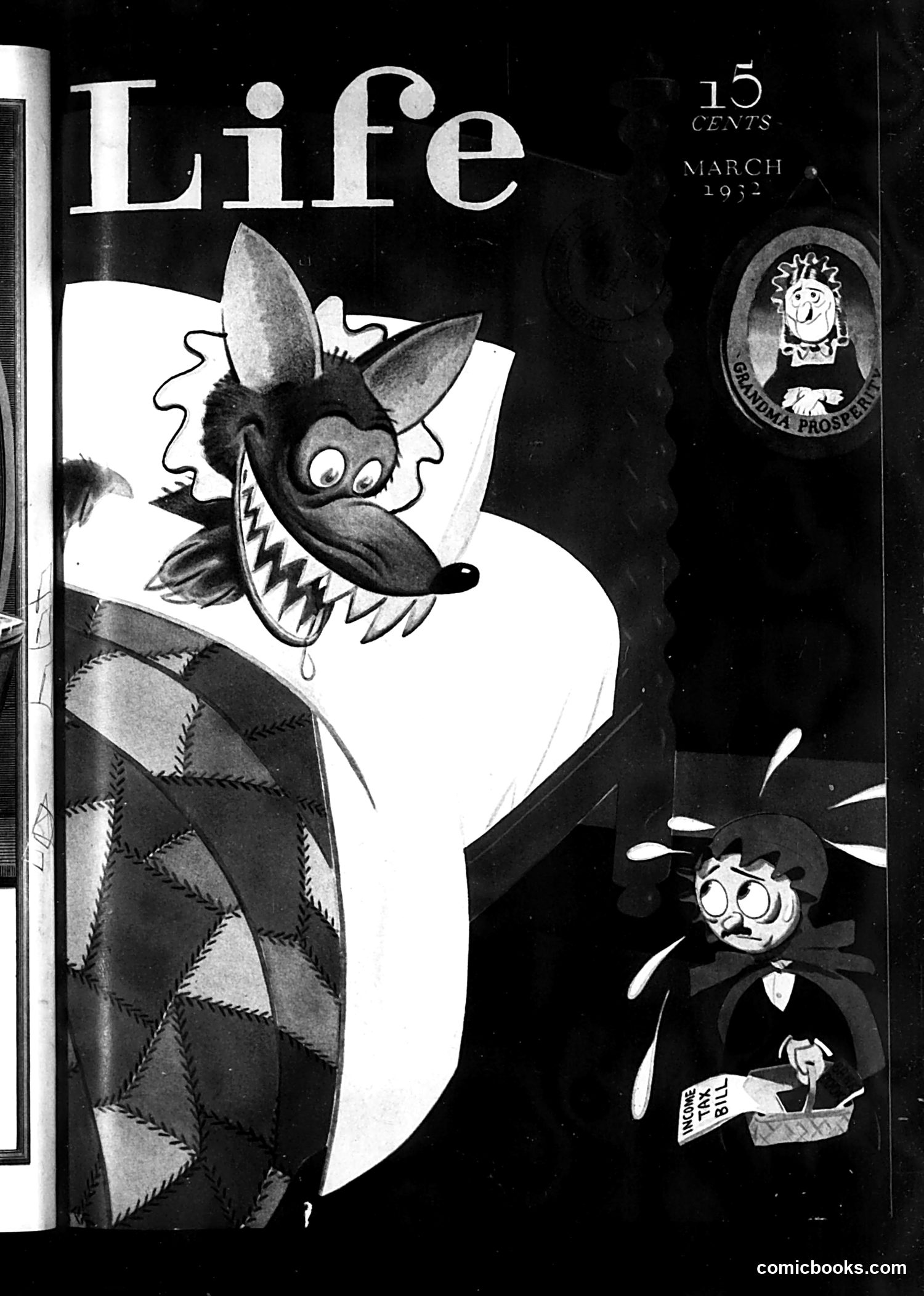
Life Magazine, March 1935 This is a magazine cover featuring grotesque caricatures typical of 1930s satirical humor. The large figure appears to be a menacing creature with exaggerated features—pointed ears, sharp teeth, and wild hair—depicted in a nightmarish or demonic style. A smaller, similarly styled character appears below, also rendered in grotesque fashion. The cover price is 15 cents, dated March 1935. Without additional text identifying specific targets, the exact political or social references remain unclear. However, the exaggerated, monstrous depictions suggest this may satirize contemporary political figures or social anxieties of the Depression-era period. The style is consistent with Life's known use of caricature for social and political commentary, though the specific subjects cannot be definitively identified from the visual alone.
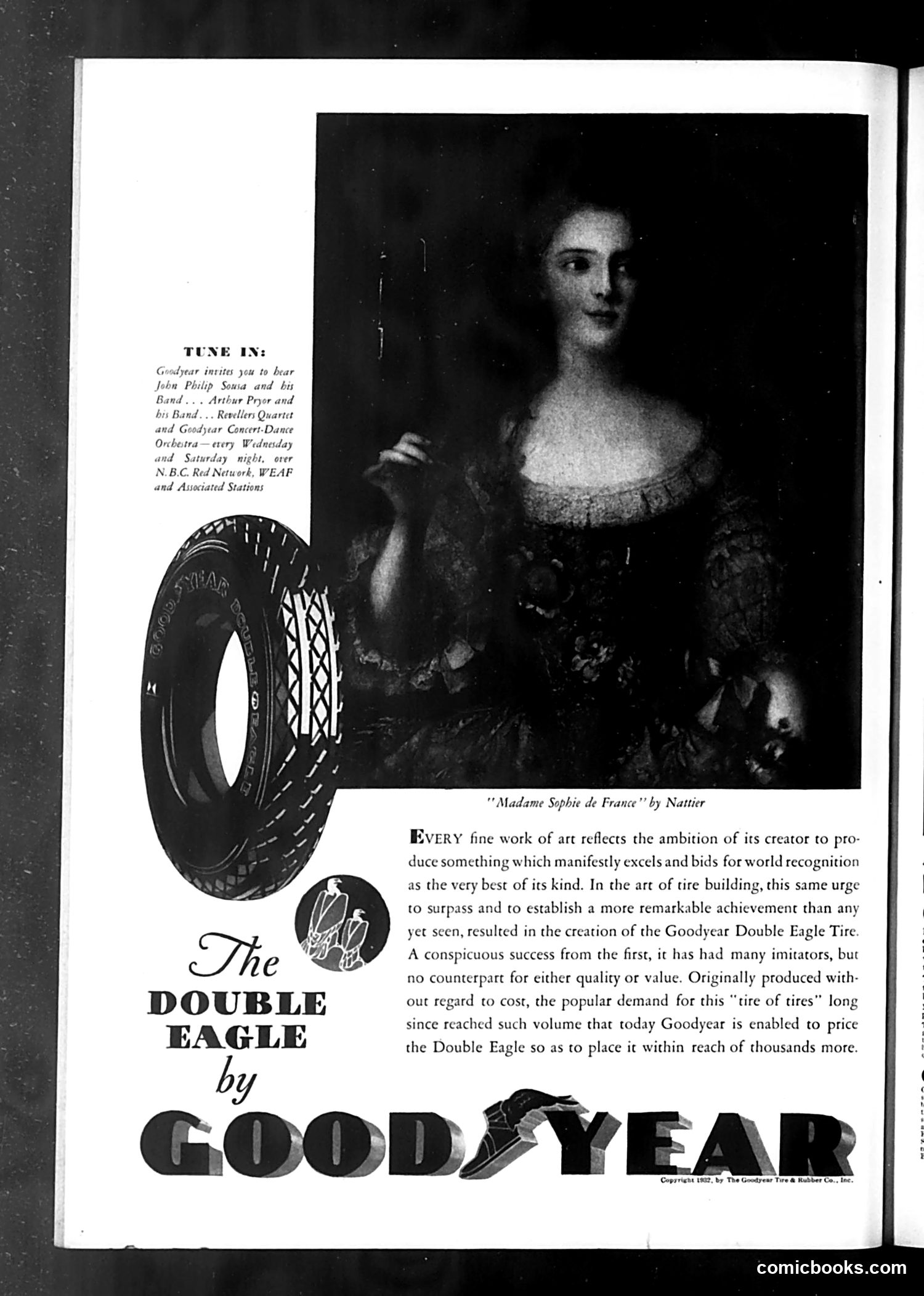
This Page Analysis This is primarily a Goodyear tire advertisement, not political satire. The page features: Visual Elements: - A classical portrait labeled "Madame Sophie de France" by Nattier (an 18th-century French painter) - A Goodyear Double Eagle tire with tread pattern visible - Large text promoting Goodyear's product The Advertisement's Strategy: The ad pairs fine art with a tire to suggest that Goodyear tires represent the same ambition for excellence as masterpiece paintings. The copy explicitly compares the tire's creation to artistic achievement, claiming it's "a conspicuous success from the first" with "many imitators, but no counterpart." Context for Modern Readers: This reflects 1920s-30s advertising strategy: associating commercial products with classical culture and sophistication to appeal to affluent consumers. The use of high art imagery was meant to elevate the tire from mundane commodity to symbol of quality and refinement.
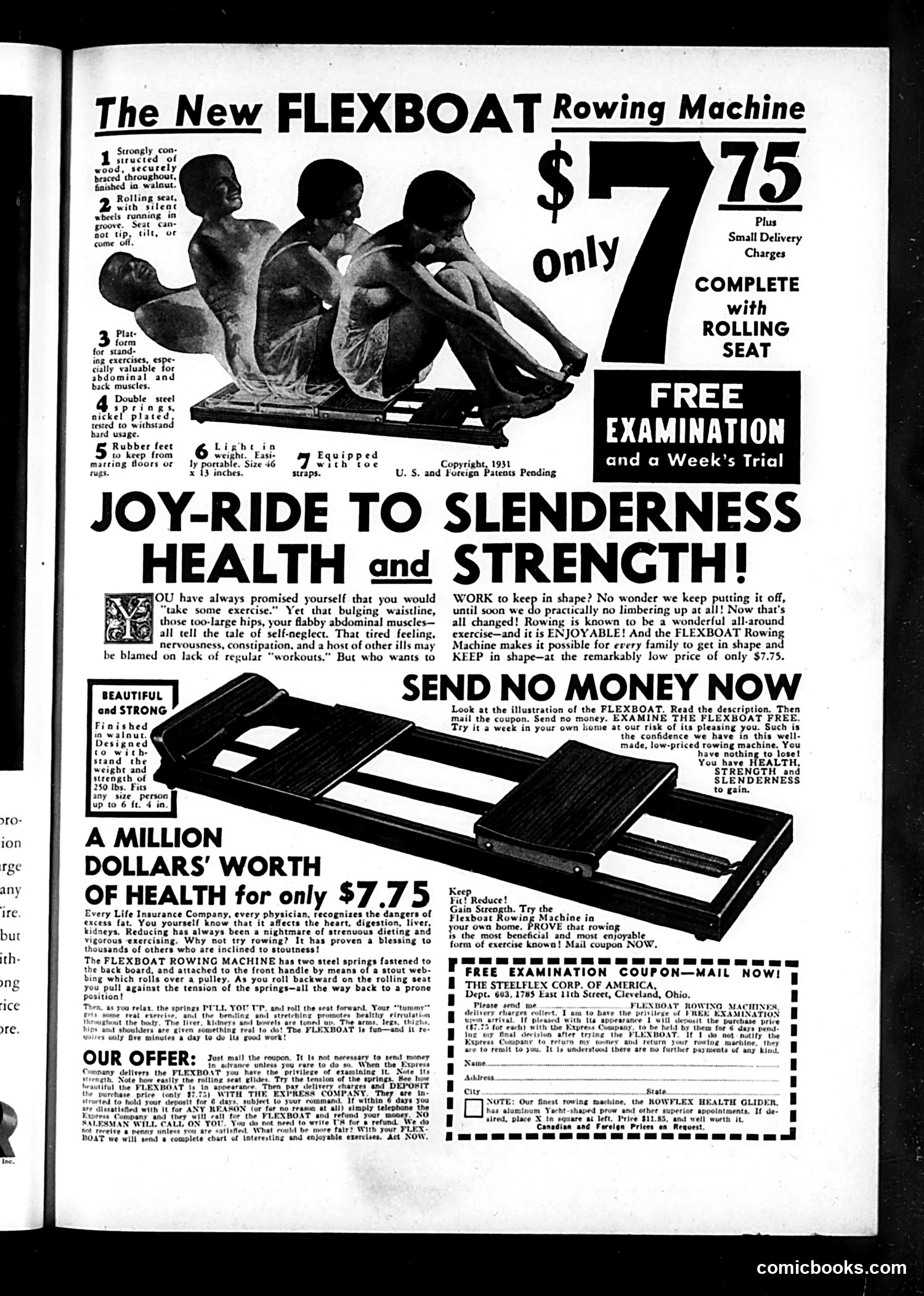
Analysis This is a vintage advertisement, not a cartoon or satire. It promotes "The New Flexboat Rowing Machine," priced at $7.75 with a rolling seat, marketed in 1931 (copyright noted). The ad uses three shirtless men demonstrating the rowing motion to appeal to health-conscious consumers. The headline "Joy-Ride to Slenderness Health and Strength!" reflects 1930s fitness culture emphasizing weight loss and physical conditioning. Key selling points include: - No money required upfront ("Send No Money Now") - Free examination and one-week trial - Claims of providing "a million dollars' worth of health" - Appeals to busy people avoiding gym membership The language ("those too-large tips," "flabby abdominal muscles") targets Depression-era anxieties about appearance and health. This represents early direct-mail marketing for home exercise equipment.
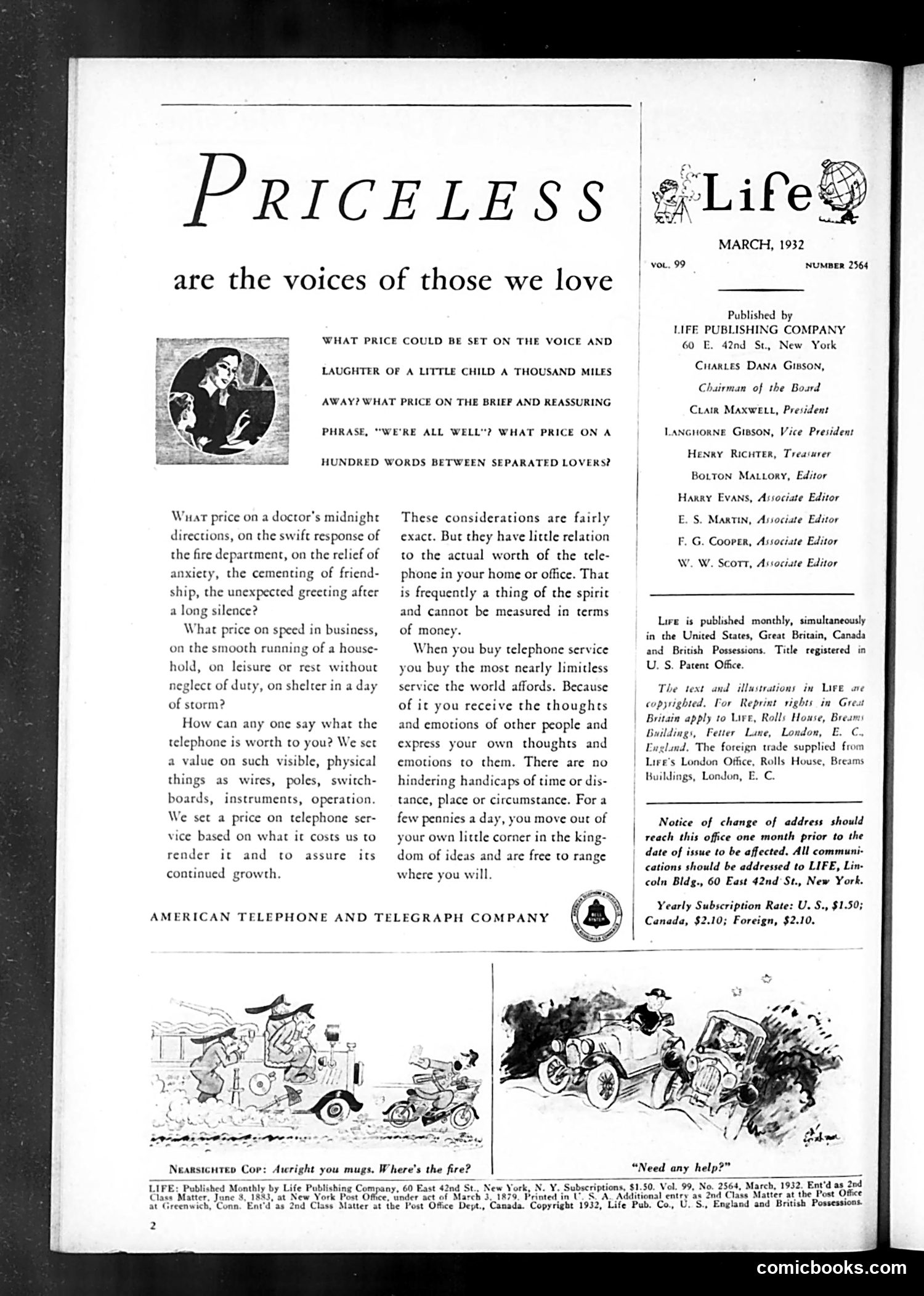
Analysis of Life Magazine, March 1932 This page is primarily an advertisement for American Telephone and Telegraph Company promoting telephone service value. The main text argues that while phones have measurable costs, their true worth—connecting loved ones, enabling business, providing emergency response—is "priceless" and cannot be measured in monetary terms alone. At the bottom are two cartoon jokes: 1. "Nearsighted Cop": A police officer asks "Alright you mugs, Where's the fire?"—apparently unable to see an obvious accident or disaster scene before him. 2. "Need any help?": Depicts a chaotic car accident or collision scene, captioned with this sarcastic question. Both cartoons use visual humor common to 1930s Life magazine's satirical style, playing on obvious situations treated as if invisible or in need of stating the obvious.
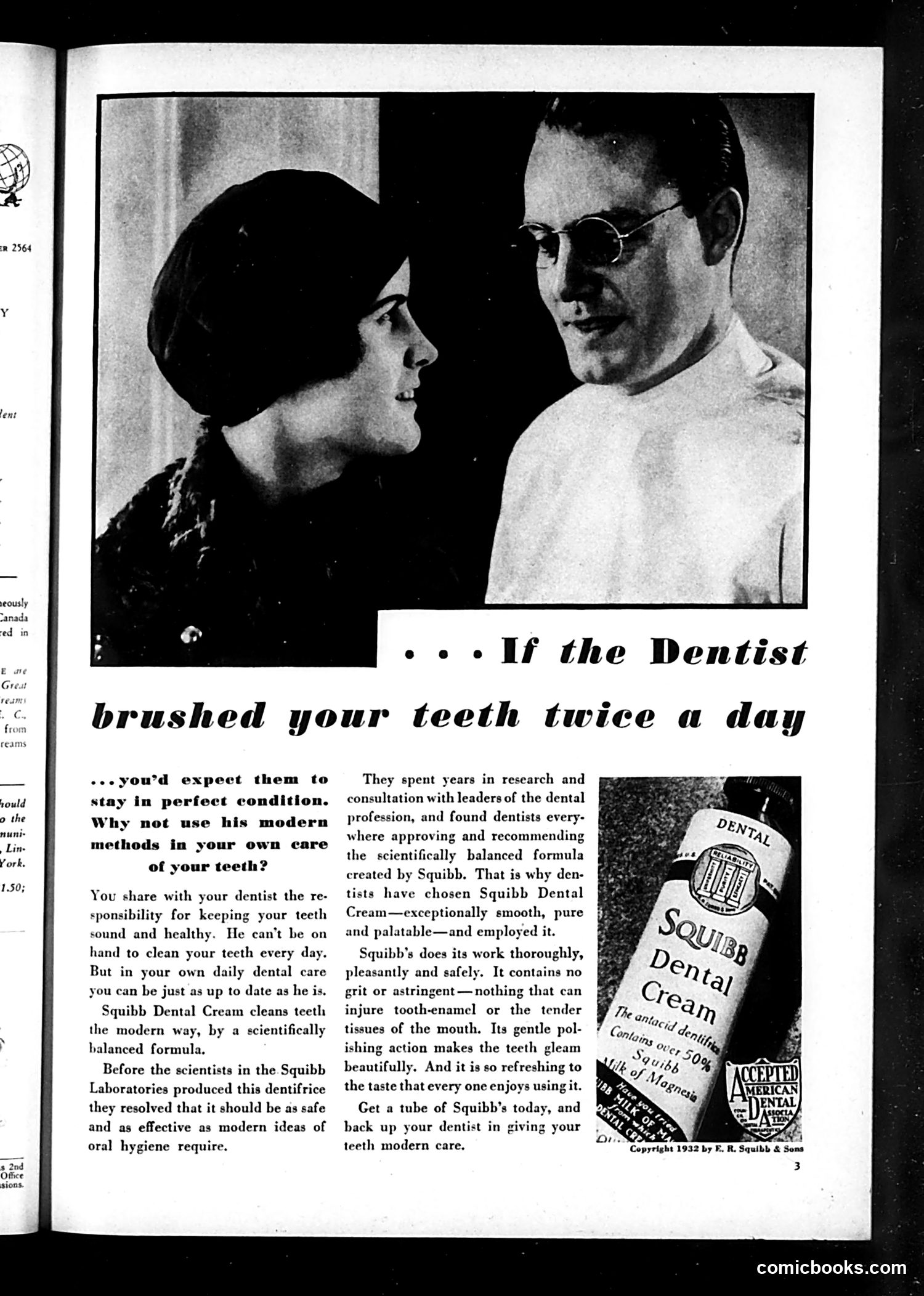
Analysis This page is primarily a dental product advertisement for Squibb Dental Cream from 1932, not political satire or comics. The image shows a woman and man in conversation—likely representing a patient and dentist, though they're not caricatured. The headline uses a conditional joke format: "If the Dentist brushed your teeth twice a day—you'd expect them to stay in perfect condition." The ad argues consumers should apply professional dental methods at home using Squibb's product. It emphasizes the cream's "scientifically balanced formula" and endorsement by the dental profession, positioning it as modern oral hygiene. The piece reflects 1932 consumer culture: marketing scientific authority and professional legitimacy to sell everyday health products to middle-class readers.
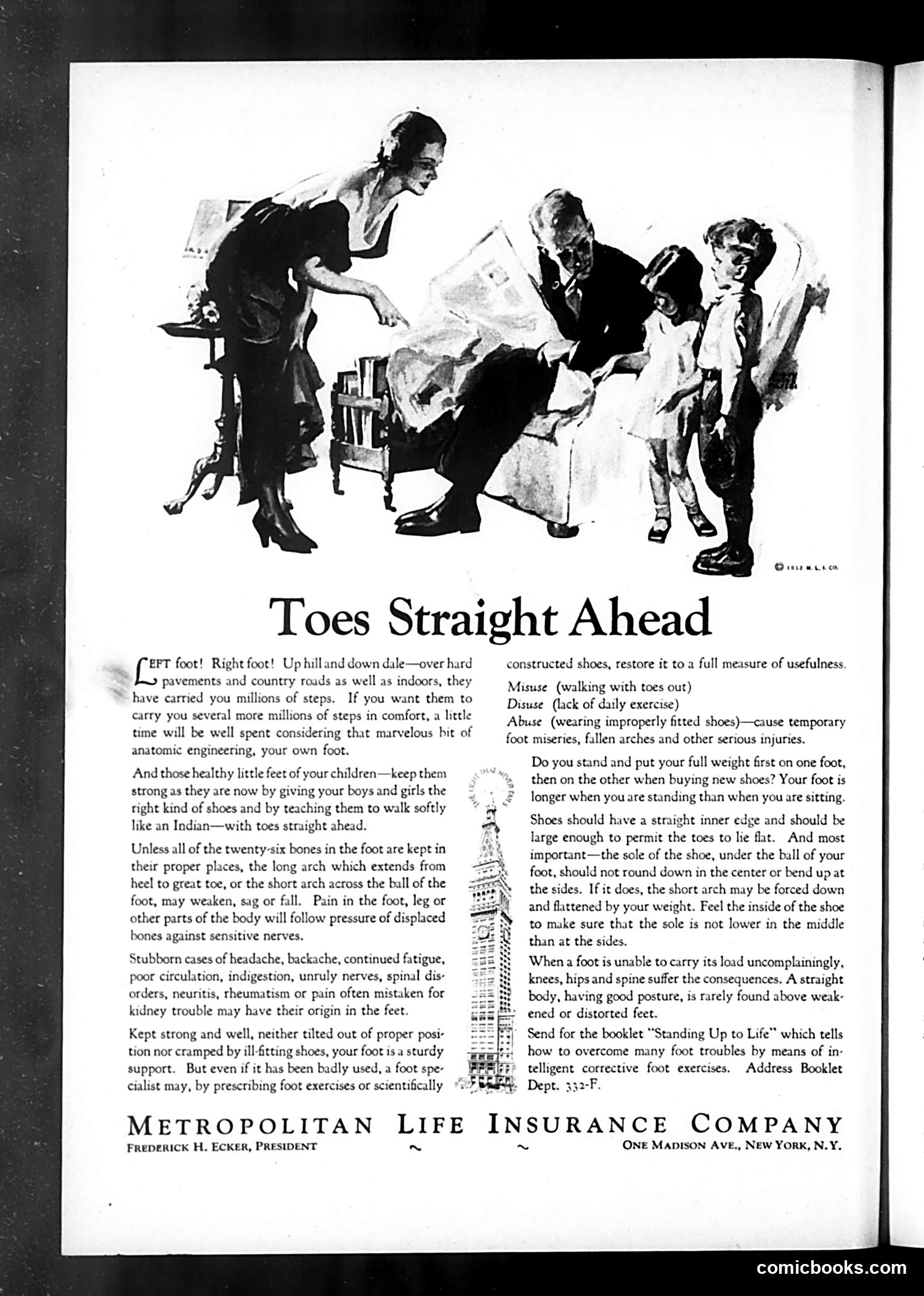
"Toes Straight Ahead" This is a health advisory advertisement from Metropolitan Life Insurance Company, not political satire. The illustration shows a doctor or health professional instructing a family (adults and children) about proper foot care and posture. The article warns that poorly fitted shoes cause foot problems—including misuse (walking with toes out), disuse (lack of exercise), and abuse (wearing tight shoes)—which lead to headaches, backaches, fatigue, and spinal issues. The text advocates for straight-toed shoes, proper arch support, and foot exercises to maintain health. This reflects early 20th-century health reform messaging: insurance companies promoted preventive wellness because healthier customers meant lower claims. The advice assumes middle-class families could afford proper shoes and medical guidance.
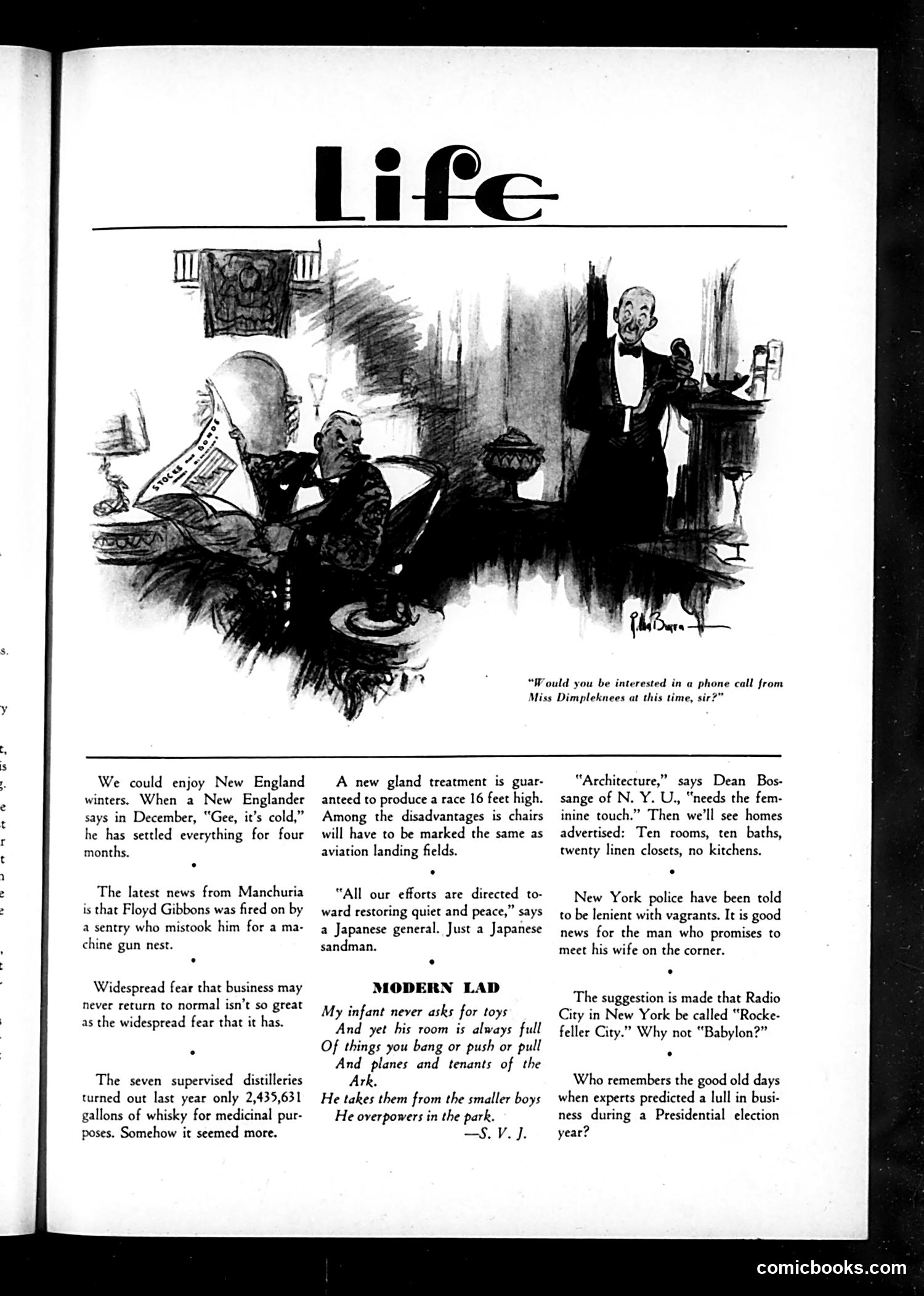
Life Magazine Cartoon Analysis The cartoon depicts a formal dinner scene where a standing gentleman offers a phone call to a seated diner, with the caption: "If would you be interested in a phone call from Miss Dimplebness at this time, sir?" This is satire about telephone interruptions during meals—a social annoyance of the era. The cartoon ridicules the intrusion of modern technology into private dining. "Miss Dimplebness" appears to be a humorous invented name suggesting a frivolous female caller, mocking both the caller's superficiality and the absurdity of accepting social calls during formal dinners. The joke reflects early 20th-century anxieties about how telephones were disrupting traditional etiquette and social conventions, particularly the sanctity of formal meals.
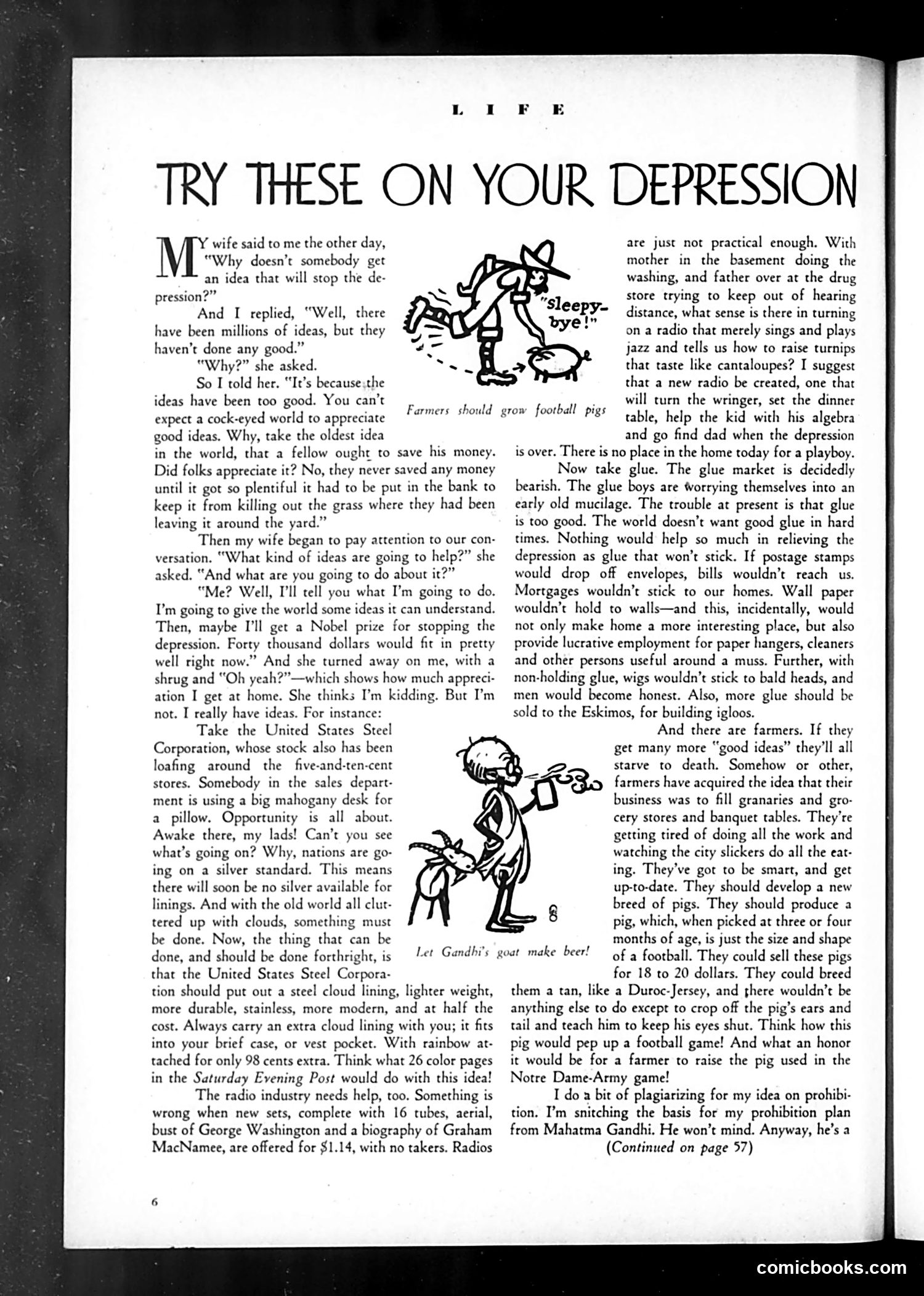
"Try These on Your Depression" This satirical article mocks Depression-era "solutions" by proposing absurd business ideas. The author suggests that tired, impractical notions—like developing non-stick glue, breeding miniature pigs for football, or creating wallpaper that sticks to walls—could somehow lift the nation out of economic crisis. The accompanying cartoons illustrate the ridiculousness: one shows a figure labeled "Sleepy-eye" with a drum, another depicts someone attempting Gandhi's goat as a prohibition basis. The satire targets both the desperation of Depression-era thinking and the business establishment's disconnection from ordinary people's suffering—particularly farmers struggling to survive while city merchants propose frivolous "innovations." The piece is darkly humorous commentary on economic collapse and failure of leadership.
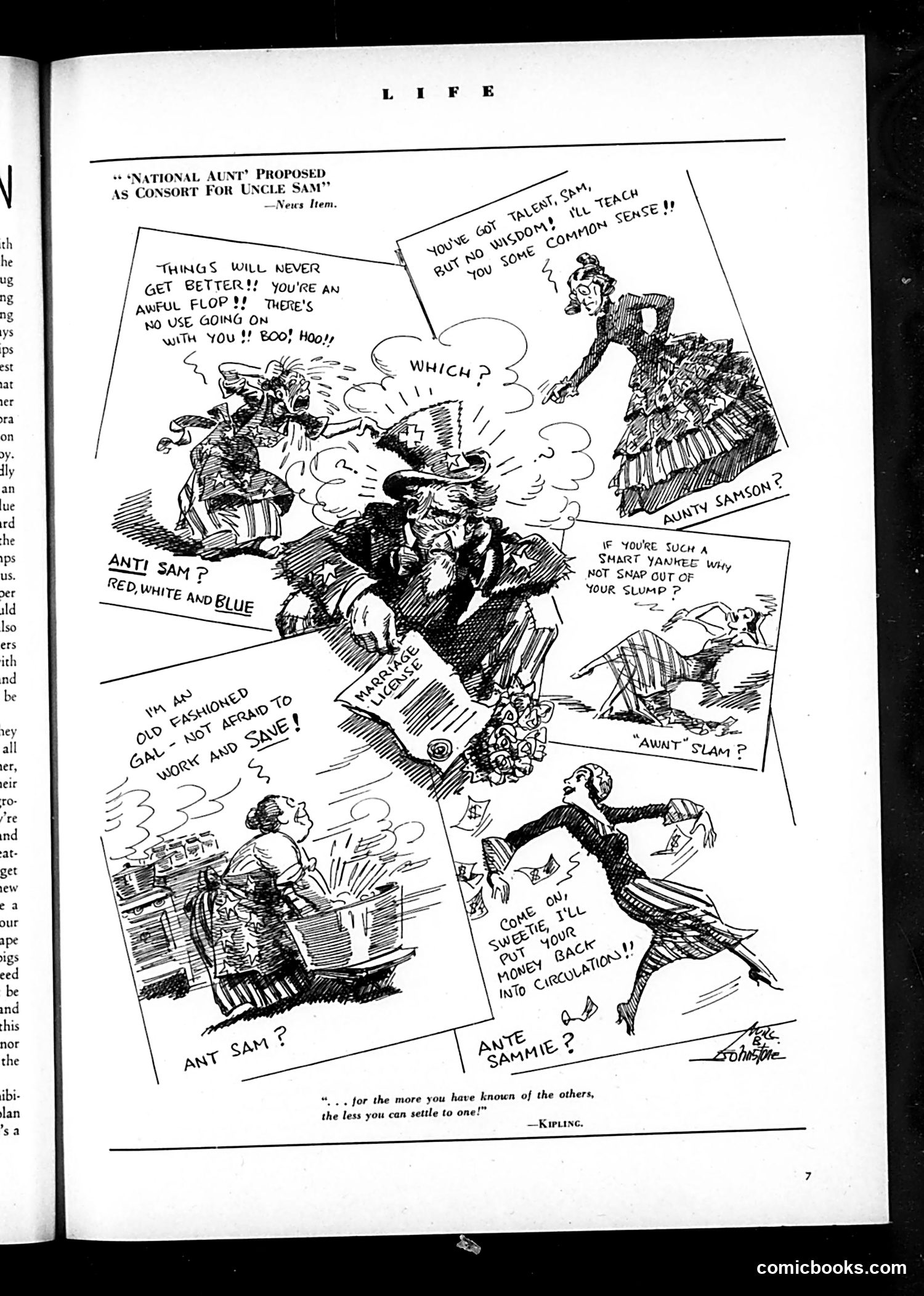
Political Cartoon Analysis This cartoon satirizes the proposal of a "National Aunt" as a government position, specifically for "Uncle Sam." The multi-panel comic depicts competing female figures arguing over who should fill this role. The figures represent different character types or political positions—including "Aunty Samson," "Anti Sam," and others labeled as representatives of different values (red, white, and blue; old-fashioned; etc.). Each claims superiority and criticizes the others' qualifications. The satire mocks both the absurdity of creating such a position and the bitter partisan infighting over government appointments. The Kipling quote at bottom suggests that internal conflict makes unity impossible. The cartoon criticizes how political factions squabble over appointments rather than governing effectively.
Analysis of Life Magazine Page This is a text-only opinion article by E.S. Martin titled "Over the Moon Again...Congress at Work...Loose Government." There are no cartoons or caricatures visible on this page. The piece satirizes Congress's ineffectiveness, noting that while symptoms of economic improvement exist, Congress has made mistakes and remains largely unhelpful. Martin criticizes the slight Democratic House/Republican Senate balance as creating unstable governance. He discusses President Hoover's administration, compares American colonial administration unfavorably to British efforts, and uses Chicago and New York city politics as examples of how mixed immigrant populations complicate governance and voting patterns. The satire targets Congressional incompetence and political machine dysfunction rather than specific individuals through visual caricature.
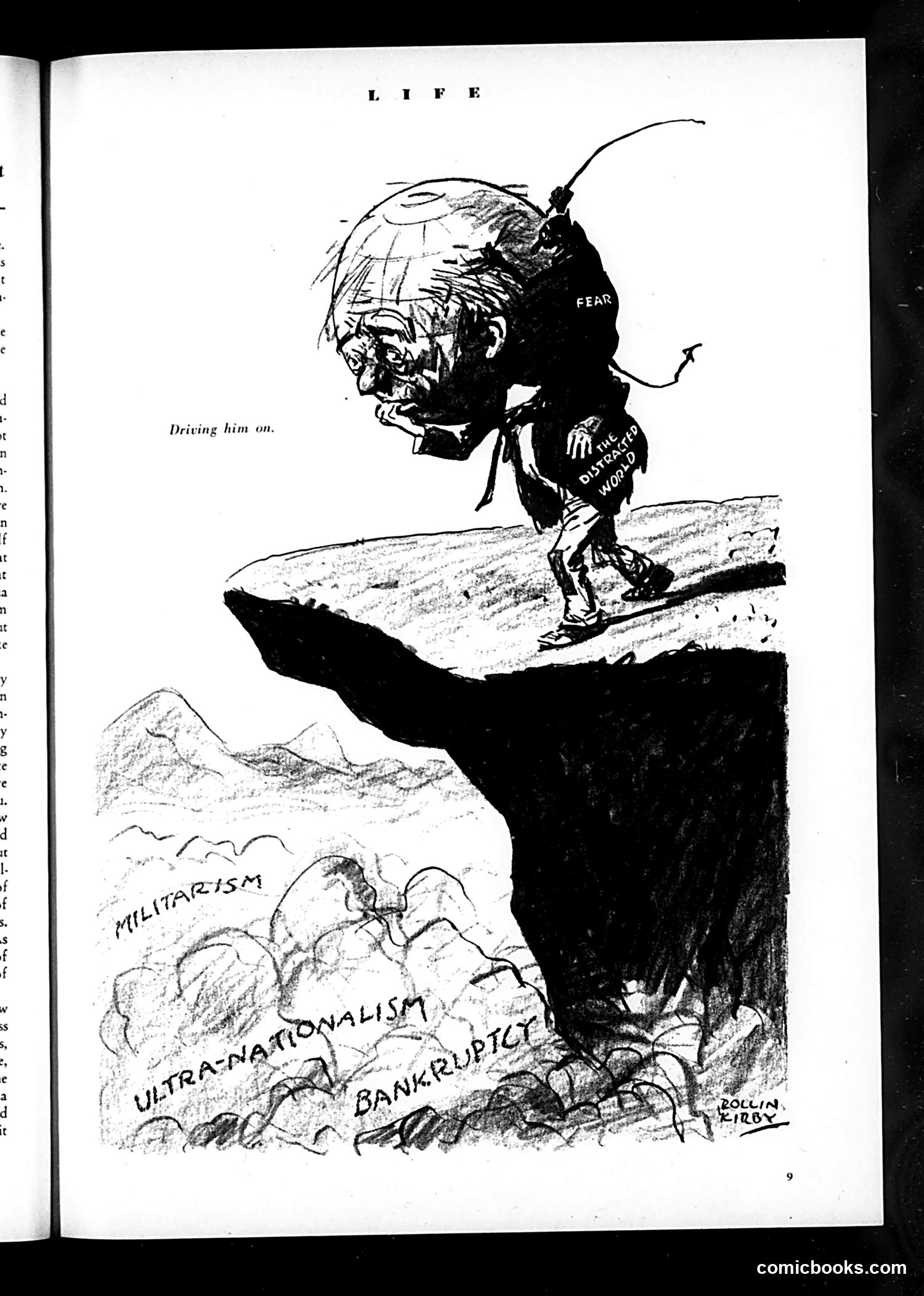
Political Cartoon Analysis This Rollin Kirby cartoon depicts a figure standing precariously on a cliff edge, driven forward by a devil-like creature labeled "FEAR." The figure appears to be an older man wearing military insignia marked "PREPARED FOR WORLD" on his uniform. Below the cliff, three dangers lurk in the abyss: "MILITARISM," "ULTRA-NATIONALISM," and "BANKRUPTCY." The cartoon satirizes how fear is being weaponized to push political leaders toward military buildup and aggressive nationalism, despite the economic dangers this poses (bankruptcy). The caption "Driving him on" makes explicit that fear is the manipulative force behind these destructive policies. This reflects interwar anxieties about arms races and militaristic expansion leading nations toward financial ruin and potential conflict.
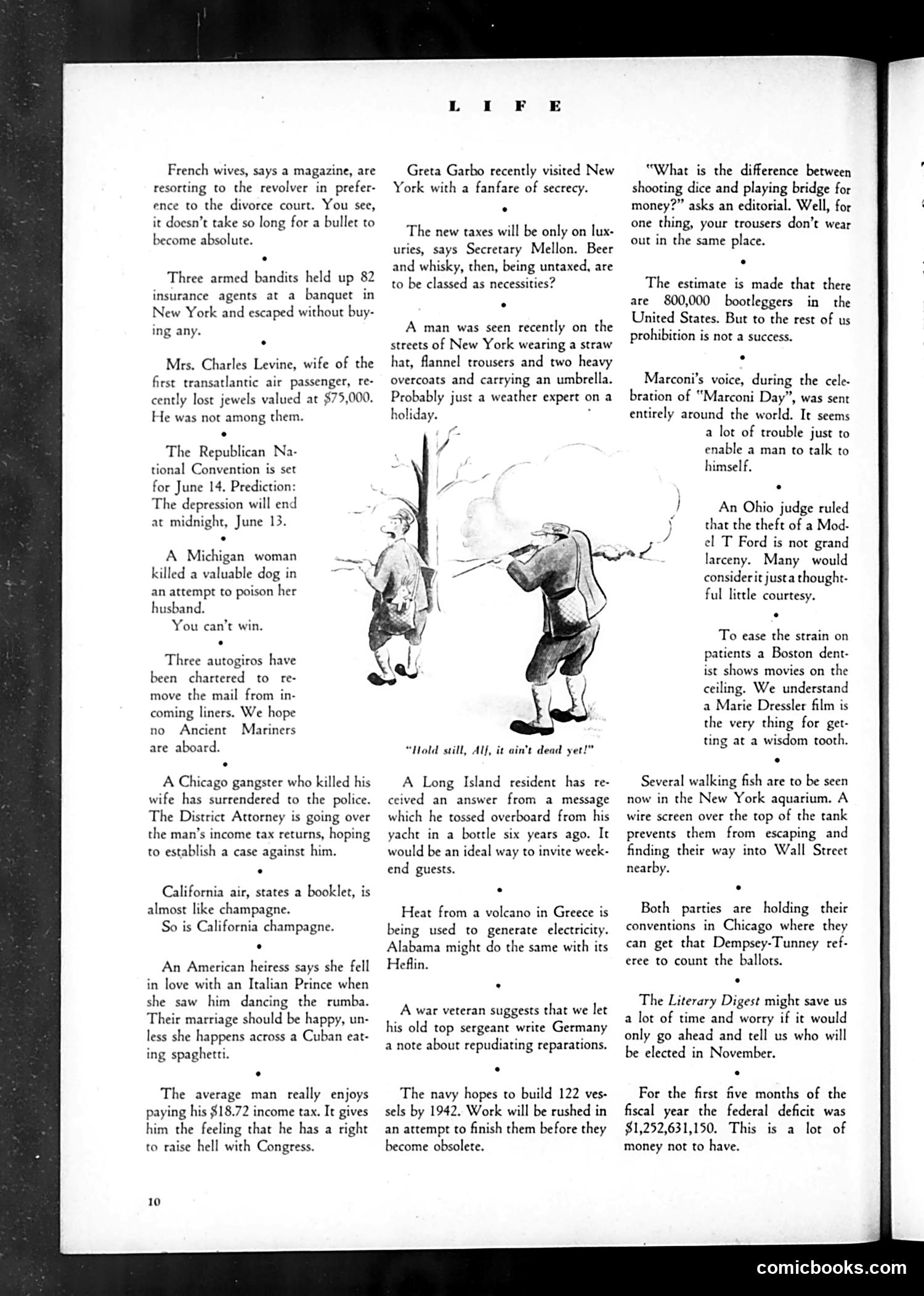
Political Cartoon Analysis: Life Magazine Page This page contains a single cartoon depicting two figures in what appears to be a physical altercation or struggle, with the caption "Hold still, Al, it isn't dead yet!" The cartoon likely references a contemporary political or social conflict, though the specific identities of "Al" and the implied antagonist are unclear from the image alone. The caption's dark humor suggests one figure is attempting to finish off something already dying or defeated. The surrounding text consists of brief satirical commentary on various American topics—taxes, prohibition, weather fashion, and divorce—typical of Life magazine's humorous social observation. However, none of these fragments clearly connects to the cartoon's meaning without additional historical context about who "Al" represents.
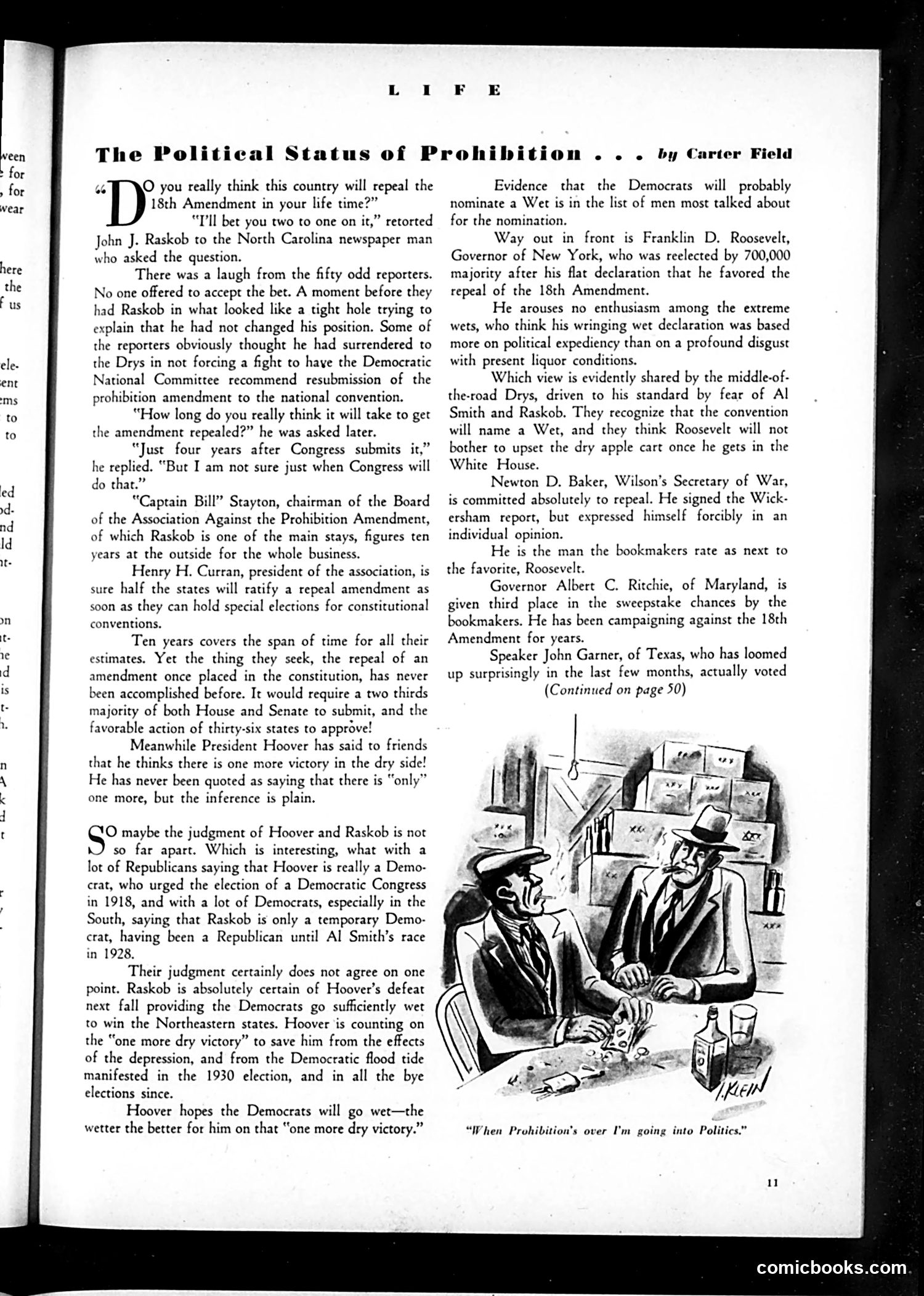
"When Prohibition's over I'm going into Politics" This cartoon satirizes the intersection of Prohibition enforcement and political ambition during the 1928 election cycle. The image shows two men in what appears to be an illegal speakeasy or liquor operation—one appears to be a bootlegger or liquor smuggler displaying his wares, while the other (likely a politician or enforcement official) suggests he'll enter politics once Prohibition ends. The joke critiques how Prohibition created criminal enterprises and corrupted public officials. It implies that those profiting from illegal alcohol during Prohibition might pivot to political careers once the amendment is repealed, suggesting the moral compromise and corruption embedded in both industries. The cartoon reflects contemporary cynicism about Prohibition's failure and its connection to political corruption.
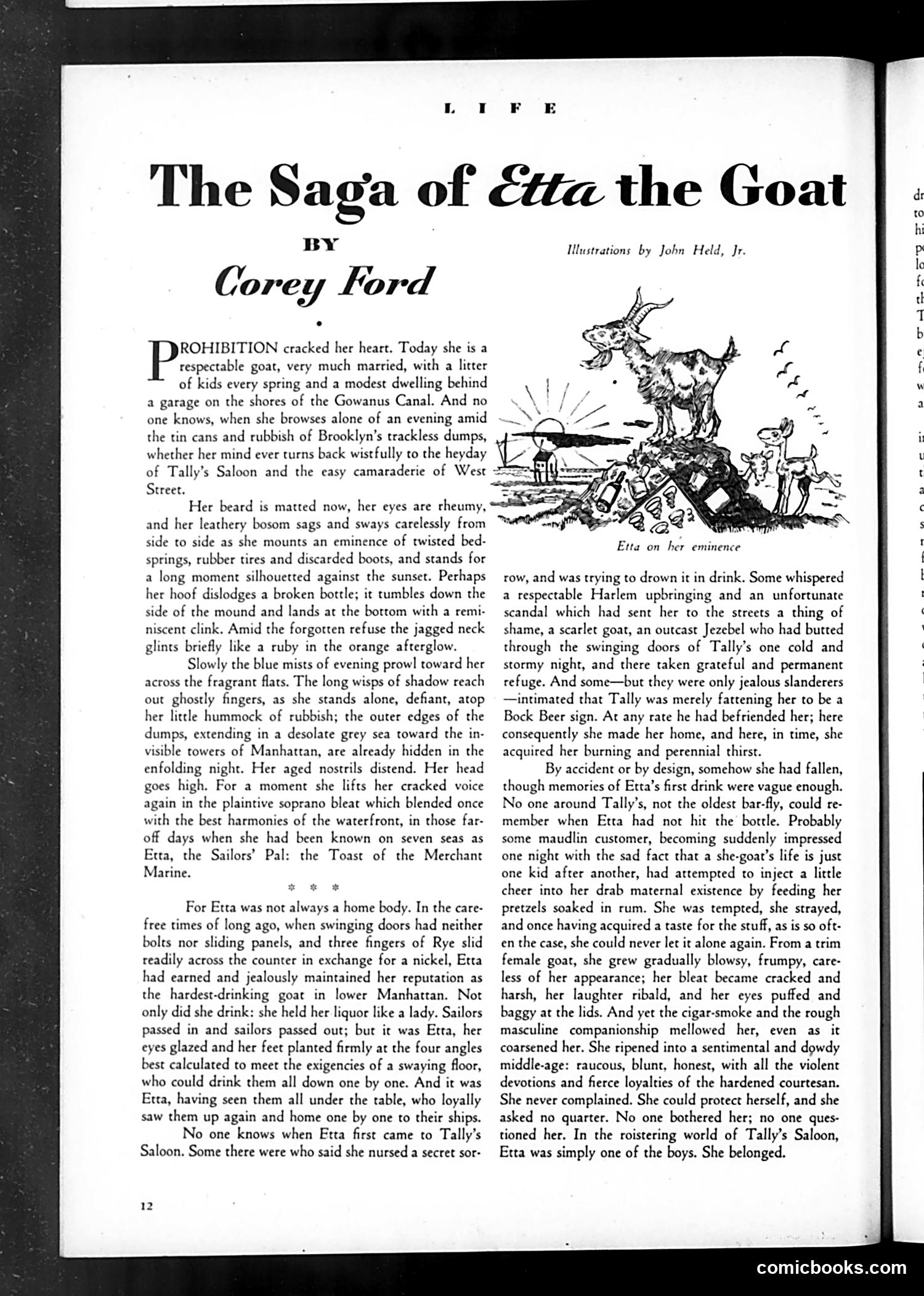
"The Saga of Etta the Goat" by Corey Ford This is a humorous short story (not a political cartoon) illustrated by John Held, Jr. It tells the tragic-comic tale of Etta, a once-respectable goat who has deteriorated into a chronic drunk frequenting Tally's Saloon in lower Manhattan near the Gowanus Canal. The narrative traces her decline: originally known as a sophisticated drinker ("Toast of the Merchant Marine"), she gradually became an alcoholic, her appearance coarsened, and she became "simply one of the boys" in the saloon. The piece appears to satirize both human alcoholism and the bohemian bar culture of the era, using animal personification for comedic effect. The illustration shows Etta standing prominently among discarded bottles and urban detritus.
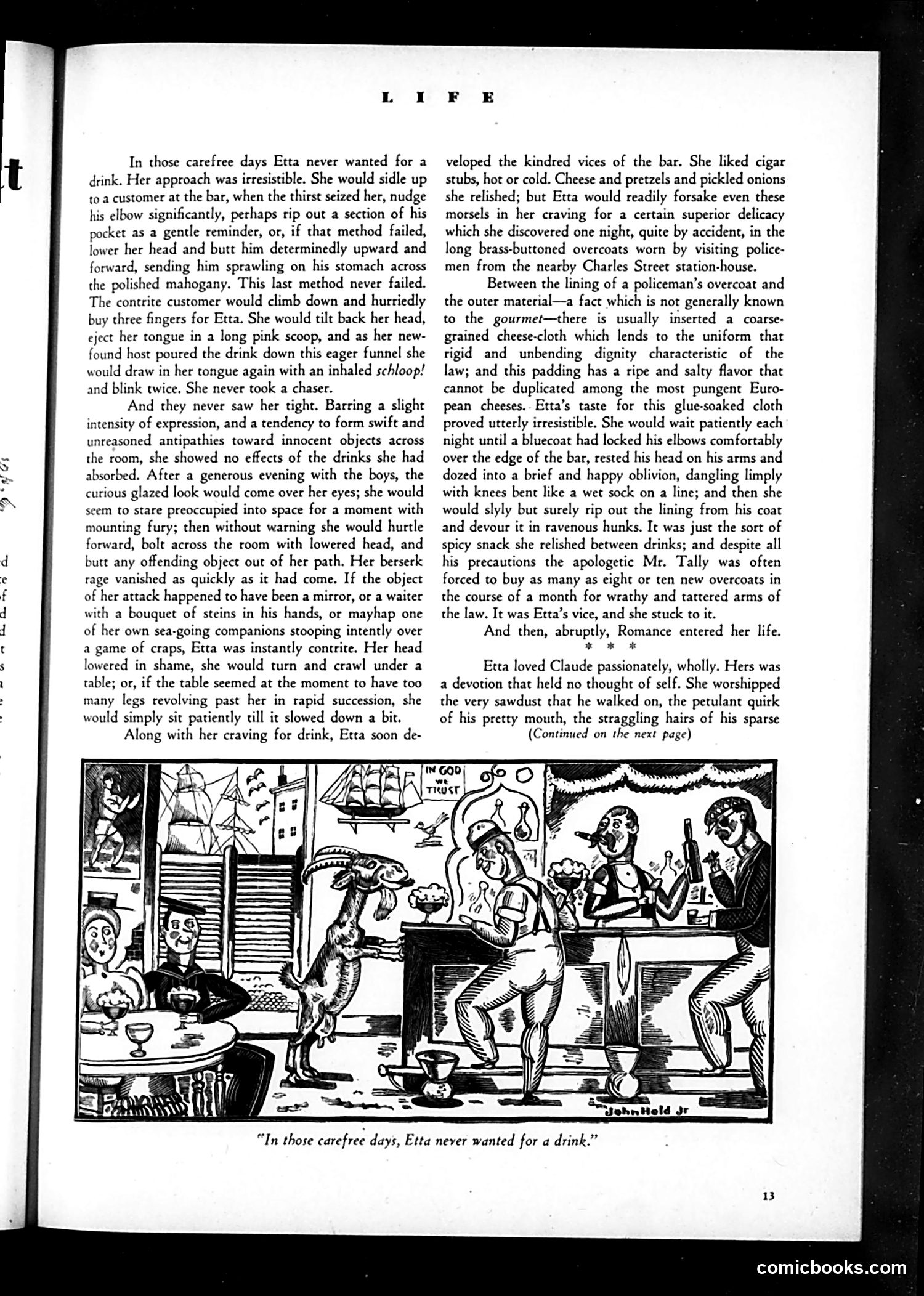
Analysis of Life Magazine Page This page depicts Etta, a carefree woman who frequented bars during the "carefree days" (likely Prohibition era, based on references to speakeasies and police raids). The text humorously describes her brazen bar behavior: she would physically nudge customers for drinks, insert her tongue into their mouths to retrieve poured drinks, and show complete indifference to consequences. She was apparently fearless during police raids and would audaciously steal from overcoats. The accompanying illustration shows a raucous bar scene with patrons in various states of revelry and a dog, capturing the chaotic, uninhibited atmosphere the text describes. The satire mocks both Etta's shameless opportunism and the broader culture of speakeasy excess, presenting her as an almost folk-heroic figure of working-class street cunning and survival during Prohibition.
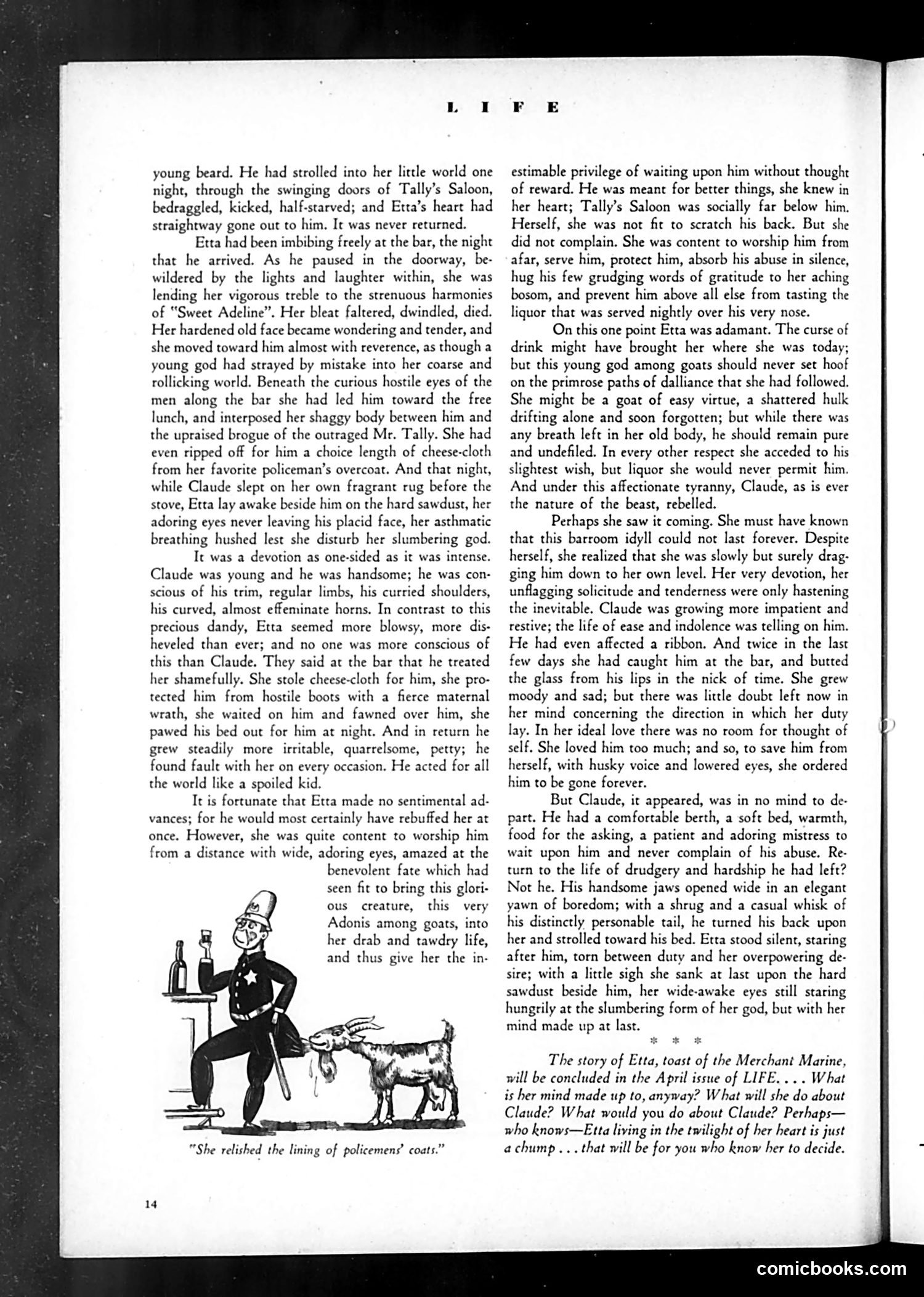
Analysis of Life Magazine Page This page presents a serialized fiction story titled "Etta" about a goat and her relationship with a man named Claude. The accompanying illustration shows a well-dressed gentleman in a top hat with a goat, captioned "She relished the lining of policemen's coats." The satire appears to mock romantic excess and sentimentality. The story ironically treats the mundane relationship between a man and a goat with the overwrought emotional language typically reserved for human romance. The illustration's caption—referencing the goat eating police uniforms—suggests satirical commentary on authority or law enforcement, though the specific target remains unclear without additional context about contemporary events Life magazine was addressing. The overall effect ridicules both melodramatic literature and perhaps social pretension.
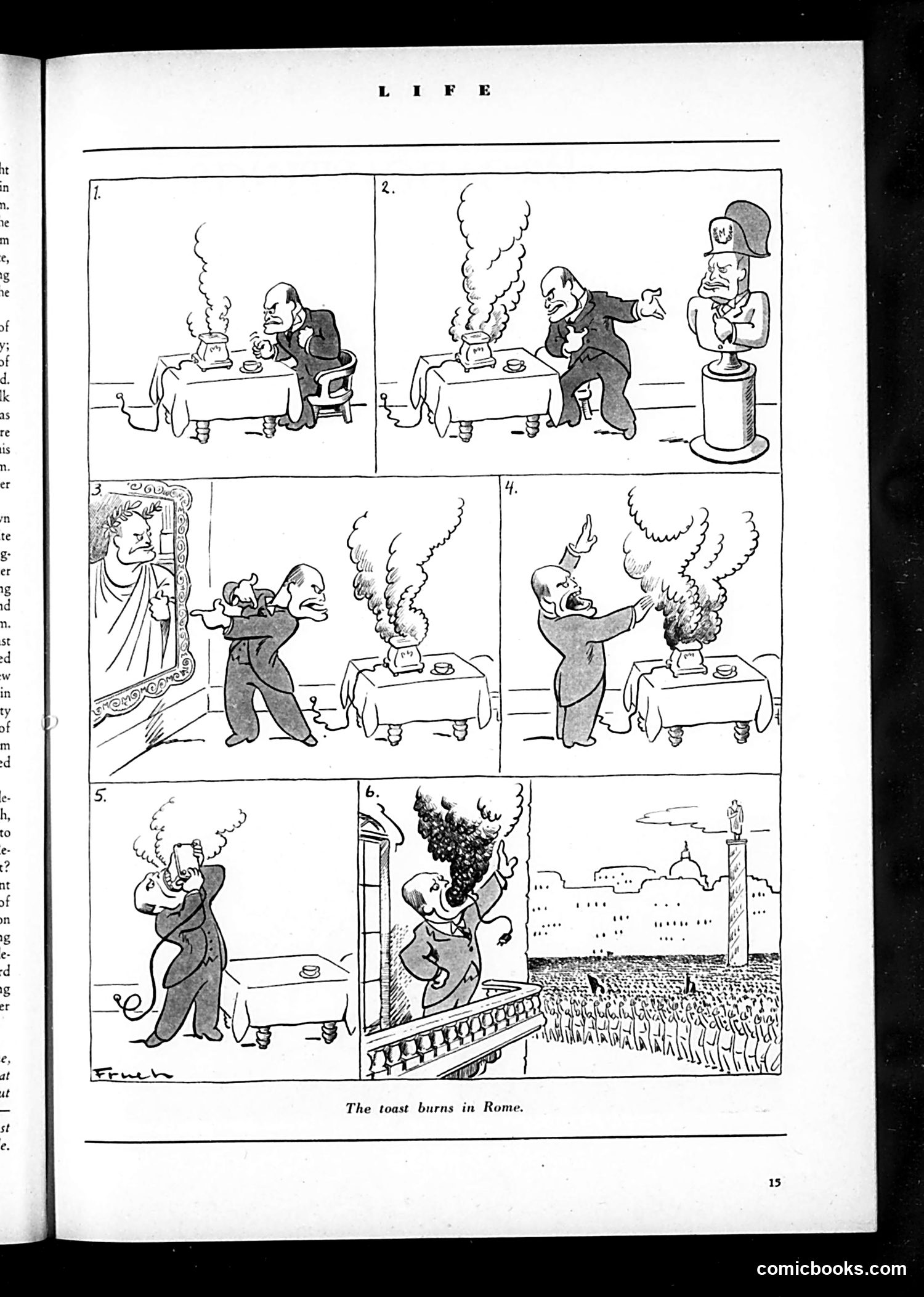
"The Toast Burns in Rome" This six-panel satirical comic depicts a dinner scene that escalates absurdly. Two diners begin seated at a table with a smoking centerpiece (panel 1-2). As the flames grow larger, one diner gestures frantically while the other remains composed (panel 3-4). By panel 5, the figure appears engulfed in flames while hugging the table. Panel 6 reveals the catastrophe has spread to an entire city—the "toast" has become Rome itself burning. The satire likely mocks pretentious dinner etiquette or diplomatic situations that spiral from minor incidents into major disasters. The title plays on the phrase "a toast" (a ceremonial drink) becoming literal fire. The joke's specific political reference remains unclear without additional historical context from Life magazine's publication date.
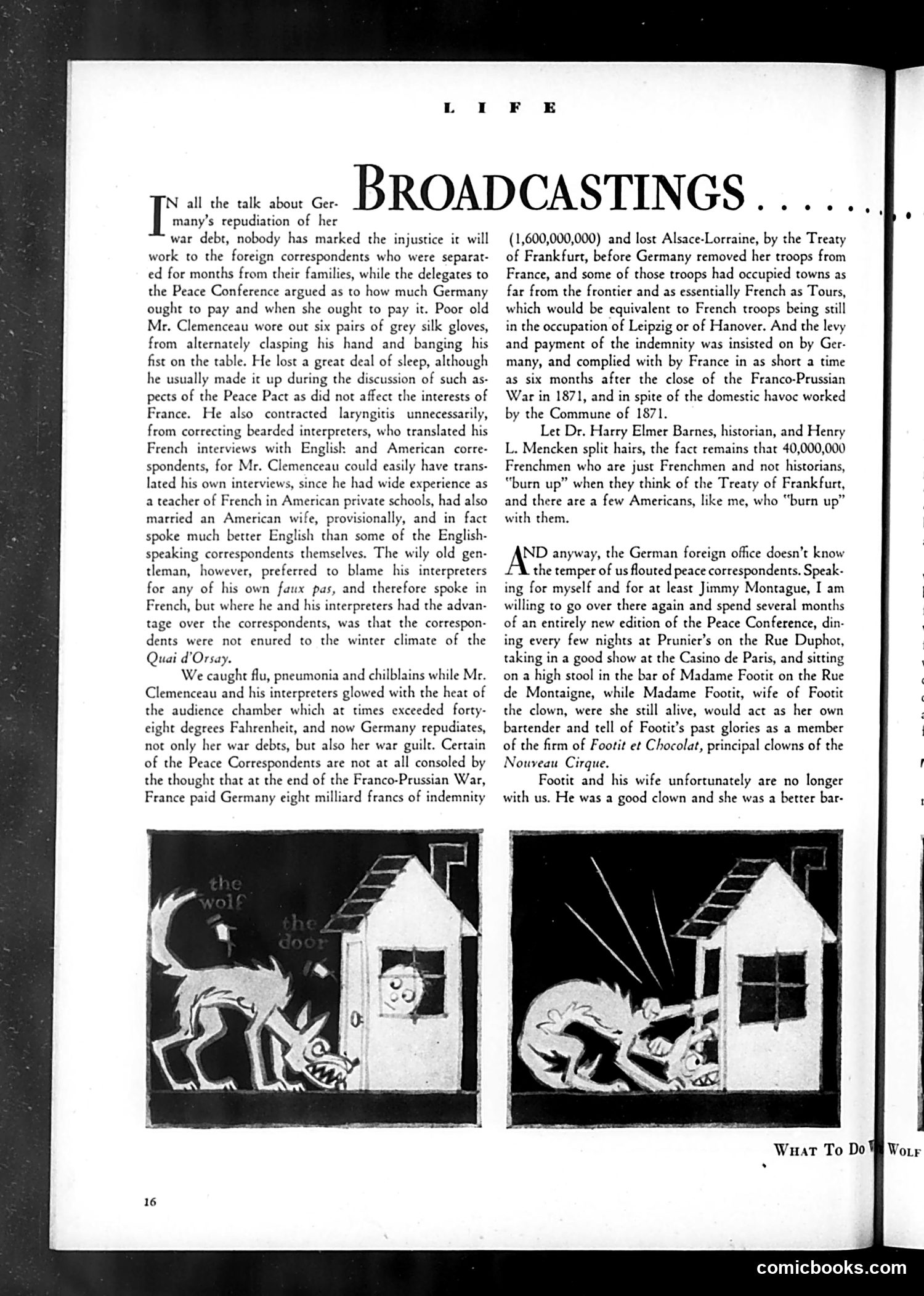
"Brocastings" - Life Magazine Commentary This page satirizes post-WWI peace negotiations, specifically Germany's war reparations. The text discusses the Treaty of Frankfurt and France's demands for payment from Germany—8 billion francs mentioned. The two cartoon panels at bottom (captioned "What To Do With Wolf") appear to show a figure in a small house confronted by a wolf-like creature, likely representing Germany as the "wolf" threatening European security. The cartoons suggest different approaches to handling the German threat. The article references specific historical figures like Mr. Clemenceau (French leader) and discusses Peace Conference delegates. The satire mocks Germany's financial burden and the difficulty of extracting payment while critiquing the correspondents' coverage of these negotiations from Paris.
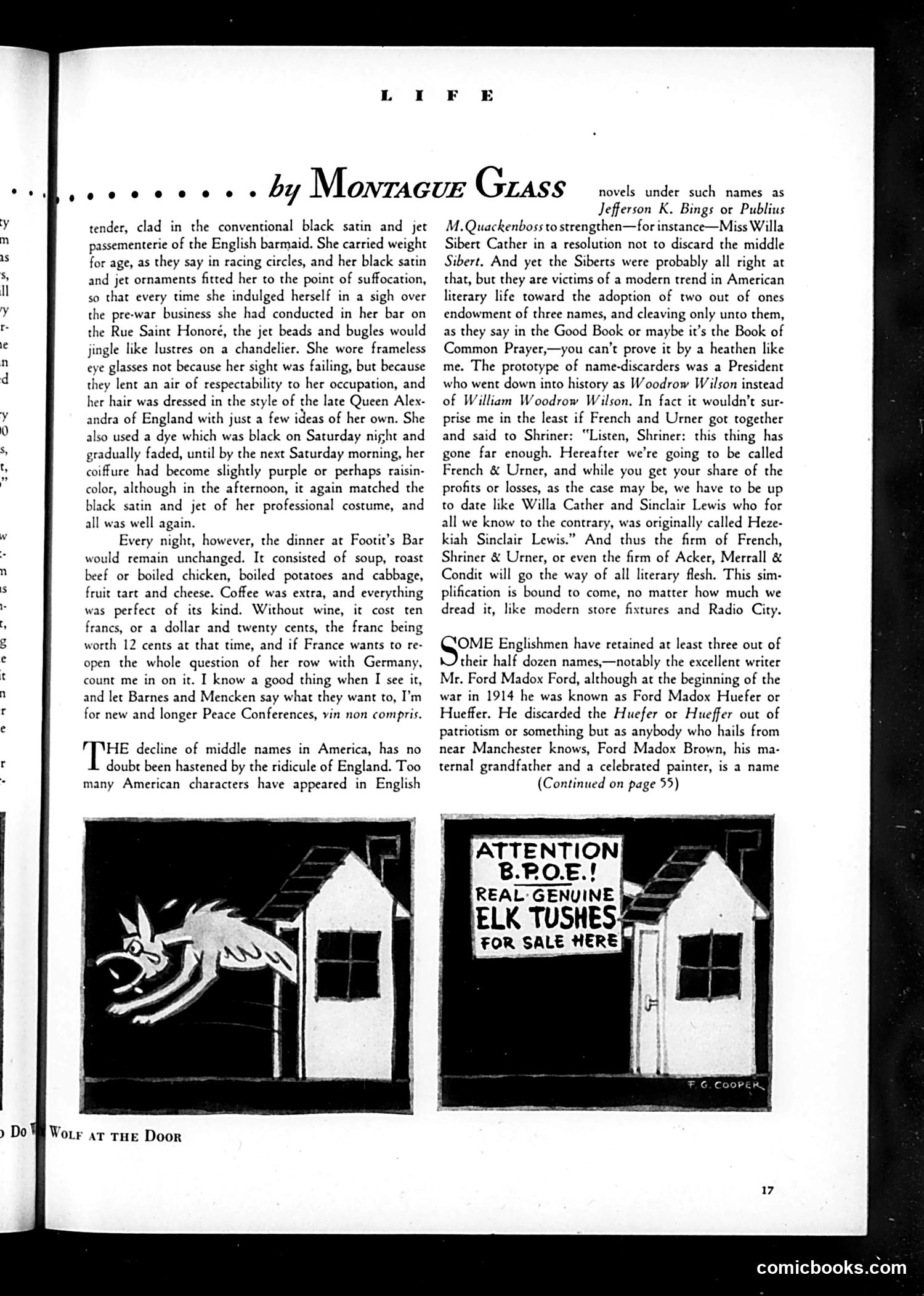
Analysis of "Wolf at the Door" Cartoon This two-panel cartoon by F.G. Cooper satirizes American economic anxiety, likely from the 1920s-30s. Left panel: A wolf (representing financial hardship or poverty) scratches menacingly at a door, symbolizing threats to middle-class security. Right panel: A sign advertises "Real Genuine Elk Tushes for Sale Here"—a reference to the B.P.O.E. (Benevolent and Protective Order of Elks), a fraternal organization. The joke appears to be that even membership in such organizations offers no protection against economic hardship; selling "elk tushes" (likely lodge memorabilia) becomes desperate commerce. The cartoon comments on how traditional American institutions and fraternal bonds fail to shield citizens from poverty during economic crisis.
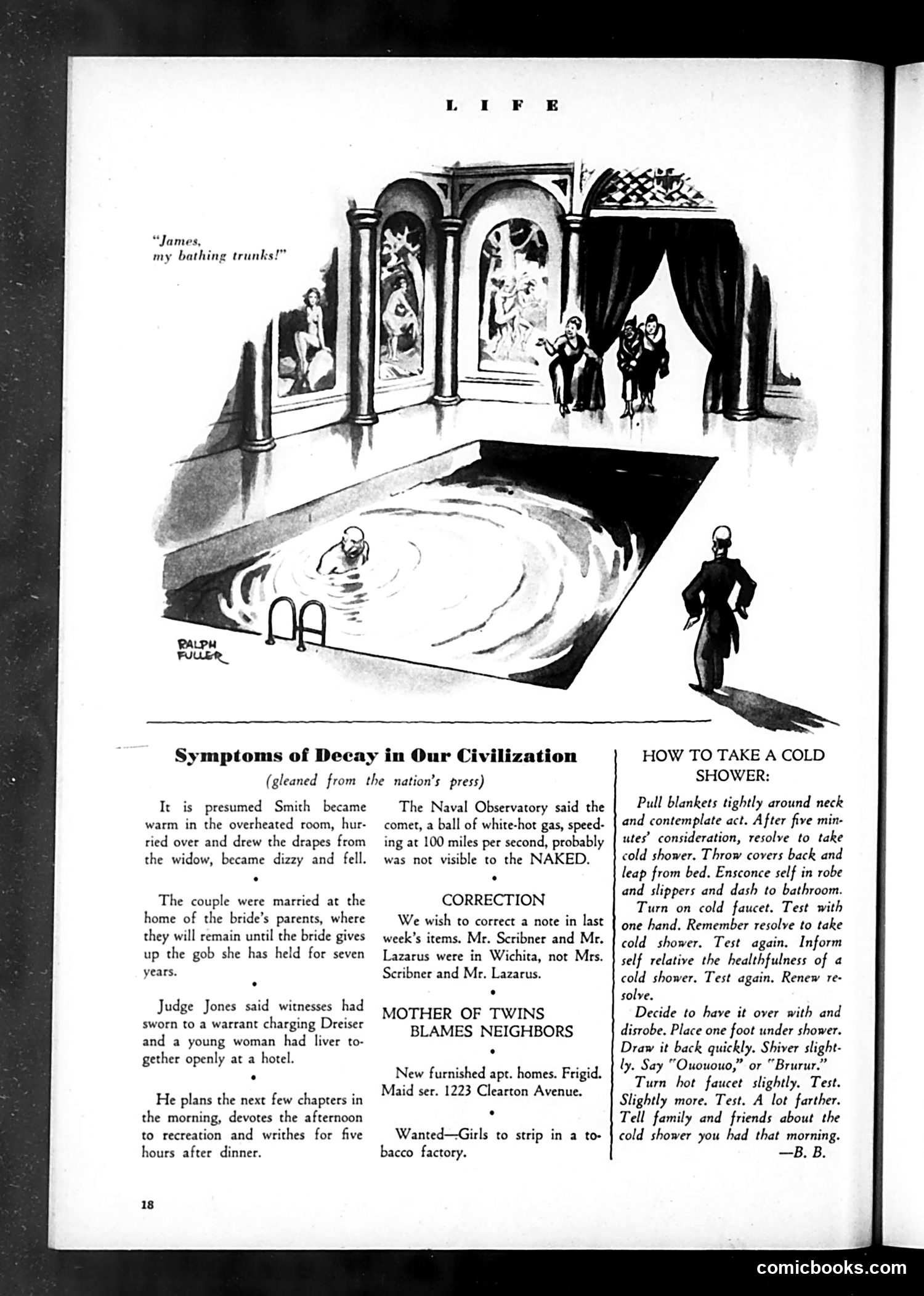
Analysis of Life Magazine Page The main cartoon by Ralph Fuller depicts a wealthy man in a bathing suit at an elaborate indoor pool facility, while well-dressed observers stand nearby. The caption reads "James, my bathing trunks!" — likely satirizing the absurd luxury and servants required by the wealthy elite. Below, brief humorous news items mock social decay and pretension: a couple remaining married "until the bride gives up the gob," a judge's warrant charging "Dresser," and housing advertisements. The rightmost column offers tongue-in-cheek instructions for taking a cold shower, treating it as an ordeal requiring elaborate preparation and encouragement. Overall, the page satirizes 1920s-era class disparities, excessive wealth display, and the peculiar anxieties of maintaining upper-class lifestyle and social status.
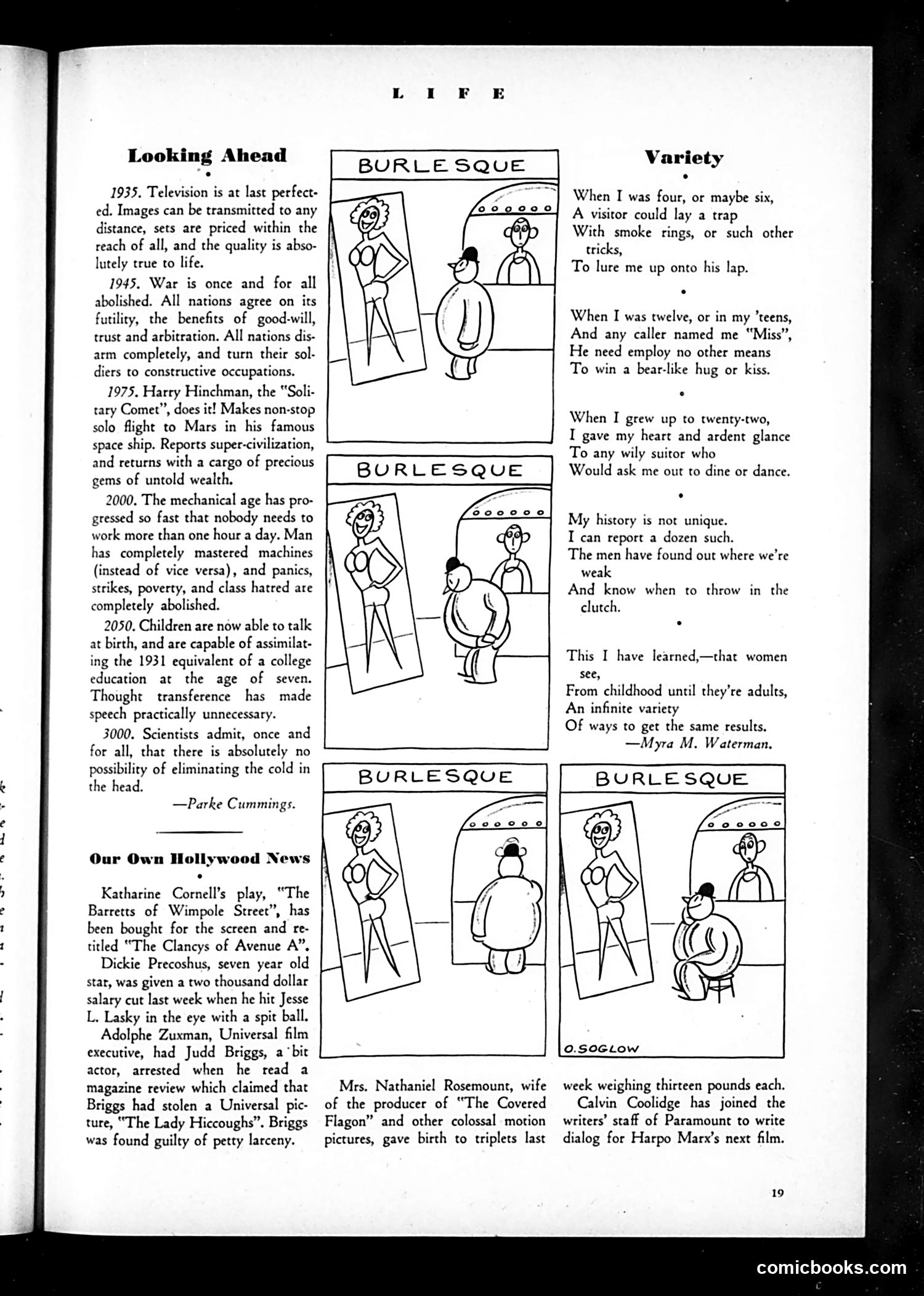
"Burlesque" Comic Strip Analysis This four-panel comic by O. Soglow depicts a woman attempting to attract a man's attention through increasingly exaggerated burlesque-style poses and movements. In each panel, she adopts more dramatic theatrical gestures while the man remains unimpressed or distracted. The satire targets the artificiality of burlesque performance and flirtation tactics. The strip suggests that elaborate, theatrical attempts at seduction—the "tricks" mentioned in the accompanying poem "Variety"—often fail to achieve their intended effect. The joke lies in the contrast between the woman's escalating effort and the man's apparent indifference, mocking both performative femininity and male obtuseness. The accompanying poem reinforces this theme: women employ infinite variety in courtship strategies, yet results remain unpredictable.
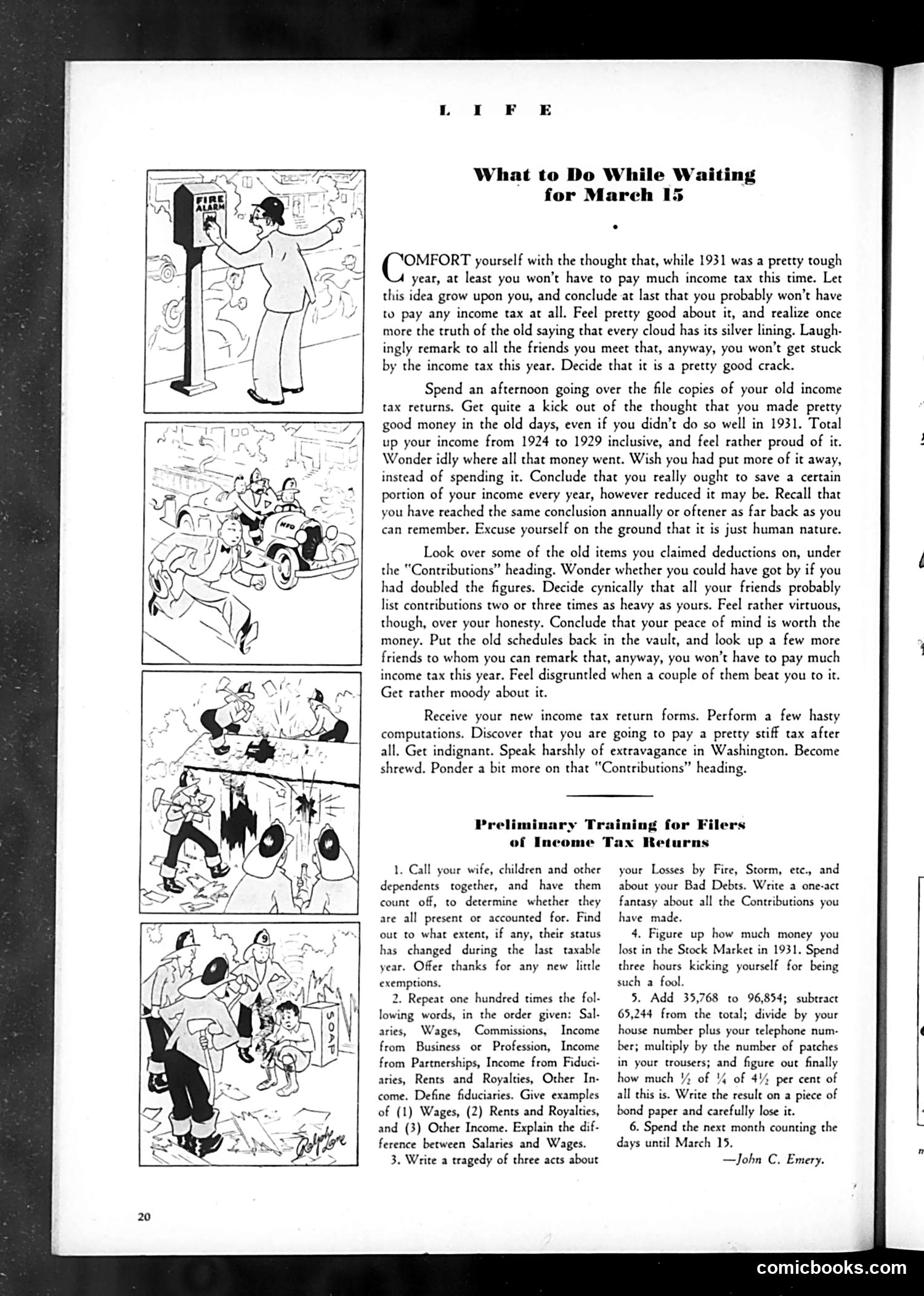
Explanation for Modern Readers This 1931 *Life* magazine article satirizes the anxiety and procrastination surrounding income tax filing (deadline: March 15). The humor relies on Depression-era context: after the 1929 stock market crash, Americans faced reduced incomes but still dreaded tax obligations. The cartoons depict taxpayers' emotional rollercoaster—initially comforting themselves that they won't owe much, then nostalgically reviewing past years' higher earnings, then receiving forms and discovering they *do* owe substantial taxes. The final section offers absurdist "training" steps: counting dependents, memorizing income categories, and performing deliberately nonsensical math calculations that yield meaningless results. The satire targets both taxpayer psychology (self-deception, procrastination, moral rationalization about inflated deductions) and the tax system itself—presented as so complicated that precise calculation is impossible. The "Contributions" deduction repeatedly mentioned suggests taxpayers routinely overstated charitable giving. The joke: nothing about taxes has changed in people's minds.
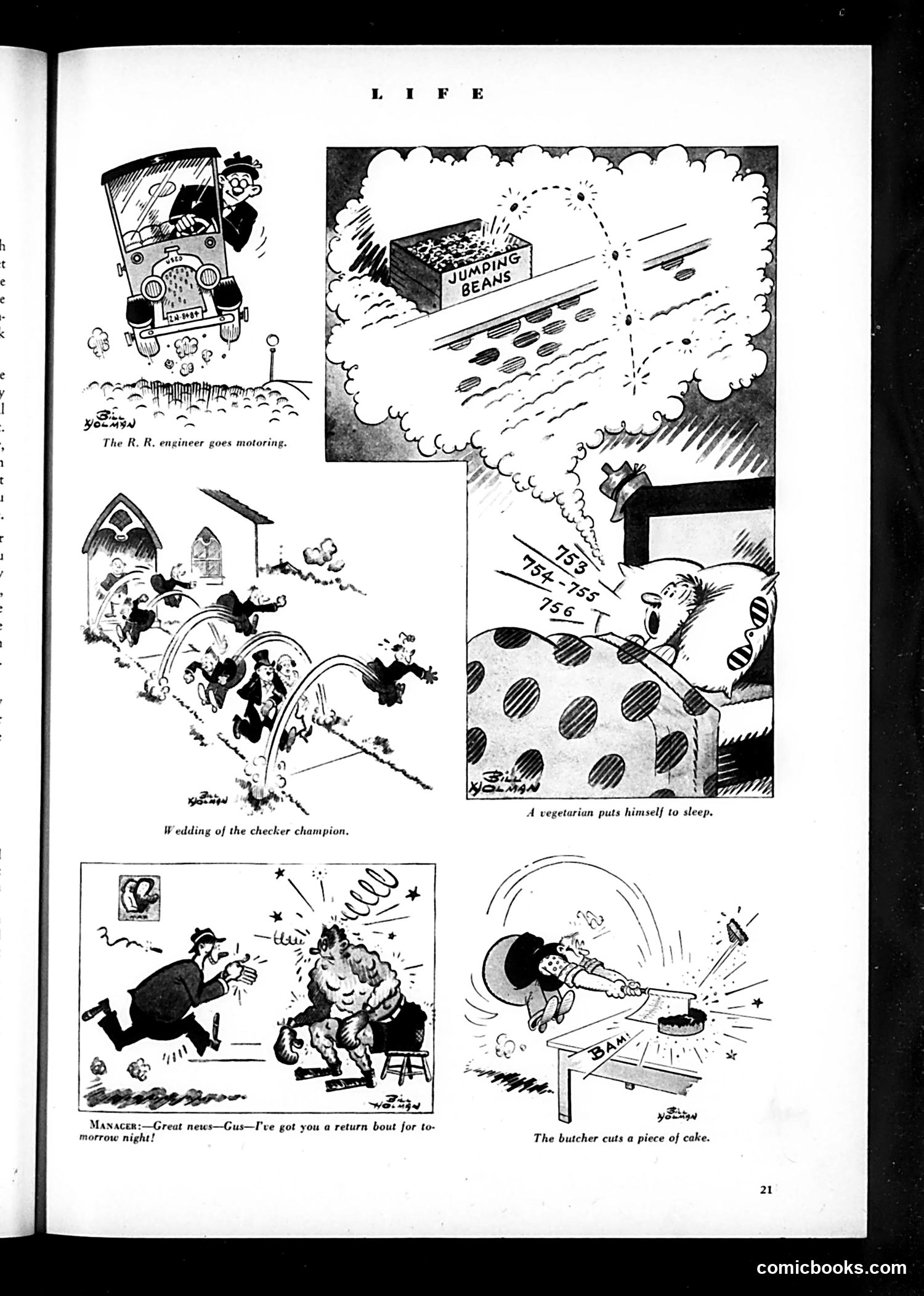
Life Magazine Page 21: Early 20th Century Humor This page contains five unrelated comic vignettes satirizing contemporary life: 1. "The R.R. engineer goes motoring": Mocks an railroad engineer's incompetence operating an automobile, suggesting poor transfer of skills between transportation modes. 2. "Wedding of the checker champion": A visual gag about excessive wedding gift-giving creating chaos. 3. "A vegetarian puts himself to sleep": Shows someone dreaming of "jumping beans"—likely satirizing vegetarians as peculiar or their diets as inadequate/sleep-inducing. 4. Boxing manager dialogue: References a boxing match ("return bout"), common entertainment of the era. 5. "The butcher cuts a piece of cake": Visual pun showing a butcher using his meat-cutting tools on a cake. These reflect early 1900s social commentary and occupational stereotypes, with humor based on puns, visual wordplay, and class/profession-based caricatures typical of *Life* magazine's satirical approach.
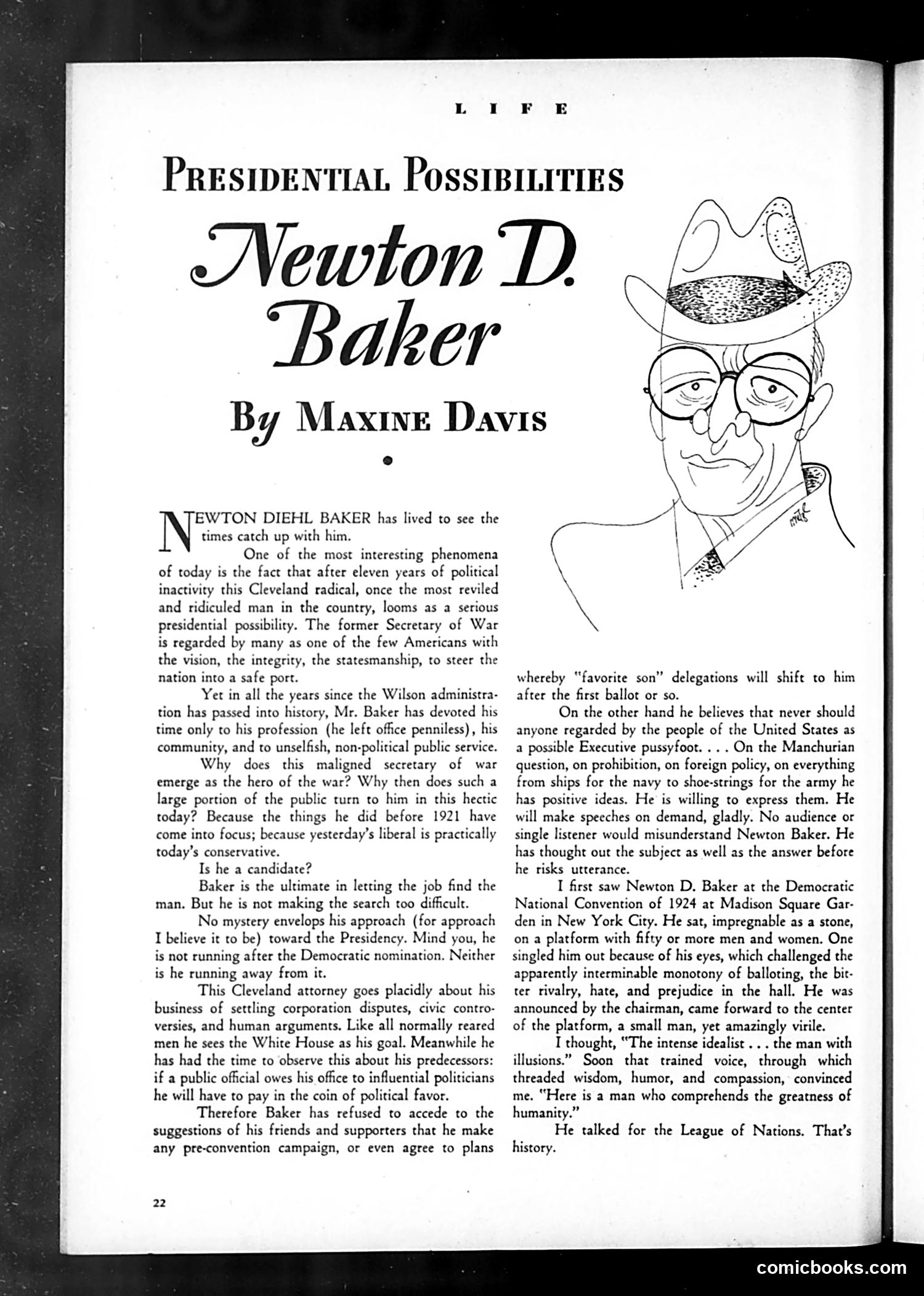
Presidential Possibilities: Newton D. Baker This LIFE magazine article profiles Newton D. Baker, former Secretary of War under President Wilson, as a potential 1924 Democratic presidential candidate. The accompanying caricature shows Baker in a cowboy hat—likely satirizing his "radical" Cleveland origins and suggesting the unconventional nature of his candidacy. The article's irony is that Baker, once reviled as a "Cleveland radical," has become respectable as yesterday's liberalism becomes today's conservatism. Writer Maxine Davis notes Baker's refusal to campaign actively for the nomination, instead maintaining dignified distance while holding "positive ideas" on major issues (Prohibition, foreign policy, the League of Nations). The satire suggests the paradox of American politics: Baker refuses to pursue power overtly, yet positions himself as presidential material by remaining aloof. The piece presents this as admirable statesmanship, though modern readers might recognize it as shrewd image management.
Life Magazine Profile: Newton Baker This page profiles Newton Baker, former Secretary of War under President Wilson (referenced by General Pershing's tribute). The article portrays him as an intellectual with practical skills—a man who personally handles carpentry and gardening despite his prominence. The political context: Baker is being rehabilitated as a statesman despite his past advocacy for the League of Nations, which had become politically toxic. The text notes Democrats worry he still supports League membership, but Baker has strategically abandoned public discussion of it, recognizing "too much prejudice" exists. The anecdote about the Western Union boy illustrates Baker's character: generous, discreet (handling the widow's mortgage "with no publicity"), and beloved by ordinary people. The magnificent cigar represents gratitude from those he's helped. This is essentially character advocacy—presenting Baker as a man of integrity, humility, and quiet effectiveness, suitable for consideration in post-war American leadership.
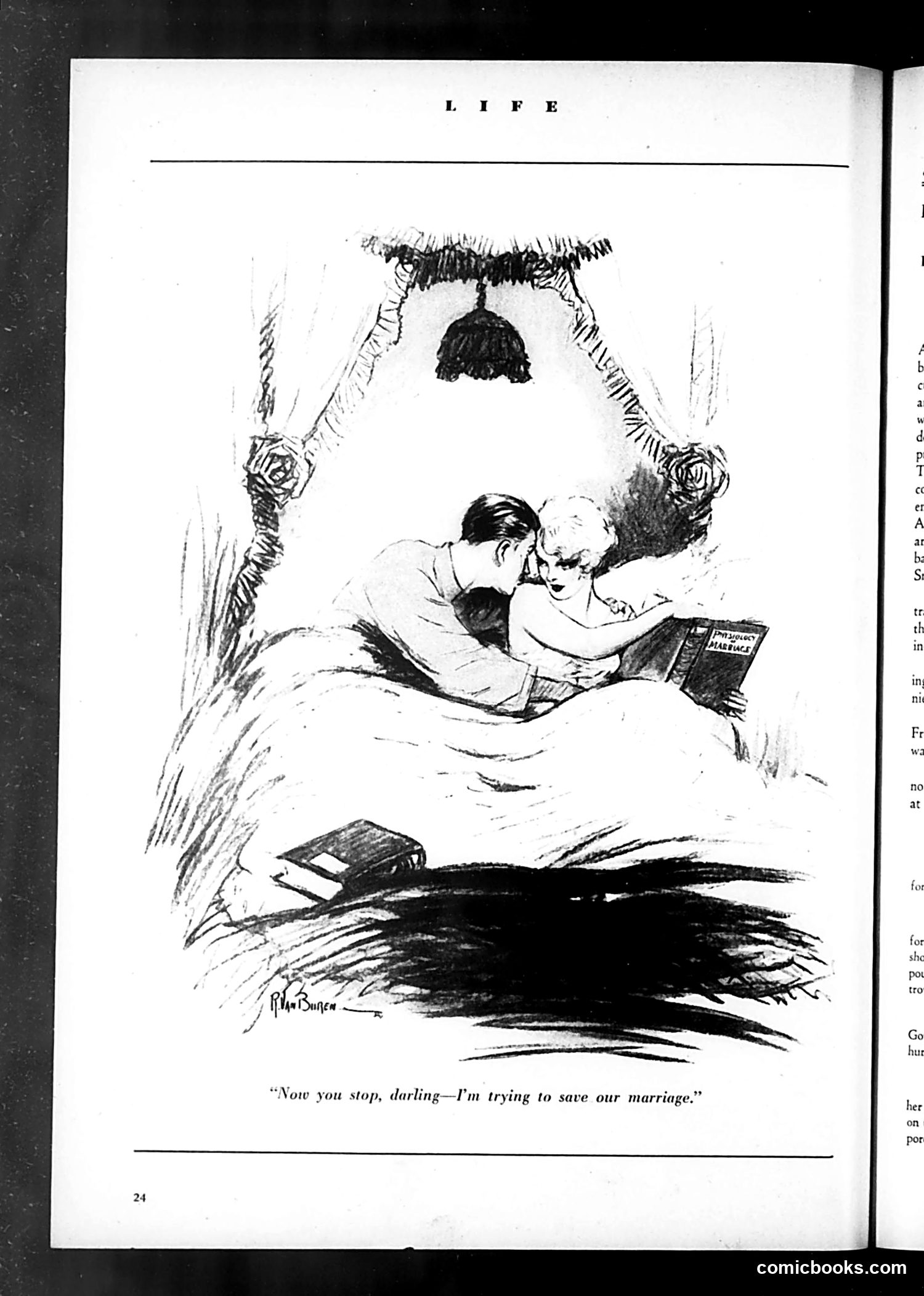
Analysis This cartoon depicts a domestic scene where a man and woman are in bed together. The woman is reading what appears to be a book or magazine (possibly a "marriage manual" based on the visible text), while the man attempts to be intimate with her. Her caption—"Now you stop, darling—I'm trying to save our marriage"—suggests ironic commentary on marriage advice literature of the era. The satire likely mocks the proliferation of self-help and marriage counseling books that became popular in early-to-mid 20th century America. The humor lies in the contradiction: the woman is so absorbed in reading about *how* to improve her marriage that she's neglecting actual intimacy with her husband. It's a commentary on the gap between theoretical relationship advice and practical married life, suggesting that such guidebooks may actually damage the relationships they claim to help.
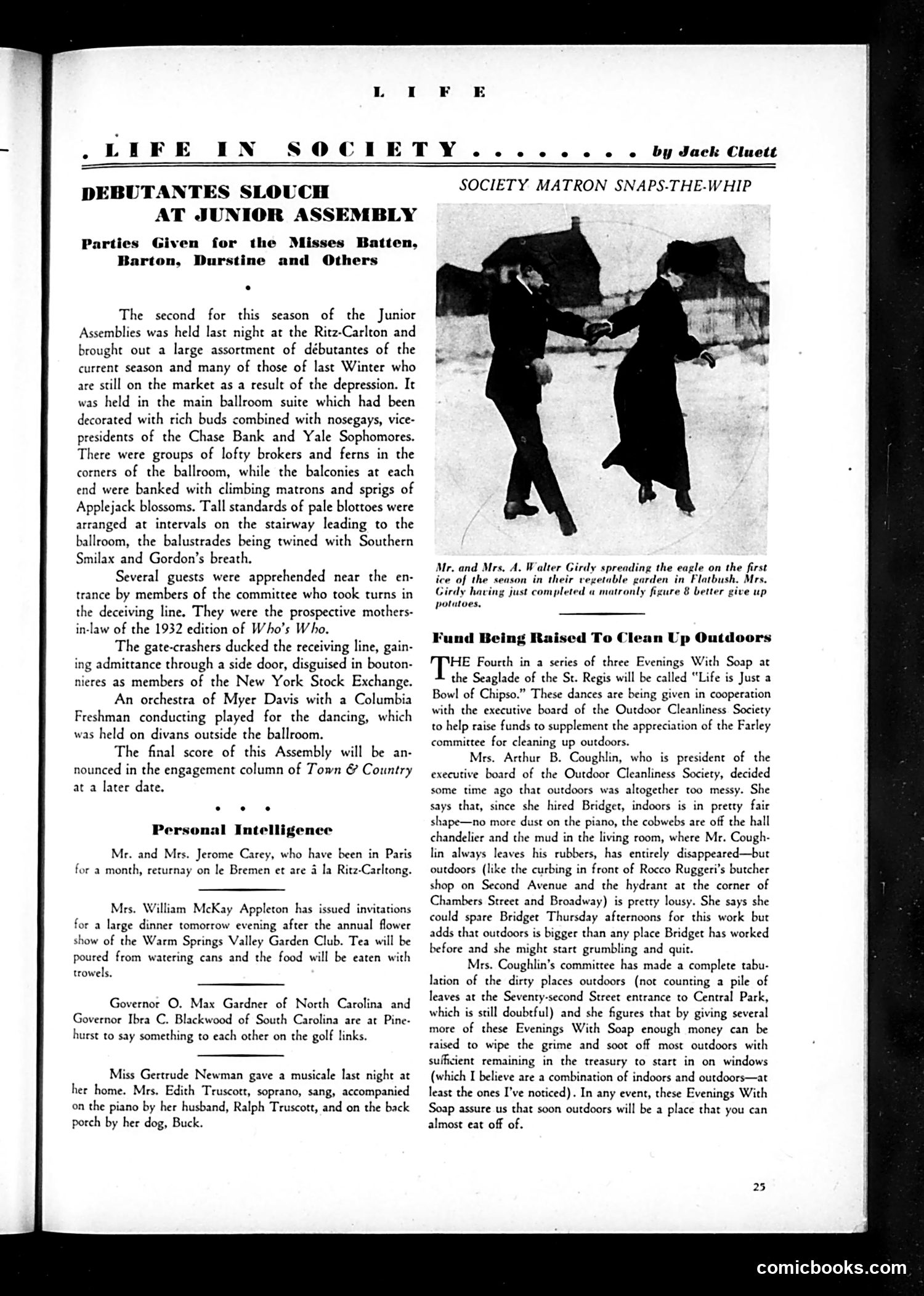
Life Magazine "Society" Page Analysis This is a satirical society column by Jack Cluett mocking upper-class pretension during the Depression era. The main article ridicules a Junior Assembly debutante ball, using absurdist humor to critique wealthy elites: the text jokes that "vice-presidents of the Chase Bank and Yale Sophomores" are used as decorations, and gate-crashers disguise themselves "as members of the New York Stock Exchange." The photograph shows two people ice-skating, captioned with humor about spreading "the eagle" (doing splits) and giving up potatoes—likely mocking wealthy dilettantes attempting athletic pursuits. The column's "Personal Intelligence" section continues the satire, with deliberately ridiculous snippets (pouring tea "from watering cans," eating "with trowels"). The final item announces a charity event called "Life is Just a Bowl of Chipso"—a pun on the song and a soap brand—to raise funds for outdoor cleanliness, poking fun at wealthy socialites' frivolous concerns during economically desperate times. The overall message: the wealthy remain absurdly disconnected from Depression-era hardship.
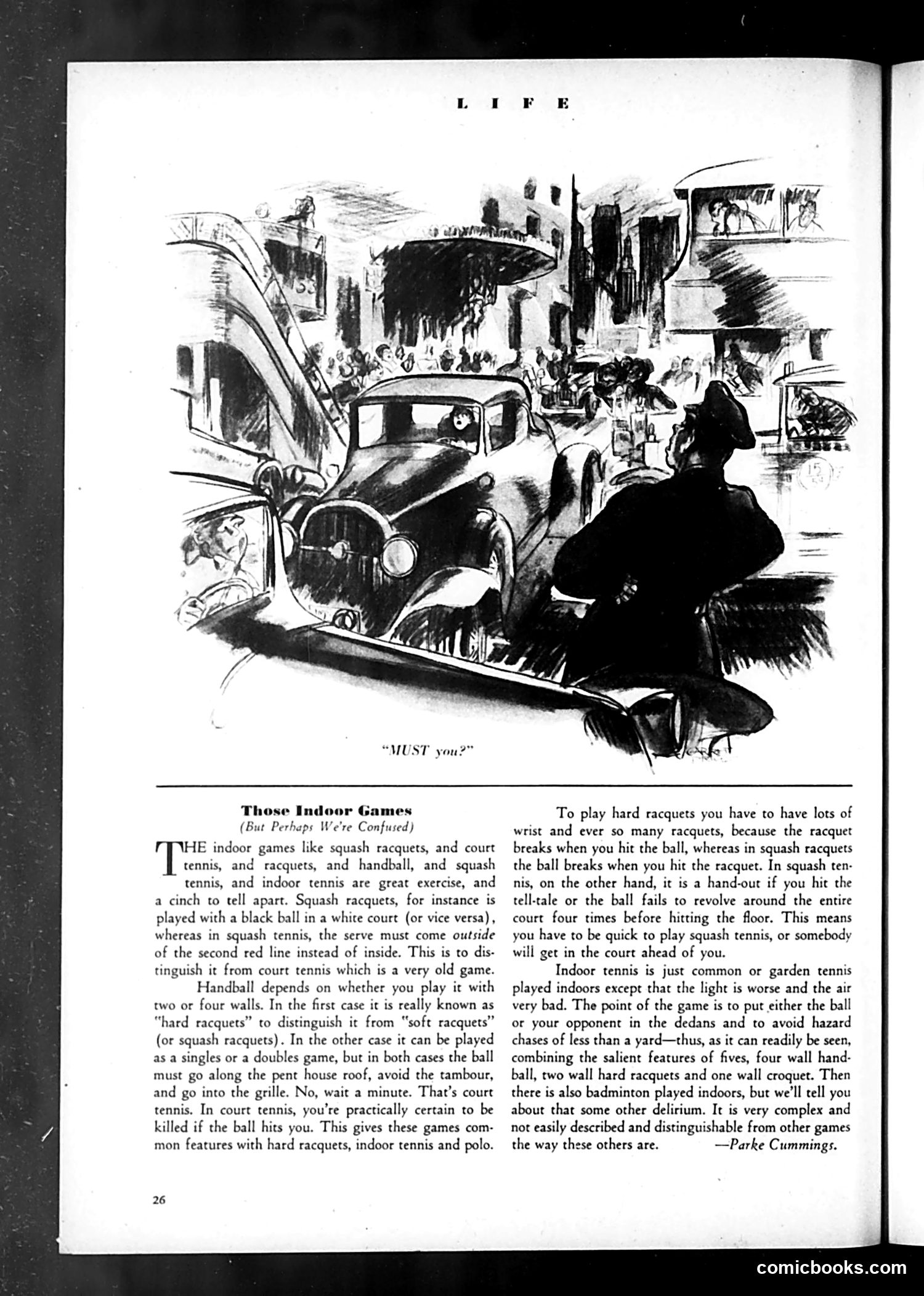
"Those Indoor Games" — Life Magazine Satire This is a humorous article satirizing the confusing overlap of elite indoor racquet sports popular among wealthy Americans. The cartoon shows a car accident scene with the caption "MUST you?" — likely implying that explaining these games is as chaotic as a traffic collision. The satire works by deliberately *failing* to distinguish between nearly identical games: squash racquets vs. squash tennis vs. court tennis vs. handball vs. hard racquets vs. indoor tennis. The author (Parke Cummings) piles on contradictory, nonsensical "rules" — claiming balls break or serves come from confusing line positions — creating absurdist humor. The joke targets the upper-class obsession with these obscure sporting distinctions and the pretentious complexity surrounding them. To modern readers: these sports were status symbols requiring expensive private clubs, and the piece mocks how indistinguishable and unnecessarily complicated they actually are.
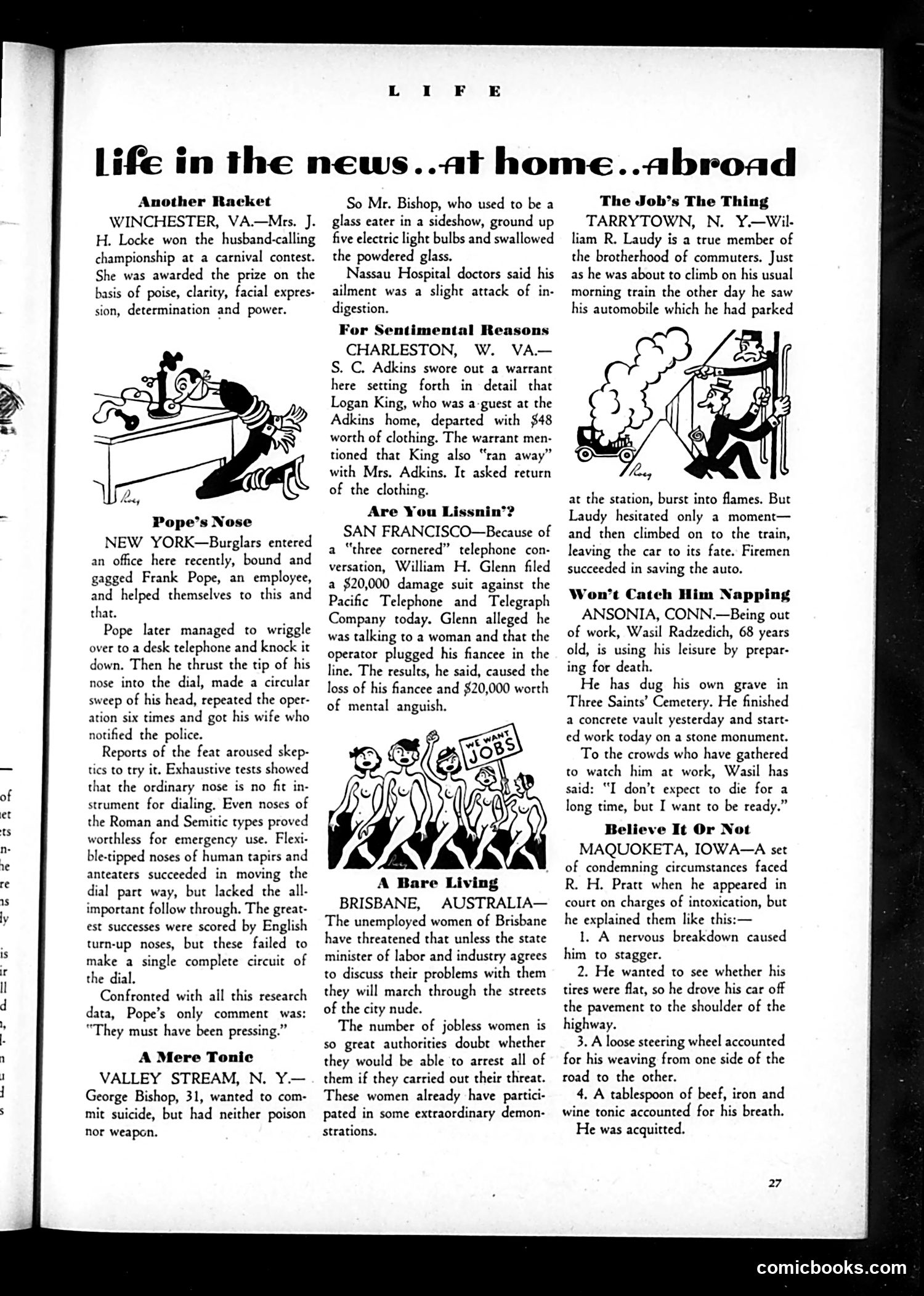
Life Magazine Humor Page Analysis This is a humor page featuring absurdist news-style anecdotes mocking Depression-era American life. The cartoons and stories employ exaggeration and irony: "Pope's Nose": A burglar victim allegedly dials a telephone using only his nose. The satire mocks both the implausibility of the claim and subsequent scientific testing—poking fun at credulous reporting and pseudo-scientific verification of tall tales. "A Bare Living": References Australian unemployed women threatening a nude protest march. The dark humor lies in the authorities' supposed inability to arrest them all—satirizing both desperation and bureaucratic incompetence. "The Job's The Thing": A commuter ignores his burning car to catch his train, mocking the absurd priorities of working men and suburban routine. "Won't Catch Him Napping": A jobless man pre-constructs his own grave and monument, darkly satirizing unemployment desperation. The overall tone is cynical Depression-era humor: surreal, grotesque situations presented deadpan as news, reflecting anxiety about economic collapse and societal absurdity.
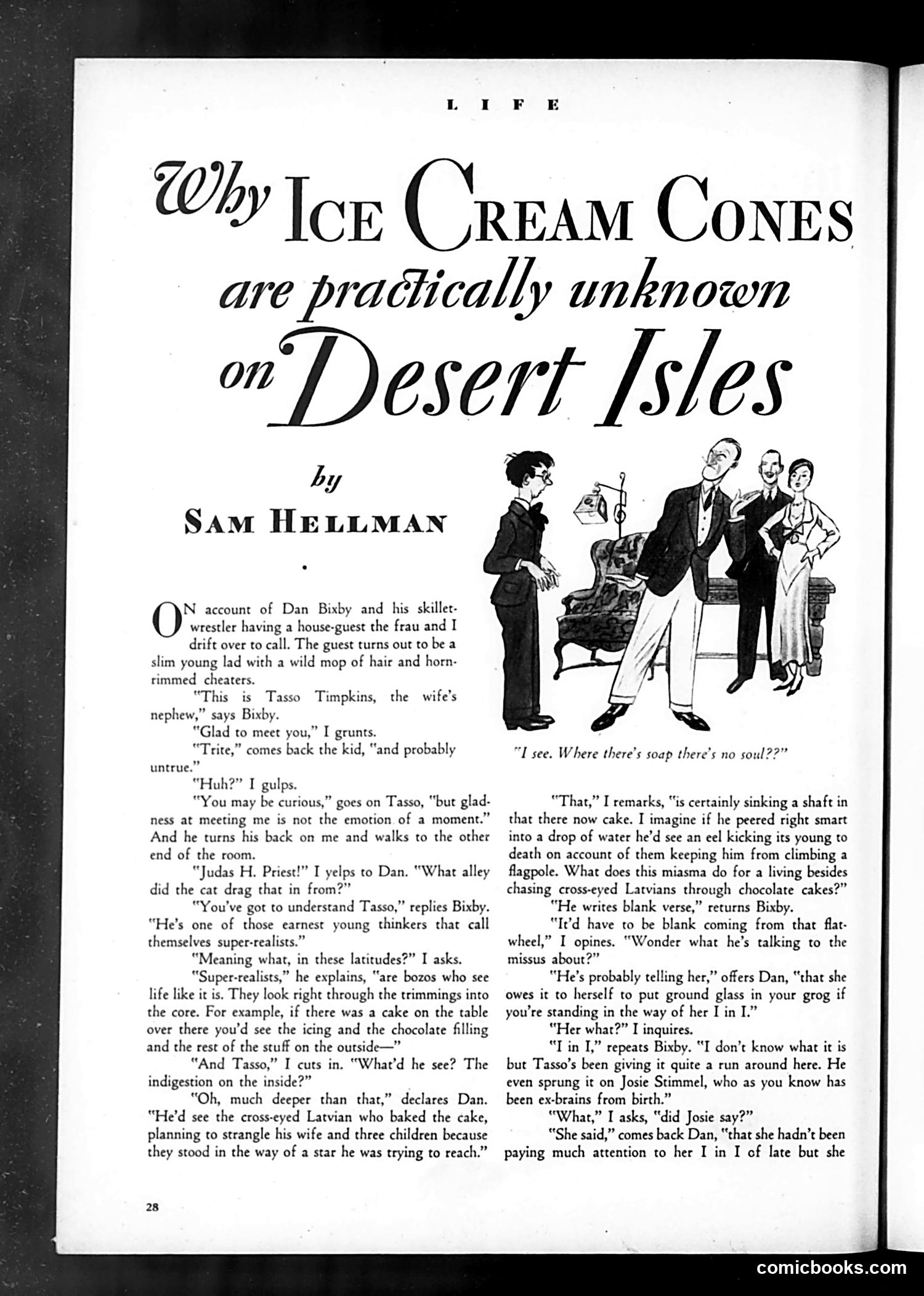
Analysis for Modern Readers This is a humorous short story by Sam Hellman satirizing pretentious intellectualism and avant-garde philosophy of the 1920s-30s era. The joke centers on "Tasso Timpkins," a self-proclaimed "super-realist" — a young intellectual who affects cynicism and existential gloom, dismissing social pleasantries as false and seeing only dark, absurd meaning in ordinary things. The narrator and Dan Bixby mock Tasso's affected persona: his rejection of basic courtesy, his tendency to find tragedy in everyday objects (like a cake), and his incomprehensible philosophical jargon ("I in I" — likely meaning the individual ego or consciousness). The satire targets how avant-garde thinkers of the period often used obscure language and pessimistic worldviews to seem profound, while actually being pretentious and ridiculous. The title references the opening setup but appears unconnected to the actual story — a common Life magazine structure where titles were witty non sequiturs.
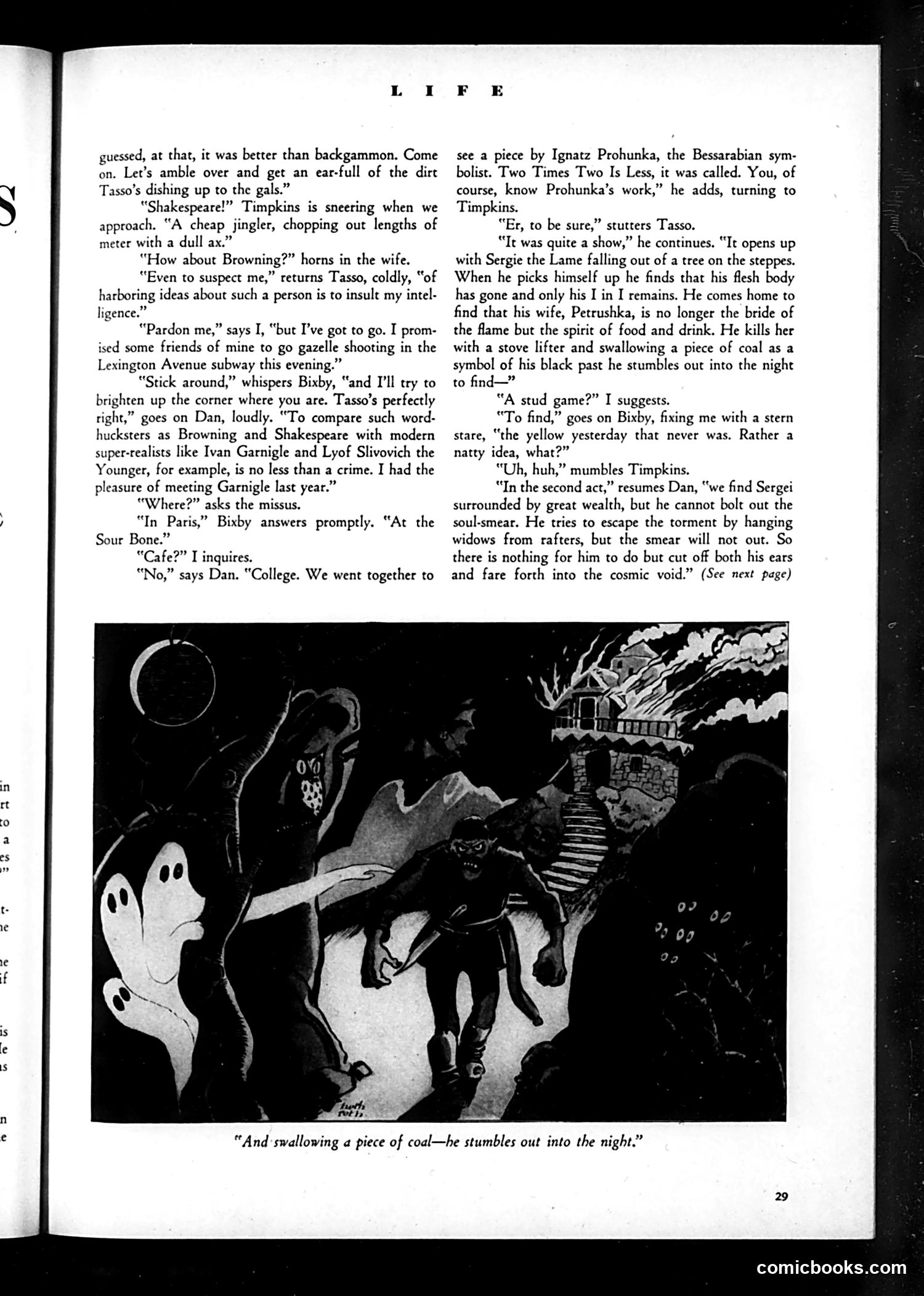
Analysis of Life Magazine Page This page satirizes pretentious artistic and literary criticism of the 1920s. The dialogue mocks intellectuals who affect sophistication by dismissing canonical authors (Shakespeare, Browning) in favor of obscure, invented modernists with foreign names—"Ivan Garnigle," "Lyof Slivovich the Younger," and "Ignatz Prohunka." The humor centers on characters like "Tasso" and "Dan/Bixby" who fabricate absurdly incomprehensible avant-garde plays. The fictional play "Two Times Two Is Less" features surreal, symbolist nonsense: a legless protagonist, a wife transformed into "the spirit of food and drink," suicide by coal-swallowing, and a finale of severing ears to escape existential "soul-smear." The narrator's interruption—suggesting a "stud game" instead—represents the everyman's exasperation with pretentious modernism. The accompanying illustration depicts the play's surreal imagery: ghostly figures, strange architecture, and nightmarish scenes. The satire targets: critics who obscure ignorance behind jargon, the fashion for incomprehensible European symbolism, and the era's rejection of accessible literature for deliberately obscure "art."
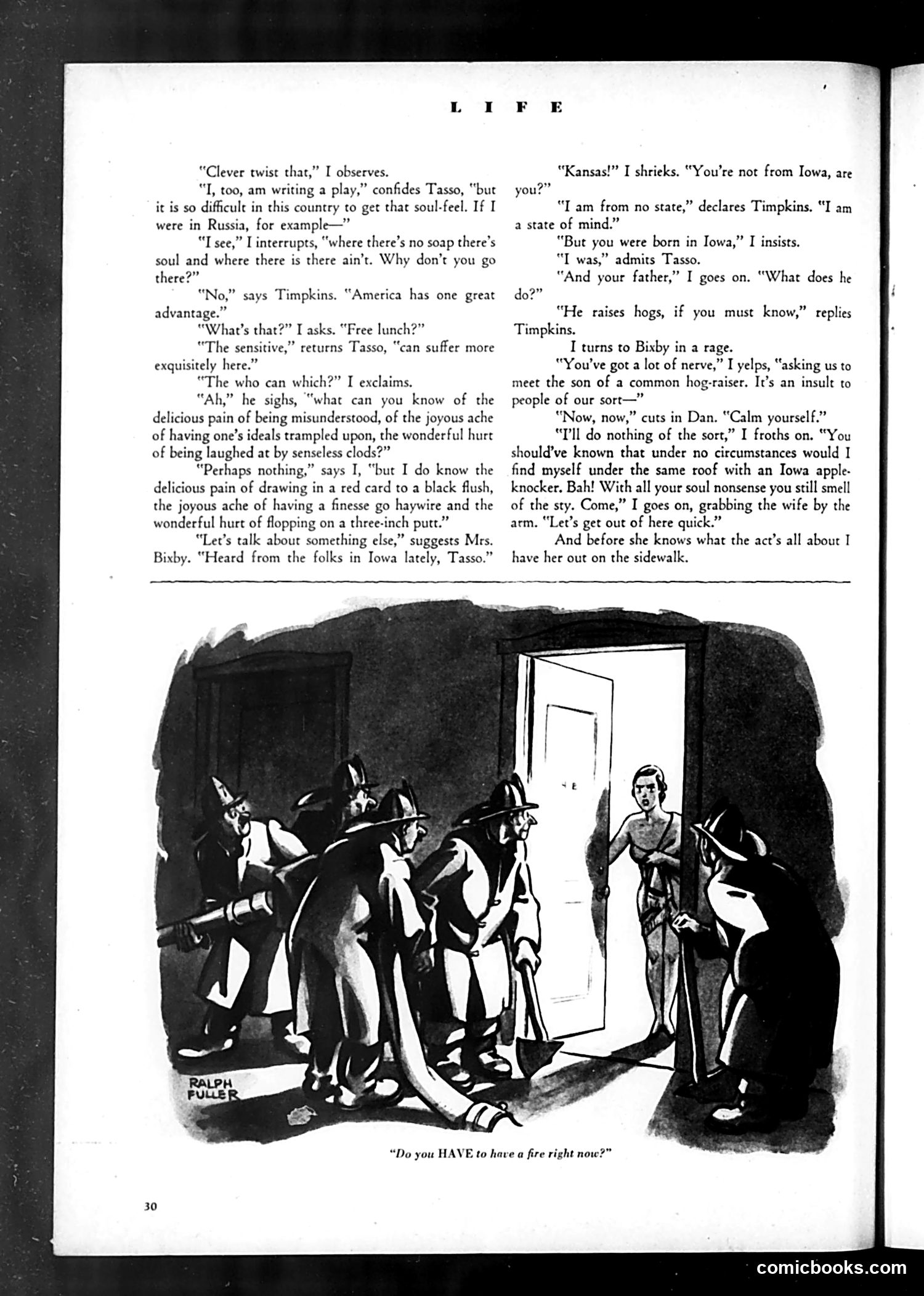
Analysis of Life Magazine Page This page satirizes pretentious intellectuals and artistic poseurs of the early 20th century. The dialogue mocks "Tasso" (likely a fictional stand-in for affected artists), who claims to be "a state of mind" rather than admitting his humble Iowa origins as a hog-raiser's son. The satire targets the romantic affectation of suffering artists who claim America lacks the "soul" of Russia, while simultaneously celebrating their ability to suffer "exquisitely" from misunderstanding and wounded ideals—a self-pitying pretension the narrator deflates by comparing it to everyday disappointments like losing at cards or golf. The cartoon's humor culminates when the narrator—outraged at being asked to socialize with someone of such common background—hypocritically abandons his own companion mid-event, demonstrating that even ordinary people harbor class snobbery. The caption "Do you HAVE to have a fire right now?" suggests the hasty, undignified exit undermines any moral high ground.
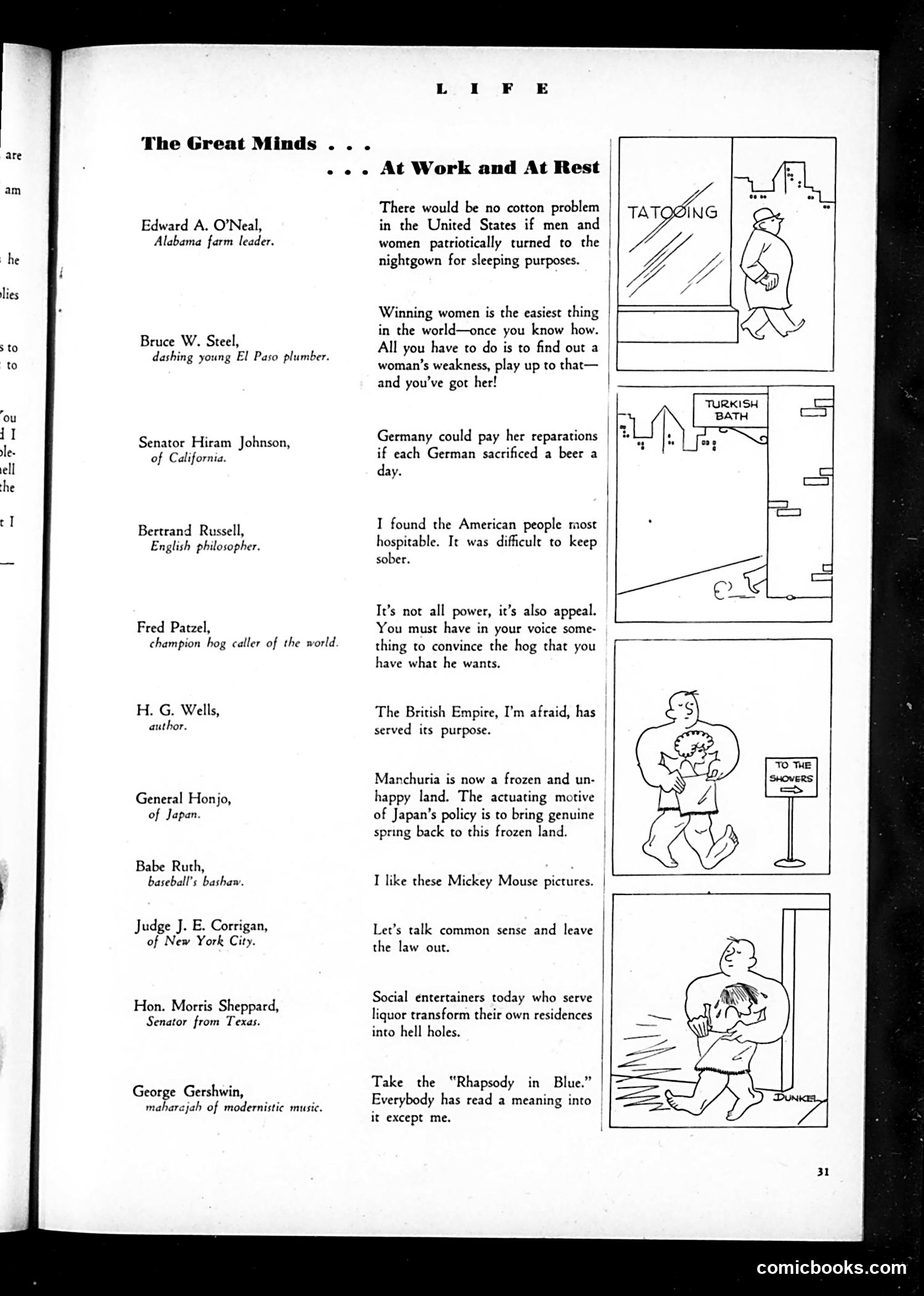
"The Great Minds at Work and At Rest" This satirical page mocks prominent public figures of the 1930s by pairing their names and titles with absurd or cynical statements attributed to them. The humor relies on incongruity: a "champion hog caller" discussing persuasion techniques, a Japanese general justifying imperialism as bringing "spring" to Manchuria, and H.G. Wells claiming he couldn't stay sober among Americans. The cartoons on the right—showing a man tattooing himself, a Turkish bath scene, and a figure being thrown out—appear to illustrate some of these ridiculous statements visually, though their exact correspondence is unclear. The page satirizes both the figures themselves (their actual pretensions or public images) and the magazine's readers' tendency to treat such people as authorities on matters beyond their expertise. It's characteristic of *Life* magazine's irreverent approach to deflating public figures through absurdist humor.
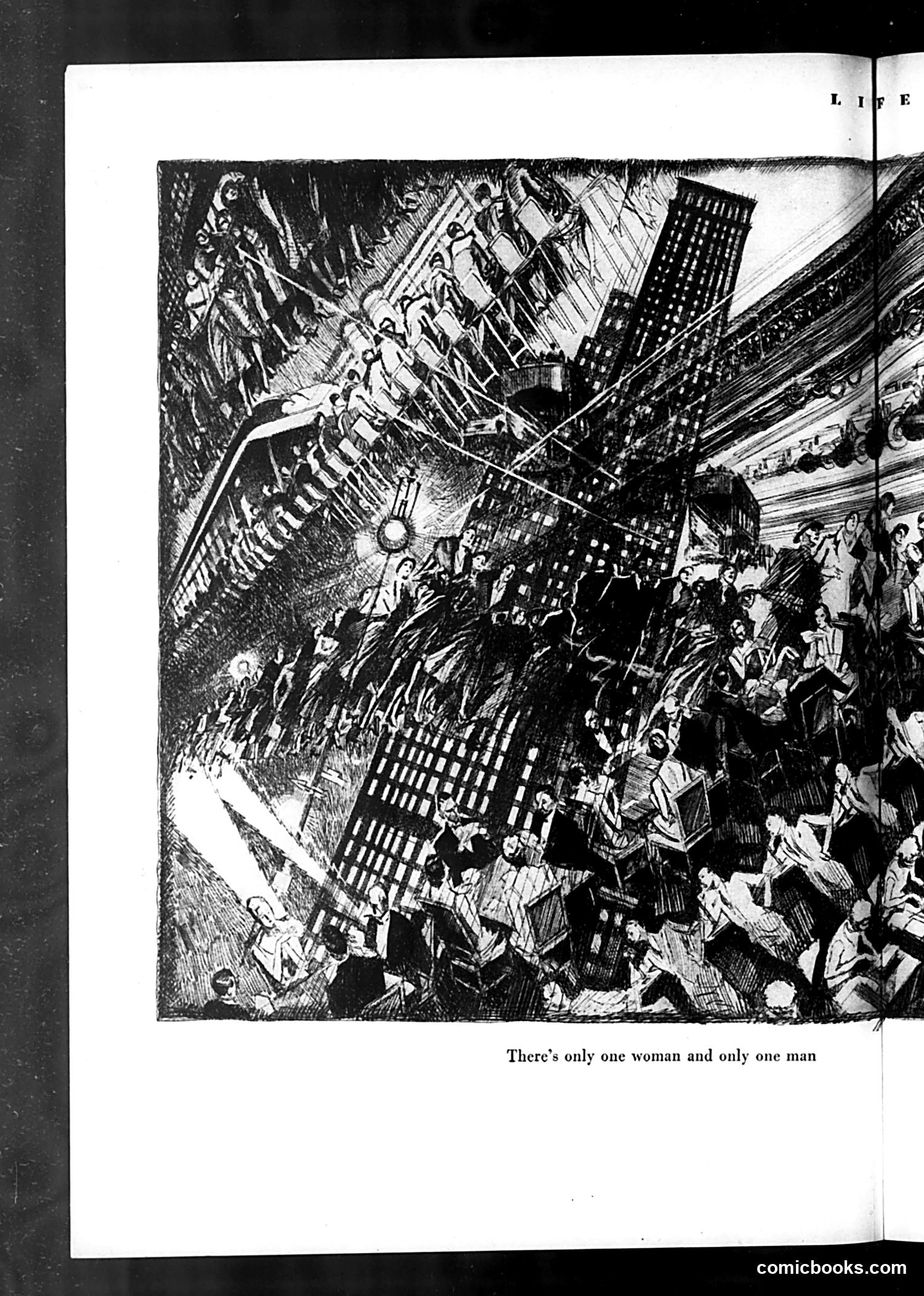
This is a satirical illustration from *Life* magazine depicting a crowded urban street scene viewed from above, showing tall buildings and masses of pedestrians. The caption "There's only one woman and only one man" appears to be a commentary on urban anonymity and mass society — suggesting that despite the throngs of people filling the streets, individual identity becomes meaningless in the crowd. The perspective emphasizes the overwhelming scale of city life and the reduction of distinct individuals to interchangeable masses. This reflects early-to-mid 20th-century anxieties about industrialization, urbanization, and the loss of individual identity in modern metropolitan environments. The satirical point critiques how modern city life renders people indistinguishable from one another.
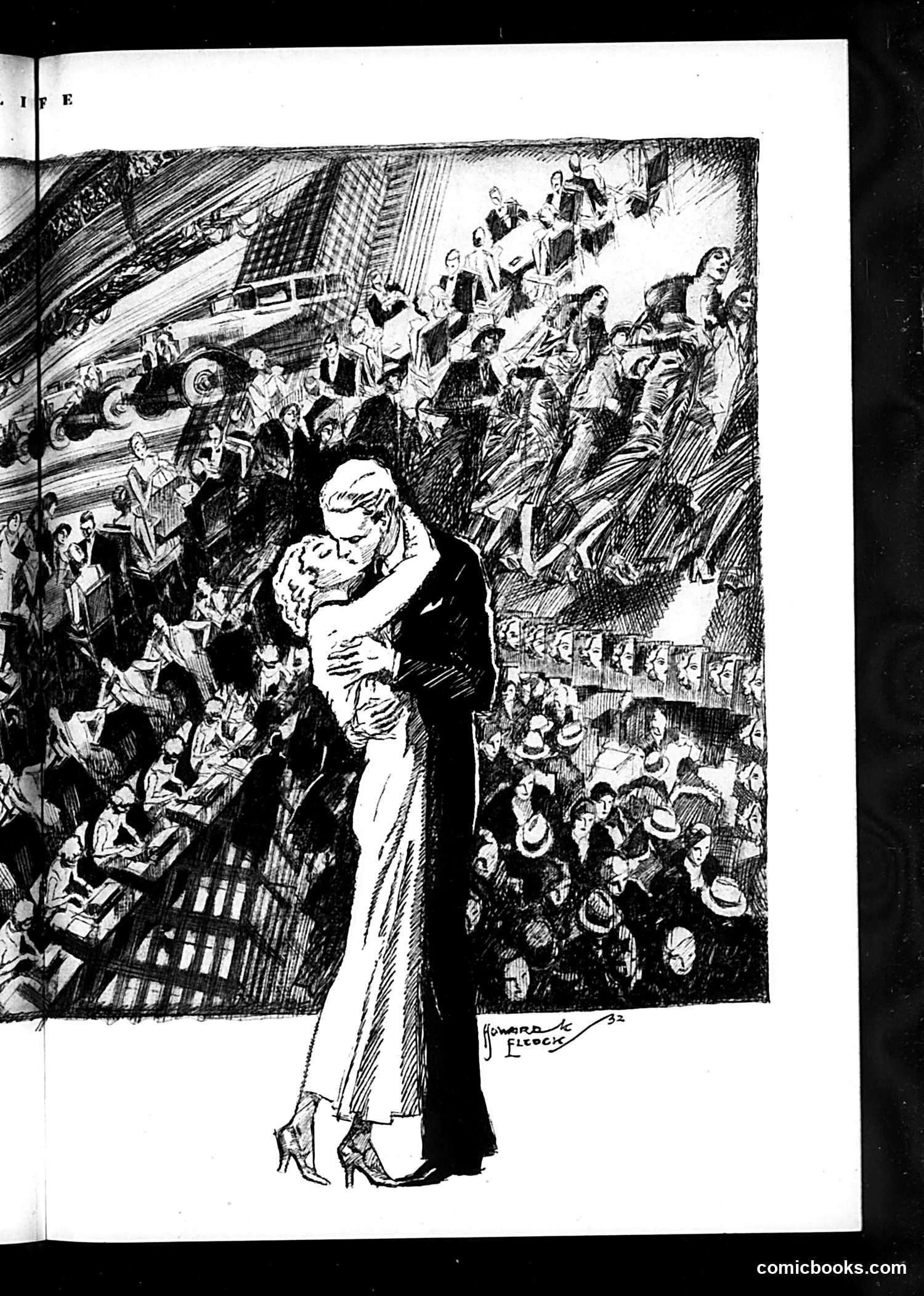
Analysis This is an illustration by Howard Fleischer (signed lower right, dated '32) depicting a woman in fashionable 1930s attire holding an infant, standing before a massive crowd in what appears to be a grand public venue or terminal. The image likely satirizes celebrity motherhood or public fascination with prominent women and babies during the early Depression era. The woman's elegant dress and prominent positioning suggest she represents either an actress, socialite, or other public figure. The overwhelming crowd—rendered in Fleischer's characteristic detailed cross-hatching—emphasizes how modern media and public curiosity transformed private domestic moments into spectacle. The cartoon critiques the obsessive public interest in the personal lives of famous women, particularly regarding motherhood and domesticity, a recurring satire target in 1930s Life magazine.
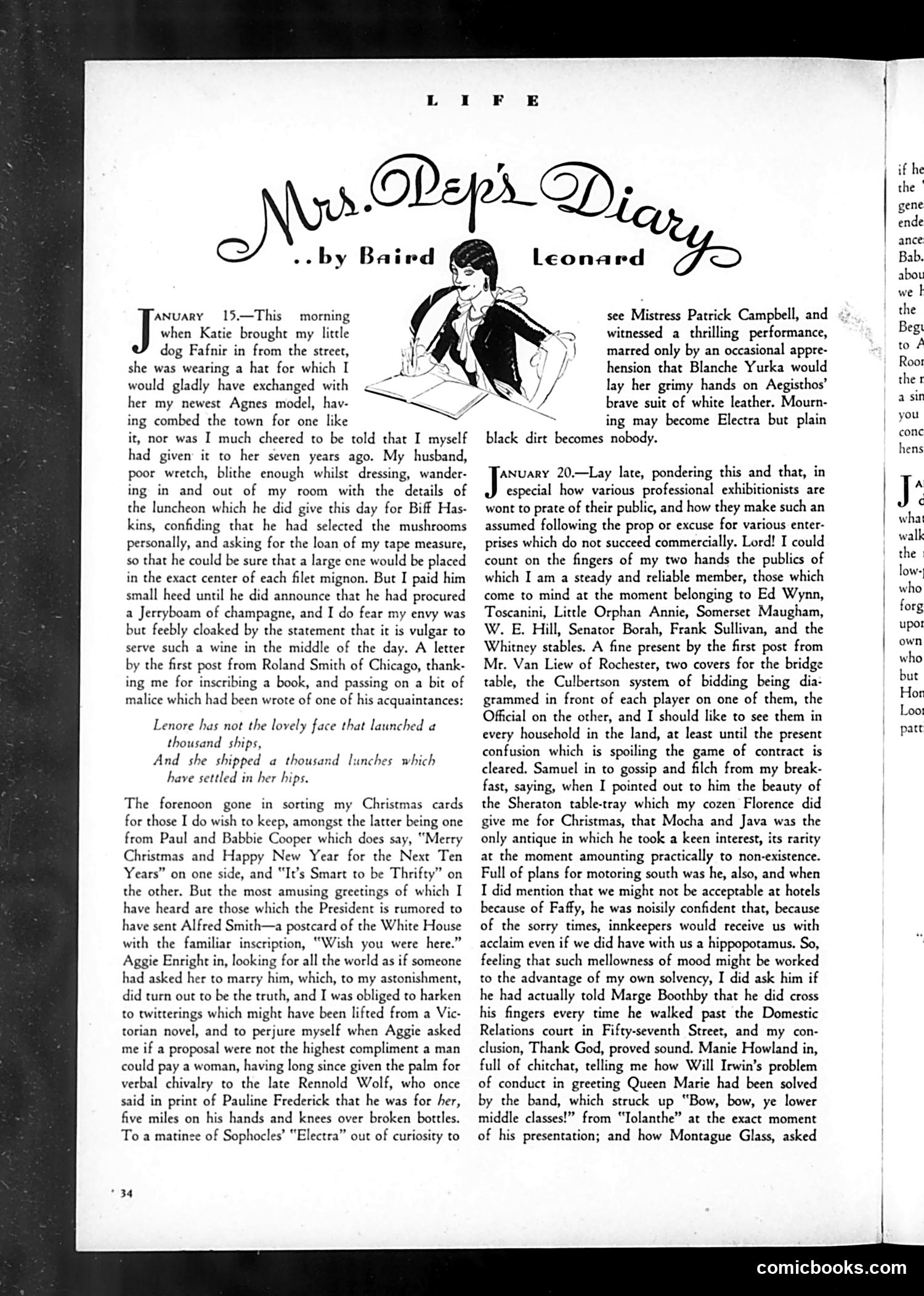
Mrs. Pep's Diary by Baird Leonard This is a society gossip column presented as a wealthy woman's diary entries (January 15 and 20). The humor derives from satirizing upper-class pretensions and social anxieties of the 1920s-30s era. Key references: - Blanche Yurka and Electra: A theatrical performance (likely the 1931 Eugene O'Neill play), with anxious worry about costume integrity - Ed Wynn, Toscanini, Little Orphan Annie, Somerset Maugham: Popular entertainers/figures whose "publics" (audiences/fans) the diarist claims to belong to - Senator Borah, W.E. Hill, Frank Sullivan, Whitney stables: Contemporary celebrities - Culbertson system: A bridge-playing bidding method (newly popular in this era) - President/Alfred Smith postcard: References to Herbert Hoover's 1928 election victory over Democrat Al Smith - Hippopotamus reference: Unclear, possibly a pet or social liability The satire mocks conspicuous consumption, name-dropping, social climbing, and the self-importance of wealthy society figures discussing trivial domestic matters as significant events.
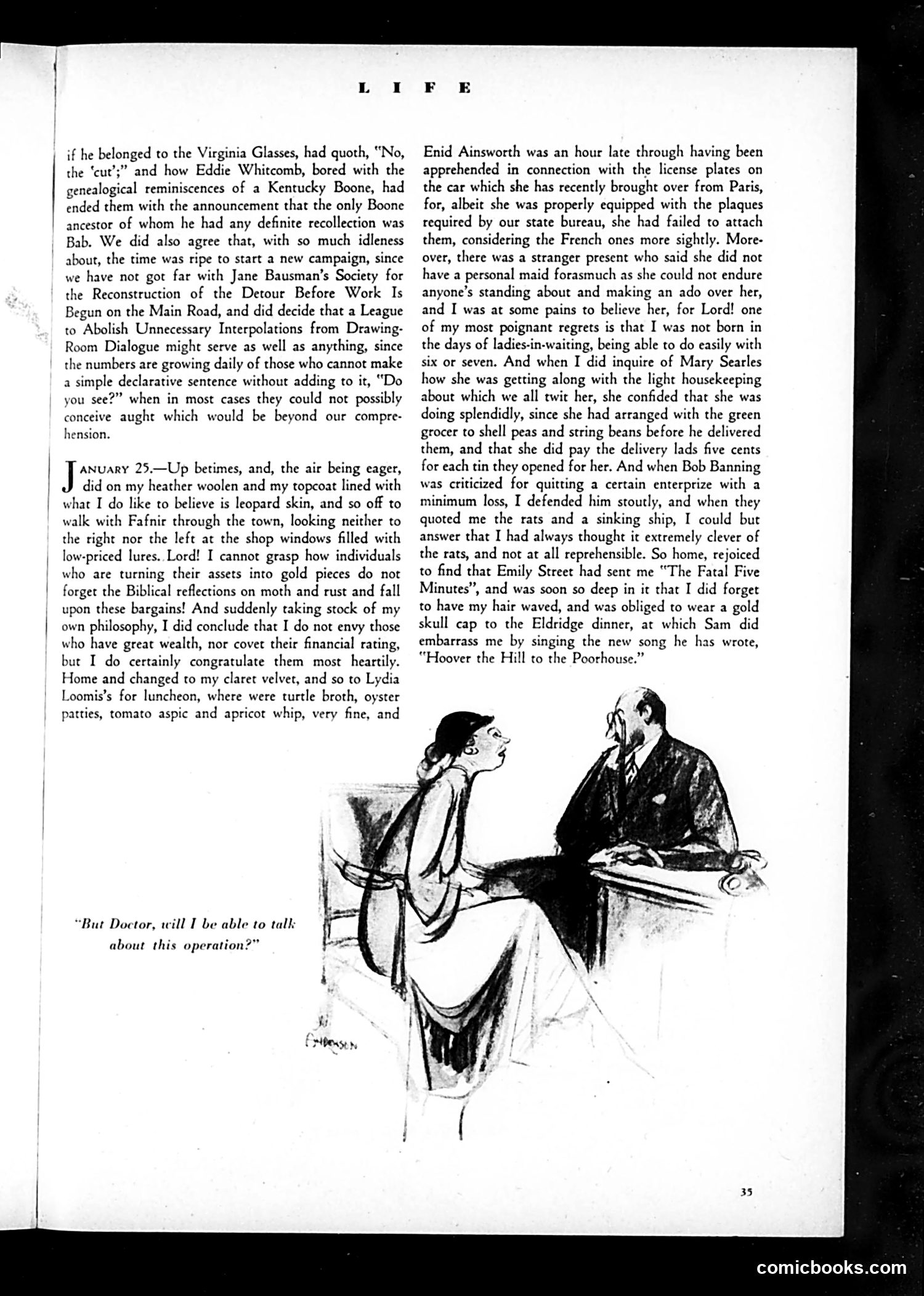
Life Magazine Cartoon Analysis The cartoon depicts a woman patient asking a doctor, "But Doctor, will I be able to talk about this operation?"—a joke about post-operative gossip. The humor relies on the assumption that women are compulsive talkers who prioritize social conversation over physical recovery. This reflects early 20th-century gender stereotypes portraying women as chatty and socially preoccupied. The text above reinforces this satirical theme through diary entries mocking upper-class women's conversational habits, including their tendency to add unnecessary phrases like "Do you see?" to simple statements. The page satirizes both feminine social conventions and the wealthy leisure class's idle chatter, typical of Life magazine's satirical approach to American society during this era.
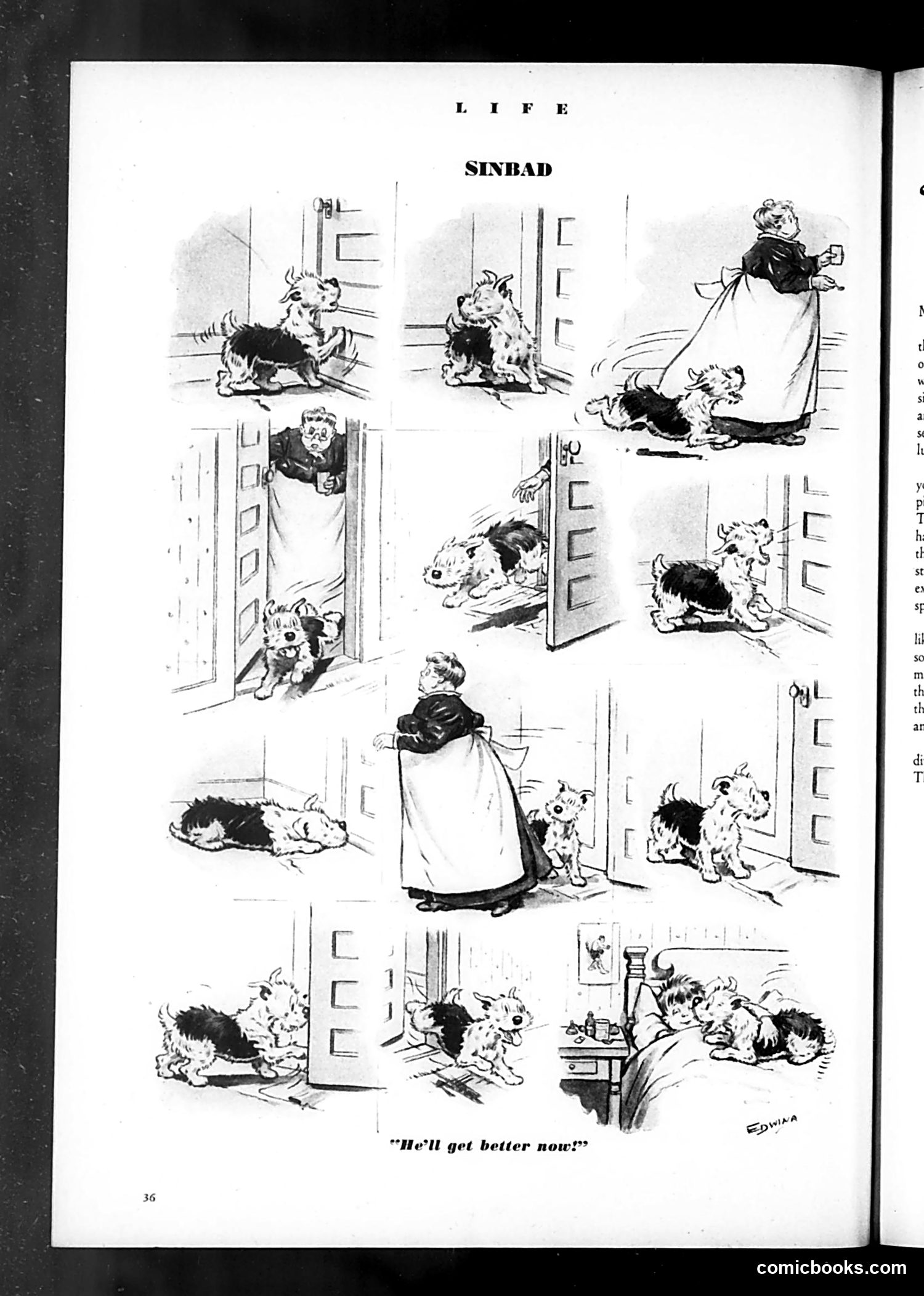
"Sinbad" Comic Strip Analysis This appears to be a multi-panel comic strip titled "Sinbad" showing a domestic scene involving a dog and what seems to be a caregiver or nurse figure. The repeated panels depict various interactions between these characters in a home setting, with architectural elements (doors, walls) providing structure to the scenes. The caption "He'll get better now!" suggests the narrative concerns someone's recovery from illness. The humor likely derives from the dog's reactions or behavior during this domestic caregiving scenario—possibly the dog being an obstacle to, or unwitting participant in, the patient's treatment or rest. Without publication date context, the specific satire remains unclear, though the strip appears to be gentle domestic humor typical of early-to-mid 20th century magazine comics.
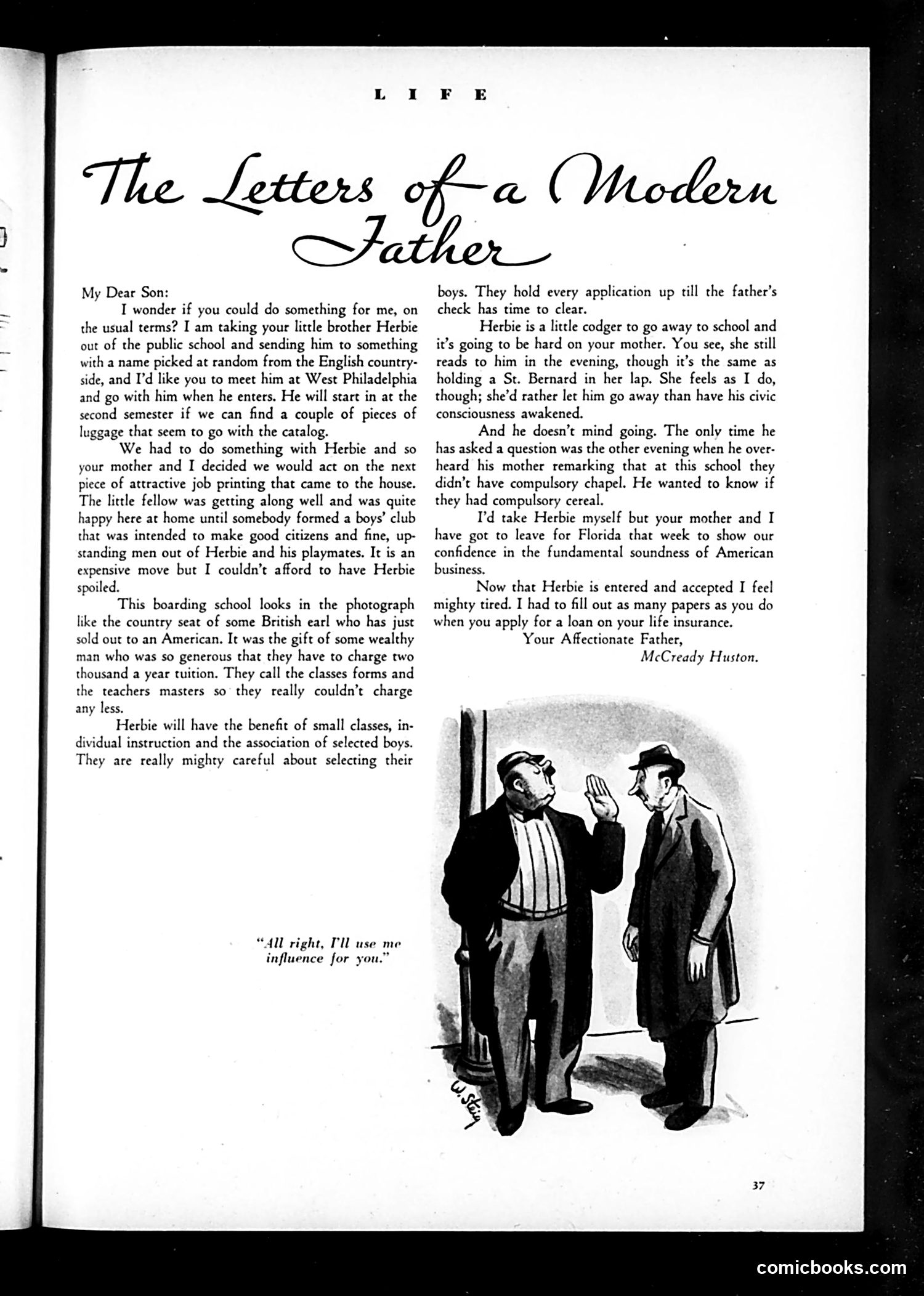
"The Letters of a Modern Father" This satirical piece mocks wealthy American fathers who send their sons to prestigious boarding schools. The letter from "McCready Huston" to his son describes enrolling younger brother Herbie in an expensive English-style boarding school—chosen essentially at random from attractive catalog printing. The satire targets: - Class pretension: The school imitates British aristocracy but operates as a profit-driven business - Parental indifference: The father prioritizes avoiding his son's "civic consciousness awakening" over genuine education - Financial gatekeeping: Applications are held until "the father's check has time to clear"—admission depends on money, not merit - Performative confidence: The parents flee to Florida to demonstrate faith in American business while shipping their child away The accompanying cartoon shows two men discussing influence-peddling, reinforcing the theme that such schools operate on connections and wealth rather than educational merit. The humor lies in the father's candid admission of these mercenary realities.
"Movies" Column by Harry Evans - Life Magazine This is a gossipy celebrity column about Greta Garbo, the famous Swedish actress known for her desire for privacy. Evans recounts several chance encounters with Garbo in New York, emphasizing her wish to be left alone and how he deliberately avoided speaking to her out of respect. The column satirizes Hollywood's obsession with celebrities' private lives. Evans argues that while the public is naturally curious about stars' personal habits and relationships, performers deserve privacy despite being public figures. He references her being spotted with actor Ramon Novarro at a speakeasy, implying romantic speculation. The broader satire critiques the "mental defectives" (paparazzi and celebrity hounds) who stalk stars, contrasting Garbo's dignified reclusiveness with the public's invasive curiosity. Evans positions himself as more respectful than typical gossip-mongers, though the irony is that he's still publishing celebrity observations in a satirical magazine.
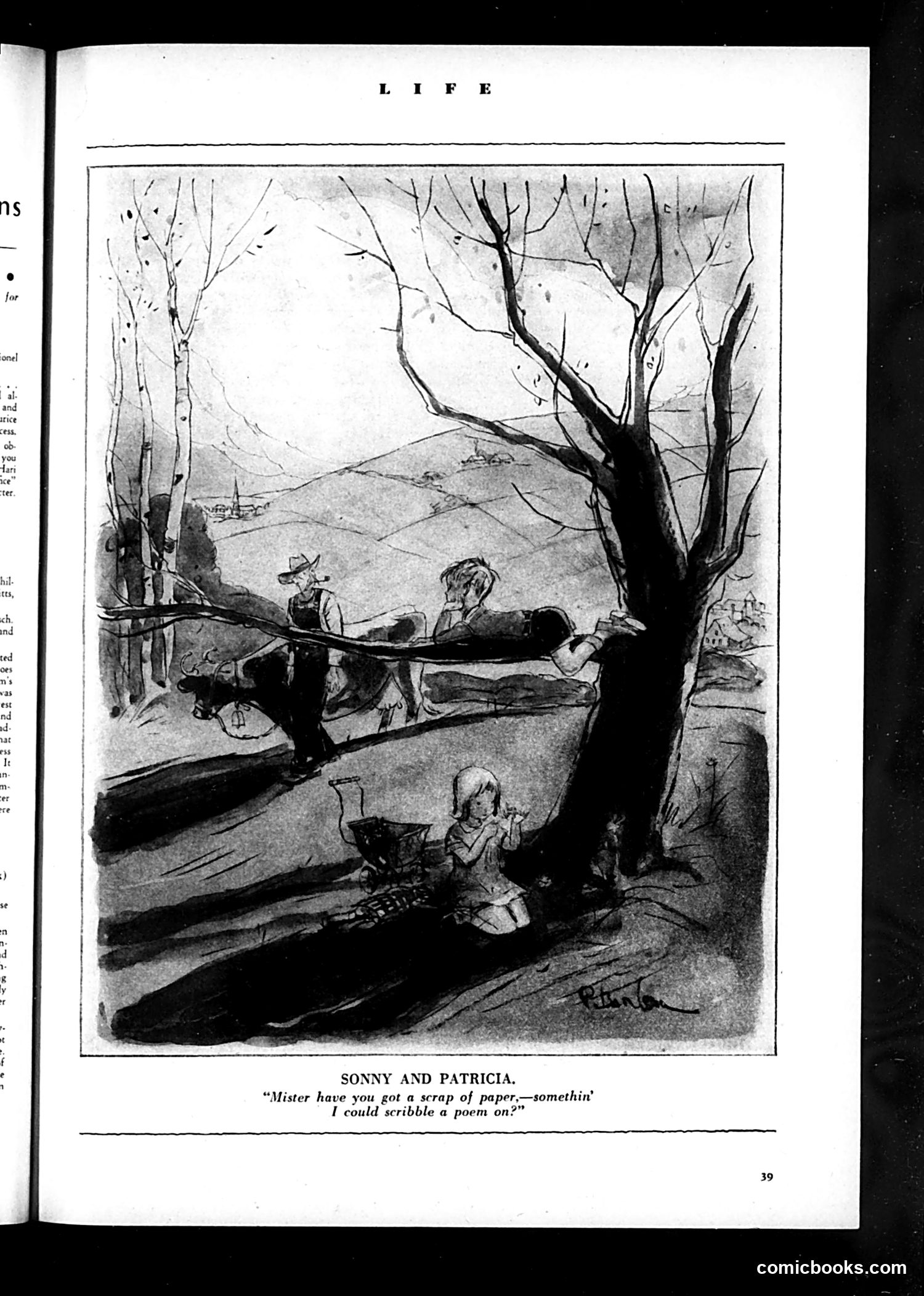
Sonny and Patricia This illustration depicts a young boy (Sonny) approaching an adult man (possibly a tramp or working-class figure) to ask for paper to write poetry on. A girl named Patricia is present in the scene. The humor appears to target the romanticized notion of impoverished aspiring poets—the boy is so eager to compose verse that he's begging strangers for scrap paper rather than purchasing it properly. The setting among bare trees and rural landscape emphasizes modest circumstances. The satire likely mocks both juvenile artistic pretension and the idealized image of the struggling poet, suggesting that genuine poetic inspiration doesn't require material poverty or dramatic circumstances. The tone is gentle rather than biting, typical of Life magazine's social commentary humor.
Manhattan Presents: A Literary Appreciation This page contains two theater reviews by Alison Smith from *Life* magazine (a satirical publication). The left column reviews Arthur Schnitzler's novel *Flight Into Darkness*, describing it as a psychological study of approaching madness—Schnitzler being an Austrian physician-writer whom Smith interviewed in Vienna. The review praises the work's medical precision and compassion. The right column reviews the musical *Of Thee I Sing*, created by George and Ira Gershwin, George S. Kaufman, and Morrie Ryskind. Smith notes this is rare political satire in musical comedy form, with the show irreverently mocking American patriotism and war-mongering from its very title onward. The review suggests the production mercilessly satirizes national pretensions and governmental figures throughout. Both reviews highlight contemporary artistic responses to serious themes—psychological deterioration and political critique respectively.
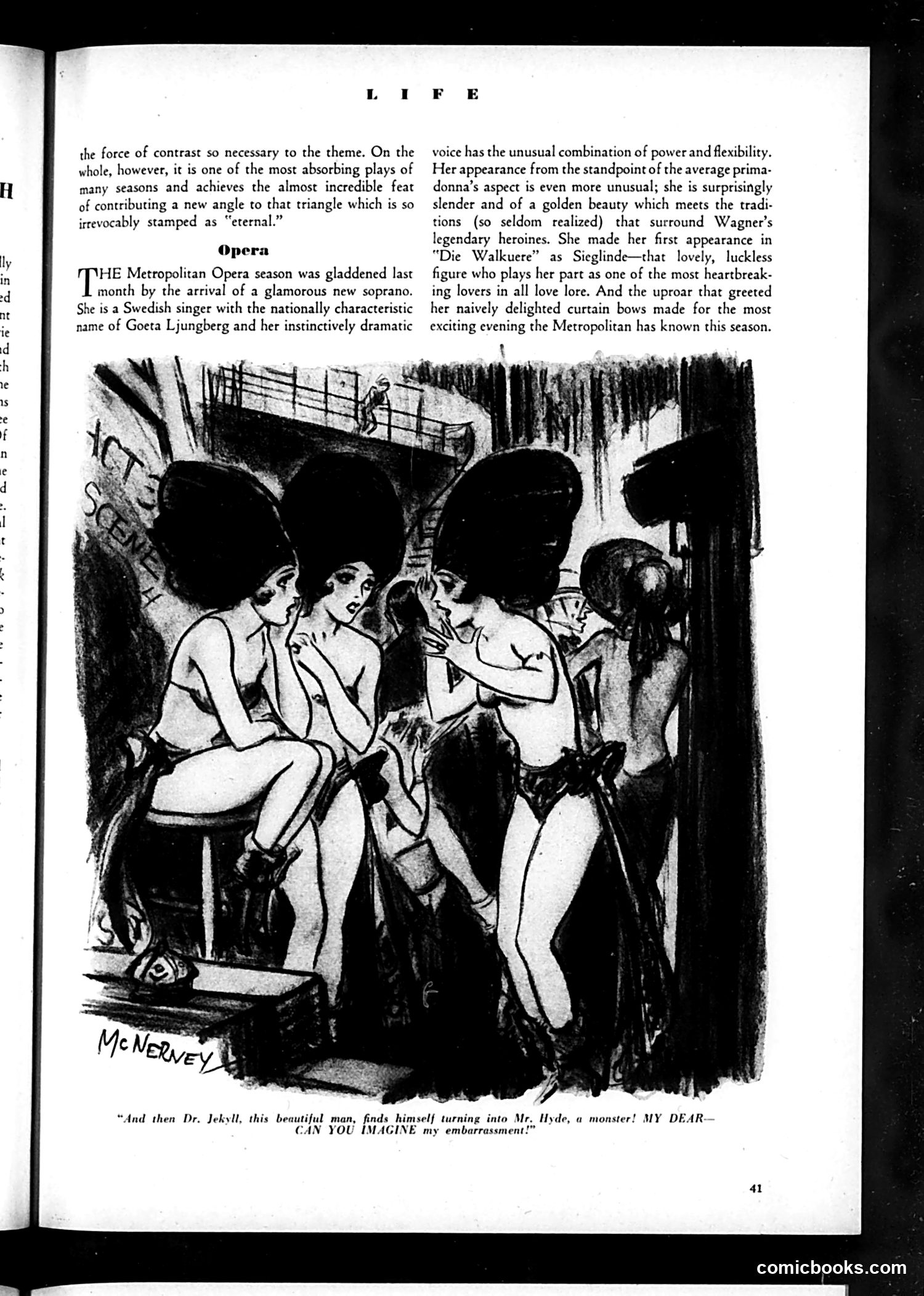
Analysis This page contains two distinct pieces from Life magazine: Text Section (Opera): A review praising Swedish soprano Goeta Ljungberg's Metropolitan Opera debut as Sieglinde in Wagner's "Die Walkuere." The critic emphasizes her unusual combination of dramatic vocal power with a slender, conventionally beautiful appearance—noting this rarely matched the physical stereotypes associated with Wagnerian heroines. Cartoon (by McEnerney): A satirical drawing depicting women in what appears to be a dressing room or backstage setting, reacting with exaggerated shock. The caption references Dr. Jekyll and Mr. Hyde, making a crude joke: a woman expresses mock horror at a man's physical transformation during intimacy, using the literary reference as a euphemistic vehicle for bawdy humor. The cartoon is typical of Life's humor style—combining literary/cultural references with risqué implications about sexuality, presented through knowing innuendo rather than explicit language, reflecting 1920s-30s magazine satire conventions.
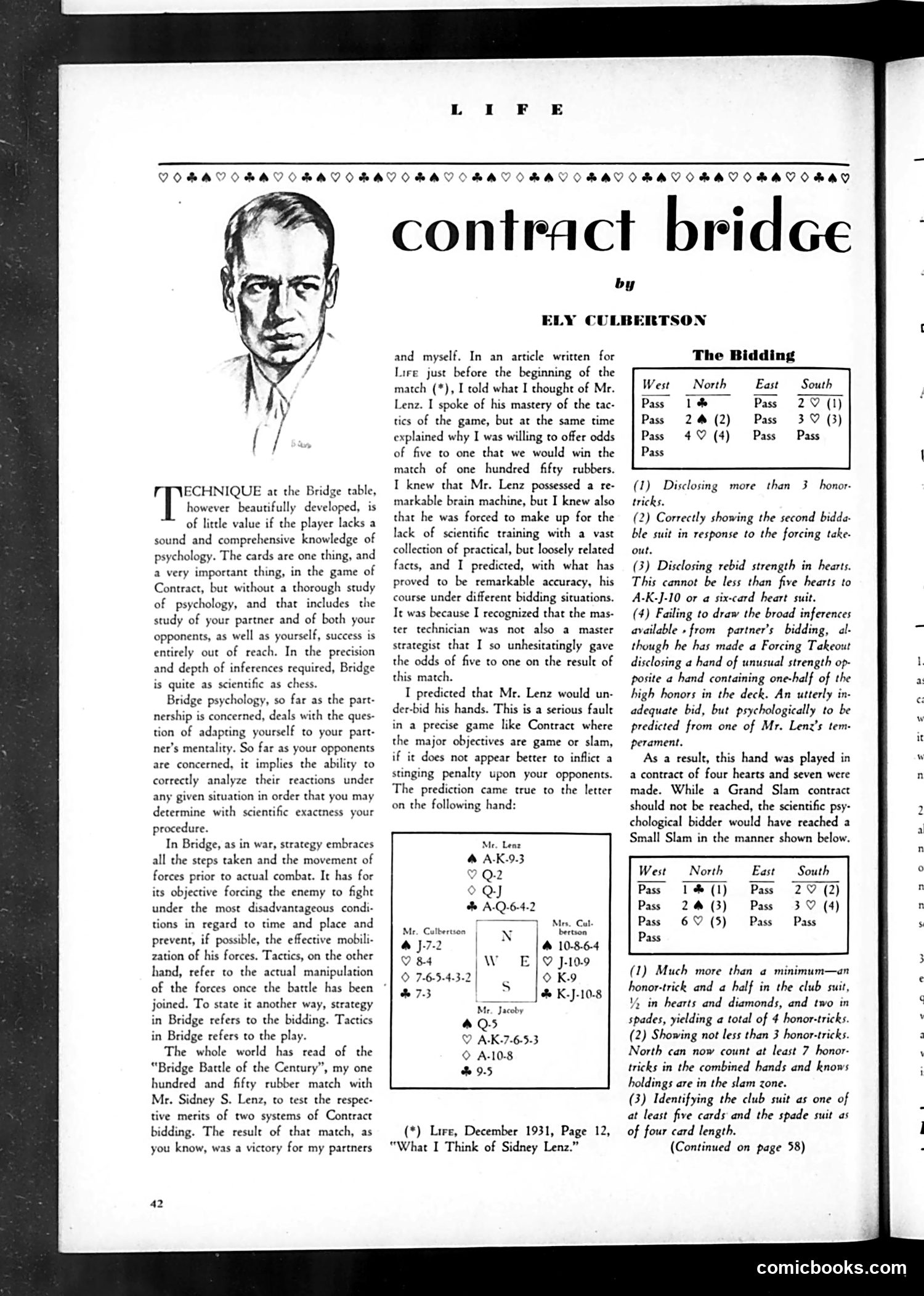
What This Page Means to Modern Readers This is an instructional article on Contract Bridge by Ely Culbertson, a famous bridge champion of the 1930s. The article teaches bridge psychology and strategy, using a specific hand as an example. The Context: Culbertson references his famous "Bridge Battle of the Century"—a 150-rubber match against Sidney Lenz in 1931 to prove Culbertson's bidding system superior. Culbertson won decisively, and he uses this victory to establish credibility while explaining why Lenz, though tactically skilled, failed strategically: Lenz lacked scientific training in bidding psychology. The Point: This isn't satire—it's genuine instruction mixed with self-promotion. Culbertson argues bridge requires psychological analysis of opponents' behavior, comparable to chess or military strategy. The article demonstrates his system's superiority by analyzing Lenz's actual underbidding, proving Culbertson's earlier predictions accurate. Bridge was a serious, elite pursuit in the 1930s; this article treats it with intellectual gravity.
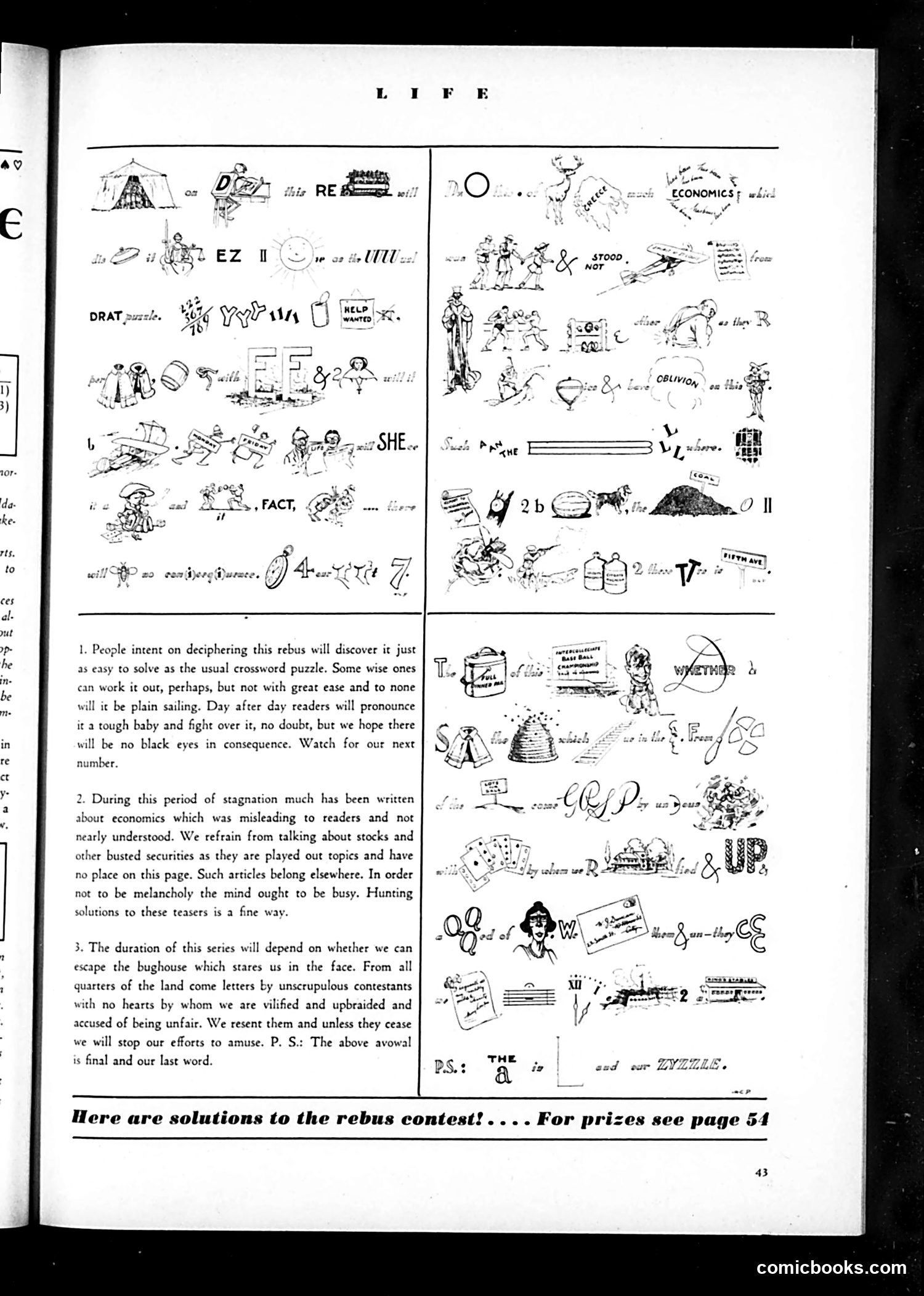
Life Magazine Rebus Contest Page This page presents a rebus puzzle contest — visual word-play riddles using pictures, symbols, and letters combined to spell out phrases or sayings. Readers decode these pictorial puzzles much like crossword puzzles. The editorial notes acknowledge the contest's difficulty and popularity, while also defending the magazine's decision to avoid discussing economics and "busted securities" during an apparent period of economic uncertainty (likely referring to post-1929 Depression stagnation). The editors explain they're providing mental diversions rather than depressing financial commentary. Notably, the final note warns contestants against "unscrupulous" and unfair behavior, threatening to end the contest if complaints continue—suggesting the rebus games generated heated reader competition and disputes. The tone is humorous but also indicates real friction between editors and overeager contestants fighting to solve these visual puzzles.
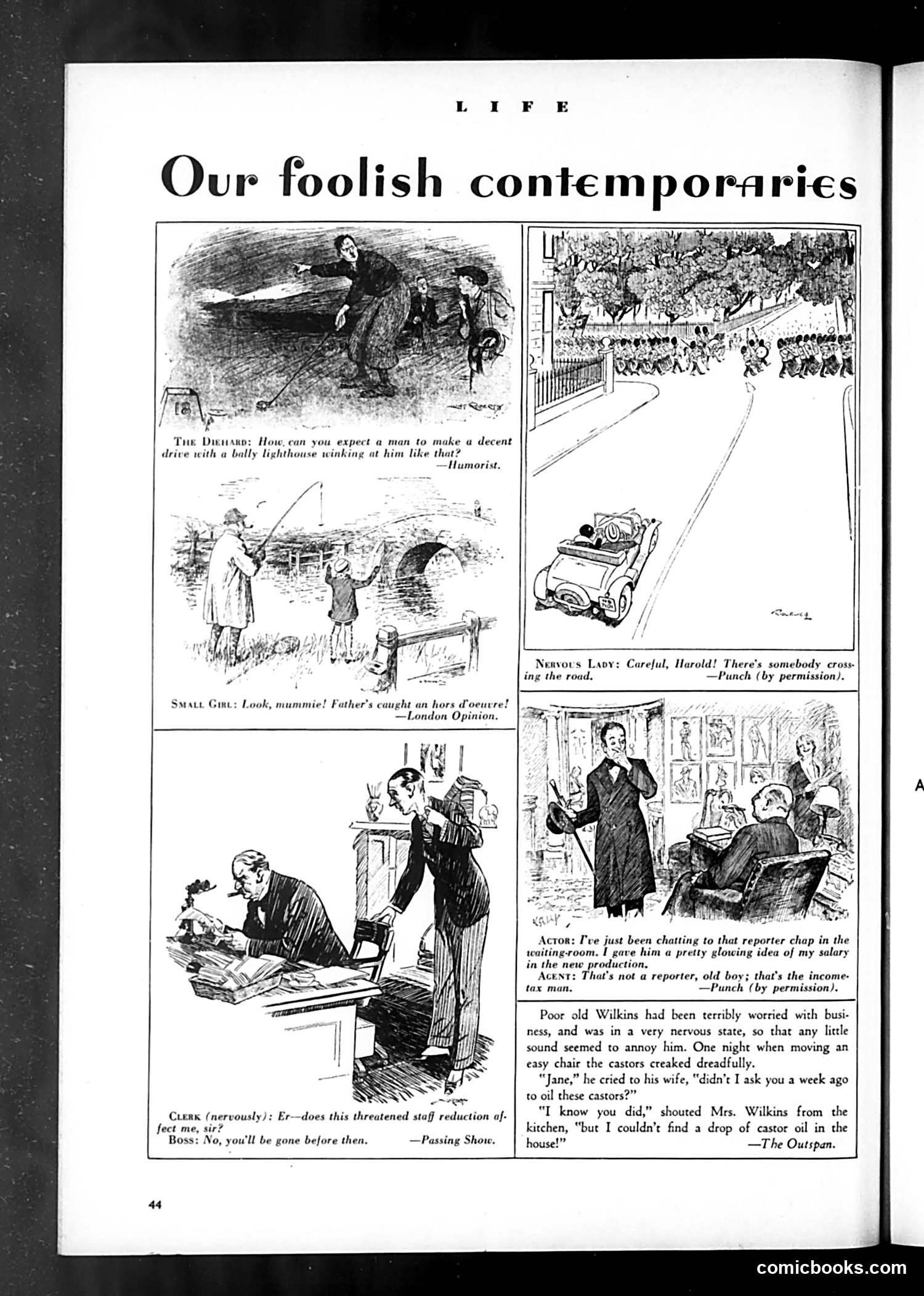
"Our Foolish Contemporaries" - Life Magazine Satire Page This page collects humorous short comics and anecdotes mocking everyday foolishness. The cartoons satirize: 1. Golf distraction: A golfer complains a lighthouse's blinking interferes with his drive—absurd priorities. 2. Nervous driving: A jittery driver panics about pedestrians crossing, suggesting anxious modern motorists. 3. Fishing mishap: A child mistakes something caught for food ("hors d'oeuvre"), playing on adult pretension. 4. Tax evasion: An actor brags about his salary to someone he assumes is a reporter—who's actually the income tax collector. Dark humor about financial deception. 5. Domestic annoyance: A stressed businessman obsesses over squeaky chair castors; his wife ironically can't find "castor oil" (the punchline plays on the word "castor"). These gentle satirize petty bourgeois concerns, modern anxieties, and domestic comedy. The tone is lighthearted social criticism typical of early-20th-century humor magazines.
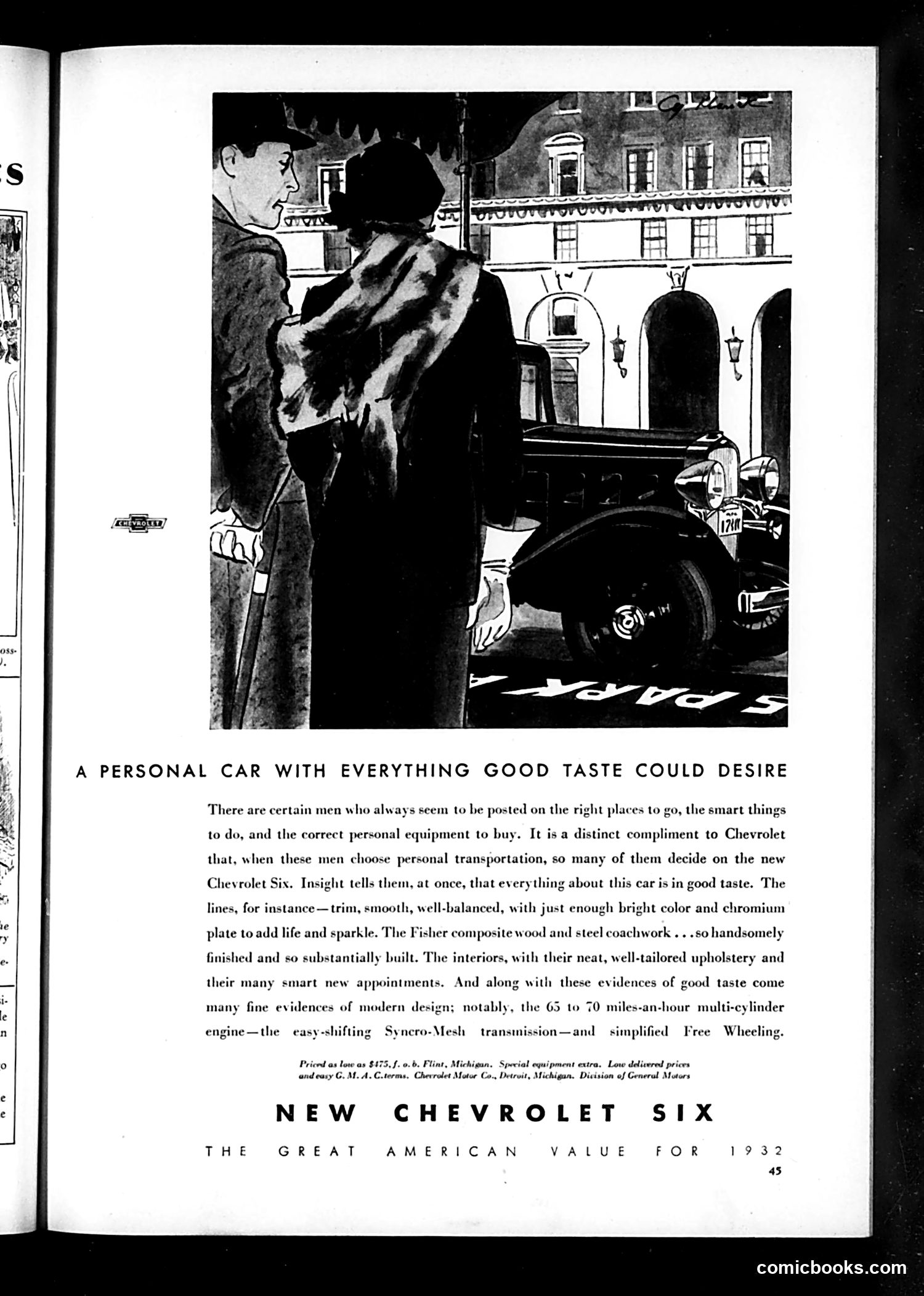
Analysis This is primarily a Chevrolet advertisement, not political satire. The page depicts a well-dressed couple in an elegant urban setting (recognizable architecture in background) admiring a new 1932 Chevrolet Six automobile. The advertisement's appeal is social aspiration: it targets wealthy or status-conscious men by claiming that discerning gentlemen of good taste naturally choose Chevrolet. The copy emphasizes aesthetic refinement—trim lines, chromium detailing, quality upholstery—alongside mechanical features (65-70 mph engine, Syncro-Mesh transmission). This reflects 1930s marketing strategy: positioning an affordable car ($475) as a luxury item through association with sophistication and social status, rather than emphasizing economy during the Depression. The illustration's elegant couple and upscale setting reinforce this "good taste" messaging. There is no political cartoon or satire on this page—it is straightforward automotive advertising using aspirational imagery common to the era.
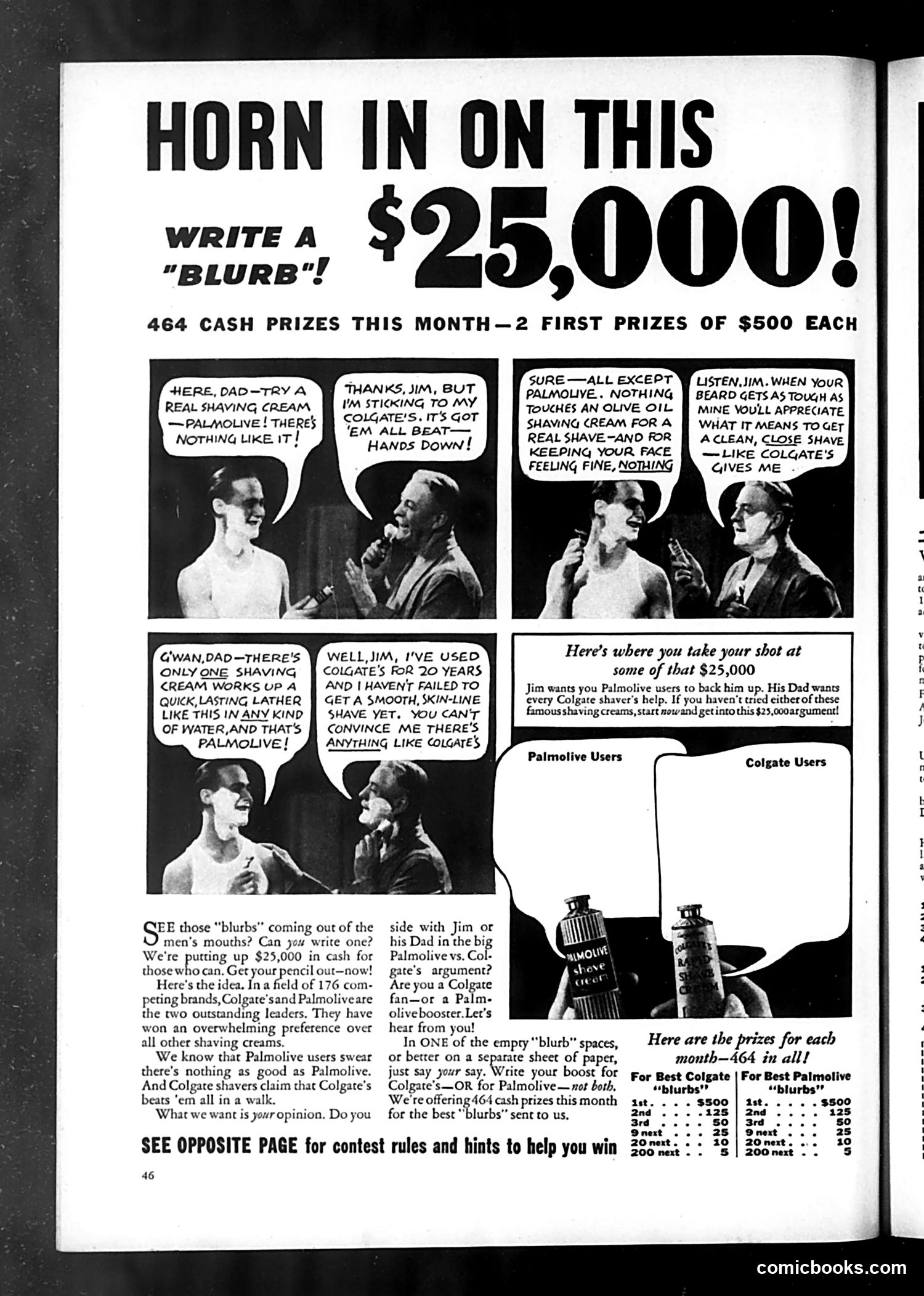
Political Context & Satire Analysis This is advertising masquerading as editorial content—a 1930s-40s marketing contest, not satire. Two rival shaving cream brands, Colgate's and Palmolive, sponsor a "$25,000 blurb-writing contest" disguised as humorous comics. The cartoon depicts a father-son debate over which shaving cream is superior. The "Dad" champions Colgate's (20-year loyalty, smooth shaves), while "Jim" and others tout Palmolive's olive-oil formula. The humor is gentle product advocacy: each character delivers enthusiastic testimonials dressed as casual family disagreement. The satire target: Consumer brand loyalty itself. By framing this as a genuine debate requiring reader judgment, Life magazine (and the advertisers) mock how Americans invested emotional identity in mundane products. The contest structure—asking readers to write their own "blurbs"—transforms passive consumers into active brand evangelists. This reflects pre-WWII consumer culture, when competing soap/cream brands aggressively courted market share through personality-driven advertising.
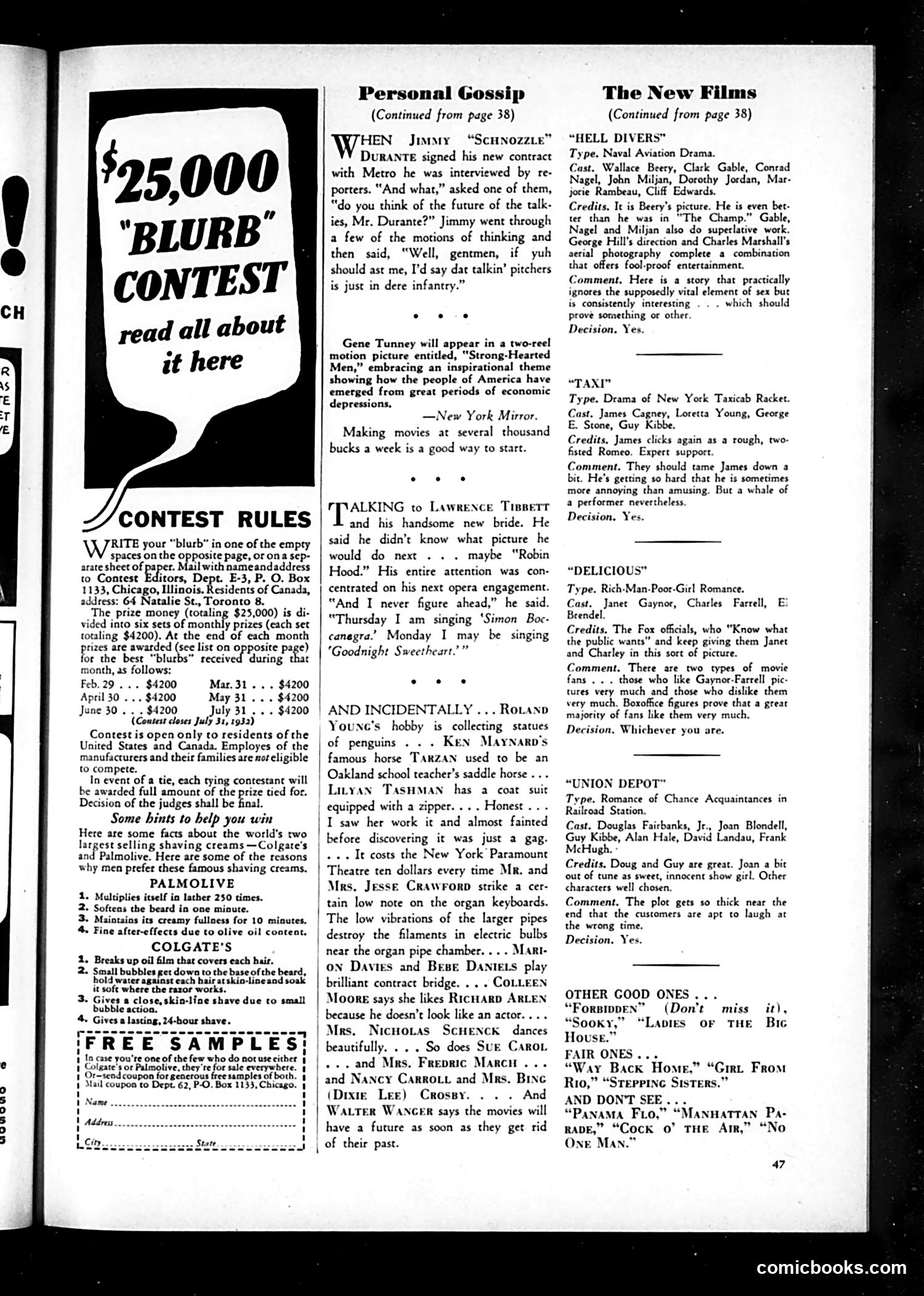
Analysis of This Life Magazine Page This page is primarily advertising and contest material rather than political satire. The dominant feature is a "$25,000 Blurb Contest" sponsored by shaving cream manufacturers Colgate's and Palmolive, offering monthly prizes to readers who write advertising copy describing these products. The "Personal Gossip" and "New Films" sections are entertainment industry coverage typical of Life magazine's celebrity reporting from this era (circa 1932, based on the contest closing date). References include Jimmy Durante's distinctive accent, opera singer Lawrence Tibbett, and various Hollywood personalities' trivial activities. The page reflects 1930s consumer culture: major companies invested heavily in contests and giveaways during the Depression to boost sales and engagement. The detailed product comparisons between Colgate's and Palmolive reveal competitive advertising claims about lather, beard-softening, and shaving quality—concerns paramount to male consumers of that period. This is fundamentally commercial content, not satire or political commentary.
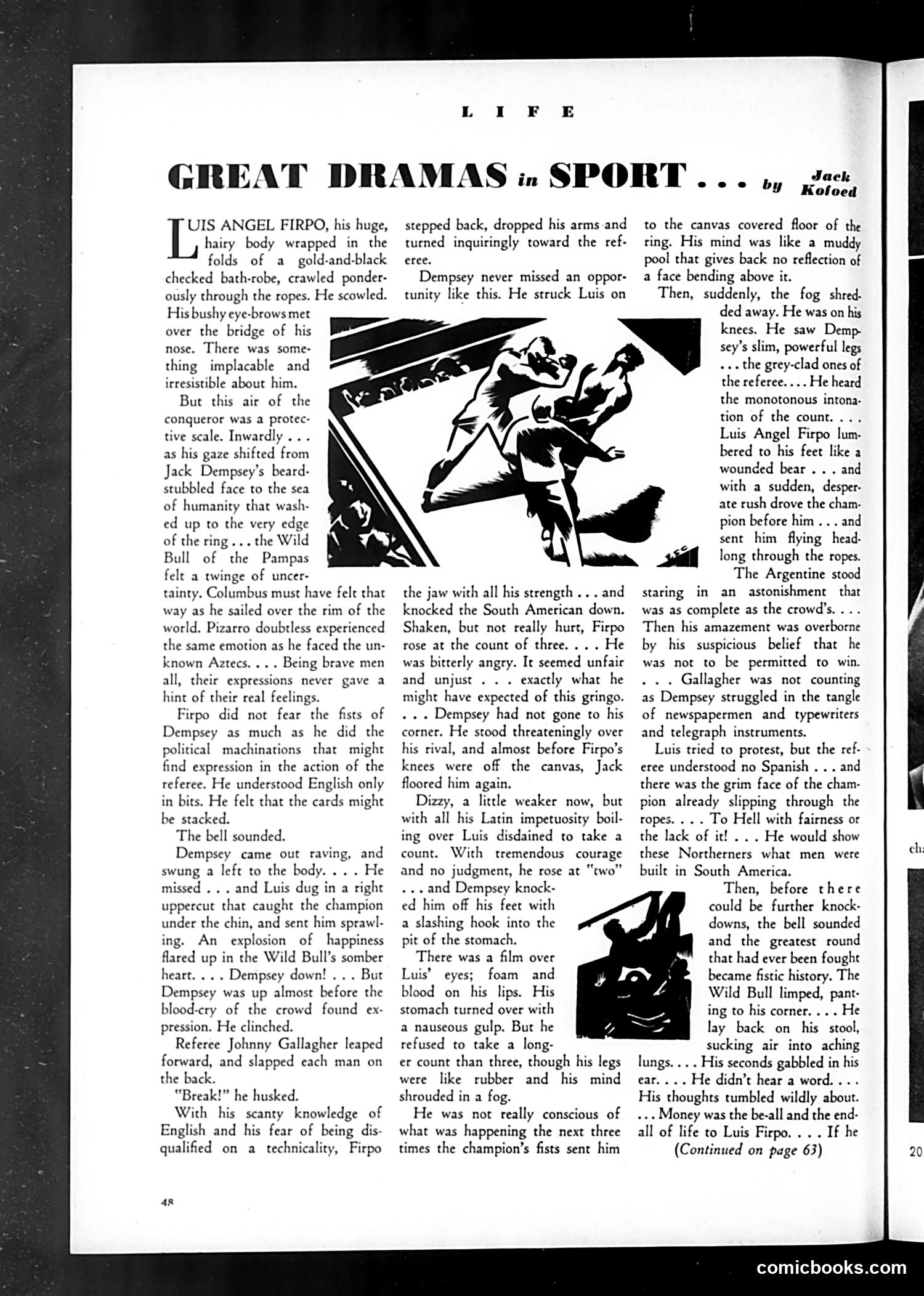
Analysis of "Great Dramas in Sport" This article by Jack Kofoed dramatizes a boxing match between Luis Angel Firpo (the "Wild Bull of the Pampas," an Argentine boxer) and Jack Dempsey (the American heavyweight champion). The two illustrations show the brutal action of their fight. The narrative satirizes the match through Firpo's perspective, emphasizing themes of unfair advantage and political bias. Firpo fears the referee will exploit English-language technicalities against him as a non-English speaker. When Dempsey repeatedly knocks him down—including after Firpo drops his guard in confusion at the referee's unclear commands—the story suggests corruption and collusion between the American champion and referee. The piece uses the match as metaphor for American dominance over South America, invoking colonial comparisons (Columbus, Pizarro). The satire critiques both Dempsey's brutality and the referee's apparent bias against the foreign challenger, highlighting how institutional structures (language, officiating) can disadvantage outsiders.
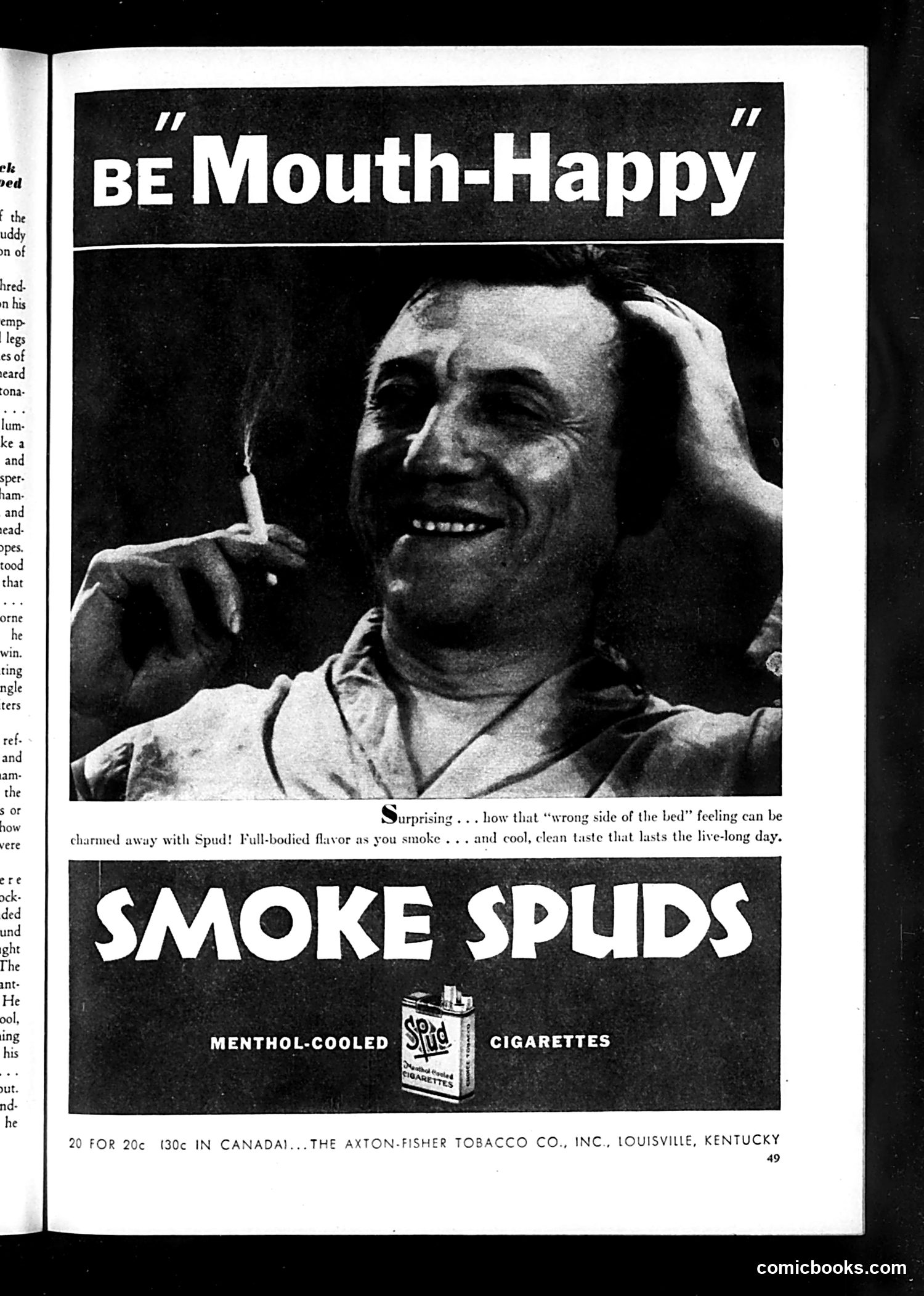
This is a cigarette advertisement for "Spuds" brand menthol-cooled cigarettes, not a political cartoon. The page features a photograph of a man with an exaggerated smile holding a cigarette, accompanied by the slogan "BE Mouth-Happy." The ad claims the product offers "full-bodied flavor" and a "cool, clean taste that lasts the live-long day." The only notable element for modern readers is the casual, direct marketing of cigarettes without any health warnings—standard for the era before tobacco's dangers were widely acknowledged and regulated. The phrase "wrong side of the bed" suggests the cigarettes supposedly improve one's mood or disposition. The price point (20 for 20 cents) indicates this is vintage advertising, likely from the 1930s-1940s.
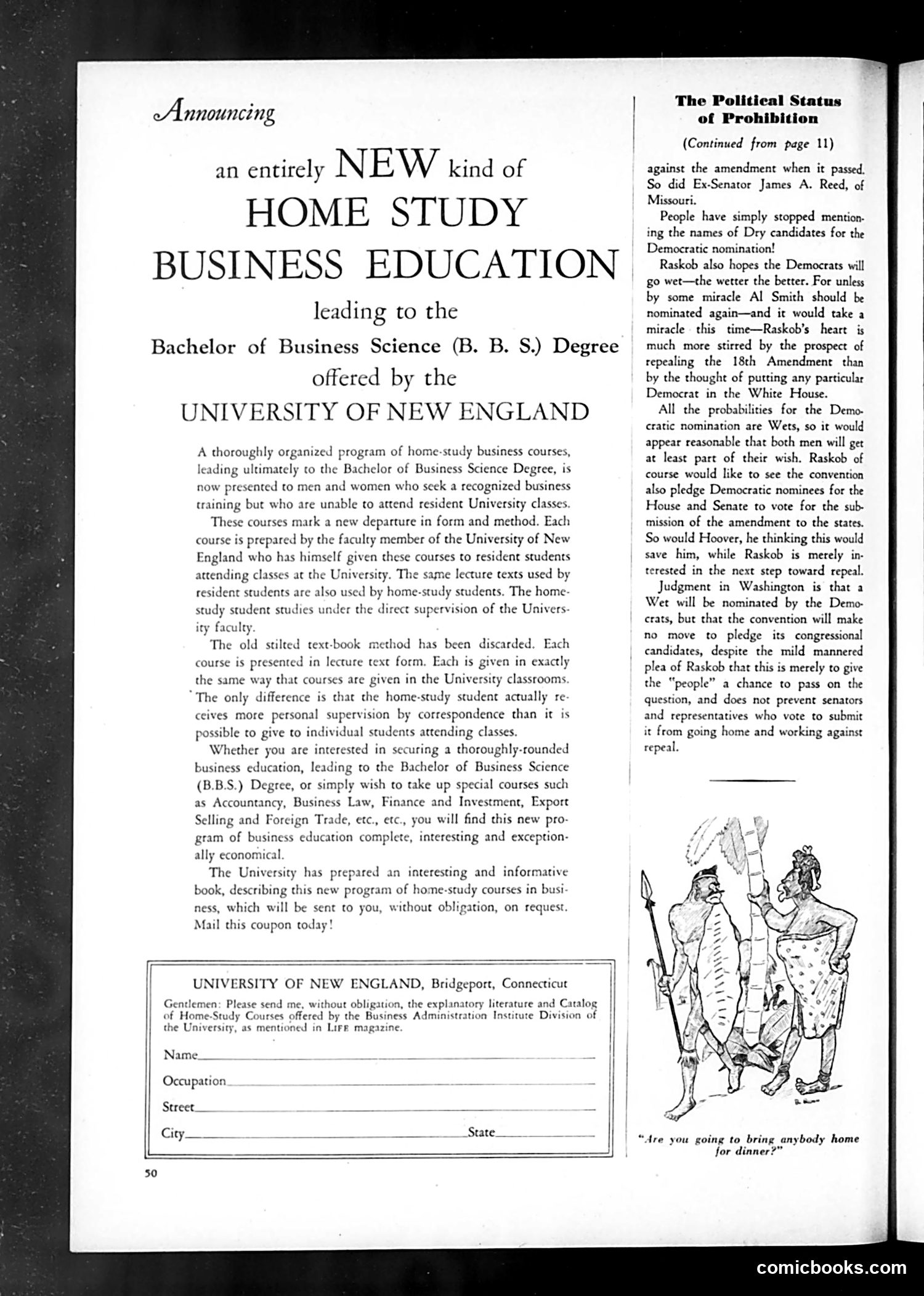
Analysis of This Life Magazine Page This page contains two unrelated items: a full-page advertisement for the University of New England's home-study business degree program (left), and the continuation of a political article about Prohibition (right). The cartoon (small sketch, bottom right) shows two figures in 1920s-style dress with the caption "Are you going to bring anybody home for dinner?" The joke appears to reference Prohibition's impact on social entertaining—the inability to serve alcohol made hosting dinners less appealing or complicated. The political text discusses Democratic Party divisions over Prohibition repeal ahead of an upcoming nomination. It mentions figures like Al Smith (a known "wet" candidate), John Raskob (a wealthy Democrat pushing repeal), and Herbert Hoover. The piece argues that Prohibition repeal—not candidate selection—is driving Democratic strategy, and that a "wet" nominee is virtually certain despite Prohibitionists' earlier influence. The juxtaposition suggests Prohibition's pervasive social impact even in commercial advertising contexts of the era.
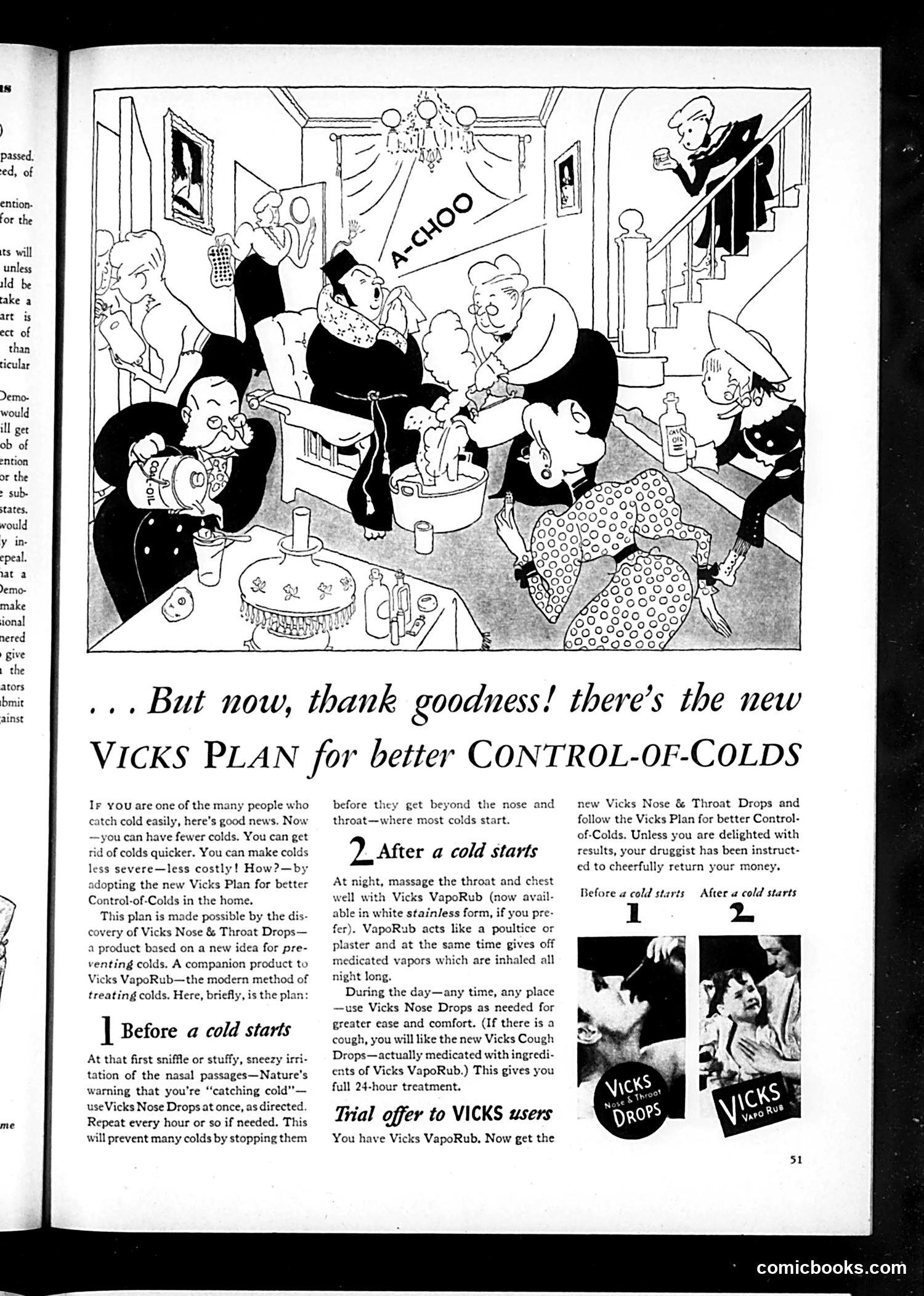
What This Page Means to Modern Readers This is a Vicks advertisement, not satire or political commentary. The cartoon illustration depicts a lively 1930s-40s house party where guests are enjoying themselves—the "thank goodness!" caption ironically suggests relief that Vicks products now exist to prevent the colds that such social gatherings might spread. The ad promotes Vicks's "Control-of-Colds Plan": using Vicks Nose Drops at the *first* cold symptom to prevent illness, combined with VapoRub for active colds. It's marketing strategy positioning cold prevention as achievable through early intervention. The two instructional photos show "before" (catching a cold) and "after" (treating it) scenarios. The trial offer attempts to convert readers into customers by letting them test VapoRub risk-free. This reflects pre-antibiotic era thinking: colds were serious enough to warrant aggressive home-treatment protocols, and companies competed fiercely in the over-the-counter remedies market.
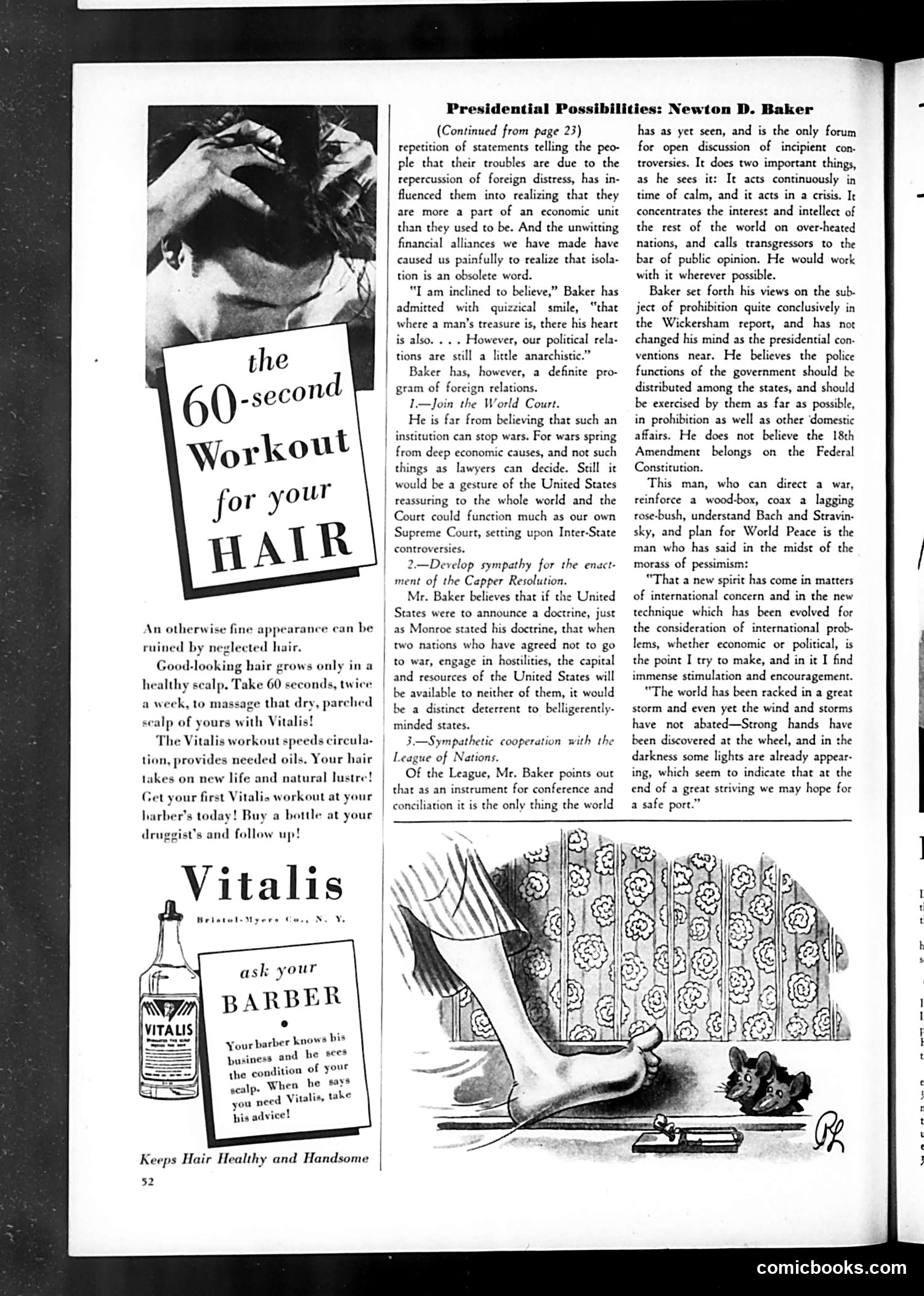
Political Content Analysis This page features an article about Newton D. Baker, a potential 1920s presidential candidate, alongside a Vitalis hair product advertisement. The article outlines Baker's foreign policy positions: joining the World Court, establishing a doctrine deterring war between nations, and cooperating with the League of Nations. He advocates for state-level control of Prohibition enforcement rather than federal authority. The bottom cartoon appears to be political satire depicting someone stepping on or crushing a small figure—likely representing an opponent or policy Baker opposes, though the specific target isn't entirely clear from the image alone. The juxtaposition of serious presidential candidate coverage with commercial advertising was typical of *Life* magazine's format, which mixed political commentary with consumerism. The hair product ad's emphasis on "healthy" appearance may carry subtle implications about fitness for office, though this connection isn't explicit.
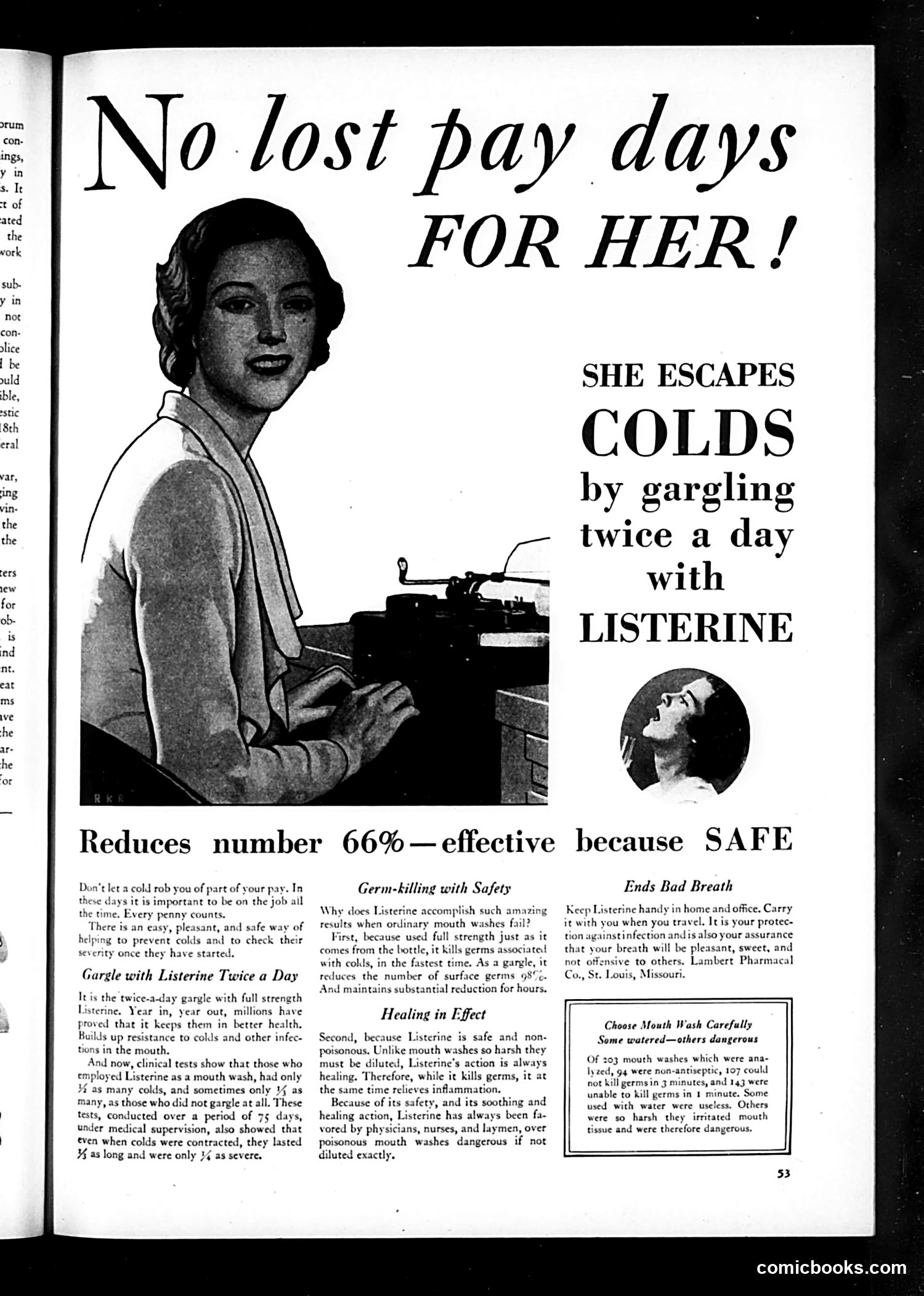
Listerine Advertisement, circa 1920s-1930s This is a product advertisement, not political satire. It promotes Listerine mouthwash to working women during an era when job attendance directly affected wages (no paid sick leave existed). The headline "No lost pay days FOR HER!" appeals to female wage-earners by framing cold prevention as economically necessary—missing work meant lost income. The image shows a woman at a typewriter, representing the growing female office workforce. The ad makes health claims now considered exaggerated: that gargling twice daily reduces colds by 66% and kills 98% of surface germs. It emphasizes Listerine's supposed "safety" compared to other mouth washes (many of which actually contained toxic ingredients), claiming physicians favored it. This reflects early 20th-century marketing that used medical pseudoscience and gendered economic anxieties to sell consumer products to women entering the workforce.
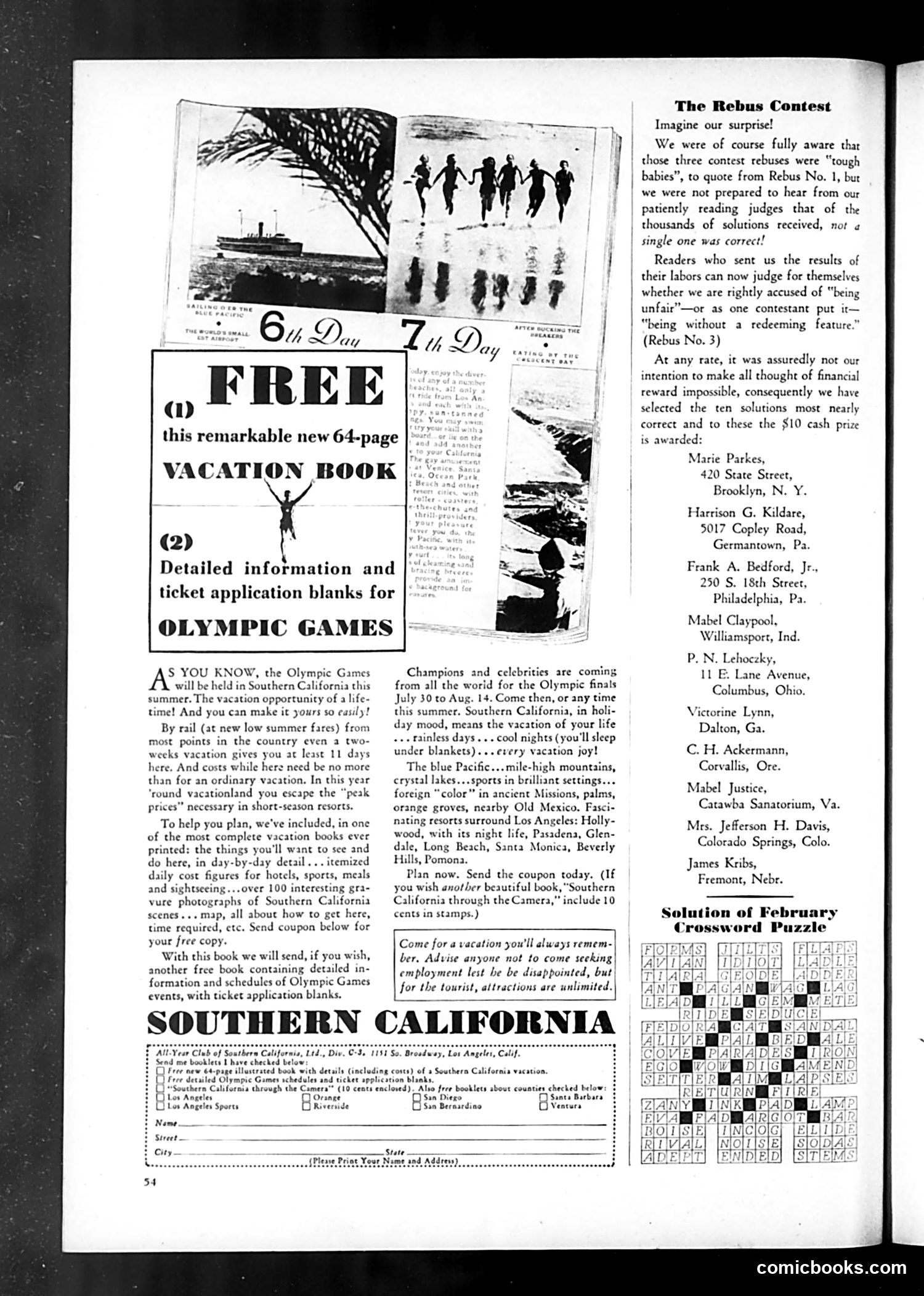
"The Rebus Contest" and Southern California Olympic Games Promotion This page mixes two distinct elements: a contest results section and vacation advertising. The Rebus Contest acknowledges that Life magazine's three rebus puzzles (visual word-play riddles) were unexpectedly difficult—so difficult that among thousands of submissions, *not a single solution was completely correct*. The editors humorously defend themselves against accusations of unfairness, awarding a $10 prize to the ten entries deemed "most nearly correct." This self-aware satire pokes fun at both the magazine's puzzle difficulty and reader complaints. The Advertisement promotes Southern California vacations during the 1932 Olympic Games (July 30–August 14). It offers a free 64-page vacation book with hotel costs, daily itineraries, and Olympic ticket information. The copy emphasizes low summer train fares, year-round pleasant weather, and attractions like Hollywood, beaches, and missions—painting an idealized tourist experience during the Depression era.
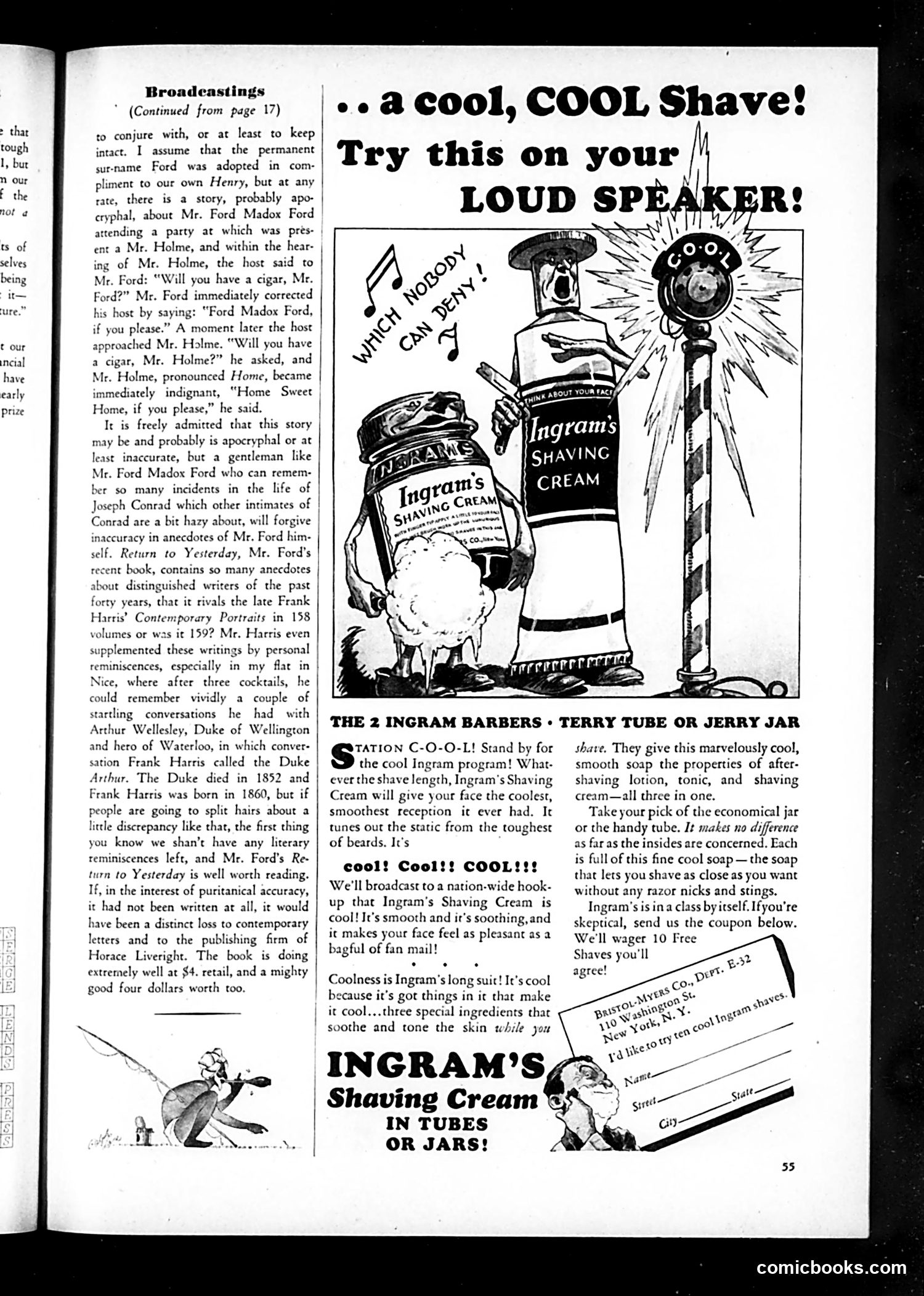
Analysis for Modern Readers This page is primarily an advertisement for Ingram's Shaving Cream, not political satire. The upper half contains a literary column discussing Ford Madox Ford's memoir, which includes an anecdote about name-pronunciation pedantry (a humorous aside about writers being fussy). The main visual—a cartoon featuring two exaggerated barber figures with a large loudspeaker—is designed to evoke radio broadcasting. The phrase "STATION C-O-O-L!" and references to "broadcast to a nation-wide hook-up" playfully parody 1930s radio advertising language. The pun on "cool" (temperature comfort + modern slang approval) was the advertising hook. This reflects the era when radio ads used theatrical characters and jingles to sell products. The coupon at bottom invites readers to claim free trial shaves—standard mail-in advertising of the period. No political content or satire is present.
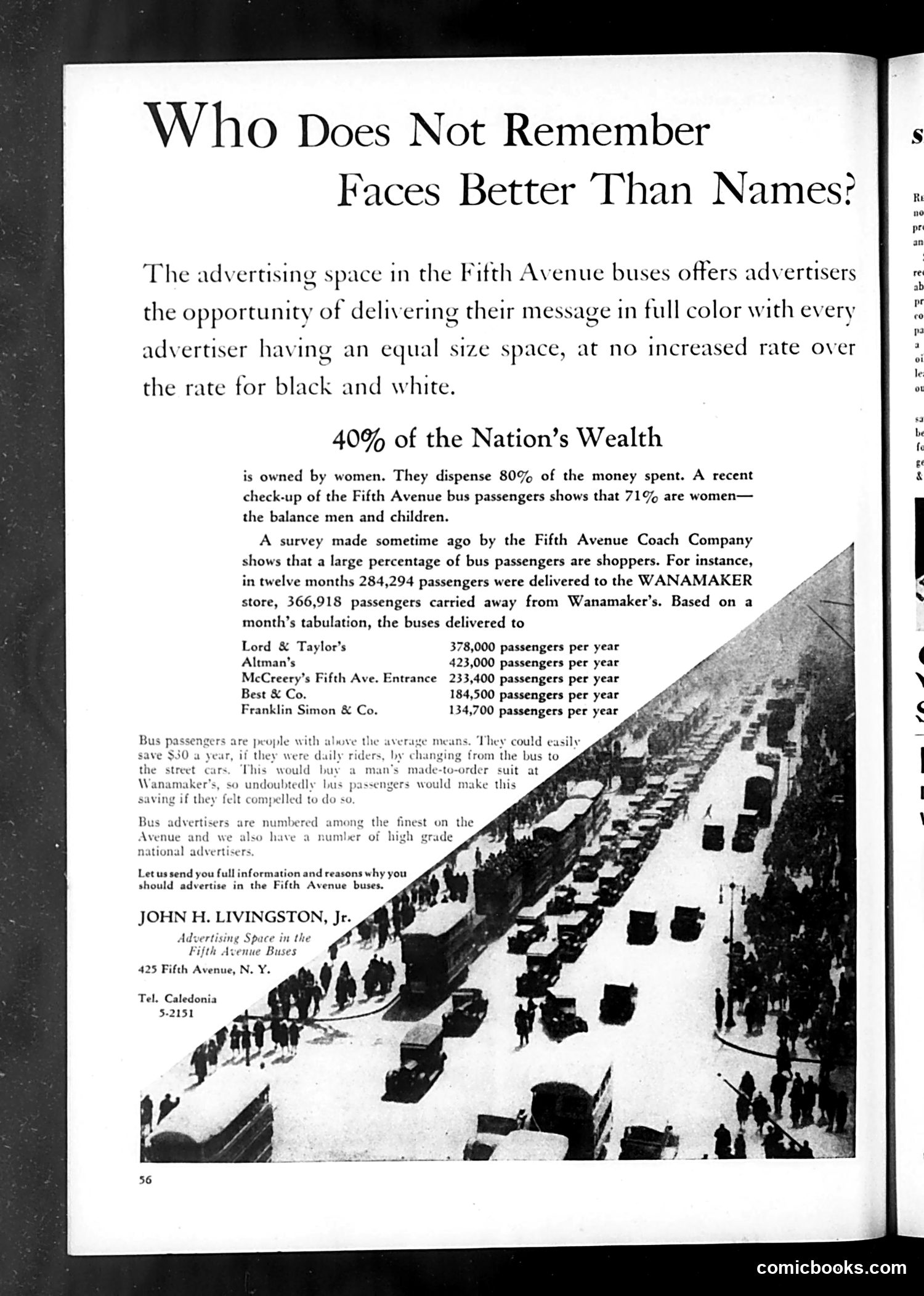
Analysis This is primarily an advertisement for bus advertising space, not a satirical cartoon. It's a sales pitch by John H. Livingston Jr. promoting ads in Fifth Avenue buses. The "pitch" uses demographic data to attract advertisers: women control 40% of national wealth and spend 80% of money; 71% of bus passengers are women; buses deliver hundreds of thousands of shoppers annually to major department stores (Wanamaker, Lord & Taylor, Altman's, etc.). The headline's rhetorical question—"Who Does Not Remember Faces Better Than Names?"—is a marketing claim: visual advertising (shown in color) is more memorable than text-based ads. The accompanying photograph shows Fifth Avenue's street-level bustle with buses and pedestrians, visually demonstrating the dense traffic and foot traffic advertisers would reach. This is straightforward early-20th-century transit advertising, targeting retailers by emphasizing the captive audience of affluent, shopping-inclined commuters, particularly women.
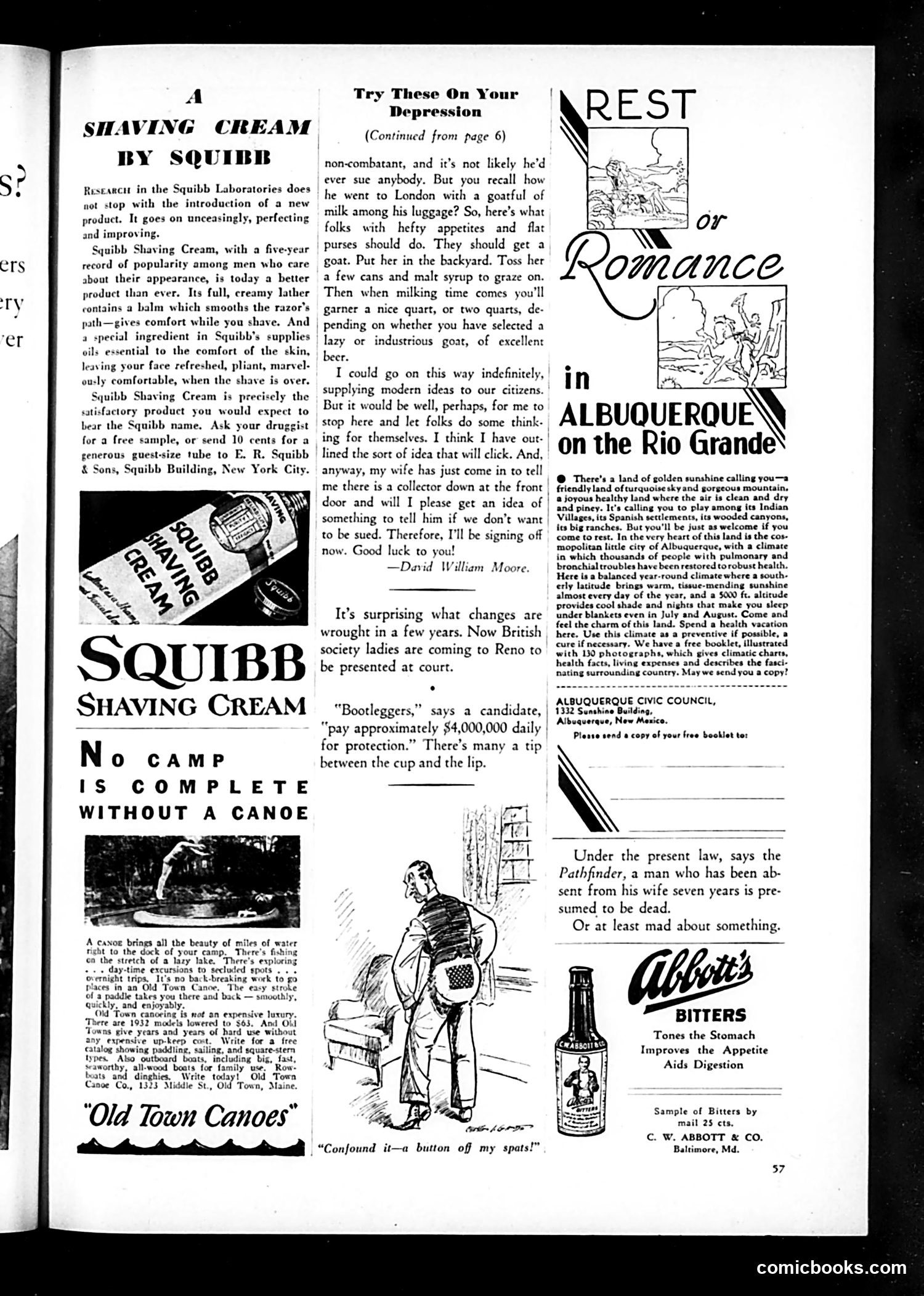
Page 57: Life Magazine Content Analysis This page is primarily advertising with some editorial humor. The main satirical content is "Try These On Your Depression" (continued from page 6), where author David William Moore offers tongue-in-cheek Depression-era survival advice. The joke: during hard economic times, ordinary people should adopt livestock like goats for milk production—a practical but absurd suggestion that mocks both the Depression's severity and overly simplistic solutions being proposed. The cartoon at page bottom shows a man telling someone "Confound it—a button off my spats!"—likely satirizing upper-class concerns during economic crisis, highlighting the disconnect between wealthy people's minor complaints and widespread poverty. The rest comprises advertisements for Squibb Shaving Cream, Old Town Canoes, and Albuquerque tourism, plus Abbott's Bitters patent medicine. No political figures are caricatured; the satire is social commentary on Depression-era attitudes.
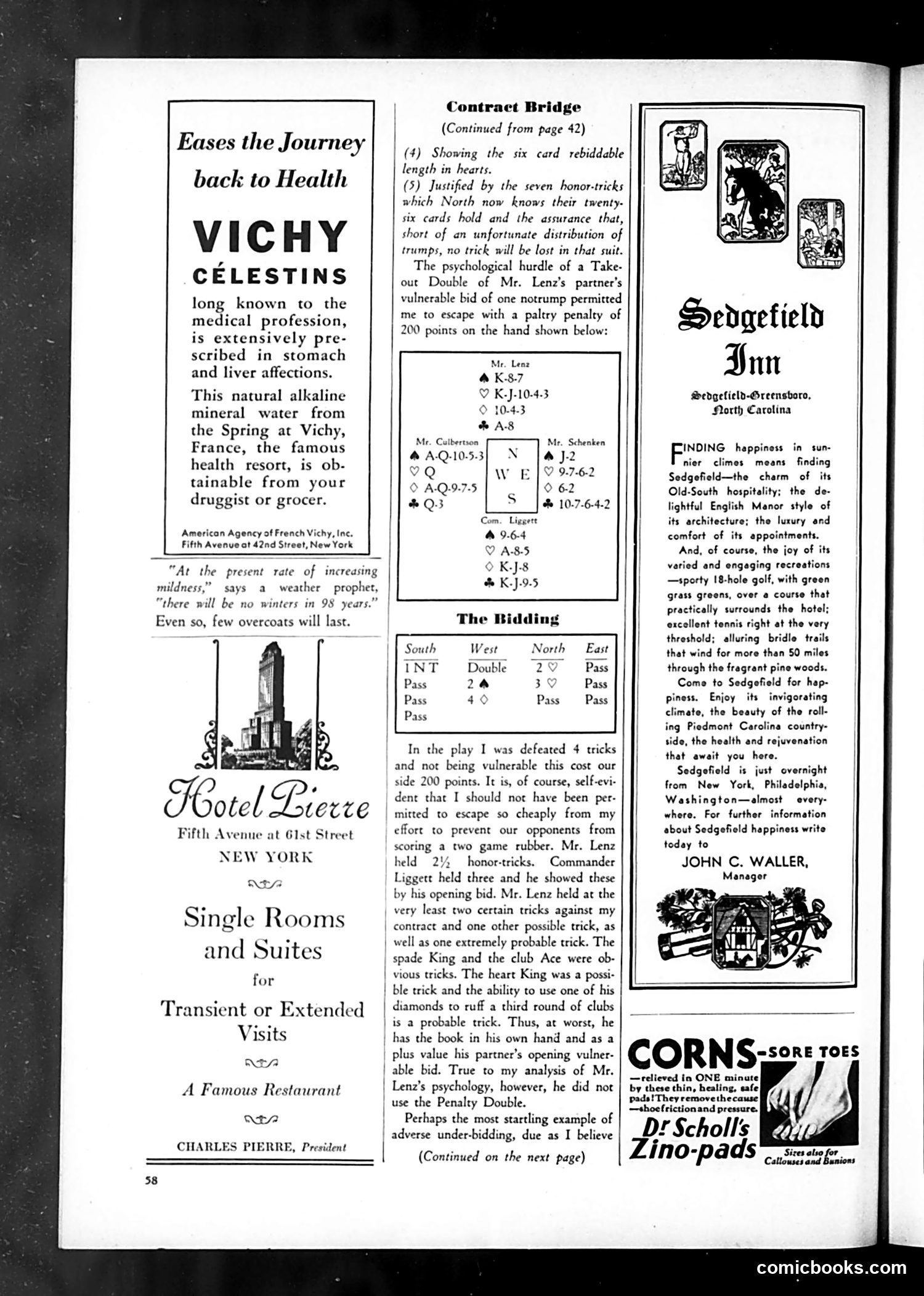
Life Magazine Page 58 Analysis This page is primarily advertising and bridge instruction with minimal satirical content. The substantive material includes a Contract Bridge column by what appears to be a bridge strategist (likely Ely Culbertson, given the names in the hand diagram), discussing a specific tournament hand and bidding strategy. The text analyzes why certain bids were made or avoided—notably discussing Mr. Lenz's psychological approach to bidding. The page is dominated by vintage advertisements for luxury goods and services: Vichy mineral water (for health), Hotel Pierre (NYC luxury hotel), and Sedgefield Inn (a Carolina resort). A small weather joke appears at bottom left—a throwaway gag about increasingly mild winters. The only minor satire is the weather quip suggesting overcoats will become obsolete, which is generic commentary rather than pointed social critique. This is a typical 1930s Life magazine page mixing instructional content, travel/lifestyle advertising, and light humor—not a page focused on political or social satire.
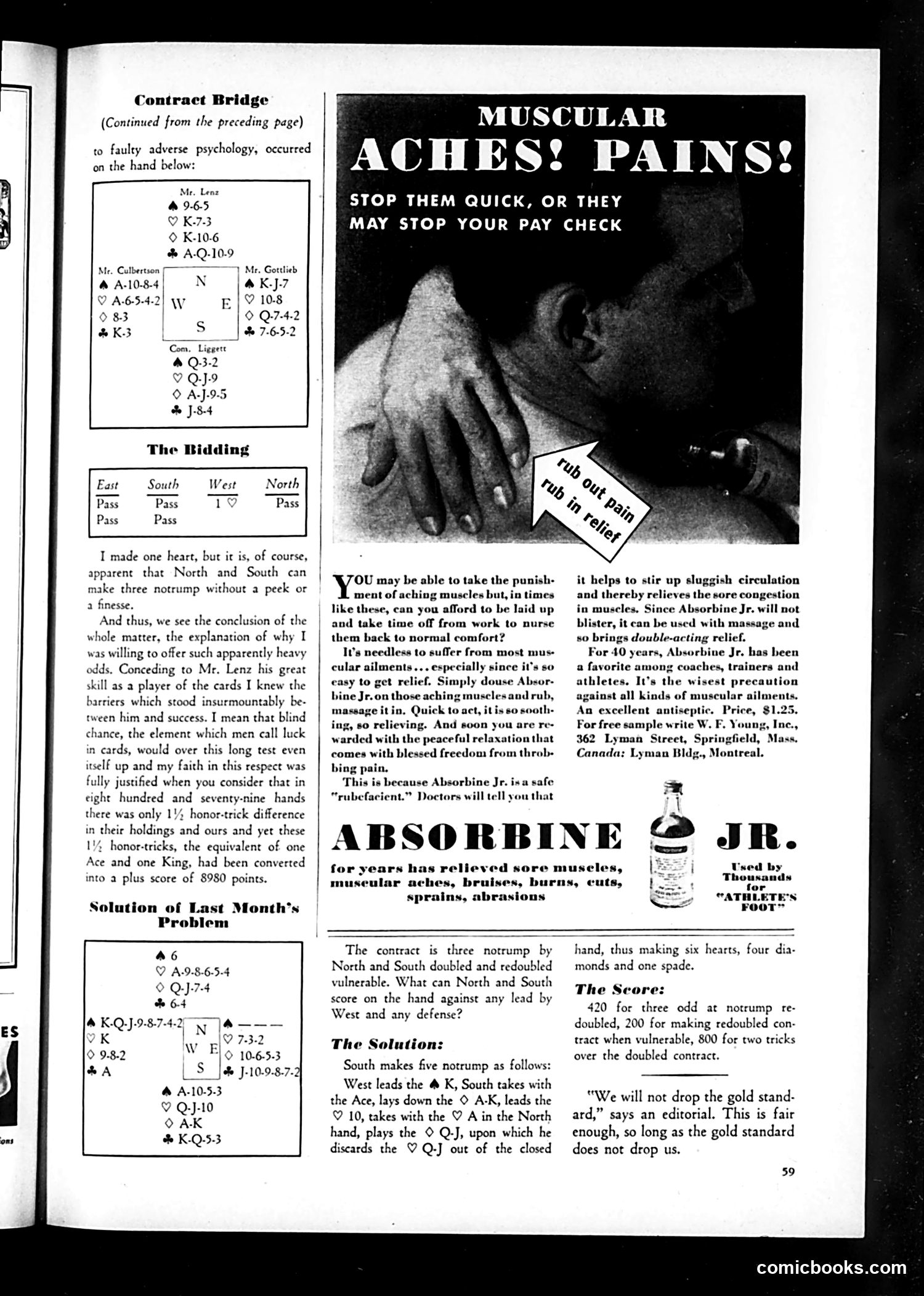
Analysis of This Life Magazine Page This page is primarily instructional and advertising content, not political satire. It contains: Left side: A contract bridge problem and solution—a popular intellectual game featured regularly in Life magazine during this era. Right side: A full-page advertisement for Absorbine Jr., a liniment/rubefacient (warming rub) for muscle pain. The ad uses Depression-era messaging: workers cannot afford time off sick, so they must treat aches quickly to keep earning wages ("they may stop your pay check"). The image shows a man massaging his neck/shoulder in pain. Bottom: A brief editorial quip defending the gold standard during economic uncertainty, using the pun "does not drop us"—a reference to contemporary debates about monetary policy during the Great Depression. The page reflects 1930s concerns: economic precarity, the need to stay working despite illness, and financial stability anxieties. There is no political cartoon or caricature present—this is a standard magazine layout mixing games, commerce, and brief commentary.
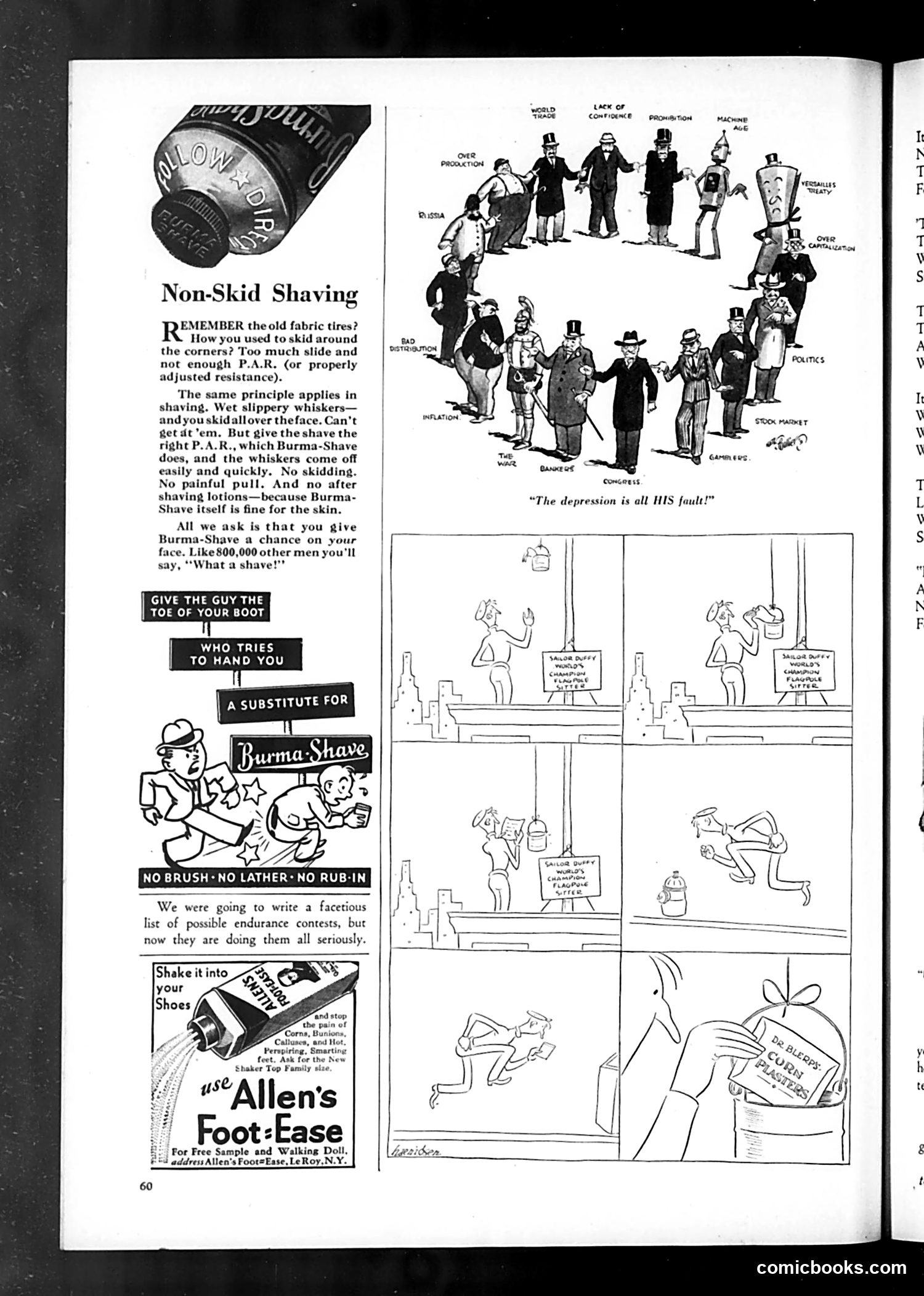
Analysis of Life Magazine Page This page contains Burma-Shave advertising alongside a political cartoon about the Great Depression. The top advertisement uses an automotive metaphor—comparing whisker-shaving to tire traction—to sell shaving cream. The Burma-Shave brand was famous for roadside jingle advertisements. The main cartoon satirizes Depression-era economic collapse. Labeled figures represent economic causes: "Over Production," "Lack of Confidence," "Machine Age," "Bad Distribution," "Inflation," "Stock Market," "Politics," and others stand around a prone, distressed figure. The caption reads: "The depression is all HIS fault!"—mocking how politicians and commentators blamed single causes or scapegoats for the complex economic crisis, rather than acknowledging systemic failures. The comic strip below shows someone repeatedly falling, apparently depicting unemployment or financial ruin. The Allen's Foot-Ease advertisement at bottom is unrelated product marketing.
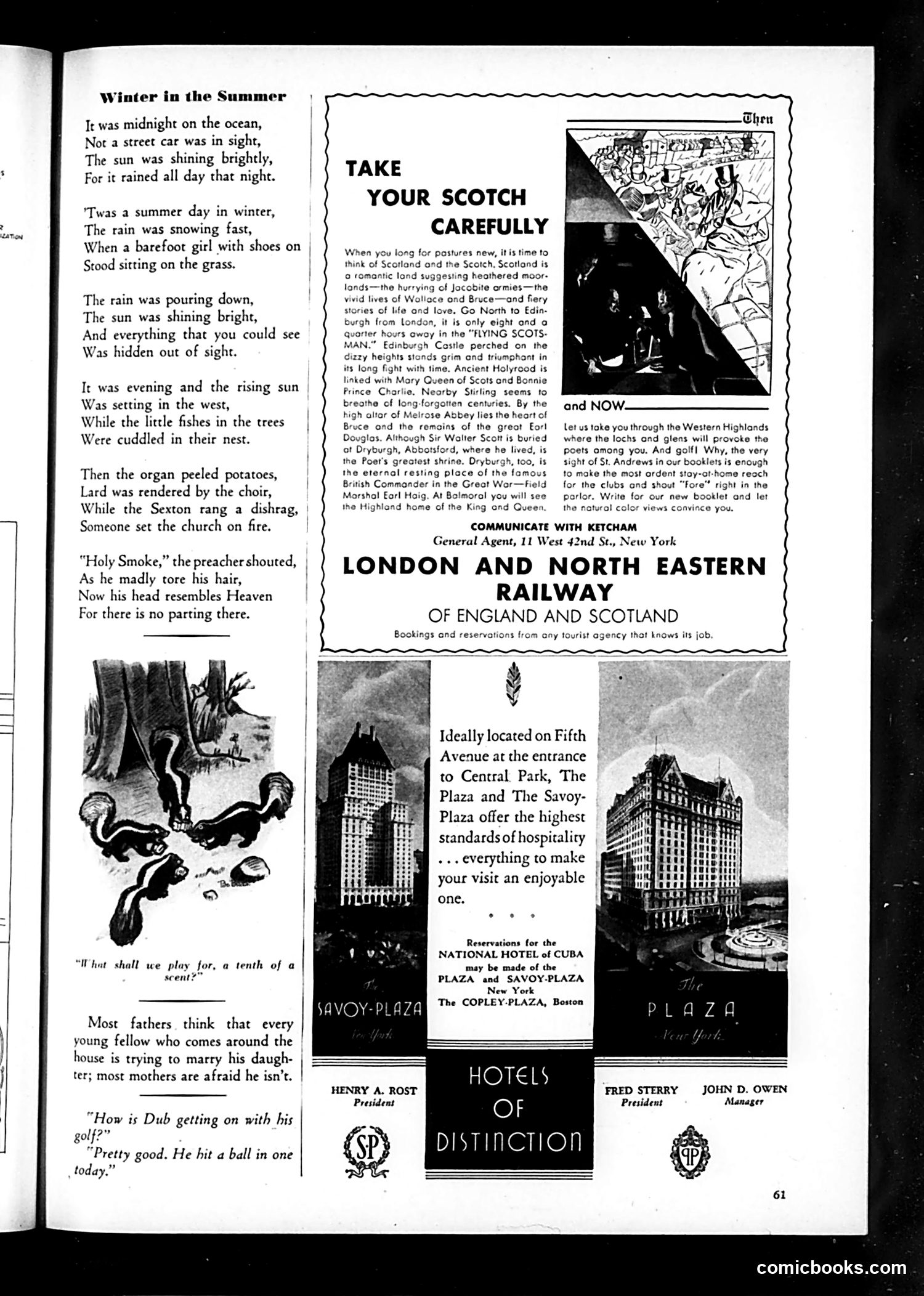
Page Analysis: Life Magazine (Public Domain) This page combines absurdist poetry with travel advertising. The left side features "Winter in the Summer"—a nonsensical poem using deliberate logical contradictions (midnight with shining sun, summer in winter, organs peeling potatoes) and increasingly absurd situations (the Sexton ringing a dishrag, a preacher's head resembling Heaven because it has "no parting"). This style of intentional contradiction was popular early 20th-century light verse humor—the joke is the accumulated silliness itself. Below are two brief jokes about courtship and golf—mild social satire about fathers' marriage anxieties and a golf pun. The right side is primarily advertising: the London and North Eastern Railway promotes Scottish tourism (Edinburgh Castle, Mary Queen of Scots, golf at St. Andrews), while hotel advertisements for the Plaza, Savoy-Plaza, and others occupy the bottom. The page is largely commercial rather than satirical.
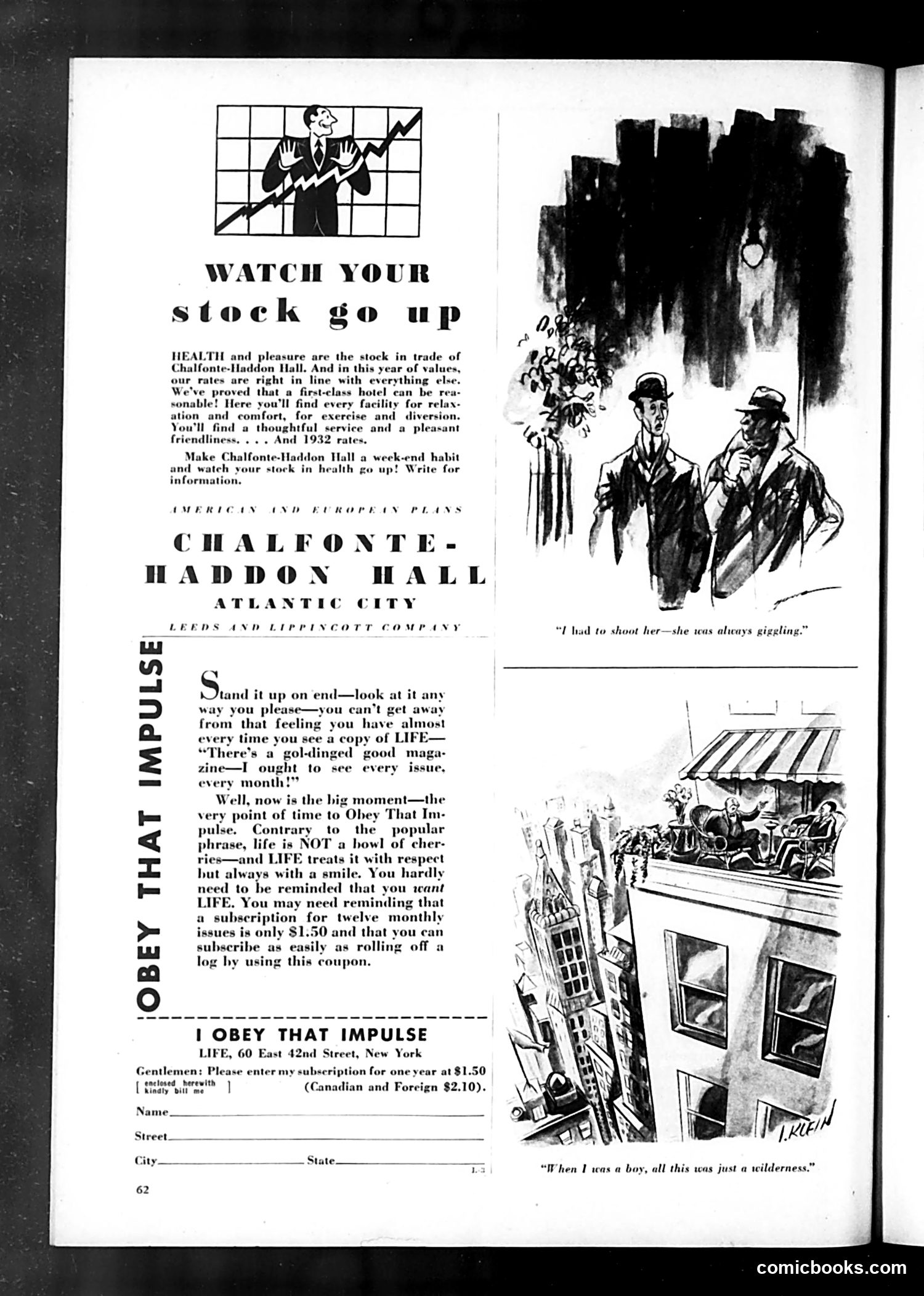
Analysis of Life Magazine Page This page contains two unrelated advertisements rather than political cartoons. Left side: A hotel advertisement for Chalfonte-Haddon Hall in Atlantic City, using stock-market language ("watch your stock go up") to promote health and relaxation as valuable commodities during the economically difficult year 1932. Right side: A subscription advertisement for *Life* magazine itself, featuring two cartoons with captions. The first shows a man saying he had to shoot a woman "because she was always giggling"—dark humor typical of 1930s magazines. The second depicts an older man reflecting "when I was a boy, all this was just a wilderness," contrasting past rural America with present urban development. The subscription pitch emphasizes that *Life* magazine, priced at $1.50 yearly, provides both entertainment and meaningful content, positioning it as a worthwhile habit during economically uncertain times.
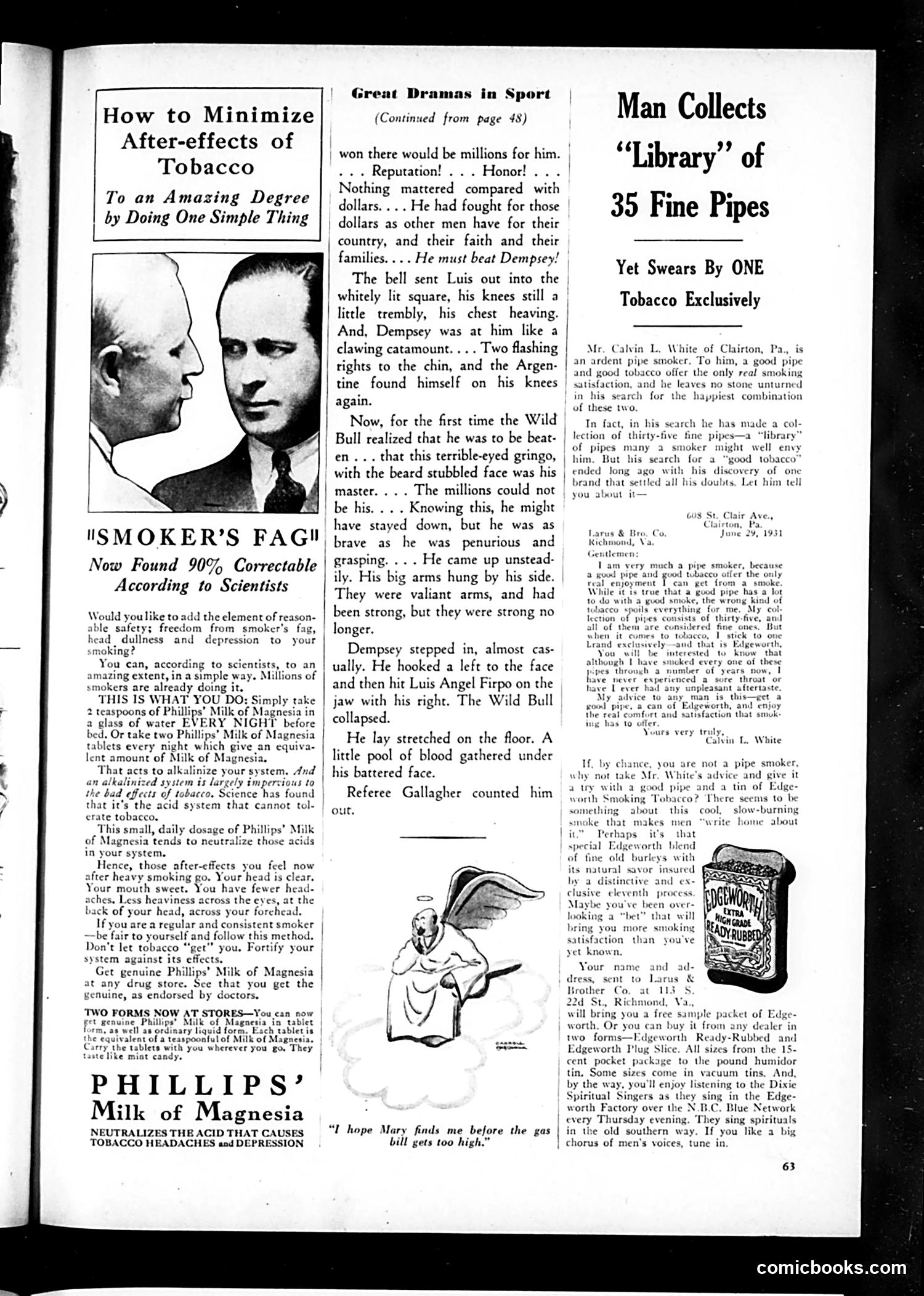
Analysis of Life Magazine Page This page mixes editorial content with advertising. The main cartoon appears at bottom: a boxer (likely referencing the famous Jack Dempsey vs. Luis Angel Firpo fight of 1923) lies defeated, hoping "Mary finds me before the gas bill gets too high"—darkly humorous commentary on a prizefighter's financial desperation despite the brutal spectacle of boxing. The bulk of the page advertises Phillips' Milk of Magnesia as a tobacco remedy. The product claims to correct "smoker's fag" (fatigue/headaches from smoking) by alkalizing the body's acid system. The ad acknowledges smoking's known ill effects while pitching a product to mitigate them—typical 1920s-30s marketing that accepted tobacco use as normal but offered "scientific" solutions to its problems. The right column features a testimonial from a pipe collector who owns 35 pipes but uses only one tobacco brand, blending consumerism with tobacco promotion. The overall message: smoking is assumed inevitable; science can manage its damage.
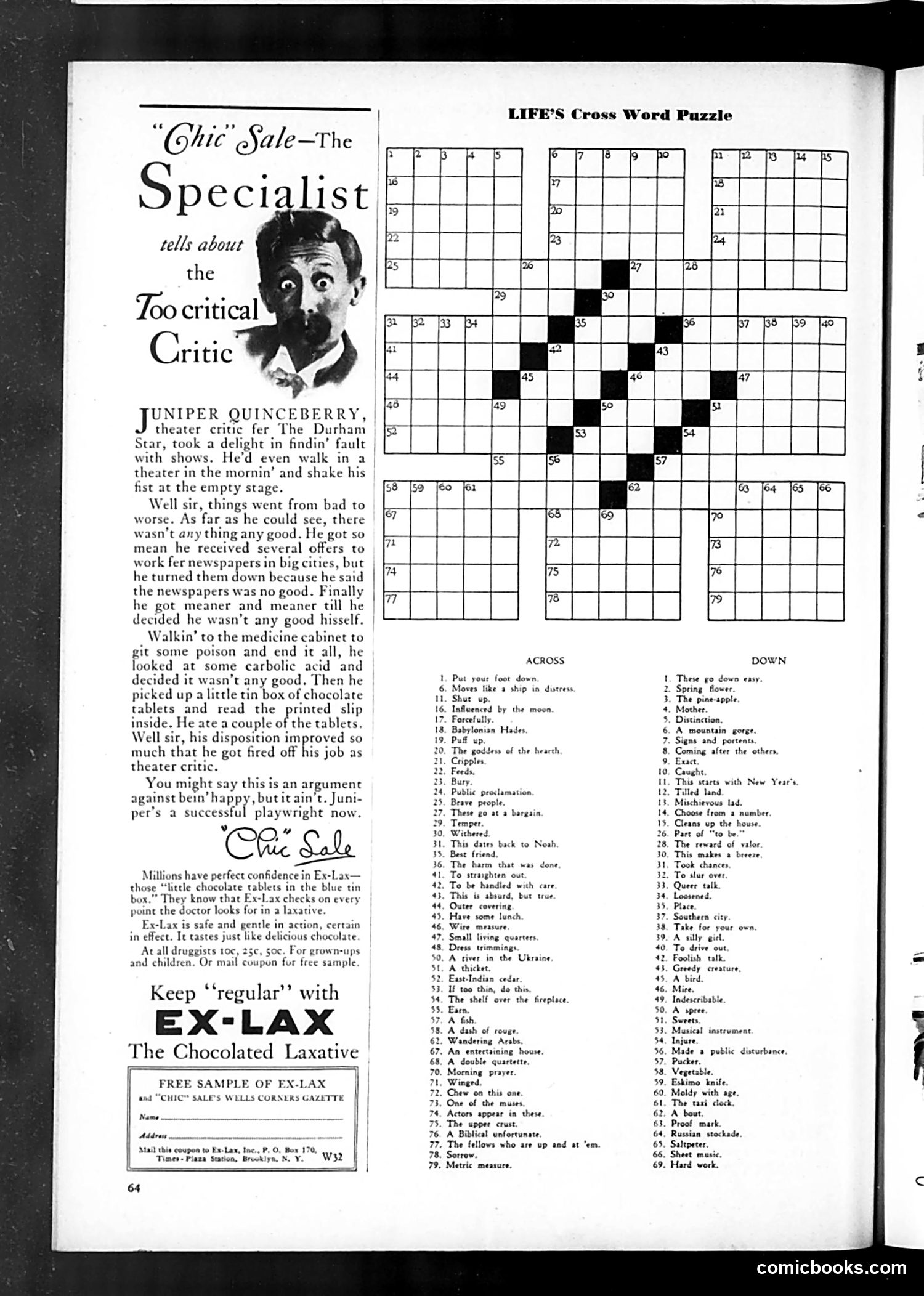
"The Too Critical Critic" – A Satirical Cautionary Tale This page presents a humorous morality tale by "Chic Sale" about Juniper Quinceberry, a theater critic for *The Durham Star* who is so perpetually negative that he finds fault with everything—including empty stages and medicine cabinets. His relentless cynicism becomes self-destructive; he eventually concludes he himself is "no good." The joke's twist: after accidentally consuming Ex-Lax chocolate tablets (seeking poison), his improved digestion and mood lead to his firing—suggesting that happiness itself disqualifies one from being a professional critic. The satire mocks the archetype of the cantankerous theater critic whose identity depends entirely on fault-finding, implying such people are professionally invested in negativity. The story concludes that Quinceberry became a successful playwright—suggesting that channeling critical impulses toward creative work proves more rewarding than pure demolition. The page is primarily an Ex-Lax advertisement using this satirical narrative as promotional content. A crossword puzzle occupies the remaining space.
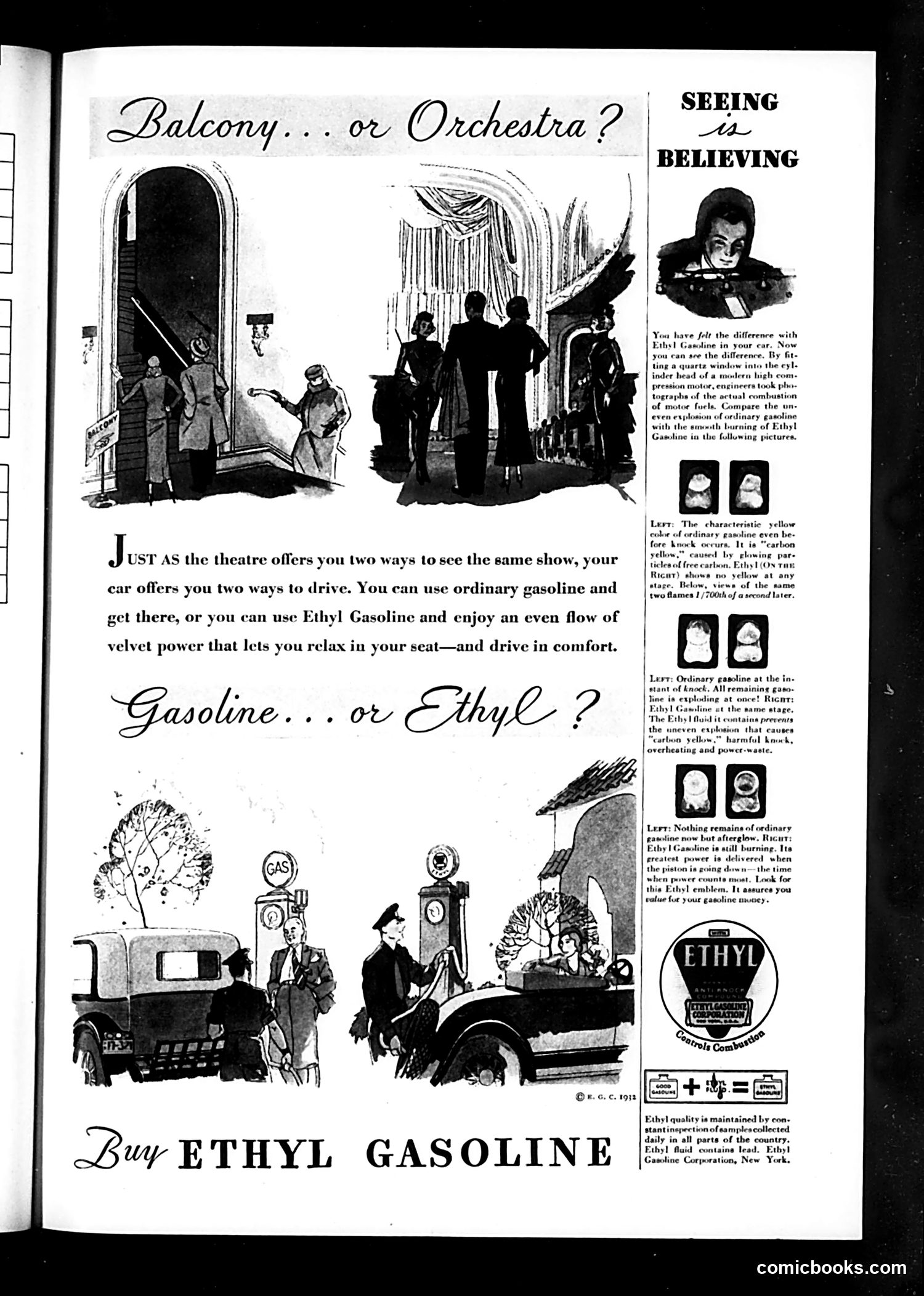
Ethyl Gasoline Advertisement (1932) This is a full-page advertisement, not political satire. The top cartoon compares choosing a theater seat (balcony vs. orchestra) to choosing gasoline types—a marketing analogy, not commentary. The bottom illustration shows early gas station scenes contrasting ordinary gasoline (left, car sputtering and stalling) with Ethyl Gasoline (right, running smoothly). The "GAS" pump versus "ETHYL" pump imagery emphasizes the product choice. Key context for modern readers: Ethyl Gasoline was a real brand (1920s-1970s) containing tetraethyl lead, added to prevent engine knocking. Though now known as toxic, it was then marketed as a premium performance product. The advertisement's emphasis on smooth power and "velvet" comfort reflects contemporary automotive culture before lead's health dangers became widely recognized. The tagline "Seeing is Believing" refers to visible product quality demonstrations shown in the right column's photographs.
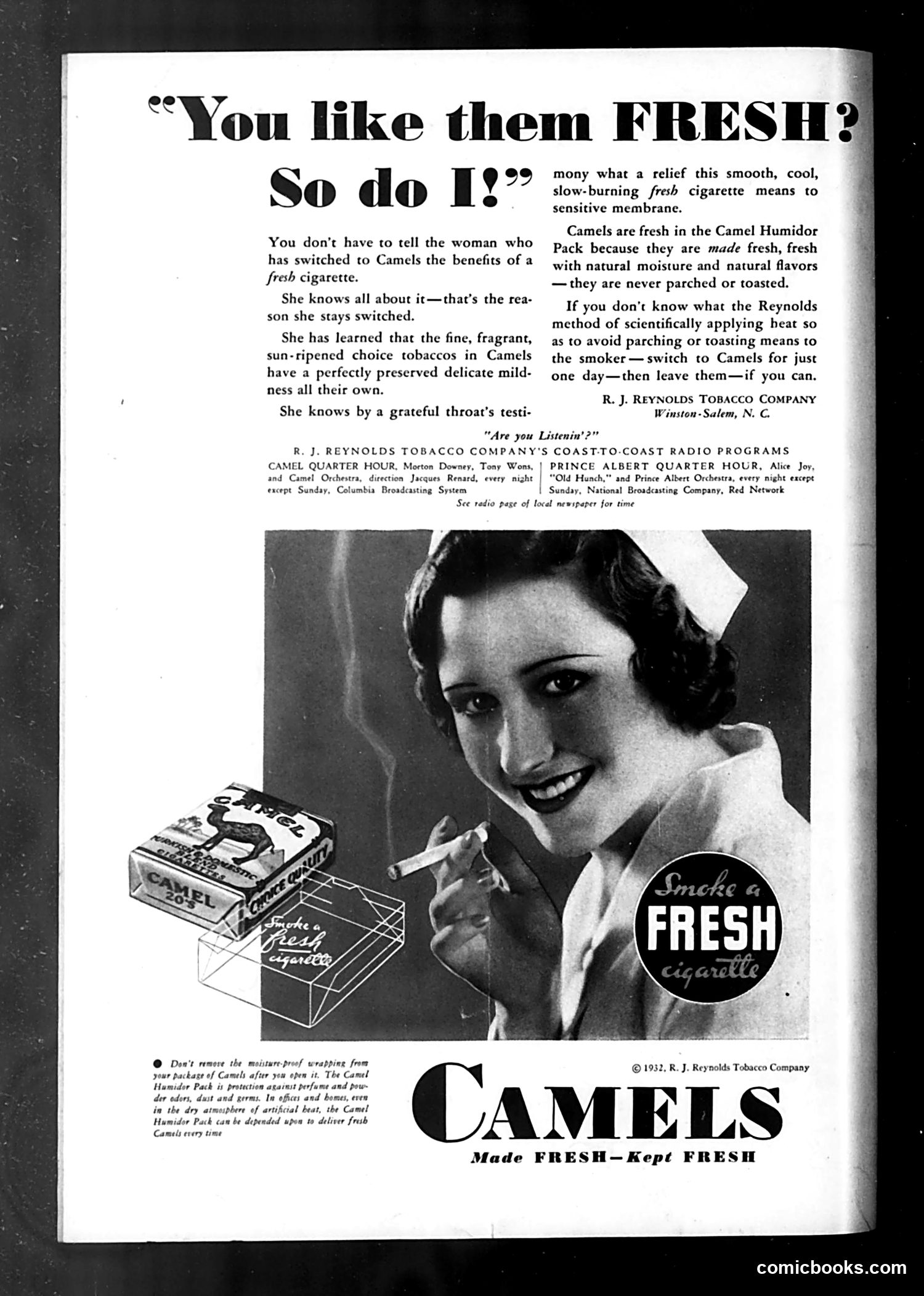
Analysis This is a cigarette advertisement, not political satire or editorial content. It's a 1932 Camel cigarettes ad from R.J. Reynolds Tobacco Company. The page features a smiling woman holding a cigarette, endorsing Camels as "fresh" cigarettes. The ad emphasizes that Camels use a special "Humidor Pack" (moisture-proof wrapping) to preserve tobacco's natural moisture and prevent drying or "toasting." For modern readers: This represents pre-health-warning tobacco marketing that: - Targets women smokers directly (relatively novel in 1932) - Makes health claims ("relief," "sensitive membrane") - Uses pseudo-scientific language ("Reynolds method of scientifically applying heat") - Includes sponsored radio programming promotion The ad contains no cartoon or satire—it's straightforward product marketing that modern regulations would prohibit. The "freshness" claim was the brand's primary sales angle during this era.

I can see this is a mostly blank or extremely dark page from what appears to be a historical publication. The only clearly visible text is "comicbooks.com" at the bottom right corner, which is a watermark from the digitization source rather than original page content. The image itself is too dark and lacks sufficient visible detail for me to identify any cartoons, caricatures, political figures, or satirical content with confidence. Without being able to read text or distinguish illustrations clearly, I cannot responsibly explain what this page's satirical point or historical references might be. To properly analyze this content, a higher quality or better-lit scan would be needed.