life
Life — April 1932
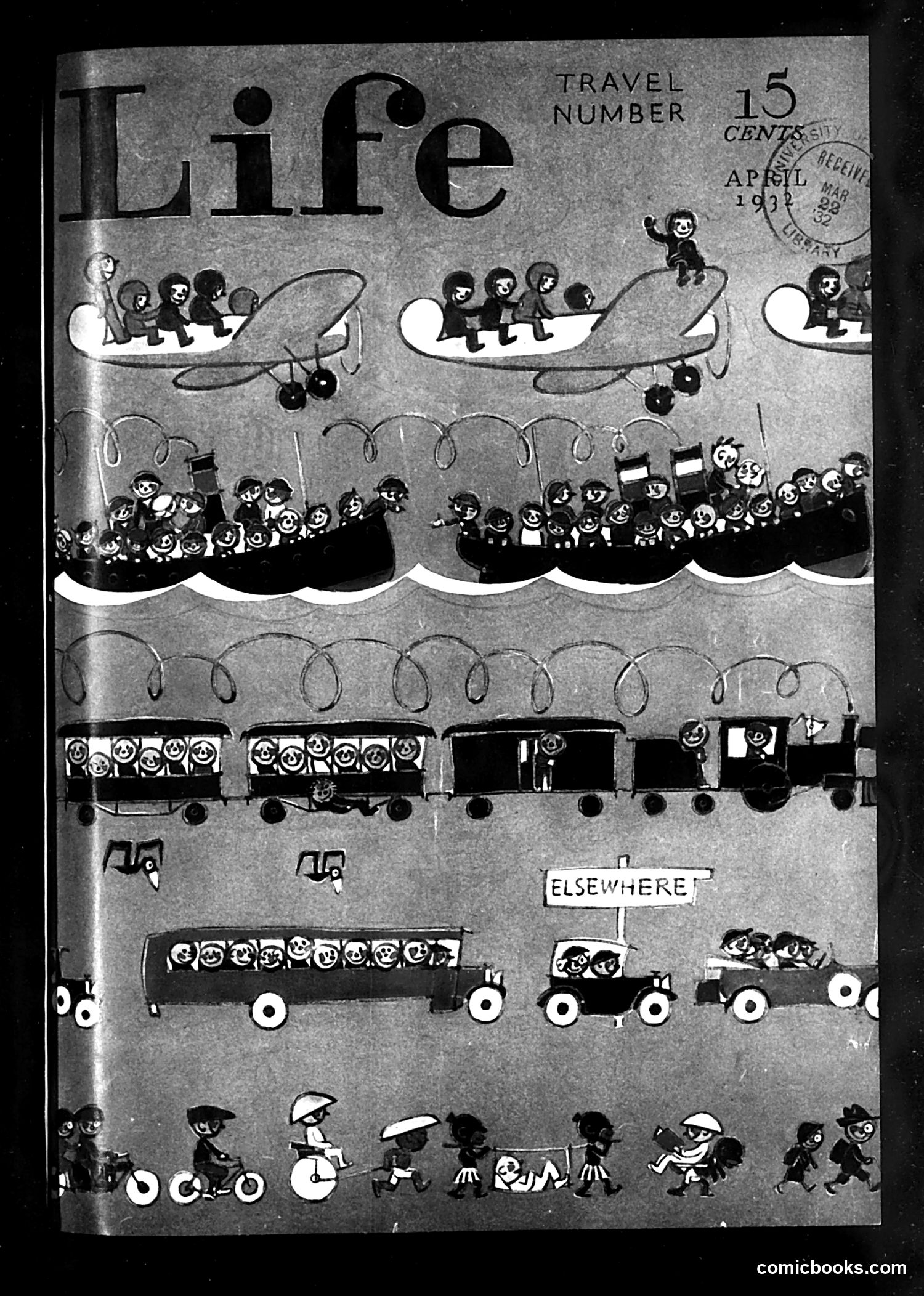
Life Magazine Cover Analysis - April 1932 This cover illustrates Depression-era transportation and emigration, depicting crowds of small figures traveling by multiple vehicles: airplanes at top, boats/ships in the middle sections, trains, and automobiles below. The figures appear to represent American citizens or immigrants in transit. The heading "ELSEWHERE!" suggests satirical commentary on people fleeing or seeking opportunity elsewhere—likely referencing the mass migration during the Great Depression when Americans moved seeking work, or possibly emigration from the country. The "Travel Number" designation indicates this is a special issue focused on transportation themes. The crowded, repetitive cartoon figures emphasize the scale and ubiquity of movement during economically difficult times, using visual humor to comment on Depression-era displacement and mobility.
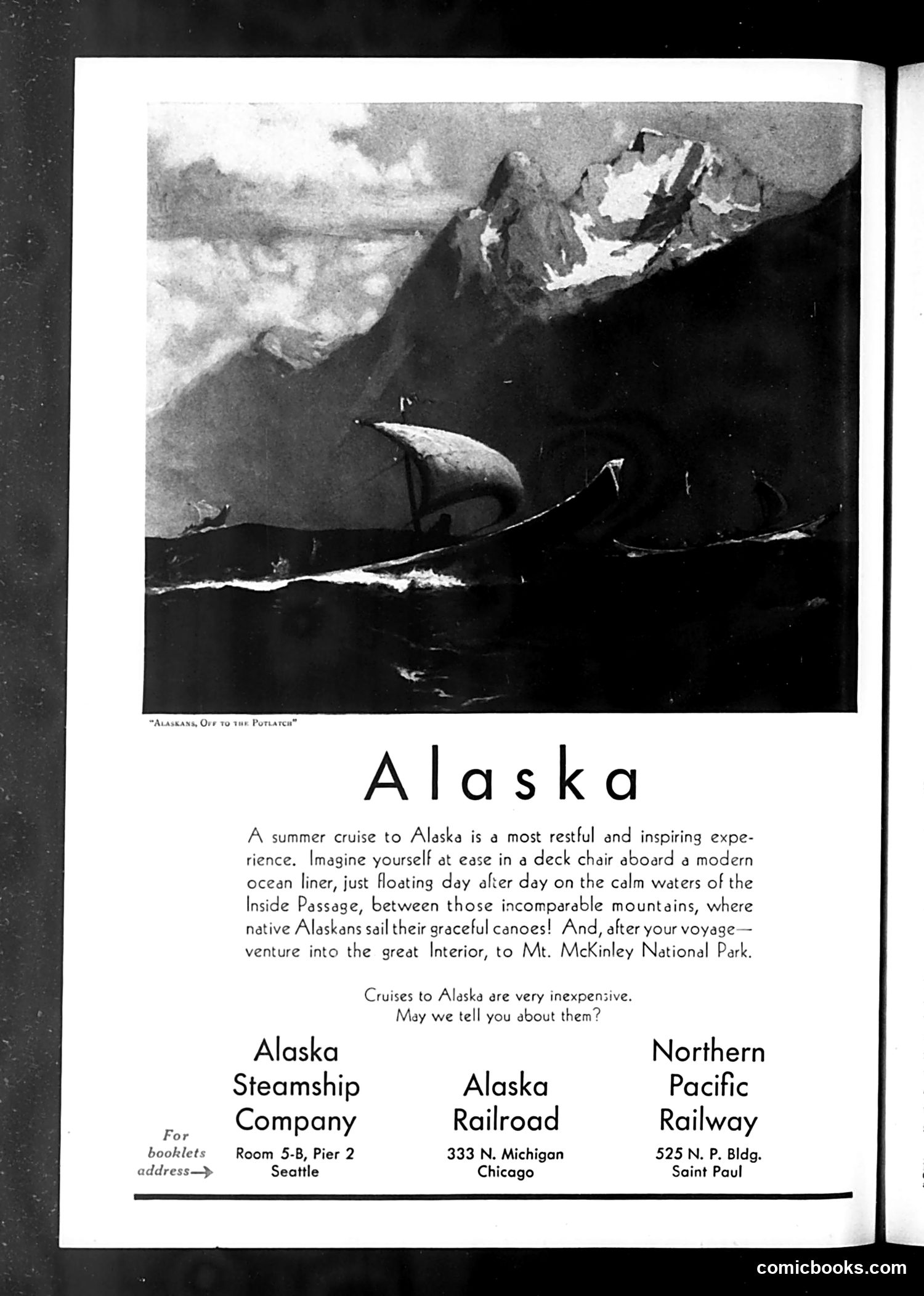
Analysis This page is primarily advertising, not satire or editorial content. It promotes Alaska tourism and travel options. The image shows a dramatic mountainous Alaskan coastal landscape with a sailboat, captioned "Alaskans Off to the Potlatch" (referencing Native Alaskan cultural gatherings). The advertisement text romanticizes Alaska cruises as "restful and inspiring," emphasizing scenic beauty and visits to Mt. McKinley National Park. The copy notes that "Cruises to Alaska are very inexpensive," then directs readers to contact three transportation companies: Alaska Steamship Company (Seattle), Alaska Railroad (Chicago), and Northern Pacific Railway (Saint Paul) for travel booklets. This reflects early-to-mid 20th-century tourism marketing, promoting Alaska as an accessible luxury destination.
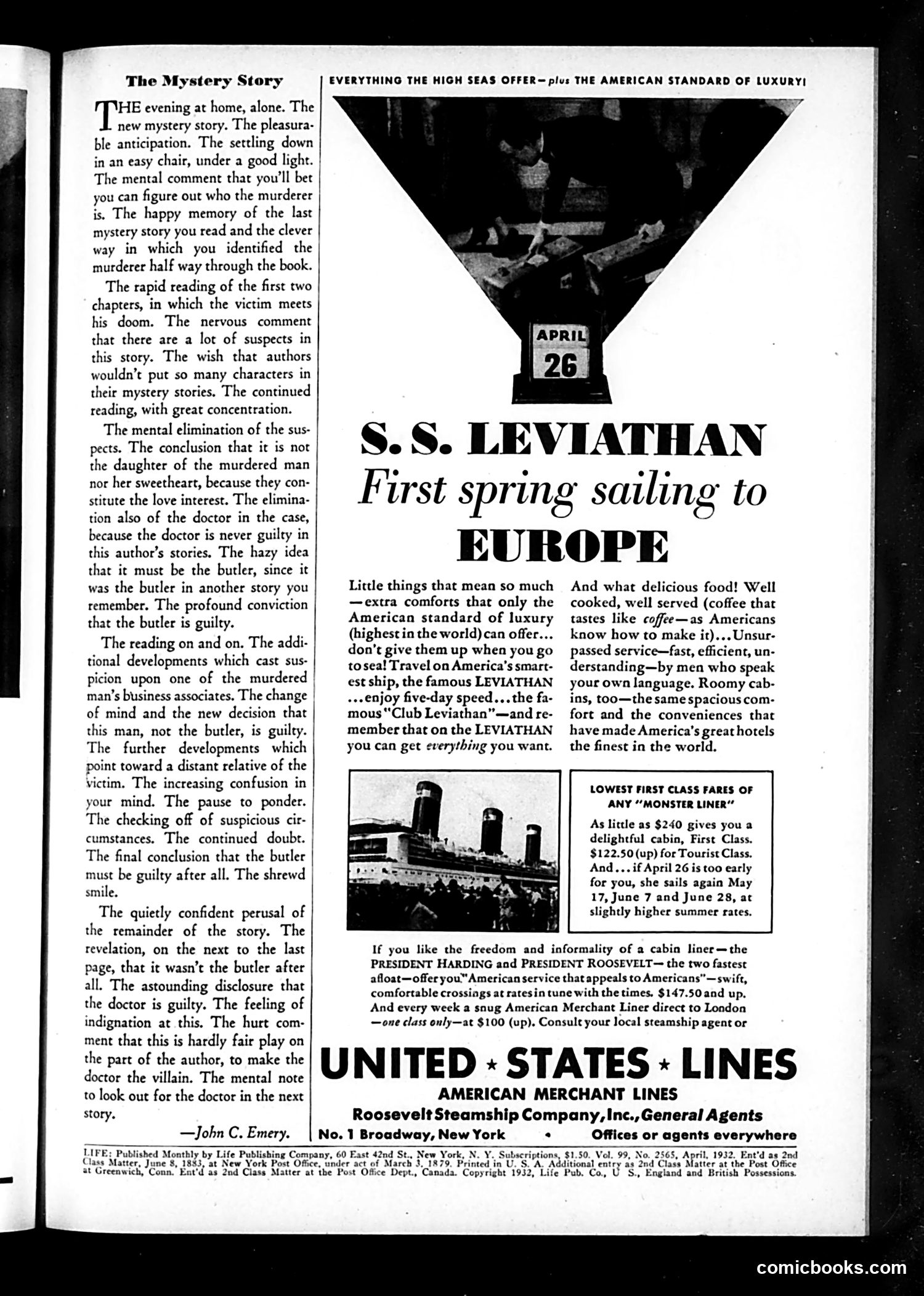
Content Analysis This page is primarily advertising rather than satire. The left column contains a literary review of a mystery story by John C. Emery, praising its plot twists and suspect elimination. The main content advertises the S.S. Leviathan, a steamship offering "first spring sailing to Europe" on April 26. The ship is operated by United States Lines (American Merchant Lines). The advertisement emphasizes luxury amenities and competitive pricing—first-class fares as low as $240, with tourist class at $122.50. It mentions the ship's famous "Club Leviathan" and appeals to Americans seeking European travel with American-standard comfort. The page also references competitor ships (Presidents Harding and Roosevelt) to position the Leviathan as the superior choice for transatlantic crossing in the 1930s travel market.
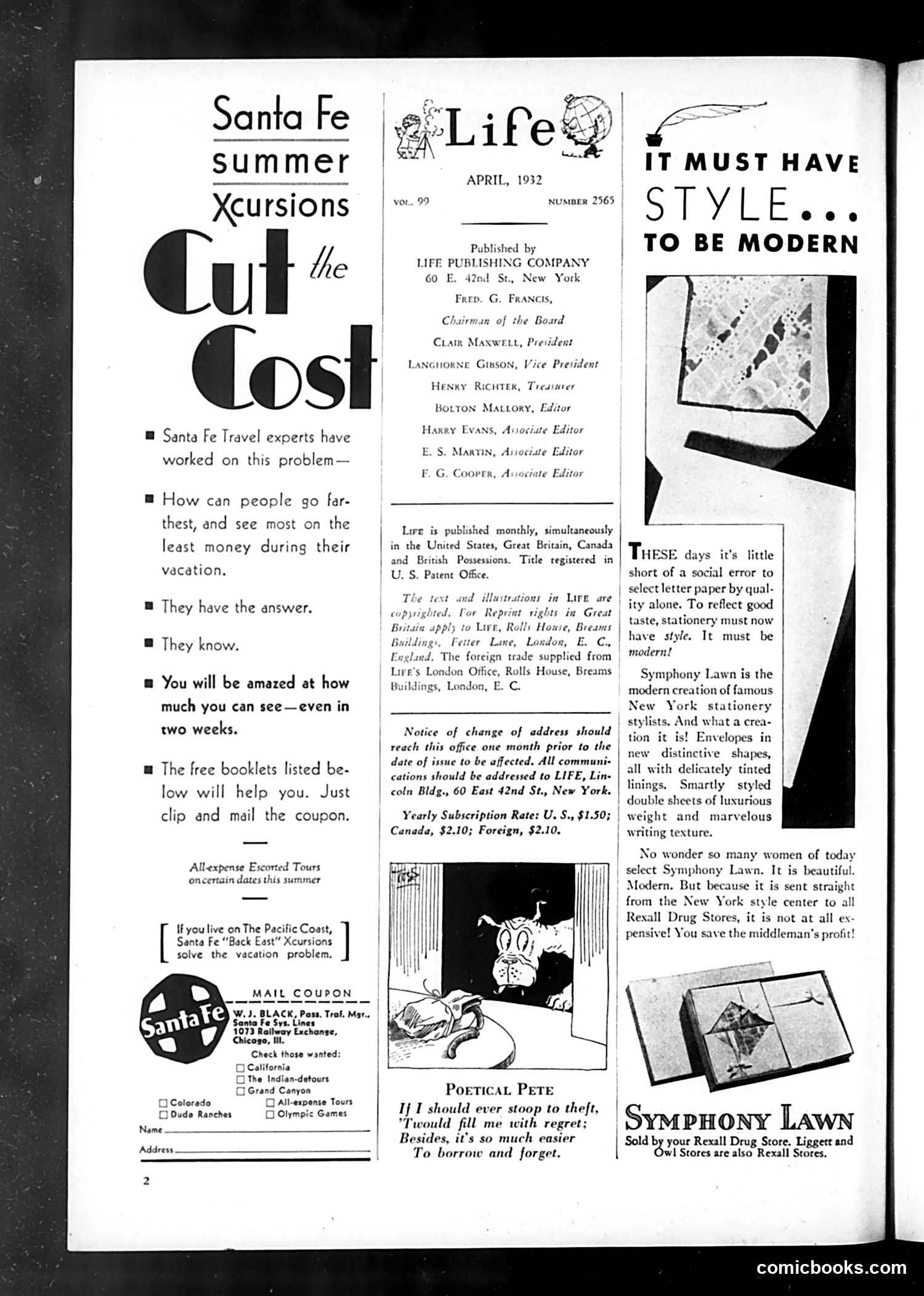
Life Magazine, April 1932 - Content Analysis This is primarily a title/contents page rather than a satirical cartoon page. The left side advertises Santa Fe Railway's vacation excursions promising budget travel. The center displays masthead information for *Life* magazine (April 1932, Vol. 99). The right side features a stationery advertisement for "Symphony Lawn" letterhead, emphasizing modern style and design. Below this is a small cartoon titled "Poetical Pete" depicting a figure and brief humorous verse about theft and borrowing. The Pete cartoon appears to be light humor rather than political satire—a simple joke about moral hypocrisy regarding stealing versus borrowing. The page primarily serves administrative and advertising functions rather than delivering substantive editorial commentary.
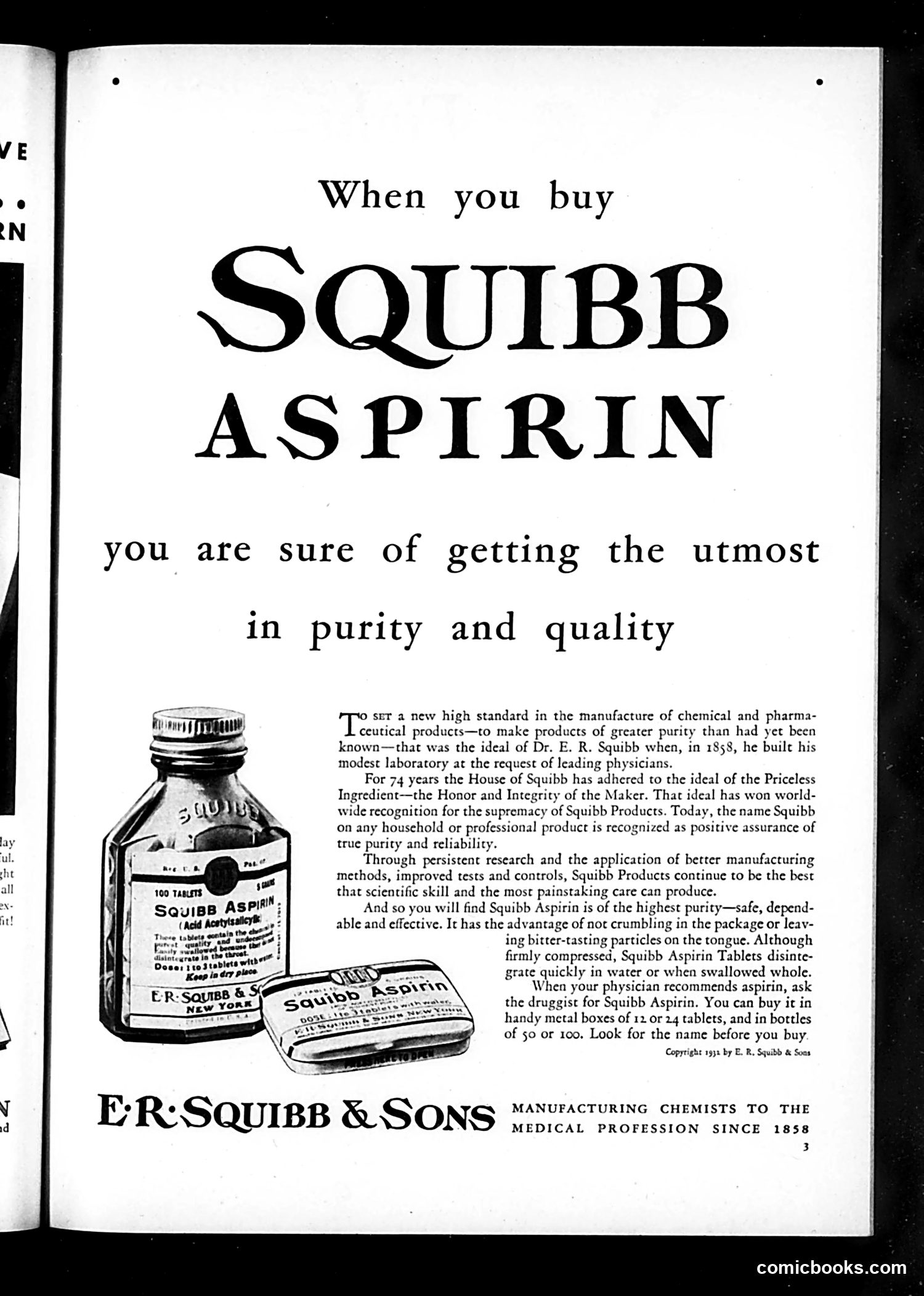
Analysis This page is entirely a pharmaceutical advertisement, not editorial content or satire. It's a full-page ad for Squibb Aspirin by E.R. Squibb & Sons, a manufacturing chemist founded in 1858. The ad emphasizes product quality and purity, claiming Squibb aspirin won't crumble in packaging or leave "bitter-tasting particles." It highlights the company's reputation for reliability and recommends customers ask their physician for Squibb brand specifically. There are no cartoons, caricatures, or satire present. The only image is a product photograph showing a Squibb Aspirin bottle and tin box. This represents straightforward early 20th-century pharmaceutical marketing, before modern FDA regulations mandated skepticism toward such quality claims.
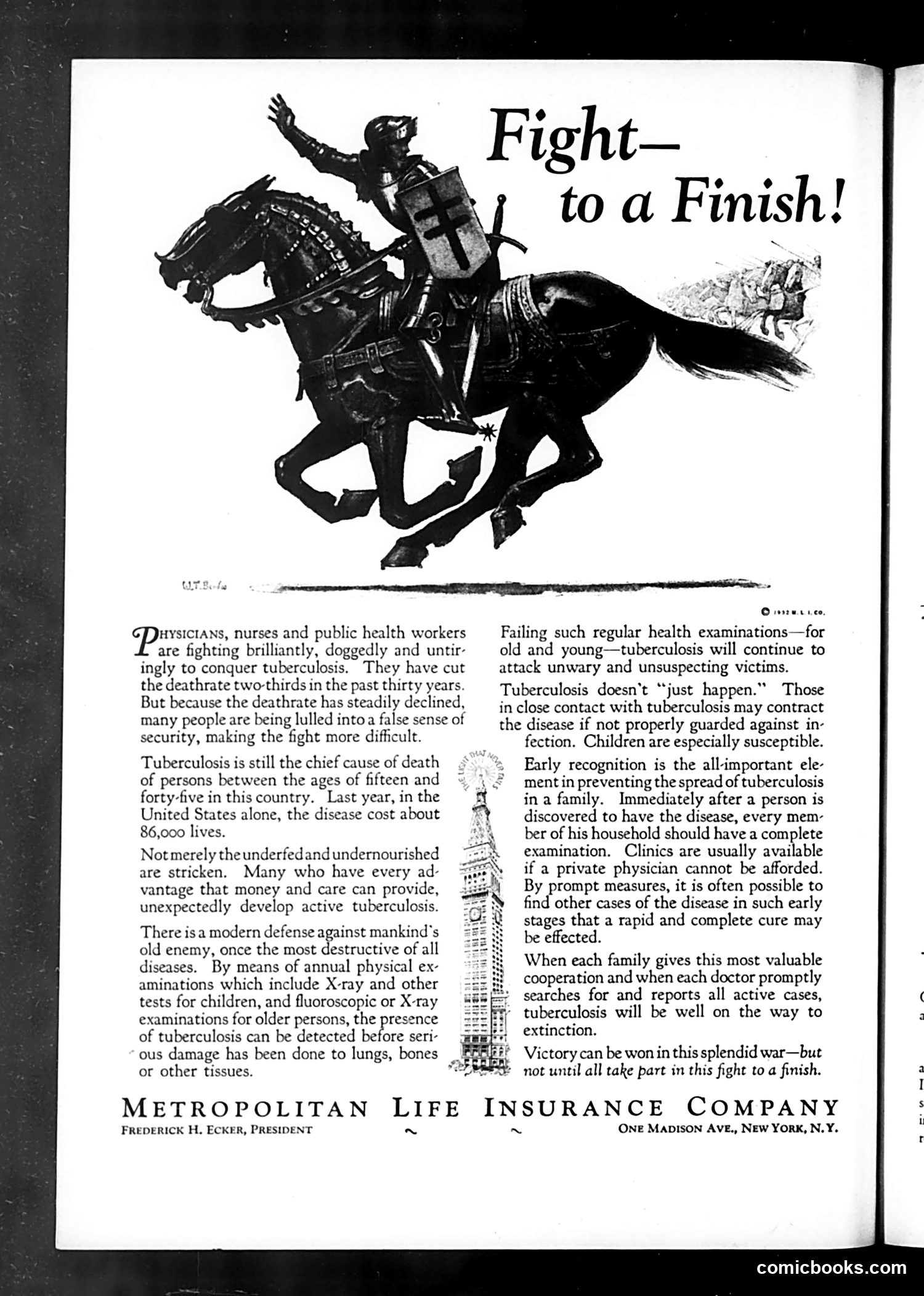
Analysis This is a public health advertisement, not satire. Metropolitan Life Insurance Company used this page to promote tuberculosis prevention during what appears to be the early 20th century. The dramatic illustration shows a crusader on horseback, symbolizing the fight against tuberculosis as a righteous battle. The text emphasizes that TB was still the leading cause of death for people aged 15-40 in the United States, killing approximately 86,000 annually. The advertisement advocates for early detection through physical examinations (including X-rays), proper family quarantine measures, and cooperation between patients and doctors. The closing phrase—"Victory can be won in this splendid war—but not until all take part in this fight to a finish"—frames public health as a collective moral responsibility, reflecting Progressive Era messaging that positioned disease prevention as patriotic duty.
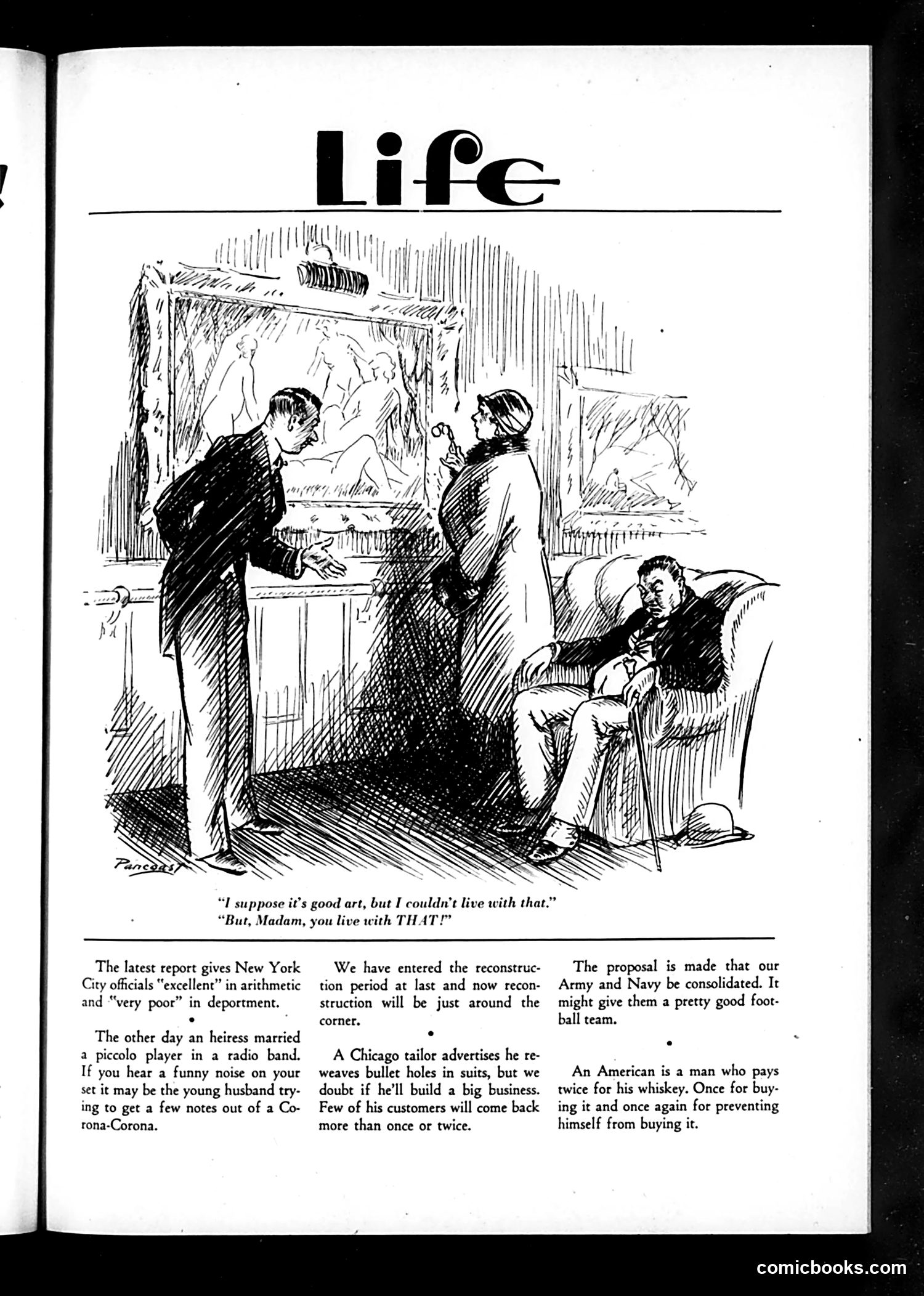
Life Magazine "Life" Section Analysis This page contains a cartoon and brief satirical commentary pieces typical of Life magazine's humor section. The Main Cartoon: Shows two men viewing what appears to be modern/abstract art in a window or gallery, while a third man sits nearby. The caption reads: "I suppose it's good art, but I couldn't live with that." / "But, Madam, you live with THAT!" — suggesting the seated man's appearance is itself unattractive, creating irony about aesthetic standards. The Brief Items mock various topics: New York City officials' contradictory reports, a radio band featuring an heiress and piccolo player, a Chicago tailor's dubious claim about reweaving bullet holes, and observations about American consumerism and whiskey consumption. The humor relies on wordplay, irony, and social commentary typical of 1920s-30s satirical journalism.
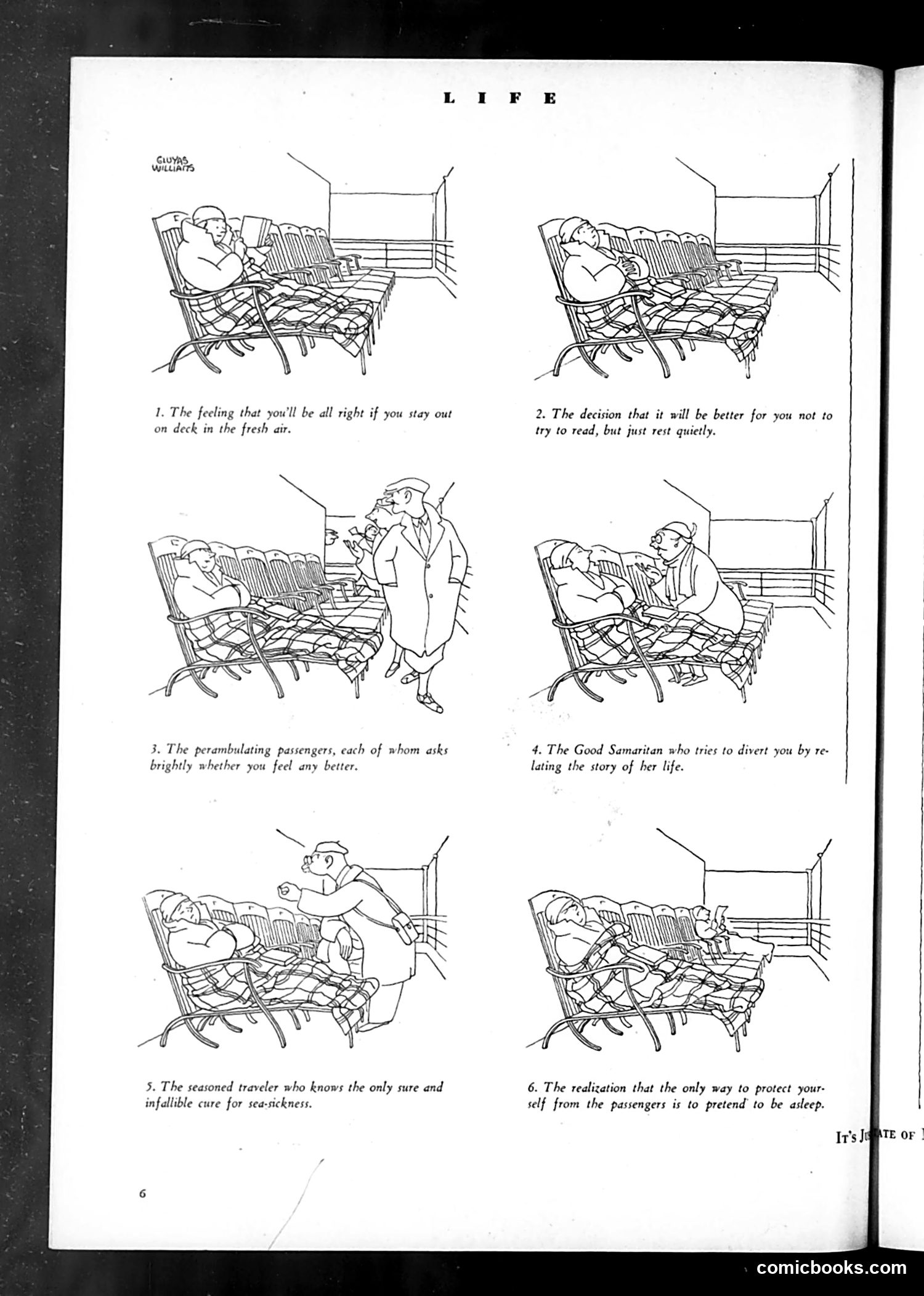
Life Magazine Cartoon Analysis This six-panel satirical cartoon by Gluyas Williams depicts the absurd social dynamics of ship travel, likely from the early-to-mid 20th century. The humor targets: 1. False reassurance about seasickness from staying on deck 2. Well-intentioned but useless advice from other passengers 3. Intrusive fellow travelers offering unwanted remedies 4. The "Good Samaritan" boring you with life stories as distraction 5. Dubious "cures" for sea-sickness from experienced travelers 6. Pretending to sleep as the only effective escape strategy The cartoon satirizes the forced social intimacy of ship travel and how strangers presume to help while actually making situations worse through their meddling and unsolicited advice. It's fundamentally about invasion of privacy during travel.
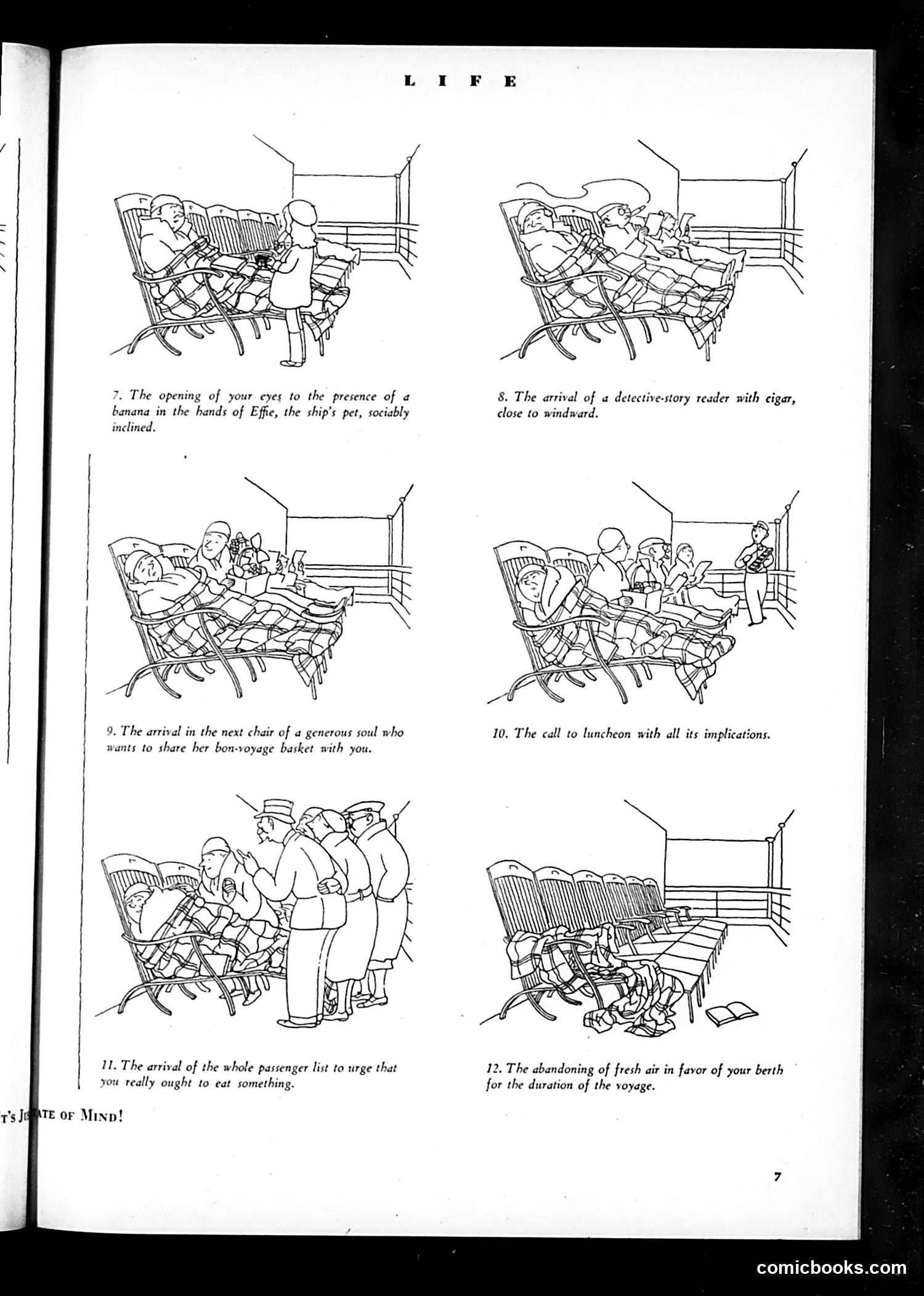
Life Magazine Page 7: Ocean Voyage Satire This page satirizes the annoyances of ocean travel, depicting six numbered scenes showing shipboard disruptions. The humor targets fellow passengers and their intrusions: - Scene 7: A woman's banana-eating interrupts quiet reading - Scene 8: A cigar-smoking detective-story reader arrives - Scene 9: A generous soul wants to share their lunch basket - Scene 10: The lunch bell summons everyone to meals - Scene 11: Crew urges passengers to actually eat something - Scene 12: Passengers must abandon deck chairs for fresh air The satire presents relatable frustrations of close-quarters ship travel—unwanted socializing, invasive habits, forced interactions, and the constant disruptions to attempted relaxation. It's gentle social commentary on how public travel forces strangers into uncomfortable proximity.
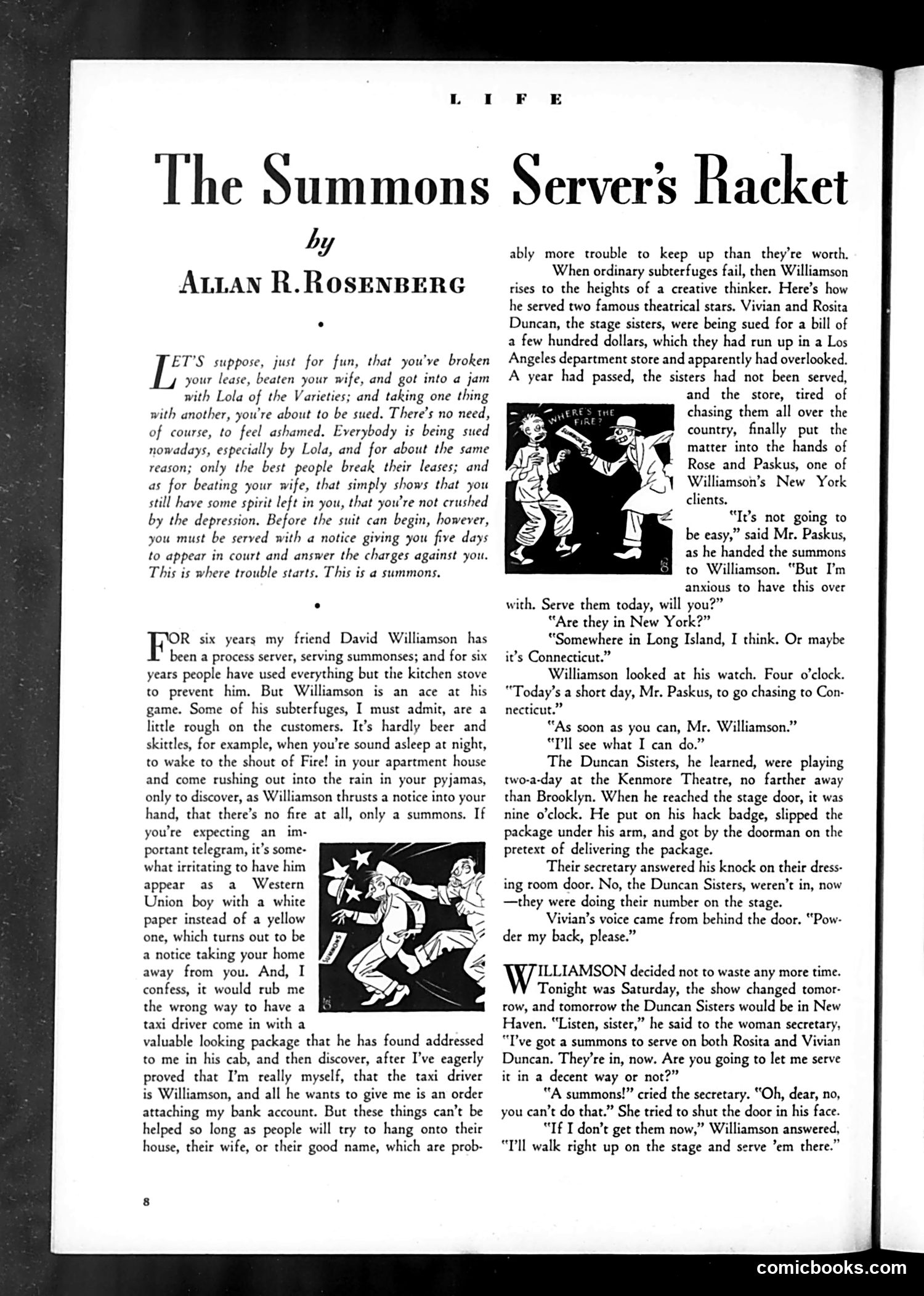
"The Summons Server's Racket" by Allan R. Rosenberg This article satirizes the frustrations of being served legal summonses by process servers. The accompanying cartoons (which appear to show comedic scenes of summons delivery) illustrate the story's central joke: a process server named Williamson has served the famous Duncan Sisters—vaudeville performers—with a lawsuit. The satire mocks how process servers use creative deceptions to deliver notices (appearing as delivery men, hiding papers in packages). It also pokes fun at the theatrical world, where even famous stage performers aren't immune to legal troubles. The article treats a mundane legal nuisance as high comedy, typical of *Life* magazine's early-20th-century approach to satirizing everyday American frustrations and professional indignities.
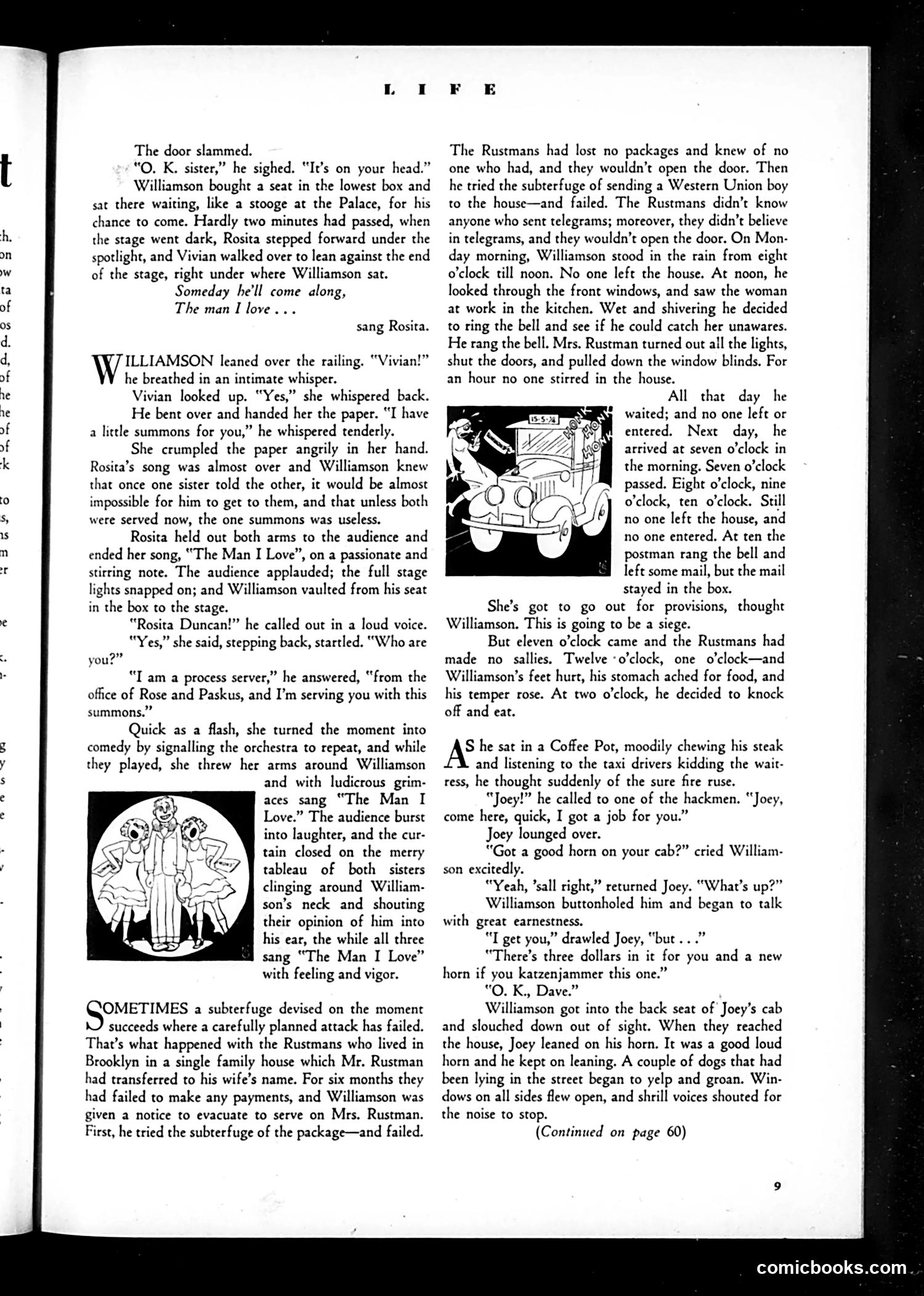
Analysis of Life Magazine Page This page contains a serialized short story titled "Life" about a man named Williamson attempting to reunite with his estranged sister Vivian through an elaborate plan involving theater tickets and summonses. The narrative describes a comedic domestic crisis involving the Rustman family, who face eviction after failing to make payments on their Brooklyn home. Two illustrations accompany the text: one showing Rosita Duncan on stage performing "The Man I Love," and another depicting three figures in period costume, likely from the same theatrical scene. The content reflects 1920s-era popular fiction—emphasizing theatrical drama, domestic financial struggles, and romantic/familial reunion plots typical of the magazine's entertainment focus during this period.
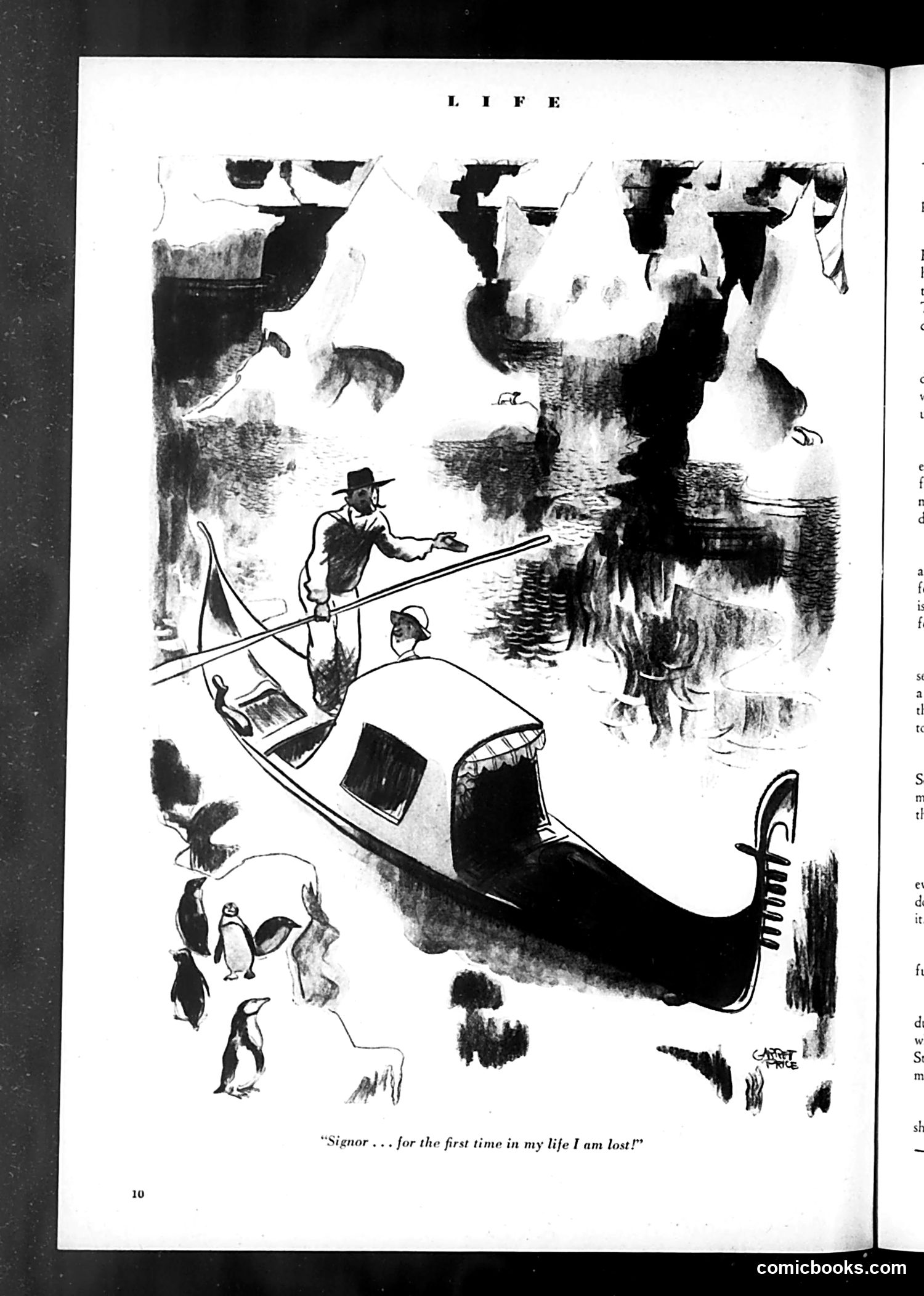
Cartoon Analysis This is a humorous illustration showing two men in a gondola on what appears to be Venice's Grand Canal. One man poles the boat while wearing a hat; the other sits as a passenger. The scene includes classical Venetian architecture in the background and what appear to be penguins in the lower left. The caption reads: "Signor . . . for the first time in my life I am lost!" The joke appears to satirize tourism and getting lost in Venice despite hiring a gondolier—traditionally a skilled local guide. The incongruous presence of penguins (not native to Venice) suggests this is a surreal or absurdist humor piece, possibly mocking exaggerated travel narratives or the romanticized Venetian experience. The cartoon likely appeared in Life magazine's satirical commentary section.
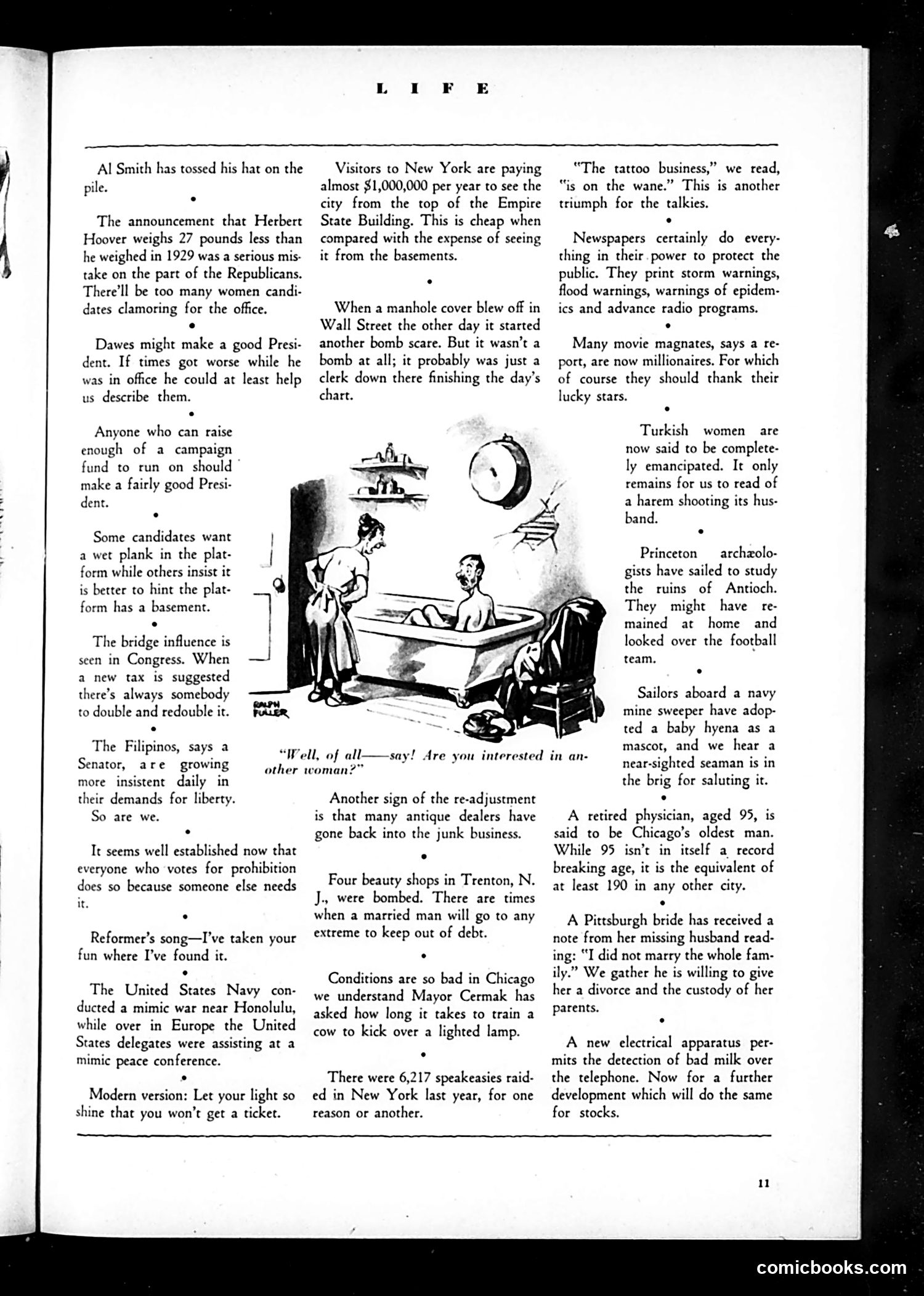
Analysis of Life Magazine Page This page contains brief satirical commentary items typical of Life's "Life" section—short topical jokes and observations about contemporary American society. The single cartoon depicts a bathtub scene with the caption "Well, of all—say! Are you interested in another woman?" The humor appears to satirize marital infidelity and domestic drama. The cartoon's setup—catching someone in an intimate moment (a bathtub)—was a common comedic trope of the era for exposing compromising situations. The surrounding text items mock various subjects: political candidates, Prohibition enforcement, navy activities, and social trends. One notes beauty shops in Trenton were bombed, suggesting either criminal activity or Prohibition-era violence. The overall tone is light, gossipy commentary on American life rather than serious political satire.
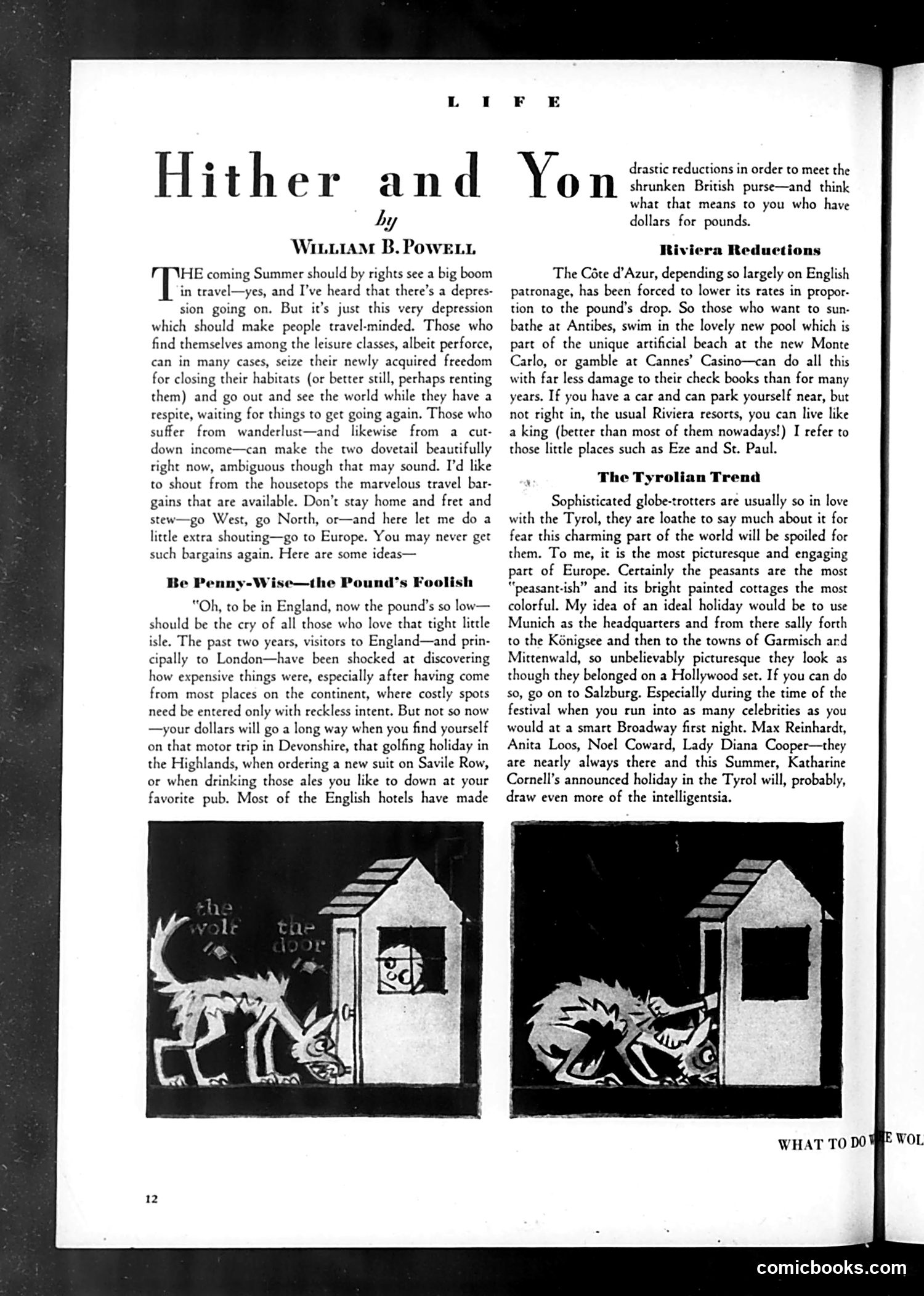
Analysis of "Hither and Yon" by William B. Powell This travel advice column satirizes American tourists' financial complaints abroad during a period of British pound weakness. The main joke targets wealthy Americans who traveled to Europe expecting bargains due to favorable exchange rates, but now faced "drastic reductions" in purchasing power as the pound's value fell. The two cartoon panels at the bottom appear to depict a tourist character (likely an American) interacting with European accommodations or services—possibly illustrating the gap between tourist expectations and modest European lodgings. The cartoons seem to mock both tourists' complaints and the modest reality of European travel. Powell's tone is gently mocking: Americans should stop complaining and enjoy the adventure, as genuine travel bargains still exist for those willing to seek them out.
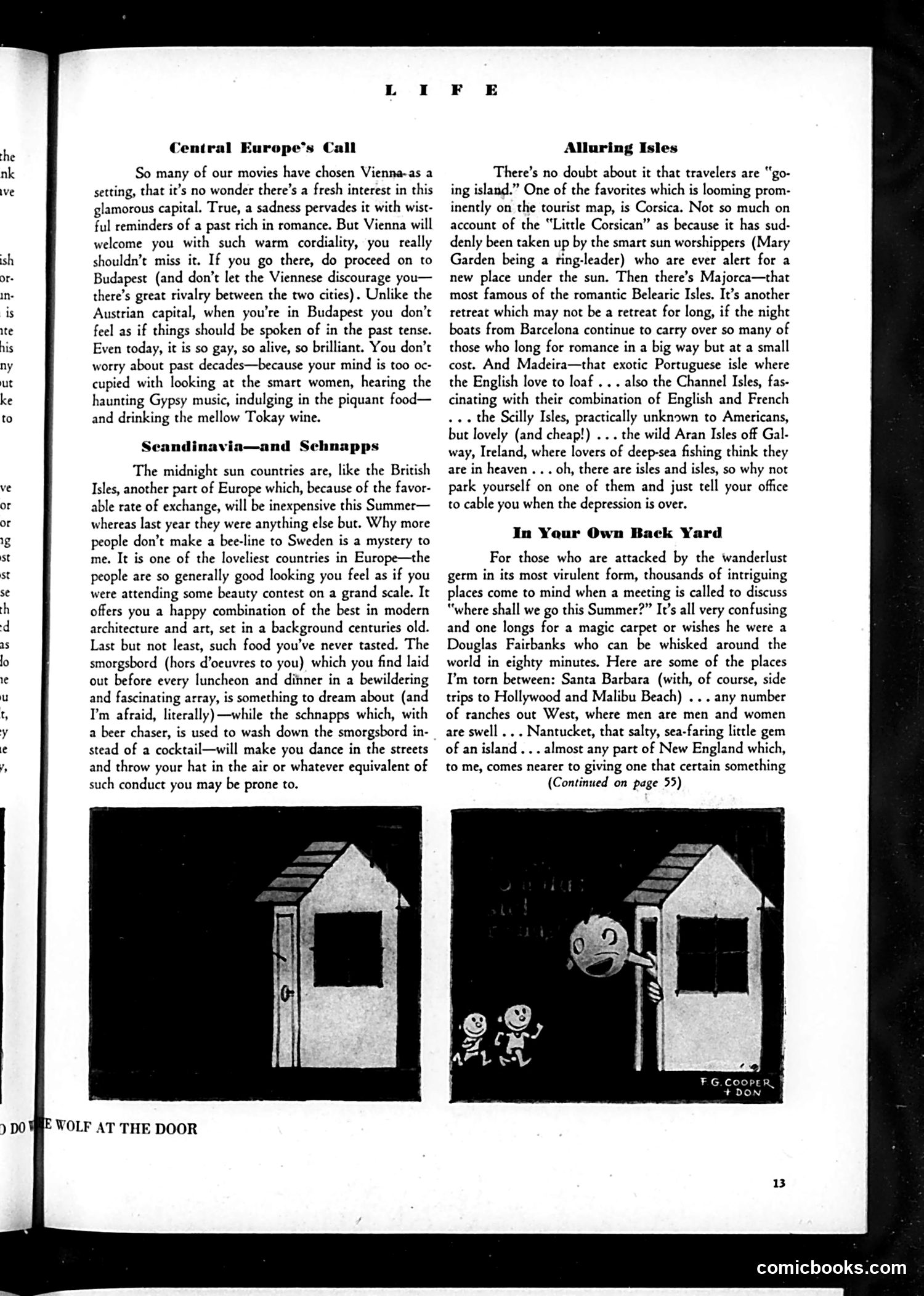
"The Wolf at the Door" This two-panel cartoon illustrates a common Depression-era anxiety. The left panel shows an empty house or shelter—shelter from economic hardship. The right panel depicts the same structure threatened by a wolf (labeled in the caption), while two stick-figure people cower inside. The "wolf" is a visual metaphor for poverty, homelessness, and financial ruin—threats that haunted American families during the Great Depression. The cartoon's grim humor reflects widespread fear that economic collapse could leave families without shelter or security. The accompanying travel article about European vacations provides stark contrast, suggesting that while some Americans dreamed of leisure abroad, others faced more immediate survival concerns at home.
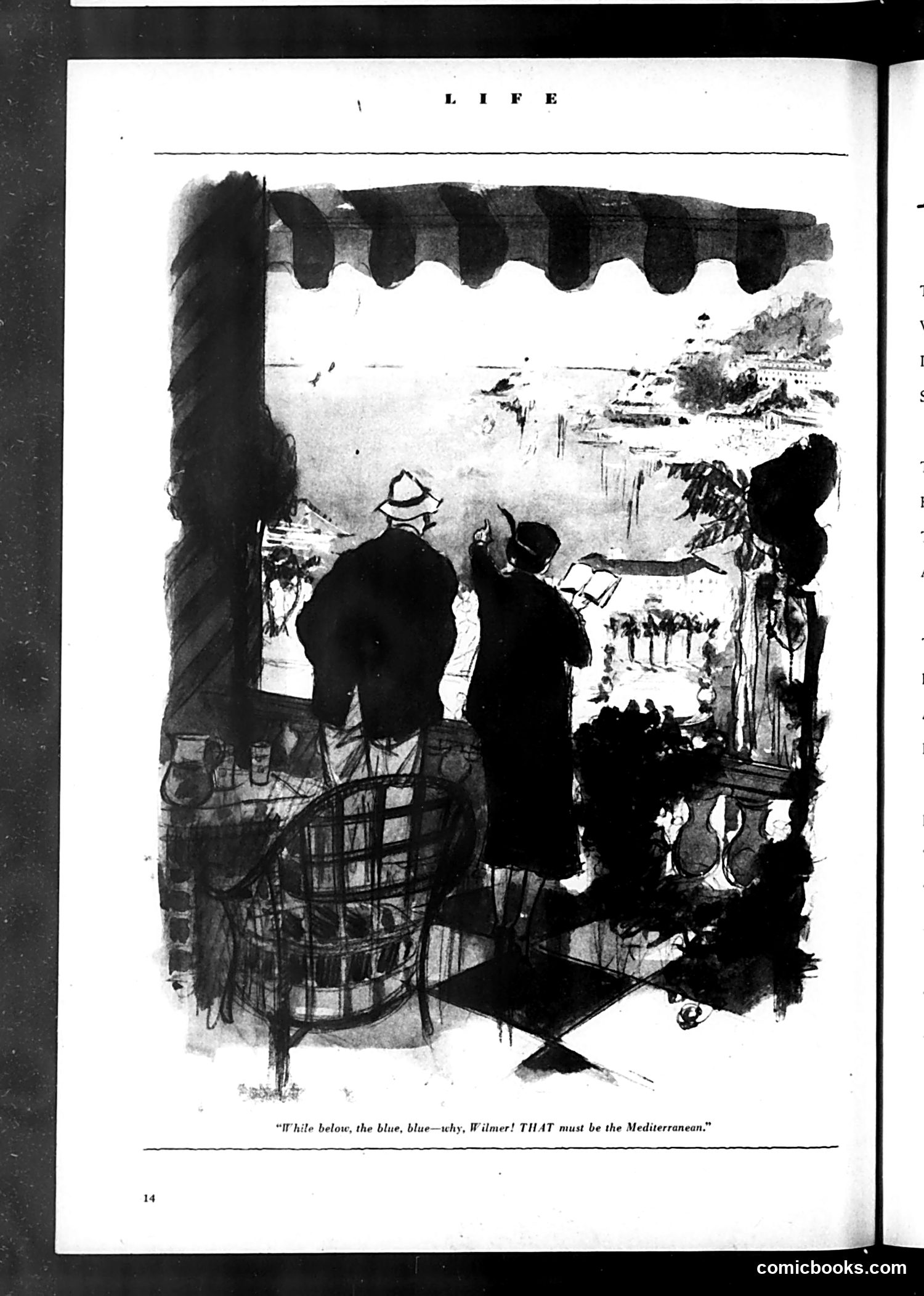
Analysis This illustration shows two figures on a balcony or terrace overlooking a Mediterranean coastal landscape. The caption reads: "If blue below, the blue, blue—why, if ulmer! THAT must be the Mediterranean." The joke appears to be a satirical commentary on tourism and travel clichés. The figures—likely wealthy American tourists—are viewing a stereotypically picturesque Mediterranean scene (blue water, coastal buildings, vegetation) and responding with predictable, somewhat vapid enthusiasm. The phrase "THAT must be the Mediterranean" suggests they're confirming an obvious sight through naive recognition rather than genuine appreciation. This satirizes early 20th-century American tourists' superficial engagement with European travel—they consume scenic views passively, expecting picturesque confirmations of guidebook imagery rather than authentic experience or deeper understanding.
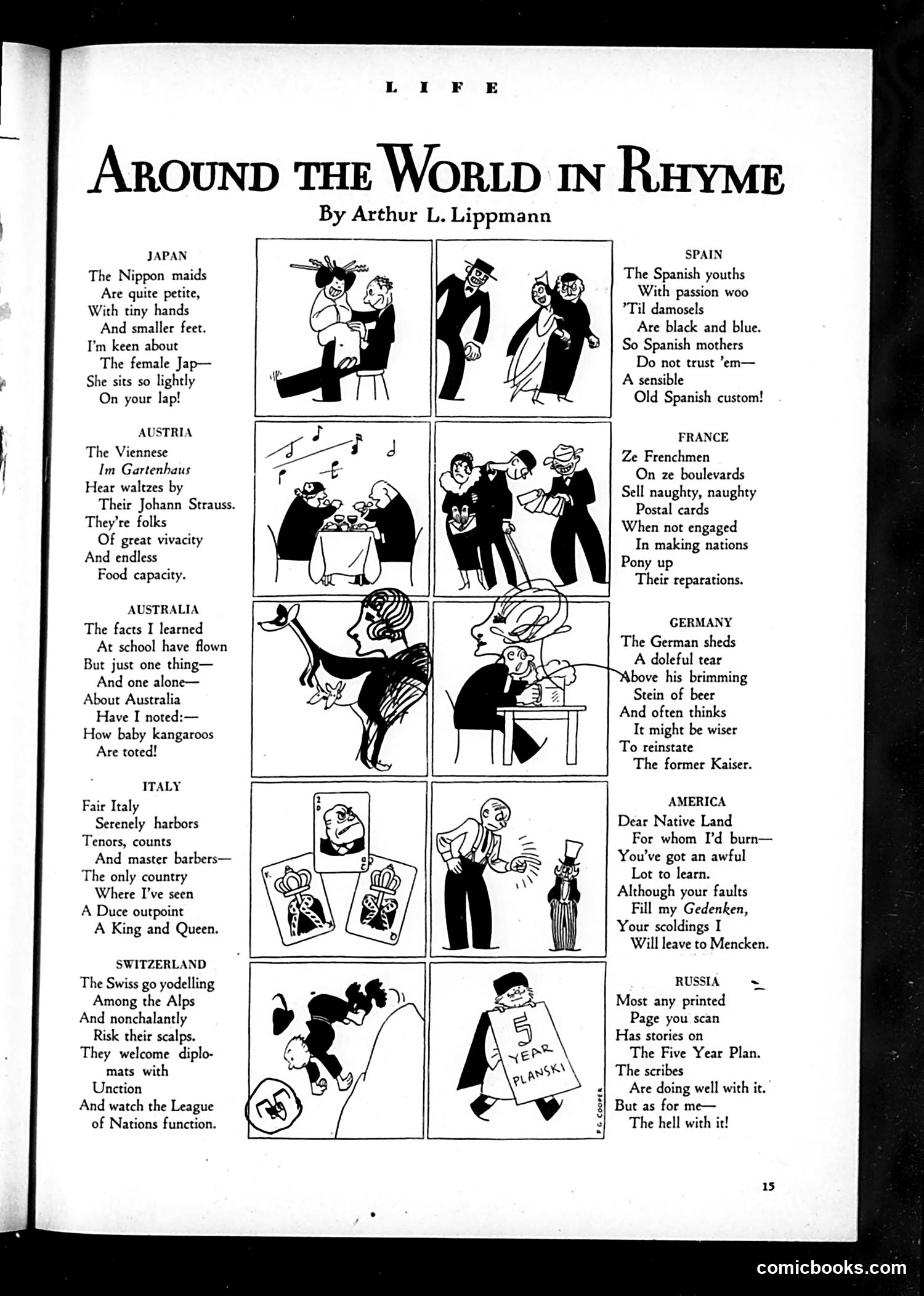
"Around the World in Rhyme" by Arthur L. Lippmann This satirical poem with cartoon illustrations stereotypes various nationalities. Each section mocks cultural traits: Japanese women's small feet, Austrian waltzing and food, Australian kangaroos, Italian opera and royalty, Swiss yodeling and diplomacy, Spanish passionate youth, French postcards and infidelity, German beer-drinking and nostalgia for the Kaiser, American moral superiority, and Russian five-year plans. The cartoons use exaggerated visual caricatures alongside the verses. The humor relies on broad ethnic stereotypes common to early 20th-century American satire. The Russia section ends dismissively ("The hell with it!"), suggesting postwar American skepticism toward Soviet communism and central planning—likely dating this to the 1920s-30s.
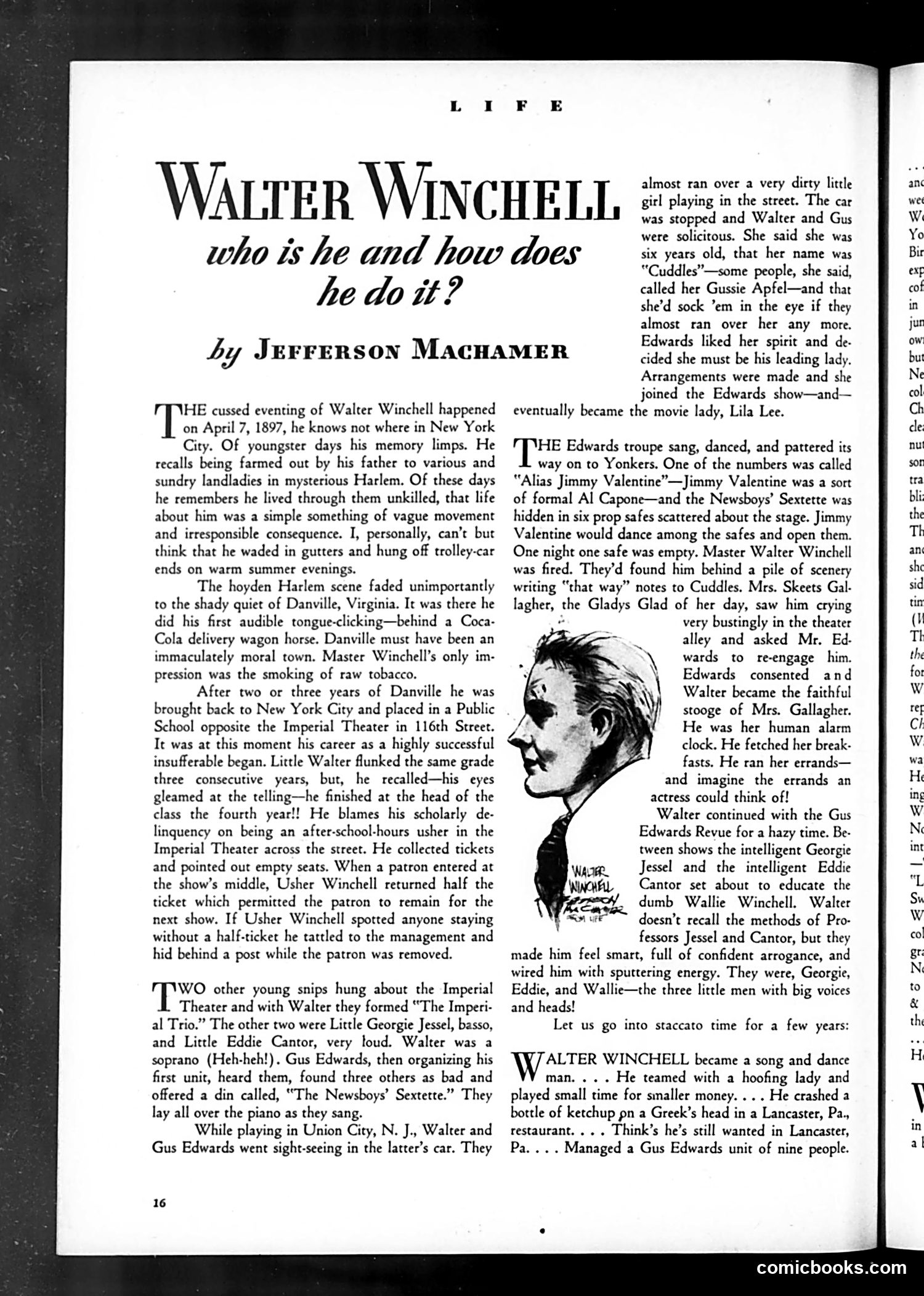
Walter Winchell Profile This article profiles Walter Winchell, a Broadway personality and entertainer, written by Jefferson Machamer. The piece traces Winchell's early life—his impoverished Harlem childhood, work in vaudeville with the "Imperial Theater" troupe alongside Gus Edwards, and various theatrical jobs. The accompanying sketch portrait shows Winchell in profile with a distinctive angular face. The text emphasizes Winchell's humble origins and his progression through show business: performing in small-time shows, forming musical groups like "The Newsboys," and eventually managing entertainment units. The article presents him as a self-made showman who rose from street poverty to theatrical success—a classic American success narrative for early 20th-century readers interested in Broadway personalities.
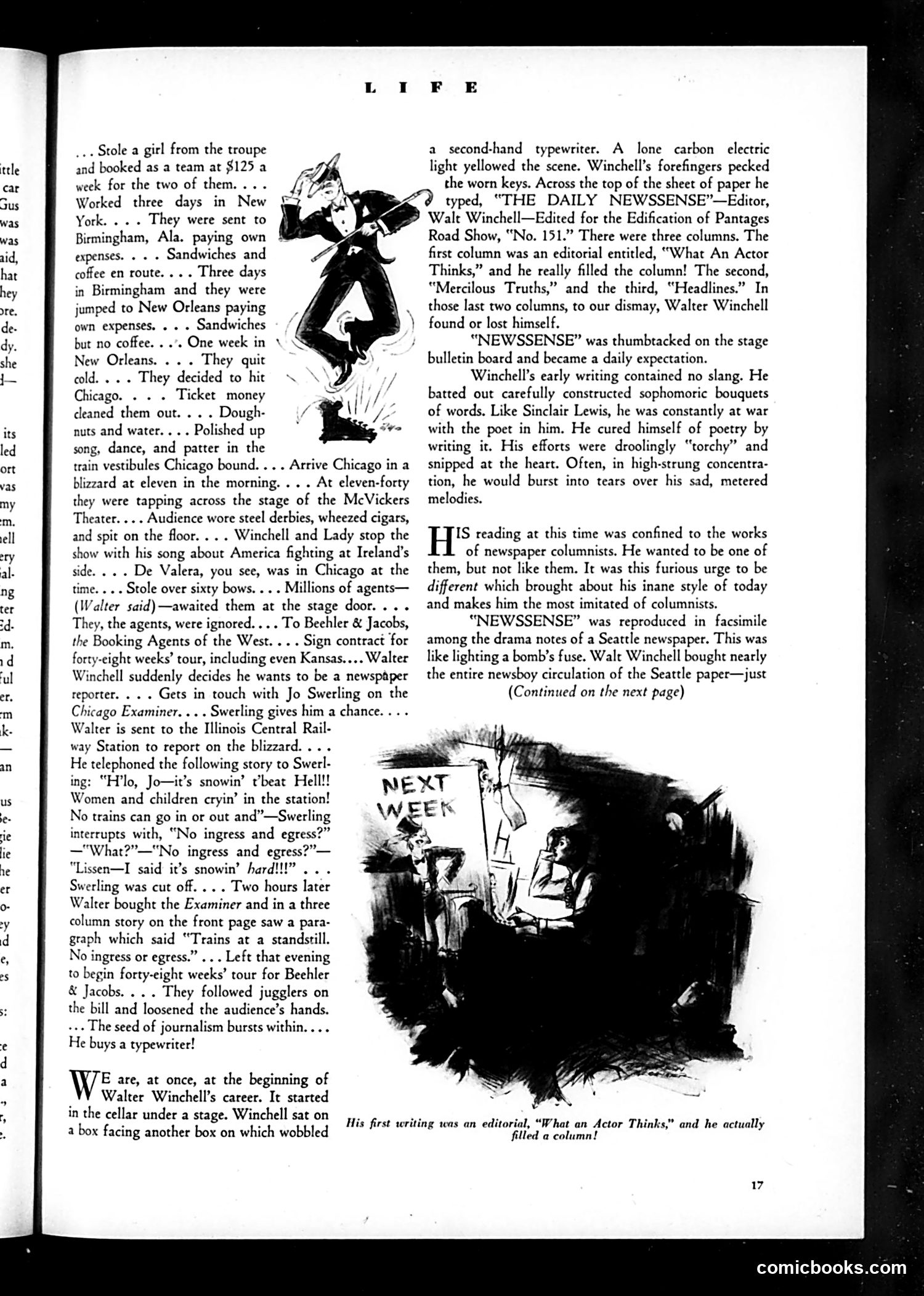
Explanation for Modern Readers This page from *Life* magazine documents Walter Winchell's early newspaper career. The main illustration shows Winchell at a typewriter under a sign reading "NEXT WEEK"—a visual pun on his famous gossip column format. The text humorously traces how Winchell transitioned from vaudeville performer to journalist. Key satirical points include: - His newspaper writing was deliberately crude and "torchy," filled with slang and emotional outbursts - He bought entire newsboy circulation of the Seattle paper to read his own work - The caption mockingly notes his first editorial actually filled a column The satire mocks Winchell's outsized ego and unconventional newspaper style—treating a minor vaudeville performer's sudden ambition to become a serious journalist as absurdly self-aggrandizing. This captures early 1920s skepticism about entertainment figures entering the "respectable" press.
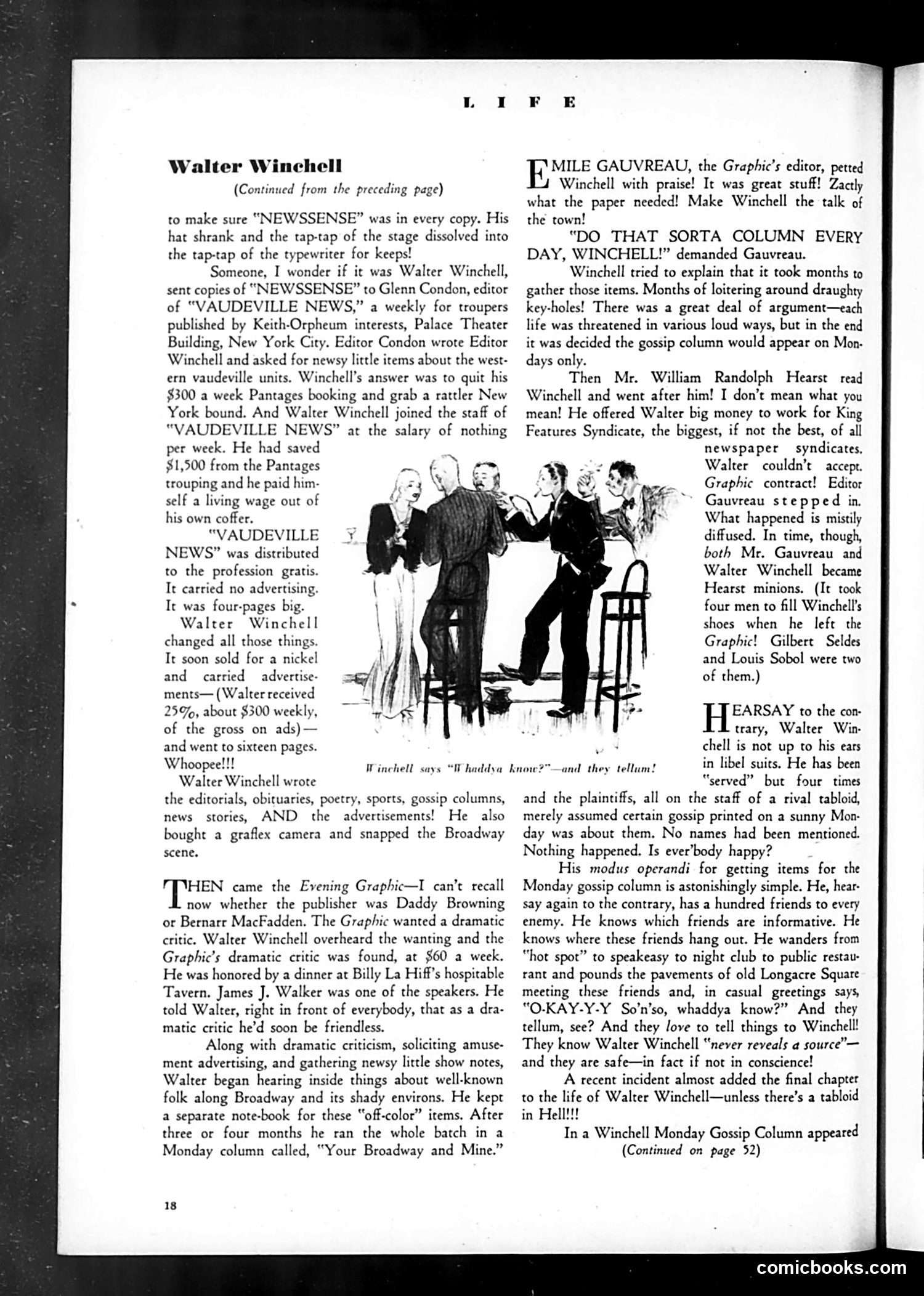
Analysis of "Walter Winchell" Page from Life Magazine This page celebrates Walter Winchell, a prominent gossip columnist who revolutionized newspaper journalism in the early 20th century. The article traces his rise from theater extra to influential media figure, describing how he transformed a struggling publication ("Vaudeville News") into a profitable enterprise by introducing celebrity gossip, advertising, and dramatic criticism—innovations that were apparently novel at the time. The accompanying sketch shows Winchell surrounded by well-dressed figures, illustrating his newfound social prominence and connections. The satirical point seems to be that Winchell's sensationalist approach—gathering theatrical rumors, monetizing gossip—represents a significant (if somewhat dubious) shift in American journalism, making him both powerful and controversial among rival publications and the Broadway scene.
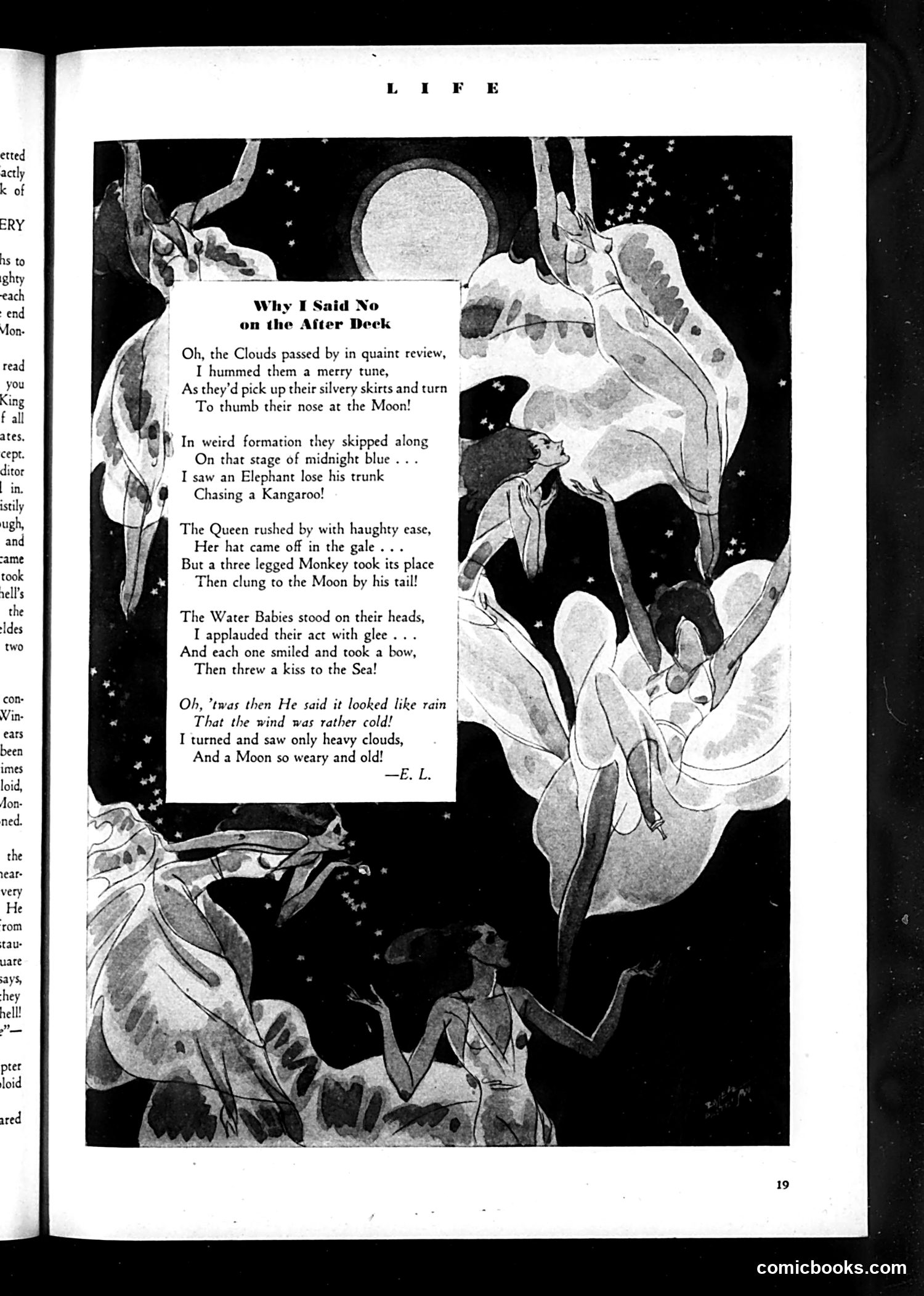
"Why I Said No on the After Deck" This whimsical poem by E.L. uses fantastical imagery—clouds, elephants, a kangaroo, a monkey, water babies, and a weary moon—to narrate a surreal nighttime scene. The speaker declines some unspecified proposition while observing these impossible creatures parading across the sky. The poem appears to be light, imaginative verse rather than political satire. The elaborate illustration shows a figure on a ship's deck gesturing toward the moon and fantastic creatures rendered in the dramatic art deco style typical of 1920s Life magazine. Without additional context, the specific "proposition" being refused remains unclear, though the poetic, fantastical tone suggests it's playful rather than serious social commentary.
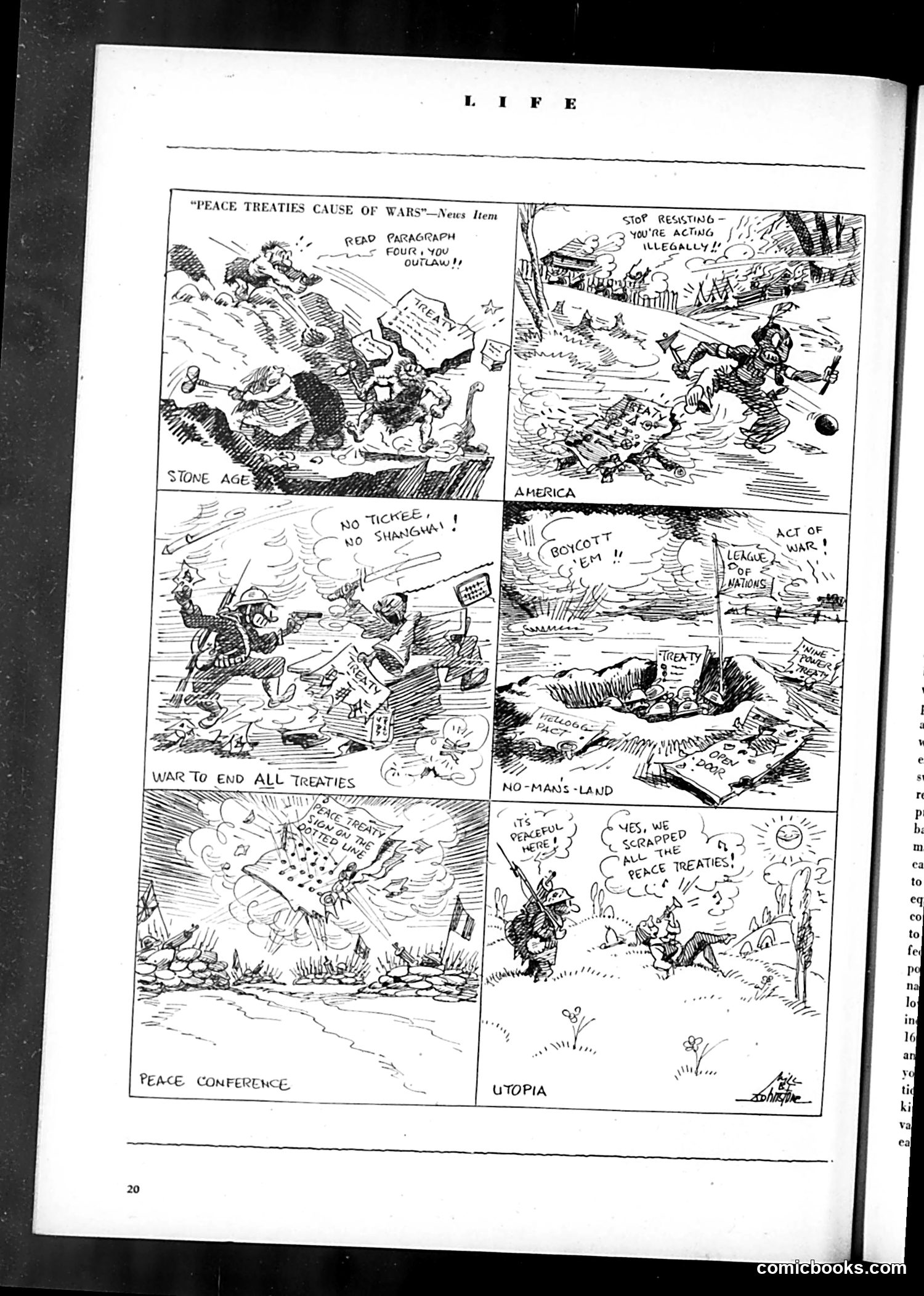
Political Cartoon Analysis This satirical comic strip critiques the irony that peace treaties often lead to future wars. Each panel depicts a different historical scenario where imposed peace settlements breed resentment and conflict: - "Stone Age": Primitive figures fighting over treaty terms - "America": Figures resisting authority, labeled "Stop resisting—you're acting illegally!" - "War to End All Treaties": Violent destruction of peace documents - "No-Man's-Land": Devastated landscape with treaty debris - "Peace Conference": Officials discussing while explosions occur nearby - "Utopia": Idealized peaceful outcome (seemingly unachievable) The cartoon's core message: punitive or unjust peace treaties breed resistance and renewed conflict rather than lasting peace. This likely reflects post-WWI disillusionment, as the Treaty of Versailles was widely blamed for causing conditions leading to WWII. The artist argues that harsh treaty impositions create the seeds of future wars.
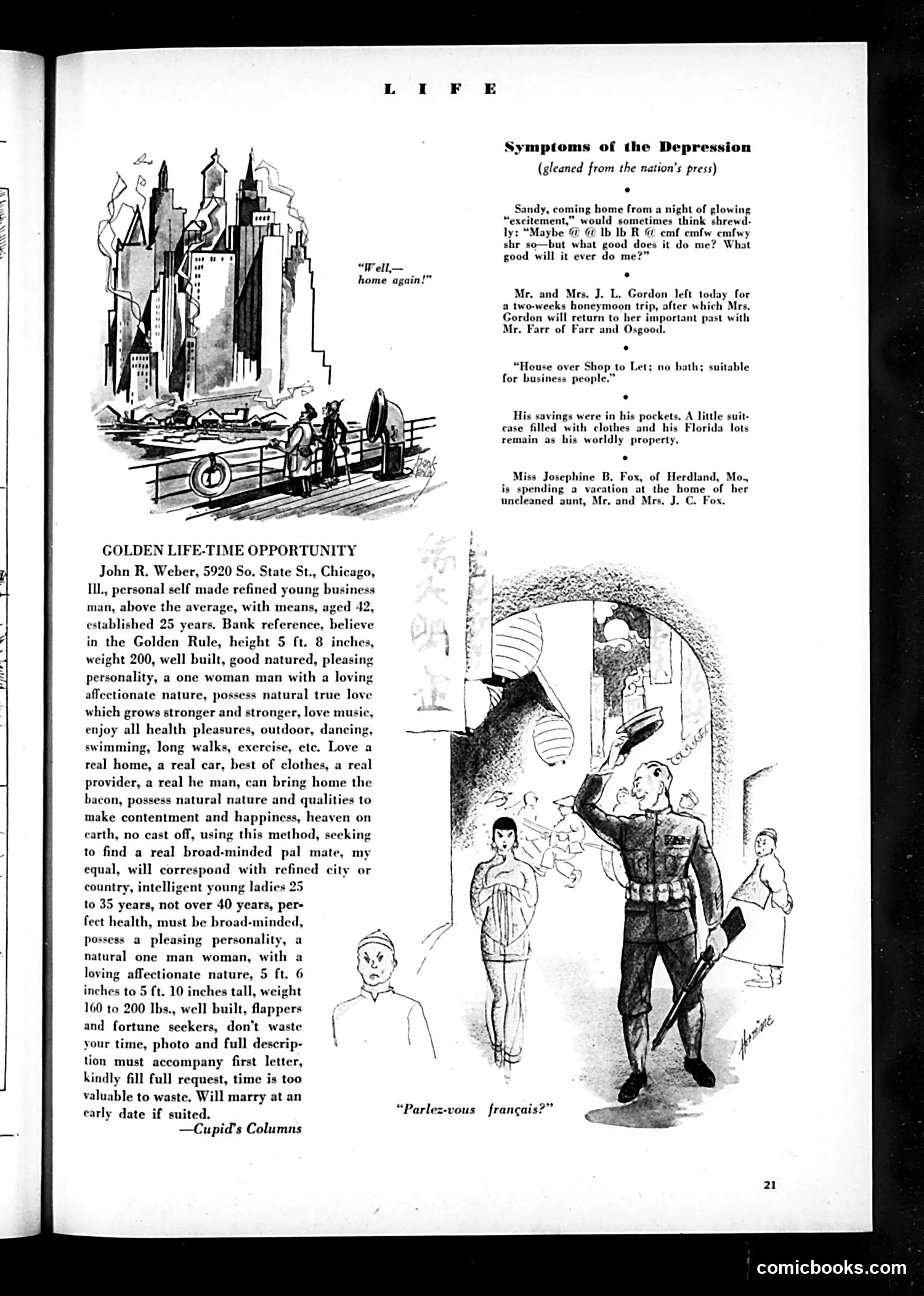
Life Magazine Depression Satire This page satirizes hardships during the Great Depression through vignettes labeled "Symptoms of the Depression." The section collects real newspaper clippings showing economic desperation: people questioning the value of entertainment when broke, rushed honeymoons, housing ads emphasizing "no bath" to lower rent, men with only suitcases and worthless Florida property as assets, and relatives described as "uncleaned" due to poverty. The large advertisement is a personal ad from a 42-year-old Chicago man desperately seeking marriage, emphasizing his "means" and "savings" while simultaneously advertising his modest circumstances—the contradiction itself revealing Depression anxiety. His lengthy self-promotion and specific physical requirements (women aged 25-35, certain heights/weights) satirize how economic desperation drives people to commodify themselves in the marriage market. The cartoons above reinforce the period's pervasive bleakness and loss of security.
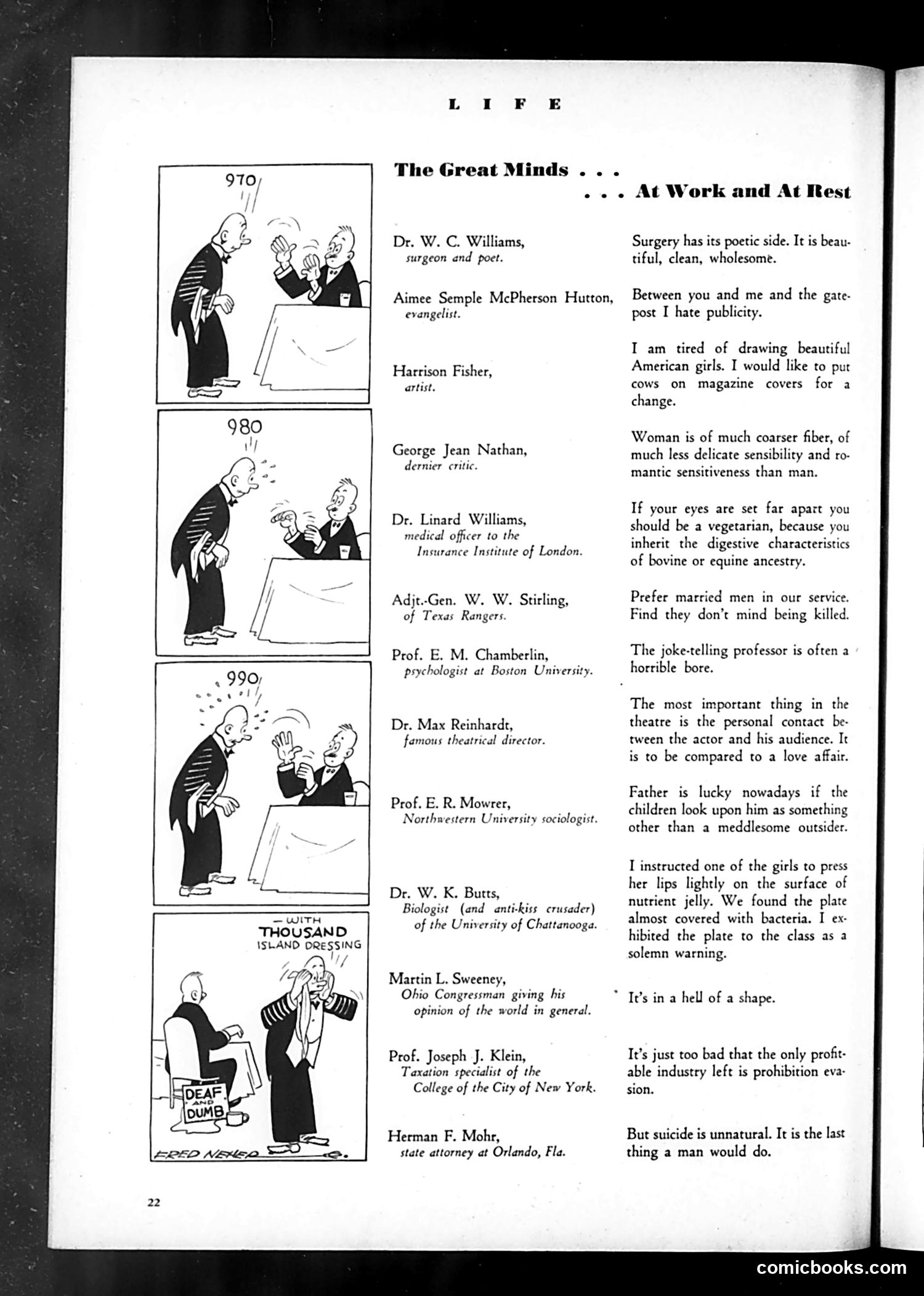
"The Great Minds... At Work and At Rest" This satirical Life magazine feature mocks prominent 1920s figures by pairing their professional identities with absurd personal quotes revealing hypocrisy, prejudice, or banality. The cartoons show a man (appears to be a journalist or interviewer) repeatedly approaching the same desk worker across three panels (970, 980, 990), suggesting repeated, futile attempts to extract meaningful commentary. The quotes lampoon various professionals: A surgeon claims poetry's beauty while operating; an evangelist hates publicity; an artist wants cows instead of girls on covers; academics make offensive pseudo-scientific claims about physiology and gender; a Texas Ranger prefers married soldiers who accept death casually; a professor teaches using bacteria-laden kiss experiments. The final cartoon ("With Thousand Island Dressing") shows the same man interviewing someone labeled "DEAF AND DUMB," satirizing how pointless these "great minds" have become—their commentary indistinguishable from speaking to the deaf. The implicit joke: prominent public figures spout pretentious nonsense or reveal bigotry when asked to share wisdom.
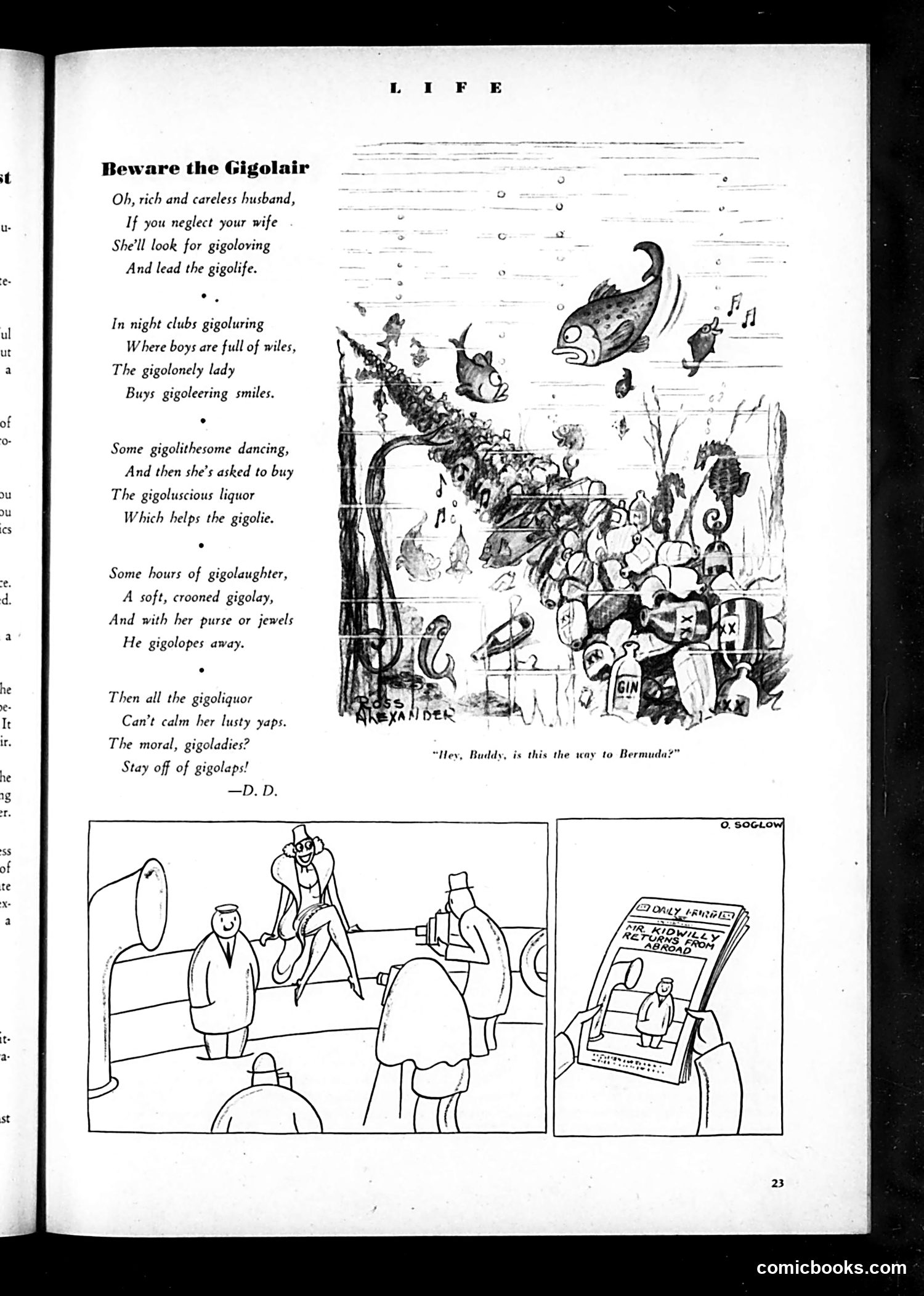
"Beware the Gigolair" This satirical piece warns against "gigolos"—men who romantically pursue wealthy women for money. The poem, credited to "D.D.," uses playful neologisms (gigoluring, gigoluscious, etc.) to mock both the phenomenon and the moralistic concern about it. The scenario: Neglectful husbands create vulnerable wives who seek attention in nightclubs, where charming male companions ("gigolos") seduce them, extract money and jewels, then disappear. The satire targets: Both the "gigolo menace" (a real 1920s-30s social anxiety) and the preachy moral tone warning women away from such temptation. The exaggerated wordplay undercuts seriousness. The accompanying cartoons show nightclub scenes with musicians and patrons, visualizing the cabaret lifestyle referenced. The period illustration style and subject matter suggest this addresses Jazz Age anxieties about changing morality, women's independence, and wealth.
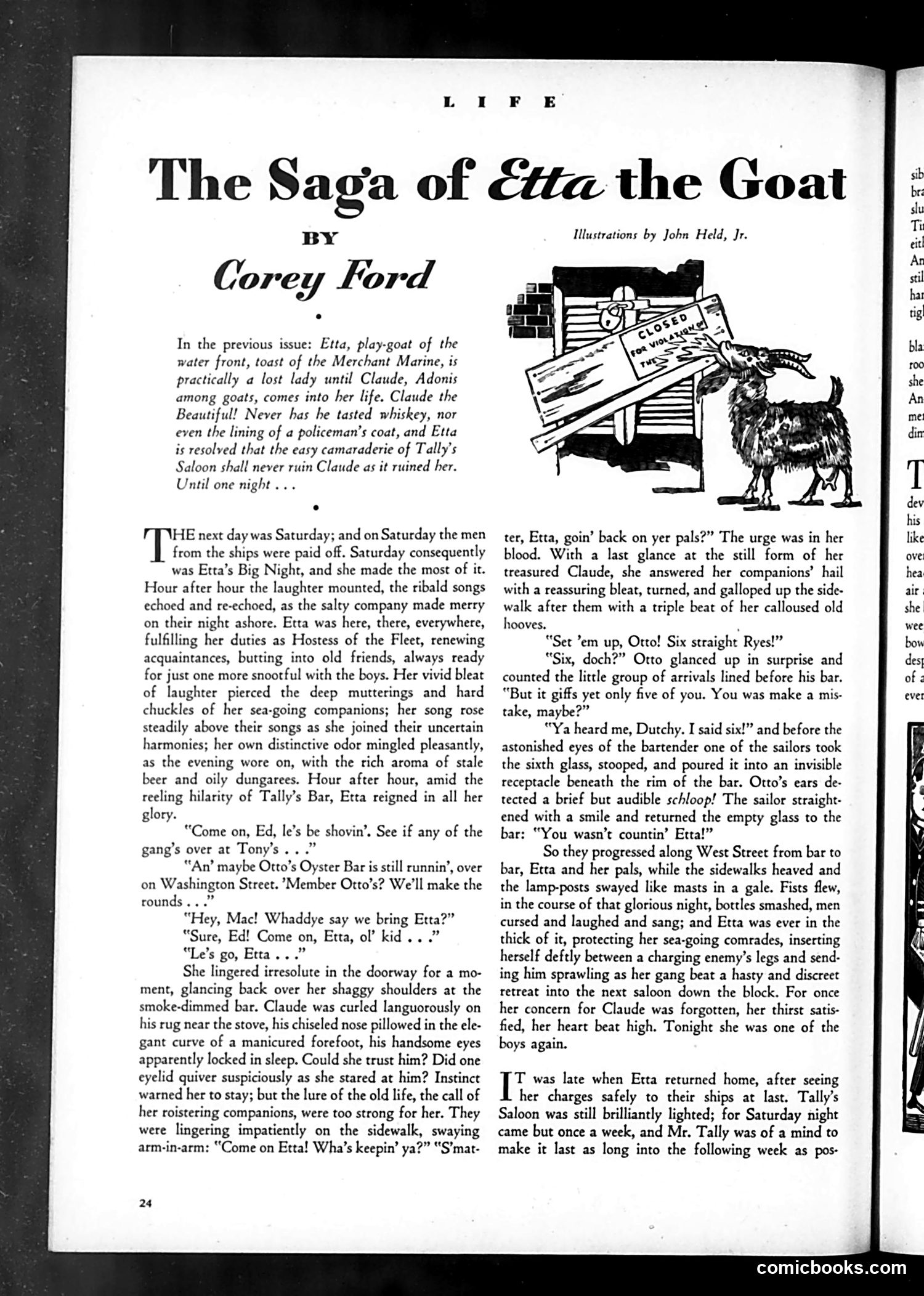
"The Saga of Etta the Goat" Explained This is a humorous serialized story by Corey Ford about Etta, a goat who frequents waterfront bars and socializes with sailors. The narrative uses the goat as a satirical vehicle to mock maritime culture and working-class bar life in what appears to be an urban port setting. The "joke" centers on treating Etta's barnyard animal behavior (bleating, butting, her distinctive odor) as equivalent to human drunken sailor conduct—blurring the distinction between beast and man. The illustrations by John Held Jr. visually reinforce this absurdist premise. The previous installment established that Etta had befriended Claude, a "pure" goat, and resolved to keep him from the corrupting influence of saloon life. This episode shows Etta herself succumbing to temptation, abandoning Claude to rejoin her rowdy companions for a night of drinking and bar-hopping. The satire gently ridicules sailors' dissolute behavior by literalizing it through a goat character, making their antics appear simultaneously ridiculous and pitiable.
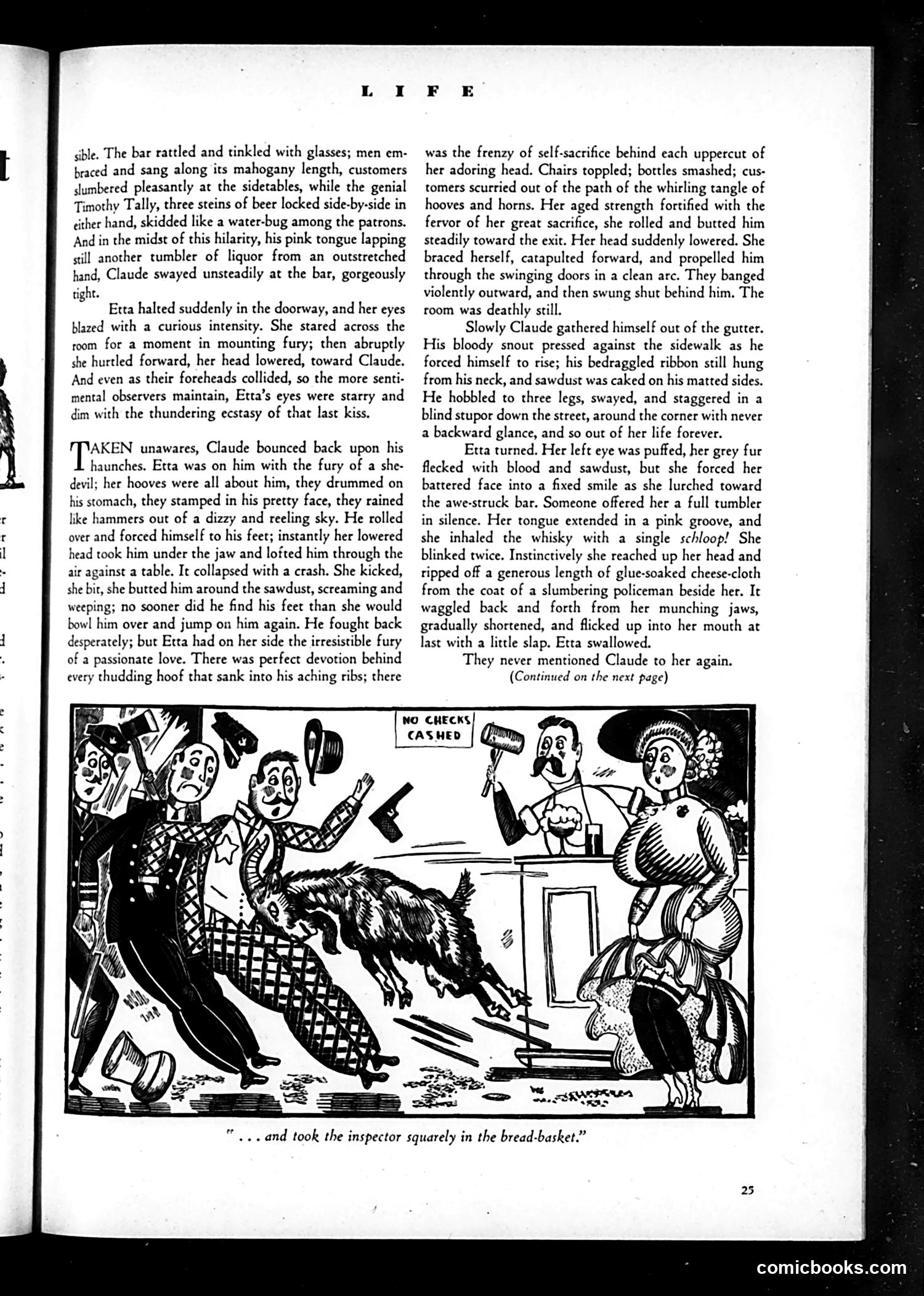
Context for Modern Readers This is a humorous fictional narrative about Etta, a female goat character, and her violent confrontation with Claude (likely also an animal) at a bar. The story satirizes romantic passion through exaggerated slapstick violence—Etta attacks Claude with ferocious devotion after finding him drunk and carousing. The accompanying cartoon illustration shows what appears to be a bar scene with caricatured human figures and a goat, with a sign reading "NO CHECKS CASHED" and a caption about hitting "the inspector squarely in the bread-basket." The satire likely mocks: - Excessive sentimentality about romantic devotion (Etta's violence is framed as loving sacrifice) - Prohibition-era bar culture (the drunkenness, police presence) - Gender dynamics (the female character as agent of violent action) The crude, exaggerated art style and absurdist animal-character premise were typical of Life magazine's satirical humor during this period, though the exact publication date remains unclear from this page alone.
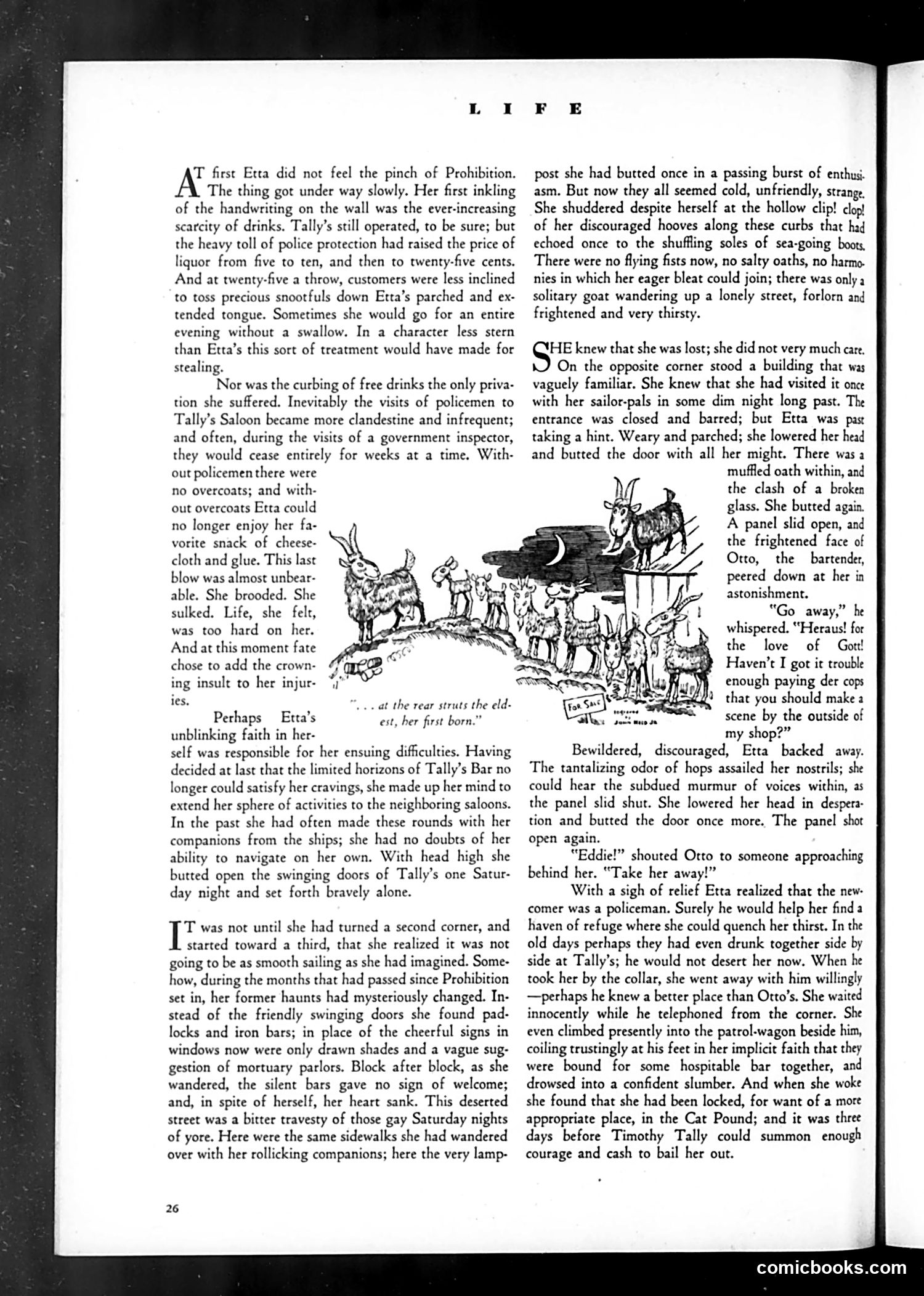
Life Magazine Satire: Etta the Goat During Prohibition This appears to be a humorous story about Etta, a goat character, navigating life during Prohibition (1920-1933, when alcohol sales were illegal in the US). The narrative mocks Prohibition's effects: Etta frequented Tally's Saloon where police protection raised drink prices from 5¢ to 25¢, making the establishment less profitable. Police visits became secretive to avoid government inspectors. The satirical detail that Etta enjoyed eating "cheese-cloth and glue" from policemen's overcoats (likely a crude joke about intoxication or desperation) highlights how Prohibition devastated saloon culture. The accompanying illustration shows a herd of goats, appearing to reference the rustic, degraded state of illegal speakeasies—once-lively establishments now shuttered and unwelcoming. Etta's lonely wandering through darkened, barred saloons symbolizes the collapse of the pre-Prohibition social world. The satire criticizes Prohibition's failure to eliminate drinking while destroying legitimate businesses and community gathering spaces.
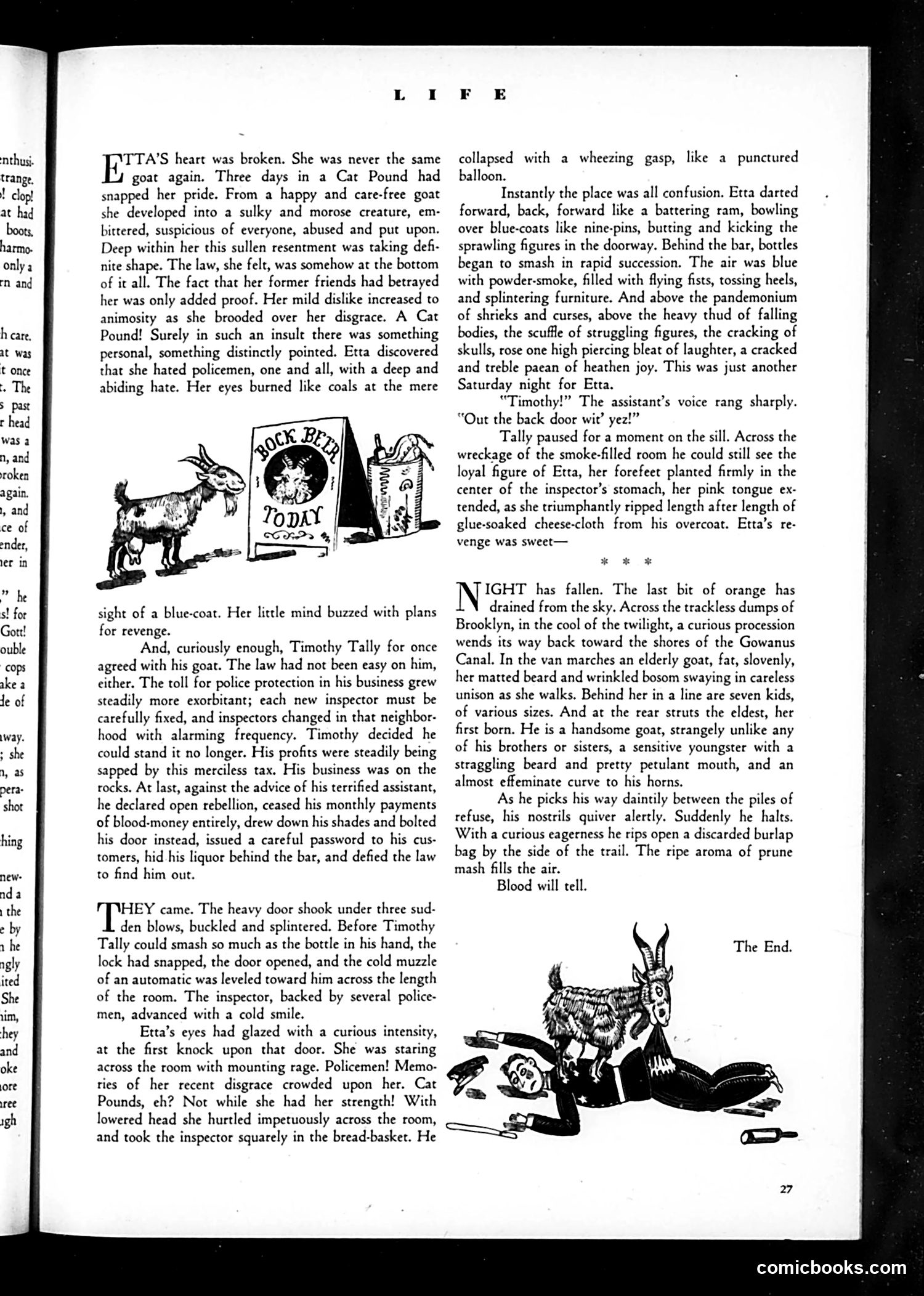
Political Satire Explanation This 1920s Life magazine story satirizes Prohibition-era corruption and resistance to police authority through an absurdist animal fable. Timothy Tally runs an illegal speakeasy and refuses to pay monthly "blood-money" bribes to corrupt police inspectors—a commentary on the widespread graft and extortion plaguing law enforcement during Prohibition. Etta, his goat (previously humiliated in a "Cat Pound"), becomes his unlikely ally. When police raid Tally's establishment, Etta—motivated by her grudge against authority—charges at the inspector, causing comic chaos that allows Tally's escape. The satire works on two levels: it mocks both the criminal underworld's defiance of law and the systematic police corruption that made bribing officials standard business practice. The goat's "heathen joy" in destroying authority figures represents the era's irreverent attitude toward Prohibition enforcement, while the story celebrates the underdog's triumph against corrupt institutions.
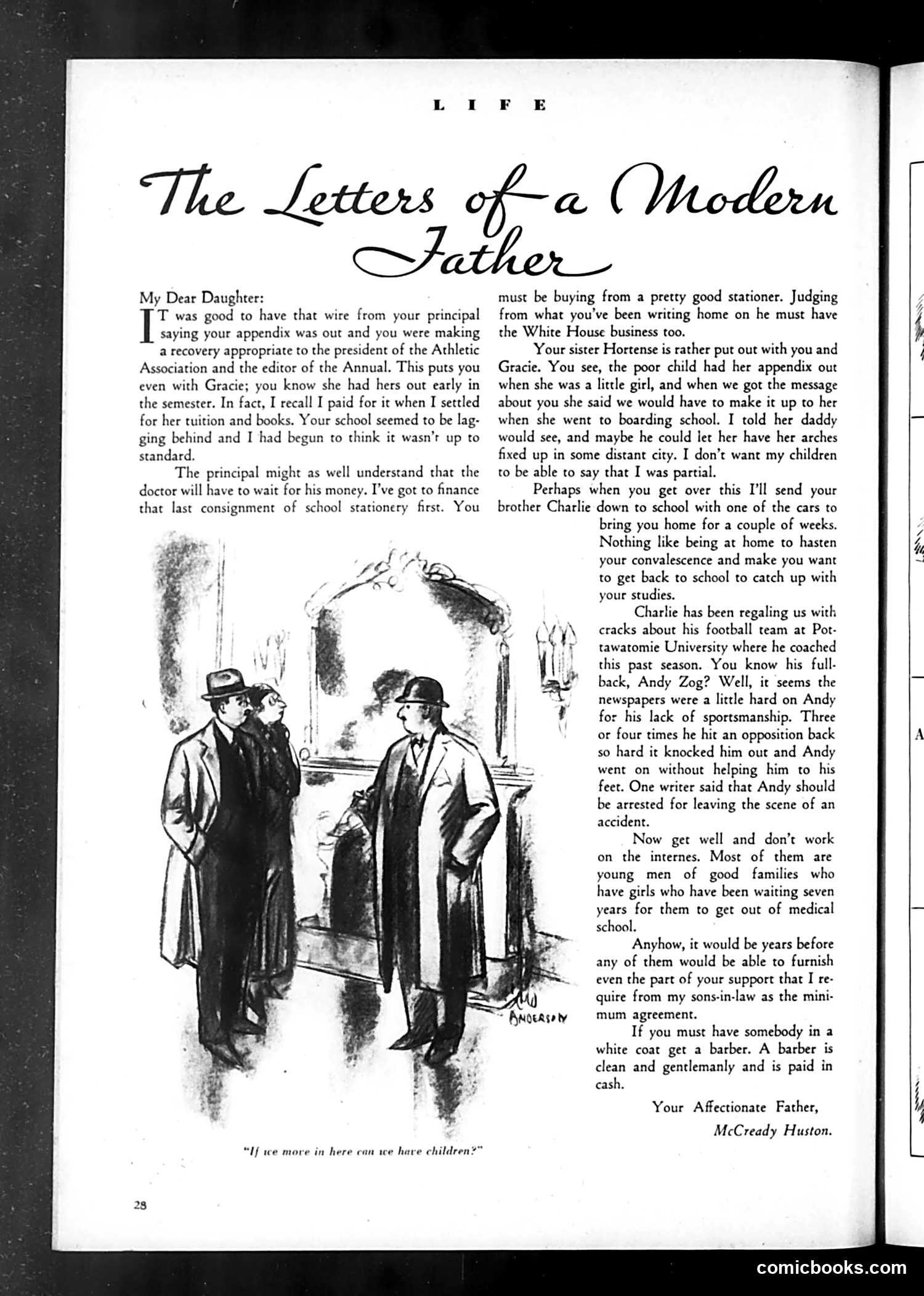
"The Letters of a Modern Father" This satirical piece mocks upper-middle-class parental attitudes of the early 20th century. A father writes to his daughter recovering from appendix surgery, revealing his skewed priorities and petty values. The satire targets: Financial hypocrisy: He brags about paying for his daughters' medical procedures as status symbols, yet refuses to pay the doctor until settling school stationery bills—revealing misplaced priorities. Shallow values: He treats appendectomies as competitive accomplishments among his daughters, even promising to "make up" surgery to one daughter who feels left out. Sexual anxiety: He warns his daughter away from male interns at the hospital, then bizarrely suggests she pursue the barber instead—a lower-status but "safe" alternative. Class consciousness: His obsession with propriety, cash transactions, and sons-in-law's financial obligations reveals anxious social climbing. The accompanying illustration shows three men in coats (possibly doctors or businessmen), with the caption "If we move in here can we have children?"—darkly suggesting questions about legitimacy or propriety. The humor exposes turn-of-the-century parental absurdity: materialistic, controlling, and ridiculous in their concerns.
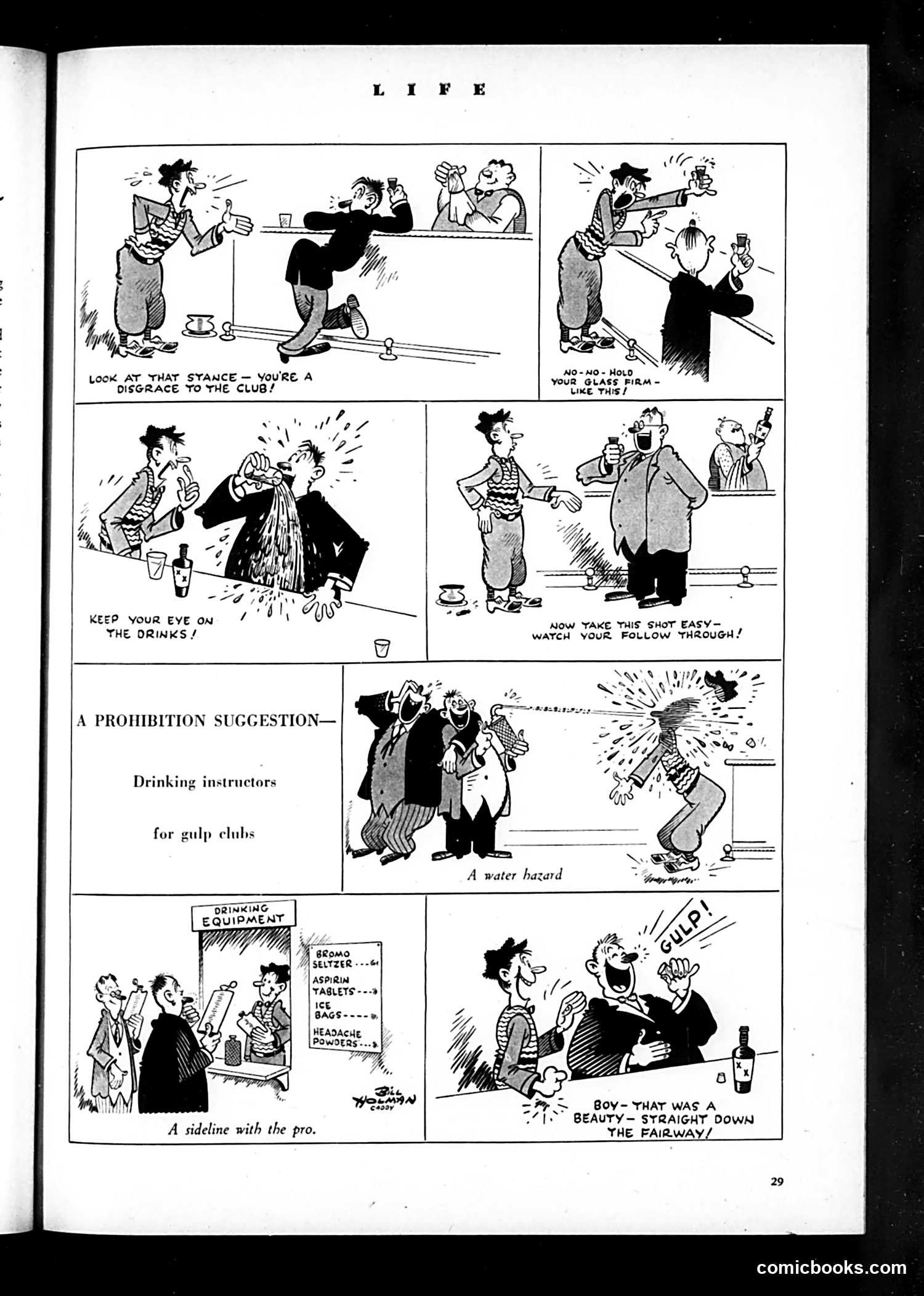
"A Prohibition Suggestion" – Life Magazine Satire This comic mocks the absurdity of Prohibition-era drinking culture through golf club parallels. The cartoons humorously depict "drinking instructors" teaching proper technique for consuming alcohol illegally, treating it with the same serious coaching as golf instruction. Key satirical points: The setup: During Prohibition (1920-1933), alcohol was illegal, yet widespread underground drinking persisted in "gulp clubs" (speakeasy-type venues). The joke: The cartoons pretend drinking requires formal instruction—stance, grip, follow-through—exactly like golf. A sidebar lists "drinking equipment" (bromo seltzer, aspirin tablets, headache powders) for inevitable hangovers. The "water hazard" panel shows a drunk person as collateral damage—the hidden cost of this behavior. The satire targets: Both Prohibition's failure to stop drinking *and* the sheer ridiculousness of treating illegal drinking as a respectable recreational skill requiring coaching, like a country club sport.
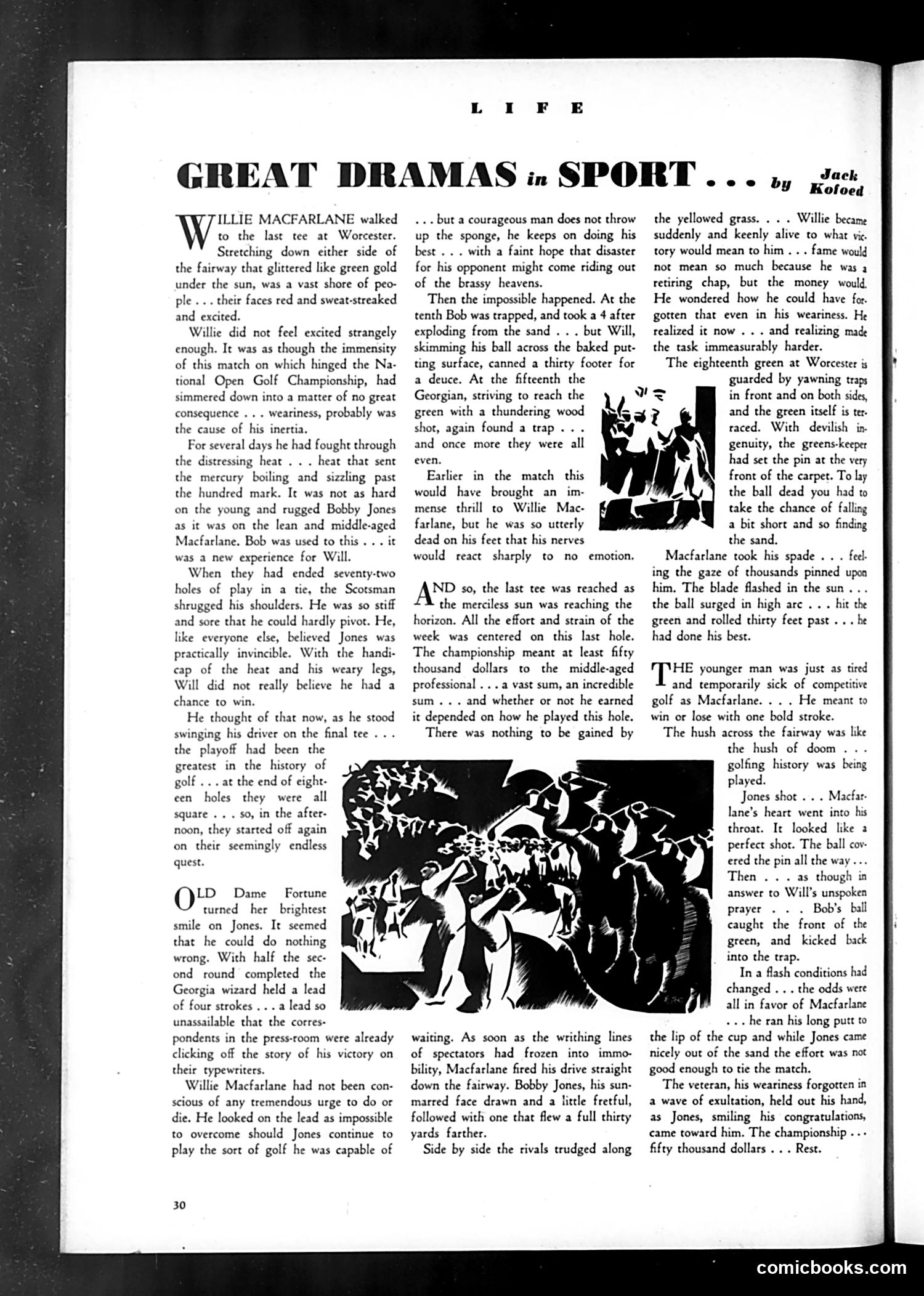
"Great Dramas in Sport" by Jack Koloed This is a short story about golfer Willie Macfarlane competing against Bobby Jones in a playoff for the National Open Golf Championship. The narrative contrasts the two players: Jones, the younger "Georgia wizard," initially dominates, but Macfarlane—exhausted from the heat and his age—unexpectedly rallies, pulling even at the eighteenth hole. The accompanying illustrations show crowds of spectators watching the dramatic final moments. The story emphasizes the psychological and physical toll of competitive golf, with Macfarlane's weariness paradoxically becoming irrelevant once victory becomes possible. The "drama" centers on an underdog's unlikely comeback against a favored competitor. This appears to reference an actual historical golf match, likely from the 1920s era when Jones was prominent.
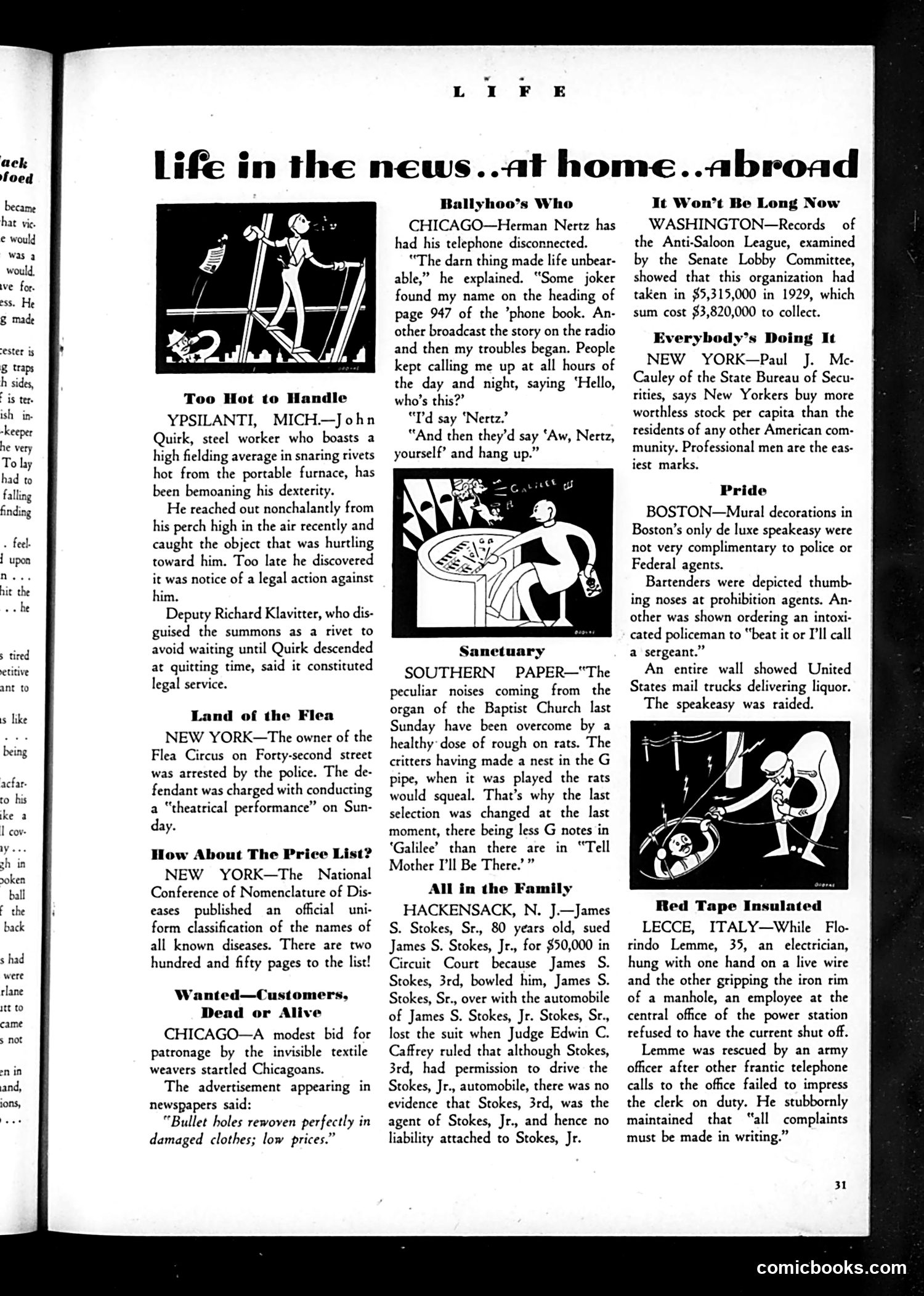
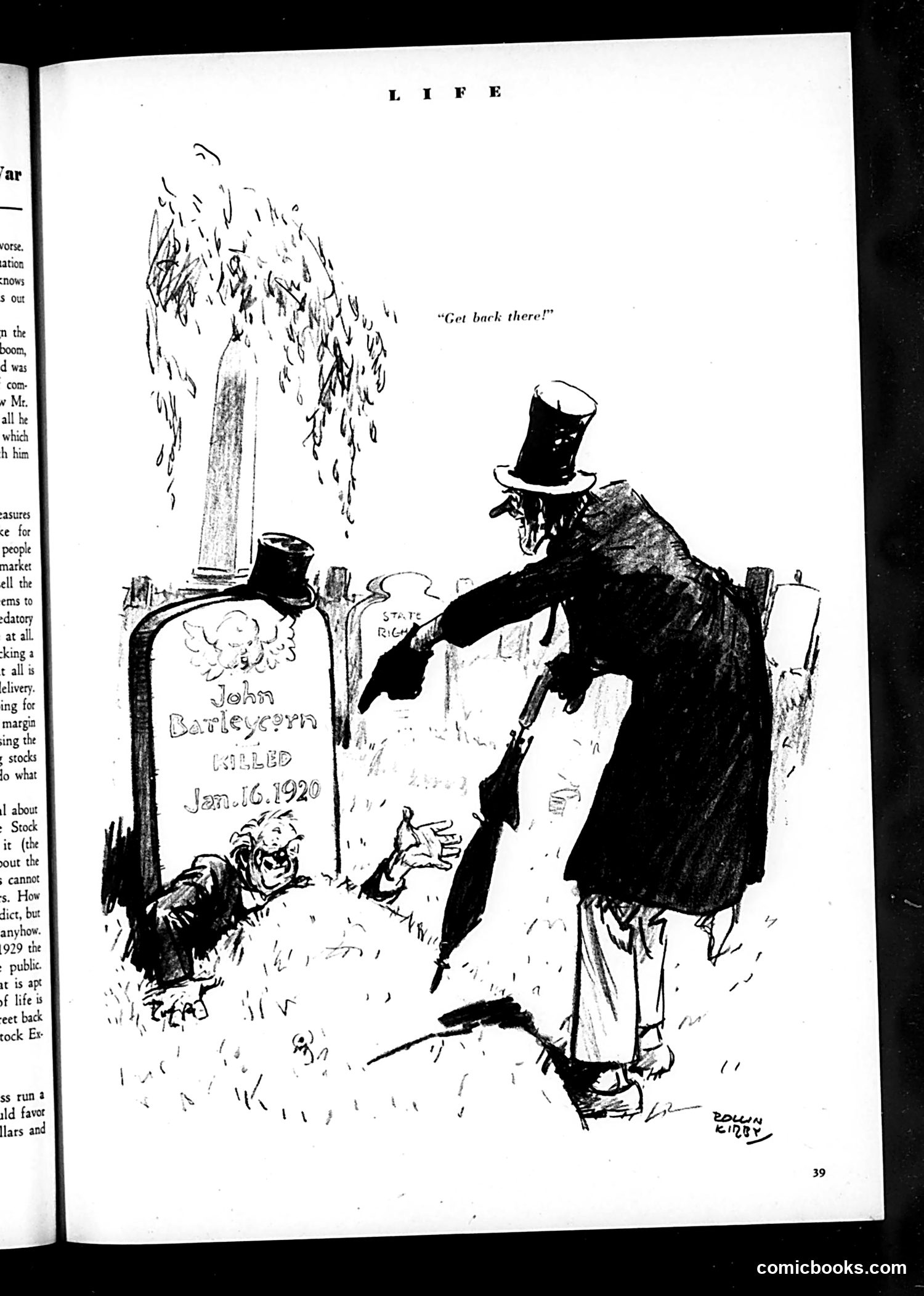
Decoding Life Magazine's Humor Page This page collects brief satirical news items and anecdotes reflecting 1920s-30s American life. Key observations: The humor targets: - Legal absurdity: A deputy disguises a summons as a factory rivet to serve a steel worker—mocking both bureaucratic creativity and working conditions - Prohibition's failures: The "Anti-Saloon League" spent nearly $3.8 million collecting $5.3 million—highlighting the massive administrative waste of alcohol enforcement - Speakeasy defiance: Mural decorations in a Boston illegal bar showing bartenders insulting prohibition agents satirize the era's widespread mockery of federal law - Stock fraud: New Yorkers buying worthless stock "per capita" above all Americans critiques the financial recklessness preceding the 1929 Crash Overall context: The page satirizes Prohibition enforcement, legal inefficiency, financial speculation, and social disorder—suggesting the era's laws were unenforceable and institutions frequently absurd or corrupt. The illustrated cartoons (though details are unclear) likely reinforce these satirical themes visually.
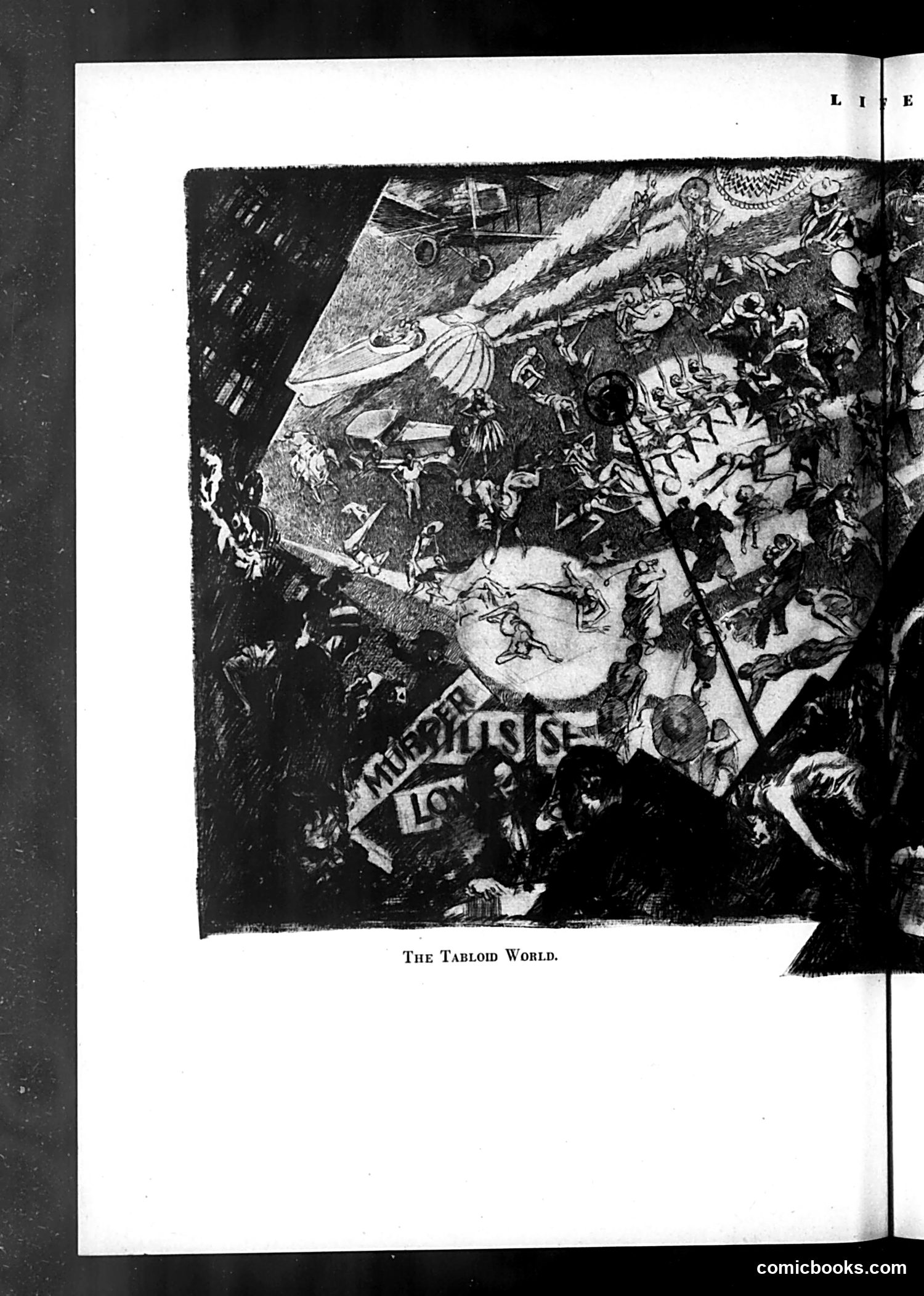
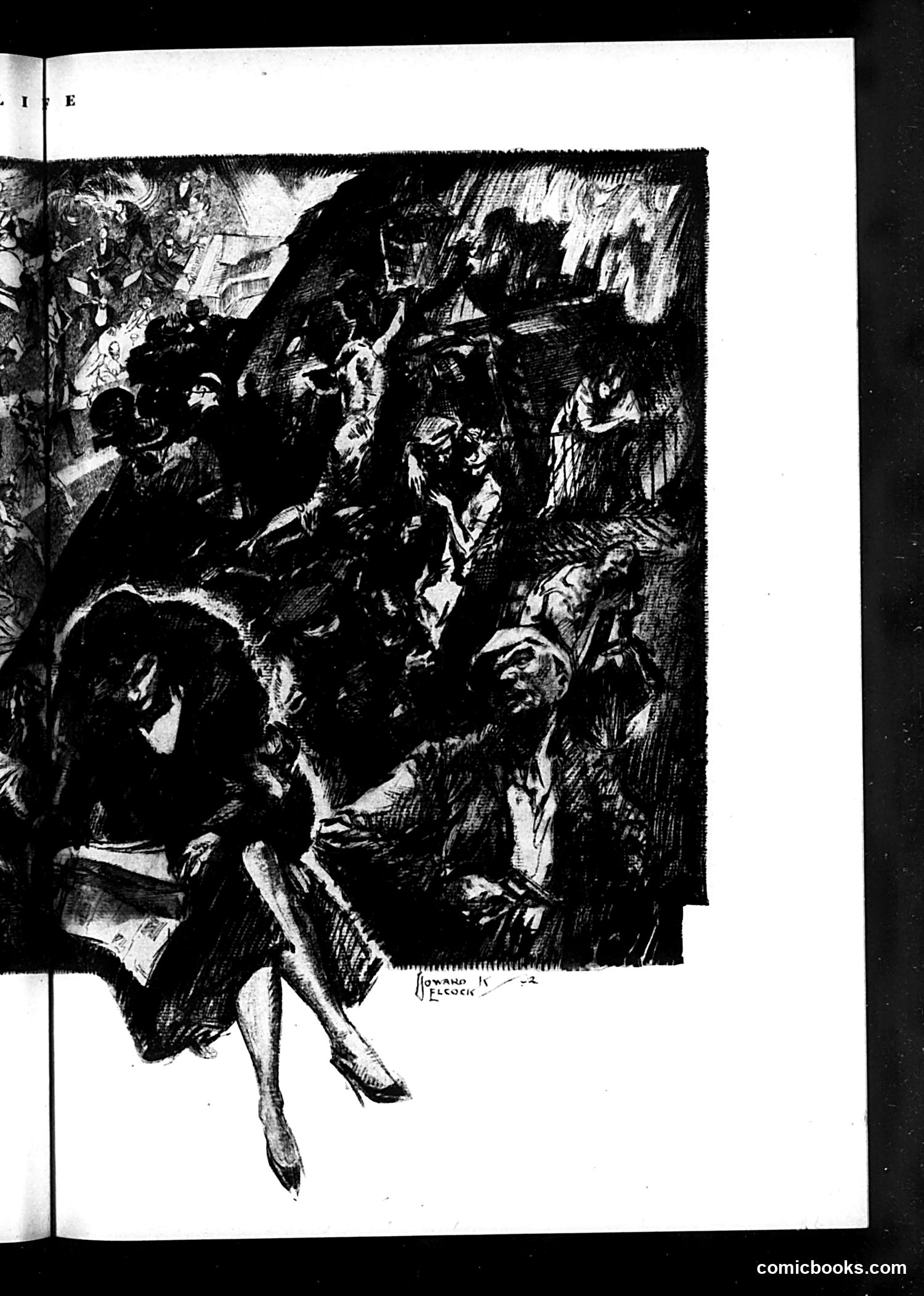
"The Tabloid World" This satirical illustration critiques the sensationalism of tabloid journalism. The composition depicts a chaotic, surreal landscape packed with lurid subject matter—figures engaged in scandal, violence, and melodrama—all crammed into an exaggerated, distorted world. The dense, frenetic style mirrors how tabloid newspapers overwhelm readers with scandal-driven headlines and sensational imagery. The work appears to mock both tabloid publishers' appetite for scandal and the public's fascination with such content. By rendering this "tabloid world" as grotesque and overwhelming, the cartoonist suggests that tabloid journalism distorts reality and sensationalizes human suffering for profit. This reflects early 20th-century *Life* magazine's frequent critiques of yellow journalism and mass media exploitation.
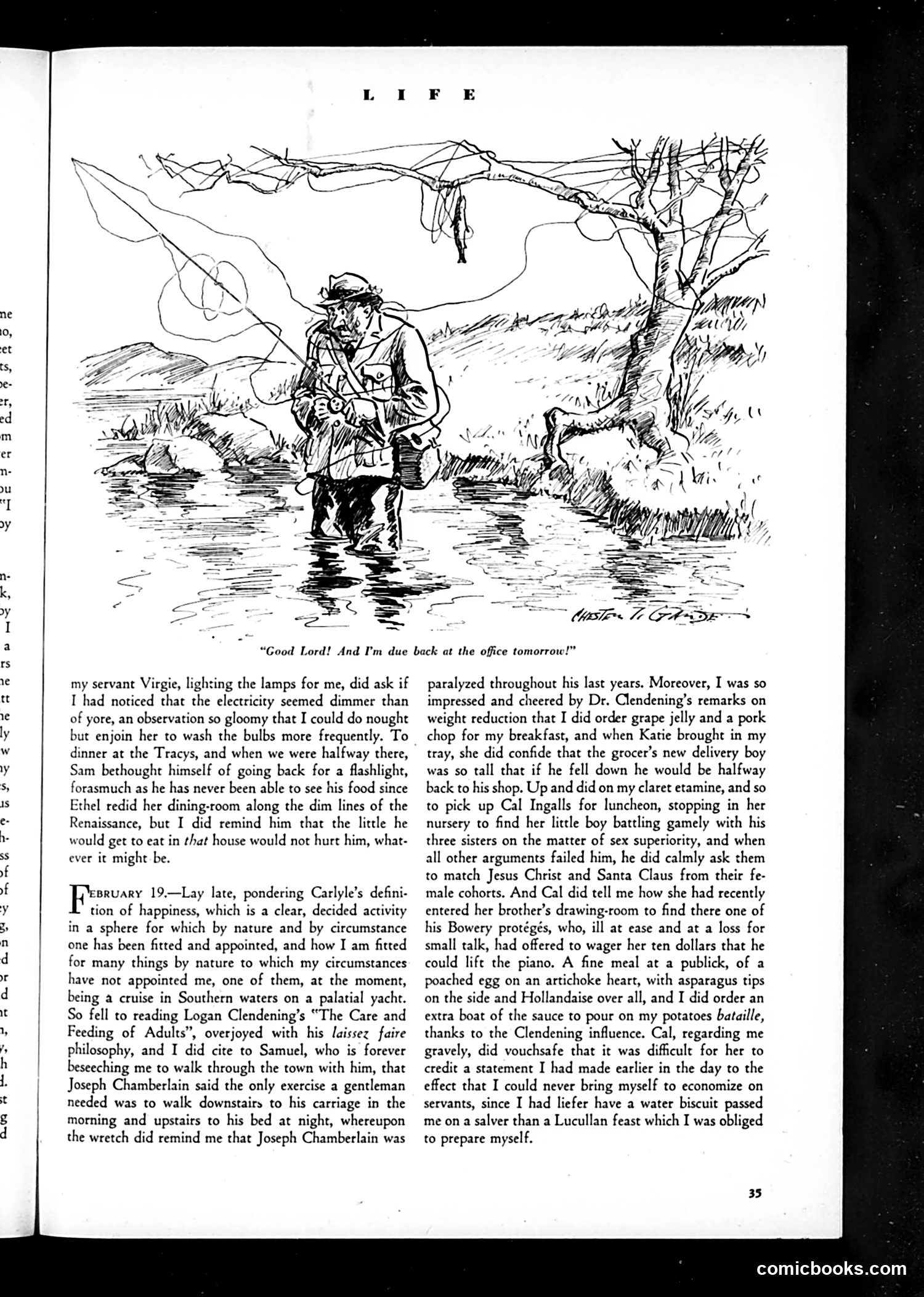
Explanation of Life Magazine Page Content This page contains a single-panel cartoon (top) and a diary entry (below). The cartoon depicts a man standing waist-deep in water, fishing, with the caption "Good Lord! And I'm due back at the office tomorrow!" — a relatable joke about leisure time slipping away and work obligations looming. The text is a satirical diary entry mocking upper-class pretension and idle complaints. The narrator complains about electricity being dim, dinner party inconveniences, and ponders happiness while yearning for a yacht cruise he can't take. The humor lies in his self-aware contradictions: he dismisses exercise advice by citing Joseph Chamberlain, only to be reminded Chamberlain was paralyzed; he claims unable to economize on servants while claiming he'd prefer simple food served formally to cooking elaborate meals himself. The satire targets wealthy leisured society's superficiality and self-deceptive reasoning, using ornate language and trivial concerns (grape jelly, sauce boats) to mock their pretensions. This was characteristic of Life's early-20th-century editorial voice.
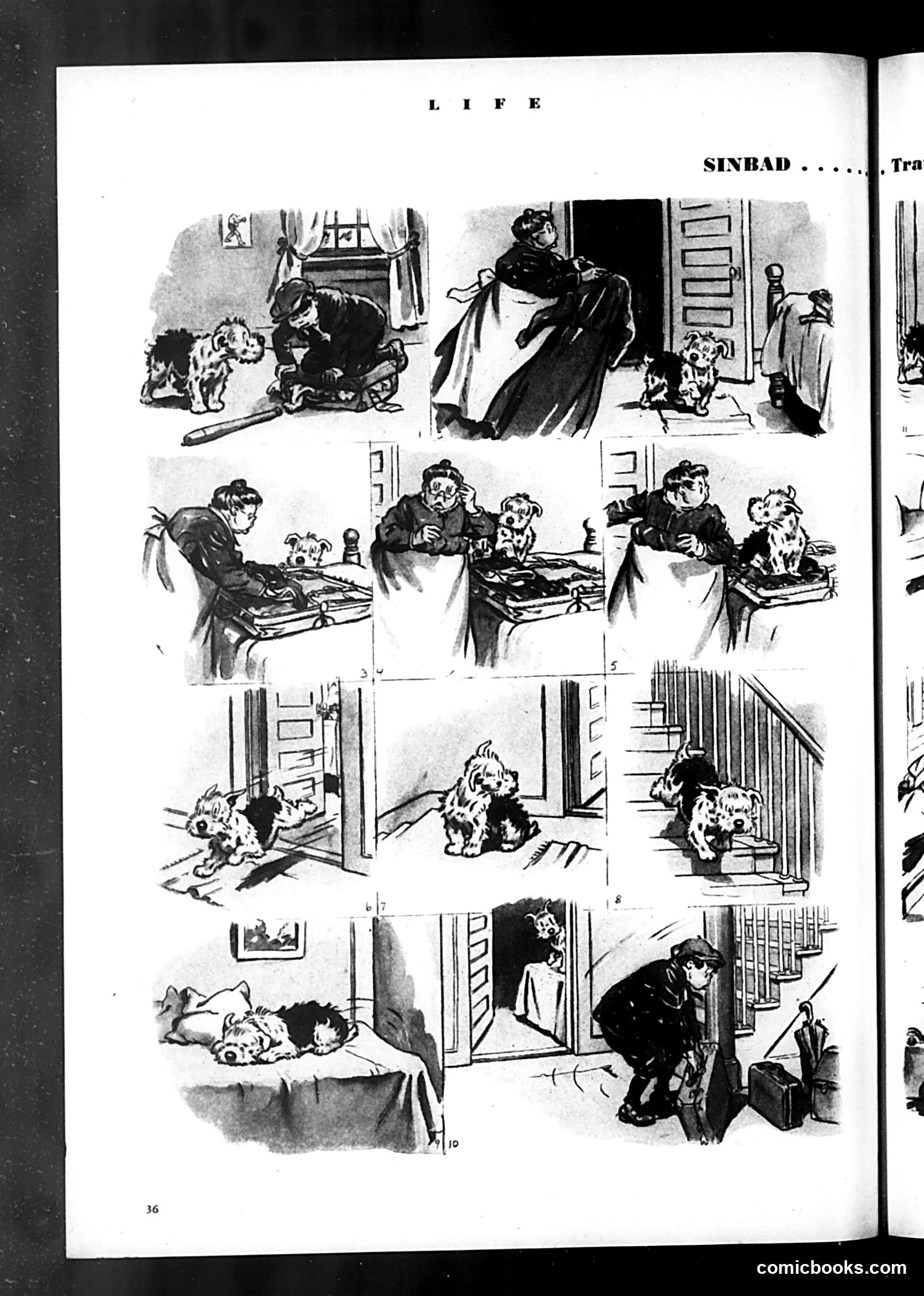
"Sinbad" Comic Strip Analysis This page presents a sequential comic strip titled "Sinbad," featuring a man and a small dog as main characters. The narrative appears to depict domestic comedy across multiple panels showing: - The man and dog interacting in various indoor settings (rooms, doorways, stairs) - Scenes suggesting the dog causing mischief or the man reacting to the dog's behavior - Physical comedy typical of early-to-mid 20th century humor The strip uses the classic format of visual gags without visible dialogue, relying on illustration to convey the humor. The style and printing quality suggest this is from Life magazine's satirical comics section. Without clearer text or identifying marks, the specific satirical point remains unclear—though it appears to be gentle domestic humor rather than political satire.
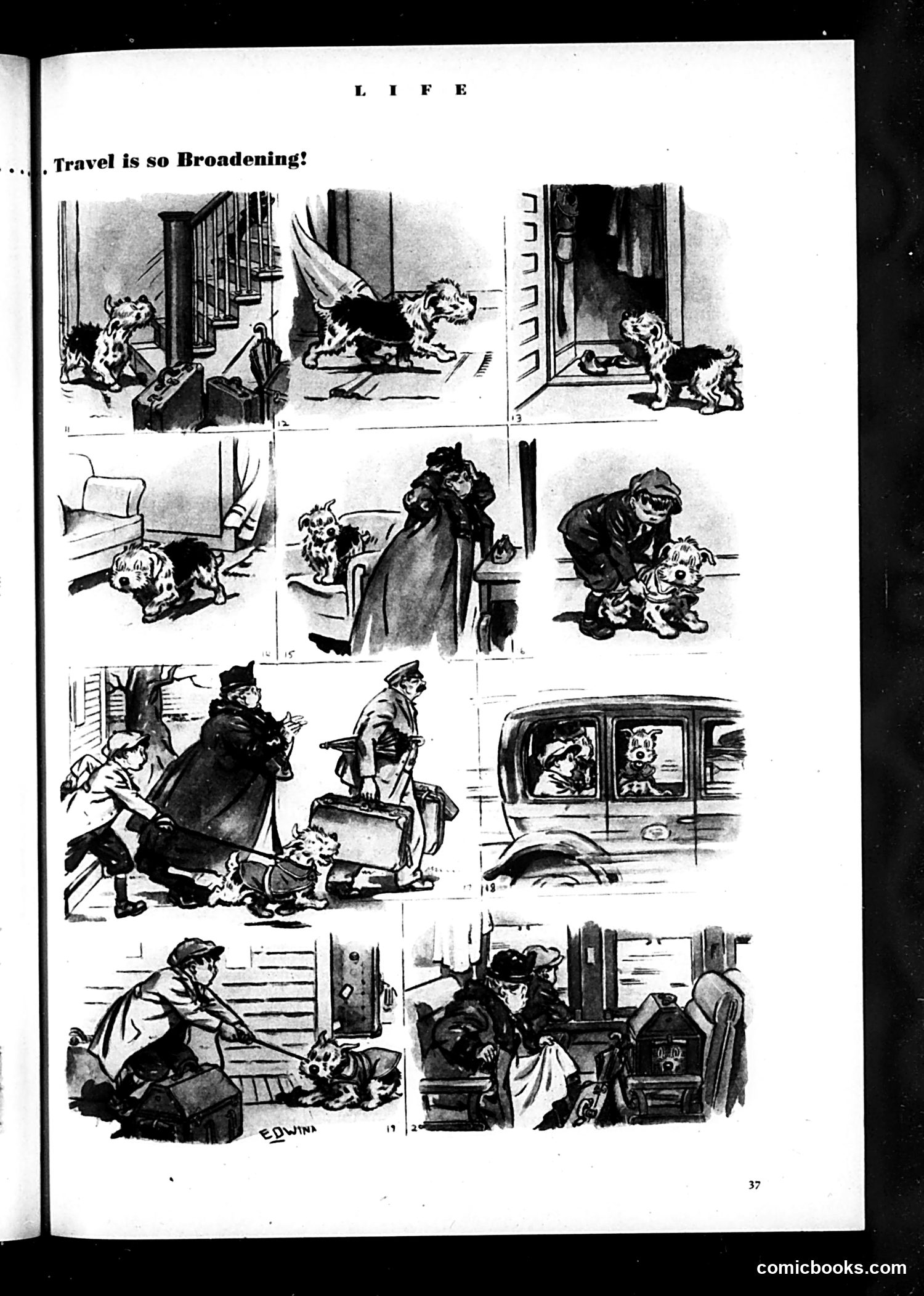
"Travel is so Broadening!" This comic strip satirizes the challenges of traveling with small dogs. The nine-panel sequence follows a small terrier through various travel scenarios: getting ready to depart, traveling by train, car, and ship, and navigating crowded public spaces. The humor derives from the dog's consistent misbehavior and the inconveniences it causes travelers—the pet tangles luggage, disrupts fellow passengers, creates chaos in confined spaces like train cars and automobiles, and generally proves difficult to manage during transport. The title's irony suggests that while travel is supposed to be "broadening" (culturally enriching), traveling *with* a pet dog actually broadens one's experience in unexpected, frustrating ways. The cartoon pokes fun at pet owners' attempts to travel while managing their animals.
Analysis of Life Magazine Article This is a political opinion piece by E.S. Martin, likely from the early 1930s during the Great Depression, commenting on President Hoover's leadership and economic policies. Key references: - Hoover's tariff bill: Criticized as "the worst thing he did," though Martin concedes high finance shared blame for the boom - Stock market collapse and Depression: Martin acknowledges Hoover initially misread the situation as temporary, then "guessed wrong" - Alfred Smith: A presidential candidate offering conditional acceptance of nomination - Walter Lippmann: Referenced for advocating debate on U.S. isolationism versus international trade The satire's point: Martin satirizes voter confusion and indecision—comparing public uncertainty to needing divine intervention. He grudgingly credits Hoover for now responding appropriately to crisis, while criticizing his earlier inaction during the boom. The piece suggests both leaders and voters are equally lost about solutions.
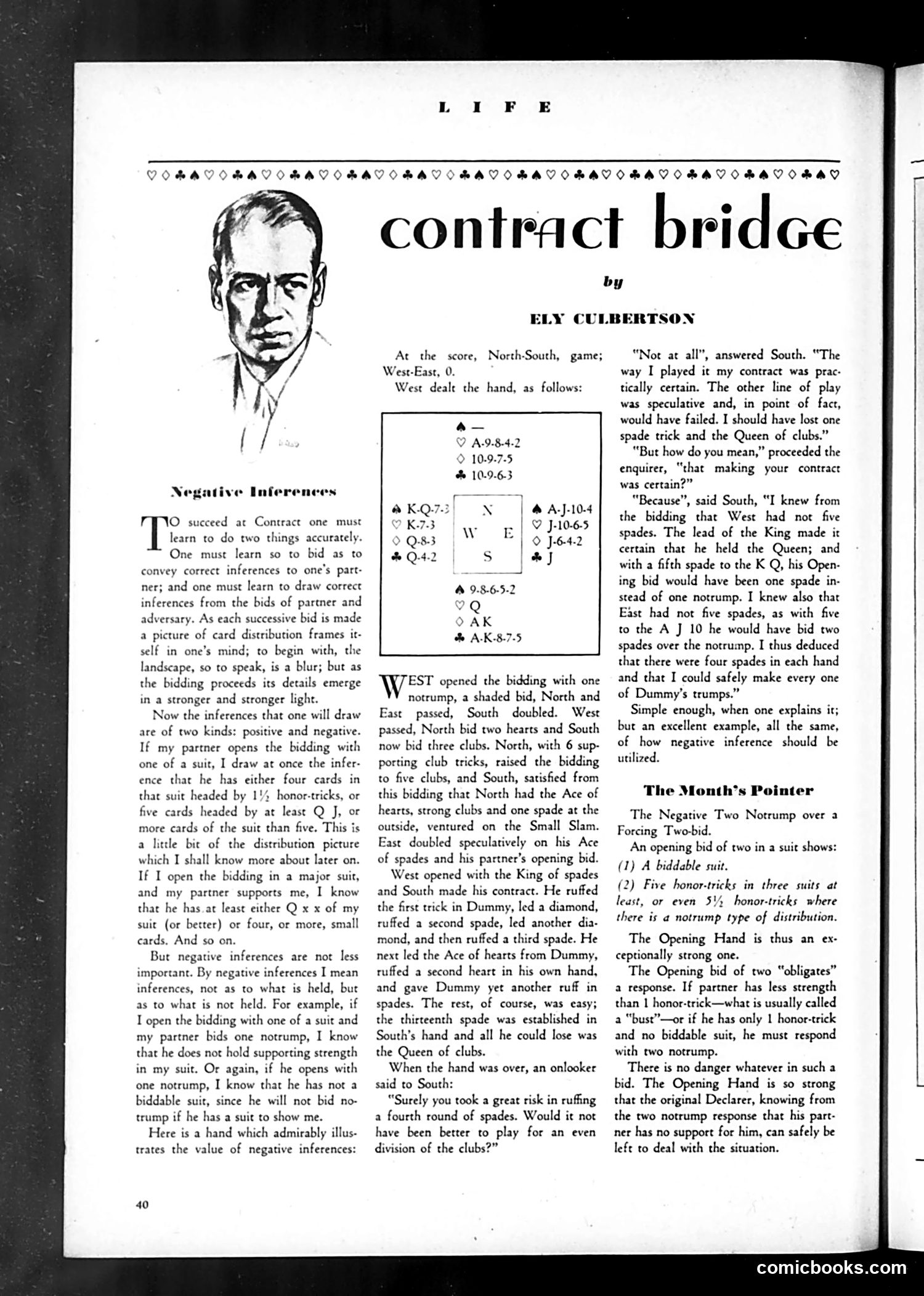
Contract Bridge Article This is not a cartoon but an instructional article on contract bridge by renowned player Ely Culbertson. The page explains "negative inferences"—deducing what cards opponents *don't* hold based on their bidding choices. The article illustrates this concept through a detailed hand example where South makes a difficult small slam contract by reasoning: West couldn't have five spades (he'd have opened one spade rather than one notrump); East couldn't have five spades (he'd have bid higher). This negative inference allows South to confidently execute a winning strategy that would otherwise seem risky. This reflects bridge's popularity as sophisticated entertainment among educated American audiences in this era—the content assumes readers understand both card games and logical deduction as leisure pursuits worthy of serious analysis.
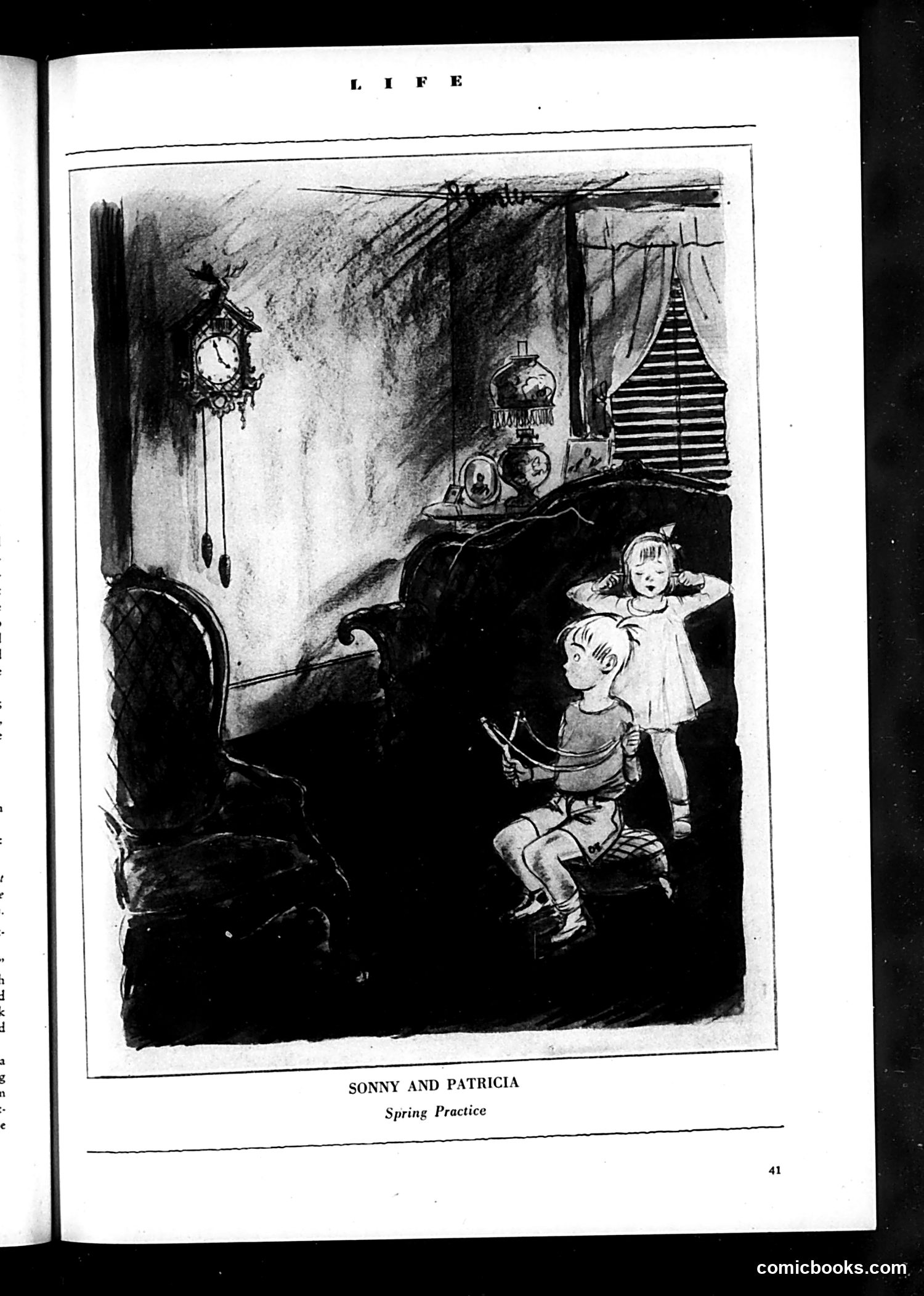
"Sonny and Patricia—Spring Practice" This illustration depicts two children indoors during spring: a boy holding what appears to be a toy rifle or gun, and a girl standing nearby. The scene is set in a modest interior with period furnishings visible—a clock on the wall, window with blinds, and simple furniture. The caption "Spring Practice" suggests children engaging in seasonal play activities. The boy's toy weapon indicates typical mid-century childhood recreation involving mock military or hunting games. The drawing's satirical intent likely comments on children's play habits or parenting attitudes of the era, though without additional context, the specific social commentary remains unclear. The illustration style and magazine source suggest this ran in Life magazine's humor section.
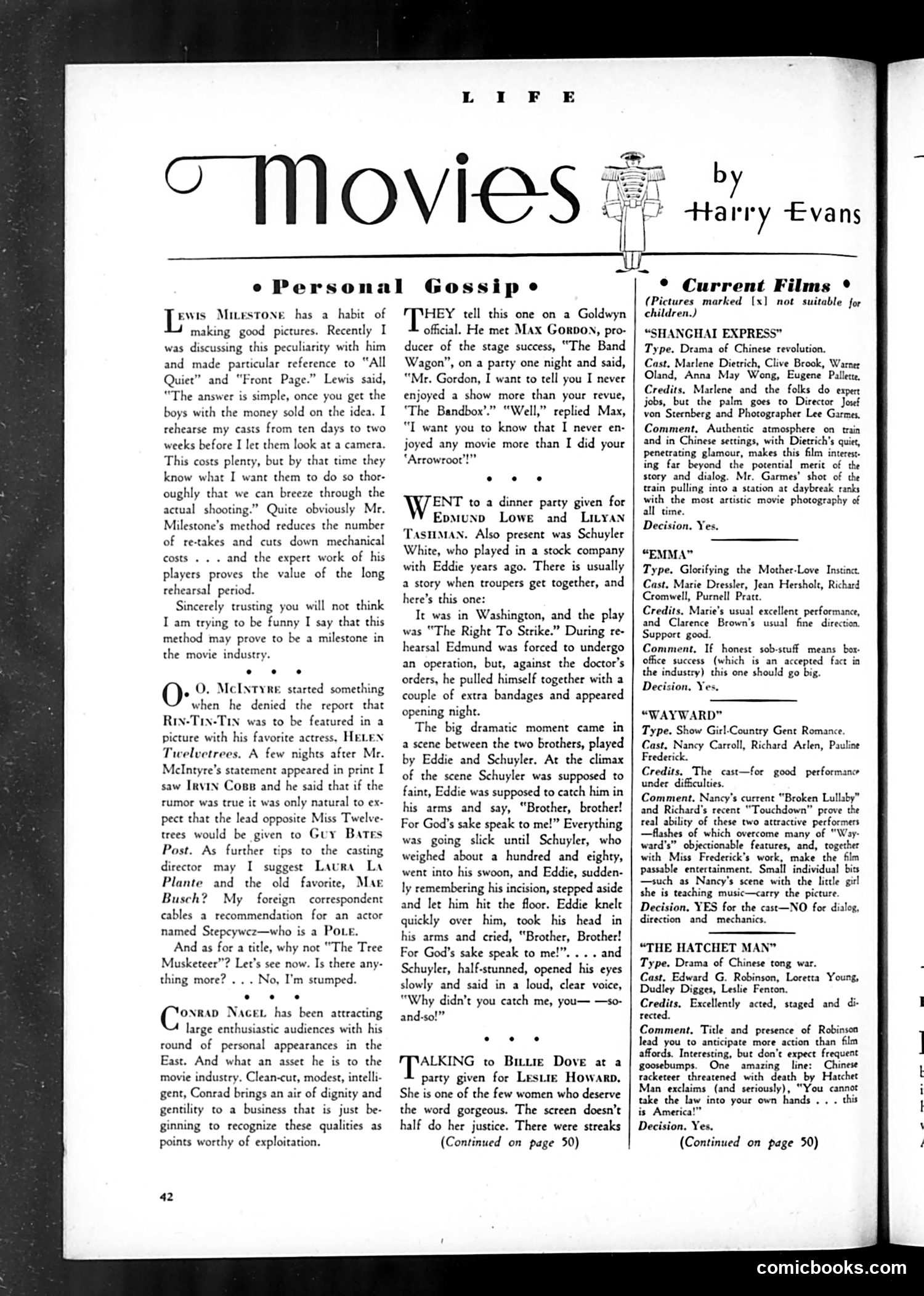
Analysis of Life Magazine Movies Column This page contains no political cartoons—it's a movie gossip column by Harry Evans from Life magazine's entertainment section. The content consists of anecdotes about 1920s film industry figures: - Lewis Milestone (acclaimed director): Evans praises his rehearsal methods for reducing costly re-takes - Rin-Tin-Tin (famous dog actor): Evans jokes about pairing the dog with actress Helen Twelvetrees, playfully suggesting alternative castings - Conrad Nagel: Evans commends his dignity and clean-cut image as beneficial to cinema's reputation - Edmund Lowe/Schuyler White: A humorous theater anecdote about an operation-recovering actor who dropped his scene partner during a dramatic fainting scene The humor is lighthearted insider gossip typical of entertainment journalism. The column celebrates Hollywood personalities while poking gentle fun at industry peculiarities and behind-the-scenes mishaps. For modern readers, it illustrates how celebrity gossip and trade commentary functioned in early cinema.
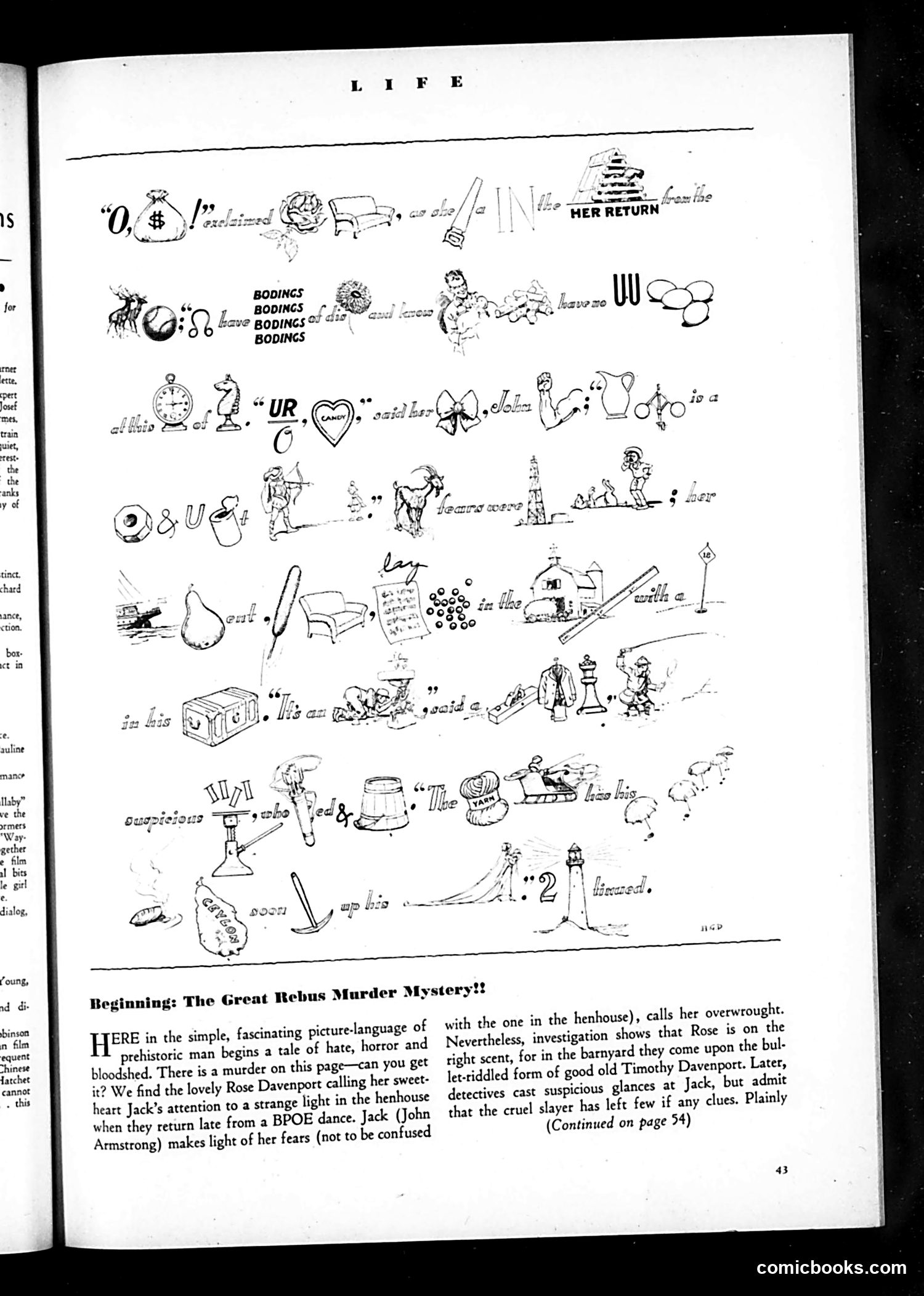
"The Great Rebus Murder Mystery" This page presents a visual puzzle-story told entirely in rebus form—pictures and symbols replacing words—a popular early 20th-century parlor game and magazine feature. The narrative, explained in the text below, concerns a murder mystery: Rose Davenport alerts her sweetheart Jack to a strange light in the henhouse after they return from a BPOE (fraternal organization) dance. Jack dismisses her concerns, but investigation reveals the bullet-riddled corpse of Timothy Davenport in the barnyard. Detectives suspect Jack but find few clues. The rebus imagery above uses simple line drawings, objects, and symbols to encode this melodramatic tale for readers to decode—a form of entertainment that challenged readers to translate visual language into narrative. The appeal lay in the puzzle-solving aspect and the absurdist humor of depicting murder mystery conventions through childlike pictographs rather than conventional prose or illustration.
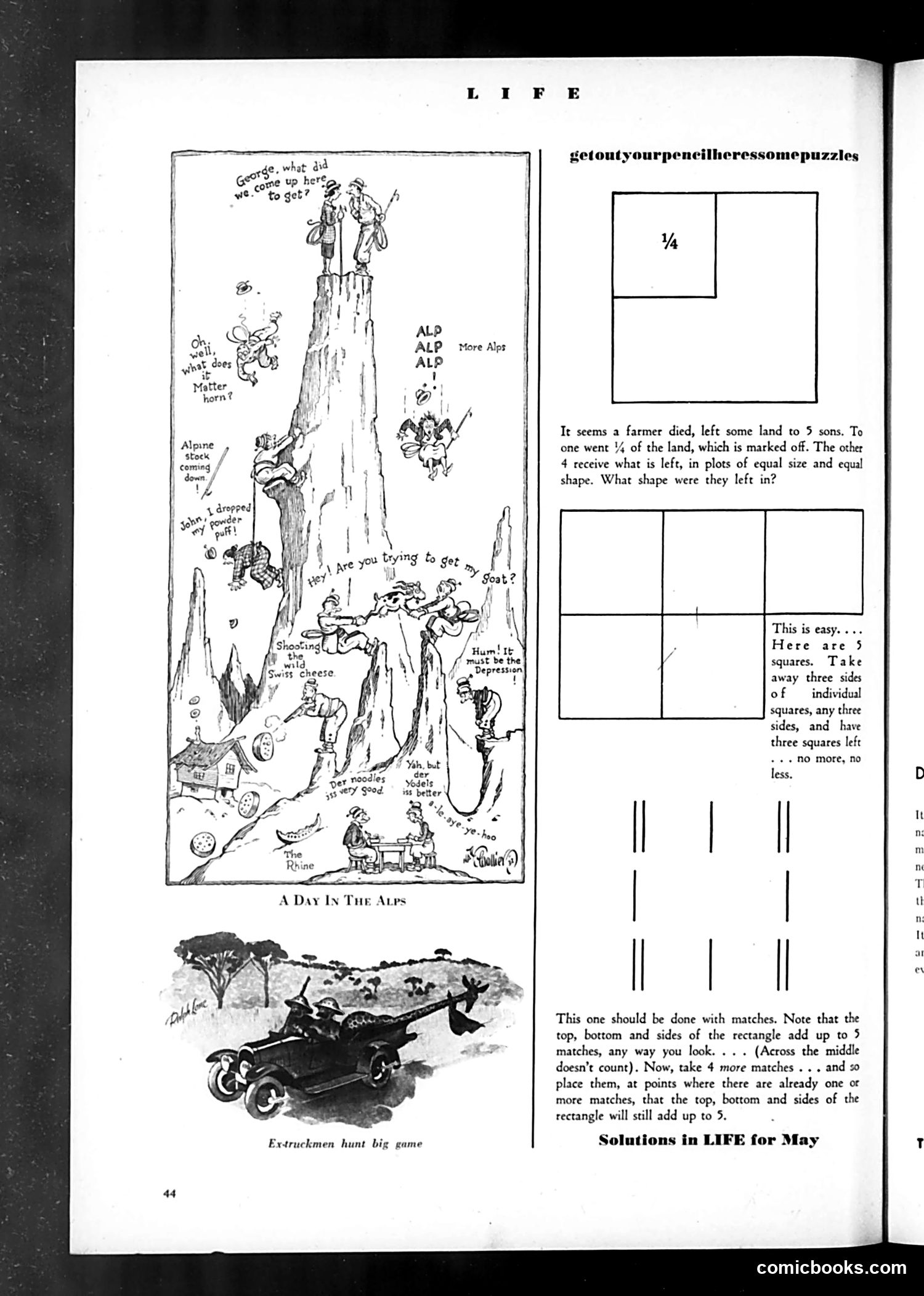
"A Day in the Alps" - Life Magazine Cartoon This page features a humorous cartoon depicting mountain climbers struggling on an Alpine peak. The sketch shows various figures at different elevations experiencing comic mishaps—someone asking "What does a Matterhorn?" (pun on "matter"), climbers complaining about difficulty, and dialogue about reaching the summit or rescuing a goat. The satire gently mocks the Alpine tourism industry popular among wealthy travelers of that era, presenting the romanticized mountain-climbing adventure as chaotic and absurd. The numerous speech bubbles capture the pretension and physical comedy of well-dressed tourists attempting a serious mountaineering expedition. The page also includes puzzle challenges readers could solve, typical of Life magazine's mixed entertainment format combining satire, humor, and interactive content for middle-class audiences.
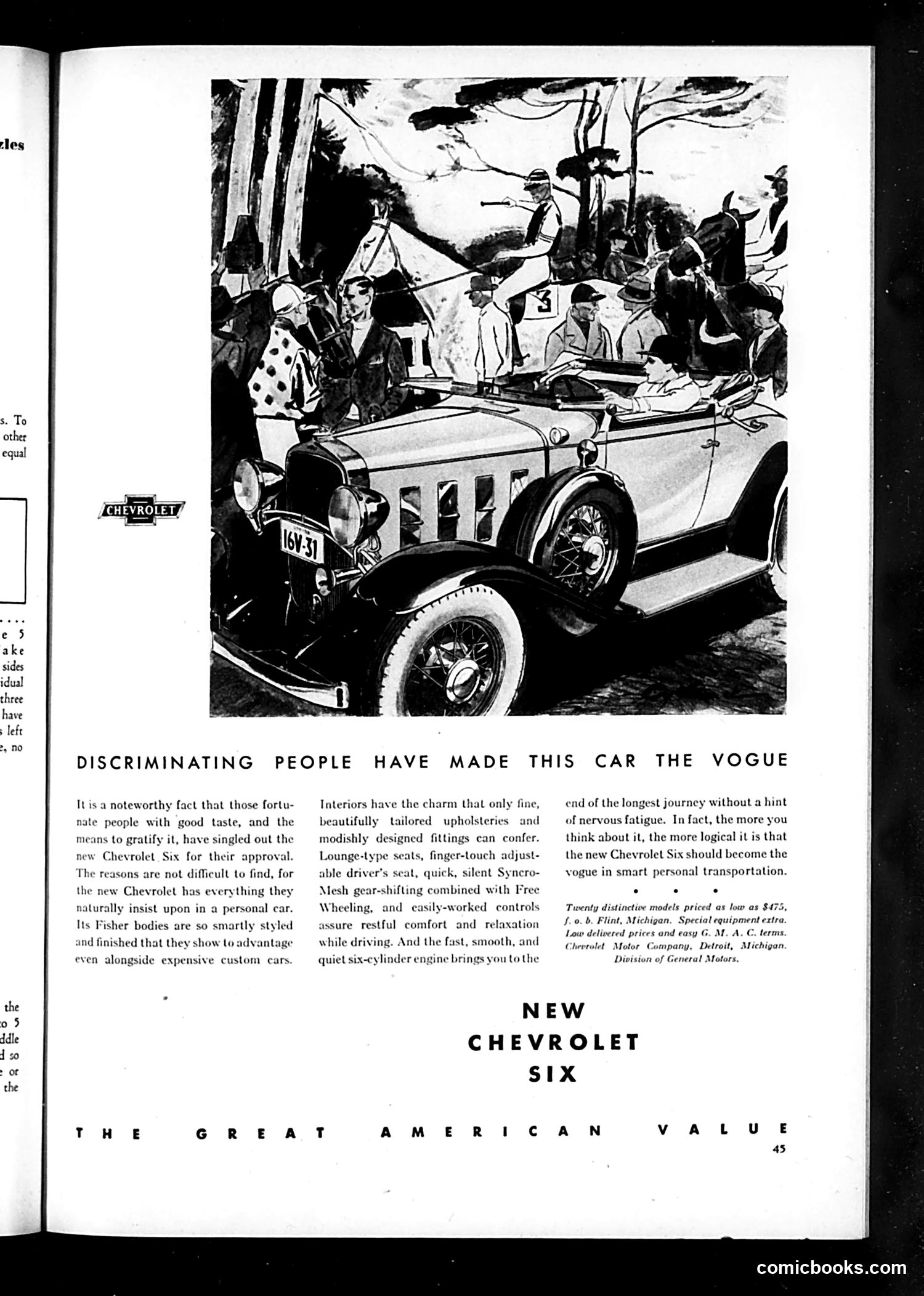
Analysis This is a Chevrolet automobile advertisement, not a political cartoon. The image shows a stylized scene of fashionable, well-dressed people admiring a new Chevrolet Six automobile at what appears to be a social gathering or event. The advertisement's messaging targets affluent consumers by claiming that "discriminating people" with "good taste" have chosen the Chevrolet Six. The copy argues the car rivals expensive custom vehicles through superior Fisher body styling, comfortable interiors, and smooth six-cylinder performance. The illustration depicts aspirational leisure-class consumption—elegantly dressed figures in a park-like setting, suggesting that owning this car signals social status and refined taste. The headline "discriminating people have made this car the vogue" positions the vehicle as a status symbol for the discerning buyer. This reflects 1920s-30s advertising strategy: marketing mass-produced vehicles to middle and upper-middle-class consumers by associating them with luxury and social distinction.
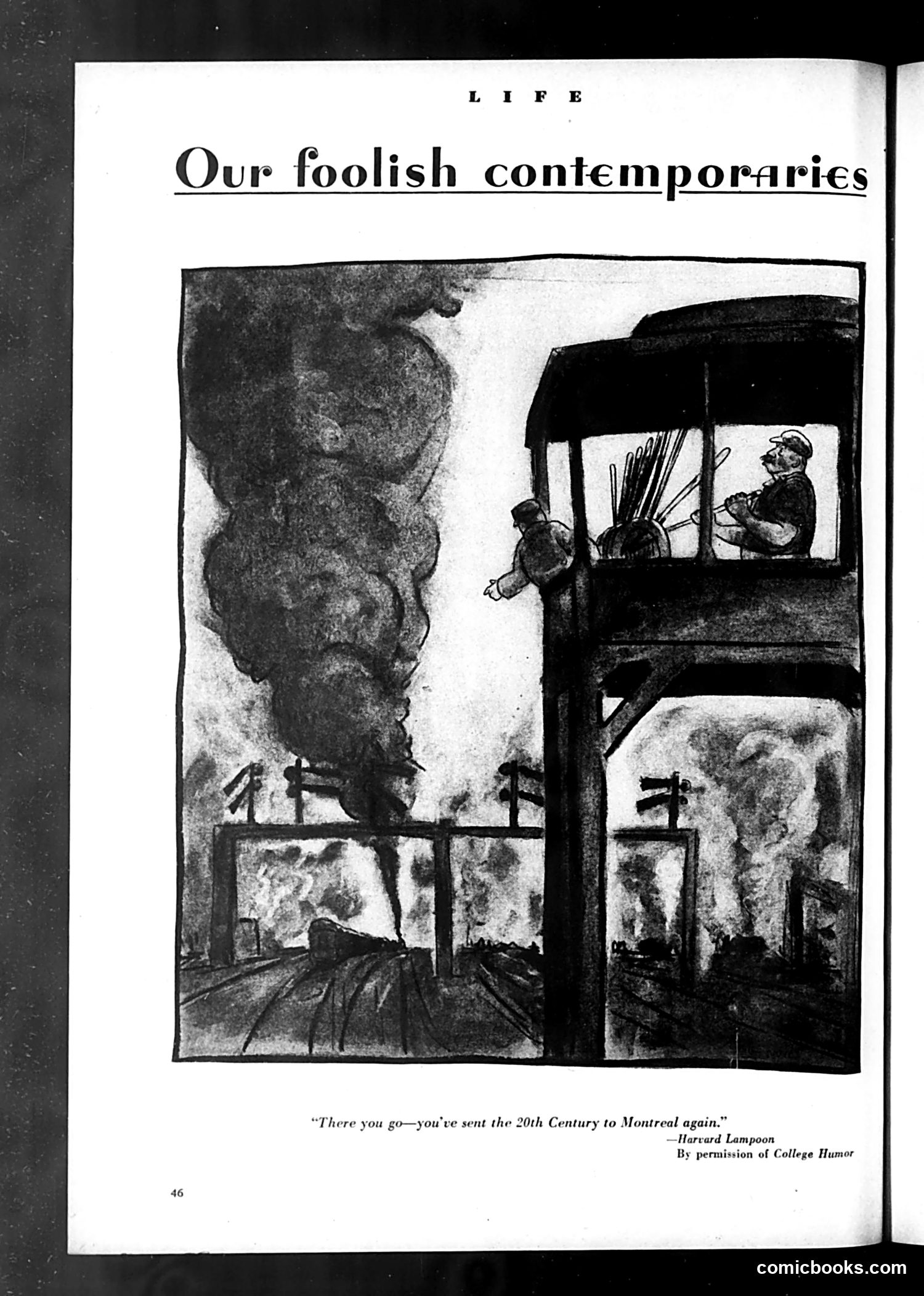
Analysis This cartoon satirizes reckless or incompetent contemporary figures by depicting a chaotic scene. Two people in what appears to be a vehicle or enclosed space are shown amid flames and destruction, with crosses visible (suggesting a cemetery or disaster zone). The caption's reference to "sending the 20th Century to Montreal again" suggests repeated foolish mistakes or failures—the joke implying that modern civilization keeps regressing or self-destructing through the actions of "foolish contemporaries." The satire targets unnamed contemporary public figures or society broadly for their poor judgment. Without additional context, the specific individuals or incidents aren't identifiable, though the cartoon criticizes modern incompetence and the notion that progress keeps being undone. The piece credits Harvard Lampoon and College Humor, indicating collegiate satire from what appears to be the interwar or 1920s-30s era.
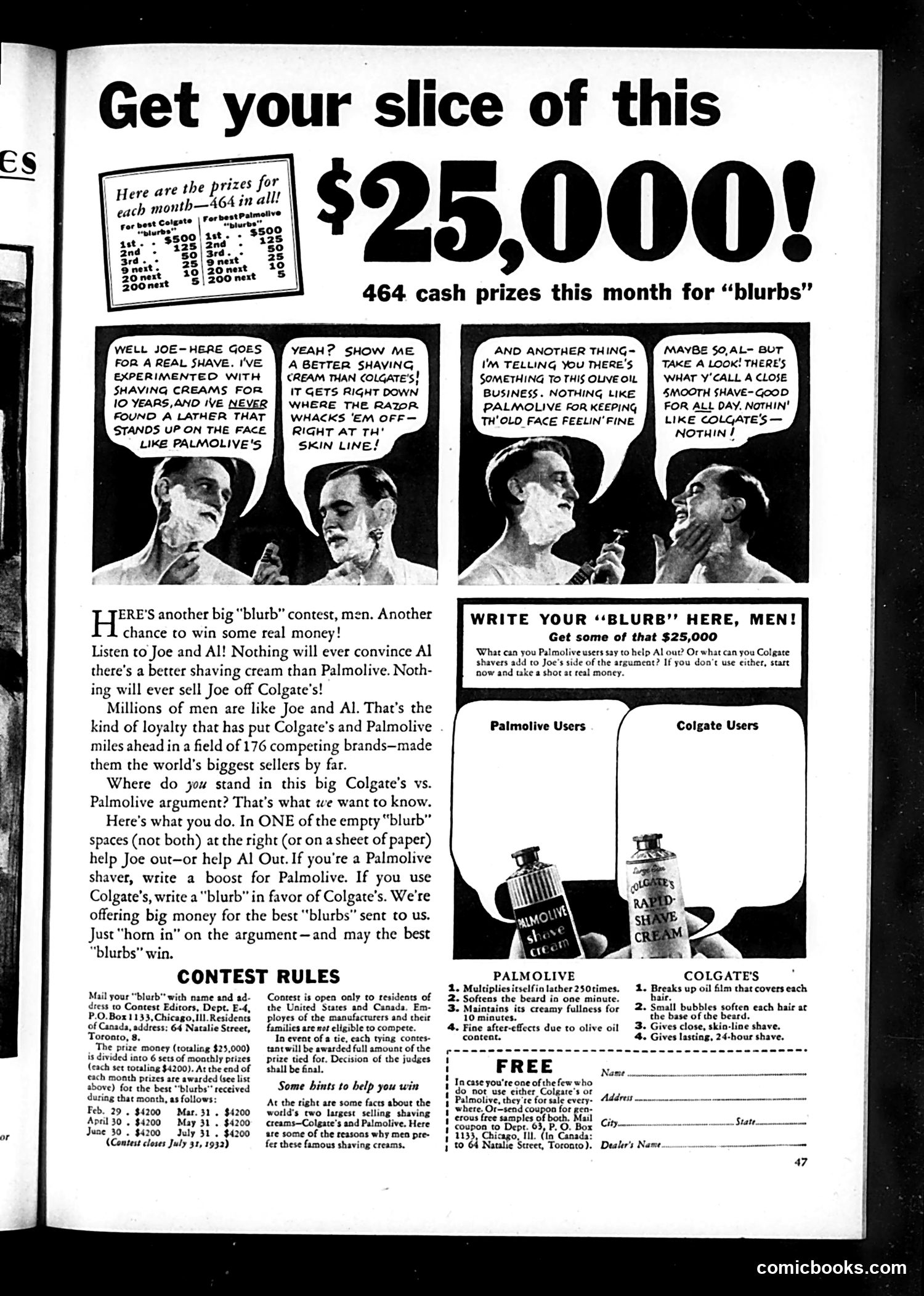
"Blurbs" Contest: Shaving Cream Advertising as Participatory Content This is primarily advertising masquerading as entertainment—a marketing contest from Life magazine (likely early 1930s, based on the July 31, 1932 deadline visible in fine print). The "cartoon" features two everyman characters, Joe and Al, debating the merits of Palmolive versus Colgate's shaving cream in exaggerated working-class dialect. Their argument is deliberately unresolved to invite reader participation. The hook: Life offers $25,000 in prize money ($4,200 monthly) for readers to write persuasive "blurbs" supporting either brand. This converts consumers into unpaid copywriters generating testimonial content. Why it worked then: During the Depression, $4,200 was substantial incentive. The contest also tapped brand loyalty while appearing to be neutral journalism—readers submit arguments that become free advertising for whichever brand wins. This represents early user-generated content marketing—the blurb entries would likely be republished as authentic consumer endorsements.
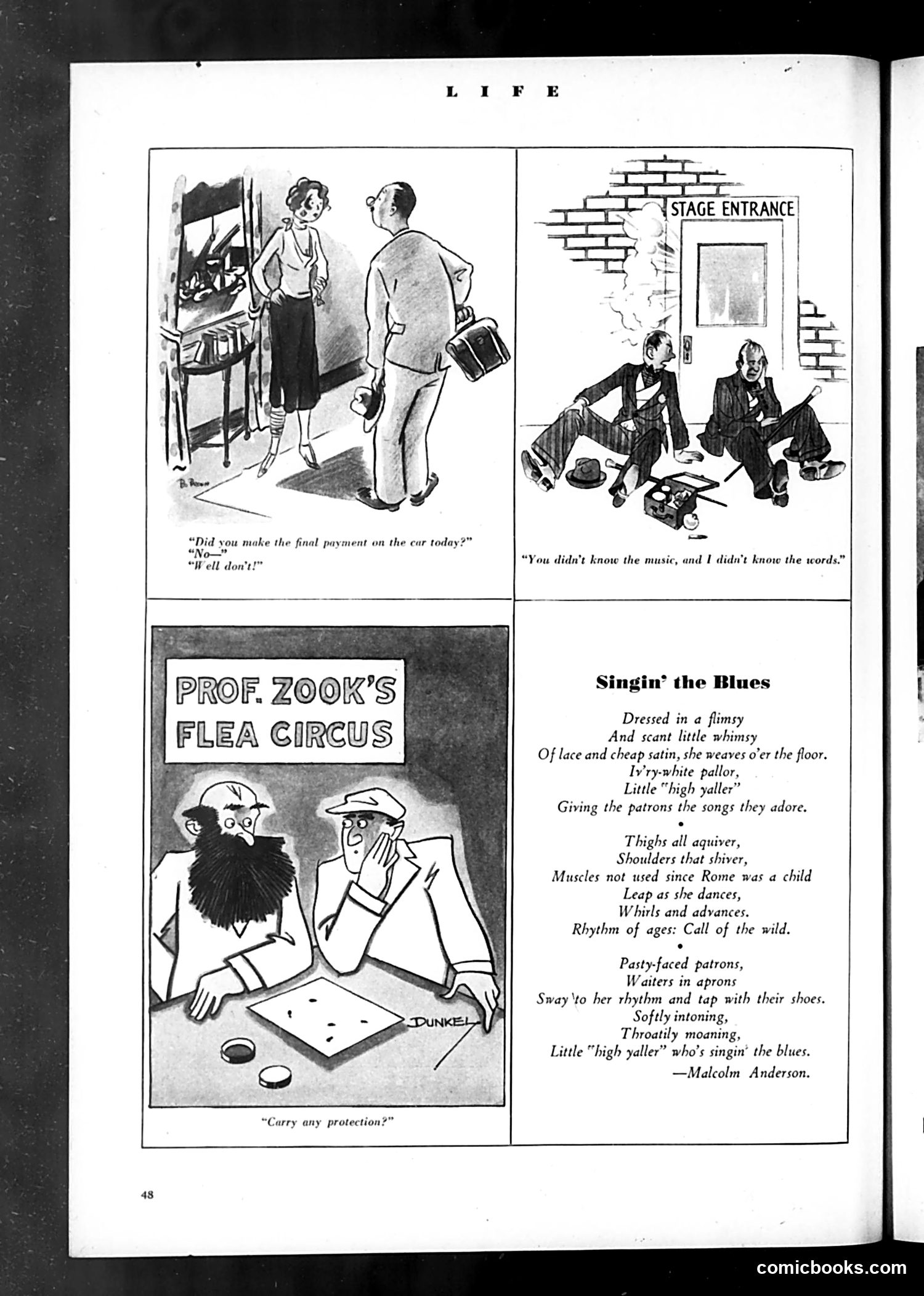
Life Magazine Page Analysis This page contains three unrelated satirical cartoons and a poem from early 20th-century American Life magazine. Top left: A domestic humor cartoon about financial irresponsibility—a husband admits he hasn't made the final car payment, and his wife advises him not to, presumably because the creditor might repossess it. Top right: Two unemployed performers outside a theater stage entrance, explaining their failed audition: a mismatch between music and lyrics—suggesting incompetence or poor preparation. Bottom left: "Prof. Zook's Flea Circus"—a sideshow joke where one charlatan asks another if they need "protection," likely referring to insurance against their fraudulent enterprise. Poem: "Singin' the Blues" by Malcolm Anderson describes a female blues dancer performing for patrons. The language reflects period attitudes; the term "high yaller" (light-skinned Black person) and the exoticized description reveal racial stereotyping common in 1920s entertainment coverage.
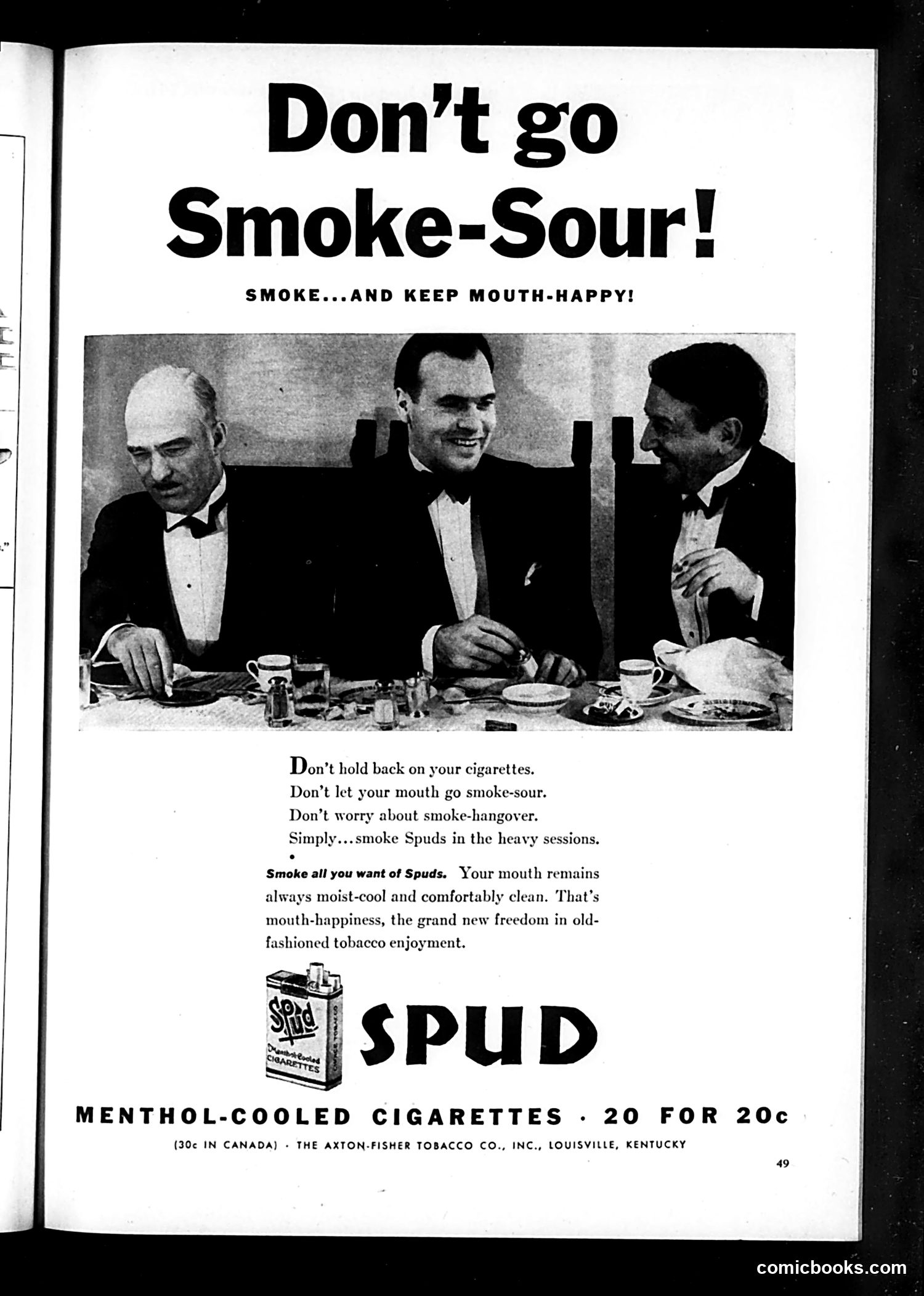
Spud Cigarettes Advertisement Analysis This is a cigarette advertisement, not political satire. It promotes Spud brand menthol-cooled cigarettes (20 for 20¢). The ad features three men in formal dinner attire, appearing to enjoy a meal together while smoking. The campaign plays on concerns about smoking's unpleasant effects—"smoke-sour" mouth, dry mouth, and "smoke-hangover"—positioning Spuds as a solution that keeps the mouth "moist-cool and comfortably clean." The language emphasizes freedom and pleasure ("mouth-happiness," "grand new freedom"), typical mid-20th century tobacco marketing. The menthol element is presented as a health-conscious innovation allowing guilt-free heavy smoking. By modern standards, this advertisement is striking for its direct promotion of smoking as social enjoyment without any health warnings—standard practice before the surgeon general's 1964 report linking cigarettes to disease.
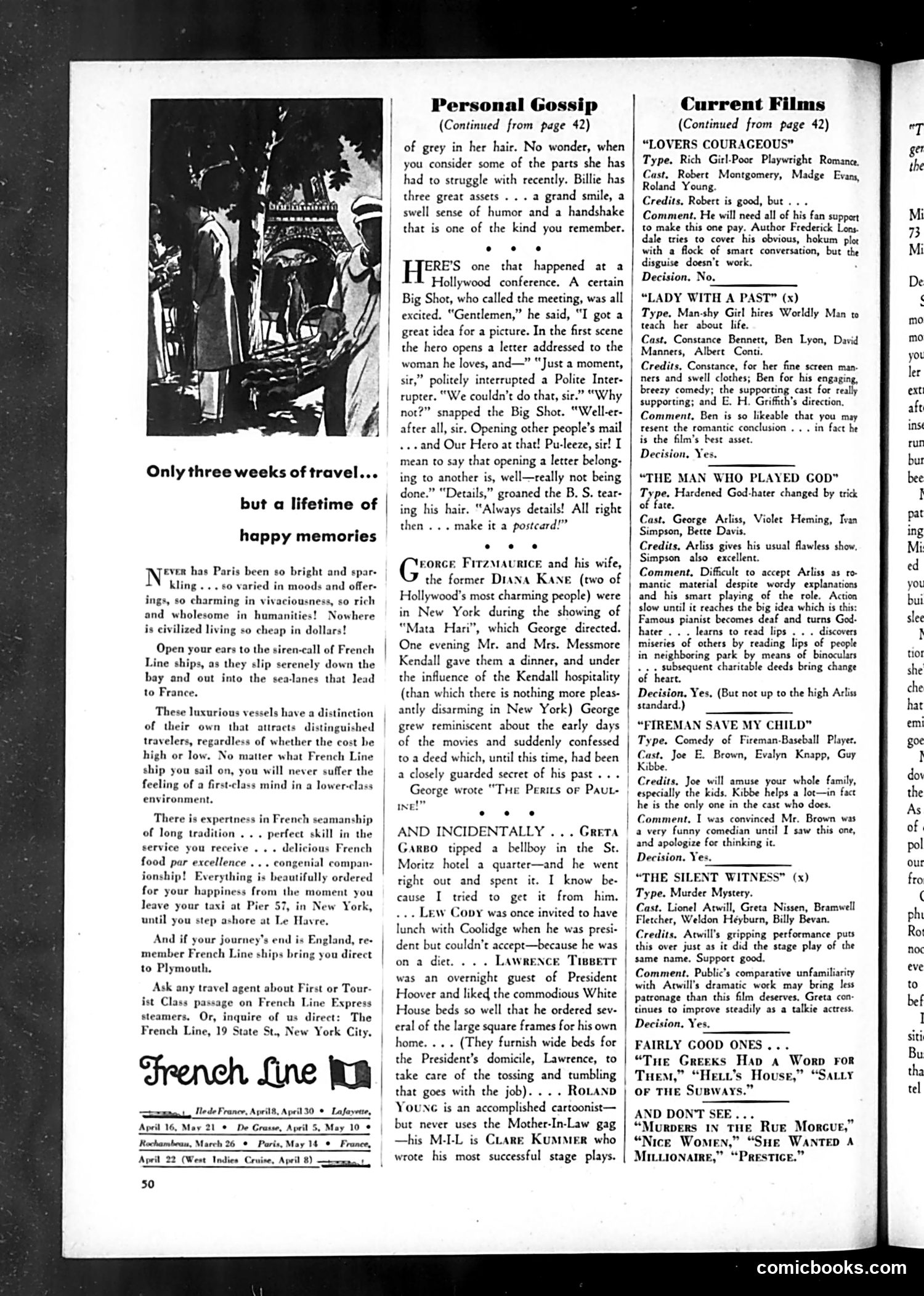
Analysis of This Life Magazine Page This page is primarily advertising and gossip columns, not a political cartoon. The dominant content is a French Line cruise ship advertisement romanticizing travel to Paris and France, emphasizing luxury, elegance, and value ("civilized living so cheap in dollars"). The "Personal Gossip" section contains Hollywood anecdotes mocking movie industry figures. One story satirizes a studio executive pitching a film where the hero opens someone else's mail—only to be lectured by an interrupting character about the impropriety of mail tampering. The joke reflects mid-1920s social propriety concerns and pokes fun at Hollywood's creative desperation. Another anecdote references George Fitzmaurice and the film "Mata Hari," and includes gossipy details about celebrities like Greta Garbo and Lawrence Tibbett. The page offers no significant political commentary—it's entertainment industry gossip paired with travel advertising, typical of *Life* magazine's lighter content sections during this era.
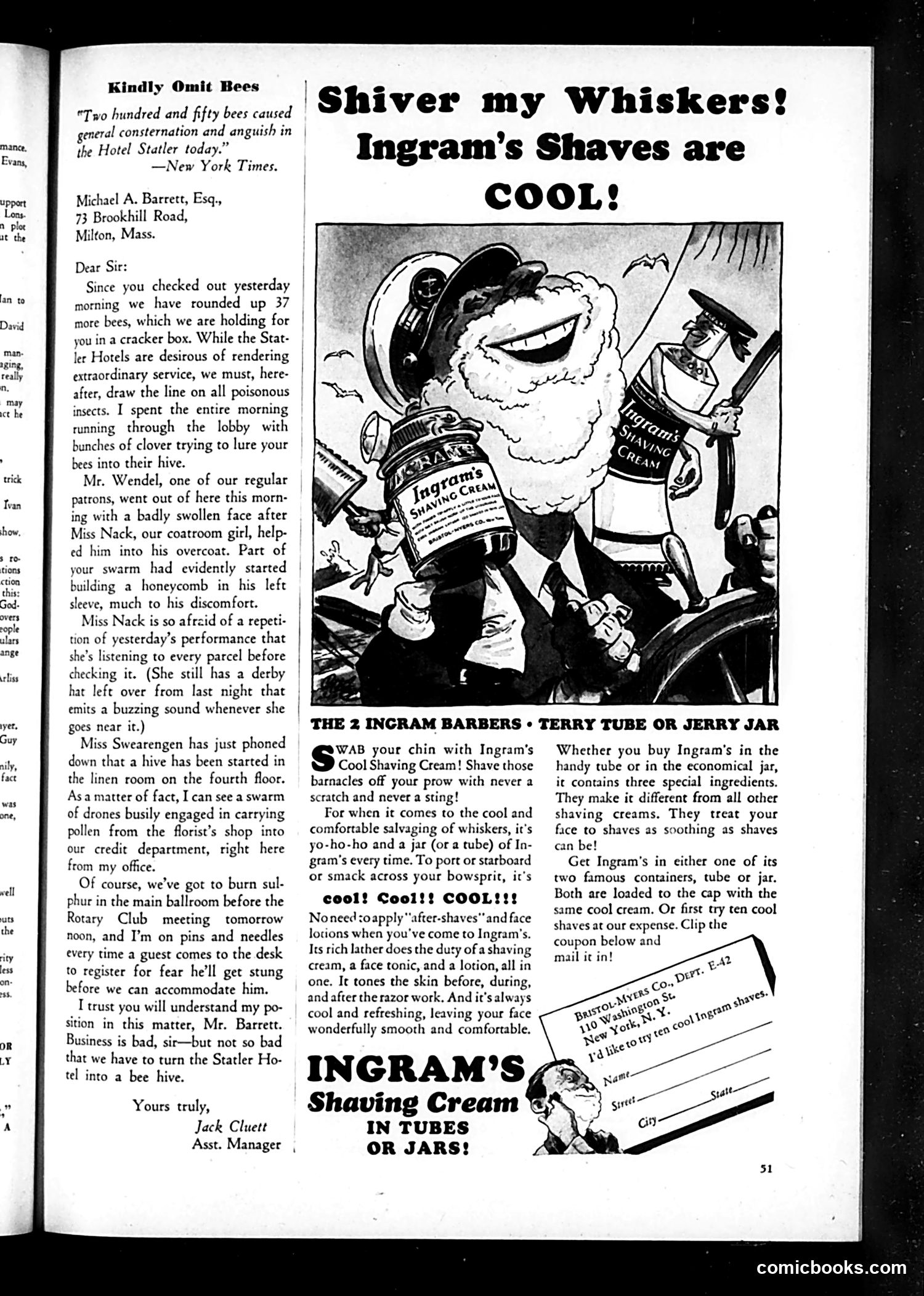
Understanding This Page from Life Magazine This page contains two distinct pieces: Left side - "Kindly Omit Bees": A humorous letter from a hotel manager to a guest who left behind 250 bees during his stay at the Statler Hotel. The joke satirizes the absurdity of the situation: staff members chasing bees through lobbies, guests getting stung, and the hotel's desperate attempts to manage the infestation before an important Rotary Club meeting. It's comedy based on an actual New York Times headline (quoted at top), exaggerating the hotel's polite frustration. The humor lies in the formal, deadpan tone describing increasingly ridiculous bee-related disasters. Right side - Ingram's Shaving Cream advertisement: A pirate-themed ad featuring a cartoonish sailor character shaving. The ad uses nautical language ("yo-ho-ho," "prow," "bowsprit") to market shaving cream available in tubes or jars. It emphasizes the product's cooling, soothing properties and dual function as cream and tonic. The page is primarily advertising with a comedic filler piece.
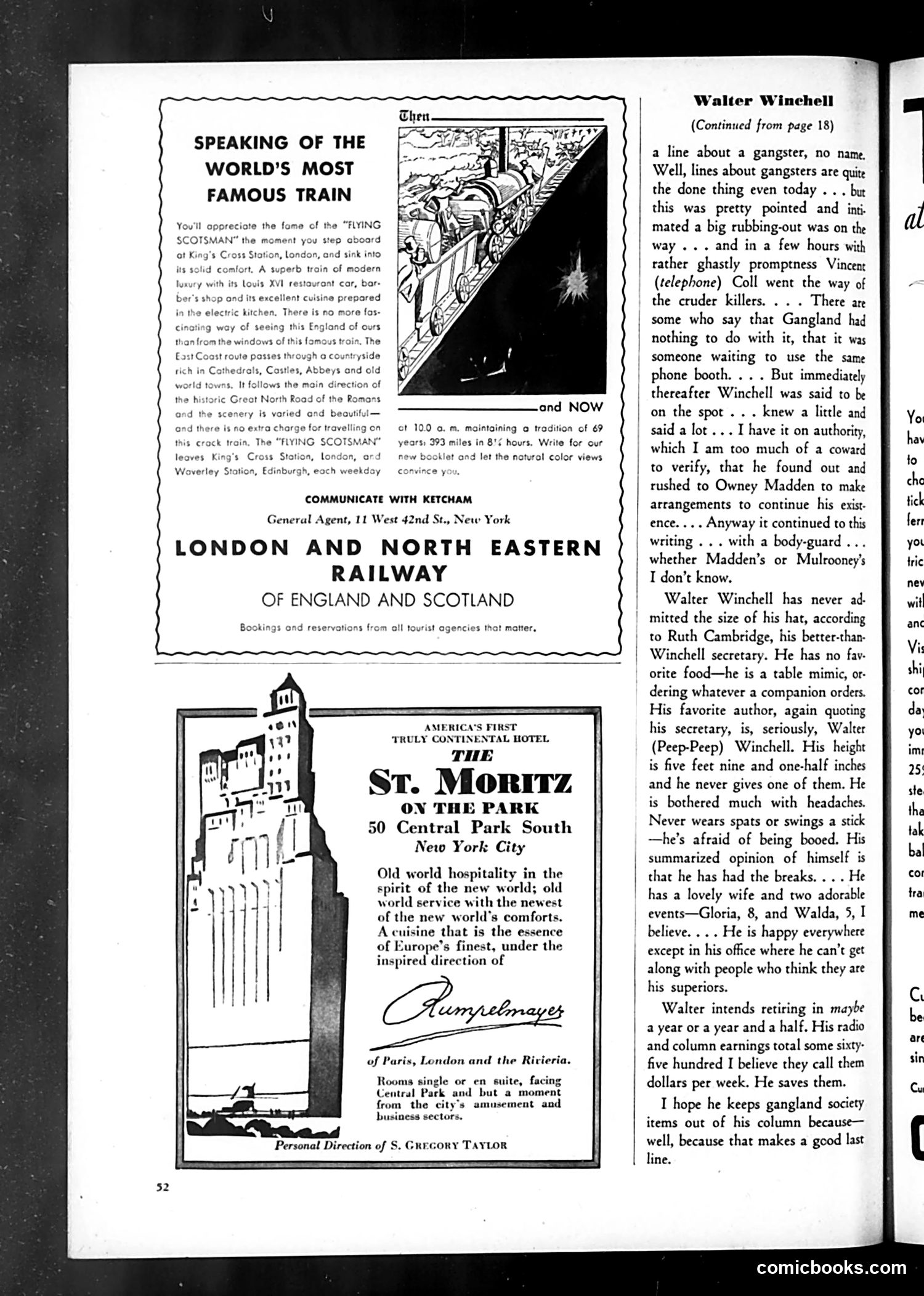
Analysis for Modern Readers This page is primarily advertising for luxury travel and hotels, interspersed with a celebrity gossip column about Walter Winchell, the famous newspaper columnist and radio broadcaster. The text describes Winchell's physical appearance, habits, and personal life while praising his work. Notably, it references his alleged connection to Vincent "Mad Dog" Coll, a 1930s gangster, suggesting Winchell had inside knowledge of Coll's murder and may have tipped off crime boss Owney Madden. The author treats this serious allegation almost casually—admitting he's "too much of a coward to verify" it. The final joke warns that Winchell should keep organized crime stories out of his column because doing so makes "a good last line"—darkly implying continued involvement with gangland could get him killed. This reflects Winchell's controversial reputation: a powerful gossip columnist with genuine underworld connections during Prohibition's crime era.
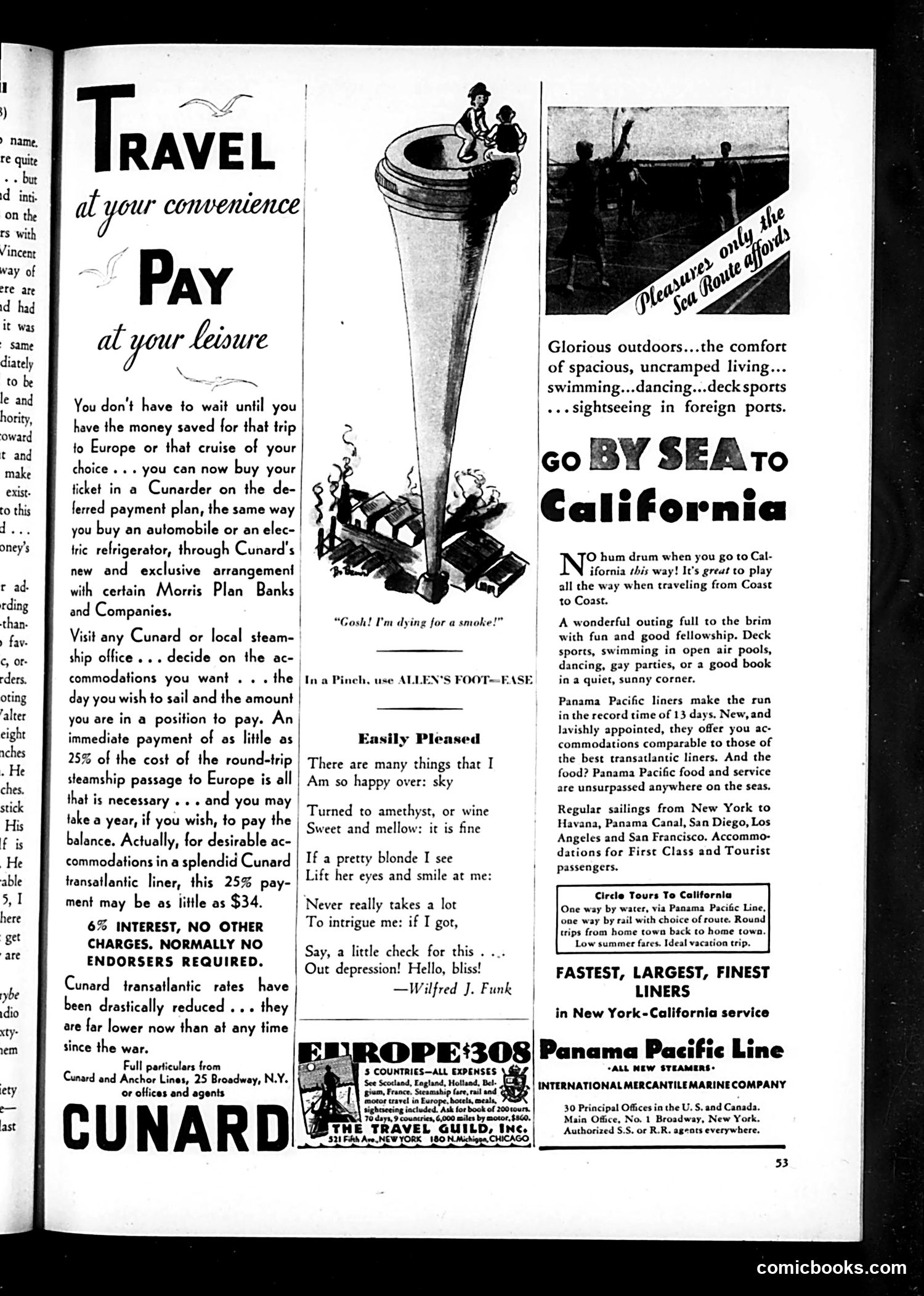
Page Analysis: Travel and Leisure Advertising (Life Magazine) This page is primarily advertising, not political satire. It contains multiple travel promotions from the 1920s-30s era. The main content includes: 1. Cunard Lines advertisement (left): Promotes financing ocean liner tickets through installment plans—borrowers can pay as little as 25% upfront and take a year to pay the balance, similar to buying automobiles or refrigerators. This reflects post-WWI economic accessibility. 2. A humorous poem titled "Easily Pleased" by Wilfred J. Funk describes simple pleasures (sky, wine, pretty women, receiving checks). 3. Panama Pacific Line advertisement (right): Promotes California cruises via Panama Canal, emphasizing leisure activities (swimming, dancing, deck sports). 4. Additional travel advertisements for European tours and rail trips. The cartoons are minimal—a small illustration of people in a ship's smoke stack with caption "Gosh! I'm dying for a smoke!" and an Allen's Foot-Ease shoe product reference. Context for modern readers: This reflects 1920s-30s consumer culture where financing luxury travel became newly accessible to middle-class Americans.
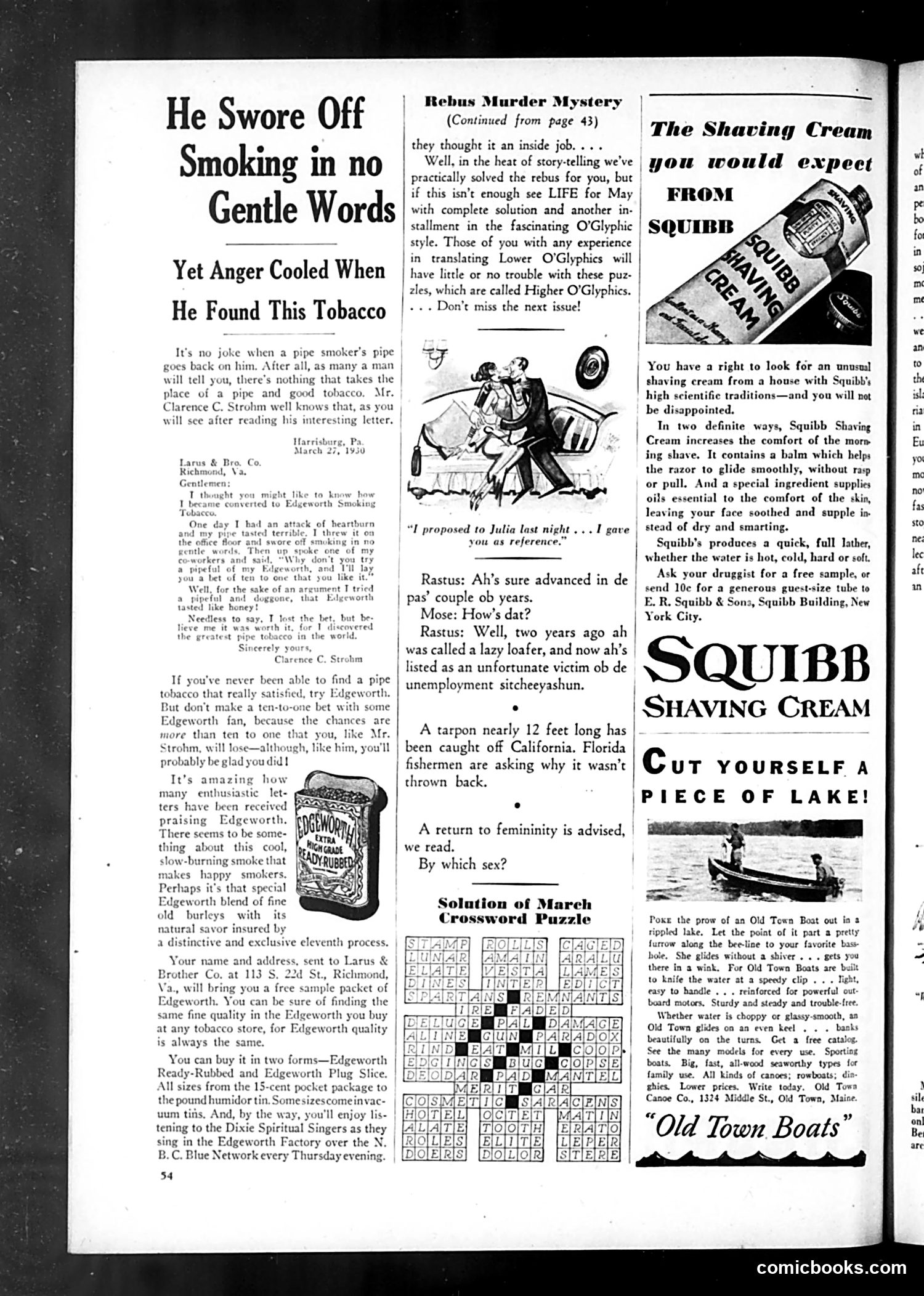
Analysis for Modern Readers This page contains primarily advertising content rather than political satire or comics. The main feature is an Edgeworth tobacco advertisement disguised as a personal testimonial letter. A man named Clarence C. Strohm claims he angrily quit smoking after a bad experience, but was won over by Edgeworth brand tobacco—so thoroughly that he lost a ten-to-one bet against an Edgeworth fan. The humor relies on the exaggerated conversion story and the bet's outcome. Below this is a brief "Rebus Murder Mystery" puzzle feature (continued from another page), containing wordplay jokes. One joke depicts two Black characters named Rastus and Mose discussing unemployment using period dialect—reflecting the casual racial stereotyping common in 1930s publications. The page also advertises Squibb Shaving Cream and Old Town Boats. The content reflects 1930s consumer culture and attitudes, with limited satirical commentary beyond typical period advertising tropes.
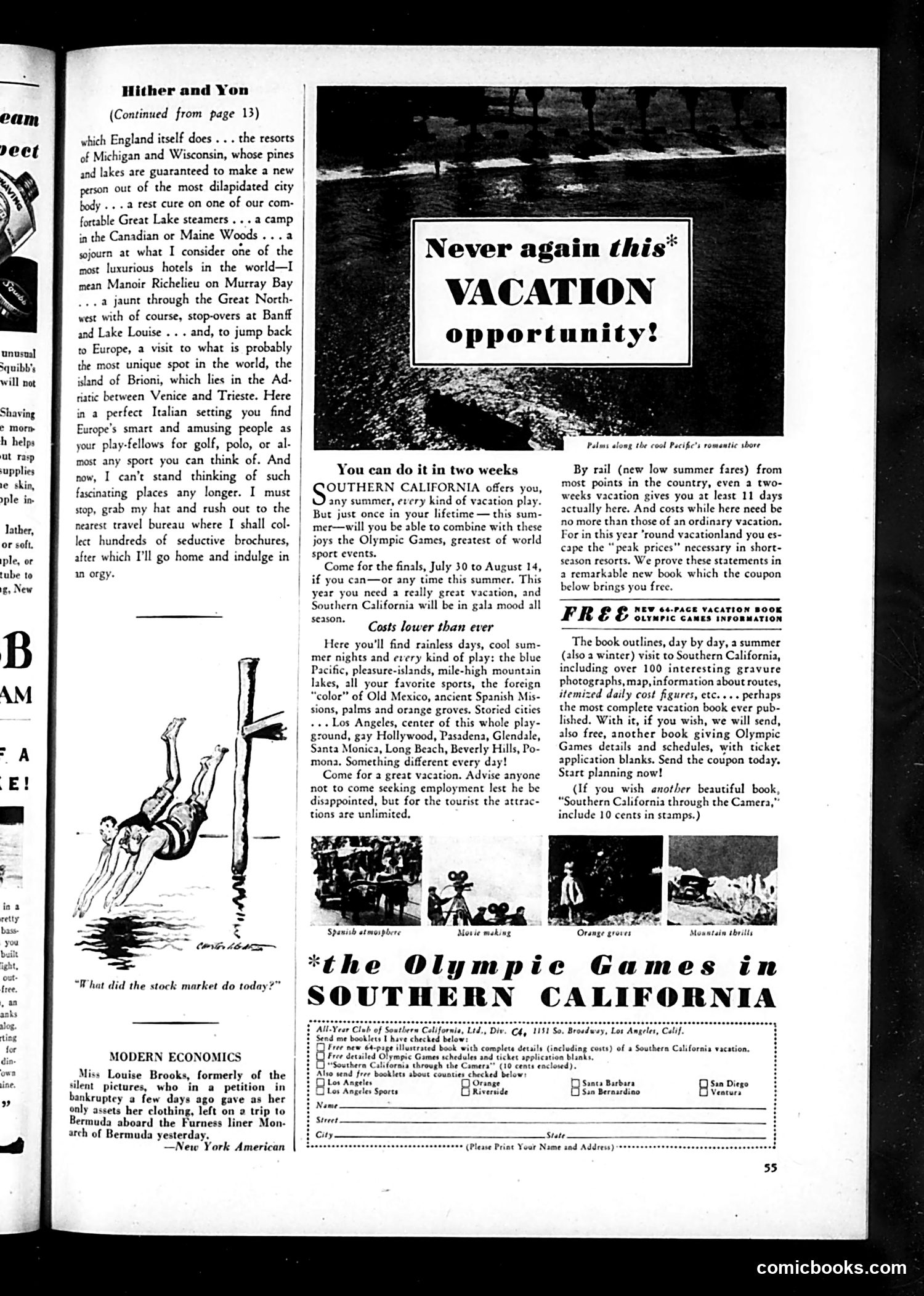
Explanation of Page 55 This page combines travel advertising with satirical social commentary. The main cartoon shows a couple—likely representing wealthy Americans—diving or falling, captioned "What did the stock market do today?" This references the stock market crash of 1929 and subsequent Great Depression, satirizing how financial anxieties dominated even leisure moments. The prominent advertisement promotes Southern California vacations during the 1932 Olympic Games (held in Los Angeles), emphasizing "costs lower than ever"—a pointed appeal to Depression-era readers. The juxtaposition is deliberate: while ordinary Americans faced economic hardship, the wealthy could still afford luxury travel. Below, a brief item notes actress Louise Brooks filing for bankruptcy with only clothing as assets, yet vacationing in Bermuda—illustrating Depression-era irony where even the famous struggled financially despite maintaining appearances of leisure and travel. The page captures 1932 economic anxiety alongside aspirational vacation fantasy.
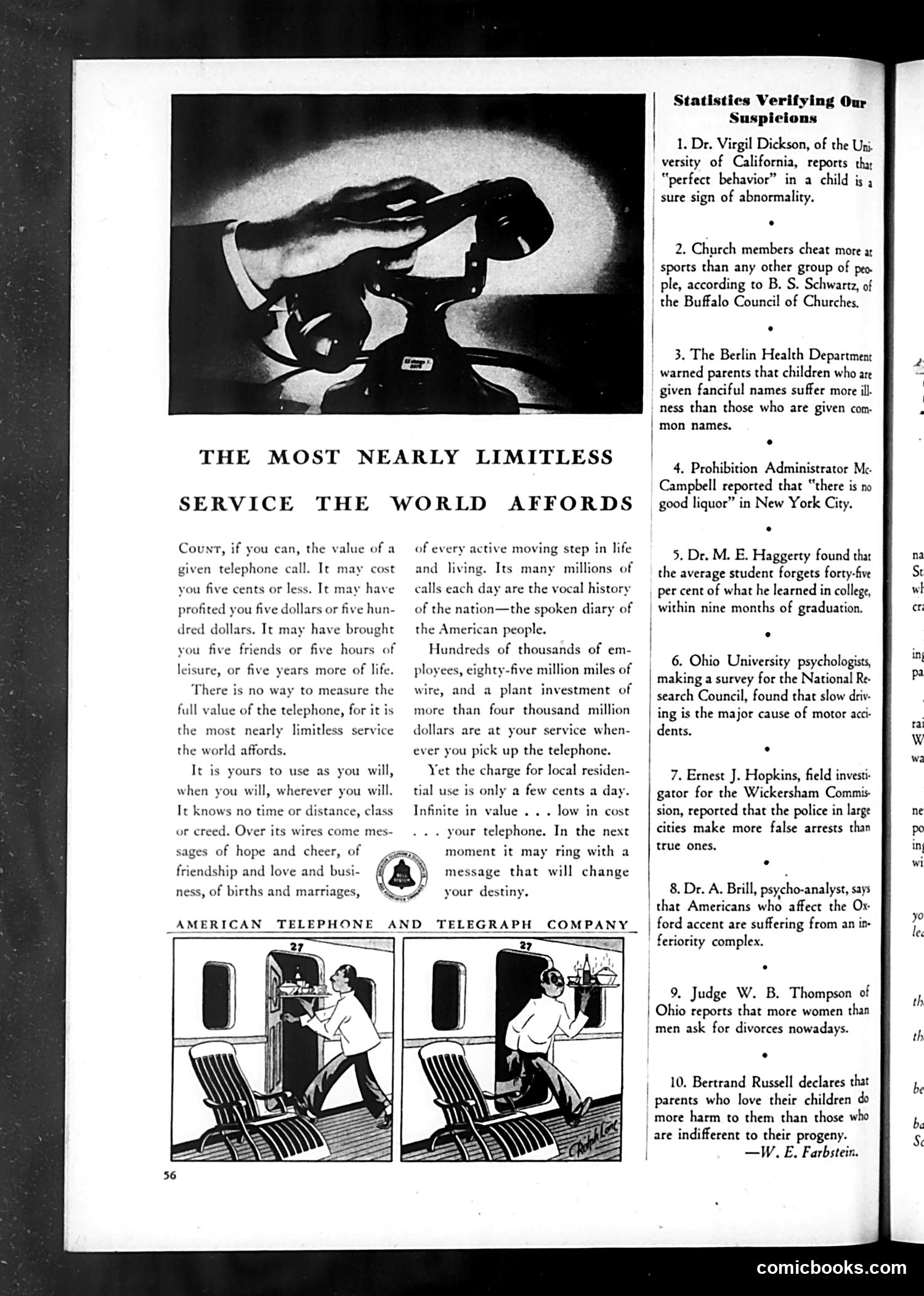
Analysis for Modern Readers This page combines a serious AT&T advertisement with satirical content that mocks pseudo-scientific claims. The Advertisement (left): A earnest pitch for telephone service, emphasizing its value and universal accessibility. The cartoon shows someone using a telephone booth—depicting the technology as transformative and available to all Americans. "Statistics Verifying Our Suspicions" (right): This is the satirical element. It lists 10 absurd "statistics" from seemingly credible sources (university professors, government officials, judges) that contradict common sense. Examples include claims that perfect child behavior indicates abnormality, that slow driving causes accidents, and that loving your children harms them. The Satire's Point: Life magazine is mocking the era's tendency to cite dubious "scientific" authority to justify counterintuitive or cynical claims. By presenting these ridiculous "findings" with academic and official attribution, the magazine critiques how statistics and expert testimony can be weaponized to support predetermined conclusions—a timely message about the misuse of data and expertise, even in this pre-modern-internet era.
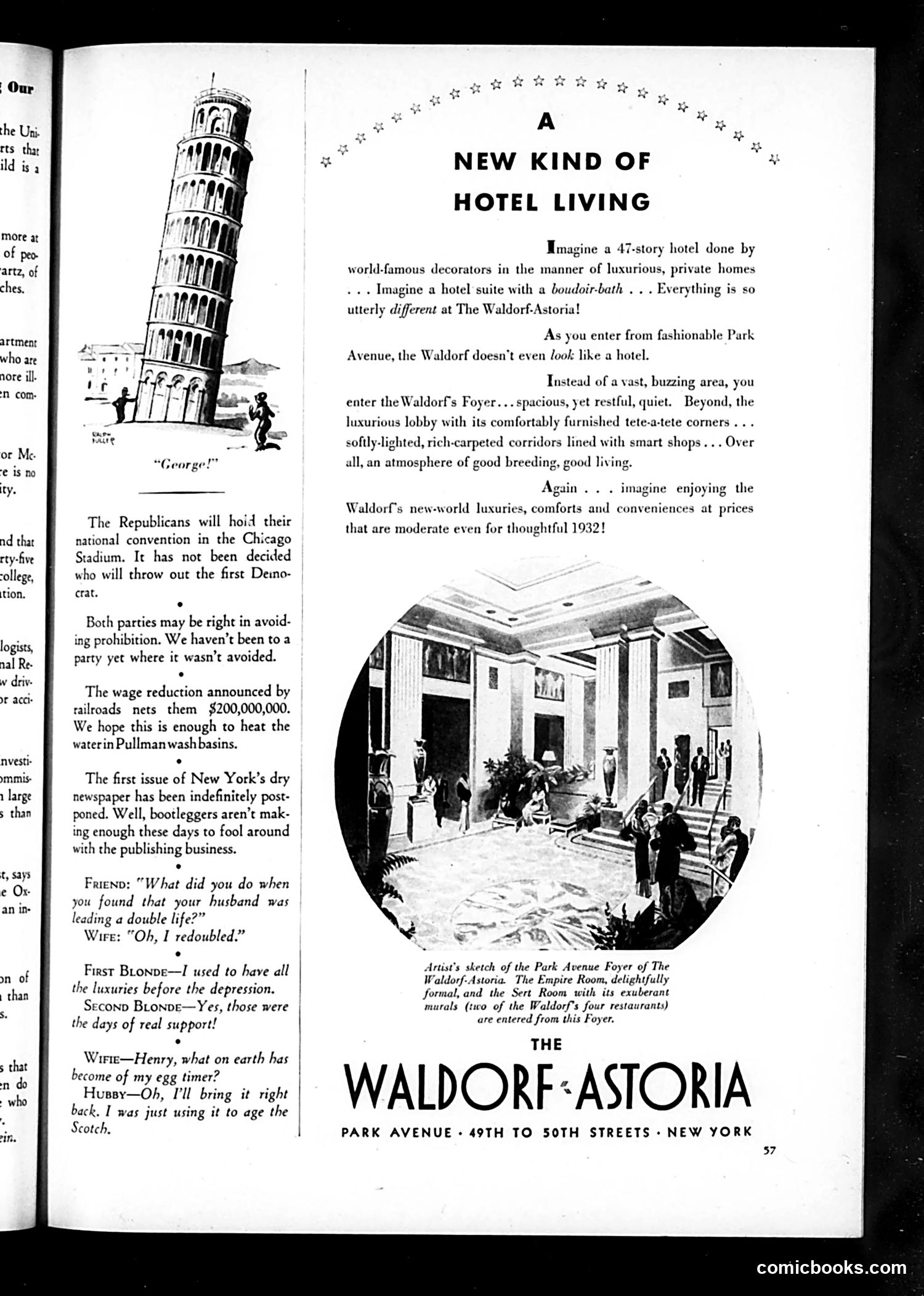
Life Magazine Page Analysis This page combines political satire with luxury advertising, reflecting early 1930s Depression-era anxieties. Political/Social Humor: The brief jokes mock Prohibition's failure (alcohol still consumed despite the ban), railroad wage cuts during economic hardship, and a failed "dry newspaper" venture—all referencing bootlegging's prevalence. The marital jokes ("redoubled," egg timer for aging Scotch) are period humor with no specific political target. The Irony: The juxtaposition is the point: satirical commentary on economic suffering appears alongside a full-page Waldorf-Astoria advertisement promoting "moderate" luxury living "even for thoughtful 1932." This contrast highlights Depression-era inequality—Life's readers could enjoy mocking wage cuts and Prohibition's hypocrisy while simultaneously being sold high-end hotel amenities as "affordable." The Leaning Tower of Pisa cartoon labeled "George!" appears unrelated to surrounding content; its meaning is unclear from context.
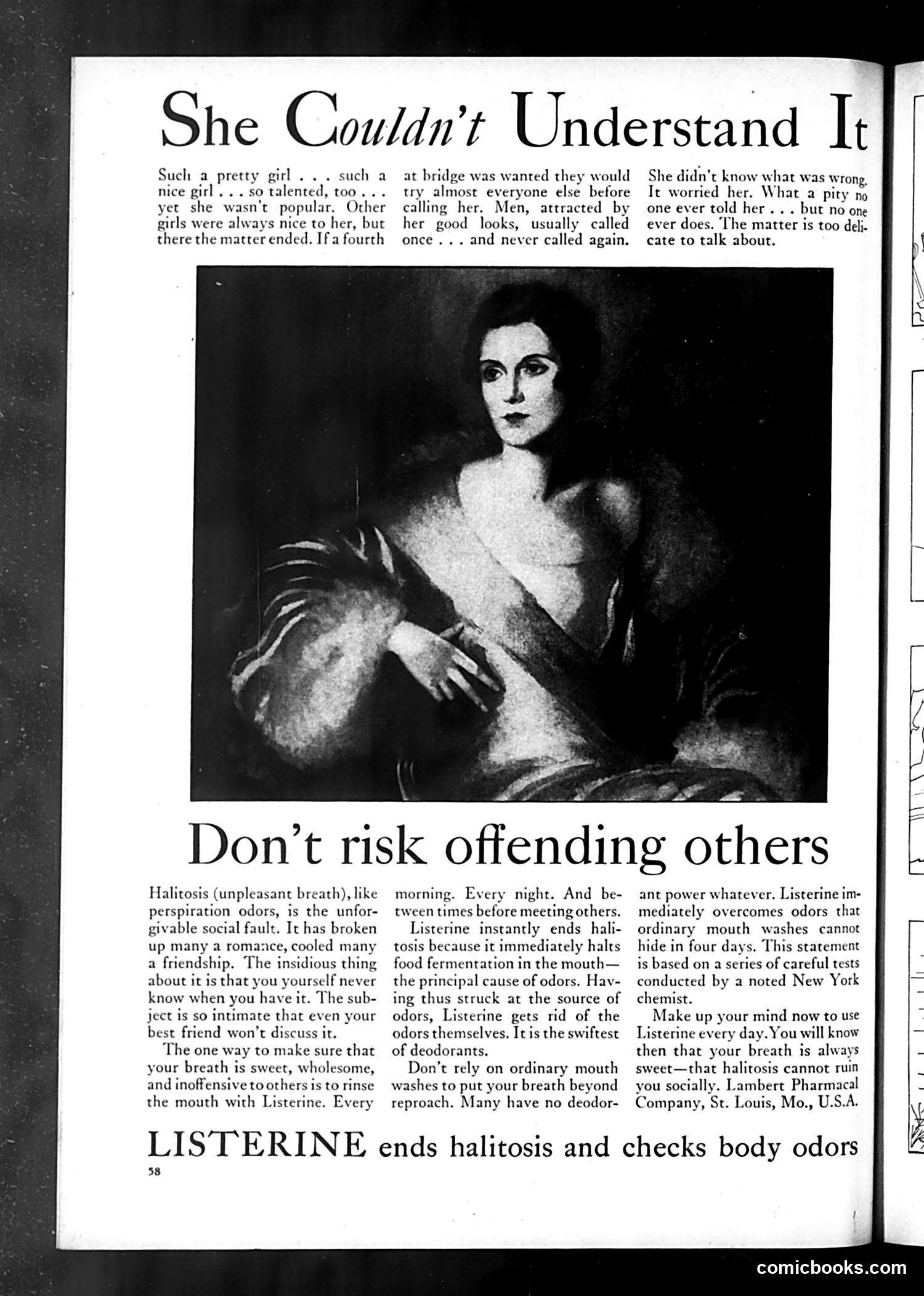
Analysis This is a Listerine advertisement, not satire or political commentary. The page uses a melodramatic narrative to sell mouthwash. The "Story": A beautiful, talented young woman remains unpopular despite her gifts. Men call once but never again; she's excluded from social events. The implication: she has bad breath (halitosis), but no one will tell her because it's too delicate to discuss. The Sales Pitch: This social ostracism is preventable through daily Listerine use. The ad claims Listerine uniquely stops halitosis by halting food fermentation—the "principal cause of odors"—and works faster than competitors. Historical Context: This reflects early-20th-century advertising that weaponized social anxiety, particularly targeting women. The ad exploits fear of romantic and social rejection, suggesting that personal hygiene failure causes isolation. The portrait conveys glamour but also mystery—her problem is invisible, shameful, unknowable without the product. This approach became notorious for creating insecurity-based marketing, particularly around body odors and personal grooming.
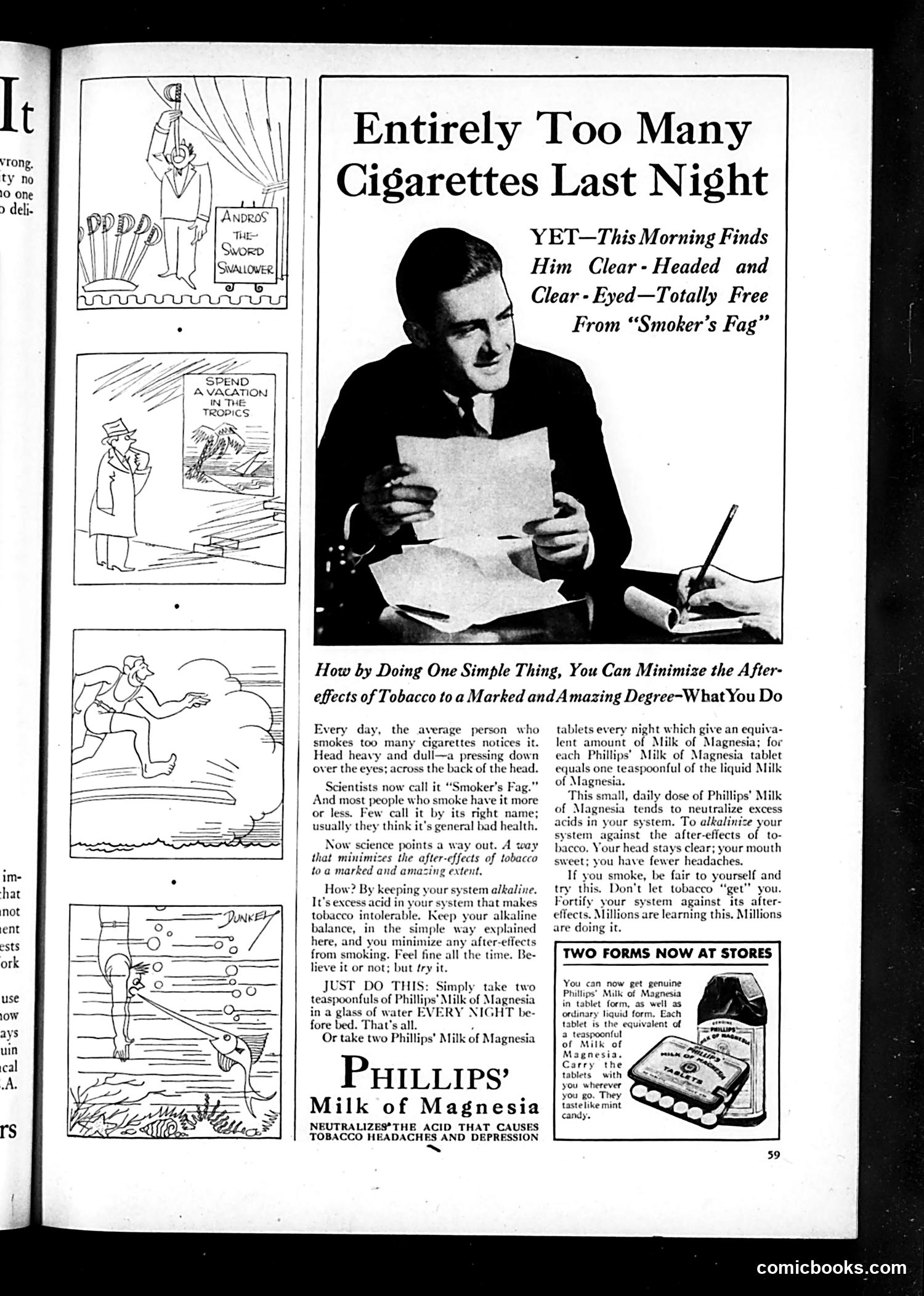
Analysis for Modern Reader This page is primarily advertising disguised as health advice, promoting Phillips' Milk of Magnesia as a remedy for "Smoker's Fag" (British slang for smoker's fatigue—headaches and mental fog from heavy smoking). The ad claims that excess acid from tobacco causes headaches and depression, and that taking Phillips' Milk of Magnesia nightly will "alkalinize" your system and eliminate these effects. A man reading cheerfully in the morning illustrates the promised result: smoking without consequences. The cartoons on the left are unrelated filler illustrations typical of Life magazine's satirical style, showing humorous scenes. The satire today: This is a breathtaking example of pre-regulation pharmaceutical marketing. The ad makes pseudoscientific health claims, offers no evidence, and essentially tells readers they can smoke freely if they just consume another product—a strategy now illegal under FDA advertising rules. Modern readers would recognize this as exactly the kind of dubious health claim we now regulate strictly.
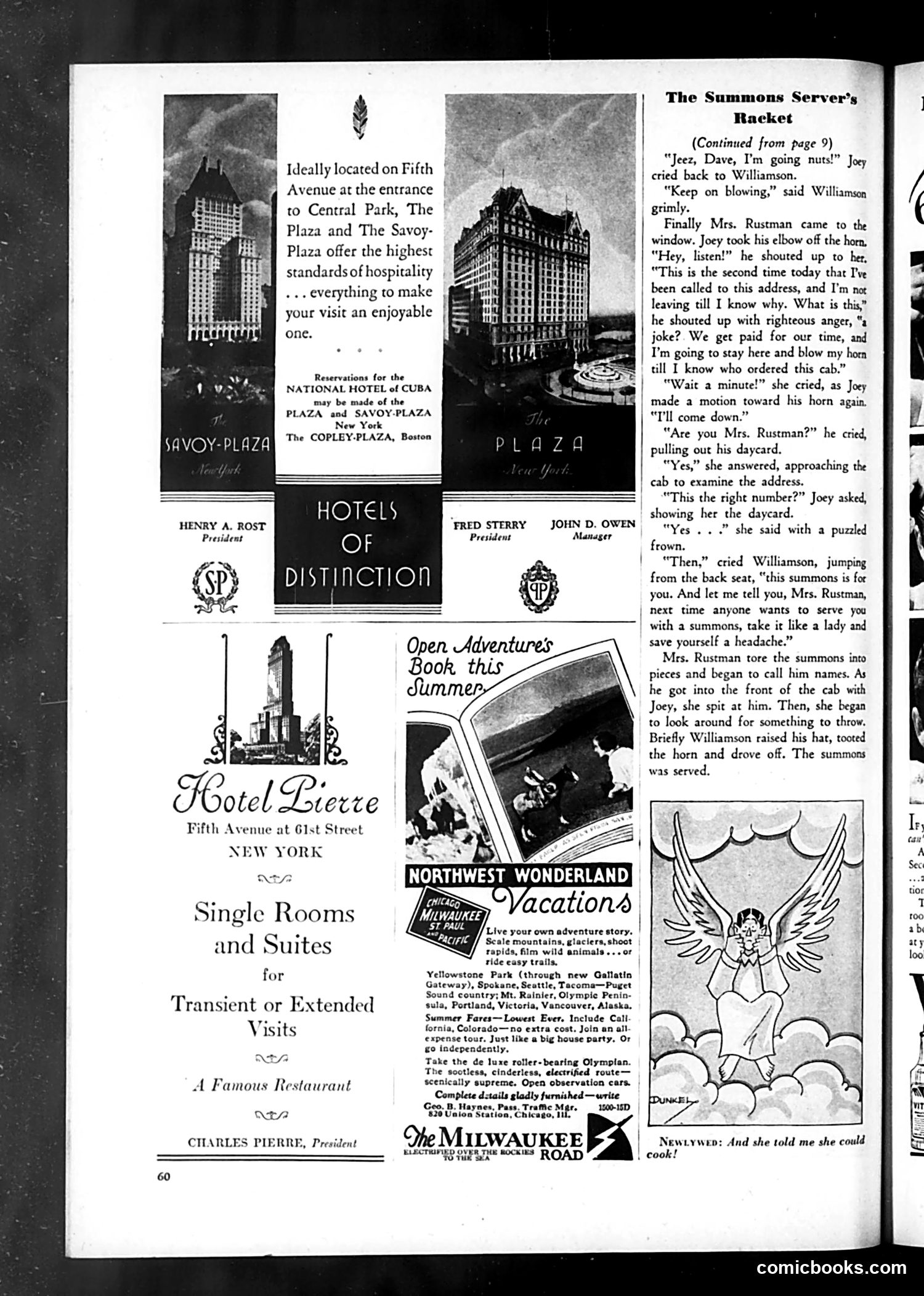
"The Summons Server's Racket" This page continues a satirical story about a taxi driver and process server named Williamson who must deliver a legal summons to Mrs. Rustman. The humor lies in the con: Williamson tricks her into coming to the window by having the cabbie Joey honk persistently, pretending she ordered a cab. When confronted, Mrs. Rustman becomes furious—tearing up the summons, insulting Williamson, and spitting at him—all while he calmly tips his hat and drives away, having successfully "served" her legally despite her resistance. The satire mocks both the deceptive tactics process servers use and the indignant reactions of people being sued. The final caption's joke about her cooking ability adds dismissive sexism typical of 1920s-30s humor. The rest of the page consists of hotel and travel advertisements.
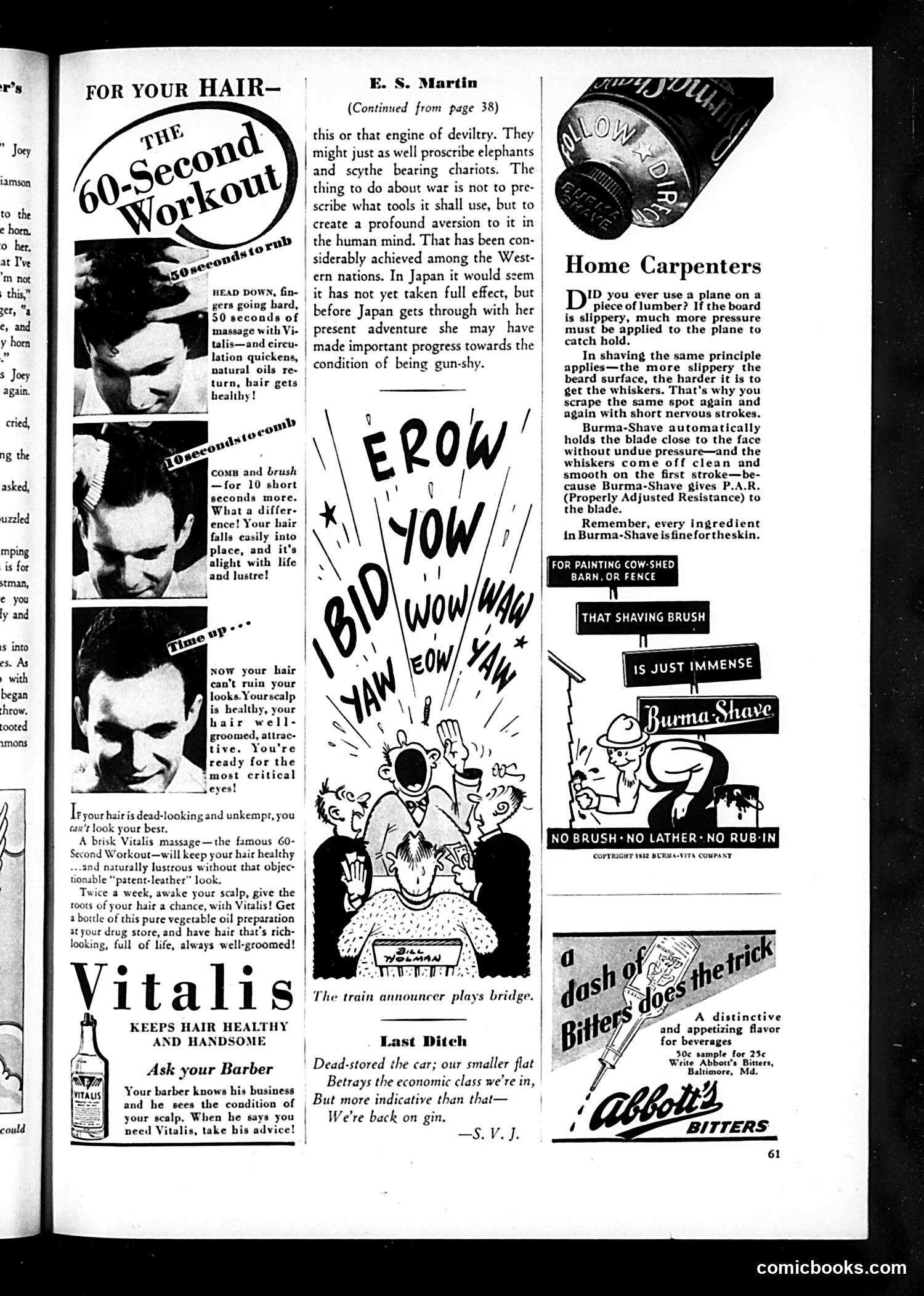
Life Magazine Page Analysis This page is primarily advertising content rather than editorial satire, though it contains one small cartoon and a brief humorous poem. The main visual joke appears in the center: a cartoon of a train announcer sitting at a bridge table, captioned "The train announcer plays bridge." This is a simple visual pun—the announcer, whose job involves announcing information, is literally playing the card game bridge. Below this, a short poem titled "Last Ditch" by S.V.J. uses wartime rationing as context for humor. It describes a couple's economic decline: their car is "dead-stored" (stored due to fuel rationing), they've moved to a smaller flat, and most tellingly, "We're back on gin"—suggesting they've given up on maintaining middle-class pretenses and returned to cheaper drinking. The remainder of the page consists of product advertisements: Vitalis hair oil, Burma-Shave, and Abbotts Bitters. These are period ads from what appears to be WWII-era America, when such consumer goods were commonly advertised in magazines.
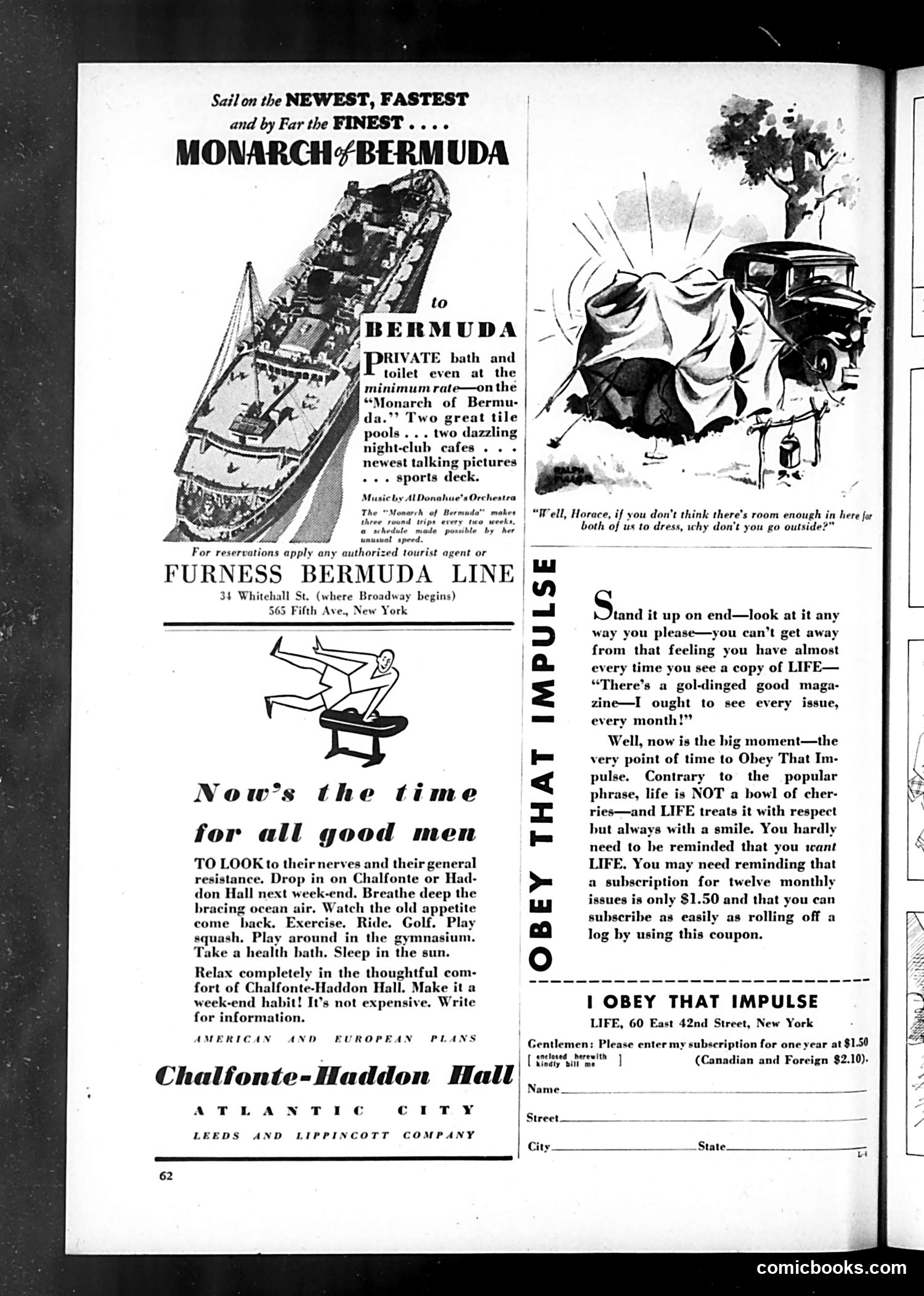
Analysis of Life Magazine Page This page primarily contains advertisements rather than satirical cartoons. The main content promotes three products: 1. Monarch of Bermuda ship: A cruise line advertisement touting the vessel as "newest, fastest and finest," emphasizing luxury amenities (private baths, night clubs, talking pictures). 2. Chalfonte-Haddon Hall: A resort hotel in Atlantic City advertising health and relaxation benefits—escape from urban stress through exercise, golf, and sea air. 3. Life Magazine subscription: The central message urges readers to subscribe, using the tagline "Obey That Impulse." The accompanying cartoon shows a couple cramped in a dressing room, with the joke implying Life magazine provides necessary escape and perspective from life's cramped conditions. The small cartoon at bottom-left depicts a man relaxing on furniture, supporting the leisure theme. All three ads target affluent readers seeking escape from everyday pressures—a common Depression-era sales strategy emphasizing rejuvenation and mental health through consumption.
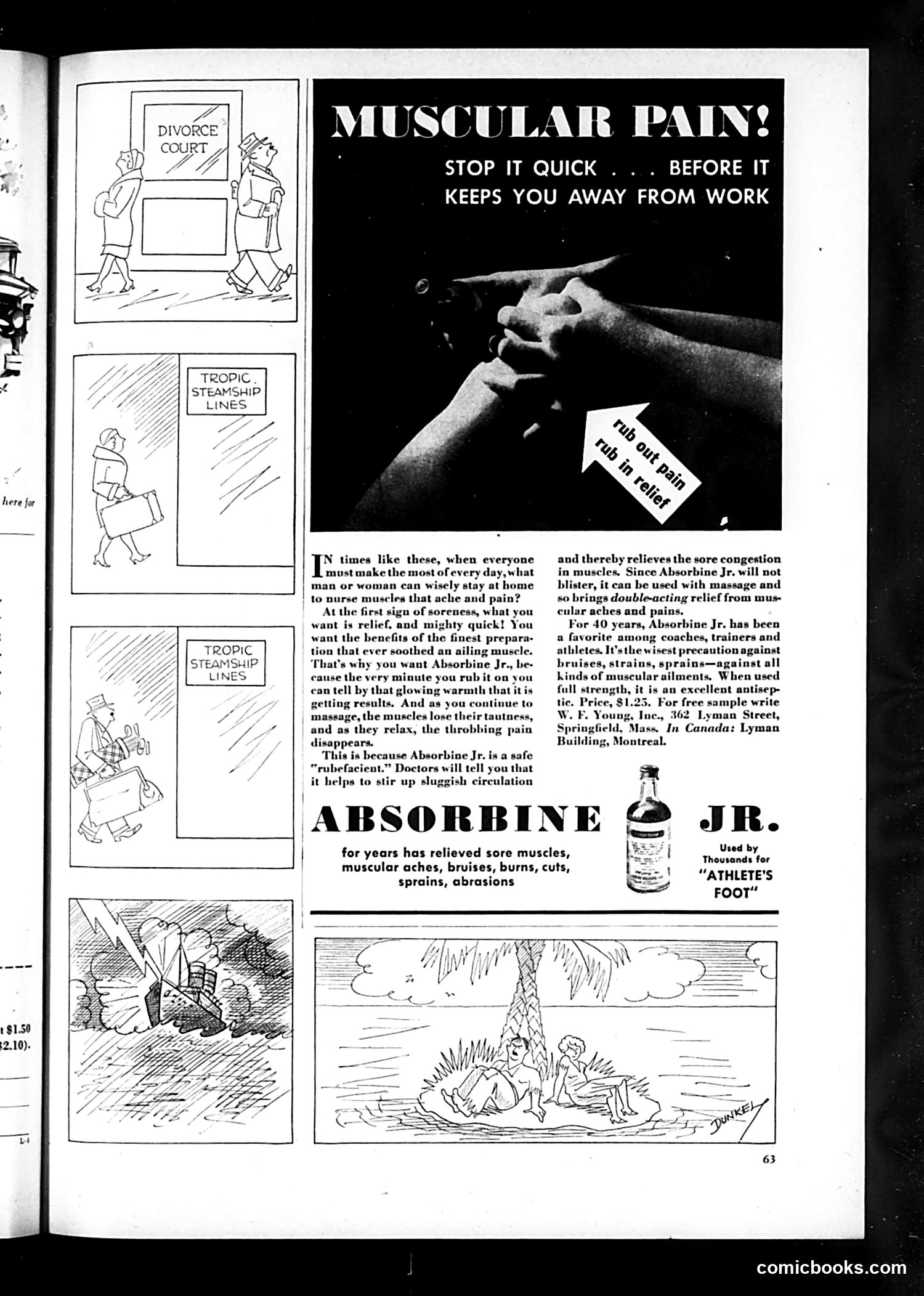
Analysis of Life Magazine Page This page combines satirical comics with a liniment advertisement, reflecting Depression-era concerns. The Comics (left side): Three cartoon panels mock marital discord and travel misadventures. The "Divorce Court" panel shows a couple separating; subsequent panels depict someone struggling with steamship luggage. These appear to be unrelated gag comics typical of Life's humor section. The Advertisement (right): Absorbine Jr., a muscle rub, uses wartime economic anxiety as its sales pitch. The headline "STOP IT QUICK...BEFORE IT KEEPS YOU AWAY FROM WORK" explicitly connects muscopic pain to lost productivity—a crucial concern when "everyone must make the most of every day." This frames the product as economically patriotic. The Satire: Life's juxtaposition is ironic: while mocking domestic collapse and travel chaos, the ad exploits worker anxiety about missing work due to injury. The product promises both pain relief *and* economic responsibility. Context: This likely dates from WWII-era America, when workplace productivity was militarily and patriotically emphasized.
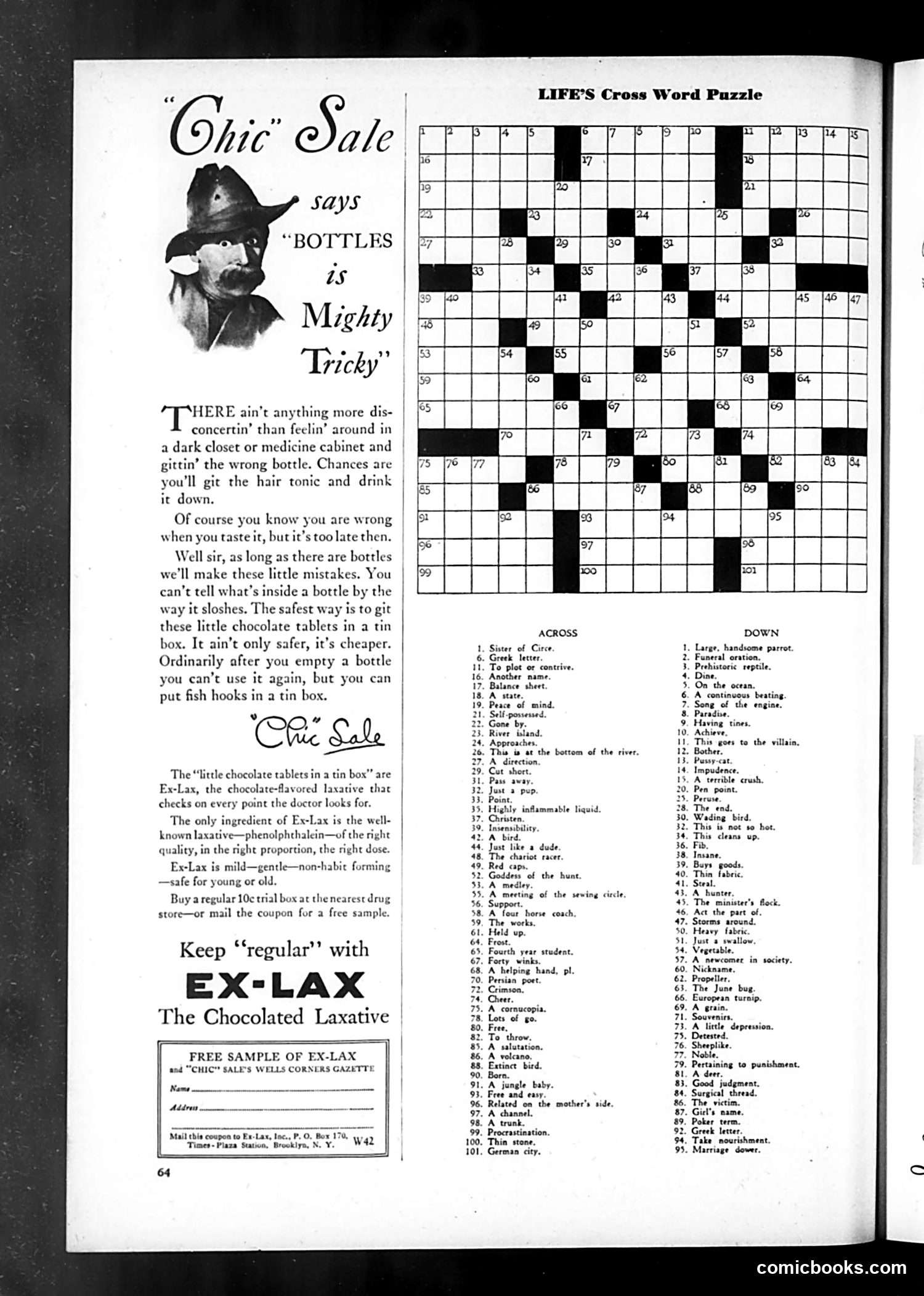
"Chic Sale" Ex-Lax Advertisement This page is primarily an advertisement for Ex-Lax laxative, featuring a monologue by "Chic Sale," a popular American humorist and character performer of the era known for rustic, folksy humor. The Premise: Sale (depicted in the illustration wearing a hat and rural clothing) uses vernacular humor to pitch the product. He jokes about the danger of mistaking bottles in dark medicine cabinets—accidentally drinking hair tonic instead of medicine—and argues that Ex-Lax tablets in a tin box are safer and more versatile than liquid products. His punchline: you can repurpose empty bottles for fish hooks, but tin boxes serve only their intended purpose. The Appeal: The ad exploits common household anxiety (medication mix-ups) while using humor to make discussing laxatives acceptable and even entertaining—important for 1920s-era advertising standards. The facing page contains LIFE magazine's crossword puzzle, unrelated to the advertisement.
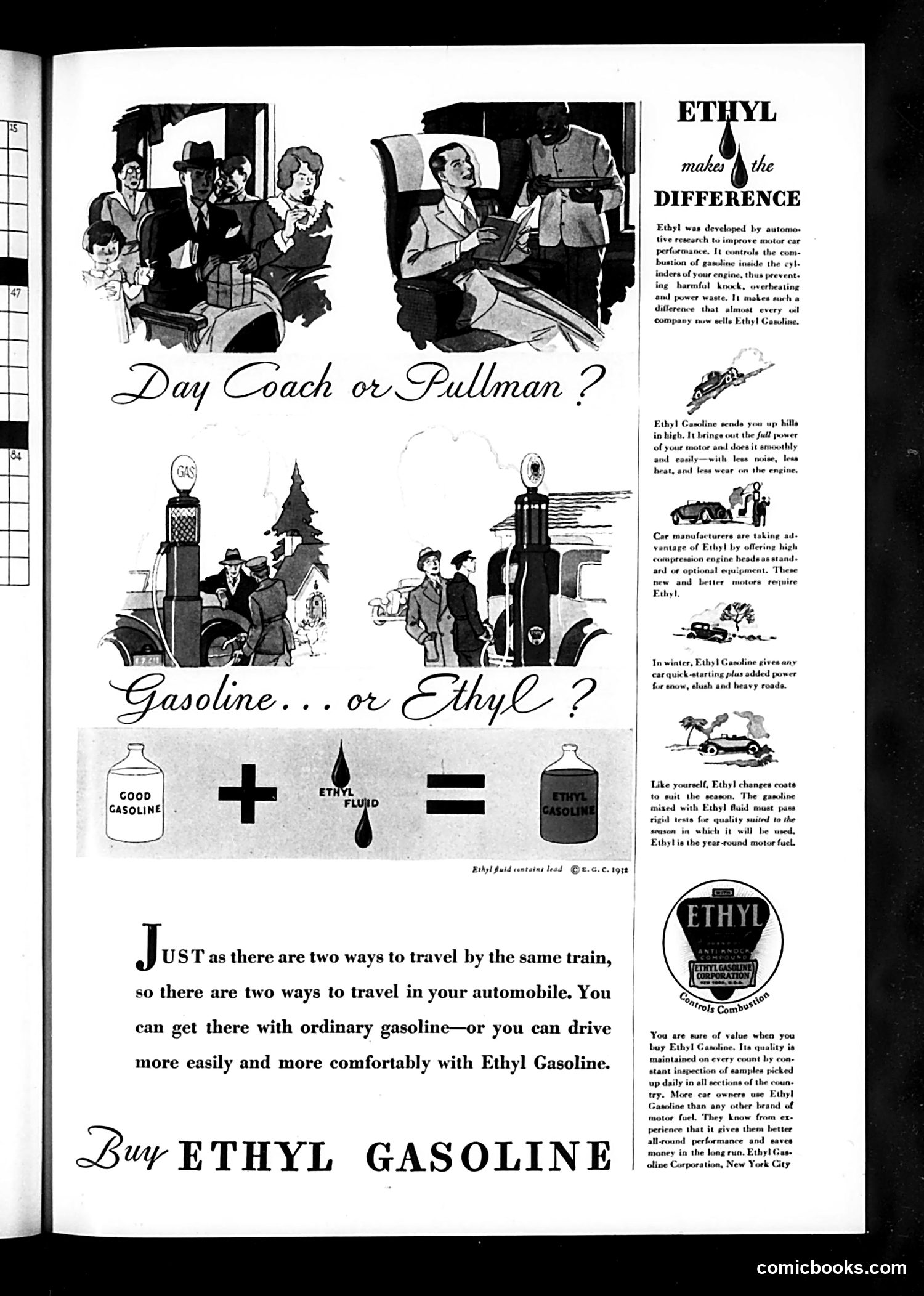
Ethyl Gasoline Advertisement (circa 1928) This is primarily a commercial advertisement, not political satire. The page promotes Ethyl Gasoline, a leaded fuel additive developed to improve engine performance. The top illustrations use a comparison format: "Day Coach or Pullman?" and "Gasoline...or Ethyl?" The analogies suggest that choosing ordinary gasoline is like taking a basic day coach train, while Ethyl Gasoline offers the superior comfort of a Pullman car. The figures appear to be generic travelers and drivers, not specific caricatures. The text emphasizes Ethyl's benefits: easier hill-climbing, smoother operation, reduced wear, and seasonal adjustment. The formula shown (good gasoline + ethyl fluid = ethyl gasoline) illustrates the product's composition. The bottom section compares two travel routes on the same train, extending the metaphor: both reach the destination, but one journey is more pleasant—positioning Ethyl as the premium choice for automobile owners. This reflects 1920s consumer marketing strategies emphasizing comfort and technological improvement.
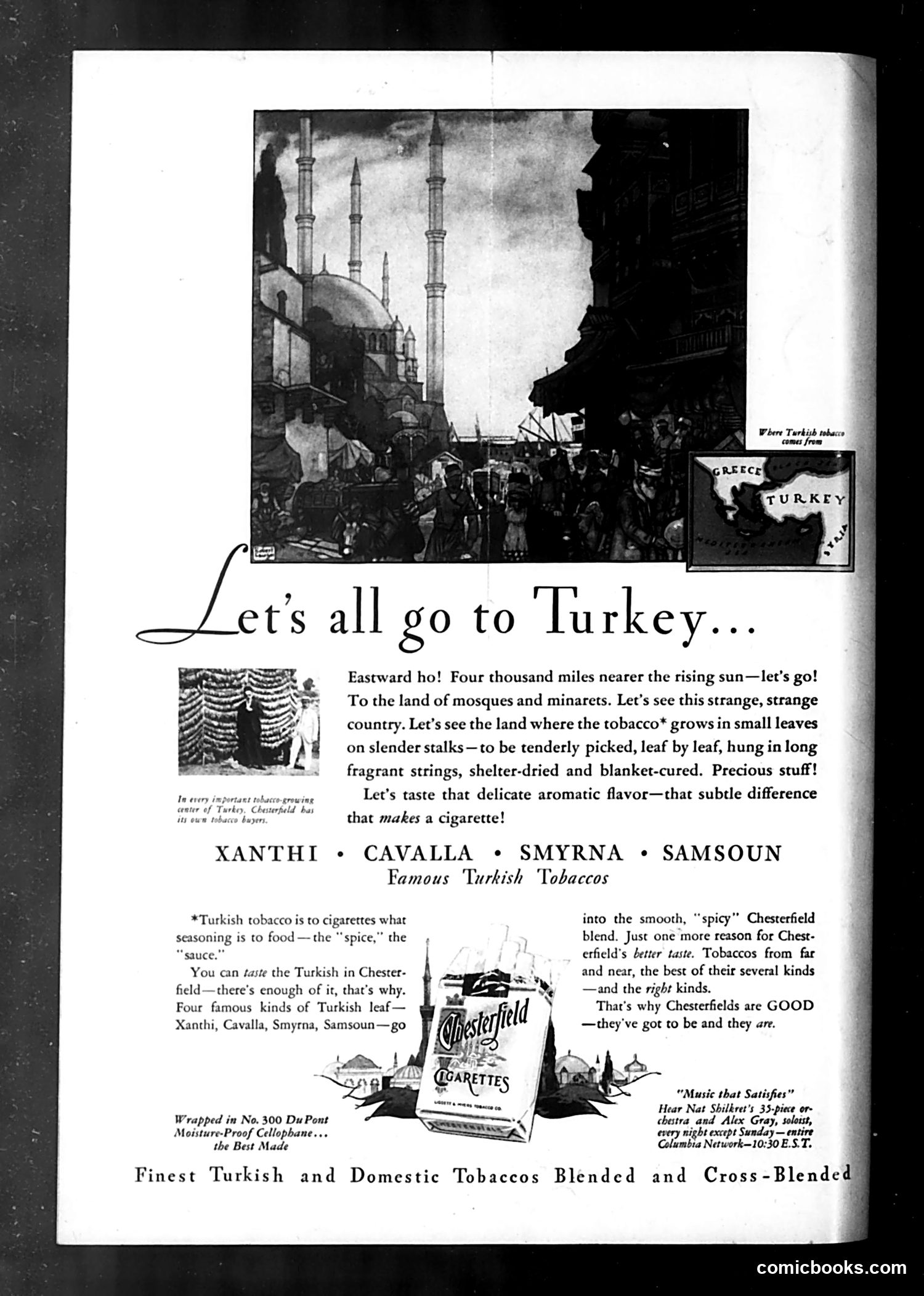
Analysis This is a Chesterfield cigarette advertisement, not satire or political commentary. The page uses exotic travel imagery to market Turkish tobacco blends. The ad invites readers on an imaginary journey ("Eastward ho!") to Turkey to explore tobacco cultivation, describing picturesque scenes of mosques, minarets, and traditional harvesting methods. Four specific Turkish tobacco varieties are named: Xanthi, Cavalla, Smyrna, and Samsoun—all real Ottoman-era tobacco regions. The marketing strategy positions Turkish tobacco as a premium ingredient comparable to fine seasoning, emphasizing that Chesterfield cigarettes contain genuine Turkish leaf blended with domestic tobaccos for superior "spicy" flavor. A Chesterfield cigarette package is illustrated prominently. The ad includes a radio promotion tie-in at bottom, referencing a music program on the Columbia Network. This reflects early-to-mid 20th-century advertising that leveraged romanticized orientalism and international exoticism to sell consumer goods.

I cannot reliably analyze this page. The image is almost entirely black with only a white margin visible on the left side and minimal text legible at the bottom ("comicbooks.com"). The OCR text provided appears corrupted or incomplete, showing only garbled characters. To properly explain the cartoon's political/social references, historical context, and satirical intent—as requested—I would need a clearer, readable image showing the actual artwork and legible text. If you have a higher-quality or better-scanned version of this Life magazine page, please share that, and I'll be happy to provide the historical analysis you're seeking.