life
Life — May 1932
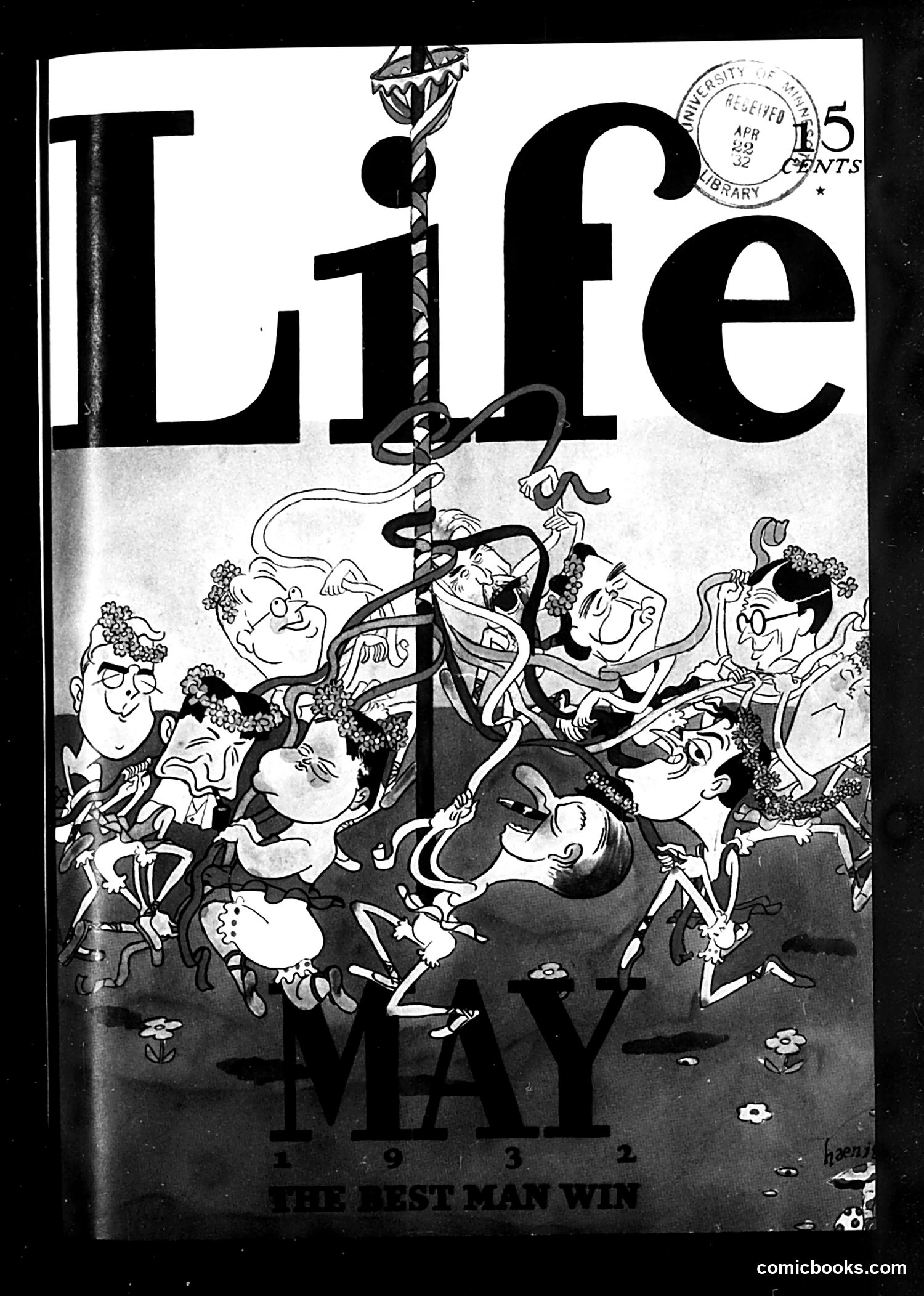
Life Magazine Cover Analysis This is a Life Magazine cover from 1932 (dated April 29, based on the library stamp) priced at 15 cents. The cover depicts "The Best Man Win," showing a caduceus (medical/commercial symbol) surrounded by caricatured figures in what appears to be a competitive struggle or "pile-on." The exaggerated cartoon faces suggest political or business rivals competing fiercely. Given the 1932 date during the Great Depression, this likely satirizes competition for resources, jobs, or political power during economic crisis. The chaotic tangle of figures grasping and climbing suggests the desperation and ruthless scramble for survival characteristic of that era. The specific identities of the caricatures are unclear without additional context, but the overall message critiques the brutal, cutthroat nature of American competition during economic hardship.
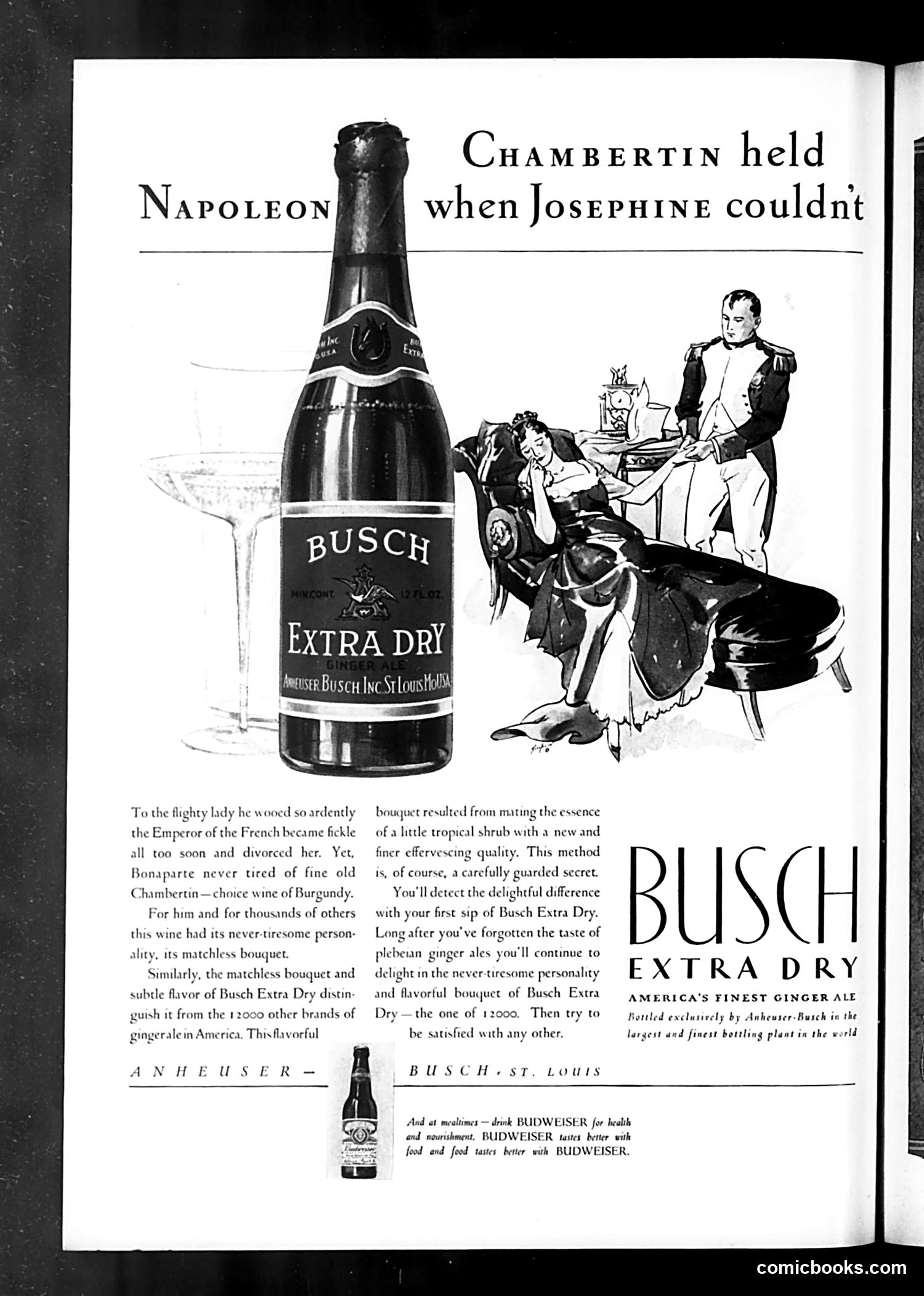
Busch Extra Dry Advertisement This is a beer advertisement rather than political satire. The headline "Napoleon held Chambertin when Josephine couldn't" references the historical figures Napoleon and Josephine to evoke luxury and exclusivity. The ad's narrative claims that Napoleon loved fine Burgundy wine (Chambertin), and when Josephine was unavailable, he turned to Busch Extra Dry ginger ale as a substitute. The accompanying illustration shows an elegantly dressed couple in period costume, positioned to suggest romantic refinement. The advertisement attempts humor by comparing ginger ale to Napoleon's prestigious wine tastes, while positioning Busch as an acceptable alternative for the discerning drinker. It emphasizes the product as "America's finest ginger ale," bottled by Anheuser-Busch in St. Louis.
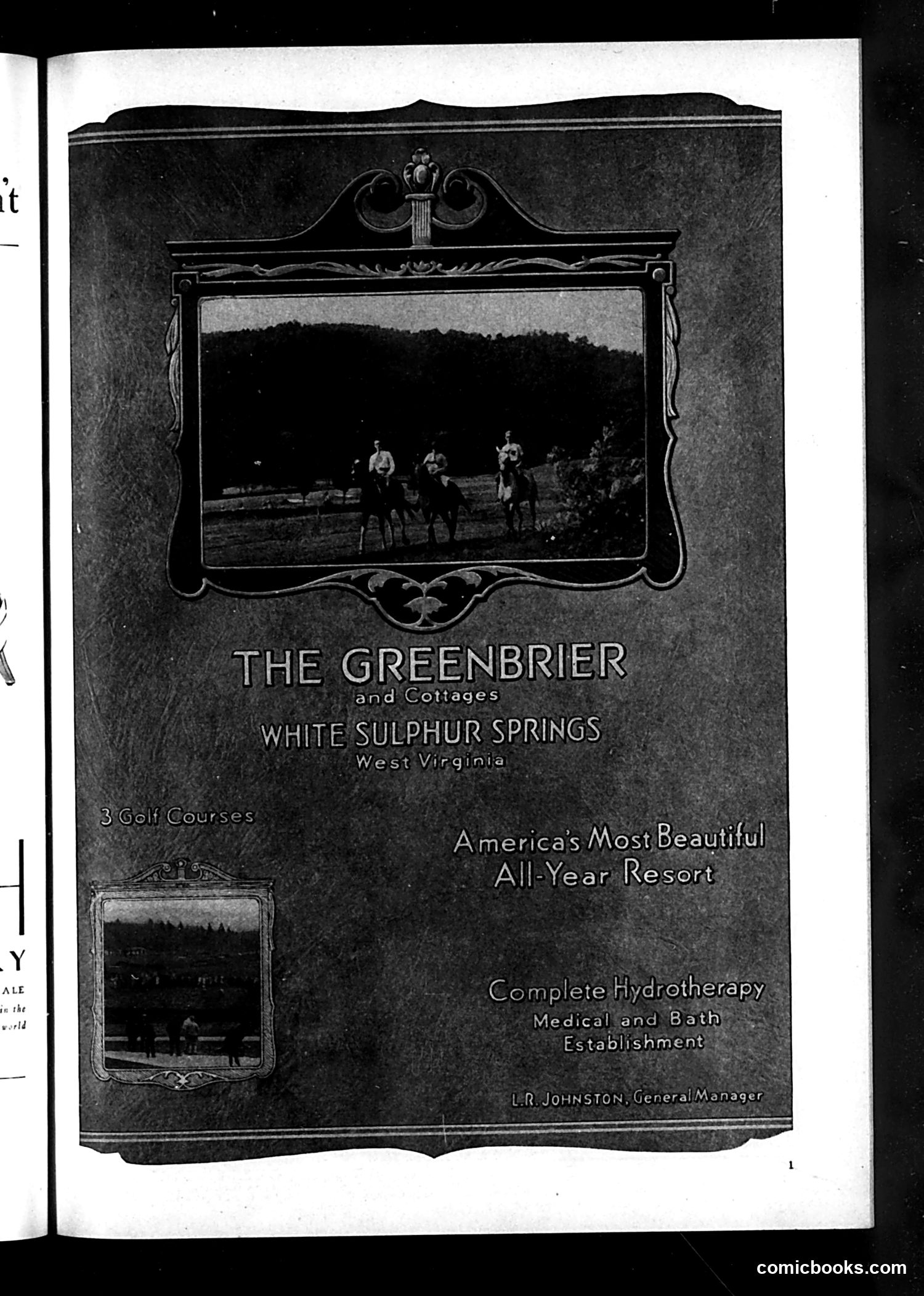
Page Analysis This appears to be an advertisement page rather than satirical content. It promotes "The Greenbrier and Cottages" resort at White Sulphur Springs, West Virginia, marketed as "America's Most Beautiful All-Year Resort." The page advertises: - 3 golf courses - Complete hydrotherapy medical and bath establishment - L.R. Johnston as General Manager The image shows people on horseback in a pastoral landscape, emphasizing the resort's recreational and leisure amenities. This is a straightforward promotional piece from *Life* magazine, likely from the early 20th century, targeting wealthy Americans seeking resort destinations and health-focused spa treatments—common attractions during that era.
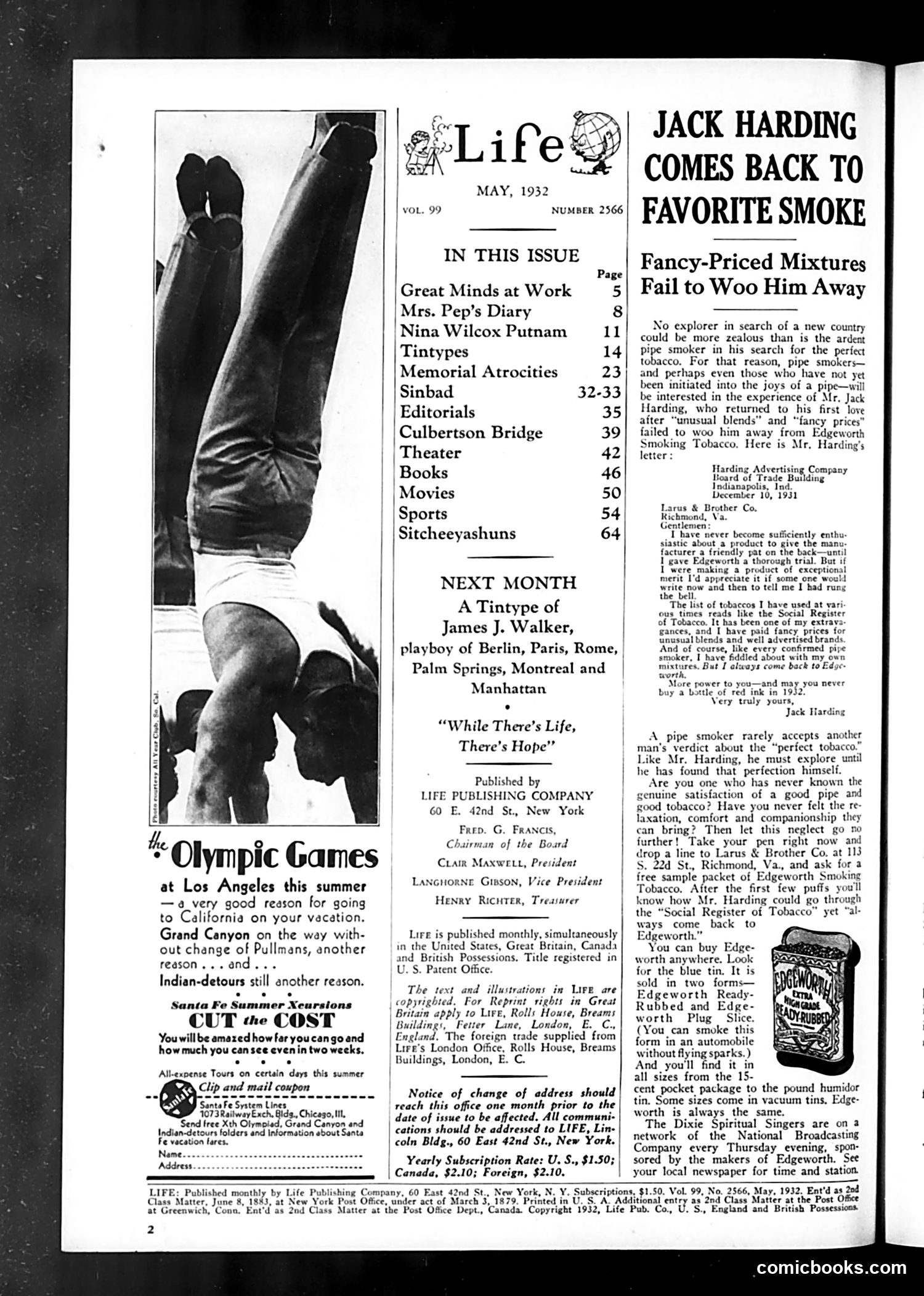
Analysis of This Life Magazine Page (May 1932) This page contains primarily advertising and editorial content, not political cartoons. The main visual is a photograph of an Olympic diver in mid-dive, promoting the 1932 Los Angeles Olympic Games. The substantive content is an advertorial letter from Jack Harding about pipe tobacco. Harding describes his search for the "perfect" smoking blend, expressing frustration that "fancy-priced mixtures" from competitors failed to satisfy him. He endorses Edgeworth brand tobacco as superior, claiming it offers genuine quality without inflated prices. The piece uses humor to position Edgeworth as the authentic choice for discerning smokers, contrasting it with overpriced competitors. This represents straightforward consumer advertising disguised as personal testimony—a common 1930s marketing technique.
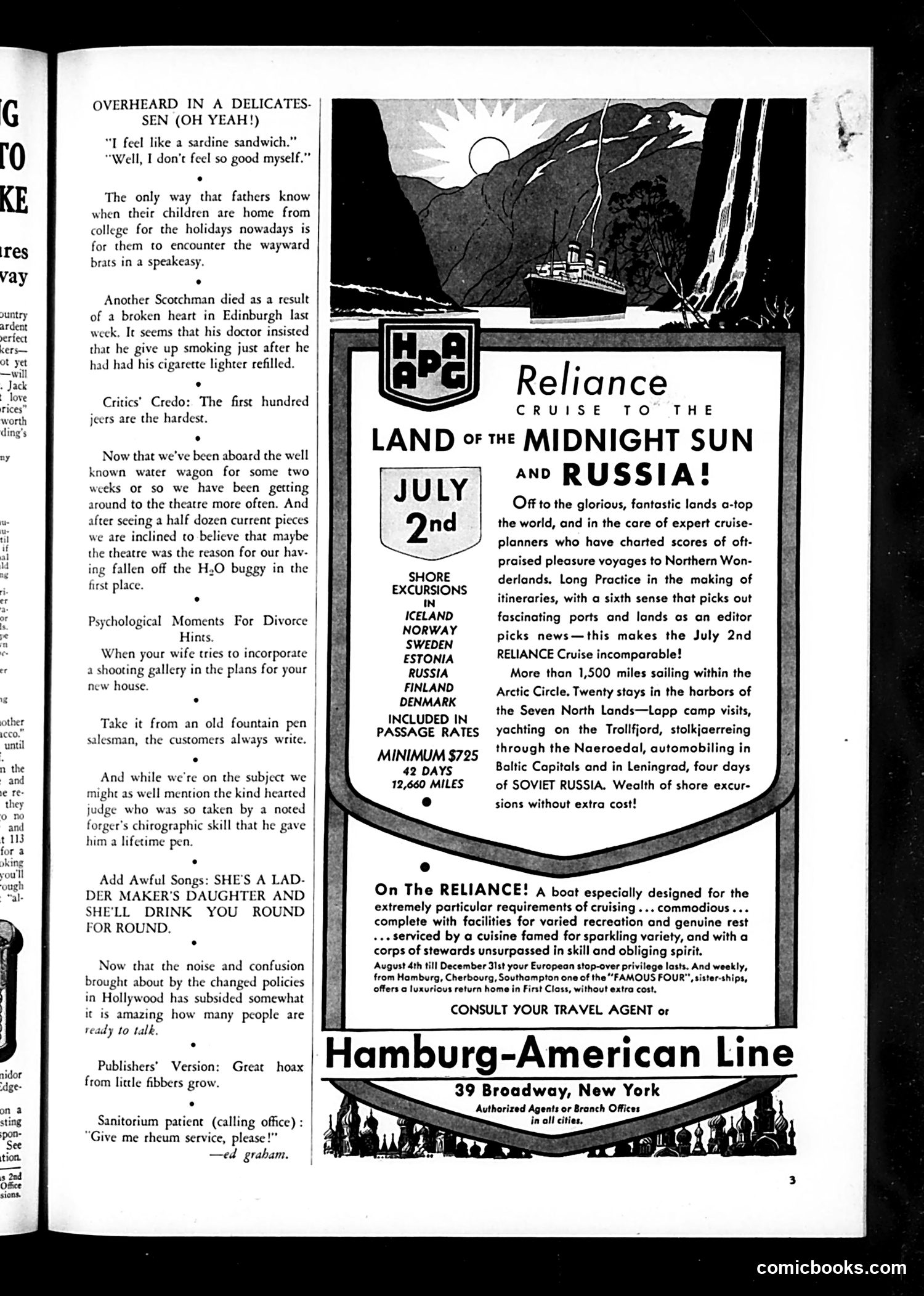
Content Analysis This page is primarily advertising, not satire or political commentary. The dominant feature is a large Hamburg-American Line cruise advertisement promoting the *Reliance* ship departing July 2nd for Northern Europe and Russia, offering 42-day voyages starting at $725. The left column contains brief humor items under "OVERHEARD IN A DELICATESSEN" — casual jokes about fathers discovering college-age children home for holidays, a Scotsman dying of a broken heart, and marital advice. These are lightweight observational humor pieces typical of *Life* magazine's humor section, not political cartoons. The advertisement itself depicts a stylized ship and Nordic landscape, appealing to travelers interested in exotic destinations during what appears to be the 1920s-1930s era.
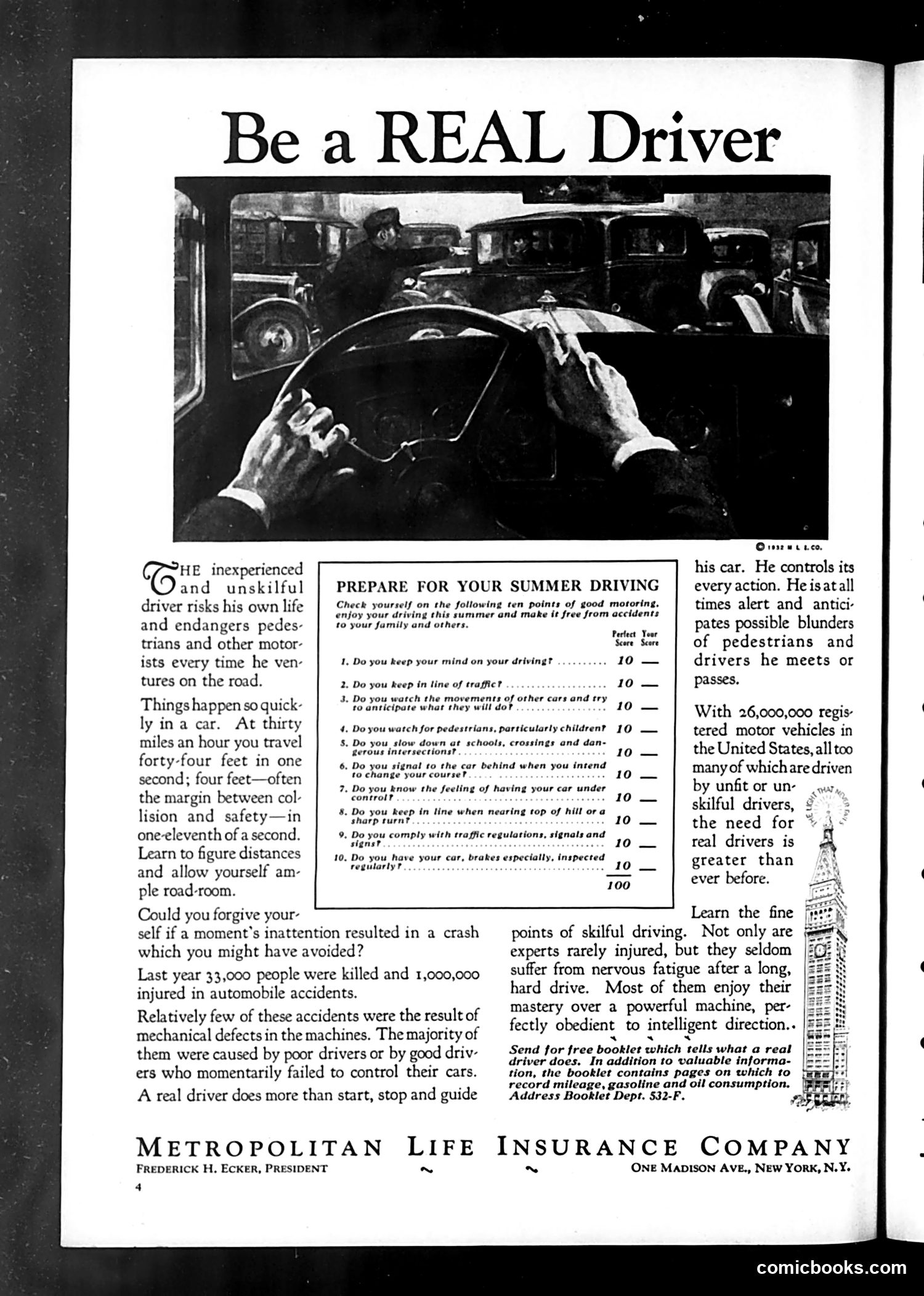
"Be a REAL Driver" — Metropolitan Life Insurance Ad This is a safety advertisement by Metropolitan Life Insurance, not satire. The page promotes responsible summer driving through a self-assessment checklist (10 questions scoring up to 100 points). The black-and-white photograph shows hands gripping a steering wheel, emphasizing driver control. The ad argues that most accidents result from driver error rather than mechanical failure: "The majority of them were caused by poor drivers or by good drivers who momentarily failed to control their cars." The message targets inexperienced or careless drivers, contrasting them with "real drivers" who master vehicle control through attentiveness and skill. The ad offers a free booklet on proper driving technique, reflecting early 20th-century automotive safety concerns as car ownership expanded and traffic fatalities rose.
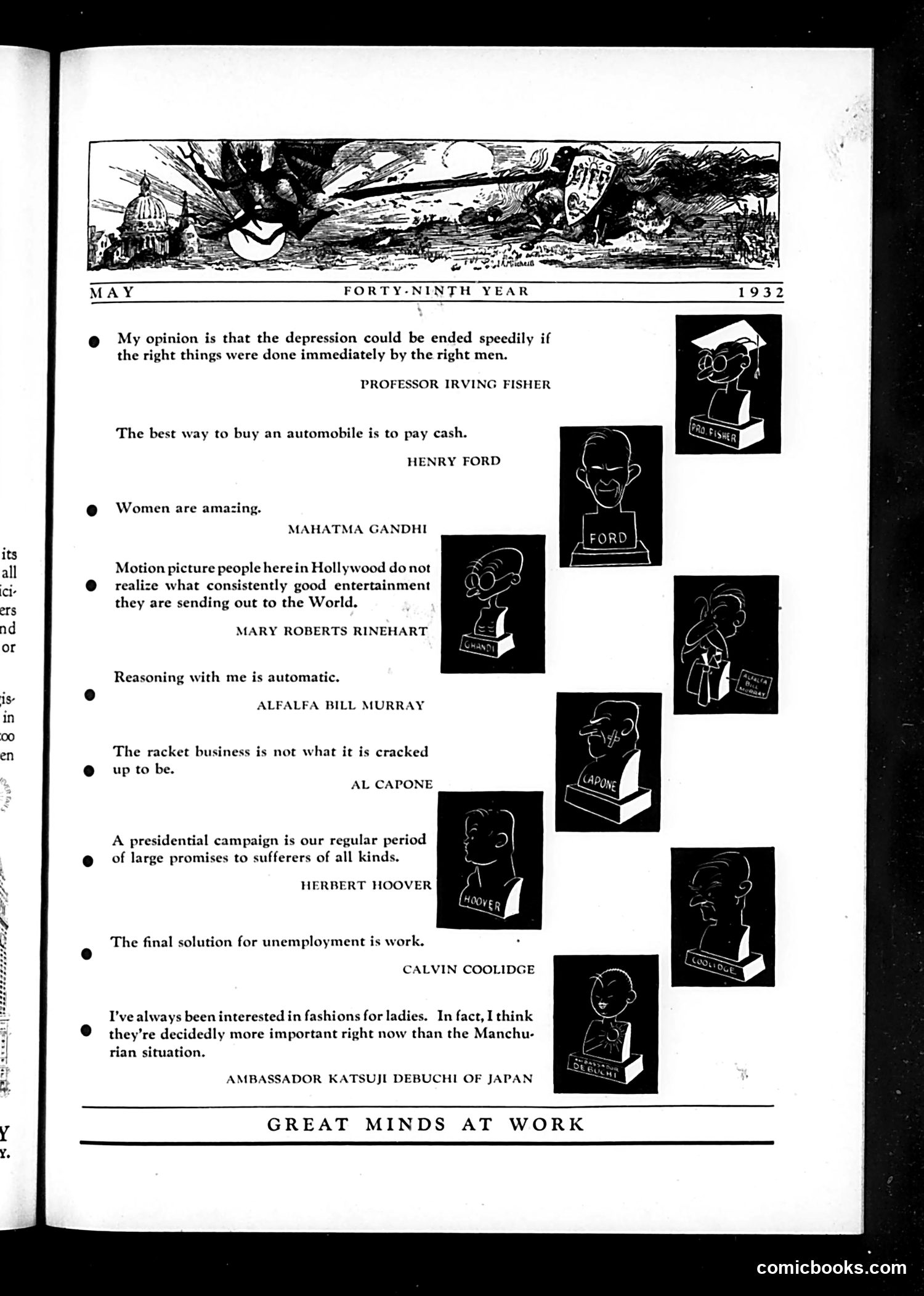
"Great Minds at Work" - Life Magazine, May 1932 This page presents satirical quotes from prominent public figures during the Great Depression. Each quote appears alongside a caricatured bust, mocking the disconnect between leaders' statements and economic reality. Key figures and satire: - Henry Ford on buying cars with cash—absurd when millions are unemployed - Herbert Hoover on presidential campaigns making "large promises"—critiquing Depression-era political rhetoric - Calvin Coolidge claiming "work" solves unemployment—simplistic during systemic collapse - Al Capone on the racket business—darkly comparing organized crime to legitimate enterprise The overall satire attacks these "great minds" for offering platitudes or self-serving commentary while Americans suffer economic devastation. The title itself is ironic—these aren't actually great minds addressing real solutions.
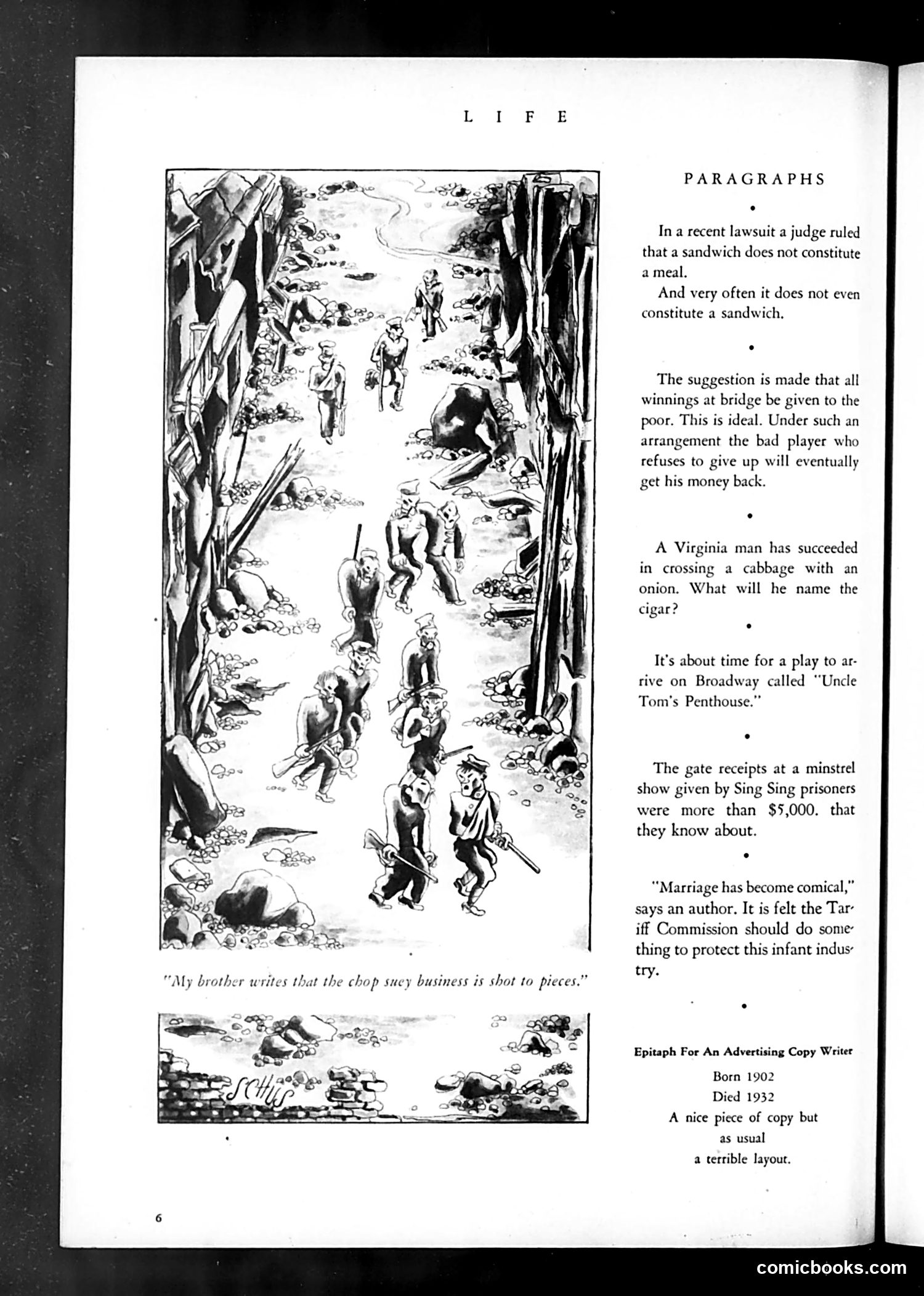
Analysis of Life Magazine Page This page contains a large cartoon showing people working in what appears to be a canyon or quarry, with the caption "My brother writes that the chop suey business is shot to pieces." The joke references the economic collapse of Chinese restaurants during the Great Depression era. The "Paragraphs" section contains brief humorous items satirizing contemporary society: a lawsuit about sandwich definitions, bridge winnings for the poor, agricultural crossbreeding experiments, Broadway productions, and a minstrel show's gate receipts. The final item mockingly eulogizes an advertising copywriter (1902-1932) as having "a terrible layout"—a pun on both the copywriter's death and advertising terminology. The overall tone reflects 1930s American satirical humor about Depression-era economics and social absurdities.
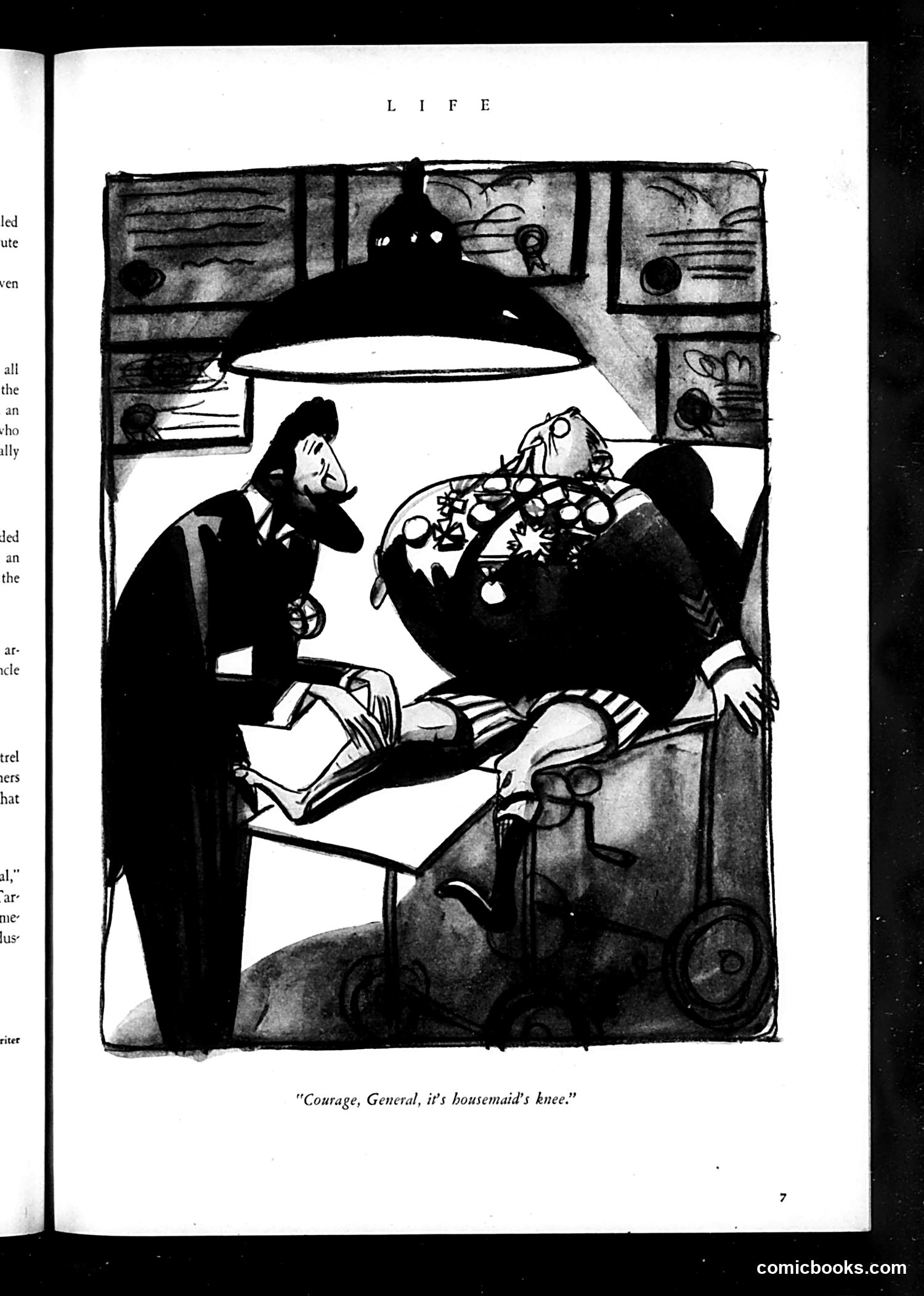
Political Cartoon Analysis This cartoon appears to be a WWI-era satirical piece from *Life* magazine. It depicts a military general (identifiable by uniform and insignia) receiving news from what appears to be a subordinate officer or messenger. The central figure, labeled as a "housemaid's knee," suggests an injury or ailment—likely referencing "housemaid's knee," a real medical condition (bursitis). The satire targets military leadership, possibly mocking generals for treating minor injuries seriously or using health concerns as excuses. The ornate, decorated uniform covered in medals contrasts with the trivial nature of the ailment mentioned, emphasizing the cartoon's mockery of pompous military authority prioritizing minor complaints over actual wartime duties. The specific general depicted remains unclear without additional context.
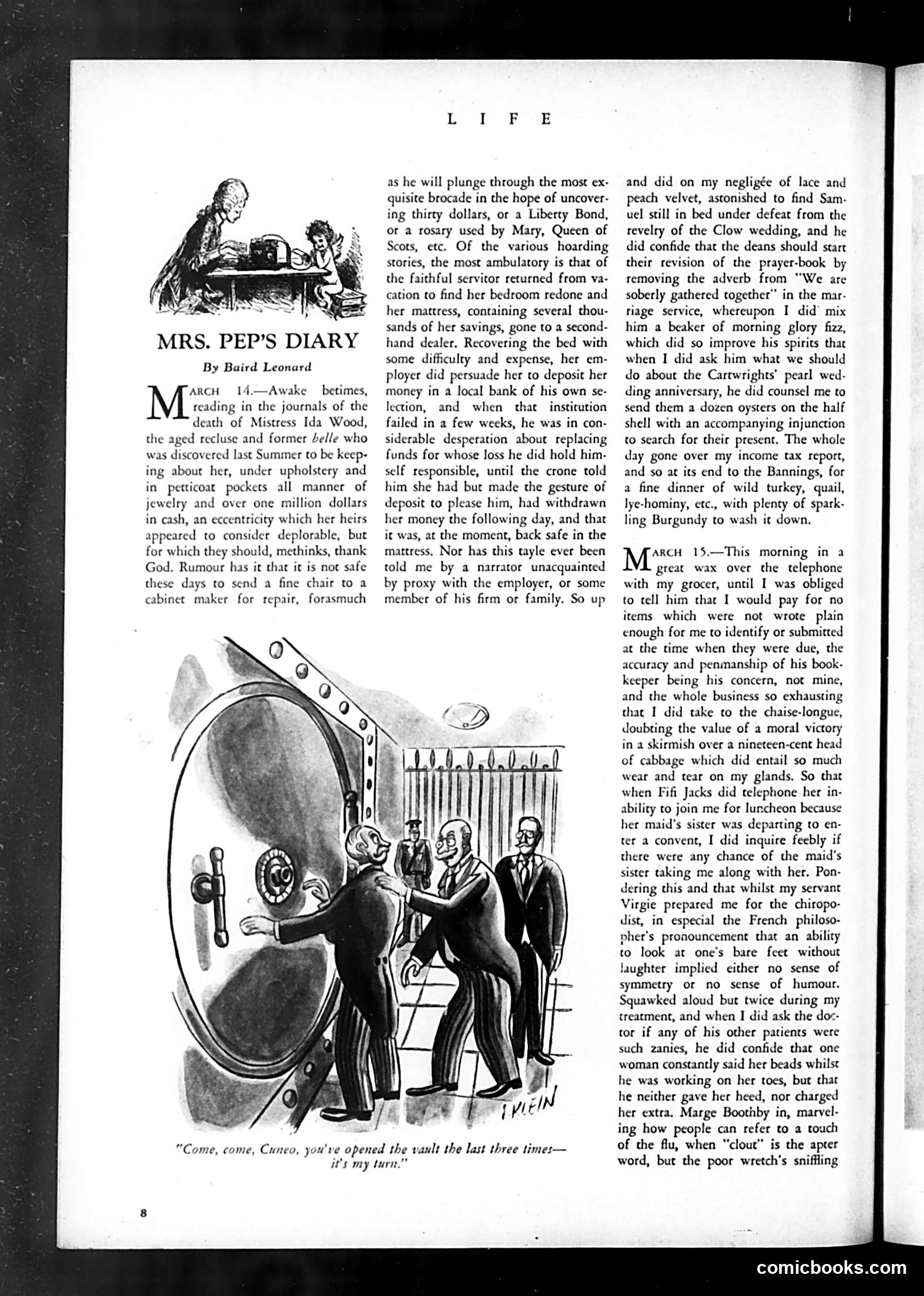
Analysis of "Mrs. Pep's Diary" Page This is a humorous domestic advice column by Baird Leonard featuring the fictional Mrs. Pep. The main cartoon depicts a large bank vault being opened by several men in suits, illustrating a story about a servant who discovered hidden jewelry and over one million dollars in cash belonging to the deceased mistress Ida Wood. The satire targets wealthy society women's financial irresponsibility and secretive hoarding of valuables. The "diary" format mocks advice columnists while documenting upper-class domestic absurdities—including disputes over tea, prayer-book corrections, and chiropodist visits. The humor relies on depicting the petty concerns and moral vanities of privileged households, contrasting them with servants' practical struggles. This reflects 1920s-30s social commentary on class disparities.
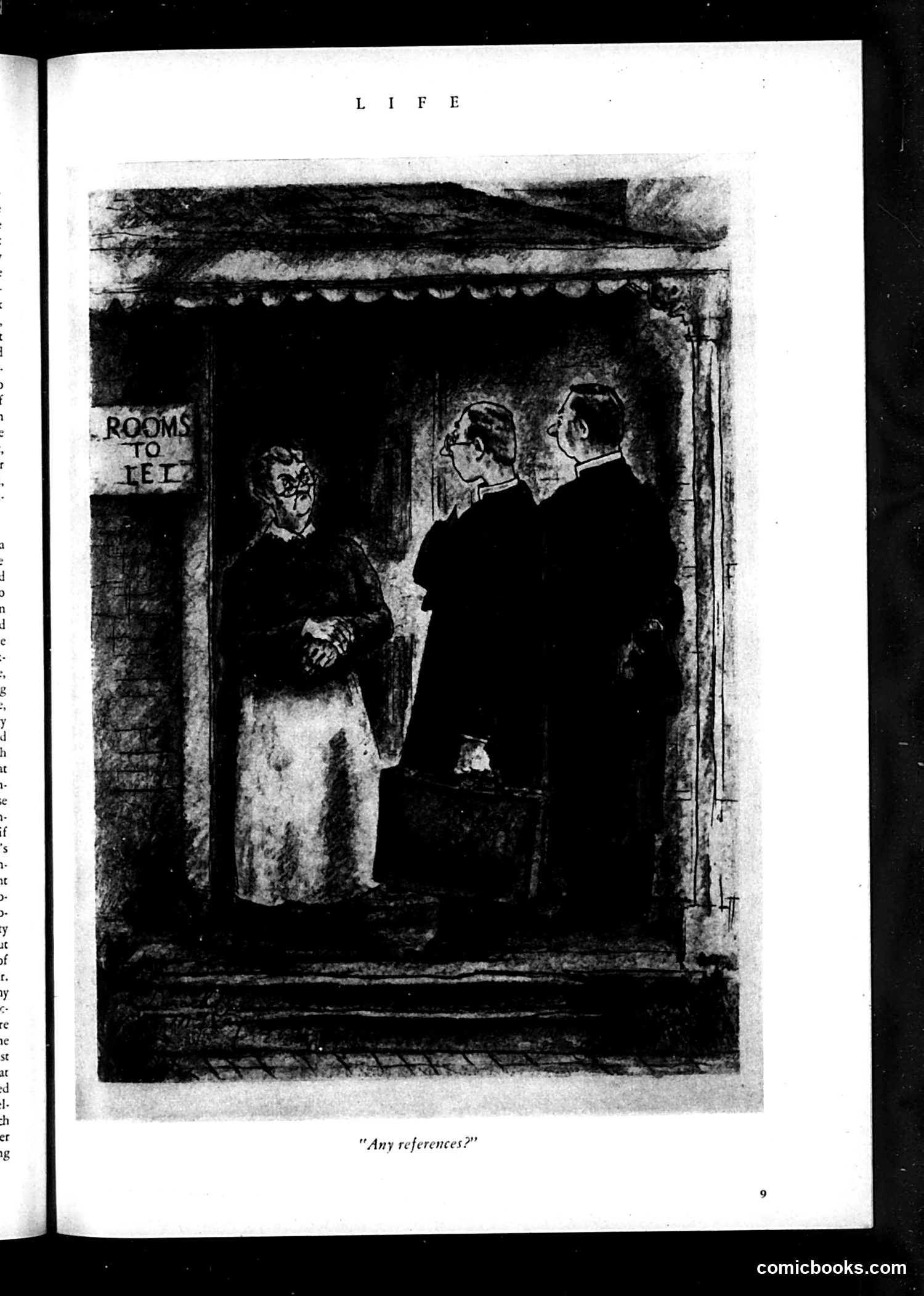
Analysis This single-panel cartoon depicts three men in a hallway outside a "ROOMS TO LET" sign. Two well-dressed gentlemen in dark suits appear to be prospective tenants speaking with a landlord or property manager on the left. The caption reads "Any references?" The joke satirizes the practice of landlords requiring references from potential renters. In this era, "references" typically meant character witnesses or proof of respectability—often tied to social status or connections. The humor lies in the implication that these two formally-dressed men, who appear respectable by their clothing alone, are being subjected to the standard bureaucratic requirement for references, suggesting either that appearances are deceptive or that even obviously "suitable" candidates face this tedious formality. The cartoon mocks the rigidity of rental application procedures.
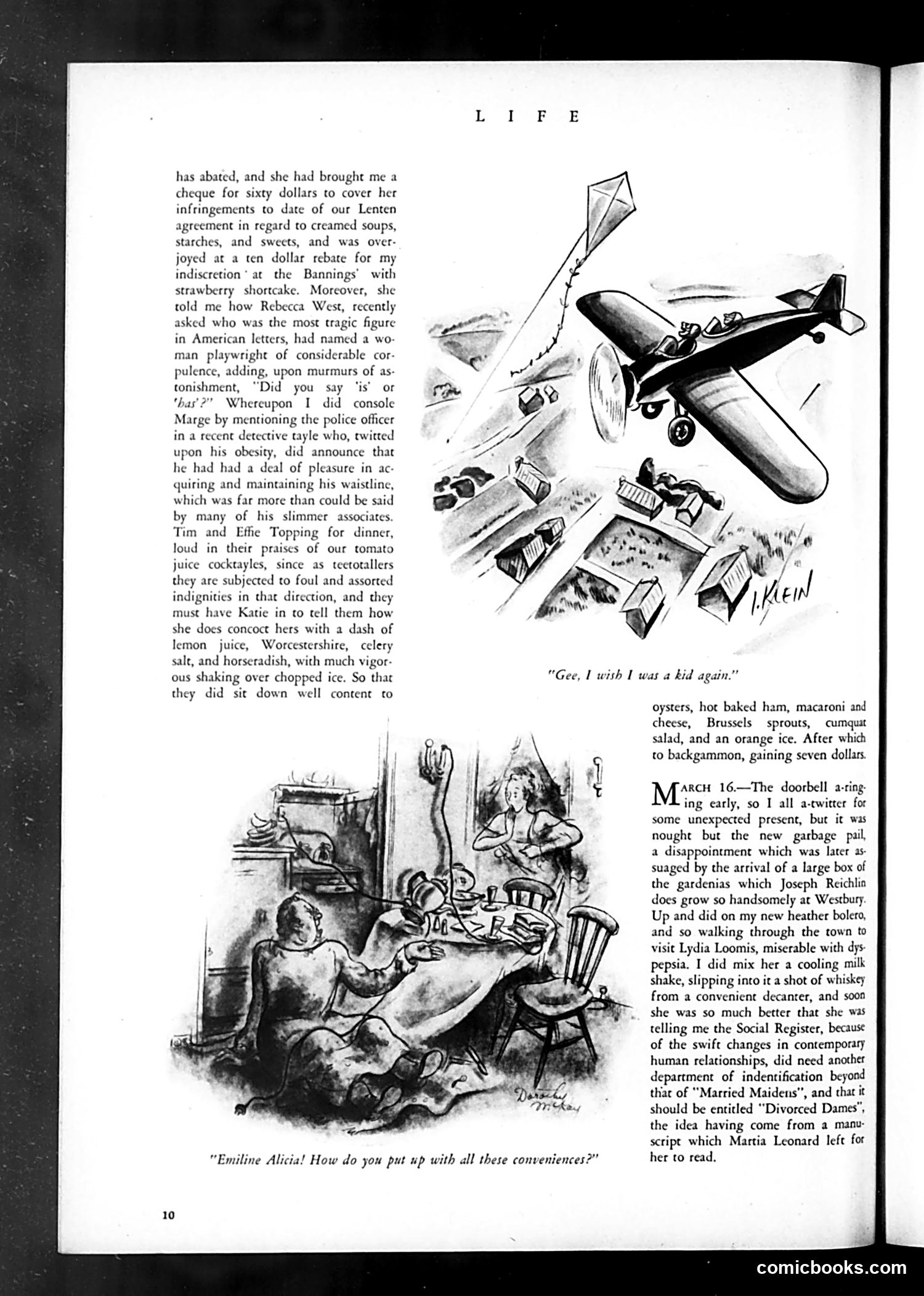
Analysis of Life Magazine Page 10 This page contains two satirical illustrations with accompanying narrative text about social life and dining. The upper cartoon ("Gee, I wish I was a kid again") depicts toys and recreational items scattered around an airplane, satirizing adult pastimes and nostalgia. The lower cartoon ("Emelie Alicia! How do you put up with all these conveniences?") shows a woman surrounded by modern household appliances and conveniences, appearing overwhelmed or exasperated. The satire targets the irony that modern conveniences—meant to simplify life—actually complicate it, creating frustration rather than leisure for women managing these technologies. The accompanying text discusses social gatherings, meals, and contemporary relationship dynamics, suggesting this reflects 1920s-30s upper-middle-class social anxieties about modernity and changing gender roles.
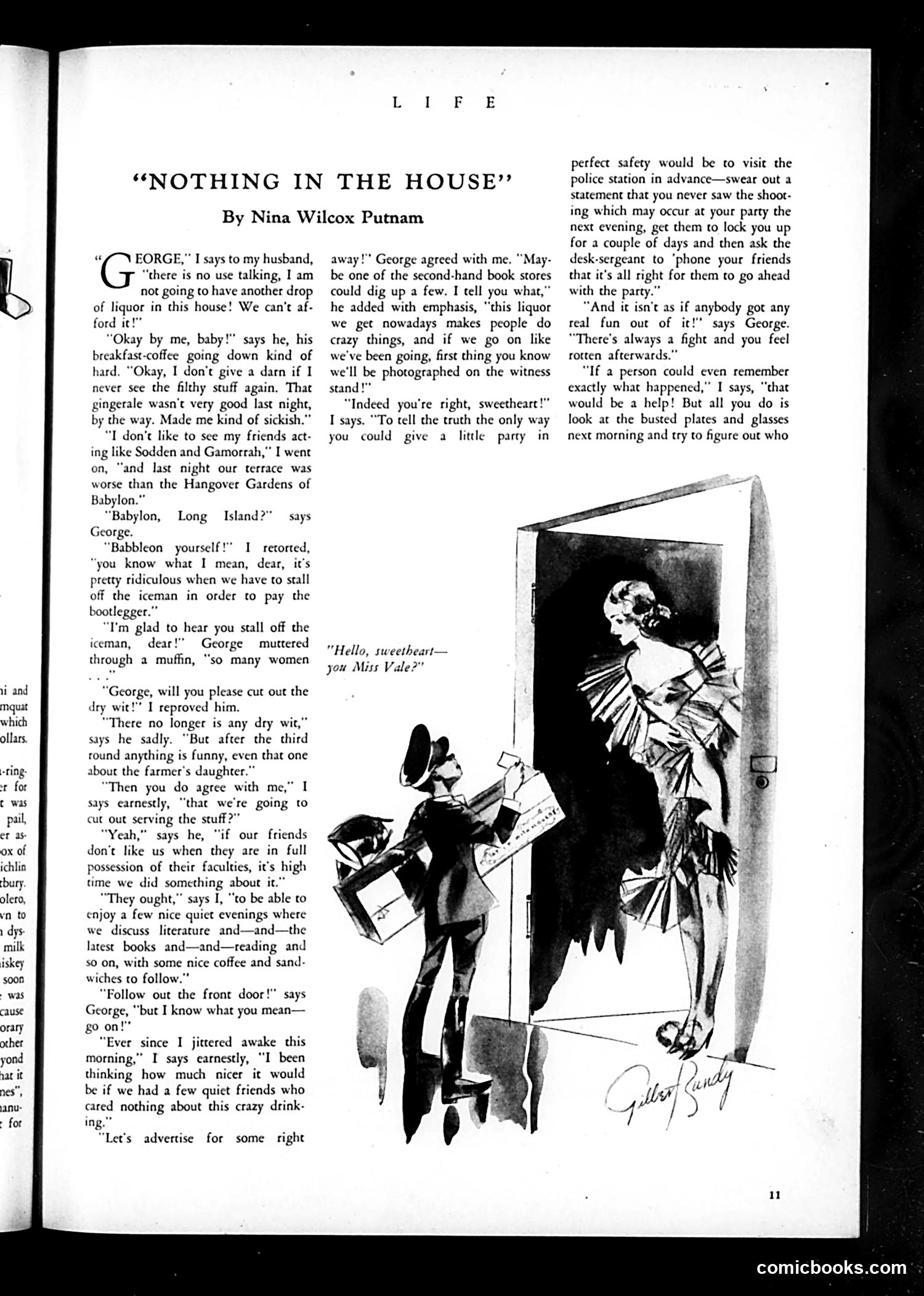
"Nothing in the House" by Nina Wilcox Putnam This is a humorous domestic story about a couple debating whether to host a party. George refuses, citing "nothing in the house" to serve guests—no liquor. His wife argues they could have a pleasant gathering discussing literature and ideas with "nice coffee and sandwiches." The accompanying illustration shows a woman greeting a man at a doorway, captioned "Hello, sweetheart—you Miss Vale?" The cartoon likely depicts the wife's vision: an elegant, refined social gathering. The satire targets Prohibition-era constraints on entertaining. The husband's complaint reflects real anxiety about hosting without alcohol during the 1920s-early 1930s, when serving liquor was illegal. The wife's alternative—intellectual conversation—represents idealistic views about what "proper" socializing should be, contrasting with the era's actual party culture.
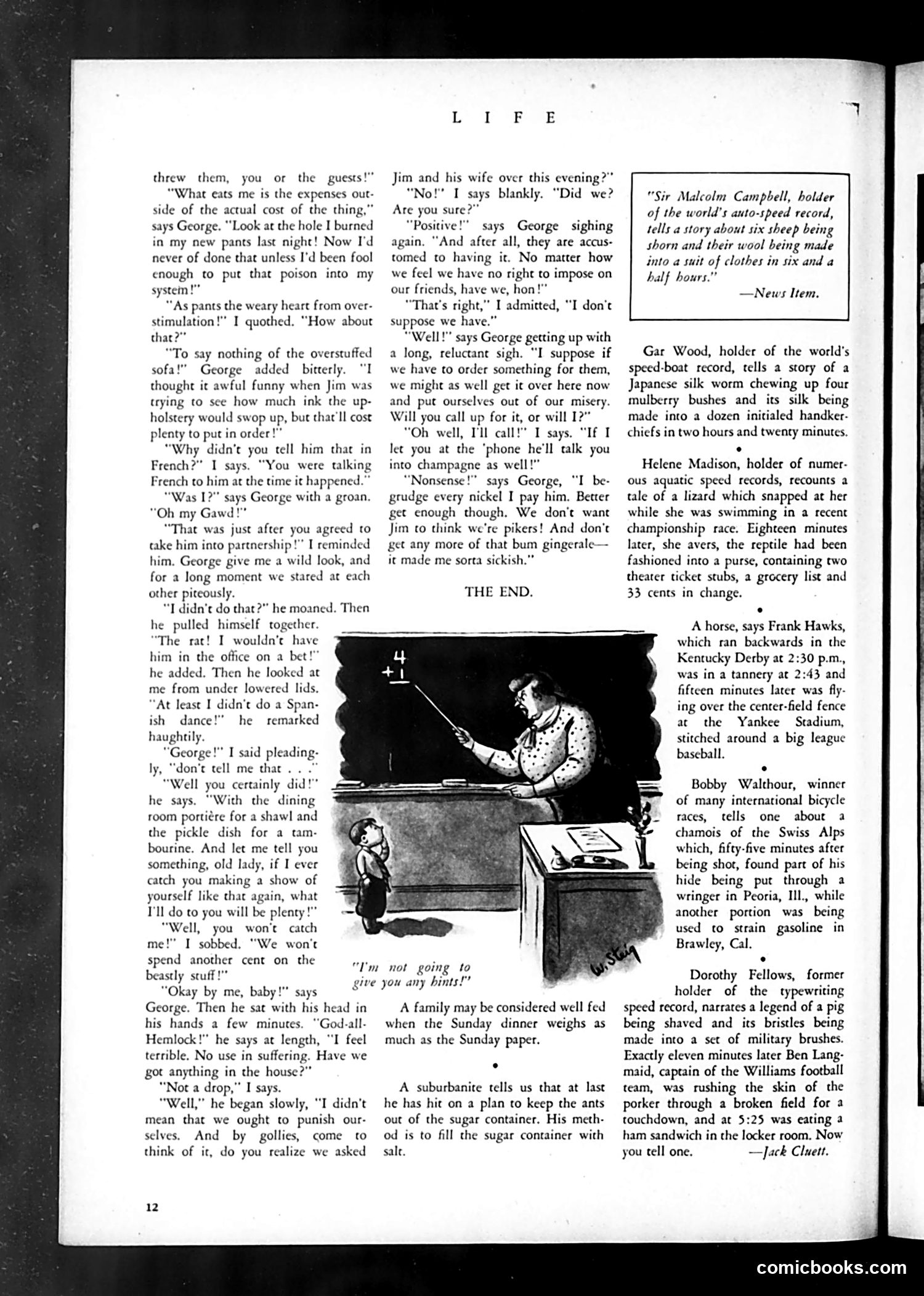
Analysis of Life Magazine Page 12 This page contains the conclusion of a domestic comedy story about a married couple, George and his wife, arguing over dinner expenses and entertaining guests. The narrative satirizes middle-class anxieties about social appearances and financial constraints during what appears to be an economically tight period. The two cartoons illustrate the couple's escalating tension: the upper panel shows a man at a desk making a phone call about ordering champagne; the lower panel depicts him refusing to provide "hints" to his wife about dinner preparations. The accompanying "News Items" feature brief, humorous anecdotes about various record-holders and unusual incidents—a common Life magazine format mixing satire with quirky human-interest stories. The overall tone mocks domestic bickering and social pretension among the middle class.
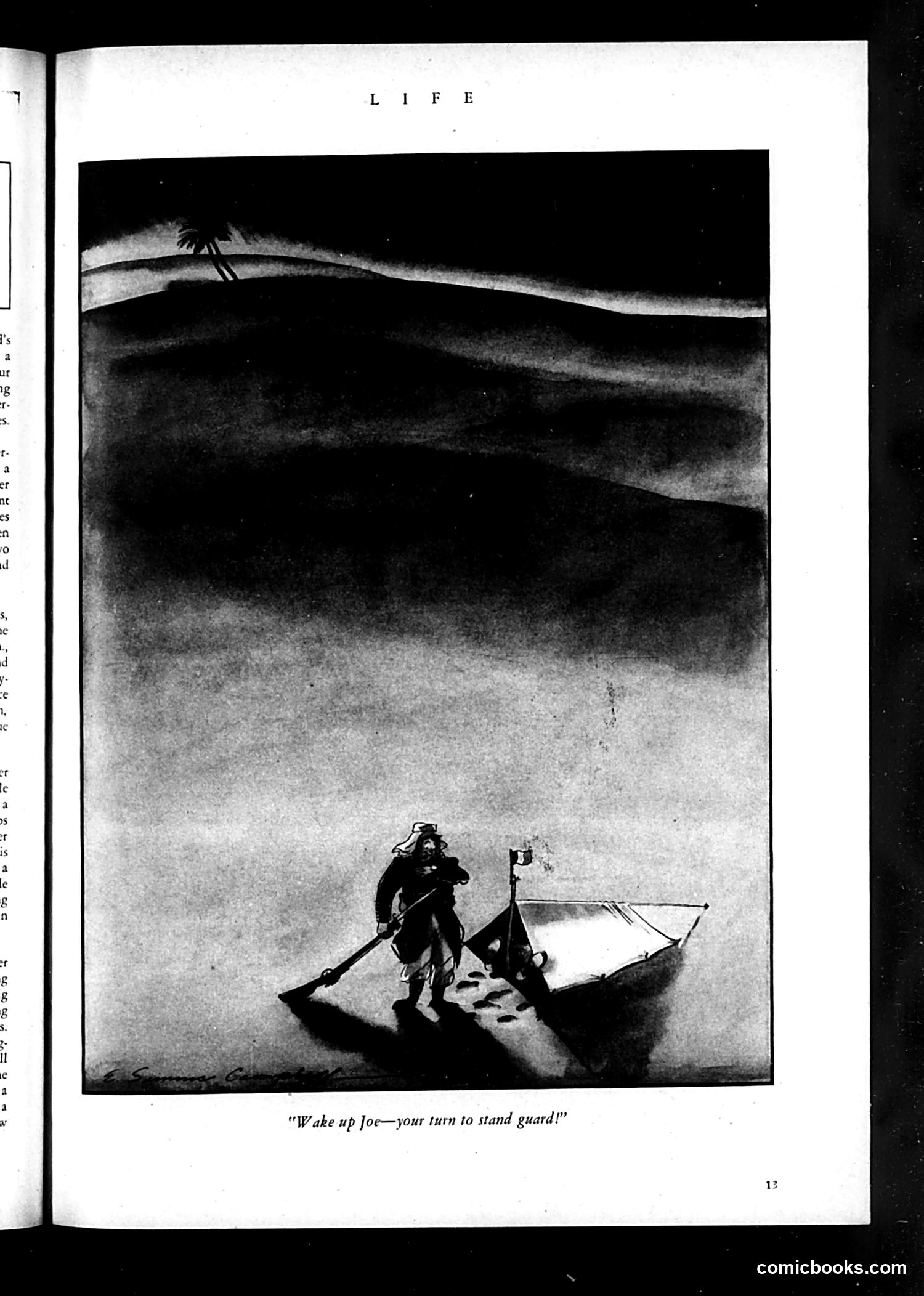
Analysis This page from *Life* magazine shows a satirical illustration depicting a figure standing on a small boat or raft in shallow water, holding an oar. Another figure appears to be sleeping or reclining in the boat. The caption reads: "Wake up Joe—your turn to stand guard!" The cartoon appears to be a military or wartime satire, likely referencing duty rotations or watch schedules aboard a vessel. The humor derives from one soldier neglecting his guard duty while the other must take over. Without additional context about the publication date or surrounding articles, I cannot definitively identify the specific historical event or military situation being referenced, though the illustration style and subject matter suggest this is from the early-to-mid 20th century.
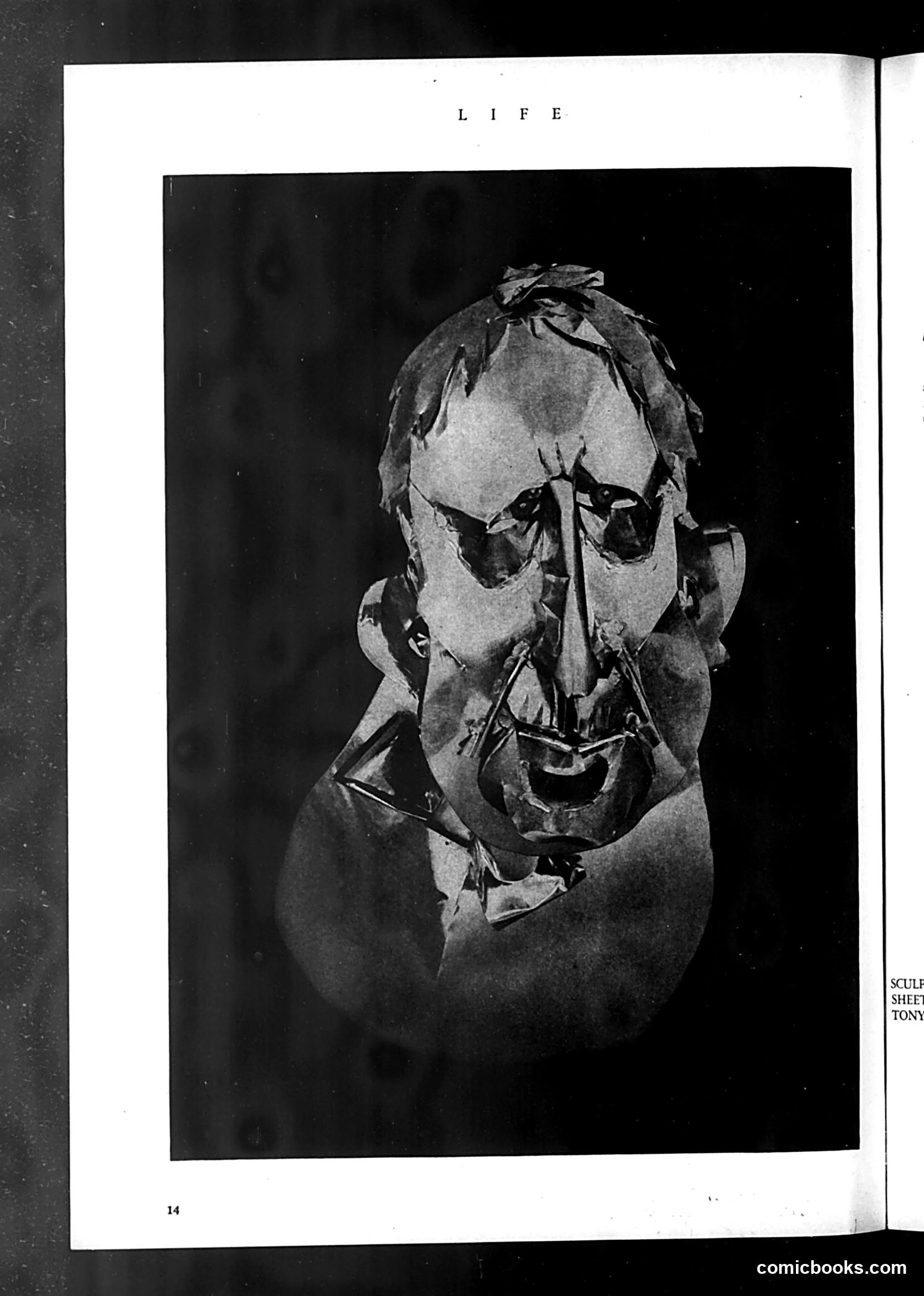
Analysis This page from *Life* magazine shows a sculptural bust photograph against a black background. The page header reads "LIFE" and the bottom indicates page 14. Partial text on the right margin appears to reference "SCULP," "SHEET," and "TONY," though the full context is unclear due to the image crop. The sculpture itself depicts a human head with exaggerated, somewhat grotesque features—deep-set eye sockets, prominent cheekbones, and an open-mouthed expression. Without visible identifying captions or the complete OCR text, I cannot definitively identify who this sculpture represents or what specific political or social figure it satirizes. The dramatic lighting and artistic treatment suggest this was likely commentary on a public figure, but the precise target remains unclear from this page alone.
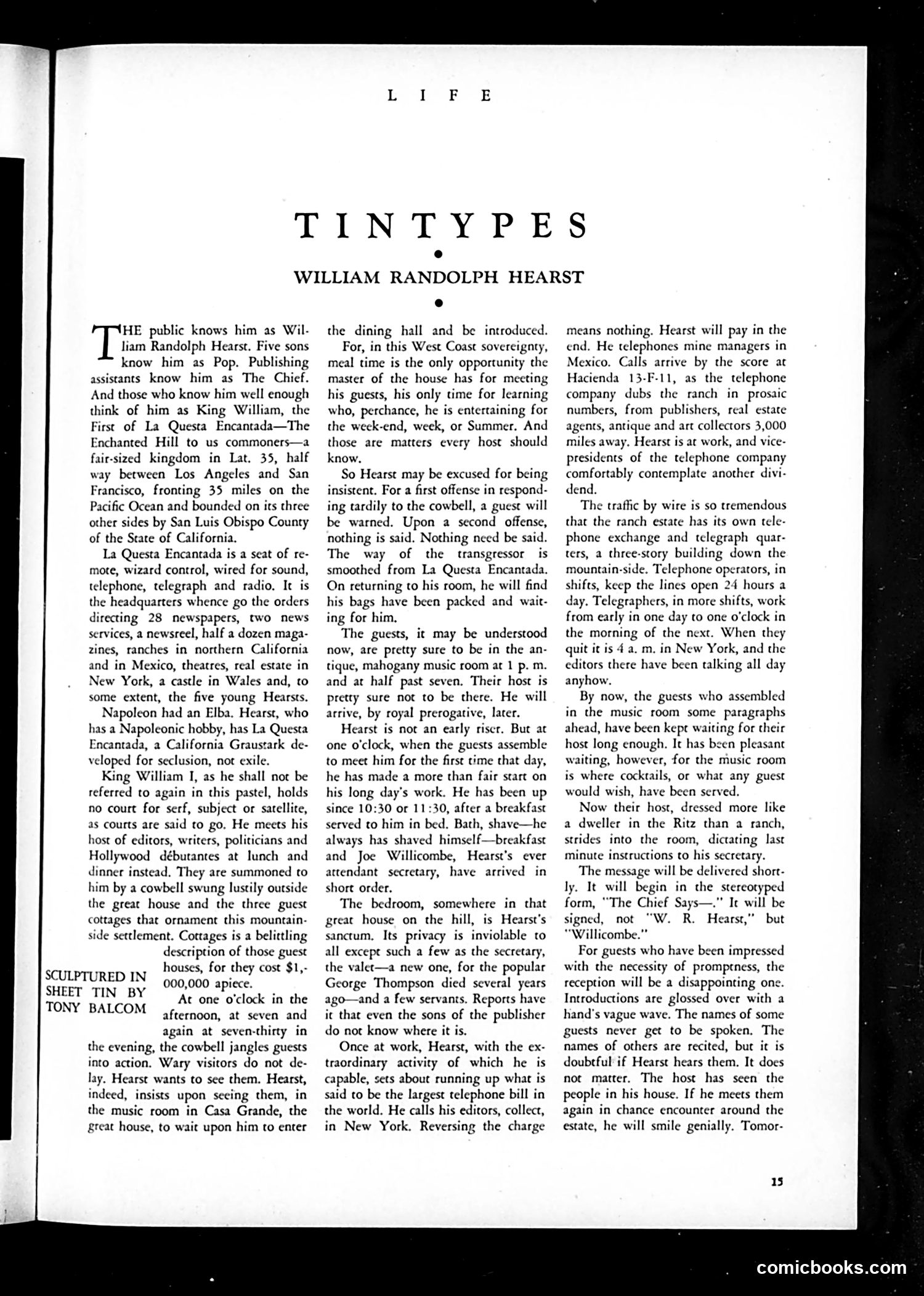
"Tintypes: William Randolph Hearst" This is a satirical profile of newspaper magnate William Randolph Hearst. The accompanying tin illustration (by Tony Balcom) depicts Hearst as a controlling figure—the text supports this characterization. The satire targets Hearst's notorious micromanagement: he operates 28 newspapers, controls wire services, and maintains constant long-distance communication with editors via telephone and telegraph. The piece mocks his obsessive involvement in trivial details—even dictating dinner invitations from his California estate. The humor emphasizes the absurdity of his power: he interrupts guests' meals, demands punctual appearances, and personally manages operations across the country. The "tintype" format suggests Hearst is being reduced to a flattened, fixed image—frozen in his controlling habits. The satire presents him as a domineering media baron unable to delegate or relax.
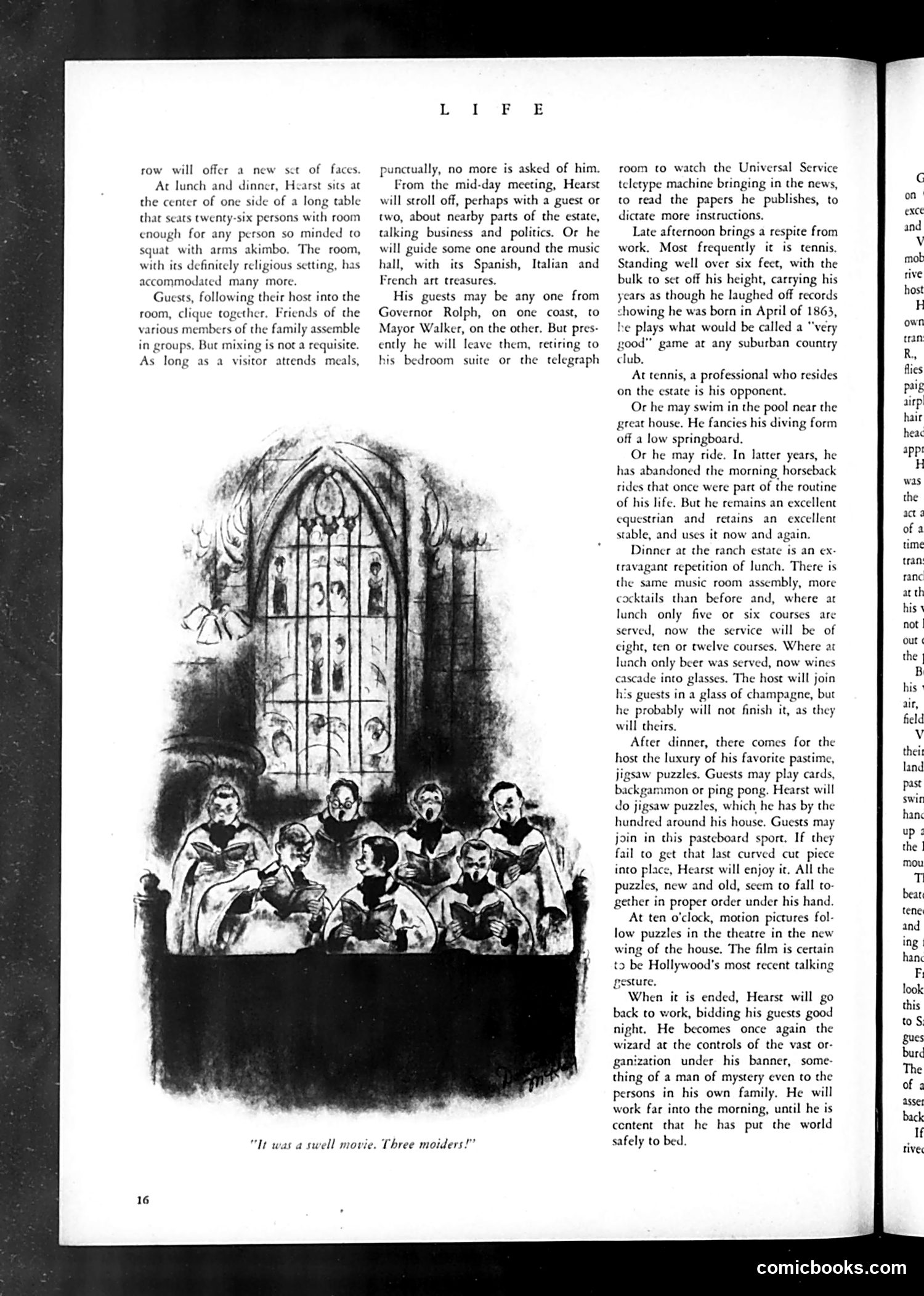
Analysis This page from *Life* magazine features a satirical illustration captioned "It was a swell movie. Three murders!" The image depicts a Gothic cathedral interior with an arched stained-glass window, where a group of well-dressed people (appearing to be society figures) sit dining together. The caption's deadpan praise of a film for its murder count satirizes contemporary entertainment tastes—specifically the public's appetite for sensational crime and violence in movies. The accompanying text discusses leisure activities at a grand estate, including dinner, games, and cinema. The cartoon mocks how even sophisticated audiences find entertainment value primarily in violent spectacle rather than artistic merit, reflecting early 20th-century anxieties about mass culture's effects on taste and morality.
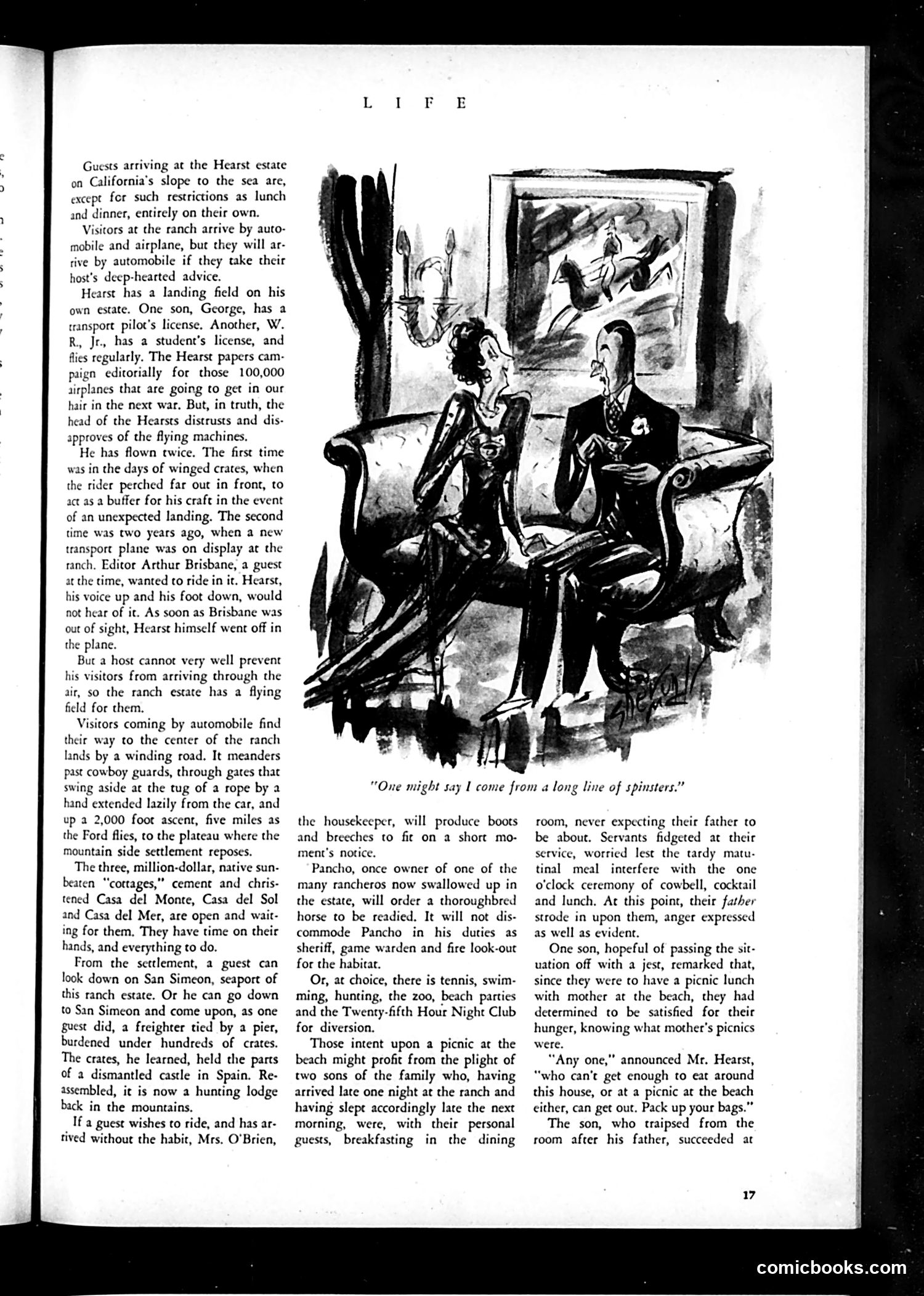
Analysis of Life Magazine Page This page features an illustration accompanying an article about the Hearst estate in California. The cartoon depicts two figures in what appears to be an interior setting, with the caption "One might say I come from a long line of spinsters." The illustration satirizes wealth and leisure at the grand estate. The context discusses guests arriving by automobile and airplane, recreational activities (tennis, swimming, hunting, beach parties), and the casual opulence of ranch life. The "spinster" caption likely jokes about unmarried wealthy women or the pretentious genealogy claims of the wealthy elite. The article emphasizes the estate's scale and amenities, suggesting satire of excessive wealth and the artificial lifestyle it enabled during what appears to be the early-to-mid 20th century.
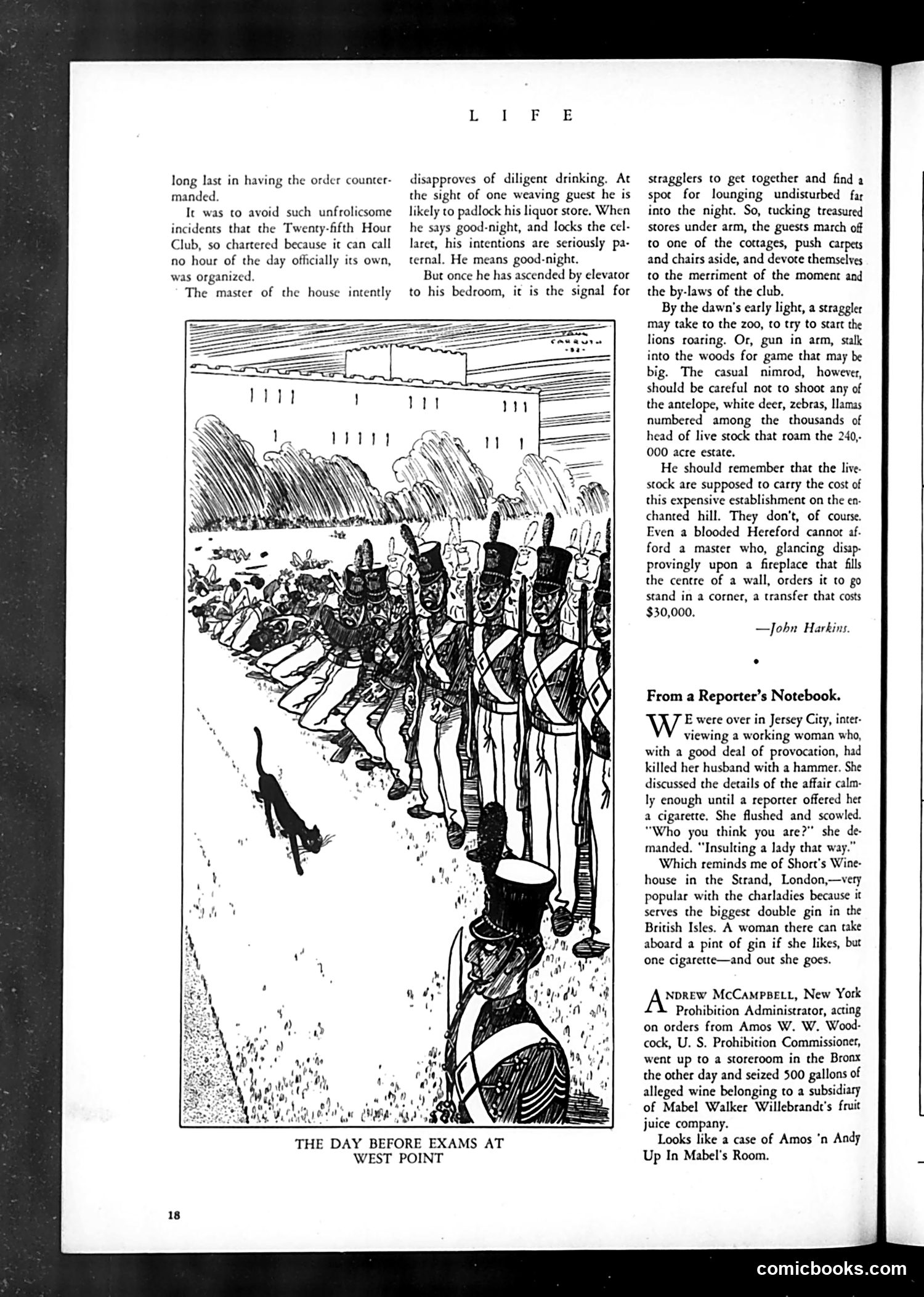
"The Day Before Exams at West Point" This cartoon satirizes military discipline at the U.S. Military Academy. The image shows cadets lined up in rigid formation while one cadet appears to be falling or collapsing in the snow—likely from exhaustion or the stress of impending examinations. The joke targets the stark contrast between the strict, orderly military structure and the human breaking point of individuals under pressure. The formal ranks of uniformed cadets emphasize institutional rigidity, while the struggling figure suggests that even military training cannot suppress natural human vulnerability. This reflects early 20th-century American humor about institutional excess and the tension between individual wellbeing and organizational demands. The satire gently mocks West Point's relentless discipline.
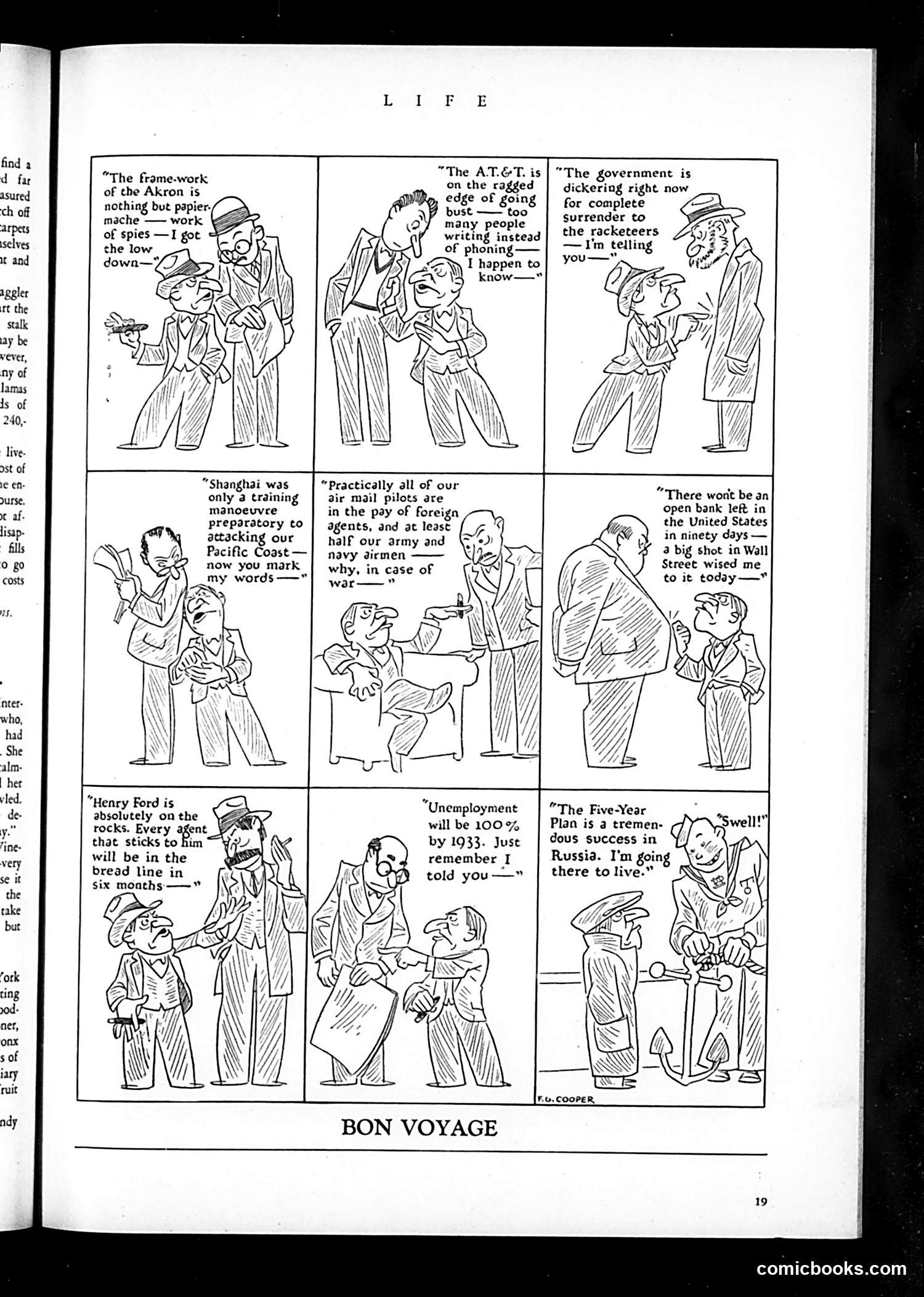
Analysis of "Bon Voyage" Comic Strip This is a satirical comic strip featuring a figure (likely a businessman or politician) departing America while spouting various contemporary anxieties—apparently to escape them. The panels reference: - AT&T financial troubles ("edge of going bust") - Government corruption ("racketeers") - Military/defense concerns (foreign military advisors, army/navy hiring) - Banking collapse ("won't be an open bank left in the United States in ninety days") - Henry Ford's financial difficulties ("absolutely on the rocks") - Soviet Five-Year Plan success (contrasted with American economic instability) The title "Bon Voyage" suggests the character is fleeing American economic and social crises of the early 1930s Depression era. The strip satirizes American institutional failure while implying Soviet stability—reflecting Depression-era anxieties about capitalism's viability.
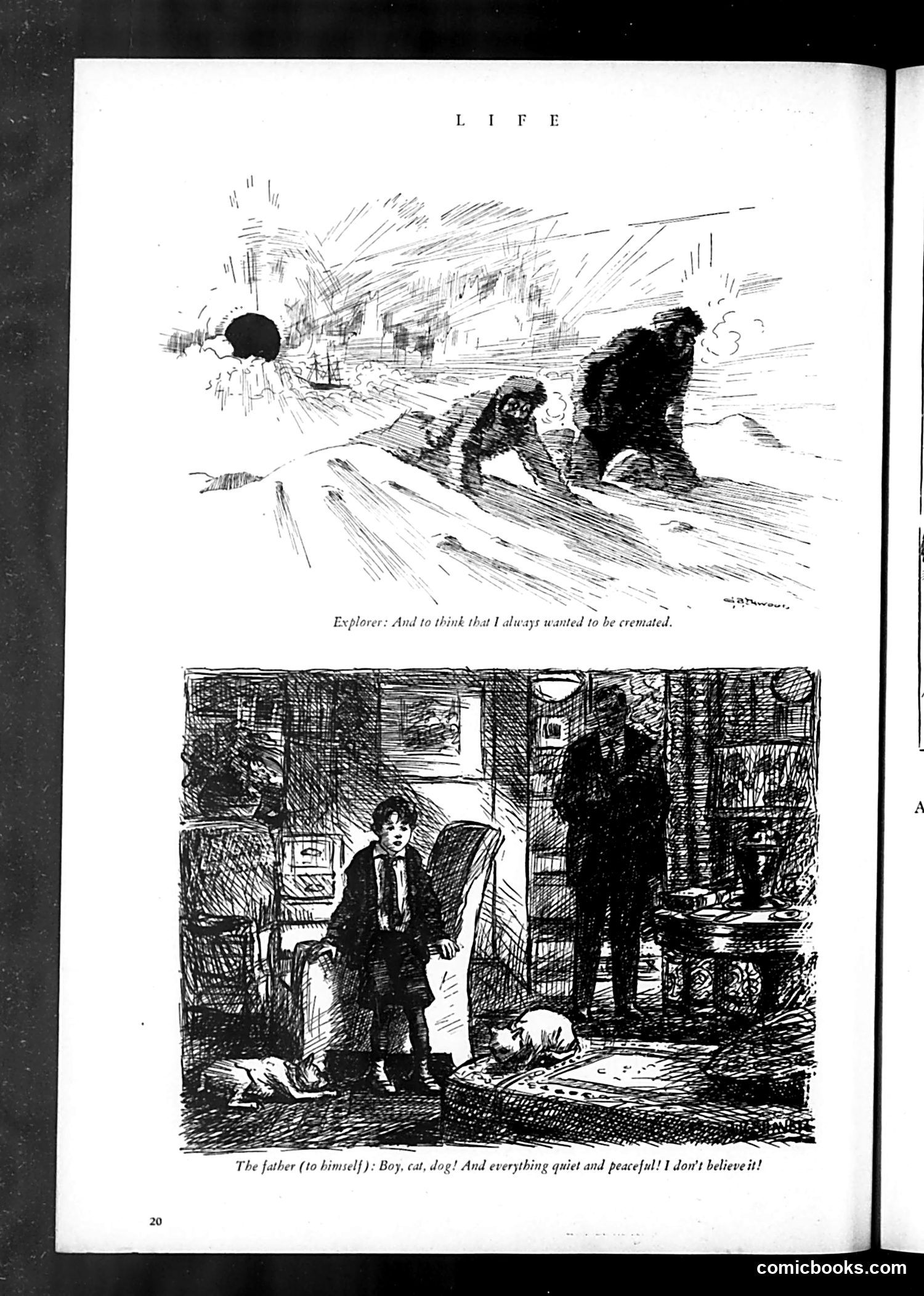
Analysis of Life Magazine Page This page contains two satirical cartoons commenting on death and mortality: Top cartoon: An explorer confronts harsh desert conditions (sun, wind, rocks). His deadpan caption reflects dark humor—he desired cremation, yet the environment itself threatens to incinerate him naturally. Bottom cartoon: A disheveled father reassures his family in a modest home: "Boy, cat, dog! And everything quiet and peaceful! I don't believe it!" The satire mocks domestic life's chaos—suggesting that peace and quiet are so rare that when they occur, they seem impossible or suspicious. Both cartoons employ sardonic humor typical of *Life* magazine's satirical approach: commenting on universal human experiences (death, family life) through exaggerated scenarios and ironic observations. The artwork uses expressive line-work characteristic of early-to-mid 20th century illustration.
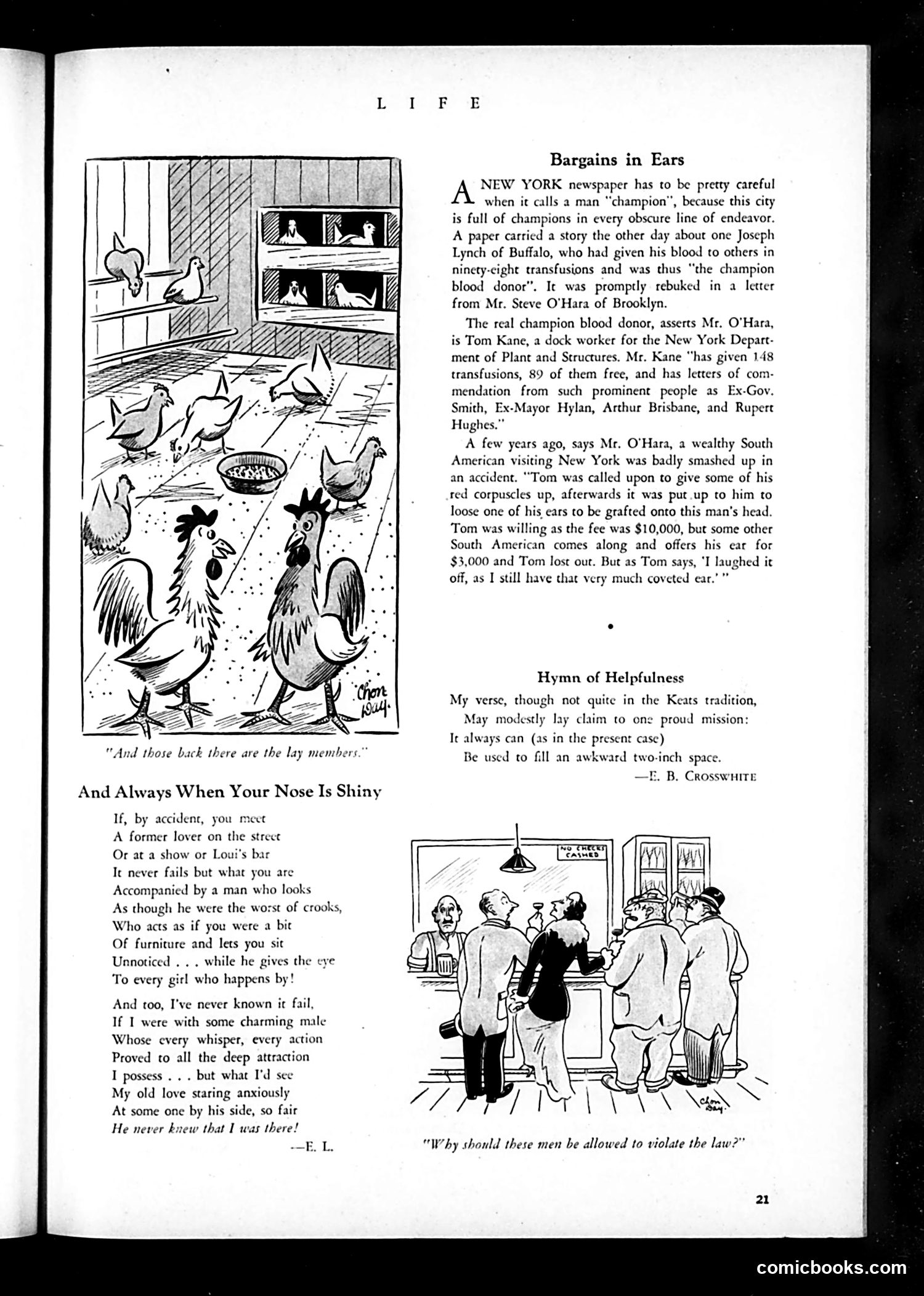
Explanation for Modern Readers "Bargains in Ears" is a humorous anecdote about New York's competitive culture. The text describes Tom Kane, a dock worker and prolific blood donor (148 transfusions), who allegedly agreed to donate an ear to an injured South American for $10,000. However, another donor undercut him, offering an ear for $3,000. Kane lost the "deal" but kept his ear—hence the joke about a literal "bargain in ears." The cartoon depicts a farmyard scene with chickens and roosters, captioned "And those back there are the lay members"—a pun playing on "lay" (non-ordained church members) versus actual hens. "And Always When Your Nose Is Shiny" is a romantic poem about social awkwardness: when you encounter an ex-lover, you're always accompanied by someone unattractive, or when with someone charming, your ex appears with someone prettier—and neither notices you. The humor lies in the relatable Murphy's Law of dating. The bottom cartoon shows men at what appears to be a bar, with the caption questioning why such men are "allowed to violate the law"—likely referencing Prohibition-era speakeasies.
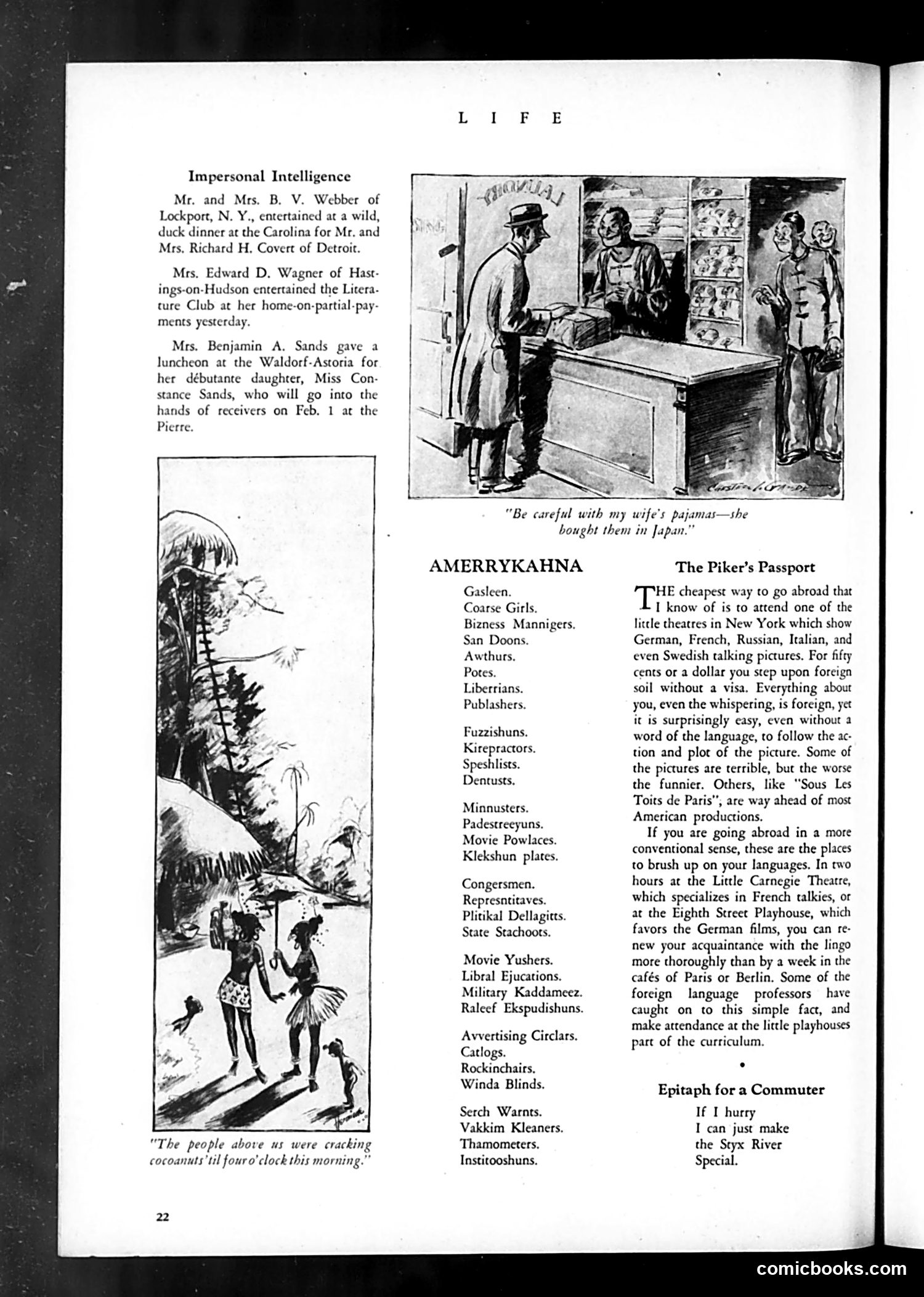
Life Magazine Page Analysis This page contains social satire typical of 1920s Life magazine. The "Impersonal Intelligence" section mockingly reports on wealthy New Yorkers' trivial social events, with a cruel joke embedded in the final item: a debutante's coming-out luncheon notes she "will go into the hands of receivers on Feb. 1"—implying financial ruin, likely referencing the economic instability of the era. The cartoon at top shows a man warning a shop clerk about his wife's Japanese pajamas, a gentle joke about imported luxury goods and marital worry. "Amerrykahna" is intentional misspelling—satire of Americanization. The deliberately garbled phonetic spellings (Gasleen, Bizness Mannigers, Dentusts) mock working-class and immigrant speech, a common if dated comedic trope of the period. "The Piker's Passport" humorously suggests attending foreign-language films in New York theaters as budget travel, replacing expensive overseas trips—Depression-era frugality humor. The bottom cartoon's caption about neighbors cracking coconuts at 4 a.m. is simply noise-complaint humor about inconsiderate neighbors.
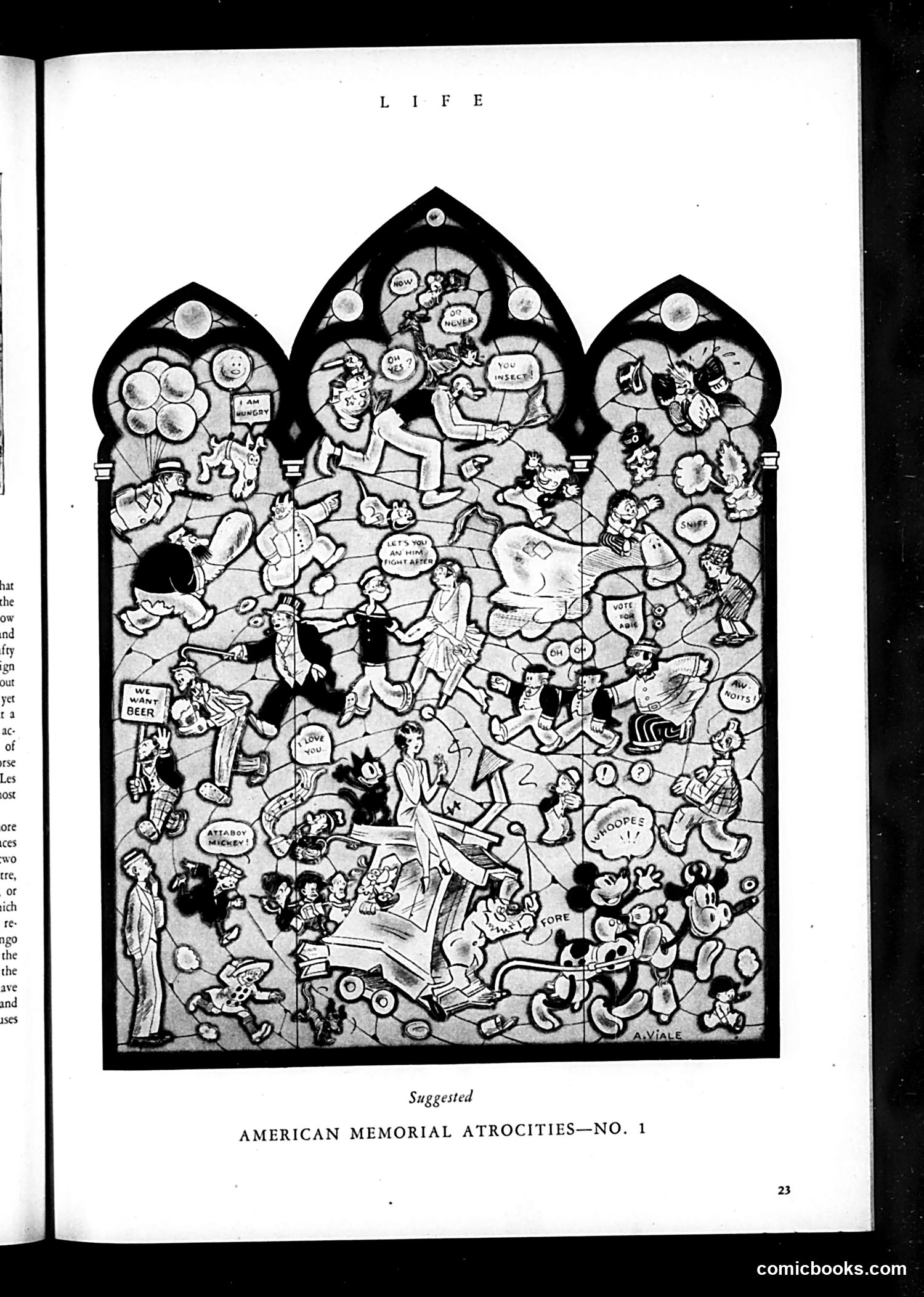
"American Memorial Atrocities—No. 1" This satirical cartoon presents a chaotic stained-glass window design mocking American commercial excess and pop culture. The densely packed composition features recognizable brand names and consumer products (visible text includes "ARRORY DISNEY," "HOOPES"), cartoon characters, advertising imagery, and commercial iconography crowded together in a religious architectural frame. The satire targets what the artist views as America's misplaced values—treating commercial entertainment and consumer goods as cultural monuments worthy of memorial status. By framing this commercial chaos within a sacred stained-glass format traditionally reserved for religious or patriotic commemoration, the cartoon critiques American culture's equation of consumerism with national identity and spiritual significance. The title's "atrocities" suggests the artist considers this cultural direction deeply troubling.
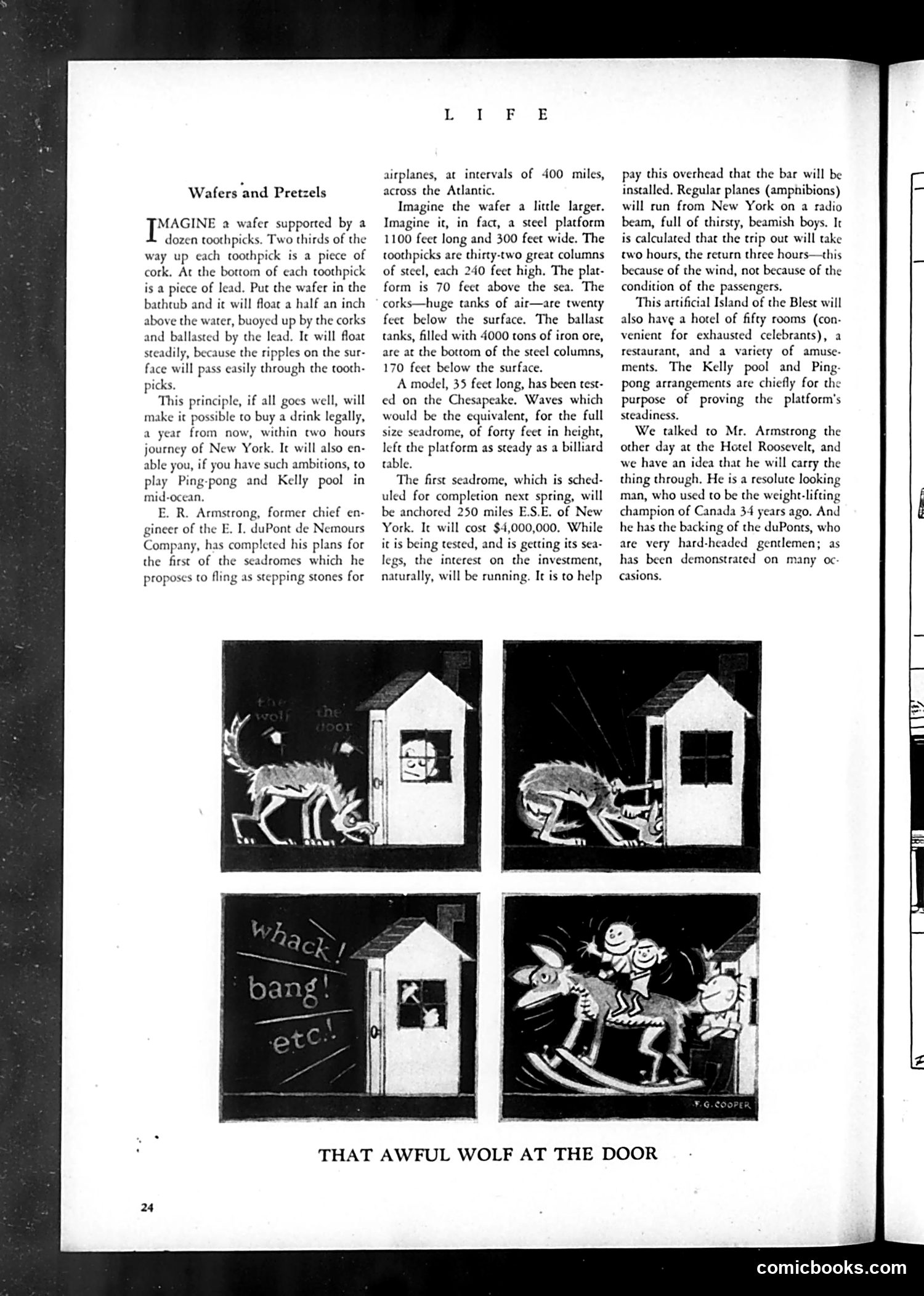
"That Awful Wolf at the Door" - Life Magazine Cartoon This four-panel cartoon satirizes Prohibition-era anxiety about crime and danger. It depicts a child in a small house repeatedly threatened by a menacing wolf outside—representing society's fears during the alcohol ban. The joke operates on multiple levels: the "wolf" likely symbolizes both literal criminal threats (bootleggers, gangsters) and the societal chaos blamed on Prohibition itself. The child's panic ("whack! bang! etc.!") shows desperate defense against external threats. Contextually, this appears alongside an article about E.R. Armstrong's ambitious "seadrome" project—an artificial island platform 250 miles offshore where alcohol could legally be served, circumventing Prohibition laws. The cartoon's timing suggests Life magazine is satirizing how Prohibition created such desperation that people would go to absurd extremes (building offshore islands) to escape the "wolf"—the very lawlessness and danger Prohibition was supposed to prevent. The artist is credited as "T.G. Cooper."
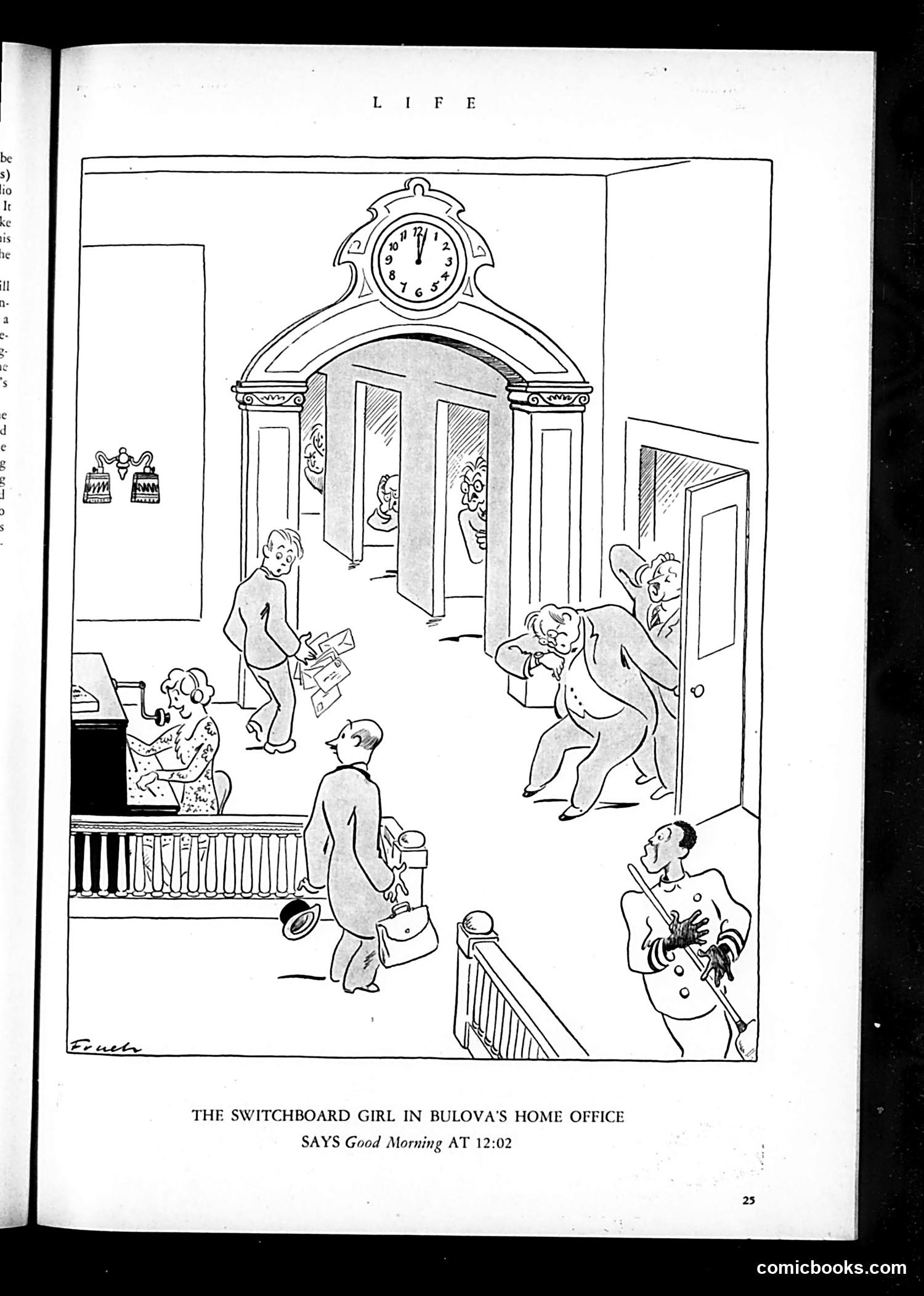
Analysis This is an advertisement for Bulova watches, presented as a humorous cartoon. The scene depicts a busy home office where a switchboard operator greets callers at 12:02 PM, saying "Good Morning"—the joke being that she's so absorbed in her work she hasn't noticed it's already midday. The cartoon satirizes the blurred boundaries of modern work life, particularly for women in office roles during this era. By showing the switchboard girl losing track of time in a domestic setting, it humorously suggests that home-based professional work can consume one's entire day. The Bulova clock prominently displayed above emphasizes the product's practical value: a reliable timepiece to keep workers aware of the actual hour, even when engrossed in their duties.
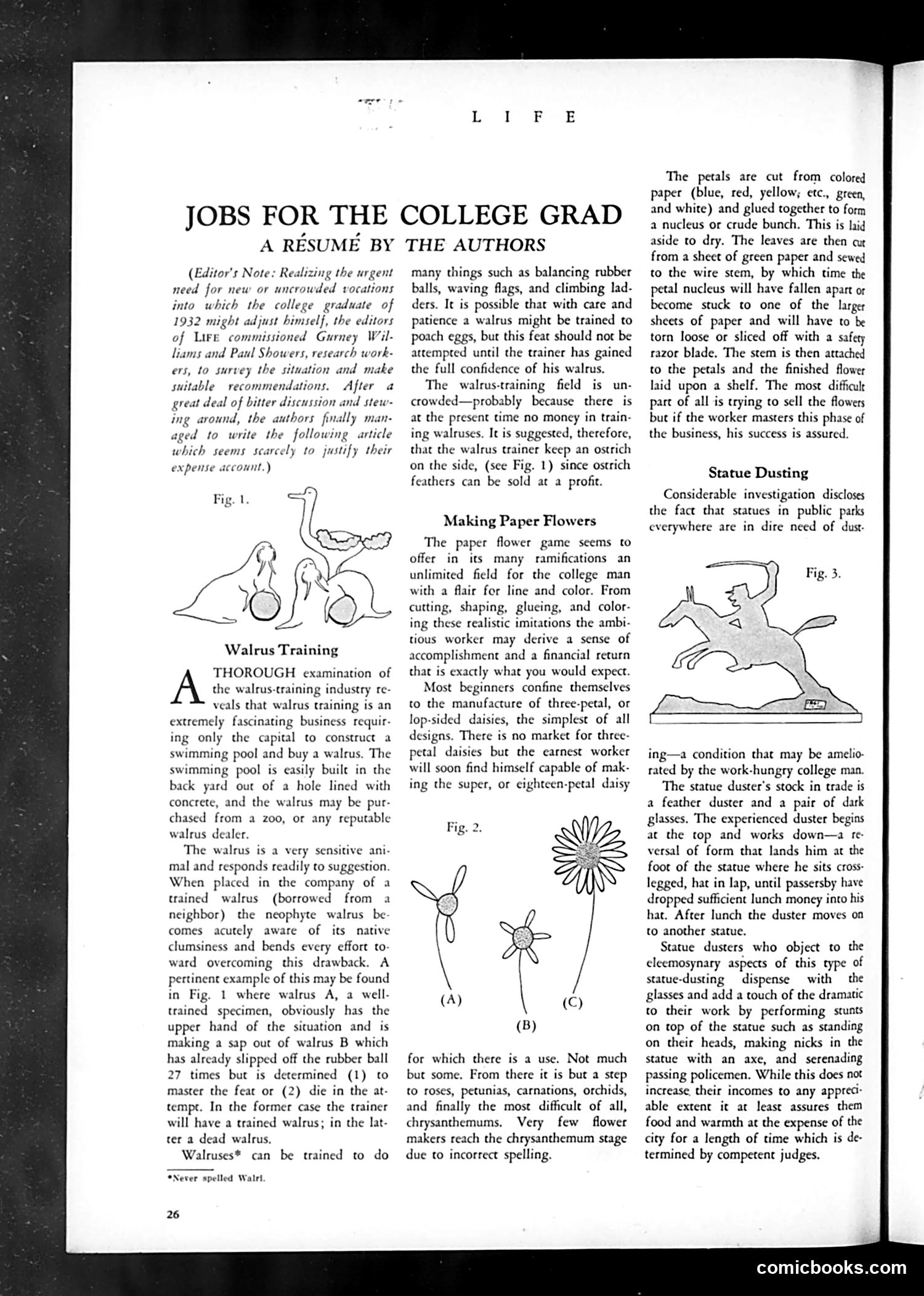
Satire of Depression-Era Job Prospects This 1932 *Life* magazine article satirizes the bleak employment landscape facing college graduates during the Great Depression by proposing absurdly impractical "careers." The humor operates through deadpan earnestness: the authors recommend walrus training (requiring only a backyard pool and zoo purchase), paper flower manufacturing, and statue dusting as viable professions. Each "job" is presented with mock-serious instruction and illustrations, yet the text reveals their utter futility—walrus training has "no money in it," three-petal daisies have no market, and statue dusting pays barely subsistence wages while offering humiliating, pointless tasks (standing on statues, making "nicks" with an axe). The article's framing note explains the editors' intent: to address the "urgent need for new or uncrowded vocations" facing 1932 graduates. The satire suggests that for Depression-era college graduates, even ridiculous make-work schemes represent the only available opportunities—a bitter commentary on economic collapse and widespread joblessness.
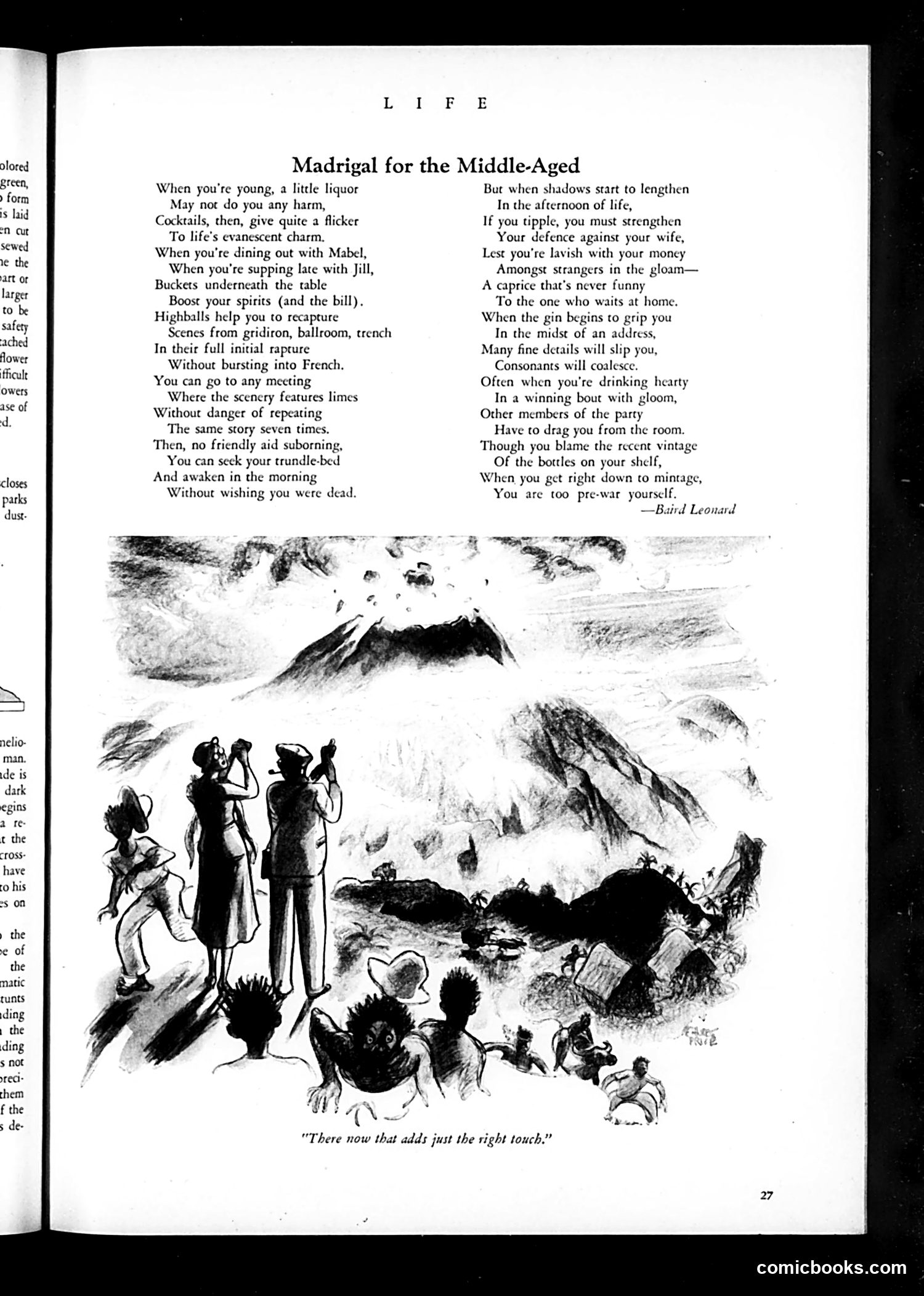
"Madrigal for the Middle-Aged" This page features a humorous poem by Baird Leonard addressing alcohol consumption across life stages. The poem contrasts youthful drinking—presented as harmless social fun at dinners and parties—with middle-aged drinking, which carries serious consequences: marital conflict over money spent on strangers, embarrassing behavior at social events, and physical decline (slurred speech, needing to be removed from rooms). The accompanying cartoon illustrates the poem's theme, depicting what appears to be a middle-aged couple observing otherworldly or demonic figures in a mountainous landscape, with the caption "There now that adds just the right touch"—likely mocking how drinking is rationalized as "improving" social situations. The satire targets the specific anxieties of mid-life drinkers: loss of control, damaged relationships, and the irony of blaming old alcohol while being "too pre-war yourself"—suggesting the drinker, not the vintage, has deteriorated.
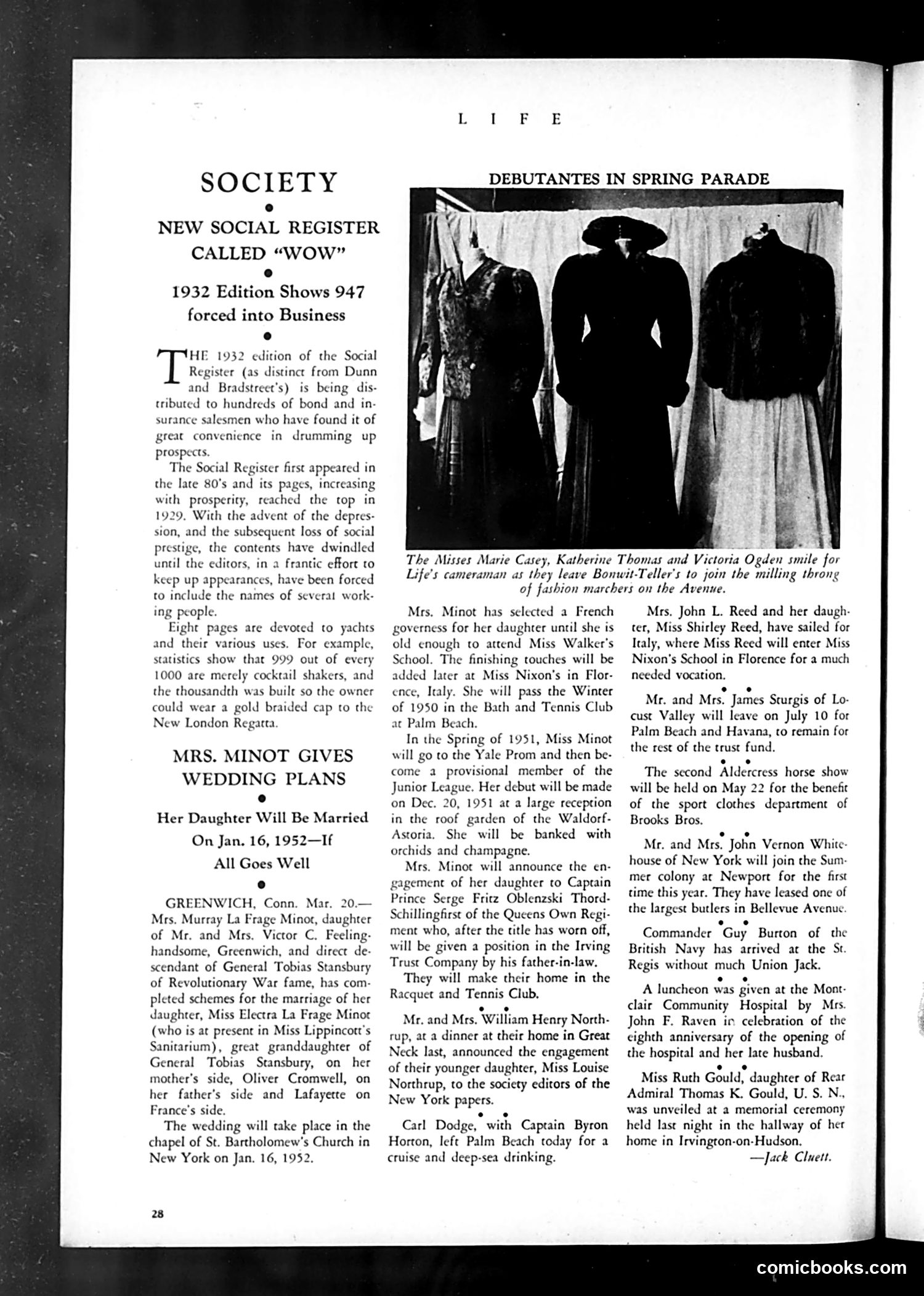
Political Satire During the Great Depression This "Society" column satirizes America's wealthy elite during the 1932 economic collapse. The key joke is the "Social Register" called 'WOW'"—the editors have been forced to include names of *working people* just to maintain the register's prestige and appearance of importance. The satirical headline "947 forced into Business" mocks how the Depression has compelled wealthy individuals to actually work—previously unthinkable for the idle rich. The accompanying wedding plans for "Miss Electra La Frage Minot" parody the elaborate, minutely-planned social rituals of the upper class (governesses, debuts at the Waldorf-Astoria, marriages strategically arranged with business benefits), treating these absurdities seriously while implicitly criticizing their disconnection from ordinary Americans' economic suffering. References to yachts used merely as "cocktail shakers" further satirize the frivolous waste of wealth. The photograph of debutantes in the "Spring Parade" illustrates this privileged world the column mocks.
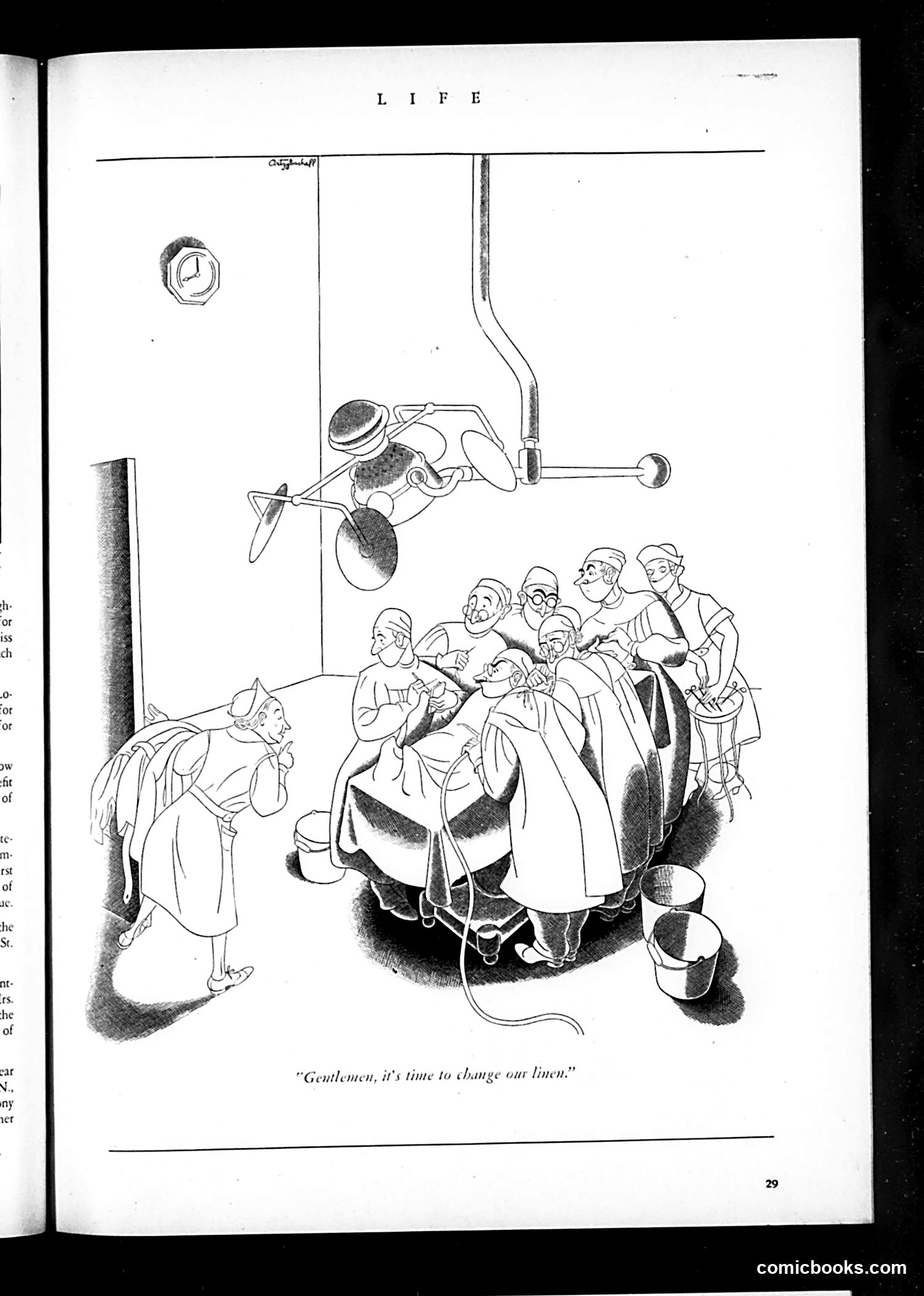
Analysis This cartoon depicts a group of men in formal attire (appearing to be officials or politicians) gathered around what looks like laundry equipment or a washing apparatus. The caption "Gentlemen, it's time to change our linen" uses "linen" as a metaphor—likely referring to "dirty laundry," a common phrase meaning hidden scandals or corruption that should be exposed or cleaned up. The elaborate mechanical contraption at the top suggests the formal, bureaucratic processes involved in addressing institutional problems. The cartoon satirizes government or institutional officials who need to address corruption, misconduct, or unethical practices. One figure on the left appears to be observing or overseeing this process. Without knowing the specific publication date, the exact political context remains unclear, but the satire targets institutional housecleaning and reform among the ruling class.
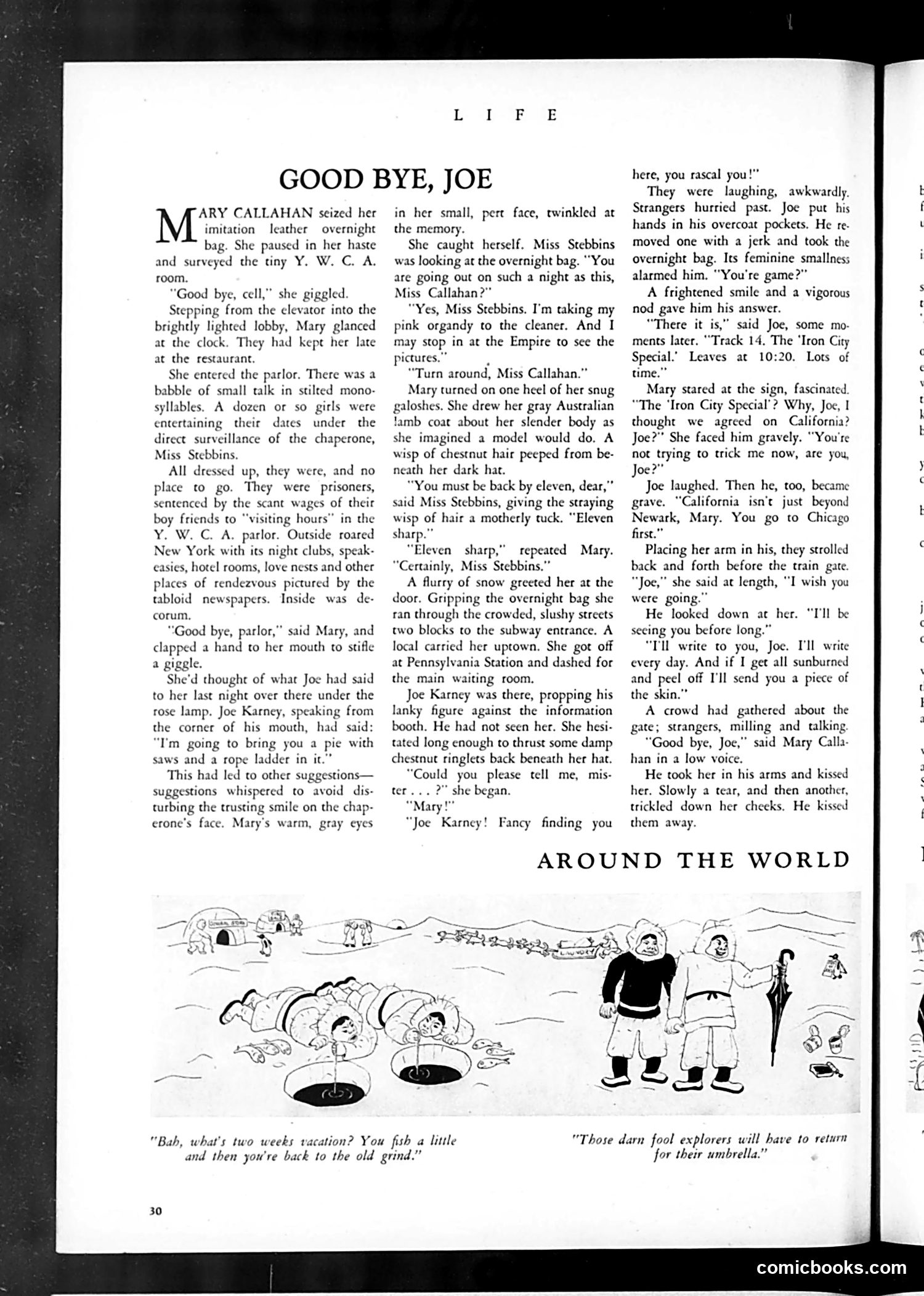
"Good Bye, Joe" - Life Magazine Story Analysis This is a serialized short story about a young woman named Mary Callahan escaping the restrictive social constraints of 1920s America. The narrative satirizes the era's rigid moral policing of unmarried women. The Setup: Mary lives in a Y.W.C.A. dormitory under strict chaperone supervision, where women's dating is limited to chaperoned "visiting hours" in sterile parlors. The story mocks this oppressive environment by contrasting it with the vibrant nightlife outside—speakeasies, nightclubs, and "love nests." The Plot: Mary is meeting her boyfriend Joe at Pennsylvania Station, ostensibly to elope to California (though Joe mentions Chicago first, suggesting deception). The overnight bag and whispered plans for a "pie with saws and a rope ladder" reference escape fantasies. The Satire: Life critiques how economic inequality (young workers' "scant wages") and institutional control (the Y.W.C.A.) restrict female autonomy, forcing young couples into secretive, potentially scandalous behavior. The accompanying cartoon about arctic explorers likely comments on adventure and escape themes.
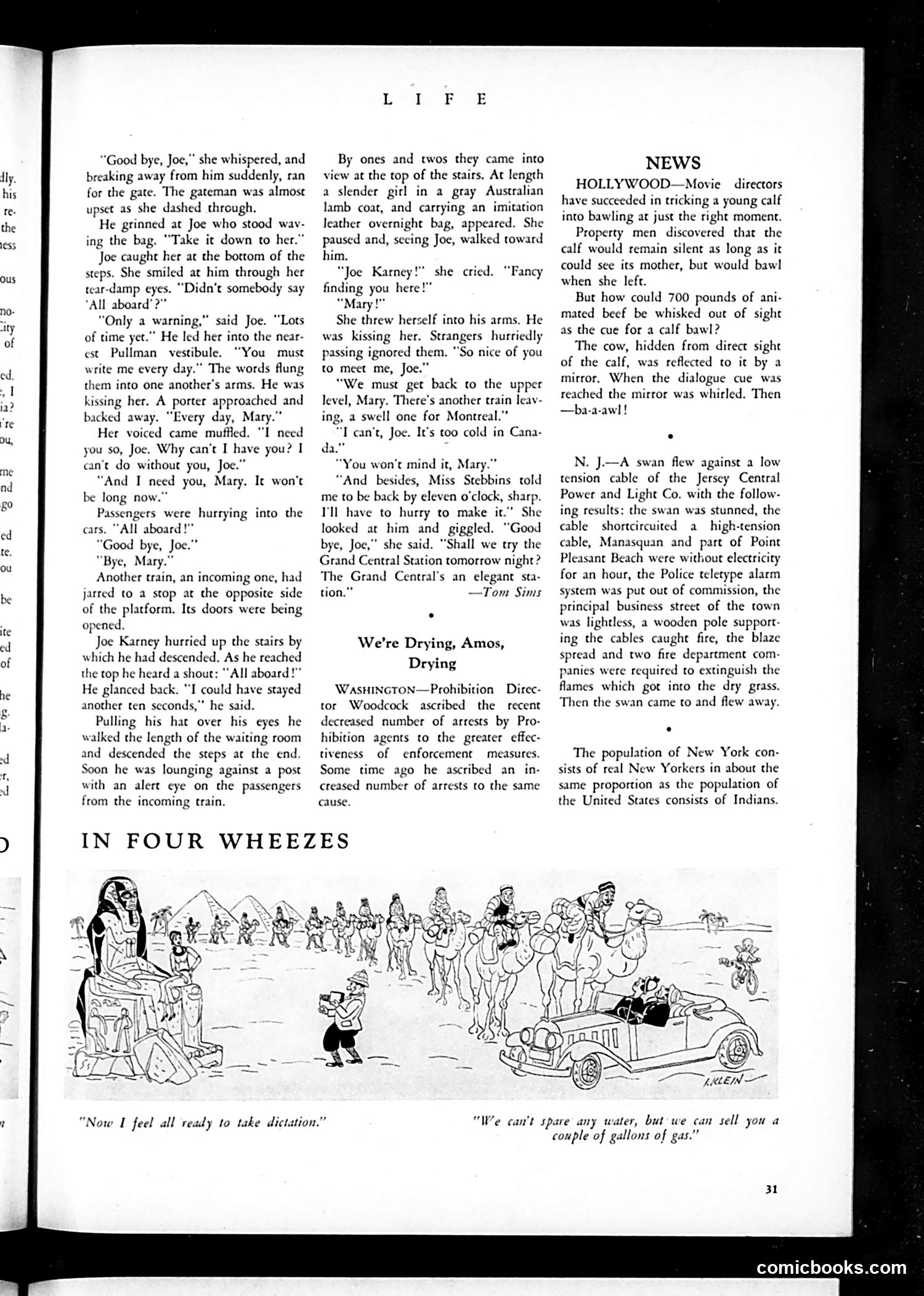
Page Analysis: Life Magazine Satire This page contains two distinct pieces of satire: Main Story ("In Four Wheezes"): A romantic comedy about Joe Karney, who repeatedly says goodbye to his sweetheart Mary at train stations—then encounters her arriving on the next train, suggesting an endless cycle of separations and reunions. The title's wordplay ("wheeze" = joke) mocks sentimental railway romance stories popular in the era. The Cartoon: Two panels satirizing modern absurdities—one showing someone "ready to take dictation" in a desert (likely mocking bureaucratic overreach), another depicting a gas shortage during Prohibition, with desert travelers reduced to begging for fuel. The News Items: Includes satirical swipes at: - Hollywood's artificial emotion-manufacturing - Prohibition enforcement officials contradicting themselves (ascribing both increased and decreased arrests to "effectiveness") - A humorous account of a swan's mishap cascading into town-wide chaos The overall tone mocks contemporary American life: romantic excess, government inconsistency, and the chaos of modernity.
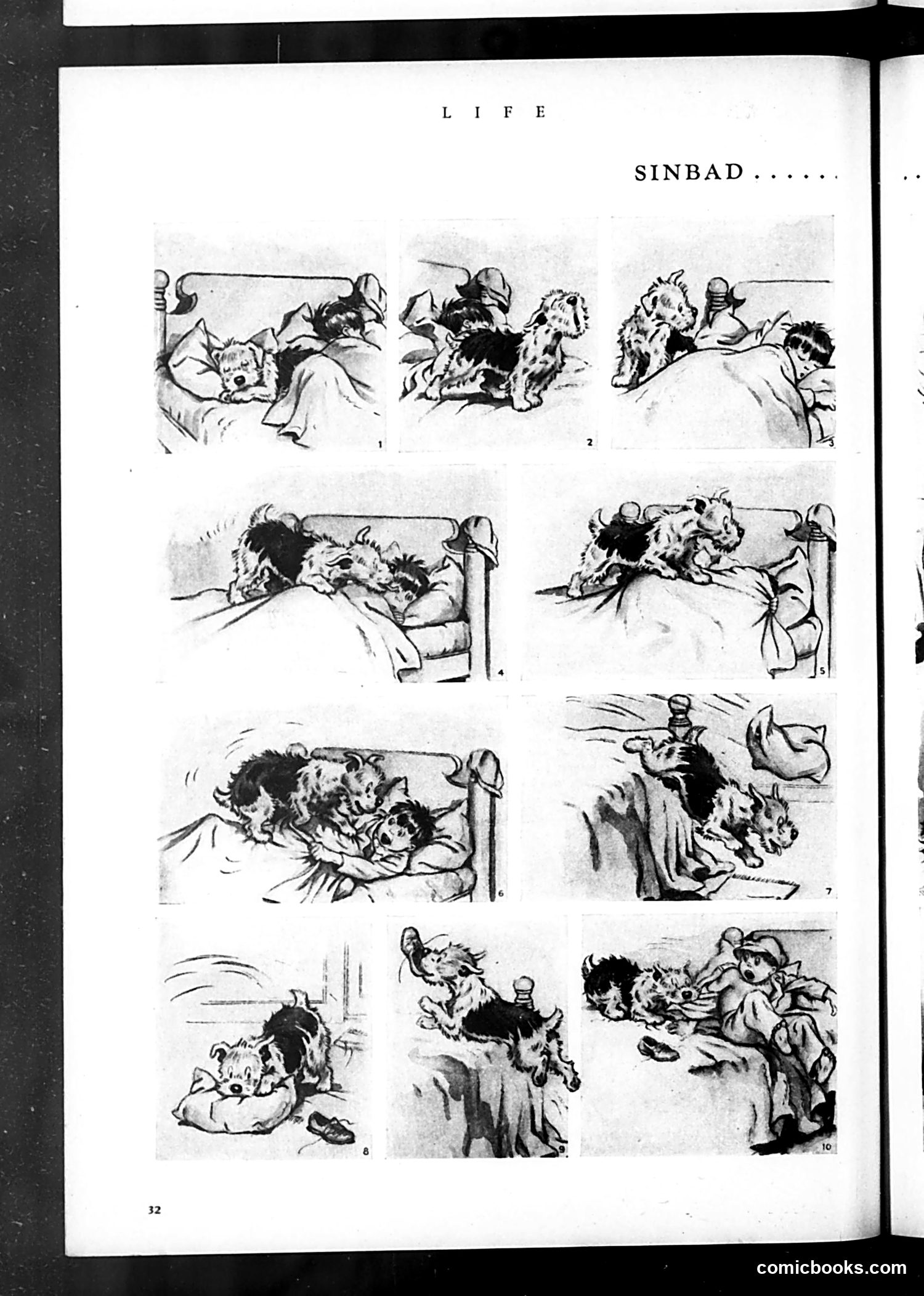
Sinbad Comic Strip Analysis This appears to be a sequential comic strip titled "Sinbad" showing a narrative sequence of events. The strip depicts what looks like a sailor or adventurer character (fitting the Sinbad legend) in various predicaments—shown sleeping, interacting with animals or creatures, and experiencing comedic misadventures, likely involving bed-related chaos. Without clearer detail or accompanying text explaining the specific plot, the humor appears to rely on physical comedy and slapstick situations typical of early-to-mid 20th century American comics. The strip's style and presence in *Life* magazine—known for satirical content—suggests this was entertainment humor rather than political satire. The numbered panels (1-10) guide readers through the sequential action.
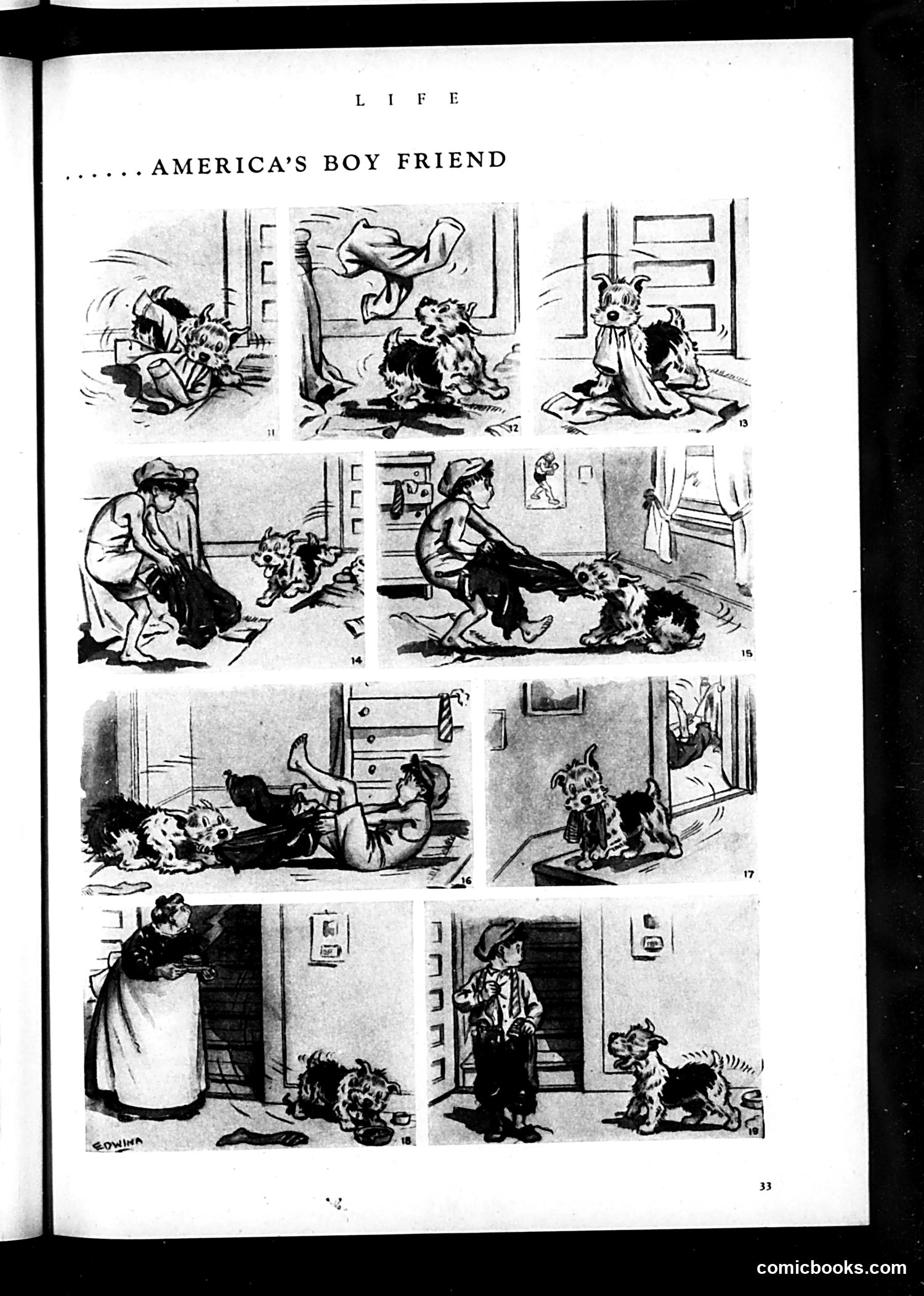
"America's Boy Friend" - Comic Strip Analysis This appears to be a multi-panel comic strip depicting a small dog (possibly a terrier or similar breed) interacting with various characters in domestic settings. The strip shows the dog engaging in typical mischievous behavior—playing, getting into trouble, interacting with children and adults around a house. The title "America's Boy Friend" suggests this dog character was a popular or beloved figure, likely a recurring comic strip character. The comic illustrates everyday scenes of domestic life and the dog's antics within a home environment. Without additional context about the publication date or the specific character's identity, the exact satirical or social commentary intended remains unclear, though it appears to be humorous domestic entertainment rather than political satire.
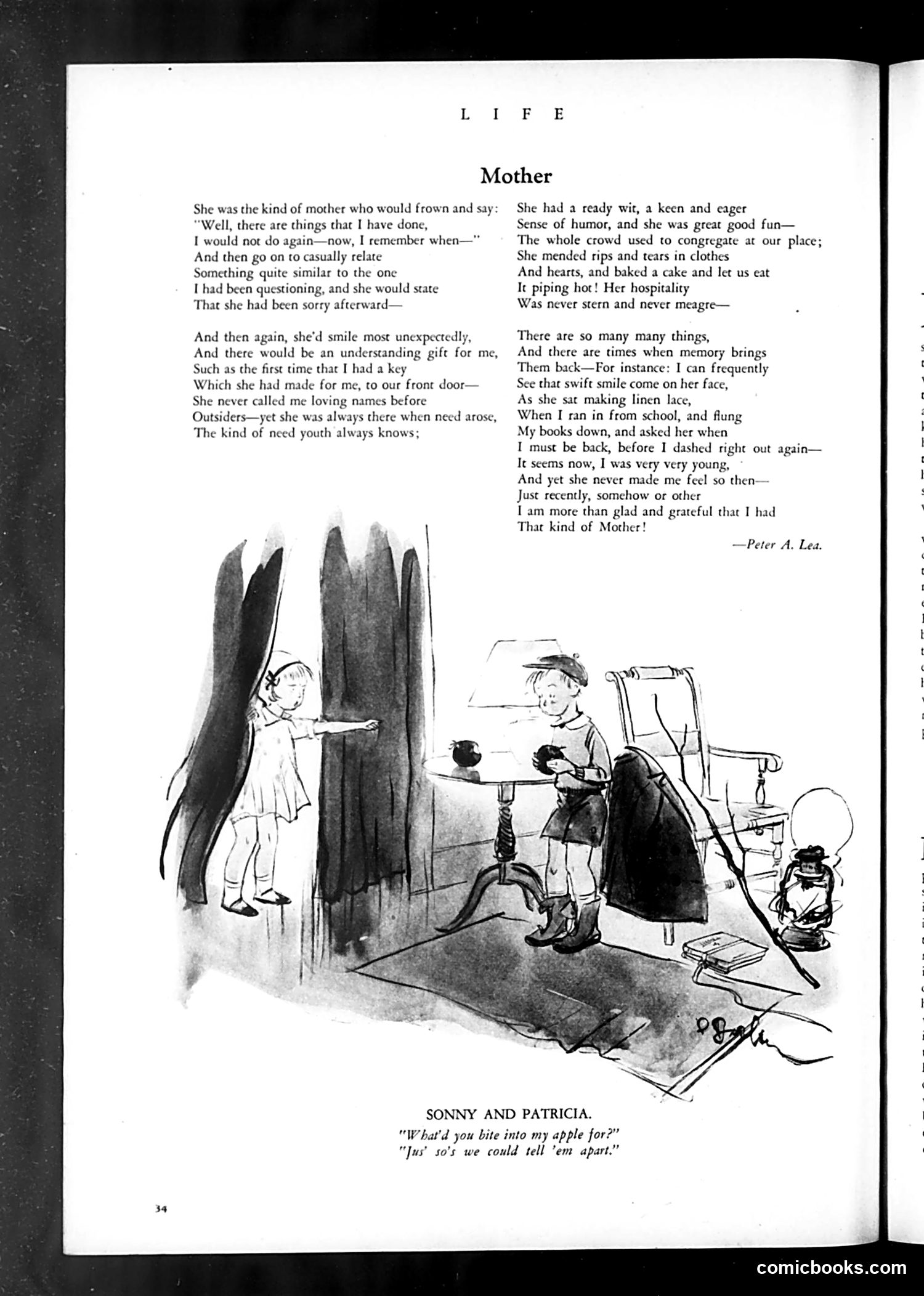
Analysis: "Mother" Page from Life Magazine This page celebrates motherhood through sentimental poetry by Peter A. Lea, describing a mother's quiet virtues: her understanding nature, humor, hospitality, and consistent emotional support despite never being overtly demonstrative with affection in public. The accompanying cartoon depicts two children, Sonny and Patricia, examining a bitten apple. When asked why he bit into her apple, Sonny explains he did so "so's we could tell 'em apart"—a child's logic joke playing on the innocence of young reasoning. The humor lies in the absurdity of his solution: rather than damaging his own apple to distinguish them, he damages hers. Together, the poem and cartoon present contrasting maternal scenarios: the thoughtful, supportive mother versus children's simple, sometimes destructive problem-solving. The page celebrates traditional American motherhood ideals circa early-to-mid 20th century.
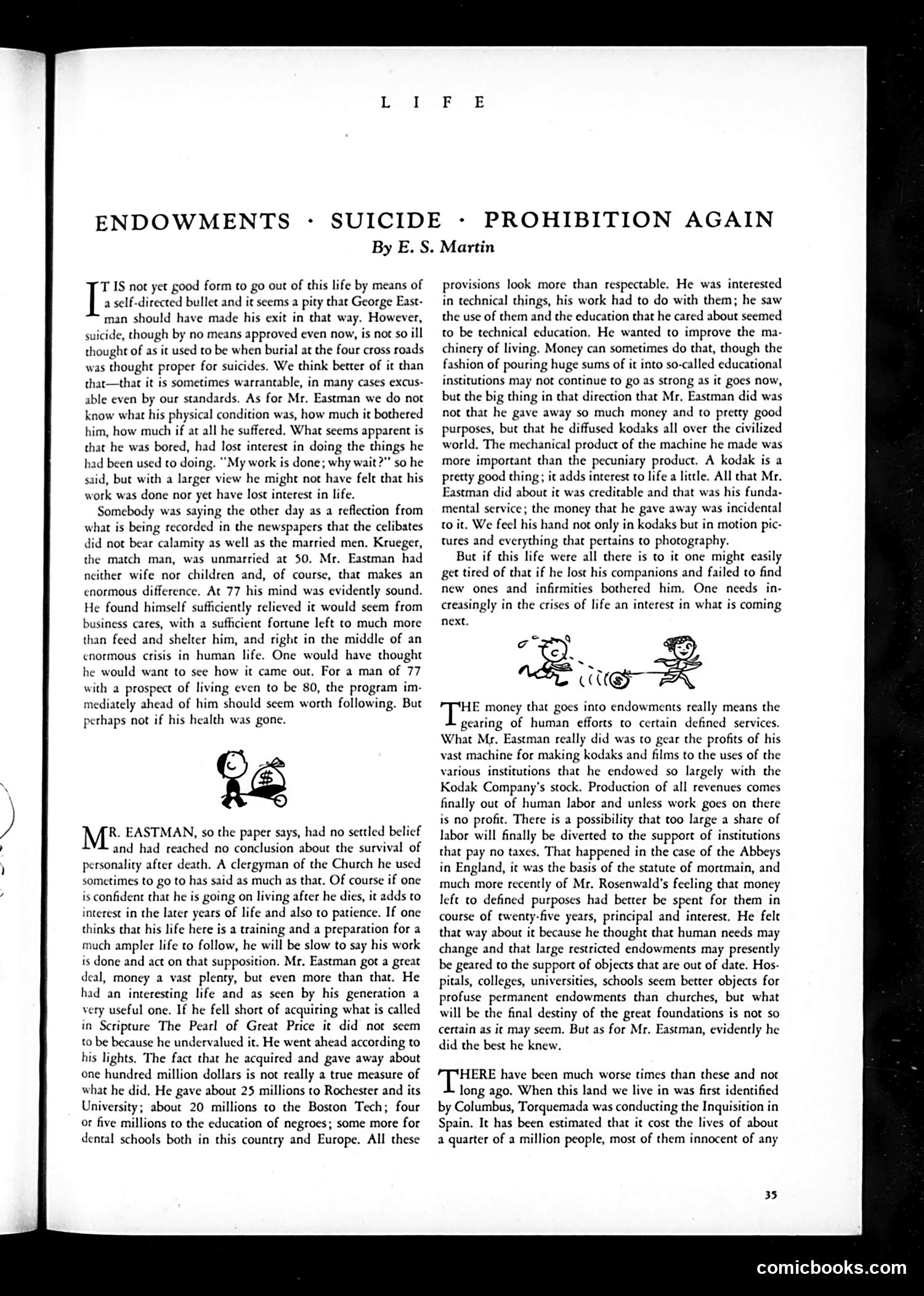
Analysis of Life Magazine Page: "Endowments · Suicide · Prohibition Again" This article by E.S. Martin discusses George Eastman's recent suicide (Eastman founded Kodak and died in 1932). The piece debates whether his death was justified, given his age (77), wealth, and reportedly declining interest in life. The two small cartoons appear to illustrate contrasting life circumstances—one figure appears troubled or burdened, while another seems active or engaged. Martin argues that Eastman's suicide was understandable but questions whether his work was truly "done." He notes that Eastman lacked religious faith (belief in afterlife), which might have given him patience with aging. Martin praises Eastman's philanthropic contributions—$25 million to Rochester University, $20 million to MIT, funding for education of Black Americans and dental schools—but argues his greatest achievement was democratizing photography through Kodak, spreading cameras worldwide rather than merely donating money. The article reflects 1930s attitudes toward suicide as increasingly acceptable, contrasting with earlier social stigma.
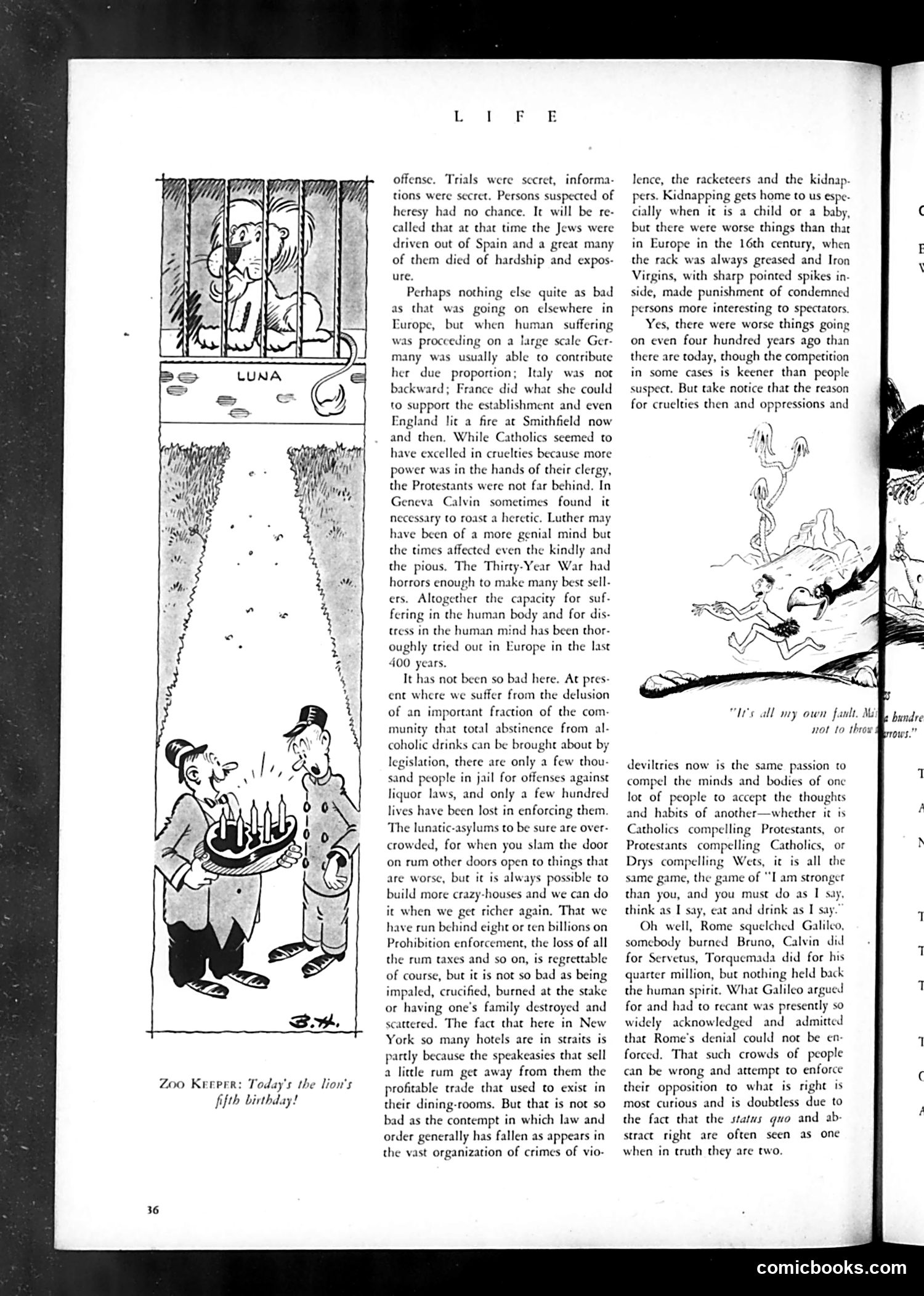
Analysis of Life Magazine Page This page presents a satirical critique of Prohibition enforcement in America, using historical perspective to diminish its severity. The cartoon (labeled "Zoo Keeper") shows two men examining a caged lion, with the caption about its fifth birthday—likely a topical reference unclear without additional context. The accompanying text argues that while Prohibition has caused problems (thousands jailed, enforcement costs, speakeasy competition hurting hotels, increased organized crime and kidnapping), these harms pale compared to 16th-century European religious persecution: the Spanish Inquisition, Calvin's heretic-roasting, the Thirty-Year War, and torture devices. The author's point is ironic and critical: yes, Prohibition enforcement is bad, but Americans shouldn't complain excessively because history was worse. However, the underlying argument suggests that the *same impulse*—forcing others to accept one group's moral standards—drives both historical atrocities and contemporary Prohibition. The satire implies this compulsory moralism remains fundamentally troubling regardless of severity.
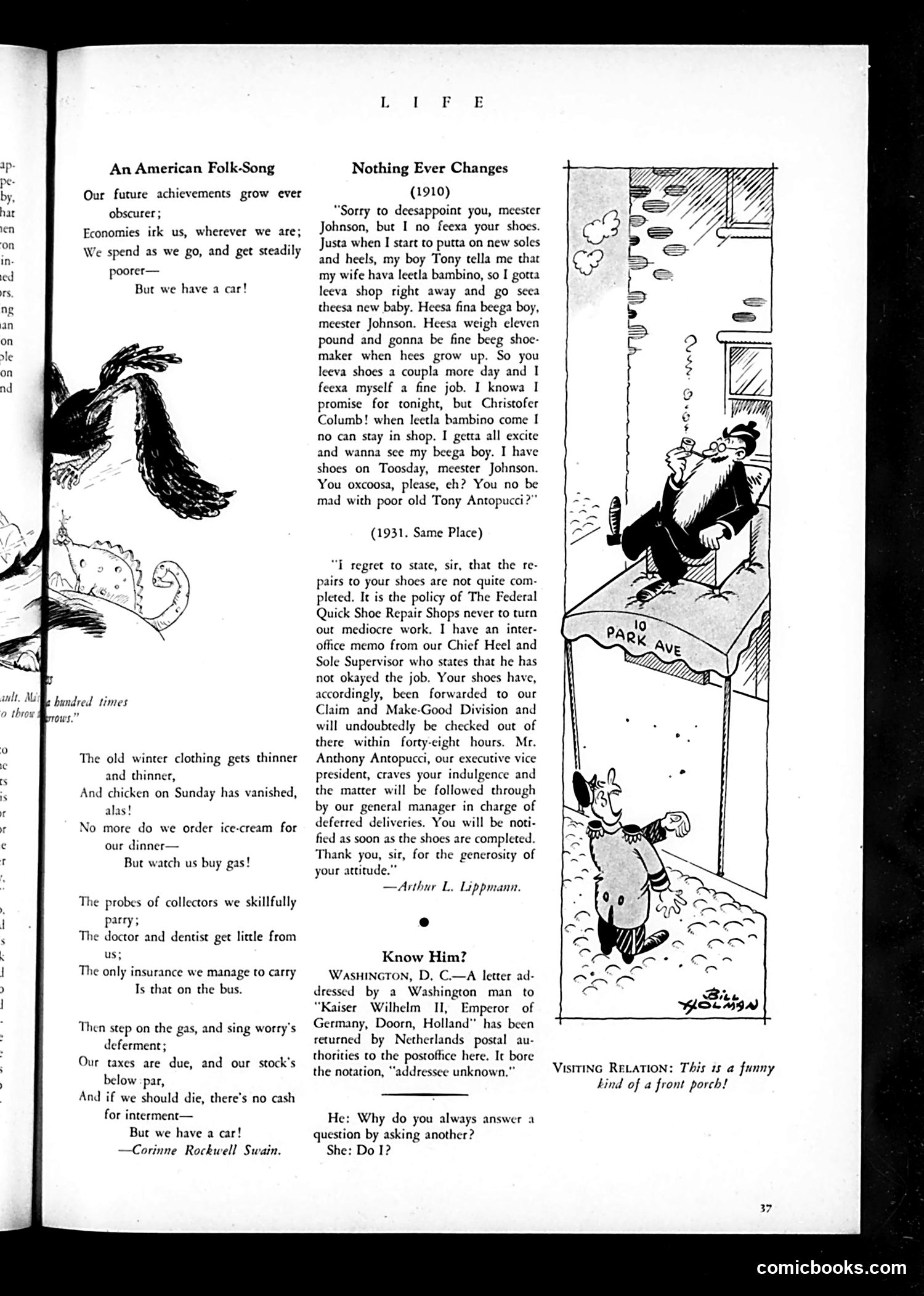
Life Magazine Page Analysis This page contains satirical commentary on American economic conditions and bureaucratic change (or lack thereof). "An American Folk-Song" by Corinne Rockwell Swain mocks 1930s Depression-era economics: families economize on necessities (clothing, food, insurance, even funeral costs) yet paradoxically prioritize car ownership and gasoline. The refrain "But we have a car!" underscores the disconnect between financial hardship and this one indulgence—a critique of misplaced priorities during economic crisis. "Nothing Ever Changes" presents a two-part comparison. The 1910 scene shows an Italian immigrant shoemaker (Tony Antopucci) with charming, broken English, leaving his shop to celebrate his newborn son. The 1931 version shows the same man now as corporate "executive vice president" of a federalized shoe repair chain, delivering the identical excuse in bureaucratic jargon instead of dialect. The satire suggests that despite 21 years of "progress," working people still can't get their shoes fixed—only the language of obstruction has changed from personal to corporate.
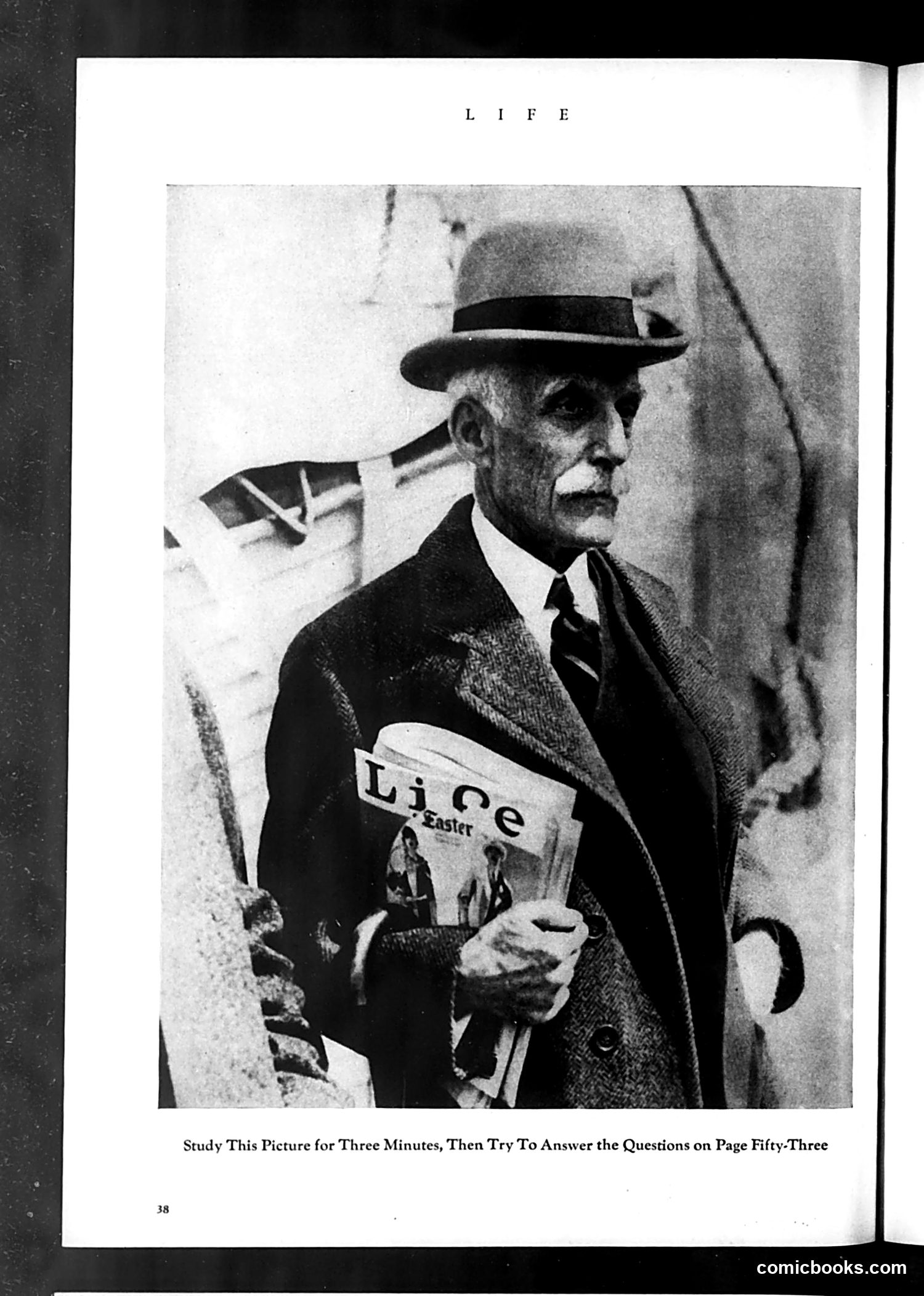
Life Magazine "Study Picture" Exercise This appears to be an interactive puzzle page from *Life* magazine. The image shows an elderly gentleman in formal attire (suit, striped tie, boater hat) holding what appears to be a "Life Easter" publication or magazine. The instruction directs readers to study the photograph for three minutes, then answer questions on page 53—a common feature in early 20th-century magazines testing observation skills and memory. Such exercises were popular entertainment, challenging readers to notice specific details (clothing, objects, facial features, background elements) they might otherwise miss. Without access to page 53's questions, we cannot determine what specific details the puzzle emphasized or what social commentary, if any, the choice of subject conveyed.
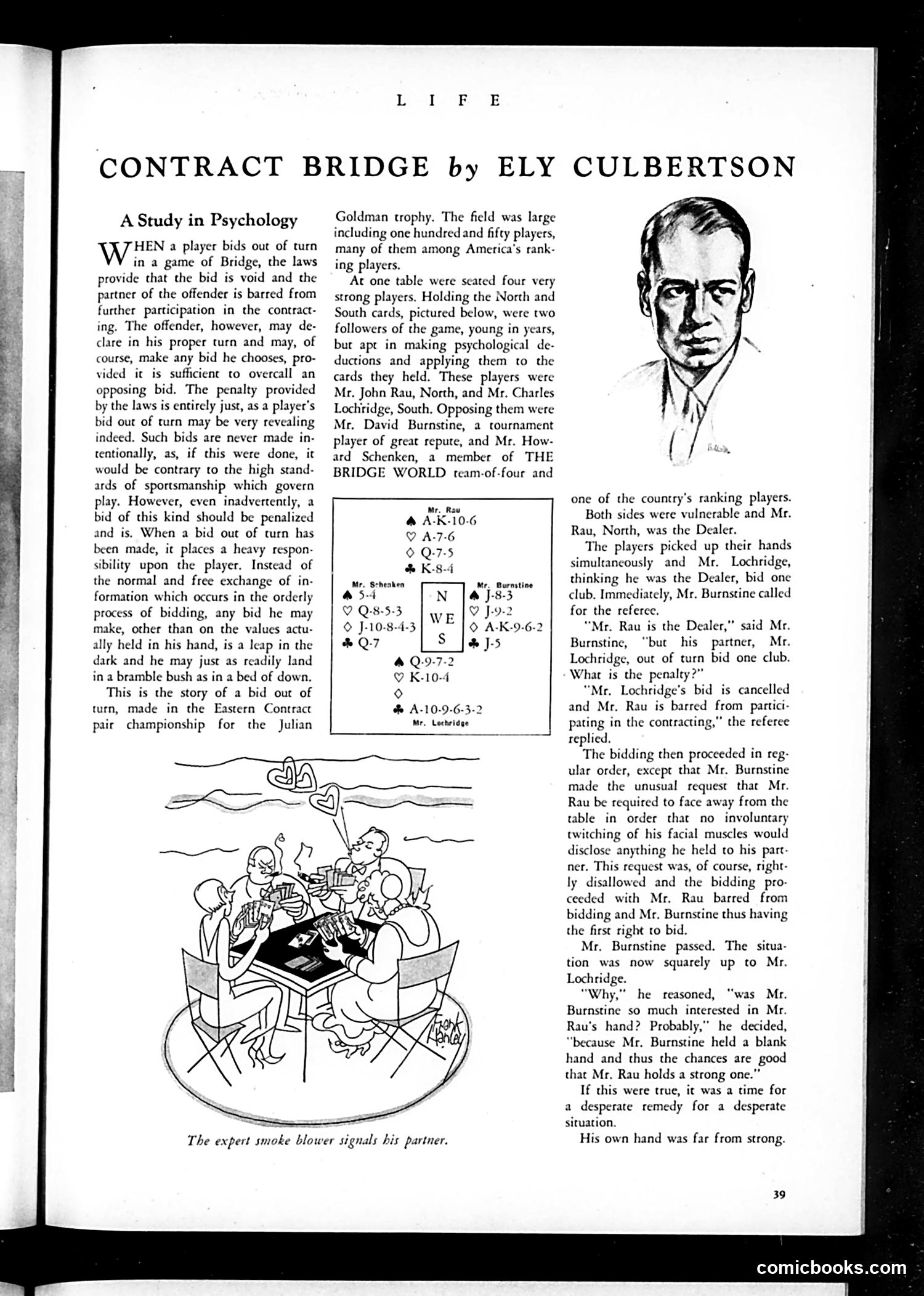
Contract Bridge: A Study in Psychology This is an instructional article by Ely Culbertson about contract bridge, illustrated with a humorous scenario. The piece describes a competitive bridge tournament where player Charles Lochridge inadvertently bids out of turn—a rule violation that requires his partner John Rau to be barred from further bidding. The satire lies in the psychological gamesmanship that follows: opponent David Burnstine's unusual request to force Rau to face away from the table (implying Rau might unconsciously signal information) is rejected. Yet Lochridge uses Burnstine's *interest* in Rau's hand as a psychological clue—reasoning that Burnstine wouldn't care unless Rau held strong cards. The cartoon caption ("The expert smoke blower signals his partner") mocks the psychological manipulation inherent in high-level bridge play, where players read opponents' behavior to gain advantage.
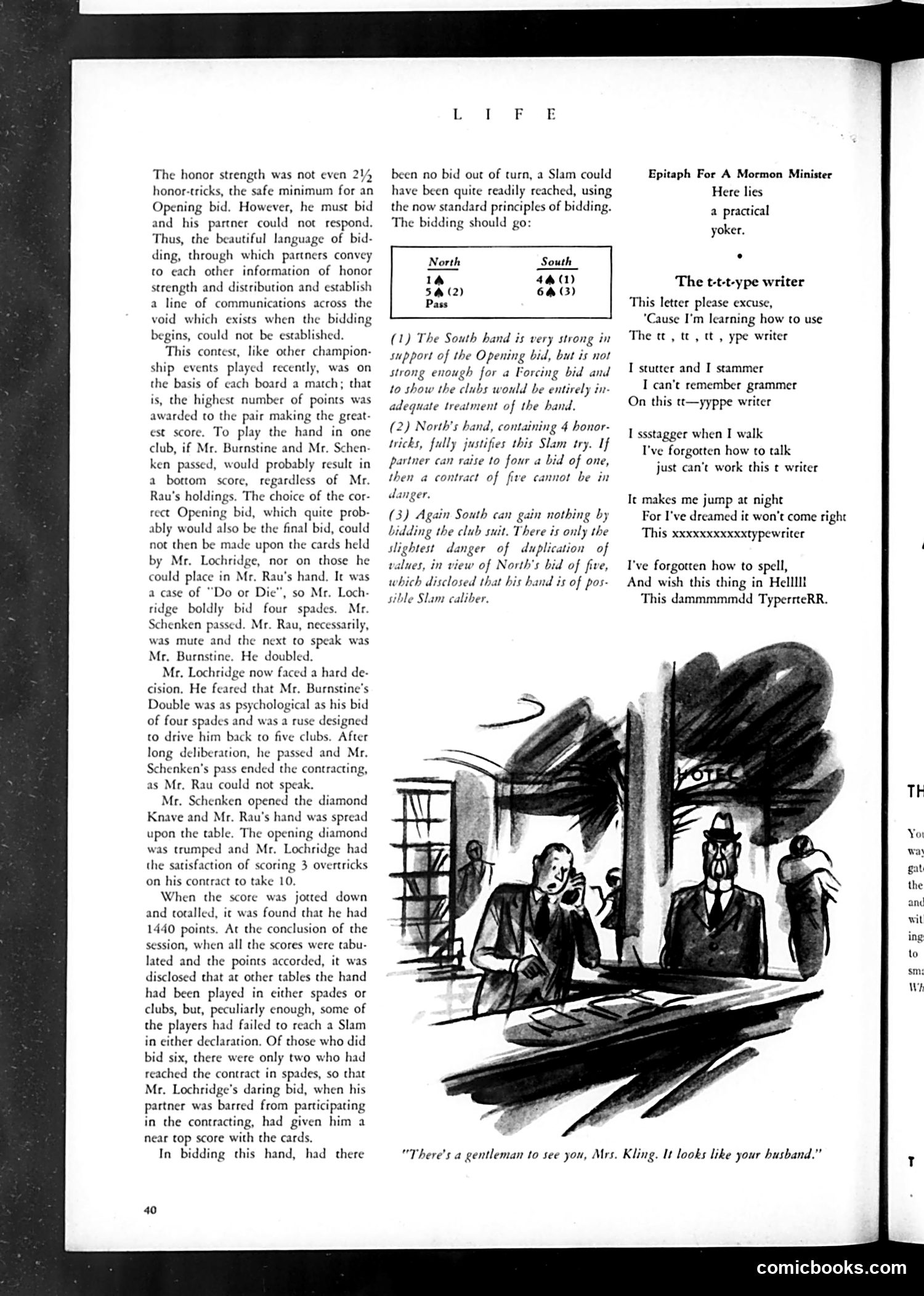
Analysis of Life Magazine Page Content This page contains three distinct humorous pieces typical of Life magazine's satirical style: Main Content: A detailed bridge tournament analysis describing Mr. Lochridge's bold bidding strategy and scoring success—serious card game instruction presented as dramatic sport narrative. "Epitaph for a Mormon Minister": A brief, crude joke playing on the phrase "practical joker" as a funeral epitaph. The reference to "Mormon" appears designed simply to add unexpected religious specificity for comedic effect. "The t-t-t-ype Writer": A comedic poem about someone struggling with a malfunctioning typewriter, with deliberately broken text mimicking stuttering and typing errors ("xxxxxxxxxxxx," "dammmmmdd," "TyperrteRR"). The humor relies on visual wordplay and the frustration of mechanical failure—a relatable complaint in the typewriter era. Cartoon: Shows a woman at a door being told a gentleman visitor "looks like your husband"—likely implying infidelity or marital confusion for comedic effect. These represent typical Life magazine humor: sophisticated (bridge analysis) mixed with lowbrow (crude jokes, slapstick mechanics).
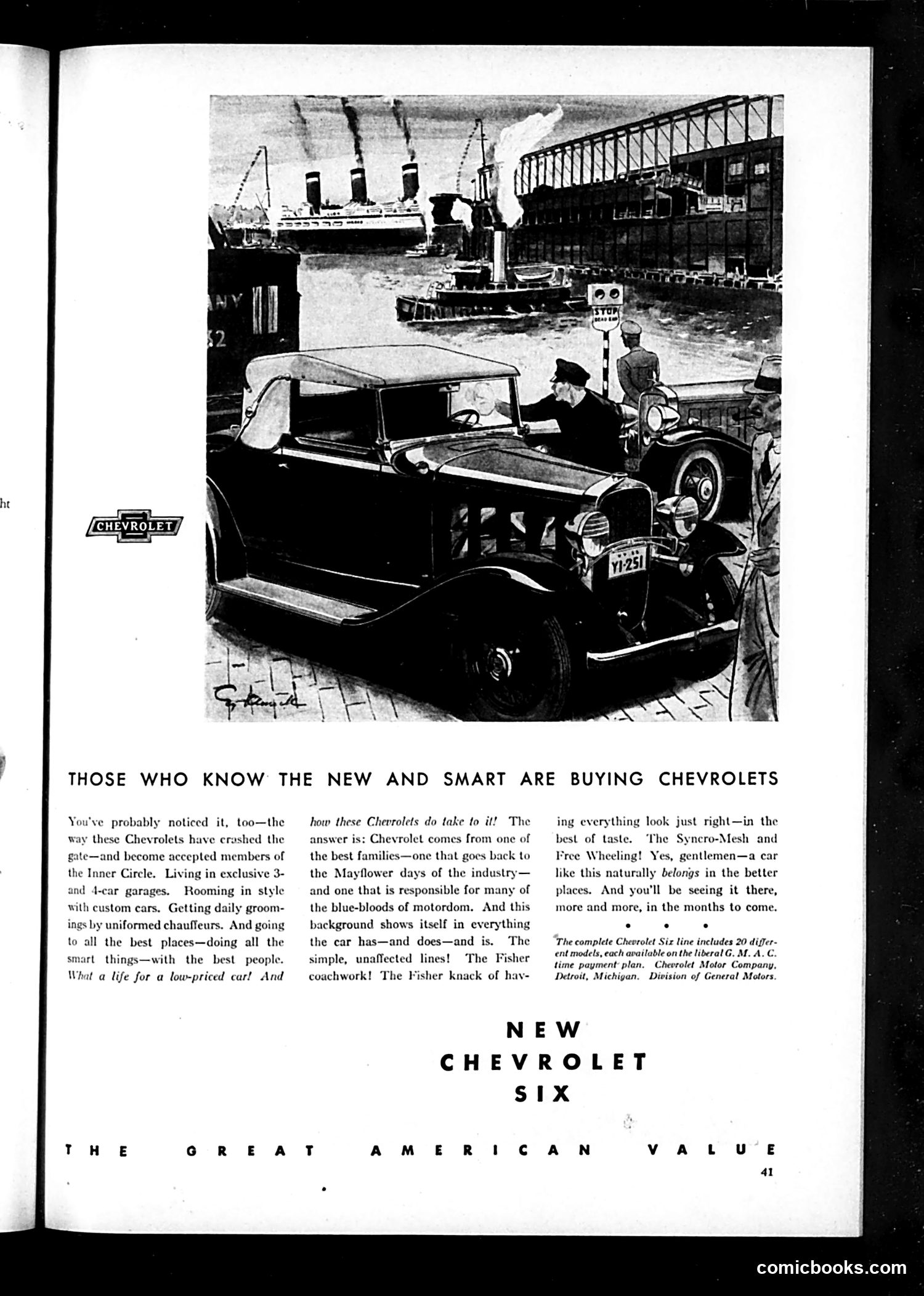
Analysis: Chevrolet Advertisement from Life Magazine This is not a political cartoon but a luxury car advertisement disguised as social commentary. The ad uses satirical language to market the affordable Chevrolet Six to aspirational middle-class buyers. The humor operates through ironic contrast: Chevrolet, a "low-priced car," is depicted inhabiting wealthy spaces—exclusive garages, custom-car collections, and high-society venues traditionally reserved for expensive automobiles. The ad sarcastically presents the car "crashing the gate" of the "Inner Circle" of wealth and status. The actual sales pitch argues that Chevrolet deserves this elevated status because of its pedigree—tracing its lineage to early automotive "blue-bloods" and touting engineering features (Fisher coachwork, Synco-Mesh transmission). For modern readers: this represents early 20th-century class-anxiety marketing, reassuring middle-class consumers that buying an affordable car doesn't compromise their social standing. The satire flatters the reader as "smart" and knowing for recognizing Chevrolet's hidden quality.
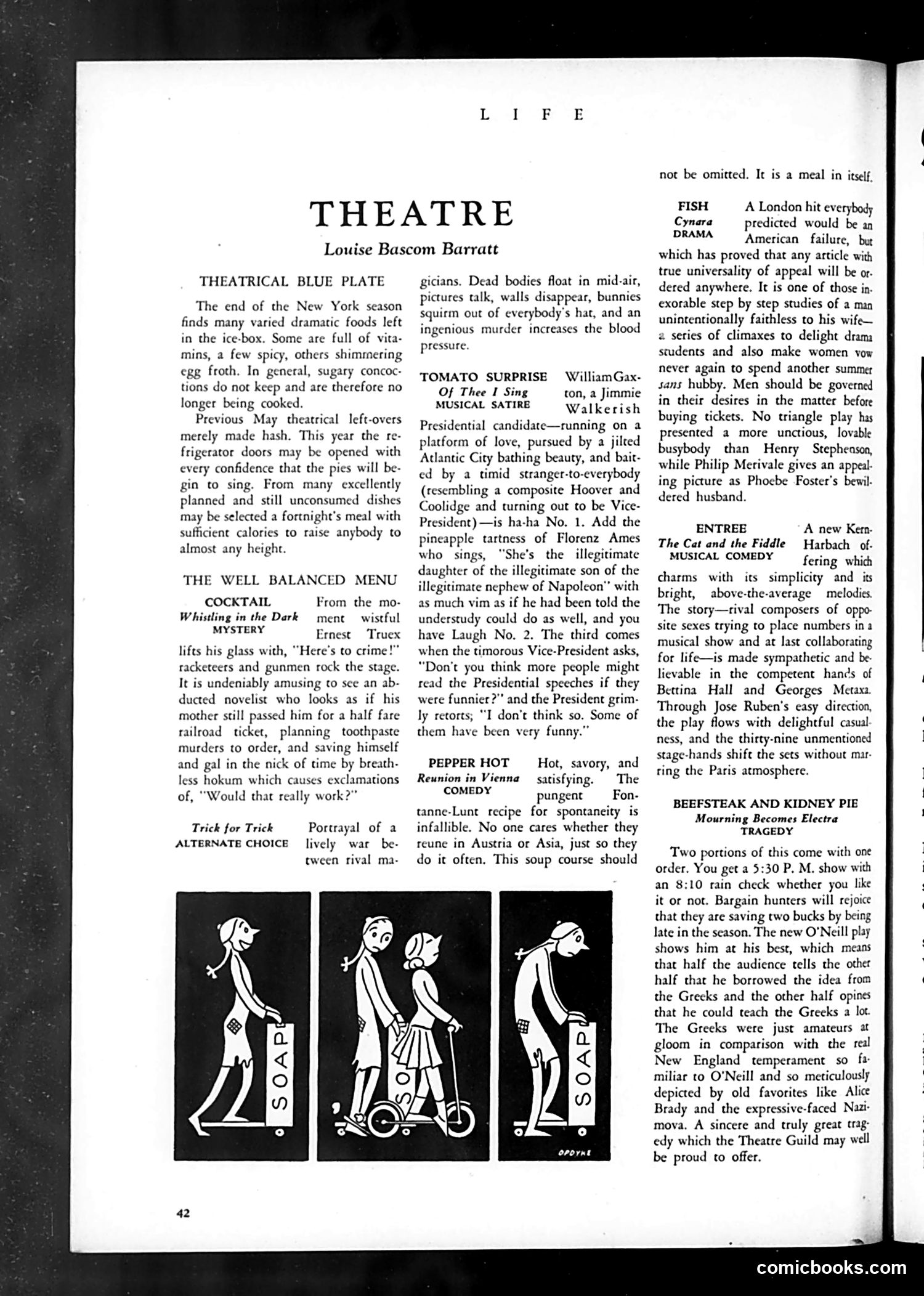
Theatre Reviews from Life Magazine This page contains theater reviews written as a "menu" metaphor—treating Broadway shows like courses in a meal. The critic, Louise Bascom Barratt, uses culinary language to describe five plays: Key shows reviewed: - *Of Thee I Sing* (musical satire): Features a Presidential candidate resembling a composite of Herbert Hoover and Calvin Coolidge, with Vice-President character. The satire mocks political speeches. - *Reunion in Vienna*: Praises the Fontanne-Lunt acting team's comedic timing. - *The Cat and the Fiddle*: A Jerome Kern musical about rival composers. - Mystery plays (*Whistling in the Dark*, *Trick for Trick*): Dismissed as silly hokum. The conceit: By framing reviews as a "well-balanced menu," Barratt suggests these theatrical "leftovers" from the season's end still offer sufficient entertainment value for audience "calories." The small illustrations show figures using soap—likely advertisement tie-ins unrelated to the reviews.
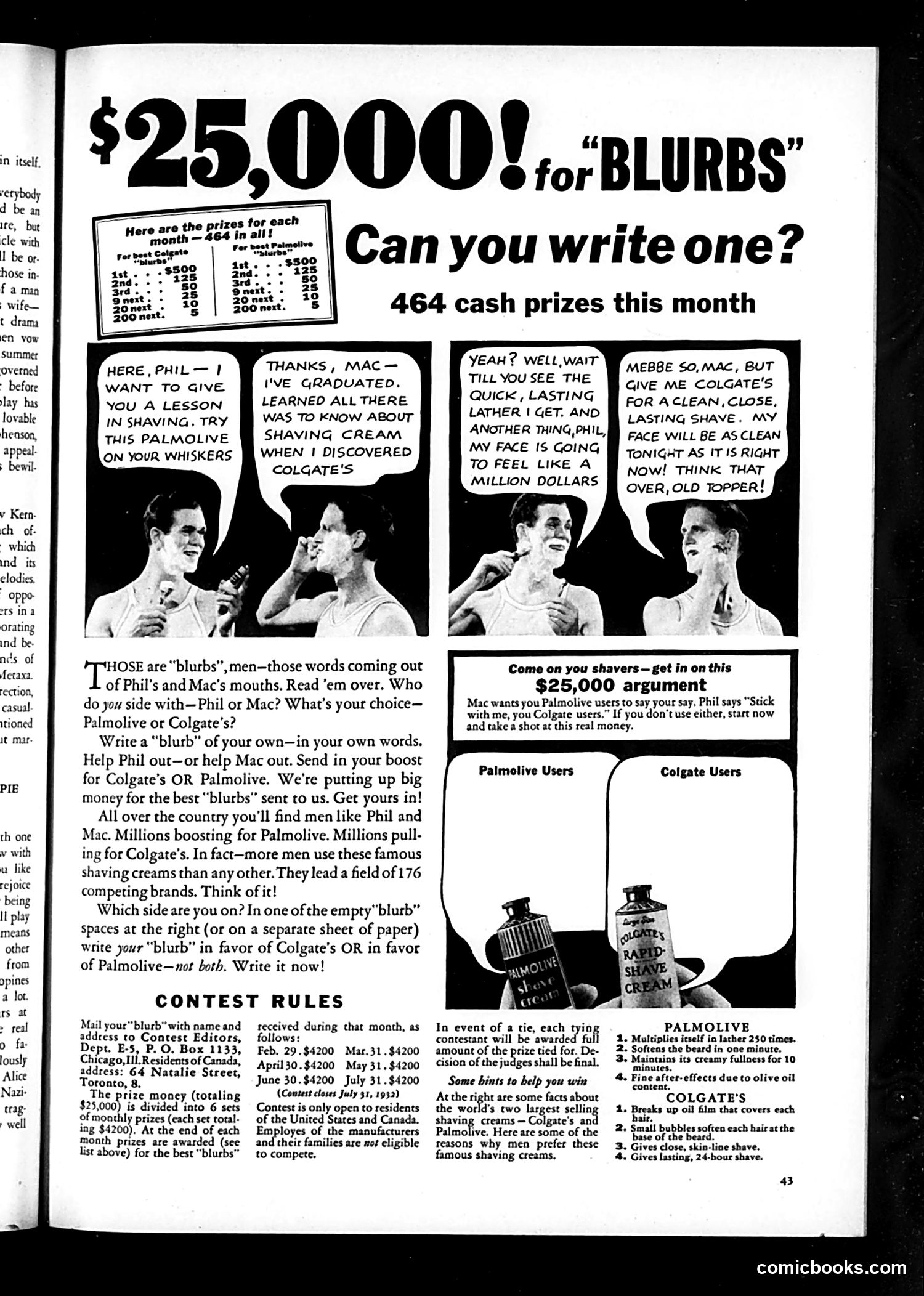
Explanation for Modern Readers This is primarily a shaving cream advertisement disguised as a contest, not political satire. The "cartoon" shows two men, Phil and Mac, debating the merits of Palmolive versus Colgate's shaving cream—their dialogue consists of "blurbs" (advertising testimonials). Life magazine is sponsoring a writing contest offering $25,000 in prizes for readers to compose their own persuasive arguments favoring either brand. The comic frames this as a friendly rivalry between the two products' users. The appeal exploits brand loyalty and consumer competitiveness during the Depression era (note the 1932 contest close date), incentivizing ordinary people to create free marketing copy. The numbered product claims (lather multiplication, beard softening, oil content) are typical early-20th-century advertising rhetoric—vague, unverified assertions common before modern FTC regulations. This represents corporate-sponsored content marketing, where consumers participate in their own commercial persuasion.
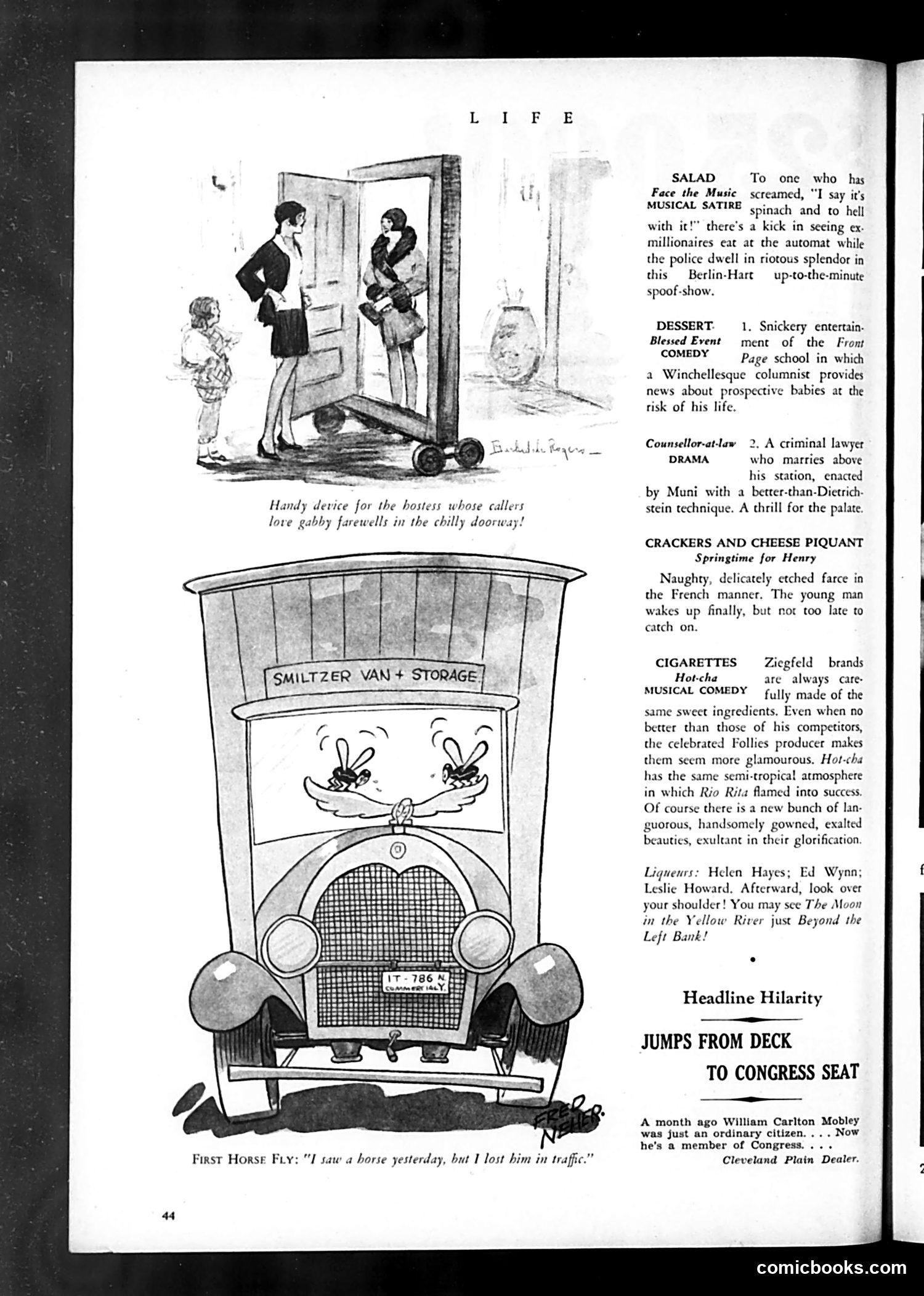
Explanation for Modern Readers This page contains theatrical reviews disguised as food items (a clever metaphor), plus two unrelated cartoons. Top cartoon: Shows a hostess with a mechanical device that forcibly ejects lingering dinner guests out the front door—a visual joke about awkward prolonged farewells in cold entryways. Bottom cartoon: A "Smiltzer Van & Storage" vehicle (a moving van) depicted as a car with fly-swatters as wipers, illustrating the joke "I saw a horse yesterday, but I lost him in traffic"—absurdist humor about urban congestion. Theater reviews: Disguised food references mock 1920s Broadway shows, including musicals by Florenz Ziegfeld and plays starring Paul Muni and Helen Hayes. The reviews use satirical food names ("Salad," "Dessert," "Cigarettes") to critique contemporary theater. Headline item: Notes William Carlton Mobley's sudden leap from ordinary citizen to Congress member—likely satirizing either nepotism or the perceived ease of entering politics, sourced from the Cleveland Plain Dealer.
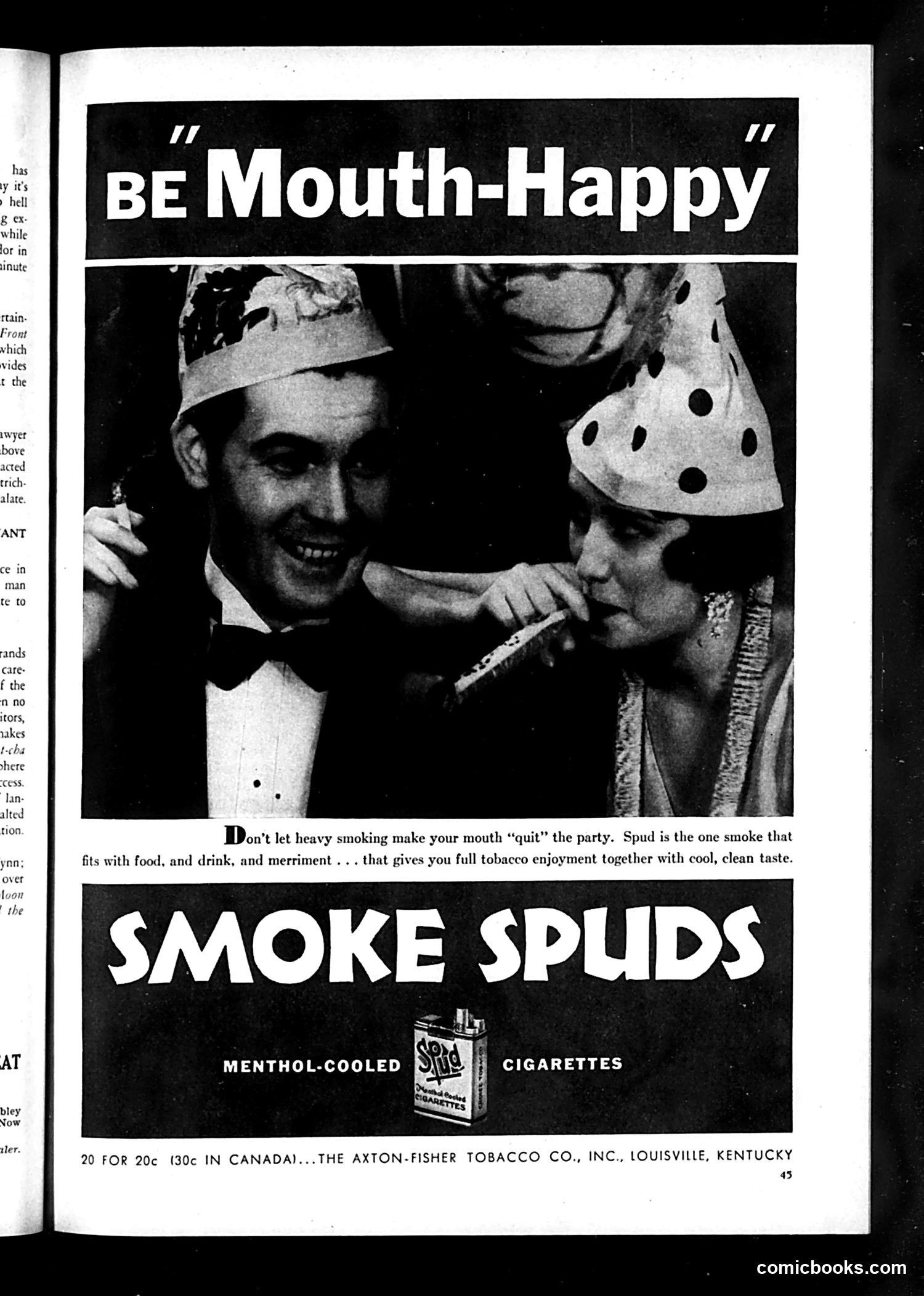
Analysis This is a cigarette advertisement, not political satire. The page promotes "Smoke Spuds" menthol-cooled cigarettes by the Axton-Fisher Tobacco Company. The ad features a photograph of three people at what appears to be a party—a man in formal wear (tuxedo and party hat) between two women wearing party hats, all smiling. The headline "BE Mouth-Happy" uses a pun playing on the phrase "mouth-happy" to suggest contentment. The copy warns against "heavy smoking" making your mouth "quit" the party, positioning Spuds cigarettes as the solution: they provide "full tobacco enjoyment" with a "cool, clean taste" that won't interfere with eating, drinking, and socializing. This reflects mid-20th-century advertising that normalized smoking as a social, party-friendly activity without health warnings—a marketing approach that would become heavily restricted decades later.
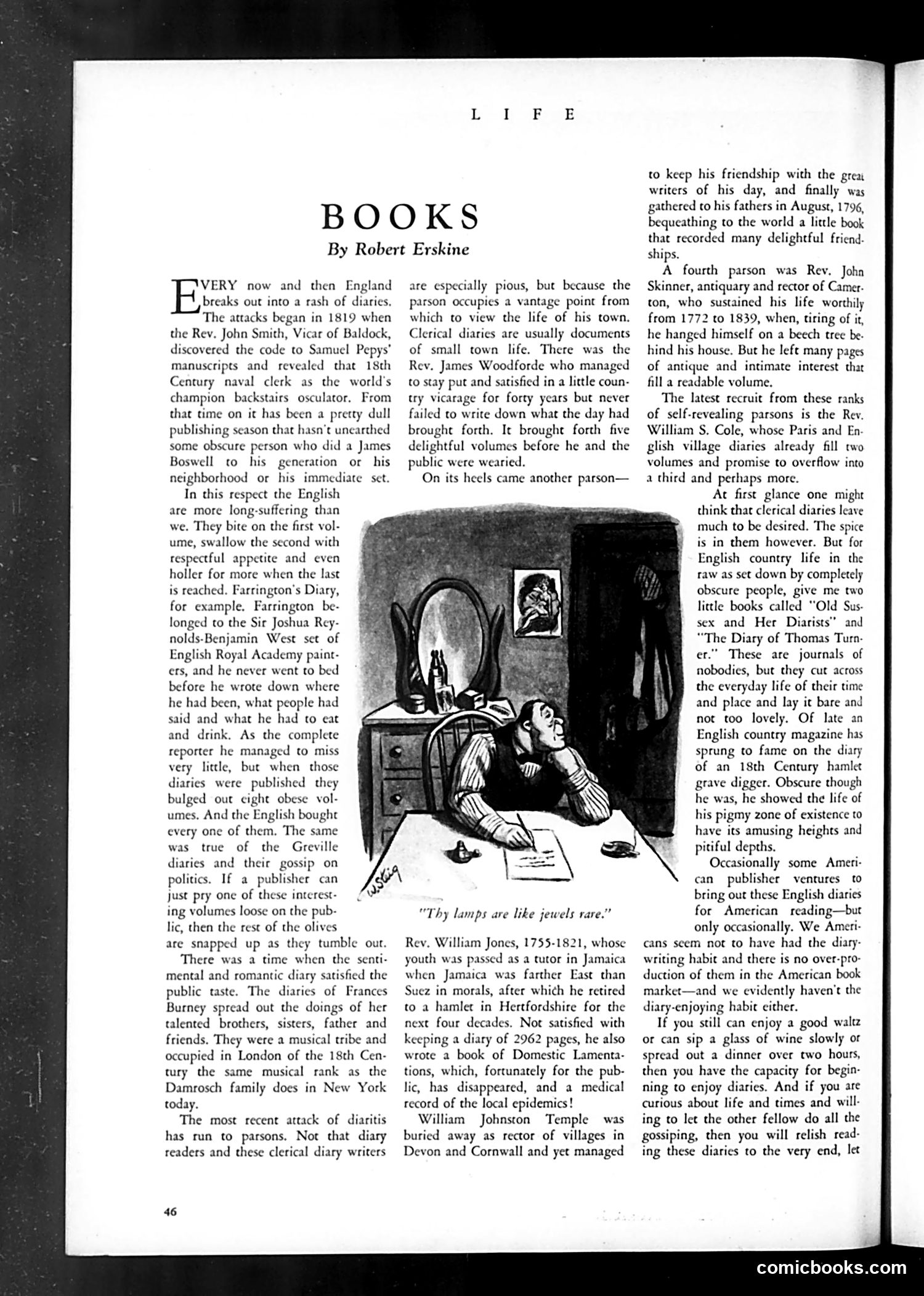
Analysis of "Books" by Robert Erskine This essay satirizes England's obsession with publishing personal diaries—particularly those of obscure clergymen. Erskine notes that English readers will devotedly consume multi-volume sets of mundane diary entries (like Farrington's eight volumes), whereas Americans lack this appetite. The accompanying illustration shows a figure at a desk writing by lamplight, captioned "Thy lamps are like jewels rare"—a witty jab at clerical diarists who meticulously record trivial daily details. Erskine catalogs several actual 18th-19th century parsons whose published diaries became bestsellers despite their subjects' obscurity: Rev. Woodforde (forty years in a country vicarage), Rev. Jones (2,962 pages), and Rev. Skinner (who eventually hanged himself). The satire's point: English publishers cynically exploit this diary craze by prying loose any obscure volume they can find, knowing English audiences will purchase them respectfully, regardless of actual merit or readership value.
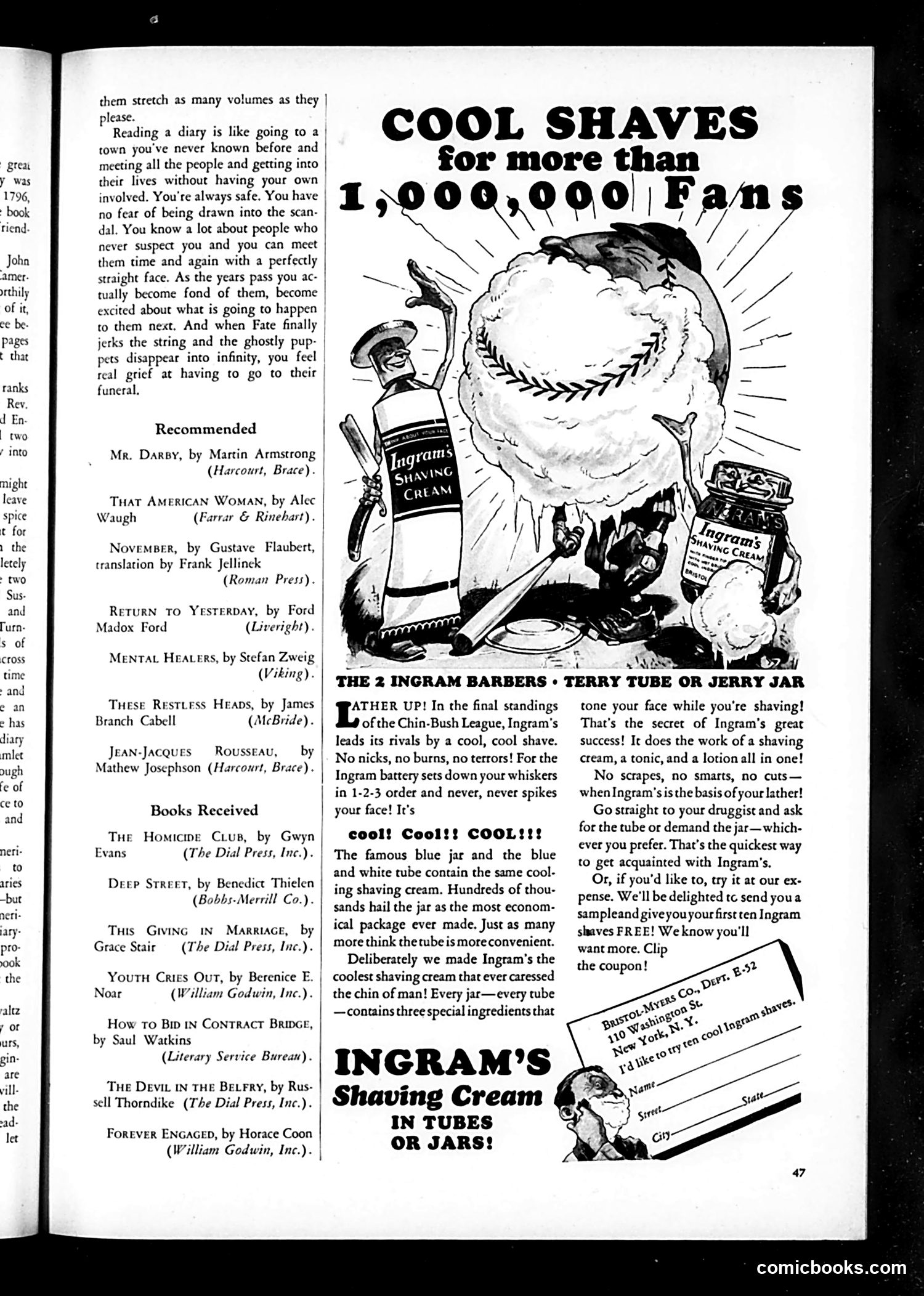
Analysis for Modern Readers This page is primarily advertising, not political satire. The dominant content is a full-page advertisement for Ingram's Shaving Cream, using baseball metaphor and imagery to market the product. The Ad's Strategy The advertisement uses a "Chin-Bush League" baseball analogy, positioning Ingram's as the winning team in men's grooming. The visual shows an exaggerated shaving cream lather depicted as baseballs and bats. The copy employs sports language ("battery," "spikes," "final standings") to appeal to male readers through a familiar, competitive framework. Historical Context The ad promises three key selling points for 1920s-30s men: no nicks, burns, or irritation—practical concerns when safety razors were standard. The product comes in both "tubes" and "jars," presenting consumer choice as novel and desirable. The remainder of the page contains a book recommendations section, typical of Life magazine's literary content, unrelated to the advertisement. There is no political cartoon or satire on this page—it's a commercial product advertisement dressed in period-appropriate sports rhetoric.
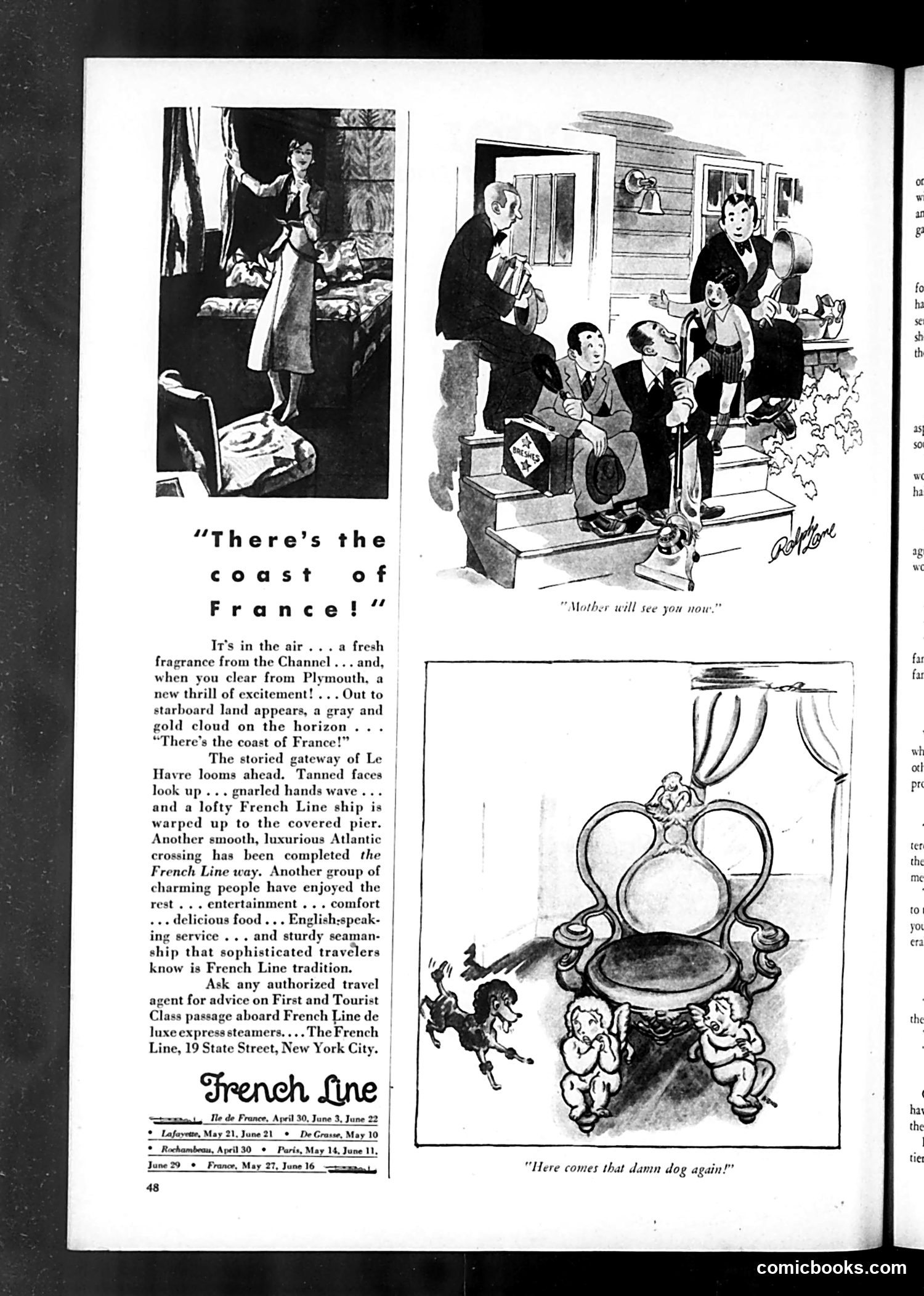
French Line Advertisement & Domestic Humor This page is primarily a French Line steamship advertisement promoting transatlantic luxury travel to France. The top-left illustration depicts a woman elegantly packing for her voyage, accompanied by romantic prose about arriving at Le Havre and experiencing French hospitality. The two smaller cartoons are unrelated domestic humor: - Top right: A family welcomes mother home from her trip, with children greeting her at the door. - Bottom: A comedic scene of children being chased by "that damn dog again"—suggesting chaotic household antics during mother's absence. The satire's appeal lies in the contrast: the advertisement romanticizes sophisticated European travel while the cartoons humorously depict the mundane, slightly chaotic reality of home life. The ads list specific ship names and sailing dates, making this a commercial publication reaching middle-class aspirational readers in the interwar period.
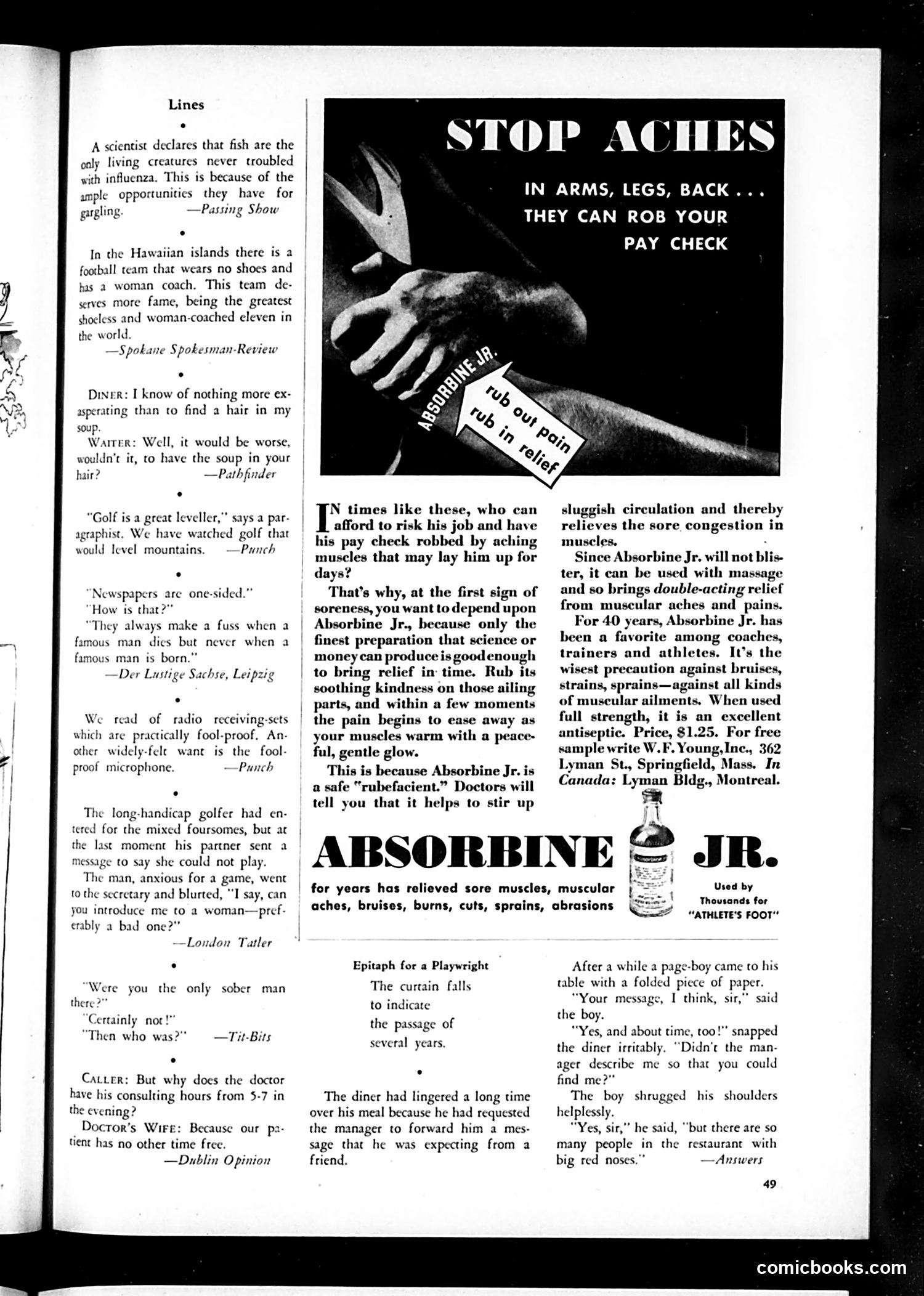
Explanation for Modern Readers This page from *Life* magazine combines satirical "Lines" (short jokes) with a full-page advertisement for Absorbine Jr., a liniment for muscle pain. The Satire: The short jokes mock contemporary absurdities—fish never getting influenza because they gargle, a Hawaiian team's shoelessness being noteworthy, and a diner complaining about hair in soup (the waiter suggests it'd be worse to have soup in your hair). These represent *Life*'s characteristic gentle mockery of everyday life and human foibles. The Advertisement: The large Absorbine Jr. ad uses Depression-era anxiety as its hook: workers can't afford to miss jobs due to muscle pain. The ad promises relief for laborers, athletes, and coaches. The small "Epitaph for a Playwright" below mocks theatrical time-skips, while the restaurant anecdote jokes about the diner's unremarkable appearance—he can't be distinguished from other restaurant-goers. Context: This reflects early-20th-century *Life* magazine's mix of humor, social observation, and advertising before the publication shifted toward photojournalism.
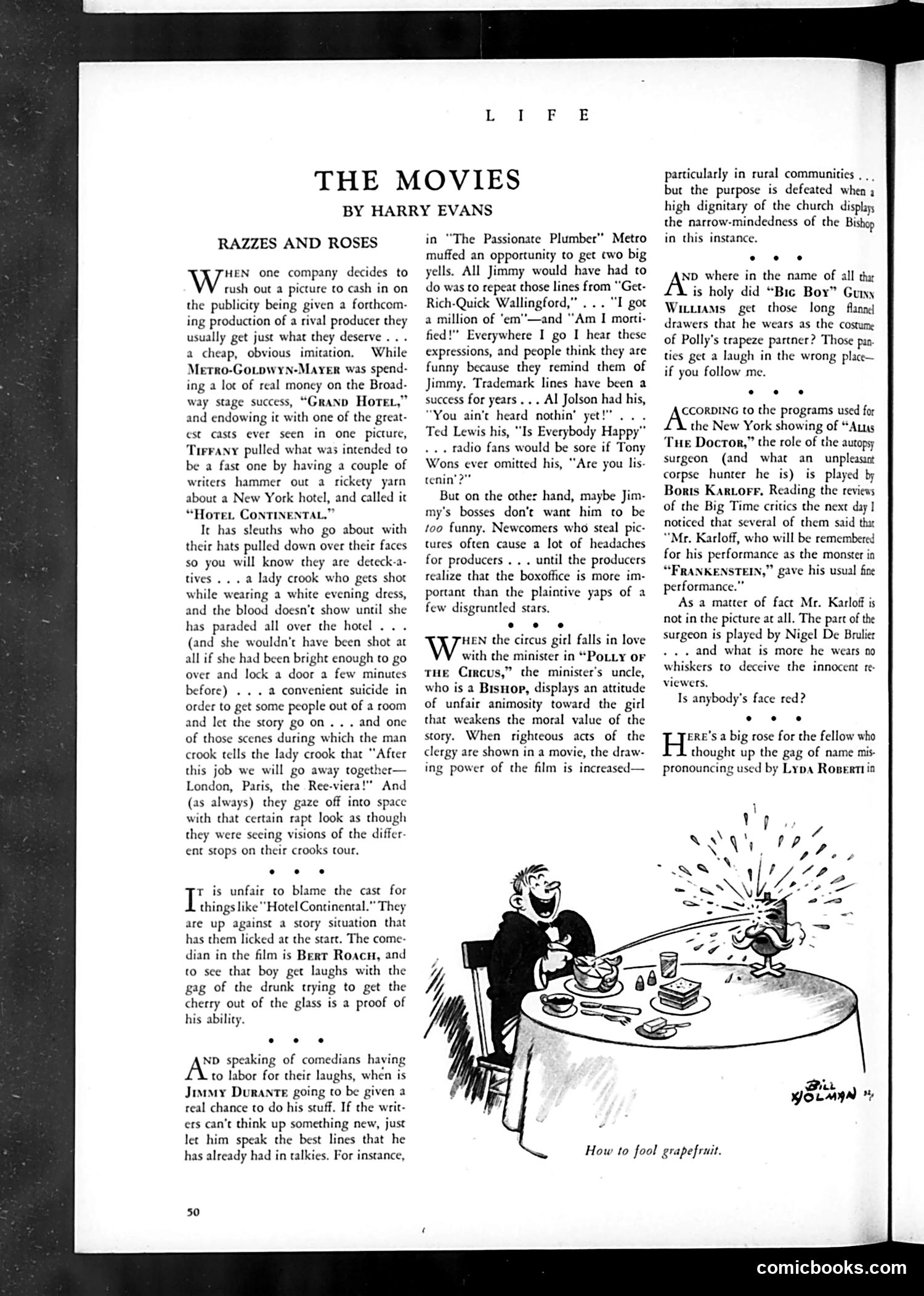
Analysis of Life Magazine Movie Column This 1920s-era film criticism column by Harry Evans critiques contemporary Hollywood productions. The page contains one cartoon (bottom) showing a man at a dining table startled by an exploding grapefruit—illustrating the caption "How to fool grapefruit," likely a visual gag about slapstick comedy. The text discusses several films and performers: - "Hotel Continental" (Tiffany) is criticized as a cheap imitation of MGM's "Grand Hotel," with clichéd plot elements (criminals, convenient suicides, romantic monologues about Paris). - Bert Roach is praised for extracting laughs despite poor material. - Jimmy Durante is noted for catchphrases ("I got a million of 'em") that audiences love, yet producers allegedly underutilize him. - "Polly of the Circus" is faulted for depicting a Bishop unsympathetically, weakening the film's moral message in rural communities. - Guinn "Big Boy" Williams is mocked for unflattering costume choices. The column demonstrates early Hollywood's reliance on slapstick, formula plots, and star appeal.
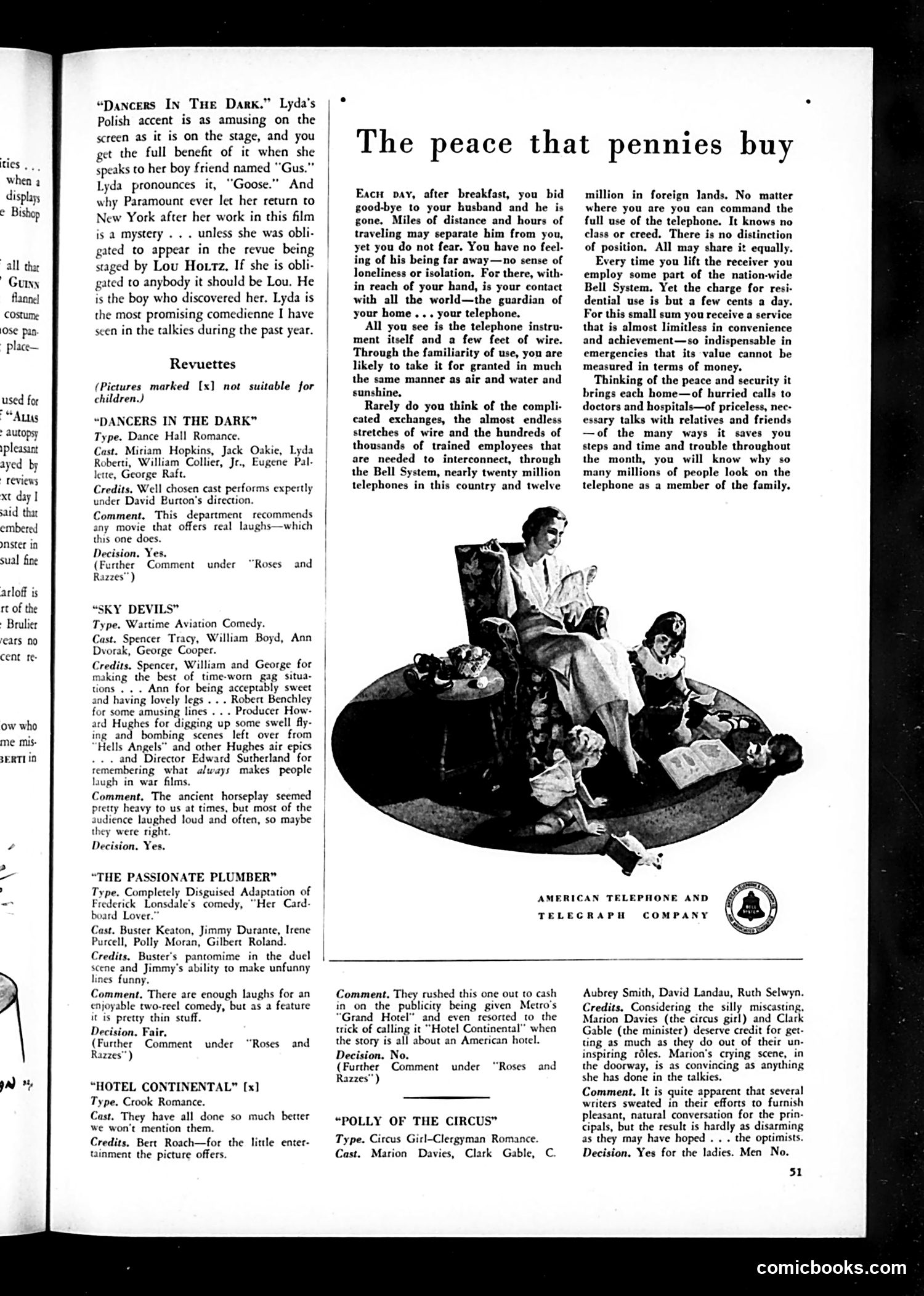
"The Peace That Pennies Buy" — Bell System Advertisement This is a Bell Telephone System advertisement, not a political cartoon. The image shows a woman at home using her telephone while her husband is away traveling for work — a common scenario in 1930s American life. The ad's messaging appeals to anxieties about separation and modern industrial life. It emphasizes that despite physical distance, the telephone maintains emotional connection and family security ("the guardian of your home"). The title's phrase "peace that pennies buy" references the modest cost of phone service relative to its psychological value. The accompanying text celebrates the invisible infrastructure — "exchanges," "stretches of wire," and "trained employees" — enabling this comfort, essentially promoting Bell's monopoly as essential to American domestic life and security. This is corporate propaganda disguised as reassurance about technology's benefits.
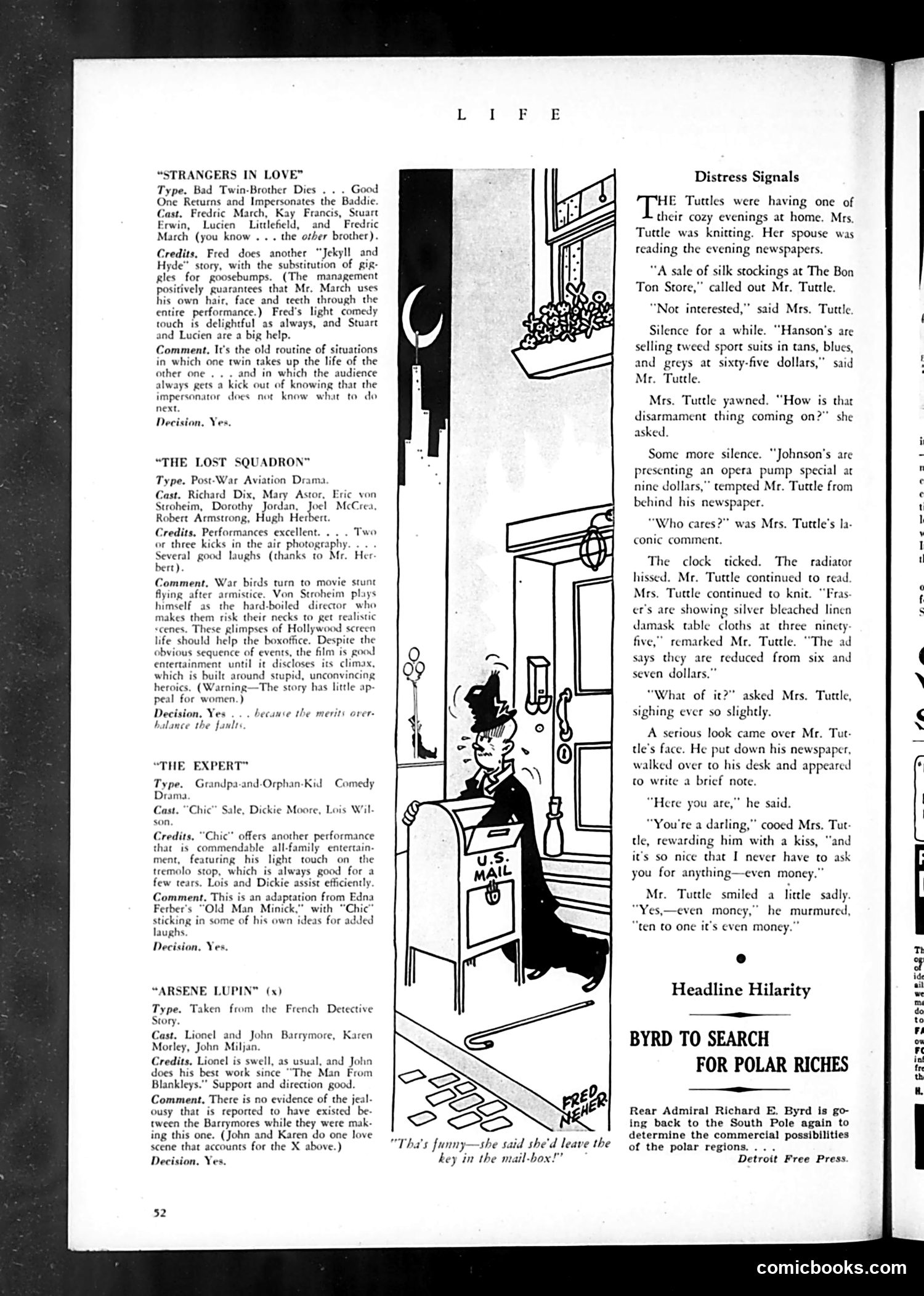
Explanation for Modern Readers This page contains film reviews and a domestic humor sketch. The left side reviews four movies (typical 1920s-30s fare), offering plot summaries and critical assessments with a humorous tone—noting, for example, that Fredric March uses "his own hair, face and teeth" in "Strangers in Love." The right side presents "Distress Signals," a comic sketch satirizing marital apathy during the Depression era. Mr. Tuttle repeatedly reads advertising circulars aloud to his knitting wife—silk stockings, suits, opera pumps, linen tablecloths—hoping to spark her interest in shopping. She remains utterly indifferent, yawning and asking about "disarmament" instead. The joke reflects economic hardship: wives won't shop even when husbands dangle goods before them. It's also satirizing gender roles—the husband assumes advertisements will captivate his wife, but she's preoccupied with weightier concerns (disarmament negotiations). The sketch mocks both consumer culture and conventional domesticity.
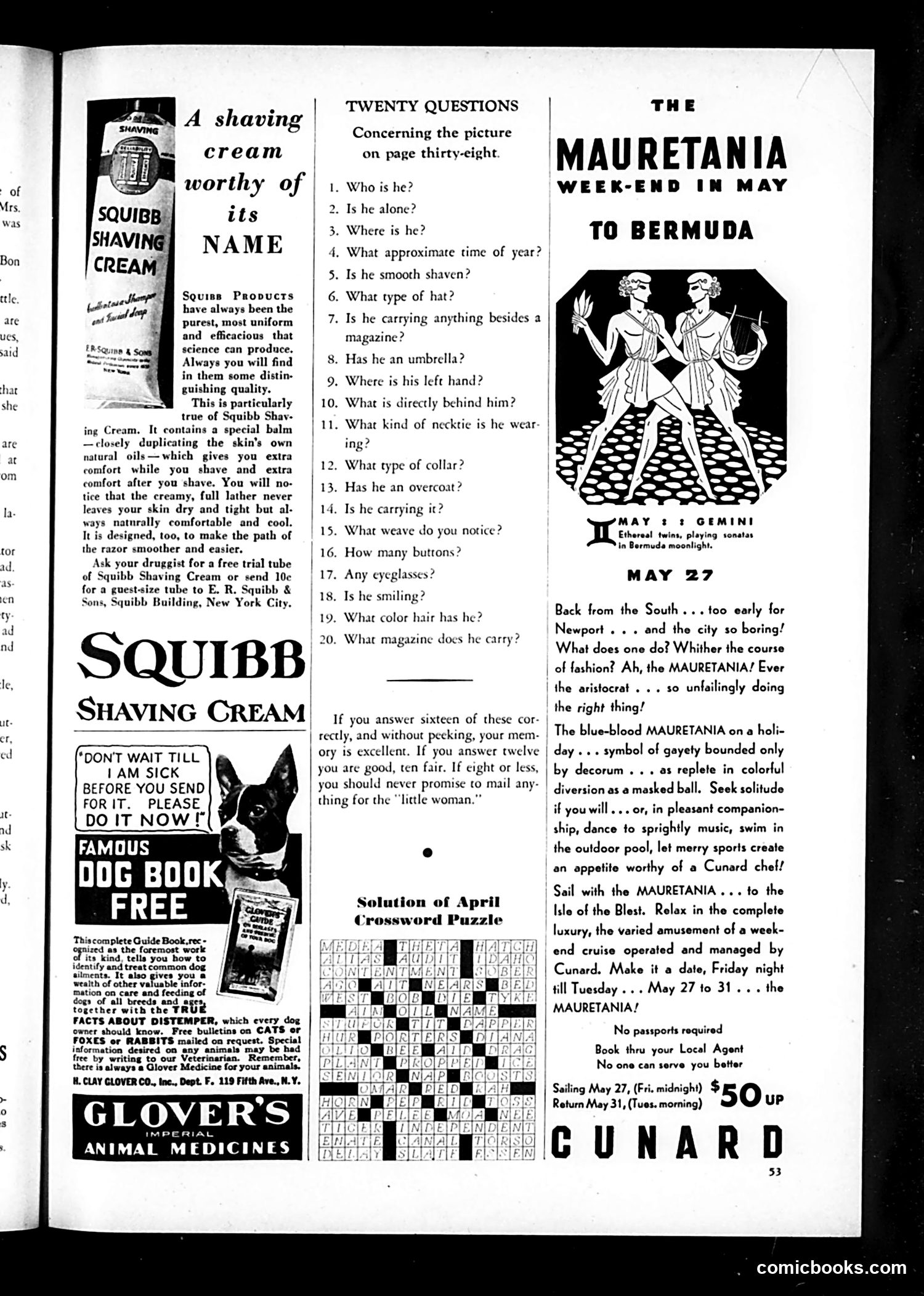
Page Analysis This page contains primarily advertising rather than political satire or comics. The main content includes: 1. Squibb Shaving Cream advertisement — a product pitch emphasizing the cream's comfort and quality ingredients 2. Glover's Animal Medicines ad — promoting a free dog care guide, with a warning encouraging people to seek veterinary advice preemptively ("Don't wait till I am sick before you send for it") 3. Memory/observation game — "Twenty Questions" challenging readers to answer questions about an unshown picture on page 38, apparently testing memory and attention to detail 4. Cunard cruise advertisement — promoting the *Mauretania* ocean liner for a Bermuda weekend getaway in May, marketed as an elegant, aristocratic leisure experience with various entertainment options The ads reflect 1930s-era consumer culture and class aspirations. There is no political cartoon or satirical content on this page.
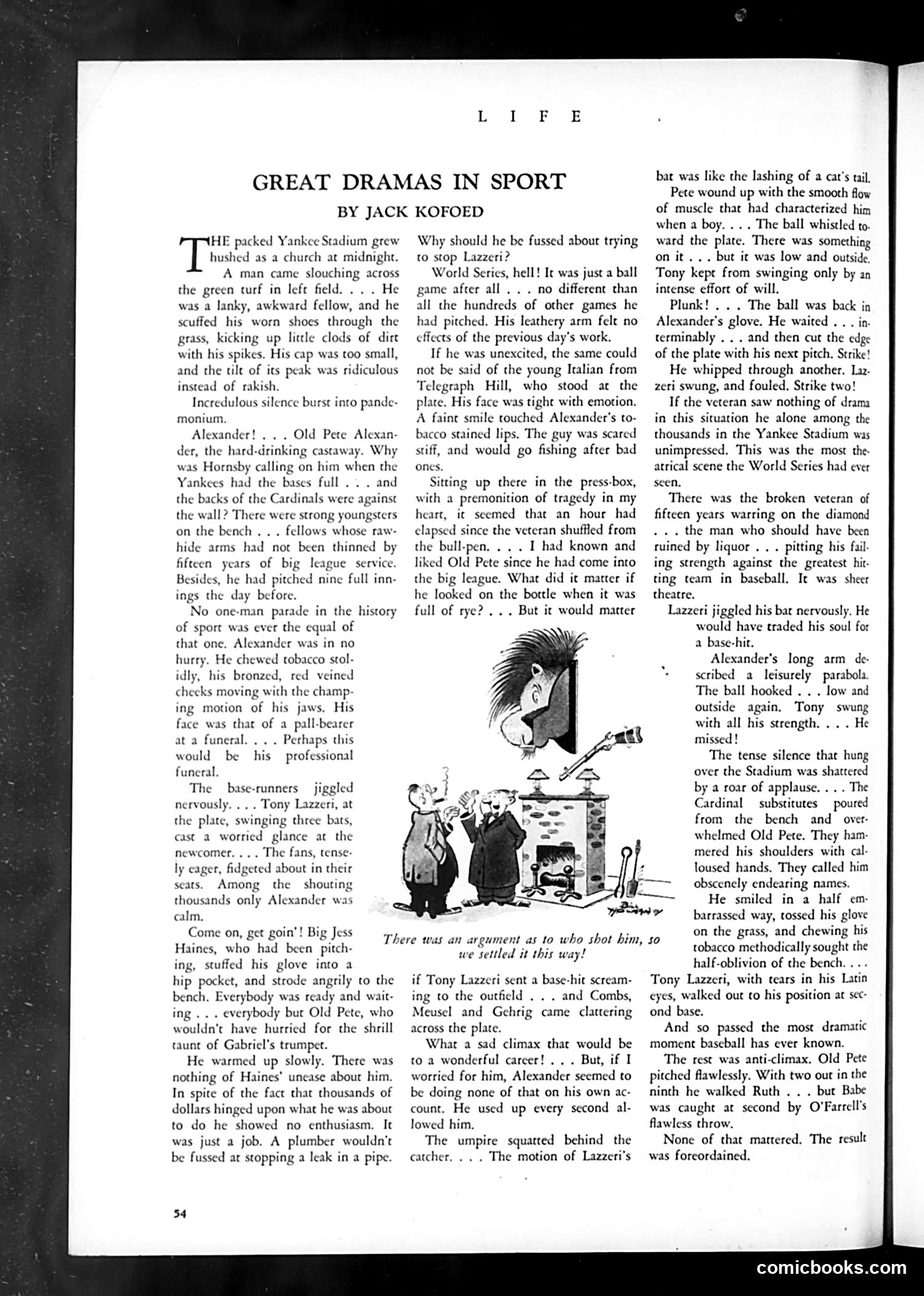
"Great Dramas in Sport" by Jack Kofoed This article dramatizes a famous 1926 World Series moment: pitcher Grover Cleveland Alexander's relief appearance against Tony Lazzeri of the Yankees. The text recounts Alexander's legendary calm as he enters the game with bases loaded—a aging veteran (depicted in the cartoon as haggard and worn) showing no nervousness despite thousands of dollars at stake and his team's fate depending on his performance. The satire contrasts Alexander's stoic indifference ("just a job. A plumber wouldn't be fussed") with the frantic anxiety of younger players and fans. The cartoon illustration shows Alexander's gaunt face above the drama below, emphasizing his detachment. The piece celebrates working-class grit and experience over youth, portraying Alexander as unimpressed by pressure or glory—he simply does his job methodically, like a tradesman.
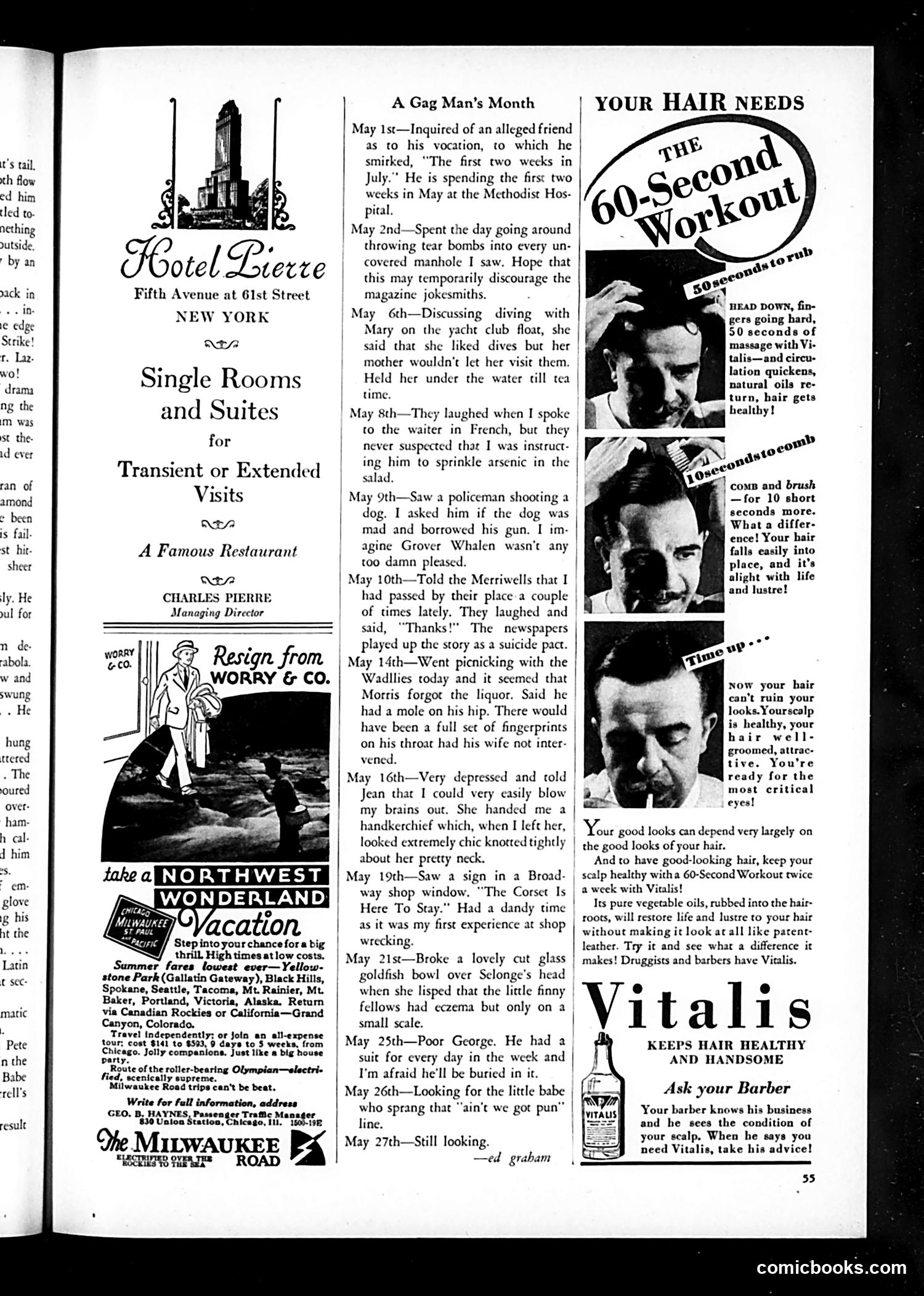
"A Gag Man's Month" Satire Explanation This is a dark humor column by "ed graham" satirizing the life of a magazine comedy writer ("gag man"). The joke is that he describes increasingly violent, destructive, and socially inappropriate behavior—poisoning salads, drowning dates, shooting guns, wrecking shops, breaking valuables—all framed as mundane monthly activities. The satire mocks both the writer himself (presenting casual cruelty as entertainment) and the magazine industry's demand for shock humor. References like mentioning "Grover Whalen" (NYC's police commissioner) and the "Merriwells" (newspaper society figures) suggest he's satirizing real New York social circles while describing absurd crimes. The darker joke underneath: this behavior would get normal people arrested, but a professional joke-writer apparently operates in a consequence-free space where even near-murder is just material for next week's column. It's cynical commentary on entertainment industry excess during the Jazz Age.
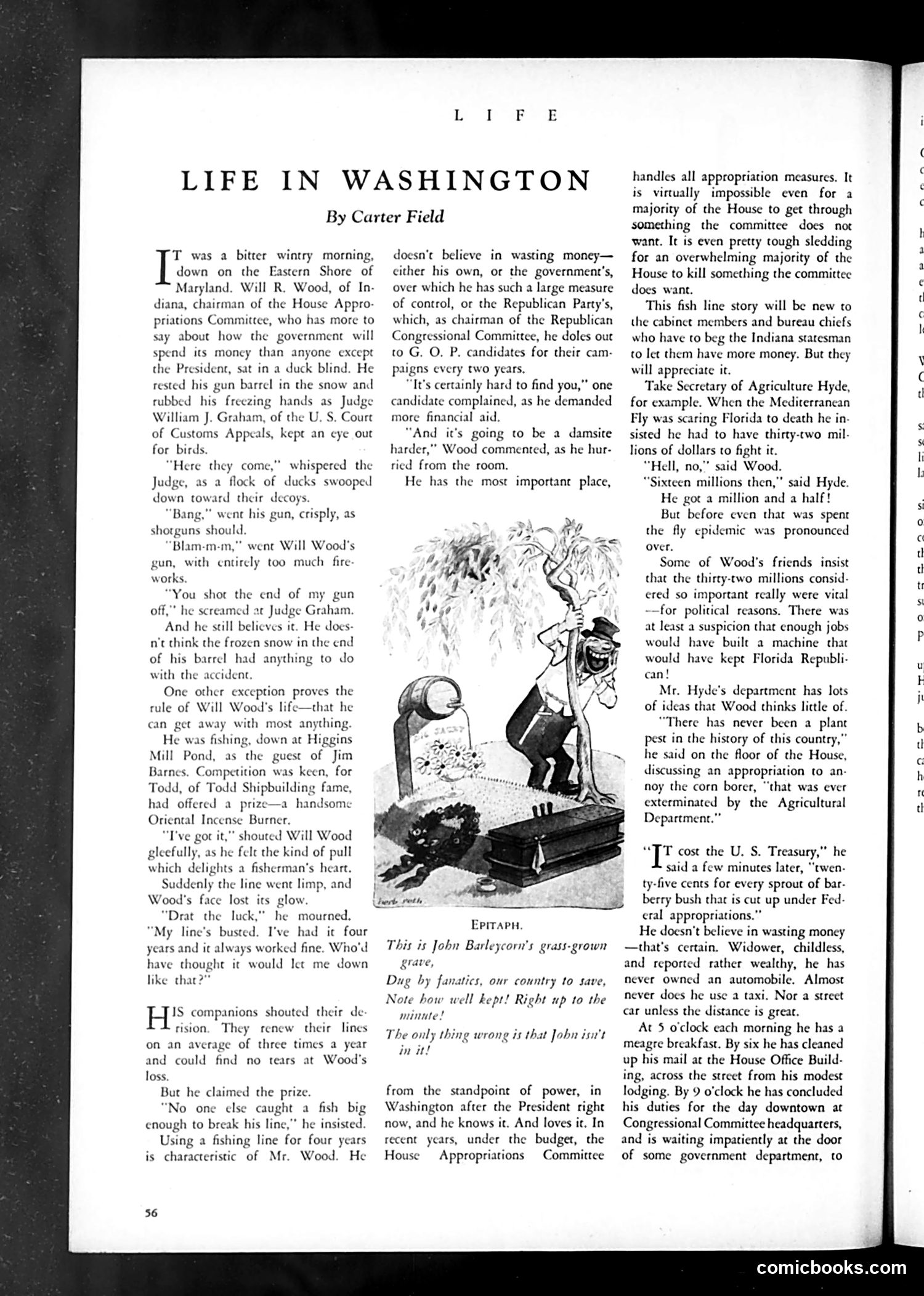
Analysis: "Life in Washington" by Carter Field This satirical piece lampoons Will R. Wood, chairman of the House Appropriations Committee, portraying him as a miserly, lucky operator who wields enormous government power. The cartoon illustrates Wood's defining trait: getting away with things through a combination of cheapness and audacity. Two anecdotes establish this: he shoots the end off a judge's gun but denies responsibility; he breaks a fishing line (kept four years) yet claims the prize anyway. The satire's political point: Wood controls federal spending—making him arguably more powerful than the President—yet refuses to spend money even when necessary. The example of Agriculture Secretary Hyde requesting $32 million to fight the Mediterranean Fly demonstrates Wood's penny-pinching obstinacy; he grants only $1.5 million, and the crisis resolves anyway, vindicating (by luck) his stinginess. The epigraph about "John Barleycorn's grass-grown grave" references Prohibition, suggesting Wood's miserliness extends to government ideology. The overall message: this powerful bureaucrat's cheapness and ability to evade consequences make him dangerous to effective governance.
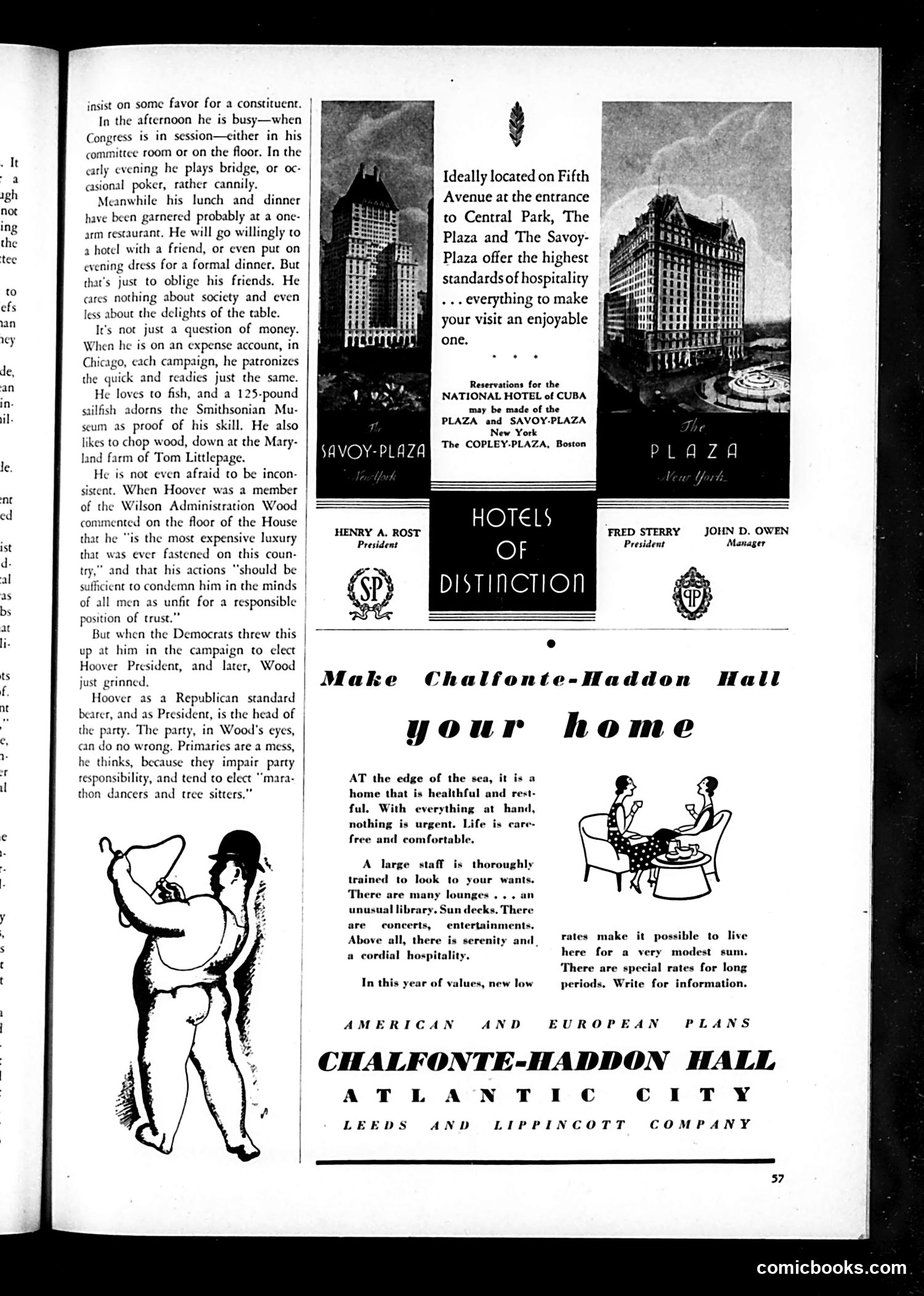
Analysis of Page 57 This page is primarily advertising, not editorial satire. The text discusses a politician (likely a congressman) known for frugality and unpretentiousness—he eats at one-arm restaurants, plays poker, loves fishing, and chops wood. The passage contrasts his modest personal habits with his political record, noting Democrats attacked him during Hoover's campaign for being an "expensive luxury," but he remained unaffected. The cartoon visible (left side) shows a caricatured figure in formal dress, likely satirizing the contrast between this politician's claimed simplicity and formal social obligations. The bulk of the page consists of hotel and resort advertisements (Plaza, Savoy-Plaza in New York and Boston; Chalfonte-Haddon Hall in Atlantic City; National Hotel of Cuba)—typical 1920s-30s advertising designed to appeal to affluent readers. Without clearer identification of the specific politician referenced in the text, the exact satirical target remains unclear.
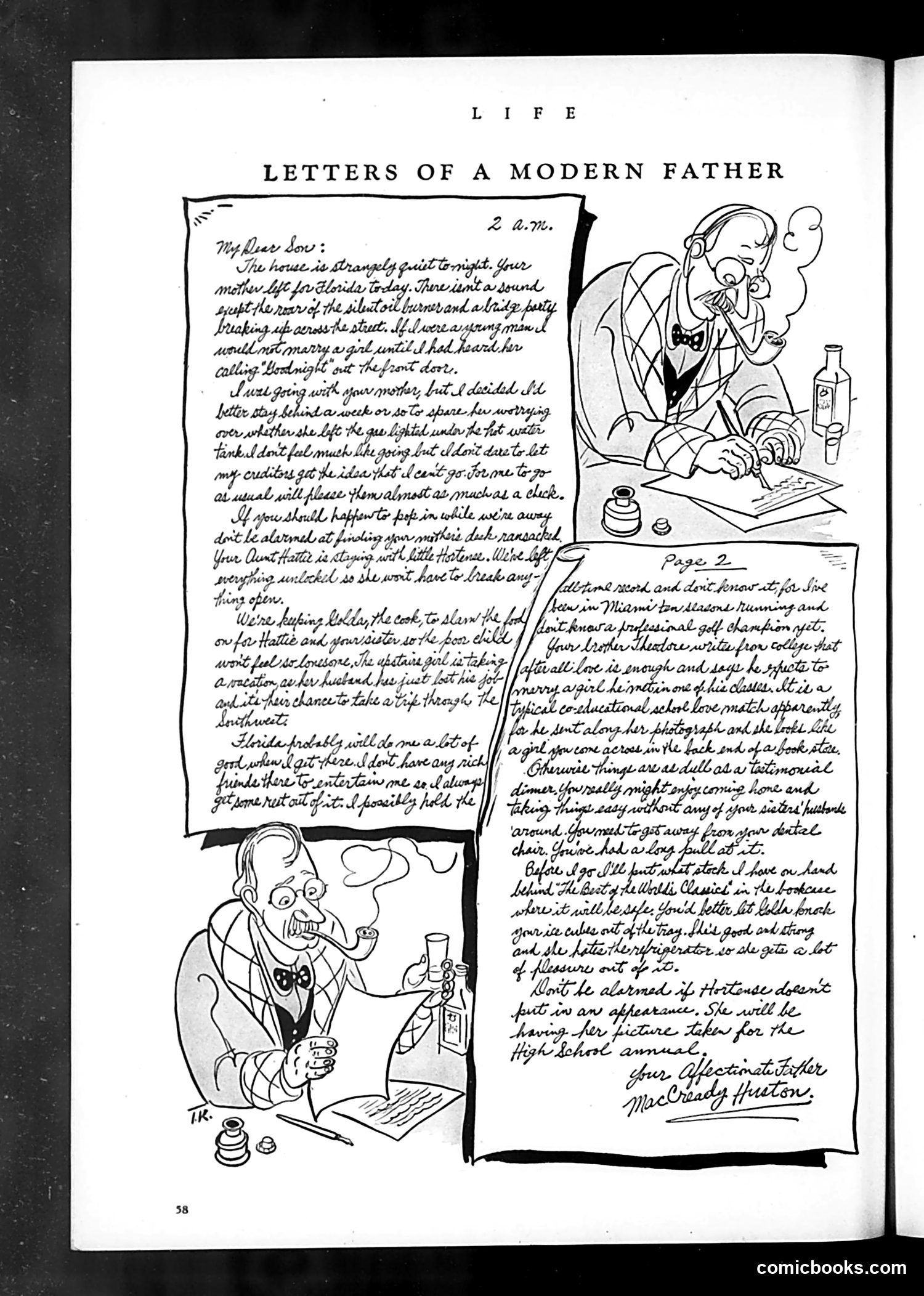
"Letters of a Modern Father" This is a humorous advice column presented as a father's letters to his son. The two illustrated panels show a well-dressed man (the father) at his desk, writing and drinking, depicted in a comedic, slightly inebriated state. The satire mocks contemporary parental guidance and social expectations of the era. The father dispenses advice on relationships, social conduct, and life choices—but the cartoon's portrayal of him as disheveled and drinking suggests the advice is dubious or hypocritical. The humor lies in the disconnect between the authority figure's pretense of wisdom and his obvious flaws. This reflects a broader satirical theme common to *Life* magazine: exposing the gap between respectable middle-class appearances and actual behavior, particularly among men navigating modern social life, romance, and propriety. The specific details of his counsel are difficult to read in the OCR text, but the visual joke remains clear: don't trust this guy's parenting advice.
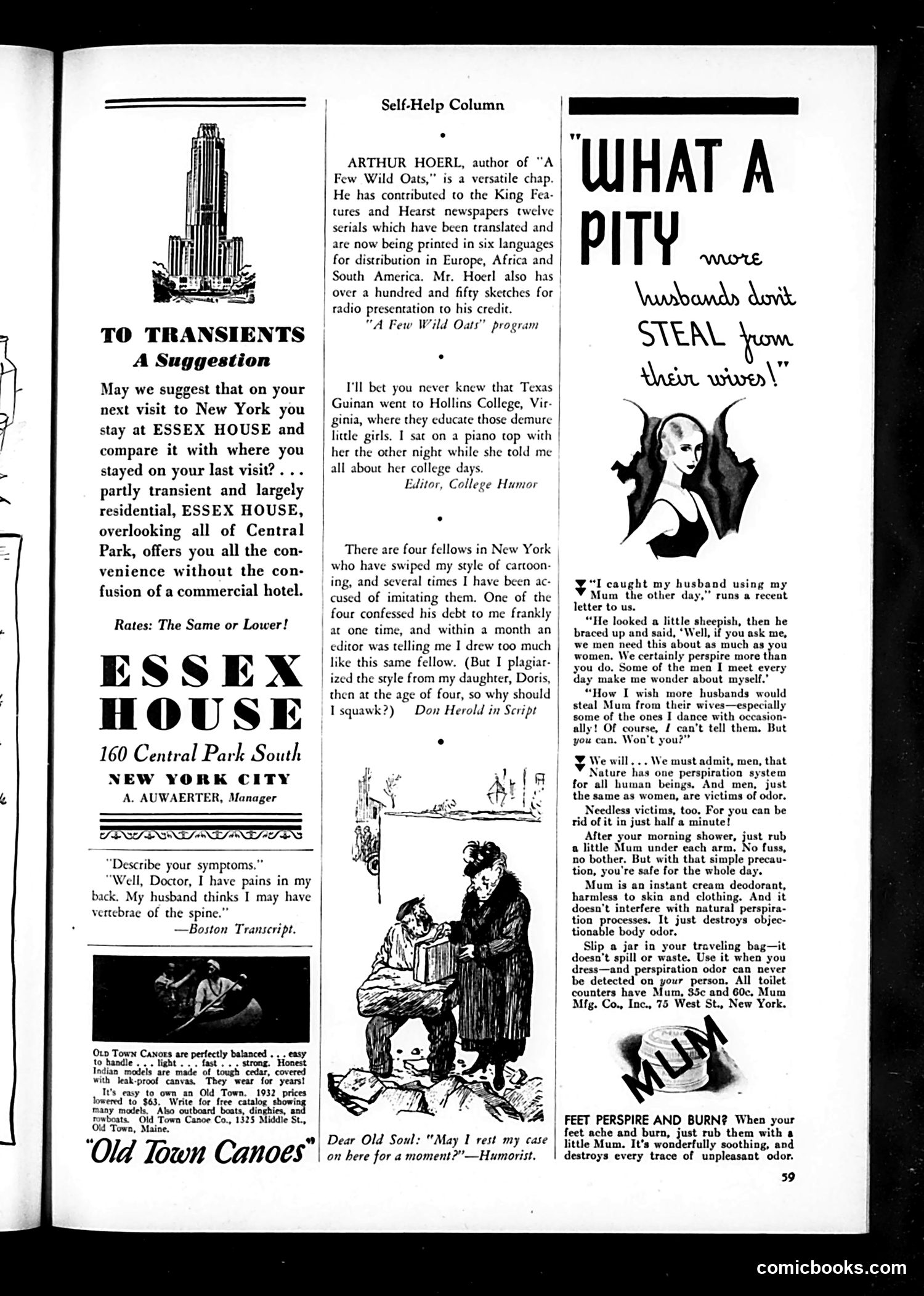
Page Analysis: Life Magazine Self-Help & Advertising This page mixes advertisements with a "Self-Help Column" featuring brief anecdotes and industry gossip. The main cartoon—captioned "Dear Old Soul: 'May I rest my case on here for a moment?'"—depicts an elderly person asking to rest on what appears to be a chair or bench, likely a gentle humor piece about aging. The page's dominant content is advertising, particularly for Mum deodorant, which uses a customer testimonial about a husband "stealing" the product. This reflects 1930s marketing strategy: framing deodorant as a product men should use, positioning bodily odor as a universal human problem requiring commercial solution. References include Texas Guinan (nightclub hostess), and cartoonist Don Herold discussing style imitation—typical industry shop-talk. The humor is genteel and domestic rather than political. This appears to be a general-interest magazine page blending light editorial content with consumer goods marketing.
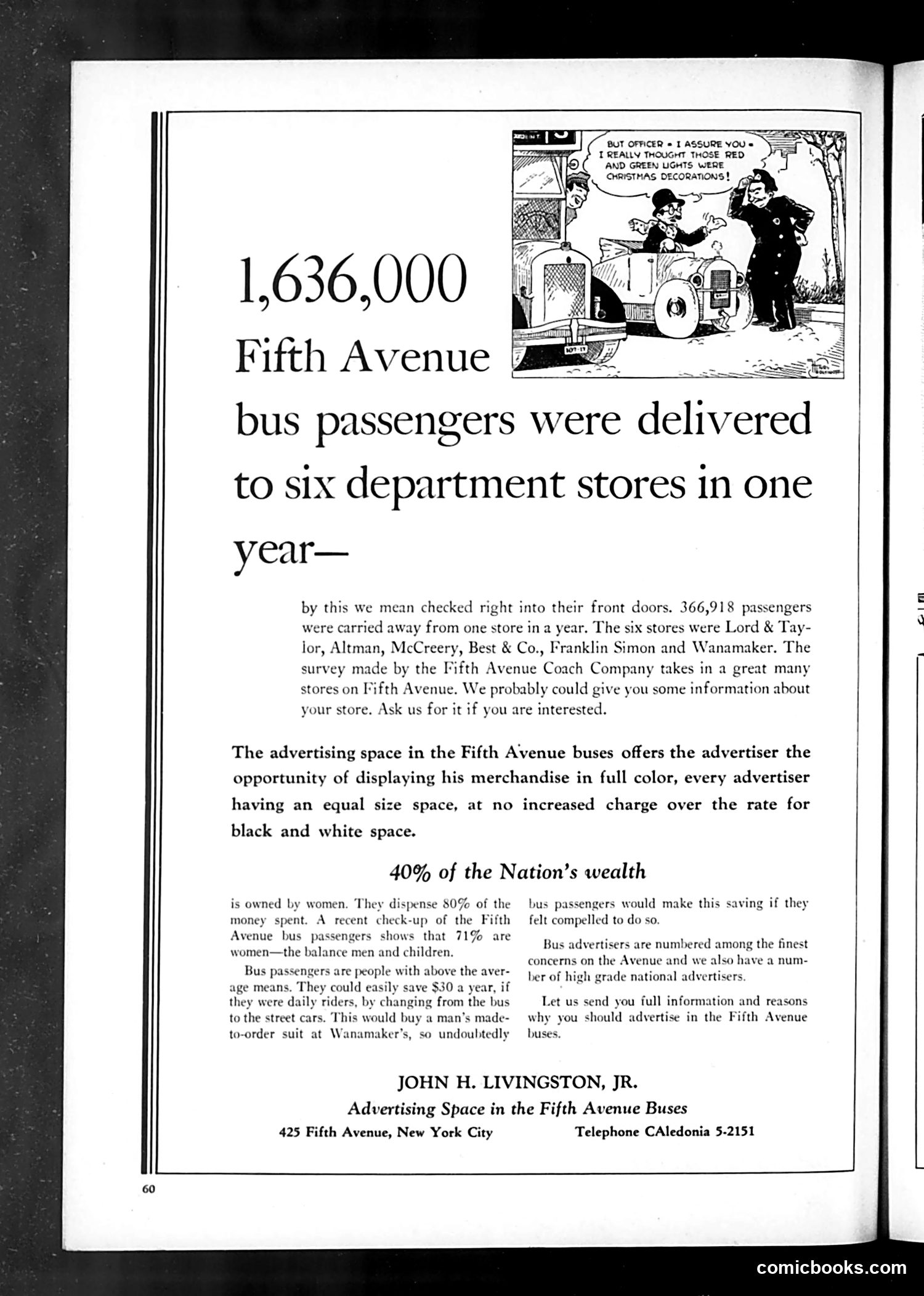
Analysis This is primarily a business advertisement for Fifth Avenue bus advertising space, not political satire. The small cartoon in the upper right appears to show a driver or officer being stopped, with dialogue about mistaking "red and green lights" for "Christmas decorations"—likely a mild holiday-themed traffic joke. The main content is a sales pitch targeting retailers. It presents data showing 1.6 million Fifth Avenue bus passengers annually, with 71% being women who control significant household spending power. The ad emphasizes that buses deliver customers directly to department stores (Lord & Taylor, Altman, Wanamaker, etc.) and that advertising space offers full-color display at no premium cost. The reference to "40% of the nation's wealth is owned by women" reflects 1920s-1930s marketing recognition of female consumer power—positioning bus advertising as an efficient way to reach affluent shoppers. There is no apparent political satire here; this is straightforward commercial advertising.
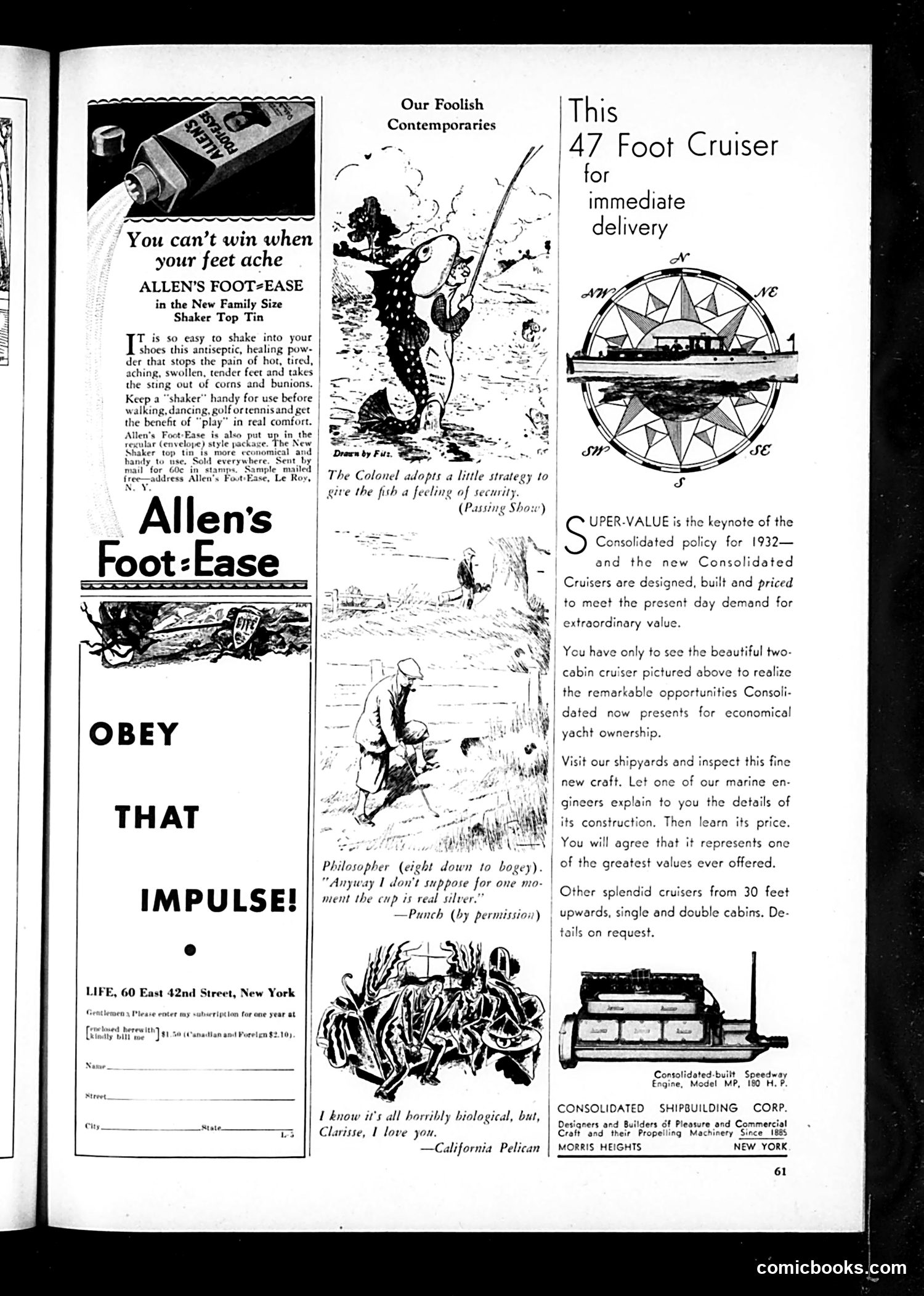
Analysis of Life Magazine Page This page combines advertisements with satirical cartoons typical of Life's format. The main content includes: "Our Foolish Contemporaries" section features three captioned cartoons mocking human behavior: 1. A colonel fishing uses a deceptive strategy to make fish feel "secure"—satirizing false confidence tactics 2. A golfer insists his trophy cup isn't real silver—mocking vanity and dishonesty among the wealthy 3. A "California Pelican" quote about loving someone despite finding their behavior "horribly biological"—likely satirizing romantic delusion The advertisements promote Allen's Foot-Ease powder and a 47-foot yacht cruiser from Consolidated Shipbuilding, positioned as "super-value" during 1932 (Depression-era). The yacht ad's emphasis on "extraordinary value" appears somewhat ironic given the economic context. The page's humor targets pretension, self-deception, and the gap between appearance and reality—characteristic of Life's satirical approach to American social foibles.
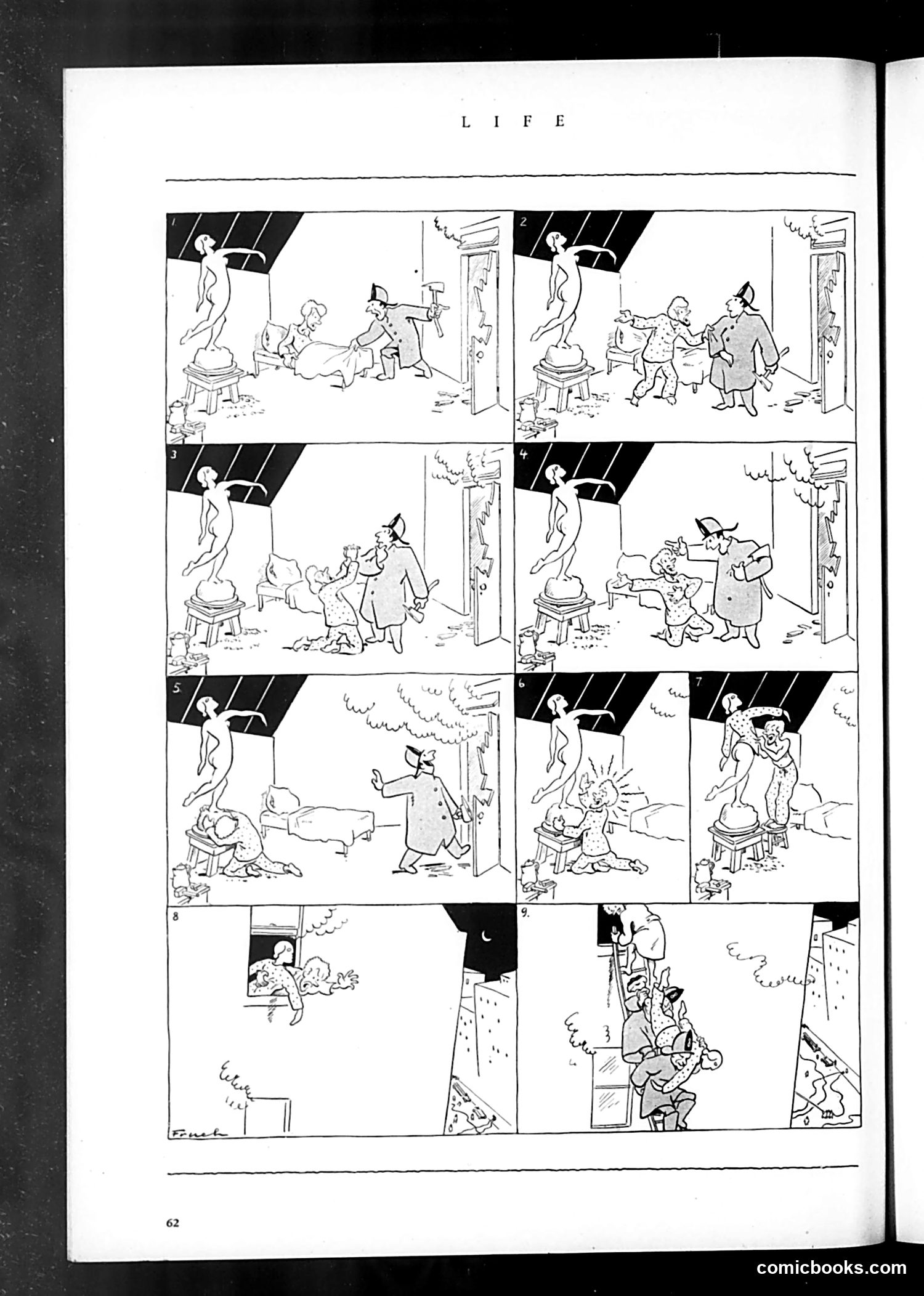
Analysis of Life Magazine Page 62 This is a sequential comic strip showing a domestic scene centered on a nude statue in someone's home. The narrative depicts visitors' reactions to the artwork: panels 1-2 show guests arriving and noticing the statue; panels 3-4 show their shocked or disapproving expressions; panels 5-6 escalate the comedy as characters react with exaggerated dismay. The final panels (7-9) suggest the statue is being removed or hidden, possibly thrown out a window. The satire targets early 20th-century bourgeois attitudes toward modern art and nudity. The joke concerns the tension between owning fashionable contemporary sculpture and maintaining social respectability—the homeowner apparently cannot tolerate guests' reactions and disposes of the artwork. This mocks both prudish social conventions and superficial art collecting.
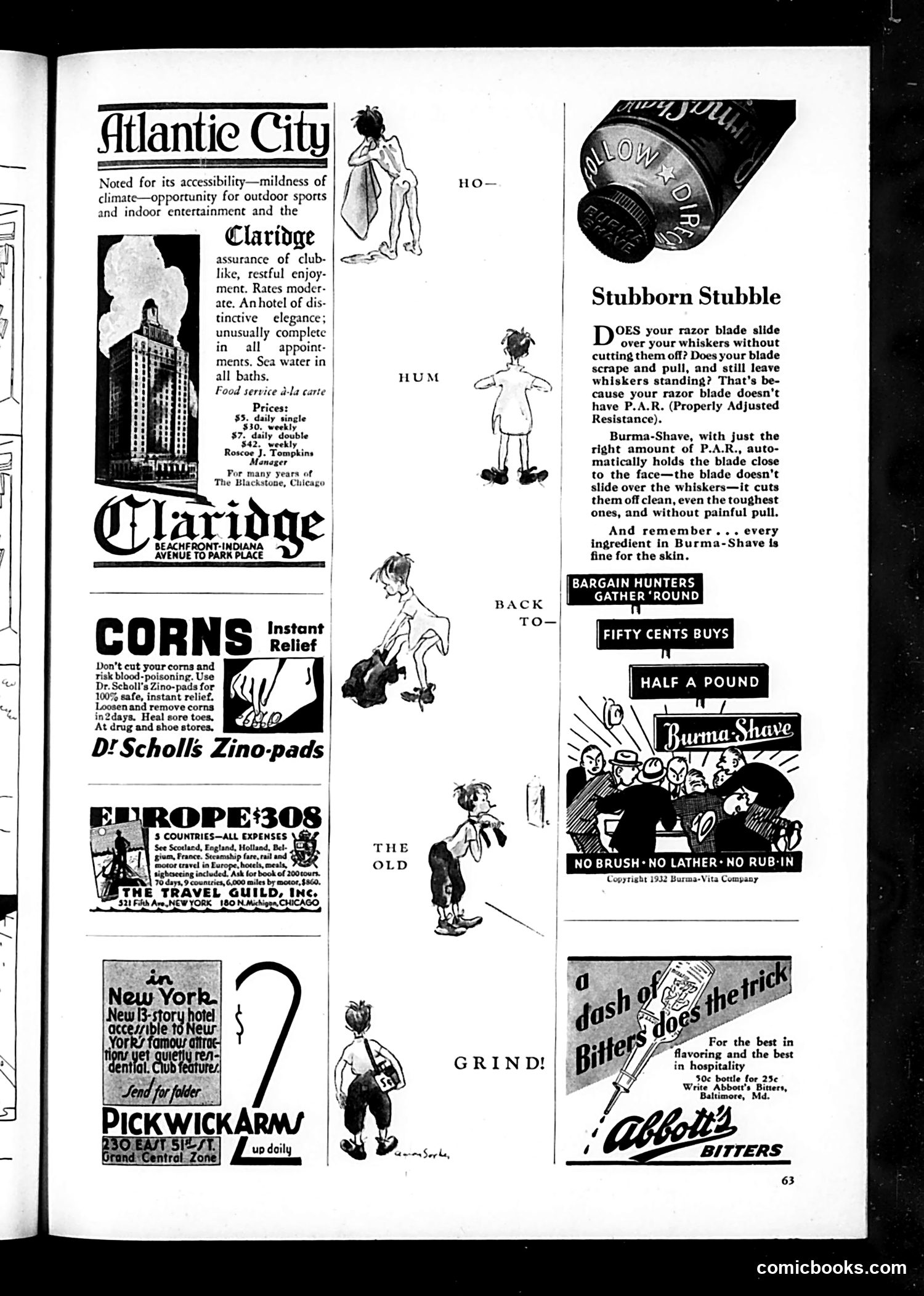
Page Analysis This is primarily a advertisement page from Life magazine (circa 1932, based on the Burma-Shave copyright). It contains no political cartoons or satire requiring historical context. The page features commercial advertisements for: - Atlantic City hotels (Claridge) - Dr. Scholl's corn remedies - Travel tours (Europe) - Burma-Shave (shaving cream, with humorous illustrations of a man struggling with stubble) - Abbott's Bitters (a beverage) - Pickwick Arms (New York hotel) The only illustrated humor appears in the Burma-Shave section, which uses simple cartoon drawings of a frustrated man to demonstrate the product's effectiveness—a common advertising technique of the era. This is product marketing, not political or social commentary. The page is essentially a sales vehicle with no satirical content to analyze.
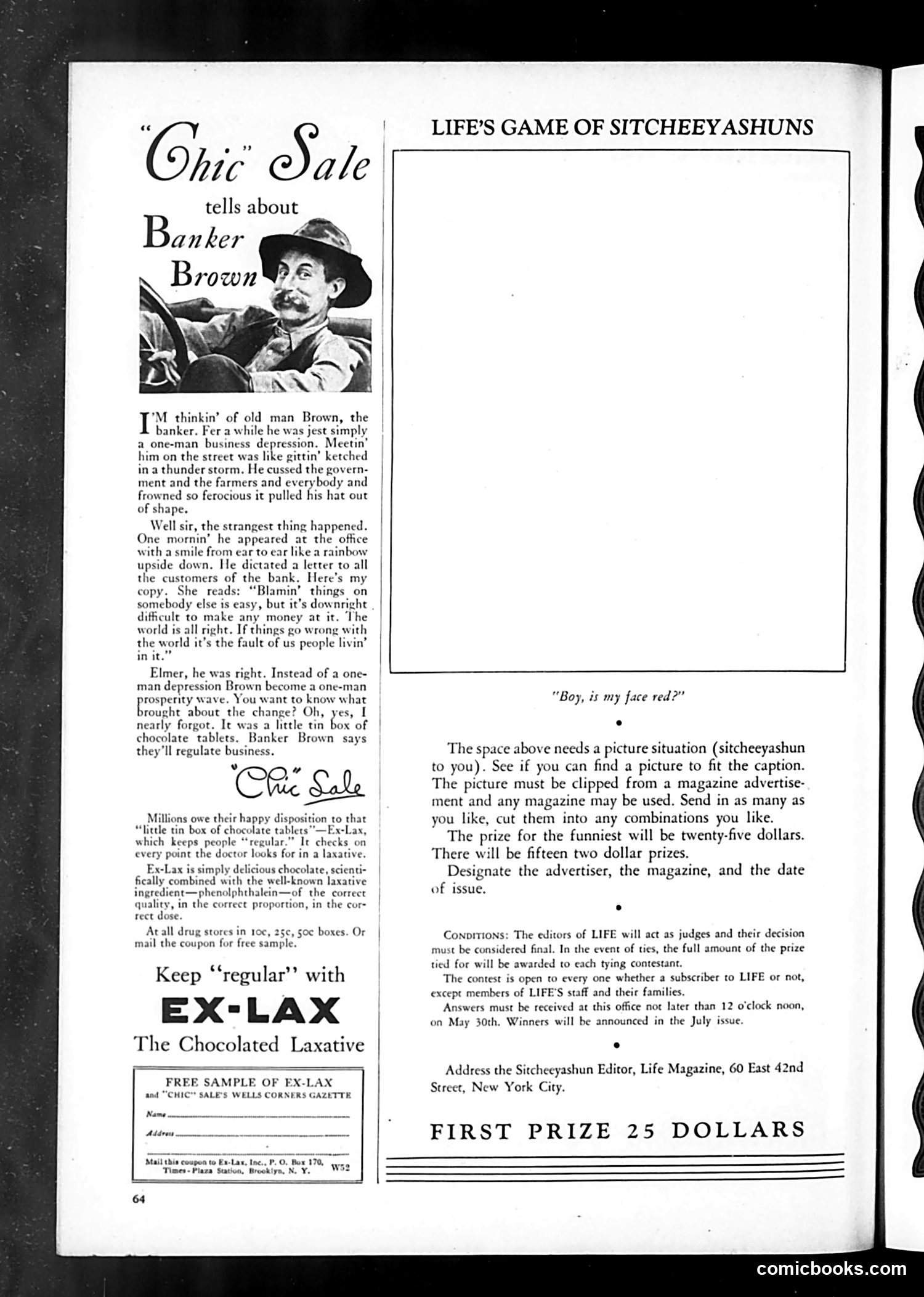
"Chic" Sale's Banker Brown Story This page features a folksy morality tale in dialect by humorist "Chic" Sale. Banker Brown, a depressed businessman who blamed external forces (government, farmers) for his troubles, experiences an attitude shift after taking Ex-Lax laxative tablets. His newfound optimism—realizing that personal responsibility, not circumstances, drives success—transforms him into a "prosperity wave." The joke conflates literal and metaphorical "regularity": Ex-Lax makes you physically regular, which supposedly improves mood and outlook, which then improves business. It's crude advertising disguised as uplifting satire, using homespun philosophy to sell a laxative. The page also includes Life magazine's "Sitcheeyashun" contest, asking readers to submit captioned magazine clippings for $25 prize money—an early form of user-generated content leveraging advertising materials.
Ethyl Gasoline Advertisement (1933) This is not a cartoon or satire, but a straightforward advertisement from the Ethyl Gasoline Corporation. The page announces an improved gasoline formulation with enhanced anti-knock properties. The ad promotes Ethyl's superiority over ordinary gasoline, claiming the new standard better serves modern high-compression automobile engines while remaining economical for older vehicles. It emphasizes that despite higher production costs, Ethyl's price has dropped below what consumers paid for regular gas years prior. The decorative border with four repeated Ethyl emblems frames the announcement. The small copyright note reveals this contains lead—a fact modern readers should recognize as historically significant, since leaded gasoline was later proven toxic and phased out. In 1933, however, this was presented as routine product information.
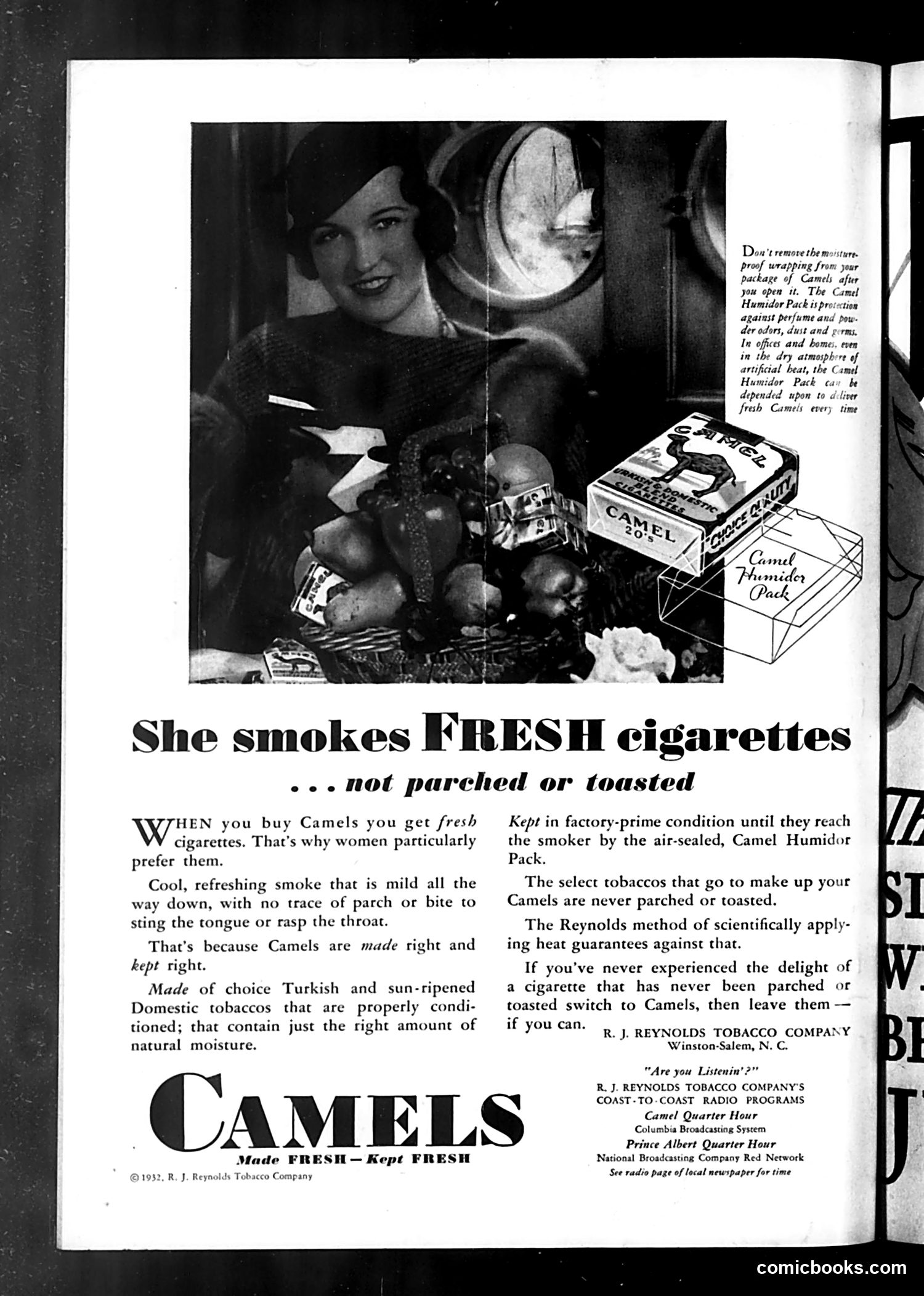
Analysis This is a cigarette advertisement, not satire or political content. It's a Camel cigarettes ad from 1932 (per the copyright notice) featuring a glamorous woman smoking. The ad's appeal targets women by emphasizing that Camels are "fresh" and "not parched or toasted," using the Camel Humidor Pack to maintain freshness. The copy claims the cigarettes are "mild" with "no trace of parch or bite." For modern readers: This straightforward product advertisement is notable primarily as historical evidence of mid-20th-century tobacco marketing directly targeting women without health warnings—a practice now strictly regulated. The elegant presentation and lifestyle imagery were typical advertising strategies before cigarette health dangers became widely acknowledged.