life
Life — June 1932
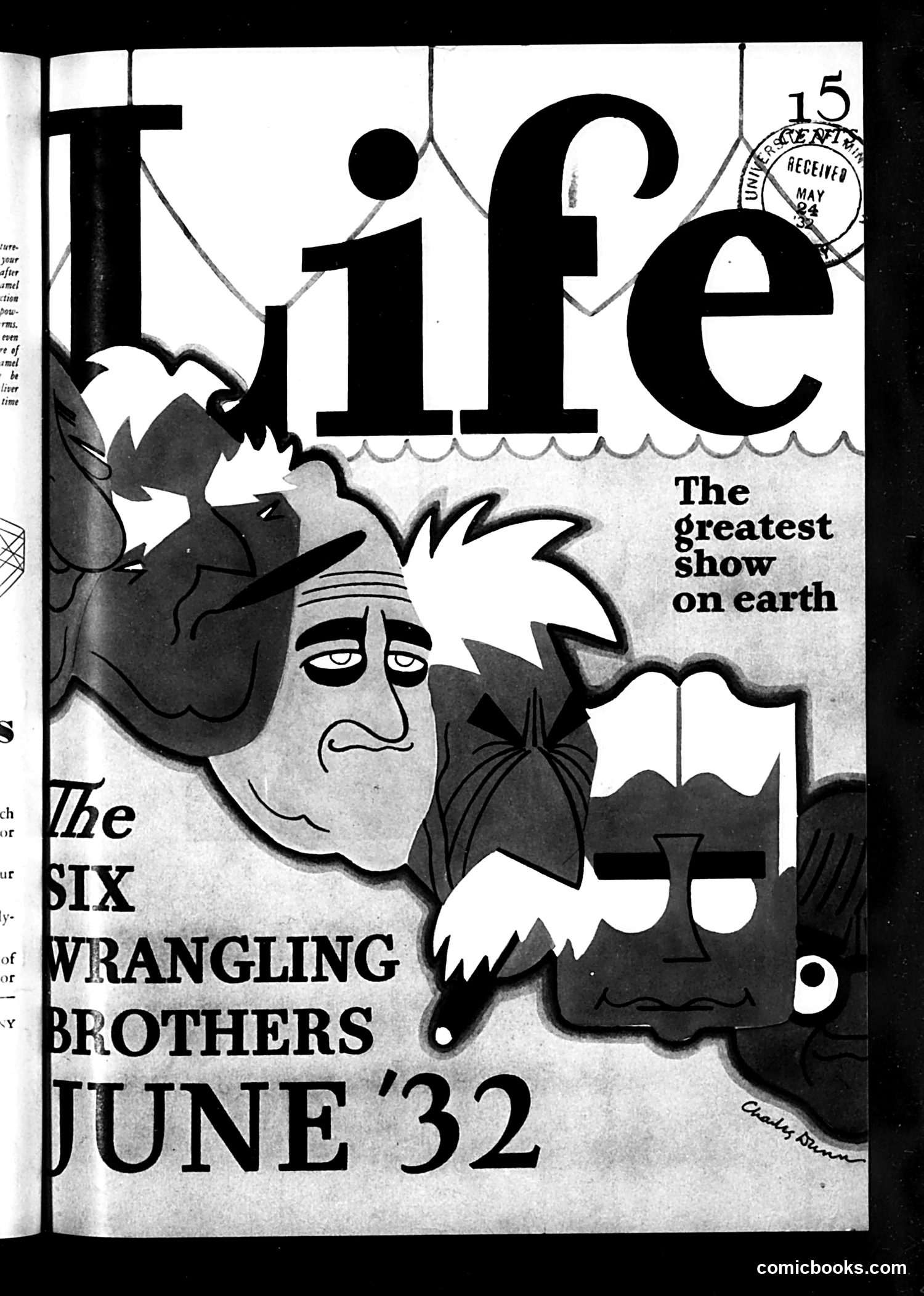
Life Magazine Cover Analysis This is a Life magazine cover from June 1932, advertising "The Six Wrangling Brothers" as "the greatest show on earth." The cartoon depicts a caricatured man with exaggerated features—wild hair, prominent nose, and sad expression—wearing a bow tie and formal attire. The "six wrangling brothers" likely refers to a contemporary vaudeville or circus act, though the specific performers aren't clearly identified in this image alone. The phrase "greatest show on earth" is ironic—a stock circus advertisement cliché used here to mock petty arguing or conflict. The satire appears to target public figures or performers known for bickering, using the circus metaphor to mock their disputes as mere entertainment. The melancholic expression reinforces the mockery of these "brothers" and their contentious behavior.
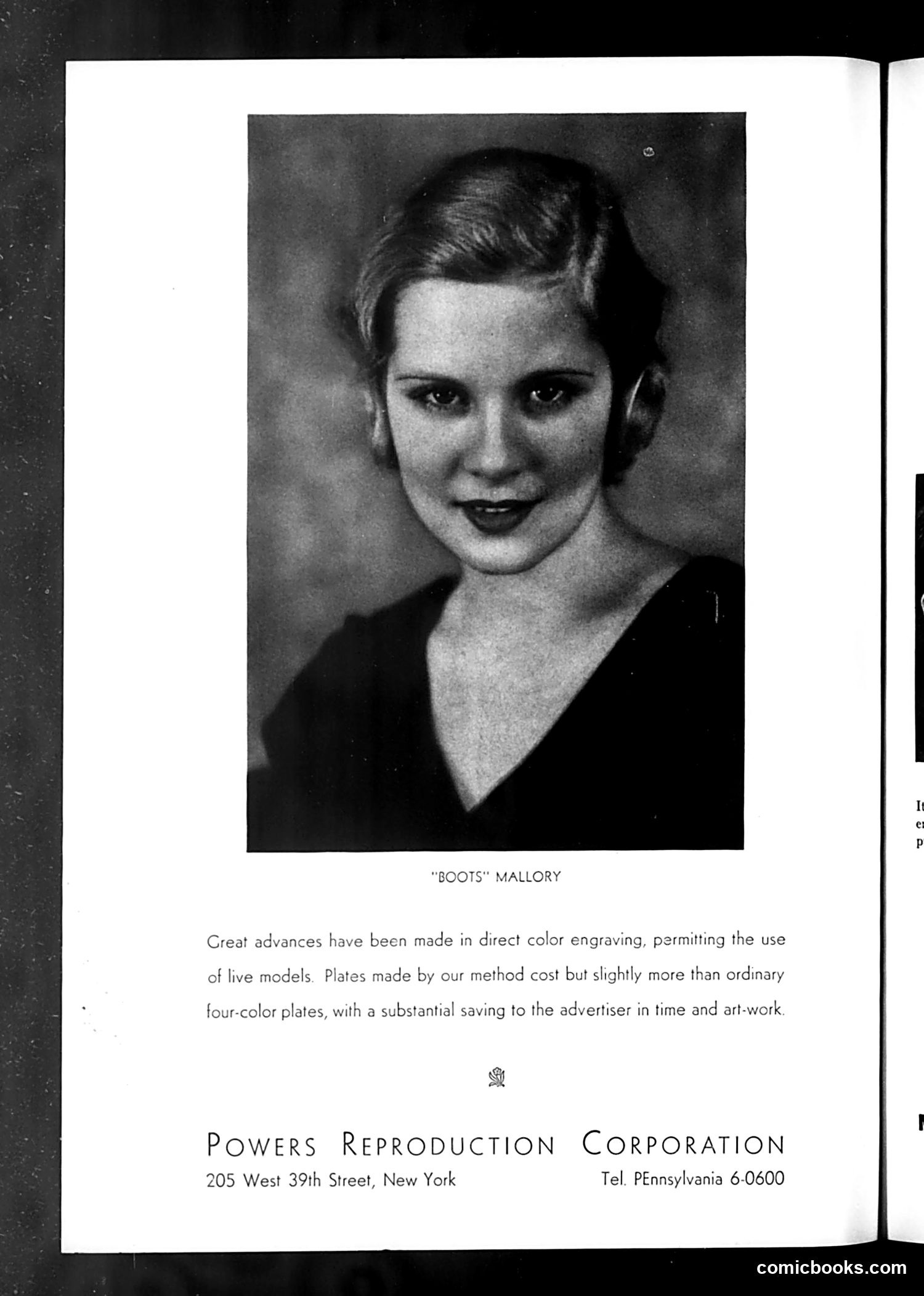
This page is primarily an advertisement for Powers Reproduction Corporation, a printing/engraving company based in New York. The image shows a portrait photograph labeled "BOOTS" MALLORY—likely referring to an actress or public figure of the era, though her specific identity and relevance isn't clear from the page itself. The accompanying text promotes the company's advances in "direct color engraving," which allowed use of live models for color plates. The ad claims their method costs only slightly more than standard four-color plates while saving advertisers time and artwork costs. This is not a political cartoon or satire—it's a straightforward trade advertisement demonstrating their printing capabilities using a professional portrait as an example.
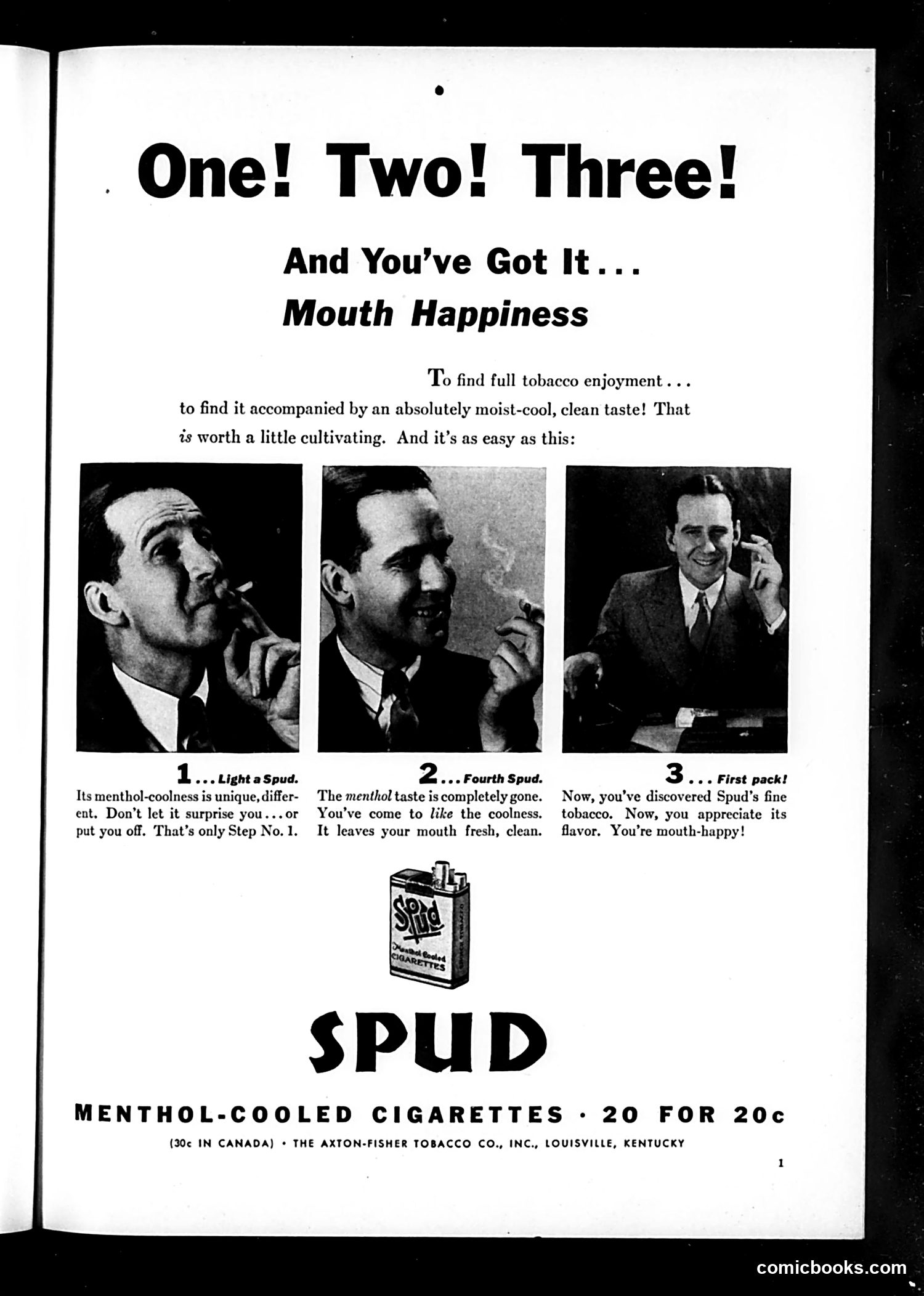
Analysis This is a cigarette advertisement, not a political cartoon. It promotes Spud brand menthol-cooled cigarettes (20 for 20¢) manufactured by Axton-Fisher Tobacco Co. in Louisville, Kentucky. The "One! Two! Three!" refers to a three-step process showing men smoking cigarettes in sequence. The ad's humor plays on the surprise of discovering menthol's cooling sensation (step 1), becoming accustomed to it (step 2), and finally appreciating the underlying tobacco flavor (step 3). The term "Month Happiness" suggests sustained pleasure from regular smoking. By modern standards, this cheerful promotion of cigarettes to general audiences—without health warnings—represents the pre-regulation advertising era when tobacco marketing faced no restrictions on claims or target audiences.
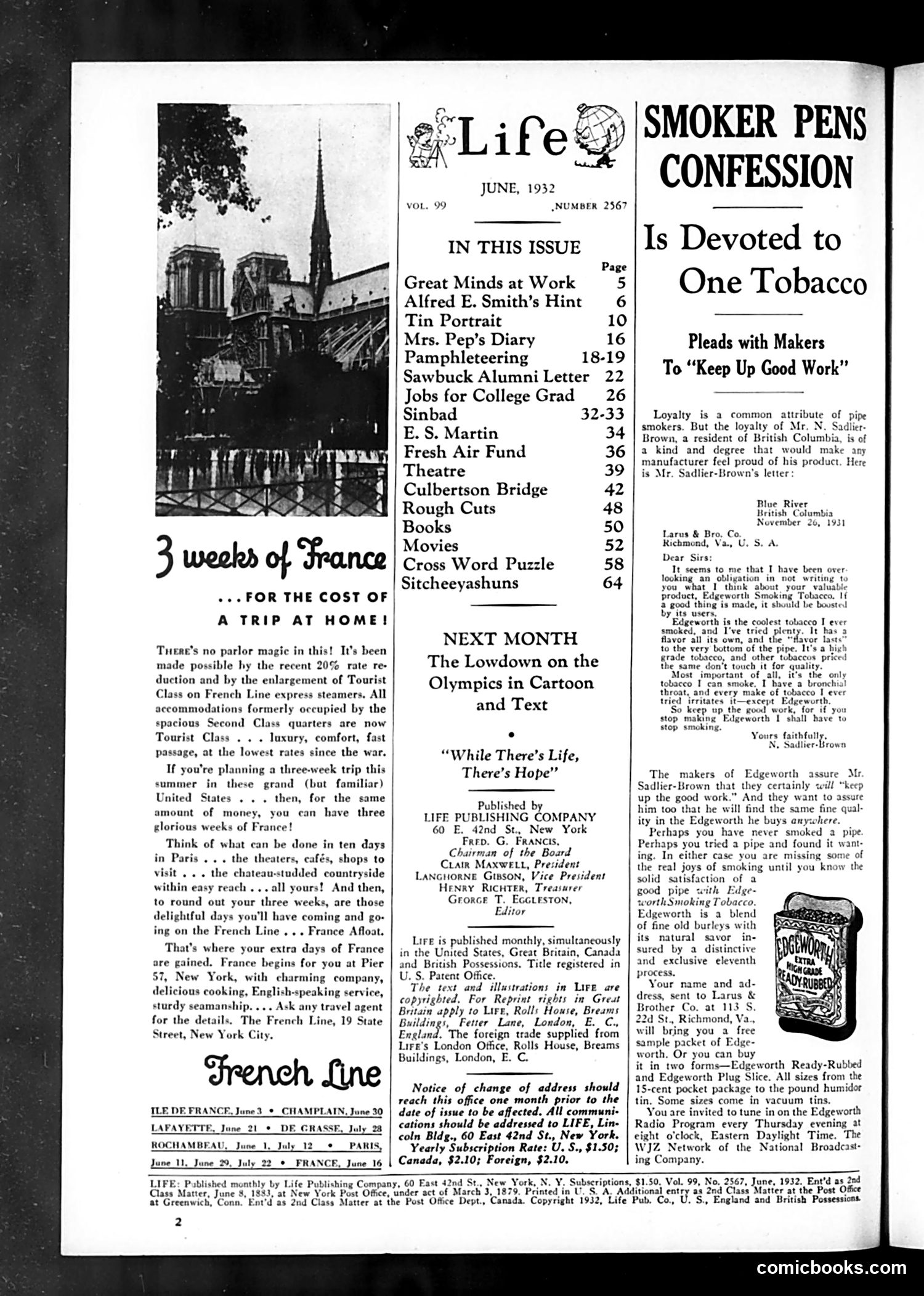
Life Magazine, June 1932 - Page Analysis This is primarily a table of contents and masthead page for Life magazine's June 1932 issue, featuring travel and lifestyle content. The left side showcases a striking photograph of Notre-Dame Cathedral in Paris, with advertising copy promoting "3 weeks of France...for the cost of a trip at home!" The right side contains a "Smoker Pens Confession" — a sponsored advertisement disguised as reader testimony. A British Columbia resident named N. Sadler-Brown praises Edgeworth tobacco, claiming loyalty to this specific brand. The ad employs a flattering tone, positioning the product as superior quality. This represents early 20th-century native advertising: editorial-style testimonials promoting commercial products to appear as genuine consumer endorsements rather than paid promotion. The approach blurs advertising and editorial content deliberately.
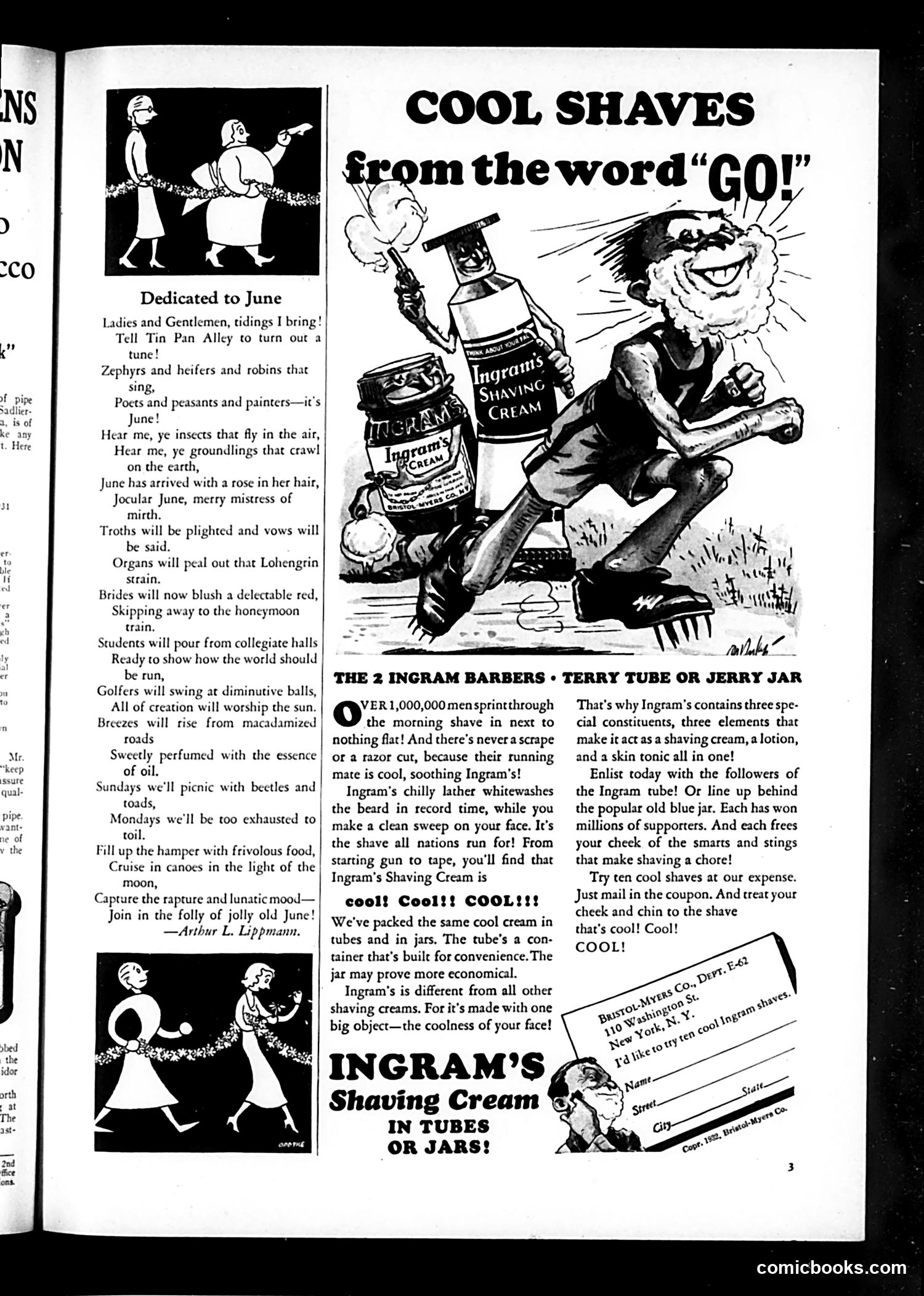
Analysis This page is primarily an advertisement for Ingram's Shaving Cream, disguised as editorial content. The main cartoon depicts a caveman enthusiastically shaving with Ingram's products—making the satirical point that the product is so good, even primitive man would use it. The visual joke plays on the absurdity of this anachronism. The left side contains "Dedicated to June," a poem celebrating the month in flowery, romantic language. This appears designed to create an appealing editorial context around the advertisement. The ad emphasizes that Ingram's Shaving Cream comes "in tubes or jars" and promises a cool, soothing shave without razor cuts or irritation. The messaging targets practical male consumers concerned with convenience and skin care. This represents early 20th-century advertising disguised as magazine content.
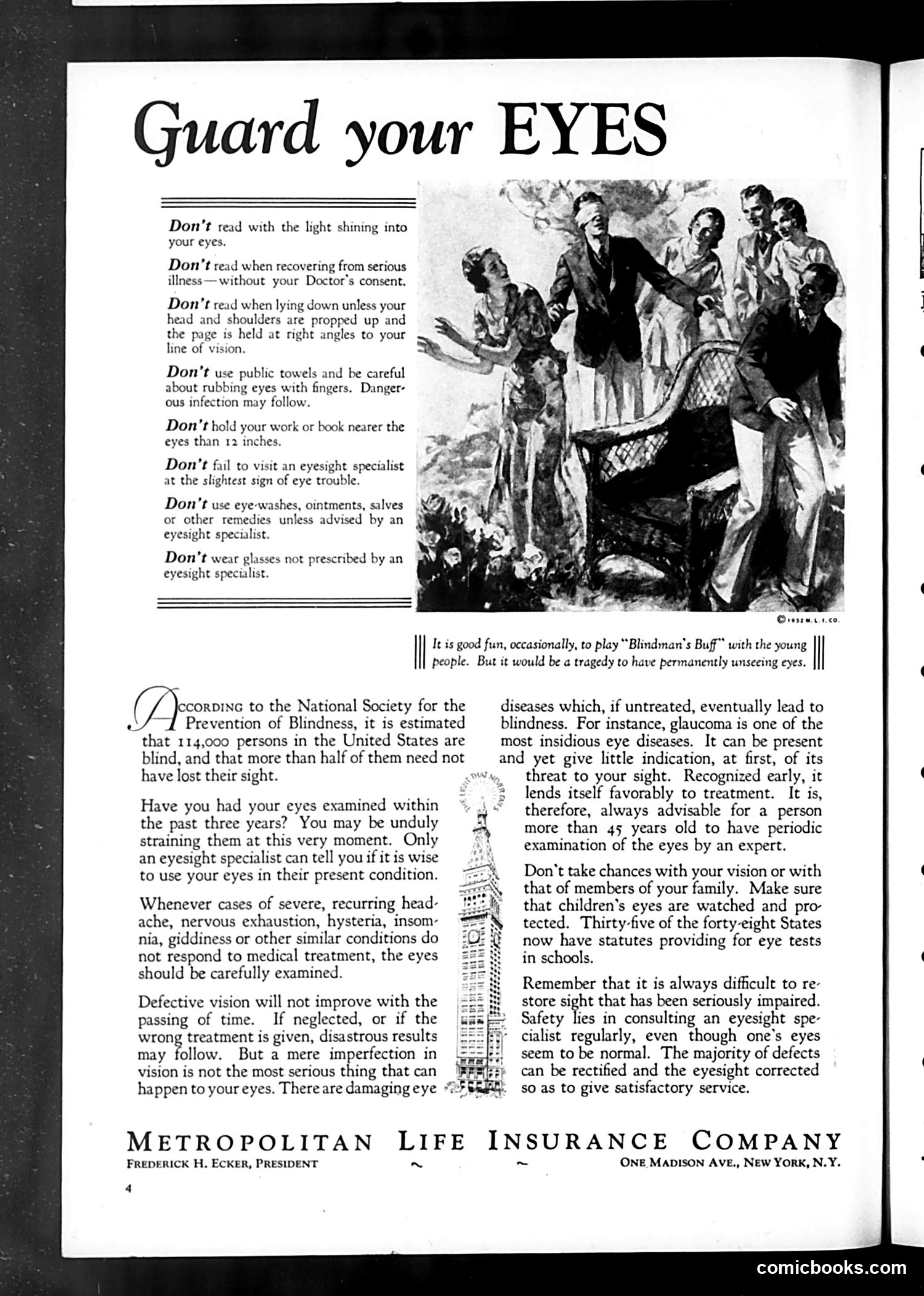
Analysis This page is primarily a public health advertisement by Metropolitan Life Insurance Company promoting eye care, not political satire. The illustration shows a family group (adults and children) gathered outdoors, appearing to represent diverse social classes—likely emphasizing that eye health concerns affect everyone. The "Don'ts" list addresses common early-20th-century health concerns: reading in poor light, sharing towels (disease transmission), holding materials too close, and avoiding eye specialists. The mention of "Blindman's Buff" as dangerous reflects genuine anxiety about preventable blindness. The text cites the National Society for Prevention of Blindness' claim that 114,000 Americans were blind, attributing many cases to treatable conditions like glaucoma. This represents Progressive Era public health advocacy—using insurance company resources to promote preventive medical care and professional medical consultation over folk remedies.
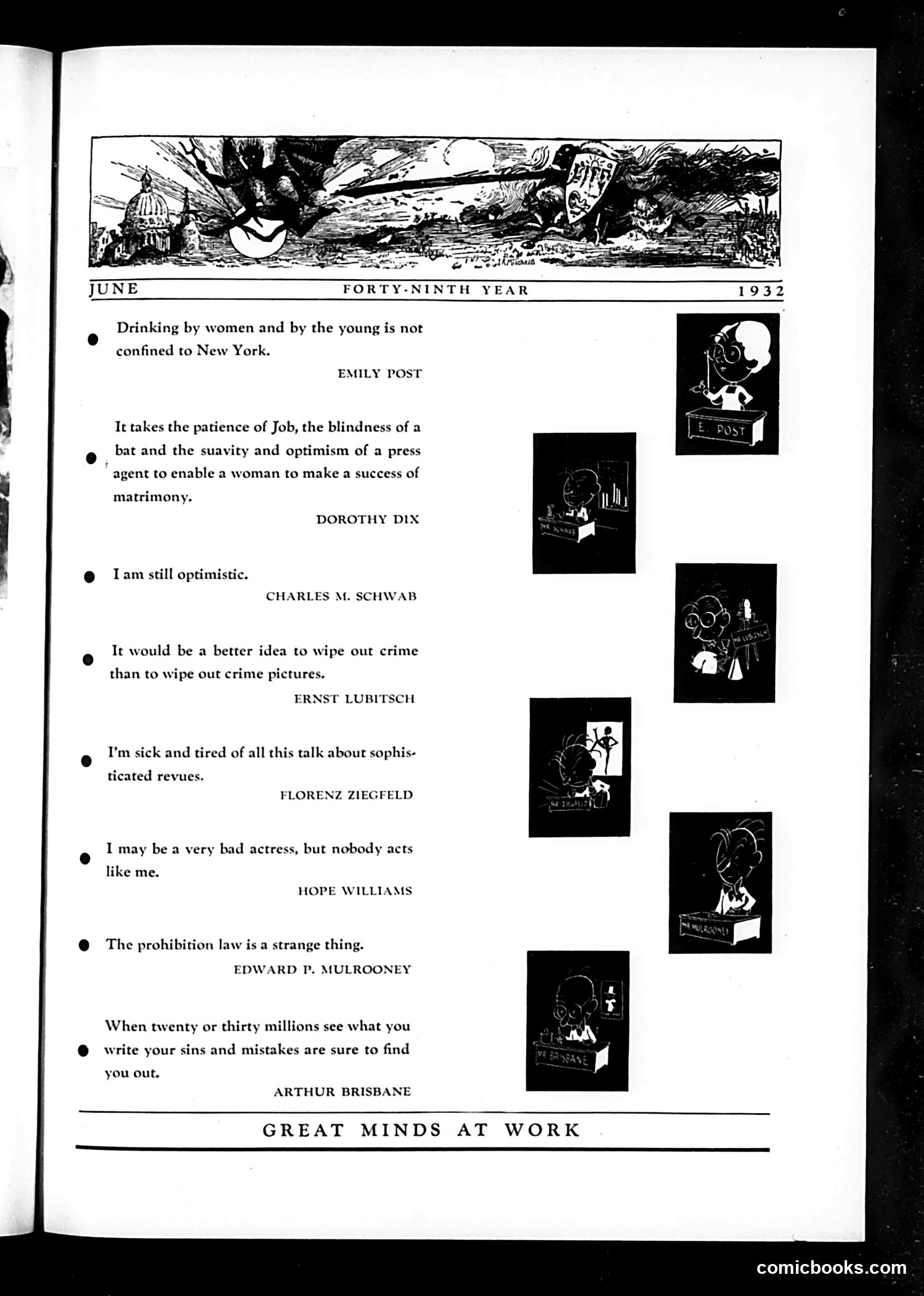
Analysis of Life Magazine, June 1932 This page features a collection of witty quotes from notable figures commenting on contemporary social issues. The quotes address: - Women drinking (Emily Post on etiquette) - Marriage difficulties (Dorothy Dix on relationships) - Crime and morality (Ernst Lubitsch and Edward P. Mulrooney on crime prevention) - Prohibition (Mulrooney's observation about the strange nature of Prohibition law) The small silhouette illustrations on the right appear to be decorative vignettes rather than political cartoons. The 1932 date places this during the Great Depression and near Prohibition's end (repealed 1933). The quotes suggest contemporary anxieties about social upheaval, changing morals (especially women's newfound freedoms), and the failure of Prohibition—a major policy debate of the era. This is primarily a quotes/commentary page rather than satirical cartooning.
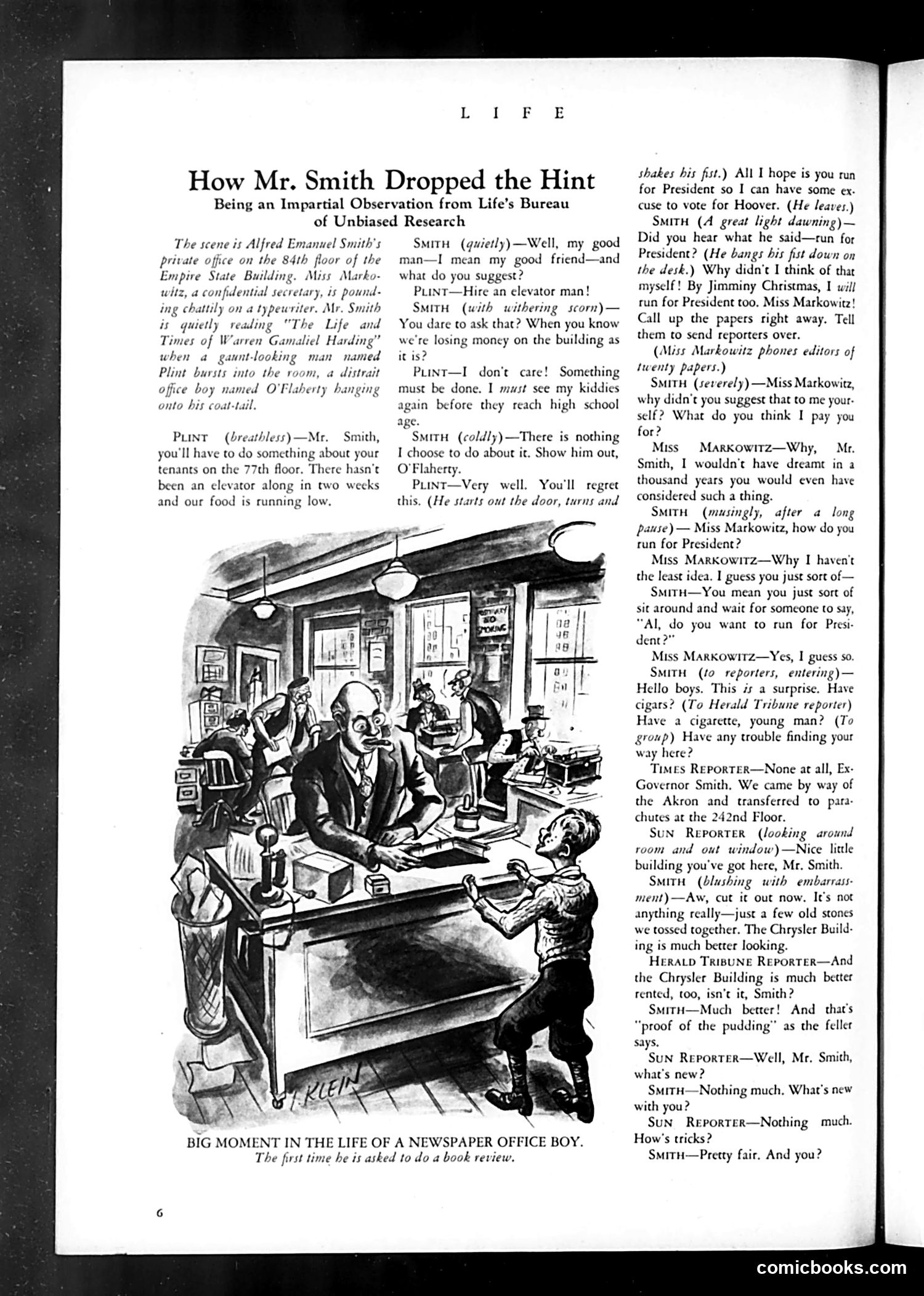
"How Mr. Smith Dropped the Hint" This satirical piece depicts a newspaper office scene where Mr. Smith, an elevator operator, casually mentions to reporters that he's considering running for President. The joke hinges on the absurdity of an ordinary working man—someone with no political experience or credentials—casually announcing presidential ambitions to journalists. The humor reflects early 20th-century American political satire about how easily political rumors spread through press coverage. The reporters immediately become excited, phones ring, and the story threatens to become a news event simply because journalists are present. The cartoon satirizes both the gullibility of the press and how democratic systems allow any citizen to theoretically become president, regardless of qualifications.
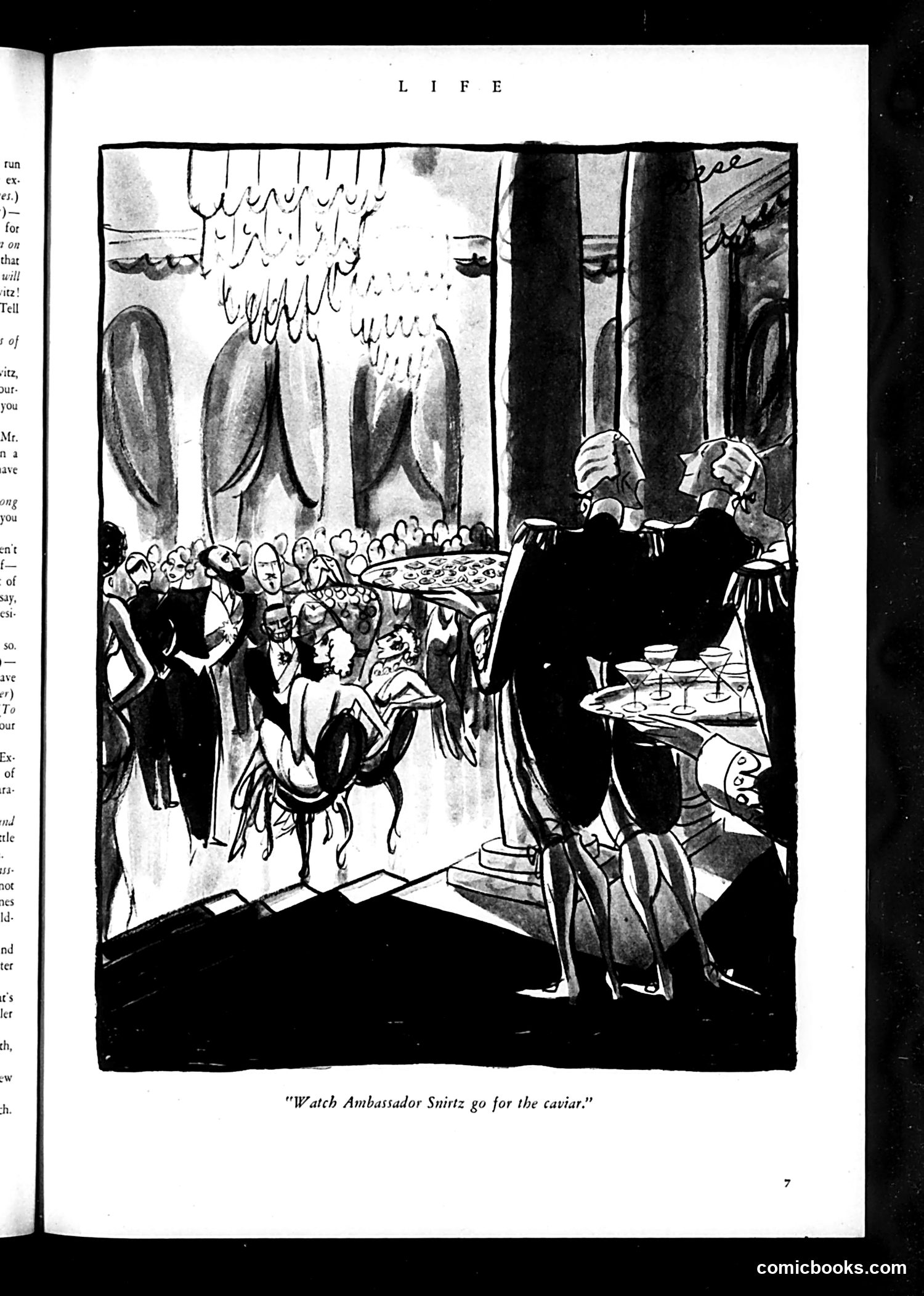
Cartoon Analysis: "Watch Ambassador Smirtz go for the caviar" This satirical cartoon depicts a formal diplomatic reception or banquet. The caption identifies "Ambassador Smirtz" as the subject of ridicule. The joke appears to satirize diplomatic excess and materialism—specifically, mocking an ambassador's eagerness to indulge in expensive caviar at an official function. The scene shows elegantly dressed guests at what appears to be a luxurious venue with large decorative columns. The cartoon suggests that diplomats prioritize personal indulgence and fine foods over serious diplomatic work. The humor relies on characterizing diplomatic life as frivolous consumption rather than substantive statecraft. Without additional context about who "Ambassador Smirtz" references specifically, this appears to be general satire of diplomatic pretension and gluttony common to Life magazine's social commentary.
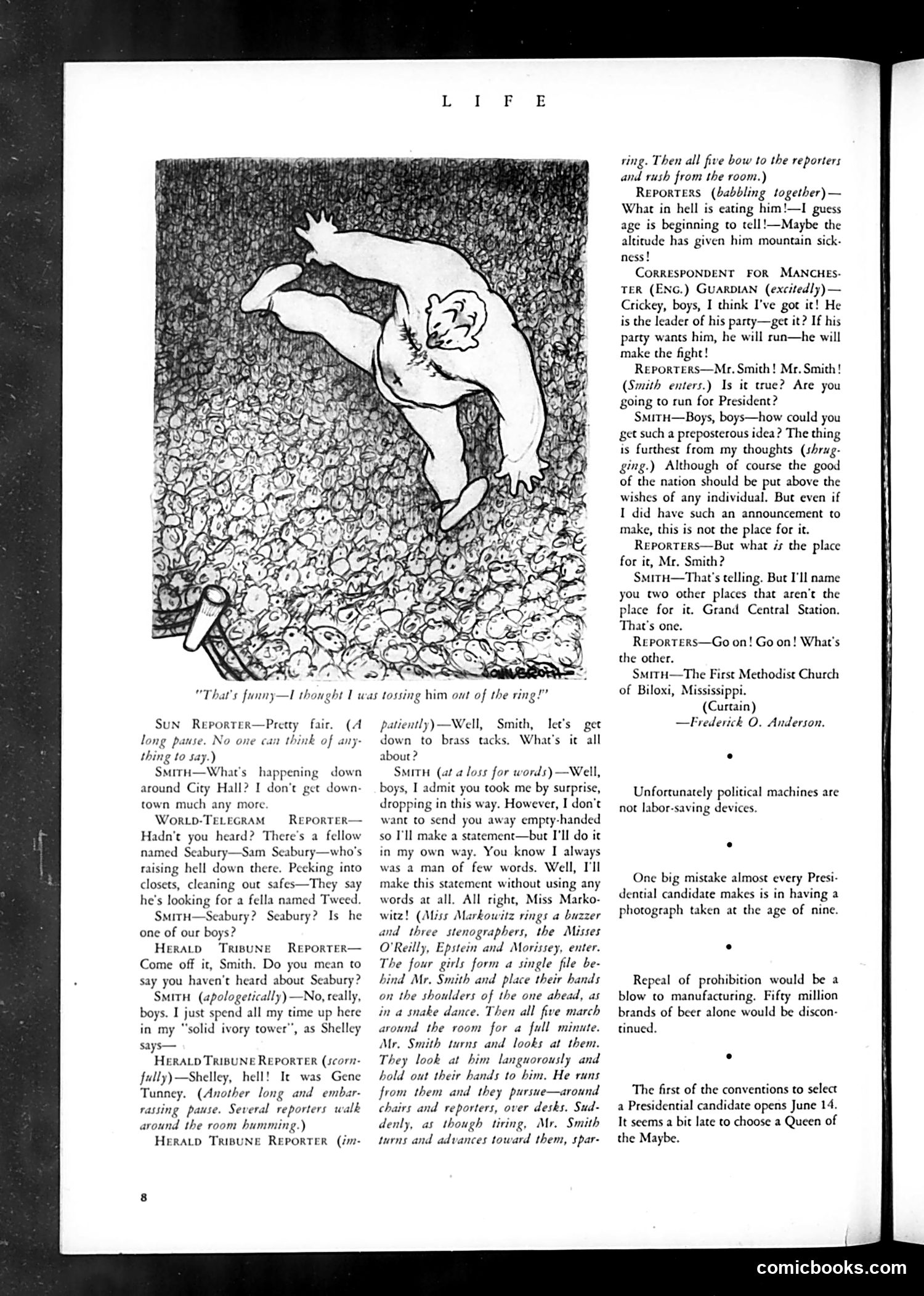
Analysis of Life Magazine Page This page satirizes a political candidate's press conference, likely from the 1920s-1930s based on the style. A disheveled man (identified as "Mr. Smith") is shown doing acrobatic contortions while reporters bombard him with questions about running for President. The satire targets: 1. Political evasion: Smith refuses to directly answer whether he's running, instead deflecting by suggesting other locations (Grand Central Station, a Methodist church) to discuss it. 2. Candidate absurdity: The cartoon mocks how candidates perform ridiculous physical feats while avoiding straightforward answers—the contorted pose illustrates his verbal gymnastics. 3. Press frenzy: Multiple reporters pursue sensational angles rather than substantive policy discussion. The humor lies in depicting politics as theatrical performance rather than serious governance.
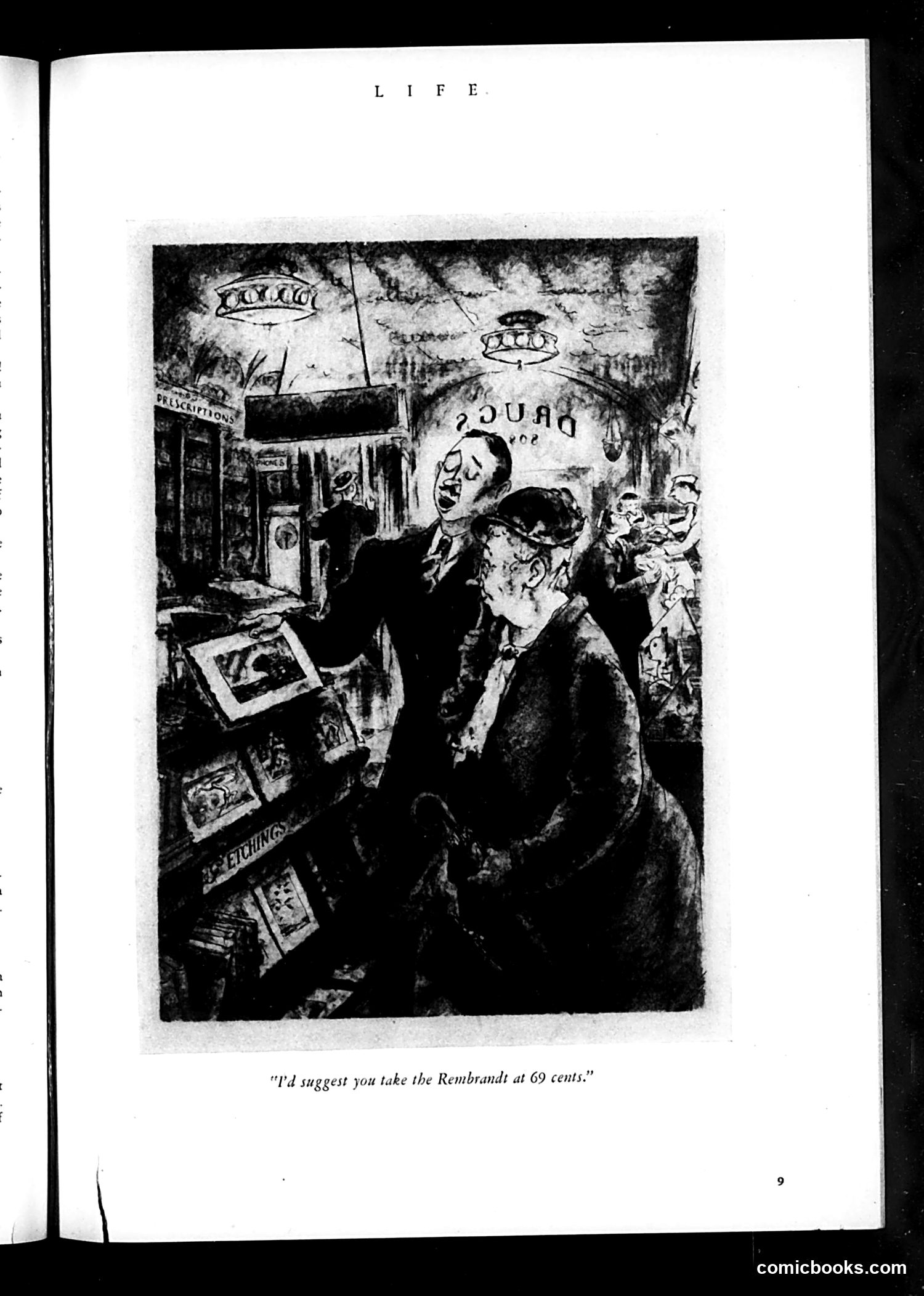
Analysis This is a satirical illustration from *Life* magazine depicting an art dealer or gallery owner suggesting to a customer that they purchase a Rembrandt painting for 69 cents. The cartoon mocks the commercialization of fine art and the devaluation of masterworks in the marketplace. The scenario is absurd—a genuine Rembrandt would cost far more—suggesting either that the painting is a cheap reproduction/forgery, or that the art world has become so debased by commercialism that even Old Masters are being hawked at bargain prices like cheap merchandise. The elegantly dressed figures in the gallery setting contrast sharply with the trivial price point, emphasizing the satire. The joke critiques both art dealers' dishonest sales tactics and society's reduced appreciation for authentic artistic value.
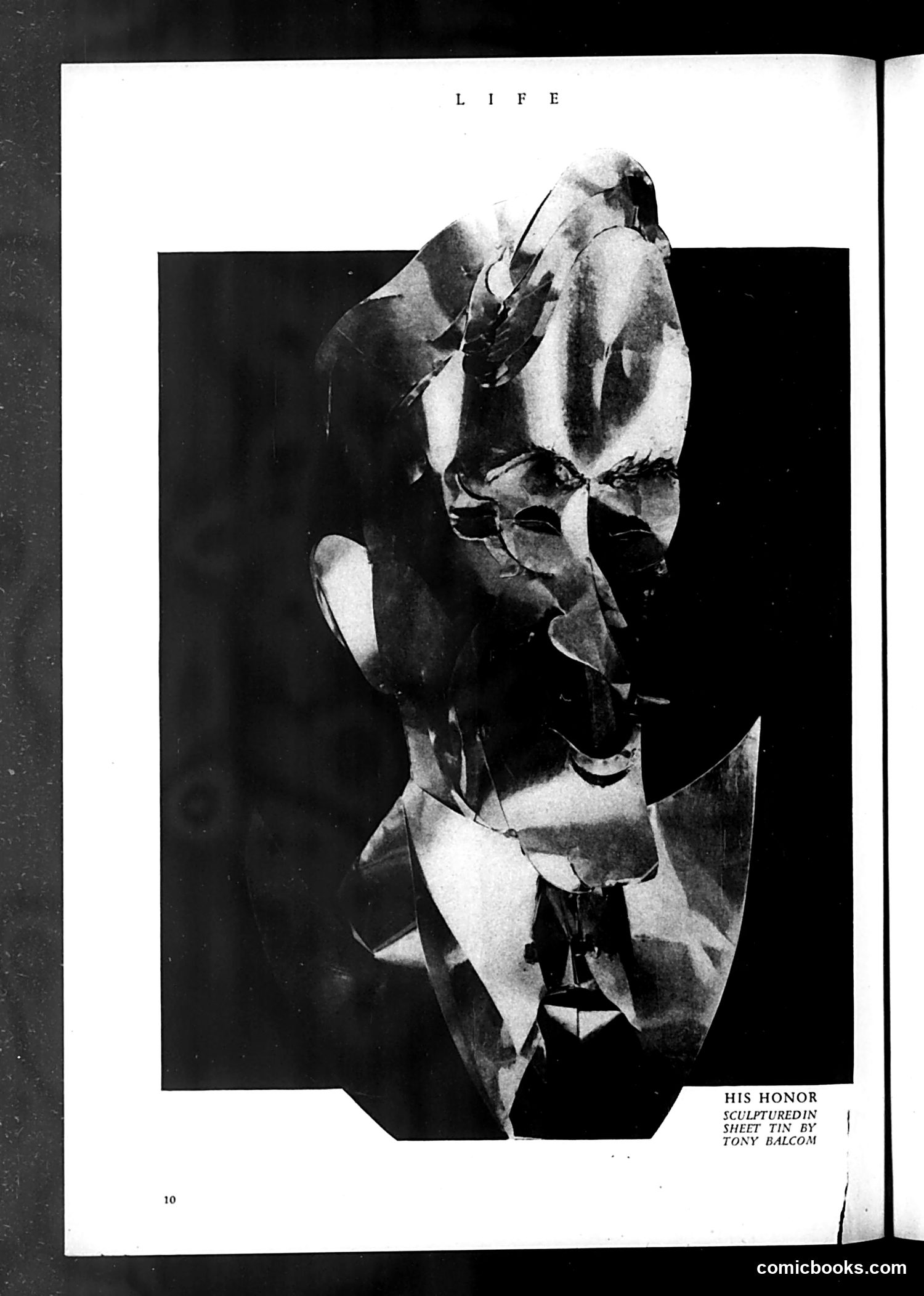
Analysis This page from *Life* magazine features a sculptural work titled "His Honor," created in sheet tin by artist Tony Balcom. The image shows an abstract, modernist sculpture of a human head rendered in angular, fragmented planes of metal. The sculpture appears to be a satirical portrait—likely of a political figure or public official, given the caption "His Honor" (a title for mayors, judges, or dignitaries). The jagged, distorted metal forms suggest mockery of the subject's character or integrity, as if deconstructing their dignity. The modernist style emphasizes this critical commentary through deliberate fragmentation rather than flattering representation. Without additional context identifying the specific figure depicted, the exact target of satire remains unclear, though the work's aesthetic aggressiveness indicates pointed political or social criticism.
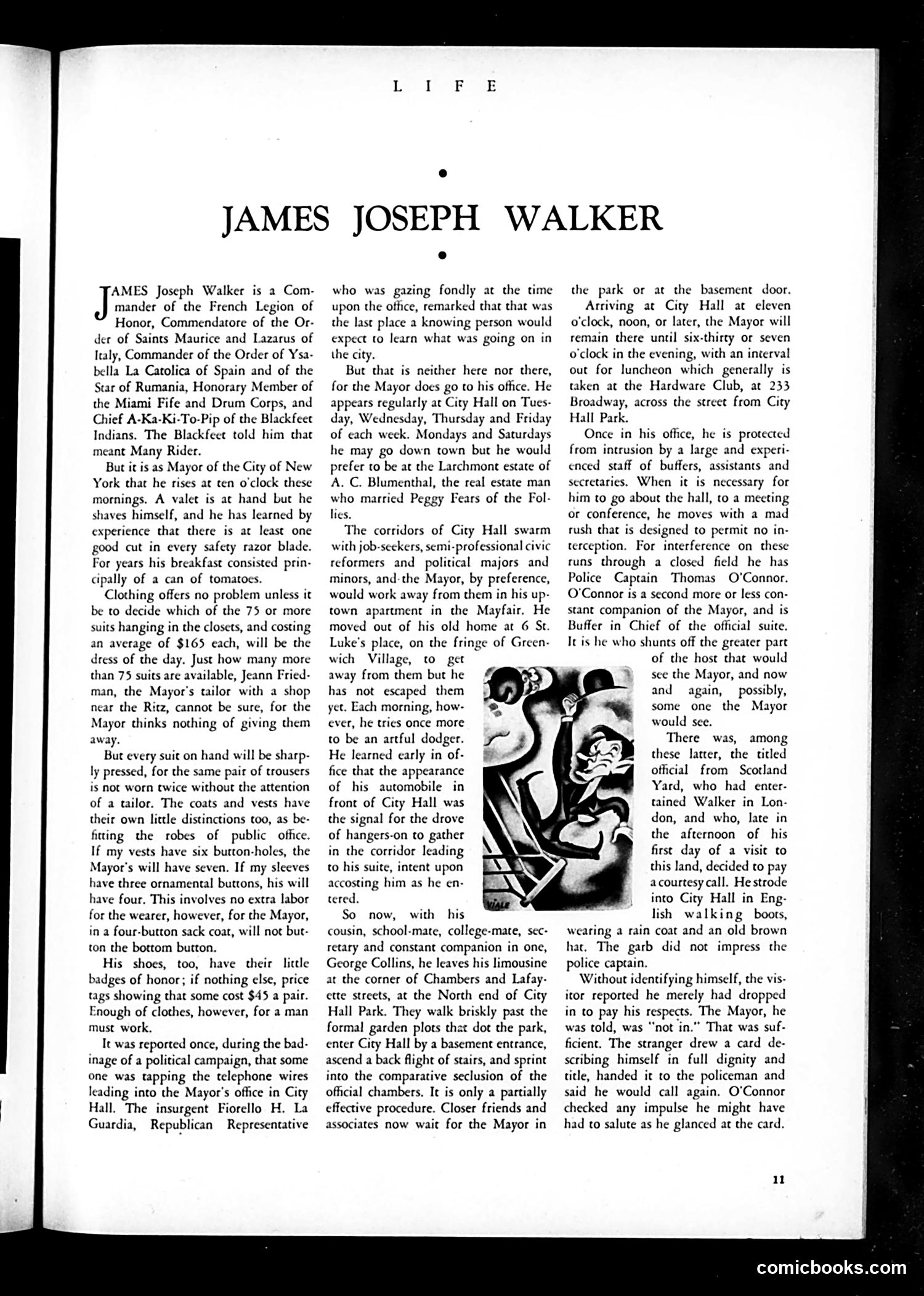
Analysis of "James Joseph Walker" Life Magazine Page This page profiles Mayor James Joseph Walker of New York City, a prominent political figure of the era. The accompanying cartoon depicts Walker as a slick, grinning character—likely caricaturing his reputation for charm and political maneuvering. The text satirizes Walker's frequent absences from City Hall and his preference for the upscale Larchmont estate over his official duties. It describes how he avoids job-seekers and reformers by entering through basement entrances and maintaining a protective buffer of staff. The cartoon's exaggerated facial features and styling mock Walker's polished public persona. The satire targets Walker's apparent corruption and avoidance of official responsibilities while maintaining the appearance of authority—a classic Life magazine critique of political malfeasance dressed in sophistication.
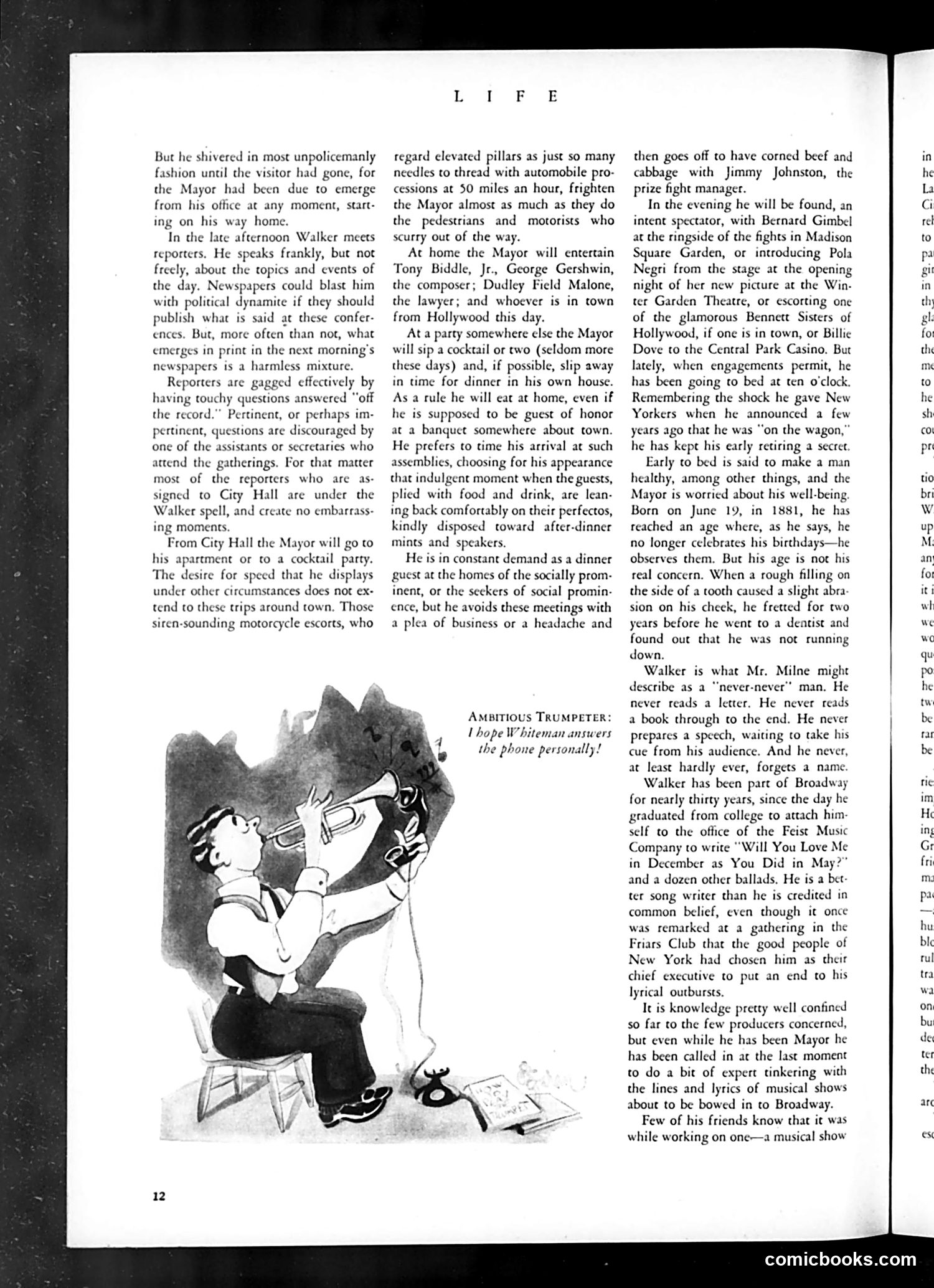
Analysis of Life Magazine Page This page contains a satirical article about a prominent mayor (not named in the visible text) and an accompanying cartoon. The illustration shows a man enthusiastically playing a trumpet while seated, labeled "Ambitious Trumpeter: *I hope Whiteman answers the phone personally!*" The cartoon references Paul Whiteman, a famous 1920s bandleader and jazz impresario, suggesting the mayor aspires to musical prominence or public attention through Whiteman's endorsement. The article satirizes the mayor's constant social demands—attending parties, dinners, and public events—while avoiding substantive work. The cartoonist mocks his ambition to become a notable public figure, comparing his efforts to an aspiring musician desperately seeking validation from an established authority. The satire emphasizes vanity and self-promotion over genuine accomplishment.
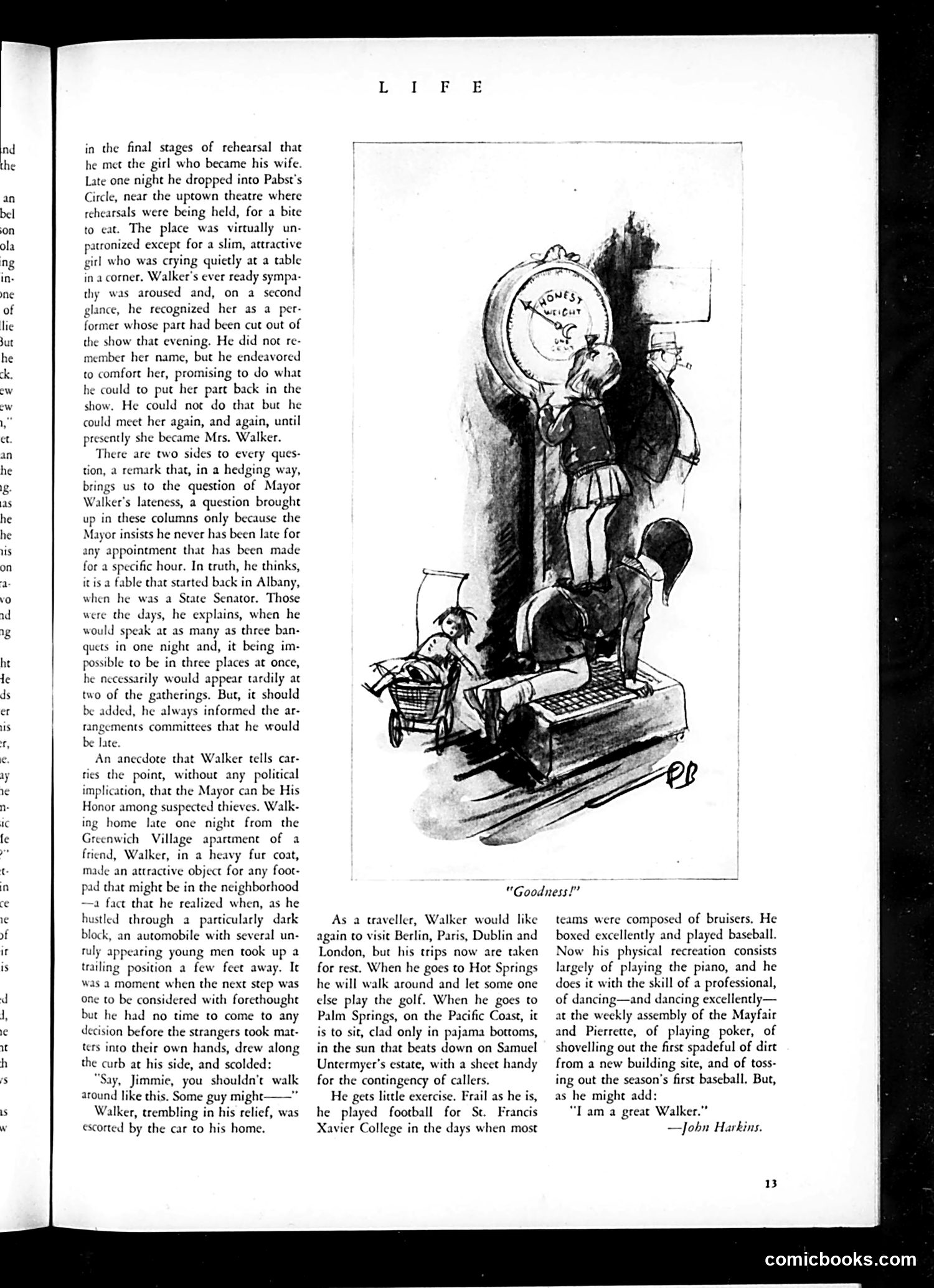
Analysis of "Goodwill" Cartoon The illustration depicts Mayor Jimmy Walker of New York City carrying a large beer barrel labeled "August's Night" while surrounded by various figures and objects suggesting nightlife and entertainment venues. The satire targets Walker's notorious lateness to official appointments — a recurring scandal mentioned in the accompanying text. The cartoon suggests Walker prioritizes nightlife and socializing over municipal duties. The barrel, likely referencing Prohibition-era speakeasies (illegal bars), implies he frequents such establishments. The references to Greenwich Village apartments and attractive young women indicate satirizing his reputation for socializing rather than governance. The overall message: Walker is more devoted to personal pleasure and entertainment than to his mayoral responsibilities, a key criticism that plagued his administration during the 1920s-1930s.
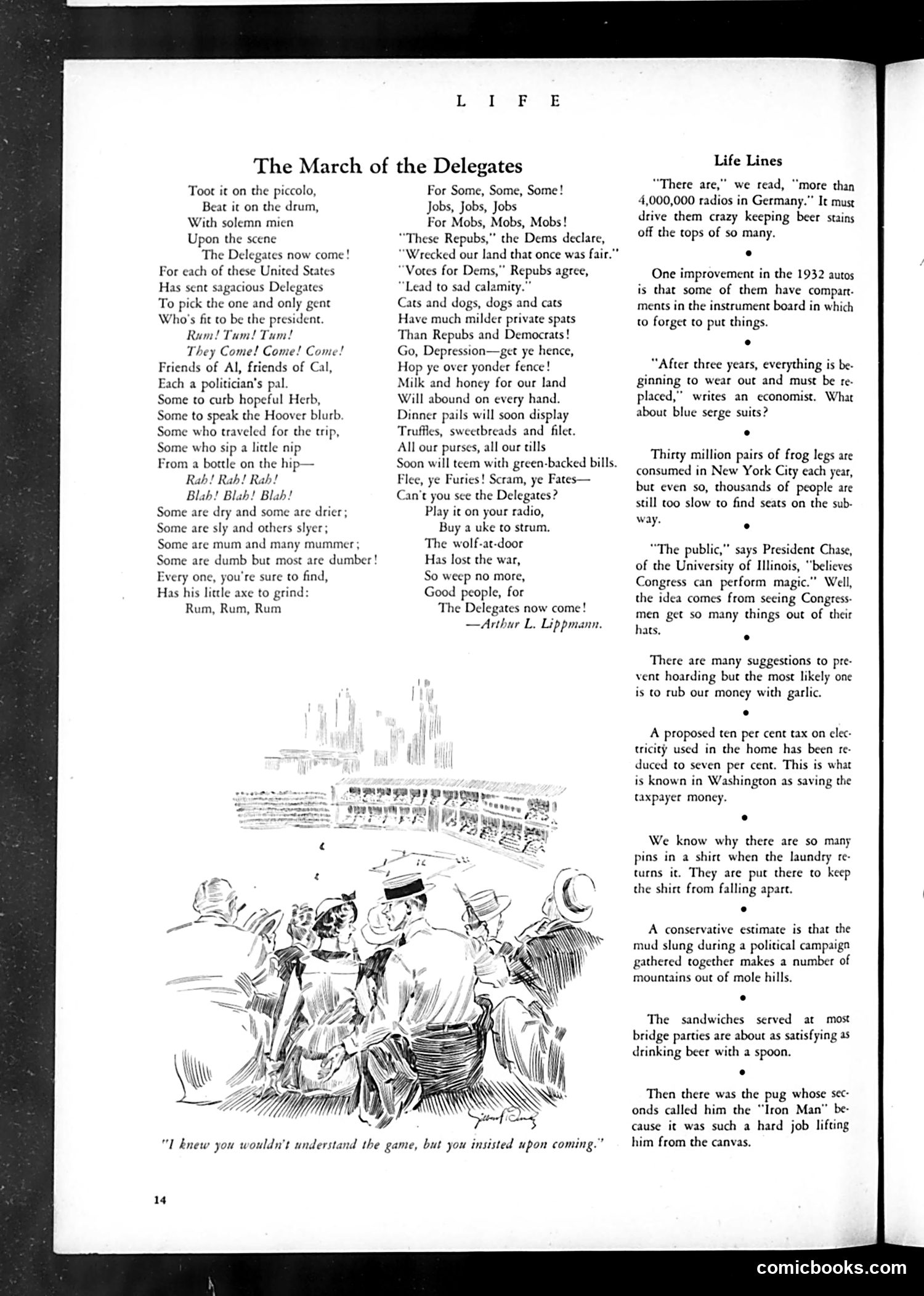
"The March of the Delegates" This page satirizes the 1932 Democratic National Convention, when party delegates traveled to nominate a presidential candidate. The poem by Arthur L. Lippmann mocks the diverse, chaotic delegation—some "dry" (Prohibition supporters), some "damp," some "dumb," all guaranteed to argue. The cartoon below depicts delegates arriving in disarray, their competing interests creating mayhem. The caption "'I knew you wouldn't understand the game, but you invited upon coming'" suggests outsiders wouldn't grasp internal party politics. The right column collects miscellaneous satirical observations about contemporary life—radio proliferation, hoarding prevention, electricity taxes—typical of Life's potpourri humor. The overall message: the Convention represents political dysfunction and the Democratic Party's internal divisions.
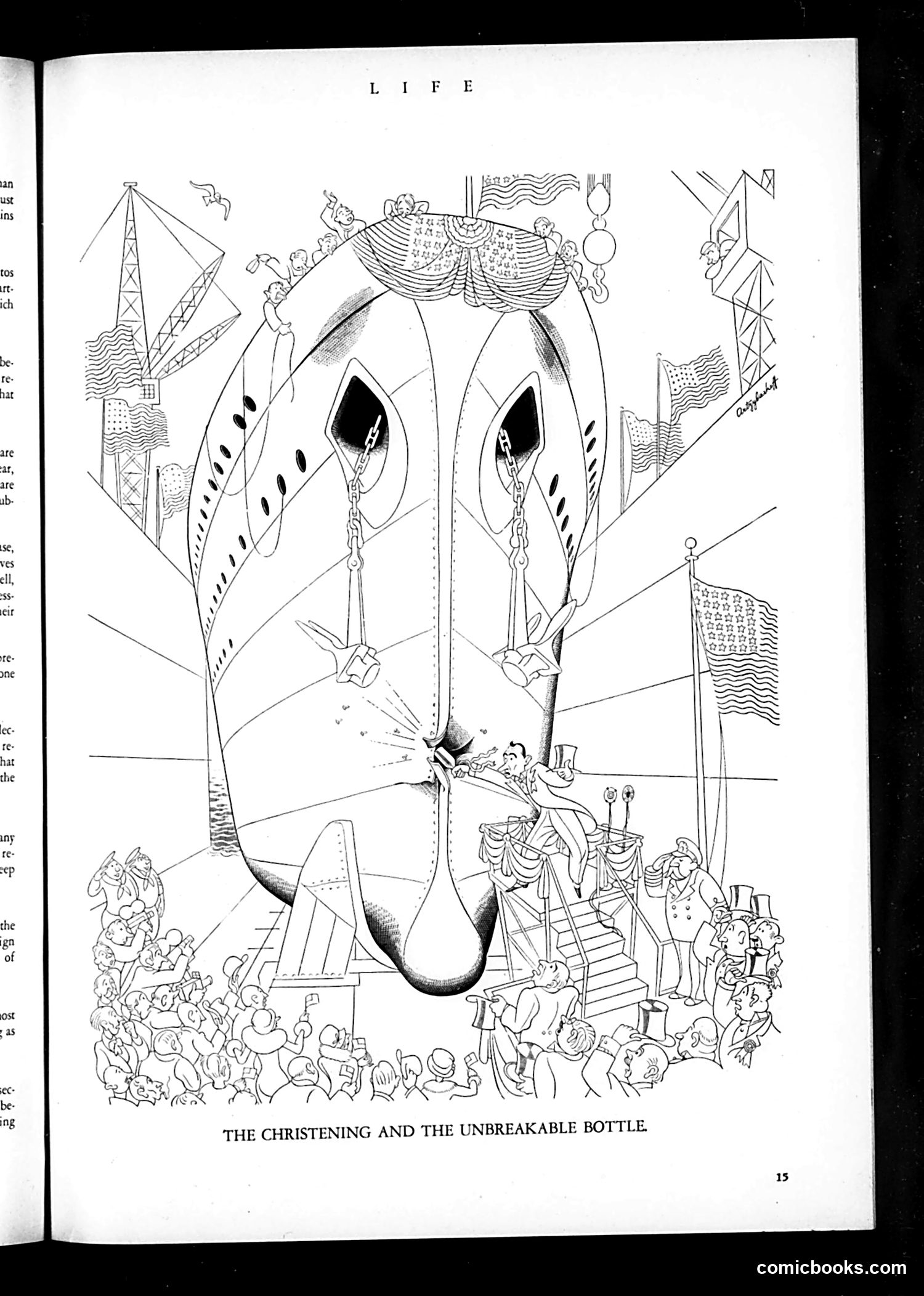
"The Christening and the Unbreakable Bottle" This satirical illustration depicts a massive ship christening ceremony. The caption plays on the tradition of breaking a champagne bottle against a ship's hull for luck—a "christening" ritual. The humor appears to center on an "unbreakable bottle," suggesting the christening bottle refuses to break despite repeated attempts, visible in the emphasized impact point on the hull. The crowd of onlookers and officials witness this comedic failure. The elaborate naval setting with flags, towers, and formal ceremony emphasizes the contrast between the solemn occasion and the practical mishap. This likely satirizes either shipbuilding quality, superstition surrounding naval traditions, or a specific historical christening incident where the bottle famously failed to break—considered bad luck.
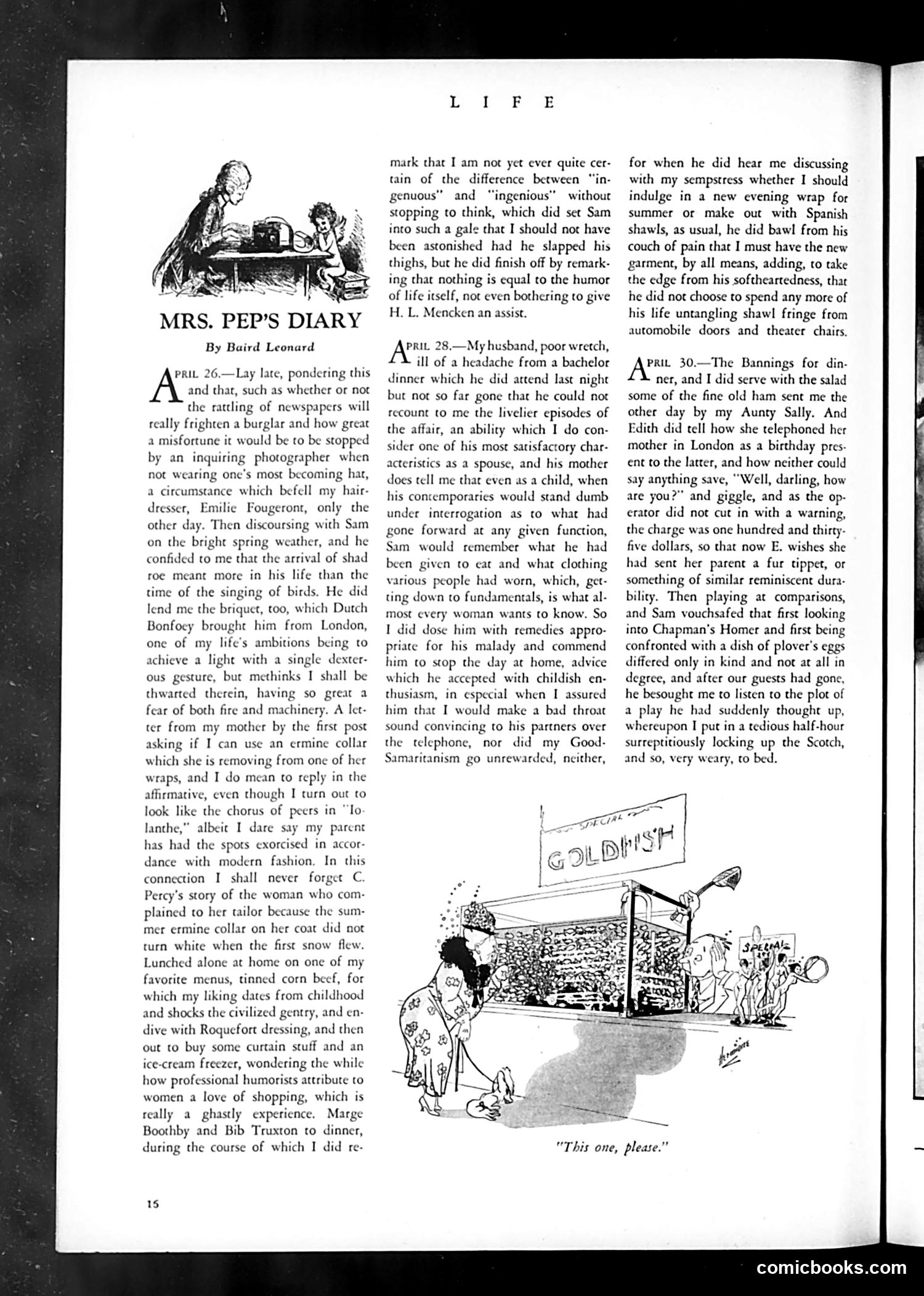
"Mrs. Pep's Diary" by Baird Leonard This page presents a humorous domestic diary entry satirizing upper-middle-class married life. The cartoon illustrates a woman shopping at what appears to be a "Goldfish" vendor or pet store, with the caption "This one, please." The diary entries mock the trivial concerns of a society wife: her husband's headache, neighborly gossip about birthday gifts and telephone calls, and shopping expeditions. The humor derives from the contrast between the narrator's breathless, self-important tone describing minor domestic dramas and the actual insignificance of these events. The goldfish cartoon likely satirizes both frivolous consumer spending and the woman's superficial preoccupations—even pet purchases seem treated as casual social accessories rather than genuine responsibilities.
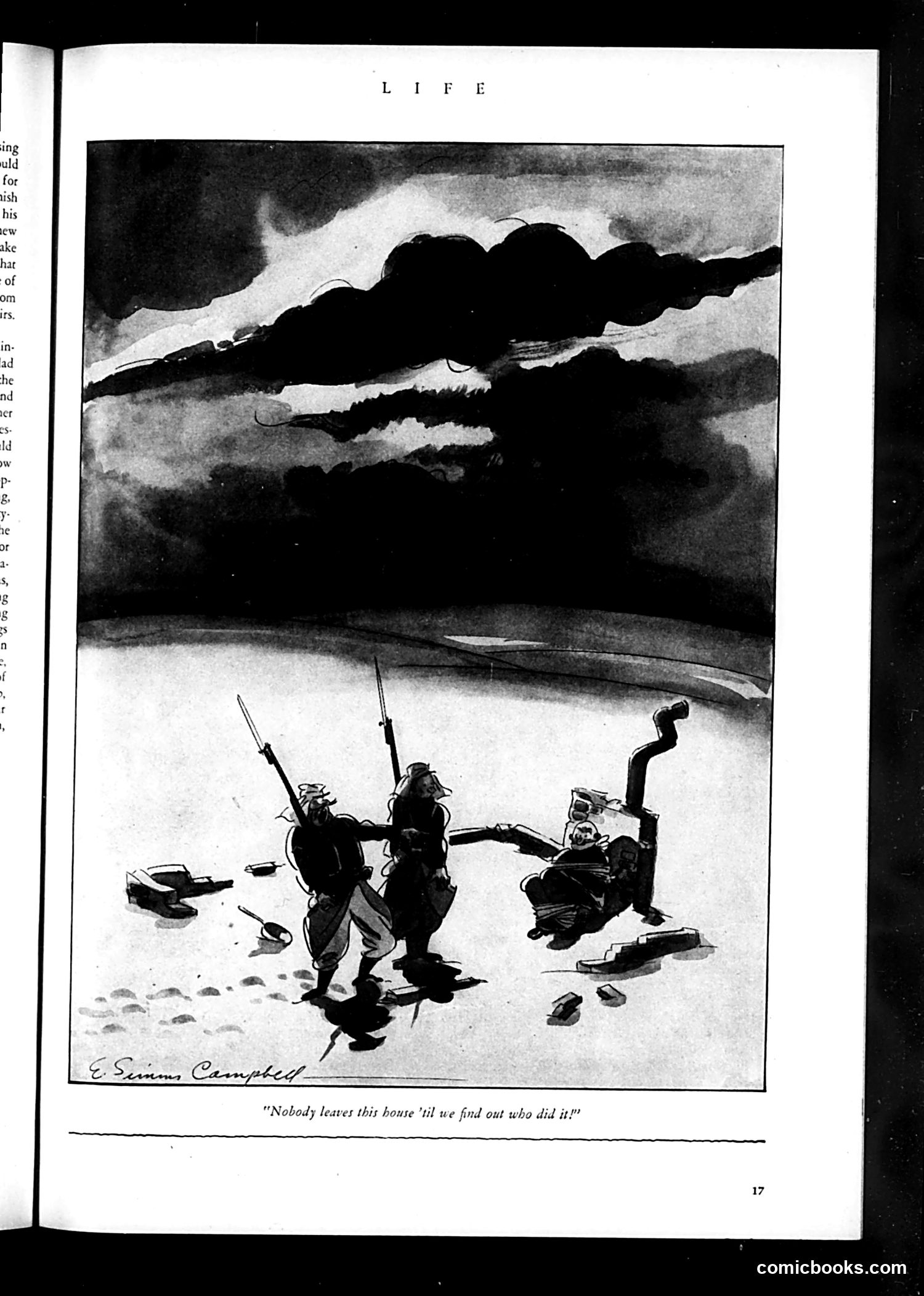
Analysis of Life Magazine Cartoon This single-panel cartoon by E. Simms Campbell depicts three silhouetted figures engaged in what appears to be a violent confrontation on a beach or sandy area, with dramatic storm clouds overhead. The caption reads: "Nobody leaves this house 'til we find out who did it." The humor derives from the absurd mismatch between setting and dialogue—the figures are clearly outdoors on a beach, not in a house. The joke suggests either confusion about their location or ironic commentary on being trapped/confined despite being in an open space. This appears to be a domestic mystery scenario played for comedic effect, typical of Life magazine's satirical humor of the mid-20th century.
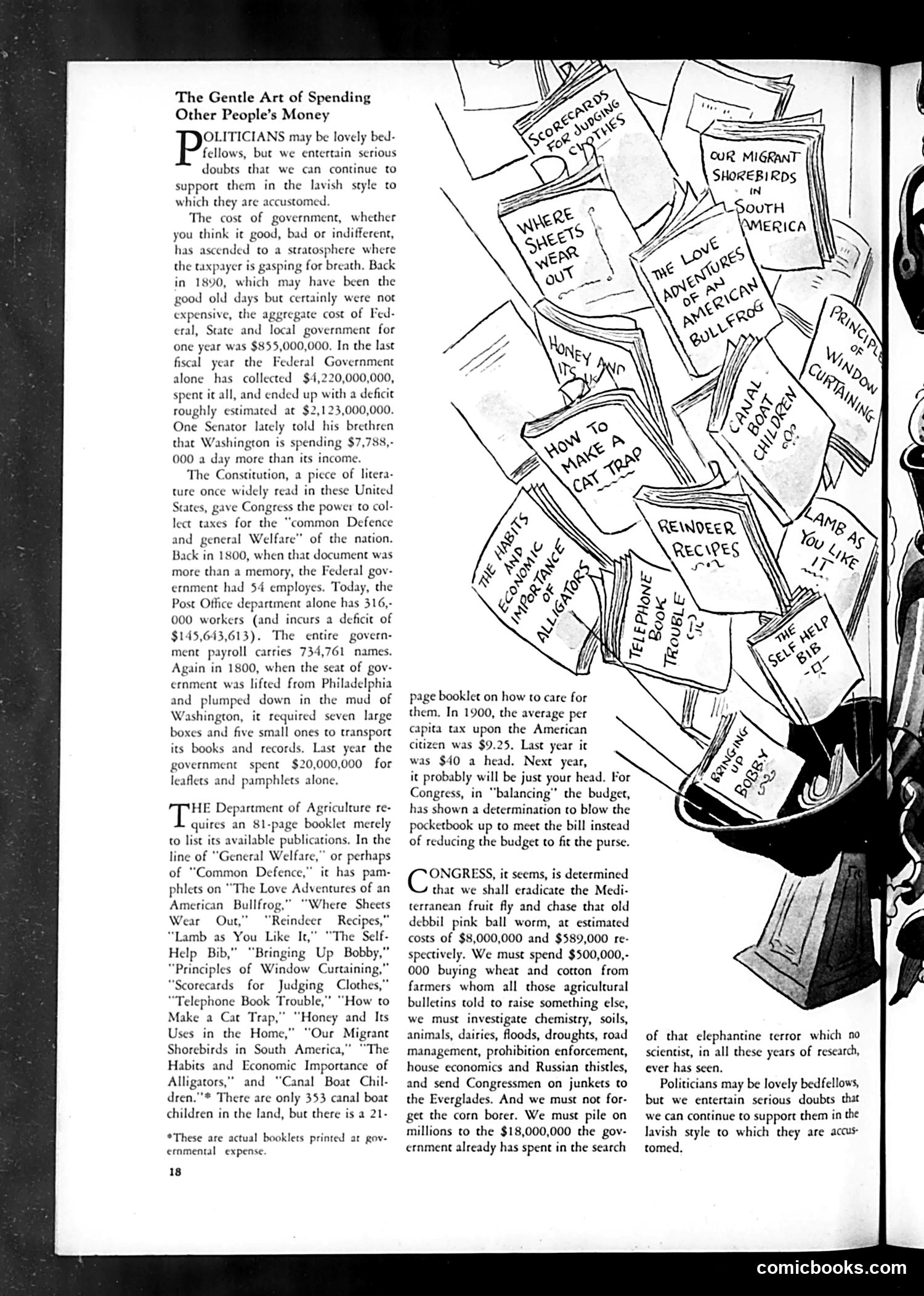
Explanation of "The Gentle Art of Spending Other People's Money" This satirical article mocks excessive government spending. The left-hand text criticizes how the federal budget has grown enormously—from $855 million annually in 1890 to over $4 billion, with the Post Office alone employing 316,000 workers. The right-hand illustration shows a pile of government pamphlets and publications on absurd topics: "How to Make Cat Trap," "Reindeer Recipes," "Principles of Window Curtaining," "The Love Adventures of an American Bullfrog," etc. The satire suggests Congress wastes taxpayer money printing ridiculous educational materials and funding frivolous research (like studying Mediterranean fruit flies and corn borers) rather than reducing the budget. The cartoon argues politicians justify spending by producing silly publications instead of genuine fiscal responsibility.
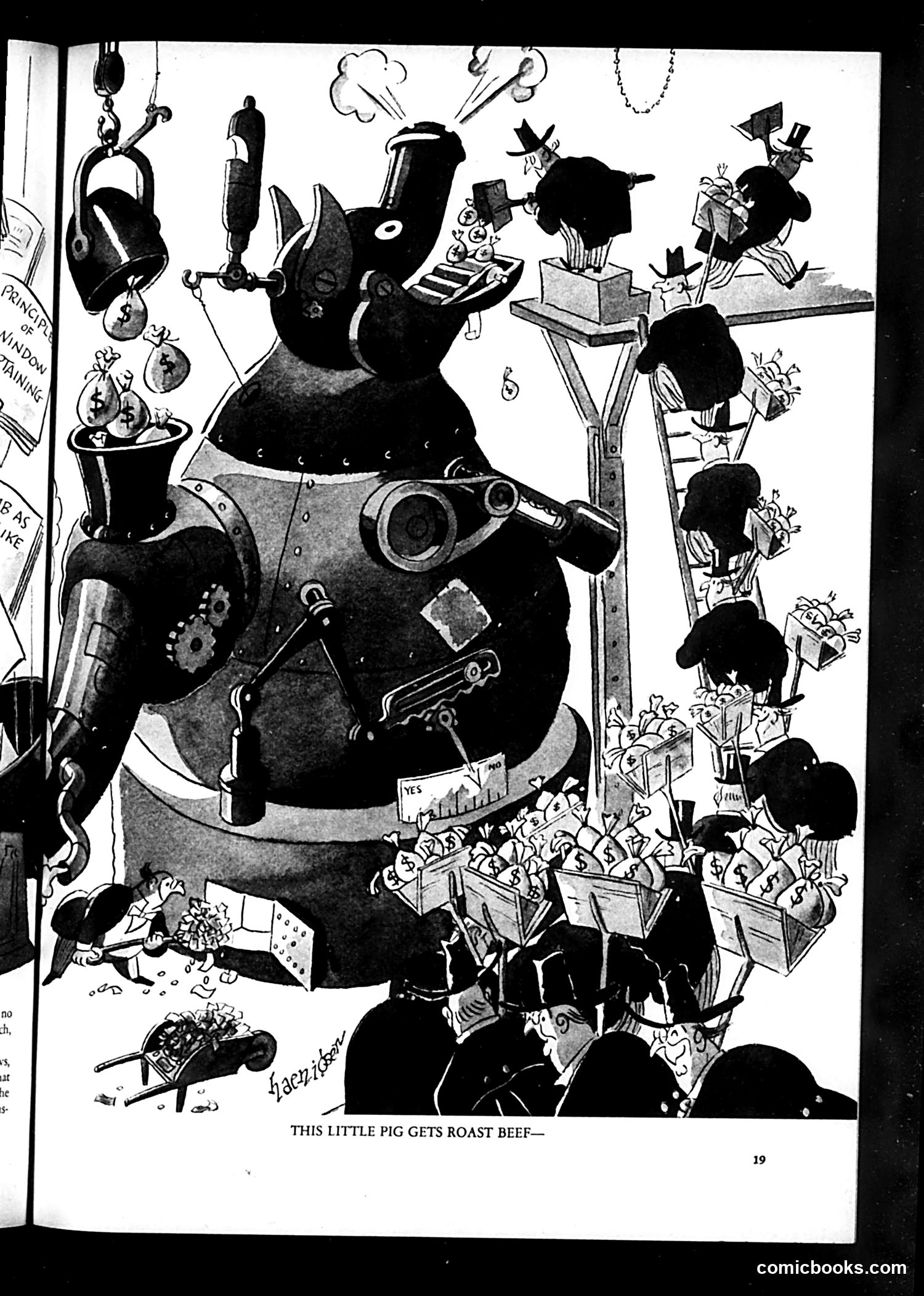
"This Little Pig Gets Roast Beef" This is a satirical cartoon depicting what appears to be a massive industrial or mechanical apparatus shaped like a pig's head, labeled with the nursery rhyme reference "This Little Pig Gets Roast Beef." The cartoon shows numerous small figures (appearing as businessmen or workers) feeding money and documents into the machine at its base, while the apparatus dispenses various goods, weapons, and manufactured items from multiple outlets above. The satire likely critiques American industrial capitalism or war profiteering—suggesting that the economic system converts citizens' money and labor into concentrated wealth and weapons production. The nursery rhyme title may mock how the system presents itself as innocent or inevitable, when it actually exploits ordinary people's contributions for profit.
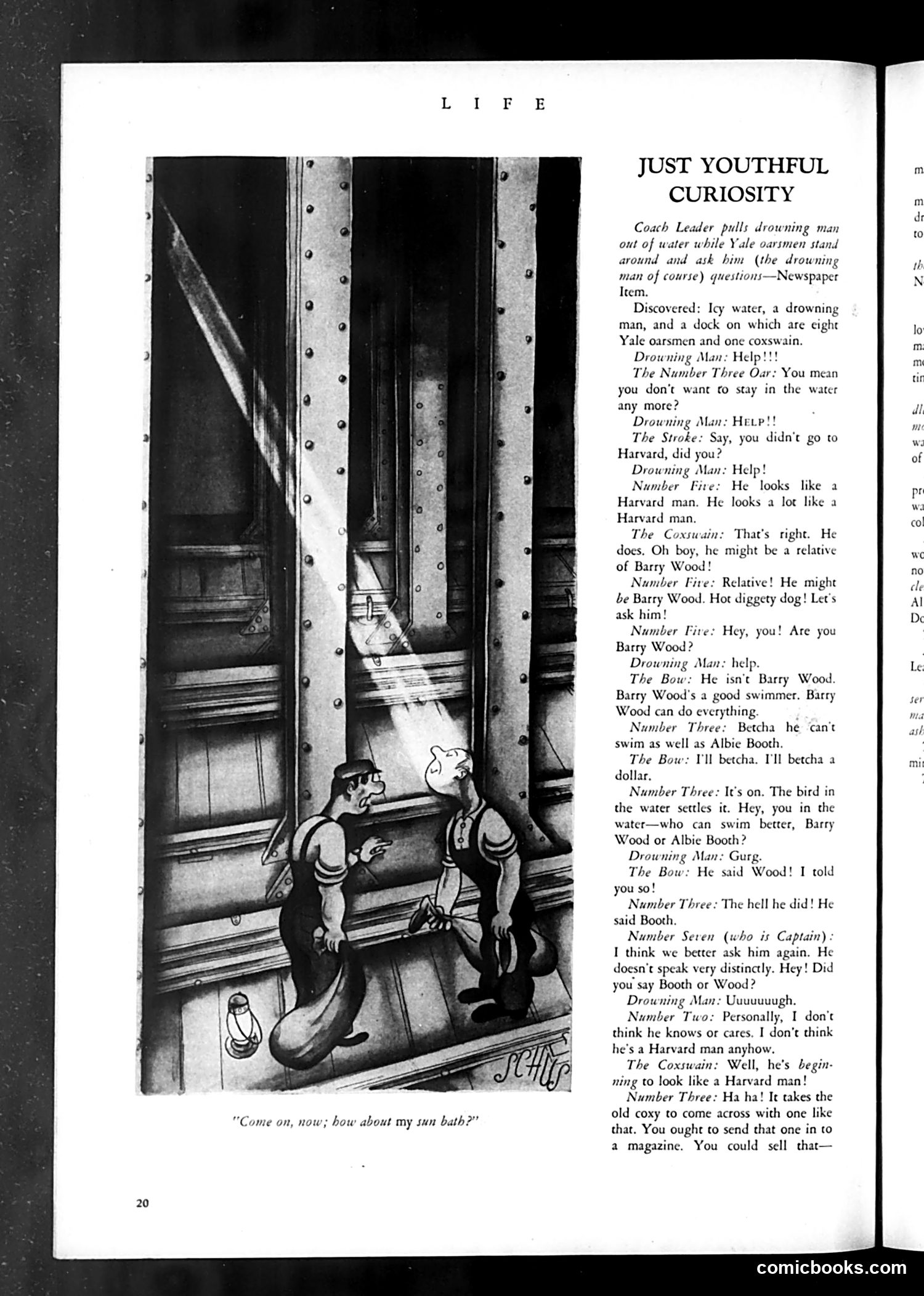
"Just Youthful Curiosity" This cartoon satirizes Yale oarsmen's callous indifference during an emergency. A drowning man is being rescued, but instead of offering help, eight rowers and a coxswain bombard him with trivial questions—debating whether he's related to Barry Wood or Albie Booth (likely Yale athletes of the era), and arguing about which swimmer is superior. The joke targets the privileged college athletes' self-absorption and intellectual detachment. Even as the man gasps for air, they treat his potential drowning as entertainment, cracking jokes and making bets about his identity rather than ensuring his safety. The caption suggests this absurd behavior represents merely "youthful curiosity"—a satirical understatement of their grotesque priorities and the culture of elite institutions that valued status and athletics over human compassion.
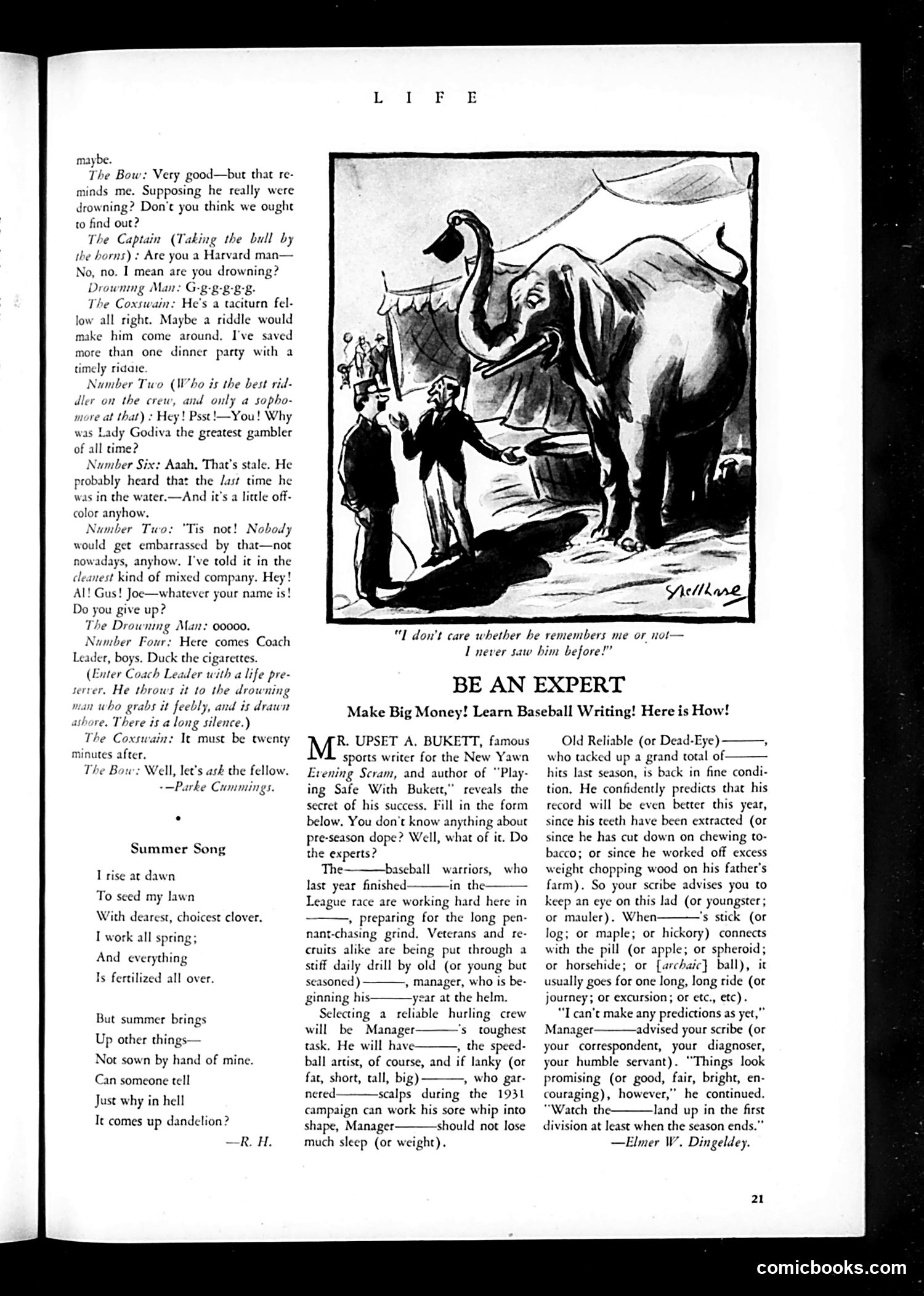
"Be an Expert" Baseball Writing Satire This page satirizes sports journalism's predictable clichés and meaningless jargon. The article purports to teach readers how to write baseball predictions without actual knowledge—"You don't know anything about pre-season dope? Well, what of it. Do the experts?" The humor works by filling in blanks with interchangeable sports writing formulas: generic player descriptions (fat/tall/short), tired slang (the "pill," the "stick"), and vague predictions that hedge every bet ("promising or good, fair, bright"). The fake byline "Upset A. Bukett" (sounds like "upset a bucket") and publication "New Yawn Evening Scram" emphasize the mockery. The cartoon above shows drowning sailors being rescued while one asks riddles instead of helping—a visual joke about misplaced priorities, likely commenting on similarly absurd decision-making in sports management or journalism. The satire targets lazy sportswriting that substitutes colorful language and non-committal predictions for actual insight or analysis.
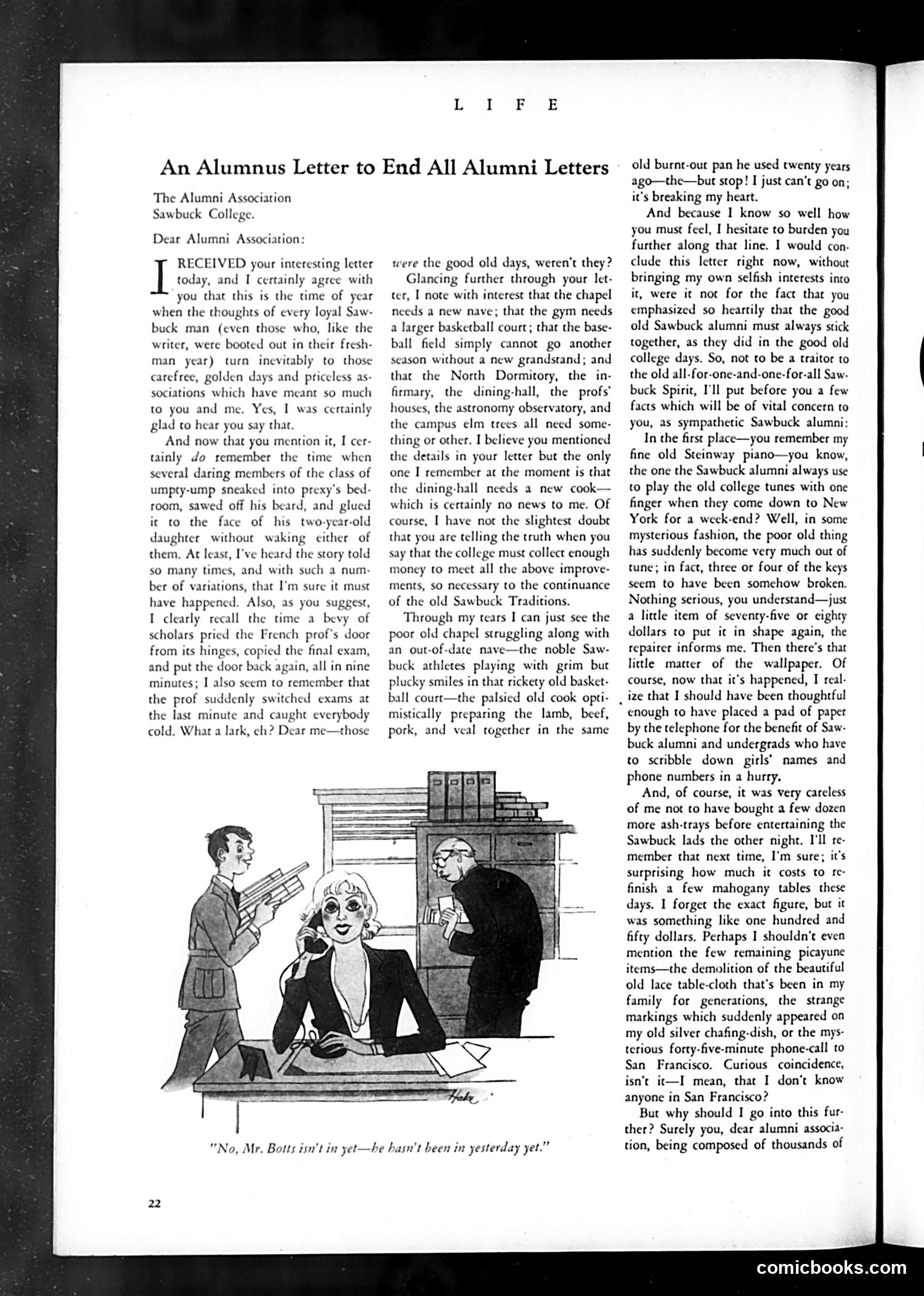
Analysis: "An Alumnus Letter to End All Alumni Letters" This is satirical commentary on alumni fundraising appeals. The cartoon illustrates the accompanying letter—a devastating parody of college solicitation tactics. The joke operates on two levels: First, the alumnus sarcastically claims to *remember* college pranks he admits he likely never witnessed, mocking how alumni reflexively romanticize college nostalgia. Second, and more bitterly, he catalogs Sawbuck College's extensive building needs (chapel, gym, dormitory, dining hall), then immediately *pivots* to his own financial hardships—a damaged piano, ruined silver, expensive phone calls to San Francisco—seeking reimbursement from the very organization asking *him* for money. The cartoon caption ("No, Mr. Botts isn't in yet—he hasn't been in yesterday yet") reinforces the satire's theme of evasion and excuses, paralleling the alumnus's deflection from the college's needs to his own. The satire targets: Alumni associations' emotional manipulation through nostalgia, and the audacity of soliciting broke alumni who have their own problems.
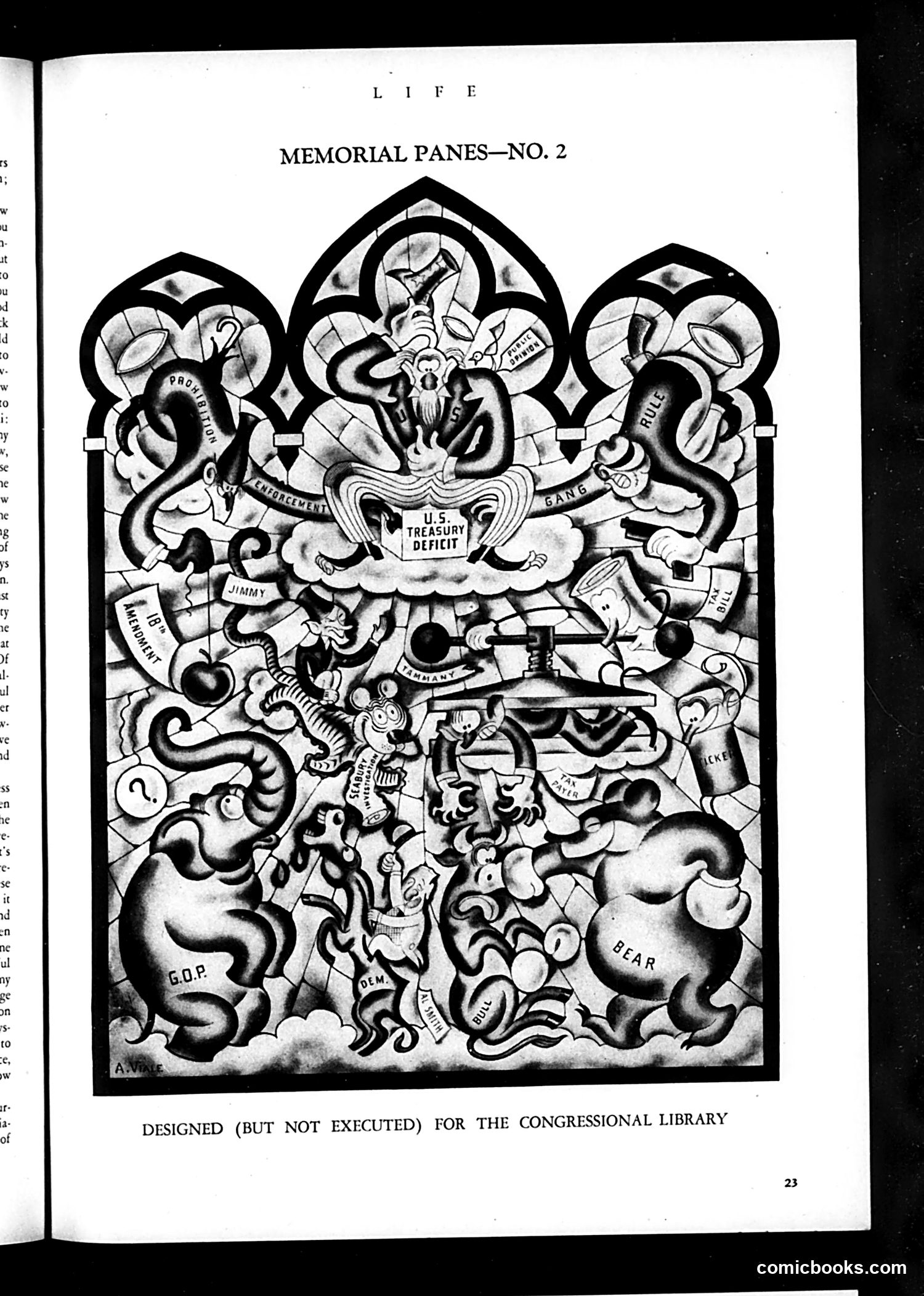
Memorial Panes—No. 2 This is a stained-glass style satirical cartoon designed for the Congressional Library. It depicts political chaos as a grotesque religious monument. The central image shows "U.S. TREASURY DEFICIT" as the focal point, surrounded by writhing serpents and demonic figures labeled with political references including "G.O.P," "DEM," "JIMMY," "BEAR," and other partially visible text. The octopus-like tentacles and chaotic composition suggest political infighting and corruption consuming the nation's finances. The mock-religious framing—imitating cathedral stained glass—presents this governmental dysfunction as something worthy of memorial, sardonically treating political dysfunction as a sacred tragedy. The cartoon likely critiques early 20th-century partisan gridlock and the growing federal deficit, using grotesque imagery to convey that American politics had become monstrous and destructive to fiscal health.
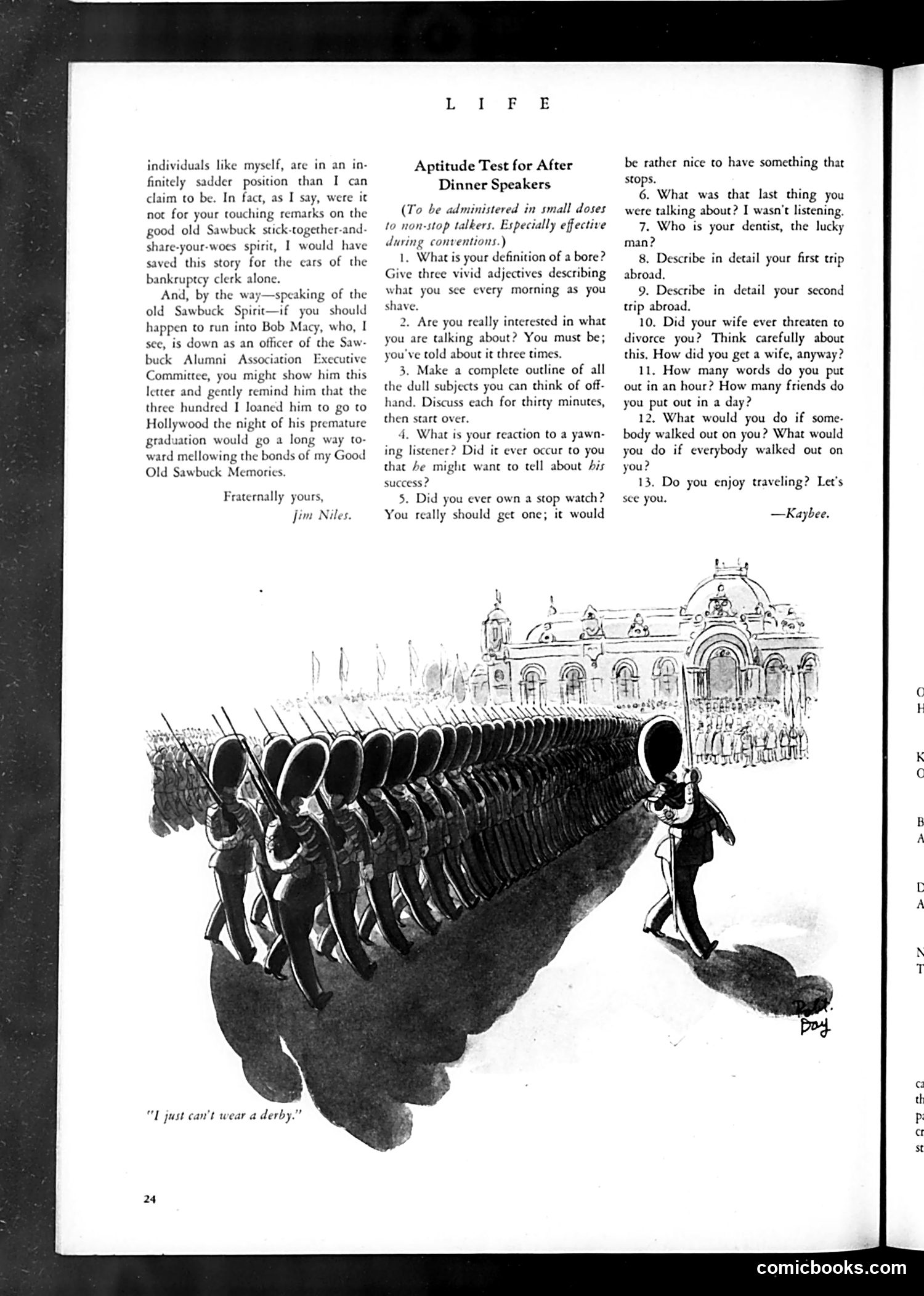
Analysis of Life Magazine Page The cartoon depicts a man in formal attire confronting a long line of British palace guards (identifiable by their distinctive tall bearskin hats and uniforms). The caption reads: "I just can't wear a derby." The satire: This is a visual joke about conformity and dress codes. The man appears unable or unwilling to wear conventional formal headwear (a derby hat), yet he's surrounded by guards dressed in strict, identical uniforms—suggesting society's pressure to conform. The absurdist humor comes from his complaint about a derby when facing far more rigid uniformity. Context: This likely reflects post-WWI or 1920s-30s anxieties about individual identity versus social conformity. The British palace setting emphasizes rigid institutional hierarchy. The page's text—an "Aptitude Test for After Dinner Speakers"—is separate satirical content mocking long-winded conversationalists at formal events, with pointed barbs about boring audiences and failed marriages caused by incessant talking.
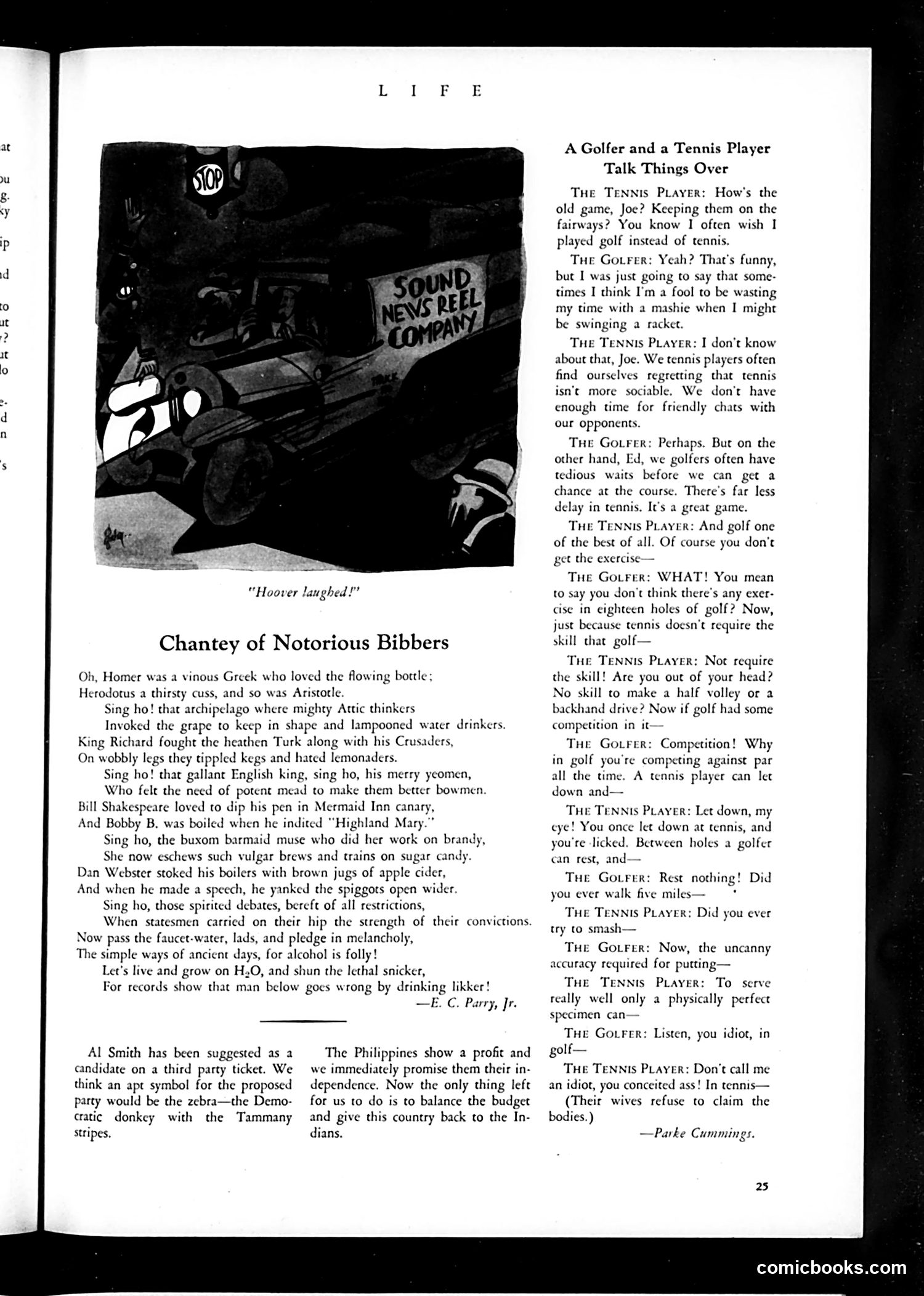
Analysis of Life Magazine Page The top cartoon, captioned "Hoover laughed!", shows a car with "Sound News Reel Company" written on it, likely referencing President Herbert Hoover. The image appears satirical commentary on Hoover during a period (likely early 1930s Great Depression) when his reputation suffered; the caption's irony suggests Hoover had little reason for amusement. Below, "Chantey of Notorious Bibbers" is a humorous poem mocking Prohibition by celebrating historical figures who drank alcohol—Homer, Aristotle, King Richard, Shakespeare, and Daniel Webster. The poem's final verse bitterly reverses course, sarcastically urging abstinence ("alcohol is folly"), satirizing the enforced temperance laws. The dialogue piece "A Golfer and a Tennis Player Talk Things Over" humorously depicts two sports enthusiasts endlessly arguing over which sport is superior, each defending their activity while simultaneously admitting envy of the other. The wives' refusal to claim the bodies is the punchline—their bickering is absurdly tedious. All three pieces employ satire and humor typical of Life's editorial stance.
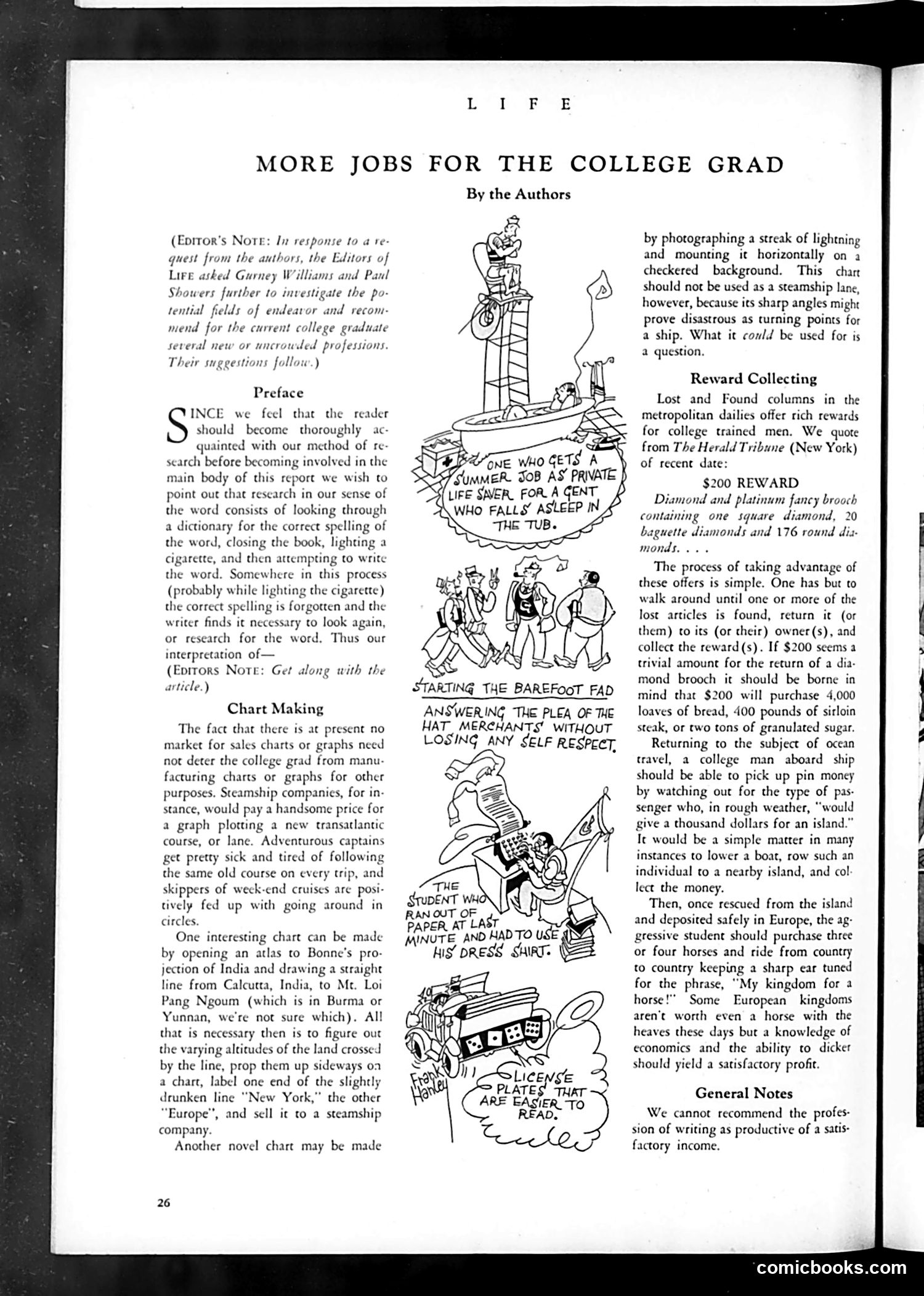
Analysis: "More Jobs for the College Grad" This is satirical advice for 1920s college graduates facing limited job prospects. The piece mocks both the graduates' desperation and the frivolous "solutions" offered. The cartoons illustrate absurd career suggestions: - A figure precariously balanced on a tower represents dubious "entrepreneurship" - "The barefoot fad" shows men going shoeless to answer hat merchants' pleas—satirizing how grads might manufacture markets - Someone ripping his shirt to need laundry service exemplifies contrived income schemes - A "license plate reading chart" suggests graduates inventing pointless busy-work The satire targets: - Post-WWI economic uncertainty for educated young men - The gap between college education and actual employment - Absurd get-rich-quick thinking (reward collection, rescuing passengers for payment) - The authors' own "research method" (dictionary + guessing) mocks both their work and graduates' practical incompetence The underlying joke: a college degree doesn't guarantee meaningful work—so why not embrace completely ridiculous schemes? This reflects genuine 1920s anxiety about employment and education's value.
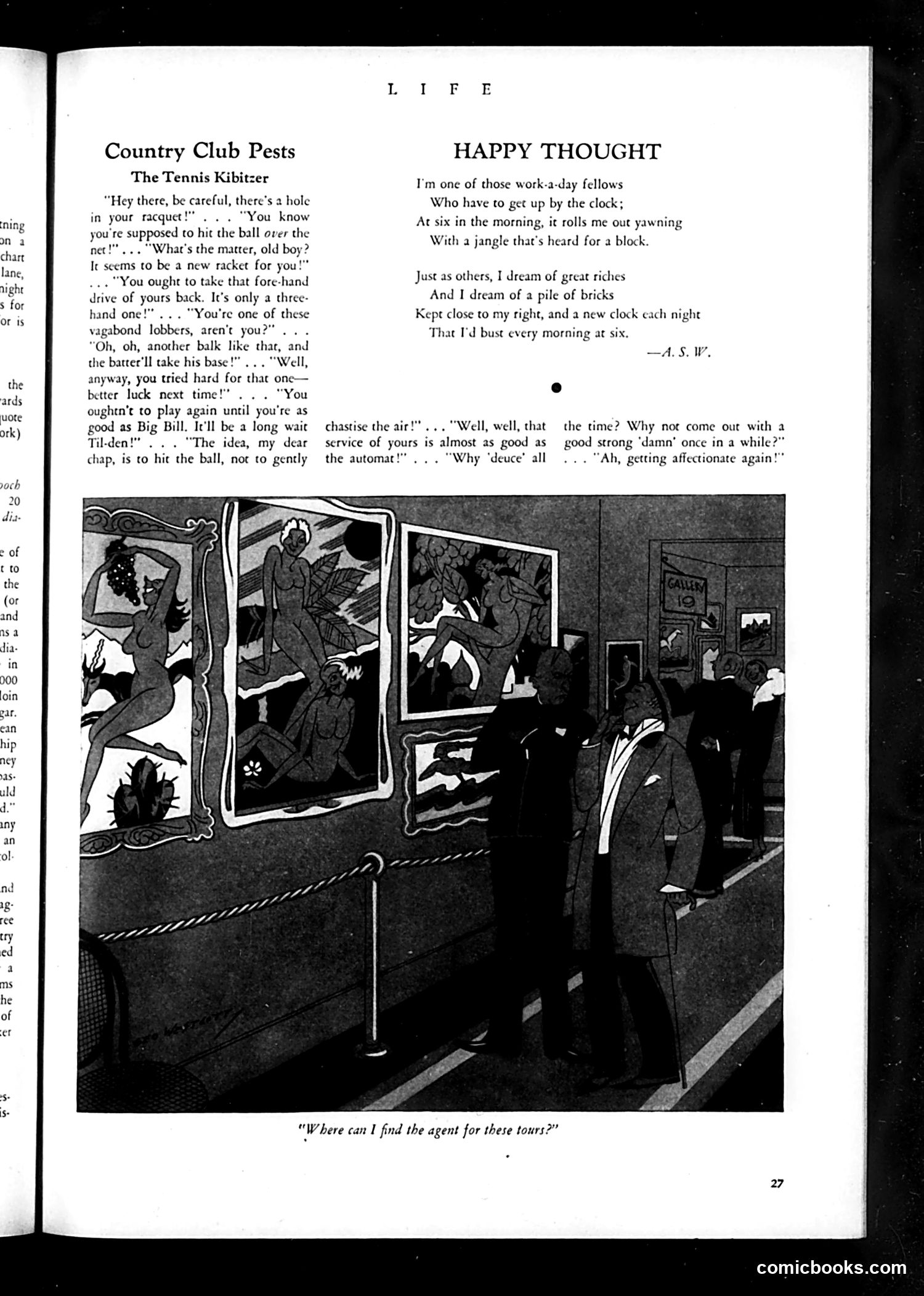
Analysis of This Life Magazine Page This page contains two satirical pieces about annoying social behavior: "The Tennis Kibitzer" (left) mocks the irritating spectator who constantly offers unsolicited advice during tennis matches. The text strings together backseat commentary ("be careful, there's a hole in your racket," "You ought to take that fore-hand drive back") that real kibitzers would deliver, patronizing and interrupting the actual players. The humor comes from recognizing this universal nuisance at country clubs. "Happy Thought" (right) is a humorous poem about a working-class man who dreams not of luxury but of modest possessions—bricks and clocks—which he could then immediately destroy by "busting" them each morning at six. It's absurdist humor about the futility of alarm clocks and work-day drudgery. The cartoon below (captioned "Where can I find the agent for these tours?") depicts what appears to be a tour bus or vehicle with passengers viewing scenes through windows. The joke remains unclear without additional context about what "tours" are being referenced. All three pieces share a theme of social satire targeting middle-class leisure and work culture.
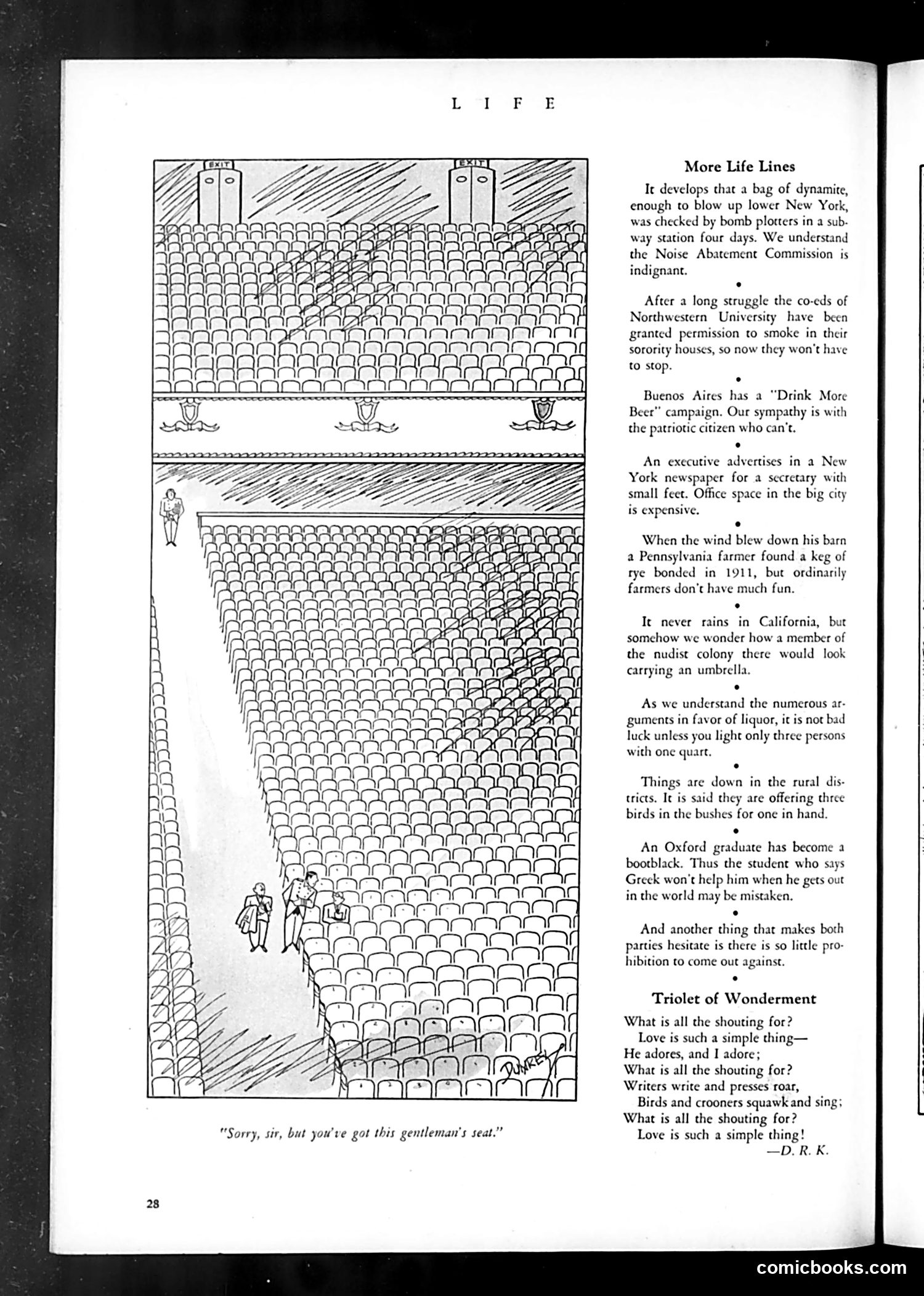
"Sorry, sir, but you've got this gentleman's seat" This single-panel cartoon satirizes overcrowding in public venues—likely a theater or stadium—during the prosperous 1920s. The image shows a massive auditorium packed with identical rows of seats, with a lone usher attempting to direct a confused patron to an occupied seat, leading to the awkward caption. The joke targets the absurdity of strict seating assignments in already-cramped spaces where finding *any* available seat is nearly impossible. The accompanying "More Life Lines" are quick satirical quips about contemporary issues: Prohibition (dynamite in subways, hidden liquor), women's liberation (female students smoking), economic inequality (expensive office space), and rural decline ("three birds in the bushes for one in hand"—Depression-era hardship). The page reflects 1920s-30s anxieties about modernity, crowding, and social change.
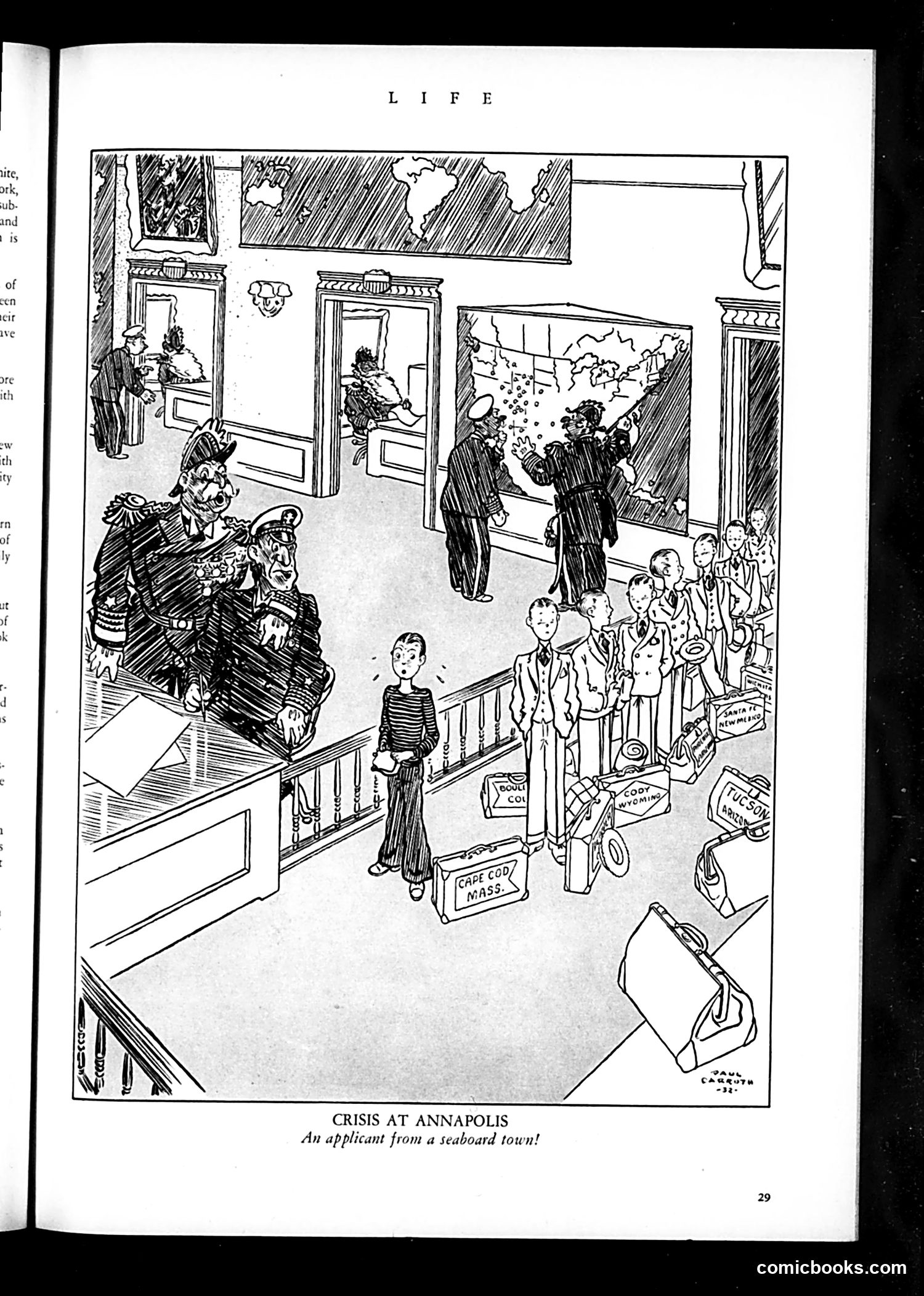
"Crisis at Annapolis" This satirical cartoon depicts a scene at what appears to be the U.S. Naval Academy in Annapolis, Maryland. A military officer (likely an admissions official) on the left examines an applicant while examining luggage labeled with various locations: "Cape Cod Mass," "Cape Cod," and other seaboard town names. The joke appears to satirize anxieties about regional bias or nepotism in Naval Academy admissions—specifically, the concern that applicants from prestigious New England seaboard towns might receive preferential treatment or that their geographic origin alone makes them seem suspiciously well-connected. The "crisis" is the implied problem this poses to fair, merit-based admission standards. The cartoon mocks either academy officials' snobbery about applicants' origins or public concern about such favoritism in military education.
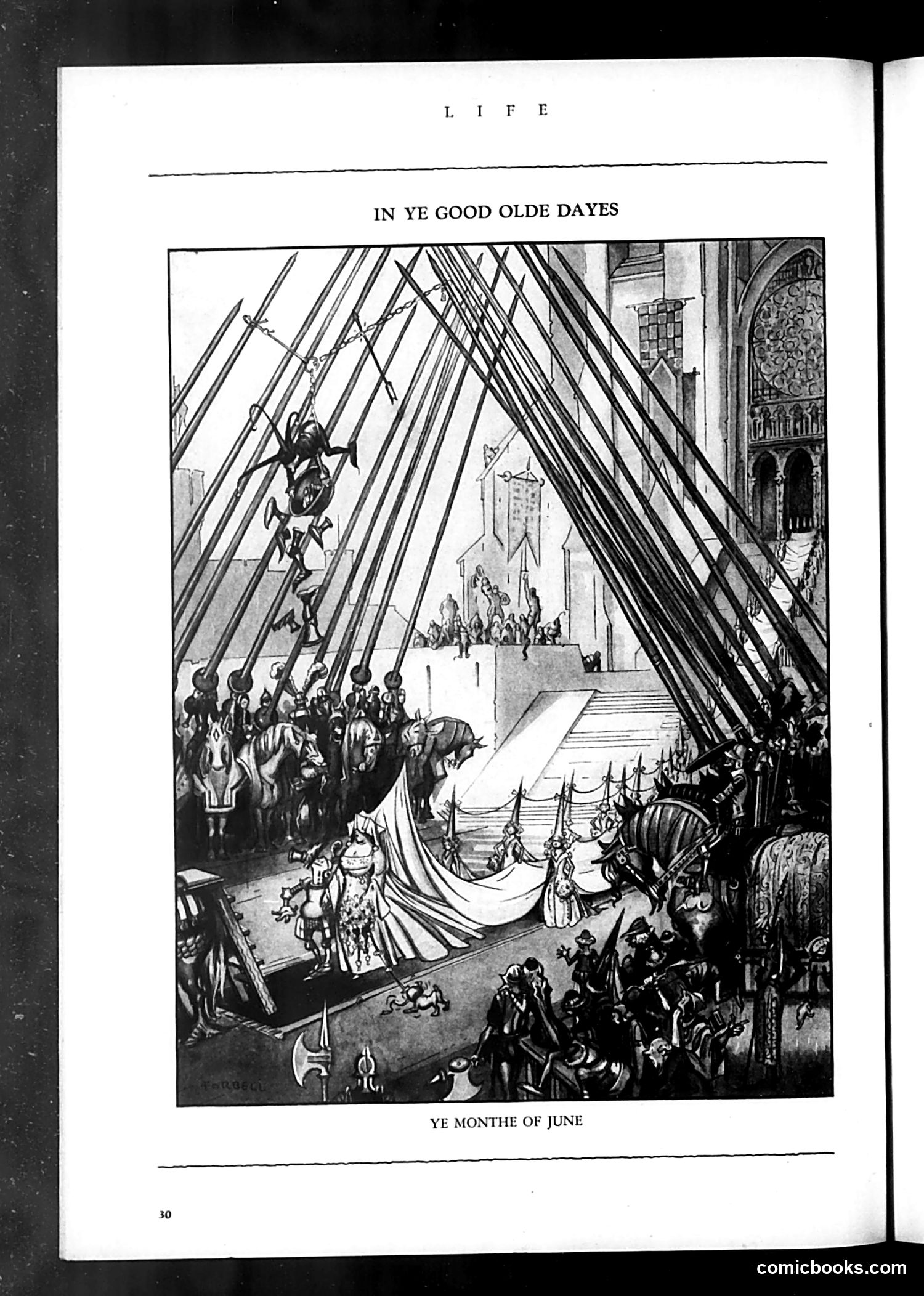
"In Ye Good Olde Dayes: Ye Monthe of June" This illustration depicts a medieval or Renaissance festival scene, likely satirizing nostalgia for "the good old days." The elaborate tent structure, costumed figures, heraldic banners, and ceremonial pageantry suggest a romanticized historical celebration. The satire appears to mock the popular early-20th-century tendency to idealize the past. By showing elaborate costume and ritual, the image may be commenting on how modern people selectively remember history while ignoring its hardships. The crowded, chaotic scene beneath grand formal trappings could suggest the contrast between romantic historical fantasy and mundane reality. The archaic spelling ("Ye Monthe") reinforces the nostalgic tone being gently ridiculed.
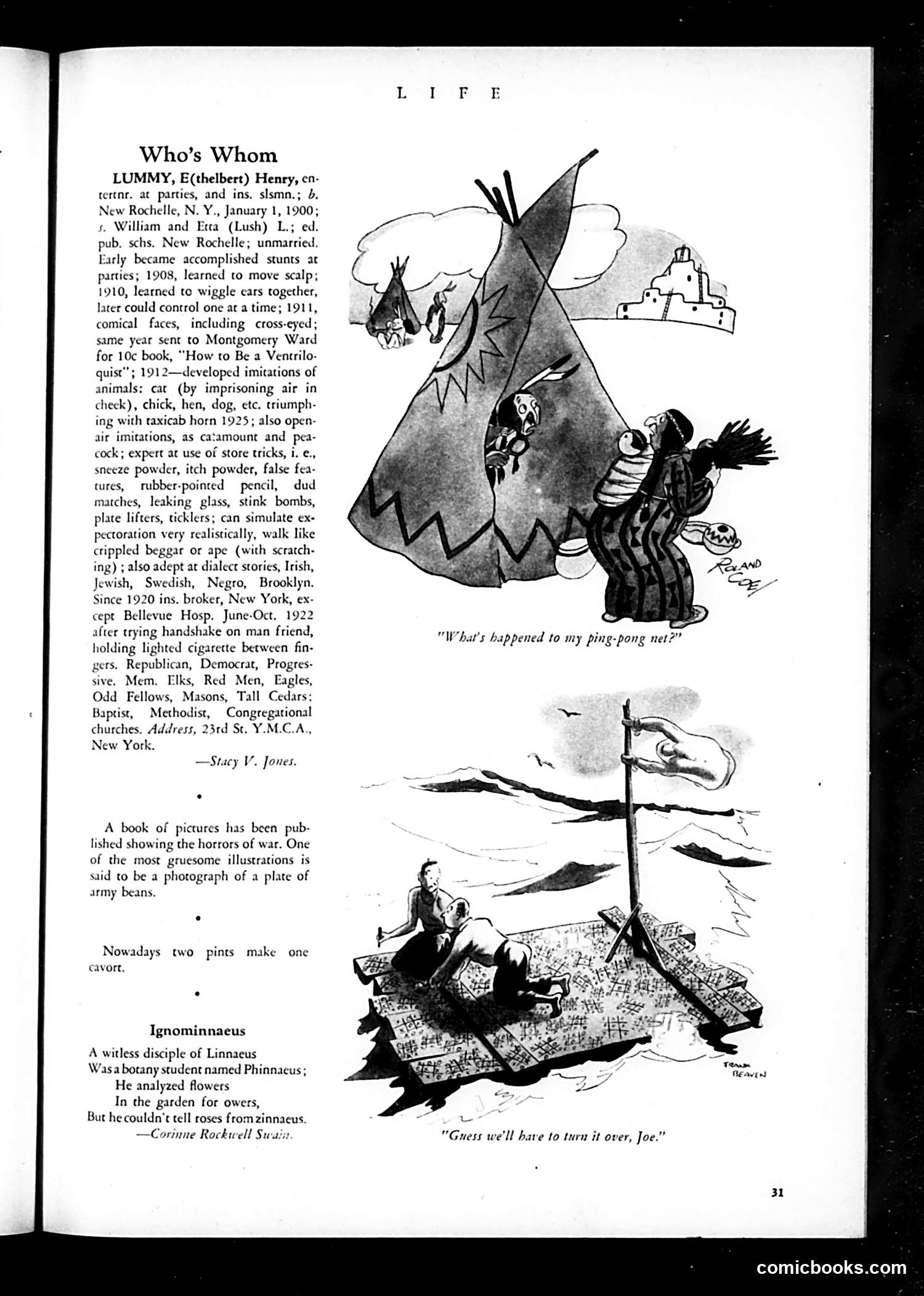
Explanation for Modern Readers This is a "Who's Whom" biographical humor entry mocking a party entertainer named E(thelbert) Henry Lummy. The satire lies in treating trivial party tricks as major life accomplishments worthy of encyclopedia-style documentation. His "achievements"—learning to wiggle ears, make animal sounds, use whoopee cushions and fake sneeze powder—are presented with mock-serious chronological detail, as if they were genuine milestones. The cartoons appear to be unrelated sight gags: one shows a figure tangled in a tent ("What's happened to my ping-pong net?"), another depicts a soldier amid war devastation ("Guess we'll have to turn it over, Joe"). The brief items below mock military food ("gruesome" war photos allegedly showing army beans) and make a pun on "pints" and "cavort." A Latin-themed poem mocks a botany student who cannot distinguish rose from zinnia flowers—a play on the scientific name "zinnaeus."
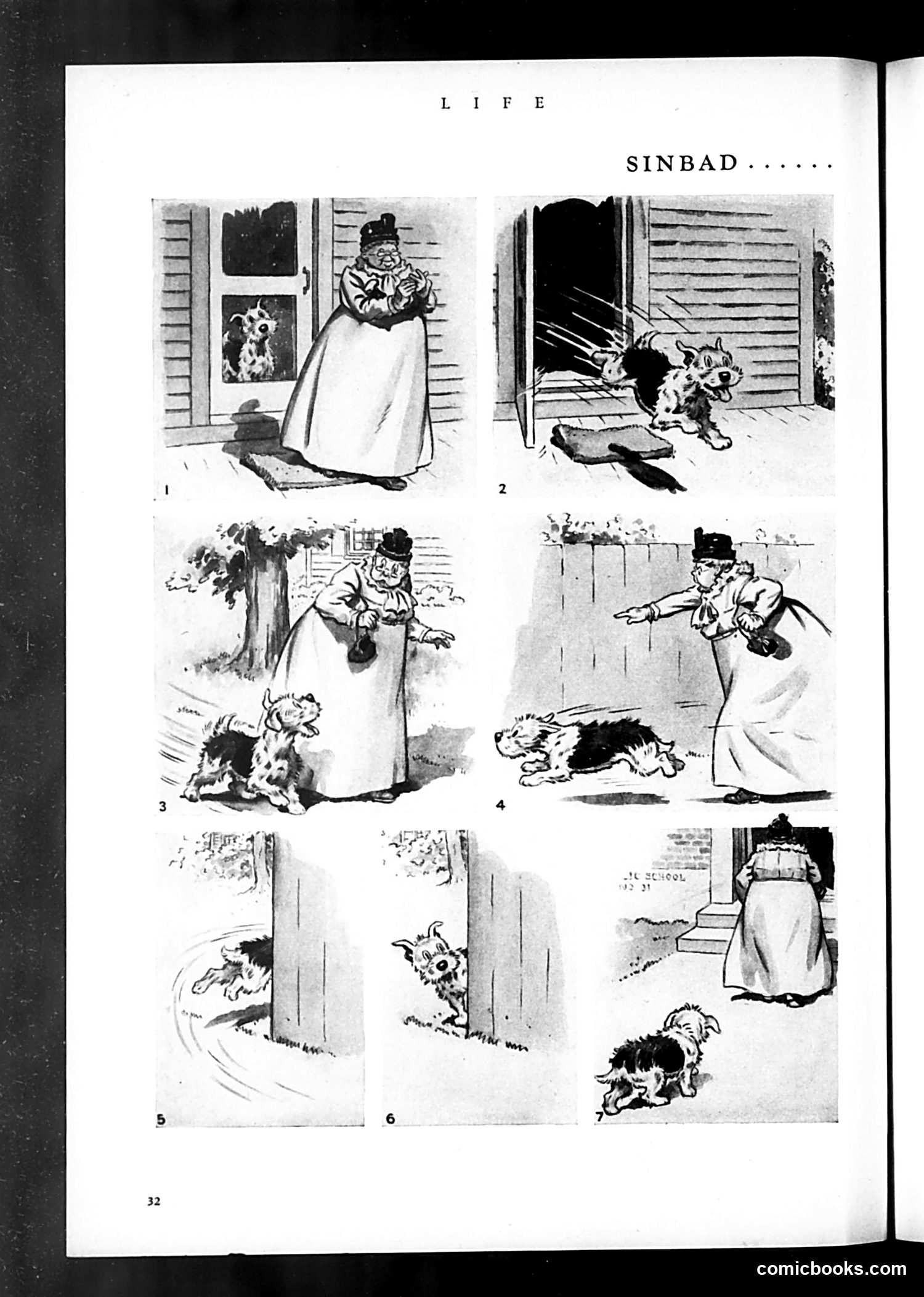
Sinbad Comic Strip Analysis This appears to be a sequential comic strip titled "Sinbad," likely referencing the Arabian Nights character. The seven panels show a woman in Victorian dress interacting with small dog-like creatures in various domestic situations—outside her home, near trees, and at her door. The humor seems to derive from slapstick physical comedy: the dogs chase, evade, and create mischief around the woman, who responds with exaggerated gestures and expressions. The strip plays on conventional Victorian anxieties about controlling animals and maintaining domestic order. Without additional context about the magazine's publication date or the strip's creator, the specific satirical target remains unclear, though it likely reflects early 20th-century domestic humor conventions common to Life magazine's audience.
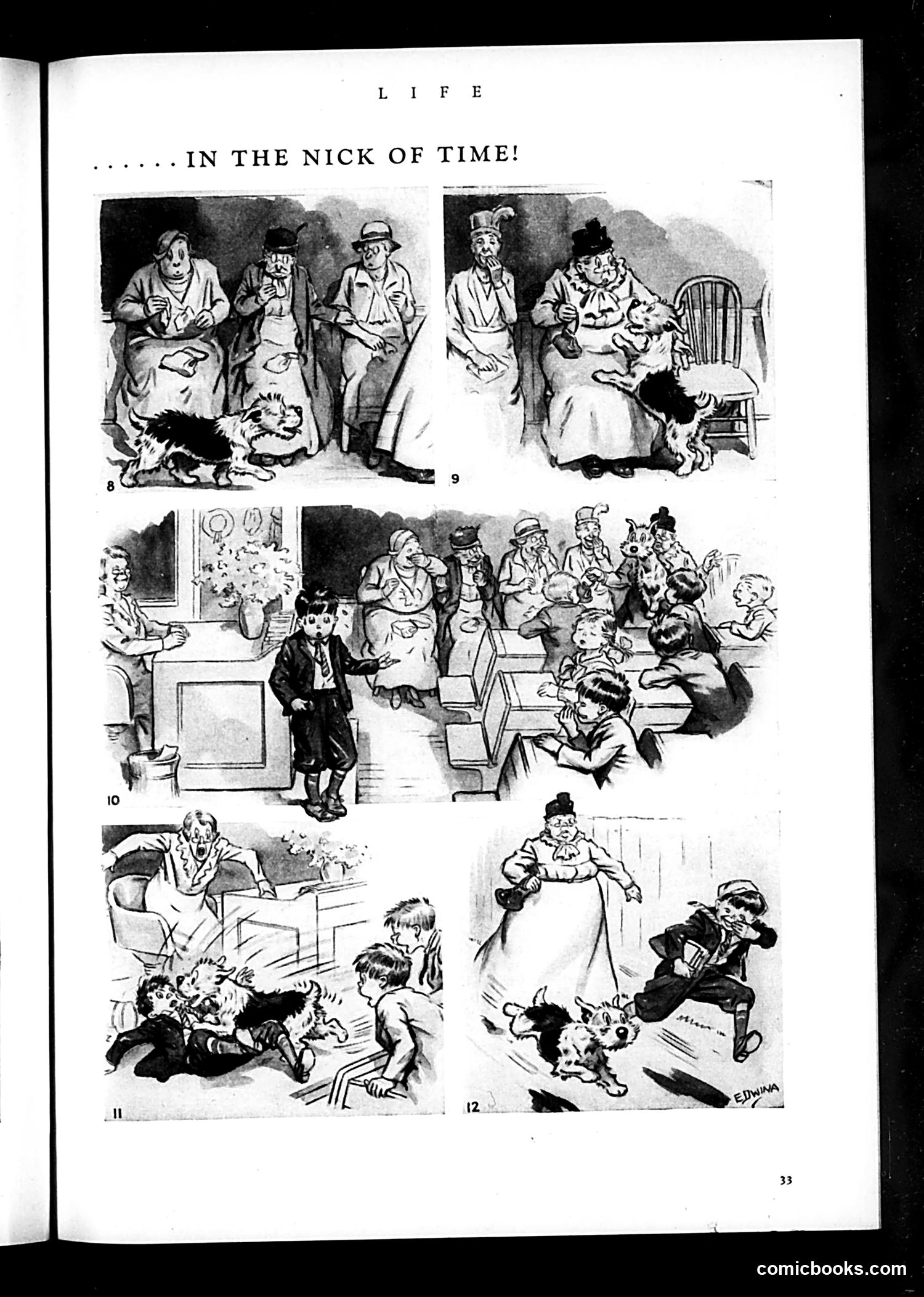
"In the Nick of Time!" - Life Magazine Cartoon Page This is a six-panel satirical comic sequence depicting domestic chaos and narrow escapes. The panels show various mishaps involving children, animals (dogs), and adults in household and public settings. Panel 8-9 appear to show street scenes with working-class figures; Panel 10 depicts what looks like a schoolroom or institutional setting crowded with children; Panels 11-12 show slapstick domestic disasters—people falling, children in danger, a woman wielding what appears to be a broom or implement defensively. The title "In the Nick of Time!" suggests each panel illustrates a crisis barely averted. The humor relies on visual slapstick and the relatable chaos of family life, typical of early-to-mid 20th century American satirical magazine humor. The artwork style and OCR errors suggest this is from an older publication.
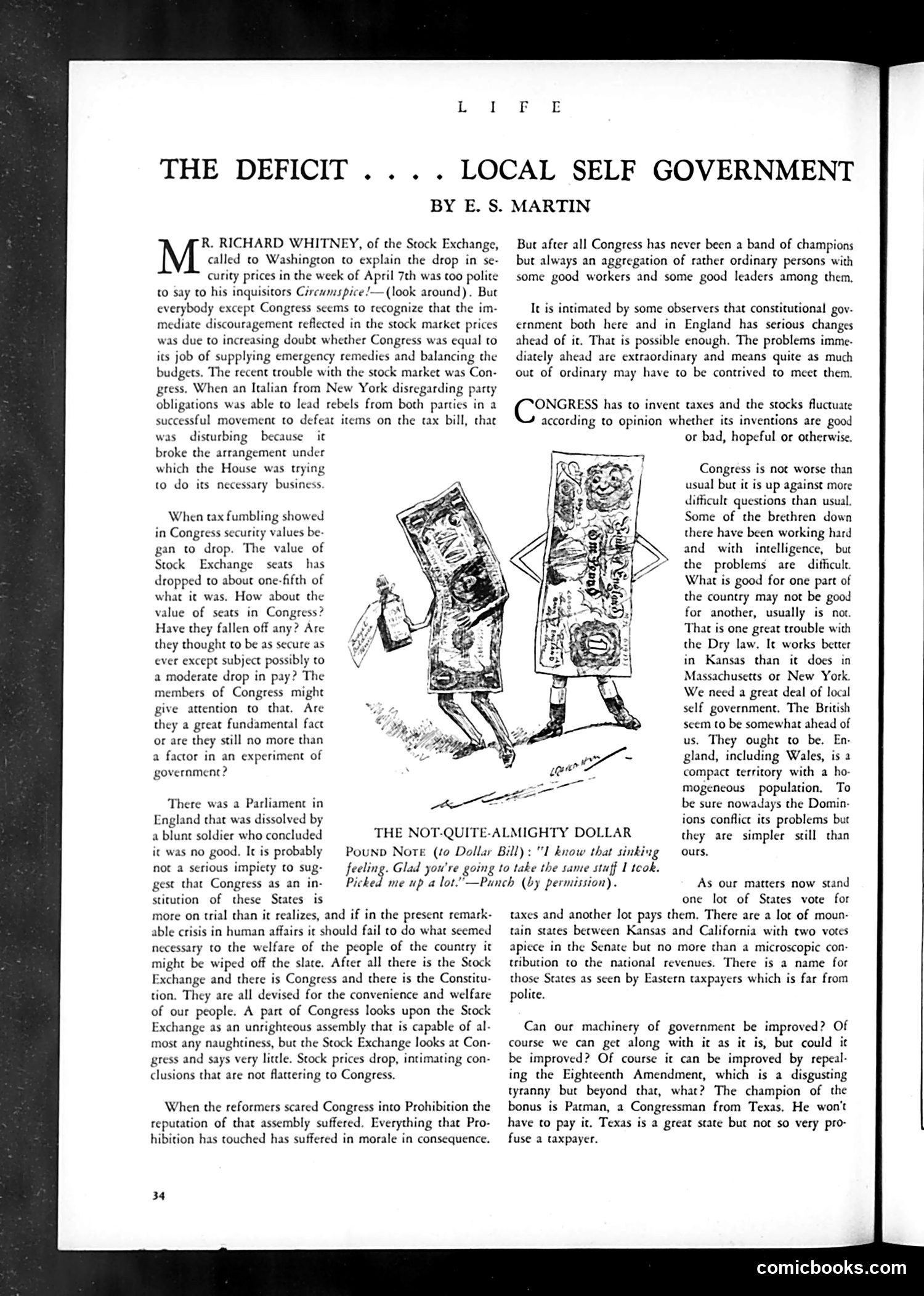
Analysis of Life Magazine Satire Page This page critiques Congress's handling of the economic crisis (likely early 1930s, given stock market references). The cartoon shows a figure representing the dollar bill literally collapsing under weight—a visual pun on financial instability. The article by E.S. Martin argues Congress bears responsibility for stock market declines, comparing legislative incompetence to England's dissolution of Parliament by Oliver Cromwell. Martin satirically asks whether Congressional seats have lost value like Stock Exchange seats. The main targets are: - Congressional incompetence: Members treated as ordinary rather than capable leaders - Party politics: An "Italian from New York" (unclear reference) breaking party unity on tax legislation - Prohibition's failure: Blamed for damaging institutional credibility The satire suggests Congress itself threatens constitutional stability if it cannot address the economic emergency. The central complaint: financial markets lack confidence in legislative problem-solving ability.
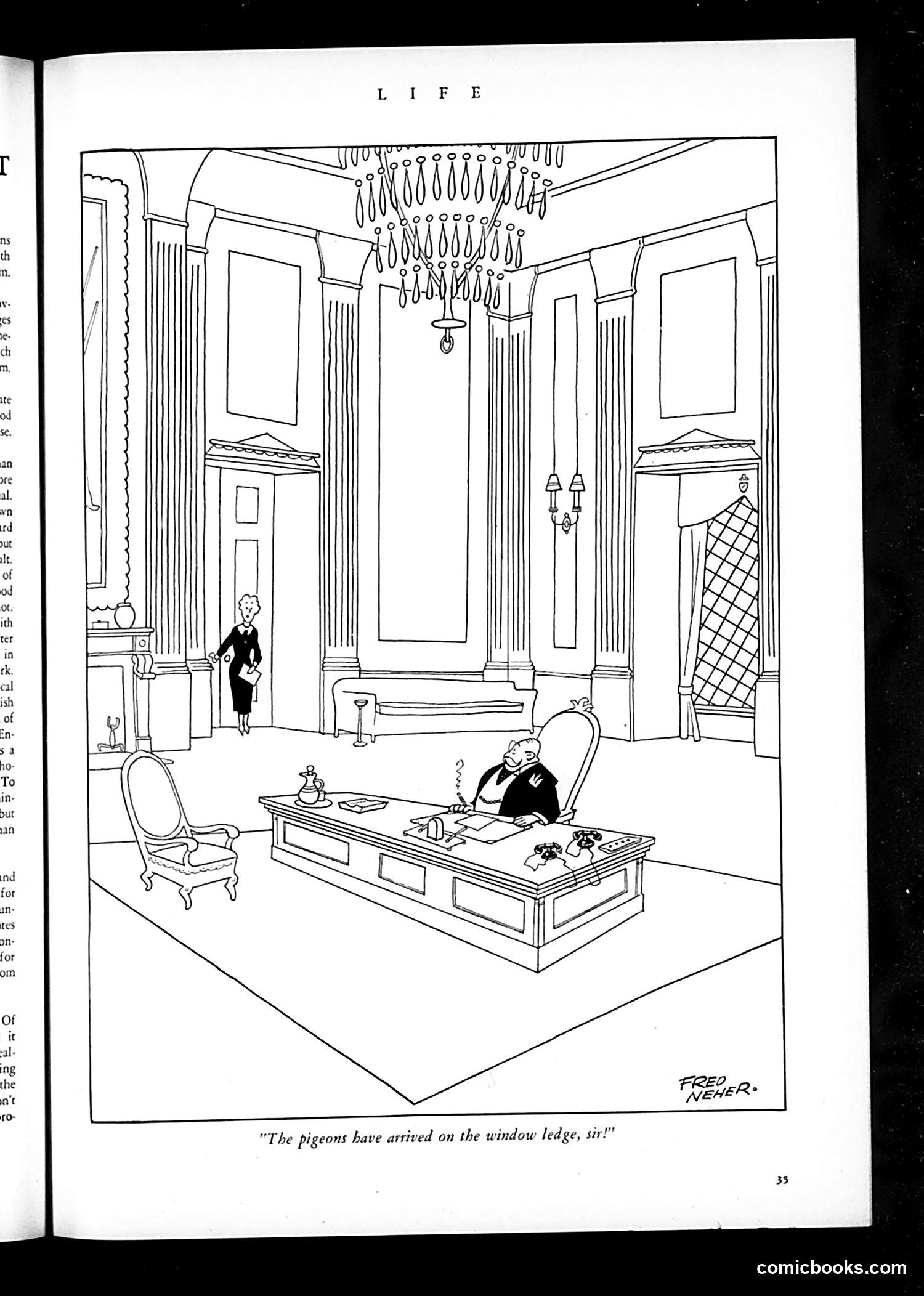
Cartoon Analysis This is a single-panel cartoon by Fred Neher depicting a humorous office scene. A well-dressed man sits at an imposing desk in an ornate, grand office with tall columns and crystal chandeliers. A female secretary or assistant stands nearby, delivering the deadpan line: "The pigeons have arrived on the window ledge, sir!" The joke appears to be a simple absurdist humor piece about urban pigeons—common city pests—arriving at a high-rise office window. The contrast between the formal, prestigious setting and the mundane, somewhat annoying intrusion of pigeons creates the comedic effect. There's no apparent political reference; rather, it's observational humor about urban life and workplace interruptions, likely relatable to readers in a major city during this era.
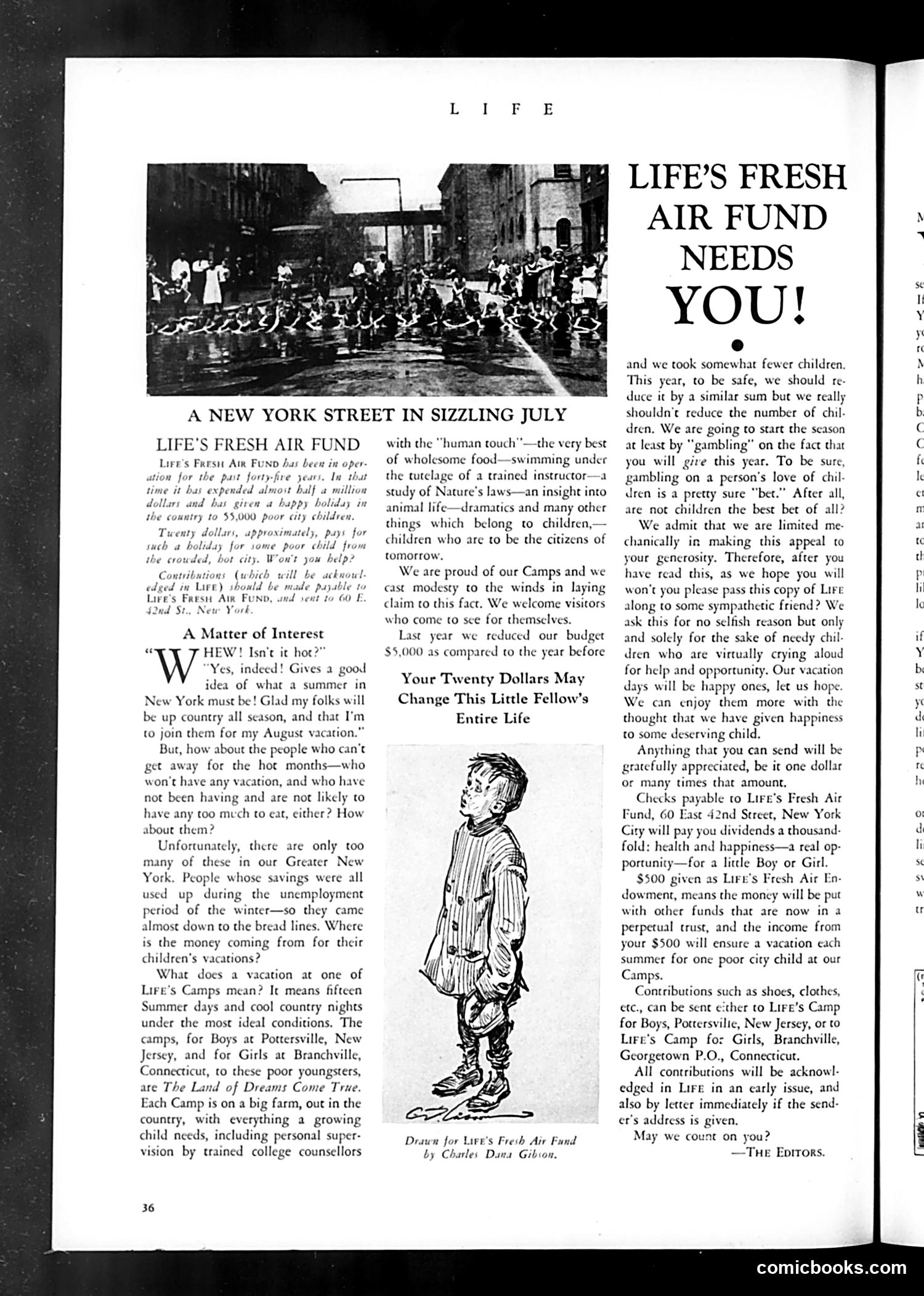
Life Magazine's Fresh Air Fund Appeal This is a fundraising appeal for Life's Fresh Air Fund, a charitable program established 45 years prior that provides summer vacations for poor New York City children. The page combines editorial advocacy with a famous illustration by Charles Dana Gibson (known for the "Gibson Girl"). The Social Context: The text addresses the Depression-era problem of urban poverty—families whose savings were depleted during unemployment now face summer with no resources for their children's care or recreation. The appeal argues that twenty dollars can fundamentally change a poor child's life by funding two weeks at one of Life's rural camps. Gibson's Illustration: The drawing depicts a poorly clothed, barefoot street child—the intended beneficiary. This sympathetic image serves as the emotional centerpiece, personalizing the abstract statistics about poverty. The Satire: The opening dialogue ("Whew! Isn't it hot?") contrasts comfortable readers planning vacations with those who cannot afford them, highlighting class disparity through gentle irony. The fund represents Life magazine's self-positioning as a voice for social responsibility and reform.
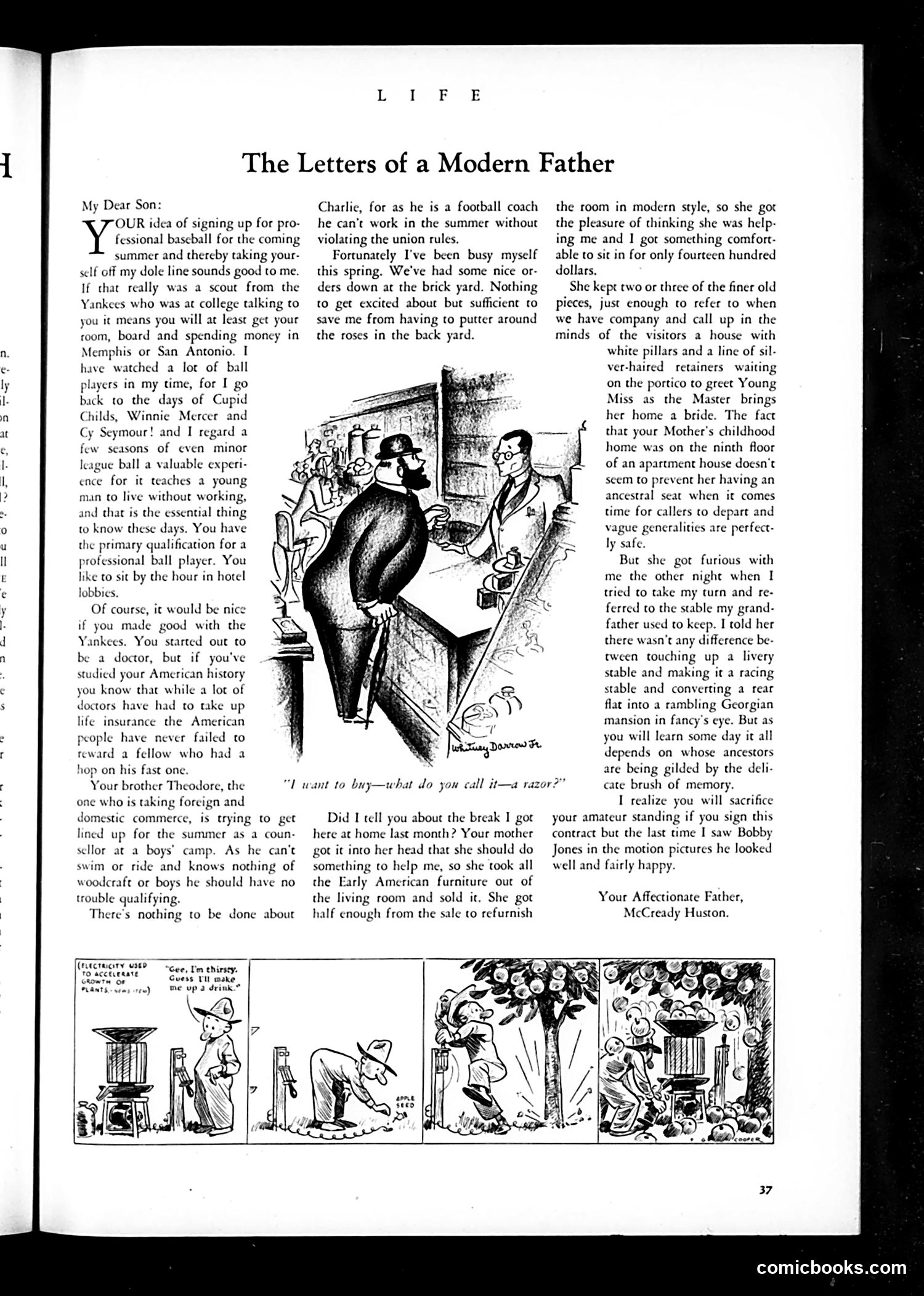
"The Letters of a Modern Father" - Page Analysis This is a humorous column by McCready Huston addressing his son about summer plans. The father writes with gentle, satirical irony about his three sons' prospects: one signing with the Yankees baseball team, another as a boys' camp counselor (despite lacking relevant skills), and a third as a football coach bound by union rules. The main cartoon shows a man asking a barber "I want to buy—what do you call it—a razor?" — likely mocking masculine incompetence or changing consumer habits. The column satirizes 1920s-30s American life: fathers accepting sons' leisure over productivity, the pretense of inherited wealth and "ancestral" status (the mother's ninth-floor apartment rebranded as Southern gentry), and the casual acceptance that professional athletes needn't "live without working." The strip below depicts domestic/household humor typical of the era. The satire targets middle-class aspirations and the gap between actual and performed social status.
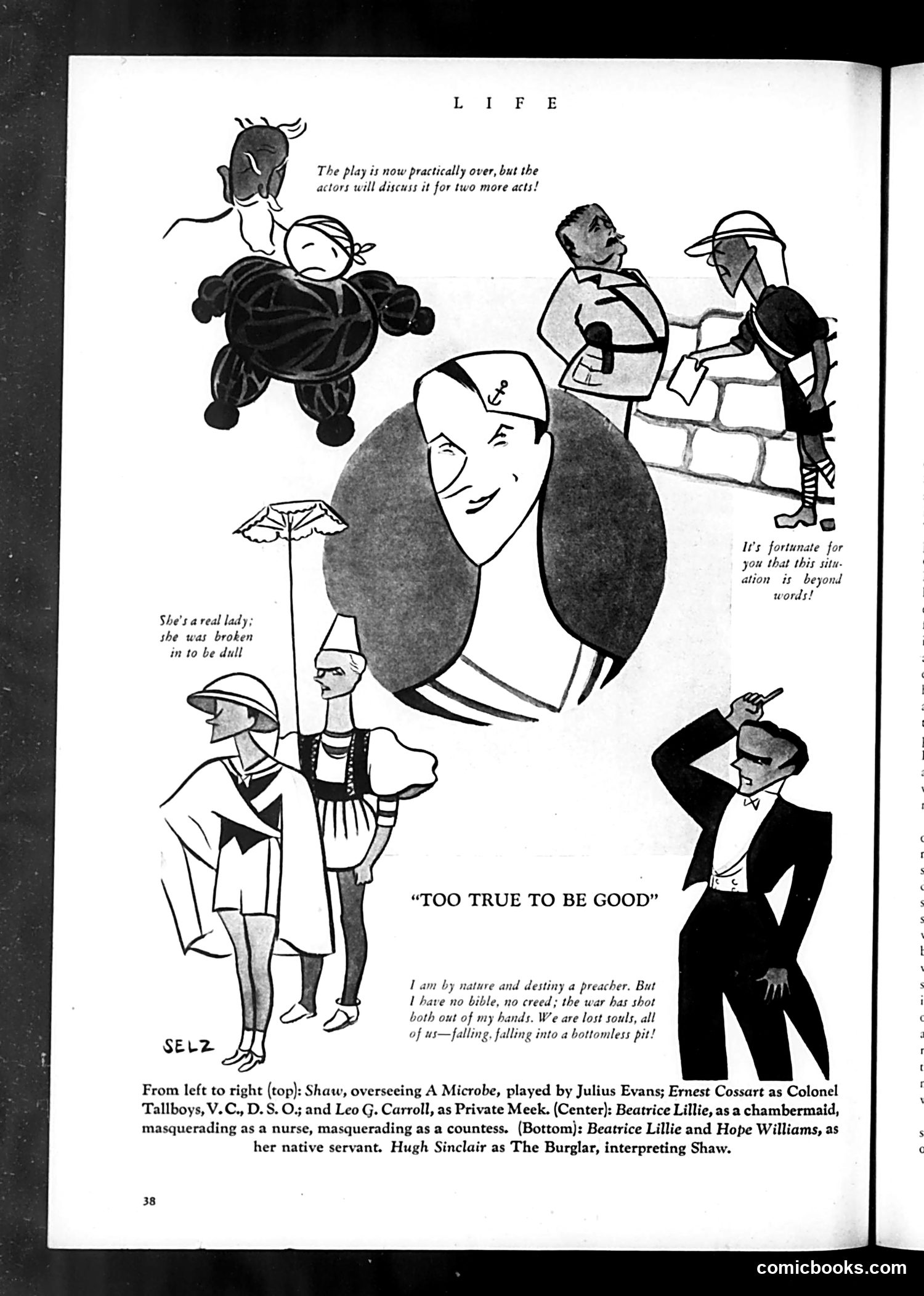
"Too True to Be Good" - Life Magazine Theater Review This page reviews George Bernard Shaw's play "Too True to Be Good," featuring Beatrice Lillie in multiple roles. The satirical illustrations mock the play's plot and themes: a chambermaid masquerading as both nurse and countess, soldiers, a burglar, and Shaw's characteristic didactic dialogue. The humor targets Shaw's tendency toward lengthy philosophical speeches—one character laments losing faith after World War I, "falling into a bottomless pit." The captions joke that the play discusses itself *more* than it actually progresses ("two more acts" of discussion remain) and that Lillie's multilayered impersonations are "beyond words." The satire critiques both Shaw's verbose preachiness and the play's farcical plot, suggesting his moralistic lectures overwhelm the theatrical action—a common Life complaint about Shaw's work during this era.
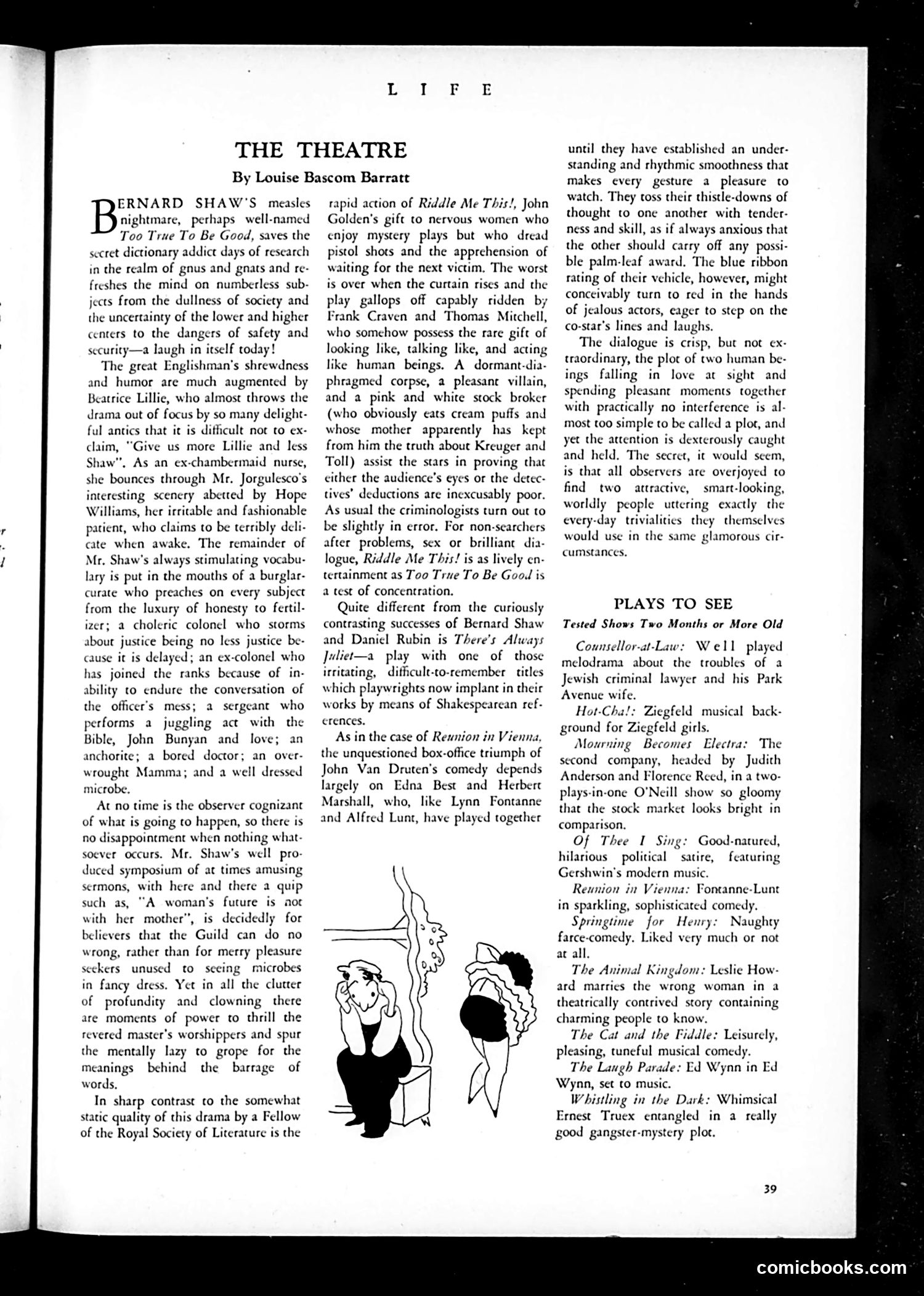
Theatre Review Analysis This is Louise Bascom Barratt's theatre column reviewing three contemporary Broadway plays. The small cartoon shows two figures in what appears to be a comedic physical interaction—likely illustrating the slapstick humor being discussed. Barratt reviews Bernard Shaw's *Too True to Be Good*, praising Beatrice Lillie's performance but finding the play itself overly intellectual and static—more "sermon" than entertainment. She contrasts this with *Riddle Me This!*, a mystery comedy offering straightforward fun without pretension. The third play, *There's Always Juliet*, depends on the charm of its leads (Edna Best and Herbert Marshall). The column's tone suggests Shaw's avant-garde approach appeals mainly to devoted followers, while lighter fare suits general audiences seeking simple enjoyment rather than philosophical messaging. This reflects 1930s tensions between theatrical "art" and popular entertainment.
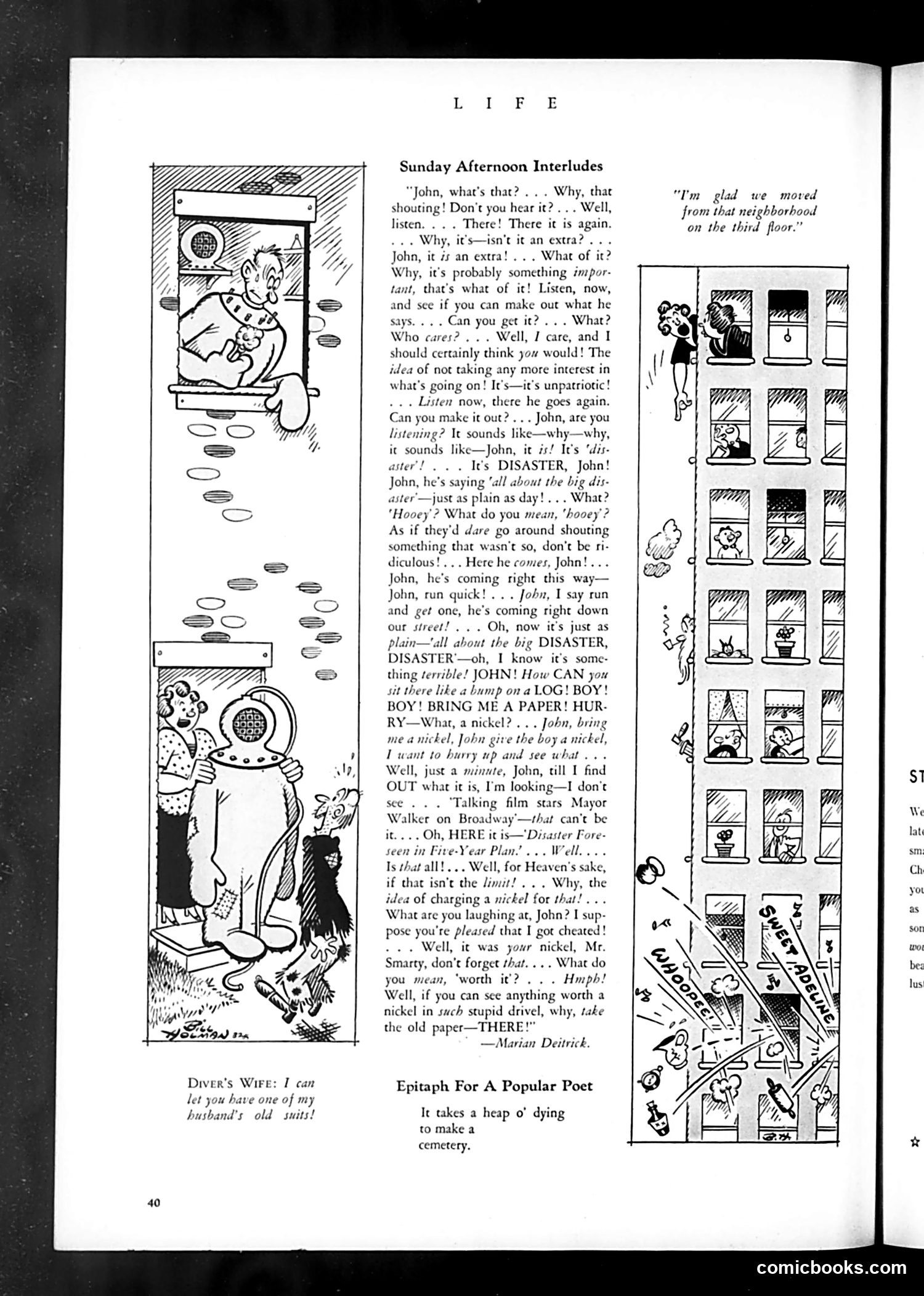
"Sunday Afternoon Interludes" Analysis This cartoon satirizes the public's obsession with newspaper "extras" (special editions announcing major news). A woman becomes frantically excited hearing a newsboy shouting about a "big disaster," imagining something catastrophic. She bullies her husband John into buying a paper at inflated cost, only to discover the "disaster" is merely gossip: "Talking film stars Mayor Walker on Broadway" and a mundane story about a "Five-Year Plan." The satire mocks how citizens—particularly anxious, sensation-seeking ones—treat every newspaper extra as earth-shattering, when they often contain trivial celebrity gossip. The joke also plays on the wife's righteous indignation at paying a nickel for worthless content. Reference: Mayor Jimmy Walker was a prominent 1920s New York figure, confirming this likely dates to that era. The overall critique targets media sensationalism and the public's gullible hunger for dramatic news.
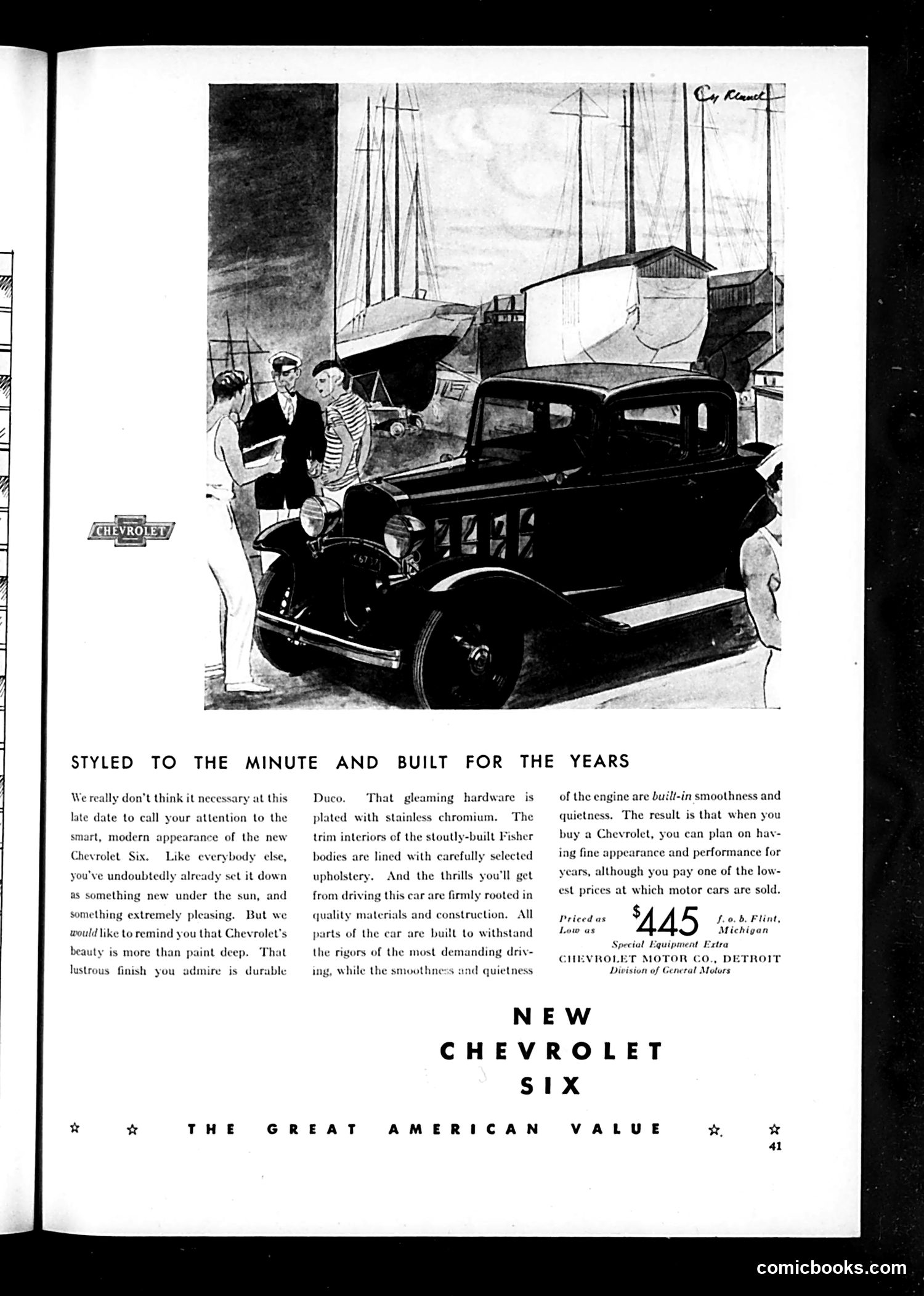
Analysis: Chevrolet Advertisement, Life Magazine This is a Chevrolet automobile advertisement, not political satire. The page promotes the "New Chevrolet Six" with an illustration showing well-dressed people examining the vehicle at a harbor (suggesting travel and leisure). The advertisement's appeal targets middle-class buyers by emphasizing durability and value: the car is "styled to the minute" (fashionable) yet "built for the years" (long-lasting). It highlights quality materials—Duco paint, stainless chromium trim, Fisher bodies—claiming superior construction despite a low price point ($445). The illustration and text work together to position the Chevrolet as a practical luxury: stylish enough for sophisticated owners, yet affordable for ordinary Americans. This reflects 1920s-30s consumer culture, when automobiles represented both aspiration and accessibility for the expanding middle class. The tagline "The Great American Value" encapsulates the marketing pitch: American ingenuity delivering quality at democratic prices.
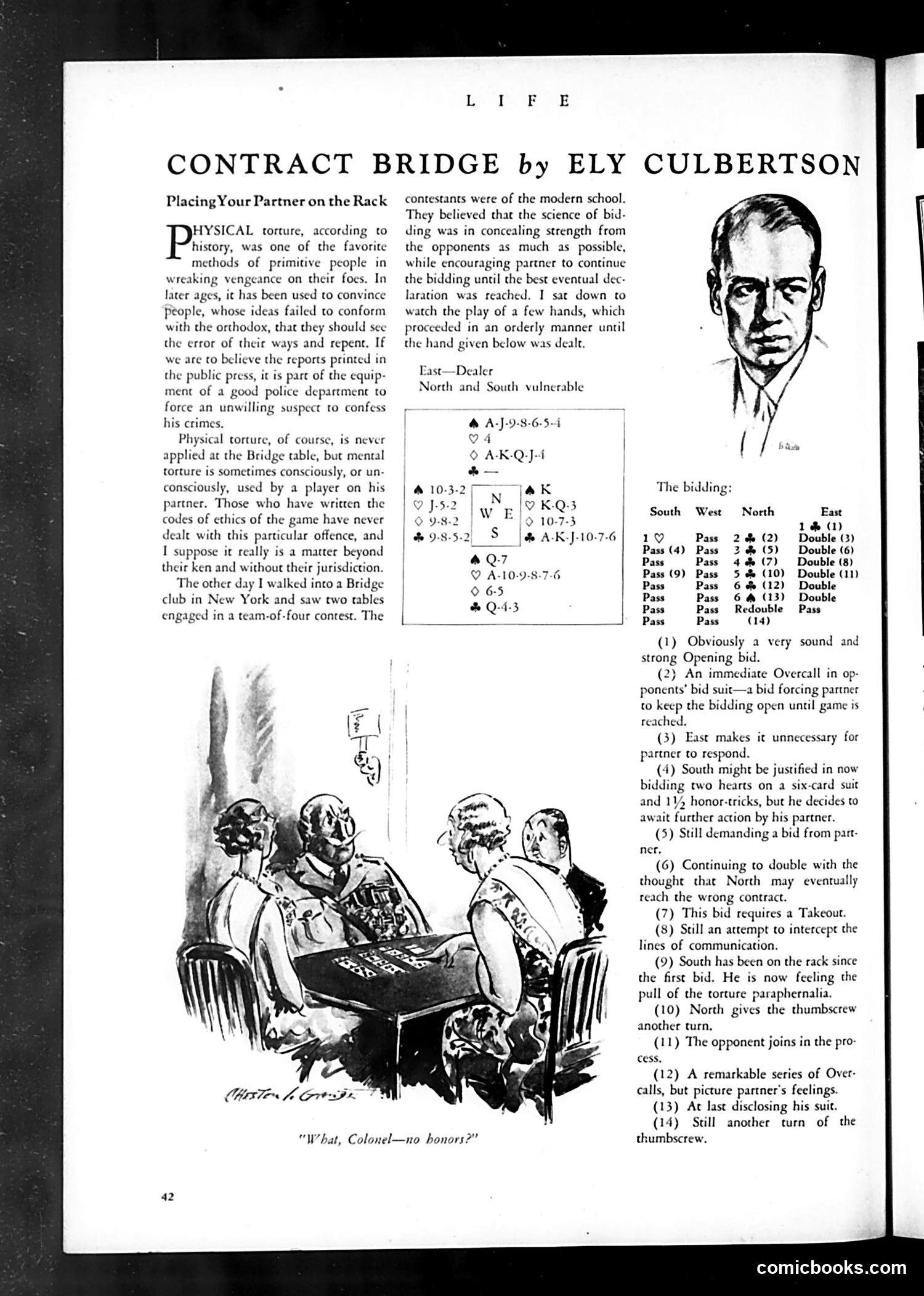
Contract Bridge: "Mental Torture" at the Card Table This page from *Life* magazine presents Ely Culbertson's bridge column, using the card game as a framework for satire about psychological manipulation between partners. The article opens by comparing "mental torture" at the bridge table to historical and contemporary physical torture methods—a darkly humorous comparison. The illustration depicts four players in an intense game, with the caption "What, Colonel—no honors?" suggesting accusatory tension. The hand analysis that follows demonstrates how skilled players psychologically torment their partners through strategic bidding—deliberately concealing information, forcing continued bids, and creating mounting pressure ("the rack," "thumbscrew"). The commentary treats bridge bidding as a battle of wits where "torture" is inflicted through calculated uncertainty and forced decisions. The satire mocks both the competitive intensity of serious bridge players and the psychological gamesmanship that ethical codes supposedly don't address. It's essentially comedic commentary on how civilized parlor games can become surprisingly brutal interpersonal conflicts.
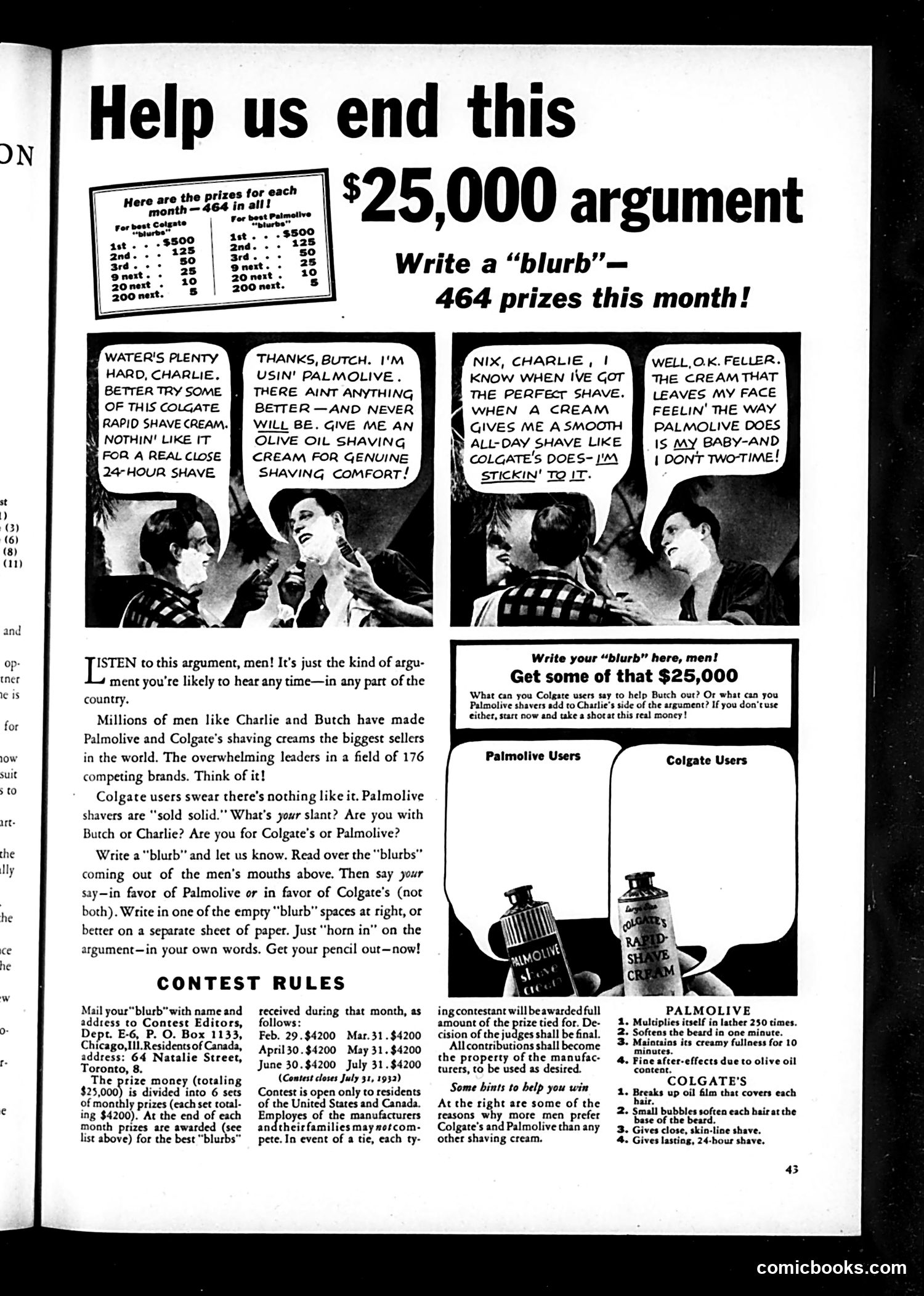
Analysis for Modern Readers This is a 1932 advertising contest, not political satire. Life magazine (then a humor publication) hosted a promotional competition for two rival shaving cream brands: Palmolive and Colgate. The "argument" features two men, Charlie and Butch, debating which cream gives the better shave—Charlie championing Palmolive's olive oil formula, Butch praising Colgate's lathering ability. Readers were invited to write persuasive "blurbs" supporting either brand, competing for $25,000 in prize money distributed monthly. The satire: Life gently mocks how consumers passionately defend consumer products as if they were serious matters of principle. The overwrought debate—"THERE AIN'T ANYTHING BETTER"—humorously reflects Depression-era consumer brand loyalty while the magazine profits from sponsoring the contest. This reflects pre-FTC regulation advertising practices where magazines freely promoted brands while charging for reader participation.
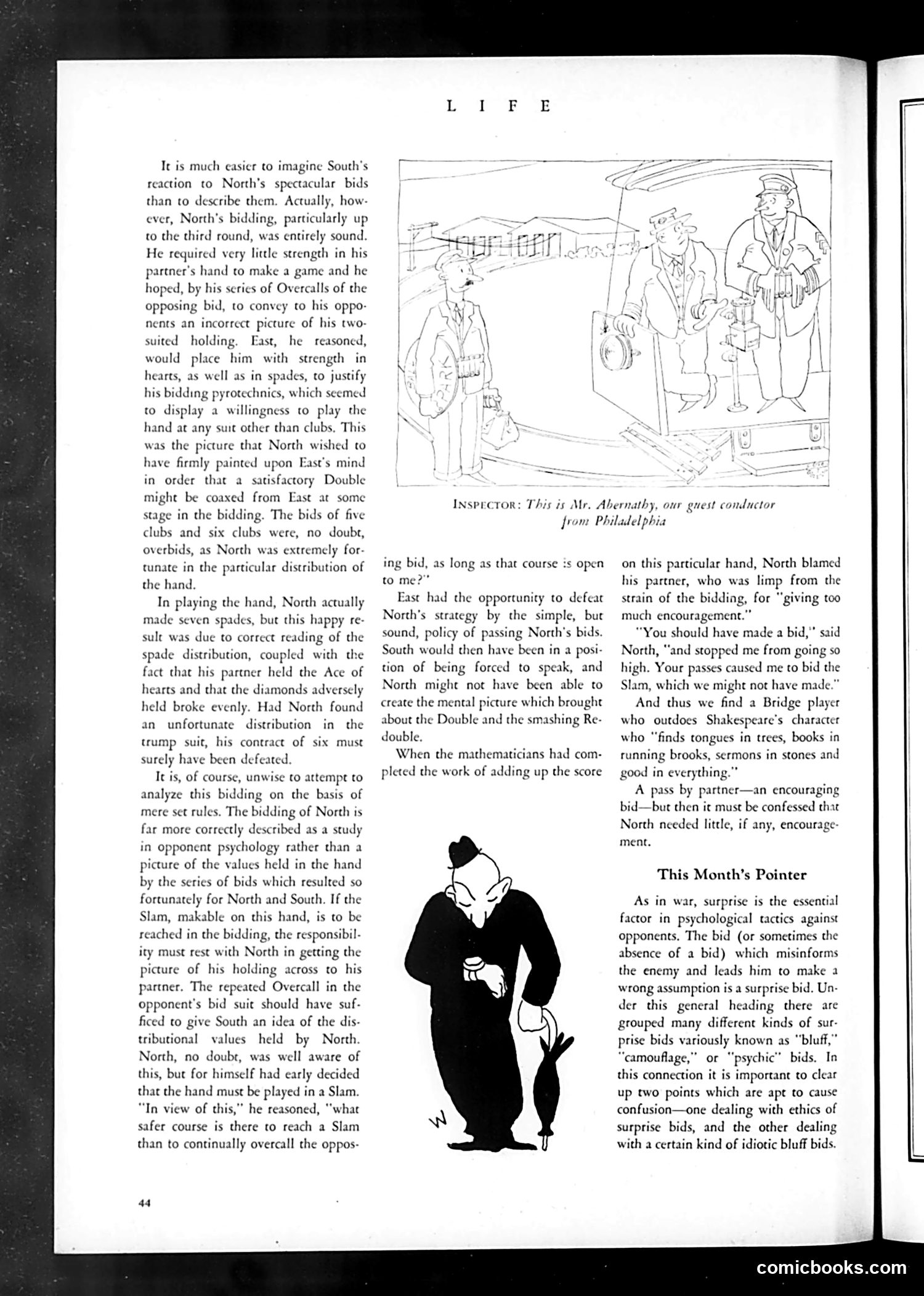
Bridge Strategy in Life Magazine This page discusses contract bridge bidding strategy, not politics. The illustration shows "Mr. Abernathy, our guest conductor from Philadelphia"—likely a humorous reference to a real bridge expert of the era, depicted inspecting players' hands. The text analyzes a bridge hand where North made aggressive, psychologically-motivated bids to mislead opponents into a disadvantageous contract. North deliberately conveyed false information about his card distribution through "Overcalls" to trick East into doubling, allowing South-North to reach and make an ambitious Slam contract. The satire is gentle: after succeeding brilliantly, North ironically blamed his partner for "giving too much encouragement" rather than stopping him. The "This Month's Pointer" section discusses surprise bids in bridge as tactical deception. This reflects bridge's popularity among educated American readers in the early-to-mid 20th century, when Life published detailed instruction alongside humor and satire.
Analysis This is advertising copy, not a cartoon. The page promotes bus advertising space in Fifth Avenue coaches (New York City buses) through John H. Livingston Jr. The pitch targets advertisers by arguing that bus riders are an ideal captive audience: wealthy, well-dressed passengers with "good taste and discrimination" who are psychologically primed to buy when they exit. The copy emphasizes that ads can be reproduced in color "at no extra expense" and plays on scarcity ("spaces...not been offered for ten years"). The headline "That's What I Say, Too!" references N.W. Ayer & Co.'s definition of advertising as "circulation" (reaching readers), with Livingston claiming bus advertising delivers both quantity and quality of audience. For a modern reader, this reveals early 20th-century advertising assumptions: the notion that captive transit audiences are particularly susceptible to persuasion, and that affluence and fashion-consciousness predict consumer behavior—concepts still recognizable in contemporary advertising targeting.
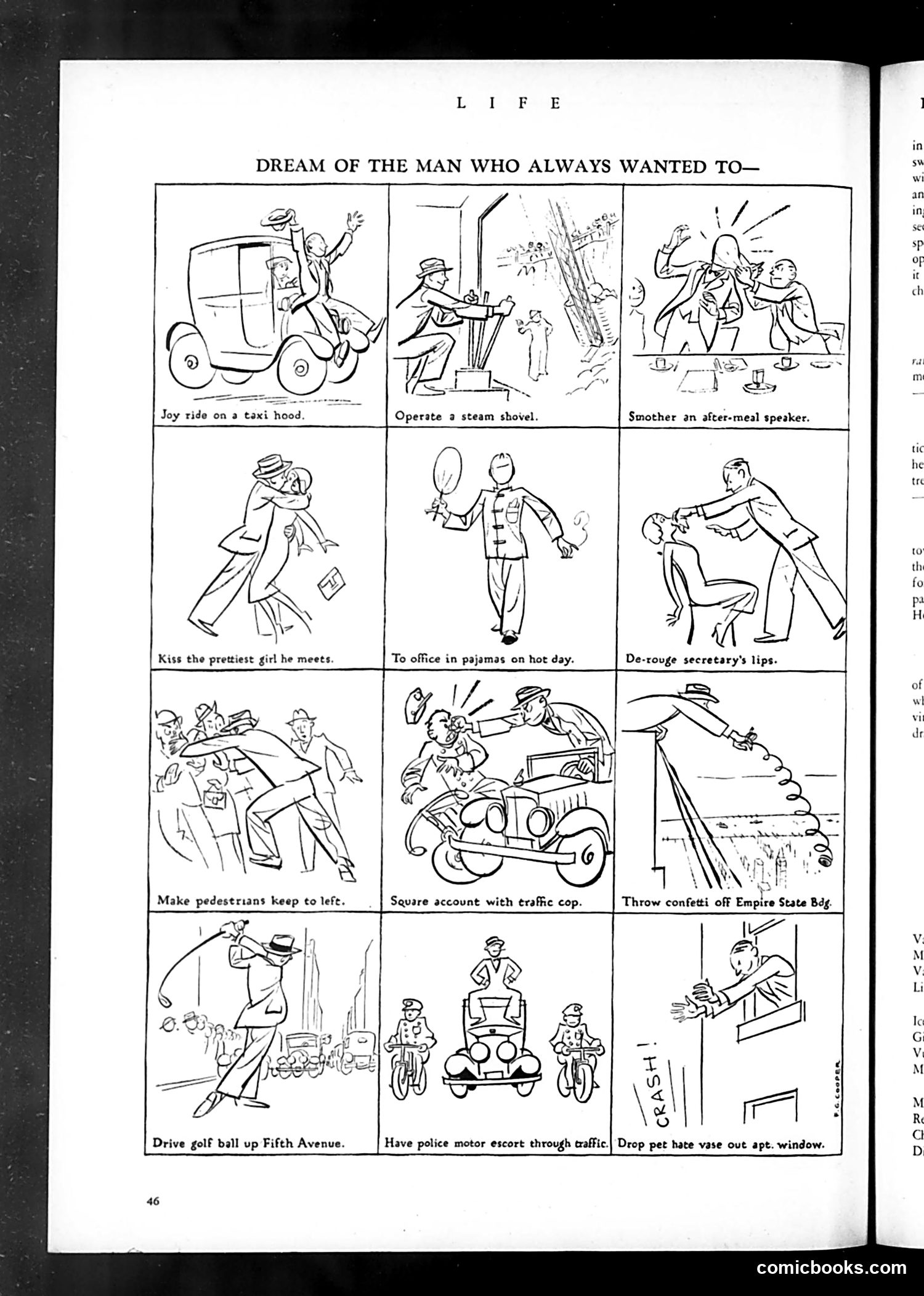
"Dream of the Man Who Always Wanted To—" This is a humorous twelve-panel comic depicting absurd, socially transgressive fantasies. Each panel shows a man breaking social norms or laws in ways that would be impossible or illegal in 1920s New York City: - Riding on a taxi hood - Operating heavy machinery recklessly - Smother an after-dinner speaker - Kiss strangers - Work in pajamas - Harass secretaries - Force pedestrians to yield - Evade traffic laws - Drop objects from windows - Drive golf balls on Fifth Avenue - Receive police assistance for traffic The satire targets everyday frustrations of urban life—bureaucratic constraints, social etiquette, workplace hierarchy, and traffic congestion. The joke is that respectable men fantasize about breaking these rules but never actually do. It's social commentary on the gap between desire and propriety in modern city life.
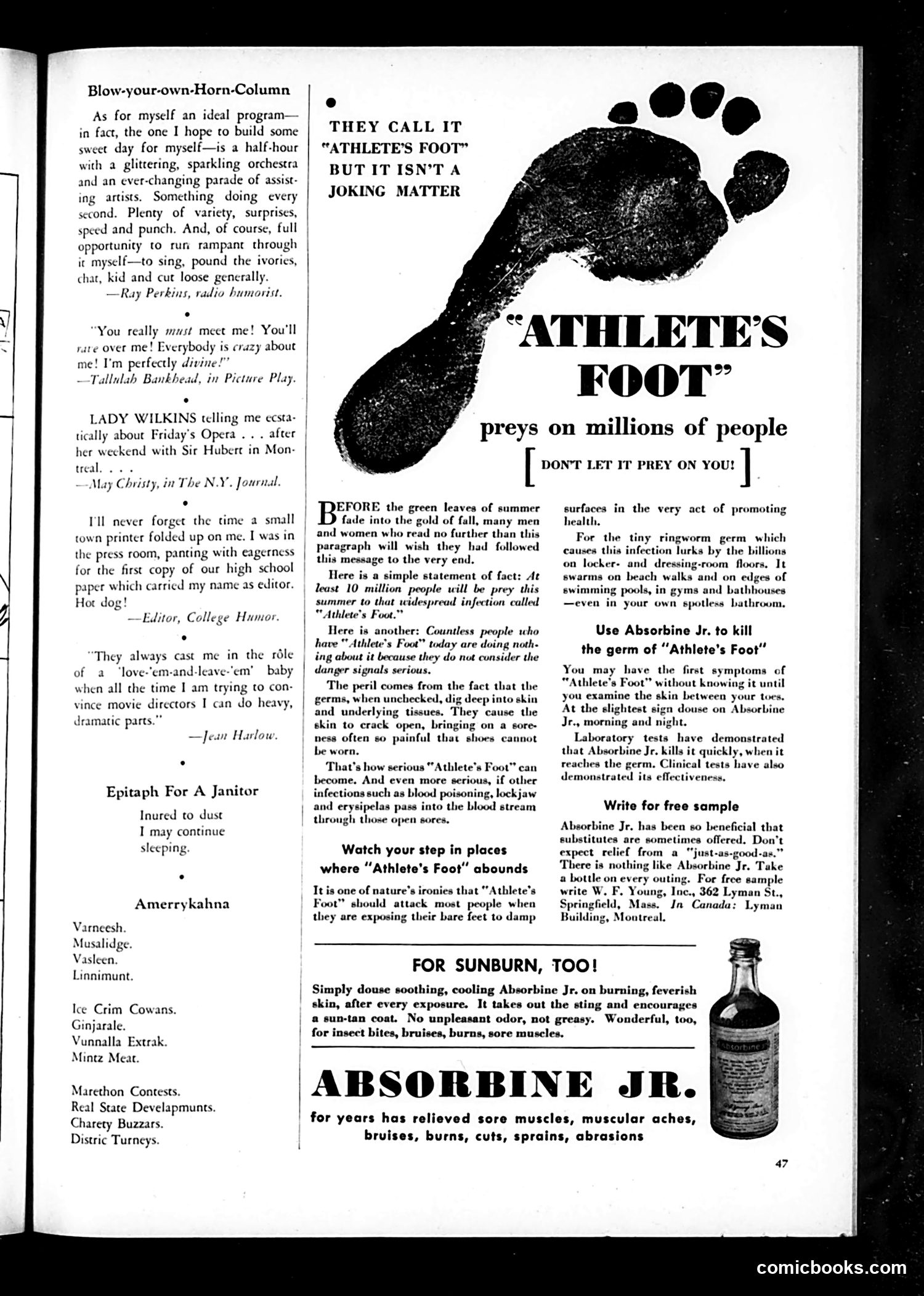
"Athlete's Foot" Advertisement This page is primarily a product advertisement for Absorbine Jr., a patent medicine claiming to cure athlete's foot fungal infection. The left column contains typical Life magazine filler: celebrity quotes and humorous reader anecdotes (Ray Perkins, Tallulah Bankhead, Jean Harlow). The main content is an urgent public health pitch warning that "10 million people" suffer from athlete's foot annually, emphasizing serious complications like blood poisoning if untreated. The advertisement employs scare tactics common to early-20th-century patent medicine marketing: it dramatizes danger ("shoes cannot be worn"), identifies infection sources (locker rooms, pools, bathhouses), and promises quick cure through their product. The footprint graphic and emphatic typography ("DON'T LET IT PREY ON YOU!") are designed to grab readers' attention. This represents typical Life magazine advertising—mixing satirical editorial content with earnest commercial pitches for dubious remedies.
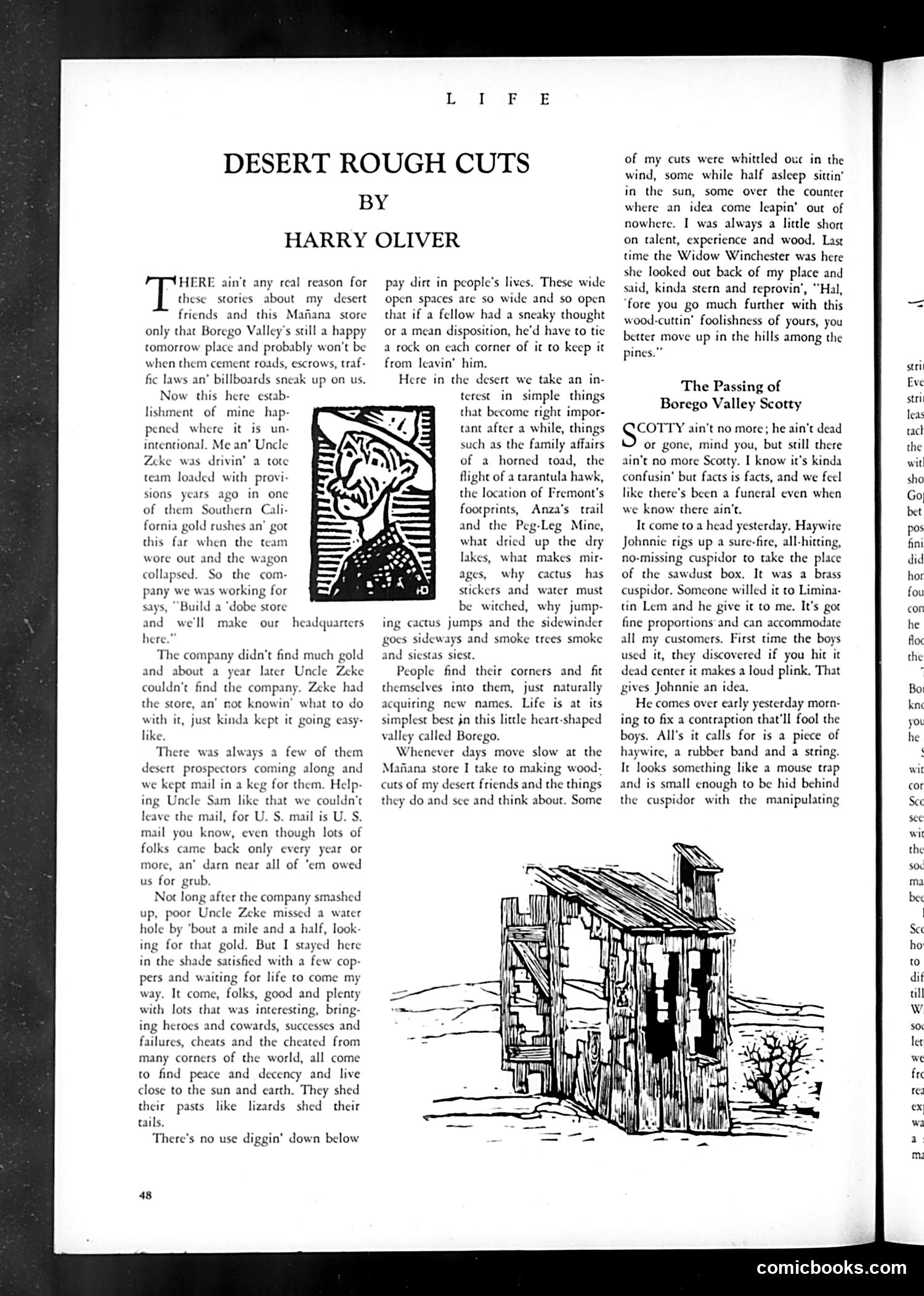
Analysis for Modern Readers This is a short-story and illustration page from *Life* magazine featuring "Desert Rough Cuts" by Harry Oliver, a nostalgic account of life in California's Borrego Valley during the gold-rush era. The Content: Oliver describes an accidental adobe store established when a mining company's wagon collapsed. The narrative romanticizes the desert community—prospectors, simple pleasures (tracking tarantula hawks, finding water through "witching"), and colorful characters acquiring desert nicknames. The Point: Oliver laments modernization: "cement roads, escrows, traffic laws an' billboards" threatening the valley's slow, authentic way of life. The included woodcut illustrations depict this vanishing frontier world. A secondary story begins about "Borego Valley Scotty," apparently a local character now gone. Historical Context: This reflects early-20th-century American nostalgia for the "Old West" and frontier independence, even as infrastructure and civilization inevitably encroached. The tone is elegiac—mourning progress itself.
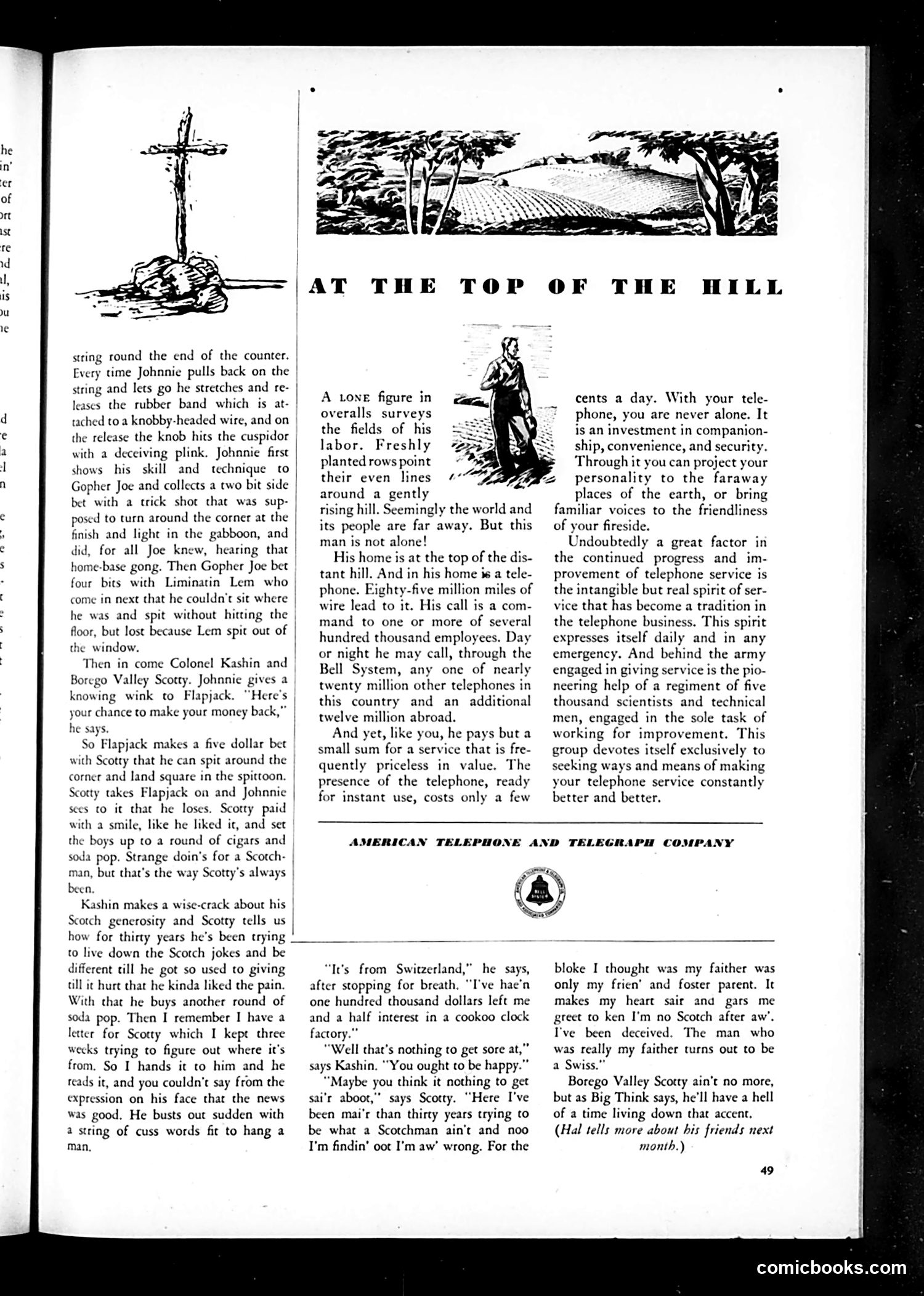
Analysis of Life Magazine Page This page contains two distinct elements: Left side: A humorous story about Western characters (Johnnie, Gopher Joe, Flapjack, Colonel Kashin, and "Borego Valley Scotty") engaging in a con game involving spitting into a cuspidor with a rigged rubber-band device. The narrative plays on period stereotypes—particularly Scottish stinginess—as Scotty paradoxically treats everyone to cigars and soda despite losing money. The story concludes with Scotty receiving unexpected good news (inheritance from Switzerland). Right side: A full-page advertisement for American Telephone and Telegraph Company featuring an idealized illustration of a solitary farmer surveying his fields. The ad's message emphasizes that telephone service connects even isolated rural workers to civilization—85 million miles of wire, 20 million domestic phones, 12 million abroad—while costing only "a few cents a day." It frames the telephone as providing companionship, security, and convenience to otherwise lonely individuals. The juxtaposition appears incidental rather than satirical—typical magazine layout combining entertainment with advertising.
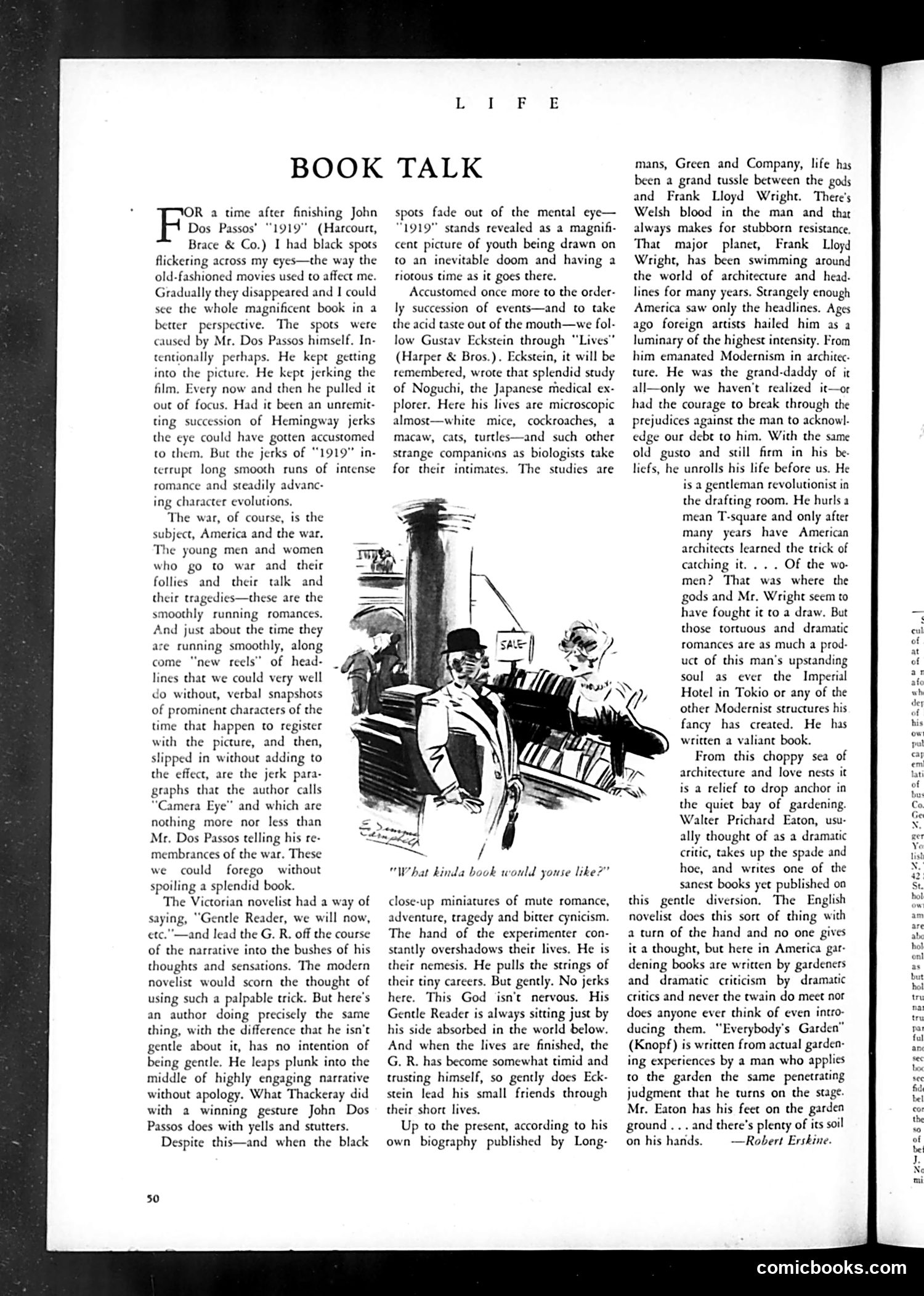
Explaining This "Book Talk" Page This is a book review column, not a political cartoon. The single illustration shows a casual interaction—likely a bookstore clerk asking a customer "What kinda book would youse like?"—accompanying the review's discussion of contemporary literature. The page reviews three books: Dos Passos' *1919*, Eckstein's *Lives*, and (beginning) Frank Lloyd Wright's biography. The reviewer critiques Dos Passos for interrupting his war narrative with intrusive "Camera Eye" passages—his personal observations—comparing this to outdated Victorian novelists breaking the fourth wall. The reviewer contrasts this with Eckstein's gentler approach to his subject matter (studying small animals). The sketch illustrates the casual American reader seeking guidance, fitting the column's focus on literary taste and accessibility. No specific political figures or events are caricatured; this is straightforward literary journalism from the 1920s-30s era.
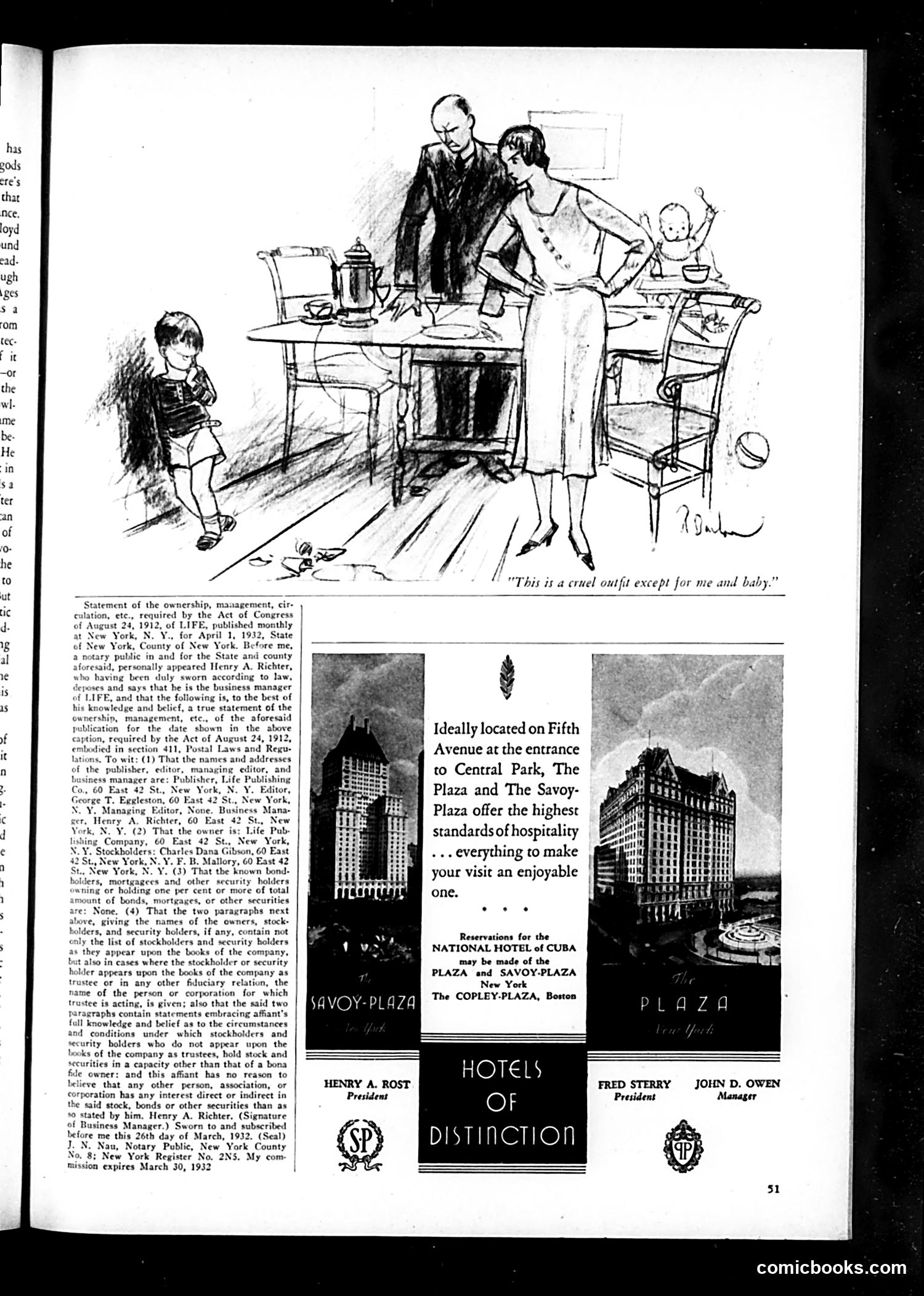
Analysis of Life Magazine Page (April 1, 1932) This page contains a satirical cartoon at the top and advertising below. The Cartoon: Depicts a domestic scene where a man and woman (appearing to be parents) stand over a table with a small child and baby, while a young boy plays on the floor. The caption reads: "This is a cruel unfit except for me and baby." The satire targets parental hypocrisy—adults who impose strict rules and restrictions on children's behavior while exempting themselves and favoring younger siblings. The joke critiques selective discipline and arbitrary family authority. The Advertisements: The remainder of the page features luxury hotel advertisements for the Plaza, Savoy-Plaza, and Copley-Plaza hotels, promoting their location near Central Park and standards of hospitality. There's also a legal ownership statement for Life magazine itself. The contrast between satirizing parental unfairness and advertising elite hotels reflects Life's audience: educated, middle-to-upper-class readers who appreciated both social commentary and luxury services.
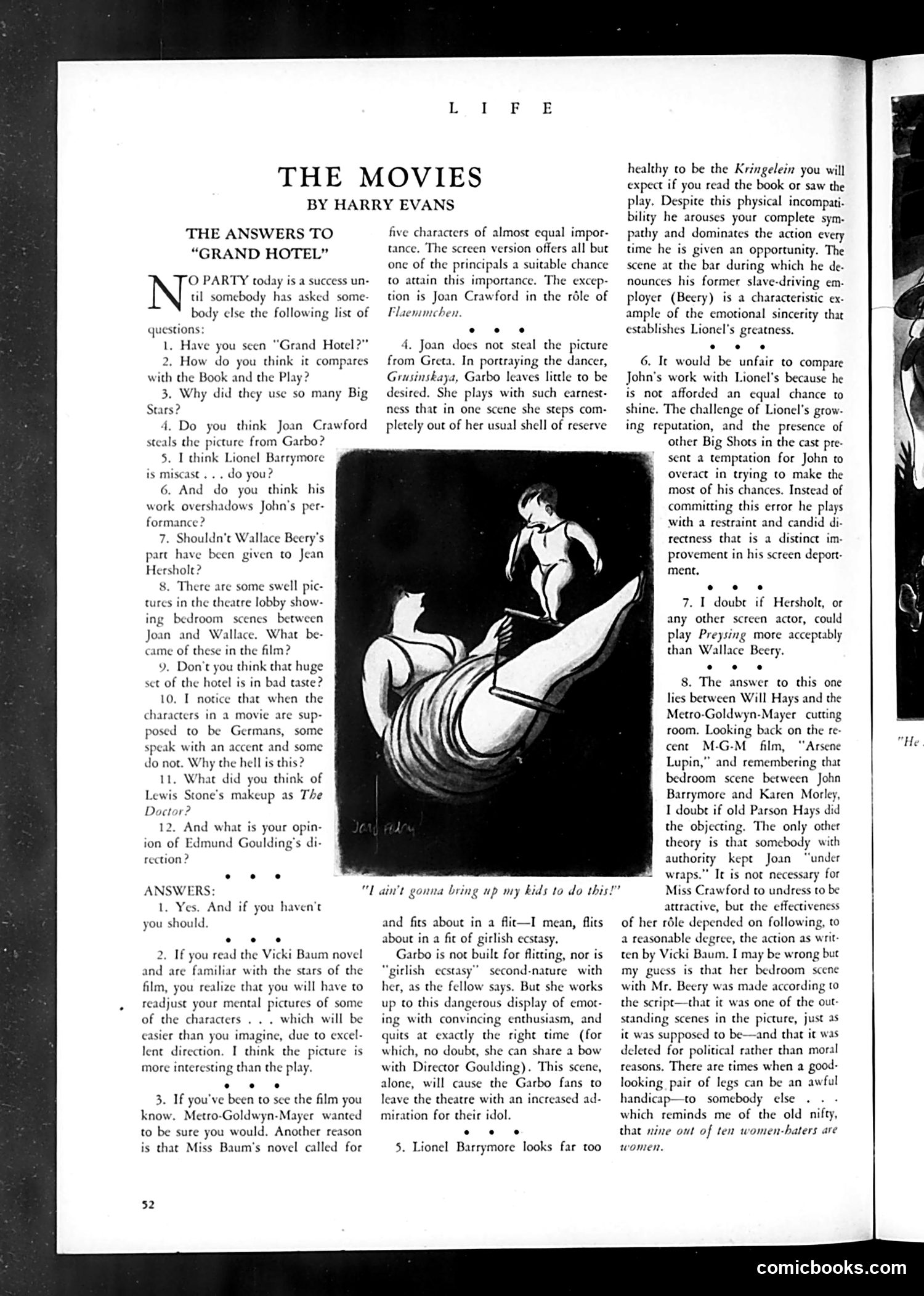
"Grand Hotel" Movie Critique (Life Magazine) This page is a film criticism column by Harry Evans analyzing the 1932 MGM film *Grand Hotel*, presented as a mock "quiz and answers" format about the movie's adaptation from Vicki Baum's novel. The small cartoon shows a man objecting: "I ain't gonna bring up my kids to do this!"—likely referencing the sensational bedroom scenes advertised in theatre lobbies but cut from the final film (question 8). The satirical point is the gap between promotional material and actual content. The column discusses major stars (Greta Garbo, Joan Crawford, Lionel Barrymore, Wallace Beery, John Barrymore), debating casting choices and performance quality. Evans defends Garbo's unconventional "girlish ecstasy" scene and praises Barrymore's restraint over his son John's potential overacting. The piece reflects 1930s film culture: MGM's star-studded casting strategy, concerns about adaptation fidelity, audience expectations, and the studio system's influence on performance choices.
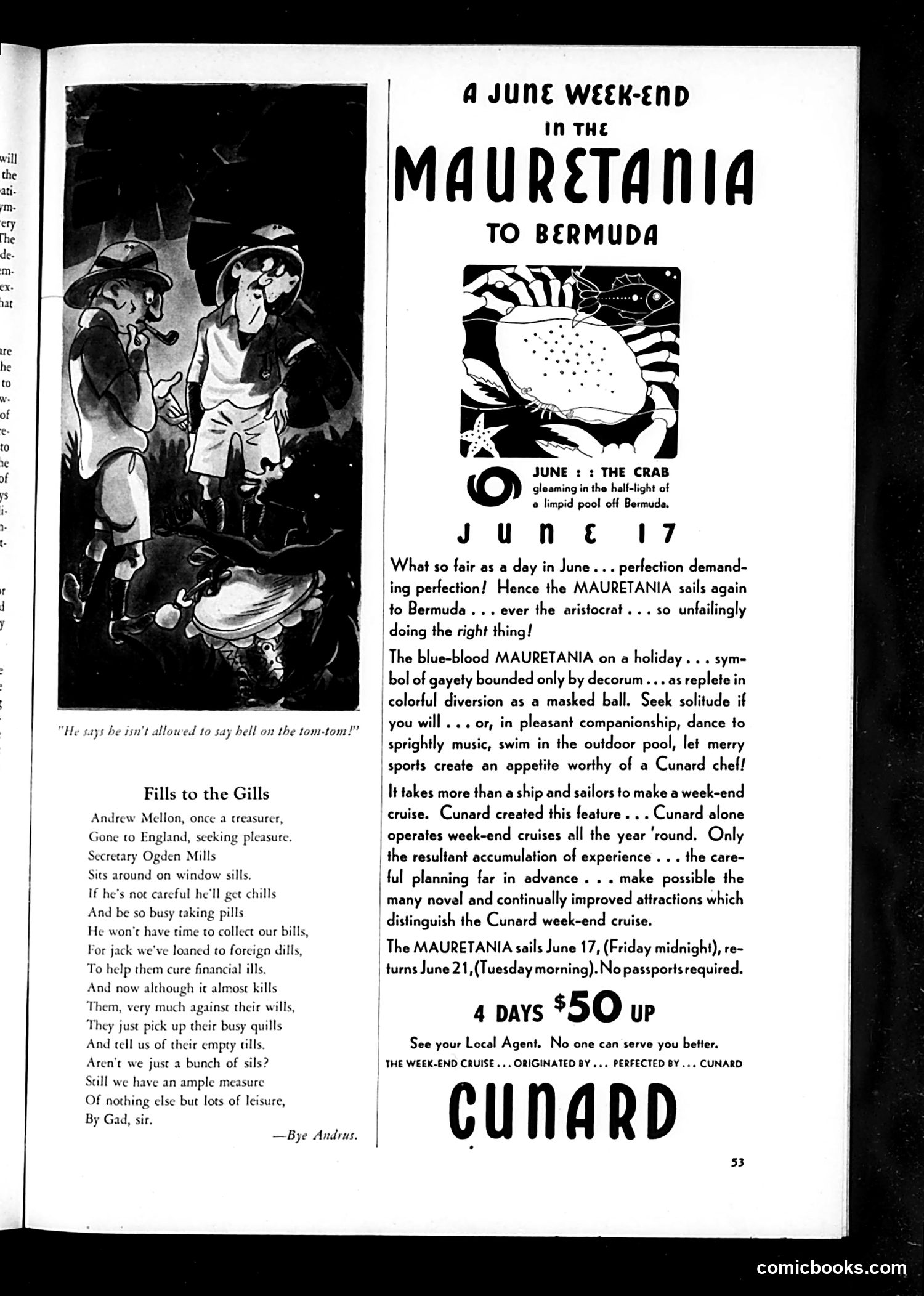
"Fills to the Gills" Political Satire This poem by "Andrus" satirizes the financial negligence of U.S. Treasury Secretary Andrew Mellon and Secretary of State Ogden Mills during the early 1930s Depression era. The verse mocks Mellon for traveling to England for leisure while American finances suffer, and criticizes Mills for idleness ("sitting around on window sills") instead of collecting debts owed by foreign nations to whom America had loaned money during WWI. The "sils" (fools) reference suggests Americans foolishly extended credit internationally while remaining unpaid. The satire attacks the Republican administration's apparent indifference to economic crisis—these officials pursue pleasure and ignore fiscal responsibility while foreign debtors claim empty coffers ("empty tills"). The accompanying Cunard cruise advertisement is unrelated to the political content, typical of magazine layouts of this era.
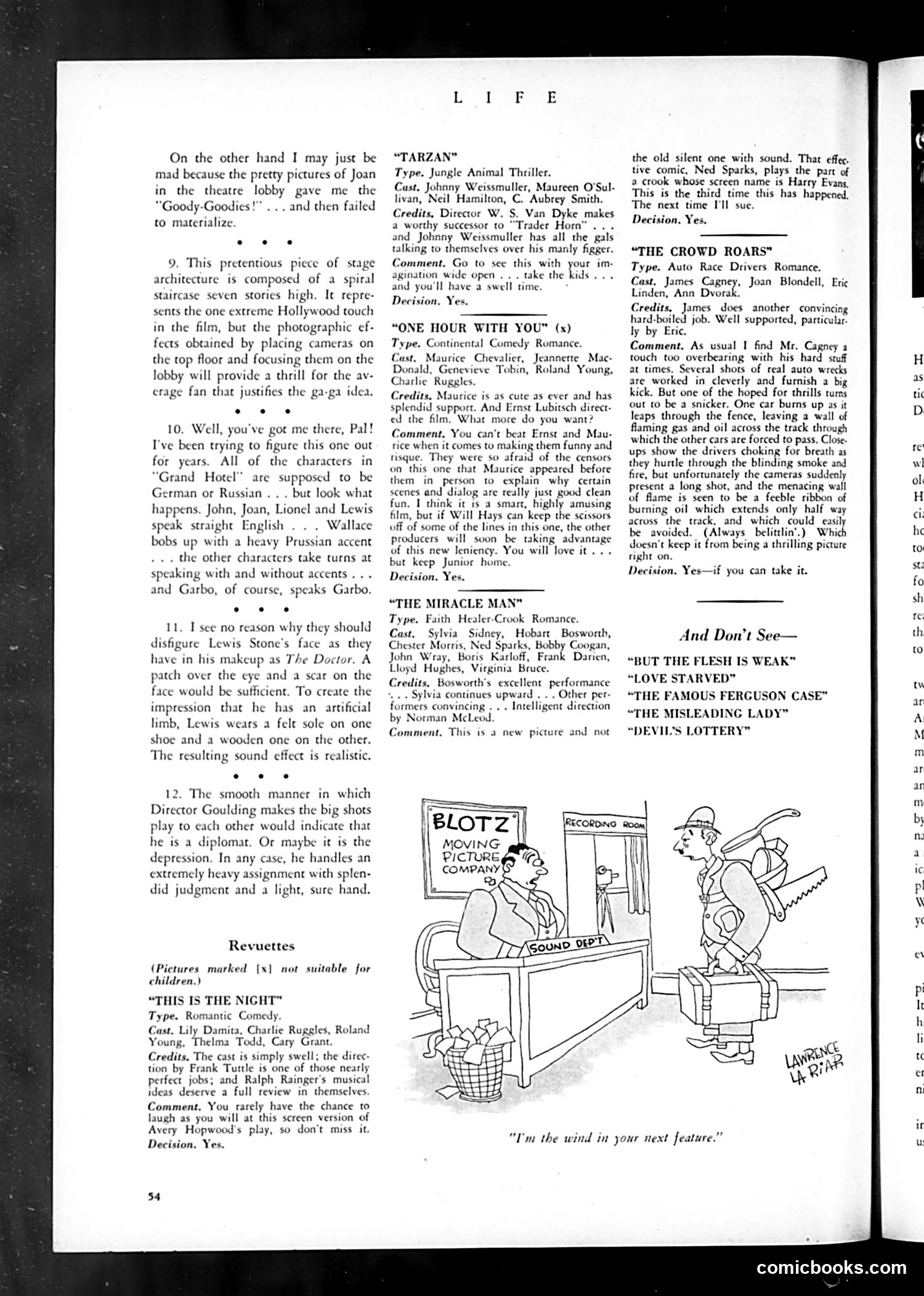
Analysis of Life Magazine Page (Film Reviews Section) This page contains film reviews rather than political cartoons. The main illustration is a humorous cartoon showing a moving company (Blotz Moving Picture Company) with workers chaotically loading equipment, captioned "I'm the wind in your next feature." The cartoon satirizes Hollywood's pretension and chaos—depicting the industry's behind-the-scenes operations as disorganized and comically grandiose. The "wind" reference mocks how studios create artificial effects. The text reviews contemporary 1932 films: *Tarzan* (praising Johnny Weissmuller's physique), *Grand Hotel*, *One Hour with You* (noting censorship concerns about "risqué" content), and *The Miracle Man*. The reviews reflect 1930s film industry concerns: moral censorship by the Hays Office, the transition to sound cinema (mocking accent inconsistencies), and Hollywood's emphasis on spectacle and star power over substance. The tone is lighthearted but subtly critical of industry artificiality.
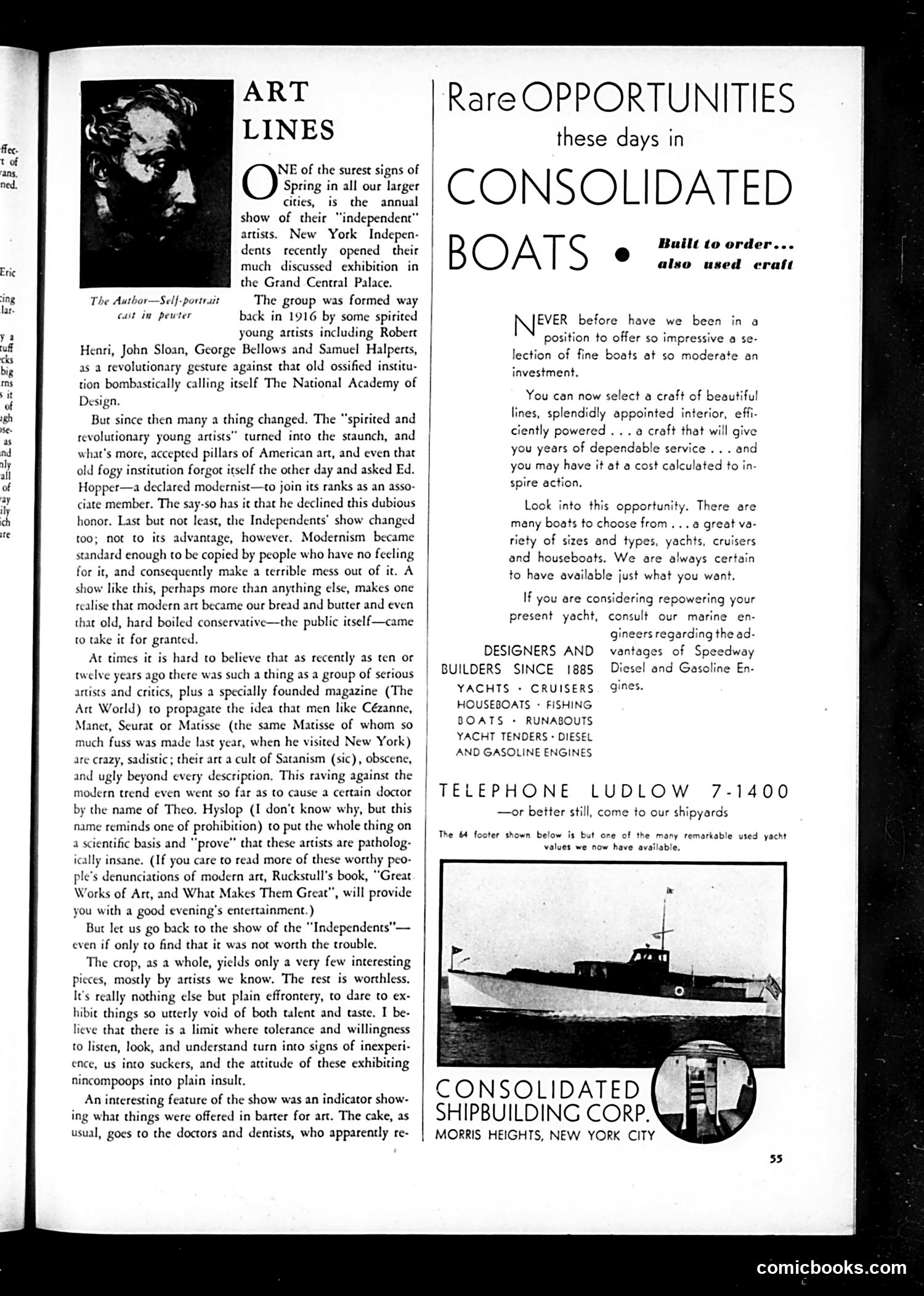
"Art Lines" Satire: The Decline of Artistic Rebellion This article satirizes the New York Independents' art exhibition, a group originally founded in 1916 as revolutionary rebels against the conservative National Academy of Design. The piece mocks how these once-radical artists—including Robert Henri and George Bellows—have become "accepted pillars of American art," their youthful insurgency now domesticated and mainstream. The satire's central point: modernism, once genuinely controversial (the author references how Cézanne, Matisse, and Seurat were called "crazy" and "Satanic" just a decade prior), has become commercialized and diluted. Imitators now produce worthless derivative work, while the public accepts it all uncritically. The author suggests that what began as principled artistic rebellion has calcified into establishment convention—the very ossification the Independents originally opposed. The photograph shows a self-portrait cast in pewter, illustrating the article's theme about artistic integrity.
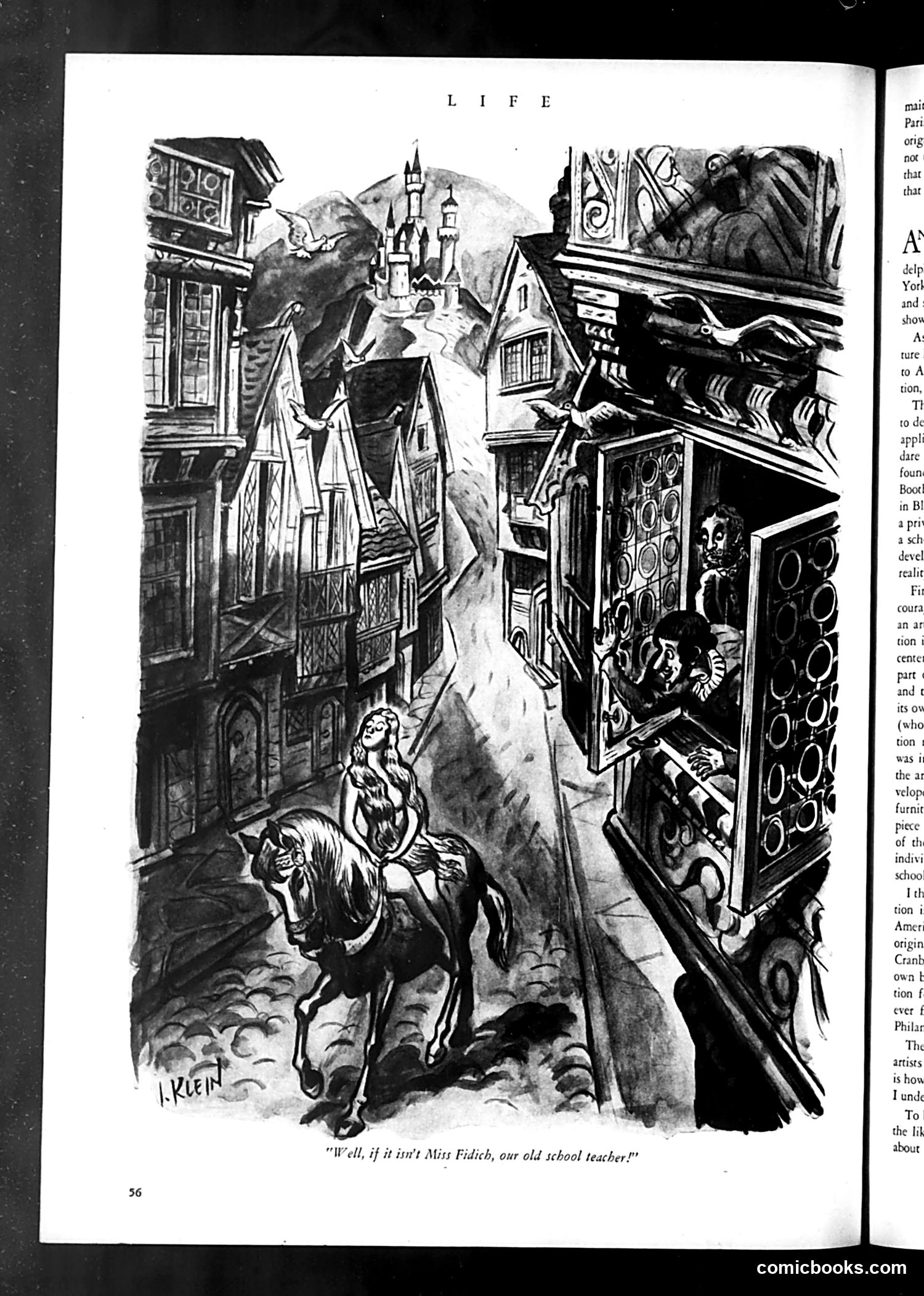
Explanation for Modern Readers This cartoon depicts a medieval European street scene where a figure on horseback encounters someone at a doorway, exclaiming "Well, if it isn't Miss Fidich, our old school teacher!" The humor relies on an incongruous juxtaposition: the speaker recognizes their former schoolteacher in what appears to be a medieval setting—complete with gothic architecture, castles, and period clothing. The joke seems to mock the absurdity of encountering a contemporary person (a schoolteacher with a modern name) in a historical fantasy context. The signature reads "I. Klein," identifying the cartoonist. Without additional context about "Miss Fidich" or contemporary references in Life magazine, the specific satirical target remains unclear, though it likely satirizes either a public figure or a cultural trend of the era.
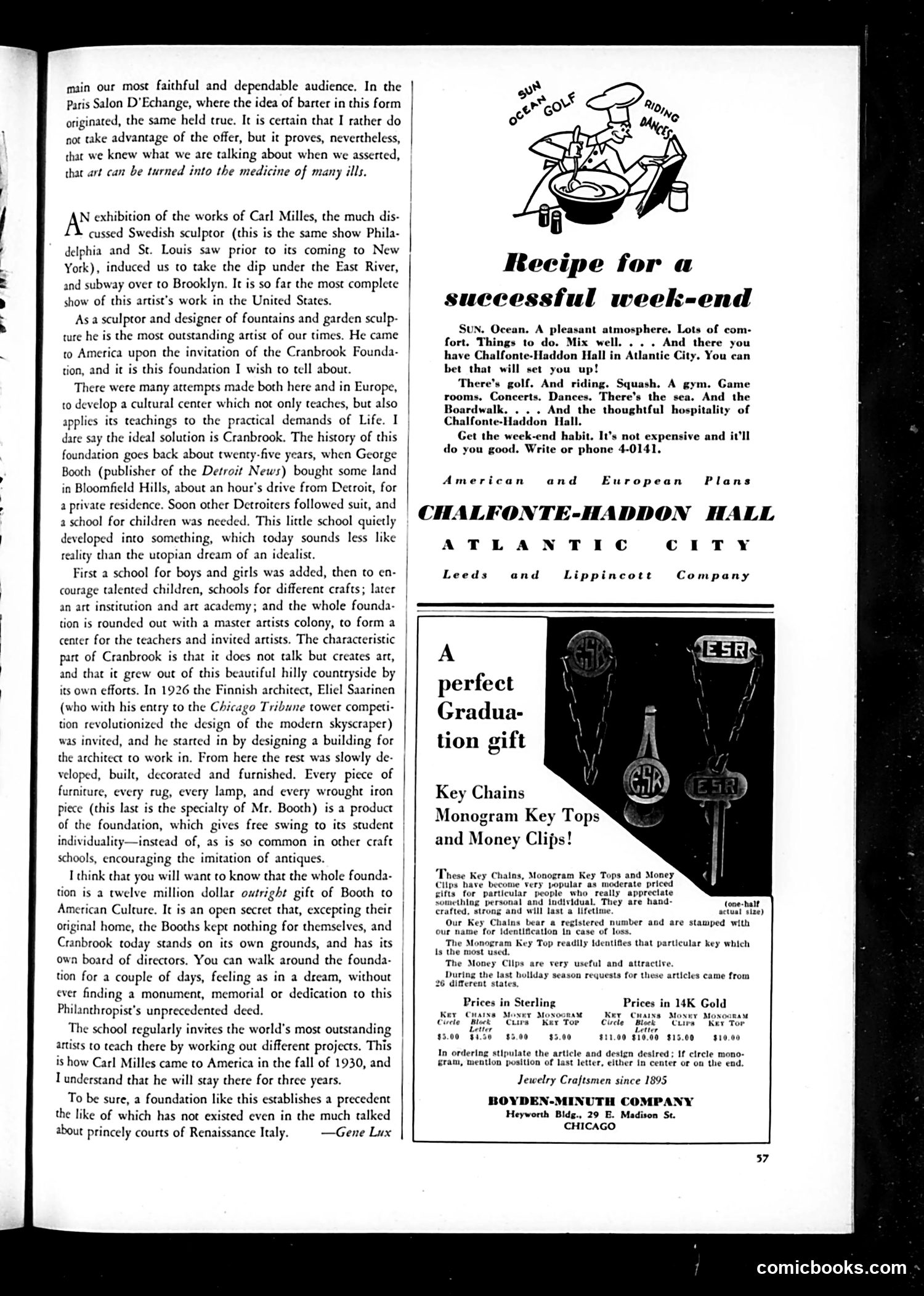
Analysis of Life Magazine Page Content This page is primarily editorial and advertising rather than political satire. The main content discusses Carl Milles, a Swedish sculptor, and the Cranbrook Foundation near Detroit—an arts institution founded by George Booth (publisher of the Detroit News) as a twelve-million-dollar philanthropic gift. The cartoon at top-right is a humorous advertisement for Chalfonte-Haddon Hall in Atlantic City, showing a figure juggling activities (golf, riding, dining). It promotes the resort as a perfect weekend destination with various amenities. The lower advertisement promotes monogrammed key chains and money clips from Boyden-Minuth Company in Chicago as graduation gifts. The article praises Cranbrook as an innovative cultural center combining arts education with practical craftsmanship, distinguishing itself through creation rather than self-promotion—notably lacking any monuments to Booth himself. The tone is celebratory of American philanthropic patronage of the arts.
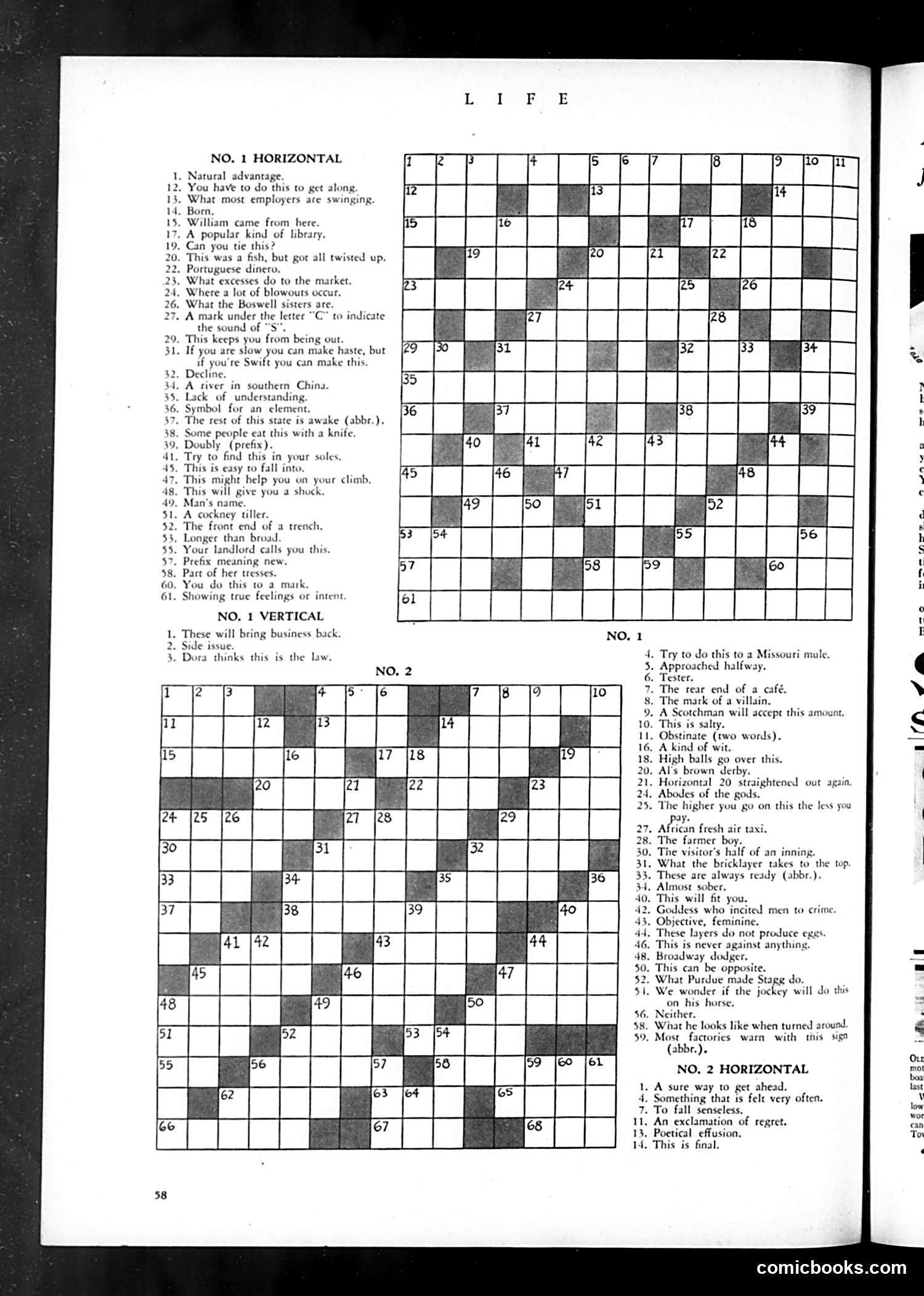
Content Analysis This page from *Life* magazine contains crossword puzzles, not political cartoons or satirical imagery. The page displays three numbered crossword grids with their corresponding clue lists (Horizontal and Vertical). The clues are lighthearted wordplay typical of crossword puzzles from this era—puns, definitions, and clever misdirections. For example, "You have to do this to get along" (likely "BEND"), "This was a fish, but got all twisted up" (likely "EEL"), and "Try to do this to a Missouri mule" reference common sayings and animals. There is no political satire, caricature, or social commentary visible on this page. It is purely recreational content—a games/puzzles section of the magazine. Without additional context about the magazine's date, no specific historical references can be identified from the clues themselves.
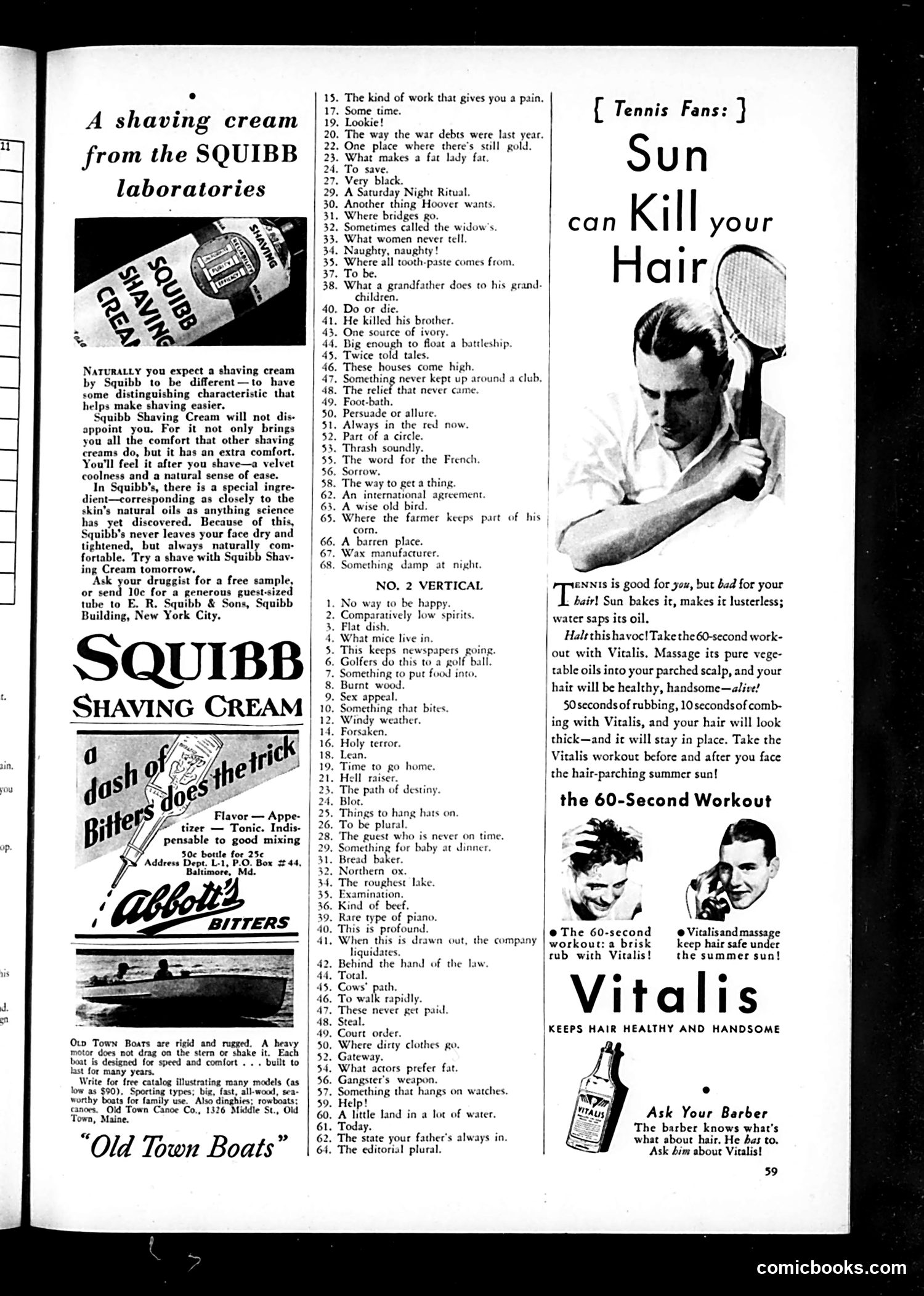
A Page of 1920s-30s Advertising and Wordplay This page consists primarily of advertisements interspersed with a crossword puzzle. The ads promote everyday products: Squibb Shaving Cream (emphasizing a special ingredient that mimics natural skin oils), Abbott's Bitters (a cocktail mixer), and Old Town Boats (recreational watercraft). The most notable content is a "Tennis Fans" advertisement for Vitalis hair product, which warns that sun exposure damages hair—a health/beauty concern targeting active outdoorsmen. The accompanying illustration shows men playing tennis and using the product's "60-second workout" (a hair treatment). The large crossword puzzle dominates the page; its clues reference period-specific concerns like "war debts" and Herbert Hoover, suggesting this is from the early 1930s post-WWI era. There is no political cartoon here—the page is straightforward advertising and entertainment typical of Life magazine's format during this period.
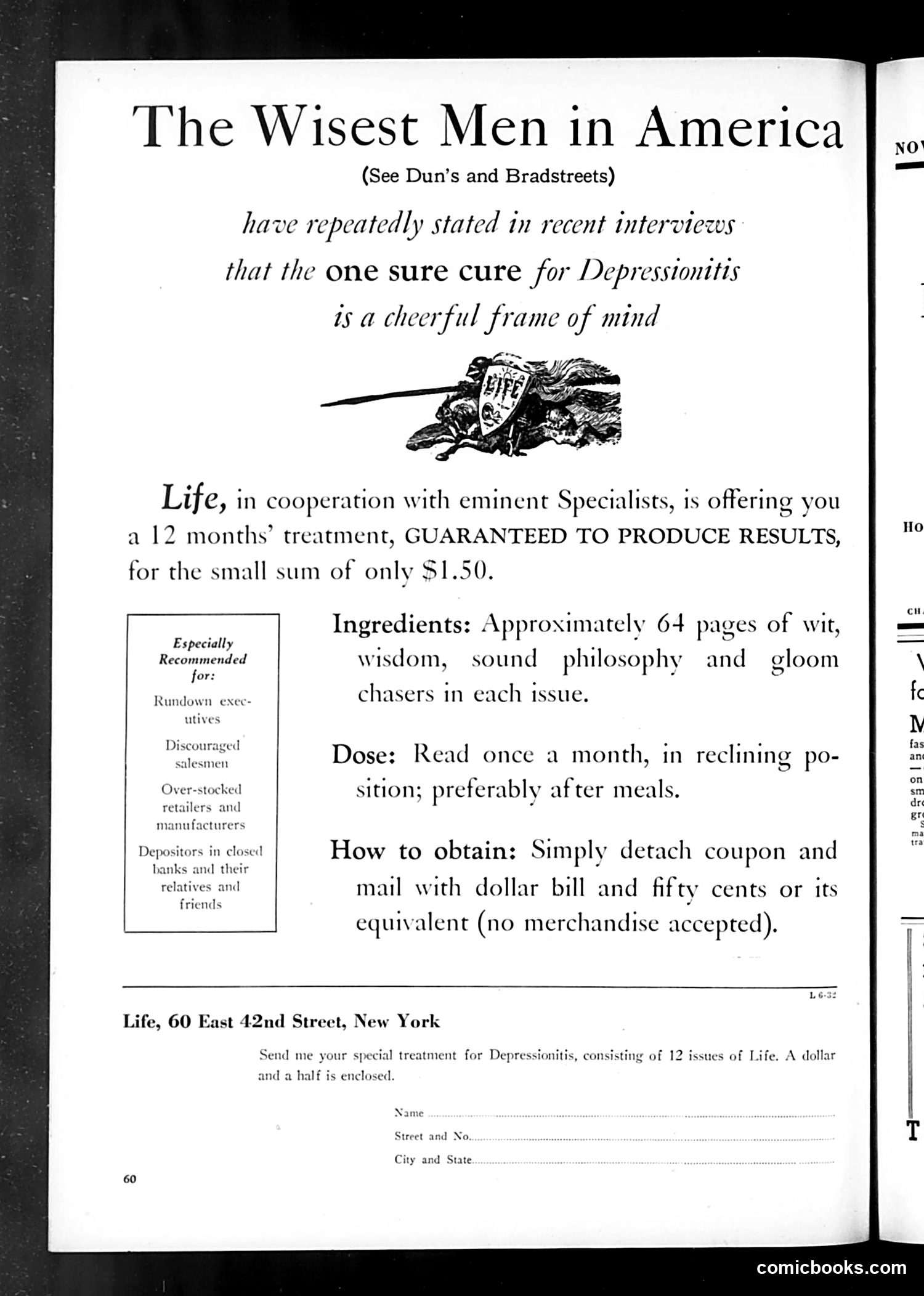
"The Wisest Men in America" - Life Magazine Satire This is a mock advertisement satirizing the Great Depression era's desperation and simplistic "self-help" remedies. Life magazine presents itself as a cure for "Depressionitis" (depression caused by the economic Depression) through humor alone. The satire targets those hit hardest by the economic collapse: "rundown executives," "discouraged salesmen," "over-stocked retailers," and "depositors in closed banks"—people with genuine financial ruin. The joke: wealthy businessmen ("wisest men") claim cheerfulness alone cures depression, while the magazine offers its satirical remedy—64 pages of "wit, wisdom...and gloom chasers"—for $1.50 monthly. The absurdity exposes how inadequate and patronizing such advice is when people face real economic devastation. Life mocks both the Depression's victims and the privileged class's tone-deaf insistence that attitude, not systemic change, solves poverty.
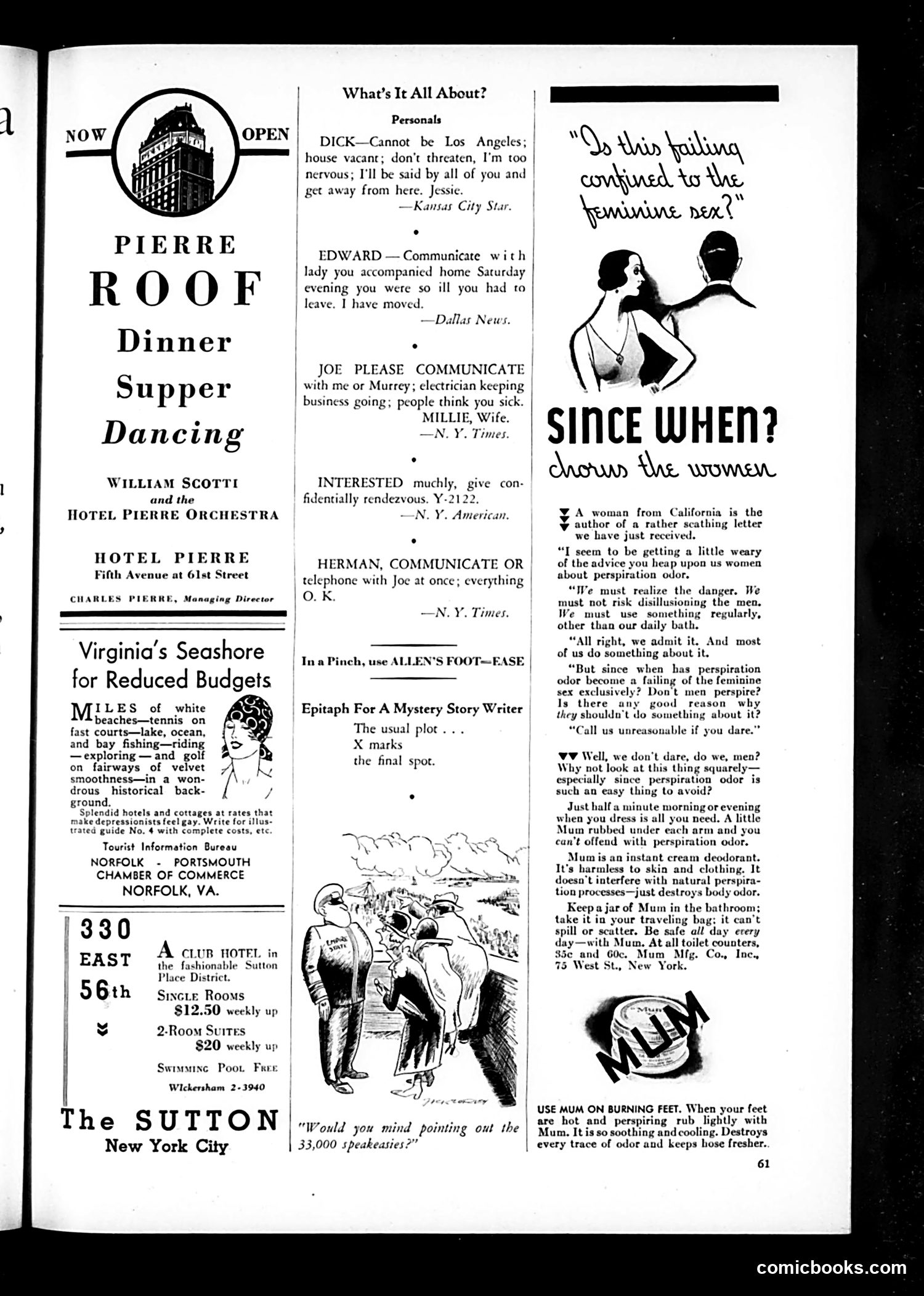
Analysis of Life Magazine Page Content This page from Life magazine contains personals advertisements and social commentary rather than political cartoons. The main feature is "Since When?" — a satirical piece responding to a letter from a California woman criticizing gendered advertising about perspiration odor. The woman points out the double standard: advertisers shame women about body odor while men face no similar pressure, despite men also perspiring. Life's response is condescending yet acknowledges her point. They essentially say: "We won't dare call you unreasonable" — a backhanded dismissal that accepts her complaint while promoting Mum deodorant as an "easy" solution. The satire targets 1920s-30s advertising culture that marketed anxiety to women about hygiene and social acceptability. The cartoon illustration shows a silhouetted couple, emphasizing the social stakes advertisers created around bodily functions. The page also includes classified personals (seeking missing persons, job communications) and hotel/tourism advertisements typical of Life's content during this era.
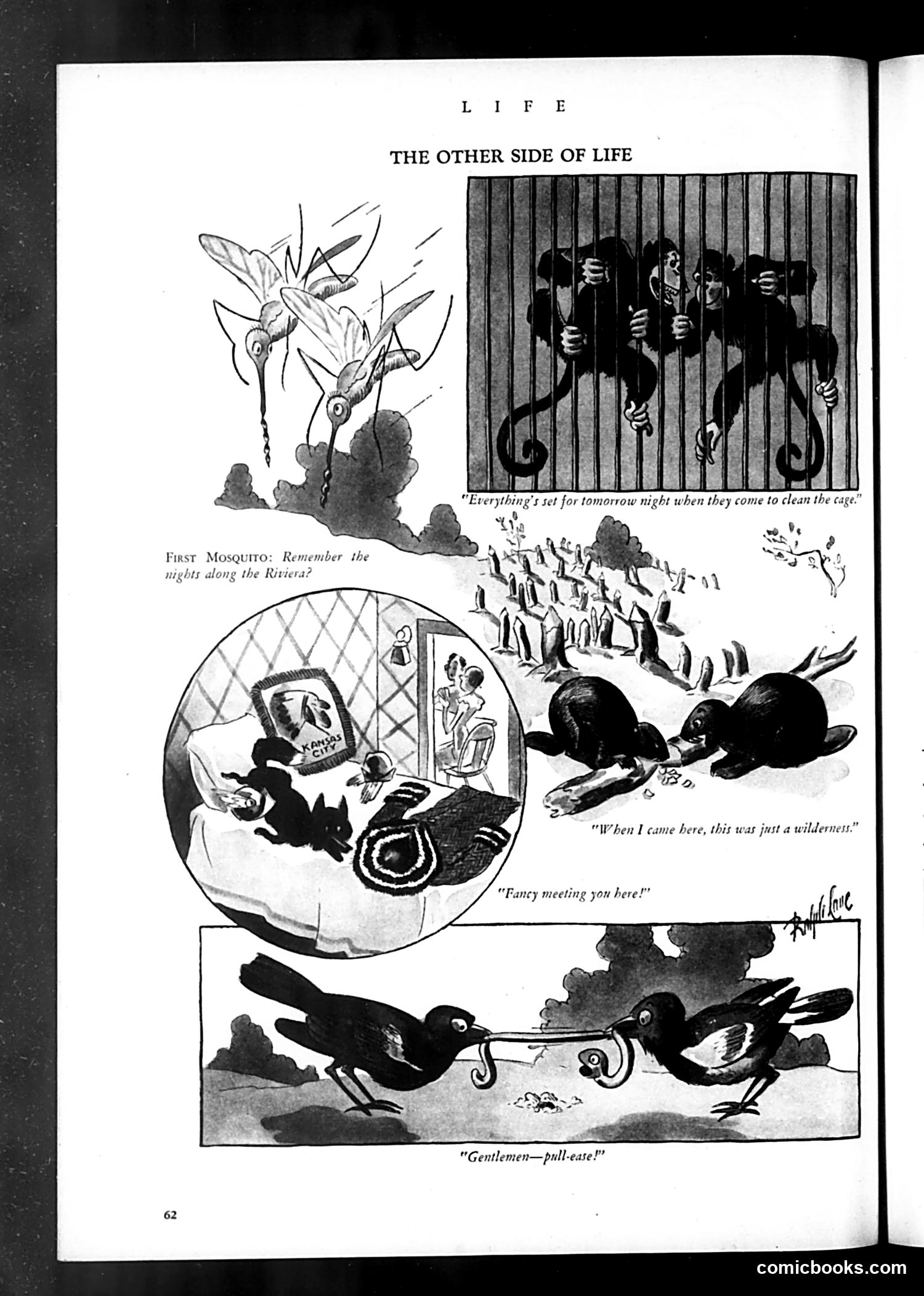
This page titled "The Other Side of Life" contains anthropomorphic animal satire. The top panel shows primates in a cage with the caption suggesting preparation for "cleaning"—likely satirizing zoo management or captive conditions. The middle circular vignette depicts mosquitoes reminiscing about the Riviera, contrasting past leisure with present circumstances. The bottom panel features birds in a comedic confrontation over food, with one pleading "Gentlemen—pull-ease!" The overall theme appears to satirize how animals experience civilization and domestication inversely to humans. The juxtaposition of sophisticated settings (Riviera, formal social situations) with animal behavior creates ironic commentary on nature versus civilized society. Without specific historical context, the exact political target remains unclear, though the tone suggests early-20th-century social satire typical of Life magazine's editorial approach.
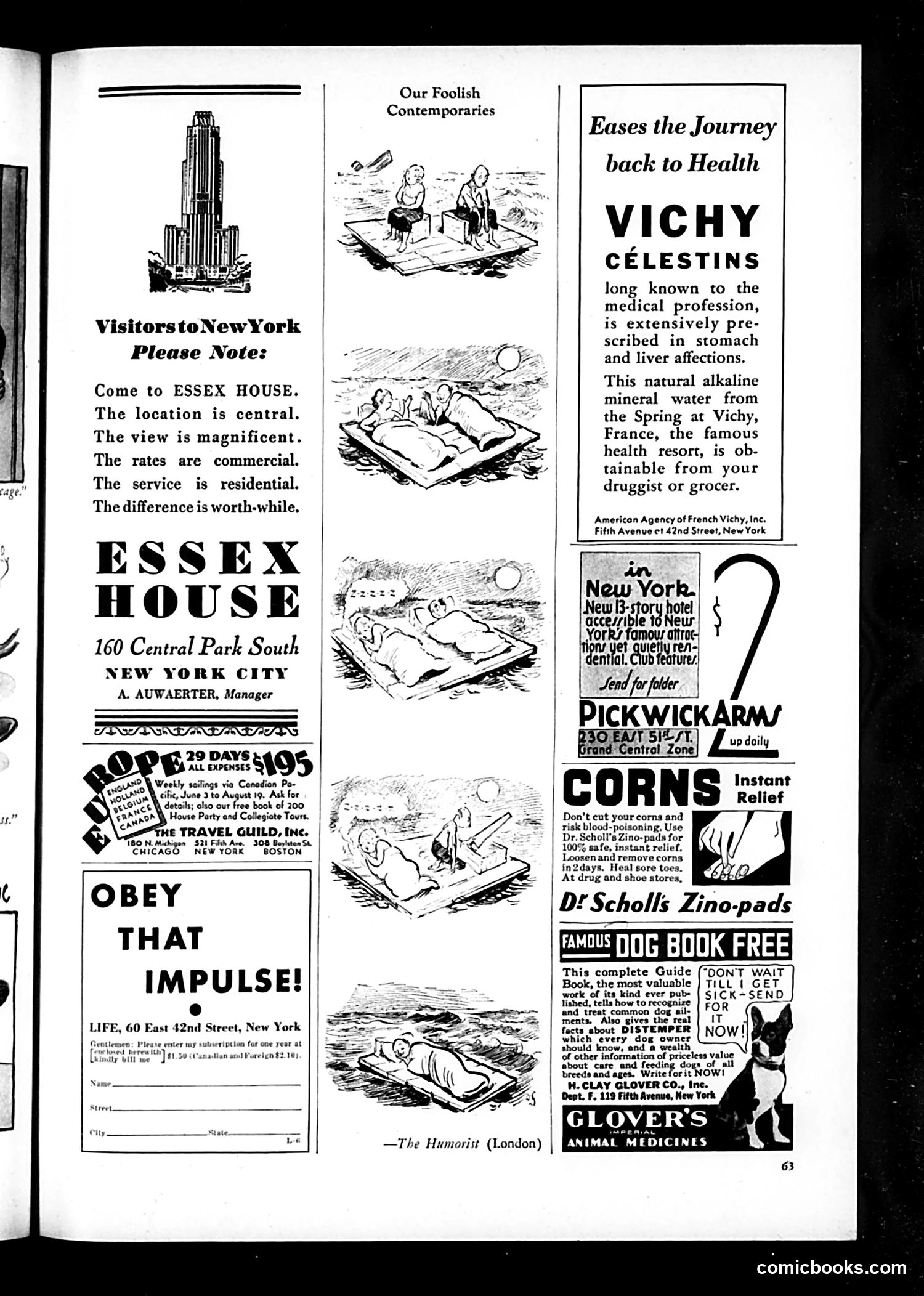
Life Magazine Page Analysis This is primarily an advertising page from Life magazine, not a political cartoon. The page features various commercial advertisements typical of the era, including: Main Advertisements: - Essex House hotel (New York lodging) - Life magazine subscription (humor/satirical publication) - Vichy Célestin mineral water (health/digestive aid) - Pickwick Arms hotel - Dr. Scholl's Zino-pads (corn treatment) - Glover's Dog Book and animal medicines "Our Foolish Contemporaries" Section: The center cartoons (credited to *The Humorist*, London) show people reclining in various beach/leisure scenes—likely satirizing foolish vacation behavior or leisure culture trends of the era. The page reflects early-to-mid 20th century American consumer culture, when Life magazine mixed satirical humor with advertising. The ads target middle-class readers interested in travel, health remedies, and pets.
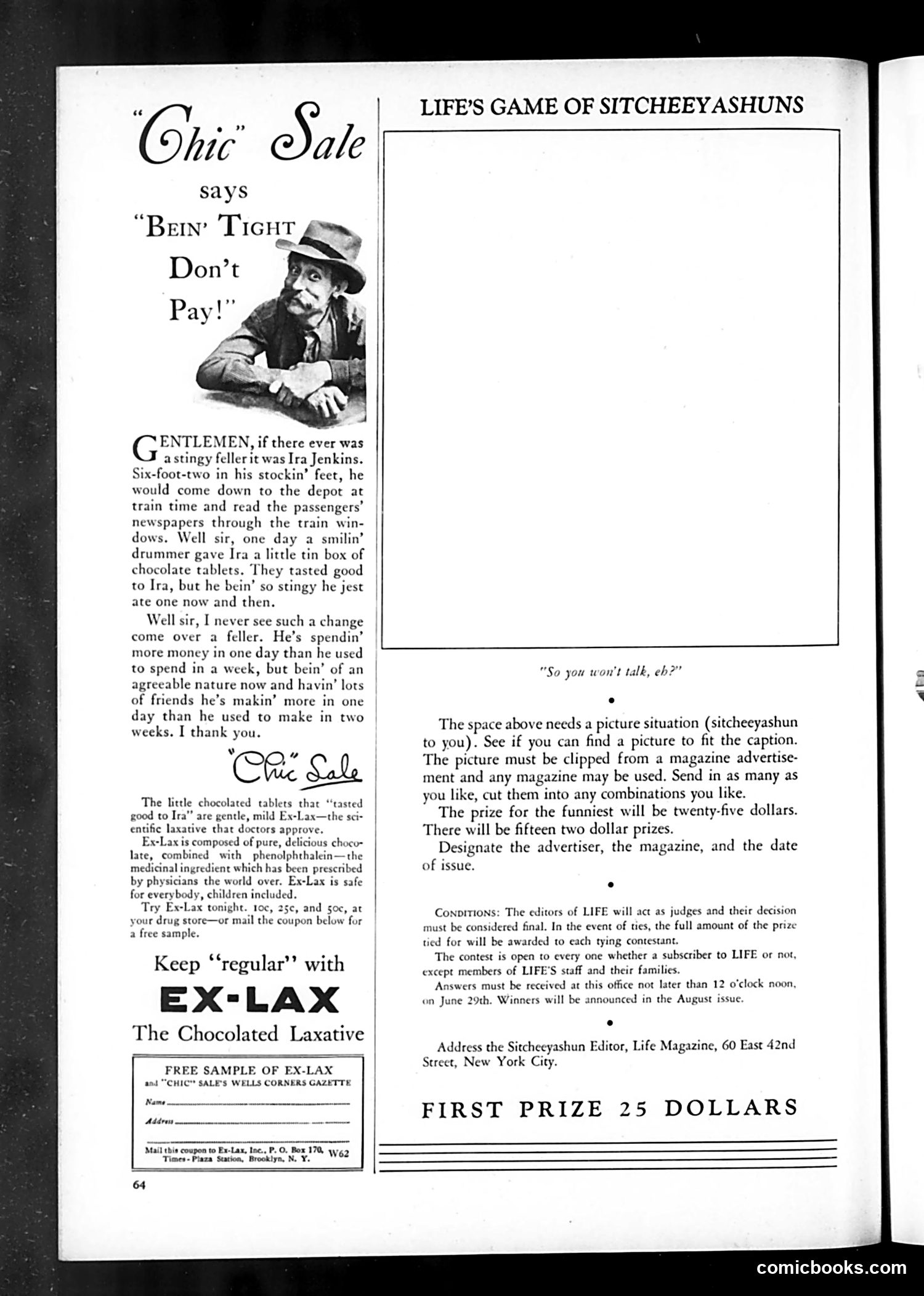
Analysis of This Life Magazine Page This page features Chic Sale, a popular American humorist and entertainer known for folksy monologues delivered in rural dialect. The main content is an Ex-Lax laxative advertisement disguised as Sale's comedic story about "Ira Jenkins," a stingy man whose personality transforms after consuming chocolate tablets (the product). The satire works through misdirection: Sale presents the dramatic character transformation as the story's point, when the real message is that Ex-Lax's medicinal ingredient (phenolphthalein) improves one's disposition by improving digestive health. The joke implies constipation made Jenkins miserly and unfriendly. The page also contains "Life's Game of Sitcheeyashuns," a reader contest asking participants to clip images from magazine advertisements and creatively pair them with humorous captions. "Sitcheeyashun" is colloquial dialect for "situation." The first prize was $25, a substantial sum at the time. This represents typical 1920s-30s Life magazine content: advertiser-sponsored humor mixed with interactive contests.
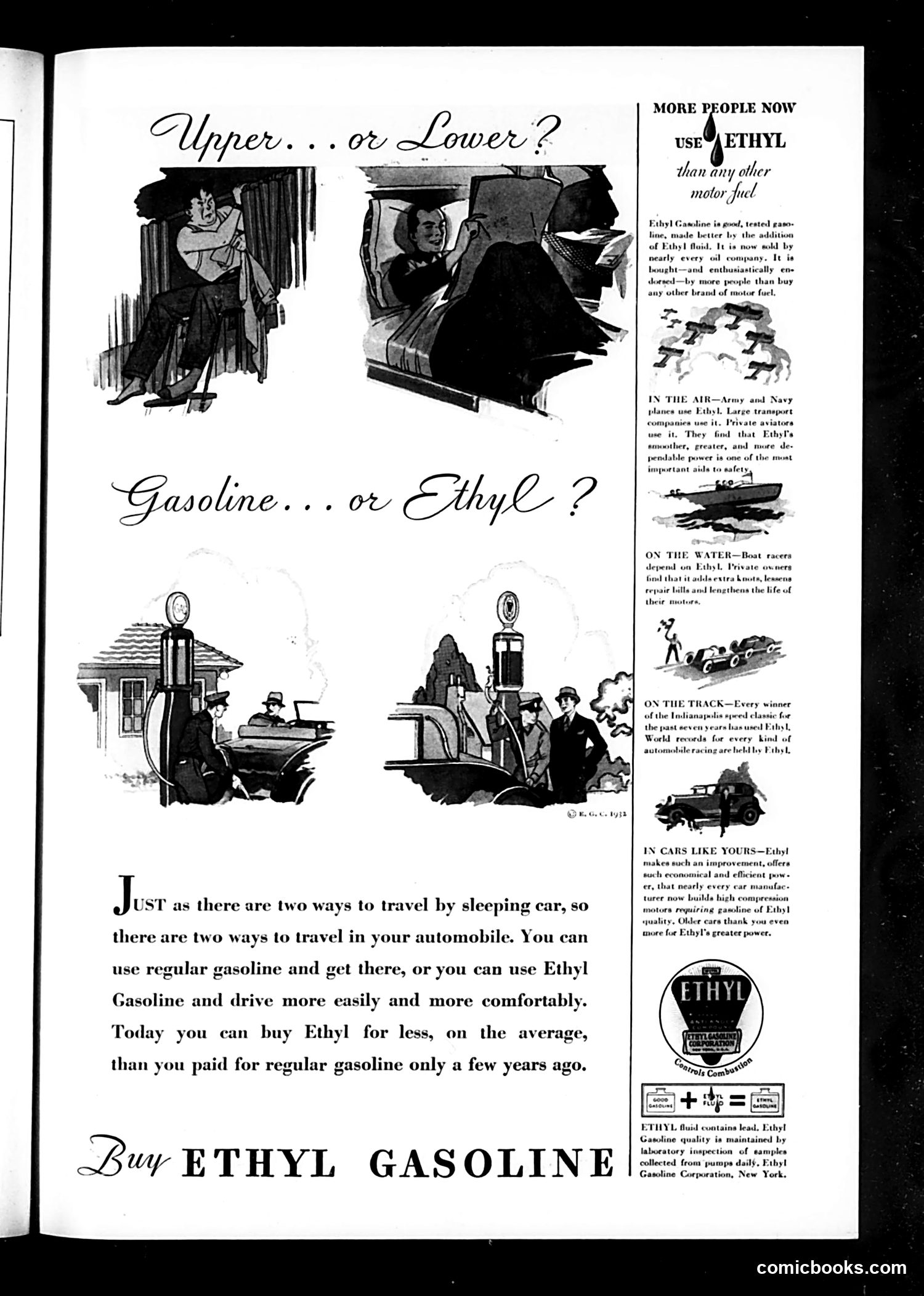
Advertisement Analysis This is primarily a product advertisement for Ethyl Gasoline, not political satire. The page uses humor to promote a fuel additive. The top cartoons show contrasting travel scenarios—"Upper...or Lower?" and "Gasoline...or Ethyl?"—depicting wealthy vs. working-class travelers. The joke is that Ethyl Gasoline provides smoother, more comfortable driving regardless of social class, positioning the product as a democratic luxury. The right side lists endorsements from military aircraft, boats, and automobiles, claiming Ethyl's superiority across transportation types. A note at bottom reveals Ethyl fuel contained lead—the product being advertised is what we now recognize as leaded gasoline, which caused widespread environmental and health damage. For modern readers: this advertisement promotes something now known to be harmful, presented with period-appropriate marketing optimism about technological progress and class aspiration.
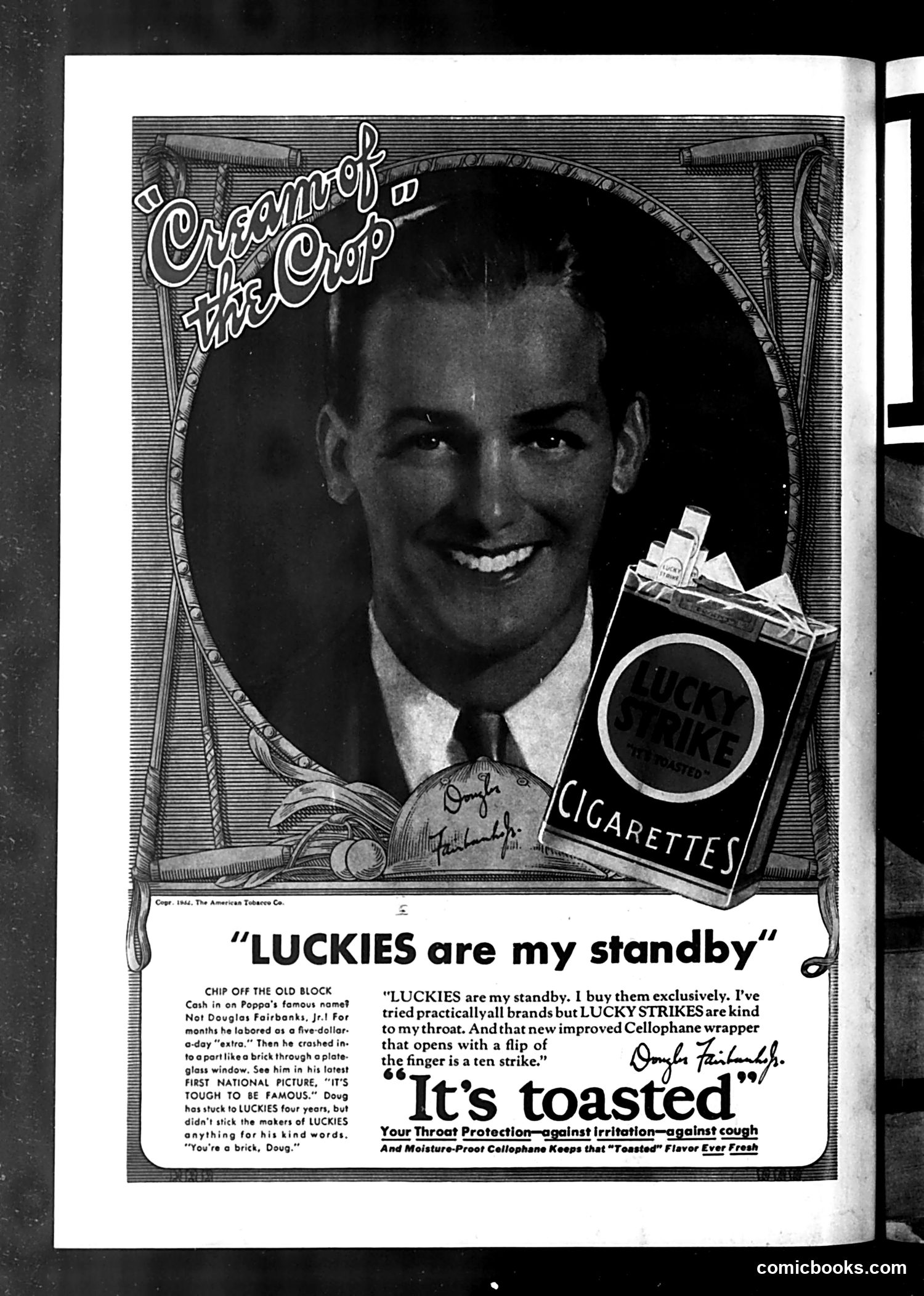
Advertisement, Not Satire This is a cigarette advertisement, not political satire. It features Douglas Fairbanks Jr., a prominent Hollywood actor of the era, endorsing Lucky Strike cigarettes. The ad references his film "Chip Off the Old Block" (playing on his famous father's name) and uses the tagline "It's toasted" — Lucky Strike's actual advertising slogan claiming throat protection. The copy emphasizes the improved cellophane wrapper and positions the product as a premium choice. This represents 1940s advertising practices now considered deeply problematic: celebrity endorsements for tobacco, health claims about cigarettes (throat protection), and appeals to quality/sophistication. The ad's existence in Life magazine reflects the era's unregulated tobacco marketing before health dangers became widely acknowledged and advertising restrictions were implemented.