life
Life — July 1932
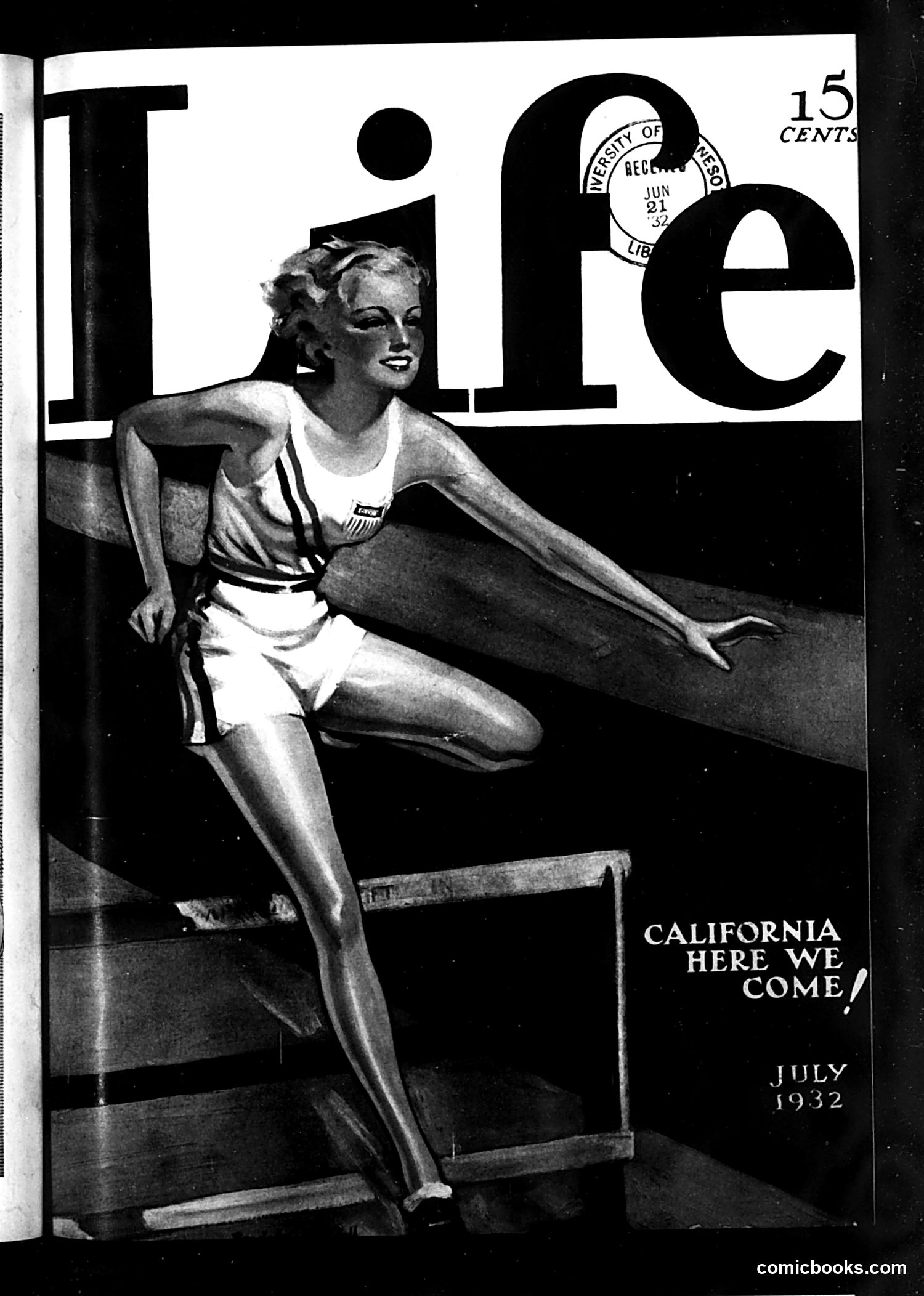
Life Magazine Cover Analysis - July 1932 This is a magazine cover rather than a political cartoon. The image shows a young woman in athletic/swimwear striking a confident pose, with large stylized letters spelling "life" behind her. The text reads "CALIFORNIA HERE WE COME!" dated July 1932—during the Great Depression. This appears to be promotional cover art celebrating California's appeal, likely referencing the era's migration westward as people sought economic opportunity. The woman's athletic appearance and confident demeanor suggest themes of vitality, youth, and optimism—qualities Life magazine may have been promoting during economically desperate times. The cover price of 15 cents indicates this is from the early Depression era.
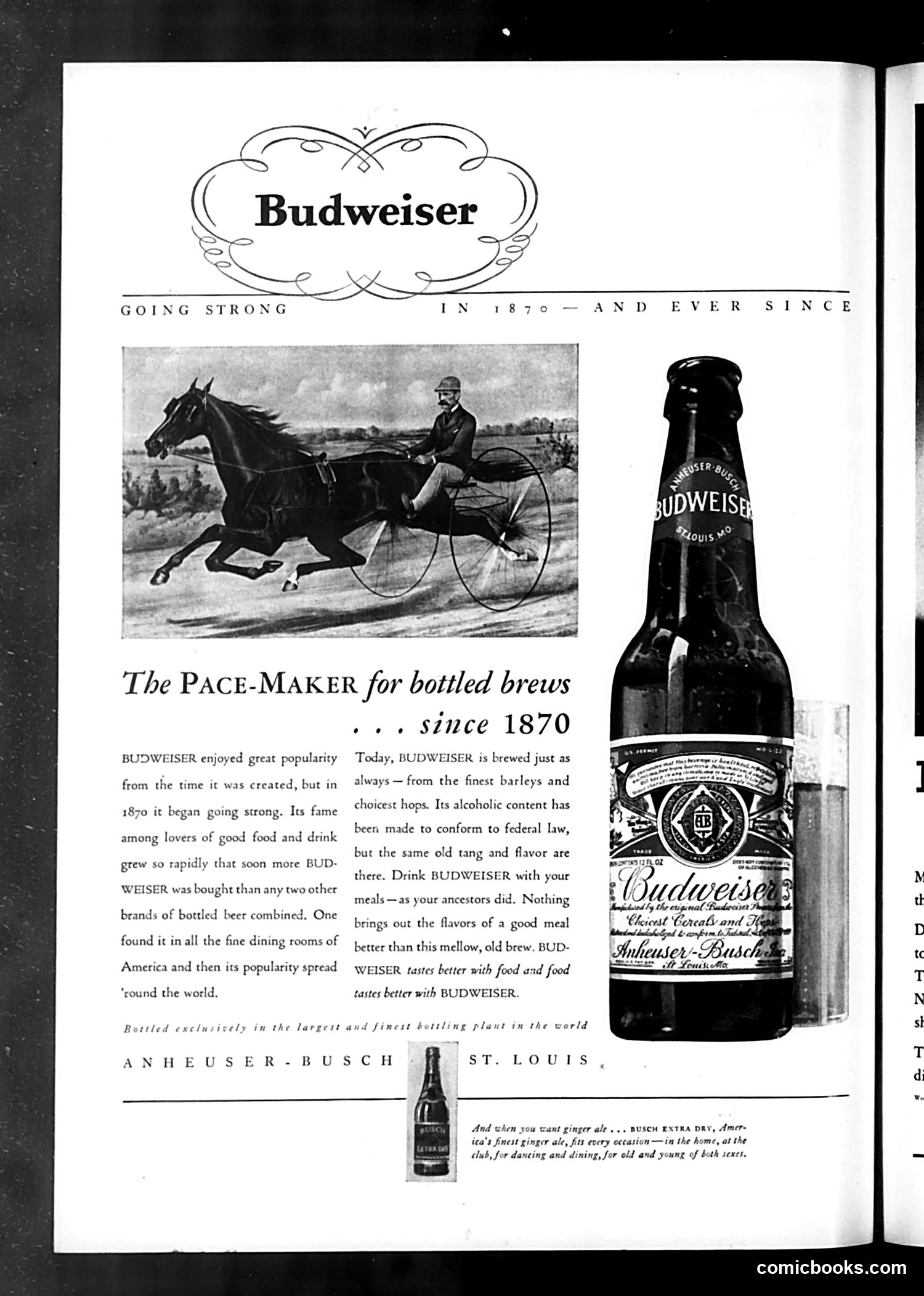
Analysis This is a Budweiser beer advertisement, not political satire or a cartoon. The page features: - A decorative Budweiser logo at top - A historical image of a horse and sulky (racing cart) from 1870, labeled "The Pace-Maker for bottled brews since 1870" - A large photograph of a Budweiser bottle - Marketing copy emphasizing the beer's long history and consistent quality The "pace-maker" metaphor compares Budweiser's dominance in bottled beer to a leading racehorse setting the pace. The advertisement appeals to tradition and heritage, claiming the beer has maintained its recipe and popularity since its creation. There is no satire or political content—this is straightforward vintage advertising emphasizing brand longevity and superiority in the American market.
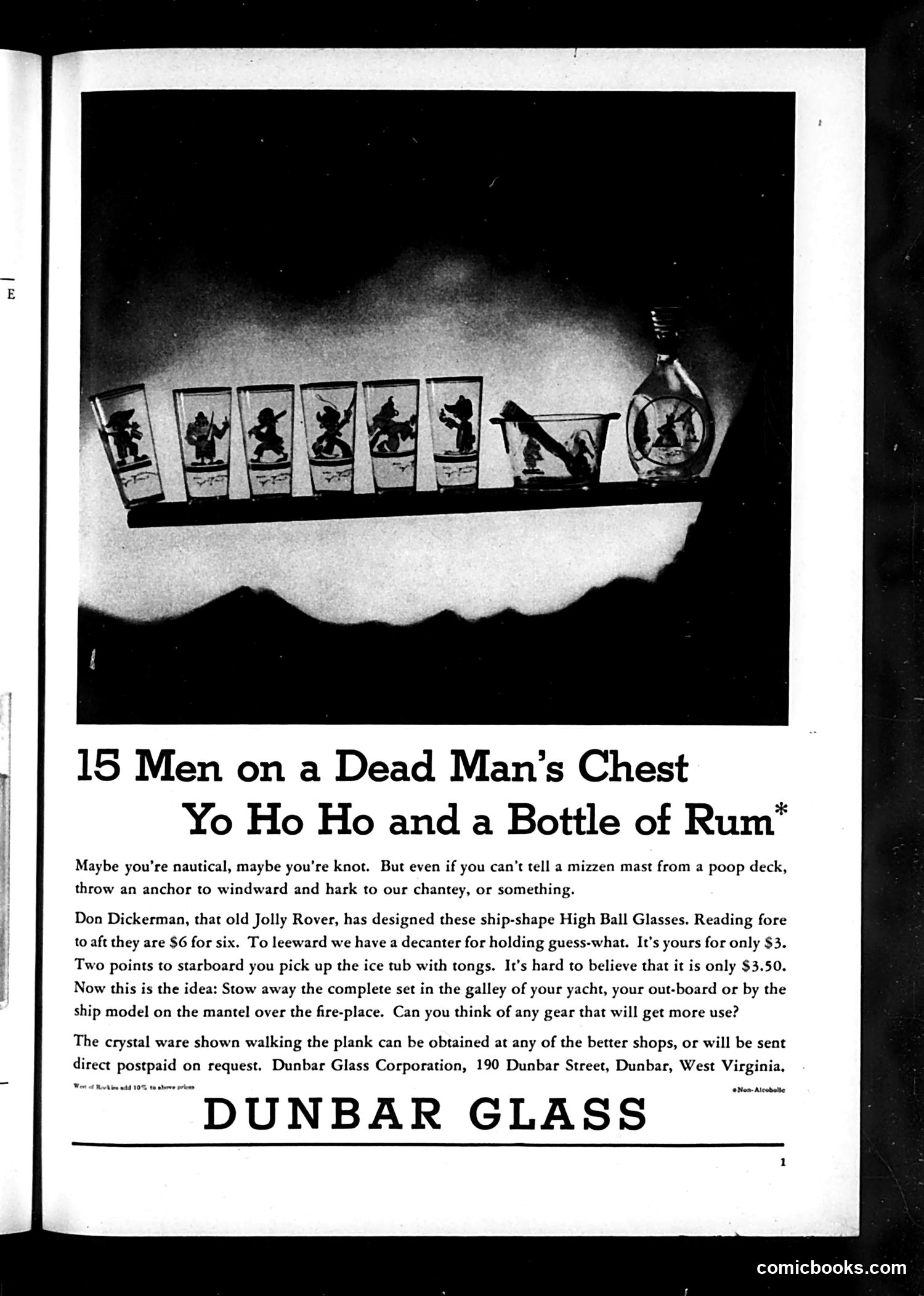
Analysis This is primarily a commercial advertisement for Dunbar Glass Corporation, not a political cartoon. The page shows silhouetted ship-shaped drinking glasses designed by Don Dickerman, arranged in a line like the famous nursery rhyme "15 Men on a Dead Man's Chest, Yo Ho Ho and a Bottle of Rum." The advertisement plays on nautical/pirate themes popular in the era to market glassware for entertaining. It references the novelty and collectibility of the product line—appealing to yacht owners and those with nautical decor. The copy emphasizes affordability and complete sets available for purchase. The pirate reference is purely decorative and commercial, not political commentary—a marketing strategy leveraging adventurous imagery to sell barware.
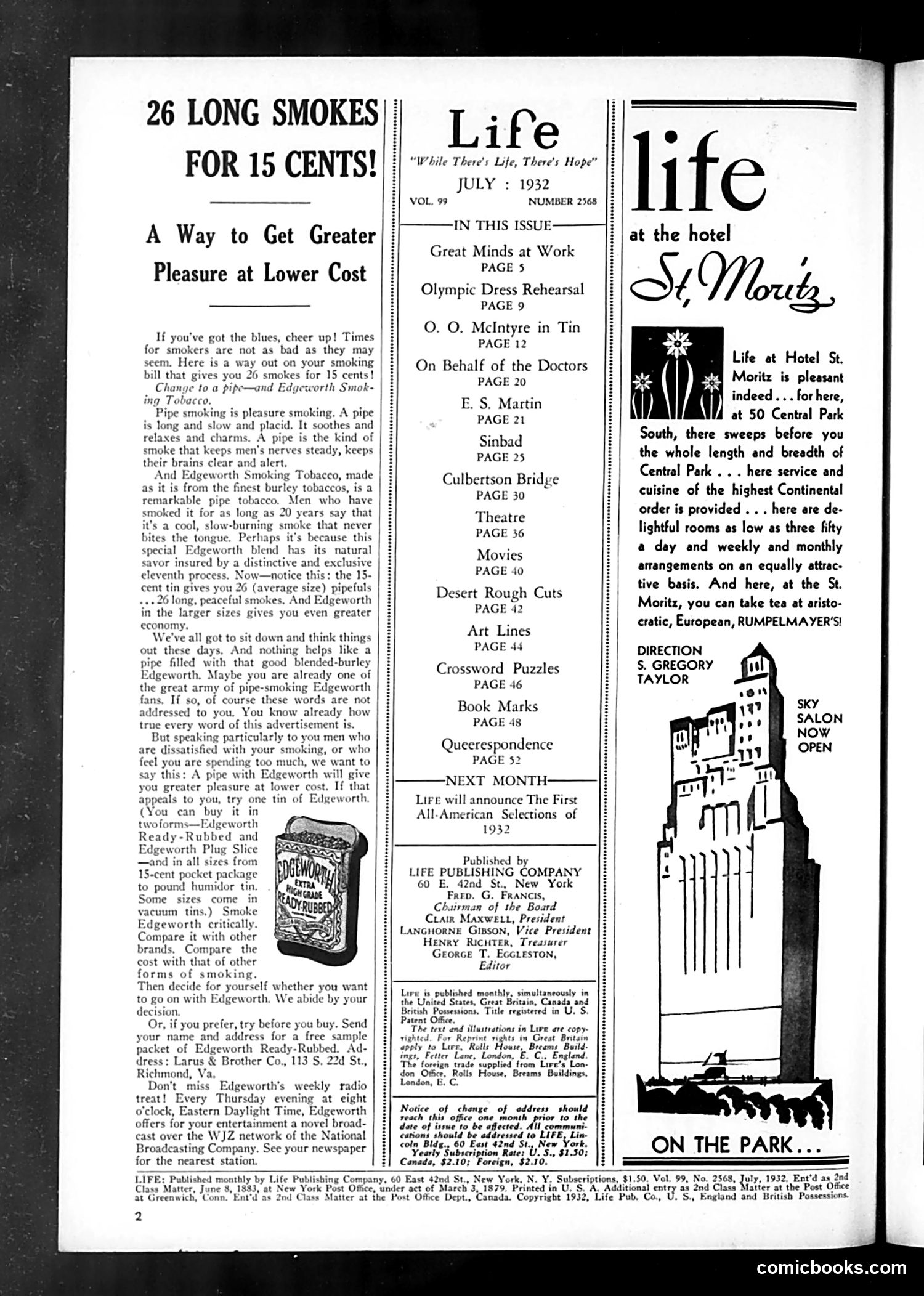
Analysis This page is primarily advertising and table of contents for *Life* magazine (July 1932). The left side advertises Edgeworth pipe tobacco, emphasizing value ("26 long smokes for 15 cents") during the Great Depression—a key context. The ad appeals to men facing financial hardship, promising "greater pleasure at lower cost." The right side advertises the Hotel St. Moritz in New York, highlighting luxury amenities (Continental cuisine, tea service) aimed at wealthy readers. The irony is striking: the same magazine issue promotes both budget tobacco for struggling men and high-end hotel living, reflecting 1932's sharp class divisions during economic crisis. The table of contents lists articles on various topics, with no visible political cartoons on this particular page.
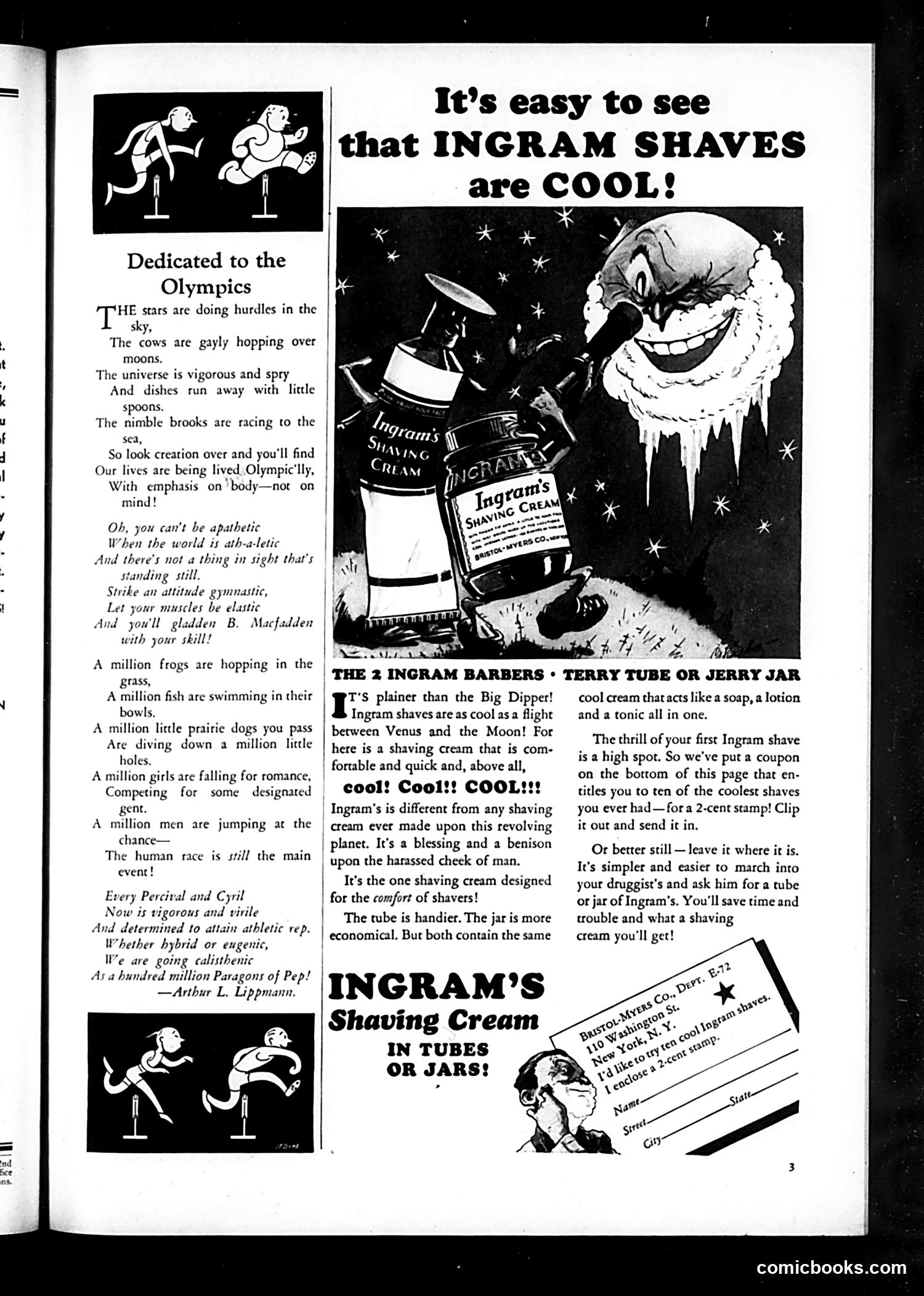
Analysis: Ingram Shaving Cream Advertisement This is primarily a commercial advertisement for Ingram's Shaving Cream, using Olympic Games imagery as a hook. The page features: Visual Content: - Cartoon athletes performing hurdles and gymnastics (left side), illustrating the poem's Olympic theme - A large illustration of a bearded face with shaving cream, surrounded by stars and a crescent moon (center-right) - Two bottles of Ingram's shaving cream labeled "Terry Tube or Jerry Jar" The Satire: The advertisement uses whimsical poetry about athletic competition to frame shaving as a form of physical prowess and self-improvement. The "cool" framing positions grooming as desirable and modern. Key Point: This reflects early 20th-century marketing that conflated masculine self-care with Olympic ideals of bodily discipline and competitive achievement—positioning shaving cream as part of an "athletic" lifestyle.
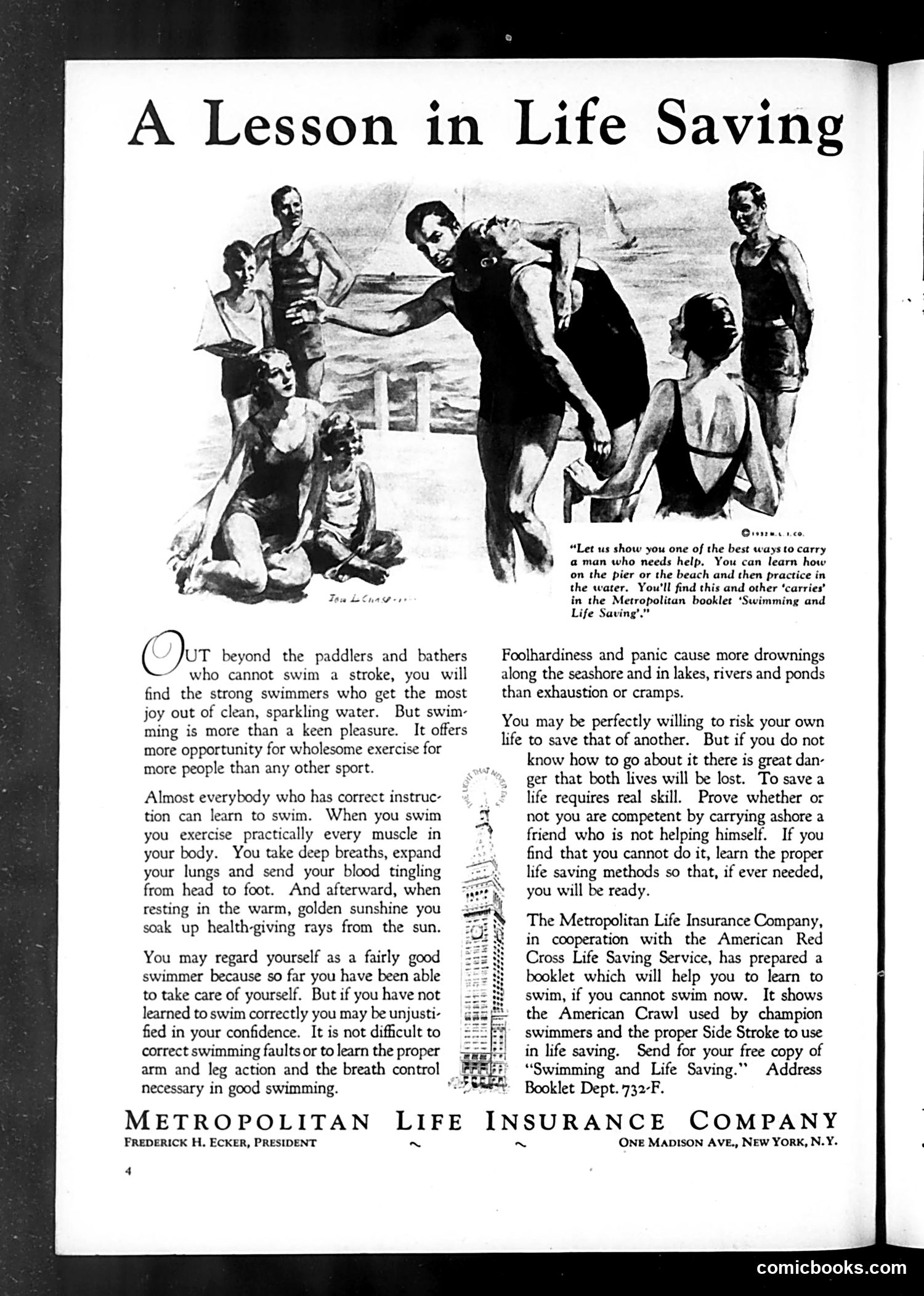
Analysis This is primarily an advertisement, not satire or political commentary. The Metropolitan Life Insurance Company partnered with the American Red Cross to promote swimming skills and life-saving techniques. The illustration shows a swimming lesson at a beach or pier, depicting proper rescue technique. The accompanying text argues that good swimming ability requires correct instruction—merely being a "fairly good swimmer" doesn't qualify someone to save another's life. The ad encourages readers to learn proper life-saving methods through a Red Cross booklet titled "Swimming and Life Saving." The message is straightforward safety advocacy: foolish panic causes most drownings, and both rescuer and victim need proper training to survive. This reflects early 20th-century public health campaigns promoting swimming education and water safety.
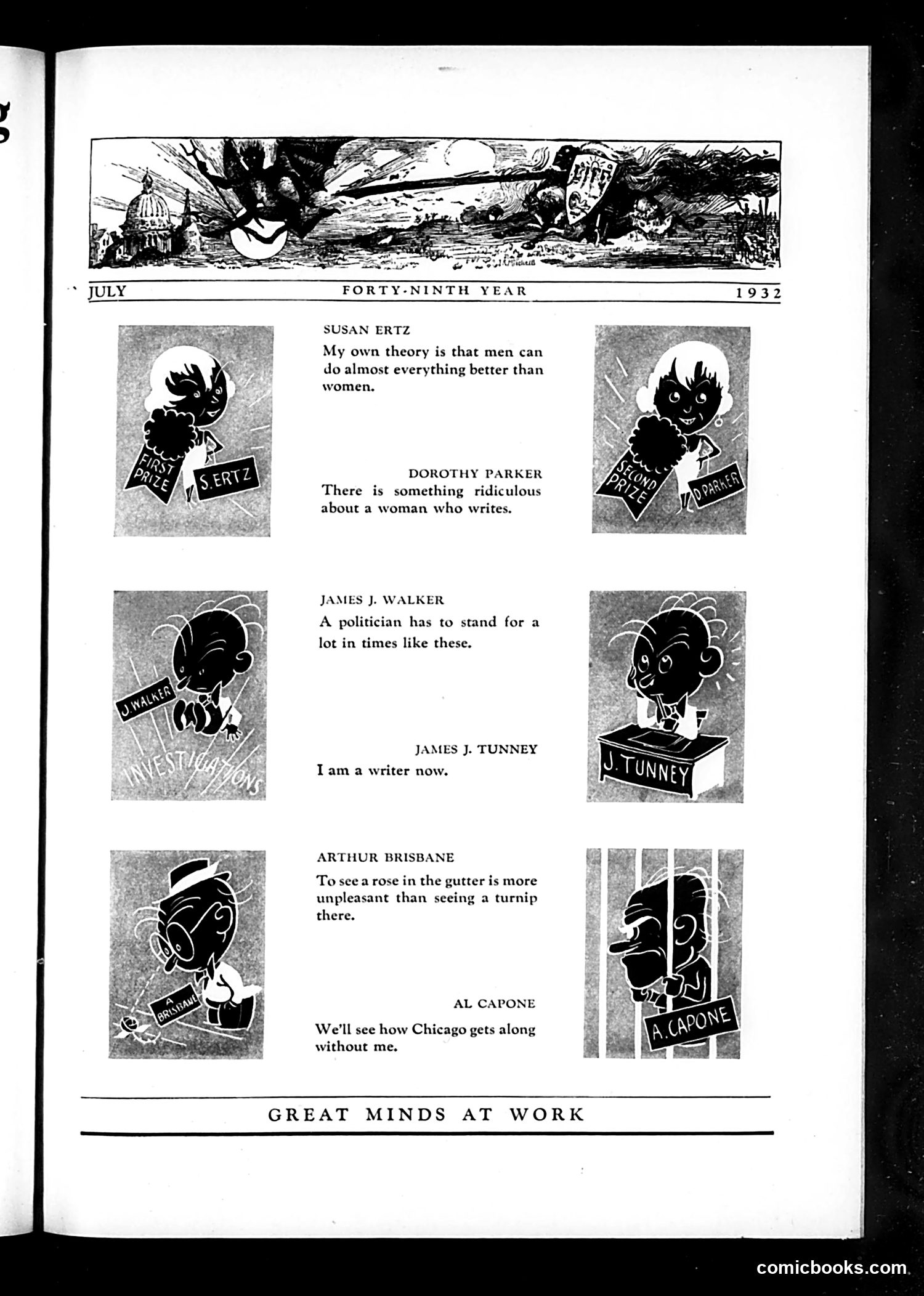
"Great Minds at Work" — Life Magazine, July 1932 This page satirizes famous figures' ostensible views on various topics through caricatured portrait busts paired with quotations. The humor relies on witty, often contradictory or absurd statements attributed to each person: - Susan Ertz claims men excel at nearly everything - Dorothy Parker finds something ridiculous about women writers (likely self-directed wit) - James J. Walker (politician) insists politicians must take strong stands - James J. Tunney simply announces he's now a writer - Arthur Brisbane contrasts finding a rose versus turnip in gutters - Al Capone (the notorious Chicago gangster) quips about Chicago managing without him The satire works through juxtaposition: mixing legitimate writers/figures with organized crime, and pairing grandiose or banal statements with caricatured importance, mocking both the subjects and 1930s celebrity culture's obsession with famous people's opinions.
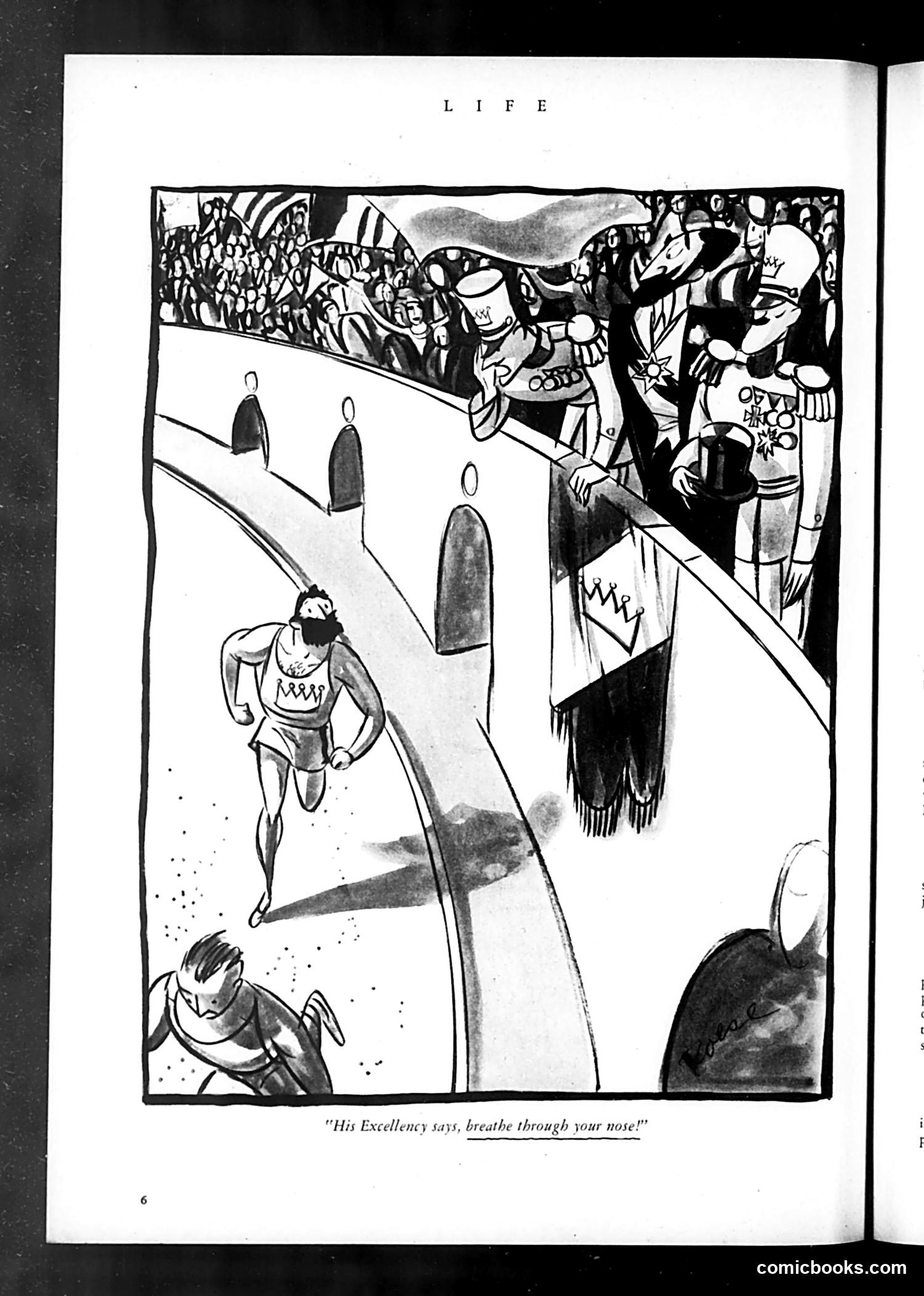
Political Cartoon Analysis This cartoon depicts a military/athletic competition scene. A lone athlete runs on what appears to be a track while observing military officials and crowds above. The caption reads: "His Excellency says, breathe through your nose!" The satire likely mocks authoritarian military leadership—specifically a high-ranking official ("His Excellency") giving absurdly pedantic or useless instructions to subordinates during competitive performance. The humor lies in the incongruity: giving breathing advice during intense physical competition is either obvious or unhelpful, yet the official delivers it as a command. This appears to satirize rigid military hierarchy and the disconnect between those in power and practical reality—a common theme in Life magazine's social commentary. The specific "His Excellency" reference suggests a particular foreign military figure, though the exact identity remains unclear without additional context.
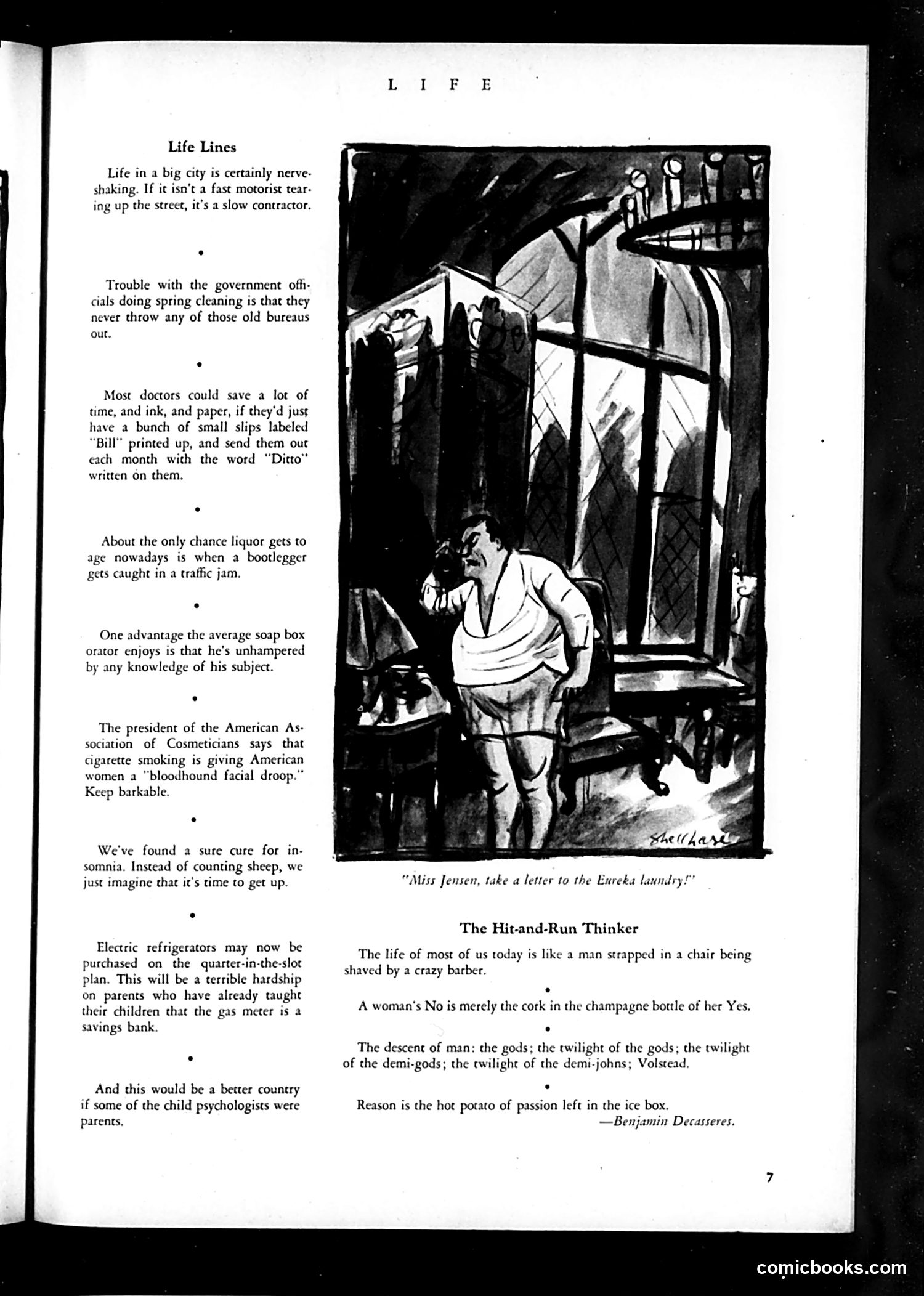
Analysis of Life Magazine Page This page contains short satirical observations ("Life Lines") and a cartoon titled "Miss Jensen, take a letter to the Eureka Laundry!" The cartoon: depicts a woman in an office, appearing to dictate to a secretary. The satire appears to mock office dynamics and workplace efficiency—the woman seems to be treating laundry instructions with the formality of business correspondence, suggesting either workplace absurdity or commentary on women's domestic responsibilities intruding into professional settings. The "Life Lines" section: offers brief, cynical social commentary typical of Life magazine's style—mocking government inefficiency, doctors' paperwork, bootleggers, soap-box orators, and cigarette smoking's effects on women's appearance. The overall tone is characteristic of 1920s-30s American satirical humor: urbane, somewhat misogynistic, and focused on modern life's peculiarities.
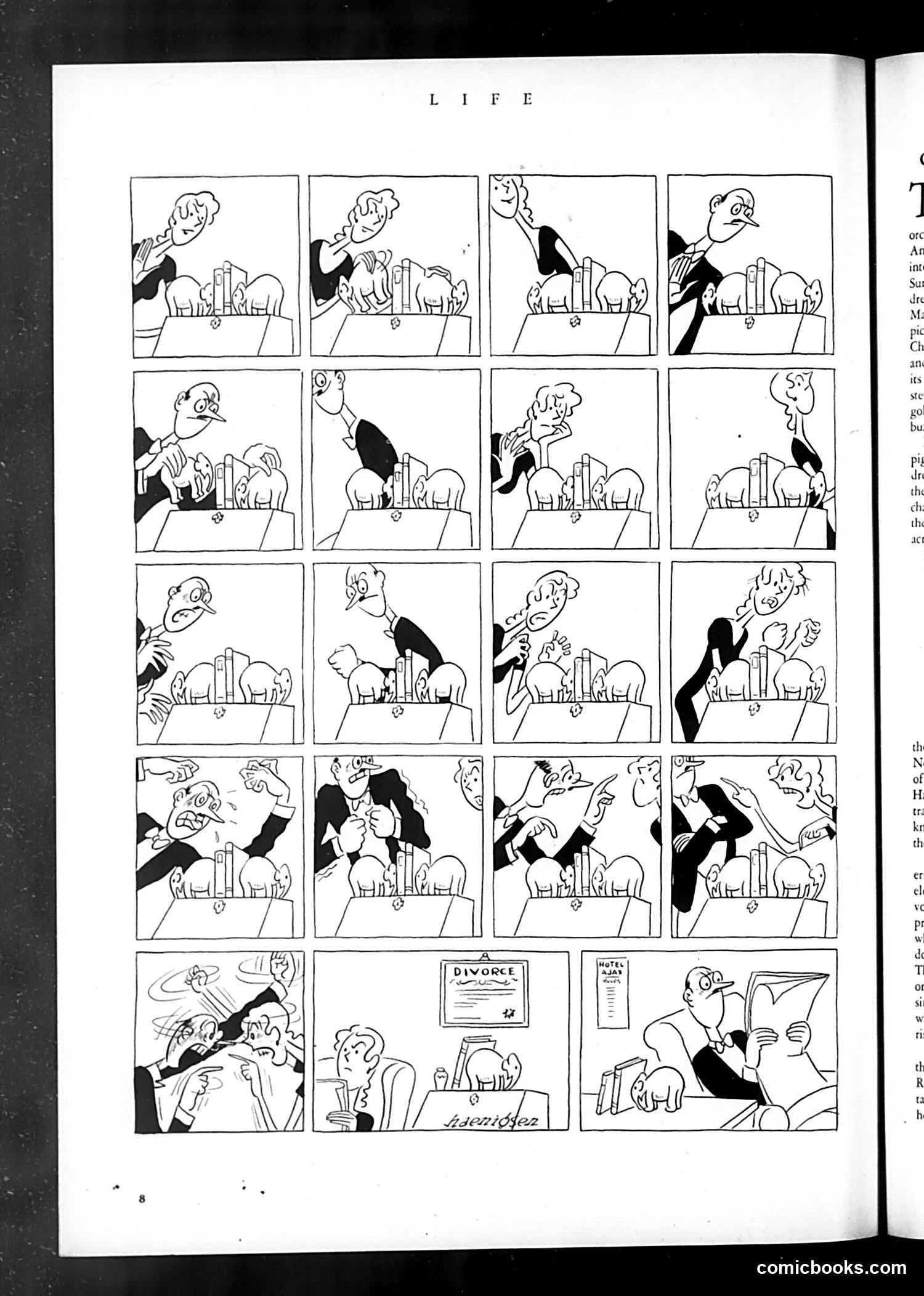
Commentary on the Cartoon This is a multi-panel comic strip depicting a dinner party scene that deteriorates into chaos. The narrative appears to satirize marital discord and domestic conflict. The sequence begins orderly with well-dressed diners at a formal table, but progressively shows escalating arguments and physical altercation between what appears to be a husband and wife. The final panels reveal the punchline: a "DIVORCE" document and "HATE" poster, ending with one figure reading a newspaper while surrounded by children. The satire critiques marriage breakdown and its social consequences, presented through slapstick humor typical of early 20th-century American comics. The artist (signature appears to be present) uses exaggerated expressions and physical comedy to mock both marital conflict and the formality of domestic life. The specific historical context regarding divorce attitudes of the publication's era would inform the satirical intent.
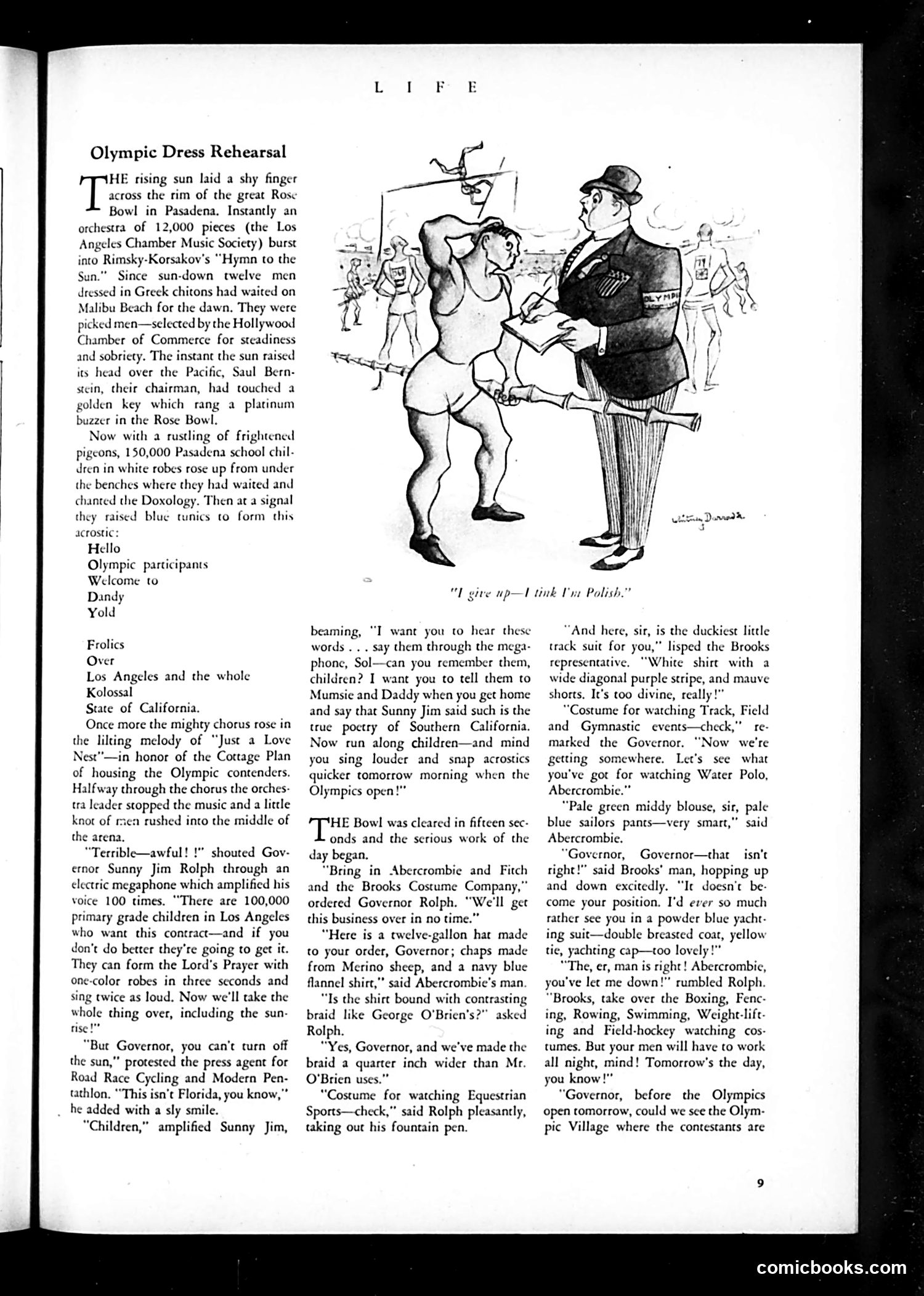
Olympic Dress Rehearsal This satirical piece mocks the elaborate preparation for the 1932 Los Angeles Olympic Games. The cartoon depicts a muscular male athlete being fitted for Olympic costumes by officials, with the caption "I give up—I think I'm Polish." The satire targets the absurdity of organizing 150,000 schoolchildren into synchronized performances, the logistical chaos of coordinating massive crowds, and the bureaucratic micromanagement of even the athletes' appearances. References to Governor Rolph and various costume company representatives show how political and commercial interests complicated what should be athletic competition. The humor stems from the disconnect between the Games' athletic purpose and the elaborate theatrical production surrounding them—suggesting that spectacle had overshadowed sport.
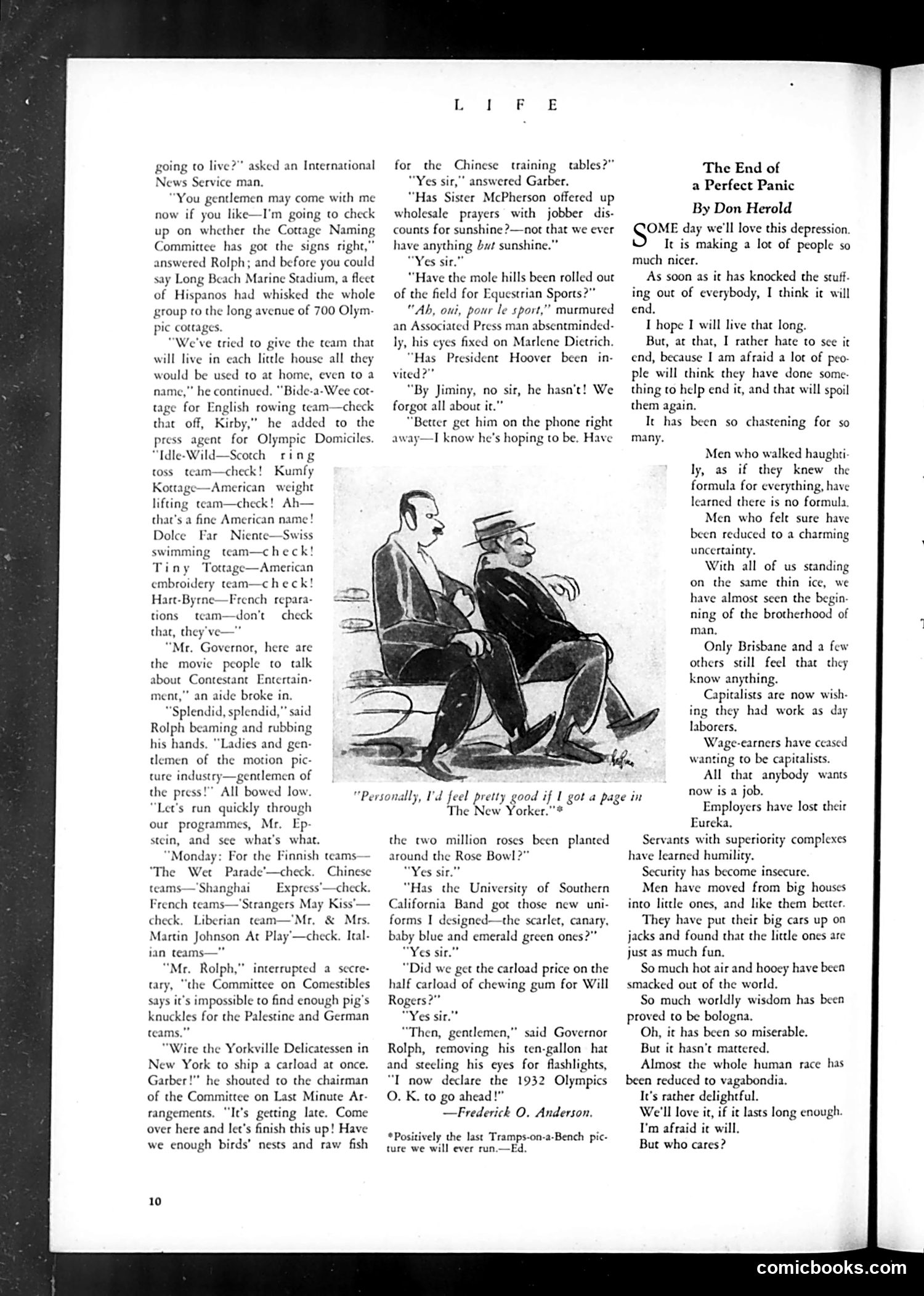
"The End of a Perfect Panic" by Don Harold This page contains a satirical article and accompanying cartoon about the Great Depression's social upheaval. The cartoon depicts two men in conversation, likely representing different social classes or economic perspectives during the crisis. The article discusses how the depression has fundamentally altered society: capitalists now wish they were day laborers, wage-earners have stopped wanting to be capitalists, servants have lost their superiority complexes, security has become uncertain, and the wealthy have moved from mansions into smaller homes—finding them just as enjoyable. The satire suggests that widespread economic collapse has paradoxically created unexpected social equality and humility across class lines, ironically achieving a "perfect panic" where everyone's pretensions have been stripped away by shared hardship.
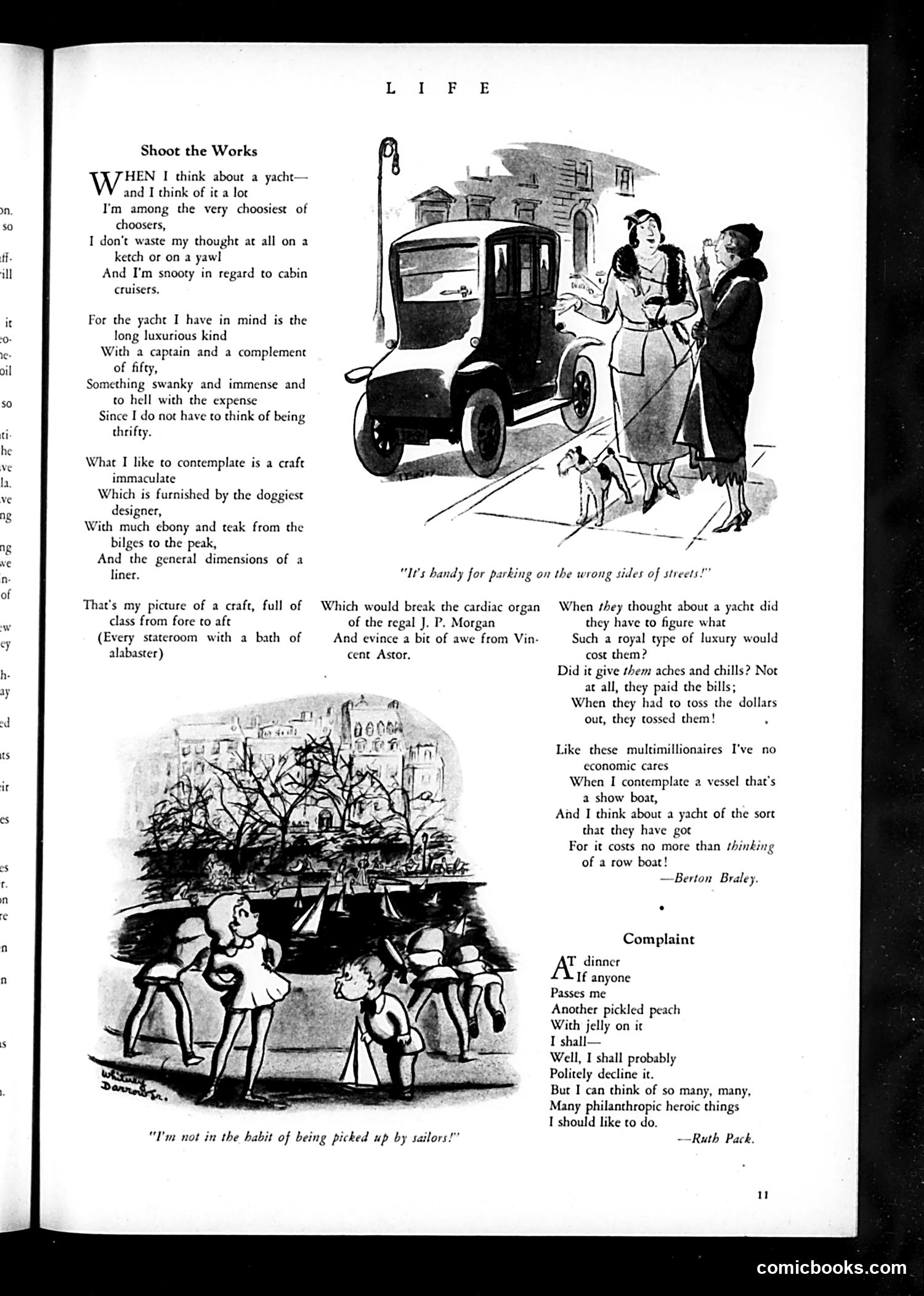
Page Analysis: "Life" Magazine Satire This page contains two unrelated satirical pieces: "Shoot the Works" by Berton Braley humorously addresses yacht fantasies. The poem mocks wealthy aspirations, noting that owning a yacht requires merely *thinking* about it—implying the author lacks actual means. The accompanying cartoon shows a woman proudly displaying her automobile (not a yacht) to admirers, captioned "It's handy for parking on the wrong side of streets!" The satire targets working-class pretension and automobile culture. "Complaint" by Ruth Pack presents brief, witty verse about dinner etiquette—specifically declining offered food politely while fantasizing about charitable work instead. Both pieces exemplify early 20th-century American humor mocking middle-class aspirations and social conventions through lighthearted, accessible verse and cartoon illustration.
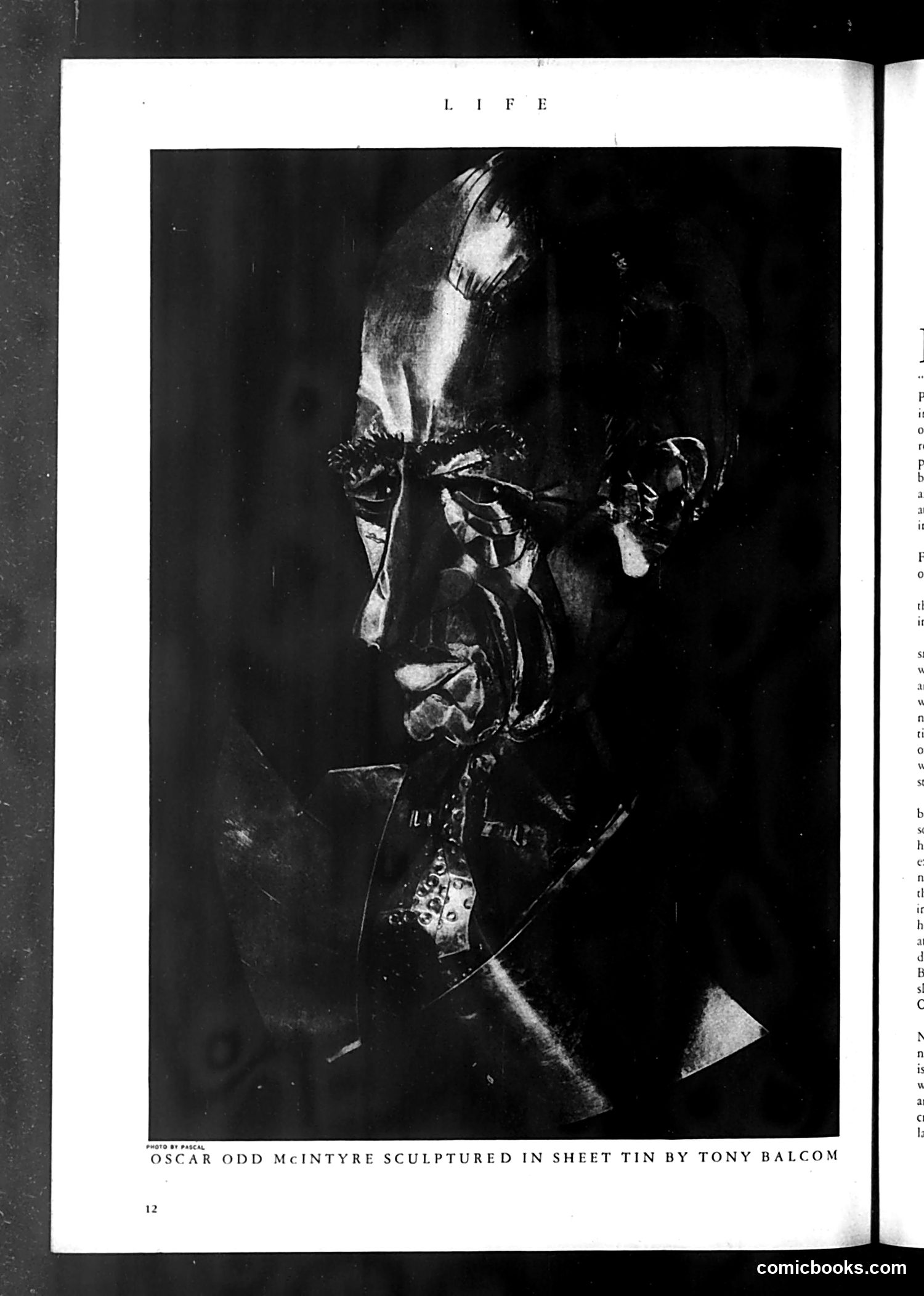
Oscar Odd McIntyre Sculpture This page features a sculptural portrait of Oscar Odd McIntyre, created by artist Tony Balcom in sheet tin. The caption identifies this as a photograph of the finished work. Oscar Odd McIntyre was a prominent American journalist and gossip columnist of the early-to-mid 20th century, known for his witty social commentary and Broadway coverage. The sculpture captures his distinctive facial features in an expressionistic style characteristic of modernist portraiture. The tin medium itself appears deliberately chosen—perhaps a clever reference to McIntyre's "tin ear" for pretension, or simply showcasing Balcom's sculptural versatility. Without additional context from surrounding page text, the specific satirical intent remains unclear, though Life's inclusion suggests McIntyre was a notable enough cultural figure to merit this artistic treatment.
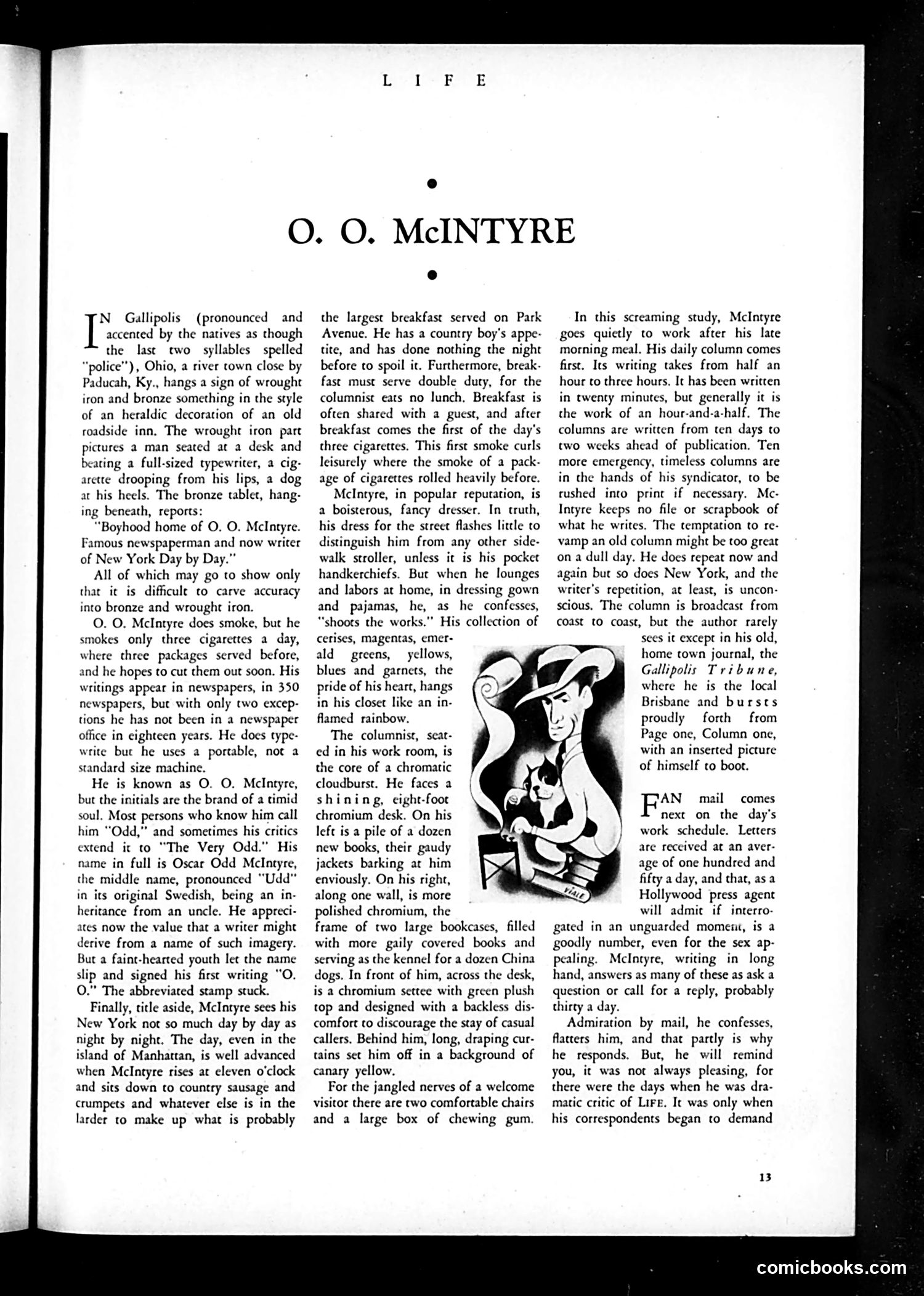
O. O. McIntyre Profile in Life Magazine This page profiles O. O. McIntyre, a famous newspaper columnist of the early 20th century. The text describes his working habits and personality—he's a prolific writer who produces columns from his New York office using a portable typewriter, working early mornings and avoiding lunch. The illustrated cartoon shows McIntyre at his desk surrounded by his workspace: stacks of books, a chromium desk, and office furnishings. The caricature emphasizes his distinctive features and sedentary lifestyle. The satire lies in portraying McIntyre as a productive yet somewhat reclusive figure who rarely leaves his office, relying on mail correspondence and observation rather than direct experience—a commentary on how newspaper columnists manufacture commentary about urban life from behind desks.
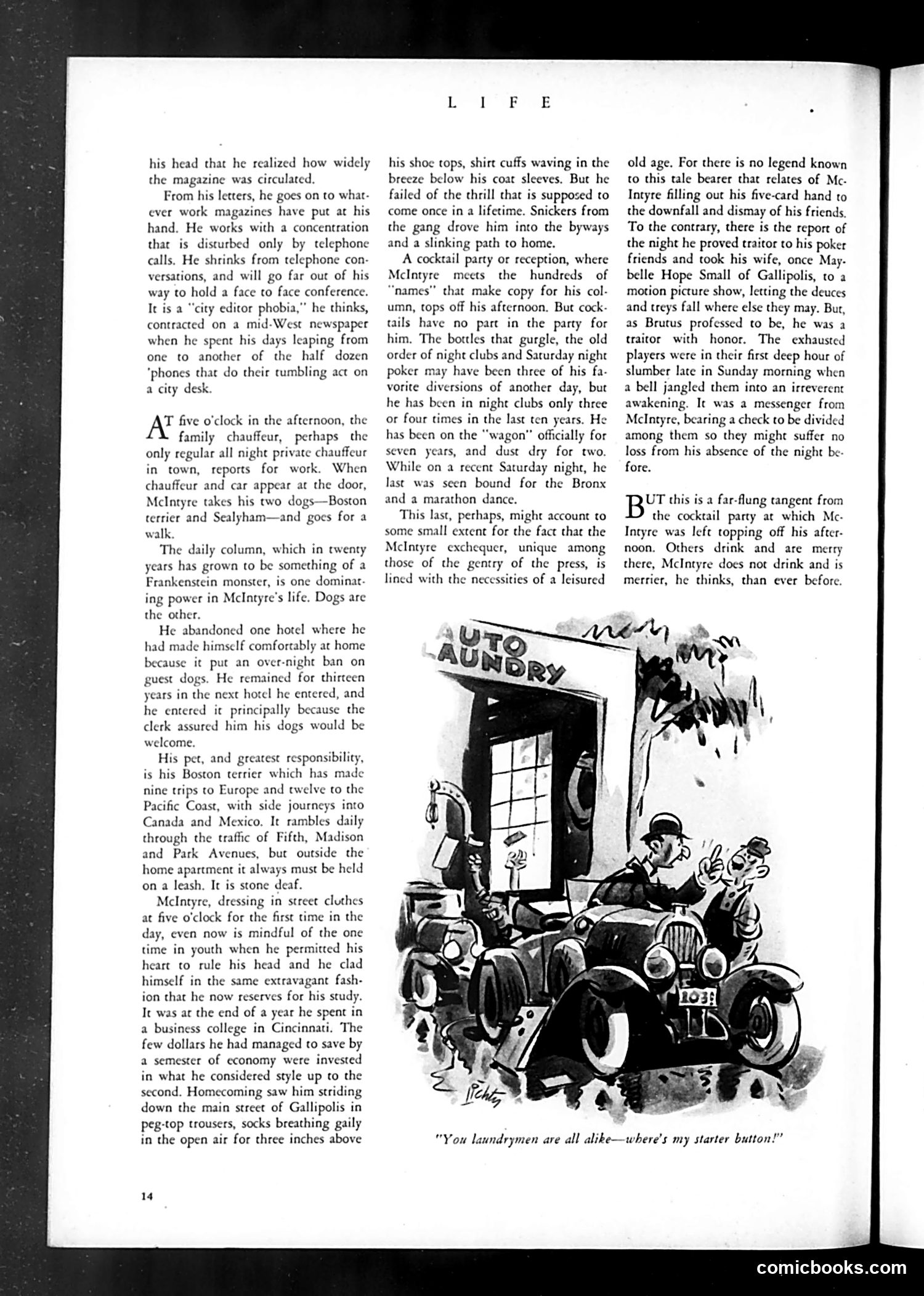
Analysis of Life Magazine Page This page contains a satirical illustration about a "Auto Laundry" service. The cartoon depicts several men in 1920s-era automobiles lined up outside a laundry establishment, with the caption: "You laundrymen are all alike—where's my starter button?" The joke targets the era's new automobile culture and the confusion between different service establishments. The humor relies on the absurdity of treating a car laundry like a traditional laundry service—implying the laundrymen have mishandled or lost the car's starter button (a key mechanical component). The surrounding text discusses McIntrye's magazine work and lifestyle, but the cartoon itself satirizes the growing pains of 1920s technology adoption and the comic misunderstandings that arose as automobiles became commonplace.
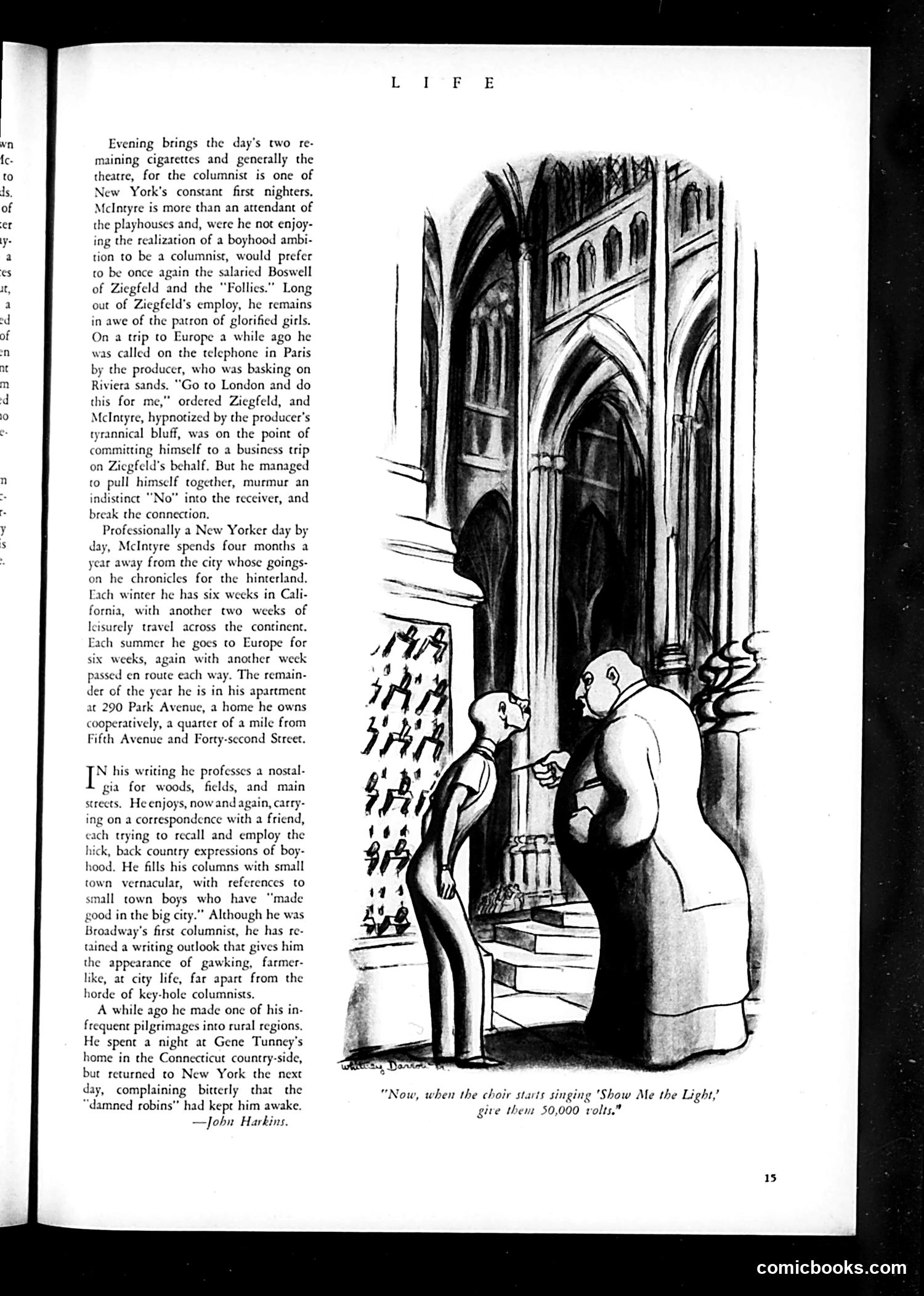
Analysis This page discusses Charles McIntyre, a New York columnist who writes about theatrical life and rural nostalgia. The accompanying cartoon illustrates his work's tone: two figures stand before a Gothic cathedral, with one gesturing toward it. The caption reads: "Now, when the choir start singing 'Show Me the Light,' give them 50,000 volts." The satire: McIntyre's columns romanticize small-town life and countryside simplicity, yet the cartoon's dark humor—suggesting electrocuting a church choir—mocks the gap between his sentimental rural narratives and urban cynicism. The "50,000 volts" joke appears to be satirizing either modern technology's destructive potential or the absurdity of applying urban irreverence to sacred rural traditions. It undercuts McIntyre's nostalgic writing persona with brutal, irreverent wit.
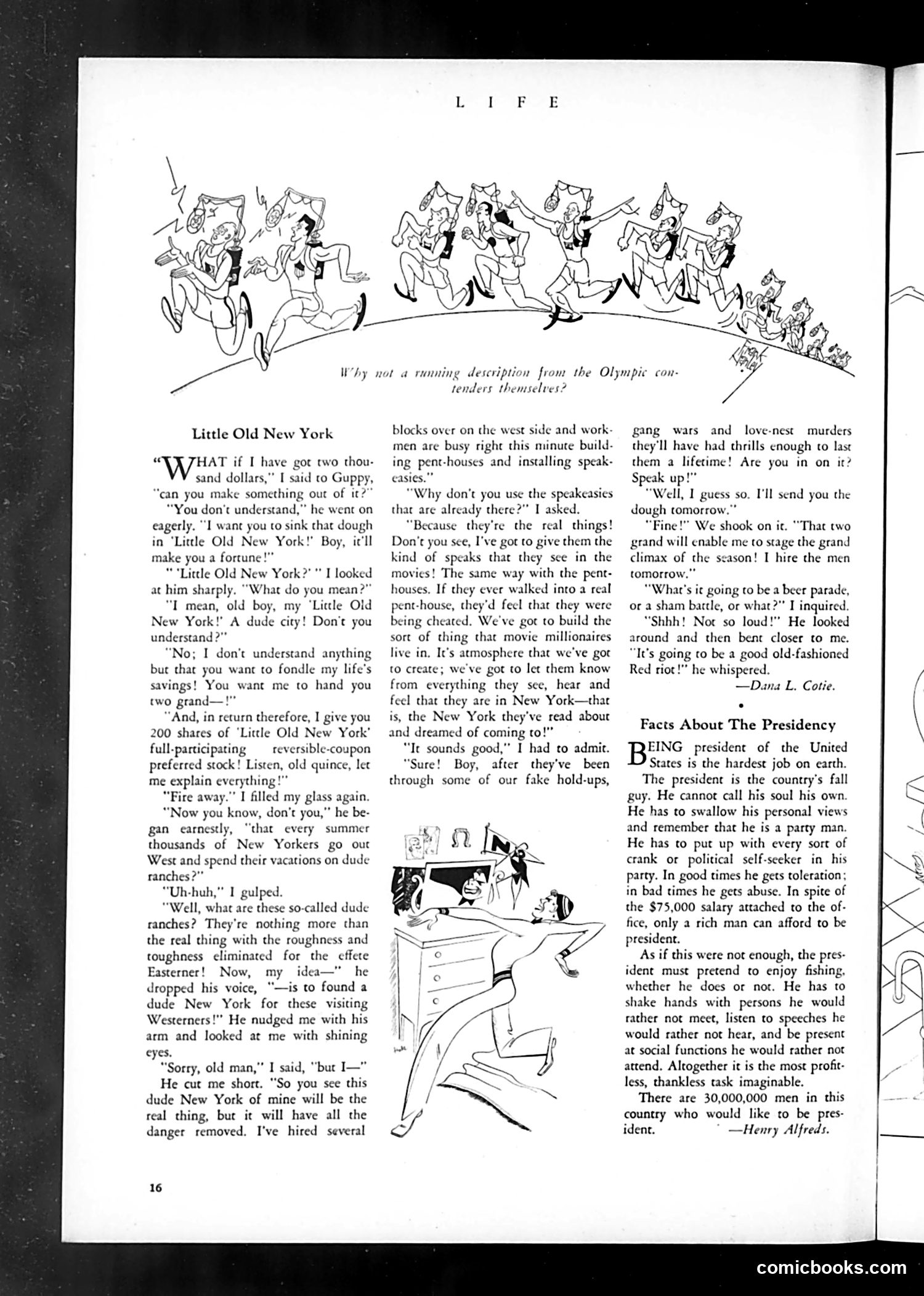
Analysis: "Little Old New York" (Life Magazine Page) This satirical piece mocks the commercialization of New York City's authentic character. A speaker (likely representing a tour guide or developer) brags about constructing fake "dude ranches" and artificial attractions to attract wealthy tourists and investors seeking the "real" New York experience. The humor lies in the paradox: they're selling manufactured authenticity. Instead of preserving actual New York neighborhoods and culture, they're building theatrical props and false "penthouses" designed to feel like genuine local life. The comic implies New York's real appeal is being replaced by commodified imitations for gullible visitors seeking an idealized version of the city. The accompanying cartoon at top shows people racing—likely depicting competition or chaos in New York life itself.
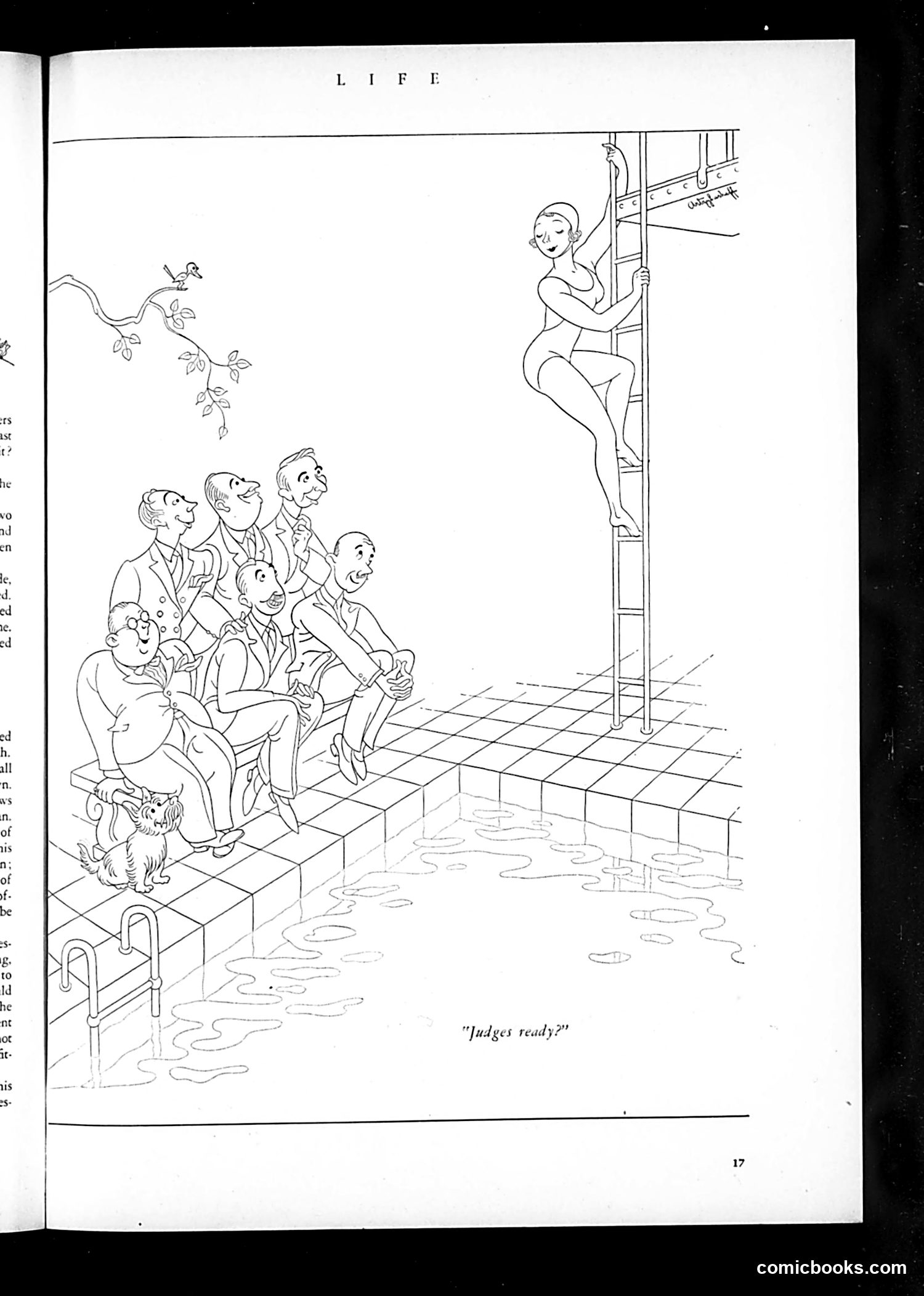
Commentary This cartoon from *Life* magazine satirizes male sexual voyeurism and judgment. A group of men peer at a woman climbing a ladder, with the caption "Judges ready?" The humor relies on the double meaning: the men are literally "judging" her physical appearance as she climbs (likely in a bathing suit, given the era), while the caption suggests they're positioned like judges evaluating a contestant. The cartoon critiques how men reduce women to objects of visual scrutiny, particularly in competitive or public settings. The flooded floor and casual positioning suggest this is an ordinary social scenario where such objectifying behavior is normalized and accepted without question. The satire highlights the casual sexism embedded in everyday interactions.
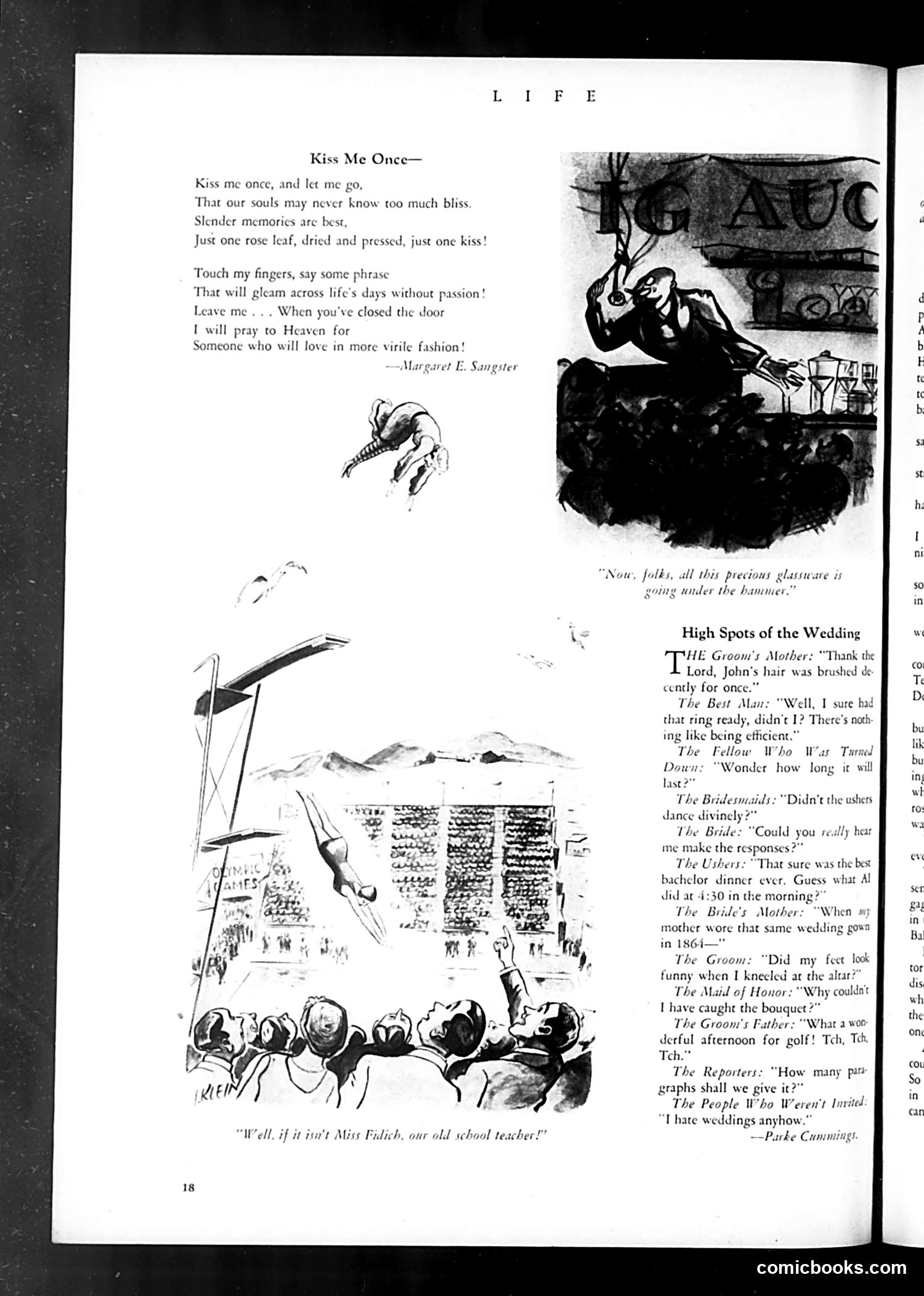
Page Analysis This *Life* magazine page contains satirical humor about weddings. The top features a romantic poem "Kiss Me Once" by Margaret E. Sangster, paired with illustrations of couples in intimate moments. The main cartoon depicts a large aerial view of what appears to be a stadium or massive venue filled with spectators watching acrobats or performers on equipment above. The caption reads: "Well, if it isn't Miss Finch, our old school teacher!" The right section, "High Spots of the Wedding," presents witty dialogue from various wedding party members (groom's mother, best man, bridesmaids, etc.) offering sardonic observations about the ceremony and reception. The satire mocks the spectacle and tedium of weddings—treating them as public performances rather than intimate occasions, and highlighting the self-absorbed or exhausted reactions of attendees.
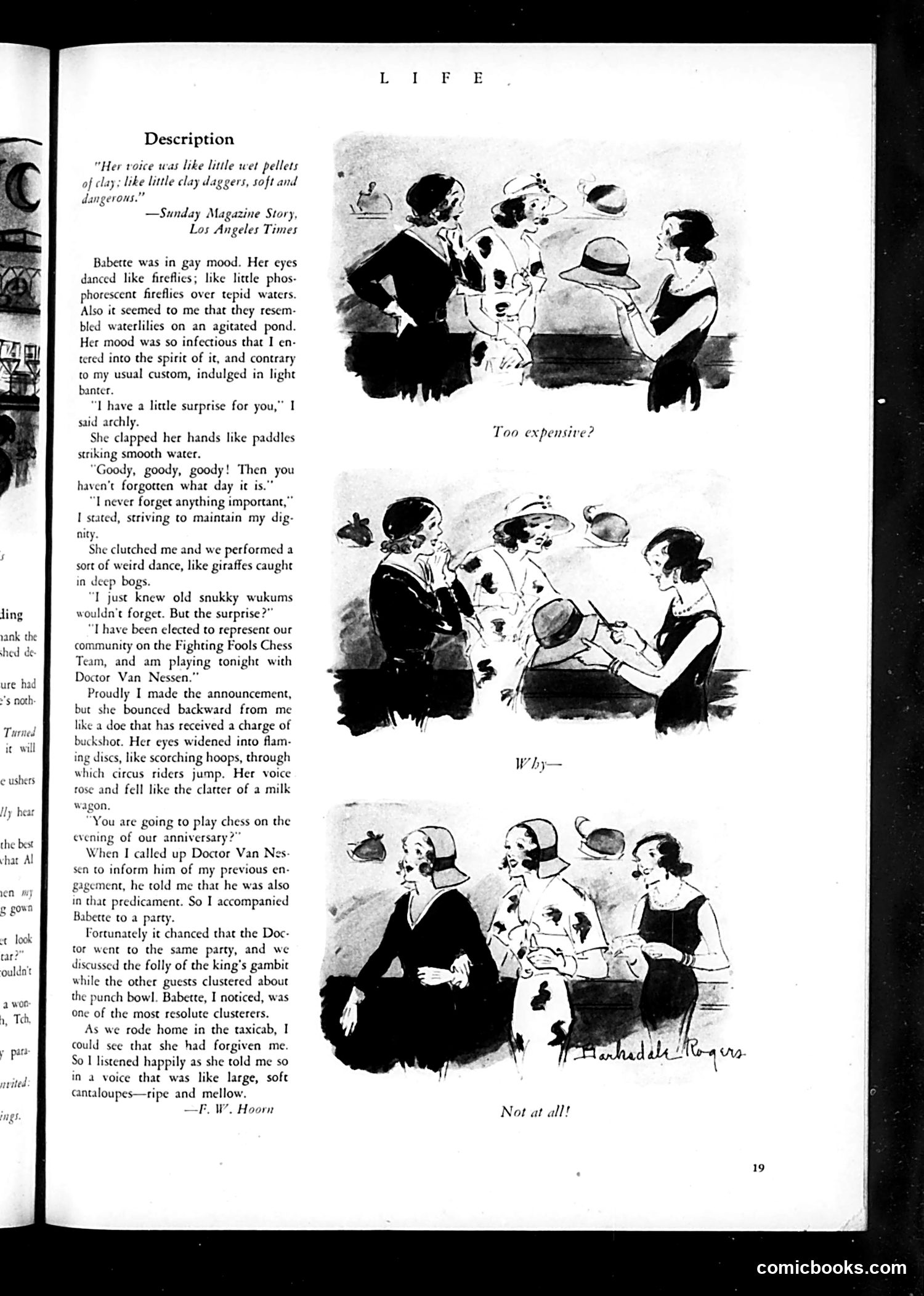
Page Analysis: Life Magazine "Description" This page presents a narrative about "Babette," a woman in gay spirits, paired with three cartoon illustrations by Elisabeth Rogers showing social gatherings of well-dressed women from what appears to be the 1920s-30s era. The text describes Babette's infectious mood and a surprise announcement: she's been selected to play chess on the "Fighting Fools Chess Team" against Doctor Van Nessen. The cartoons depict the social reaction to this news at a party, with women discussing the announcement—their expressions ranging from surprise to skepticism. The captions ("Too expensive?" "Why—" "Not at all!") suggest the humor involves class assumptions about who plays competitive chess. The satire likely mocks social pretensions and assumptions about women's intellectual capabilities or leisure activities during this era.
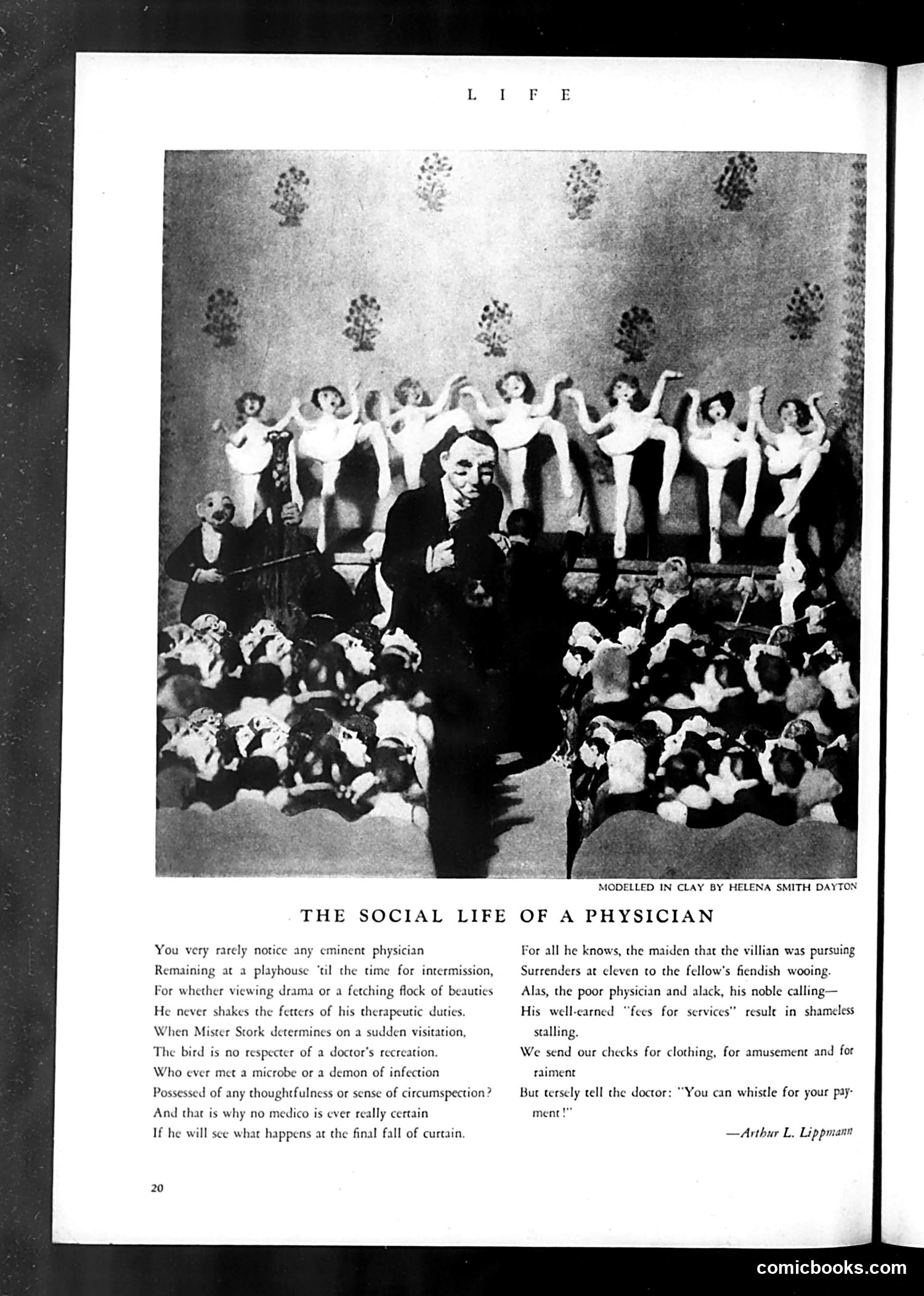
The Social Life of a Physician This satirical poem, illustrated with a clay sculpture by Helena Smith Dayton, mocks the precarious financial and social position of early 20th-century physicians. The humor centers on the contradiction between doctors' essential, unpredictable duties and their inability to collect payment. The joke: physicians cannot enjoy leisure activities—theater, entertainment—because medical emergencies (births, infections) demand immediate attention regardless of timing. Yet despite providing vital services, patients routinely stall on paying medical bills while promptly paying for luxuries like clothing and entertainment. The poem's final punchline—telling the doctor to "whistle for your payment"—captures the social irony: society treats doctors as indispensable yet denies them financial respect. The theatrical illustration (showing a physician amid dramatic scenes and audiences) emphasizes this tension between the doctor's absent social life and constant professional obligation.
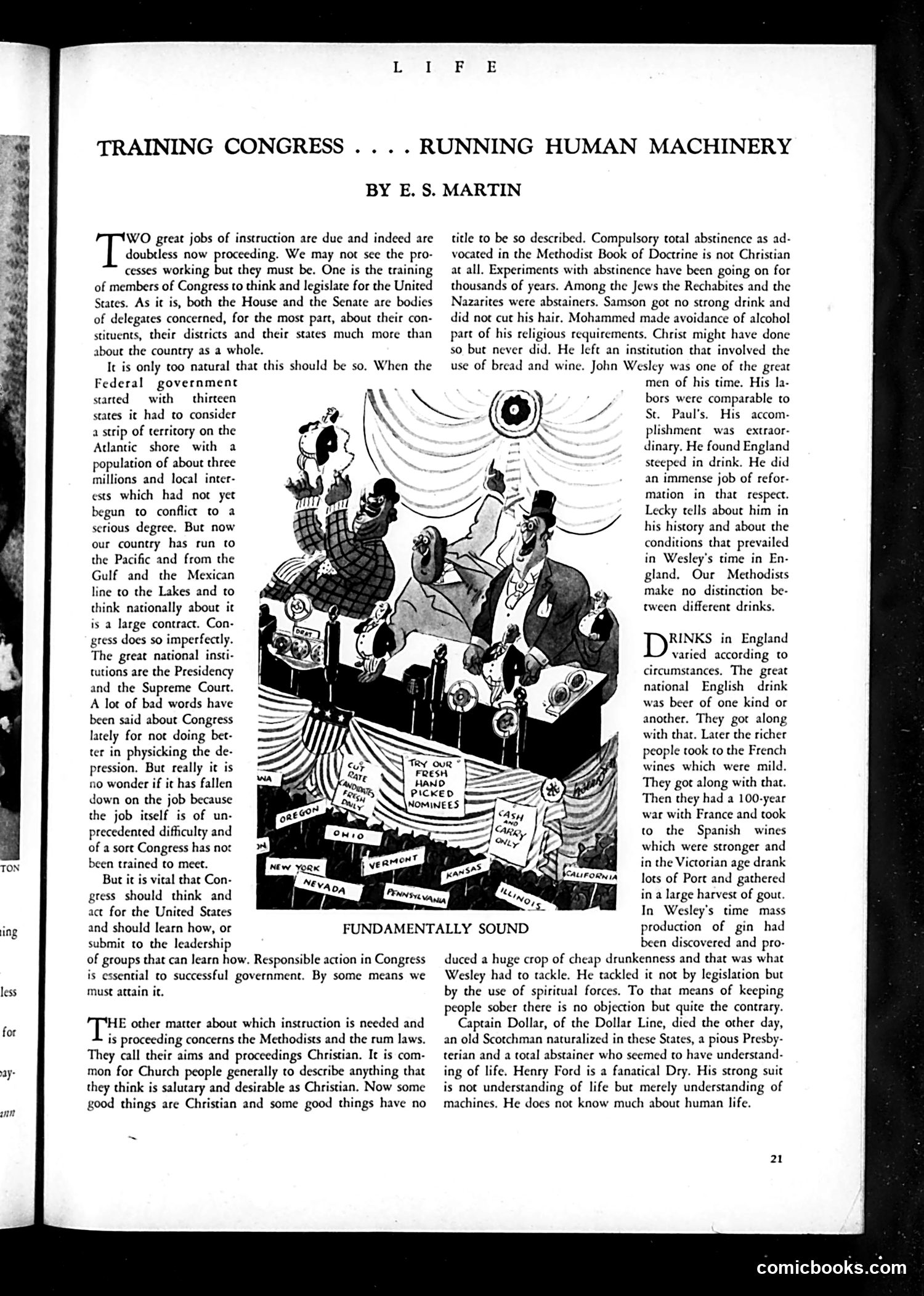
Explanation for Modern Readers This 1920s-30s *Life* magazine article critiques Congress's parochial focus and Methodist prohibition efforts. The cartoon depicts Congress as a vast "machine" with representatives from different states (labeled on the base: New York, Vermont, Nevada, California, etc.) all pulling in different directions—literally "fundamentally unsound." The satire's point: Congress prioritizes state and district interests over national welfare, making coherent governance impossible. Martin argues this structural problem, not laziness, explains Congress's poor depression response. The second section attacks Methodist leaders' conflation of their prohibition agenda with Christian doctrine. Martin argues Christ sanctioned wine, John Wesley tackled *gin* specifically (mass-produced cheap liquor), not all alcohol. Modern Methodists' blanket abstinence position misrepresents both Christianity and Wesley's actual reform—a sophisticated critique of moral overreach dressed as religious principle. Both arguments target institutional rigidity and ideological absolutism preventing effective governance and reform.
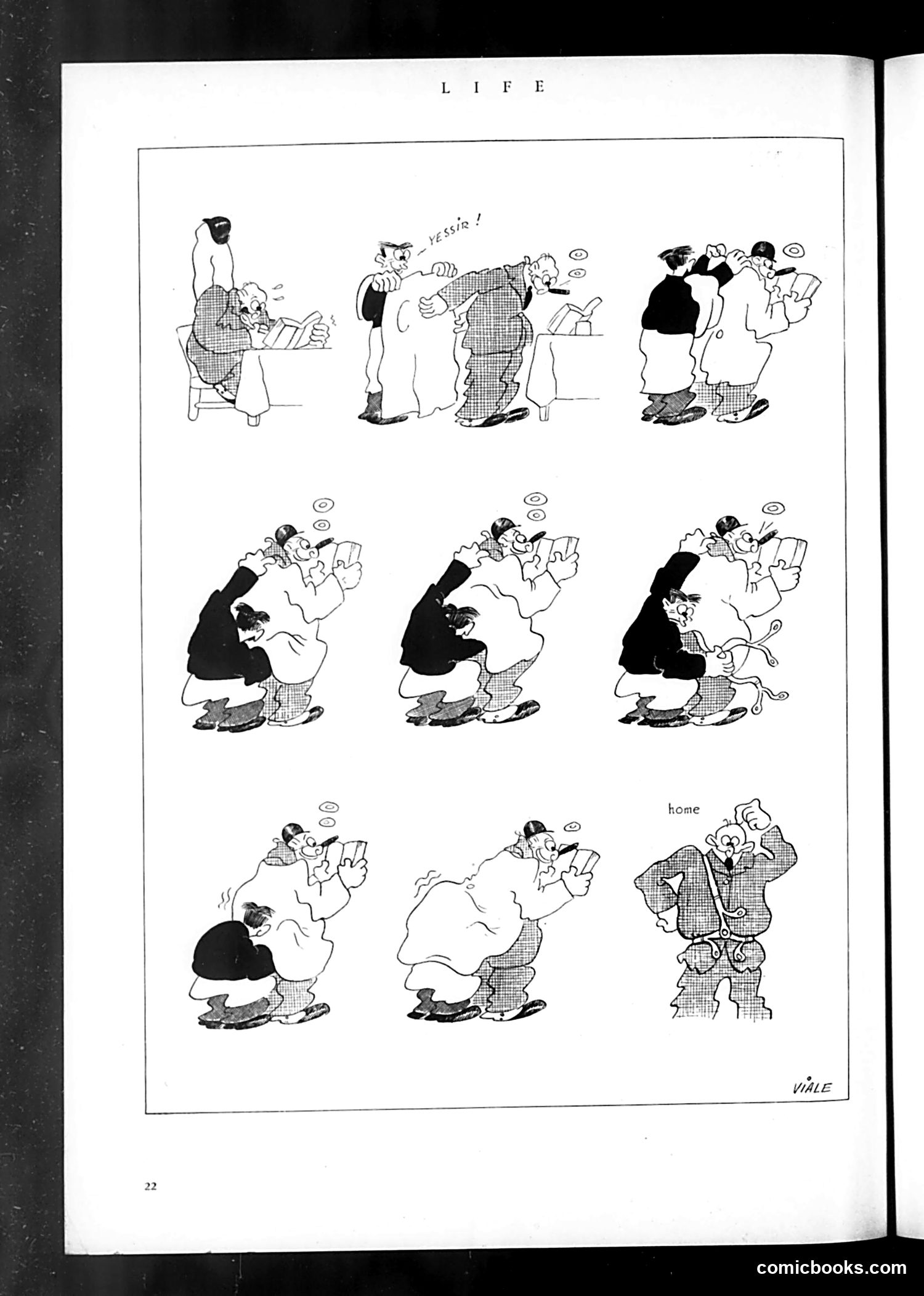
Analysis This is a satirical comic strip by cartoonist Viale titled "Life" depicting what appears to be a social commentary on courtship or romantic pursuit. The sequence shows: 1. Top row: A woman being approached by a man saying "YESSIR!" while others observe 2. Middle and bottom rows: The man progressively positions himself closer to the woman in increasingly intimate poses The strip appears to satirize aggressive romantic or sexual pursuit—showing how a man's behavior escalates from initial interest to increasingly forward physical contact. The woman's passivity throughout suggests commentary on either female acquiescence or the inevitability of male persistence. The final panel labeled "home" may imply the relationship's outcome or destination. Without additional context about the publication date, the specific social norms being critiqued remain unclear, though it likely comments on dating customs or gender dynamics of its era.
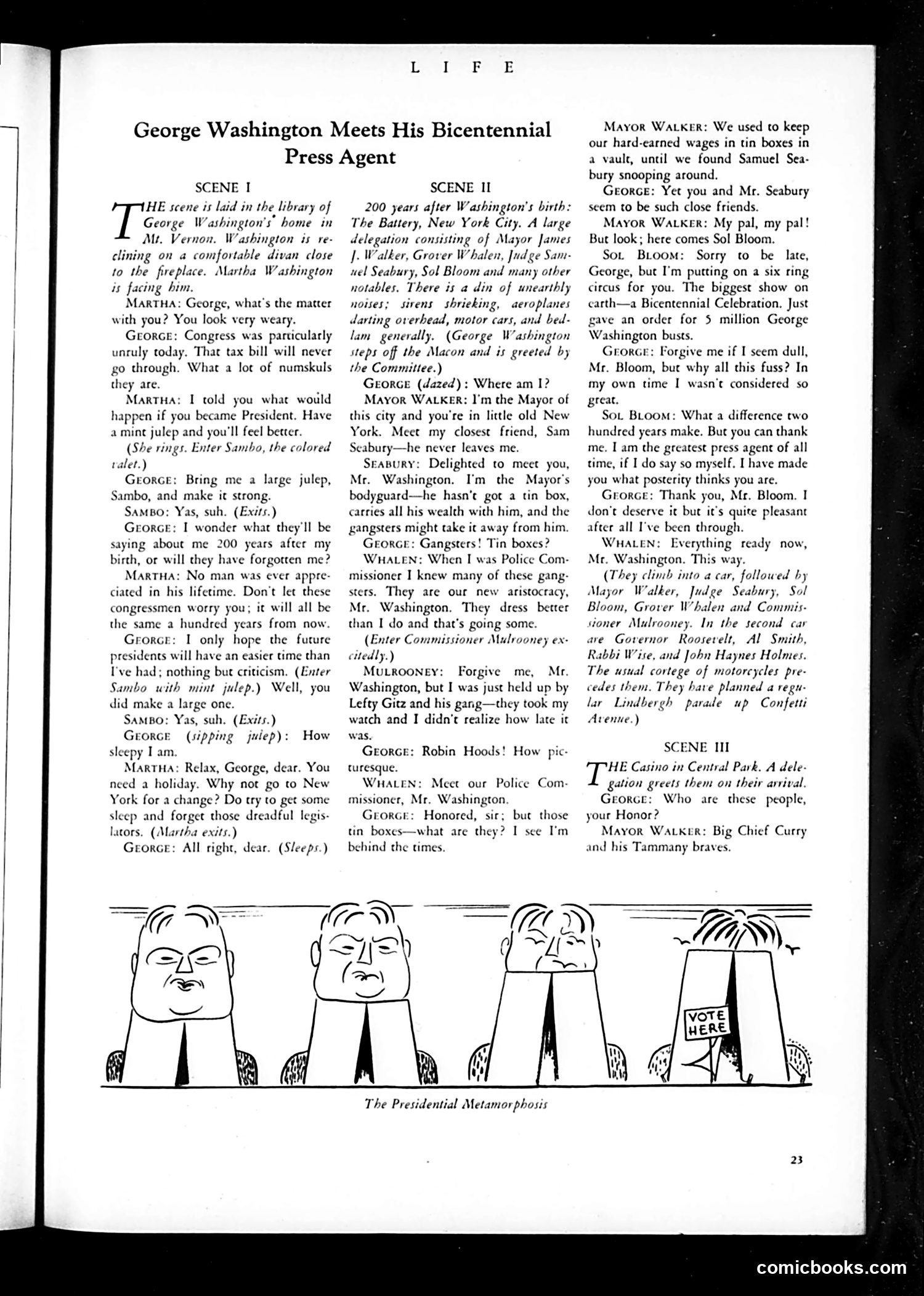
"George Washington Meets His Bicentennial Press Agent" This satirical sketch mocks 1920s New York politics through a time-travel fantasy. George Washington awakens 200 years later to find his legacy managed by New York's corrupt political establishment. Key figures satirized: - Mayor James J. Walker and Grover Whalen (actual NYC officials) - Judge Samuel Seabury (appearing as the mayor's bodyguard/enabler—Seabury was famous for investigating NYC corruption) - Sol Bloom (congressman, here as a shameless self-promoter) The satire: The sketch ridicules: - Corruption (tin boxes hiding money from investigators) - Organized crime treated as respectable ("new aristocracy") - Commercialism (5 million Washington busts sold as spectacle) - Political theater replacing genuine governance - Modern press agents manufacturing historical importance Washington's bewilderment at finding gangsters, bribery, and exploitation normalized as progress satirizes how far 1920s American democracy had allegedly fallen from its founding ideals. The cartoon below shows presidential "metamorphosis"—suggesting leaders physically transform into vote-seeking mouths.
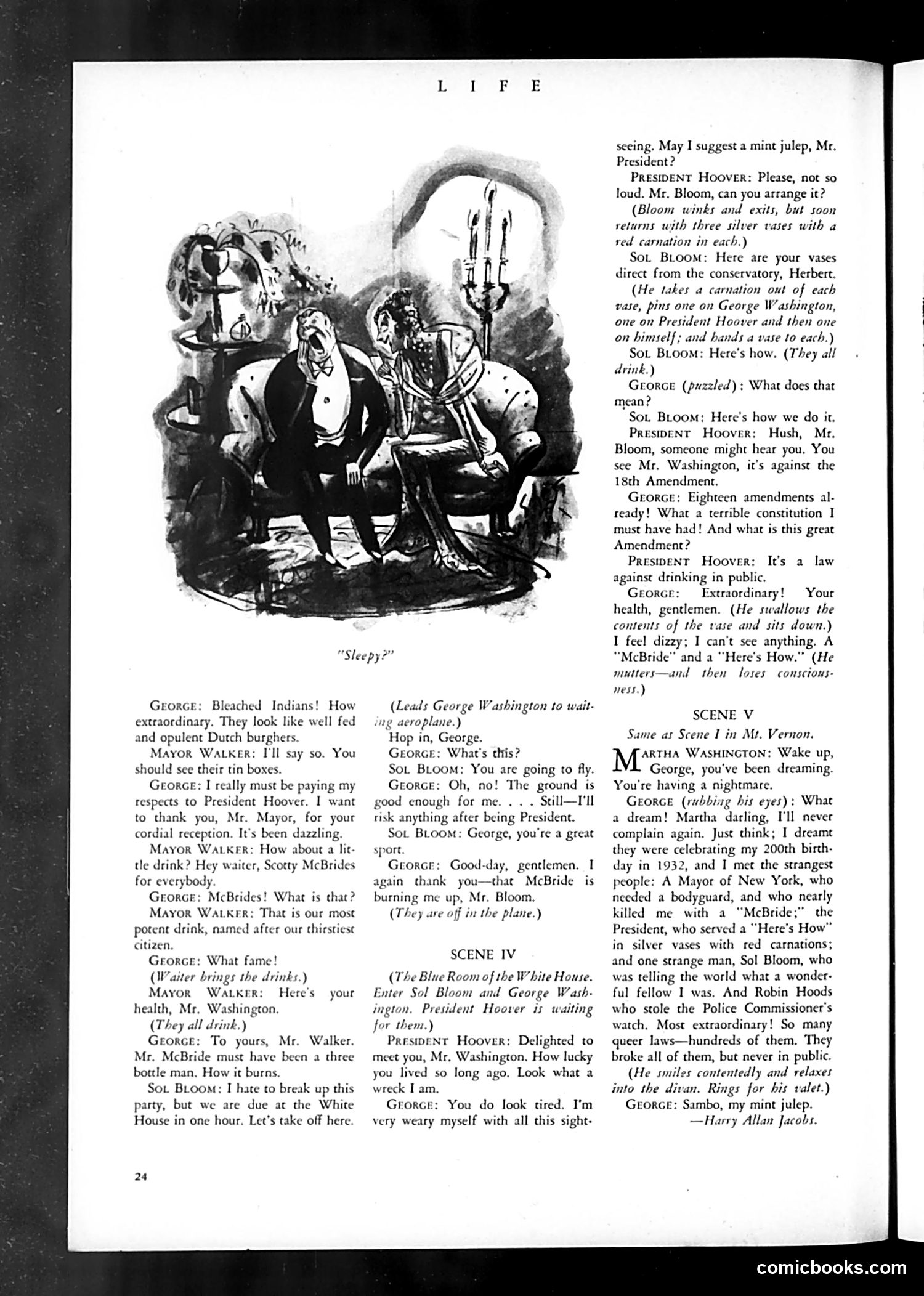
Life Magazine Satire: "George Washington's 1932 Dream" This satirical piece mocks Prohibition-era hypocrisy. George Washington is mysteriously revived to celebrate his 200th birthday in 1932, where he encounters corrupt officials openly violating the 18th Amendment (alcohol ban). The humor centers on the gap between law and practice: Mayor Walker (likely Jimmy Walker of NYC, known for corruption), President Hoover, and Sol Bloom (a real congressman) secretly serve alcohol in flower vases while claiming it's illegal to drink "in public." They break the law constantly yet maintain pretense of legality. The satire targets how Prohibition, theoretically strictly enforced, was routinely circumvented by those in power who faced no consequences. Washington's confusion—that "eighteen amendments" exist and finding this "terrible constitution"—underscores how absurd the situation appears to an outsider. The dream-within-a-story frame suggests the scenario is too ridiculous to be real, yet everyone recognizes it as accurate commentary on 1920s-30s American corruption and selective law enforcement.
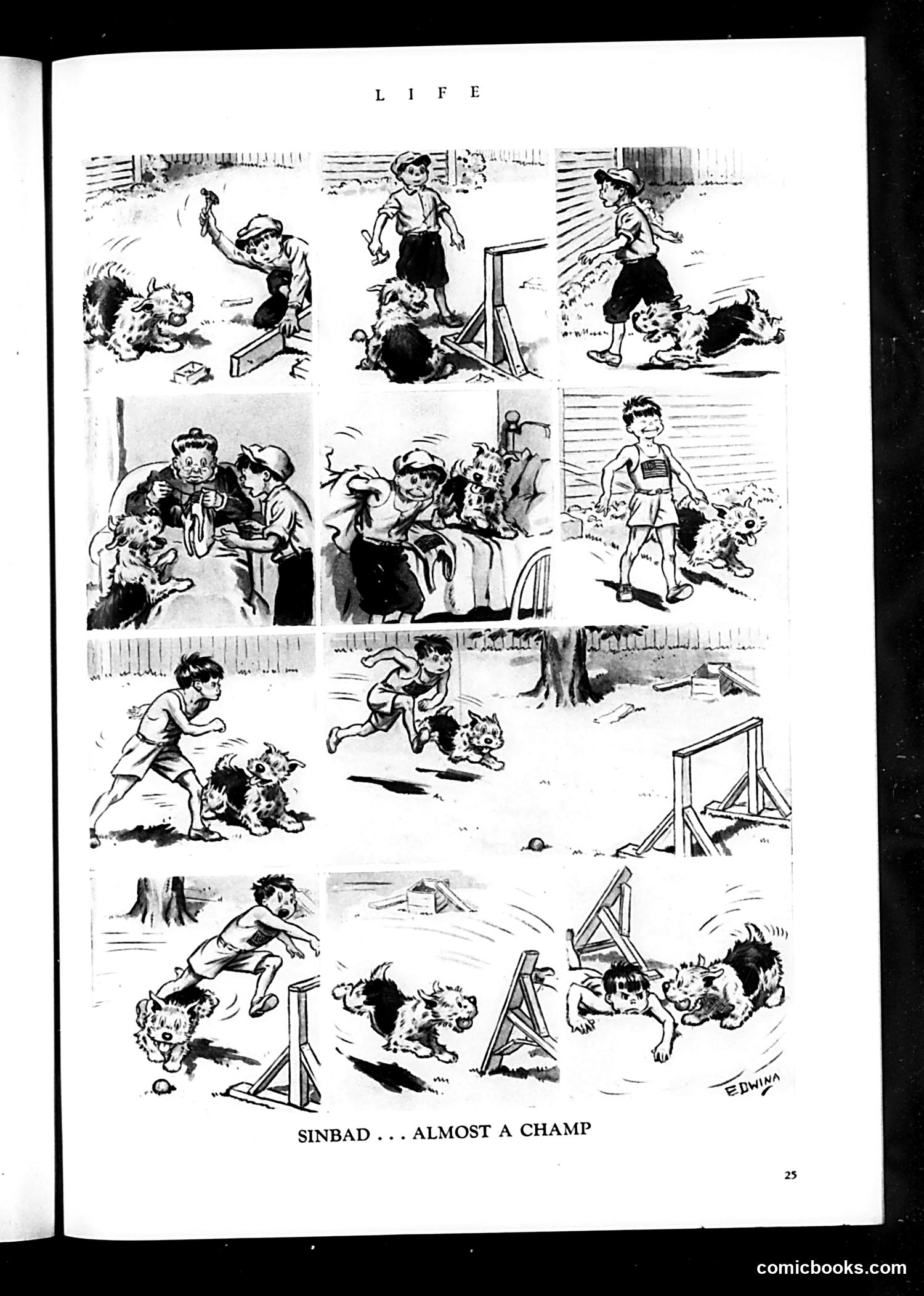
"Sinbad... Almost a Champ" This is a humorous comic strip about a scrappy dog named Sinbad attempting various athletic competitions. The title's punchline—"Almost a Champ"—refers to the dog's repeated near-misses and failures throughout the sequence of panels. The strip shows Sinbad competing in what appear to be children's outdoor games and sports: jumping, racing, using playground equipment like seesaws and swings. In each scene, the small dog comes close to winning or succeeding but comically fails at the last moment—falling, getting knocked down, or being outperformed by rival dogs. The humor relies on the relatable underdog narrative: an enthusiastic but physically outmatched competitor who tries hard yet consistently falls just short of victory. This was a common comic trope appealing to readers who sympathized with underdogs.
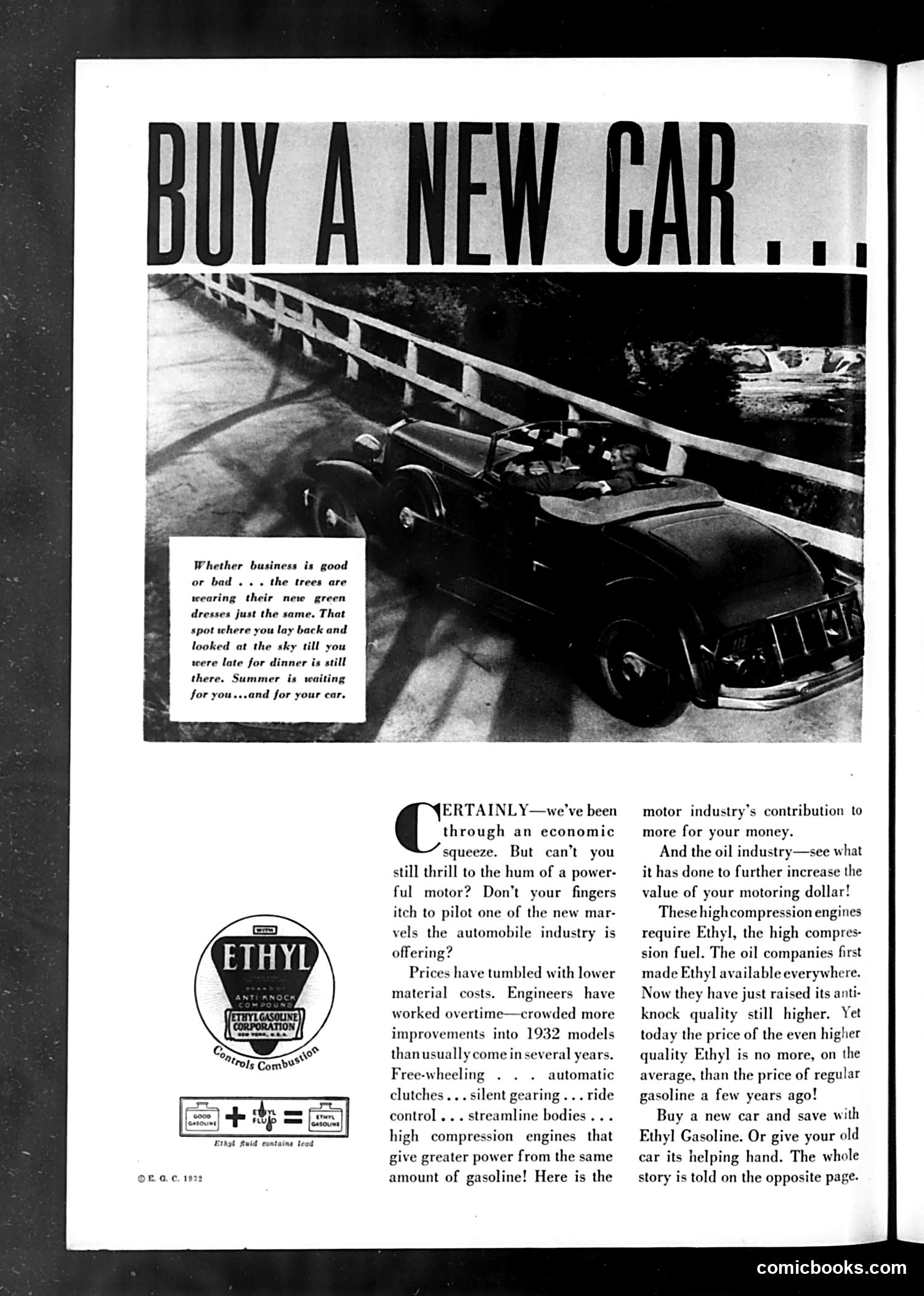
Analysis This is advertising content, not satire or political commentary. The page promotes buying new automobiles and Ethyl gasoline during the Great Depression (1932, based on the text). The pitch exploits economic hardship: acknowledging "we've been through an economic squeeze," it then argues that despite financial struggles, consumers should purchase new cars because prices have dropped and engineering improvements justify the expense. The promotional text emphasizes features like "free-wheeling," "automatic clutches," and "streamline bodies." The accompanying Ethyl gasoline advertisement claims that high-compression engines require their premium fuel, positioning Ethyl as a necessary upgrade—while insisting its price hasn't actually increased relative to regular gasoline years prior. The scenic photograph of a car on a scenic road and poetic language ("trees are wearing their new green dresses") serve emotional appeal rather than rational argument, a common advertising strategy of the era.
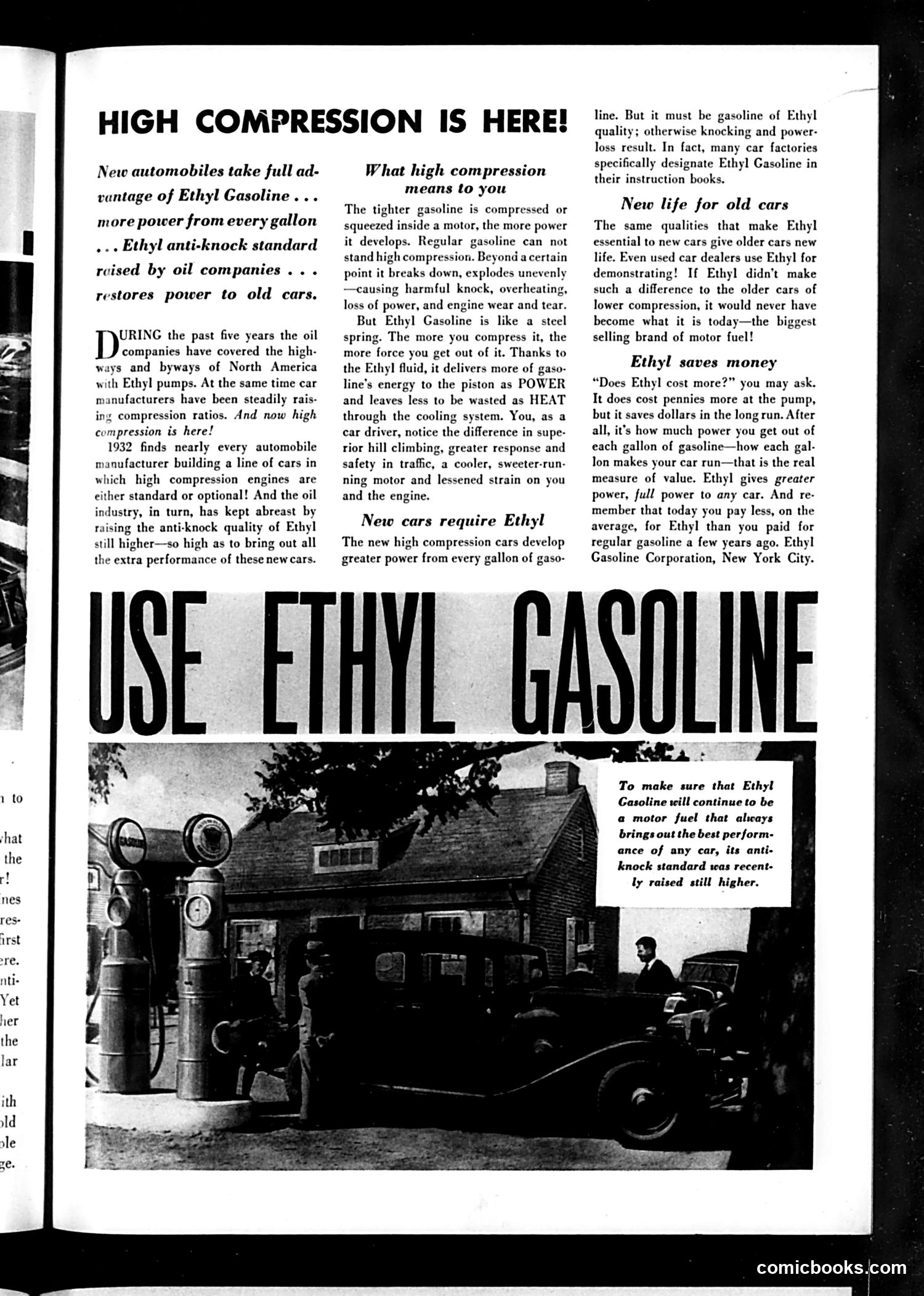
Analysis: Ethyl Gasoline Advertisement This is a commercial advertisement, not satire or political commentary. It's a 1932 promotional piece for Ethyl Gasoline by the Ethyl Gasoline Corporation. The pitch: Ethyl brand gasoline contains anti-knock additives that allow higher engine compression ratios—delivering more power per gallon than regular gasoline. The ad emphasizes that new 1932 automobile models require this fuel to perform properly. Key claims for modern readers: - "High compression" refers to engine efficiency technology - Ethyl prevents engine "knock" (pre-ignition that damages engines) - The product costs slightly more but delivers better fuel economy and performance - Even older cars benefit from using it The image shows a gas station scene with a car being fueled, illustrating the product's availability. This reflects early-1930s automotive advancement: manufacturers were rapidly increasing engine compression ratios, and Ethyl's tetraethyl lead additive was the solution—though its serious health consequences wouldn't be widely acknowledged for decades.
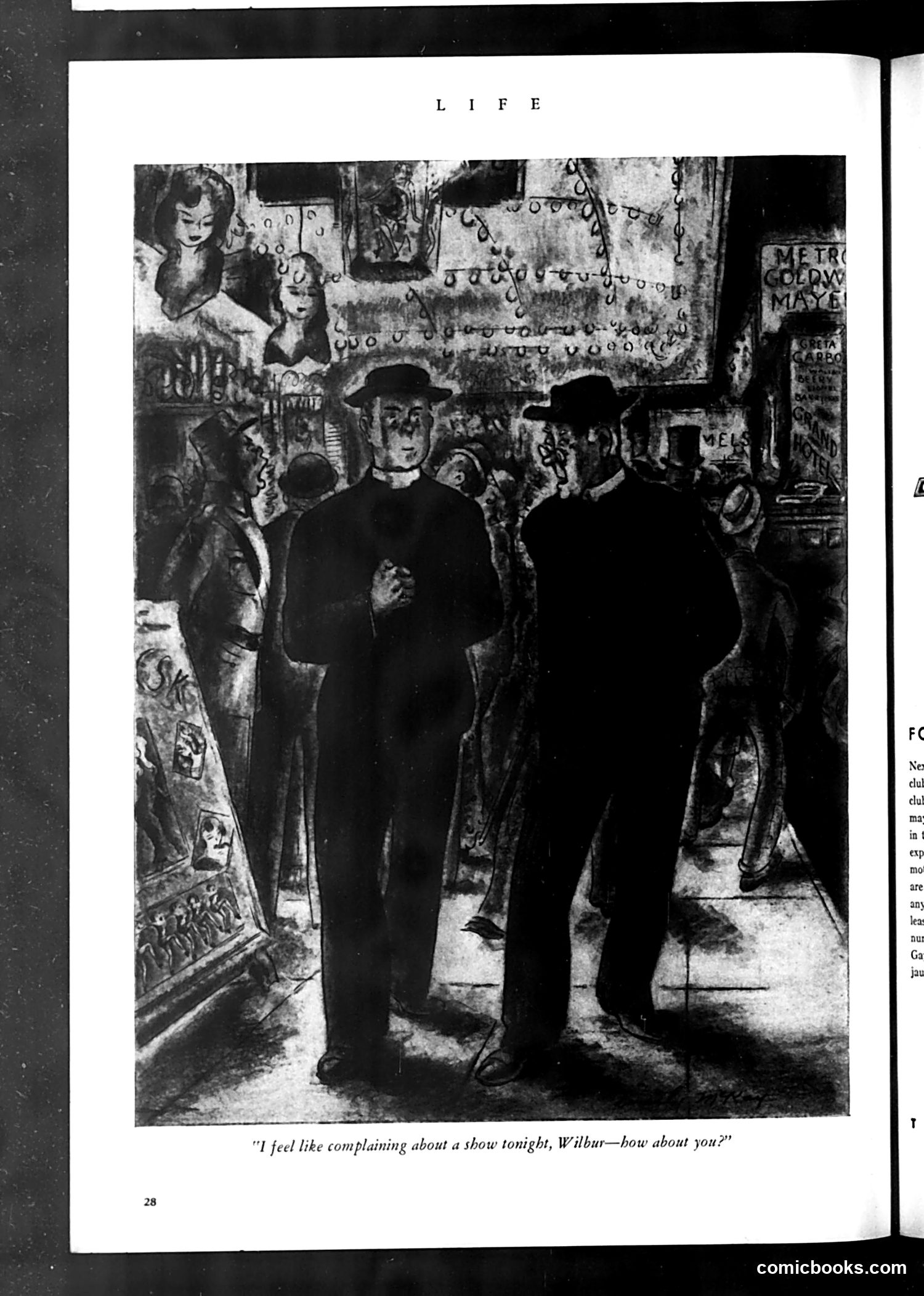
Life Magazine Page - Theater Scene Satire This appears to be a scene from a theatrical or entertainment venue, likely from the early-to-mid 20th century. Two men in dark suits and hats stand in the foreground amid what looks like backstage or lobby chaos—visible are performers, posters, and decorative elements suggesting a show or nightclub setting. The caption reads: *"I feel like complaining about a show tonight, Wilbur—how about you?"* The satire appears to target the pretentious or performative nature of theatrical complaint—the implication being that these two men are posturing about criticizing entertainment, perhaps suggesting that complaining about shows was a common social affectation among certain crowds. The crowded, chaotic scene around them emphasizes the absurdity of their formal complaint amid the actual theatrical mayhem.
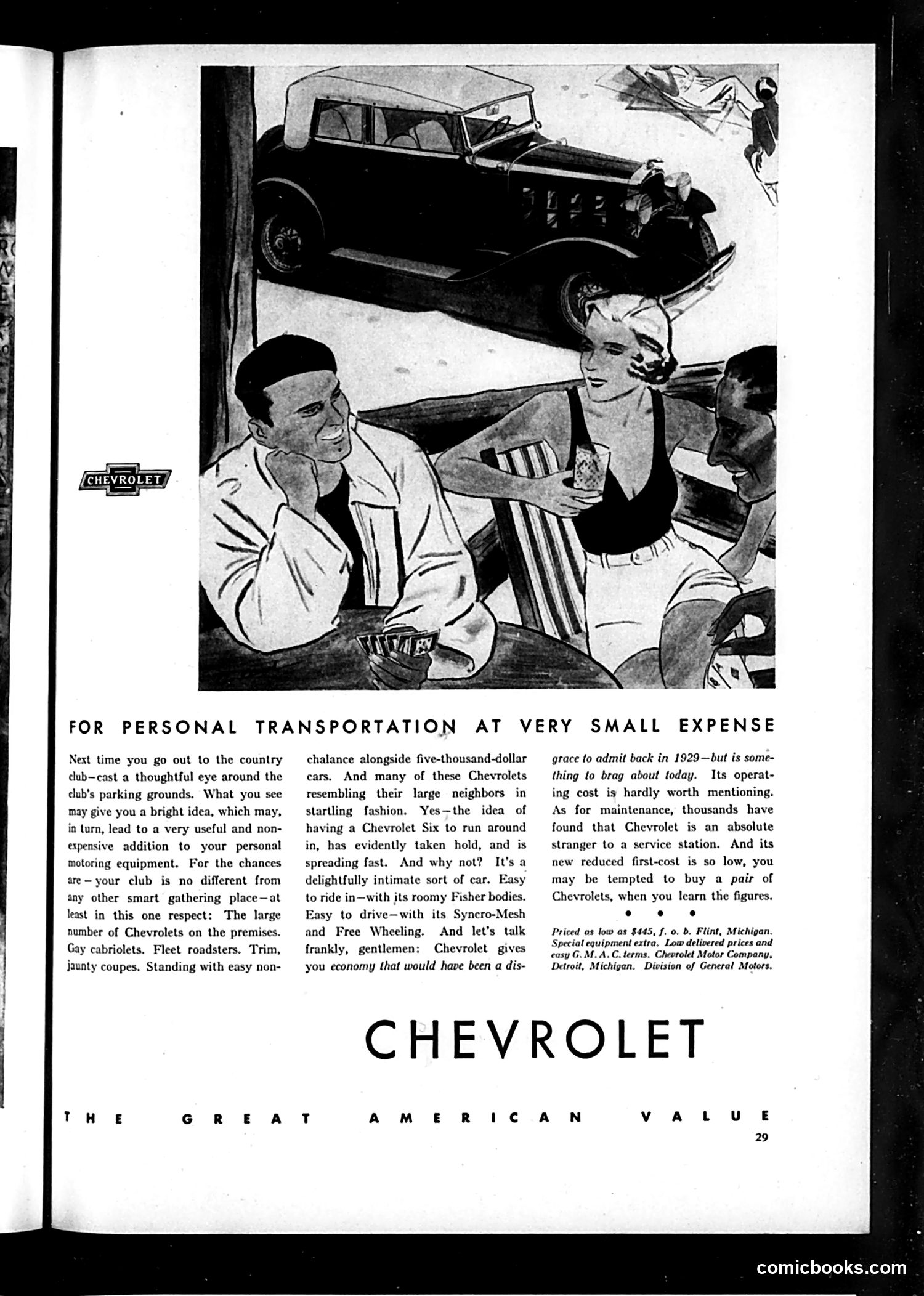
Analysis This is a Chevrolet advertisement, not a political cartoon. The page promotes the Chevrolet Six automobile to Depression-era consumers. The ad uses social observation as its hook: it notes that country clubs' parking lots are filled with Chevrolets parked alongside expensive cars—suggesting Chevrolet owners enjoy equal status. The illustration shows well-dressed people socializing, implying that owning a Chevrolet doesn't mark you as lower-class. The sales pitch emphasizes economy (operating costs "hardly worth mentioning"), reliability ("stranger to a service station"), and affordability (priced as low as $445). The reference to 1929—the crash year—highlights how far automotive efficiency has come. For modern readers: this reflects 1930s marketing strategy during economic hardship, selling respectability and value to middle-class aspirants who couldn't afford luxury cars but wanted to appear prosperous at social venues.
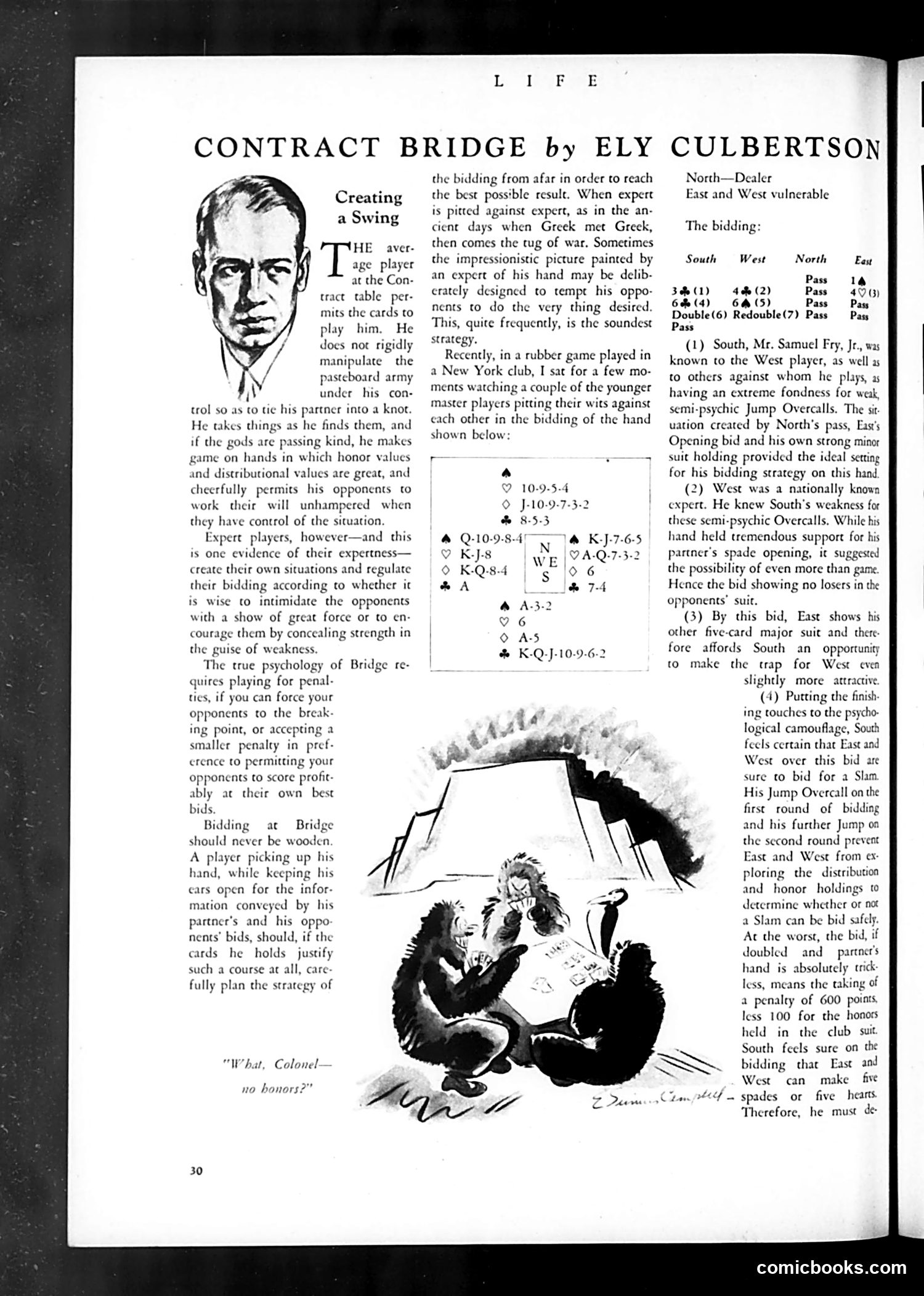
Contract Bridge Strategy by Ely Culbertson This page explains expert Contract Bridge bidding psychology through a hand dealt at a New York club. The cartoon illustrates players engaged in competitive bidding strategy. The article demonstrates how experienced players manipulate opponents through psychological tactics. South (Mr. Samuel Fry Jr.) is known for weak, semi-psychic Jump Overcalls—intentionally misleading bids designed to deceive opponents about hand strength. West, a nationally-known expert, recognizes this pattern but cannot safely determine whether a Slam is makeable because South's deceptive bids obscure the actual distribution of honors. The satire critiques the mental warfare in high-level bridge: expert players deliberately create false impressions—appearing weak when strong, or vice versa—to force opponents into bad decisions. The cartoon's caption ("What, Colonel—no honors?") humorously captures this deception. The article argues this psychological manipulation is legitimate "sound strategy," not cheating, revealing bridge's evolution from a card game to a battle of wits.
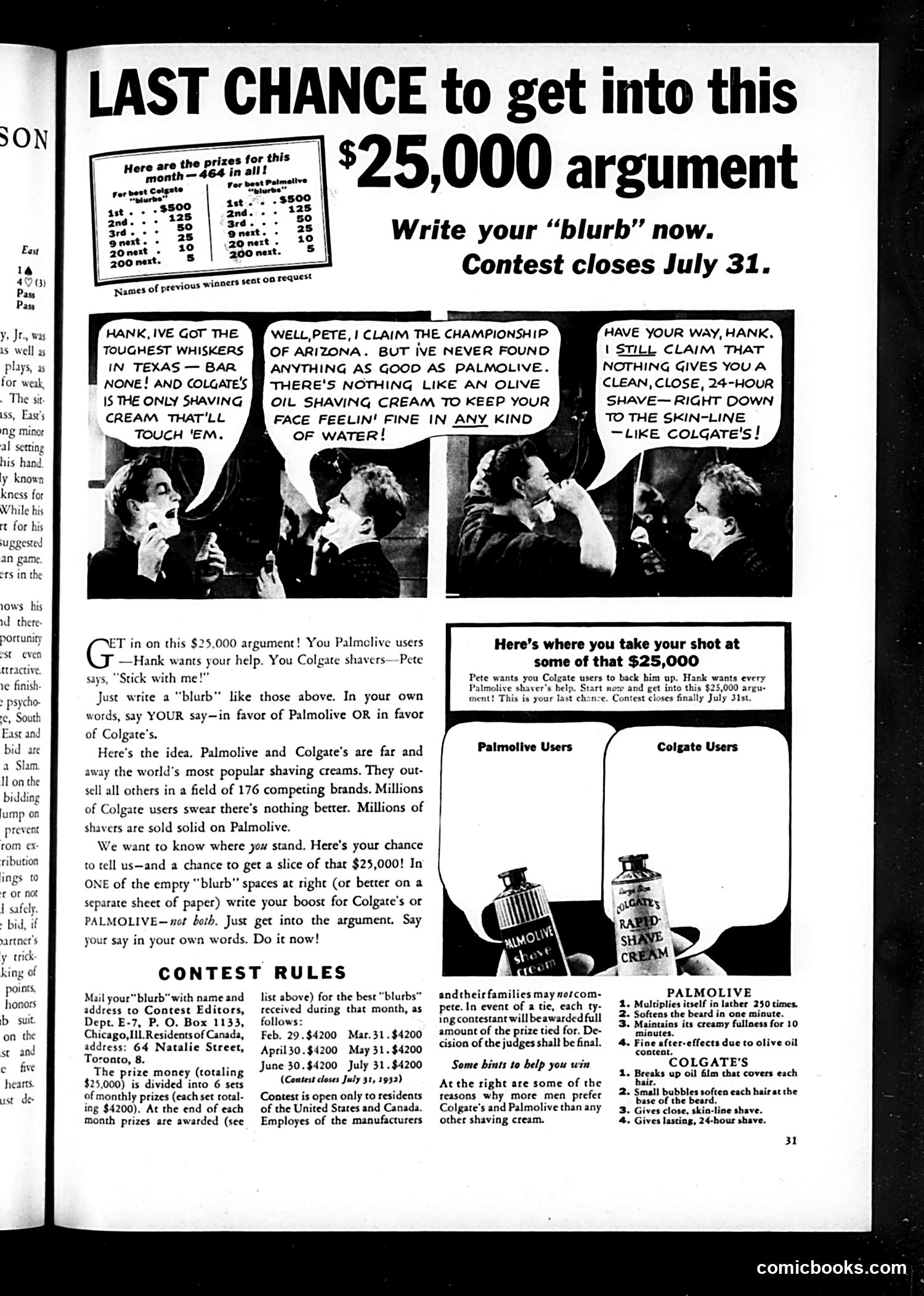
Analysis of Life Magazine Advertisement/Contest Page This page is primarily a shaving cream advertisement and contest, not political satire. It features a humorous argument between two fictional characters—Hank (representing Palmolive) and Pete (representing Colgate's)—debating which shaving cream is superior. The cartoon depicts them as barbers or shaving enthusiasts making exaggerated claims: Hank boasts about Palmolive's toughness and olive oil benefits; Pete counters that Colgate's provides the closest, cleanest shave. The visual joke relies on their passionate, over-the-top arguing about a mundane consumer product. The contest incentivizes readers to write persuasive "blurbs" endorsing either brand, with $25,000 in prizes distributed monthly. This was a common mid-20th-century marketing strategy: turning product preference into entertaining consumer participation. The page reflects the era's advertising approach—using humor and competition to engage consumers in brand loyalty debates.
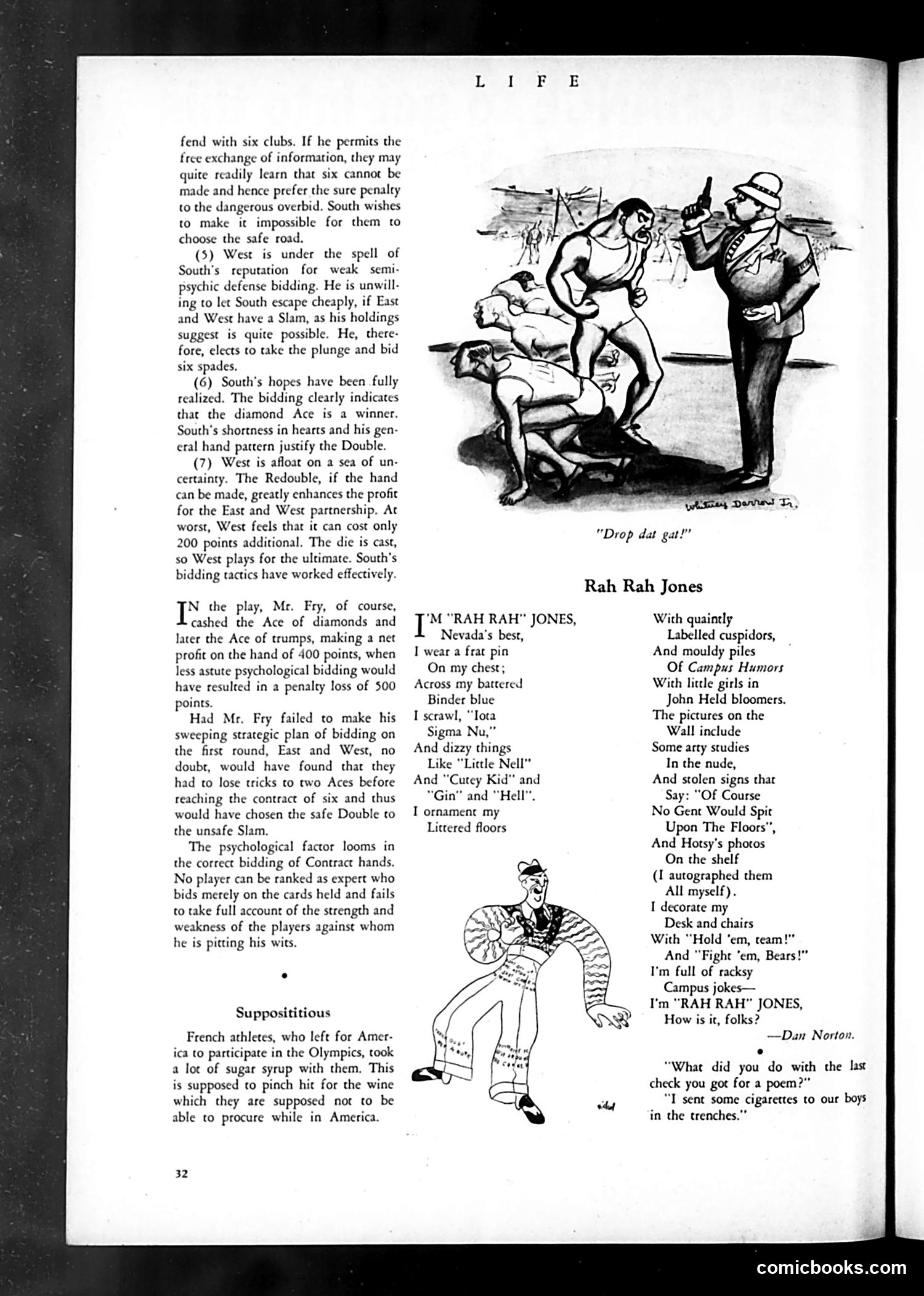
Explanation for Modern Readers This Life magazine page contains two distinct pieces: The Bridge Analysis (top): Technical discussion of contract bridge strategy and psychology—unrelated to satire or humor. It analyzes how skilled bidding can manipulate opponents' decisions. "Rah Rah Jones" (bottom): A satirical poem and illustration mocking the stereotypical college fraternity boy of the 1920s era. The caricature depicts a student obsessed with Greek life (Sigma Nu fraternity pin), displaying juvenile decoration (stolen street signs, pinup photos he "autographed himself"), and surrounding himself with dated campus humor magazines. The illustration shows him in period dress with exaggerated features. The satire targets the vapid, self-absorbed nature of college social culture—the performative masculinity, petty rule-breaking, and shallow priorities. The final dialogue joke references WWI ("boys in the trenches"), suggesting the poet's trivial campus concerns contrast sharply with soldiers' actual suffering, adding a layer of social criticism about misplaced values during wartime.
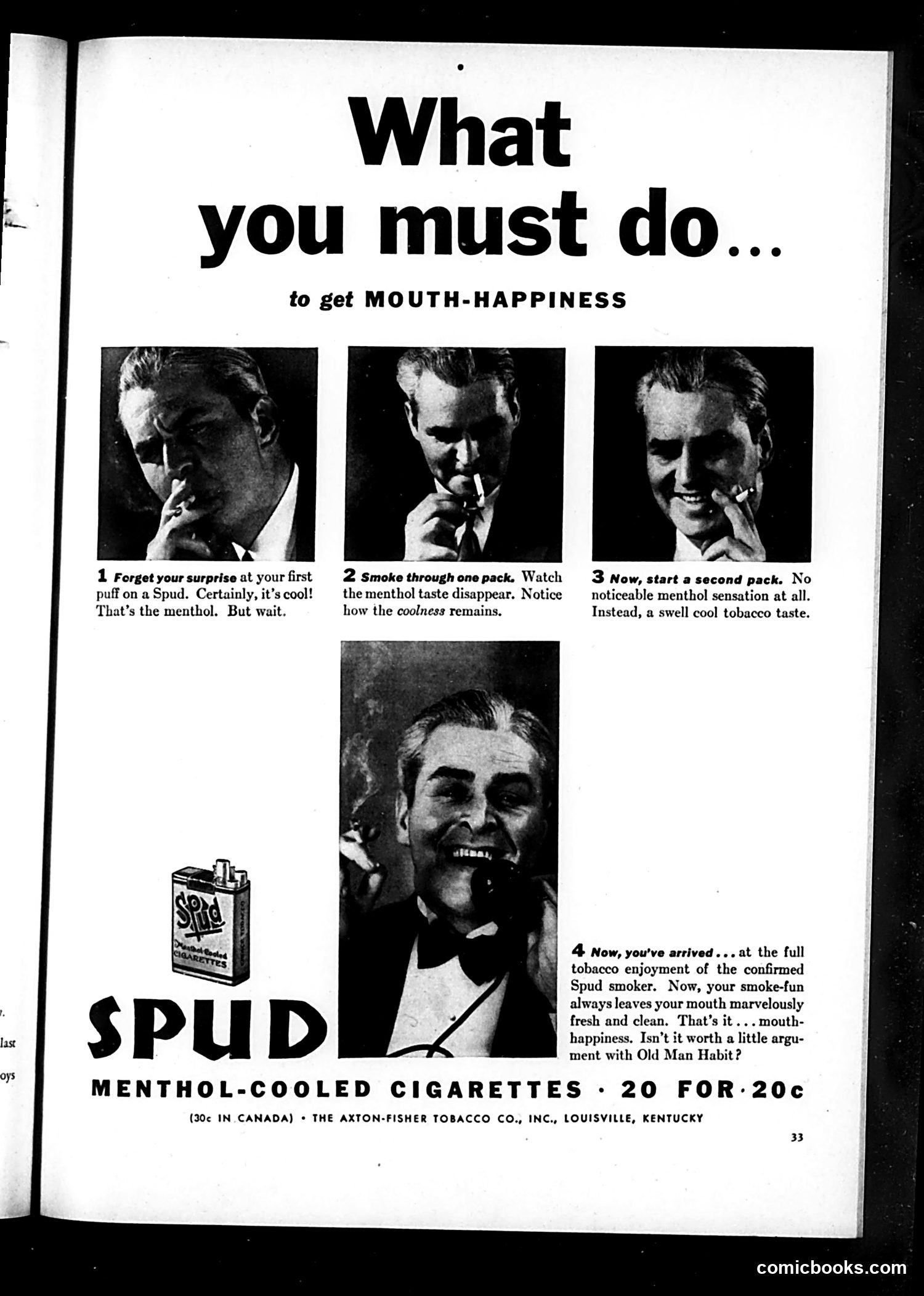
Spud Cigarettes Advertisement This is a straightforward cigarette advertisement, not satire or political commentary. It promotes Spud menthol-cooled cigarettes (20 for 20 cents) through a four-step progression showing a man gradually acclimating to the product. The ad's "logic" describes how smokers should ignore their initial surprise at the menthol flavor, smoke through an entire pack to let the taste fade, then continue to a second pack until they no longer notice menthol—finally arriving at "mouth-happiness" and considering the habit change worthwhile. Modern readers will recognize this as darkly ironic: the ad essentially instructs people to overcome their body's natural rejection response to an unfamiliar product through repeated consumption—a technique common in mid-century tobacco marketing before health warnings were required. The casual tone about "arguing with Old Man Habit" treats nicotine addiction as a minor lifestyle choice rather than a serious health concern.
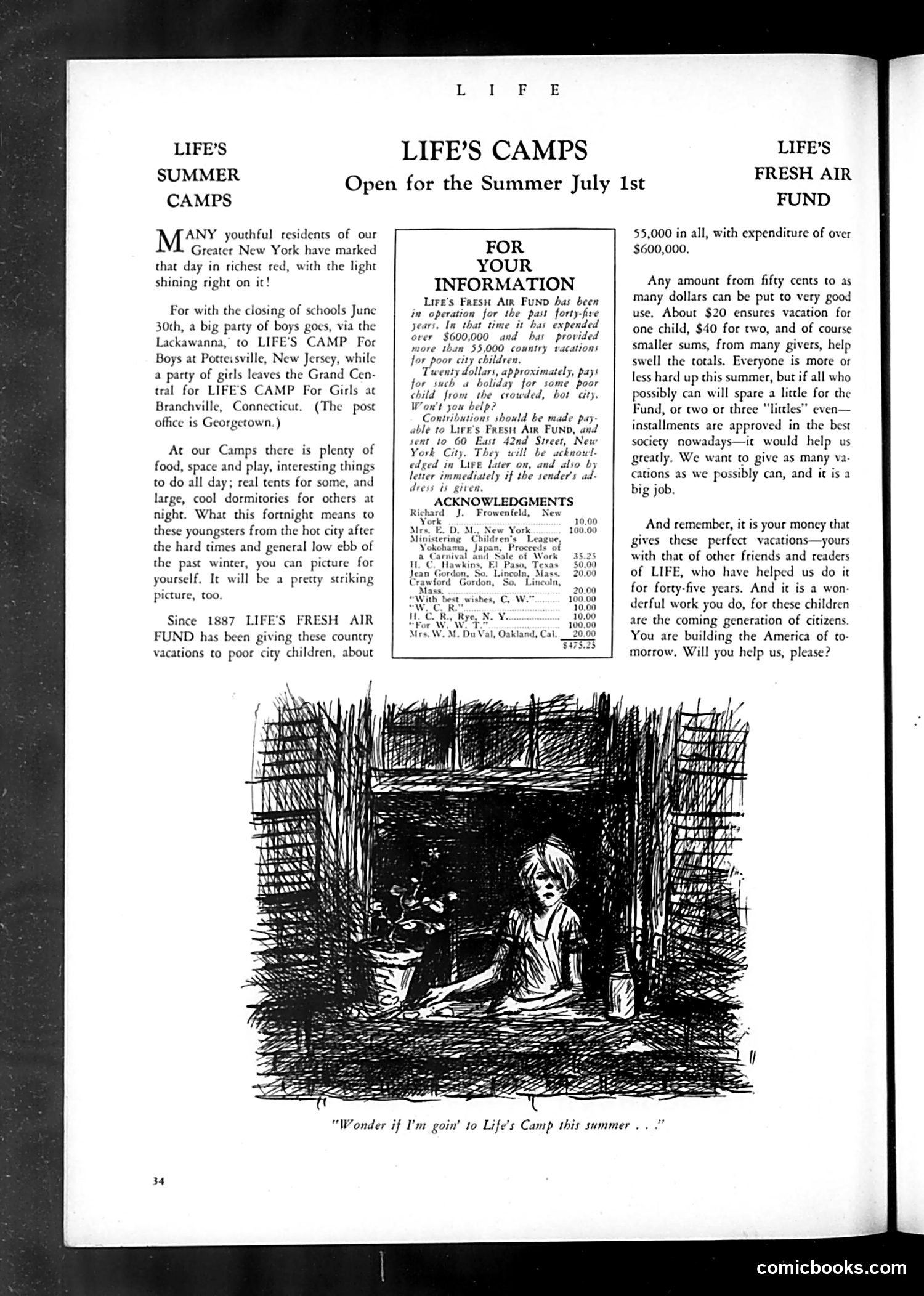
Life Magazine's Fresh Air Fund Appeal This page promotes Life magazine's Fresh Air Fund, a charitable program (operating since 1887) that provided summer camp vacations for poor children from New York City. The fund had spent over $600,000 helping approximately 53,000 children escape urban heat and crowding. The sketch depicts a poor city child looking out a tenement window, wondering if he'll attend camp—visualizing the hope the fund offered working-class families. The appeal emphasizes that modest donations ($20 could fund one child's vacation) build "the America of tomorrow" by improving these children's lives and health. This represents Progressive-era charity work, reflecting early 20th-century concerns about urban poverty and the belief that middle-class readers had a moral obligation to help disadvantaged youth. The tone combines sentiment with practical fundraising, asking readers to contribute.
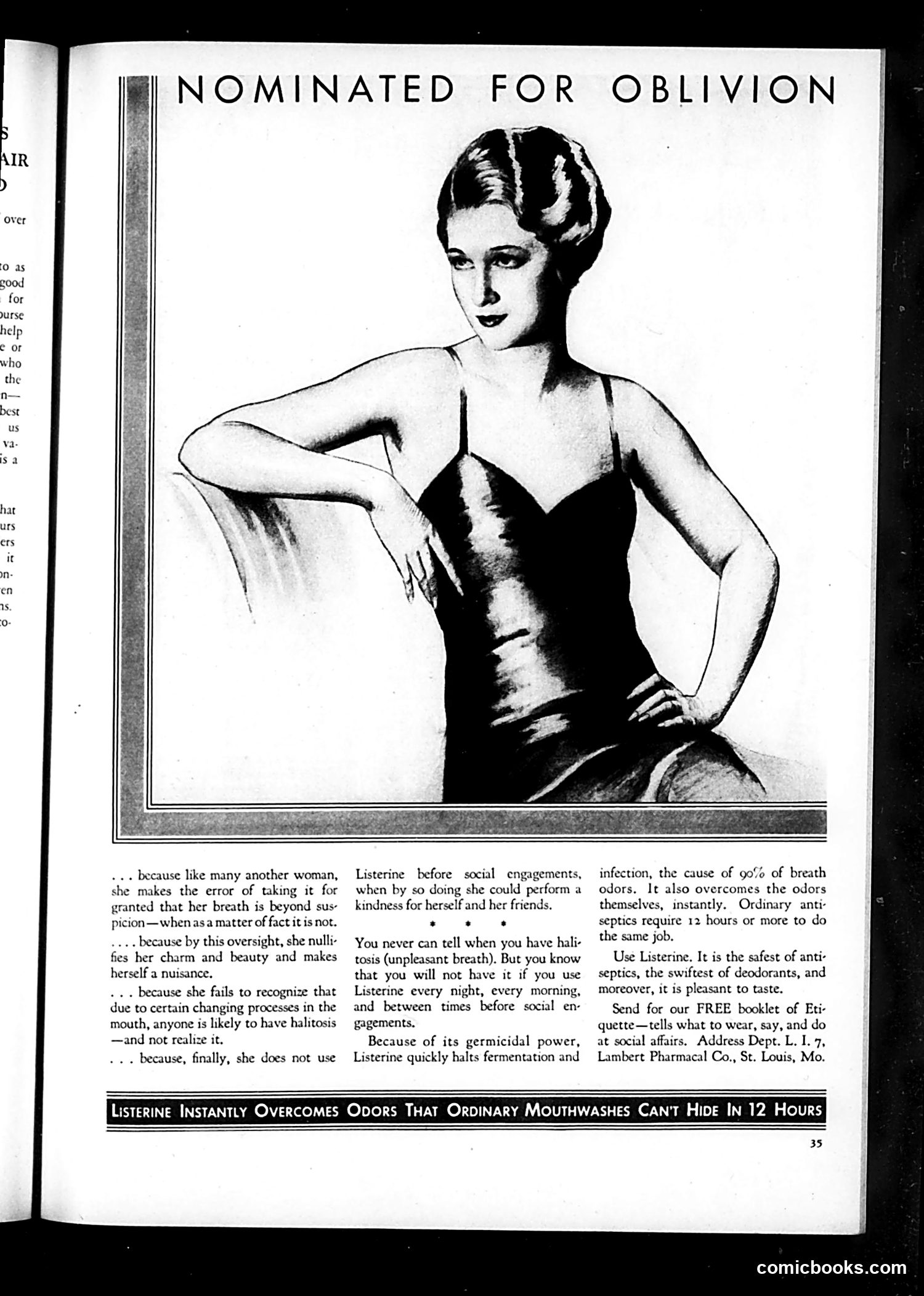
Analysis: "Nominated for Oblivion" (Listerine Advertisement) This is a Listerine mouthwash advertisement using Life magazine's satirical "Nominated for Oblivion" format—a recurring feature that humorously condemned social failures. Here, the target is a woman with poor breath hygiene. The ad employs social shame as its primary selling tactic: the illustrated woman is "nominated" for social irrelevance because she unknowingly suffers from halitosis (bad breath), making herself "a nuisance" despite her "charm and beauty." The copy argues that halitosis is involuntary—anyone can have it without realizing—but Listerine provides the solution. The satire reflects 1920s-30s advertising conventions that weaponized anxiety about social acceptance, particularly targeting women's appearance and deportment. The underlying message: a woman's attractiveness and social worth are undermined by invisible bodily failures only Listerine can prevent. It's a period piece demonstrating how vintage advertising created insecurity to drive consumer purchases.
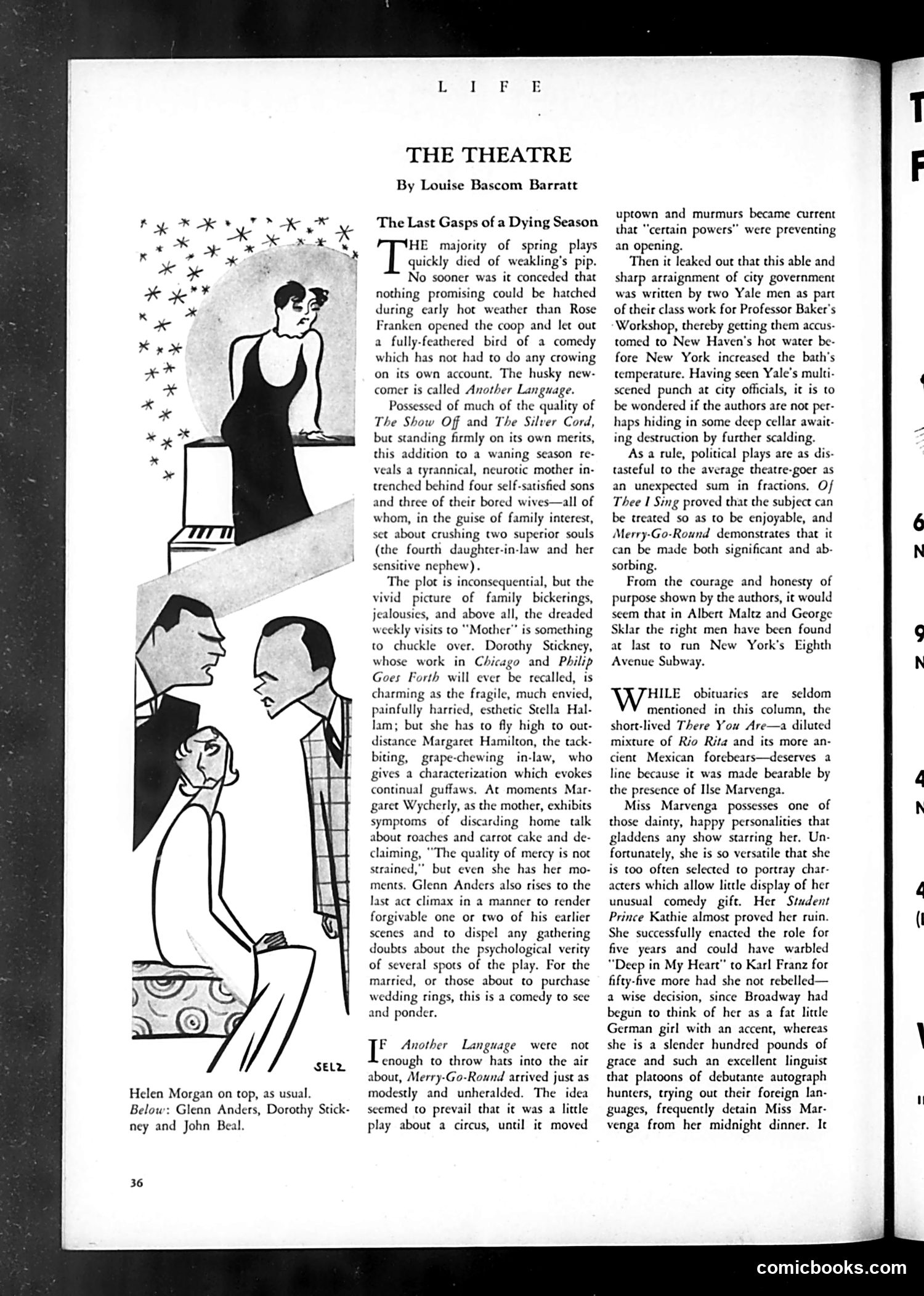
Analysis of Life Magazine Theatre Page This theatre review page critiques several Broadway productions in the waning spring season. The illustration depicts Helen Morgan (identified in caption) atop a piano with three male actors below—Glenn Anders, Dorothy Stickney, and John Beal—likely representing scenes from the reviewed plays. The main review discusses "Another Language," praising its portrayal of a tyrannical mother and her sons' wives crushing two sensitive family members. The critic highlights performances by Dorothy Stickney and Margaret Hamilton. A secondary review covers "Merry-Go-Round," a political satire about city government written by Yale playwrights Albert Maltz and George Sklar as class work. The reviewer notes the play faced mysterious delays ("certain powers" preventing opening) before moving uptown, sarcastically suggesting the authors should now "run New York's Eighth Avenue Subway." The page concludes briefly discussing the short-lived "There You Are," saved only by performer Ilse Marvenga's charm. The satirical tone throughout reflects Life magazine's characteristic irreverent take on theatrical merit and industry politics.
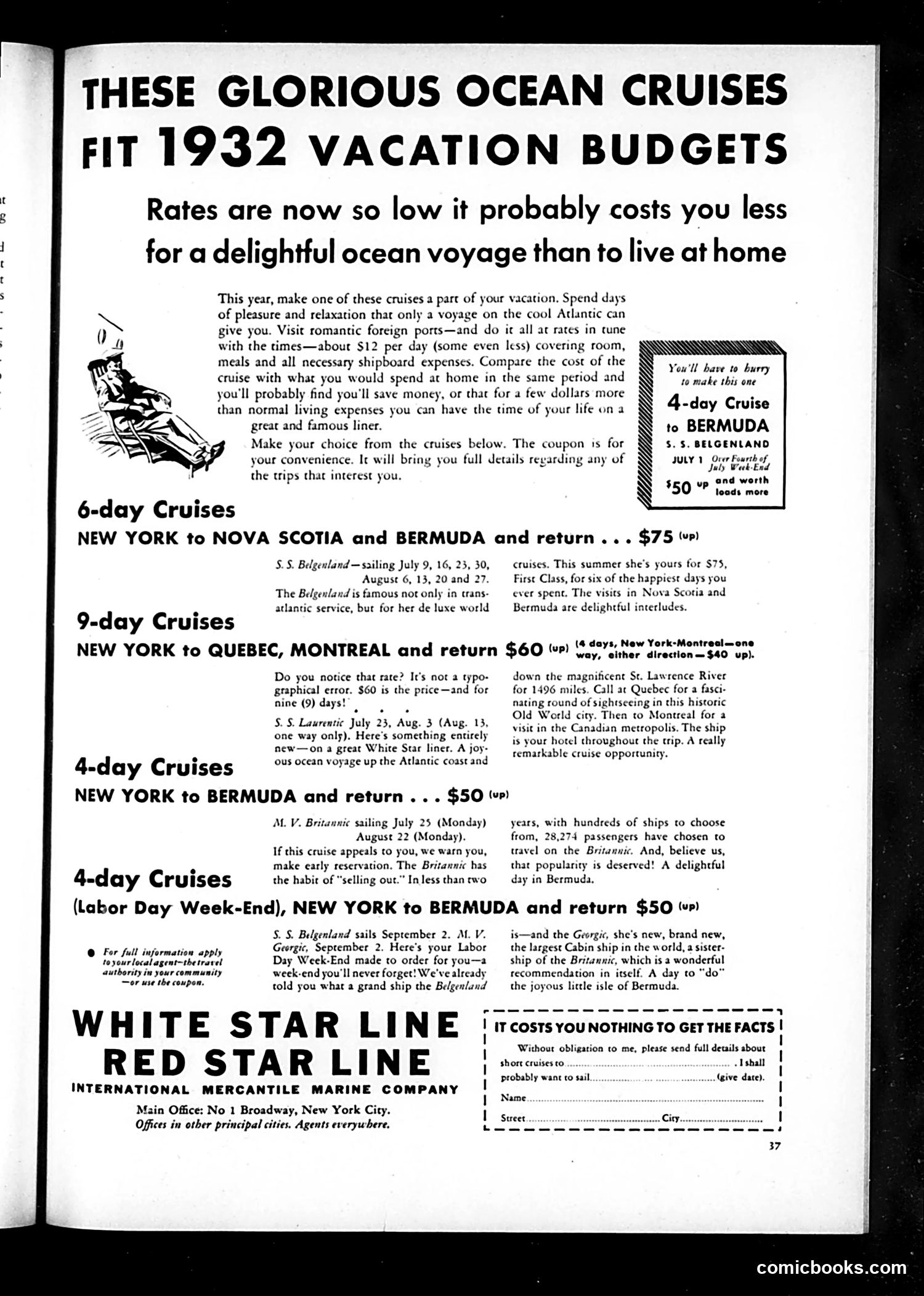
Analysis of 1932 Ocean Cruise Advertisement This is primarily a cruise ship advertisement, not political satire. However, it contains historically significant context about the Great Depression. The ad emphasizes affordability during economic hardship: cruises cost "about $12 per day" and claim to be cheaper than "living at home." This reflects 1932's severe Depression conditions—the ad's framing of luxury travel as economical reveals how drastically prices had collapsed and consumer spending had contracted. The illustrated figure (left) shows a relaxed vacationer, contrasting Depression-era hardship with aspirational leisure. The ad features multiple White Star and Red Star Line ships (Belgenland, Britannic, Laurentic, Georgic), emphasizing vessel prestige to appeal to cost-conscious but status-conscious travelers. The coupon at bottom invites inquiries "without obligation," a typical Depression-era marketing tactic acknowledging that many interested parties lacked ready funds. This is essentially propaganda suggesting economic recovery was possible through consumption—a message the leisure industry promoted during the Depression's depths.
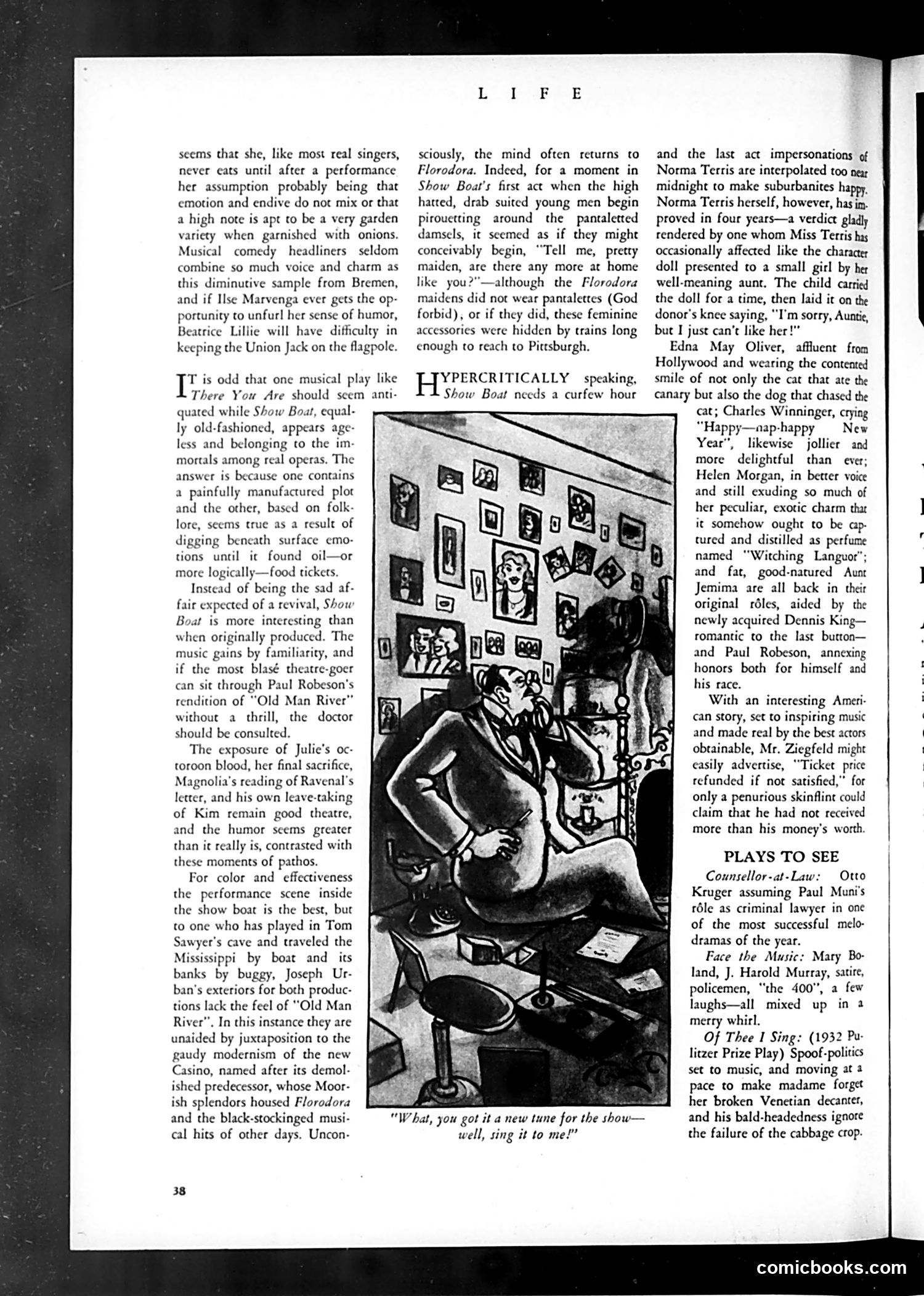
Life Magazine Theater Review: Show Boat Revival This page reviews a theatrical revival of *Show Boat*, comparing it favorably to the original production. The central illustration depicts a scene from the show—likely a performer in the boat's interior setting that the text praises as "the best" for "color and effectiveness." The critic argues *Show Boat* endures because it's based on folklore rather than manufactured plot, unlike the contemporary musical *There You Are*. Paul Robeson's performance of "Old Man River" is highlighted as genuinely moving. The review praises the cast—Norma Terris (improved since her 1928 performance), Edna May Oliver, Charles Winninger, and Helen Morgan—while critiquing the set design's lack of authentic atmosphere compared to actual riverboat experience. A humorous sidebar compares the show's 1920s-style chorus numbers to the earlier *Florodora* (a 1900 musical), joking that modern audiences might expect the famous "Tell me, pretty maiden" number.
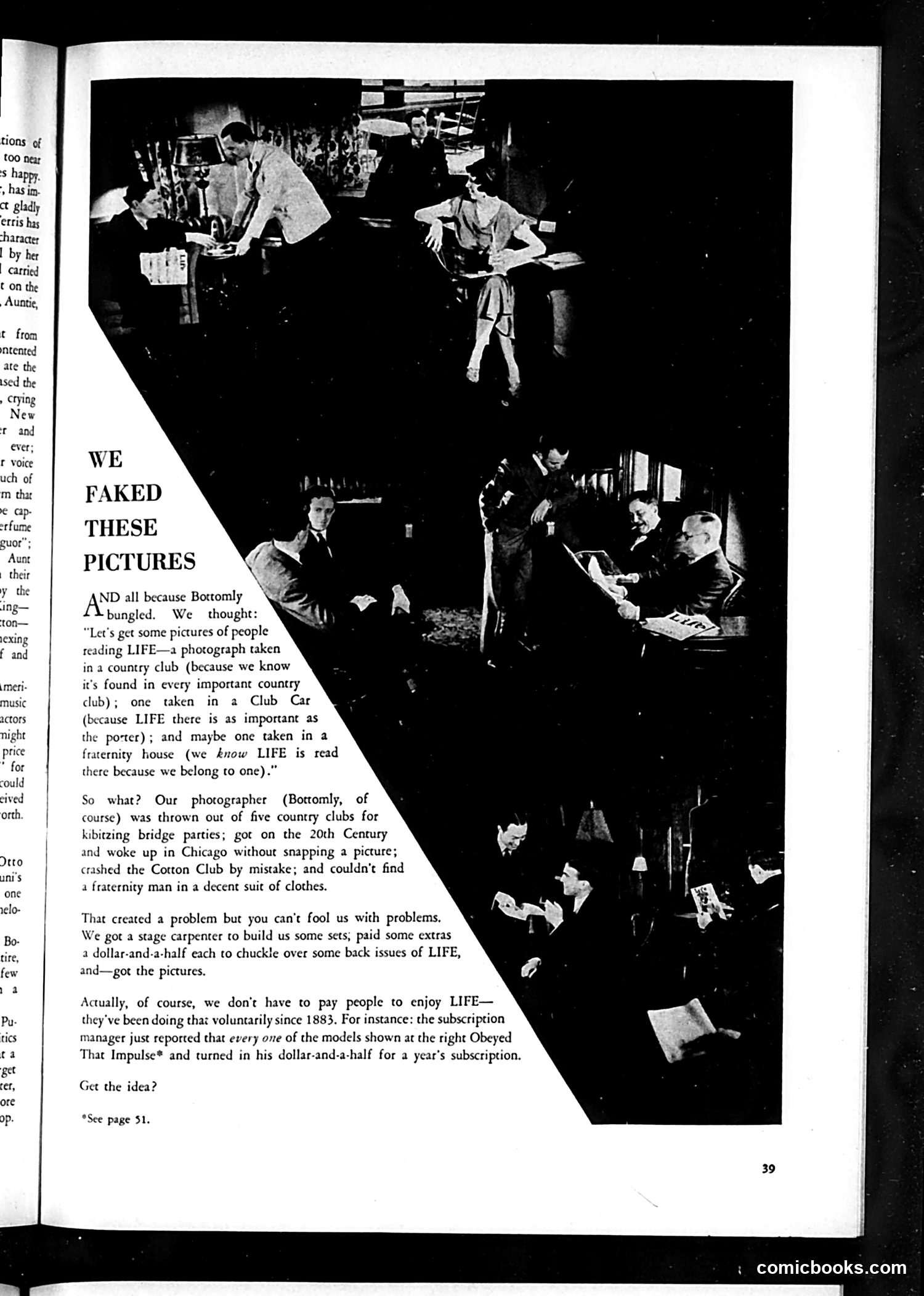
Analysis of "We Faked These Pictures" This is a satirical advertisement for *Life* magazine, confessing to fabricated photography with tongue-in-cheek humor. The piece mocks its own magazine's staged authenticity. The Setup: Photographer "Bottomly" was tasked with capturing candid scenes of people reading *Life* in supposedly aspirational settings—country clubs, train cars, fraternity houses—to suggest the magazine's cultural prestige and broad readership. The Joke: Bottomly spectacularly failed: he was ejected from five clubs, fell asleep on a train, crashed the Cotton Club uninvited, and couldn't locate a properly dressed fraternity member. Rather than admit defeat, *Life's* editors hired a stage carpenter to build fake sets and paid extras $1.50 each to pose reading the magazine. The Satire: *Life* is admitting it manufactures the aspirational lifestyle imagery it presents, yet argues this deception proves people genuinely *want* to read their magazine—so much that even paid actors got subscriptions. The photographs show these staged scenes: well-dressed people in various social settings, ostensibly reading *Life*. The confession itself is the advertisement.
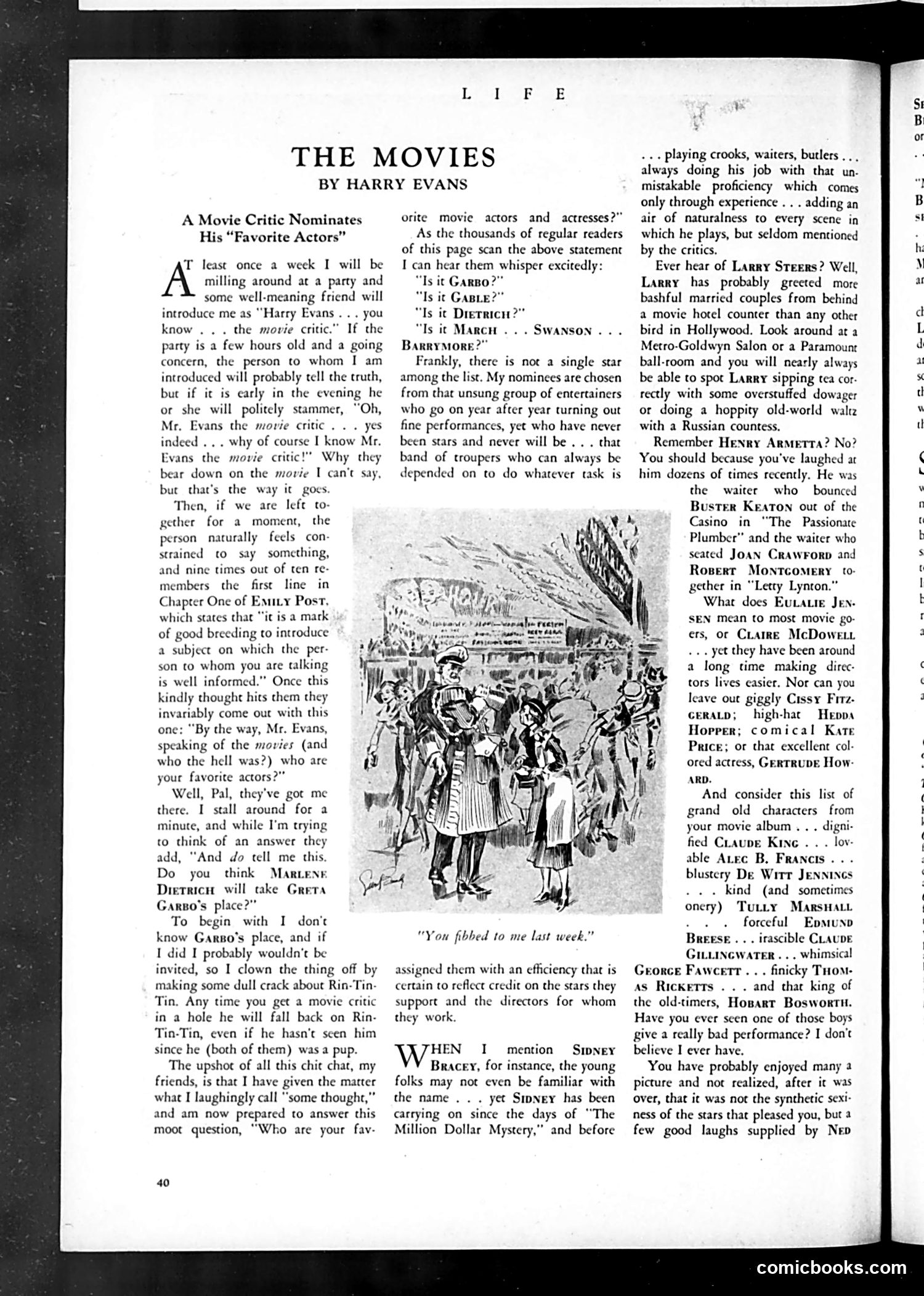
"The Movies" by Harry Evans - Life Magazine This article is a film critic's humorous essay about Hollywood's character actors—the reliable supporting players rather than major stars. Evans satirizes cocktail-party small talk where people ask critics predictable questions about famous actresses like Greta Garbo and Marlene Dietrich, then uses this setup to praise unglamorous performers who consistently deliver quality work in minor roles. The accompanying cartoon (captioned "You fibbed to me last week") illustrates the social awkwardness Evans describes—a crowded scene where he's caught in exactly the uncomfortable party conversation he laments. Evans celebrates actors like Sidney Bracey, Larry Steers, Henry Armetta, and others who've worked steadily since silent-film days, playing waiters, crooks, and hotel clerks. His point: these workhorse actors deserve recognition for their craft and professionalism, even though critics and audiences ignore them. The satire targets both superficial film criticism and Hollywood's star-system obsession.
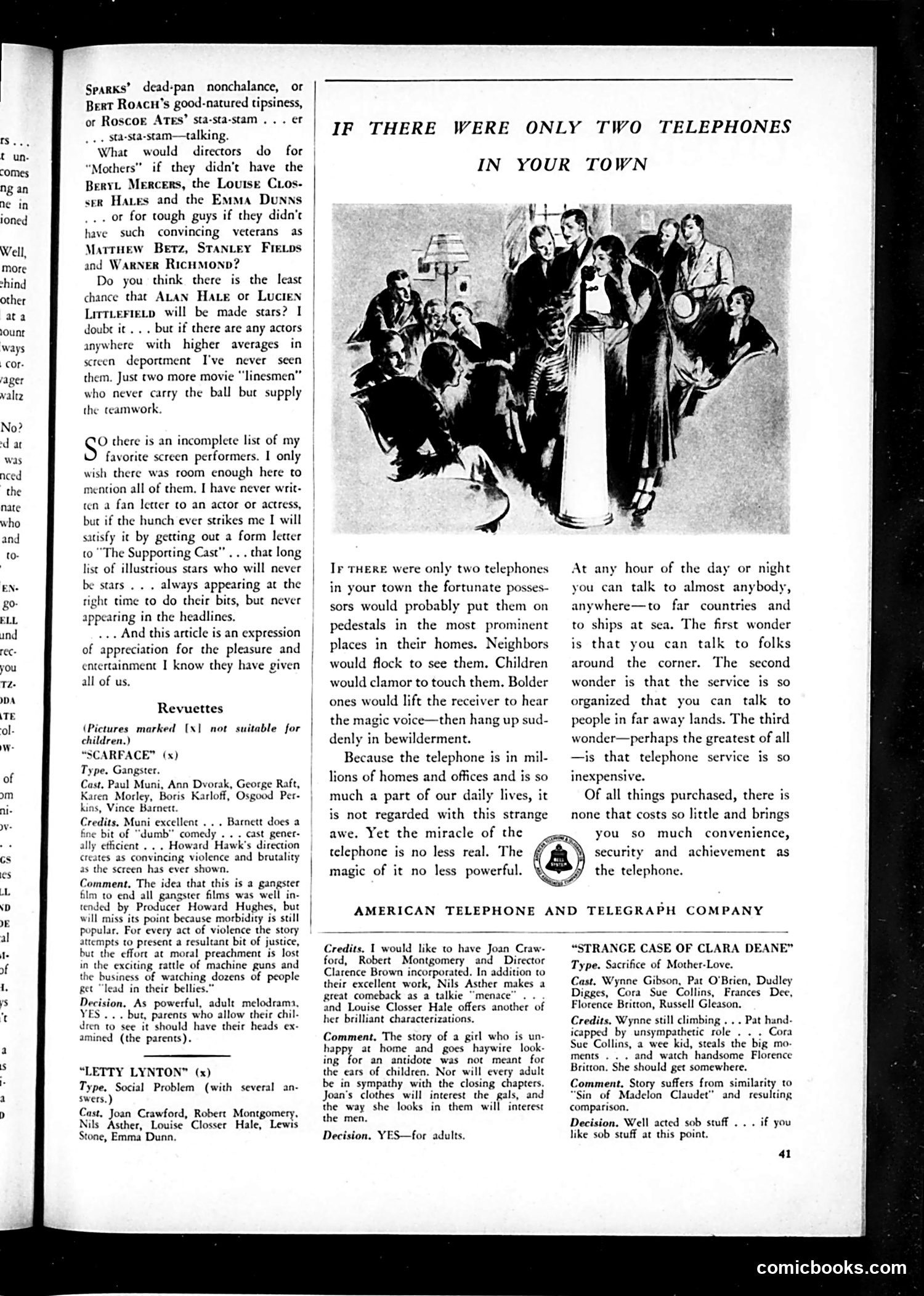
Analysis of This Life Magazine Page This page contains two distinct sections: a film review column and an advertisement for the American Telephone and Telegraph Company. The upper section is a column praising character actors—supporting players like Bert Roach, Roscoe Ates, and Matthew Betz—who reliably performed vital roles but never became stars. The writer celebrates these "linesmen" who "never carry the ball but supply the teamwork," lamenting that talented performers like Alan Hale and Lucien Littlefield will never receive headline recognition despite superior skill. The lower section is an advertisement illustrated with a photograph of people gathered around a telephone. It employs a thought-experiment: "If there were only two telephones in your town," people would treat them as miraculous novelties. The ad's purpose is to make readers appreciate the telephone's ubiquity and affordability by imagining its scarcity—a common advertising strategy of the era. It emphasizes that telephone service, despite its "miracle" of instant communication across distances, remains surprisingly inexpensive.
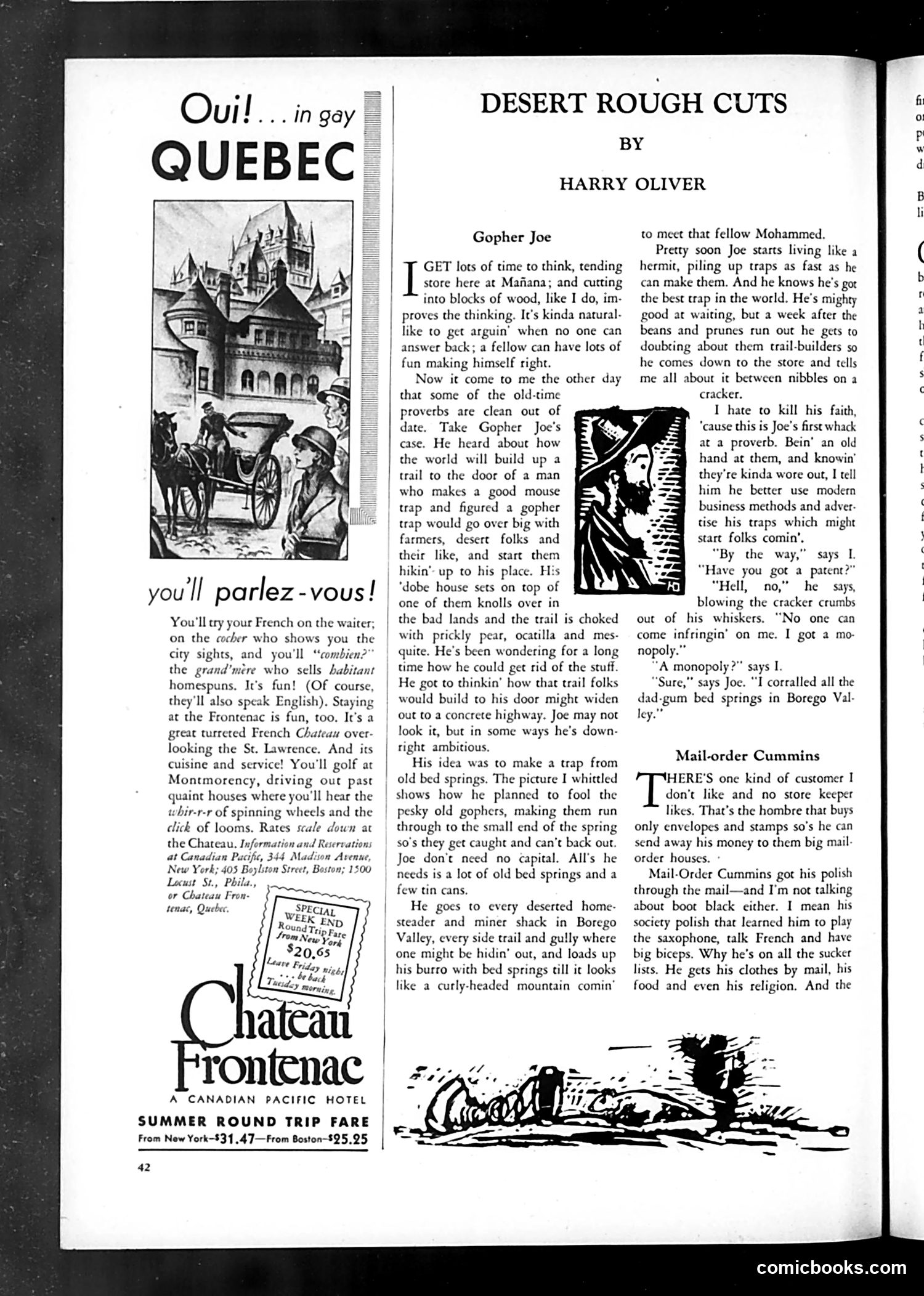
Explanation for Modern Readers This page contains two distinct pieces: Left side: A tourism advertisement for Château Frontenac in Quebec City, encouraging American visitors to practice French with locals ("parlez-vous"). It's pitched as charming fun—trying out French phrases while sightseeing. The ad is straightforward marketing with no satirical intent. Right side: Harry Oliver's humor column "Desert Rough Cuts" satirizes American optimism and folk entrepreneurship. "Gopher Joe" believes the old proverb that "if you build a better mousetrap, the world will beat a path to your door." He invents a gopher trap from scrap bed springs, naively expecting customers to flock to his remote desert shack. The narrator gently mocks Joe's innocence by asking about patents—only to have Joe claim a "monopoly" because he's collected all available bed springs in the valley. The joke: Joe's ambitious but hopelessly naive about business and customer demand. The second story snippet introduces "Mail-Order Cummins," apparently a customer the store-keeper dislikes for buying supplies only to fund mail-order purchases elsewhere—a Depression-era economic anxiety about local retail losing to distant competitors.
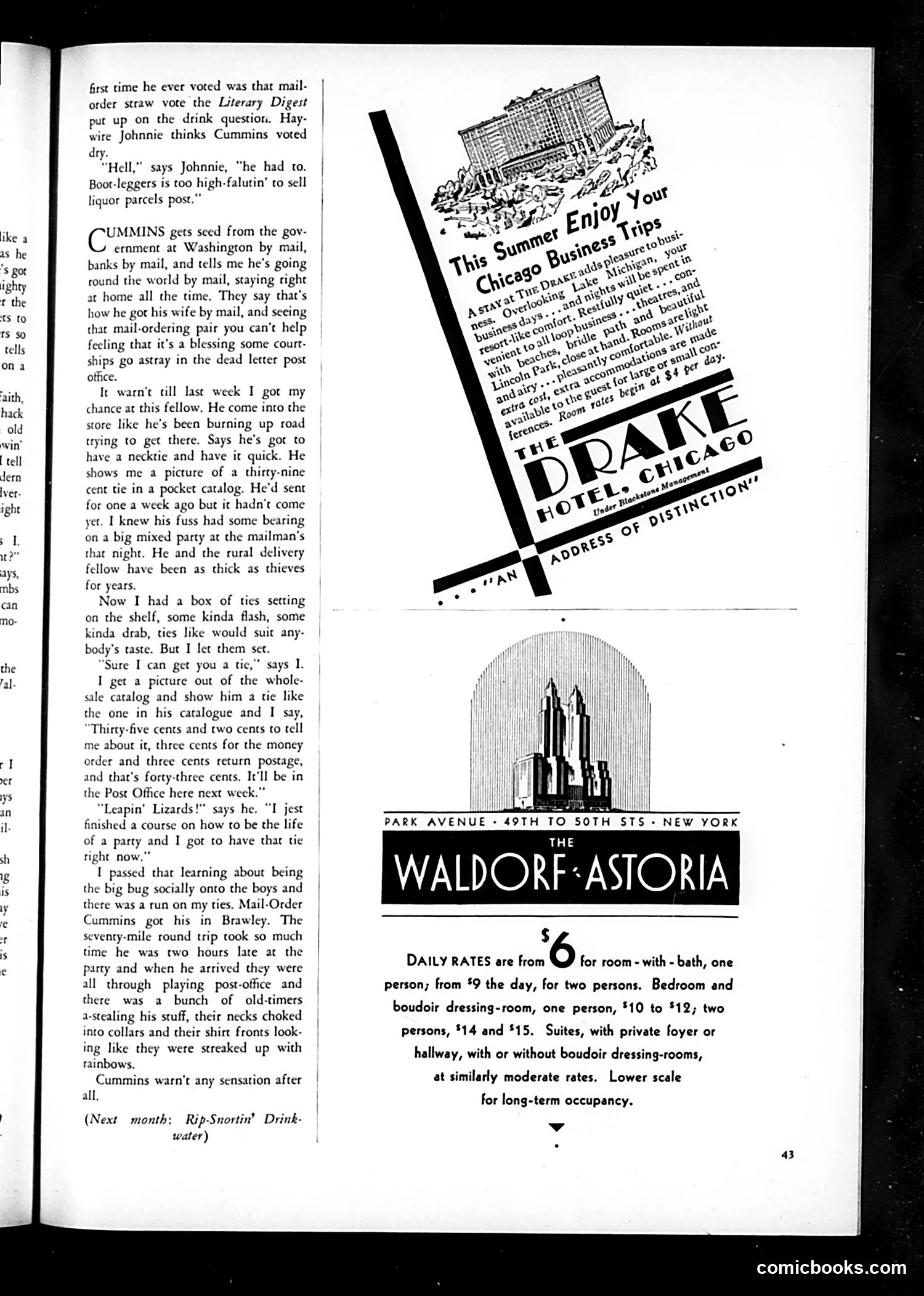
"Mail-Order Cummins" Satire Explained This page contains a humorous short story mocking a character obsessed with mail-order shopping. "Cummins" represents a rural American who orders everything by mail—seeds, banking services, even his wife—and tries to conduct his entire life through the postal system. The joke's central irony: Cummins needs a necktie urgently for a party but insists on mail-ordering it from a catalog rather than buying one immediately from the local store. The narrator deliberately shows him a mail-order option costing 43 cents total (including postage and handling), knowing delivery will take a week. Cummins arrives at the party two hours late, missing the entertainment entirely. The satire targets rural Americans' over-reliance on mail-order commerce and their impractical devotion to catalog shopping, even when local alternatives exist. It's gentle mockery of Depression-era rural culture and the mail-order industry's promises of convenience. The page also contains hotel and Chicago tourism advertisements, typical of period magazines.
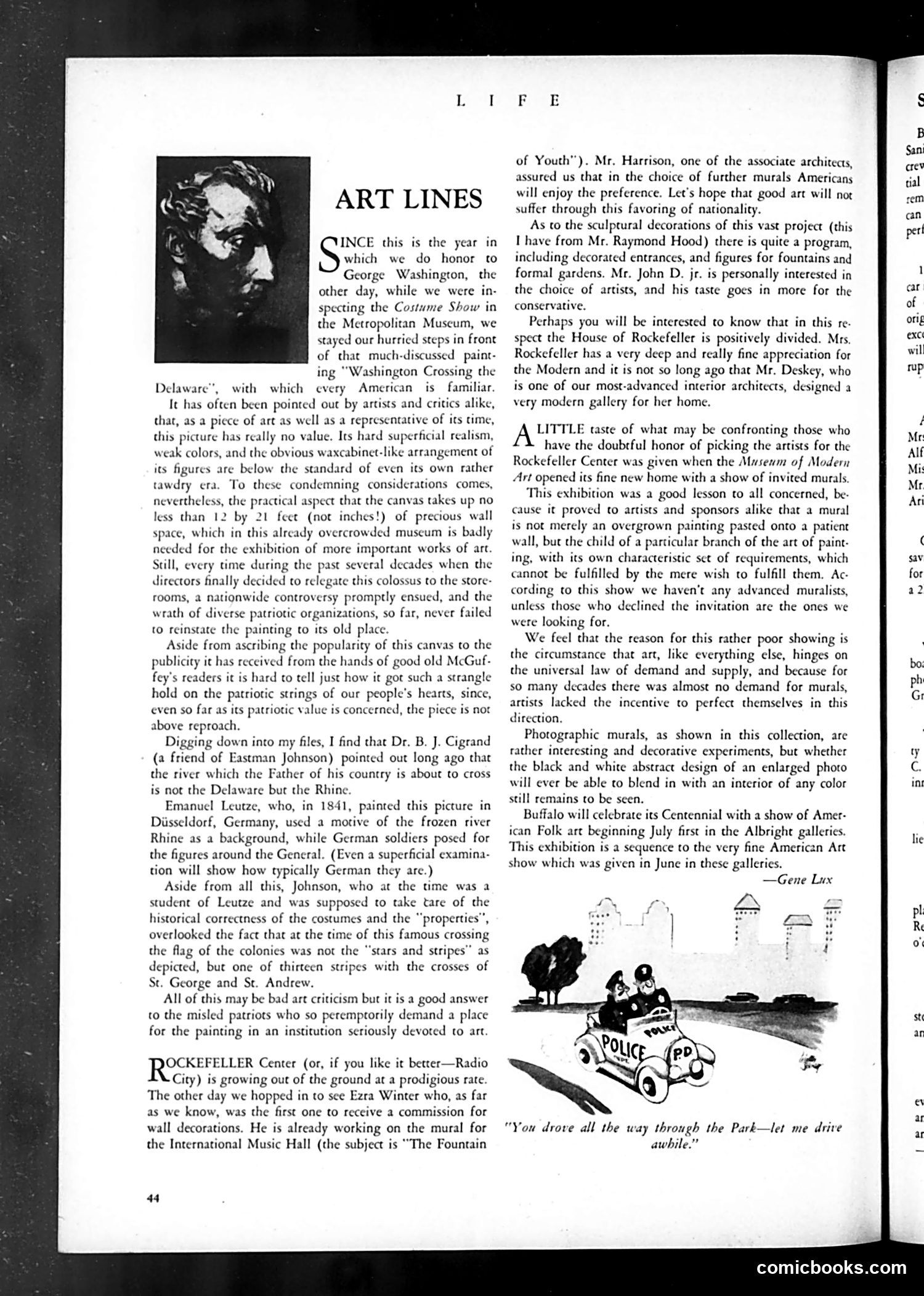
Art Lines: Critique of "Washington Crossing the Delaware" This page critiques Emanuel Leutze's famous 1841 painting "Washington Crossing the Delaware," which hangs in the Metropolitan Museum despite being, the author argues, artistically mediocre with weak colors and awkward composition. The satirical point: Americans revere this painting purely from patriotic conditioning (via McGuffey's Readers), not genuine artistic merit. The author reveals embarrassing historical inaccuracies: Leutze painted it in Germany using the Rhine River, not the Delaware; German soldiers modeled the figures; and the flag depicted is historically incorrect—the colonies didn't use stars and stripes at that time. The cartoon at bottom shows a toy police car, illustrating the article's broader argument about Rockefeller Center's new murals and public art commissions.
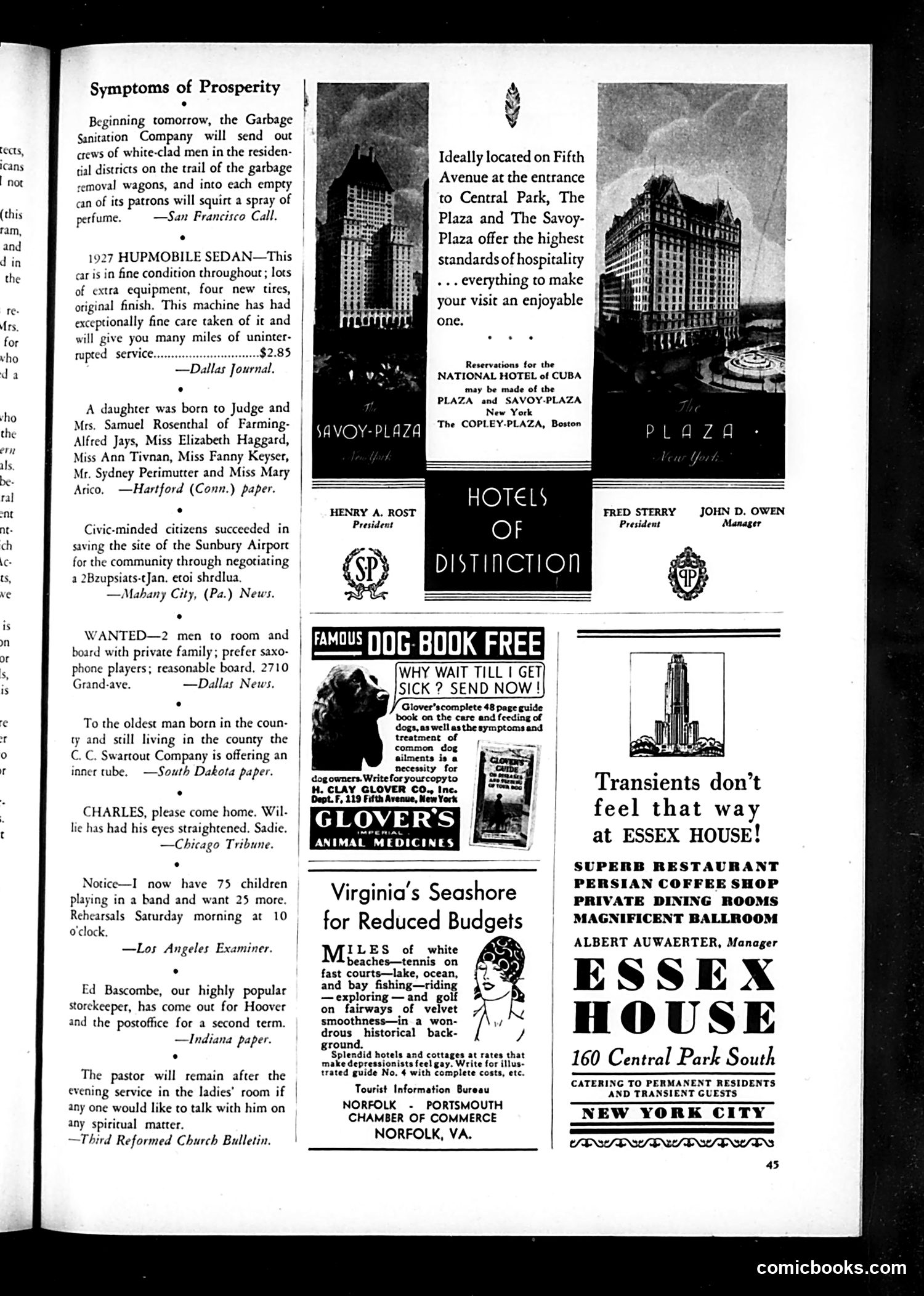
"Symptoms of Prosperity" — Life Magazine Page Analysis This page consists primarily of advertisements and classified notices rather than editorial cartoons. The title "Symptoms of Prosperity" frames a collection of humorous newspaper clippings from various American papers, likely from the 1920s. The satire works through absurdist humor: notices describe comically impractical services (garbage cans sprayed with perfume), desperate wants (a band director needing 25 more child musicians), and modest giveaways (an inner tube as a prize). These clippings mock small-town American life and economic disparities of the era. The accompanying hotel and restaurant advertisements (Plaza, Savoy-Plaza, Essex House) contrast sharply with these modest notices, highlighting class divisions—luxury establishments positioned alongside working-class struggles. The page captures 1920s American optimism mixed with economic anxiety, using real newspaper text as social commentary rather than drawn cartoons.
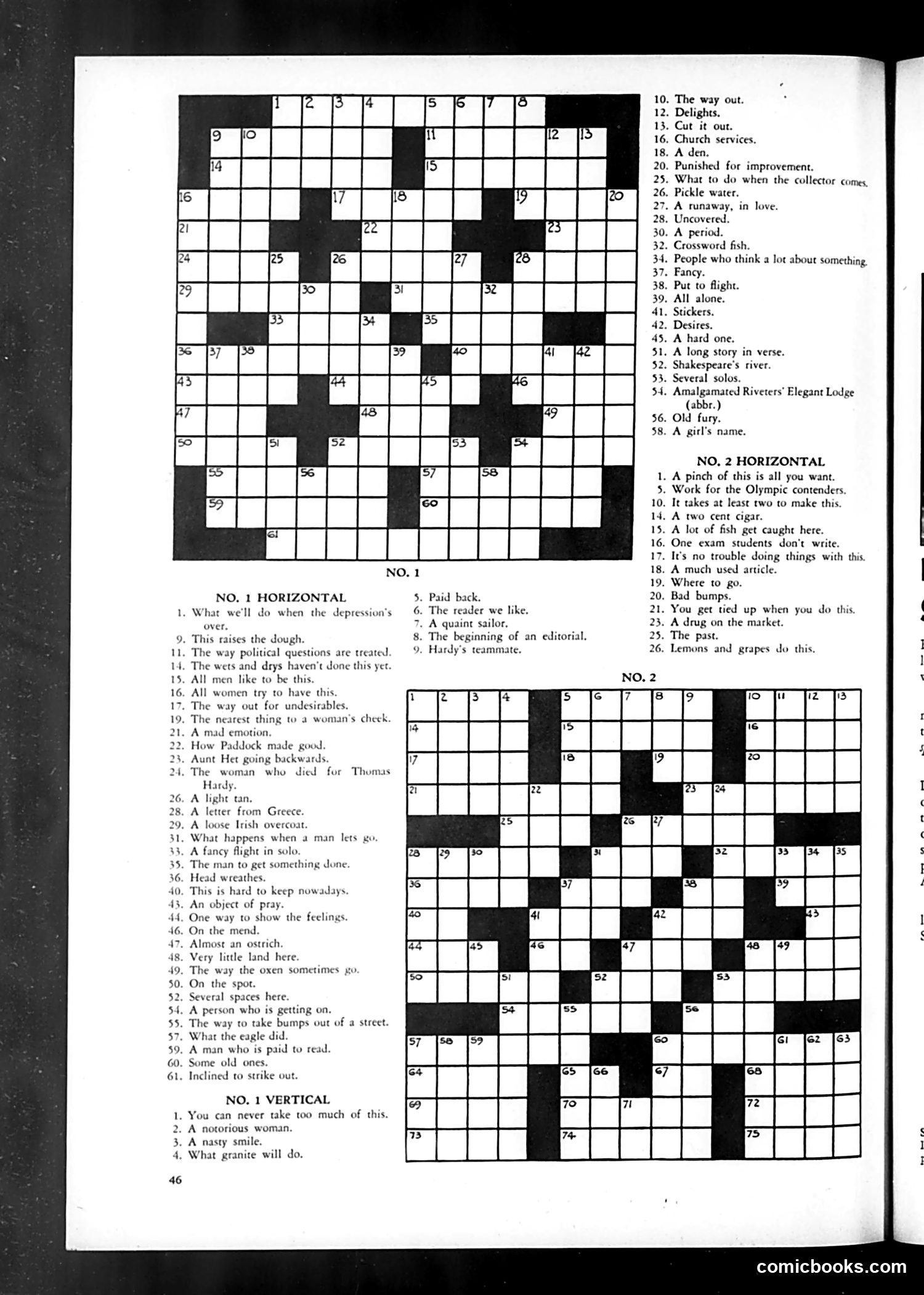
What This Page Shows This page from *Life* magazine presents two crossword puzzles (labeled No. 1 and No. 2), not political cartoons. The clues are humorous wordplay typical of 1920s-30s satirical magazines. The clues mix contemporary references with clever riddles. For example, "What we'll do when the depression's over" (Horizontal 1.1) references the Great Depression, while "The way political questions are treated" and "The wets and drys haven't done this yet" allude to Prohibition-era debates. References to "Hardy's teammate," "Shakespeare's river," and "The woman who died for Thomas Hardy" show literary allusions expected of educated readers. The humor relies on puns and double meanings ("A quaint sailor," "Aunt Het going backwards") rather than visual satire. This was typical entertainment for *Life's* intellectual audience—puzzles served as both amusement and a subtle commentary on contemporary social issues like the Depression and Prohibition.
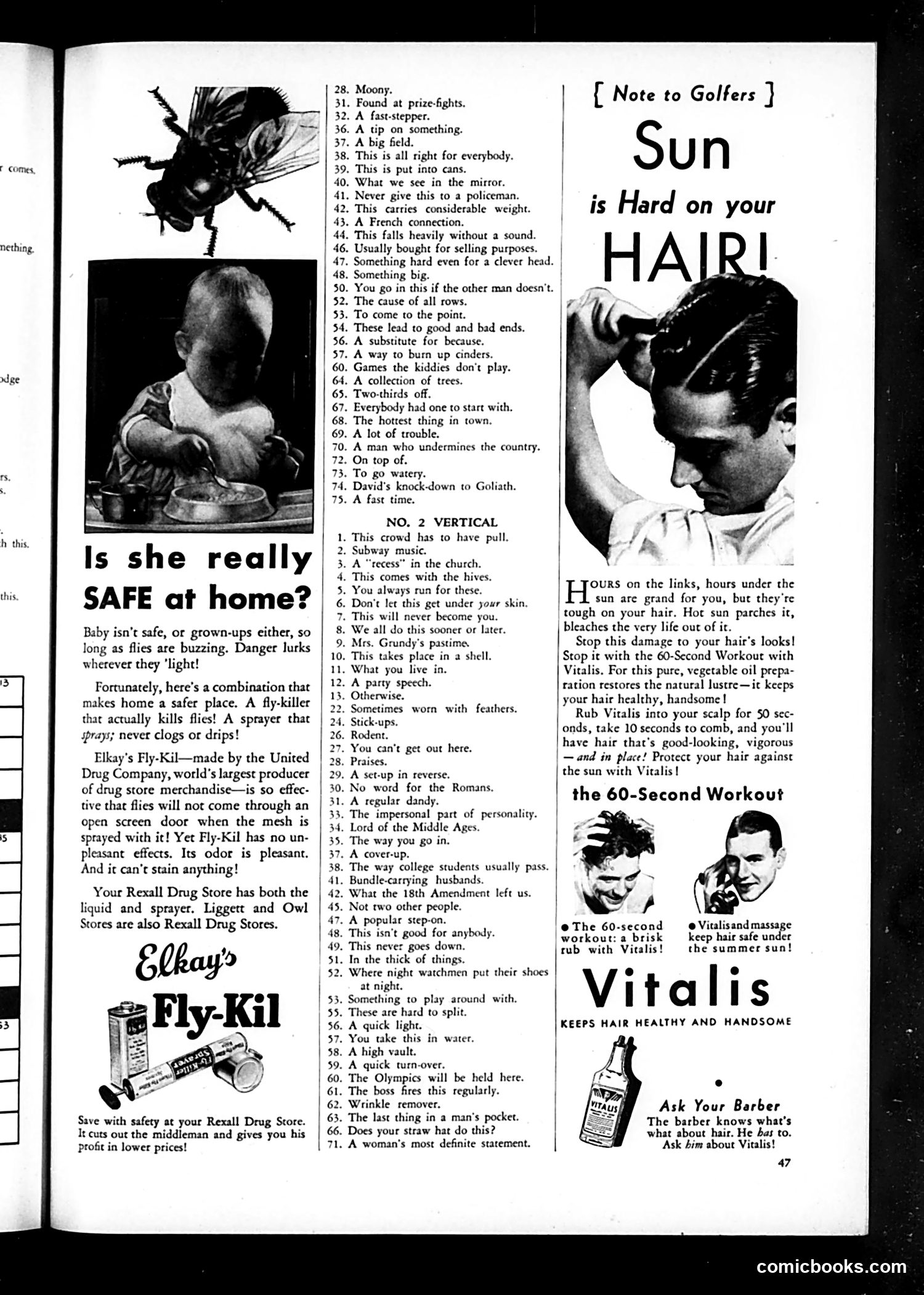
Page Analysis: Life Magazine Advertisement Section This page is primarily advertisements, not satire or political commentary. The main content consists of three product ads: 1. Elkay's Fly-Kil spray (upper left): A pesticide advertisement addressing domestic safety concerns, emphasizing that flies pose dangers to babies and families. The ad promotes an insecticide as the solution to household pest control. 2. Vitalis hair product (right side): An advertisement targeting golfers, warning that sun exposure damages hair and promoting Vitalis oil as restorative treatment. It includes endorsements suggesting professional barbers recommend the product. 3. Rexall Drug Store (lower left): A retail advertisement emphasizing discount pricing. The page also includes a crossword puzzle (center), a common magazine feature. No political cartoons or social satire appear here. This represents typical mid-20th century magazine advertising focused on consumer products for personal grooming and household maintenance.
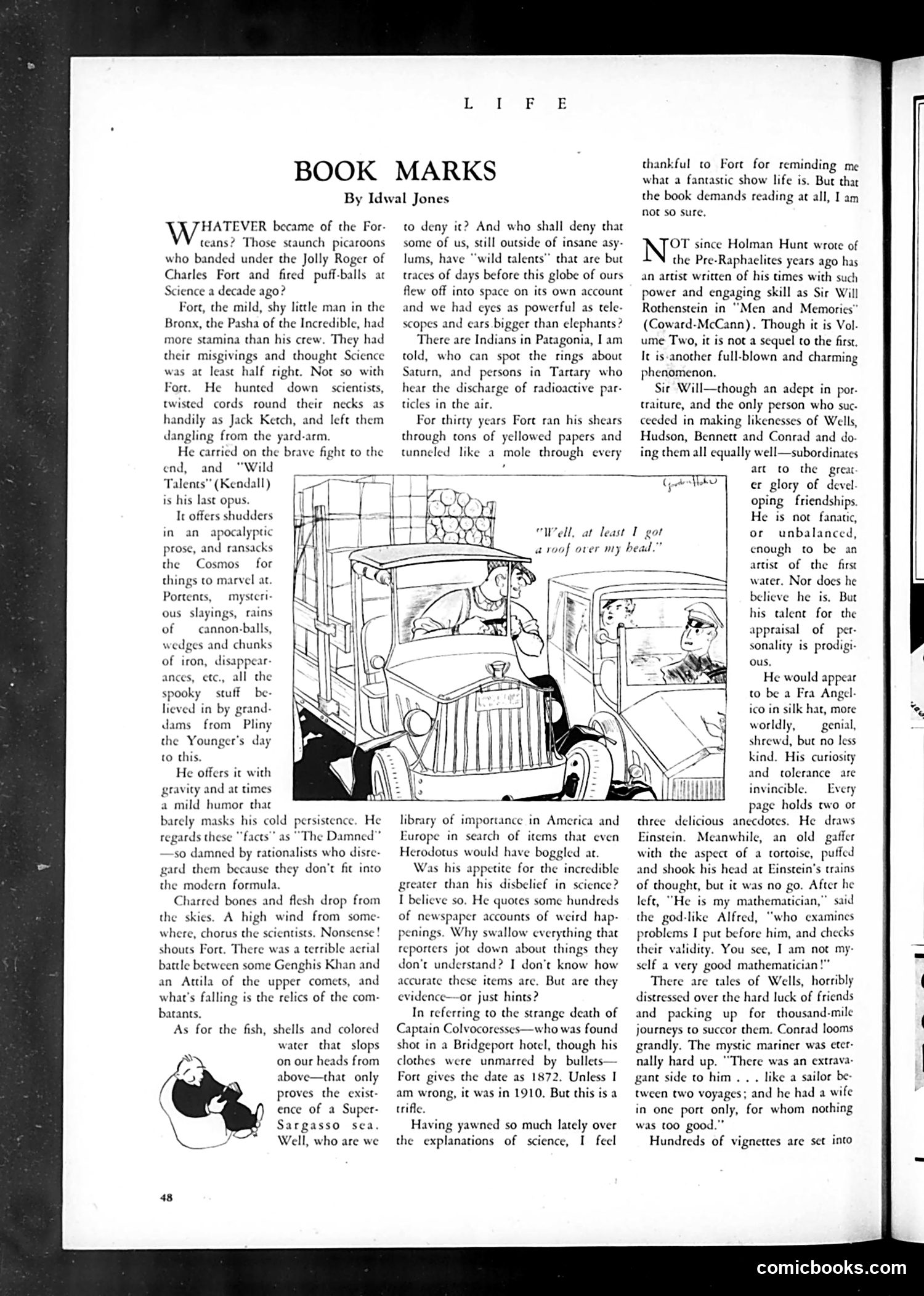
Book Marks: Charles Fort and Sir Will Rothenstein This is a book review column discussing two works. The main cartoon illustrates Charles Fort, an early 20th-century paranormal investigator and author who challenged scientific orthodoxy by collecting unexplained phenomena—mysterious falls, strange sightings, and anomalies he called "damned facts" that science rejected. Fort (shown in the car with "at least I got a roof over my head") spent 30 years compiling newspaper accounts of inexplicable events: rains of fish, charred bones falling from skies, unexplained deaths. The reviewer credits Fort with healthy skepticism toward both superstition and rigid scientific dismissal of the unexplained. The second review praises Sir Will Rothenstein's memoir "Men and Memories" (Volume Two), lauding his portraits of literary figures like Wells, Hudson, and Bennett—though noting he subordinates artistic glory to documentary truthfulness. The satire targets scientific materialism's condescension toward anomalies, while gently mocking Fort's credulity.
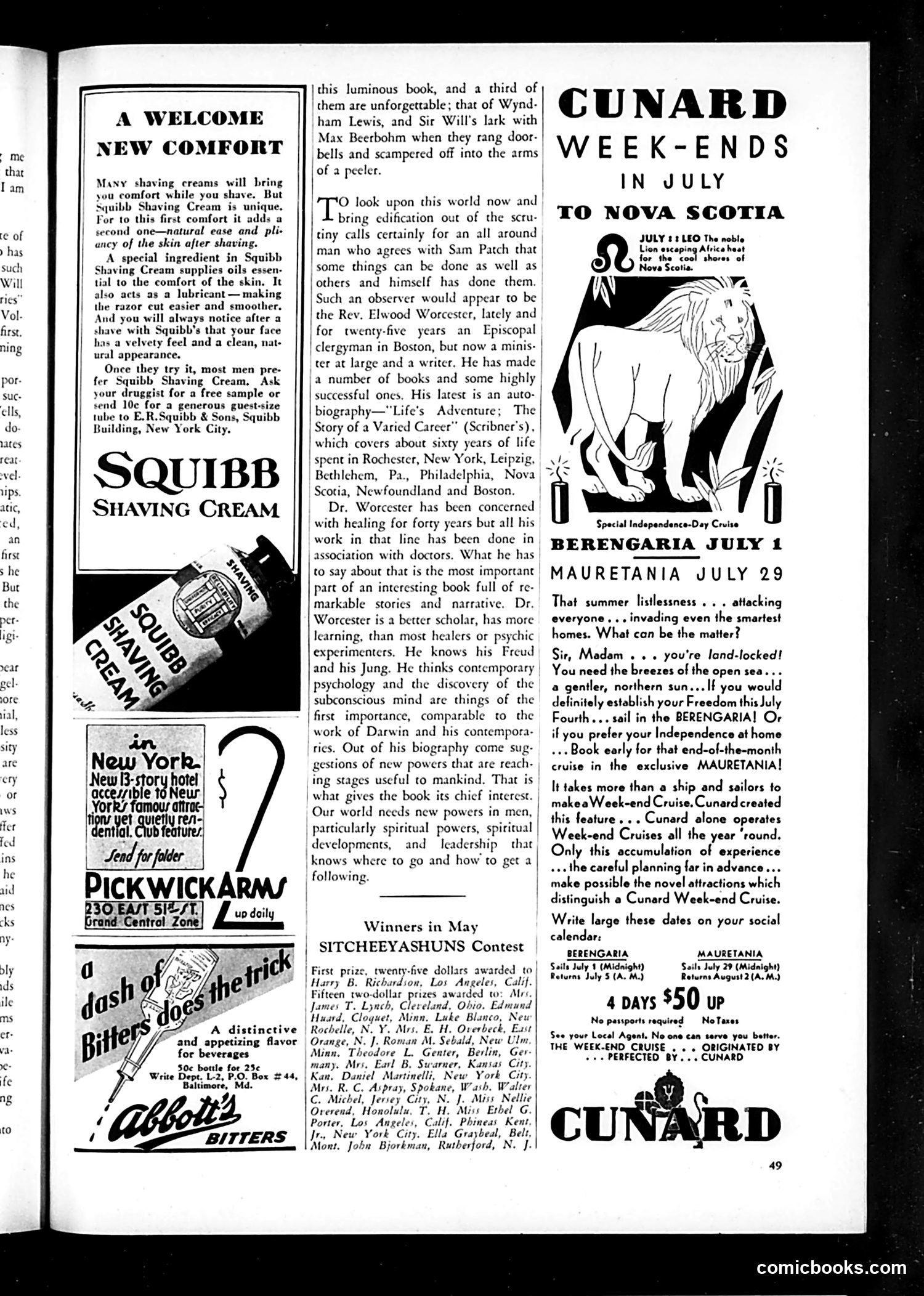
This page is primarily advertising and book reviews, not political satire. The main content includes: 1. Squibb Shaving Cream ad — a standard product advertisement emphasizing comfort and skin conditioning. 2. Abbott's Bitters ad — a vintage beverage advertisement. 3. Pickwick Arms hotel ad — promoting New York lodging. 4. A book review of Rev. Elwood Worcester's autobiography "Life's Adventure," discussing his 60-year career in healing and psychology, his familiarity with Freud and Jung, and the book's themes about spiritual development and new human powers. 5. Cunard cruise advertisements — promoting week-end cruises to Nova Scotia aboard ships like the *Berengaria* and *Mauretania*, with a cartoon lion escaping African heat. 6. "Sitcheeyashuns" contest winners — listing prize recipients. This is a typical Life magazine page from the 1920s-30s era: mixed editorial content with substantial advertising revenue. No political satire or caricature appears present.
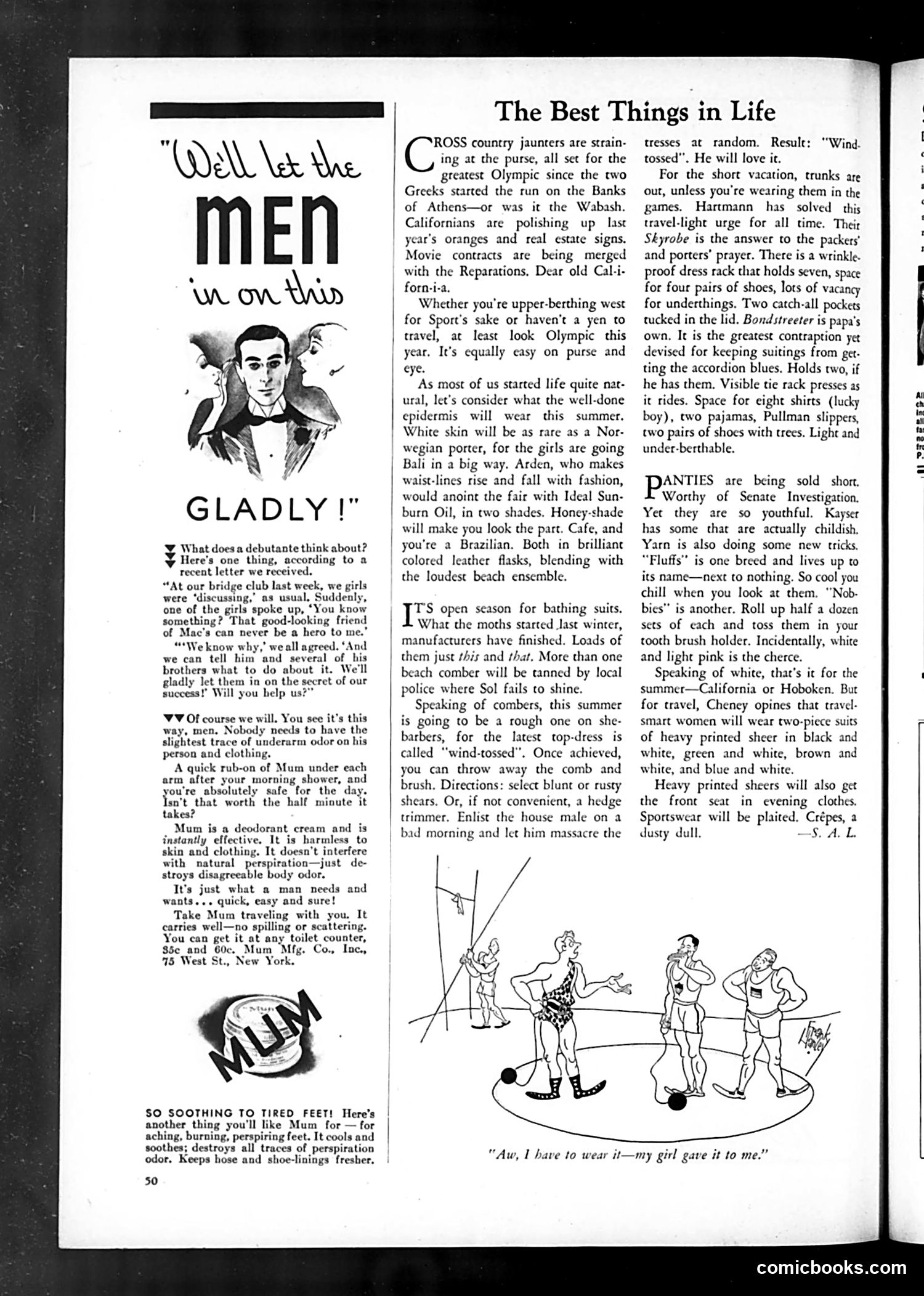
Analysis for Modern Readers This page contains advertising mixed with lifestyle commentary, typical of 1920s Life magazine's format. The Main Cartoon (Top Left) A stylized illustration accompanies a Mum deodorant ad. The cartoon shows a man with an exaggerated, somewhat predatory expression. The text reveals the joke: young women at a bridge club discuss how an attractive man "can never be a hero" to them—because of body odor. The ad promises that using Mum deodorant will solve this social liability, allowing men to be romantically viable. The Satire This reflects 1920s anxieties about male grooming and social acceptability. The ad humorously suggests that even physically attractive men are disqualified from romance without deodorant—a common advertising tactic that manufactures insecurity to sell products. The Lifestyle Article The right column discusses summer fashion and Olympic Games preparation, referencing bronzed skin, beach attire, and travel accessories. References to "Arden" (Elizabeth Arden cosmetics) and "wind-tossed" hairstyles reflect contemporary beauty trends. The page is primarily commercial content disguised as editorial advice.
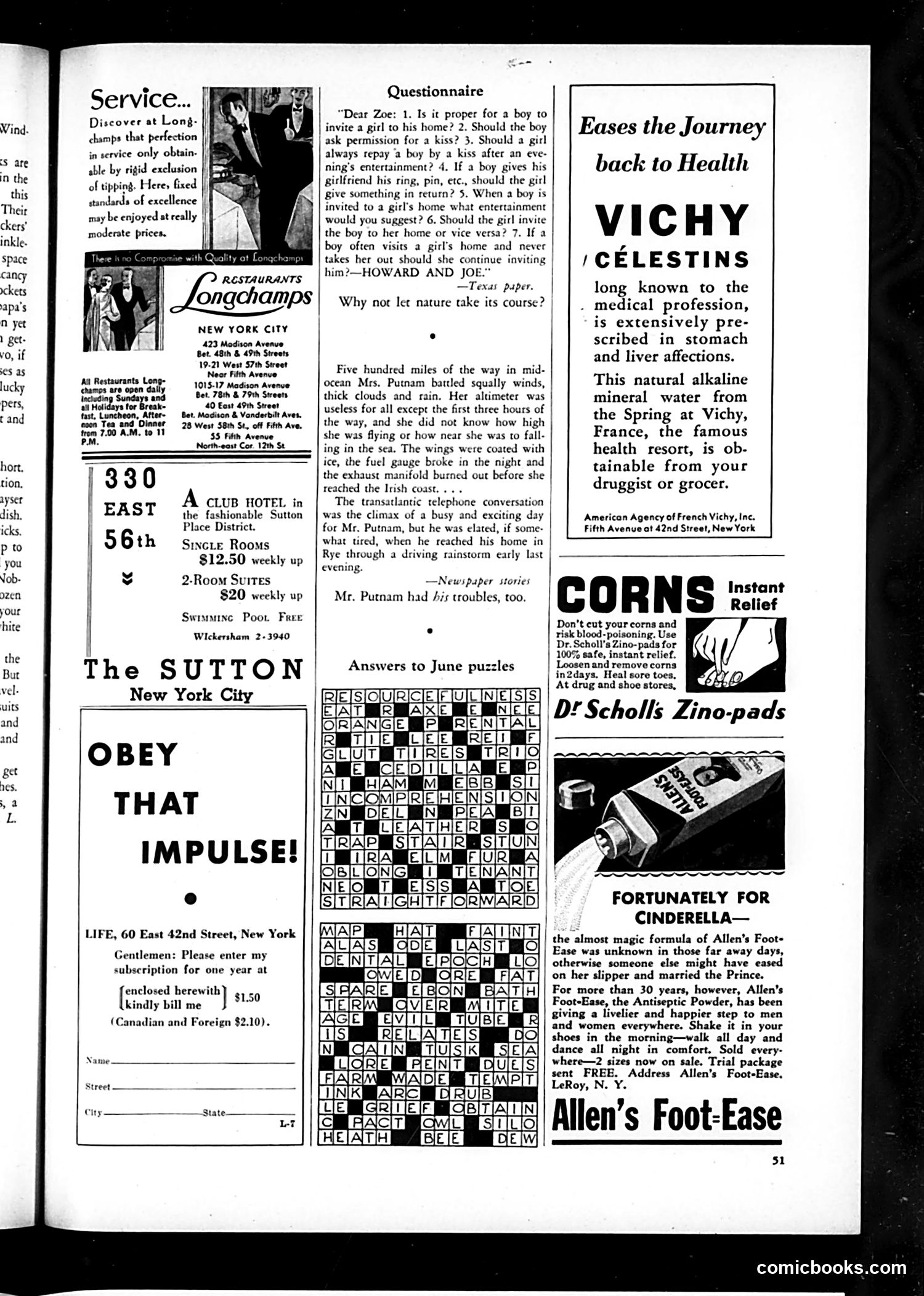
Analysis of Life Magazine Page This page is primarily advertising with minor editorial content—typical of 1920s-era Life magazine. The notable editorial element is a "Questionnaire" column addressing dating etiquette questions from readers "Howard and Joe" about proper courtship behavior (inviting girls home, asking permission to kiss, gift-giving reciprocity). The editor's dismissive response—"Why not let nature take its course?"—suggests satirical commentary on overly formal social conventions around romance, mocking the era's rigid dating rules. The bulk of the page features product advertisements: Longchamps restaurants (emphasizing "no tipping"), The Sutton hotel, and notably several foot-care products (Dr. Scholls Zino-pads, Allen's Foot-Ease). The Cinderella reference in the Allen's ad is humorous marketing—suggesting the powder would have spared even fairy-tale characters foot discomfort. The page reflects 1920s consumer culture and contemporary concerns about modern dating practices among young people.
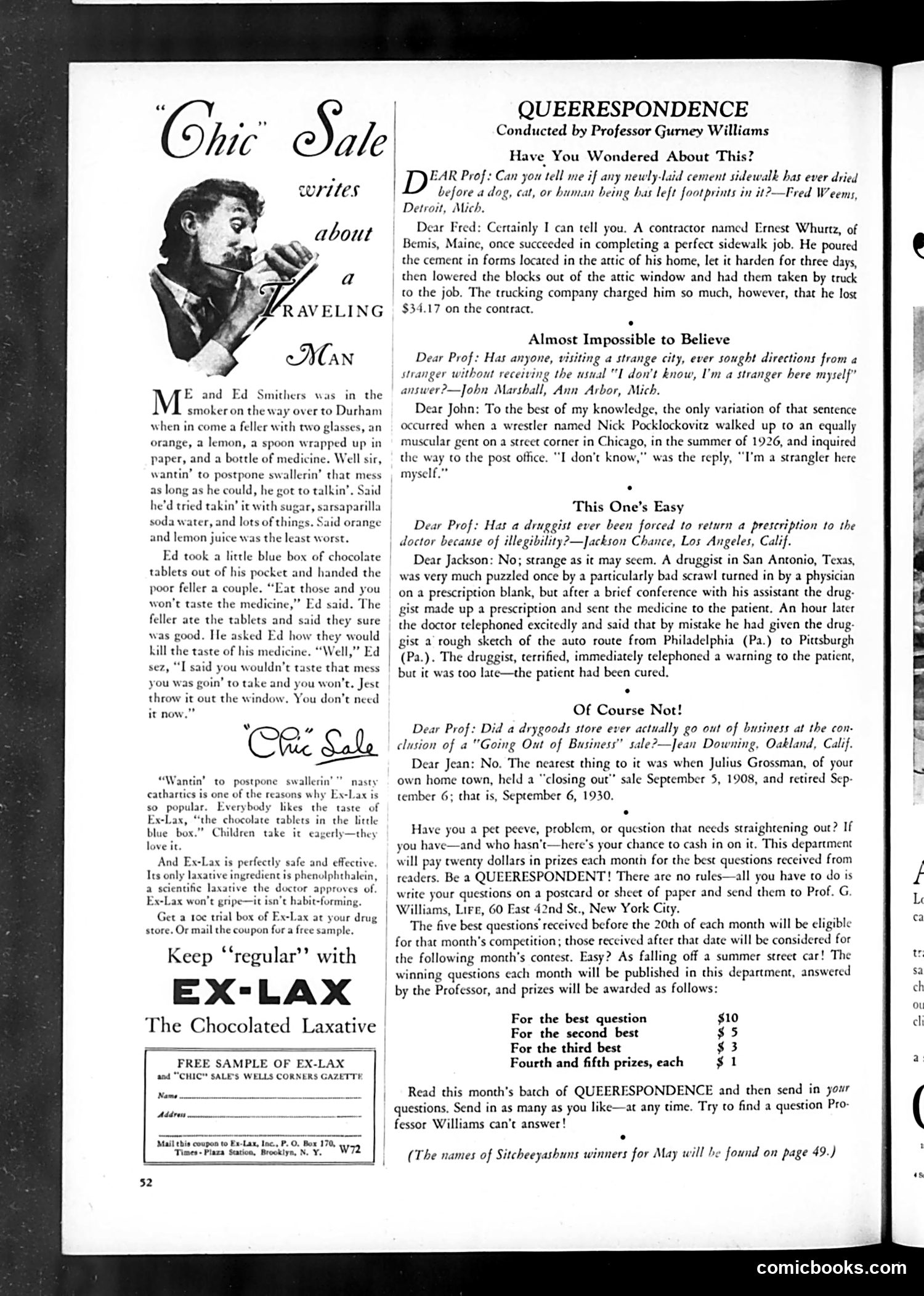
"Chic Sale" and Life Magazine Satire This page combines a humorous short story with advertising and a reader-question column typical of *Life* magazine's satirical content. The Main Story ("A Traveling Man"): Chic Sale writes a tall tale about Ed Smithers tricking a sick traveler. The traveler has medicine he dreads taking, so Ed gives him Ex-Lax chocolate tablets, claiming they'll mask the medicine's taste. The joke: Ed never intended the man to take the medicine at all—he's simply conned him into throwing it out the window. It's a classic con-man story serving as extended advertising for Ex-Lax laxative. "Queerespondence" Column: A humor feature where "Professor Gurney Williams" answers absurd reader questions with tall tales—like a contractor who built a perfect sidewalk in his attic to protect it from footprints, or a druggist who accidentally cured a patient using a car-route map instead of a prescription. These satirize the implausibility of everyday life. The page is essentially advertorial humor: entertaining readers while promoting a laxative product through comedic storytelling rather than direct sales pitch.
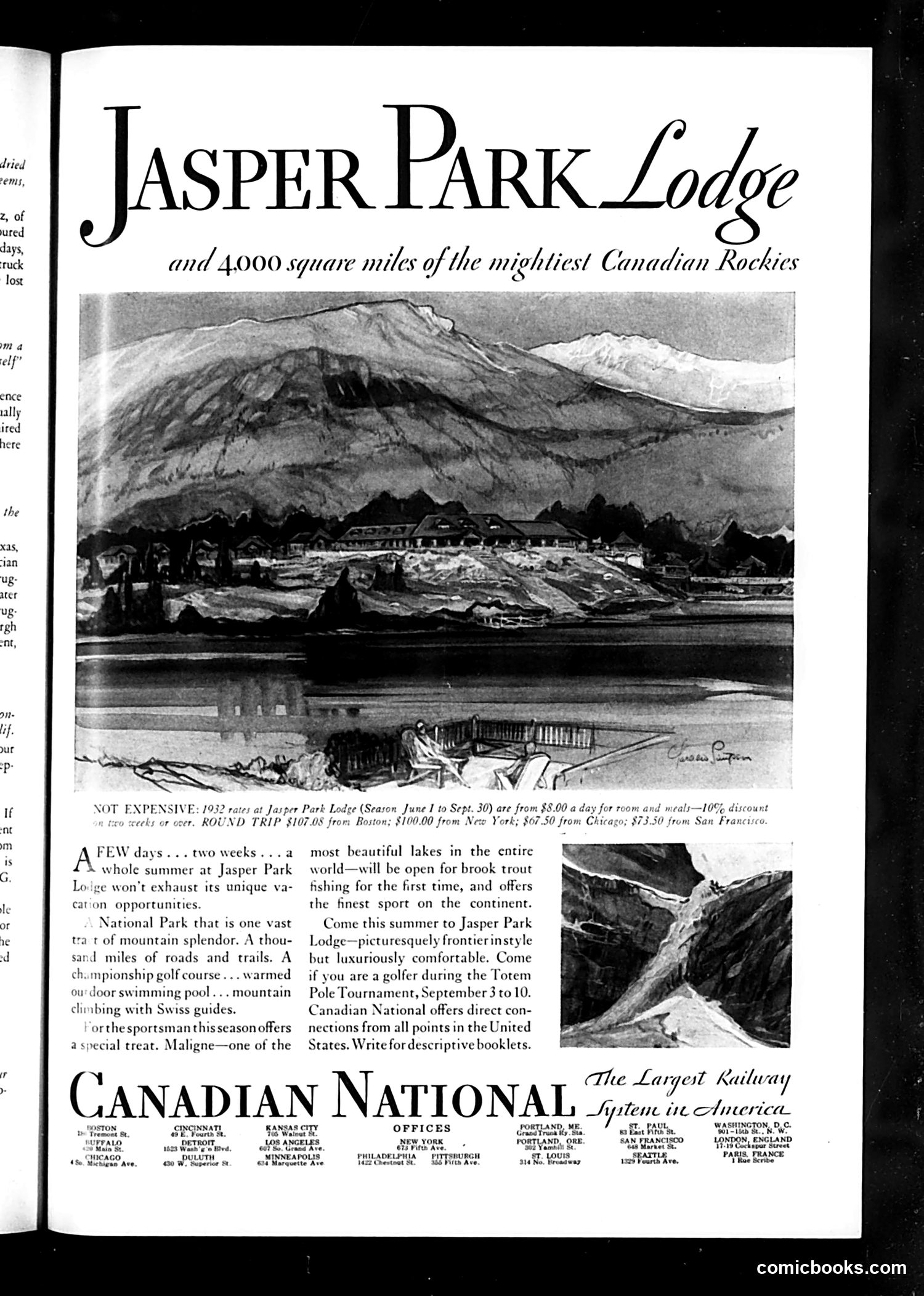
Jasper Park Lodge Advertisement This is not a political cartoon but a tourism advertisement for Jasper Park Lodge in the Canadian Rockies, placed in Life magazine (likely early 1930s based on the 1932 rate mention). The page promotes vacation travel to Canada's mountain wilderness, emphasizing leisure activities: golf, swimming, mountain climbing, and trout fishing. The illustration depicts the lodge nestled beneath dramatic peaks with a lake in the foreground—a romanticized wilderness fantasy for affluent American readers. The "NOT EXPENSIVE" disclaimer is notable: despite Depression-era economic hardship, the ad pitches luxury tourism by listing rail fares from major U.S. cities, suggesting leisure travel remained accessible to middle-to-upper-class audiences. The Canadian National Railway company uses this advertising to promote both the destination and their transcontinental rail service connecting American cities to remote Canadian resorts.
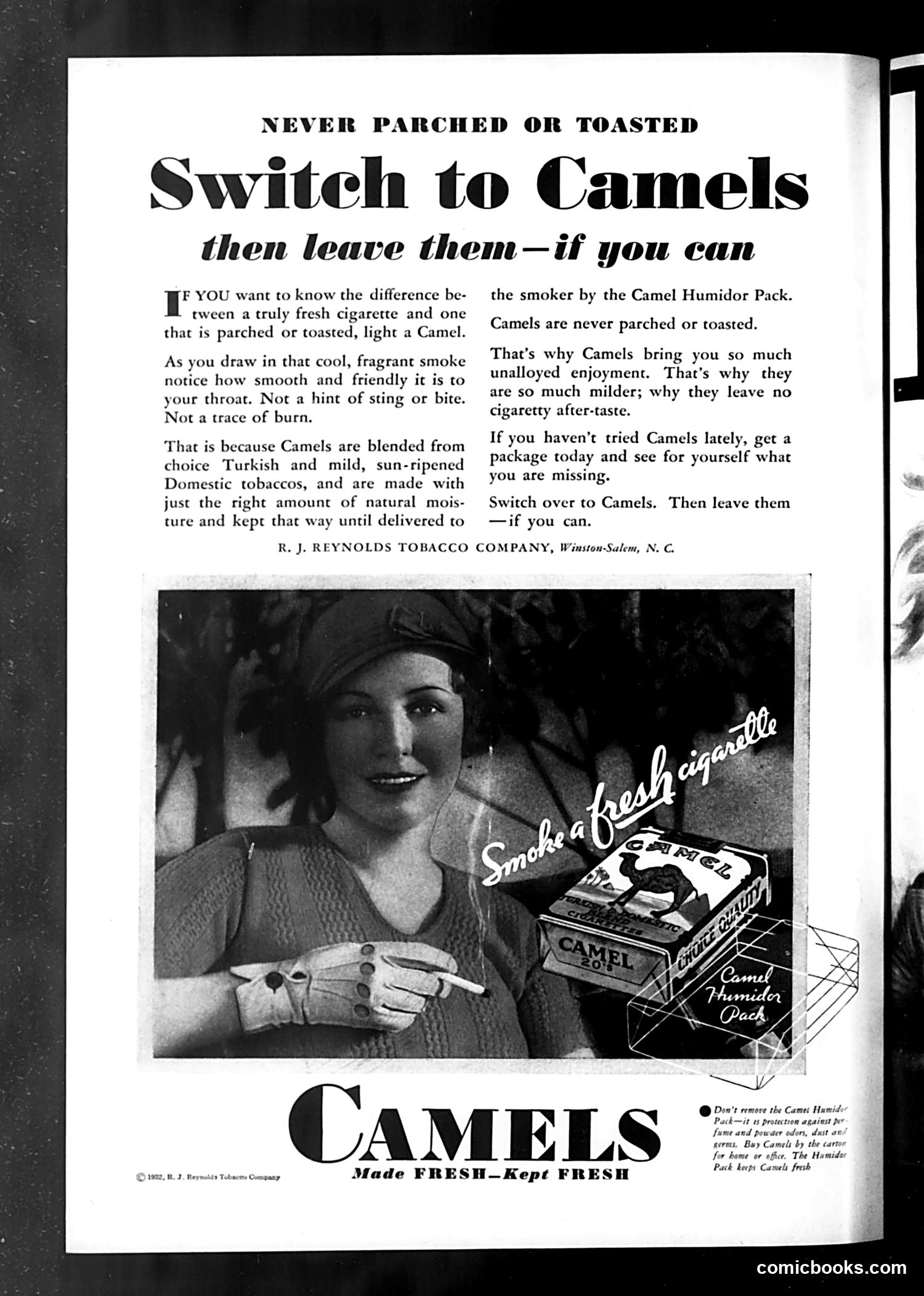
Analysis This is a Camel cigarette advertisement, not political satire. It's a straightforward commercial promoting Camel brand cigarettes, likely from the 1930s-40s based on styling and typography. The "message": The ad claims Camels are superior because they're "never parched or toasted"—implying competitors over-process their tobacco, making cigarettes harsh and irritating. Camels allegedly maintain natural moisture for a smoother, fresher smoke with no "after-taste." The image: Shows a smiling woman holding a cigarette next to a Camel Humidor Pack (special packaging designed to keep cigarettes fresh). The tagline's joke: "Switch to Camels, then leave them—if you can" implies the product is so addictively good smokers won't want to stop. Modern context: This represents pre-health-warning tobacco advertising that made explicit health/comfort claims, freely used imagery suggesting sophistication and pleasure, and operated without government restrictions on messaging.