life
Life — August 1932
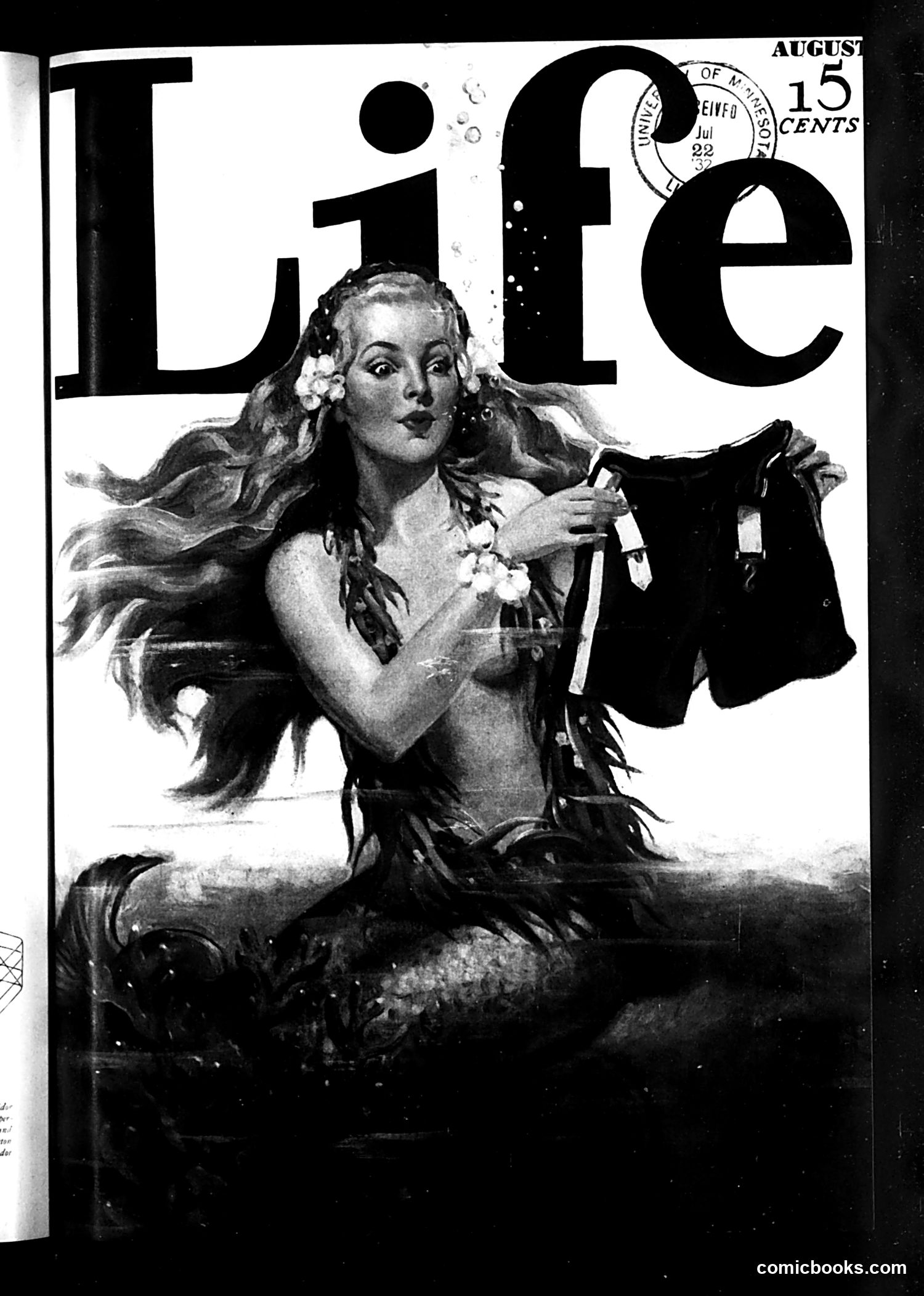
Life Magazine Cover Analysis This is a Life magazine cover from August 15 (date stamp visible), priced at 15 cents. The image shows a woman in classical/theatrical costume—draped fabric, flowers in her hair—holding up what appears to be undergarments or clothing with an exaggerated, surprised expression. Without additional visible text identifying the specific subject, the satire appears to target fashion, morality, or women's clothing conventions of the era. The theatrical styling and her shocked expression suggest commentary on either: - Revealing fashions being considered scandalous - Changing attitudes toward women's dress - Sexual or social propriety standards The exact political or social reference remains unclear without the article text, though the tone suggests humorous social criticism typical of Life's satirical approach.
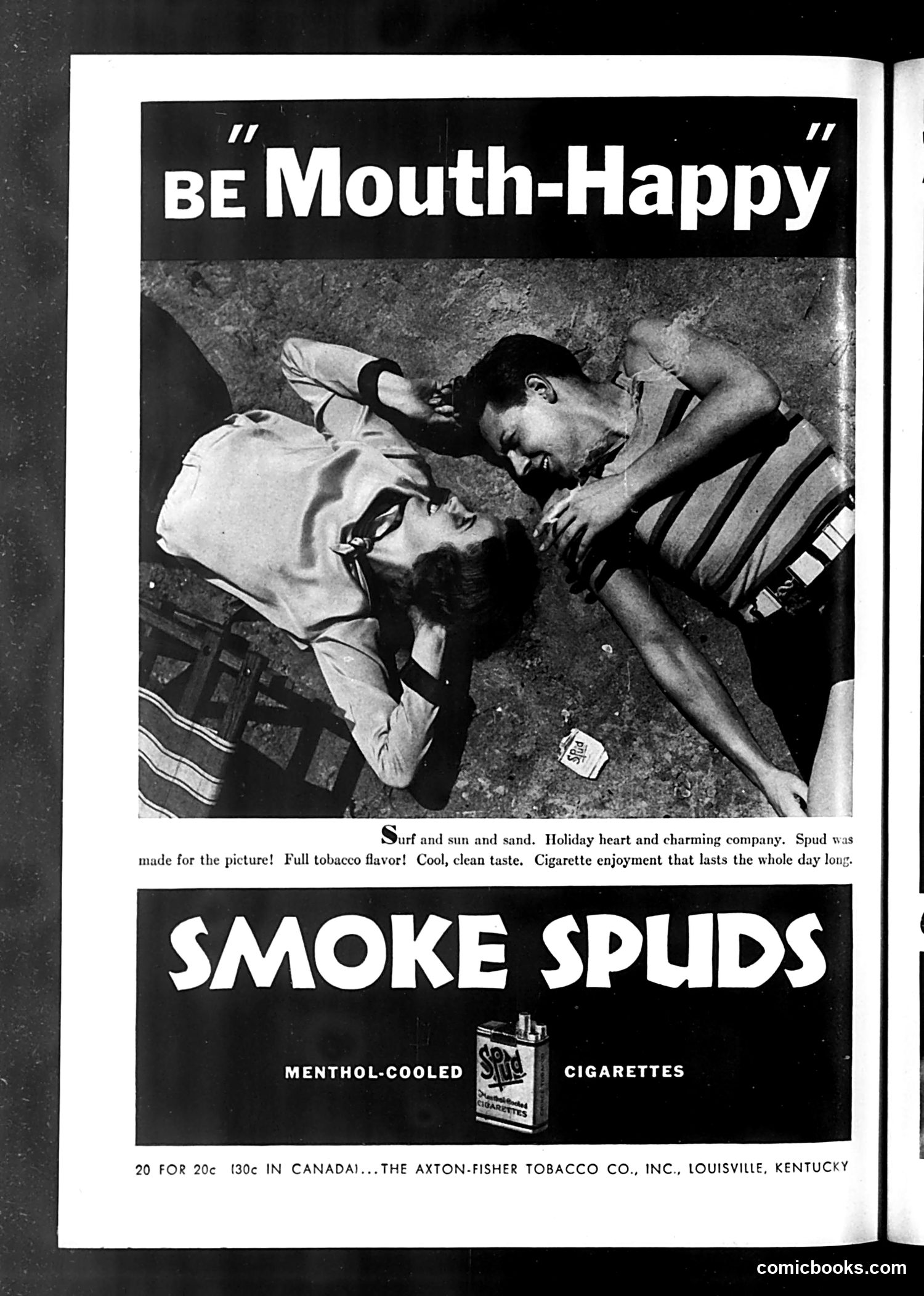
Historical Advertisement Analysis This is a cigarette advertisement, not political satire. It's a "Spuds" brand cigarette ad from The Axton-Fisher Tobacco Co. (Louisville, Kentucky), priced at 20 for 20¢. The ad shows two men lying on sand in casual beach attire, appearing relaxed and happy. The slogan "BE 'Mouth-Happy'" promotes cigarettes as enhancing leisure activities. The accompanying text emphasizes "Surf and sun and sand. Holiday heart and charming company" — linking smoking to vacation pleasures and social enjoyment. This reflects mid-20th century tobacco marketing, before widespread health warnings. Cigarettes were advertised as lifestyle products associated with relaxation, friendship, and happiness — messaging now heavily restricted or banned.
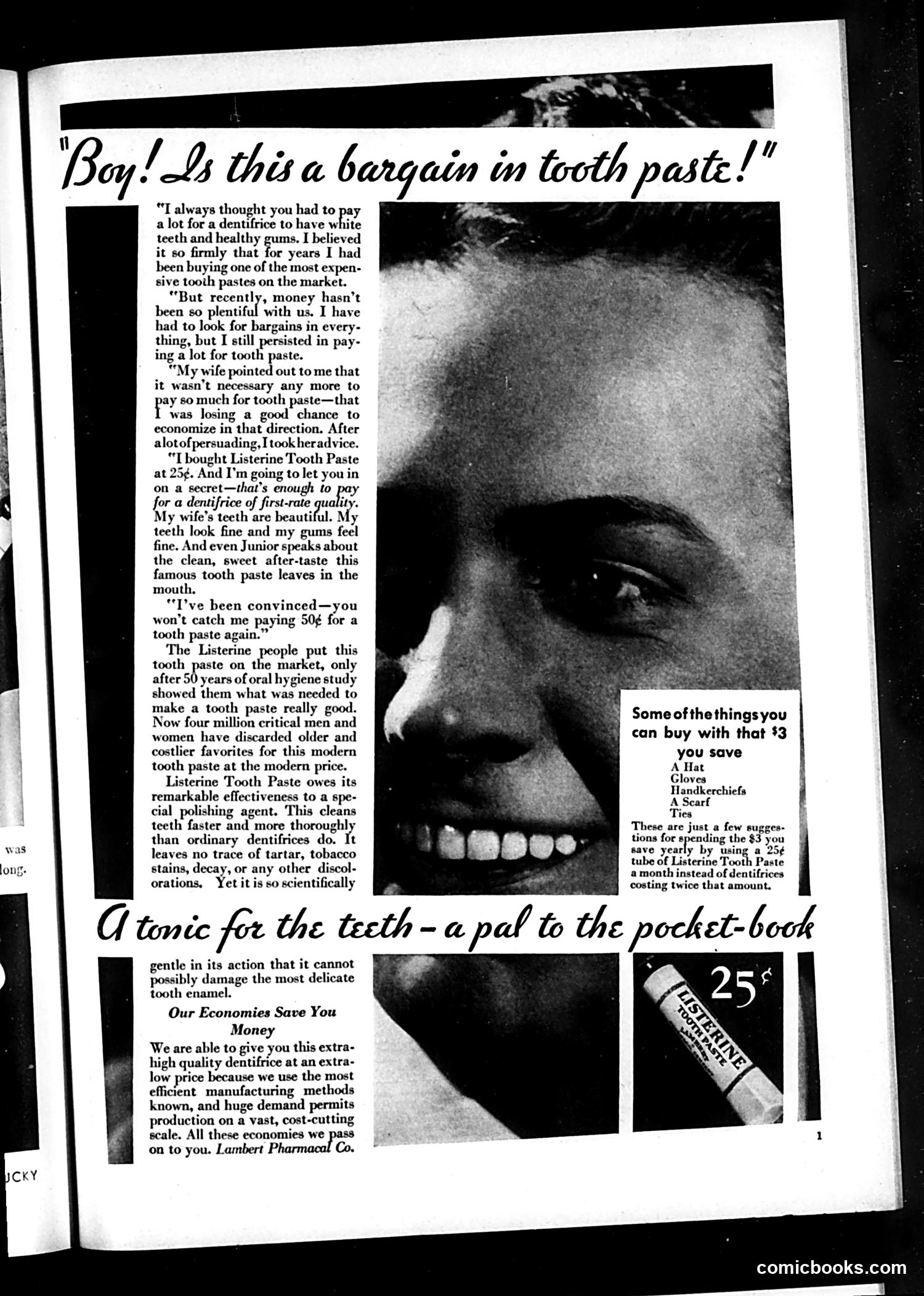
Listerine Tooth Paste Advertisement This is a full-page advertisement for Listerine Tooth Paste, not political satire. The humor is commercial rather than political. The ad uses a testimonial format: a man describes switching from expensive premium toothpastes to Listerine at 25¢, claiming it delivers equal or superior results. The satire targets consumer behavior—specifically the assumption that higher price equals better quality. The headline "'Boy! Is this a bargain in tooth paste!'" and the sidebar listing what $13 saved annually could buy (a hat, gloves, scarves) appeal to Depression-era economy-consciousness. The copy emphasizes that Listerine's effectiveness comes from "efficient manufacturing methods" and "huge demand," not premium pricing—challenging readers' spending habits on personal care products.
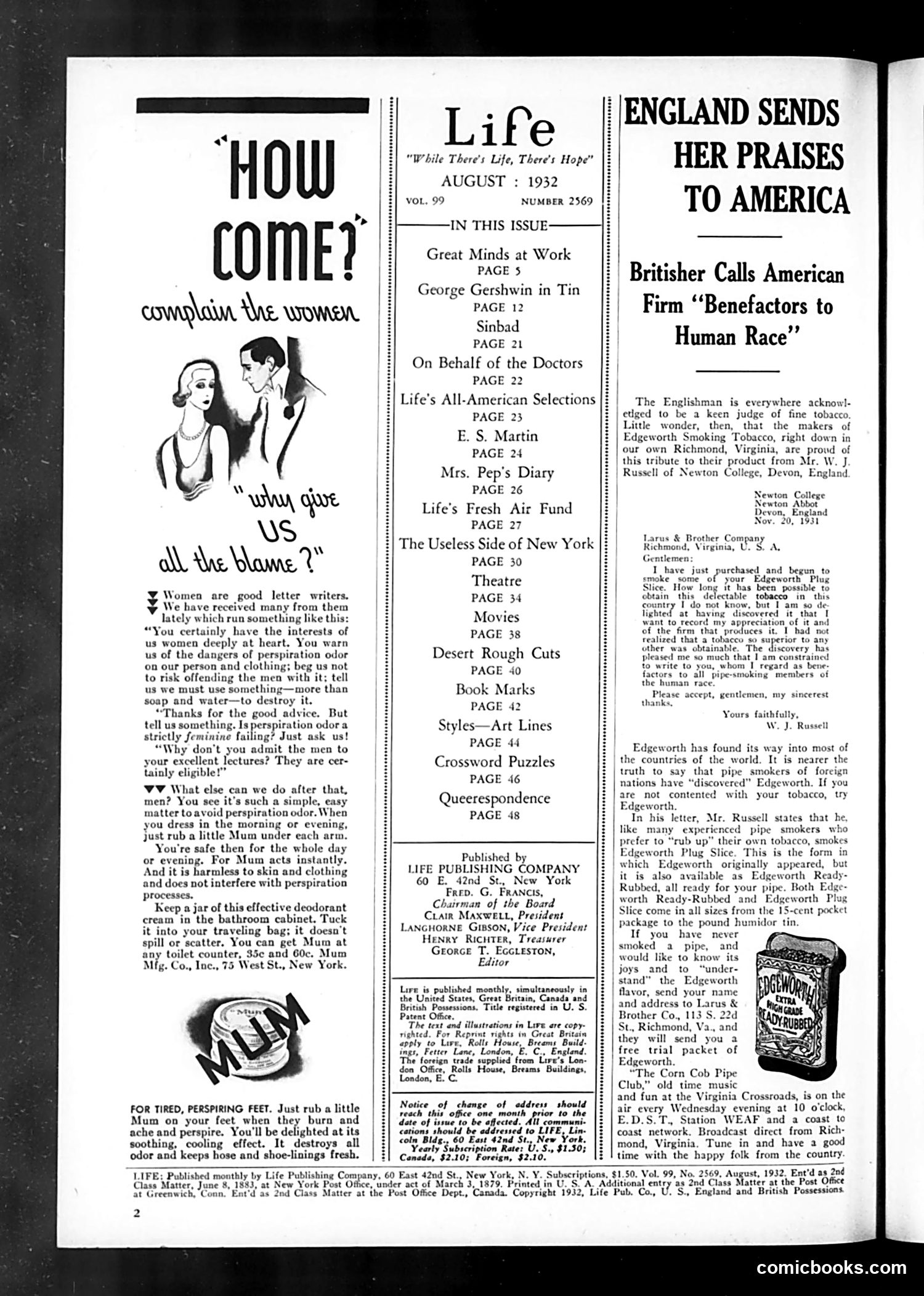
Analysis of Life Magazine Page (August 1932) The left side features a satirical cartoon titled "How Come?" addressing women's behavior. It depicts a woman and man, with the woman saying "why give us all the blame?" The cartoon critiques women for being overly concerned with personal hygiene and appearance—specifically mentioning deodorant and soap use to prevent body odor. The satire suggests women are unnecessarily blamed for "dangers of perspiration odor" when men could similarly take precautions. The accompanying text humorously argues that if women must use deodorants to be socially acceptable, men should face equal scrutiny for their hygiene standards. It's a commentary on gender double standards regarding personal grooming and social expectations during the Depression era.
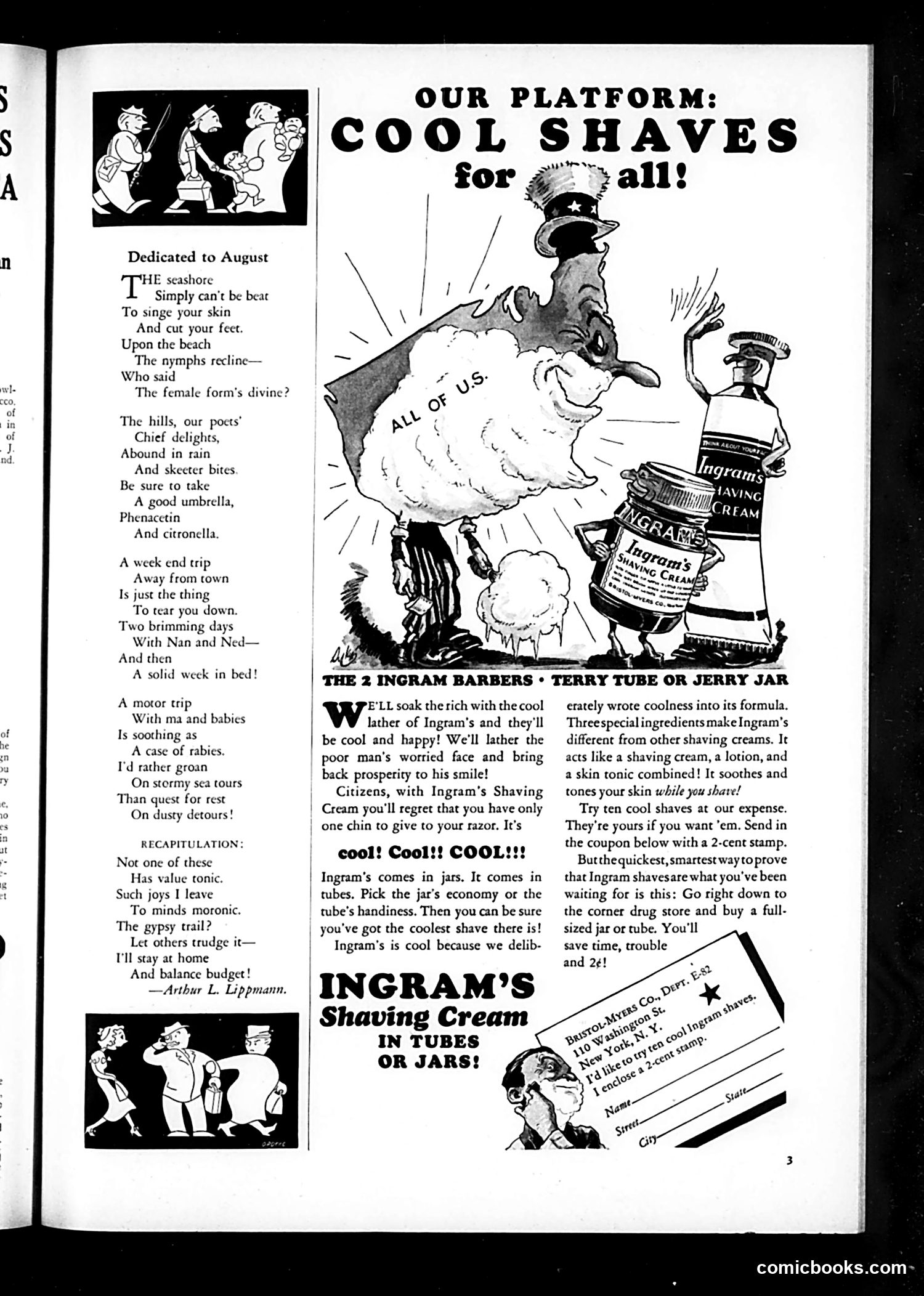
Analysis This page is primarily an advertisement for Ingram's Shaving Cream disguised as editorial content. The main cartoon depicts Uncle Sam (identifiable by his star-spangled hat and "ALL OF US" label) being lathered with Ingram's products by two barbers labeled "THE 2 INGRAM BARBERS." The satire plays on the advertising slogan "COOL SHAVES for all!" — a populist promise that Ingram's product will benefit everyone equally, "poor man's worried face" included. The joke is that even Uncle Sam himself needs cooling relief, suggesting the product's universal appeal. The accompanying poem on the left, "Dedicated to August," romanticizes summer leisure activities. Overall, this blends patriotic imagery with consumer messaging to market the shaving cream as democratically available to all Americans.
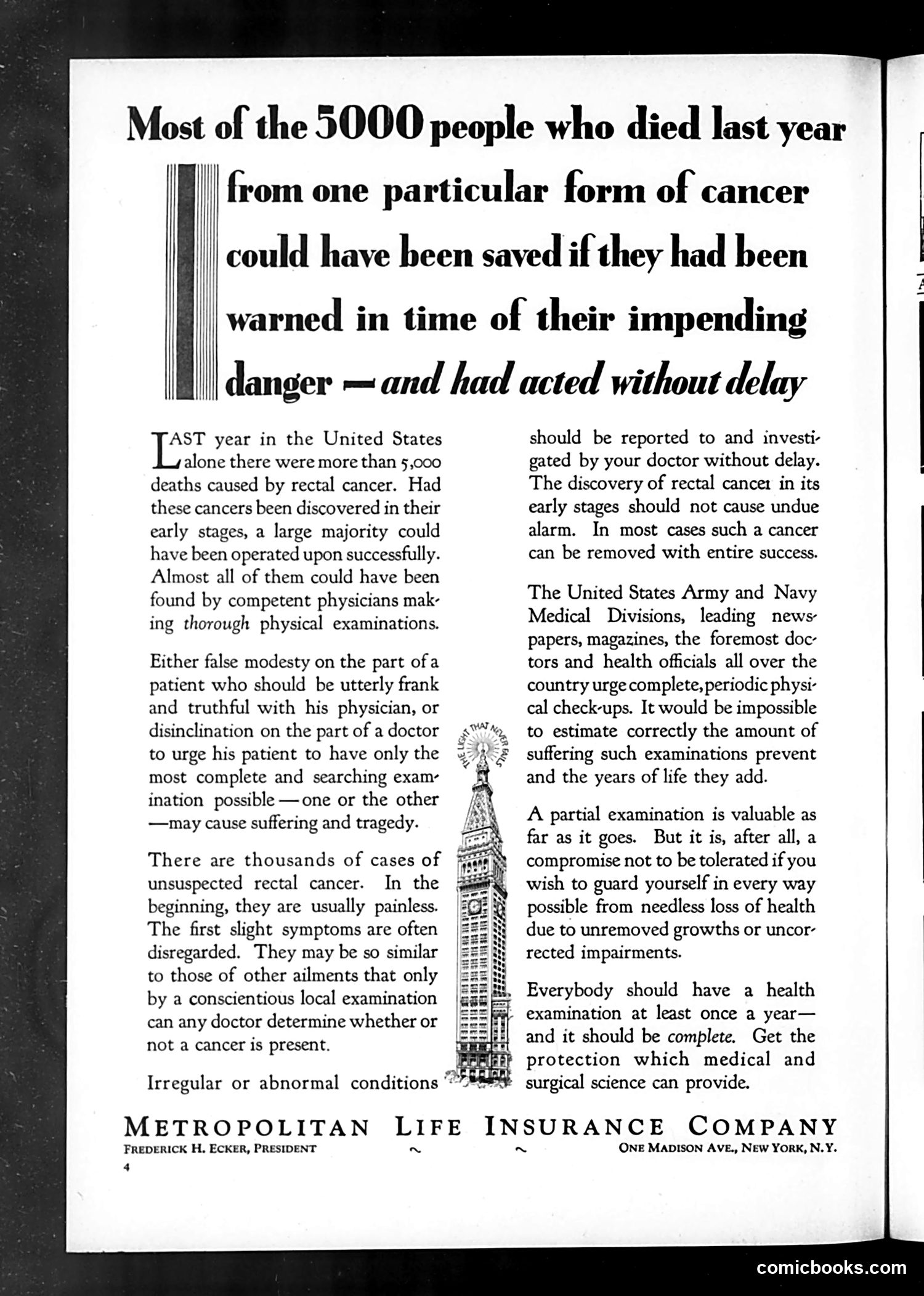
Analysis This is not a satirical cartoon page, but rather a public health advertisement from Metropolitan Life Insurance Company. The page advocates for annual physical examinations to detect rectal cancer early, when treatment is most successful. The text reports that over 5,000 Americans died from rectal cancer the previous year, most preventably through early detection via thorough physical exams. It criticizes both patient modesty and physician reluctance to conduct complete examinations. The only visual element is an architectural illustration (likely the Metropolitan Life Building in New York) serving as the company's logo. This represents early 20th-century corporate health messaging—insurance companies promoting preventive medicine as both humane and economically sensible, since detecting disease early reduced costly claims.
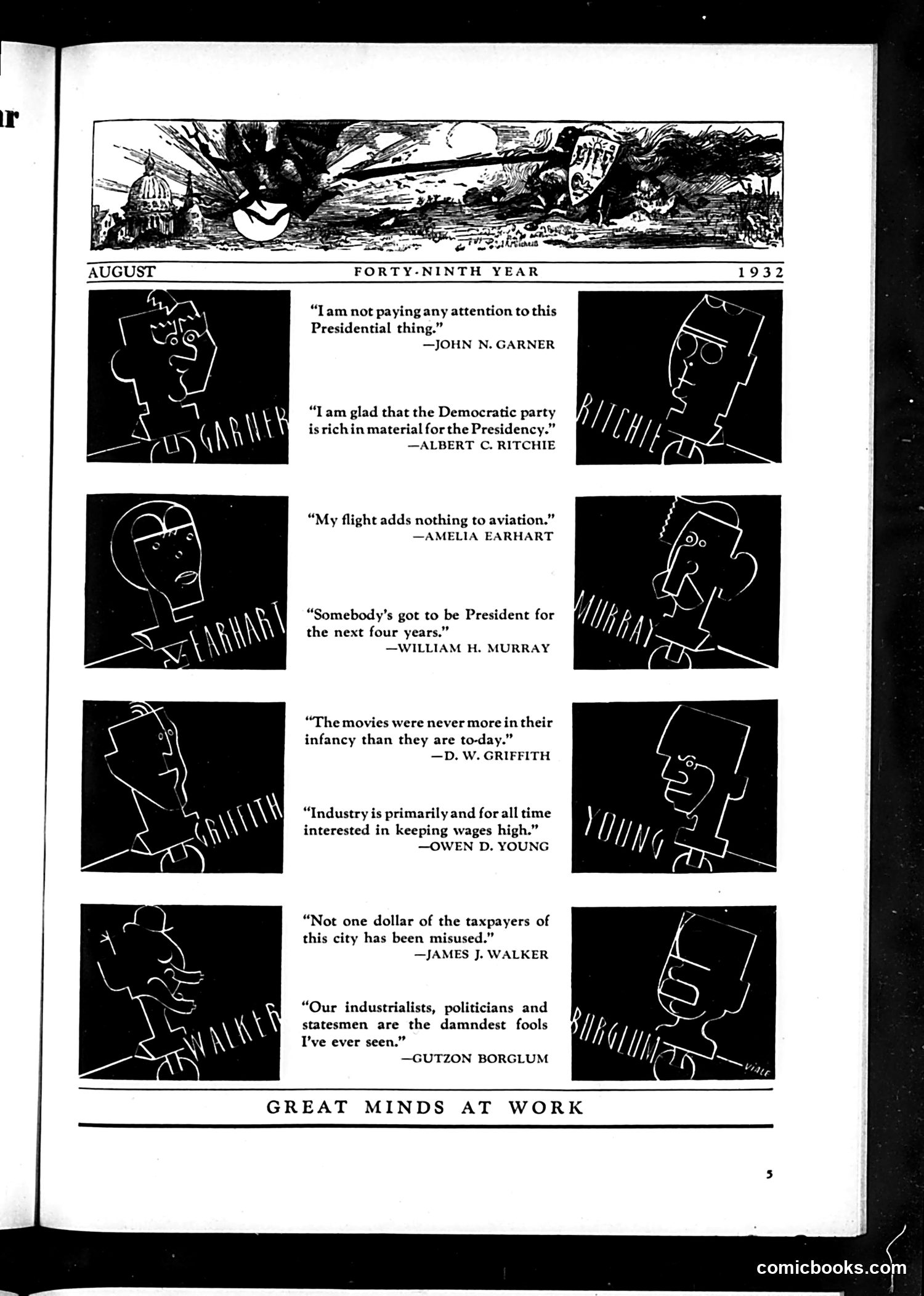
"Great Minds at Work" — Life Magazine, August 1932 This satirical page mocks prominent public figures during the 1932 Presidential election. The cartoon pairs paired caricatured heads with dismissive quotes, suggesting these "great minds" are actually foolish or self-interested. The figures include John N. Garner (VP candidate), Albert C. Ritchie (Democratic contender), Amelia Earhart (aviator), William H. Murray (governor), D.W. Griffith (filmmaker), Owen D. Young (industrialist), James J. Walker (NYC mayor), and Gutzon Borglum (sculptor). The satire attacks their platitudes and perceived irrelevance to serious issues. The title "Great Minds at Work" is ironic—suggesting these supposedly important people offer only vapid commentary while America faced the Depression. Each quote is paired with a contrasting profile, emphasizing the disconnect between their statements and reality.
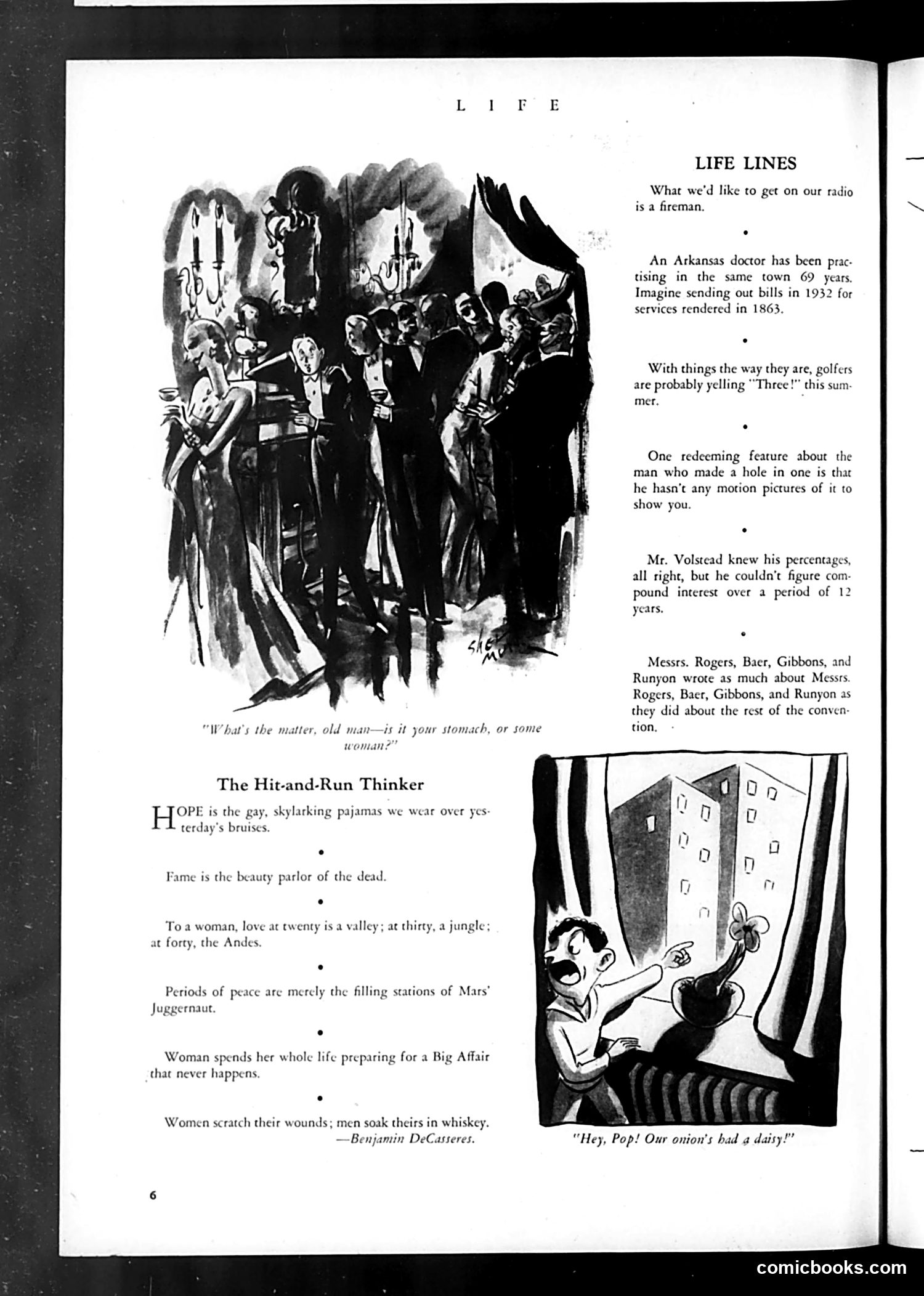
Analysis of Life Magazine Page This page contains two distinct sections: "Life Lines" (top right) offers brief satirical observations about contemporary life, including jokes about radio programming preferences and golf etiquette. "The Hit-and-Run Thinker" (bottom left) presents cynical aphorisms about human nature and relationships—observations like "Hope is the gay, skylarking pajamas we wear over yesterday's bruises" and commentary on women's romantic expectations at different ages. The two cartoons illustrate these themes: the upper illustration shows a crowded social gathering with the caption questioning someone's physical complaint, while the lower cartoon depicts a man watering a potted onion plant, captioned "Hey, Pop! Our onion's had a dairy!" This appears to be a visual pun or absurdist humor typical of 1920s-30s magazine satire.
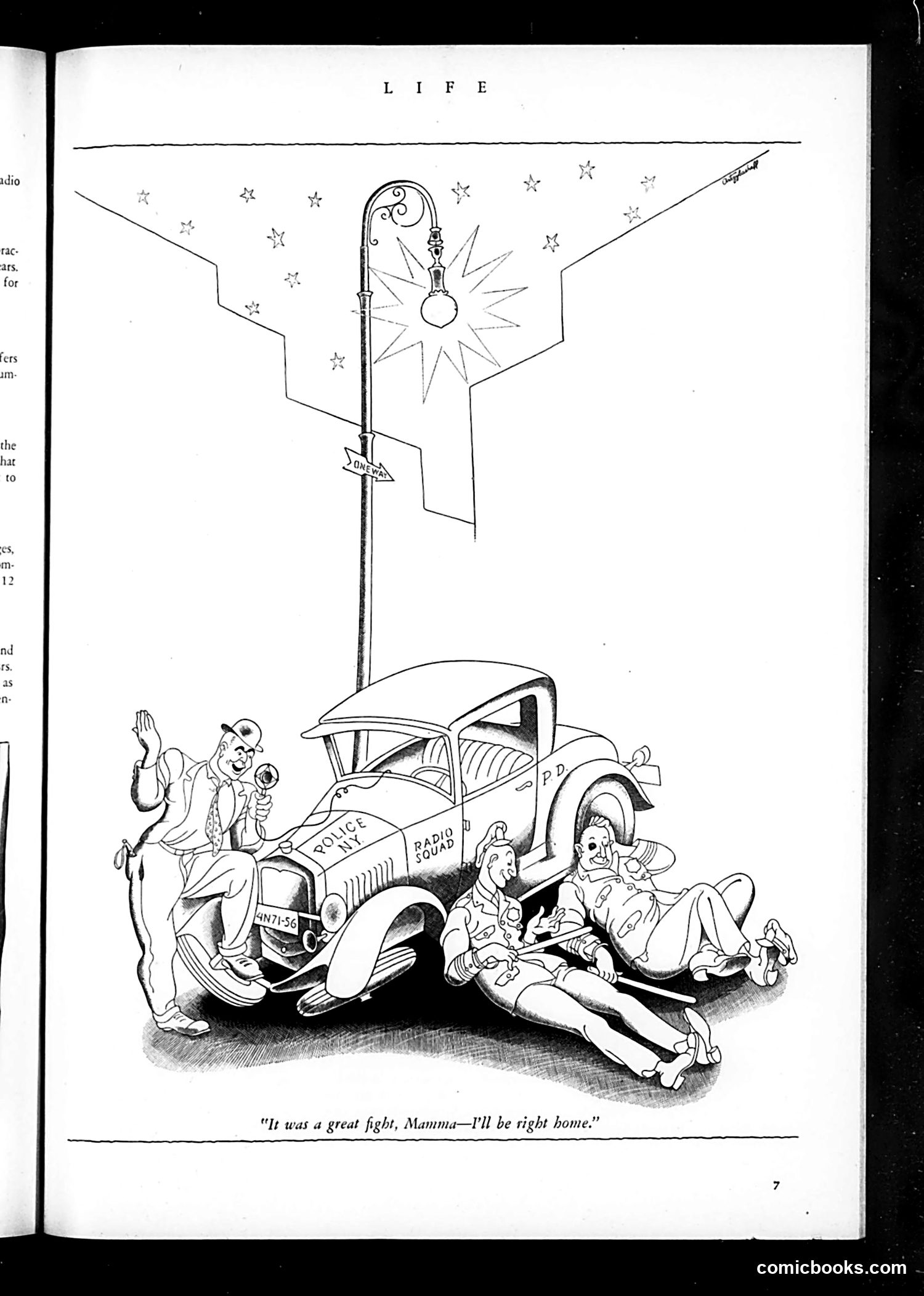
Analysis of Life Magazine Cartoon This single-panel cartoon depicts a wrecked police radio car with the caption "It was a great fight, Mamma—I'll be right home." The satire targets radio-equipped police vehicles, a relatively new technology at the time. The crashed "Police N.Y." car labeled "Radio Squad" has apparently been in a serious accident. The injured officers and civilians strewn about suggest the new technology caused more problems than it solved—possibly implying that distracted driving via radio communication made police work more dangerous. The figure waving in the background appears to be reporting the incident, while the sardonic caption undercuts the gravity of the situation through dark humor. This mocks both the fanfare around police modernization and the unintended consequences of hasty technological adoption in law enforcement.
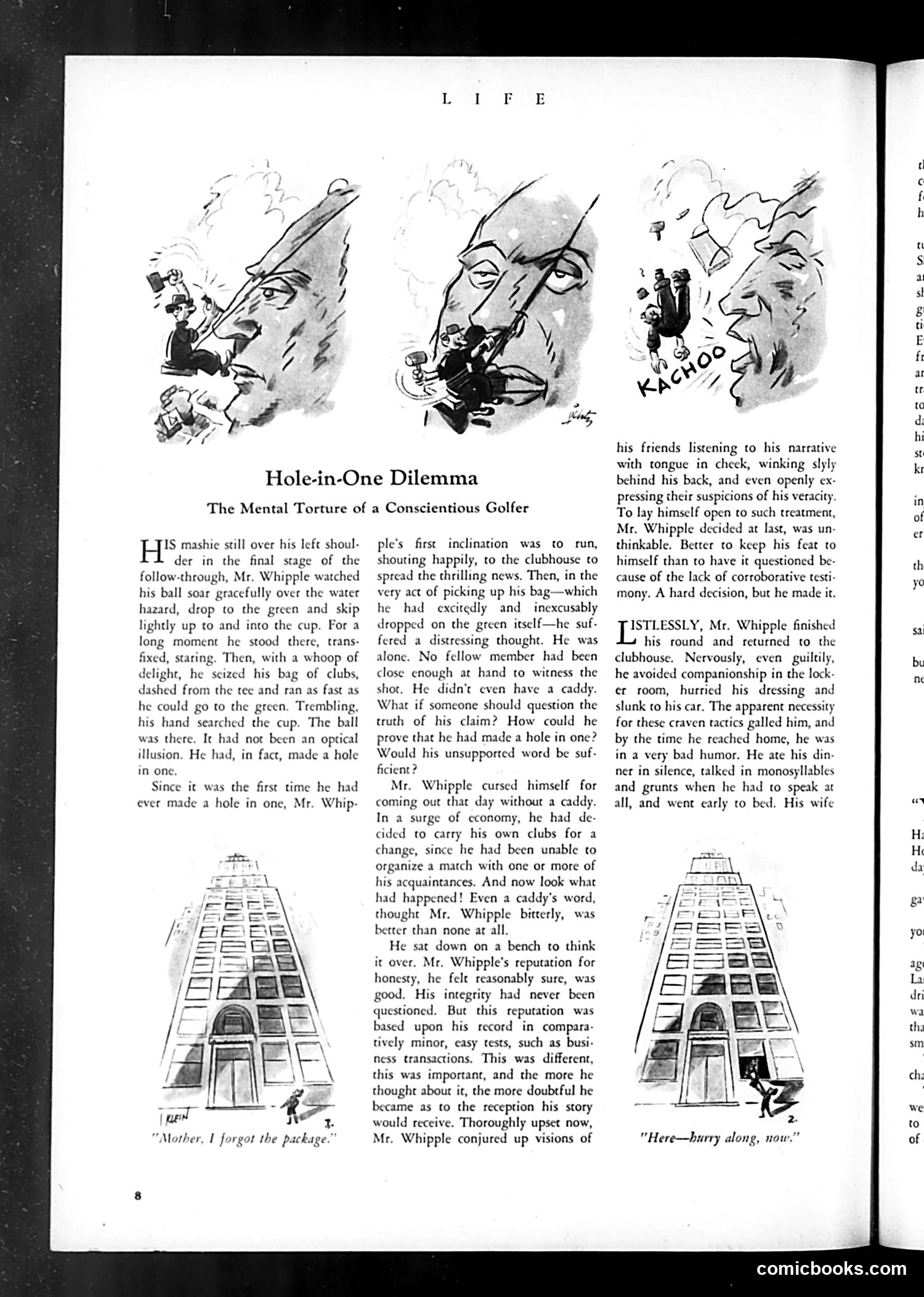
"Hole-in-One Dilemma: The Mental Torture of a Conscientious Golfer" This satirical piece mocks the social anxiety of a golfer named Mr. Whipple who has achieved a rare hole-in-one but faces a credibility problem: he has no witnesses. The cartoon shows his internal torment—depicted through three caricatured head studies at top showing his distress. The humor centers on early 20th-century golf culture, where such achievements required corroboration. Without a caddy present to verify his claim, Whipple cannot prove his accomplishment to skeptical friends, despite his reputation for honesty. The illustrations of tall buildings suggest he's obsessing over this predicament. The satire targets both golf's social pretensions and the anxieties of maintaining respectability among peers.
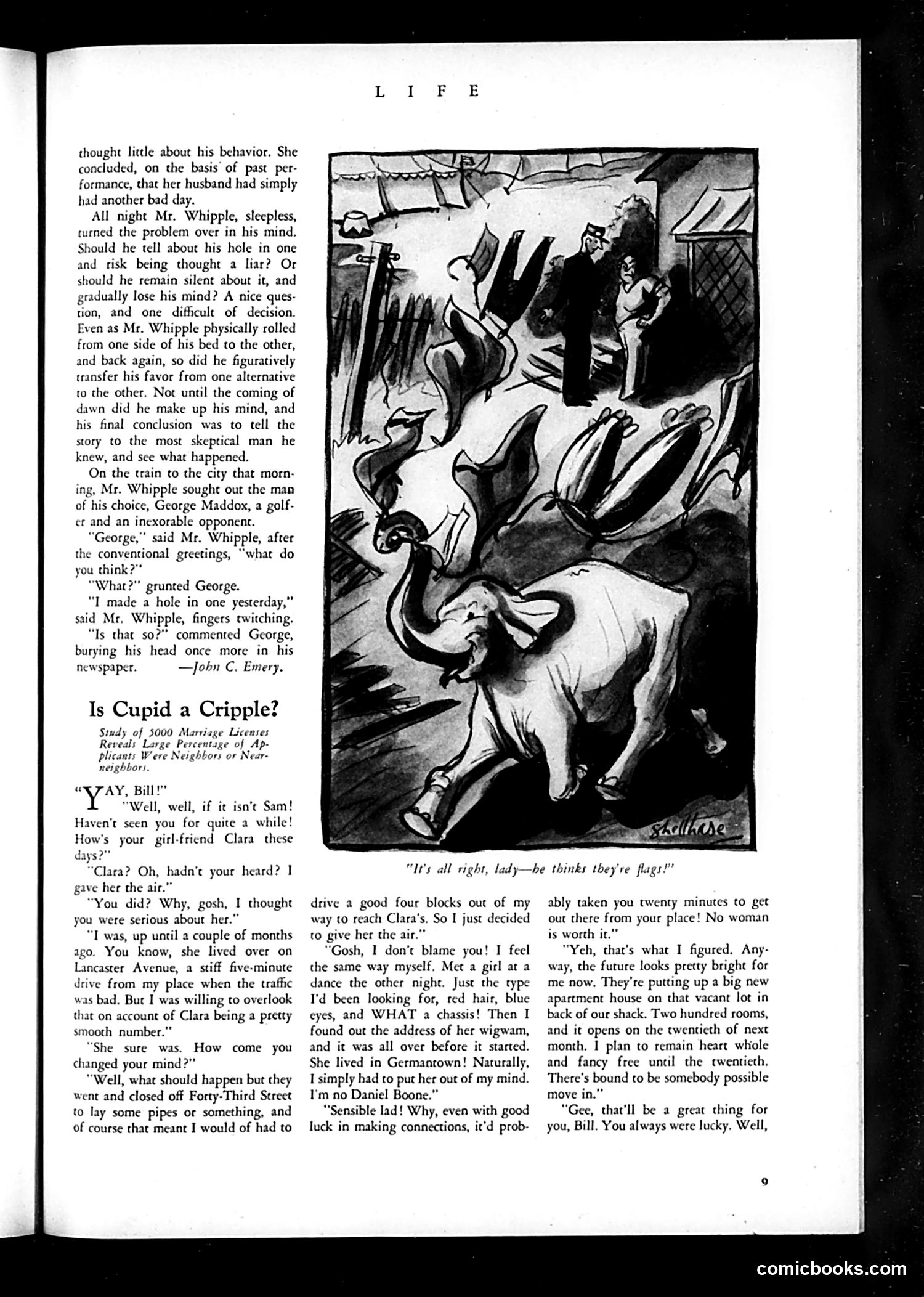
Analysis of "Is Cupid a Cripple?" This page from *Life* magazine contains a satirical cartoon and accompanying narrative dialogue. The cartoon illustrates a chaotic domestic scene where a man appears to have fallen or been knocked down by a woman, with furniture overturned. The caption reads: "It's all right, lady—he thinks they're flags!" The article's title and dialogue suggest satire about marriage and courtship. The conversation between "Bill" and "Sam" discusses romantic misadventures—specifically, Sam's pursuit of a woman named Clara, whom he pursued but then abandoned due to complications. The humor derives from depicting romantic entanglement as chaotic and absurd, with the cartoon visual reinforcing marriage as conflict rather than harmony. The "Cupid" reference suggests love itself is portrayed as disabled or ineffectual.
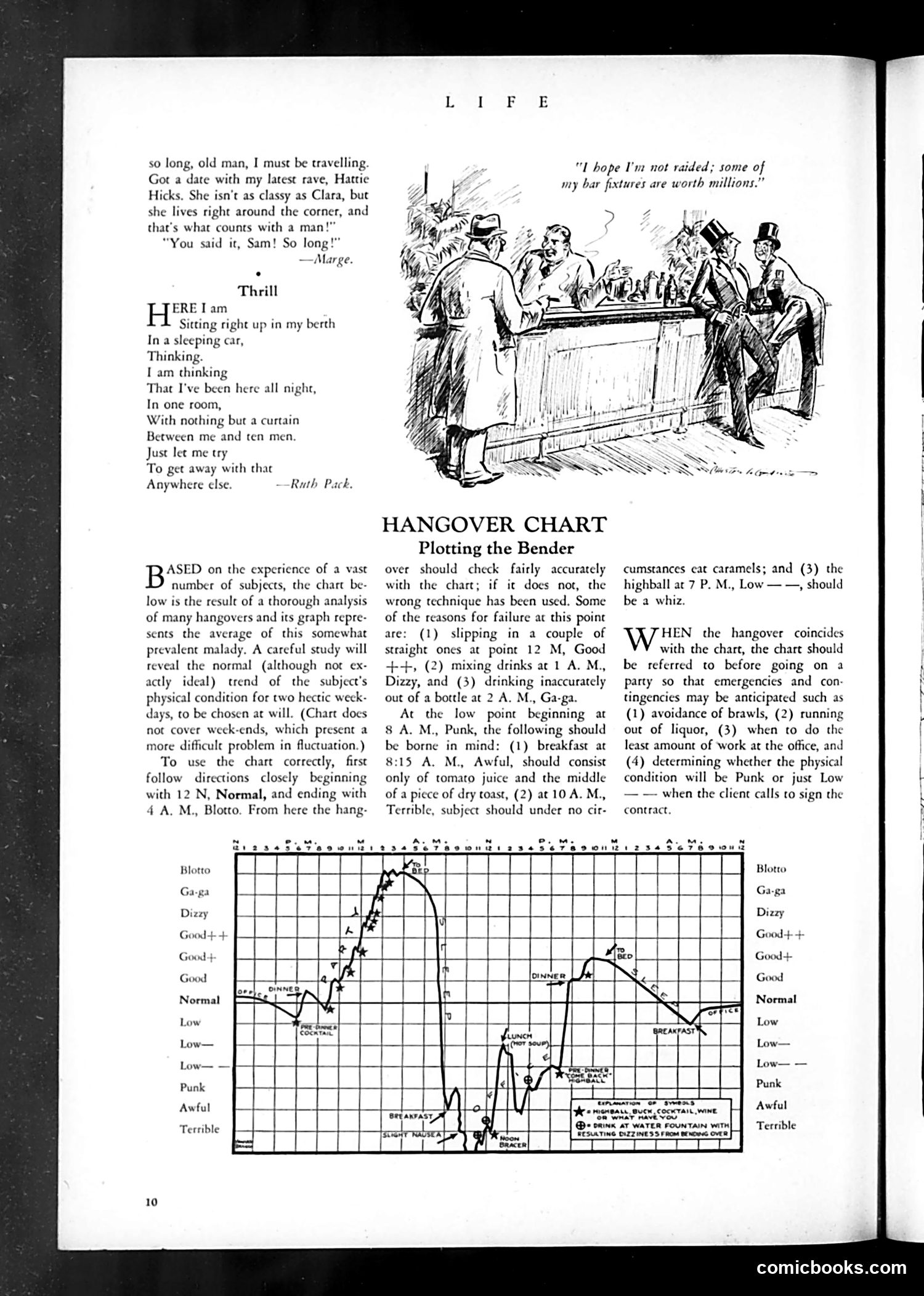
Hangover Chart Analysis This page satirizes the "morning after" of heavy drinking through two pieces: "Thrill" poem by Ruth Pack: A tongue-in-cheek account of waking in a sleeping car with strangers, wanting to escape the awkward situation. "Hangover Chart": A humorous graph plotting a drinker's physical condition over 24 hours, tracking the progression from "Blotto" (drunk) through various states (Dizzy, Good++, Normal, Low, Punk, Awful, Terrible) based on a specific drinking schedule. The chart includes comedic annotations about breakfast timing, drinking patterns, and remedies like "drink of water fountain with straw." The satire targets the predictable cycle of excessive drinking and its consequences—a commentary on 1920s-30s social drinking culture and hangover mythology, presenting the experience as both inevitable and measurable through pseudoscientific graphing.
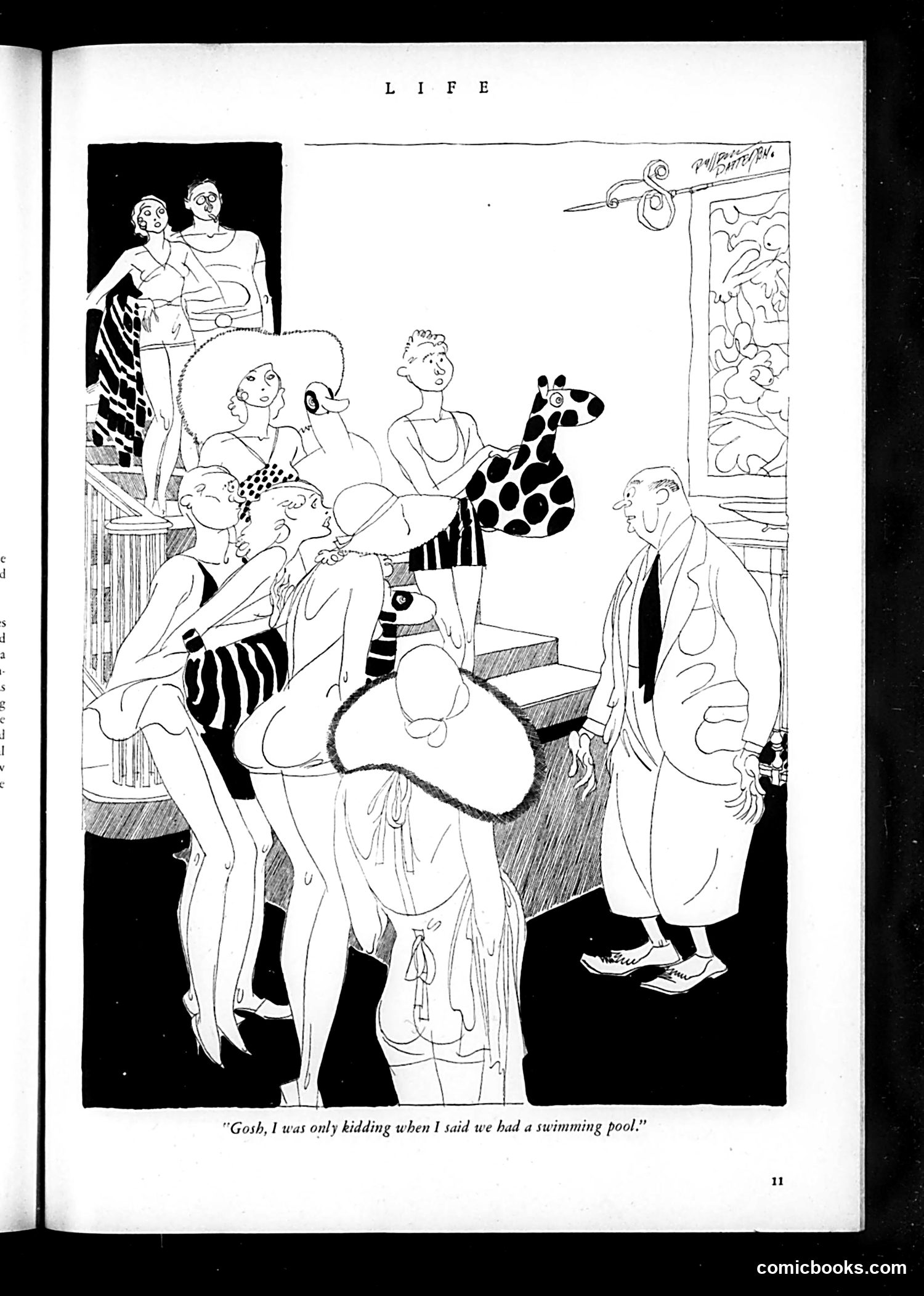
Analysis This single-panel cartoon satirizes exaggeration and social pretense among the wealthy. The caption reads: "Gosh, I was only kidding when I said we had a swimming pool." The scene depicts a fashionable 1920s-30s party where a woman in a polka-dot bathing suit has apparently taken a host's casual boast literally and arrived prepared to swim. The other guests—dressed formally in evening wear—react with shock and embarrassment at her appearance. The joke targets how people in high society make grandiose claims about their possessions to impress others, expecting listeners to understand they're exaggerating. The woman's literal interpretation exposes this social hypocrisy by actually following through on the (false) promise, creating awkward comedy from the gap between pretense and reality.
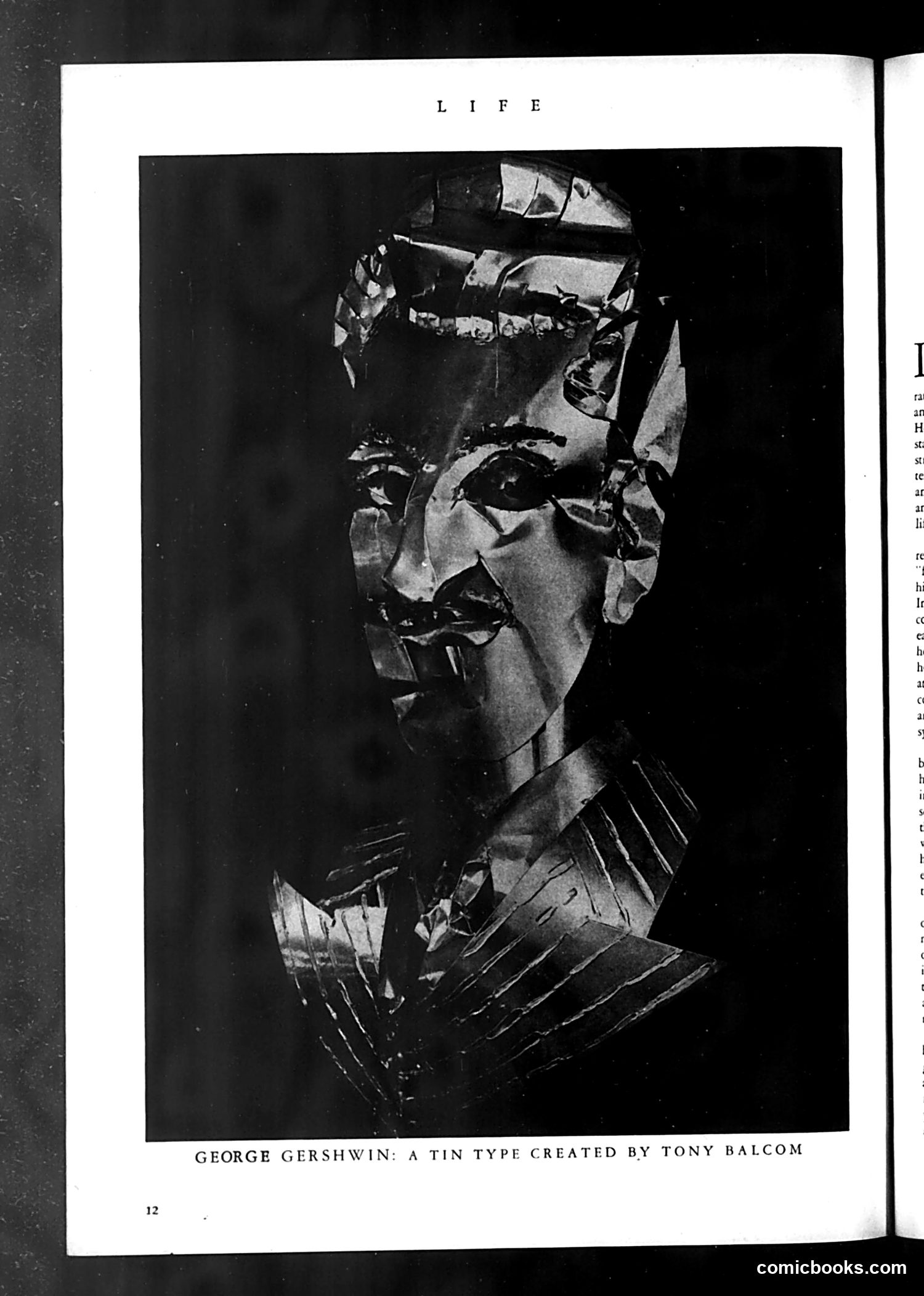
Analysis This page from *Life* magazine features a sculptural portrait of composer George Gershwin created by artist Tony Balcom. The image shows a stylized tin bust with distinctive facial features and decorative elements on the shoulders. The caption identifies this as "a tin type created by Tony Balcom," likely a play on words—a "tin type" was a cheap form of early photography, but here it refers to an actual metallic sculpture. This appears to be straightforward arts coverage rather than political satire, showcasing modernist sculptural work. The portrait captures Gershwin during his prominence as an American composer, though without additional context from the page's text (partially visible on the right), the specific point of the artistic presentation remains unclear.
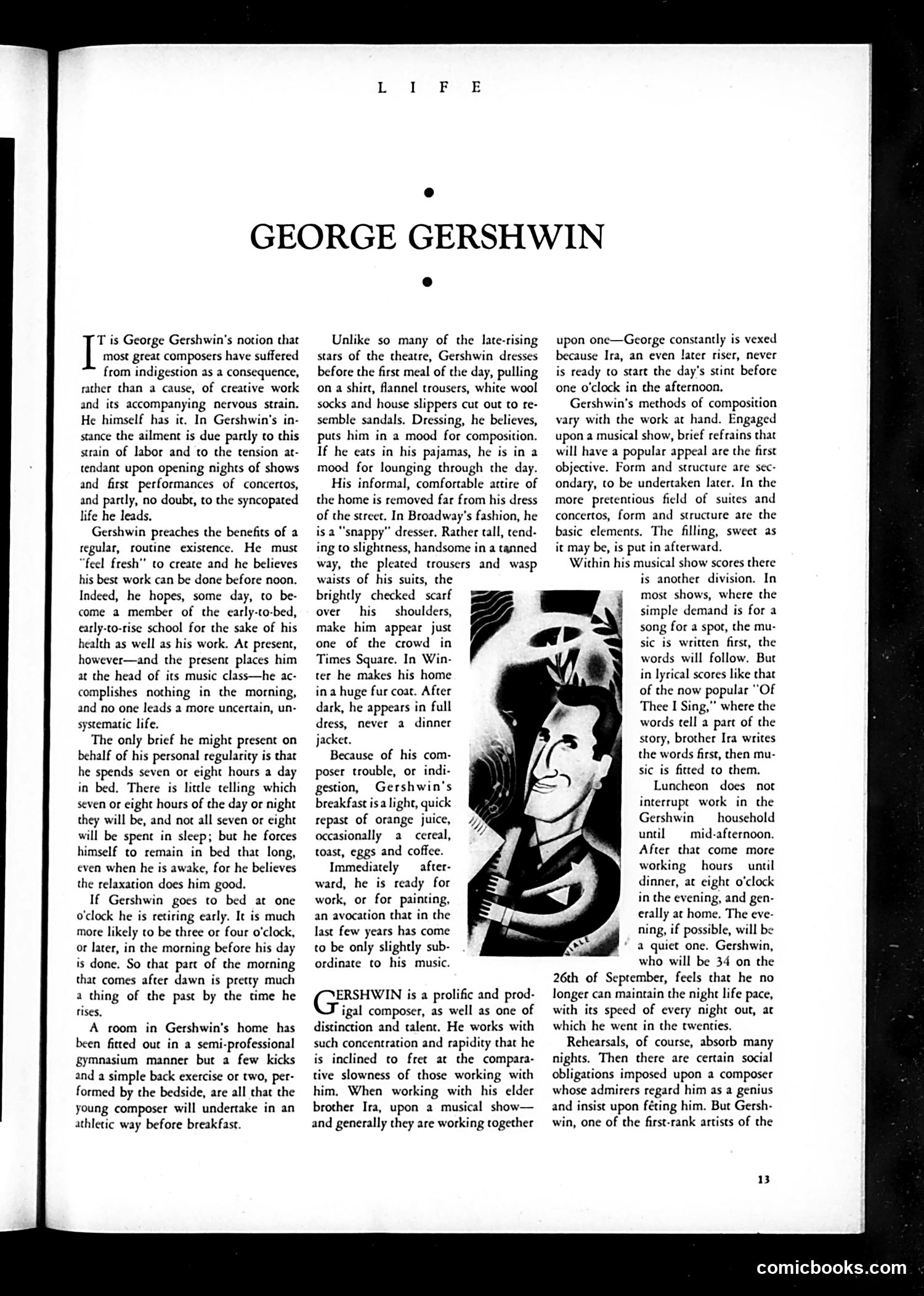
George Gershwin Profile from Life Magazine This is a biographical profile of composer George Gershwin, not a political cartoon. The page features a striking portrait illustration of Gershwin and discusses his personal habits and compositional methods. The article emphasizes Gershwin's unconventional lifestyle: his casual dress, irregular sleep schedule (working until 8 PM, then socializing), and belief that relaxation aids creativity. It notes his prolific output and rapid compositional process, describing him as working "with such concentration and rapidity." The profile presents Gershwin as a distinctive figure in American music—successful, energetic, and somewhat eccentric in his daily routines. For modern readers, this illustrates early 20th-century attitudes toward artistic genius as inseparable from unconventional personal habits.
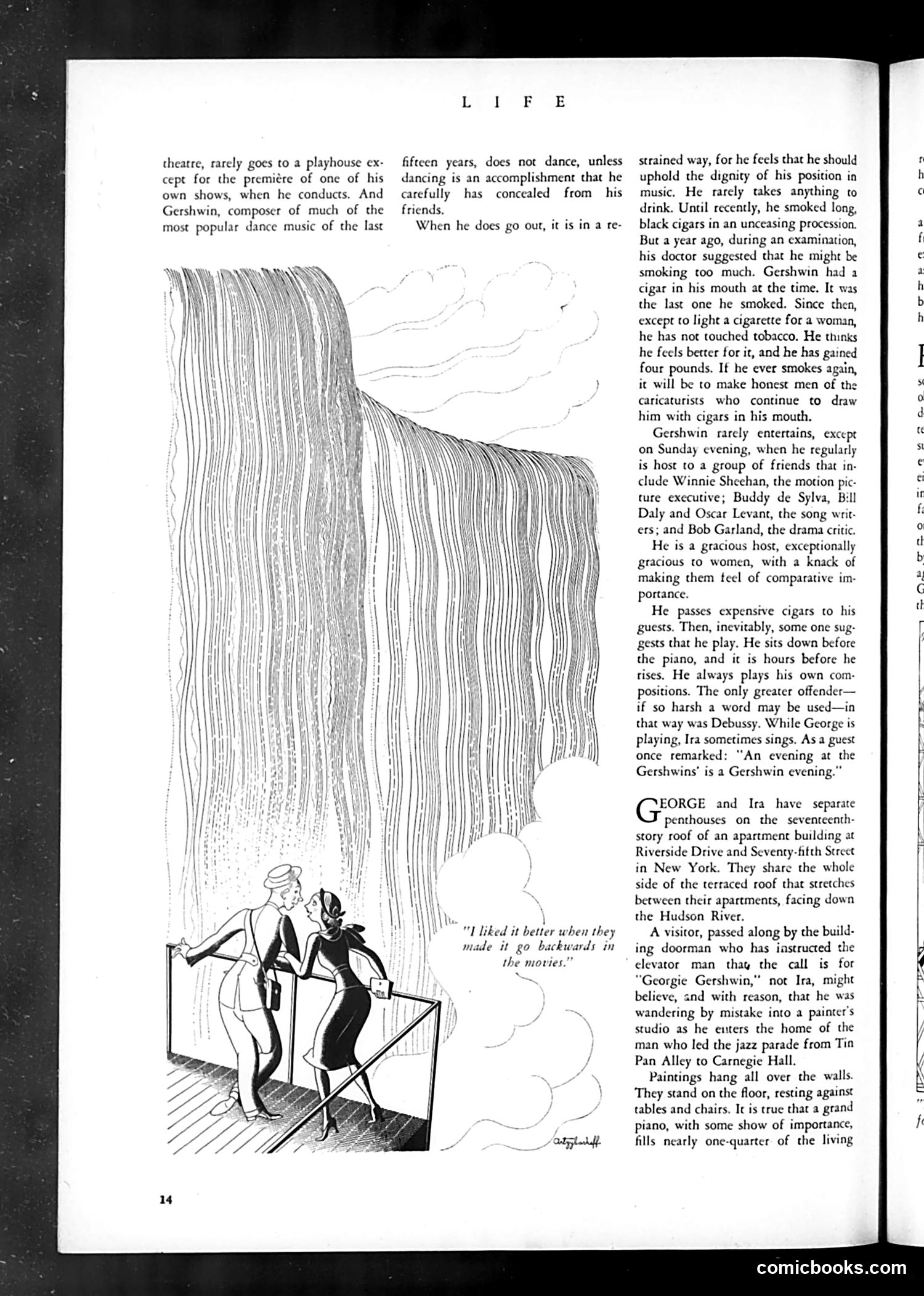
Analysis of Life Magazine Page This page features a satirical cartoon about George Gershwin, the famous composer. The illustration shows two figures in an exaggerated scene descending what appears to be a large curtain or fabric, with a caption reading "I liked it better when they made it go backwards in the movies." The joke references Gershwin's famous compositions and his prominence in jazz and classical music. The accompanying text describes Gershwin's lifestyle—his hosts at Sunday gatherings include notable figures like Winnie Sheehan (motion picture executive), Buddy de Sylva, Bill Daly, Oscar Levant, and Bob Garland. The cartoon mocks Gershwin's theatrical self-importance and the somewhat pretentious atmosphere of his social gatherings, while the caption makes a vaudeville reference to reversed film sequences, suggesting the scene is absurdly dramatic or overwrought.
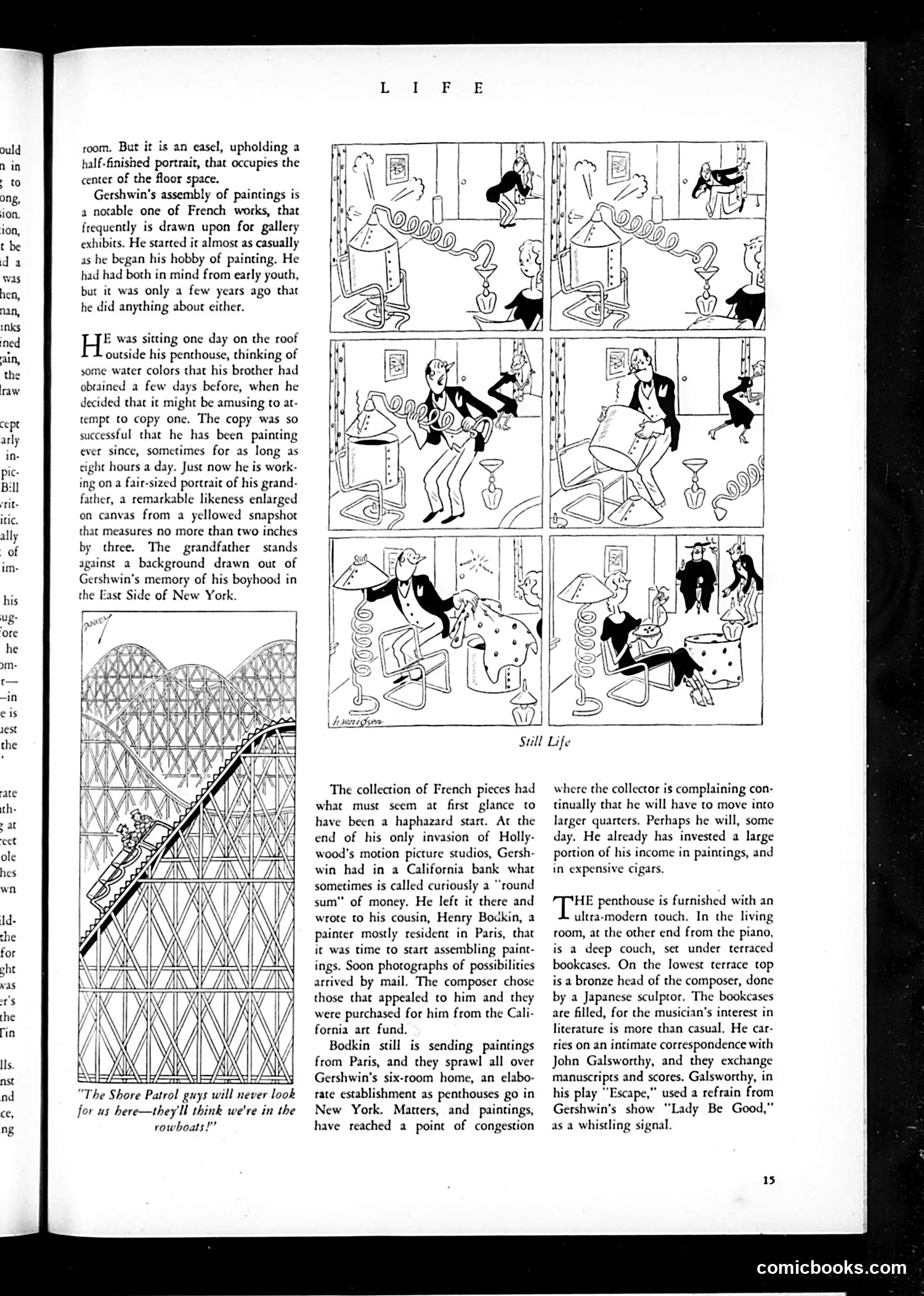
Analysis of Life Magazine Page 15 This page combines a narrative about composer George Gershwin's art collecting with a comic strip titled "Still Life." The comic depicts a domestic scene where a man repeatedly attempts to paint or sketch a woman in various poses—she keeps moving, disrupting his work, creating physical comedy. The accompanying text discusses Gershwin's assembly of French paintings and his recent successful copying of a work by his grandfather. It notes Gershwin has invested in art and received a "curious" sum of money from a California bank. The visual joke of the comic strip satirizes the difficulty of creating still-life art when the subject won't remain stationary—a lighthearted commentary on artistic frustration rather than a political statement.
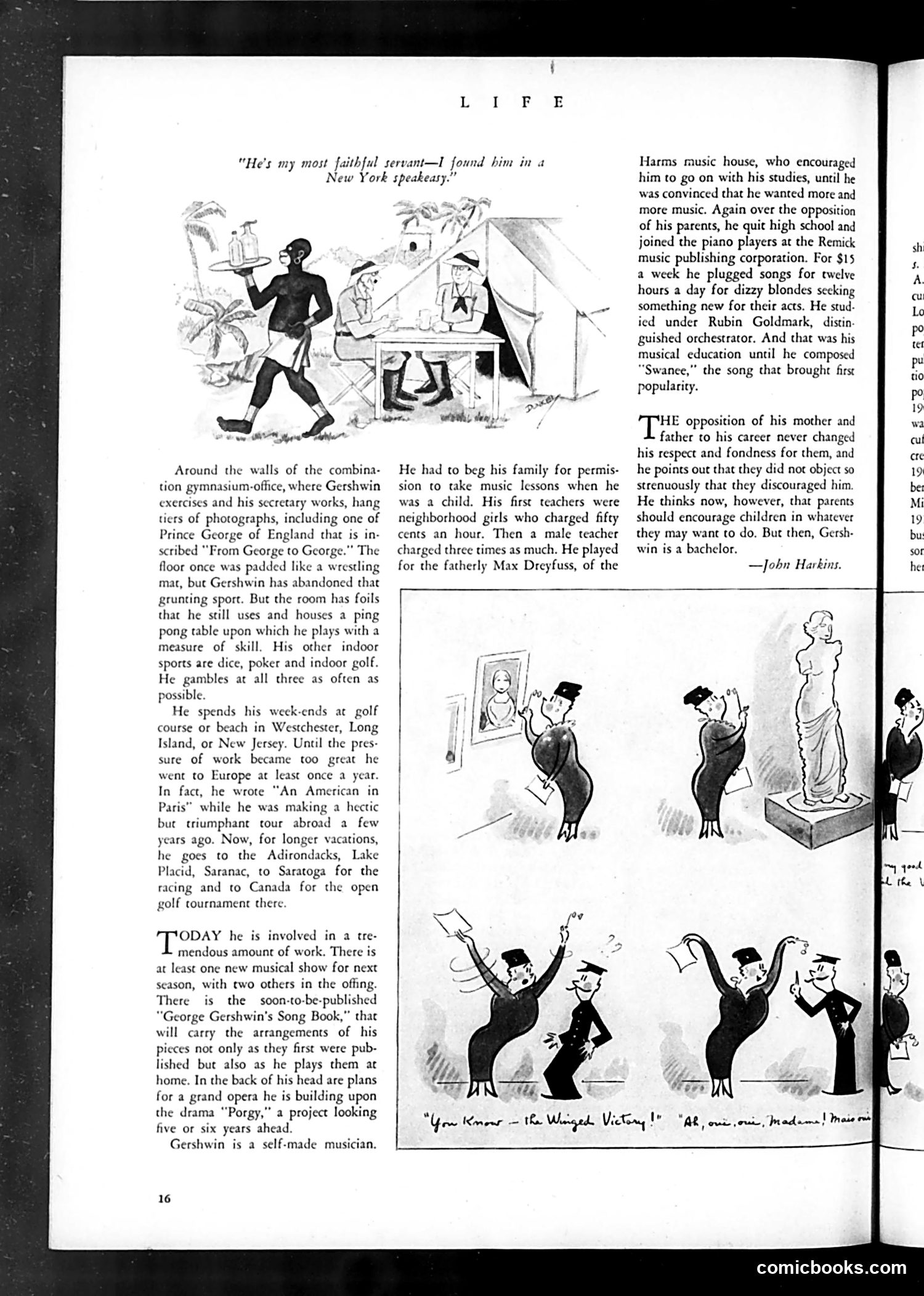
Life Magazine Page: George Gershwin Biography This page presents a biographical article about composer George Gershwin, illustrated with cartoons depicting his life. The text describes his early career—working as a piano player in a music publishing house, studying under conductor Rubin Goldmark, and composing his breakthrough song "Swanee." The cartoons satirize Gershwin's social climbing and artistic pretensions. One sketch shows him presenting himself to what appears to be a statue or society figure, while another depicts him energetically conducting or performing, possibly mocking his enthusiasm or ambition. A third cartoon shows multiple figures in a dance sequence. The article emphasizes Gershwin as a "self-made musician," highlighting his rise from modest beginnings despite parental opposition to his musical career.
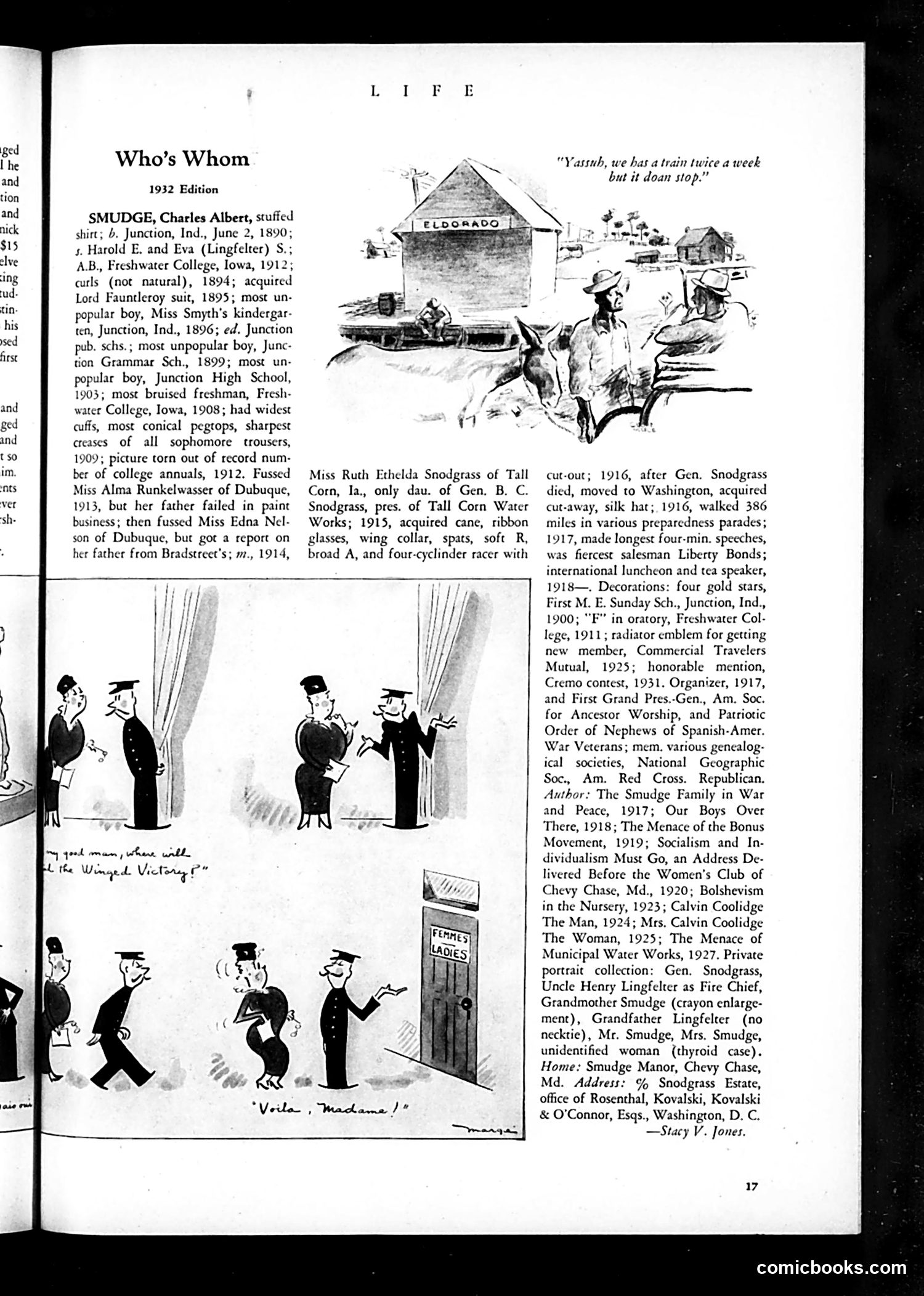
Who's Whom: Charles Albert Smudge (1932) This page from *Life* magazine's "Who's Whom" section profiles Charles Albert Smudge, a fictional character. The accompanying cartoons satirize small-town social pretension and stuffy formality. The sketches show a man in formal attire encountering various social situations—interacting with women, passing through doorways marked "Ladies," and navigating what appear to be awkward social moments. The captions suggest humor about overly proper behavior ("Pardon, Madame") and the absurdity of rigid social conventions. This is satirical character humor typical of 1930s *Life* magazine—mocking the earnest pomposity of middle-class respectability through exaggerated situations. The illustrated vignettes mock someone trying too hard to maintain dignified, formal social pretense in everyday scenarios.
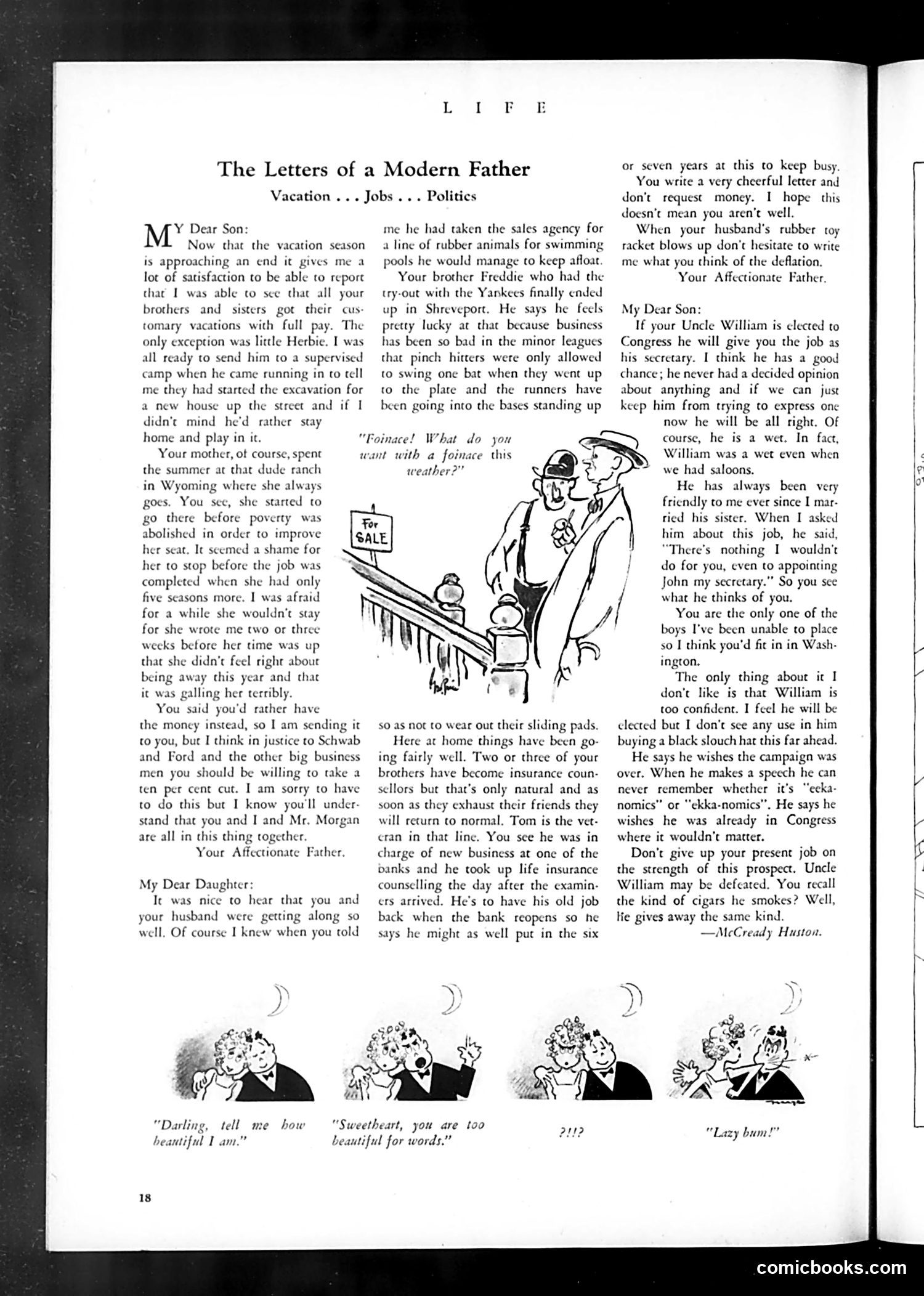
"The Letters of a Modern Father" This is a humorous advice column presented as letters between a father and his adult children about jobs and life decisions. The content satirizes early-20th-century family dynamics and parental concern. Key points: - The father discusses his children's summer vacations, job prospects, and romantic relationships - He mentions specific references: Uncle William's potential Congressional election, minor league baseball, and insurance work - The small cartoon strip at bottom shows domestic couples with dialogue about compliments ("Darling, tell me how beautiful I am") The satire targets the gap between parental expectations and children's actual lives—the father's somewhat oblivious confidence contrasts with his children's apparent struggles. The piece reflects anxieties about employment, social mobility, and courtship in this era, presented through gentle domestic humor rather than sharp political commentary.
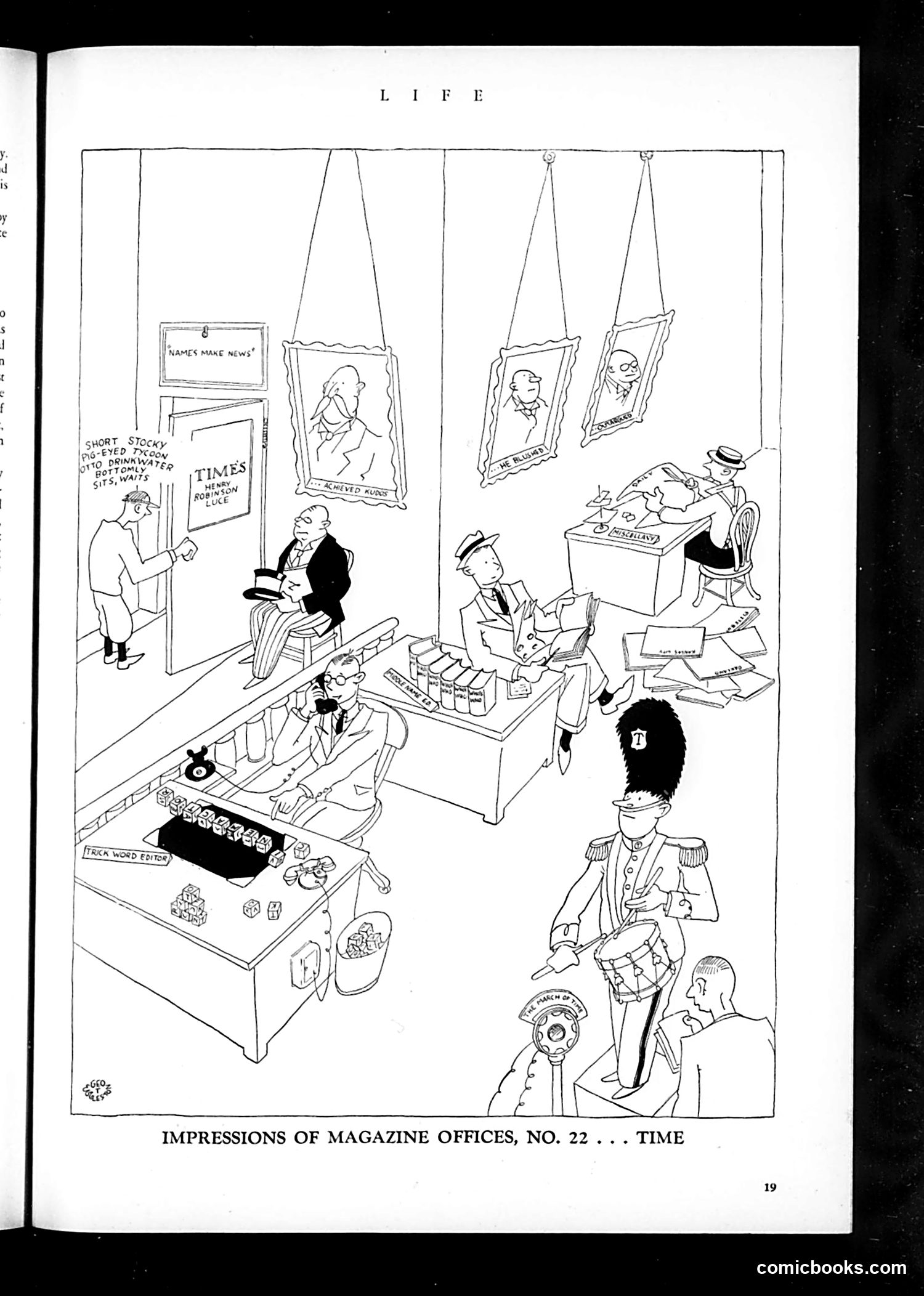
"Impressions of Magazine Offices, No. 22 ... TIME" This satirical cartoon depicts the offices of TIME magazine during what appears to be the early 20th century. The illustration mocks the organized chaos of a busy publication's workplace: - A "Names Make News" section visible on the wall - Staff members reading newspapers and managing content - A man in top hat (possibly representing an executive or notable figure) sitting prominently - Suspended portrait frames hanging from the ceiling - A British military figure in uniform on the right side, suggesting TIME's international focus - Various desks with papers and reference materials scattered about The satire appears to target TIME's news-gathering operations and editorial pretensions, presenting the magazine office as a somewhat ridiculous, overstuffed institution obsessed with personalities and celebrity rather than substantive journalism.
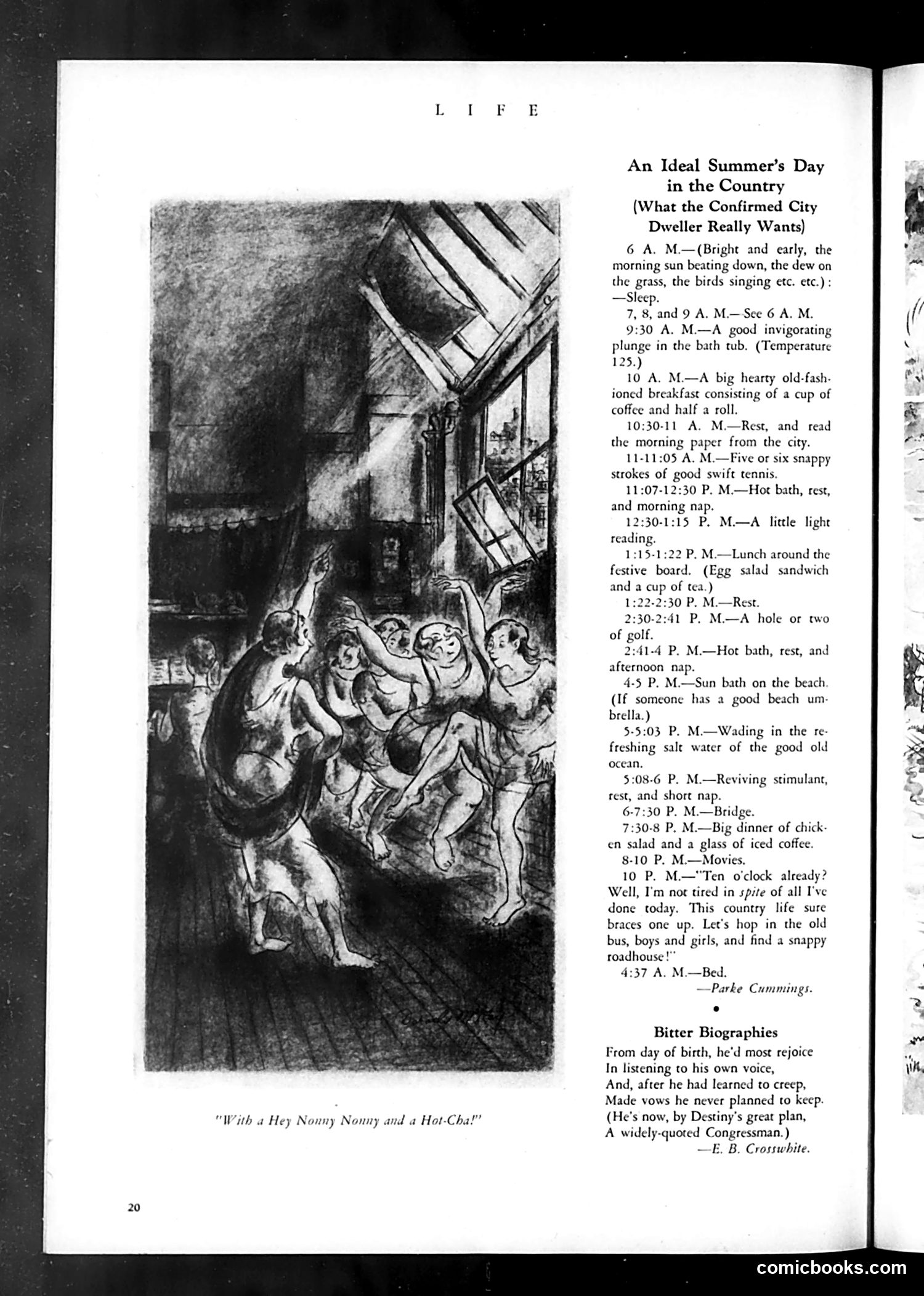
"An Ideal Summer's Day in the Country" This satirical piece by Parke Cummings mocks the city dweller's romantic fantasy of country living. The elaborate schedule reveals the joke: the "ideal" day consists almost entirely of sleeping, bathing, eating, and resting—with minimal actual activity. Tennis gets five minutes; swimming, three. The repeated hot baths and naps suggest the supposed rustic escape is actually just comfortable indolence. The cartoon (captioned "With a Hey Nonny Nonny and a Hot-Cha!") shows well-dressed, portly figures in what appears to be a country setting, reinforcing the image of leisure-seeking urbanites rather than genuine country folk. The satire targets the 1920s urban professional class: those who idealize pastoral life but actually want luxurious relaxation—fine food, modern plumbing, and entertainment (movies, bridge)—without actual farm work. The final line about finding a "snappy roadhouse" at 10 PM confirms they're really just seeking urban pleasures relocated.
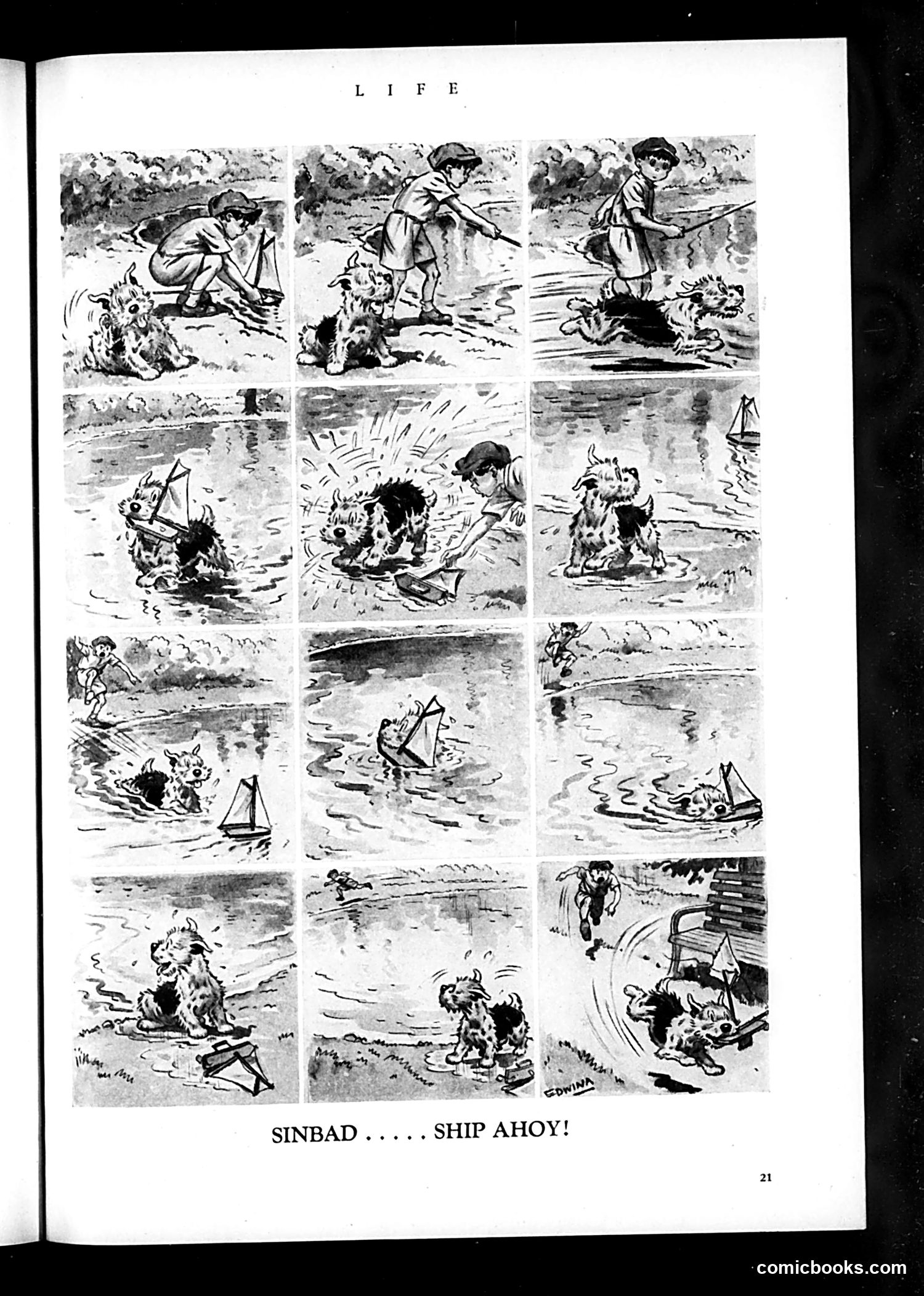
"Sinbad... Ship Ahoy!" This is a twelve-panel comic strip depicting Sinbad the Sailor in various maritime adventures. The sequence shows a character fishing, encountering sea creatures, falling into water, struggling with waves, and interacting with boats and sailors. The comic illustrates classic Sinbad narrative elements—nautical mishaps, sea monsters, and slapstick humor. The strip's appeal lies in visual gags rather than political satire. It appears to be entertainment content from *Life* magazine, capitalizing on the popular Sinbad folklore tradition. The exaggerated drawings, dynamic action poses, and comedic mishaps would have amused early-to-mid 20th-century readers familiar with adventure tales. No specific political figures or contemporary events appear to be referenced—this is simply adventure-based humor.
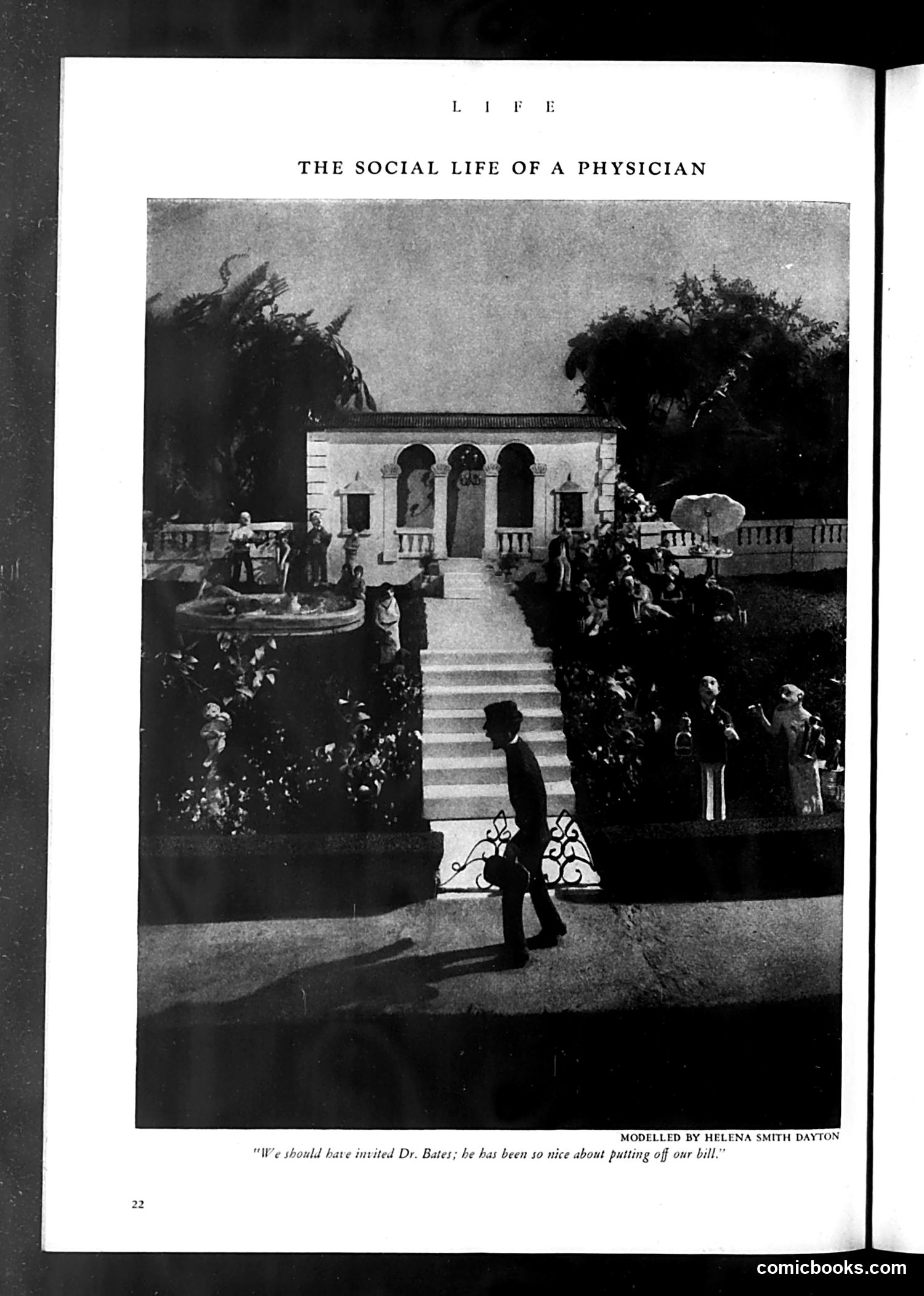
Analysis This page presents a staged photograph rather than a traditional cartoon. The image shows an elegant garden party or social gathering at what appears to be a grand estate, with numerous well-dressed guests mingling on the grounds. The caption's humor centers on a social irony: the speakers regret not inviting "Dr. Bates" to their party, not out of genuine fondness, but because he's been accommodating about delaying payment of their medical bill. The joke satirizes the awkward social dynamics between physicians and wealthy patients—suggesting that gratitude for financial leniency might warrant a social invitation, exposing both the patients' opportunism and the doctor's vulnerable position as a service provider dependent on client goodwill. The title "The Social Life of a Physician" reinforces this theme of doctors navigating complex social obligations alongside their professional practice.
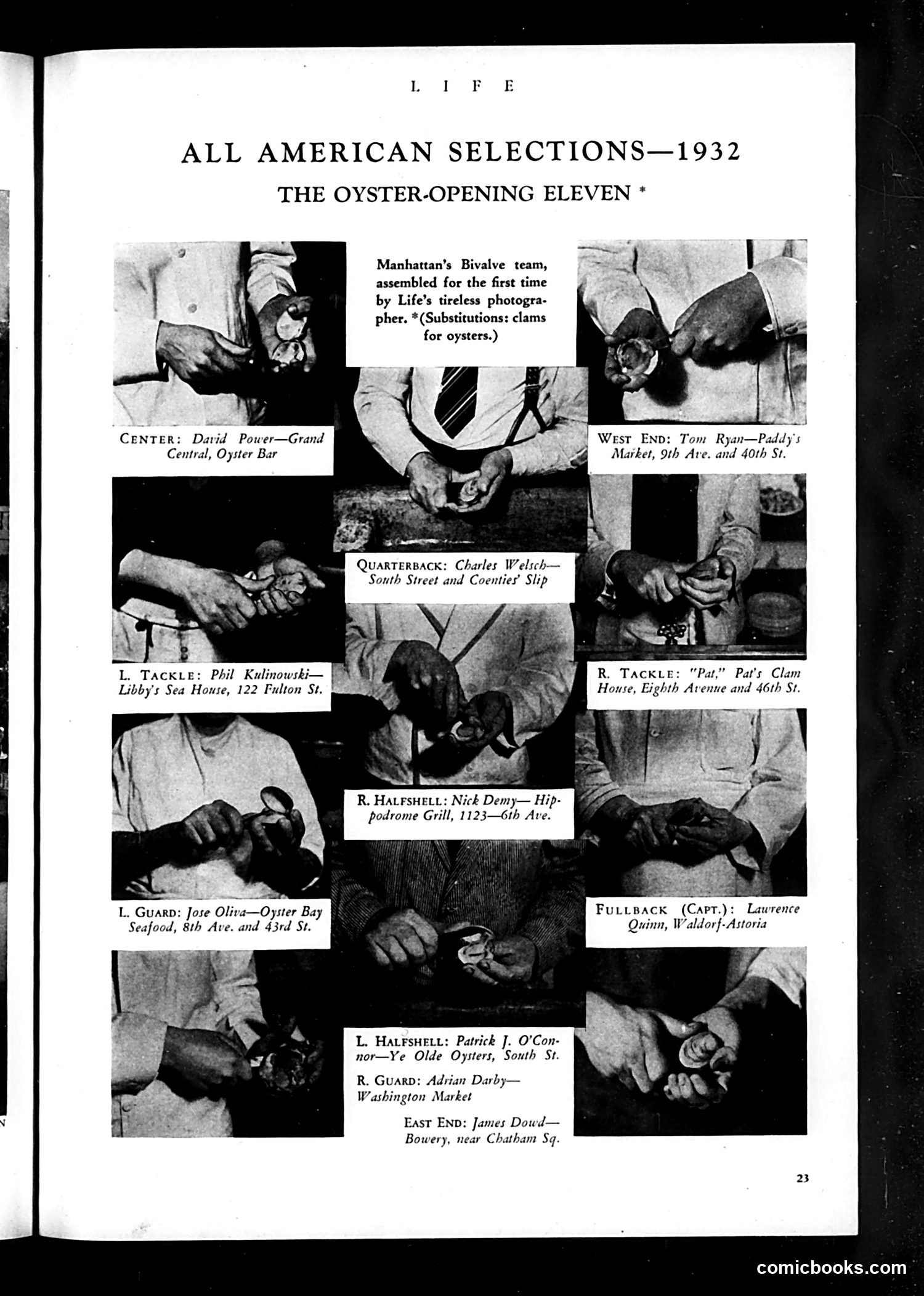
"The Oyster-Opening Eleven" (Life, 1932) This is a humorous photo-essay presenting Manhattan's oyster-shucking vendors as a mock football team. Life magazine's photographer assembled real oyster and clam sellers from various New York locations—fish markets, restaurants, street vendors—and photographed them holding their wares in action poses mimicking football players. Each person is labeled with a position (center, quarterback, tackles, guards, halfbacks, fullback, ends) and their actual workplace. The joke plays on American sports culture's "All-American" team selections while celebrating working-class New Yorkers. During the Great Depression (1932), this lighthearted feature humorously honors humble food vendors and their craft. The asterisk noting "substitutions: clams for oysters" adds self-aware humor about the flexibility of their product.
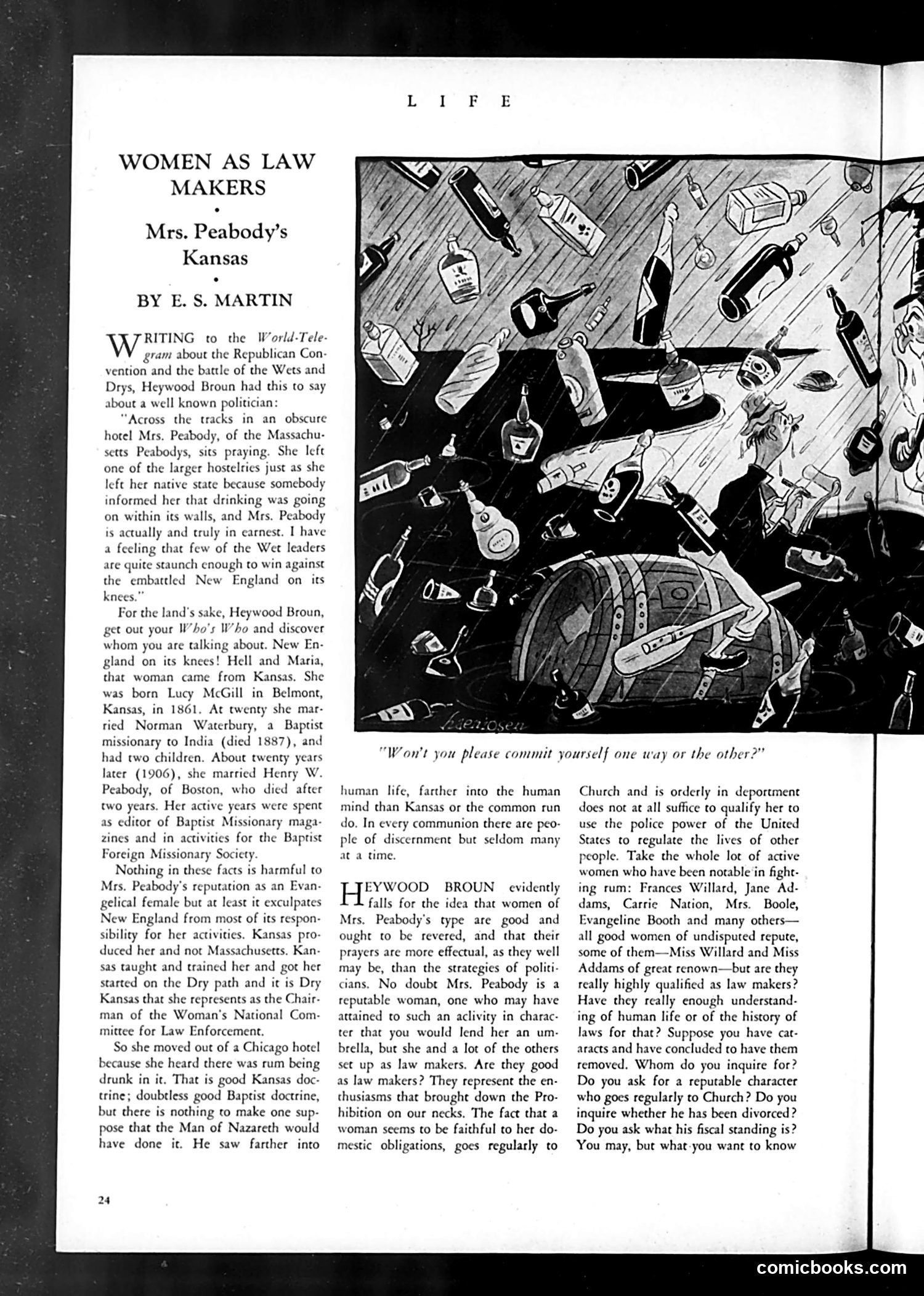
Explanation for Modern Readers This article critiques women activists pushing for Prohibition, specifically Mrs. Peabody, Chairman of the Woman's National Committee for Law Enforcement. The cartoon shows bottles and alcohol scattered chaotically, illustrating the disorder the author associates with Prohibition efforts. Author E.S. Martin argues that moral virtue doesn't qualify someone to make laws. He corrects Heywood Broun's assumption that Mrs. Peabody represents New England morality—she's actually from Kansas, a Dry state. While acknowledging her personal respectability, Martin contends that good women like Frances Willard, Jane Addams, and Carrie Nation, though "of great renown," lack the expertise needed for lawmaking. His central point: being a faithful churchgoer doesn't qualify one to regulate others' behavior, comparing it absurdly to hiring a virtuous person (rather than a qualified doctor) to remove cataracts. The piece satirizes how moral certainty was substituted for actual competence in Prohibition's legal architecture.
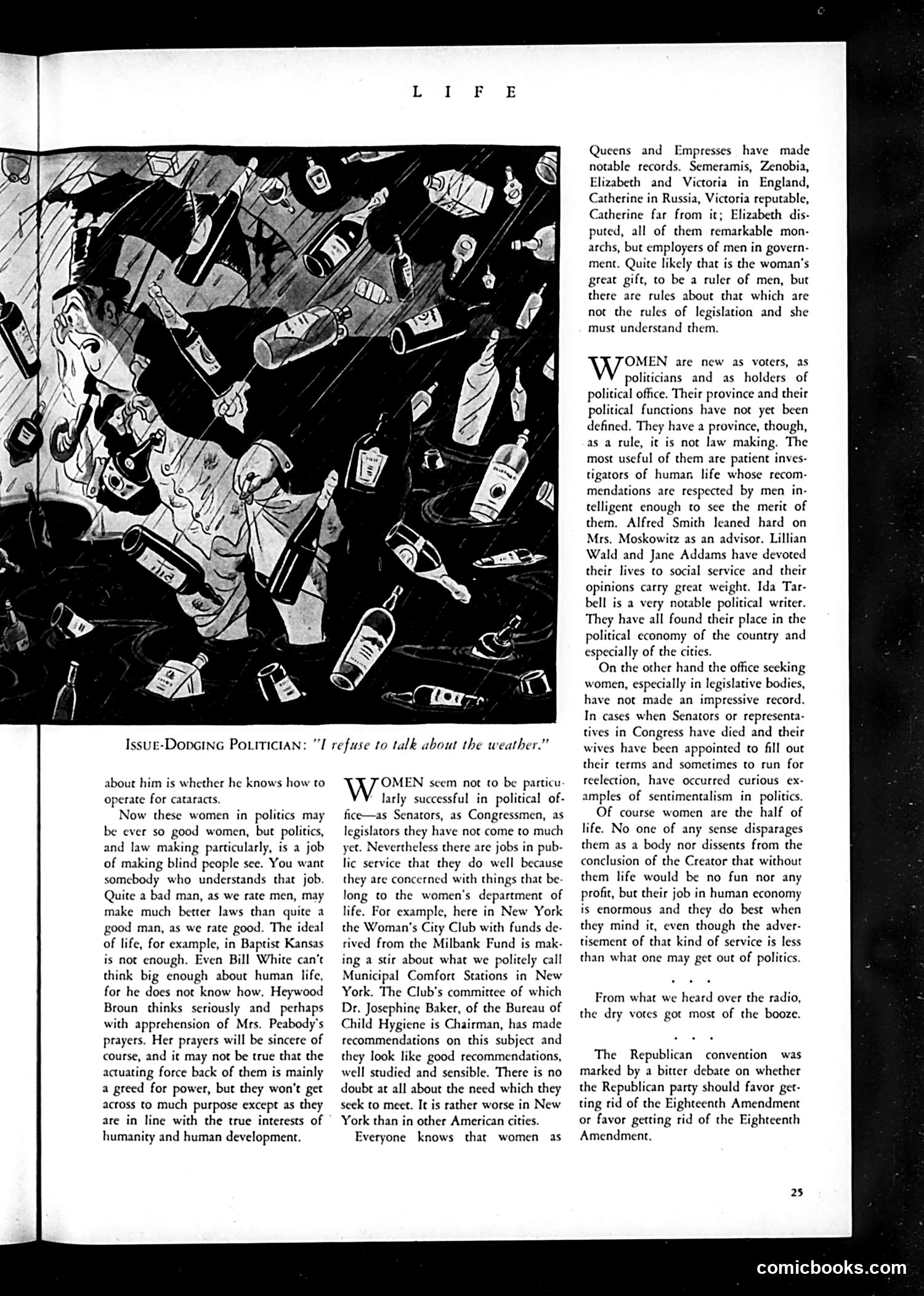
"Issue-Dodging Politician" The cartoon depicts a disheveled politician surrounded by scattered liquor bottles, refusing to discuss even trivial matters like weather—presumably to avoid commitment or accountability on substantive issues. The accompanying article argues that women are poorly suited for legislative office despite succeeding as historical rulers and social reformers. The author contends women excel in advisory roles and investigative work (citing Mrs. Moskowitz, Lillian Wald, Jane Addams, and Ida Tarbell), but legislative bodies with women members show "no impressive record." He suggests women replacing deceased congressmen in fill-in appointments demonstrate "sentimentalism in politics." The piece concludes women's strength lies in social economy and human welfare work—their "natural" domain—rather than law-making, which requires understanding how to "make blind people see." Context: This reflects 1920s-30s backlash against women's political expansion following suffrage, promoting the notion that women belong in social service, not legislation.
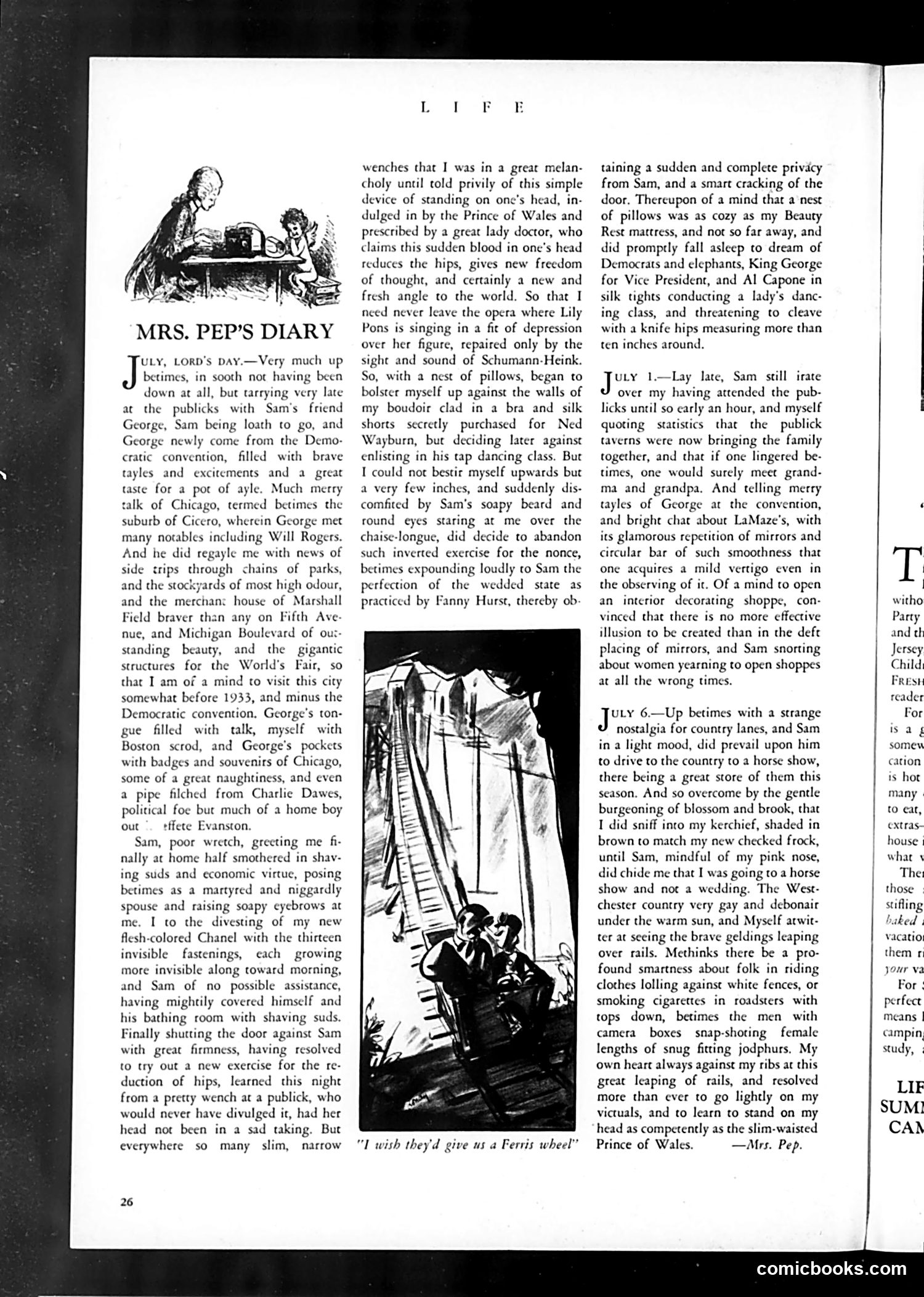
Mrs. Pep's Diary: A 1920s Satirical Social Commentary This is a humorous diary entry satirizing upper-middle-class urban life in the late 1920s. The narrator, "Mrs. Pep," recounts attending a Democratic National Convention in Chicago with her husband Sam, then details her domestic life with self-deprecating comedy. The satirical targets include: - Weight consciousness: Women obsessing over hip reduction through fad exercises (standing on one's head, supposedly endorsed by the Prince of Wales) - Democratic politics: The convention is portrayed as rowdy and filled with minor figures like Will Rogers and Charlie Dawes - Marriage dynamics: Sam as a penny-pinching, soap-covered husband; Mrs. Pep as a liberated woman frequenting bars - Social pretension: References to opera singer Lily Pons, designer Chanel, and fashionable exercise classes The accompanying cartoon (captioned "I wish they'd give us a Ferris wheel") likely depicts fair-goers or convention attendees, though its specific context isn't entirely clear without additional context about the 1928 Democratic Convention. The piece mocks both women's culture and political life of the era.
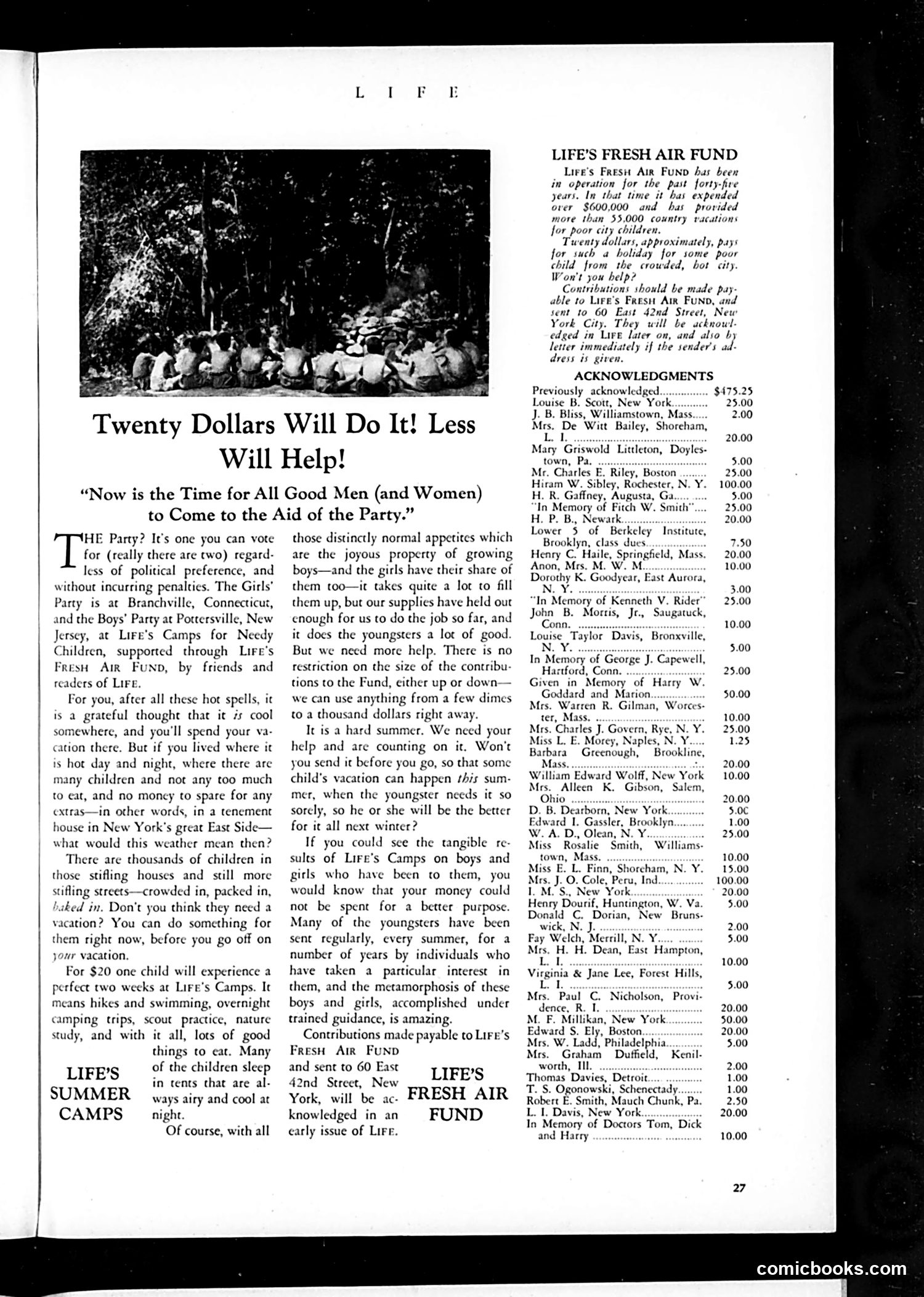
Analysis for Modern Readers This is a fundraising appeal, not a satirical cartoon. The page promotes Life magazine's Fresh Air Fund, a real charitable program that sent poor urban children from tenement housing to summer camps in rural Connecticut and New Jersey. The appeal uses rhetorical urgency—the opening quote parodies a civics classroom phrase to encourage donations. The argument is straightforward: $20 provides two weeks of camping (hiking, swimming, nature study, and food) for one child living in overcrowded, sweltering New York tenements without access to outdoor recreation or adequate nutrition. The photograph shows children at one of these camps. The tone is earnest social reform: the wealthy reader is invited to feel gratitude for their own cool vacations while recognizing poor children's suffering in "stifling houses and stifling streets." The acknowledgments list documents actual donors, legitimizing the fund's operation since its founding 45 years prior, which the text claims distributed over $600,000 to 35,000 children. This reflects Progressive Era philanthropic efforts addressing urban poverty and child welfare.
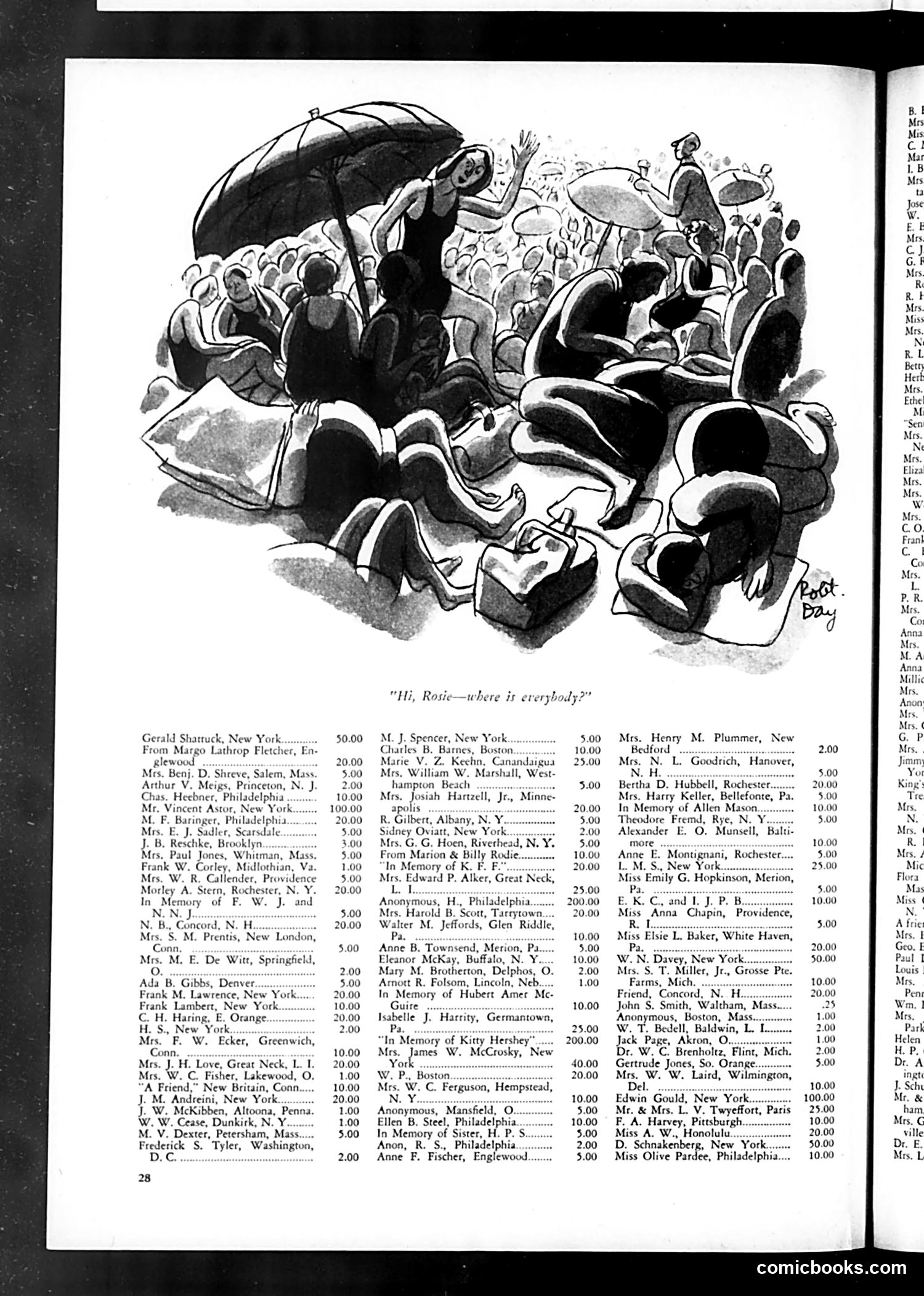
Analysis of Life Magazine Page This page is primarily a donor/subscription list, not a cartoon or satirical content page. The small illustration at the top shows a crowd of people huddled together in the rain under umbrellas, with one figure asking "Hi, Rosie—where is everybody?" The cartoon appears to be a mild joke about weather or crowd behavior—the irony being that despite many people being present (visible in the crowd), someone is asking where everyone is. It's signed by what appears to be "Peot. Day" (the artist's signature). The bulk of the page consists of names and donation amounts, suggesting this was a fundraising appeal or memorial contribution list for Life magazine. The donations range from $1 to $200, and many entries note they're "In Memory of" specific individuals, indicating this was likely compiled for a charitable cause or publication fund. Context we'd miss: Without the magazine's masthead or surrounding articles, we cannot determine the specific cause being fundraised for.
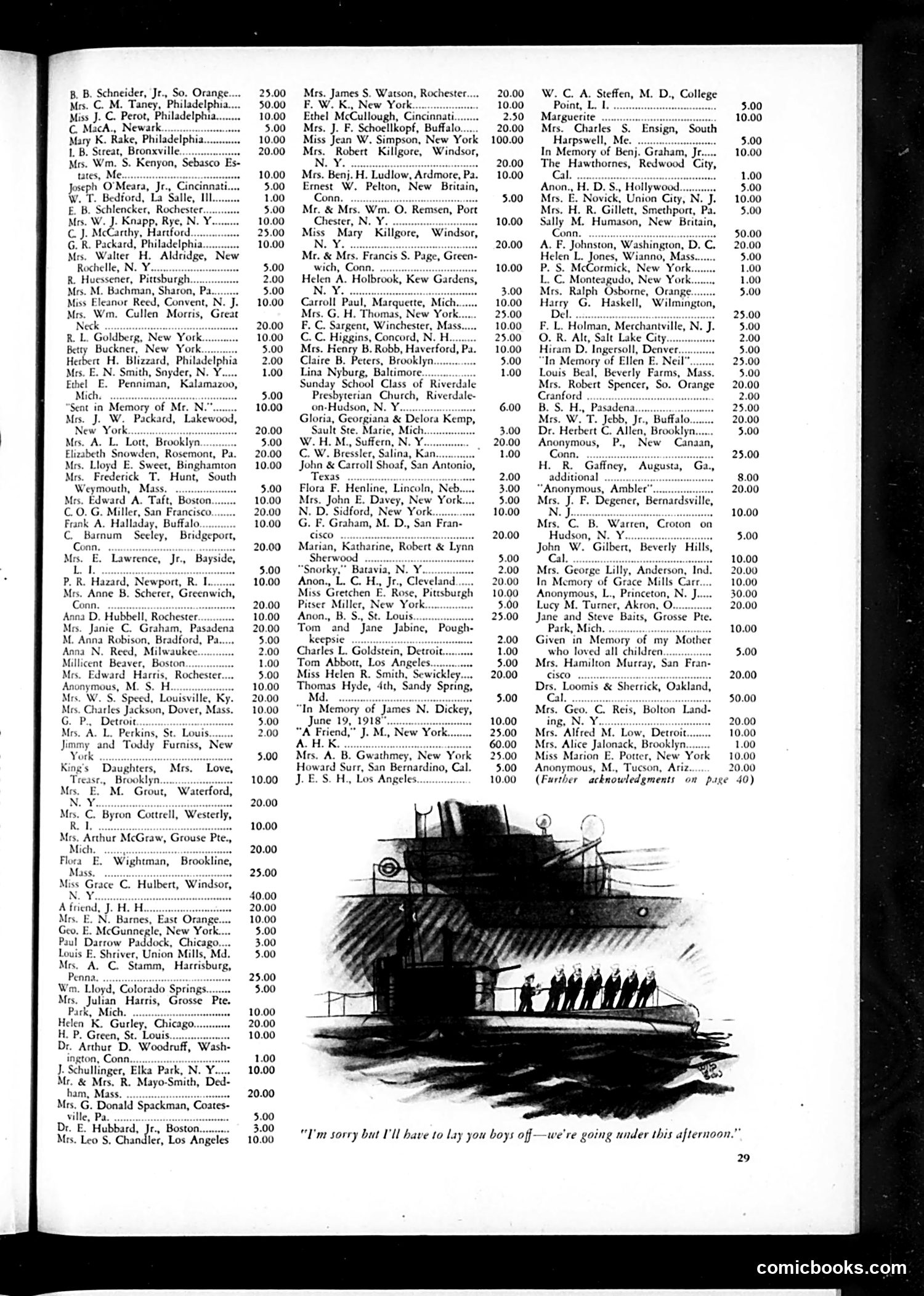
Cartoon Analysis: Life Magazine, Page 29 This page is primarily a donor/contributor list for what appears to be a charitable cause or publication fund, with names and donation amounts. The actual cartoon occupies only the lower portion. The Cartoon The single cartoon shows a ship or boat with what appears to be a naval or military vessel, with several figures standing on a lower deck or platform. The captain (identifiable by his uniform) addresses the crew with the caption: *"I'm sorry but I'll have to lay you boys off—we're going under this afternoon."* The Joke: This is a pun on "going under"—simultaneously meaning the ship is sinking AND the crew is being laid off due to financial hardship. The dark humor plays on Depression-era unemployment and maritime disaster. The absurdity lies in the captain's casual tone about both catastrophes as if they're equally routine business matters. Historical Context: This likely dates to the 1930s Great Depression, when unemployment was rampant and such grim economic humor was common in American satire magazines.
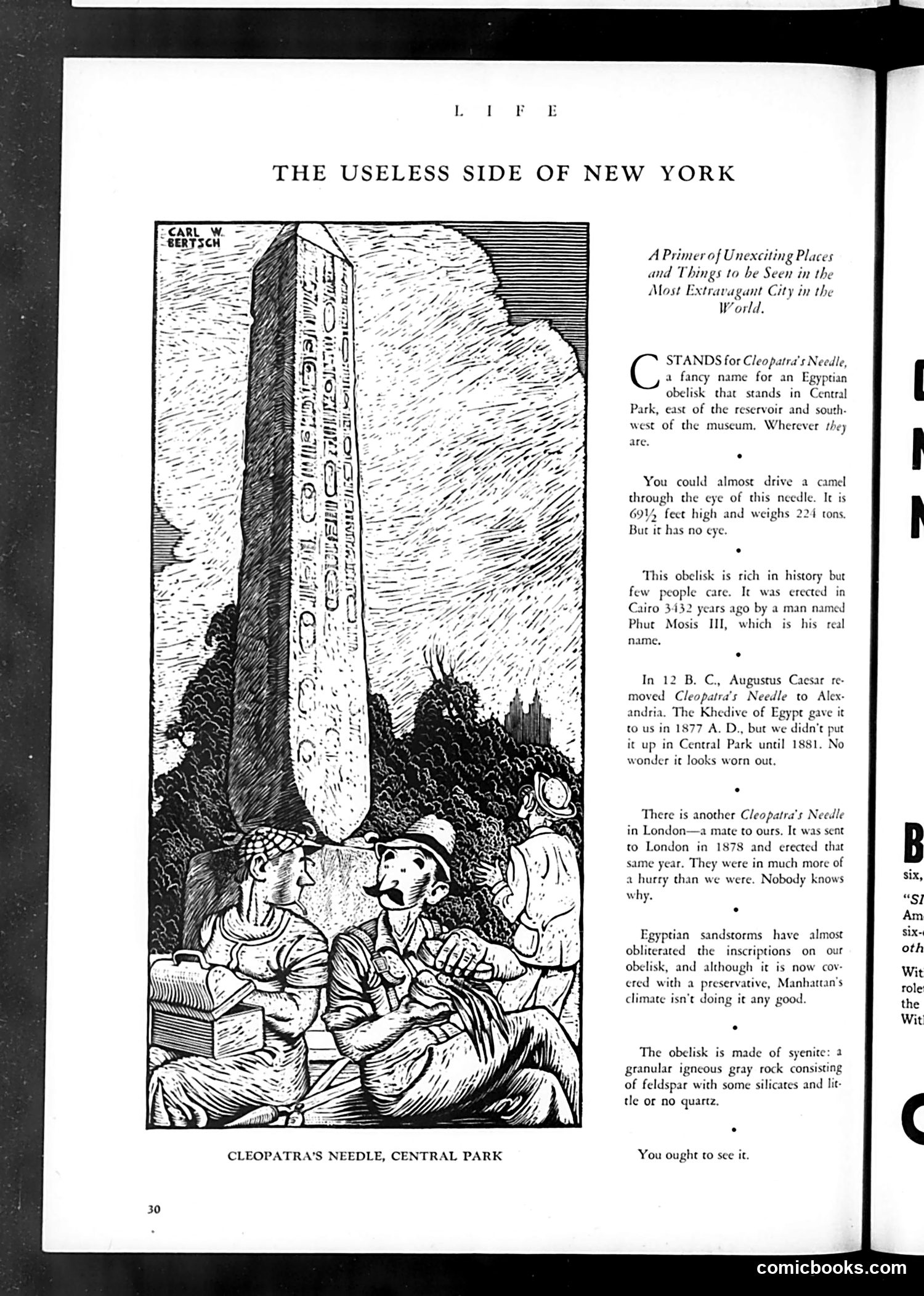
Explanation for Modern Readers This is satirical content mocking New York City's "must-see" attractions. The illustration shows tourists examining Cleopatra's Needle, an actual Egyptian obelisk in Central Park, while the text delivers deadpan humor about its supposed unimportance. The satire works through contradiction: the subtitle promises "unexciting places," then the article provides obsessive historical detail (erection date 3432 years ago, weight 224 tons, geological composition) about something the text itself dismisses as worthless. The running joke is that New Yorkers should "see" this monument, yet the author emphasizes it's worn out, poorly preserved, and nobody cares about it. The cartoon depicts bemused figures examining the towering needle, visually reinforcing the absurdity of treating this neglected relic as a tourist attraction. The satire critiques both New York's pretensions to cultural significance and the American obsession with seeing famous landmarks regardless of their actual worth.
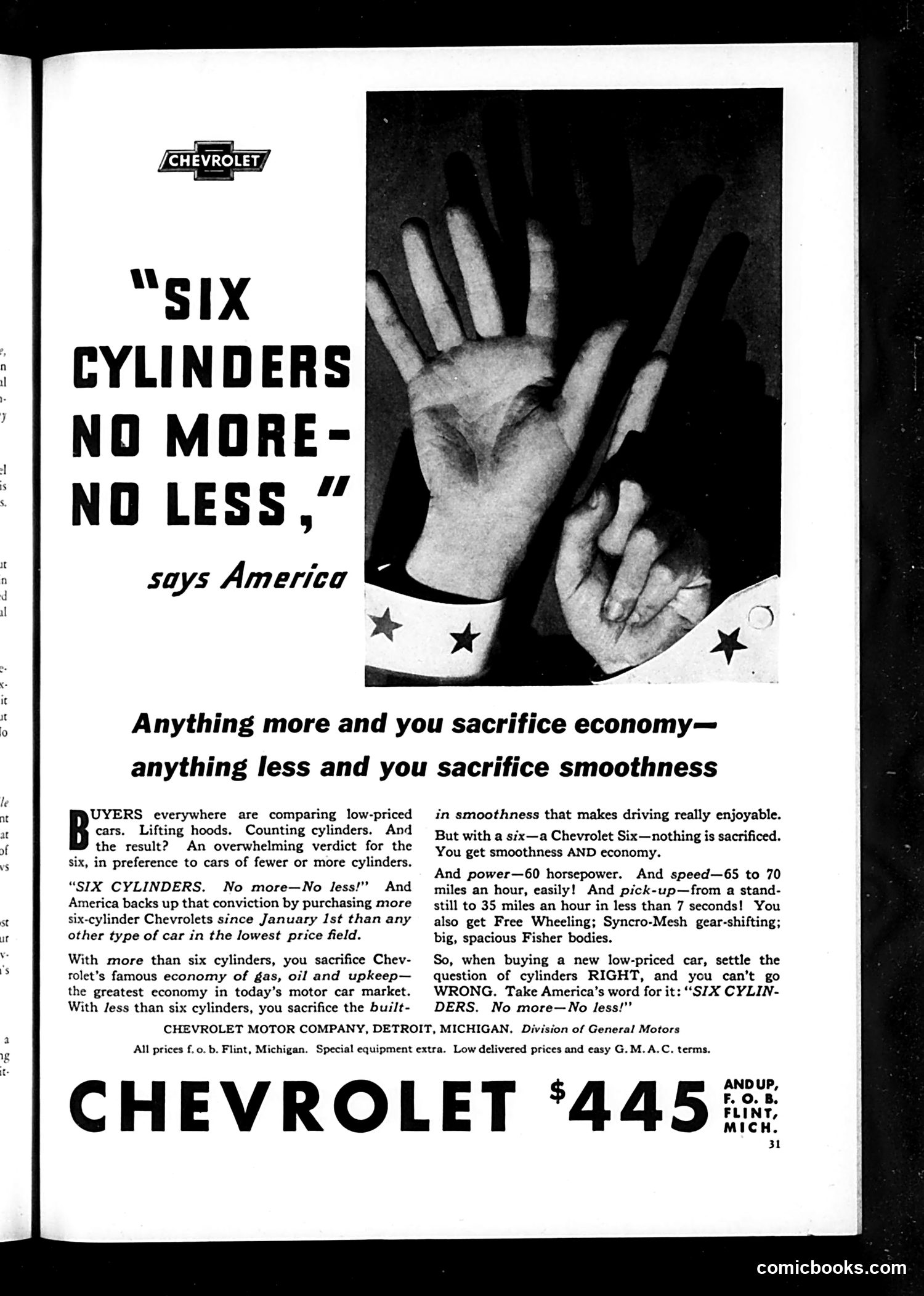
Analysis This is a Chevrolet automobile advertisement, not political satire. The page promotes the Chevrolet Six, a six-cylinder engine car, during what appears to be the 1920s-30s era. The imagery shows hands displaying six fingers, a visual pun emphasizing "six cylinders" as the ideal automotive specification. The advertising claim is that six cylinders represent the perfect balance: more cylinders waste fuel economy; fewer cylinders sacrifice driving smoothness. The phrase "says America" frames six-cylinder preference as popular consensus, suggesting widespread consumer approval validates the Chevrolet's design choice. The ad emphasizes practical benefits (60 horsepower, speed, fuel efficiency, modern features like "Free Wheeling" and gear-shifting) to justify the $445 price point as competitive in the "lowest price field." This reflects genuine automotive debates of that era when cylinder counts varied significantly among economy cars, making engine configuration a key purchasing consideration for budget-conscious buyers.
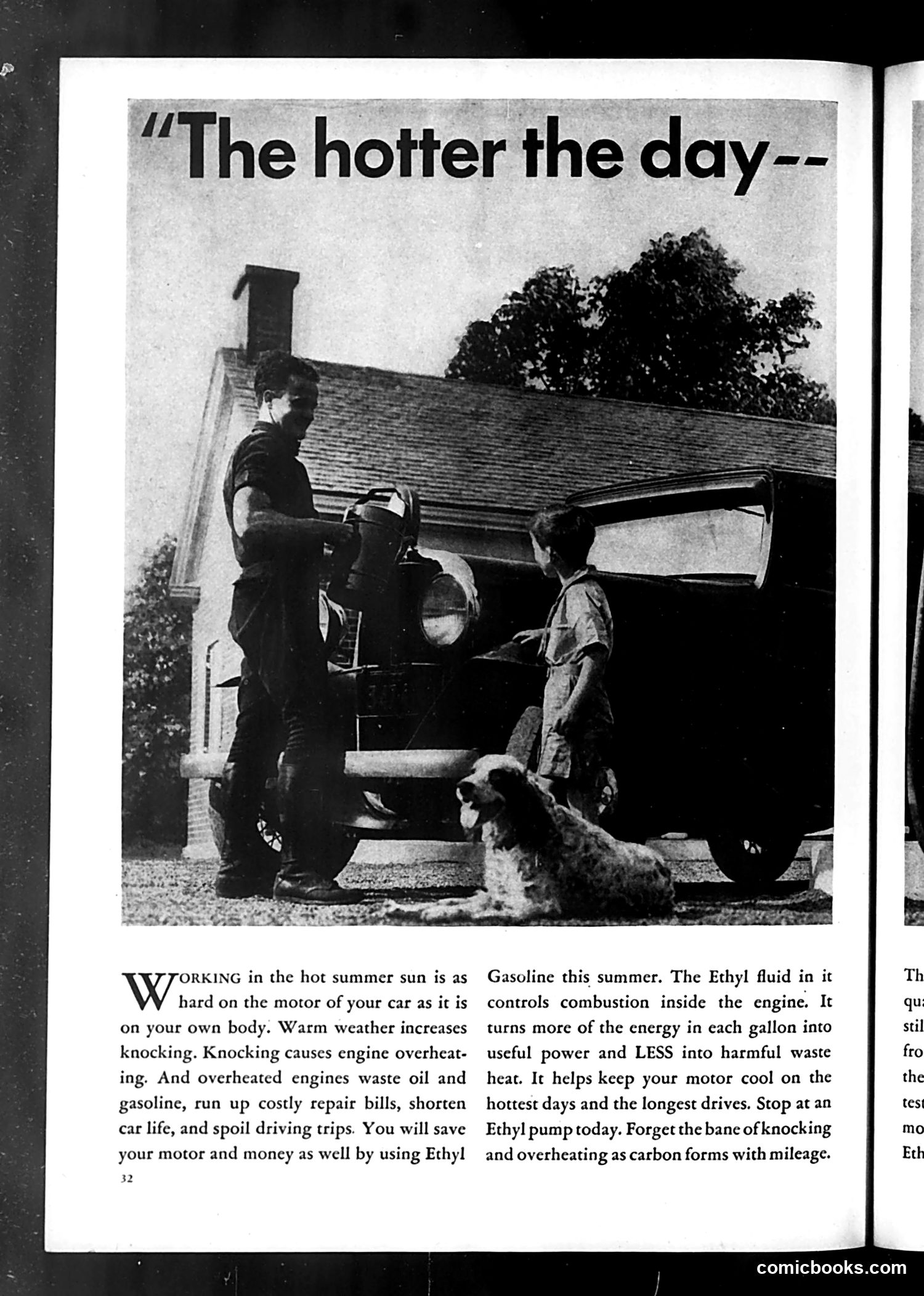
Analysis: Ethyl Gasoline Advertisement This is a product advertisement, not satire or political commentary. The page promotes Ethyl gasoline, a real fuel additive popular in the early-to-mid 20th century. The image shows a family (two adults, a child, and a dog) examining a car on a hot day, illustrating the advertisement's central claim: summer heat causes engine "knocking"—a mechanical problem where fuel ignites improperly, causing overheating and wasted fuel. The pitch: Ethyl's patented fluid additive prevents knocking by controlling combustion, keeping engines cooler and more efficient during hot weather driving. For modern readers, the key context: "knocking" was a genuine automotive problem before advanced fuel formulations. Ethyl (containing tetraethyl lead) was a real solution, though its health dangers were later discovered. The ad appeals to practical concerns—repair costs and road trip reliability—common to Depression-era or post-war consumers.
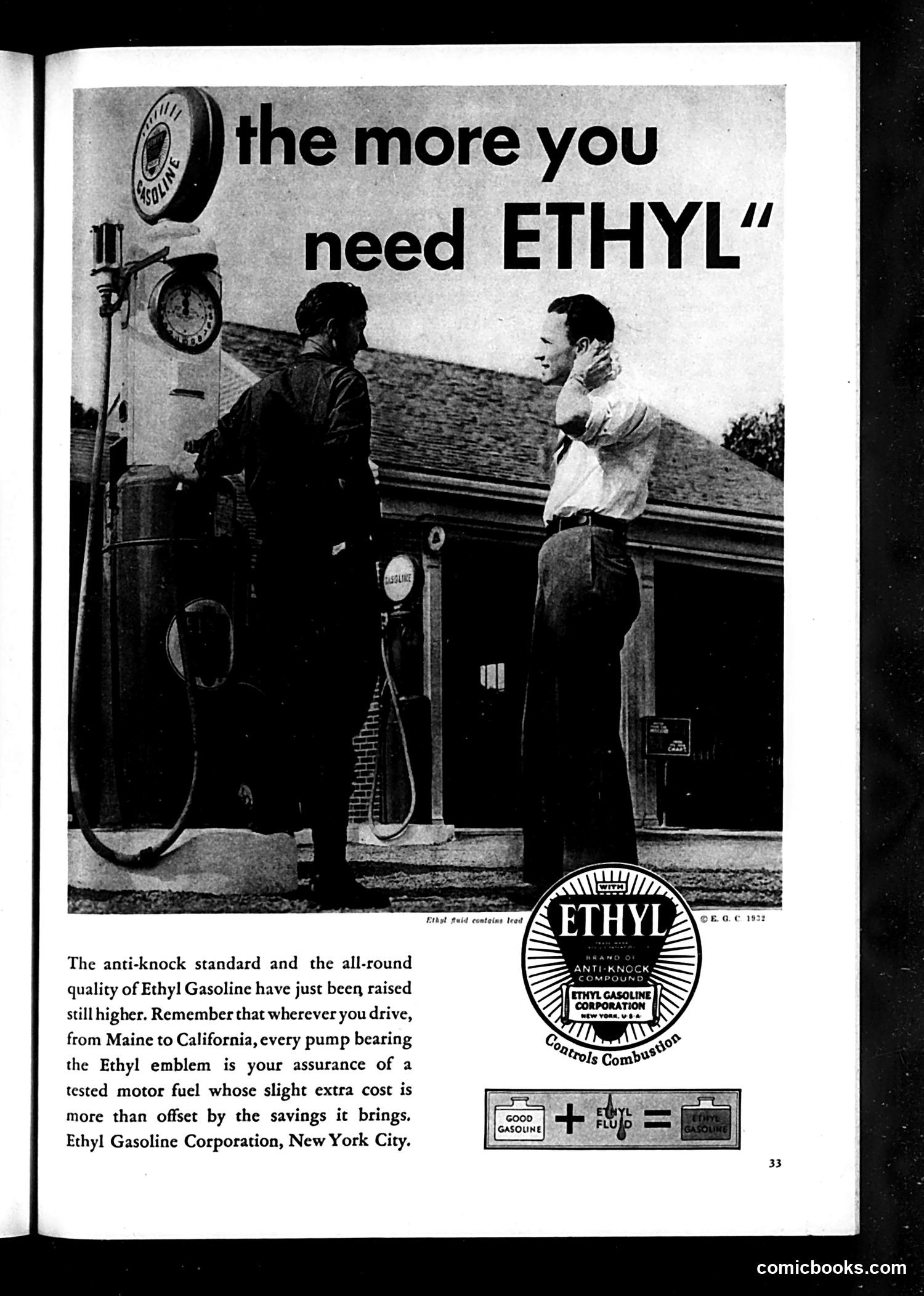
This is a 1932 advertisement for Ethyl Gasoline, not satire. The image shows two men at a gas pump discussing fuel quality. The ad promotes Ethyl brand gasoline's "anti-knock" properties—a significant selling point when engine knock (pre-ignition) was a common mechanical problem. The tagline "the more you need ETHYL" suggests drivers benefit from superior fuel quality nationwide. The mathematical formula at bottom ("Good Gasoline + Ethyl Fluid = Ethyl Gasoline") illustrates the product's composition. This represents early automotive marketing emphasizing fuel performance advantages, before modern fuel standards became universal. The slight premium price is justified by claimed engine efficiency gains.
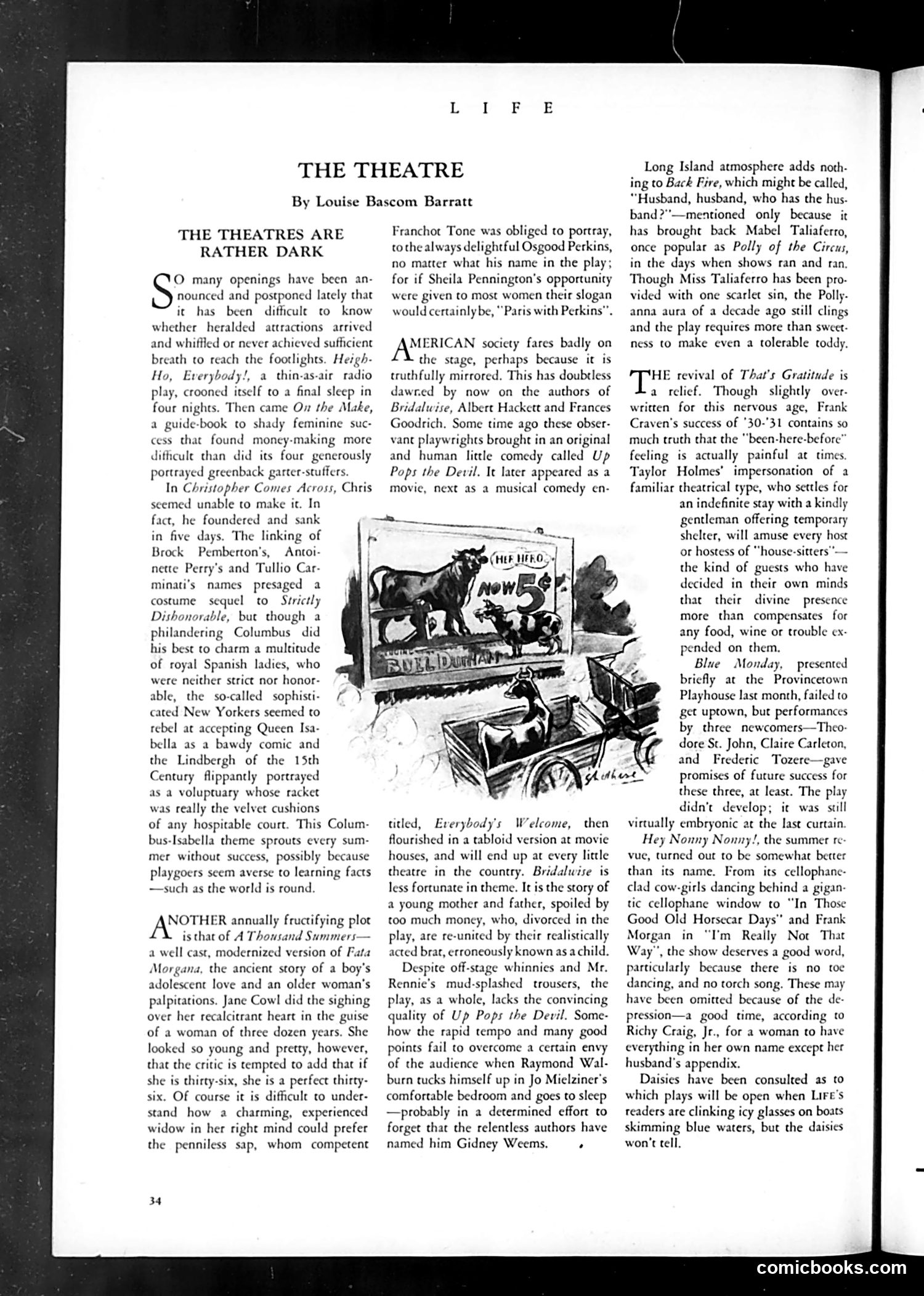
"The Theatre" - Life Magazine Theatre Review This is a theatre criticism column by Louise Bascom Barratt reviewing several Broadway productions. The accompanying cartoon depicts a cow-themed theatrical advertisement or playbill, illustrating the author's opening point: "The Theatres Are Rather Dark." Barratt's critique focuses on Broadway's commercial struggles. She describes multiple plays that opened and quickly closed—*Heigh-Ho, Everybody!*, *On the Make*, and *Christopher Comes Across*—suggesting theatre audiences were thin and unpredictable. She critiques specific productions like *Bridalwise* (about divorced parents reunited by their child) and *A Thousand Summer* (an older woman's romance), noting audiences' resistance to hackneyed plots and their envy of characters' wealth during Depression-era America. The reviews name actors like Jane Cowl and Franchot Tone, evaluating their performances. Overall, Barratt suggests Broadway faced creative exhaustion and audience indifference—hence the "rather dark" theatres.
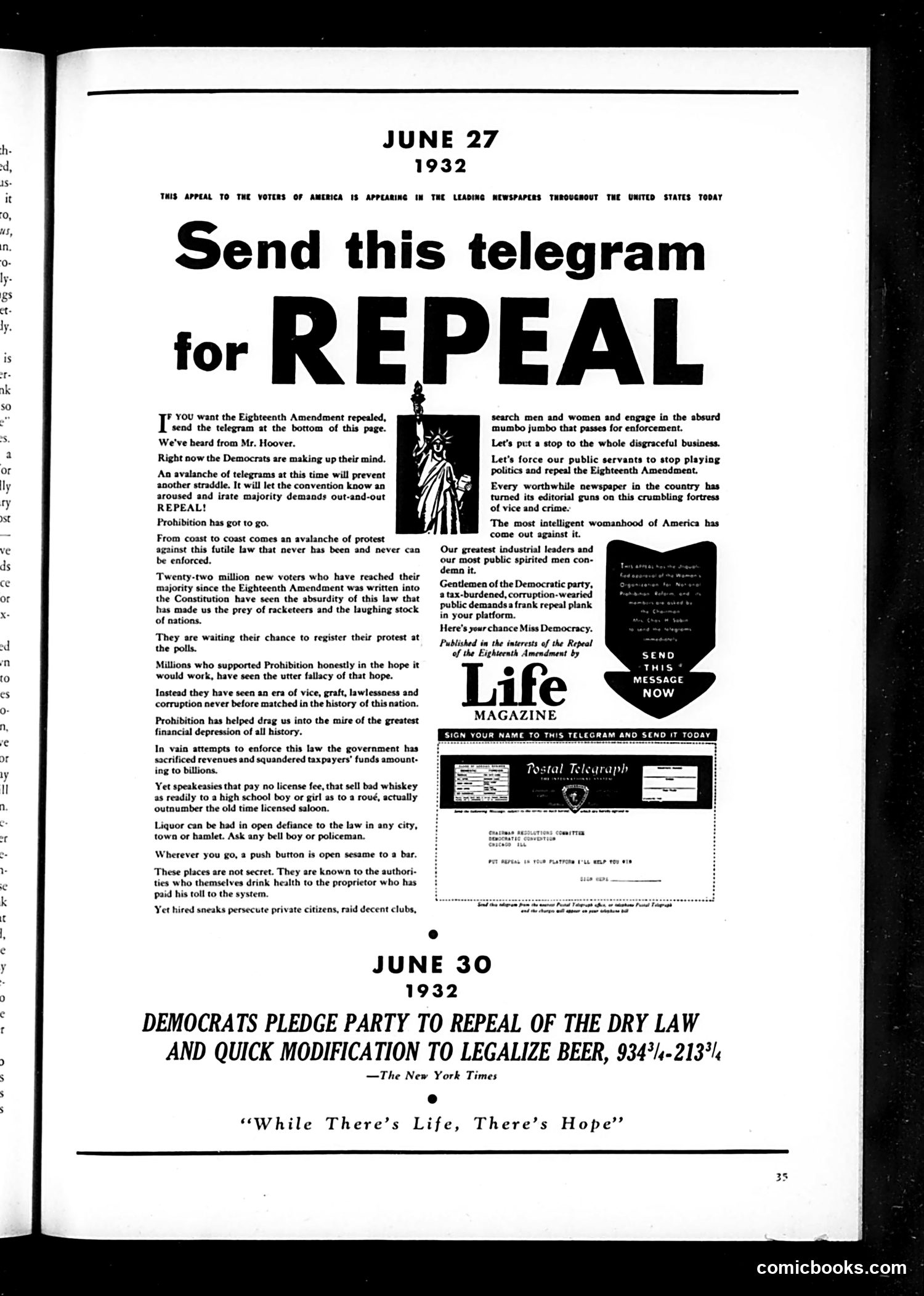
Political Context: Anti-Prohibition Campaign, 1932 This page is a political advertisement urging voters to pressure the Democratic Party to support repealing Prohibition (the Eighteenth Amendment). Published during the 1932 election cycle, it attacks the failed "dry law" as unenforceable, arguing it has enriched criminals, corrupted enforcement officials, and deepened the Great Depression by eliminating tax revenue. The satire is implicit: the ad catalogs Prohibition's failures—speakeasies outnumbering saloons, corrupt cops, raids on "decent clubs" while bootleggers operate openly—to demonstrate government hypocrisy. The June 30 news item confirms Democrats responded by pledging repeal. The "Life" magazine masthead indicates this satirical publication allied with anti-Prohibition forces. The campaign succeeded: Prohibition was repealed in December 1933. The page essentially documents a pivotal moment in American political pressure on party platforms.
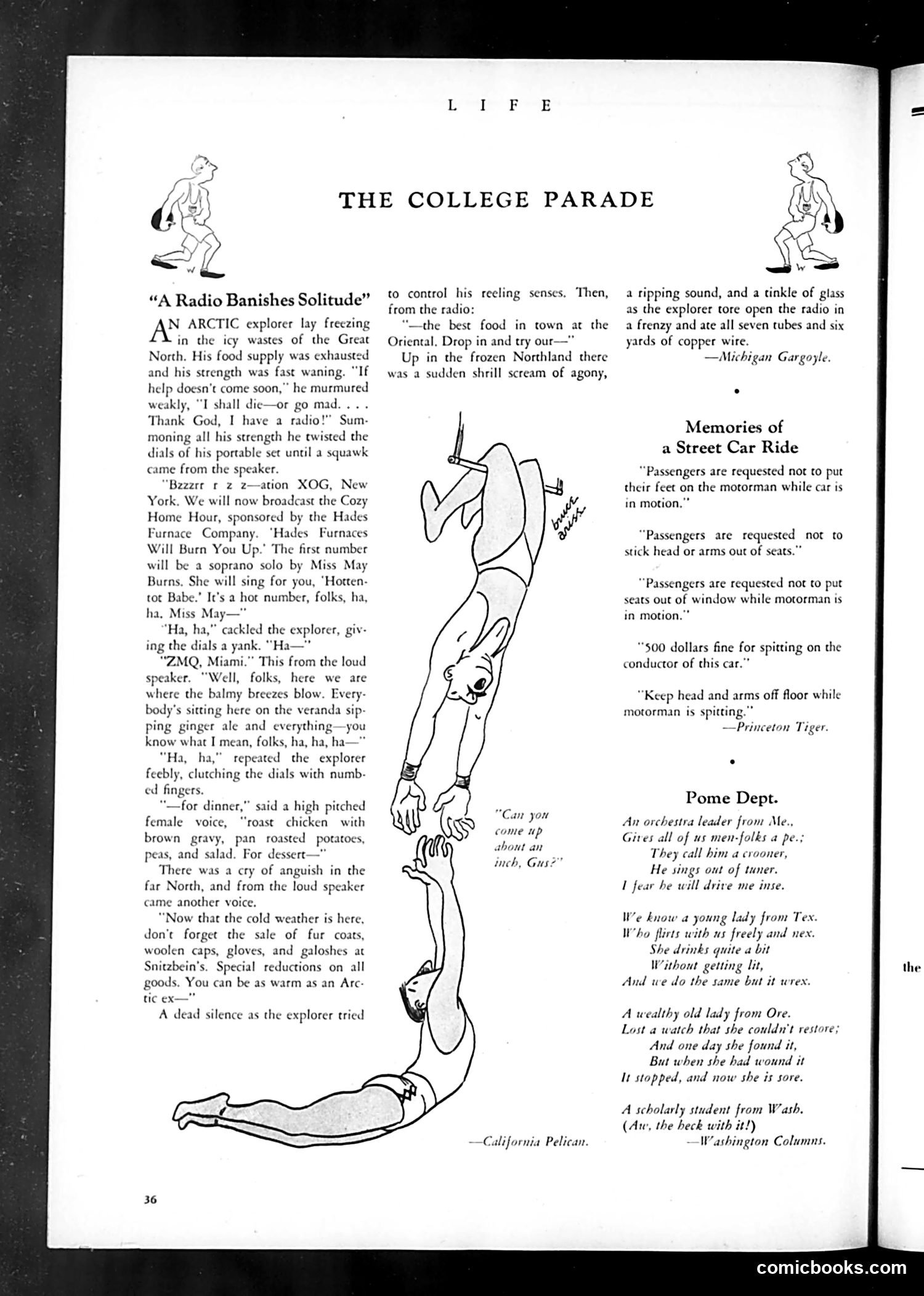
"The College Parade" - Life Magazine This page contains three satirical pieces mocking contemporary American culture circa the 1920s-30s: "A Radio Banishes Solitude" (main story with illustration): A darkly comic tale about an Arctic explorer dying from cold and hunger who, desperate for human connection, tunes his radio—only to be tormented by banal sponsored programming: furniture ads, Miami resort chatter, dinner descriptions, and store promotions. The sensory assault of advertising-saturated radio drives him to madness; he destroys the radio and eats its components. The satire targets both radio's commercialism and its hollow promise of companionship. "Memories of a Street Car Ride": Absurdist rules ostensibly governing streetcar conduct—requests not to put feet on the motorman or seats out windows—humorously reverse blame, implying conductors themselves spit and behave badly. "Pome Dept.": Light verse parodies from college humor magazines (Michigan Gargoyle, Princeton Tiger, Washington Columns), poking fun at crooners, flirty Texans, and forgetful elderly women. The page represents typical satirical humor from college and campus publications of the era.
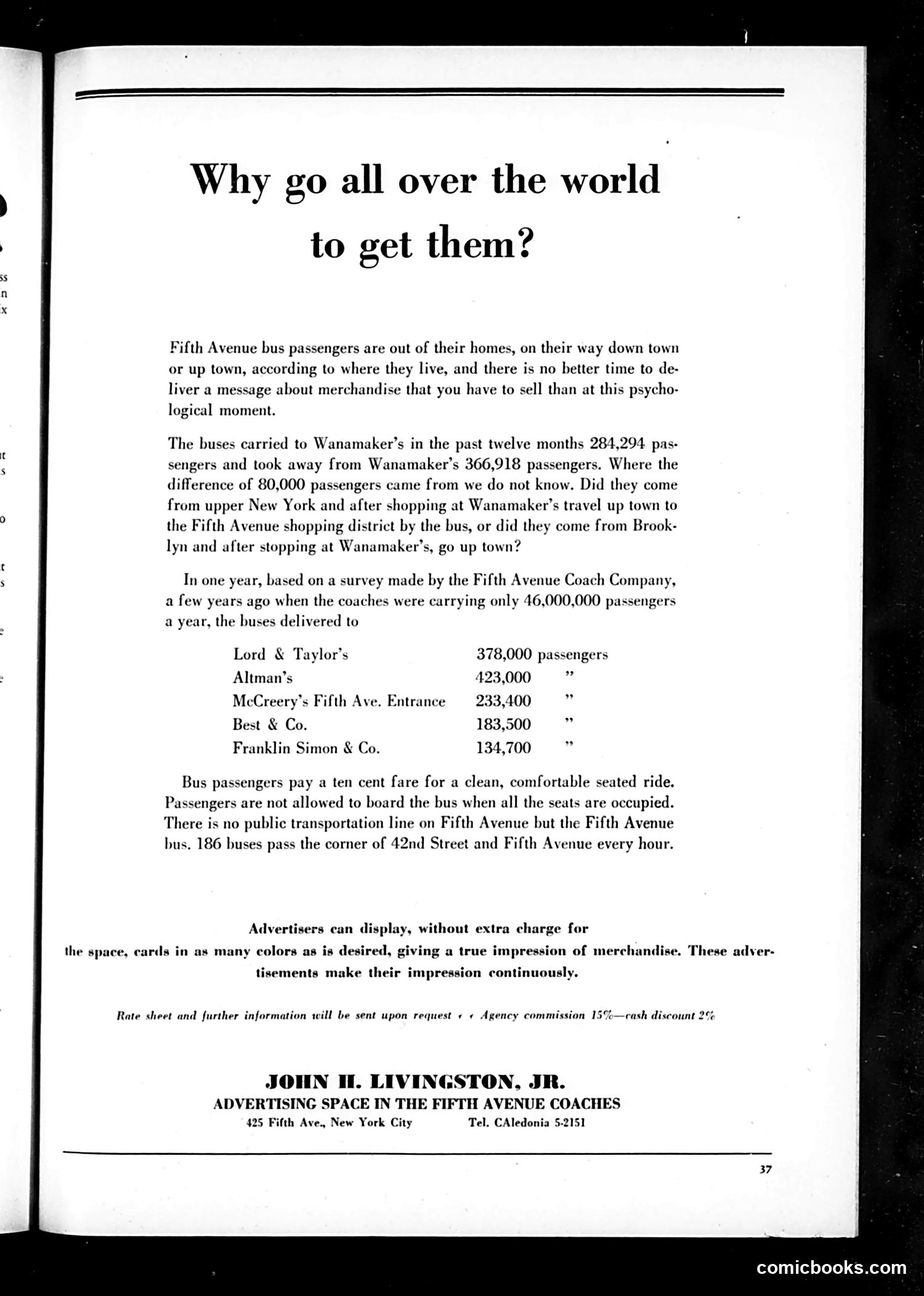
Analysis This is advertising copy, not satire or cartoon content. It's a sales pitch from John H. Livingston Jr., promoting advertising space on Fifth Avenue bus coaches in New York City. The "Why go all over the world to get them?" headline argues that advertisers needn't travel globally to reach customers—they can reach them efficiently on Fifth Avenue buses, where commuters are captive audiences traveling between home and shopping districts. The text cites data showing buses delivered hundreds of thousands of passengers to major department stores (Wanamaker's, Lord & Taylor, Altman's, etc.), positioning bus advertising as proven effective. It emphasizes the psychological advantage of reaching shoppers "at this psychological moment" while they're actively engaged in commerce. The pitch highlights practical benefits: ten-cent fares, comfortable seating, 186 buses hourly at major intersections, and colorful ad displays included at no extra charge. This is straightforward commercial advertising targeting retail businesses seeking to reach New York's shopping public.
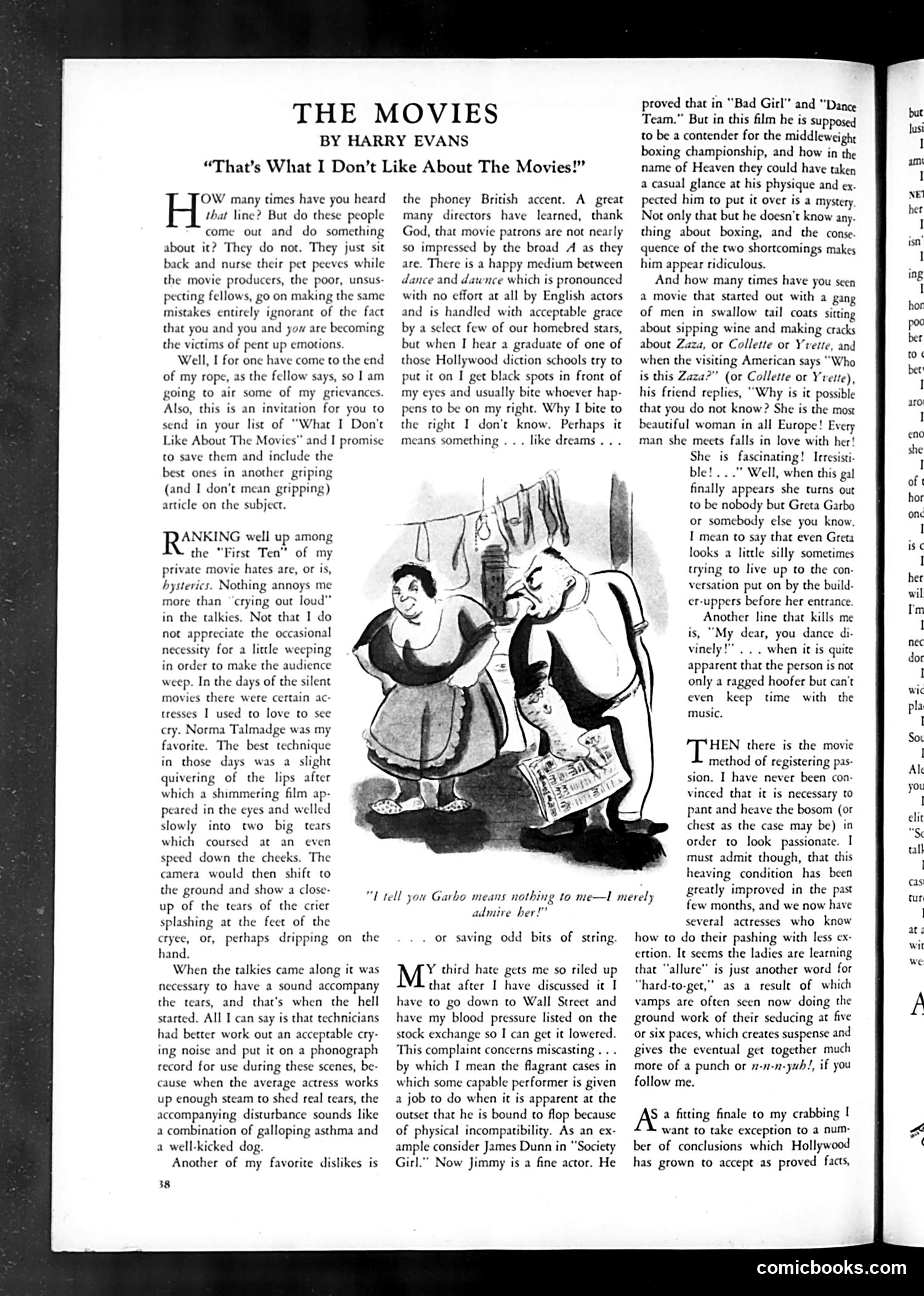
Analysis of "The Movies" by Harry Evans This satirical article critiques Hollywood filmmaking practices through the voice of an exasperated moviegoer. The accompanying cartoon illustrates Evans's complaint about artificial acting in "talkies" (sound films)—specifically mocking the over-the-top emotional displays actresses now perform to accompany audible crying. The cartoon depicts two figures in melodramatic poses, with one saying "I tell you Garbo means nothing to me—I merely admire her!"—a humorous jab at actors' affected delivery and the gap between their on-screen personas and reality. Evans's main grievances include: 1. Exaggerated crying sounds replacing the subtle, elegant weeping of silent-film actresses like Norma Talmadge 2. Artificial British accents adopted by American actors trained in diction schools 3. Miscasting—notably James Dunn cast as a middleweight boxer despite his physical unsuitability The piece reflects 1920s-1930s anxieties about "talkies" as a still-new technology, where actors struggled to transition from silent pantomime to naturalistic sound performance.
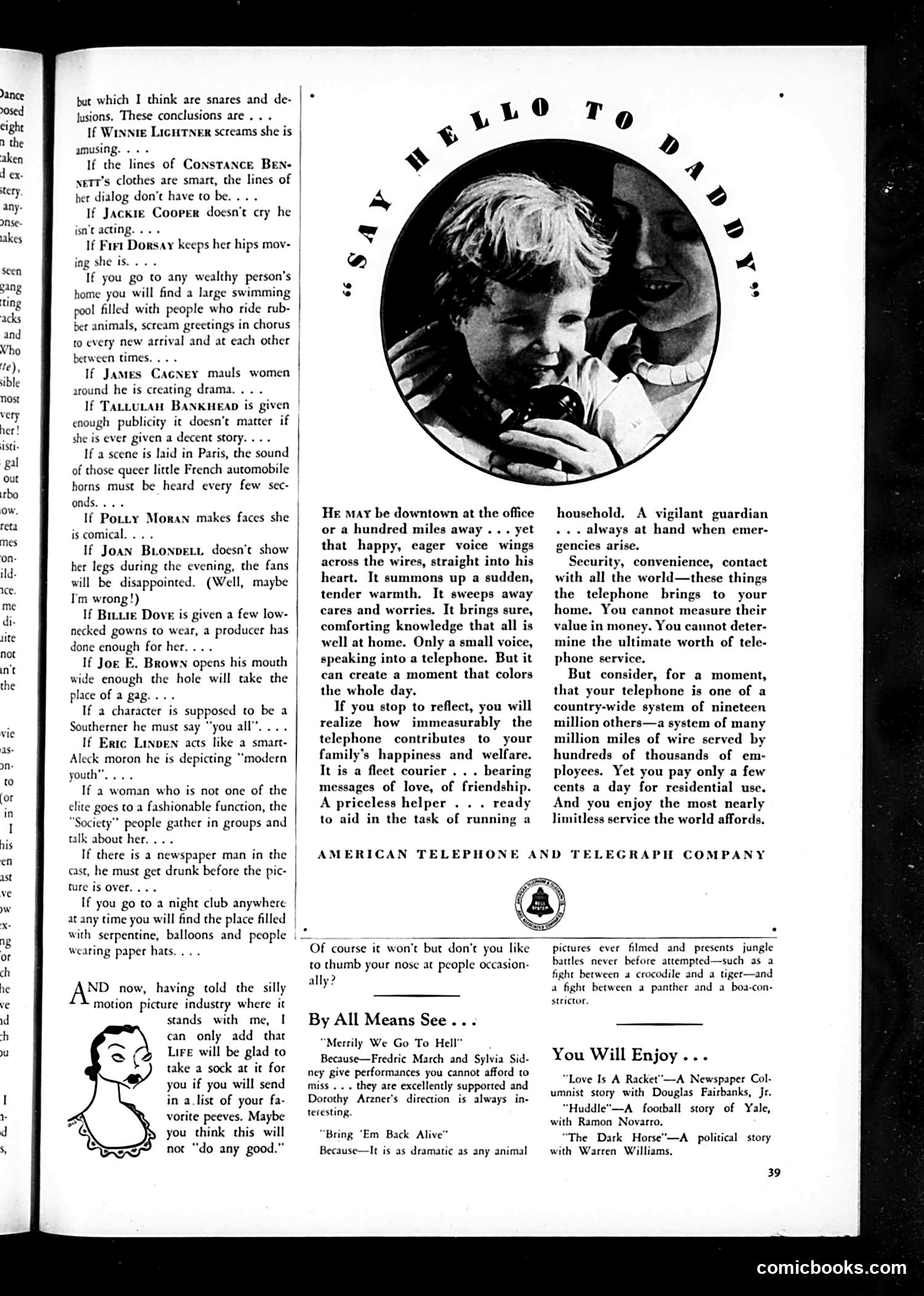
Analysis of This Life Magazine Page This page satirizes Hollywood's formula filmmaking through a series of cynical observations about how studios manipulate audiences using specific actors and gimmicks. The left column lists reductive "rules" for success—if Winnie Lightner screams, it's amusing; if Jackie Cooper doesn't cry, he's not acting; if Joan Blondell doesn't show her legs, fans disappoint. The satire targets both studios' lazy reliance on predictable star personas and audiences' gullible acceptance of these formulas. Each "if-then" statement mocks how studios substitute genuine craft with surface-level tricks: physical attributes, exaggerated mannerisms, or regional stereotypes (Southerners must say "you all"). The right side contains an AT&T advertisement celebrating the telephone's emotional value—a stark contrast emphasizing how the magazine juxtaposes cynical Hollywood criticism with earnest corporate messaging. The small cartoon figure at bottom left appears to be the writer's humorous self-portrait offering to compile reader complaints.
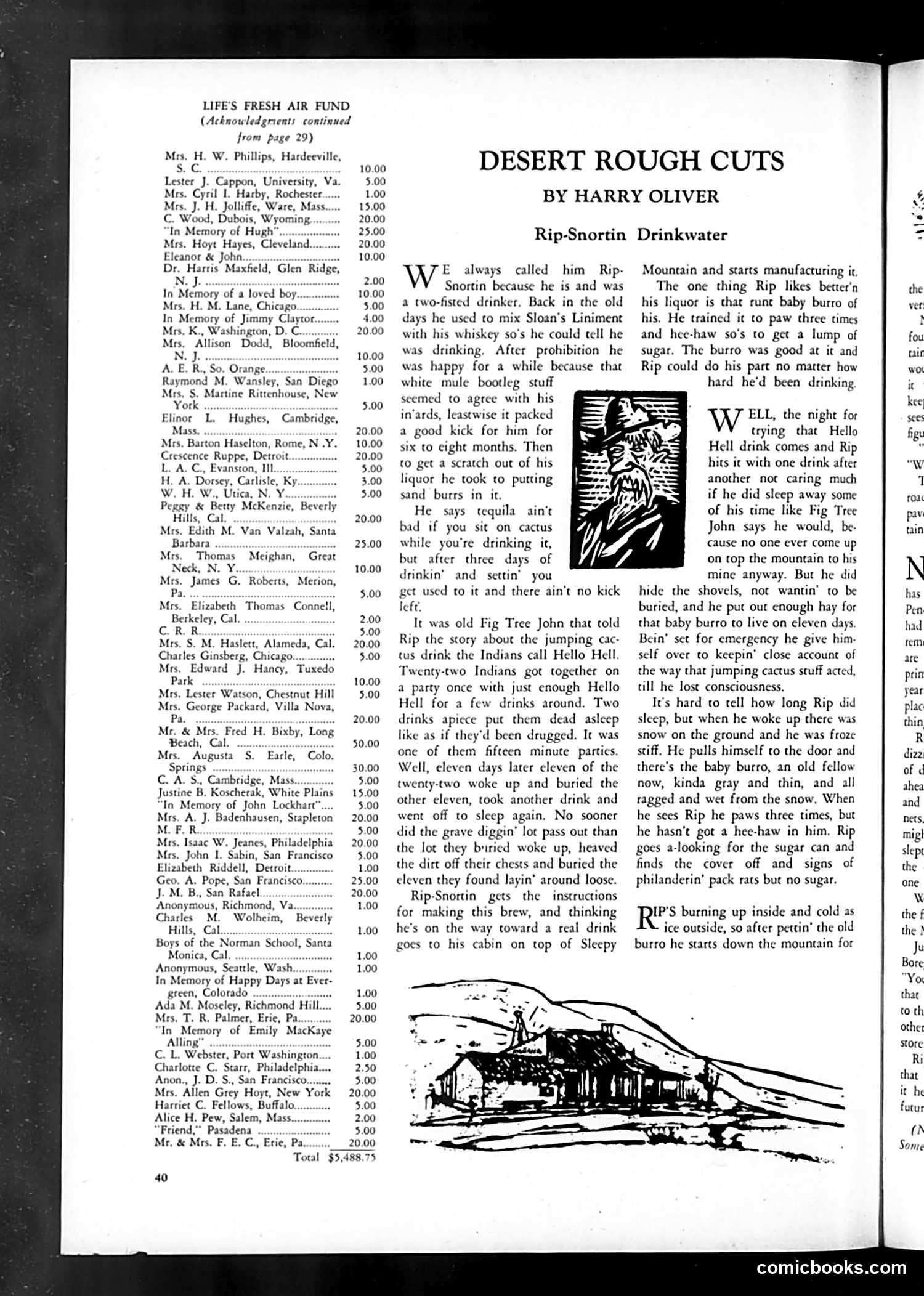
"Desert Rough Cuts" by Harry Oliver This page features a short story rather than political satire. The narrative, "Rip-Snortin' Drinkwater," tells of a desert character nicknamed "Rip-Snortin'" who is described as a "two-faced drinker." The story humorously recounts how Rip mixes Sloan's Liniment with whiskey, and later becomes infatuated with "Hello Hell" — a cactus-based drink that causes peculiar effects. The piece appears to be frontier/desert humor, with the story climaxing when eleven of twenty-two men who consumed the drink die, while the survivors bury them and continue drinking. The page also contains "Life's Fresh Air Fund" acknowledgments (a charitable list), and includes two woodcut illustrations depicting desert scenes and a cabin.
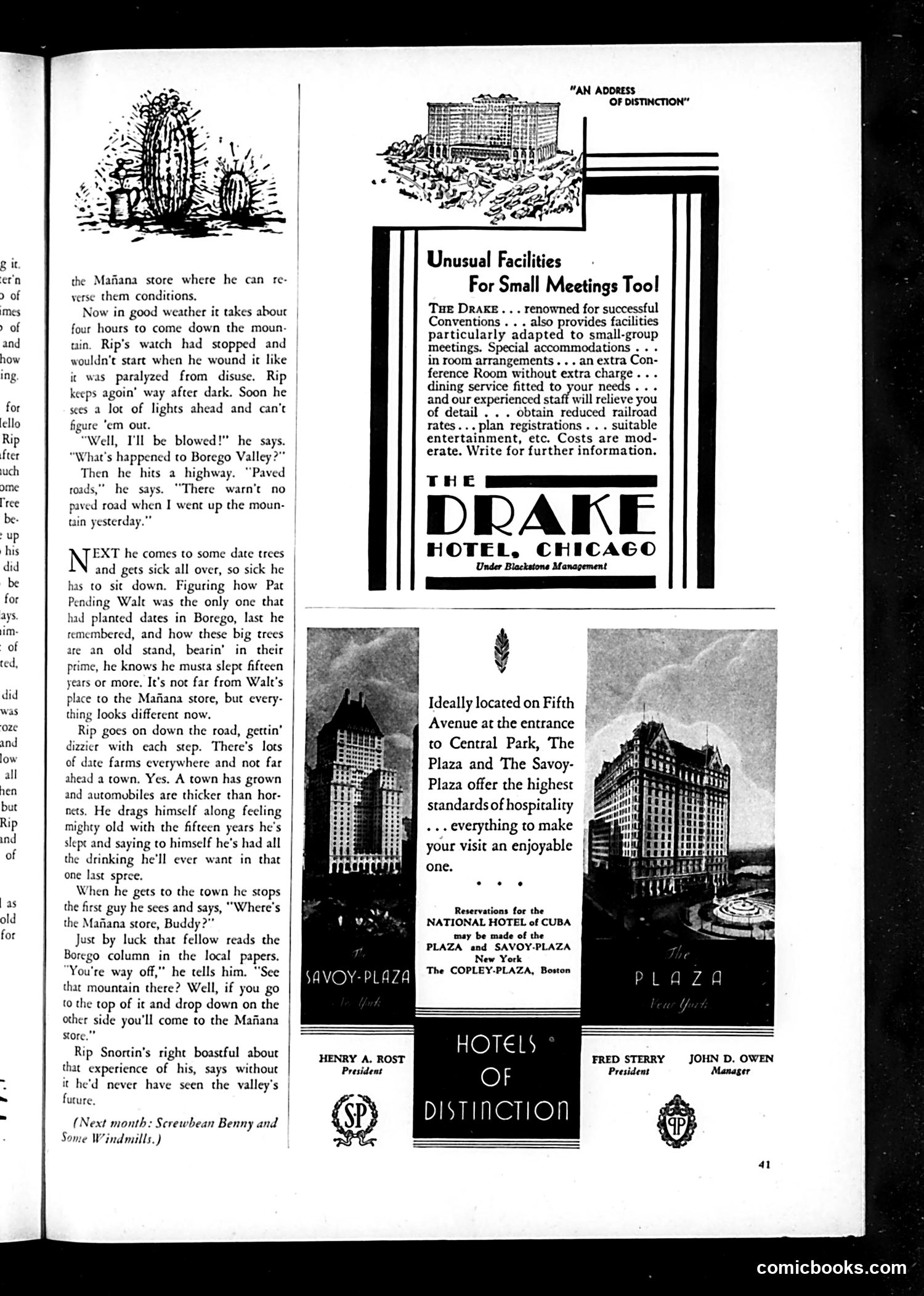
Analysis of Page 41 This page is primarily advertising for hotels, not political satire. The main content is a serialized story called "Rip" (likely a modern retelling of Washington Irving's "Rip Van Winkle"). The Story's Point: A character named Rip falls asleep in the mountains near Borrego Valley and wakes after fifteen years. The satire lies in his shock at modernization—paved roads, automobiles, date farms, and an entire town where nothing existed before. This reflects early-20th-century anxiety about rapid American development and urban sprawl replacing rural landscapes. Historical Context: The references to "Mañana store," Walt, and date farming suggest this is set in Southern California's desert region during a period of dramatic expansion. The Advertisements: The bottom half features luxury hotel promotions (Drake Hotel Chicago, Plaza/Savoy-Plaza New York, Copley-Plaza Boston), typical magazine filler of this era. No specific political figures or cartoon caricatures appear on this page.
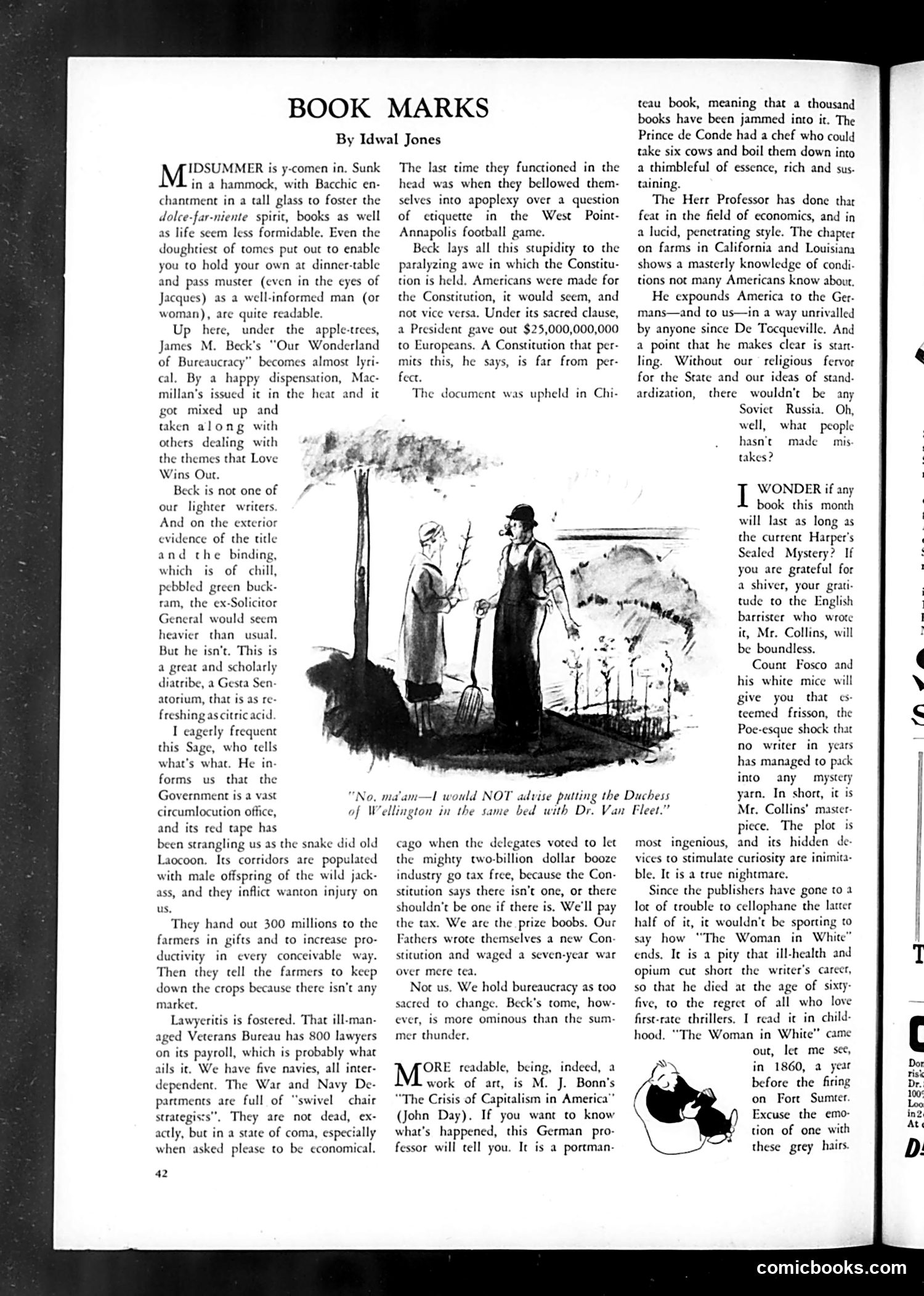
Book Marks: Political Satire on American Bureaucracy This book review column by Idwal Jones critiques James M. Beck's "Our Wonderland of Bureaucracy," a satirical attack on government inefficiency. Beck (identified as "ex-Solicitor General") argues that Americans have become enslaved to constitutional worship rather than common sense. The review highlights Beck's specific complaints: the government hands farmers $300 million to increase productivity while simultaneously ordering them to reduce crops; the Veterans Bureau employs 800 lawyers; multiple redundant military departments exist in "swivel chair" inaction; and a President distributed $25 billion to Europeans under constitutional authority. Beck's central thesis—that the Constitution itself, treated as sacred text, enables bureaucratic paralysis—becomes the satire's target. The cartoon (caption visible) depicts ordinary citizens discussing absurd government situations, embodying the everyday frustration with administrative incompetence that Beck documents. The implicit argument: American governance prioritizes rigid constitutional procedure over practical problem-solving.
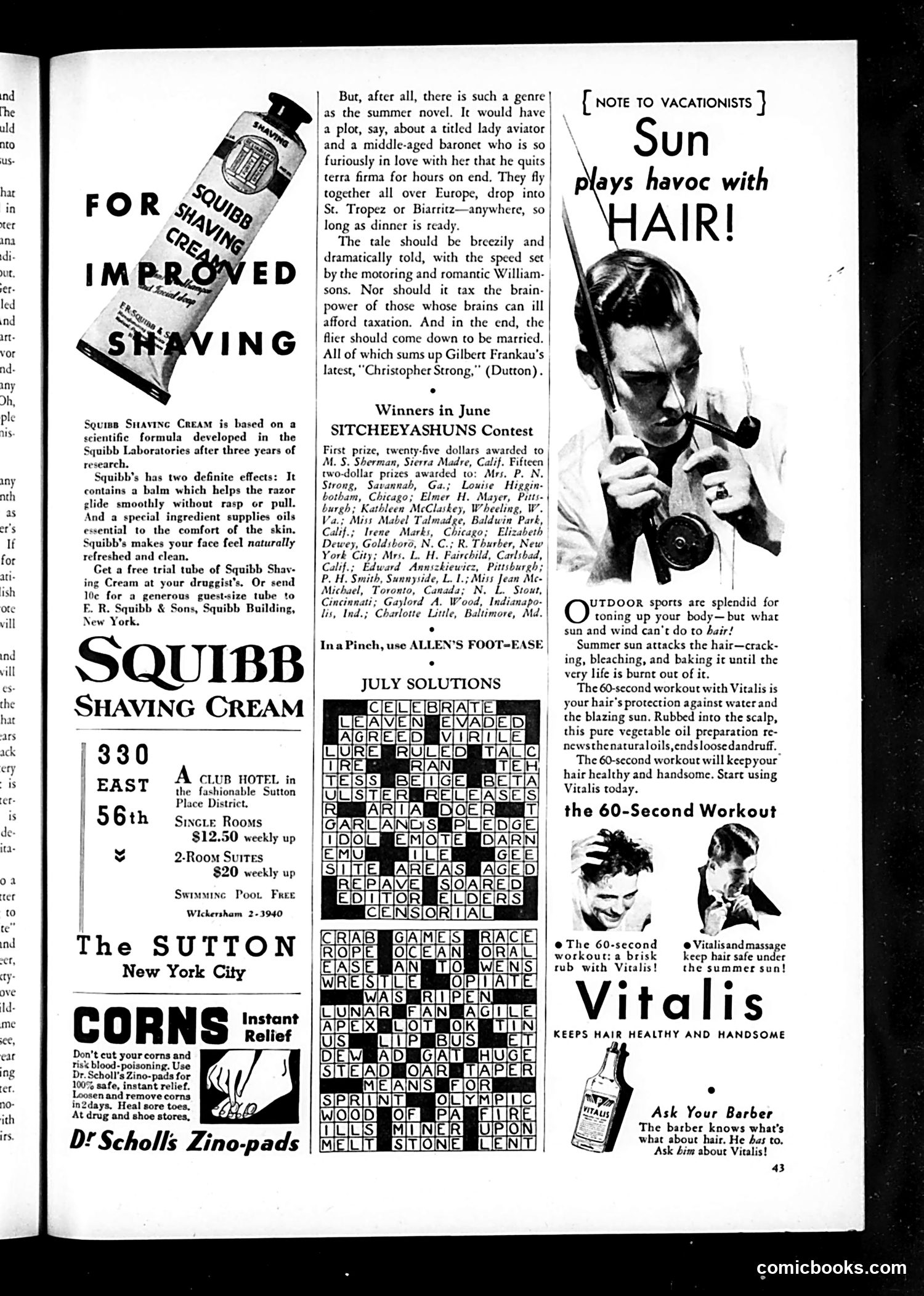
Page Analysis: Life Magazine Advertisement Section This page is primarily advertising, not political satire. It contains product promotions typical of 1920s-30s American magazines: Main advertisements: - Squibb Shaving Cream: promotes scientific formula for smooth shaving - The Sutton Hotel: fashionable Manhattan lodging - Dr. Scholl's Zino-pads: corn relief product - Vitalis hair oil: protects hair from summer sun damage Editorial content: A brief book review discusses Gilbert Frankau's novel *"Christopher Strong"* (about a titled lady aviator and baronet), and a "Sitcheeyashuns" contest results listing. The humor appears minor—a light joke about summer novels' predictable plots (aristocrats, romance, European travel, marriage ending). The page's main purpose is selling products to affluent readers concerned with grooming and travel accommodations. The "Note to Vacationists" about sun damage reflects period leisure culture among the wealthy.
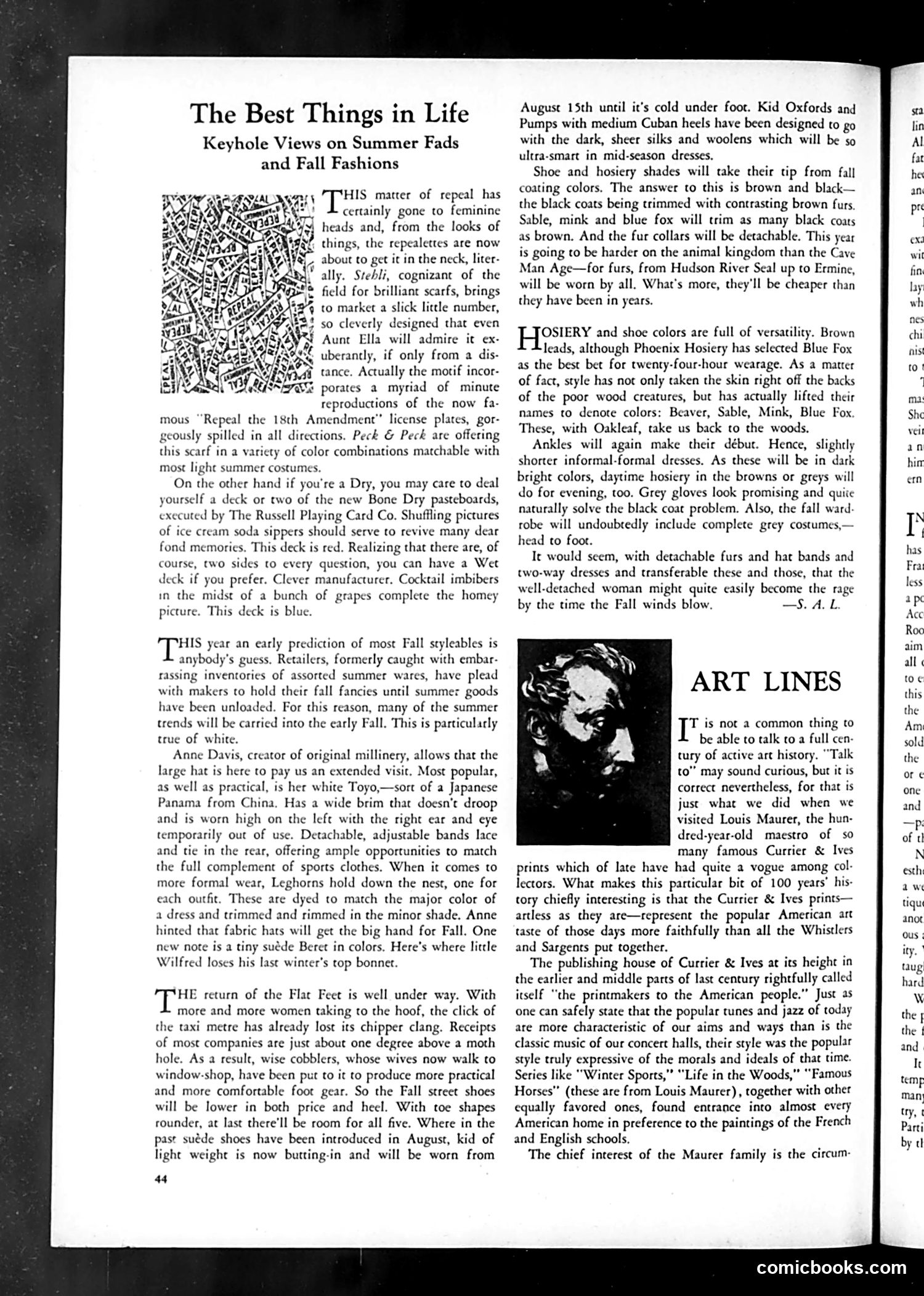
Explanation for Modern Readers This page from *Life* magazine discusses 1920s fashion trends with satirical commentary on Prohibition's repeal. The main content includes: "Repeal the 18th Amendment" Scarves: The text jokes about women celebrating Prohibition's repeal by wearing novelty scarves featuring miniature license plates that mock the repeal movement—a fashion statement tied to a major political event (Prohibition ended in 1933). Playing Cards: "Bone Dry" and "Wet" decks mock the two sides of the Prohibition debate—dry (anti-alcohol) versus wet (pro-alcohol) factions that divided American society. Fashion Trends: The bulk discusses practical fall clothing, hats, and especially shoes becoming flatter and more comfortable as women increasingly walked rather than relied on taxis—reflecting women's growing independence and mobility. The cartoon/illustration on the right labeled "Art Lines" discusses 19th-century French art (Currier & Ives, Louis Maurer), unrelated to the fashion content. The satire gently mocks both Prohibition politics and changing women's fashion driven by social liberation.
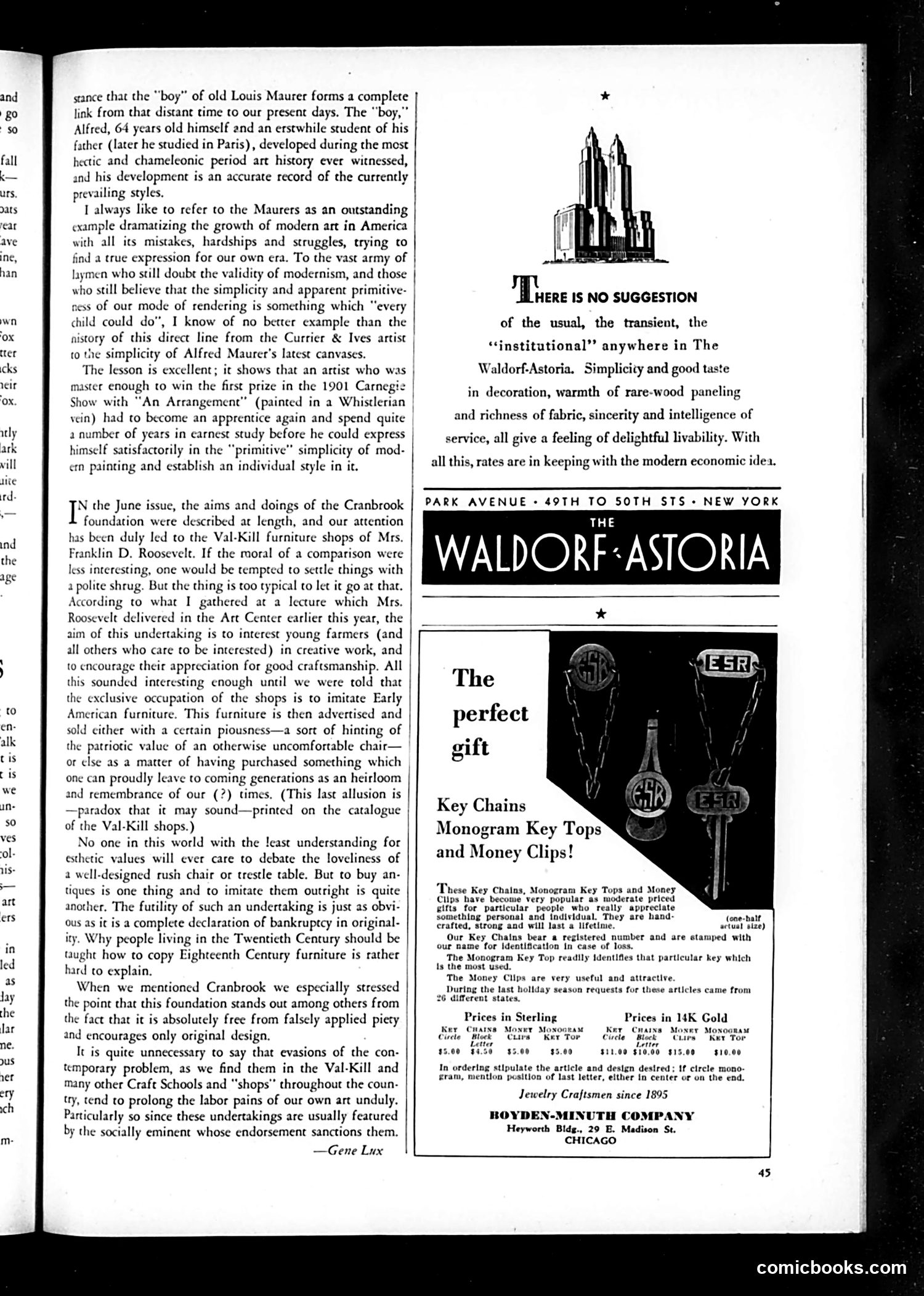
Content Analysis This page is primarily editorial commentary rather than a cartoon. The text criticizes Eleanor Roosevelt's Val-Kill furniture shops for imitating Early American furniture rather than encouraging original modern design. The author contrasts two approaches to craft: - Cranbrook Foundation: promotes original contemporary design - Val-Kill shops: teaches reproduction of 18th-century furniture, which the writer views as artistically backward and even dishonest (using "patriotic value" as marketing) The satire targets what appears to be Roosevelt's nostalgic approach—selling reproductions with implied historical importance to a modern audience. The author argues this "evasion of the contemporary problem" harms American art development by encouraging imitation over innovation. The piece also praises the artistic lineage of painter Alfred Maurer, showing how even accomplished artists must "become apprentices again" to master modernism—implying Val-Kill's students should be learning forward-looking design, not backward-looking copies. This reflects 1920s-30s modernist debates about authenticity versus nostalgia in American craftsmanship.
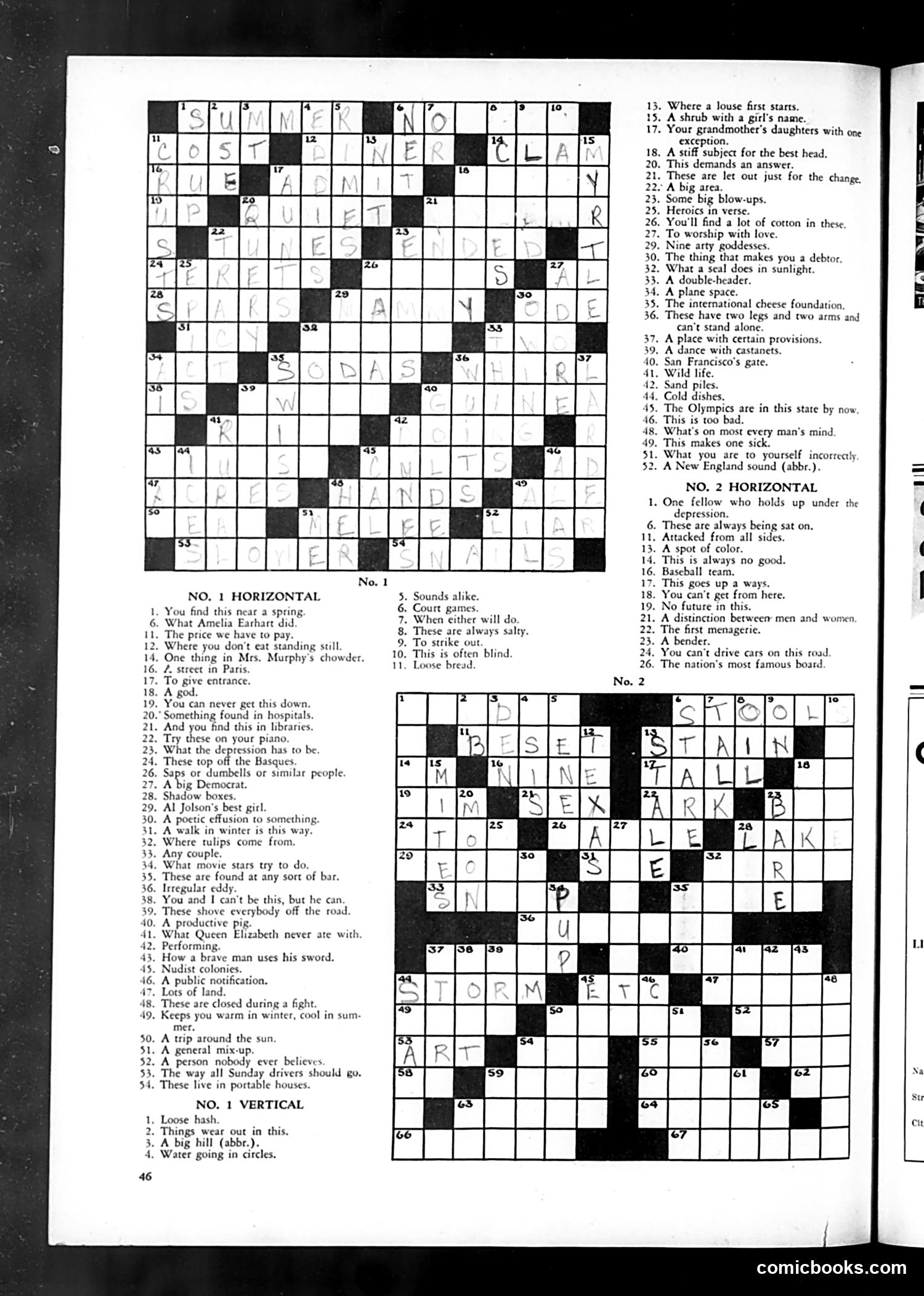
Analysis for Modern Readers This page contains crossword puzzles, not political cartoons. It's from *Life* magazine's puzzle section—a common feature in mid-20th century publications. The clues reflect 1930s-era American culture and concerns: - References to "the depression" (the Great Depression) appear multiple times (clue 1 in No. 2: "One fellow who holds up under the depression") - Celebrity mentions: "Al Jolson's best girl" (referencing the famous entertainer) - "Amelia Earhart" (the pioneering aviator, likely lost at sea in 1937) - Social observations: "Nudist colonies," "Mrs. Murphy's chowder" (ethnic humor) - Topical references: "The Olympics are in this state by now" (suggesting a recent Olympic Games) The puzzles served as entertainment during economically difficult times. The clues blend wordplay, geography, literature, and contemporary events—typical of puzzle design meant to engage educated magazine readers. There's no satirical commentary here; rather, it's recreational content reflecting the era's preoccupations.
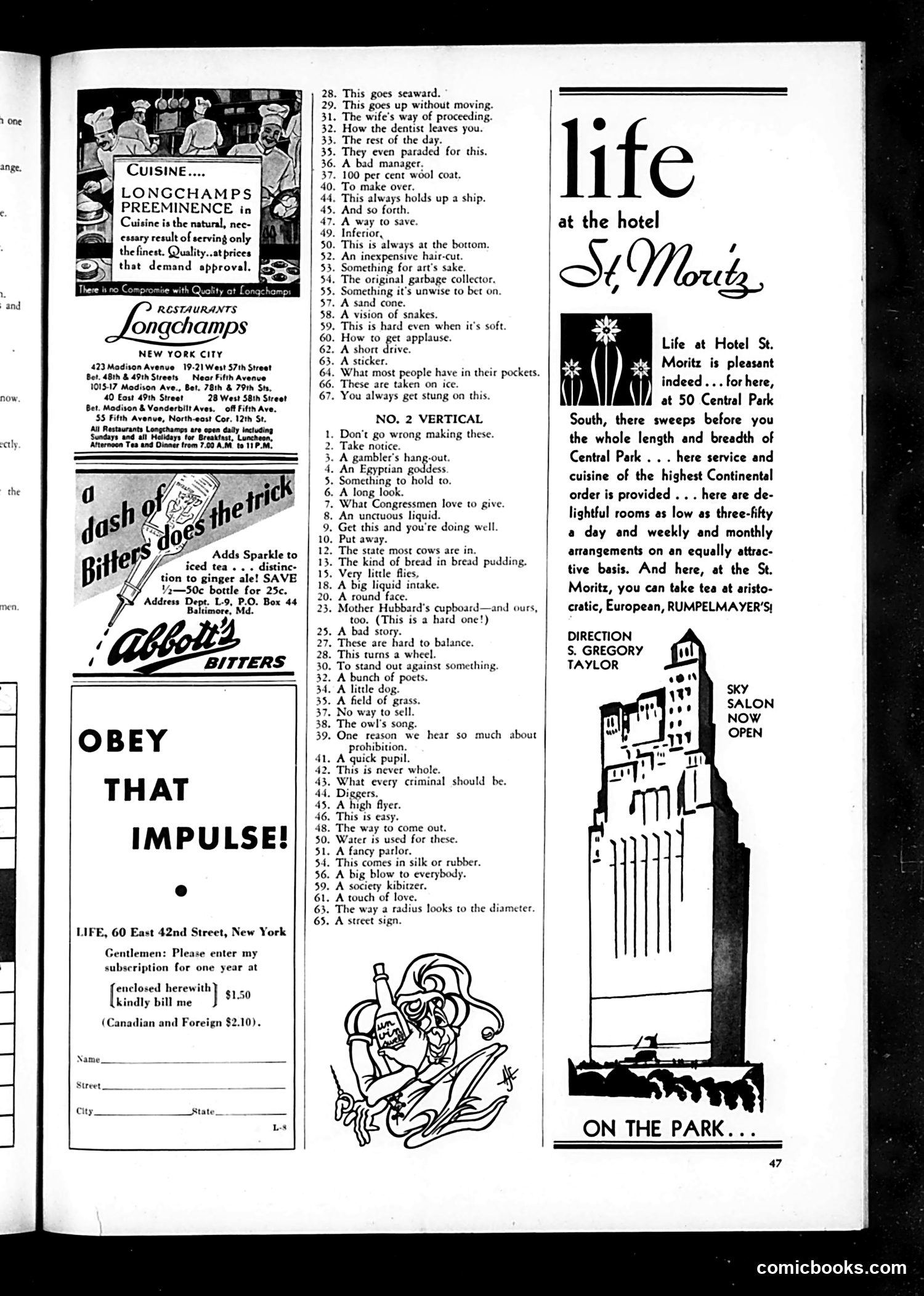
Analysis of Life Magazine Page 47 This page is primarily advertising and promotional content rather than political satire or comics. The main elements are: 1. Restaurant ads for Longchamps (multiple NYC locations) and Abbott's Bitters, emphasizing quality cuisine and refreshment. 2. Life Magazine subscription pitch ("Obey That Impulse!") offering yearly subscriptions for $1.50. 3. Hotel St. Moritz advertisement highlighting luxury accommodations at Central Park South, featuring fine dining and tea service at Rumpelmayer's. 4. Two crossword puzzles (numbered clues visible) — typical magazine filler content. 5. Illustration of a jovial character with a bottle, associated with Abbott's Bitters advertisement. The page reflects 1920s-30s consumer culture, targeting affluent New York readers with upscale dining, hospitality, and leisure activities. There is no discernible political cartoon or satire—this is straightforward commercial content typical of Life's revenue model.
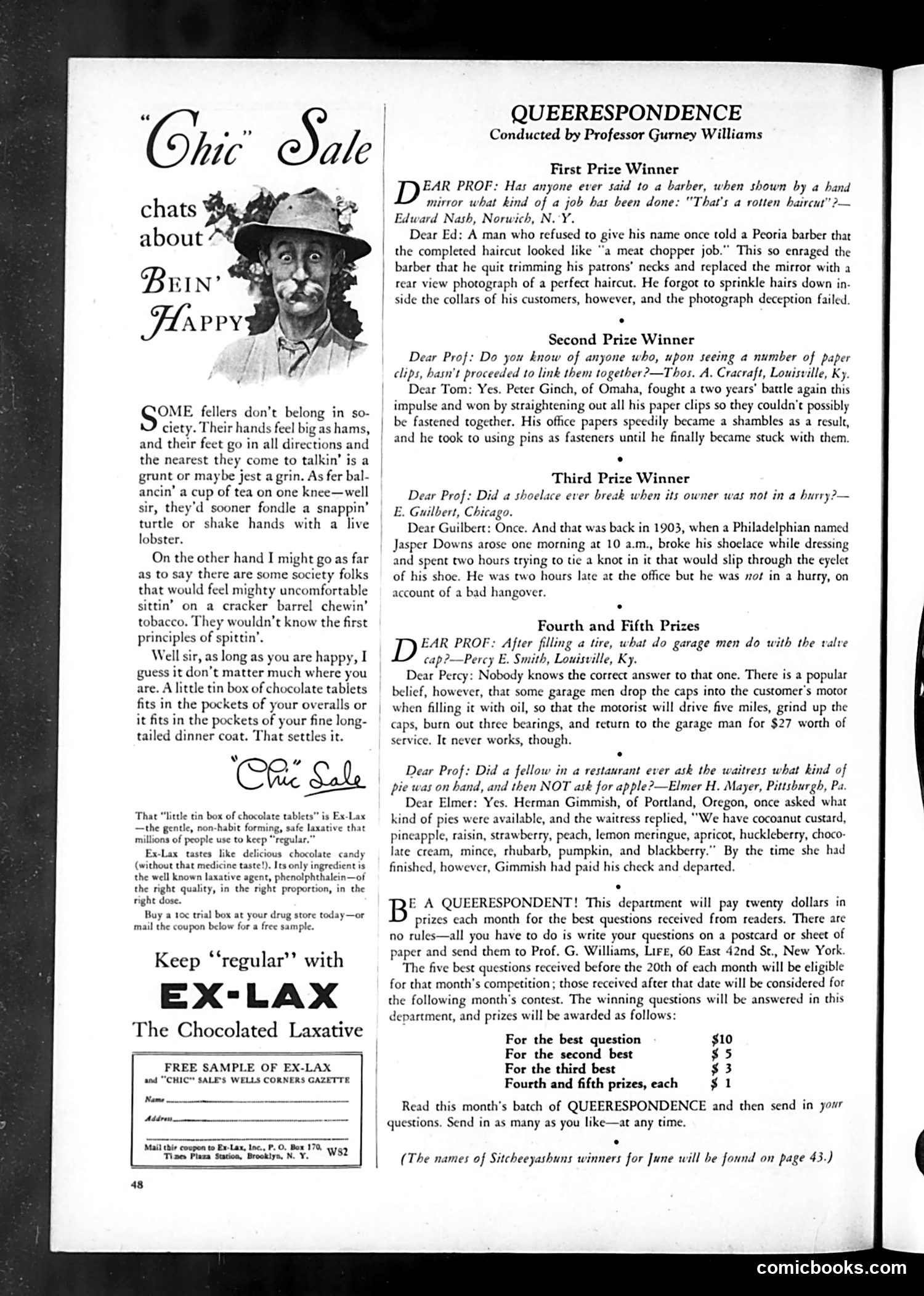
"Chic" Sale and the Class Commentary This page combines an advertisement with satirical commentary on social class. The left side features "Chic" Sale, a popular humorist whose folksy persona appears in the illustration—a working-class figure in rural dress. The ad's satire targets class pretension: it argues that refined society folks and working-class folks are equally uncomfortable outside their own spheres (one can't spit properly, the other can't balance a teacup). The punchline is that Ex-Lax laxative chocolates transcend class—equally at home in overalls or dinner jackets, suggesting digestive regularity is the great democratic equalizer. The "Queerespondence" section presents humorous reader questions about quirky human behaviors (barber insults, paper clips, shoelaces, garage caps). These anecdotes mock common social absurdities and human irrationality in a lighthearted way typical of *Life* magazine's satirical humor. The overall message: class distinctions are superficial; we're all fundamentally alike.
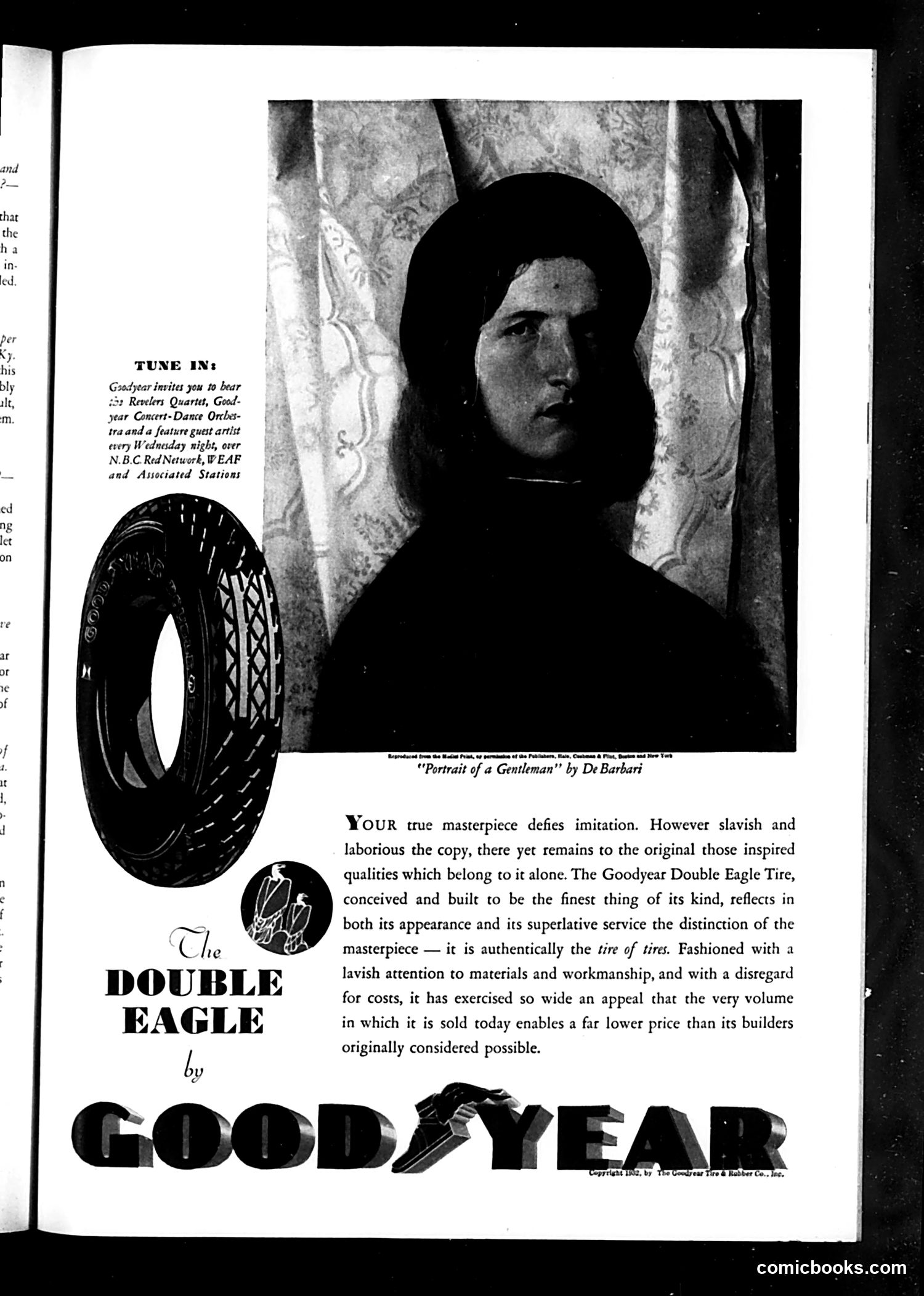
Analysis This is primarily a Goodyear tire advertisement, not political satire. The page features: The Image: A portrait painting titled "Portrait of a Gentleman" by De Barbari (a Renaissance artist), displayed alongside a Goodyear Double Eagle tire. The Advertising Strategy: The ad compares the tire to a masterpiece—arguing that while imitations exist, the original possesses unique "inspired qualities." It claims the Double Eagle tire represents the pinnacle of tire manufacturing, crafted with meticulous attention to materials and workmanship. The Pitch: The paradoxical claim that this premium product—built without cost considerations—now sells in such high volumes that Goodyear can offer it at a lower price than originally anticipated. Additional Content: A "Tune In" box promotes Goodyear's radio sponsorship: the Revelers Quartet and concert orchestra performing Wednesday nights on NBC Red Network and affiliated stations. This reflects 1920s-30s advertising combining classical art references with modern consumer products to suggest quality and prestige.
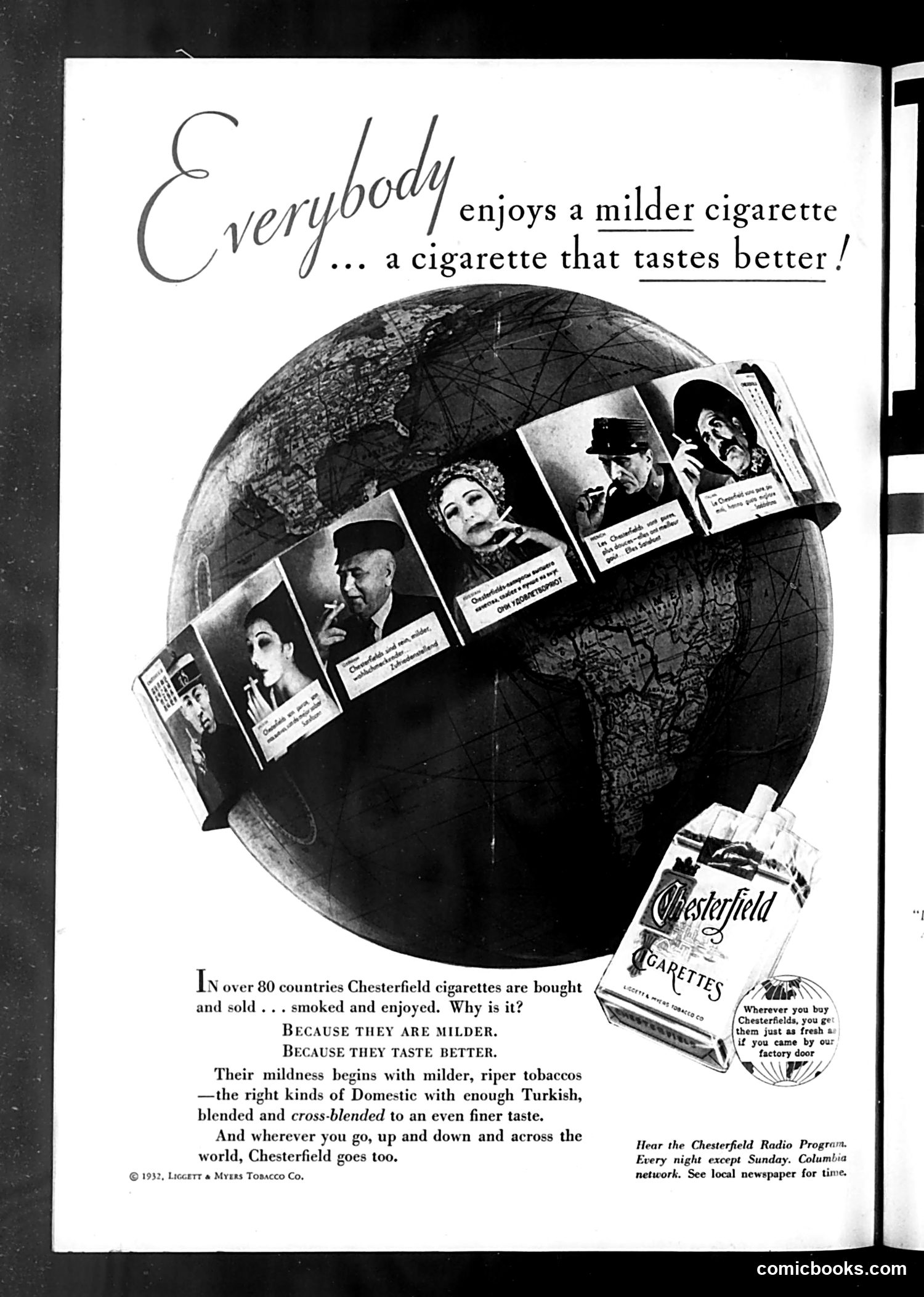
Analysis This is a Chesterfield cigarette advertisement, not political satire. The page features a globe with portraits of international figures arranged around it, suggesting Chesterfield's global popularity across 80+ countries. The advertisement claims Chesterfields are milder and taste better due to their tobacco blend of domestic and Turkish varieties. The globe imagery emphasizes worldwide distribution and consumption. Key point for modern readers: This 1932 ad represents pre-warning-label cigarette marketing that made health claims ("milder") as selling points. The international figures appear designed to suggest cosmopolitan sophistication and universal appeal—a common advertising strategy when tobacco had no health restrictions. The casual presentation of smoking as a globally enjoyed pleasure would later become highly controversial as health risks became scientifically established.