life
Life — September 1932
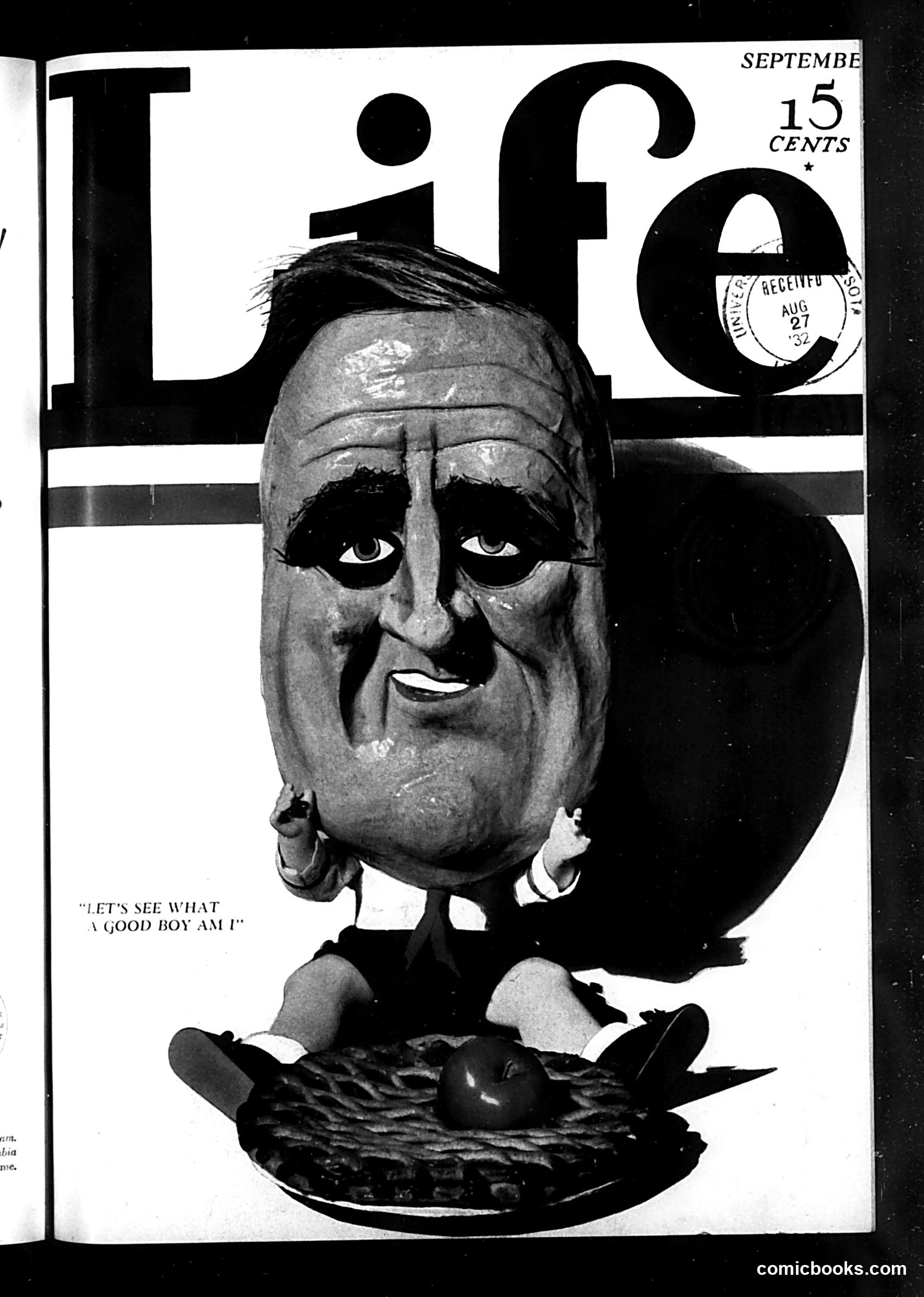
Life Magazine Cover Analysis This September 1934 Life magazine cover features a caricatured figure wearing theatrical blackface makeup with exaggerated features, holding a banana and what appears to be a nest or basket. The caption reads: "LET'S SEE WHAT A GOOD BOY AM I." Context: This appears to satirize a specific public figure or entertainment performer of the era, likely someone in vaudeville or theater known for blackface performances. The grotesque exaggeration and condescending caption suggest Life was mocking both the performer and the racist entertainment conventions of 1930s American popular culture. The theatrical nature and crude caricature style were typical of Life's satirical approach, though the imagery reflects deeply offensive racial stereotyping standards of that historical period. Without additional context, the specific target remains unclear.
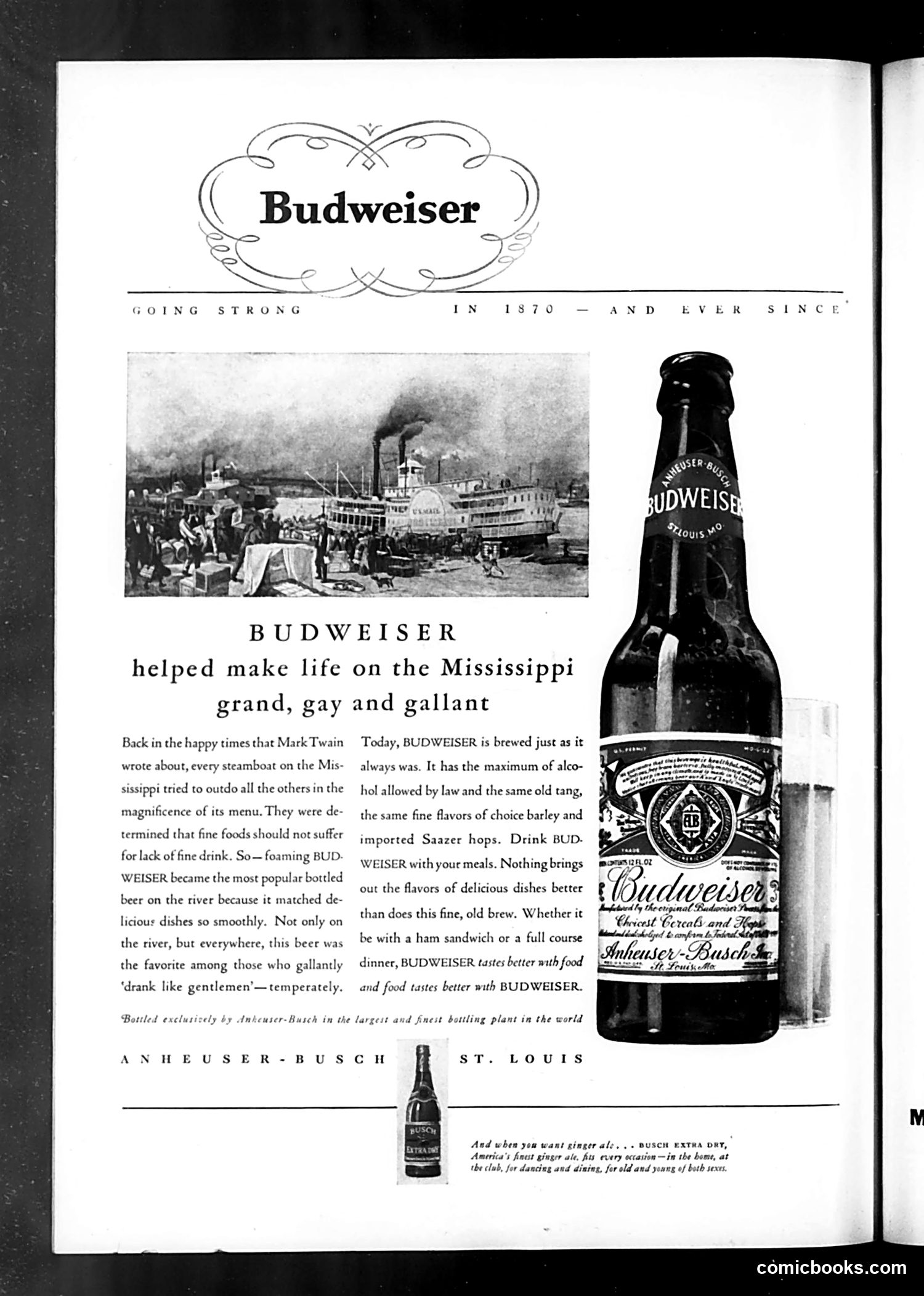
Analysis This is a Budweiser beer advertisement, not political satire. The page celebrates Budweiser's association with Mississippi River steamboats during the Mark Twain era ("back in the happy times"). The ad claims Budweiser became "the most popular bottled beer on the river" because it complemented elegant dining better than competitors. The advertisement references the romanticized steamboat culture of the 19th century—a period of American nostalgia even when this ad ran. The tagline "BUDWEISER tastes better with food and food tastes better with BUDWEISER" is straightforward product marketing, not satire. The page includes a large bottle image and smaller competitor product (appears to be Busch Extra Dry) at the bottom, typical of period beer advertising comparing brands.
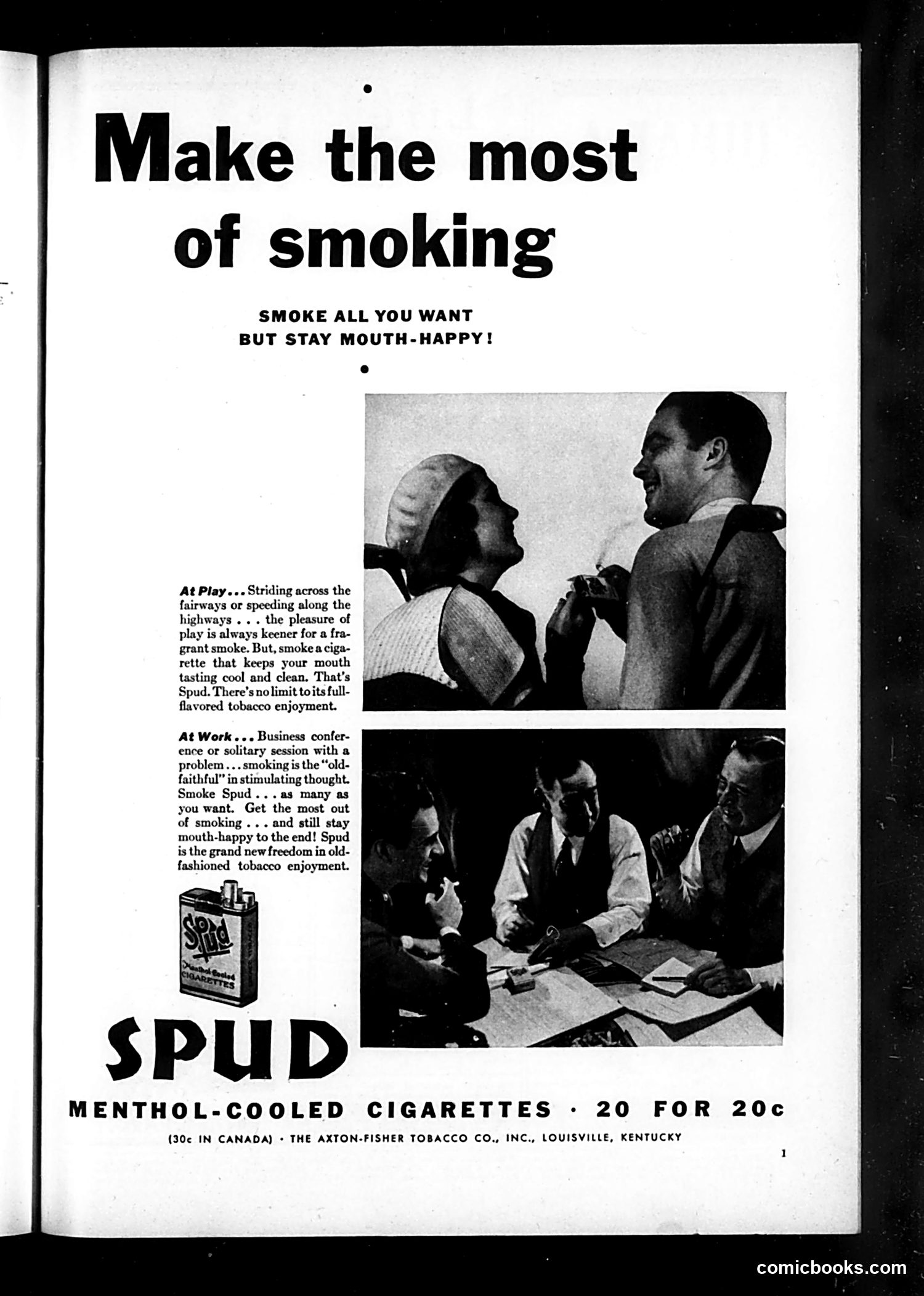
Analysis This is a cigarette advertisement, not satire or political commentary. It promotes Spud brand menthol-cooled cigarettes (20 for 20¢) made by Axton-Fisher Tobacco Co. in Louisville, Kentucky. The page uses two photographs showing scenarios where smoking supposedly enhances leisure and work: 1. "At Play" depicts people enjoying outdoor recreation, claiming Spud cigarettes keep "your mouth tasting cool and clean" 2. "At Work" shows businessmen in an office meeting, suggesting cigarettes aid concentration and thought The tagline—"Smoke all you want but stay mouth-happy!"—is the core marketing claim: menthol provides oral freshness despite frequent smoking. This reflects the mid-20th-century era when cigarette advertising commonly appeared in mainstream magazines without health warnings, and smoking was socially normalized in professional and recreational settings.
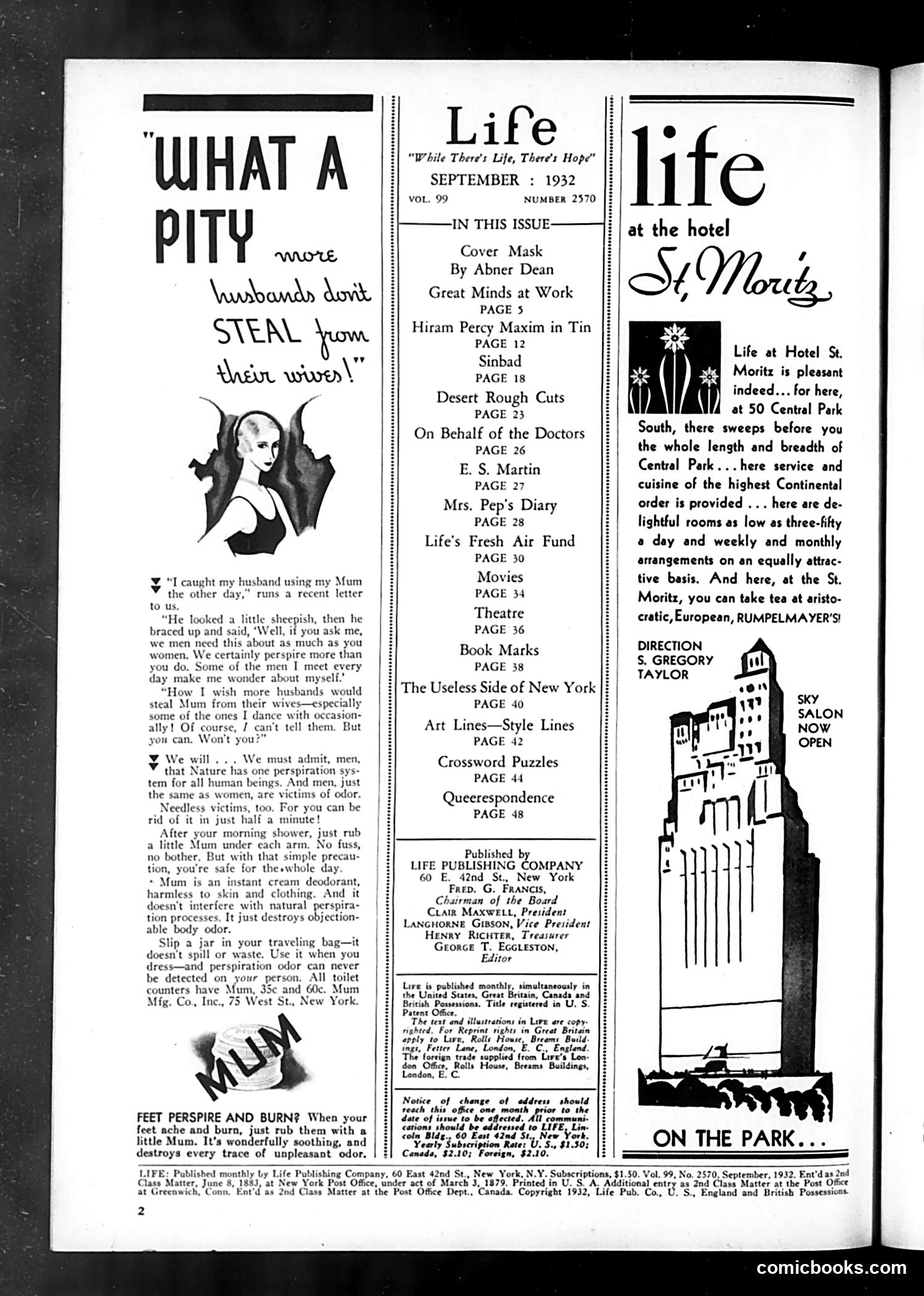
Analysis This is primarily a table of contents and advertisements page from Life Magazine, September 1932. The main cartoon on the left depicts a demonic or devilish female figure with the caption "WHAT A PITY more husbands don't STEAL from their wives!" Below are humorous testimonials from readers about using "Mum" deodorant on their husbands without their knowledge. The satire plays on 1930s gender dynamics and marital deception—the joke being that wives secretly apply deodorant to husbands to mask body odor, framed as a harmless "theft" of the product. It reflects period attitudes about women's domestic roles and controlling husbands' hygiene. The right side advertises Hotel St. Moritz and other services, typical of the magazine's mixed content format.
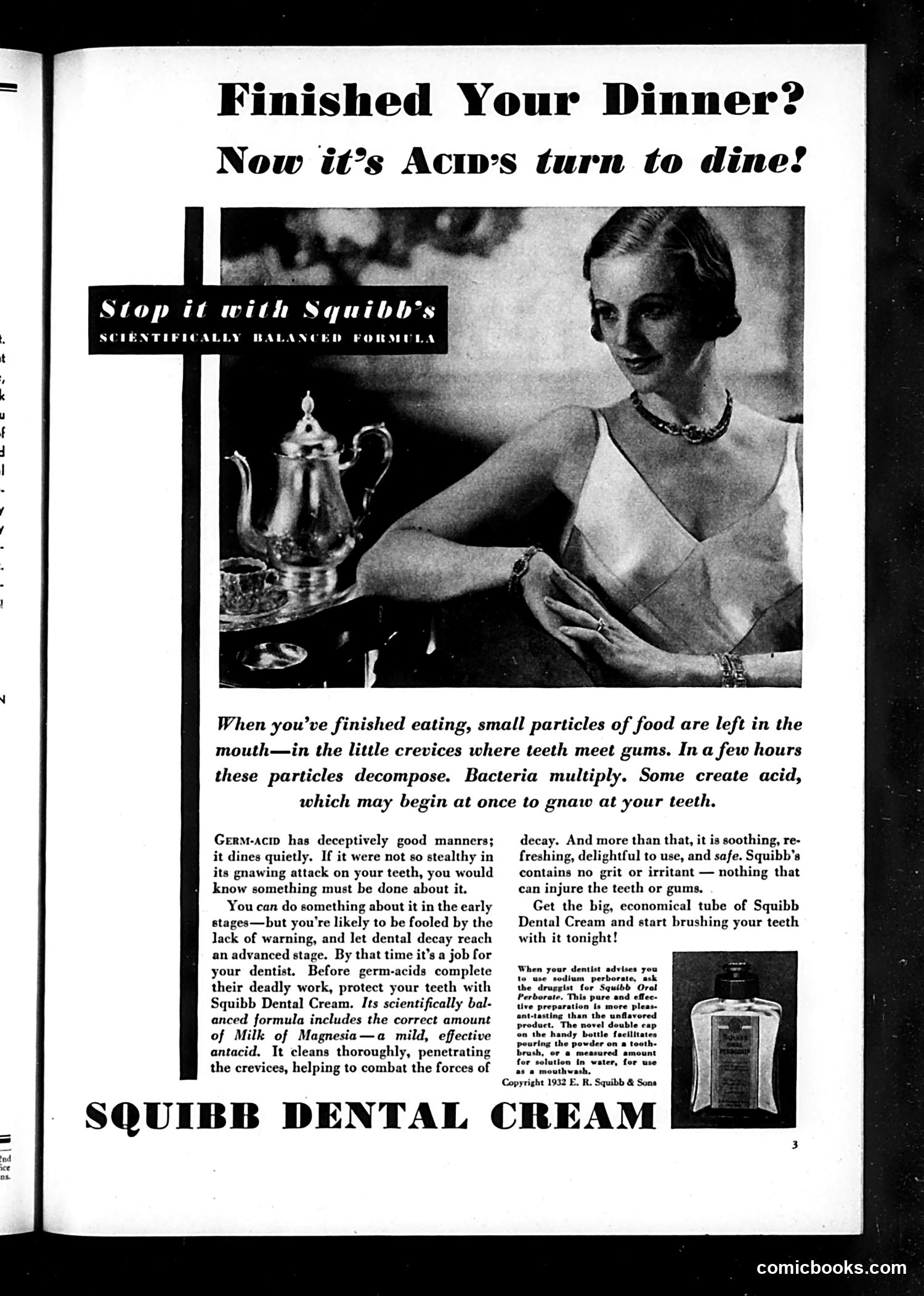
Analysis This is a vintage advertisement, not satire or editorial content. It's a full-page ad for Squibb Dental Cream from 1932 (based on the copyright visible). The ad uses fear-based marketing targeting women. It depicts a woman after dinner, with text warning that food particles left in teeth allow bacteria to multiply and create acid that attacks teeth. The "germ-acid" concept was marketing language designed to create anxiety about dental hygiene. The ad's pitch: use Squibb Dental Cream—claimed to contain "Milk of Magnesia"—to neutralize acids and protect teeth. The scientific language ("scientifically balanced formula") was typical of 1930s advertising that borrowed medical authority to sell consumer products, whether the claims were fully substantiated or not. It reflects period attitudes about women's appearance and health anxiety.
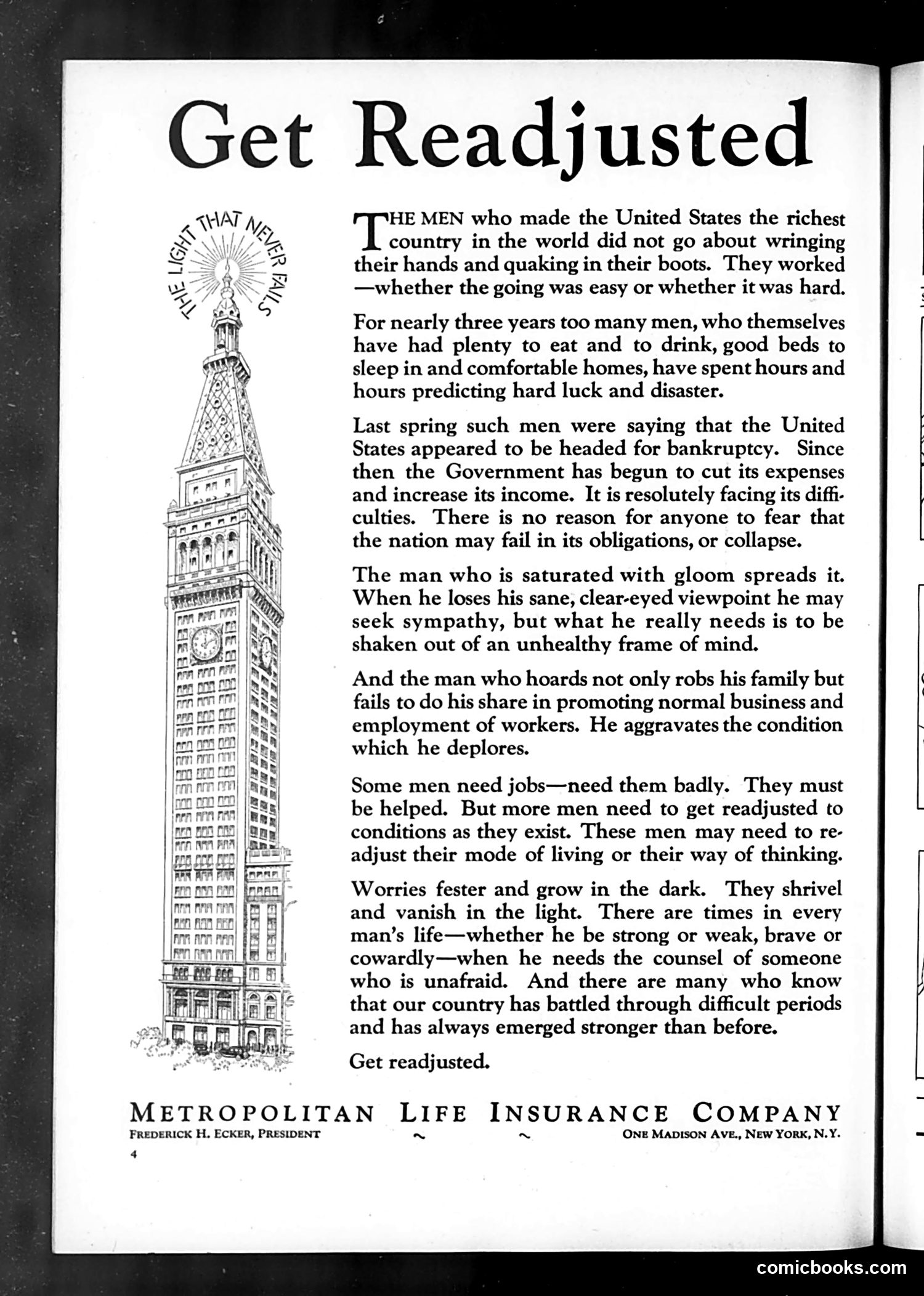
Analysis: "Get Readjusted" — Metropolitan Life Insurance Advertisement This is a morale-boosting advertisement, not political satire. Published during what appears to be the post-WWI period (references "nearly three years" of hardship), it addresses widespread economic anxiety and pessimism. The tall building illustration symbolizes American prosperity and stability. The text argues that: 1. American builders achieved wealth through work, not complaint 2. Recent economic fears (possible 1921 recession) are exaggerated 3. Pessimism is self-destructive and spreads needlessly 4. Men must mentally adjust to conditions rather than hoard or despair 5. The nation has historically overcome difficulties The message: stop catastrophizing, maintain confidence, and support the economy through normal business activity. This reflects corporate attempts to restore public confidence after wartime disruption.
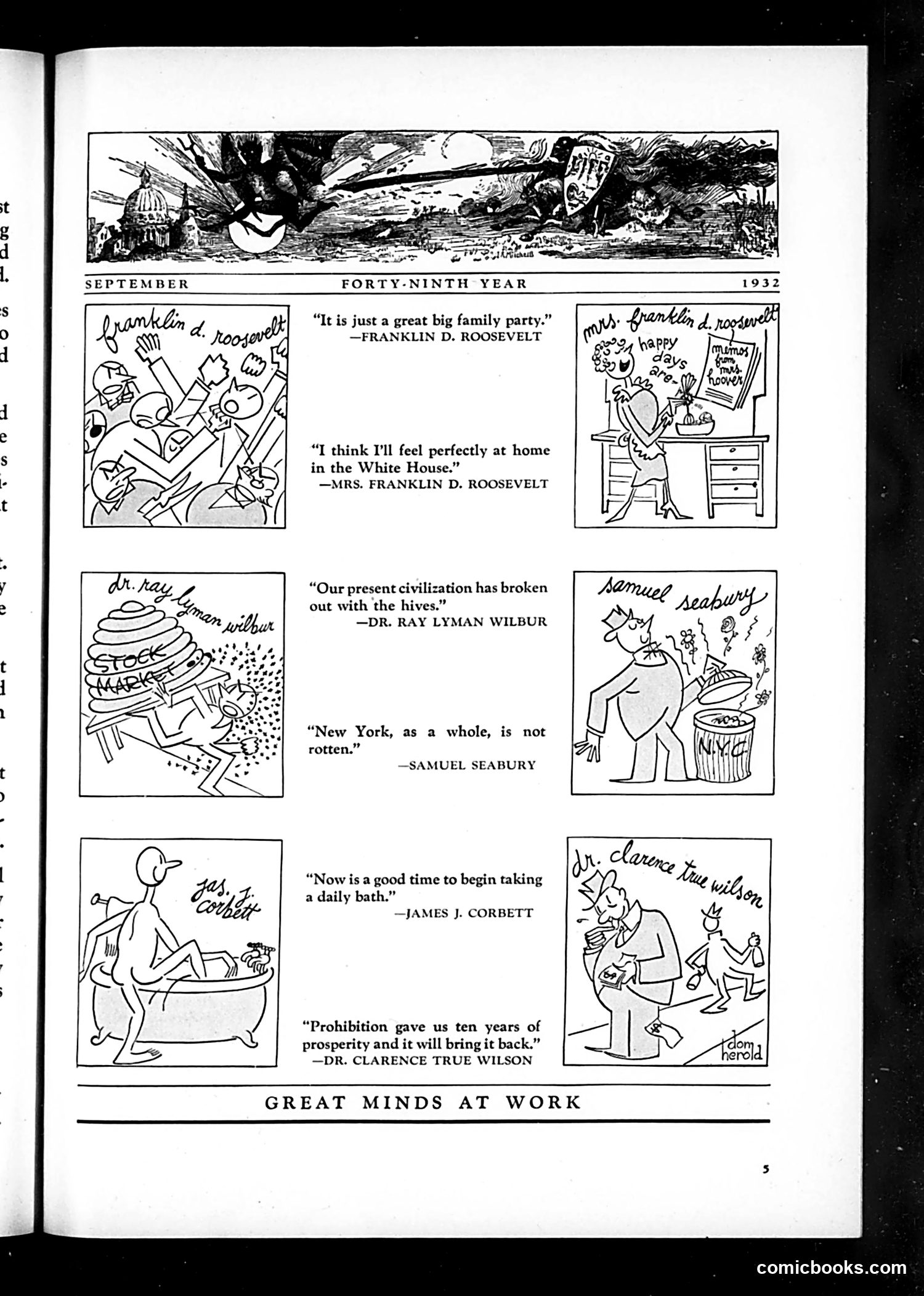
"Great Minds at Work" — September 1932 This satirical page presents six cartoons mocking prominent figures of the era with quotes attributed to them. Each cartoon pairs a caricature with a statement, apparently meant to ridicule the speaker's views or character: - Franklin D. Roosevelt is depicted in a chaotic family scene - Mrs. Franklin D. Roosevelt shown at a desk with domestic items - Dr. Ray Lyman Wilbur commenting on civilization's decline - Samuel Seabury making a negative remark about New York - James J. Corbett discussing bathing habits - Dr. Clarence True Wilson's statement about Prohibition's economic effects The cartoons use exaggeration and visual humor to mock these public figures' statements, likely criticizing their positions on major 1932 issues including the Depression, Prohibition, and social conditions. The page's title suggests these are critiques of influential people's contemporary pronouncements.
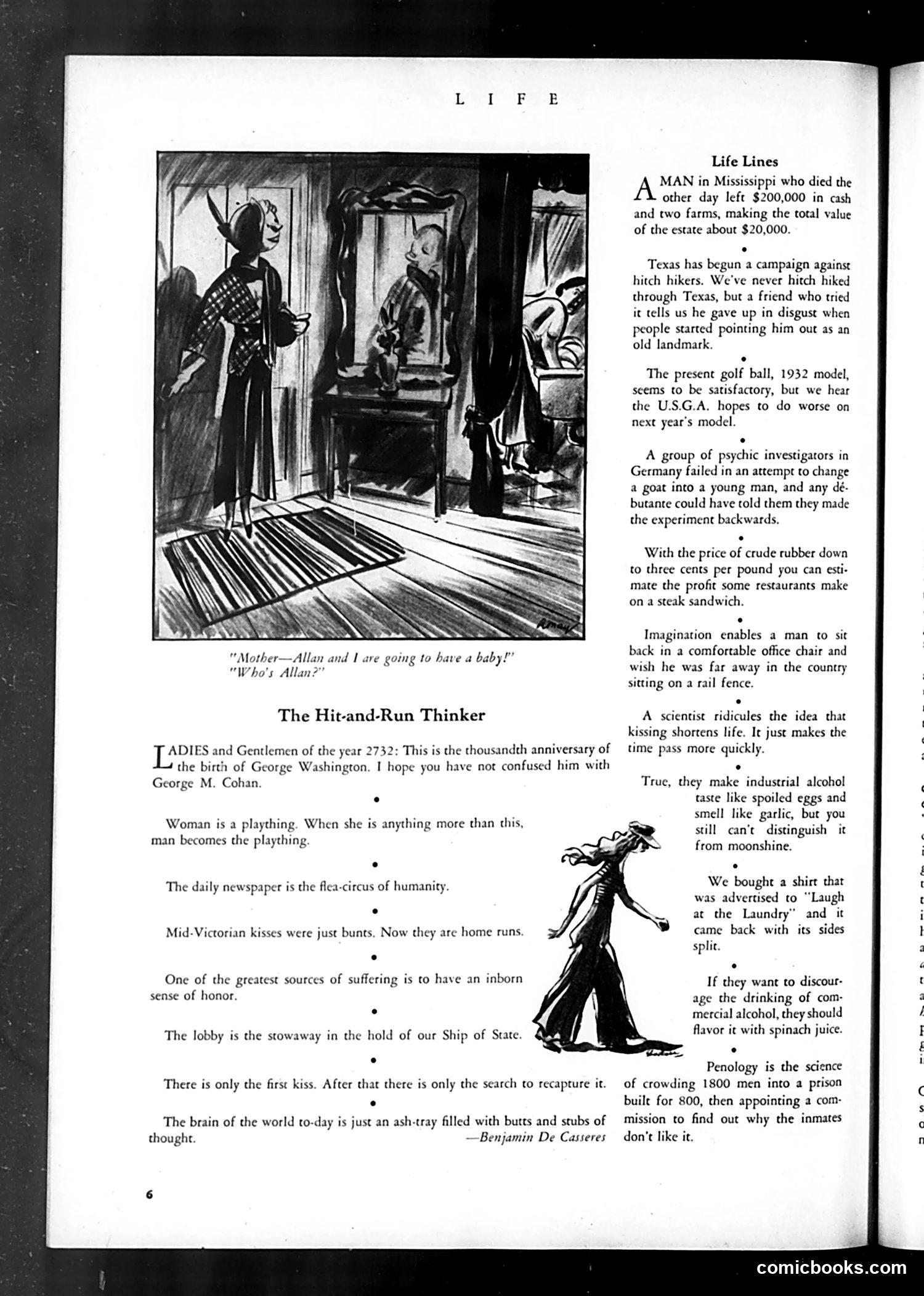
"The Hit-and-Run Thinker" The main cartoon shows a woman in a doorway telling a man "Mother—Allah and I are going to have a baby!" to which he responds "Who's Allah?" This satirizes casual, flippant attitudes toward serious matters—likely mocking either superficial adoption of exotic religious ideas or irresponsible relationships presented as jokes. The woman's bizarre claim (naming her unborn child after Allah) plays for absurdist humor about modern frivolousness. The accompanying "Life Lines" column contains short, punchy observations on contemporary topics: hitch-hiking in Texas, golf equipment, psychic experiments, industrial alcohol quality, laundry mishaps, and prison overcrowding. This format—snappy one-liners on random subjects—defines Life magazine's characteristic satirical style, poking fun at American social trends and concerns.
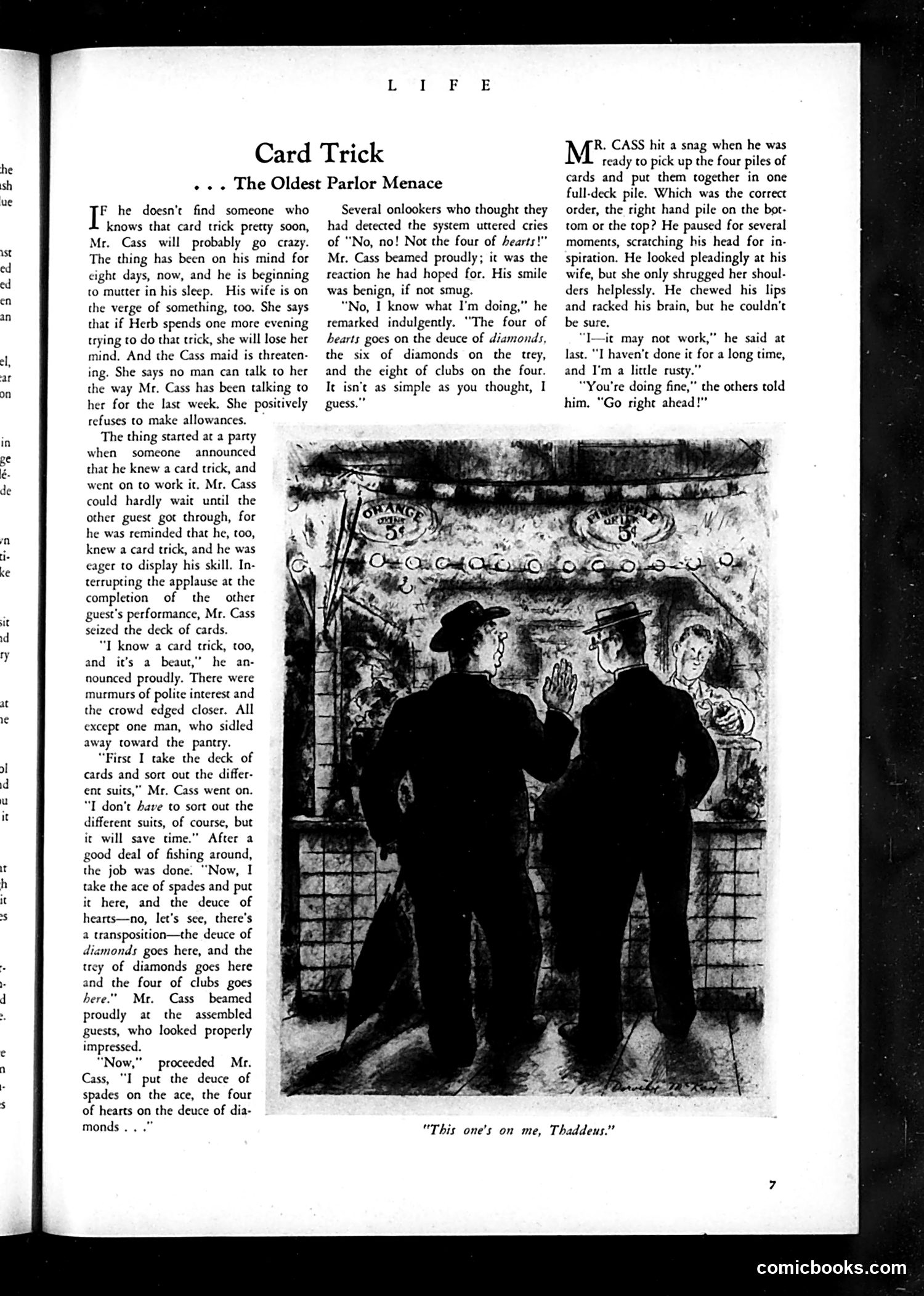
"Card Trick—The Oldest Parlor Menace" This is a humorous short story about Mr. Cass, a man obsessed with performing card tricks. His wife finds him insufferable—he practices constantly and won't stop talking about them despite her clear disinterest. The satire targets the social annoyance of amateur magicians who monopolize gatherings with tedious trick performances. Mr. Cass represents the archetypal bore who mistakes his own enthusiasm for universal entertainment value. The illustration shows two men in what appears to be a parlor or social setting, likely depicting the moment when Mr. Cass begins his unwanted card trick demonstration. The caption "This one's on me, Thaddeus" suggests resigned acceptance of the performance. The piece gently mocks both the perpetual amateur magician and the social obligation to endure such displays politely.
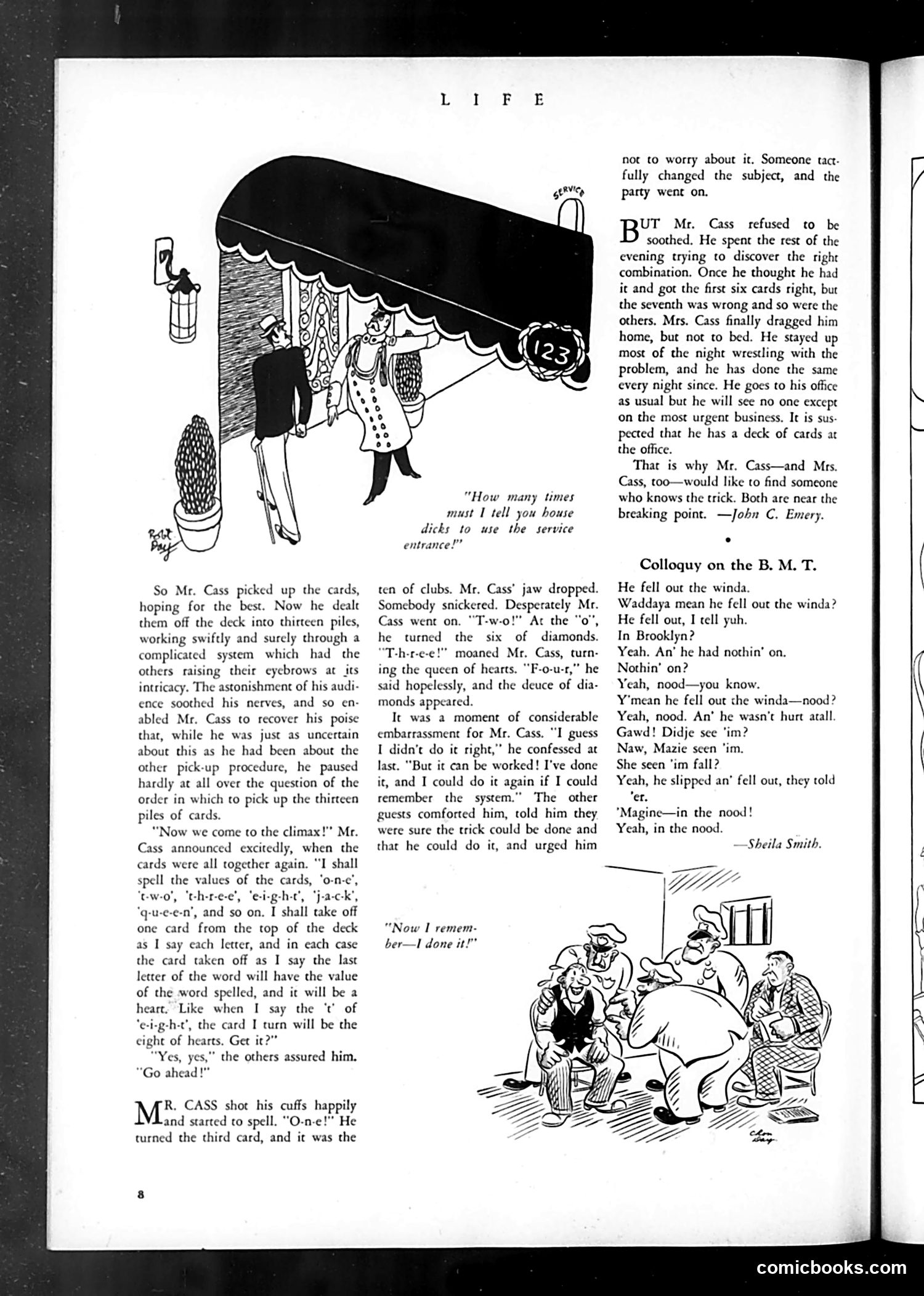
Analysis of Life Magazine Page This page presents a humorous story about Mr. Cass, who becomes obsessed with learning a card trick. Unable to master it despite repeated attempts, he spends his evenings performing it alone rather than socializing. The narrative mocks his obsessive-compulsive behavior and social withdrawal over a relatively trivial pursuit. The accompanying illustrations show the card trick demonstration and a separate cartoon titled "Colloquy on the B.M.T." (Brooklyn-Manhattan Transit), depicting working-class New Yorkers discussing someone falling from an elevated train. The dialogue captures authentic urban speech patterns and casual attitudes toward danger—typical of Life's satirical commentary on American social life and class behavior during the early-to-mid 20th century.
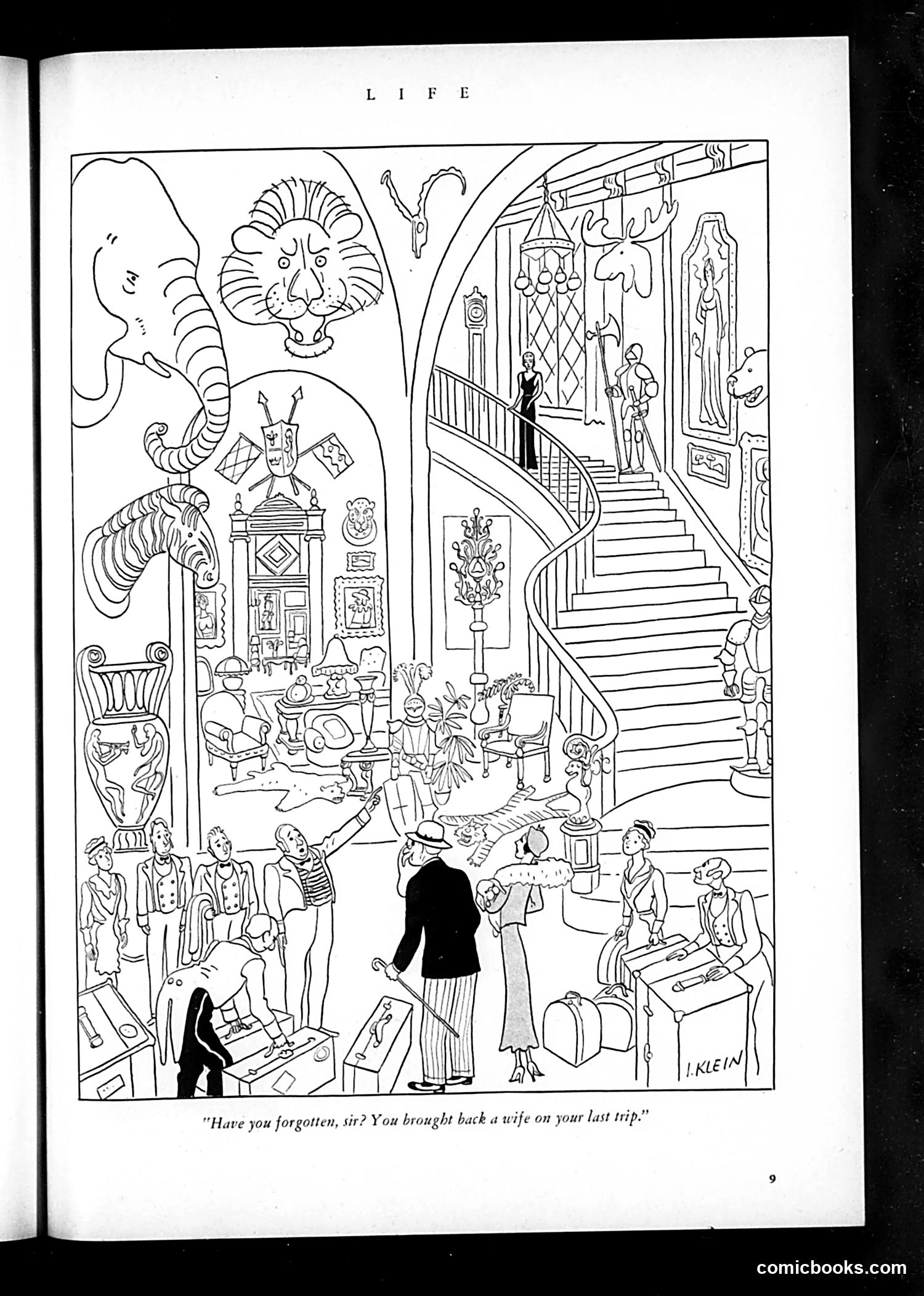
Cartoon Analysis This single-panel cartoon by I. Klein depicts an elaborate mansion interior with a grand staircase. A man in formal attire stands amid luggage and well-dressed guests, while a woman addresses him with the caption: "Have you forgotten, sir? You brought back a wife on your last trip." The satire targets wealthy travelers—likely businessmen or aristocrats who took extended trips abroad. The joke suggests the man has returned from a journey and forgotten he previously brought back a foreign wife. The crowded, opulent setting emphasizes his wealth and social status. The humor relies on the absurdity of forgetting one's spouse, mocking both male absentmindedness and the casual nature with which wealthy men might acquire wives from abroad during the early-to-mid 20th century. The cartoon gently ridicules marital indifference among the affluent.
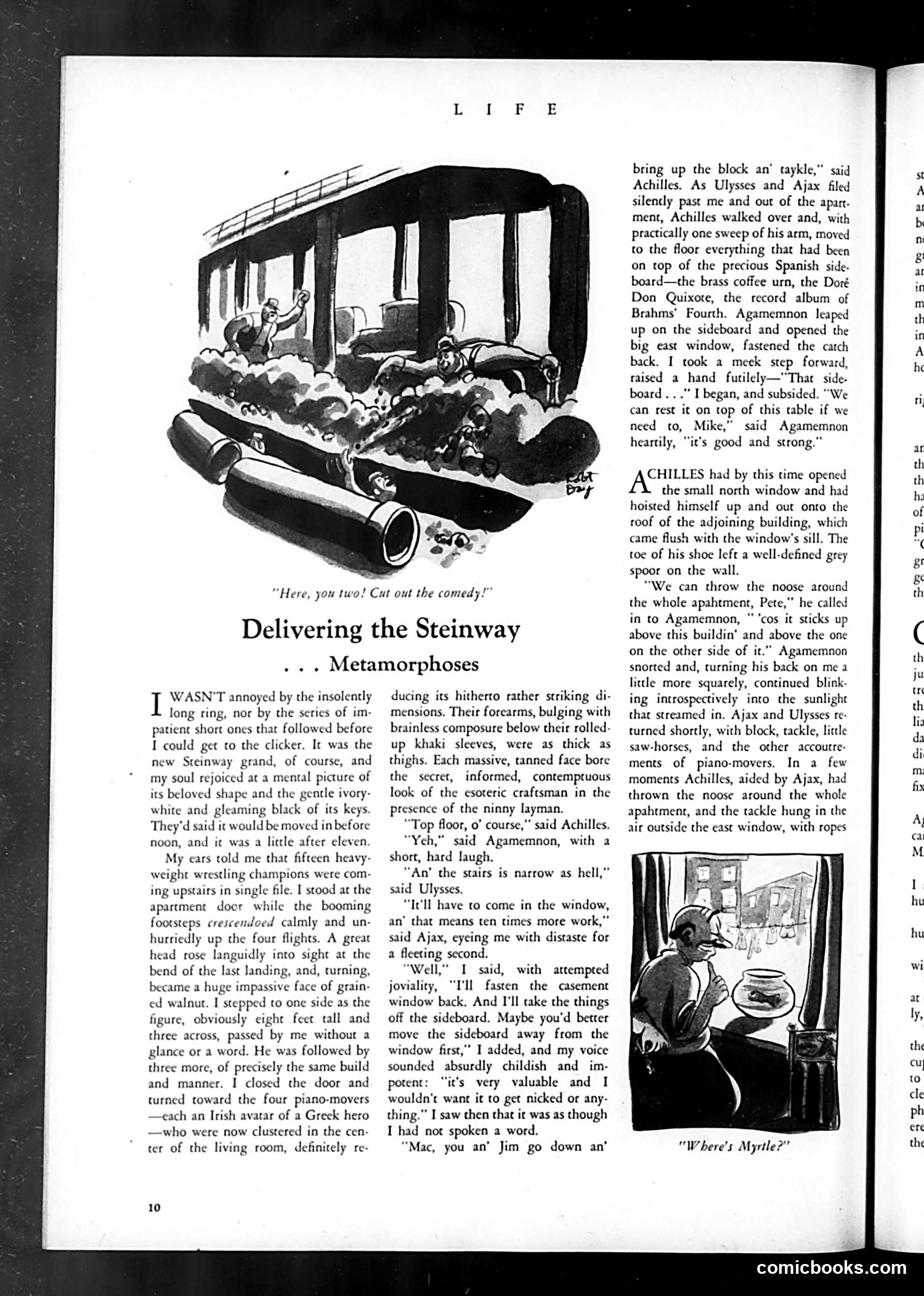
"Delivering the Steinway: Metamorphoses" This satirical piece humorously depicts moving a grand piano (a Steinway) into an apartment. The cartoon shows the instrument being maneuvered through a window amid chaos—a common practical problem in urban living. The joke plays on the contrast between the piano's status as a refined, elegant instrument and the ungainly physical comedy of getting it into the space. Characters discuss absurd solutions (throwing a noose around it, fastening it through windows), treating the precious object roughly. The title "Metamorphoses" suggests the piano undergoes a transformation—from treasured musical instrument to unwieldy physical obstacle. This satirizes both bourgeois pretensions to cultural refinement and the messy realities of maintaining such status symbols in cramped city apartments. The humor is situational rather than explicitly political.
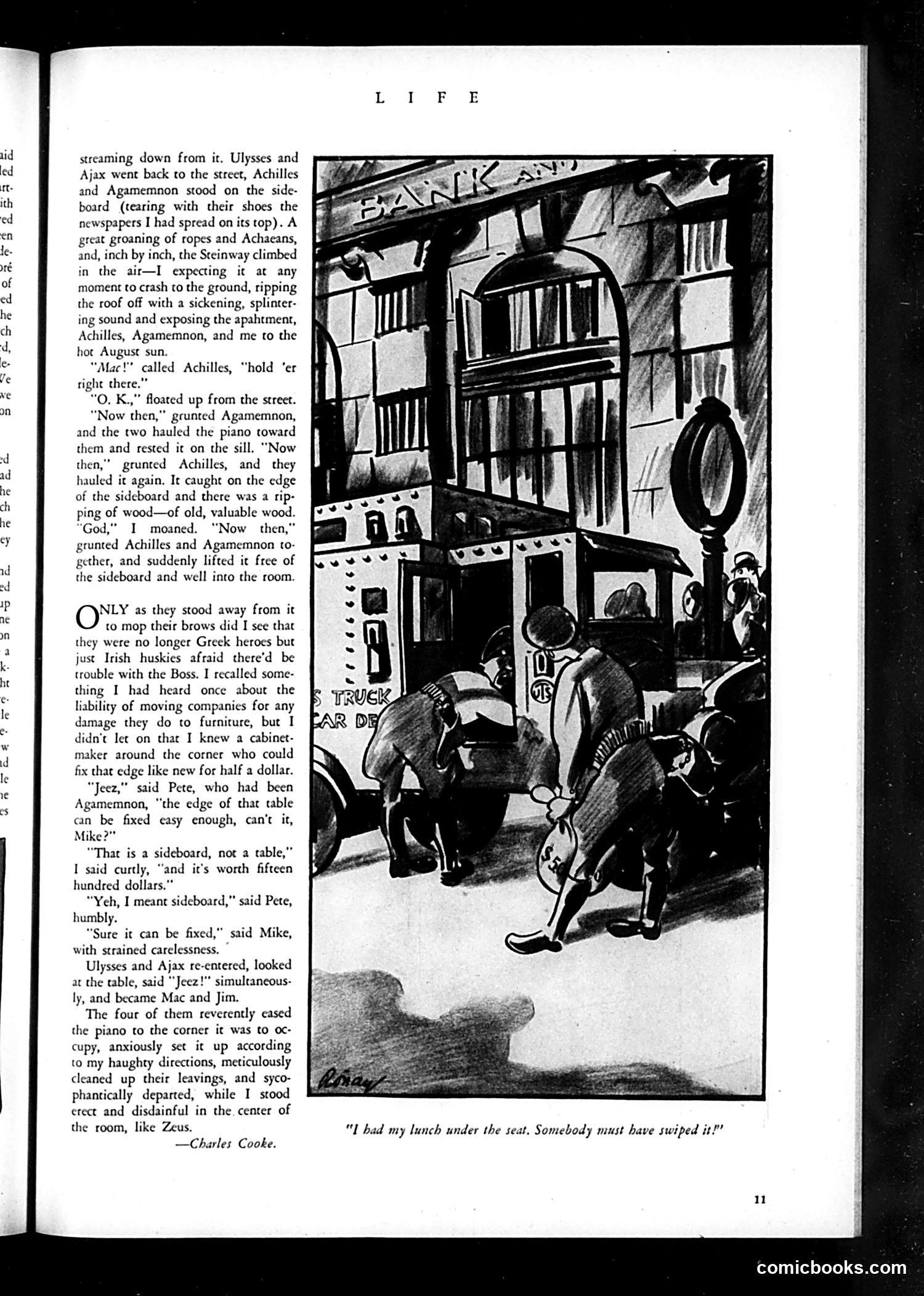
Analysis This page from *Life* magazine contains a short story excerpt by Charles Cooke titled "Life," accompanied by an illustration depicting a moving scene. The narrative describes Greek and Irish characters (Ulysses, Ajax, Achilles, Agamemnon, Pete, Mike) attempting to move a piano down a tenement building's fire escape during hot weather. The story satirizes working-class moving day challenges through ethnic character names and dialogue. The illustration shows men struggling to maneuver the piano through a narrow urban space, with a truck labeled "CAR DE" visible. The caption reads: "I had my lunch under the seat. Somebody must have swiped it!" The humor derives from the chaotic, comedic situation of moving a valuable piano in cramped city quarters—a relatable domestic scenario that *Life* presented for satirical entertainment to its educated, urban readership.
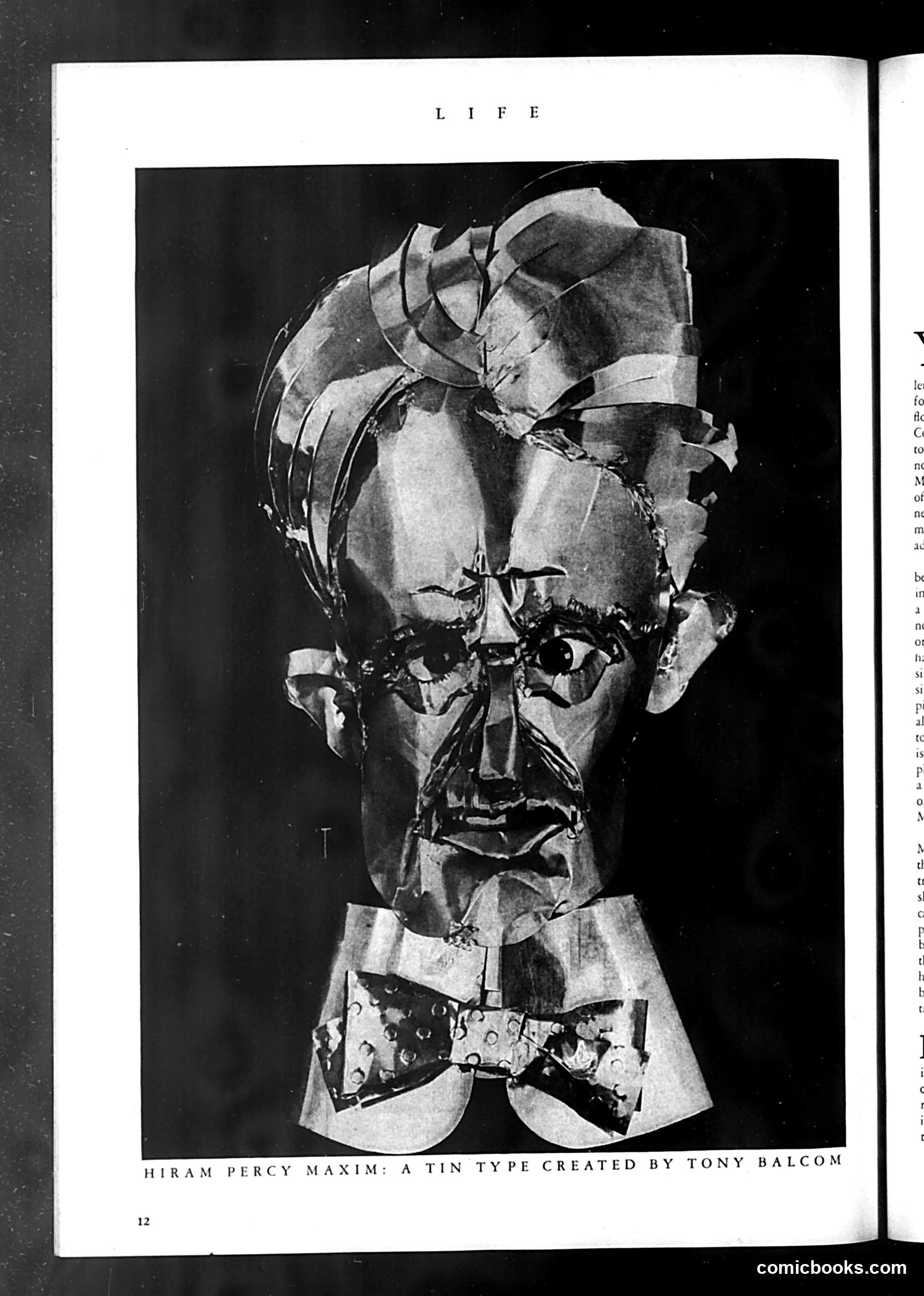
Explanation for Modern Readers This is a satirical tin sculpture titled "Hiram Percy Maxim: A Tin Type Created by Tony Balcom," published in *Life* magazine. The artwork depicts a head assembled from various metal parts, mechanical pieces, and bands—a visual pun on the term "tin type" (a cheaply-produced photograph format) combined with literal tin materials. The satire appears to mock Hiram Percy Maxim, likely a public figure of the era, by reducing him to a mechanical, dehumanized construction. The use of industrial/metallic components suggests commentary on either his mechanical inventions, his cold personality, or his reduction to mere materialism. Without additional context, the specific grievance isn't entirely clear, but the sculpture's unflattering portrayal conveys strong satirical critique through visual absurdity.
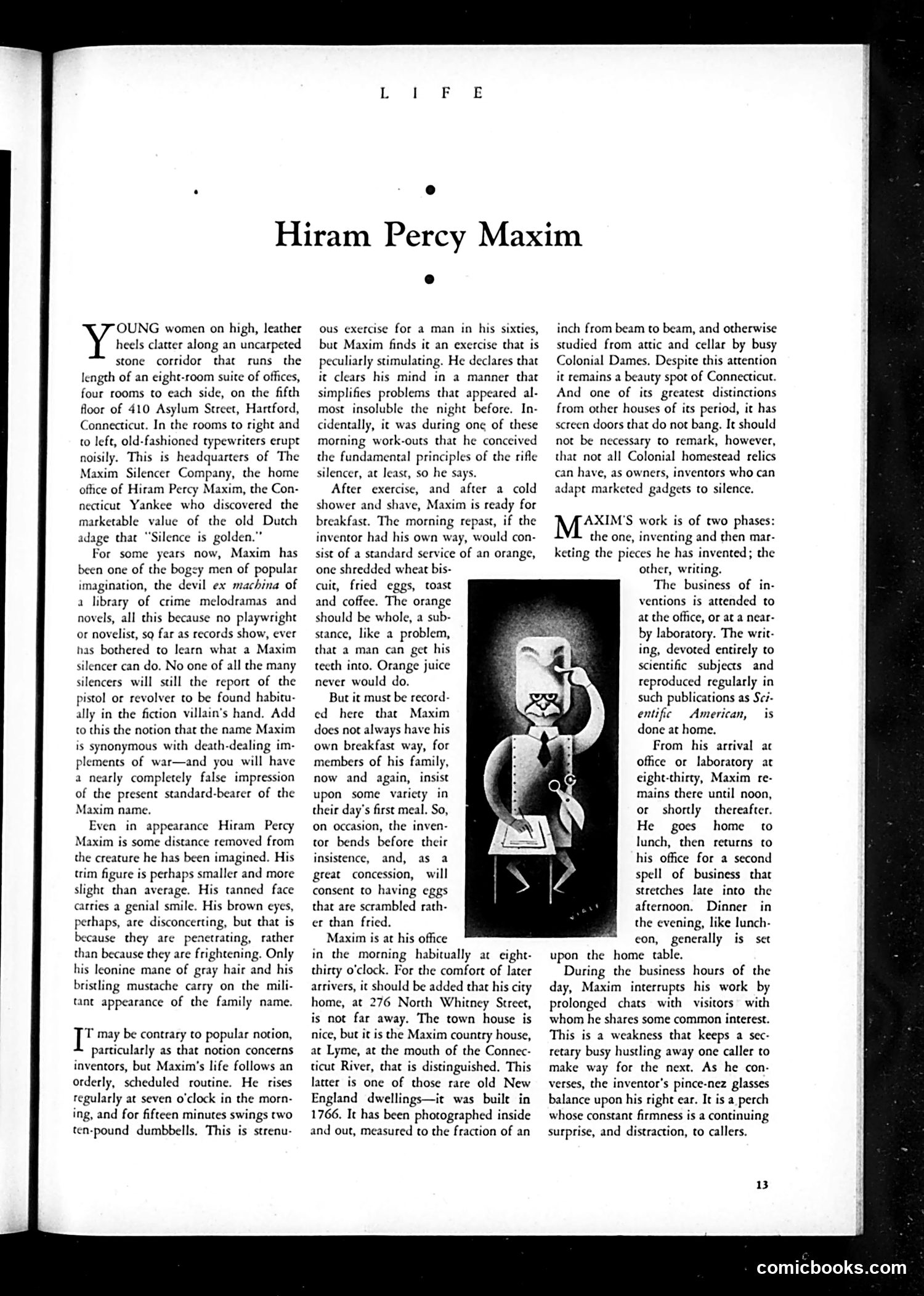
Hiram Percy Maxim Profile This is a biographical profile of inventor Hiram Percy Maxim, not a political cartoon. The accompanying illustration shows a man at a desk with what appears to be mechanical/technical equipment. The text describes Maxim's daily routine and work habits—he rises at 7 a.m., works until noon, takes lunch, returns for afternoon business, and dines at home. It mentions his Connecticut residence at 276 North Whitney Street and discusses his methodical, scheduled approach to invention and business. The profile emphasizes Maxim's dual focus: inventing new devices and marketing existing ones. His work includes contributions to *Scientific American* magazine. The piece portrays him as a disciplined, orderly professional whose systematic habits—including regular exercise with dumbbells—support his productive output.
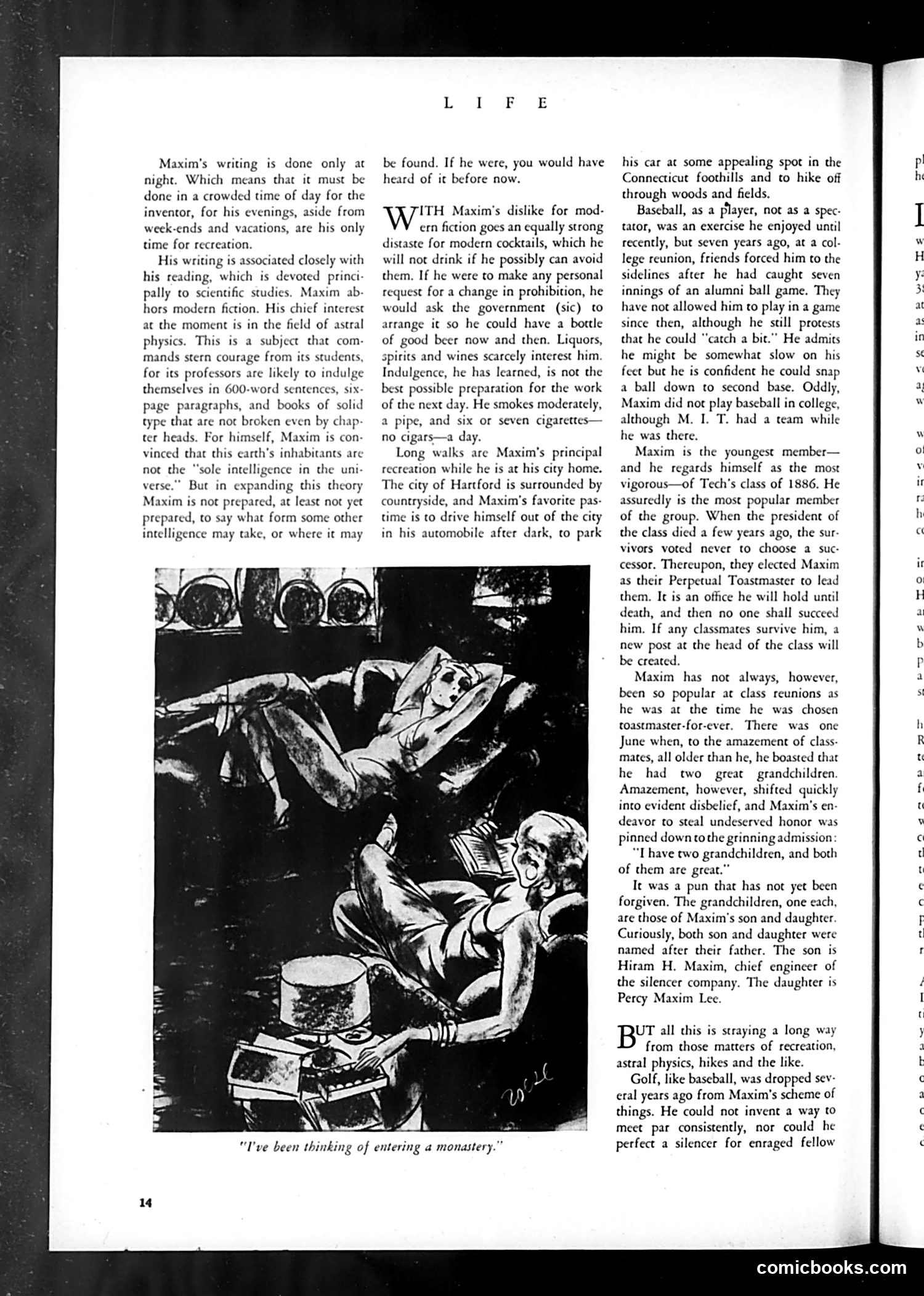
Analysis of Life Magazine Page This page contains a biographical profile of someone named Maxim, a writer who works only at night. The accompanying illustration shows a man reclining in what appears to be a casual, bohemian setting with books and papers scattered about—captioned "I've been thinking of entering a monastery." The text discusses Maxim's personal quirks: his dislike of modern cocktails and prohibition, his preference for rural Connecticut over city life, and his status as the youngest and most vigorous member of Tech's class of 1886. The satire appears to target intellectual pretension—specifically the contradiction between Maxim's ascetic, solitary writing habits and his moments of social boasting (claiming grandchildren he hadn't actually had). The monastery caption suggests ironic commentary on his monkish lifestyle. Without additional context, the specific subject remains unclear.
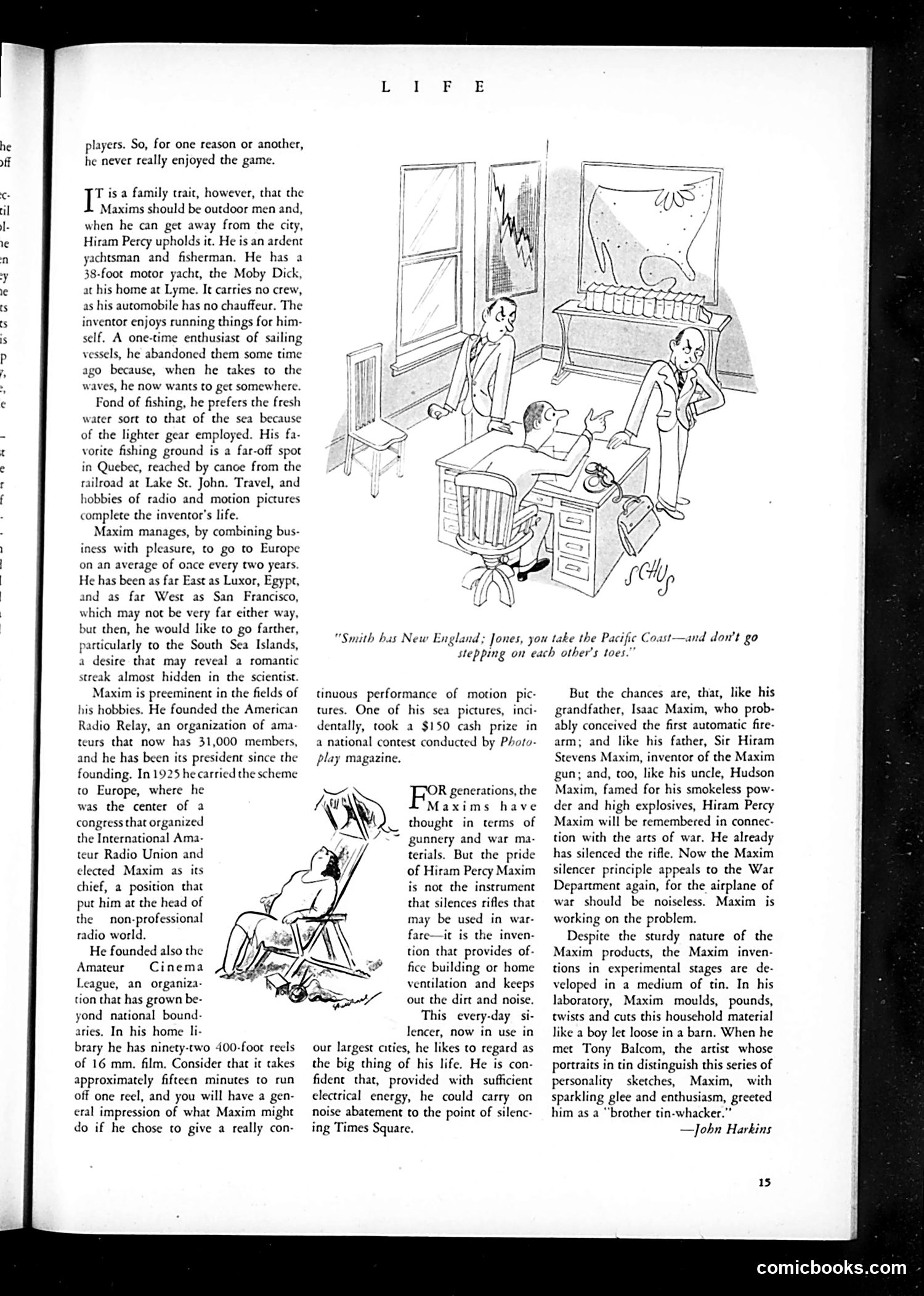
Analysis of Life Magazine Page 15 This page profiles Hiram Percy Maxim, an inventor and businessman. The cartoon (credited to "Schly") illustrates the caption: "Smith has New England; Jones, you take the Pacific Coast—and don't go stepping on each other's toes." The sketch depicts two men dividing up America geographically, suggesting a business arrangement or territorial agreement. The cartoon satirizes corporate expansion and monopolistic practices of the era—the idea of powerful industrialists carving up the country into controlled spheres of influence. The accompanying article celebrates Maxim's accomplishments: founding the American Radio Relay League, inventing silencers for firearms, and developing tin products. The satire is gentle, portraying him as a productive but ambitious businessman whose innovations span military hardware and consumer goods.
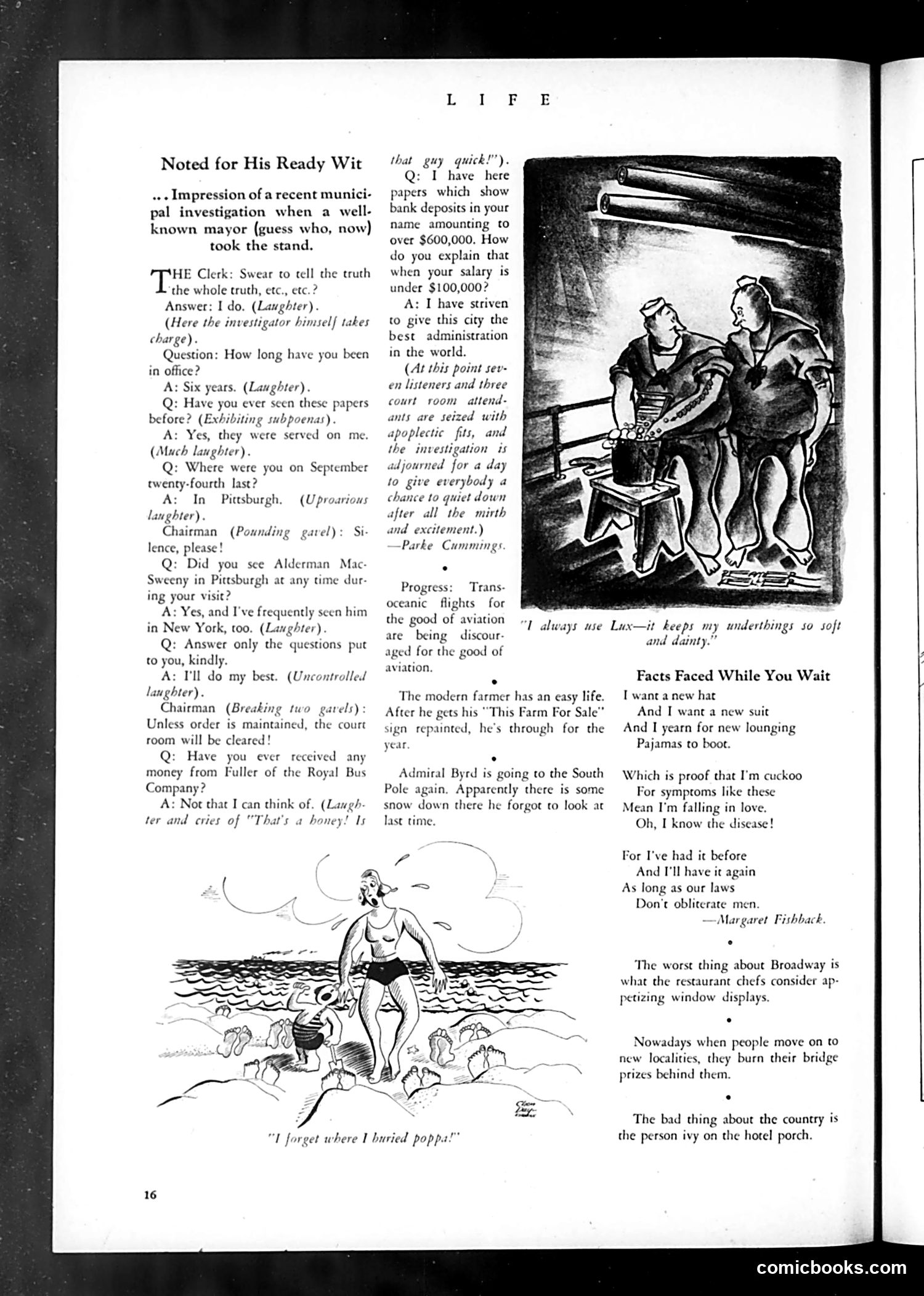
Political Cartoon Analysis This page features two cartoons satirizing corruption in municipal government. The upper section depicts a municipal investigation where a well-known mayor (identity unclear from image alone) faces questioning about unexplained bank deposits exceeding $600,000 despite earning under $100,000 in salary. The interrogation shows the mayor using humor and evasion to dodge serious corruption charges—a technique the text sarcastically notes while attendants "seize with apoplectic fit." The lower cartoon shows a swimmer surrounded by debris, captioned "I forgot where I buried poppa!"—likely satirizing how politicians literally bury evidence of corruption. Both cartoons mock official corruption and the inadequacy of investigations to hold powerful figures accountable, reflecting Progressive Era concerns about urban political machines and graft.
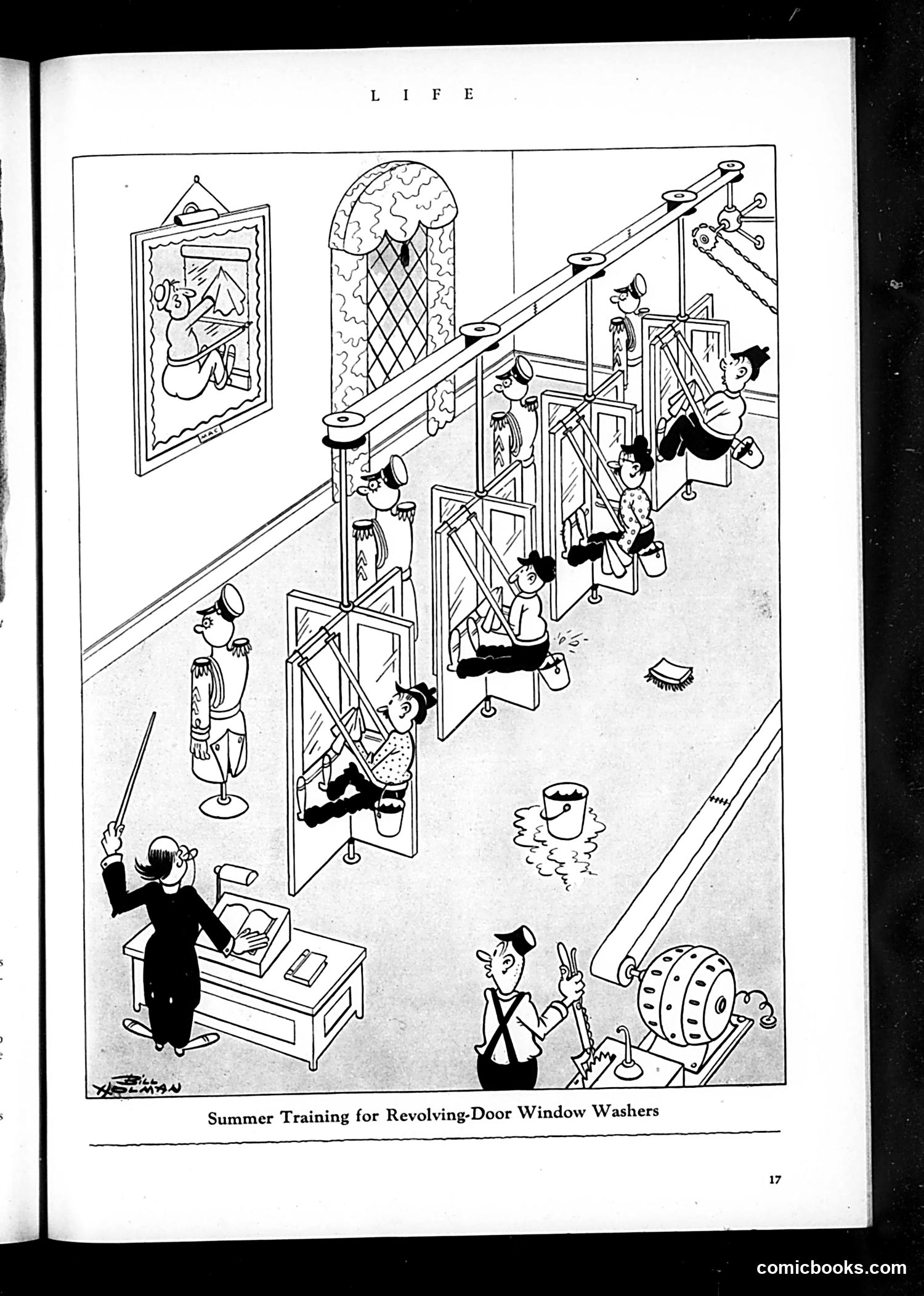
"Summer Training for Revolving-Door Window Washers" This satirical cartoon depicts a humorous training operation for window washers using revolving doors. A stern instructor (left, at desk) oversees workers being cycled through a mechanical apparatus with rotating doors and pulleys. The workers are spun through the system while holding buckets and cleaning implements, suggesting they're being trained—or tormented—by the repetitive motion of the doors. The joke appears to satirize inefficient or absurd job-training methods, possibly mocking both incompetent management and the challenging nature of window-washing work. The elaborate, Rube Goldberg-style contraption suggests over-complication of a simple task. This is likely contemporary social commentary on industrial-era labor practices and workplace training, rendered through visual humor typical of *Life* magazine's satirical style.
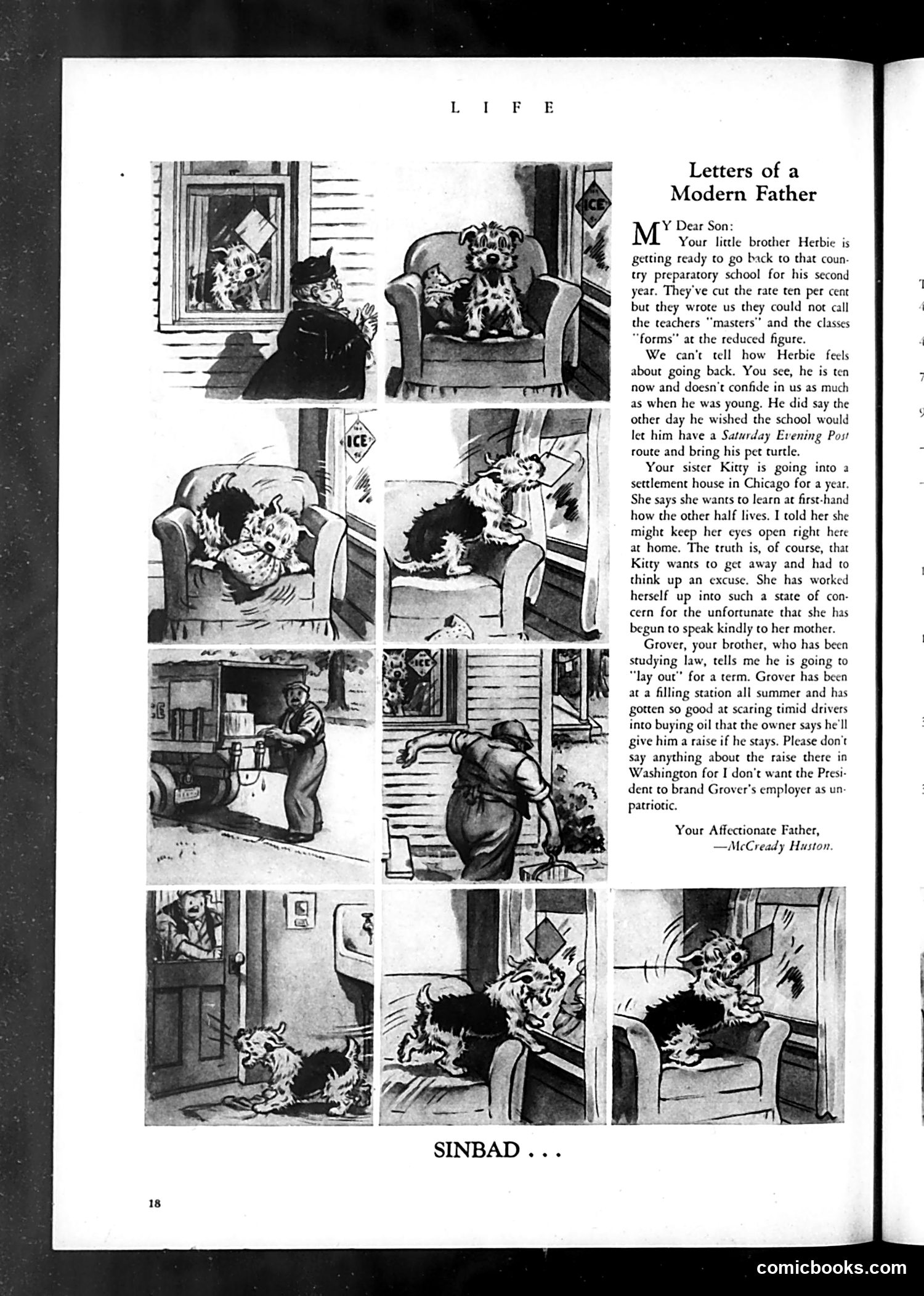
"Letters of a Modern Father" - Satire on Parental Concerns This is a humorous letter from a father (signed McCready Huston) to his son, accompanied by a comic strip titled "Sinbad" featuring what appears to be a mischievous dog character. The letter satirizes contemporary parental anxieties of the era: a son returning to preparatory school, a daughter moving to Chicago (seeking independence the father worries about), and another son working at a filling station (the father concerned about labor exploitation and political embarrassment). The satire targets upper-middle-class parental nervousness about their children's choices and social status during what appears to be the 1920s-30s period. The accompanying "Sinbad" comic strip offers visual humor, likely providing comedic relief from the letter's social commentary about generational tensions and changing family dynamics.
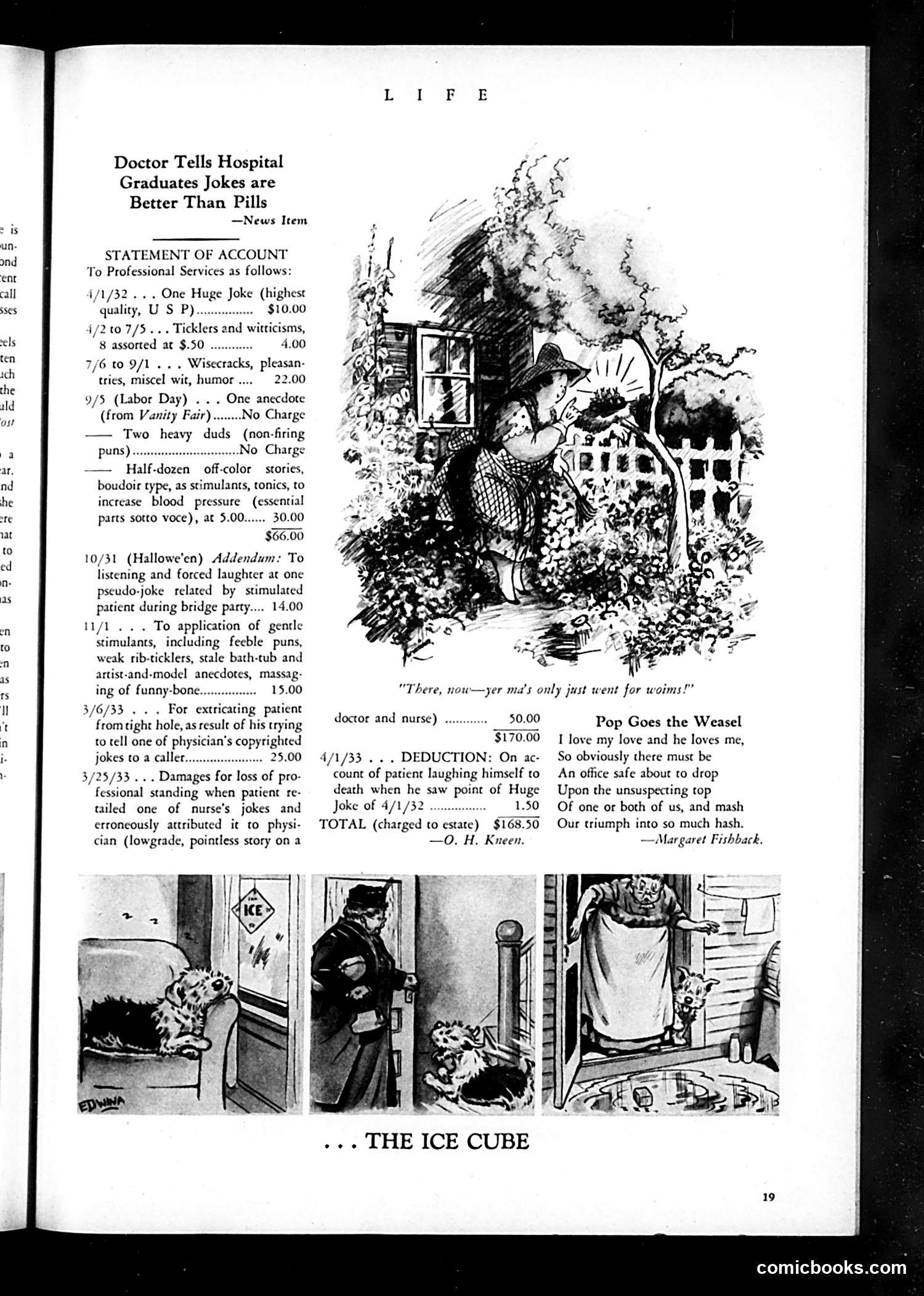
"Doctor Tells Hospital Graduates Jokes are Better Than Pills" This page satirizes medical practice through a fake "Statement of Account" itemizing charges for joke-telling as medical treatment. The humor mocks the era's growing professionalization of medicine by presenting absurd billing entries—charging $10 for "One Huge Joke," $4 for "Ticklers and witticisms," and $15 for "funny-bone massage." The central illustration shows a cottage scene with the caption "There, now—yer ma's only just went for w'orms!" The bottom comic strip sequence, titled "The Ice Cube," depicts someone's mishap with frozen water, likely providing slapstick humor. The satire suggests doctors exploited patients' vulnerability by charging for dubious "treatments" (stimulants, tonics, anecdotes) that were essentially worthless, critiquing medical ethics and commercialism in early 20th-century healthcare.
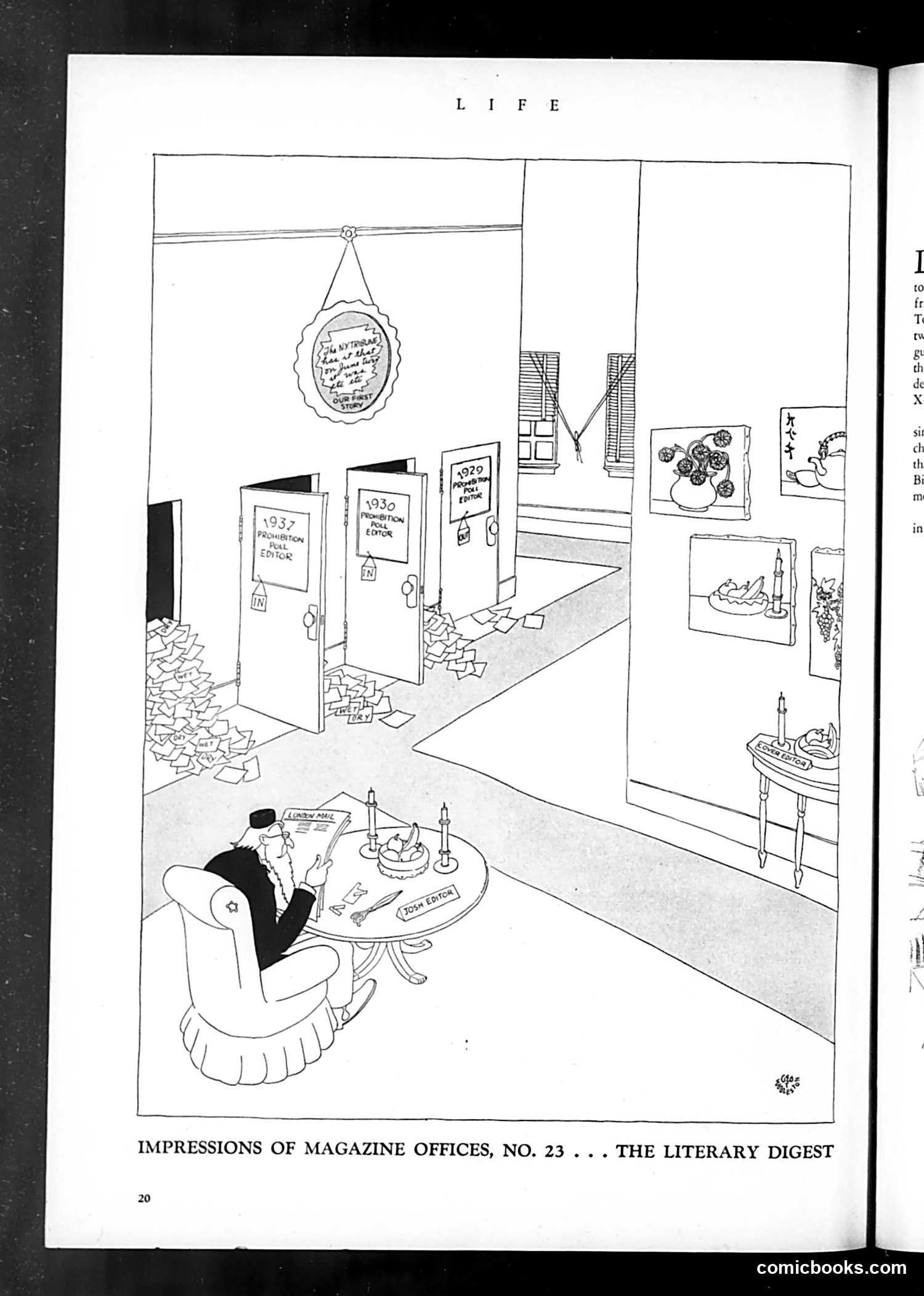
Analysis of "Impressions of Magazine Offices, No. 23" This cartoon satirizes The Literary Digest magazine office during Prohibition era (evidenced by the 1930s dates visible on the filing cabinets). The satire depicts: The joke: Large filing cabinets labeled with years (1930, 1937) are overflowing with papers/manuscripts spilling onto the floor—representing the avalanche of unsolicited submissions editors receive. A well-dressed figure sits comfortably at a small table, apparently indifferent to this chaos surrounding them. The social commentary: This mocks the massive volume of query letters and manuscript submissions flooding magazine offices, and the editorial staff's detached, casual response to this deluge. The contrast between the editor's leisure and the administrative chaos pokes fun at both overeager writers and editorial bureaucracy. The cartoon is part of a recurring series about magazine office culture.
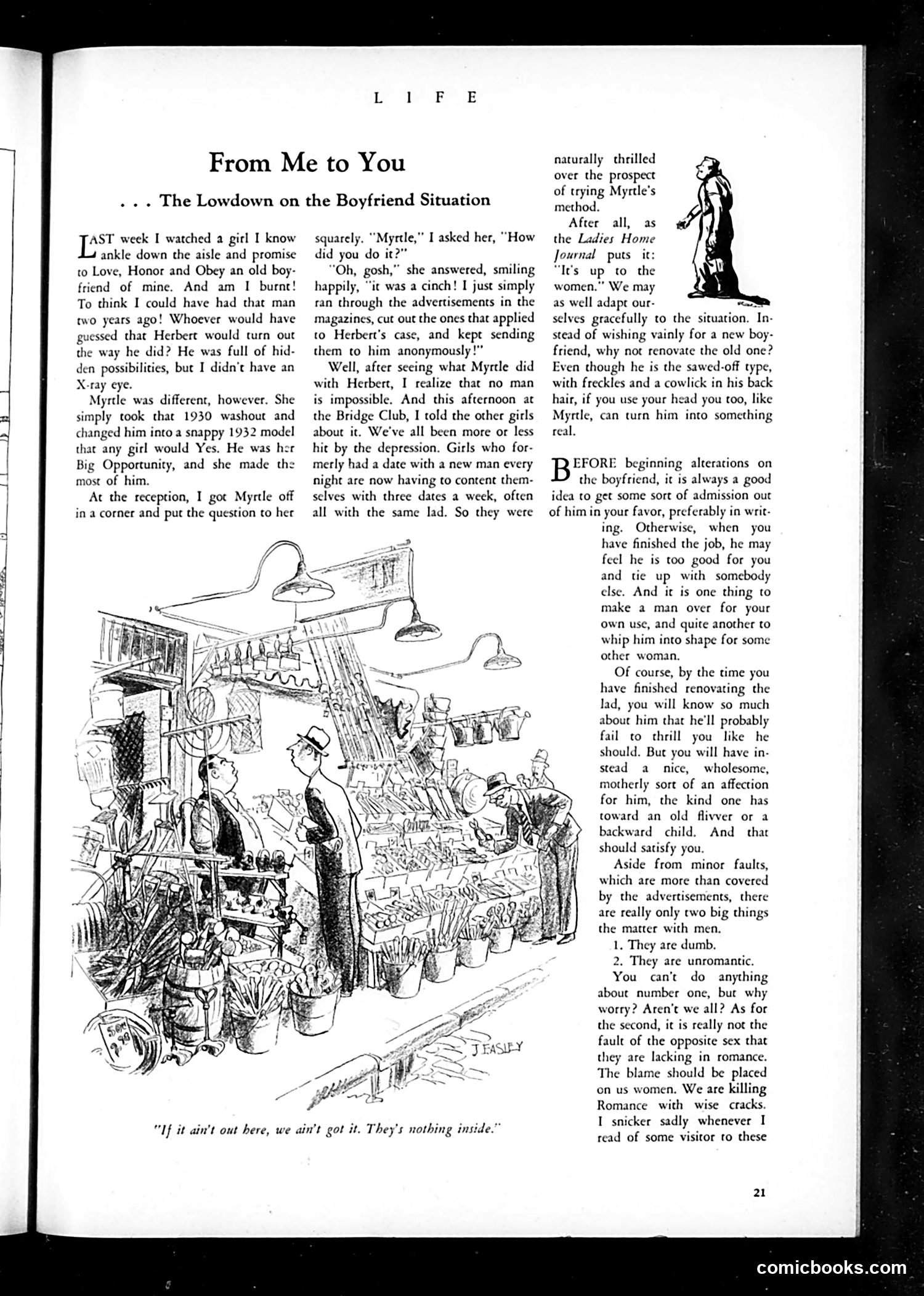
Explanation for Modern Readers This 1932 *Life* magazine piece satirizes Depression-era dating and gender dynamics. The central joke: a woman named Myrtle "renovated" her boyfriend Herbert by mailing him magazine advertisements for self-improvement products—transforming him from a 1930 "washout" into a presentable 1932 model. The accompanying cartoon depicts a cluttered, industrial-looking auto repair shop, with the caption "If it ain't out here, we ain't got it. They's nothing inside"—a crude visual metaphor equating boyfriends to automobiles needing repair. The article's tone is satirical advice: women should stop complaining about unromantic, unintelligent men and instead "fix" their existing boyfriends themselves. The author suggests women are responsible for killing romance through "wise cracks." The subtext critiques both sexes: men are portrayed as fundamentally defective ("dumb," "unromantic"), while women are encouraged toward maternal, resigned acceptance rather than seeking better partners. It reflects 1930s attitudes about female passivity and the pressure to make do during economic hardship.
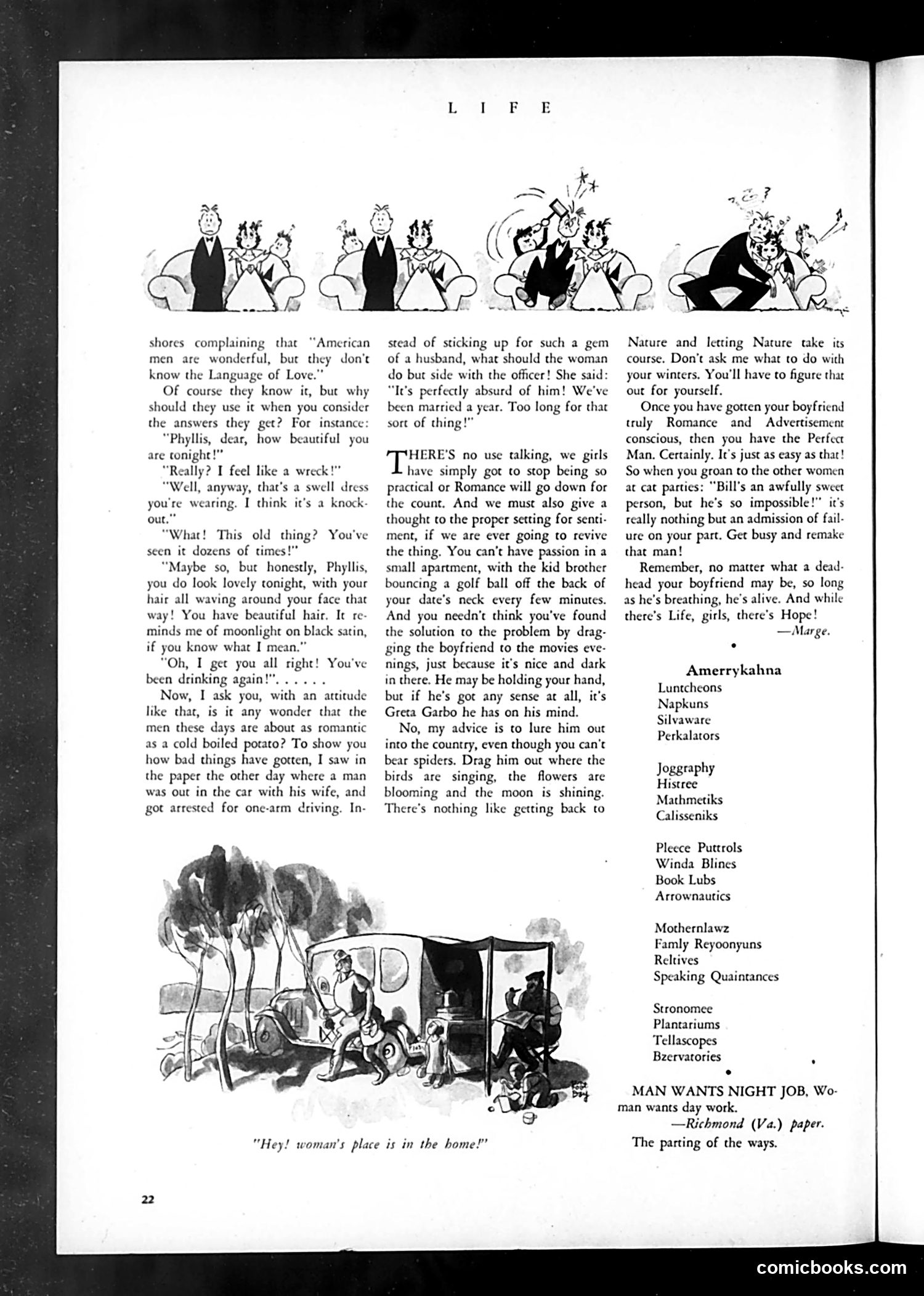
Life Magazine Satire Analysis This page contains a humorous essay by "Marge" mocking women's complaints about romantic American men, paired with satirical advertisements and a brief joke. Main Article: The author argues that women sabotage romance by responding negatively to compliments ("What! This old thing?"), then blames men for lacking romantic gestures. She advises women to stop being "practical" and instead lure boyfriends to nature settings for romance. The piece satirizes both genders—men for being unromantic "cold boiled potatoes," and women for their self-defeating behavior and expectation that they must "remake" men into perfect partners. Satirical Advertisements (right column): Deliberately misspelled common words (Amerrykahna, Mathmetiks, Arrownautics) mock either immigrant speech patterns or general American literacy—a recurring Life magazine trope of the era. Bottom Joke: A classified ad quip suggesting marital discord: husbands and wives have opposite work-shift preferences, illustrating domestic conflict through understated humor. Overall, the page reflects 1920s-30s gender anxieties about changing courtship norms.
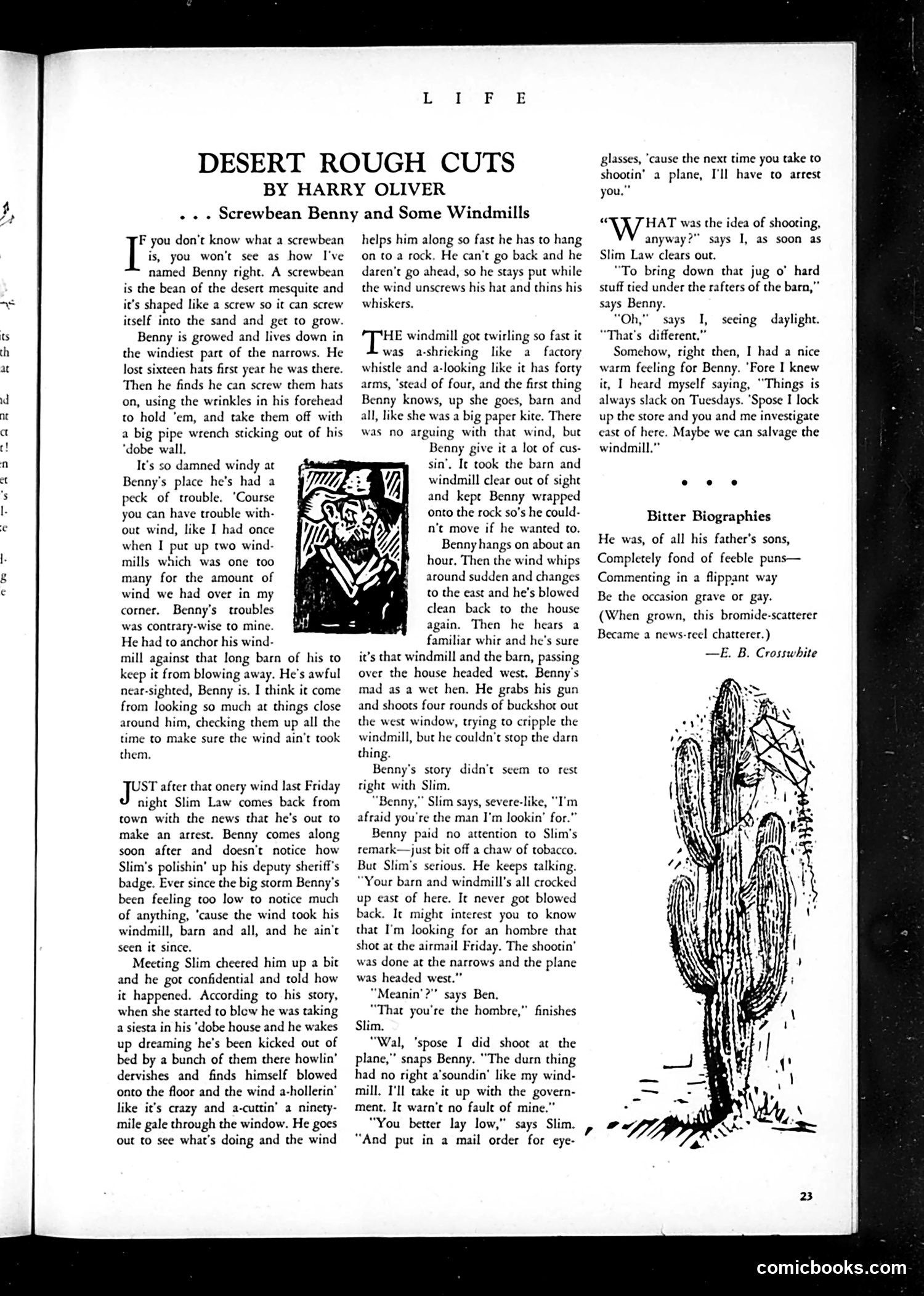
"Desert Rough Cuts" by Harry Oliver This is a humorous Western tall tale, not political satire. The page presents a serialized desert story featuring Benny, a nearsighted desert dweller in an extremely windy region who loses his barn and windmill to a violent windstorm. The joke: Benny shoots at what he thinks is his barn and windmill blowing past his house heading west. Unknown to him, he's actually fired at an airmail plane flying in the same direction. When deputy Slim Law arrives to arrest the person who shot at the plane, Benny becomes the suspect—his innocent explanation sounds absurd to law enforcement. The humor relies on frontier vernacular, exaggeration (the extreme wind, Benny's nearsightedness), and situational irony. The small illustration shows a saguaro cactus, establishing the Arizona desert setting. This is entertainment fiction, not commentary on current events.
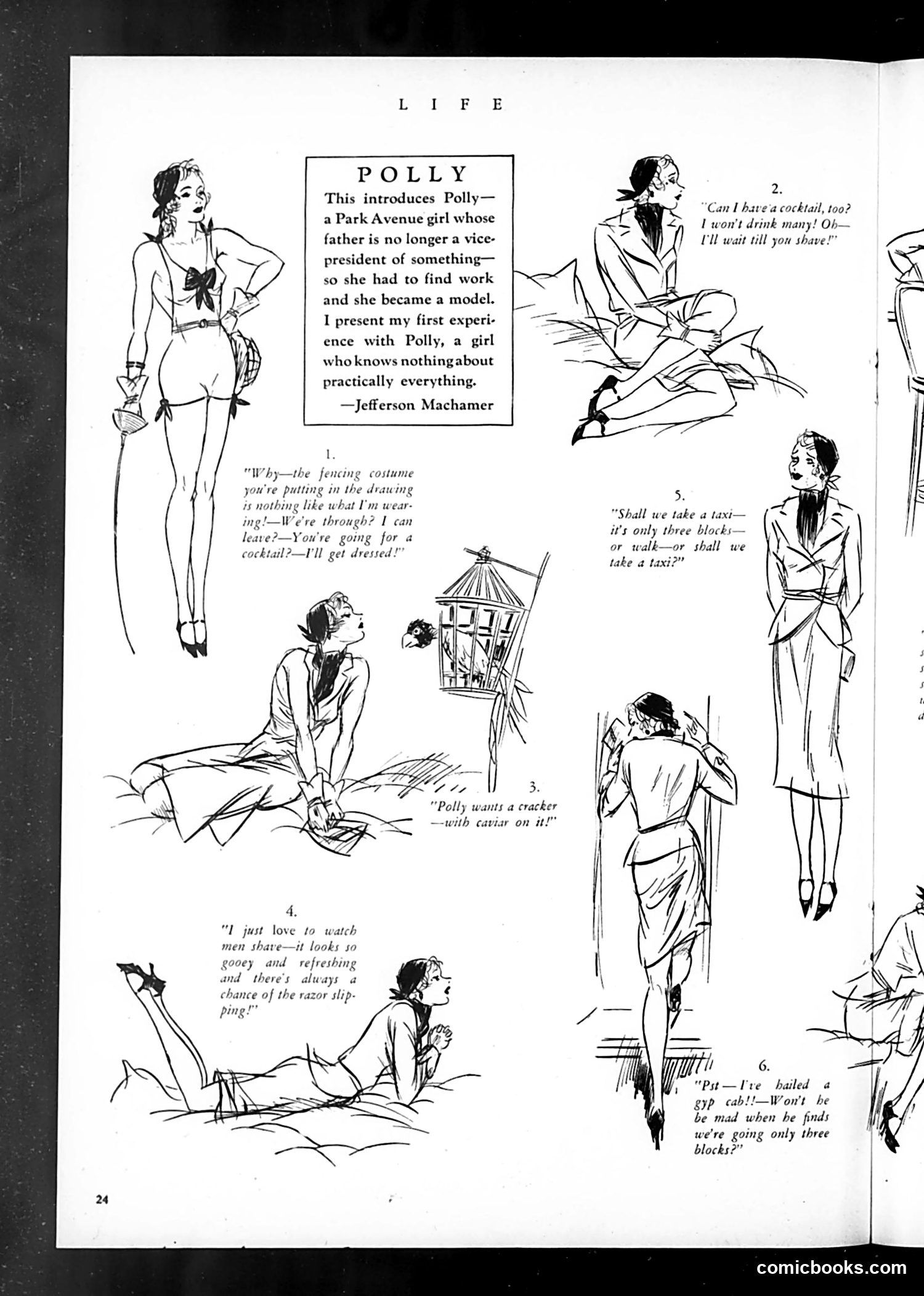
Polly: A Depression-Era Social Satire This multi-panel comic by Jefferson Machamer introduces "Polly," a Park Avenue debutante forced into modeling work after her father loses his vice-presidency—likely referencing the economic collapse of the 1929 stock market crash. The satire targets upper-class ignorance and entitlement. Despite her privileged background, Polly knows "nothing about practically everything." The jokes mock her vapid self-absorption: she's obsessed with cocktails, indifferent to basic facts (confusing fencing costumes), and hilariously indecisive about trivial decisions (taxi vs. walking three blocks). Her casual racism appears in panel 3 ("wants a cracker—with caviar"), while her behavior throughout reflects the stereotype of the frivolous "society girl" forced to work but fundamentally unchanged by circumstance. The comic's humor relies on readers' schadenfreude at watching the privileged suddenly experience modest inconvenience—a pointed social commentary during economic hardship.
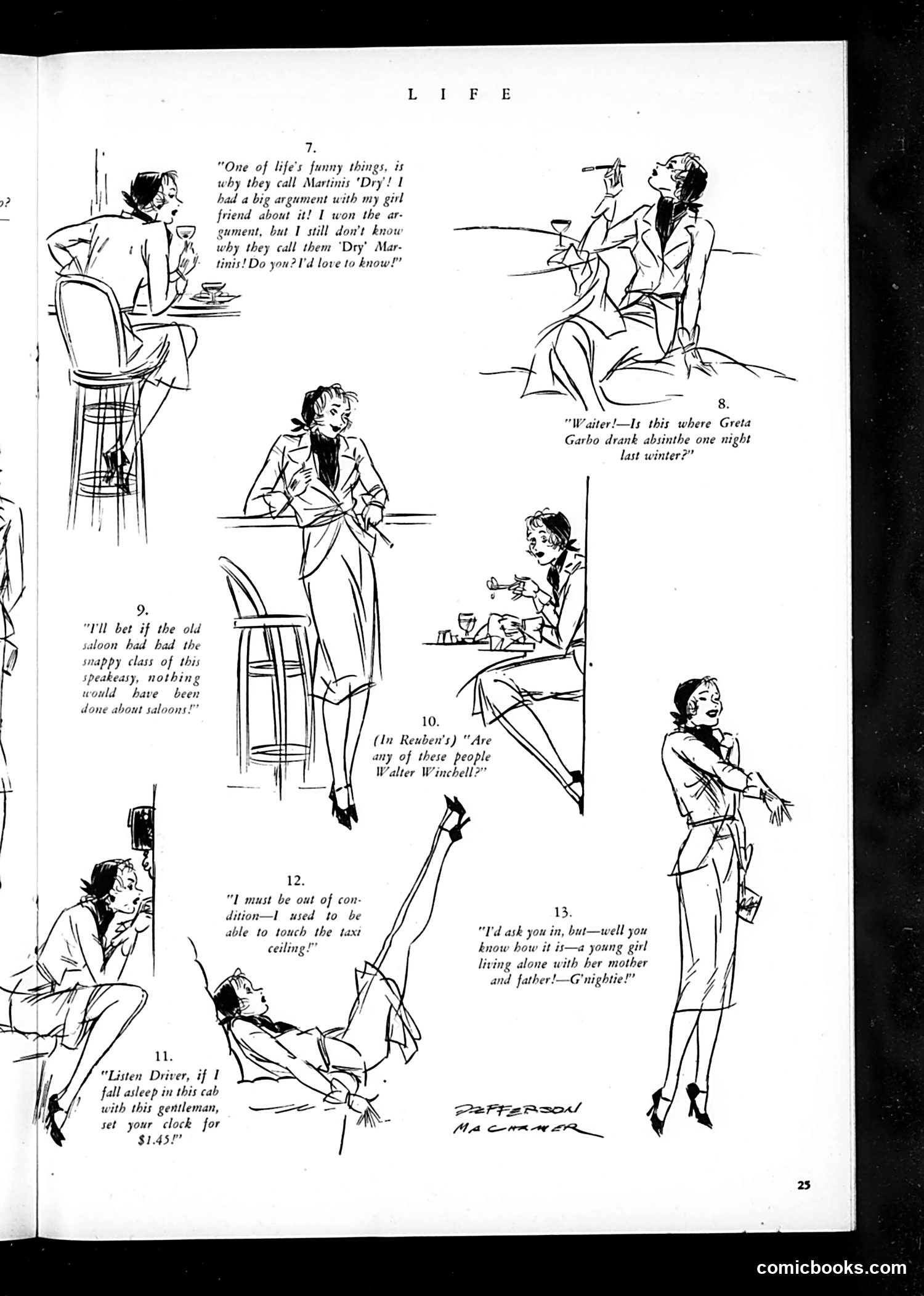
Life Magazine Cartoon Page Analysis This page presents a series of single-panel gags satirizing 1920s social life, likely during Prohibition. The humor relies on contemporary references: Key references: - Martinis "Dry": References the cocktail trend and perhaps the irony of "dry" (alcohol-free) legislation amid illegal drinking - Greta Garbo and absinthe: Alludes to celebrity culture and the glamorous illegal speakeasy scene - Walter Winchell: References the famous gossip columnist, suggesting speakeasies as celebrity hotspots - Saloons vs. modern establishments: Nostalgia for pre-Prohibition bars with "class" - Taxi ceiling: Humor about drunk passengers in cabs - "Young girl living alone with her mother and father": Ironic social propriety—suggesting scandalous cohabitation while maintaining facade of respectability The cartoons mock Prohibition-era hypocrisy, celebrity worship, and the gap between stated morality and actual behavior. The satirical tone captures Life magazine's role as sophisticated social commentary for urban, educated readers familiar with speakeasy culture.
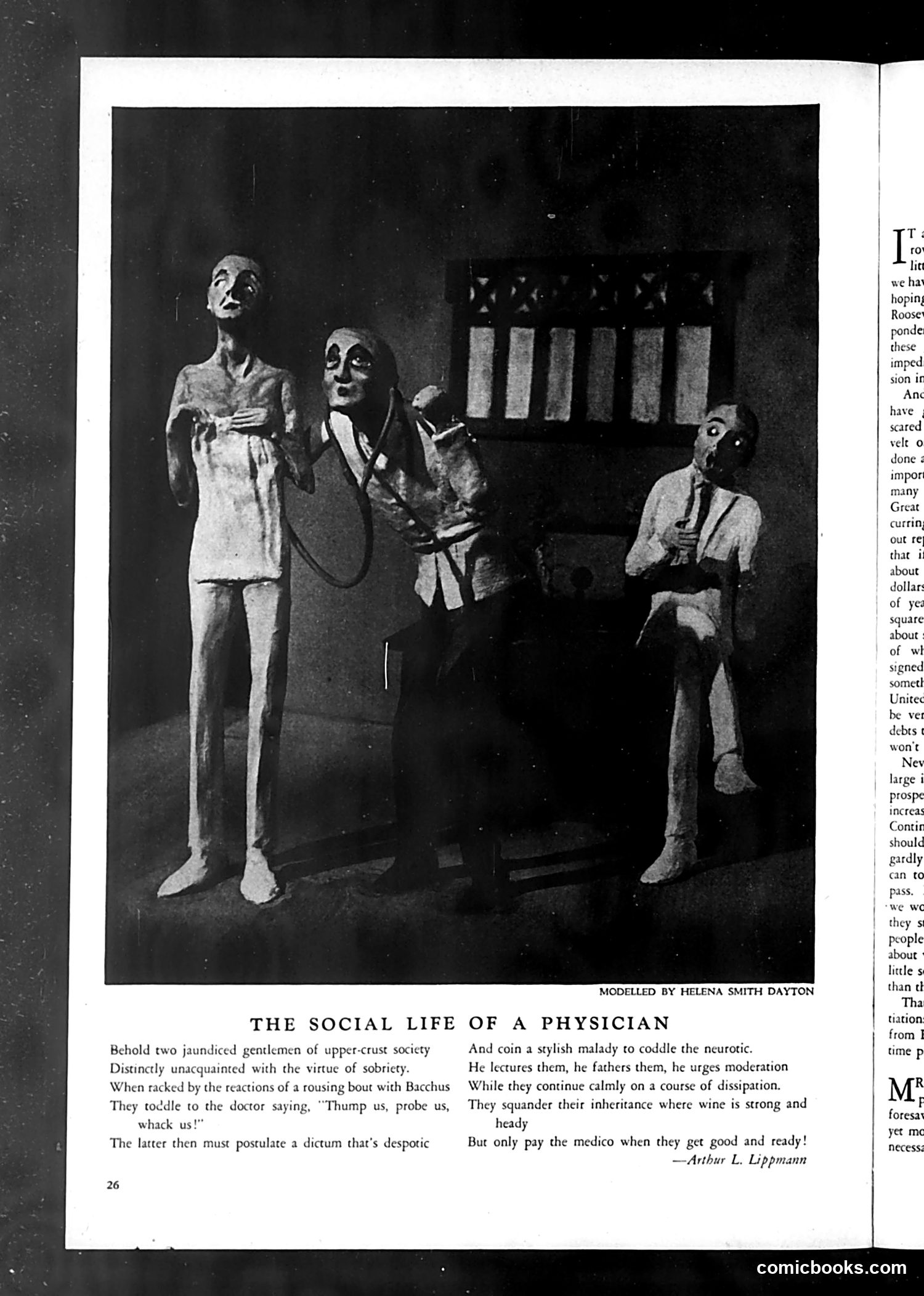
"The Social Life of a Physician" This satirical illustration critiques wealthy dissolute men and complicit doctors. The scene depicts two aristocratic men (shown gaunt and dissipated) visiting a physician about their alcohol-induced ailments. The satire works on multiple levels: The joke: Wealthy "upper-crust" drunks ("unacquainted with the virtue of sobriety") repeatedly abuse their bodies through excess drinking, then demand doctors treat invented ailments. The physician obliges by inventing fashionable diagnoses ("coddle the neurotic") to justify payment, while the patients ignore his advice and continue their dissipation. The criticism: The cartoon mocks both the patients' entitlement (they pay doctors "when they get good and ready") and physicians' moral compromise—enabling rich clients' self-destruction for profit rather than practicing genuine medicine. The verse by Arthur L. Lippmann emphasizes the economic transaction: doctors lecture about moderation but lack power to enforce it, dependent instead on wealthy patients' whims for payment.
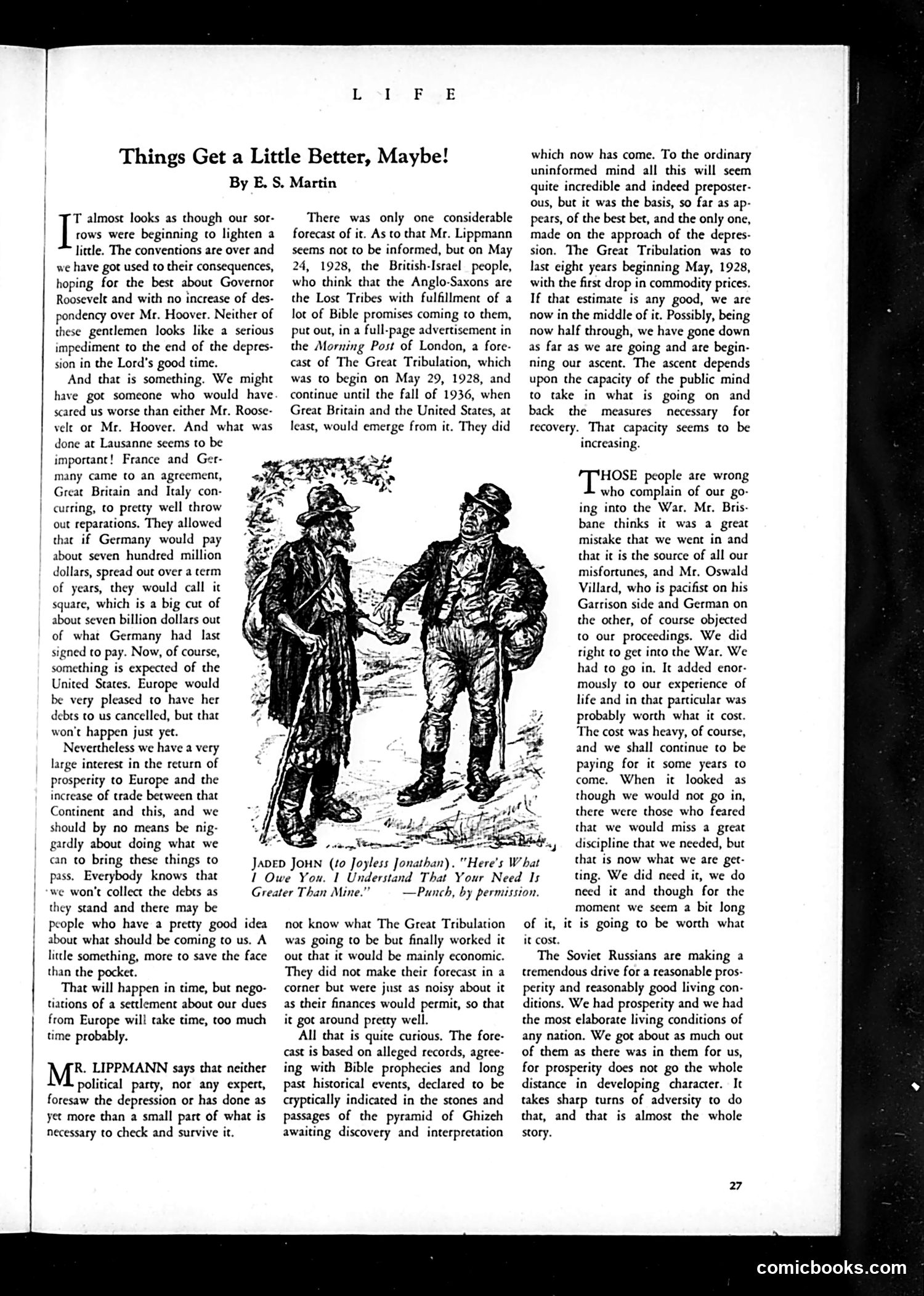
Explanation for Modern Readers This 1932 *Life* magazine article satirizes efforts to predict and understand the Great Depression. The main cartoon depicts "Jaded John" and "Joyless Jonathan"—personifications of debtor and creditor nations—in a somber encounter about war reparations and international debt. The piece mocks the absurdity that the *only* accurate Depression forecast came from British-Israel adherents who predicted catastrophe based on pyramid numerology and biblical prophecy. Author E.S. Martin notes this fringe group predicted an eight-year "Great Tribulation" (1928-1936) using occult methods—yet this matched reality better than any expert analysis. The satire targets both Depression-era incompetence (politicians and economists failing to foresee or manage the crisis) and blind faith in pseudoscience. The cartoon caption emphasizes mutual indebtedness between nations, illustrating how Depression-era economic problems had become global and seemingly inescapable, despite theoretical optimism about recovery.
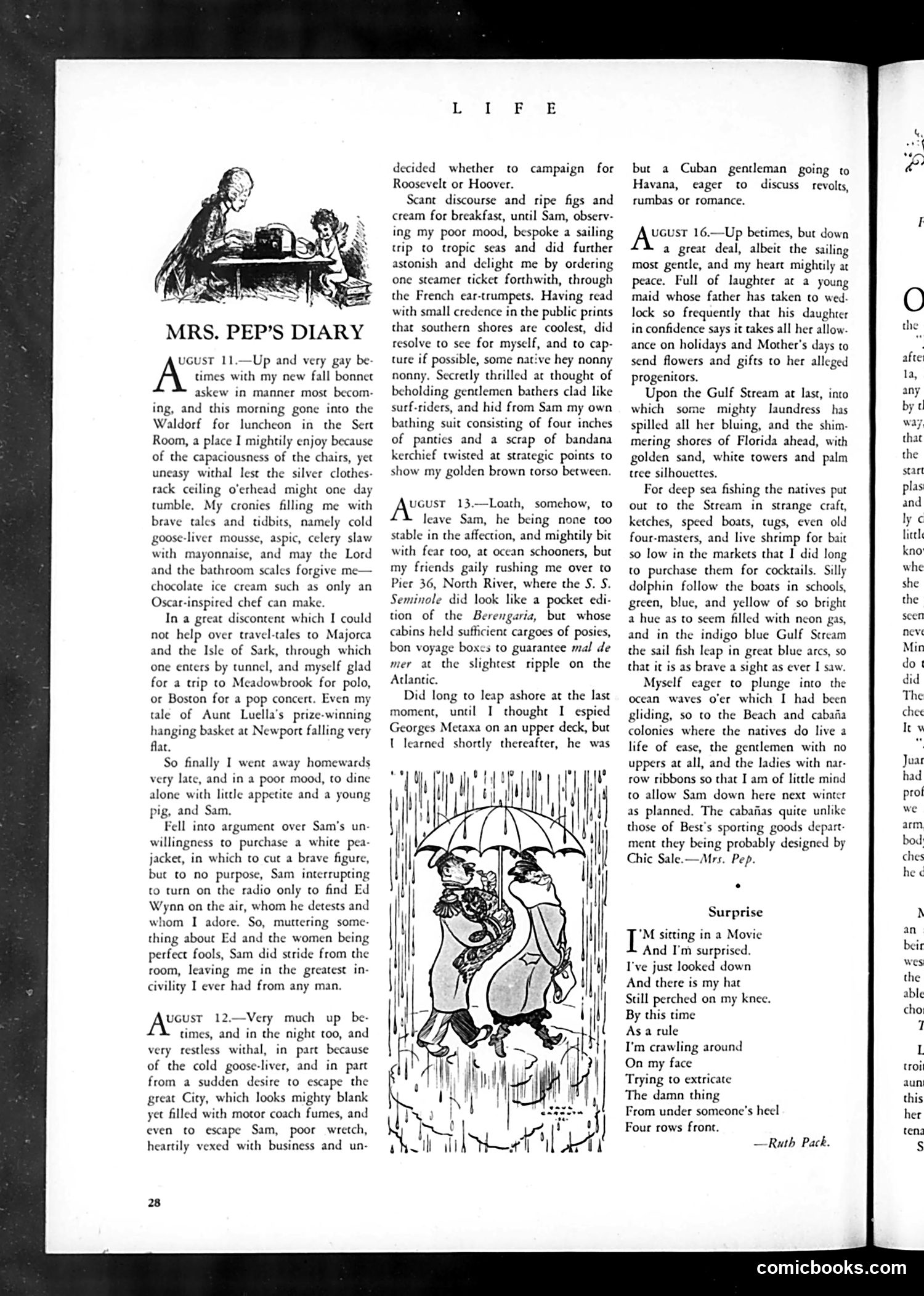
Explanation of Life Magazine Page Content This page presents "Mrs. Pep's Diary," a satirical humor column depicting the leisure activities and romantic entanglements of a wealthy, idle socialite in 1920s America. The diary entries (August 11-16) chronicle her complaints about New York high society—expensive lunches at the Waldorf, marital squabbles with her husband Sam over purchases and radio programs (notably Ed Wynn's comedic show), and ultimately a steamship voyage to tropical waters. The cartoon illustrates a flirtatious encounter in the rain. The satire targets the pretensions and boredom of upper-class women: expensive dining, frivolous travel, gossip about celebrity sightings (Georges Metaxa, a contemporary actor), and preoccupation with romantic intrigue. The "nonny nonny" reference mocks her interest in exotic male bathers. Overall, this is gentle social satire of Jazz Age affluence and feminine leisure culture.
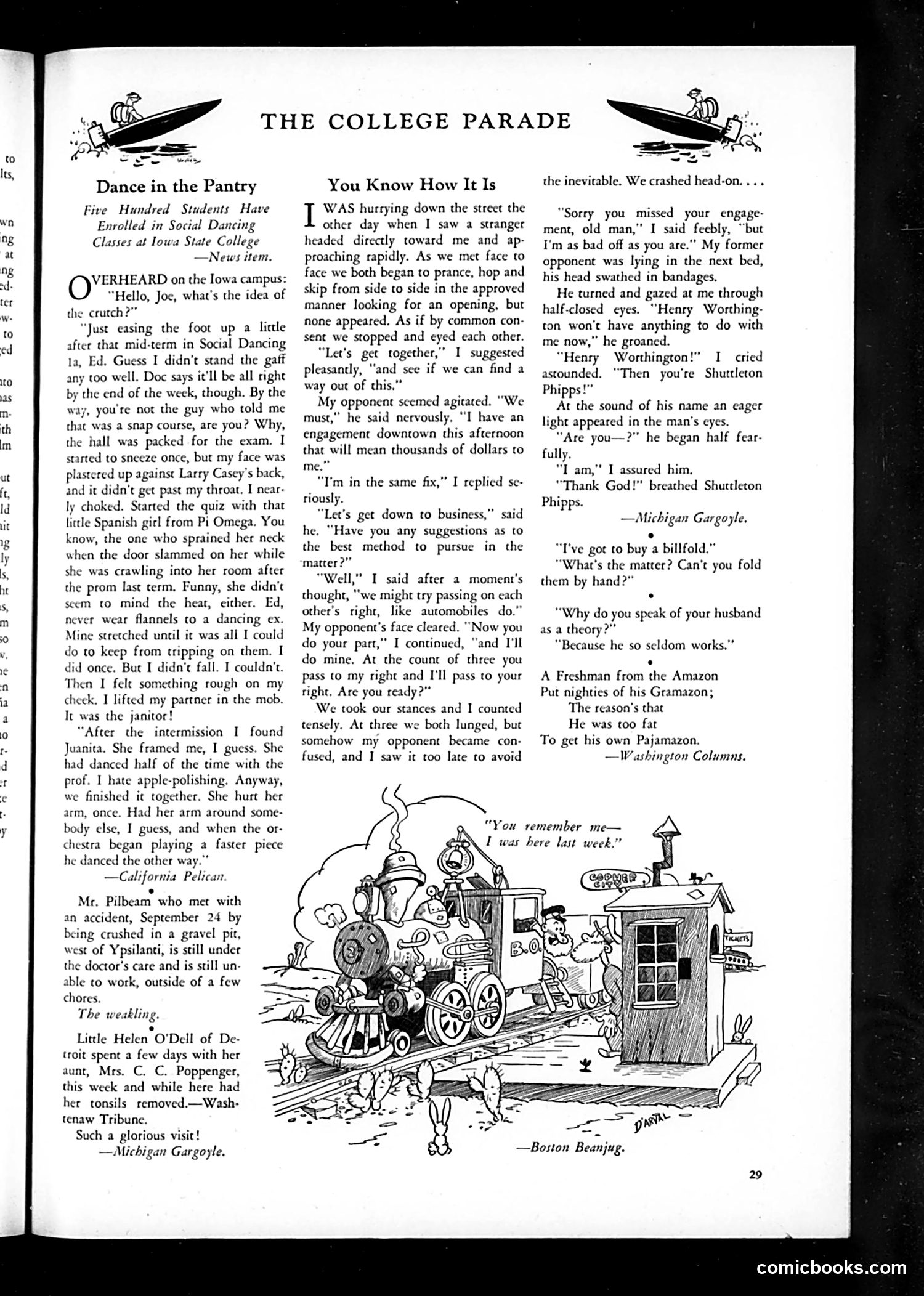
Analysis: "The College Parade" Page This page from *Life* magazine collects humorous college anecdotes. The main content satirizes overcrowded social dancing classes at Iowa State College—a "snap course" that became unexpectedly popular and dangerously packed, with students literally crushed together during exams. The central cartoon by Boston Beanjing depicts an absurdist scenario: two strangers on a street both trying to pass each other, creating an awkward dance where they repeatedly block one another despite negotiating a solution. The punchline reveals they're the same person who collided with each other earlier and now share a hospital bed—suggesting that even carefully planned coordination fails in real life. The page's humor relies on exaggerated physical comedy (sprained necks, crushed bodies, broken feet) common to 1920s college humor. The brief anecdotes mock college life stereotypes: overcrowding, apple-polishing professors, and social mishaps. The cartoon's irony—two "rational" people creating chaos through their own confusion—exemplifies the surreal humor *Life* favored.
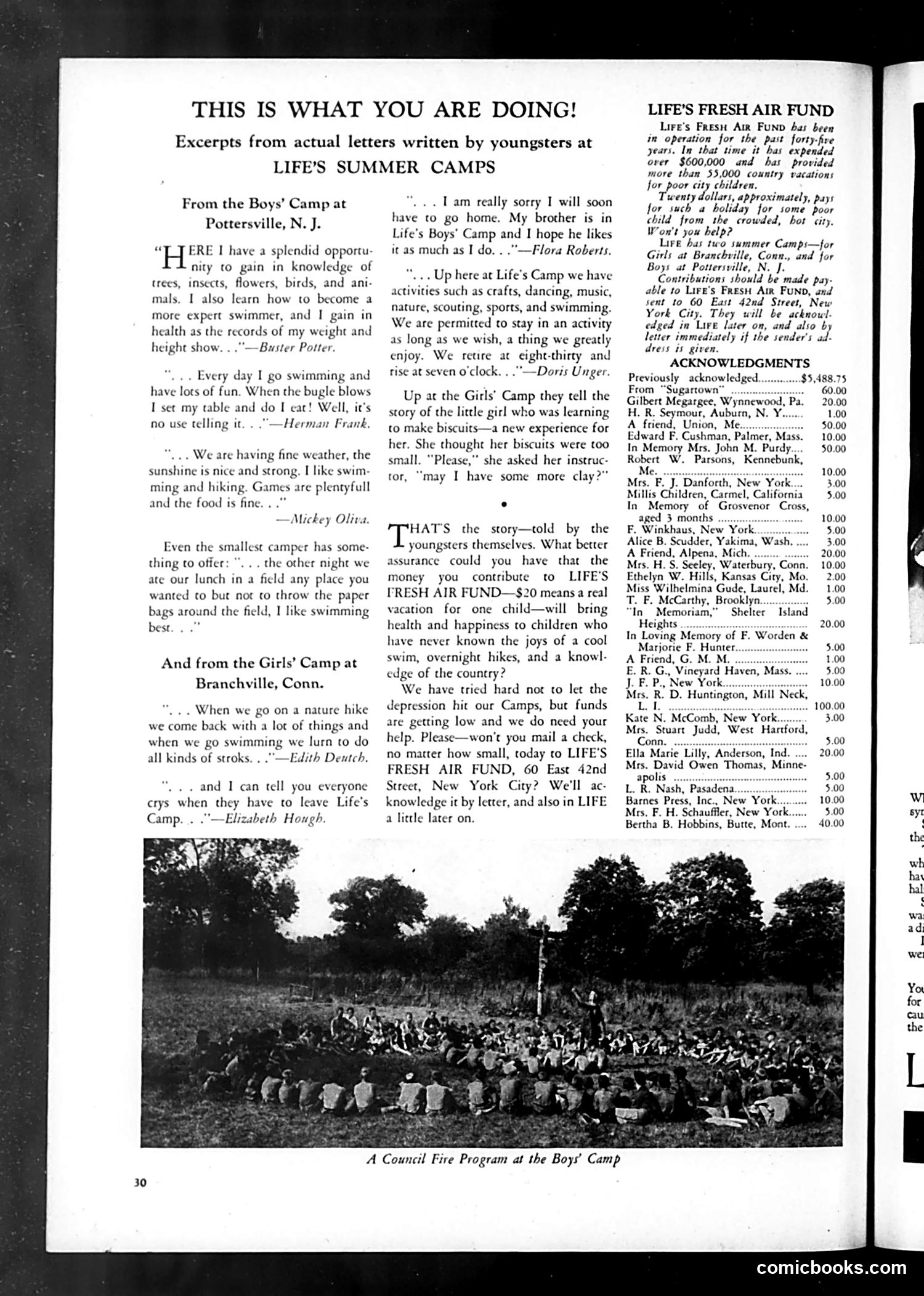
Life Magazine's Fresh Air Fund Appeal This page promotes Life magazine's Fresh Air Fund, a charitable program providing summer camp vacations for poor urban children during the Great Depression era. The content consists of: 1. Testimonial letters from actual campers at Life's boys' and girls' camps, describing wholesome activities (swimming, hiking, crafts, nature study) and simple pleasures like good food—experiences unavailable to city children in poverty. 2. A fundraising appeal explaining that $20 provides one child a countryside vacation, emphasizing the program's 45-year history and 33,000 previous beneficiaries. 3. A photograph showing a council fire gathering at the boys' camp—a scouting tradition symbolizing community and outdoor education. The implicit message: donations directly improve children's health and character during economically difficult times. The children's genuine gratitude (one cries leaving camp) serves as emotional persuasion for readers' contributions. This represents Depression-era philanthropy framed as wholesome Americana.
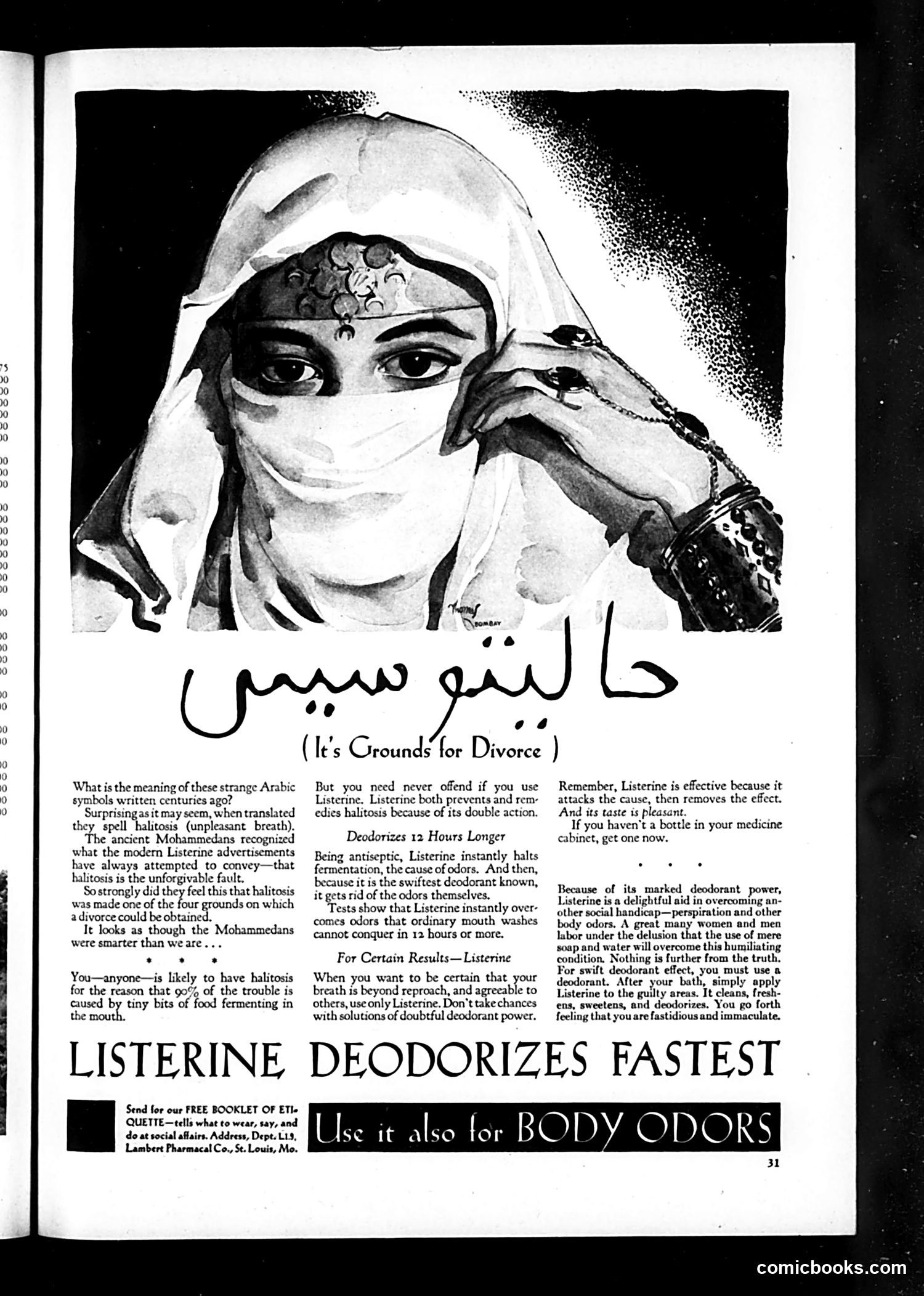
Analysis This is primarily a Listerine mouthwash advertisement, not political satire. The "cartoon" element is minimal—it's an illustration of a woman in traditional Islamic dress with a veil and face covering, used as a visual hook. The ad's premise uses mock-scholarly humor: it claims ancient Arabic texts designated bad breath (halitosis) as grounds for divorce, suggesting this was culturally wise. The joke plays on Western stereotypes about Islamic practices while cleverly positioning Listerine as the modern solution to this supposedly ancient problem. The advertisement conflates oral hygiene with social acceptability, claiming halitosis causes social offense. It also pivots to promoting Listerine for body odors and perspiration control—positioning the product as essential for being "fastidious and immaculate." By modern standards, the imagery relies on Orientalist stereotyping and the ad employs casual cultural appropriation to sell a consumer product through appeals to social anxiety about bodily odors.
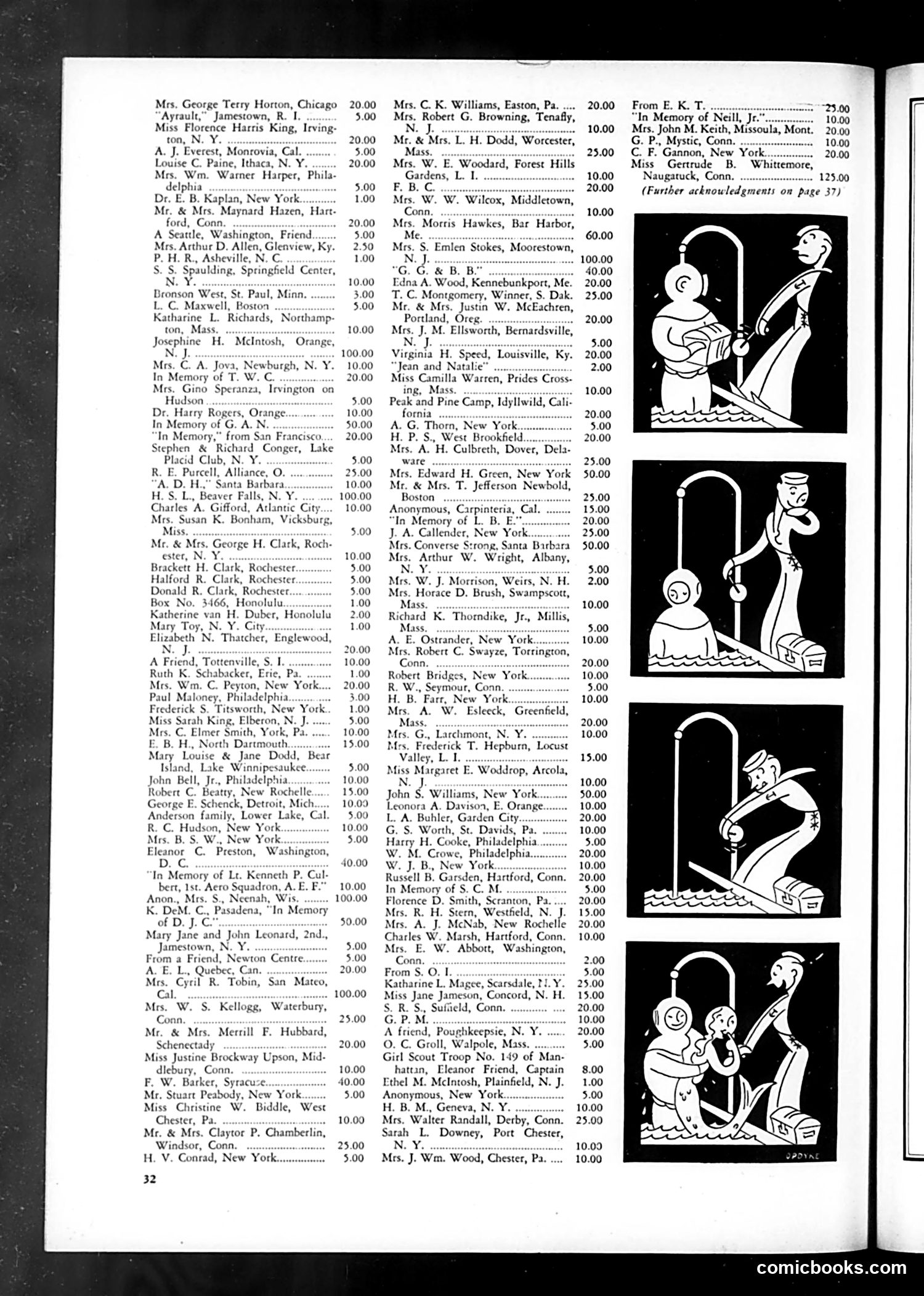
Life Magazine Donations Page with Decorative Illustrations This page displays a donor list—names and amounts contributed to Life magazine (likely for a charitable cause or subscription fund). The left and center columns list hundreds of contributors from across America with donation amounts ranging from $1 to $100. The right side features four small black-and-white cartoon illustrations in a decorative style, apparently unrelated to the donations themselves. These appear to be humorous vignettes of children or cherubs in various situations—fishing, playing, or engaged in mischief—rendered in a whimsical Art Deco or early 20th-century style. The page serves primarily as acknowledgment of donors rather than satire or political commentary. It represents Life's practice of publicly crediting subscribers and contributors—a common publication practice of that era that reinforced community participation and gave donors social visibility.
Analysis This is an advertisement, not a cartoon or satire. It's a pitch by John H. Livingston, Jr. selling advertising space on Fifth Avenue buses in New York City. The ad targets potential advertisers by highlighting the Fifth Avenue bus passenger base as an unusually desirable demographic: affluent New Yorkers and wealthy out-of-town visitors with high purchasing power. Livingston argues buses offer "mass class circulation"—reaching quality consumers, not just quantity—citing specific passenger numbers delivered to major department stores like John Wanamaker. The appeal is essentially: advertise on these buses to reach rich people spending money in the city. The ad includes specific rates (15% agency commission, 2% cash discount) and contact information. This reflects early 20th-century advertising strategy targeting consumer class rather than mass audience, and the competitive positioning of bus advertising against subway/elevated transit.
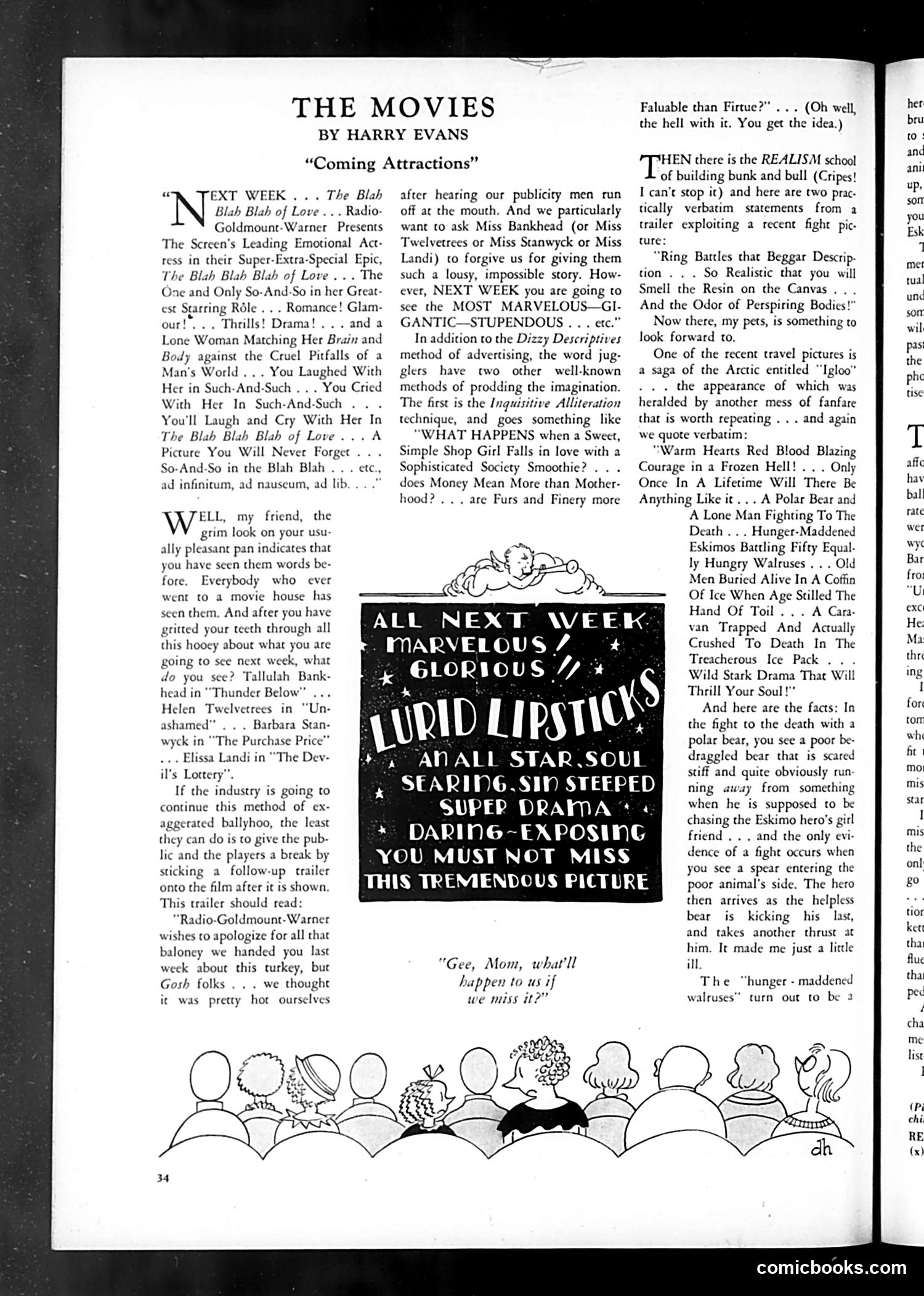
Analysis of "The Movies" by Harry Evans This is a satirical column mocking Hollywood's extravagant movie-advertising practices. Evans identifies three primary tactics studios use to promote films: 1. "Dizzy Descriptives": Hyperbolical adjectives ("MARVELOUS," "GLORIOUS," "STUPENDOUS") paired with generic plot summaries repeated endlessly. Evans parodies this with "[The] Blah Blah Blah of Love." 2. "Inquisitive Alliteration": Rhetorical questions designed to manipulate audiences ("What Happens when a Sweet, Simple Shop Girl Falls in love...?"). 3. "Realism": Absurdly exaggerated sensory claims ("Smell the Resin on the Canvas"). The cartoon at bottom shows moviegoers' resigned expressions—visual commentary on audience fatigue from this bombardment. Evans suggests studios should add honest disclaimers: "Radio-Goldmount-Warner wishes to apologize for all that baloney we handed you." The piece targets 1930s studio hype culture and the disconnect between promotional promises and actual film quality.
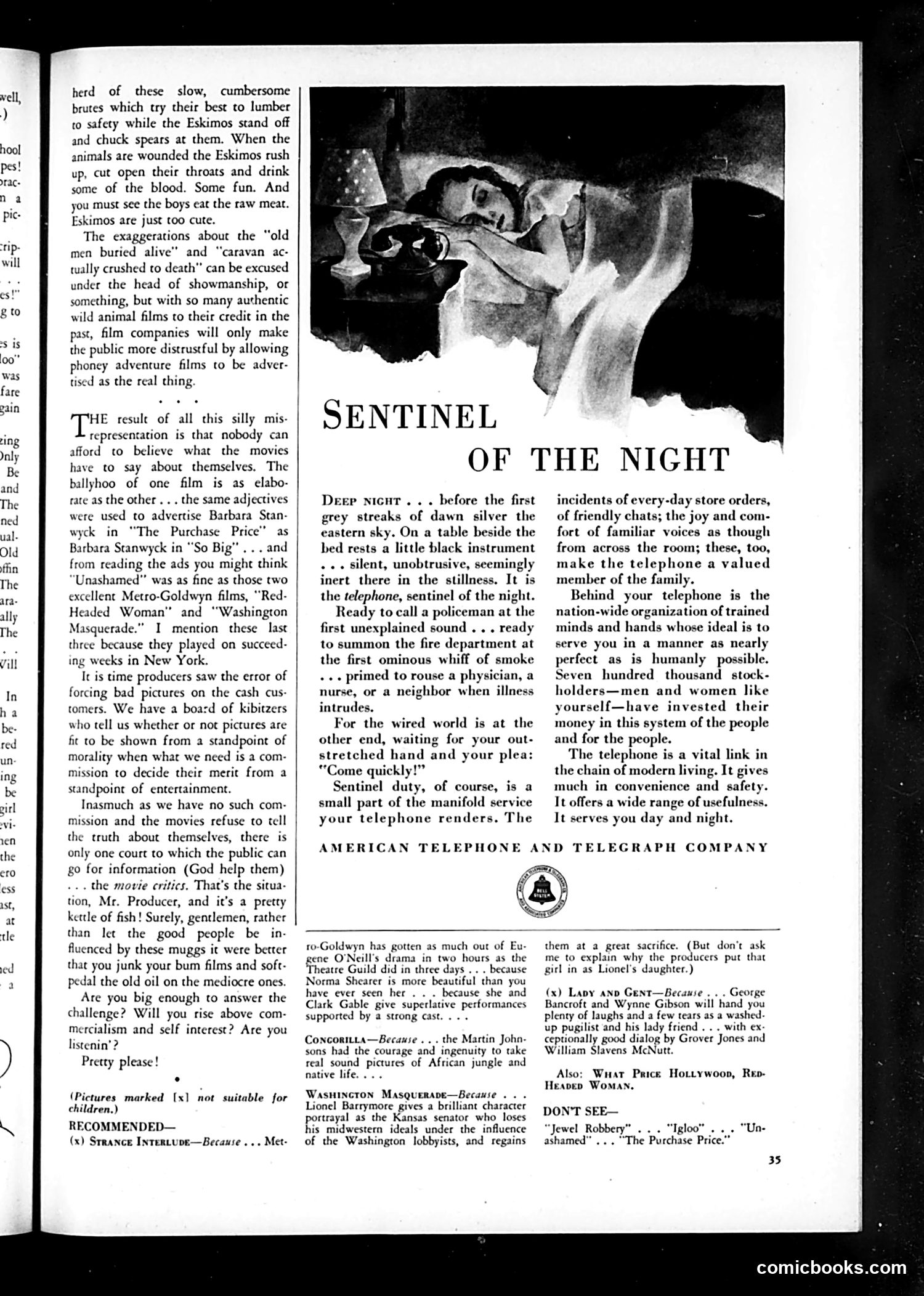
Analysis of "Sentinel of the Night" Advertisement This page contains a critical film review (left) and a full-page advertisement (right) for the American Telephone and Telegraph Company, placed incongruously opposite each other. The Review's Point: The author criticizes Hollywood's deceptive advertising practices. Film studios use identical hyperbolic language ("elaborate adjectives") to promote both mediocre and genuinely good films, making consumers unable to trust movie advertising. The reviewer cites examples like Barbara Stanwyck films and MGM productions, arguing that studios prioritize profit over honesty. The satire culminates in a pointed challenge: producers must choose between letting movie critics inform the public or demonstrating integrity themselves. The Advertisement's Irony: The AT&T ad emphasizes the telephone as a trustworthy "sentinel" serving families reliably—a striking contrast to the review's immediately preceding accusation that corporations deliberately mislead the public. The ad's language about "trained minds" and serving "the people" rings hollow against the review's argument that commercial interests prioritize profit over truth. This juxtaposition appears intentionally ironic.
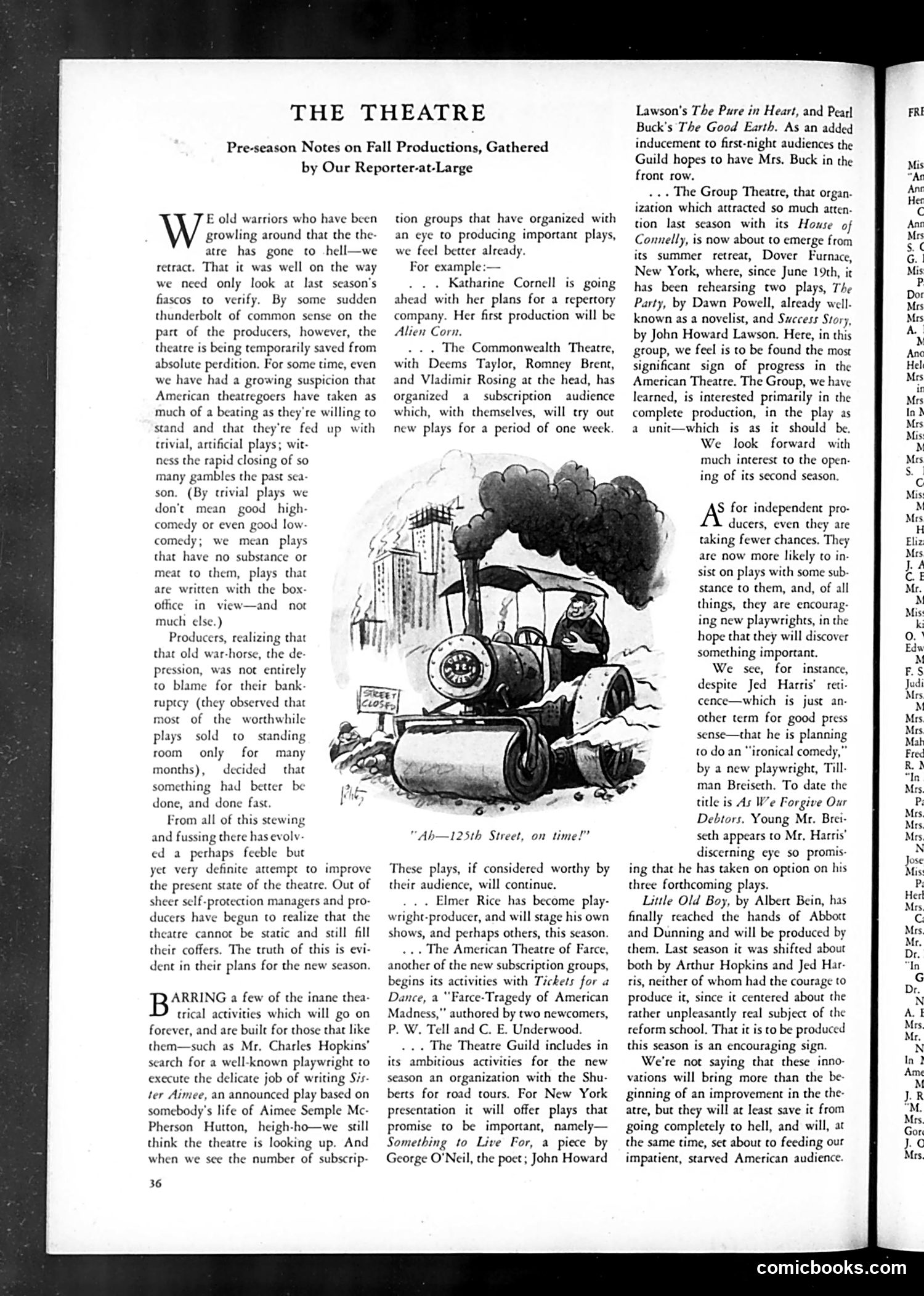
Analysis of Life Magazine Theatre Page This page discusses fall theatre season prospects, criticizing the previous season's failure while celebrating new production initiatives. The cartoon depicts a train labeled "Street Clothes" barreling forward with smoke billowing—likely satirizing the theatre's chaotic trajectory or the frenetic energy of Broadway production. The text expresses skepticism about American theatre's recent decline, blaming not the Depression alone but also producers' reliance on trivial, commercially-driven plays lacking substance. The author praises emerging subscription-based theatre groups (led by figures like Katharine Cornell, Elmer Rice, and the Theatre Guild) as signs of improvement, suggesting they'll produce more meaningful work. The caption "Ah—125th Street, on time!" references theatrical logistics, possibly mocking the reliability of theatrical scheduling or transportation. Overall, this is optimistic commentary on theatre's potential recovery through organized, artistically-serious production models rather than purely commercial ventures.
Analysis of Page 37 from Life Magazine This page is primarily advertising, not editorial content or political cartoons. The dominant features are hotel and restaurant advertisements interspersed with a continuation of the "Fresh Air Fund Acknowledgments"—a charitable giving list from Life magazine's fundraising campaign for underprivileged children. The ads feature luxury hotels (The Plaza, Savoy-Plaza, Bancroft Hotel) and Longchamps restaurants, targeting affluent readers. There's also a medical product advertisement for Dr. Scholl's corn pads. The Fresh Air Fund list itself—showing donations from wealthy individuals across America—reflects early 20th-century philanthropic practices where magazines publicized donors' names as social recognition. This served both charitable and social-status purposes. No political satire or caricature is present on this page. It's a straightforward commercial and charitable publication page typical of Life magazine's business model during this era.
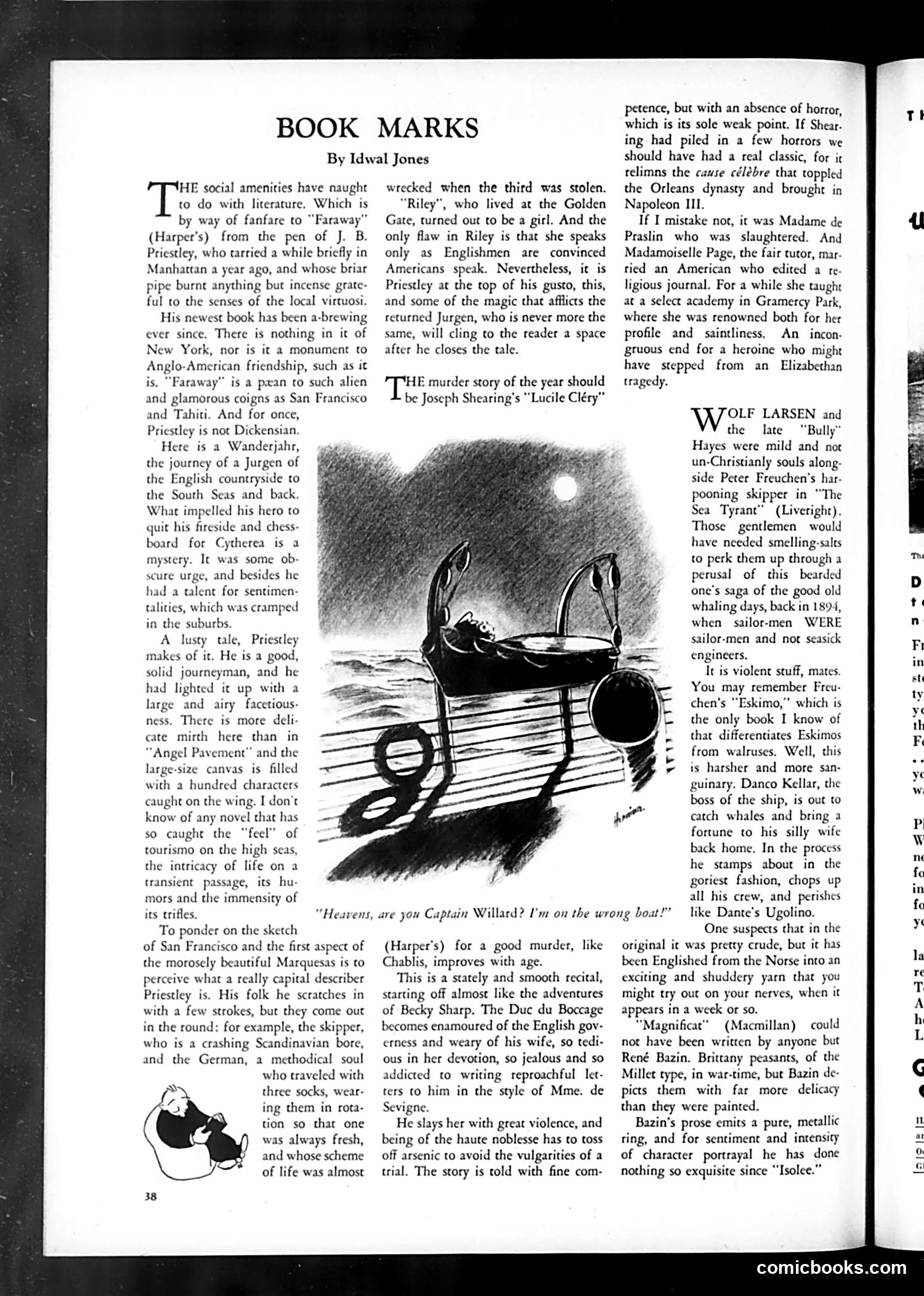
Book Marks: A Literary Review Page This is a book review column by Idwal Jones covering three recent novels. The main illustrated cartoon shows a comedic maritime mix-up: a passenger on the wrong boat calling out "Heavens, are you Captain Willard? I'm on the wrong boat!"—likely referencing confusion during travel, a running theme in reviews of seafaring novels. Jones reviews J.B. Priestley's *Faraway* (about an English journey to the South Seas), Joseph Shearing's *Lucile Cléry* (a murder mystery based on a historical French scandal involving the Duc du Boccage), and mentions *The Sea Tyrant* by Livwright. The reviews praise Priestley's character work and descriptive ability while finding Shearing's murder tale competent but lacking in dramatic horror—though historically based on the real Orleans dynasty scandal that brought Napoleon III to power. The tone is witty and erudite, assuming readers familiar with literary classics and European history.
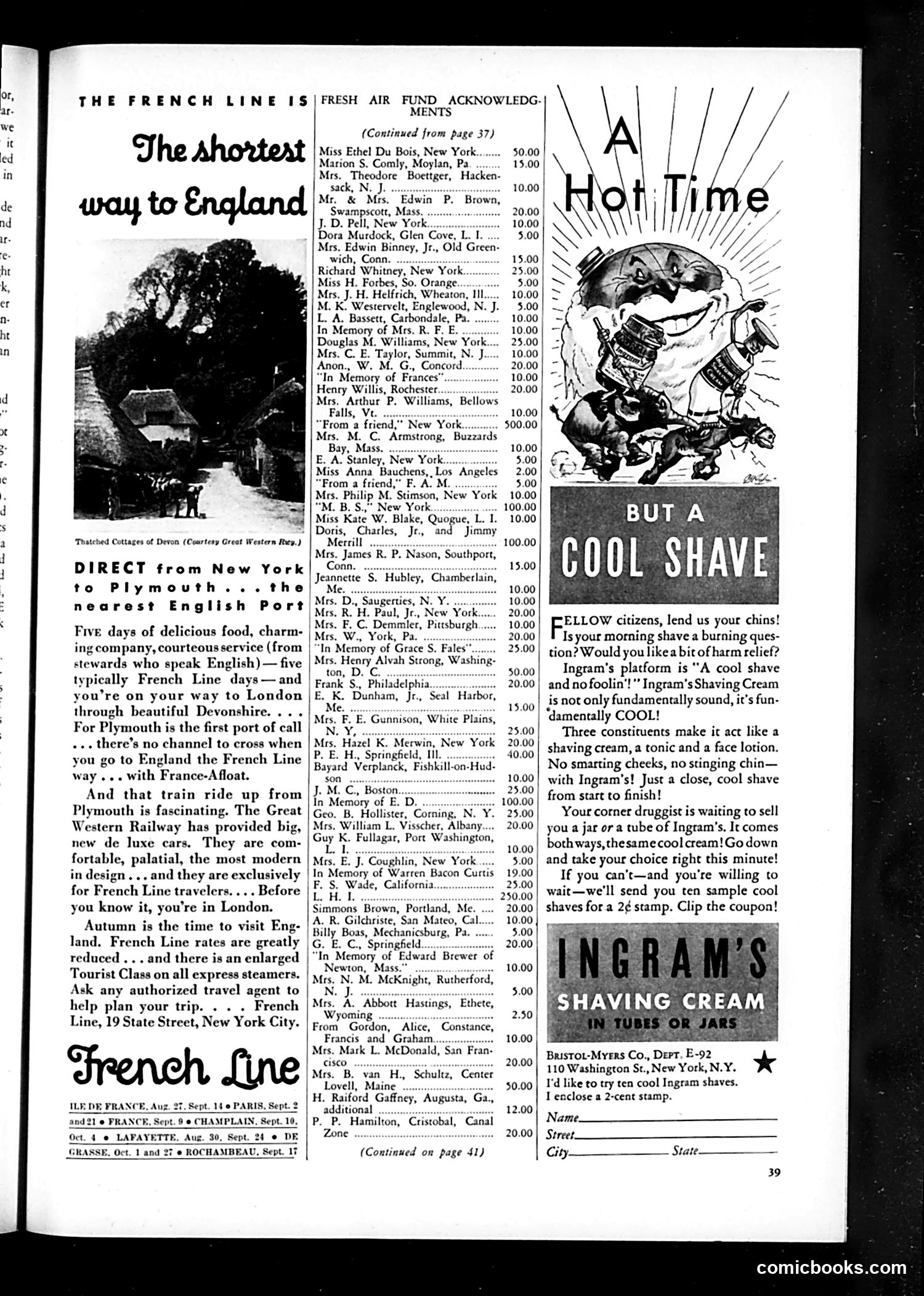
This page is primarily advertising and charitable content, not political satire. The left side features a French Line steamship advertisement promoting transatlantic travel to Plymouth, England, with scenic imagery and details about luxury accommodations and train connections. The right side displays an Ingram's Shaving Cream advertisement featuring a cartoon character with exaggerated features (wide grin, holding shaving supplies). The ad uses humorous copy to pitch the product's value and cooling properties, appealing to "fellow citizens" to try a sample. The center-right contains a "Fresh Air Fund" acknowledgments list—a charitable giving log thanking donors who contributed money to send underprivileged children on summer outings, a common early-20th-century philanthropy. There is no political cartoon on this page. The Ingram's character is simply advertising mascot humor typical of period marketing, not commentary on public figures or events.
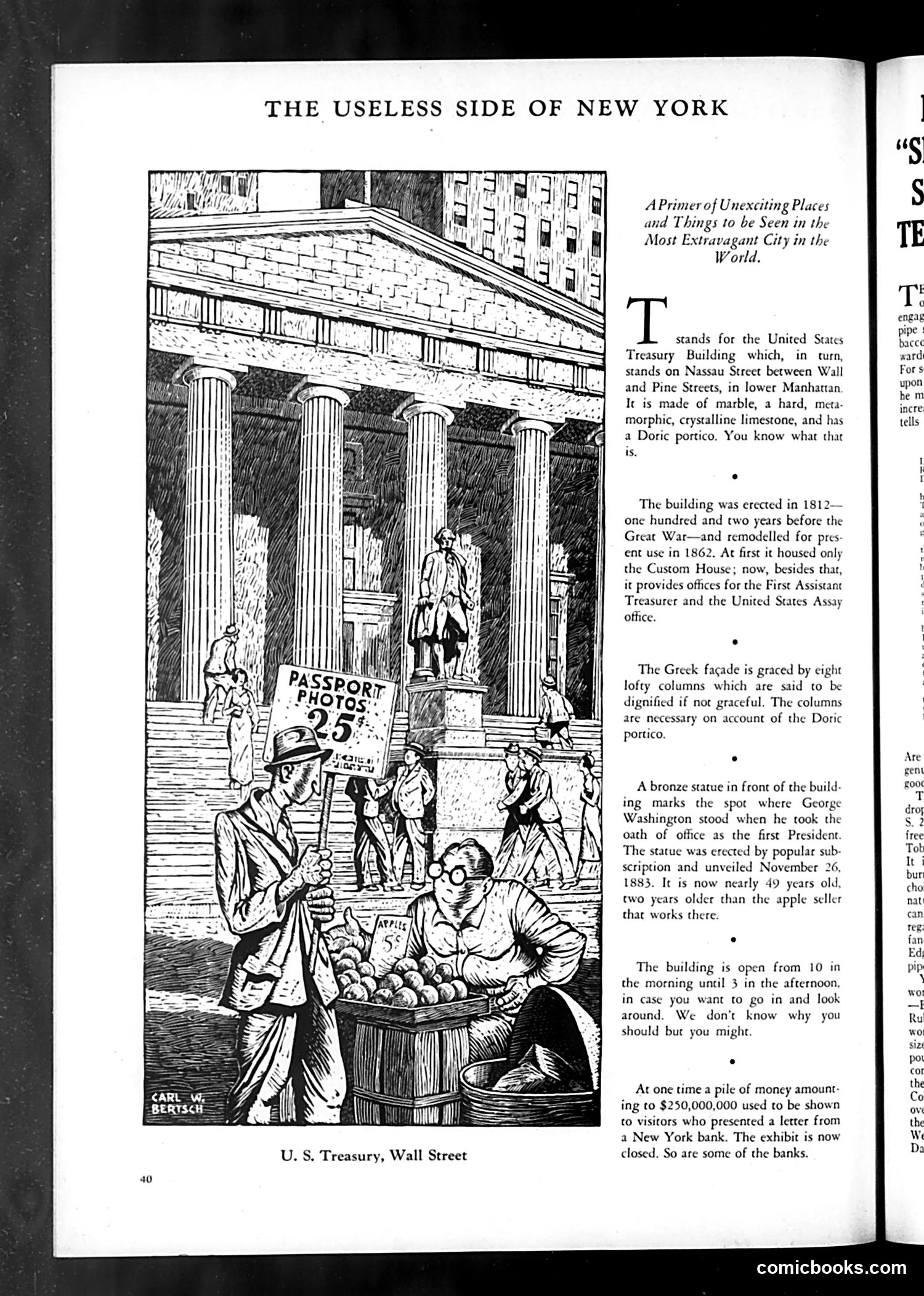
Analysis: "The Useless Side of New York" This is satirical commentary on the U.S. Treasury Building, presented as a fake tour guide. The cartoon depicts tourists and street vendors outside the building's grand classical facade. The satire operates on multiple levels: The text mockingly describes the building's architectural features with false earnestness ("You know what that is"), emphasizing its boring, impractical nature. The final paragraph contains sharp social commentary—it references a $250 million exhibit that's now closed, followed by the barbed line "So are some of the banks." This is likely referencing bank closures during the Great Depression (the text dates the page to around 1932, given the "49 years old" reference to the 1883 statue). The joke: while tourists visit this "useless" government building, financial institutions themselves have failed. The Treasury—meant to safeguard American money—stands intact while real banks have collapsed, making the building symbolically ironic rather than genuinely impressive.
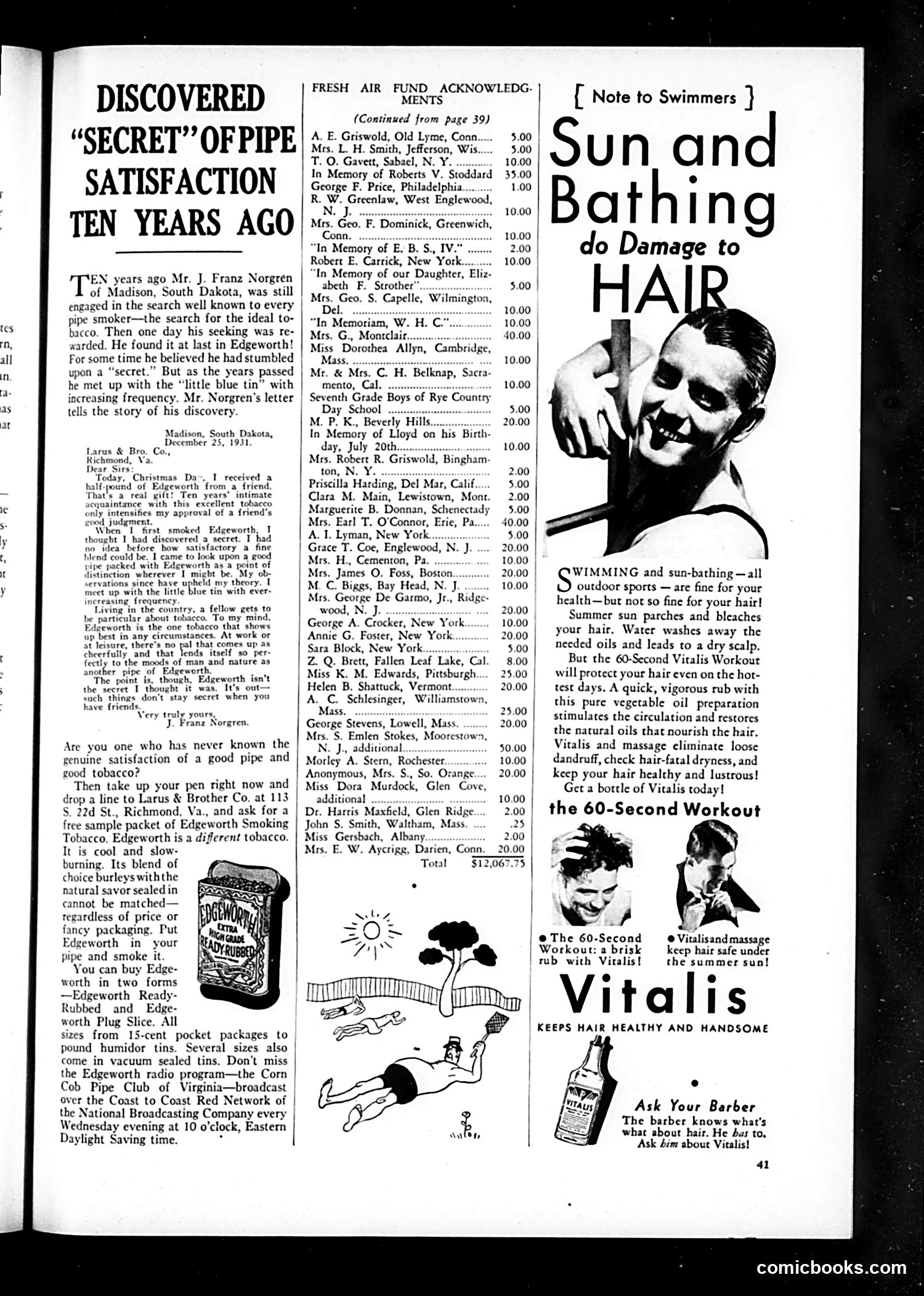
Analysis for Modern Readers This page contains primarily advertising and fundraising content, not political satire or comics requiring historical context. Left side: An Edgeworth pipe tobacco advertisement featuring a testimonial letter from a satisfied customer in South Dakota (dated 1931). The "secret" referenced in the headline is simply that the writer discovered Edgeworth tobacco provides satisfying smoking—presented as a heartwarming endorsement. This is straightforward product advertising common to mid-20th century magazines. Right side: A Vitalis hair product advertisement warning that sun and swimming damage hair, promoting their oil treatment. It includes illustrations of swimmers and a "60-Second Workout" massage technique. Center: A "Fresh Air Fund Acknowledgments" section listing charitable donations—standard editorial content thanking donors. There is no political cartoon or satirical commentary on this page. It represents typical Life magazine content mixing advertising, fundraising acknowledgments, and consumer product promotion.
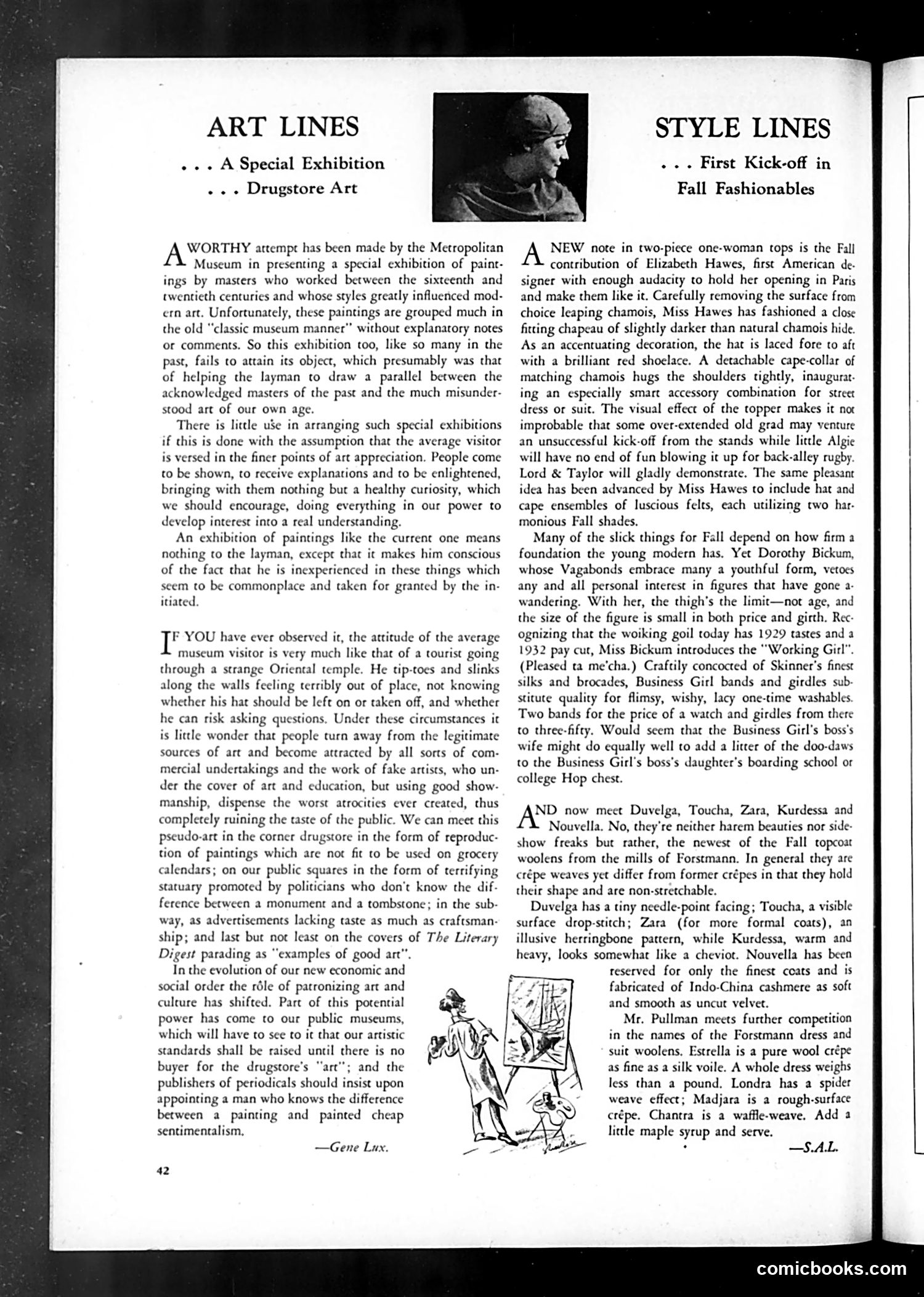
Explanation for Modern Readers This page contains two separate articles with distinct purposes: "Art Lines" (left) critiques the Metropolitan Museum's special exhibition of historical paintings. The author argues the museum fails to educate average visitors by providing no explanatory notes or context. The satire targets how museums treat ordinary people as uninformed outsiders, then complains these visitors turn to "drugstore art"—cheap reproductions on calendars and magazine covers—instead. The piece also mocks *Literary Digest* magazine for presenting sentimental, low-quality artwork as "examples of good art." The underlying complaint: museums and publishers should take responsibility for raising public artistic taste rather than exploiting public ignorance. "Style Lines" (right) covers fall fashion, highlighting American designer Elizabeth Hawes's bold choice to debut her collection in Paris. The piece describes her innovative two-piece tops made from chamois leather, including an unconventional hat laced with a red shoelace and a detachable collar. Other designers mentioned include Duvelga, Toucha, and Zara, representing various fabric innovations for the upcoming season.
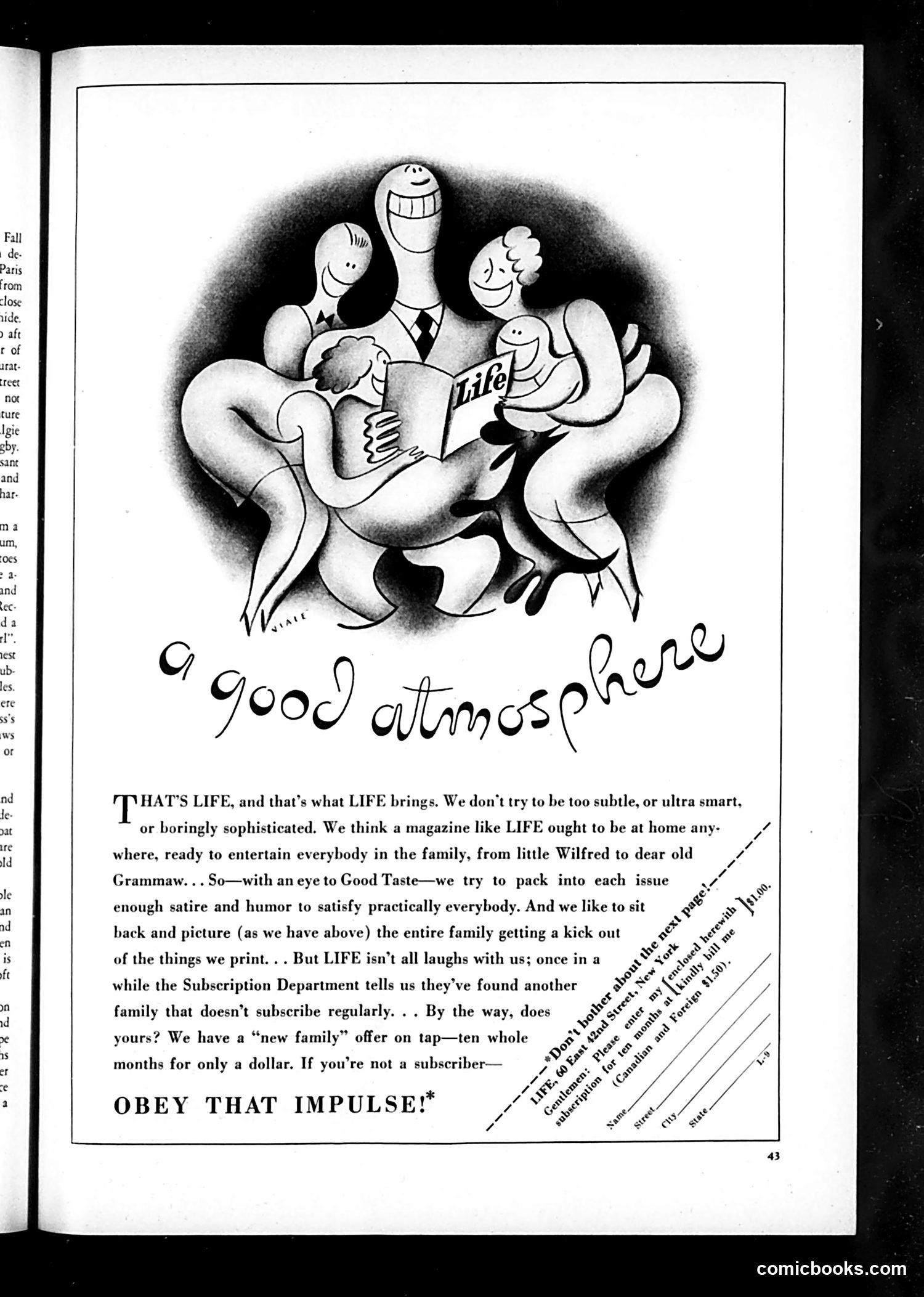
Life Magazine Subscription Advertisement This is a subscription pitch, not political satire. The illustration shows a stylized family of five (adults and children) reading Life magazine together, all smiling broadly—depicting the magazine's claim to appeal to everyone "from little Wilfred to dear old Grammaw." The text positions Life as family-friendly entertainment that balances satire and humor without being "too subtle" or "sophisticated." It's self-promotional, explicitly acknowledging that the Subscription Department tracks which families don't subscribe regularly, then leveraging that to pitch a promotional offer: ten months for one dollar. The headline "OBEY THAT IMPULSE!" is the sales hook. There's no political message here—just advertising disguised as editorial content, a common magazine practice of the era.
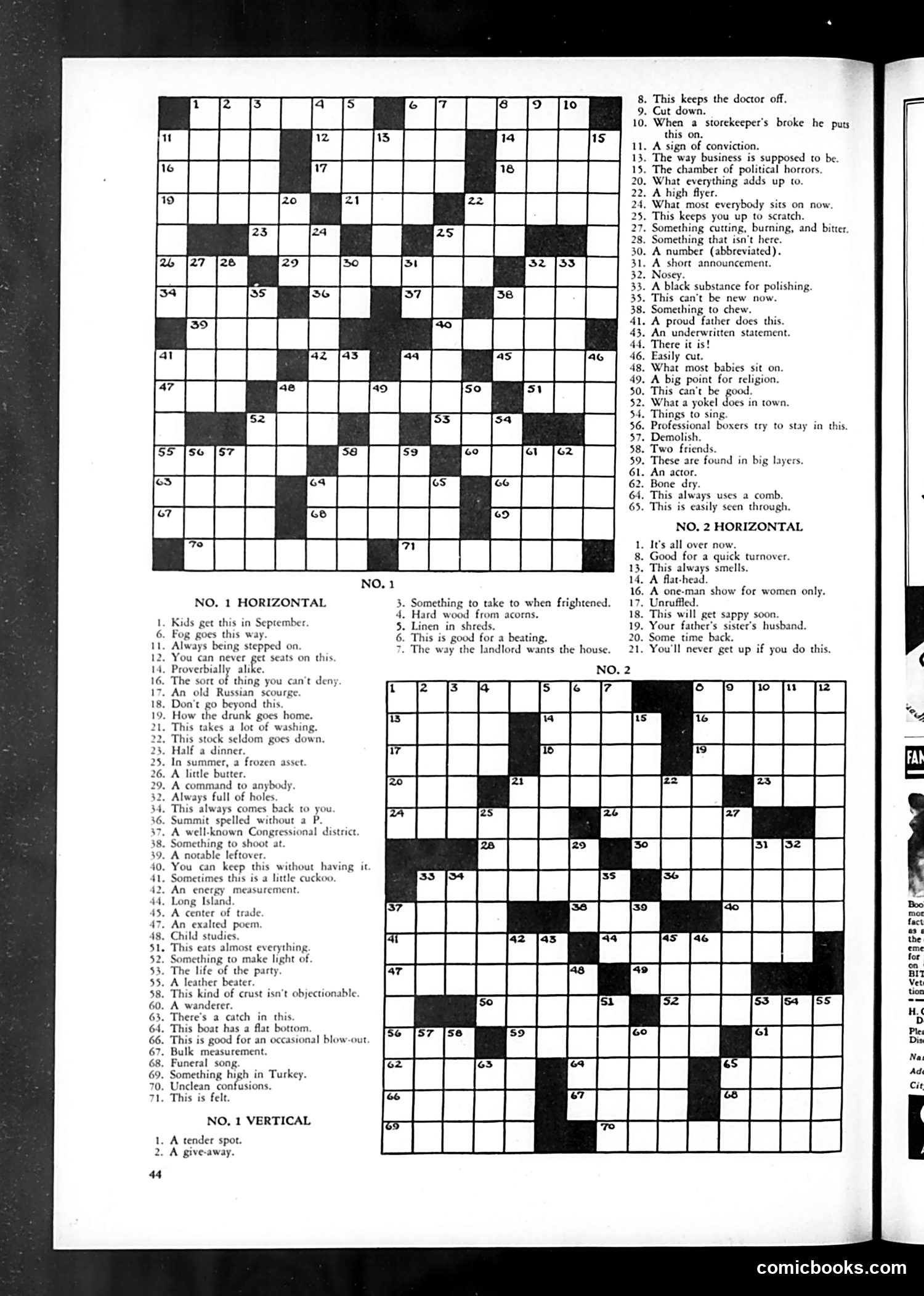
What This Page Shows This page is not a cartoon or satirical commentary—it's a crossword puzzle section from *Life* magazine. The page contains two complete crossword grids (labeled "NO. 1" and "NO. 2") with their corresponding clue lists organized by Horizontal and Vertical entries. While *Life* was indeed a satirical publication known for political and social humor, this particular page is purely recreational content: word puzzles designed for readers' entertainment. The clues are typical crossword humor—puns, wordplay, and riddles (like "Kids get this in September" = SCHOOL, or "A one-man show for women only" = MIRROR). There is no political satire, caricature, or social commentary visible on this page. It represents the lighter, puzzle-focused content that magazines like *Life* included alongside their more famous satirical cartoons and commentary.
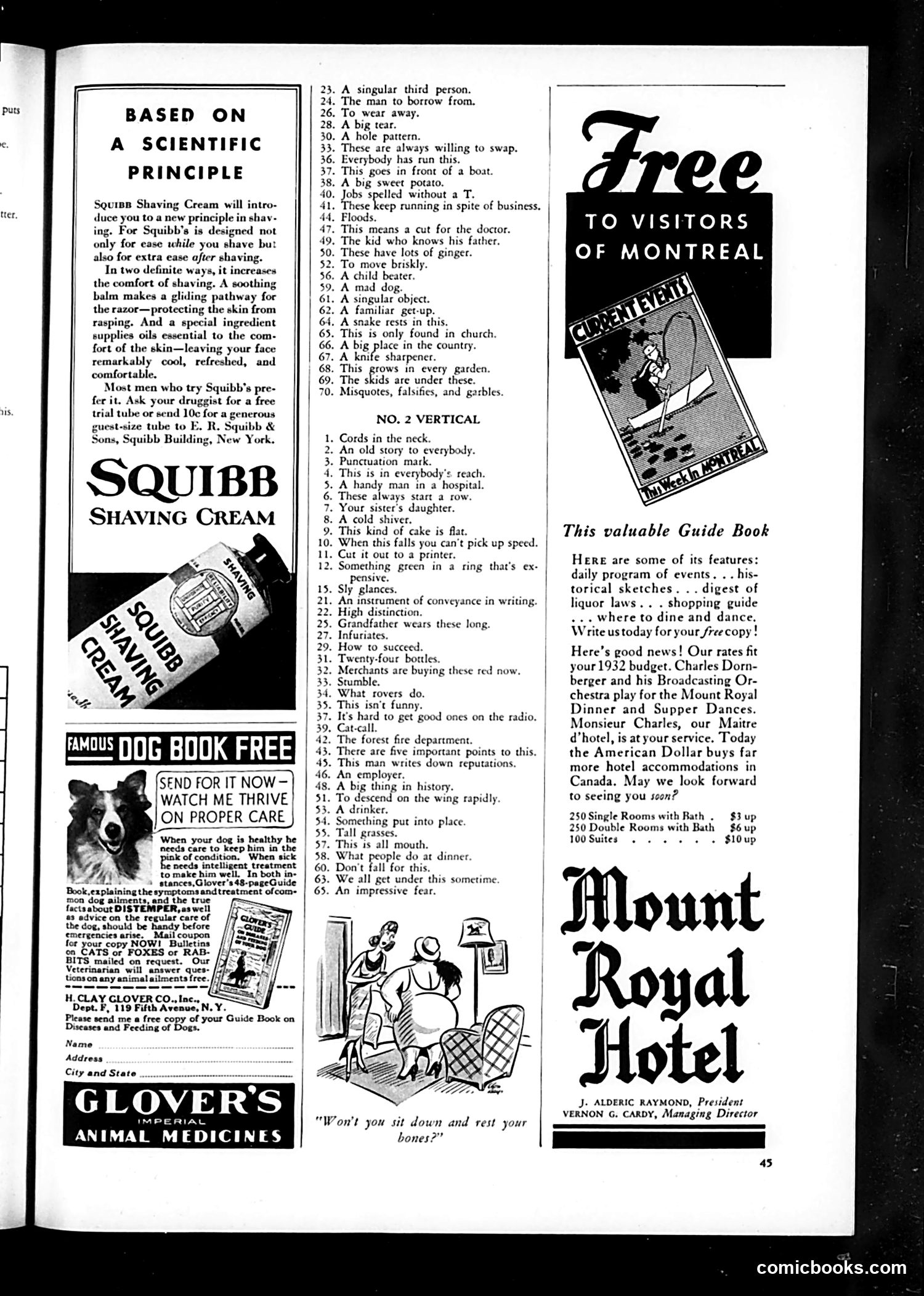
This page is primarily advertising, not political satire. It contains three main advertisements: 1. Squibb Shaving Cream — a product ad claiming scientific benefits for comfortable shaving, with soothing balm and protective oils. 2. Glover's Animal Medicines — promoting a free dog care guide book, emphasizing proper pet health maintenance. 3. Mount Royal Hotel, Montreal — advertising tourism services and hotel accommodations with rates listed (single rooms $3 up, suites $10 up), plus entertainment featuring orchestra music and dining. The page also includes a crossword puzzle (two vertical clue lists) for reader engagement. The illustrated cartoon at bottom shows two people in casual conversation with the caption "Won't you sit down and rest your bones?" — likely part of the crossword or simply domestic humor common to the era. There is no political commentary or social satire on this page. It's a typical commercial magazine spread from 1932.
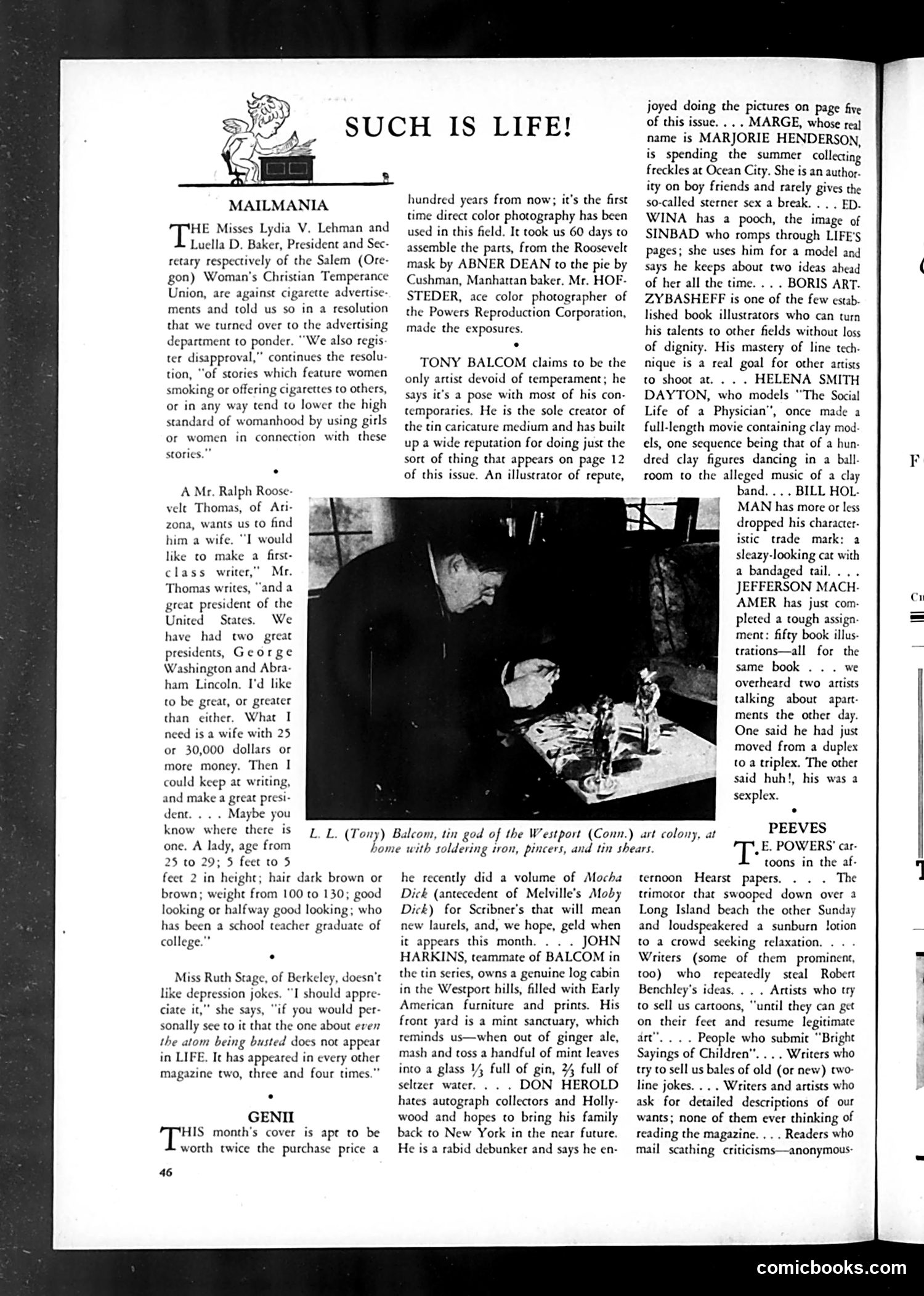
What This Page Means This is a "mail and contributors" page from *Life* magazine featuring reader letters and editorial notes about the magazine's artists and staff. The satirical content includes humorous reader submissions: 1. The WCTU complaint: Salem temperance activists formally object to cigarette advertisements and depictions of women smoking—*Life* sarcastically notes this went to the advertising department to "ponder," implying the complaint will be ignored. 2. The matrimonial plea: A Mr. Roosevelt Thomas from Arizona seeks a wife specifically to fund his ambitions to become a great president (comparing himself to Washington and Lincoln). The absurdity is self-evident—his mercenary approach to marriage. 3. The depression joke complaint: A reader objects to repeated "even the atom being busted" jokes during economic hardship. The page also profiles contributing artists like Tony Balcom (tin caricature specialist) and illustrators, offering light gossip about the Westport art colony. The humor operates through *Life's* characteristic 1930s-era editorial voice: dry, slightly mocking, treating frivolous complaints and grandiose schemes with mock-serious attention.
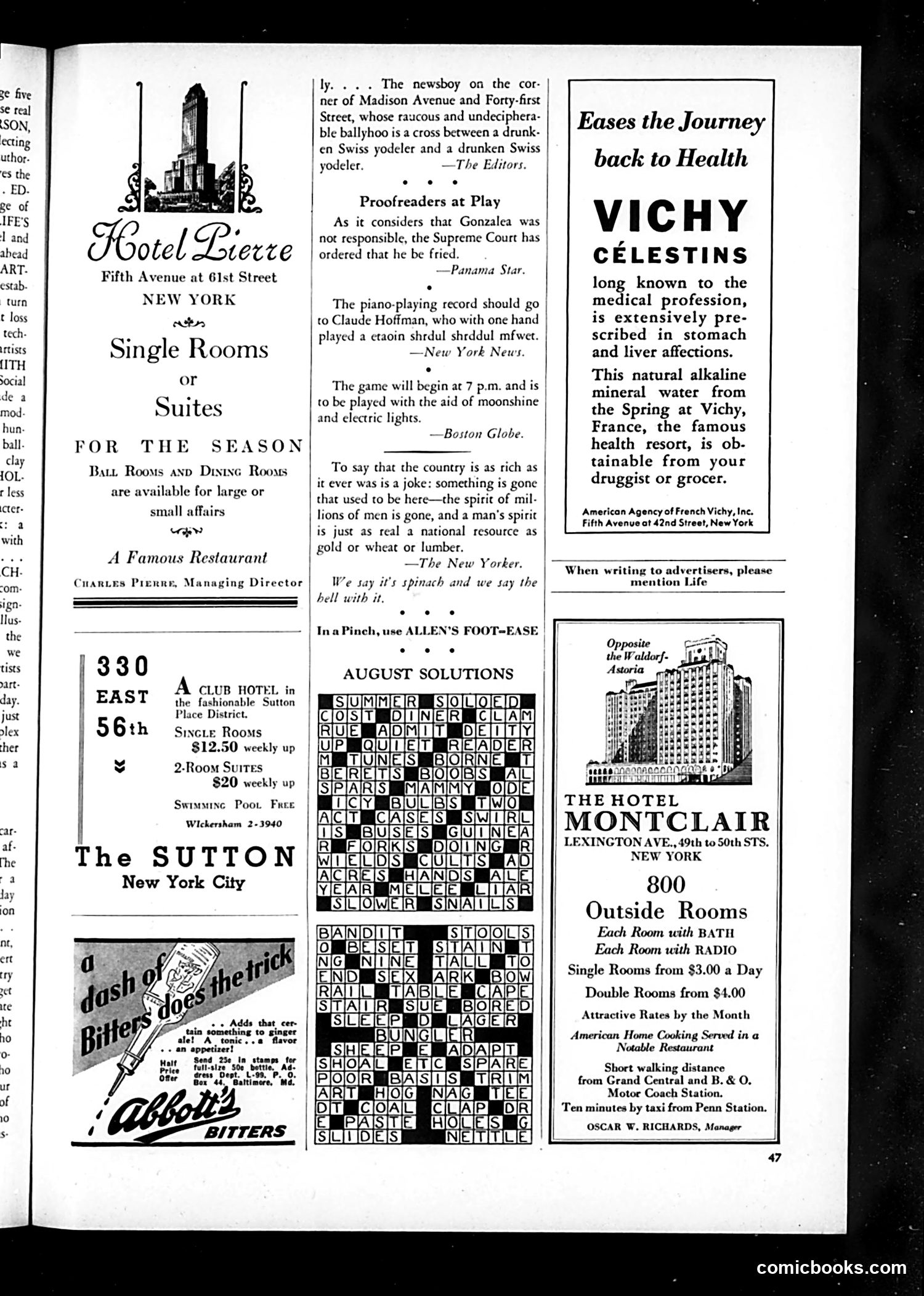
Analysis of Life Magazine Page This page is primarily advertising and editorial content, not political satire. The main text includes brief editorial quips ("Proofreaders at Play," "August Solutions") mocking current events in a light, humorous style typical of Life's satirical format. References include: - A Supreme Court decision regarding someone named Gonzalea being sentenced to execution - A piano player's nonsensical record ("etaoin shrdul") - Commentary on American economic decline ("the spirit of millions of men is gone") The page is dominated by hotel and restaurant advertisements (Hotel Pierre, The Sutton, Hotel Montclair) and a Cobb's Bitters patent medicine ad. A crossword puzzle labeled "August Solutions" occupies the center. The tone is gentle satire on everyday absurdities rather than pointed political commentary. Without additional context about specific 1920s events referenced, precise identifications remain unclear, though the Gonzalea reference appears to be a contemporary legal case.
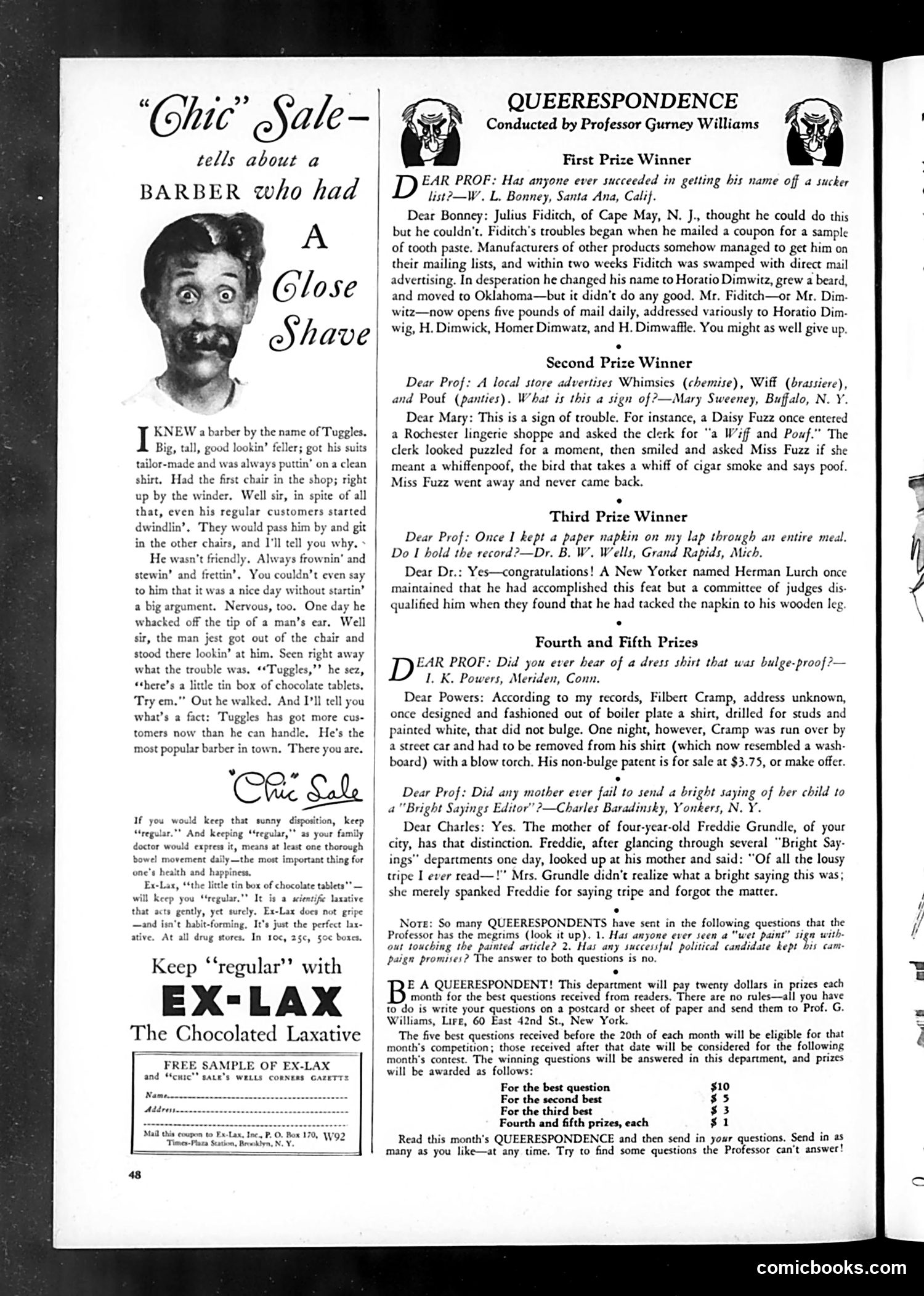
"Chic" Sale's Barber Story and Life Magazine's Humor Page This page combines a humorous short story by "Chic" Sale (a popular 1920s-30s humorist) with an advertisement and reader correspondence column. The Barber Story: Sale describes a popular barber named Tuggles who loses customers because he's irritable and nervous—he even clips a man's ear. A stranger solves the problem by giving Tuggles chocolate laxatives ("Ex-Lax"), and suddenly he's friendly and successful. The joke conflates digestive regularity with good temperament, serving as a thinly-veiled product advertisement. The Correspondence Column: "Professor Gurney Williams" answers absurd reader questions with deadpan humor—a frustrated man buried in junk mail despite changing his name; a lingerie store's confusing product names; someone who kept a napkin on their lap through an entire meal. The humor relies on exaggeration and wordplay typical of 1920s-30s magazine comedy. The overall tone is lighthearted Americana, mixing vernacular storytelling with silly observations about everyday modern life.
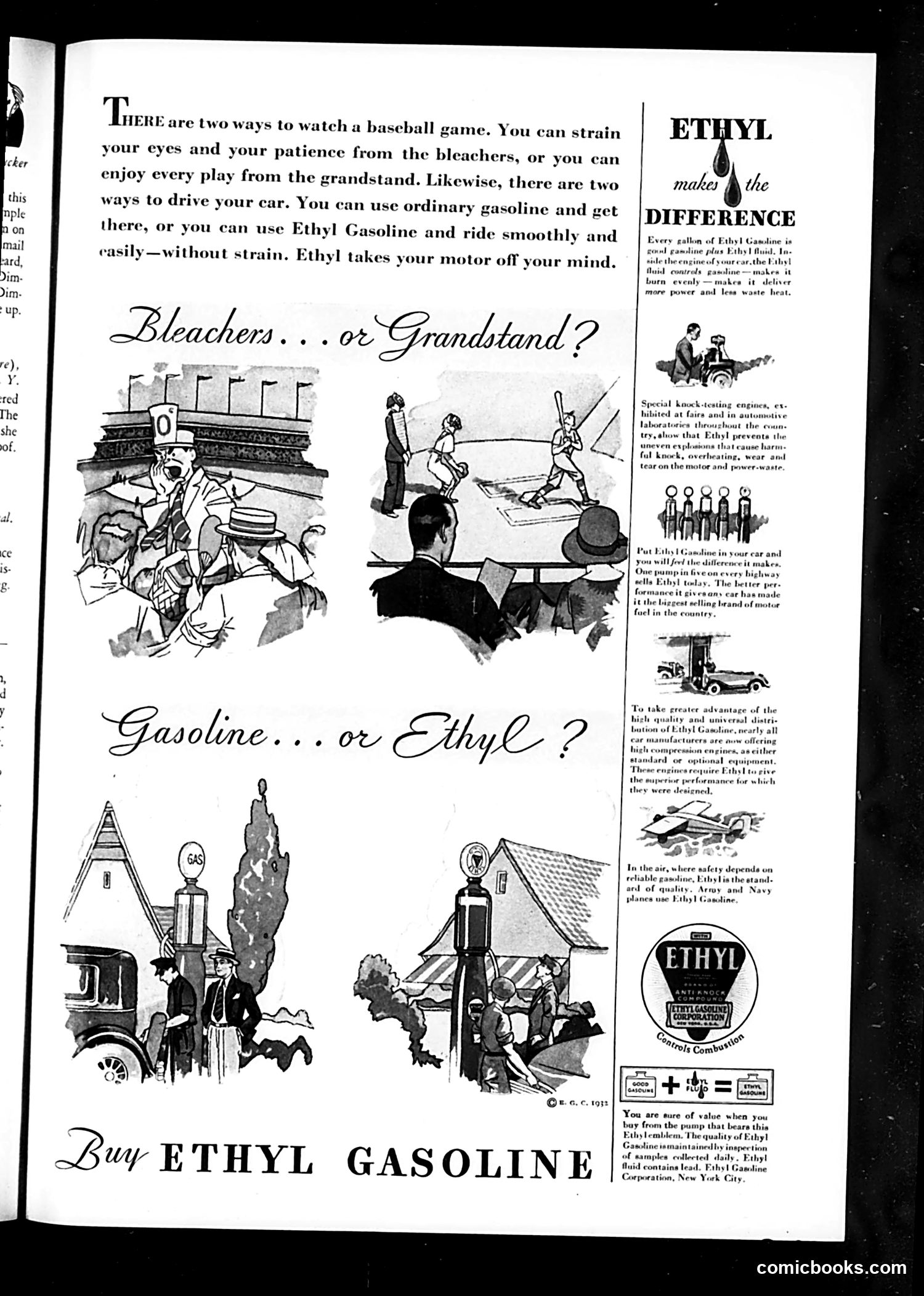
Analysis This is primarily an advertisement for Ethyl Gasoline (a leaded fuel product), not political satire. The page uses an analogy between baseball viewing and automobile fuel choices. The left side compares two experiences: watching from uncomfortable bleachers versus a comfortable grandstand, paralleling ordinary gasoline versus Ethyl Gasoline. The illustrations show crowded, strained bleacher-goers versus relaxed grandstand spectators—and similarly, troubled drivers versus smooth-riding Ethyl users. The right side advertises Ethyl's technical superiority, claiming it prevents engine knock and wear. The cartoons depict exaggerated problems with regular gasoline (overheating engines, vehicle strain) versus Ethyl's smooth performance. Modern context: Ethyl gasoline contained lead as an anti-knock additive. This was marketed as a premium, sophisticated choice. The advertising uses aspirational class comparison—bleachers/grandstand—to position Ethyl as the superior, worry-free option for discerning motorists. This predates awareness of lead's severe health hazards.
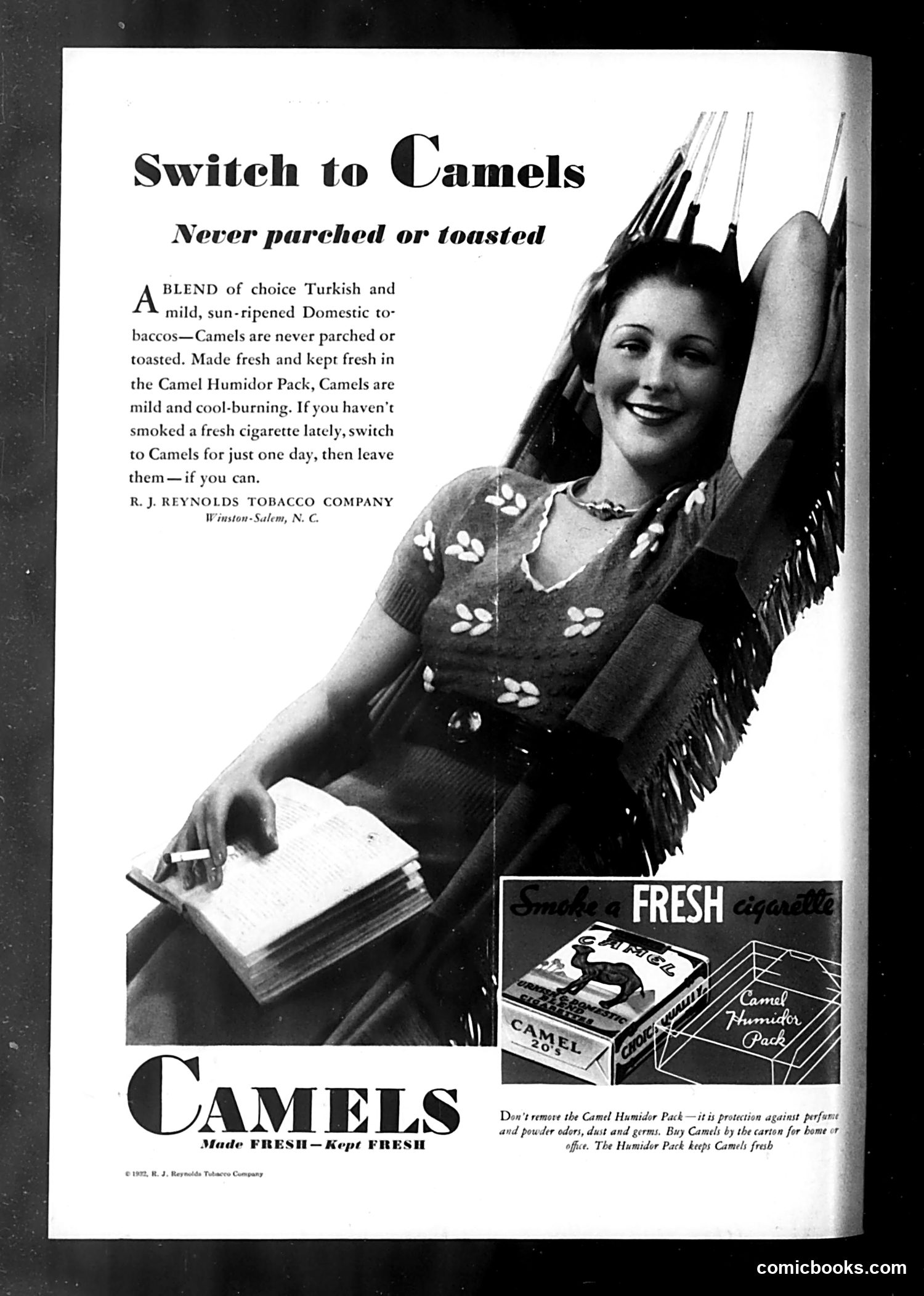
Camel Cigarettes Advertisement Analysis This is not satire or political commentary—it's a straightforward cigarette advertisement from the R.J. Reynolds Tobacco Company, likely from the 1930s-1940s based on styling. The page features a smiling woman in a chair holding a magazine, used to associate cigarette smoking with leisure and modernity. The ad's selling points emphasize freshness: Camels are "never parched or toasted" and come in a special "Humidor Pack" for preservation. The tagline "switch to Camels for just one day, then leave them—if you can" is a humorous challenge implying addiction/appeal, normalized marketing at the time. For modern readers: This represents an era when tobacco companies freely advertised cigarettes using aspirational imagery and health-adjacent claims, before cigarette advertising was banned on American television (1971) and health warnings became mandatory.
I can see this is a mostly blank or heavily darkened page from what appears to be a historical publication, with only "comicbooks.com" visible at the bottom right. The image quality is extremely poor—predominantly black with minimal visible content or discernible text beyond the watermark. Without clear visual elements, legible text, or identifiable cartoon figures, I cannot reliably explain any satirical content, political references, or jokes that may have appeared on this page. The page either failed to scan properly, has severely degraded, or contains only blank space. To provide accurate historical analysis as requested, a clearer or higher-contrast version would be necessary.