life
Life — October 1932
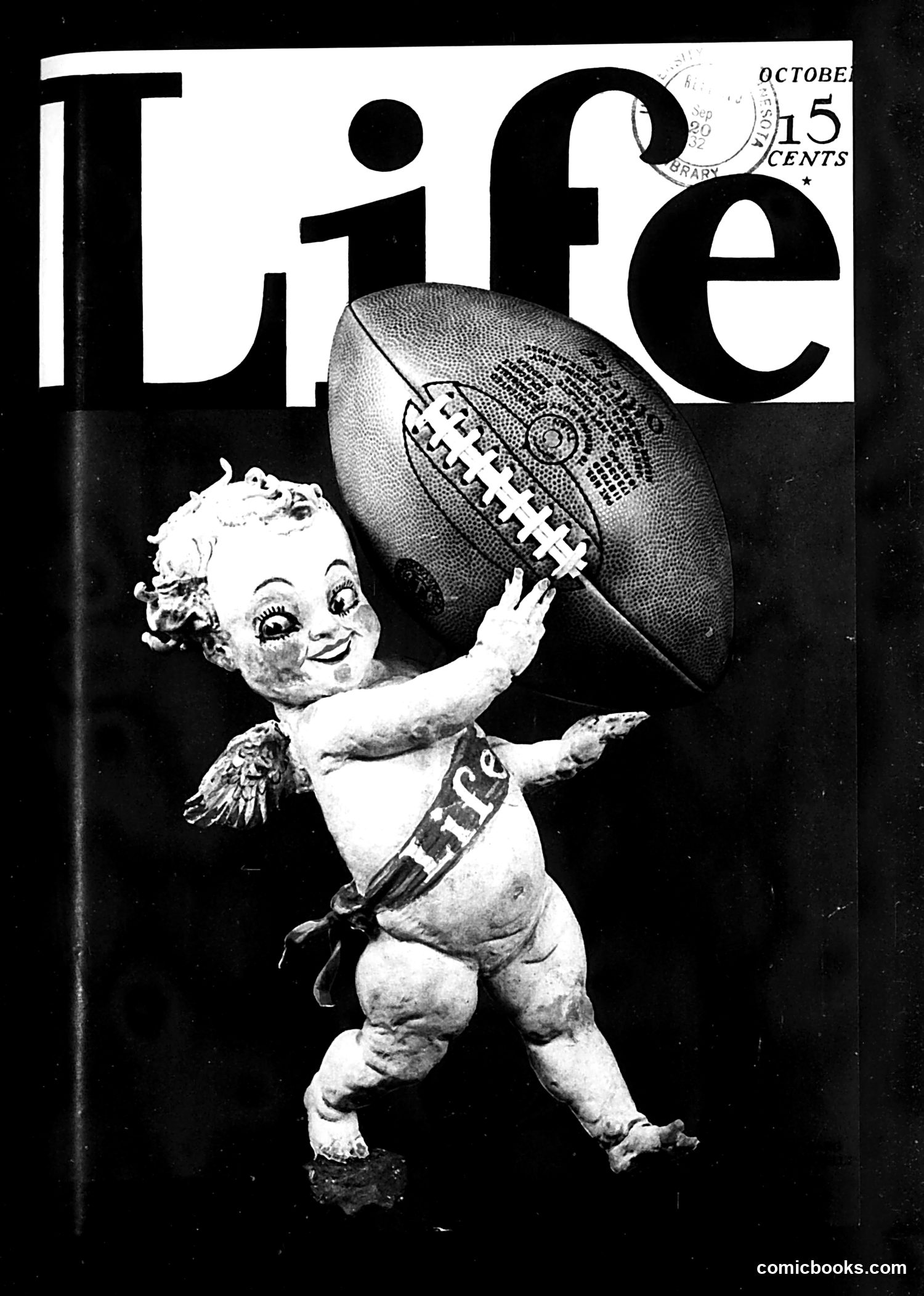
Life Magazine Cover Analysis This October 1915 Life cover features a cherubic baby character—likely a generic "cupid" or cherub figure rather than a specific political figure—holding an oversized American football. The baby wears what appears to be a sports banner or sash across its torso. The satire likely comments on American football's popularity and cultural significance during this era, presenting the sport as something even infants are invested in. The exaggerated musculature of the baby and its determined expression humorously emphasize football's dominance in American culture and public consciousness. Without additional text context, the specific satirical target remains unclear, though it clearly plays on football fever sweeping the nation during the early 20th century.
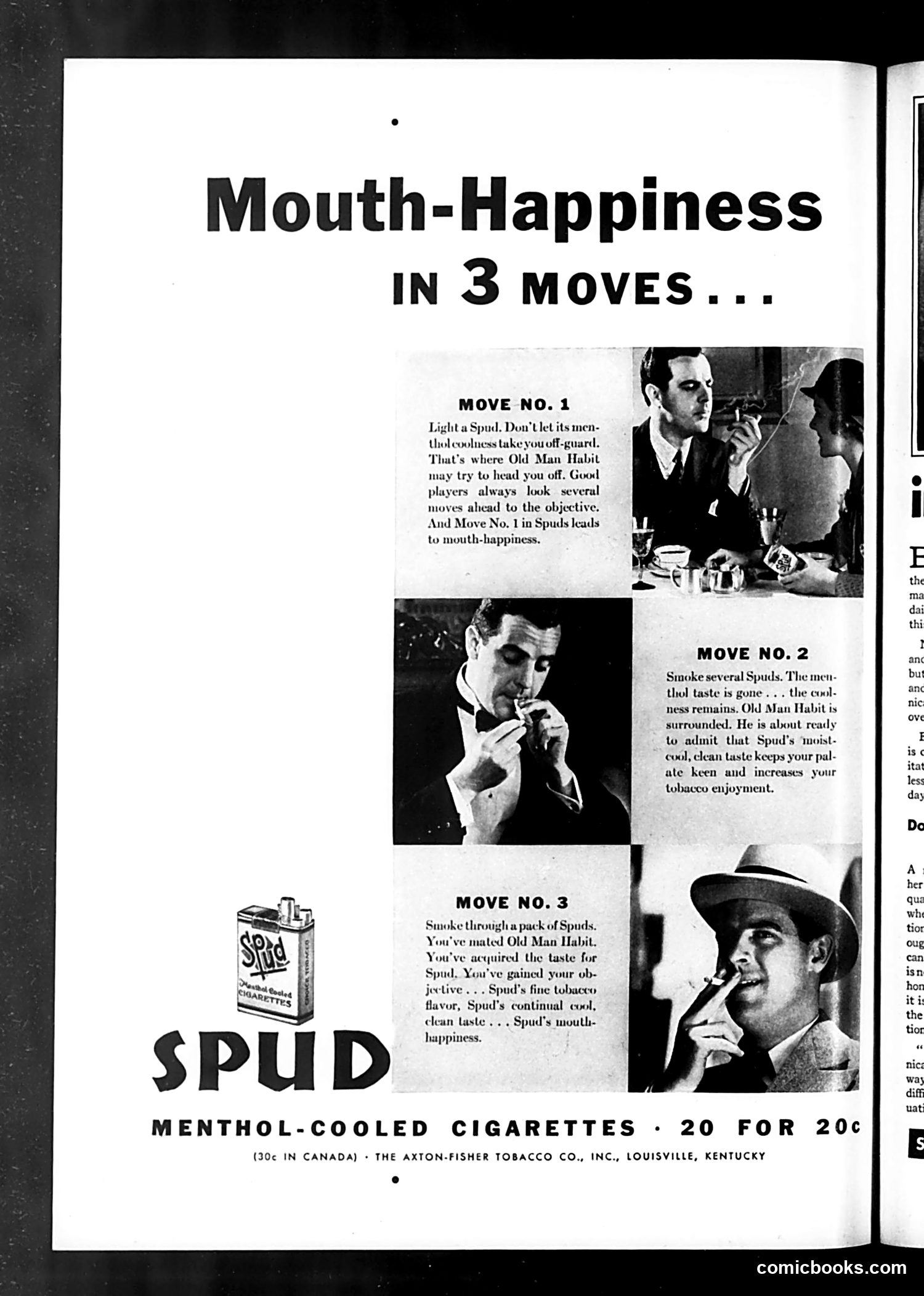
Analysis This is a vintage cigarette advertisement, not political satire. The page advertises "Spud" menthol-cooled cigarettes (20 for 20¢), manufactured by Axton-Fisher Tobacco Co. in Louisville, Kentucky. The "3 moves to mouth-happiness" is a marketing gimmick presenting cigarette smoking as a sequential pleasure: lighting a spud, smoking several to develop taste preference, and continuing through a pack to achieve "mouth-happiness." The three photographs show men at different stages of smoking. The advertisement references "Old Man Habit" as a humorous acknowledgment that regular smoking creates dependency—presented here as a selling point rather than a warning. This reflects mid-20th-century advertising's open promotion of tobacco before health risks were widely acknowledged.
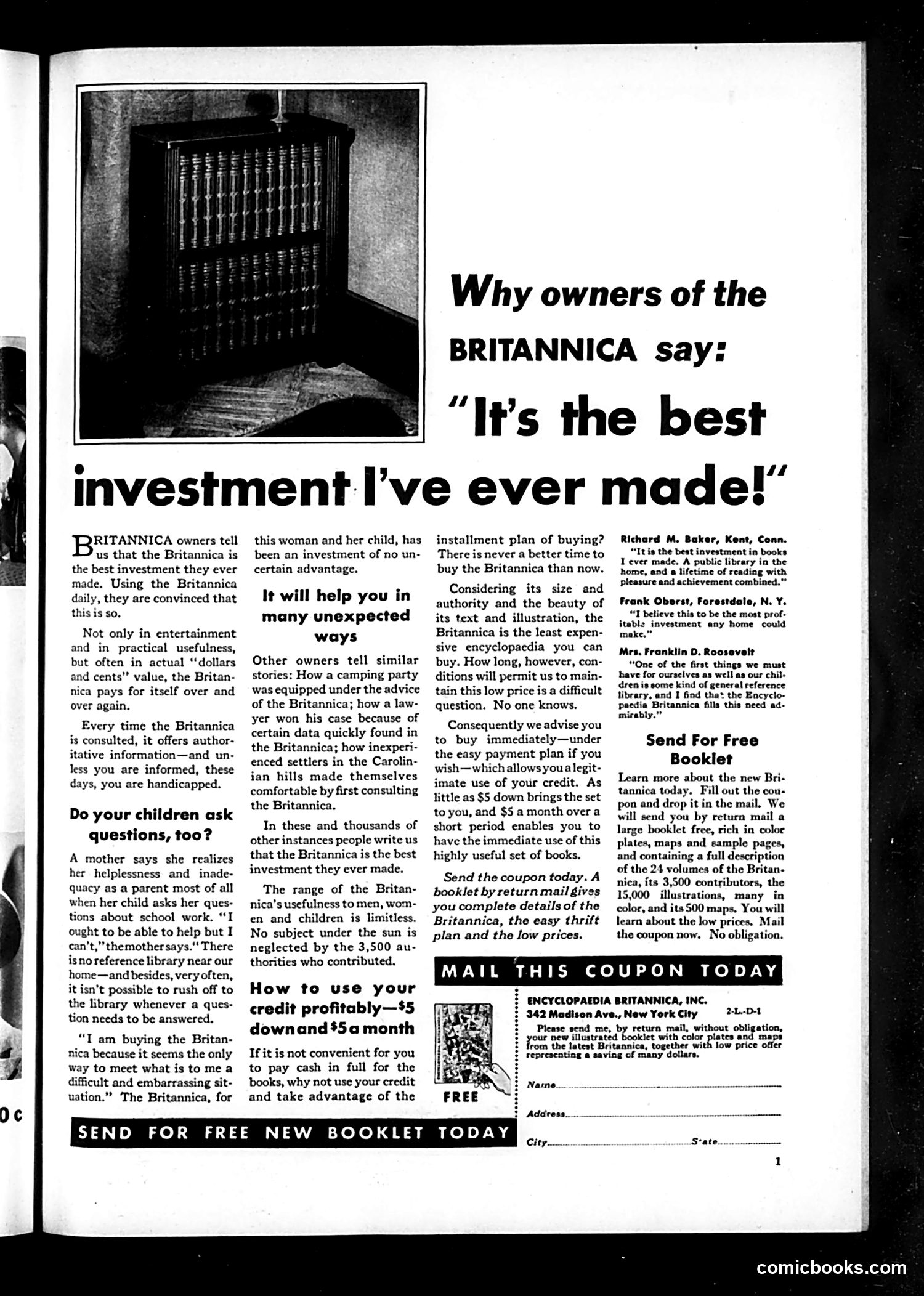
This page is primarily an advertisement for the Britannica Encyclopedia, not a political cartoon or satire. The ad uses testimonials from satisfied owners (identified by name and location) claiming the encyclopedia is "the best investment I've ever made." It emphasizes practical benefits: helping children with homework, providing reference material, and offering convenient credit terms ($5 down, $5 monthly). The small photograph shows a dark wooden encyclopedia cabinet—the physical product being sold. The marketing pitch targets middle-class families concerned about their children's education and practical home reference needs. This represents typical mid-20th-century American advertising strategy: combining authority (expert sources), emotional appeal (parental concern), and financial accessibility (installment plans) to drive consumer purchases.
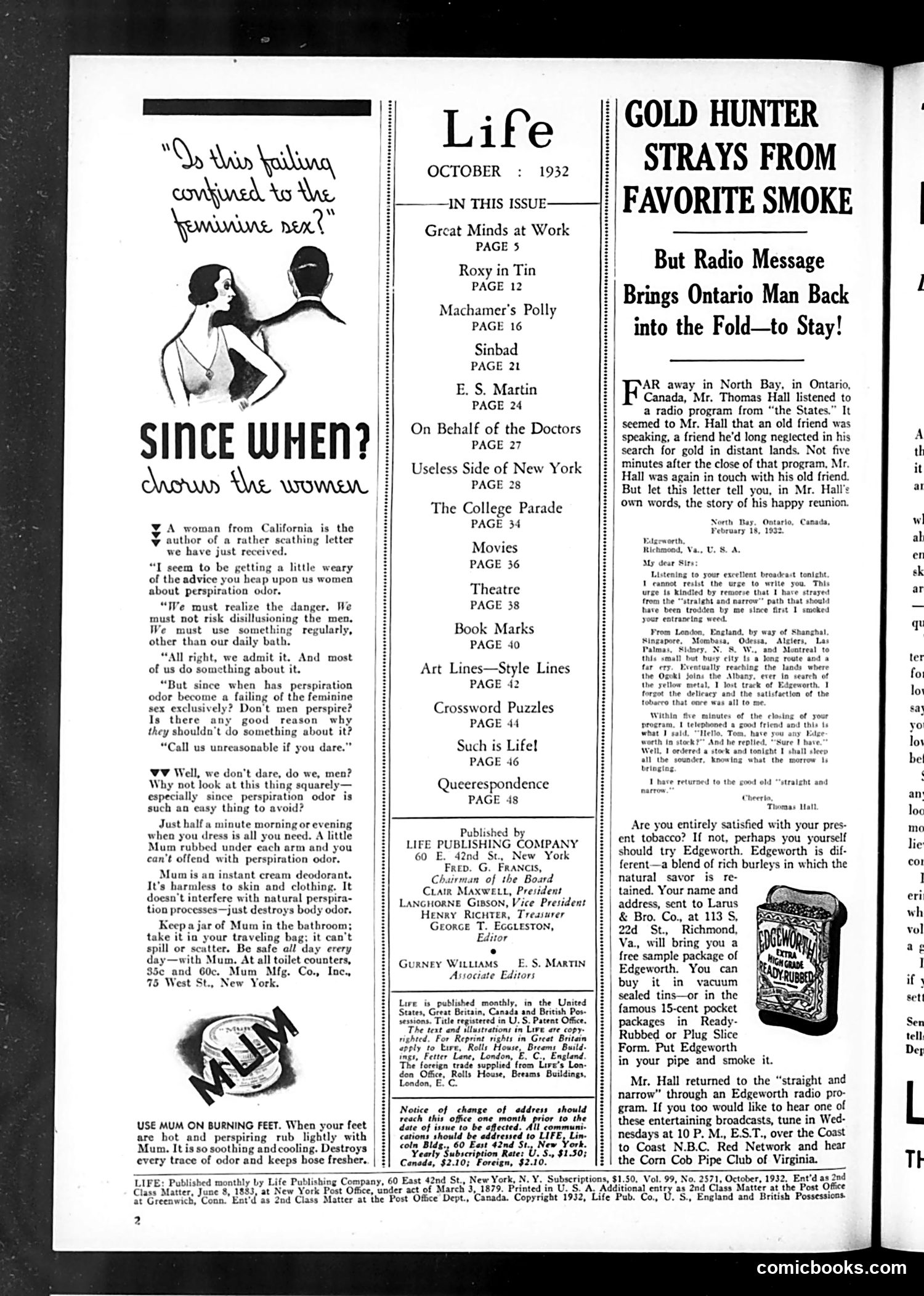
Analysis of Life Magazine, October 1932 This page is primarily a table of contents and masthead, not a political cartoon. The main visual element is a satirical illustration (upper left) depicting a woman touching a man's back, with handwritten text reading "body failing confined to the feminine sex" and the caption "SINCE WHEN?" The satire: A California author is responding to advice about "perspiration odor" being a women's problem. The cartoon mocks the gendered advertising claim that body odor is exclusively female. The response sarcastically questions this assumption—men also perspire and have odor concerns. The accompanying text advocates using "Mum" deodorant as a solution for both sexes, challenging the era's gender-stereotyped marketing that positioned hygiene concerns as primarily women's issues. This reflects 1932 social commentary on advertising's narrow gendering of everyday products.
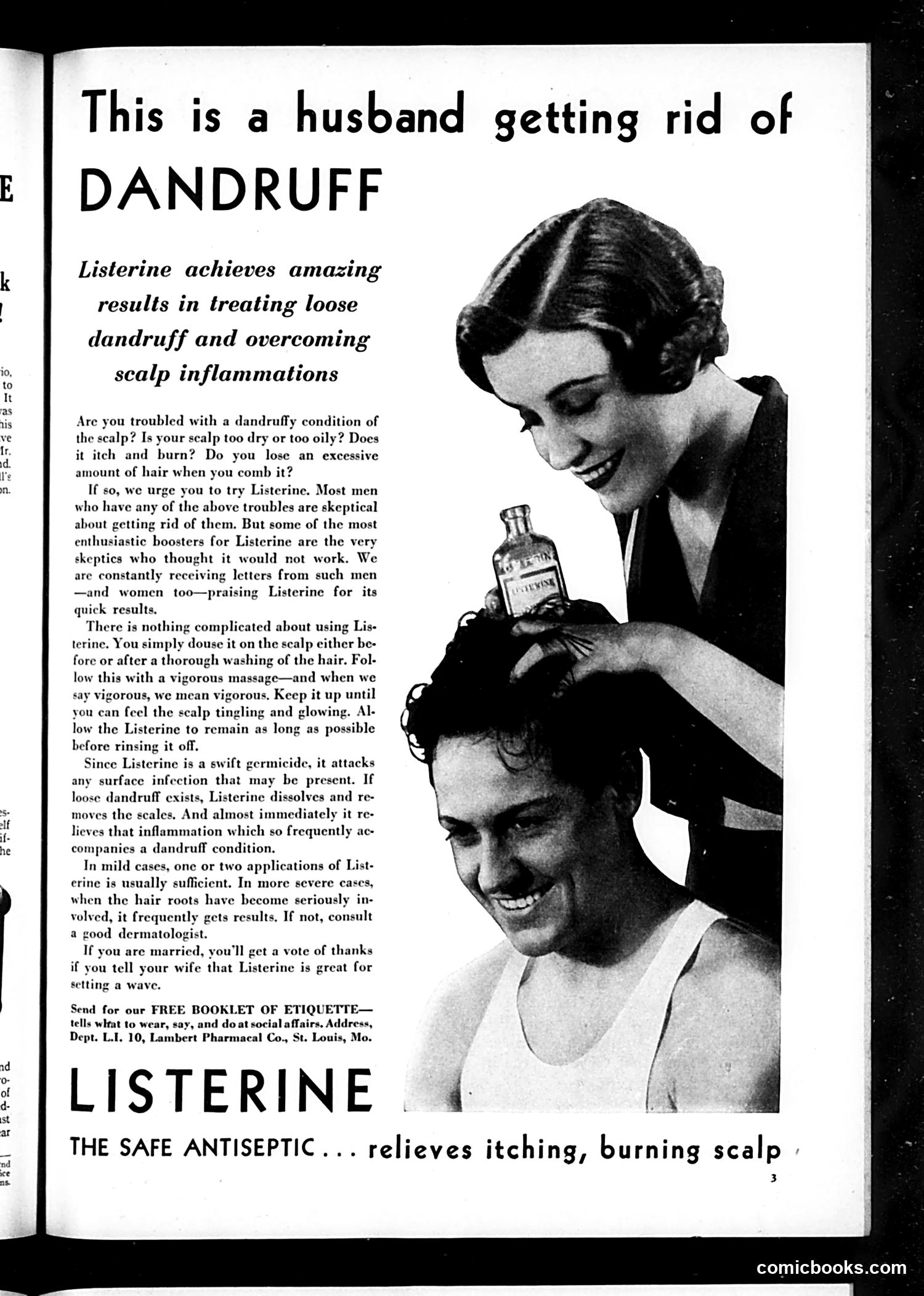
Analysis This is a vintage advertisement, not satire or political cartoon. It's a Listerine mouthwash ad from an early 20th-century *Life* magazine promoting the product's use as a dandruff treatment. The image shows a woman applying Listerine to a man's scalp. The ad copy emphasizes that Listerine is a "swift germicide" that dissolves dandruff scales and relieves scalp inflammation through vigorous massage application. The humor is typical of period advertising: it suggests a wife would be grateful to her husband for using the product to treat dandruff (implying marital discord over poor hygiene). The ad includes a promotional offer for a free "Booklet of Etiquette" from Lambert Pharmacal Co., St. Louis. This reflects outdated advertising that normalized using antiseptics broadly beyond their actual medical purposes.
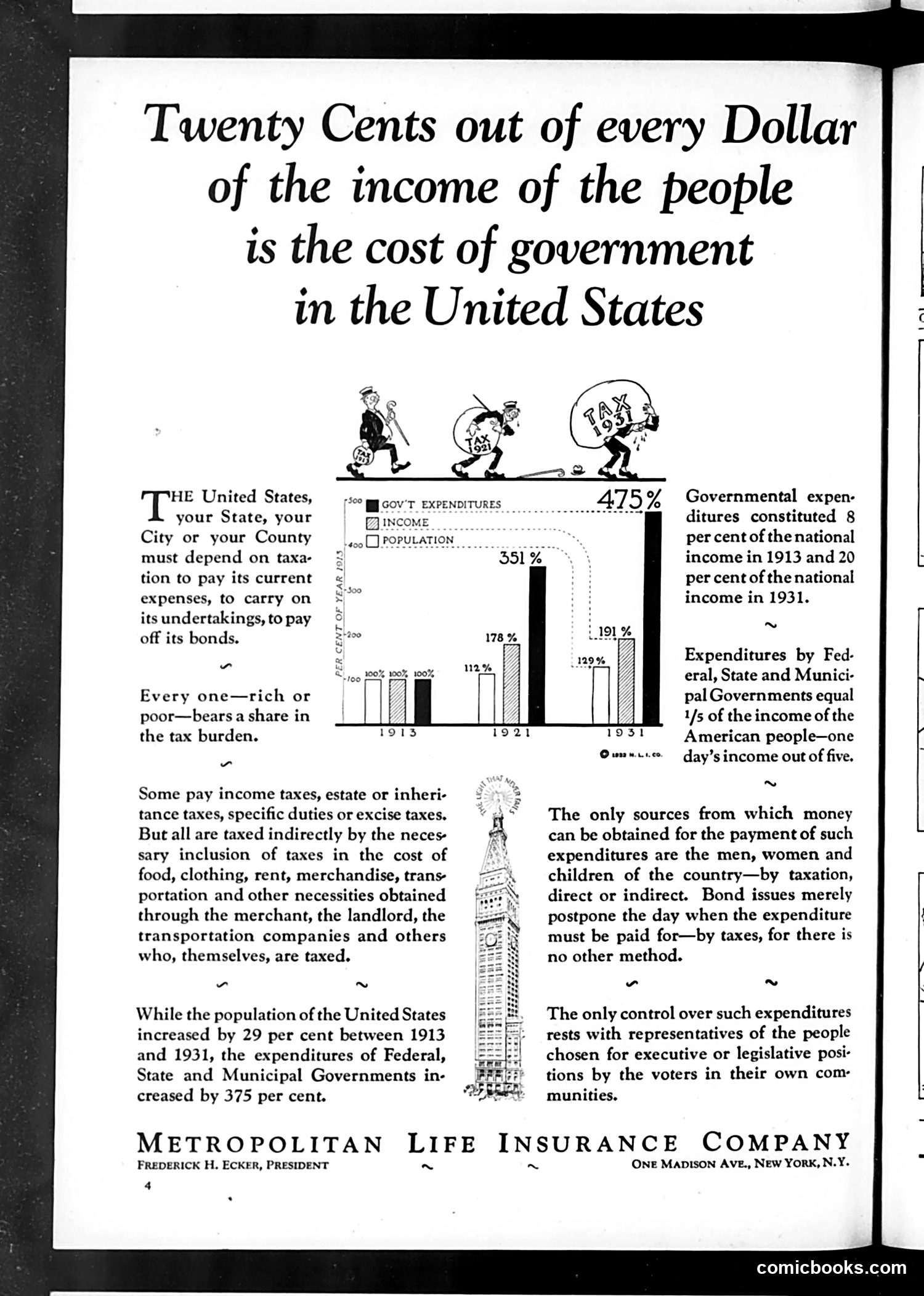
Analysis This is a Metropolitan Life Insurance Company advertisement using political satire to argue against government spending growth. The page depicts three stylized figures labeled "TAX" progressively burdening taxpayers, illustrating how taxation has grown. The accompanying bar chart shows government expenditures increased 475% between 1913-1931, while population grew only 29%—the core argument: government is expanding far faster than necessary. The text argues that all government spending ultimately comes from citizens through direct or indirect taxation, and that only democratic representatives can control this spending. The piece criticizes the disproportionate growth of Federal, State, and Municipal expenditures. This reflects 1930s conservative opposition to New Deal expansion, presenting government growth as an excessive burden on ordinary Americans' income.
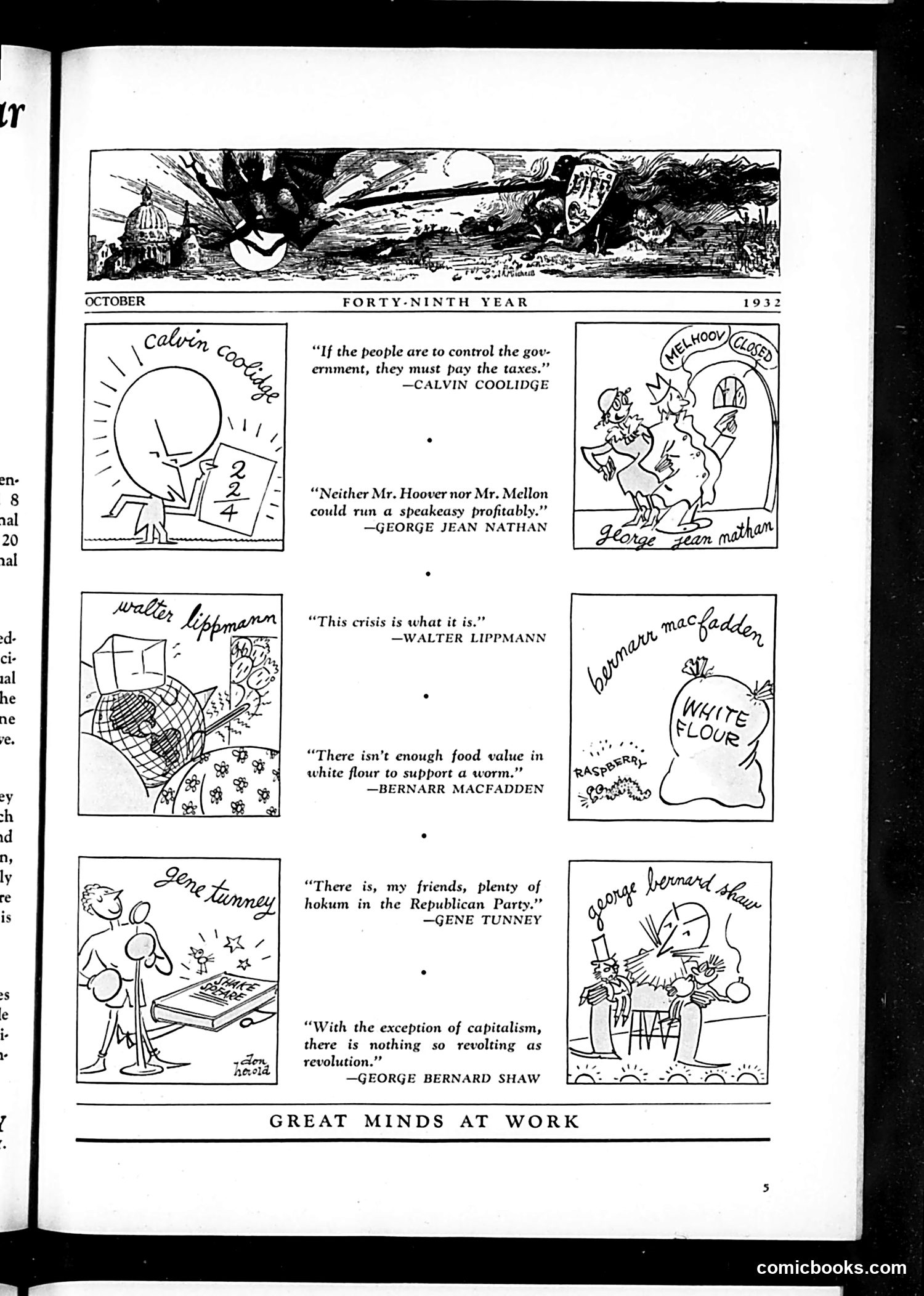
"Great Minds at Work" - October 1932 This satirical page presents quotes from prominent figures alongside cartoons mocking their commentary on the Great Depression. The page critiques political and intellectual leaders for offering simplistic or unhelpful responses to economic crisis. Featured figures include Calvin Coolidge (on taxation), George Jean Nathan (on speakeasies), Walter Lippmann (on the crisis itself), Bernarr Macfadden (on nutrition), Gene Tunney (on the Republican Party), and George Bernard Shaw (on capitalism). The cartoons visually ridicule these statements—showing figures like Coolidge as a lightbulb (suggesting dim ideas) and Macfadden with white flour and raspberries (mocking his nutritional claims). The overall message: these "great minds" offer platitudes disconnected from ordinary Americans' desperate economic suffering during the Depression.
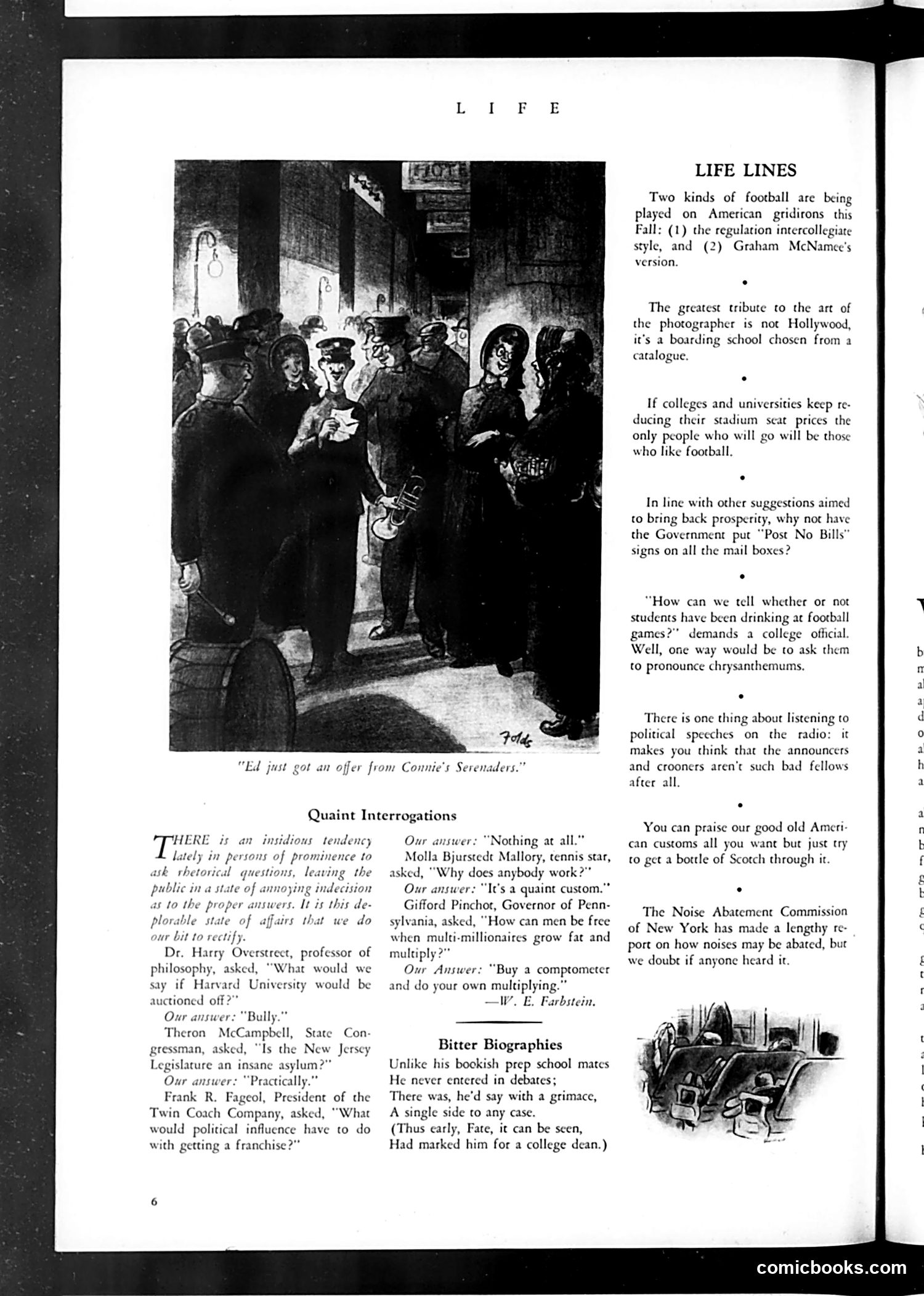
Analysis of Life Magazine Page This page contains satirical commentary on American society rather than a specific political cartoon. The main image shows a crowded indoor scene with the caption "Ed just got an offer from Connie's Serenaders"—likely referencing a popular musical group of the era. The "Life Lines" section offers humorous social observations about football attendance, stadium prices, mail service, student drinking, and radio political speeches. The "Quaint Interrogations" section presents absurd questions and answers mocking prominent figures like Harvard University and Frank Faggol (Twin Coach Company president), using deadpan responses for comedic effect. "Bitter Biographies" offers witty character sketches. Overall, the page satirizes American institutions, politics, and social customs through ironic commentary rather than visual caricature.
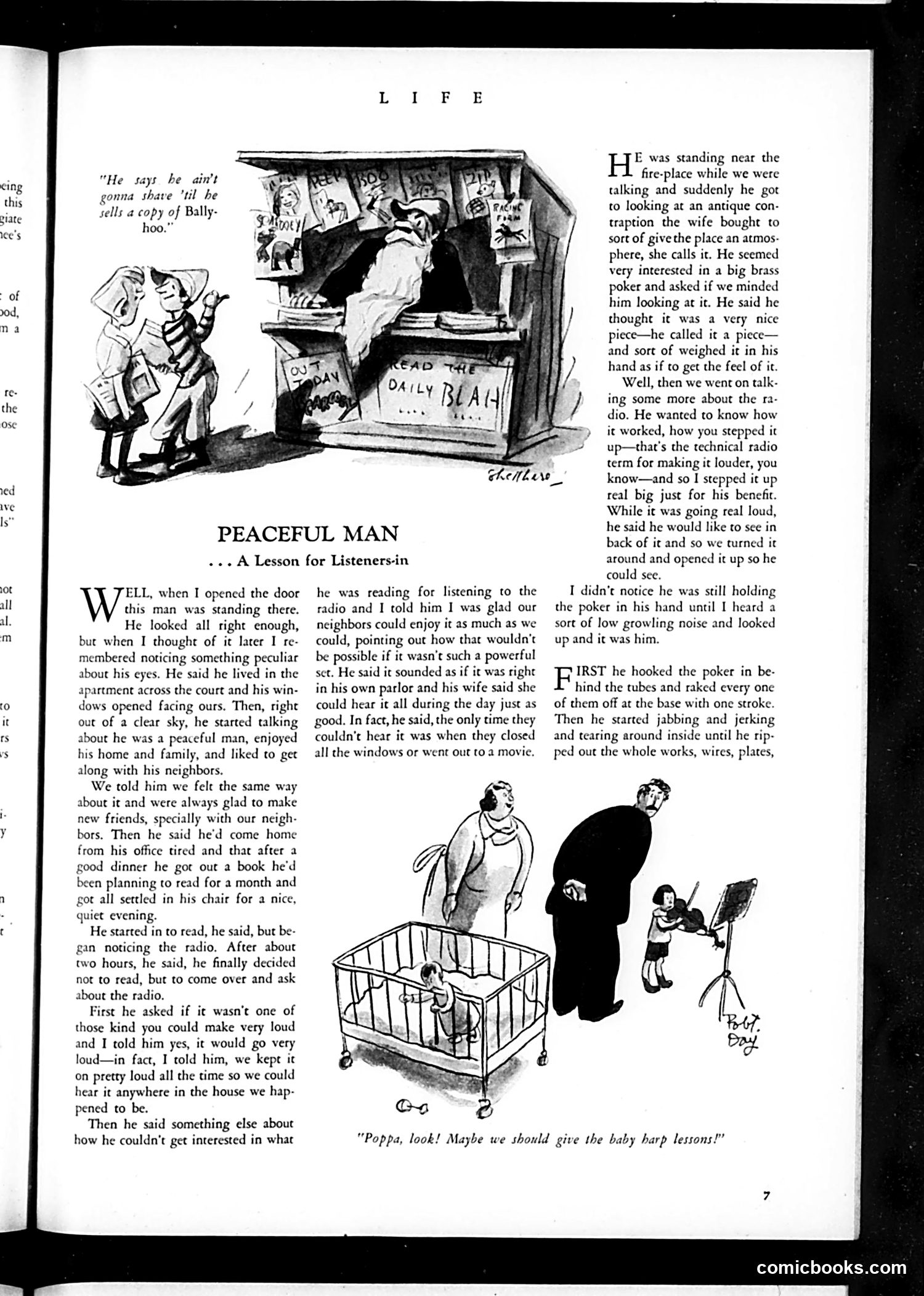
Analysis of "Peaceful Man: A Lesson for Listeners-in" This satirical piece mocks a neighbor obsessed with his new radio set. The story describes a man who constantly adjusts the volume to irritating levels, claiming he's conducting "technical" experiments. The humor targets 1920s-30s radio enthusiasm—specifically how new radio owners would monopolize family time and annoy neighbors with excessive noise while tinkering with their sets. The caption "He saith he ain't gonna share 'til he gets a eighth of Ballyhoo" references *Ballyhoo*, a contemporary satirical magazine, adding meta-humor. The domestic illustrations show the radio's disruptive effect on family life and the exasperated reactions of those around him. The satire critiques not the technology itself, but the peacefully-inclined neighbor's selfish, inconsiderate obsession with it.
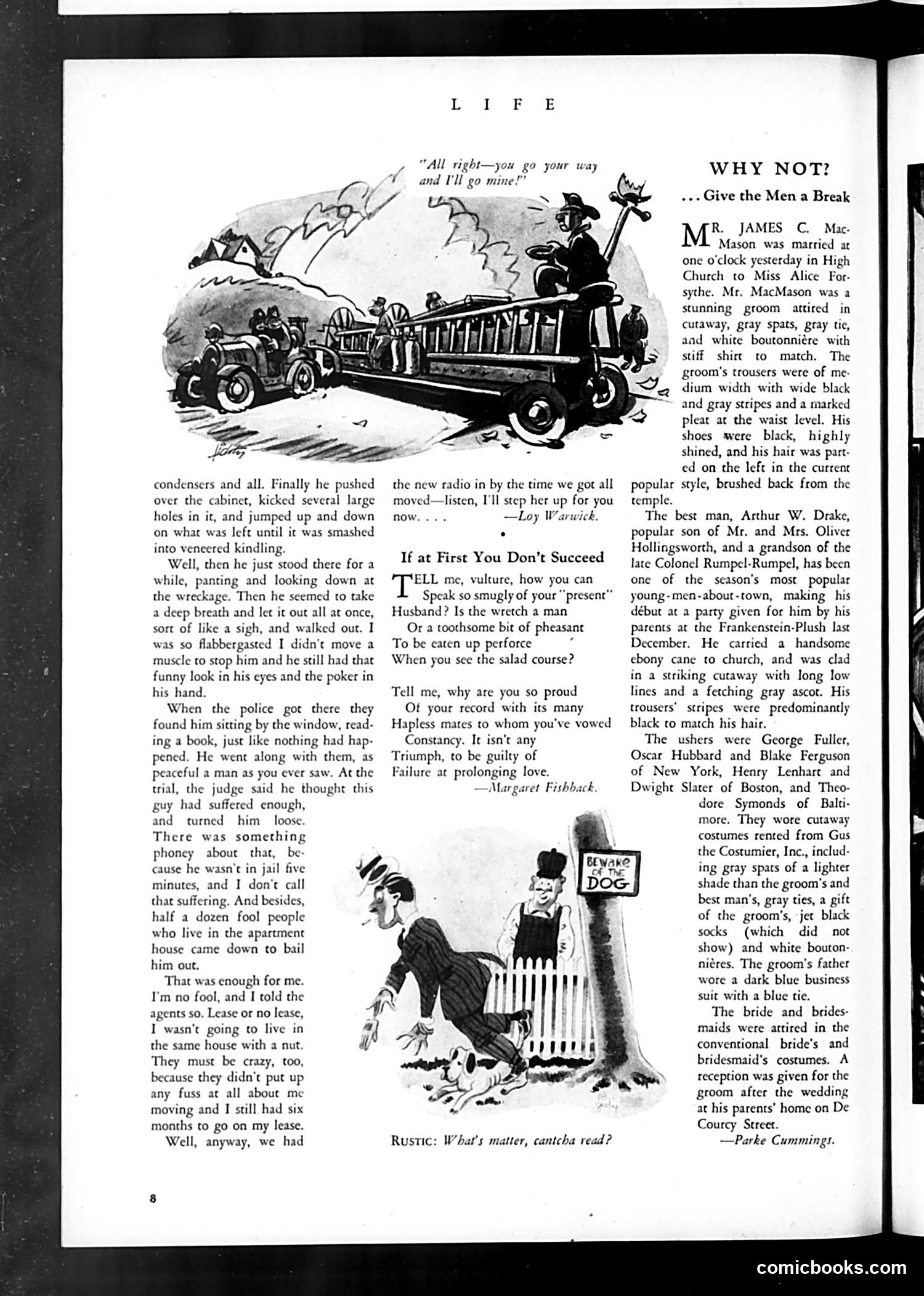
Analysis of Life Magazine Page This page contains two distinct cartoon commentaries: Top cartoon: Illustrates a car-versus-trolley collision scenario, humorously depicting the chaos of early automotive traffic. The caption "All right—you go your way and I'll go mine" satirizes drivers' inability to coordinate on shared roads, a common concern as automobiles became widespread. Bottom cartoon: Shows a man with a "BEWARE OF DOG" sign but no actual dog present. Captioned "Rustic: What's matter, cantichas read?" This mocks rural illiteracy—the joke being the farmer posted a warning sign he cannot himself read, suggesting he's mimicking urban practices without understanding them. The right column contains a wedding announcement for Mr. James C. MacMason, describing guests' formal attire in detail—typical society page content of the era.
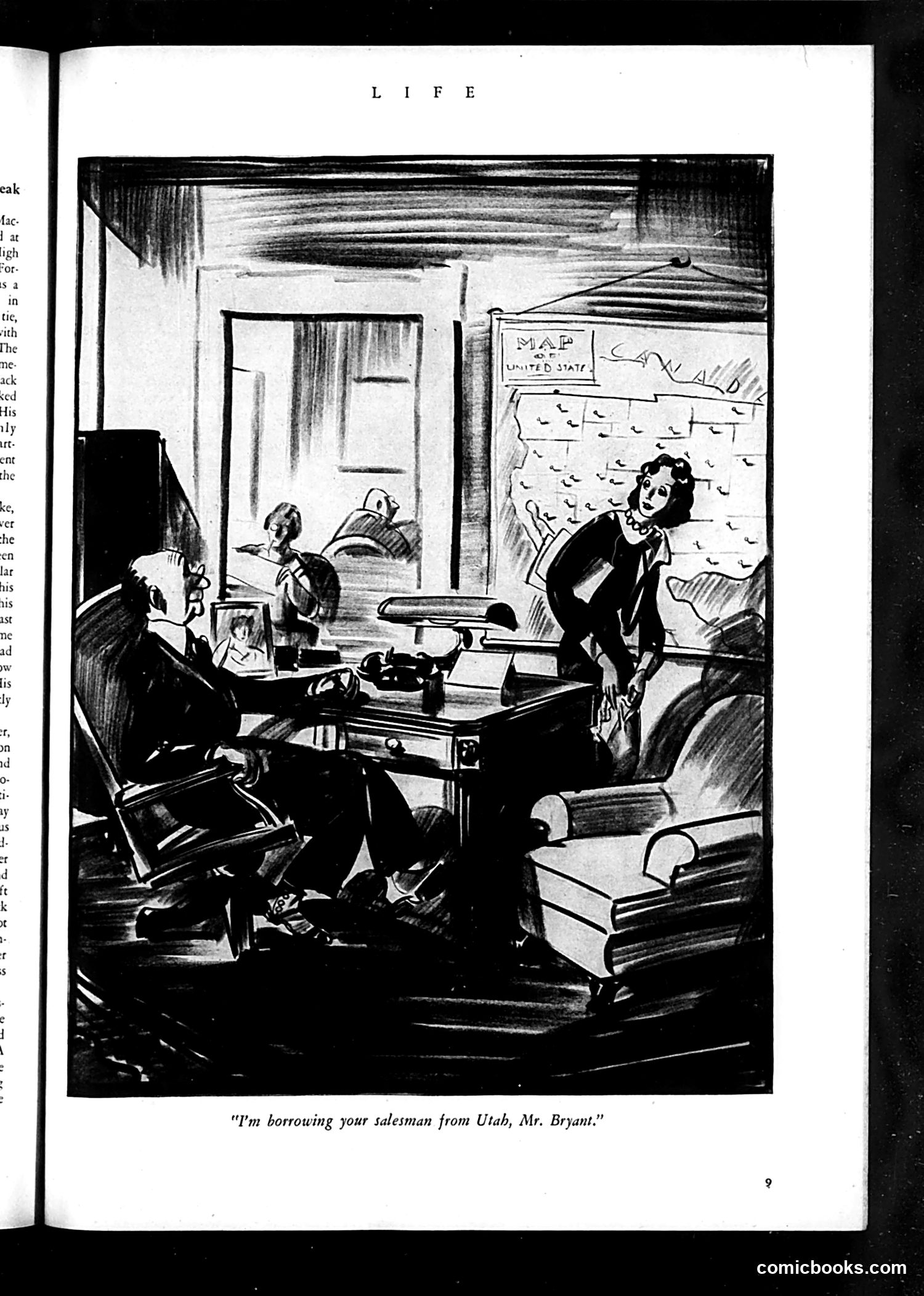
Cartoon Analysis This single-panel cartoon depicts an office scene where a woman stands confidently while a man sits at a desk. The caption reads: "I'm borrowing your salesman from Utah, Mr. Bryant." The humor relies on a business/workplace joke about temporarily taking someone's employee. The woman appears to be a businessperson or manager, and she's casually informing Mr. Bryant (presumably her colleague or superior) of this arrangement. The satire appears to target either workplace dynamics, gender relations in business, or perhaps the casual way resources—including people—were borrowed or reassigned in mid-20th century offices. The specific reference to Utah is unclear without additional context, though it may suggest the salesman is notably far from his home territory.
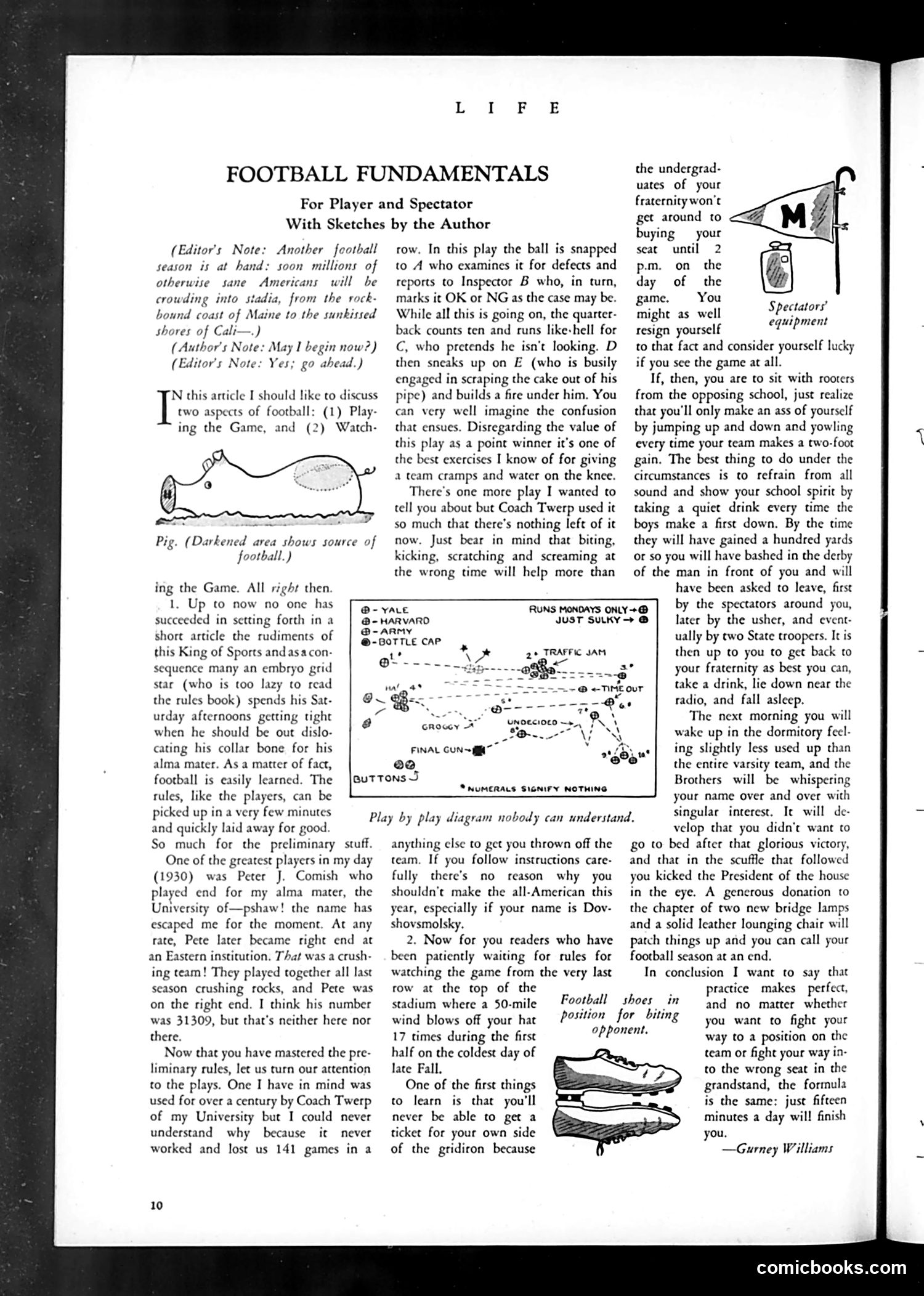
Analysis This page from *Life* magazine presents "Football Fundamentals" — a humorous instructional article about playing and watching football, not a political cartoon. The piece includes: Content: - A diagram showing a football play with positions marked (Yale, Harvard, Army, etc.) - Sketches depicting football shoe positioning and spectator etiquette - Satirical commentary on football culture, including advice about obtaining stadium tickets and managing fan behavior The Satire: The humor targets college football's social pretensions — the difficulty acquiring good seats, the expectation to dress formally, and the status-consciousness surrounding the sport. References to specific institutions (Yale, Harvard) reflect football's association with elite universities in the 1930s. Historical Context: College football was a major social event for the wealthy during this era, and *Life* regularly mocked upper-class affectations through lighthearted sports commentary.
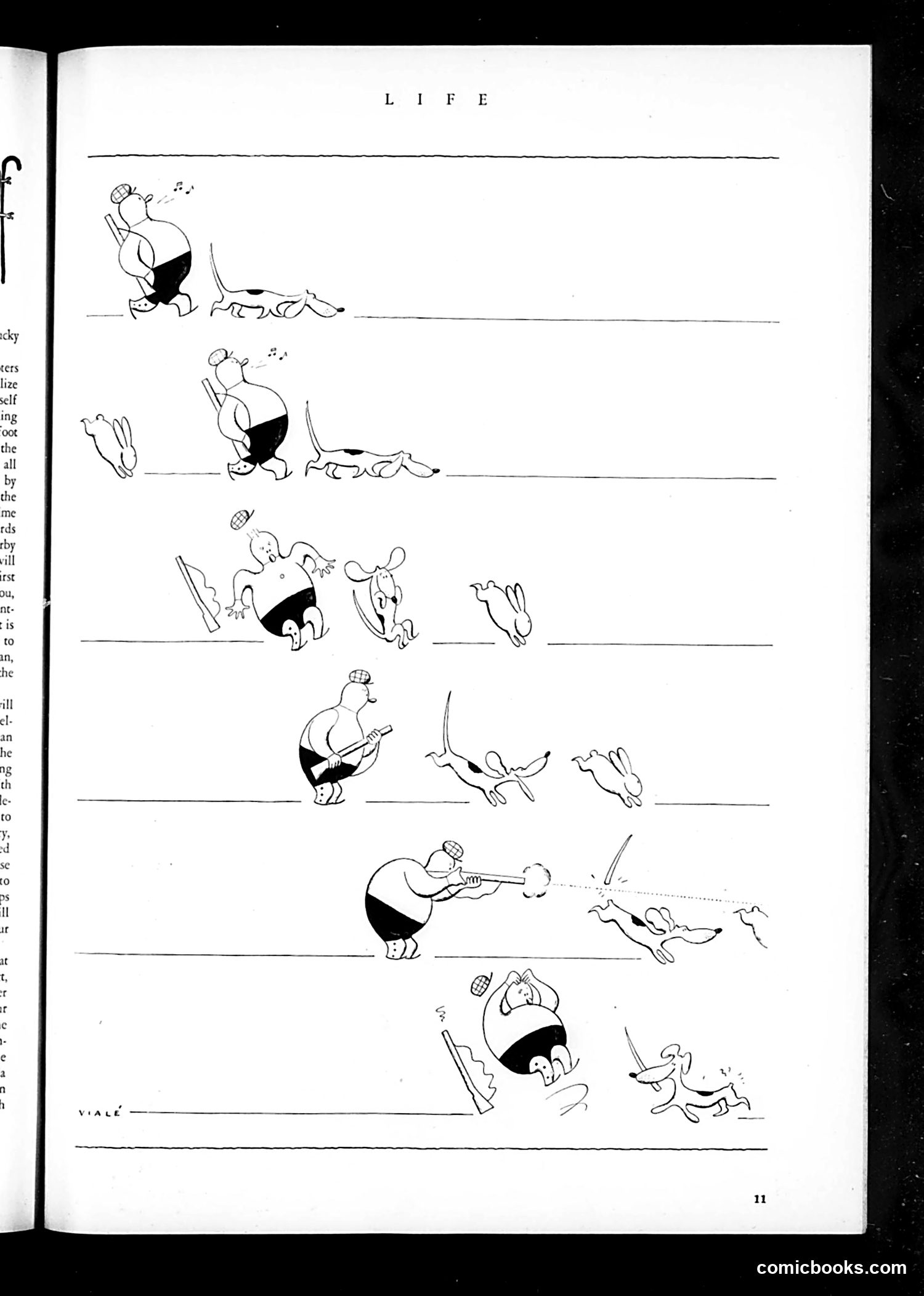
Analysis of "Life" Page This page is titled "LIFE" and contains a wordless comic strip sequence showing a figure with a round body and black shorts engaging in escalating physical comedy with a dog. The narrative progresses from the figure and dog walking together peacefully, through increasingly chaotic interactions—the figure playing a guitar while the dog misbehaves, chasing scenes, and culminating in slapstick violence where the figure appears to strike the dog with various implements. The humor appears to derive from classic silent-comedy physical gags rather than political satire. Without visible text or historical context identifying the specific figure, I cannot definitively name the character, though the art style and format suggest this is early 20th-century American comic entertainment focused on pure slapstick humor rather than social commentary.
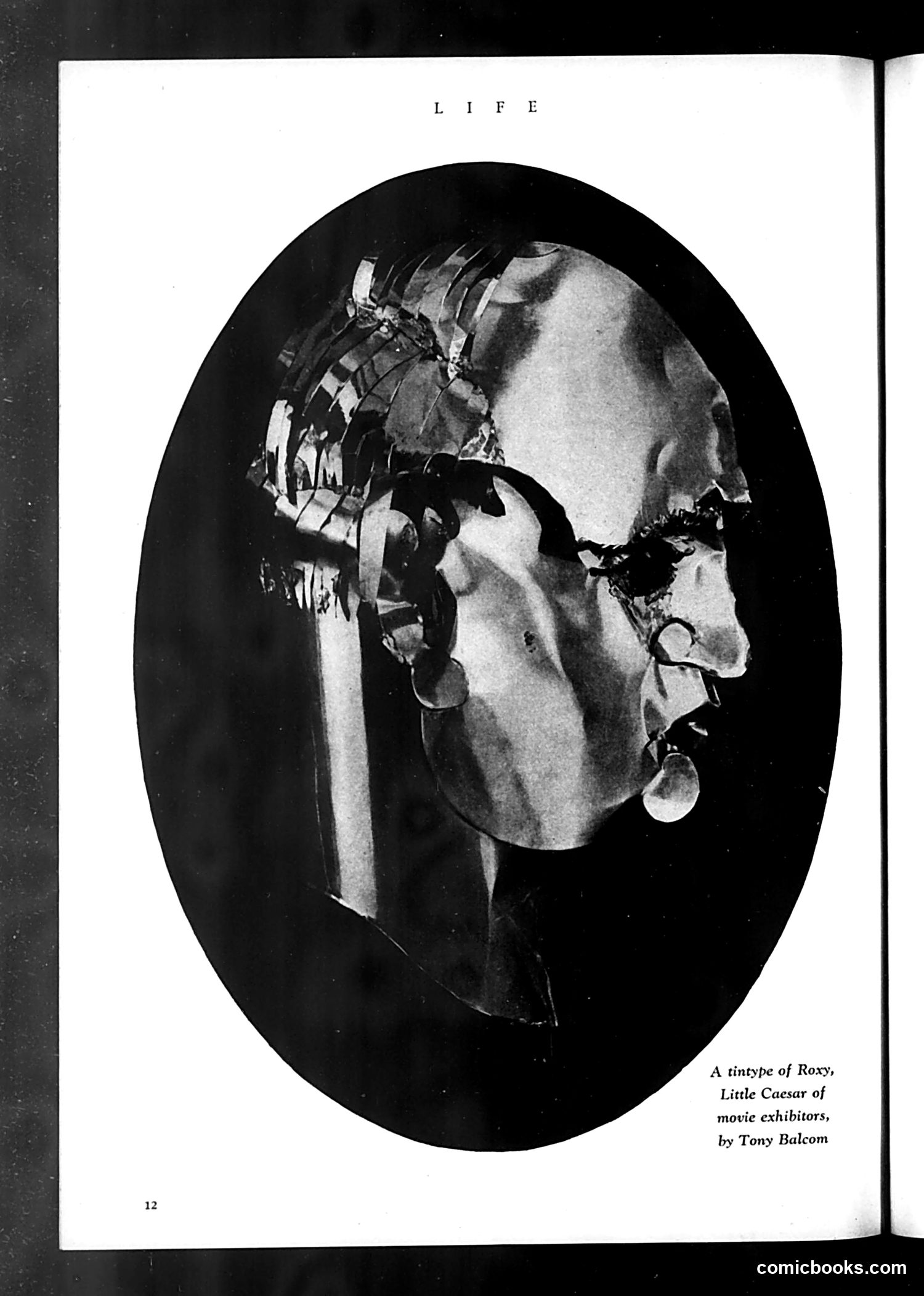
Explanation for Modern Readers This page from *Life* magazine presents a satirical portrait labeled "A tintype of Roxy, Little Caesar of movie exhibitors, by Tony Balcom." The image shows a profile caricature of someone wearing elaborate headgear with mechanical or decorative elements, large circular earrings, and distinctive facial features exaggerated in profile. The satire appears to mock a figure called "Roxy"—likely a prominent movie theater owner or exhibitor of the era—by depicting them as an autocratic "Little Caesar" with ostentatiously theatrical styling. The mechanical headpiece and exaggerated ornamentation suggest vanity and pretension. The caricature technique itself was typical of *Life*'s political and social commentary, ridiculing someone's influence or behavior within the entertainment industry. The specific grievances against this "Roxy" figure remain unclear from this page alone.
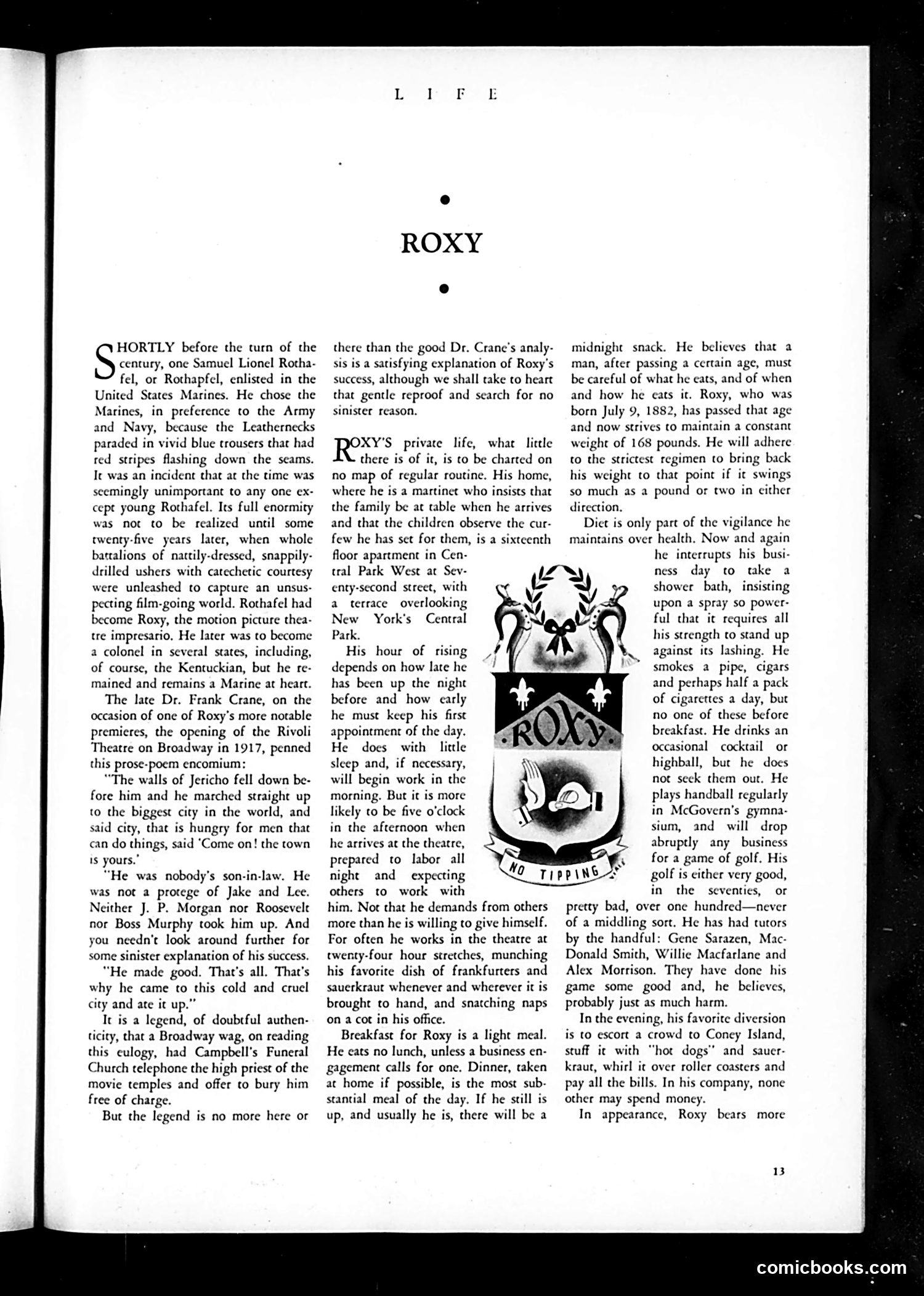
"Roxy" - Life Magazine Profile This page profiles Samuel Lionel Rothafel ("Roxy"), a famous Marine who became a motion picture impresario. The article describes his personal habits and lifestyle in 1920s New York, where he operates a theater at Central Park West and 59th Street. The decorative emblems visible in the illustration appear to be theatrical or organizational insignia associated with Roxy's entertainment ventures. The text humorously details his daily routine—his obsessive weight maintenance (168 pounds), exercise regimen, and leisure activities like golf and trips to Coney Island—presenting him as a figure of some prominence in entertainment. The article tone is lighthearted biographical sketch rather than political satire, typical of Life's celebrity profiles during this era.
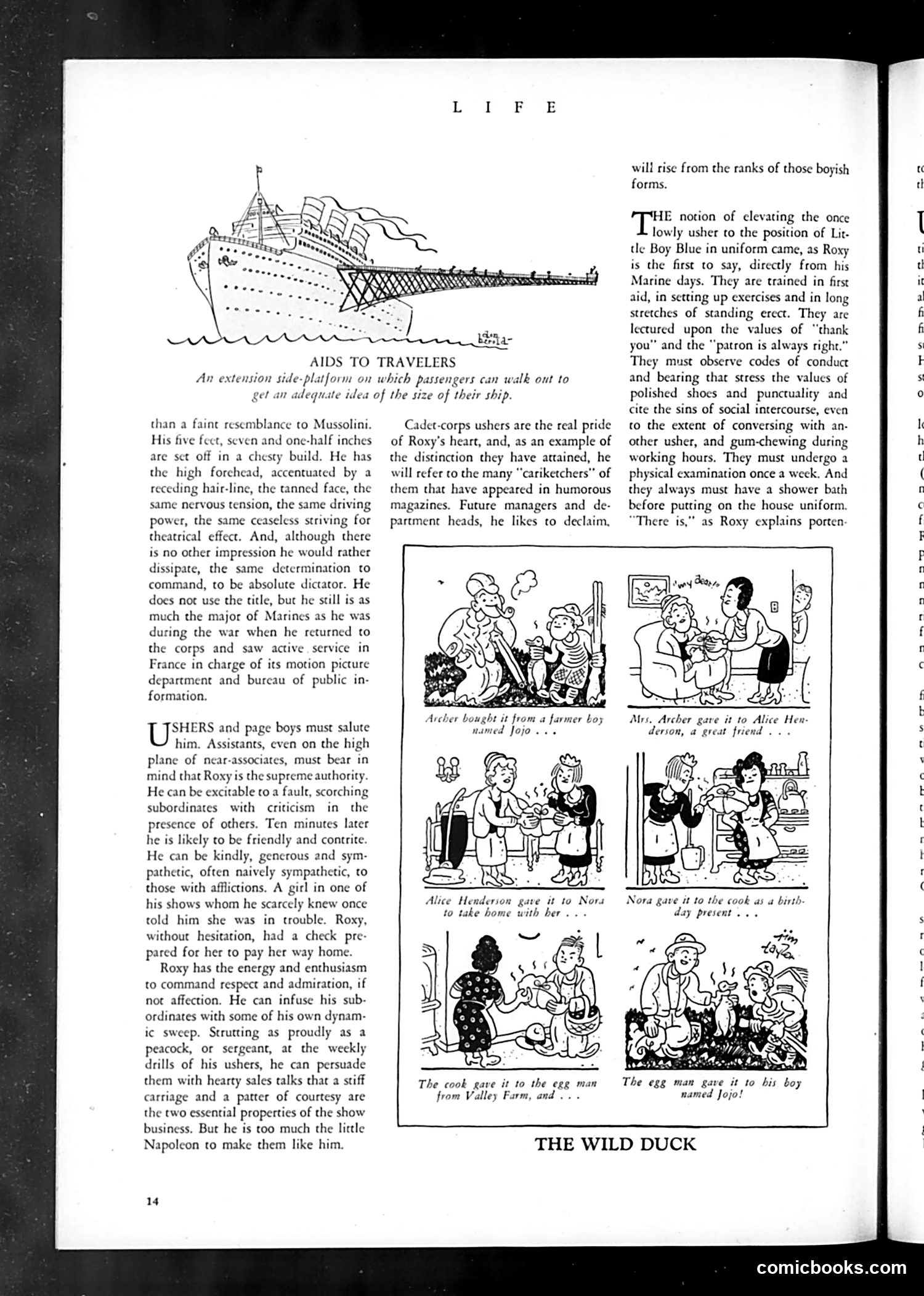
Explanation for Modern Readers This page from *Life* magazine discusses theatrical training for young performers, specifically "Little Boy Blue" and other child actors in uniform roles. The central satire targets the pretentious discipline imposed on child performers—they must maintain rigid posture, polish shoes obsessively, observe strict codes of conduct, and undergo weekly physical examinations before wearing costumes. The accompanying cartoon strip (titled "The Wild Duck") shows various domestic scenes of children receiving gifts and praise from adults, apparently illustrating how these child performers are elevated socially through theatrical work. The text satirizes how this regimented, militaristic training system—borrowed from Marine corps structure—ironically claims to develop respectful, well-mannered youth, while the cartoon subtly mocks how adults reward and manipulate children's performances for entertainment value.
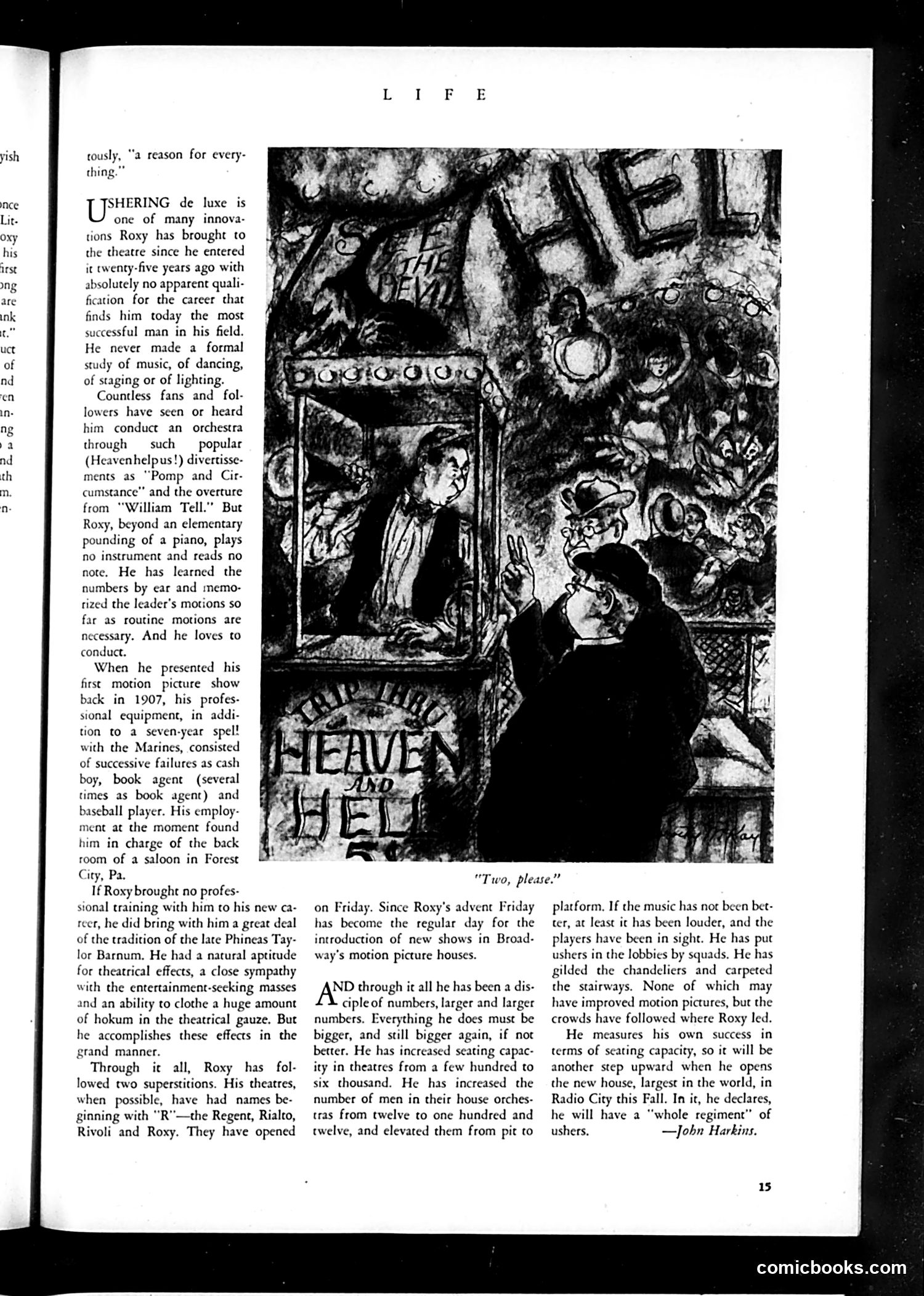
Analysis of Life Magazine Page This page features a profile of Gus Roxy (full name appears to be David Sarnoff's theatrical colleague), a theater impresario who revolutionized motion picture house presentation around 1907. The accompanying illustration labeled "Two, please" depicts a ticket booth scene at what appears to be a lavish movie palace, showing patrons purchasing tickets beneath ornate architectural details. The satire centers on Roxy's transformation of movie theaters from modest venues into palatial entertainment destinations with orchestras, elaborate décor, and expanded seating capacities. The text humorously notes his lack of formal music training yet remarkable success in theatrical production—he learned "by ear" and through theater tradition rather than conventional study. The cartoon subtly mocks the grandeur and commercialization of his theatrical empire while celebrating his unconventional rise to prominence in American entertainment.
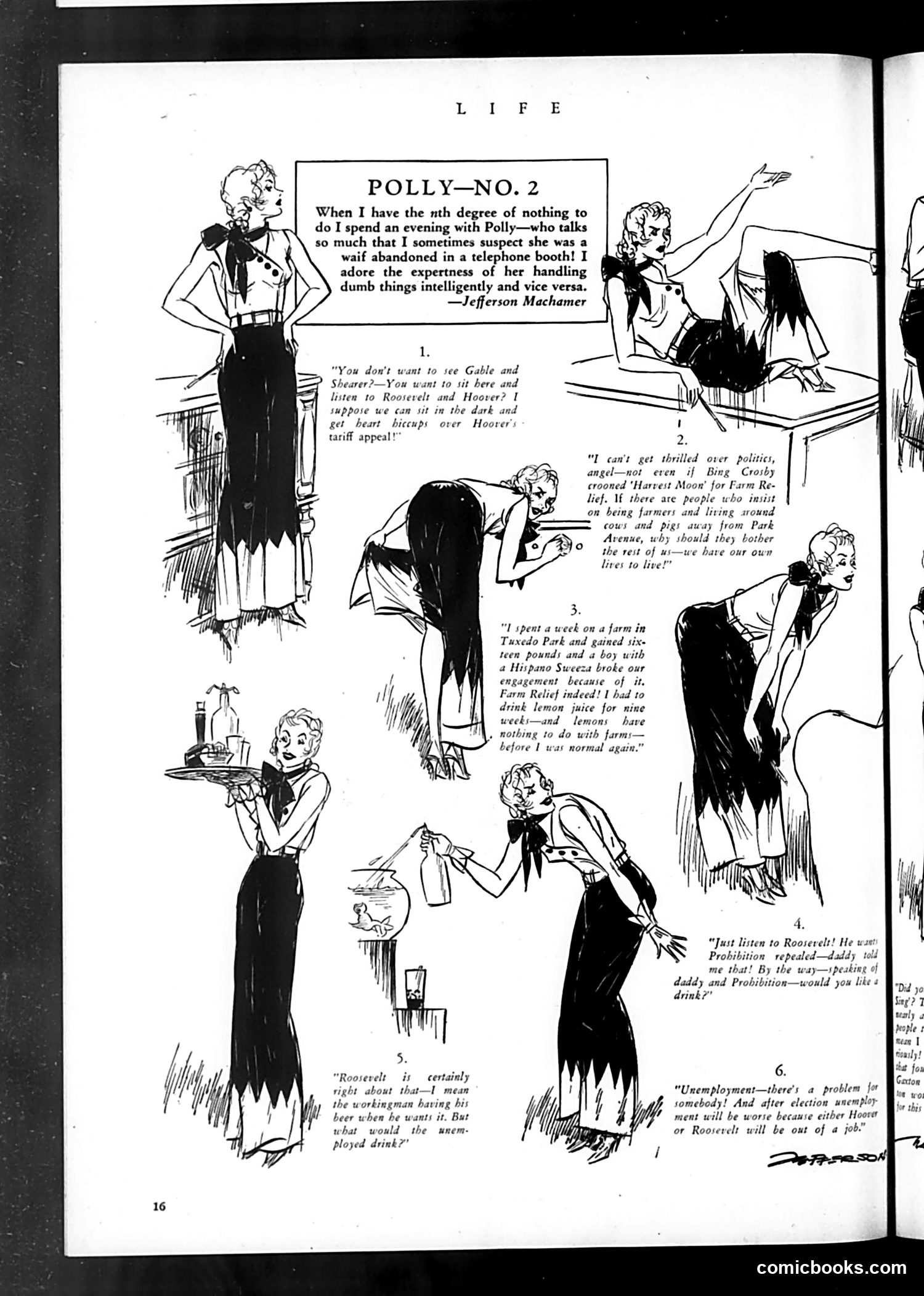
"Polly—No. 2" Analysis This satirical comic features a character named Polly discussing various political and social topics through six numbered vignettes. The humor centers on Polly's contradictory opinions and complaints: She dismisses entertainment (Gable, Hoover radio speeches) while demanding access to them, criticizes farm life despite championing rural issues, complains about Prohibition's repeal while asking for drinks, and expresses confusion about political outcomes. The satire targets 1930s-era inconsistency—specifically women's contradictory political stances and opinions. References include FDR (implied by "Roosevelt"), Prohibition's repeal (likely early 1930s), and farm relief programs. The joke is that Polly exemplifies how people hold simultaneously incompatible viewpoints while remaining oblivious to their own contradictions—a timeless criticism of political discourse.
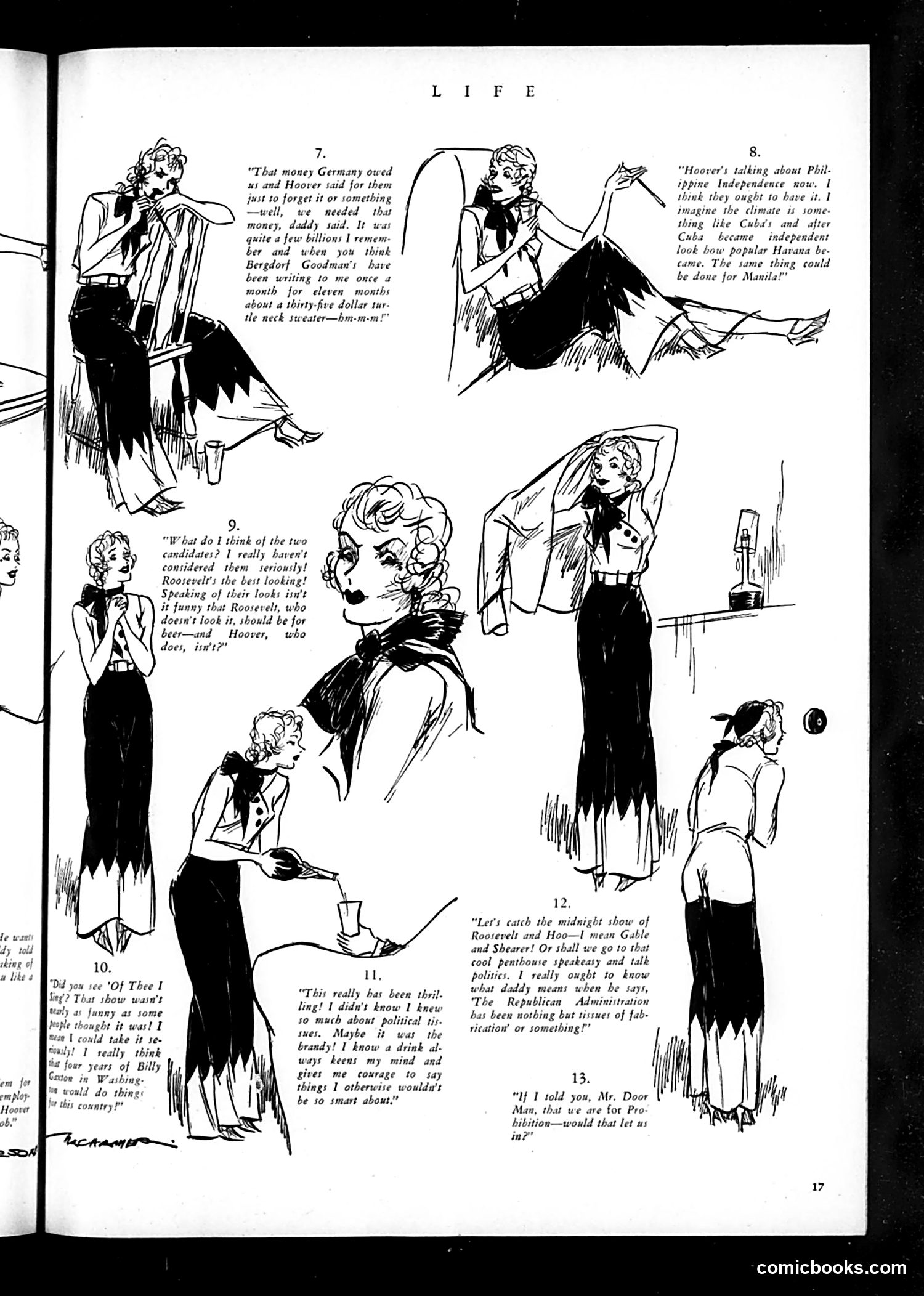
Political Satire from Life Magazine This page presents sequential comic panels satirizing political and social figures, likely from the 1920s-1930s based on style. The dialogue references "Germany," "Hoover," "Roosevelt," and "Republican Administration"—suggesting commentary on Depression-era politics and competing presidential figures. The sketches mock politicians' vanity and inconsistency. One panel criticizes someone for forgetting debts ("That money Germany owed..."). Another ridicules comparing presidential candidates on appearance rather than substance. The final panels appear to satirize hypocritical political positioning regarding Prohibition. The cartoonist uses exaggerated physical caricature and dialogue to expose contradiction between politicians' public statements and private actions—a core function of satirical cartooning during this contentious political period.
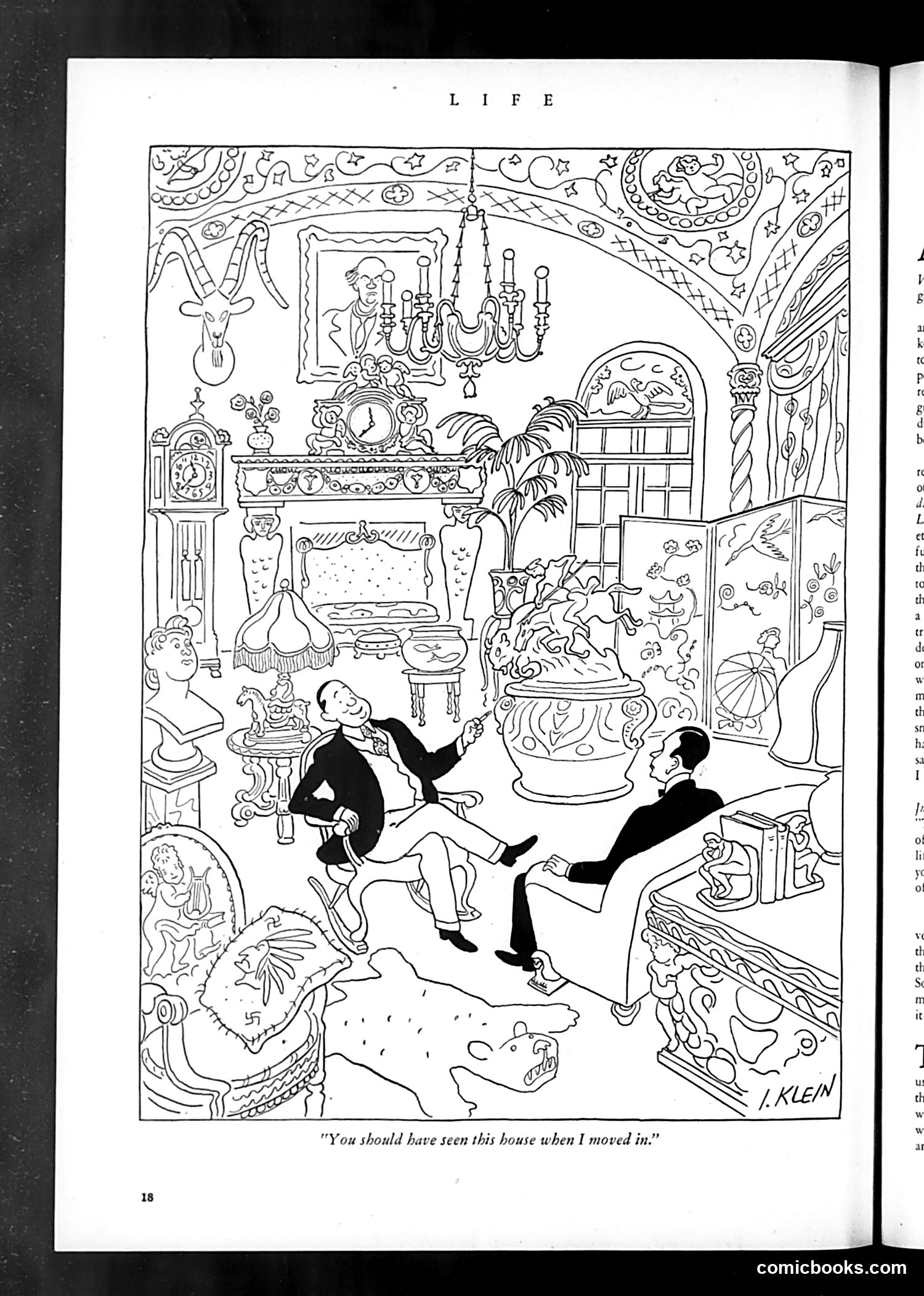
Cartoon Analysis This single-panel cartoon by I. Klein depicts two men in formal attire lounging in an ornately decorated living room, with the caption: "You should have seen this house when I moved in." The humor lies in a relatable class commentary: the speaker is boasting about the mansion's current opulent state, implying he has dramatically improved or transformed it through wealth and taste. The satire targets nouveau riche pretension—suggesting the speaker is displaying his acquisition and decorating prowess to impress his guest, a common trope in satire about sudden wealth or social climbing. The elaborate furnishings, decorative objects, chandelier, and artistic elements throughout the room underscore this theme of conspicuous consumption and the desire to showcase material success to one's peers.
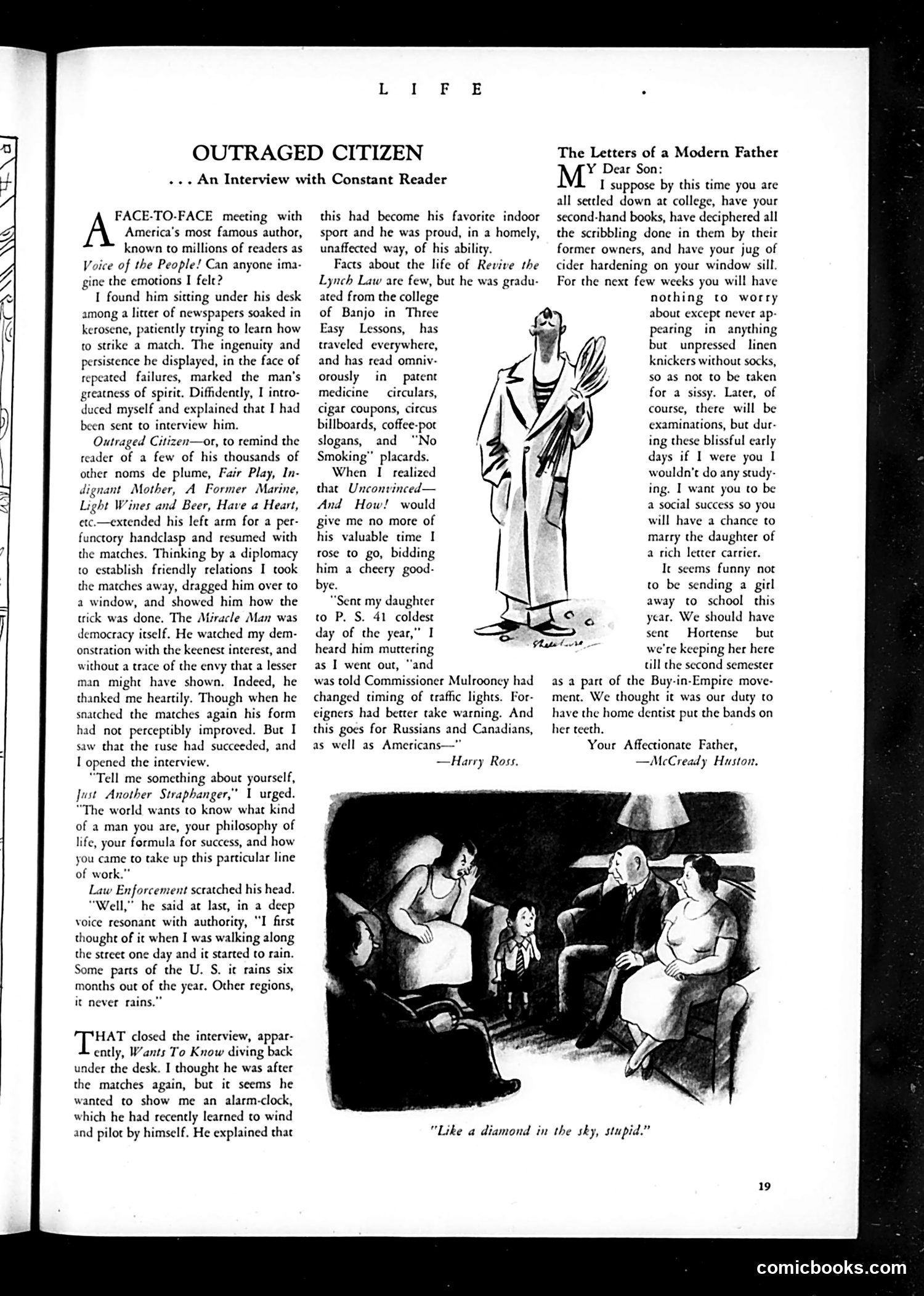
Analysis of Life Magazine Page This page features an interview with Constant Reader, a famous author known for works like "Voice of the People" and "Fair Play." The left column describes a face-to-face meeting where the interviewer attempts to get the author to discuss his philosophy and formula for success. The illustration shows a caricatured figure in formal attire, depicted in a somewhat unflattering manner typical of Life's satirical style. The right column contains "Letters of a Modern Father"—advice to his college-bound son about unpressed linens, studying, and romantic prospects. The bottom illustration depicts what appears to be a social gathering with multiple figures, captioned "Like a diamond in the sky, stupid"—likely satirizing pretentious social commentary or affected intellectual conversation among the upper classes.
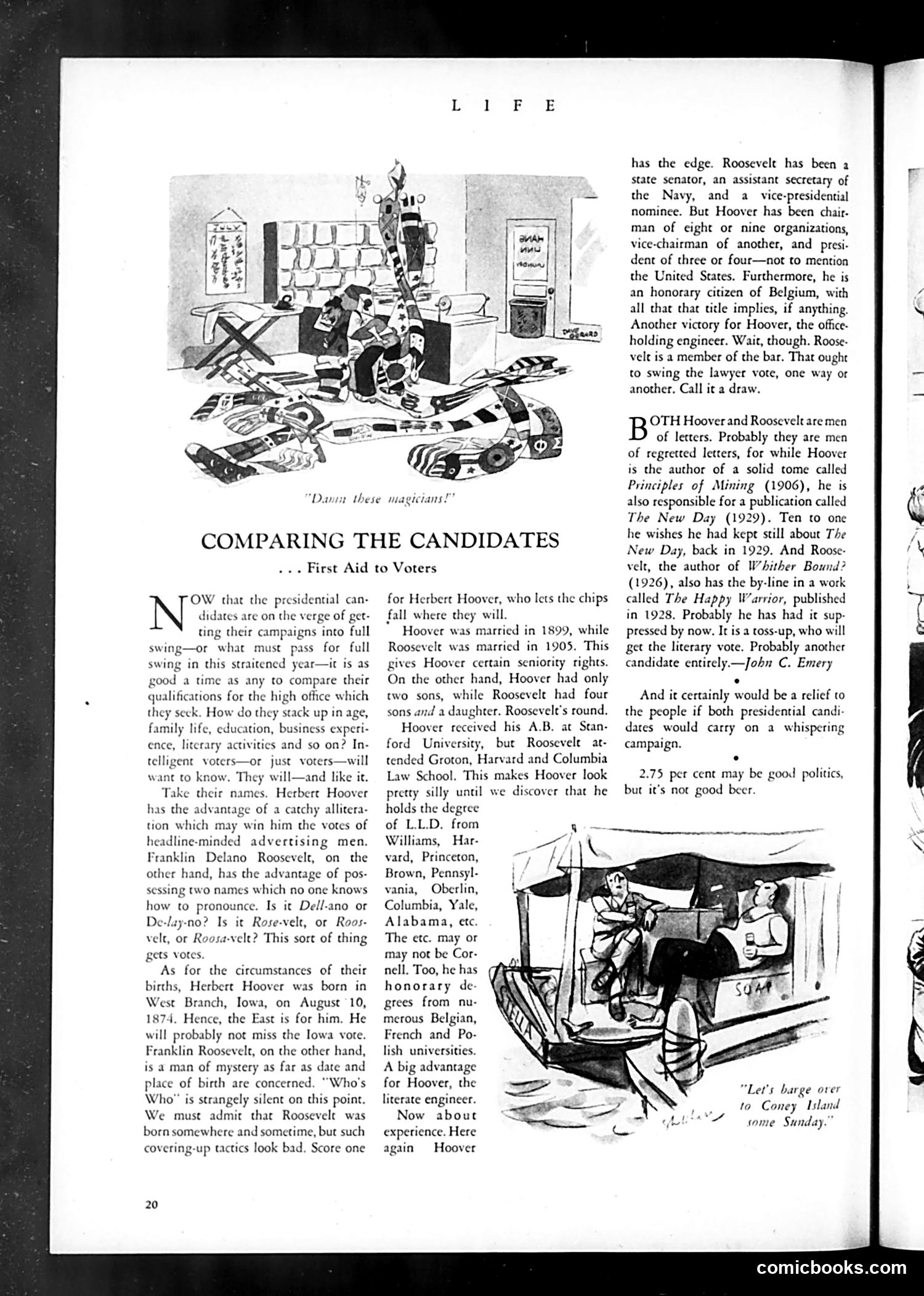
Explaining This 1928 Political Satire Page This Life magazine page satirizes the 1928 presidential race between Herbert Hoover and Franklin D. Roosevelt by comically "comparing" their qualifications—a mock-serious approach that reveals how arbitrary political advantages often are. The joke structure: The article pretends to offer "first aid to voters" by weighing each candidate's merits, but systematically deflates this analysis. Hoover gets points for his simple name (appealing to "headline-minded" voters) while Roosevelt's pronunciation difficulty somehow also "gets votes." Hoover wins on marriage seniority and organizational titles, but they tie on legal credentials. The satire's point: Elections turn on trivial factors—name recognition, education credentials, honorary degrees (Hoover's numerous ones)—rather than substantive policy. The cartoons above and below mock voter confusion about these "magicians" and campaign distraction. The closing quip ("2.75 per cent may be good politics, but it's not good beer") references Prohibition-era politics, suggesting even the most serious campaign issues reduce to absurdity.
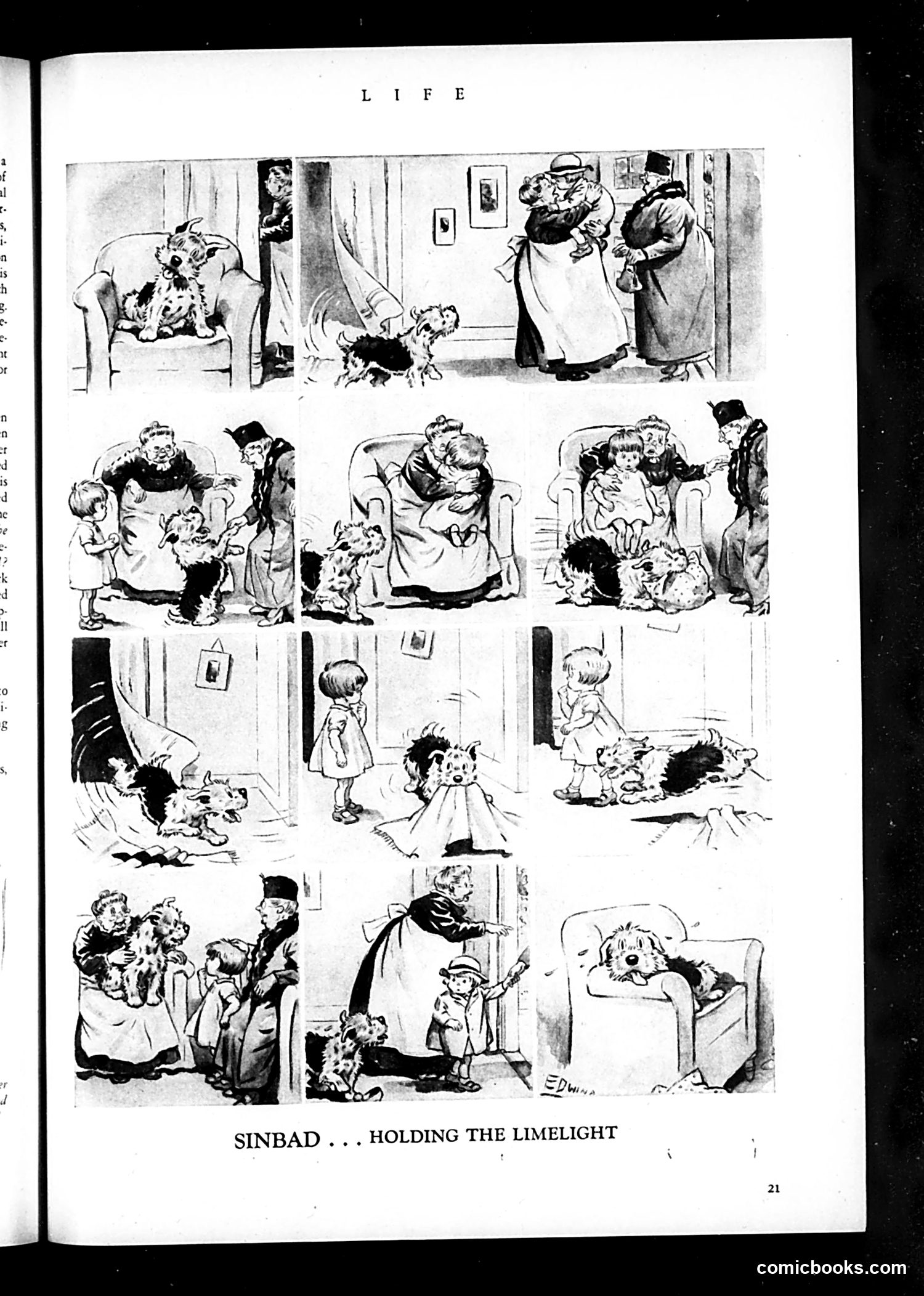
"Sinbad...Holding the Limelight" This is a comic strip sequence showing domestic chaos centered on a character named Sinbad (likely a pet dog, given the visual prominence of a terrier-like animal throughout). The strip depicts a series of comedic scenes where the dog repeatedly disrupts a household—jumping on furniture, interfering with visitors, and creating mayhem despite attempts by adults to manage the situation. The "limelight" reference in the title suggests the satire targets how pets (or perhaps difficult individuals) demand constant attention and dominate domestic life. The strip humorously illustrates the frustration of trying to maintain order when one uncontrollable element—here, the mischievous Sinbad—consistently steals focus and creates disorder. It's a lighthearted commentary on household dynamics and animal behavior typical of Life magazine's satirical domestic humor.
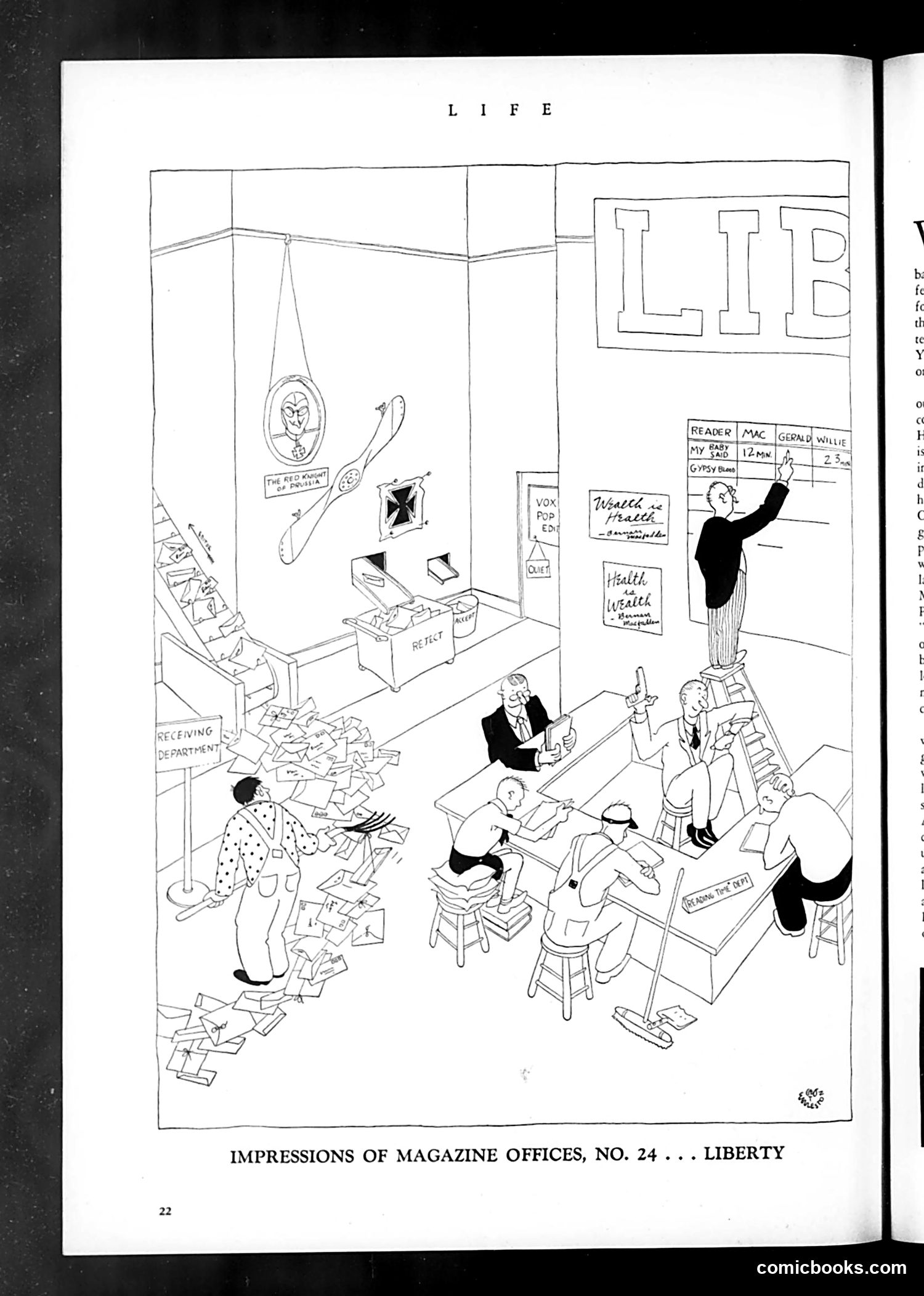
"Impressions of Magazine Offices, No. 24: Liberty" This is a satirical illustration of *Liberty* magazine's offices, depicting editorial chaos. The cartoon shows staff members overwhelmed by paperwork and correspondence scattered across the floor and desks. A man at a desk appears to be the editor, while workers sort through piles of submissions and mail. The humor lies in contrasting *Liberty* magazine's stated editorial values (visible on wall signs including "Health," "Wealth," and "Waste") with the actual disorganized reality of the office. Charts and notices on walls suggest pretensions to order and careful editorial standards, yet the floor is buried in chaos—a common satirical device mocking the gap between institutional ideals and messy practice. The series title indicates this was part of a recurring feature observing various magazine offices' actual operations versus their public images.
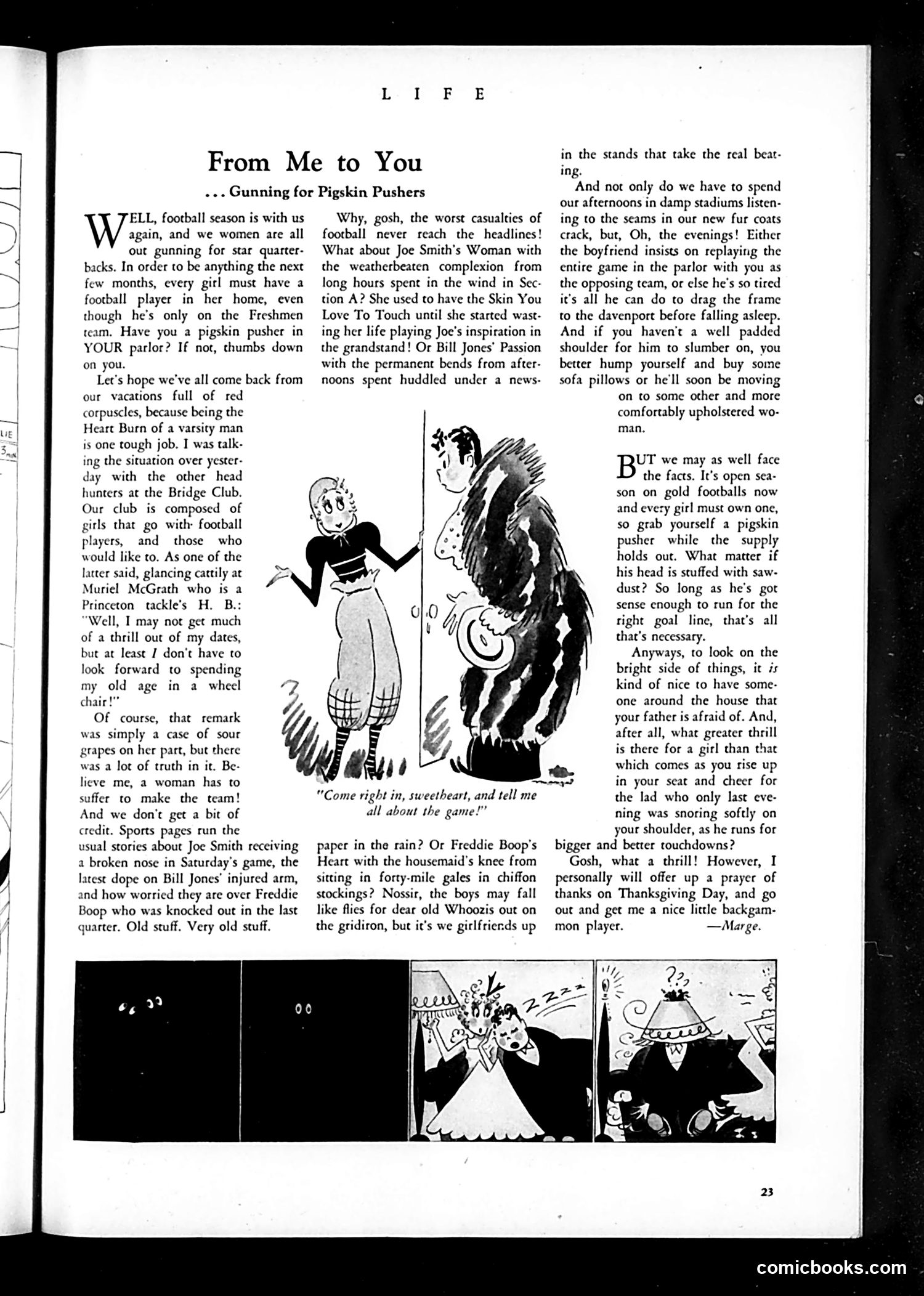
Analysis: "From Me to You—Gunning for Pigskin Pushers" This 1920s-era satire by "Marge" mocks the social obsession with college football and dating athletes. The piece targets women who prize football players as romantic partners, treating them as status symbols despite the genuine hardships involved. The satire operates on multiple levels: it highlights the *actual* sacrifices girlfriends endure (sitting in cold stadiums, listening to endless game replays, serving as emotional support) while the players receive all public credit and attention. The author notes how sports coverage celebrates players' injuries but ignores the girlfriends' "casualties"—ruined skin, permanent physical damage from hours in bad weather. The central joke is the ironic contradiction: women desperately pursue these dating prospects despite receiving no recognition or enjoyment. The closing cartoon depicts a girlfriend being told game details while appearing bored or exhausted. The satirical plea to "grab yourself a pigskin pusher while the supply holds out" undercuts the entire premise, ultimately suggesting women settle for sawdust-headed athletes simply for social status. The ending—preferring a "backgammon player"—suggests rejecting this shallow social hierarchy altogether.
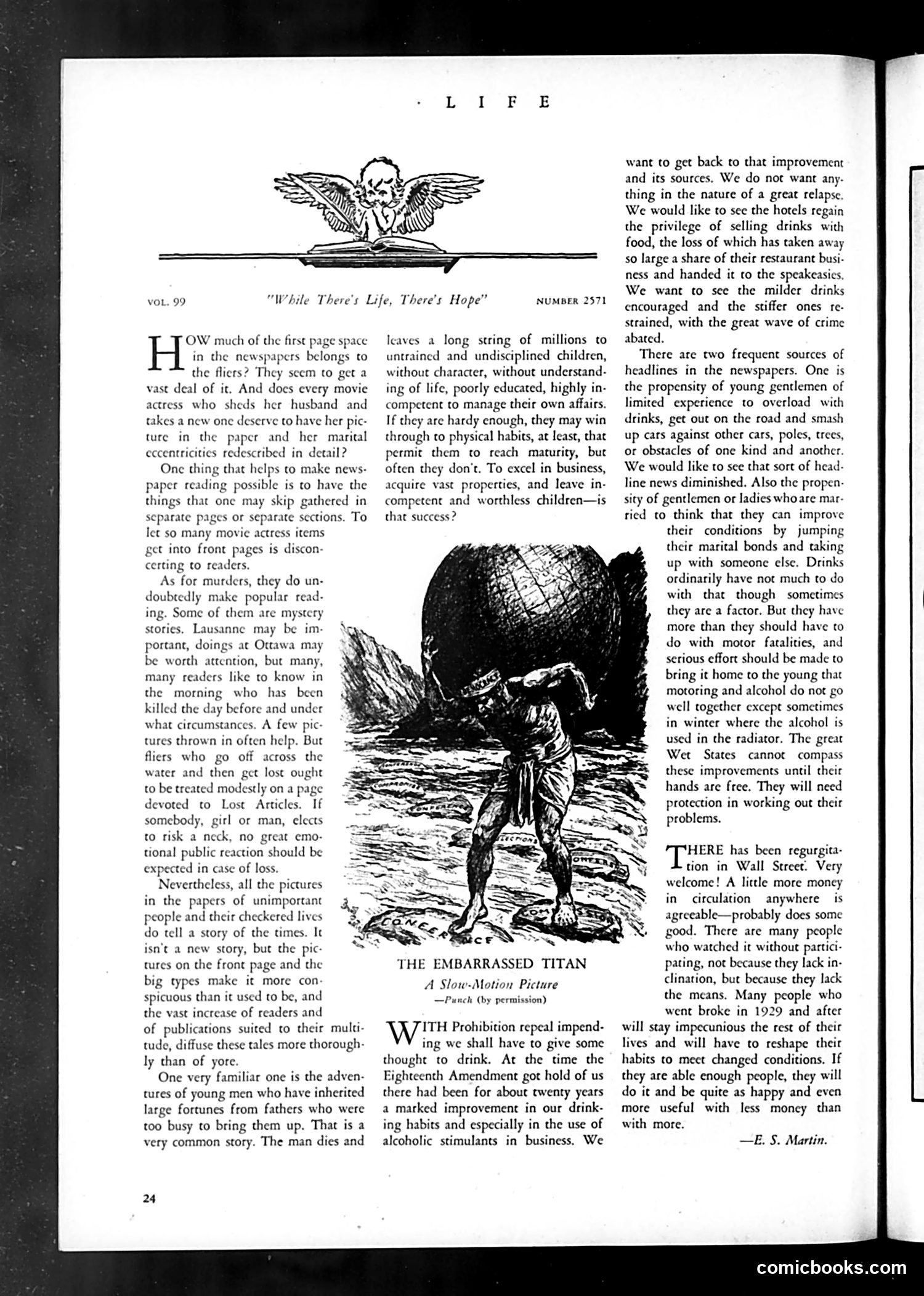
"The Embarrassed Titan" — Prohibition Repeal Commentary This 1933 Life magazine page discusses the imminent repeal of Prohibition (the 18th Amendment). The accompanying cartoon from Punch depicts a large, muscular titan figure appearing distressed or embarrassed—likely representing America or the nation's policy establishment confronting the failure of its alcohol ban. The editorial argues that while Prohibition had initially (around 1913) improved drinking habits and business practices, repeal requires careful management to avoid "a great relapse." The author warns against two specific social problems he associates with alcohol: young wealthy men recklessly driving while drunk, and married people using drinks as an excuse to abandon their spouses. The "Titan" image appears to represent national embarrassment over Prohibition's demonstrated failure—a grand policy that couldn't be sustained. The tone suggests cautious optimism about returning to moderate, regulated drinking rather than the chaos of speakeasies and criminal activity that prohibition had spawned.
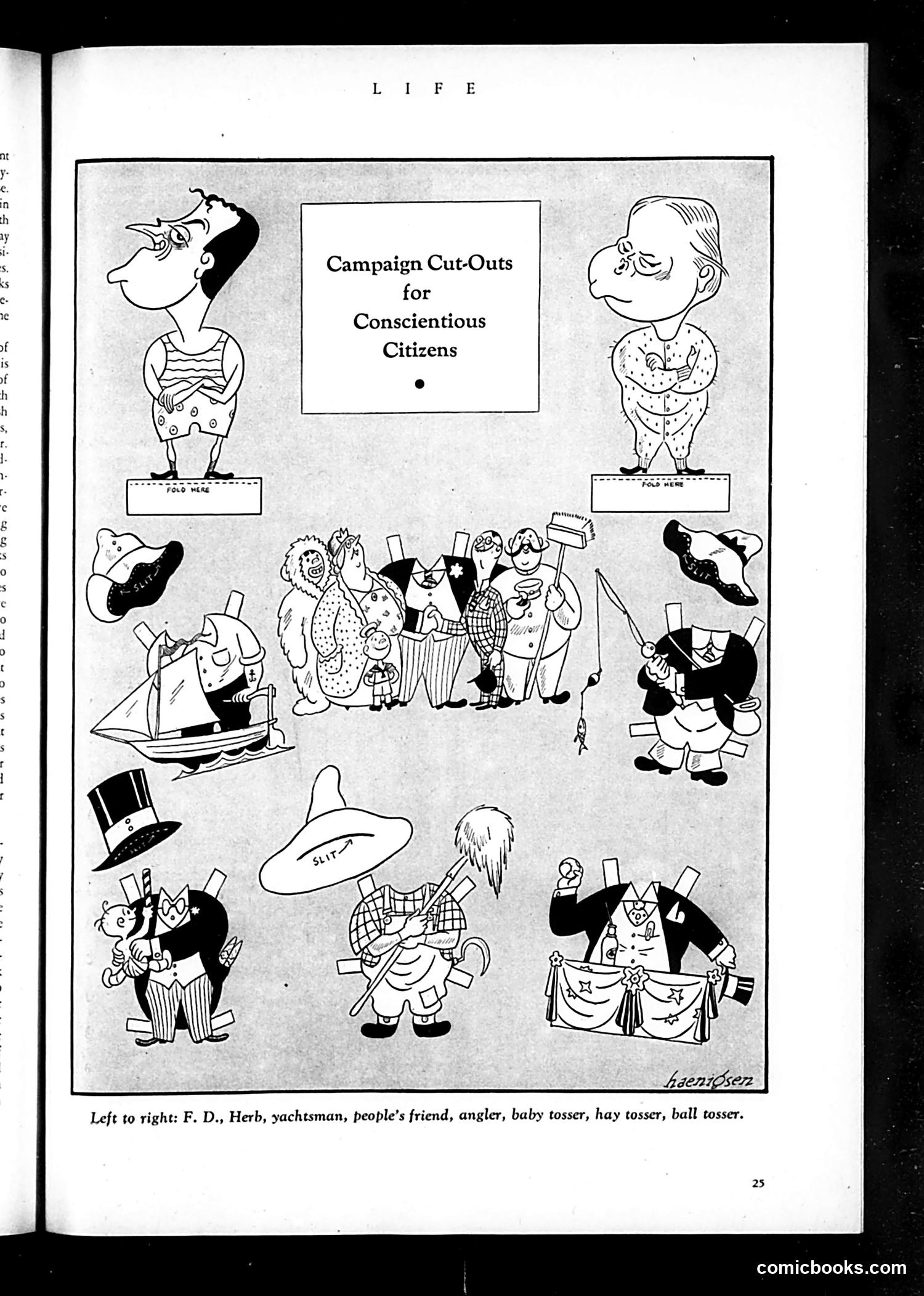
Political Satire: Campaign Cut-Outs This is a satirical page offering paper dolls of political figures for voters to cut out. The caption identifies them as "F.D., Herb, yachtsman, people's friend, angler, baby tosser, hay tosser, ball tosser"—descriptive nicknames rather than formal titles. The top two caricatured figures appear to represent opposing candidates. The surrounding cut-outs depict various stereotypical "types" (yachtsman, angler, baby kisser, etc.), suggesting that politicians adopt different personas for different audiences. The satire mocks how candidates present themselves differently to appeal to various constituencies—presenting as everyman while also courting elites. The "cut-outs" format humorously implies political figures are interchangeable, superficial constructs rather than substantive leaders. This likely references 1930s-40s American electoral politics.
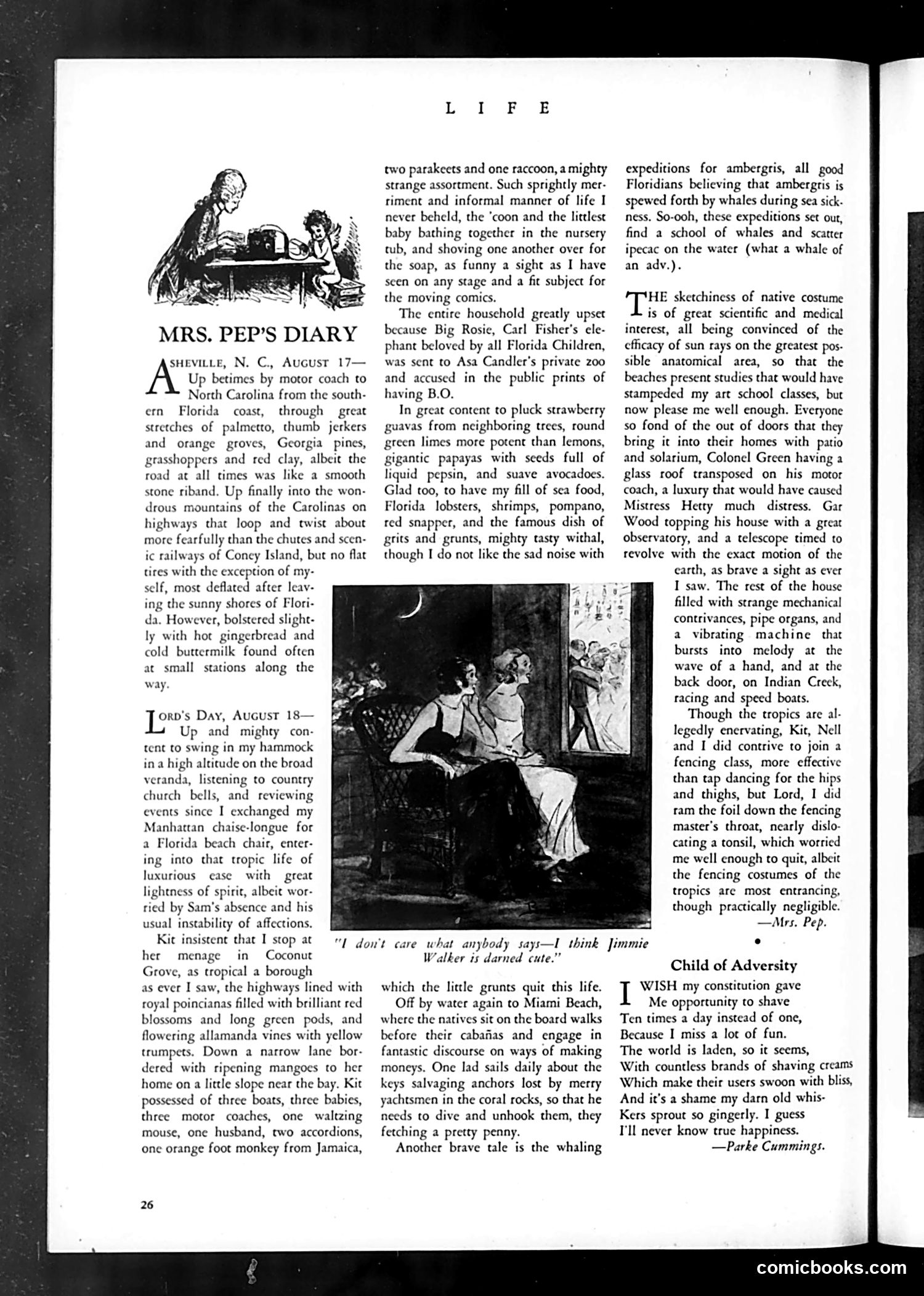
"Mrs. Pep's Diary" - Life Magazine Social Commentary This is a humorous travel diary by a society woman ("Mrs. Pep") recounting a motor journey from Florida to North Carolina. The featured cartoon shows her chatting with a companion, with the caption: "I don't care what anybody says—I think Jimmie Walker is darned cute." The political reference: Jimmie Walker was New York City's notoriously corrupt mayor (1926-1932), famous for his flashy lifestyle and ties to organized crime. The joke satirizes the casual way even respectable society women found him charming despite—or because of—his scandalous reputation. The diary itself gently mocks upper-class leisure tourism: Mrs. Pep's breathless descriptions of Florida's exotic animals, peculiar locals, and tropical abundance reflect the era's fascination with increasingly accessible travel destinations. The tone is affectionate mockery of both the tourist experience and the writer's somewhat superficial observations of unfamiliar places and people.
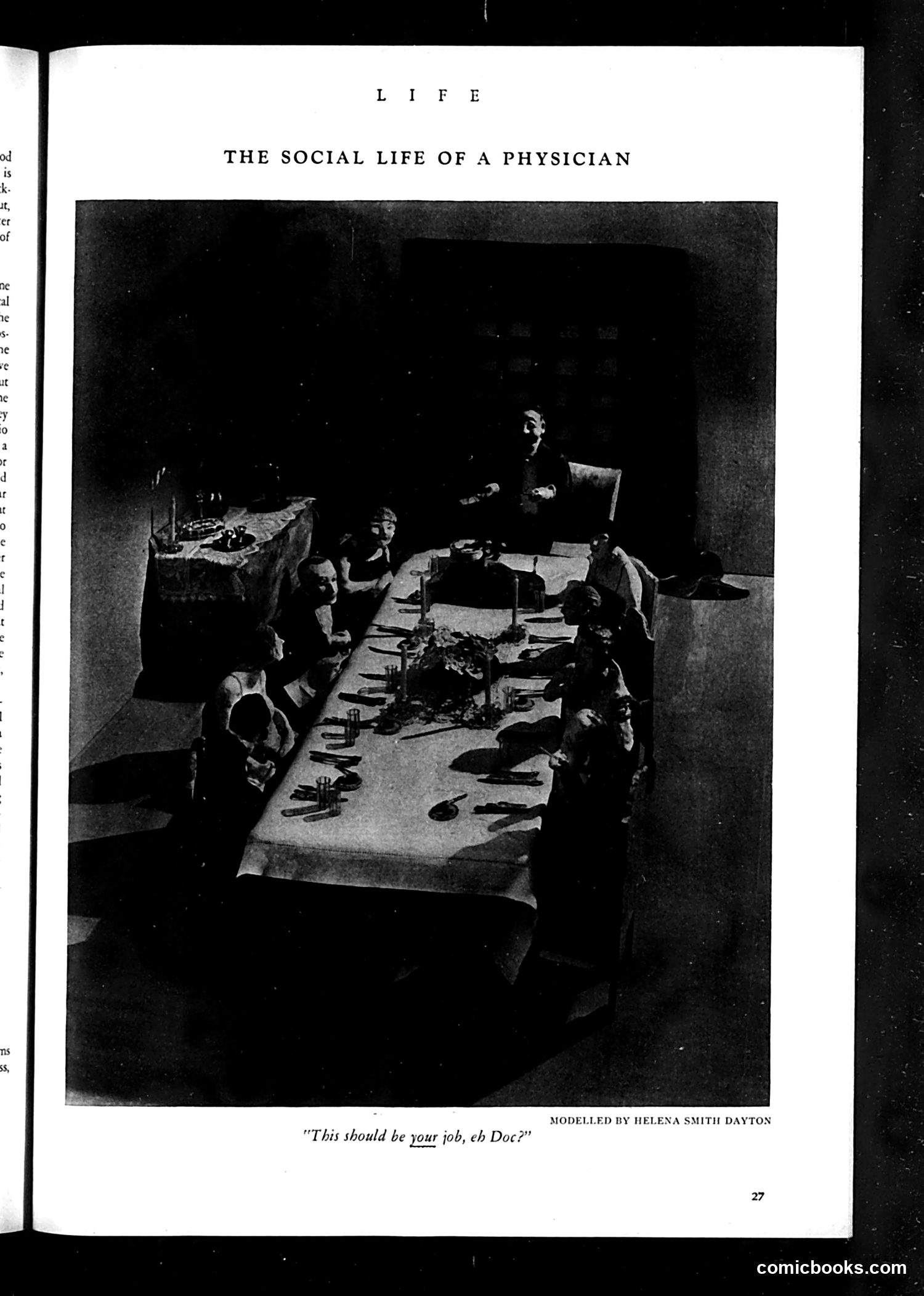
"The Social Life of a Physician" This appears to be a humorous staged photograph rather than a traditional cartoon. It depicts a formal dinner scene where a physician (likely the central standing figure) is being confronted by diners. The caption—"This should be your job, eh Doc?"—suggests satire about a doctor's social obligations and expectations. The joke likely plays on the contrast between a physician's professional medical duties and social pressures to perform entertaining or service-oriented roles at social gatherings. The staged, somewhat awkward composition emphasizes this tension. Helena Smith Dayton modeled the scene, suggesting this was a theatrical recreation for comedic effect in Life magazine's satirical commentary on professional and social class expectations of the era.
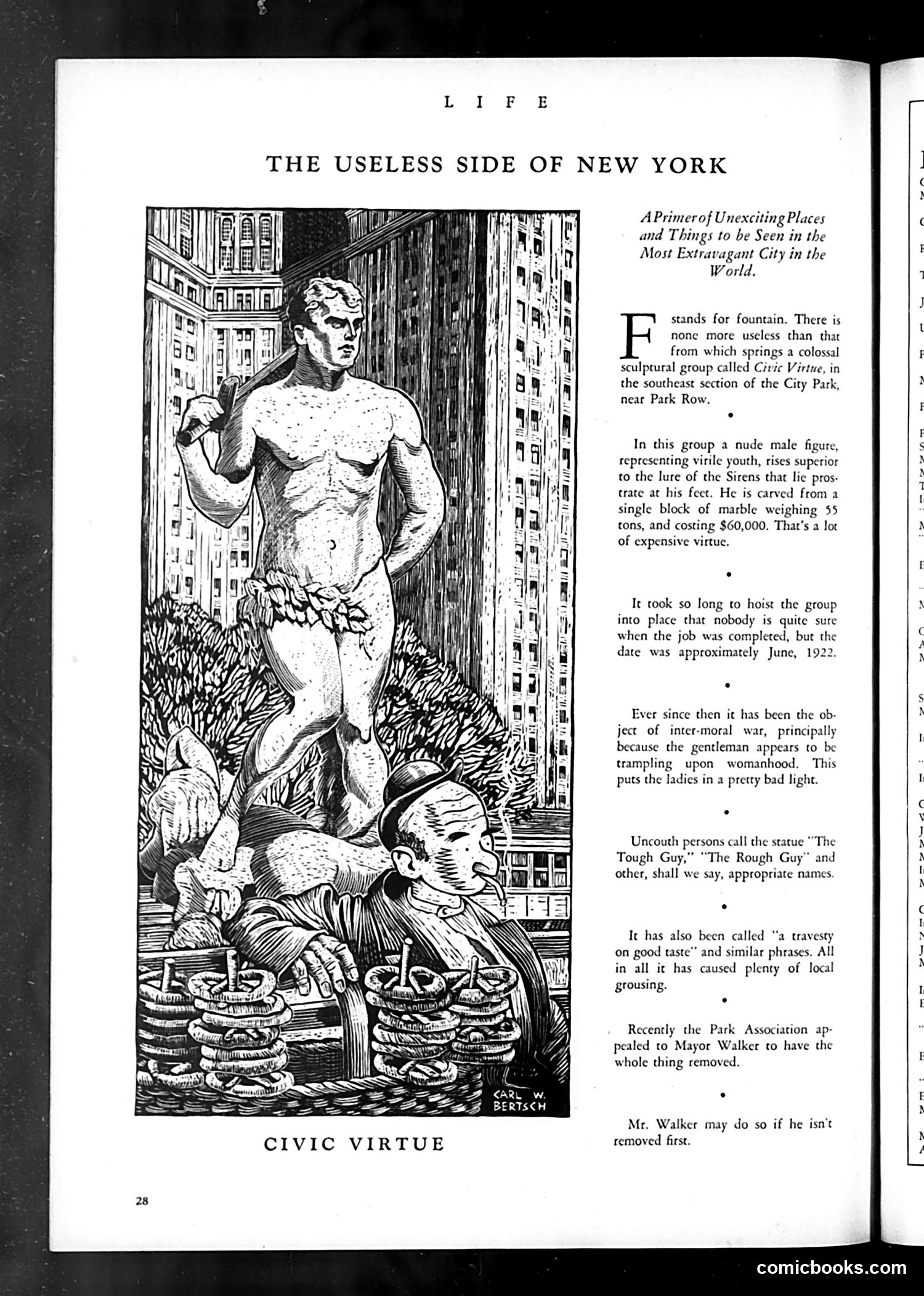
"Civic Virtue" - Life Magazine Satire This page satirizes a controversial public sculpture in New York City's park system. The "Civic Virtue" fountain features a nude male figure trampling prone female figures (the "Sirens"), meant to represent moral virtue overcoming temptation. The satire targets the sculpture's absurdity: it cost $60,000, weighs 55 tons, took months to install, and has generated sustained public outrage—not for inspiring virtue, but for appearing to literally oppress women. Life mocks both the sculpture's pretentious artistic intent and its unintended misogynistic message. The final jab at Mayor Walker ("if he isn't removed first") is a political dig—the mayor himself faced removal pressure during this period, making the quip about the sculpture's removal doubly pointed. The cartoon presents a genuinely offensive civic monument as self-defeating "expensive virtue."
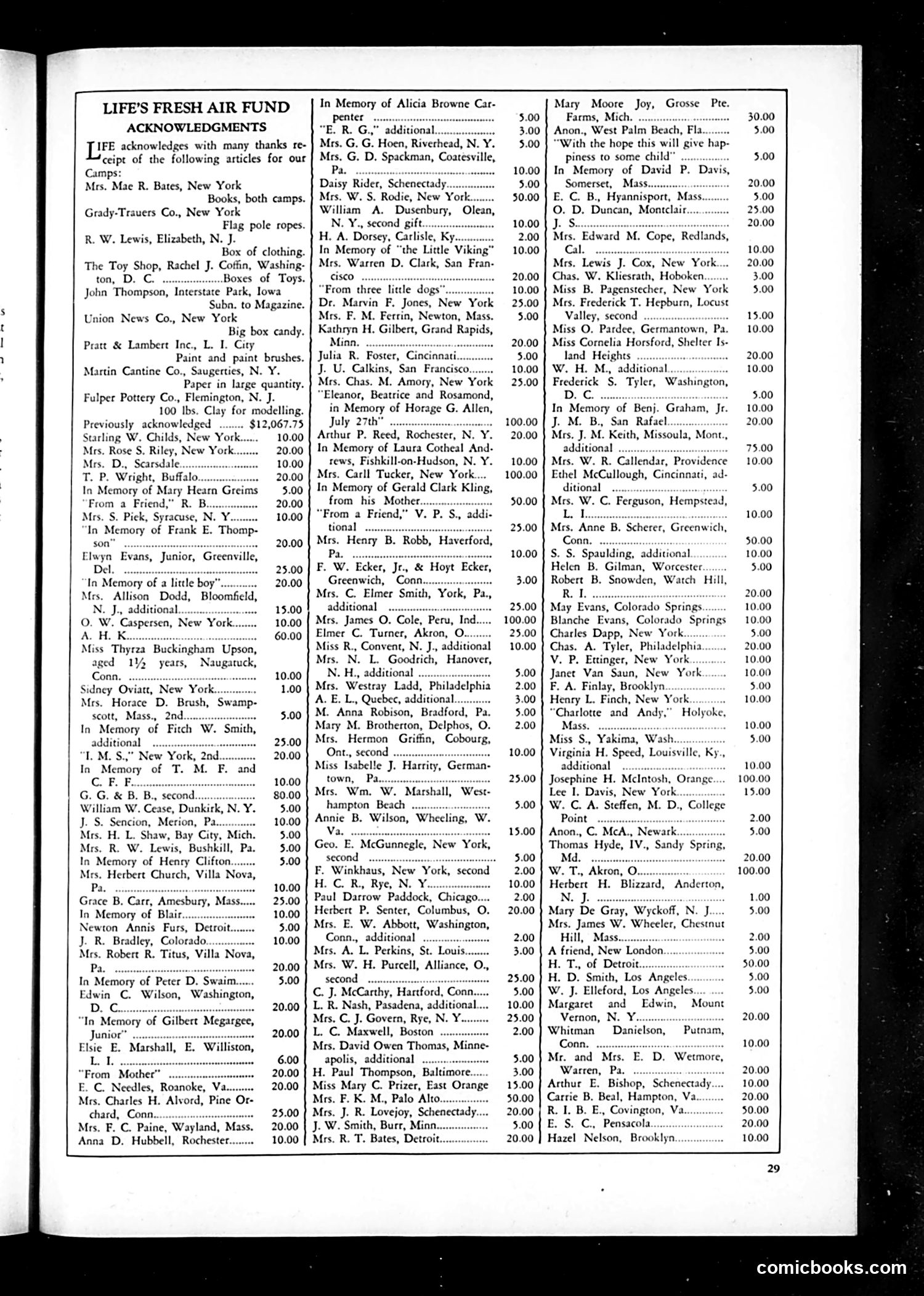
This page contains no cartoons or satirical content—it is entirely a fundraising acknowledgment list for Life magazine's "Fresh Air Fund," a charitable program providing camp experiences for underprivileged children. The page lists hundreds of donors and their contributions (ranging from $1 to $100), along with in-kind donations like books, toys, clothing, and art supplies. Many donations are made "in memory of" deceased individuals, suggesting the fund was a popular way to memorialize loved ones. The "Fresh Air Fund" was a genuine 19th-century American charitable movement aimed at giving poor urban children outdoor recreation and health benefits. This acknowledgment page served both as gratitude to donors and as publicity for the cause. This is a public service/fundraising document, not satire or political commentary.
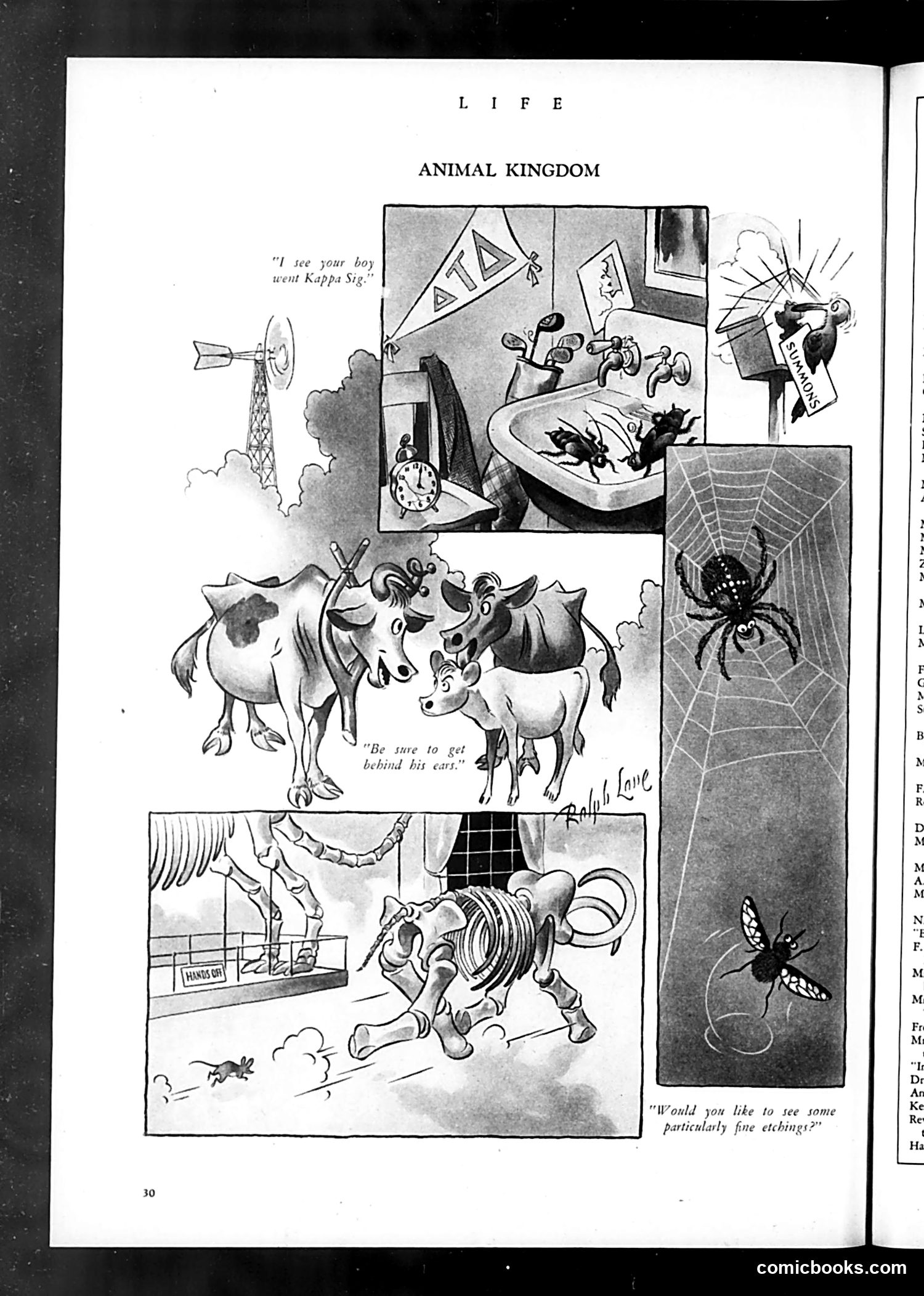
"Animal Kingdom" - Life Magazine Satirical Comics This page presents humorous cartoon vignettes mocking fraternity culture and pretension. The top dialogue "I see your boy went Kappa Sig" (a real fraternity) suggests parental pride in joining Greek organizations. "Be sure to get behind his ears" jokes that fraternity members need motherly supervision like children. The central cow cartoon labeled "Be sure to get behind his cart" appears to mock fraternity hazing or group conformity. The bottom panels satirize artistic pretension—the spider web illustration and dialogue "Would you like to see some particularly fine etchings?" parody affected connoisseurship, likely mocking fraternity members or bohemian types who present themselves as cultured while engaging in base behavior. Overall, the page ridicules the gap between fraternity-goers' aspirations toward sophistication and their actual immaturity or crude conduct.
Analysis: This is a Donation/Memorial List Page This page contains no cartoons or satirical content. It is a memorial and donation acknowledgment list from *Life* magazine, showing contributions received—likely for a charitable cause or publication fund. The format lists donors' names, locations, and contribution amounts (ranging from $1 to $100). Many entries are prefaced with "In Memory of" followed by a deceased person's name, indicating these were donations made in someone's honor. This type of page was common in early 20th-century magazines as a way to publicly acknowledge financial supporters and honor memorial gifts. Without additional context about *Life's* specific fundraising campaign at this time, the exact charitable purpose cannot be determined from the image alone. The page serves an administrative/financial function rather than editorial or satirical one.
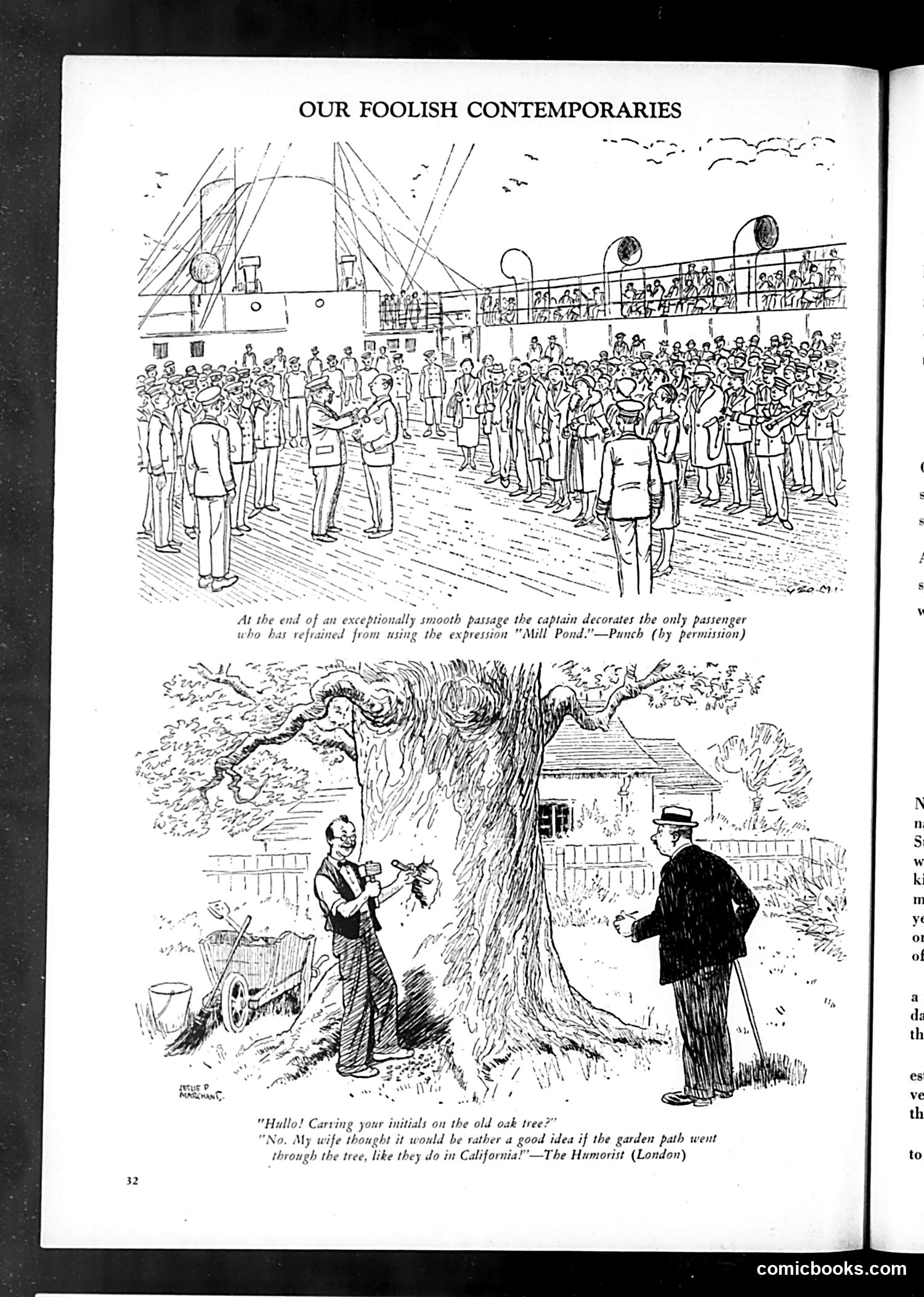
"Our Foolish Contemporaries" - Life Magazine Satire This page collects two reprinted cartoons mocking contemporary foolishness: Top cartoon (from *Punch*): Satirizes passengers on a ship who repeatedly use the clichéd phrase "Mill Pond" to describe calm waters. The captain awards a decoration only to the one passenger who *avoided* this tired expression—mocking people's tendency to mindlessly repeat popular catchphrases. Bottom cartoon (from *The Humorist*): A man carves initials into an ancient oak tree because his wife wants the garden path to run *through* it, imitating a California trend. The satire ridicules blind imitation of American practices without considering practicality or respect for nature—a common Anglo-American theme of the era, suggesting Americans were extravagant and ridiculous, while Britons thoughtlessly copied them. Both cartoons target conformity and the uncritical adoption of fashionable phrases and practices.
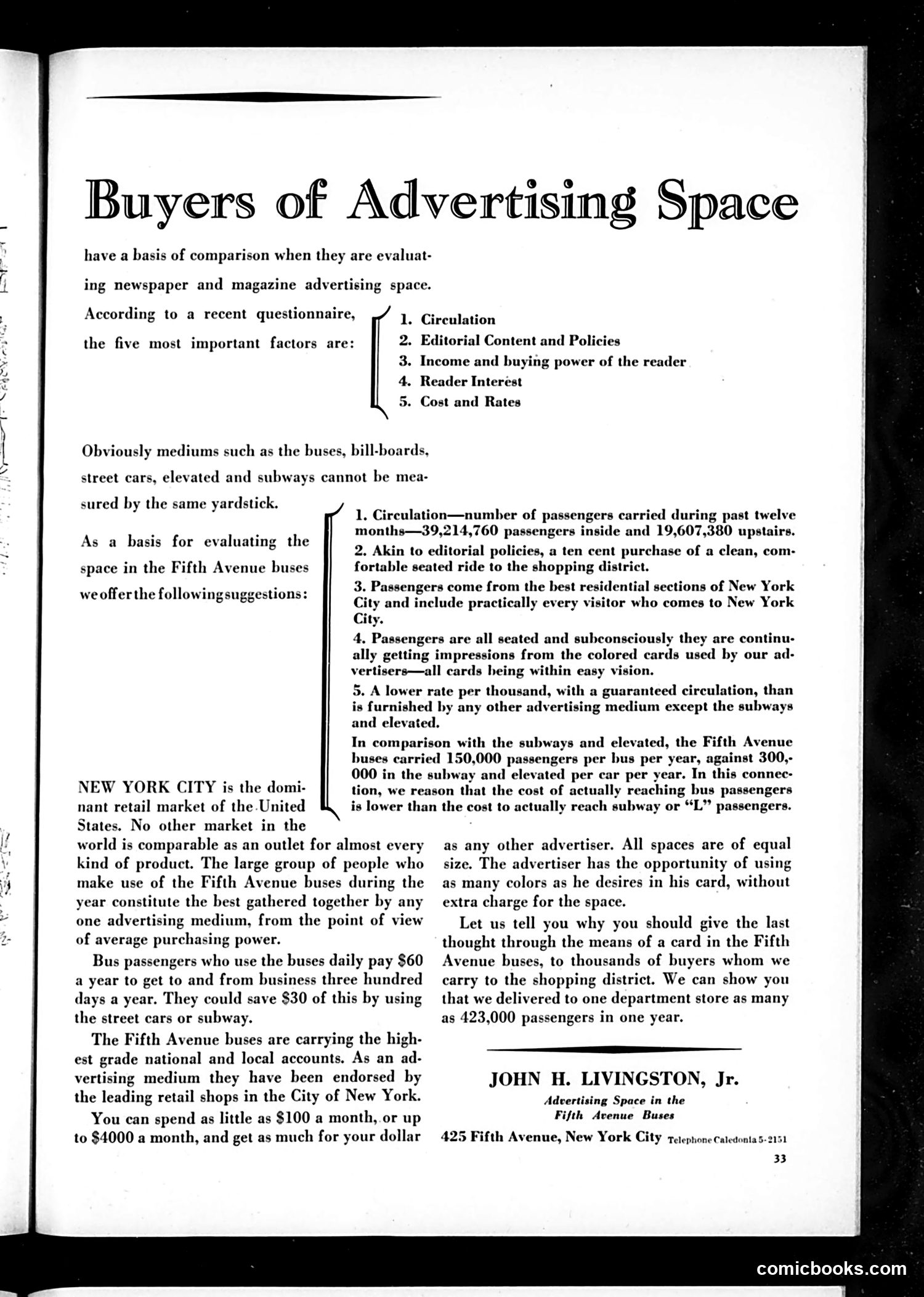
Analysis This page is advertising copy, not satire or a political cartoon. It's a sales pitch for advertising space on Fifth Avenue buses in New York City, placed by John H. Livingston Jr. The content argues that bus advertising is superior to subway and elevated train advertising because: - Fifth Avenue bus passengers are wealthy consumers from "best residential sections" with higher purchasing power - They pay $60 annually for buses (choosing comfort over cheaper transit), suggesting disposable income - The captive audience sees ads while seated and relaxed - Cost-per-thousand-passengers is lower than subways The piece uses pseudo-scientific justification (circulation numbers, demographic claims) typical of 1920s-30s advertising appeals. There's no cartoon visible—this is straightforward business-to-business advertising targeting potential advertisers, not readers. It reflects historical assumptions about consumer behavior and the value of targeting affluent commuters in an era before mass media research.
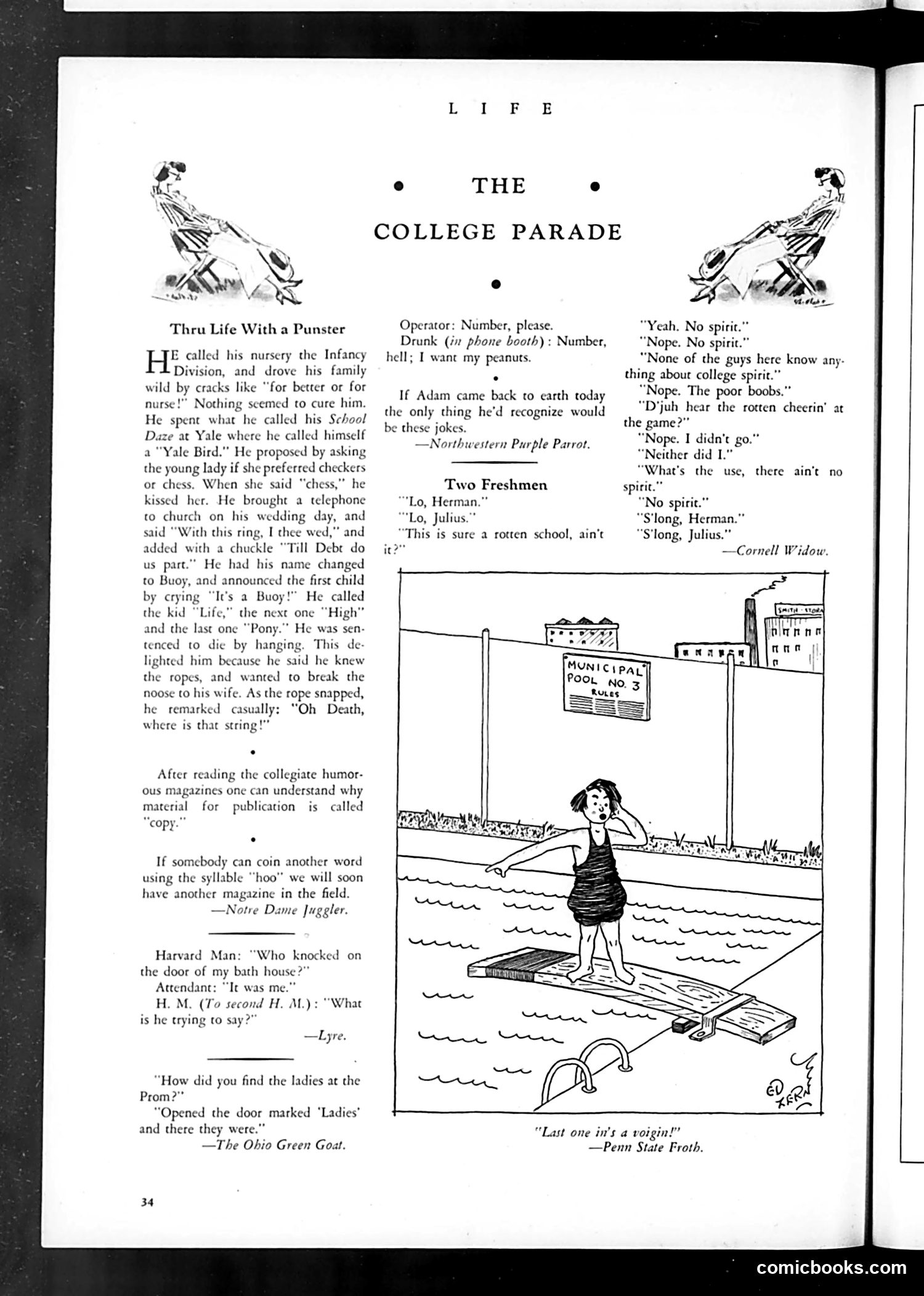
"The College Parade" Explained for Modern Readers This page collects short humorous pieces from various college magazines circa the 1920s-30s. The main content includes: "Thru Life With a Punster": A satirical biography of a man obsessed with wordplay and puns—he names his children "Life," "High," and "Pony," nicknames his house "Infancy Division," and even makes puns at his execution. The joke targets tiresome punsters who exhaust their families with constant wordplay. "The College Parade": A collection of brief college humor gags: - A drunk operator ordering peanuts instead of a phone number - Two freshmen lamenting their school's lack of "spirit" (school pride/enthusiasm) and poor athletic support - A risqué swimming joke - A quip about women at proms These pieces satirize college life conventions—school spirit, freshman naïveté, and dating culture. The cartoons and credits (from Cornell, Northwestern, Penn State publications) show this reflects actual collegiate humor from the era, mocking both students and campus traditions.
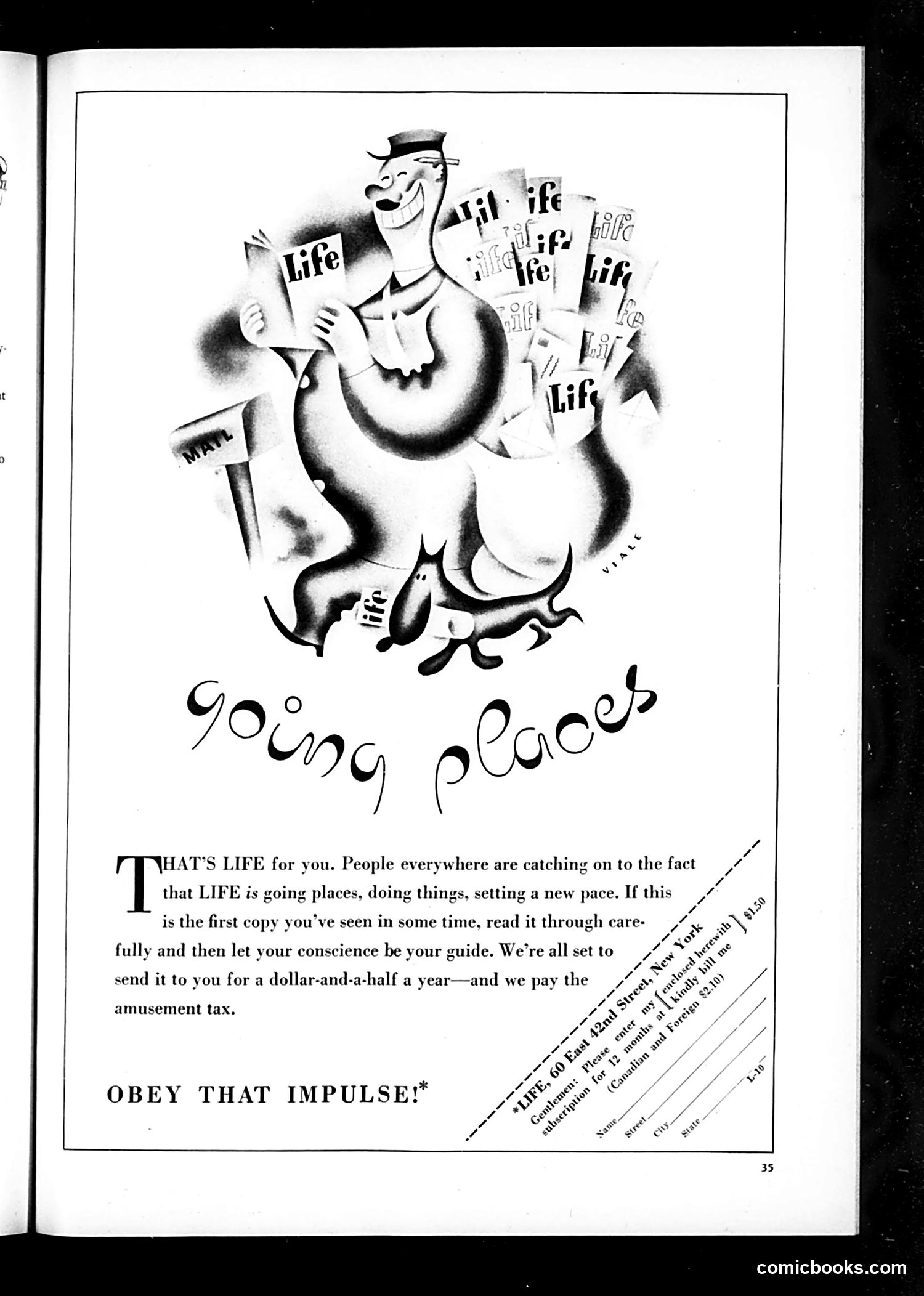
Analysis This is a subscription advertisement for Life magazine, not political satire. The cartoon depicts a cheerful, rotund figure juggling multiple "Life" magazines, embodying the publication's claim to be "going places, doing things, setting a new pace." The ad's humor is self-promotional: it suggests readers are experiencing "impulse" to subscribe based on Life's growing popularity and cultural relevance. The phrase "OBEY THAT IMPULSE!" uses mock-commanding language for comedic effect. The subscription offer ($1.50/year, with amusement tax paid by the publisher) positions Life as accessible entertainment. There's no political target here—this is simply Life magazine marketing itself as dynamic, energetic, and worth following regularly. The cartoonish style and exuberant tone were typical of mid-century magazine advertising.
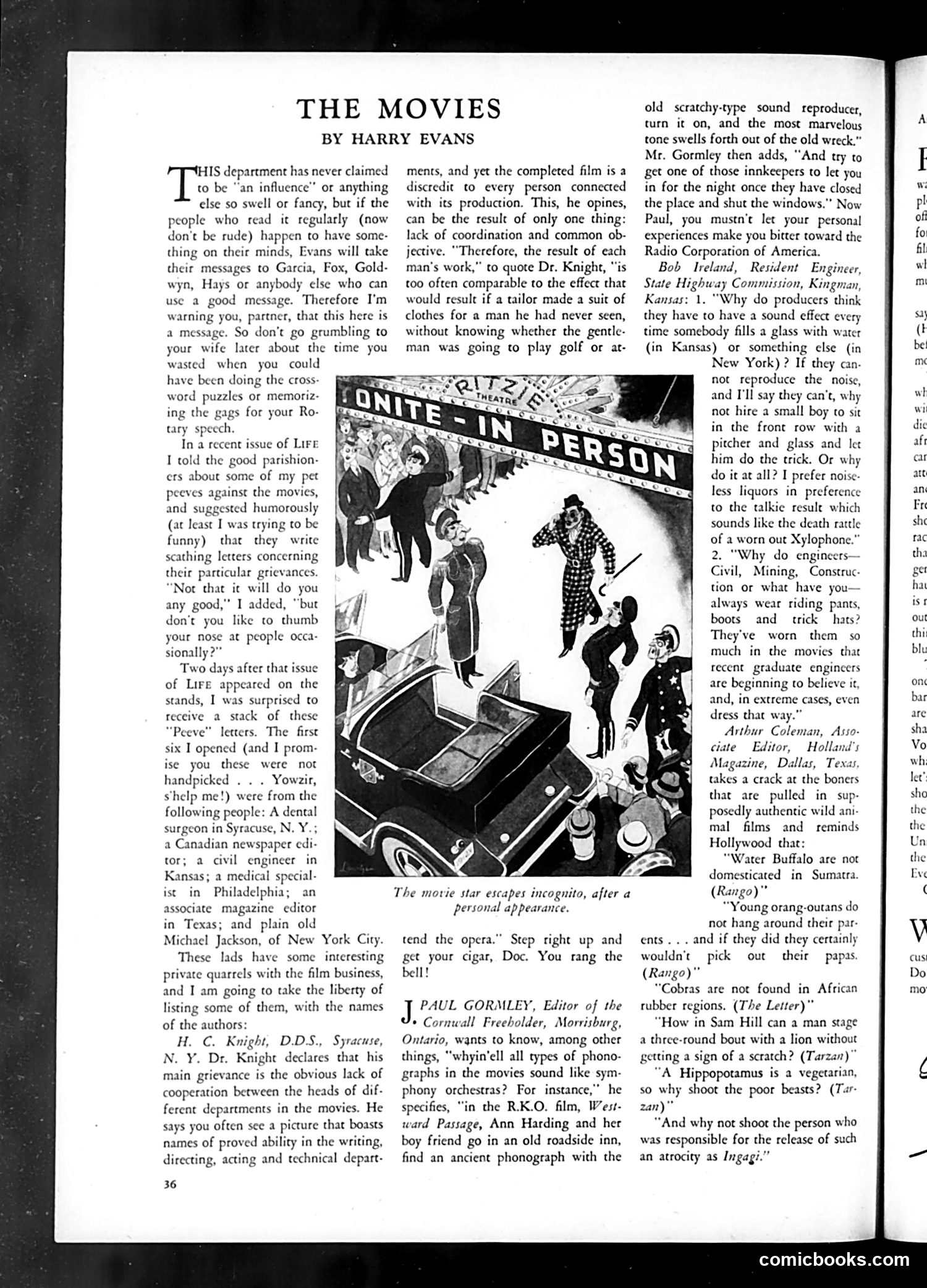
Analysis of "The Movies" Page from Life Magazine This is a satirical column by Harry Evans criticizing Hollywood film production. The accompanying illustration shows a movie star sneaking away from a theater after a personal appearance, using an elaborate disguise and automobile escape—likely mocking the artificiality and melodrama of celebrity culture. Evans presents reader complaints about filmmaking quality. Key grievances include: 1. Lack of departmental coordination: Dr. Knight notes that even films with talented writers, directors, and actors fail because departments don't work together cohesively. 2. Unrealistic sound effects: Editor Gormley mocks how phonographs and everyday sounds are depicted implausibly in films—old machines produce symphony-quality sound. 3. Inauthentic details: Engineer Ireland complains about overuse of unnecessary sound effects. The satire targets Hollywood's technical incompetence and disconnect between departments, while the cartoon illustrates the contrived, exaggerated nature of movie star personas and their public image management.
Analysis of Life Magazine Page This page combines reader letters critiquing Hollywood films with a Bell Telephone advertisement. The Letters Section: Readers complain about clichéd movie tropes—dams bursting, stenographers being ogled, racial stereotypes ("cullud gentlemen"), Monroe Owsley's performances, and hackneyed newsreel commentary. One reader (Michael Jackson) humorously proposes throwing shoes at theater screens when these tired gags appear. The editor invites producers to read these "six customers drawn right out of the hat," sarcastically implying average moviegoers are smarter than the "twelve years old between the ears" stereotype producers apparently assume. The Advertisement: Bell Telephone's "Important Member of Your Family" emphasizes the telephone's emotional and practical indispensability—keeping couples connected during moves, illness, emergencies, and separations. It positions the phone as essential infrastructure for modern family life. The Juxtaposition: The contrast between reader frustration with lazy entertainment and the phone company's celebration of modern connection appears inadvertent but underscores 1920s-30s anxieties about mass media quality and technological mediation of relationships.
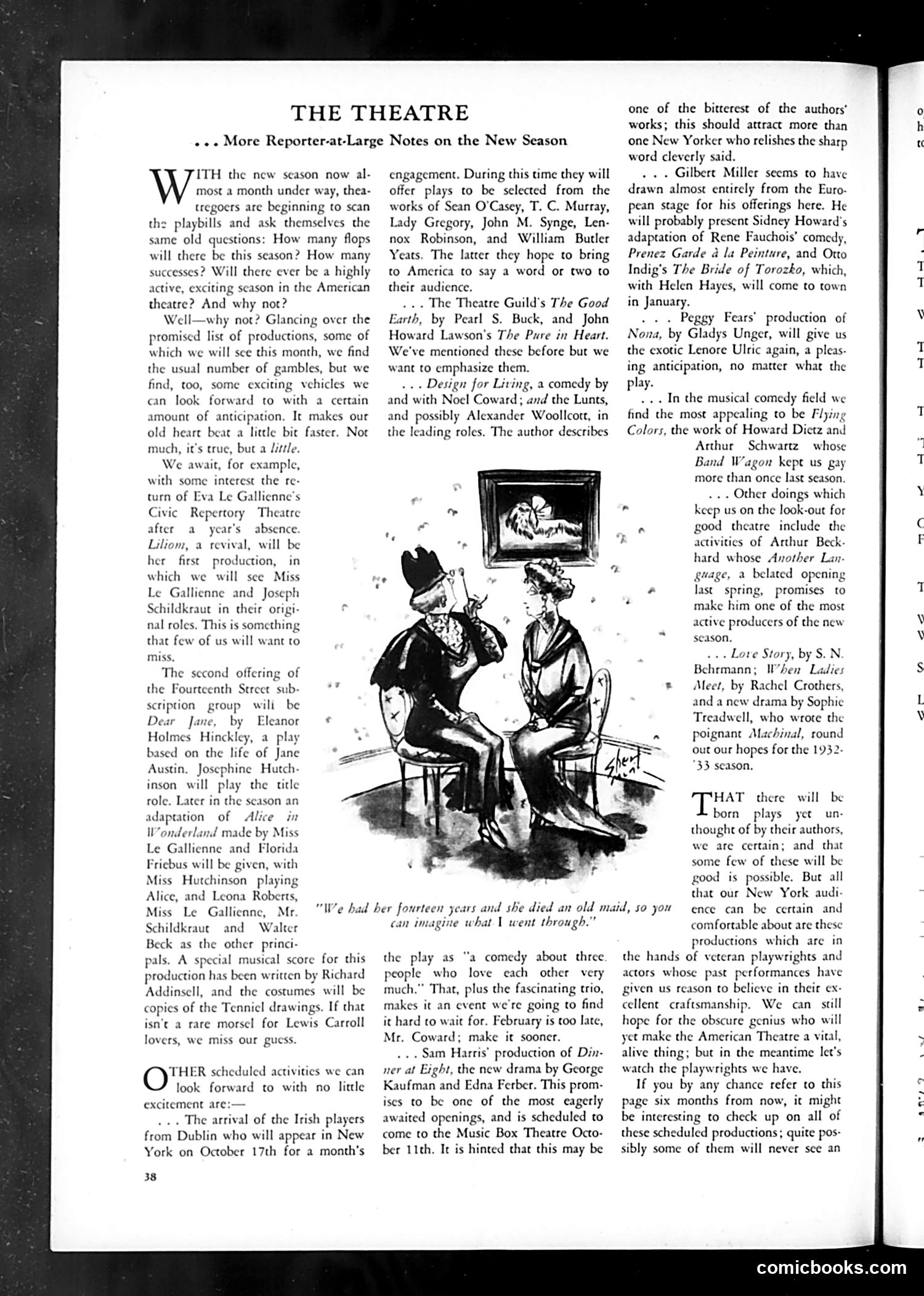
Analysis of This Theatre Page This is a theatre column reviewing Broadway's upcoming 1932-33 season. The illustration—a cartoon showing two elegantly dressed women seated, with the caption "We had her fourteen years and she died an old maid, so you can imagine what I went through"—appears to be a humorous domestic scene, likely meant to preview comedic material from the plays being discussed. The page discusses anticipated theatrical productions, particularly highlighting Noel Coward's *Design for Living* (featuring "the Lunts"—a famous acting couple), George Kaufman and Edna Ferber's *Dinner at Eight*, and Eva Le Gallienne's Civic Repertory Theatre productions. The columnist expresses measured optimism about the season while acknowledging typical theatrical risks. The cartoon's joke relies on period attitudes about unmarried women and domestic life—humor now considered dated. The overall tone reflects 1930s Broadway culture, where major playwrights and star actors drove audience interest and critical attention.
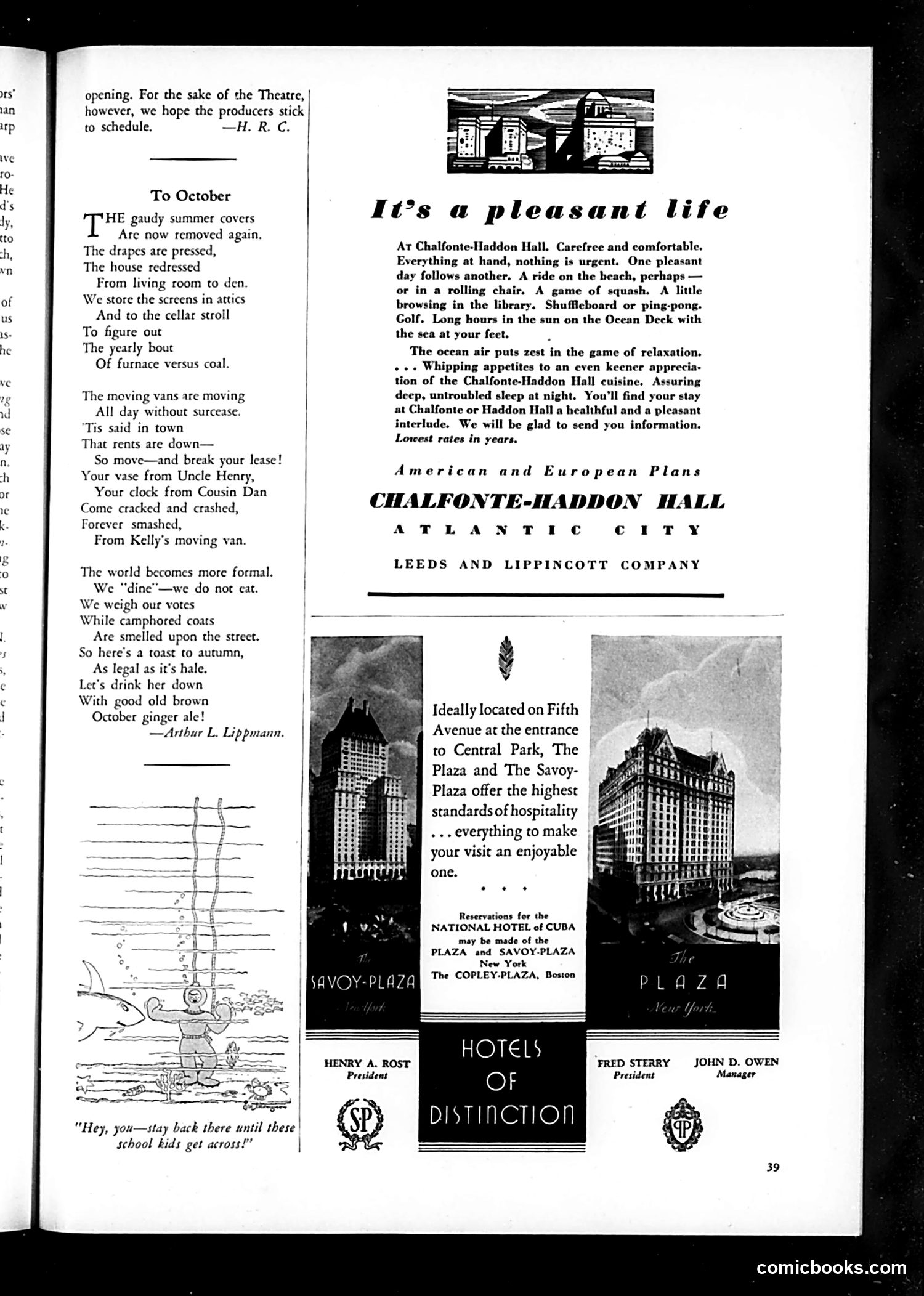
Analysis of Life Magazine Page This page is primarily advertising and light verse rather than political satire. The left side features "To October," a humorous poem by Arthur L. Lippmann about seasonal household transitions—storing summer items, dealing with moving vans, and preparing for autumn's formality. The joke centers on the chaos of moving season: renters breaking leases because rents are falling, possessions getting destroyed by movers (Kelly's moving van), and the shift from casual summer eating to formal "dining." The small cartoon at bottom-left depicts a traffic cop telling schoolchildren to wait while a car passes—a mundane urban scene with no particular political meaning. The remainder is hotel advertising: Chalfonte-Haddon Hall (Atlantic City beach resort), the Plaza and Savoy-Plaza (Fifth Avenue, New York), and reservations information for various luxury hotels. The ads emphasize leisure, relaxation, and comfort—typical 1920s-30s luxury hospitality marketing aimed at affluent readers.
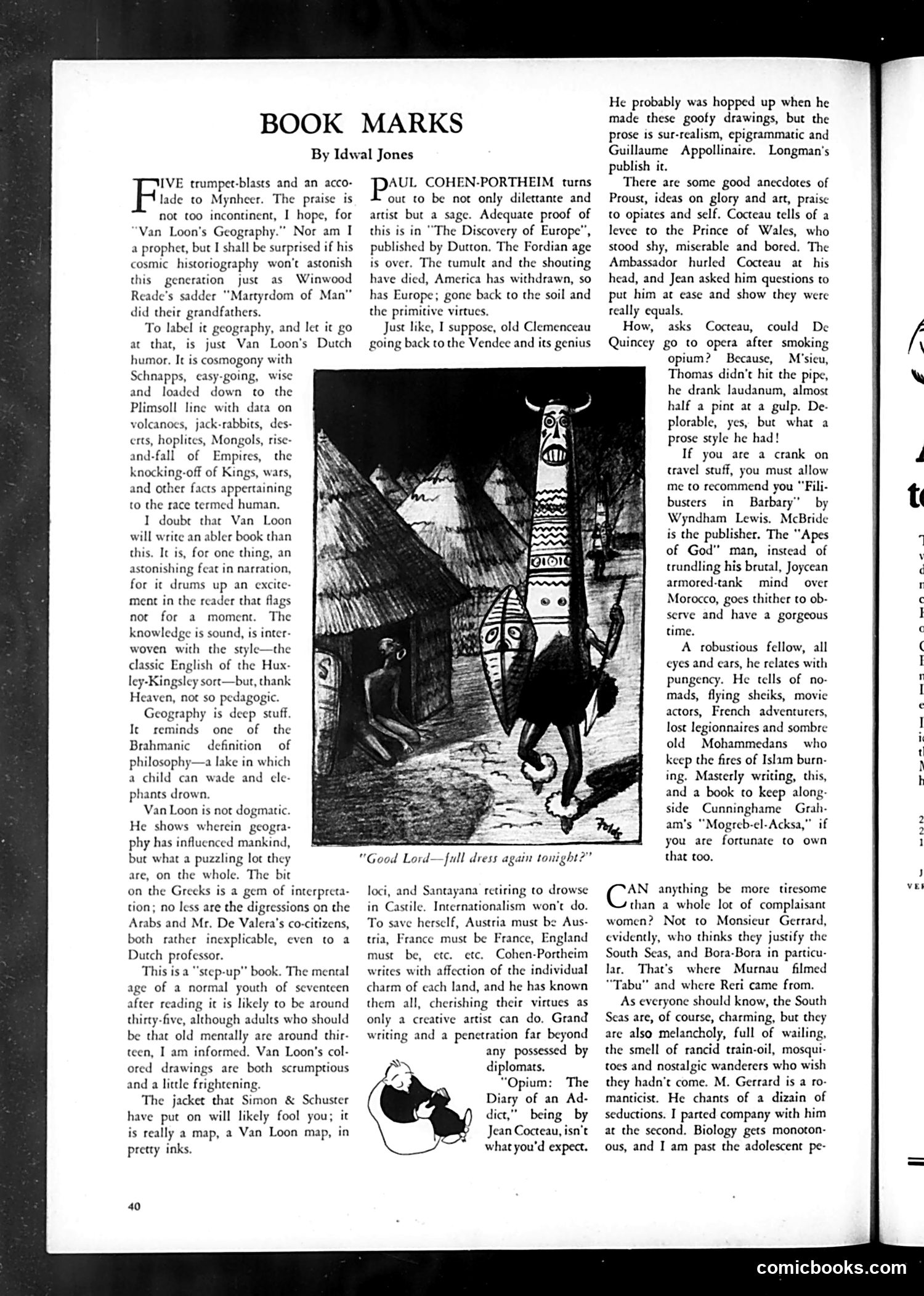
Book Marks: Political and Literary Context This book review column by Idwal Jones discusses three works, with one notable cartoon. The main illustrated piece shows a demonic or satyr-like figure in elaborate costume addressing another character with "Good Lord—full dress again tonight?"—likely satirizing pretentious formality or aristocratic affectation. The reviews praise Van Loon's "Geography" as sweeping intellectual work; Cohen-Portheim's "The Discovery of Europe" advocates for post-WWI national self-determination (referencing Clemenceau, Austria, France); and Cocteau's "Opium: The Diary of an Addict" is presented as surrealist art despite its unconventional subject matter. The satire appears gentle—mocking social pretension and excessive formality rather than targeting specific political figures. The column reflects 1920s-30s literary sophistication and the period's fascination with modernist, avant-garde European culture.
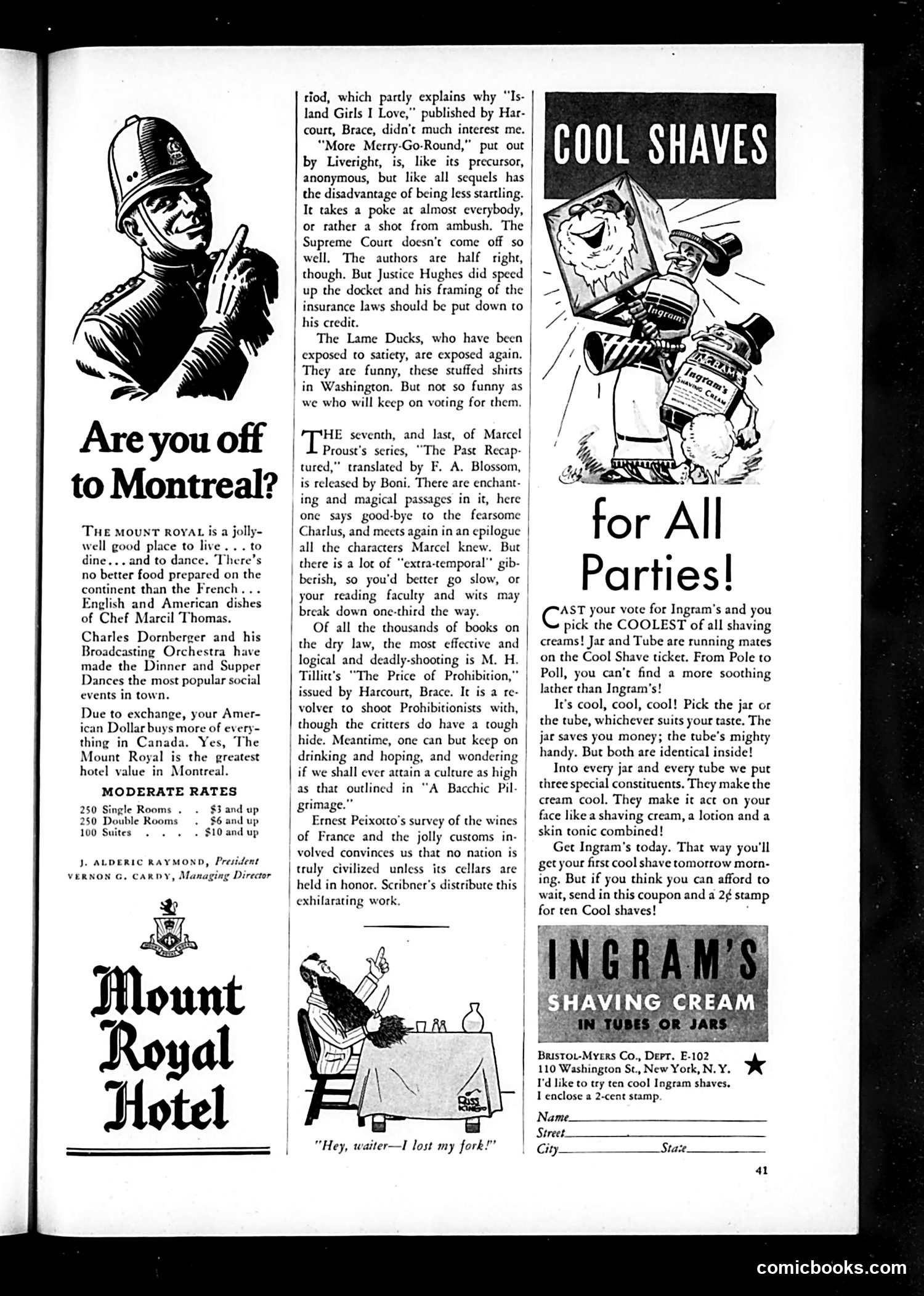
Political Satire and Period Advertising on Life Magazine Page This page blends hotel promotion, book reviews, and political satire typical of 1920s Life magazine. The editorial content mocks contemporary targets: "The Lame Ducks" (likely referring to ineffective Washington politicians), Prohibition advocates ("Prohibitionists"), and Supreme Court justice Hughes. References to Marcel Proust's final novel and prohibition-era literature date the page to the mid-to-late 1920s. The "Cool Shaves" advertisement cleverly uses political language—"from Pole to Poll" and "vote for Ingram's"—as a humorous play on contemporary election discourse, suggesting shaving cream appeals to "all parties." This reflects an era when advertising adopted populist, democratic rhetoric. The Mount Royal Hotel advertisement emphasizes the favorable Canadian dollar exchange rate, appealing to Americans seeking value abroad during economic uncertainty. The cartoon showing a waiter and fork-losing diner is generic social humor unrelated to political content.
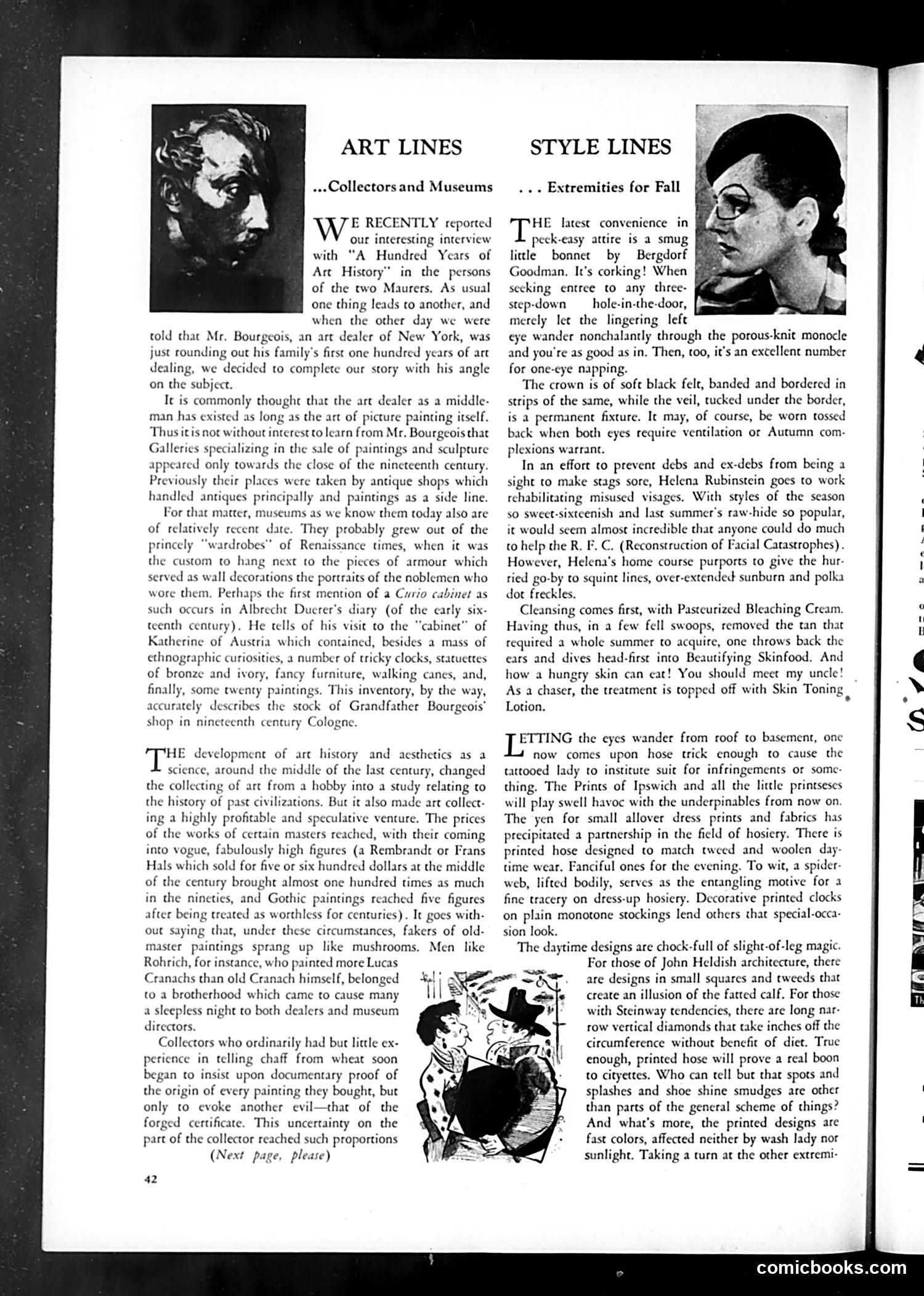
Analysis for Modern Readers This page contains two distinct columns: "Art Lines" discusses the history of art dealing and museums, while "Style Lines" reviews fall fashion. The Art Lines section is a serious historical piece about art dealer Mr. Bourgeois. It traces how specialized art galleries only emerged in the late 19th century, previously handled by antique shops. The text humorously notes that Renaissance princes' collections—armor, portraits, clocks, furniture—resemble a 19th-century antique dealer's stock. It discusses how the professionalization of art history created a lucrative market, inflating prices dramatically (a Rembrandt worth $500-600 in mid-century cost $50,000+ by the 1890s). This boom spawned forgers and fake certificates—a satirical comment on how commercializing art created problems. "Style Lines" sarcastically reviews a Bergdorf Goodman bonnet with a monocle attachment for "one-eye napping," mocking fashionable affectation and impracticality. The humor lies in describing a one-eyed bonnet as stylish sophistication when it's obviously absurd. Both sections use gentle satire to mock pretension: in art collecting and in high fashion.
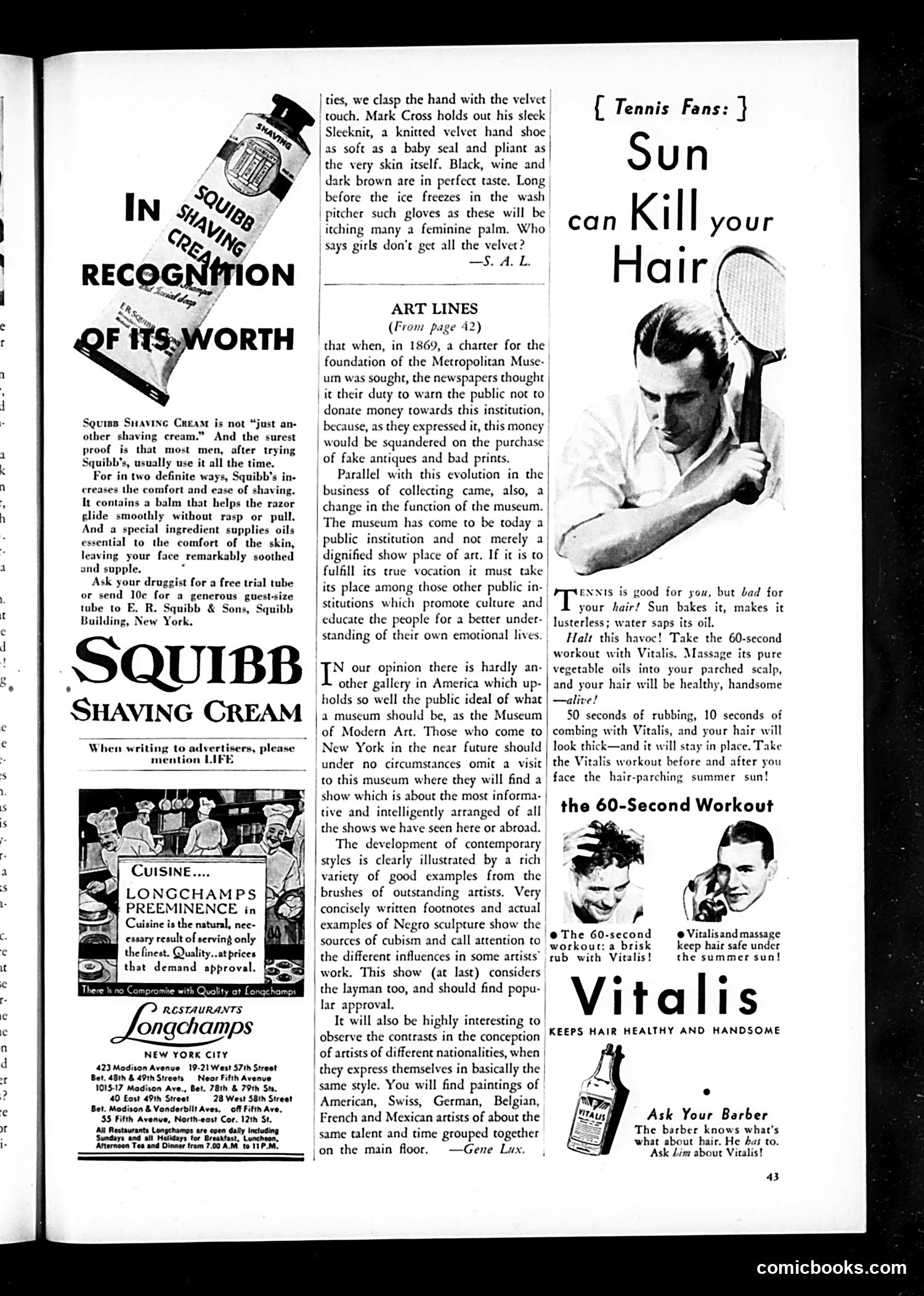
Analysis of Life Magazine Page Content This page consists primarily of advertisements rather than political satire. The main content includes: 1. Squibb Shaving Cream ad (left): Emphasizes comfort and skin care, highlighting a balm that helps razors glide smoothly. 2. Mark Cross gloves ad (top center): Promotes velvet hand gloves as luxurious winter accessories, using suggestive language about feminine appeal. 3. Vitalis hair product ad (right): The central editorial element warns tennis players that sun exposure damages hair—making it lusterless and removing natural oils. It advertises a "60-second workout" routine with Vitalis massage to restore hair health before summer sun exposure. 4. Art Lines column (center): A non-satirical essay praising the Museum of Modern Art's exhibitions and educational mission. 5. Longchamps restaurant ad (bottom left): Lists multiple New York City locations. The page reflects 1930s consumer culture and beauty product marketing rather than political commentary.
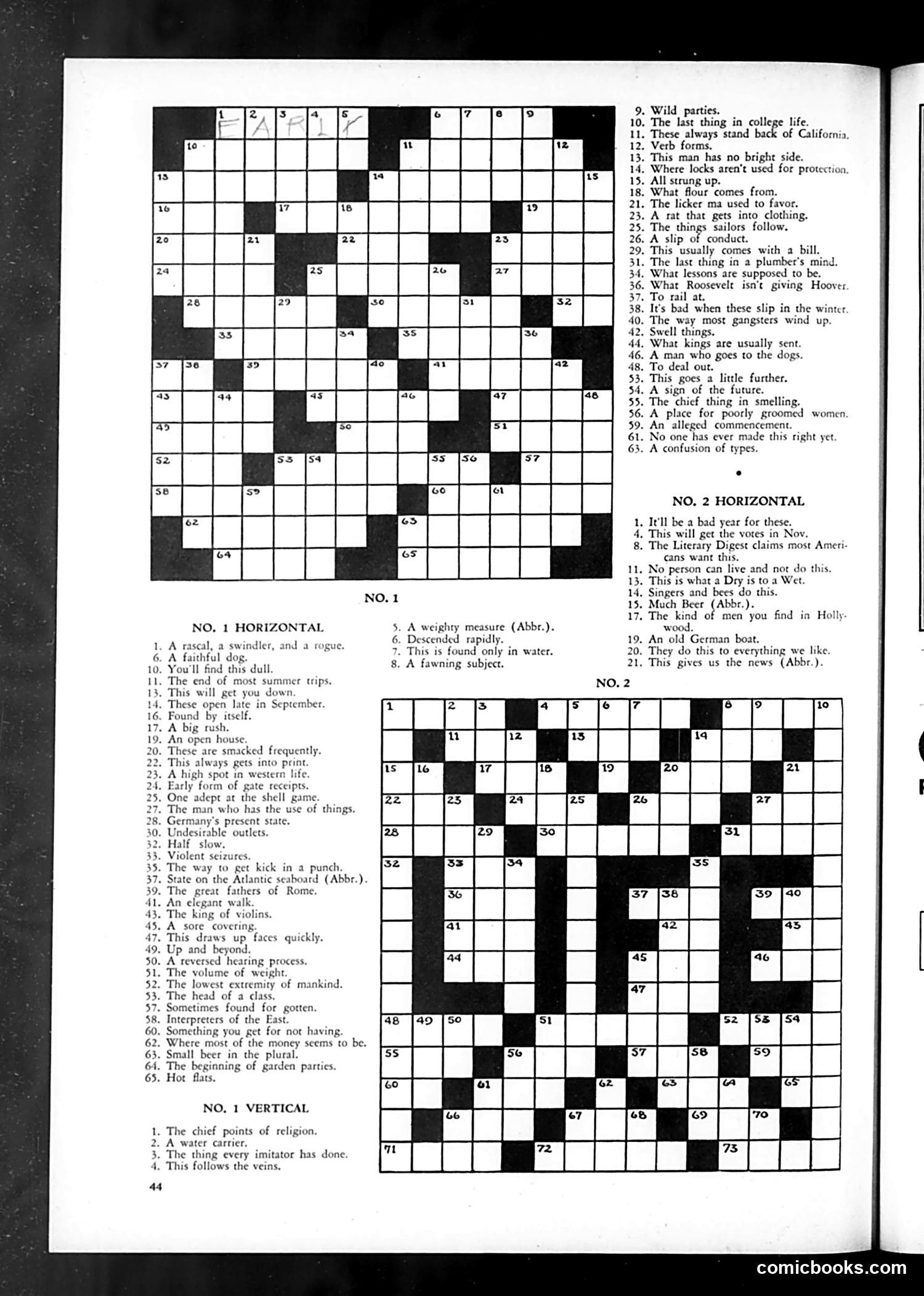
Page Content Analysis This page contains two crossword puzzles (labeled No. 1 and No. 2), not political cartoons. The clues are satirical wordplay targeting early 1930s American life and politics. Key satirical references visible in the clues: - "What Roosevelt isn't giving Hoover" (clue 37, Vertical) — references the 1932 presidential transition, suggesting Roosevelt withheld aid from his predecessor - "This will get the votes in Nov." (No. 2 Horizontal) — election-year commentary - "Germany's present state" (No. 1 Horizontal) — likely referencing economic depression or political instability - "A man who goes to the dogs" — social commentary on financial ruin - "Where most of the money seems to be" — implies wealth concentration - "An old German boat" — unclear specific reference The puzzles use Depression-era slang and social observation ("gangsters wind up," "poorly groomed women") as humor. This appears to be *Life* magazine's satirical take on contemporary anxieties through wordplay rather than illustration.
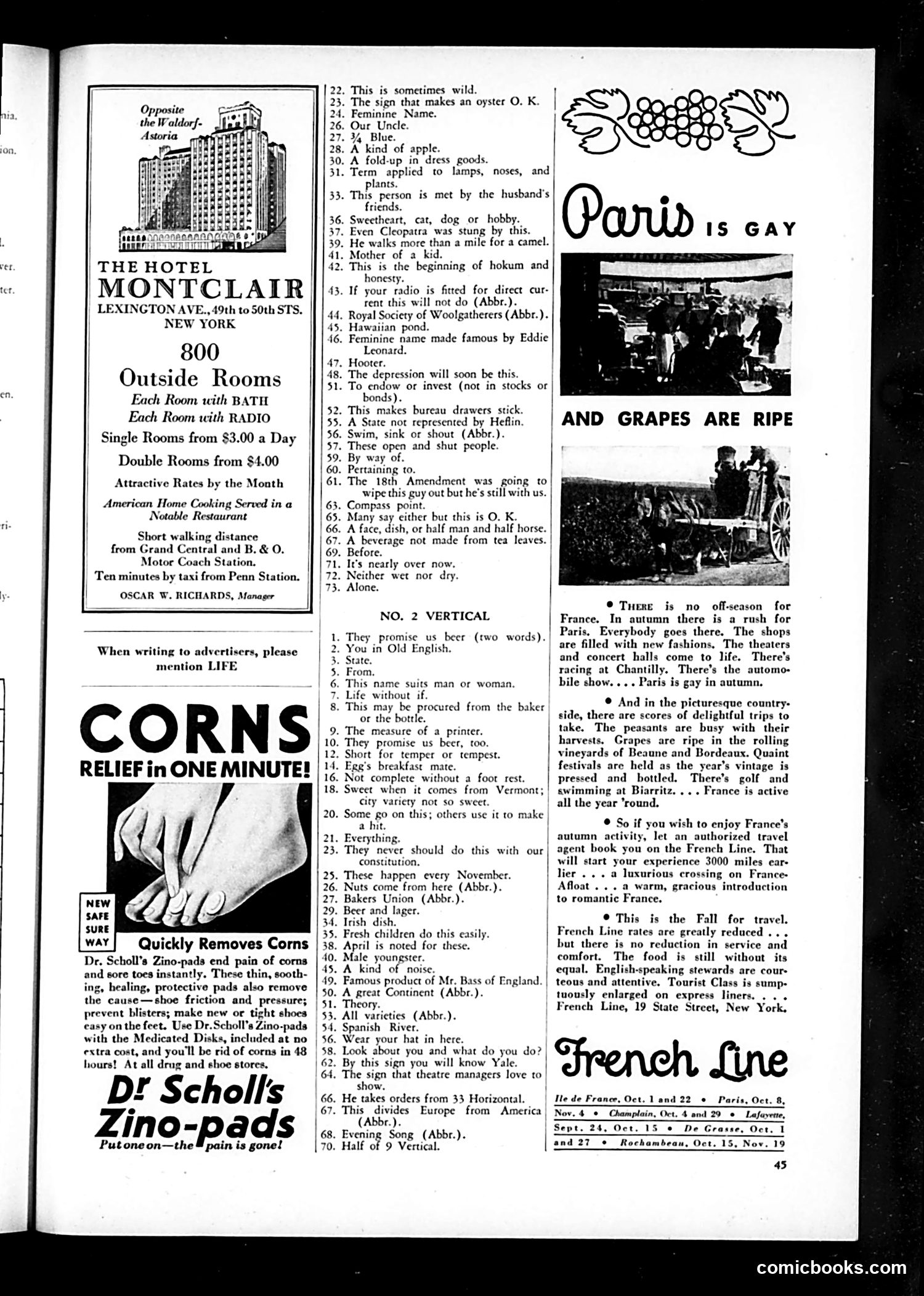
Life Magazine Page Analysis This page is primarily advertising and crossword puzzle content, not political satire. The dominant features are: 1. Hotel Montclair advertisement (left): Standard lodging promotion for a New York hotel offering 800 rooms with radio and bath. 2. Dr. Scholl's Zino-pads advertisement (left): A product advertisement claiming to quickly remove corns, with an illustration of feet. 3. Crossword puzzle clues (center): Numbered word definitions for what appears to be a standard crossword puzzle. 4. "Paris is Gay" travel advertisement (right): A French Line shipping company advertisement promoting fall travel to France, with photographs of Parisian scenes and vineyard activities. The text emphasizes Paris's autumn attractions—theaters, fashion, racing, festivals, and countryside activities. There is no political cartoon or satire on this page. It represents typical 1920s-30s magazine content: commercial advertisements interspersed with reader entertainment (the crossword puzzle).
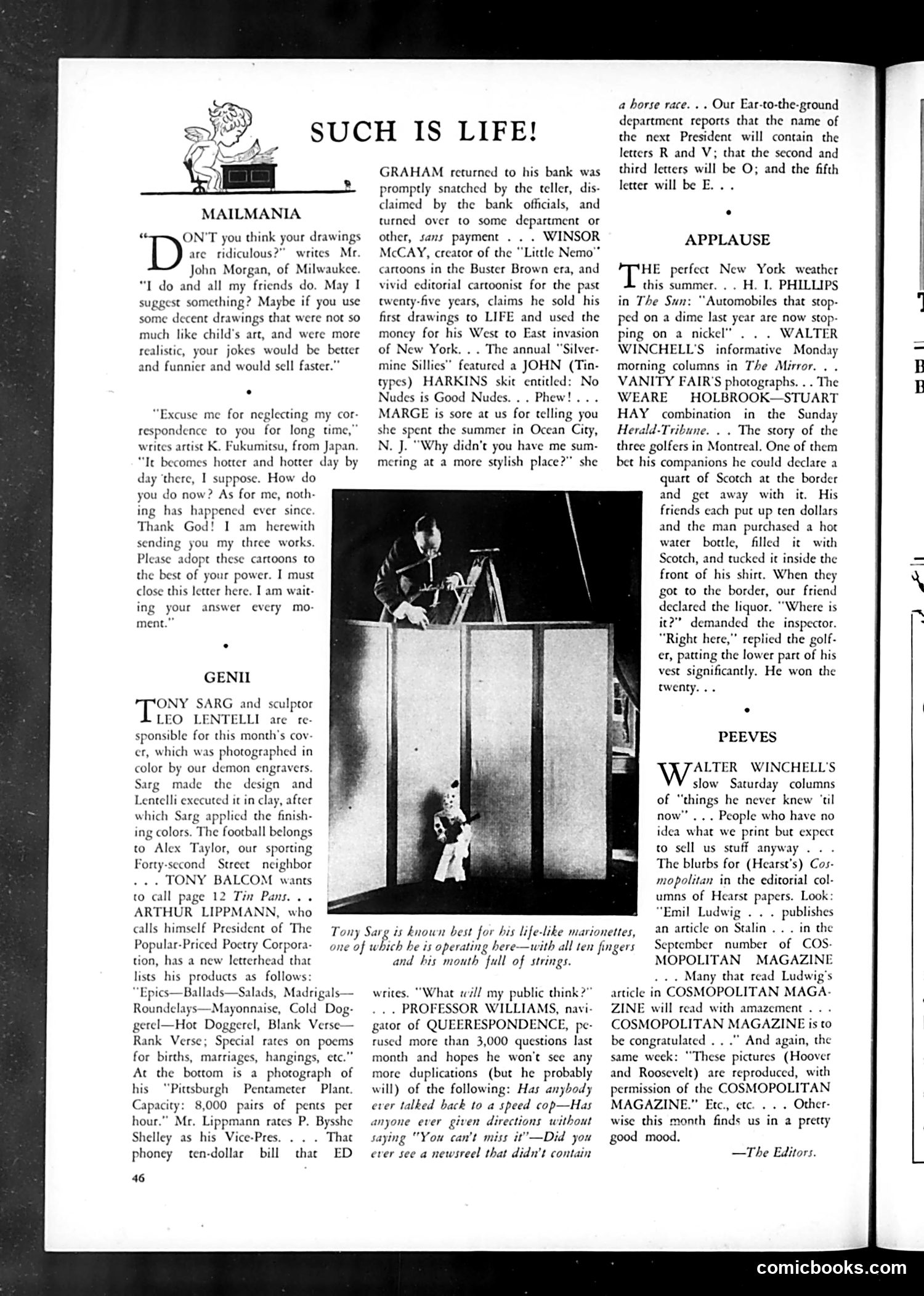
Explanation for Modern Readers This is a letters-and-gossip column from Life magazine's "Such Is Life!" section, not primarily political satire. It showcases reader mail and celebrity gossip. Key content: The main illustration shows Tony Sarg operating a life-sized marionette puppet—referencing his fame as a puppeteer/designer. The jokes and references: - A reader criticizes Life's cartoon style as childish - A Japanese artist submits work hopefully - Winsor McCay (famous "Little Nemo" cartoonist) supposedly made his first sale to Life - A humorous fake "Poetry Corporation" advertises absurd services - A mysterious prediction: the next U.S. President's name will contain letters R, V, O, O, and E (unclear which president) - Praise for local NYC columnists (Walter Winchell, H.I. Phillips) The tone is lighthearted office humor and celebrity name-dropping typical of 1920s-30s magazine culture. Without a date visible, the exact historical moment remains unclear.
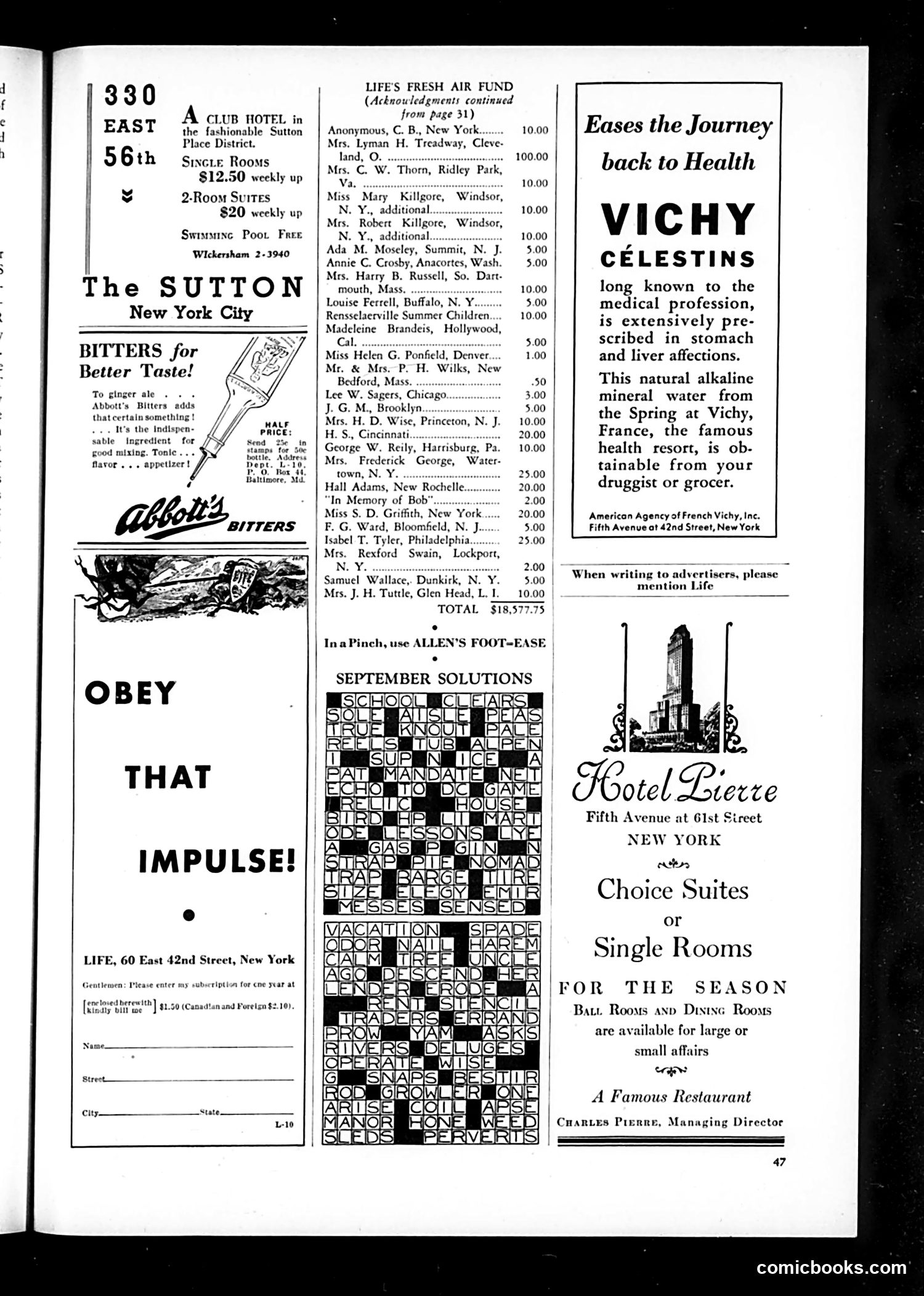
Analysis of Life Magazine Page 47 This is primarily an advertising and announcements page rather than editorial content. The page contains: 1. Hotel and beverage advertisements for The Sutton (a New York hotel), Abbott's Bitters (a cocktail ingredient), and Hotel Pierre 2. Life's Fresh Air Fund acknowledgments—a charitable program listing donors who contributed to send poor children to the countryside for health benefits. This was a genuine philanthropic initiative of the era. 3. A crossword puzzle labeled "September Solutions," typical of Life's regular features 4. A subscription form for Life magazine itself The only element approaching satire is the Abbott's Bitters ad, which humorously suggests bitters are an "indispensable ingredient" for mixing—typical period advertising that implied cocktails were essential to modern life. The page reflects 1930s consumer culture, charitable giving practices, and leisure activities among the middle and upper classes.
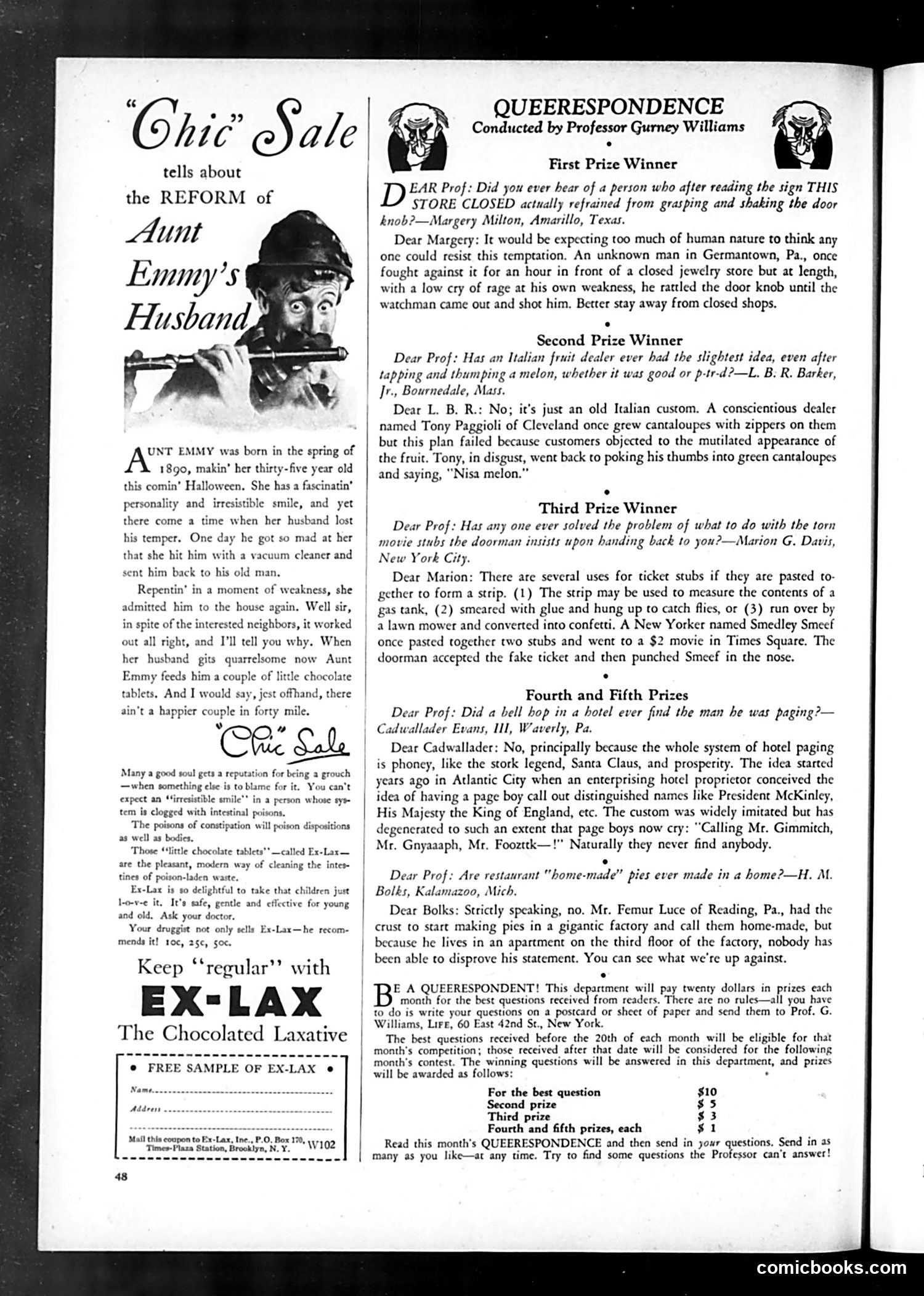
"Chic Sale" on Life Magazine Page This page combines a humorous fictional narrative with a reader advice column. The left side features "Chic Sale," a popular humorist, telling a domestic comedy: Aunt Emmy reforms her hot-tempered husband by feeding him Ex-Lax laxative tablets. The joke relies on the then-common satirical connection between constipation and bad temperament—the implied premise being that intestinal troubles cause marital discord. The right side, "Queerespondence," is a satirical Q&A column where readers submit absurd questions (about closed store doors, melon-thumping Italian fruit dealers, movie ticket stubs) and receive deliberately ridiculous answers. The humor targets common human quirks and social conventions. The entire page functions as advertising for Ex-Lax, disguised as entertainment. The subtext: bowel regularity ensures happiness—a typical early-20th-century patent medicine marketing approach mixing gentle satire with health claims.
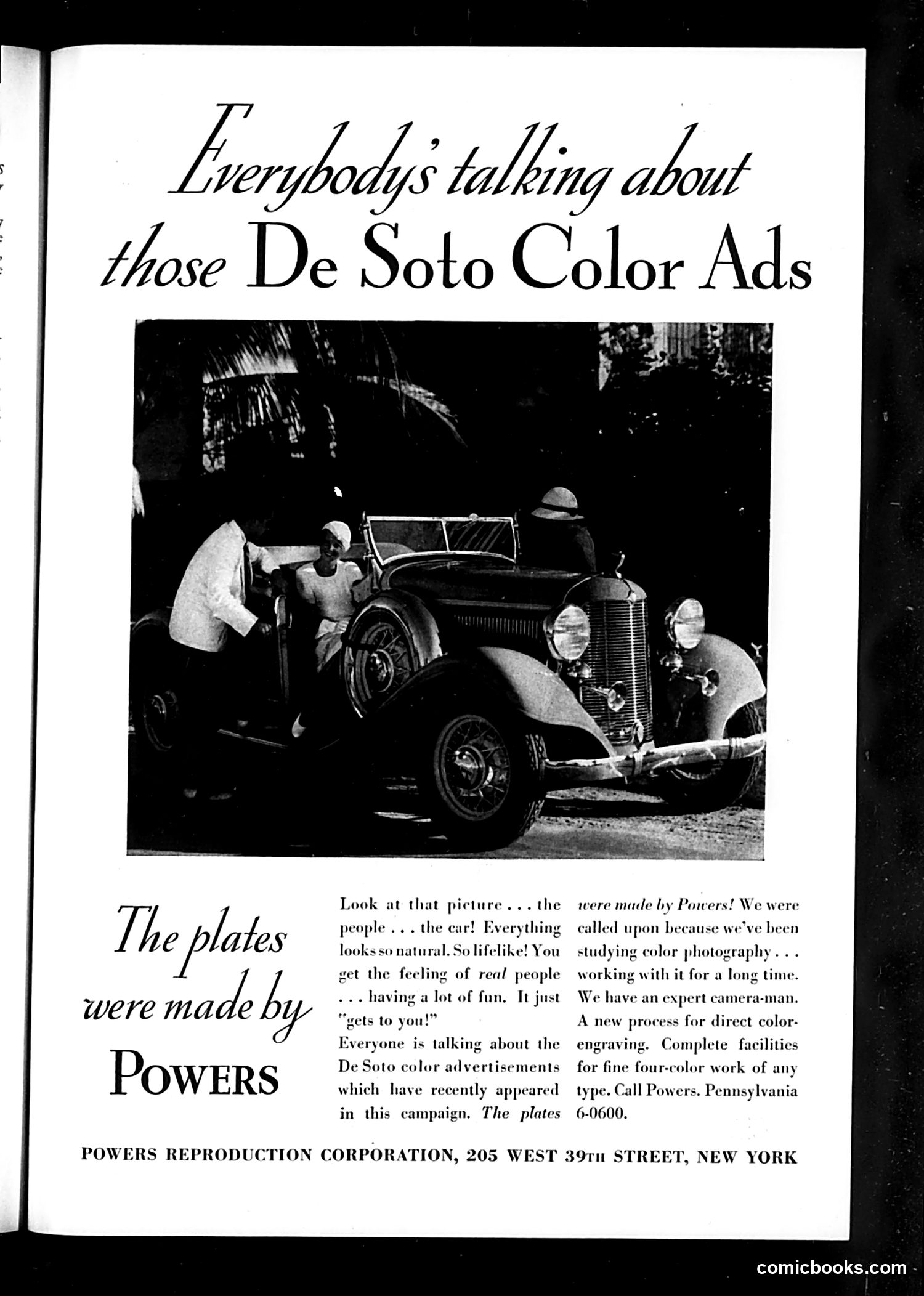
Analysis This is primarily a De Soto automobile advertisement, not political satire. The page promotes Powers Reproduction Corporation's role in creating color printing plates for De Soto's recent advertising campaign. The image shows a vintage car (a De Soto) with people posed around it in a casual, naturalistic scene. The ad's text emphasizes how realistic and lifelike the photograph appears—highlighting the appeal of the advertising itself. The "satire" here is subtle: the ad mockingly suggests that viewers of De Soto's color ads are impressed by how "natural" and "lifelike" everything looks, implying the advertisements' persuasive power lies in their photorealistic quality rather than the car's actual merits. It's essentially an industry advertisement celebrating modern color reproduction technology, presented somewhat tongue-in-cheek. The page serves as a trade advertisement for Powers' printing capabilities, using the successful De Soto campaign as evidence of their expertise.
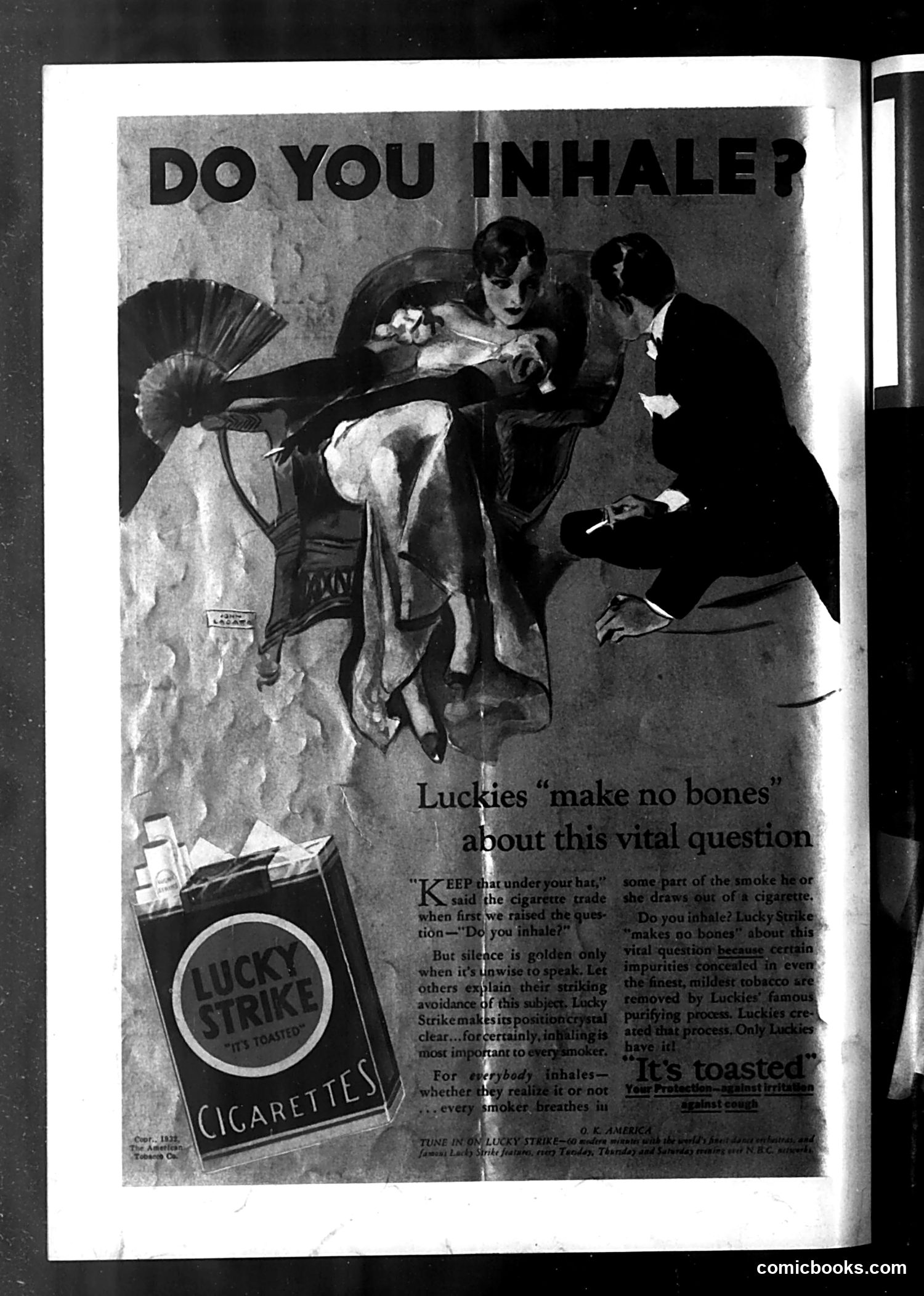
Luckies "Make No Bones" Advertisement This is a cigarette advertisement for Lucky Strike, not political satire. The large text "DO YOU INHALE?" addresses a marketing concern of the era: whether smokers actually inhaled tobacco smoke into their lungs. The image shows three well-dressed men in suits examining a woman, apparently debating inhalation techniques. The ad claims Lucky Strikes "make no bones" about this question because their tobacco undergoes a special "purifying process" that supposedly removes irritants. The tagline "It's toasted" refers to Lucky Strike's marketing claim that their toasting method made cigarettes safer. This reflects pre-regulation tobacco advertising that made health-related claims without scientific basis—claims now understood as false. The ad targets smokers concerned about smoking's effects on health.