life
Life — November 1932
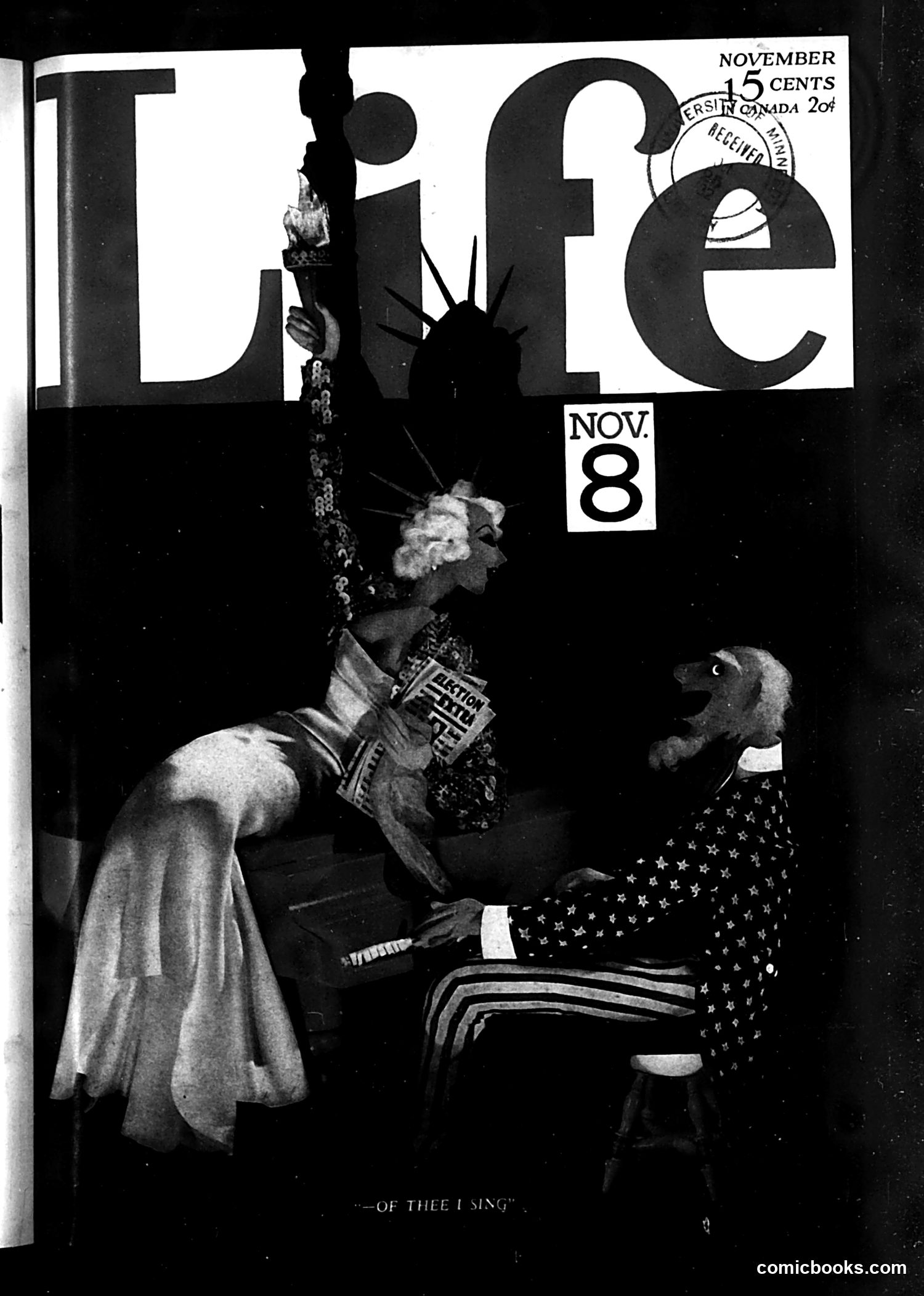
Life Magazine Cover Analysis (November 8) This Life magazine cover from November (price 15 cents) features a theatrical scene titled "Of Thee I Sing." The image shows two figures in period costume—one standing (wearing a cape and holding a torch) and one seated (wearing a star-patterned outfit)—appearing to be characters from the 1931 George Gershwin musical comedy of the same name. The Statue of Liberty figure and patriotic staging suggest the cover is promoting this popular operetta, which satirized American politics and presidential campaigns. The date "NOV. 8" likely indicates the magazine's publication date, possibly coinciding with the show's performance or promotion. This appears to be an entertainment/theater cover rather than political satire.
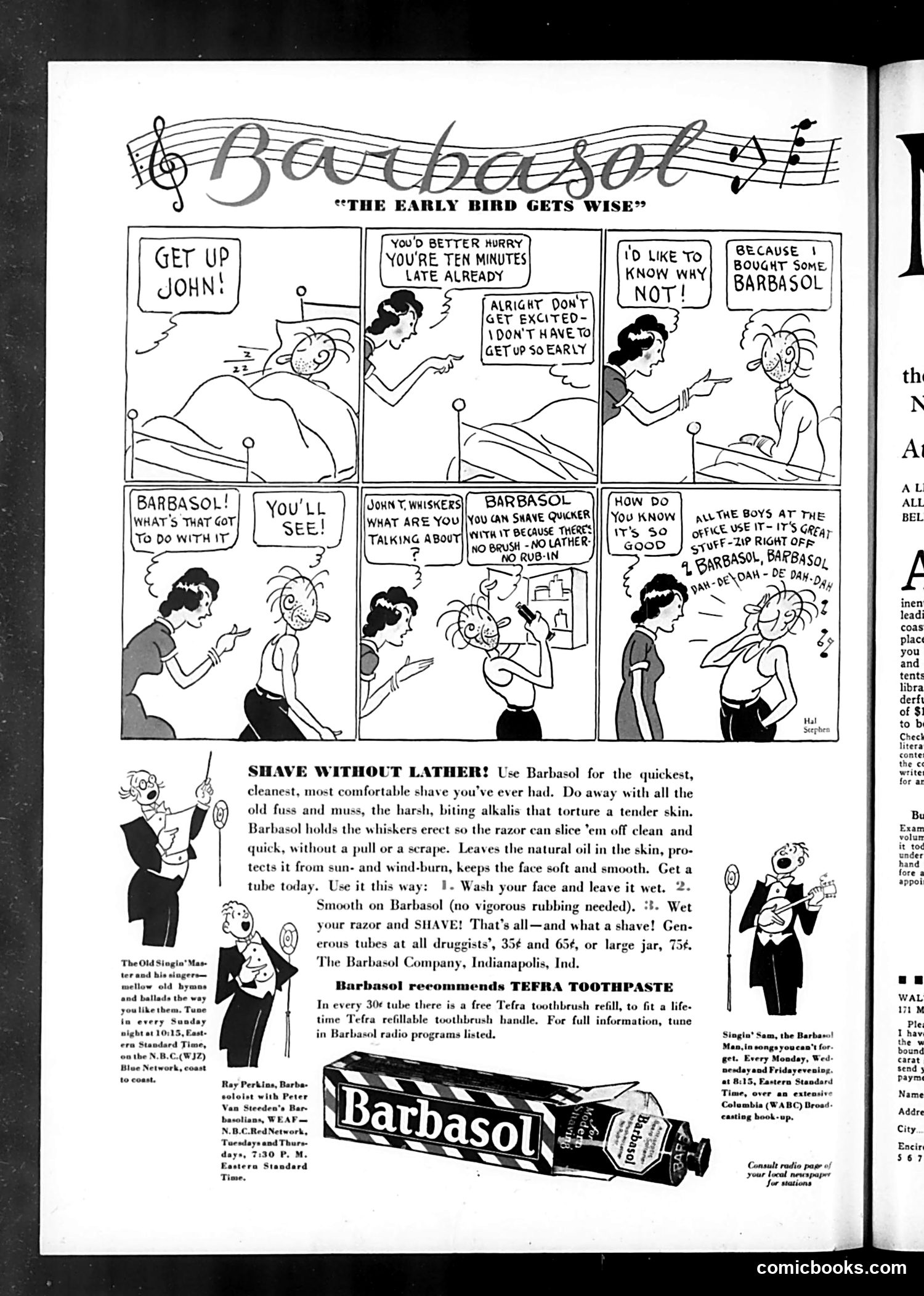
Content Analysis This page is primarily a Barbasol shaving cream advertisement disguised as editorial content. The comic strip "Barbasol" presents a domestic scenario where a wife wakes her husband John, claiming he's late. John resists getting up early until his wife mentions she bought Barbasol shaving cream. He becomes enthusiastically cooperative, suggesting the product supposedly makes shaving so quick and pleasant that men willingly wake early. The advertisement below promotes Barbasol's latherless formula, claiming it provides the "quickest, cleanest, most comfortable shave." The comic's humor relies on exaggerating the product's appeal—implying it transforms men's morning routines so dramatically that domestic conflicts dissolve. This is vintage advertising satire, using cartoon narrative to sell a consumer product through comedic domestic scenarios typical of mid-20th-century marketing.
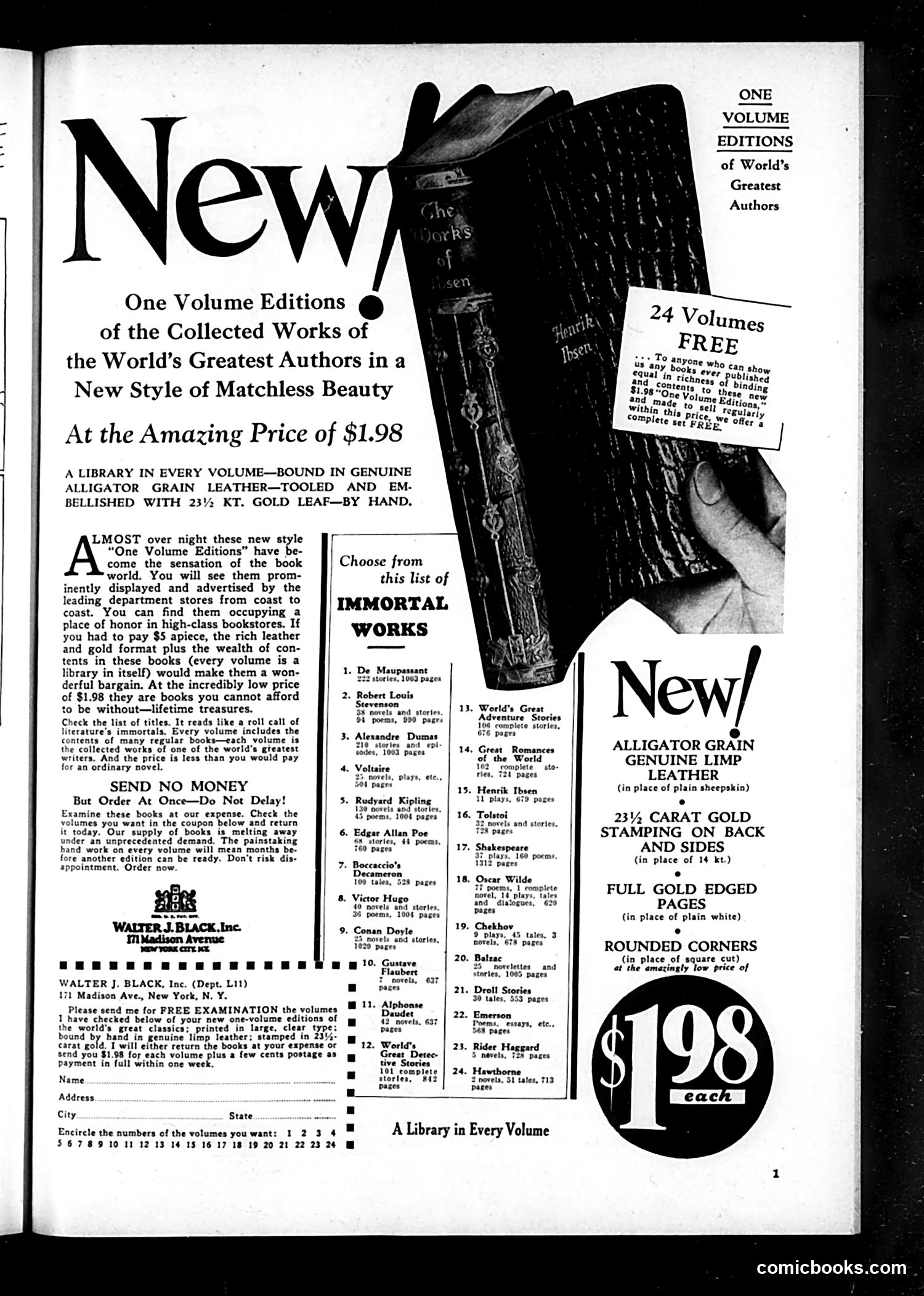
Analysis This page is primarily advertising, not editorial content or satire. It's a full-page advertisement for "One Volume Editions" of classic literature published by Walter J. Black, Inc. The ad promotes leather-bound collections of works by famous authors (Shakespeare, Dickens, Ibsen, etc.) at $1.98 each. Key selling points include genuine alligator leather binding, gold leaf decoration, and what appears to be an appealing aesthetic design. The only visual element is a photograph of an ornate book being held, meant to showcase the product's quality and desirability. There is no political cartoon, satire, or social commentary present—this is straightforward commercial promotion of affordable luxury book editions during what was likely the Depression or post-Depression era, when such pricing was significant.
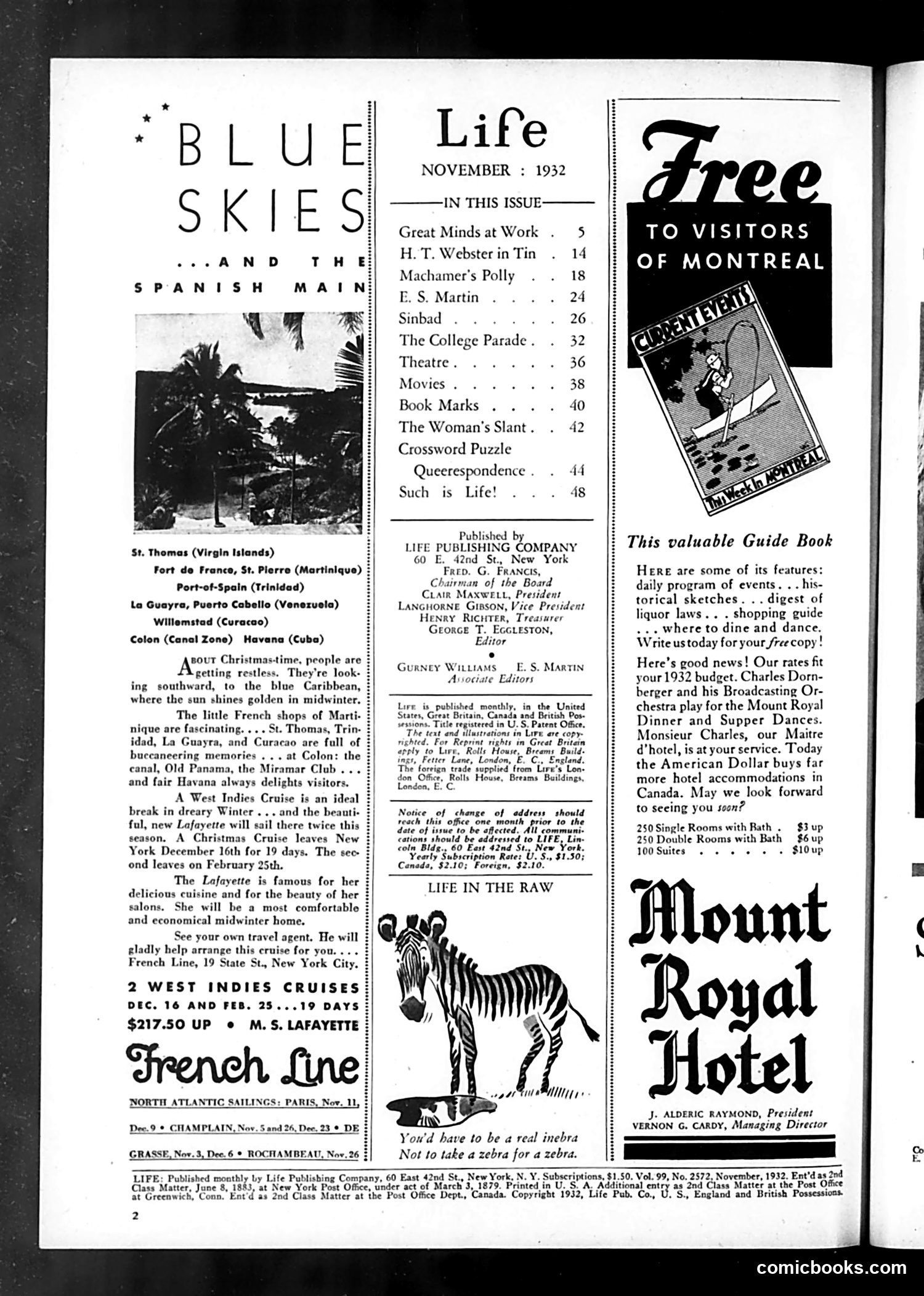
Page Analysis This is primarily a table of contents and advertising page from Life magazine's November 1932 issue, not a political cartoon page. The visible content includes: - A feature on "Blue Skies and the Spanish Main" with travel photography - A "Life in the Raw" section featuring a zebra illustration with the caption "You'd have to be a real inebrа / Not to take a zebra for a zebra"—a simple visual pun about animal identification - Advertisements for Caribbean cruises, the Mount Royal Hotel in Montreal, and a travel guide - Masthead information crediting editors and publishers The zebra joke is the only cartoon element—a mild, non-political visual wordplay typical of magazine humor from this era. The page serves primarily to advertise travel and hospitality services during the Great Depression.
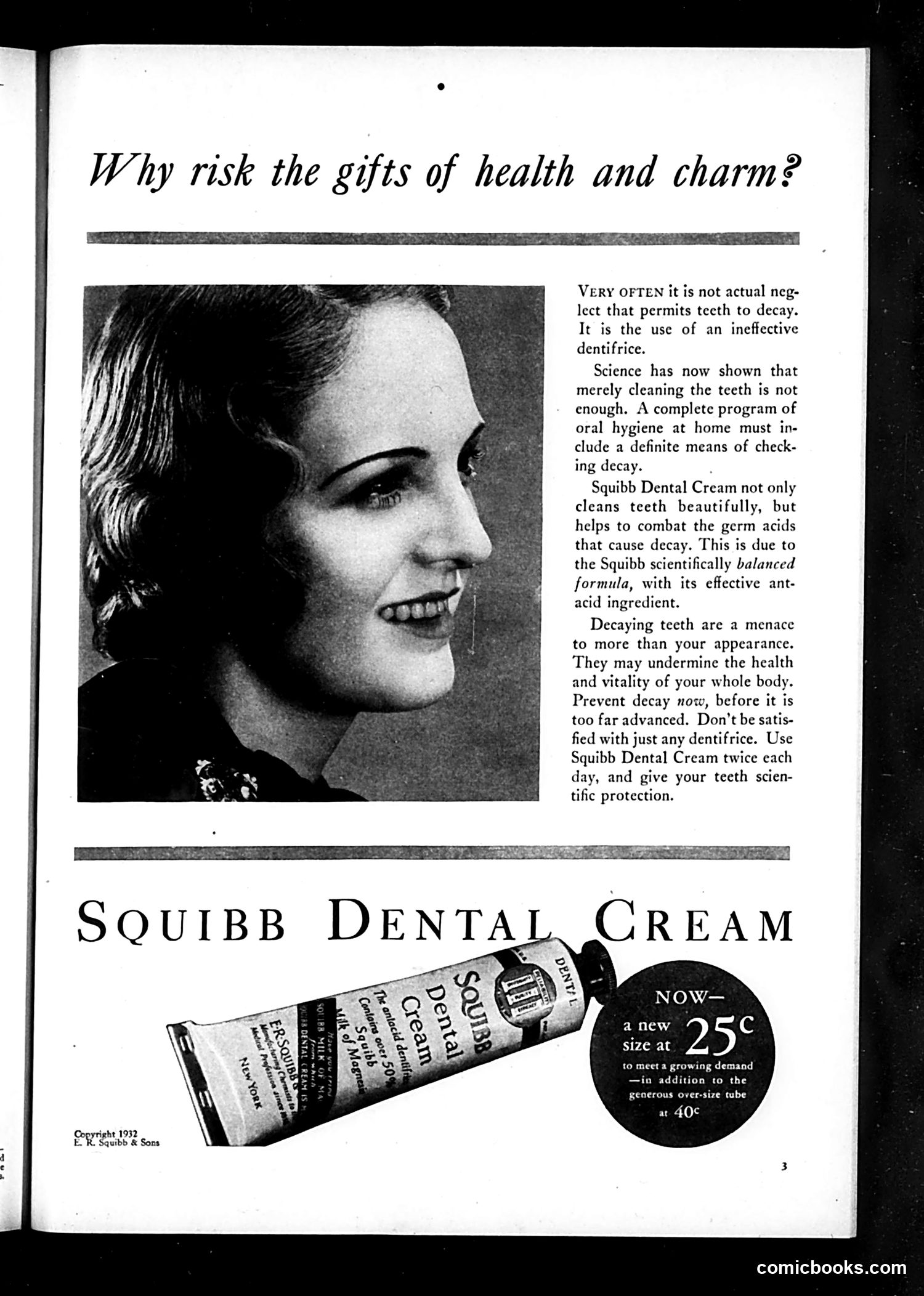
Squibb Dental Cream Advertisement This is a straightforward advertisement, not satire or political commentary. The page promotes Squibb Dental Cream to a female audience circa 1932 (copyright date visible). The ad uses a glamorous portrait of a smiling woman with perfect teeth to sell the product's benefits. The headline "Why risk the gifts of health and charm?" frames dental care as essential to female beauty and attractiveness. The text emphasizes that merely cleaning teeth is insufficient—decay prevention requires Squibb's "scientifically balanced formula" with "effective anti-acid ingredient." The ad warns that decaying teeth threaten not just appearance but whole-body health. Pricing indicates a new 25-cent size alongside the standard 40-cent tube, suggesting market expansion during the Depression era.
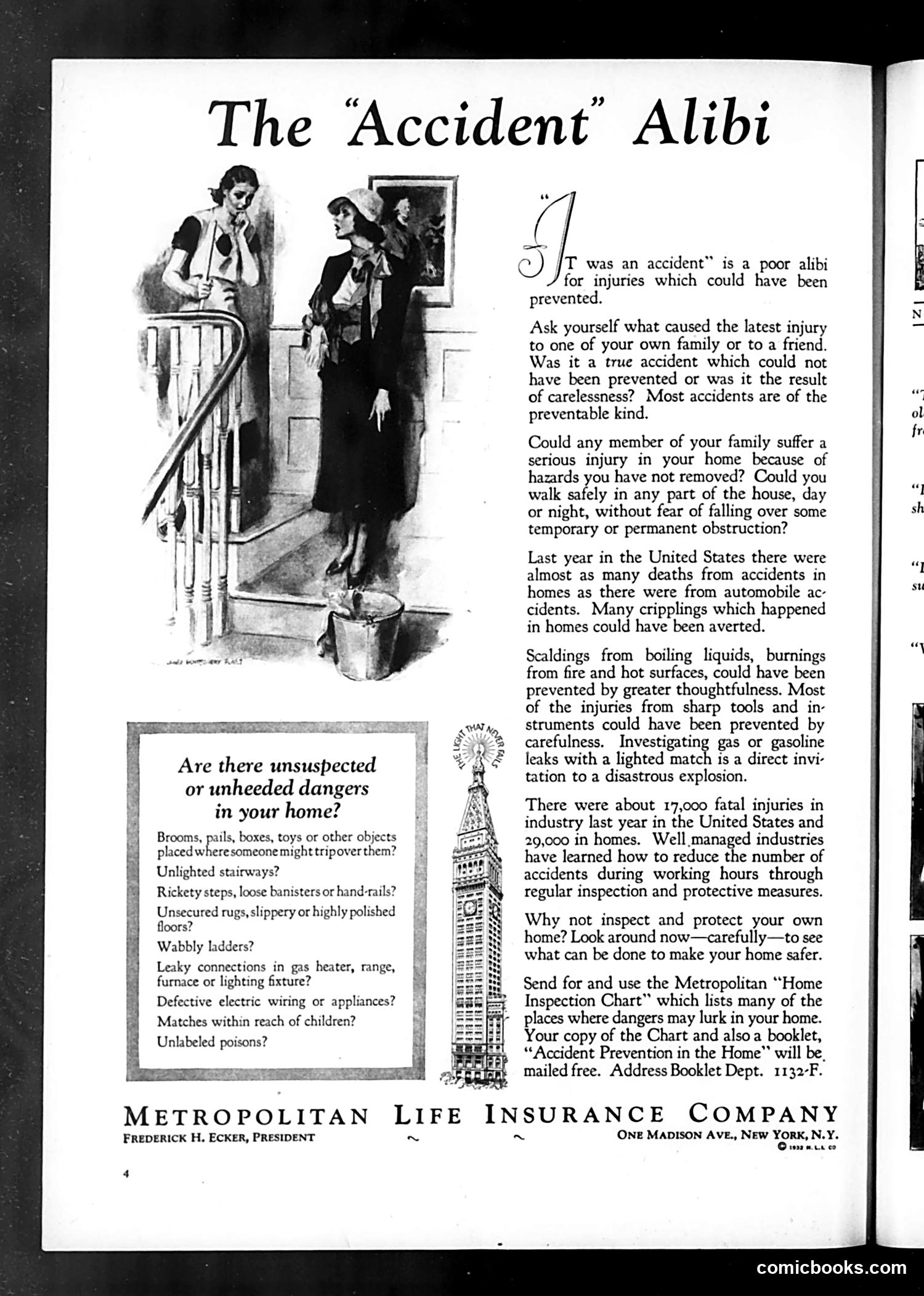
The "Accident" Alibi This is a public safety advertisement from Metropolitan Life Insurance Company, not political satire. The illustration shows two figures—apparently a woman on stairs and another person below—depicting a domestic accident scenario. The ad's central argument: most "accidents" are actually preventable through basic care. It lists common home hazards (unlit stairs, cluttered floors, gas leaks, unlabeled poisons) and challenges readers to honestly assess whether recent injuries in their lives were truly unavoidable or resulted from carelessness. The "alibi" in the title suggests people falsely blame luck when accidents stem from neglect. The piece compares home accident deaths (29,000 annually) to automobile deaths, arguing that industry successfully reduces workplace accidents through inspection—homes should adopt similar safety practices.
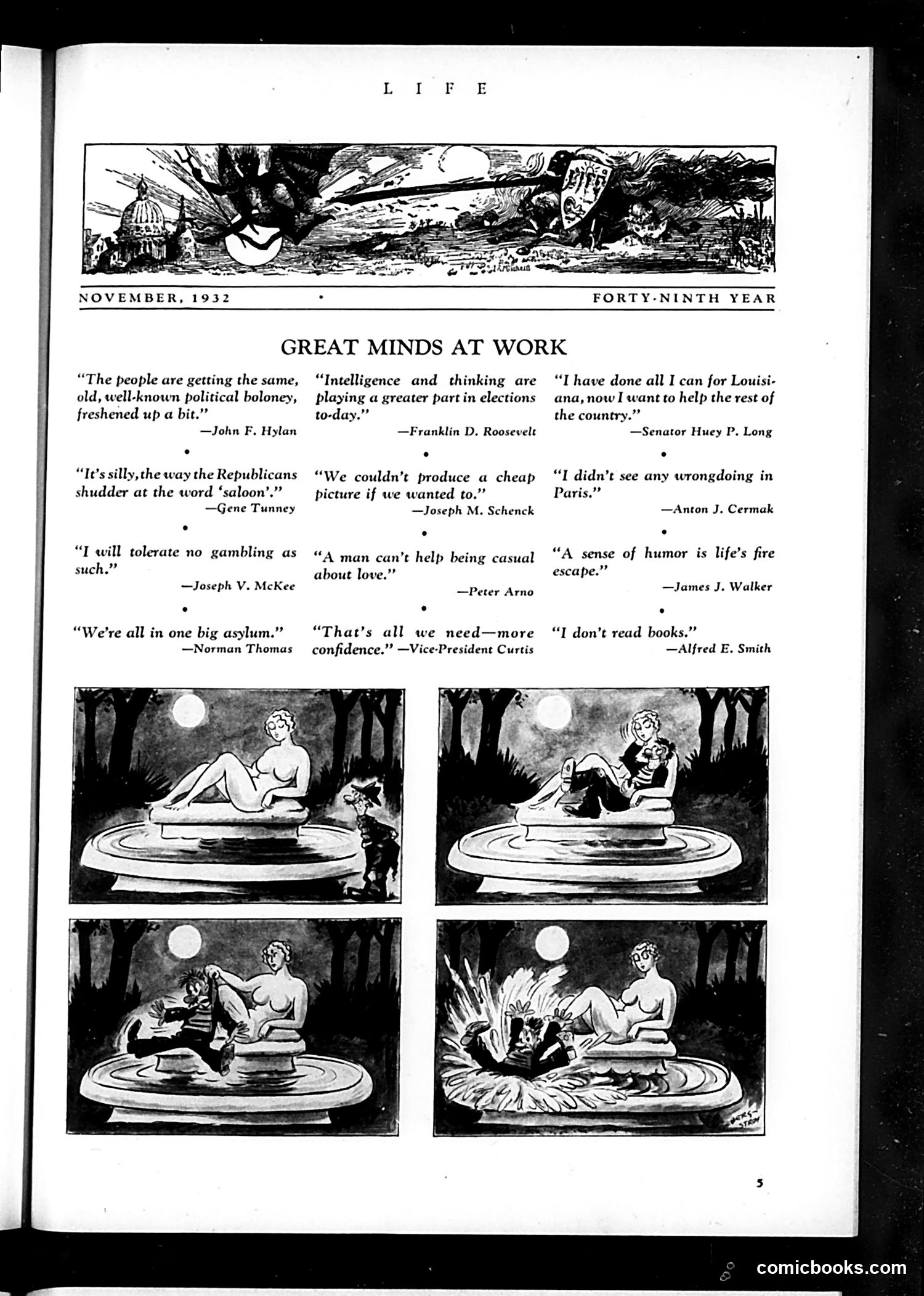
Analysis: "Great Minds at Work" (Life, November 1932) This page satirizes prominent American figures' statements during the Great Depression. The quotes—attributed to politicians like Franklin D. Roosevelt and Senator Huey P. Long, plus business figures and celebrities—mock their often contradictory or vapid pronouncements about economic crisis. The four-panel cartoon below shows a woman bathing in a moonlit forest pool while a man watches. The sequence apparently depicts him progressively disturbing her peaceful scene. This visual joke likely comments on invasion of privacy or unwanted intrusion, though the specific satirical target remains unclear without additional context. The page's overall message: during national economic catastrophe, public figures offer platitudes while ordinary people face disruption—a critique of leadership inadequacy during the Depression.
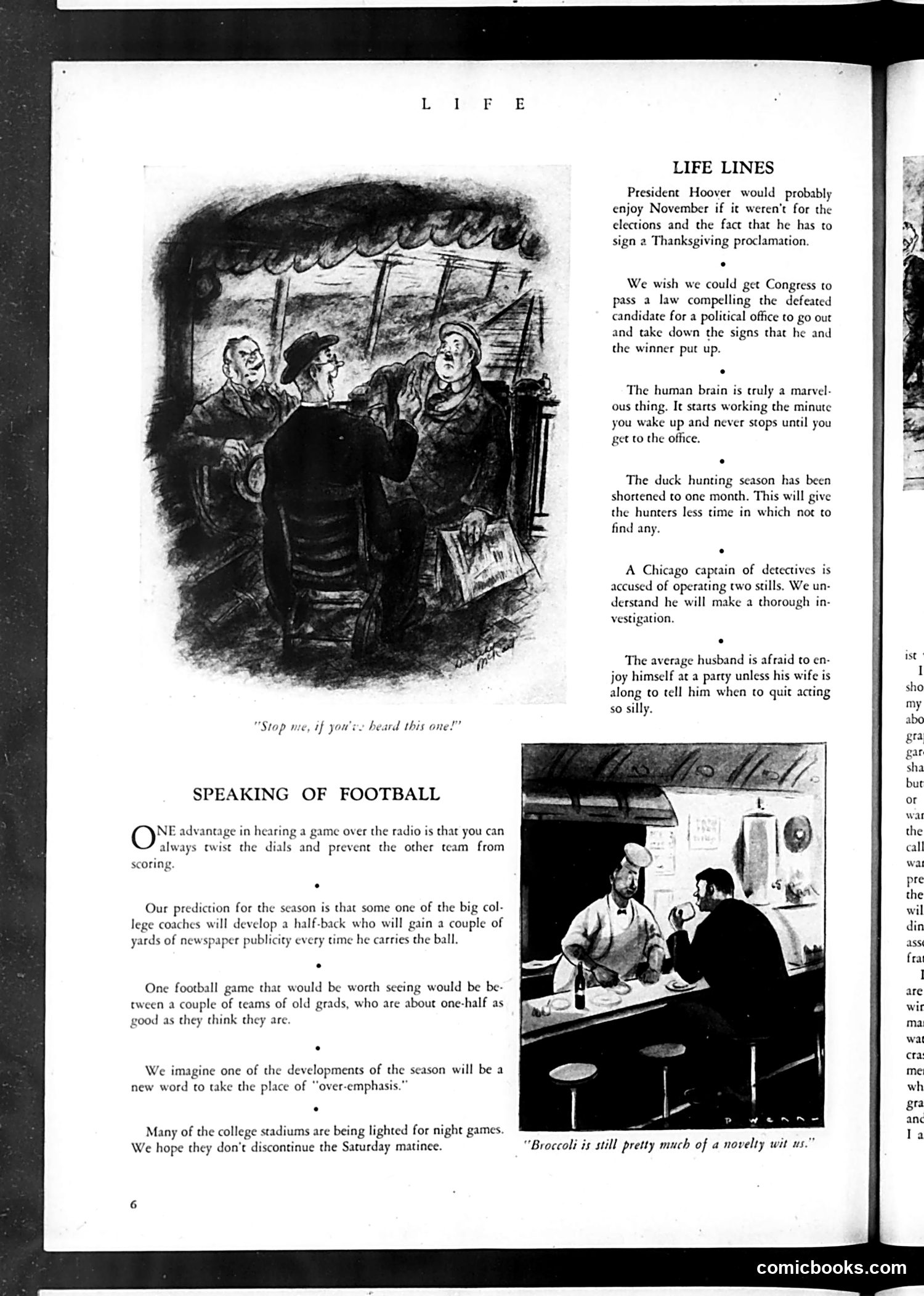
"Life Lines" and "Speaking of Football" - Page Analysis The top cartoon depicts three men in what appears to be a speakeasy or illegal bar during Prohibition, with one saying "Stop me, if you've heard this one!" The joke satirizes how Prohibition-era establishments were common knowledge—so pervasive that warnings were pointless. The "Life Lines" column offers brief social observations, including quips about President Hoover, Congress, and political campaigns. The "Speaking of Football" section provides humorous predictions about college football season, suggesting coaches will develop new publicity tactics and that night games may become standard. The bottom photograph shows what appears to be a domestic scene, captioned "Broccoli is still pretty much of a novelty wit us," likely poking fun at unusual vegetables or modern eating habits.
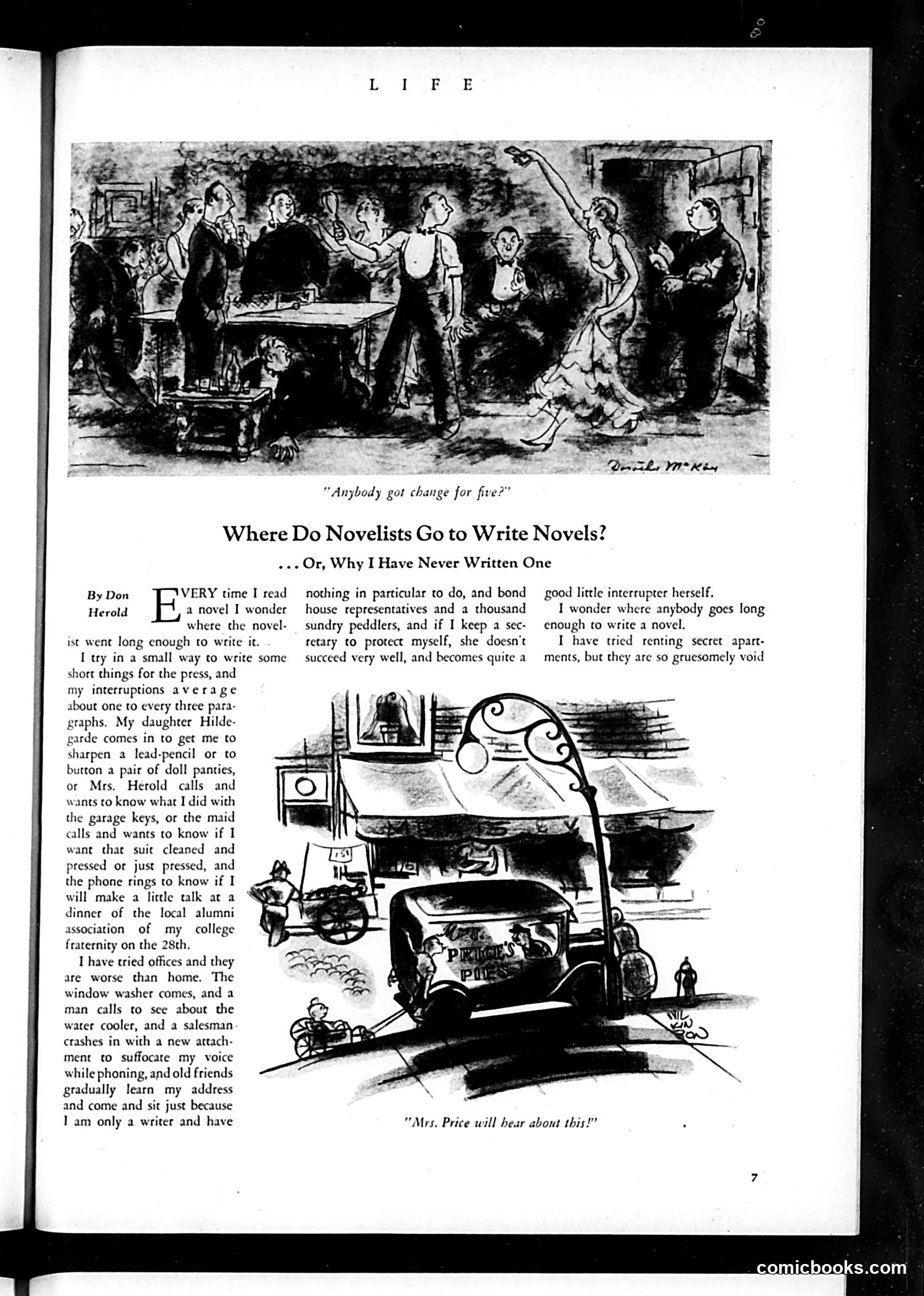
Analysis of Life Magazine Page This page contains Don Herald's humorous essay "Where Do Novelists Go to Write Novels?...Or, Why I Have Never Written One." Herald satirizes the impossibility of finding quiet to write at home—his daughter interrupts him, the maid needs garage keys, Mrs. Herald calls about domestic matters, and old friends visit constantly. The two illustrations depict these domestic interruptions: the top cartoon shows a chaotic social gathering with the caption "Anybody got change for five?"; the bottom shows a car accident outside a house with "Mrs. Price will hear about this!" The satire targets the competing demands of domestic life that prevent serious creative work, a relatable complaint for early 20th-century male writers attempting to balance family obligations with professional ambitions.
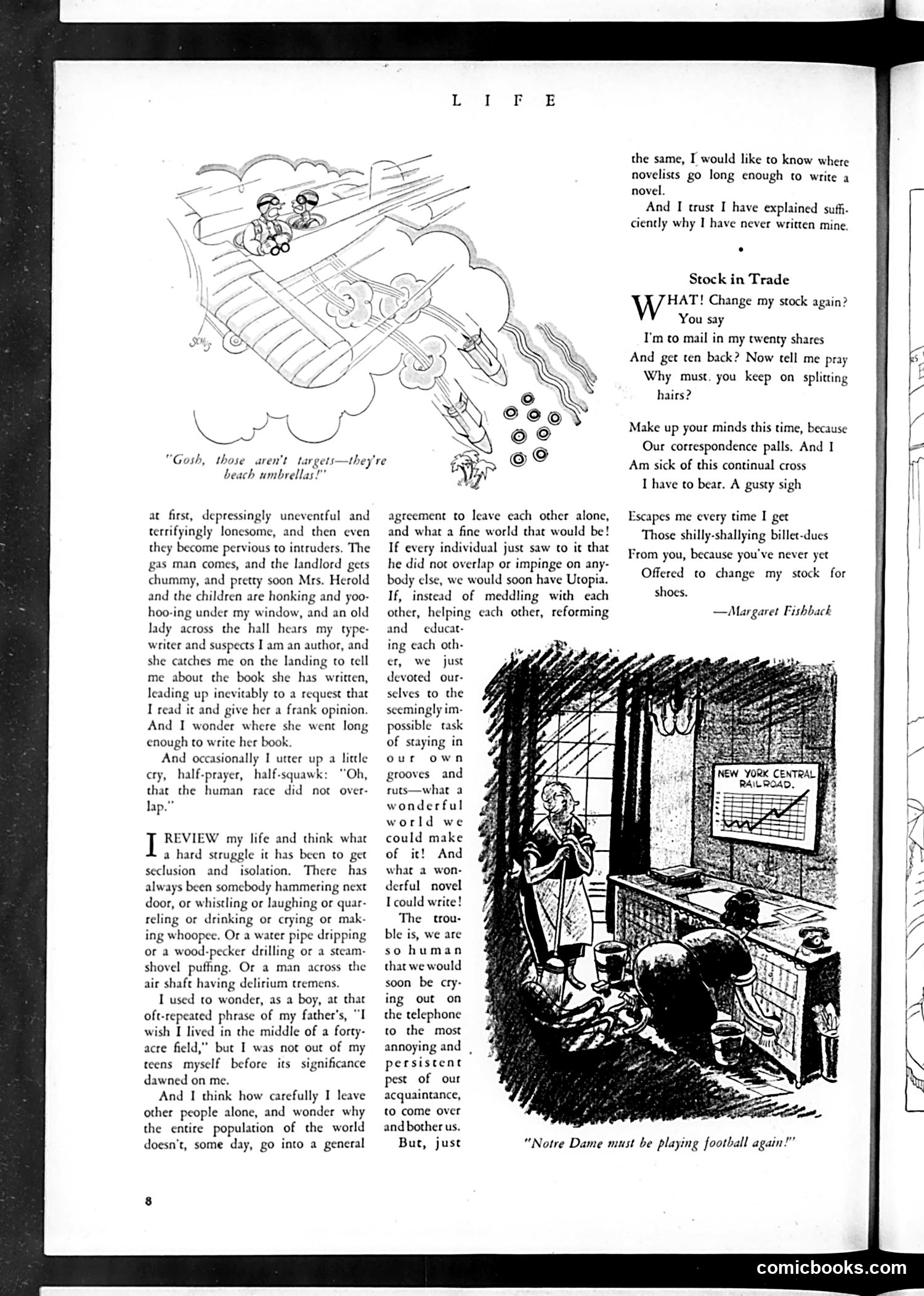
Analysis of Life Magazine Page This page contains two satirical pieces about everyday frustrations. Top cartoon ("Stock in Trade"): A humorous complaint about stock market volatility. The writer describes mailing in 20 shares and receiving 10 back, then being pestered to split hair about it. The satire targets the frustration of small investors dealing with confusing stock transactions and persistent brokers. Bottom cartoon ("Notre Dame must be playing football again!"): Depicts a woman at home distracted by someone's persistent telephone calls. The joke references Notre Dame University's football popularity—suggesting the caller must be so obsessed with the sport that they're phoning to discuss it repeatedly, oblivious to being unwelcome. It satirizes both sports obsession and social inconsiderateness.
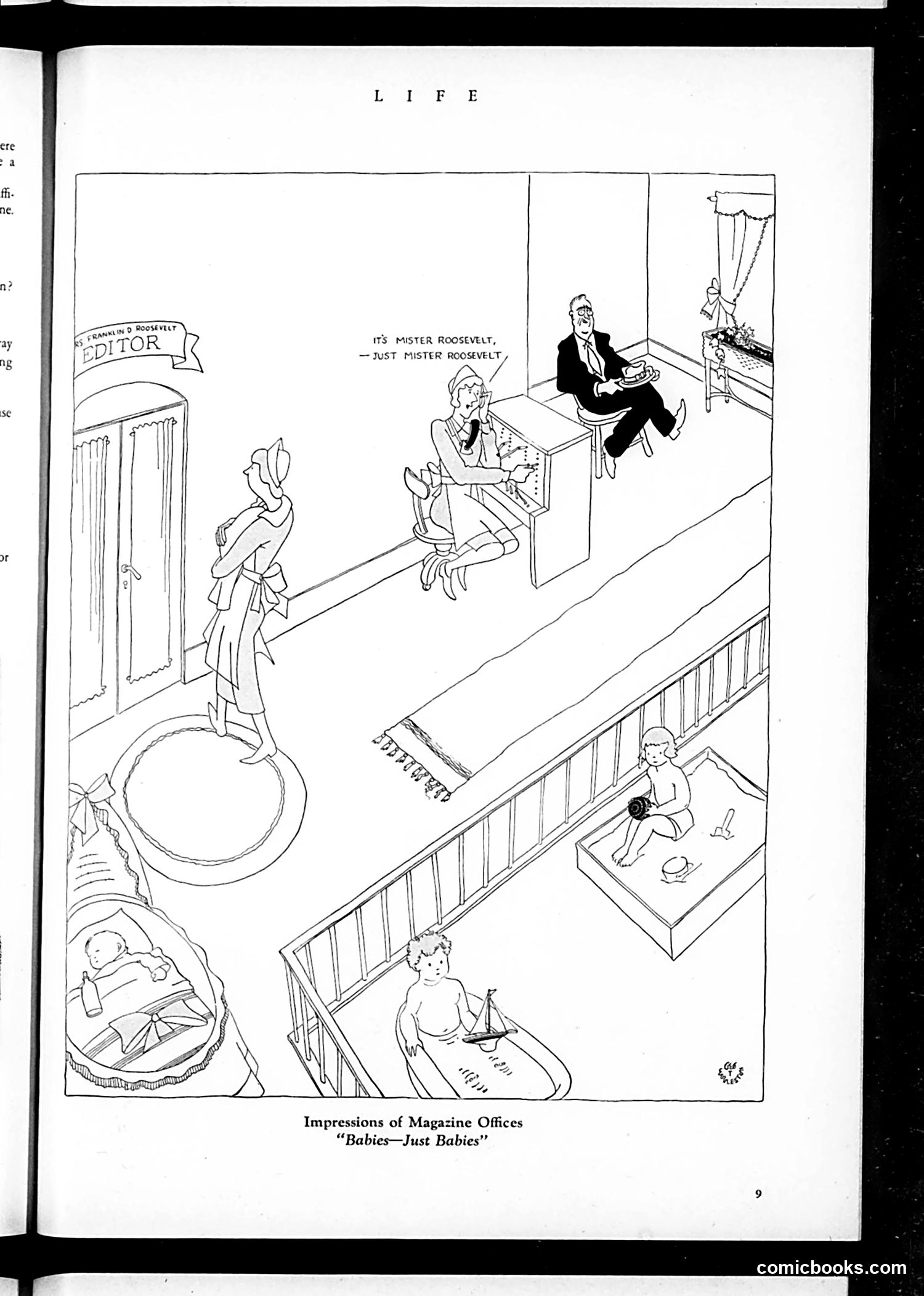
"Impressions of Magazine Offices: Babies—Just Babies" This satirical cartoon depicts a magazine office (labeled "Editor") in disarray due to infants. The scene shows: - A woman entering holding a baby, appearing to announce "It's Mister Roosevelt—Just Mister Roosevelt!" - Adults attempting to work amid multiple babies in cribs and playpens - General chaos and disruption to office operations The satire appears to mock magazine editorial offices being overwhelmed by submissions related to babies, likely President Roosevelt's children or references to Roosevelt as a father figure. The joke plays on the notion that "baby" stories dominated magazine content and editorial attention during this period, rendering professional work nearly impossible. The cartoon criticizes both the proliferation of such trivial content and editors' apparent helplessness to manage it.
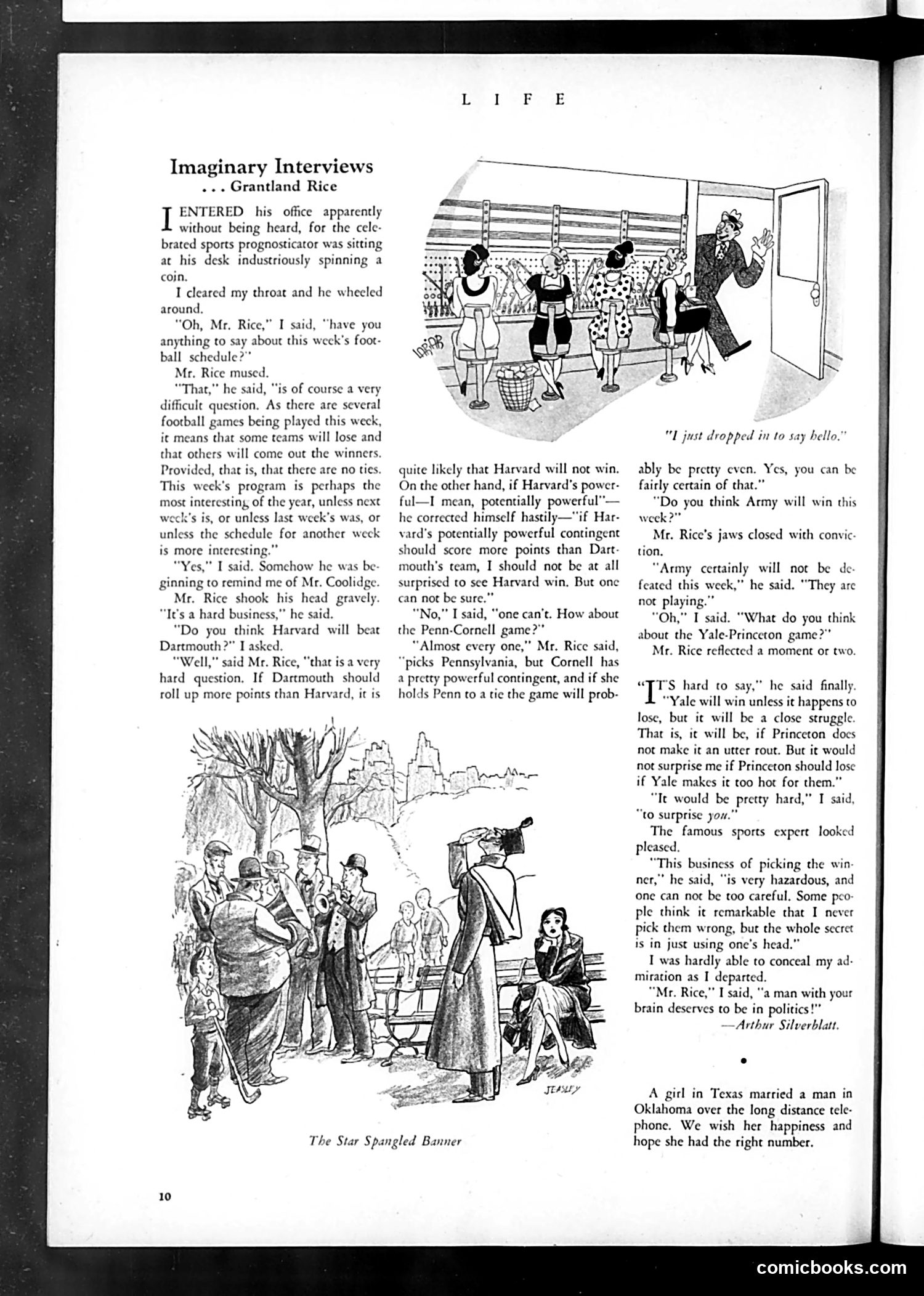
"Imaginary Interviews: Grantland Rice" This page presents a satirical interview with Grantland Rice, a famous sports columnist and prognosticator. The cartoonist mocks Rice's habit of making football predictions by showing him "spinning a coin" to decide outcomes—suggesting his forecasts are essentially guesswork rather than expert analysis. The interview humorously presents Rice confidently predicting various college football games (Harvard, Dartmouth, Penn-Cornell, Army, Yale, Princeton) while the interviewer implies these predictions are unreliable. The accompanying illustrations show campus scenes and "The Star Spangled Banner" being sung at a game. The satire's point: even celebrated sports experts rely on chance, not genuine insight, when forecasting game results. It's a gentle mockery of overconfident sports journalism.
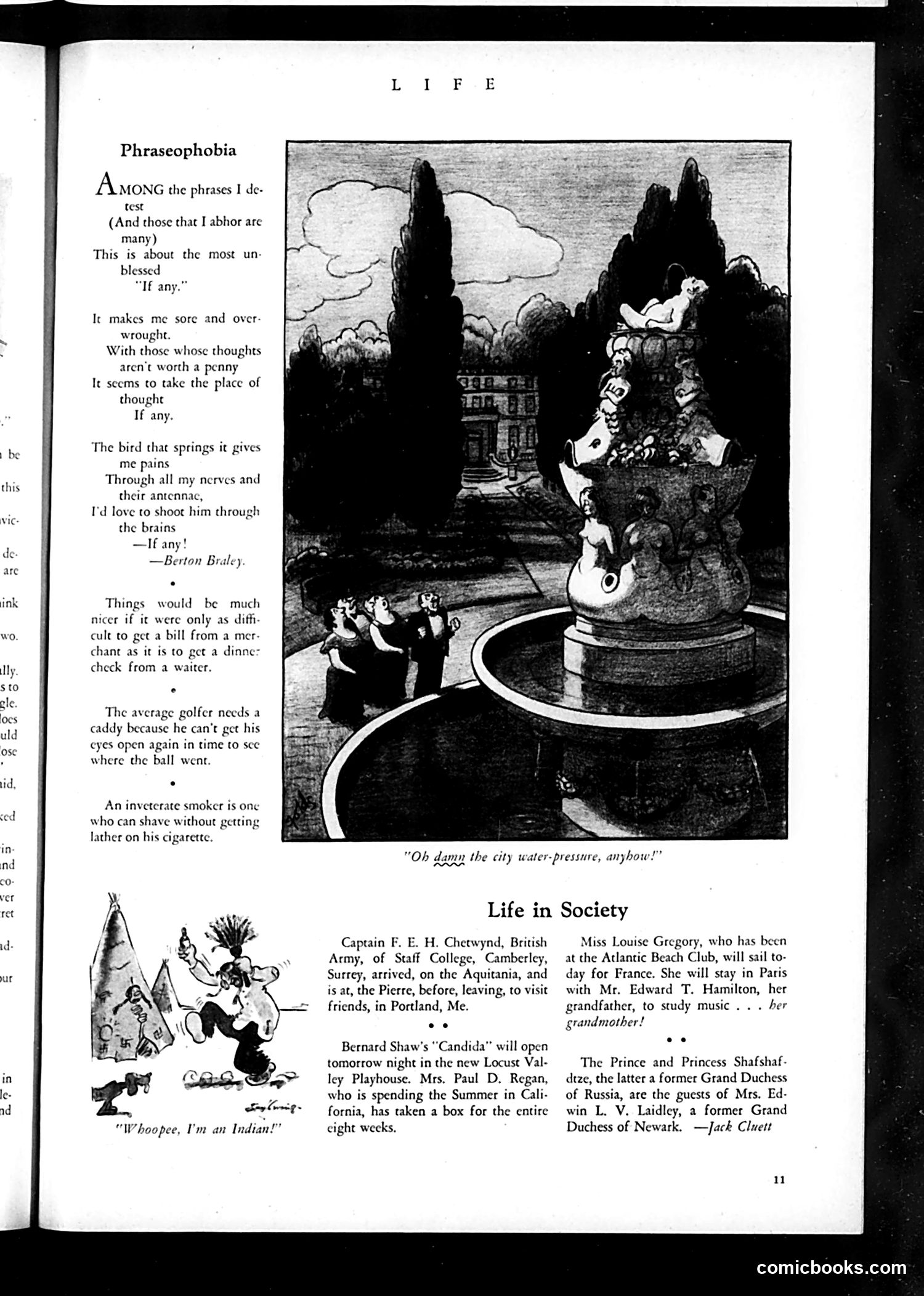
Phraseophobia Cartoon Analysis This page contains satirical essays and cartoons mocking common phrases and social situations. The main illustration shows a surreal scene depicting the phrase "Oh damn the city water-pressure, anyhow!" — depicting a giant figure emerging from water pipes while small people below react in alarm. The accompanying text presents various complaints about overused phrases, including Berton Braley's poem about wishing to shoot a bothersome bird. Other brief satirical observations mock everyday frustrations: difficulty obtaining bills from merchants, getting dinner checks from waiters, golfers unable to locate their balls, and smokers shaving without lather on cigarettes. The "Life in Society" section provides social announcements about visitors and upcoming theater openings, typical of the magazine's society page format.
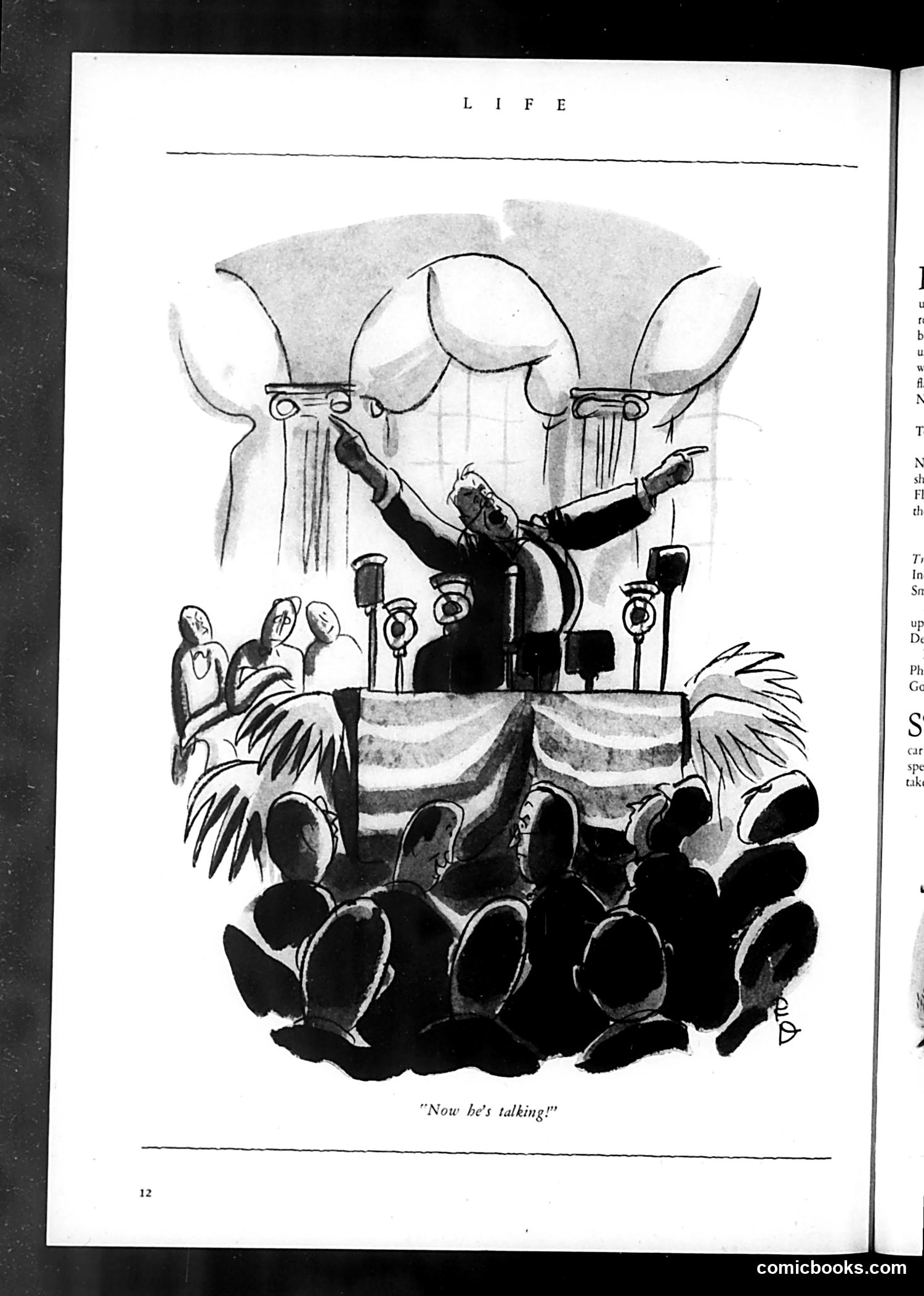
Analysis of "Now he's talking!" This political cartoon depicts a public speaker at a podium addressing a large crowd, with dramatic bull horns mounted behind him. The caption "Now he's talking!" suggests irony—the horns imply the speaker is producing loud, boastful rhetoric rather than substantive discourse. The silhouetted audience and formal stage setup indicate this is a significant political rally or speech. The exaggerated horn imagery is a visual metaphor for bombastic, amplified speech—"bull" both literally (the horns) and figuratively (nonsense). Without visible date or speaker identification on this page, I cannot definitively identify the specific political figure or event targeted. The cartoon critiques grandiose political oratory and the spectacle of mass rallies, suggesting the speaker prioritizes theatrical delivery over meaningful content.
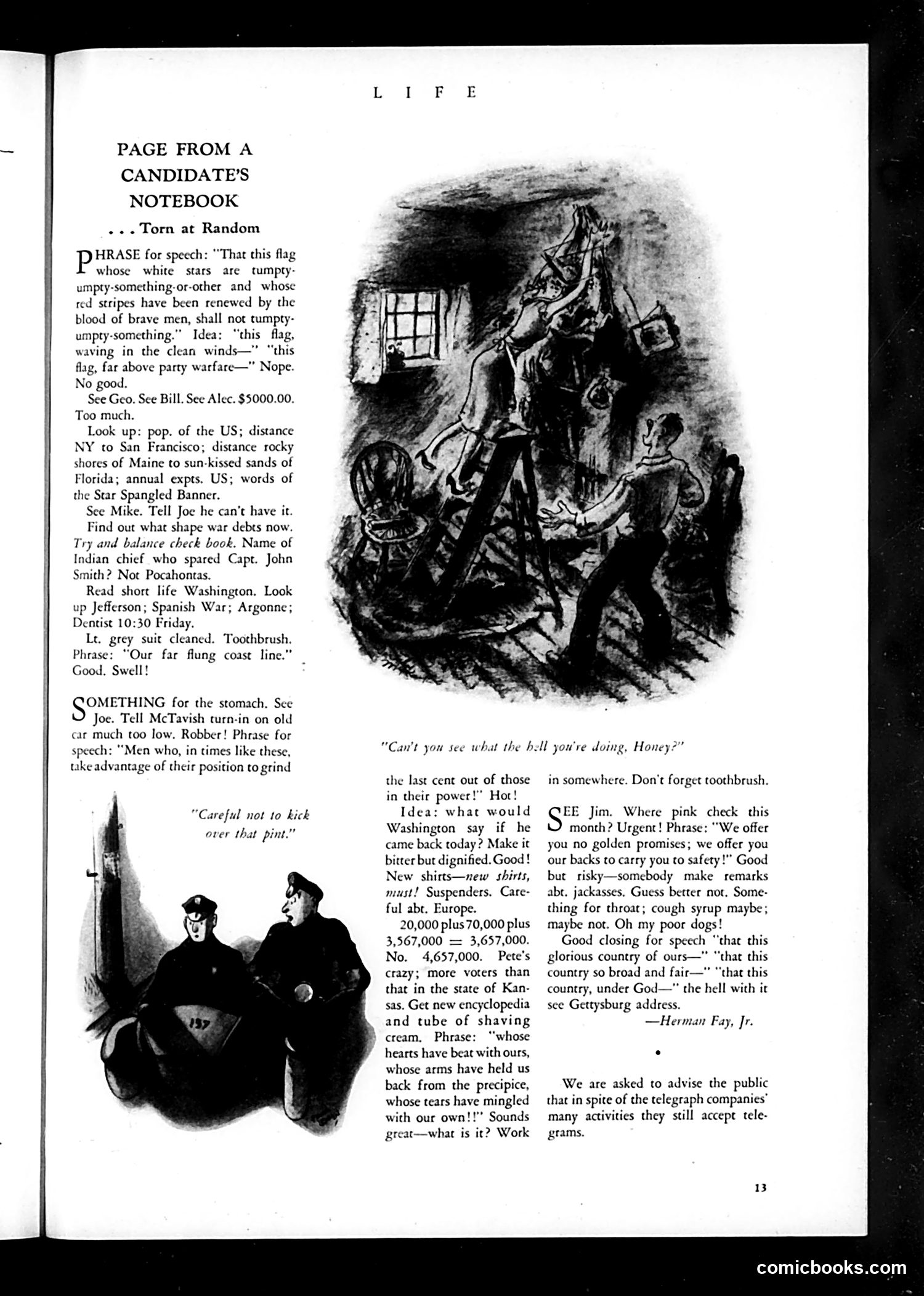
Analysis of Life Magazine Page This page from *Life* magazine contains scattered notes from "a candidate's notebook" — apparently random jottings meant to mock political speechmaking. The upper cartoon shows a figure gesticulating dramatically at a window, illustrating overwrought campaign rhetoric. The lower cartoon depicts two men in period dress (appearing to be from the 19th century based on clothing), captioned "Careful not to kick over that pail." The text mocks politicians' tendency to recycle patriotic phrases (quoting the Star-Spangled Banner) and to base campaigns on vague, contradictory promises about everything from economics to military preparedness. The satire targets the insincerity and opportunism of political candidates generally, rather than attacking a specific figure. The scattered, disorganized format itself parodies the haphazard thinking behind campaign slogans.
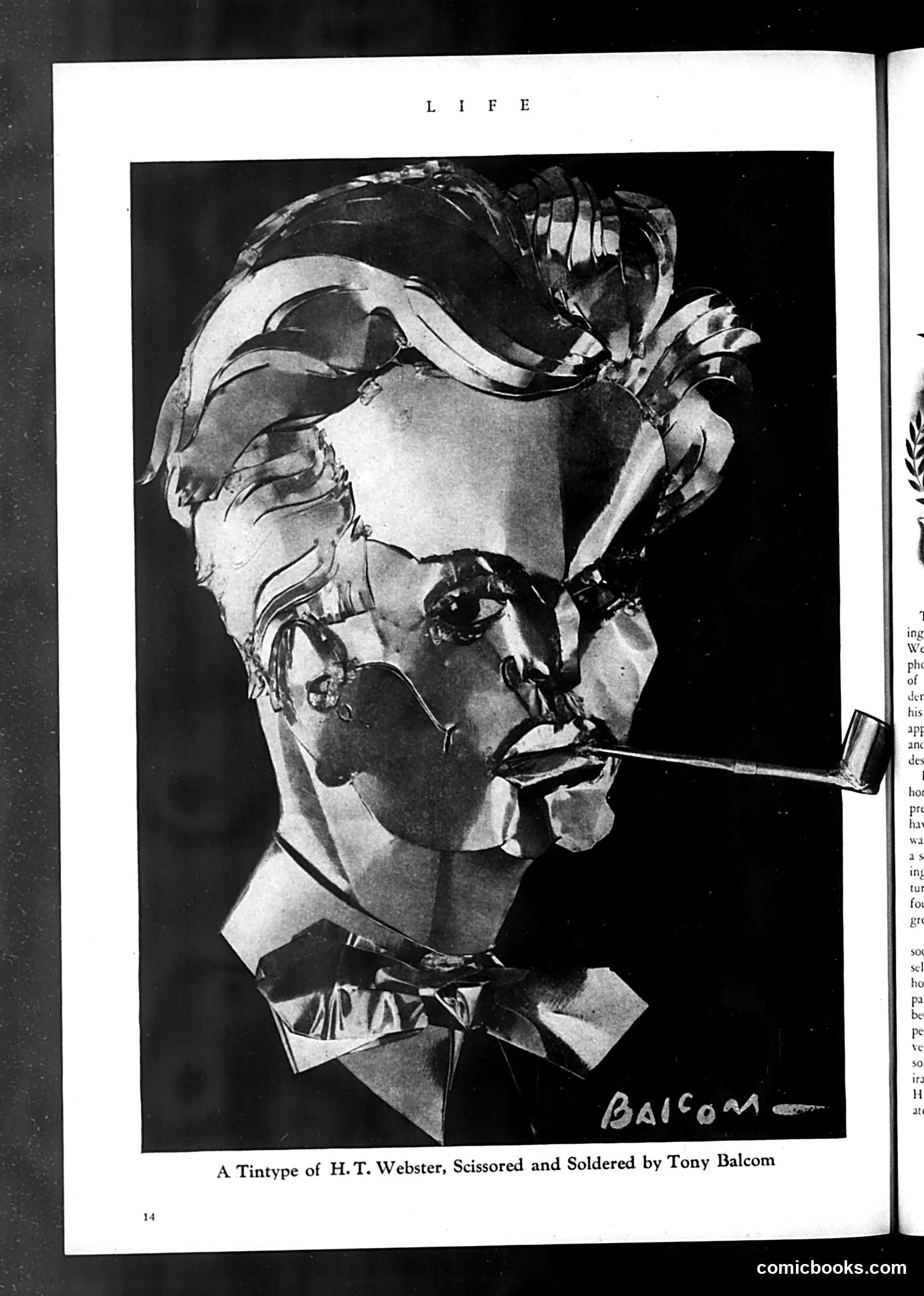
Explanation for Modern Readers This page from *Life* magazine features "A Tintype of H.T. Webster, Scissored and Soldered by Tony Balcom"—a sculptural portrait artwork rather than a traditional cartoon. H.T. Webster was a prominent cartoonist and illustrator of the early 20th century, known for his comic strips and satirical drawings. Tony Balcom created this piece by cutting and soldering metal to form a three-dimensional caricature of Webster's head. The artwork shows Webster with exaggerated features—large ears, prominent nose, and a pipe in his mouth—typical of caricature style. The "tintype" reference suggests a vintage photographic technique, playing on the artistic medium used to create this metal sculpture. This appears to be a celebratory feature honoring Webster's contributions to American cartooning and illustration.
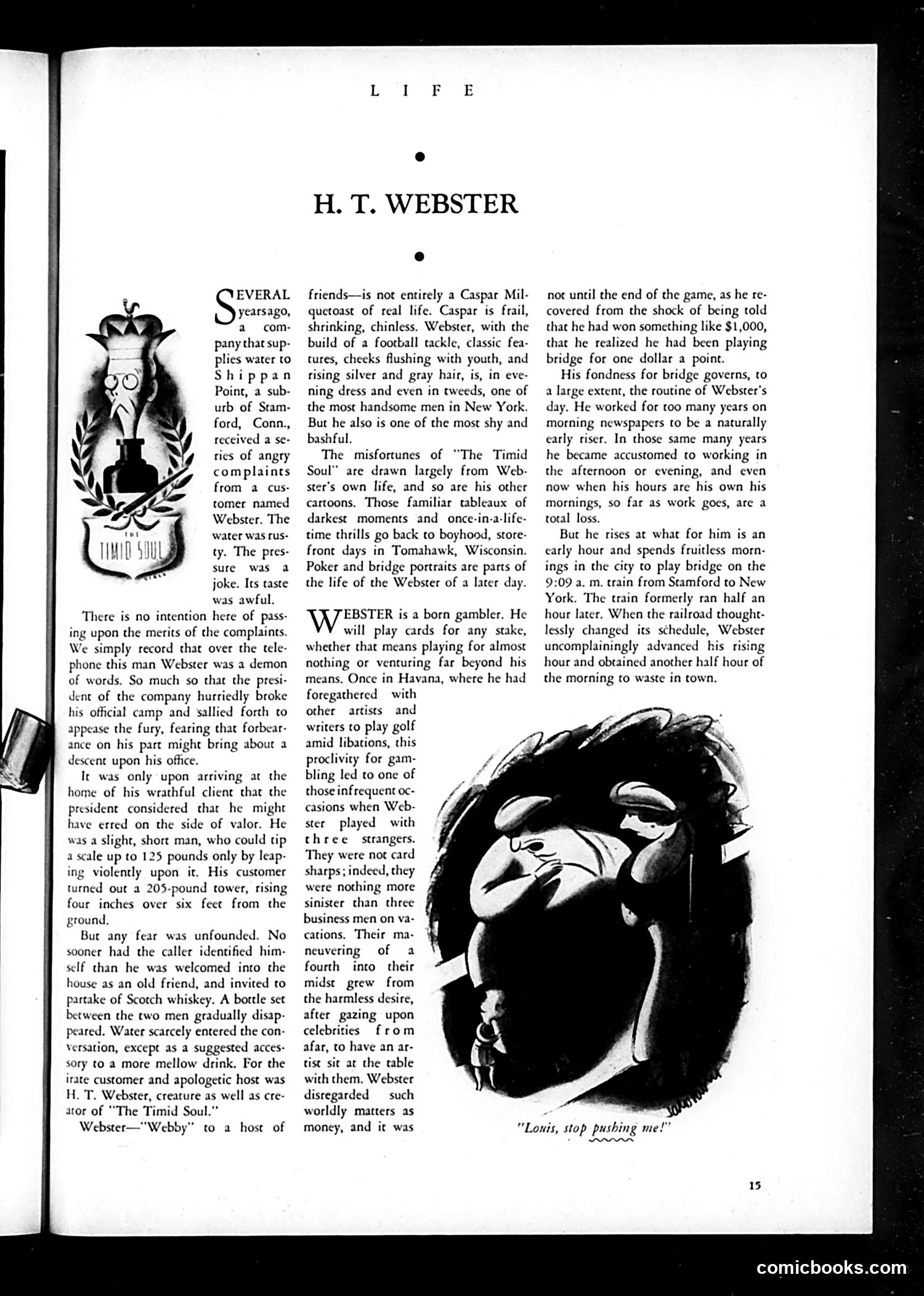
H.T. Webster - "Life" Magazine Profile This page profiles cartoonist H.T. Webster, creator of "The Timid Soul" comic strip. The text describes Webster as a "born gambler" who frequents card games and golf outings with other artists and writers. The accompanying cartoon illustration (captioned "Louis, stop pushing me!") depicts a characteristic scene from Webster's work: a meek, anxious man being bullied or pressured—the archetypal "timid soul" that defined his satirical humor. Webster's cartoons targeted the everyday social humiliations and nervousness of ordinary men navigating modern life. The profile notes Webster worked as a newspaper cartoonist and that his misfortunes (drawn from his own life) fueled his comedic observations about bashfulness, gambling, and social awkwardness—themes resonating with early 20th-century readers navigating urban American society.
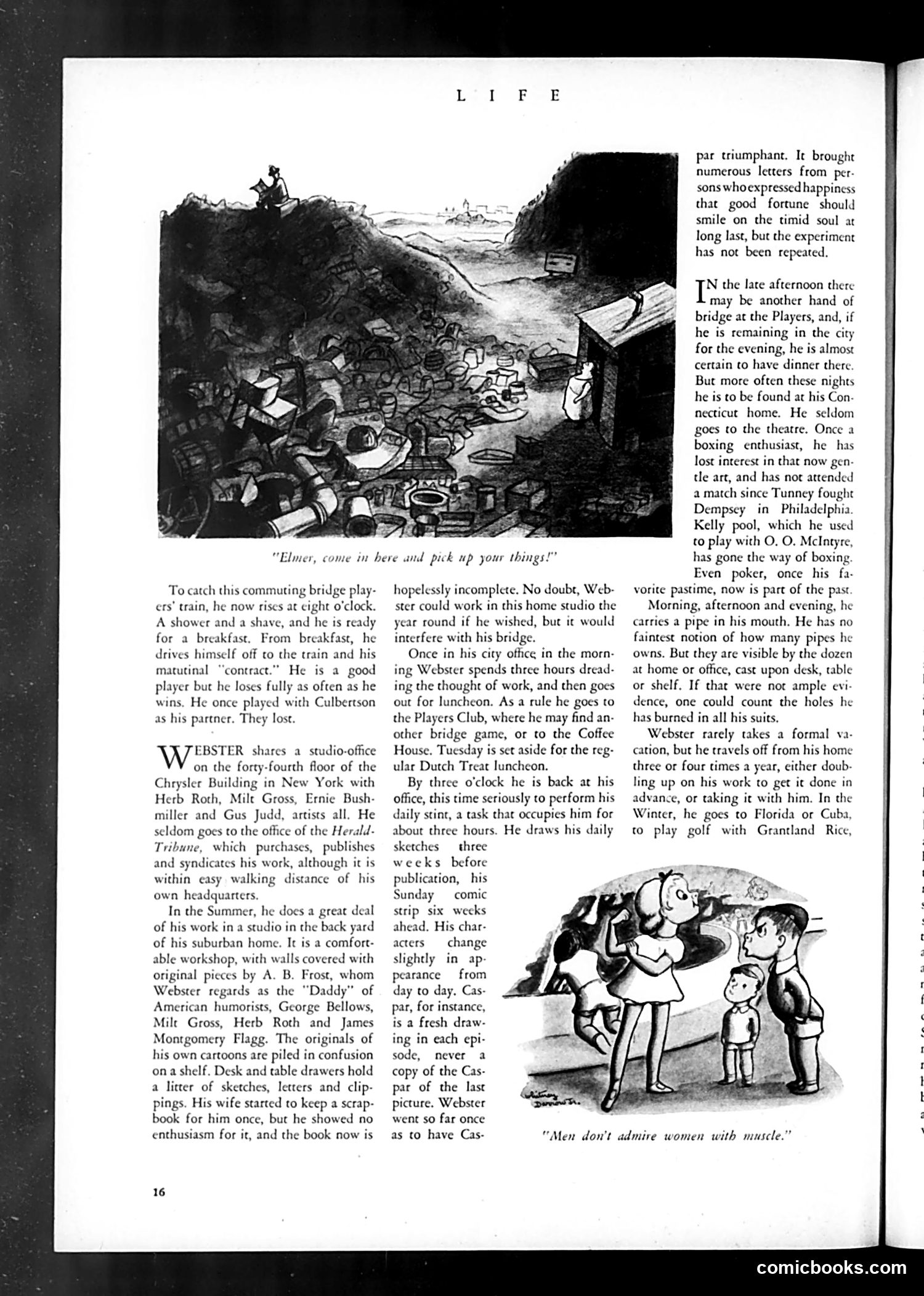
Analysis of Life Magazine Page This page profiles Herb Webster, a cartoonist-humorist working in New York's Chrysler Building. The text describes his prolific output—comic strips, illustrations, and advertising work—and his unconventional habits (commuting by train, playing bridge, attending boxing matches). The upper illustration shows a crowded bridge scene with the caption "Elmer, come in here and pick up your things!"—likely depicting bridge players amid domestic chaos, exemplifying Webster's humor about everyday American life. The lower cartoon, captioned "Men don't admire women with muscle," shows a woman flexing her biceps while men react with disapproval—satirizing 1920s-30s attitudes about femininity and gender norms. The piece celebrates Webster as a commercially successful cartoonist documenting contemporary American social life and attitudes.
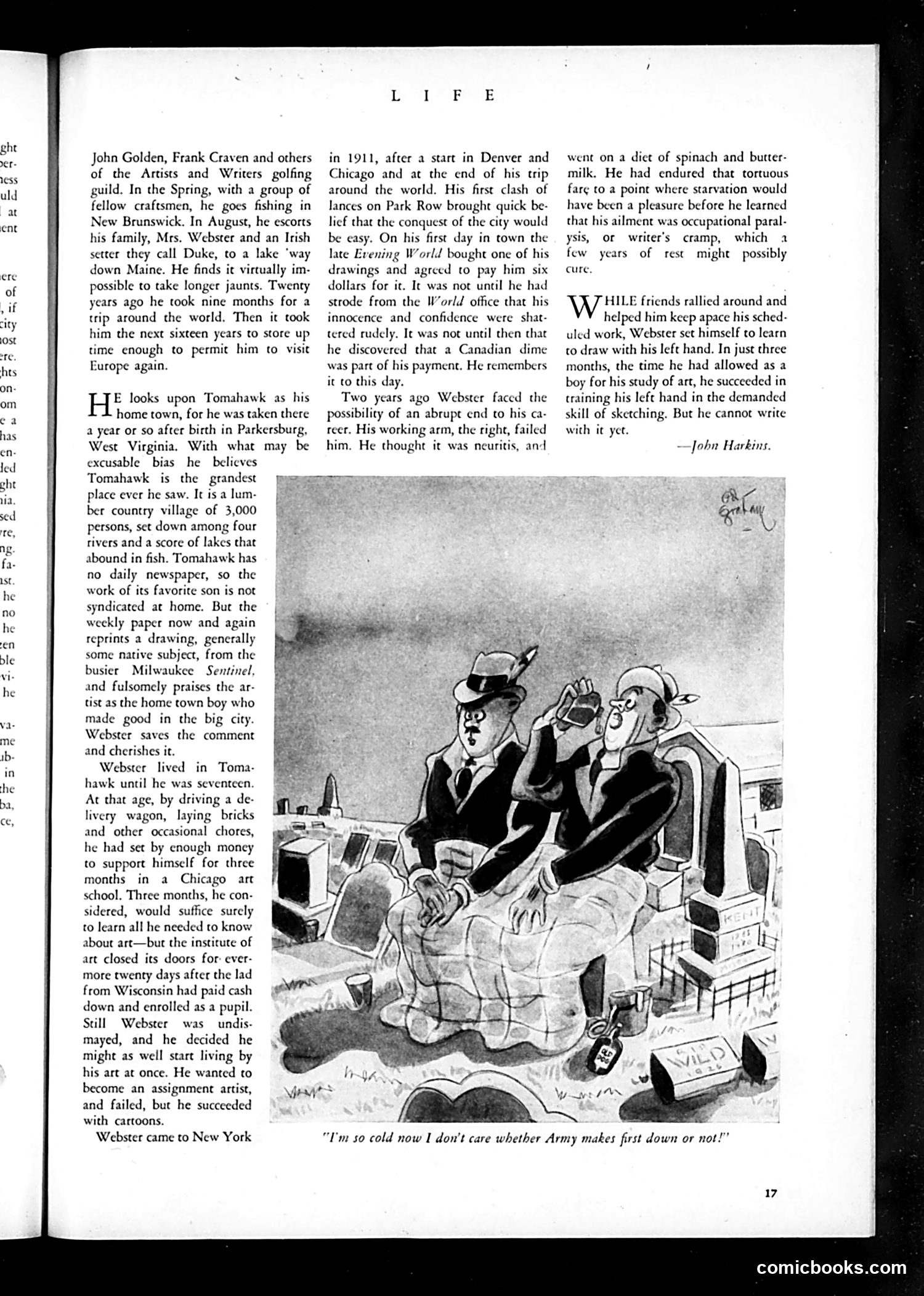
Cartoon Analysis This cartoon depicts three military officers huddled together in cold weather, complaining about the freezing conditions. The caption reads: "I'm so cold now I don't care whether Army makes first down or not!" The joke references American football terminology ("first down") to satirize military complaints during what appears to be a cold-weather campaign or maneuver. The soldiers are so uncomfortable that they've stopped caring about Army football—a significant institutional interest for military personnel. The cartoon likely comments on harsh military conditions or an unpopular campaign, using the incongruity of soldiers abandoning interest in Army sports (a morale-boosting activity) to emphasize their physical misery. Without a visible date, the specific conflict remains unclear, though the style suggests early 20th century.
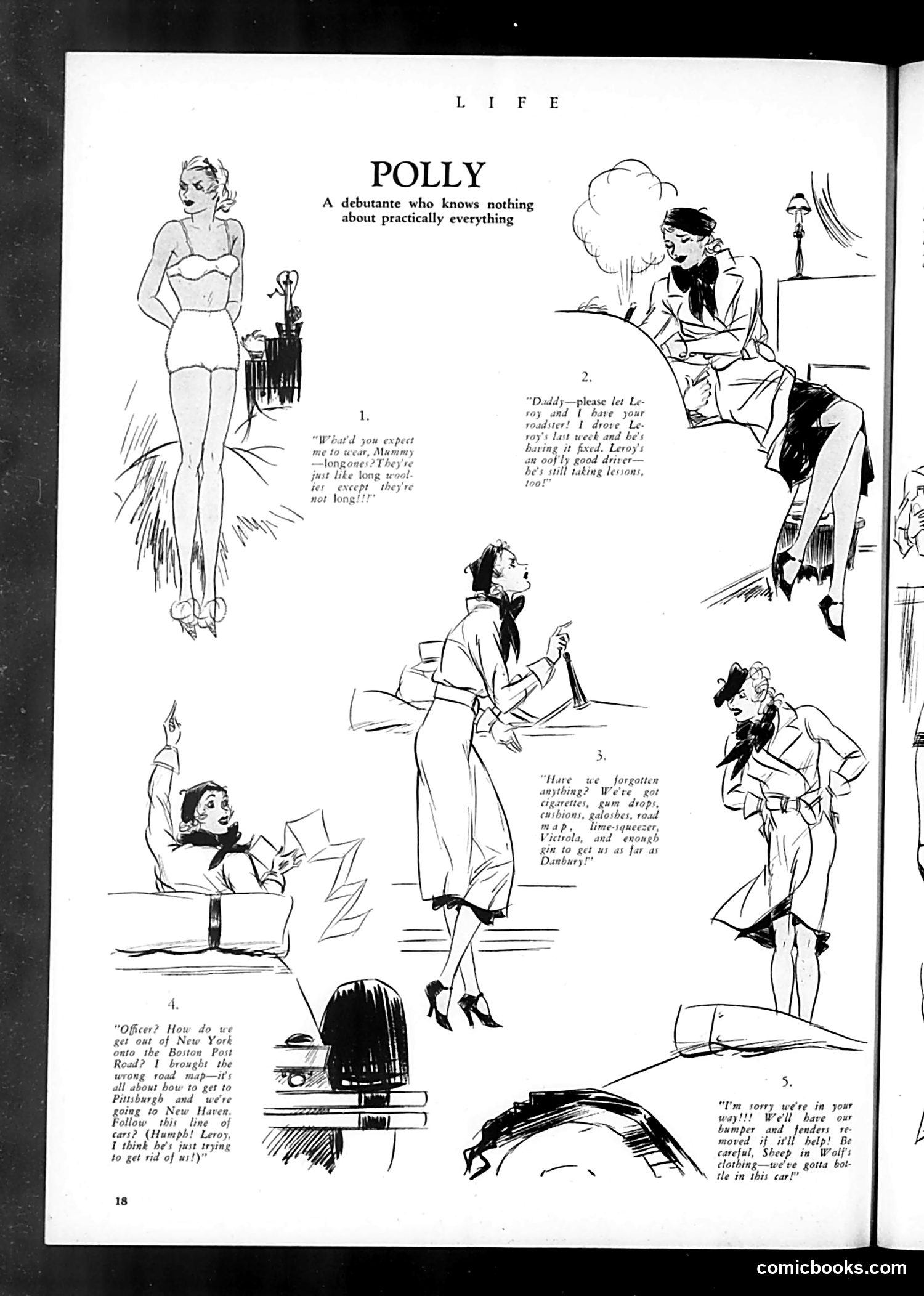
"Polly" - Life Magazine Satire This page satirizes a character type called "Polly," defined as "a debutante who knows nothing about practically everything." The comic strip shows a wealthy young woman confidently dispensing terrible advice about various topics—from fashion to geography to automotive safety—while being completely wrong. The humor targets upper-class debutantes of the era (likely 1930s-40s) who received minimal education but maintained unwarranted confidence in their opinions. Each panel shows Polly authoritatively misdirecting others: claiming a road is impassable, confidently listing non-existent locations, suggesting dangerous car safety practices. The satire critiques both the young women themselves and the social system that left them educated in appearance but ignorant in substance, yet still influential in social circles.
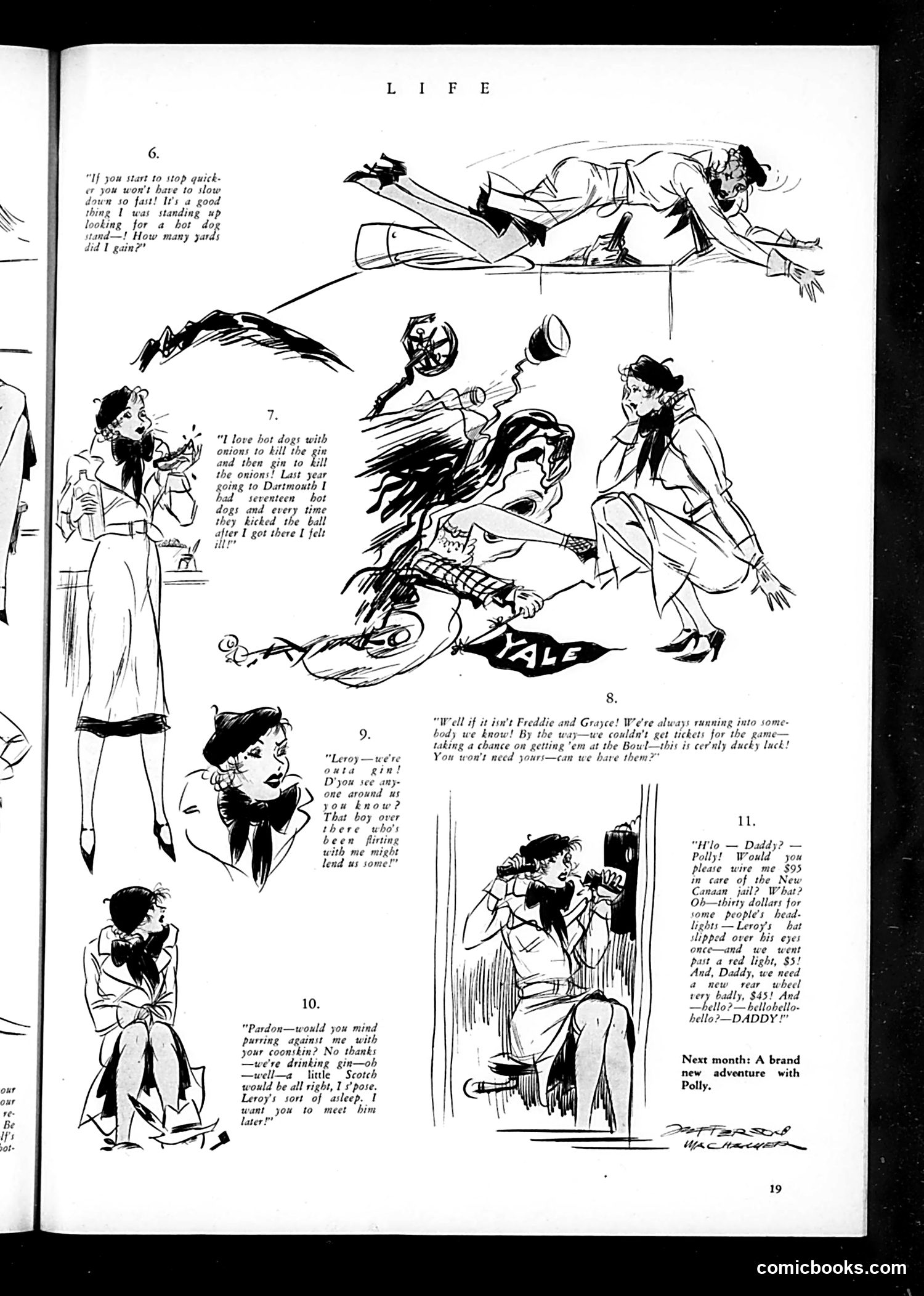
This page from *Life* magazine presents a humorous comic strip about a character named Polly. The narrative follows romantic and social complications: panel 6 references a "hot dog" (likely slang for an attractive man), panel 7 involves competing suitors and mentions "Dartmouth," suggesting college-age characters. Panel 8 shows physical comedy with what appears to be a dog or animal. Panels 9-11 depict Polly's romantic entanglements, with references to characters named Leroy, Freddie, Grace, and "Daddy." The dialogue suggests domestic complications—Polly asks her father for money for a "new fear wheel" and other needs. The strip uses period slang and situational humor typical of early-to-mid 20th century comics, depicting young women navigating romance and family relationships with comedic exaggeration.
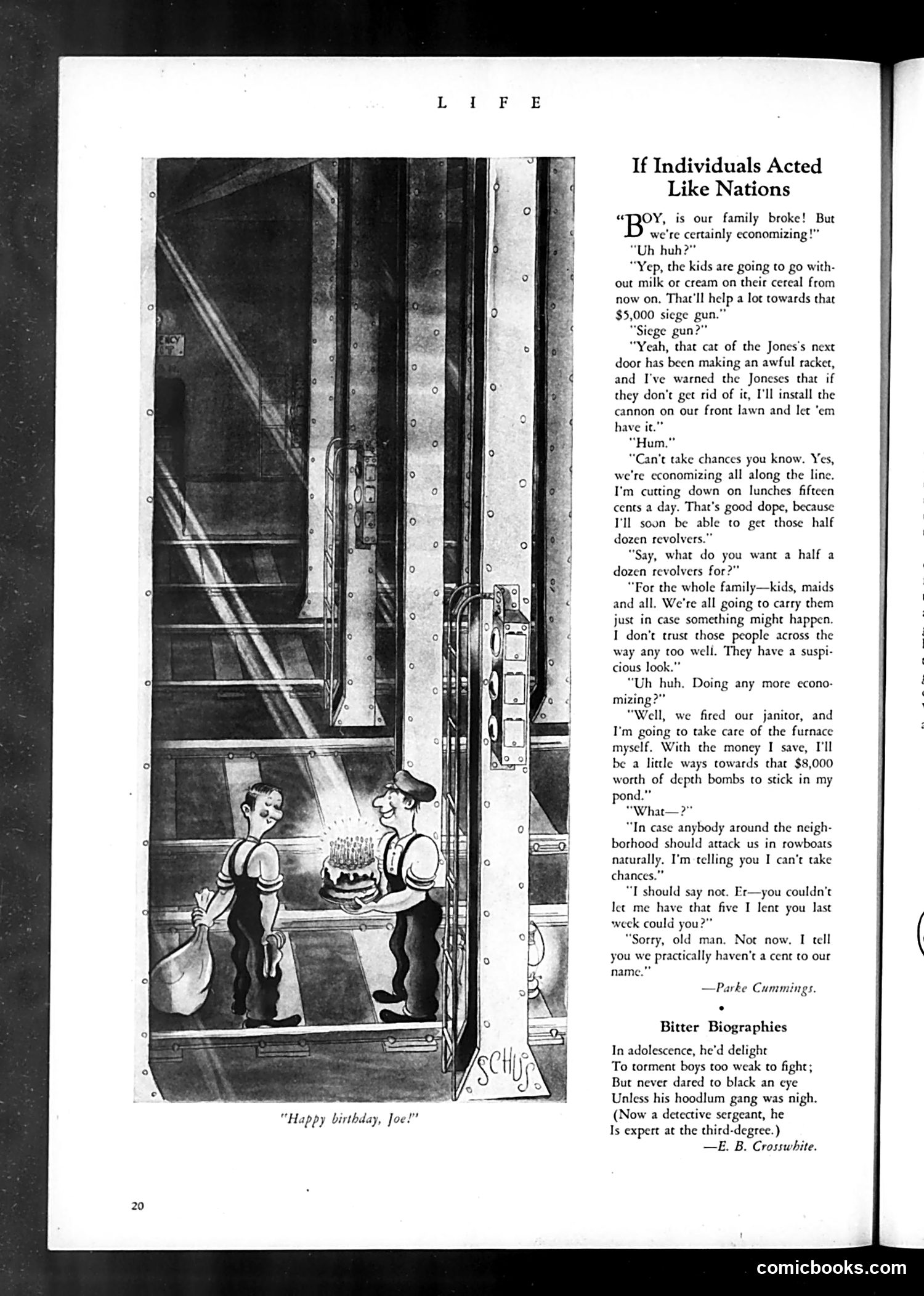
Explanation for Modern Readers This satirical piece mocks the absurdity of national military spending and paranoia by imagining a family behaving like warring nations. The cartoon shows a family economizing on necessities (milk, cereal, janitor services, lunch money) while simultaneously spending vast sums on weapons: a $5,000 siege gun to kill a neighbor's cat, half-dozen revolvers for family members, and $8,000 worth of depth bombs for their pond against potential rowboat attacks. The joke's target is clear: governments justify cutting social services and public welfare while massively funding military arsenals and weapons. By transplanting this logic to an ordinary household, author Parke Cummings exposes how irrational and dangerous such priorities are. The family's claim to be "economizing" while arming themselves to the teeth satirizes the contradiction between austerity measures and military buildup—likely referencing pre-WWII or Cold War-era defense spending debates.
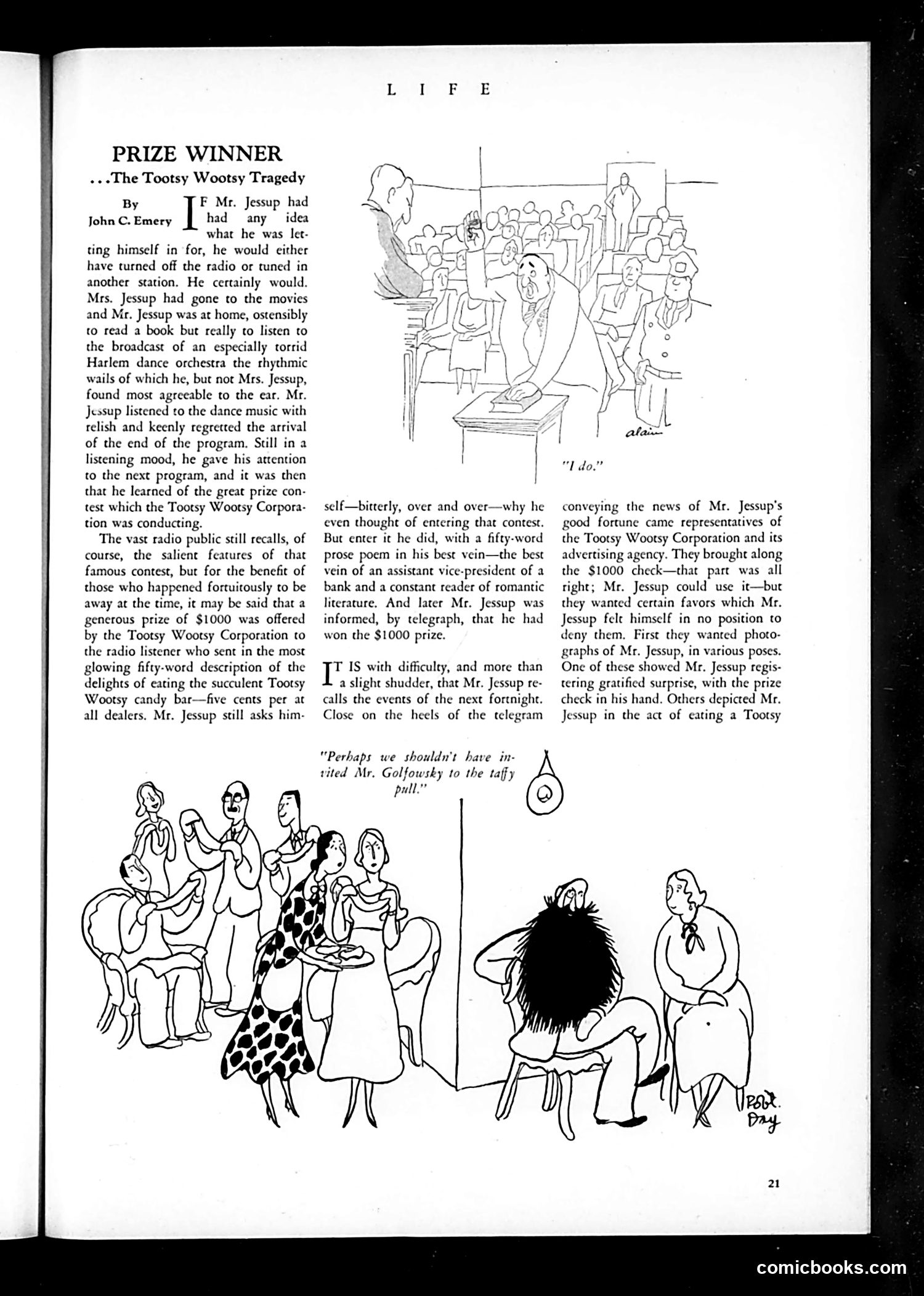
"The Tootsy Wootsy Tragedy" — Satire of Radio Advertising and Contests This is a humorous short story satirizing 1920s-30s radio advertising and commercial contests. Mr. Jessup, an ordinary bank vice-president, wins a $1,000 contest by writing about a fictional candy bar called "Tootsy Wootsy." The satire targets how corporations exploited contest winners for free advertising. After winning, Jessup is pressured by the candy company and its advertising agency to participate in promotional activities—posing for photographs, appearing in ads—essentially becoming an unpaid endorser. The story implies this arrangement becomes increasingly burdensome and humiliating for him. The accompanying cartoons humorously illustrate the social chaos that follows, suggesting the winner becomes an unwitting celebrity trapped in commercial obligations. The satire critiques corporations' manipulative advertising tactics and the loss of personal privacy inherent in early commercial radio culture.
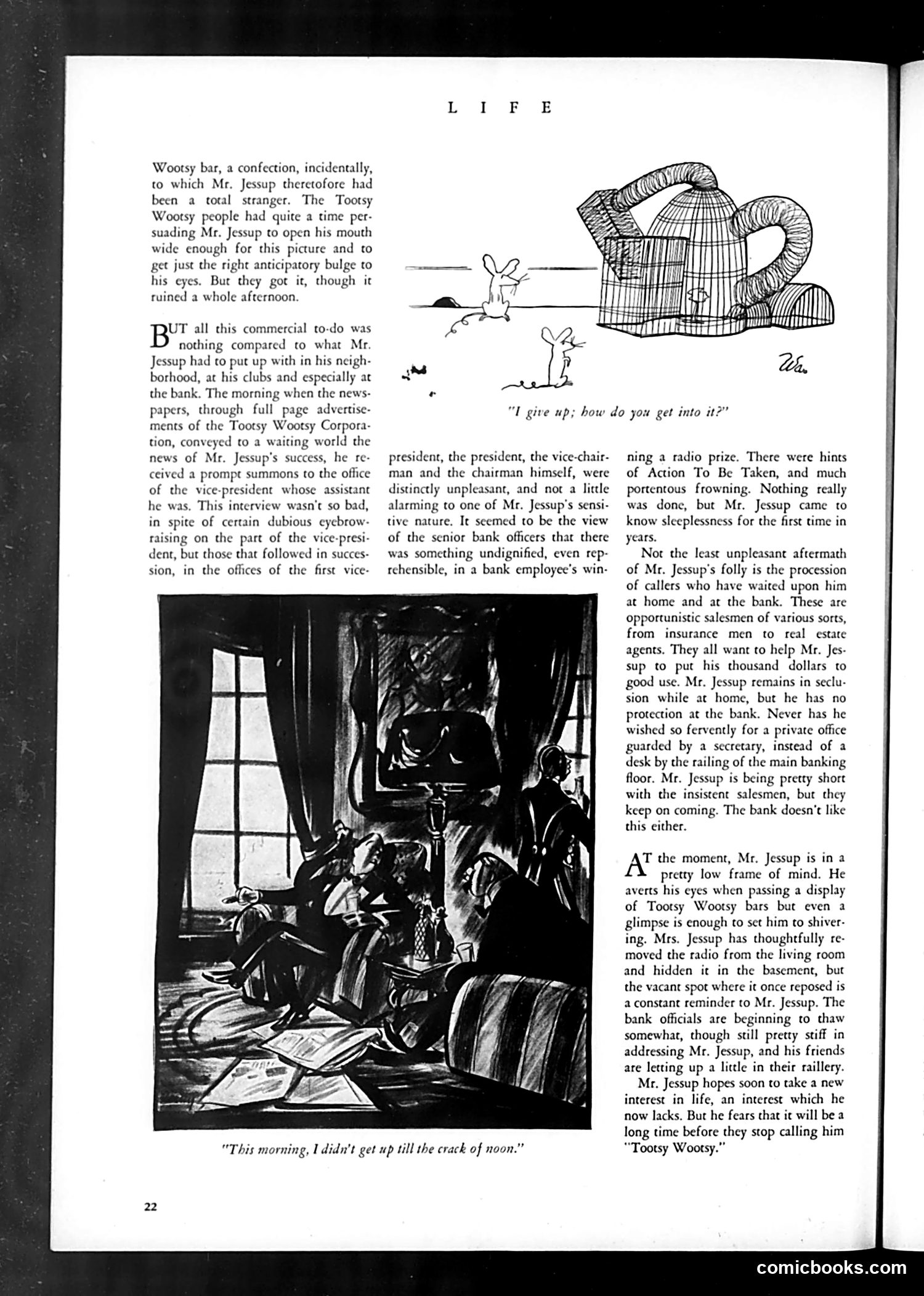
"Tootsy Wootsy" - Life Magazine Satire This piece satirizes the social and professional consequences of unexpected commercial success for an ordinary person. Mr. Jessup, a bank employee, won a radio prize by appearing in a Tootsy Wootsy candy bar advertisement. The satire targets multiple targets: the rigid dignity demanded of bank employees (senior officers view his commercial appearance as "undignified, even reprehensible"), the opportunistic salesmen who descend upon anyone with suddenly available money, and the public mockery from his social circle who relentlessly nickname him after the candy. The central joke is that Jessup's thousand-dollar windfall has become a curse rather than a blessing—he's now sleepless, housebound, and perpetually embarrassed. The cartoon illustrates how conformist institutions (banks) and consumer culture (aggressive salesmen) conspire to make modest success socially unbearable. The satire mocks both corporate embarrassment over employee visibility and the predatory nature of mid-century American salesmanship.
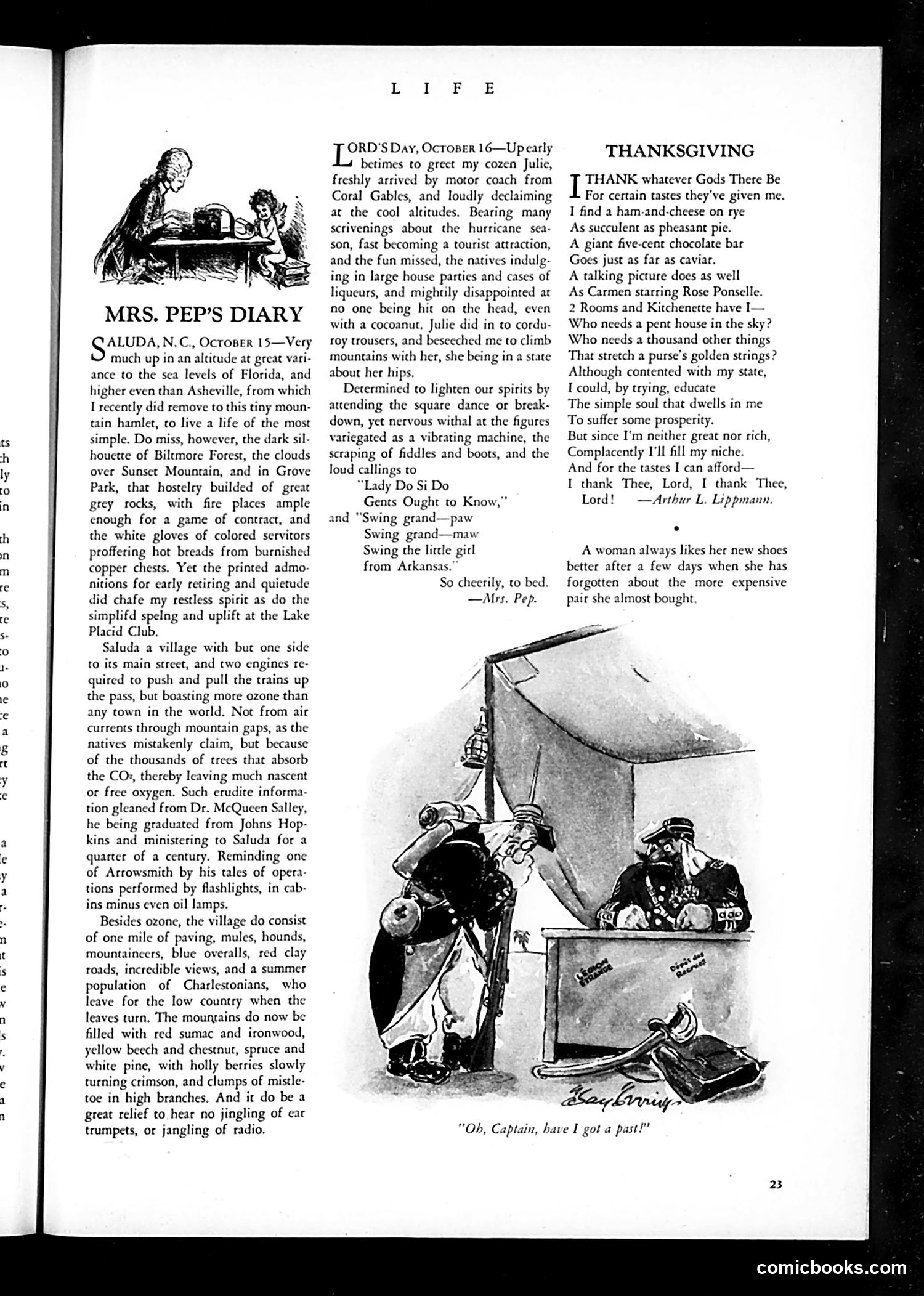
Analysis of Life Magazine Page This page contains two distinct pieces of social satire: "Mrs. Pep's Diary" mocks affectations of upper-class leisure travelers. The narrator affects pretentious language ("betimes," "simplifid spelng") while describing a mountain retreat in Saluda, North Carolina. She nostalgically compares her simple village to luxury destinations (Asheville, Biltmore), name-drops cultural references (Arrowsmith), and documents the arrival of her cousin Julie. The satire targets the contradiction between seeking rustic simplicity while remaining obsessed with genteel status symbols and fashionable mountain tourism. "Thanksgiving" is a populist poem celebrating modest contentment—ham and cheese sandwiches equal pheasant pie, five-cent chocolate bars rival caviar, talking pictures compete with opera. Written by Arthur L. Lippmann, it ironically thanks God for "simple tastes" while acknowledging temptation toward wealth and status. The humor lies in the speaker's self-aware acknowledgment that contentment with little requires active resistance to consumer desire. Both pieces reflect 1920s-30s anxiety about class, consumption, and authenticity during economic uncertainty.
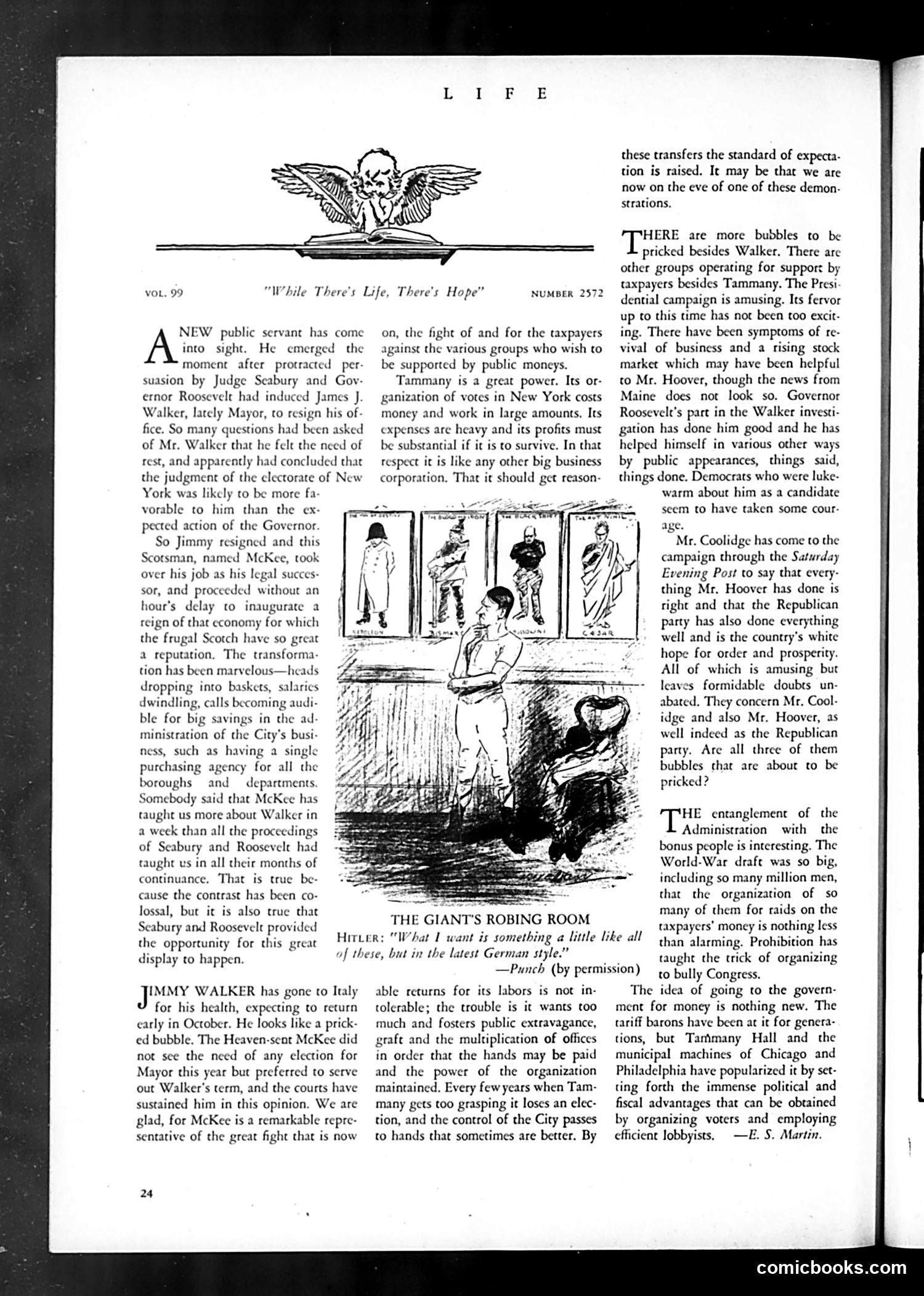
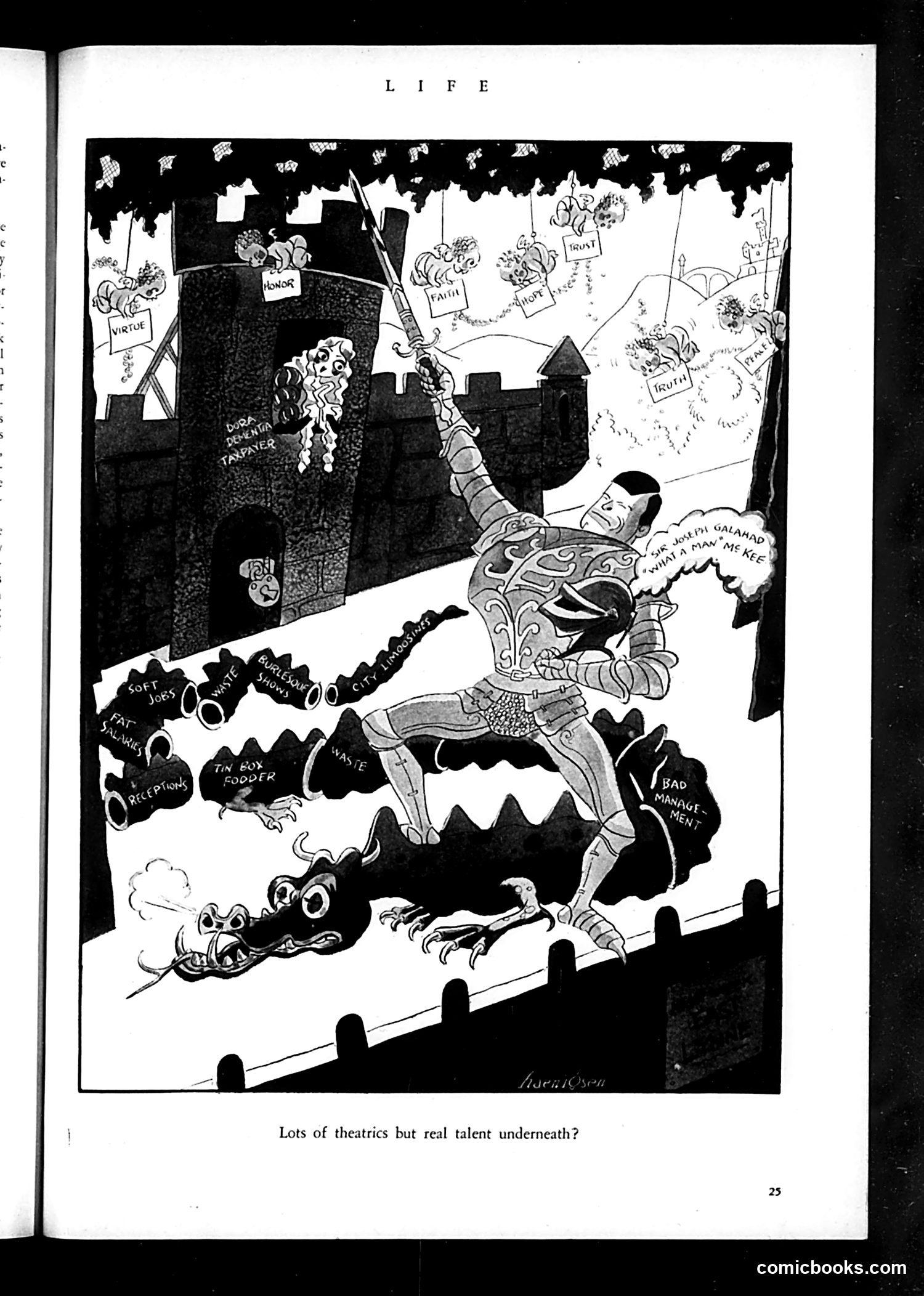
Analysis of Life Magazine Page This page discusses New York City politics following Mayor Jimmy Walker's resignation under pressure from Governor Roosevelt and Judge Seabury's investigation into corruption. Main figures: - James J. Walker: Recently resigned NYC Mayor, now in Italy; described as a "pricked bubble" - McKee: Walker's successor, a Scottish administrator praised for fiscal economy and dramatic cost-cutting - Tammany Hall: The Democratic political machine criticized for excessive spending and graft The satire's point: The contrast between Walker's apparent corruption and McKee's austerity measures inadvertently reveals Walker's mismanagement. The cartoon titled "The Giant's Robing Room" (reprinted from Punch) depicts Hitler selecting a German style outfit—likely satirizing political opportunism. Context for modern readers: This reflects 1930s debates about urban machine politics, government waste, and reform. Tammany Hall historically controlled NYC through patronage; the piece argues periodic electoral defeats briefly improve standards before the cycle repeats. The page criticizes both Democratic machines and suggests the upcoming presidential campaign (Hoover vs. likely Roosevelt) may hinge partly on these local corruption revelations.
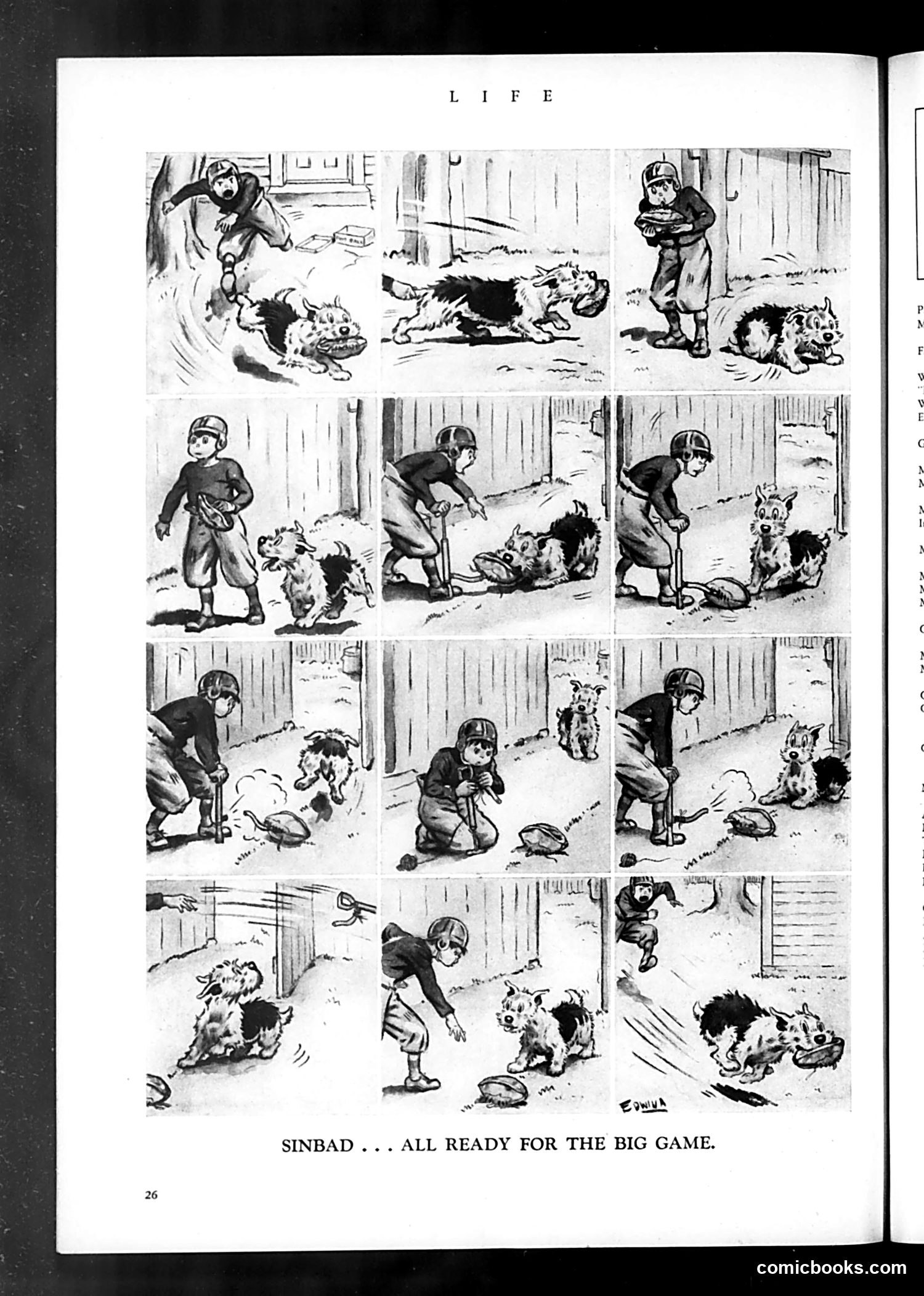
"Sinbad... All Ready for the Big Game" This is a comic strip narrative showing a child character named Sinbad preparing for what appears to be a baseball or sports game. The sequence depicts the boy being coached or trained by dogs—likely his pets—in various athletic movements and preparations: crouching, running, catching, and practicing with a ball. The humor derives from the role reversal: rather than a human coach instructing the dogs, the dogs appear to be enthusiastically coaching the boy through physical conditioning and sports technique. The "big game" reference suggests this is satirizing how seriously people take youth sports preparation, with the joke that even the family pets are invested in getting the child ready.
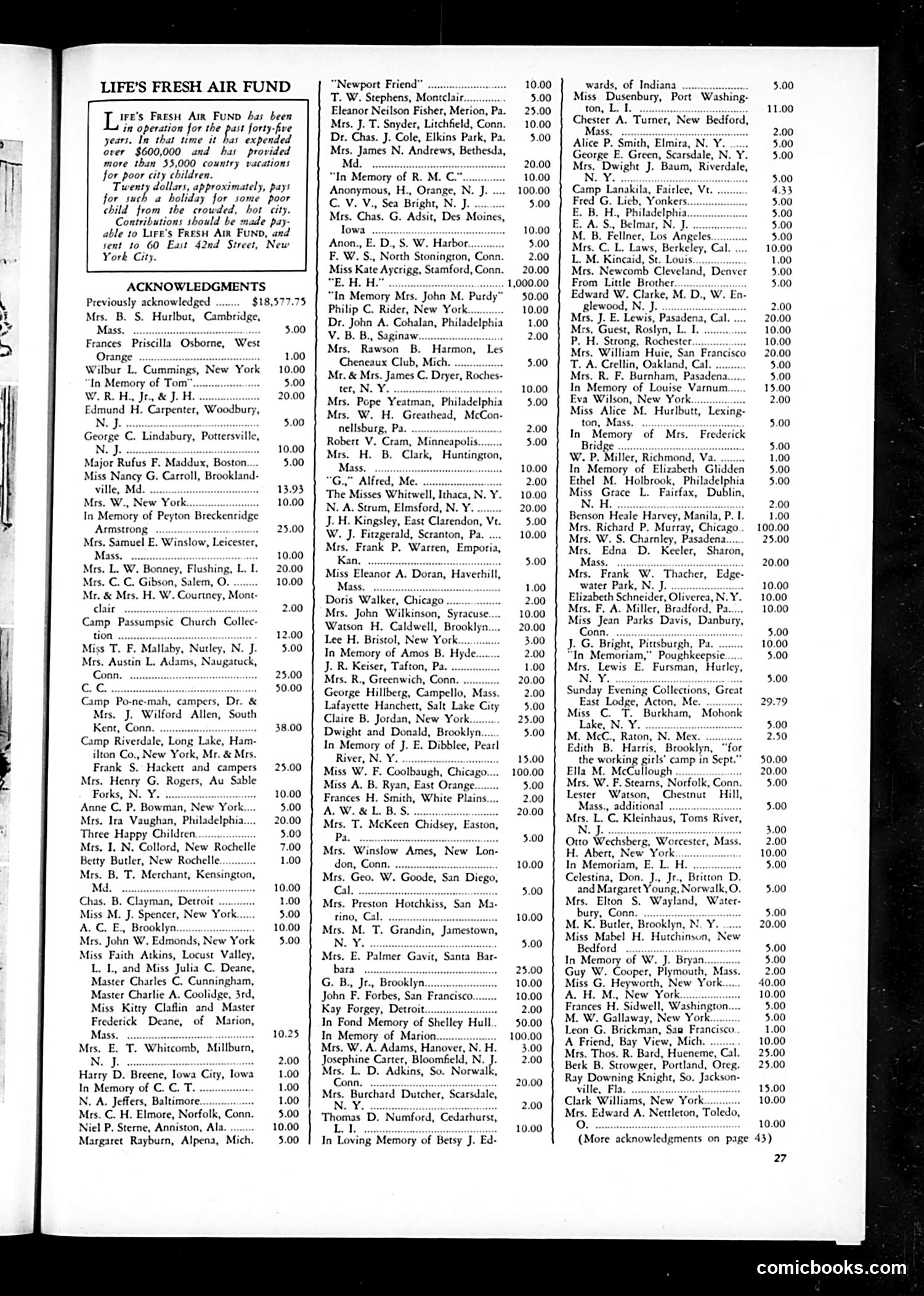
Life's Fresh Air Fund Acknowledgments Page This page is not a cartoon page—it's a fundraising acknowledgment list. It documents donors to Life magazine's Fresh Air Fund, a real charity that had operated for 45 years (from the magazine's perspective) providing country vacations for poor city children. The "satire" here is structural rather than visual: Life magazine was using its editorial space to publicize charitable giving, listing hundreds of donors with their contributions—a form of social pressure and virtue signaling common in the era. Some donations are marked "In Memory of," suggesting obituary-adjacent charitable giving. The page shows middle-class Americans from across the country (Massachusetts, Connecticut, Pennsylvania, California, etc.) donating modest sums ($1-$100, typically), making this a snapshot of Progressive-Era American philanthropy and civic participation. No cartoons or political commentary are visible on this particular page.
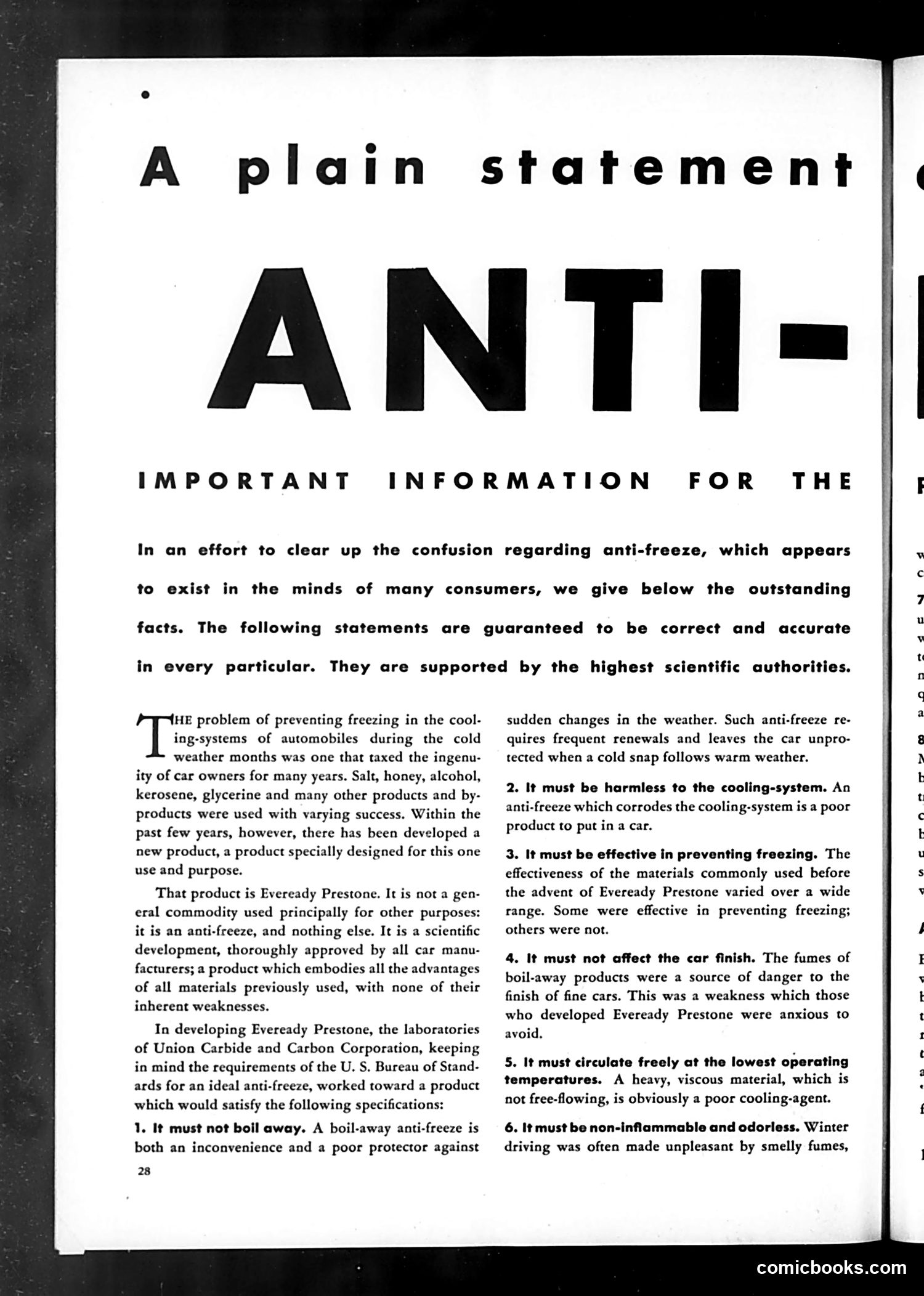
Page Analysis This is not a cartoon or satire—it's a straightforward advertisement for Eveready Prestone anti-freeze, presented as a consumer-information article. The page addresses a genuine practical problem: automobile owners in the 1930s-40s struggled to prevent engine coolant from freezing in winter, having previously tried salt, honey, alcohol, kerosene, and glycerin with mixed results. Eveready Prestone was a newly developed product made by Union Carbide and Carbon Corporation. The ad frames the product as scientifically superior, claiming it meets six specific technical requirements (won't boil away, won't corrode engines, effectively prevents freezing, won't damage car finish, flows at low temperatures, and is safe/odorless). The page mimics authoritative scientific documentation to build consumer confidence in this new specialized product. For modern readers, it reflects how anti-freeze was once a novel, confusing innovation requiring detailed explanation—now routine automotive maintenance.
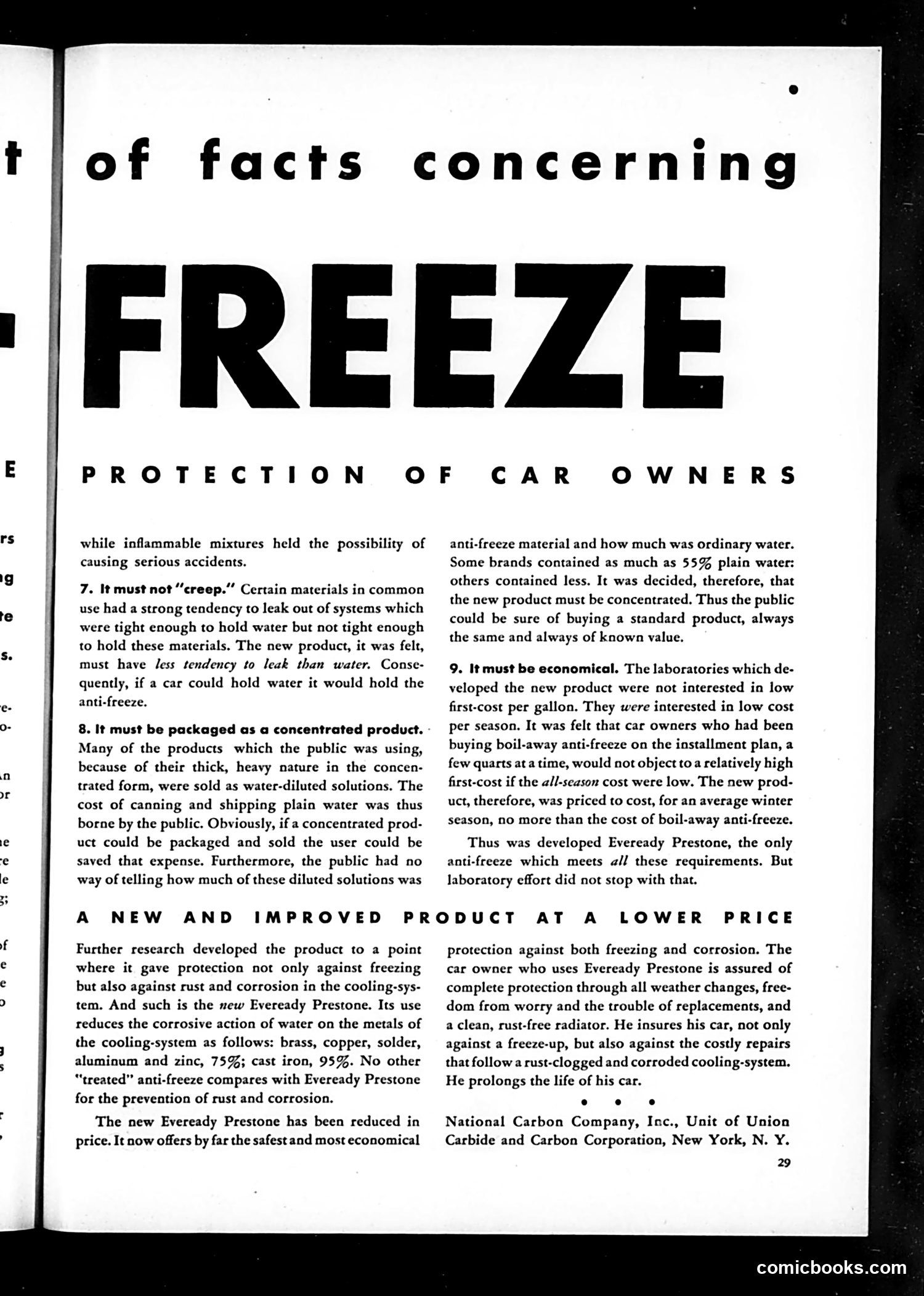
Analysis This is not a cartoon or satire—it's a straightforward advertisement for Eveready Prestone antifreeze, disguised as educational content. The page presents nine requirements for an ideal antifreeze product (numbered 7-9 visible here), framed as objective "facts concerning freeze protection of car owners." In reality, it's marketing copy explaining why Prestone meets needs that competitors allegedly don't: it won't leak, comes concentrated (so buyers aren't paying to ship water), and costs less per season despite higher upfront price. The rhetorical strategy mimics a scientific or journalistic article rather than explicit advertising. By presenting Prestone as the sole product meeting "all these requirements," it positions competitors as inferior without naming them. This represents 1920s-30s advertising technique: using pseudo-educational framing and technical language to appear objective while making commercial claims. A modern reader might mistake this for consumer guidance rather than recognizing it as branded marketing content.
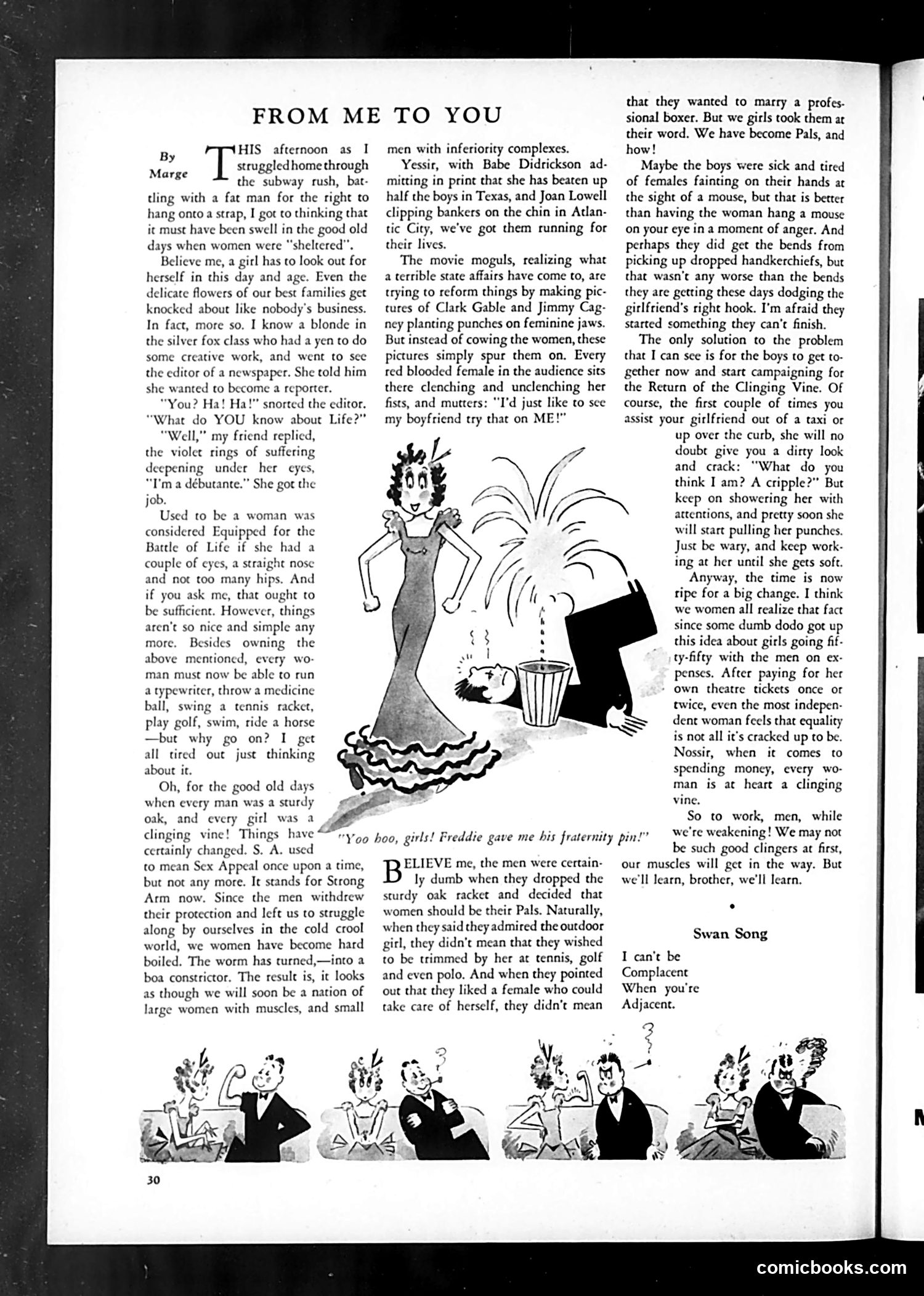
Analysis for Modern Readers This 1920s-30s satirical piece by "Marge" comments on the "New Woman"—the modern, independent female who emerged after women gained voting rights and entered the workforce. The Social Context: The author laments that women are no longer "sheltered" or delicate. She references real female athletes/adventurers like Babe Didrickson (Olympic athlete) and Joan Lowell (aviator/boxer), who challenged traditional femininity by competing athletically and physically with men. The Satire's Point: Men wanted women as independent "Pals" but didn't anticipate the consequences—women now box, play sports, work jobs, and assert themselves. The cartoon shows a woman literally striking a man, illustrating the role reversal. The Irony: The author mockingly suggests men now suffer "inferiority complexes" while women develop "muscles." She playfully argues men should campaign for women to return to being "clinging vines." The Humor: It's tongue-in-cheek social commentary on changing gender dynamics—celebrating women's liberation while humorously exaggerating male anxiety about losing traditional dominance.
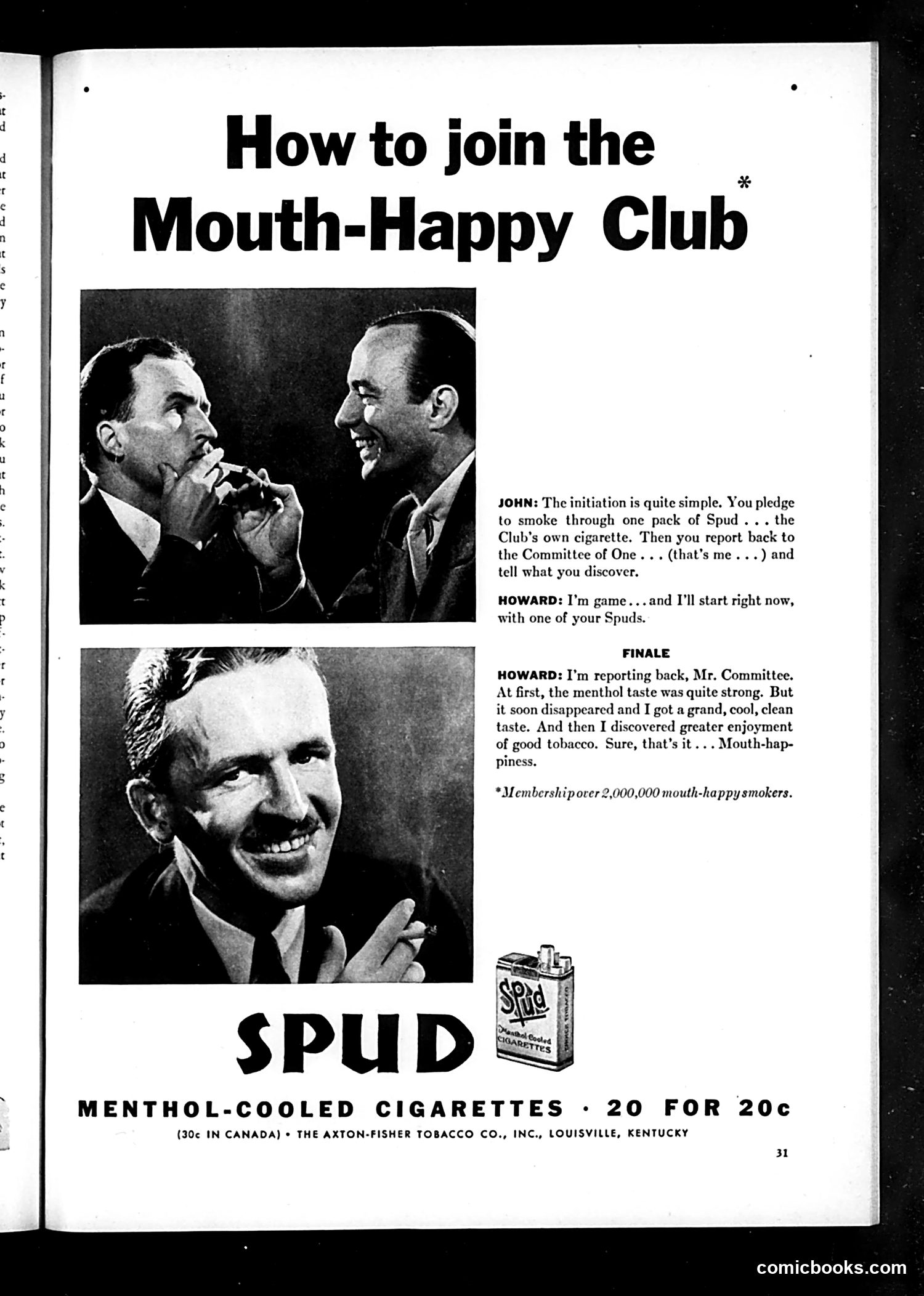
Analysis: "Mouth-Happy Club" Advertisement This is a cigarette advertisement for Spud menthol cigarettes, not political satire. The page uses a comedic comic-strip format to promote the product. The "joke" frames smoking as joining an exclusive club. A character named John initiates "Howard" into the "Mouth-Happy Club" by having him smoke a pack of Spuds and report his experience. Howard's testimonial follows the classic advertising playbook: initial skepticism overcome by pleasant surprise, leading to enthusiastic endorsement of the menthol taste and tobacco quality. The humor is mild—playing on the concept of smoking as a social/club activity and the somewhat absurd notion that smoking creates "mouth-happiness." The asterisk notes over 2 million members, suggesting widespread adoption. By modern standards, this straightforward tobacco marketing is remarkable only for its openness—casual promotion of smoking without health warnings, targeting what appears to be general adult audiences.
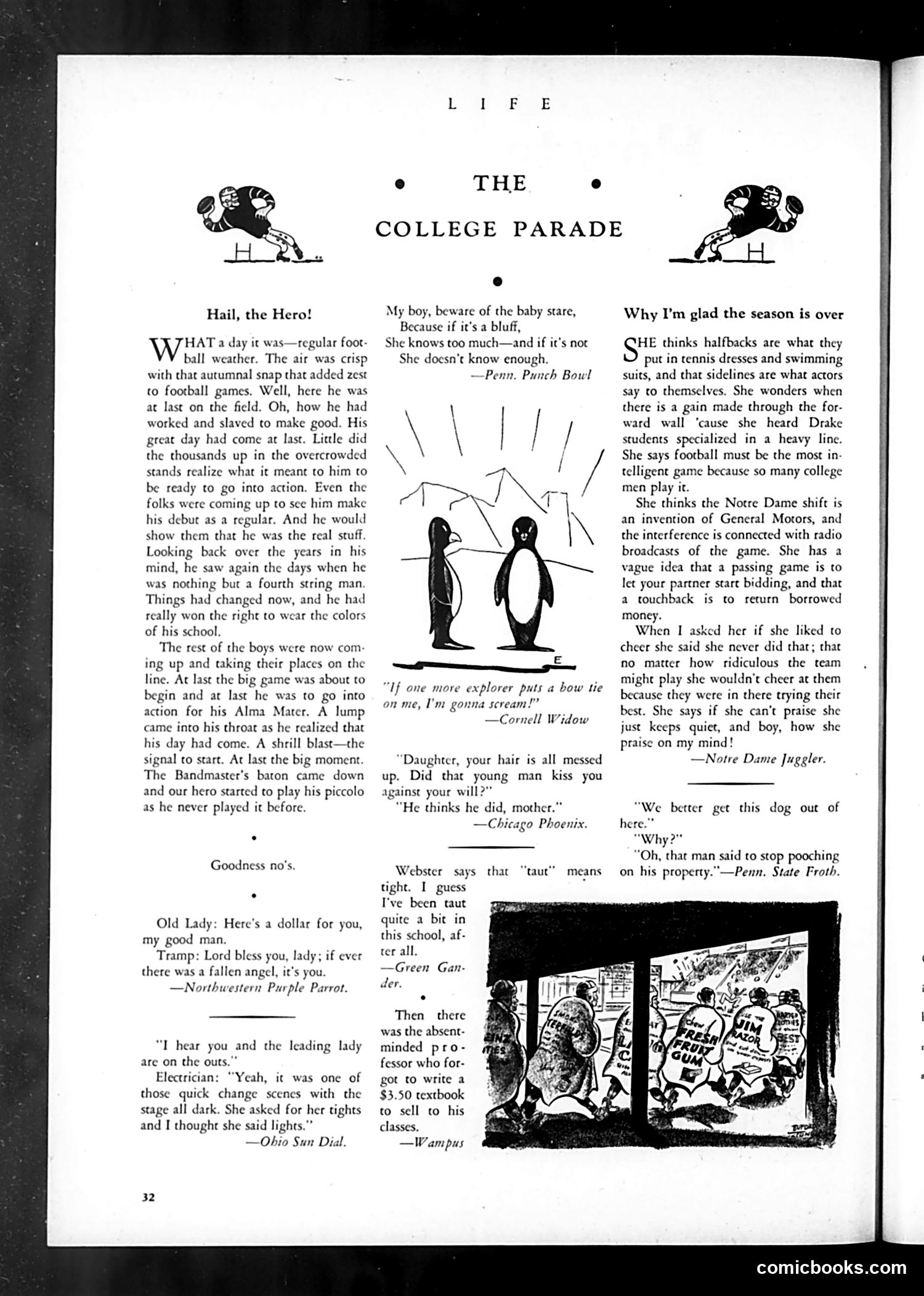
"The College Parade" - Life Magazine Satire This page collects humorous college newspaper submissions satirizing campus life, circa 1920s-30s. The main story mocks overwrought sentimentality: a student nervously prepares for his "big moment" as a football hero—only to reveal he plays *piccolo* in the band, not football itself. The joke undercuts heroic pretension through anticlimactic reveal. The surrounding brief jokes target: - Women at football games: The "Why I'm glad the season is over" piece ridicules female spectators' supposed ignorance (confusing football terms with fashion, motors, bridge games) - Dating: The "baby stare" and kissing jokes mock romance clichés - College stereotypes: Absent-minded professors, electricians, stagehands The cartoon shows two penguin-like figures, likely representing confused onlookers or generic college characters witnessing absurdity. The humor relies on 1920s-30s college culture specificity—football prominence, gender dynamics at sporting events, and inter-collegiate publication competition—now largely period artifacts.
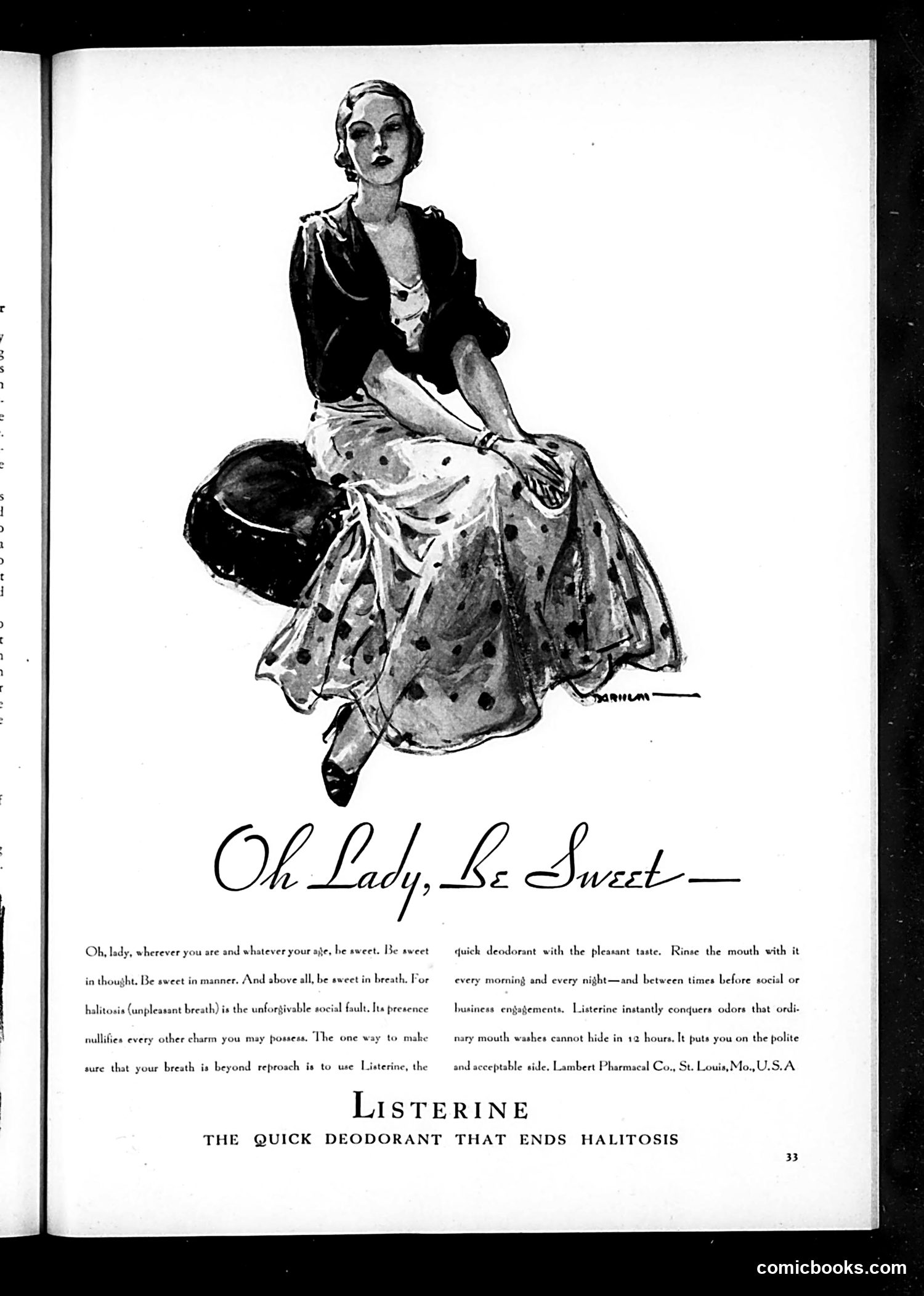
Analysis This is a Listerine mouthwash advertisement, not satire or political commentary. The illustration shows a fashionably dressed woman in 1930s-40s style clothing, seated and holding a hat. The ad's pitch targets women specifically, using social anxiety about "halitosis" (bad breath) as its sales mechanism. The text frames poor breath as "the unforgivable social fault" that damages a woman's charm and social acceptability—regardless of her age or appearance. The advertisement reflects period attitudes: women's worth was heavily tied to physical attractiveness and social acceptability, and manufacturers marketed solutions to invented or exaggerated insecurities. The repeated phrase "be sweet" conflates literal breath freshness with feminine demeanor, reinforcing expectations that women should be pleasant and inoffensive at all times. This represents early 20th-century advertising's exploitation of social anxiety, particularly toward women.
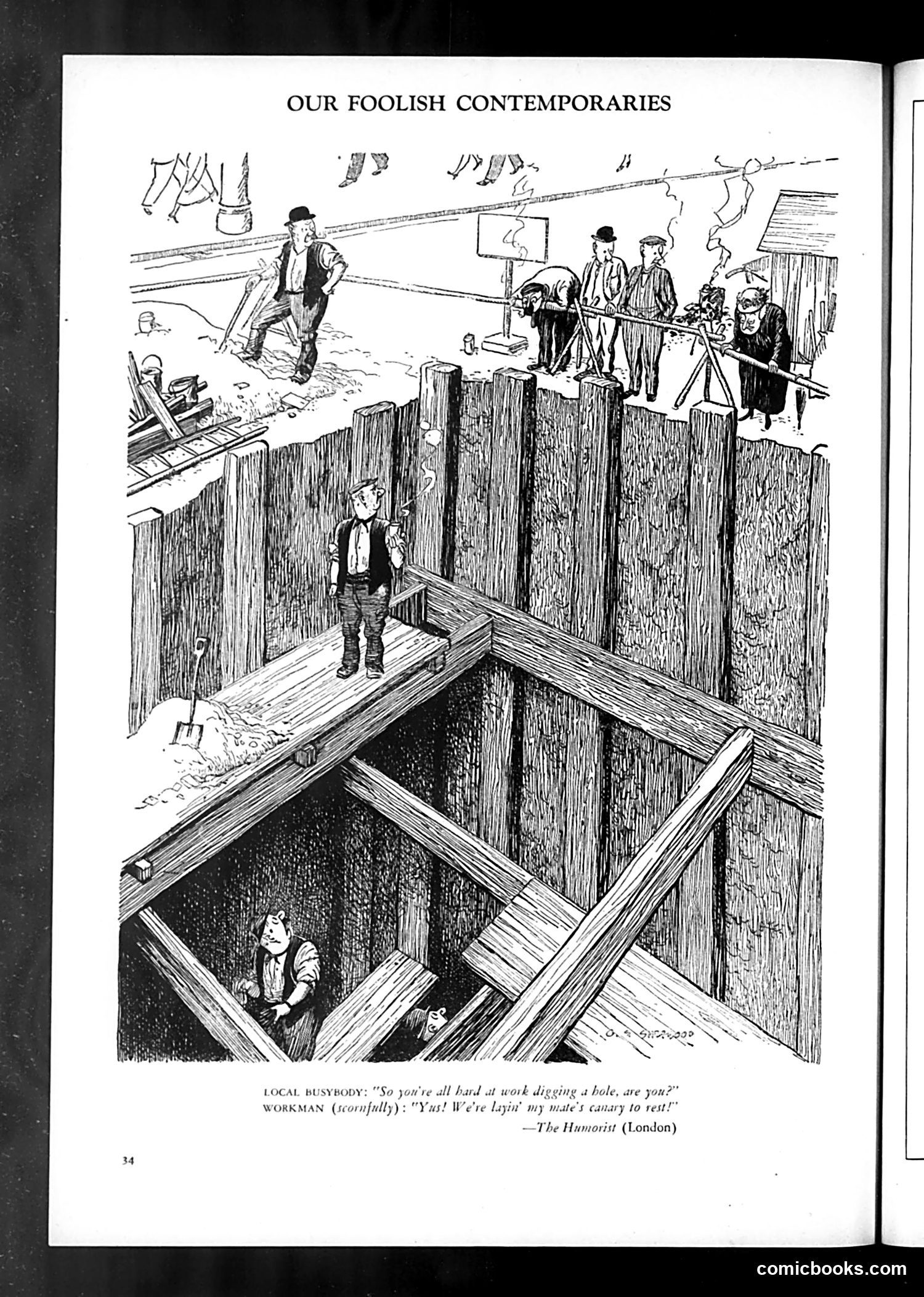
Analysis This page from *Life* magazine presents a single satirical cartoon titled "Our Foolish Contemporaries." The joke depicts a construction site where a local authority figure asks workers if they're digging a hole. The workman replies scornfully that they're actually "laying my mate's canary to rest"—performing a funeral for a dead bird. The humor comes from the contrast between the substantial infrastructure project (suggesting important work) and the trivial reality (burying a pet). The workman's defensive tone suggests irritation at being questioned about what appears to be time-wasted on a funeral for a canary, rather than productive labor. The caption attributes this to *The Humorist* (London), indicating this is a reprint of British humor. The satire mocks either wasteful workplace practices or the earnestness of authority figures.
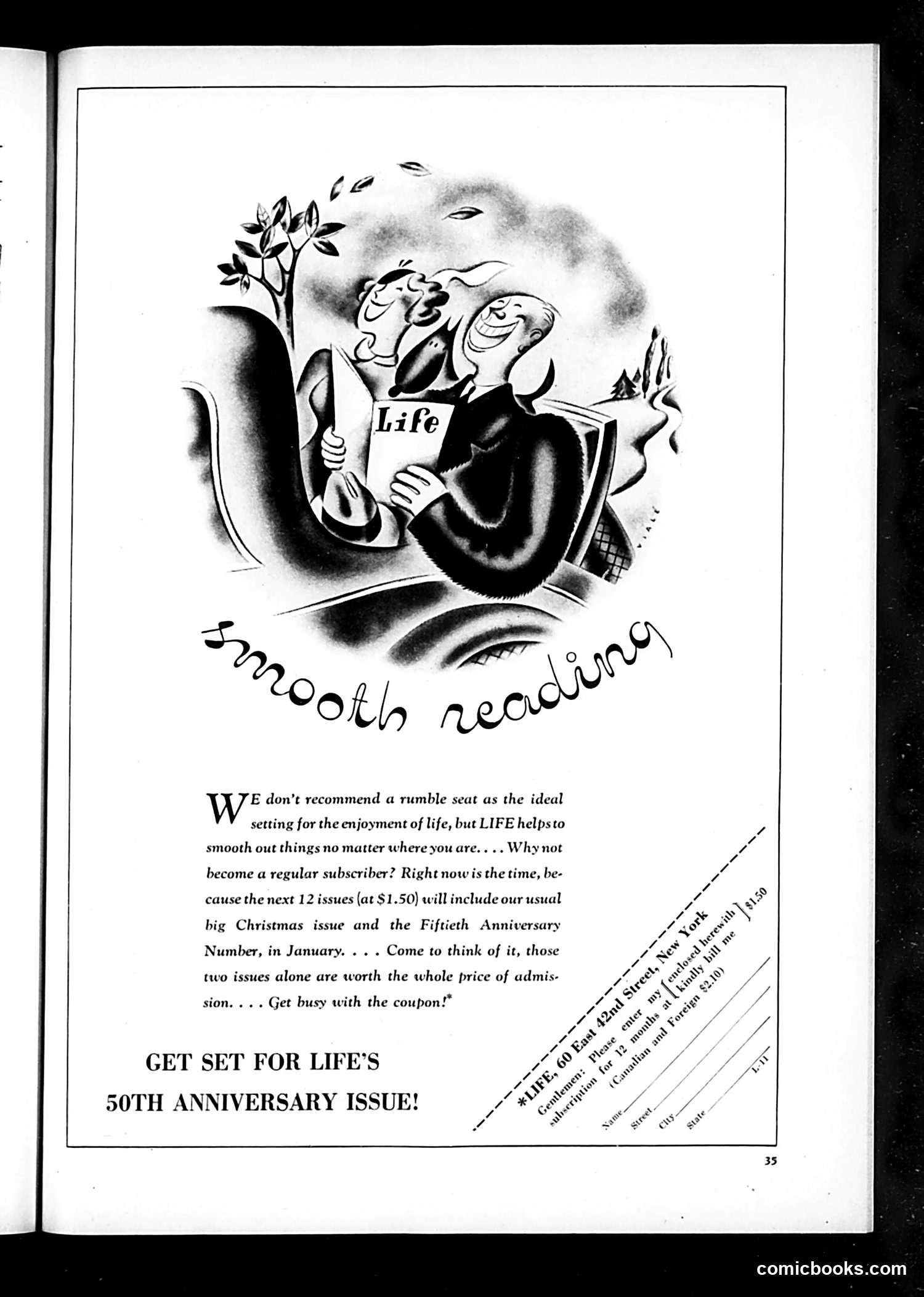
Analysis for Modern Readers This is a subscription advertisement for *Life* magazine, not a political cartoon. The illustration shows two men in a car's rumble seat (a fold-down rear seat popular in 1920s-30s automobiles) laughing while reading *Life* magazine, with leaves blowing around them—suggesting carefree enjoyment. The ad's humor plays on the phrase "smooth reading": *Life* magazine helps "smooth out things no matter where you are," even in the bumpy, uncomfortable setting of a rumble seat. The copy pitches subscriptions for 12 issues at $1.50, highlighting that upcoming issues will include the magazine's 50th Anniversary Number (January) and a Christmas issue—both presented as especially valuable. The sales tactic: subscribe now to get these premium issues at the regular subscription price. No specific political figures or events are referenced; this is purely commercial content marketing the magazine itself.
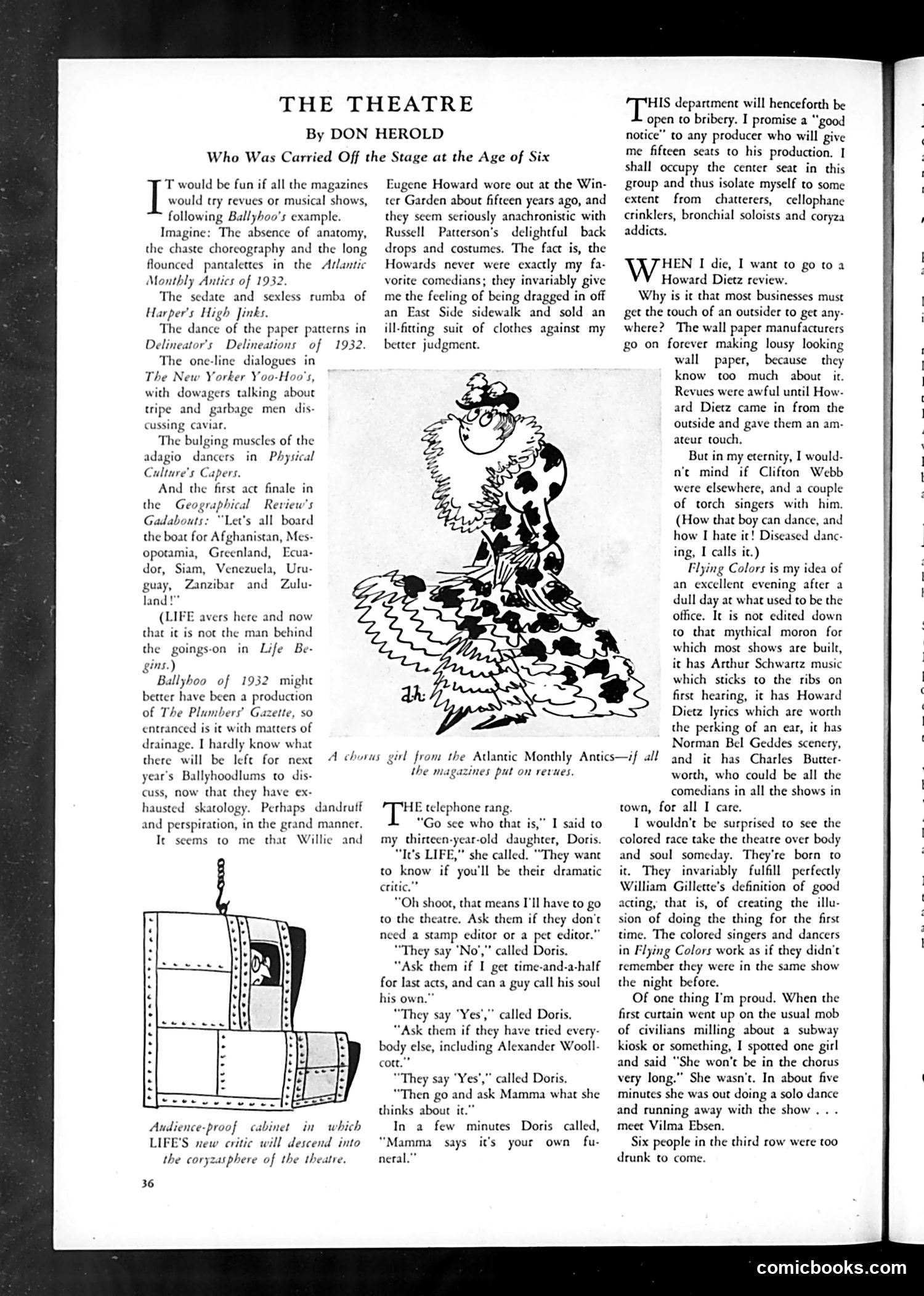
"The Theatre" by Don Herold — Life Magazine This is theater criticism disguised as humor. Herold satirizes Broadway and magazine culture circa 1932. The Main Cartoon: Shows a chorus girl in a feathered costume—a visual joke accompanying Herold's opening premise: imagining if staid magazines (*Atlantic Monthly*, *Harper's*, *The New Yorker*) produced theatrical revues, their shows would be absurdly dull and prudish. The Sidebar Cartoon: An "audience-proof cabinet" where a theater critic descends—mocking the author's own new role reviewing plays. The joke: critics need protection from audiences (and vice versa). Key References: - Eugene Howard & Willie Howard: Vaudeville comedians Herold considers dated and unfunny - Ballyhoo: A contemporary satirical magazine (1932) obsessed with crude humor - Howard Dietz, Clifton Webb, Arthur Schwartz: Contemporary Broadway figures; Herold praises *Flying Colors* (a 1932 revue) while insulting Webb's dancing The Satire: Theater is dying because of tired performers and bad taste. Only outsiders like Dietz inject freshness. Herold's "bribery" offer mocks the practice of comp seats influencing reviews.
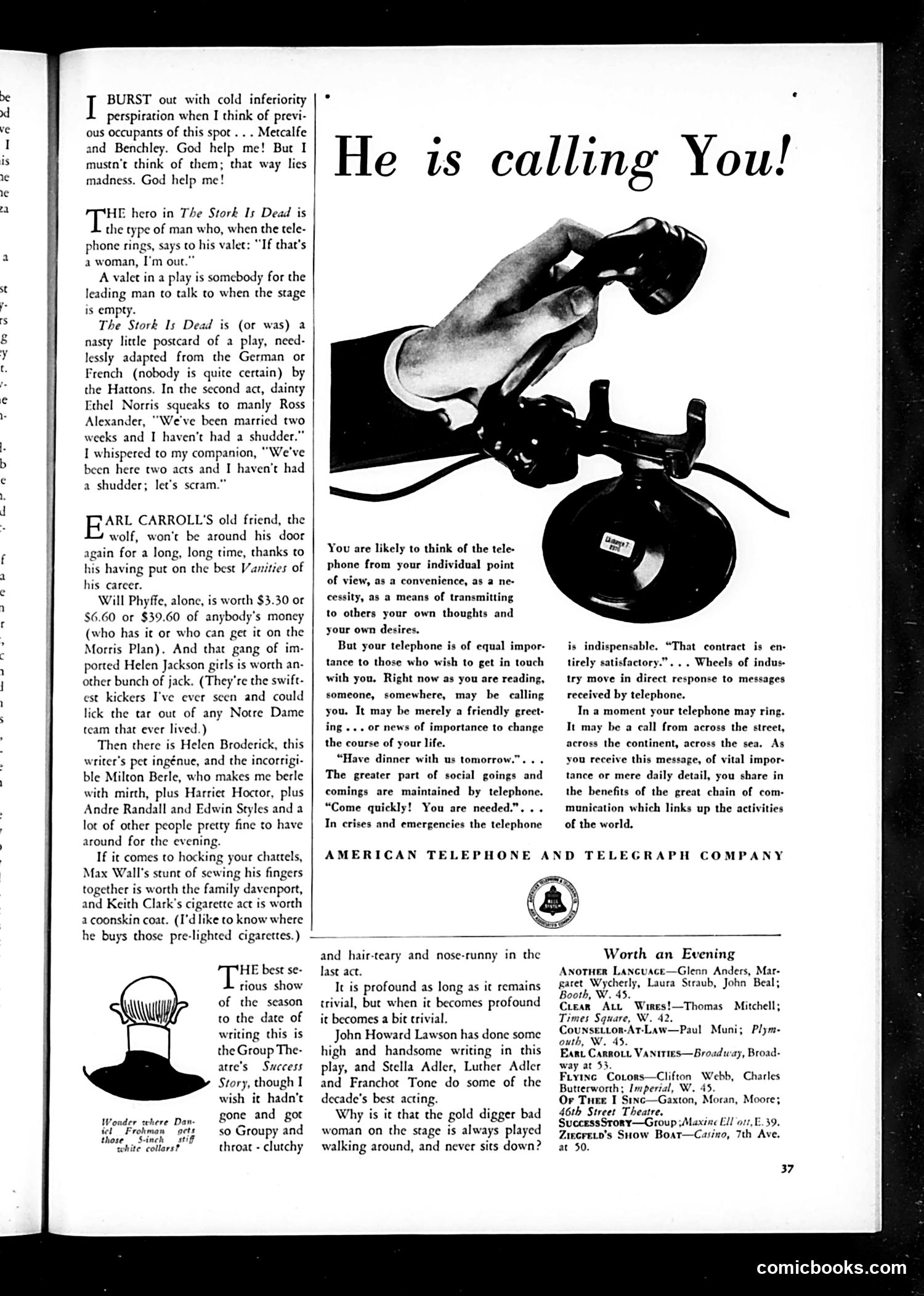
Life Magazine Theater Review & AT&T Advertisement This page combines theater criticism with corporate advertising. The left column reviews Broadway shows including *The Stork Is Dead* and Earl Carroll's *Vanities*, with sarcastic commentary on performances and actors (Milton Berle, Helen Broderick, Will Fyffe). The critic expresses mock anxiety about following previous writers at this venue. The dominant image—a dramatic photograph of a hand holding a telephone receiver—anchors an AT&T advertisement. The ad uses the telephone as metaphor for human connection and business necessity, emphasizing how calls might bring life-changing news ("Have dinner with us tomorrow") or crisis alerts ("Come quickly! You are needed"). The rhetoric positions the telephone as indispensable infrastructure linking personal and professional life, national commerce, and emergencies. This 1930s advertising pitch frames the telephone company's service as facilitating civilization itself—a common corporate messaging strategy of the era.
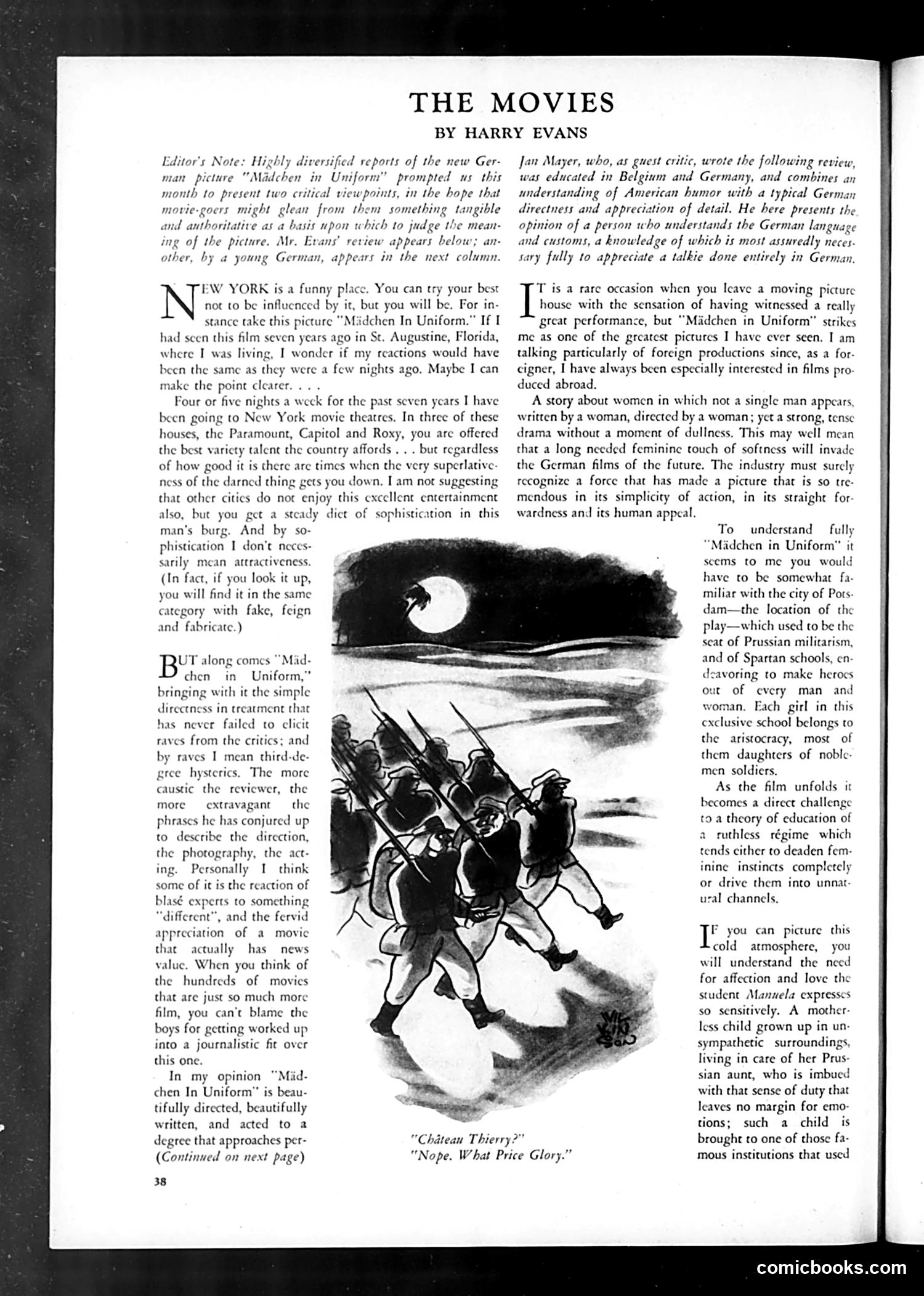
Analysis for Modern Readers This 1931 *Life* magazine page reviews the German film *Mädchen in Uniform* ("Girls in Uniform"), offering two critical perspectives. The Cartoon Context: The sketch depicts soldiers in combat—likely referencing WWI or German militarism generally—illustrating the film's themes about rigid Prussian institutions that shaped women's education. The Reviews' Point: American critic Harry Evans argues that New York's sophisticated, jaded audiences are over-praising the film simply because it's "different" from typical Hollywood fare. He acknowledges its quality but cautions against inflated critical enthusiasm. German critic Jan Mayer counters that the film is genuinely great—an all-female production (written, directed by women) that brings emotional depth to German cinema. He emphasizes that understanding German language and culture is essential to appreciating the film's achievement. The Satire: The juxtaposition highlights how the same film provokes opposite reactions: American critics celebrating novelty versus a German insider recognizing authentic artistic merit and cultural significance within a militaristic society.
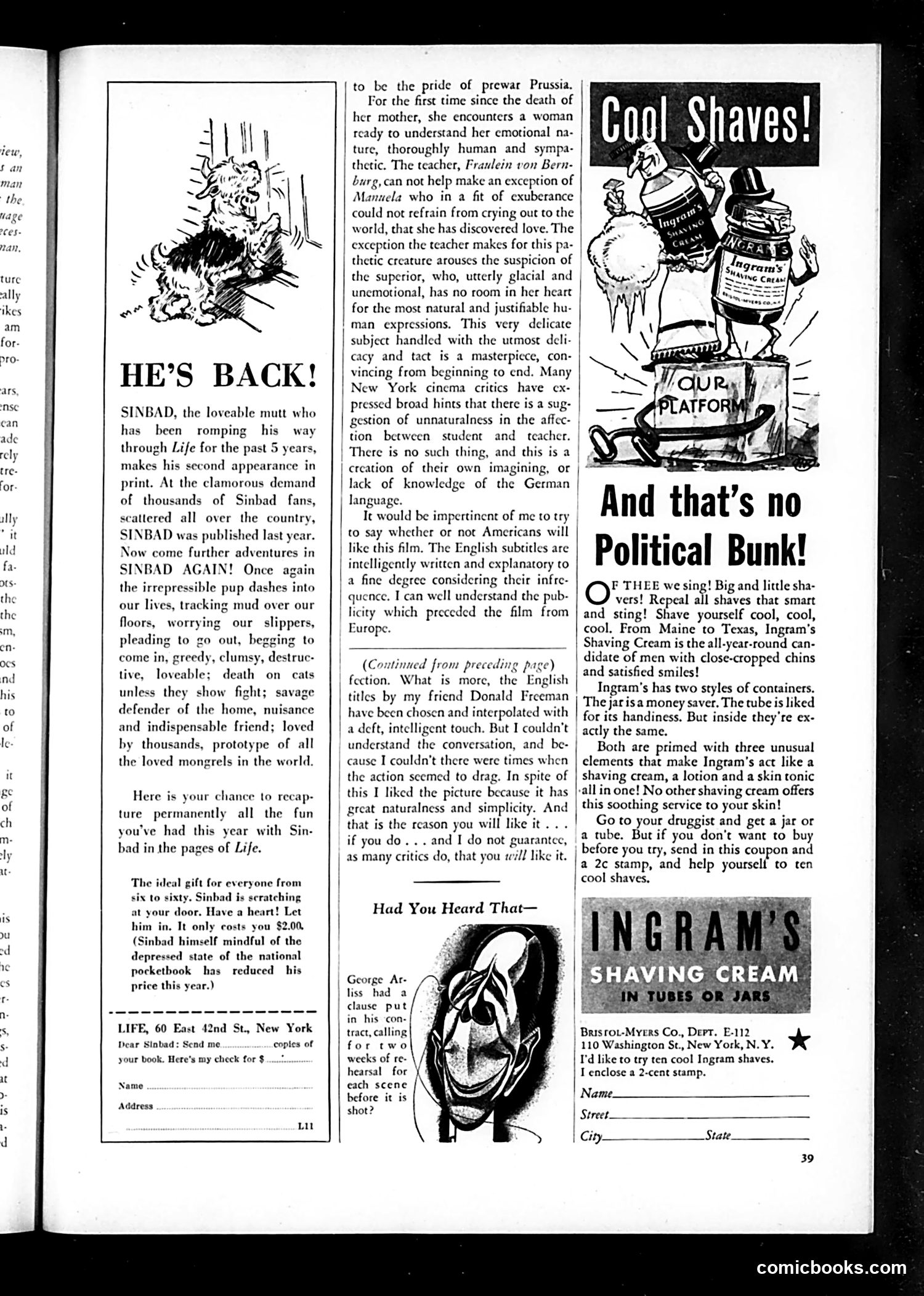
Life Magazine Page Analysis This page contains a Sinbad advertisement (left) promoting a book collection of the cartoon character, who had been appearing in *Life* magazine for five years. Sinbad is a mischievous dog—loveable but destructive—appealing to readers' nostalgia. The main content (center) reviews a German film, likely "Mädchen in Uniform" (1931), about a student-teacher relationship. The reviewer defends against critics' implications of impropriety, insisting the bond is innocent and that detractors lack "knowledge of the German language." The right side features the "Cool Shaves!" advertisement for Ingram's Shaving Cream, with the crude pun "And that's no Political Bunk!"—playing on contemporary political discourse while promoting grooming products to male readers. The page reflects 1930s *Life* magazine: mixing entertainment, film criticism, advertisements, and light humor targeting middle-class American men.
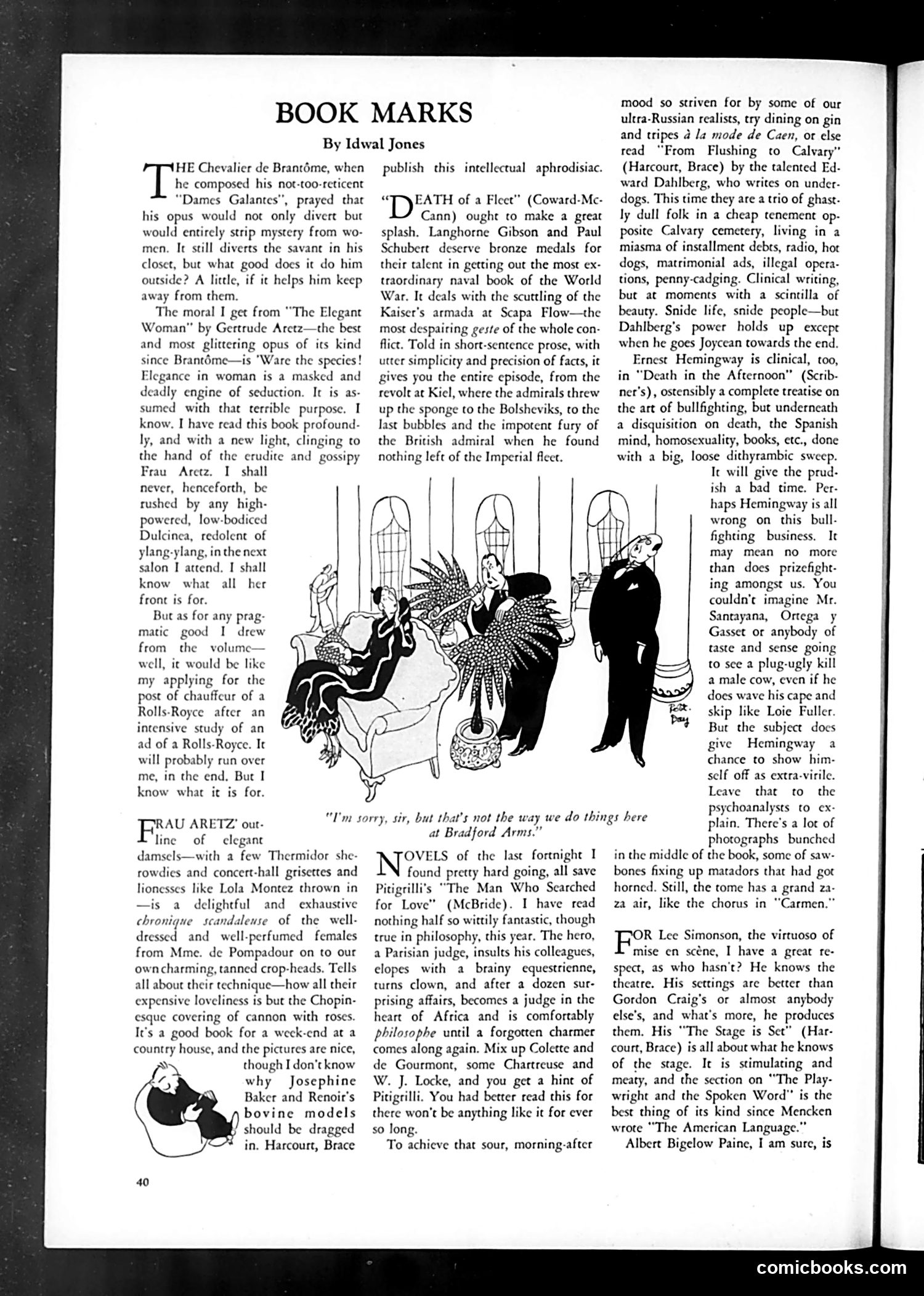
Book Marks Page Analysis This is a literary review column by Idwal Jones discussing several books. The main illustration shows a dinner party scene with well-dressed figures, satirizing upper-class social pretense—likely connected to the review of "The Elegant Woman" by Gertrude Aretz, which the text describes as examining how female elegance functions as a "masked and deadly engine of seduction." The column reviews several works: Aretz's gossipy chronicle of famous women from Pompadour onward; "Death of a Fleet," a WWI naval history about Germany's scuttled armada; and Pitigrilli's romantic novel about a Parisian judge. Jones uses witty, dismissive language typical of 1920s literary criticism—praising some books while mocking others' pretentiousness. The cartoon's caption ("I'm sorry, sir, but that's not the way we do things here at Bradford Arms") suggests satire about social codes and respectability among the wealthy, reinforcing the column's broader theme of exposing artifice beneath elegant surfaces.
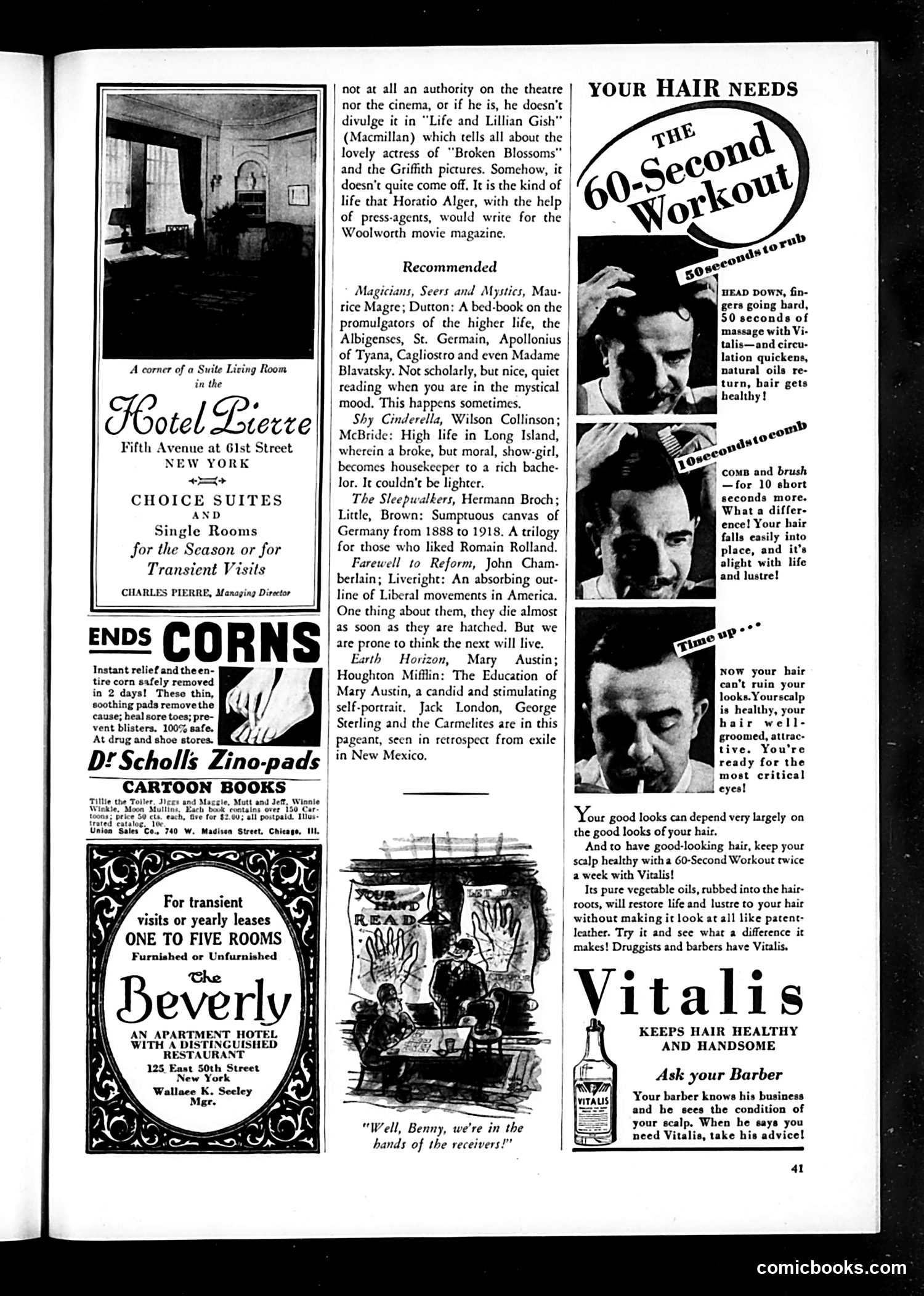
Page Analysis: Life Magazine (Vintage) This page is primarily advertising and book reviews, not political satire. The main content includes: Book Reviews Section: A critic dismisses a biography of actress Lillian Gish as superficial—written like "Horatio Alger" success propaganda for a "Woolworth movie magazine." Other recommended books cover mysticism, German history, and liberal political movements. Cartoon/Illustration: A small cartoon shows two men in what appears to be a financial crisis ("we're in the hands of the receivers!"), likely referencing economic turmoil, though the specific context isn't clear from the image alone. Advertisements: The page is dominated by hotel ads (Hotel Pierre, The Beverly), corn remedies (Dr. Scholl's), cartoon books, and prominently, Vitalis hair product—featuring instructional photos of a "60-Second Workout" scalp massage technique. The Vitalis ads emphasize healthy hair as essential to "good looks," particularly for men seeking professional appearance. The page reflects 1920s-30s consumer culture and emerging hair-care marketing targeting male grooming.
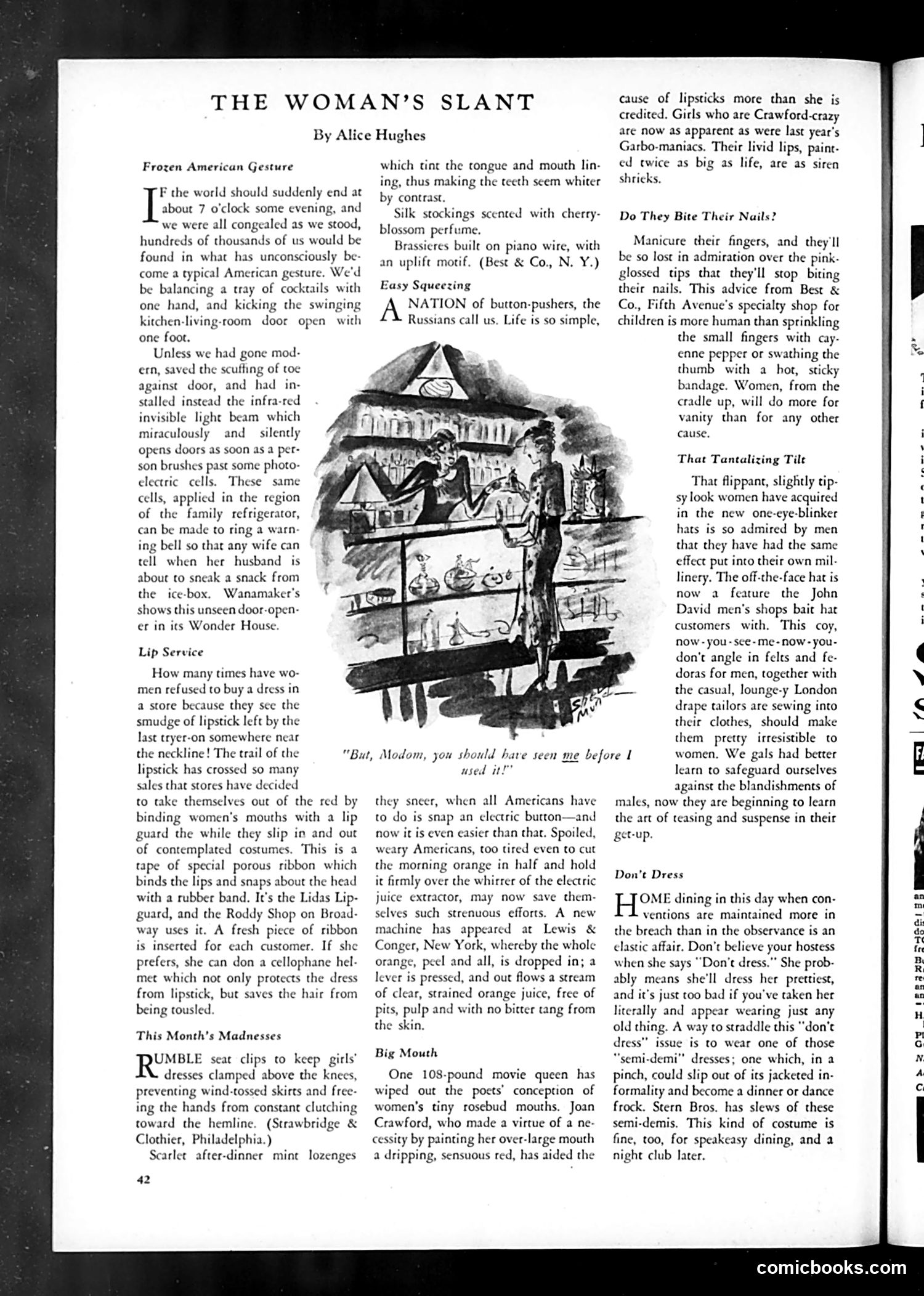
"The Woman's Slant" - Life Magazine Satire This is a humorous column by Alice Hughes mocking 1930s American women's fashion obsessions and consumer culture. The cartoon illustrates the opening: a "frozen American gesture" of a woman balancing cocktails while kicking open a kitchen door—satirizing the era's cocktail-party culture and modern convenience-seeking. The article then catalogs absurd beauty and fashion trends: lipstick guards to prevent makeup smudges on clothes, scented stockings, electrified orange juice extractors, and seat clips preventing "wind-tossed skirts." The "Big Mouth" section mocks actress Joan Crawford's heavily painted, oversized lips, which inspired a trend of women painting their mouths disproportionately large. The satire targets wealthy consumers' endless pursuit of frivolous products and the fashion industry's ability to manufacture desires. References to department stores (Wanamaker's, Best & Co., Strawbridge & Clothier) suggest this appeals to the magazine's upscale urban readership. The tone is lighthearted mockery of contemporary women's vanity and consumerism.
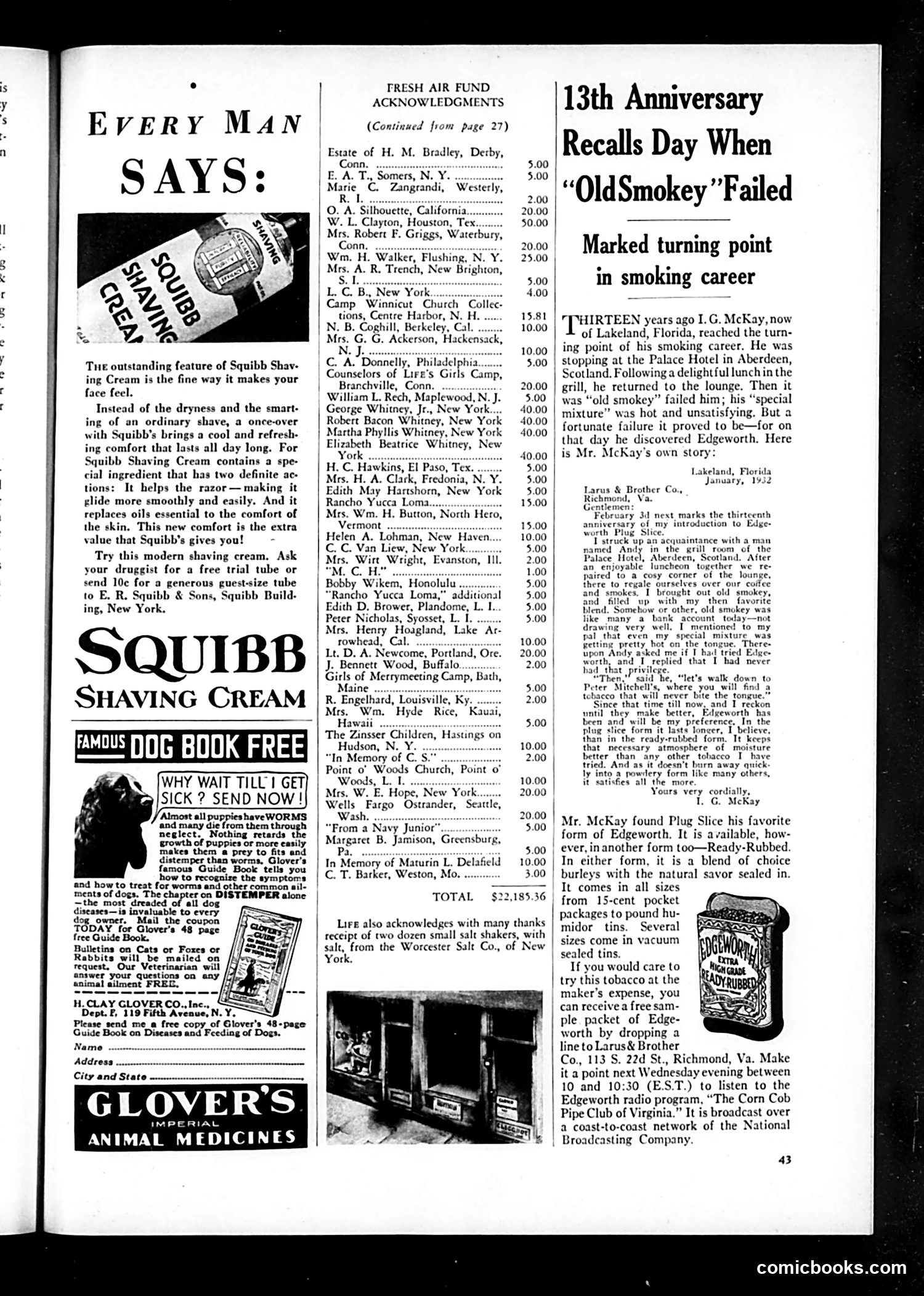
Life Magazine Advertisement & Feature Page Analysis This page combines product advertisements (Squibb Shaving Cream, Glover's Animal Medicines) with a charitable acknowledgments list and a tobacco advertorial disguised as an anniversary retrospective. The main feature—"13th Anniversary Recalls Day When 'Old Smokey' Failed"—is promotional content for Plug Slice tobacco. The headline's irony is the joke: McKay's smoking career didn't fail; rather, he abandoned his preferred tobacco form (pipe) and discovered Plug Slice as a superior alternative. The "turning point" refers to his conversion to this product, not failure at smoking itself. This is essentially native advertising—a first-person testimonial disguised as editorial content, presenting product discovery as a personal life milestone. The piece runs alongside a Fresh Air Fund charity list, creating a jarring juxtaposition of humanitarian giving with tobacco promotion, typical of 1920s-era Life magazine's mixed editorial-advertising approach.
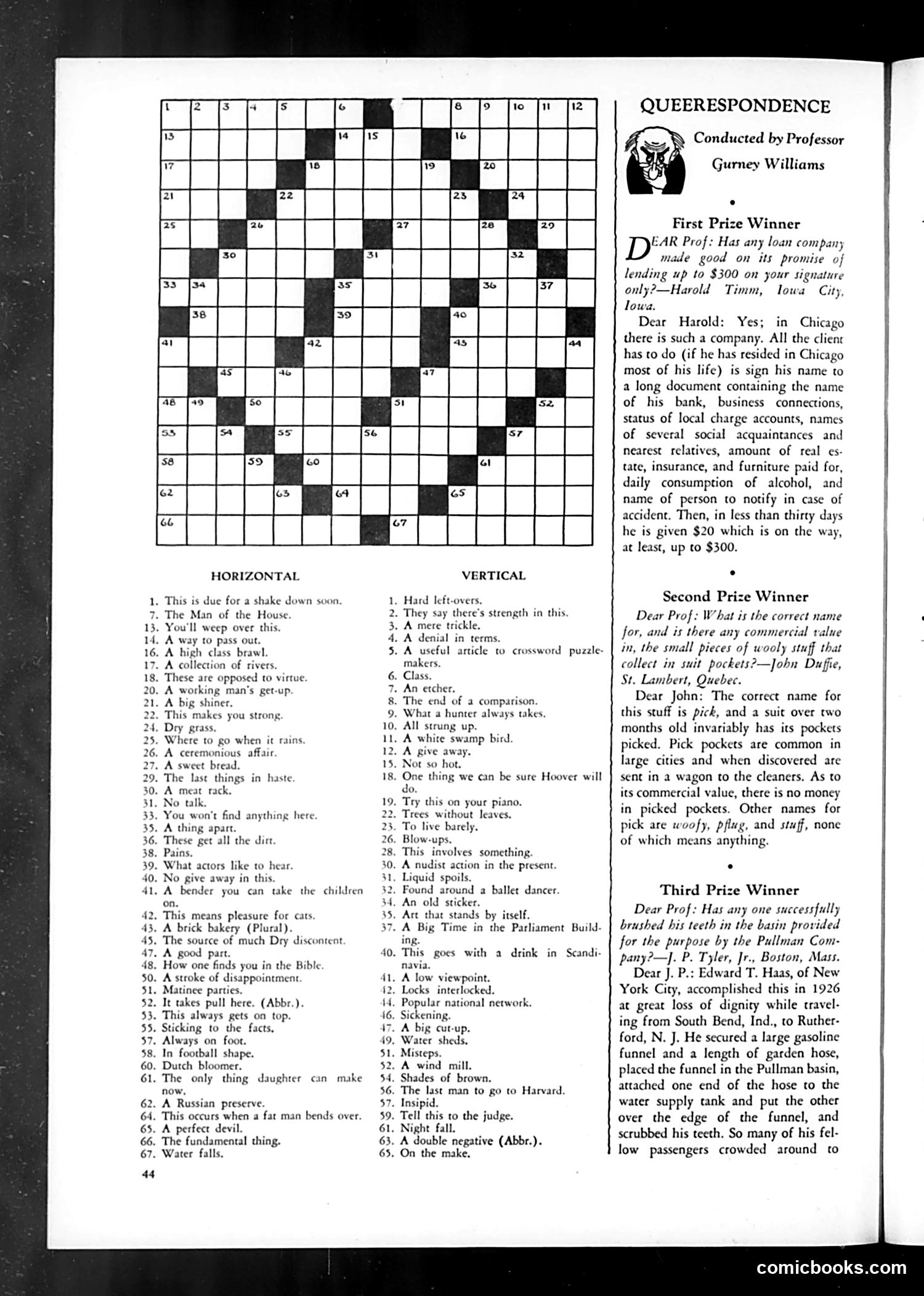
Explanation for Modern Readers This page contains a crossword puzzle (visible at top) and a humorous advice column called "Queerespondence," conducted by "Professor Gurney Williams." The three prize-winning letters are satirical complaints about contemporary inconveniences: 1. First Prize: A sardonic critique of predatory loan companies that promise $300 but require extensive personal/financial documentation, delivering only $20 after a month. 2. Second Prize: A joke about "pick"—lint that accumulates in suit pockets. The answer cleverly puns on "pick pockets" (thieves) and suggests dry cleaners exploit this common problem. 3. Third Prize: About the impracticality of Pullman train car bathroom facilities for basic hygiene. The humor targets consumer exploitation and modern inconveniences of the era (likely 1920s-30s based on references to Hoover and Pullman trains). The column mocks both corporations profiting from ordinary people and the absurdities of contemporary life.
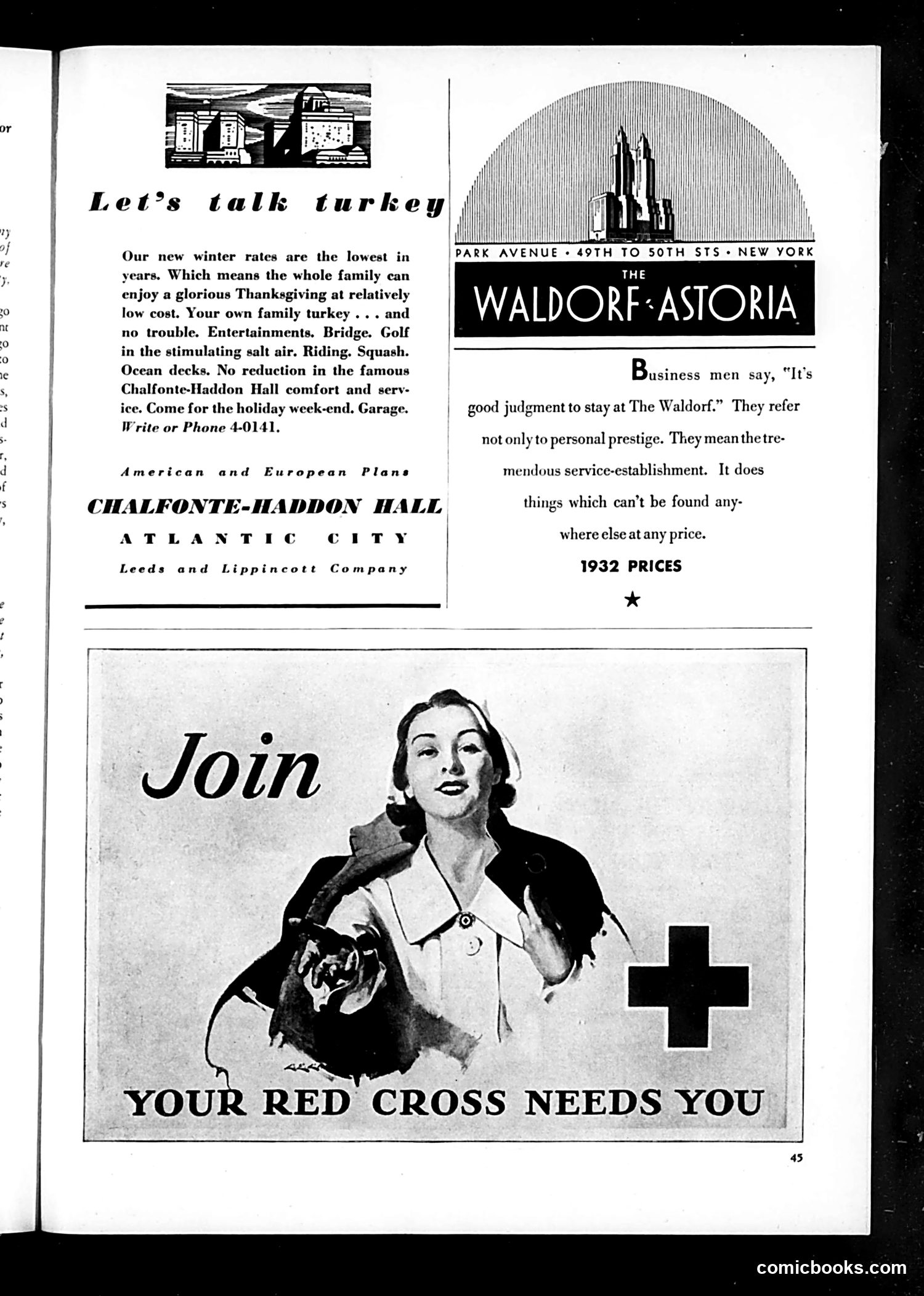
Page Analysis: Life Magazine, circa 1932 This page is primarily advertising, not satire. It contains three distinct ads: 1. Chalfonte-Haddon Hall (Atlantic City hotel): A Depression-era pitch offering "lowest winter rates" for Thanksgiving holidays, emphasizing luxury amenities (golf, bridge, ocean decks) at reduced cost—appealing to middle-class families struggling during the economic crisis. 2. Waldorf-Astoria (NYC hotel): Targets businessmen, positioning the hotel as a marker of professional prestige and exceptional service. 3. Red Cross recruitment: A public-service appeal featuring a woman with a fur stole, urging readers to join. This reflects Depression-era charitable mobilization. The "Let's talk turkey" headline is a colloquial phrase meaning "speak frankly"—used here as a lighthearted hook for the hotel's Thanksgiving promotion. No political satire is present; this is straightforward Depression-era advertising emphasizing value and status during economic hardship.
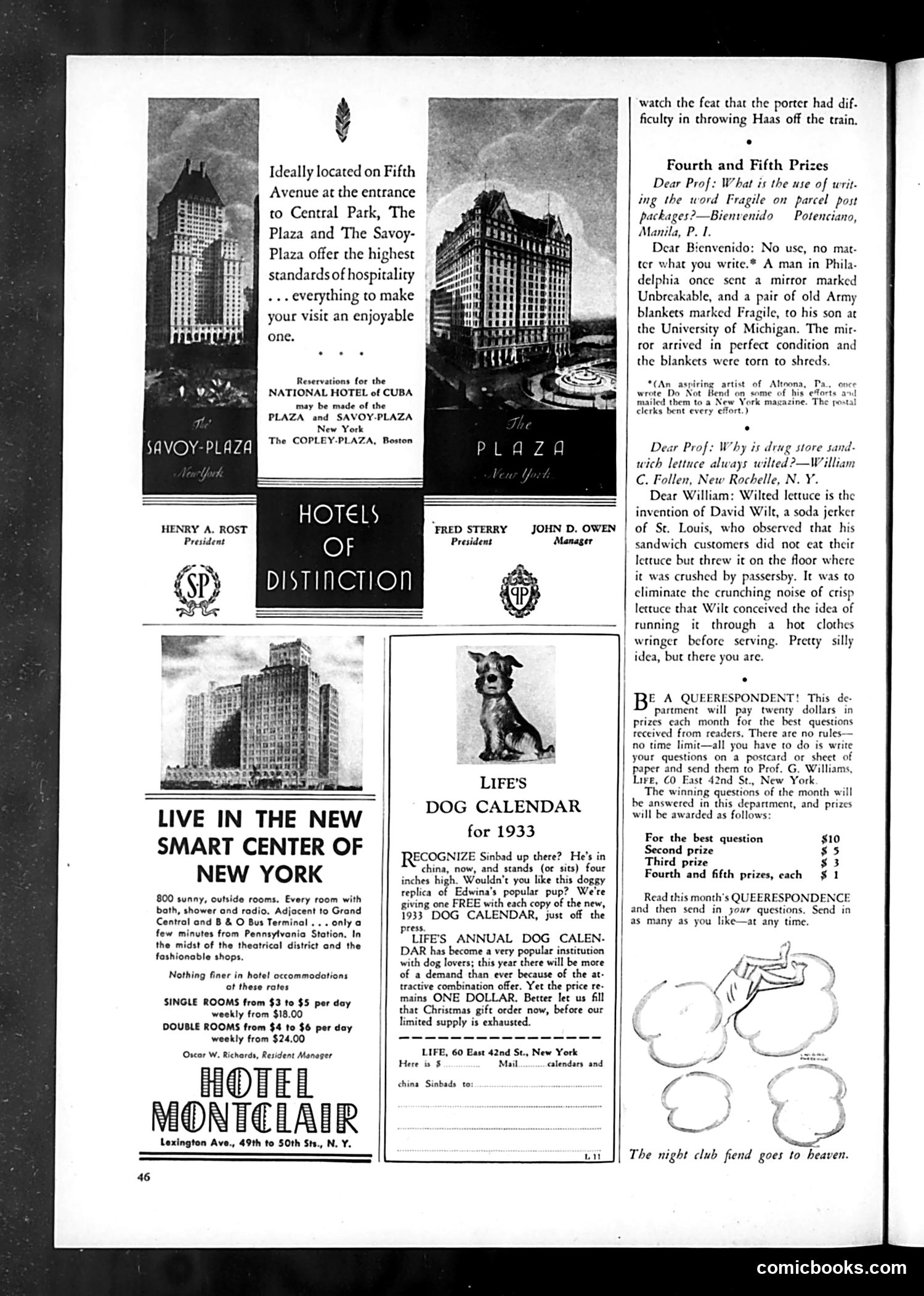
Life Magazine Page Analysis This is primarily an advertising and advice column page from Life magazine, circa 1933. The satirical content is minimal. The page features hotel advertisements (Plaza, Savoy-Plaza, Hotel Montclair) and promotes Life's Dog Calendar for 1933, offering a free china figurine of "Sinbad" with purchase. The main humor appears in the "Queerespondence" advice column, where Professor G. Williams answers absurd reader questions with deadpan, tongue-in-cheek responses. Examples include: a question about "Fragile" labels on packages (answered that they're useless—a mirror marked "Unbreakable" arrived intact while Army blankets marked "Fragile" were destroyed), and why drugstore sandwich lettuce is wilted (attributed to a fictional soda jerker named David Wilt who ran lettuce through a clothes wringer to eliminate crunching sounds). The cartoon at bottom—"The night club fiend goes to heaven"—shows clouds with sleeping figures, a gentle visual gag about nightclub-goers' exhaustion.
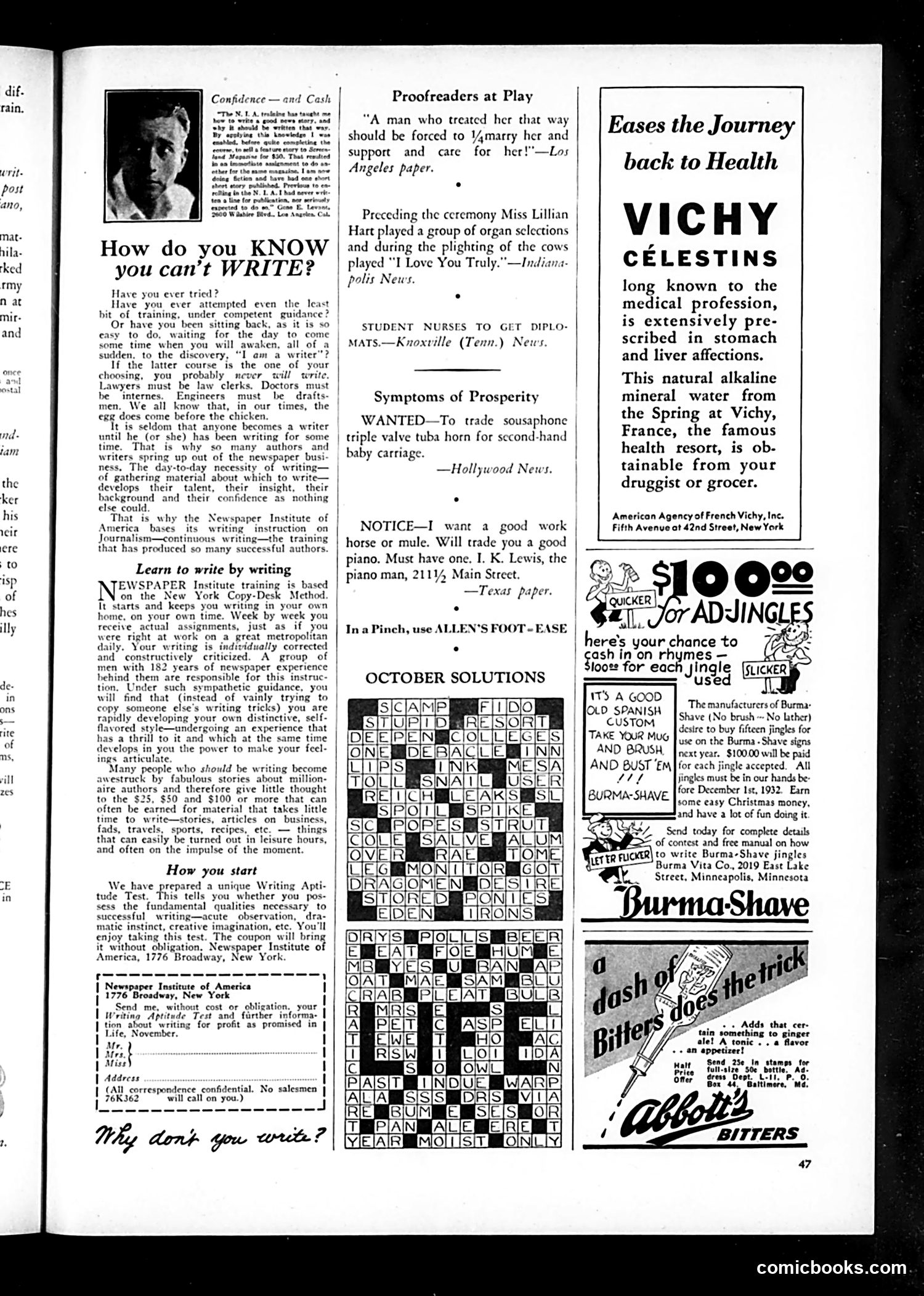
What This Page Means This page contains proofreading errors humorous column ("Proofreaders at Play") where actual newspaper typos are published to amuse readers. For instance: a Los Angeles paper accidentally wrote that a man should be forced to "Y4marry" someone instead of "marry"; an Indianapolis paper reported someone played organ during the "plighting of the cows" instead of "plighting of the vows" (marriage ceremony); and a Knoxville paper promised nursing diplomas as "DIPLOMATS" (ambassadors). The joke is straightforward: newspapers of the era made embarrassing transcription errors that were often unintentionally hilarious. Readers would catch these mistakes and submit them for this entertainment column. The broader satire mocks the sloppiness of newspaper production, despite professional expectations of accuracy. This was apparently common enough that Life magazine made it a recurring feature.
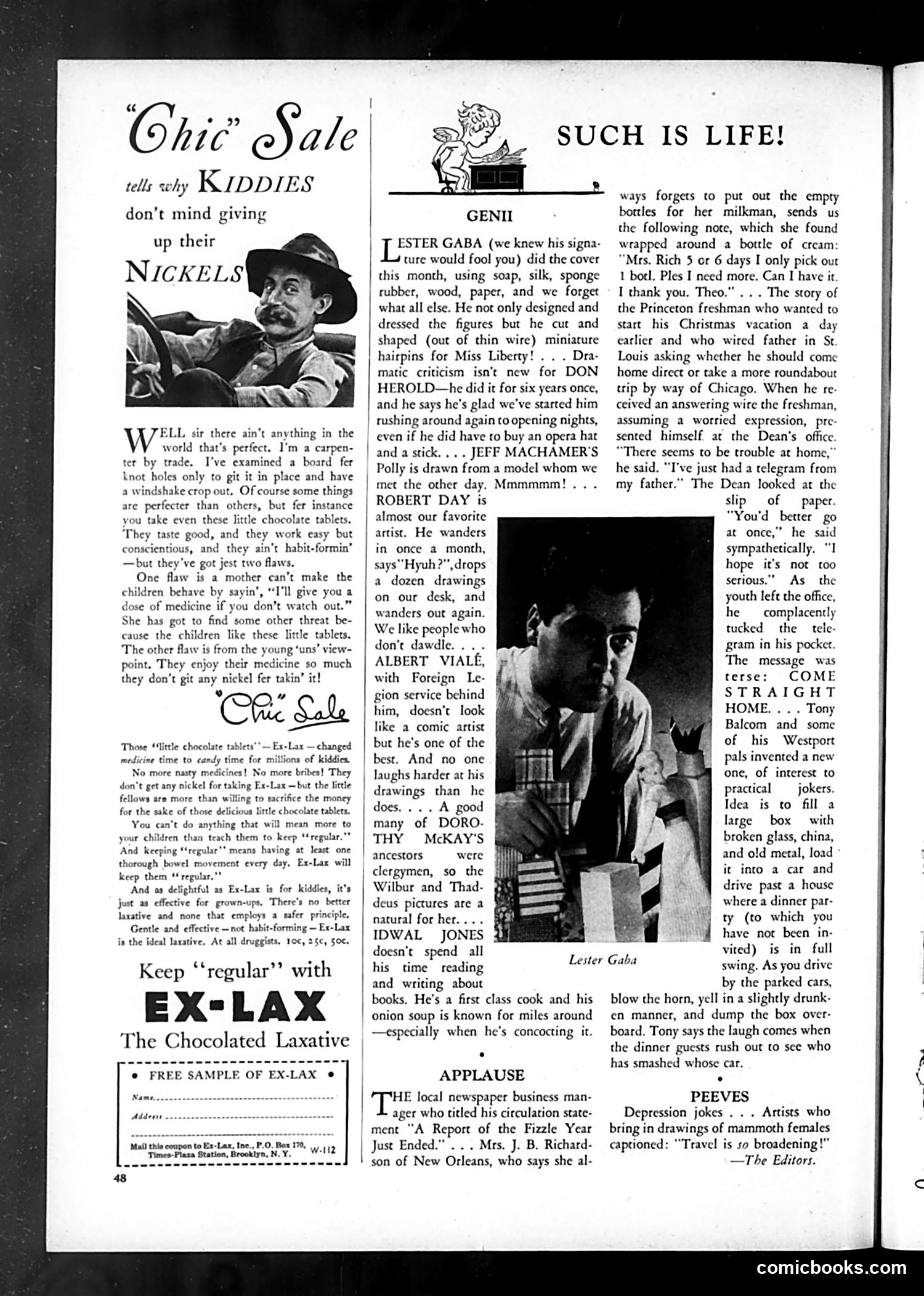
"Chic Sale" Column & Ex-Lax Advertisement This page combines a humorous editorial column with a laxative advertisement, both using rural American vernacular humor popular in 1920s-30s publications. "Chic Sale" Column: Written in exaggerated hillbilly dialect, it critiques Ex-Lax chocolate laxatives, humorously identifying two "flaws": mothers can't threaten children with medicine (kids like it), and children don't receive monetary rewards (nickels) for taking it—thus losing an incentive. The satire mocks both the product's palatability and Depression-era parenting practices involving bribery. Advertisement: Ex-Lax promotes its laxative as "candy," transforming unpleasant medicine-taking into reward. It emphasizes teaching children regularity—reflecting 1930s health anxieties about bowel movements as moral/physical discipline. Context: The humor relies on crude bathroom jokes and class-specific dialect stereotyping, standard for the era. "Chic Sale" was a popular vaudeville character known for rural wisdom and bathroom humor—the persona made the ad's crude subject matter acceptable for mainstream magazines.
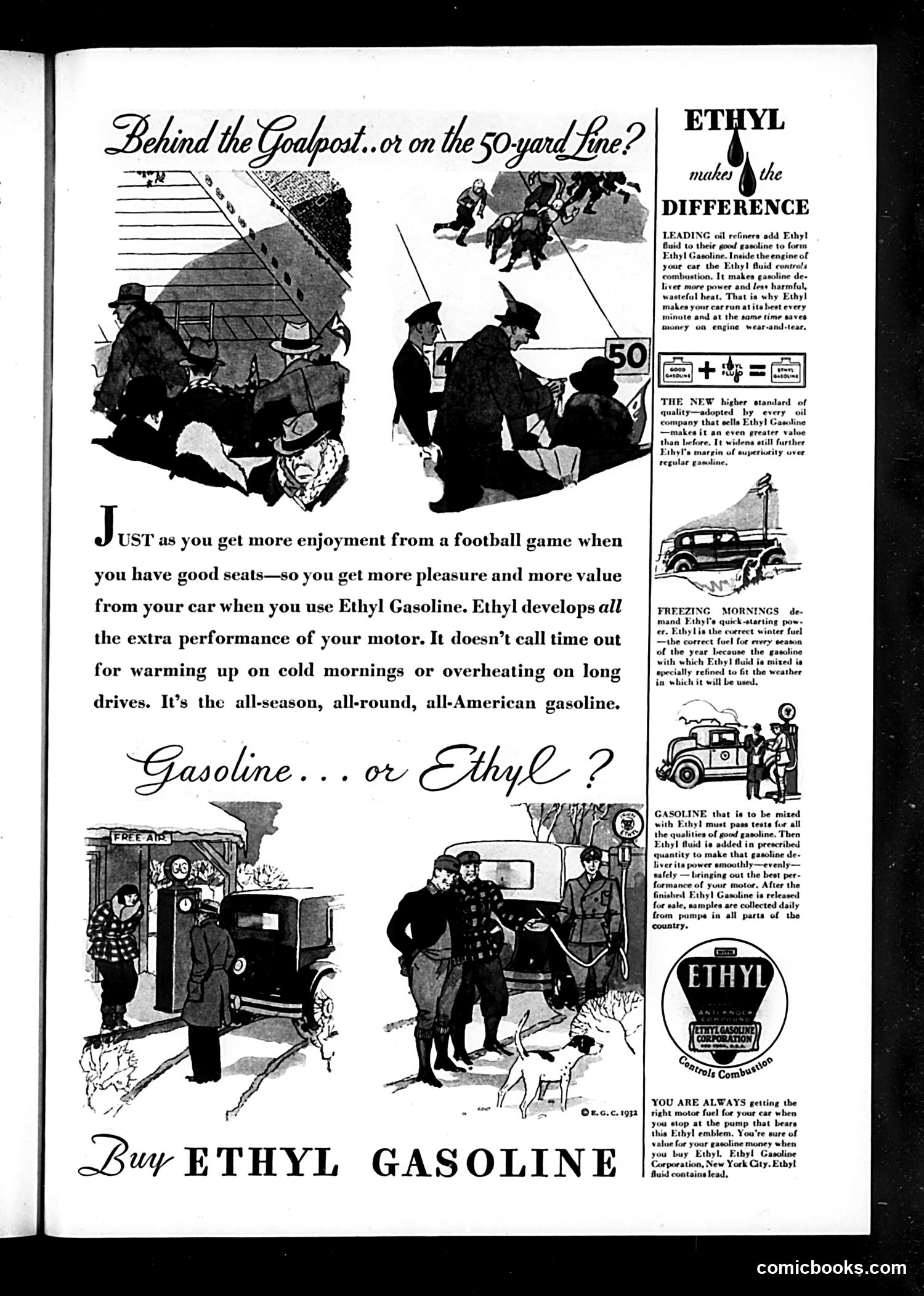
Advertisement for Ethyl Gasoline This is not a cartoon or satire—it's a straightforward advertisement for Ethyl Gasoline from the Ethyl Gasoline Corporation (New York City). The page uses a football game analogy to sell the product: just as good seats enhance a game, Ethyl fuel enhances car performance. The illustrations show practical scenarios: people at gas pumps, cars in winter conditions, and service stations. The ad claims Ethyl Gasoline provides superior performance year-round, prevents engine wear, improves cold-weather starting, and prevents overheating. The central message: "Gasoline... or Ethyl?" presents Ethyl as a premium upgrade to regular gasoline. For modern readers, note that Ethyl was a leaded gasoline product—lead additives were later discovered to be toxic and were phased out by the 1980s. This advertisement predates that health crisis.
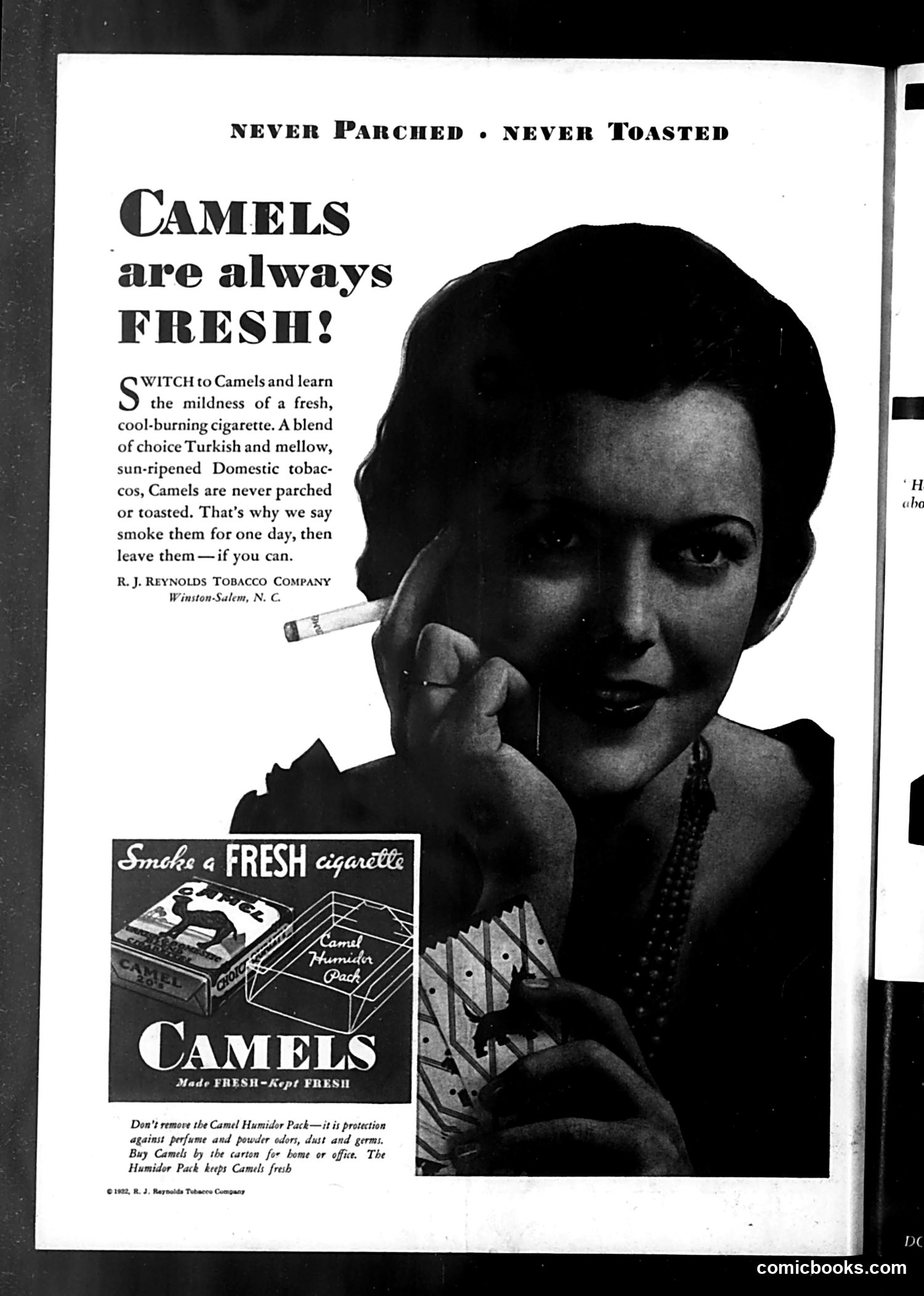
Analysis This is a cigarette advertisement, not satire or political commentary. The page promotes Camel cigarettes by R.J. Reynolds Tobacco Company. The ad features a woman smoking, emphasizing that Camels are "always FRESH" because they're "never parched or toasted"—meaning the tobacco undergoes minimal processing. The copy claims this preserves mildness and a "cool-burning" quality. The "Humidor Pack" (the special packaging shown) is presented as protection against odors and germs, keeping cigarettes fresh. The slogan "smoke them for one day, then leave them — if you can" attempts humor by suggesting Camels are so enjoyable that quitting is difficult—a casual acknowledgment of addiction before such admissions became legally problematic. This reflects early-20th-century advertising when health concerns about smoking were either unknown or unmentioned, and cigarette ads freely targeted consumers without health warnings.