life
Life — December 1932
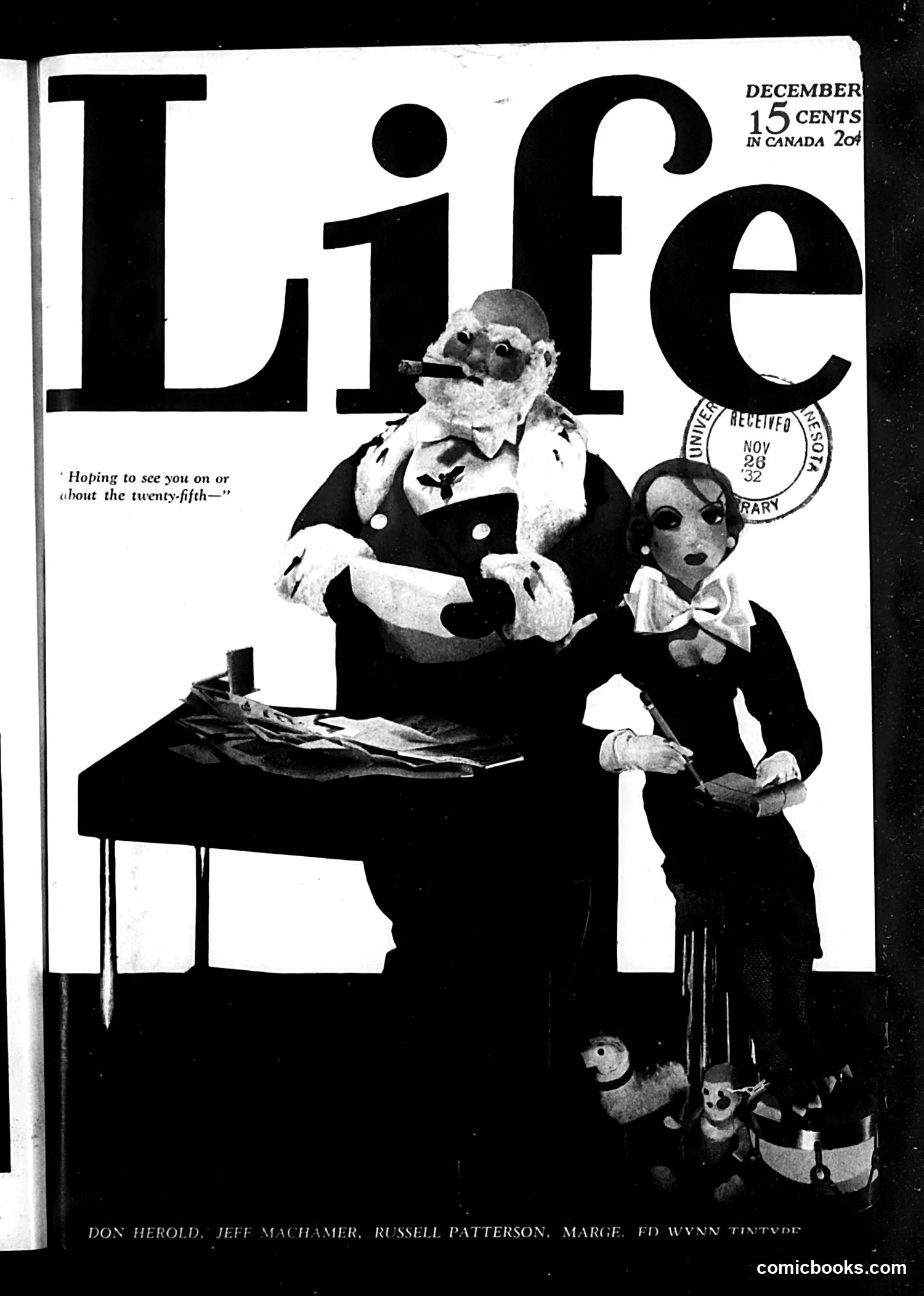
Life Magazine Cover Analysis (December, circa 1932) This is a Christmas-themed Life magazine cover featuring costumed characters in a holiday scene. A rotund figure dressed as Santa Claus holds what appears to be a gift list or ledger, while a smaller character in formal attire (possibly representing a child or helper) stands beside him at a table. The cover's tagline reads "Hoping to see you on or about the twenty-fifth—" a play on Santa's traditional Christmas Eve visit. The caption credits Don Herold, Jeff Machamer, Russell Patterson, Marge, and Ed Wynn. Ed Wynn was a famous comedian of the era, suggesting this may be a theatrical or entertainment-related holiday piece rather than political satire. The 15-cent price and Canadian marking date this to the early 1930s Depression era.
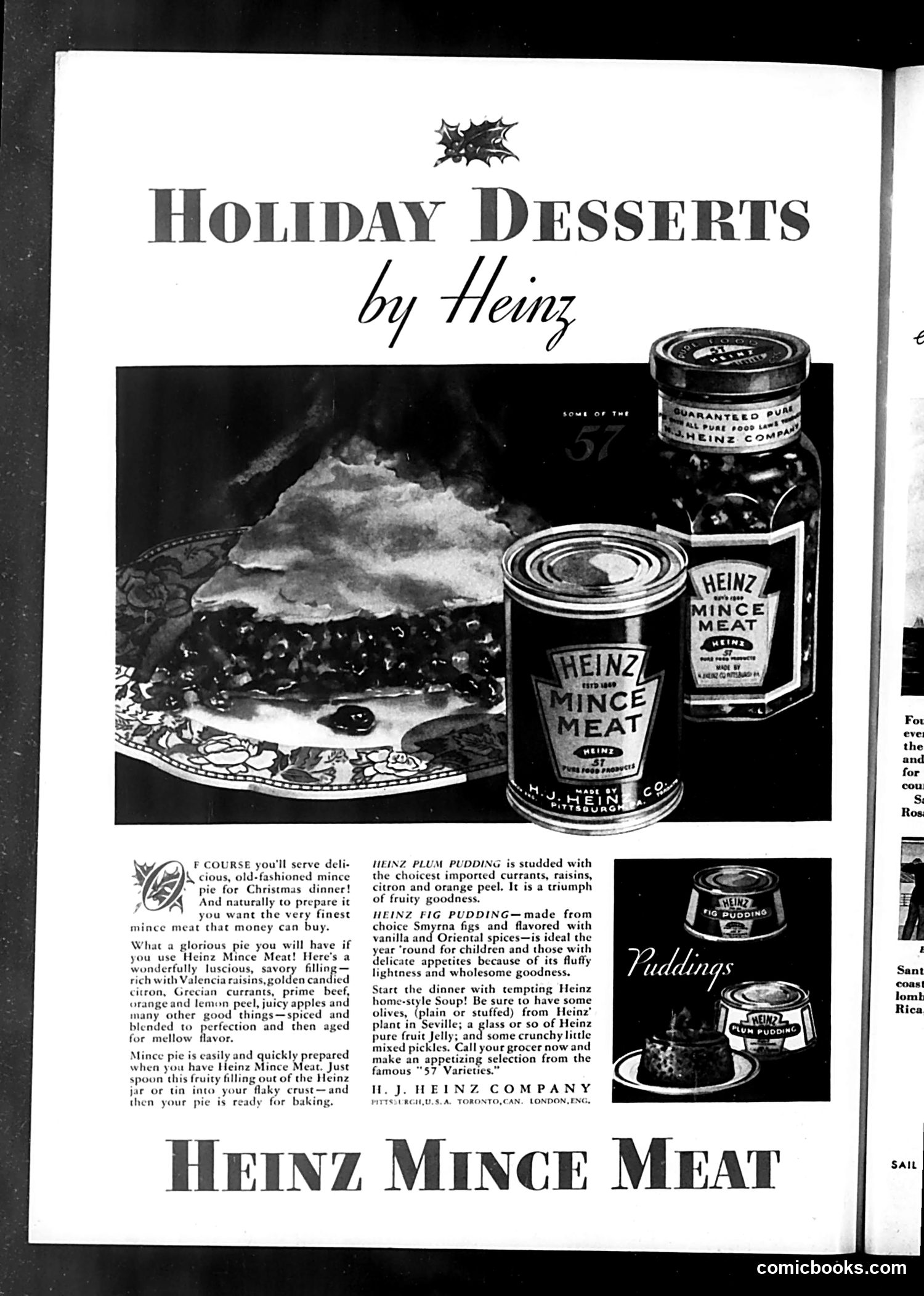
Analysis This is primarily a vintage advertisement, not political satire. It's a Heinz company ad promoting their mince meat and pudding products for holiday desserts, circa early-to-mid 20th century. The page features: - A photograph of an elegant mince pie with whipped topping - Product images of Heinz mince meat and pudding jars - Descriptive text encouraging readers to use Heinz products for Christmas dinner preparation - A section on "Puddings" highlighting their fig pudding and plum pudding varieties The decorative holly leaf at the top establishes the holiday theme. There is no political cartoon or satire present—this is straightforward consumer advertising emphasizing convenience and quality ingredients for holiday cooking, targeting home cooks planning festive meals.
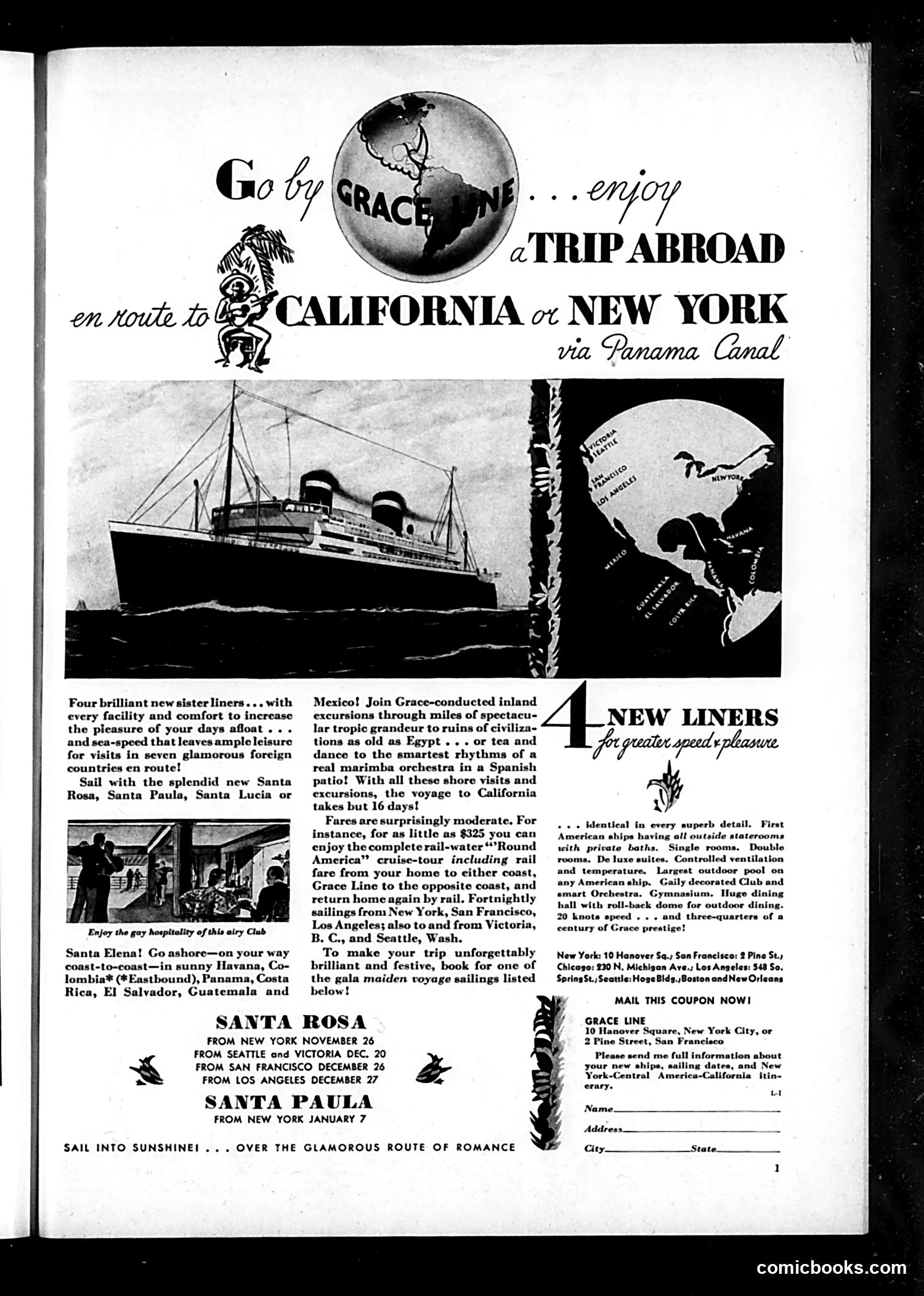
Analysis This is primarily a cruise line advertisement, not a political cartoon. It promotes Grace Line's new steamships (Santa Rosa, Santa Paula, and Santa Lucia) offering luxury voyages to California and New York via the Panama Canal. The small decorative figure on the left appears to be a generic "tropical" character — likely meant as lighthearted exotica rather than a specific political caricature. The advertisement emphasizes leisure travel, moderate fares ($325), and route options between coasts. The page targets affluent American travelers interested in glamorous voyages during what appears to be the 1930s-40s era. The "Panama Canal" routing was a major selling point for transcontinental ocean travel. This is commercial marketing, not satire or political commentary.
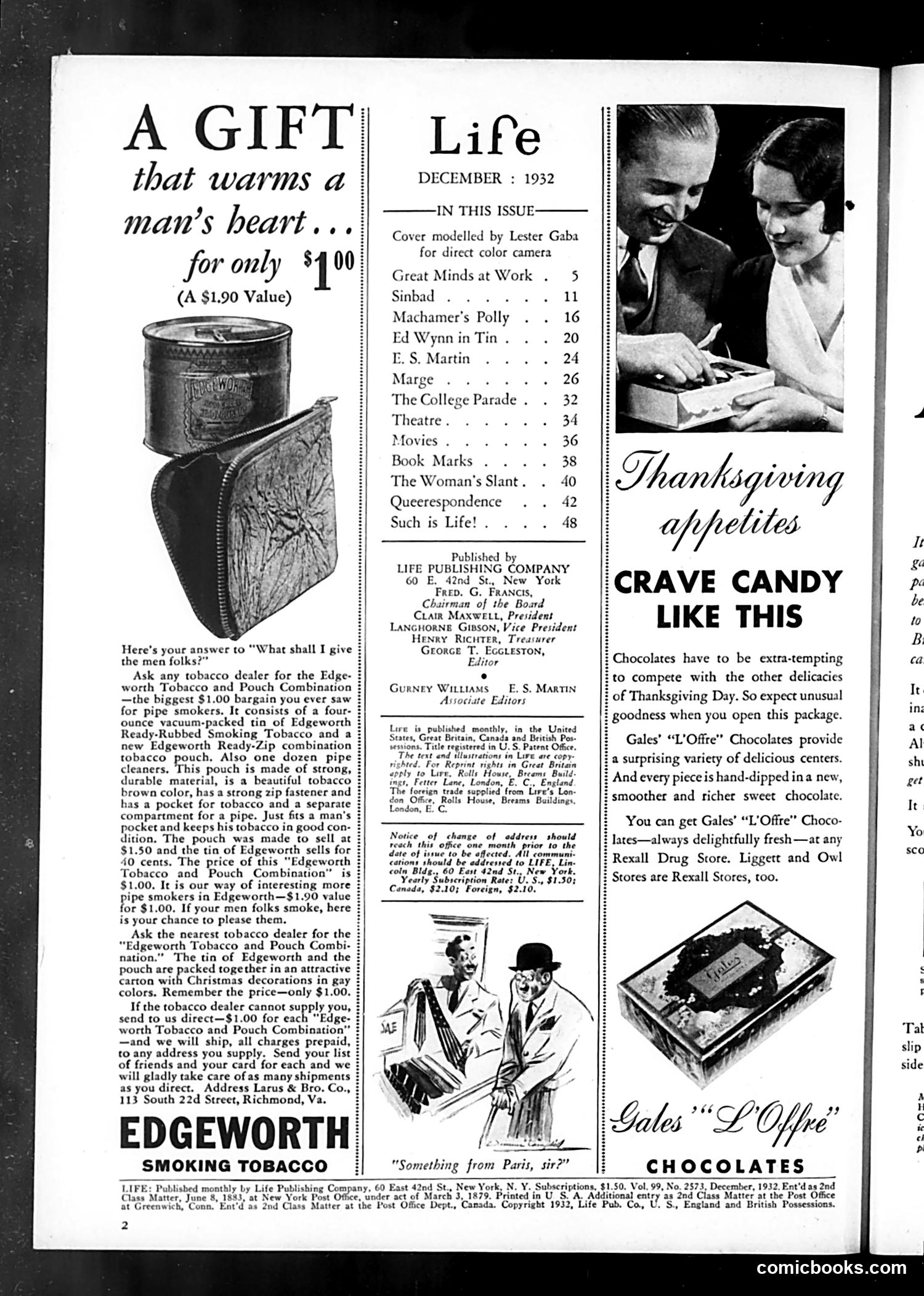
Content Analysis: Life Magazine, December 1932 This is primarily a table of contents and advertising page rather than a satirical cartoon page. The left side advertises Edgeworth Smoking Tobacco with a gift tin ($1.00), while the right features Gales' "L'Offre" Chocolates with a small cartoon showing two men examining a wrapped package—one saying "Something from Paris, sir?" The cartoon's joke appears to be a mild double entendre: the wrapped chocolates package could humorously suggest something more risqué from Paris, playing on Paris's reputation for sophistication and romance. However, this is subtle advertising humor rather than political satire. The magazine contents list includes articles on entertainers (Ed Wynn, F.S. Martin) and topics typical of 1932: "The College Parade," theater reviews, and "Book Marks."
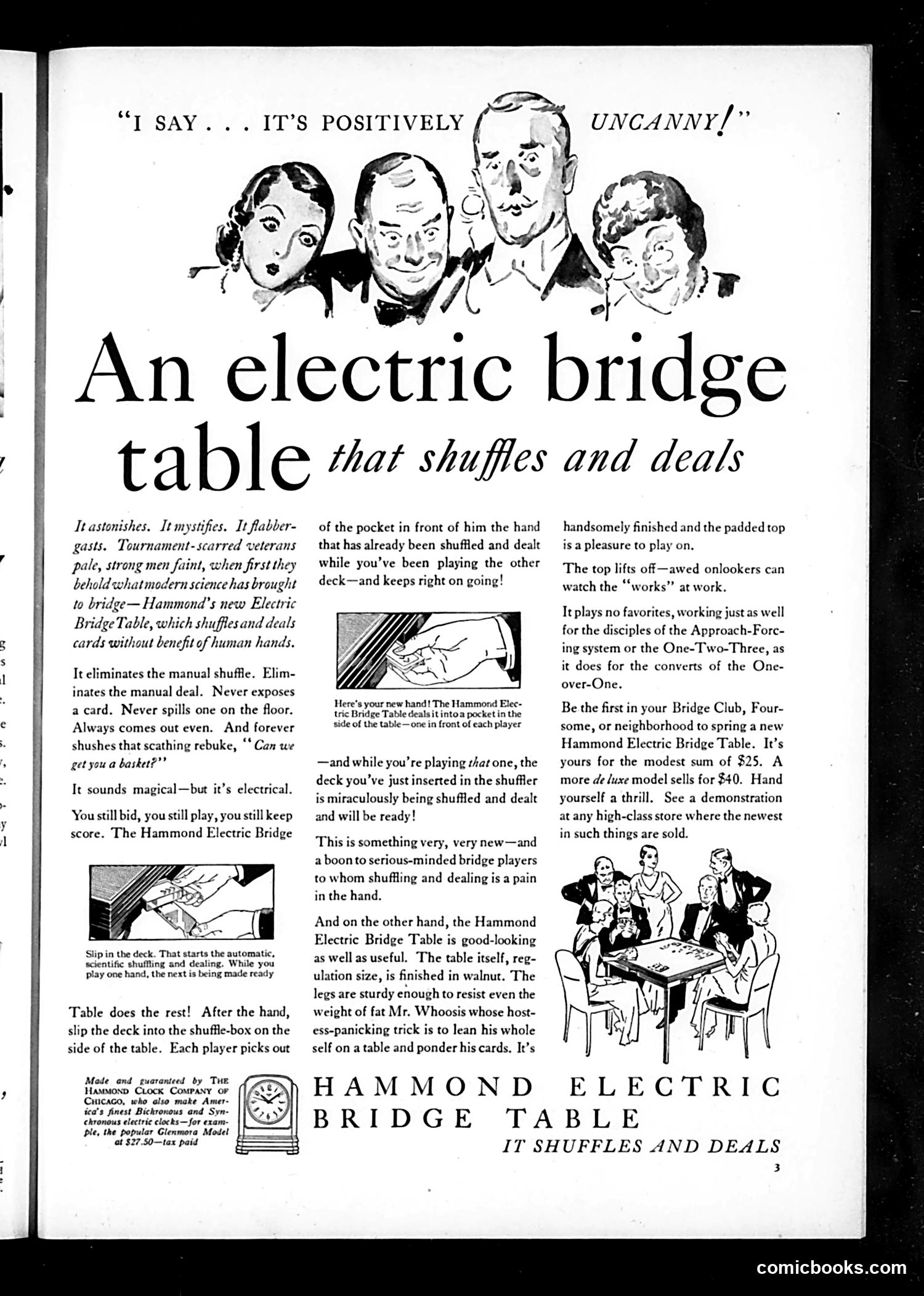
Hammond Electric Bridge Table Advertisement This is primarily a product advertisement for an electric bridge table, not political satire. The page promotes an automated card-shuffling device marketed to bridge players. The cartoon figures at the top are generic 1920s-30s socialites expressing amazement at the technology. The ad's humor derives from the novelty of applying electricity to a leisure activity—the table automatically shuffles and deals cards "without benefit of human hands," eliminating manual drudgery. The satire is gentle: it pokes fun at bridge enthusiasts' obsession with the game and cheekily suggests this device solves the "pain in the hand" of shuffling. The ad emphasizes both convenience and aesthetic appeal, positioning the table as a status symbol for affluent social circles. There are no identifiable political figures or references—this is straightforward period advertising targeting the emerging consumer electronics market.
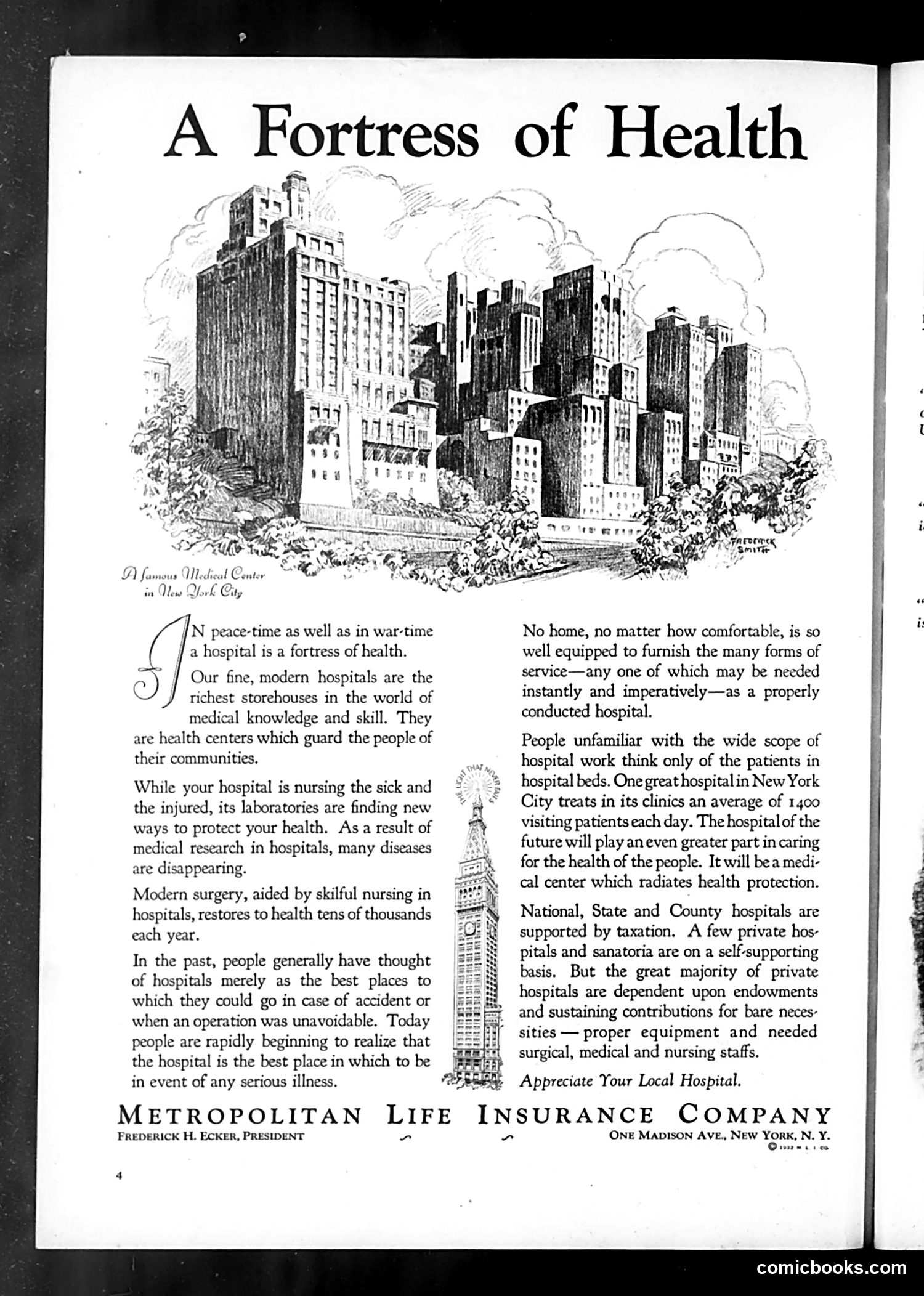
Analysis: "A Fortress of Health" This is primarily an advertisement for Metropolitan Life Insurance Company, not satire or political commentary. The page features a sketch of a famous medical center in New York City and promotional text about hospitals. The "fortress" metaphor frames hospitals as institutions that protect public health—both in peacetime and wartime. The ad argues that modern hospitals serve as essential community resources for medical research and care, treating thousands annually through surgery and nursing. The content emphasizes hospitals' expanding role beyond patient beds, mentioning clinics serving 1,200 visitors daily. The final line—"Appreciate Your Local Hospital"—is a call to recognize and support these institutions. This represents early-20th-century corporate messaging promoting both healthcare infrastructure and insurance as protective services.
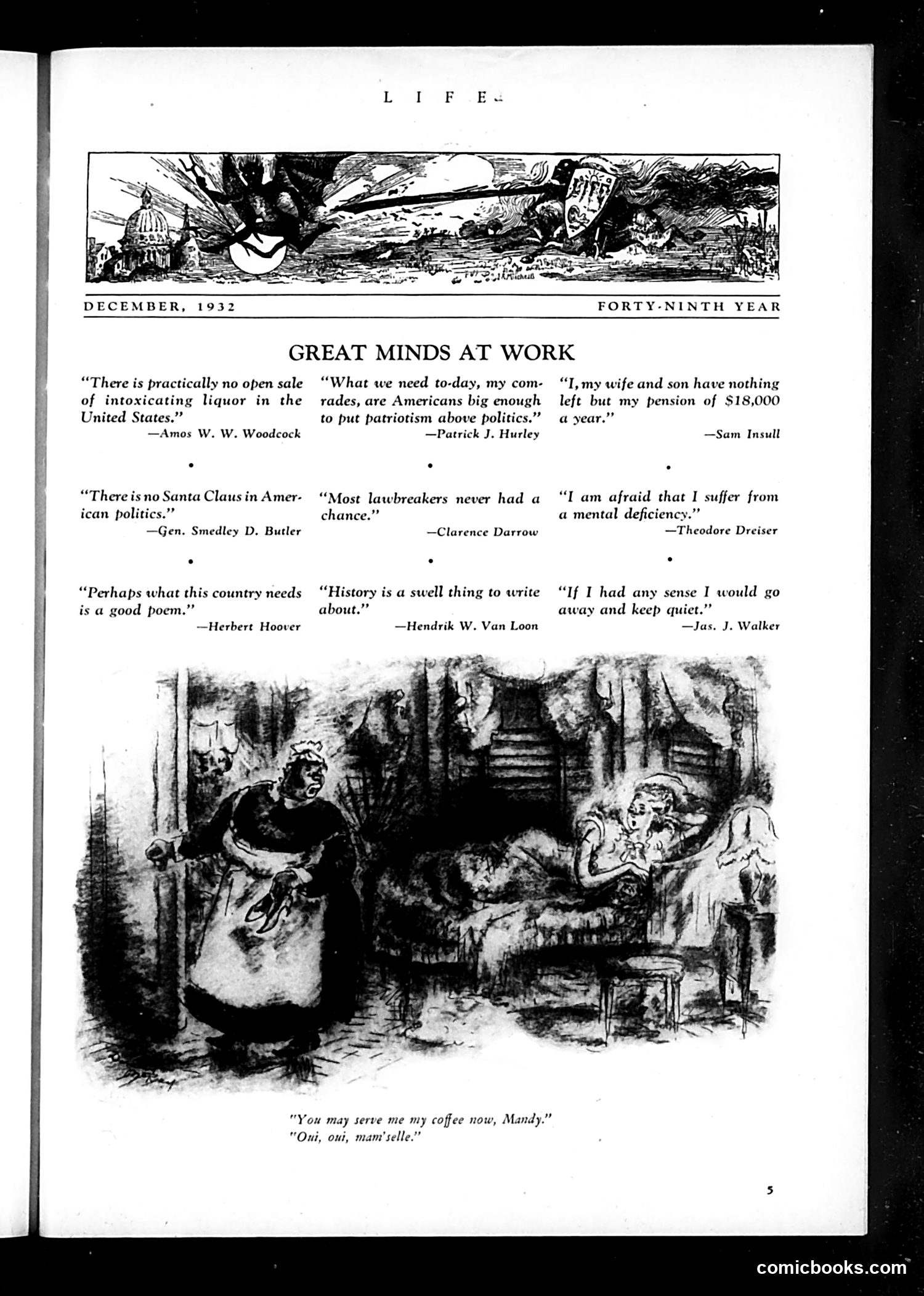
"Great Minds at Work" — Life Magazine, December 1932 This page presents satirical quotes from prominent figures during the Great Depression, paired with a cartoon showing a maid serving coffee to a wealthy woman. The Satire: The quotes mock public figures' disconnected remarks about serious problems—liquor sales bans, patriotism, lawbreaking, and national needs—suggesting they lack understanding of ordinary citizens' struggles. The cartoon reinforces this disconnect: while Depression-era Americans faced poverty, wealthy households maintained servants and comfort. Key figures quoted include Herbert Hoover (president), Gen. Smedley Butler, and others. Sam Insull's quote about living on $18,000 yearly pension particularly highlights the disconnect between elite and working-class experiences during economic collapse. The joke lies in juxtaposing these obtuse public statements with the visual reminder that some Americans still enjoyed significant privilege.
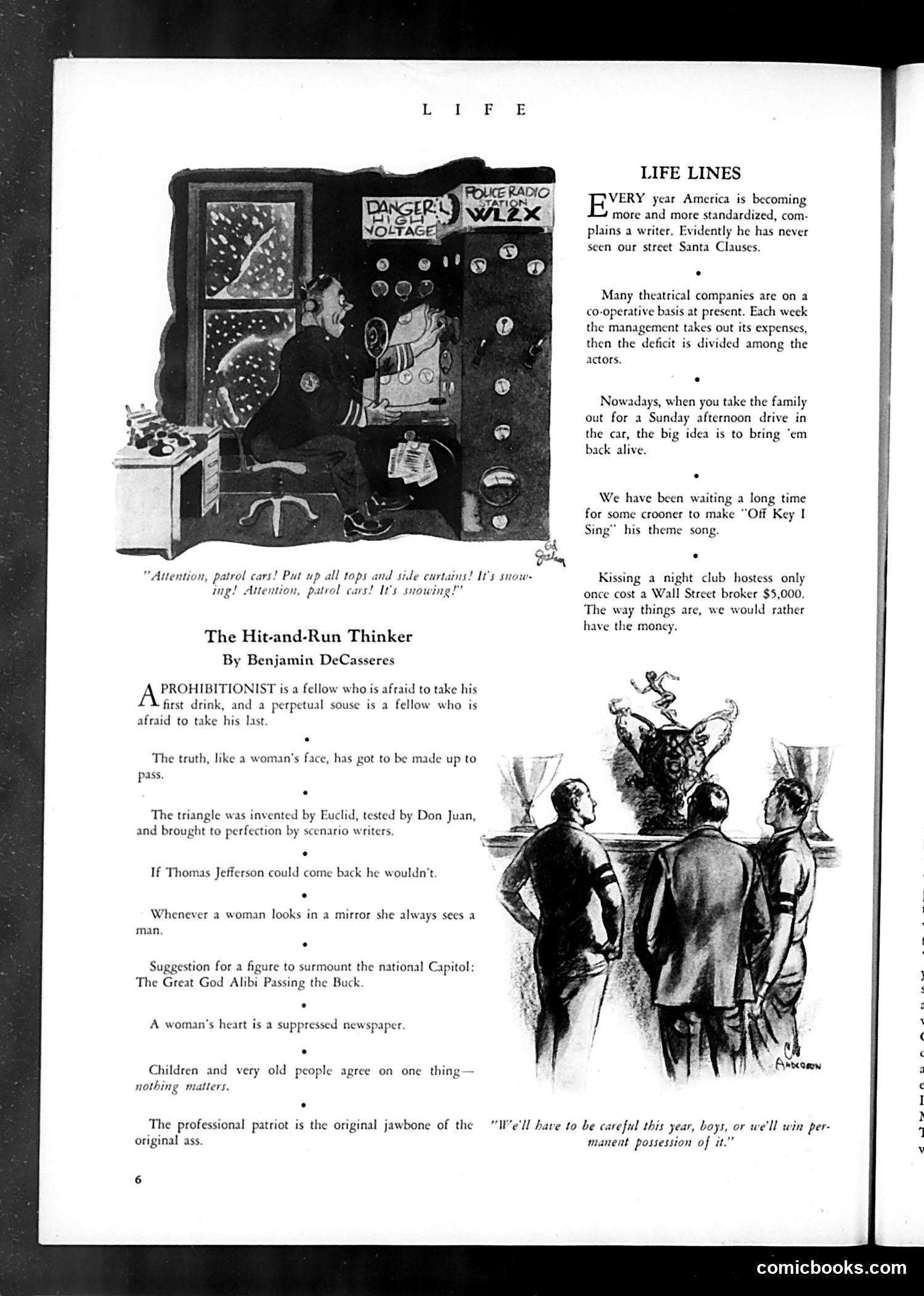
"Life Lines" and "The Hit-and-Run Thinker" This page contains two humor sections from *Life* magazine. The top left shows a cartoon of someone at an elaborate radio control panel labeled with warnings like "DANGEROUS VOLTAGE" and "POLICE RADIO," captioned about turning on "all tops and side curtains" during snow—a joke about domestic radio entertainment becoming overly complicated. The "Life Lines" column offers brief satirical observations on contemporary American culture: standardized writing, theatrical cooperatives, Sunday drives, and Prohibition-era references (mentioning a Wall Street broker kissing a nightclub hostess). "The Hit-and-Run Thinker" by Benjamin DeCasseres presents philosophical quips mocking prohibition, women, Thomas Jefferson, and patriotism—typical satirical aphorisms of the era reflecting 1920s-30s sensibilities.
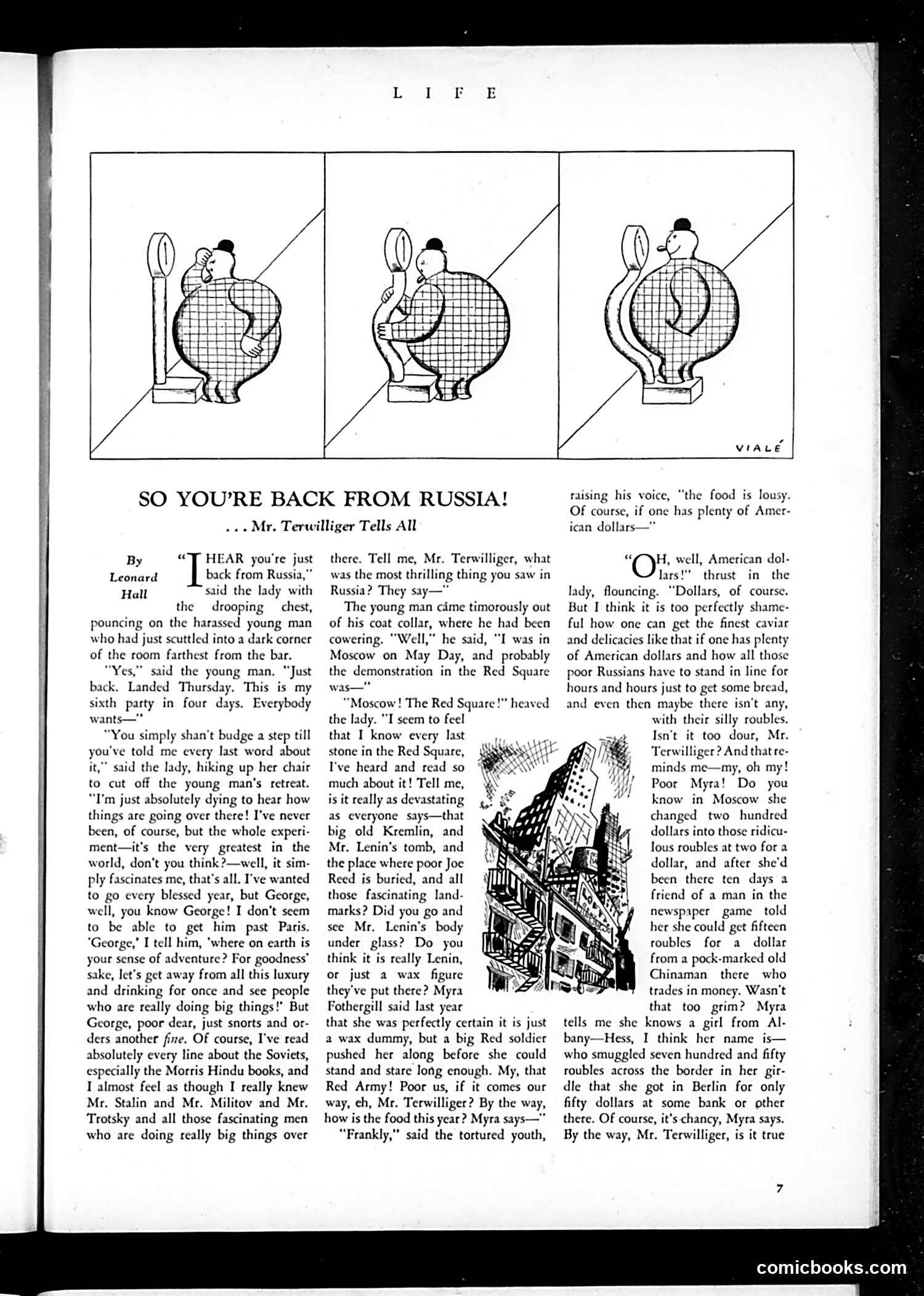
Analysis of "So You're Back from Russia!" The three-panel cartoon at the top depicts a woman repeatedly weighing herself on a scale, with her weight increasing in each panel—a visual joke about gaining weight. The accompanying story by Leonard Hall is a satirical dialogue between a lady and a young man recently returned from Russia. The humor centers on Cold War contrasts: while the young man witnessed Soviet spectacles (Red Square demonstrations, Lenin's tomb), the lady is preoccupied with American consumer abundance and vanity—her concerns are dollars, caviar, and her weight. The satire targets American materialism and superficiality during the early Cold War era, suggesting Americans prioritize luxury goods and appearance over geopolitical significance, even when someone has witnessed momentous Soviet events.
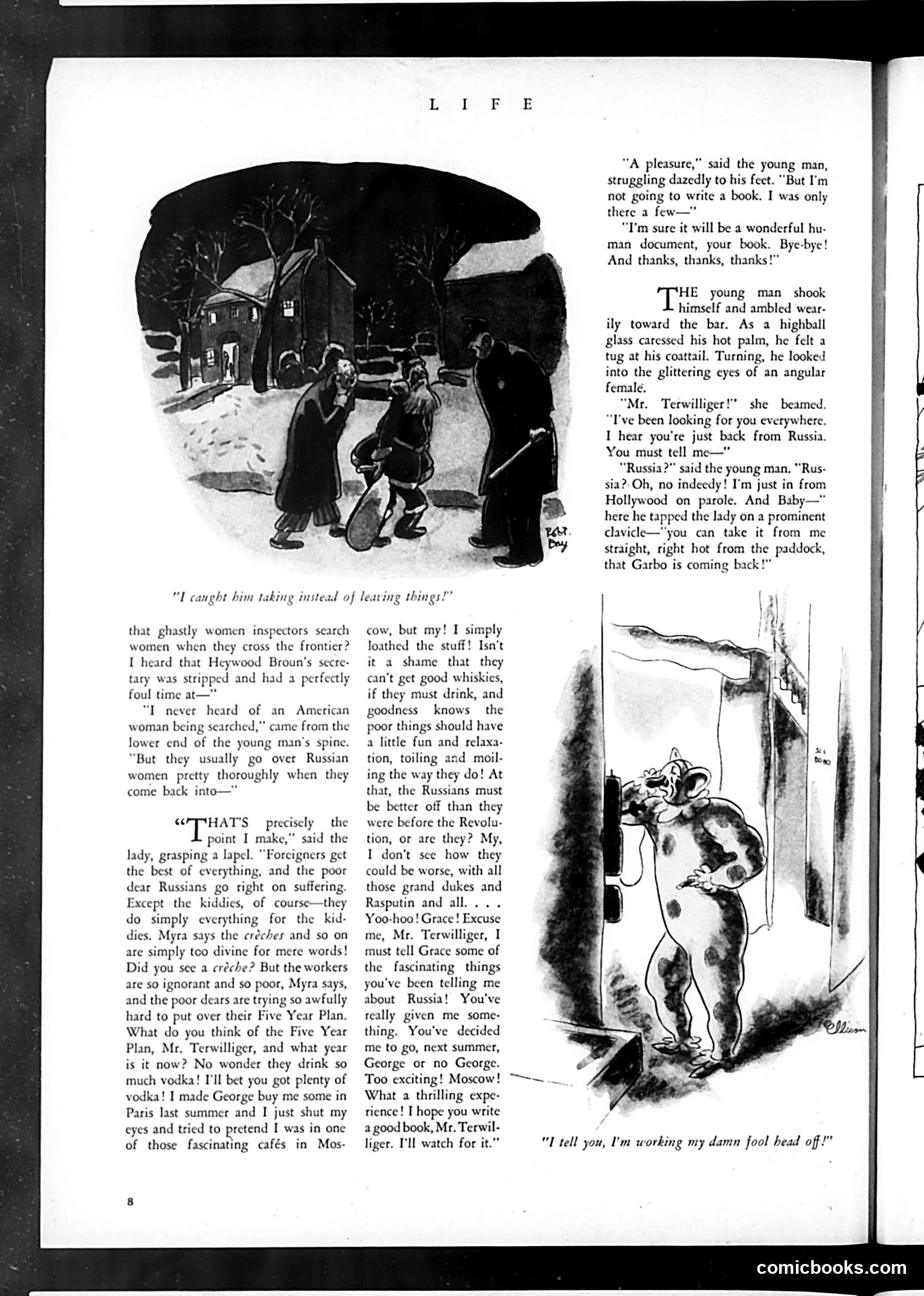
Analysis of Life Magazine Page This page satirizes American attitudes toward Soviet Russia during the early post-Revolutionary period. The narrative features a young man named Terwilliger who has just returned from Hollywood (on parole) claiming to be fresh back from Russia. An angular female character expresses fascination with Russia, asking him to share stories. The satire targets two groups: wealthy American women romanticizing Soviet Russia as exotic and politically progressive, and men fabricating false experiences for social credibility. The dialogue mocks the "Five Year Plan" and suggests Russians drink excessive vodka. The cartoons illustrate the absurdity of casual, uninformed discussion about Soviet life among privileged Americans more interested in fashionable ideology than actual conditions.
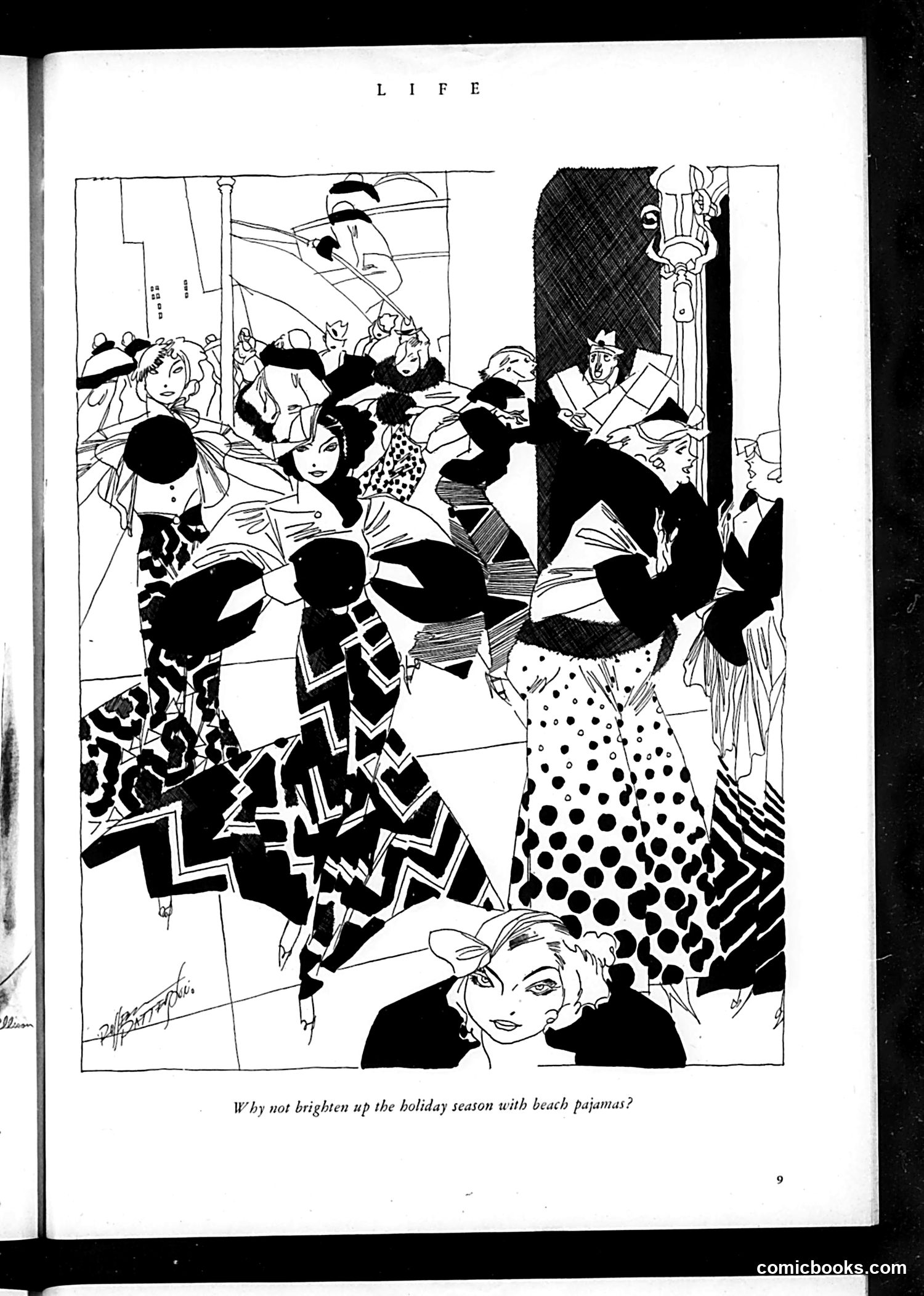
Analysis This is a single cartoon illustration from *Life* magazine's "Life" section (page 9). The image depicts a crowded, fashionable social gathering—likely a holiday party or upscale event—filled with elegantly dressed women displaying various bold patterns and styles: geometric designs, polka dots, and striped fabrics. The caption reads: "Why not brighten up the holiday season with beach pajamas?" The satire targets fashion trends and consumer culture. "Beach pajamas"—a 1920s-30s casual loungewear style—are being humorously suggested as formal holiday wear. The joke critiques both the absurdity of applying casual beachwear to formal occasions and, more broadly, the fashion industry's constant push to sell new clothing items by promoting trendy items for inappropriate contexts. The crowded, chaotic scene emphasizes conspicuous consumption.
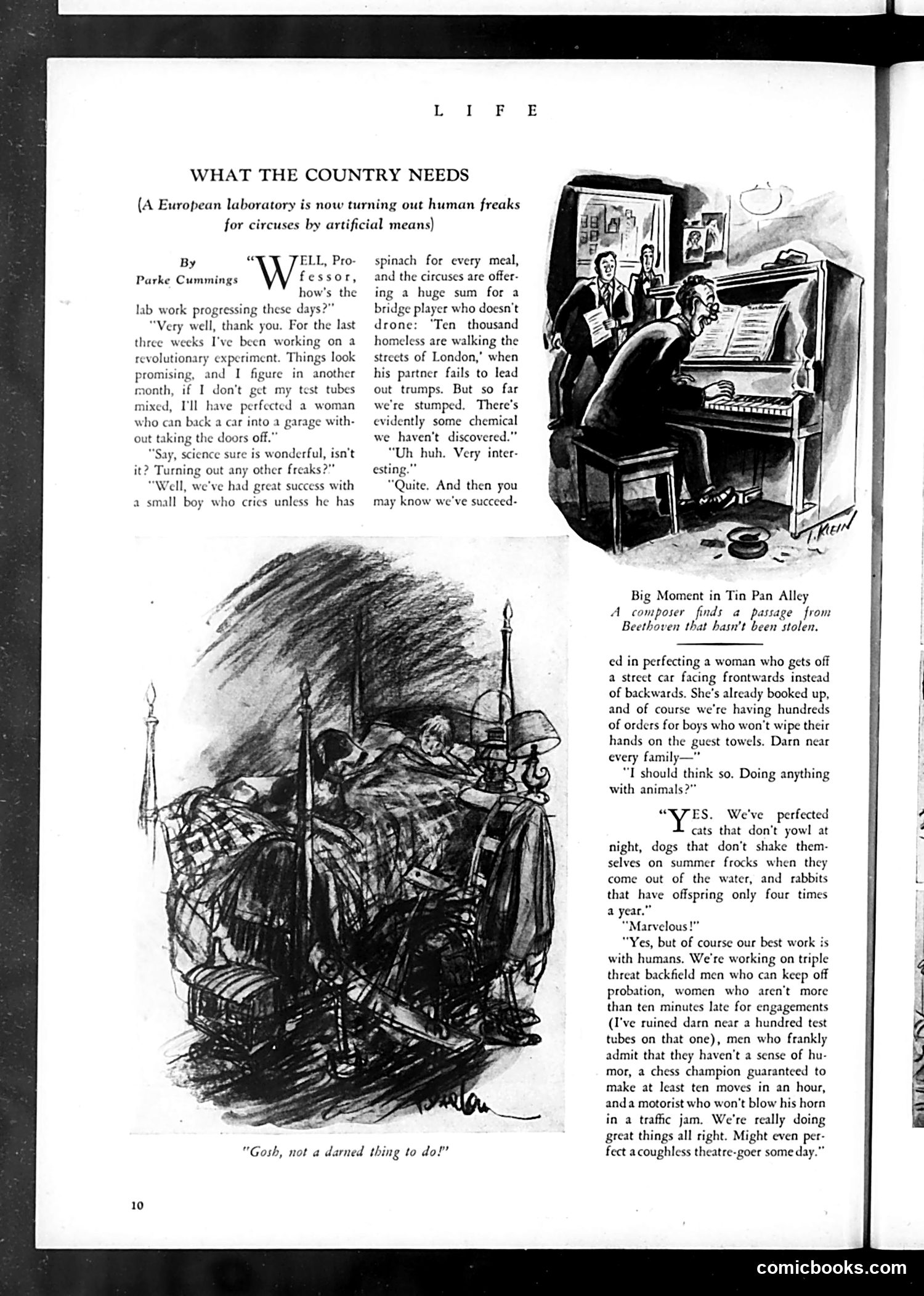
Analysis: "What the Country Needs" This satirical article by Parke Cummings mocks eugenic pseudoscience popular in the early 20th century. The piece purports to describe a "European laboratory" selectively breeding humans to eliminate undesirable traits—creating boys who don't cry, women who arrive punctually, men without humor, chess champions, and motorists who won't honk horns. The cartoons illustrate the absurdity: one shows a cluttered laboratory workspace ("Gosh, not a darned thing to do!"), another depicts a piano player in a domestic scene, mocking the notion that human behavior could be engineered through breeding. The satire critiques both scientific overreach and social control, ridiculing the idea that human personality flaws could be "fixed" through artificial selection—a concept the author presents as simultaneously ridiculous and slightly appealing to readers' frustrations.
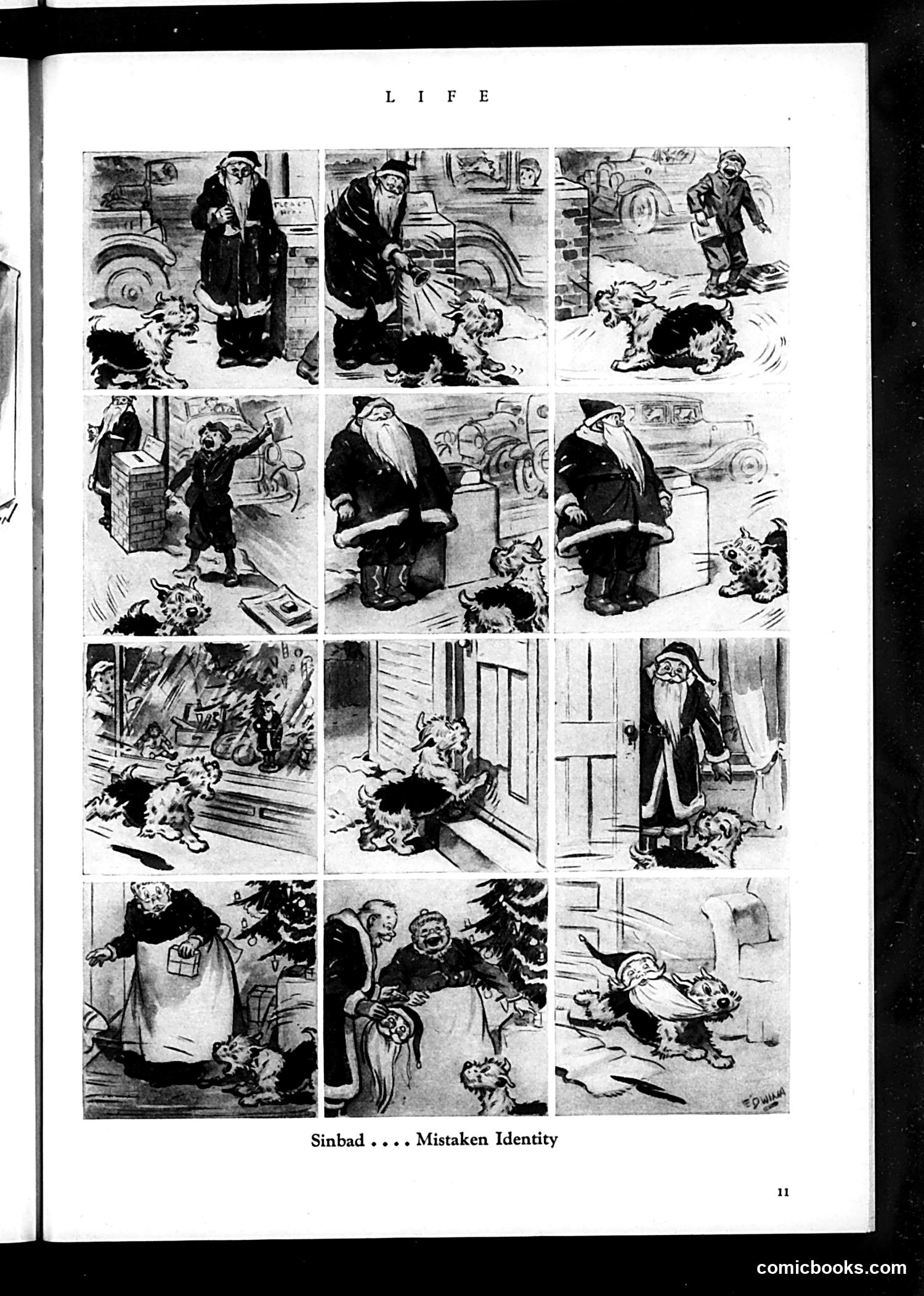
Sinbad: Mistaken Identity This is a comic strip retelling of the Sinbad tale where mistaken identity drives the plot. The bearded man (likely meant to represent Sinbad or a character confused for him) is repeatedly encountered by various people—an old man, a woman, and others—who seem to believe he is someone else or interact with him based on false assumptions. The humor derives from classic slapstick and confusion: the protagonist is chased, attacked, cornered, and generally mistreated throughout the sequence, apparently because people mistake him for someone dangerous or unwanted. The title directly signals this as the story's central joke—that his identity is constantly misunderstood, leading to escalating comic chaos and physical comedy.
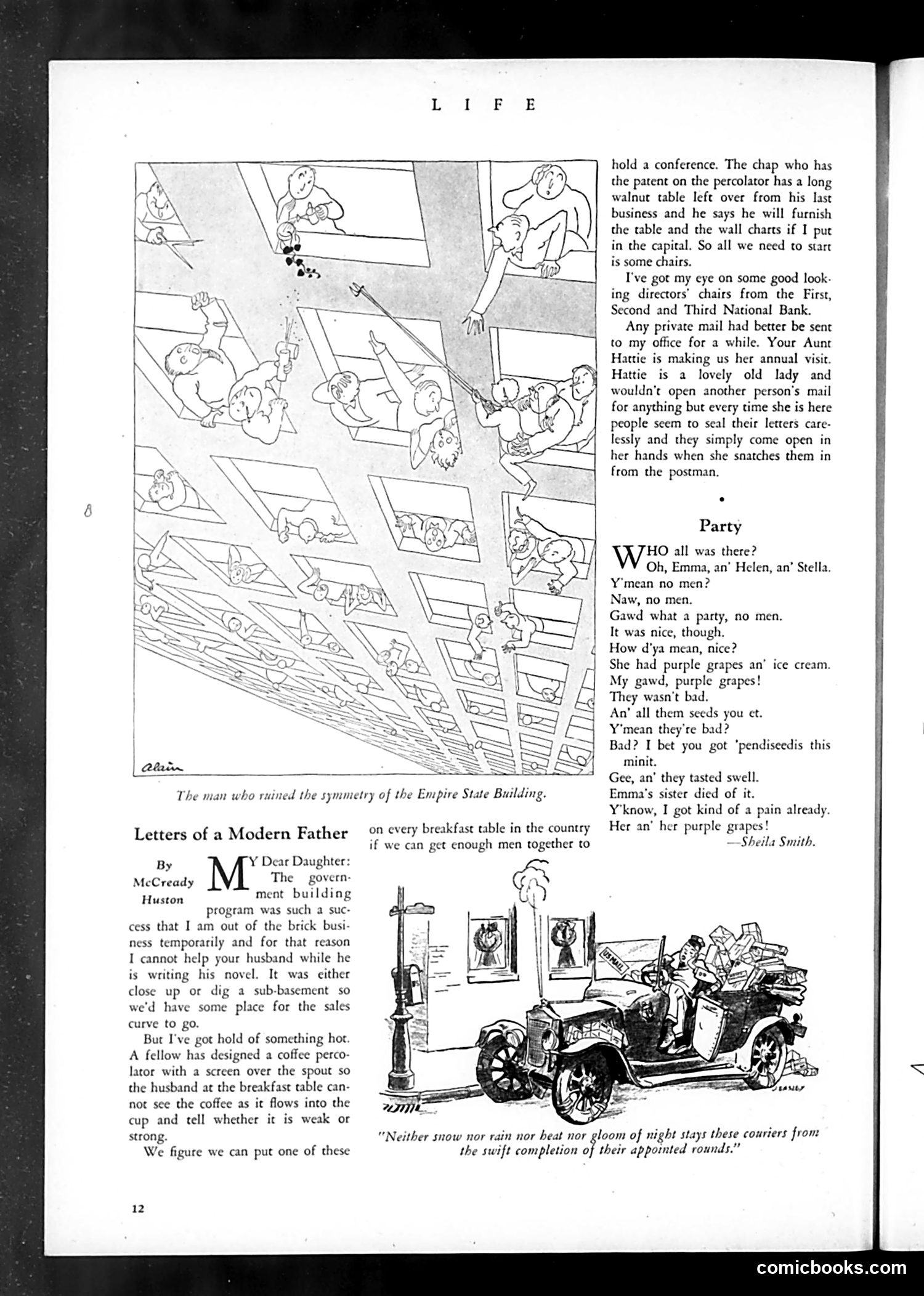
Analysis of Life Magazine Page Top Cartoon: "The man who ruined the symmetry of the Empire State Building" depicts the Empire State Building's interior as a chaotic mass of figures in various positions—sitting, lying, standing—filling spaces that should be empty. The joke appears to satirize either overcrowding during the building's construction/opening, or perhaps critiques someone's (unclear who) poor planning that created awkward, unusable spaces. The "symmetry" reference suggests architectural incompetence. Text Content: "Letters of a Modern Father" by McCready Huston discusses government building programs, coffee percolators, and business challenges during what appears to be the Depression era. A separate poem titled "Party" by Sheila Smith humorously depicts working-class conversation about a party with "purple grapes" and ice cream—gentle social satire about modest entertainment.
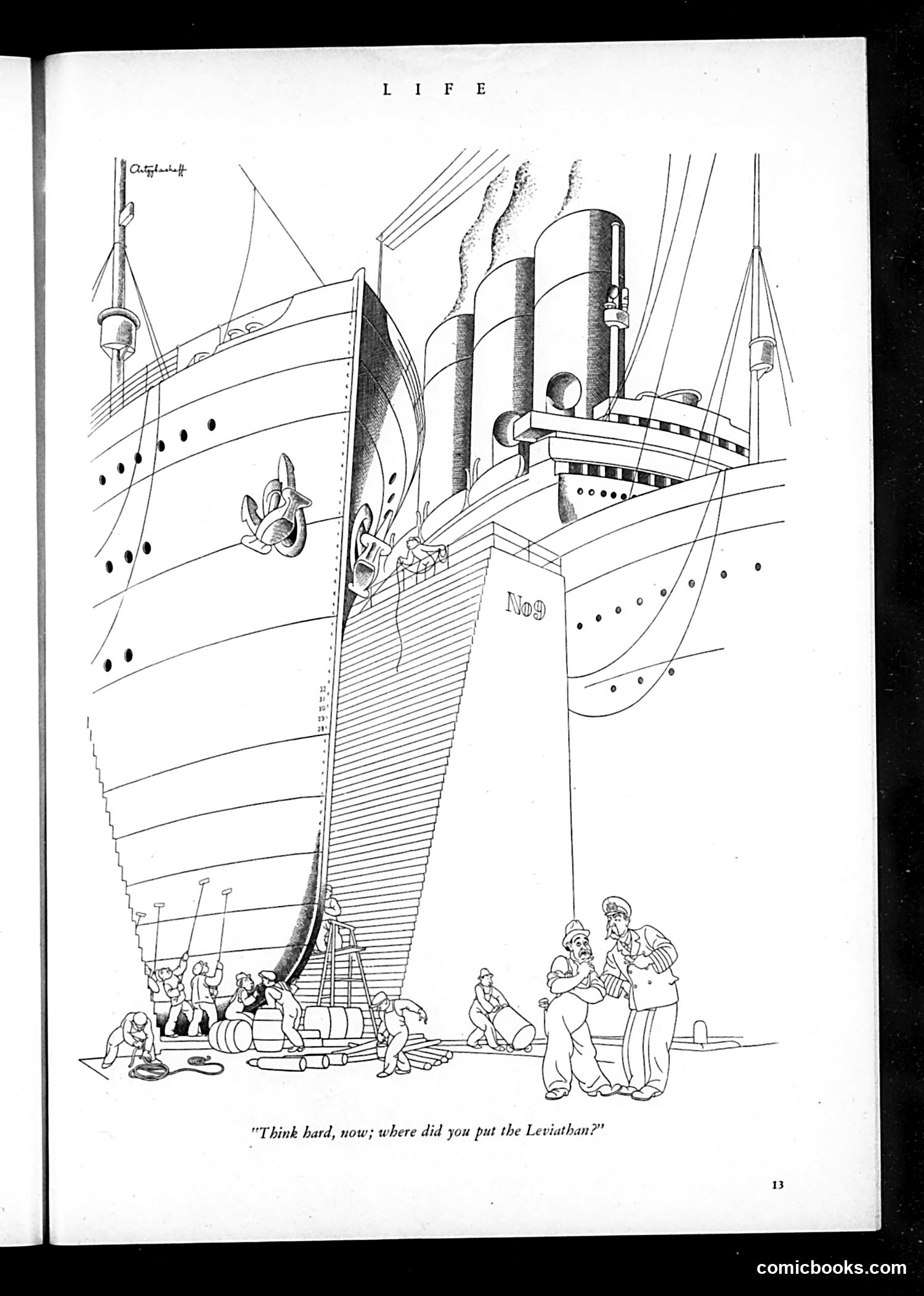
Analysis This is a single-panel cartoon from *Life* magazine showing a large ship (labeled "No. 9") docked at a pier with crew members and longshoremen below. The caption reads: "Think hard, now; where did you put the Leviathan?" The joke references the RMS *Leviathan*, a massive ocean liner. The cartoon satirizes either the ship's size (so enormous it could be "misplaced") or, more likely, wartime or post-war confusion about ship locations and logistics. The workers appear puzzled, suggesting bureaucratic incompetence or organizational chaos regarding the vessel's whereabouts. Without the specific publication date visible, the exact historical context remains unclear—this could reference WWI, WWII, or the interwar period when the *Leviathan* was notably in service. The humor lies in the absurdity of losing track of such a conspicuously enormous ship.
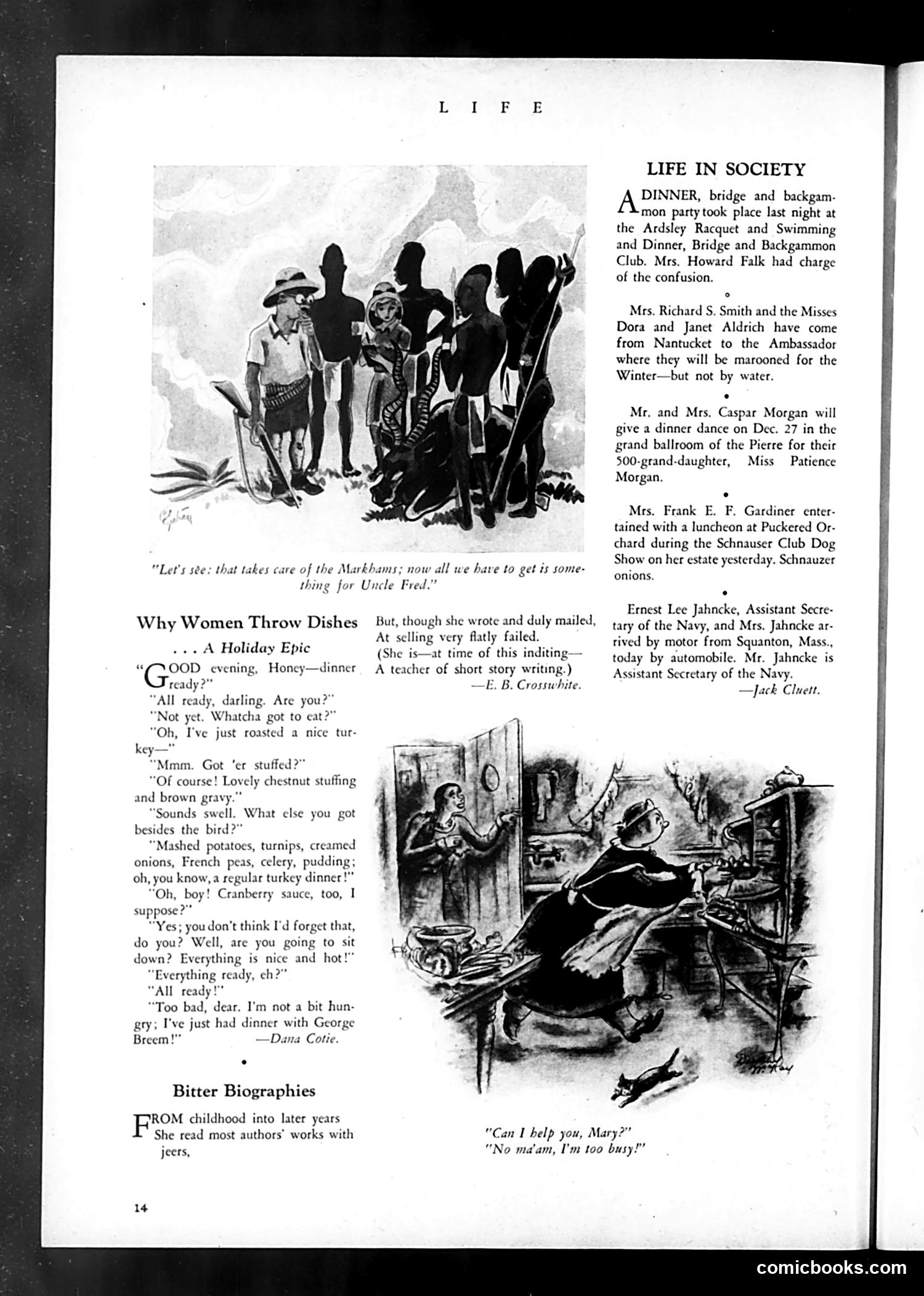
Analysis of Life Magazine Page This page contains social satire about domestic life, not political commentary. The main feature "Why Women Throw Dishes...A Holiday Epic" uses dialogue to humorously portray marital tension around holiday dinner preparation. A wife asks her husband if dinner is ready; he lists elaborate dishes (turkey, stuffing, gravy, cranberry sauce, potatoes, etc.), but then reveals he's already eaten dinner at a friend's house. The satire targets masculine obliviousness—the husband enjoys the wife's cooking efforts while having already satisfied his appetite elsewhere, explaining her hypothetical frustration. The surrounding section "Life in Society" reports on upper-class social events (dinner parties, dances, club activities) with gentle mockery of wealthy leisure activities. The cartoons illustrate these domestic and social scenarios typical of 1920s-30s magazine humor.
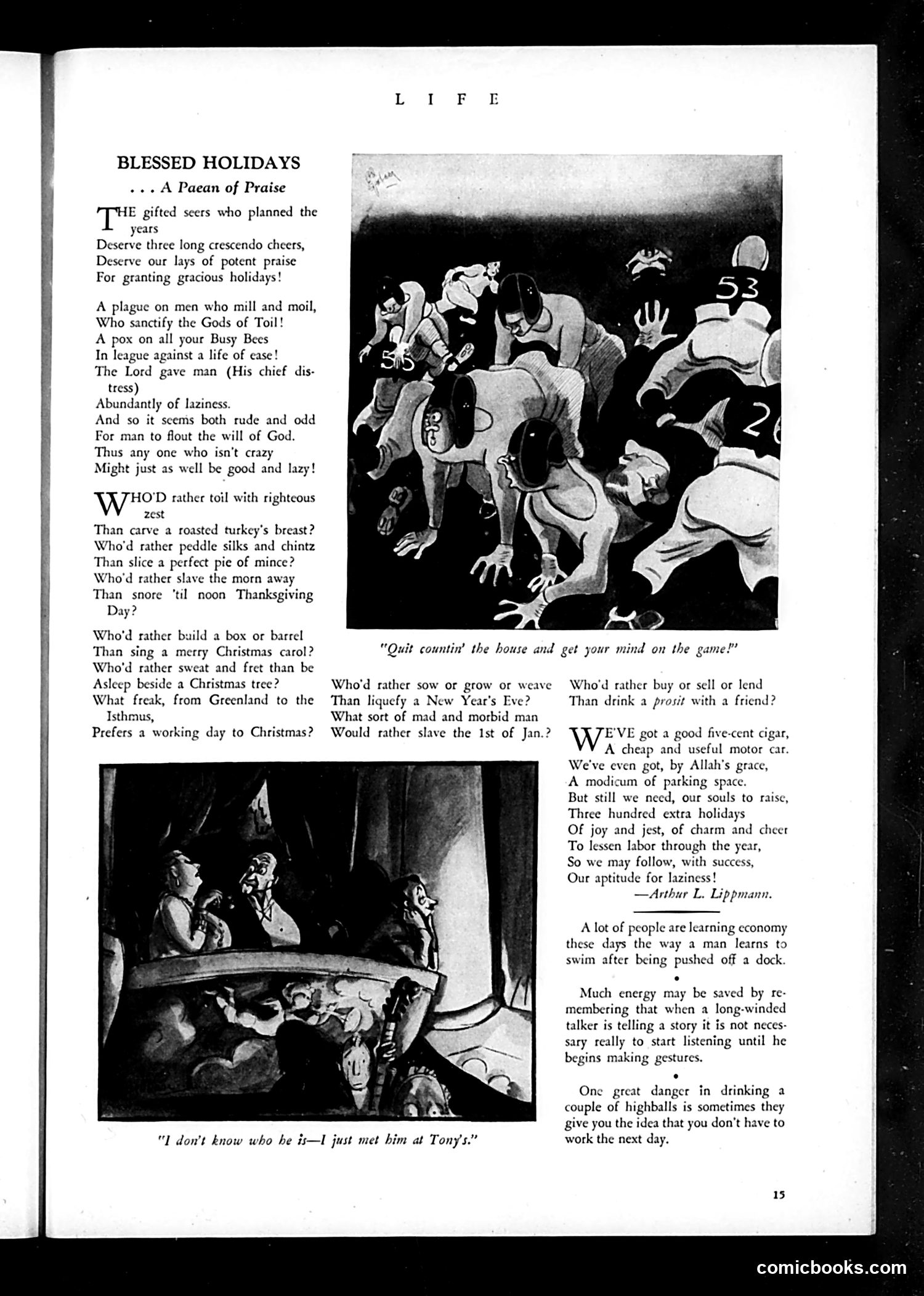
Analysis of "Blessed Holidays" Page from Life Magazine This satirical piece critiques the American work ethic and holiday culture. The poem "A Paean of Praise" sarcastically celebrates holidays by questioning why people should toil when God granted "Abundantly of laziness." It mocks those who work through holidays, asking rhetorically: "Who'd rather toil with righteous zest / Than carve a roasted turkey's breast?" The two illustrations show people relaxing and socializing—contrasting leisure with labor. The accompanying humorous observations mock how Americans learn "economy" through hardship and how long-winded talkers drain energy. The overall message: Americans are overworked and deserve more rest, yet cultural pressure keeps them laboring through holidays. The satire targets both the Protestant work ethic and society's failure to truly value leisure time.
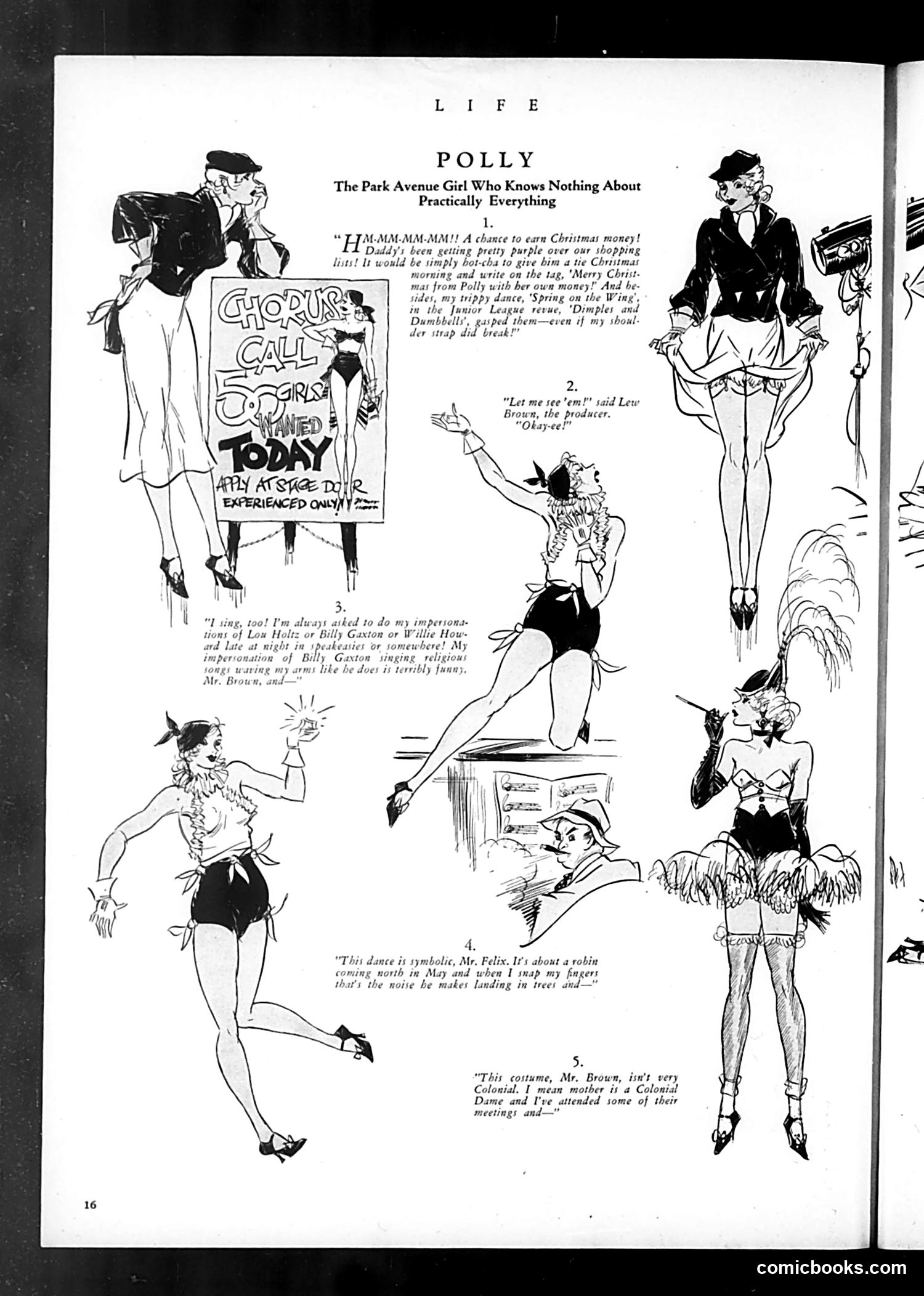
"Polly" Commentary This satirical piece mocks a young woman ("Polly") who claims sophisticated knowledge she doesn't possess. The subtitle—"The Park Avenue Girl Who Knows Nothing About Practically Everything"—establishes the joke: Polly confidently discusses highbrow topics (Christmas charity, theatrical impersonations, symbolic dance) while revealing profound ignorance. Each numbered vignette shows Polly misunderstanding cultural references. She mentions "Lew Brown" (likely the songwriter/producer) and attempts discussions of Billy Gaston and Willie Howard (entertainers), Colonial history, and modern dance—but her explanations are nonsensical or absurd. The satire targets upper-class pretension: wealthy young women from Park Avenue (Manhattan's wealthy neighborhood) who performed intellectual sophistication while understanding little, typifying 1920s social aspiration and the "flapper" culture's emphasis on appearance over substance.
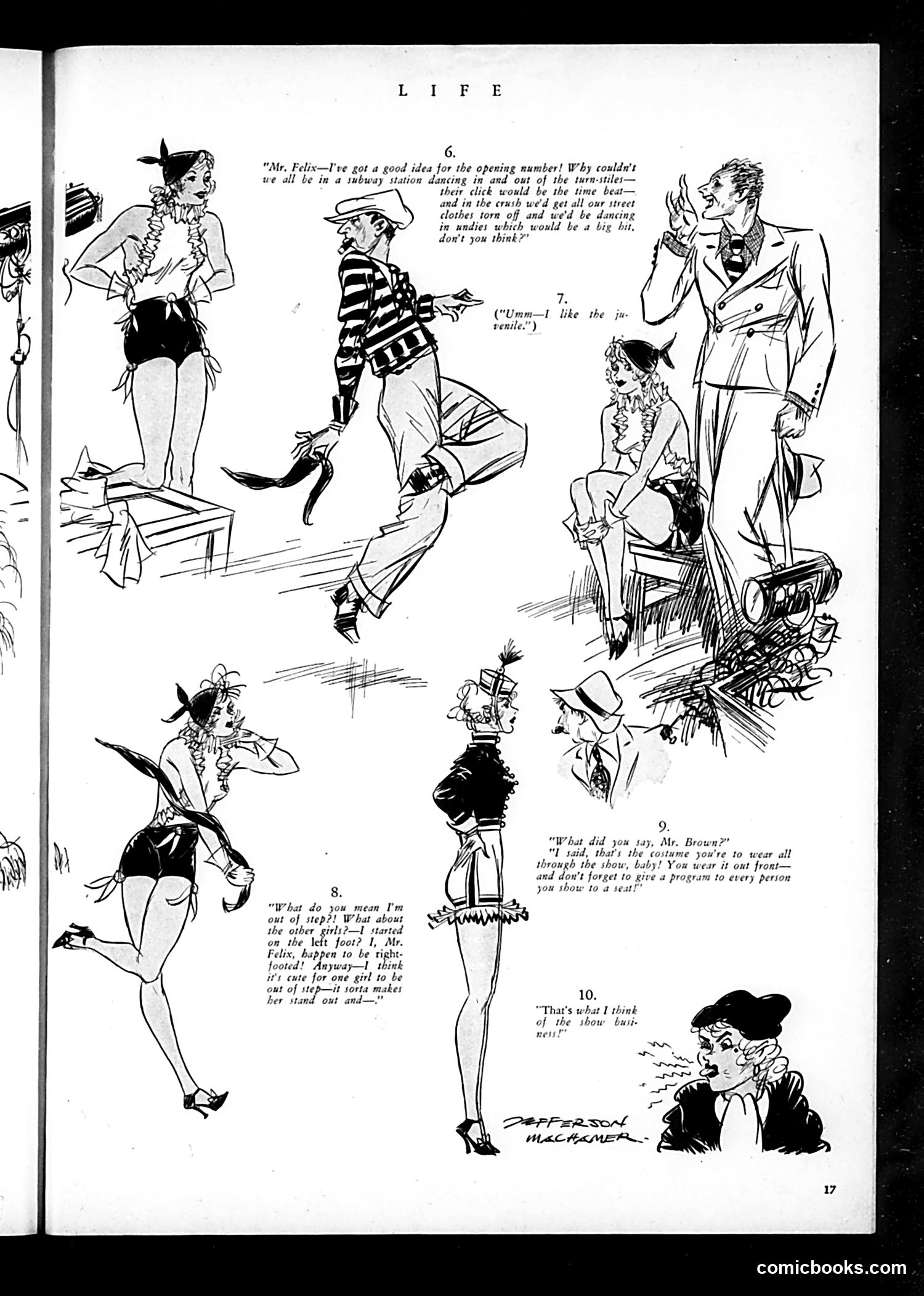
Page 17: Life Magazine Satirical Comics This page contains numbered comic sketches (6-10) satirizing theatrical/entertainment industry figures and practices. Sketch 6 mocks someone named "Mr. Felix" proposing absurd theater ideas—a "railway station dancing number" where chaos causes street clothes to fly off, creating accidental nudity as entertainment. Sketch 7 shows approval of this concept ("I like the juvenile"). Sketches 8-9 feature a woman in a tight costume, with dialogue about costume choices and "tightness" causing her to "stand out"—likely satirizing both burlesque theater conventions and the physical demands placed on performers. Sketch 10 concludes with approval of "the show business." The overall satire targets theatrical impresarios prioritizing spectacle and physical display over substantive entertainment, reflecting early 20th-century tensions between vaudeville/burlesque and legitimate theater.
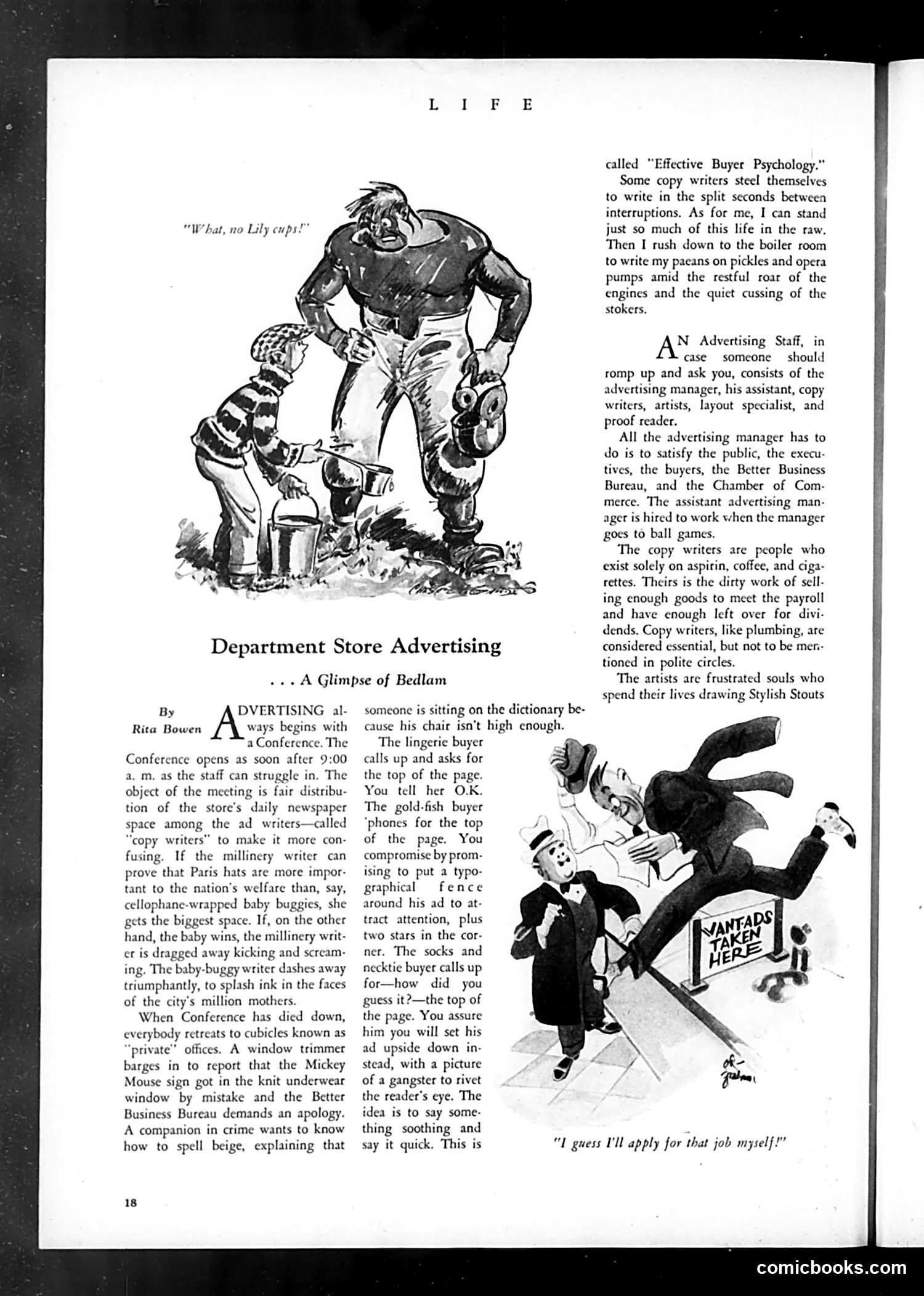
Department Store Advertising Analysis This page satirizes the internal workings of a department store's advertising department. The article by Rita Bowen describes the daily "Conference" where ad space is allocated among competing writers—a bureaucratic struggle for prominence. The two cartoons mock specific advertising pitches: the first shows a massive figure towering over a tiny person (labeled "What, no Lily cap?"), likely satirizing absurdly exaggerated product claims. The second depicts a man at a sign reading "Vantage Takes Here," with the caption "I guess I'll apply for that job myself!"—suggesting even desperate job-seekers question the credibility of department store advertising. The satire targets both the competitive absurdity of advertising departments and the questionable truthfulness of retail marketing claims in this era.
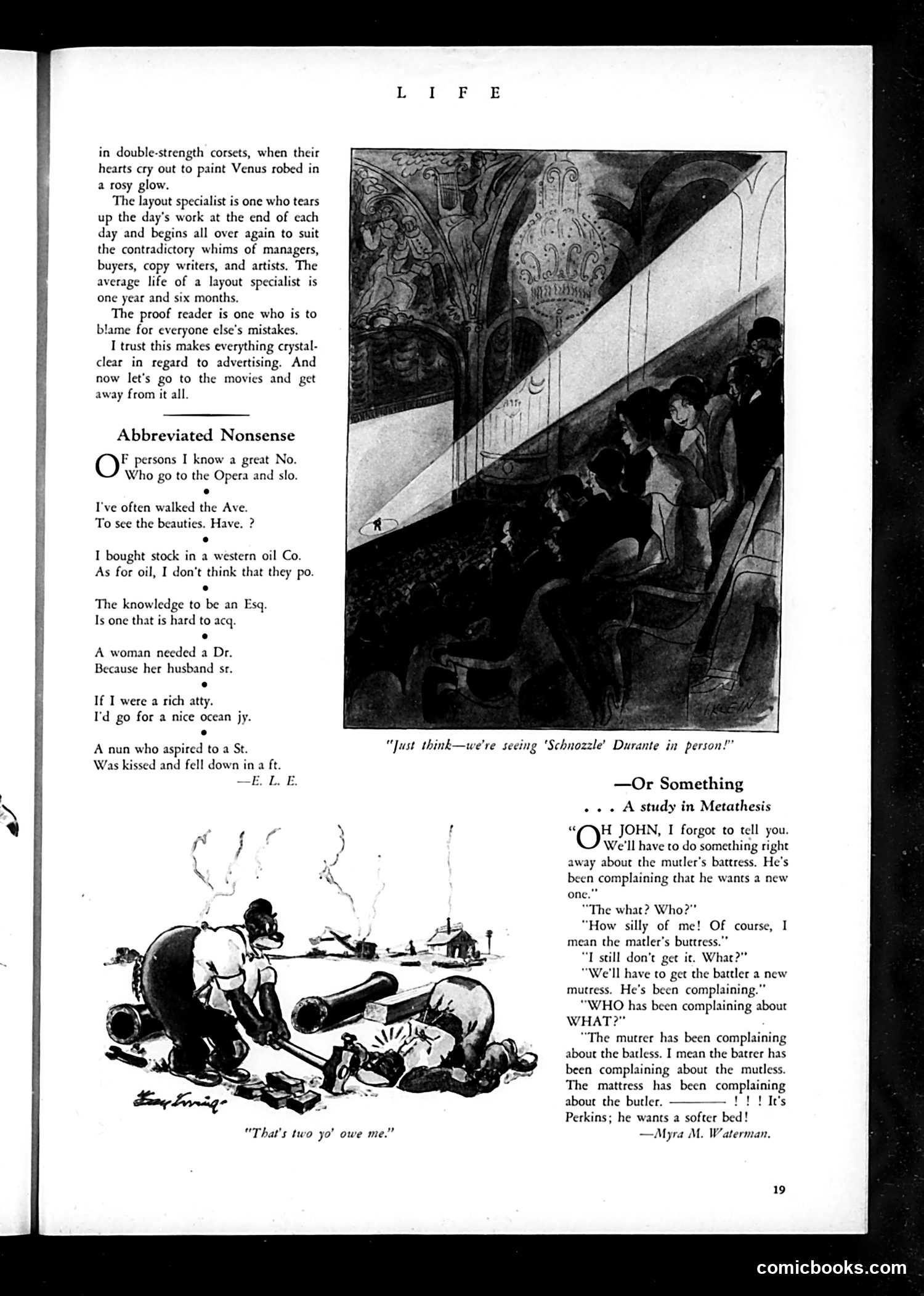
Analysis of Life Magazine Page 19 This page contains satirical humor rather than political cartoons. The top section, "Abbreviated Nonsense," features light verse poking fun at various professions and social types—opera-goers, oil speculators, lawyers, and wealthy people seeking leisure. The lower cartoon shows two figures in what appears to be a wartime or disaster scene, with one saying "That's two yo' owe me." The context suggests debt or obligation humor. The section "Or Something—A Study in Metathesis" is a comedic dialogue about household complaints, where characters confuse *who* is complaining about *what* (matters of "metathesis" or transposition). The joke hinges on absurd mix-ups regarding the butler, mattress, and bed. These pieces represent typical satirical magazine humor: wordplay, social observation, and domestic comedy rather than hard-hitting political satire.
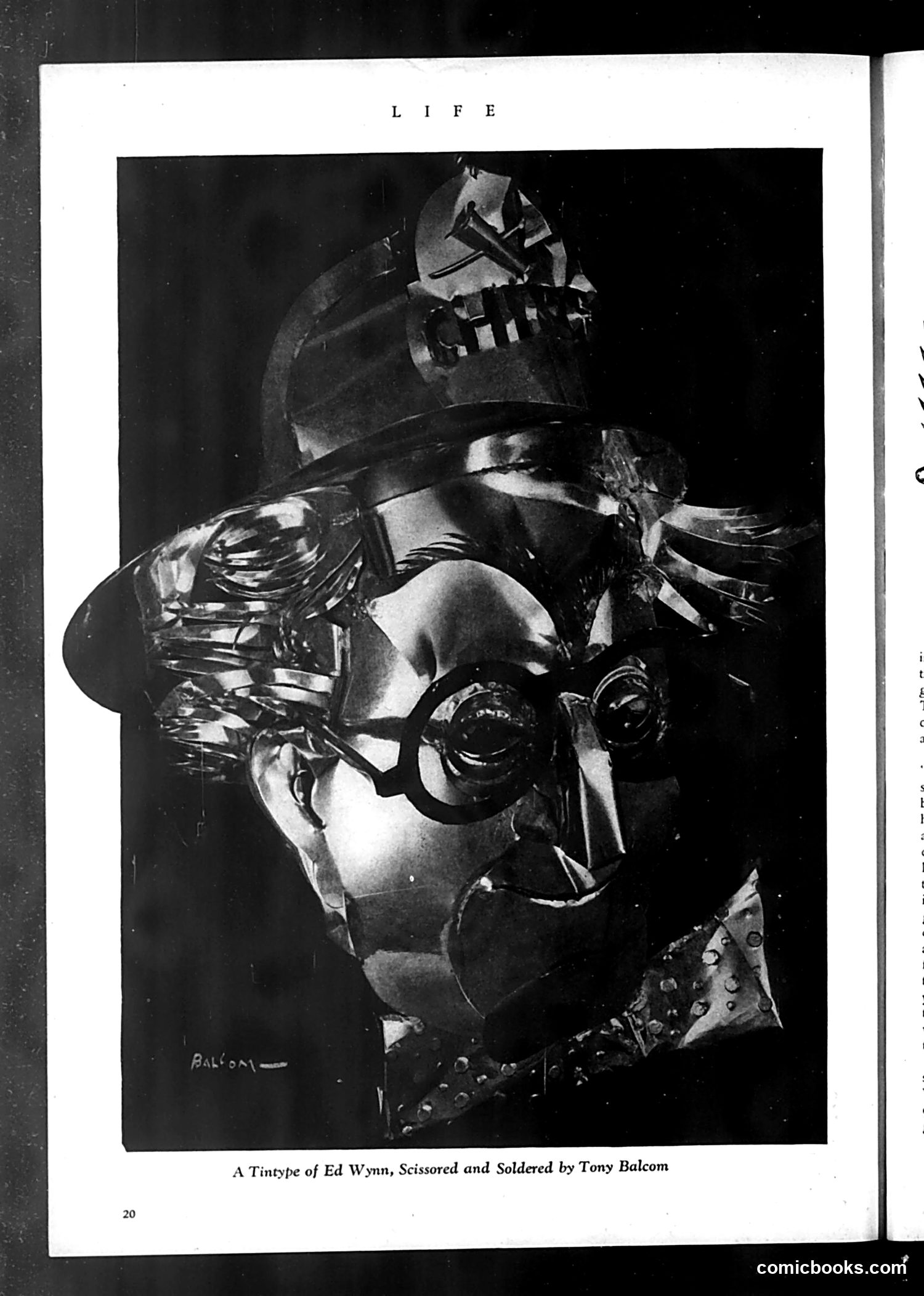
Page Analysis This page from *Life* magazine features a photograph credited to Tony Balcom showing entertainer Ed Wynn in elaborate theatrical costume and makeup. Wynn, a famous vaudeville and early radio comedian known for his eccentric character work, is depicted wearing goggles, an ornate military-style hat with decorative elements, and studded armor or costume pieces. The title's reference to "tintype," "scissored," and "soldered" suggests Balcom has created a composite or manipulated photograph—combining multiple images or elements to create an absurdist, surreal portrait. This reflects early 20th-century photographic experimentation and *Life* magazine's tradition of satirical visual humor. The piece appears to celebrate Wynn's reputation for bizarre, inventive comedy through deliberately grotesque visual presentation.
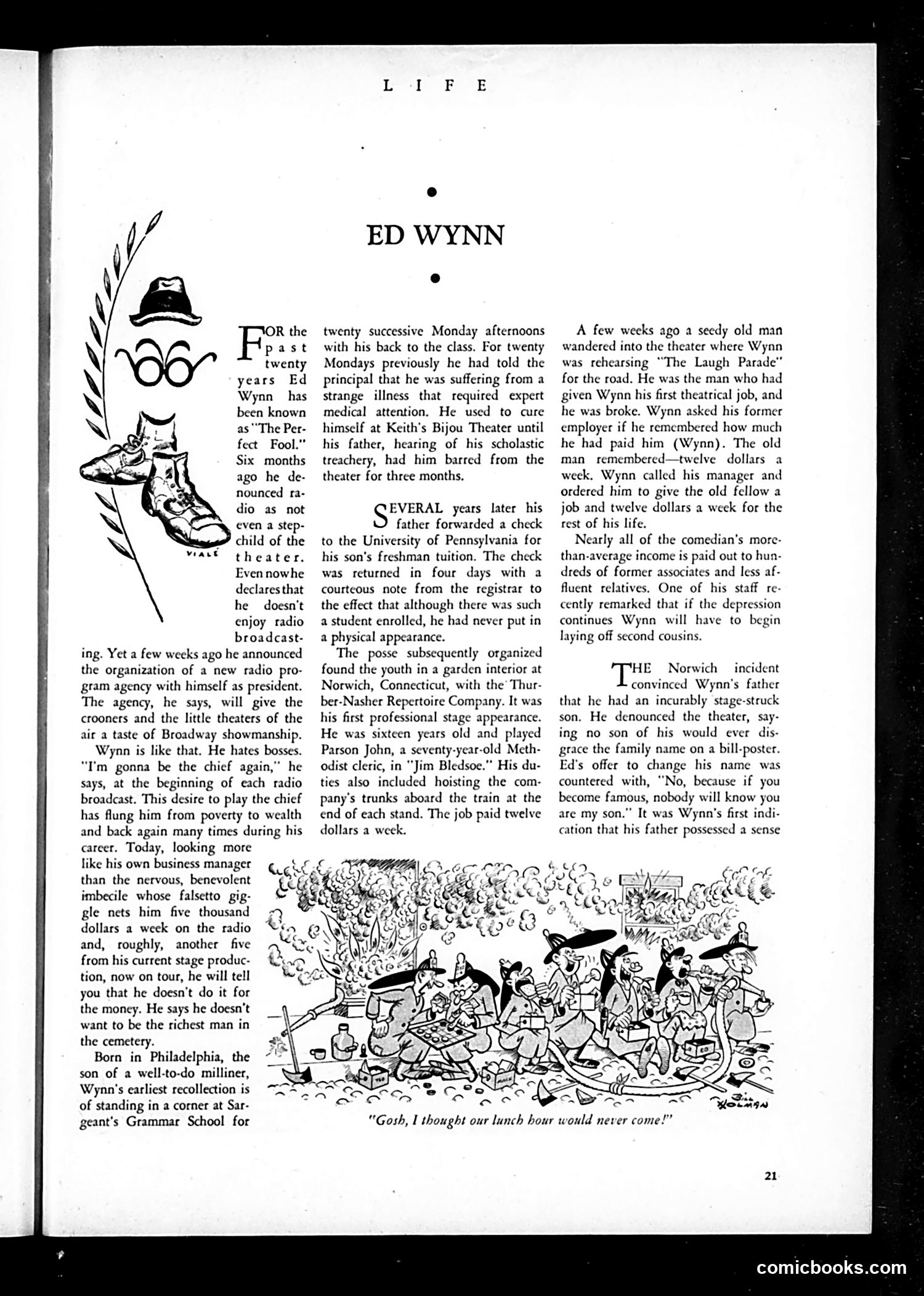
Ed Wynn Biography Page Analysis This is a biographical profile of Ed Wynn, a famous early 20th-century comedian known as "The Perfect Fool." The page details his contradictory character: he publicly denounced radio as beneath theater, yet recently launched his own radio agency; he claims money doesn't motivate him, yet earns substantial income. The narrative emphasizes Wynn's lifelong pattern of impulsive independence—skipping school to attend theaters, ditching university, pursuing stage work despite his father's objections. A key anecdote illustrates his generosity: years later, the elderly man who gave Wynn his first $12/week job (as a teenager) reappeared broke; Wynn immediately employed him at the same wage for life. The cartoon at bottom shows a chaotic picnic scene with the caption "Gosh, I thought our lunch hour would never come!"—likely satirizing workplace frustrations, unrelated to the Wynn profile above it.
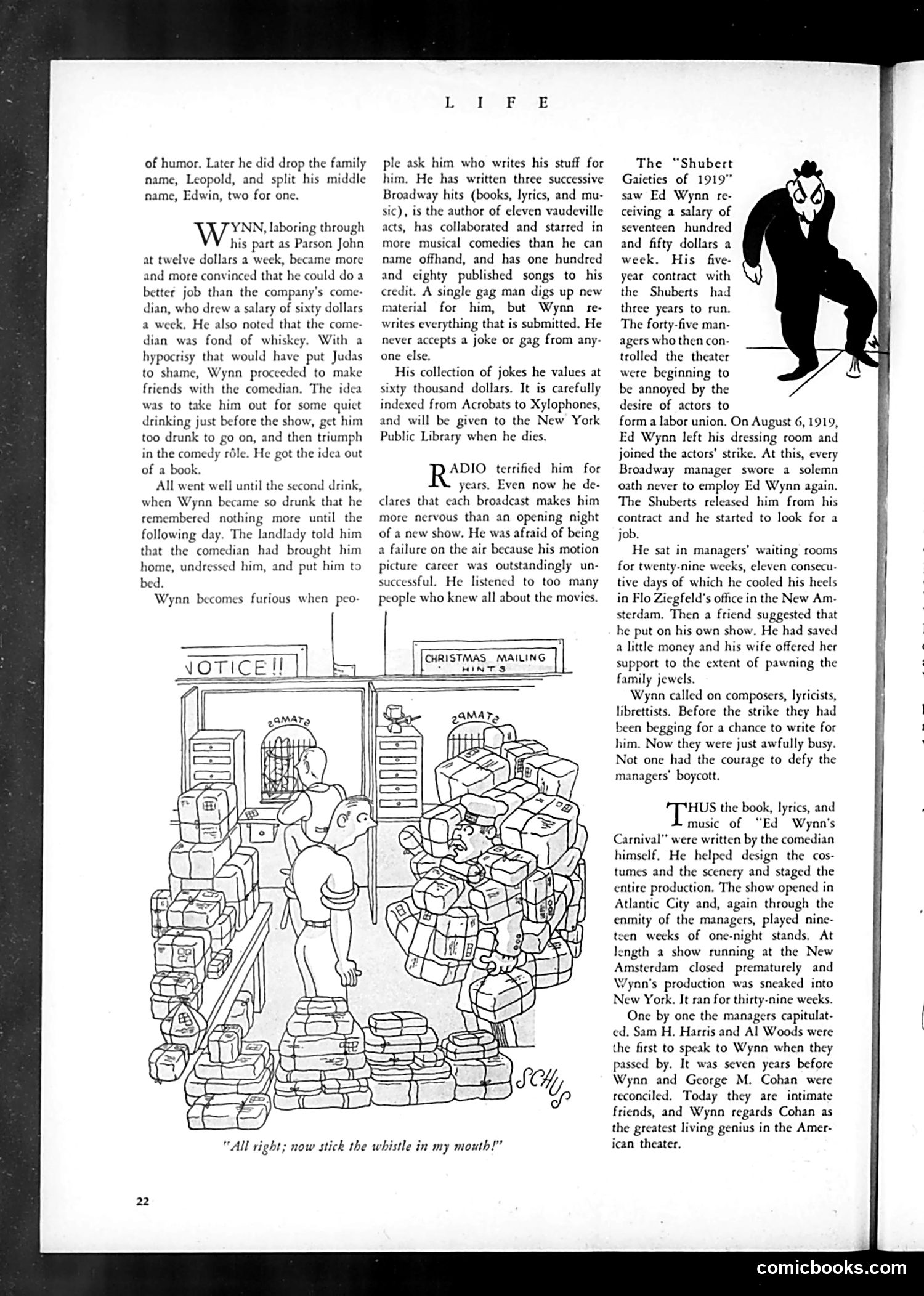
Explanation for Modern Readers This page profiles Ed Wynn, a vaudeville comedian and Broadway star. The cartoon illustrates a literal joke: someone at a Christmas mailing service prepares to stuff a whistle into a person's mouth—the visual punchline of Wynn's comedic style, which relied on physical props and absurdist humor. The text recounts Wynn's career trajectory, emphasizing his creative control (he writes his own material, not hired gag writers) and his clash with Broadway management. In 1919, Wynn joined actors' strike for labor rights; theater managers blacklisted him in retaliation. Undeterred, Wynn independently produced "Ed Wynn's Carnival"—writing, designing, and staging it himself. The show's success eventually forced managers to rehire him, breaking their boycott. The underlying message celebrates individual creative courage against institutional power and labor solidarity during early-20th-century union organizing.
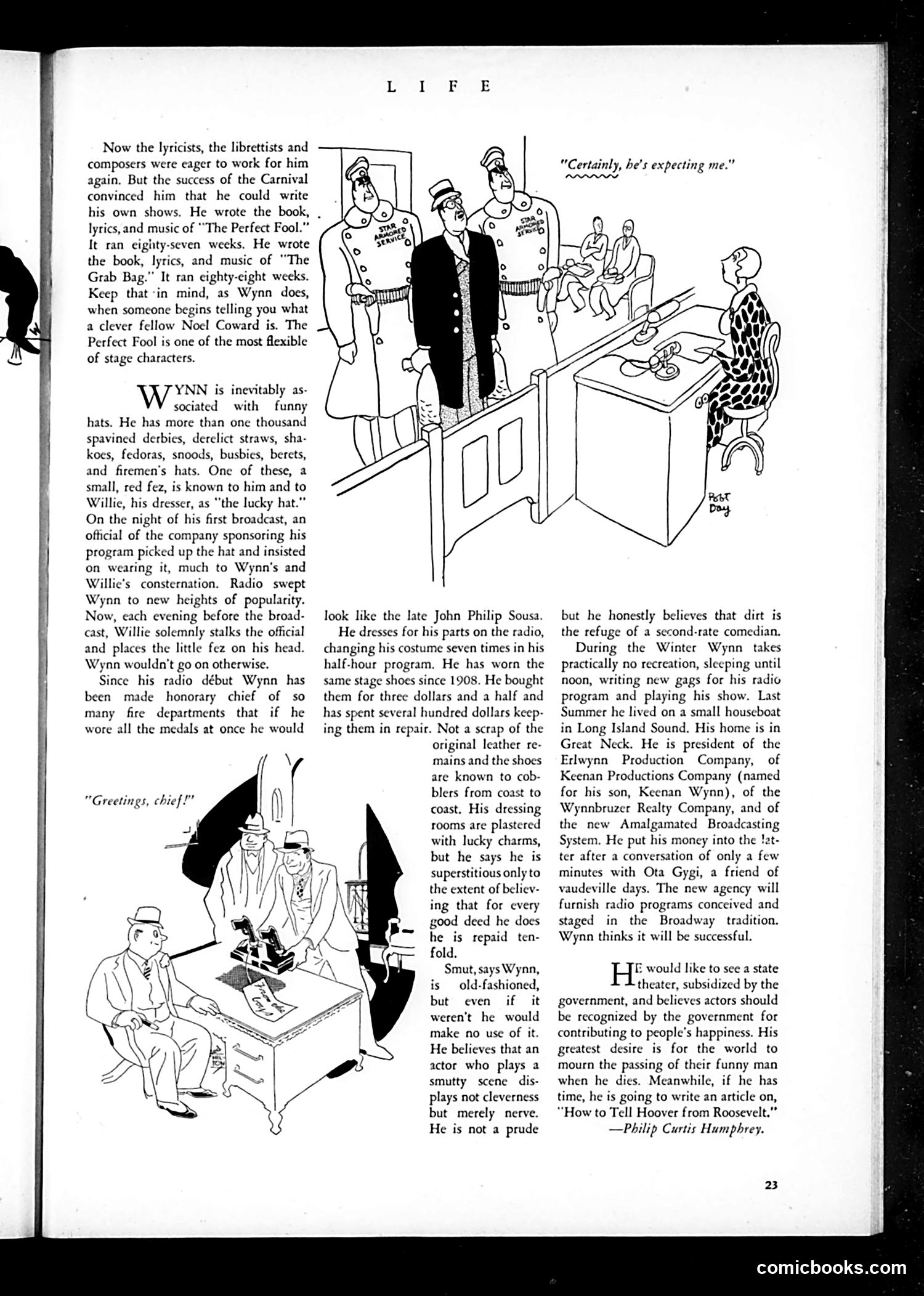
Life Magazine Profile: Ed Wynn This page profiles Ed Wynn, a vaudeville and early radio comedian. The text describes his theatrical success—his self-written shows "The Perfect Fool" and "The Grab Bag" each ran over 80 weeks—and his famous superstitions, particularly his lucky red fez hat worn by radio sponsors before broadcasts. The cartoons illustrate his character: one shows him greeting fire department officials (he'd been made honorary chief by numerous departments), another depicts him in his dressing room surrounded by lucky charms. The satire compares Wynn's theatrical success to Noël Coward's, suggesting Wynn deserves equal recognition despite being primarily a comedian rather than a sophisticated playwright. The final joke references the 1932 election ("How to Tell Hoover from Roosevelt"), dating this piece to that era when distinguishing between the outgoing Republican president and the incoming Democrat was topical humor.
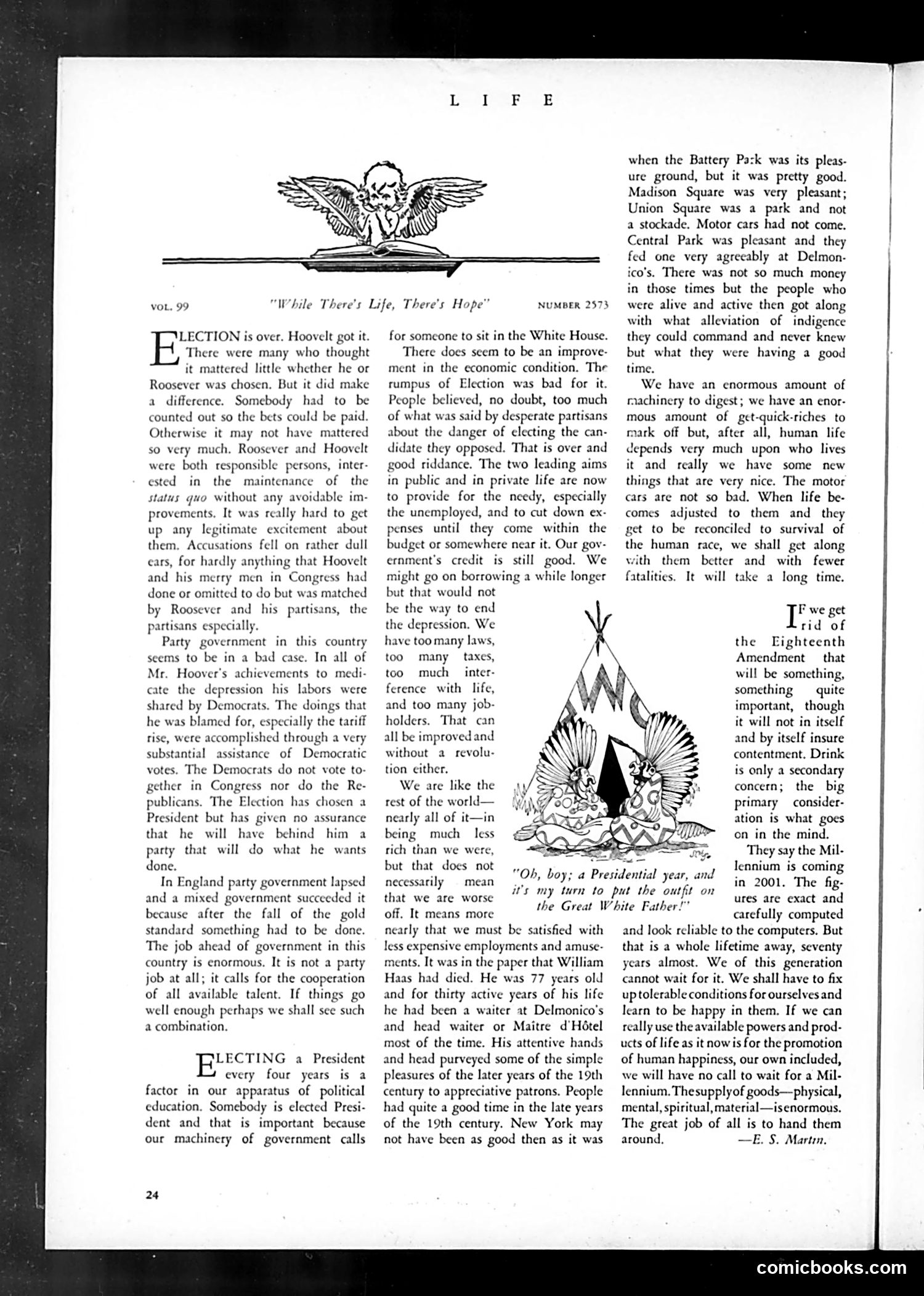
Political Satire on the 1932 Election This Life magazine editorial follows Herbert Hoover's reelection victory, offering cynical commentary on American democracy. The piece argues that Hoover versus Roosevelt (spelled "Roosever" in the text) presented little meaningful choice—both represented the status quo, making the election largely pointless except for "paying bets." The cartoon depicts a Native American figure saying "Oh, boy; a Presidential year, and it's my turn to put the outfit on the Great White Father!"—satirizing how indigenous peoples were historically sidelined from political processes while government decisions affected them. The text criticizes partisan gridlock, noting Democrats and Republicans fail to vote as cohesive blocs in Congress, leaving the new president without reliable party support. It argues government's real work—addressing Depression unemployment and reducing expenses—transcends party politics and requires bipartisan cooperation. The nostalgic anecdote about waiter William Haas reflects on simpler times, suggesting contemporary economic hardship represents diminished living standards rather than absolute decline.
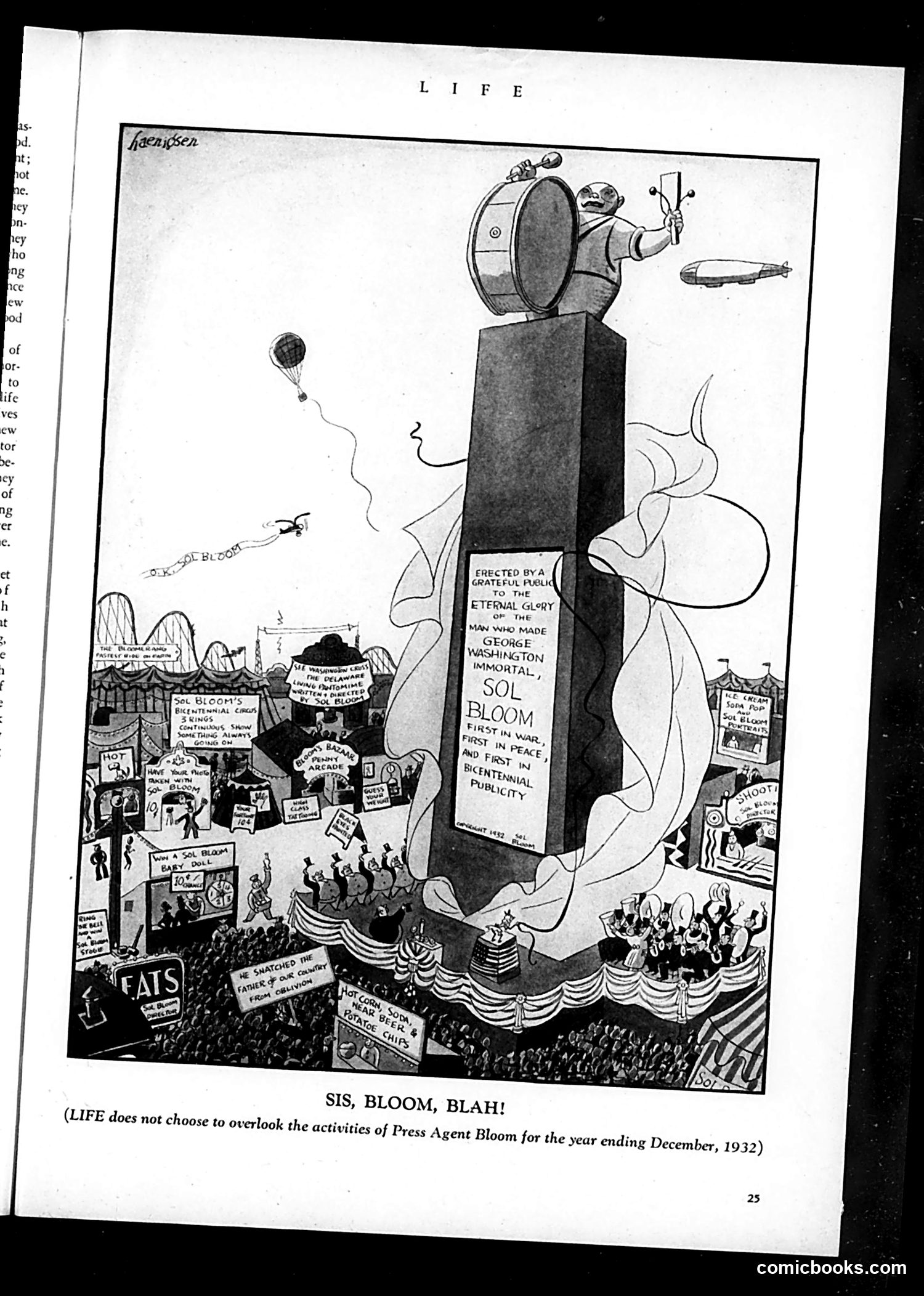
"Sis, Bloom, Blah!" – Life Magazine Satire (1932) This cartoon mocks Press Agent Irving Bloom's self-promotional activities during 1932. A massive monument celebrates Bloom as creator of the "Sol Bloom" centennial publicity campaign. The towering structure is surrounded by crowds, banners, and advertising—visualizing Bloom's aggressive marketing tactics. The satire targets commercial hype and self-aggrandizement: Bloom is depicted as erecting monuments to his own PR work rather than serving genuine public interest. The exaggerated scale and the plaque's overwrought language ("eternal glory") ridicule excessive promotion and the hollowness of publicity stunts. References to "first in war, first in peace, first in [centennial] publicity" echo patriotic language, ironically undercutting it. The carnival atmosphere surrounding the monument suggests Bloom's work is mere spectacle—empty bombast designed to fool the public into believing publicity equals accomplishment.
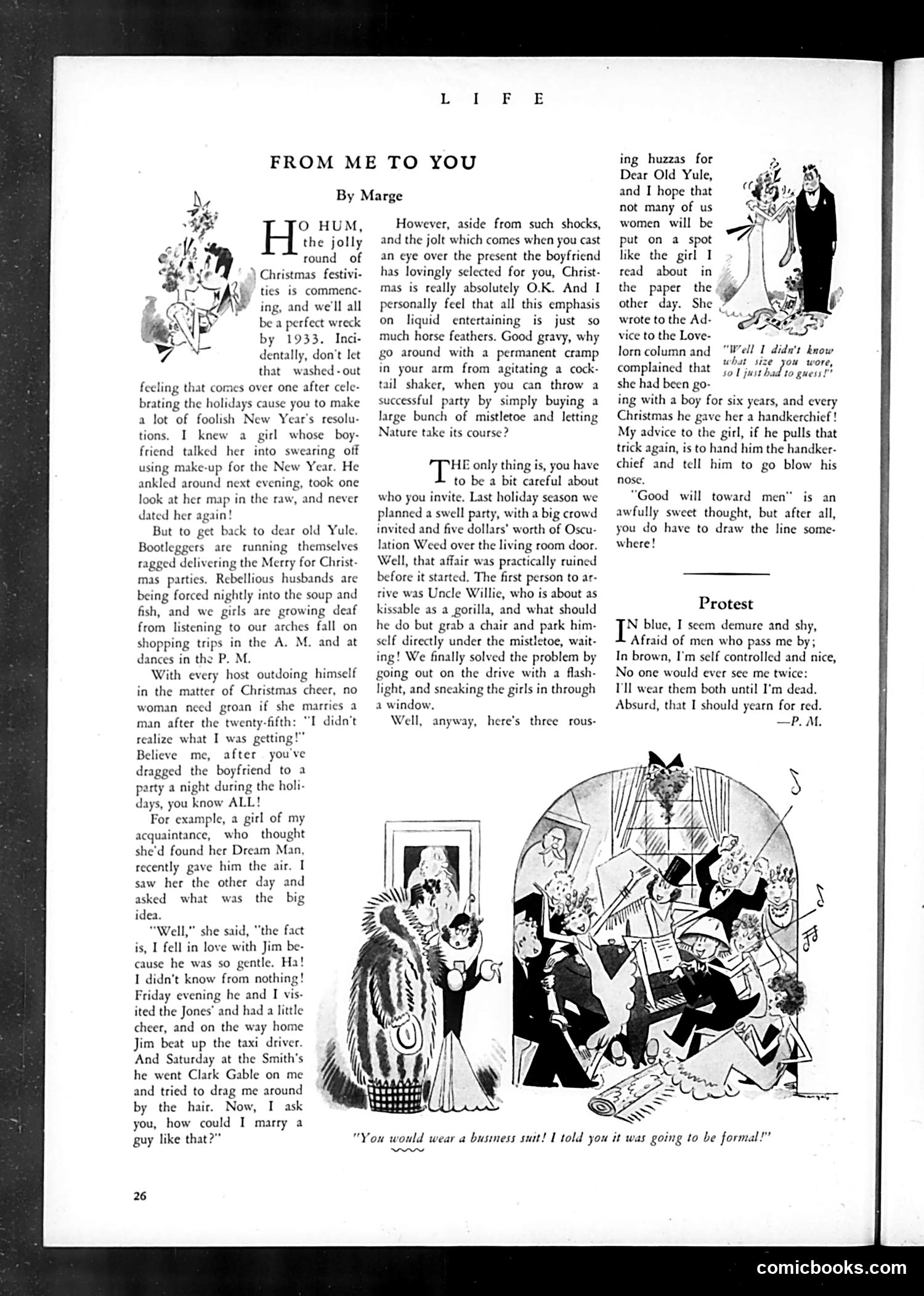
Life Magazine Page Analysis This is a humorous advice column by "Marge" satirizing Christmas and dating customs in early 1930s America. The main article mocks holiday excess—bootleggers working overtime (Prohibition era), husbands forced into formal wear, and exhausted women shopping and dancing. The central joke involves a woman discovering her "Dream Man" is actually violent and aggressive after drinking at holiday parties. He beats a taxi driver and acts like "Clark Gable" (the glamorous film star), revealing his true character. The cartoon illustrates the mistletoe problem: an unattractive Uncle Willie monopolizes the decoration, forcing hosts to sneak female guests through windows to avoid kissing him. A secondary joke criticizes a boyfriend who gave the same gift—a handkerchief—for six years straight. The advice: hand it back and tell him to use it. The "Protest" poem laments how women's clothing color affects male attention. Throughout, the satire targets male behavior, dating dishonesty, and holiday party culture during the Depression era.
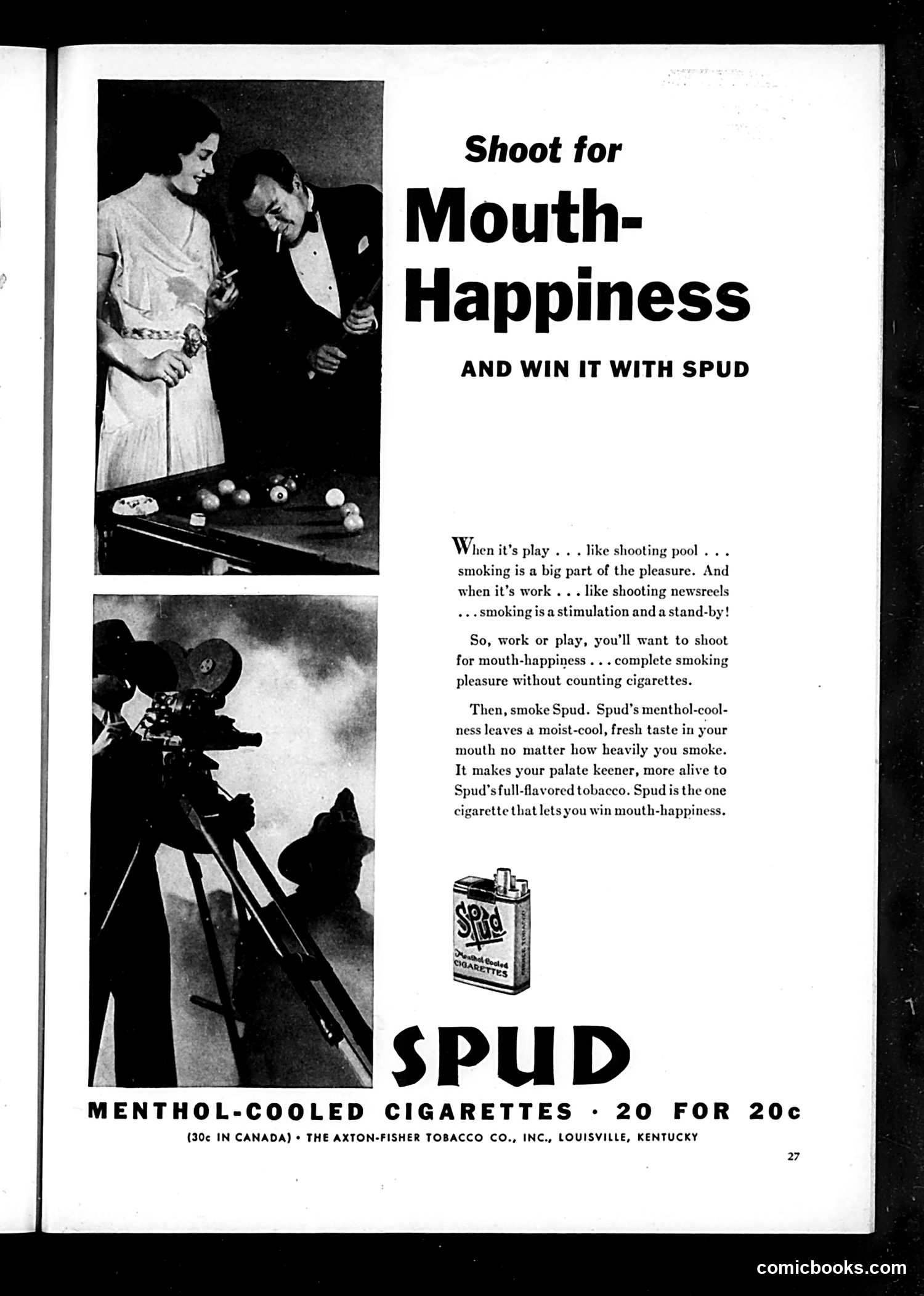
This is a cigarette advertisement for Spud menthol cigarettes, not satire or political commentary. The page features two black-and-white photographs: one showing a couple playing pool, and another showing a film cameraman at work. The ad uses these leisure and work scenarios to market smoking as enhancing both activities—positioning cigarettes as integral to enjoyment and productivity. The copywriting emphasizes the menthol's cooling sensation and flavor enhancement. The price ("20 for 20¢") and Canadian variant pricing indicate this is from the pre-1950s era when such advertising was common in mainstream publications. There is no cartoon, caricature, or satirical intent visible—it's straightforward product marketing that modern readers would find shocking in its casual health claims and normalized smoking culture.
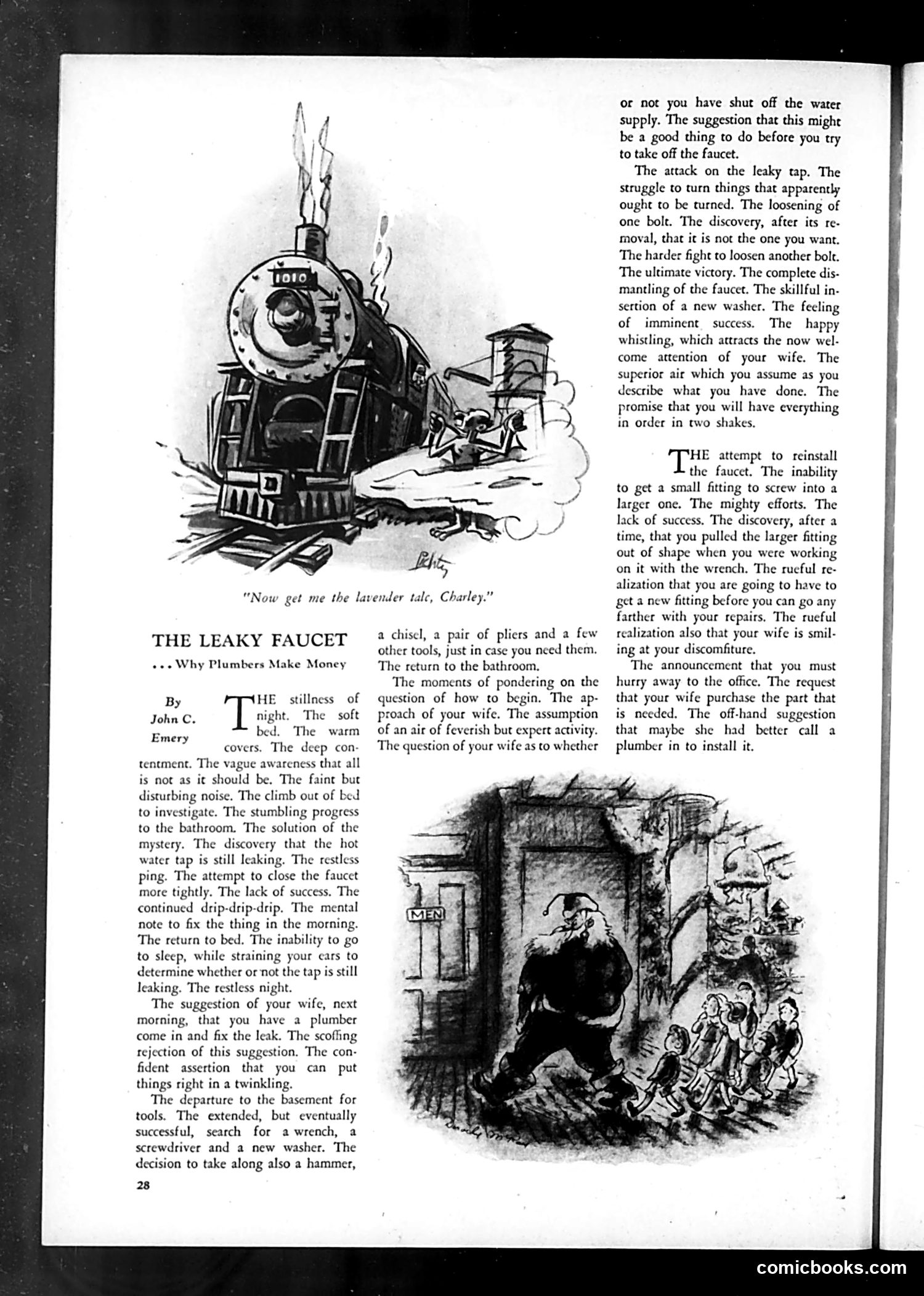
"The Leaky Faucet" — A Husband's DIY Humiliation This humorous essay satirizes the everyman's overconfidence in home repair. The narrative follows a husband's nighttime discovery of a dripping faucet and his stubborn insistence he can fix it himself—despite his wife's sensible suggestions otherwise. The joke builds through escalating failures: forgetting to shut off water, disassembling the faucet successfully, then destroying a fitting during reassembly. His initial confident whistling gives way to sheepish retreat as he must leave for work, ultimately requiring his wife to call a professional plumber. The satire targets masculine pride and the false economy of DIY repairs—the plumber makes money precisely because husbands like this one create expensive problems while attempting simple fixes. The accompanying locomotive illustration (by artist Emery, based on the signature) appears to emphasize the "runaway" nature of the situation spiraling beyond control. The piece gently mocks domestic gender dynamics and male stubbornness.
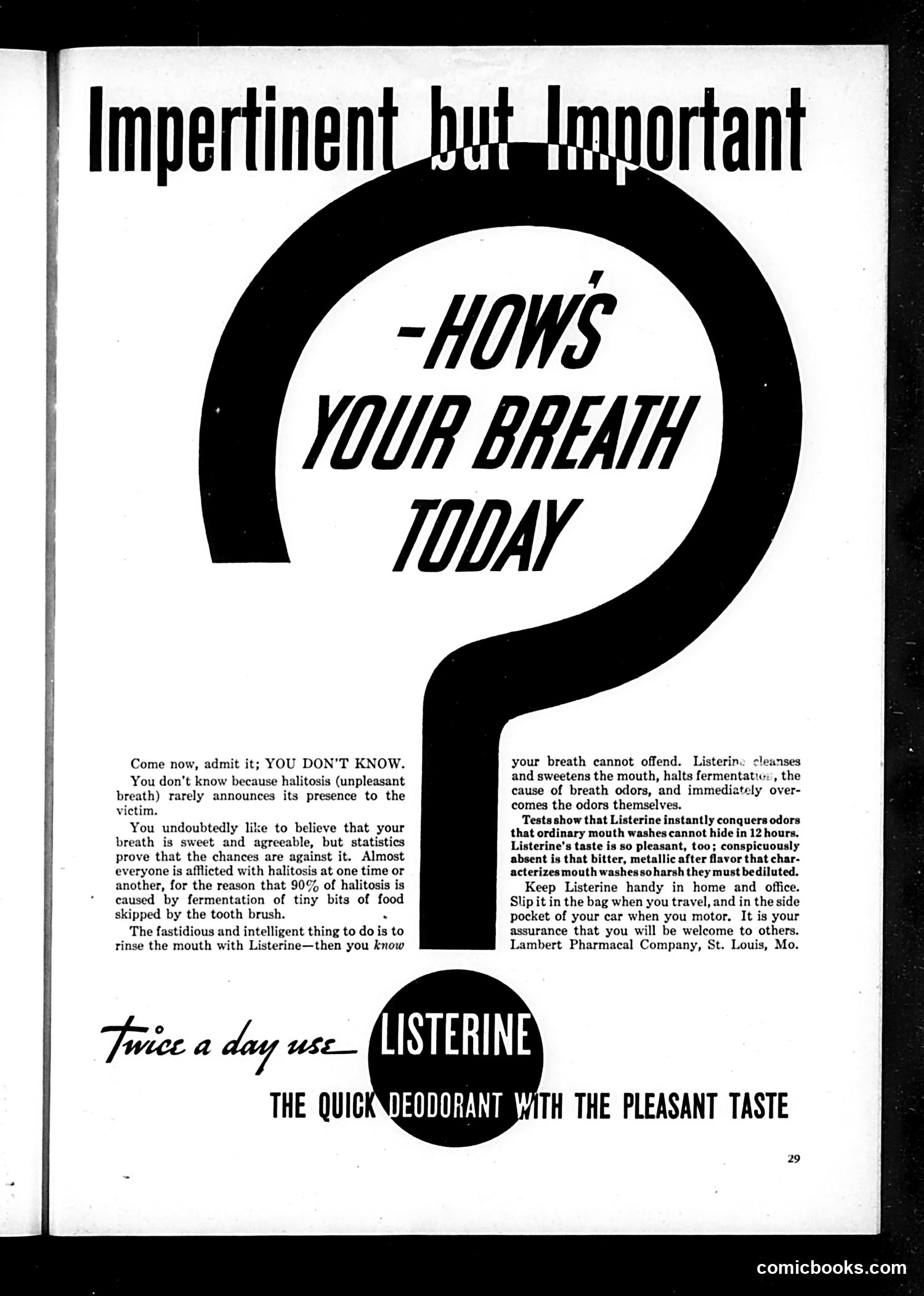
Listerine Advertisement Analysis This is a Listerine mouthwash advertisement, not political satire. The large question mark poses the challenge "How's your breath today?" — the core of the ad's appeal. The copy leverages social anxiety, claiming 90% of people suffer from "halitosis" (bad breath) without realizing it. The advertisement uses pseudo-scientific language ("statistics prove," "tests show") to establish authority, though these claims are exaggerated by modern standards. The pitch emphasizes that Listerine is superior to competing mouthwashes—it works faster and tastes better than harsh alternatives. The tagline "twice a day use" establishes a routine purchase habit. This reflects mid-20th century advertising strategy: creating insecurity about a private hygiene matter, then positioning a product as the solution. The term "halitosis" itself was popularized by Listerine marketing to medicalize ordinary bad breath.
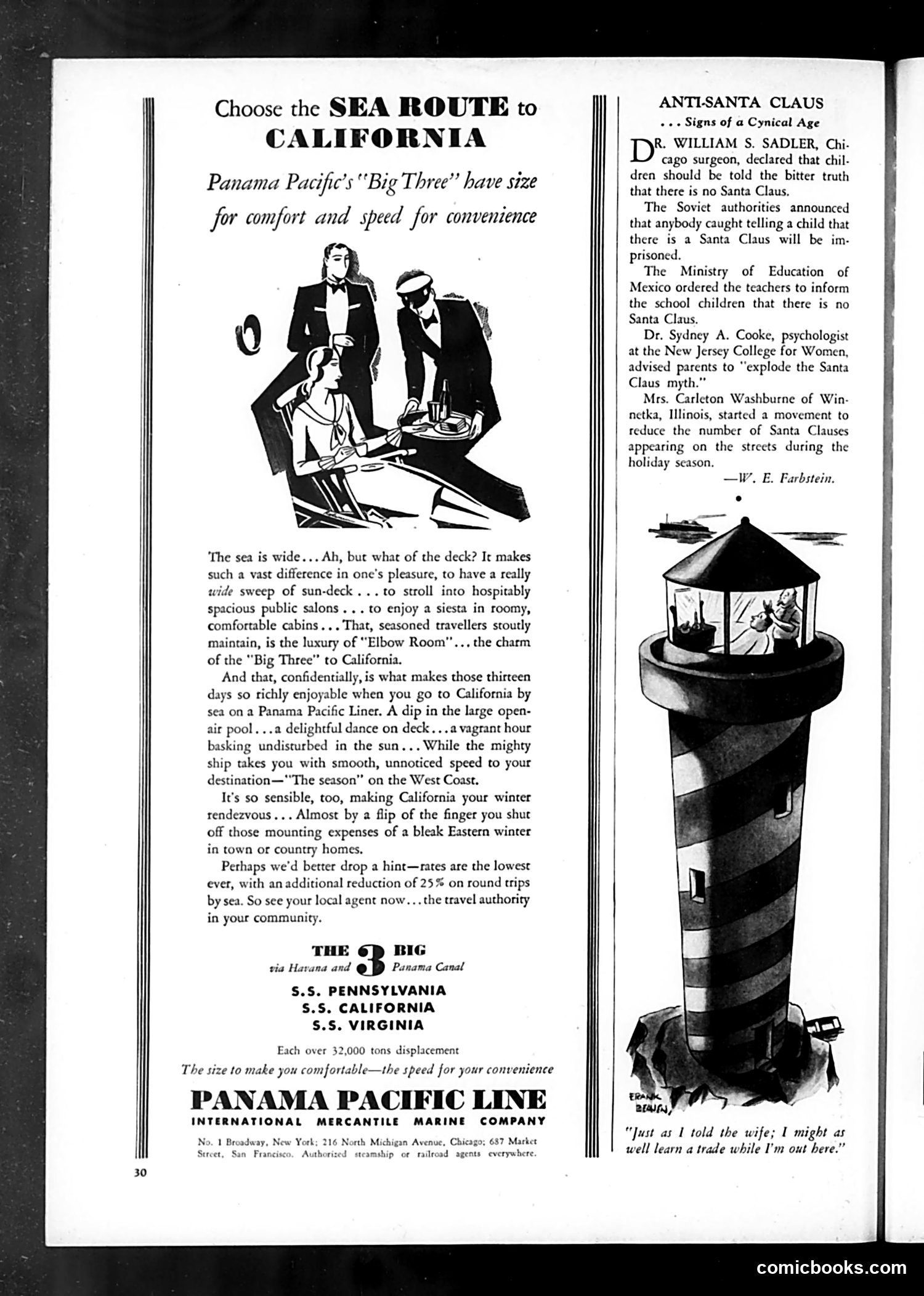
Page Analysis This page contains two distinct elements: Left side: Advertisement for Panama Pacific Line cruise ships to California, emphasizing spacious decks and comfortable amenities for 13-day voyages. The illustration shows well-dressed passengers being served by crew, promoting luxury travel. Right side: "Anti-Santa Claus" column documenting a cynical cultural trend of the era. Multiple authorities—a Chicago surgeon, Soviet government, Mexican Ministry of Education, and American psychologists—are advocating that children be told Santa Claus doesn't exist rather than being deceived. Mrs. Carleton Washburne even started a movement to reduce street Santas during the holiday season. The accompanying cartoon shows a lighthouse keeper telling his wife he might as well learn a trade while away from home—a pessimistic joke about economic hardship or job insecurity. Together, these pieces reflect 1930s-era skepticism about traditional myths and comforts, both commercial (leisure travel) and cultural (childhood wonder).
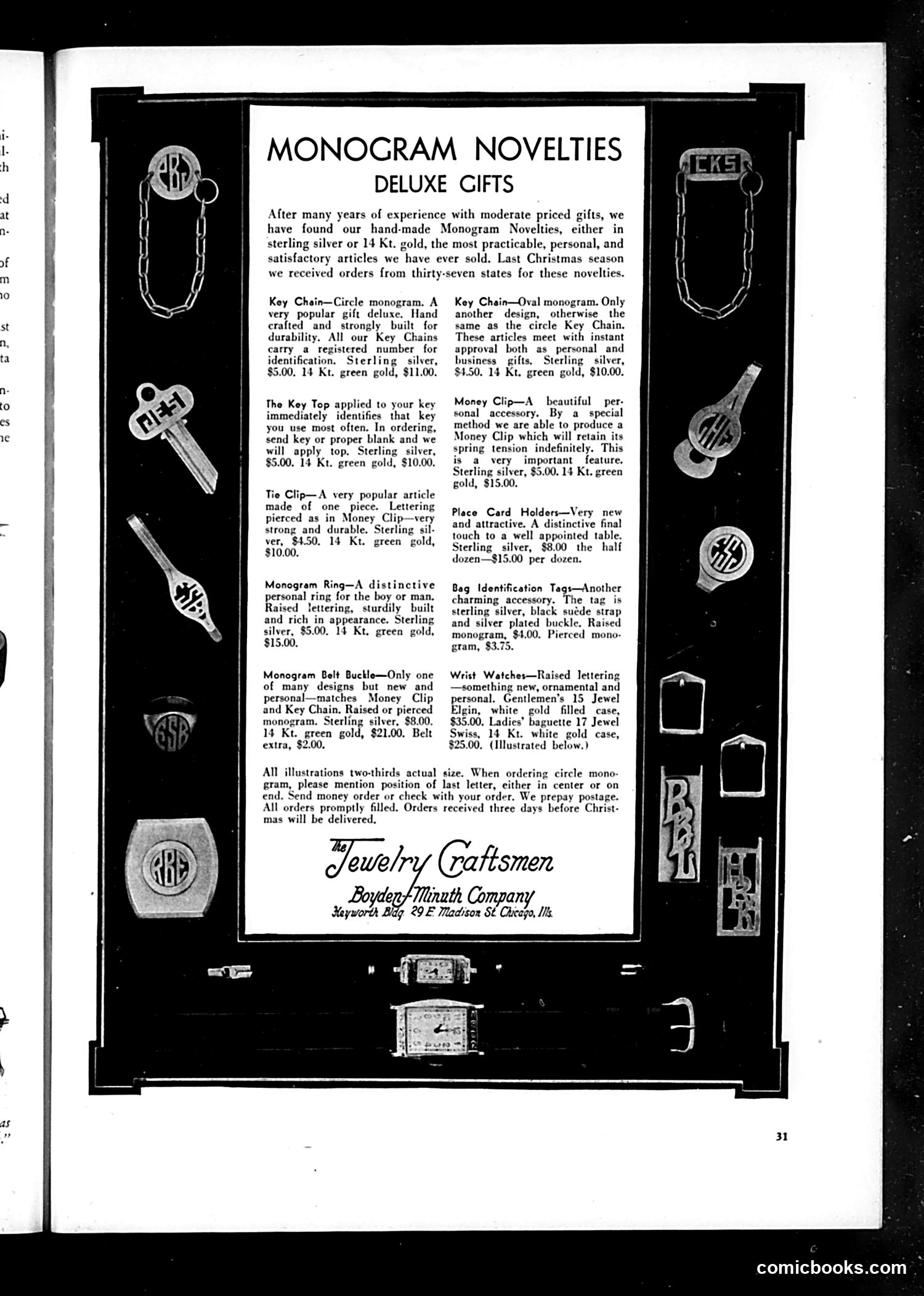
Analysis This is not a cartoon or satirical page — it's a straightforward advertisement for monogrammed luxury goods. The page showcases deluxe gift items from Jewelry Craftsmen (Boyden/Minuth Company in Chicago), including key chains, tie clips, rings, belt buckles, money clips, and wrist watches in sterling silver and 14-karat gold. The text emphasizes personalization through raised or pierced monogramming as a selling point for executive gifts. Pricing ranges from $1.00 to $35.00 — substantial sums for the era. The company boasts receiving orders "from thirty-seven states" the previous Christmas season, suggesting this was a proven, popular product line. There is no satire, political commentary, or humor intended — merely a period catalog page targeting affluent gift-buyers seeking personalized, durable accessories for business associates and family members.
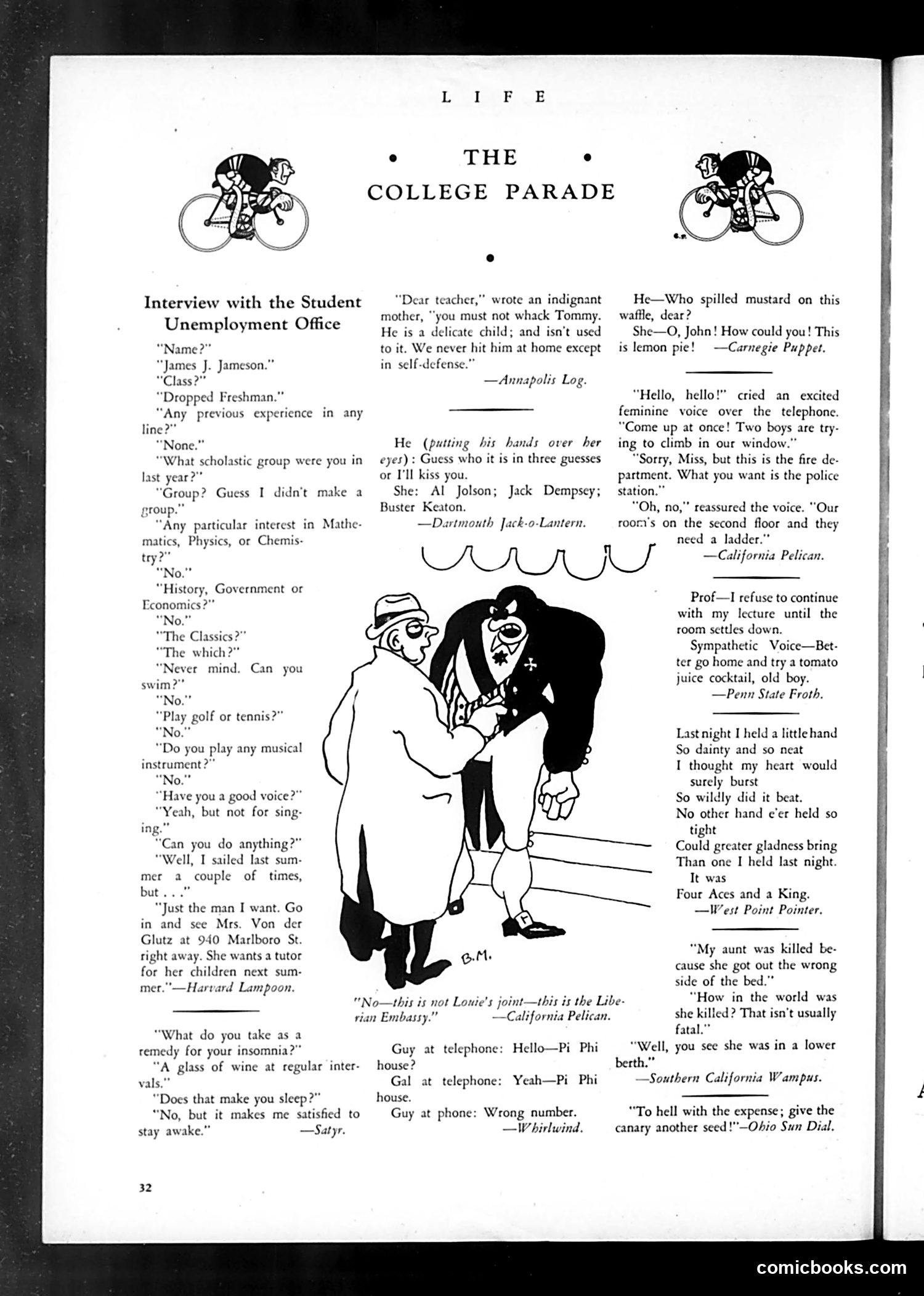
"The College Parade" - Life Magazine Satire Page This page collects humorous anecdotes and jokes from college newspapers, satirizing undergraduate life in the early 20th century. The central cartoon depicts two men in formal dress, with the caption suggesting confusion about a location—likely mocking either social pretension or diplomatic absurdity. The "Student Unemployment Office" interview on the left mocks the unemployable college graduate: a dropped freshman with no skills, interests, or abilities—yet perfectly suited to tutoring wealthy children, suggesting satire of both class privilege and educational standards. Other jokes target college life tropes: parental indulgence (mothers defending corporal punishment), flirtation games invoking celebrities (Jolson, Dempsey, Keaton), telephone mix-ups, and romantic sentimentality undercut by mundane reality (the "Four Aces and a King" poker hand joke). The page reflects 1920s concerns: youth unemployment, class divisions, and generational attitudes toward education and courtship.
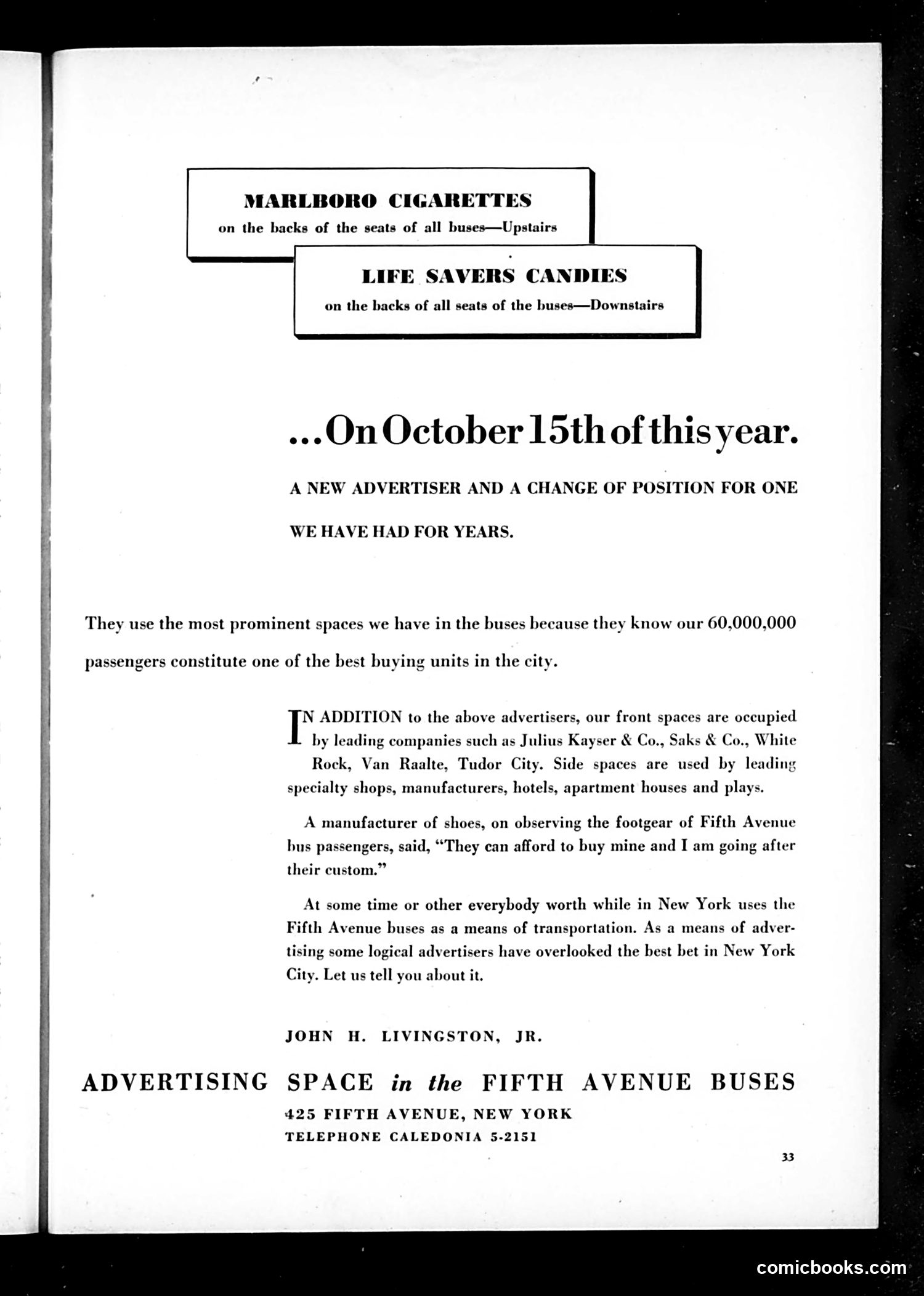
Advertisement Analysis This is a straightforward advertisement, not satire or cartoon content. It promotes advertising space available on New York City Fifth Avenue buses, presented by John H. Livingston, Jr. The ad highlights two specific placements: Marlboro Cigarettes on upstairs seat-backs and Life Savers Candies on downstairs seat-backs, effective October 15th. It emphasizes the captive audience of 60 million annual passengers as an ideal consumer demographic. The ad lists prestigious existing advertisers (Saks & Co., Julius Kayser & Co., White Rock) to establish credibility. It includes an anecdote from a shoe manufacturer recognizing Fifth Avenue bus riders as affluent consumers worth targeting. The pitch is straightforward business communication: Fifth Avenue buses reach wealthy New Yorkers regularly, making them an overlooked but valuable advertising medium. Contact information and the address (425 Fifth Avenue) are provided for interested parties.
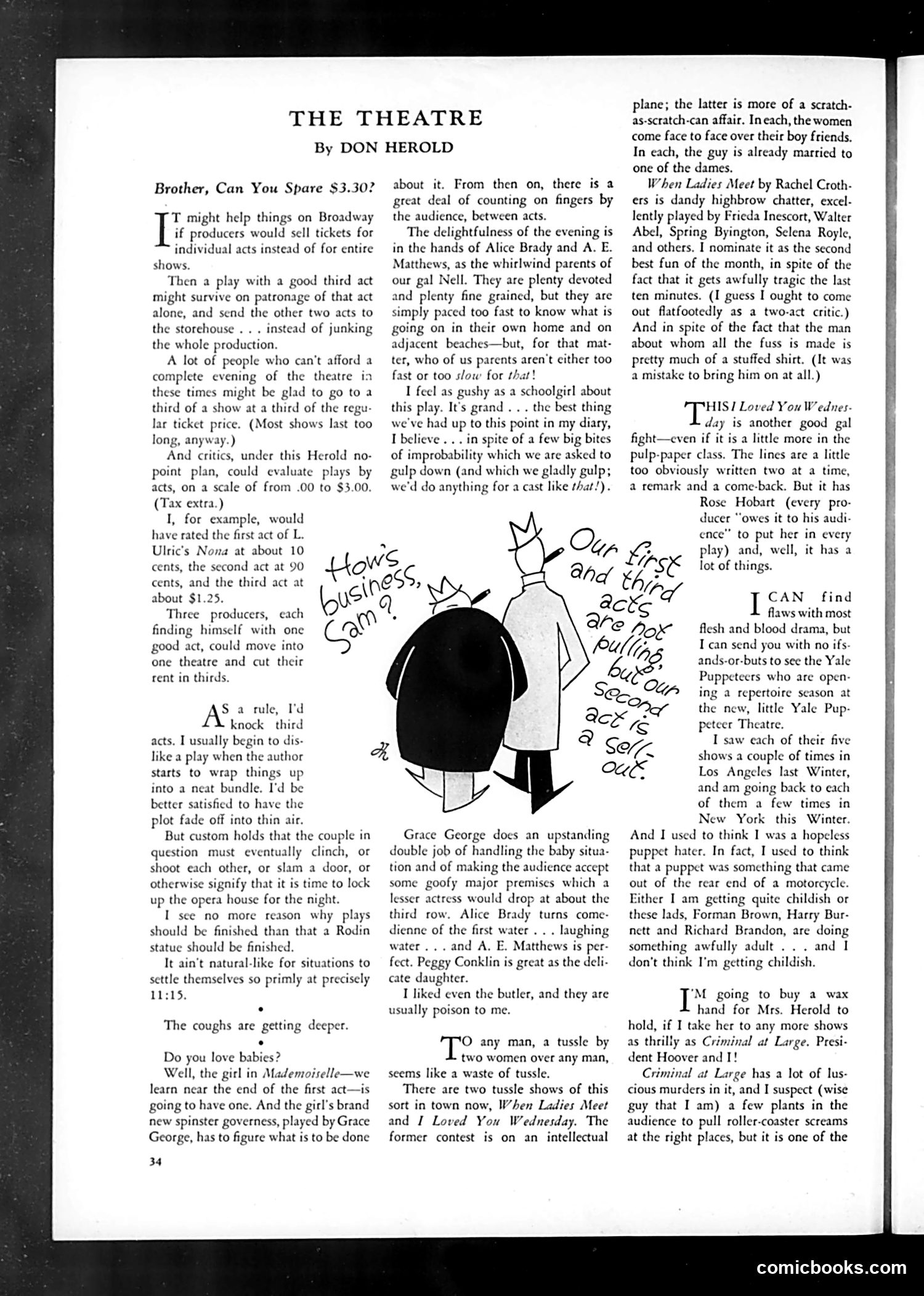
Analysis of Don Herold's Theater Column (Life Magazine) This theater criticism column by Don Herold satirizes Broadway economics and playwriting conventions during the Depression era (note the opening reference: "Brother, Can You Spare $3.30?"—echoing the famous Depression song). The Main Cartoon/Illustration: Shows a figure holding a sign listing plays with their acts ranked by quality and price value, satirizing Herold's proposal that Broadway sell individual acts separately rather than entire shows. Herold's Core Argument: With ticket prices high and audiences struggling financially, producers should allow people to attend only the third act of a play at reduced cost. He jokes that many plays have weak final acts anyway, so separating them makes economic sense. The Social Context: This reflects genuine 1930s Depression anxieties about entertainment costs and theater attendance. Herold critiques lazy playwriting—particularly artificial "neat bundle" endings where couples clinch, doors slam, and plots artificially resolve by 11:15 PM, comparing this to leaving a Rodin statue unfinished. The Reviews: He enthusiastically endorses *Mademoiselle* but criticizes formulaic "tussle shows" like *When Ladies Meet*, where women compete over married men.
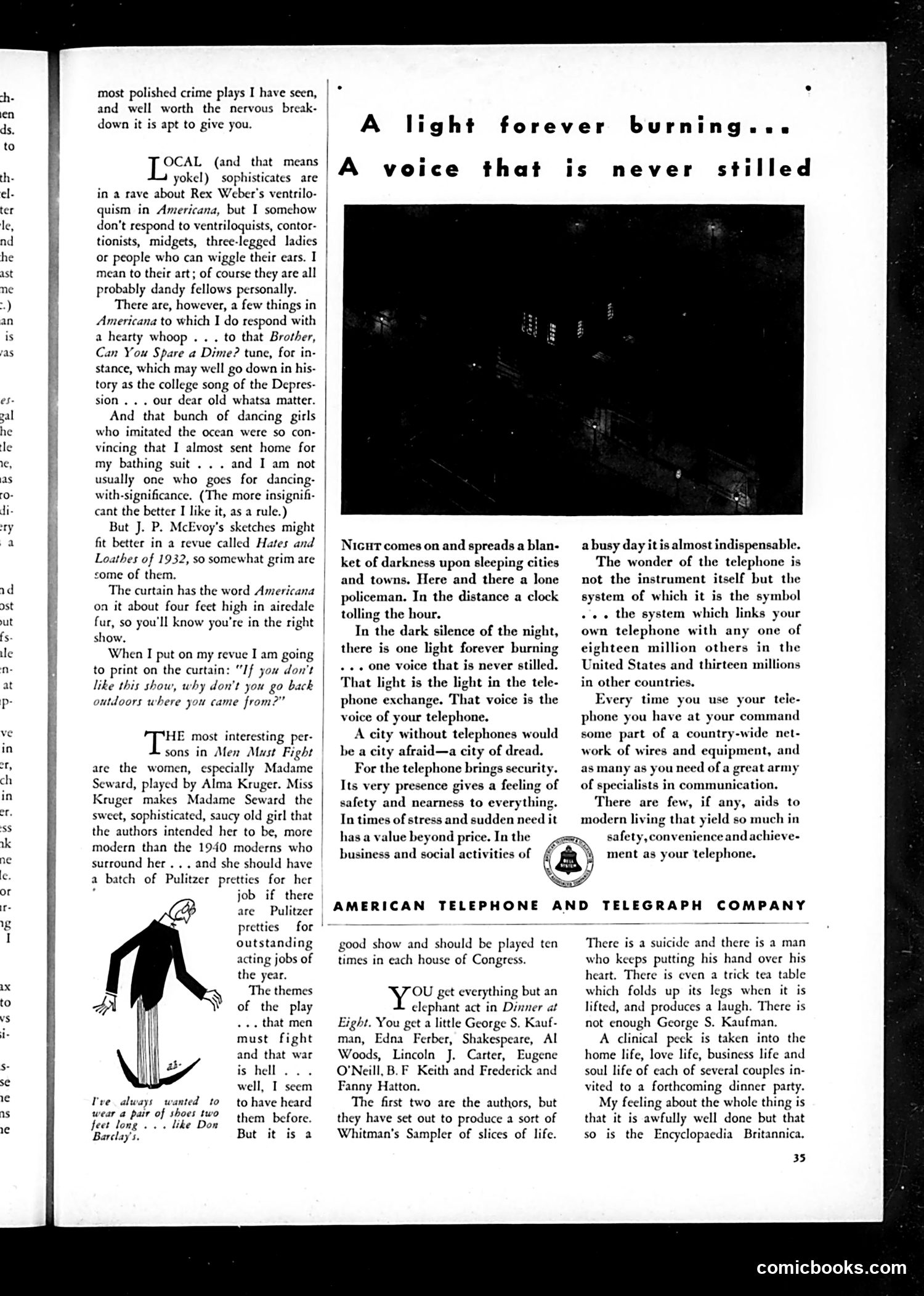
Life Magazine Page Analysis This page combines theater criticism with a major telephone company advertisement. Theater Criticism Section: The critic reviews Broadway shows including *Americana* (featuring ventriloquist Rex Weber) and *Men Must Fight*. The tone is irreverent—dismissing ventriloquism as uninteresting but praising the Depression-era song "Brother, Can You Spare a Dime?" The critic mocks *Men Must Fight* for recycling tired anti-war themes ("men must fight," "war is hell"), while praising actress Alma Kruger's performance. The humor is light satire on theatrical conventions. Advertisement: The AT&T ad uses poetic language about telephone operators and infrastructure as modern security symbols. It romanticizes the "light forever burning" in telephone exchanges and the "voice that is never stilled"—referencing the 24/7 telephone operator service crucial to the era's communication system. Context: This reflects 1932 Depression-era culture: entertainment reviews alongside corporate messaging promoting technological progress and interconnectedness as reassuring during economic crisis.
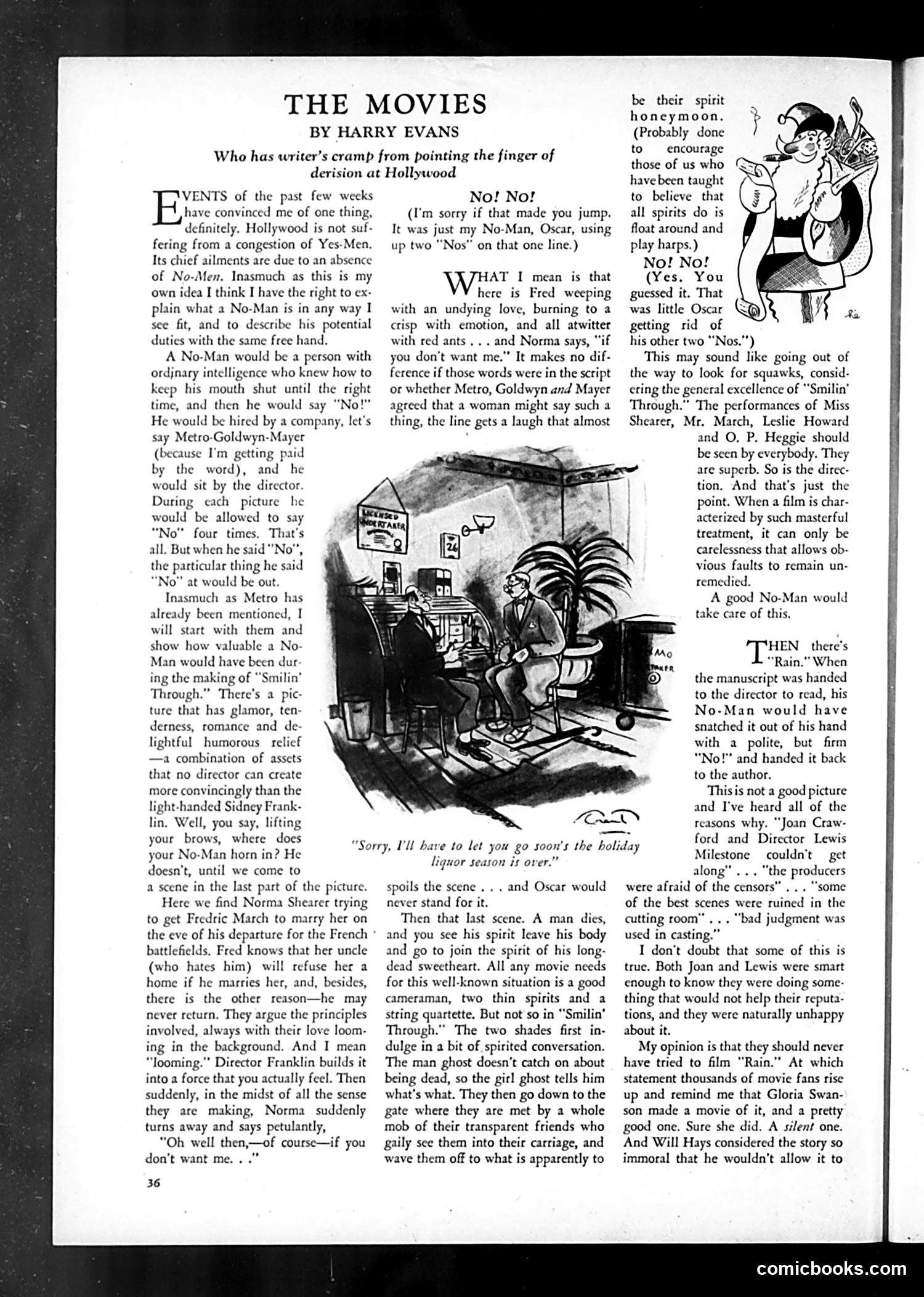
Harry Evans' "The Movies" Satire This is a film criticism column lampooning Hollywood's lack of editorial restraint. Evans proposes the concept of a "No-Man"—a studio employee authorized to veto four decisions per film to prevent overwrought or tonally inappropriate scenes. The specific targets: The column uses *"Smilin' Through"* (a 1941 MGM production starring Norma Shearer and Fredric March) as a case study. Evans critiques: 1. An awkward comedic line where Shearer says "if you don't want me" during an emotionally serious moment, getting unintended laughs that undermine the scene's gravity 2. An excessive supernatural sequence where dead lovers' spirits are given dialogue and met by a "mob" of transparent friends before departing—Evans argues this overwrought staging defeats its purpose The satire's point: Major studios like MGM lack self-editing discipline. Directors and executives approve scenes that contradict a film's emotional tone, prioritizing spectacle or attempting comedy in dramatic moments. Evans argues tasteful restraint—the ability to say "no" at crucial moments—would improve Hollywood's output significantly. The wit lies in proposing this as a formal, limited institutional role.
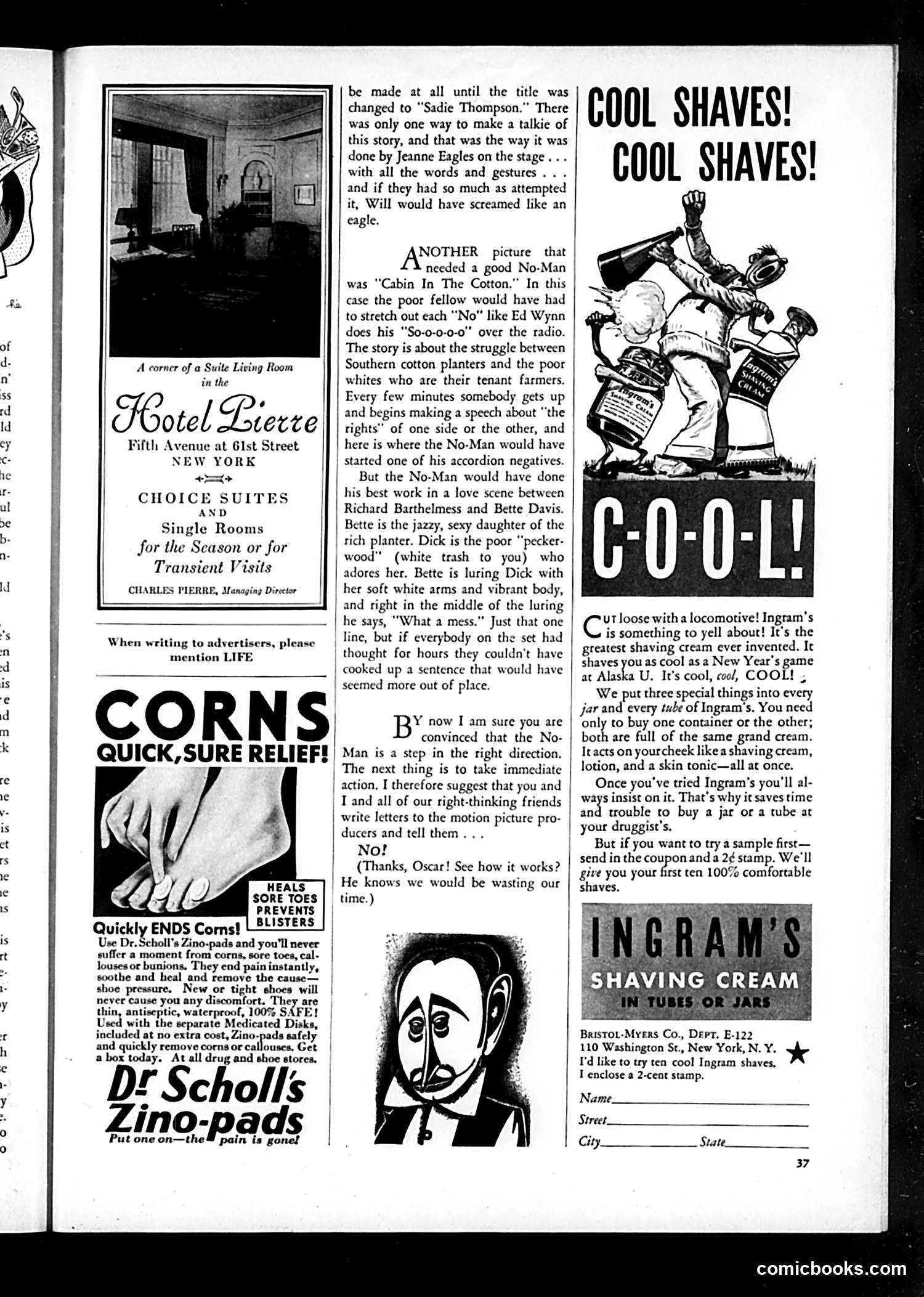
Analysis of Life Magazine Page Content This page is primarily advertising, with a brief editorial essay about Hollywood's "No-Man"—a hypothetical figure who would reject overly dramatic dialogue in early "talkie" films. The Editorial Concept: The writer discusses how certain films adapted from stage plays suffered from theatrical excess when converted to sound cinema. He references specific 1928-1929 films like "Sadie Thompson" and "Cabin in the Cotton," arguing that actors needed to speak more naturally for movies. The "No-Man" would have prevented absurd lines—like Richard Barthelmess saying "What a mess" during a romantic scene with Bette Davis. The Advertisements: The page features vintage product ads: Dr. Scholl's Zino-pads (corn remedies), Hotel Pierre luxury accommodations, and Ingram's Shaving Cream—the largest ad, featuring a caricatured face and emphasizing cooling sensation. Historical Context: This reflects the early sound era's growing pains, when filmmakers struggled transitioning from silent cinema to dialogue-heavy talkies. The satire critiques theatrical over-acting that seemed ridiculous on film.
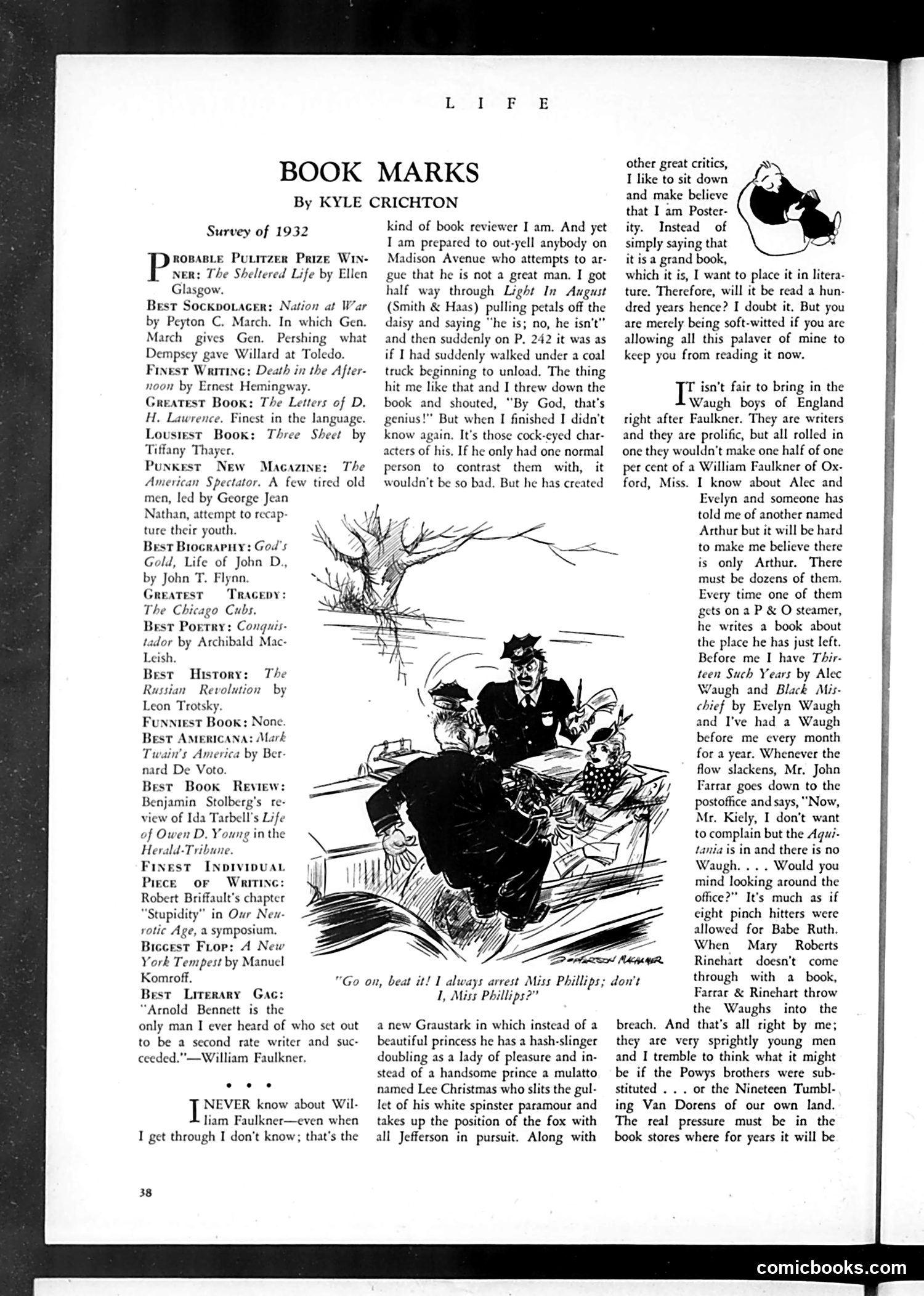
Book Marks: 1932 Literary Survey This is Kyle Crichton's humorous "Book Marks" column surveying notable 1932 publications. The main cartoon depicts a policeman arresting "Miss Phillips," illustrating a joke about William Faulkner's *Light in August*—the officer says he "always arrests Miss Phillips," referring to a scandalous character in the novel. Crichton praises Faulkner as a genius despite finding his work bewildering, noting the protagonist Lee Christmas (a mulatto) murders his white lover—shocking content for 1932. He contrasts this with England's prolific Waugh brothers (Alec, Evelyn, and presumably others), who churn out travel books so prolifically that publisher John Farrar humorously complains when no new Waugh manuscript arrives with incoming ships. The satire targets both literary merit (Faulkner's difficulty versus the Waughs' commercial productivity) and publishing industry absurdities.
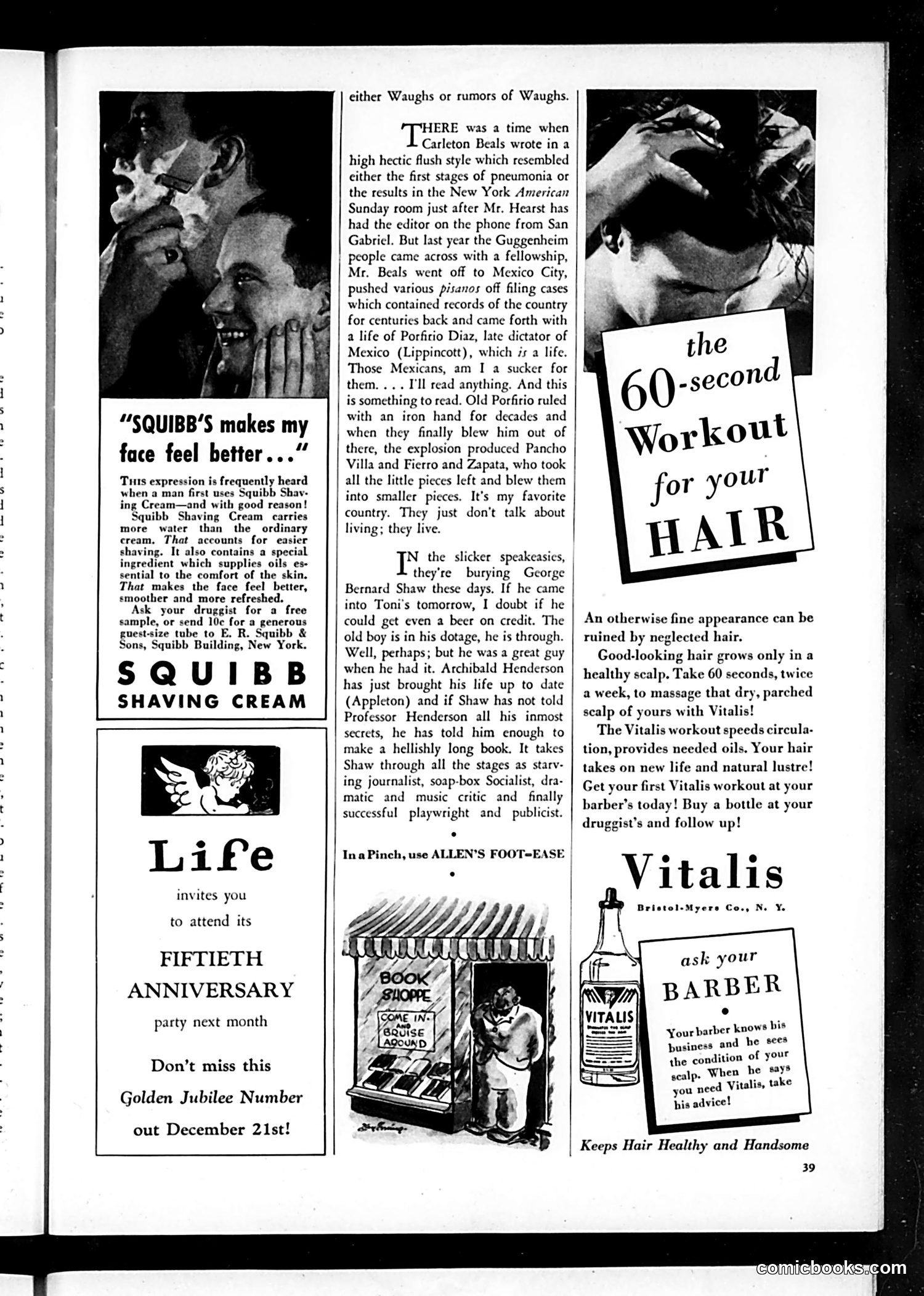
Analysis of Life Magazine Page Content This is primarily a product advertising page rather than a satirical cartoon page. The main content consists of three advertisements (Squibb Shaving Cream, Vitalis hair product, and Allen's Foot-Ease) interspersed with editorial commentary. The central text discusses Carleton Beals's biography of Mexican dictator Porfirio Díaz and Archibald Henderson's biography of George Bernard Shaw. The writer expresses enthusiasm for Beals's work on Mexico and Mexican revolution figures (Villa, Zapata), while suggesting Shaw's cultural relevance has declined ("in his dotage"). References include: - William Randolph Hearst (newspaper magnate known for editorial control) - Guggenheim Fellowship (prestigious arts grant) - Mexican Revolution figures and the Díaz era The tone is casual, gossipy commentary typical of Life's satirical style, mixing book reviews with speakeasy culture and social observation rather than presenting coherent political satire.
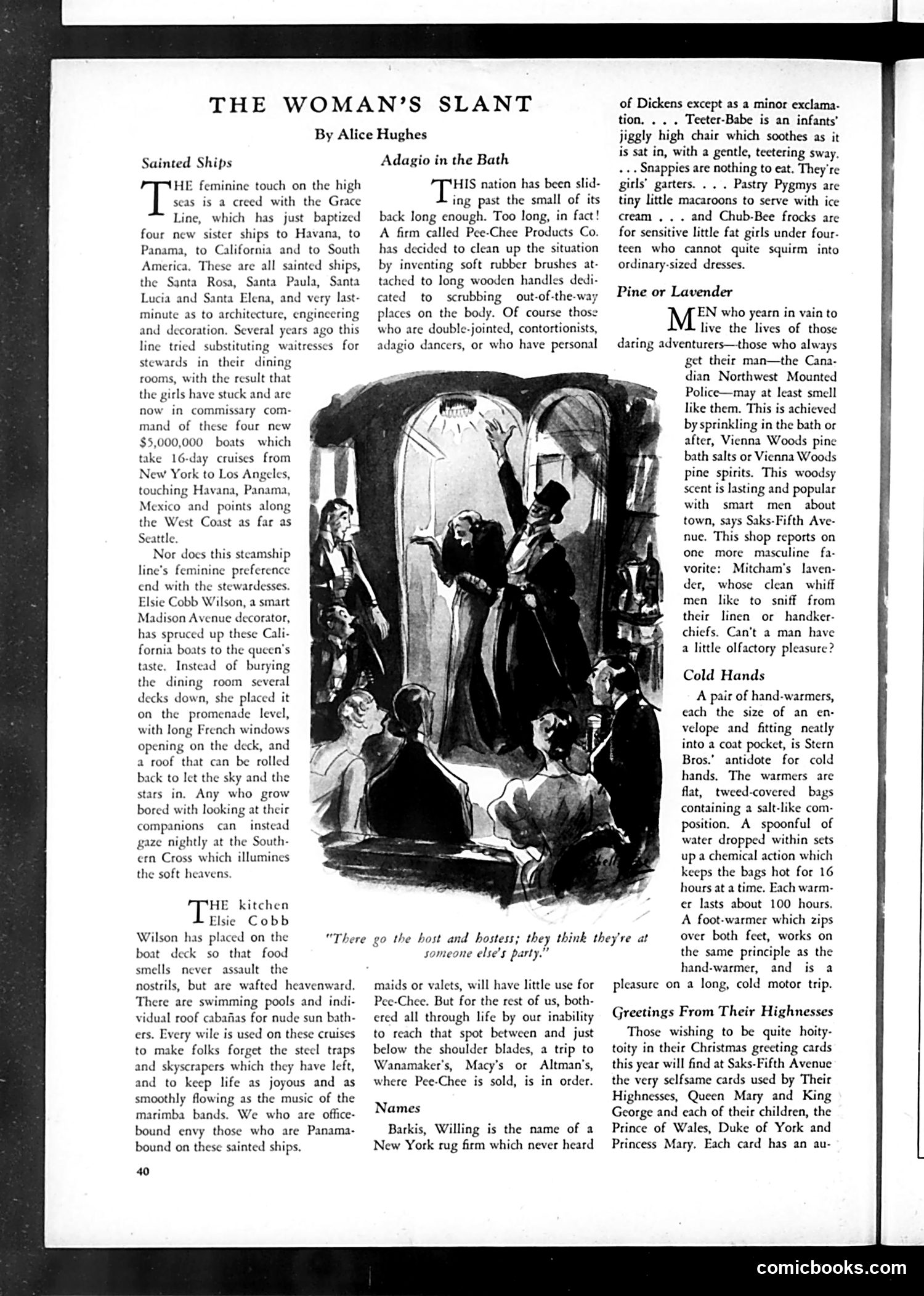
"The Woman's Slant" - Life Magazine Article Analysis This is a women's consumer column by Alice Hughes covering luxury products and lifestyle trends. The cartoon depicts passengers aboard a Grace Line cruise ship, with the caption joking that the affluent travelers believe they're at "someone else's party"—satirizing their pretense or obliviousness to their own conspicuous consumption. The column celebrates the feminization of cruise ship design: female stewards, a female decorator (Elsie Cobb Wilson) who relocated the dining room to offer ocean views, and modern amenities like swimming pools and individual cabanas. It's presented as progressive luxury. The surrounding sections advertise novelty products: bathroom brushes for hard-to-reach spots, children's furniture and clothing with whimsical names, and bath salts marketed to appeal to masculine adventure fantasies (evoking the Canadian Mounted Police). The satire is gentle—poking fun at consumers' aspirations and clever marketing rather than condemning them. For modern readers, it reveals 1930s-era attitudes about gender, class leisure, and advertising's manipulation of desire.
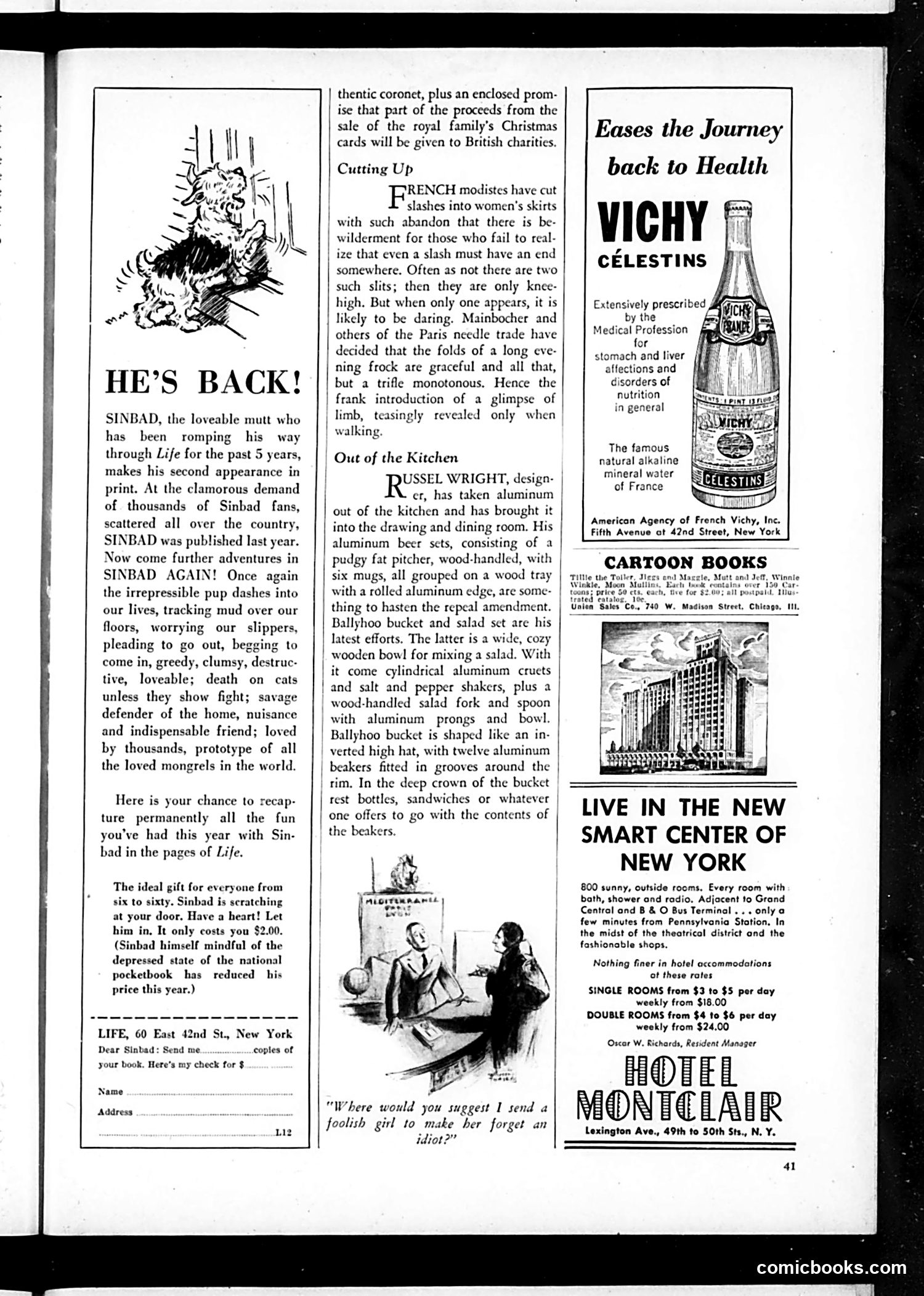
Life Magazine Page Analysis This page combines advertisements with promotional content for Sinbad, a popular comic character. The main feature announces "He's Back!" — promoting a new Sinbad book collection for $2.00. The text describes Sinbad as an endearing, mischievous dog character who appeared in Life magazine for five years, appealing to readers' nostalgia and affection for the character. The page also includes fashion and design commentary typical of Life's satirical content: French fashion designers are cutting daring slashes into women's skirts, and industrial designer Russel Wright is repurposing aluminum kitchen goods (pitcher sets, salad bowls) for the dining room — suggesting modernist design trends filtering from utilitarian to decorative spaces. The remaining content is primarily advertisements for Vichy mineral water (promoted for digestive health), a New York hotel, and a cartoon book series. There is minimal political satire on this particular page — it reflects 1930s consumer culture and design trends rather than political commentary.
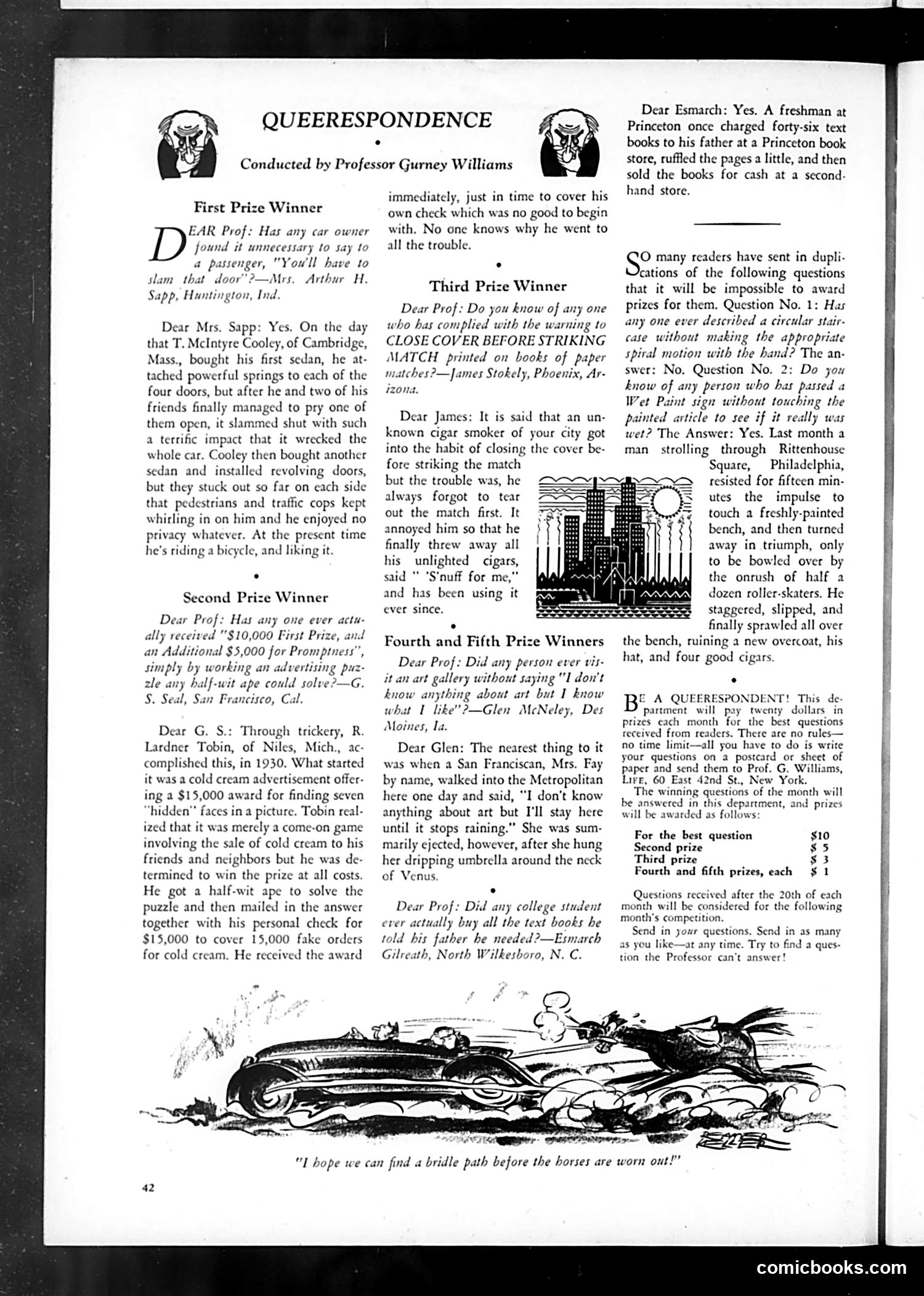
"Queerespondence": Life Magazine's Humorous Question-and-Answer Column This page features a satirical advice column where readers submit absurd hypothetical questions, and the editor provides increasingly ridiculous fictional answers—the joke being that the situations described are so improbable they're clearly impossible. The humor targets human nature through exaggeration: a man who installs car springs so powerful they wreck his vehicle; a con artist who uses a trained ape to solve a puzzle contest; a cigar smoker too stubborn to remove matches before lighting; a woman who refuses to leave an art gallery during a rainstorm, eventually getting ejected after hanging her wet umbrella on a Venus statue. The column mocks common human behaviors—stubbornness, vanity, gullibility—by presenting extreme versions. The final cartoon shows a wrecked car, reinforcing the absurdist tone. This represents *Life* magazine's characteristic 1930s-era satirical humor: witty, cynical about human nature, and relying on readers' recognition of everyday irrationalities pushed to comic extremes.
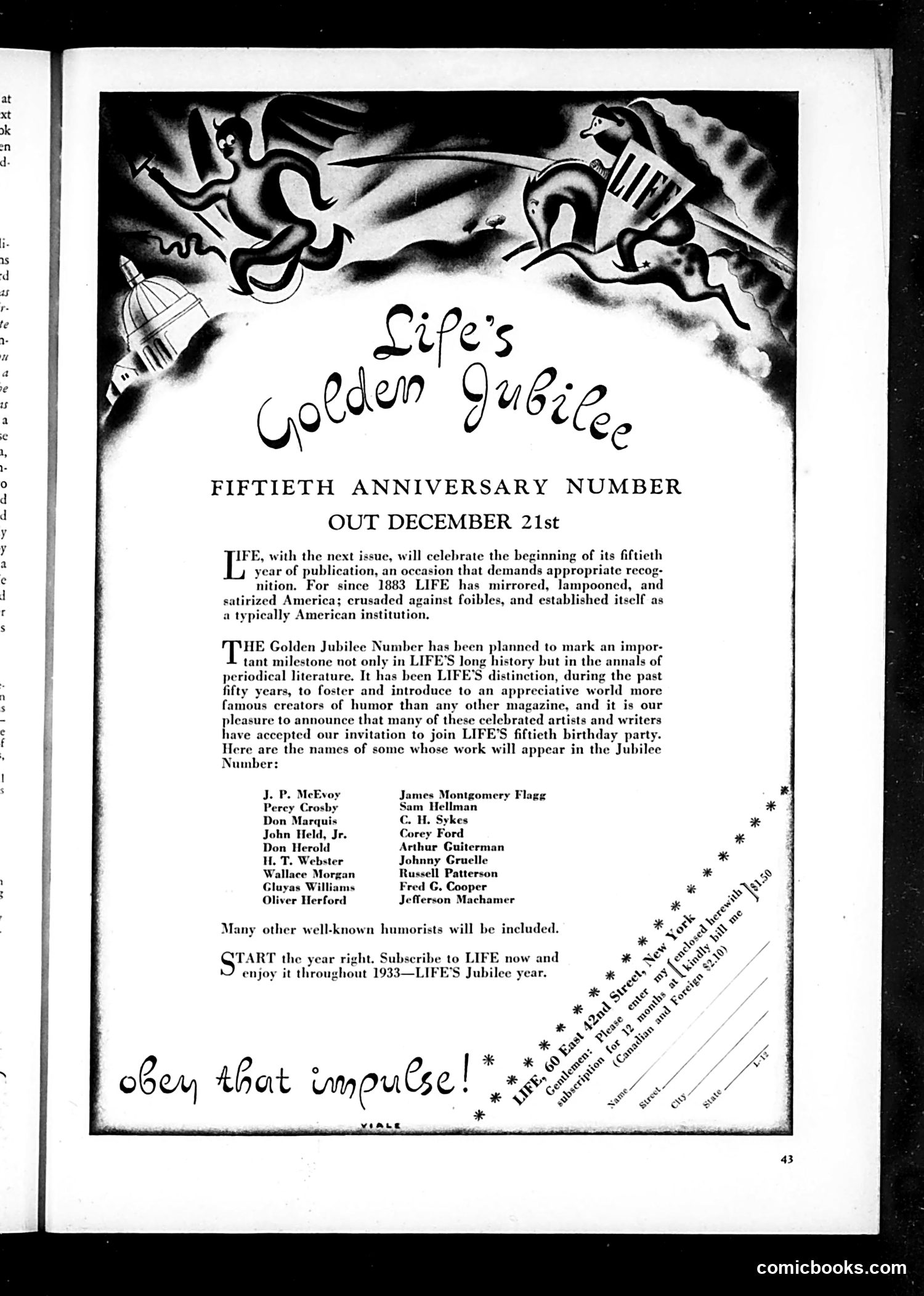
Life Magazine's 50th Anniversary Advertisement This is primarily an advertisement and announcement, not a political cartoon. Life magazine celebrates its fiftieth anniversary (beginning in 1883, marking 1933 as the jubilee year). The decorative header features art deco-style figures and classical imagery celebrating the milestone. The page lists prominent humor contributors Life plans to feature, including cartoonists John Held Jr., H.T. Webster, and Don Herold—major figures in American comic art of that era. The magazine positions itself as having shaped American satirical culture for five decades. The phrase "obey that impulse!" at bottom is a subscription pitch encouraging readers to begin their yearly subscription during Life's celebration year. This is essentially a trade advertisement promoting the special December 21st jubilee issue and encouraging new subscriptions for 1933.
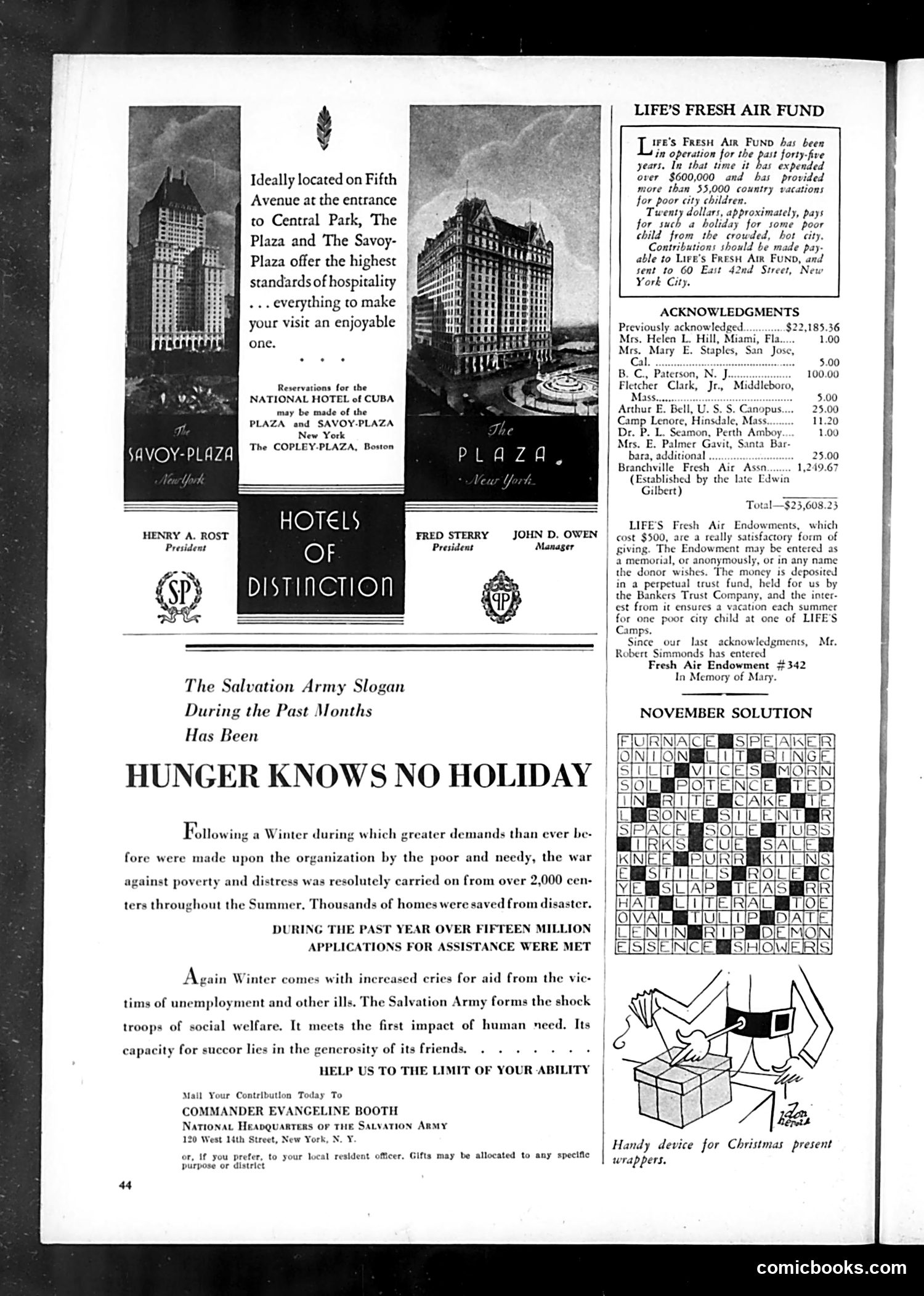
Life Magazine Page Analysis This page is primarily advertising and charitable appeals, not political satire. It features: Hotels of Distinction: Luxury hotel advertisements (Savoy-Plaza, Plaza, Copley-Plaza) positioned above the fold, targeting wealthy readers. Salvation Army Appeal: The main content uses the slogan "Hunger Knows No Holiday" to solicit donations for winter relief. The text emphasizes the organization handled 15 million assistance requests annually and needs continued support as cold weather returns. Life's Fresh Air Fund: A charity appeal noting the fund has provided 35,000+ country vacations for poor city children over 45 years, seeking $20 donations per child. Other Content: A crossword puzzle solution and a small cartoon showing gift-wrapping technique. The page reflects Depression-era charitable concerns—poverty, unemployment, and child welfare—positioned alongside luxury advertising, creating implicit social commentary about inequality without explicit satire. The juxtaposition itself is the message.
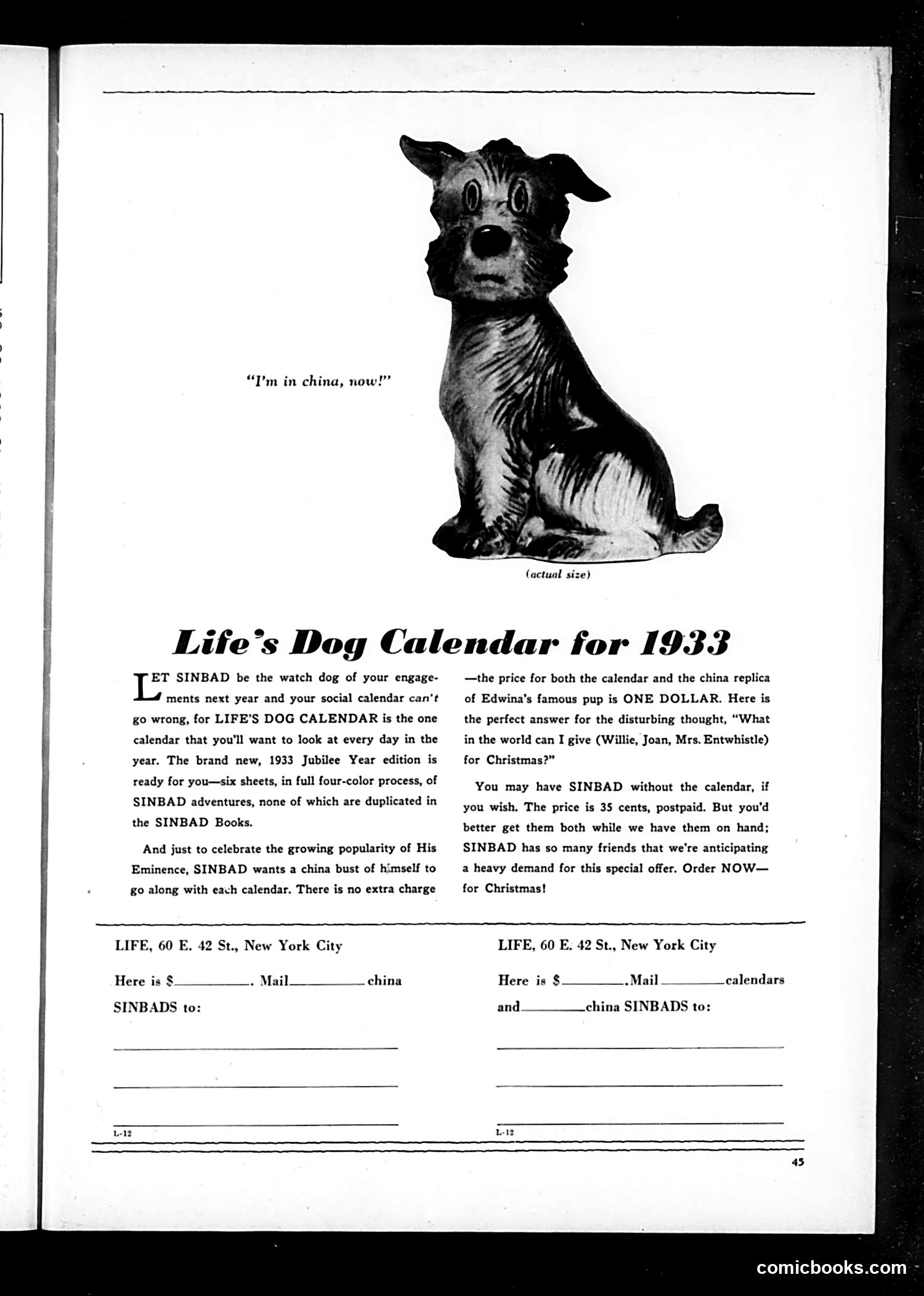
Life's Dog Calendar Advertisement (1933) This is primarily an advertisement, not political satire. It promotes *Life* magazine's 1933 calendar featuring Sinbad, a popular cartoon dog character (described as "Edwina's famous pup"). The joke relies on the tiny illustration: Sinbad appears startled with the caption "I'm in china, now!" — a pun playing on the dual meaning of "china" (the country vs. porcelain dishware). The ad offers both a calendar and a small china bust of Sinbad for one dollar, marketed as a Christmas gift solution. This reflects 1930s consumer culture, where novelty merchandise tied to popular comic characters was a standard marketing strategy. The page includes order blanks for mail purchase directly from *Life*'s New York office, typical of period magazine advertising.
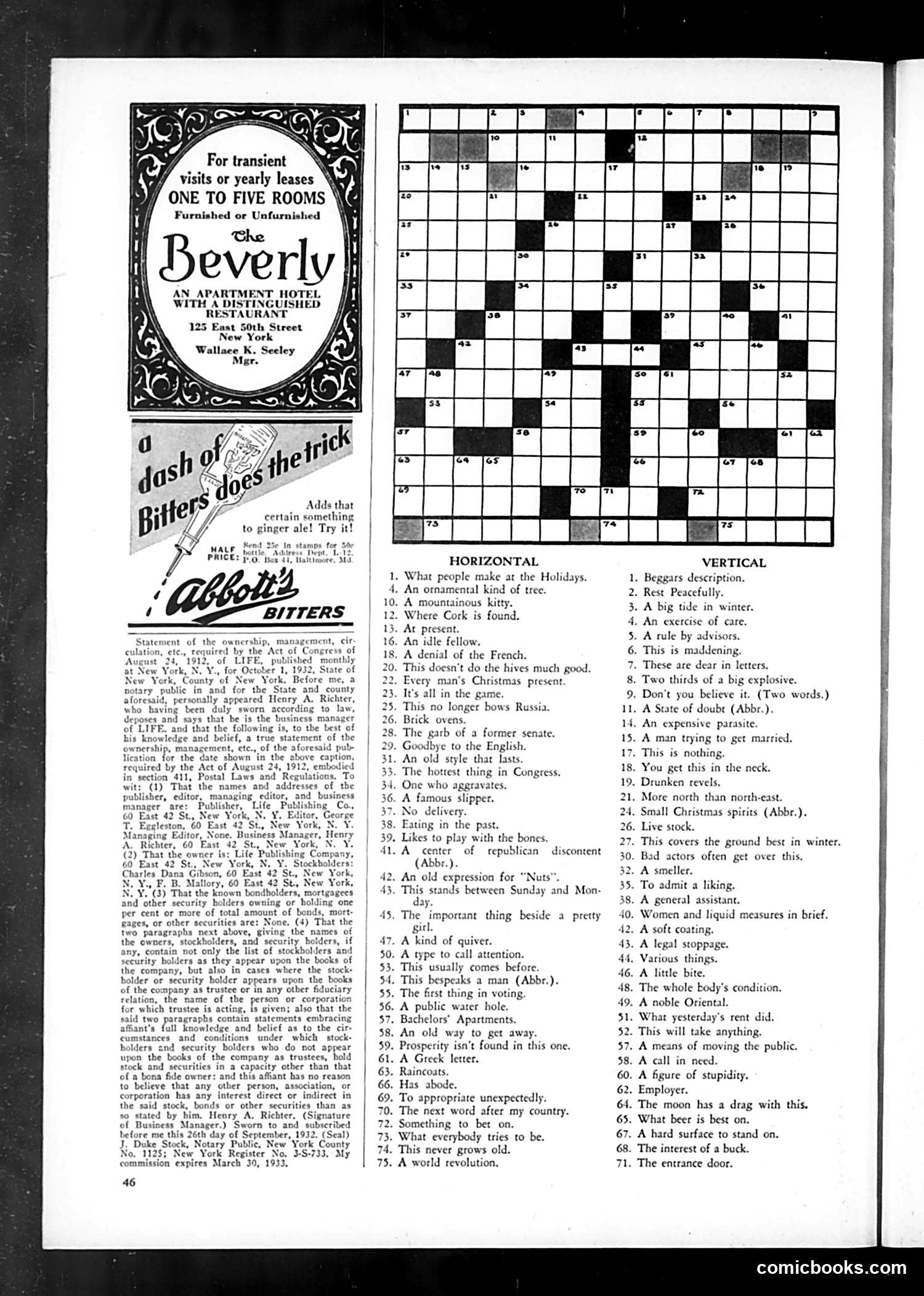
What This Page Shows This is primarily a crossword puzzle page from Life magazine, accompanied by advertisements and legal ownership statements required by federal law. The advertisements include The Beverly apartment hotel (125 East 50th Street, New York) and Abbott's Bitters, a digestive tonic. The crossword itself contains topical references reflecting the early 1930s Depression era and political climate. Clues reference contemporary issues: "This no longer bows Russia" (alluding to Soviet shifts), "The hottest thing in Congress" (legislative disputes), and "A world revolution" (likely referencing communist anxiety or labor unrest of the period). The puzzle's mundane clues about holidays, Christmas, and everyday life suggest Life magazine's mixed audience—simultaneously satirizing middle-class concerns while publishing sophisticated humor. The legal notice certifies the magazine's ownership and circulation, standard practice for publications of this era.
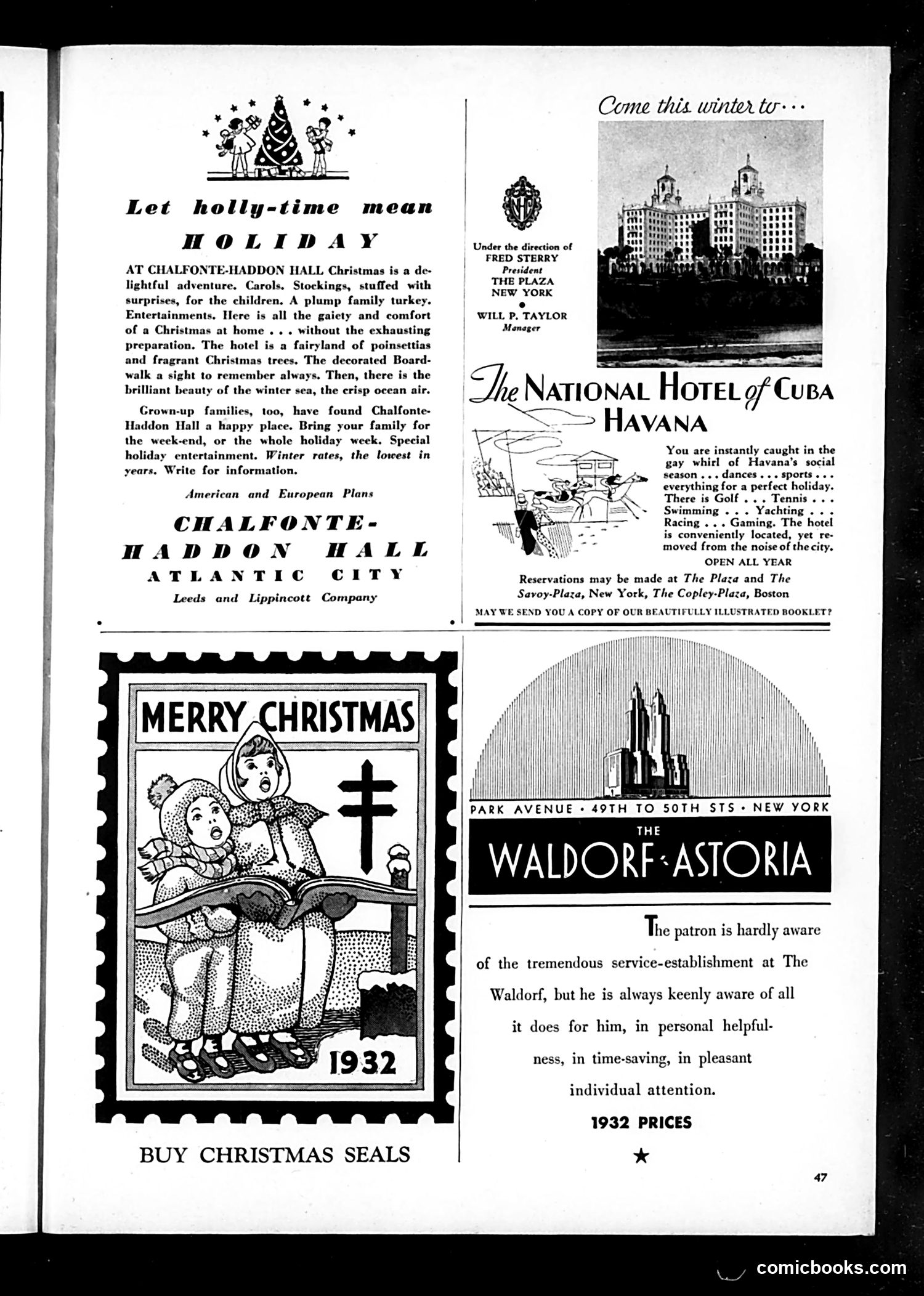
Analysis This page is primarily advertising, not satire. It contains holiday-season hotel promotions from 1932. The only cartoon element is a Christmas Seals advertisement (lower left) showing two children in winter clothing beside a cross, with "Merry Christmas" and "1932" text. This is a straightforward charitable appeal—Christmas Seals were (and are) fundraising stamps sold to support tuberculosis prevention and treatment. The imagery is sentimental rather than satirical. The page's other content advertises luxury hotels: Chalfonte-Haddon Hall (Atlantic City), the National Hotel of Cuba (Havana), and the Waldorf-Astoria (New York). These ads emphasize comfort, service, and escape—reflecting Depression-era marketing to wealthy travelers who could still afford such vacations. There is no political satire or social commentary visible. The page represents straightforward 1930s commercial messaging aimed at affluent readers.
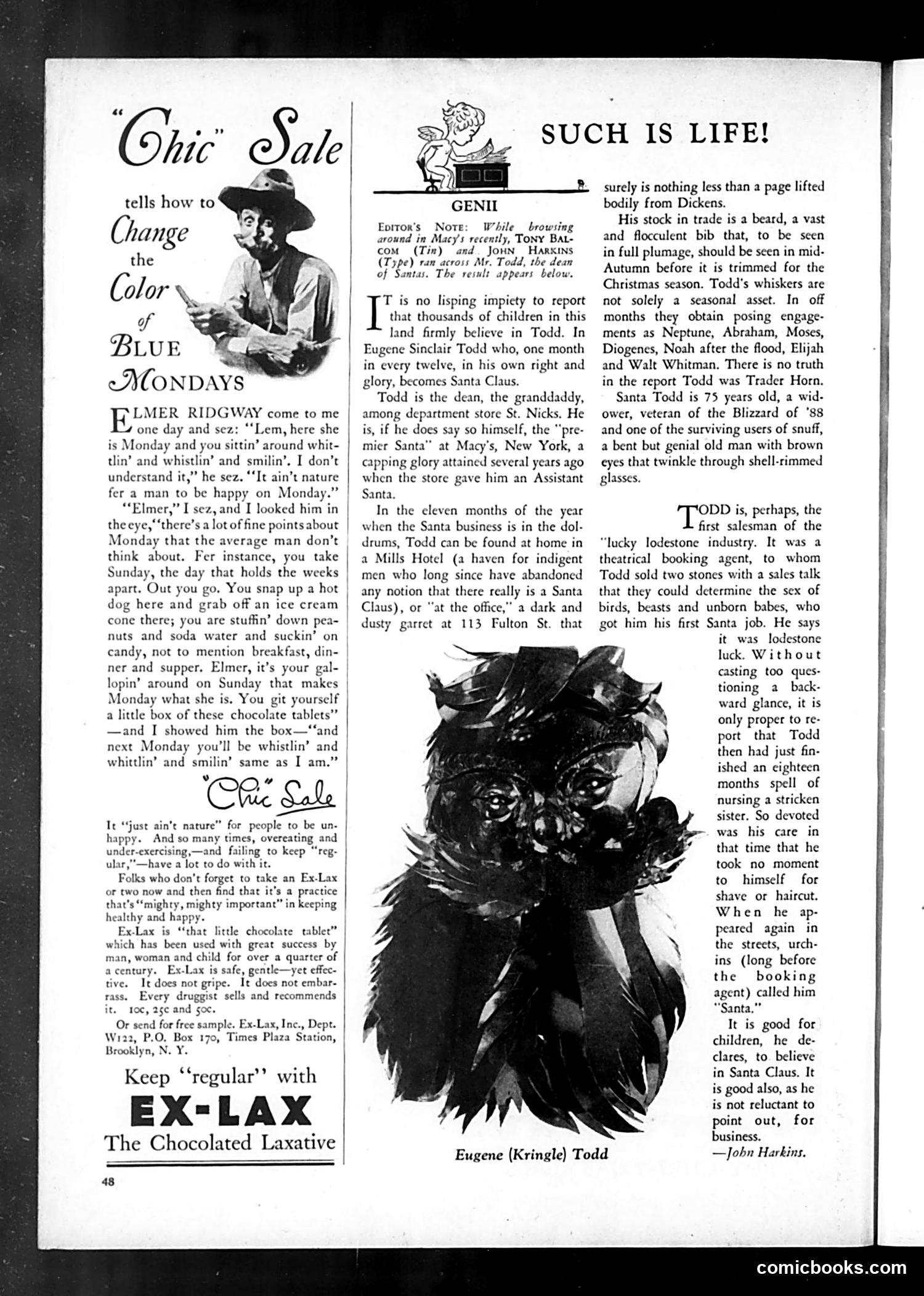
Analysis of Life Magazine Page This page combines advertisement and human-interest journalism typical of early-20th-century Life magazine. Left side: An Ex-Lax laxative ad uses a colloquial narrative voice ("Elmer Ridgway") to explain why people are unhappy on Mondays—overeating on Sundays causes digestive problems. The solution: take Ex-Lax chocolate laxative to stay "regular." This reflects contemporary pseudo-scientific health messaging that digestive regularity determined mood and wellness. Right side: "Such Is Life!" profiles Eugene (Kringle) Todd, a 75-year-old professional Santa Claus at Macy's in New York—the "premier Santa." The piece, illustrated with a portrait, notes he supplemented off-season Santa work by posing as other bearded historical/mythological figures (Neptune, Abraham, Noah, Whitman). The satire gently mocks both Todd's theatrical career and the commercialization of Christmas through department-store Santas. Together, the page reflects 1920s-30s American consumer culture: medicalized digestive anxiety and seasonal retail spectacle.
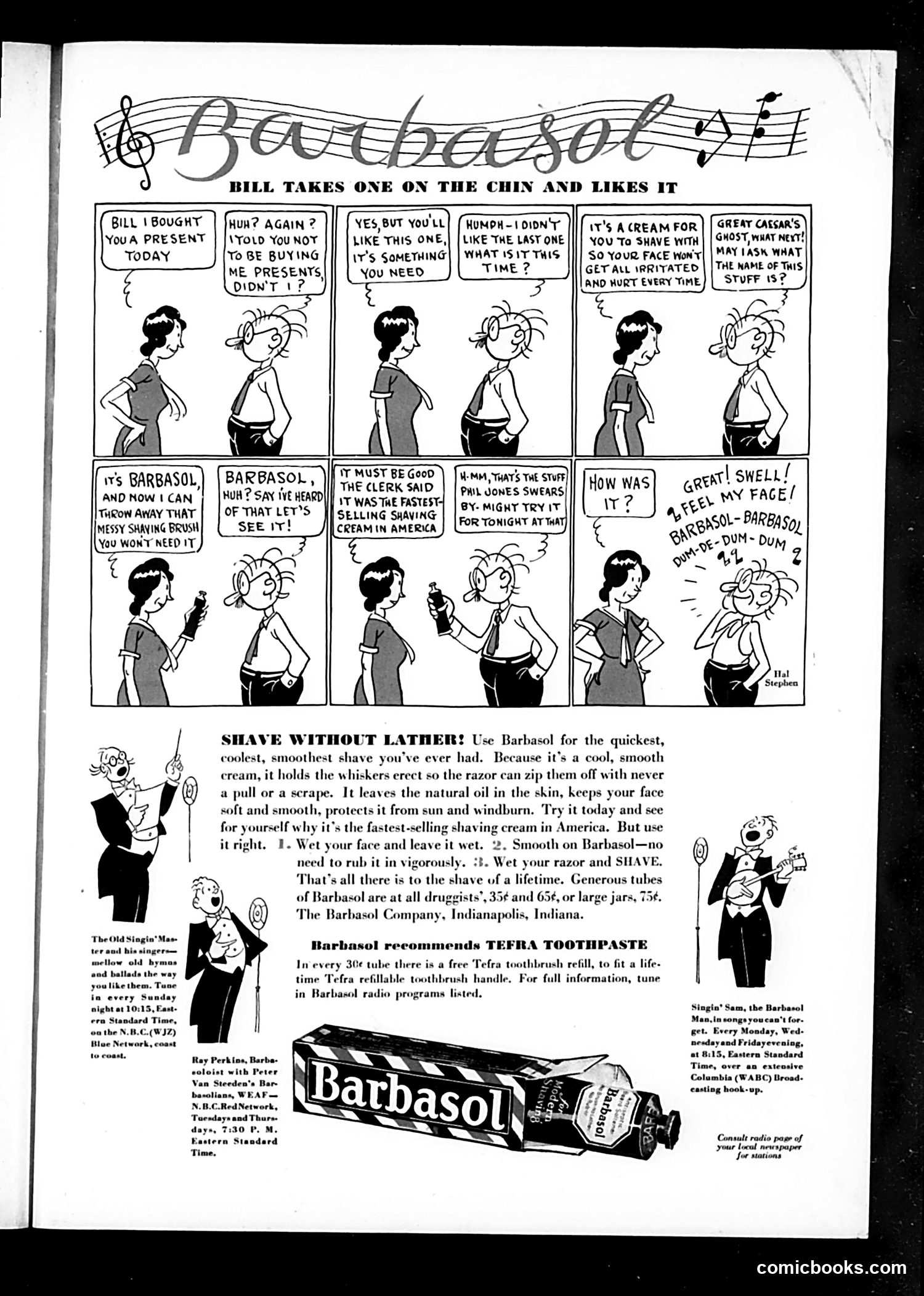
Political/Social Context for Modern Readers This is a vintage advertisement disguised as comic strip entertainment, a common marketing technique from the early-to-mid 20th century. The strip depicts a couple ("Bill" and his wife) where the husband repeatedly buys shaving products. The wife initially complains, but after Bill purchases Barbasol shaving cream, she's converted—even singing its praises in the final panel ("Great Caesar's ghost, what next!"). The "joke" is that Barbasol is so superior to traditional shaving brushes and messy lather that even a skeptical spouse becomes an enthusiastic endorser. The satire targets domestic consumer culture: wives' supposed role as household purchasing-decision critics, and the era's belief that the "right" product solves relationship friction. The bottom half shifts to straightforward advertising, promoting Barbasol's benefits and mentioning a radio program ("The Old Singin' Master") sponsored by the brand—showing how advertisements infiltrated entertainment media of this era.
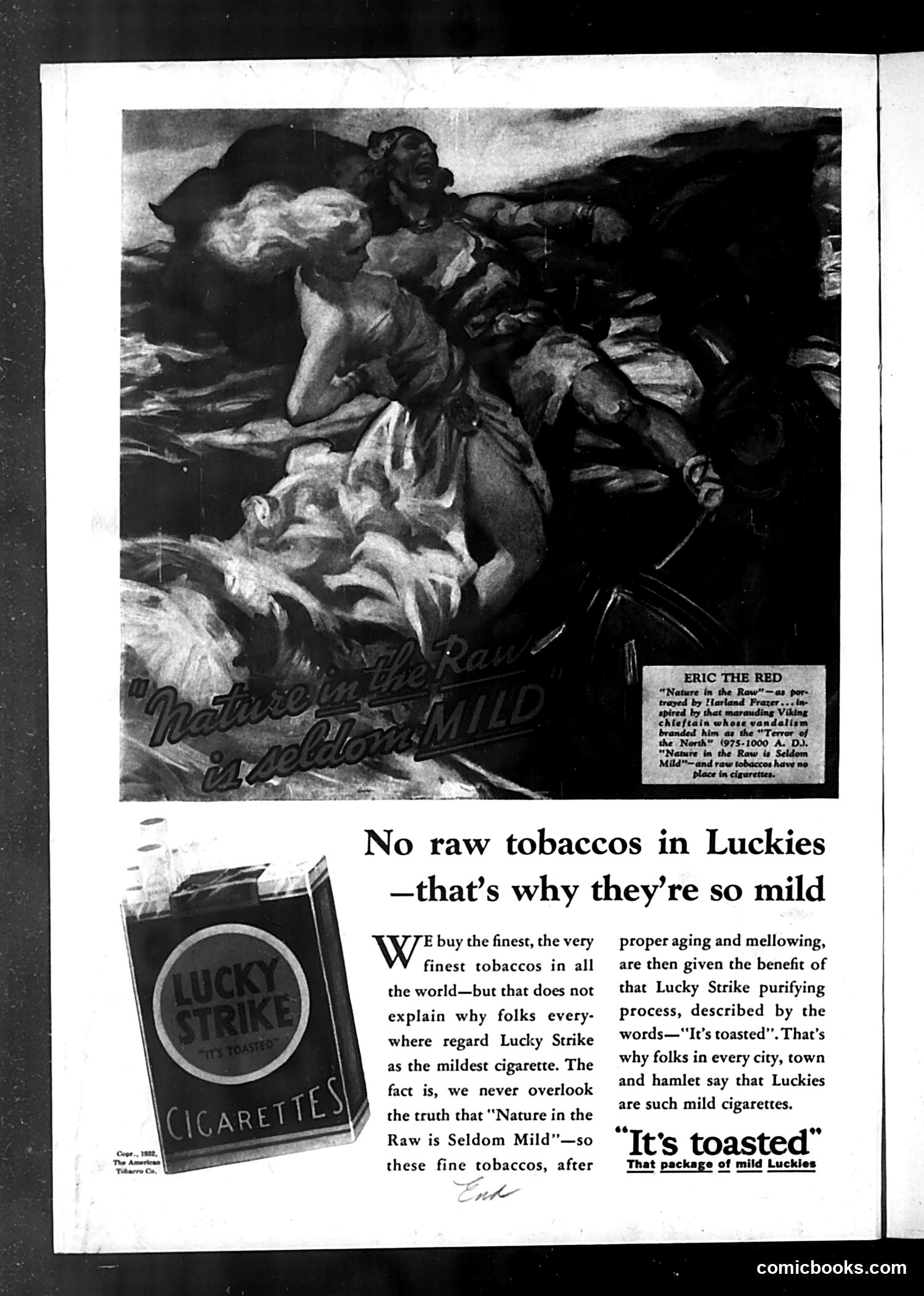
Analysis This is a Lucky Strike cigarette advertisement using a historical painting reference for marketing purposes. The image depicts Eric the Red, the Viking explorer (dated 975-1000 A.D.), shown in what appears to be a classical painting style. The ad's tagline—"Nature in the Raw is Seldom Mild"—pairs this "raw" historical figure with Lucky Strike's claim that their cigarettes are mild *because* they're processed ("toasted"). The joke relies on contrasting: - Eric the Red: brutal, uncivilized, "raw" nature - Lucky Strike cigarettes: refined, processed, therefore mild This advertisement exemplifies early 20th-century marketing that: 1. Used classical/historical imagery for prestige 2. Made unsubstantiated health claims (calling cigarettes "mild") 3. Marketed cigarettes to general audiences without health warnings The ad is notable today as a artifact of pre-regulation tobacco advertising, before such claims were restricted.

I can see this is a blank or nearly blank page from what appears to be a historical document, with only "comicbooks.com" visible at the bottom. The page itself contains no discernible cartoon, text, illustration, or satirical content that I can analyze. Without visible political figures, caricatures, dialogue, or social commentary on the actual page, I cannot identify what historical event or satire this was meant to convey. This appears to be either a blank page, a scanning/image quality issue, or possibly a title/separator page from the original publication. To provide meaningful historical analysis, I would need a page with visible cartoon artwork or text content.