life
Life — January 1933
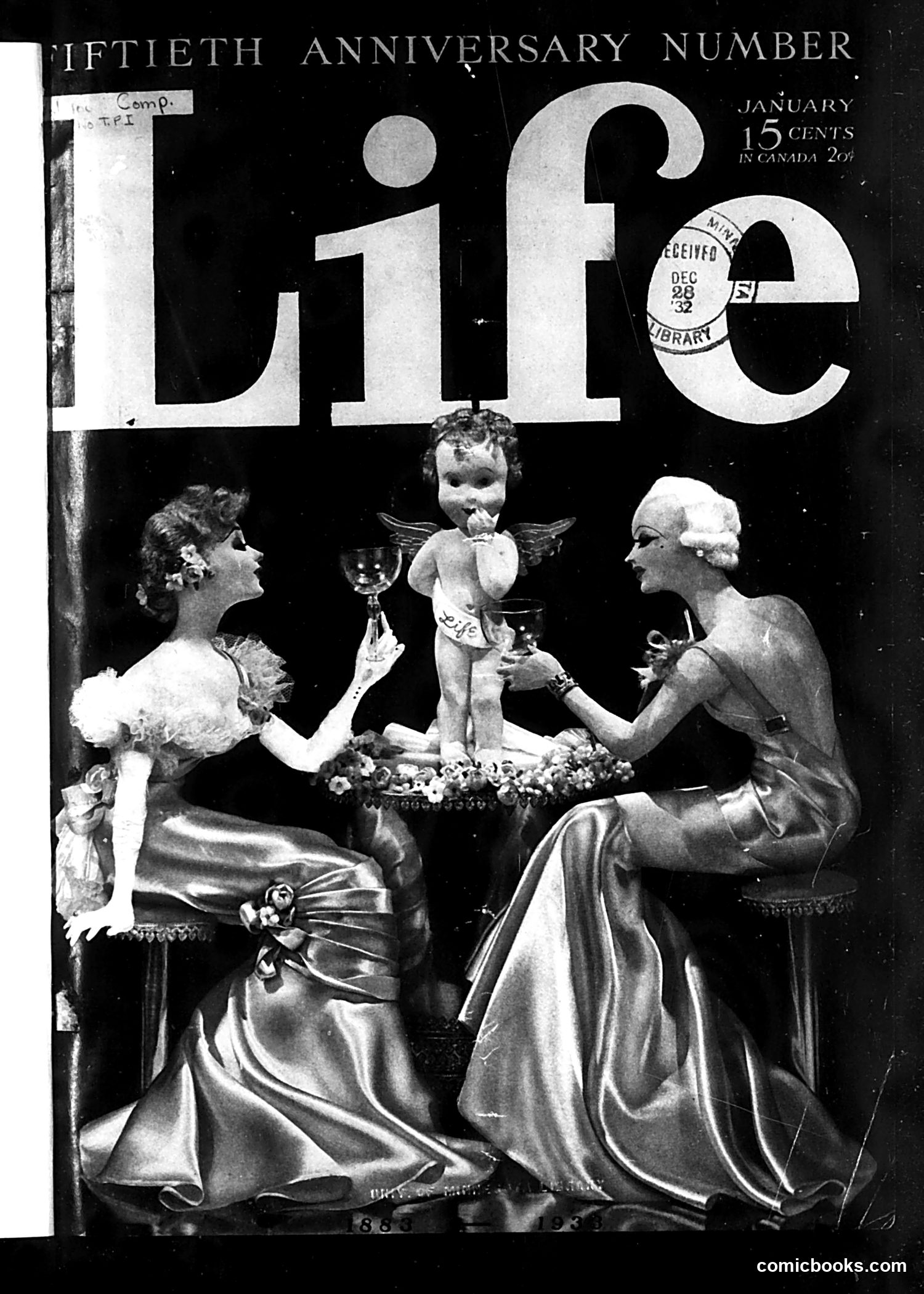
Life Magazine 50th Anniversary Cover Analysis This is Life magazine's fiftieth anniversary issue (January, 15 cents). The cover depicts an allegorical scene: two elegantly dressed women in evening gowns present a cherub-like figure holding trophy cups, surrounded by flowers and garland. The imagery appears to celebrate Life magazine's golden jubilee through classical/allegorical symbolism—the cherub likely represents the magazine itself or the spirit of satire/humor it embodied. The two women in formal dress suggest prosperity and sophistication, while the trophies indicate achievement and success. The overall composition uses romantic, celebratory iconography typical of 1930s magazine design to commemorate the publication's longevity and cultural significance as a leading American humor and satire publication.
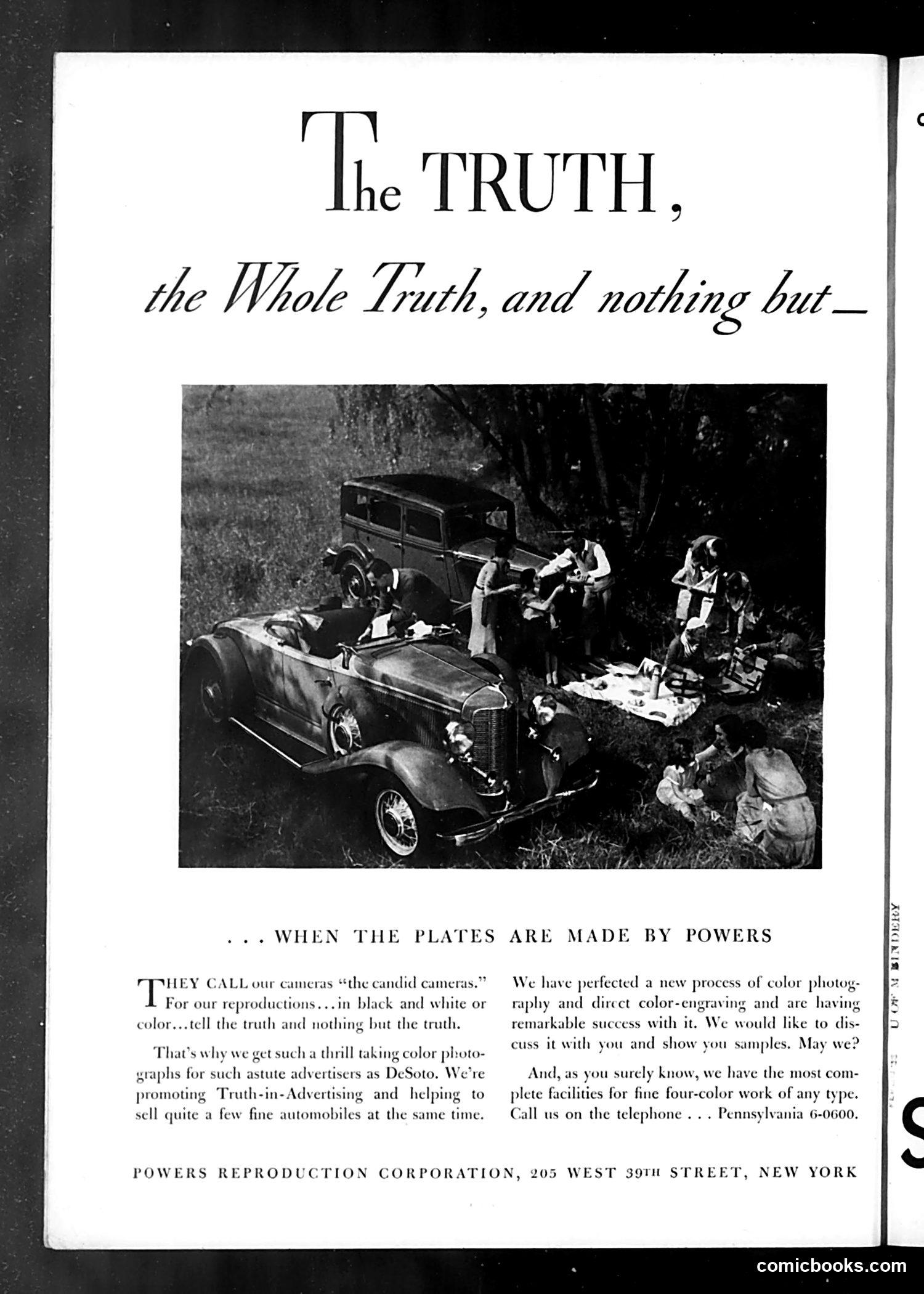
Analysis This is a Powers Reproduction Corporation advertisement, not editorial content or satire. The page promotes their color photography and printing services for advertising. The image shows a casual picnic or outdoor social gathering with vintage automobiles (appearing to be 1930s models) and well-dressed people, likely representing a DeSoto car advertisement that Powers produced. The "candid camera" reference suggests capturing natural, unposed moments—a relatively novel concept in advertising photography at the time. The satirical hook is subtle: Powers frames their work as "Truth-in-Advertising," claiming their color photography captures reality more honestly than black-and-white images, while simultaneously promoting automobiles and lifestyle imagery designed to appeal to aspirational consumers. This is ironic advertising that acknowledges advertising's persuasive intent while claiming authenticity.
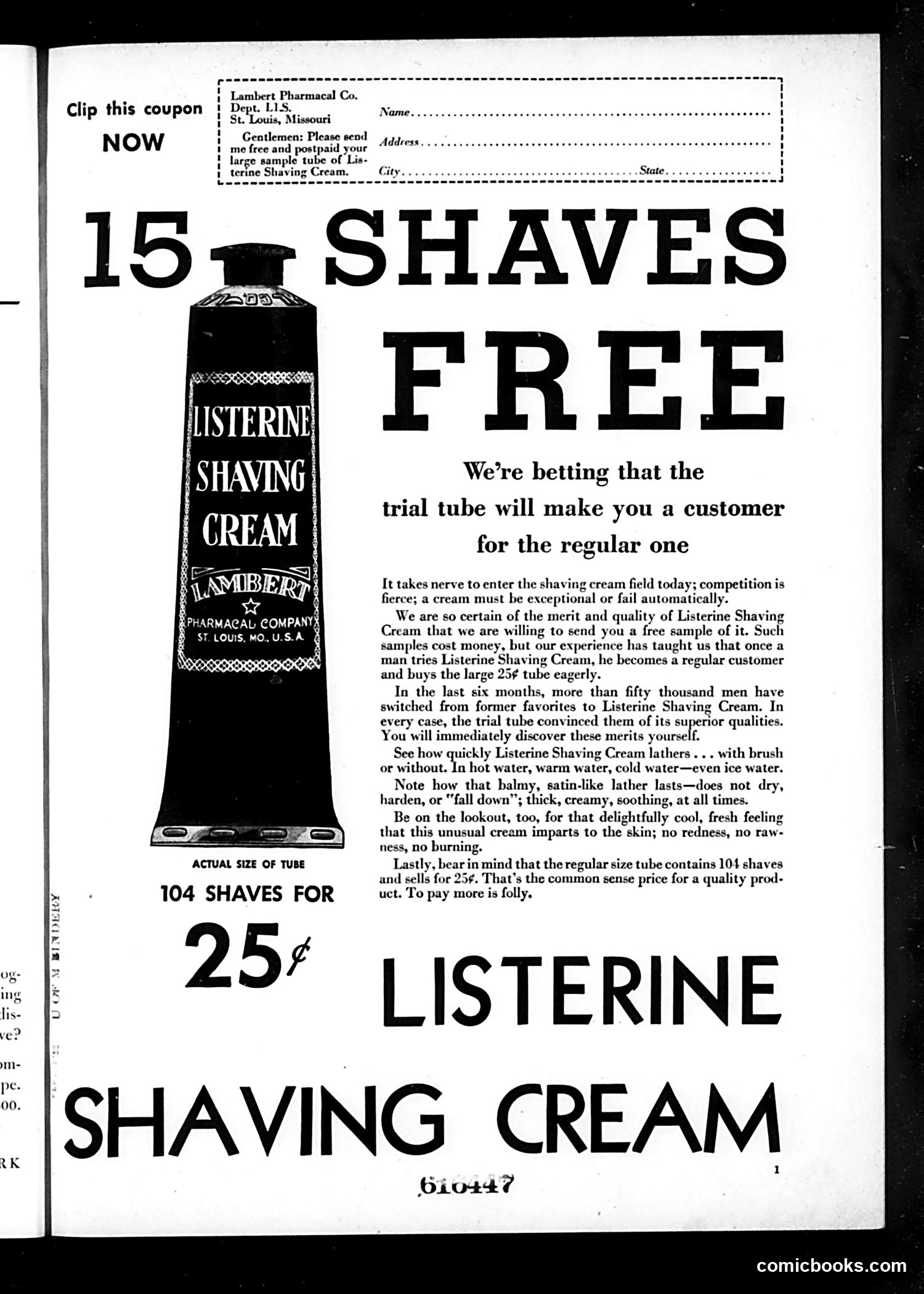
Analysis This is not a cartoon or satirical content — it's a straightforward advertisement for Listerine Shaving Cream from the Lambert Pharmacal Company (St. Louis, Missouri). The ad offers 15 free shaves via a trial tube coupon, then promotes the full-size product at 25¢ for 104 shaves. The marketing strategy emphasizes quality and value: the company claims that users of the trial sample will become regular customers, citing that "more than fifty thousand men have switched from former favorites to Listerine Shaving Cream in the last six months." The ad highlights product benefits — quick lathering, soothing properties, and a cool feeling — typical of vintage shaving cream marketing. This is period advertising, not political satire.
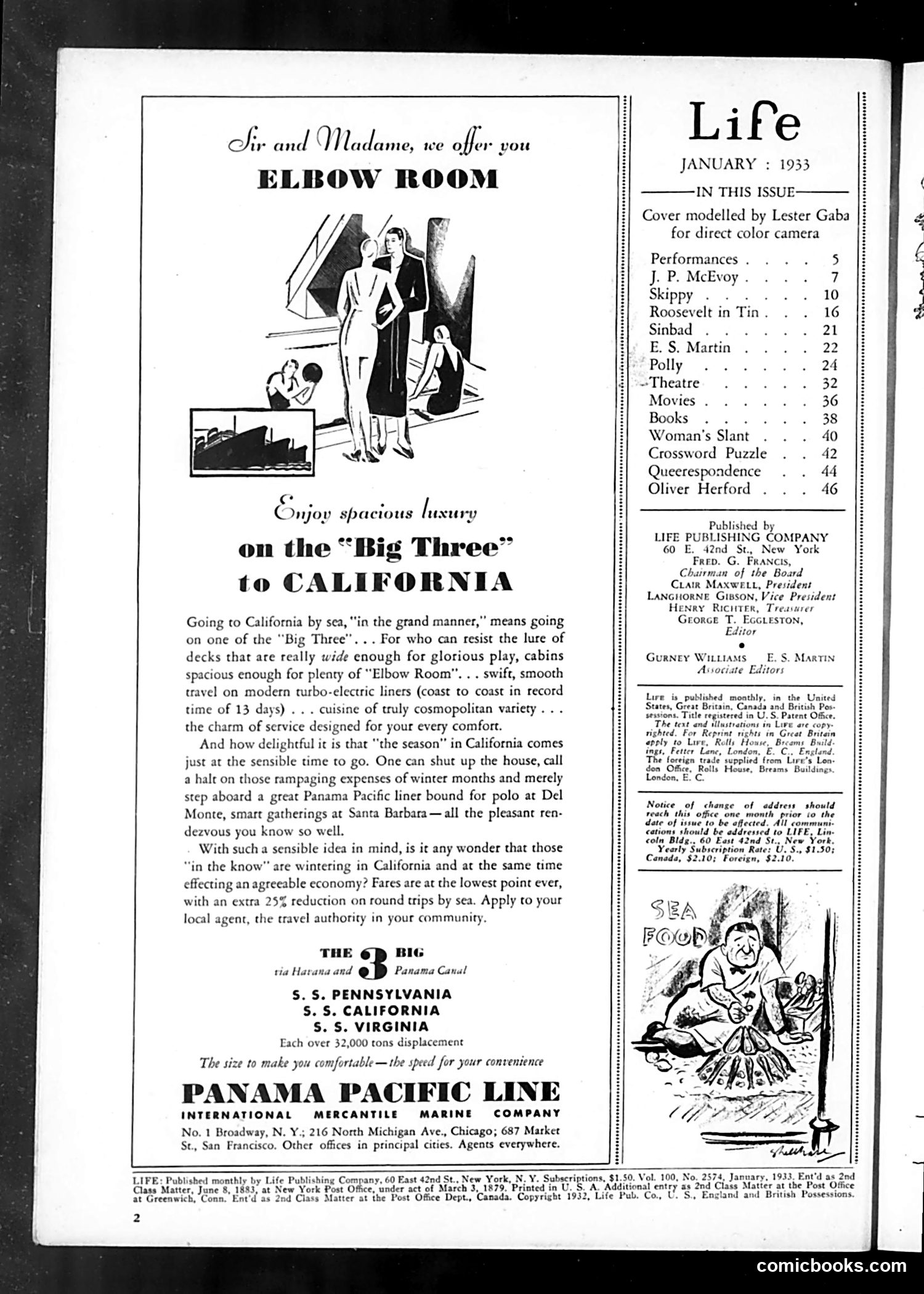
Analysis This page is primarily advertising and editorial content, not political satire. The left side features a cruise ship advertisement for the Panama Pacific Line, promoting luxury travel to California aboard three large vessels ("the Big Three"). It emphasizes spacious cabins, comfort, and economical fares—particularly a 25% reduction on round-trip rates by sea. The right side is the table of contents for Life magazine's January 1933 issue, listing articles on performances, notable figures (J.P. McEvoy, Roosevelt), and entertainment topics. At the bottom right is a maritime-themed illustration labeled "Sea Food"—a humorous drawing of a sailor with seafood, likely a joke about ship provisions. No political figures or satire are present on this page. It reflects 1933 commercial culture and magazine layout conventions.
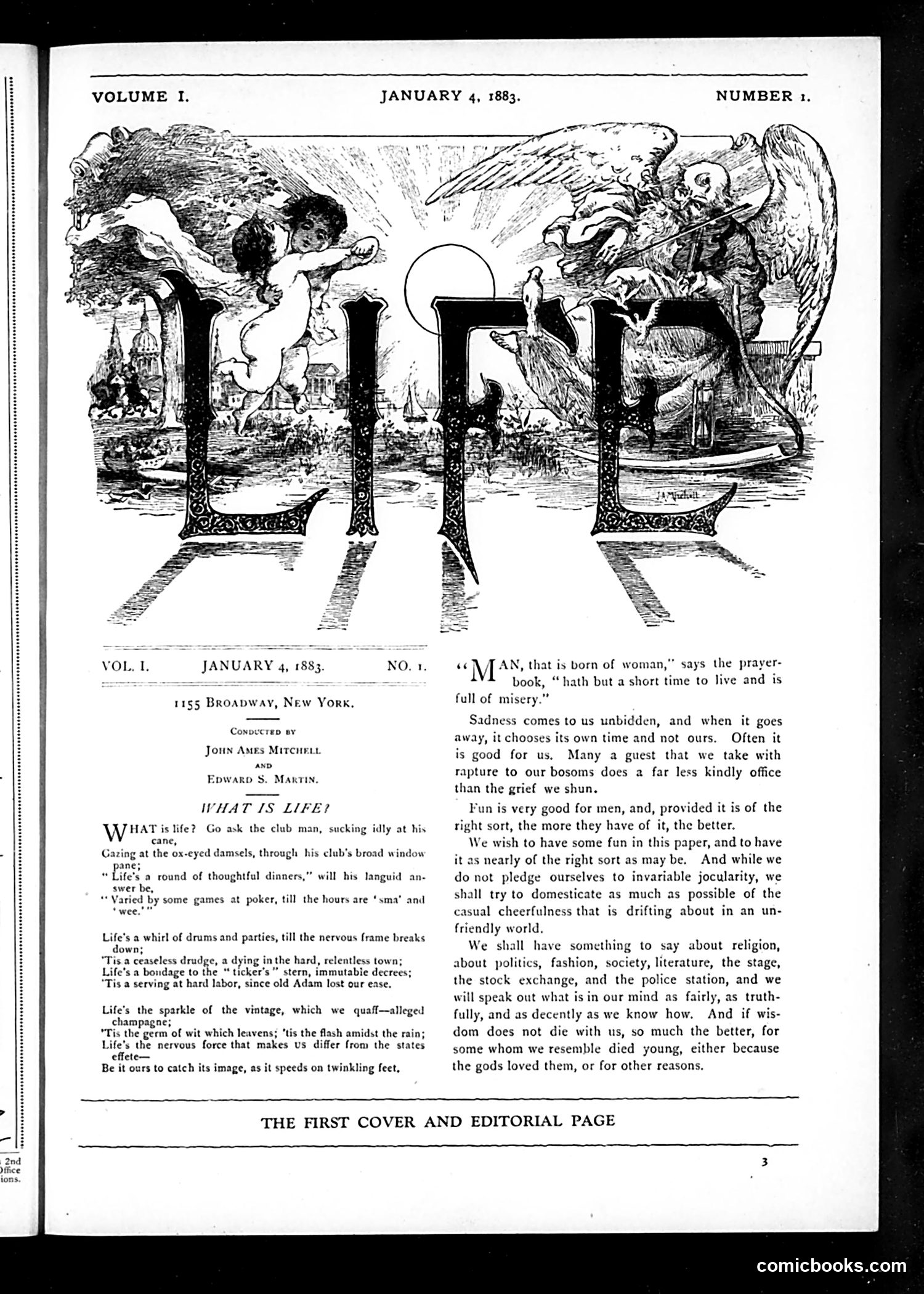
Life Magazine, January 4, 1883 - First Issue This is the inaugural cover and editorial page of *Life* magazine. The elaborate illustration frames the title "LIFE" with allegorical figures—cherubs and a winged figure (possibly representing fate or fortune) above a cityscape below, suggesting life's varied experiences. The editorial, titled "What is Life?", presents life philosophically through poetic verse, describing it as "a round of thoughtful dinners," games, "drums and parties," and social pleasures—a characterization reflecting the magazine's intended audience: affluent, leisured New Yorkers. The text establishes *Life*'s editorial mission: publishing humor about "religion, politics, fashion, society, literature, the stage, the stock exchange, and the police station," while maintaining truthfulness and decency. This opening defines *Life* as a publication for urban elites seeking sophisticated social satire.
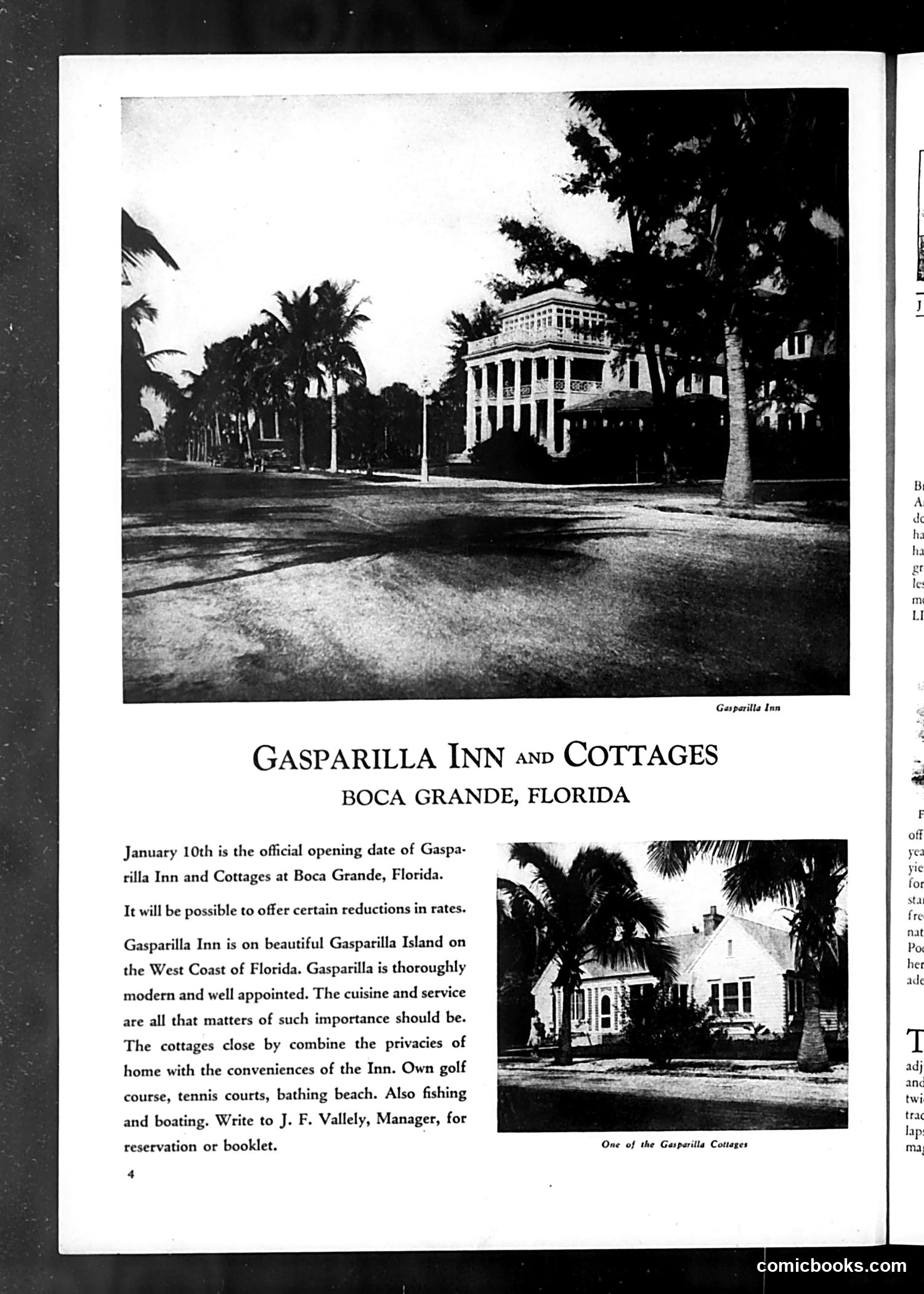
Analysis This is not a cartoon or satire page, but rather a straightforward advertisement for the Gasparilla Inn and Cottages in Boca Grande, Florida. The page features two photographs of the resort: the main inn (a grand colonial-style building with columns) and one of the accompanying cottages. The text describes amenities including golf, tennis, bathing beach, fishing, and boating. It notes the official opening date as January 10th and offers reduced rates, directing inquiries to J. F. Vallely, Manager. This appears to be tourism/hospitality advertising from an era when Life magazine featured commercial content alongside satirical material. There is no political commentary, caricature, or joke to decode—it's simply promotional material for a Florida resort.
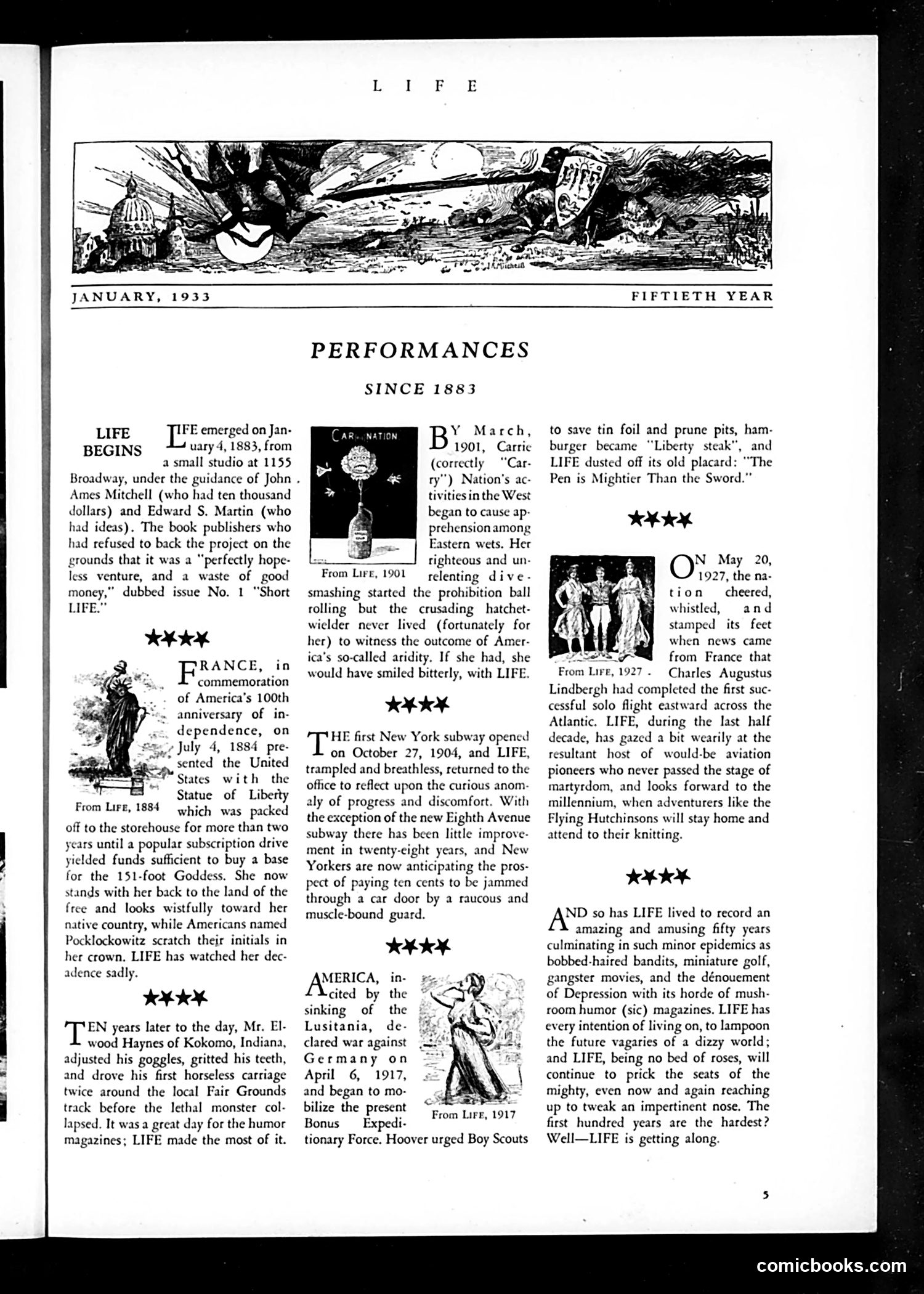
Life Magazine: 50 Years of American Satire This January 1933 page celebrates Life's 50th anniversary by reviewing notable events since 1883. The content traces major American moments: the Statue of Liberty's 1884 arrival, the 1904 NYC subway opening, Carrie Nation's temperance crusade (circa 1901), Charles Lindbergh's 1927 transatlantic flight, and WWI events. The page emphasizes Life's role documenting American progress and absurdity—from serious infrastructure developments to humorous social movements. The asterisks (★) mark particularly noteworthy events. The final paragraph humorously claims Life recorded "amazing and amusing fifty years," from "bobbed-haired bandits" to "miniature golf," suggesting the magazine captured both significant history and trivial cultural trends with equal satirical attention.
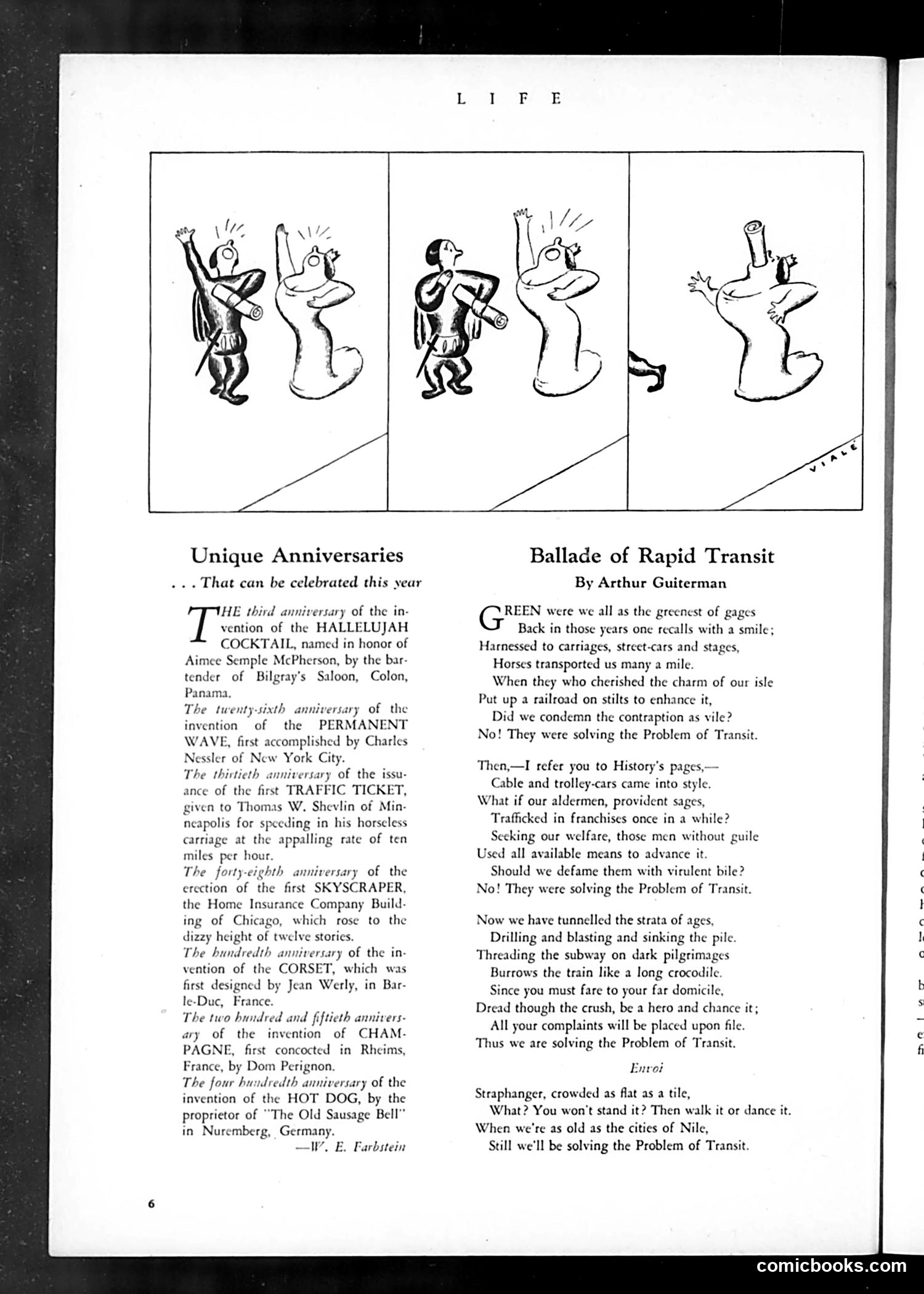
Page Analysis: "Life" Magazine - Transit and Innovation Anniversaries The page contains a three-panel cartoon at top (artist signature unclear) showing figures celebrating with raised arms, followed by two articles below. "Unique Anniversaries" celebrates various invention milestones, including the Hallelujah Cocktail, the Permanent Wave hair treatment, the first traffic ticket, the skyscraper, the corset, champagne, and the hot dog. "Ballad of Rapid Transit" by Arthur Guiterman is a poem satirizing urban transit solutions. It humorously chronicles how cities solved transportation problems—from horses to streetcars to subways to trains—suggesting these "solutions" keep recurring. The final "Envoi" jokes that even as old as ancient Nile cities, we'll still be "solving the Problem of Transit," implying urban congestion is perpetually unsolvable.
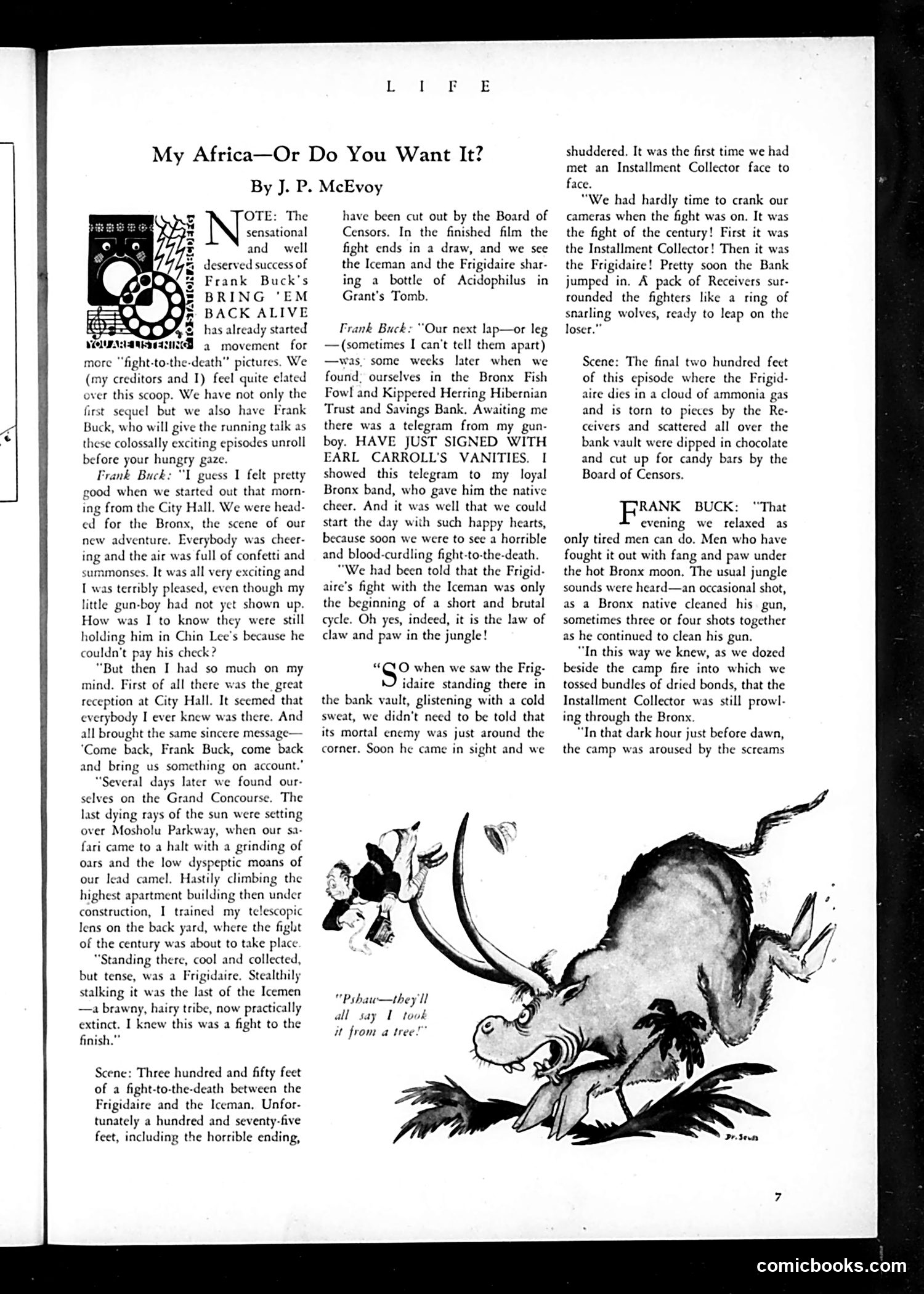
Analysis This is a film review by J. P. McEvoy discussing Frank Buck's "Bring 'Em Back Alive," a nature documentary about capturing wild animals in Africa and Asia. The illustrated cartoon shows a rhinoceros being thrown or falling, with the caption "P'shaw—they'll all say I took it from a tree!" This is satirizing the film's sensationalism and dubious authenticity. The joke suggests that Buck staged or exaggerated dangerous animal encounters for dramatic effect—viewers might claim he faked the spectacular action, yet he presents it as genuine wildlife footage. The article describes various scenes of animal fights and tension, with censors cutting content. The satire mocks both Buck's adventure film and the era's appetite for exotic "danger" entertainment, while questioning whether audiences could distinguish fact from fabrication in early nature cinema.
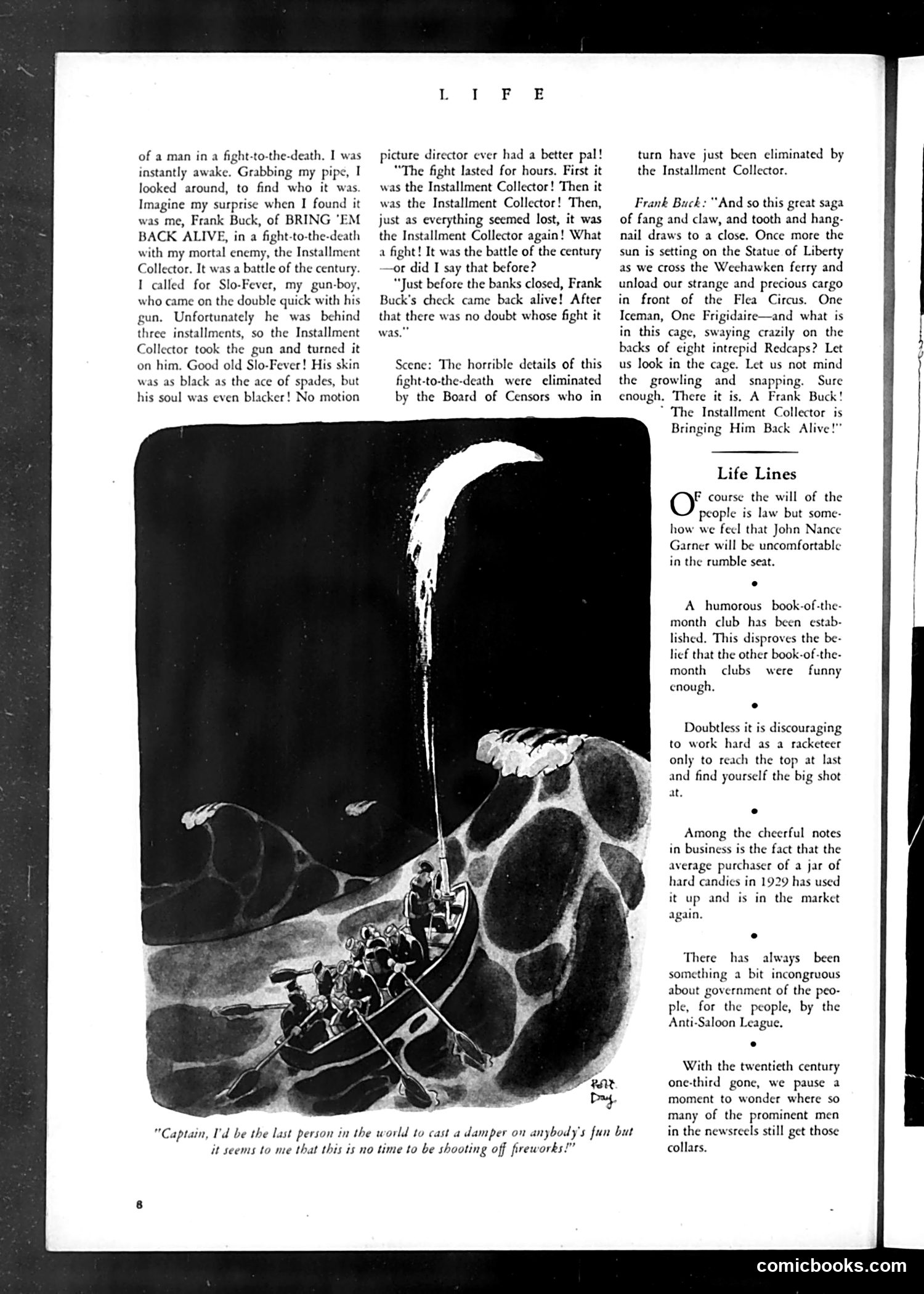
Analysis of Life Magazine Page This page contains a narrative story about "Frank Buck" and "the Installment Collector"—a fight-to-the-death between a man and his creditor. The accompanying illustration shows a giant hand emerging from darkness, threatening a small ship below. The satire targets the economic anxieties of the era (likely late 1920s), depicting debt collection as a literally monstrous threat. The "Installment Collector" represents predatory lending practices common during this period, when installment buying became widespread but often left consumers vulnerable to aggressive collection tactics. The caption's joke about "shooting off fireworks" adds dark humor to financial desperation. The right-hand column's "Life Lines" section offers brief social commentary on unrelated topics, typical of the magazine's format.
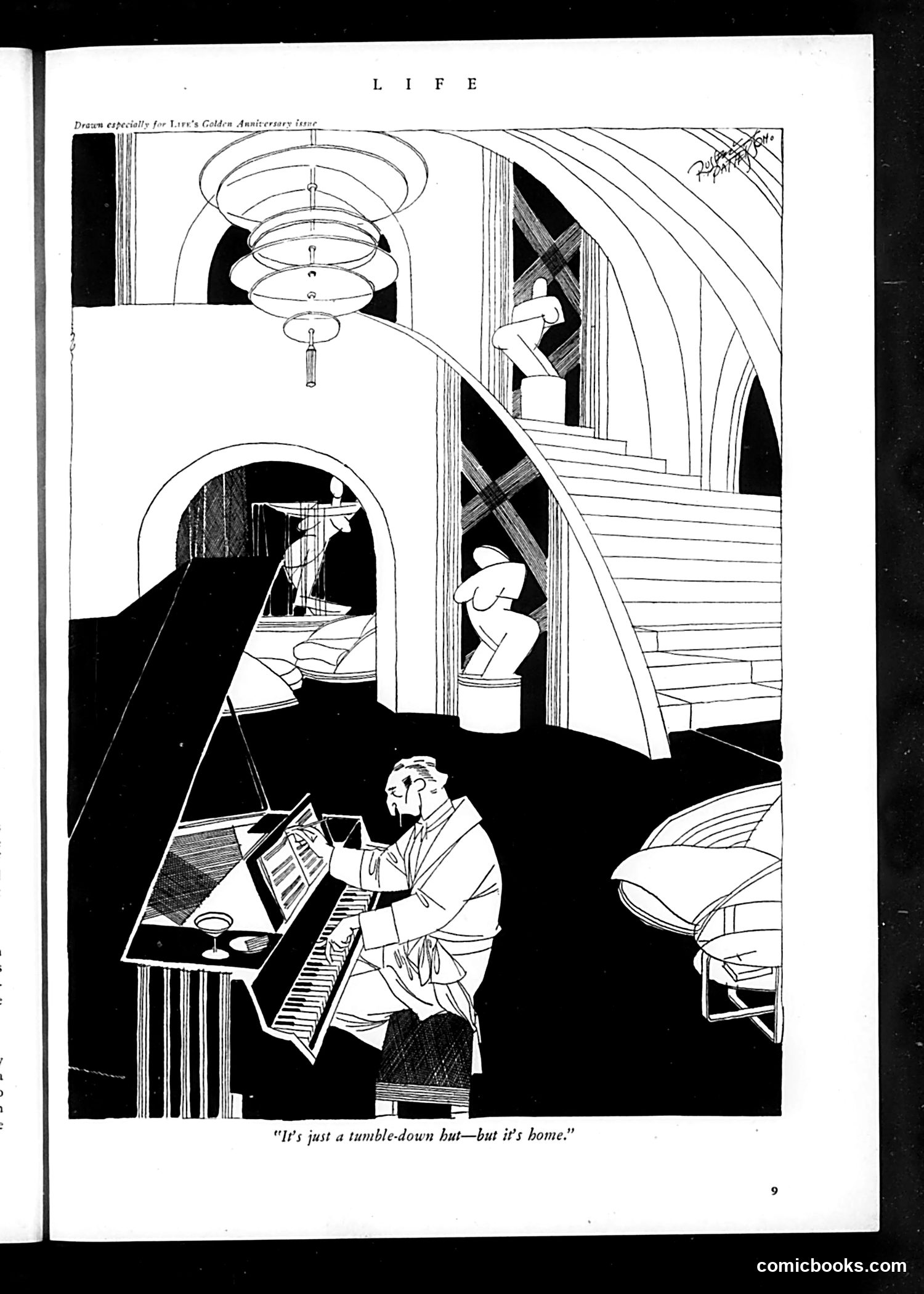
Analysis This is a single-panel cartoon from *Life* magazine titled "It's just a tumble-down hut—but it's home." The image depicts a futuristic domestic space with Art Deco styling, featuring multiple levels, curved architectural elements, and modernist furnishings. A man sits at a keyboard/control panel in the foreground, appearing to operate or conduct the space itself like an instrument. The satire appears to target mid-20th-century anxieties about increasingly automated, mechanized homes. Despite the space's advanced technology and elaborate design, the caption suggests inhabitants rationalize living in such artificial, controlled environments by emphasizing emotional attachment ("home") over practical comfort. The joke mocks how people romanticize even impractical modern living spaces.
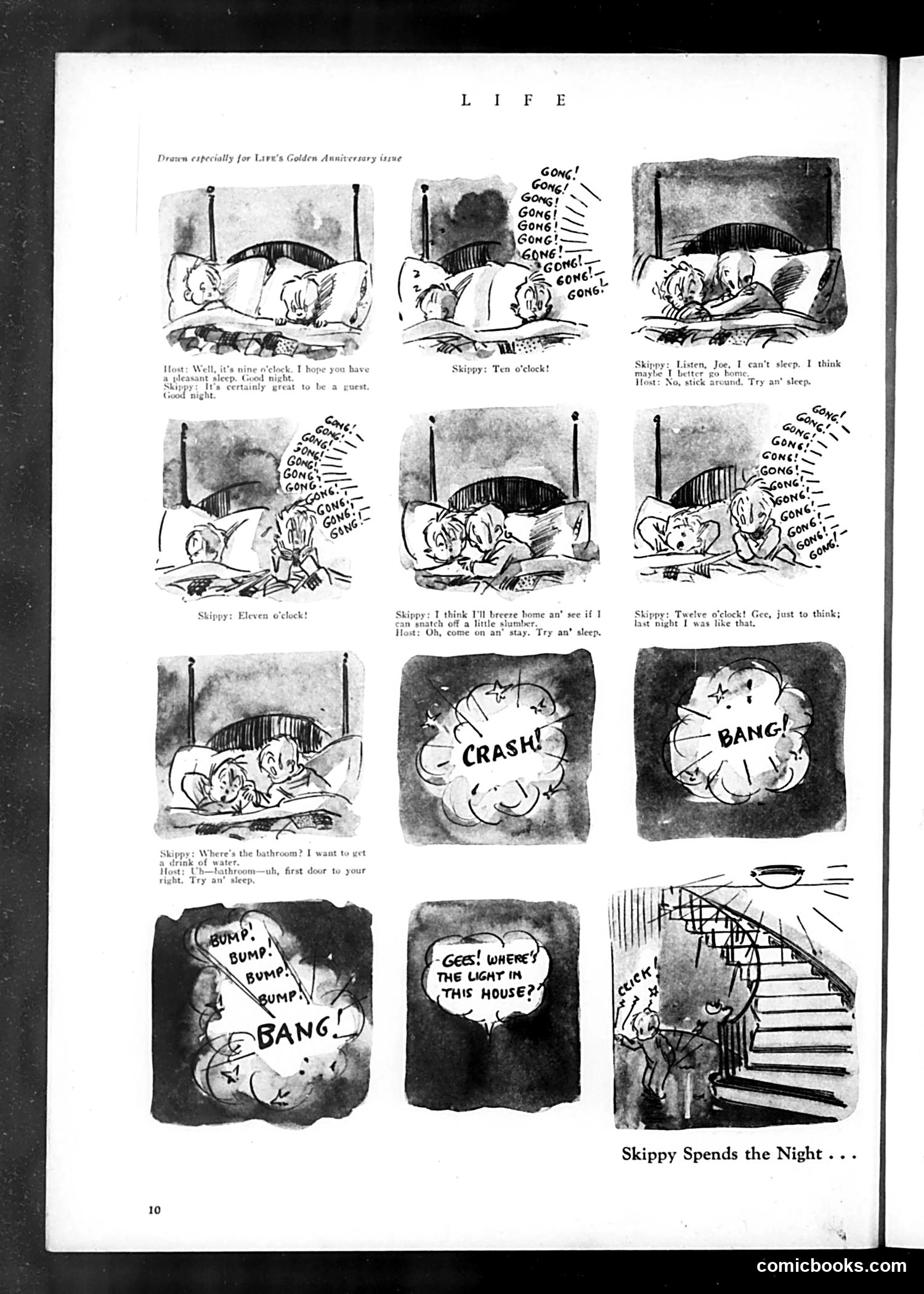
"Skippy Spends the Night" This comic strip follows a child character named Skippy through a sleepless night at a guest's house. The humor relies on familiar domestic chaos: the host wishes Skippy goodnight at 9 o'clock, but Skippy remains awake, disturbed by a series of escalating nighttime noises—a gong sounding repeatedly, crashes, bangs, and bumps throughout the house. The joke satirizes both childhood anxiety about unfamiliar sleeping environments and the comedy of household disturbances beyond anyone's control. The final panel shows Skippy on the stairs asking "Gees! where's the light in this house?"—suggesting the night's events have thoroughly displaced him from any comfortable sleep. It's gentle domestic humor about the universal experience of a restless night away from home.
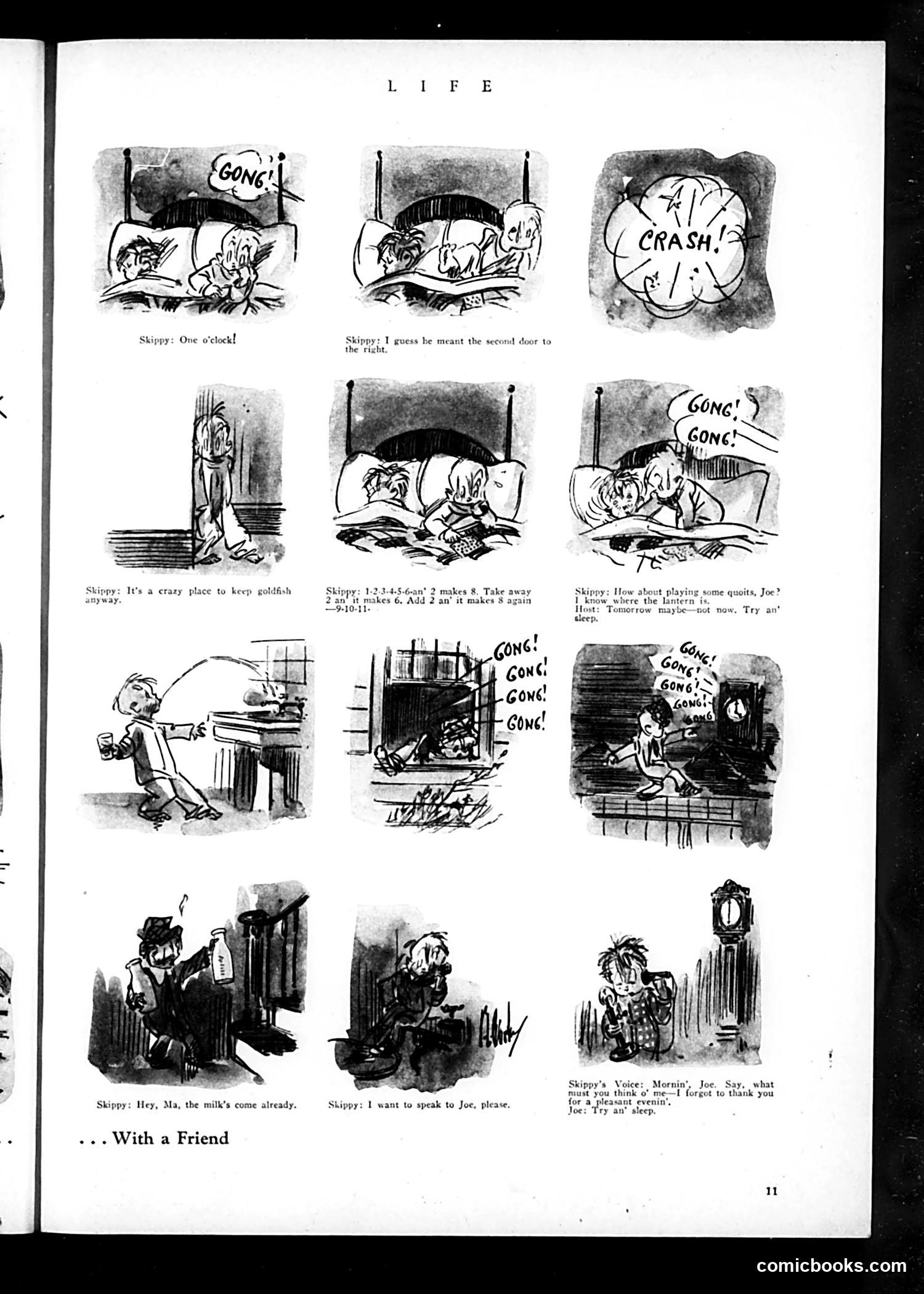
"Life" Comic Strip: "With a Friend" This appears to be a domestic comedy strip featuring two characters named Skippy and Joe. The humor centers on mundane household situations: Skippy misremembering which door leads where, attempting math problems (adding 2+2), playing with a lantern, and dealing with a gong that keeps sounding. The final panel shows Skippy's mother mentioning "the milk's come already" while Skippy needs to speak with Joe. This is slapstick humor based on everyday domestic life rather than political satire—typical of early-to-mid 20th-century American comics. The jokes rely on physical comedy, childish mistakes, and household objects rather than social commentary. It's essentially light entertainment for general audiences.
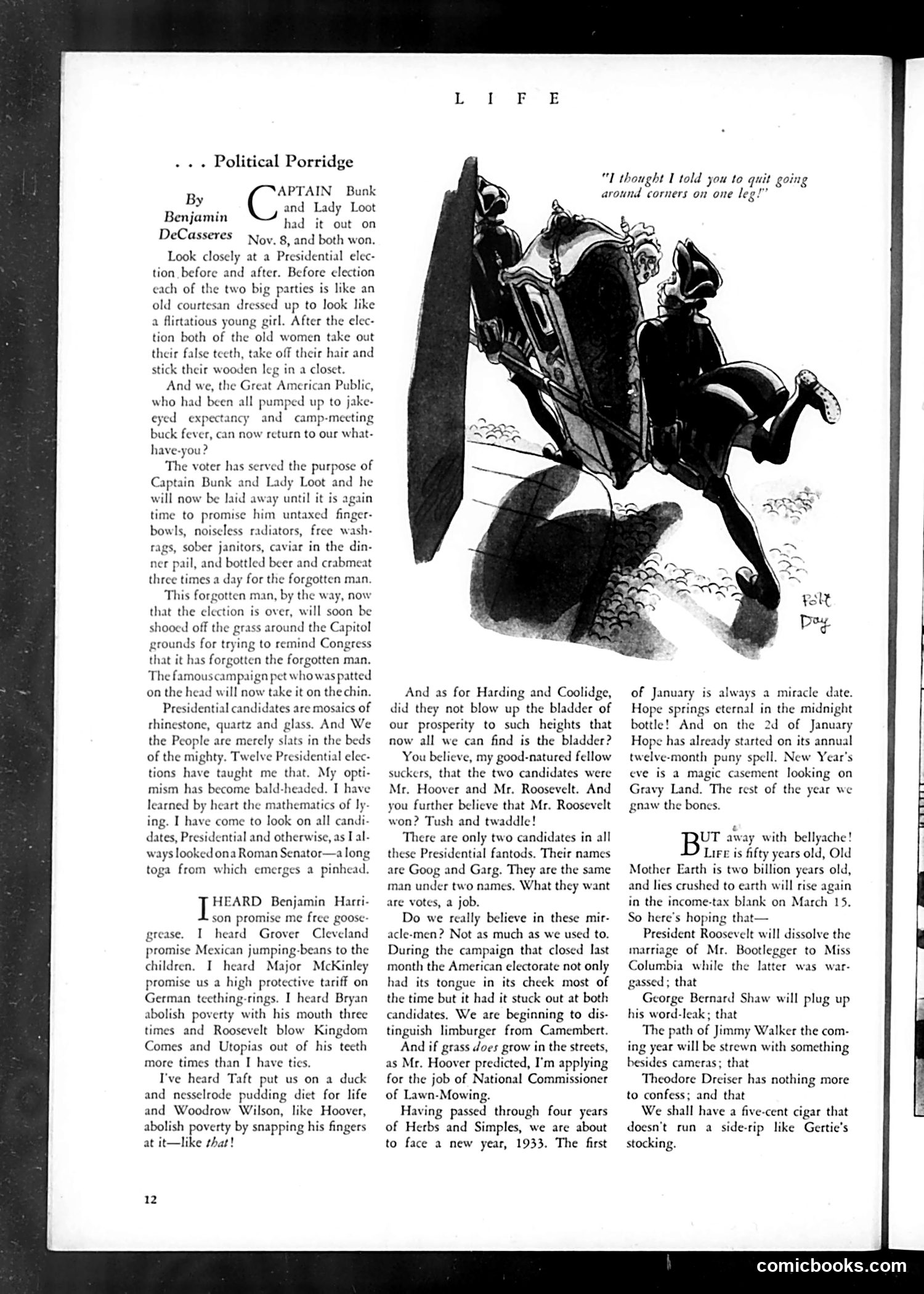
"Political Porridge" by Benjamin DeCasseres This satirical piece mocks the 1932 presidential election, comparing the two major parties to aging women applying cosmetics before an election to appear appealing to voters. The cartoon depicts a figure (likely representing the electorate or "Great American Public") being carried away on what appears to be a political platform or conveyance. The text ridicules candidates Herbert Hoover and Franklin D. Roosevelt as interchangeable ("Goop and Garg"), suggesting their promises—untaxed fingerbowls, sober janitors, caviar—are empty rhetoric meant to distract voters. DeCasseres attacks the notion that either candidate represents real change, arguing voters will soon forget campaign promises. The piece reflects Depression-era cynicism about whether political elections meaningfully address forgotten Americans' suffering.
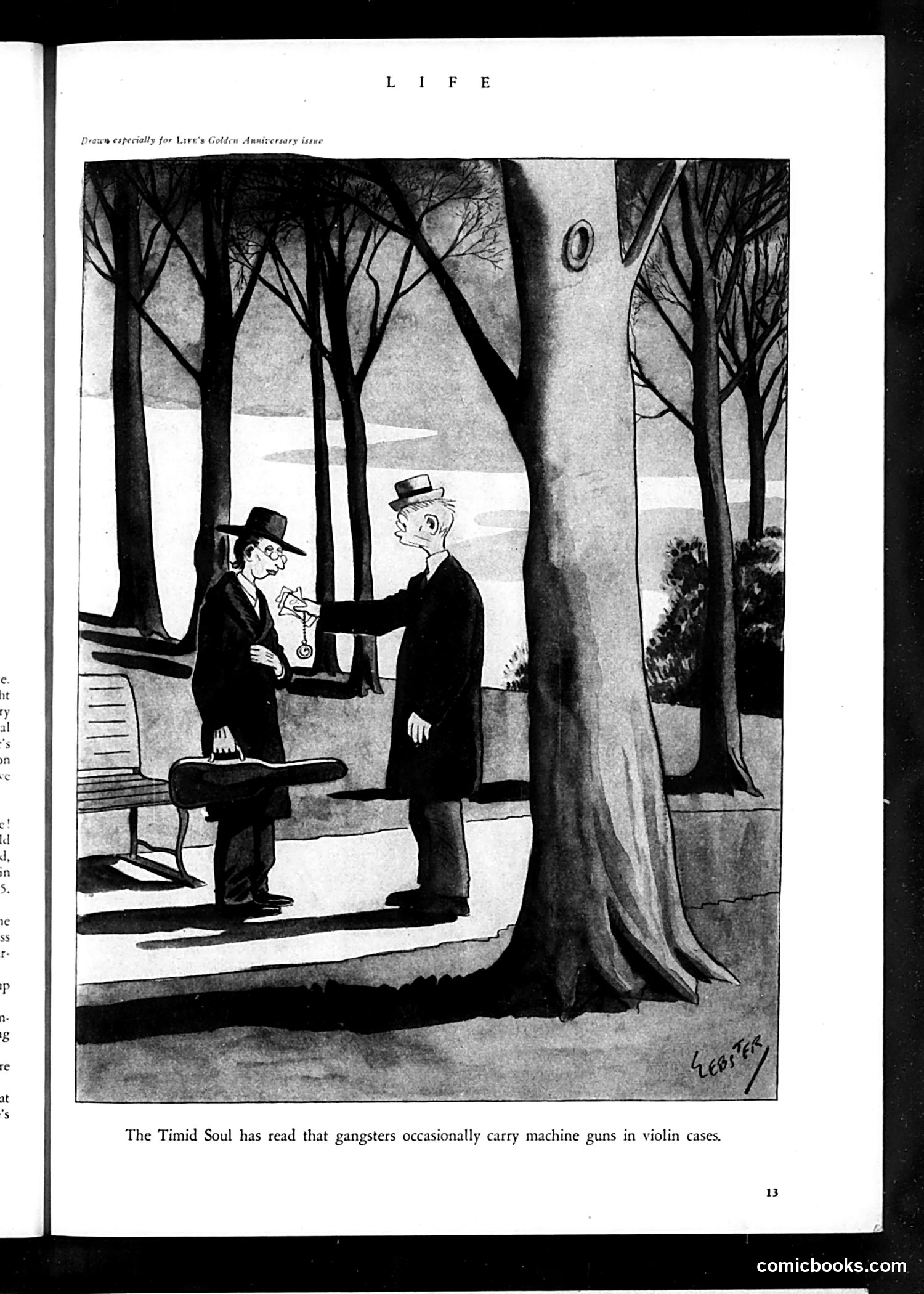
Explanation for Modern Readers This is a humorous cartoon from *Life* magazine's satirical section. Two men in bowler hats meet in a park; one hands something small to the other. The caption reads: "The Timid Soul has read that gangsters occasionally carry machine guns in violin cases." The joke plays on two elements: First, the widespread public awareness (likely from 1920s-30s Prohibition era crime reporting) that gangsters disguised weapons in musical instrument cases. Second, "The Timid Soul"—an apparent reference to a recurring character type in *Life*—represents an anxious everyman who takes such warnings literally and absurdly. The humor lies in the timid soul's overreaction: he's anxiously exchanging what appears to be a watch or small object, perhaps misinterpreting an innocent transaction as suspicious criminal activity. It satirizes public paranoia about organized crime.
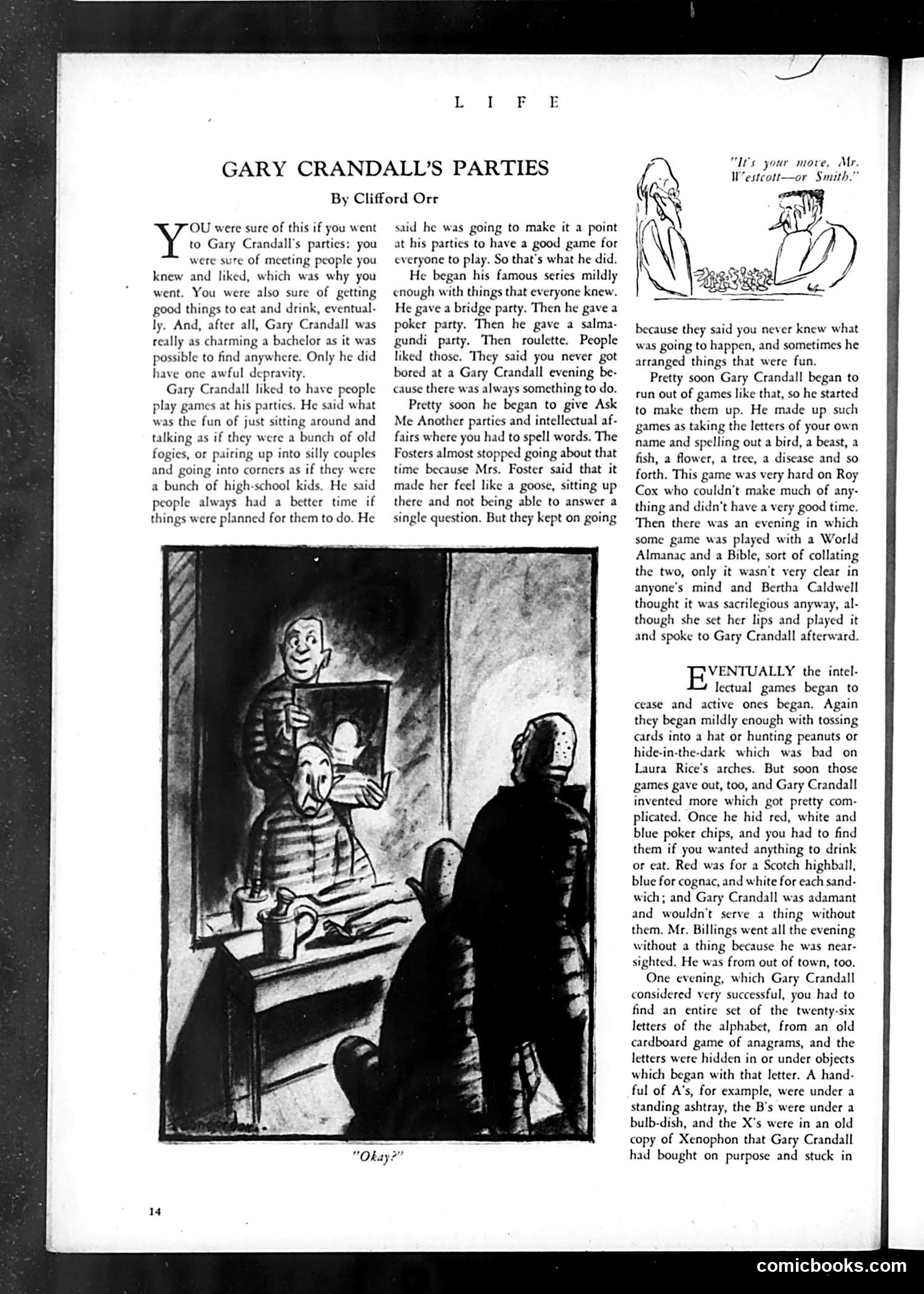
"Gary Crandall's Parties" This article by Clifford Orr describes Gary Crandall's reputation as a host who throws elaborately planned parties with various games and activities. The accompanying illustration shows two figures at what appears to be a party setting, with one figure gesturing animatedly while another watches. The satire targets the emerging trend of the early 20th century where wealthy hosts employed elaborate games and entertainment—charades, intellectual word games, card games with coded chip systems—to orchestrate their guests' amusement rather than allowing organic socializing. The article gently mocks this obsessive control of entertainment, noting that some guests (like Roy Cox) struggled with the contrived activities, while others found the over-planned nature somewhat ridiculous, particularly Bertha Caldwell's skepticism about improvised games using unconventional props.
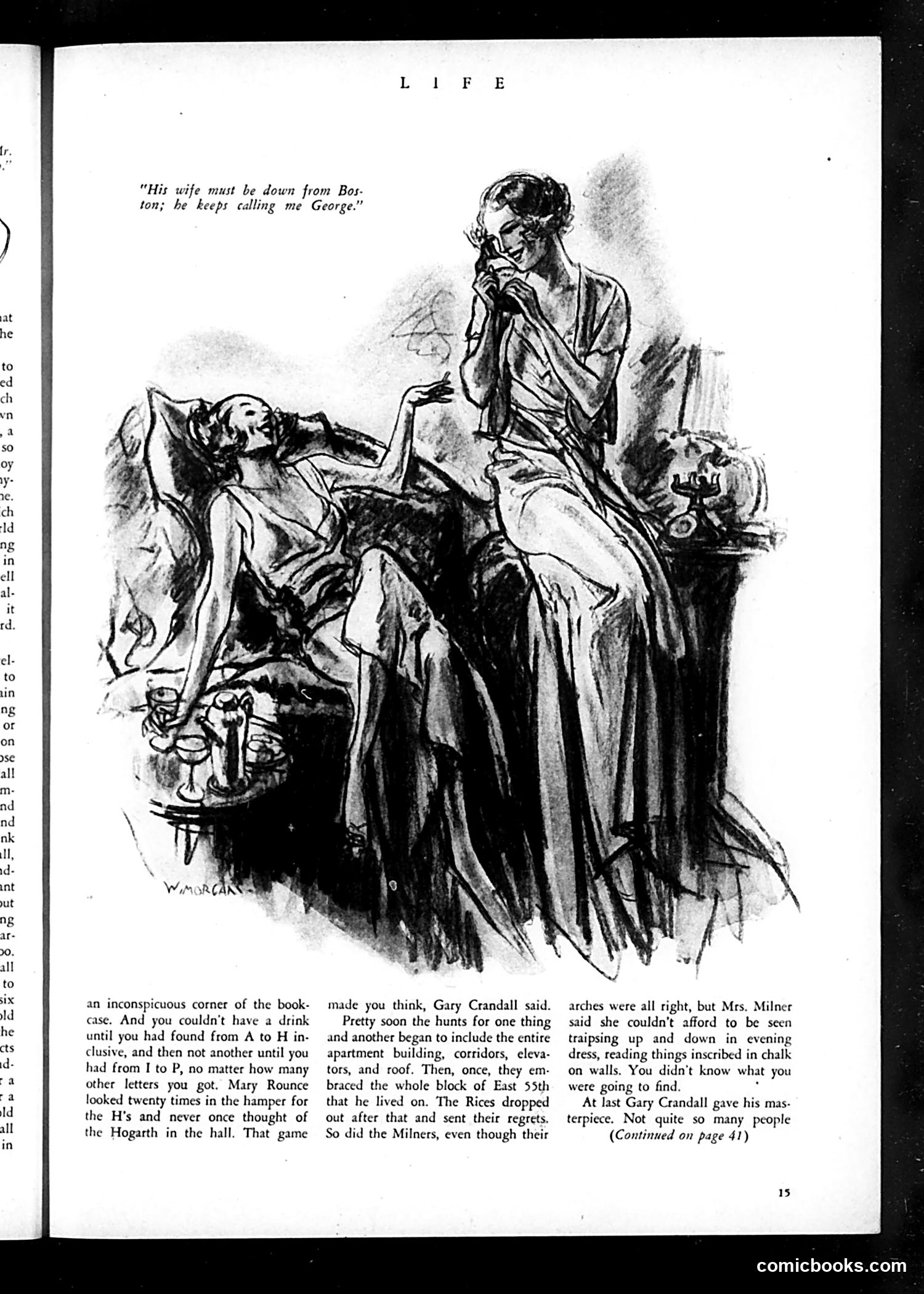
Analysis of Life Magazine Page This satirical illustration depicts a domestic scene where a woman lies reclined while a man sits nearby with his hand to his face in an anxious or worried gesture. The caption reads: "His wife must be down from Boston; he keeps calling me George." The joke appears to satirize marital infidelity or romantic deception. The implication is that the man (apparently named something other than "George") is being called by a false name, suggesting he's conducting an affair while his wife is away in Boston. The woman's relaxed posture and the intimate setting reinforce this interpretation. The humor relies on the audience understanding contemporary social conventions around marriage, travel, and discretion in the early 20th century.
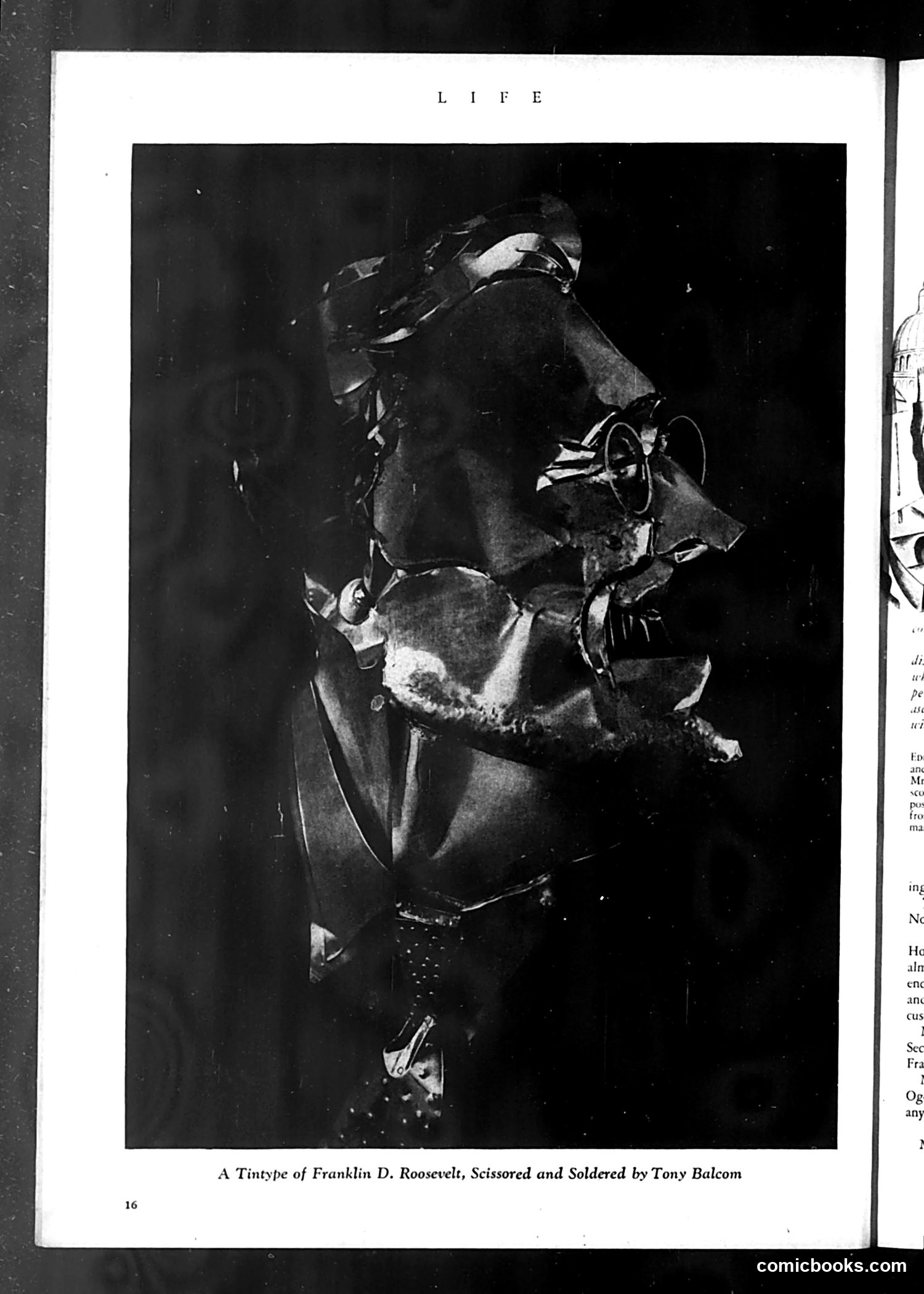
Analysis This page from *Life* magazine features a tintype photograph (a historical photographic process) showing a sculptural or artistic representation of Franklin D. Roosevelt's head. The image has been "scissored and soldered by Tony Balcom," according to the caption—meaning the artwork was physically cut and reassembled. The satirical intent appears to be visual commentary on Roosevelt himself, likely playing on the tintype medium's historical associations or the crude nature of the reconstruction technique. By having an artist literally cut apart and reassemble Roosevelt's likeness, the satire suggests fragmentation or reconstruction of the president's image or policies. Without additional context from surrounding articles, the specific political critique remains unclear, though the tone suggests critical commentary on FDR.
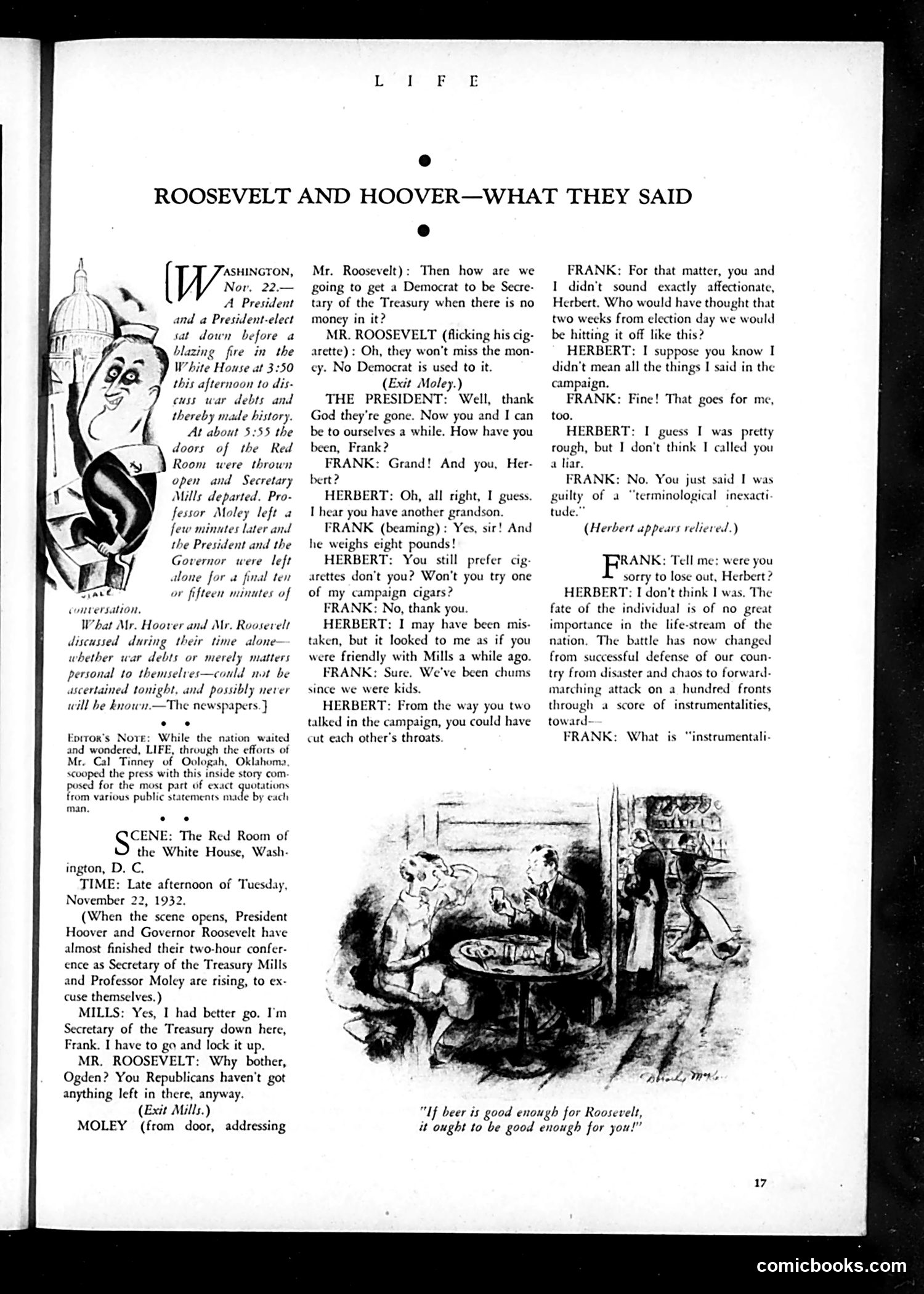
"Roosevelt and Hoover—What They Said" This satirical piece documents a November 22, 1932 conversation between President Herbert Hoover and President-elect Franklin D. Roosevelt at the White House. The dialogue mocks their strained civility during the transition of power amid economic crisis. The humor centers on Roosevelt's jab about getting a Democrat Treasury Secretary when "there is no money in it"—implying Hoover's administration left the treasury depleted. Their exchange reveals mutual disdain beneath forced pleasantries: Herbert claims Roosevelt talked a strong campaign line but appears to backpedal, while Roosevelt deflects by calling Herbert's earlier accusations merely "terminological inexactitude" (a euphemism for lying). The accompanying cartoon depicts them sharing a meal, captioned "If beer is good enough for Roosevelt, it ought to be good enough for you!"—likely referencing Prohibition debates.
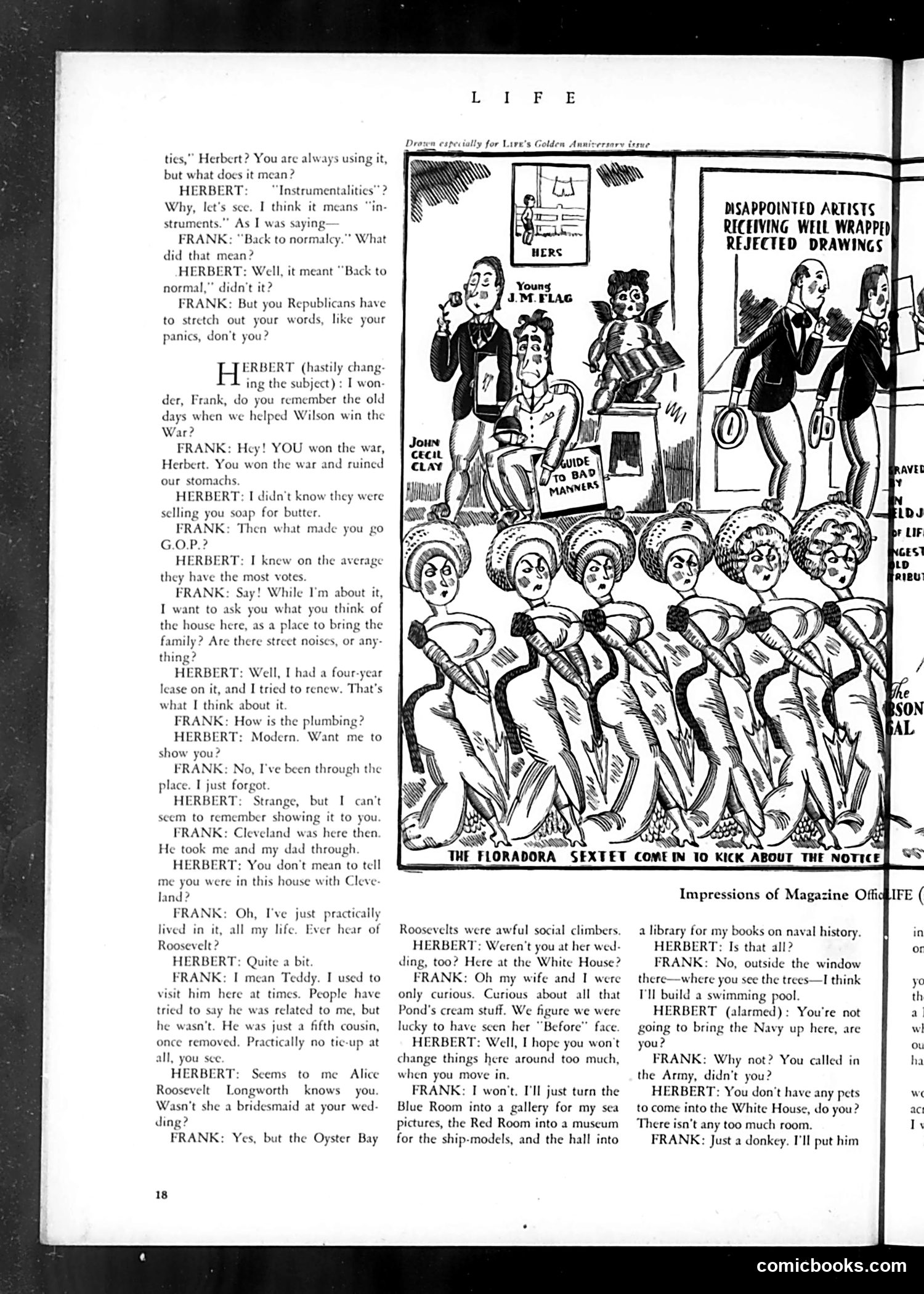
Life Magazine Cartoon Analysis The main cartoon titled "THE FLORADORA SEXTET COME IN TO KICK ABOUT THE NOTICE" depicts six women in identical poses with bobbed hair and 1920s fashion, appearing distressed or angry. They're reacting to some official notice. The "Floradora Sextet" references the famous 1900 theatrical chorus line from the musical "Floradora," which became a cultural touchstone for glamorous showgirls. The cartoon satirizes these performers complaining about a regulation or administrative action—likely related to entertainment industry restrictions or censorship of the era. The accompanying dialogue between characters "Herbert" and "Frank" discusses Washington D.C. social life and the White House, suggesting this cartoon comments on 1920s entertainment politics and government oversight of theater.
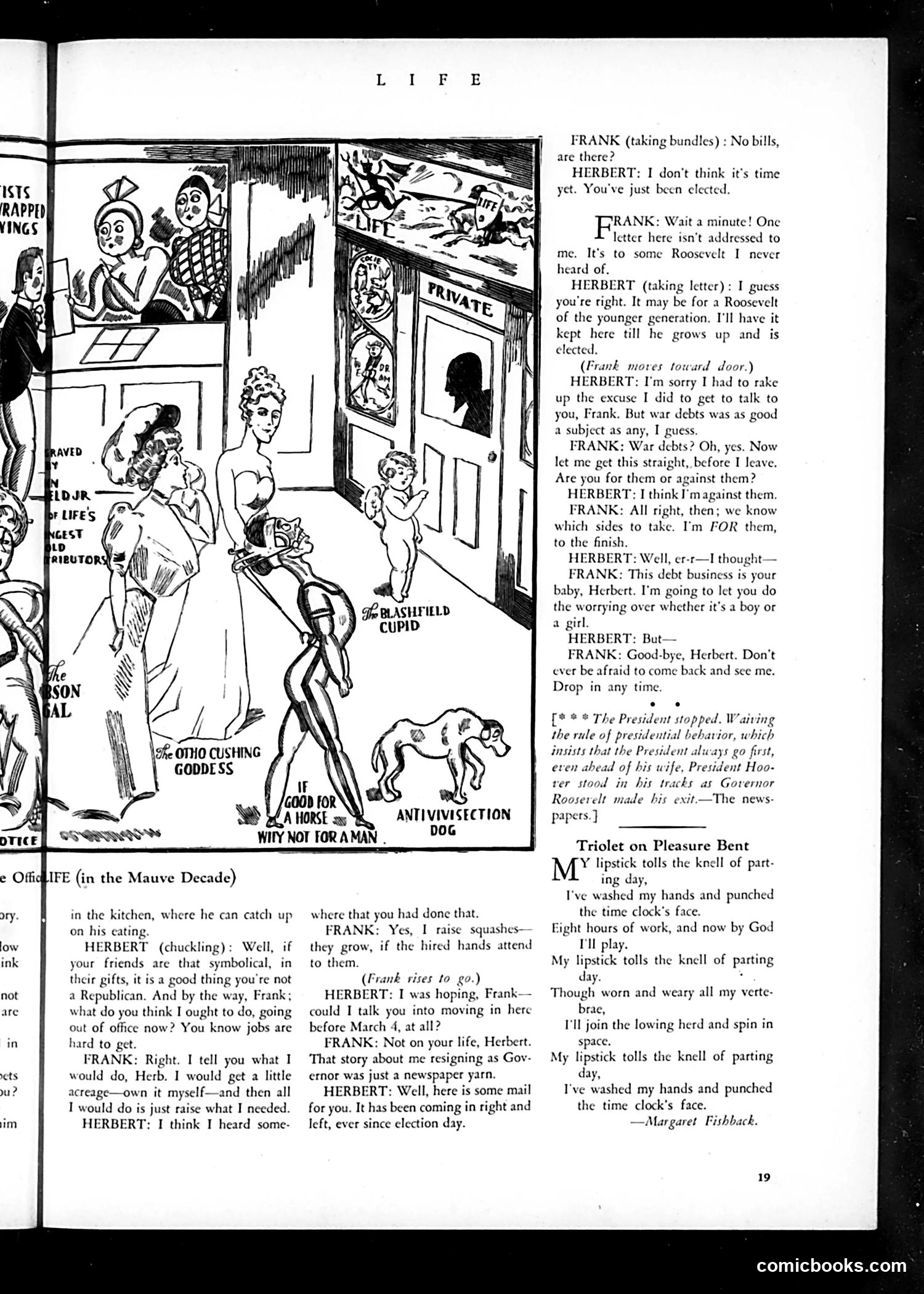
Analysis This page contains a satirical cartoon and accompanying dialogue about American political and social issues. The main comic depicts various allegorical figures in what appears to be a domestic setting, with labels including "Cupid," "Ohio Cushing Goddess," "Antivivisection Dog," and references to a "Horse" and "Why Not for a Man." The dialogue between Frank and Herbert concerns war debts and presidential politics—likely referencing post-WWI economic tensions and the 1920s debate over American war loans to allies. Frank pressures Herbert about political alignment ("which sides to take"), suggesting the cartoon satirizes partisan political maneuvering during this period. The page also includes a poem titled "Triolet on Pleasure Bent" about exhaustion from work. The overall tone mocks both political opportunism and social pretension of the era.
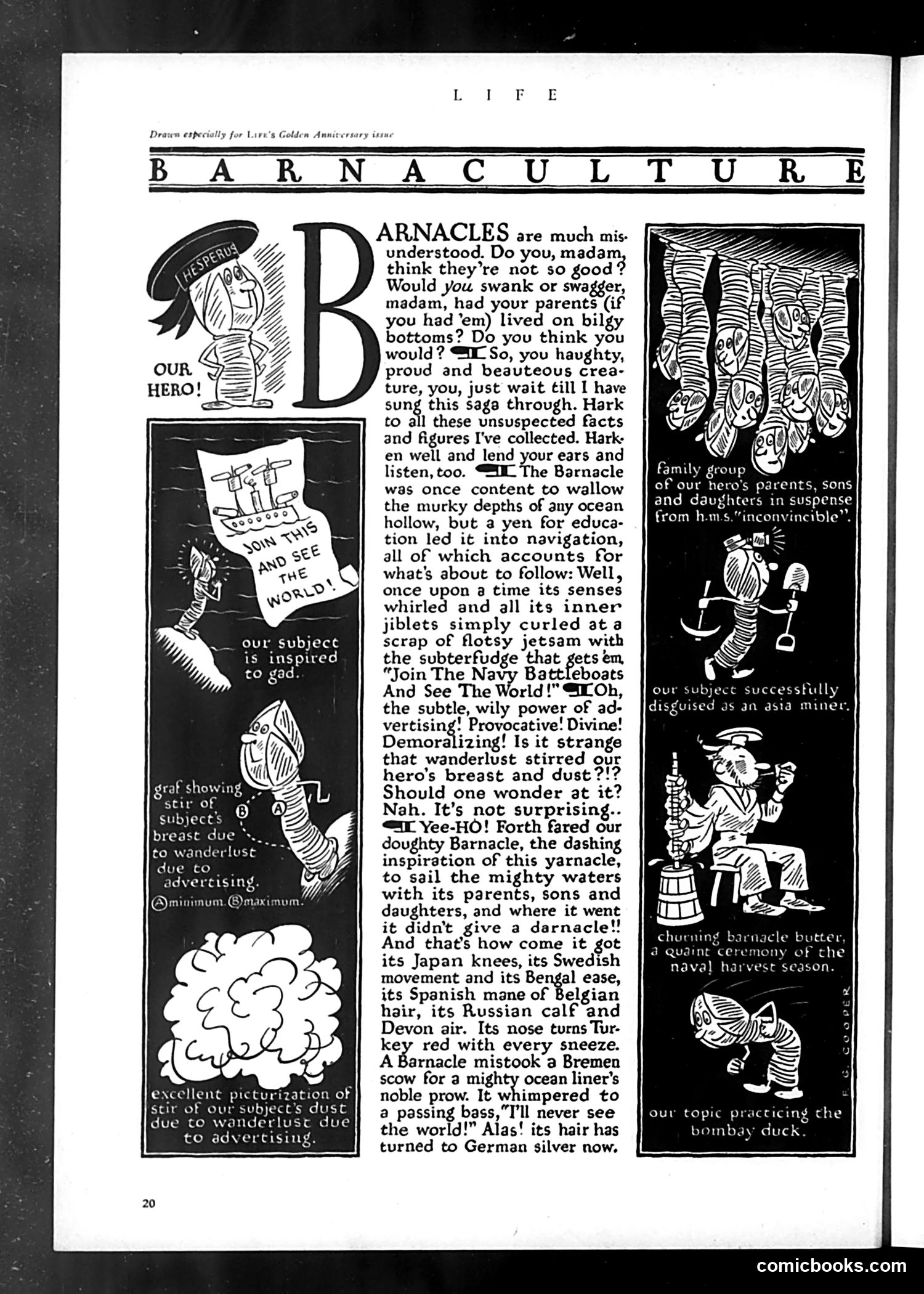
"Barnaculture" - Life Magazine Satire This is a humorous illustrated essay mocking both advertising's manipulative power and social pretension. The "hero" is a barnacle—a lowly ocean creature—who sees a Navy recruitment poster ("Join The Navy Battleboats And See The World!") and becomes infected with wanderlust. The satire targets: 1. Advertising's demoralizing effect: The text explicitly critiques how advertising stirs desire and "wanderlust" in unsuitable subjects, using absurdist logic to show its power. 2. Social snobbery: The opening challenges wealthy readers who mock barnacles' humble origins, asking if *they'd* behave differently with better parentage—deflating class pretension. 3. The barnacle's comical transformation: Through sea travel, the creature develops ridiculous cosmopolitan traits (Japanese knees, Swedish movement, Russian calf), satirizing how people adopt superficial "cultured" affectations through travel. The elaborate visual gags (depicting the barnacle's various adventures and disguises) reinforce that advertising and aspirational travel produce absurd, hollow results—you're still just a barnacle, dressed up.
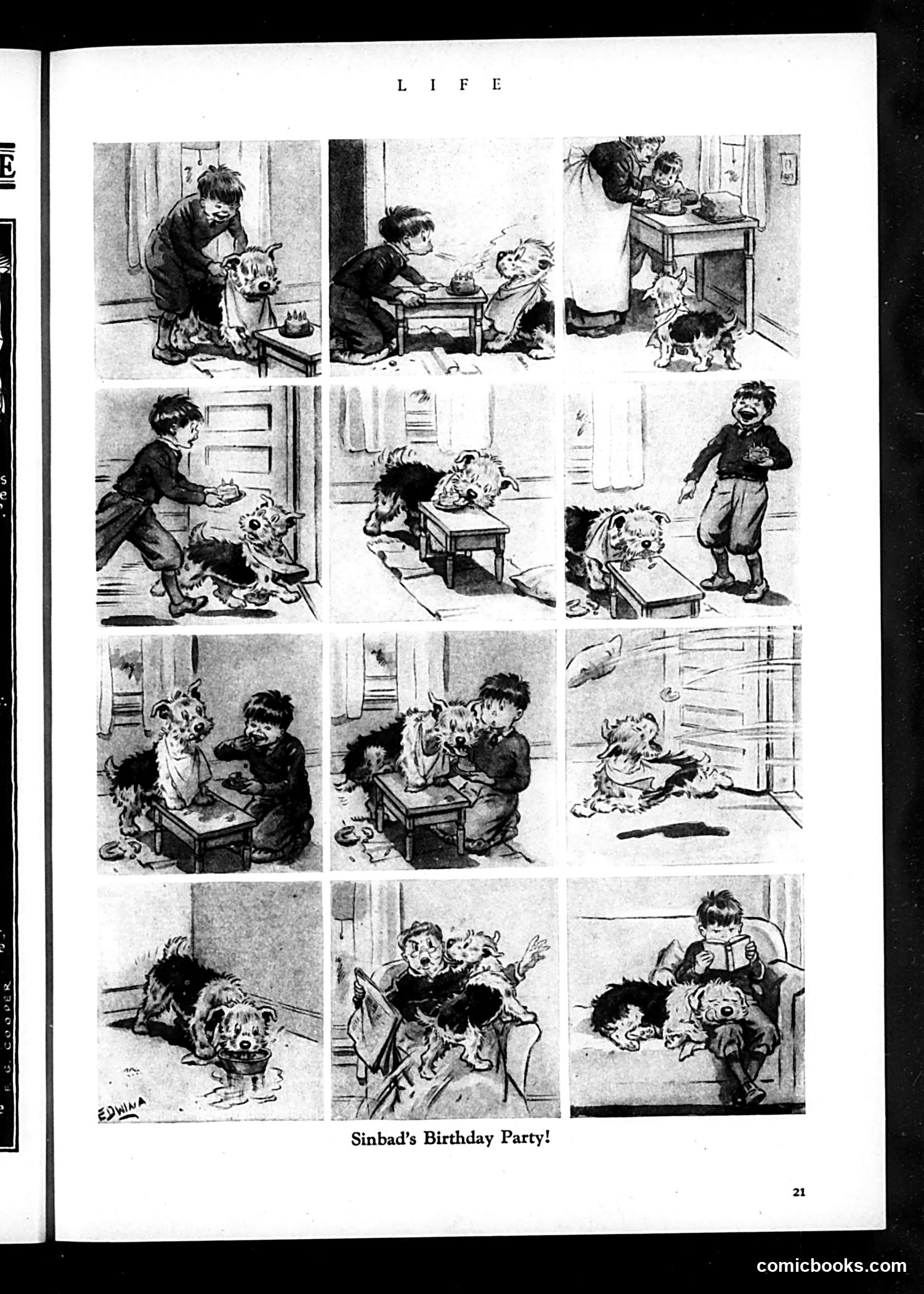
"Sinbad's Birthday Party!" This is a comic strip sequence showing a child's birthday party featuring a dog named Sinbad. The narrative follows typical early 20th-century domestic humor: children and a dog interact during party activities including eating, playing games, and general mischief. The strip relies on visual gags common to Life magazine's humor—children's chaotic behavior, the dog's unpredictable antics, and the general mayhem of managing a children's celebration. There's no apparent political satire here; rather, it's gentle domestic comedy about childhood and pet ownership, likely appealing to middle-class readers familiar with such household scenes. The artwork is credited to "Edwina" (visible signature, lower left).
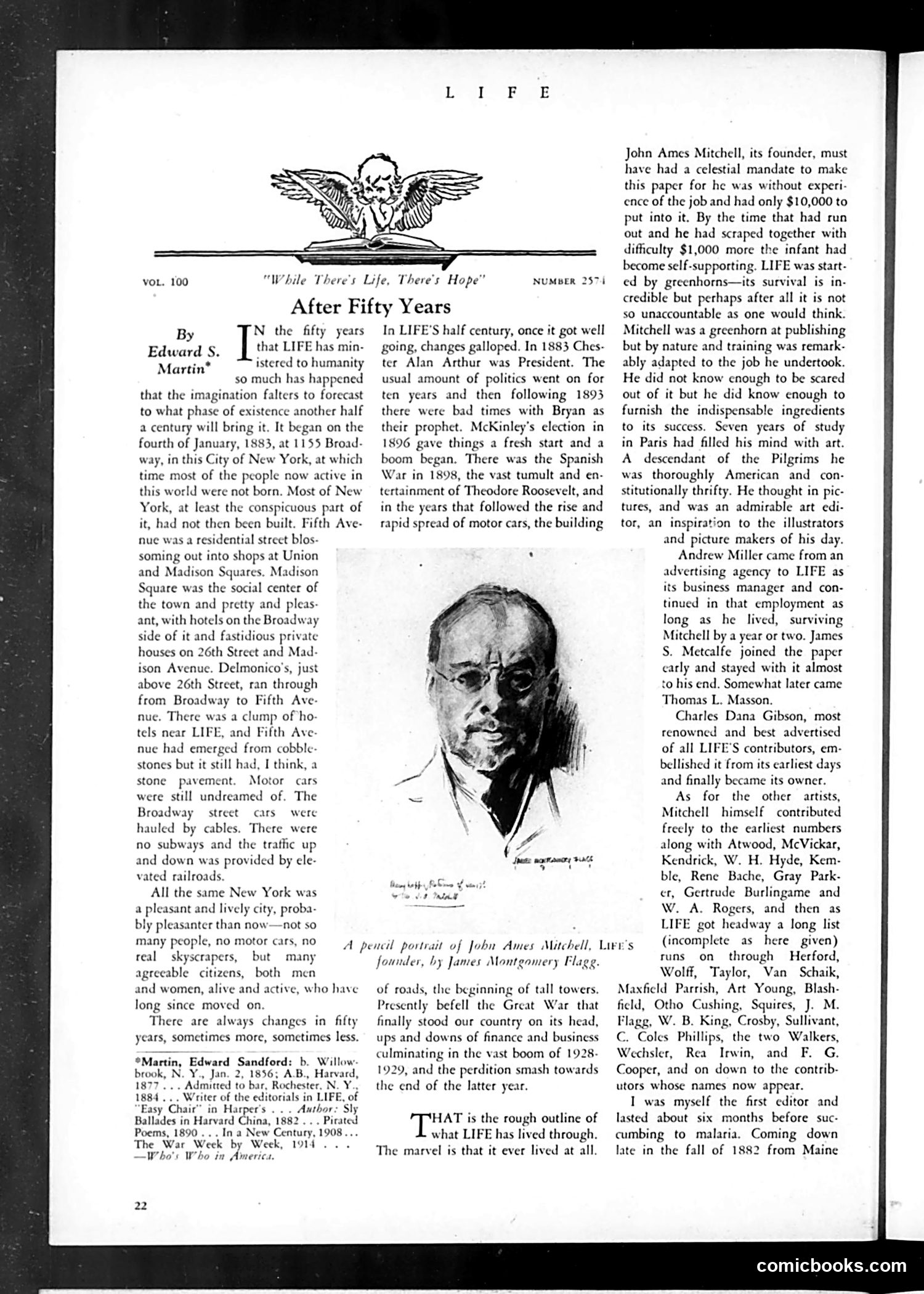
Life Magazine's 50th Anniversary Retrospective This is not a cartoon page but rather a commemorative essay by Edward S. Martin celebrating Life magazine's founding fifty years prior (1883). The page features a pencil portrait of John Ames Mitchell, Life's founder, drawn by James Montgomery Flagg. The text is a nostalgic historical overview of New York City's transformation since 1883—from gas-lit streets with cable cars to the modern era of automobiles, skyscrapers, and elevated railroads. Martin chronicles major events: Chester Arthur's presidency, the Spanish-American War, Theodore Roosevelt's tenure, and the 1928-1929 stock market crash. The central point: Mitchell founded Life with no publishing experience and only $10,000, yet the magazine became self-supporting through his natural talent and artistic sensibility (he'd studied in Paris). The piece celebrates Life's improbable survival through fifty years of American upheaval as a remarkable editorial achievement.
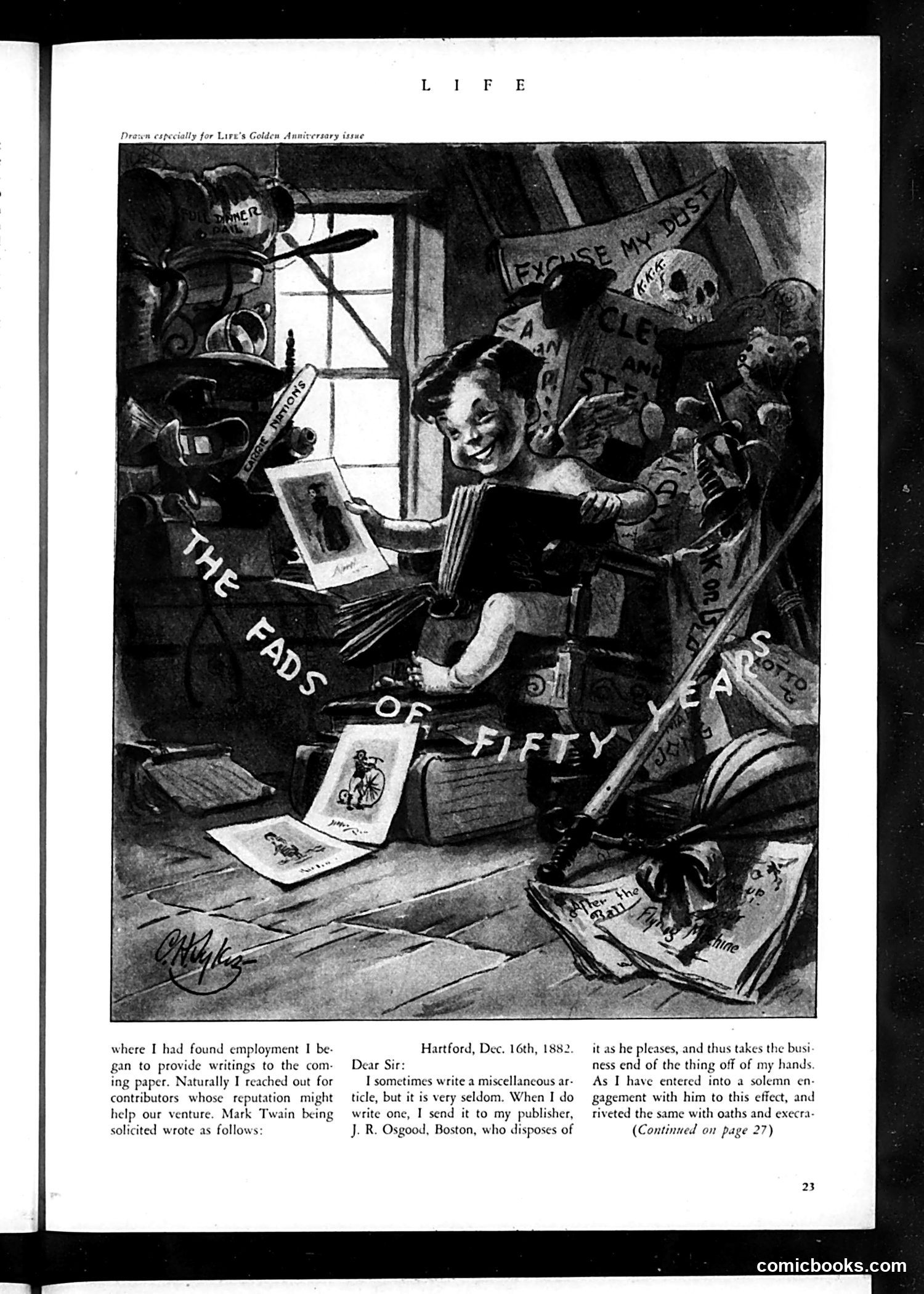
Explanation for Modern Readers This 1882 *Life* magazine page features an illustration titled "The Fads of Fifty" for *Life's* Golden Anniversary issue. The drawing depicts a child surrounded by period collectibles and memorabilia—books, toys, games, and artifacts—examining these objects with curiosity. The accompanying text is a letter from Mark Twain (dated December 16, 1882) declining to contribute an original article to *Life*. Twain explains he has a contractual agreement with his publisher, J.R. Osgood of Boston, who handles the business side of his writings. The joke appears to be that even famous authors couldn't freely contribute where they pleased—their publishers controlled their output. The illustration likely satirizes 1880s collecting culture and nostalgia for past fashions and fads, a relevant topic for a magazine celebrating fifty years of publication.
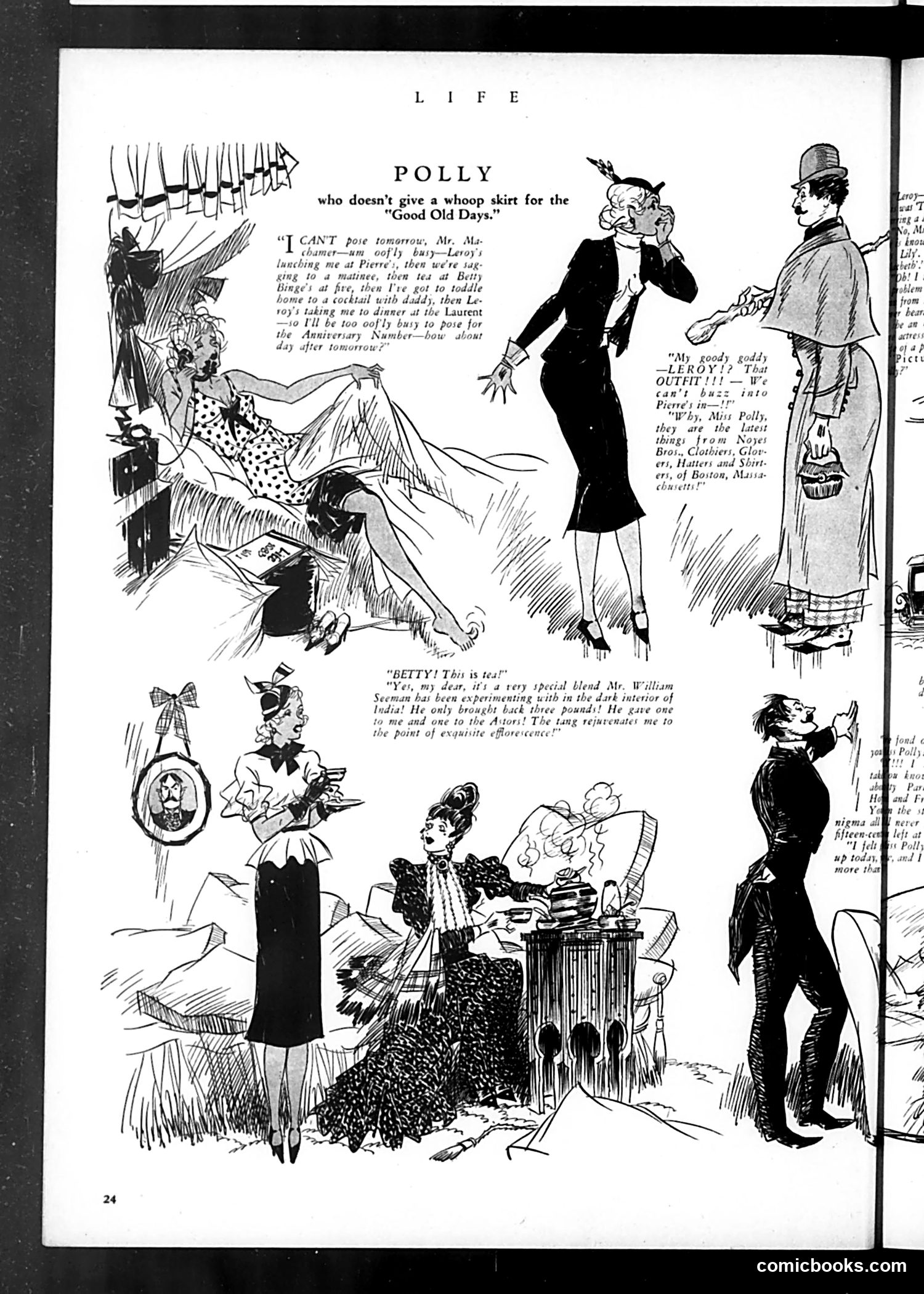
"Polly" – Life Magazine Satire This page satirizes the modern "flapper" lifestyle of the 1920s—specifically a young woman named Polly who epitomizes the era's rejection of traditional values. The subtitle notes she "doesn't give a whoop skirt for the 'Good Old Days,'" referencing both the voluminous "whoop skirt" fashion and the nostalgic rhetoric of older generations. The humor targets Polly's breathless, overscheduled social calendar (Pierre's restaurant, matinee, tea, cocktails, Laurent dinner) and the pretentious affectations of her social circle—her friend Betty's precious attitudes about rare Indian tea and expensive designer clothing. The cartoon mocks 1920s youth culture's materialism, name-dropping, and affected speech patterns ("oof'ly busy," "goody goddy"). The exaggerated dialogue captures period slang while satirizing both Polly's shallow priorities and her friends' snobbish pretension. The illustration style emphasizes fashionable dress and modern leisure as core identity markers for this generation.
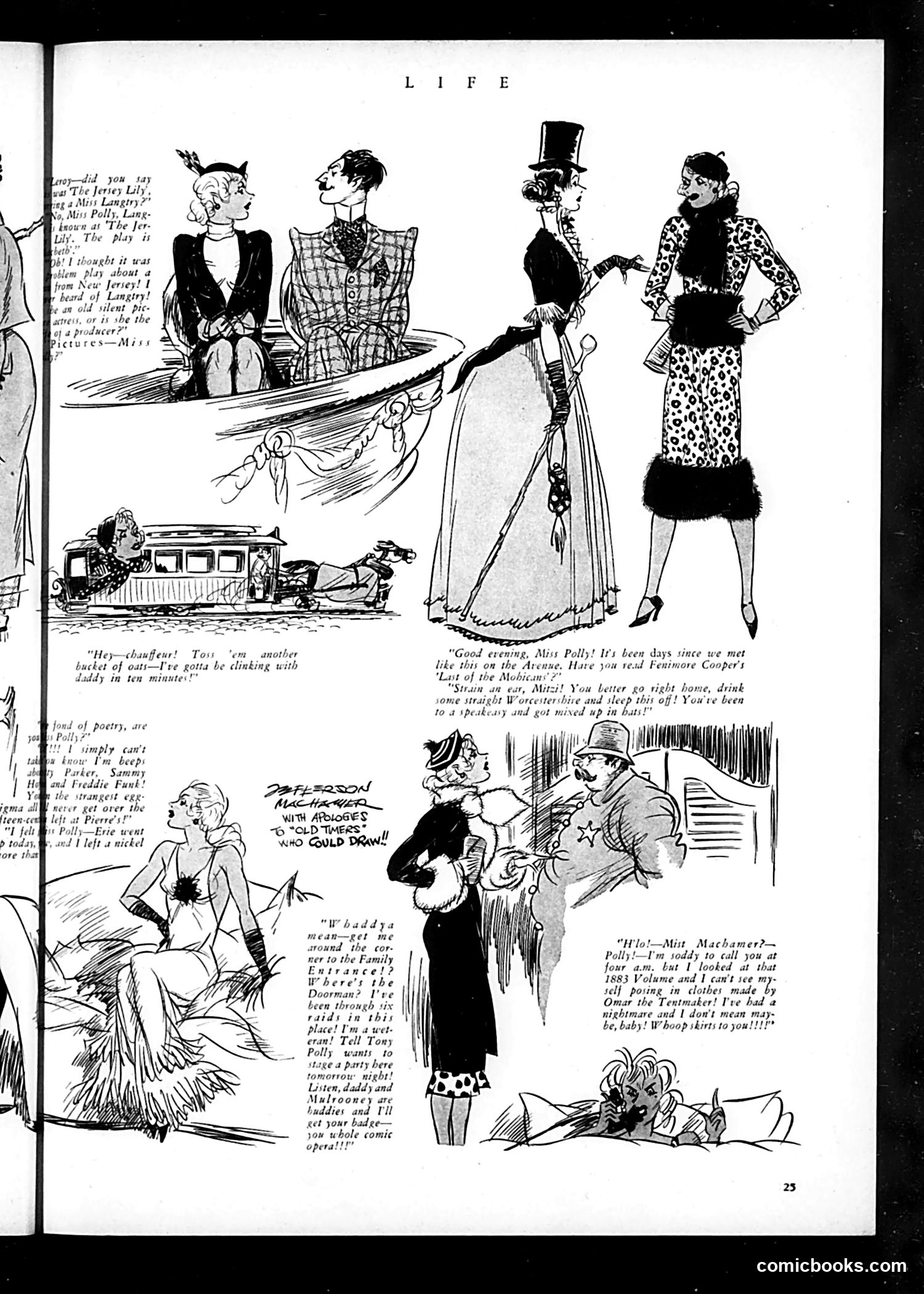
"Life" Magazine Page Analysis This page satirizes the Jazz Age lifestyle and social pretensions of wealthy women, particularly focusing on the character "Polly" (likely a recurring figure in Life magazine humor). The cartoons mock: 1. Social climbing and name-dropping: References to "The Jersey Lily" and "The Last of the Mohicans" suggest characters pretending to cultural sophistication while misunderstanding literary references. 2. Late-night excess: Multiple scenes show Polly making demands at inappropriate hours—calling at 4 a.m., parties at dawn, interactions with chauffeurs and doormen—depicting reckless wealthy behavior. 3. Fashion anxiety: A notable complaint about 1880s clothing styles ("Omar the Tentmaker") suggests parody of modern women rejecting outdated fashions. 4. Corrupt socializing: References to "raids" and bribing doormen hint at speakeasy culture during Prohibition. The humor targets wealthy women's frivolous behavior, social pretension, and the perceived chaos of their modern lifestyles during the 1920s.
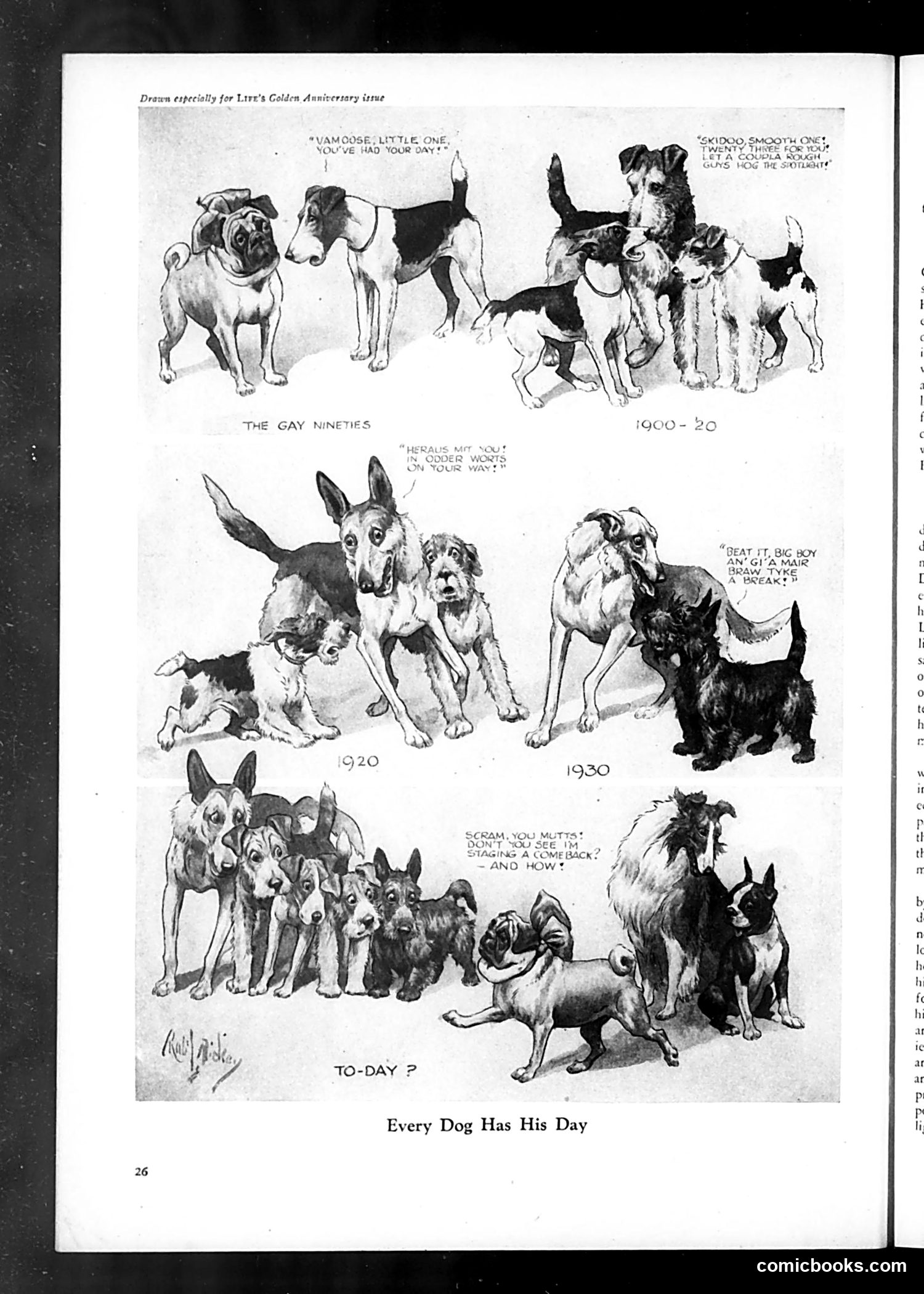
This is a humorous illustrated timeline drawn for Life magazine's Golden Anniversary issue, showing how dogs and dog fashion evolved from the 1890s through the 1930s. The cartoon progresses chronologically: "The Gay Nineties" shows period-appropriate dogs, then moves through 1900-20, 1920, 1930, and "To-day," with each era depicting dogs styled and posed to reflect contemporary human fashions, attitudes, and social behaviors of that decade. The dogs' expressions and body language humorously mirror human vanity and changing social norms. The title "Every Dog Has His Day" is a play on the common expression, suggesting that dogs, like people, experience their moment of relevance or fashion. It's gentle satire on how human trends cycle through time, using dogs as satirical stand-ins.
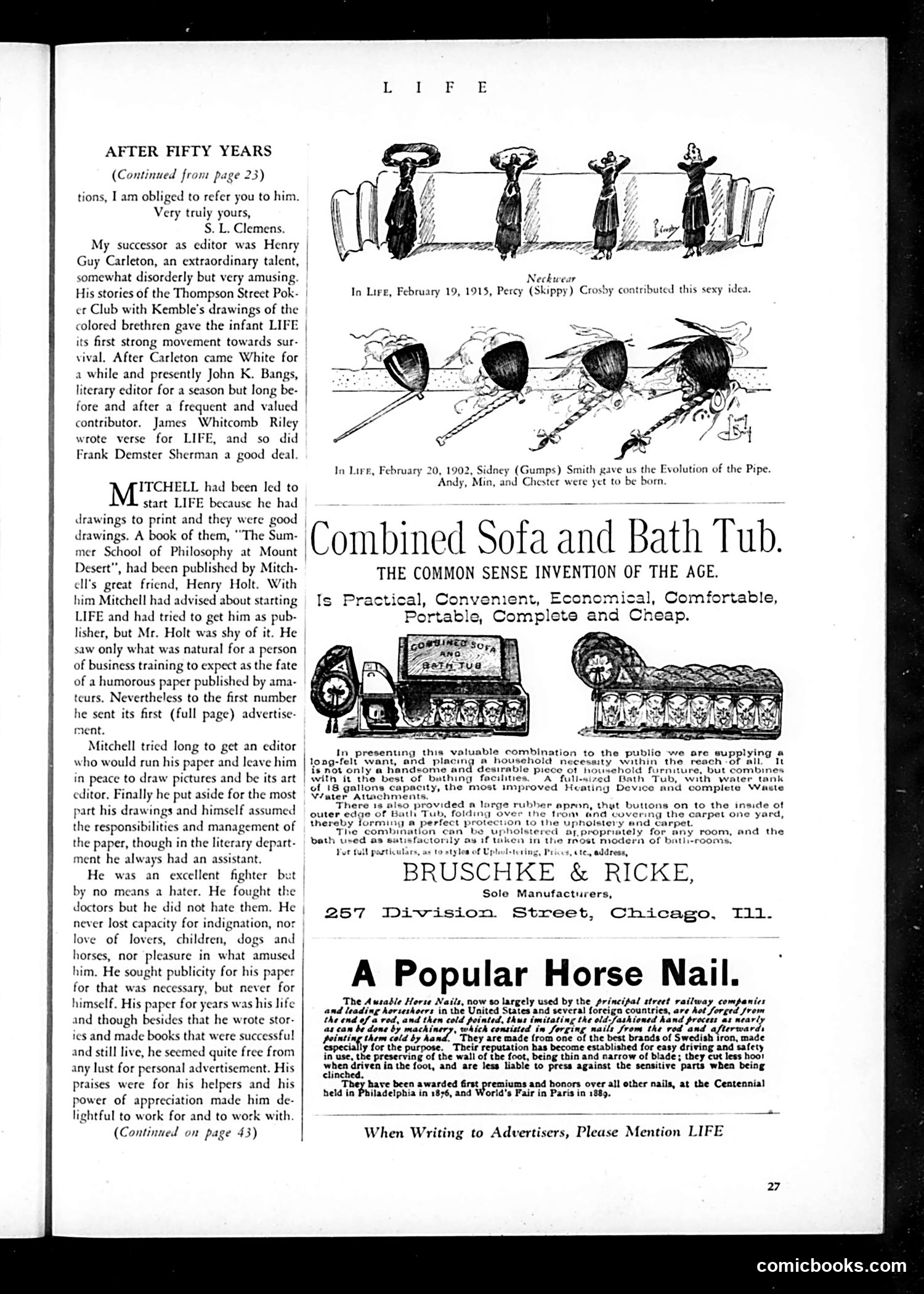
Life Magazine Page Analysis This page from *Life* magazine contains editorial retrospective text about the publication's founding, interspersed with advertisements and two cartoon contributions. Top cartoons: Percy Crosby's "Neckwear" sketch (February 1915) depicts four women in increasingly revealing necklines—a cheeky commentary on changing fashion standards and the gradual exposure of women's bodies as social mores shifted in the early 20th century. Middle cartoon: Sidney Smith's "Evolution of the Pipe" (February 1902) shows pipes in sequential stages, humorously suggesting evolutionary development—likely satirizing the then-popular application of Darwinian theory to everyday objects and fashions. Advertisements: The page includes prominent ads for a "Combined Sofa and Bath Tub" (an impractical Victorian-era combination furniture piece) and "Popular Horse Nails," reflecting the magazine's role in monetizing page space while satirizing consumer culture. The editorial text discusses *Life*'s early editors and contributors, establishing its credibility as America's premier humor publication.
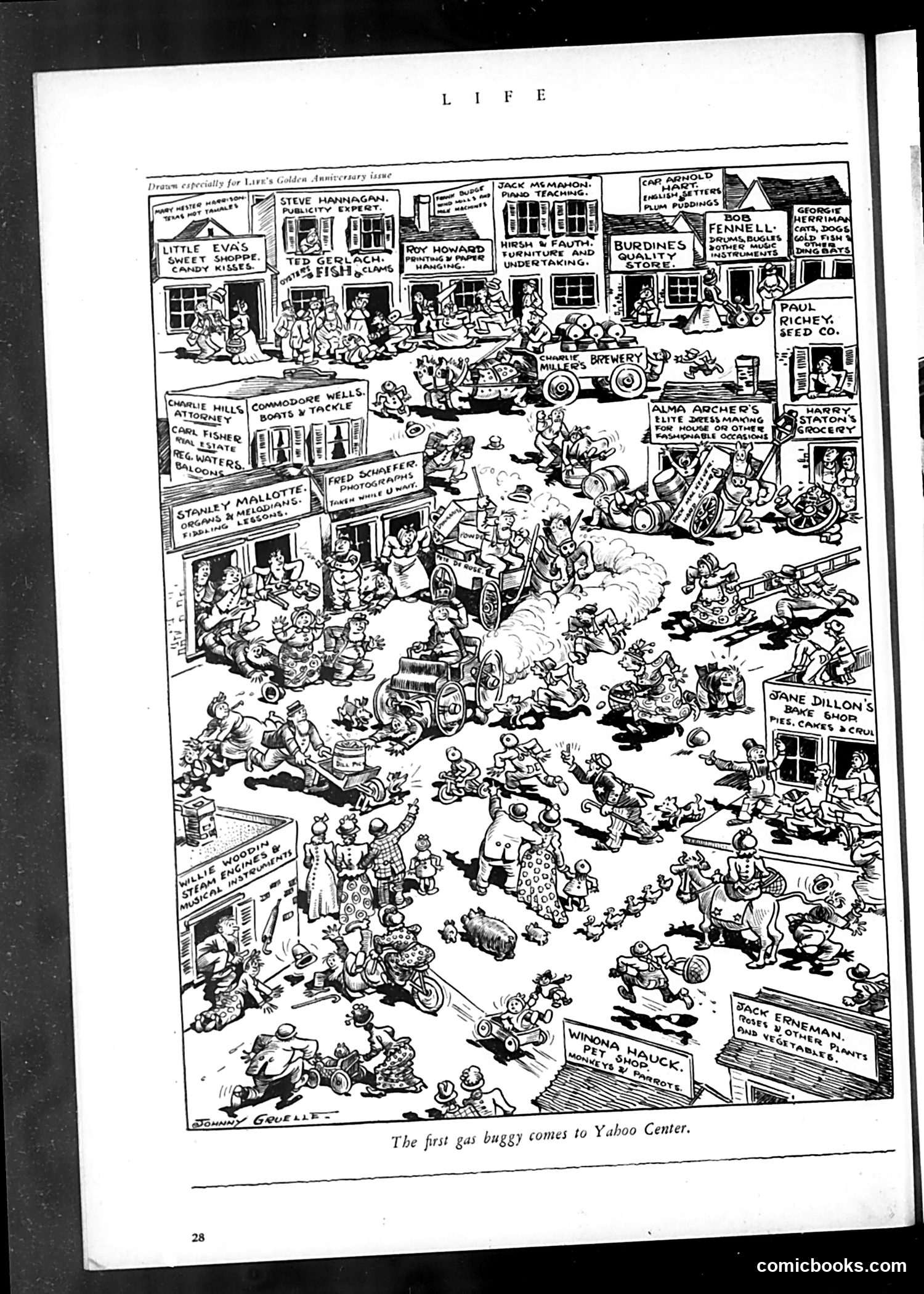
Analysis of "The First Gas Buggy Comes to Yahoo Center" This is a satirical cartoon depicting the arrival of an automobile in a small town, likely from the early 1900s when cars were still novelties. The scene shows chaos and excitement as townspeople react to this new technology—some appear startled, others gathered around in amazement. The cartoon labels various local businesses and prominent citizens around the town square: Steve Hannagan (publicity expert), Ted Gerlach (music store), Jack McMahon (teaching), and others. The satire targets small-town life's resistance to modernity and rapid technological change. The "Yahoo Center" reference suggests this is meant to represent an unsophisticated rural community (yahoo being slang for an uncultured person). The crowded, disorganized scene mocks both the townspeople's backward provincial attitudes and the disruption caused by industrial progress invading traditional communities. The humor lies in the contrast between this sleepy town's expectations and the arriving modern world.
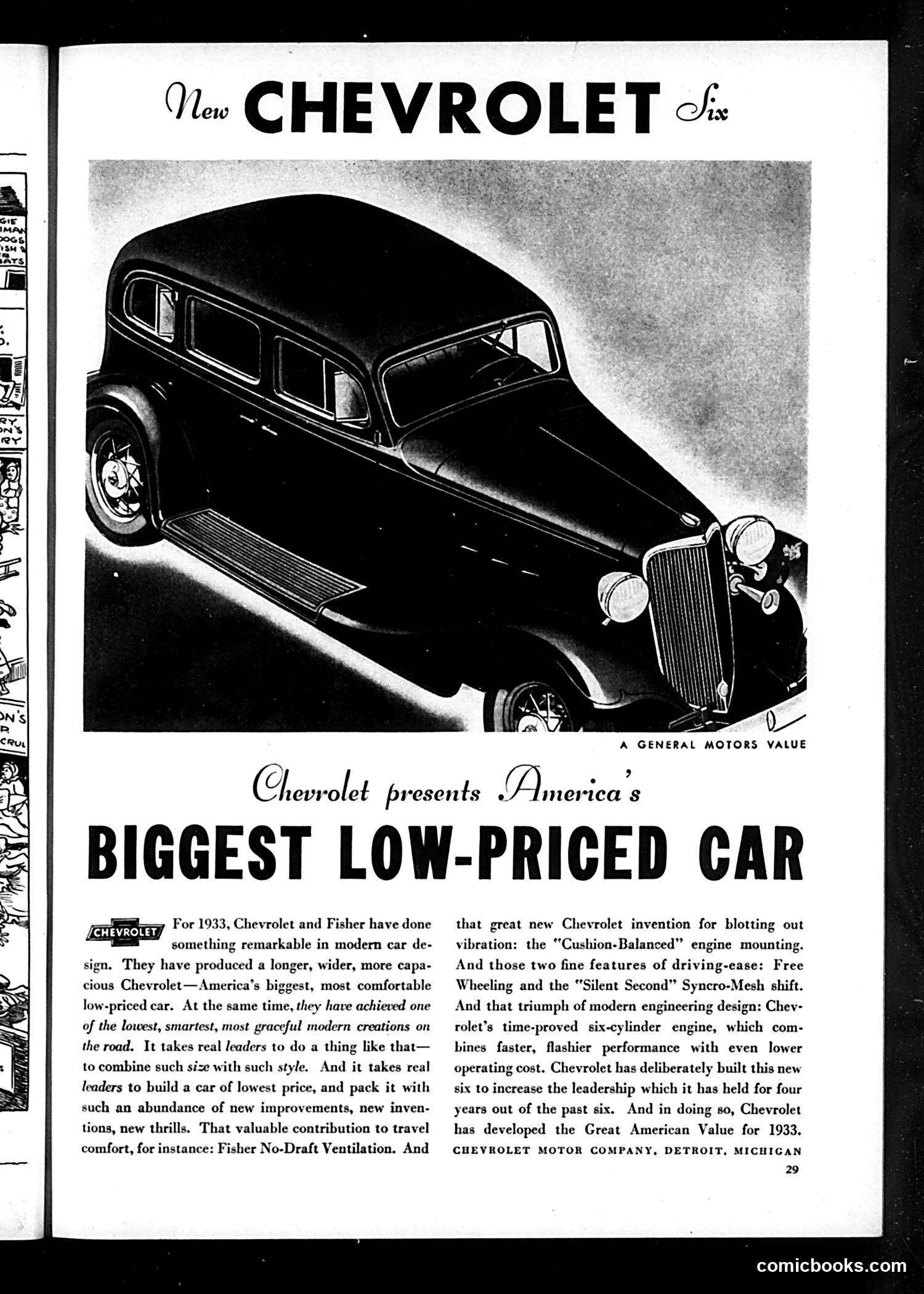
Analysis This is not a cartoon or satire—it's a straightforward automobile advertisement from 1933. The page promotes Chevrolet's new Six model during the Great Depression. The advertisement emphasizes value and American manufacturing pride, highlighting features like Fisher No-Draft Ventilation, "Cushion-Balanced" engine mounting, Free Wheeling, and Syncro-Mesh shift. The copy claims Chevrolet has held market leadership for four of the past six years. The black-and-white photograph shows the 1933 Chevrolet Six—a sleek, modern sedan with distinctive period styling (vertical grille, rounded body lines, wire wheels). For modern readers: This reflects 1933's economic desperation. Despite the Depression, manufacturers advertised cars as affordable luxuries combining size, style, and engineering innovation. The emphasis on "lowest price" and "American Value" speaks to a time when owning a car remained aspirational for many Americans.
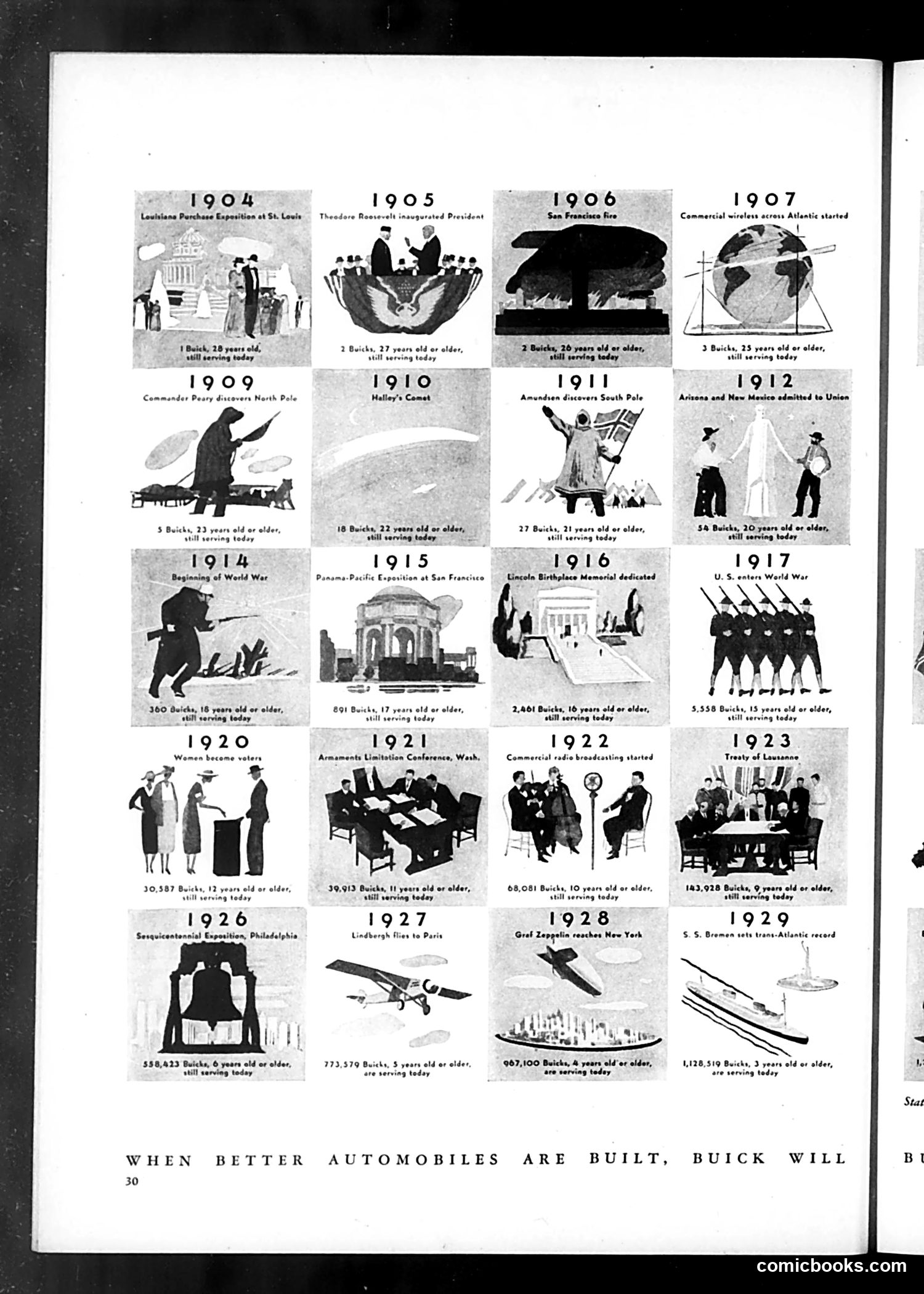
Analysis This is not a political cartoon but rather Buick automobile advertising presented as a timeline. The page uses a clever marketing strategy by pairing major historical events (1904-1929) with statistics about how many Buicks from each era remain "still serving today." The implicit message is about durability and reliability: as significant world events occurred—Theodore Roosevelt's presidency, Halley's Comet, WWI, Lindbergh's flight, the Graf Zeppelin, radio broadcasting—Buick automobiles from those same years continued functioning. The numbers grow dramatically over time, suggesting expanding production and longevity. The tagline "When Better Automobiles Are Built, Buick Will Build Them" reinforces the brand's quality claim. Rather than satirizing contemporary politics or social issues, this is straightforward corporate propaganda using historical context to sell cars by implying Buick's products outlast momentous events.
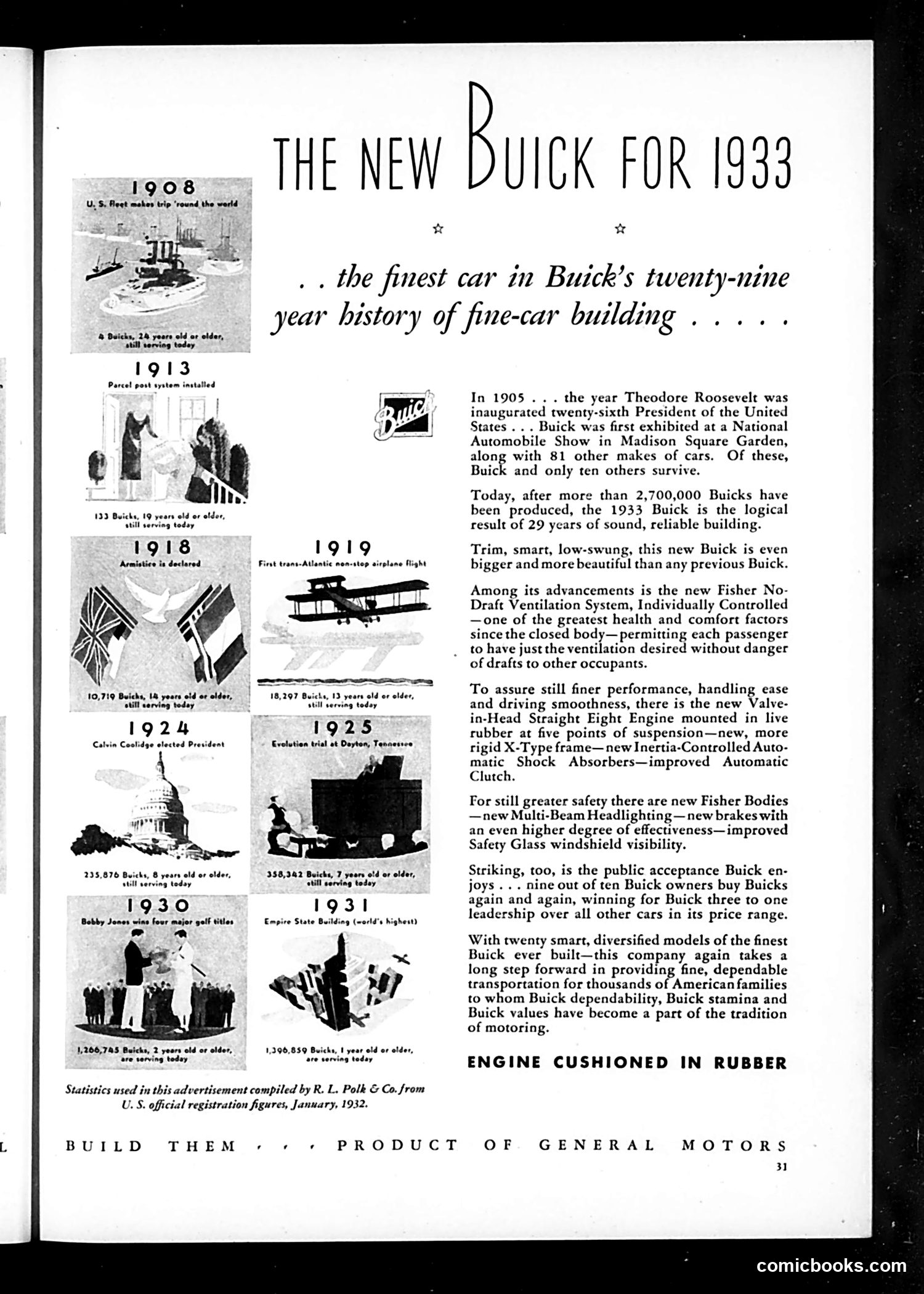
Analysis: Buick Advertisement from Life Magazine (1933) This is primarily a corporate advertisement, not political satire. It's a Buick Motors promotional page celebrating the 1933 model year and the company's 29-year history. The page uses a clever marketing strategy: it pairs major historical events (Theodore Roosevelt's presidency, WWI armistice, the first trans-Atlantic flight, Calvin Coolidge's election, the Empire State Building) with statistics showing how many Buicks from each era remain in service. This creates an implicit argument: Buicks last as long as American institutions themselves—they're as enduring as historical milestones. The accompanying text emphasizes new features (Fisher ventilation, improved suspension, safety glass) to convince 1933 readers that despite the Great Depression, Buick offers cutting-edge reliability worth the investment. Bottom line: This uses patriotic nostalgia and longevity statistics to sell cars during economic hardship—demonstrating Buick's durability through America's own survival of major events.
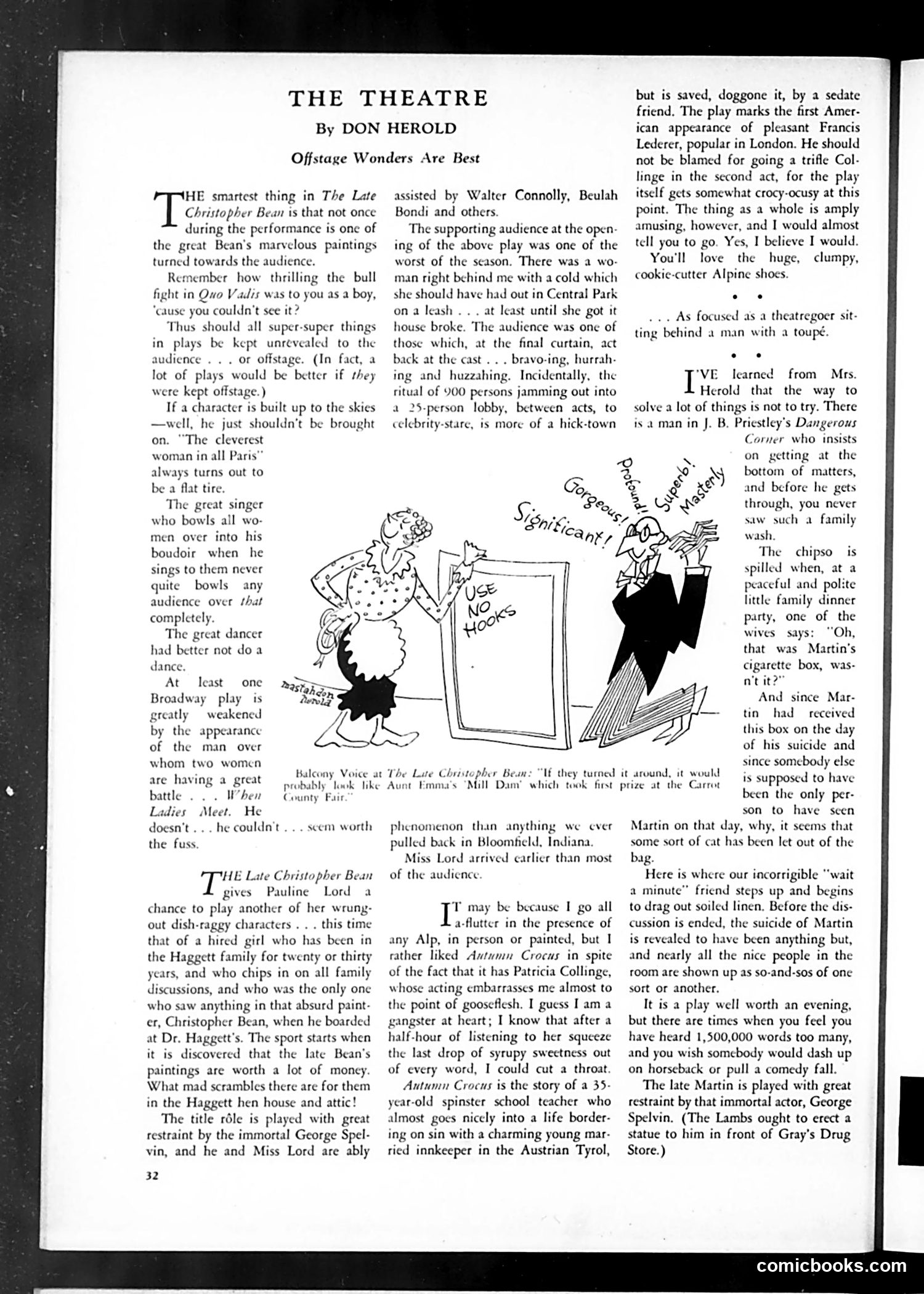
Theatre Review Satire (Life Magazine) This Don Herold column reviews Broadway plays with biting humor about theatrical conventions. The cartoon illustrates his central argument: the best theatrical effects happen *offstage*, unseen. Herold mocks the gap between build-up and reality—famous painters' works stay hidden (wisely), yet famous singers and dancers inevitably disappoint when finally revealed. He ridicules audience behavior too: a woman with a cold, crowds jamming lobbies to "celebrity-stare," and excessive applause. The reviews critique specific productions: *The Late Christopher Bean* (praised for keeping paintings offstage), *When Ladies Meet* (weakened by showing the man women fight over), and *Autumn Crocus* (actress Patricia Collinge's affected delivery so irritates Herold he jokes about wanting to "cut a throat"). The cartoon's annotated figure humorously labels theatrical clichés—"Significant!", "Good legs!", "Use hooks"—mocking how shows telegraph their attempts at drama rather than achieving it naturally.
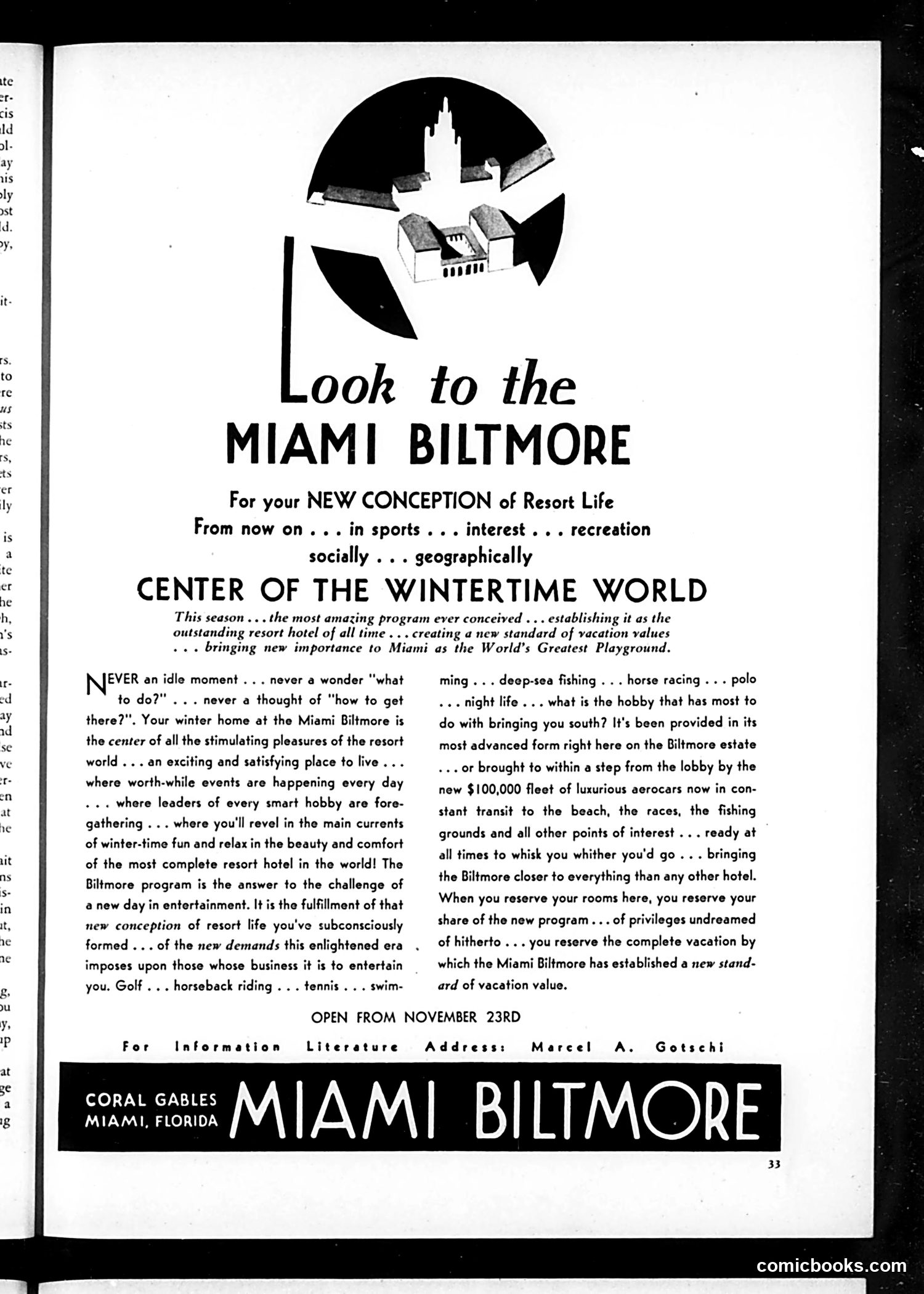
Miami Biltmore Advertisement Analysis This is a luxury resort advertisement, not political satire or a cartoon. It promotes the Miami Biltmore hotel in Coral Gables, opening November 23rd (year unclear from image, but likely 1920s-30s based on styling). The decorative element at top shows an aerial view of the estate with directional arrows, suggesting accessibility and comprehensiveness of amenities. The text emphasizes the hotel as the "Center of the Wintertime World"—targeting wealthy Northern Americans seeking winter escapes. The advertisement markets an all-inclusive lifestyle: golf, polo, deep-sea fishing, horse racing, tennis, and nightlife. It notably mentions a "$100,000 fleet of luxurious aerocars" for guest transportation—positioning the hotel as ultra-modern and convenient. The copy uses superlatives ("most amazing program ever conceived," "World's Greatest Playground") typical of period advertising rhetoric. This is commercial promotion of a high-end resort destination, not satire or political commentary.
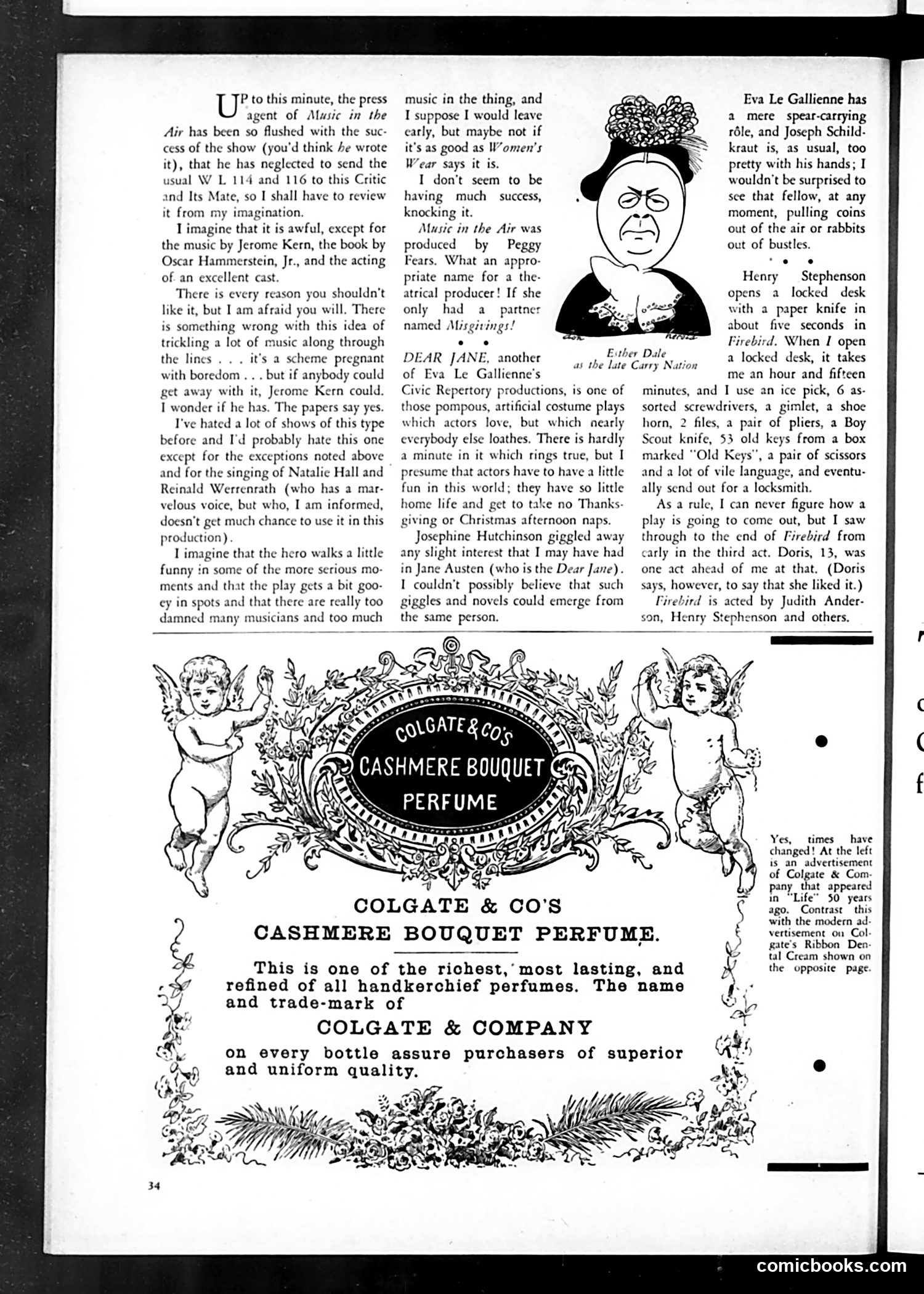
Theater Criticism and Period Advertisement This page contains theater reviews and advertising from an earlier era of *Life* magazine. The critic reviews three Broadway productions: *Music in the Air* (with music by Jerome Kern), *Dear Jane* (an Eva Le Gallienne Civic Repertory production), and *Firebird*. The reviews employ a characteristically sardonic tone—praising the music while mocking the plot, criticizing actress Josephine Hutchinson's giggling, and making a humorous aside about actor Henry Stephenson's ability to pick locks quickly versus the critic's own clumsy attempts. The lower portion contains a full-page advertisement for Colgate & Co.'s Cashmtidigare Bouquet Perfume, featuring ornate Victorian imagery with cherubs. A marginal note reflects on how advertising has changed over fifty years, contrasting this elaborate design with modern advertisements. The page reflects early 20th-century theatrical culture and consumer advertising aesthetics.
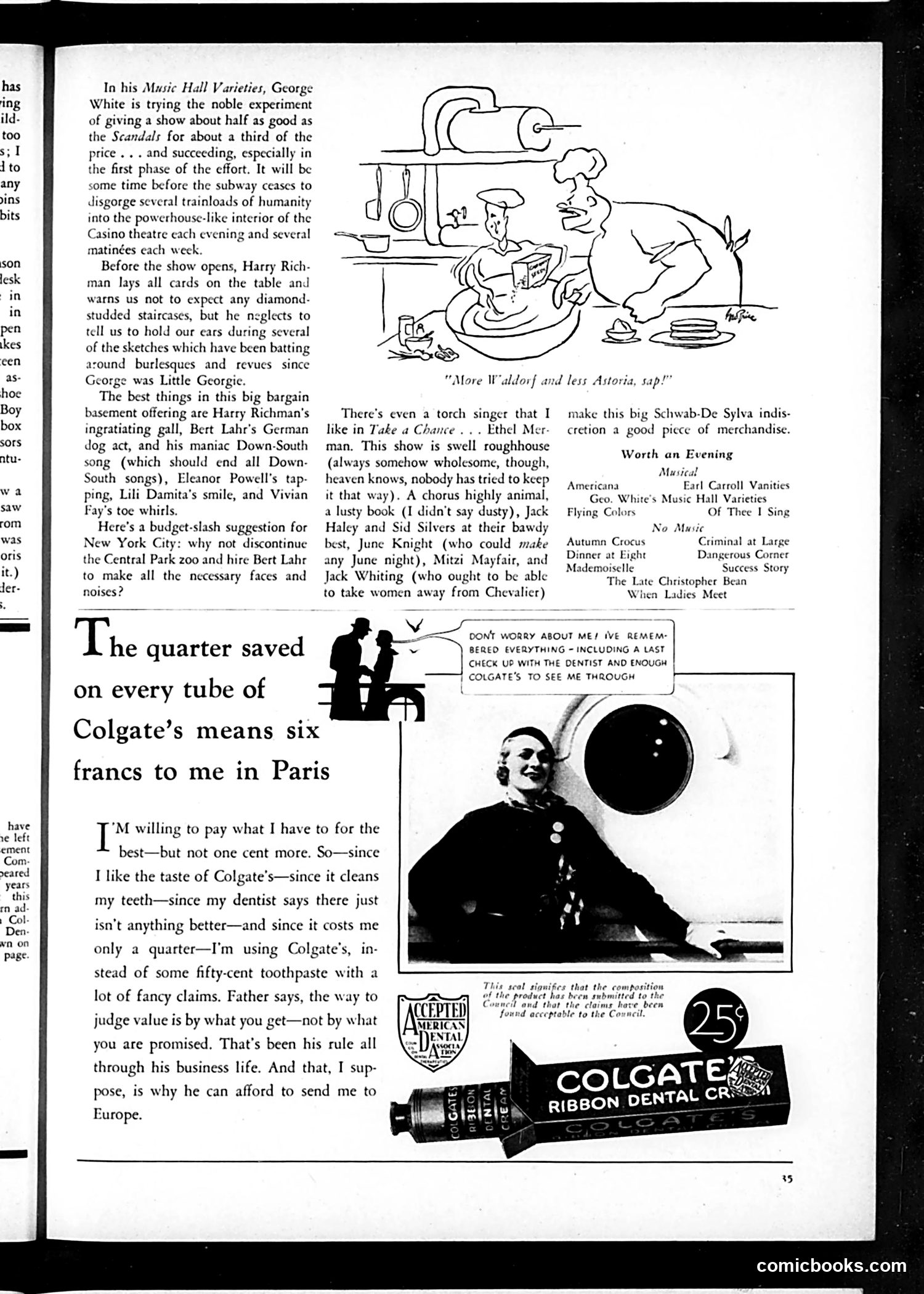
Life Magazine Page Analysis This page contains theater reviews and a Colgate toothpaste advertisement, typical of 1930s Life magazine content. Theater Section (top): Critic reviews George White's "Music Hall Varieties," a lower-budget Broadway show competing with the more expensive "Scandals." The review praises performers like Bert Lahr (noted for his animal impressions and comedic physical humor) and Eleanor Powell (tap dancer). The satirical opening joke mocks the show as deliberately cheaper but still successful—audiences pack the Casino theater despite lower production values. Advertisement (bottom): A Colgate ad features a woman claiming she saves money using their 25-cent toothpaste instead of expensive 50-cent alternatives. Her father's business philosophy—judge products by actual results, not promises—justifies the economy choice. The ad exemplifies Depression-era marketing: emphasizing value and practical savings during economically tight times. The humorous silhouette scene shows she's so confident in Colgate's quality she needn't worry about her teeth.
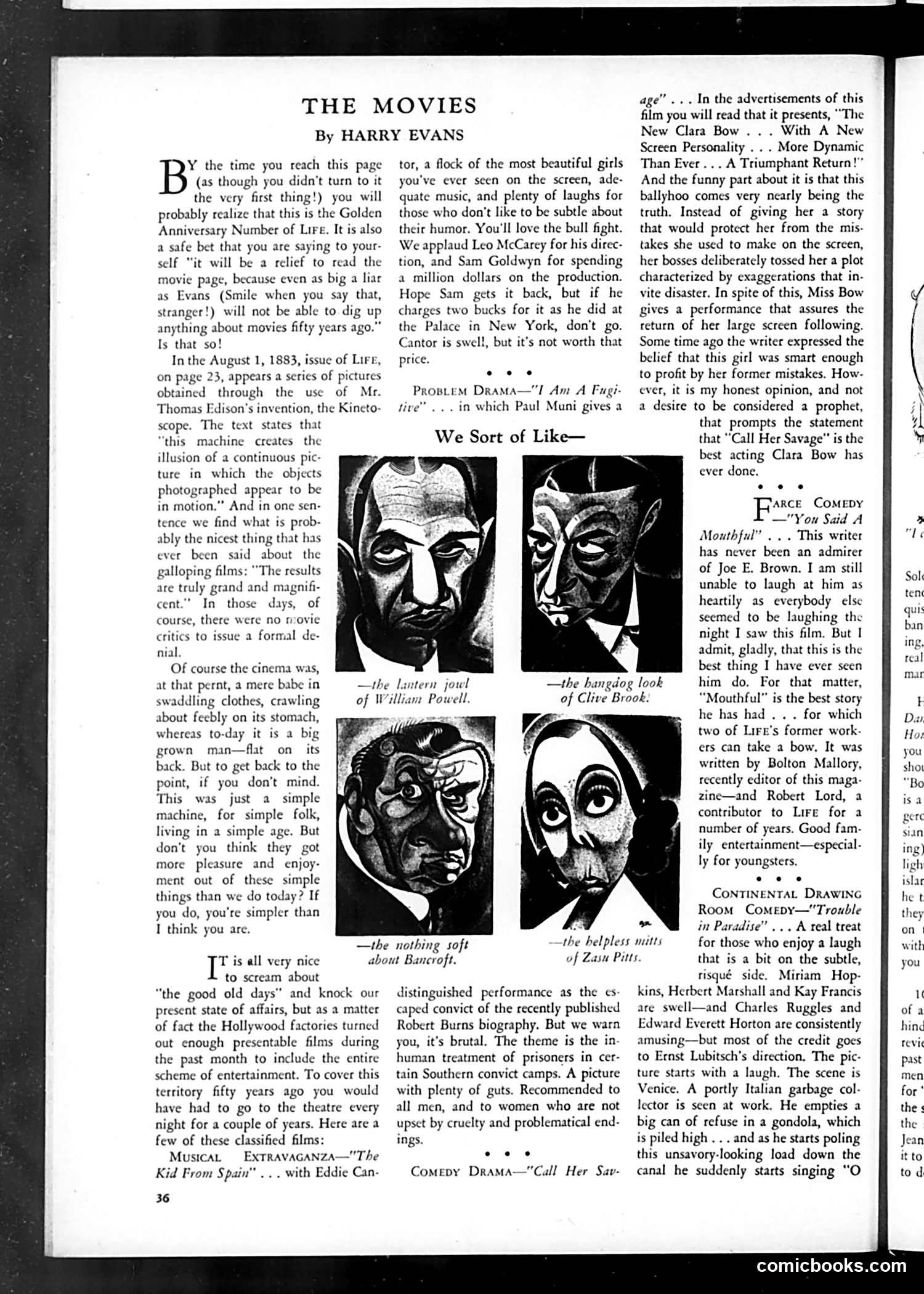
What This Page Means This is a movie review column from Life magazine's 50th anniversary issue. Critic Harry Evans uses the occasion to humorously contrast cinema's humble origins (Edison's 1883 Kinetoscope) with its current bloated state—calling modern Hollywood "a big grown man—flat on its back." The four stark black-and-white caricatures labeled "We Sort of Like" are exaggerated facial expressions of actors William Powell, Clive Brook, Bancroft, and Zasu Pitts, likely illustrating the theatrical mugging common in early cinema. Evans reviews contemporary films: Eddie Cantor's musical comedy, Paul Muni's gritty prison drama, and a Clara Bow vehicle. His tone is affectionately cynical—praising the films while mocking Hollywood excess (the million-dollar budget, inflated ticket prices, overblown advertising) and suggesting audiences got more enjoyment from simpler entertainments fifty years prior. The subtext critiques modern consumer culture's complexity and expense versus earlier simplicity.
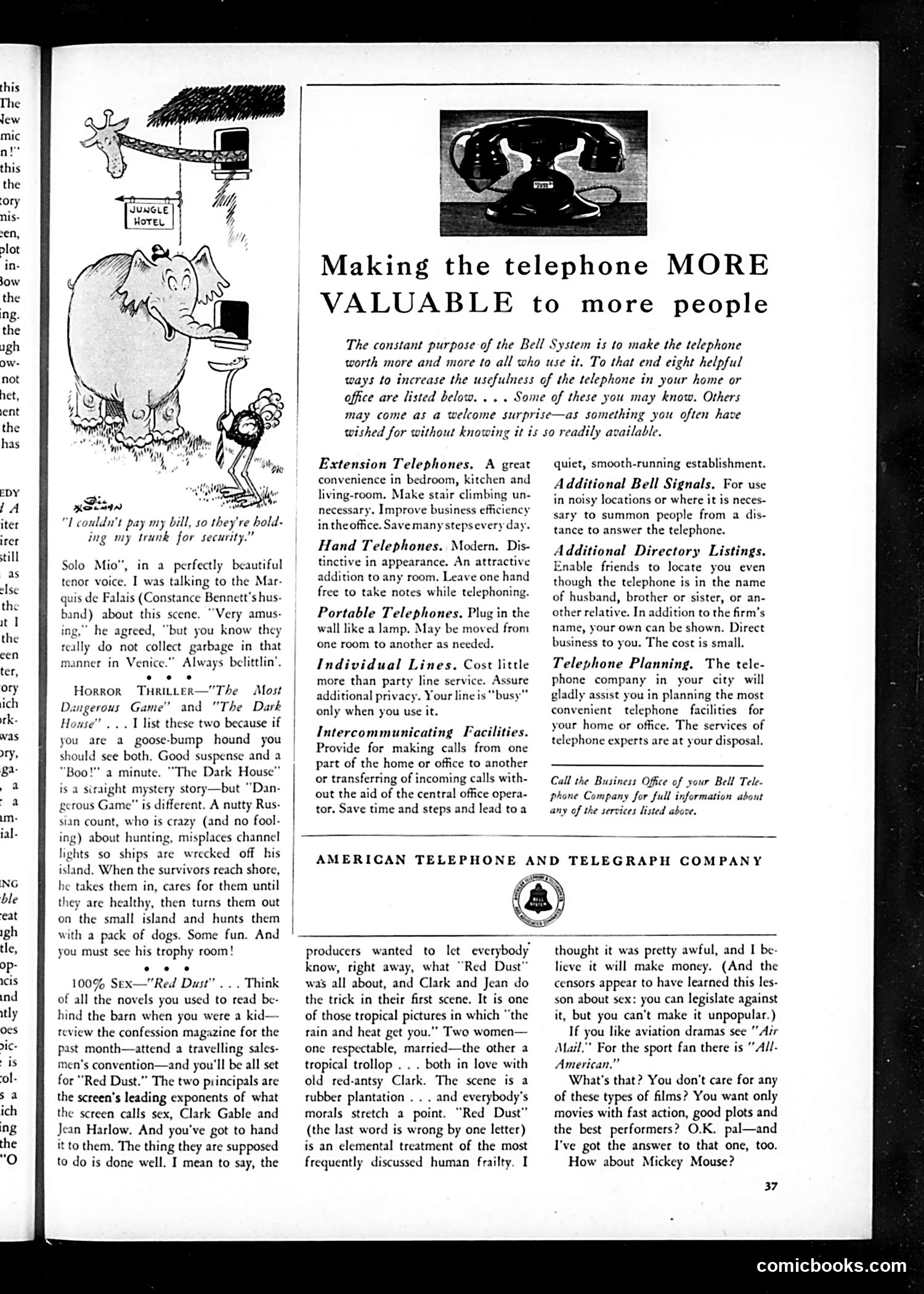
Analysis of Life Magazine Page This page contains two distinct elements: a film review column on the left and a Bell Telephone System advertisement on the right. The Cartoon/Illustration The small cartoon depicts an elephant at a "Jungle Hotel" telephone, captioned "I couldn't pay my bill, so they're holding my trunk for security." This is a visual pun: the elephant's literal trunk is being held as collateral for unpaid phone charges. The joke plays on double meaning—a humorous way to illustrate telephone billing issues. The Advertisement The right side is a corporate advertisement promoting eight telephone innovations (extension phones, hand phones, portable phones, individual lines, intercommunicating facilities, additional signals, directory listings, and planning services). The Bell System positions itself as constantly improving telephone utility for ordinary households and businesses. Context: This reflects 1930s-era telephone technology as a luxury/convenience product, with Bell promoting adoption by highlighting practical home and office applications—a far cry from today's ubiquitous cellular phones.
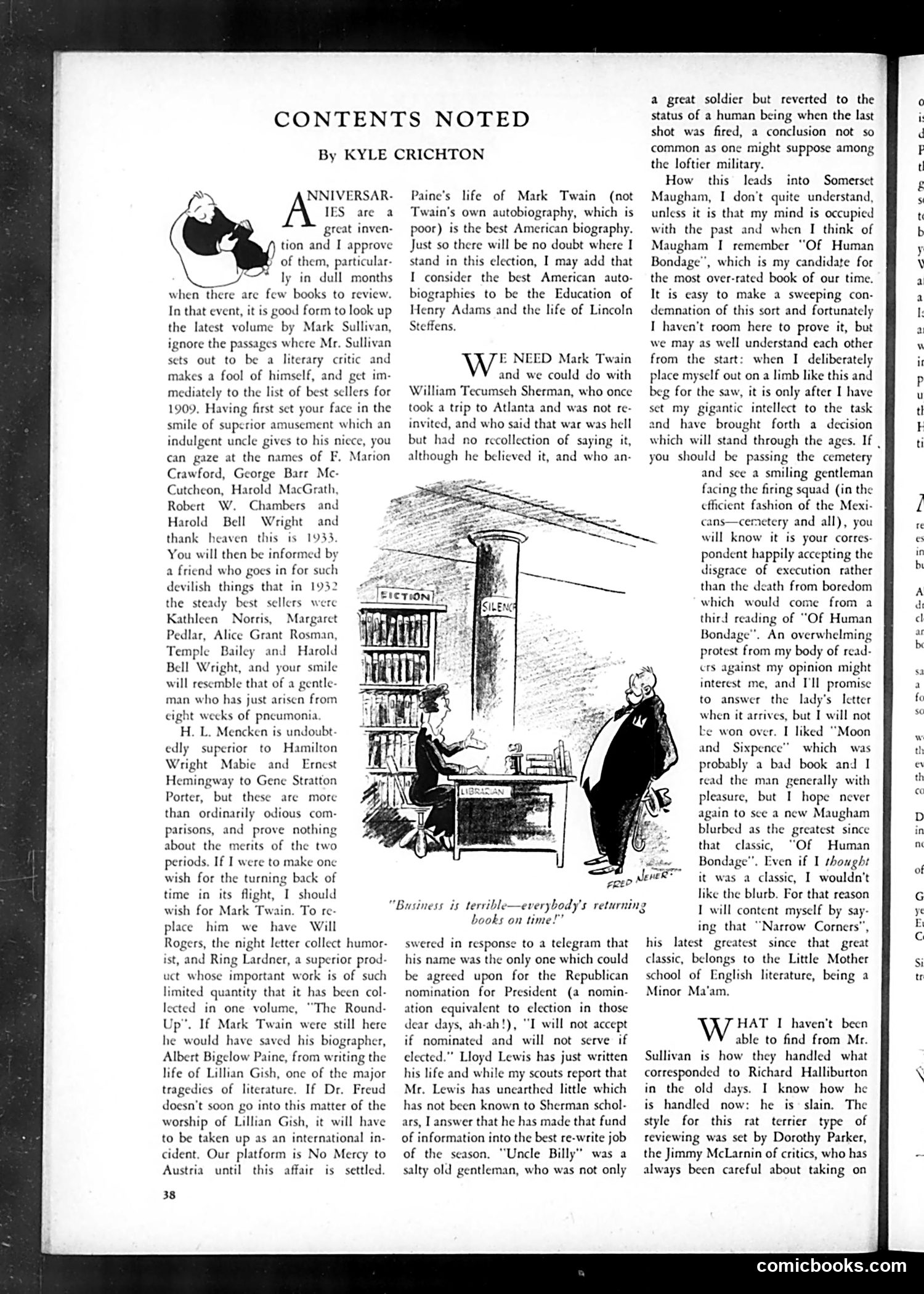
Explanation for Modern Readers This is a book review column by Kyle Crichton discussing American literature and authors. The small cartoon depicts a bookstore clerk at a counter labeled "FICTION" and "SILENCE," with a customer asking about business. The clerk responds that "Business is terrible—everybody's returning books on time!" The joke mocks Depression-era economic hardship: normally, customers would keep books longer (implying they couldn't afford to buy new ones), but now they're returning them promptly, suggesting even worse financial desperation. The column itself critiques literary taste, contrasting 1909 bestsellers (now forgotten authors like F. Marion Crawford) with 1932 bestsellers (still mediocre, in Crichton's view). He praises Mark Twain and William Tecumseh Sherman's biographies while dismissing Somerset Maugham's "Of Human Bondage" as overrated—typical of literary snobbishness in 1930s magazines like *Life*.
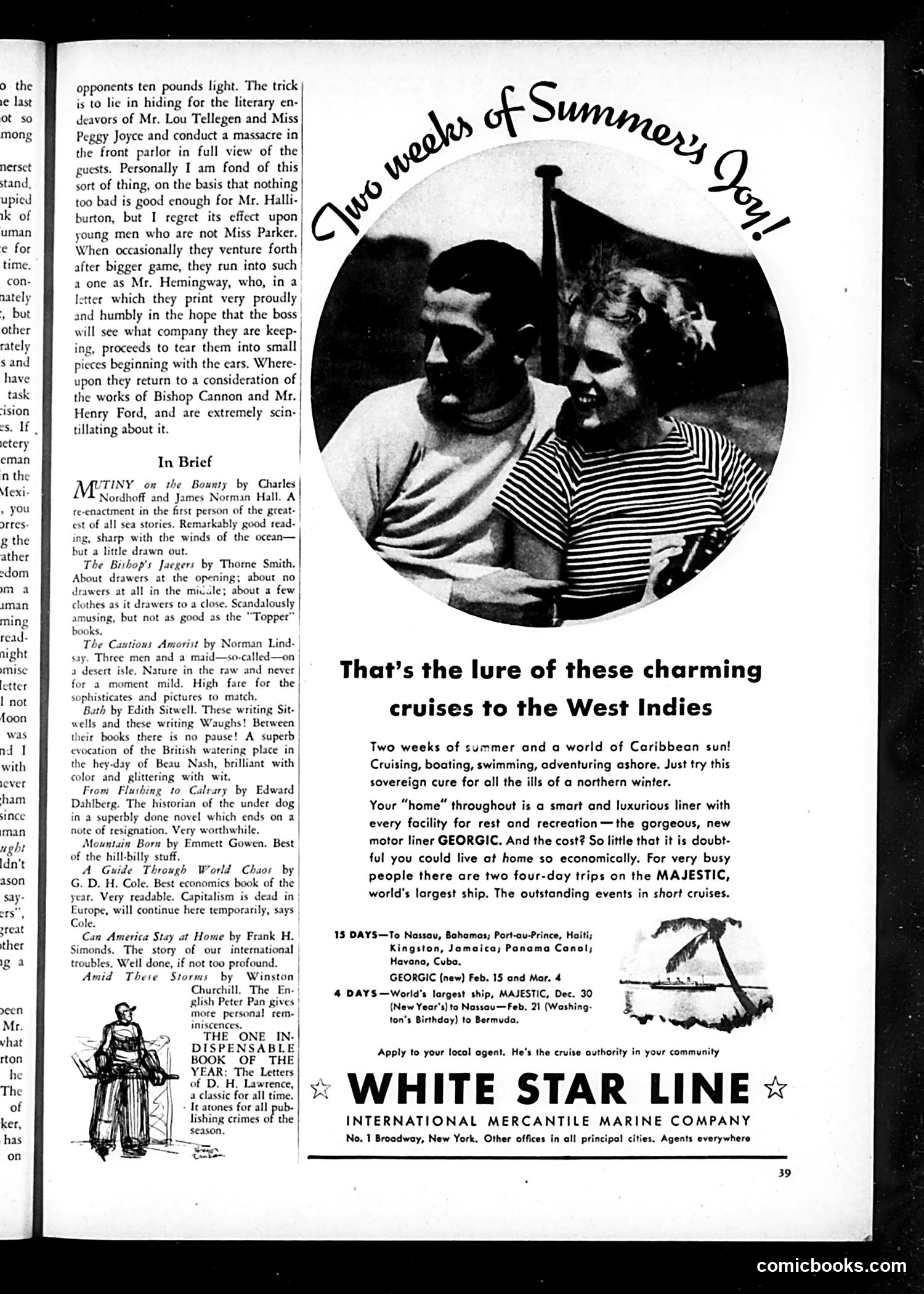
Analysis of Life Magazine Page Content This page is primarily advertising mixed with book reviews, not political satire. The main visual element is a White Star Line cruise advertisement featuring a photograph of two people (likely a couple) with the headline "Two weeks of Summer's Joy!" promoting Caribbean cruises aboard the liners *Georgic* and *Majestic*. The left column contains "In Brief"—short literary reviews of contemporary 1920s-30s books by authors like Hemingway, Winston Churchill, and D.H. Lawrence. The opening text mildly satirizes literary pretension, mentioning writers like Lou Tellegen and Peggy Joyce. No significant political cartoon or satire appears here. The page reflects 1920s-30s leisure culture and publishing trends rather than commentary on political events. The advertisement emphasizes luxury travel as escapism from "northern winter" troubles—typical of Depression-era aspirational marketing.
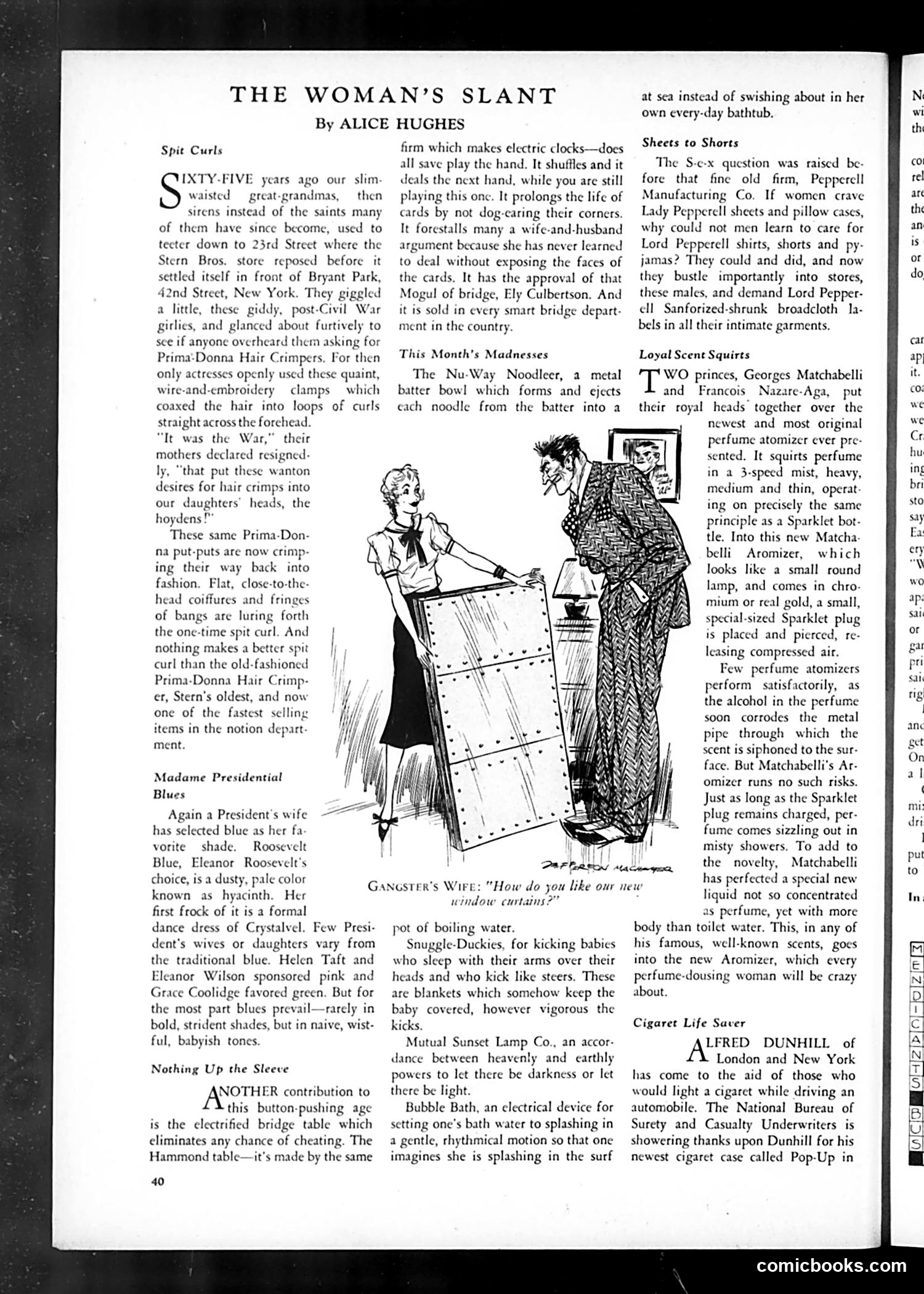
Explanation for Modern Readers This is a women's lifestyle column by Alice Hughes from *Life* magazine (a satirical publication, though this particular page is mostly straightforward consumer commentary). The illustrated cartoon shows a woman and man discussing new window curtains—a domestic scene satirizing modern appliances. The column itself mocks contemporary gadgets and fashion trends of the era (appears to be 1930s-40s based on references to Eleanor Roosevelt). Key satirical targets include: - Hair crimpers: Hughes traces how a post-Civil War beauty practice (spit curls) is resurging, noting women originally hid their use as supposedly improper. - "Presidential Blues": Eleanor Roosevelt's fashion choice spawned a color trend—satirizing how First Ladies' preferences drive consumer behavior. - Gadgets: An "electrified bridge table" that deals cards automatically mocks both automation anxiety and marital distrust (wives can't cheat if the machine deals). - Absurd novelties: The column lists ridiculous inventions (automatic noodle ejectors, "snuggle-duckies" blankets, perfume atomizers) parodying consumer culture's endless new products. The humor targets both Depression-era consumerism and evolving gender roles—men now buying "Lord Pepperell" branded men's intimate garments.
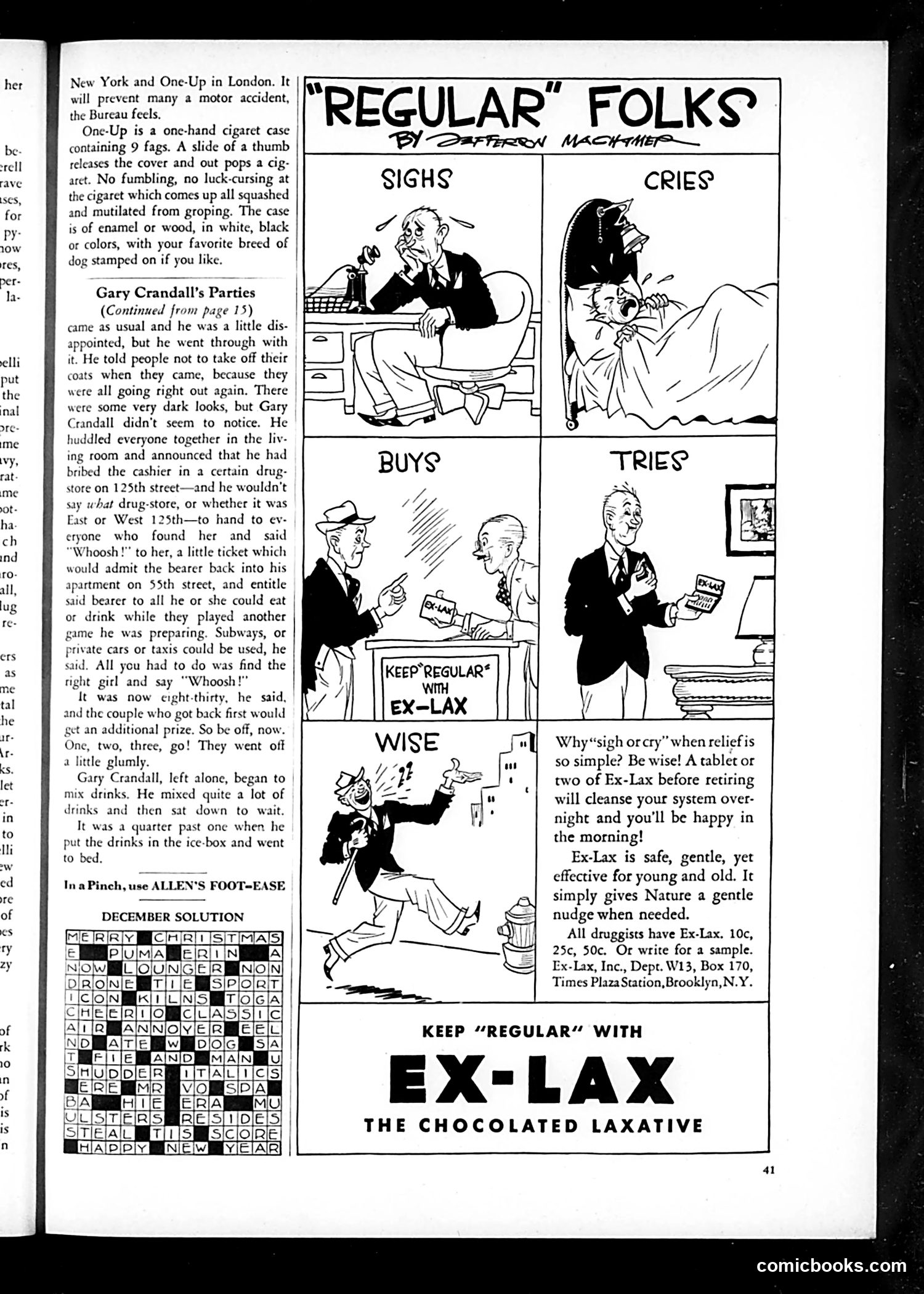
"Regular Folks" Comic Strip Analysis This page features a four-panel comic strip by Satterow Machimer satirizing everyday frustrations through exaggerated scenarios. Each panel represents a common complaint: "Sighs" shows a man overwhelmed at his desk; "Cries" depicts someone struggling with a baby carriage; "Buys" shows men purchasing "Keep Regular" with Ex-Lax laxative; and "Tries" shows a man attempting various remedies at his desk. The humor relies on visual puns and the implicit suggestion that digestive regularity solves life's problems. The comic serves primarily as advertising for Ex-Lax chocolated laxative, positioned as the simple solution to modern stress and discomfort. The adjacent text describes Gary Crandall's chaotic party stunt, establishing the magazine's satirical tone about upper-middle-class social pretension and absurdity. The crossword puzzle adds to the entertainment package typical of Life magazine's format during this era.
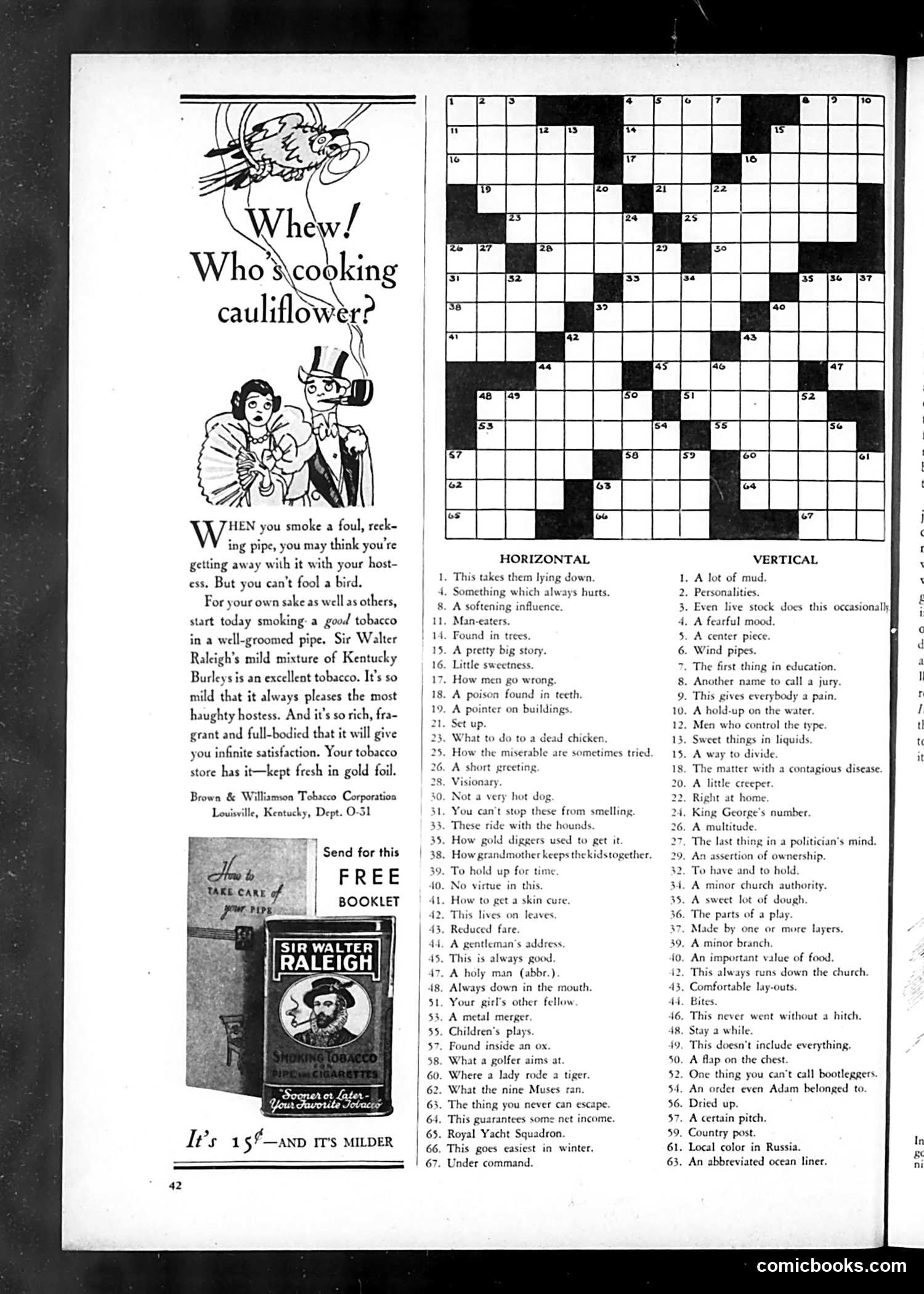
Analysis for Modern Readers This page combines a tobacco advertisement with a crossword puzzle—two typical Life magazine elements from the early-to-mid 20th century. The advertisement features a cartoon showing a man smoking a pipe while a woman recoils in disgust, captioned "Whew! Who's cooking cauliflower?" The joke: pipe smoke smells terrible, like burnt vegetables. The ad's pitch urges smokers to switch to Sir Walter Raleigh tobacco, claiming it's so mild and pleasant that even finicky hostesses won't mind the smell. The satire: The ad ironically acknowledges that pipe smoking is socially offensive—it bothers others and marks you as inconsiderate—then proposes a "solution" that is essentially just... switching brands of the same offensive habit. The humor lies in this obvious logical gap: better-quality pipe tobacco still produces pipe smoke. The crossword puzzle below is unrelated content filler typical of such magazines. Nothing here is overtly political; this is simply period advertising that today reveals attitudes toward smoking, gender dynamics, and social etiquette in early American consumer culture.
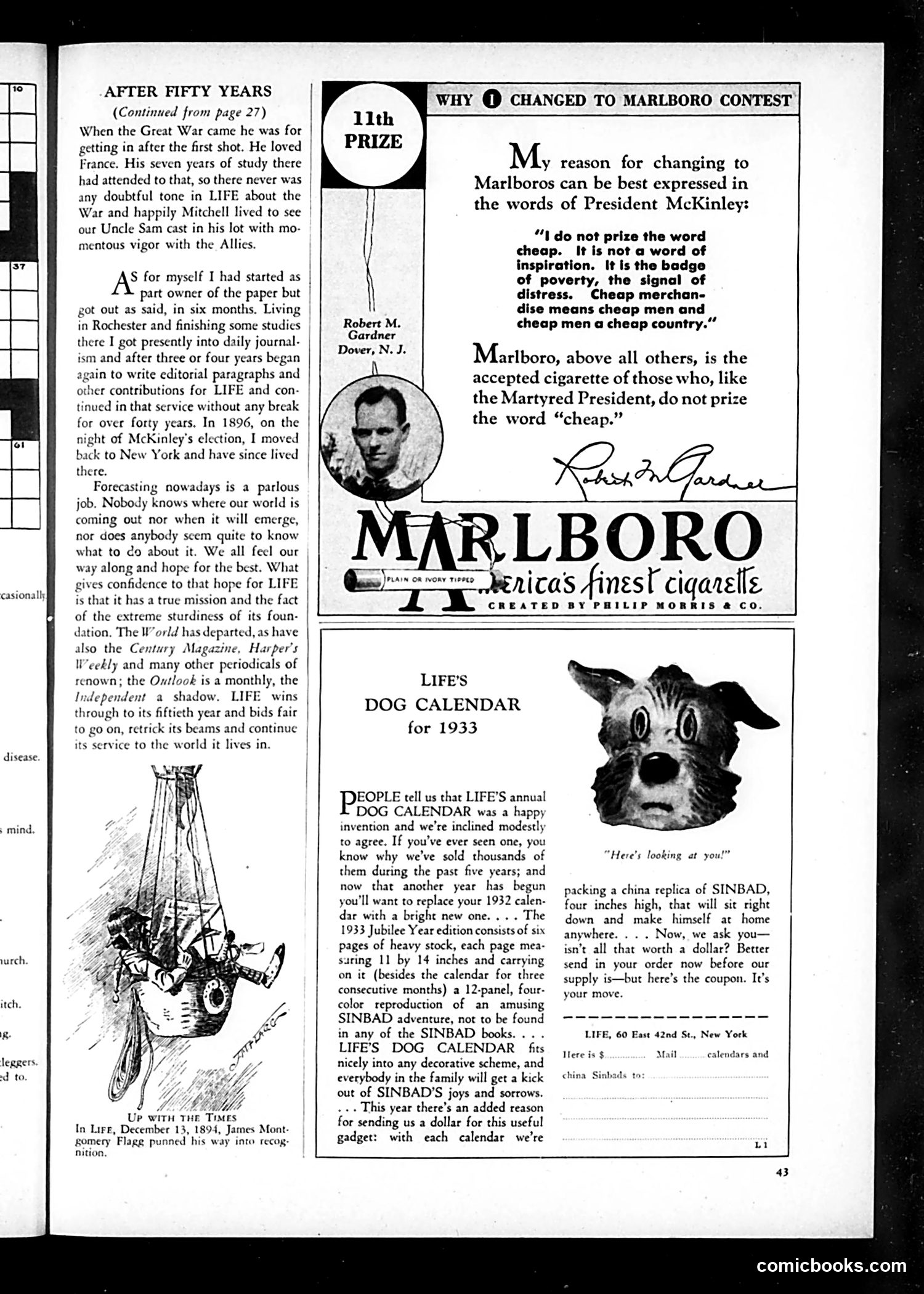
Political Context and Advertising on This Life Magazine Page This page combines editorial content with advertising. The left column concludes a piece about Life magazine's fifty-year history, mentioning the founder's pro-World War I stance and his 1896 move to New York following McKinley's election. The main content is a Marlboro cigarette advertisement featuring Robert M. Gardner of Dover, New Jersey, as the 11th prize winner. The ad quotes President McKinley dismissing "cheap" as a word of poverty and distress, arguing that quality merchandise reflects quality character. Marlboro positions itself as the cigarette for those who don't prize cheapness—a luxury brand appeal. Below is an advertisement for Life's Dog Calendar for 1933, featuring Sinbad (a cartoon dog character). The calendar offered decorative pages with Sinbad adventures, plus a small china figurine replica as incentive to purchase for one dollar. Both ads reflect 1930s marketing: aspirational messaging tied to presidential authority and collectible premiums to drive sales.
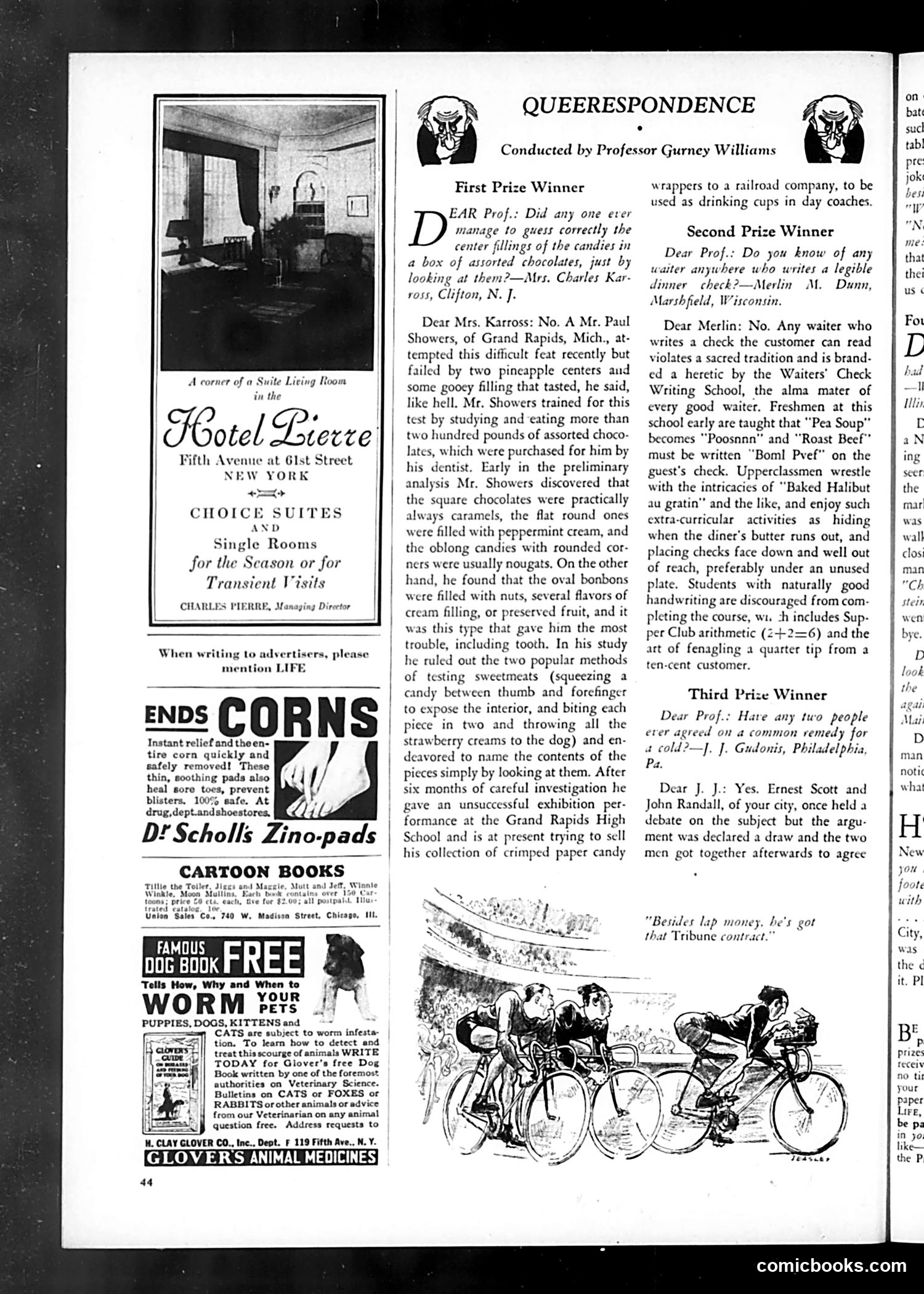
Life Magazine Humor Page Analysis This page from *Life* magazine presents humorous reader submissions answered by "Professor Gurney Williams." The "Queerespondence" column mocks everyday frustrations through exaggerated responses. The First Prize Winner humorously describes a man who spent six months and consumed 200+ pounds of chocolates attempting to identify box contents by appearance alone—failing by two pieces. The absurdist punchline: he's now trying to sell the empty crimped wrappers to railroads as drinking cups. The Second Prize Winner jokes that no waiter exists who writes legible checks, claiming waiters are trained at a fictional "Waiters' Check Writing School" to deliberately obfuscate handwriting (turning "Pea Soup" into "Poosnnn"). It satirizes the universal dining experience of deciphering incomprehensible bills and waiters' tricks to avoid proper service. The cartoon below (partially visible) appears unrelated to the text. The page is primarily advertising for Hotel Pierre, corn remedies, and animal medicines, with the humor section filling remaining space—typical *Life* magazine layout.
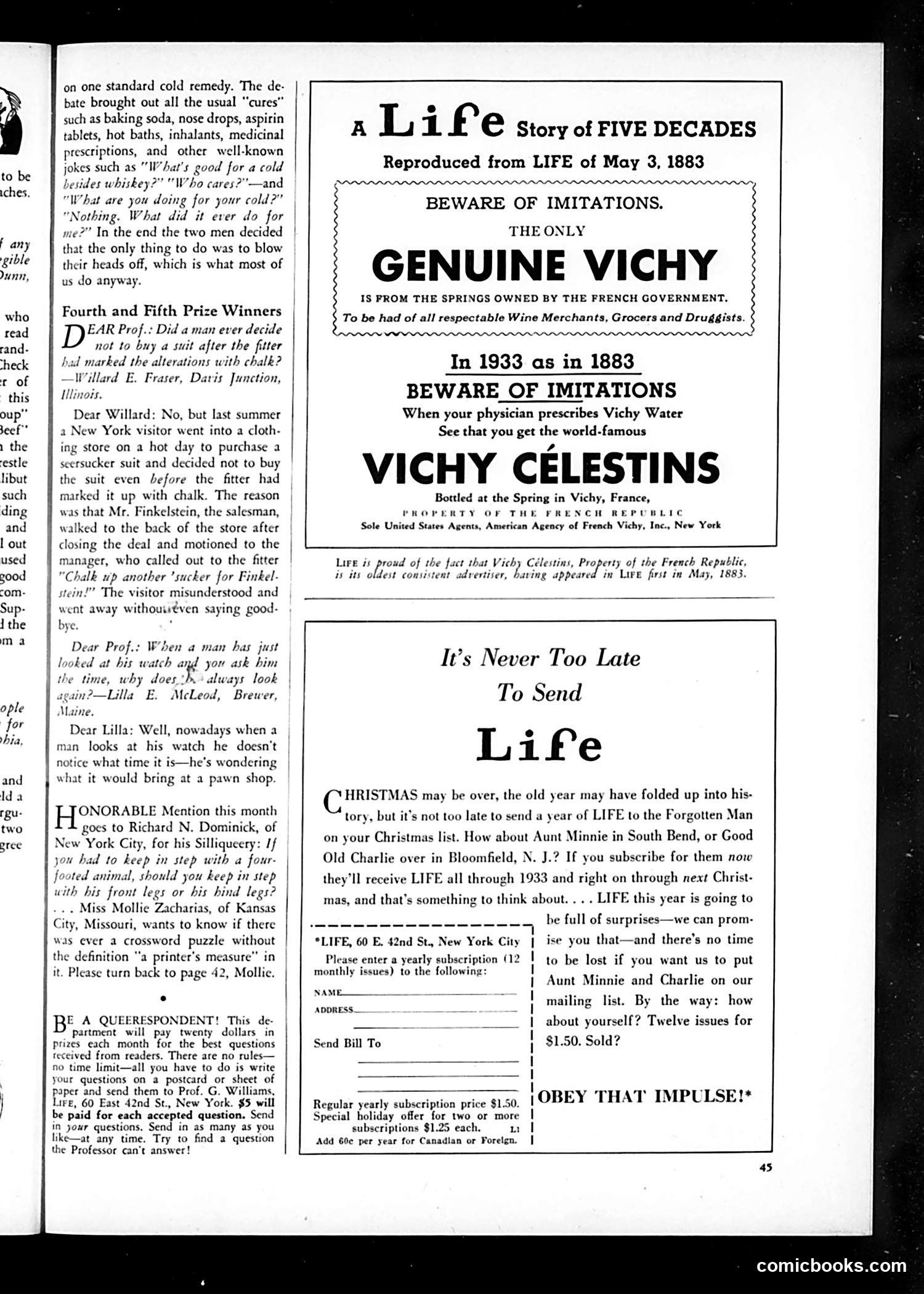
Analysis of Life Magazine Page (1933) This page is primarily advertising and subscription material rather than editorial content or satire. The main feature is a historical advertisement for Vichy water, reproduced from Life's May 3, 1883 issue. It emphasizes authenticity ("Beware of Imitations") and claims the product is "Property of the French Republic"—a marketing strategy asserting legitimacy through government endorsement. The left column contains reader Q&A humor about mundane observations: why men look at watches twice, whether tailors ever lose sales, and whether crossword puzzles exist without printer's measurements. These are gentle, observational jokes reflecting Depression-era anxieties (pawn shops, cold remedies). The bottom section solicits magazine subscriptions as Christmas gifts for forgotten acquaintances, using colloquial names ("Aunt Minnie," "Good Old Charlie") to suggest personal connection and obligation. No political cartoons or caricatures appear on this page. The content reflects 1933 commercial messaging and light domestic humor.
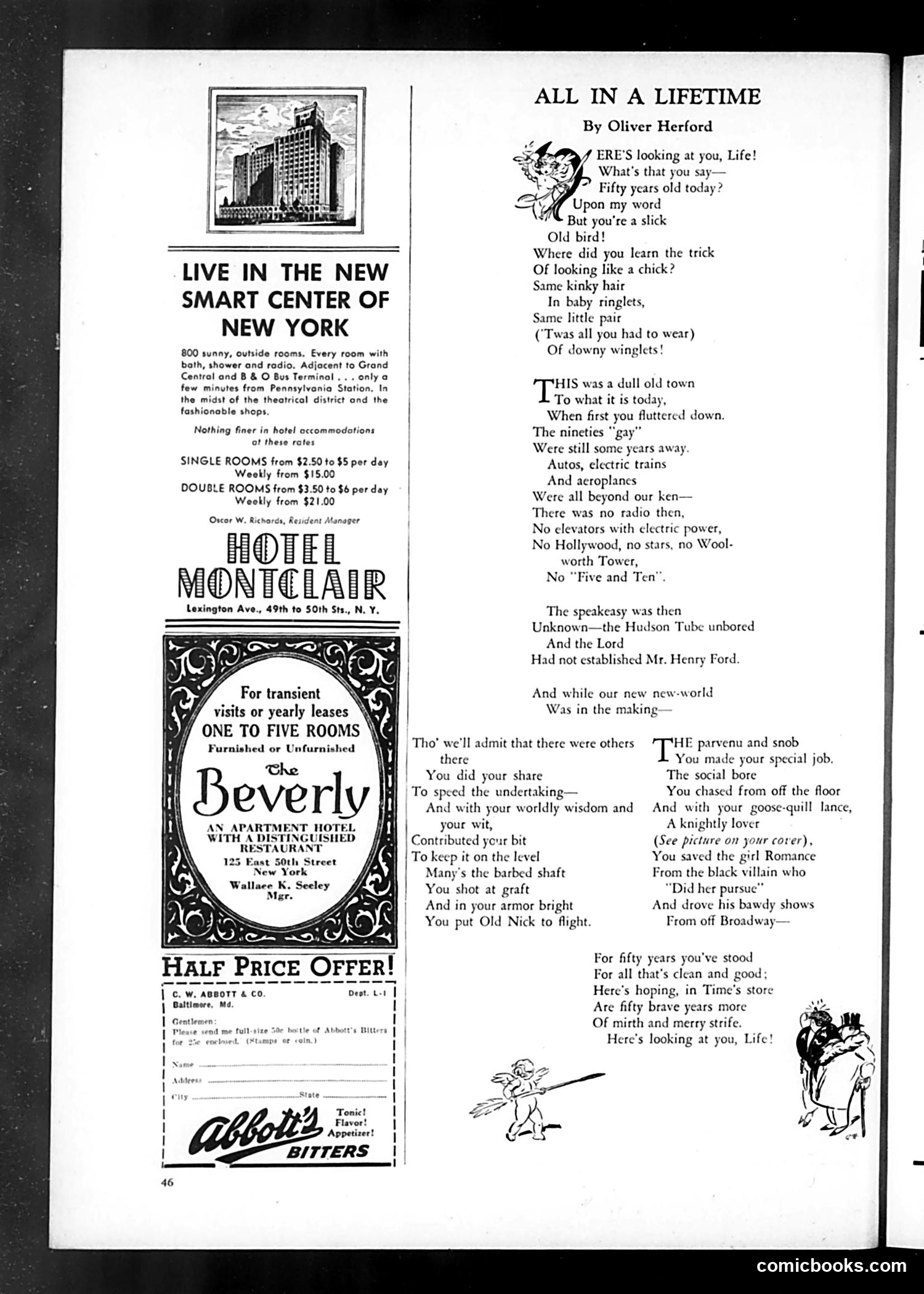
"All in a Lifetime" - Life Magazine's 50th Anniversary Tribute This page celebrates Life magazine's 50th birthday with a poem by Oliver Herford (a prominent humorist of the era). The poem personifies Life as an attractive, youthful woman who has aged gracefully, addressing her directly: "Here's looking at you, Life!" The satire contrasts Life's modern present with the dull past. It references real innovations of the preceding decades—automobiles, electric trains, elevators, radio, the Hudson Tube (NYC subway), and the Woolworth Tower. It mocks the "nineties" as antiquated and celebrates Life's role in satirizing social ills: attacking graft ("barbed shaft"), battling moral corruption ("put Old Nick to fight"), and defending romance from "black villain" seduction narratives typical of melodrama. The poem credits Life with maintaining standards of decency and humor. The surrounding advertisements (Hotel Montclair, Abbott's Bitters) are period commercial content, not part of the satire. Historical context: This appears to be from around 1933 (Life's founding was 1883), reflecting the magazine's self-perception as a guardian of American morality and social commentary.
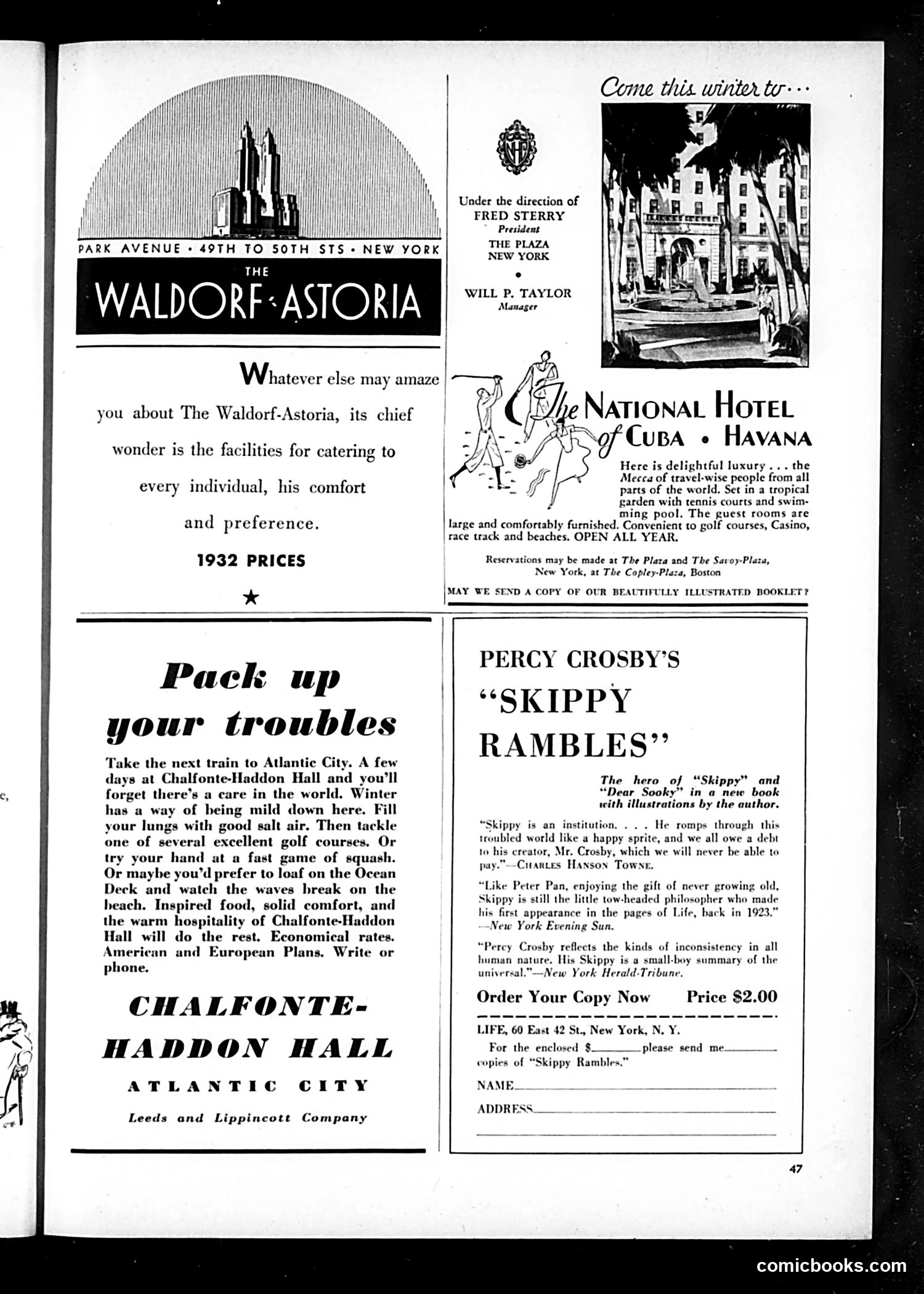
This is a 1932 magazine page primarily consisting of luxury hotel advertisements. The Waldorf-Astoria ad emphasizes catering facilities and "1932 prices"—likely ironic given the Great Depression context. The National Hotel of Cuba and Chalfonte-Haddon Hall in Atlantic City similarly promote escapes and leisure activities. The page's satire appears subtle: promoting expensive vacations and comfort during economic crisis. The phrase "Pack up your troubles" references a WWI song, here applied to Depression-era anxieties. The remaining content advertises Percy Crosby's "Skippy Rambles," a book collection. Skippy was a popular comic strip character appearing in Life magazine since 1923, described here as an innocent, philosophical child navigating a troubled world. The advertisements collectively target readers seeking distraction and escapism during hard economic times.
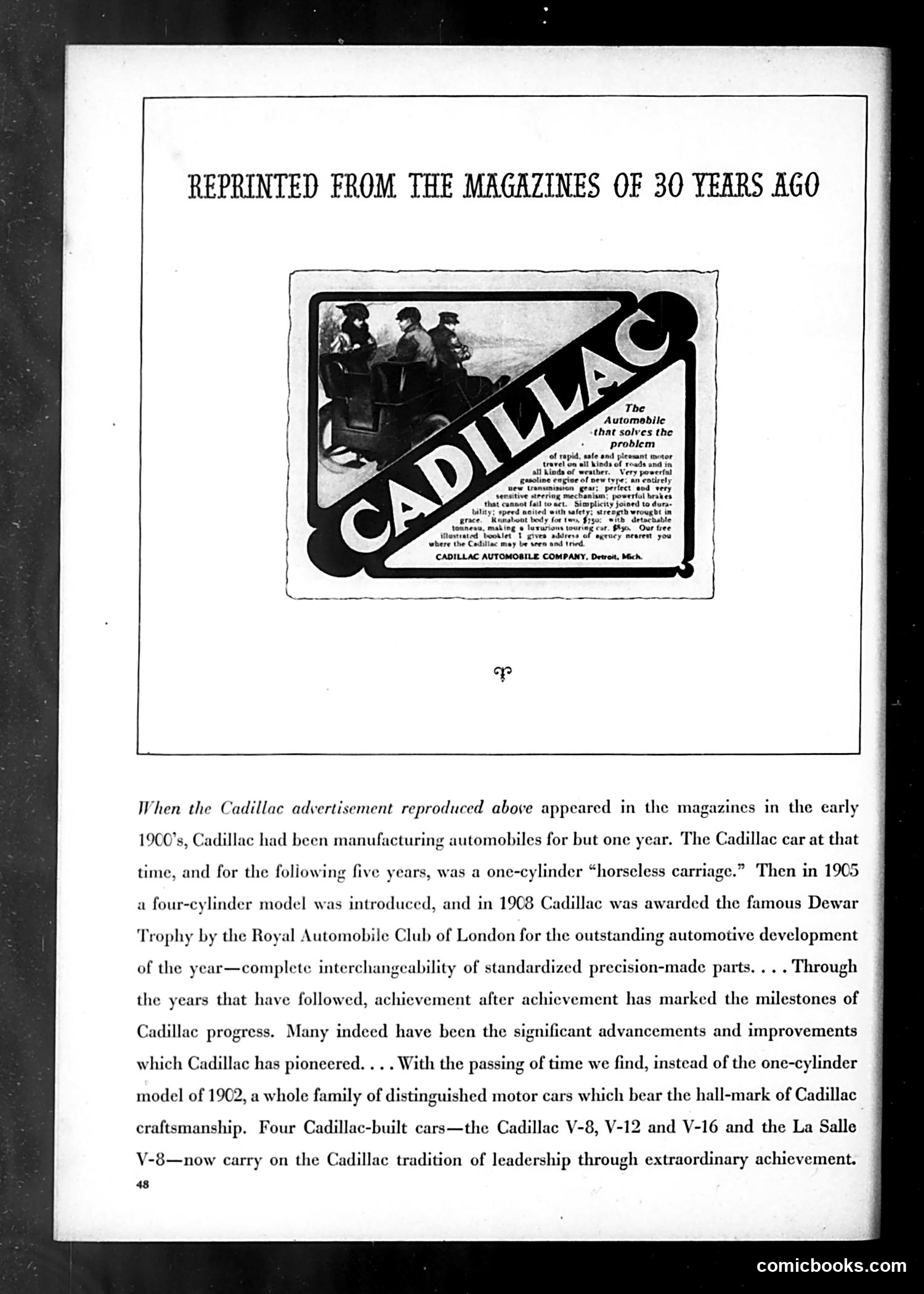
Analysis This is primarily an advertising retrospective, not satire. The page reprints an early 1900s Cadillac advertisement alongside historical commentary about the company's evolution. The original ad (top) shows three elegantly dressed passengers in a Cadillac, marketing it as solving "the problem" of safe, rapid motor travel. The messaging emphasizes luxury, reliability, and advanced engineering—typical of early automobile advertising when cars were novel, expensive luxuries for the wealthy. The accompanying text (bottom) contextualizes this old ad by tracing Cadillac's actual achievements: starting as a one-cylinder vehicle in 1902, advancing to four-cylinder models by 1905, and winning the prestigious Dewar Trophy in 1908 for standardized precision parts manufacturing. By the time this page was published (approximately 30 years later, around the 1930s), Cadillac had evolved into a family of sophisticated vehicles (V-8, V-12, V-16 models). The point: This is nostalgic corporate marketing, showing how far the brand had progressed from its humble horseless-carriage origins.

I can see this is a page from Life magazine, but the image is almost entirely black or severely degraded, making it impossible to discern any cartoon content, illustrations, or readable text beyond the watermark "comicbooks.com" at the bottom. The OCR text provided contains only scattered letters ("s") and the website attribution, offering no substantive content to analyze. Without a legible image showing the cartoon(s), illustrations, or readable text, I cannot identify specific figures, political references, or satirical points for a modern reader. To provide an accurate historical analysis, I would need a clearer reproduction of this Life magazine page.