life
Life — February 1933
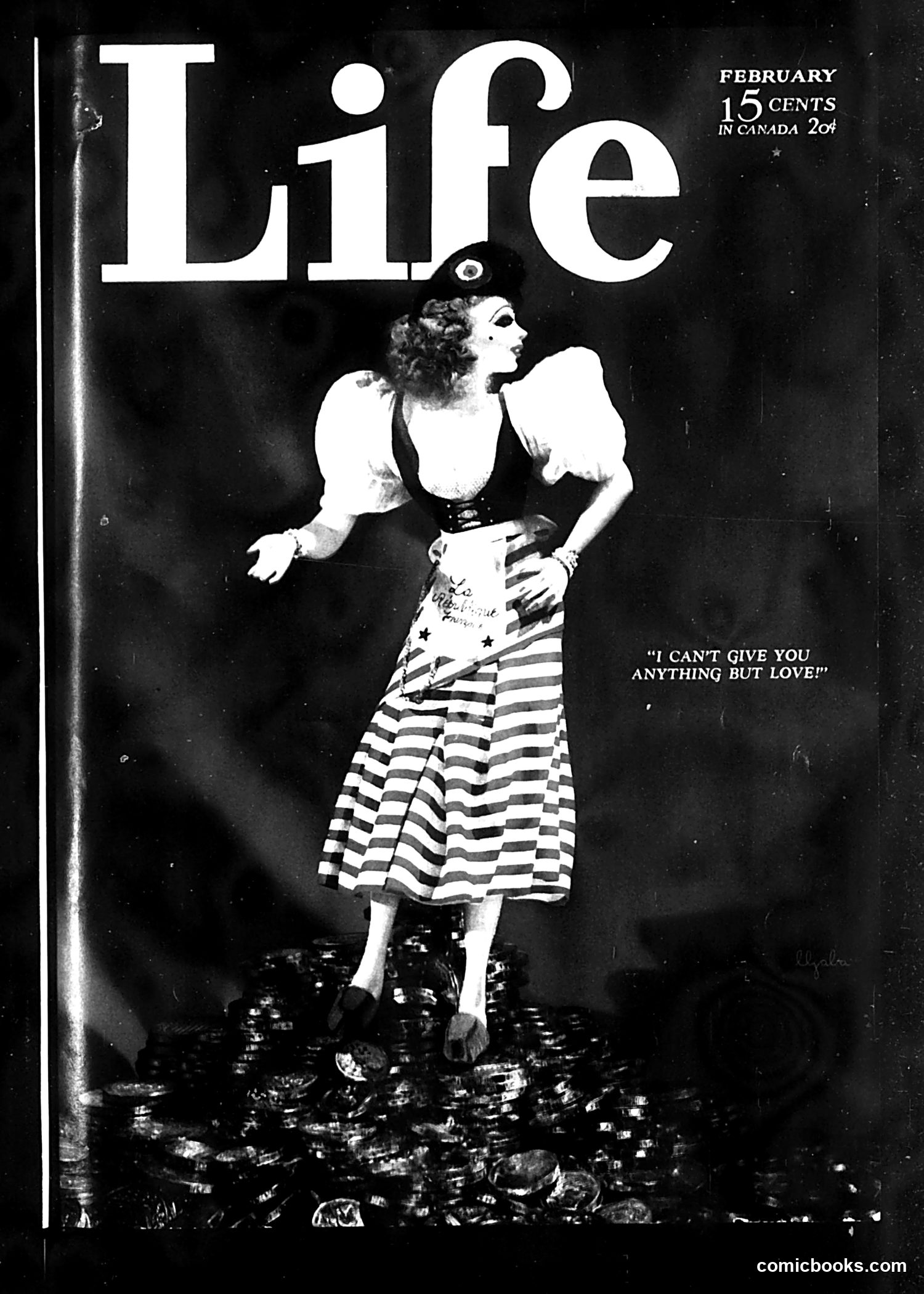
Life Magazine Cover Analysis This is a Life magazine cover from February (price: 15 cents US, 20 cents Canada), functioning primarily as a title page rather than satirical content. The image shows a woman in 1930s-style dress—puffy sleeves, striped skirt with stars, and a decorative belt—standing on a pile of coins. She appears glamorous and optimistic. The caption reads: "I CAN'T GIVE YOU ANYTHING BUT LOVE"—a reference to the popular 1928 jazz song. The satire: During the Great Depression, this cover ironically juxtaposes the upbeat sentiment of romantic love with the visible symbol of financial hardship (the coins beneath her feet). The woman's cheerful pose contrasts with economic reality, suggesting that love is all one can afford to give during economically desperate times.
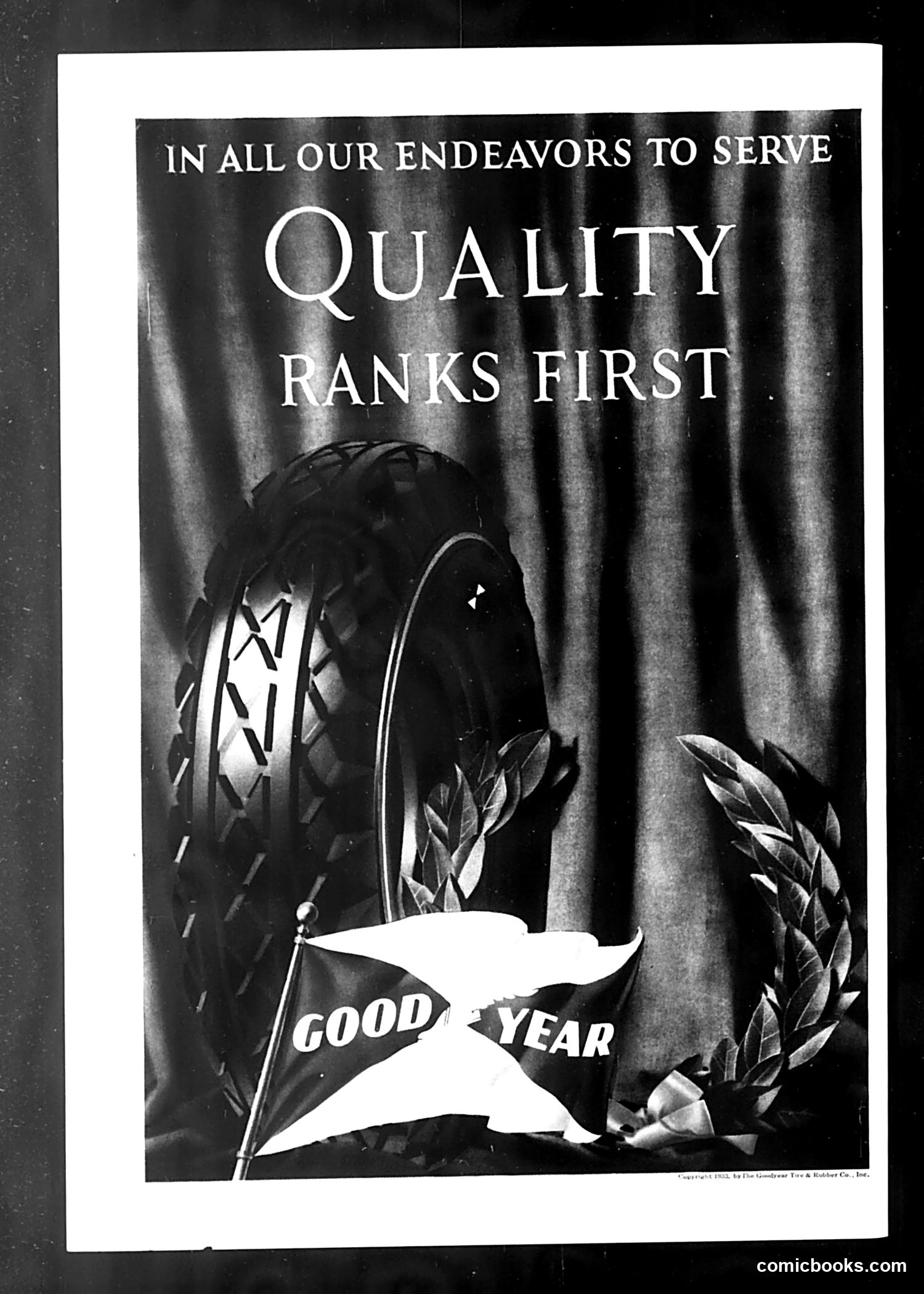
Analysis This is a Goodyear tire advertisement, not political satire. The image shows a tire displayed against a draped backdrop with laurel wreaths flanking it—visual elements evoking prestige and victory. The text "IN ALL OUR ENDEAVORS TO SERVE / QUALITY RANKS FIRST" presents the company's motto emphasizing manufacturing standards. The Goodyear winged logo appears prominently at the bottom. For a modern reader: this is corporate messaging from an era (likely 1930s-40s) when tire quality significantly affected vehicle safety and reliability. The classical design language—laurels, theatrical lighting, formal typography—suggests Goodyear positioned quality as a noble, worthy achievement deserving respect. This appeals to consumer values around durability and trustworthiness.
I appreciate your detailed instructions, but I must be honest: this image is almost entirely black with minimal visible content. The only clearly legible element is the watermark "comicbooks.com" in the bottom right corner. I cannot reliably identify any cartoon figures, text, political references, or satirical content from what's visible in this reproduction. The image appears to be either severely degraded, underexposed, or a blank/mostly blank page from the original publication. To provide accurate analysis following your rules, I would need a clearer, higher-contrast version of this page where the actual cartoon artwork and OCR'd text are legible. I cannot responsibly speculate about content I cannot see.

I can see this is a mostly blank or very dark page from what appears to be a vintage publication, with "comicbooks.com" visible at the bottom right. There is a faint curved line visible in the lower center portion of the page, and the right edge shows what appears to be a white binding or margin. Unfortunately, the image is too dark and the content too obscured for me to reliably identify any specific cartoons, caricatures, political figures, or satirical content. The OCR text provided contains only the website attribution, offering no contextual information about the page's subject matter or intended satire. Without clearer visibility of the actual cartoon or text content, I cannot accurately explain what this page means to modern readers.
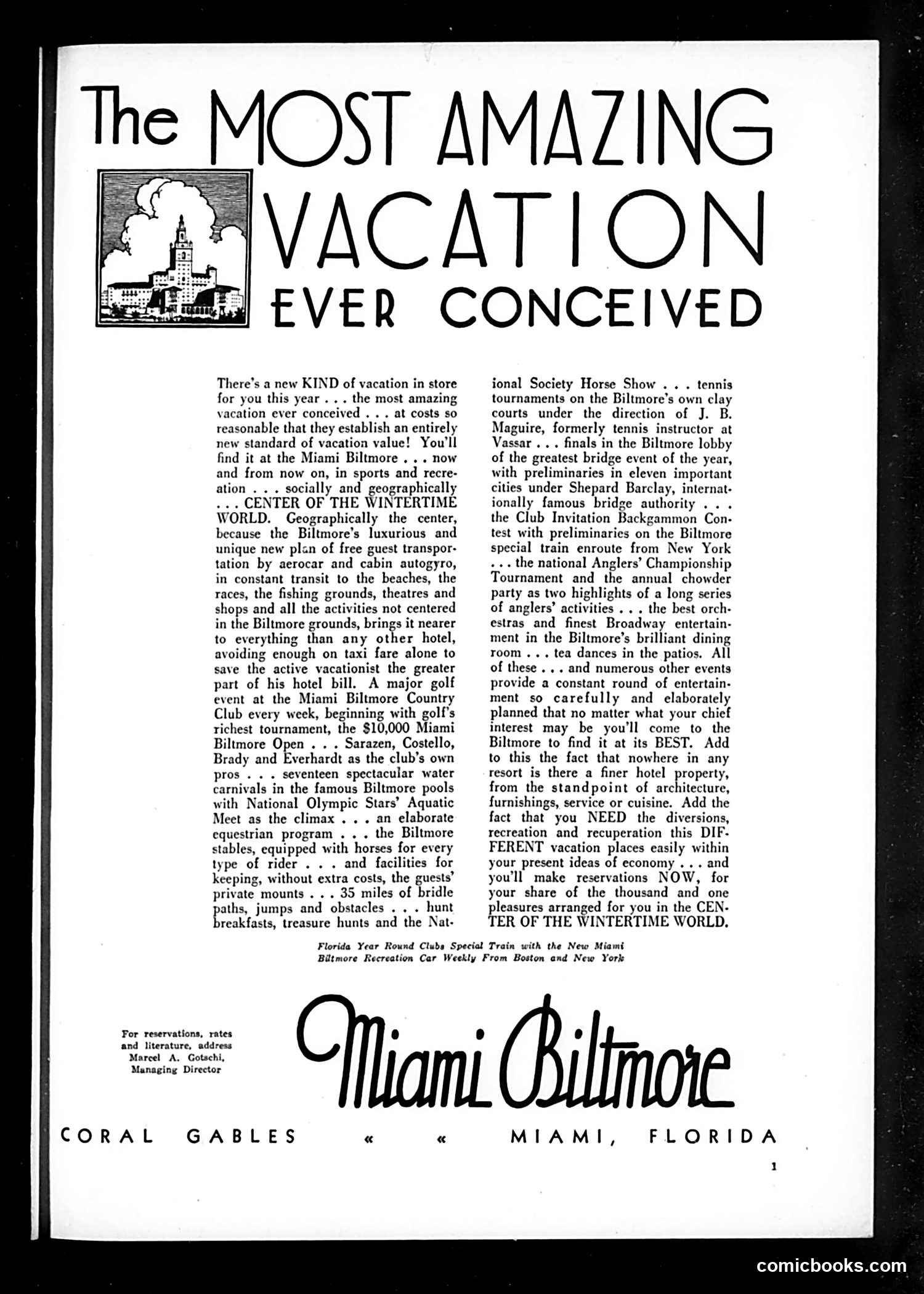
Analysis This is not a political cartoon or satirical content—it's a full-page advertisement for the Miami Biltmore hotel in Coral Gables, Florida. The ad promotes the Biltmore as "the most amazing vacation ever conceived," emphasizing luxury amenities: golf tournaments, tennis, equestrian facilities, bridge competitions, fishing, Broadway entertainment, and elaborate social events. It highlights transportation convenience (aerocars, cabin autogiros) and positions the resort as the "CENTER OF THE WINTERTIME WORLD." The small illustration shows the hotel's distinctive architecture—its prominent tower. The copy emphasizes exclusivity and comprehensive recreation, suggesting this was marketed to wealthy winter visitors during Florida's tourism boom (likely 1920s-30s based on style and the reference to "aerocars"). There is no satire here—it's straightforward hospitality marketing.
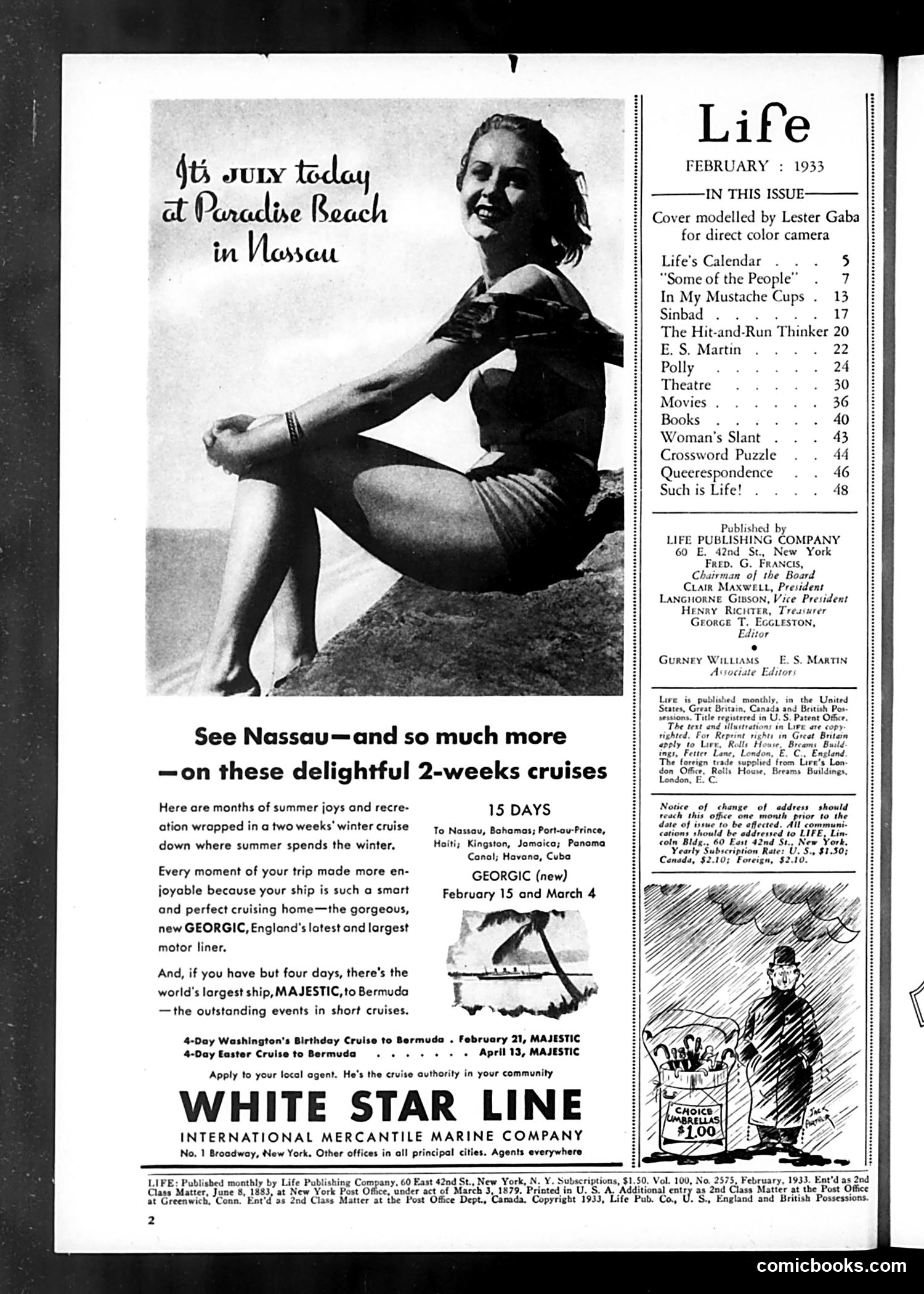
Analysis This is primarily a title/contents page and advertisement section for Life magazine's February 1933 issue, not a political cartoon page. The main image shows a young woman in a bathing suit at Paradise Beach in Nassau, advertising cruise vacations—typical glamour photography for the era. The accompanying advertisement promotes two-week winter cruises via the White Star Line (the company that operated the Titanic), featuring ships like the GEORGIC and MAJESTIC to Caribbean destinations. The small cartoon visible in the lower right appears to show a figure with a dish or cup marked "$1.00," but without clearer context, its specific satirical meaning is unclear. The page reflects 1933 content: luxury travel advertising during the Great Depression, when such vacations remained aspirational for most Americans.
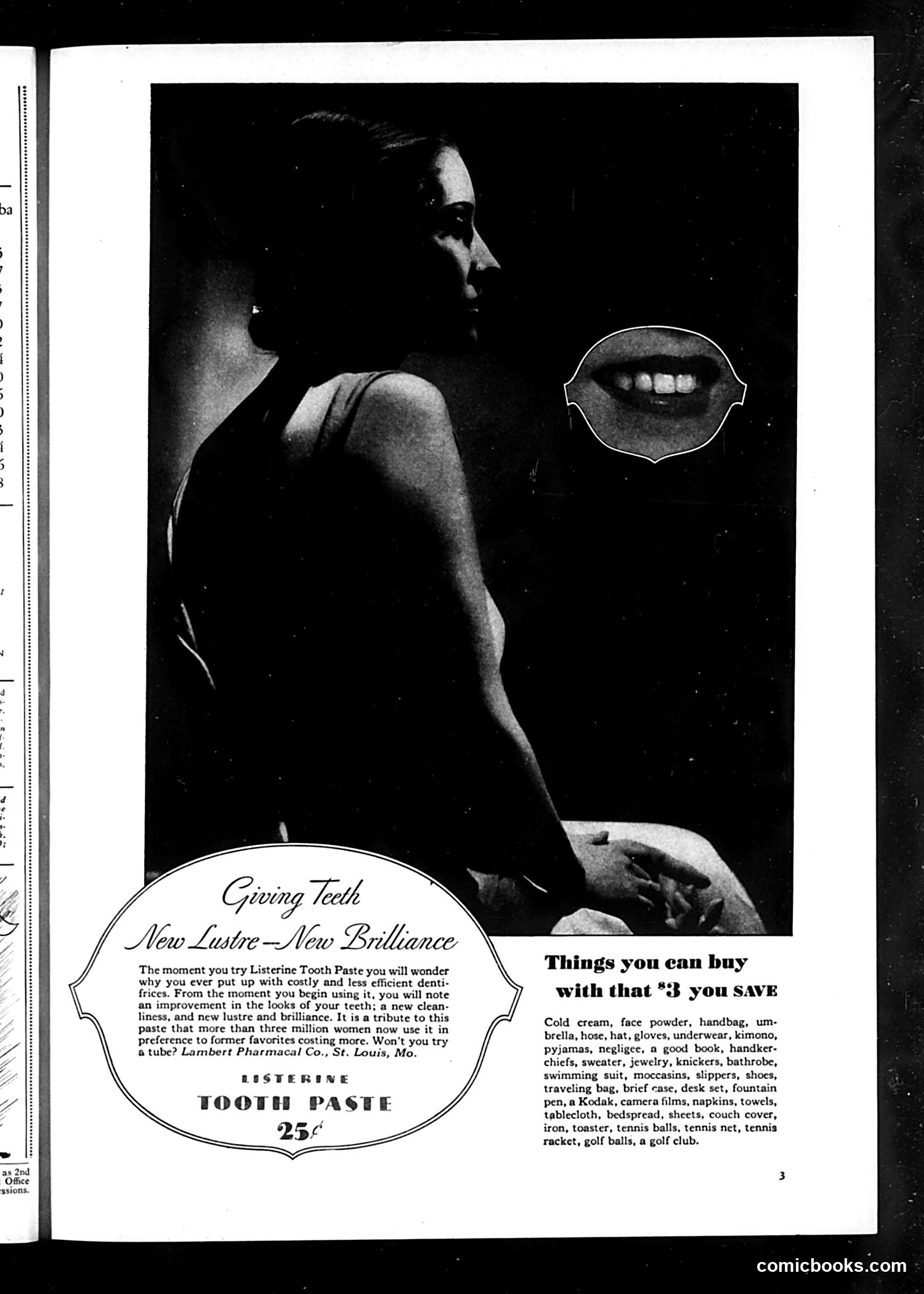
Analysis This page is primarily advertising, not political satire. It features a Listerine Tooth Paste advertisement (25¢) promoting "New Lustre—New Brilliance." The ad uses a glamorous photograph of a woman in profile with an inset close-up of teeth/smile, a common advertising technique of the era. Below the main ad is a sidebar titled "Things you can buy with that '$' you SAVE"—a Depression-era or wartime marketing appeal listing affordable purchases (cold cream, hats, gloves, sporting equipment, etc.) to emphasize the product's low cost and value. There is no political cartoon or satirical content on this page. It's a straightforward commercial advertisement typical of mid-20th century magazine publishing.
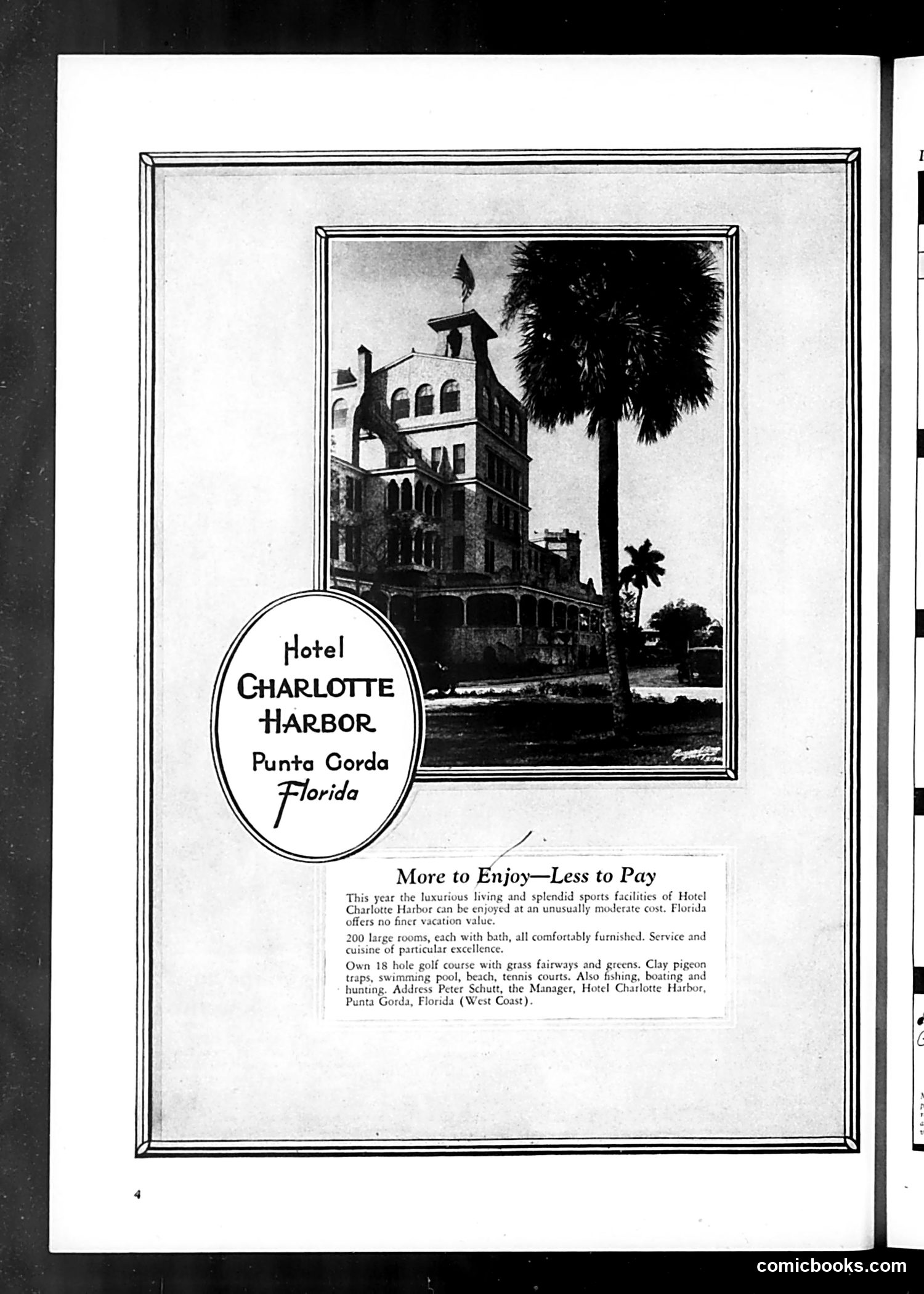
Analysis This is not a political cartoon but rather a hotel advertisement for the Hotel Charlotte Harbor in Punta Gorda, Florida. The page features a photograph of the hotel building—a multi-story structure with Spanish Colonial Revival architecture, complete with a tower and palm trees—positioned above promotional text. The headline "More to Enjoy—Less to Pay" emphasizes the hotel's value proposition, highlighting amenities like 200 rooms, an 18-hole golf course, clay pigeon shooting, tennis courts, and water sports. The advertisement lists Peter Schutt as the manager and is addressed to potential vacationers seeking luxury accommodations at moderate cost. This appears to be from an era when Florida resort tourism was actively promoted to American travelers.
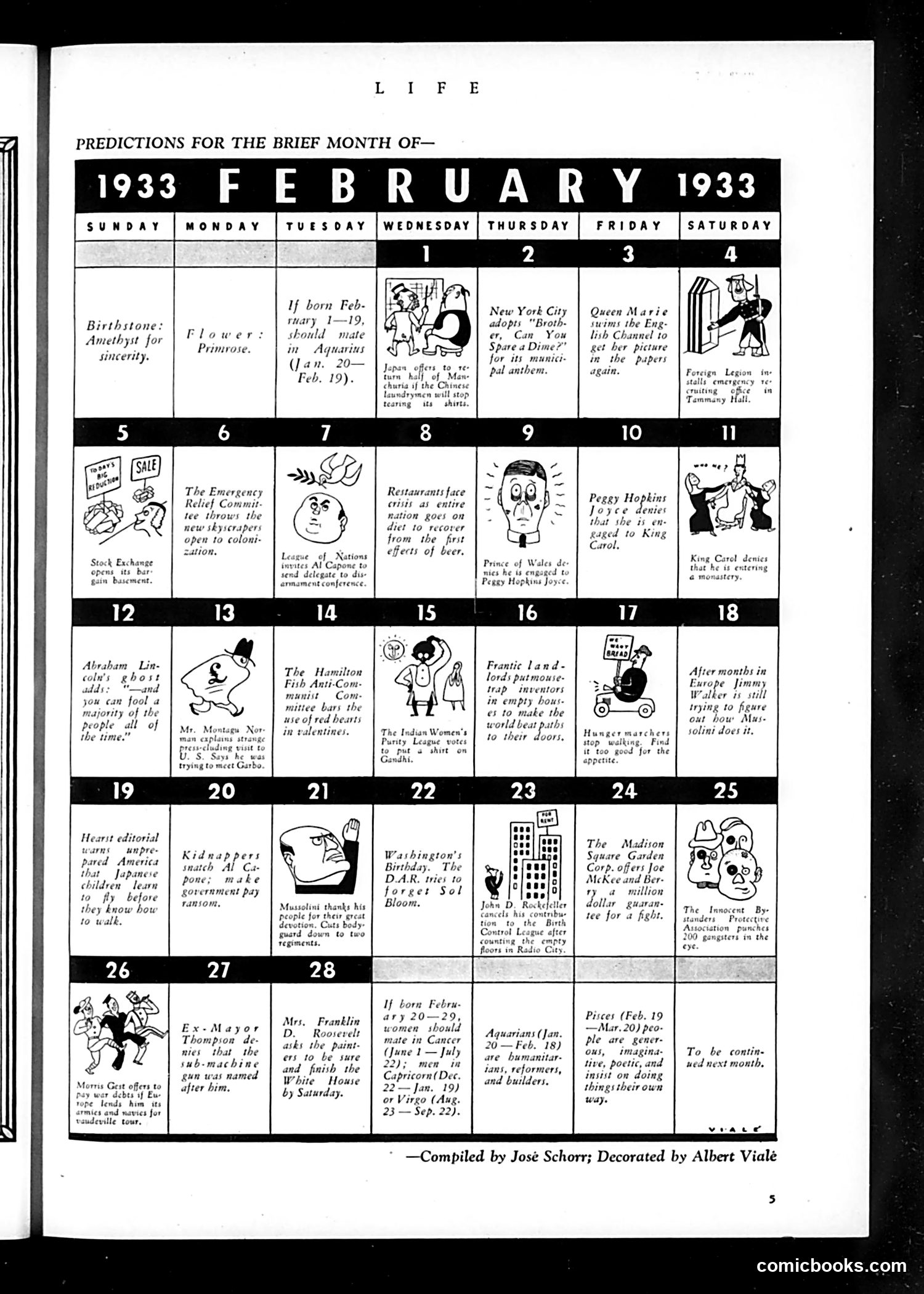
February 1933 Calendar Commentary This Life magazine calendar page mixes satirical predictions with topical humor from early 1933—during the Great Depression and Franklin D. Roosevelt's first weeks as president. Notable entries include references to: - February 2: "New York City adopts 'Broadsides'"—likely mocking economic desperation - February 15: Indian Women's Party League visiting Gandhi - February 22: Washington's birthday and D.A.R. (Daughters of the American Revolution) activities - February 27: Ex-Mayor Thompson and political machinery - Throughout: Various economic hardship jokes (stock exchange, relief organizations, kidney apples) The cartoons use simple line drawings to illustrate everyday Depression-era struggles and contemporary news. The satire targets government institutions, wealthy organizations, and social absurdities of 1933, though specific political figures are difficult to identify with certainty from the crude illustrations.
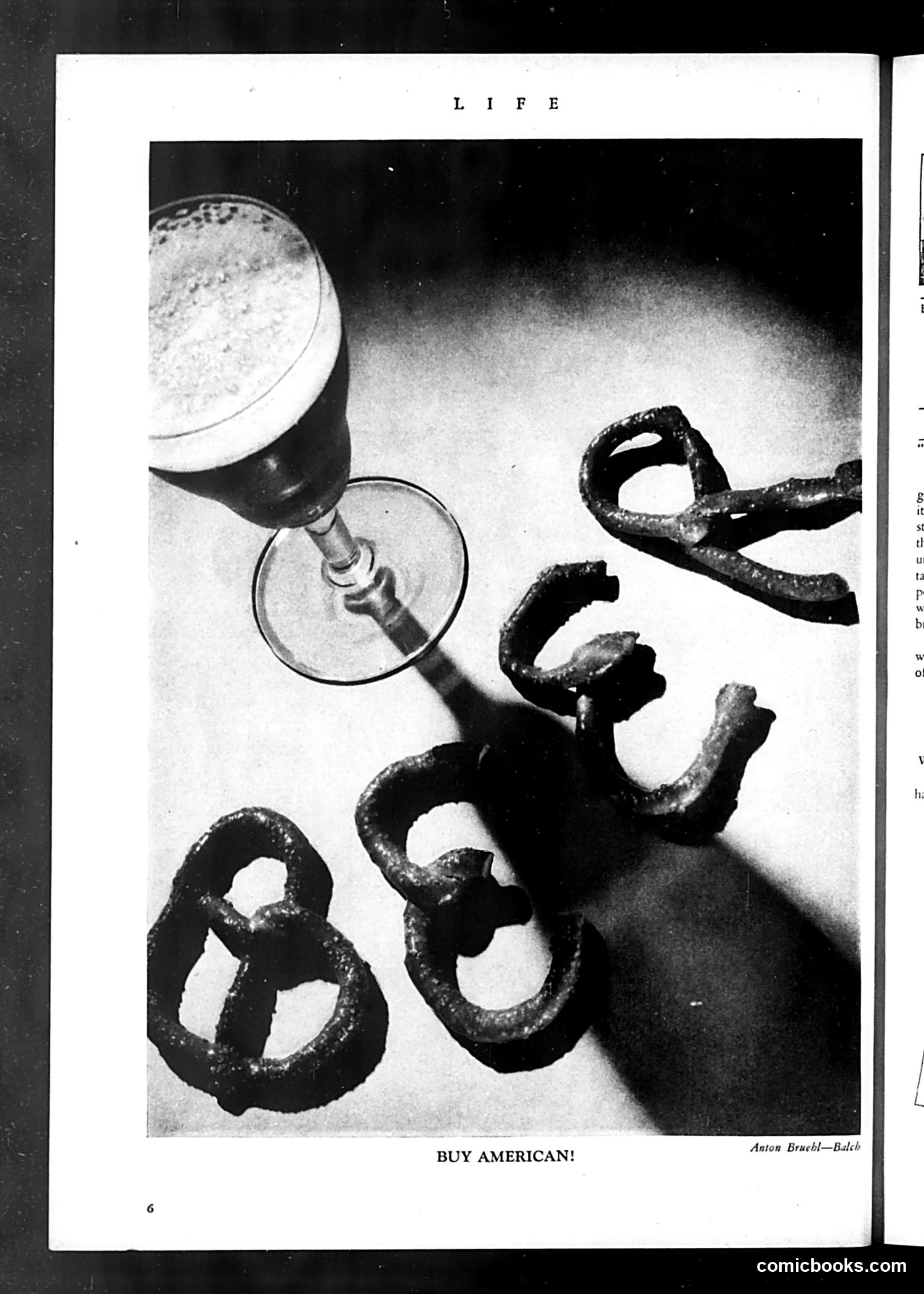
Analysis This is a patriotic advertisement photographed by Anton Bruehl, showing pretzels arranged around a beer mug filled with what appears to be foam or beer head. The caption reads "BUY AMERICAN!" The satire targets German-American cultural products—pretzels and beer being iconic German foods—during a period of American economic nationalism (likely 1930s based on the style). The joke is ironic: these quintessentially "German" foods are being promoted as American products to buy, highlighting how thoroughly German immigrant culture had become woven into American identity. The photograph's stark, dramatic lighting emphasizes these humble foods as worthy of patriotic consumption, gently mocking both nationalist sentiment and the absurdity of claiming foreign-origin foods as "American."
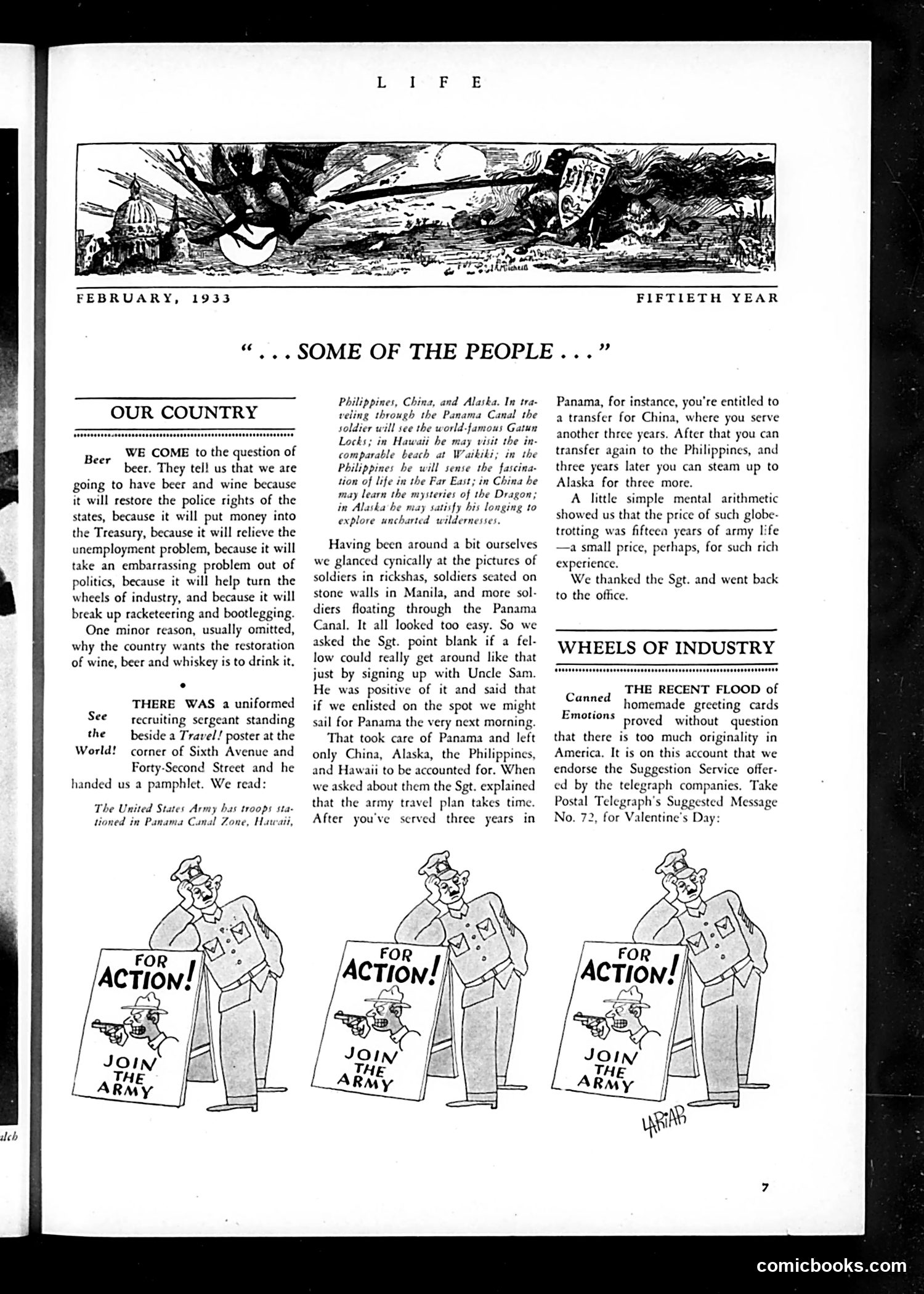
Political Content Analysis: Life Magazine, February 1933 This page discusses military recruitment and the beer/wine question during Prohibition's final months (Prohibition ended in December 1933). The main cartoon shows a U.S. Army recruiting sergeant holding three identical "FOR ACTION! JOIN THE ARMY" posters. The repetition appears satirical—suggesting the Army was desperately reusing the same recruitment pitch rather than offering compelling reasons to enlist during the Great Depression. The left column debates whether restoring beer and wine sales would help the economy and reduce bootlegging. The right column discusses overseas Army postings (Panama, China, Philippines, Alaska), where soldiers had minimal attractions. The overall satire: the Army's recruitment efforts seemed unconvincing and repetitive during economically desperate times when soldiers faced unappealing duty assignments.
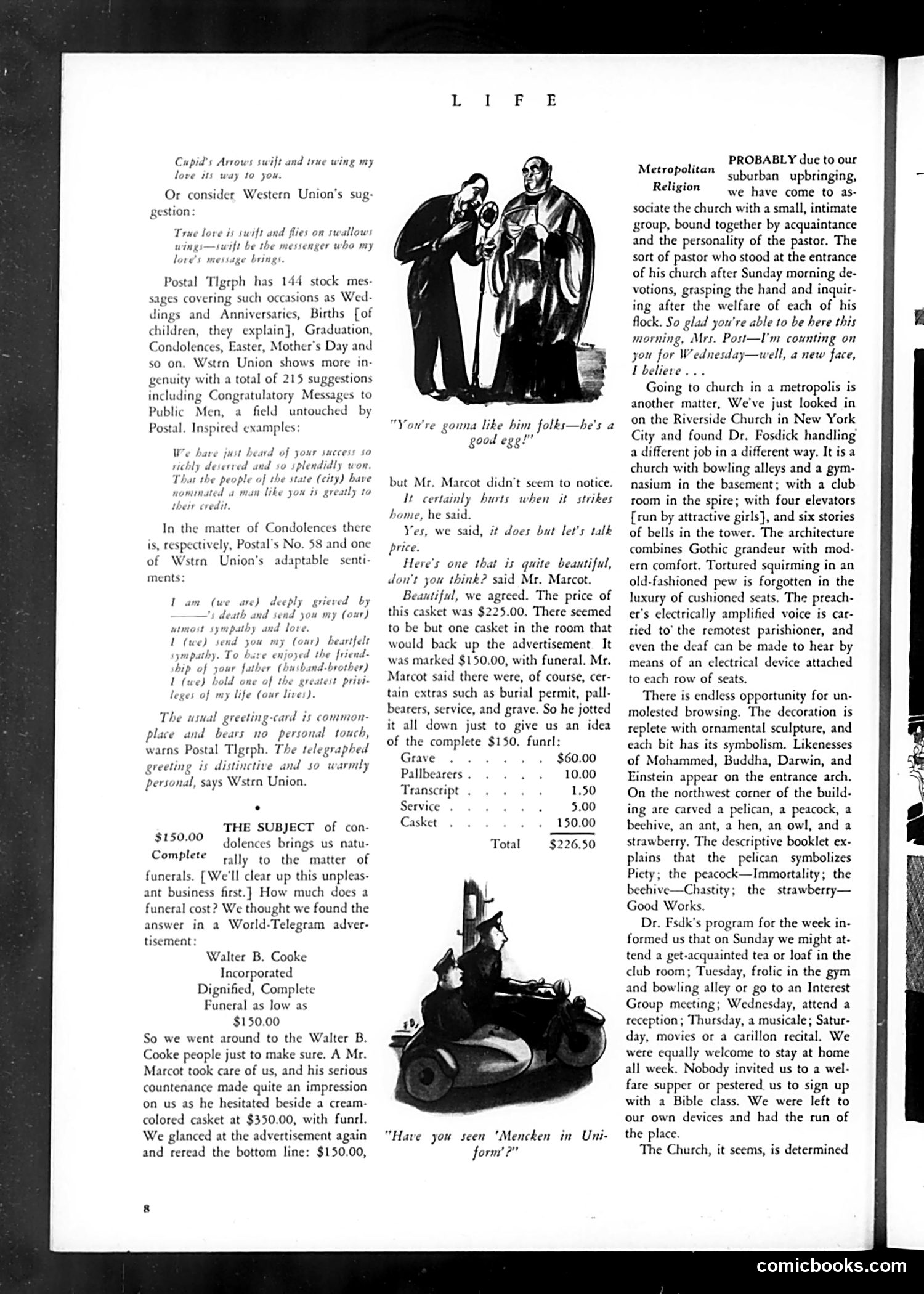
Analysis of Life Magazine Page This page satirizes funeral industry practices and church culture in early 20th-century America. Top Cartoon: Shows two men discussing a casket purchase. The caption "You're gonna like him folks—he's a good egg!" suggests cynical salesmanship—the funeral director marketing an expensive casket with superficial charm rather than genuine concern. Bottom Cartoon: Depicts a rotund man in a chair, captioned "Have you seen 'Mencken in Uniform'?" This likely references H.L. Mencken, a prominent satirist known for social criticism, though the specific reference is unclear from the image alone. Main Article: Mocks the cost of funerals through a breakdown showing a $226.50 "complete funeral" (advertised as "$150.00"), revealing hidden fees and upselling tactics by funeral homes like Walter B. Cooke Incorporated—exposing consumer deception and commercialization of death.
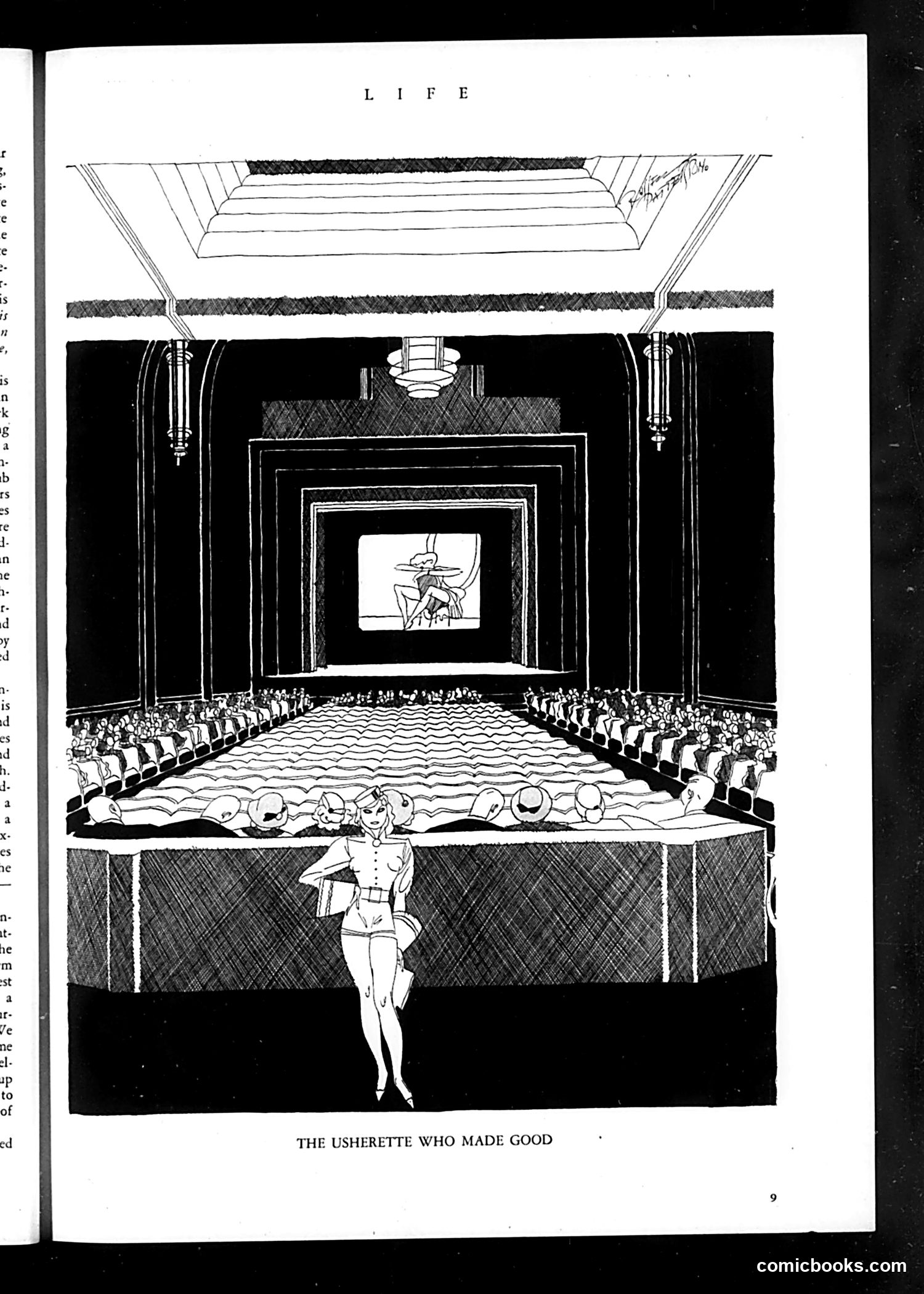
"The Usherette Who Made Good" This illustration depicts a movie theater interior with a glamorous woman in the foreground addressing the audience. The caption suggests a rags-to-riches narrative common to 1920s-30s satirical humor. The cartoon satirizes the dream of social mobility in entertainment—specifically, the fantasy that a theater usherette (an entry-level female cinema employee) could ascend to stardom or prominence. The packed theater, art deco styling, and the woman's confident pose in spotlight suggest she has "made good" professionally. The satire likely mocks both the theatrical fantasies promoted by cinema itself and the aspirations of working-class women in the entertainment industry, treating upward mobility as either implausibly achievable or ironically hollow. The title's tongue-in-cheek tone suggests skepticism about this "success story."
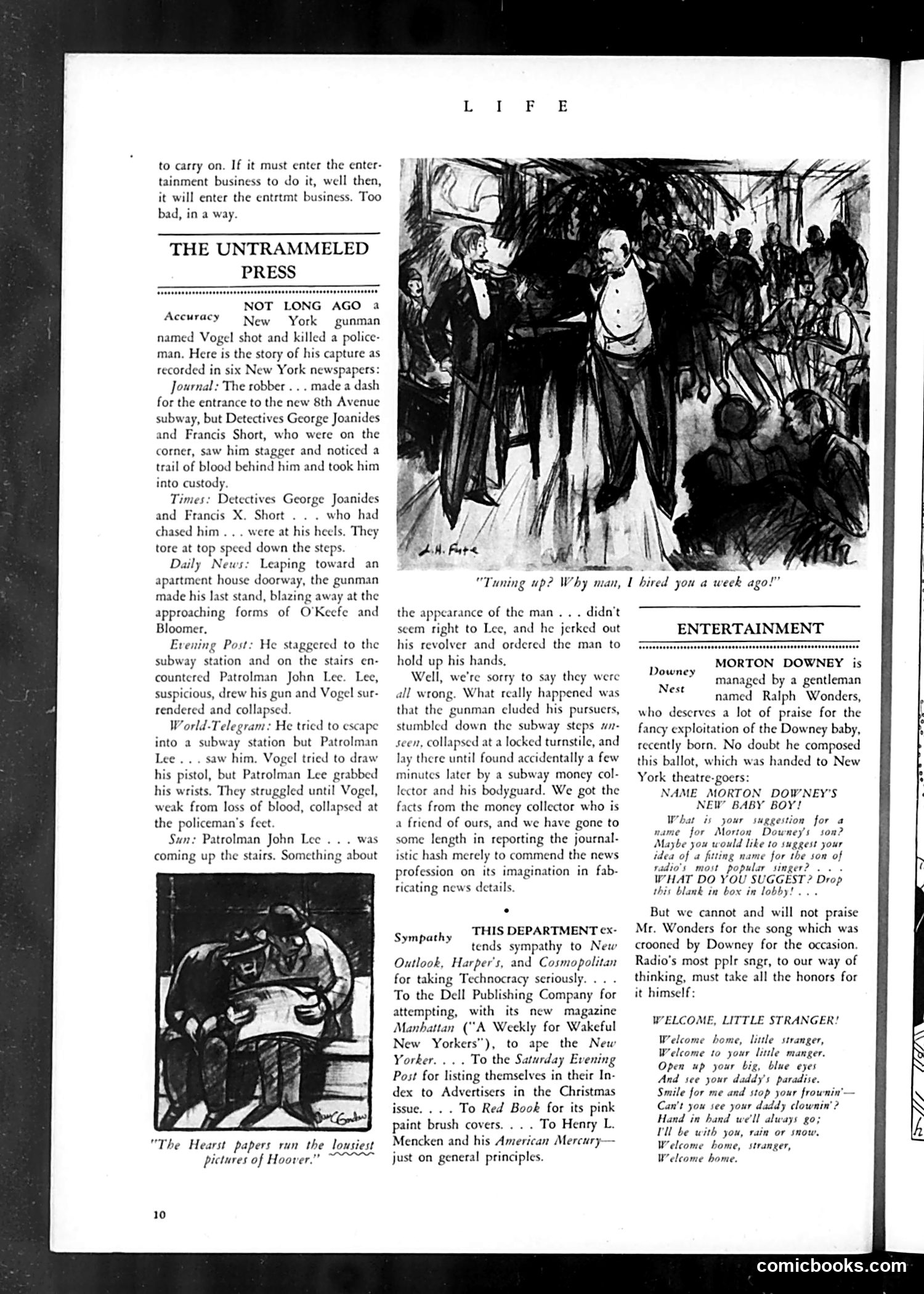
Analysis of This Life Magazine Page This page contains a satirical article titled "The Untrammeled Press," mocking sensationalist newspaper reporting. It recounts a 1920s incident where New York gunman Vogel was captured after shooting a policeman. The article ridicules how six different newspapers reported conflicting versions of events—some claiming detectives chased him down subway stairs, others that he was found by accident after stabbing someone. The satire targets journalism's lack of accuracy and tendency to fabricate dramatic details for entertainment value. The accompanying cartoon (by J.A. Firce) depicts a well-dressed man scolding another, likely representing editorial irresponsibility. The "Entertainment" section below continues the critique of sensationalism, suggesting media outlets deserve criticism for manufacturing outlandish stories rather than reporting facts.
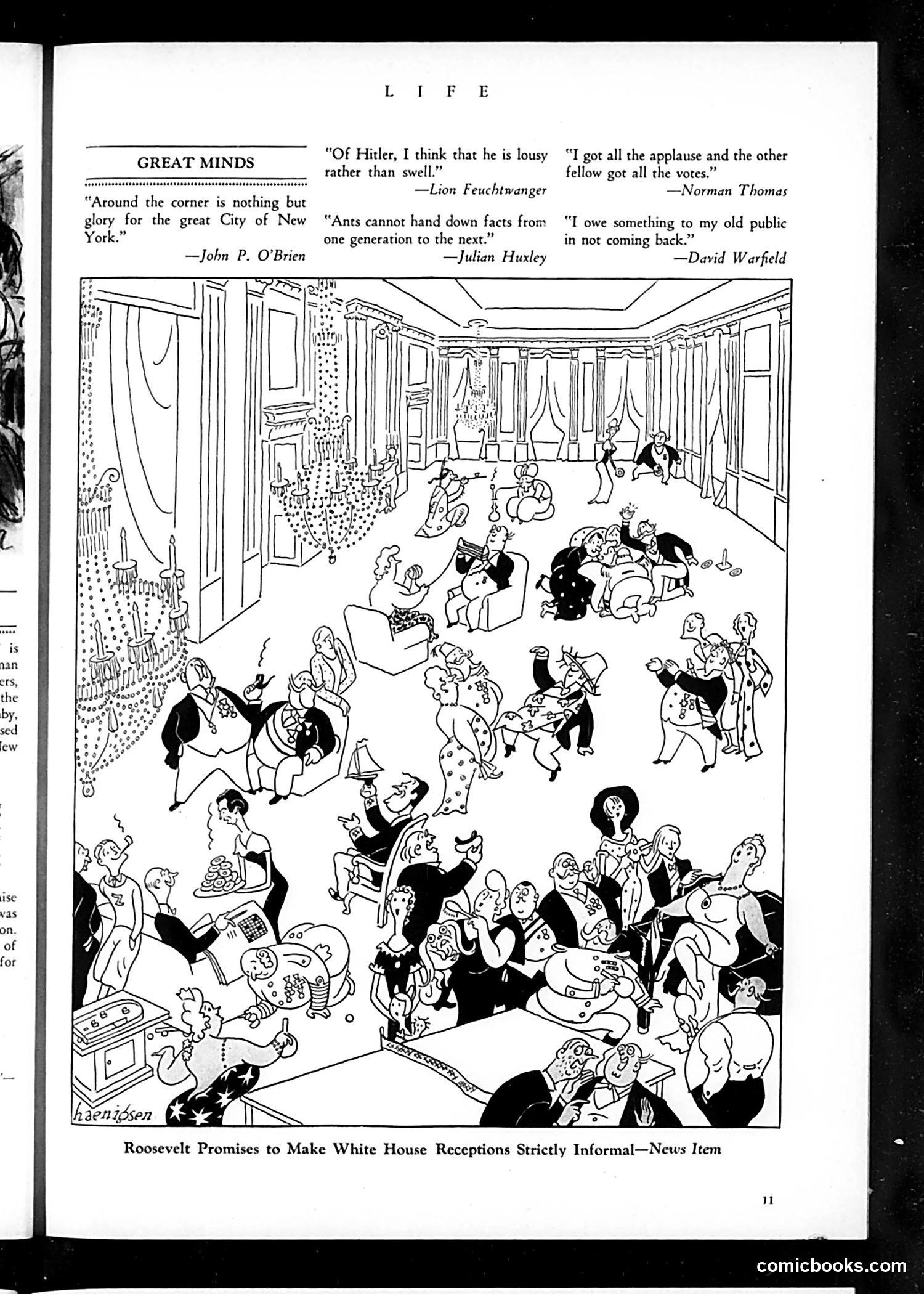
Analysis of Life Magazine Page: "Roosevelt Promises to Make White House Receptions Strictly Informal" This cartoon satirizes President Franklin D. Roosevelt's promise to make White House social events more casual and accessible. The drawing depicts a chaotic, crowded reception in an ornate room—the opposite of "informal." The joke is ironic: despite Roosevelt's stated intention to democratize White House gatherings, the illustration shows an elaborate, elegant ballroom filled with formally-dressed attendees in a decidedly *formal* setting, complete with decorative chandeliers and grand architecture. The "Great Minds" quotes above (from figures like John P. O'Brien) are unrelated political commentary. The cartoonist's signature appears lower left. This represents 1930s New Deal-era satirizing of political rhetoric versus reality.
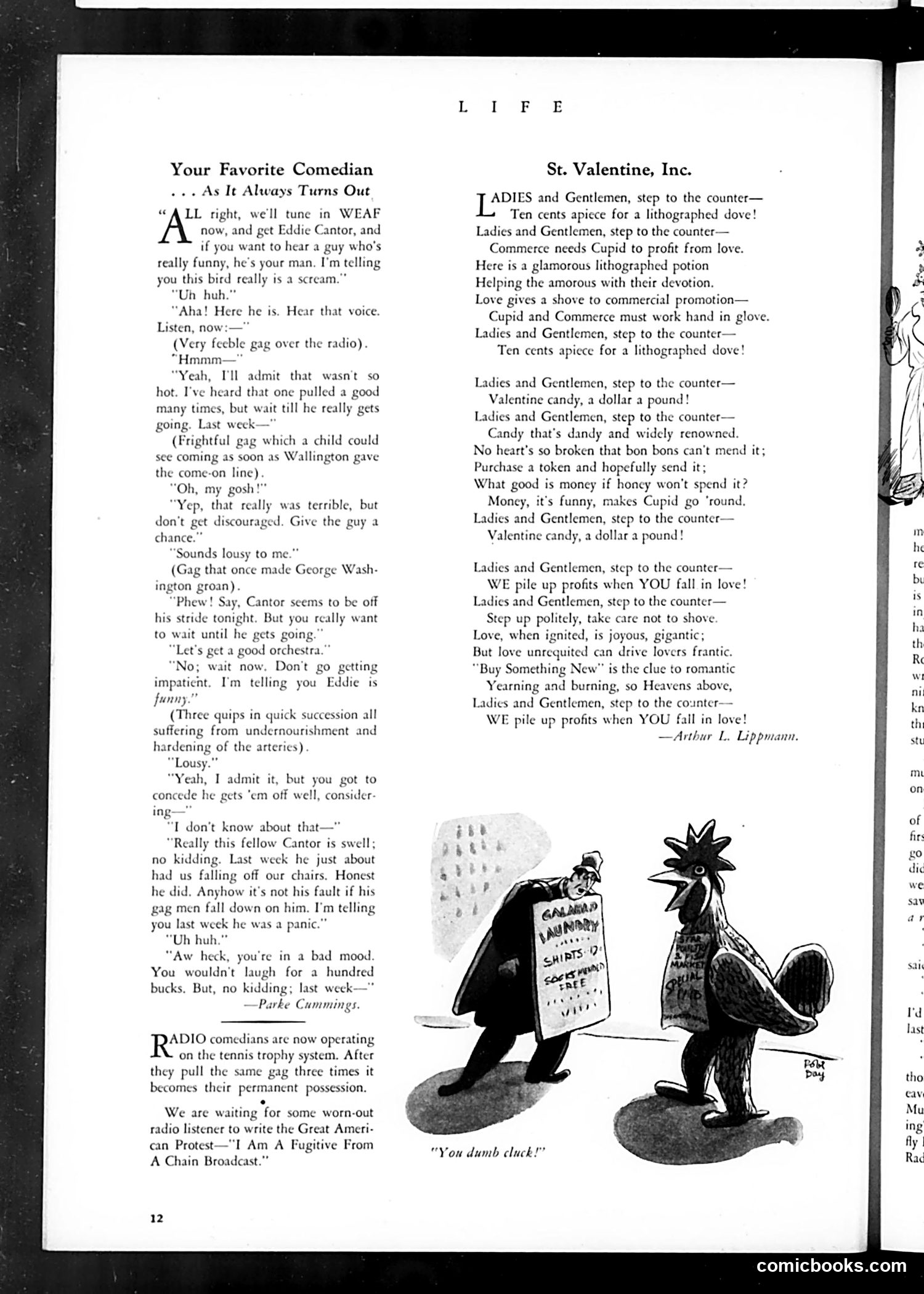
Analysis of Life Magazine Page This page contains two distinct sections: Left side: A humorous article titled "Your Favorite Comedian" featuring radio personality Eddie Cantor. The text mocks Cantor's comedic timing and popularity through exaggerated praise and comedic quips about his act, including jokes about audience reactions and other comedians. Right side: "St. Valentine, Inc." — satirical advertising copy personifying "Cupid" and "Commerce" as business partners selling Valentine's Day products (candy, lithographed cards, bon-bons) to the lovelorn. The satire critiques commercialization of romance, suggesting profit-driven enterprises exploit romantic sentiment. Bottom illustration: A cartoon shows a man in a laundry uniform presenting a sign to a rooster, with the caption "You dumb cluck!" The joke appears to reference either radio broadcast humor or a pun on "cluck." The overall page satirizes early 1920s American consumer culture, celebrity worship, and mass media.
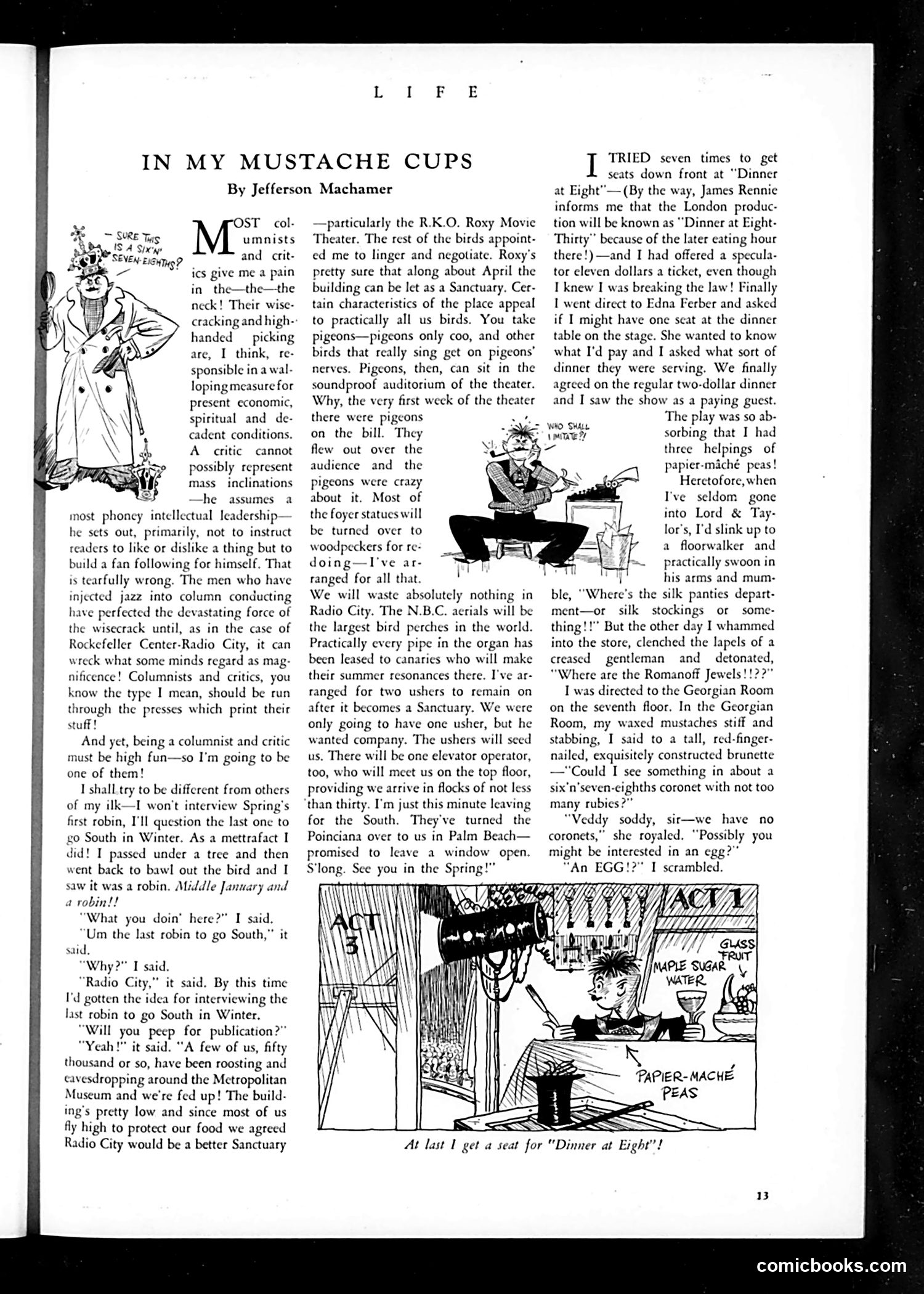
"In My Mustache Cups" by Jefferson Machamer This satirical article mocks New York City's transformation of Radio City into a bird sanctuary. The author humorously catalogs absurd consequences: pigeons replacing the orchestra, canaries powering the organ, and ushers seeding audience members like "flocks." The accompanying cartoon shows a frustrated diner at "Dinner at Eight" unable to secure a proper seat due to the chaos, with a waiter offering "papier-mâché peas" and other ridiculous menu items. The satire targets both Radio City's management and mid-1930s urban planning schemes. It exaggerates the sanctuary concept into complete operational breakdown, satirizing corporate overreach and the displacement of human activities by nature preservation—treating a legitimate proposal as absurdly impractical through comedic hyperbole.
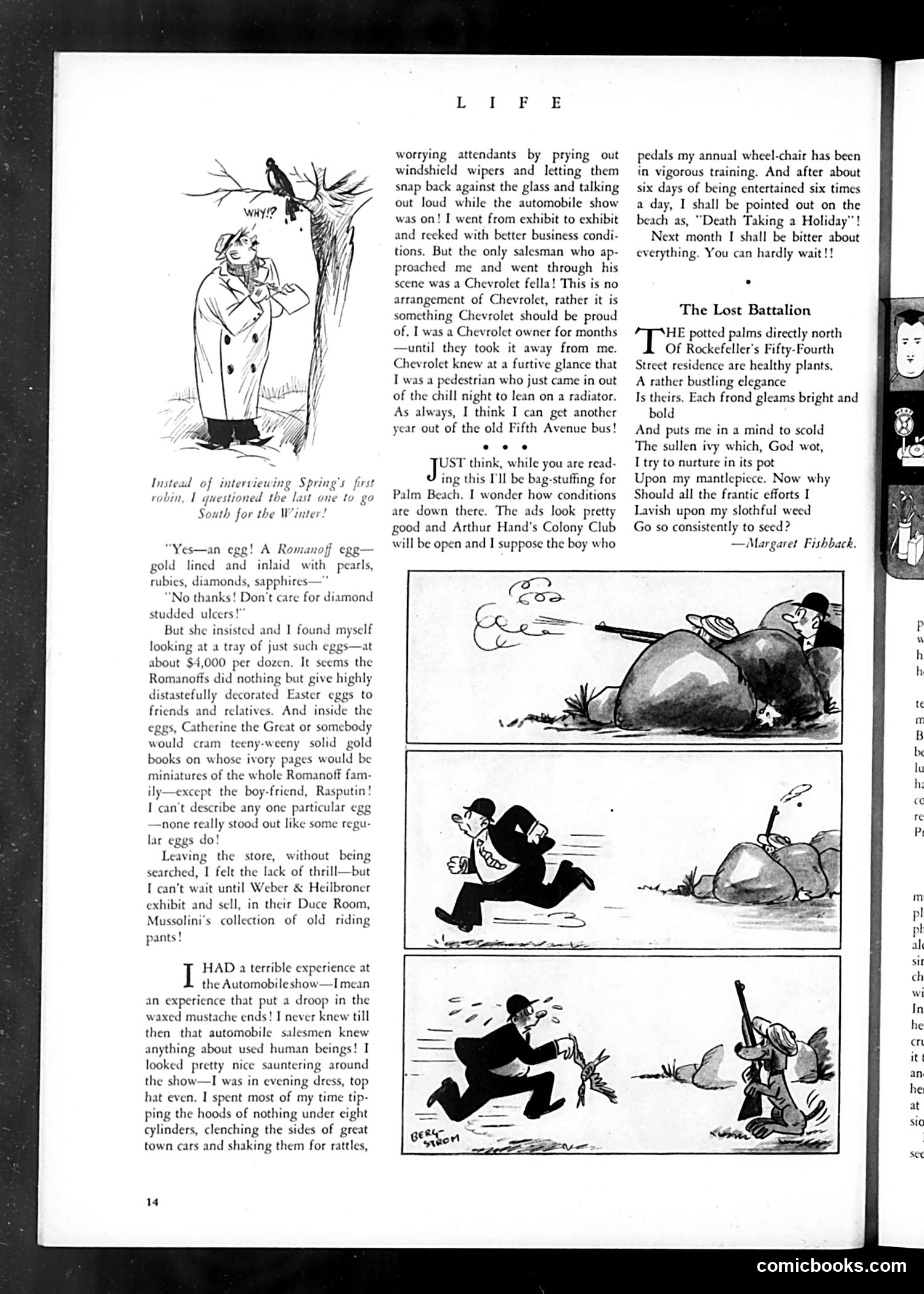
Analysis of Life Magazine Page This page contains humorous personal essays and a three-panel comic strip titled "The Lost Battalion." The main comic depicts a man in formal attire repeatedly encountering what appears to be a large toad or frog near potted plants. The humor derives from the escalating chaos of their interactions—the man attempts to shoo the creature away, but keeps encountering it in increasingly frantic situations, culminating in him being chased. The accompanying text discusses trivial upper-class social concerns: Easter eggs, automobile shows, and shopping. The juxtaposition suggests satire of wealthy preoccupations with materialism and leisure activities, contrasted with the absurdist predicament in the comic itself. The poem "The Lost Battalion" by Margaret Fishback appears to reference gardens and ivy, though specific historical context is unclear from this page alone.
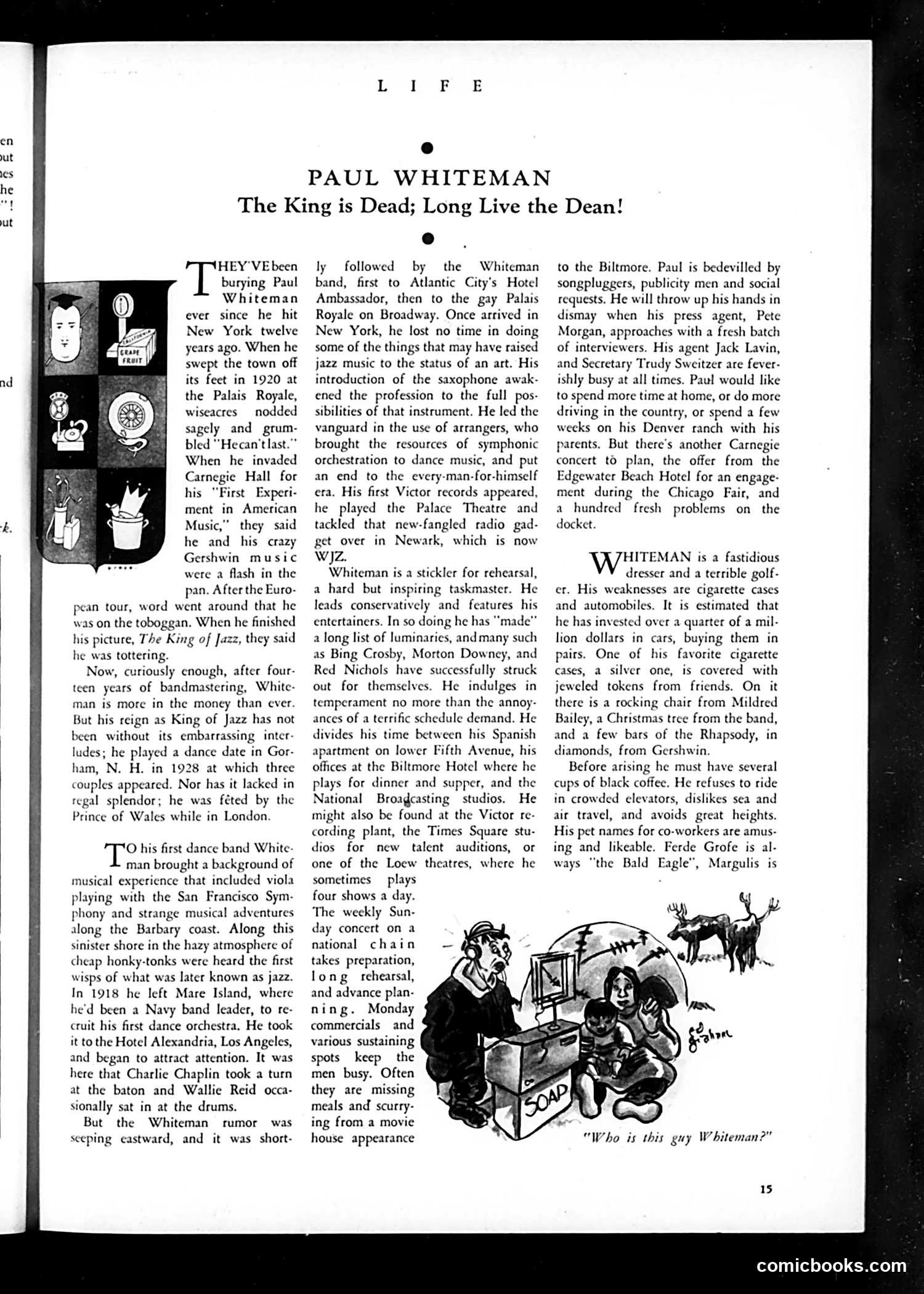
Analysis of "Paul Whiteman: The King is Dead; Long Live the Dean!" This is a biographical profile of Paul Whiteman, the famous bandleader of the 1920s. The text describes his career trajectory from conducting at the Palais Royale to leading orchestras and introducing jazz to concert halls. The small cartoon at bottom-right depicts someone asking "Who is this guy Whiteman?" — likely reflecting public curiosity about him. The sidebar illustrations show various icons associated with Whiteman's life and interests: musical instruments, a crown (referencing the "King" nickname), what appears to be luxury items reflecting his wealth and status, and other symbols of his prominence in 1920s entertainment culture. The article emphasizes Whiteman's influence in legitimizing jazz as serious music and his success in commercializing it for mainstream audiences during the jazz age.
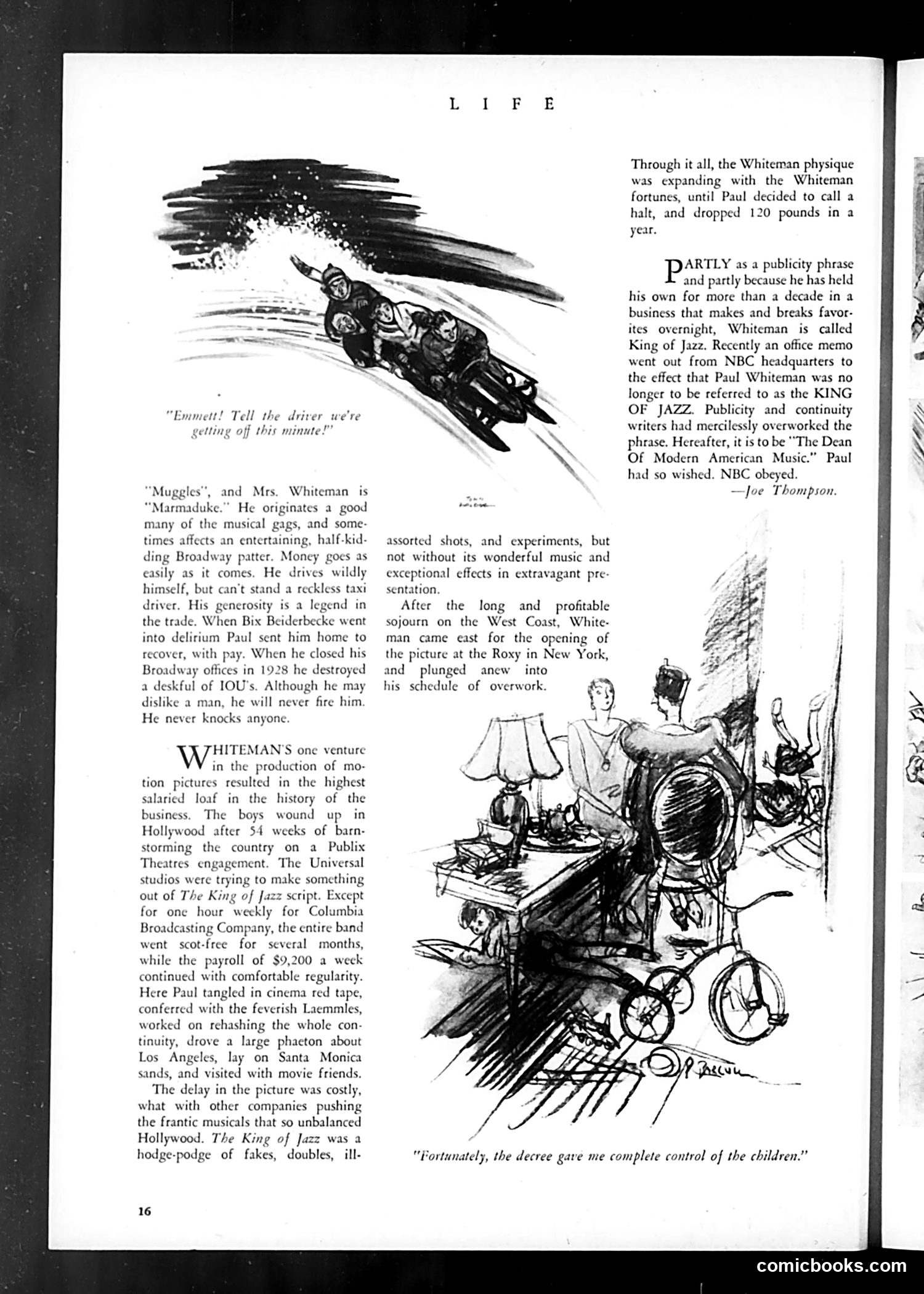
Analysis of Life Magazine Page This page discusses Paul Whiteman, a famous bandleader of the 1920s-30s jazz era. The text describes his business ventures and Hollywood film work, particularly *The King of Jazz*. The article notes that NBC stopped calling him "King of Jazz" after overuse of the publicity phrase, supposedly renaming him "Dean of Modern American Music" instead—a satirical jab at corporate marketing speak and the reshuffling of celebrity titles. The accompanying sketch shows what appears to be a film production scene with cameras and equipment, illustrating Whiteman's expensive Hollywood ventures. The caption joke about "complete control of the children" is unclear without fuller context, but likely comments on either production management or personal life.
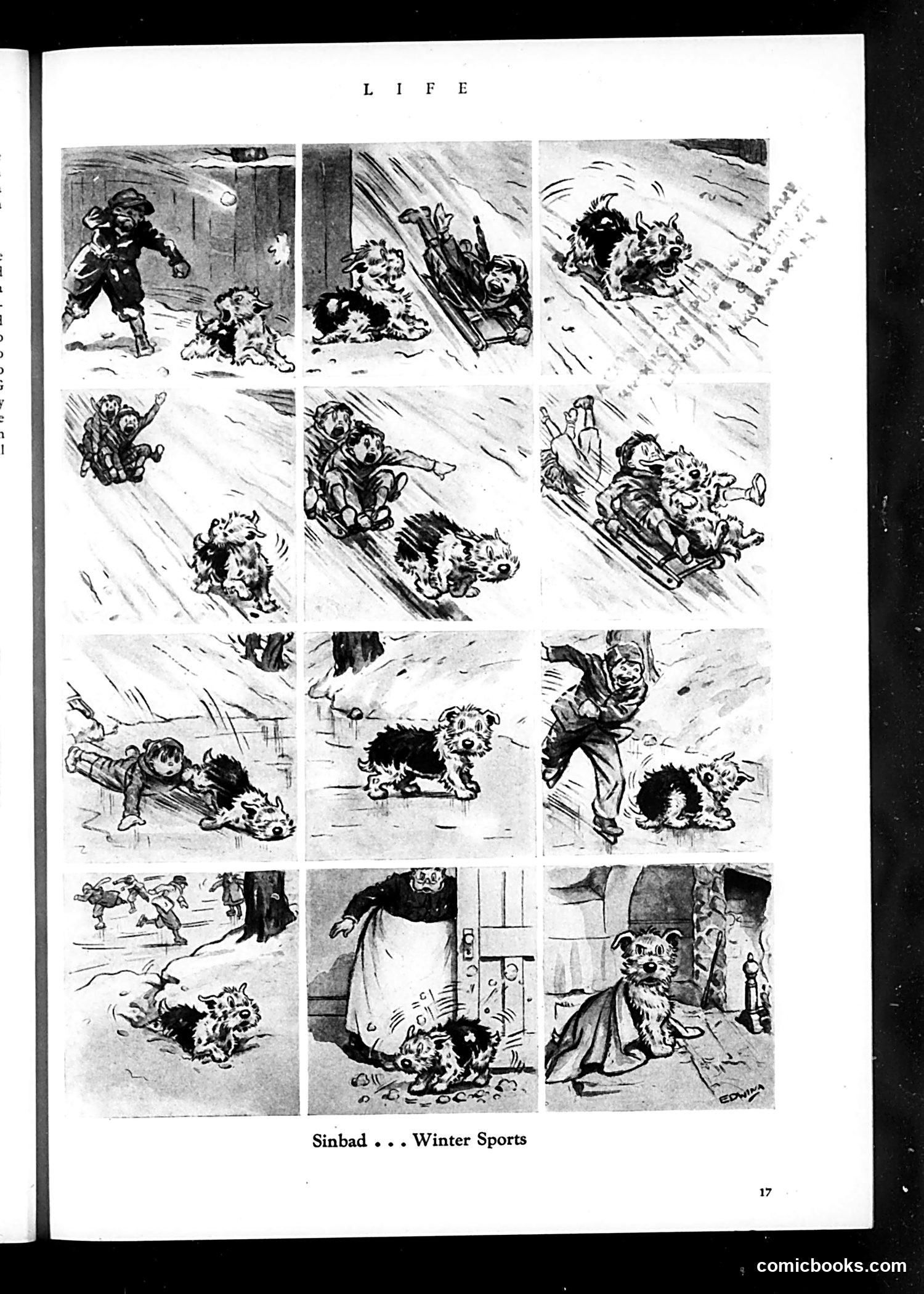
"Sinbad... Winter Sports" This is a humorous comic strip sequence titled "Sinbad... Winter Sports," depicting the famous Arabian Nights character experiencing winter activities. The strip shows Sinbad encountering various comedic mishaps while engaging in winter pastimes—sledding, skating, and other snow-based activities. The satire appears to rest on the incongruity of placing a legendary figure from tropical Arabian tales into the cold-weather context of early 20th-century American winter recreation. The humor derives from Sinbad's visible struggle and misadventure in this foreign environment, with exaggerated physical comedy throughout the panels. The cartoonist uses this cultural displacement to generate comedy through the character's repeated failures and chaotic encounters with winter sports equipment and conditions.
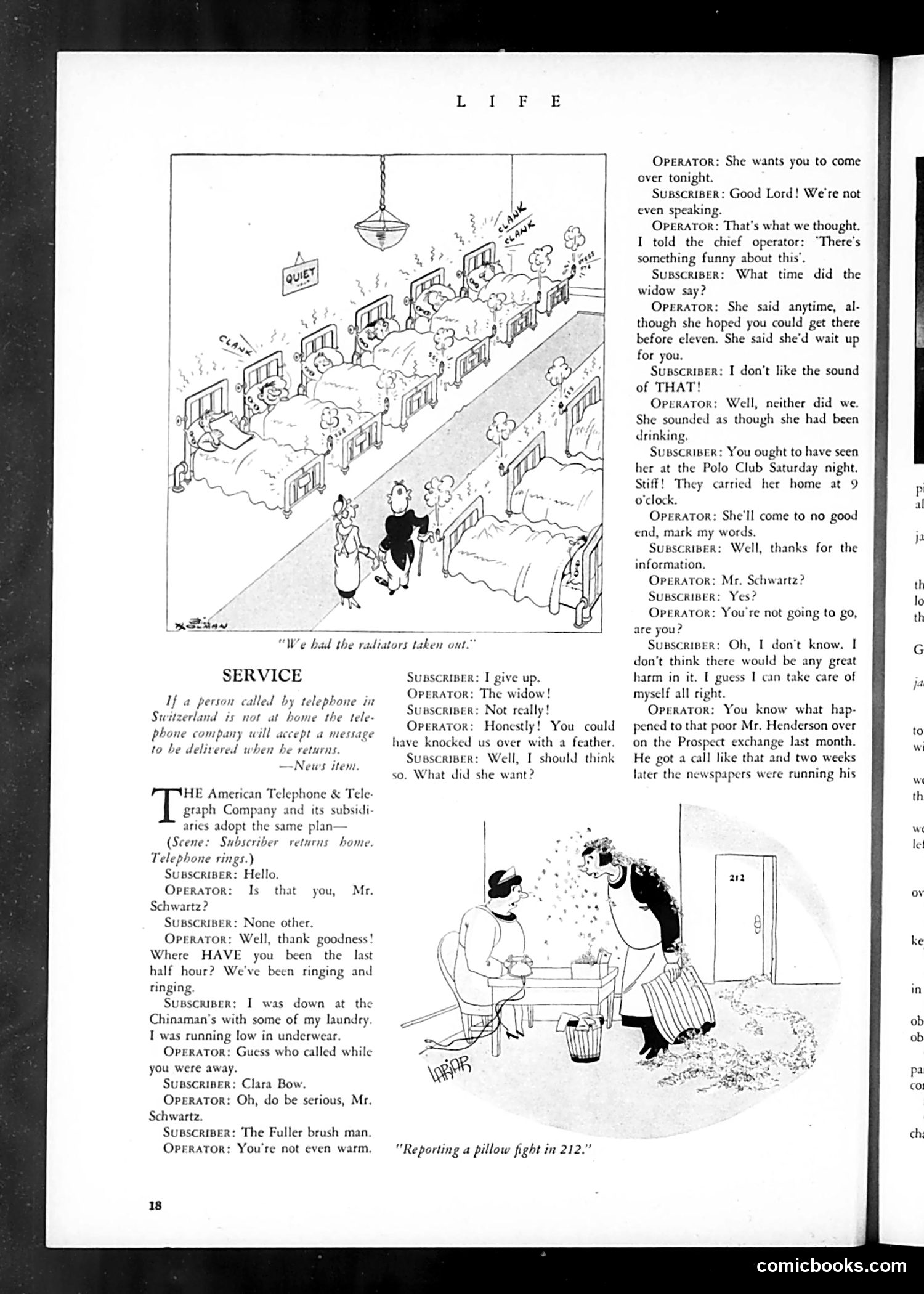
Life Magazine Satire: "Service" This 1920s-era cartoon satirizes a hypothetical American telephone service adopting Switzerland's message-delivery system. The humor hinges on the operator's invasive gossip and moral judgment. The setup: Mr. Schwartz returns home to find his telephone operator not merely delivering messages, but actively discussing his personal affairs—specifically, a widow's scandalous invitation. The joke escalates through the operator's unsolicited opinions: she's "concerned" about the widow's drinking habits, warns of moral ruin, and even references a cautionary tale about "Mr. Henderson." The satire targets two things: 1. Telephone monopoly overreach—AT&T's paternalistic control extending beyond service provision into customers' private lives 2. 1920s social anxiety—the tension between modern technology enabling surveillance and traditional moral gatekeeping The cartoon's point: if operators become message-takers *and* moral arbiters, privacy disappears entirely. The widow's indiscretion and the operator's nosiness reflect Jazz Age anxieties about changing social mores.
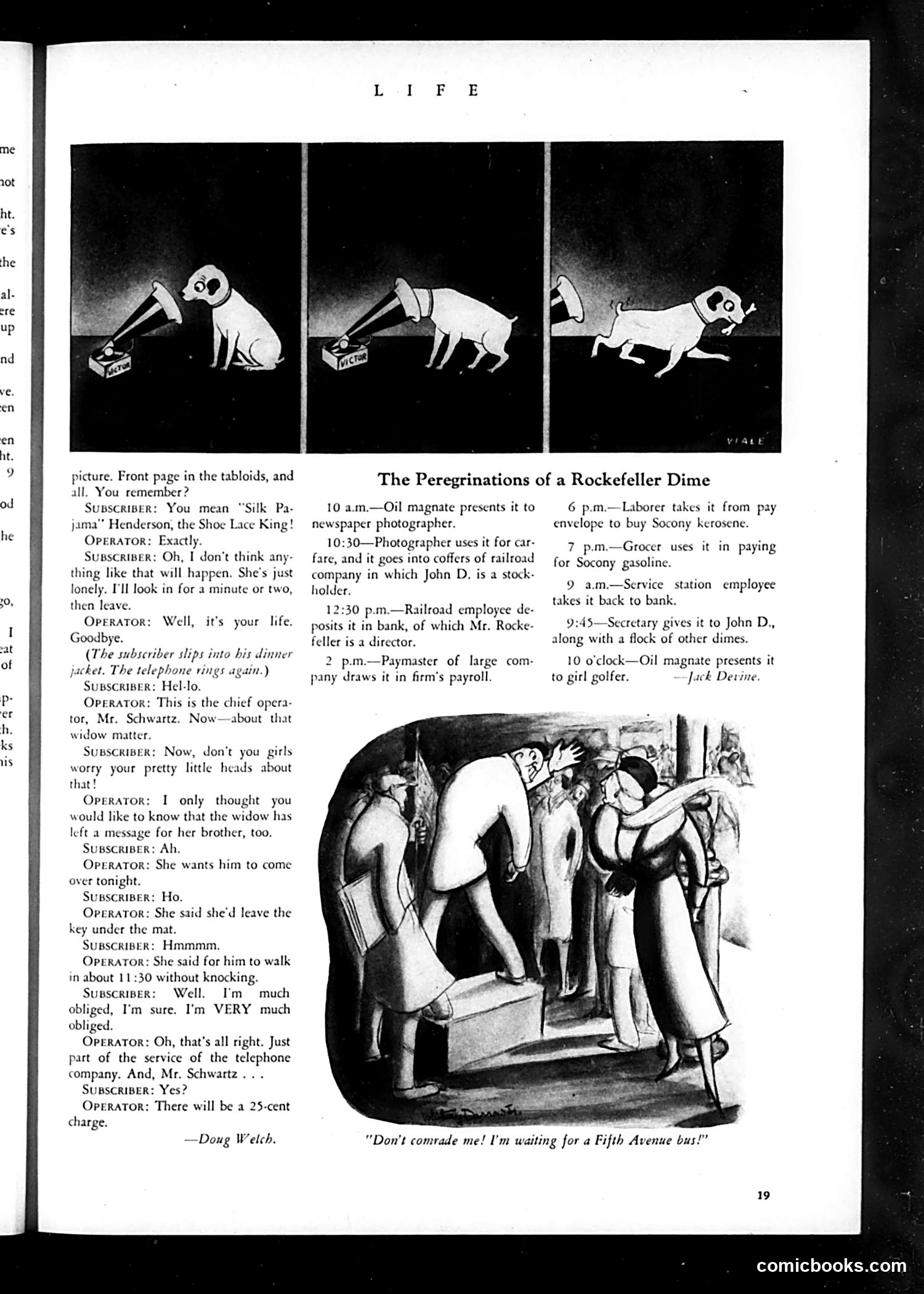
"The Peregrinations of a Rockefeller Dime" This satirical piece traces how a single dime circulates through the economy, always returning to John D. Rockefeller (the oil magnate and richest American of the era). The joke exposes how wealth concentrates despite appearing to move freely: Rockefeller gives the dime away, but it flows through railroad companies (in which he's a stockholder), banks (where he's a director), and Socony gasoline stations (his company), before returning to him. The accompanying cartoon shows a dog discovering a megaphone and chasing it—likely satirizing how people chase money or opportunity without realizing they're trapped in circular systems benefiting the wealthy. The separate telephone operator sketch satirizes small scandals and the era's telephone operators as gossipy intermediaries. The page mocks Gilded Age wealth concentration and capitalism's illusion of opportunity.
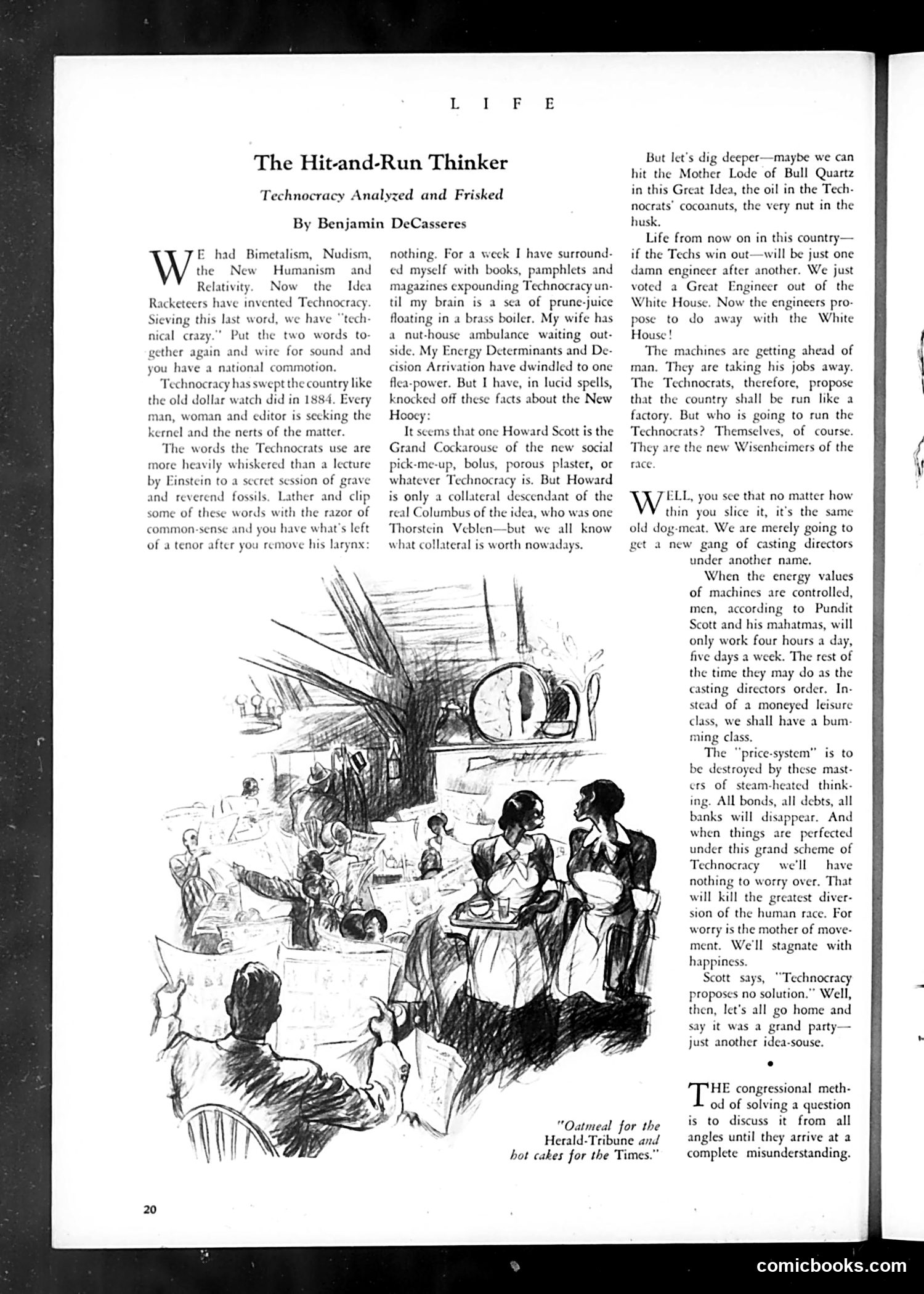
"The Hit-and-Run Thinker": Technocracy Satirized Benjamin DeCasseres mocks the 1930s Technocracy movement, a real social ideology proposing that engineers and scientists should run society based on energy efficiency rather than politics or markets. The article targets Howard Scott, the movement's actual leader, as a charlatan descended from economist Thorstein Veblen's legitimate ideas. DeCasseres ridicules Technocracy's jargon-heavy language as meaningless pseudo-intellectualism ("technical crazy"). The satire's main points: Technocracy promises utopia (four-hour workdays, eliminated debts, no worry) but actually means replacing one ruling class with another—engineers as new tyrants. The accompanying sketch shows ordinary people confused by these grand promises, suggesting masses will be duped. The final jab: Scott admits "Technocracy proposes no solution"—exposing it as another fad ideology, like previous crazes (Bimetalism, Nudism, Relativity). It's an "idea-souse"—an intoxicating but empty notion.
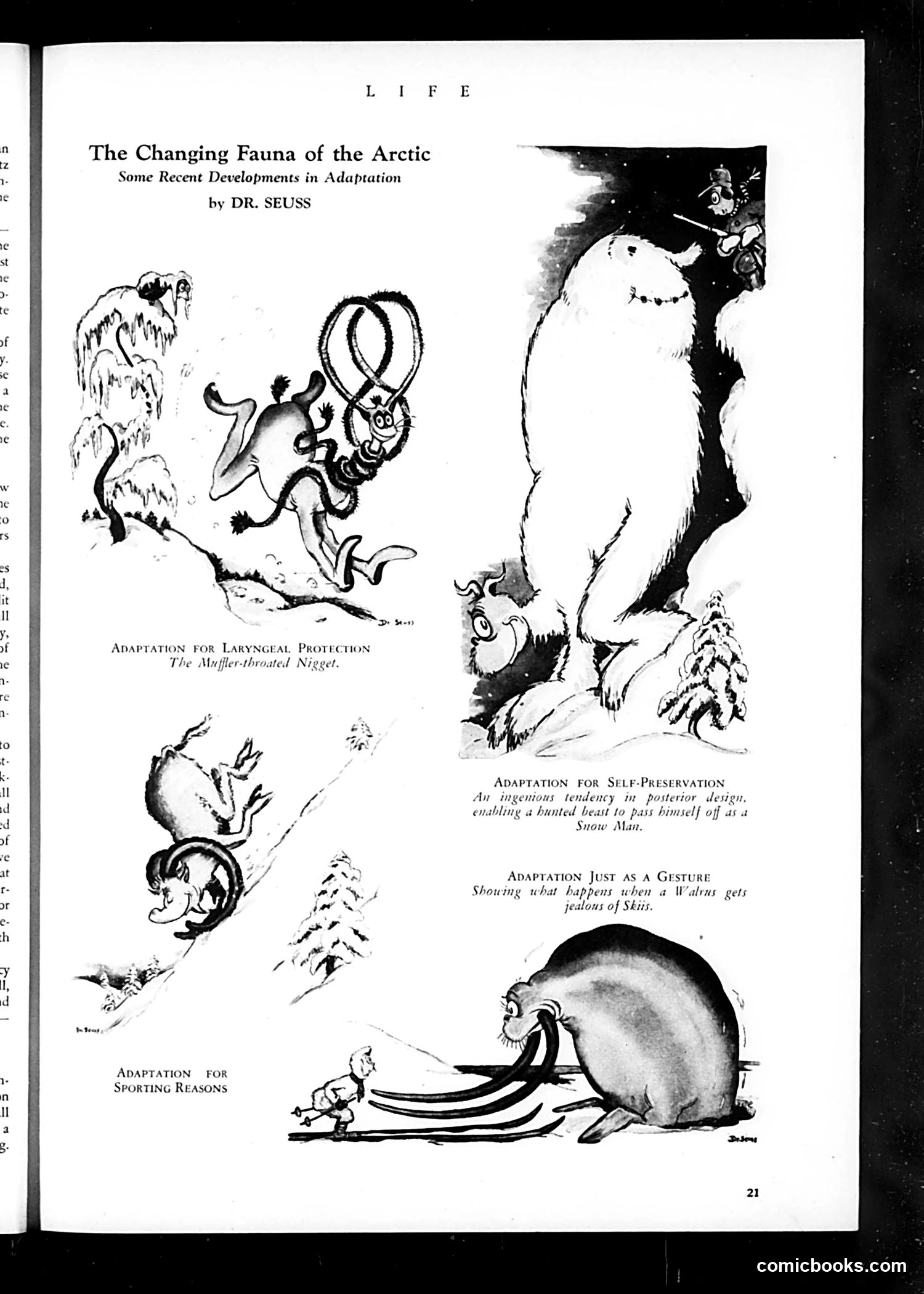
This is a satirical piece by Dr. Seuss (Theodor Geisel) published in *Life* magazine, presenting fictional "Arctic adaptations"—imaginary evolutionary changes in Arctic animals. The humor is absurdist: creatures develop ridiculous features supposedly for survival, such as a "muffler-throated" animal for voice protection, or a beast with a posterior design allowing it to disguise itself as a snowman. Another shows a walrus's jealous reaction to a creature named "Skits," and a final adaptation involves "sporting reasons." The satire mocks pseudo-scientific explanations of animal adaptation—a common trope in early 20th-century popular science writing. Seuss uses whimsical, invented creatures and over-the-top justifications to gently ridicule how people rationalized natural phenomena before modern evolutionary biology was widely understood. The cartoons are nonsensical but clever, typical of Seuss's early satirical work in *Life*.
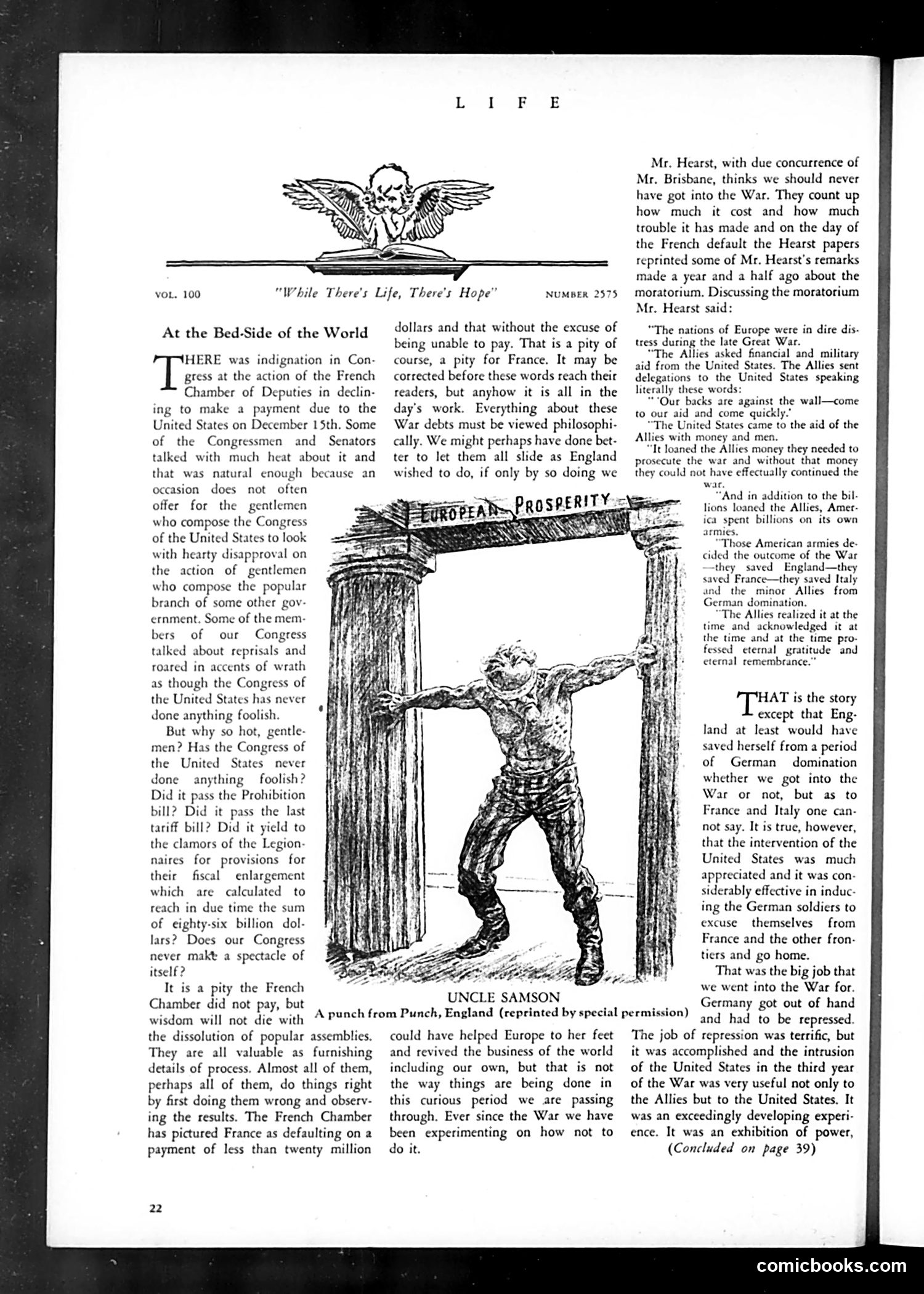
Political Cartoon Analysis: "Uncle Samson" (Life Magazine) This page critiques post-WWI debt disputes between the U.S. and its European allies, particularly France's refusal to pay war debts on December 15th. The Cartoon: "Uncle Samson" depicts America as a muscular figure straining to hold up collapsing European columns labeled "European Prosperity." The image sarcastically suggests America is desperately propping up Europe's economy—yet Europe refuses to repay American loans. The Context: After WWI, the U.S. loaned billions to Allied nations. France's default sparked Congressional anger. Life's editorial argues this is hypocritical—Congress passes foolish legislation (Prohibition, tariffs) regularly. The piece further notes William Randolph Hearst's contradiction: he opposed entering the war but now demands repayment for America's crucial military and financial contributions that "saved" the Allies from German domination. The Satire: The cartoon mocks American generosity seemingly unappreciated by ungrateful European debtors, while the text exposes the absurdity of America's moral outrage given its own legislative follies.
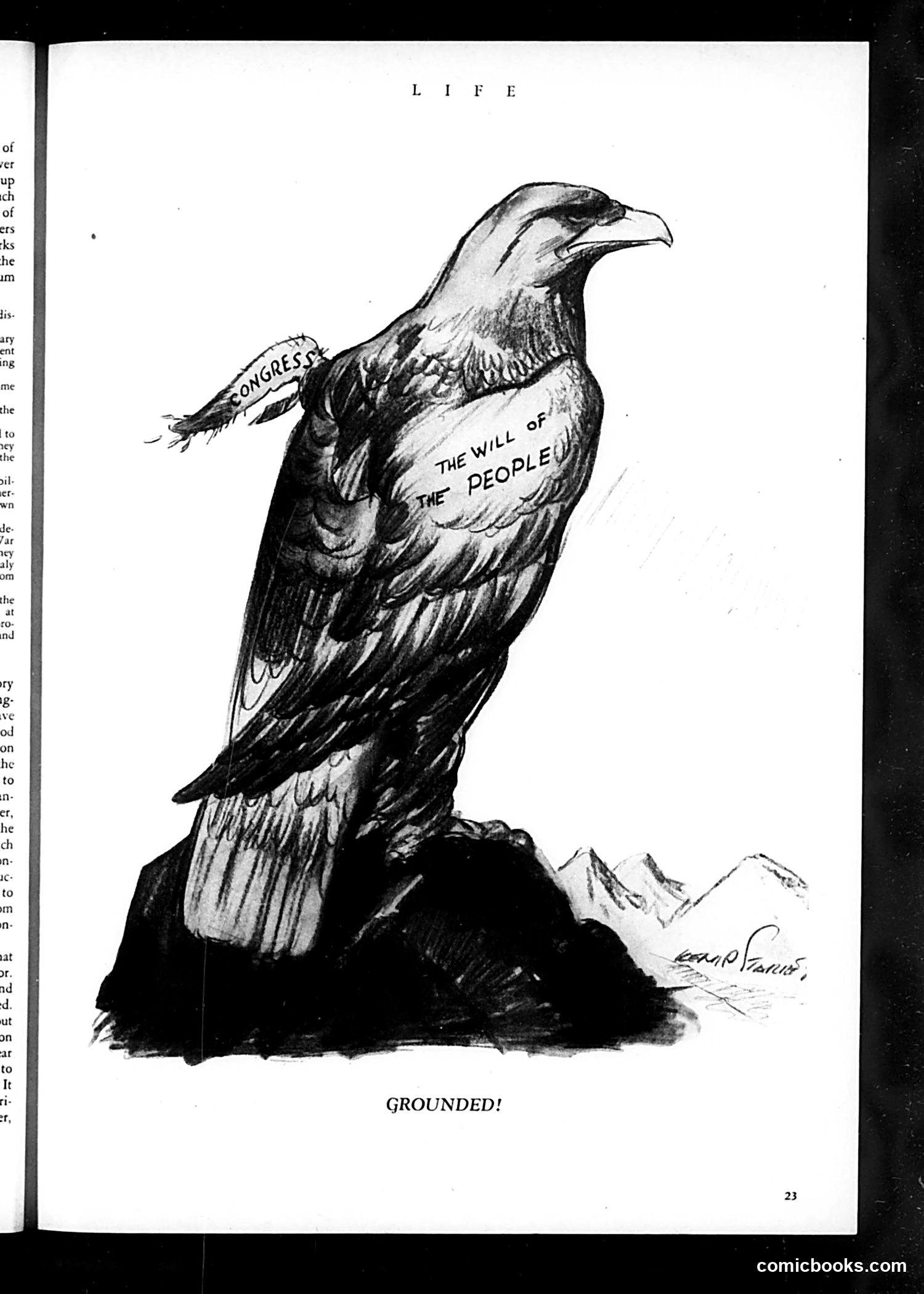
Political Cartoon Analysis This cartoon depicts an eagle (symbolizing Congress or American governmental authority) with its wings clipped or bound, perched on a rock. Text on the eagle's body reads "THE WILL OF THE PEOPLE" while a banner across its wing says "CONGRESS." The title "GROUNDED!" suggests that Congress has been restrained or prevented from acting—its ability to "fly" (exercise power) is compromised. The cartoon criticizes how Congress's actions or authority are constrained, possibly by public opinion ("will of the people") or competing political forces. The satire appears to argue that despite claiming to represent popular will, Congress finds itself unable to act freely or effectively. Without knowing the specific publication date, the exact political context remains unclear, though this reflects common satirical themes about legislative gridlock or executive-legislative tensions.
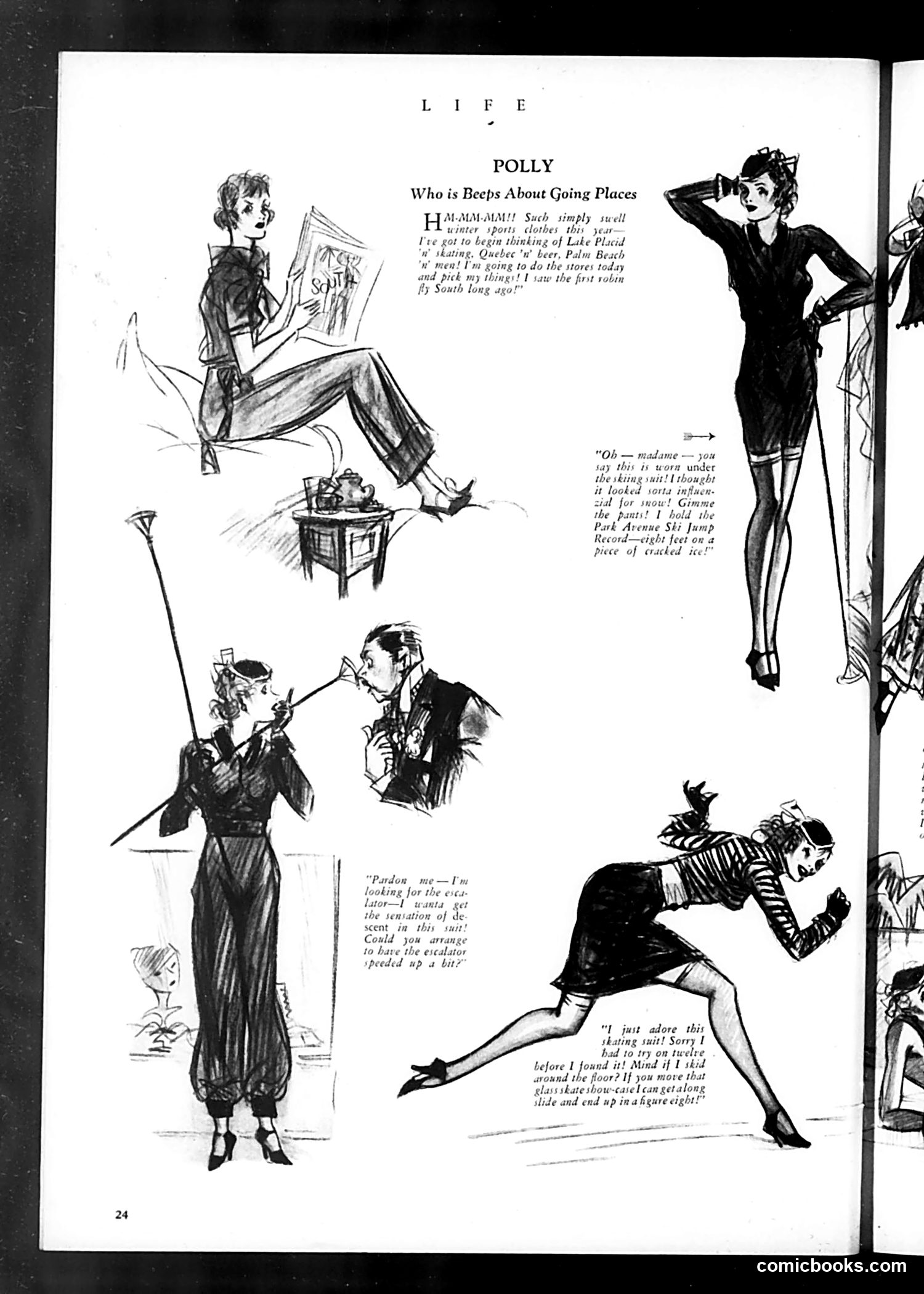
Analysis of "Polly: Who is Beeps About Going Places" This is a satirical fashion/lifestyle comic about a character named Polly planning her winter social season. The humor targets the frivolous spending habits and pretensions of wealthy women in the 1920s-30s. The satire: - Polly excitedly plans expensive winter destinations (Lake Placid, Quebec, Palm Beach) and shopping sprees - A salesman boasts absurdly about ski-jumping records achieved on "cracked ice" - Polly carelessly tries on numerous expensive items and recklessly damages the shop, claiming to "adore" the skiing suit while nearly destroying merchandise - The exaggerated dialogue emphasizes shallow materialism and destructive carelessness masked by enthusiasm The point: The comic mocks upper-class women for their conspicuous consumption, vanity, and obliviousness to the actual cost and consequences of their behavior—presenting them as charming but fundamentally irresponsible. The elaborate fashion illustrations contrast with the characters' foolishness.
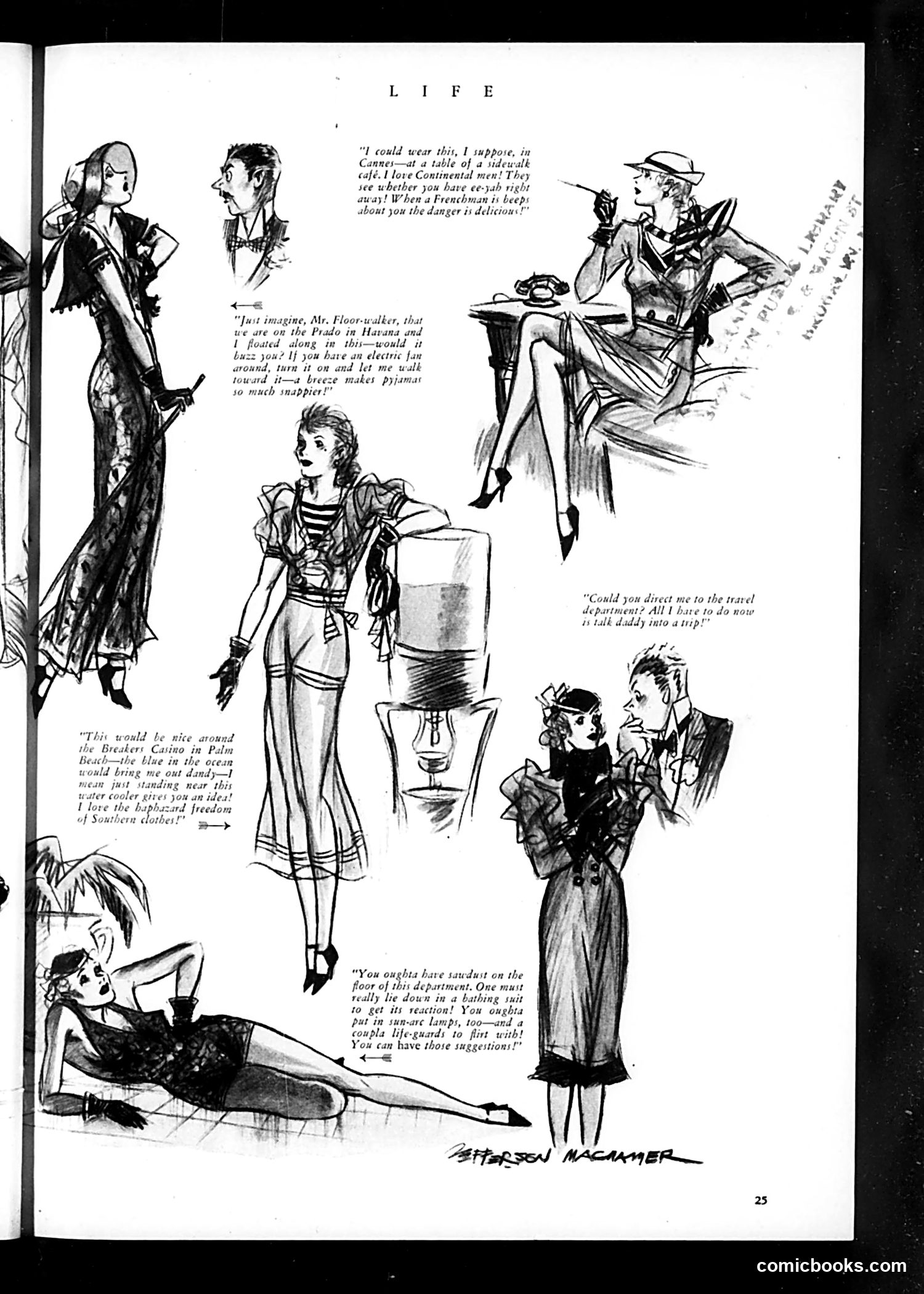
Analysis of Life Magazine Cartoon Page This page satirizes women's fashion shopping and vacation fantasies during the interwar era. Multiple female figures model or discuss revealing or exotic clothing—swimwear, pajamas, and resort wear—while making increasingly absurd suggestions to male salesmen (the "floor-walker") about how to properly display or test the garments. The humor targets women's consumerism and escapist daydreaming: they imagine wearing items in glamorous foreign locations (Cannes, the Prado in Havana) or fantasize about luxurious department store amenities (sun lamps, life-guards). One figure jokes about manipulating her father ("daddy") into financing a trip. The satire gently mocks both female shopping culture and the era's idealization of Continental sophistication and leisure travel among the affluent. The cartoonist (credited as "Patterson Macamber") presents these as charming but frivolous preoccupations.
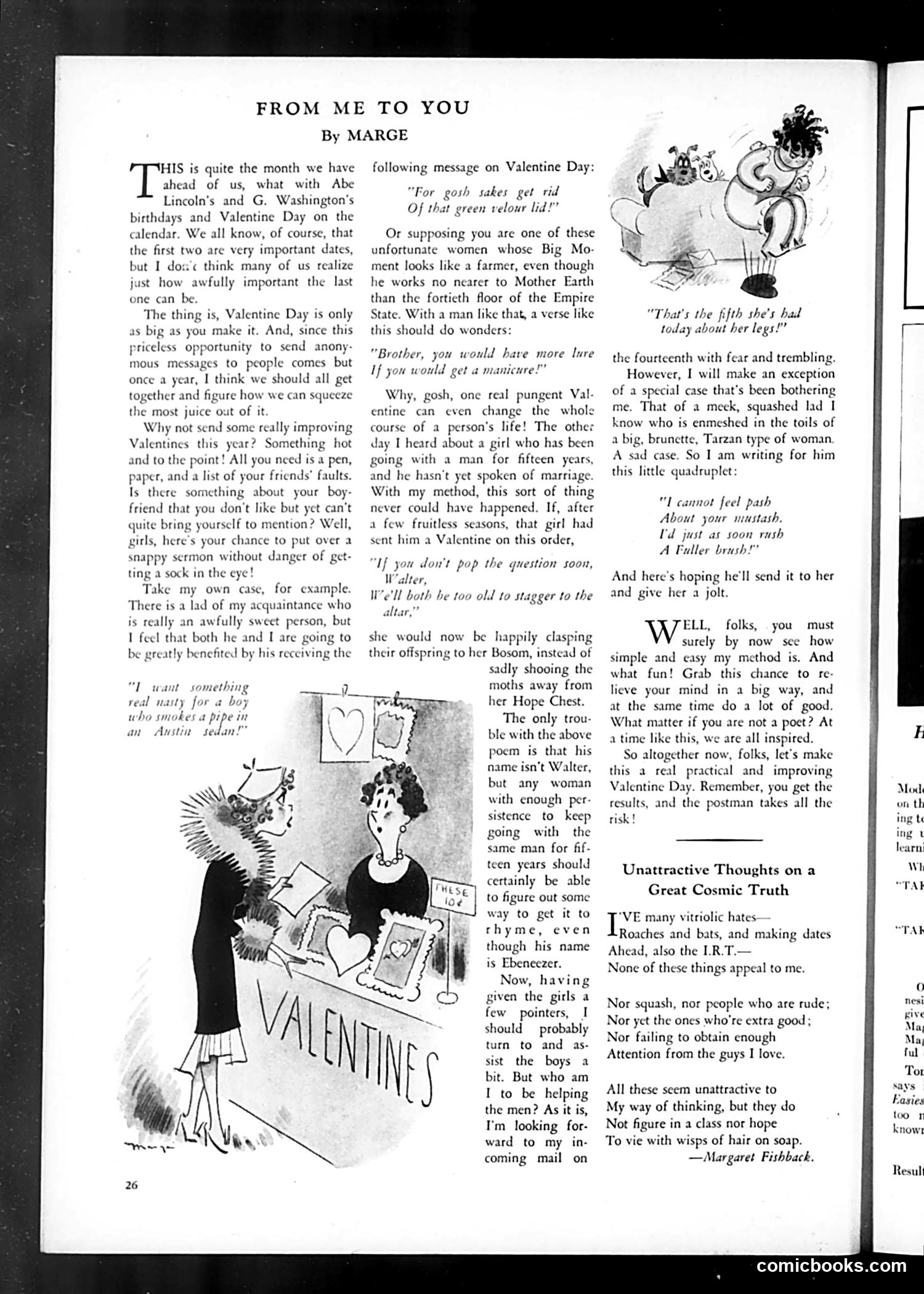
"From Me to You" by Marge — Valentine's Day Satire This humorous column by Marge (a Life magazine humor columnist) satirizes Valentine's Day by proposing that people send brutally honest, insulting "Valentines" to their acquaintances rather than sentimental ones. The cartoons illustrate her comedic suggestions: one shows a woman complaining about her boyfriend's green velour hat and pipe-smoking in an Austin sedan; another depicts a woman at a "Valentines" counter considering cutting remarks for various people. Marge's satire targets several social conventions: the pressure to marry (mocking a woman who waited 15 years for a proposal), poor grooming habits, and the expectation that Valentine's Day requires saccharine sentiment. She presents insulting, practical criticism as actually *helpful* to recipients—a tongue-in-cheek reversal of the holiday's romantic purpose. The piece reflects 1930s-40s attitudes toward dating, marriage expectations, and the satirical tone typical of Life magazine's humor section.
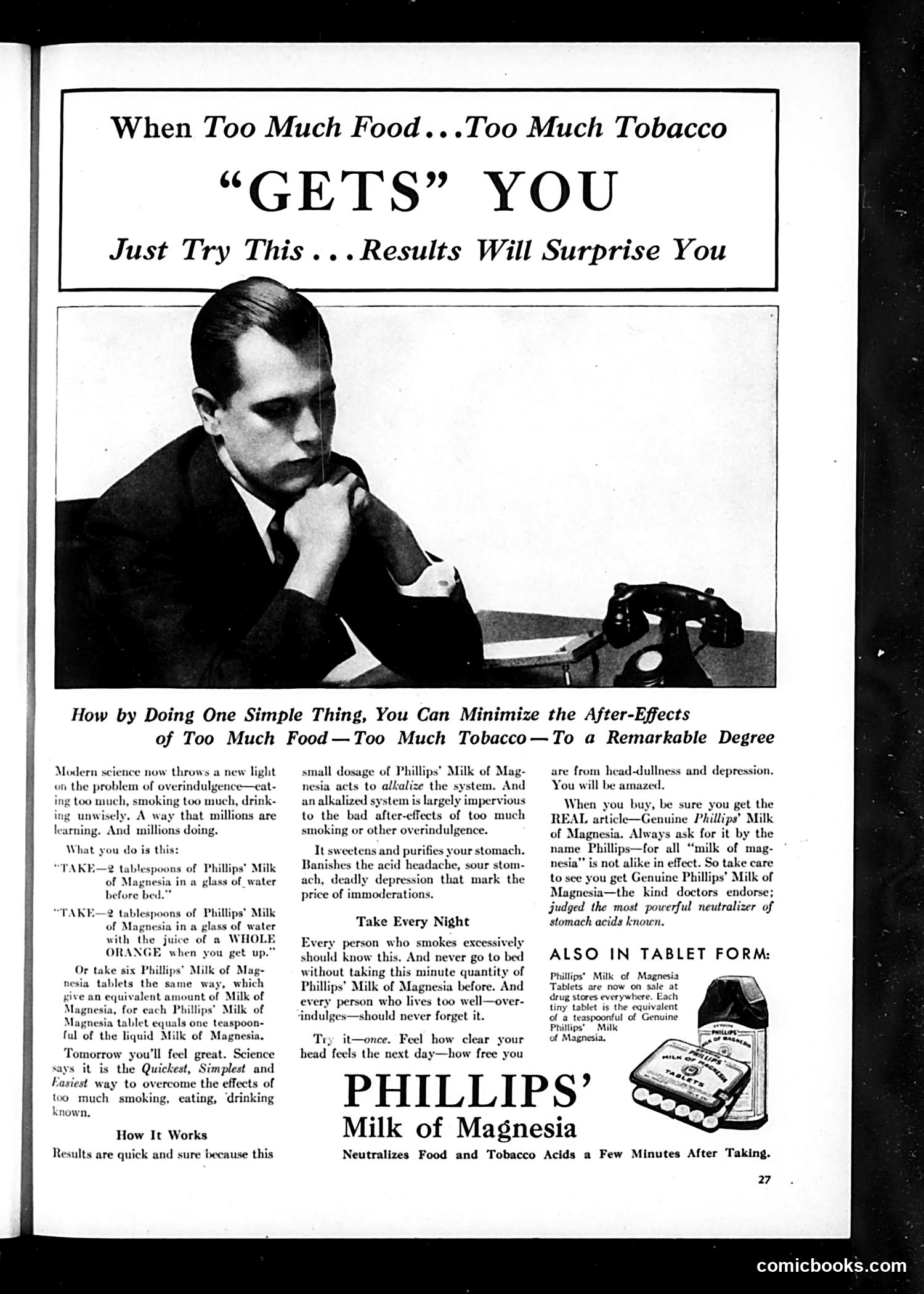
Advertisement Analysis This is a Phillips' Milk of Magnesia advertisement, not satirical content. It presents a straightforward (if exaggerated by modern standards) health pitch. The page depicts a concerned businessman at a desk—representing the target audience of affluent men who overindulge in food, alcohol, and tobacco. The ad promises that Phillips' Milk of Magnesia will neutralize digestive distress from excess eating and smoking. The humor is inadvertent to modern readers: the advertisement treats tobacco consumption as a casual, normal habit requiring only a digestive aid for managing its side effects—reflecting 1920s-30s attitudes when smoking's serious health risks weren't publicly acknowledged. The suggestion that a simple antacid could remedy tobacco's effects now reads as darkly comedic. The "results will surprise you" tagline and scientific language typify period advertising's confident health claims, before FDA regulations restricted such promises.
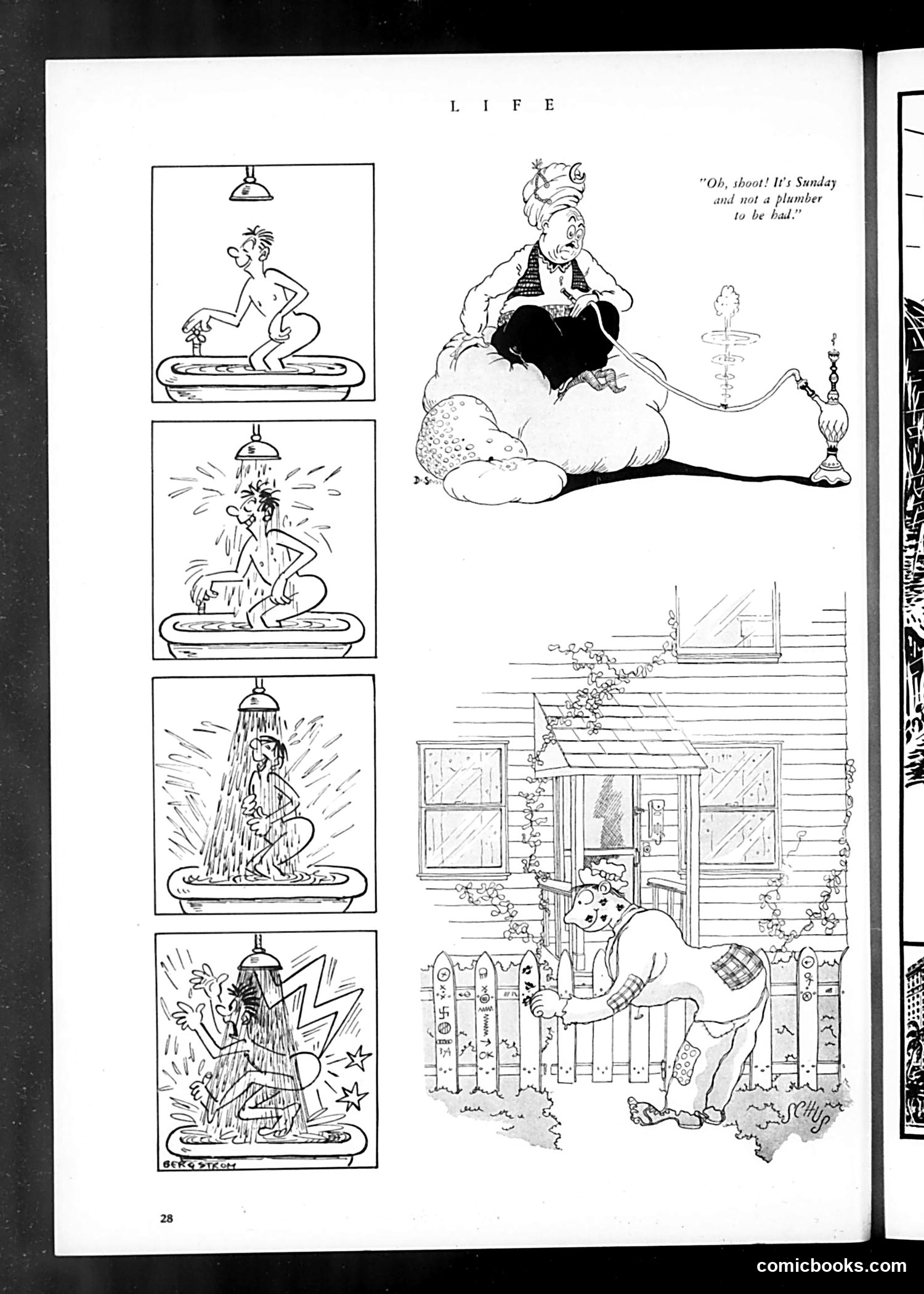
Page Analysis This page contains two separate cartoons satirizing domestic inconvenience and class differences. Left panel (four-frame sequence): Shows a man taking a shower that progressively worsens—from pleasant to cold spray to overwhelming downpour to electrical shock. The joke satirizes the unpredictability of early plumbing systems. Right panel (two-part cartoon): Depicts a wealthy woman lounging luxuriously while her servant/plumber works outside. The caption—"Oh, shoot! It's Sunday and not a plumber to be had"—satirizes how the wealthy depend on working-class tradespeople for basic maintenance, yet find themselves helpless when those workers take their day off. The humor lies in exposing the irony that Sunday, meant as a day of rest, becomes inconvenient for those accustomed to on-demand service. Both cartoons mock plumbing troubles and class dynamics common to early 20th-century American life.
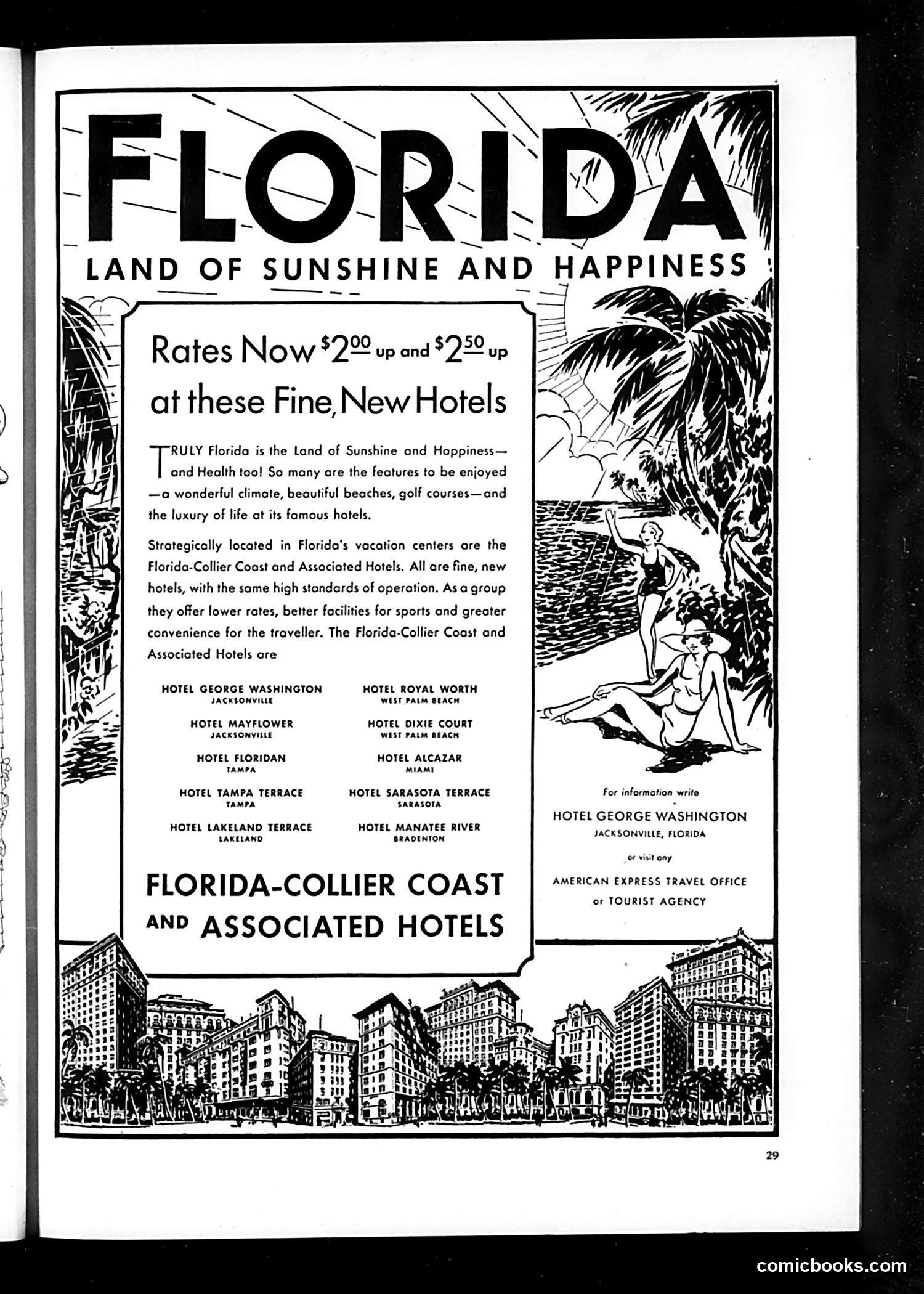
Analysis This page is not a cartoon or satirical content—it's a straightforward hotel advertisement for Florida tourism, likely from the 1920s-1930s based on the Art Deco styling and language. The ad promotes the "Florida-Collier Coast and Associated Hotels" chain, emphasizing Florida as "the Land of Sunshine and Happiness" with attractive rates starting at $2.00 and $2.50 per night. It lists ten hotels across Florida cities (Jacksonville, Tampa, Miami, etc.) and highlights amenities like golf courses and beaches. The decorative illustrations—palm trees, beachgoers in period swimwear, and a cityscape—are purely ornamental branding, not satirical commentary. The page represents early-20th-century tourism marketing targeting American travelers seeking warm-weather vacations. There is no political satire, caricature, or joke content present.
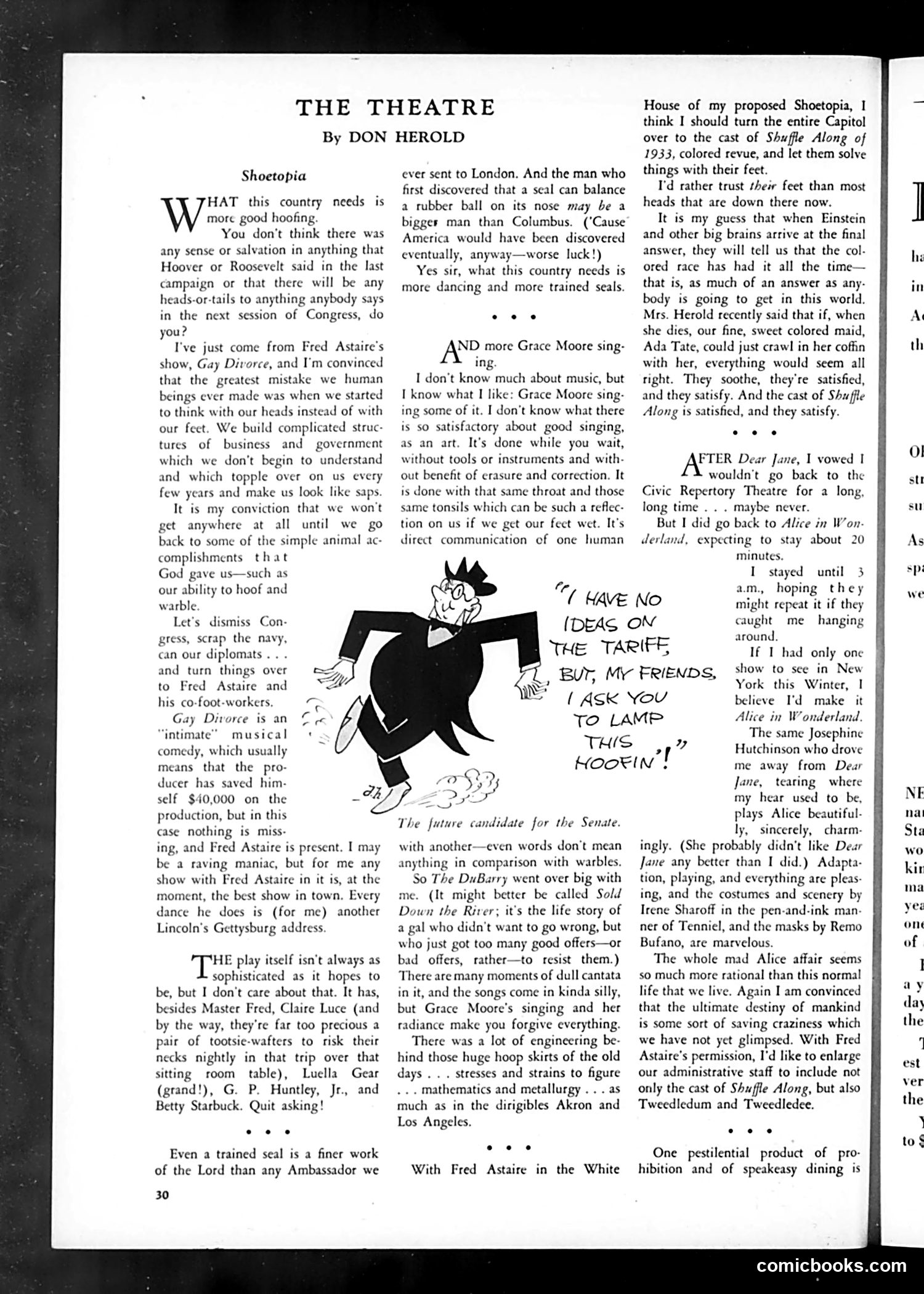
The Theatre - Don Herold's Political Satire This is a theatre review by humorist Don Herold that uses entertainment as a vehicle for Depression-era political satire. The main cartoon depicts a caricatured politician (captioned "The future candidate for the Senate") declaring ignorance on tariffs while asking for "Hoofing"—a reference to dancing. Herold's central joke: America's government and diplomats are incompetent, so he proposes replacing them with Fred Astaire and other entertainers. He dismisses Congress, diplomats, and the navy as failures, sarcastically suggesting that dancers and singers would govern better. The references include: - Fred Astaire (currently in *Gay Divorce*) - Grace Moore (opera singer in *The DuBarry*) - Hoover and Roosevelt (recent failed leaders) - Comparisons of dancing to Lincoln's Gettysburg Address The satire mocks both political leadership and public discourse while celebrating vaudeville entertainment—reflecting 1930s skepticism about government effectiveness during the Depression.
Analysis: "Buyers of Advertising Space" This is not a cartoon or satire—it's a straightforward advertisement for advertising space on Fifth Avenue buses in New York City, placed by John H. Livingston Jr. The page pitches bus advertising to potential clients by arguing that Fifth Avenue buses offer measurable value comparable to traditional print media. It emphasizes five key metrics: circulation (39+ million annual passengers), editorial alignment (clean, comfortable rides to shopping districts), affluent readership (best residential areas), passive engagement (captive seated audience viewing colored advertisement cards), and competitive rates. The pitch highlights economic appeal: bus riders spend $60 annually commuting—representing concentrated, affluent consumer traffic. The comparison claims Fifth Avenue buses deliver passengers more cheaply than subway/elevated ads, despite carrying fewer people per vehicle. For modern readers: this reflects pre-television advertising when transit advertising was a major marketing channel reaching concentrated urban audiences during their commute.
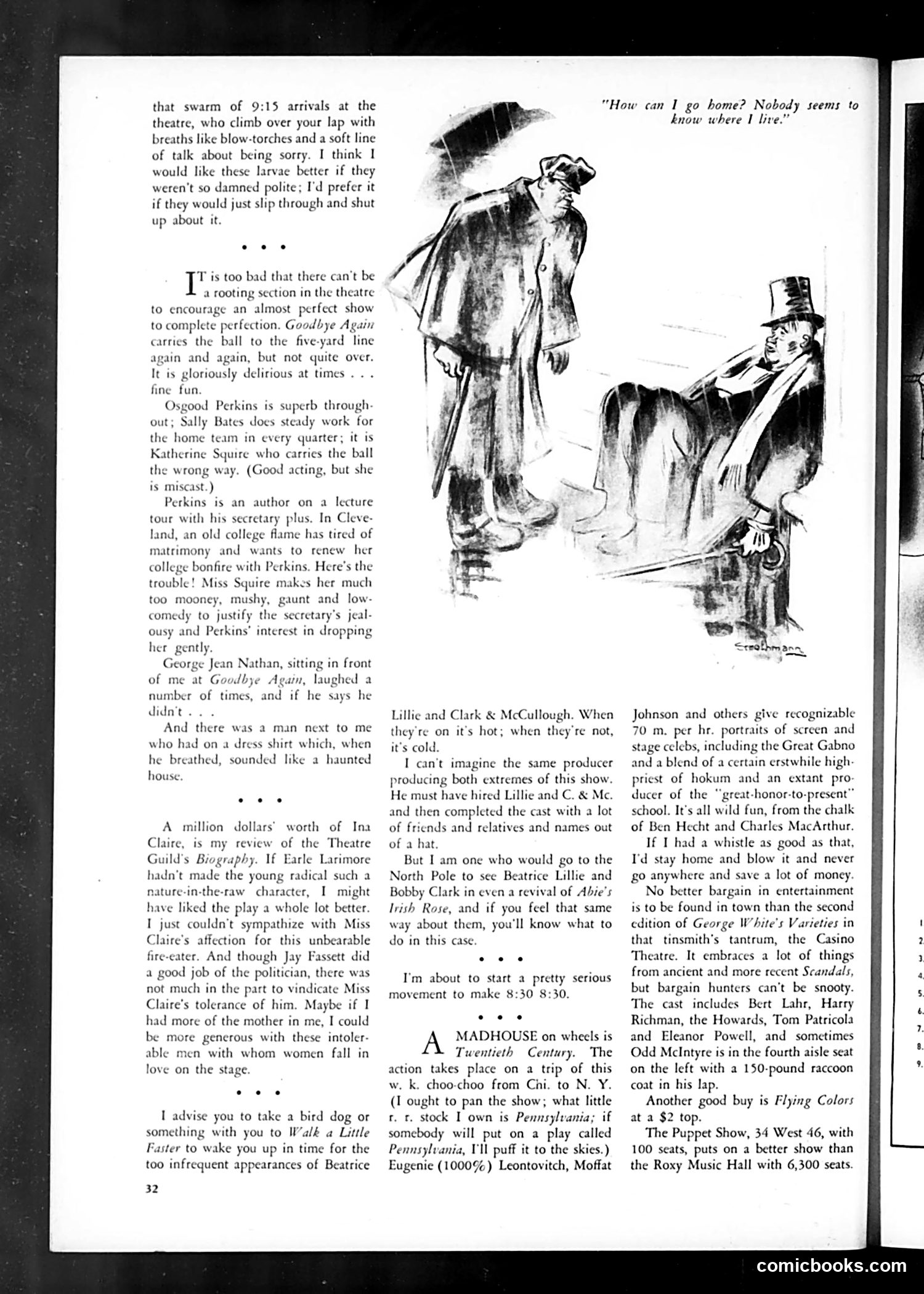
Life Magazine Theater Review Page Analysis This page contains theater reviews by what appears to be a drama critic (possibly Alexander Woollcott, given the byline style of Life magazine from this era), critiquing several Broadway productions. The cartoon depicts a shabby, disheveled vagrant asking a well-dressed gentleman "How can I go home? Nobody seems to know where I live"—likely illustrating the plot of one reviewed show, possibly *Twentieth Century*, which involves confused identities and displacement during a train journey. The reviews mock both performers and audiences: the critic complains about 9:15 arrivals disturbing patrons, criticizes miscasting in *Goodbye Again*, and praises Beatrice Lillie while noting that *Walk a Little Faster* has dull stretches between her appearances. The tone is witty and caustic—characteristic of 1930s highbrow theater criticism that treated Broadway as both entertainment and art worth serious judgment. References to "the Great Gabbo" and other entertainers were contemporary celebrity shorthand recognizable to readers then.
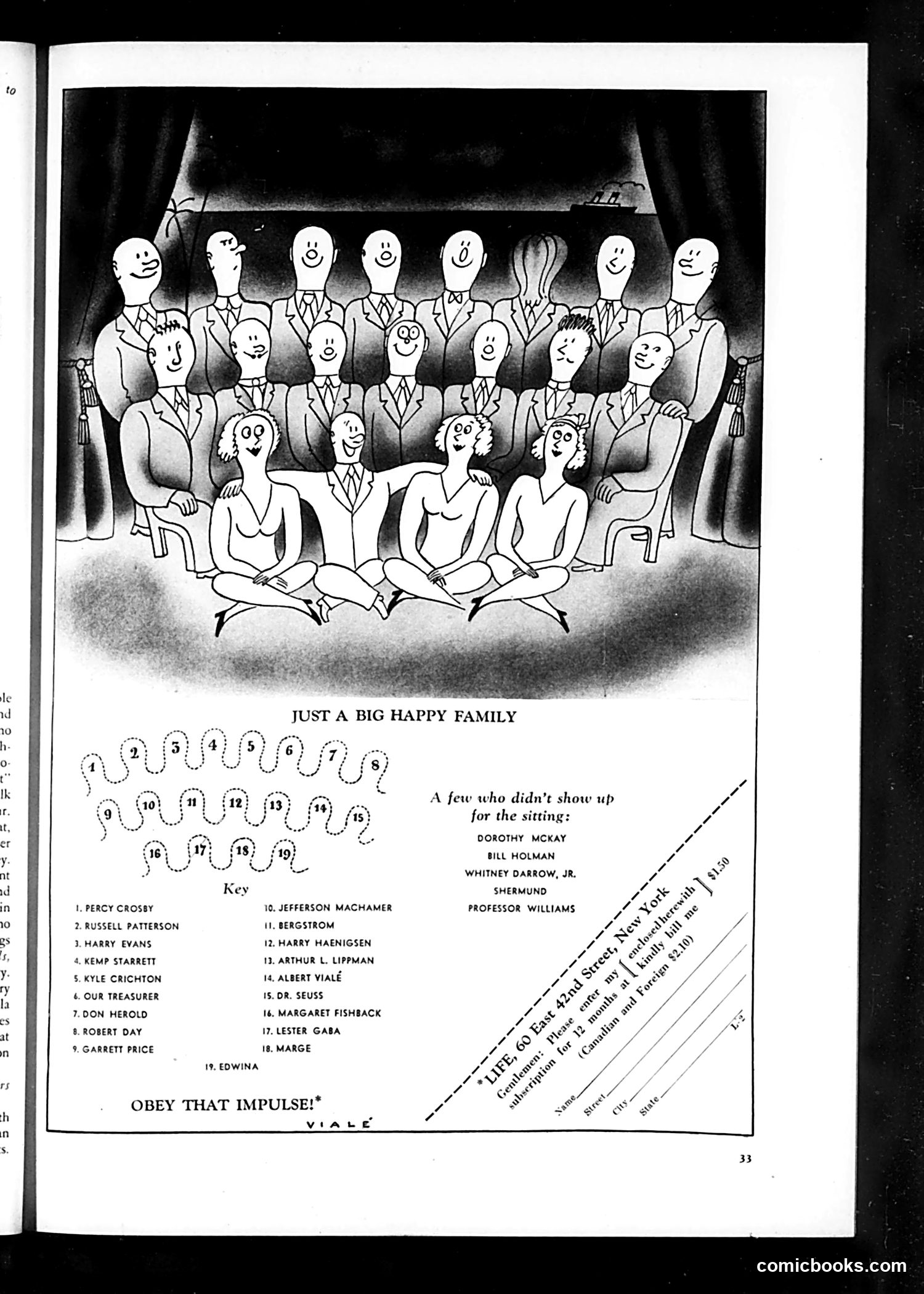
"Just a Big Happy Family" — Life Magazine Staff Portrait This is a humorous group portrait of Life magazine's cartoonists and contributors, labeled with numbered figures corresponding to a key below. The cartoon celebrates the magazine's creative team with the title "Just a Big Happy Family," presenting them as a cohesive unit of humorists and illustrators. The accompanying key identifies prominent cartoonists of the era, including Percy Crosby, Russell Patterson, and Dr. Seuss (Theodor Geisel), among others. A note acknowledges several contributors who missed the sitting. The satire lies in the mock-serious, formal arrangement juxtaposed with the cartoonists' exaggerated, cheerful expressions—poking gentle fun at both the creative community itself and Life's satirical mission. The headline "Obey That Impulse!" (likely an advertisement for Vialé product visible at bottom) adds ironic advertising context to this staff celebration.
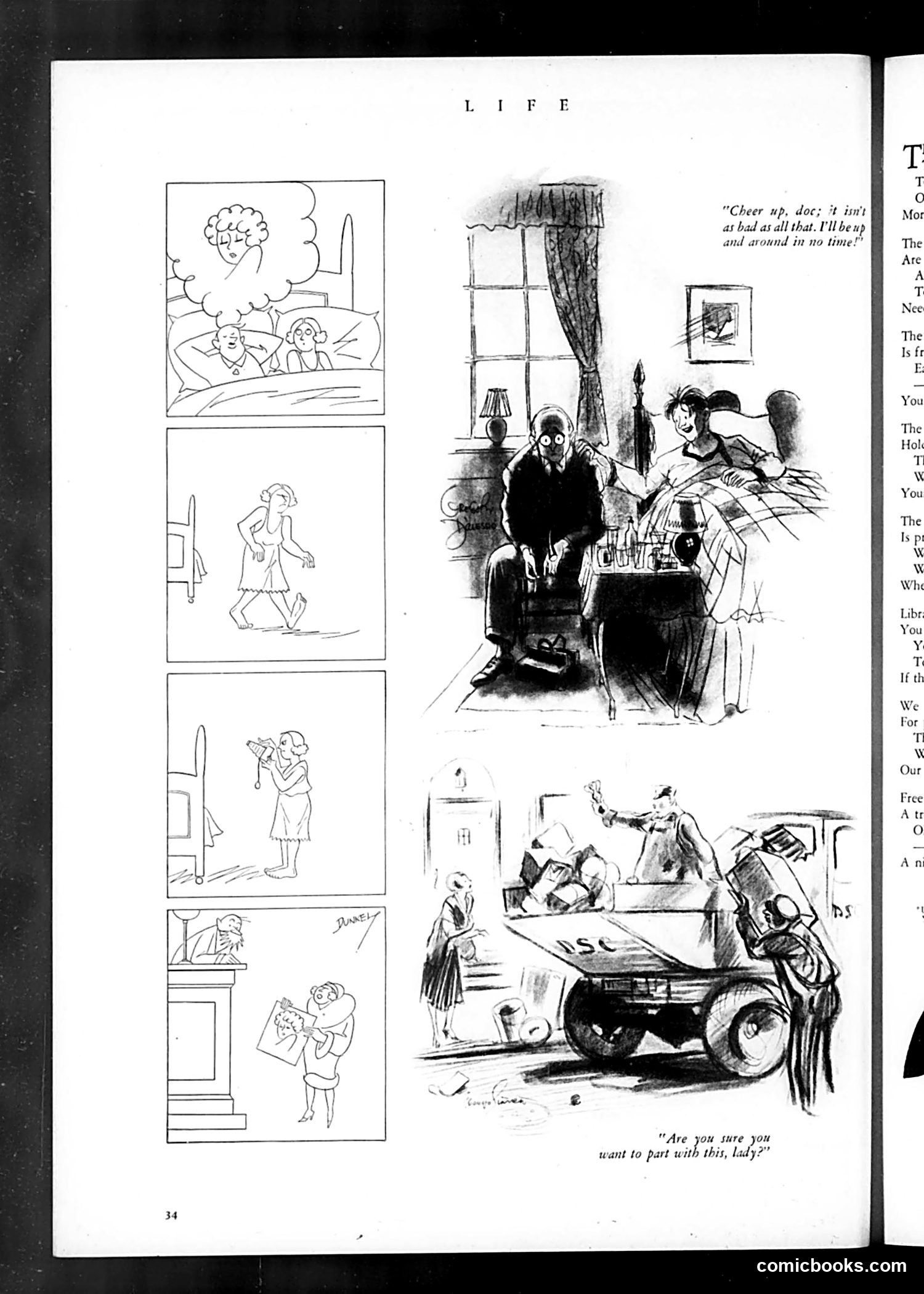
Political/Social Satire Analysis This page contains two separate cartoons satirizing different social situations. The left panel shows a four-panel comic strip depicting a patient's optimistic recovery scenario versus reality—a common humorous trope about sick people's unfounded confidence. The right side shows a more serious scene: a doctor attending to a bedridden patient while a woman (likely the patient's wife) looks on. The caption "Are you sure you want to part with this, lady?" suggests dark humor about the patient's condition—implying the woman might benefit from her husband's death, possibly through insurance or escape from an unhappy marriage. This reflects period attitudes toward illness, mortality, and marital discord typical of early-to-mid 20th century satirical humor in *Life* magazine.
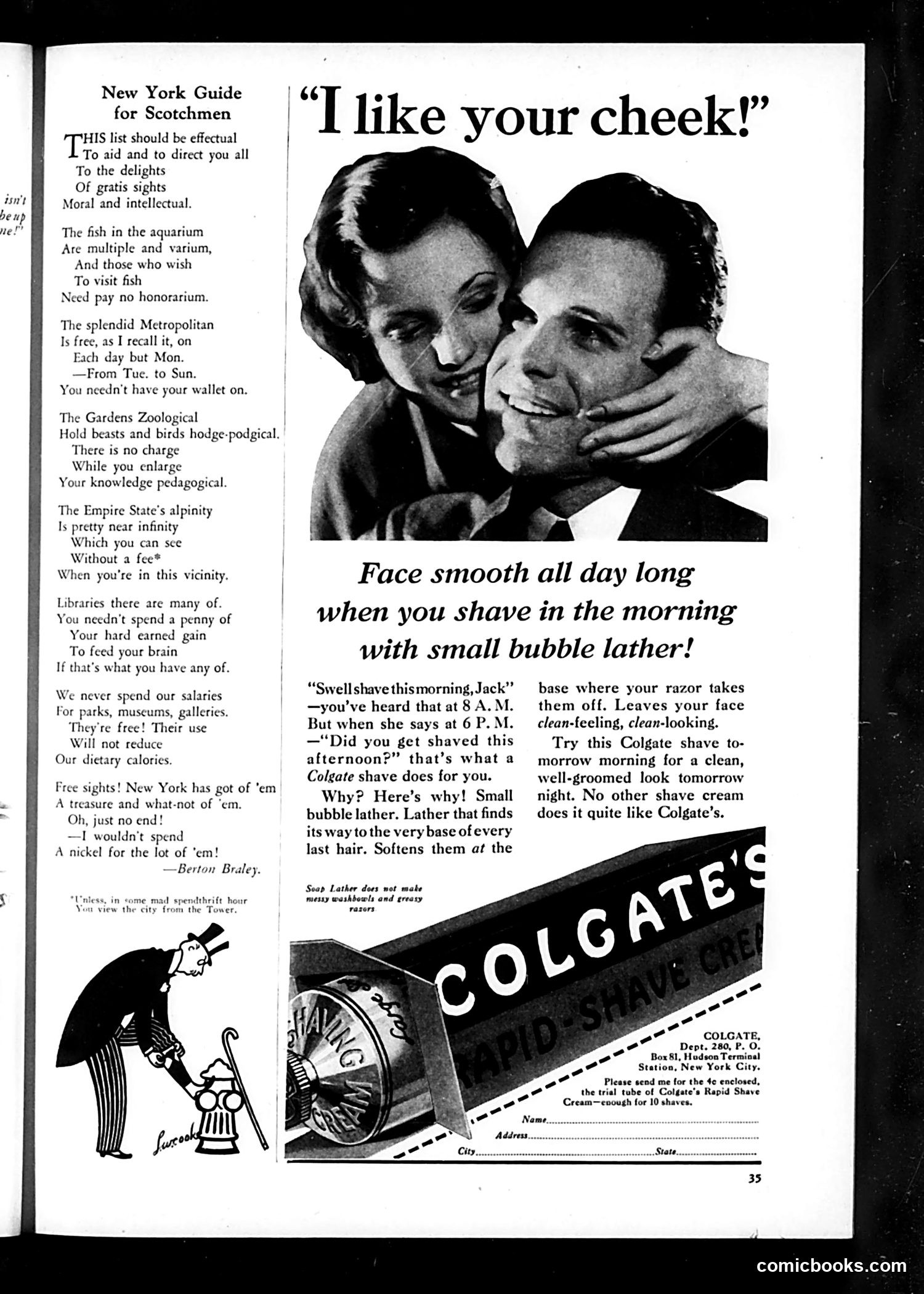
Analysis: "New York Guide for Scotchmen" This page combines a humorous poem with a Colgate shaving cream advertisement. The Poem's Satire: The verse, credited to Berton Braley, satirizes Scottish frugality through a "guide" highlighting New York's free attractions (aquarium, Metropolitan Museum, Central Park Zoo, Empire State Building, libraries). The joke targets the stereotype of Scots as miserly—the speaker boasts about experiencing culture without spending money, culminating in the punchline that he wouldn't "spend a nickel" on all of it combined, despite just praising these sights. The Advertisement: The Colgate ad uses the phrase "I like your cheek!" as a double entendre about facial appearance, promoting their shaving cream by claiming it keeps faces smooth-looking throughout the day—from morning shave at 8 A.M. through evening at 6 P.M. The small-bubble lather supposedly softens whiskers at their base for a closer, longer-lasting shave. Context: This appears to be vintage advertising, likely 1920s-1930s, mixing ethnic humor with product promotion—both common period conventions now considered outdated.
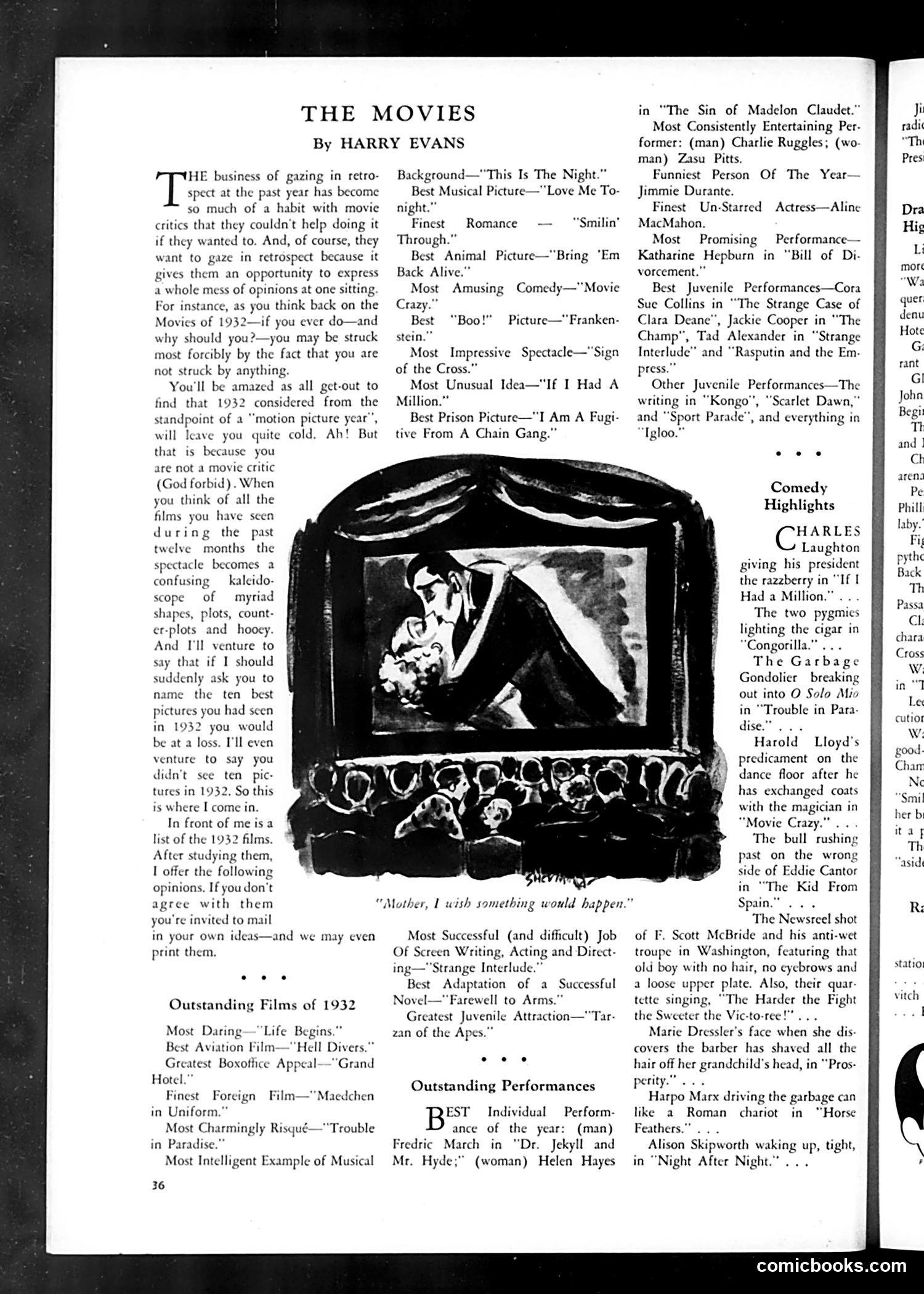
"The Movies" by Harry Evans - Life Magazine, 1932 This is a film criticism column reviewing 1932's outstanding movies. The accompanying cartoon depicts a bored couple at a movie theater, with the caption "Mother, I wish something would happen" — satirizing the year's generally uninspired film output. Evans opens by mocking movie critics' habit of year-end retrospectives, then argues that 1932's films were forgettable and mediocre ("confusing kaleidoscope of myriad shapes, plots, counter-plots and hooey"). He claims most viewers couldn't name ten good pictures from the year. The remainder consists of Evans's own "best of 1932" lists across various categories — aviation films, comedies, musicals, performances — including entries like *Frankenstein*, *I Am a Fugitive From a Chain Gang*, and Fredric March's performance in *Dr. Jekyll and Mr. Hyde*. The "Comedy Highlights" section excerpts amusing moments from various 1932 films, suggesting these brief scenes provided the year's primary entertainment value.
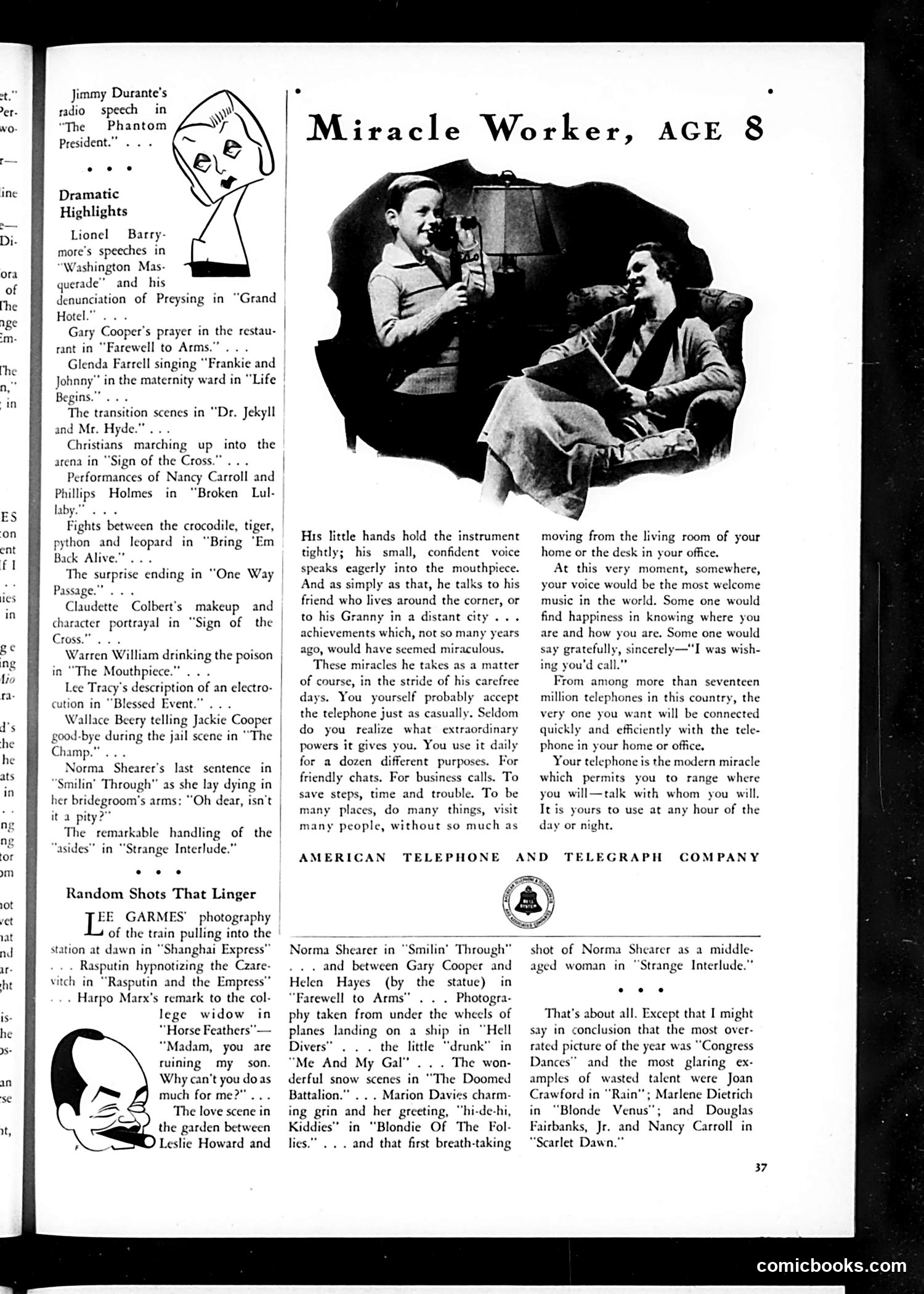
Analysis of "Miracle Worker, Age 8" This page features an advertisement for American Telephone & Telegraph Company disguised as editorial content about film highlights. The main image shows a young boy (age 8) speaking confidently into a telephone handset while an adult listens. The ad's appeal is to post-Depression American optimism: it frames telephone technology as a "modern miracle" that empowers even children to connect across distances—calling neighbors or distant grandparents. The rhetorical strategy treats casual telephone use as extraordinary, encouraging readers to recognize the "extraordinary powers" they possess but take for granted. The surrounding content—lists of acclaimed dramatic film moments—positions the telephone advertisement within entertainment coverage, blending advertising with legitimate editorial. This was common in 1930s magazines. The ad emphasizes accessibility, intimacy, and the democratic nature of modern communication technology for American families.
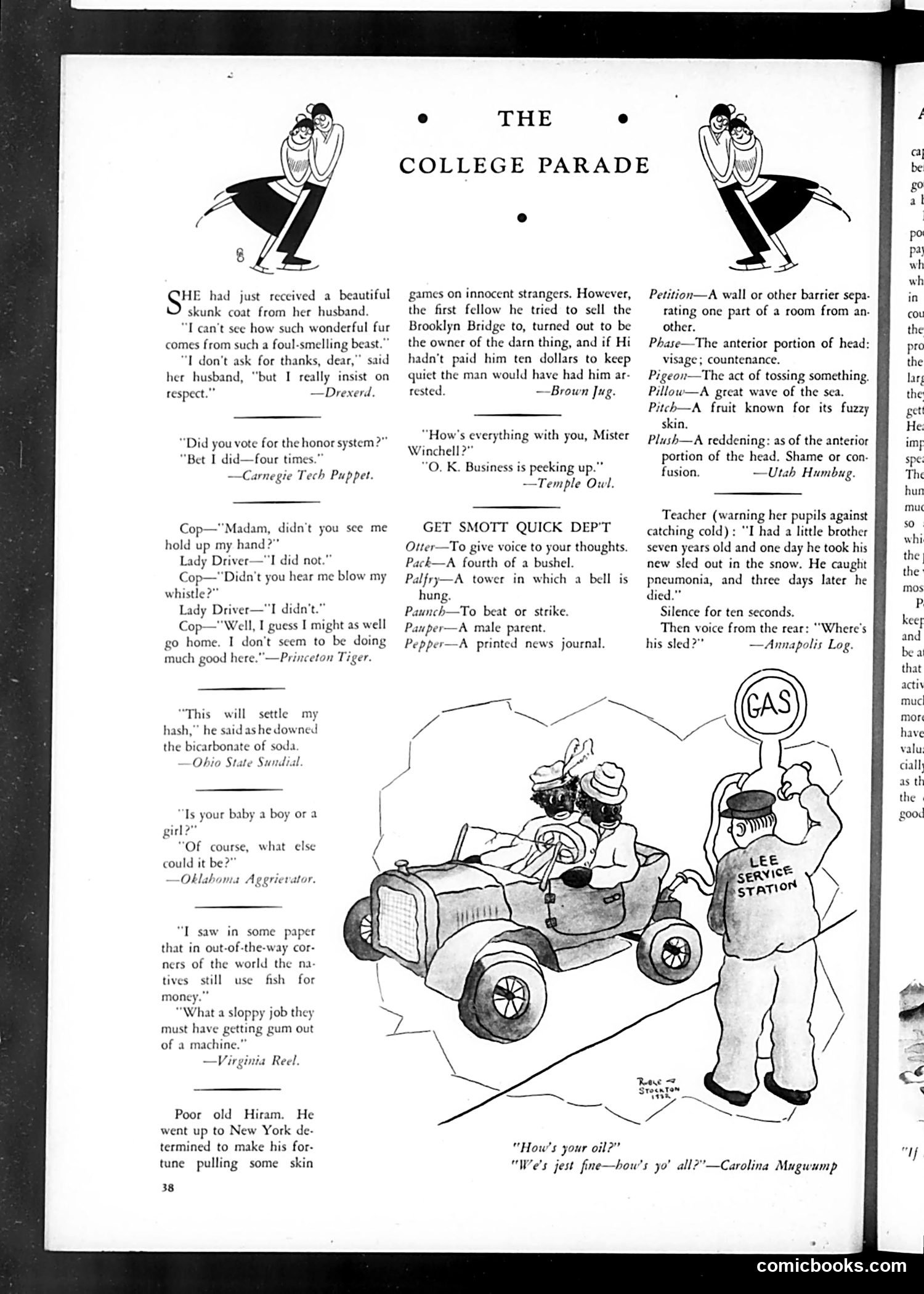
Analysis of "The College Parade" Page This page from *Life* magazine collects student humor from various colleges, organized as jokes and satirical definitions. The Main Cartoon (center-bottom) depicts a young man being scammed at a gas station. He's trying to sell the "Brooklyn Bridge"—a classic con-artist scheme where gullible people are defrauded into "buying" famous landmarks they don't own. The joke: he unknowingly approaches the *actual owner* of the Brooklyn Bridge, who demands payment to keep quiet rather than have him arrested for fraud. "Get Smott Quick Dept." parodies malapropisms—deliberately wrong dictionary definitions submitted by students (e.g., "Pauper—A male parent" instead of "poor person"). This mocks students' linguistic ignorance or pretends to mock it humorously. Other Jokes reference contemporary concerns: women drivers ignoring traffic cops, the "honor system" (academic integrity), and flappers in skunk coats—reflecting 1920s social anxieties about changing gender roles and modern behavior. The overall tone satirizes college life and youthful folly.
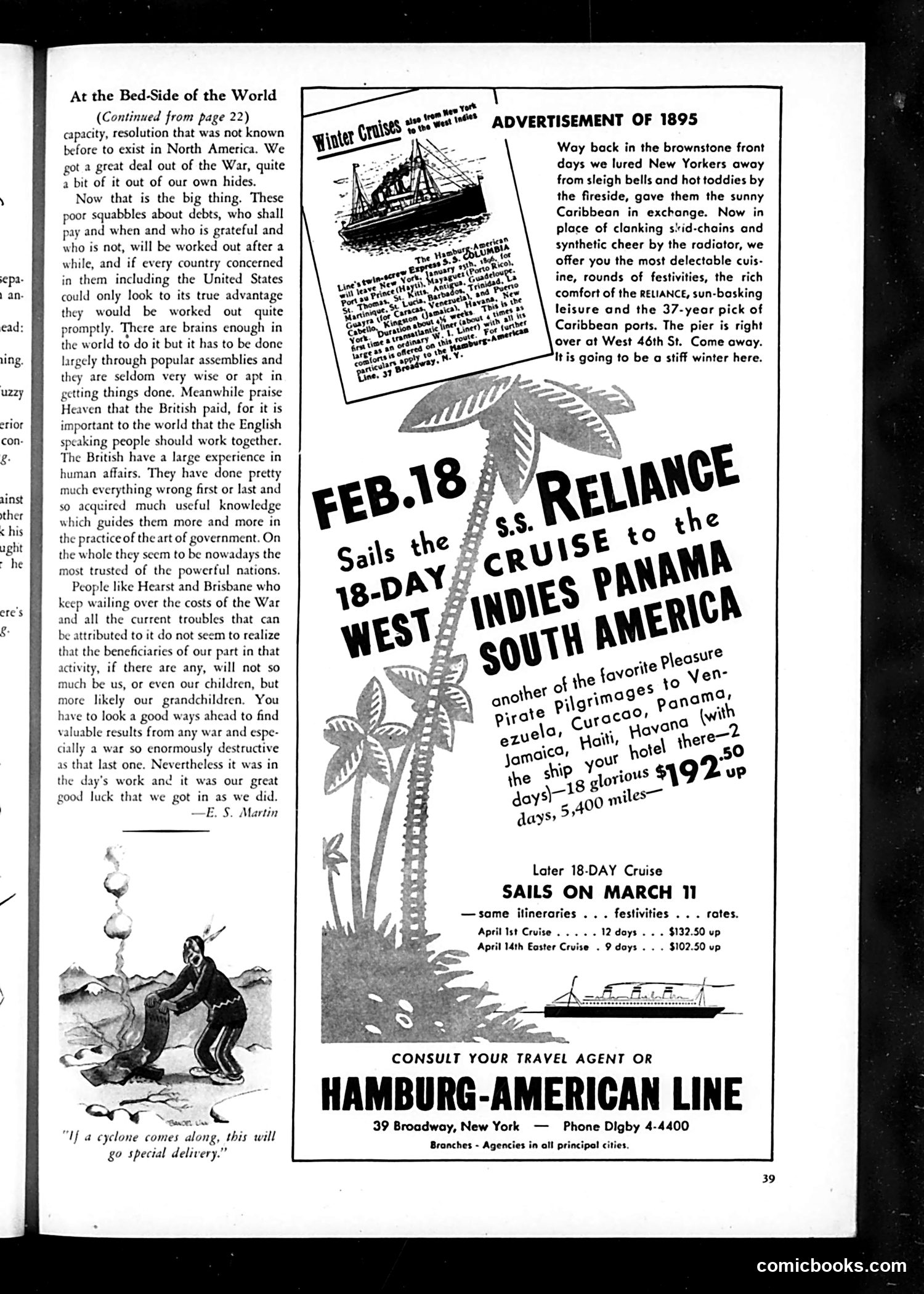
Page 39 Analysis: Life Magazine, 1895 This page mixes editorial content with advertising. The Editorial Section ("At the Bed-Side of the World," continued from page 22) features commentary by E.S. Martin discussing post-war international relations and debt. Martin argues that while nations squabble over war payments and gratitude, they should trust British experience in governance, and that the true benefits of America's war involvement will likely benefit future generations rather than current ones. It references figures like Hearst and Brisbane as critics of war costs. The Advertisement dominates the lower half, promoting the S.S. Reliance cruise ship operated by the Hamburg-American Line. It nostalgically contrasts old New York winters (sleigh bells, fireside warmth) with Caribbean cruises as escape. The ad targets wealthy leisure travelers with 18-day cruises departing February 18, visiting West Indies and Panama ports, priced from $192 up. The Cartoon at bottom left shows a figure in distress with the caption "If a cyclone comes along, this will go special delivery"—likely a joke about unreliable mail delivery or storm-related shipping hazards.
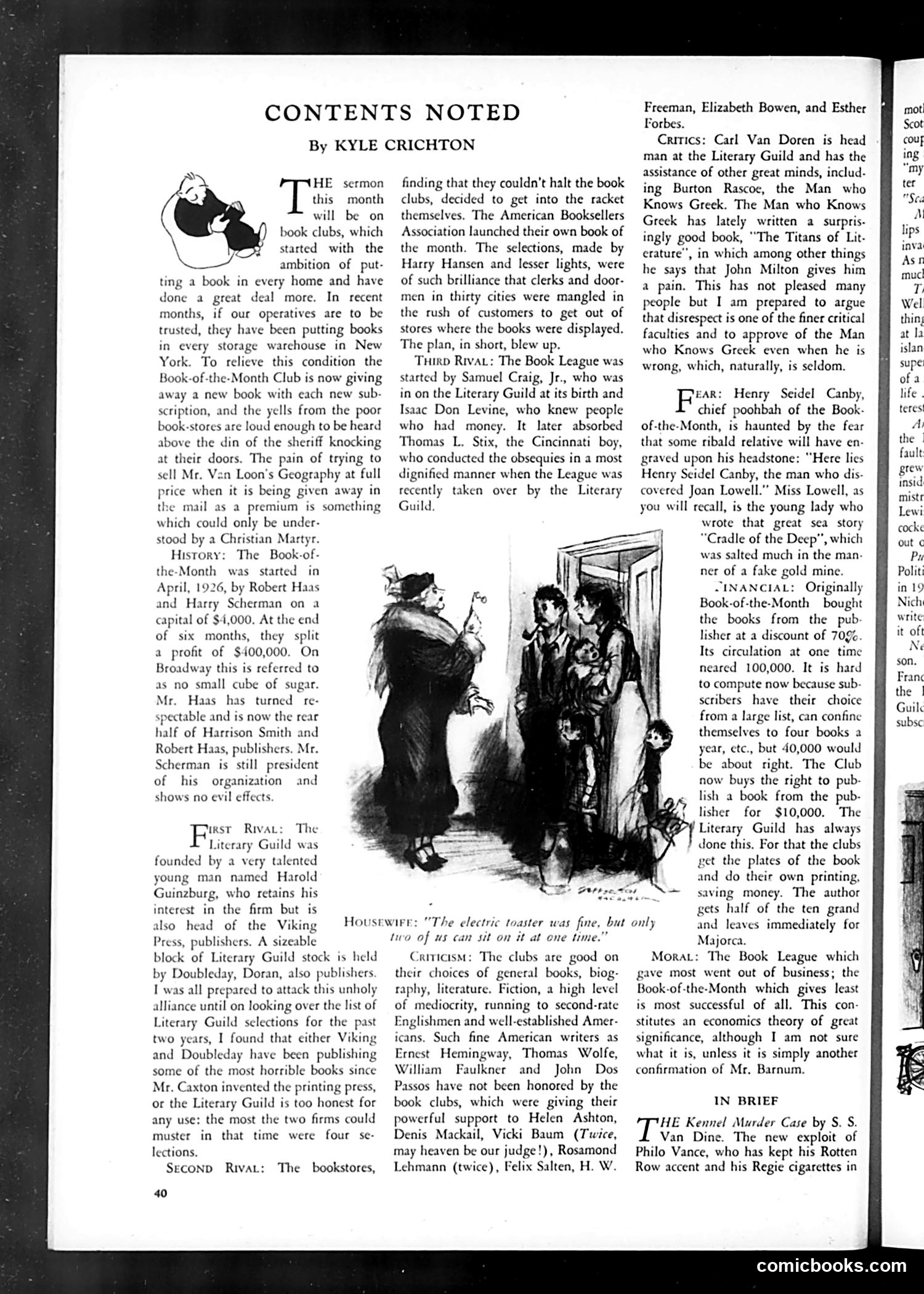
Analysis of "Contents Noted" Page This page is Kyle Crichton's satirical commentary on the booming 1920s book-club industry—specifically the Book-of-the-Month Club, Literary Guild, and American Booksellers Association's competing book club. The cartoon depicts a housewife and customers clustered around an electric toaster with the caption about only two people fitting on it—a visual joke about impractical modern appliances, contrasting with the page's focus on book distribution. The satire's target: Crichton mocks how these clubs, despite good intentions ("a book in every home"), have become commercial rackets that undercut independent bookstores and flood warehouses. He notes the Book-of-the-Month Club's obscene early profits ($400,000 in six months on $4,000 capital) and critiques their editorial choices—praising competent selections but skewering their preference for mediocre established British/American authors over innovative American writers like Hemingway, Faulkner, and Dos Passos. The "Third Rival" section documents the Literary Guild absorbing a competitor, exposing the consolidation and corporate control emerging in publishing—the real scandal beneath this genteel cultural enterprise.
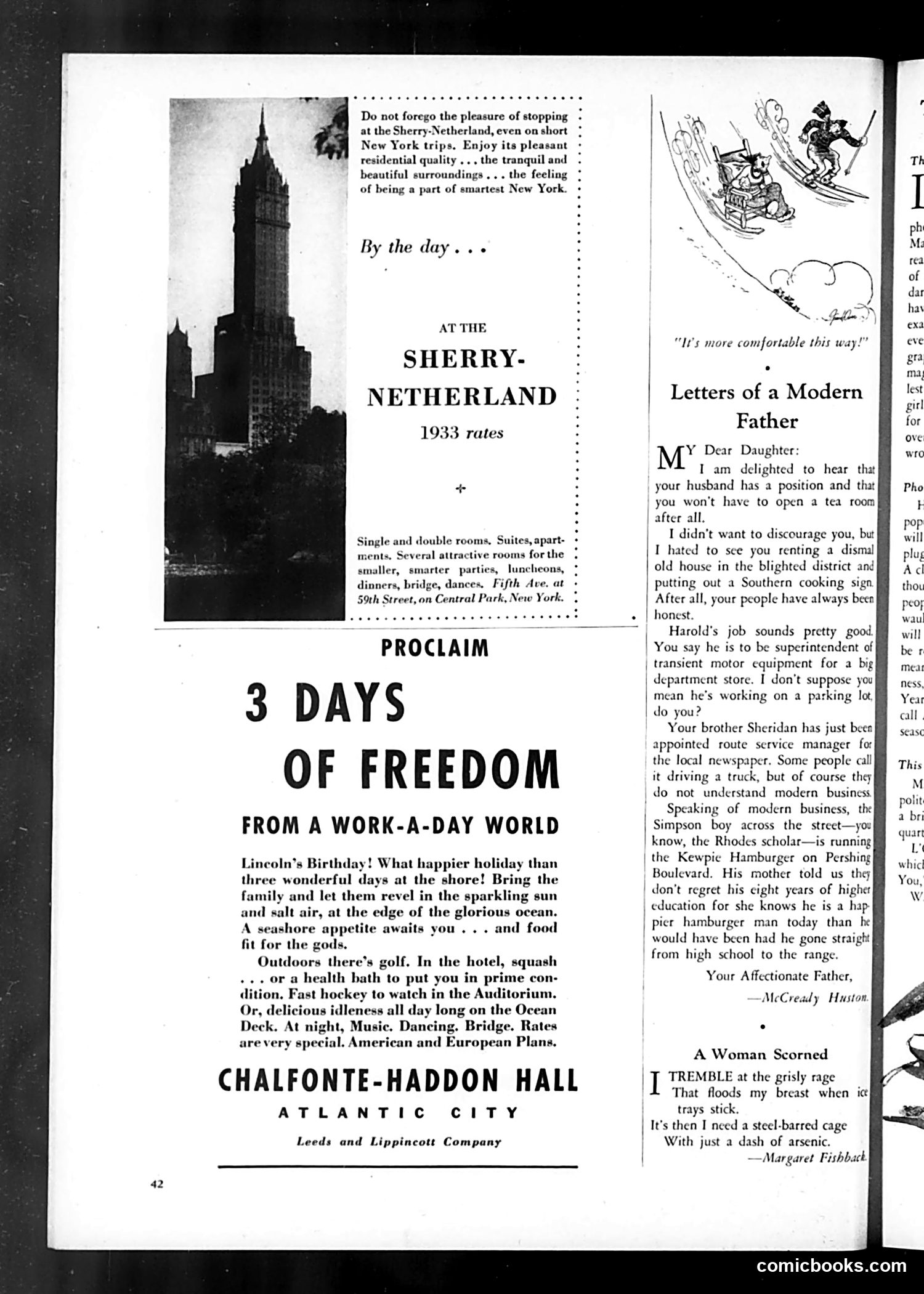
Analysis of Life Magazine Page This page from *Life* magazine (appears to be 1933, based on the Sherry-Netherland hotel advertisement) contains satirical social commentary disguised as humor and advertising. The main satire appears in "Letters of a Modern Father" and the accompanying cartoon "It's more comfortable this way!" The father's letter celebrates his daughter's escape from opening a tea room—a genteel but economically precarious venture for women—only to praise her husband's job as "superintendent of transient motor equipment," which the father delicately obscures but is actually managing a parking lot. The joke satirizes 1930s class anxiety: families inflating mundane modern jobs with pretentious titles to maintain social respectability during the Depression. "A Woman Scorned" by Margaret Fishback humorously depicts domestic frustration over stuck ice cube trays—trivial household annoyances that drive modern wives to rage. Both pieces mock the gap between genteel pretense and unglamorous modern reality, while the resort advertisements promise escape from this "work-a-day world."
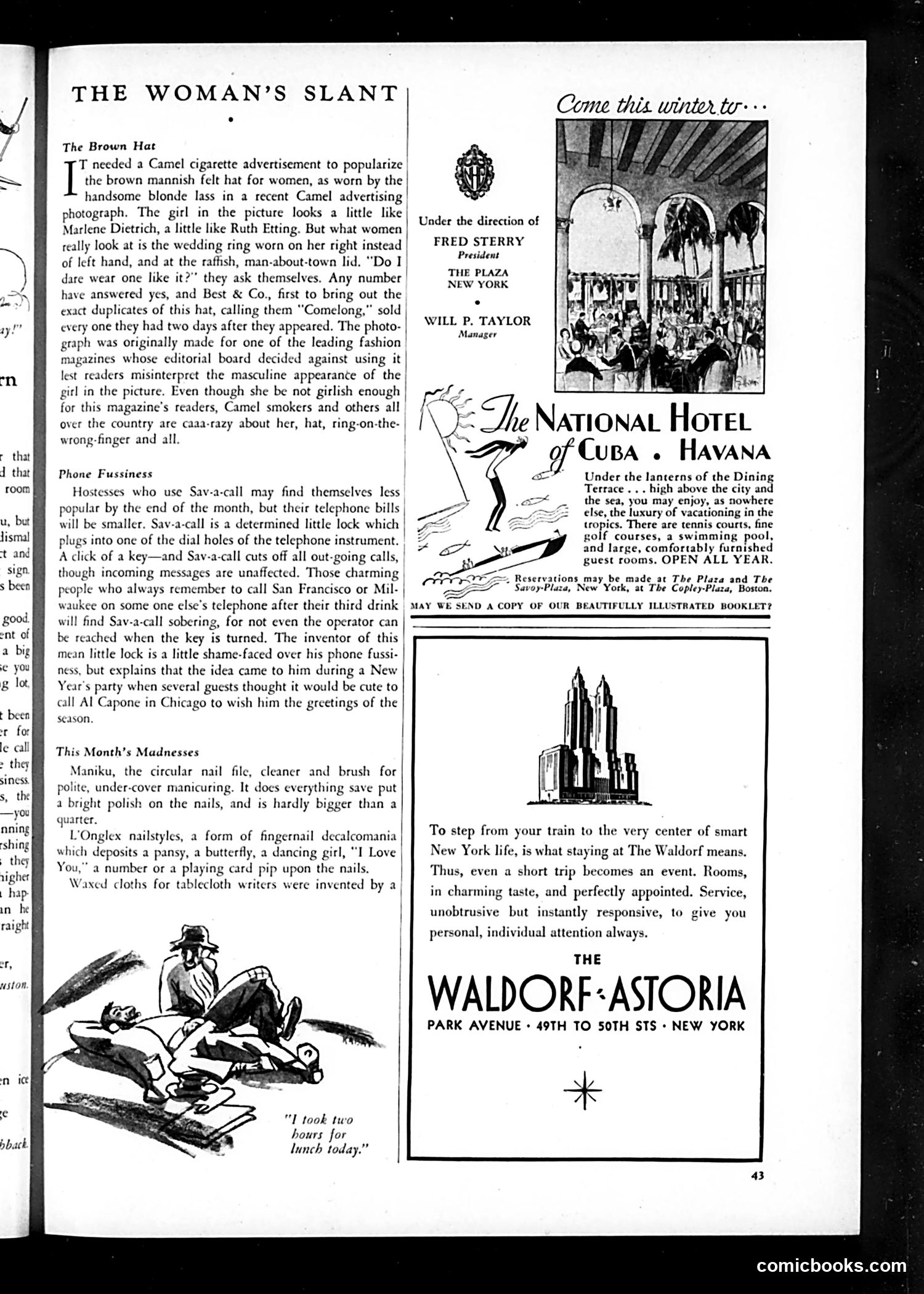
"The Woman's Slant" - Life Magazine Page Analysis This page from Life magazine combines satirical commentary on women's fashion trends with hotel advertisements. The main article critiques how a Camel cigarette advertisement unexpectedly popularized a mannish brown felt hat for women. The author notes that fashion magazine editors initially rejected the ad image, fearing readers would misinterpret the model's masculine appearance, yet the hat sold out within days after appearing in the Camel campaign anyway. The satire highlights the contradiction between editorial gatekeeping and actual consumer desire—fashion authorities tried suppressing "unfeminine" imagery, but the public embraced it regardless. The article also covers humorous novelty items ("This Month's Madnesses"): the Sav-a-call phone lock (invented after someone drunkenly called Al Capone from a New Year's party), decorative nail decals, and other frivolous products. The cartoon illustrates the phone-call prank reference.
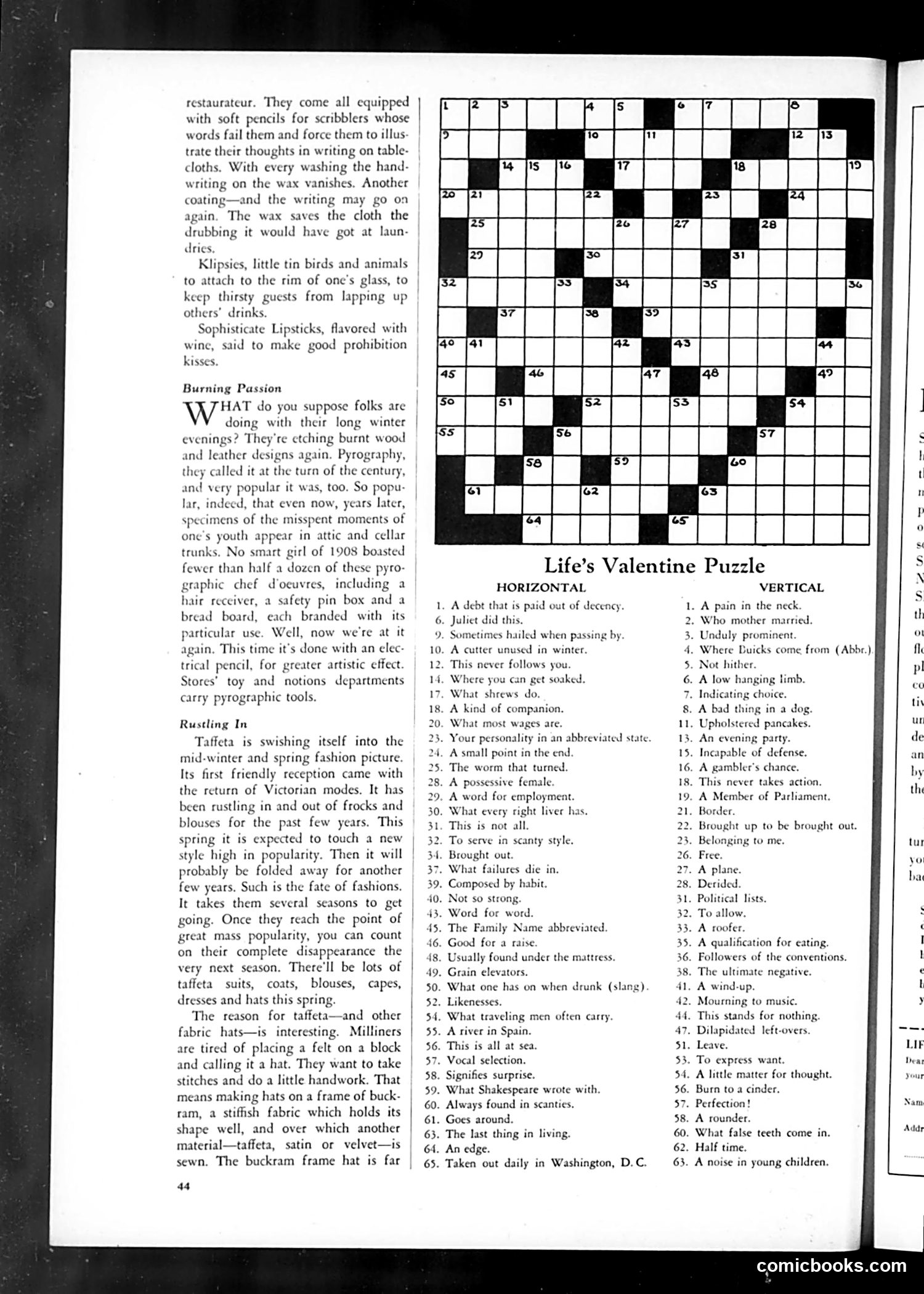
"Life's Valentine Puzzle" This page features a crossword puzzle titled "Life's Valentine Puzzle," not a political cartoon. The puzzle itself is the primary content, with clues listed horizontally and vertically below. The accompanying text discusses fashion and domestic trends of the era: pyrography (decorative wood-burning), which enjoyed renewed popularity; taffeta fabric's cyclical return to fashion; and restaurant novelties like wax tablecloths for doodling and decorative drink clips. The puzzle's Valentine theme and clever wordplay clues (e.g., "A debt that is paid out of decency" for FAVOR, "Usually found under the mattress" for SPRINGS) suggest this was entertainment content for *Life* magazine's readers—likely upper-middle-class Americans interested in current fashions, home crafts, and word games. There is no political satire or caricature on this page.
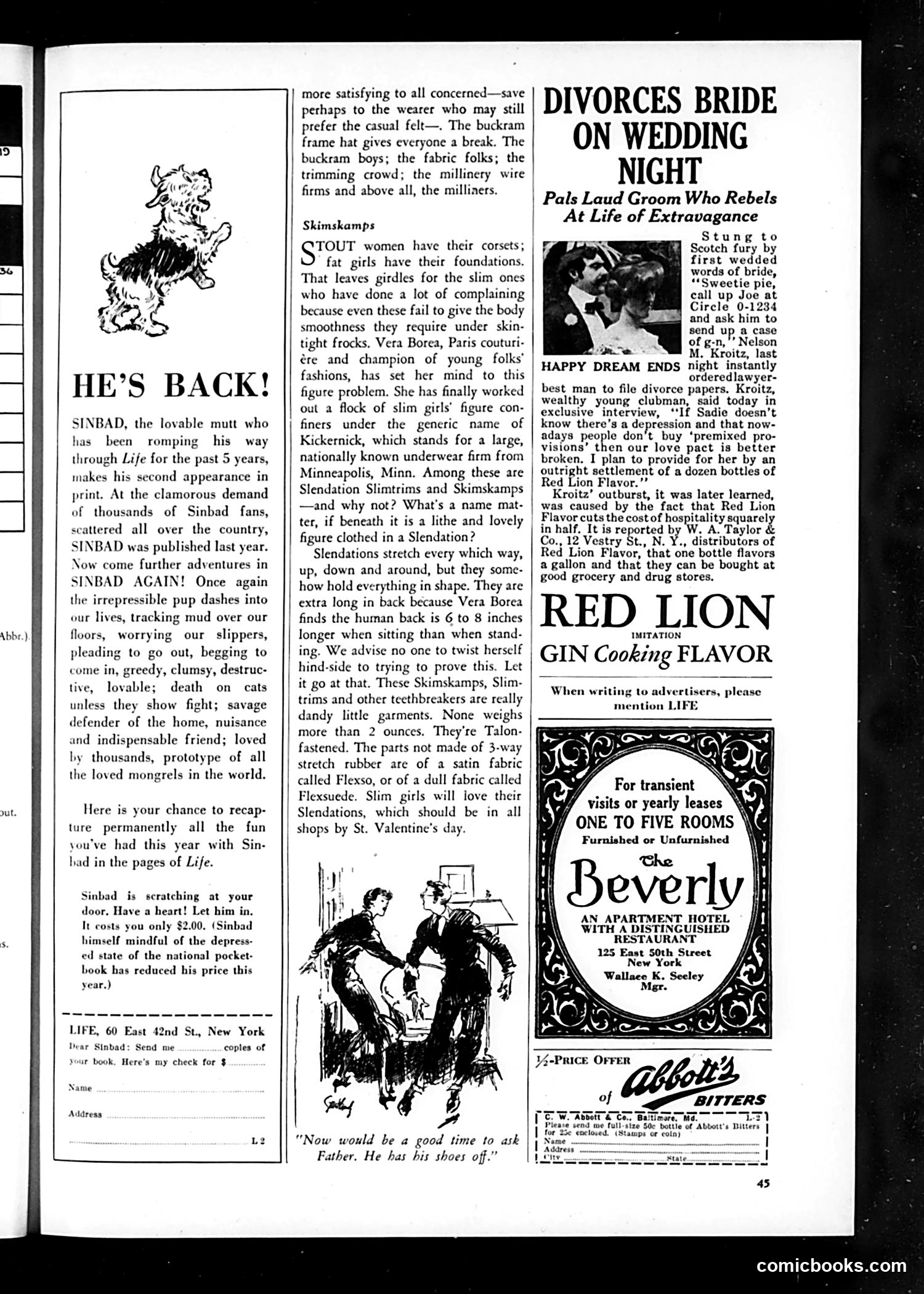
Page Analysis: Life Magazine Content This page contains product advertisements and promotional content mixed with satirical articles typical of Life magazine's format. The main sections include: 1. "He's Back!" - An advertisement promoting a book collection of "Sinbad," a beloved cartoon dog character that readers followed in Life magazine. The copy humorously describes the dog's destructive household behavior, selling it as a relatable figure. 2. "Skimskamps" - Fashion editorial discussing women's undergarments and shapewear brands (Slendation, Slimtrims, Kickernick) aimed at slim women, with tongue-in-cheek commentary on the garment industry. 3. "Divorces Bride on Wedding Night" - A satirical news story about a groom divorcing immediately after his bride requests expensive gin, positioning him as financially prudent during the Depression era. The punchline involves Red Lion Flavor (an alcohol product). The page is primarily advertising disguised as editorial content, with humor serving marketing purposes rather than political satire. The Depression-era context explains the emphasis on thrift and value.
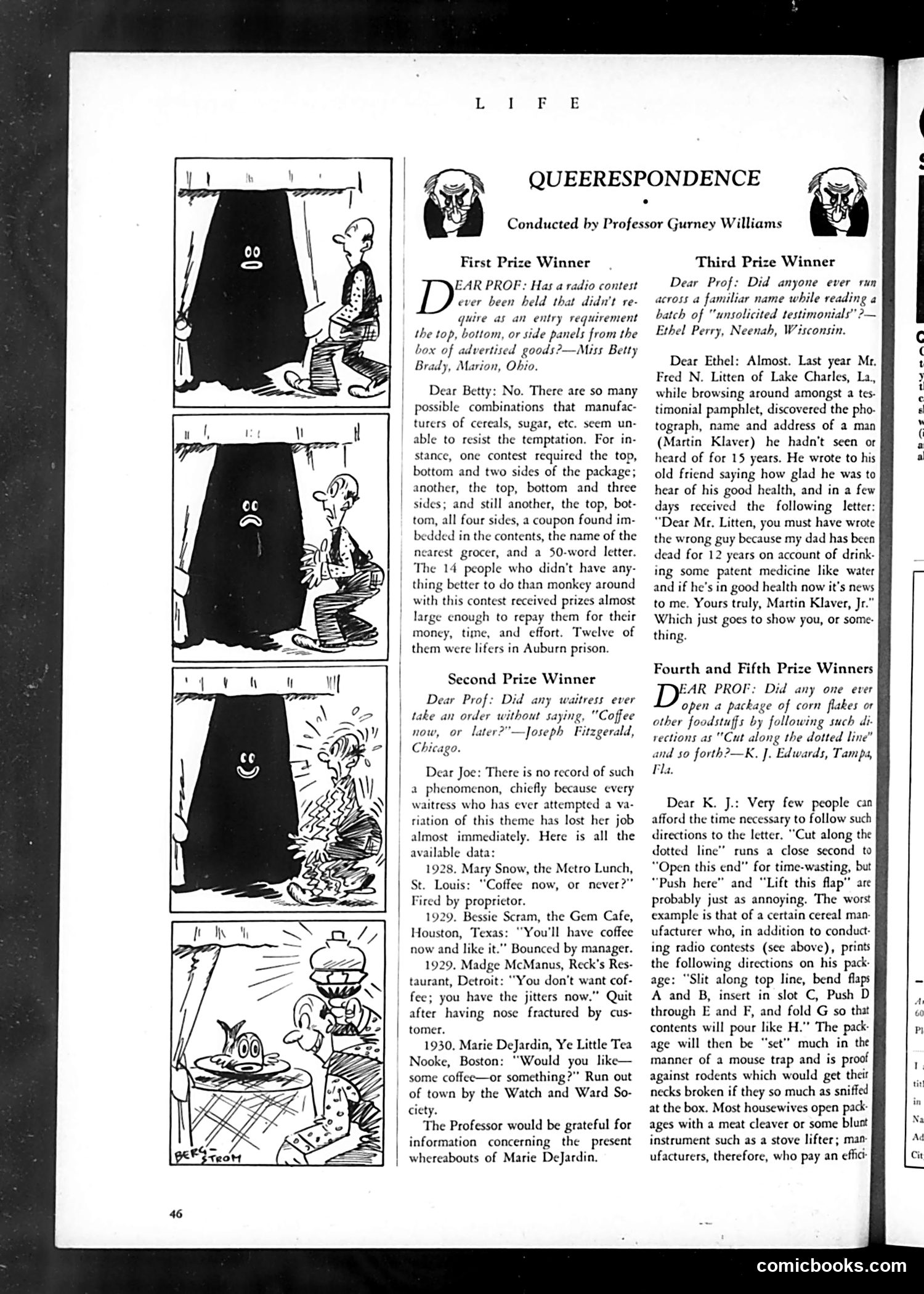
Explanation for Modern Readers This "Queerespondence" column is a humorous advice feature satirizing 1920s-1930s consumer culture and marketing practices. The cartoons (left side) show a figure struggling with increasingly absurd package-opening instructions. Main satirical targets: 1. Radio contest requirements: The column mocks how manufacturers exploited contests by requiring proof-of-purchase from multiple package parts, making participation intentionally difficult. The joke that contest winners included "lifers in Auburn prison" suggests only desperate people had time for this. 2. Waitress script conformity: The responses mock how standardized service industry language had become—any deviation from "Coffee now or later?" resulted in job loss or violence. 3. Package instructions: The final letters ridicule increasingly elaborate, incomprehensible directions for opening food boxes, using alphabet soup complexity (A, B, C through H) as absurdist humor. The column criticizes how corporations deliberately inconvenience consumers through contests and confusing packaging while normalizing rigid social scripts for service workers.
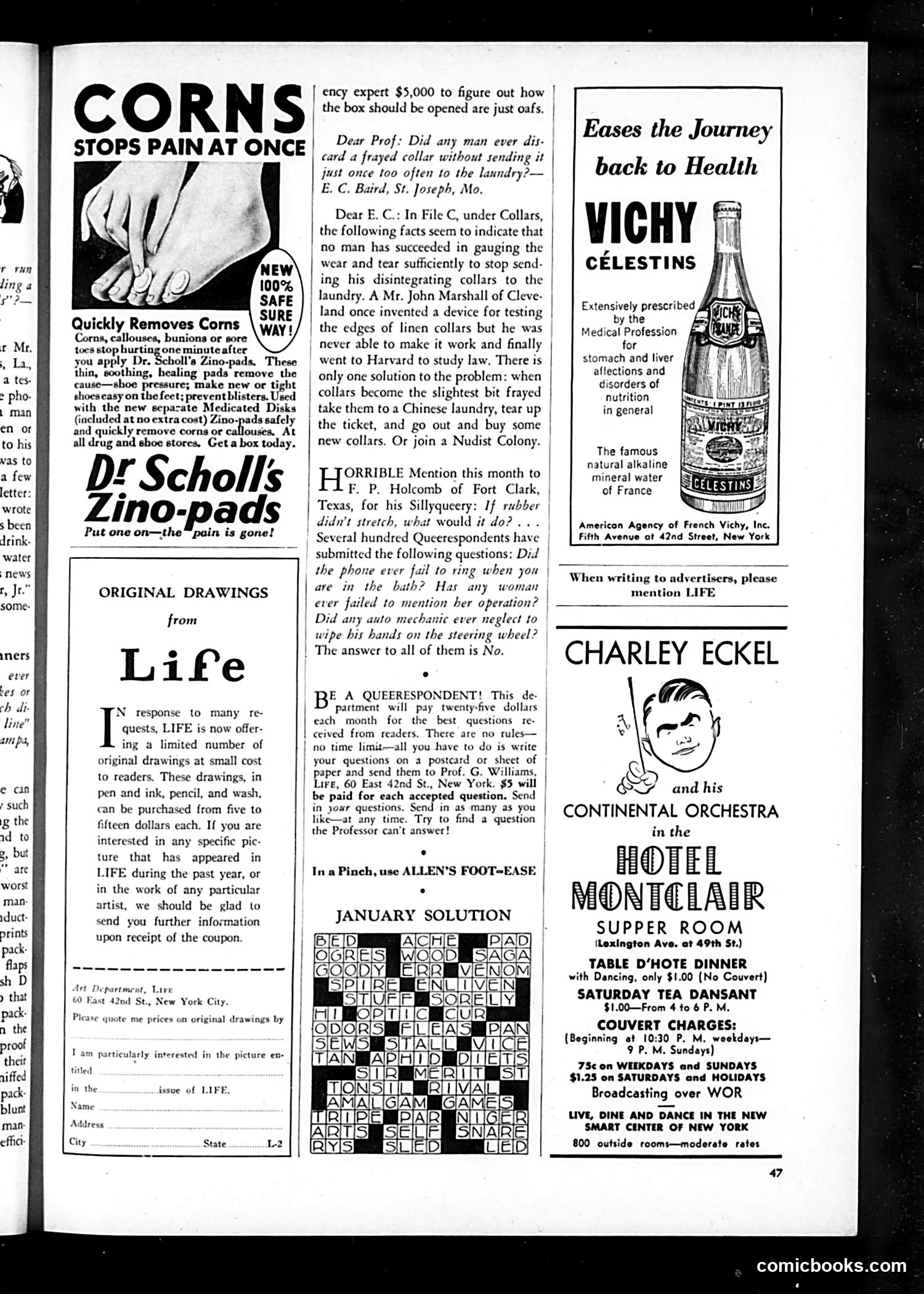
Analysis for Modern Readers This magazine page is primarily advertising and reader-engagement content, not satirical cartoons. The main comic element is a "Silly Query" advice column where readers submit absurd questions. Notable examples: "If rubber didn't stretch, what would it do?" and "Did the phone ever fail to ring when you're in the bath?" The humor relies on obvious, impossible scenarios—no actual insight required. The products advertised—Dr. Scholl's corn pads, Vichy mineral water, and hotel entertainment—reflect early-20th-century consumer culture. Notably, multiple ads tout medical/health solutions to minor complaints, typical of an era when patent medicines and dubious remedies flourished. The charley Eckel orchestra advertisement suggests this is from a prosperous period when restaurant entertainment was a leisure activity. The page itself invites reader participation through a drawing-submission coupon, representing Life magazine's interactive relationship with its audience—a precursor to modern crowdsourcing.
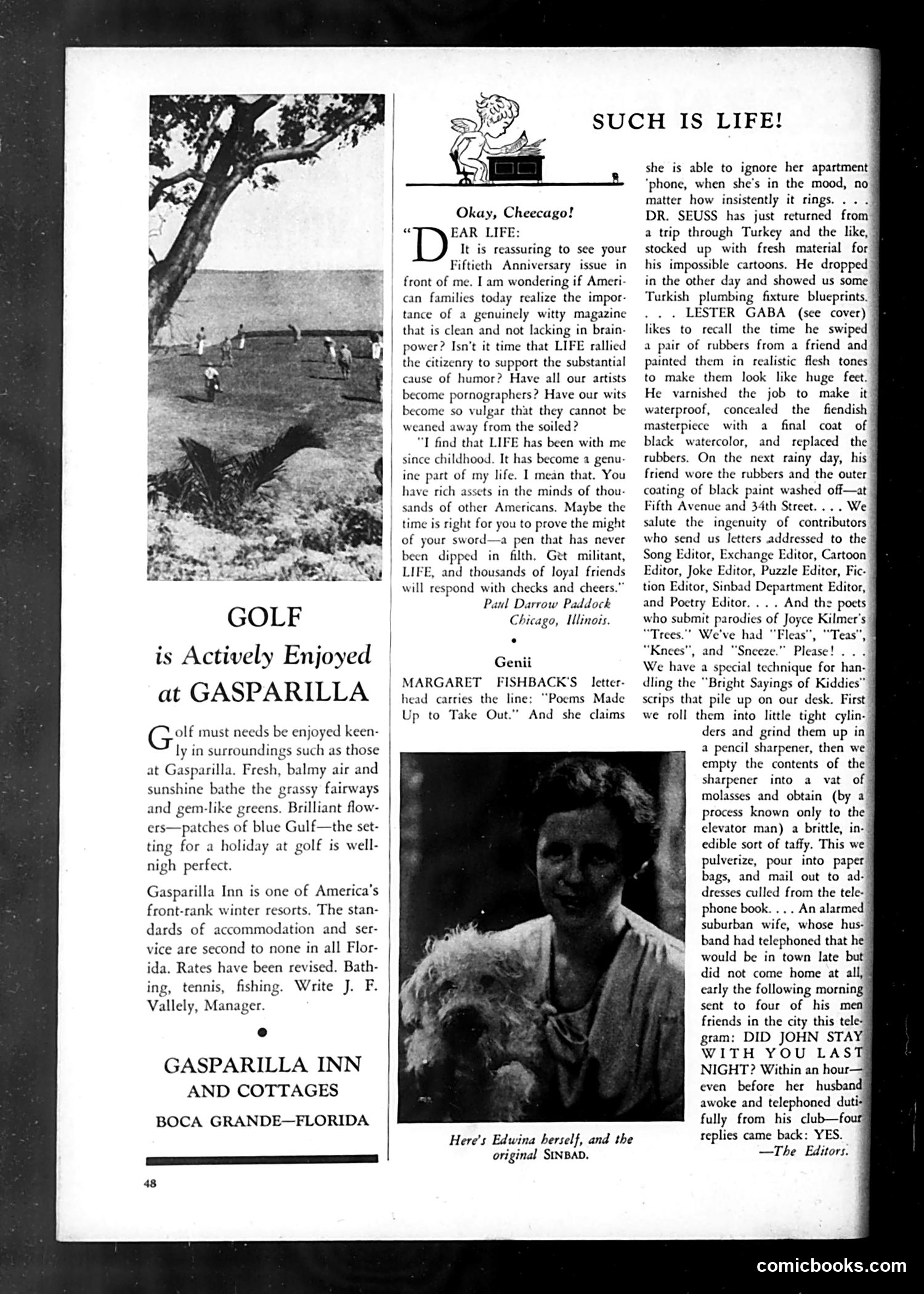
Life Magazine Page Analysis This page from *Life* magazine (a satirical publication, not the photojournalism magazine) contains advertising and editorial content, not political cartoons. The main elements are: 1. Golf resort advertisement for Gasparilla Inn in Florida, emphasizing leisure and recreation. 2. "Such Is Life!" editorial section featuring reader letters praising *Life*'s fiftieth anniversary, emphasizing its role as a "genuinely witty magazine that is clean and not lacking in brain-power." 3. Celebrity gossip column ("Genii") about contributors and personalities—Margaret Fishback (poet), Dr. Seuss (cartoonist), and Lester Gaba—with anecdotes about their creative pranks and quirks. 4. Humorous editorial about submissions, describing how the magazine processes "Bright Sayings of Kiddies"—a darkly comic bit about pulverizing unwanted submissions into taffy and mailing it back. The page reflects *Life*'s identity as a humor and satire magazine emphasizing wit, cleanliness, and respectability during the early-to-mid twentieth century.

I can see this is a mostly blank or very dark page from Life magazine with minimal visible content. On the left margin, there appears to be partial text from an article or column, but it's too fragmented to read coherently. The OCR text provided ("dish of the comicbooks.com") appears to be erroneous or incomplete. The image itself is too dark and degraded to identify any cartoon figures, caricatures, or satirical content. Without legible text or visible illustrations, I cannot determine what political or social references this page contains or explain its satirical intent to a modern reader. This appears to be a scanning or preservation issue with the source material.