life
Life — March 1933
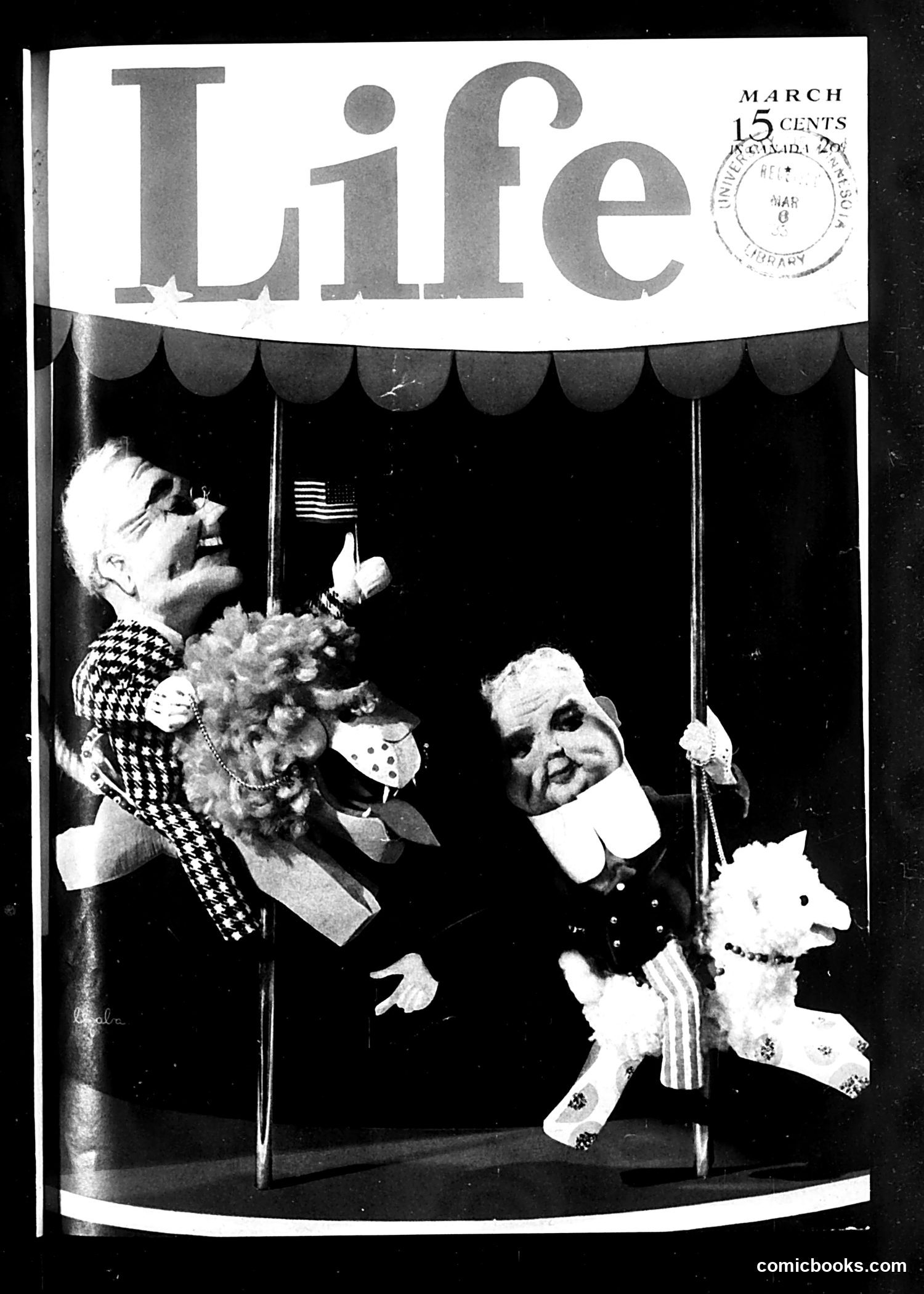
Life Magazine Cover Analysis This is a Life magazine cover from March 1915 (15 cents). The illustration shows a theatrical scene with exaggerated character figures in what appears to be a storefront or stage window setting with an American flag. The figures display caricatured features typical of early 20th-century satirical illustration. Without additional context beyond what's visible, the specific political or social commentary remains unclear—it could reference theater, patriotism, immigration, or contemporary events of that period. The cartoonish style and theatrical staging suggest social satire, but identifying the precise figures and their intended meaning would require additional historical documentation beyond what the image alone conveys. The cover's design emphasizes large theatrical presentation typical of Life's satirical approach.

This is a Powers Reproduction Corp. advertisement, not satirical content. It promotes their pioneering work in direct color photography—a then-new technology. The black-and-white photograph shows three women in beachwear lounging on sand with a roped fence behind them. The ad claims this image exemplifies Powers' "candid camera" capabilities, capturing "bright and natural colors of this beach scene" in "fine four color work." The advertisement emphasizes that Powers offers superior reproduction facilities for both black-and-white and color work, positioning the company as innovative in commercial color photography before such technology became advertising standard. The beach scene serves as proof of their technical capability—casual, modern imagery that would have seemed impressive for color fidelity at the time.
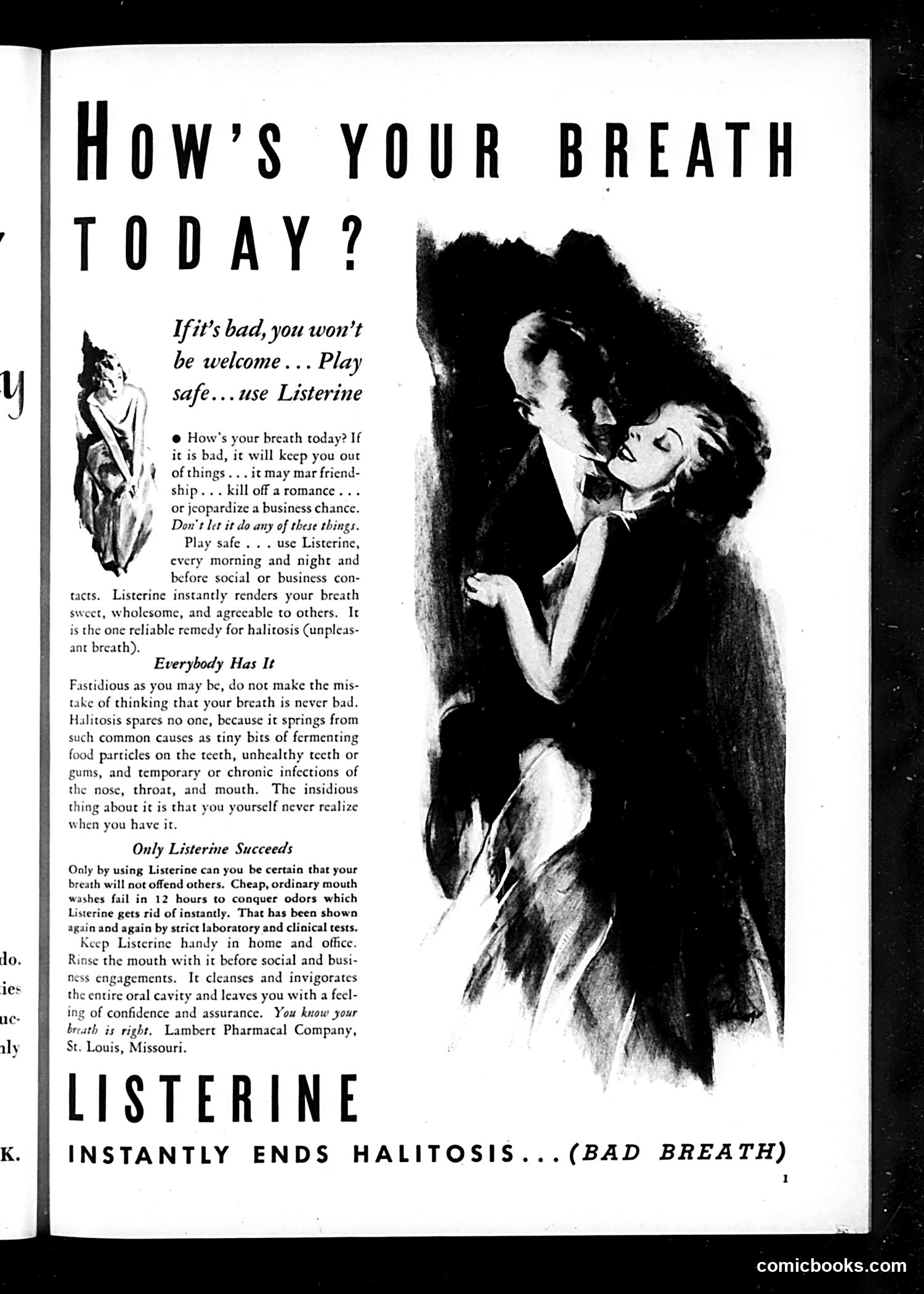
This is a Listerine advertisement, not political satire. The page uses social anxiety messaging to promote mouthwash as a solution to "halitosis" (bad breath). The imagery shows a couple in an intimate moment, with the implied threat that bad breath could "kill off a romance" or "jeopardize a business chance." The advertisement employs fear-based marketing—a common advertising technique—suggesting that breath odor is shameful and socially disqualifying. The text claims Listerine "instantly renders your breath sweet" and is "the one reliable remedy for halitosis." The phrase "You know your breath is right" implies social validation through product use. This reflects mid-20th century advertising's focus on personal insecurity and social acceptance rather than product efficacy.
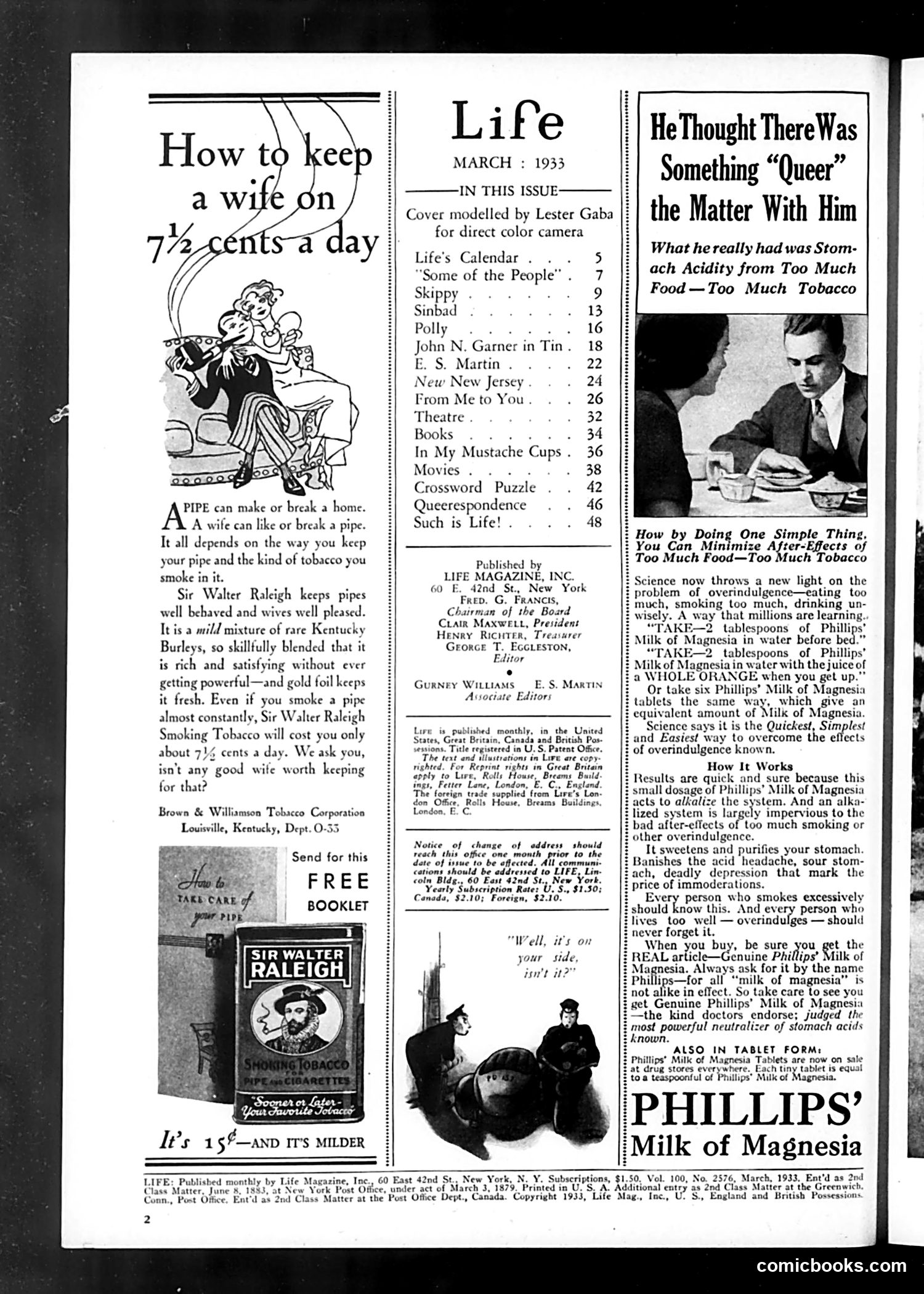
Life Magazine, March 1933: Content Analysis This page is primarily advertising and table of contents rather than political satire. The left column advertises Sir Walter Raleigh pipe tobacco, emphasizing economical smoking at "7½ cents a day"—relevant context for Depression-era 1933 when frugality was urgent. The right side features a medical advertisement for Phillips' Milk of Magnesia, claiming to cure digestive problems caused by overeating and smoking. The accompanying photograph shows a man appearing ill at a dining table. The cartoon below depicts three figures (unclear who specifically) in what appears to be a humorous scene, though details are illegible at this resolution. The page reflects 1933 consumer concerns: economic hardship and health anxieties, with advertising positioned as practical solutions to everyday problems.
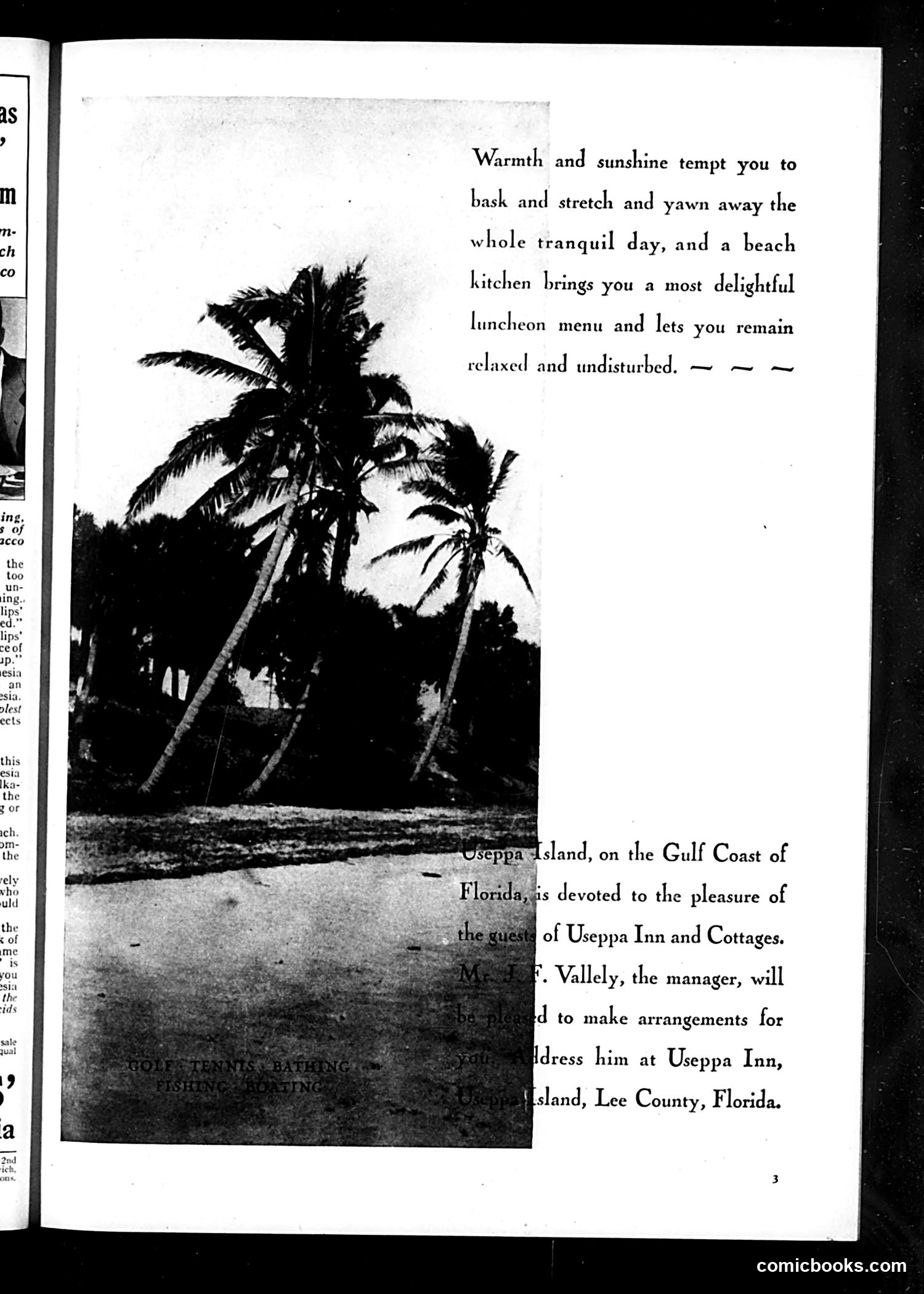
Analysis This page is primarily advertising content, not satirical commentary. It promotes the Useppa Inn and Cottages, a resort located on Useppa Island in Florida's Gulf Coast (Lee County). The image shows a tropical beach scene with palm trees, designed to evoke leisure and relaxation. The accompanying text emphasizes vacation pleasures—basking in sunshine, a beach kitchen offering lunch, and undisturbed relaxation. The text invites interested guests to contact M. F. Vallely, the manager, for arrangements. This appears to be a travel advertisement typical of early-to-mid 20th century publications, targeting affluent readers seeking beach getaways. There is no political satire or social commentary present on this page.
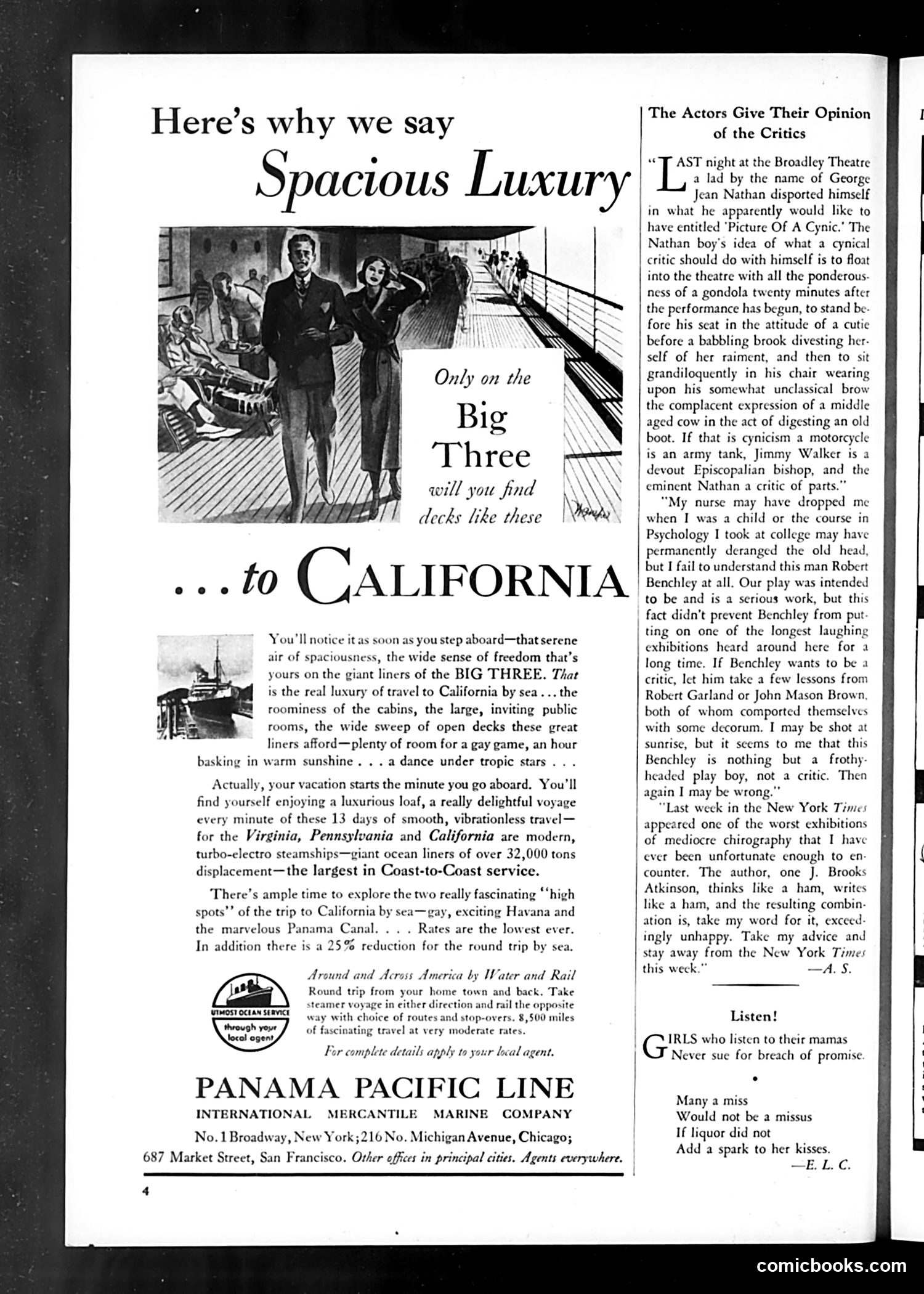
Analysis This page is primarily a luxury travel advertisement for the Panama Pacific Line shipping company, promoting Caribbean and California cruises on their "Big Three" ocean liners. The left side features an illustration of elegantly dressed passengers enjoying spacious ship decks, emphasizing the vessels' size and comfort for wealthy travelers. The text promises 13-day voyages with activities like deck games and tropical dancing. The right column contains theater criticism mocking a play called "Picture of a Cynic" at the Broadley Theatre, featuring actor George Jean Nathan. The critics sarcastically disparage the production as pretentious and poorly acted, with one reviewer likening the lead performance to "a middle-aged cow." This represents typical Life magazine satirical theater reviews of the era. The bottom includes a brief humorous poem about women keeping promises.
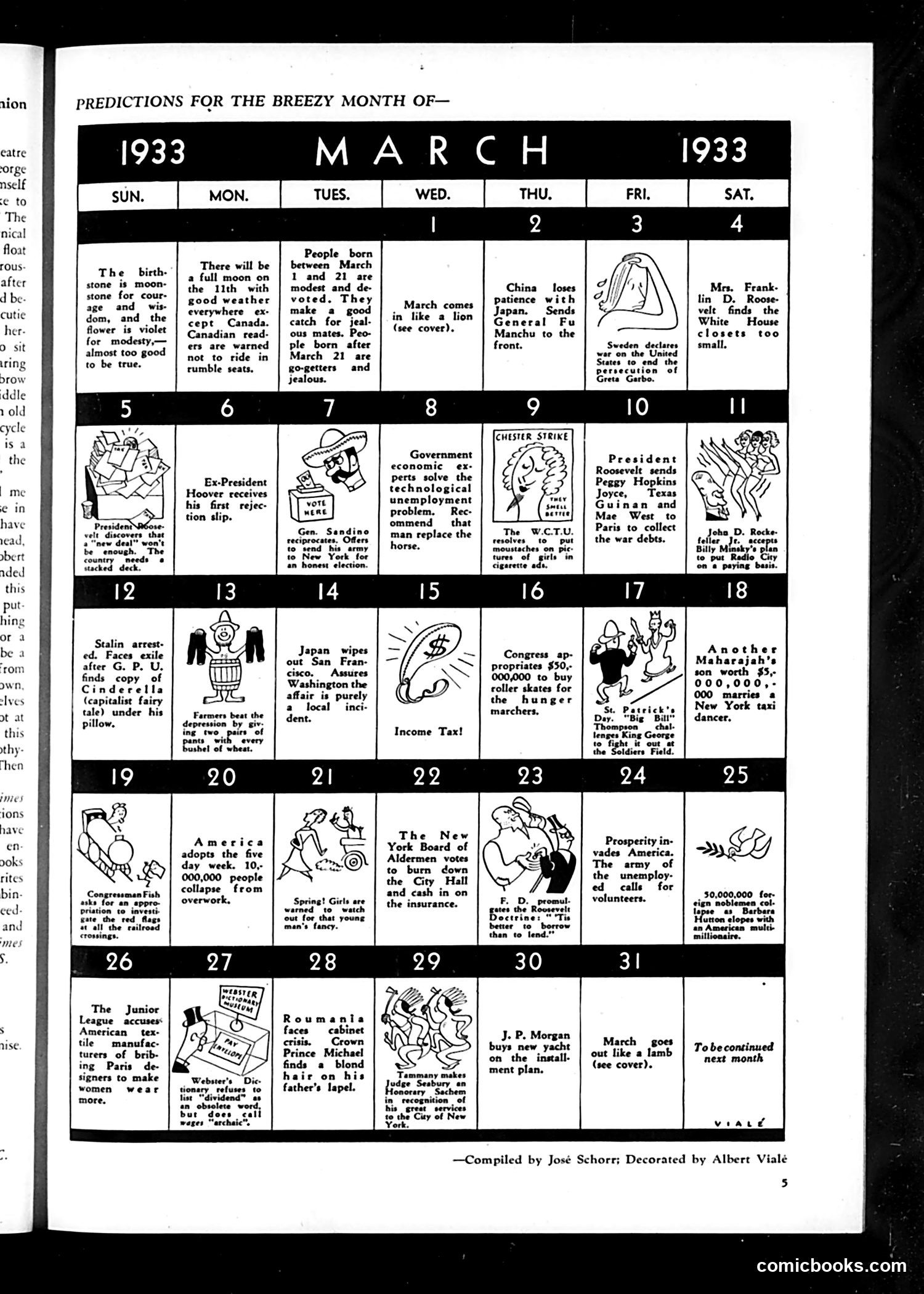
March 1933 Calendar Commentary This satirical calendar depicts major events from March 1933 during the Great Depression and early New Deal period. Notable entries include: - March 2: Reference to China losing patience with Japan amid ongoing conflict - March 10: President Roosevelt sends "Train Loads" to address war debts - March 15: "Income Tax!" — highlighting government revenue concerns - March 20: "America adopts the 30-hour week" — a proposed labor reform to address unemployment - March 22: New York Board of Aldermen considers burning down City Hall over insurance costs - March 24: "Prosperity Inc." volunteers help the unemployed The cartoons mock Depression-era absurdities: governmental economic desperation, proposed (often impractical) solutions like the 30-hour workweek, and darkly humorous municipal crises. The satire reflects public anxiety about economic collapse and skepticism toward proposed remedies.
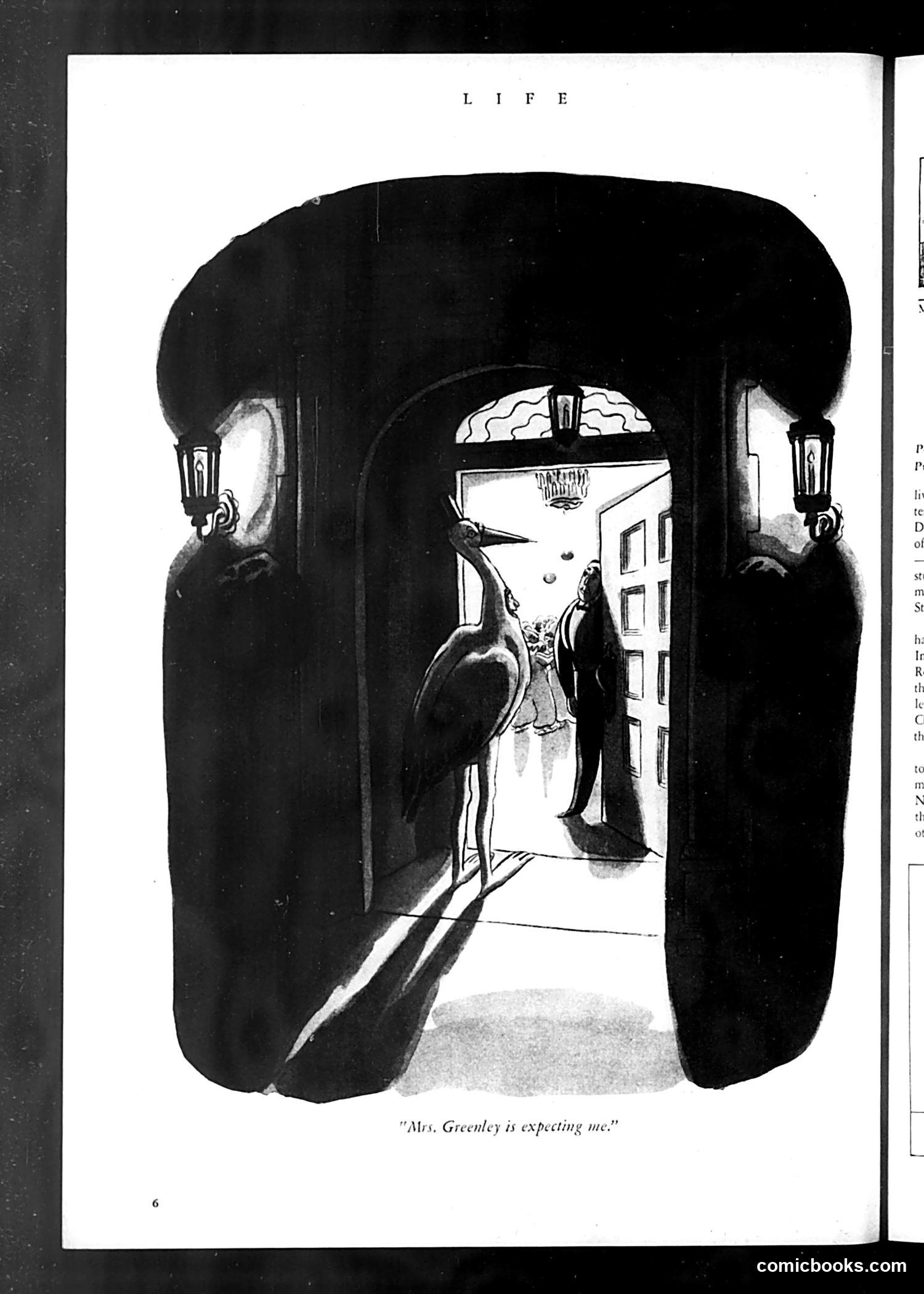
Analysis of "Mrs. Greenley is expecting me" This cartoon depicts a domestic scene with social commentary. A figure stands in an arched doorway of what appears to be an elegant home, with another person visible through the open door in bright daylight. The dark, shadowy archway contrasts sharply with the illuminated exterior—a visual metaphor for the passage between private and public spaces. The caption "'Mrs. Greenley is expecting me'" suggests anticipated social obligation or appointment. Without additional context from the magazine's date and surrounding content, the specific satirical point remains unclear, though it likely comments on either social expectations, conjugal obligations, or contemporary relationship dynamics that Life magazine's readers would have recognized. The architectural framing emphasizes the boundary between worlds.
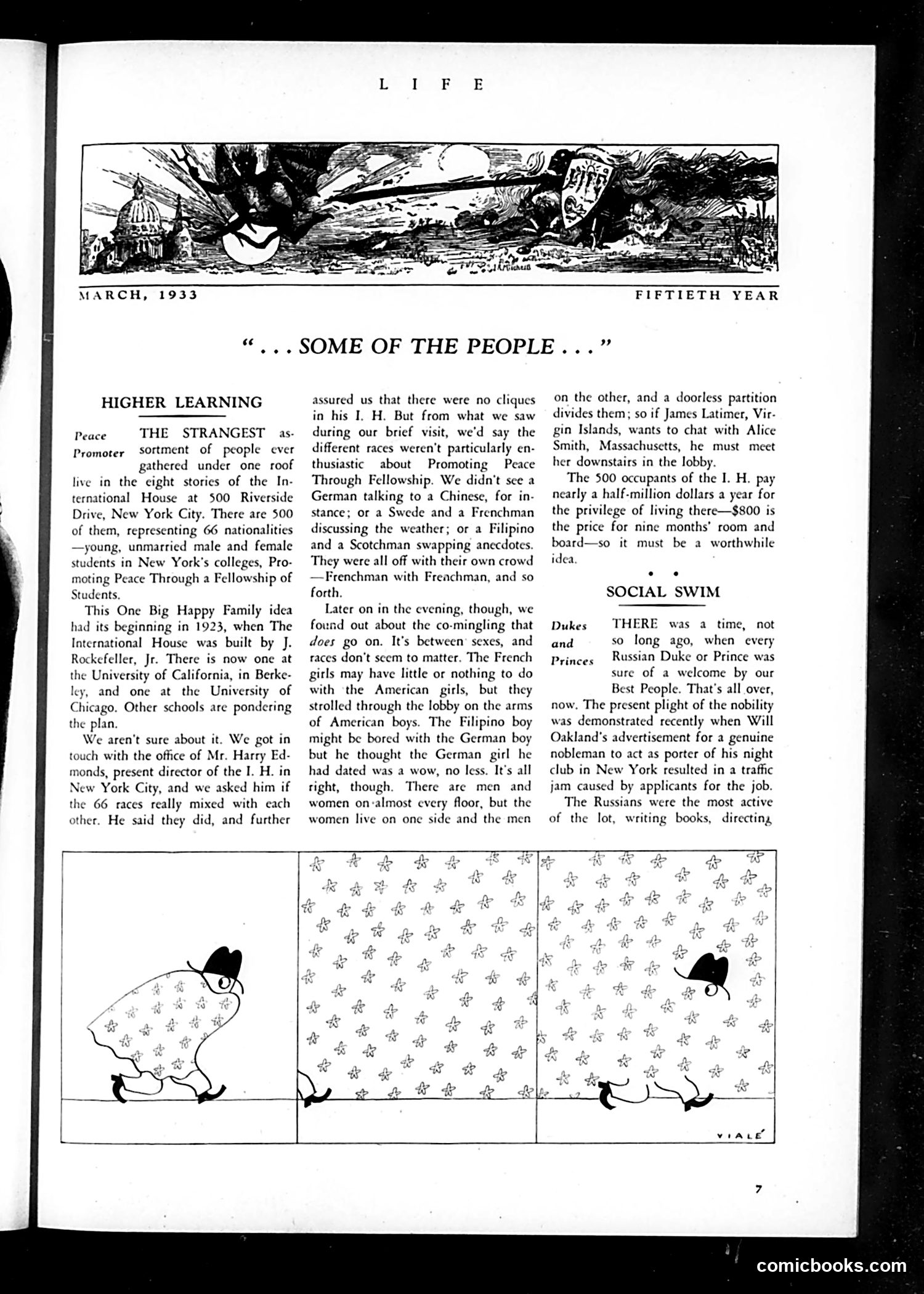
Analysis of Life Magazine, March 1933 Main Content: The page discusses the International House at 300 Riverside Drive, New York—a residential facility housing 500 students from 66 nationalities. The text humorously describes observations about international students living together, noting that despite the "Peace Promoter" mission, different nationalities don't necessarily mingle harmoniously. It mentions gender segregation between male and female residents and references awkward social dynamics. The Cartoon: The bottom illustration by Viale shows a simple, humorous comic strip featuring what appears to be a figure in patterned clothing, suggesting cultural or national dress differences. The joke likely satirizes the clash of expectations versus reality in international student housing during this period of supposed cultural exchange. The article's tone mocks idealistic notions of international understanding.
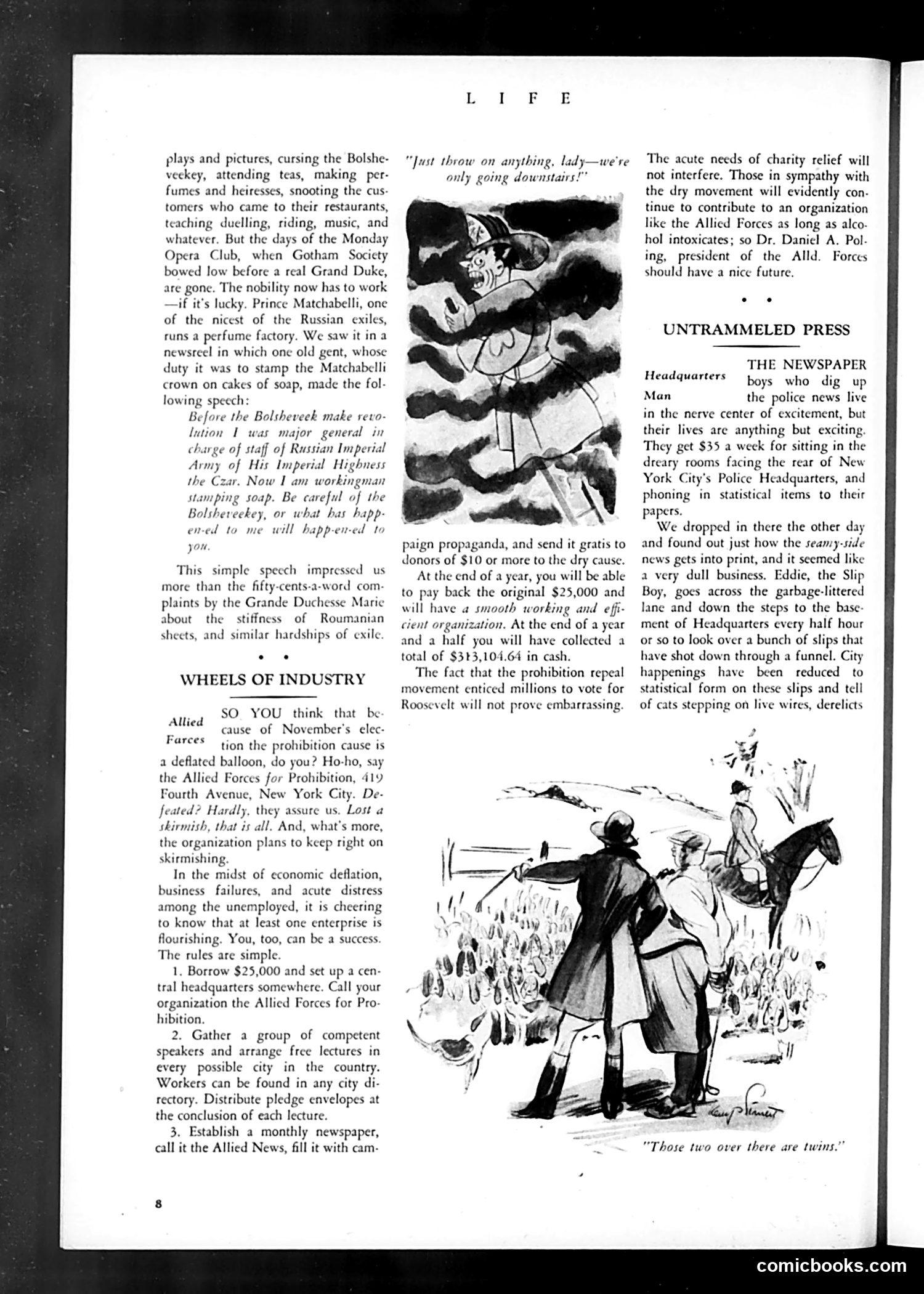
Analysis of Life Magazine Page This page contains two distinct sections: Upper cartoon: Shows a figure (appears to be a wealthy woman based the context of cursing the Bolsheviks) throwing money from a window, captioned "Just throw on anything, Lady—we're only going downstairs!" The satire mocks aristocratic Russian émigrés during the post-Bolshevik Revolution period, depicting their casual wastefulness despite financial displacement. Lower cartoon: Titled "Those two over there are twins," shows a figure on horseback observing two similar objects in a field. This appears to be a visual joke about indistinguishable twins or similar things, though the specific reference is unclear from the visible context. The page primarily discusses the "Allied Forces for Prohibition" organization and newspaper work, suggesting this is a satirical commentary on various social movements of the era.
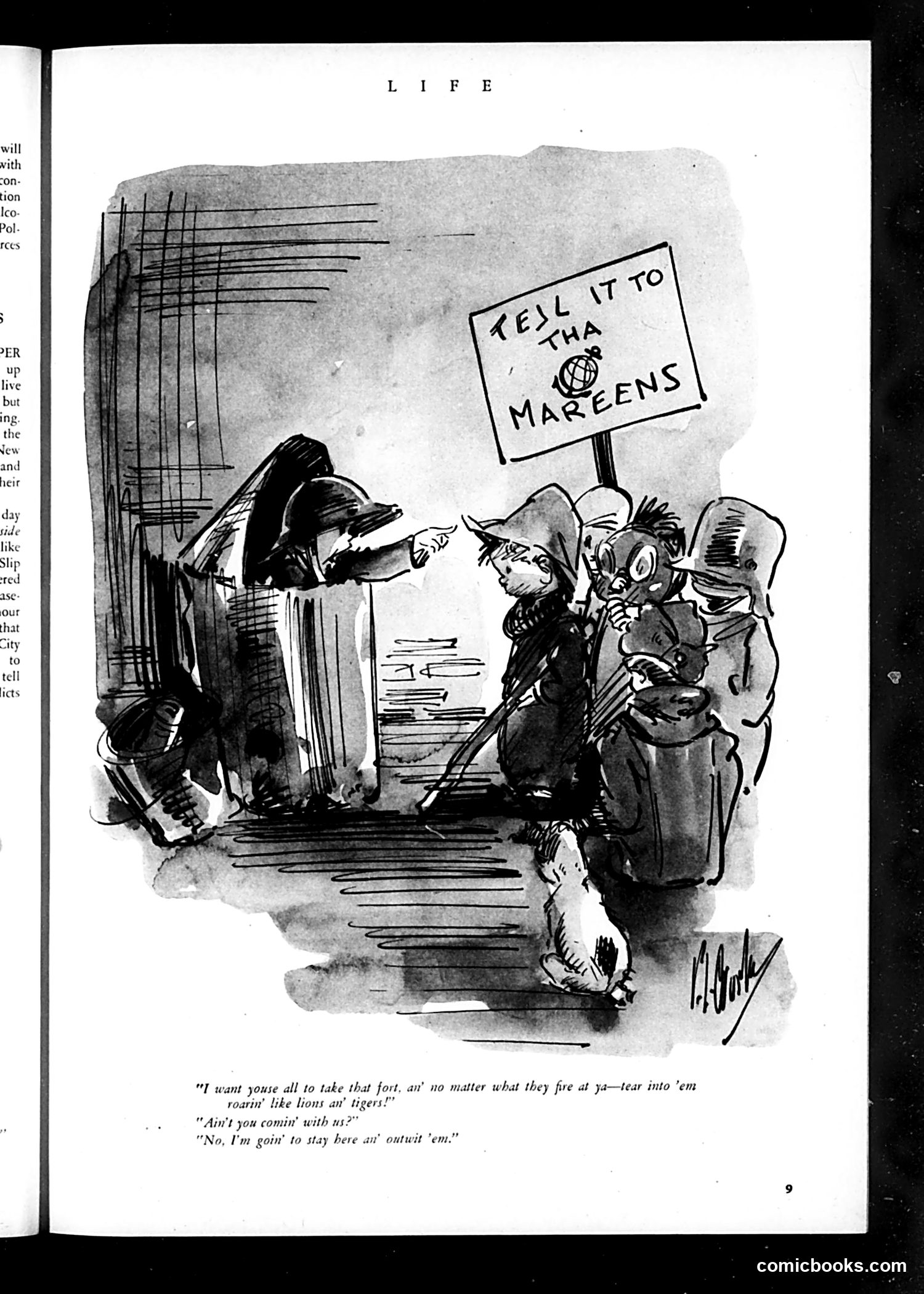
Political Cartoon Analysis This cartoon depicts a military officer directing civilians toward a fortification, holding a sign reading "TELL IT TO THA MAREENS" (a play on the phrase "tell it to the Marines"). The joke references the common American expression dismissing someone's complaint or excuse—implying Marines won't believe you either. The dialogue below reinforces this: one figure wants others to "take that fort" no matter the cost, comparing soldiers to "lions," while another refuses to participate, saying he'll "stay here an' outwait 'em." The cartoon appears to satirize military recruitment propaganda or draft resistance during wartime, mocking both the appeal to martial heroism and the civilian reluctance to fight. The specific historical context—likely WWI or WWII era—remains unclear without additional dating information.
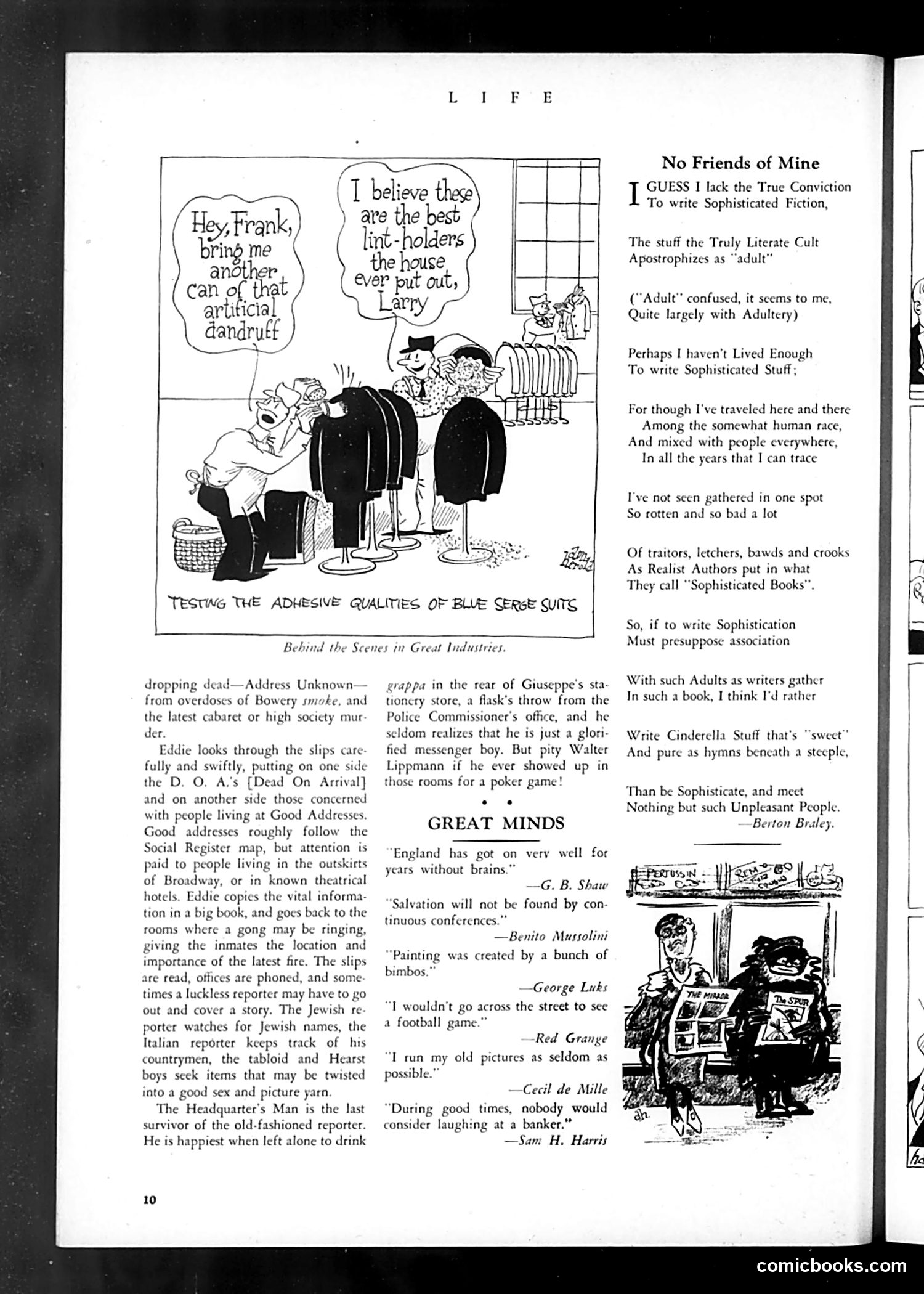
Analysis of Life Magazine Page This page contains a cartoon satirizing literary pretension and a poem critiquing "sophisticated" writing. The Cartoon: Titled "Testing the Adhesive Qualities of Blue Serge Suits," it shows three men in formal wear (one labeled Frank and Larry) discussing lint-holders and artificial dandruff—apparently testing suit quality through deliberate messiness. The humor targets upper-class affectation and the absurdity of refined gentlemen obsessing over trivial grooming details. The Poem "No Friends of Mine": The accompanying verse (attributed to Berton Bradley) mocks writers of "Sophisticated Fiction" and the "Truly Literate Cult." The author suggests that sophisticated literary writing often portrays morally corrupt characters (traitors, scoundrels) and confuses adult themes with actual adulthood. The satire advocates for wholesome, honest writing over pretentious realism. Both pieces ridicule 1920s-30s literary snobbery and naturalist fiction's embrace of morally dubious characters.
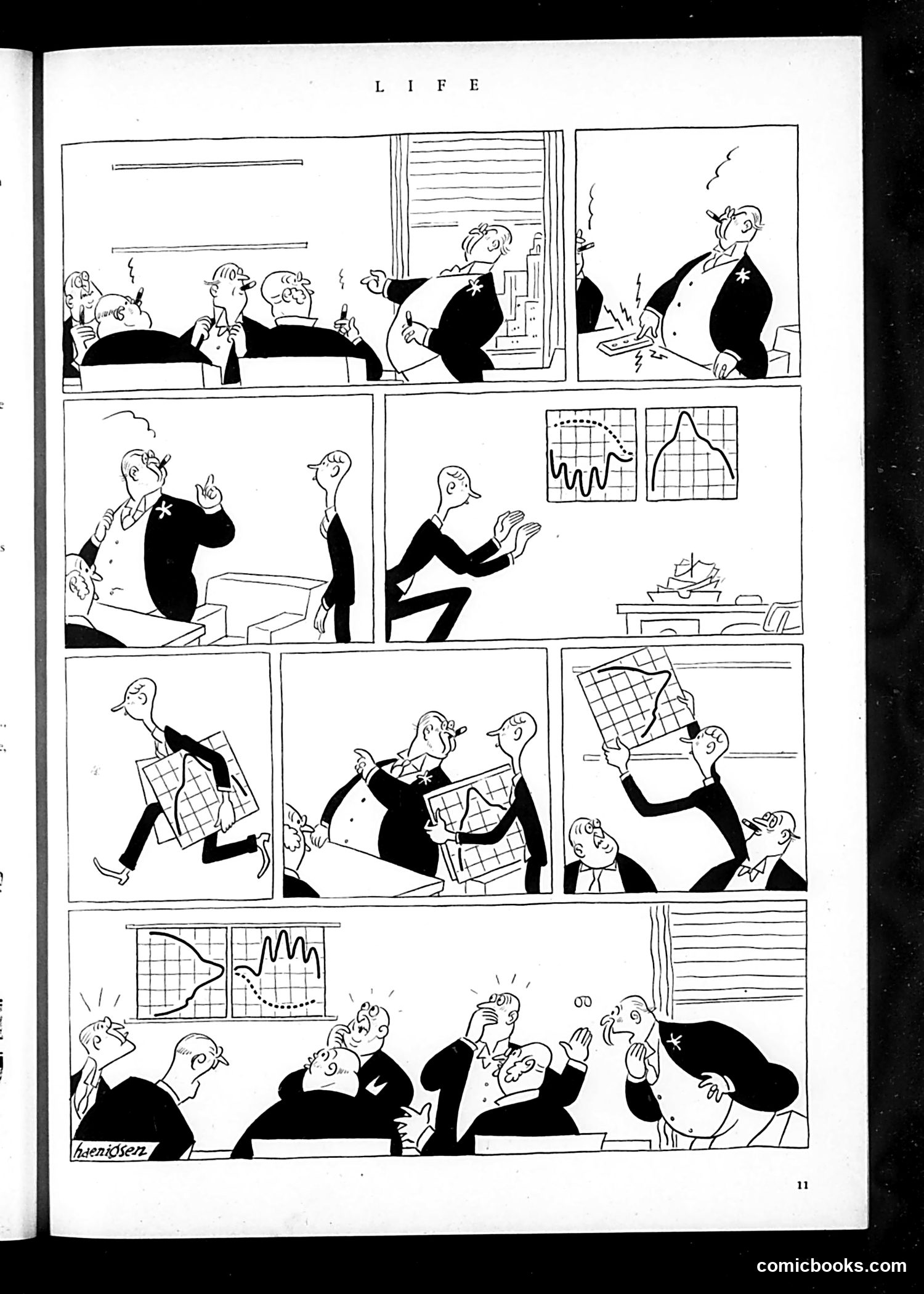
Analysis This is a single-panel comic strip titled "LIFE" depicting a business meeting scenario. The narrative follows businessmen in formal attire examining charts and graphs showing declining market trends. The satire appears to mock corporate response to poor financial performance. The sequence shows: - Initial presentation of bad data (downward-trending graphs) - Increasingly frantic reactions from executives - Men literally running away with charts - A final chaotic boardroom scene with widespread panic The joke targets how corporate leaders react to economic bad news—moving from calm discussion to complete chaos. Without visible date or specific company references, this appears to be general satire about stock market volatility or business failure, likely from an era when such visual humor about market anxiety was common. The cartoonist's signature appears at bottom left.
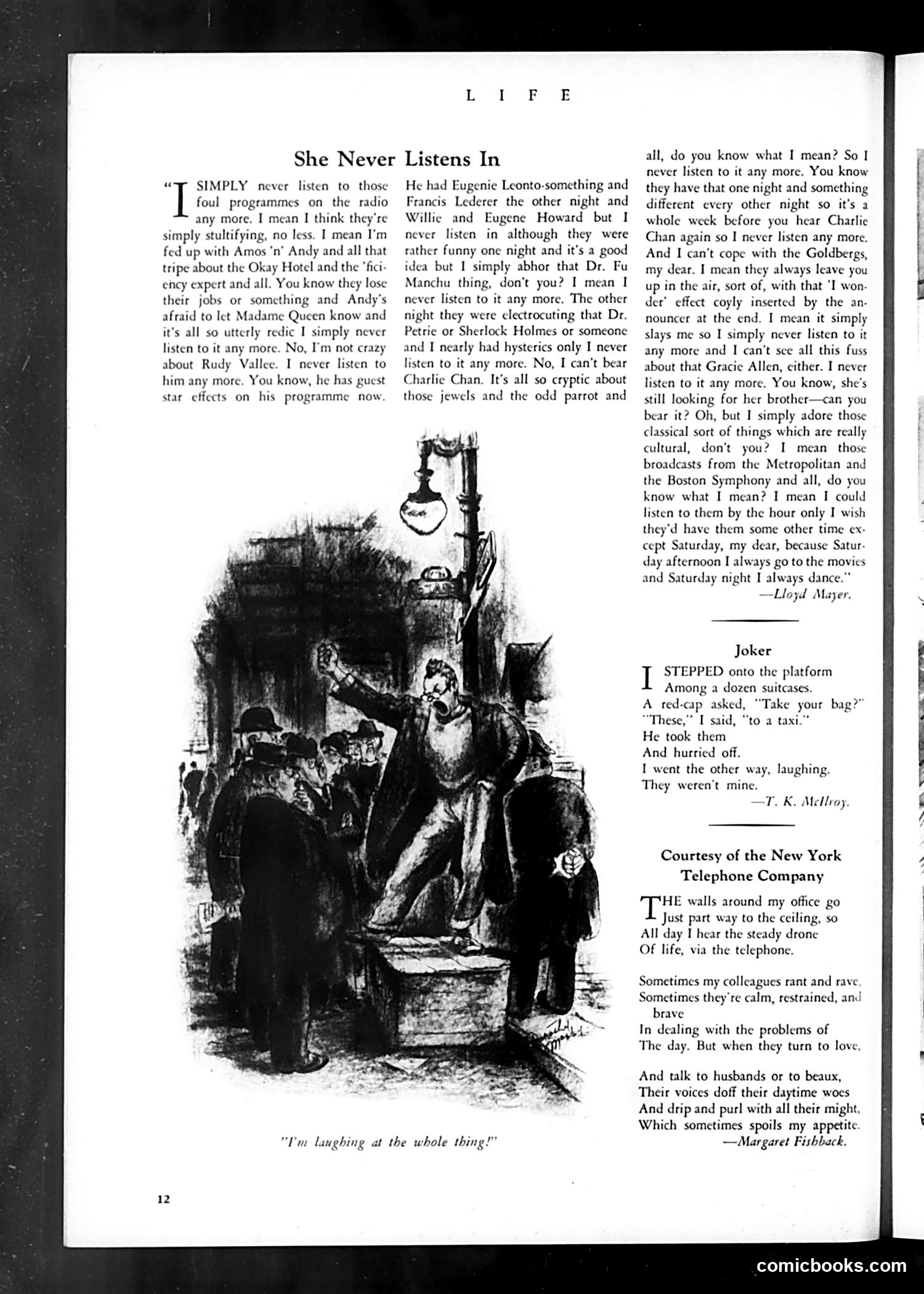
Analysis of "She Never Listens In" This satirical piece mocks radio listening habits of the era. The main article features a woman (quoted as speaking) who boasts she never listens to popular radio programs—dismissing them as "fool programmes" and "tripe." She claims superiority by listening only to "classical sort of things" like Metropolitan Opera broadcasts, while condescendingly admitting she goes to movies and dances on weekends. The accompanying sketch depicts a street scene with figures around a lamp post, captioned "I'm laughing at the whole thing!"—likely illustrating the absurdity of her pretentious claims. The satire targets cultural snobbery: a listener who scorns mass entertainment while secretly enjoying popular diversions, revealing hypocrisy about radio's democratizing cultural influence during broadcasting's early expansion.
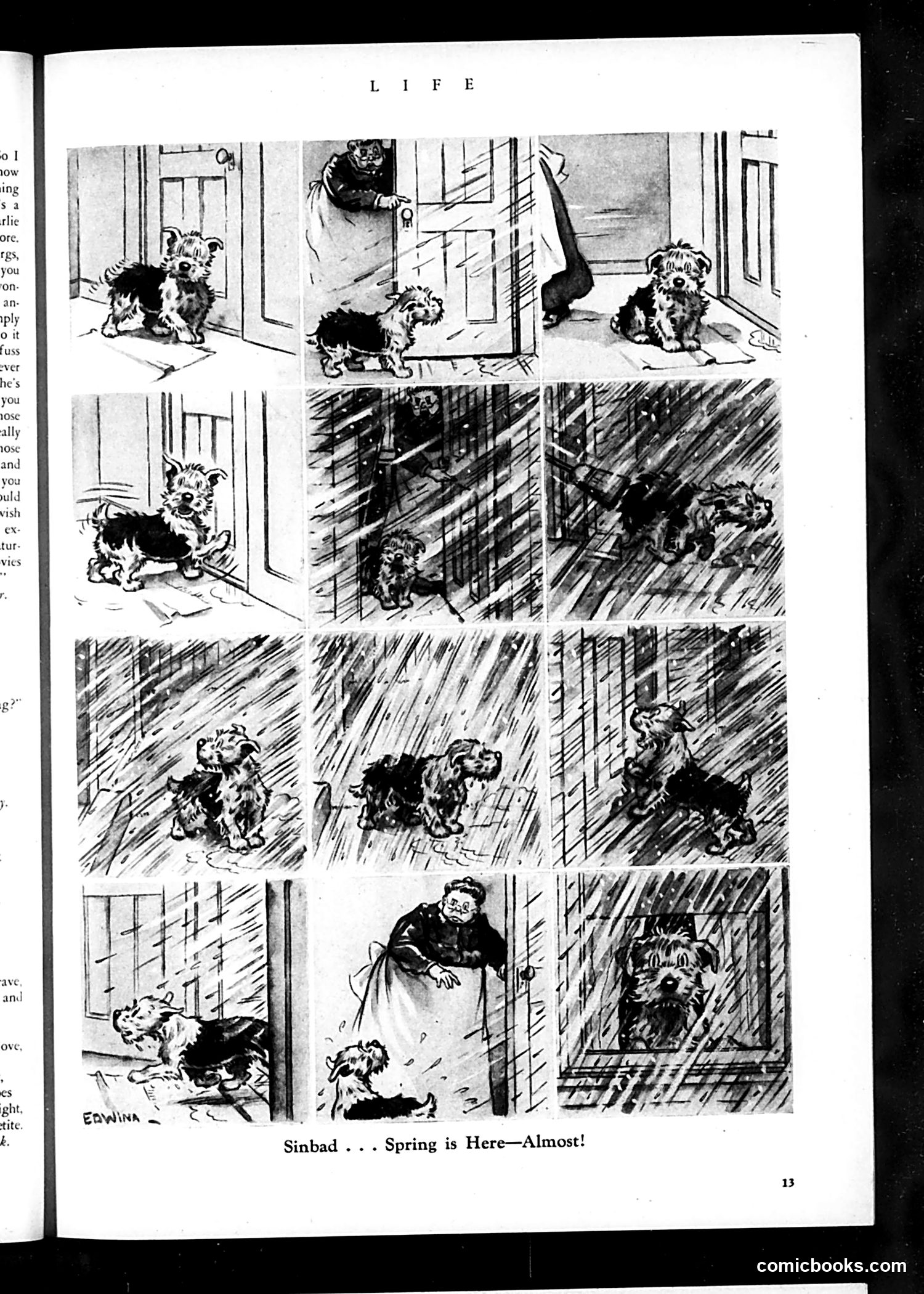
Analysis This comic strip titled "Sinbad . . . Spring is Here—Almost!" depicts a small, shaggy dog named Sinbad experiencing winter conditions indoors. The narrative shows the dog repeatedly encountering snow and cold weather entering through doors and windows of a house, despite the caption's promise that spring is approaching. The humor is straightforward domestic comedy: the contrast between the optimistic seasonal message and the dog's actual experience of continued harsh winter weather. There is no political satire or caricature here. The joke relies on relatable frustration with delayed spring—a timeless complaint about unpredictable weather transitions. The comic appears designed simply to amuse readers through the dog's predicament, not to comment on current events or social issues.
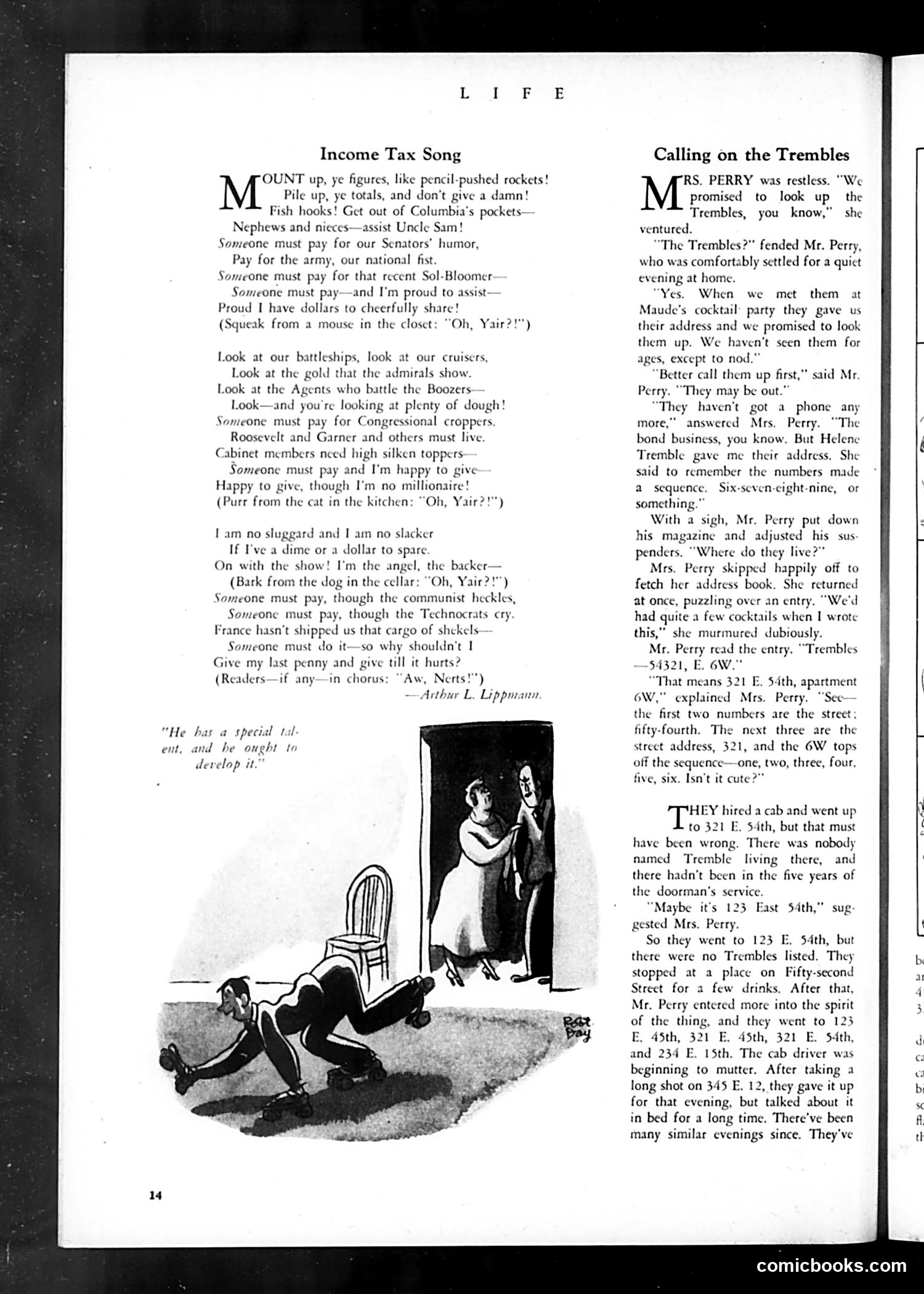
Analysis This page contains two distinct pieces: "Income Tax Song" (left): A satirical poem by Arthur L. Lippmann mocking wartime taxation. It urges citizens to pay income taxes, listing various government expenditures (battleships, congressional expenses, cabinet members' salaries). The refrain—"Someone must pay"—drives home obligatory contribution. The accompanying cartoon shows a man being knocked down by a door (labeled with what appears to be a tax notice), illustrating the poem's theme of inevitable financial burden. "Calling on the Trembles" (right): A short story about the Perrys attempting to visit friends named Tremble. After visiting multiple wrong addresses across New York, they eventually give up. The piece is humorous social commentary on urban life—addresses are confusing, people move frequently, maintaining social connections proves frustrating. Both pieces reflect post-WWI American concerns: taxation and social dislocation in rapidly changing cities.
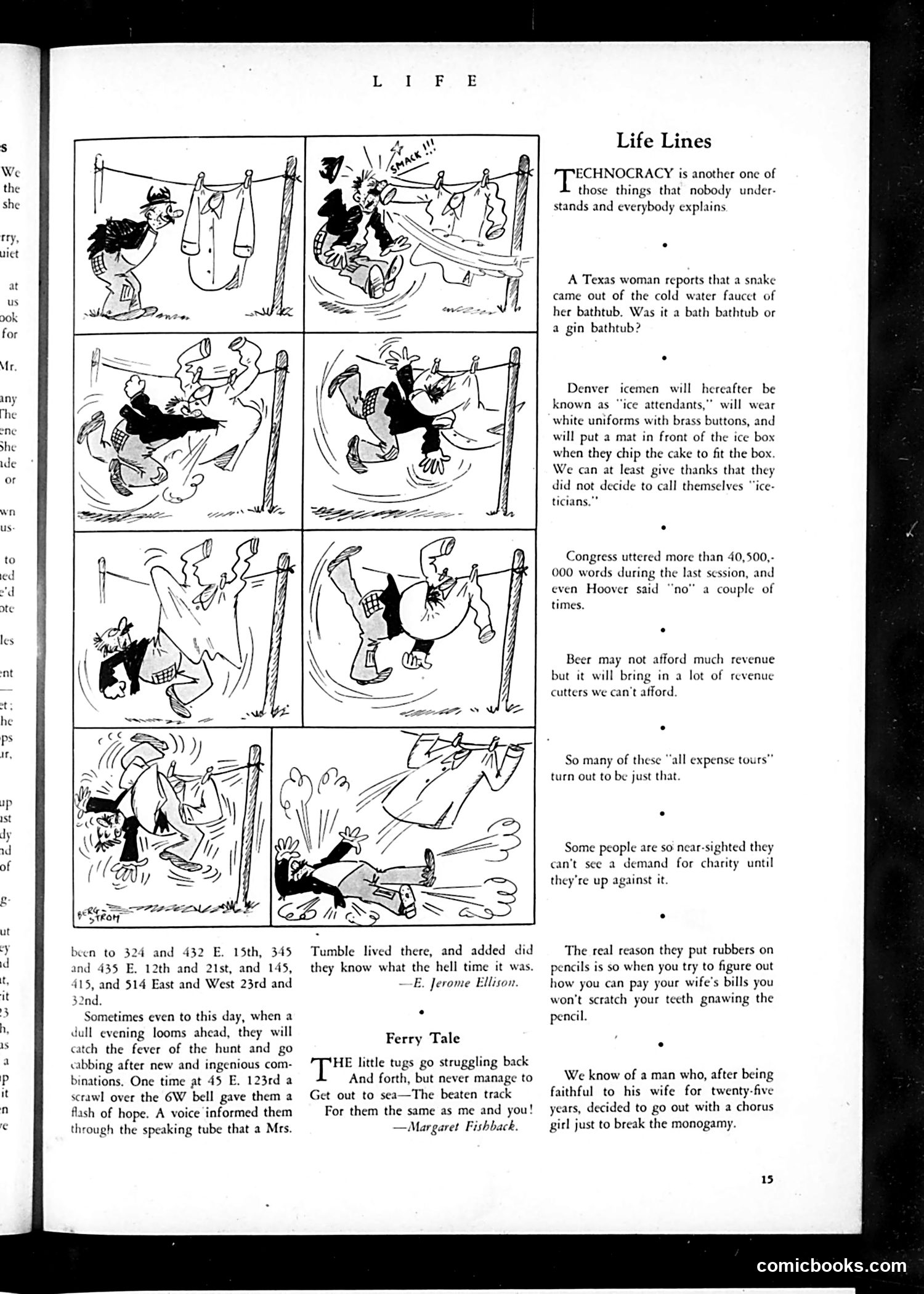
Life Magazine Page Analysis This page contains a comedic six-panel cartoon strip titled "Life Lines" showing a figure repeatedly struggling with laundry on a clothesline—slipping, tangling, falling, and generally creating chaos. The humor relies on physical comedy and slapstick. The accompanying text column offers unrelated humorous anecdotes, including jokes about technocracy, a Texas snake-in-bathtub story, Denver ice delivery men, Congressional verbosity, beer revenue, tour scams, nearsightedness, pencil erasers, and marital infidelity. Without visible dates or bylines, the specific historical context remains unclear, though references to Hoover and Depression-era concerns ("ice attendants," "all expense tours") suggest this is from the 1930s. The cartoon's humor is purely visual slapstick rather than political satire.
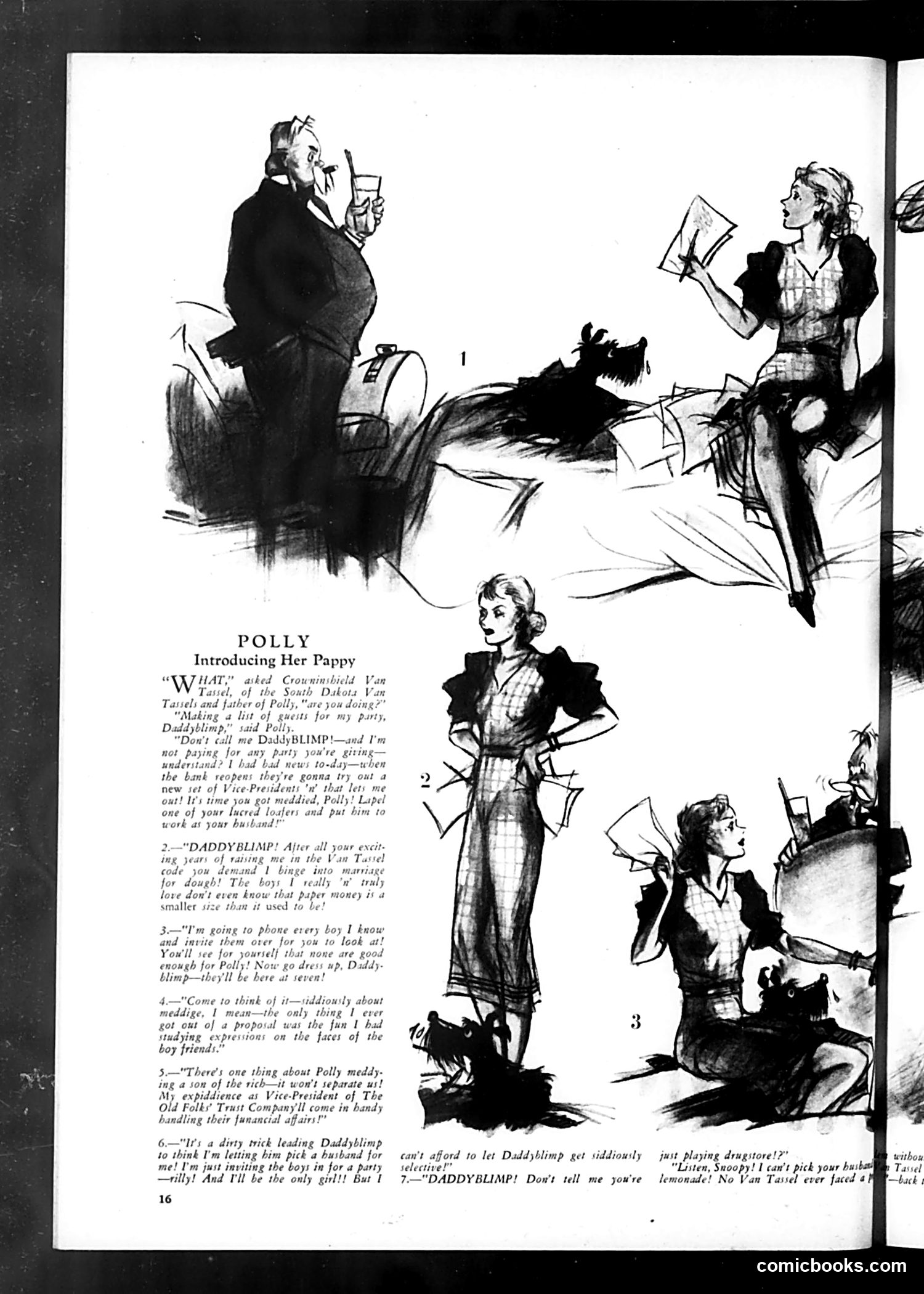
"Polly: Introducing Her Pappy" This is a satirical humor piece about a woman named Polly and her father, a man from South Dakota. The cartoon depicts a domestic scene where Polly's father visits and creates awkwardness. The joke appears to center on the father's blunt, colloquial speech ("Daddyblimp") clashing with more refined company. The dialogue suggests he's an unsophisticated rural character whose crude remarks and behavior embarrass Polly in front of her social circle—he apparently makes inappropriate comments about her boyfriend, money, and her appearance. The satire mocks both the father's lack of social refinement and Polly's anxiety about his presence, capturing early-20th-century class tensions between rural and urban American society. The humor relies on recognizing the cultural gap between small-town directness and urban sophistication.
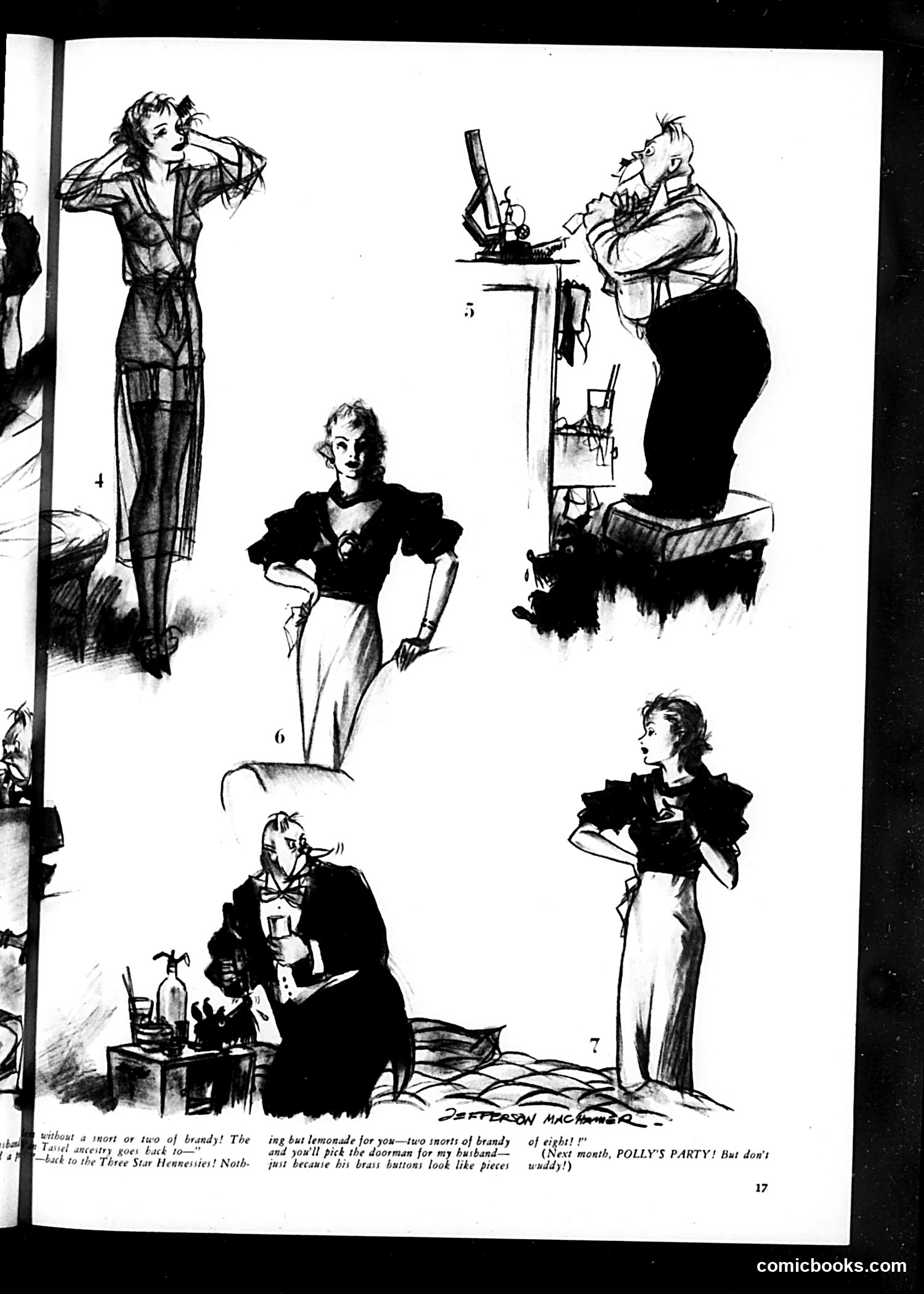
Analysis of Page 17 This appears to be a satirical illustration sequence about domestic life and social pretension, likely from the early-to-mid 20th century. The numbered panels (4-7) depict various characters in what seems to be a commentary on household management and class aspiration. The dialogue references "Three Star Hennessy" (a brandy brand), suggesting humor about affordable versus luxury goods. One character mentions serving brandy to a doorman and concerns about "brass buttons" looking cheap—apparently mocking middle-class anxiety about appearances and servants. The final panel references "POLLY'S PARTY," suggesting this may be part of a larger serialized domestic comedy. The satire appears to target aspirational middle-class behavior, particularly around entertaining and maintaining social status through consumption and household staff management.
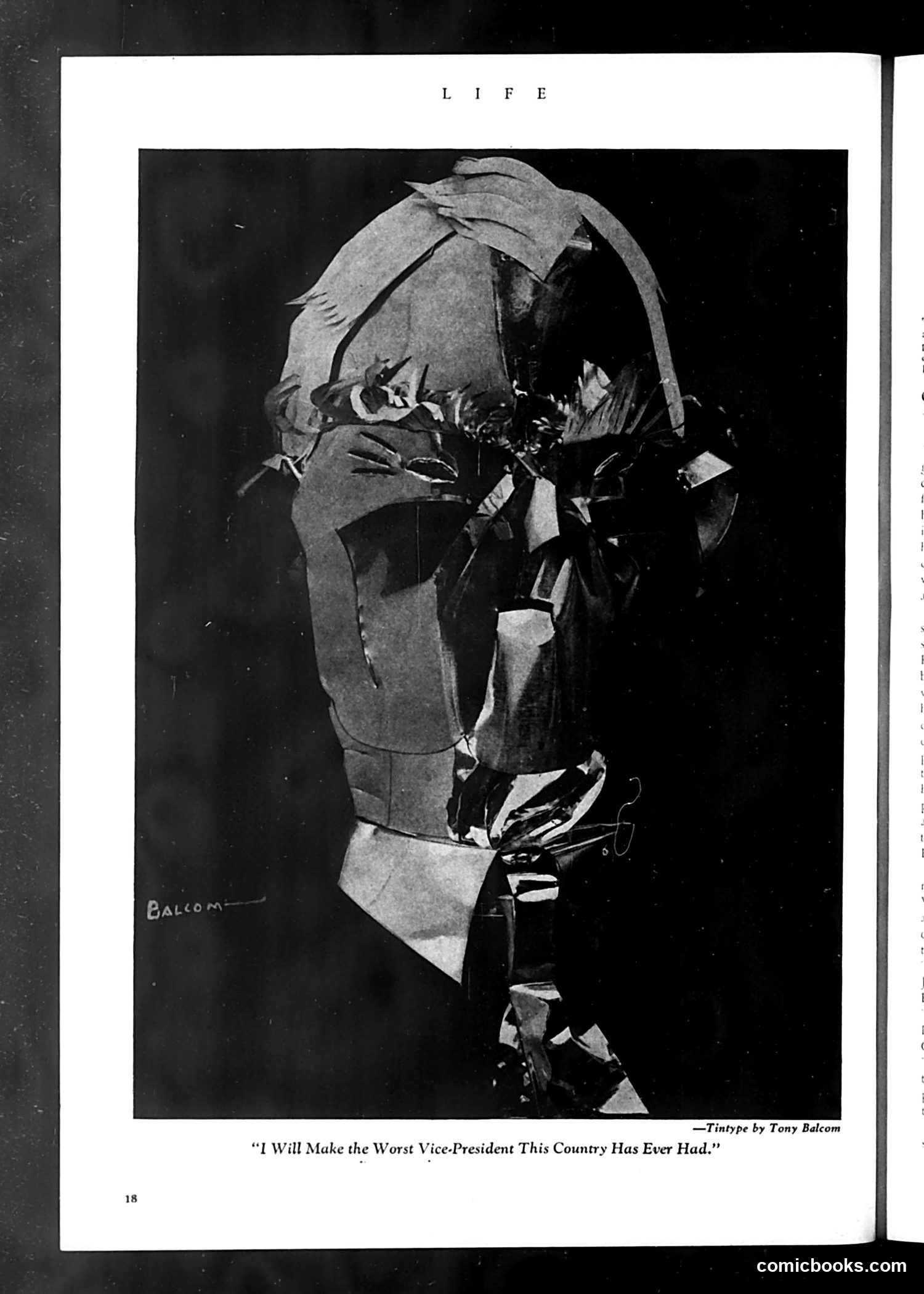
Analysis This is a political cartoon by Tony Balcom from Life magazine depicting a figure in formal attire (suit and top hat) making a dramatic gesture. The caption reads: "I Will Make the Worst Vice-President This Country Has Ever Had." The cartoon appears to be satirizing a political figure's boastful or ironic statement about assuming the vice presidency. Without additional context like a date or visible identifying features beyond the formal dress, I cannot definitively name the specific person or historical event referenced. However, the piece uses exaggerated body language and the absurdist humor typical of Life's political satire—mocking either a politician's arrogance or their actual qualifications for office through this self-damning declaration. The dramatic pose emphasizes the ridicule.
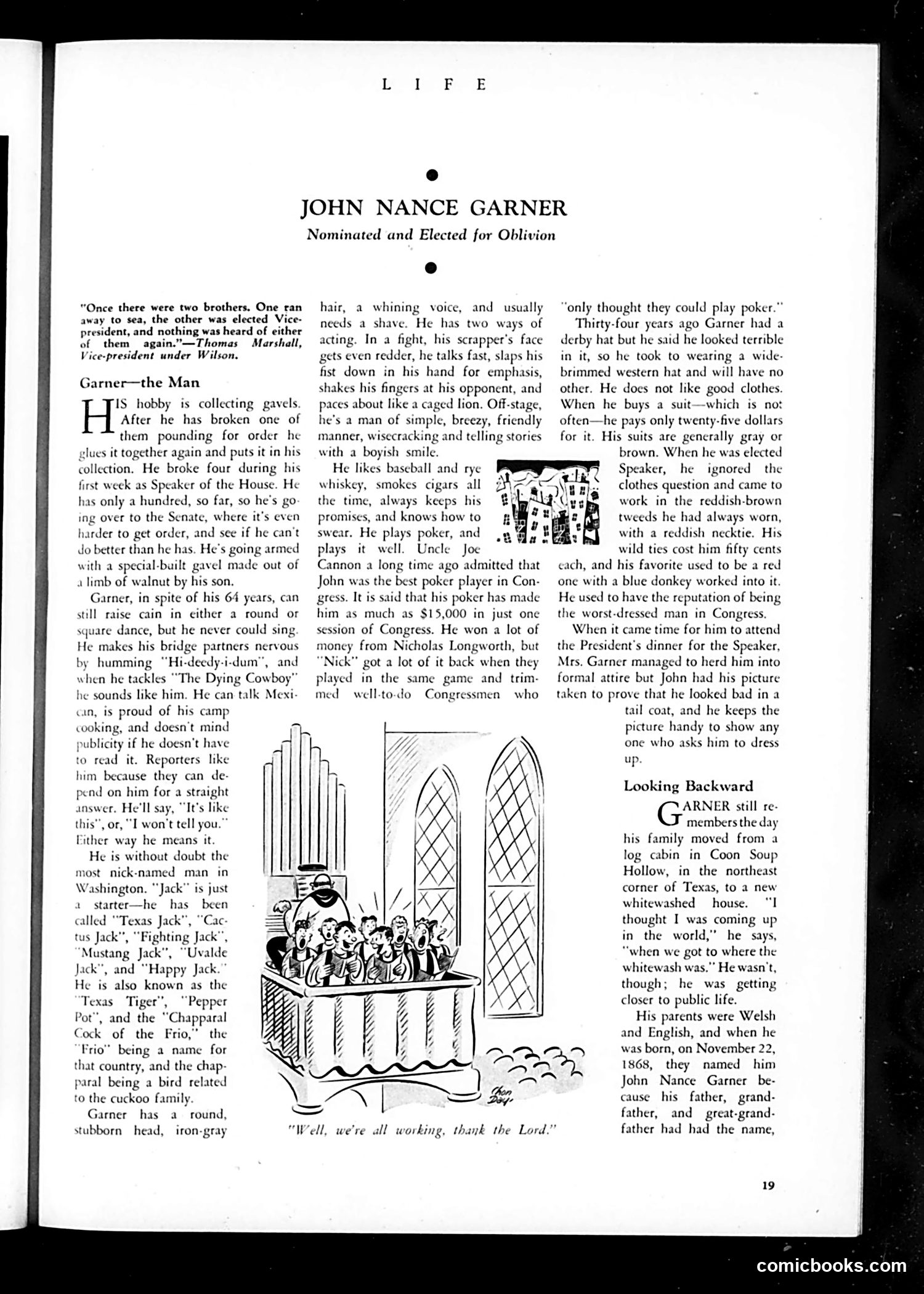
John Nance Garner Profile This page profiles John Nance Garner, described as "Nominated and Elected for Oblivion"—a satirical reference to his political status. The article portrays him as an eccentric congressman: a gavel collector, poker player, and practical joker known by nicknames like "Cactus Jack" and "Texas Tiger." The cartoon depicts Garner preaching from a pulpit to a congregation, with the caption "Well, we're all working, thank the Lord." This likely satirizes either his religious moralizing or his economic optimism during a period of national hardship. The profile emphasizes his quirky habits (cigar-smoking, suit-buying frugality) and his reputation as "the worst-dressed man in Congress." The "Oblivion" subtitle suggests contemporary skepticism about his political relevance or future prospects.
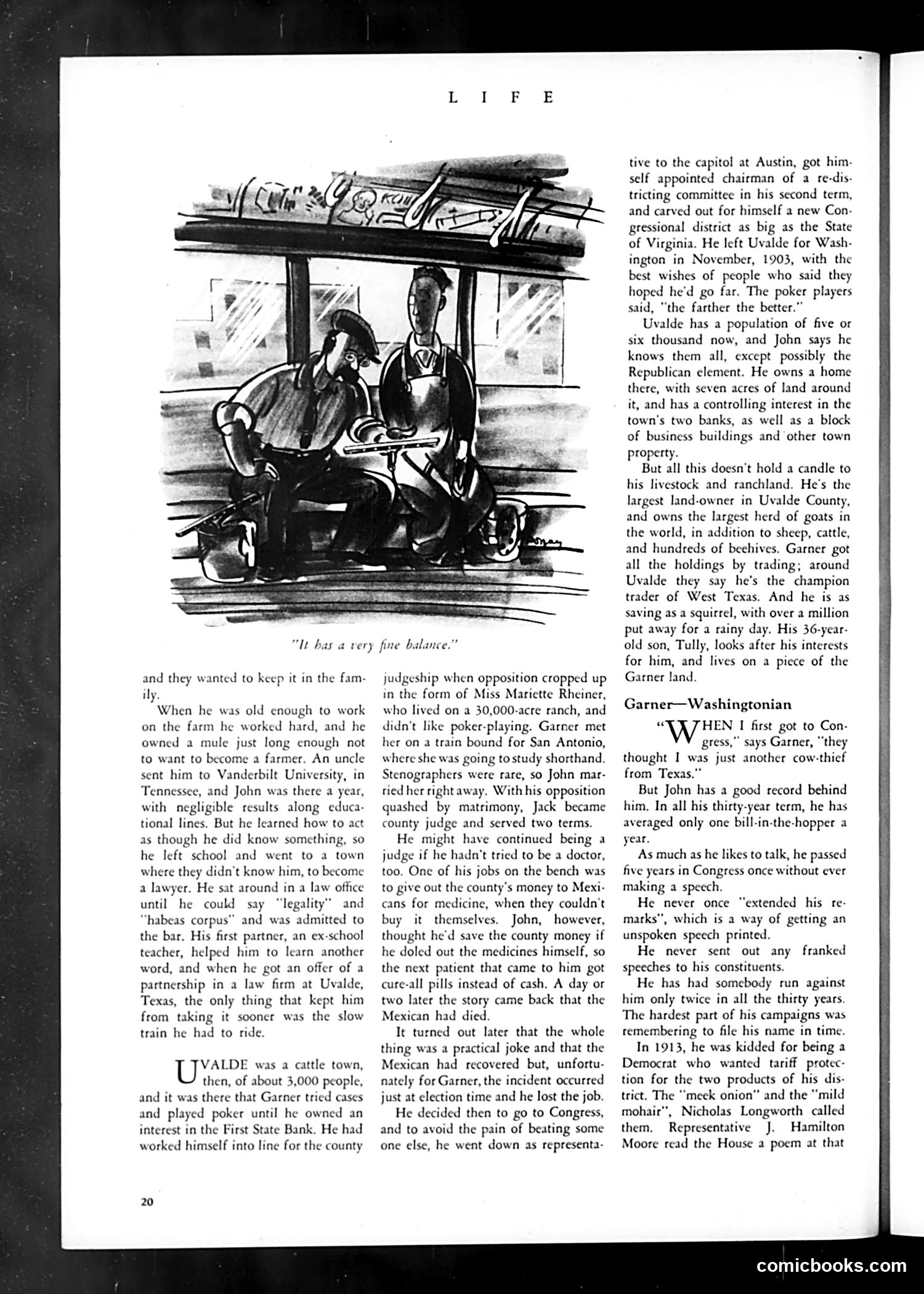
Political Satire in Life Magazine: "Garner—Washingtonian" This biographical sketch satirizes John Nance Garner, a Texas congressman rising to national prominence. The cartoon captioned "It has a very fine balance" depicts him with a scales/balance, likely mocking his political opportunism and careful positioning. The text ridicules Garner's self-made success through shrewd deal-making rather than principle. Key satirical points: his admission to the bar through mere memorization of Latin phrases; his hasty marriage to eliminate political opposition; his improvisation as a county judge dispensing unauthorized medicine that allegedly killed a man; and most pointedly, his unabashed gerrymandering—carving out a congressional district "as big as the State of Virginia" for himself. The opening anecdote about his being mistaken for a "cow-thief" and the repeated references to poker-playing underscore Life's suggestion that Garner succeeded through cunning and self-interest rather than integrity.
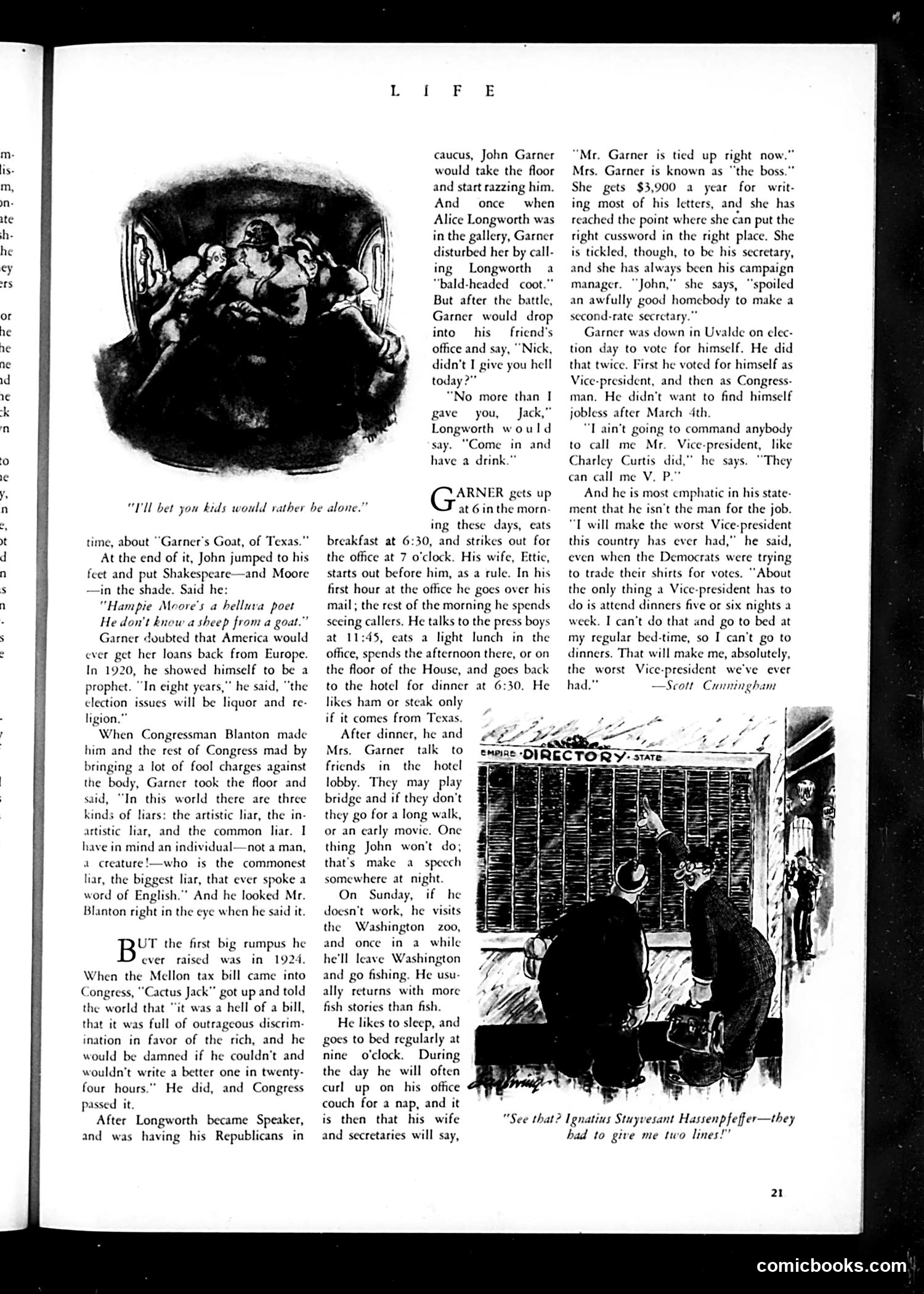
Life Magazine: John Garner Profile This page profiles John Nance Garner, a Texas congressman known by the nickname "Cactus Jack." The article illustrates his reputation as a blunt, colorful politician who speaks his mind—famously calling House Speaker Nicholas Longworth a "bald-headed coot" on the floor, then apologizing privately over drinks. The satire emphasizes Garner's plainspoken Texas character: he quotes Shakespeare, despises pretension, and speaks in crude, direct language. The cartoon shows him surrounded by constituents—visualizing his accessibility and informal style. The text suggests Garner is pragmatic and self-interested (voting for himself twice on election day to avoid joblessness). His wife "Ettie" is portrayed as his true power—his boss and campaign manager earning $3,900 annually. This appears written before Garner became Vice President (which occurred in 1933), celebrating his reputation as an unpretentious, vigorous, and colorfully profane politician—virtues readers apparently valued in the 1920s-early 1930s.
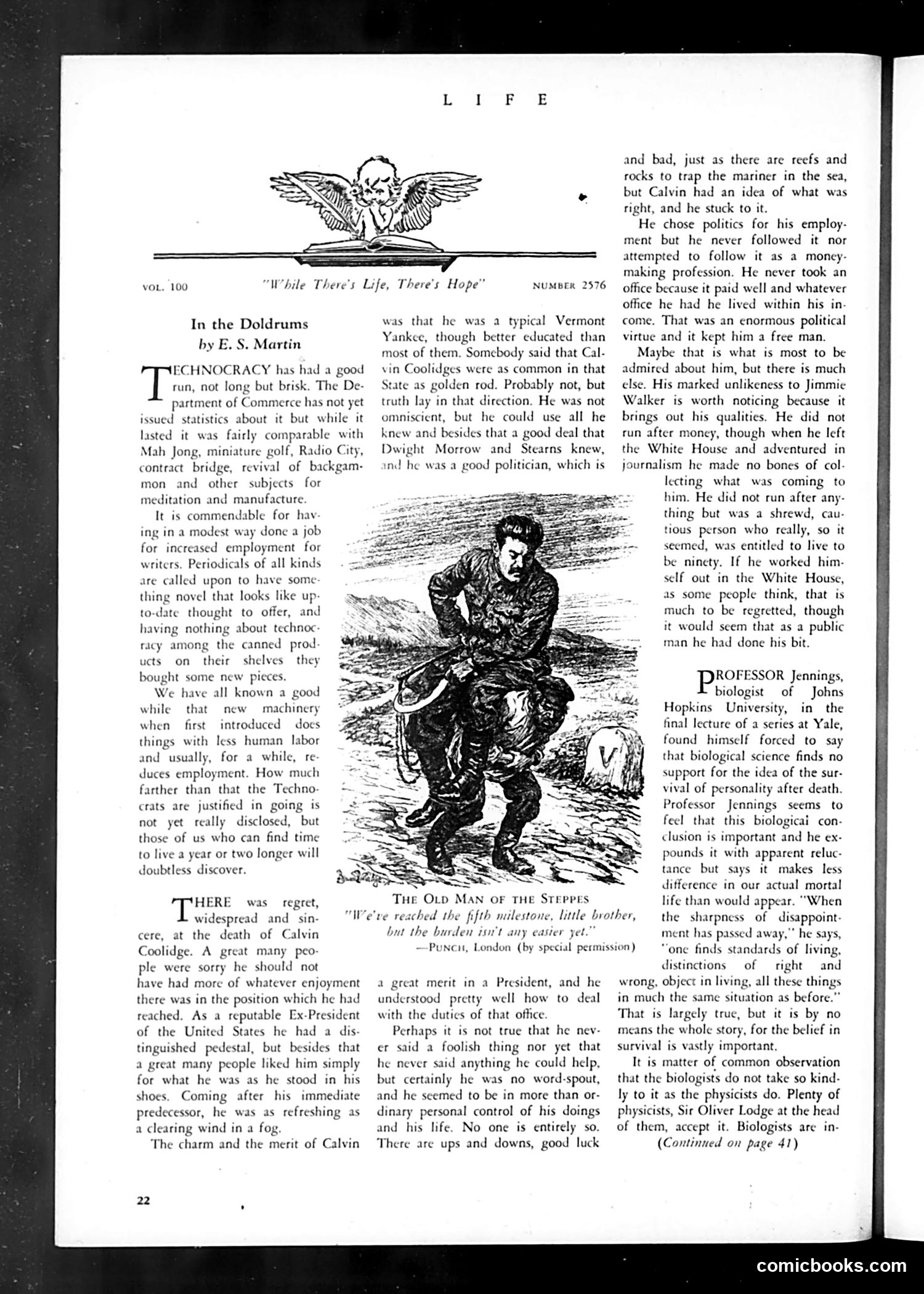
Analysis of Life Magazine Page (Vol. 100, No. 2576) This page contains two distinct pieces memorializing Calvin Coolidge, who recently died. The main article by E.S. Martin praises Coolidge as an exemplary president—a modest Vermont Yankee who avoided corruption, lived within his means, maintained personal restraint, and exercised genuine political skill. Martin emphasizes Coolidge's integrity by contrasting him with Jimmie Walker (New York City's corrupt mayor), suggesting Walker represents everything Coolidge rejected: self-enrichment and moral laxity. The accompanying illustration—a Russian-themed cartoon from Punch—depicts two weary travelers at their fifth milestone, suggesting life's burdens persist despite modest progress. This complements the elegiac tone. The page also briefly discusses "technocracy"—a 1930s fad promoting rule by technical experts—which Martin dismisses as a passing crazes like miniature golf and Mah Jong. The satire is gentle: mourning a leader of restraint in an era of excess and frivolous enthusiasms.
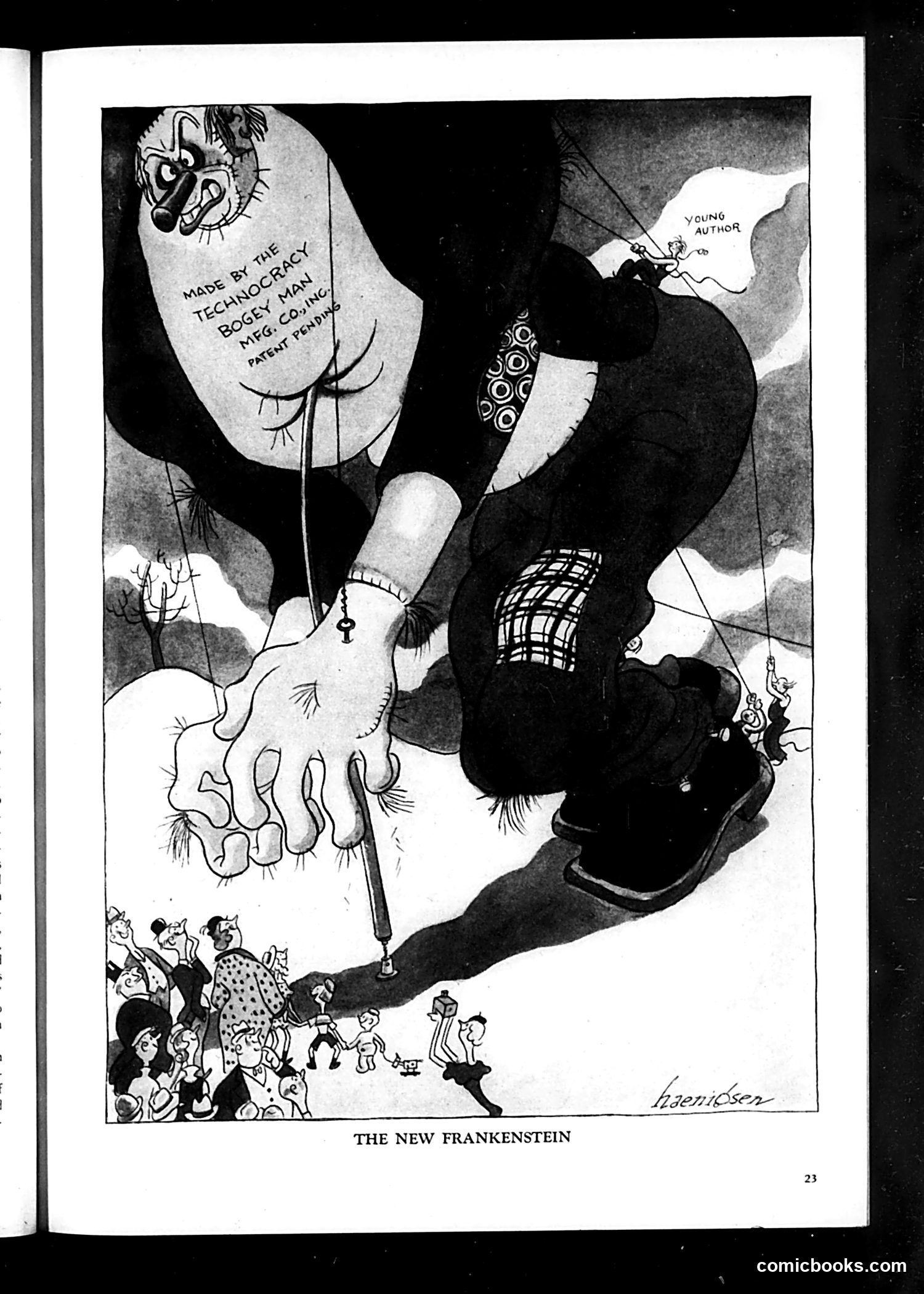
"The New Frankenstein" This satirical cartoon depicts the "technocracy" movement as a modern-day monster creation. A mad scientist-like figure (labeled "Made by the Technocracy Bogey Man Patent Pending") constructs a grotesque creature from industrial/mechanical parts. A "Young Author" observes from above, suggesting this is a manufactured scare story. The cartoon mocks public anxiety about technocracy—a 1930s movement advocating rule by technical experts and engineers. The satire suggests such fears are artificially created panic rather than genuine threats. The tiny citizens fleeing at the bottom emphasize how the "Frankenstein" narrative terrifies ordinary people. The artist (Cesntsen/signature unclear) criticizes sensationalism about technological advancement, portraying technocracy anxieties as fabricated monster tales rather than legitimate concerns.
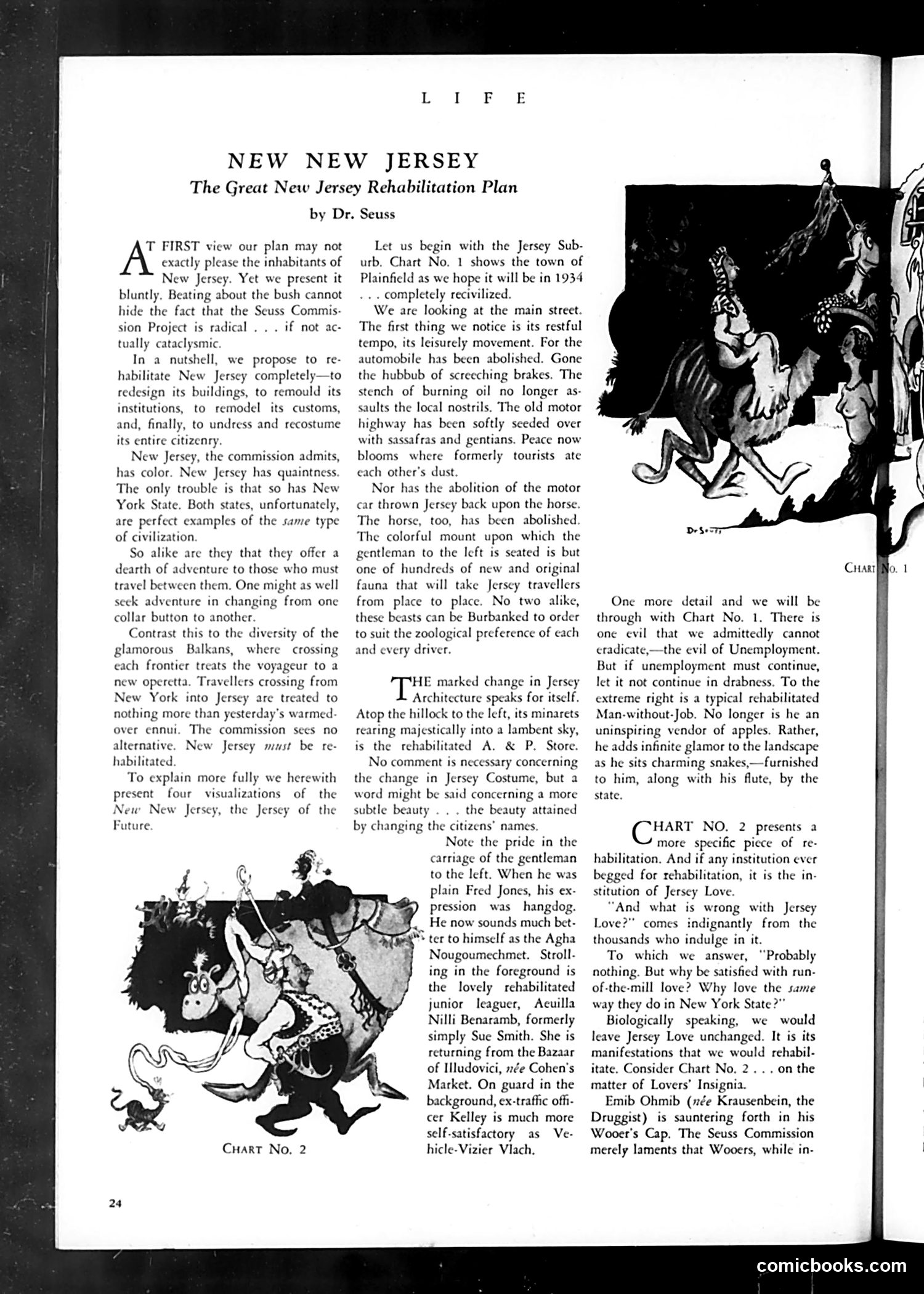
"New New Jersey": Dr. Seuss's Satirical Rehabilitation Plan This 1930s Life magazine piece by Dr. Seuss satirizes New Jersey's perceived lack of distinction compared to New York State. The text proposes a absurdist "rehabilitation plan" to transform Jersey into something exotic and adventurous—like the "glamorous Balkans"—rather than merely duplicating its neighbor. The cartoons illustrate ridiculous solutions: replacing automobiles and horses with fantastical invented creatures; renaming ordinary citizens with exotic names (Fred Jones becomes "Agha Nougoumechmet"; Sue Smith becomes "Acuilla Nilli Benaramb") to boost their self-esteem; transforming a mundane A&P grocery store into an ornate minaret-topped palace; and even making unemployment "glamorous" by having the jobless charm snakes rather than sell apples. The satire mocks both Jersey's actual blandness and the era's absurd faith that superficial cosmetic changes—new names, exotic architecture, costume—could solve real problems like unemployment during the Depression.
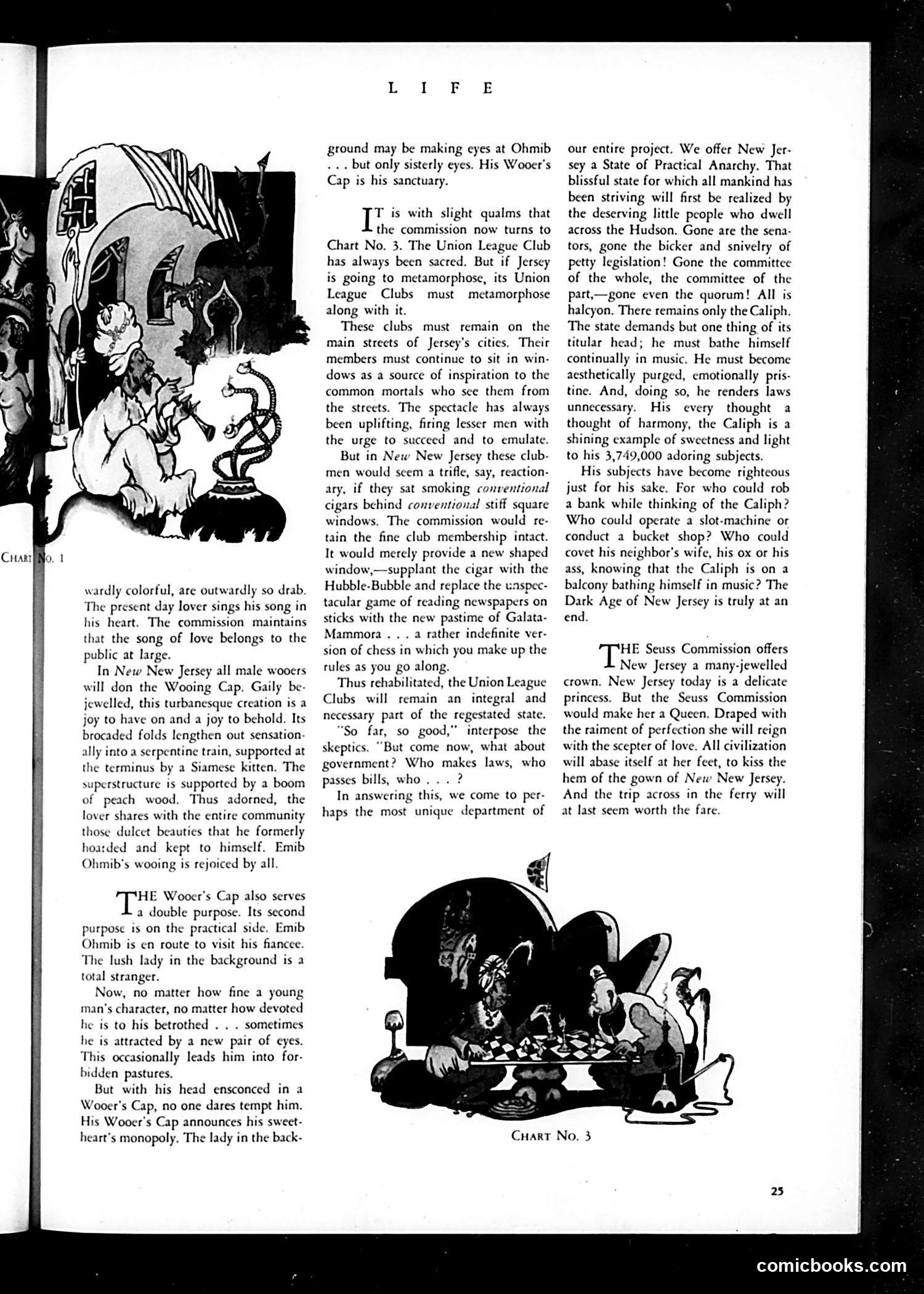
Satire of New Jersey "Modernization" This Life magazine satire mocks grandiose plans to reimagine New Jersey through absurdist social inventions. The text describes a fictional "commission" proposing ridiculous reforms: Chart No. 1 shows the "Wooing Cap"—an elaborate, jeweled headpiece supposedly protecting engaged men from temptation by publicly announcing their taken status. It's simultaneously impractical and invasive. Chart No. 3 ridicules exclusive Union League Clubs (real institutions for wealthy professionals), proposing they replace cigars and newspaper-reading with "Galata-Mammora" (invented chess) to seem modern rather than stuffy. Most satirically, the text proposes replacing New Jersey's entire government with rule by a "Caliph" who bathes in music continuously, rendering laws unnecessary through aesthetic purity—mocking both utopian ideology and the notion that a single enlightened leader can solve complex social problems. The satire targets progressive-era enthusiasm for grand social schemes, institutional reform, and the assumption that mechanical/organizational fixes can solve human nature.
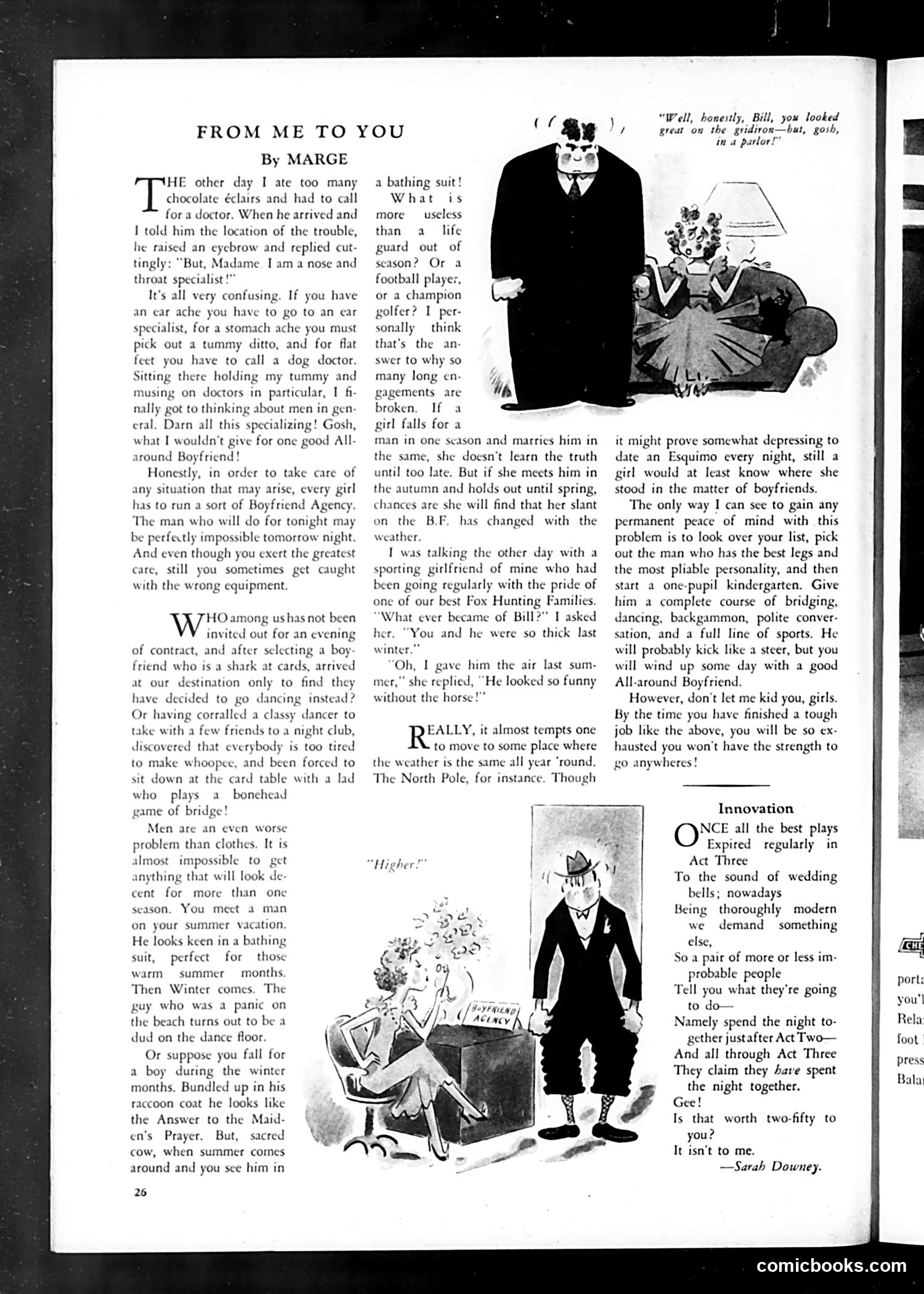
Analysis for Modern Readers This is a humorous advice column by Marge satirizing the impracticality of having a single "boyfriend" who works for all occasions and seasons. The Main Joke: The author complains that men, like seasonal clothing, are only suitable during specific times. Her examples include a man who looks great in a bathing suit but is useless in winter, or conversely, one who seems perfect bundled in a raccoon coat until summer reveals him as physically unimpressive. The punchline about the fox-hunting companion who looked "so funny without the horse" illustrates men whose appeal depends entirely on their seasonal context or activity. The Cartoons show exaggerated male figures in formal wear appearing ridiculous or awkward—likely depicting these "seasonal boyfriends" out of their element. The Satire: Rather than men having genuine character, the piece mocks how women must maintain multiple boyfriends for different situations (dancing, cards, sports), treating dating like managing a staffing agency. It's gentle social commentary on 1920s-30s courtship expectations and the superficiality of attraction based on appearance and activity rather than substance.
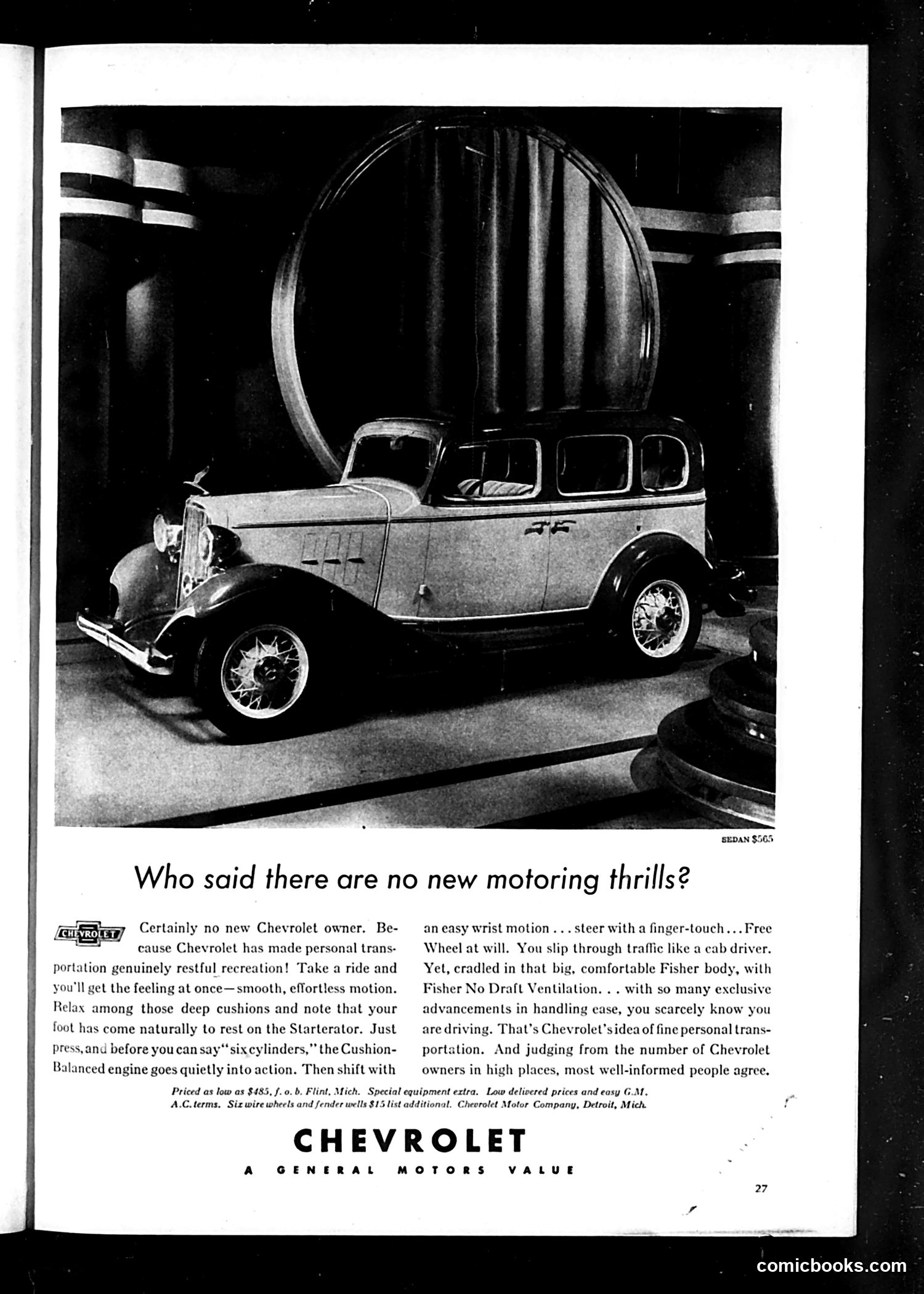
Analysis This is a Chevrolet automobile advertisement, not political satire or a cartoon. The page shows a 1930s sedan photographed in a studio setting alongside a large wooden barrel, apparently meant to suggest the car's compact, efficient design. The ad's rhetorical strategy is to position Chevrolet ownership as providing luxurious motoring experiences previously associated with higher-priced vehicles. It emphasizes effortless operation ("finger-touch" steering, one-handed shifting), comfort ("deep cushions," "Fisher body"), and smooth performance (the "Cushion-Balanced engine"). The phrase "Starterator" appears to be marketing nomenclature for the starter button. References to "Free Wheel" and "No Draft Ventilation" indicate specific mechanical features being highlighted as competitive advantages. The final appeal to "high places" and "well-informed people" is aspirational marketing—suggesting Chevrolet ownership signals both taste and practical wisdom, not merely economy.
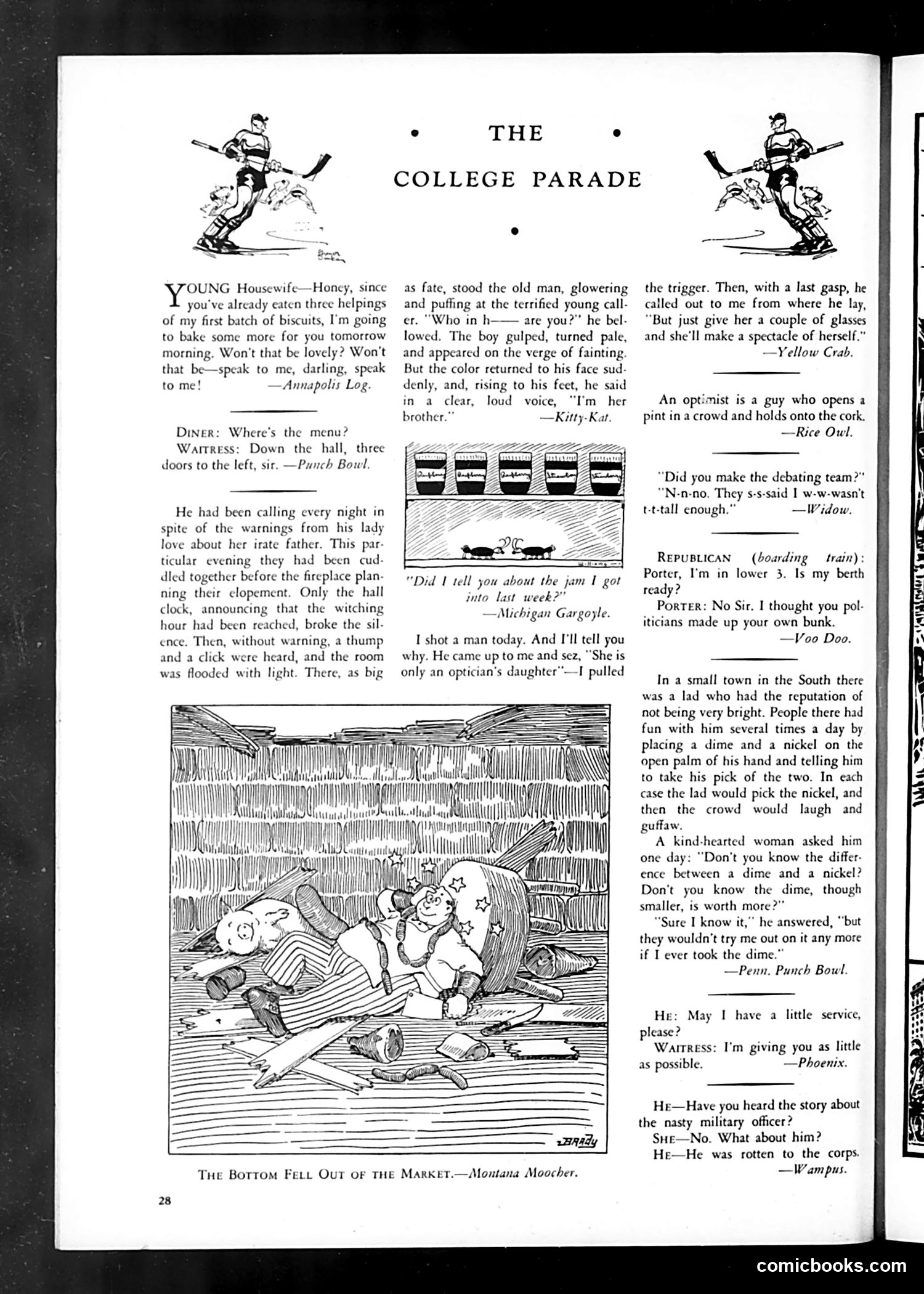
"The College Parade" Page Analysis This page collects brief jokes and humorous anecdotes primarily from college and university humor magazines (Annapolis Log, Michigan Gargoyle, Penn. Punch Bowl, etc.), representing early 20th-century collegiate wit. The humor reflects period concerns: a young man caught courting (claiming to be the girl's brother when caught by her father); puns on opticians' daughters; a critique of Republican politicians as dishonest; and a racial/class stereotype about a Southern Black youth supposedly unable to distinguish coin values, presented as good-naturedly amusing rather than malicious by the publication's standards. The large illustration depicts a couple in domestic disarray—"The Bottom Fell Out of the Market"—likely a visual pun on financial collapse metaphors applied to domestic life. These jokes reveal early 20th-century college culture's preoccupations: courtship anxieties, political cynicism, and unfortunately, casual ethnic stereotyping that was normalized in humor publications of that era.
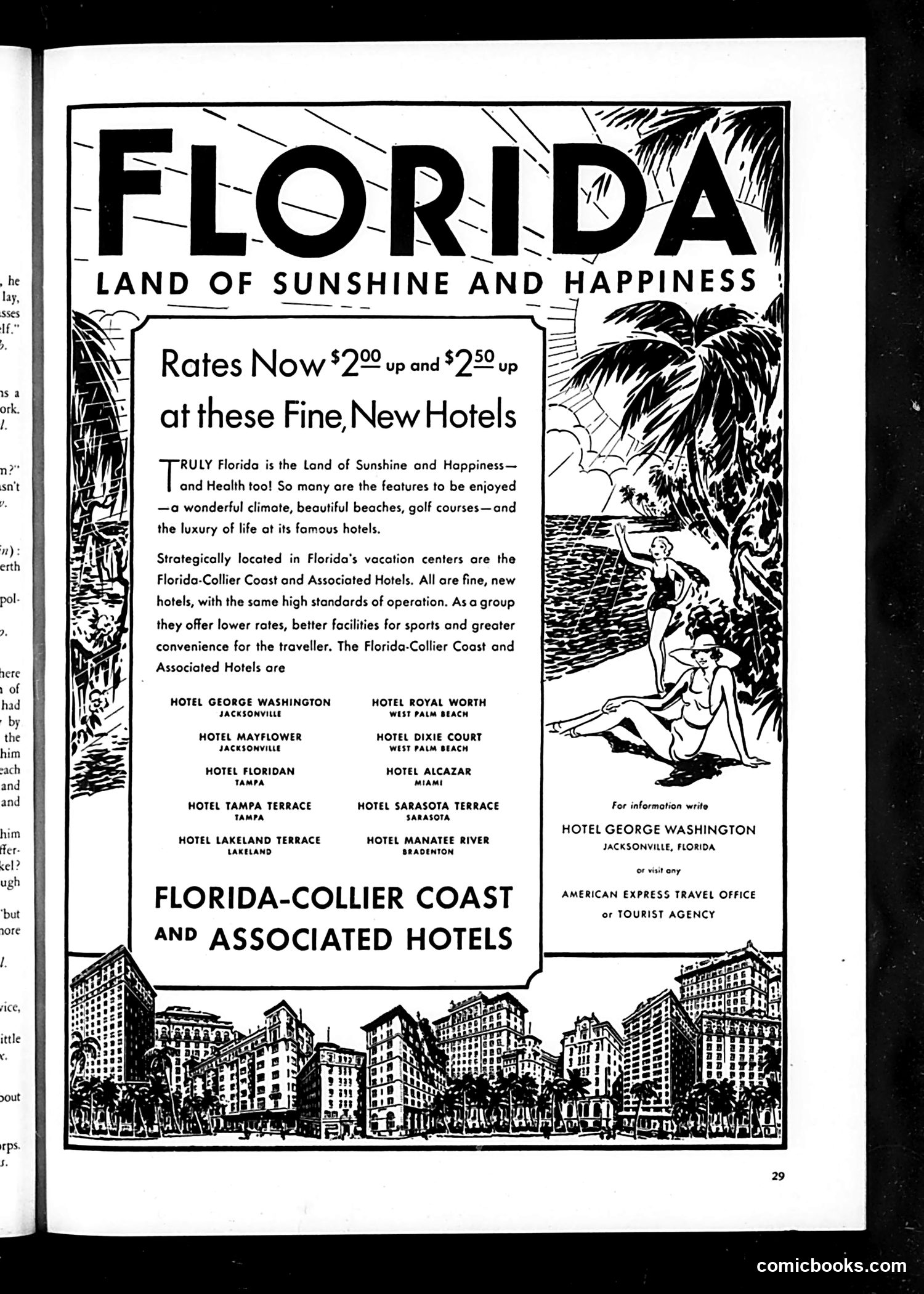
Analysis This is a travel advertisement, not satire or a political cartoon. The page promotes Florida hotels through the "Florida-Collier Coast and Associated Hotels" group. The content appeals to Depression-era or post-Depression travelers with budget rates starting at $2.00-$2.50 per night—affordable luxury positioning. The decorative illustrations (palm trees, beachgoers) evoke Florida's leisure lifestyle appeal. The tagline "Land of Sunshine and Happiness" and emphasis on golf, beaches, and "health" reflect early 20th-century tourism marketing that positioned Florida as an escape destination from harsh northern winters. The layout—with a skyline illustration at bottom—suggests these were established, substantial hotels. This is straightforward commercial promotion rather than commentary or satire. It reflects the hospitality industry's efforts to attract middle-class travelers to Florida's developing resort regions.
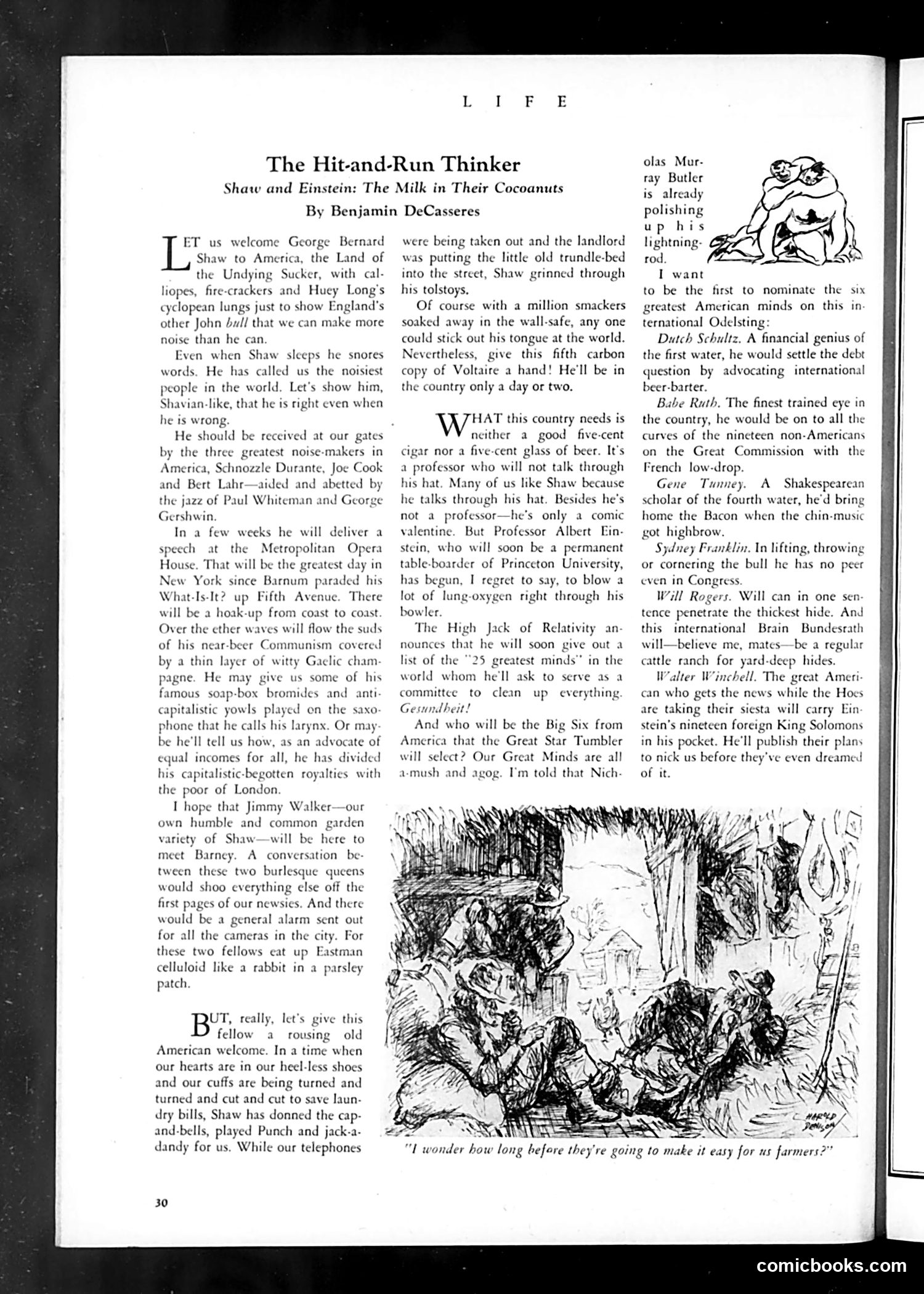
"The Hit-and-Run Thinker" — Life Magazine Satire This article by Benjamin DeCasseres welcomes George Bernard Shaw to America while satirizing both Shaw and Albert Einstein. Shaw: The Irish playwright is mocked as a noise-maker and self-proclaimed socialist who, despite advocating equal incomes, has kept his capitalistic royalties. The satire suggests his radical rhetoric is mere performance ("comic valentine"). Einstein: Recently arrived at Princeton, Einstein announces plans to name the world's "25 greatest minds" to form a committee. DeCasseres ridicules this as pretentious, suggesting America's actual "great minds" are mediocre—he sarcastically nominates gangster Dutch Schultz (for financial genius in bootlegging) and baseball star Babe Ruth. The cartoon (caption: "I wonder how long before they're going to make it easy for us farmers?") depicts rural hardship during what appears to be the Great Depression era. Context: The piece reflects 1930s American anxiety about both imported intellectualism and economic crisis, using crude humor to deflate European celebrity thinkers.
Commentary on This Page This is primarily advertising copy, not a political cartoon. The page promotes bus advertising space via John H. Livingston Jr. The brief editorial excerpt at top references "John Public" (an everyman figure representing ordinary citizens) and contrasts subway versus bus fares during the Depression. A nickel savings means real relief—enough for a Saturday movie. The body text uses social observation as a sales pitch: Fifth Avenue bus riders represent an unusually affluent demographic (mink coats, good shoes) compared to other transit users, making them valuable advertising targets. The humor is gentle—advertisers can reach wealthy passengers who have "plenty of time to read" ads during their commute. This reflects 1930s economic conditions when even wealthy New Yorkers felt fare increases acutely, and when bus advertising was an emerging medium targeting captive audiences by income level.
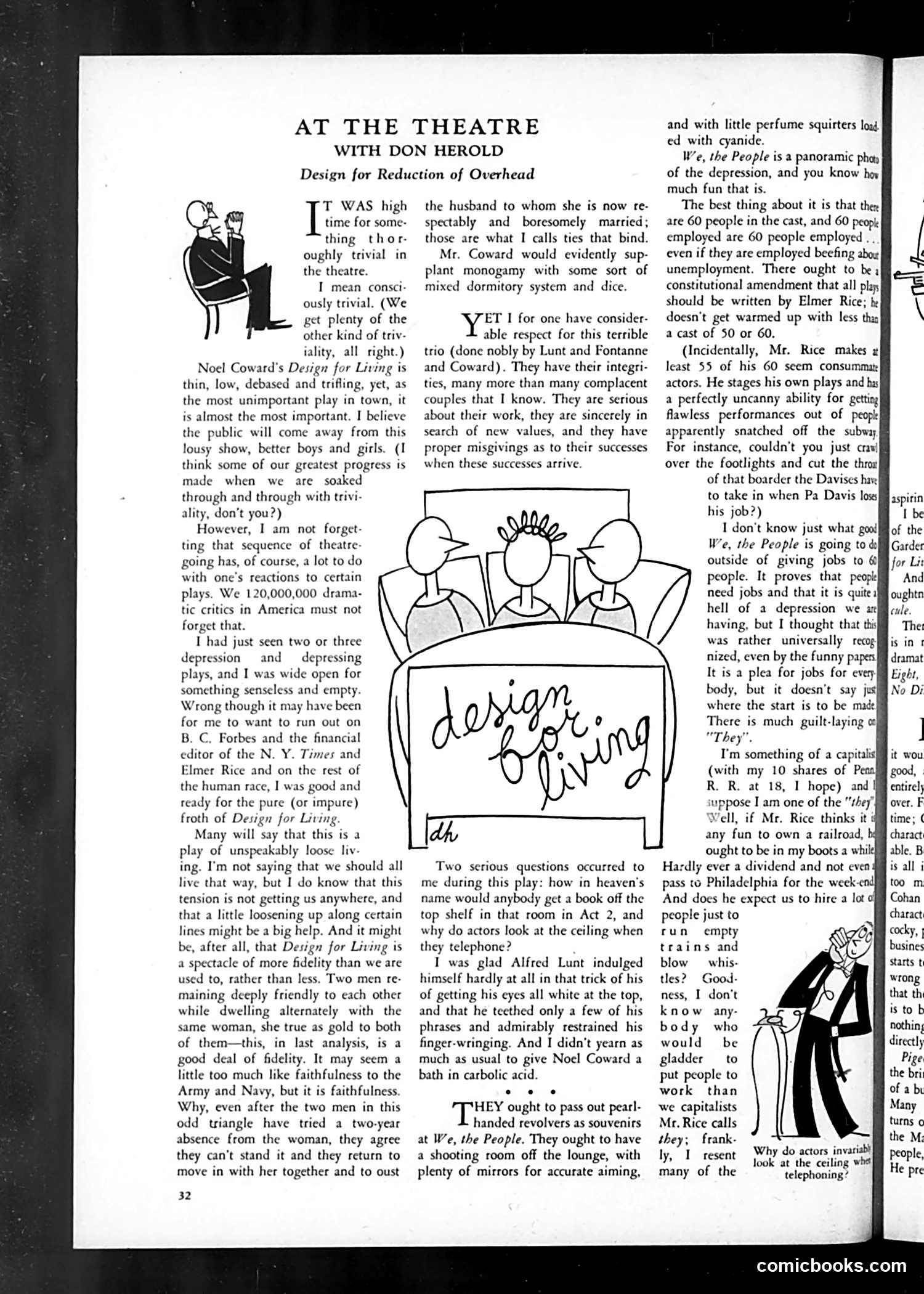
Analysis of This Life Magazine Theater Column Don Herold's column reviews Noël Coward's *Design for Living*, a play about unconventional living arrangements—two men and a woman in a romantic triangle. Herold defends the play's "loose living" as actually demonstrating faithfulness, arguing that the characters' commitment to each other and their work shows integrity. The cartoon depicts three figures (representing the play's trio) sharing a bed labeled "design for living"—a visual joke about the play's scandalous premise of cohabitation outside traditional marriage. The column also briefly skewers *We, the People*, a depression-era play with a large cast. Herold sardonic ally notes it employs 60 actors even if they're just complaining about unemployment—a dark joke about Depression-era theater offering jobs while depicting economic desperation. The humor relies on the 1930s scandal around Coward's morally unconventional plot and contemporary anxiety about Depression-era unemployment.
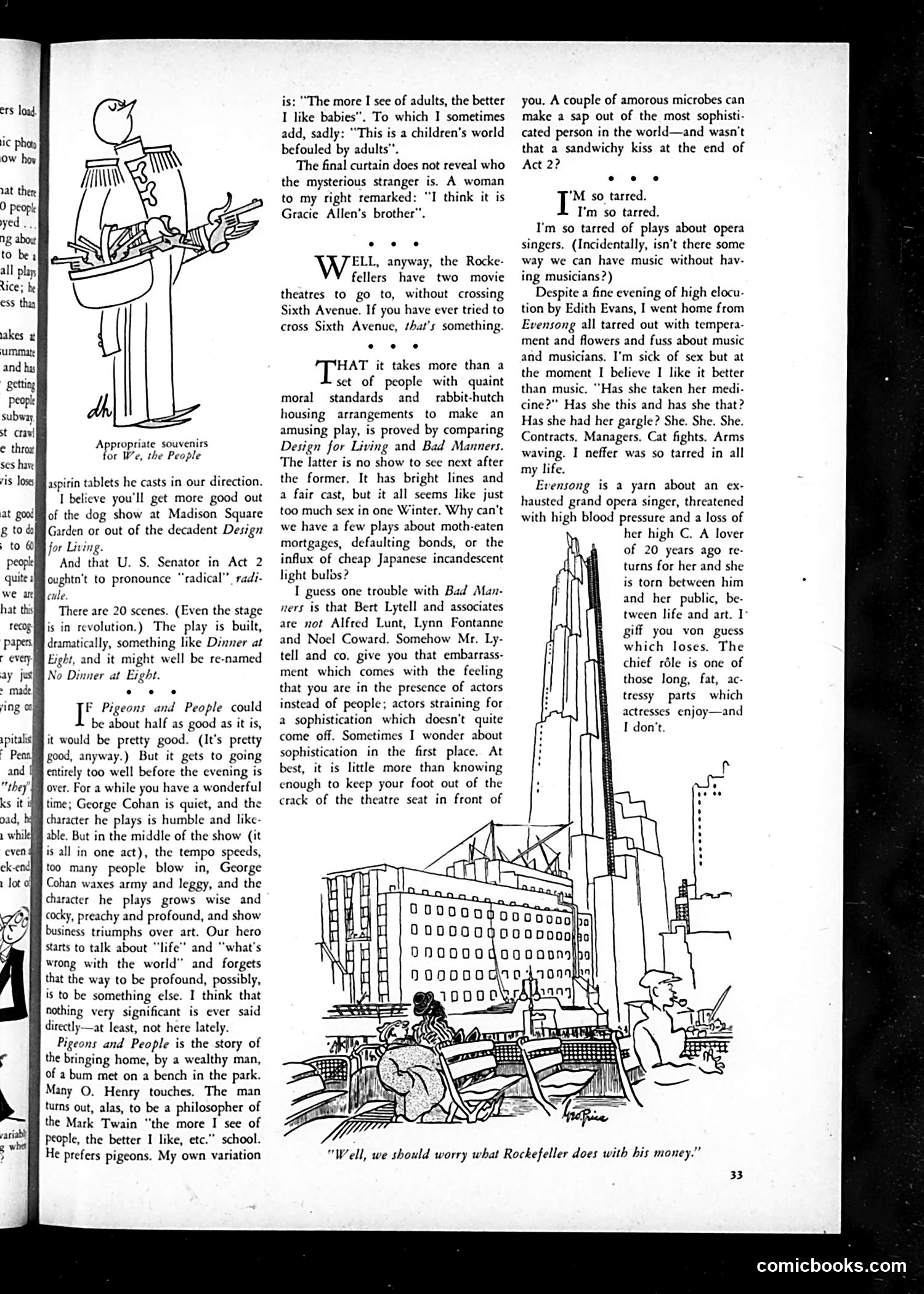
Analysis of Life Magazine Page This is a theater review column criticizing several Broadway plays. The cartoons illustrate the reviewer's complaints about contemporary theater. The top cartoon shows a figure (appears to be a Broadway producer or actor) dressed in elaborate costume amid theatrical chaos—labeled "Appropriate souvenirs for We, the People." This mocks how Broadway productions have become self-indulgent spectacles disconnected from ordinary American life. The bottom illustration depicts the Rockefeller Center building with a vagrant or homeless person below, referencing the play *Pigeons and People*—about a wealthy man befriending a poor man. The caption ("Well, we should worry what Rockefeller does with his money") satirizes the play's shallow treatment of class disparity. The reviewer criticizes multiple plays for being dramatically bloated, overly sexual, or featuring actors playing "sophistication" rather than authentic characters. The overall point: 1930s Broadway had become frivolous, obsessed with sex and spectacle, ignoring real social issues like poverty and economic hardship during what appears to be Depression-era America.
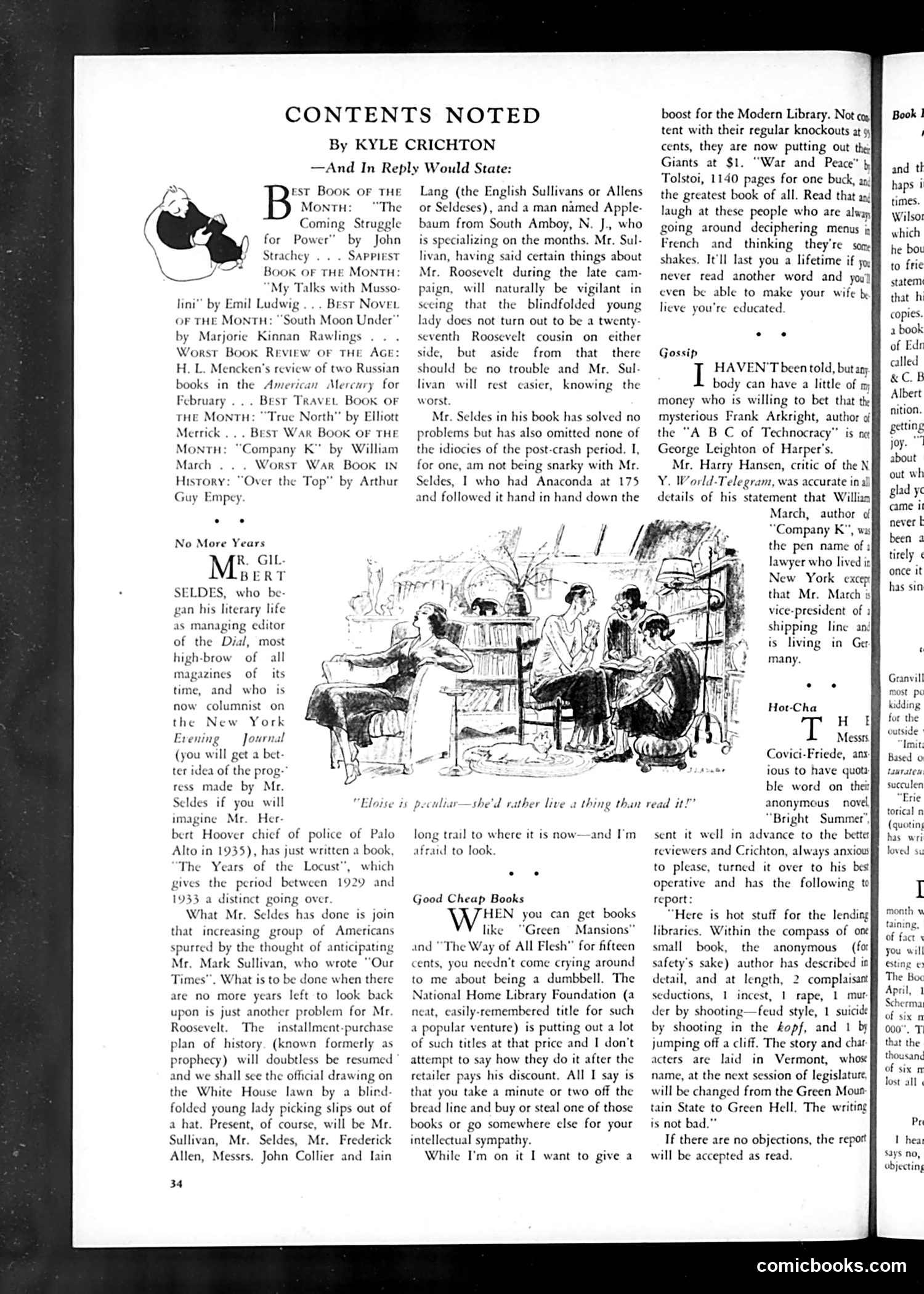
Analysis of This Life Magazine Page This is a book review column by Kyle Crichton titled "Contents Noted." The main illustrated cartoon depicts a woman reading aloud to a group of seated listeners in what appears to be a casual domestic setting. The caption reads: "Eloise is peculiar—she'd rather live a thing than read it!"—a humorous observation about preferring direct experience to reading about it. The column itself is satirical commentary on American intellectual life during the Depression era (circa 1935). Crichton mocks historians like Mark Sullivan and Gilbert Seldes who are attempting to document recent American history while events are still unfolding. He sarcastically suggests their "installment-purchase plan of history" resembles blind-folded lottery drawings at the White House, poking fun at the uncertainty of predicting future historical significance. The reviews recommend affordable editions of classic literature as antidotes to economic hardship and intellectual pretension.
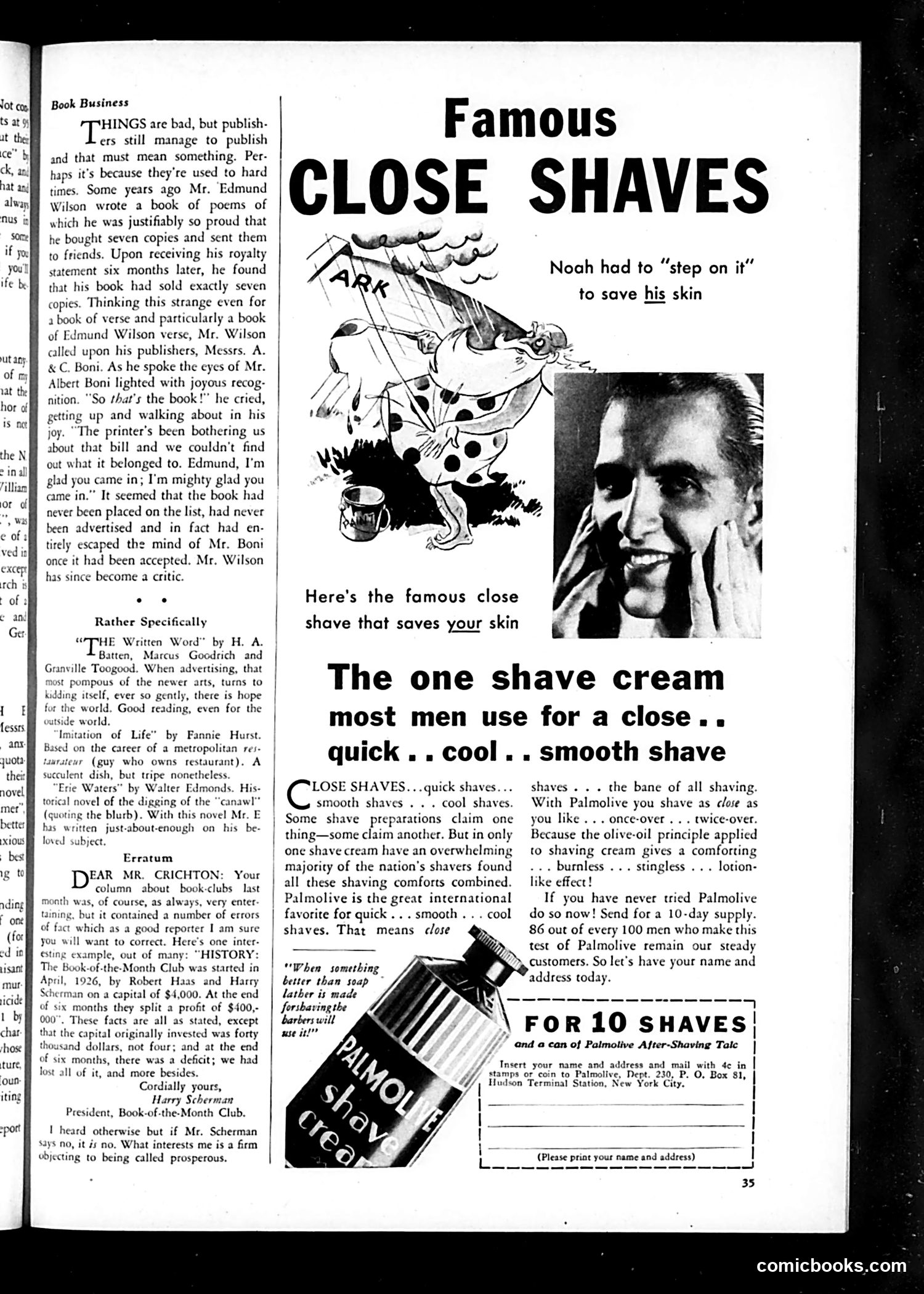
Analysis of Life Magazine Page This page combines book industry commentary with a Palmolive shaving cream advertisement. The "Book Business" Section: The left side satirizes publishing industry incompetence through anecdotes. It mocks the Book-of-the-Month Club's initial capitalization claims (a publisher corrects the editor, noting they actually lost money initially, not profited $400,000). The Edmund Wilson story ridicules how publishers can be so disorganized they lose track of books entirely—Wilson's poetry collection sold exactly seven copies (matching the seven he bought himself), yet the publisher never noticed or advertised it. The satire suggests that despite industry dysfunction, books still somehow get published. The Advertisement: The right side features a biblical cartoon of Noah needing to "step on it" to save his skin during the flood—a crude visual pun introducing Palmolive's shaving cream. The ad claims Palmolive provides the "close shave" that most men prefer, emphasizing quick, smooth, cool results. It's standard mid-century advertising copy promoting the product's comfort and popularity among barbers. The juxtaposition of publishing industry failure with consumer product success is likely intentional—contrasting chaos with commercial reliability.
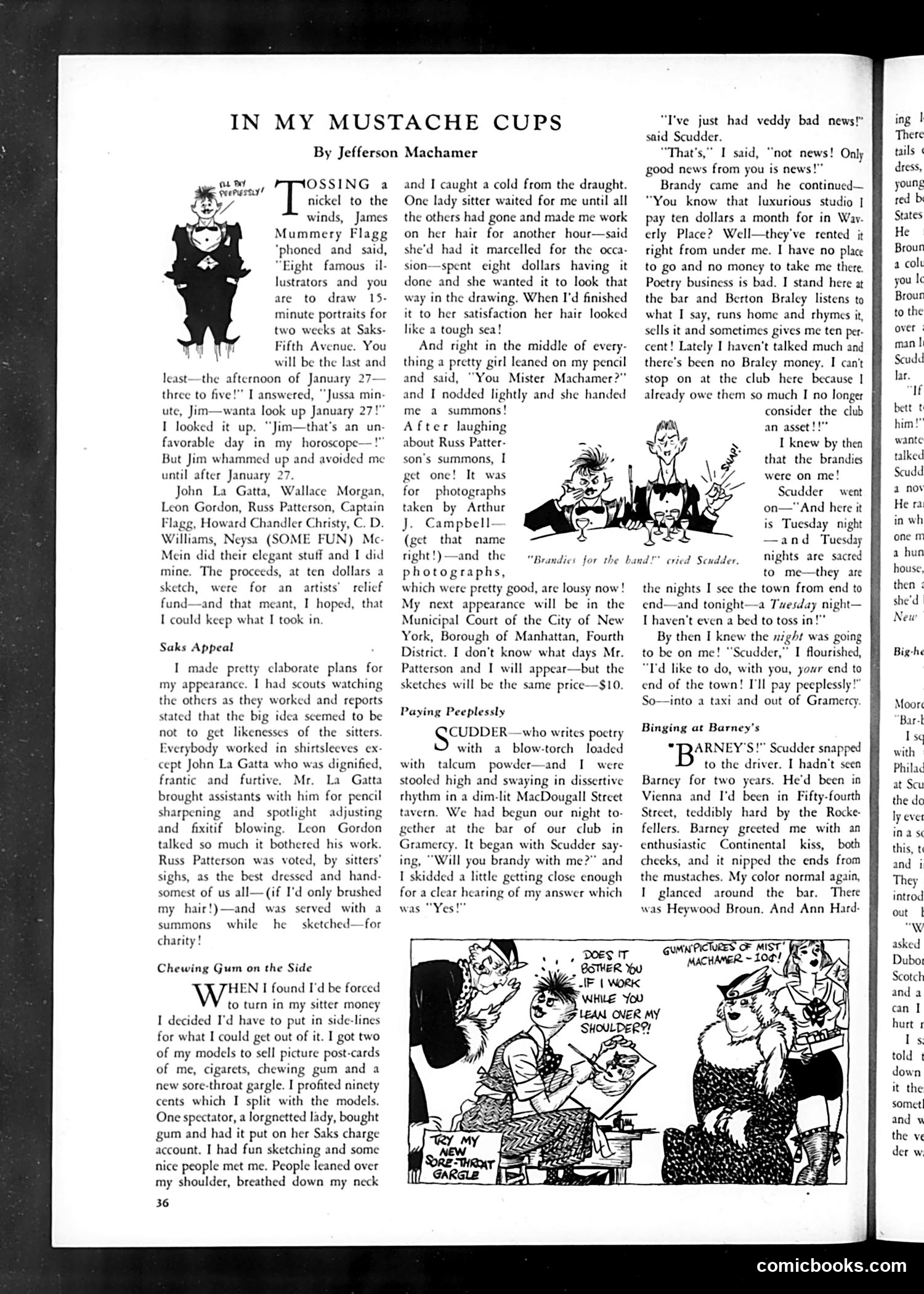
"In My Mustache Cups" by Jefferson Machamer This humorous autobiographical piece describes illustrator Machamer's experience as one of eight famous illustrators hired to draw 15-minute portrait sketches at Saks Fifth Avenue for charity. The cartoons show Machamer's comedic misadventures: he catches cold from drafts, deals with demanding sitters (one who spent eight dollars getting her hair marcelled just for the portrait), and attempts side hustles selling postcards and gum. He even receives a legal summons while sketching—for photographs taken by photographer Arthur J. Campbell. The satire targets the vanity of society portrait subjects and the financial struggles of working artists, who must supplement meager earnings (he made 90 cents) with side schemes. The final section shifts to his night out with fellow illustrator "Scudder," establishing a frame story about bohemian Greenwich Village life.
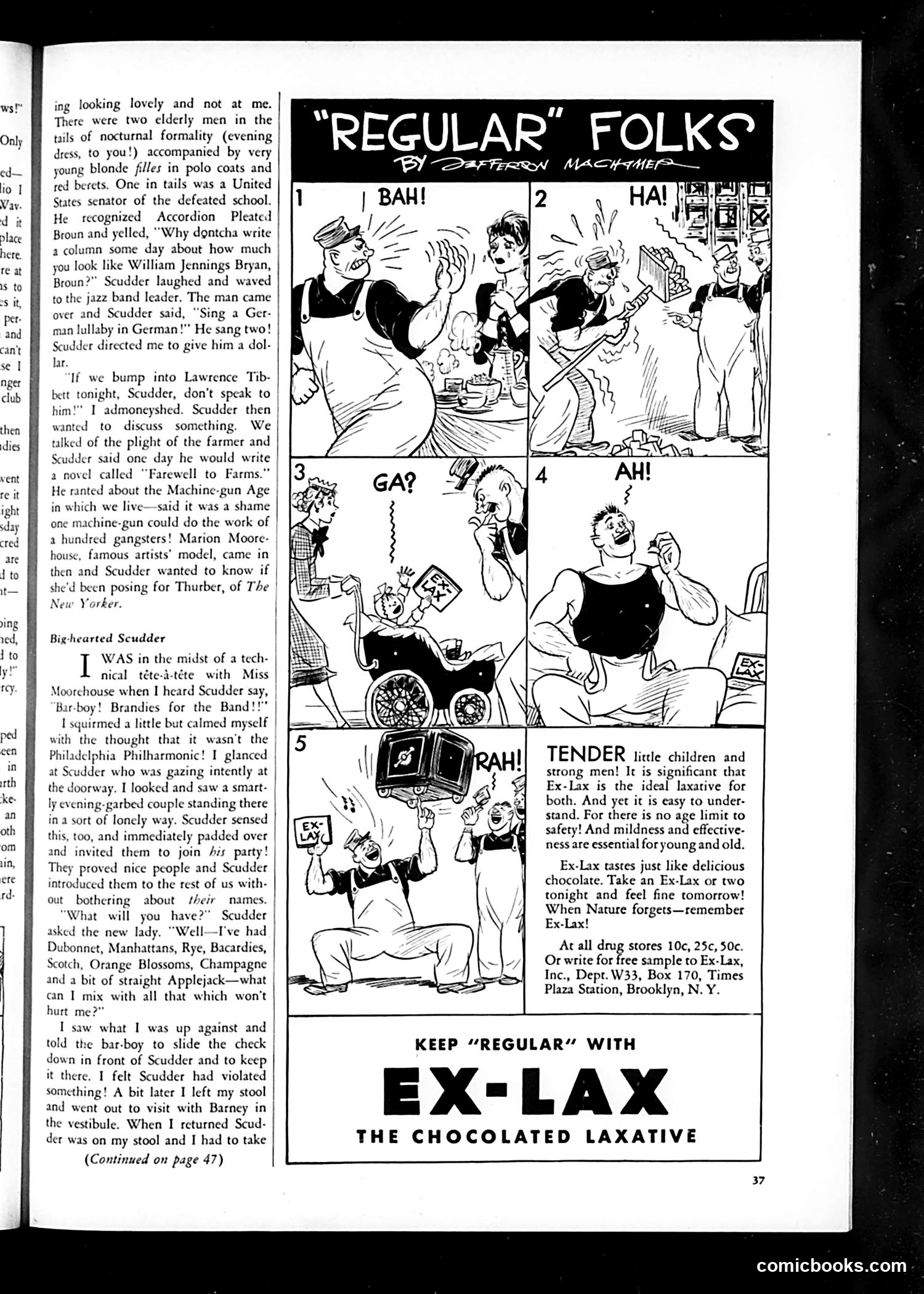
"Regular" Folks Comic Analysis This page contains a humorous six-panel comic strip by Darrow MacIntire satirizing everyday social situations. The strip follows a character (likely meant to represent a "regular" person) through various awkward encounters: The panels depict common social embarrassments: someone exclaiming "BAH!" at unpleasant sights, a surprised reaction ("HA!"), confusion ("GAP?"), and general discomfort ("AH!"). The final panel shows the character's distress, labeled "RAH!" The humor targets the pretensions and discomforts of middle-class social life. The accompanying text describes a night out involving celebrities and socialites, emphasizing how ordinary people feel out of place in such settings. The strip serves as setup for an Ex-Lax laxative advertisement—the page's primary commercial purpose. The joke's implicit logic: social anxiety causes digestive distress, solved by the product. This crude but straightforward advertising approach was typical of 1930s-40s magazines, using relatable humor to sell medicinal products.
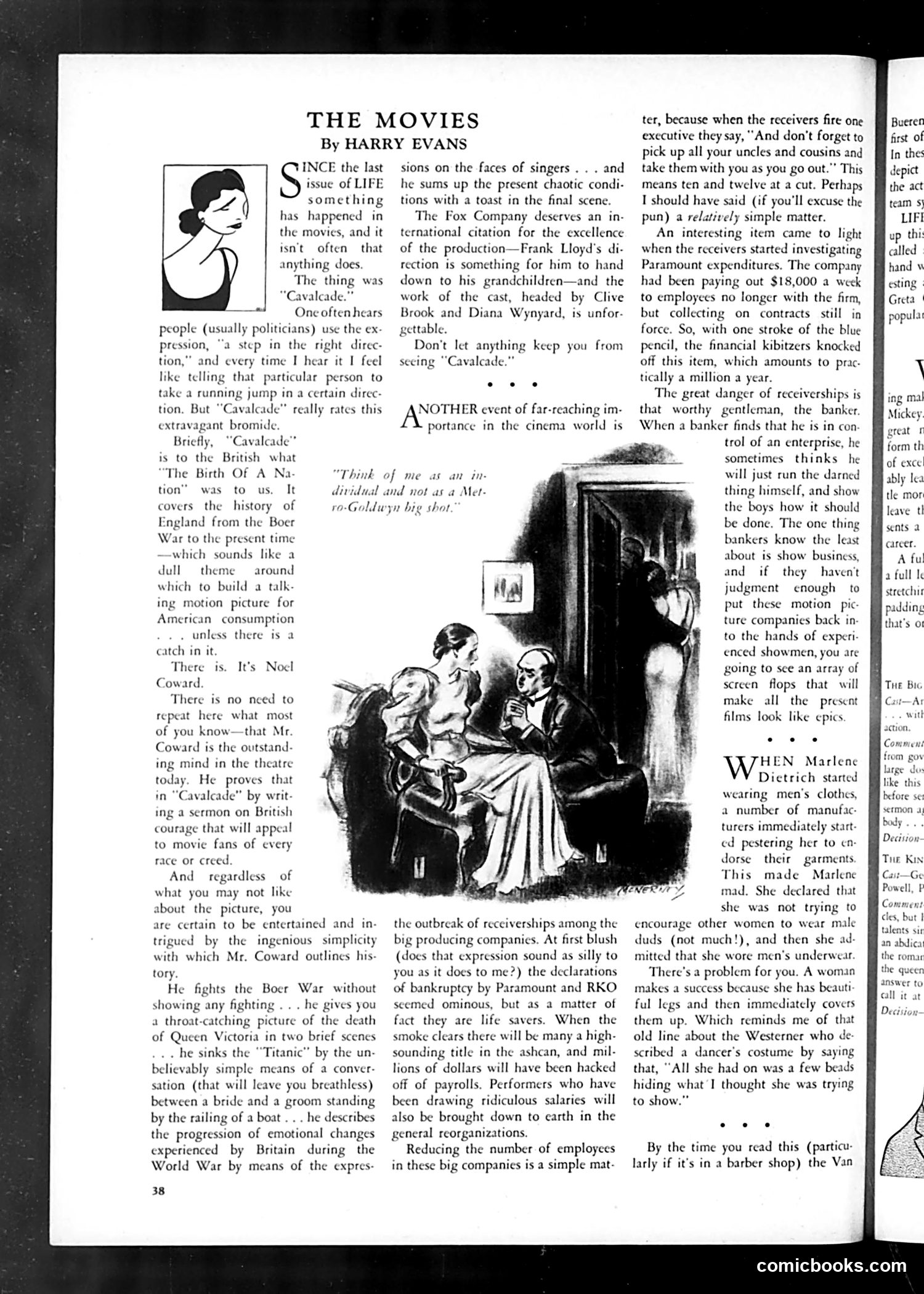
Analysis of "The Movies" by Harry Evans This Life magazine column reviews "Cavalcade," a 1933 British historical film written by Noël Coward. Evans praises the film as a major cultural achievement, comparing it to "The Birth of a Nation" in significance for American audiences. The accompanying illustration depicts a domestic scene, likely representing the film's narrative scope—its chronicle of British life from the Boer War through World War I and into the present. Evans also discusses recent Hollywood industry turmoil: major studios like Paramount and RKO filing for bankruptcy. He treats this as ultimately beneficial, arguing receiverships will eliminate bloated payrolls and ridiculous executive salaries. He cites Paramount's absurd practice of paying $18,000 weekly to employees already fired while still collecting their contracts—"practically a million a year" in waste. The satire is directed at both corporate excess and the nepotistic hiring practices ("pick up all your uncles and cousins") endemic to the studio system. Evans suggests financial collapse, while painful, will force necessary industry reforms.
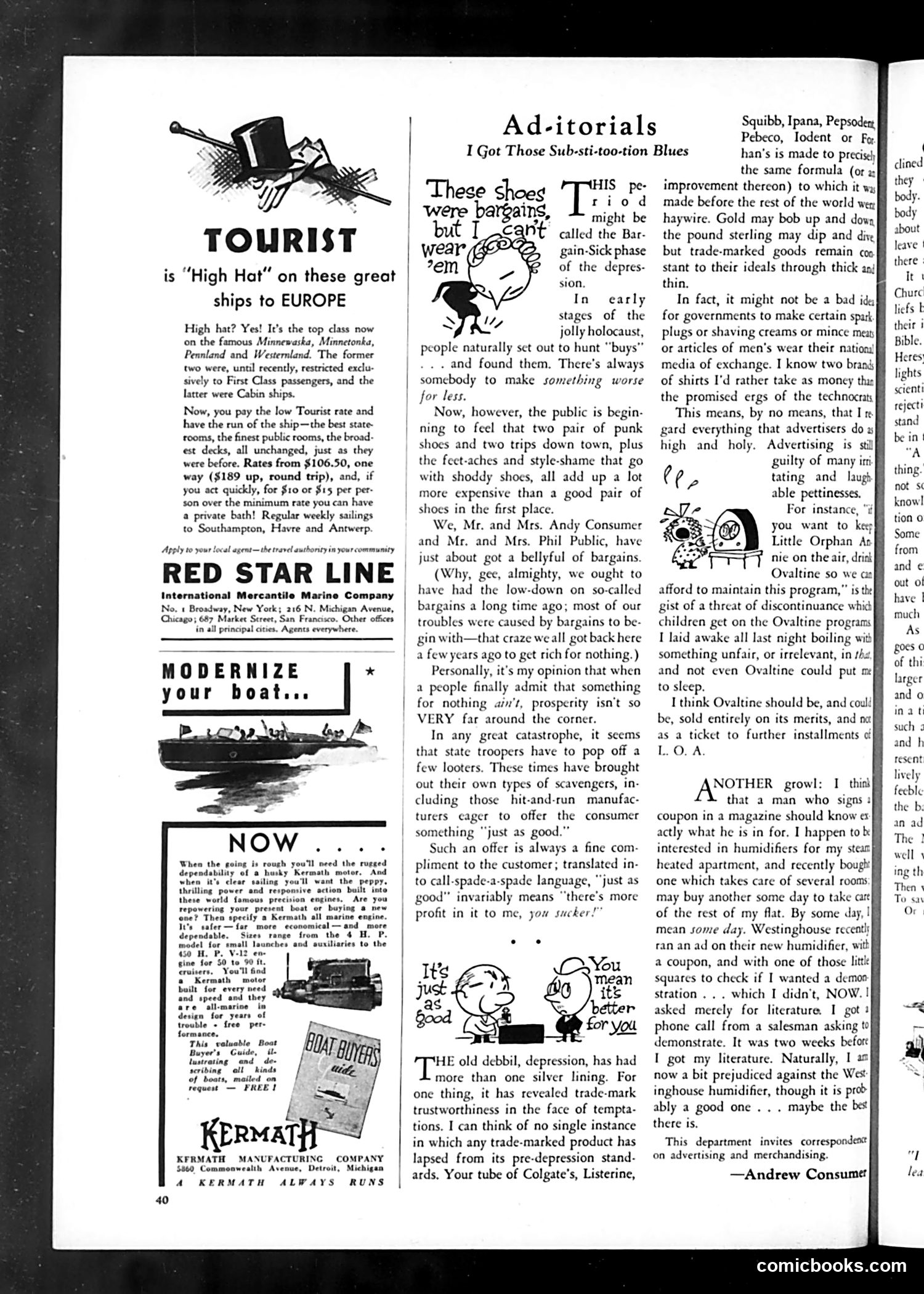
Understanding This Life Magazine Page This page combines advertisements with editorial commentary on Depression-era consumer culture. The Main Editorial ("I Got Those Sub-sti-too-tion Blues") critiques the "bargain craze" that peaked during the Great Depression. The author argues that consumers initially hunted for cheap goods but are now realizing that inferior products (illustrated by the cheap shoes cartoon) cost more in the long run due to wear and replacement. The piece sarcastically mocks manufacturers offering "just as good" knockoffs, translating their pitch as "there's more profit in it to me, you sucker!" The contrasting argument praises brand-name products (Colgate's, Listerine, Ipana, etc.), claiming they maintained pre-Depression quality standards despite economic pressures—implying they're trustworthy alternatives to cheap substitutes. The advertisements (Red Star Line ships, Kermath boat motors) attempt to sell luxury and modernization, creating ironic tension with the editorial's Depression-focused message about thrift. The overall theme: consumers should abandon the bargain mentality and recognize that quality, brand-name products offer genuine value despite higher initial cost.
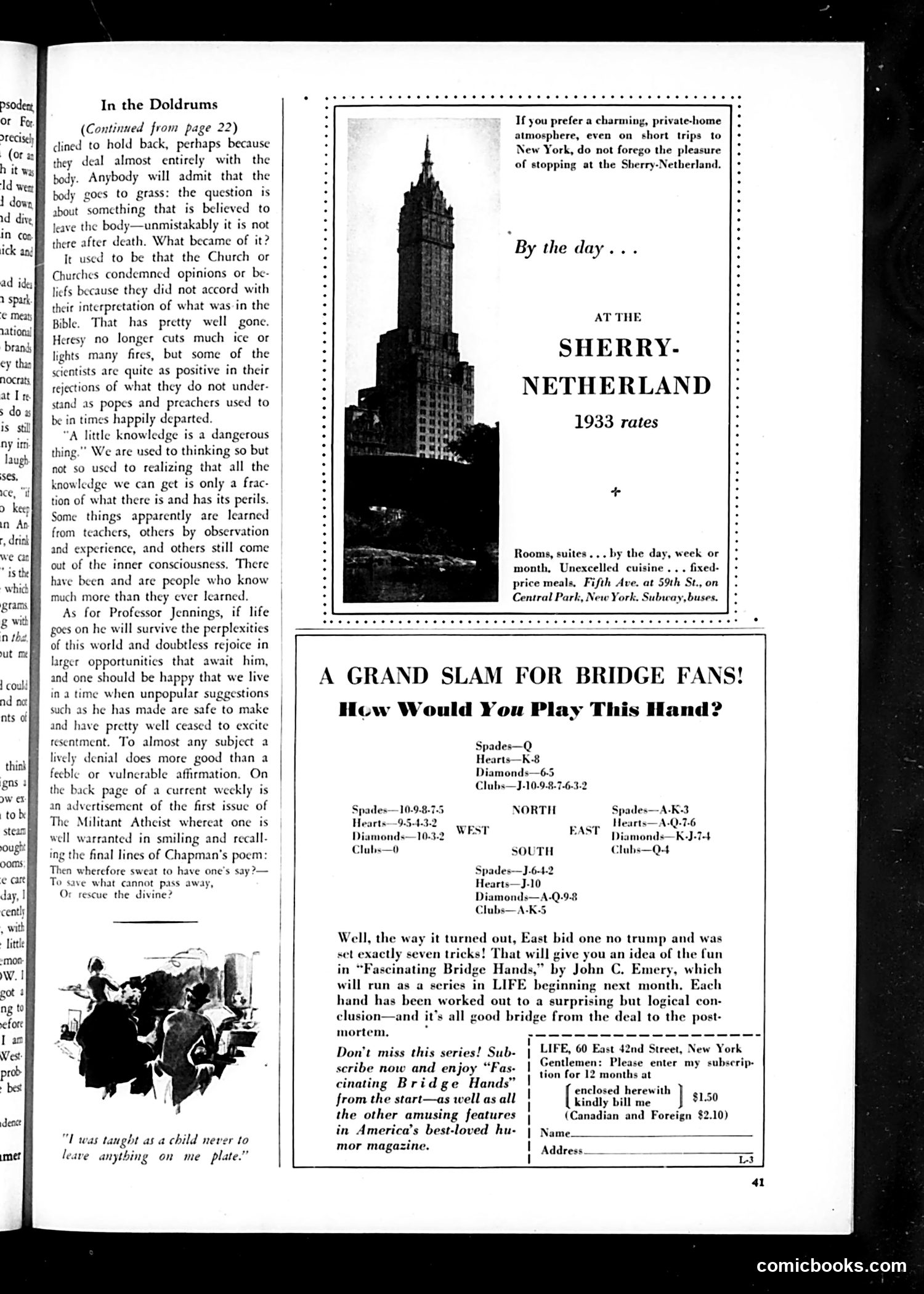
Analysis of Life Magazine Page (1933) This page combines editorial content with advertisements and a bridge column. The main essay, "In the Doldrums," discusses Professor Jennings and debates about the soul/afterlife—reflecting 1930s intellectual discourse about science versus religious belief. The author argues that unpopular ideas deserve open debate in a free society. The prominent content is a bridge puzzle and advertisement for the Sherry-Netherland Hotel in New York, promoting its luxury accommodations. Below that is an advertisement for a new "Fascinating Bridge Hands" column launching in *Life* magazine. The small cartoon at bottom left (captioned "I was taught as a child never to leave anything on me plate") appears to be a humorous domestic scene, likely commenting on Depression-era frugality or waste. The page is primarily advertising-driven rather than satirical. Its main purpose is promoting the hotel, the bridge column series, and *Life* magazine subscriptions to affluent readers interested in bridge games.
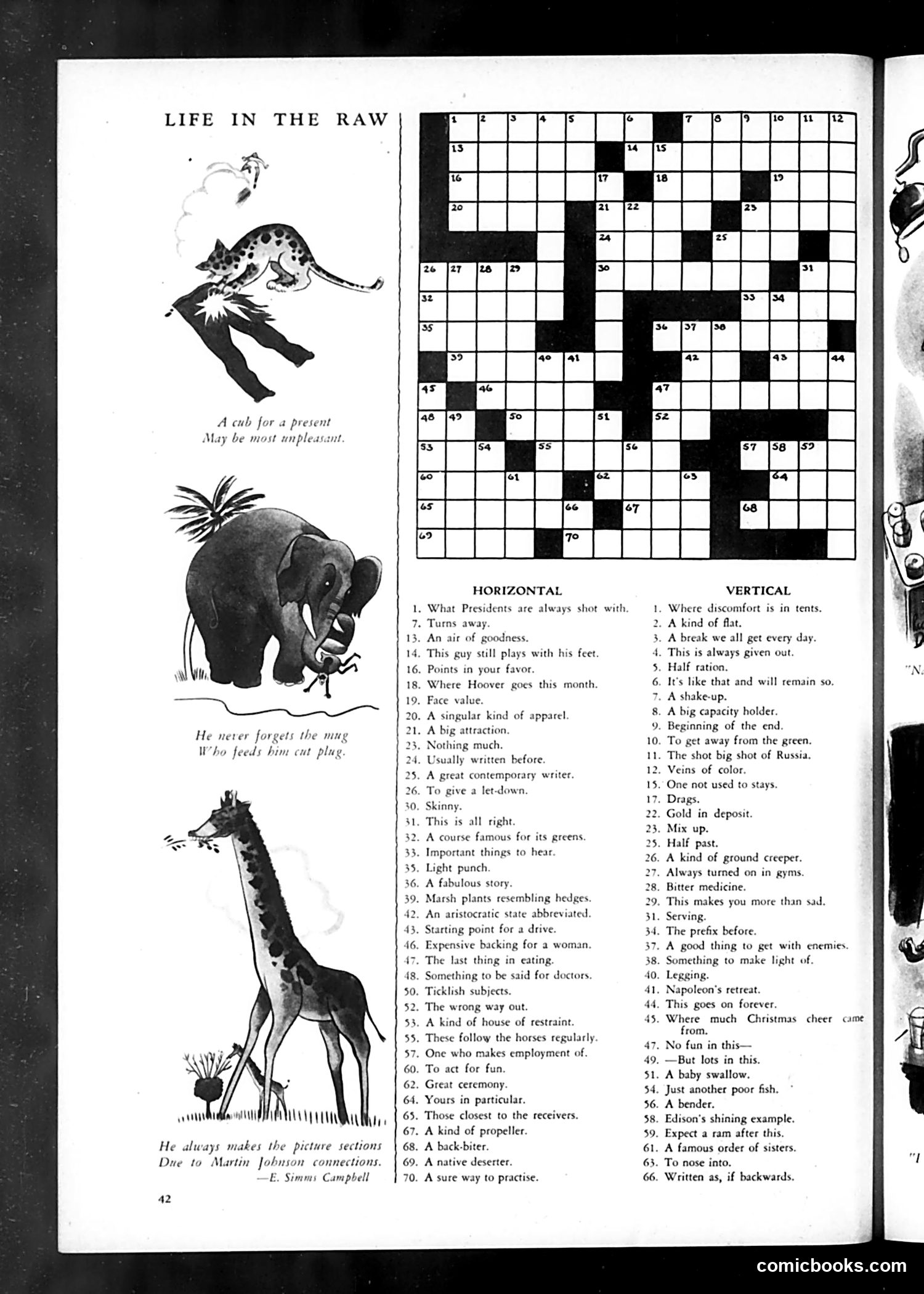
Life in the Raw: Political Cartoon Analysis This page features three animal cartoons by E. Simms Campbell satirizing prominent figures through "Life in the Raw"—depicting them in their natural, unguarded states. The leopard represents a cub (young person) receiving gifts—likely satirizing spoiled offspring of the wealthy or powerful. The elephant references someone who "never forgets the mug / Who feeds him cut plug" (tobacco)—suggesting political patronage and favor-trading, a common corruption target. The giraffe alludes to "Martin Johnson connections"—Martin Johnson was a famous explorer/filmmaker of the 1920s-30s. The joke appears to be that this figure's prominent position in "picture sections" (media coverage) derives from celebrity connections rather than merit. The accompanying crossword puzzle is typical Life magazine content, blending humor with wordplay. Overall, these cartoons mock political corruption, nepotism, and unearned prominence in American society during what appears to be the Hoover era (referenced in clue 18).
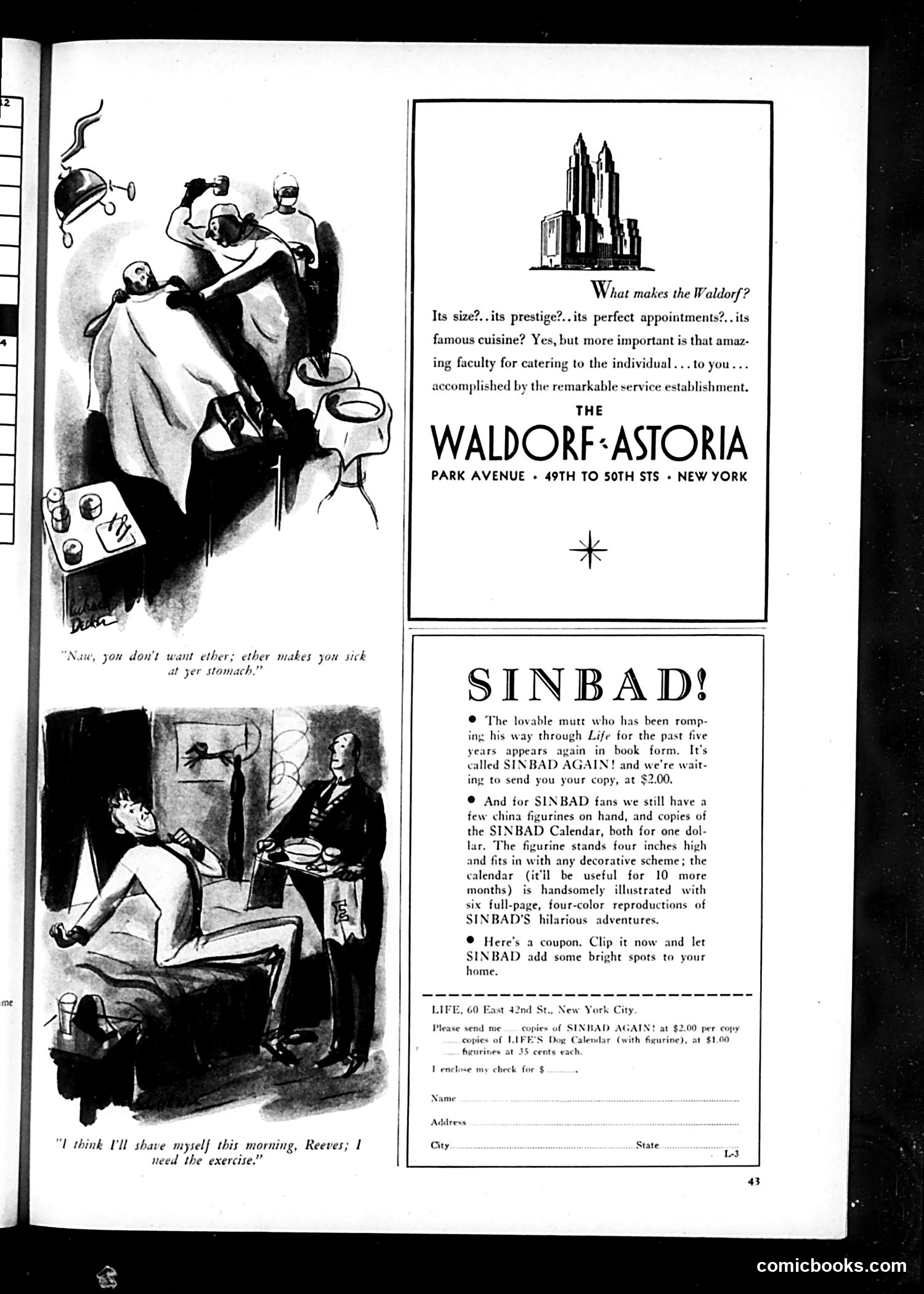
Analysis for Modern Readers This page mixes humor cartoons with advertising. The two cartoons on the left use servant-master dialogue to create period comedy: one depicts a valet advising against ether (a dangerous anesthetic/recreational drug), the other shows a gentleman claiming he'll shave himself for "exercise"—implying his servant normally does it, satirizing wealthy idleness. The right side advertises the Waldorf Astoria hotel, emphasizing its luxury service catering to individual needs, and promotes Sinbad merchandise: a book, calendar, and porcelain figurine based on a recurring dog character that had appeared in Life magazine for five years. The Sinbad ads target fans wanting collectibles and gift items. The overall page reflects 1920s-30s class humor and consumer culture, where wealthy people's trivial concerns and servants' practical wisdom provided satire.
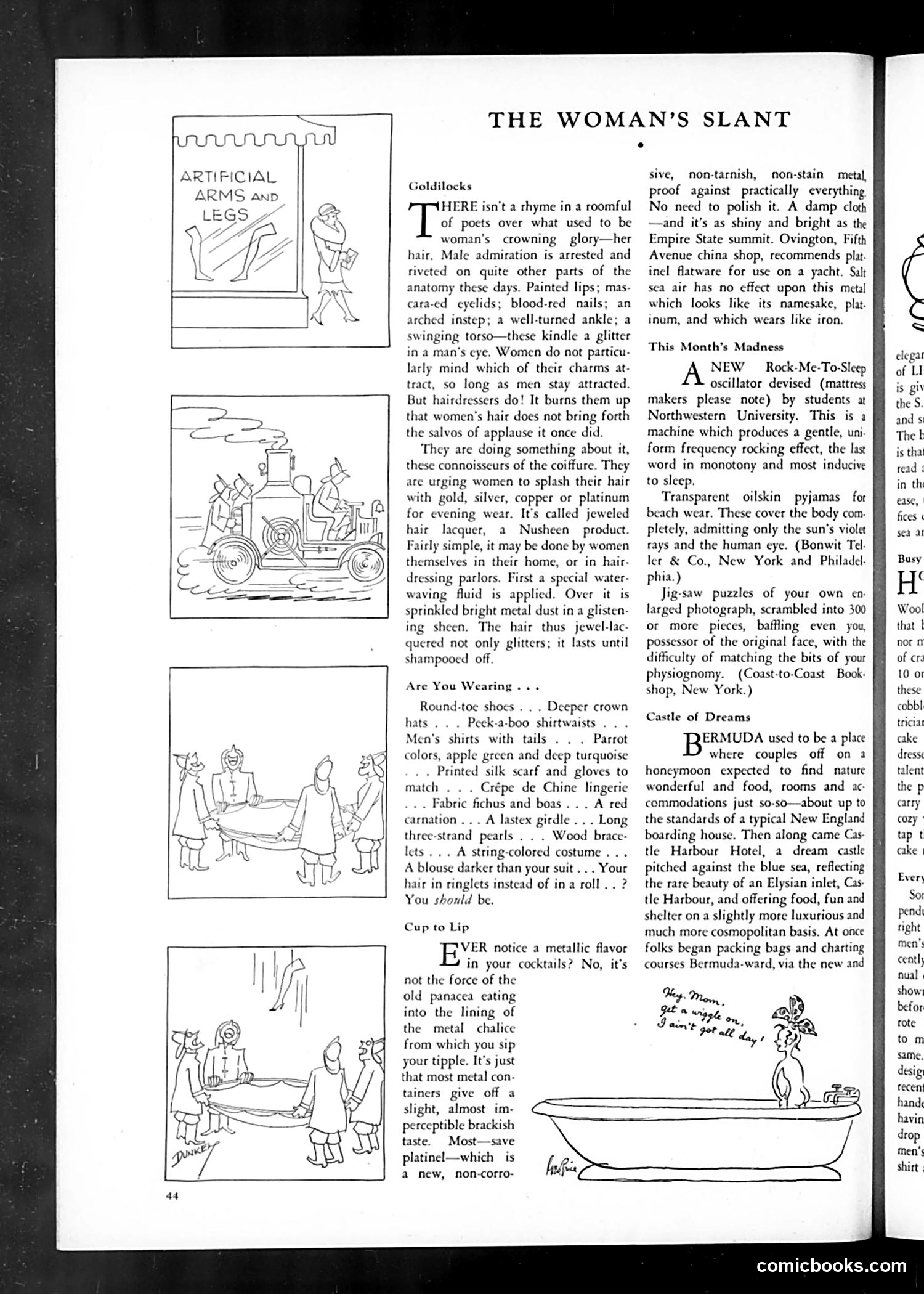
Analysis of "The Woman's Slant" Page This page from *Life* magazine satirizes 1920s women's fashion and consumer culture through several cartoons and product commentary. The "Goldilocks" section mocks hairdressers' frustration that women now value other physical attributes (painted lips, arched insteps, "swinging torso") over elaborate hair styling. The industry responds by marketing "jeweled hair lacquer"—metal dust sprinkled on hair—a desperate attempt to restore hair's status as a beauty focal point. The fashion checklist ("Are You Wearing...") humorously catalogs contemporary trends: round-toe shoes, parrot colors, men's shirt styling, and pearl necklaces—capturing the era's eclectic, androgynous aesthetic mixing masculine and feminine elements. The remaining sections satirize absurd novelty products: metal cocktail cups creating metallic taste, a "Rock-Me-To-Sleep" mechanical mattress oscillator, and jigsaw puzzles made from customers' own enlarged photographs. Throughout, the satire targets modern consumer culture's relentless marketing of unnecessary, often ridiculous products to women, treating fashion and gadgetry as solutions to everyday life.
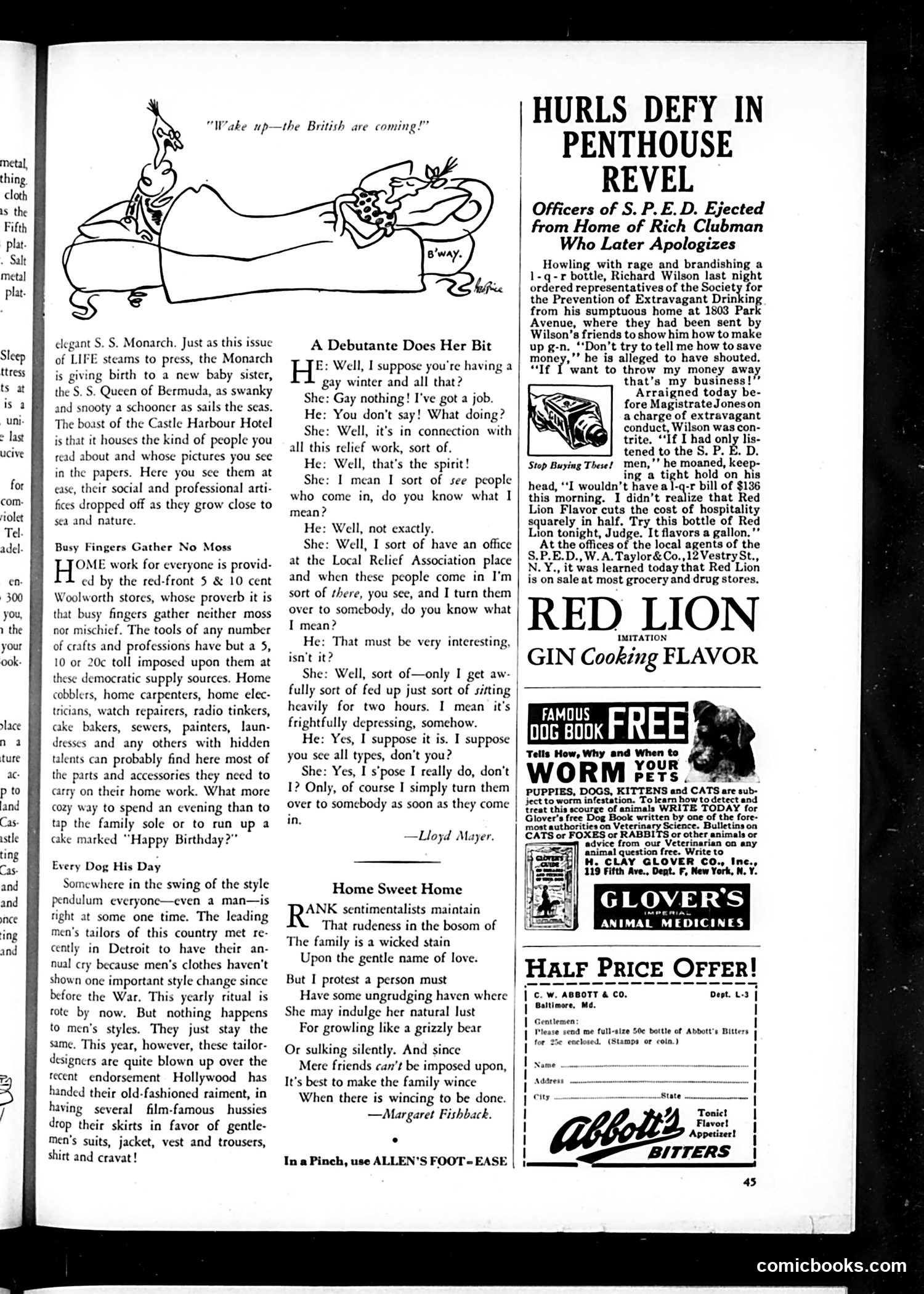
Analysis of Life Magazine Page Content The top cartoon depicts a humorous "wake-up call" to British naval pride: as one sleeping British sailor reclines, another frantically warns "Wake up—the British are coming!"—a playful inversion of the famous American Revolutionary War cry. The main headline reports on Richard Wilson, a wealthy Park Avenue clubman who physically ejected S.P.E.D. (Society for the Prevention of Extravagant Drinking) officers from his home during a revel. Wilson, apparently intoxicated and brandishing a liquor bottle, forcibly removed them—though he later apologized. The article highlights the irony of anti-drinking advocates being violently expelled by a drunk socialite from his penthouse. The page also contains lighter humor pieces: a dialogue satirizing a debutante performing perfunctory "relief work," and poems about men's fashion and family dynamics. This reflects 1930s Prohibition-era anxieties about drinking enforcement and wealthy elites' defiance of temperance movements.
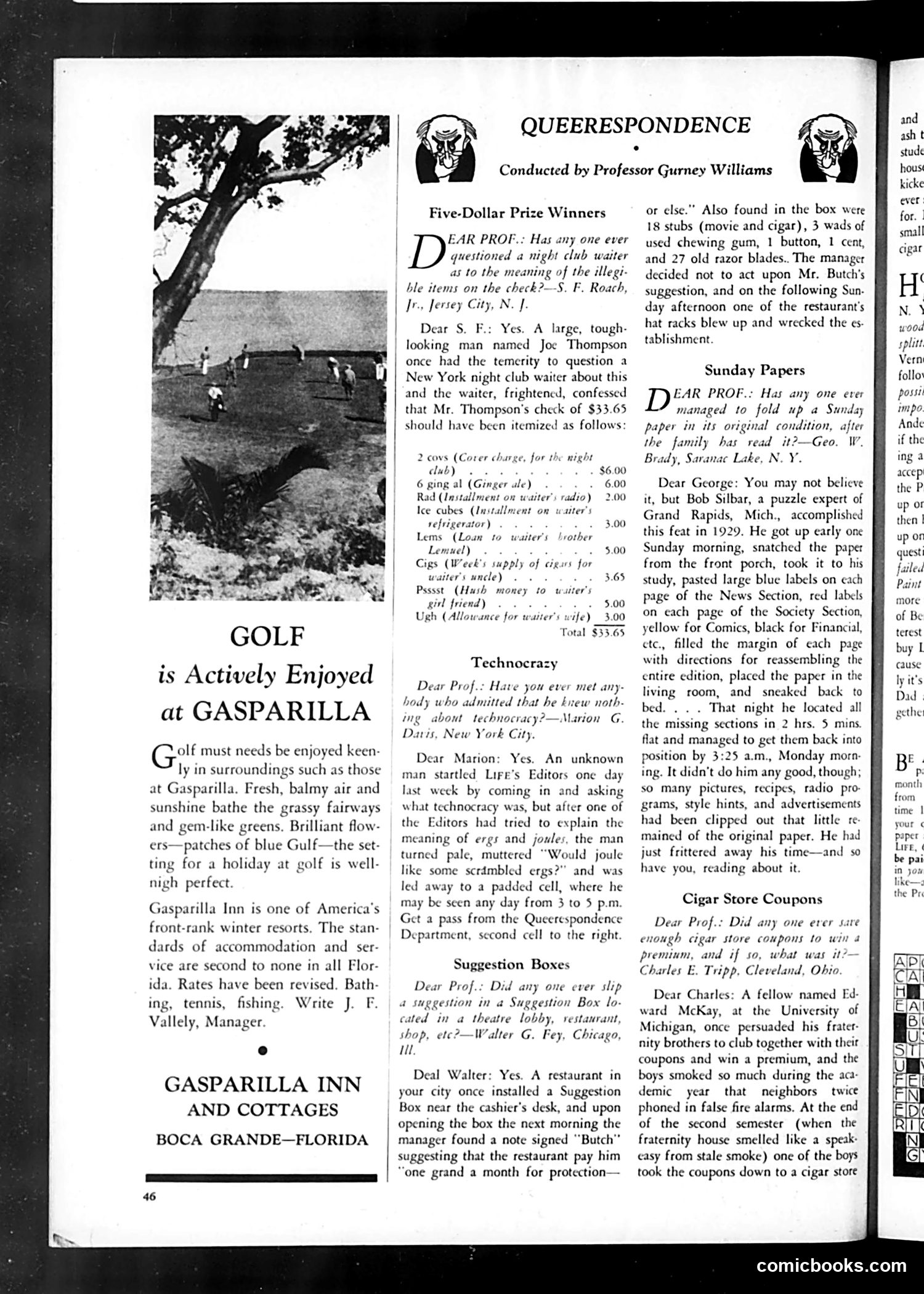
Life Magazine Page Analysis This page contains a golf resort advertisement and a humor advice column titled "Queerespondence," conducted by Professor Gurney Williams. The column's satire targets 1930s urban absurdities. The first response mocks nightclub culture and inflated bills—a waiter itemizes a $33.65 check with invented charges like "Hush money to waiter's girl friend" and "Allowance for waiter's wife," satirizing the era's speakeasy culture and tipping corruption. The "Technocrazy" segment ridicules contemporary fascination with technocracy (a movement advocating rule by technical experts), suggesting the concept is incomprehensibly jargon-filled. The "Suggestion Boxes" item humorously depicts organized crime—a gangster demands protection money, leaving a wrecked hat rack. This reflects 1930s concerns about racketeering and extortion. Finally, the Sunday newspaper anecdote jokes about the impossibility of refolding newspapers in their original state—a relatable domestic frustration. The humor is light, observational satire on modern life's minor annoyances and contemporary social concerns.
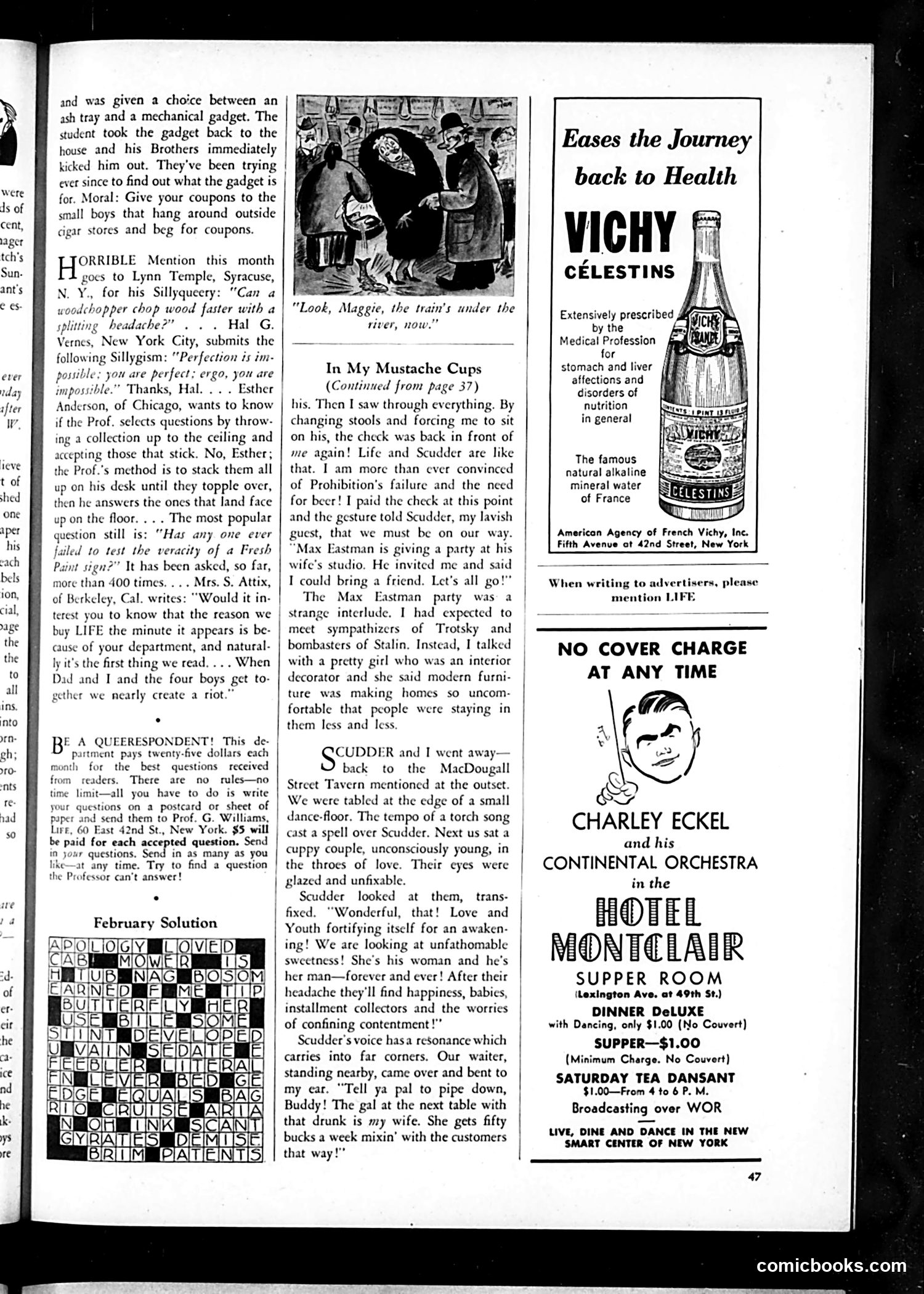
Analysis of This Life Magazine Page This page contains mostly advertising and reader submissions rather than political cartoons requiring historical context. The visible content includes: 1. "In My Mustache Cups" - A serialized fiction story (continued from page 37) depicting a prohibition-era tavern scene with characters named Scudder and Max Eastman, discussing love, youth, and beer nostalgia. 2. Reader humor submissions - The "Queerespondent" section publishing readers' jokes and wordplay questions, offering $25 payment for submissions. 3. Advertisements - Including Vichy Celestins mineral water and the Hotel Montclair nightclub. 4. A crossword puzzle labeled "February Solution." The single cartoon visible shows a couple on what appears to be a subway, with one saying "Look, Maggie, the train's under the river, now"—a simple visual gag about NYC infrastructure. The page is primarily a reader-participation magazine section rather than satirical political commentary.
Analysis of Life Magazine Page This page is primarily advertisements and reader mail, not satirical cartoons. The key content is a letter-to-editor debate about *Life*'s February cover depicting France. A French reader (Julien Ortiz) protests *Life*'s cover image: France shown as a red-haired woman standing on gold, refusing to share wealth while "sending kisses." He argues this perpetuates false stereotypes damaging Franco-American relations. The editor's response acknowledges *Life* has supported French War Orphans ($400,000+) and received French government decoration, but defends the magazine's role as a mirror of current events—implying the caricature reflects actual French economic/diplomatic behavior of the early 1930s. The surrounding material includes advertisements (A.1. Sauce, The Beverly hotel, Dr. Scholls corn pads) and a separate reader note about 1932 lynching statistics, indicating this is a general-interest magazine page mixing commerce, humor, and civic discussion.