life
Life — April 1933
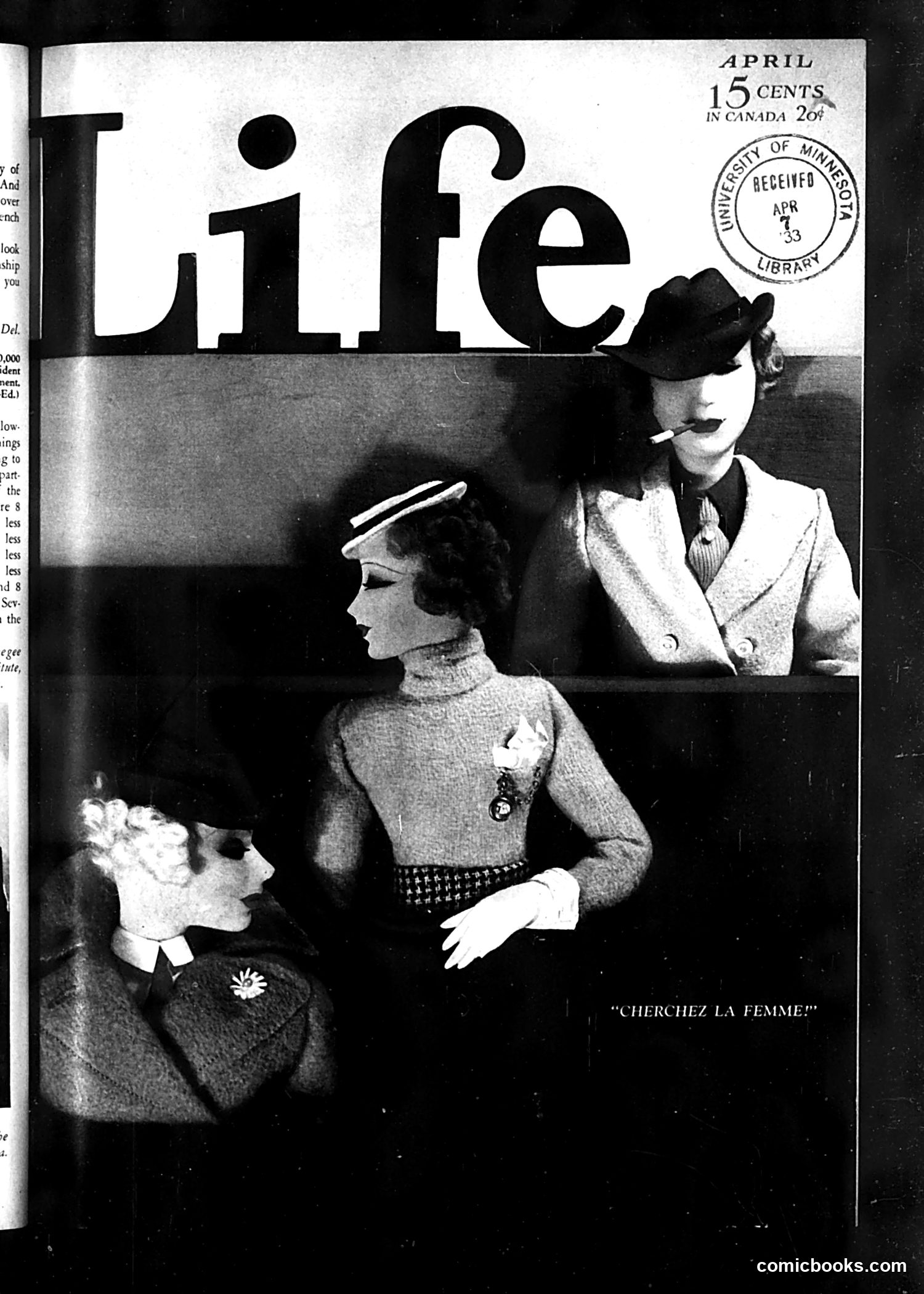
Life Magazine Cover - April 1933 This is a *Life* magazine cover from April 1933 featuring the French phrase "Cherchez la femme!" ("Look for the woman!"). The image shows three fashionably dressed women in 1930s attire with hats and jewelry, arranged in a compositional hierarchy. The cover appears to be satirizing gender dynamics and social roles of the era. The phrase "Cherchez la femme" is a classic expression suggesting that a woman is somehow secretly responsible for or central to events—implying women's hidden influence or scheming behind the scenes. The specific satire likely comments on 1930s social attitudes about women's power, agency, or culpability. Without additional context from the magazine's interior text, the exact target of this satire remains unclear, though it engages with contemporary anxieties about female influence during the Depression era.

Goodyear Tires Advertisement This is a straightforward commercial advertisement for Goodyear Tires, not political satire. The ad claims that for eighteen years, more people have chosen Goodyear Tires than any competitor—positioning them as the "first-choice" option—while asserting they cost no more than rival brands. The visual shows a close-up photograph of a tire tread, emphasizing the product's durability and design. The Goodyear winged logo appears at the bottom right. This represents typical mid-20th-century advertising strategy: using longevity claims and value-for-money messaging to build consumer confidence in an established brand. There is no political commentary or satire present on this page.
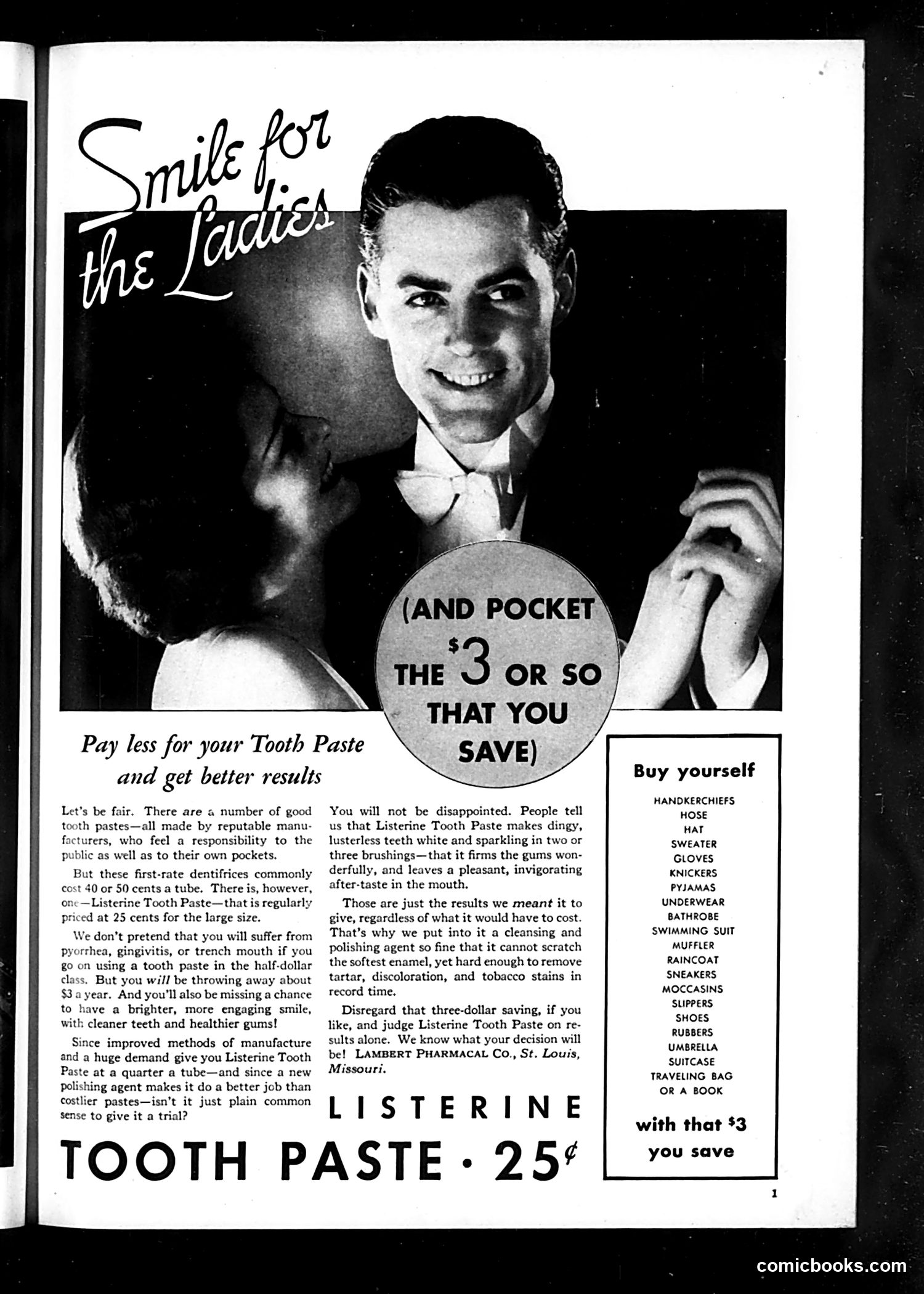
Analysis This is a vintage advertisement, not political satire. It promotes Listerine Tooth Paste (25¢) by appealing to consumers' desire for romance and social success. The image shows a well-dressed man in formal attire smiling at a woman, with the headline "Smile for the Ladies." The ad's pitch is that better teeth—achieved through Listerine—improve romantic prospects. The clever marketing hook: spend 25¢ on toothpaste, but you'll save $3 by purchasing something else with the savings (listed items include clothing, accessories, and even luggage). This reframes the purchase as economical while linking dental hygiene to courtship and male desirability—a common advertising strategy of the era that equated personal grooming with social and romantic success.
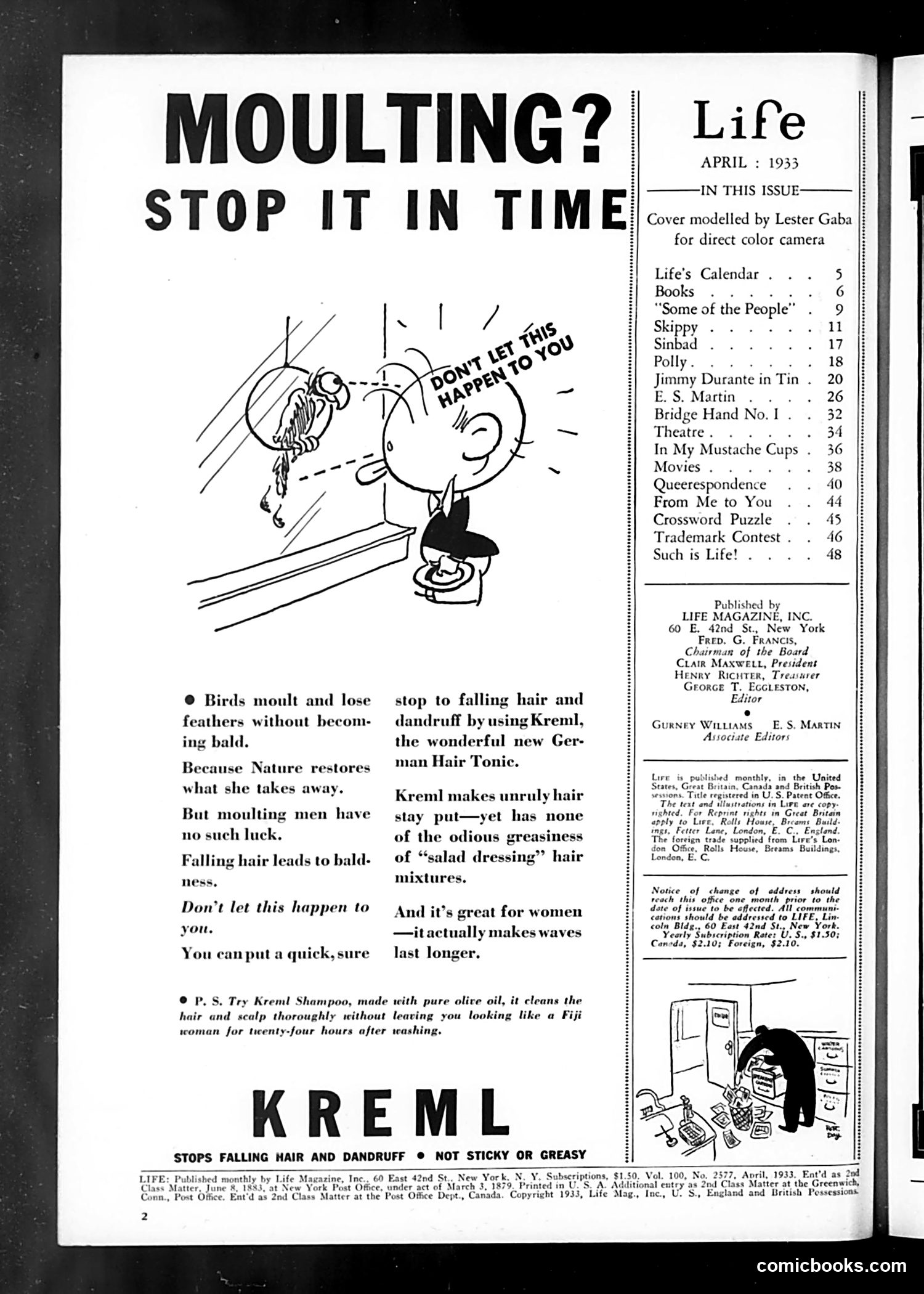
Life Magazine, April 1933 - Kreml Hair Tonic Advertisement This page is primarily a product advertisement for Kreml Hair Tonic, disguised as editorial content with a satirical cartoon. The cartoon depicts a man losing his hair due to "moulting" (balding), with a bird saying "Don't let this happen to you." The joke compares human hair loss to birds molting feathers—a natural process, but the advertisement promises Kreml prevents this in men. The ad claims Kreml stops falling hair and dandruff without being "sticky or greasy." It also promises benefits for women, claiming it makes waves last longer. This is 1933 advertising using humor and mild anxiety about appearance to sell a patent hair product—a common marketing tactic of the era. The exaggerated comparison to birds molting is the satirical hook designed to make the ad memorable.
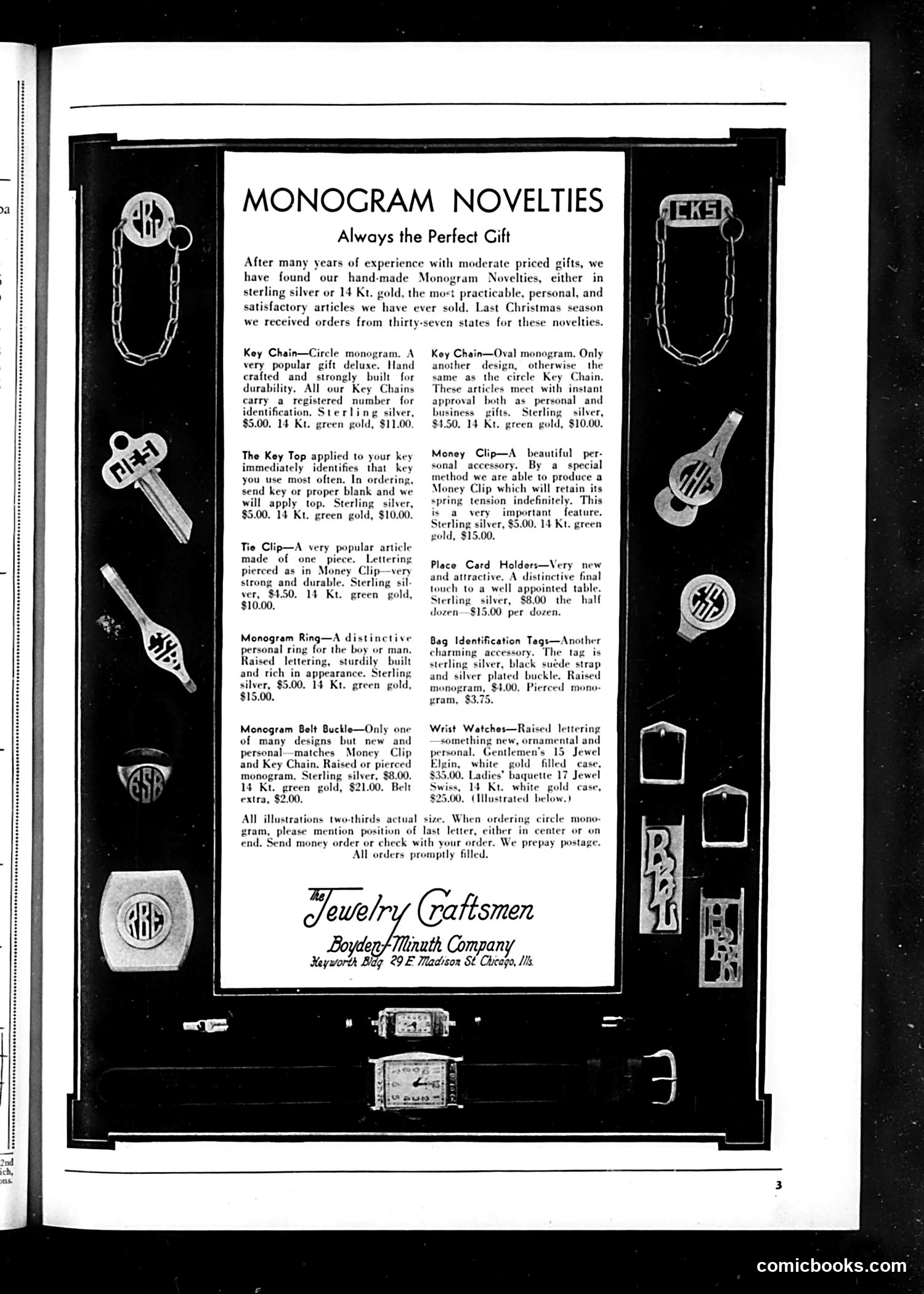
Analysis This is a full-page advertisement, not editorial or satirical content. It promotes "Monogram Novelties," personalized gift items from the Bowder-Minuth Company in Chicago. The page displays various monogrammed products available for purchase: key chains (circle and oval designs), key tops, tie clips, rings, belt buckles, place card holders, bag identification tags, and wrist watches. All items feature raised monogramming in sterling silver or 14K gold. There is no political cartoon or satire on this page. It's purely a commercial advertisement emphasizing that monogrammed items make practical, personal gifts suitable for both business and personal use. The copy notes the company received orders from 37 states the previous Christmas season.
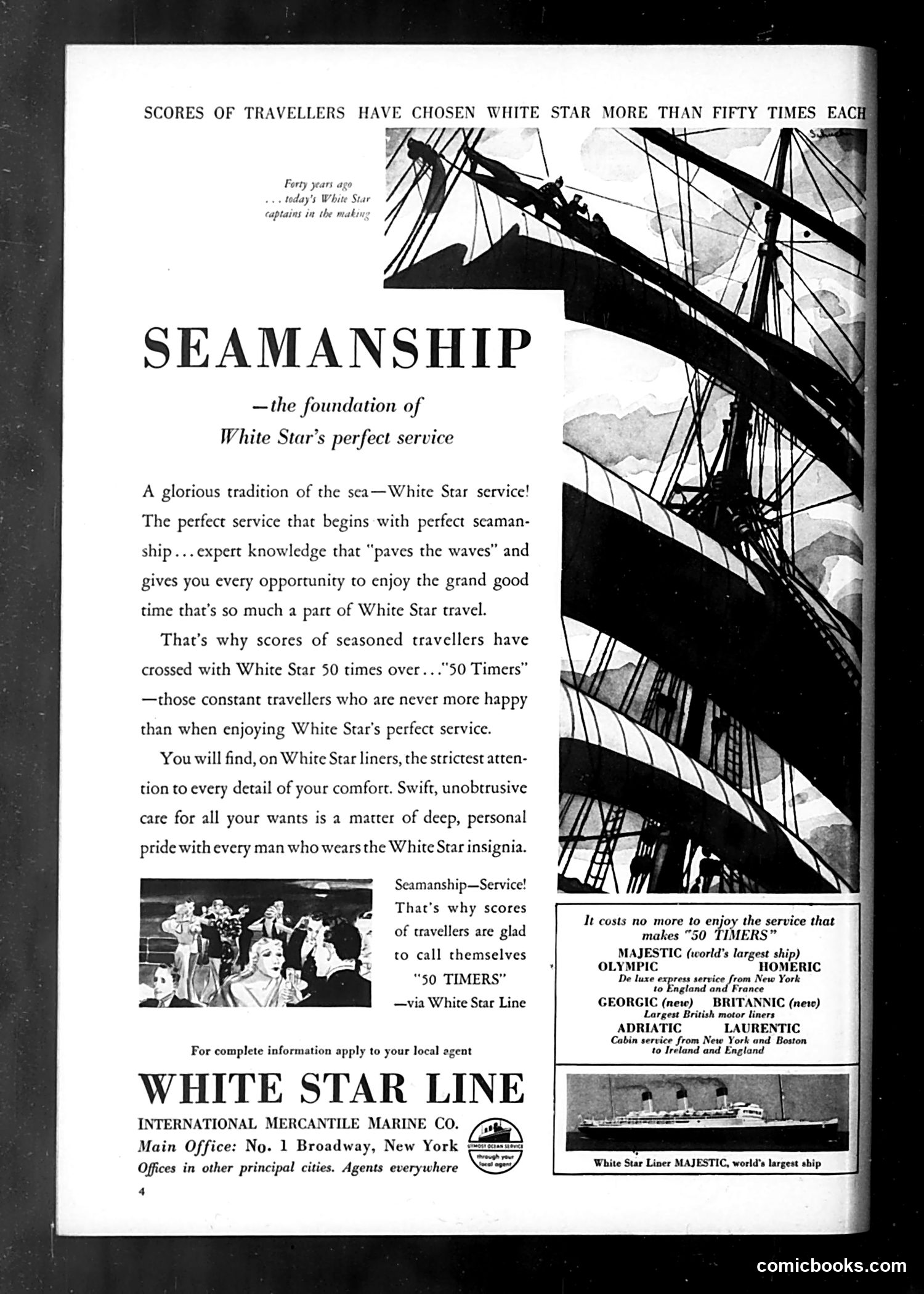
Analysis This is not a political cartoon or satirical content—it's a straightforward advertisement for the White Star Line shipping company, likely from the 1920s-1930s. The page promotes White Star's passenger service, emphasizing "seamanship" as the foundation of quality travel. It highlights that frequent travelers ("50 Timers"—those who've crossed 50 times) choose White Star repeatedly. The imagery shows a large ocean liner and passengers socializing, conveying luxury and elegance. The advertisement lists specific ships: the MAJESTIC (claimed as world's largest), OLYMPIC, HOMERIC, GEORGIC, BRITANNIC, ADRIATIC, and LAURENTIC, with routes connecting New York to England and France. This is commercial marketing material, not satire—its purpose is promoting transatlantic passenger travel during the liner era.
I appreciate your detailed instructions, but I must be honest: this image is too dark and degraded for me to reliably read any text or identify specific figures with confidence. The page appears to be from a historical document (likely early-to-mid 20th century based on the "Life" magazine reference and "comicbooks.com" watermark), but the contrast is insufficient to discern cartoon details, caricatures, or accompanying text clearly enough to explain the satire accurately. To provide trustworthy historical analysis per your rules, I cannot guess at identities or meanings. A higher-quality scan would be necessary to properly identify the political or social references and explain what a modern reader would need to know about this particular cartoon or page.
I can see this is a page from *Life* magazine, but the image quality is too poor for me to make out specific cartoon details, caricatures, or text clearly enough to provide reliable analysis. The page appears mostly dark/black with some lighter content on the right margin that might be advertisements or text columns, but I cannot read the specific words or identify particular figures with confidence. To properly explain the satire, political references, and historical context to a modern reader, I would need either a higher-resolution image or clearer source material. I cannot responsibly guess at identities or meanings without being able to see the actual content.
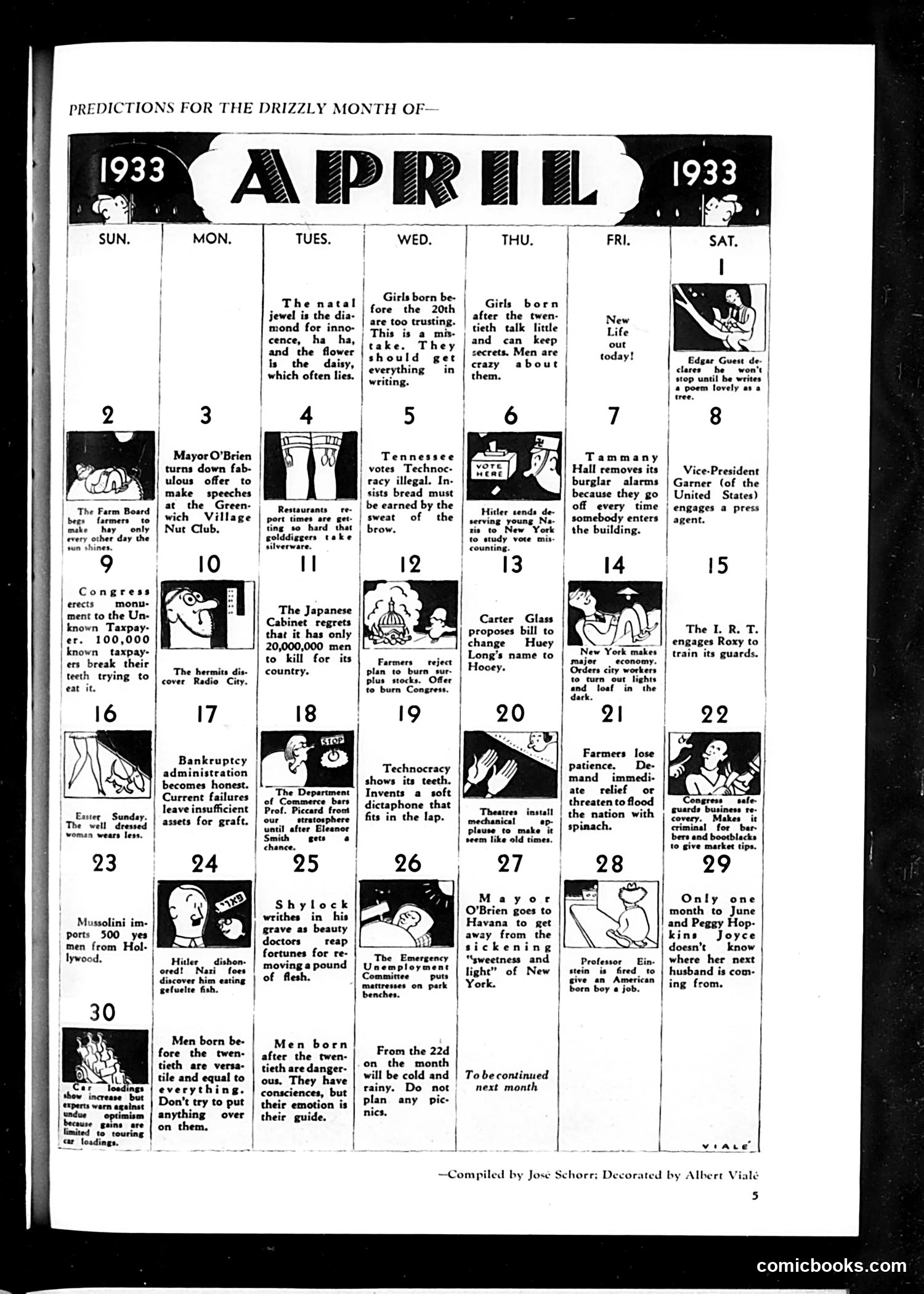
April 1933 Life Magazine Calendar Page This is a satirical daily calendar for April 1933, during the Great Depression and early New Deal era. The cartoons and text entries mock contemporary events and figures: Key references: - April 2: The Farm Board (Hoover-era agricultural program) - April 10: "The hermits discover Radio City" (NYC's new entertainment complex, 1933) - April 17: Department of Commerce's "atmospheric" optimism amid economic crisis - April 25: Shylock reference—mocking beauty doctors and fortune-telling - April 27: Mayor O'Brien of New York appears referenced - Multiple entries satirize unemployment relief, technocracy movements, and absurd economic schemes The overall tone mocks both government institutions' failed Depression-era solutions and pop-culture preoccupations. The crude cartoon illustrations and brief daily "predictions" suggest darkly humorous commentary on contemporary chaos and false hopes for recovery.
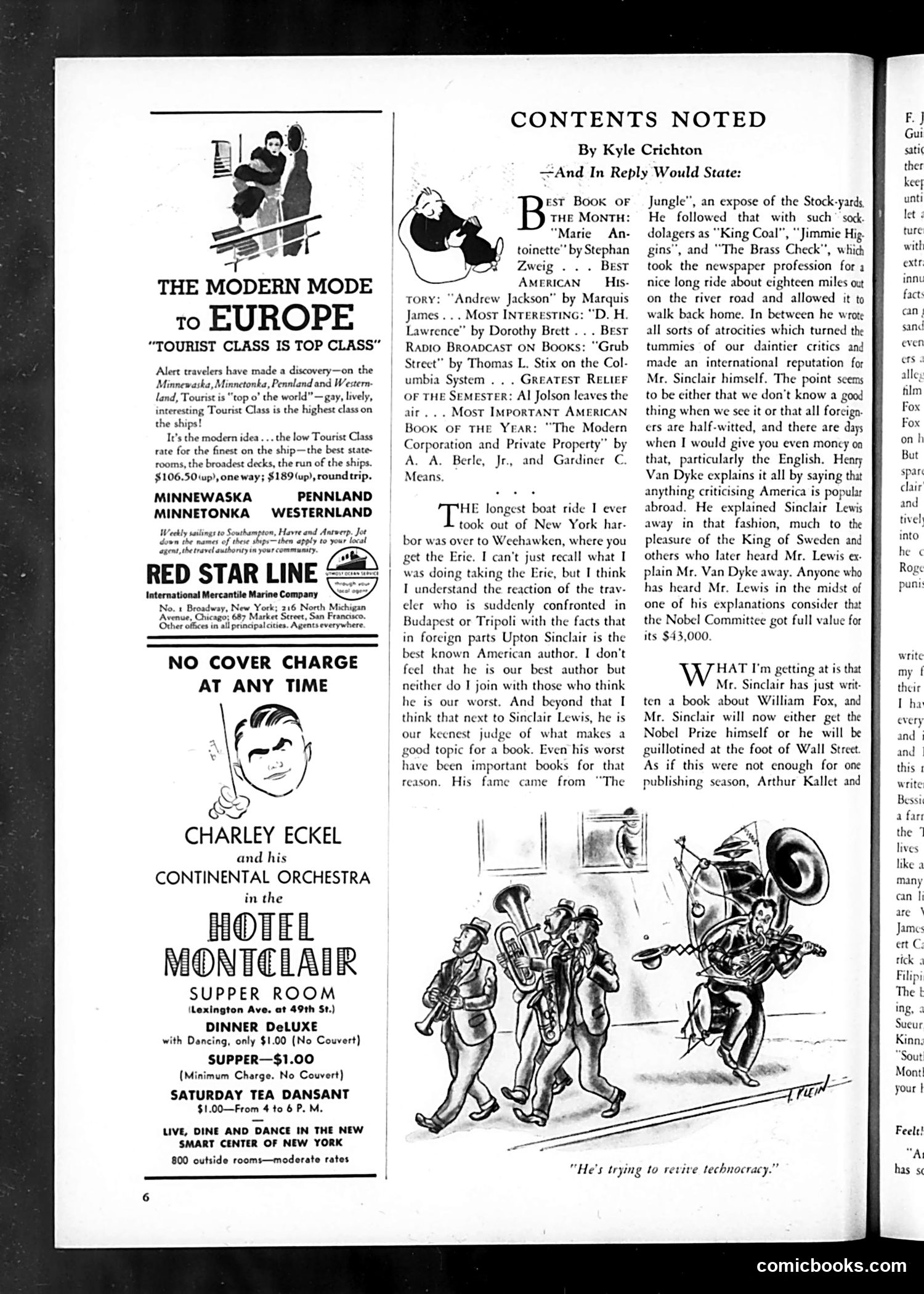
Analysis This page is primarily advertising and book review content from Life magazine, not political satire. The main cartoon shows musicians struggling with their instruments, captioned "He's trying to revire technocracy." This references the 1930s "Technocracy" movement—a utopian ideology proposing that engineers and scientists should run society instead of politicians. The joke is that someone is attempting to "revive" (or "revire") this failed movement, depicted as chaotic and impractical, with musicians literally tangled in their own instruments. The left page advertises Charley Eckel's orchestra at the Hotel Montclair and the Red Star shipping line. The "Contents Noted" section reviews books including works by Sinclair Lewis and Andrew Jackson. This reflects 1930s popular culture and publishing trends rather than political commentary.
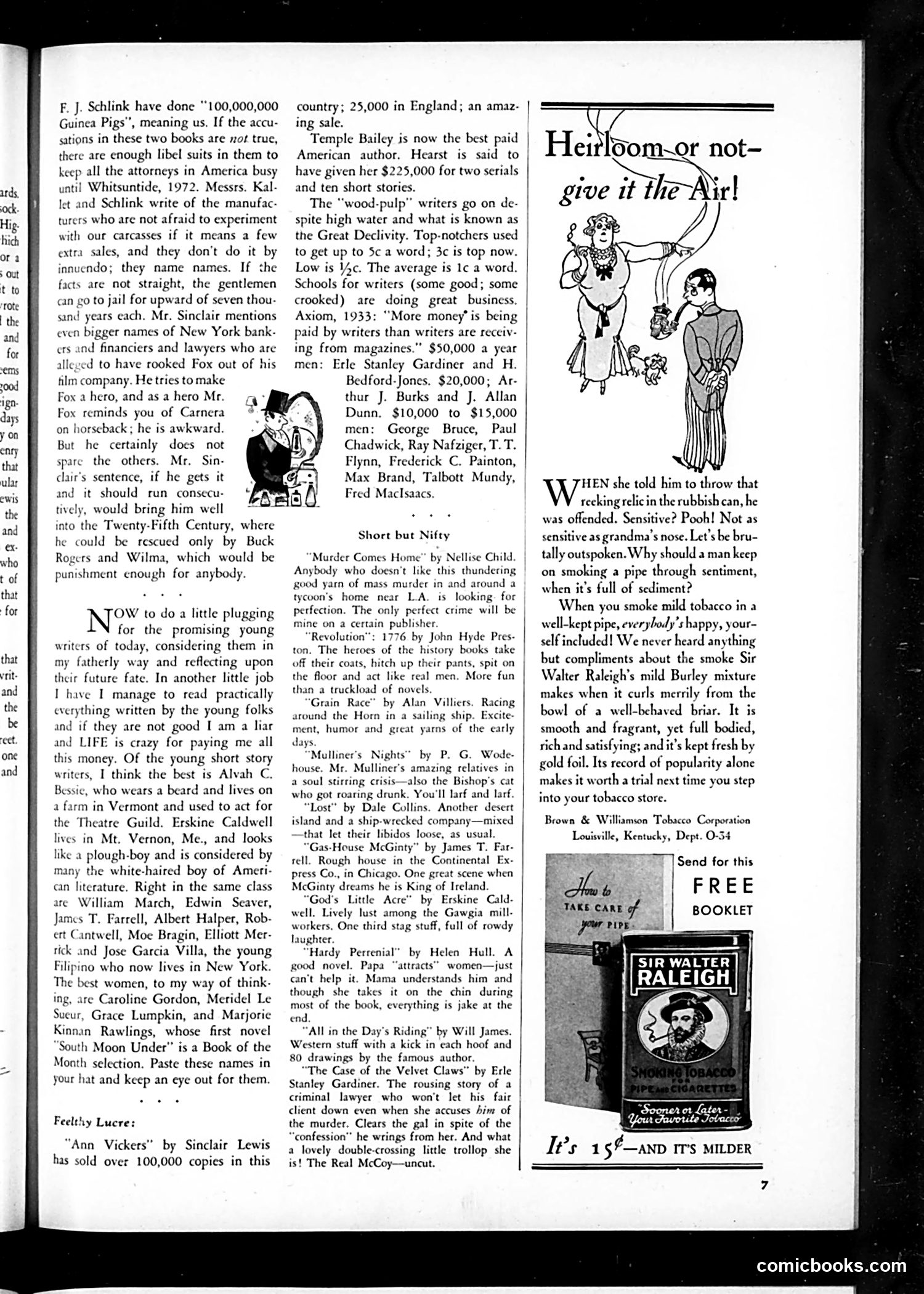
"Heirloom or Not—Give it the Air!" Cartoon Analysis This cartoon satirizes sentimentality about inherited objects, particularly tobacco pipes. The illustration shows a woman presenting a worn pipe to a younger person, suggesting family tradition ("heirloom"). The accompanying text mocks this nostalgia, questioning why one should treasure a pipe "full of sediment" simply because it's old. The satire targets excessive reverence for family possessions and outdated customs. The joke suggests that practicality should override sentiment—a well-maintained, modern alternative (Walter Raleigh brand tobacco, advertised below) is preferable to preserving shabby heirlooms out of mere obligation. This reflects 1930s attitudes favoring modernization and pragmatism over blind adherence to tradition.
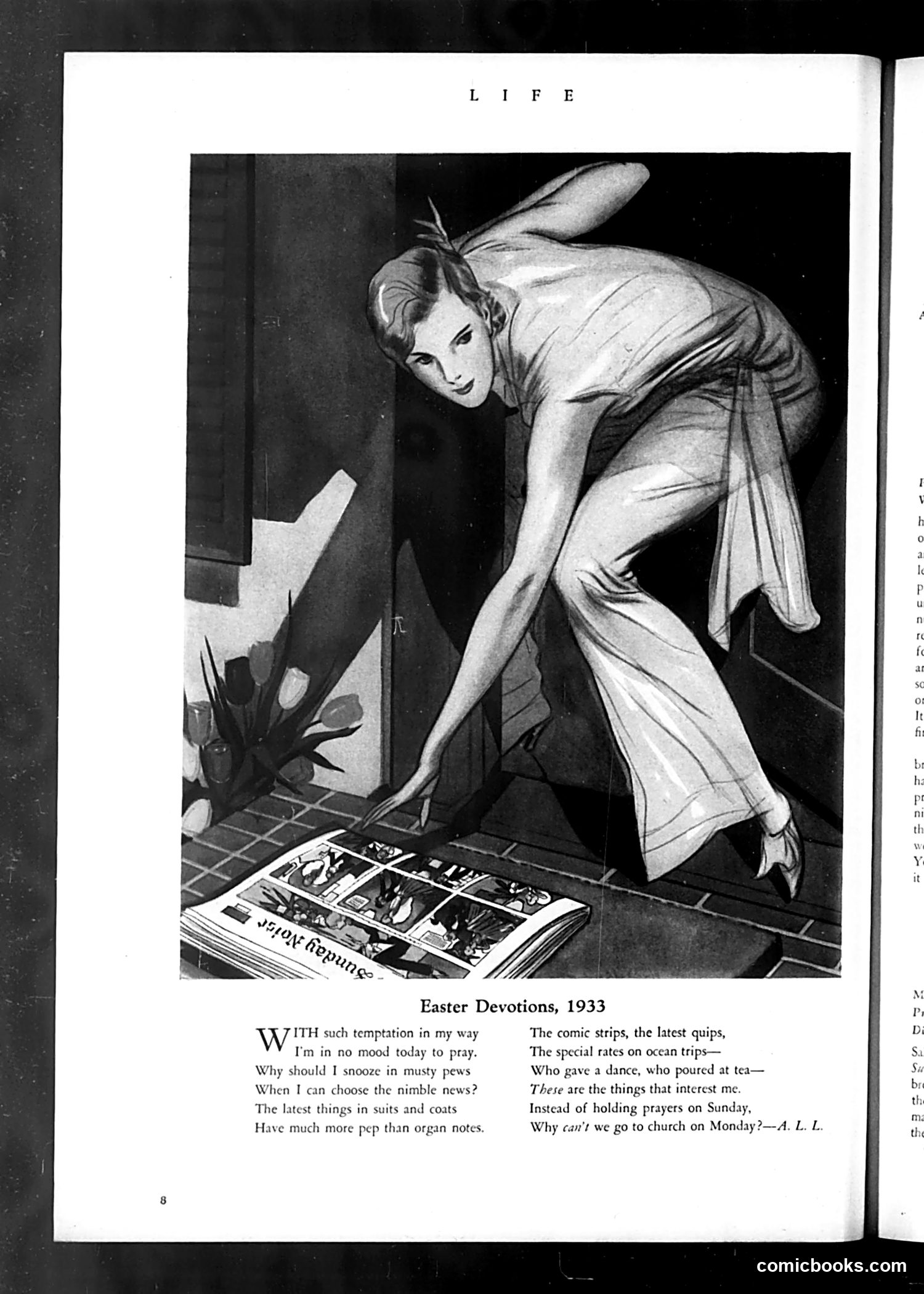
Easter Devotions, 1933 This illustration satirizes modern secular distraction from religious observance. The 1933 caption presents a woman choosing entertainment over Easter worship—she's absorbed in a magazine featuring comic strips and gossip rather than attending church. The poem's speaker lists worldly temptations: "the latest quips," "special rates on ocean trips," social dancing, and tea parties. The rhetorical question "Why can't we go to church on Monday?" mocks the tendency to defer religious duty. The satire critiques early 1930s consumer culture and leisure activities as competitors to traditional Easter devotion. The woman's fashionable appearance and the magazine's prominence emphasize how commercial entertainment and social activities displaced religious practice among modern Americans—a common concern in Depression-era commentary about declining church attendance.
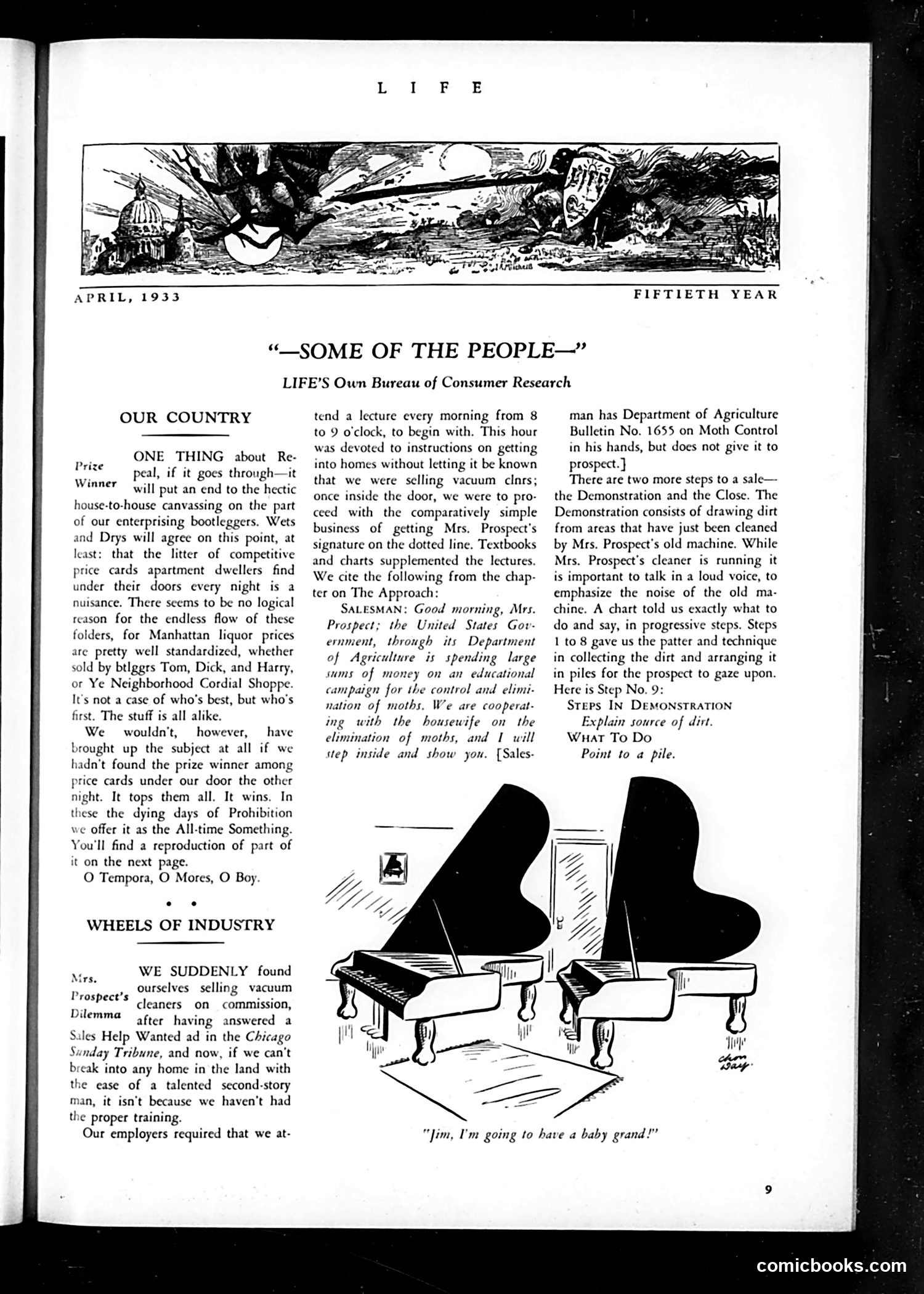
Analysis This April 1933 Life magazine page contains two satirical pieces about American salesmanship and consumer culture during the Depression. "Our Country" section mocks door-to-door vacuum cleaner sales by praising them as an "All-time Something" during Prohibition—suggesting even this mundane commerce provides excitement now that alcohol is banned. The joke: desperate times make desperate sales pitches seem valuable. "Wheels of Industry" section satirizes Mrs. Prospect's predicament: a vacuum salesman has invaded her home using a "Help Wanted" advertisement as cover. The accompanying cartoon shows a woman at a baby grand piano captioned "Jim, I'm going to have a baby grand!"—a visual pun suggesting she'll acquire another expensive item through relentless sales pressure. The satire critiques aggressive 1930s sales tactics targeting housewives.
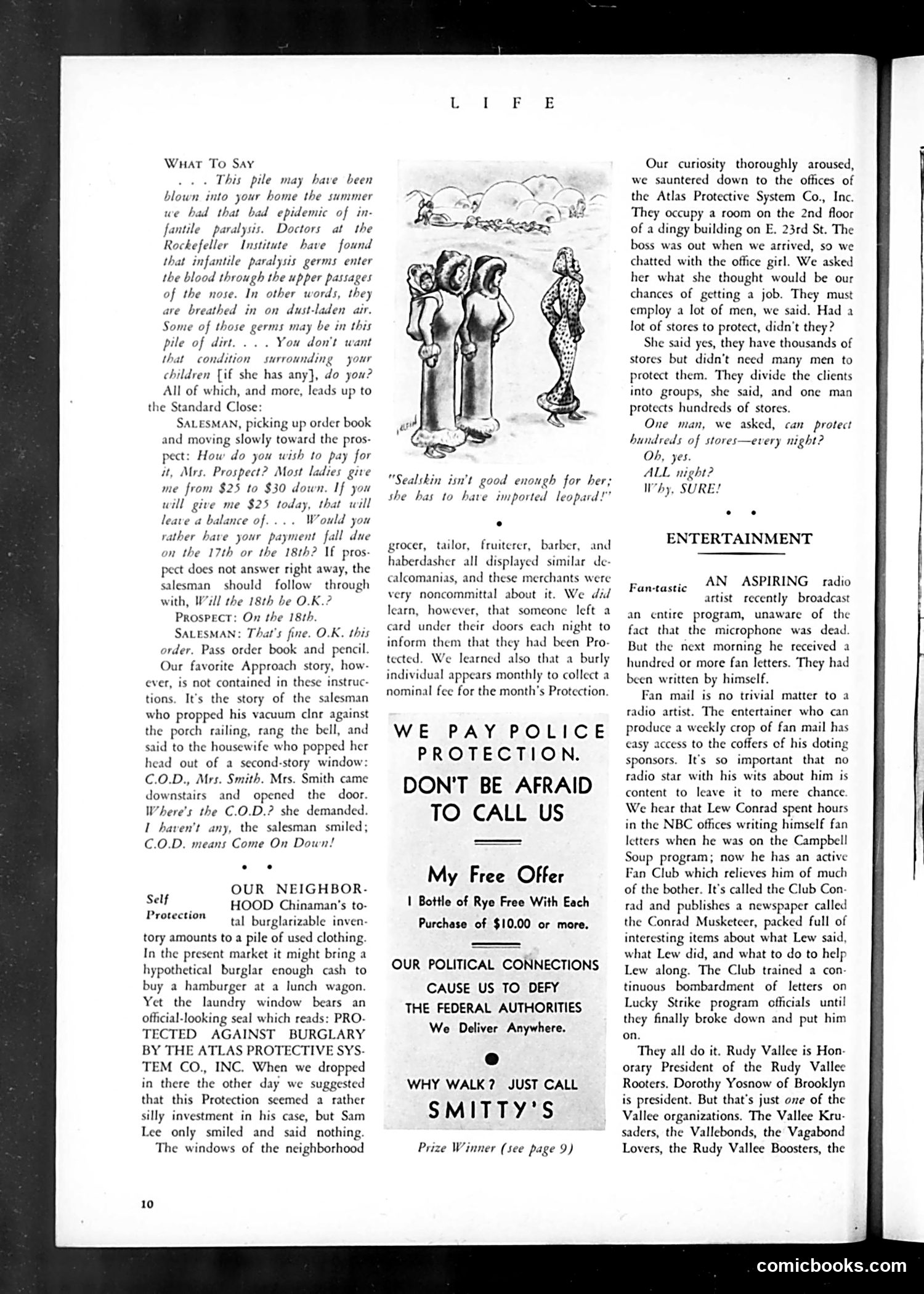
Analysis of Life Magazine Page This page combines satirical commentary with advertisements. The main cartoon depicts two figures labeled "Sealkin isn't good enough for her; she has to have imported leopard!" — likely mocking wealthy women's excessive consumerism and status-seeking through luxury goods. The left column's "What To Say" section satirizes salesmen's manipulative tactics, with humorous examples of pressure sales techniques. The "Salesman" anecdote about payment plans ridicules installment-credit culture. The middle section advertises the "Atlas Protective System Co., Inc." — a store-protection service — with the satirical suggestion that merchants need protection. A small illustration shows what appears to be store burglaries. The "Entertainment" section discusses a radio artist's fan mail success and fan clubs. The advertisements promote a rye whiskey offer and police protection services, reflecting Depression-era concerns about crime and commerce.
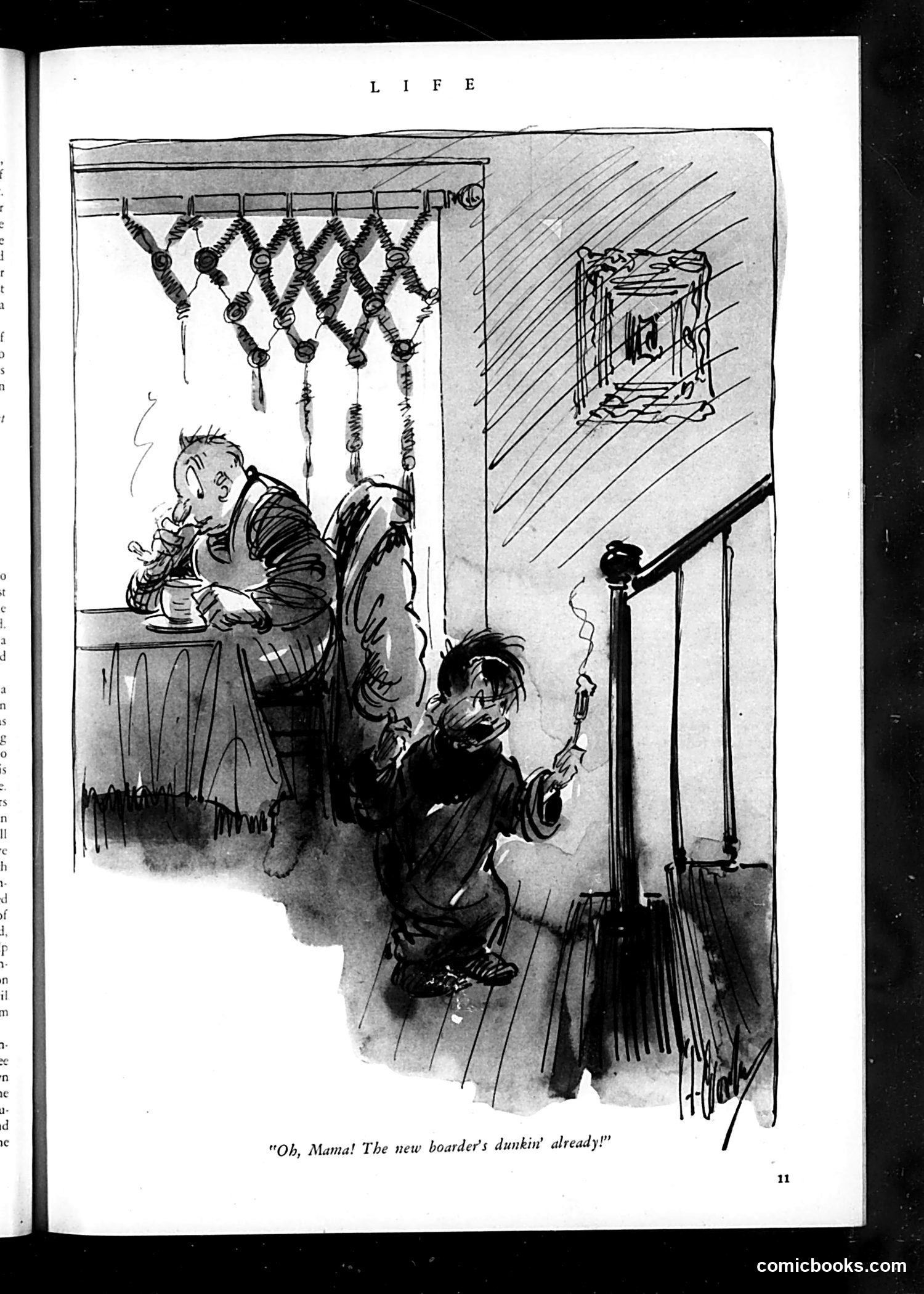
Cartoon Analysis This single-panel cartoon depicts a landlord or boarding house operator (left, at a table) reacting with alarm to a new boarder (right, on stairs) who is "dunkin'" — apparently dunking food into a beverage, likely coffee or tea. The humor targets class-based etiquette anxieties common to early 20th-century American life. "Dunking" was considered lower-class, uncouth behavior by genteel standards. The landlord's distressed exclamation ("Oh, Mama!") suggests the new boarder's crude manners are a social embarrassment that will reflect poorly on the boarding house's reputation. The cartoon satirizes both working-class dining habits and bourgeois snobbery about proper table manners — a recurring theme in period humor about American social pretensions and class consciousness.
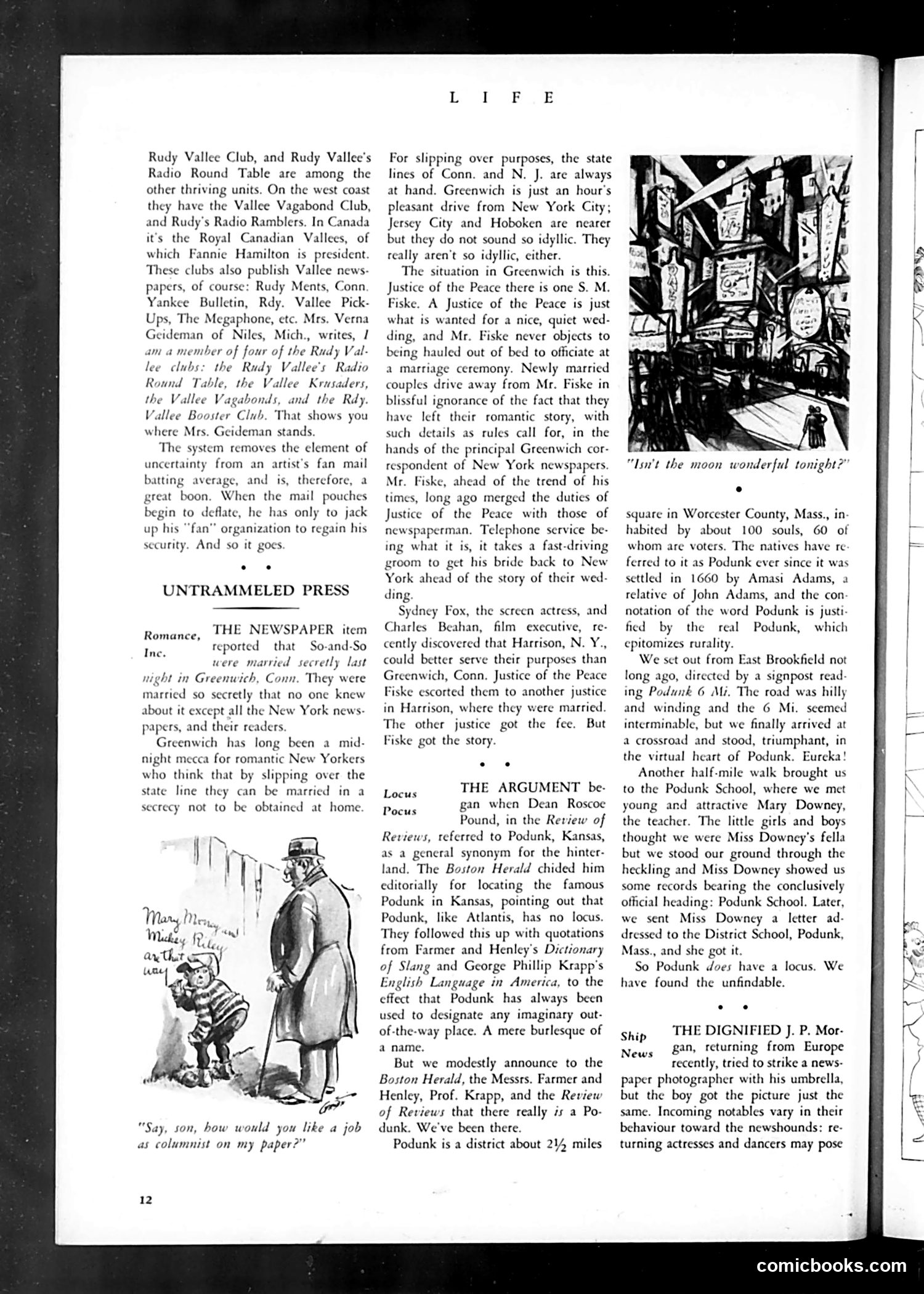
Analysis of Life Magazine Page Content This page contains humor columns and a cartoon rather than political satire. The main cartoon (lower left) shows a man in formal dress speaking to what appears to be a tramp or vagrant, with the caption: "Say, son, how would you like a job as columnist on my paper?" The joke satirizes journalism's low standards — suggesting that even the most unqualified person could become a newspaper columnist. It's commentary on the proliferation of opinion writing and the perceived lack of quality control in press. The text discusses various topics including Rudy Vallée (a popular singer), Greenwich, Connecticut society notes, and the fictional town of Podunk — typical Life magazine content mixing celebrity gossip with gentle mockery of American life and pretension.
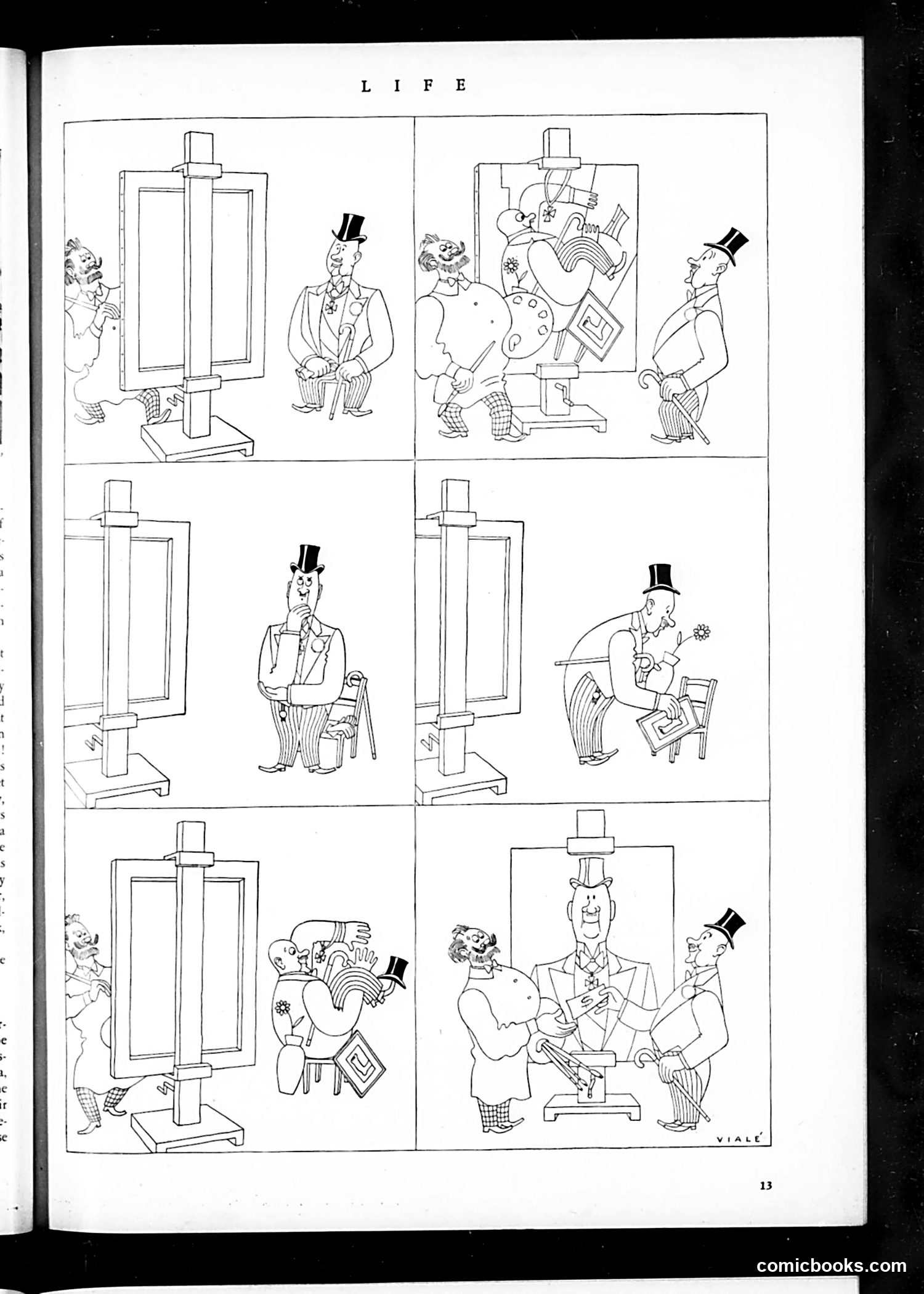
Analysis This is a six-panel comic strip titled "LIFE" depicting a satirical scenario involving a large mirror or reflective surface on a stand. The sequence shows well-dressed gentlemen in top hats (suggesting wealthy or prominent figures) interacting with the mirror in increasingly absurd ways. The satire appears to mock vanity and self-absorption among the upper classes. Each panel shows different reactions to the mirror—admiration, preening, and theatrical posturing. The final panels suggest the mirror becomes a source of conflict or distraction among the figures. The cartoon's point seems to be social commentary on narcissism and the frivolous concerns of wealthy society, using the mirror as a symbol of self-obsession. The artist is signed "VIALE" at bottom right.
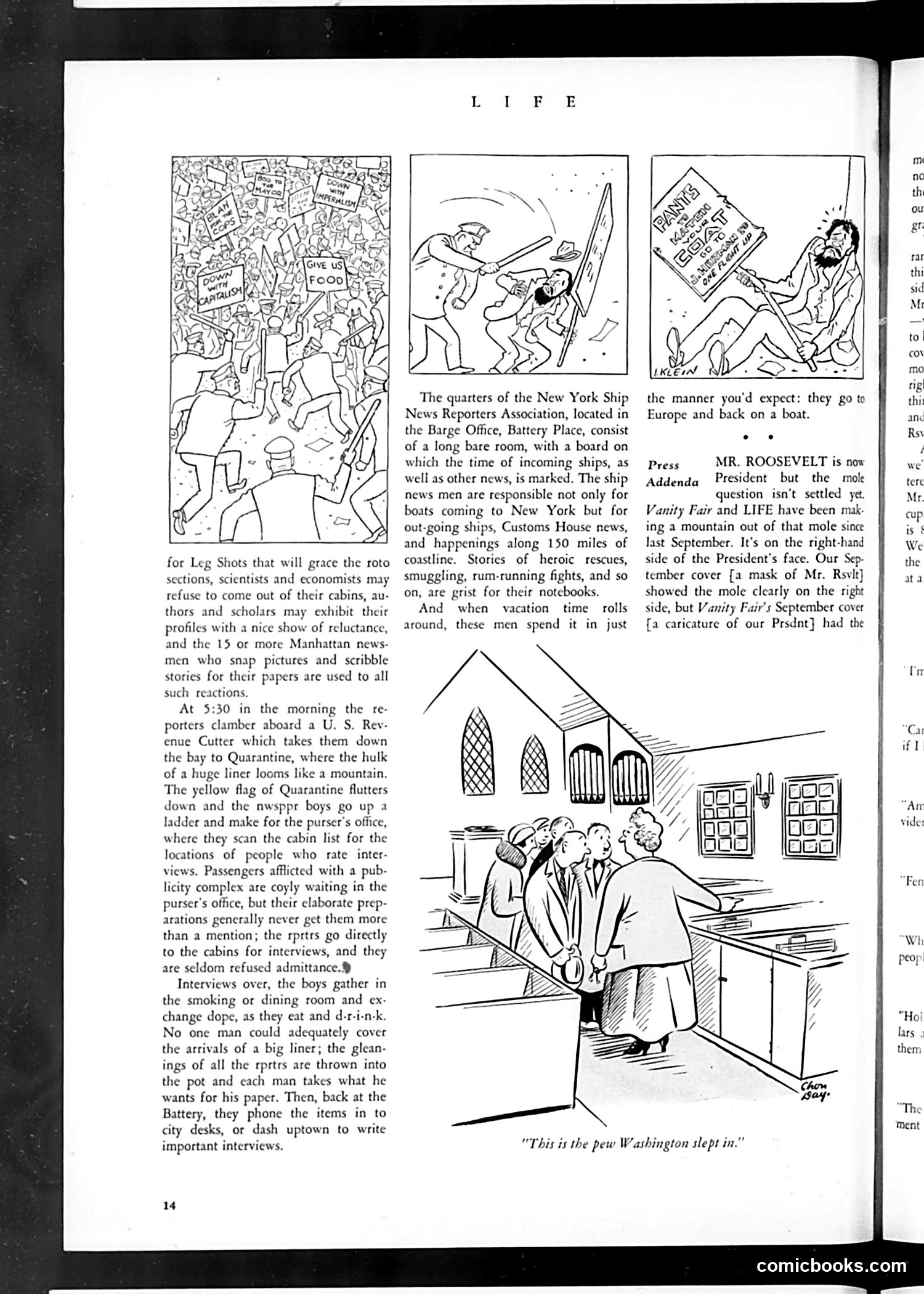
Analysis of Life Magazine Page This page satirizes newspaper reporters covering ships arriving in New York Harbor. The left cartoon shows chaotic crowding of journalists competing for stories. The middle panel depicts reporters aggressively pursuing interview subjects with weapons-like microphones/recording devices. The "Press Addenda" section notes that President Roosevelt's mole (a facial blemish) became a notable feature in recent magazine covers, including Vanity Fair and Life. The text humorously suggests this physical characteristic has become unavoidable in presidential portraiture. The bottom cartoon, captioned "This is the pew Washington slept in," mocks journalists' obsession with trivial historical details and tourist attractions—a jab at how press coverage often focuses on superficial rather than substantive matters.
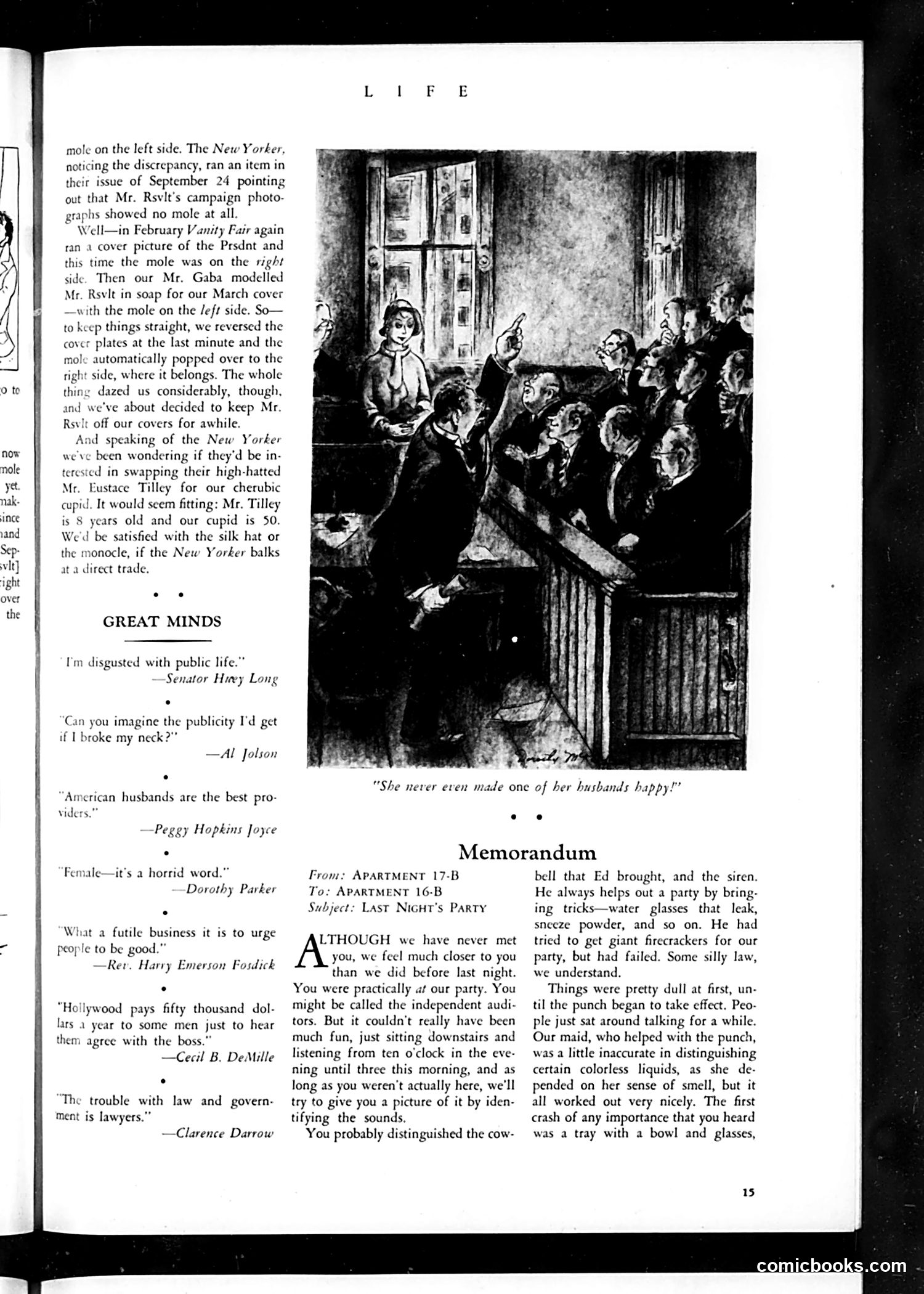
Analysis of Life Magazine Page This page features a satirical memorandum about a house party. The illustration shows a crowded indoor social gathering, apparently chaotic or awkward. The accompanying text humorously describes the party from the perspective of neighbors in "Apartment 17-B" addressing those in "16-B," detailing the noise and disruption caused by last night's event. The satire targets suburban social life and entertaining—specifically the messiness and poor planning of amateur hosts. References to failed party tricks (water glasses, sneeze powder), an inept maid, and colorless liquids suggest prohibition-era drinking and general incompetence at hosting. The "Great Minds" quotes above mock pretentious celebrity opinions on unrelated topics. The overall humor derives from everyday domestic frustrations and the gap between aspiring hosts' ambitions and actual results.
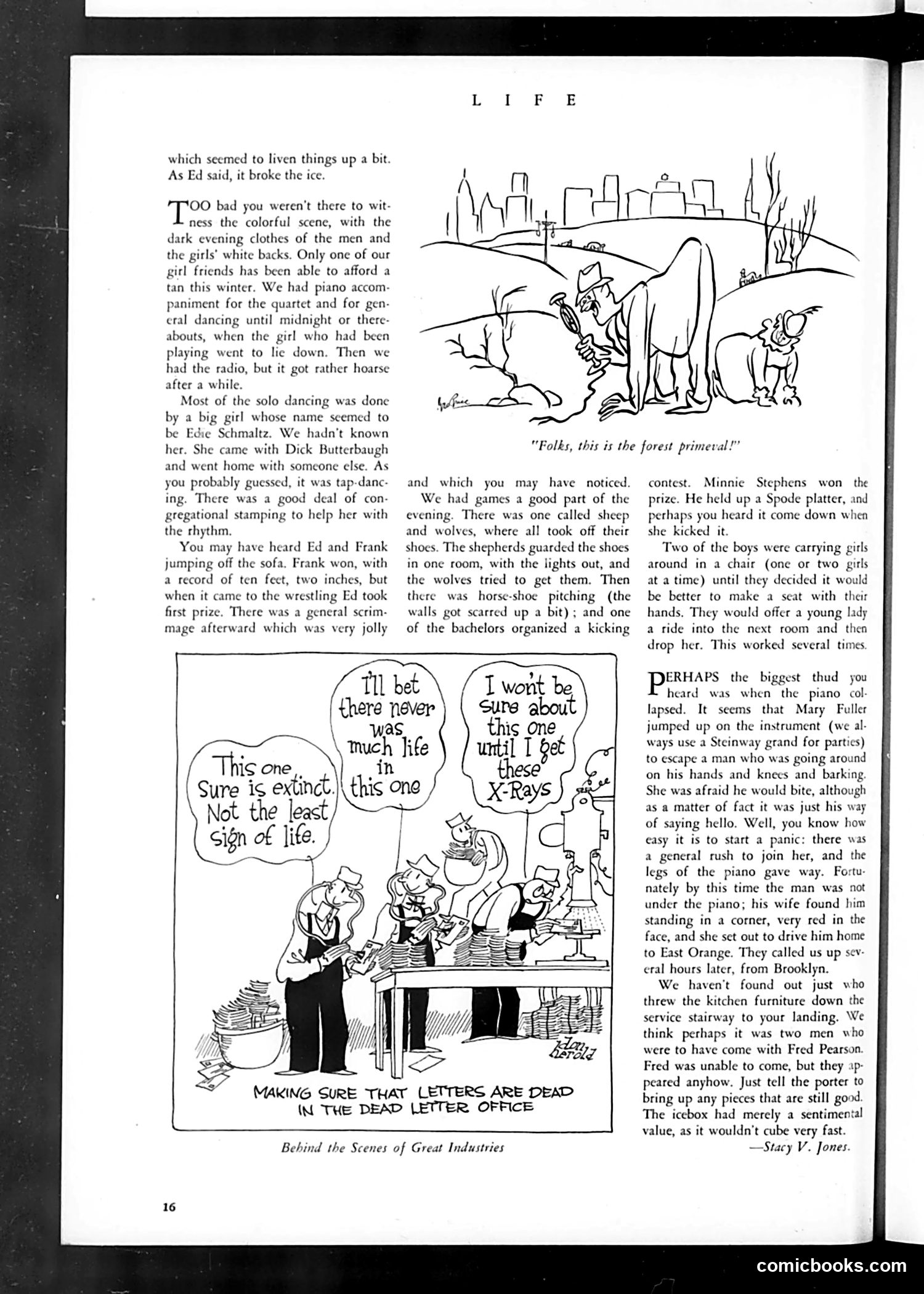
Analysis This page from *Life* magazine contains a social satire about a winter party attended by young people. The main cartoon depicts men in an office examining X-rays, joking about whether various skeletal remains are "extinct" or show "signs of life." The caption reads "Making sure that letters are dead in the dead letter office." The satire targets the U.S. Postal Service's "Dead Letter Office"—a real bureaucratic department handling undeliverable mail. The cartoon humorously depicts postal workers as forensic investigators examining bones like detectives, suggesting the office treats old mail with excessive seriousness or morbid curiosity. The surrounding text describes youthful winter social activities including dancing and parlor games, contrasting mundane administrative humor with vibrant youth culture of the era.
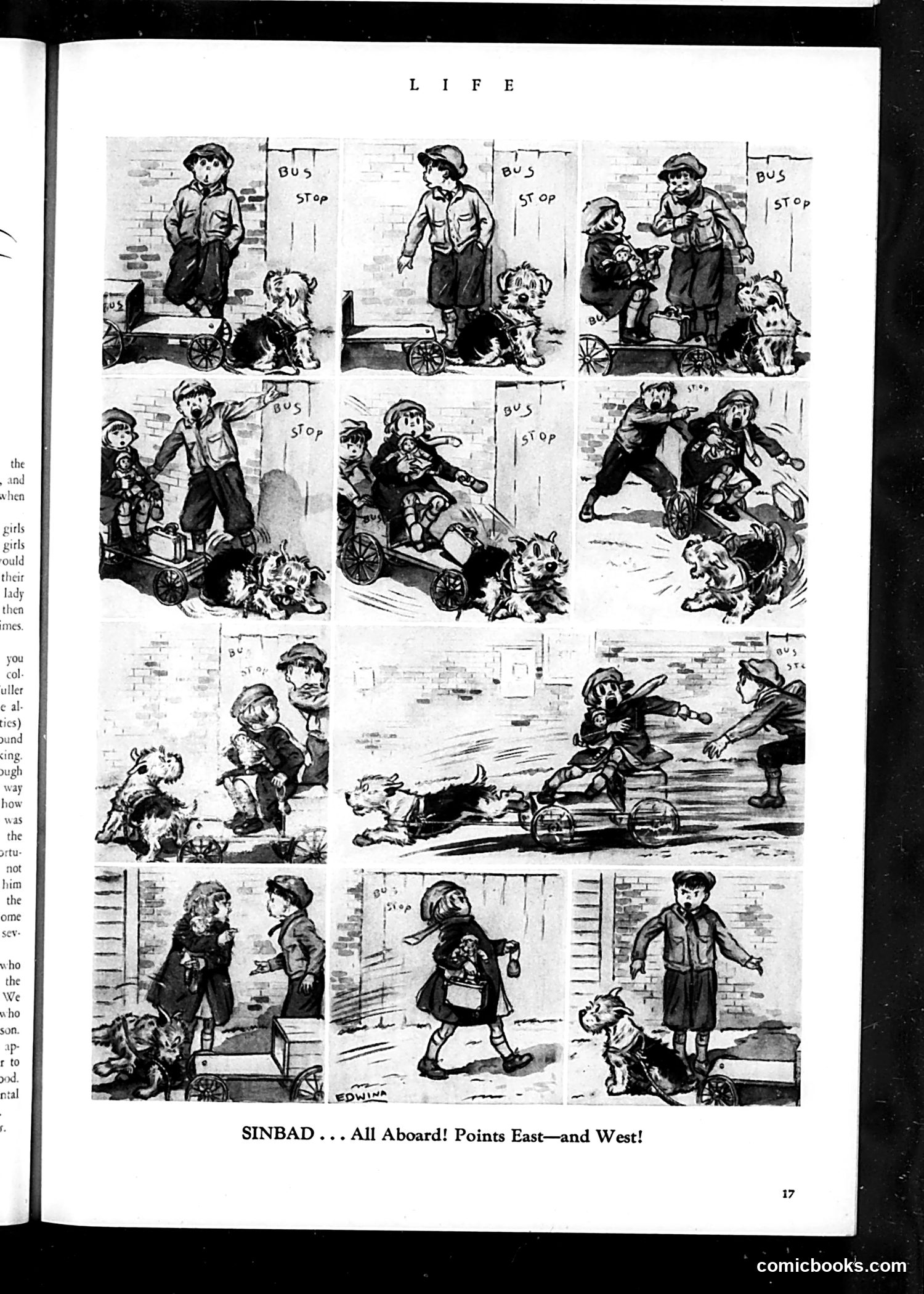
Analysis of "Sinbad...All Aboard! Points East—and West!" This is a comic strip sequence depicting Sinbad the Sailor character attempting to board a bus at a "BUS STOP." The humor derives from classic slapstick: Sinbad repeatedly fails to board smoothly, encountering various mishaps with what appears to be a dog also trying to get on the bus. The title's reference to "Points East—and West" likely plays on Sinbad's legendary nautical travels. The strip satirizes the mundane reality of modern urban transportation (the bus system) colliding with romantic adventure mythology. Each panel escalates the physical comedy of failed boarding attempts, transforming the fantastical adventurer into an everyman struggling with ordinary public transit—the joke being the gap between legendary heroics and everyday inconvenience.
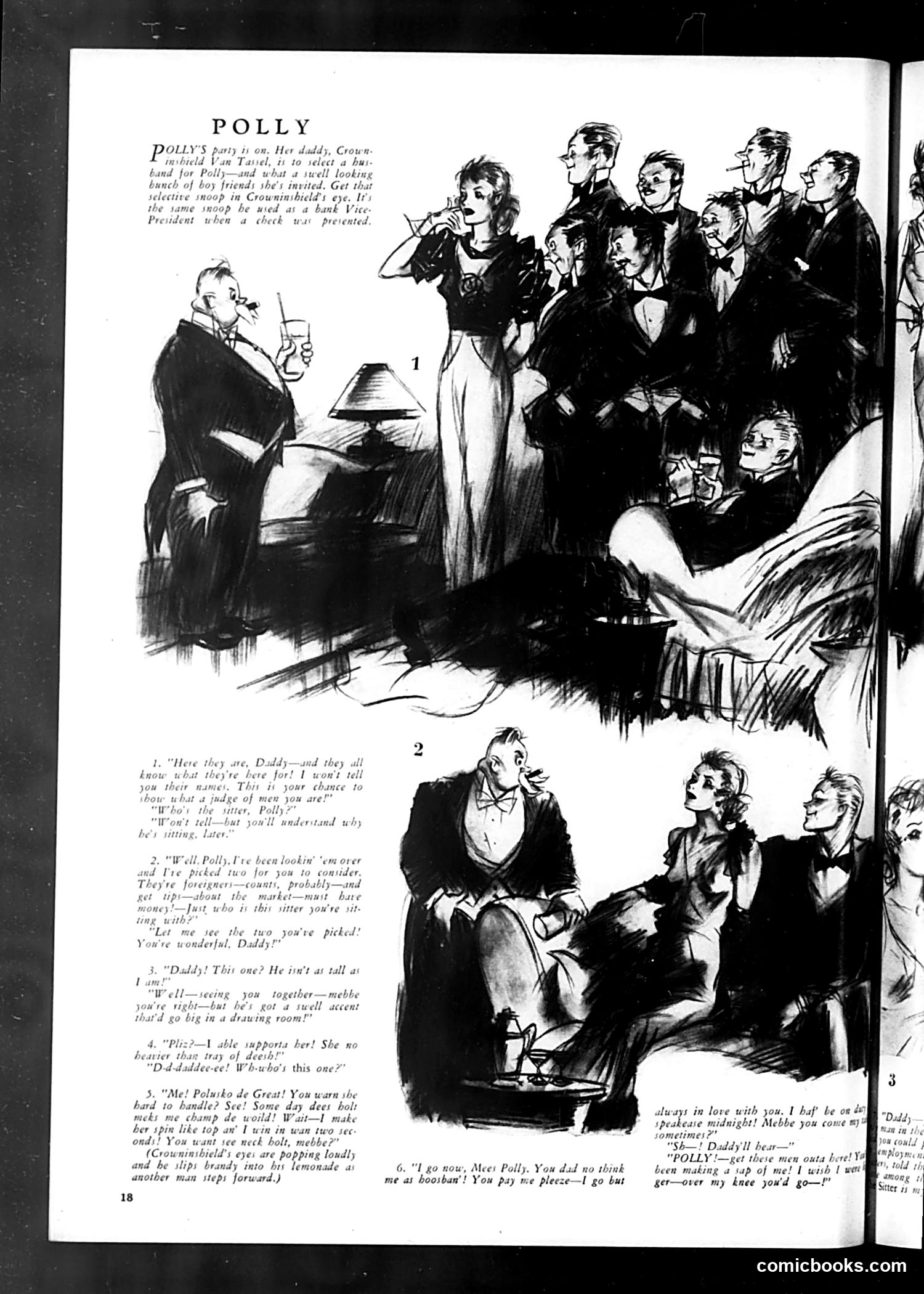
"Polly" - A Satirical Comic Strip This multi-panel comic satirizes a wealthy young woman ("Polly") parading unsuitable suitors before her father. The humor derives from ethnic and class stereotypes popular in early 20th-century American satire. In successive scenes, Polly presents potential husbands to her disapproving father—including what appears to be a working-class or immigrant man with an exaggerated accent ("Polusko de Great"), whose broken English and crude manners horrify the refined father. The satire mocks both Polly's poor judgment in suitors and the father's snobbish reaction. The final panel shows the exasperated father threatening to discipline Polly, suggesting she's deliberately tormenting him. The joke relies on class anxieties and ethnic caricature typical of *Life* magazine's satirical humor of this era.
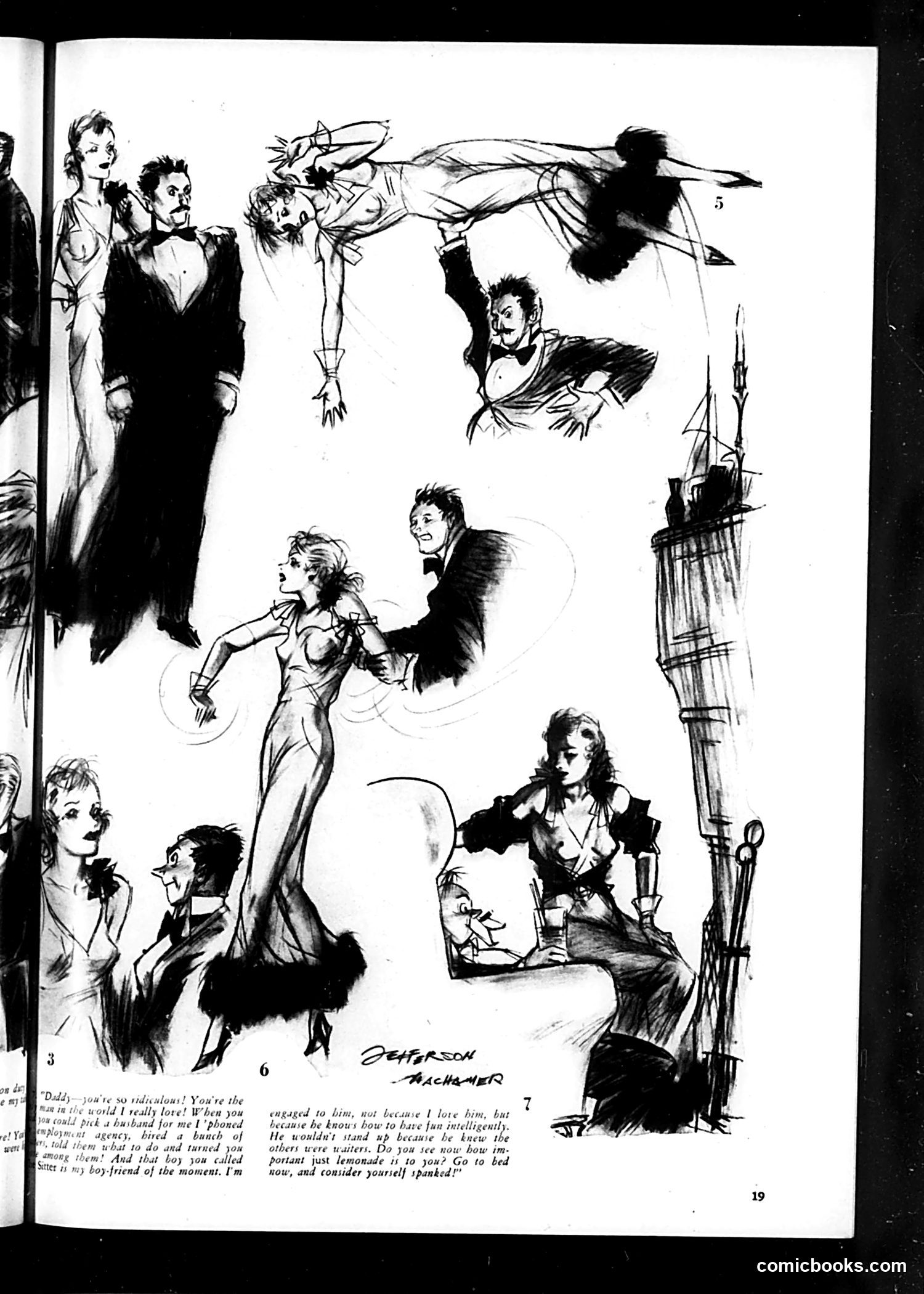
Analysis This appears to be a page of cartoon sketches illustrating a domestic comedy scene, likely from the 1920s-1930s based on the art style and fashion. The Scene: A father is scolding his daughter about her romantic entanglements. The dialogue reveals she has hired staff (including her current boyfriend as a waiter) to impress a man she claims to love, but whom she's only engaged to because "he knows how to have fun intelligently." The Satire: The humor targets young women's frivolous approach to marriage and relationships during this era. The father's punchline—that she should recognize how "important lemonade is to you"—is unclear without fuller context, but appears to be a moralistic joke about appreciating simple things rather than chasing status through romantic conquest. Social Context: This reflects period anxieties about "modern" young women's independence, their dating practices, and their perceived materialism. The sketches show various character reactions and the theatrical nature of the daughter's romantic scheming. The cartoonist is identified as "Deyarson" or similar (signature unclear).
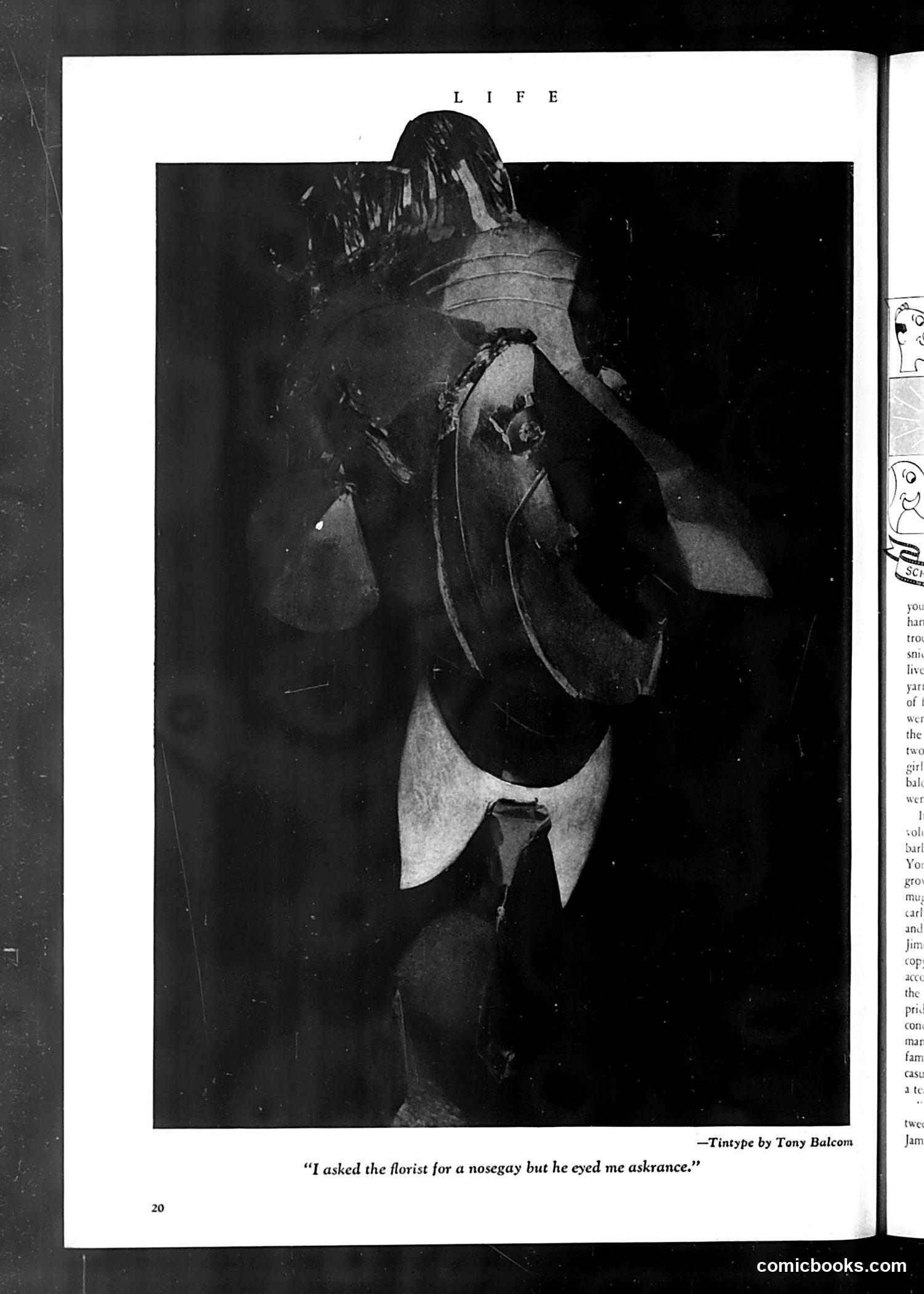
Life Magazine Cartoon Analysis This is a single-panel cartoon by Tony Balcom playing on a linguistic misunderstanding. The image shows a man confronting a florist, apparently over a request for a "nosegay" (a small bouquet of flowers). The joke hinges on the word "nosegay" sounding like "nose gay"—the florist apparently interpreted the customer's request as an insult or inappropriate comment about his nose, hence eyeing him "askrance" (askance—with suspicion or disapproval). The humor derives from the accidental double-meaning created by homophone-like pronunciation. This type of verbal comedy was typical of Life's satirical humor in its mid-20th century period, relying on wordplay rather than political commentary.
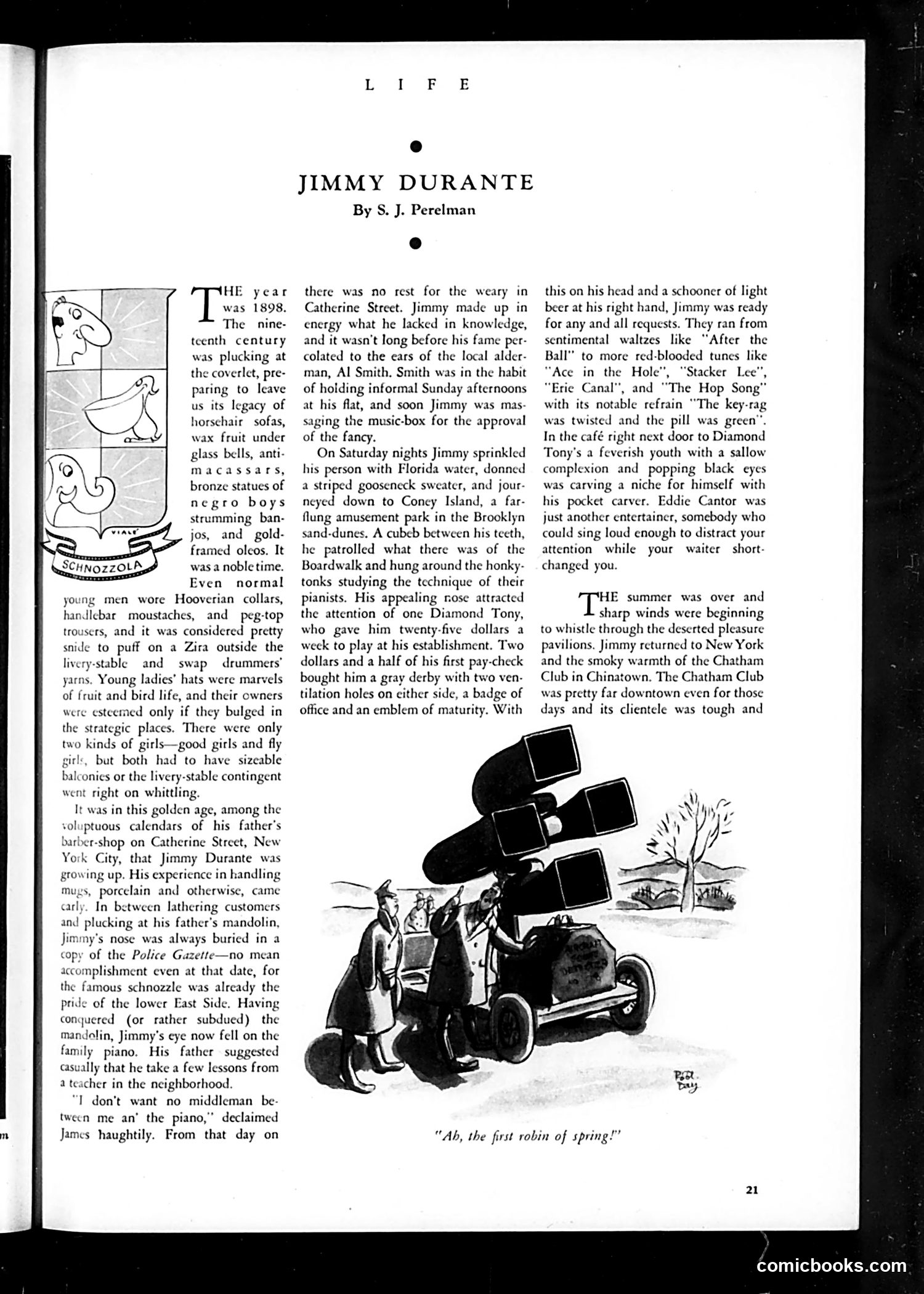
Analysis: Jimmy Durante Biography Page This is a biographical article about comedian Jimmy Durante by humorist S.J. Perelman, set in 1898 New York. The text satirizes the Victorian era's aesthetic tastes (horsehair sofas, antimacassars, ornate women's hats) while tracing Durante's humble origins on the Lower East Side—his father's barber shop on Catherine Street. The main illustration depicts a vintage automobile overloaded with suitcases, captioned "Ah, the first robin of spring!" — likely depicting Durante's early travels as an entertainer. Key figures mentioned: Al Smith (local alderman, later NY governor), Diamond Tony (nightclub owner who gave Durante his first paid gig), and Eddie Cantor (contemporary entertainer, initially more obscure). The text's irreverent tone mocks the pretensions of 1890s society while celebrating Durante's scrappy rise through Coney Island honky-tonks and Chinatown clubs. The decorative sidebar shows "Schnozzola" — Durante's famous large nose, already notable in youth — which became his trademark.
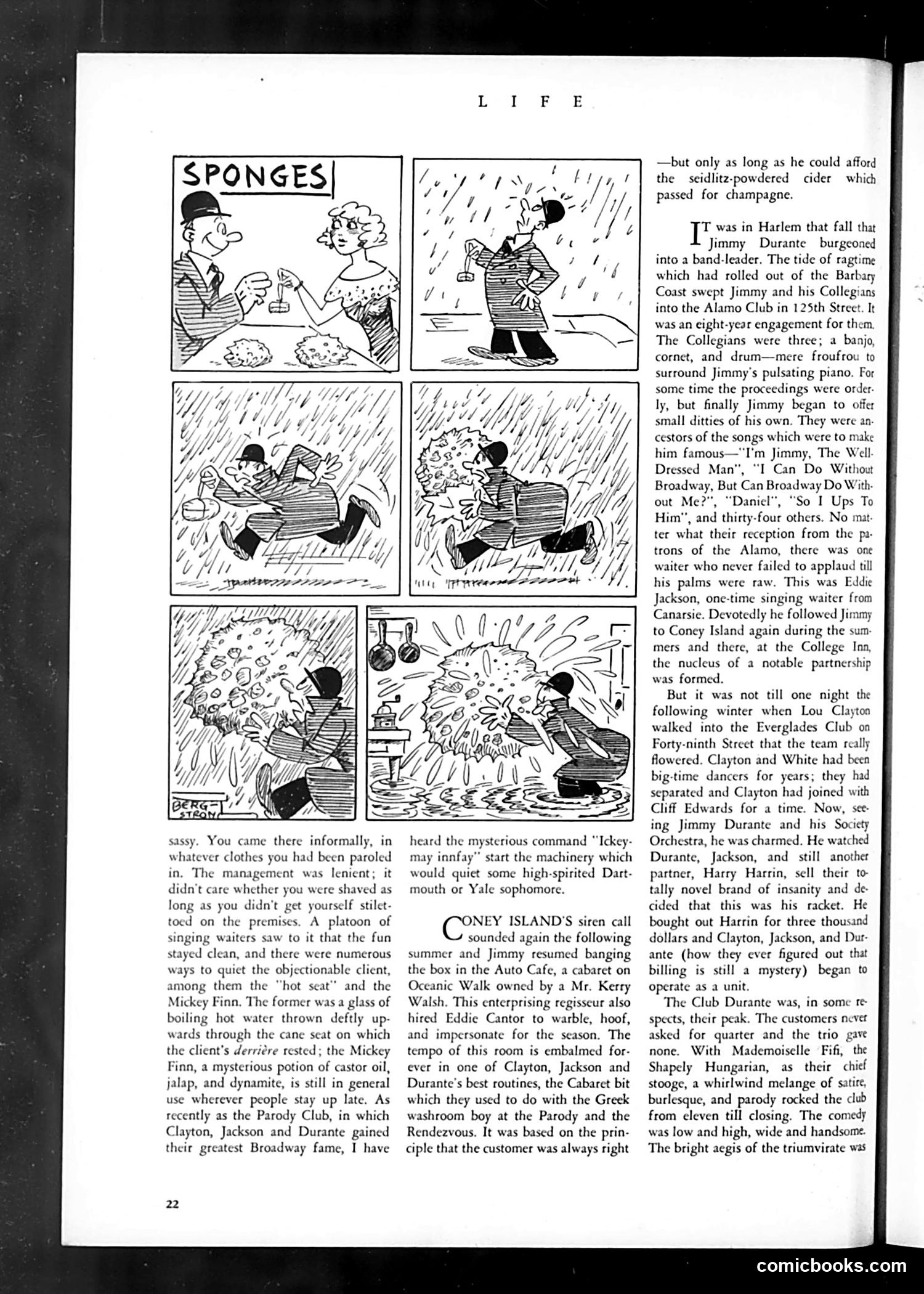
"Sponges" Comic Analysis This six-panel comic depicts rowdy behavior at nightclubs and cabarets during the Prohibition/Jazz Age era (1920s-30s). The panels show patrons becoming increasingly intoxicated and disruptive—drinking, dancing wildly in the rain, and creating chaos. The accompanying text discusses Jimmy Durante's rise as a bandleader and entertainer, detailing his work at various establishments (the Alamo Club in Harlem, Coney Island venues, the Club Durante). The satire targets both the crude behavior of drunk customers and the creative "management solutions" venues employed—the "hot seat" (scalding water through wicker chairs) and the "Mickey Finn" (drugged drink) used to eject troublesome patrons. The joke hinges on the casual acceptance of these brutal tactics as normal nightclub operations, reflecting the lawless atmosphere of speakeasy culture and the era's entertainment underbelly.
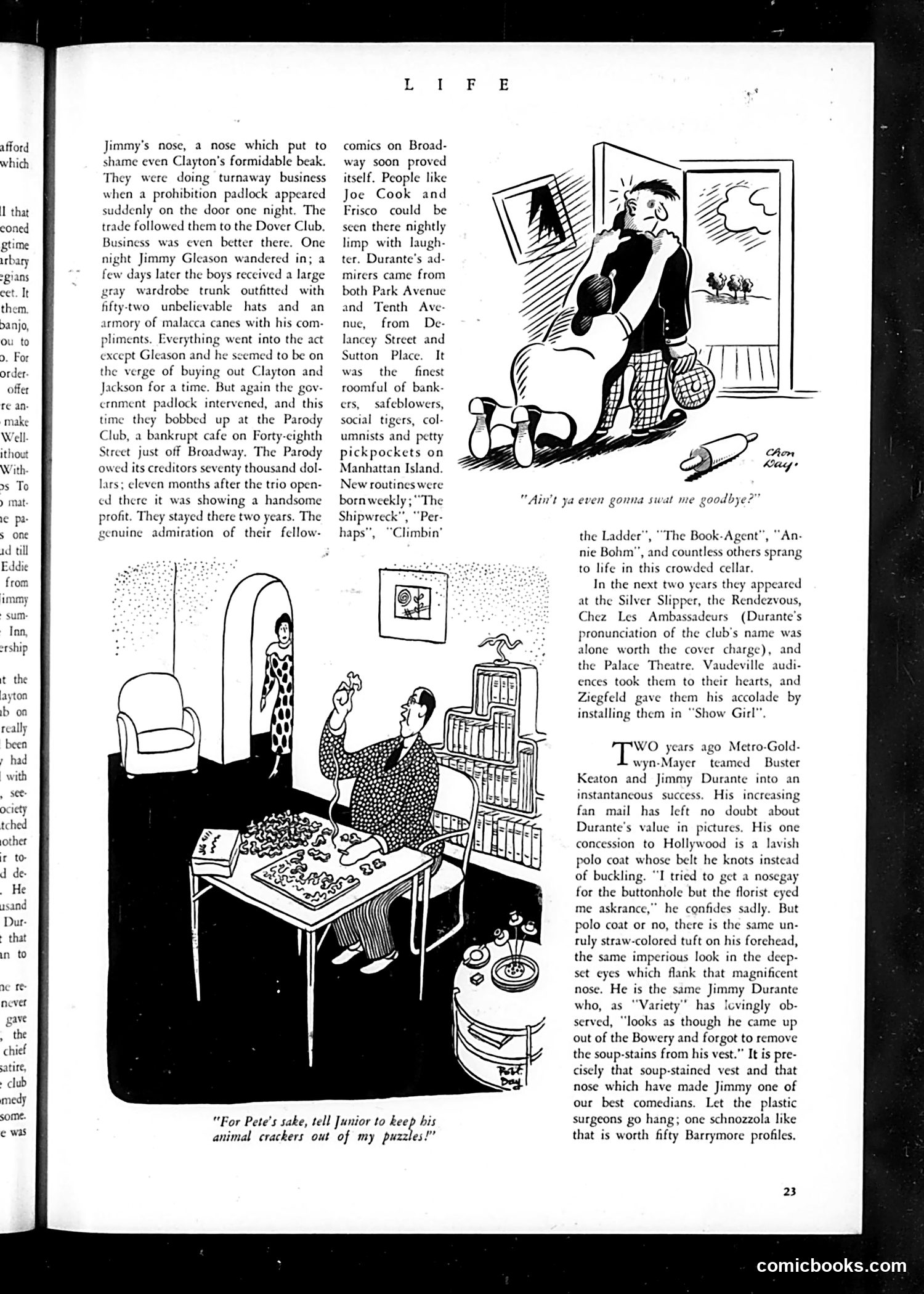
Analysis for Modern Readers This 1920s *Life* magazine page profiles Jimmy Durante, a vaudeville comedian famous for his distinctive large nose ("schnozzola"). The article traces his early career success—from performing at speakeasies during Prohibition (when regular clubs were padlocked) to headlining prestigious venues like the Palace Theatre and appearing in Ziegfeld's *Show Girl*. The two cartoons illustrate Durante's comedic persona: the upper sketch shows him leaving a romantic encounter, while the lower depicts a domestic scene emphasizing his physical appearance and working-class mannerisms. The text celebrates Durante's rise and his recent film success with Buster Keaton at MGM. It humorously notes his refusal to change his appearance for Hollywood—his soup-stained vest and prominent nose are presented as assets, not flaws. The article's point: authentic character matters more than polish; Durante's "Bowery" persona and unflinching self-presentation made him comedy gold.
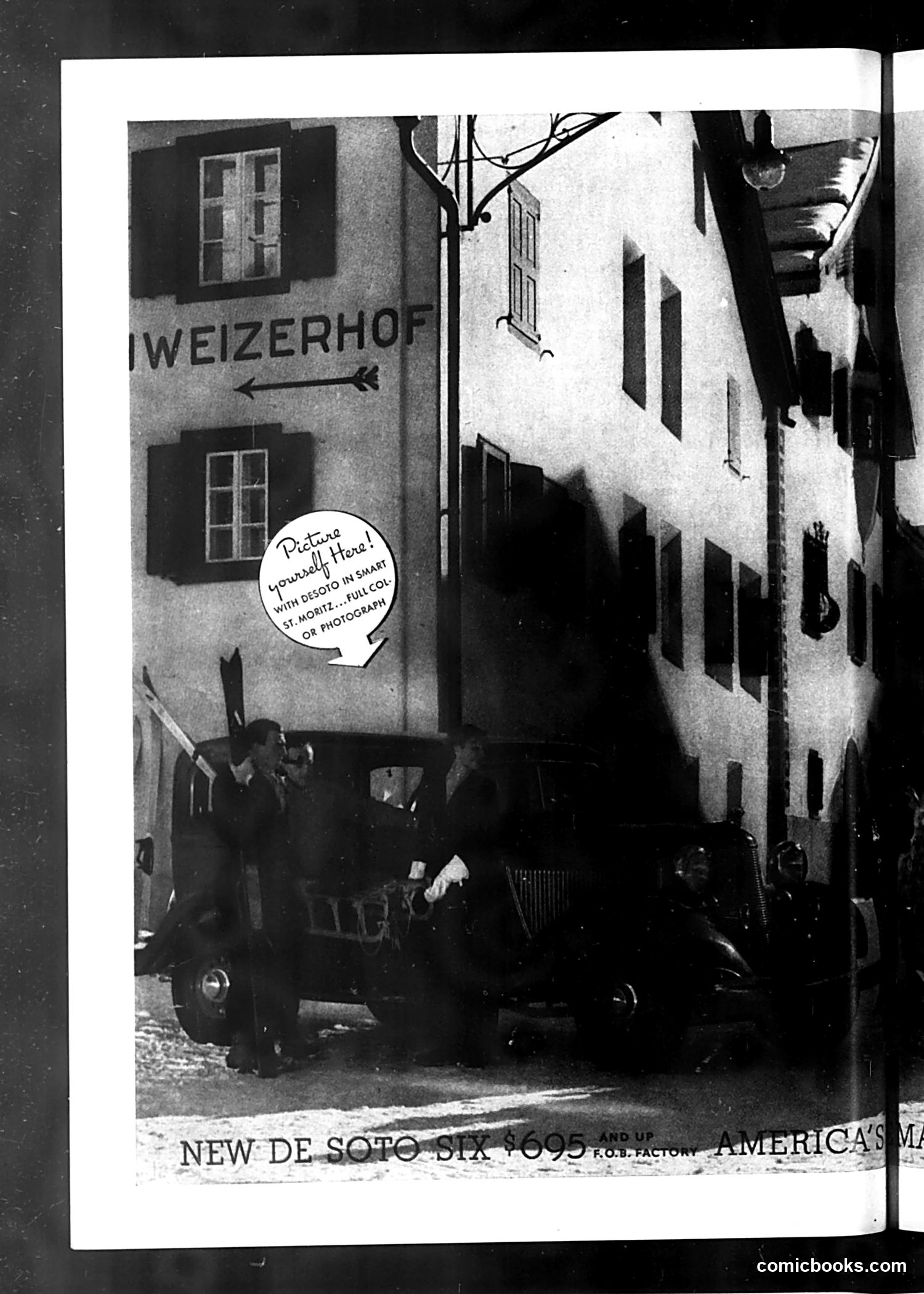
Analysis This page is primarily a automobile advertisement for the De Soto Six, priced at $695 and up, marketed as "America's Most Discussed Car." The ad features a staged photograph set in what appears to be a Swiss village street (indicated by the "WEIZERHOF" sign), showing the De Soto parked near traditional Alpine architecture. A speech bubble contains a testimonial claiming the car was "spotted in smart St. Moritz" and photographed there—a reference to the exclusive Swiss resort town, suggesting luxury and international prestige. The satire or joke appears to be that an American car is being presented as so desirable it's being spotted and admired in fashionable European locations, lending cosmopolitan cachet to an affordable domestic vehicle. This was common Depression-era advertising strategy: associating modest-priced American products with European sophistication and wealth.
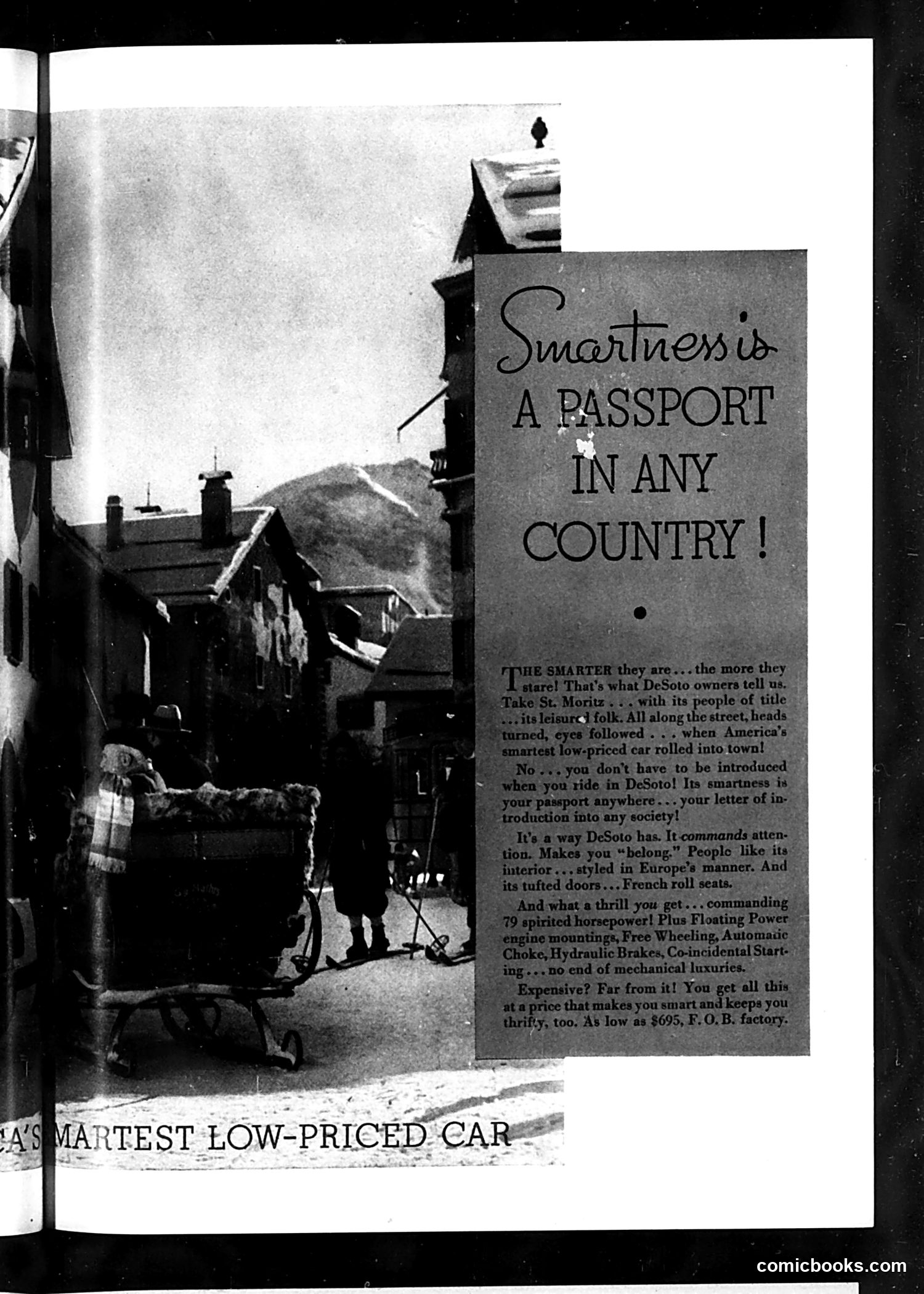
DeSoto Advertisement Analysis This is a DeSoto automobile advertisement, not political satire. The ad's headline claims "Smartness is a PASSPORT IN ANY COUNTRY!" The copywriting uses social climbing language—suggesting DeSoto ownership grants you automatic acceptance in high society ("you don't have to be introduced"). It positions the car as a status symbol that commands attention and respect. The accompanying photograph shows a European village street scene, reinforcing the ad's appeal to aspirational buyers who associate European sophistication with class distinction. The price point ("as low as $895") attempts to democratize luxury, suggesting affordable elegance. This represents typical 1920s-30s advertising strategy: selling not just transportation, but social legitimacy and belonging through car ownership.
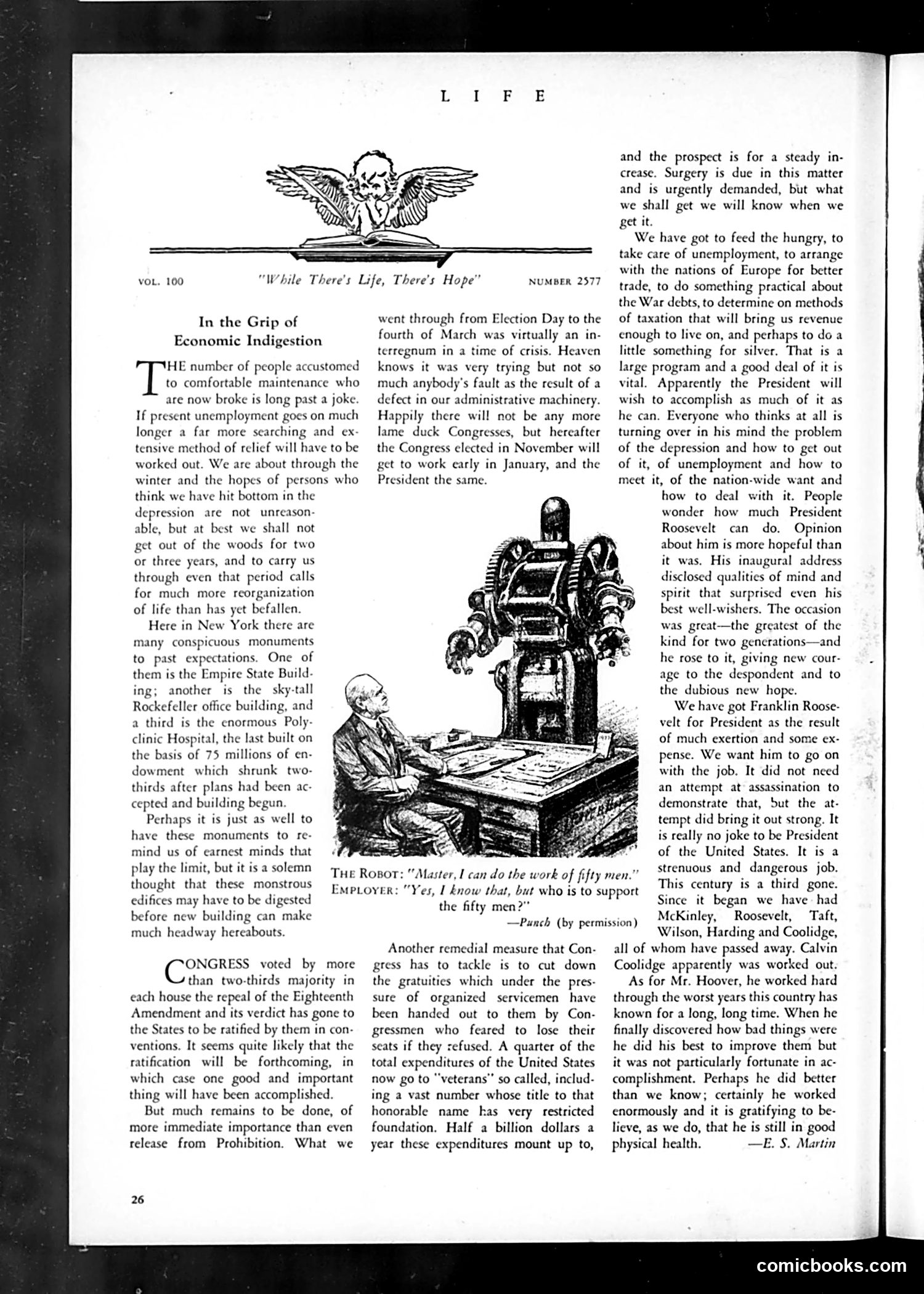
Analysis of Life Magazine Page (Vol. 100, No. 2577) This Depression-era article discusses economic recovery under President Franklin D. Roosevelt's early administration. The main cartoon, credited to Punch, depicts a robot offering to do the work of fifty men, while an employer questions who will support those fifty displaced workers—satirizing automation's threat to employment during mass unemployment. The article criticizes the "lame duck" Congress (the outgoing legislature serving until the new one convenes), argues for cutting inflated veteran's benefits, and urges action on unemployment relief, hunger, trade agreements, war debts, and taxation. It expresses cautious optimism about Roosevelt's leadership while acknowledging the depression will persist for "two or three years." The monuments mentioned (Empire State Building, Rockefeller Building, Polyclinic Hospital) symbolize pre-crash ambitions now seemingly excessive—metaphorically needing to be "digested" before new growth can occur. The satire critiques both bureaucratic inertia and the scale of economic collapse requiring fundamental reorganization.
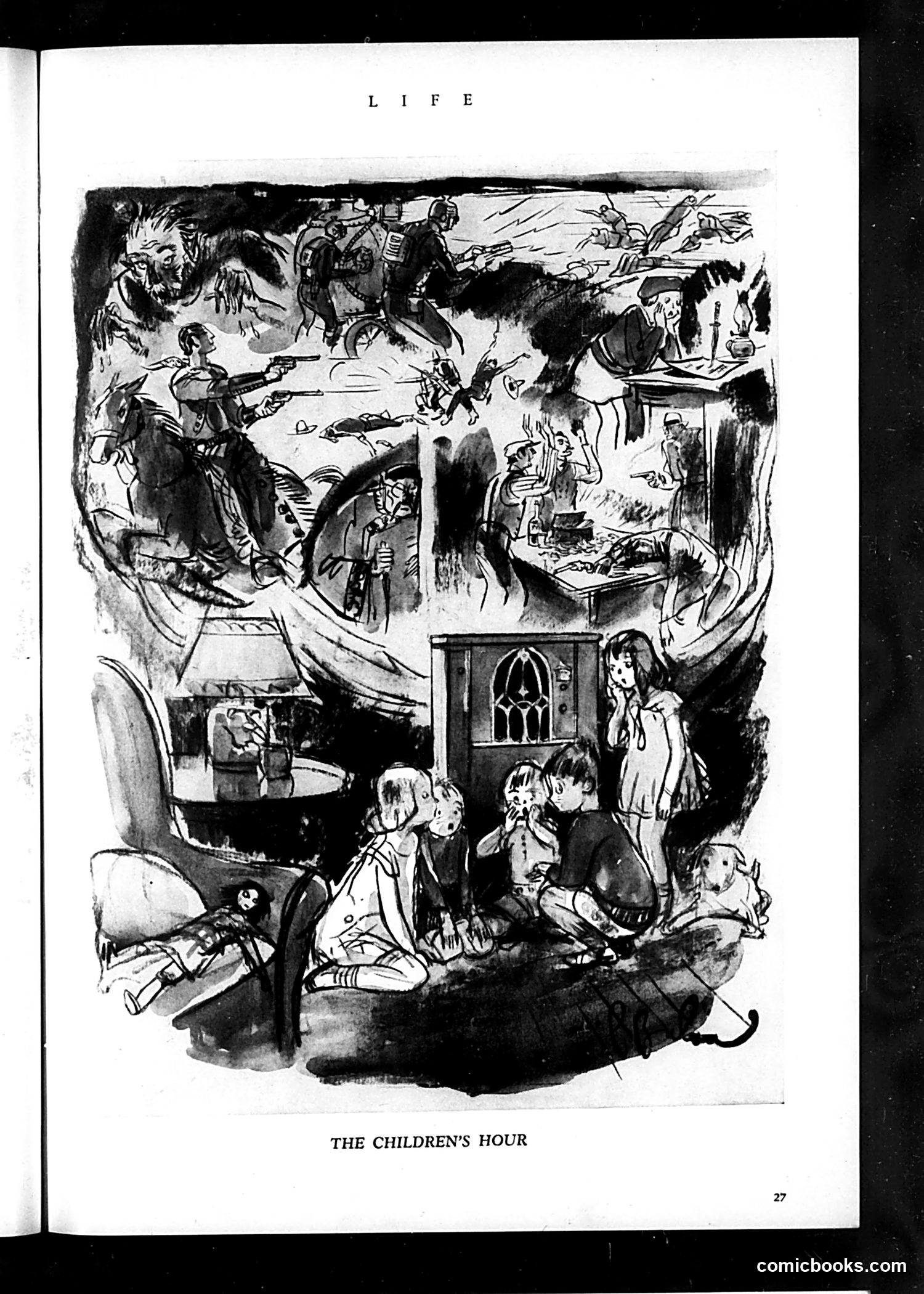
"The Children's Hour" This satirical illustration presents a chaotic domestic scene juxtaposing children's innocence with adult violence and conflict. The composition shows children at play in the foreground (lower portion), while the background depicts soldiers, military combat, explosions, and warfare. The satire appears to critique how children's peaceful "hour" (their playtime and safety) exists in stark contrast to—or is threatened by—the violent adult world of warfare surrounding them. The dramatic visual contrast between the serene domestic interior and the violent military scenes above suggests commentary on how war intrudes upon or endangers childhood. Without a visible date, the exact historical context remains unclear, though the military uniforms and style suggest early-to-mid 20th century.
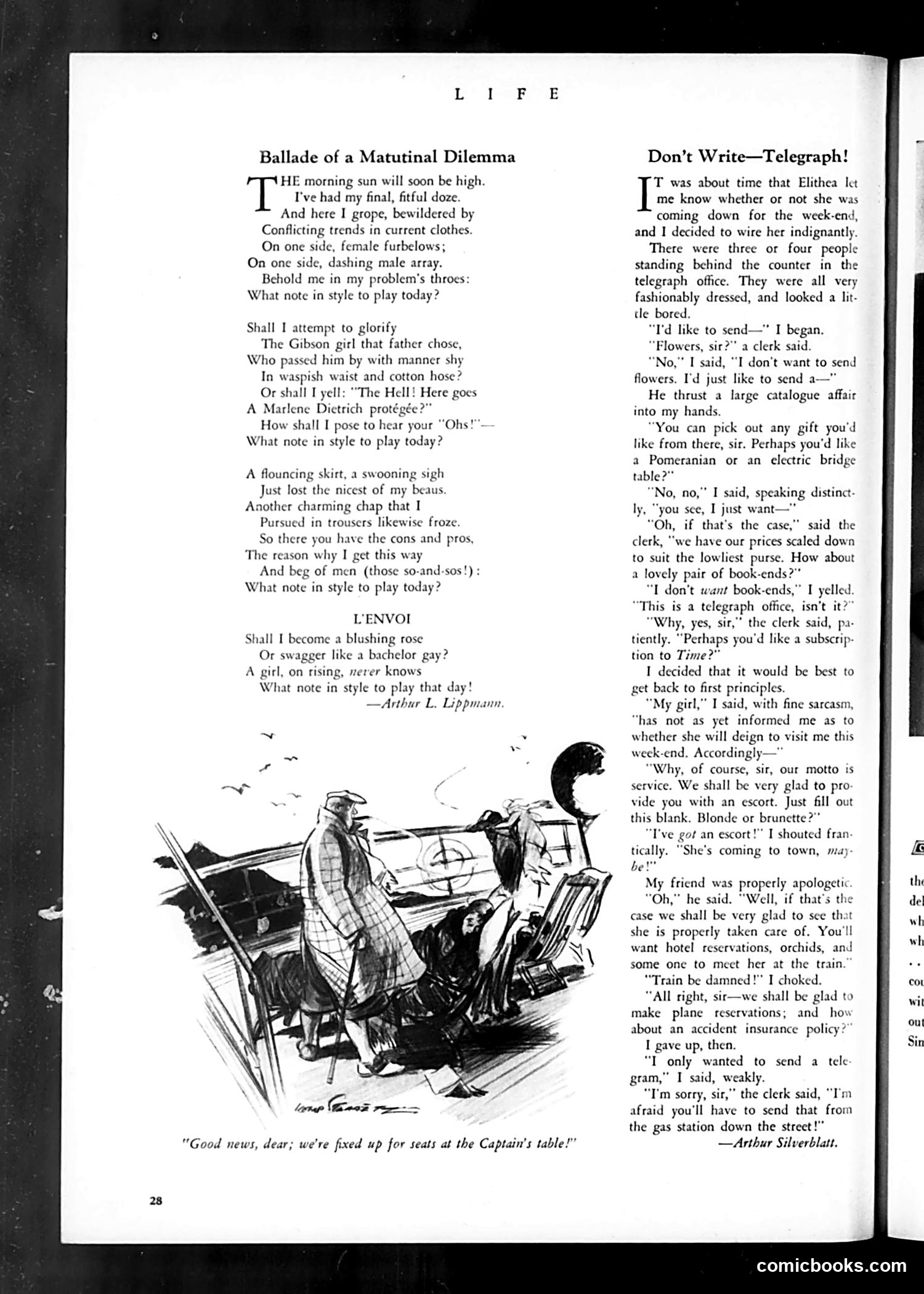
Analysis of Life Magazine Page This page contains two satirical pieces about 1920s-30s social anxieties: "Ballade of a Matutinal Dilemma" (left) humorously explores a woman's confusion about fashion choices. The poem references the "Gibson girl" (an idealized feminine beauty standard from the 1900s) versus the more androgynous "Marlene Dietrich" look (representing 1930s modern sophistication). The joke satirizes rapid shifts in female fashion and beauty standards, and how women's romantic success seemed dependent on adopting the "correct" style. The accompanying illustration shows fashionable women discussing seating arrangements. "Don't Write—Telegraph!" (right) satirizes business culture's tendency to over-complicate simple tasks. A customer visits a telegraph office intending to send a brief message but encounters clerks obsessed with upselling ancillary services—flowers, gifts, escorts, hotel reservations—completely missing the point of telegraphy itself. The humor mocks corporate bloat and salesmanship that ignores customer needs, culminating in the absurd punchline that he must visit a gas station to actually send his telegram. Both pieces mock modern life's increasing complexity.
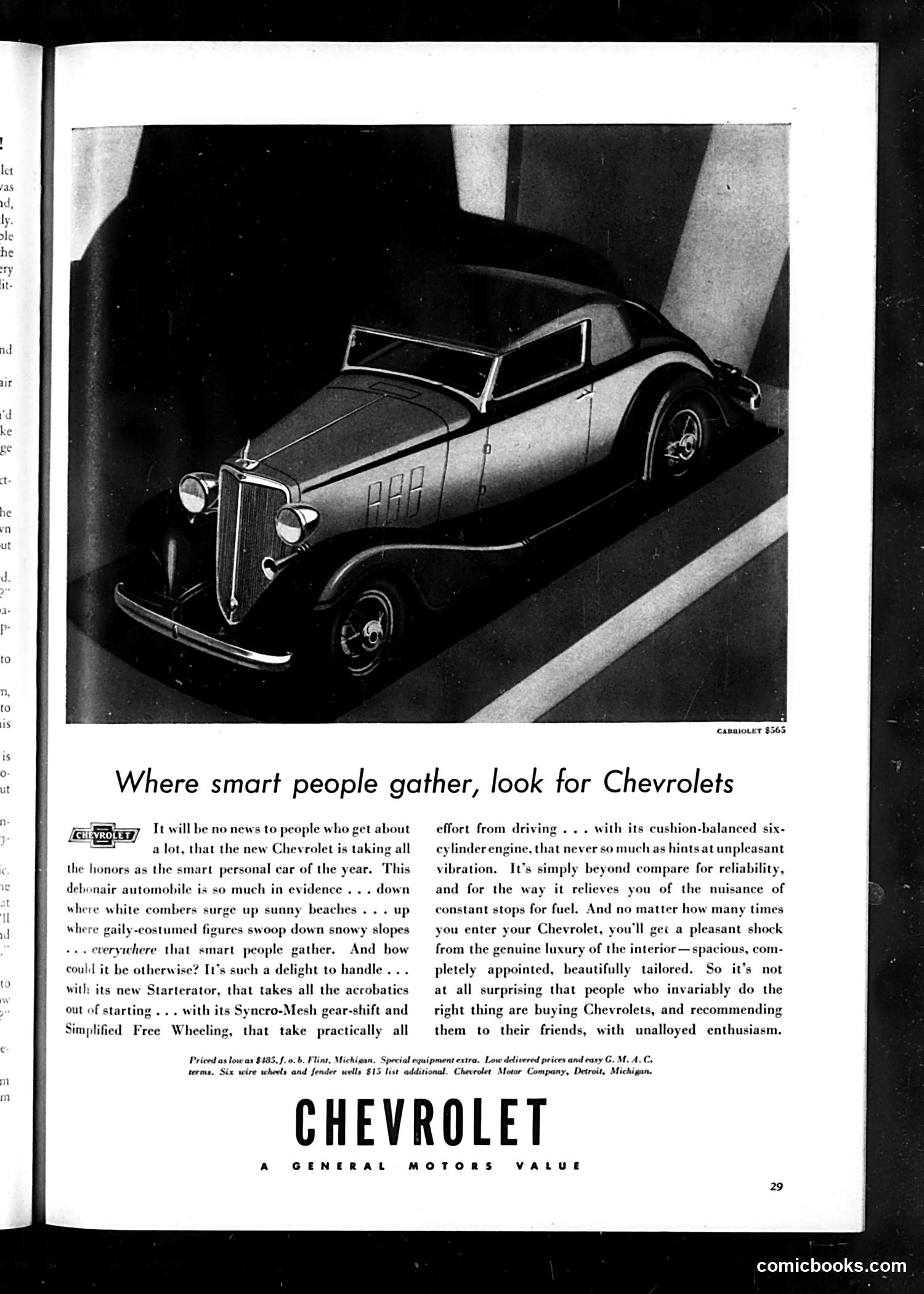
Analysis This is a Chevrolet automobile advertisement, not a political cartoon or satire. The page shows a photograph of a 1930s Chevrolet convertible (model 8563) with the top down, positioned against a modernist geometric background. The ad copy uses aspirational marketing language typical of the era, claiming the car is favored by "smart people" who gather at fashionable locations—beaches and ski slopes. The humor, if any, is gentle and indirect: the ad employs subtle snobbery, suggesting that buying a Chevrolet signals good taste and social awareness. However, this is straightforward commercial messaging rather than satirical commentary. The emphasis on features (starting mechanism, gear-shift, fuel efficiency) and the mention of General Motors' financing plan (G.M.A.C.) reflect 1930s car-marketing conventions. There are no identifiable political figures, caricatures, or social satire present—just period advertising rhetoric.
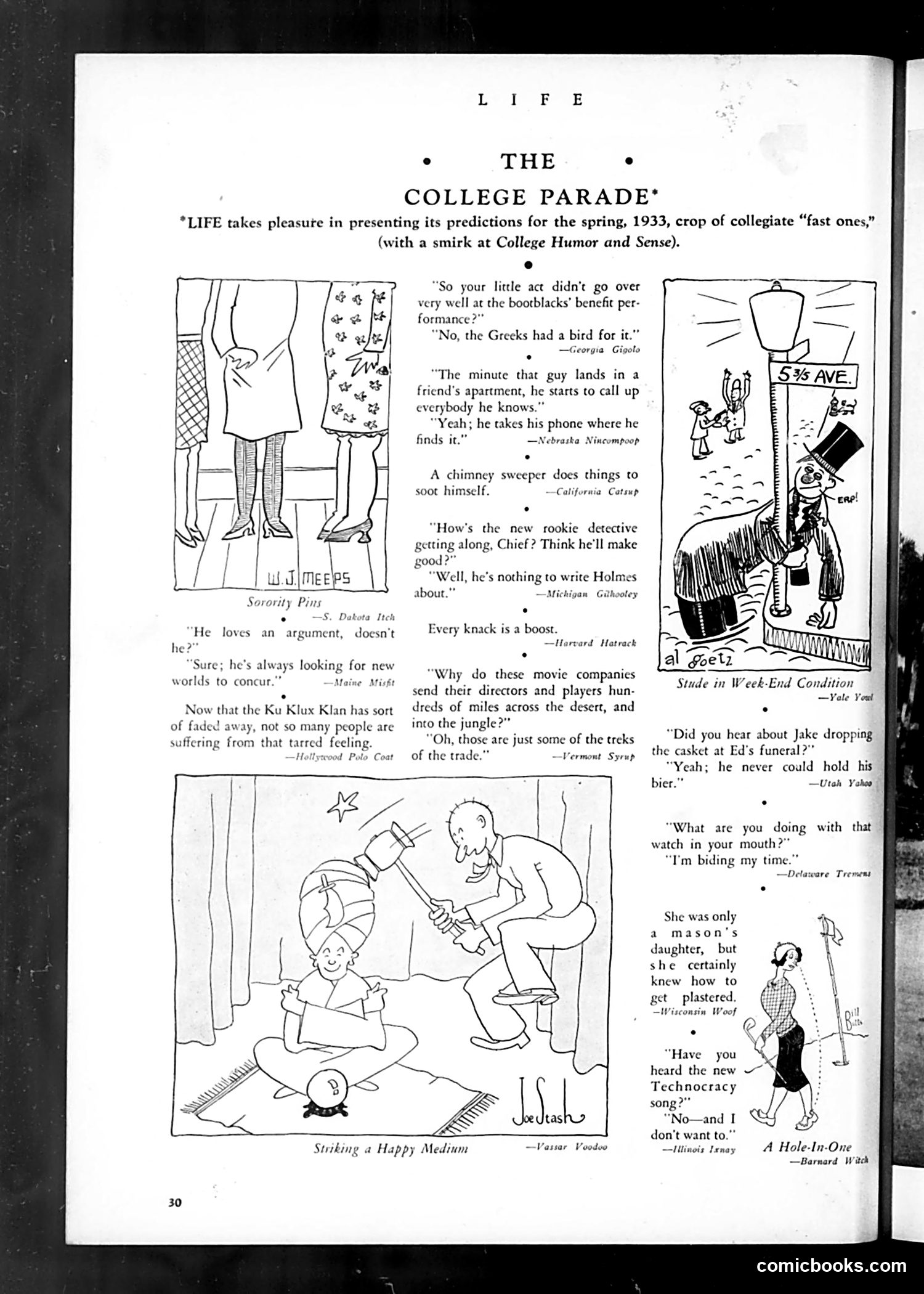
"The College Parade" (Life Magazine, Spring 1933) This page presents humorous one-liners and cartoons satirizing college life and contemporary trends. The cartoons mock collegiate stereotypes: sorority girls, argumentative students, and phone-obsessed visitors. The jokes reference 1933-era concerns: the declining KKK ("tarred feeling"), Prohibition-era bootleggers, and the contemporary Technocracy movement (a utopian economic philosophy that briefly fascinated intellectuals). Several puns target academic or professional fields—a detective "nothing to write Holmes about," a mason's daughter who "gets plastered," and a golf "hole-in-one." The state attributions (like "Georgia Gigolo," "Vermont Syrup") are playful wordplay rather than serious commentary. Overall, this represents Life's trademark light satirical humor aimed at educated readers familiar with current events and college culture—humor that relies on topical references now obscure without historical context.
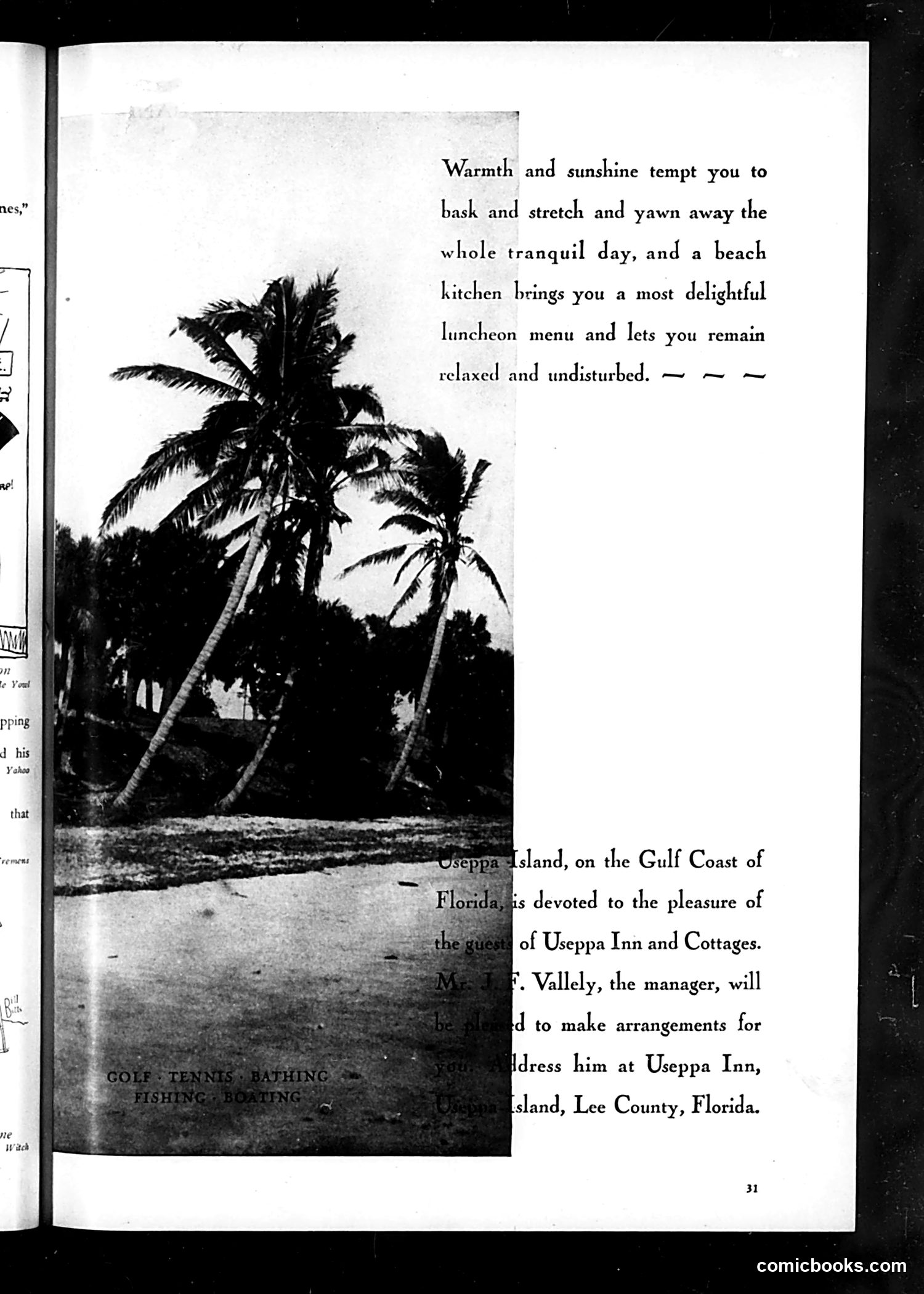
Analysis This is not a cartoon or satire—it's a travel advertisement for the Useppa Inn and Cottages on Useppa Island in Lee County, Florida (Gulf Coast). The page promotes leisure and relaxation: warm weather, sunshine, beach activities (golf, tennis, bathing, fishing, boating), and meals served without interruption. The accompanying photograph shows palm trees on a beach, establishing the tropical destination appeal. The text invites potential guests to contact manager "F. Vallely" to arrange accommodations. This represents early 20th-century American resort marketing, targeting affluent travelers seeking escape to Florida's coastal paradise—a common advertising approach in *Life* magazine during this era. There is no political commentary or satirical intent visible on this page.
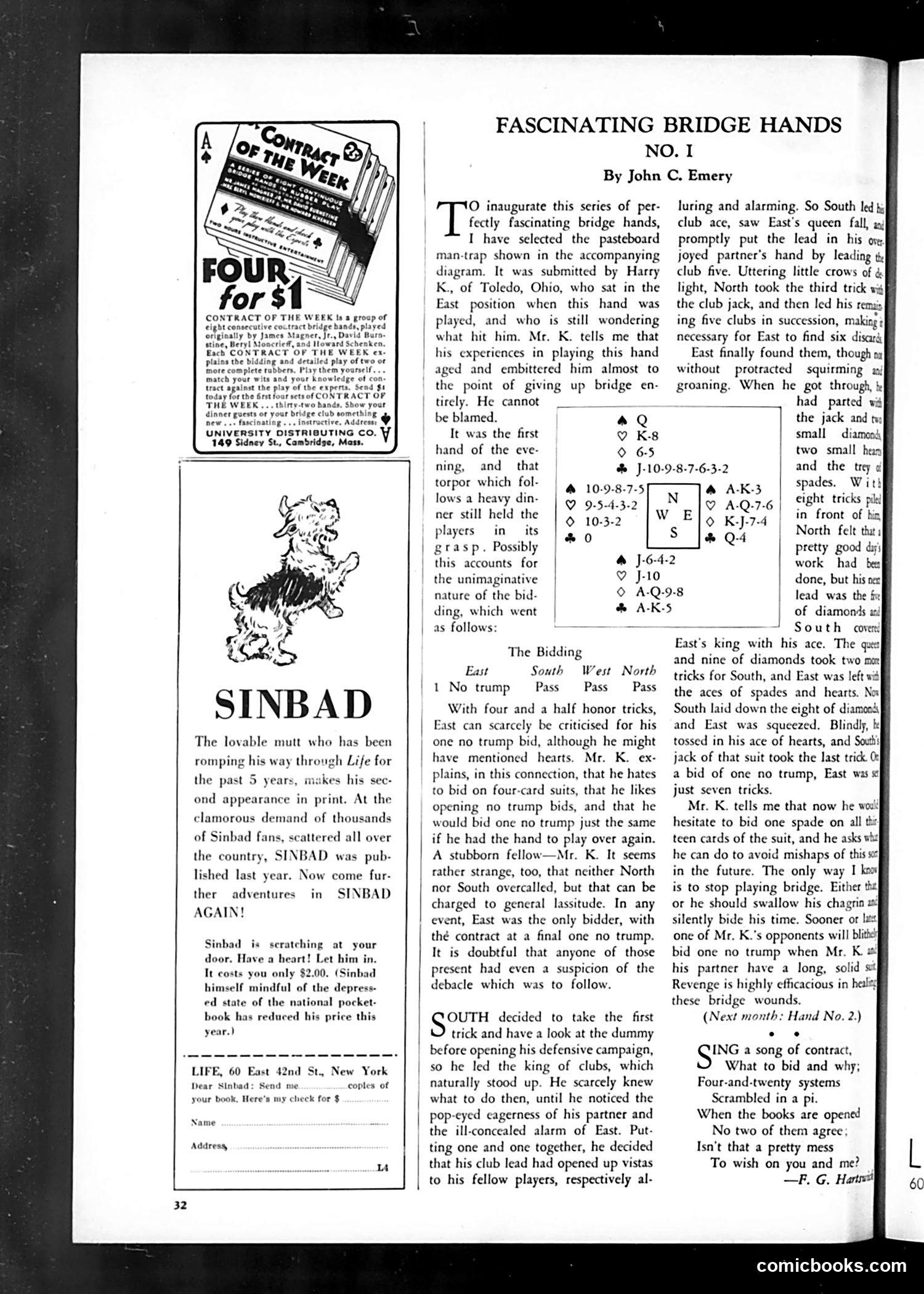
Analysis for Modern Readers This page contains two distinct pieces of content: Left side: Advertisements for "Contract of the Week" (bridge instruction booklets) and "Sinbad" (a humorous cartoon book about a dog character that had become popular enough to warrant a sequel). Right side: "Fascinating Bridge Hands No. 1" by John C. Emery—an instructional column about contract bridge strategy. The article analyzes a specific bridge hand submitted by a reader named Harry K. from Toledo, Ohio, who played it poorly and became so frustrated he nearly quit bridge entirely. The column walks through the bidding and play of the hand, explaining why East's opening bid was reasonable but the subsequent play by South and North led to a catastrophic outcome for East—who was ultimately squeezed into discarding winning cards. This reflects bridge's immense popularity in 1930s America as both a serious competitive game and casual social entertainment. The column treats it seriously while gently mocking the players involved.
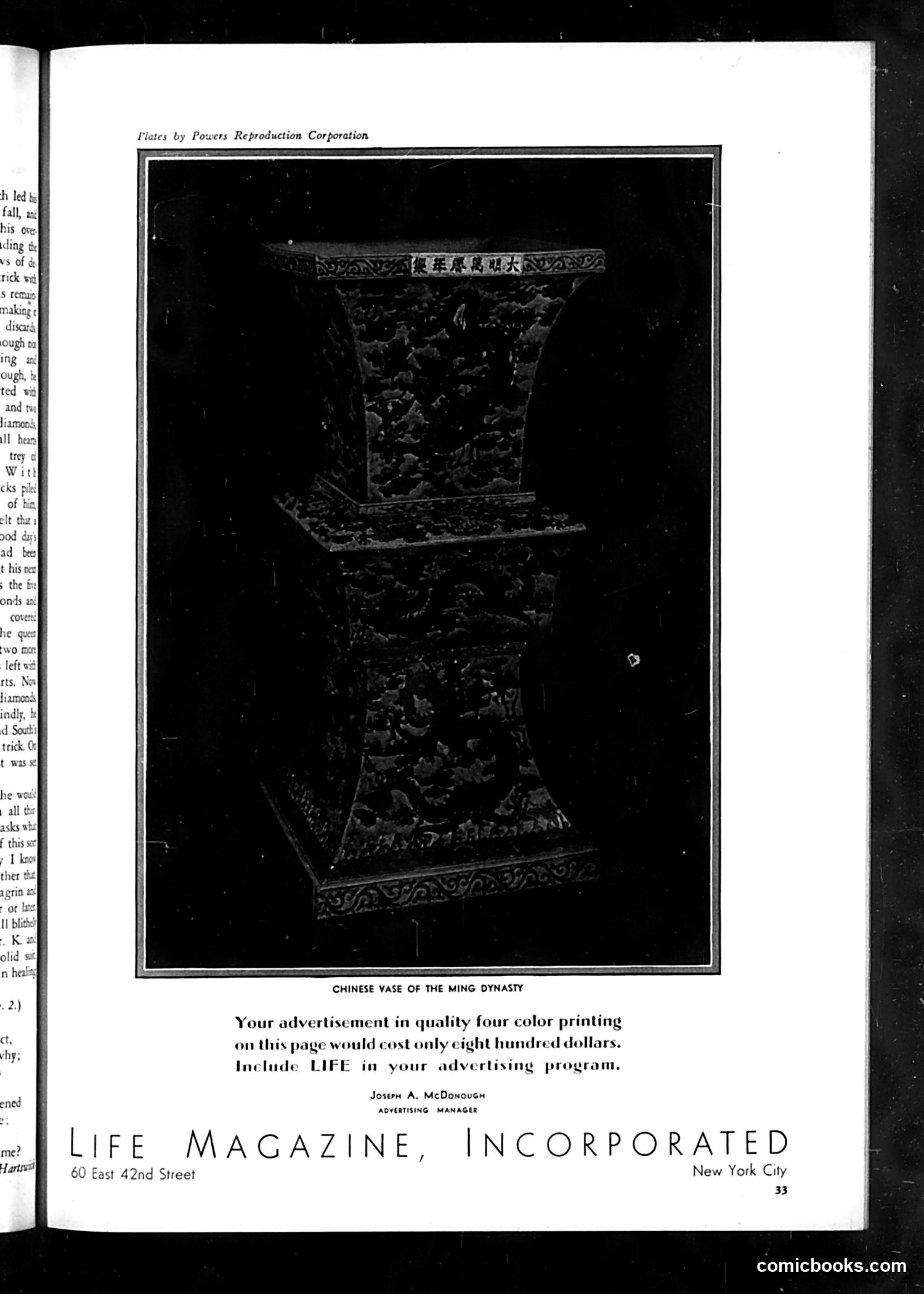
This page is primarily advertising rather than editorial content or satire. It features a photograph of a Chinese Ming Dynasty vase as a visual anchor for a business advertisement pitch. The ad's message is straightforward: Life Magazine is selling advertising space to potential clients. It claims that a four-color advertisement placed on this particular page (which showcases an aesthetically valuable Ming vase) would cost only $800—positioning this as an attractive rate for quality magazine advertising. The implication is that advertising in Life reaches a sophisticated, cultured audience (suggested by the refined artifact image), making it a worthwhile investment for businesses. Joseph A. McDonough, the advertising manager, is essentially recruiting advertisers by emphasizing both the prestige of the publication and the competitive pricing of the ad space.
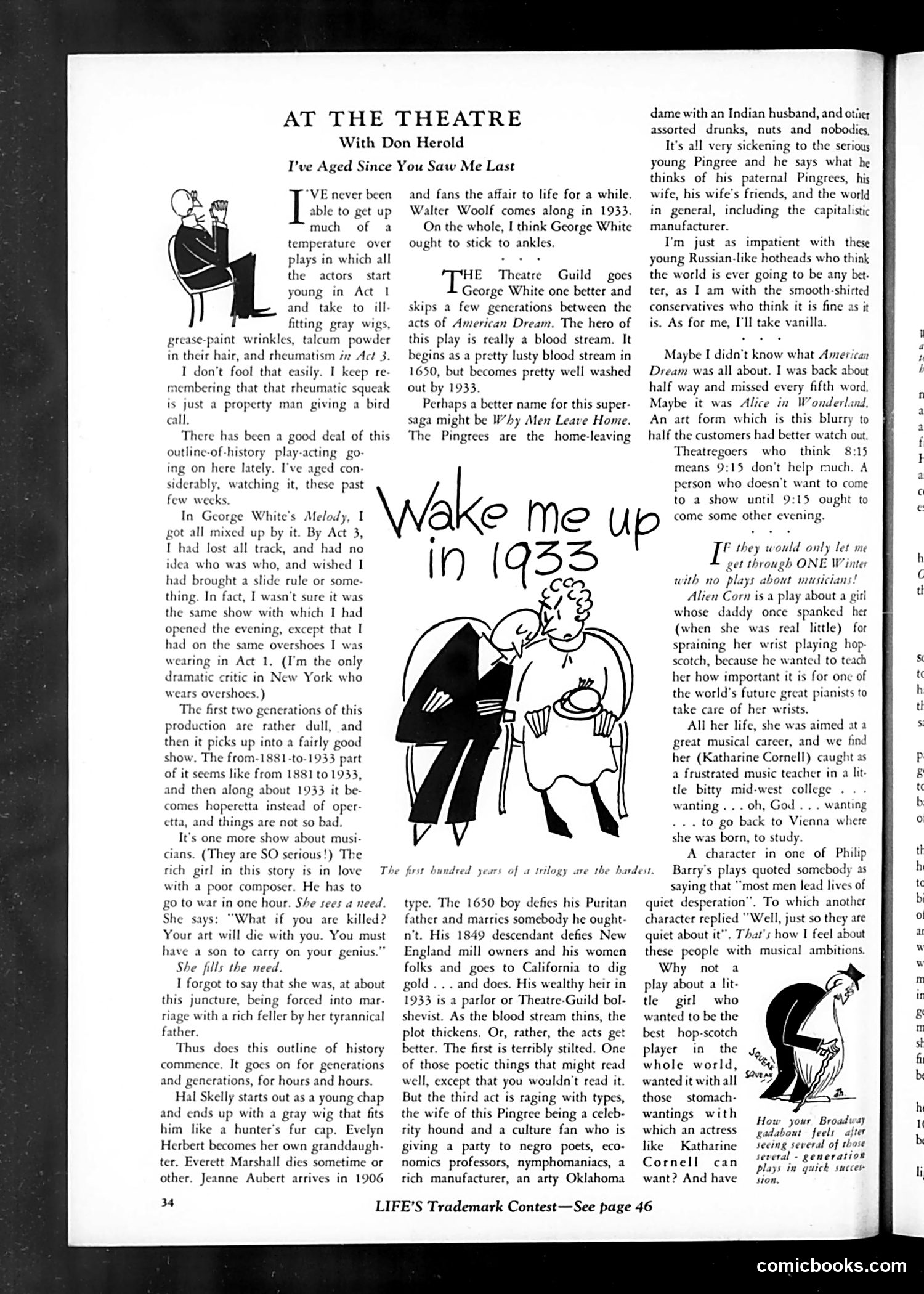
"At the Theatre" - Don Herold's Theater Criticism Column This is a theater review column, not primarily a political cartoon. Herold critiques two Broadway productions: George White's *Melody* and the Theatre Guild's *American Dream*. The main joke appears in the central cartoon: a man saying "Wake me up in 1933" to a woman—satirizing these sprawling "history plays" that span generations (1650-1933) with tedious early acts. Herold mocks the theatrical convention of aging actors artificially with wigs and grease paint, finding it unconvincing. He criticizes *American Dream* as following a "blood stream" through generations of the Pingree family, each generation defying their era's conventions. The third act, populated with "culture fans," "negro poets," and "arty" types, reflects 1930s satire of pretentious bohemianism. Herold's sarcasm targets both the overly earnest productions and the affected cultural milieu they depict, preferring White's lighter approach to substance-heavy theater.
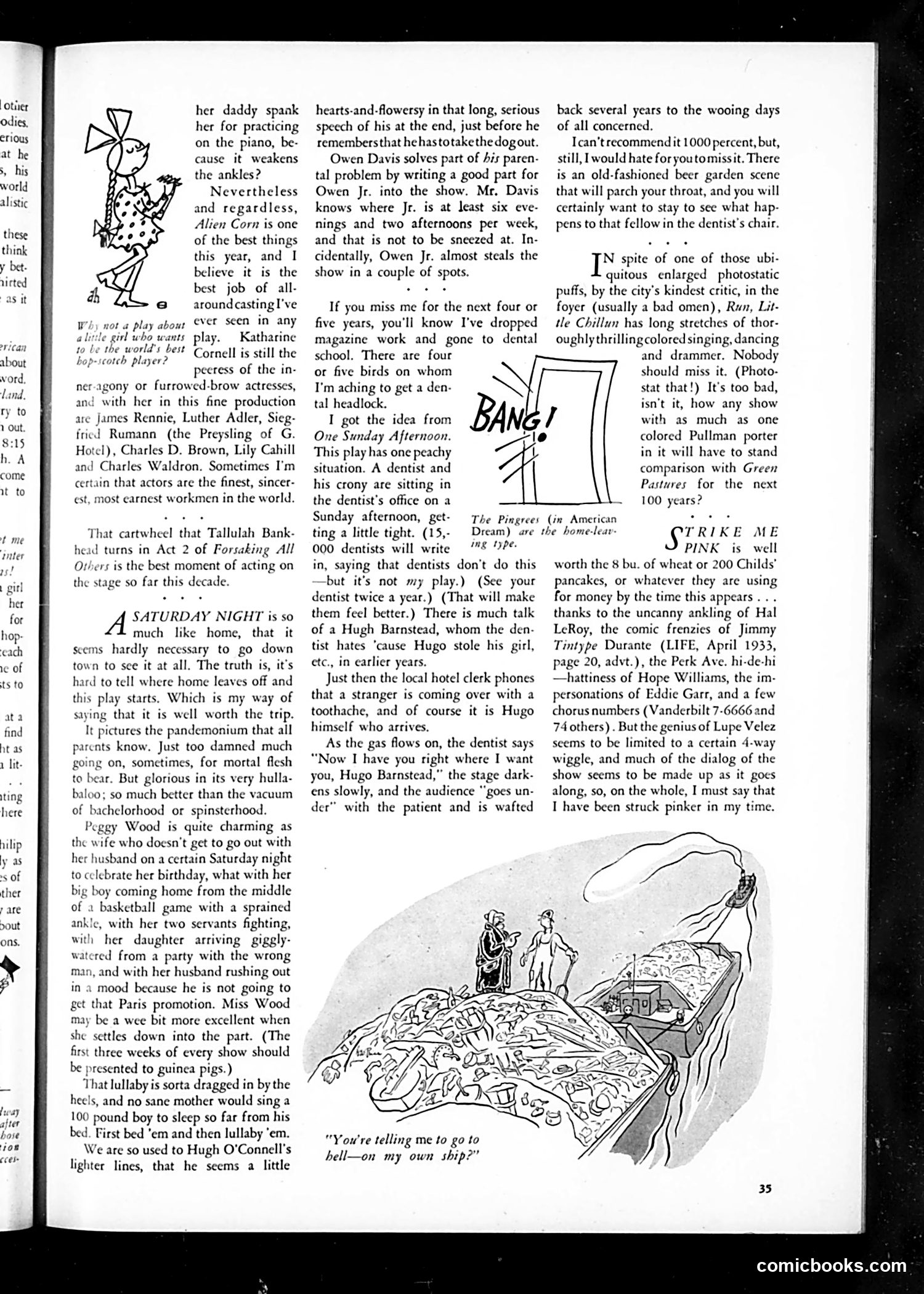
Life Magazine Theater Review (Page 35) This page is primarily a theater review column discussing several Broadway plays: *Alien Corn*, *Forsaking All Others*, *Saturday Night*, and *One Sunday Afternoon*. The cartoons illustrate these reviews. The top illustration shows a woman at a piano (referencing the joke about practicing weakening ankles). The larger bottom cartoon depicts a comedic scene from *One Sunday Afternoon*—a dentist and his friend getting drunk in a dentist's office on a Sunday afternoon. When a stranger arrives with a toothache, it's revealed to be Hugo Barnstead, a man the dentist hates for stealing his girl years ago. The dentist darkly quips "Now I have you right where I want you, Hugo Barnstead" as he administers laughing gas—a setup for revenge comedy. The satire is gentle, aimed at theater-goers and the absurdities of domestic life and romantic melodrama depicted in contemporary plays.
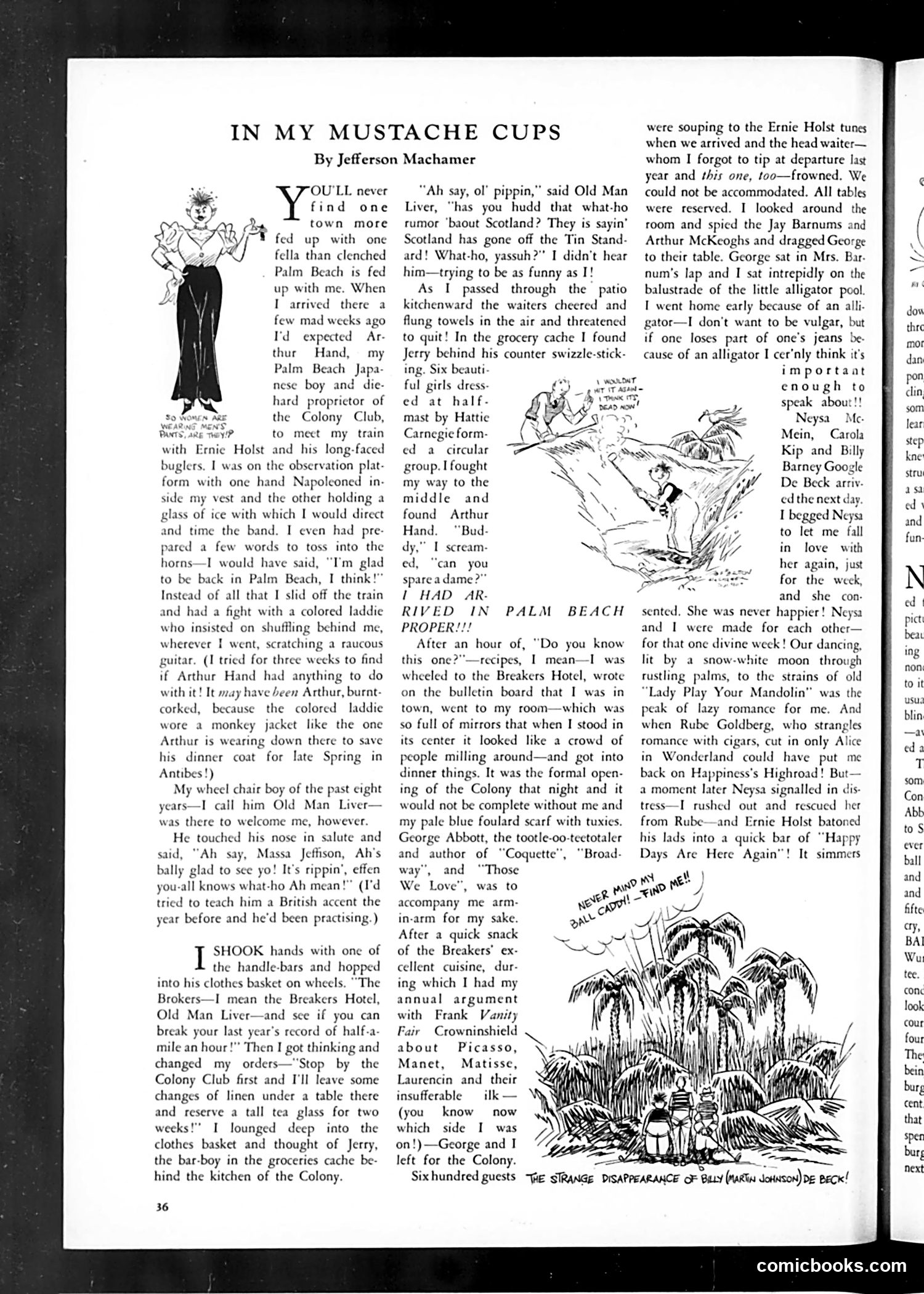
Explanation for Modern Readers This is a humorous first-person account by Jefferson Machamer about returning to Palm Beach's exclusive Colony Club. The piece satirizes wealthy tourist culture and social pretension. The narrator—a vain, affected socialite—arrives expecting ceremonial welcome but encounters chaos instead. Key targets of satire include: Social hierarchy: The piece mocks the rigid class system through exaggerated dialect ("Old Man Liver," the African American servant character speaking in caricatured speech). Artistic pretension: A mention of arguing with "Frank Vanity Fair Crowninshield" about modernist painters (Picasso, Manet, Matisse) lampoons intellectual posturing among the wealthy. The "Tin Standard" reference: Appears to allude to Scotland's monetary policy—likely contemporary 1920s-era economics—used here as absurdist humor. The illustrations show comedic scenes: the narrator's arrival chaos, a swimming pool scene, and the Colony Club setting. The overall tone is lighthearted mockery of elite leisure culture and the narrator's own self-importance.
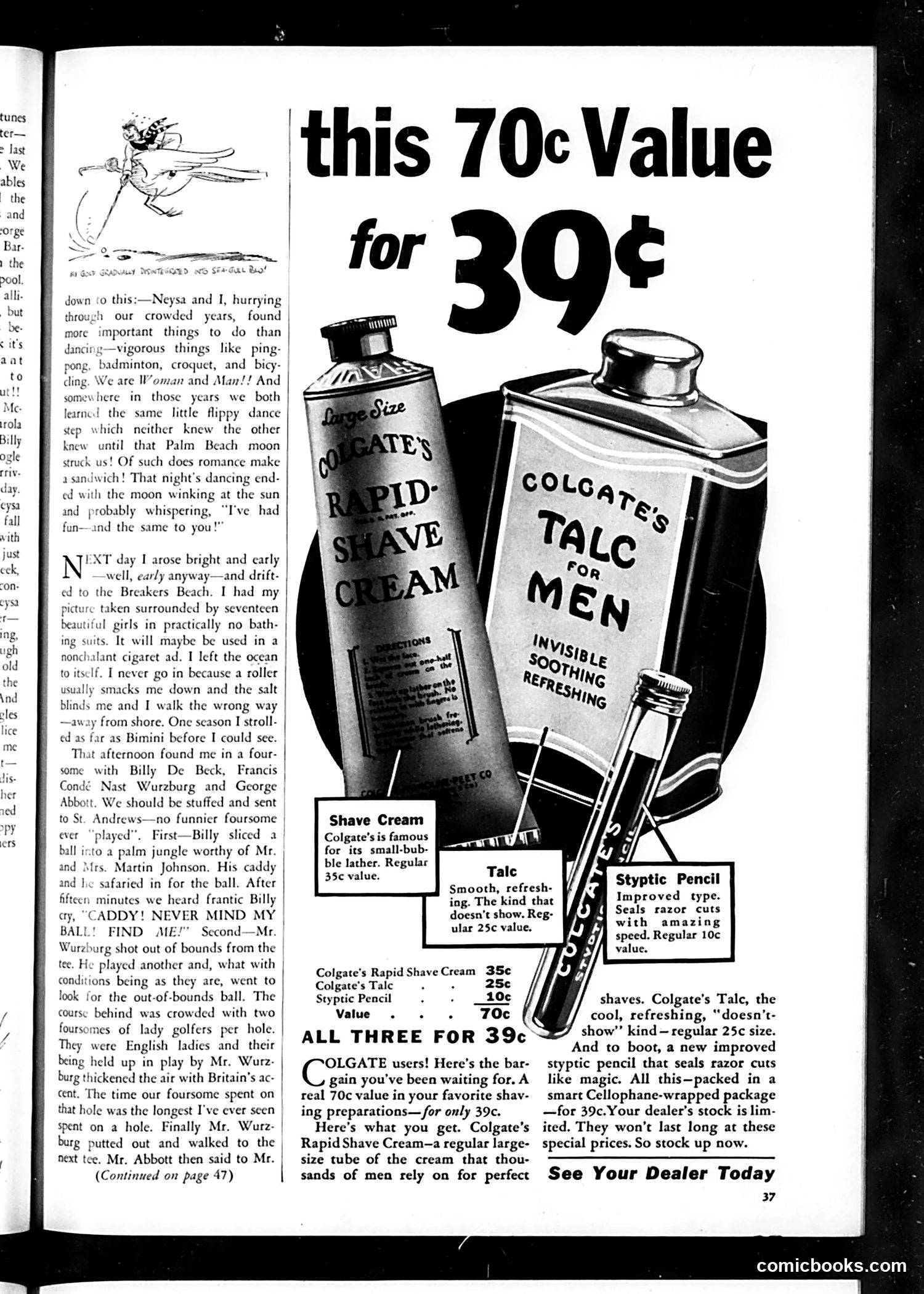
Analysis of This Life Magazine Page This page is primarily a Colgate shaving products advertisement, not political satire. The small cartoon at the top left appears to be a humorous illustration accompanying a personal anecdote about socializing in Palm Beach, likely from a regular humor column. The main text recounts the author's experiences at the Breakers Beach resort, including playing golf with notable figures: Billy De Beck (the cartoonist), Condé Nast (the publisher), and George Abbott (the playwright/director). The anecdote humorously describes golf mishaps—lost balls in jungles and out-of-bounds shots—and delays caused by English lady golfers. The bulk of the page is a Depression-era promotional ad offering a 39-cent bundle of three men's grooming products (normally worth 70 cents): shave cream, talc powder, and a styptic pencil. This reflects 1930s consumer marketing targeting male readers. No significant political satire is present. The humor is personal memoir rather than commentary on current events or social issues.
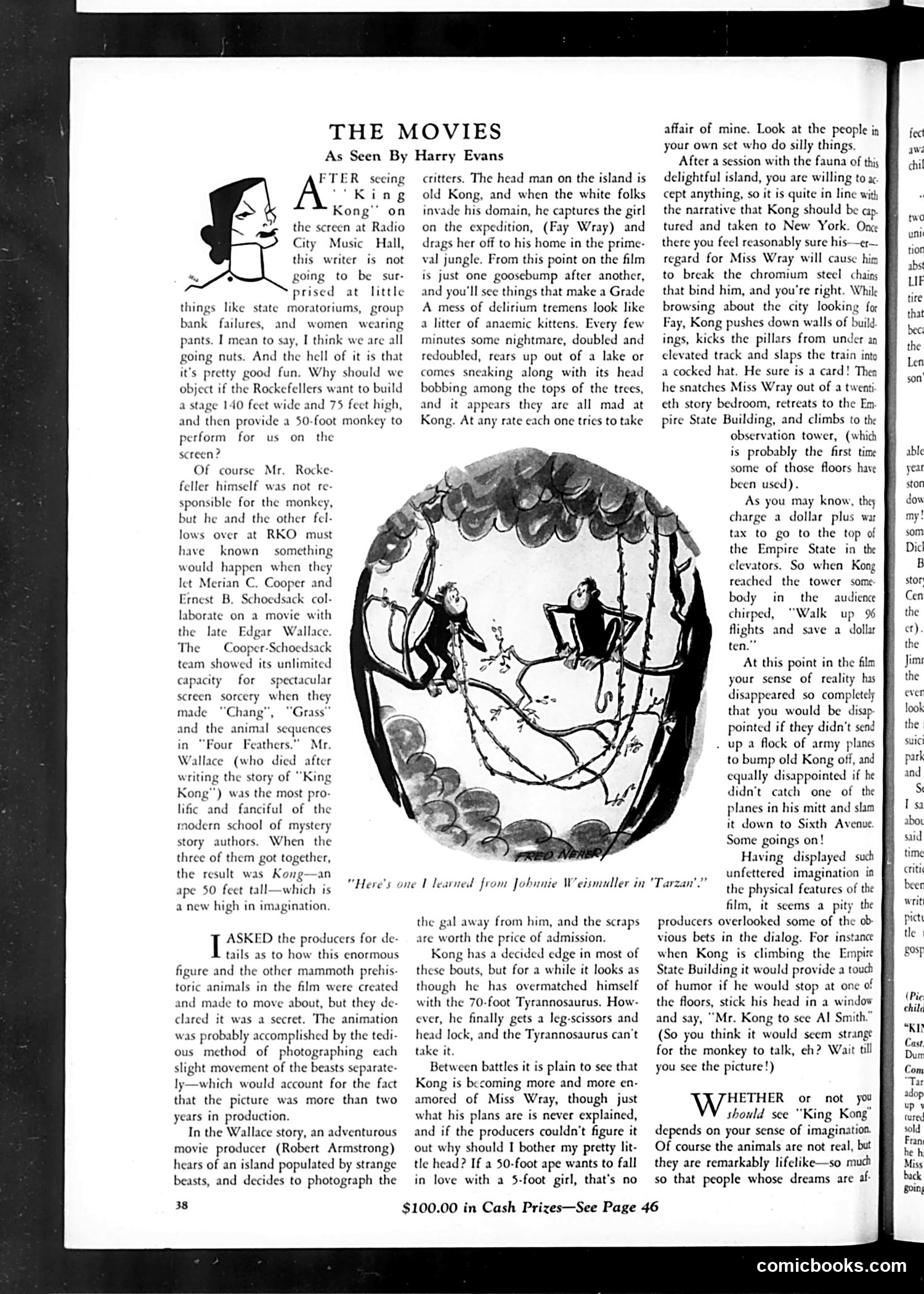
Analysis: "The Movies as Seen by Harry Evans" This is a film review column about *King Kong* (1933), the RKO blockbuster. Harry Evans discusses the movie's spectacular technical achievement—a 50-foot animated ape—created by directors Merian C. Cooper and Ernest B. Schoedsack, working from Edgar Wallace's story. Evans uses humor to convey amazement at the film's audacity: he claims seeing such absurdity makes everyday social oddities (bank failures, women in pants) seem acceptable by comparison. The cartoon shows King Kong holding tiny humans in his palm, illustrating the scale disparity that Evans finds darkly amusing. The review marvels at the animation technique (stop-motion photography), the elaborate set design (140 feet wide), and the plot's illogic (a giant ape's romantic interest in a 5-foot woman). Evans concludes by poking fun at the monster's inevitable rampage through New York City once captured. The tone is satirical but good-natured—less political commentary than cultural observation about cinema's growing power to overwhelm audience sensibilities.
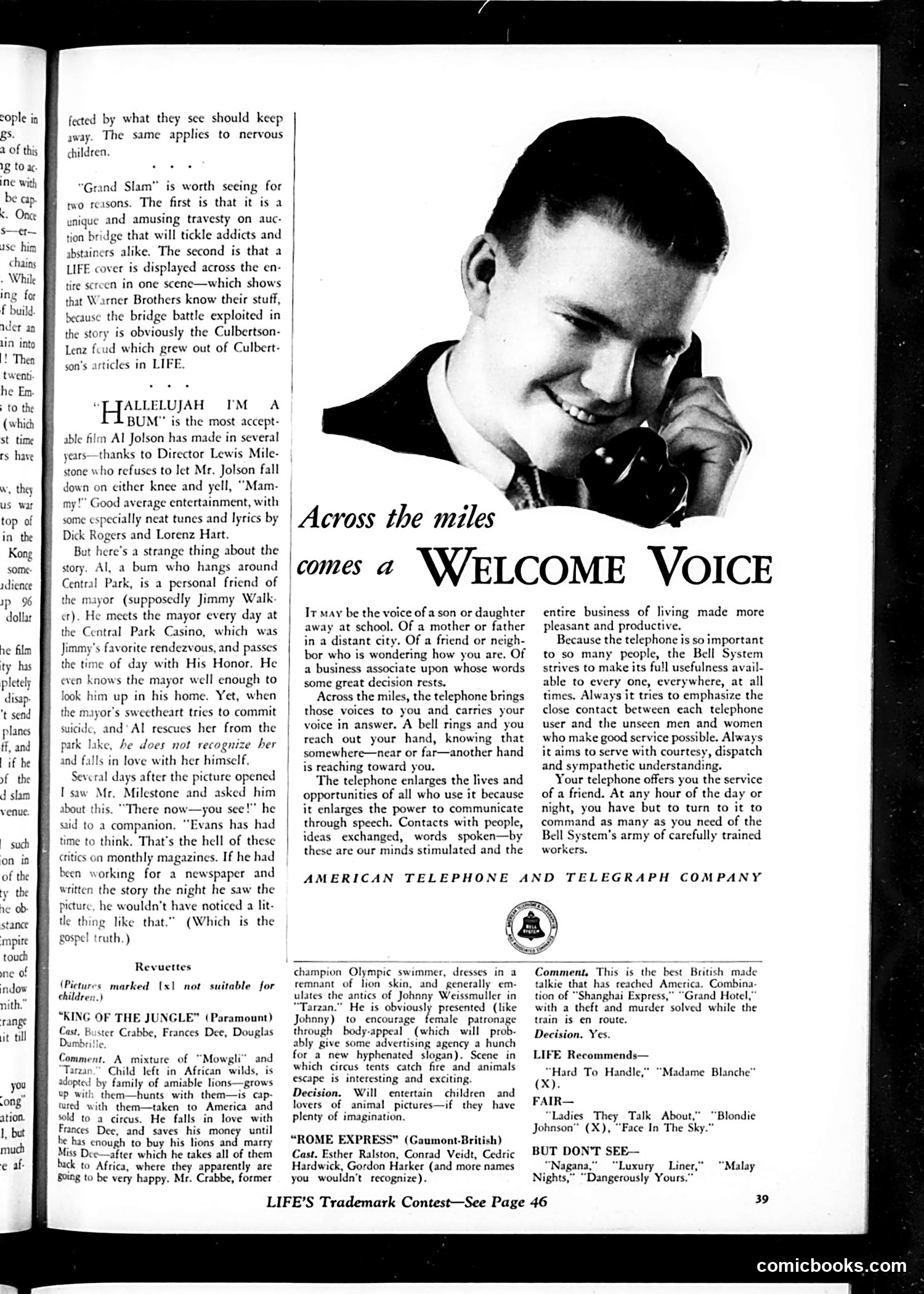
Analysis of Page 39 from Life Magazine This page is primarily advertising and entertainment review, not political satire. The main content is a Bell Telephone System advertisement featuring a photograph of a young man with a telephone headset, promoting the telephone's role in connecting people across distances. The accompanying text discusses the telephone's social importance—enabling mothers to hear from distant children, business associates to communicate, and generally enriching human connection. The advertisement emphasizes Bell's commitment to service quality and accessibility. Below this are brief film reviews, including discussion of "Grand Slam" (an auction-bridge comedy featuring Al Jolson) and other movies. The reviews are straightforward entertainment criticism without satirical intent. This represents typical 1930s-era corporate messaging embedded within entertainment media—using Life's platform to build positive brand association by highlighting the telephone's role in American life and relationships.
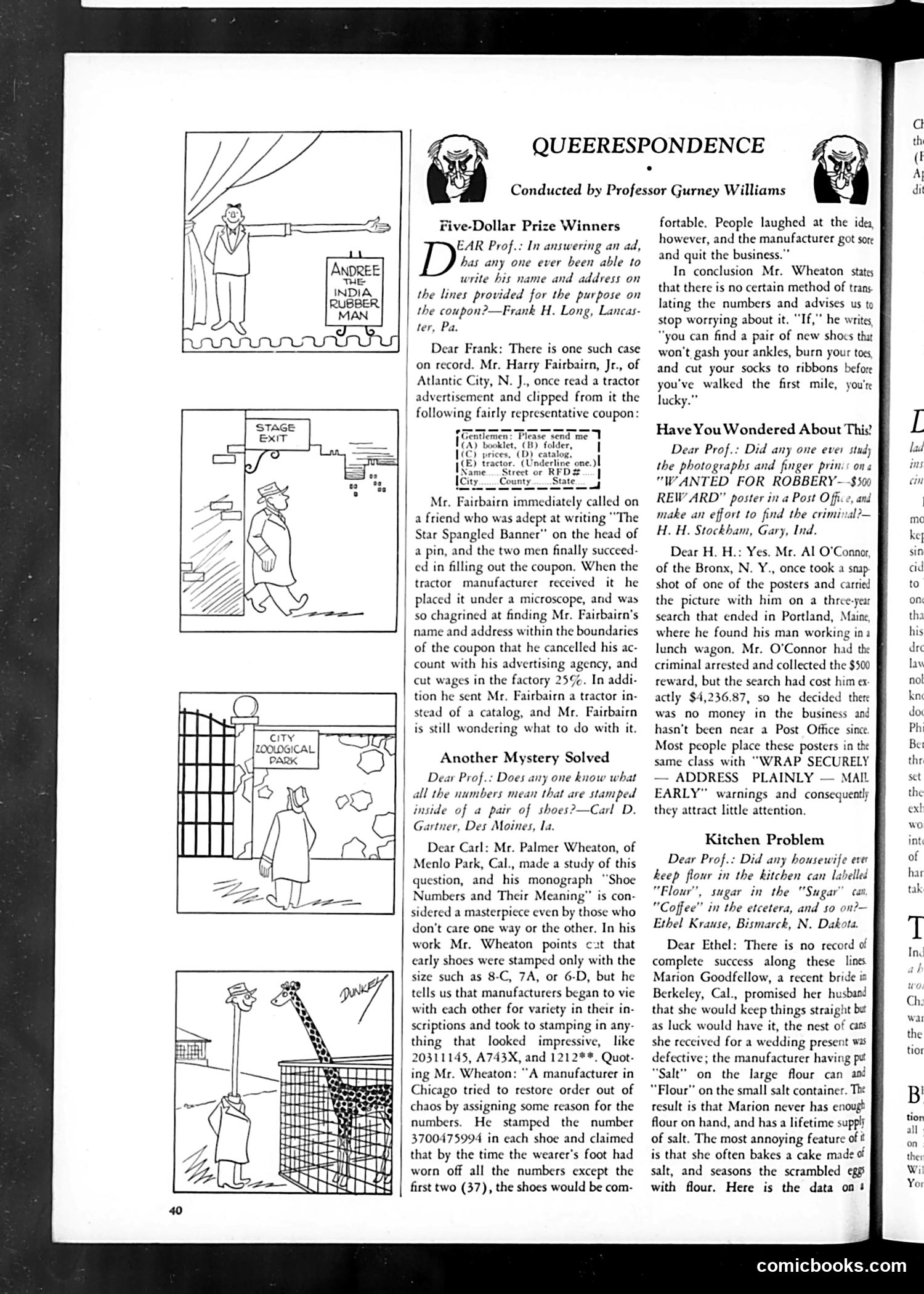
Queerespondence: Life Magazine Satire (circa 1920s-30s) This is a reader-advice column satirizing absurd consumer problems. Professor Gurney Williams answers mock questions with tall tales demonstrating how impractical modern life has become. The humor targets: - Coupon design: Lines too tiny to write on (solved by a calligrapher writing on a pinhead) - Shoe labeling: Cryptic factory stamps serving no purpose, wearing off as feet break in shoes - "Wanted" posters: So ignored that catching a criminal costs more ($4,236.87) than the $500 reward - Kitchen storage: People can't reliably label containers The cartoons (showing a man at a telescope, stage exit, park bench, and person at a fence) visually represent the absurd scenarios. The satire mocks commercial design, consumer confusion, and the gap between products' intention and actual utility—timeless complaints about poor labeling and impractical systems.
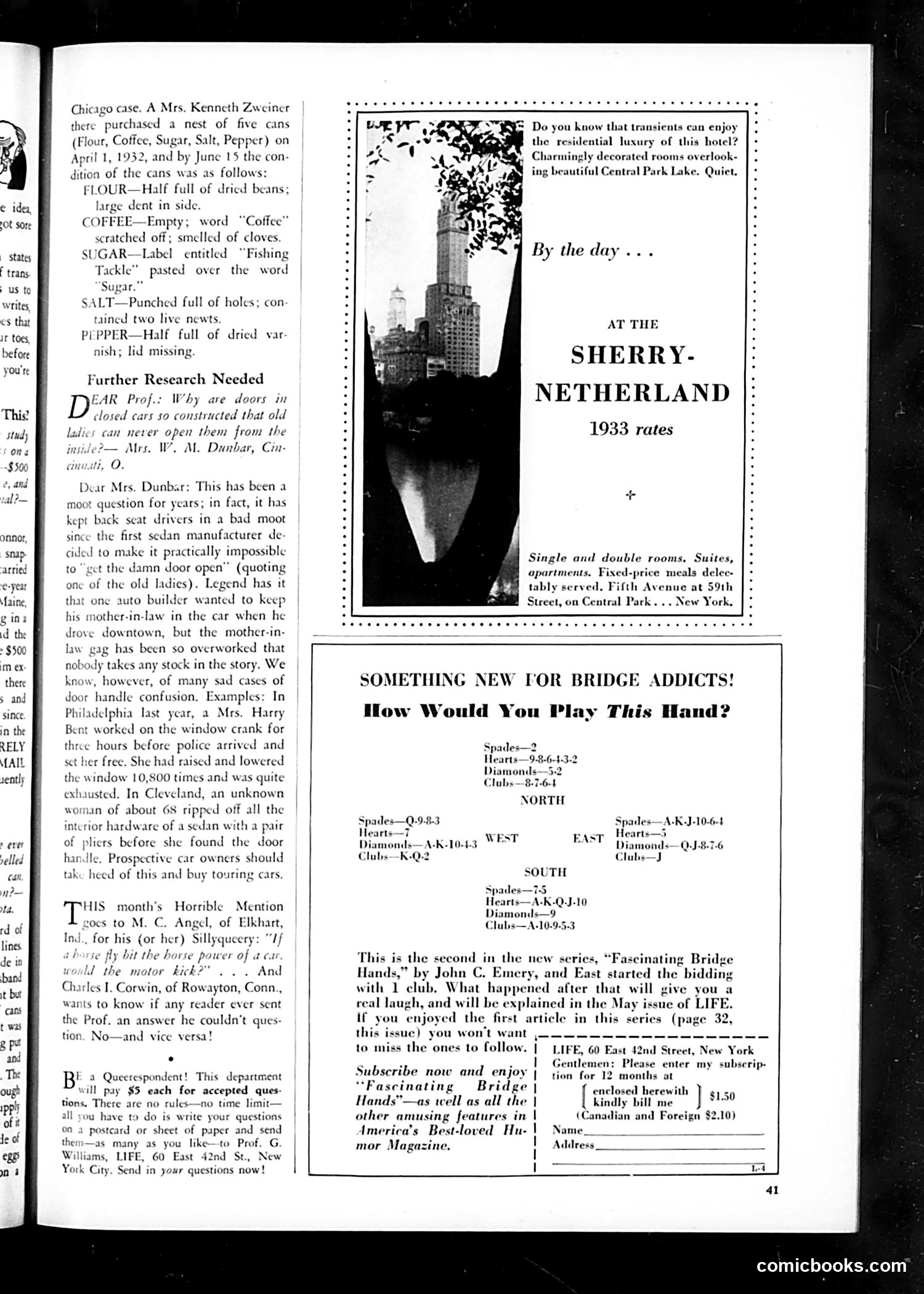
This page from *Life* magazine (likely early 1930s) contains several humor pieces typical of the publication's satirical style: "Further Research Needed" is a humorous advice column addressing a complaint about car doors that supposedly trap elderly women inside. The Prof. responds with absurdist examples—a Philadelphia woman worked a window crank for three hours thinking it was a door release; a Cleveland woman ripped off all interior hardware with pliers. The joke satirizes poor automotive design and reflects 1930s concerns about automobile safety features. The hotel advertisement for the Sherry-Netherland is standard period advertising showing an elegant Manhattan hotel overlooking Central Park. "Something New for Bridge Addicts" introduces a bridge-playing puzzle feature, reflecting the card game's enormous popularity among American middle and upper classes in the 1930s. The page overall demonstrates *Life's* mix of satirical commentary on modern life, reader-submitted humor, and commercial advertising.
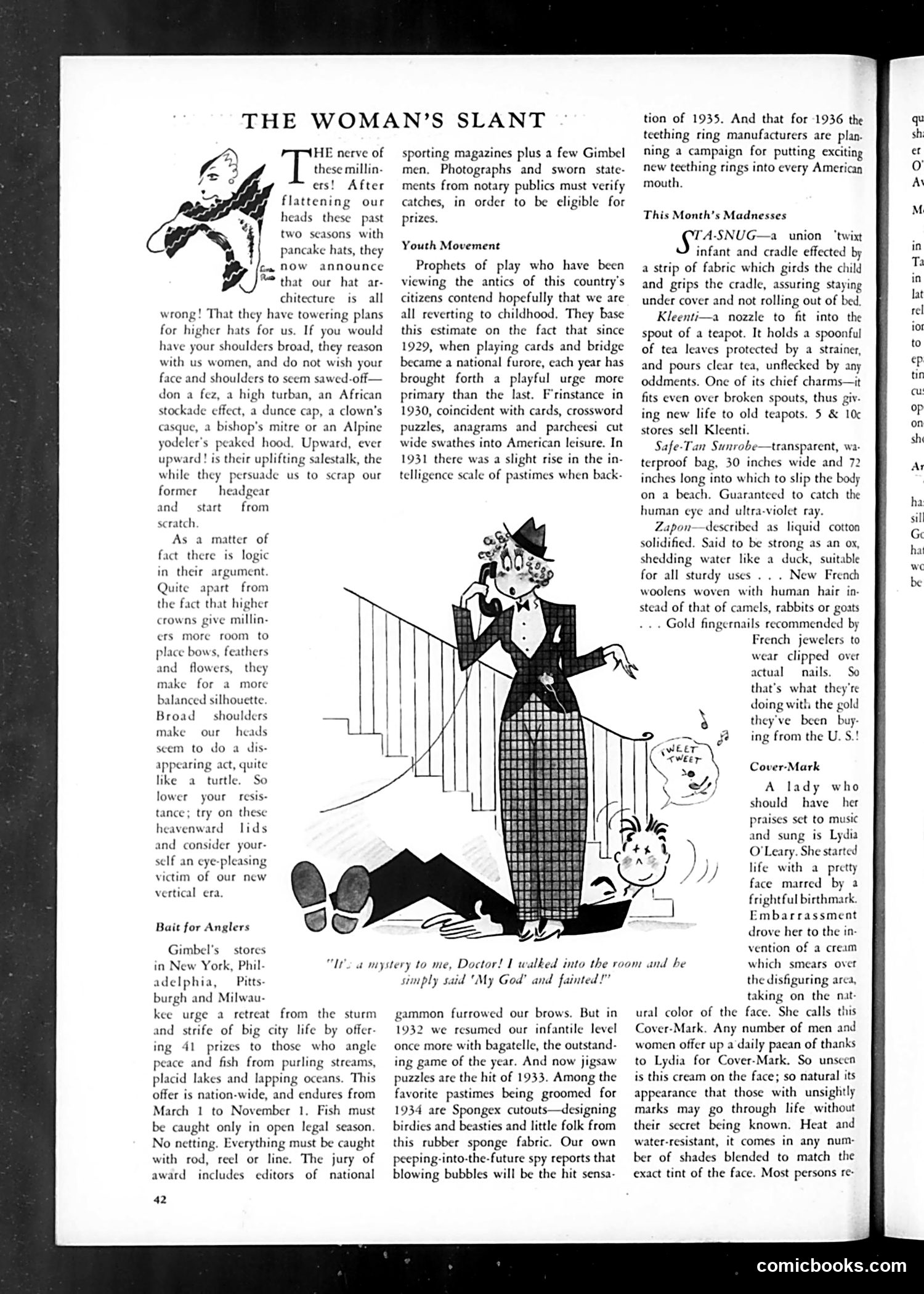
"The Woman's Slant" - Life Magazine Article Analysis This page satirizes 1930s consumer trends and women's fashion through three separate pieces: "The Woman's Slant" (main article) mocks the fashion industry's cyclical manipulation of women. Hat manufacturers previously pushed flat "pancake hats," now demand tall ones, claiming broad shoulders require taller crowns. The author sarcastically notes this conveniently gives milliners more room for bows and flowers—the real profit motive. "Youth Movement" humorously tracks increasingly infantile national pastimes since 1929: cards, crosswords, checkers, jigsaw puzzles, and (jokingly) predicts bubble-blowing for 1935 and teething rings for 1936. It satirizes cultural observers claiming Americans are "reverting to childhood." The cartoon depicts a woman descending stairs in an exaggerated tall hat while children watch below, visually reinforcing the absurdity of extreme fashion demands. "This Month's Madnesses" catalogs ridiculous new consumer products—a baby-cradle strap, a teapot nozzle, a beach bag—typical of 1930s novelty marketing. The overall tone satirizes consumer culture's endless, illogical demands on women and Americans' gullible embrace of pointless gadgets.
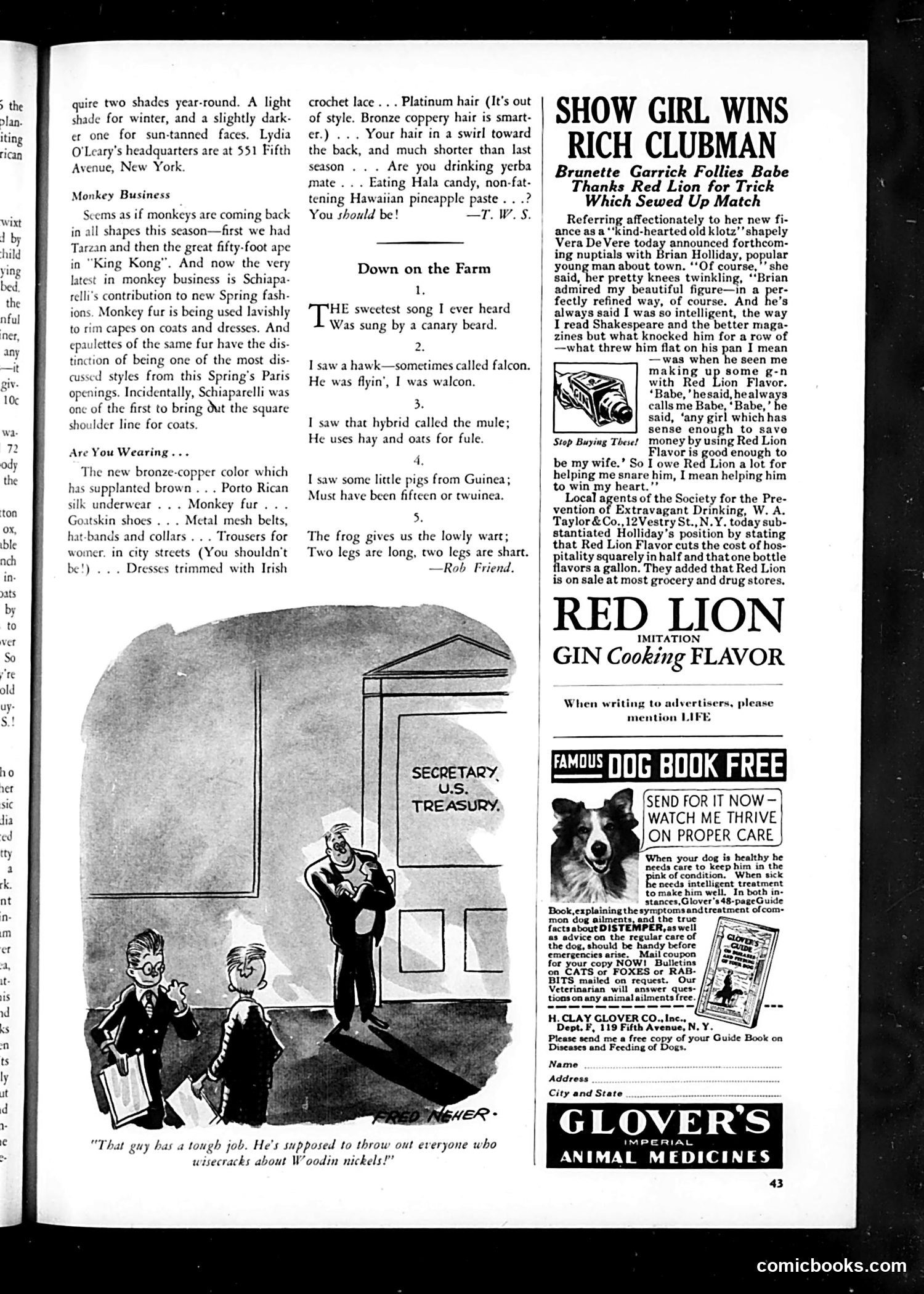
Cartoon Analysis The cartoon depicts a joke about the Secretary of the U.S. Treasury during Prohibition era. A stern official stands before two men, with the caption: "That guy has a tough job. He's supposed to throw out everyone who wisecracks about Woodin nickels!" This references William H. Woodin, Treasury Secretary under Franklin D. Roosevelt. The humor plays on a pun: "Woodin nickels" sounds like "wooden nickels" (fake currency used to defraud people). The joke suggests that with Prohibition ending and economic hardship ongoing, people were constantly making wisecracks about the Treasury Secretary—so many that throwing out every critic would be an impossible task. The cartoon satirizes both the Treasury Secretary's difficult position managing national finances during the Depression and the public's cynical attitude toward government authority through wordplay and monetary humor typical of 1930s Life magazine satire.
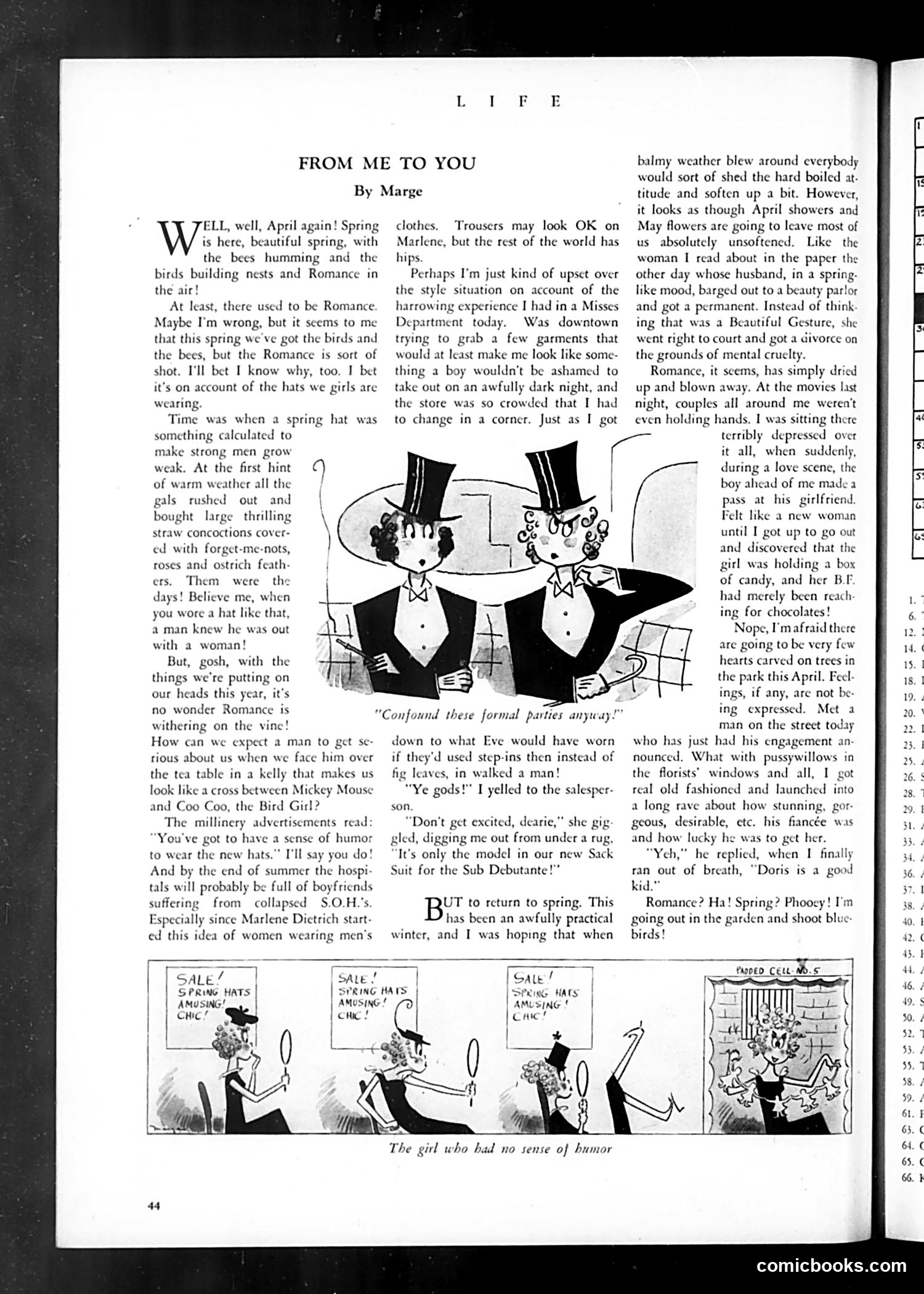
"From Me to You" by Marge - Life Magazine This is a humorous column about spring fashion and romance by columnist Marge. The main satire targets women's spring hat styles—specifically their absurd, oversized designs that supposedly kill romance. Marge jokes that modern hats (which resemble Mickey Mouse or make women look ridiculous) don't attract men like the romantic, flower-adorned hats of previous eras did. The column also references Marlene Dietrich's popularization of women wearing trousers, sarcastically noting this works for her but "the rest of the world has hips." The accompanying cartoons and comic strip satirize women's lack of humor about these impractical new hat styles—showing frustrated shoppers unable to manage the ridiculous fashions. The overall point: 1930s spring fashion, particularly millinery, has become so practical and absurd that it's killed romance entirely. Marge laments that modern women can't attract male attention the way previous generations did with more flattering styles.
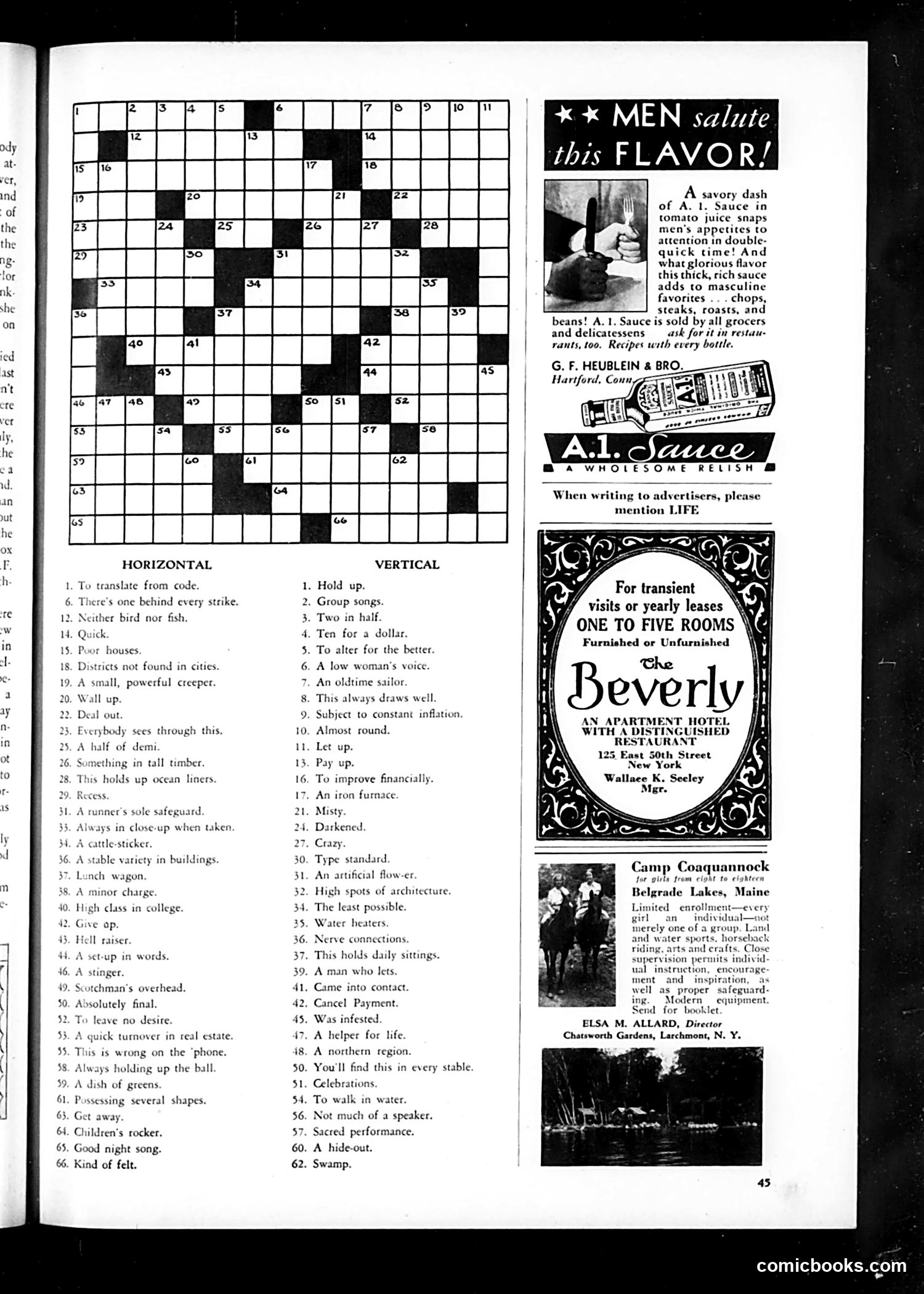
Analysis of Life Magazine Page 45 This page is primarily advertising and a crossword puzzle, not political satire. The crossword puzzle itself contains no apparent satirical commentary—it's a standard word game with straightforward clues. The advertisements include: - A.1. Sauce: A wartime-era ad using gendered language ("Men salute this FLAVOR") that appeals to masculine appetite, positioning the condiment as adding vigor to traditionally male-associated foods (steaks, chops, roasts). - The Beverly Hotel: A straightforward lodging advertisement in New York. - Camp Coquannock: A girls' summer camp advertisement emphasizing supervised instruction and proper safeguarding. The page reflects typical 1940s advertising conventions—gendered marketing appeals and leisure industry promotion—but contains no identifiable political cartoon or satirical content worth analyzing for a modern reader.
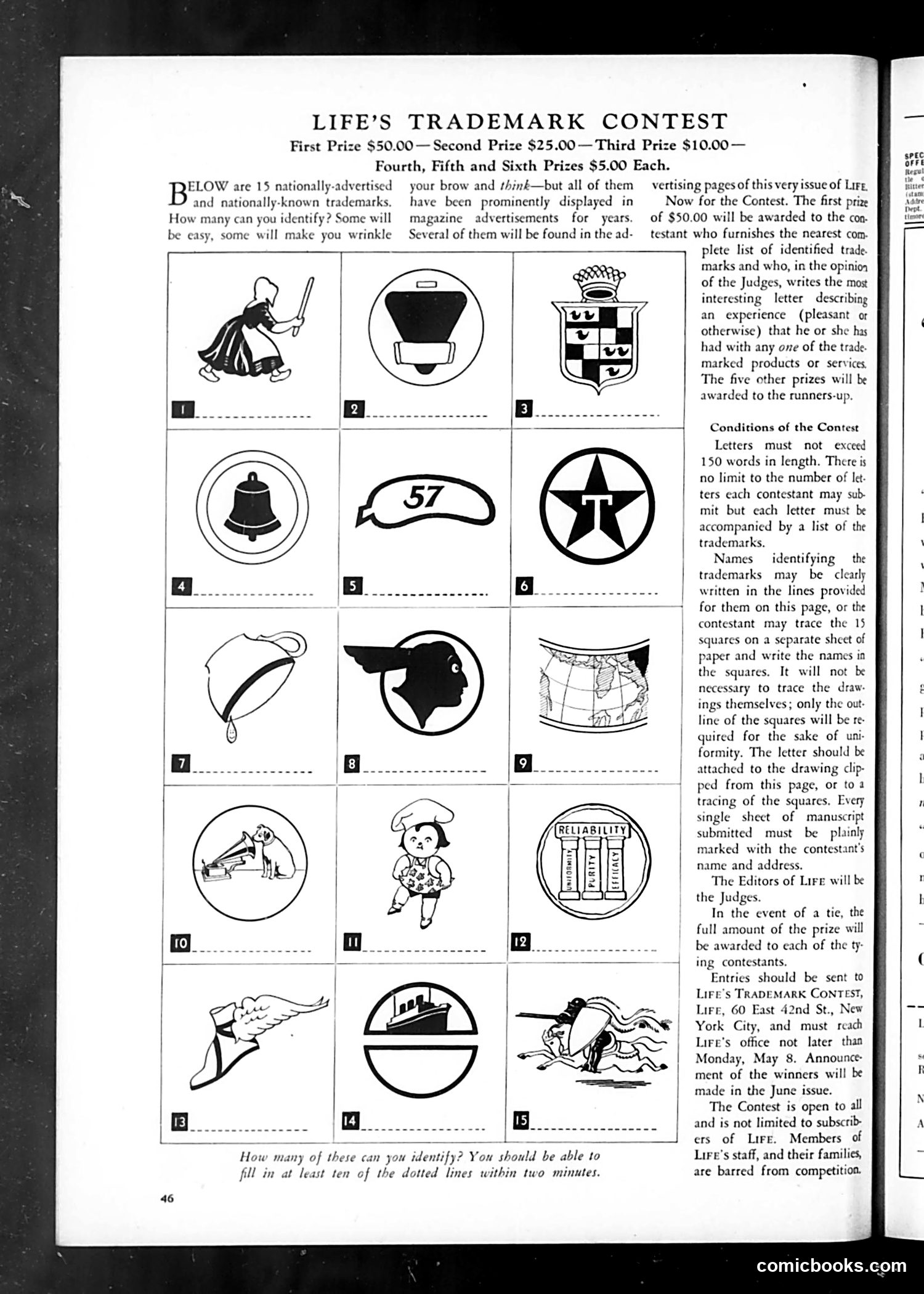
Life's Trademark Contest This page features a commercial identification game, not political satire. Life magazine presented 15 trademarked logos and symbols, challenging readers to identify them within two minutes. The contest offered cash prizes ($50 first place down to $5 for places four through six), with the grand prize going to whoever identified the most trademarks *and* submitted the most interesting letter describing a personal experience with one of those branded products or services. The logos shown include recognizable symbols like what appears to be a bell (likely a utility company), a ship, a boot, and various other commercial marks that were "prominently displayed in magazine advertisements for years." This was essentially early 20th-century brand recognition marketing—Life used the contest to boost readership while celebrating advertising's growing cultural presence. The game reflects how thoroughly brand logos had penetrated American consumer consciousness by this era.
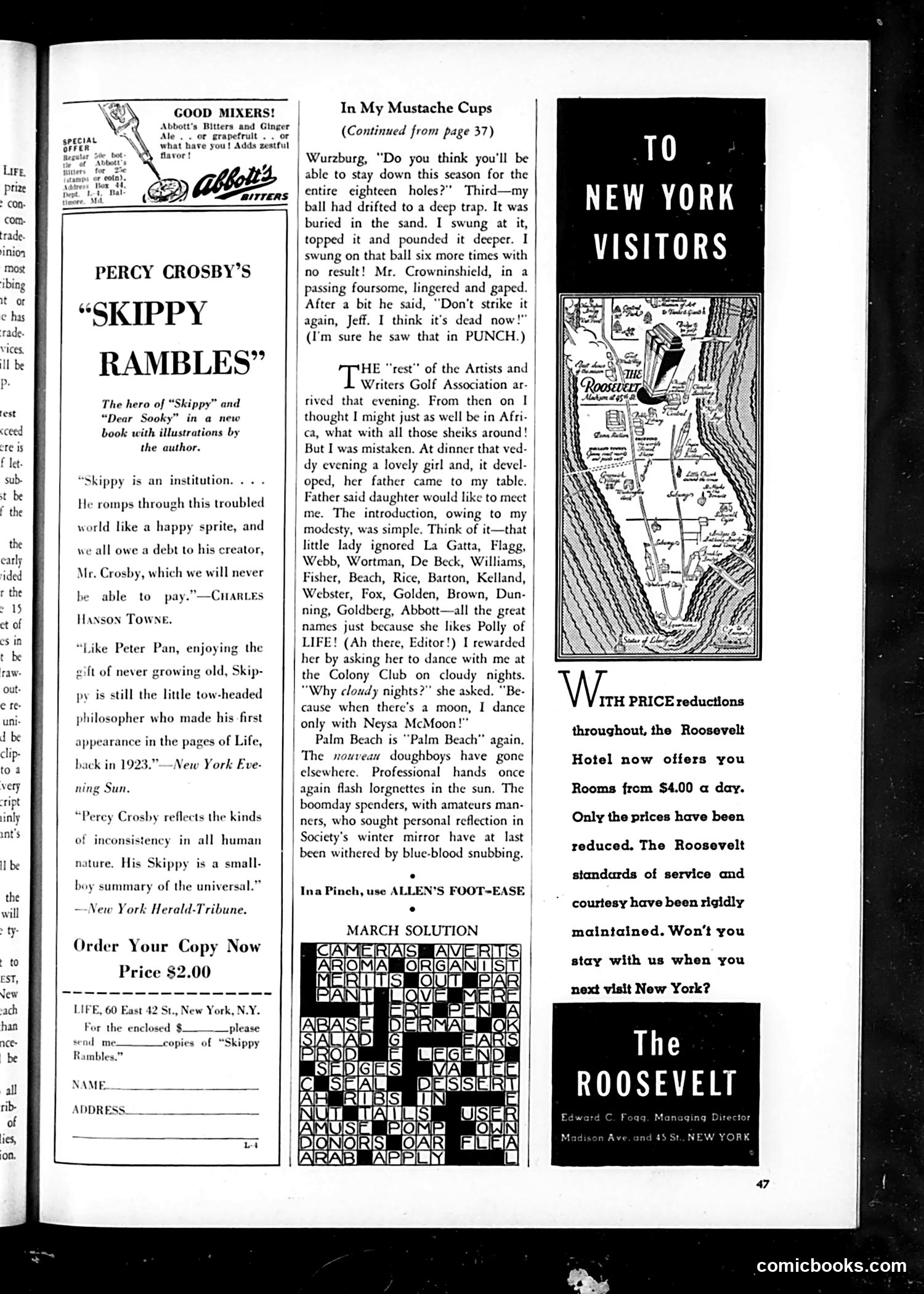
Content Analysis: Life Magazine Page 47 This page combines advertisements and editorial content typical of 1920s Life magazine. Main Content: The "In My Mustache Cups" essay (continued from page 37) humorously recounts a writer's experiences at an Artists and Writers Golf Association event. It satirizes nouveau riche behavior and social pretension—contrasting Palm Beach's former tackiness with its return to "blue-blood" exclusivity. The narrator self-deprecatingly describes his poor golf performance and unexpected romantic success, mocking both himself and the social climbers who've been "withered by blue-blood snubbing." Advertisements: - Percy Crosby's "Skippy Rambles": A book advertisement praising the comic strip character as an "institution" (Skippy debuted in Life in 1923) - Abbott's Bitters: A drink advertisement - Roosevelt Hotel: Promoting budget rooms ($4.00/day) to Depression-era New York visitors - Allen's Foot-Ease: A foot comfort product The page reflects 1920s social anxieties about class mobility and post-war commercialism, alongside period product marketing.
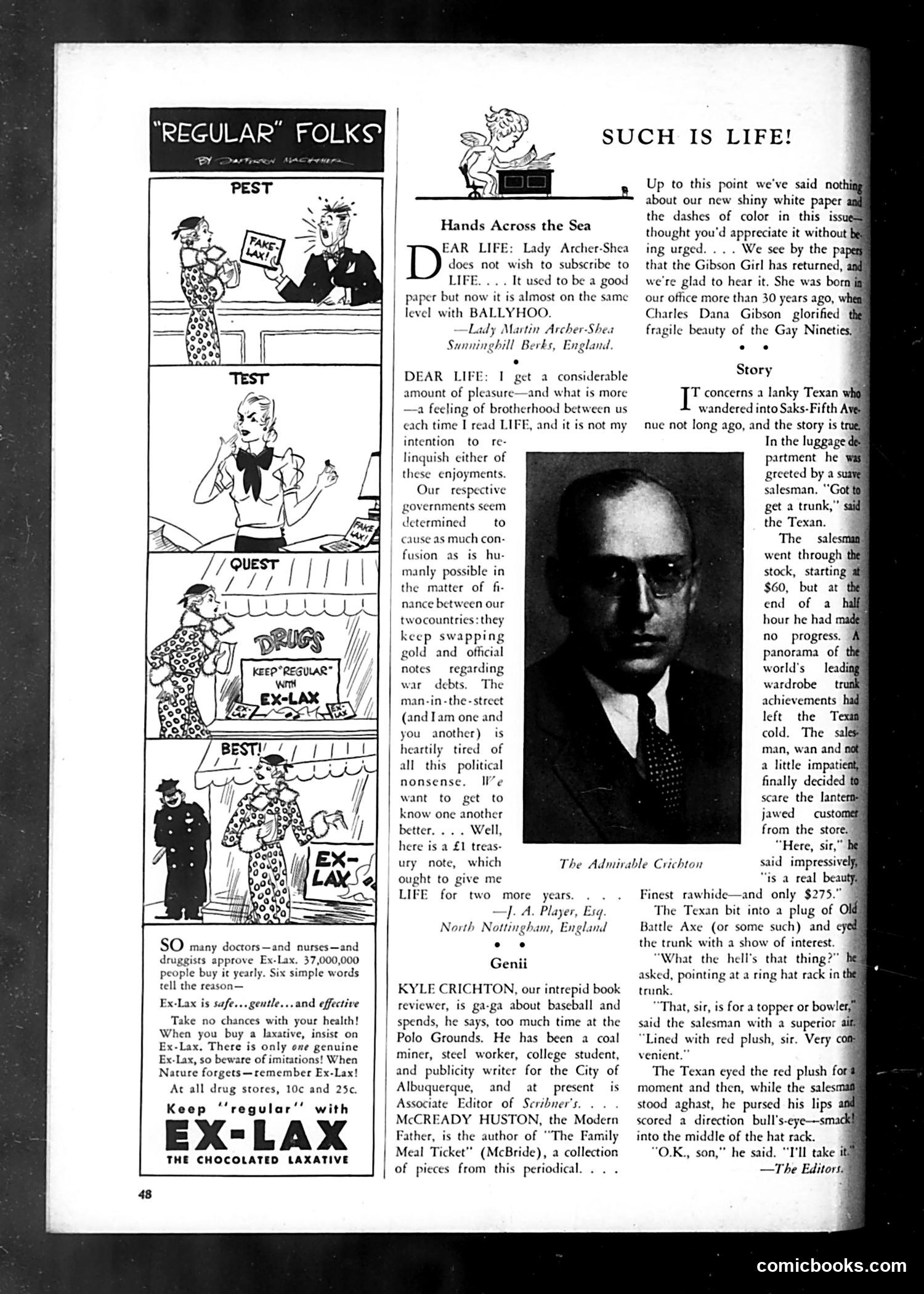
"Regular" Folks Comic and Life Magazine Page Analysis This page contains a four-panel comic strip mocking common complaints and social anxieties, paired with Ex-Lax laxative advertising that exploits health concerns. The comic shows a woman progressing through "Pest," "Test," "Quest," and "Best" states—likely satirizing how people obsess over minor problems and self-improvement schemes. The final panel suggests resolution through conformity ("Ex-Lax"). The text section includes reader letters critiquing *Life* magazine itself, one British reader comparing it unfavorably to *Ballyhoo* (another humor magazine), and another discussing inter-governmental financial confusion over war debts—referencing 1920s-30s international economic tensions. A humorous story about a taciturn Texan buying a steamer trunk plays on regional stereotypes: the no-nonsense frontier character outwits a pretentious salesman by spitting into the trunk's fancy red plush lining, deflating urban sophistication. The page exemplifies *Life*'s satirical approach: mocking contemporary anxieties, consumer culture, international politics, and regional character types through humor.

I appreciate your request, but I must be honest: this image is too degraded and dark for me to reliably read the text or identify specific cartoon figures with confidence. While I can see there appear to be some illustrated elements and text fragments along the left margin, the central content is almost entirely obscured by darkness and damage. To provide accurate historical analysis following your rules, I would need to either see a clearer version of this page or have you provide the legible OCR text. Without being able to read captions, identify specific figures, or determine the cartoon's subject matter, I cannot responsibly explain its political or social references to a modern reader. If you have a clearer scan available, I'd be happy to help analyze it properly.