life
Life — May 1933
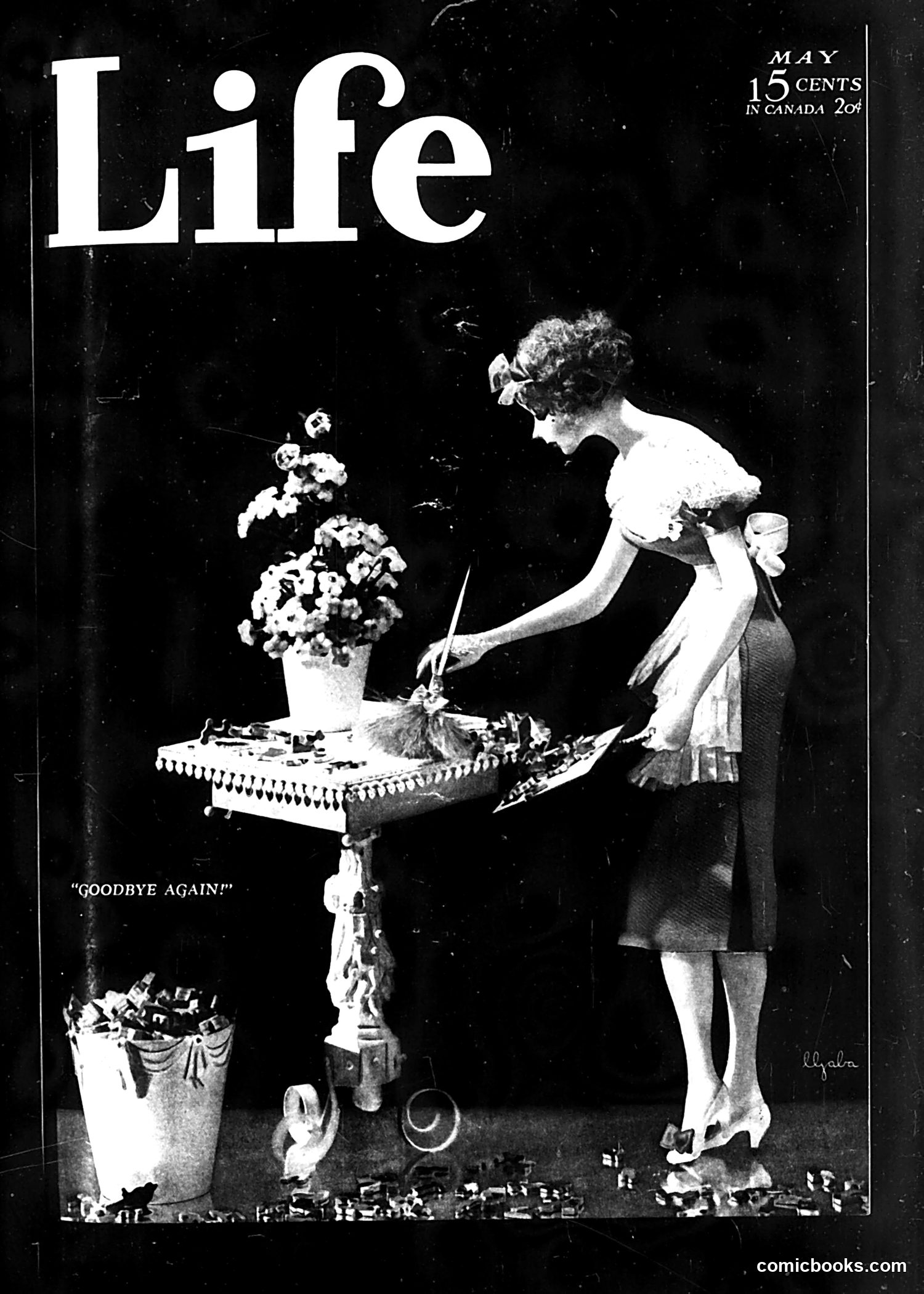
Analysis This Life magazine cover from May (price 15 cents) depicts a woman arranging flowers at an ornamental table, with the caption "GOODBYE AGAIN!" The image appears to be satirizing the recurring pattern of wartime farewells—likely referencing soldiers departing for or returning from military service during a conflict period. The woman's formal attire and the decorative setting suggest a domestic, refined context, while scattered military items (possibly toys or miniatures) on the floor below reinforce the war theme. The "Goodbye Again" caption implies this is a repetitive experience—not a one-time parting but an ongoing cycle of separations. This likely commented on the emotional toll of repeated military deployments on the home front, a common satirical subject in American magazines during wartime periods.
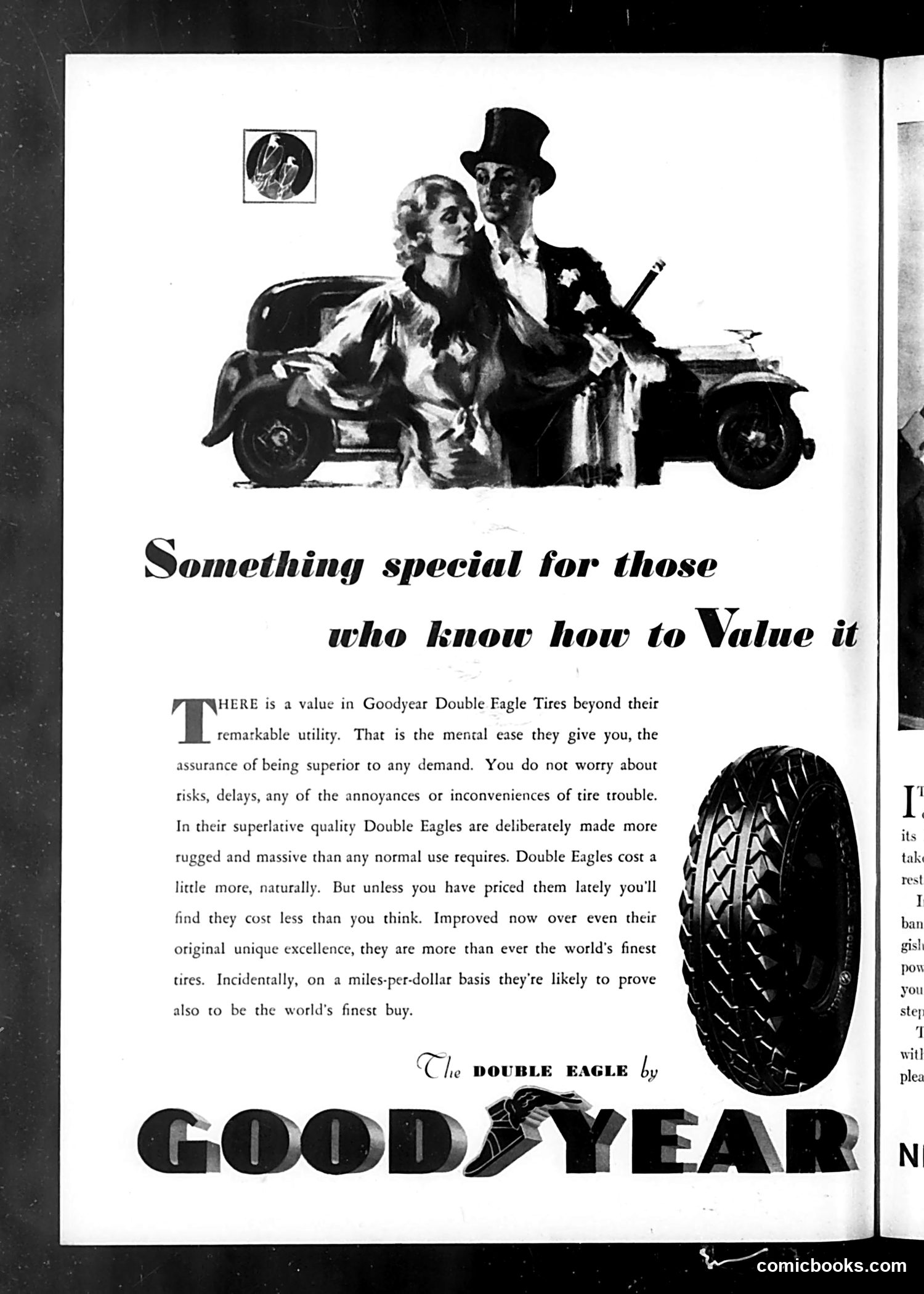
Analysis This page is primarily a Goodyear tire advertisement, not satire or political commentary. The image shows a well-dressed couple in 1920s-30s attire standing beside an automobile, positioned to suggest wealth and sophistication. The ad copy emphasizes that Goodyear Double Eagle Tires represent "something special for those who know how to value it"—appealing to aspirational consumers who understand quality and are willing to pay premium prices. The advertisement's messaging reflects period class consciousness: suggesting that superior tires convey social status and peace of mind. A large tire image appears on the right. The tagline promises both excellence and value "on a miles-per-dollar basis." This is straightforward product advertising leveraging status anxiety and lifestyle aspiration rather than satire.
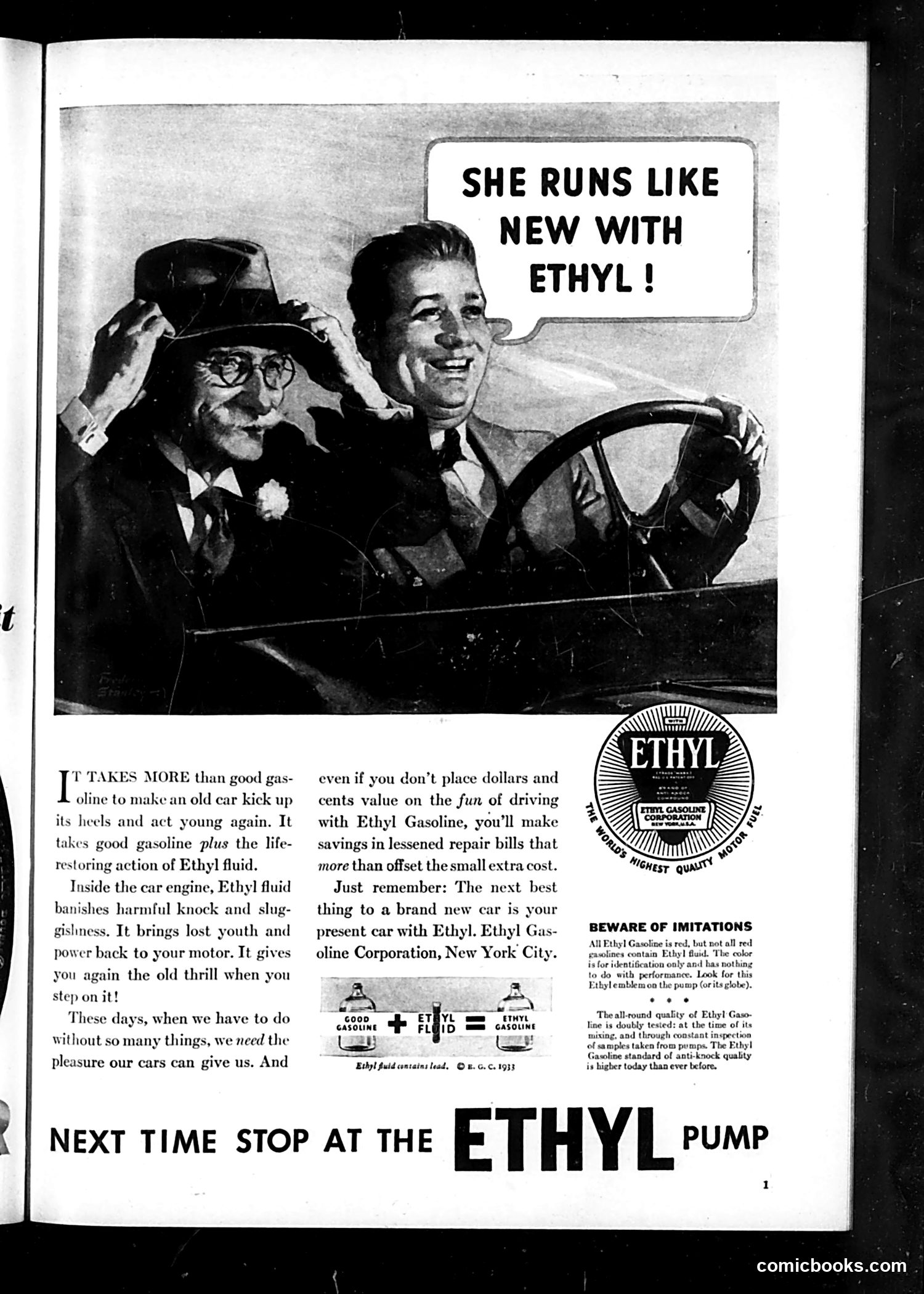
Analysis: Ethyl Gasoline Advertisement This is a commercial advertisement, not political satire. It promotes Ethyl Gasoline, a leaded fuel product from the Ethyl Gasoline Corporation (New York City). The image shows two men in a car—an elderly gentleman and a younger driver—with the caption "She runs like new with Ethyl!" The humor relies on the double meaning: "she" refers both to the car and possibly plays on gendered language common to that era. The advertisement claims Ethyl fuel restores old cars to youthful performance by eliminating engine knock and sluggishness. The text emphasizes that despite higher cost, reduced repair bills offset the expense. A warning against imitations appears at bottom right, suggesting competitors existed. This reflects the early automotive era when fuel additives were novel selling points.
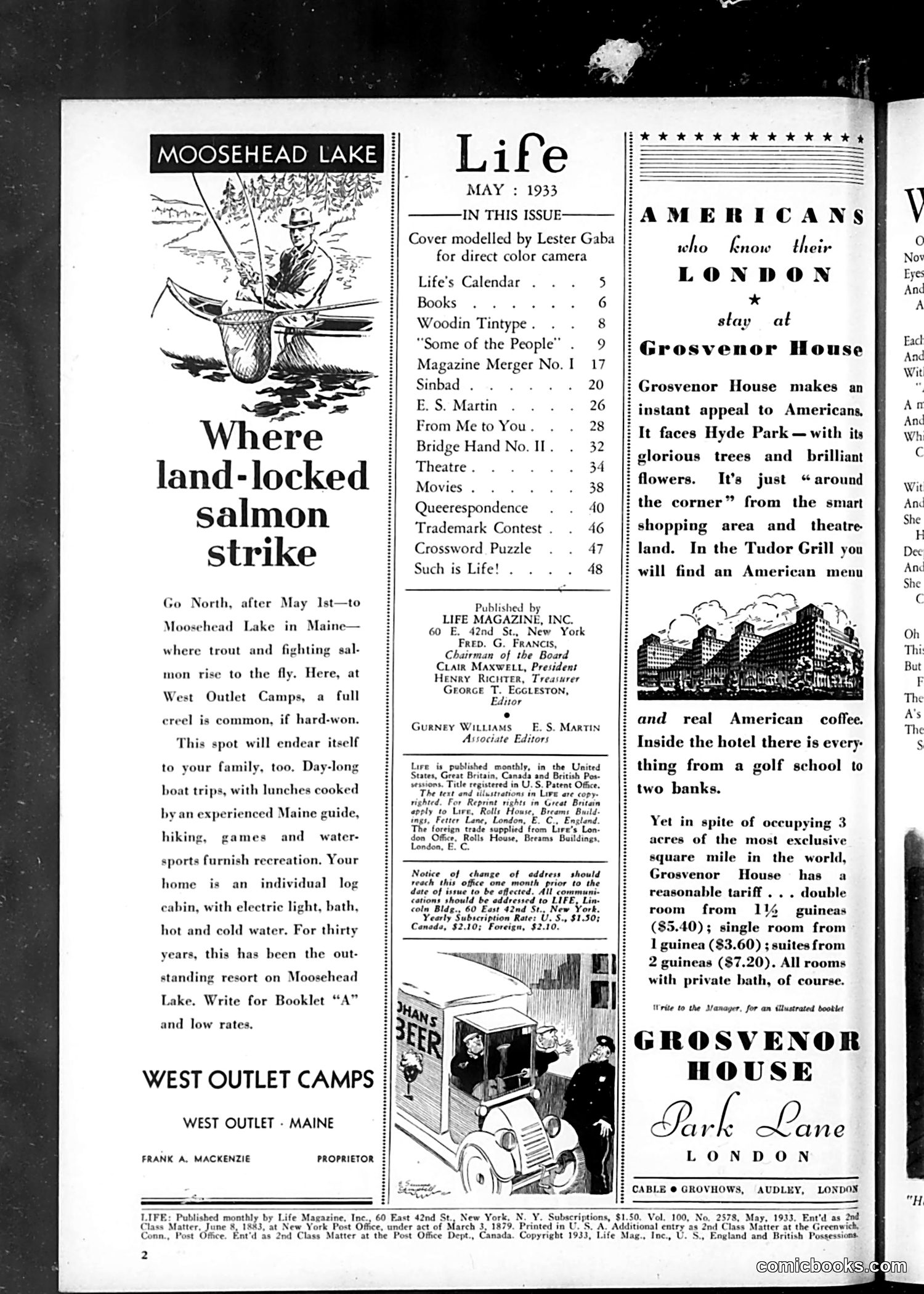
Page Analysis This is primarily a magazine contents and advertising page from Life Magazine, May 1933. The left side features an advertisement for West Outlet Camps in Maine, promoting fishing at Moosehead Lake with illustrations of a fisherman and salmon. The right side advertises the Grosvenor House hotel in London, emphasizing its appeal to Americans visiting England. The small cartoon shows what appears to be a humorous scene of people in or around a vehicle, likely playing on tourist or travel themes, though the specific satirical reference is unclear from the image alone. The page is primarily commercial rather than satirical commentary—typical of Life Magazine's mixed format of advertising, articles, and occasional cartoons.
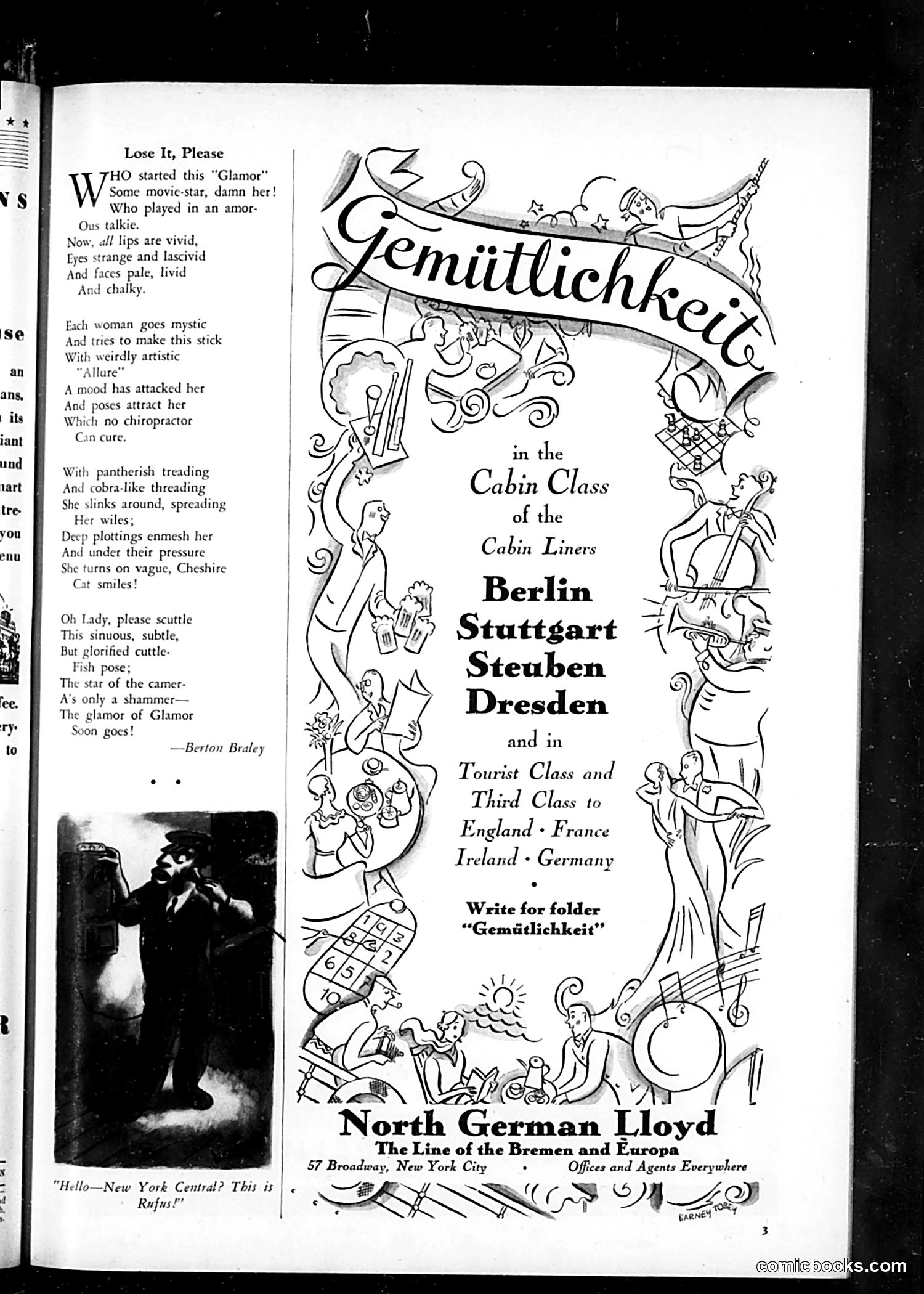
Page Analysis This page contains a poem titled "Lose It, Please" by Berton Braley on the left, which critiques women's use of cosmetics and makeup—particularly "glamor" products that create artificial appearances. The satirical verse mocks the theatrical application of makeup ("werdily artistic") and compares women's behavior to mythical creatures ("turns on vague, Cheshire / Cat smiles"). The right side is a full-page advertisement for the North German Lloyd shipping line, promoting cabin accommodations on ships traveling between Germany and England/France/Ireland. The decorative border features whimsical illustrations of passengers enjoying leisure activities. Together, these represent typical Life magazine content: social satire about consumer culture paired with luxury advertising—ironically juxtaposing critique of women's artificiality with high-end commercial appeals.
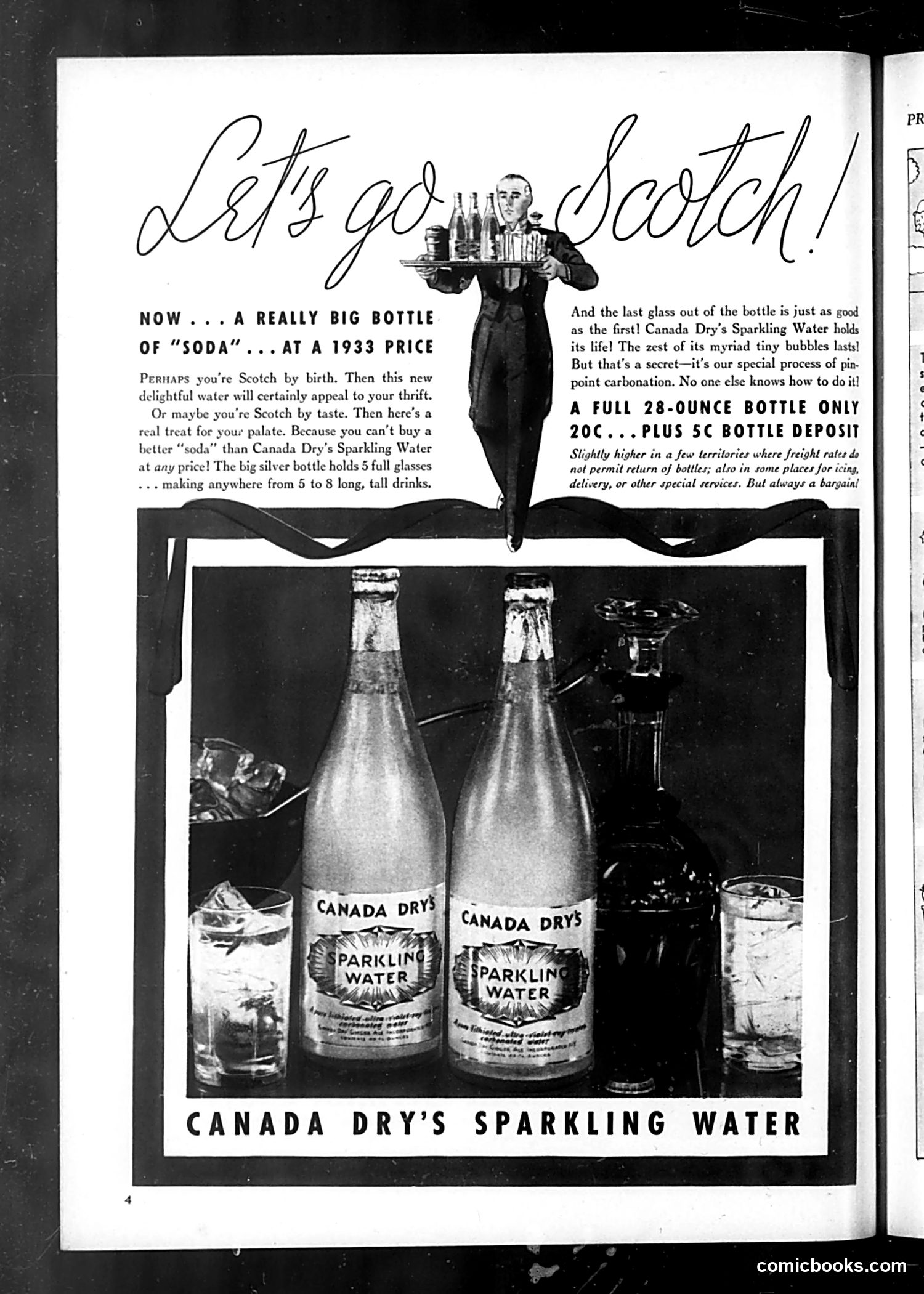
Analysis This is a product advertisement, not political satire. It promotes Canada Dry's Sparkling Water during the Depression era (1933, based on the price point mentioned). The ad uses humor and appeals to Scottish heritage ("Perhaps you're Scotch by birth") to market an inexpensive beverage. The illustrated waiter holding bottles is a generic service-industry figure, not a political caricature. The headline "Let's go Scotch!" is a pun playing on both Scottish identity and the colloquial meaning of "going Scotch" (being thrifty). The copy emphasizes the product's affordability—20 cents for a full 28-ounce bottle—a significant selling point during Depression-era economic hardship. This is straightforward commercial advertising rather than political or social commentary.
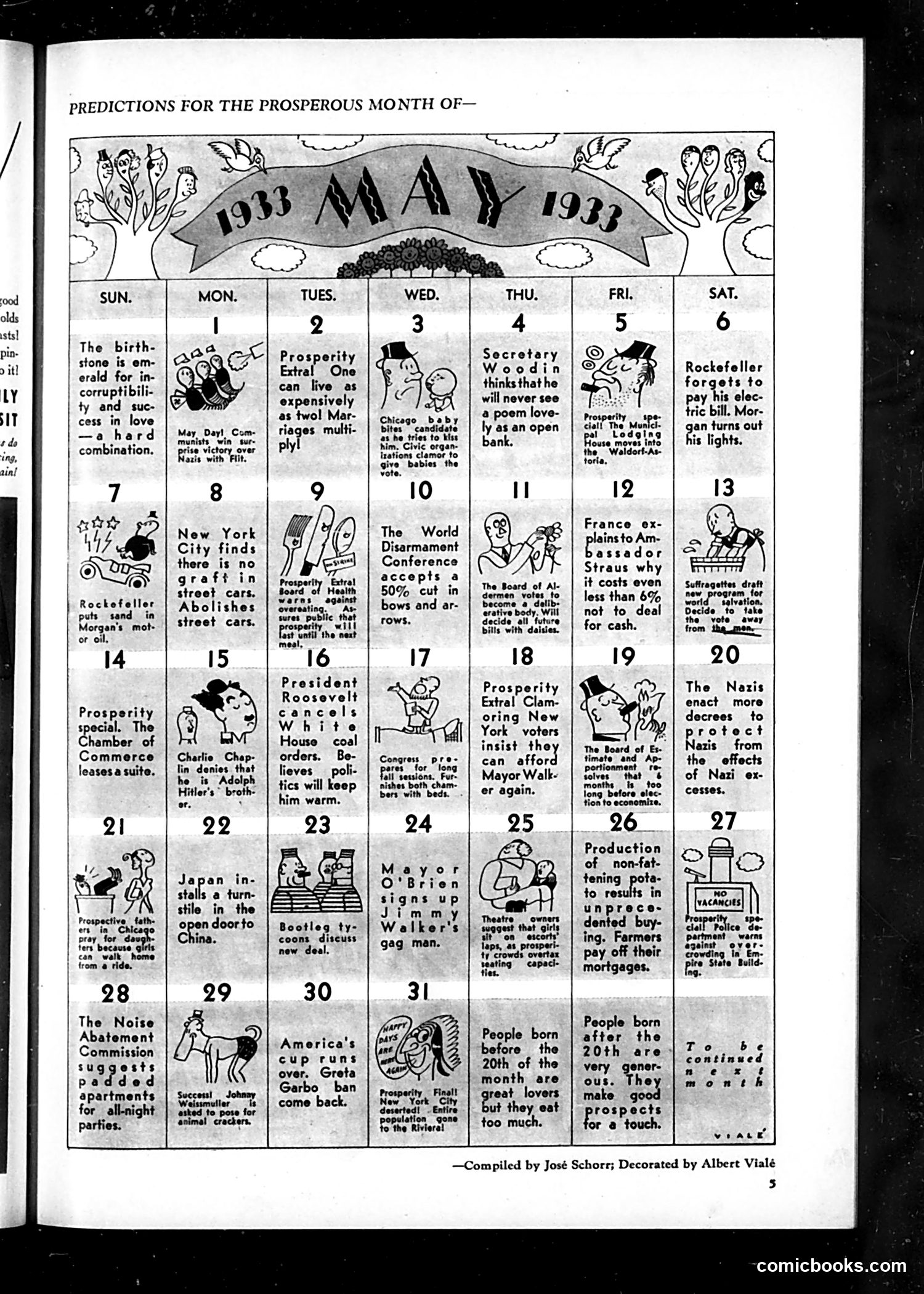
May 1933 Predictions Calendar This is a satirical prediction calendar for May 1933, compiled by José Schorr and decorated by Albert Vialé. Each day contains a humorous "prophecy" about events likely to occur, mixing absurdist humor with contemporary political and social commentary. Key references include: - May 3: A political candidate trying to get votes - May 10: World Disarmament Conference (actual 1933 event) - May 16: President Roosevelt canceling White House coal orders - May 20: Nazis enacting decrees protecting Jews—clearly satirical, as this contradicts historical reality; this mocks Nazi policies - May 31: Greta Garbo returning to films The calendar satirizes both current events and predictable social behaviors through exaggerated, tongue-in-cheek daily predictions typical of Life magazine's irreverent humor.
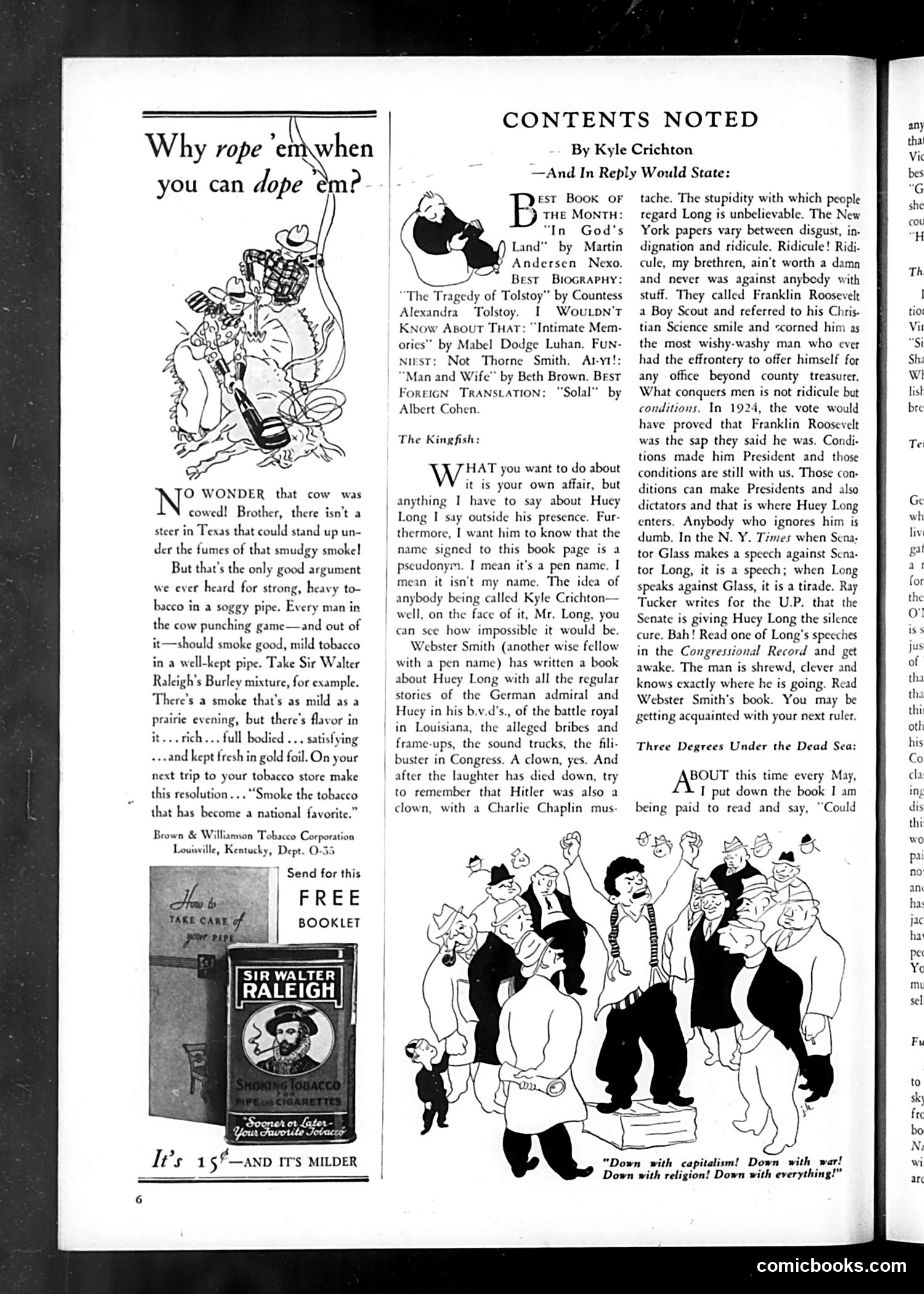
Political Content Analysis The right-hand cartoon titled "Three Degrees Under the Dead Sea" depicts a crowd of figures with raised fists chanting "Down with capitalism! Down with war! Down with religion! Down with everything!" This satirizes radical political movements of the early 20th century—likely communists or anarchists—mocking their blanket rejection of existing institutions. The cartoon presents them as indiscriminate in their opposition: opposing not just specific grievances but fundamentally "everything," including religion and war itself (suggesting naive idealism). The left side contains a cigarette advertisement for Sir Walter Raleigh tobacco, presented as a lighthearted contrast to political seriousness. The page is from *Life* magazine's satirical section, using caricature to mock revolutionary extremism as lacking coherent philosophy—simply opposing all existing order reflexively.
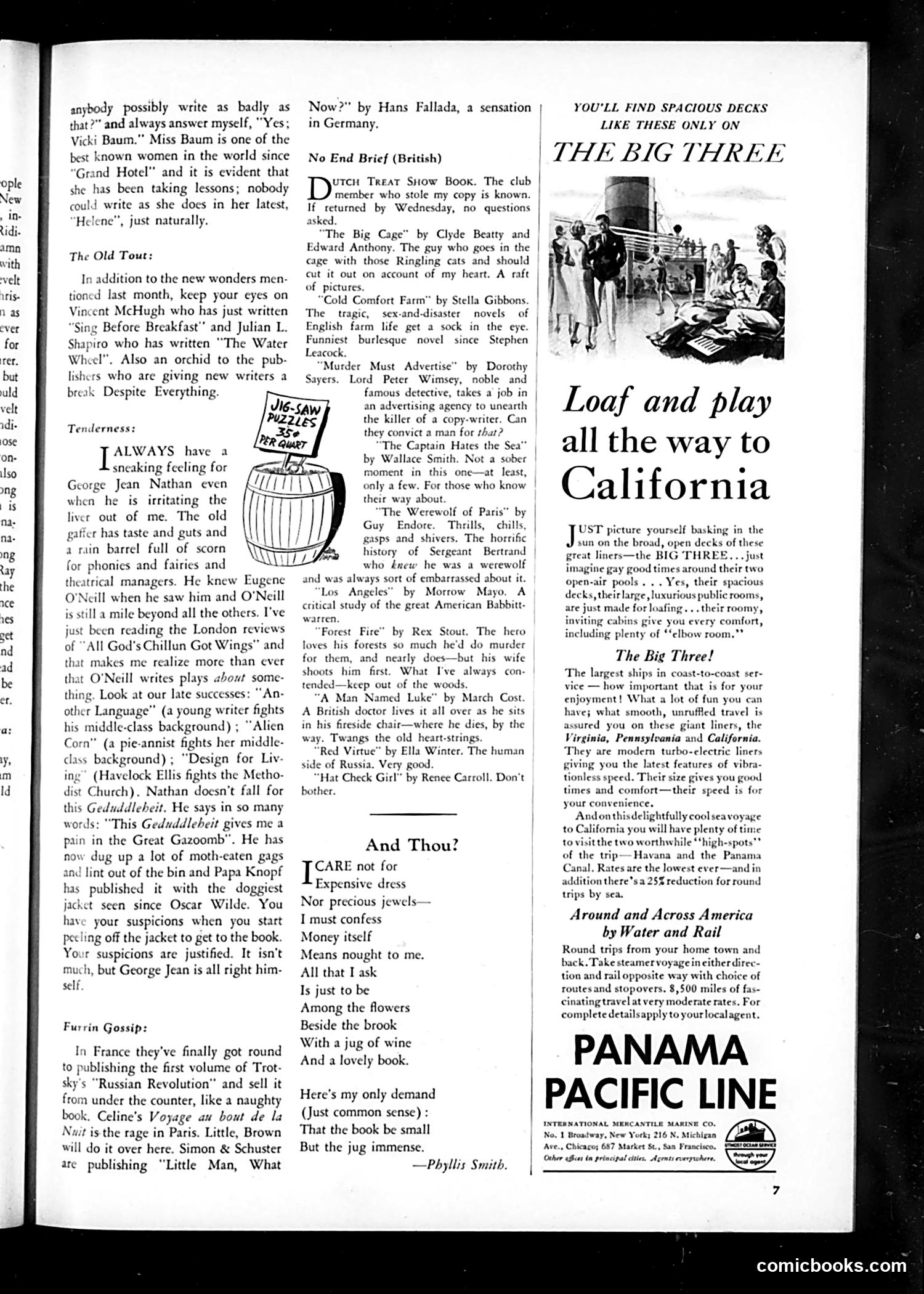
Analysis This page consists primarily of book reviews and literary commentary rather than political cartoons. The main content includes: "No End Brief" - Reviews of contemporary novels, including works by Clyde Beatty, Stella Gibbons, Dorothy Sayers, and others. "Tenderness" - A small illustration (a jug-labeled "Jig-Saw Puzzles") accompanies commentary on writer George Jean Nathan's critical style. "And Thou?" - A poem by Phyllis Smith about simple desires (flowers, wine, a book). The page is not satirical or political. It's a cultural/literary section of Life magazine focused on book recommendations and literary criticism. The advertising for the Panama Pacific Line appears at bottom. This represents Life's role as a general-interest magazine covering arts and culture, not primarily political satire.
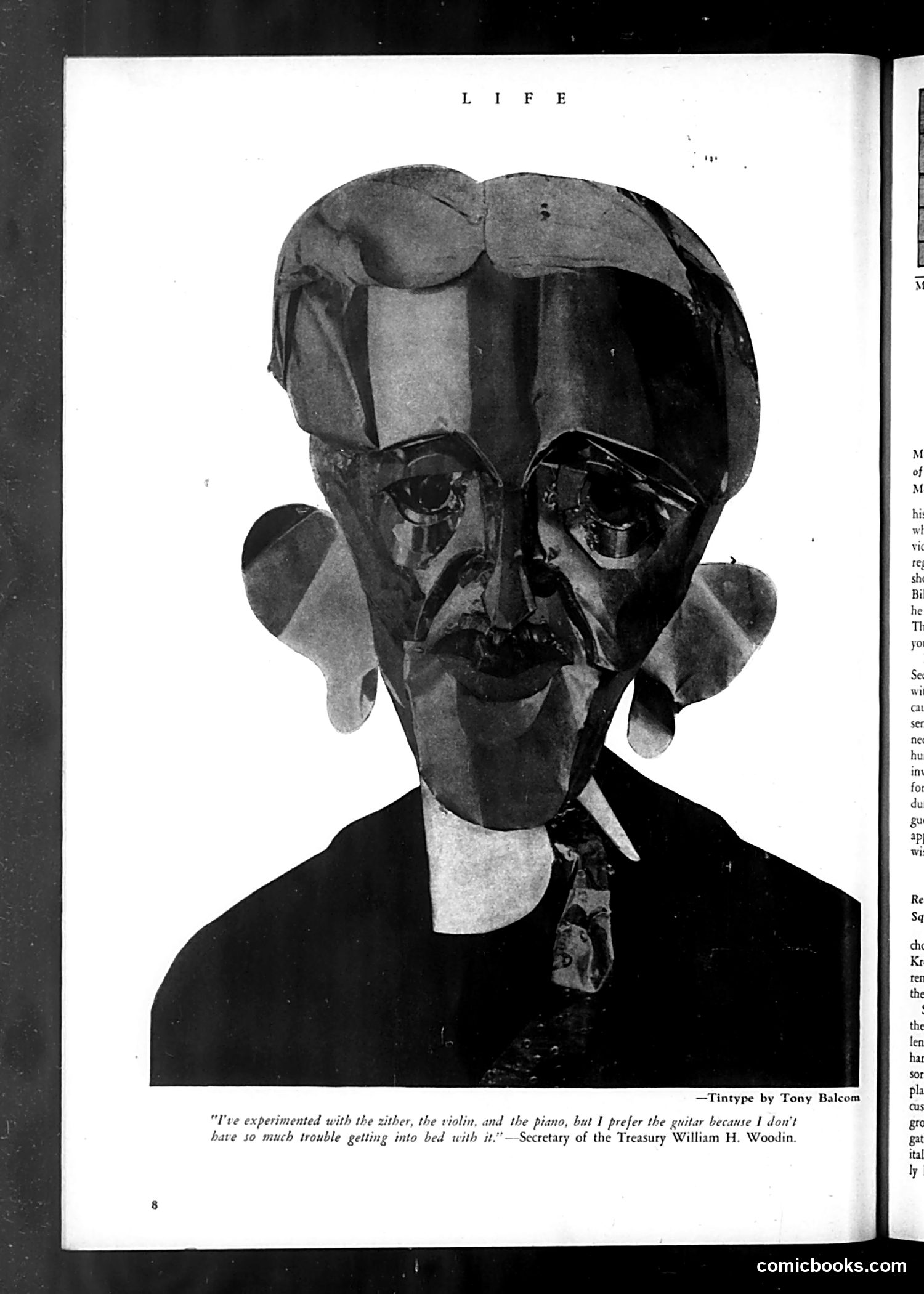
Analysis This page features a tintype photograph by Tony Balcom of William H. Woodin, identified as Secretary of the Treasury. The image uses surrealist/cubist visual distortion—fragmenting and reassembling facial features geometrically—to create a deliberately grotesque portrait. The caption quotes Woodin claiming he prefers guitar over zither or violin because he doesn't "have so much trouble getting into bed with it." The satire likely mocks Woodin's musicianship or his public persona. The distorted portrait may suggest incompetence or unsuitability for his Treasury role, while the quote—seemingly innocent about instrumental practicality—carries potential double entendre about his habits or character. This appears designed as humorous political commentary typical of *Life* magazine's satirical approach to public figures.
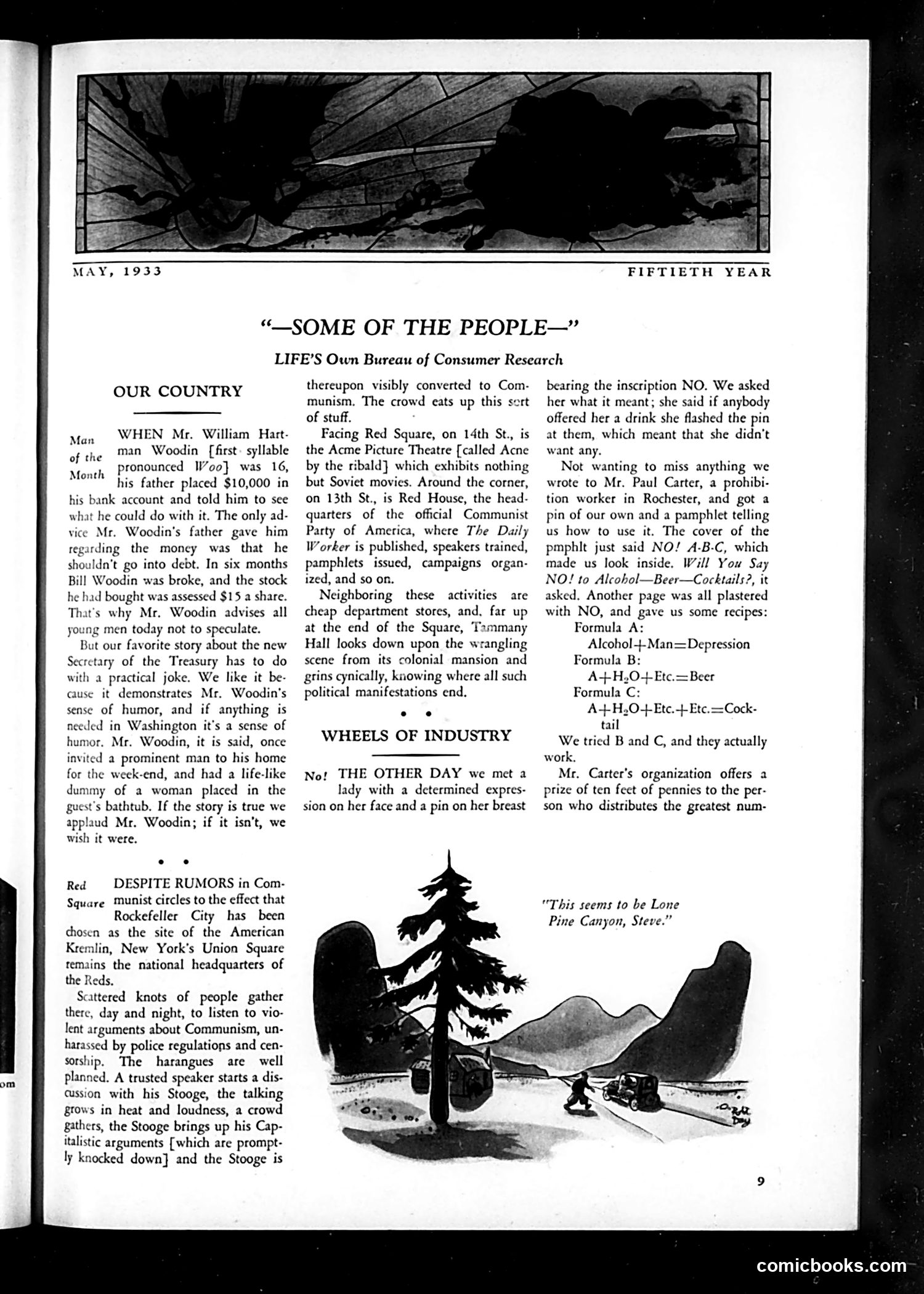
Analysis of Life Magazine, May 1933 - Page 9 This page contains three separate satirical pieces about American politics and consumer culture during the Depression era. The "Man of the Month" section mocks William Hartman Woodin, Treasury Secretary, for receiving $15 a share from a bank account his father established—satirizing how wealthy officials handled Depression-era finances. The "Red Square" section criticizes Communist organizing in New York City, describing Soviet headquarters near Union Square and mocking their propaganda efforts and street debates, presented as absurd spectacle rather than serious threat. The "Wheels of Industry" cartoon (illustrating a Lone Pine Canyon scene) appears disconnected from the text, likely a caption or separate editorial cartoon. Overall, the page satirizes both radical left-wing activism and wealthy establishment figures, reflecting 1933's anxieties about economic crisis and political extremism.
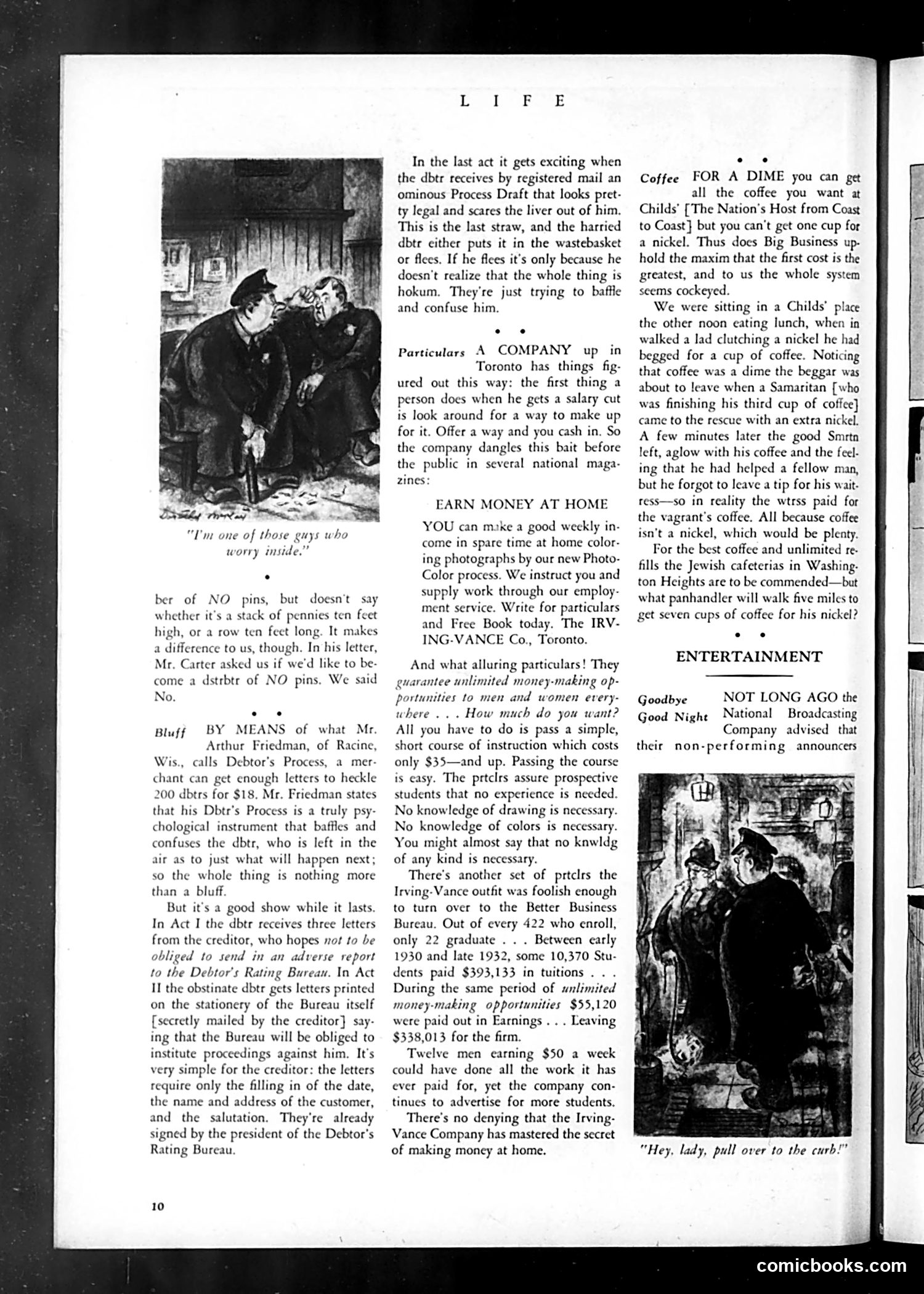
Analysis of Life Magazine Page This page satirizes mail-order scams and get-rich-quick schemes popular during the Depression era. The left cartoon shows a gullible man receiving a "Process Draft" letter—one of many fraudulent solicitations promising easy money. The satire highlights how desperate people became targets for dubious schemes. The text mocks the "Debtor's Process" (a fake psychological instrument) and the Irving-Vance Company's "color photography" and "better business" courses. These promised unlimited income but actually collected tuition from thousands of students while delivering minimal value. The humor lies in exposing the con: companies advertise heavily for more victims despite earning substantial profits from tuition alone—the real money-making operation, not the courses themselves. It's satire of predatory commercialism exploiting economic desperation.
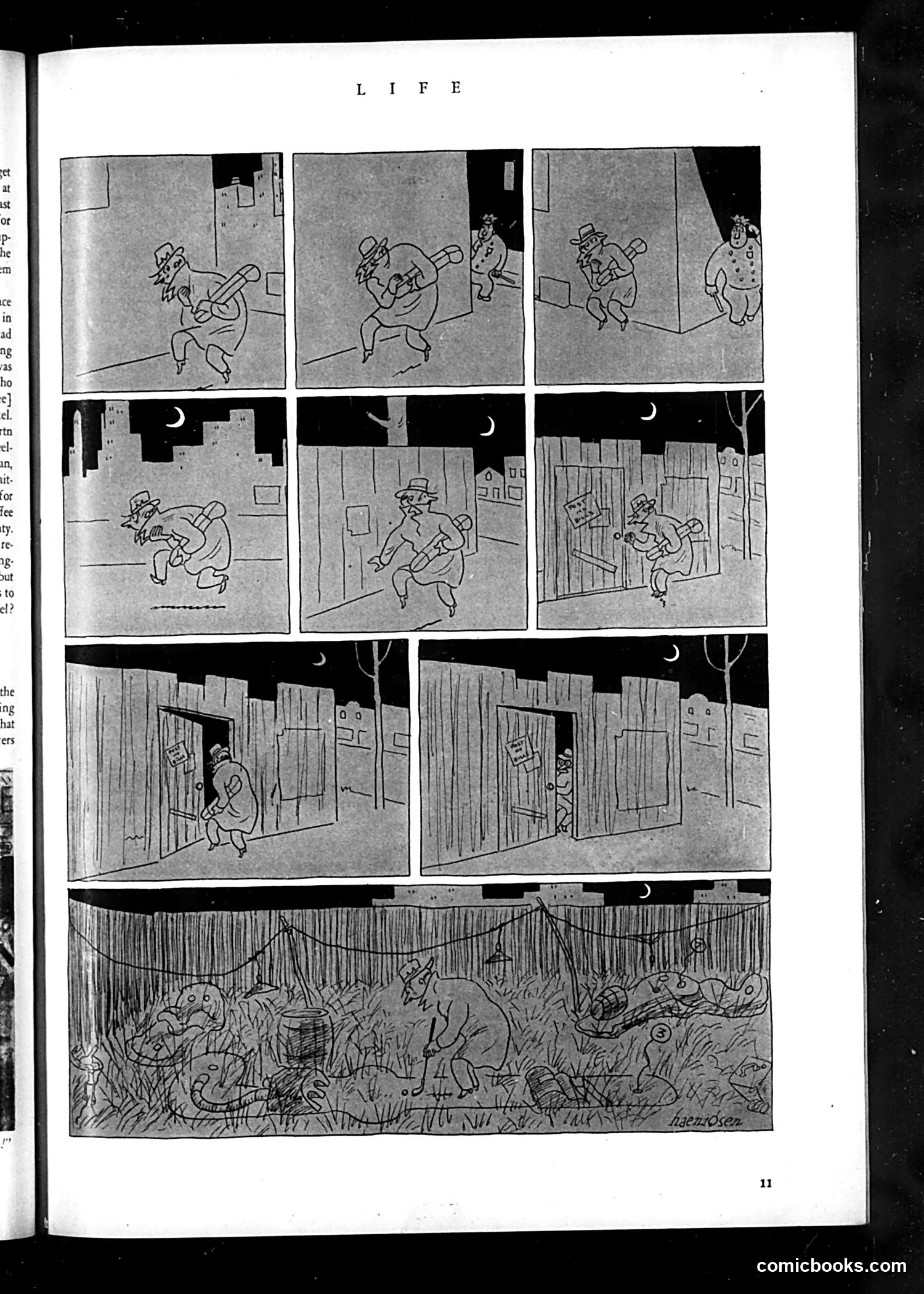
Analysis This page shows a sequential comic strip titled "LIFE" depicting a character with a guitar being chased through various scenes—from daytime city streets through nighttime alleyways, ending in what appears to be a chaotic gathering or party scene. The narrative follows a slapstick pattern: the guitarist flees in successive panels, pursued or harassed by another figure. The progression from orderly urban spaces to increasingly dark and crowded scenes suggests escalating chaos or consequence. Without identifying specific historical figures or dated references visible in the image, the strip appears to satirize either social disruption, musical culture conflicts, or personal misadventure through physical comedy. The final panel's crowded scene suggests the situation spirals into public disorder or a gathering of questionable nature. The humor relies on visual gags and exaggerated action rather than textual explanation.
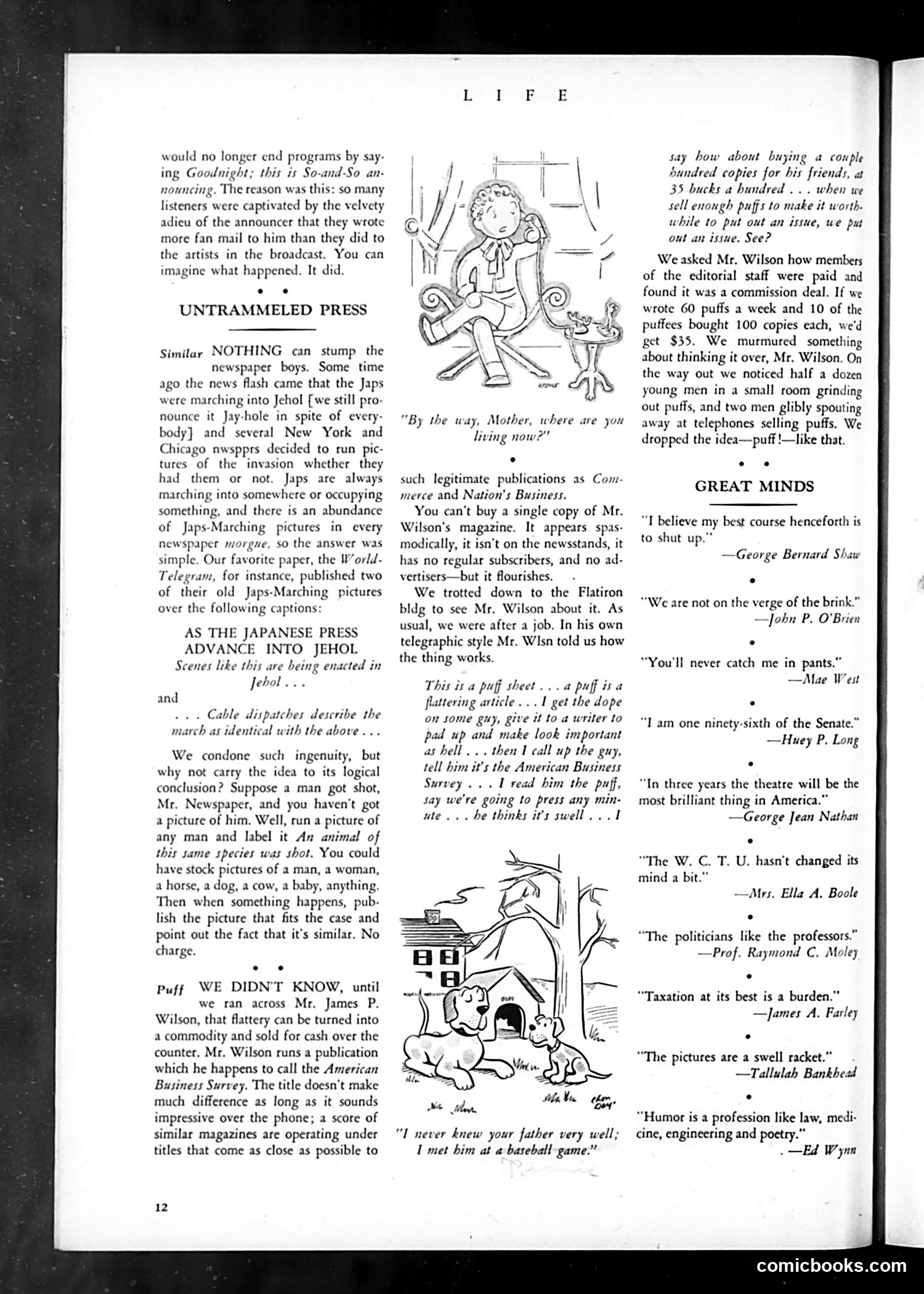
Analysis of Life Magazine Page This page satirizes the commercialization of magazine publishing. The main discussion concerns Mr. James P. Wilson, who publishes the *American Business Survey*—a magazine with no newsstand distribution, regular subscribers, or advertisers, yet somehow generates profit. The cartoons illustrate Wilson's scheme: he sells "puff" articles to businesses, which pay to have positive coverage written about them. The humor lies in exposing this as disguised advertising masquerading as journalism. The "Great Minds" section on the right collects pithy quotes, likely from public figures, though specific attributions remain unclear without additional context. The overall satire critiques how publications exploit the veneer of journalism for pure profit while lacking traditional editorial integrity or readership.
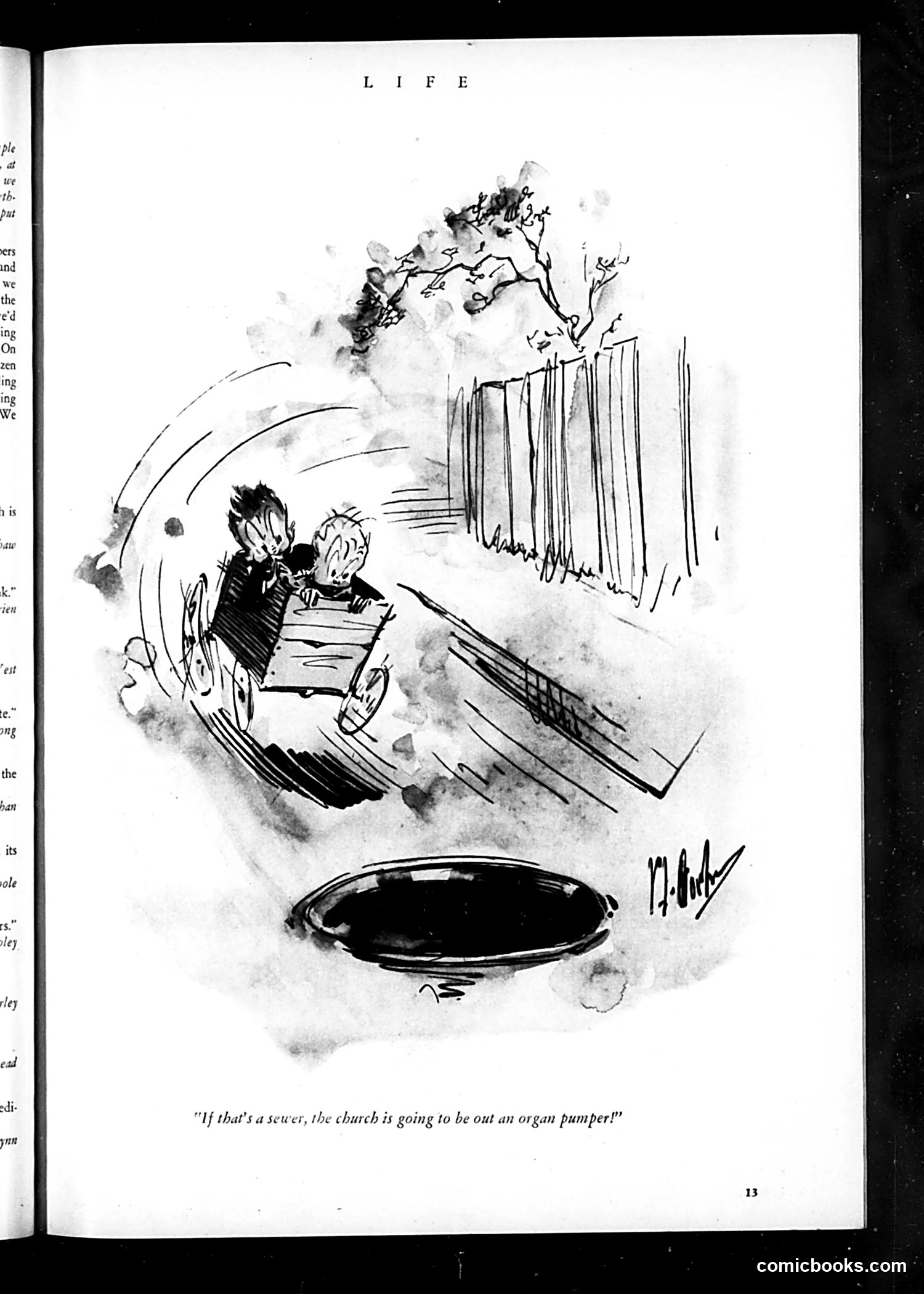
"If that's a sewer, the church is going to be out an organ pumper!" This cartoon depicts two men in what appears to be a basement or underground space discovering a large pipe or sewer opening. The humor relies on a double meaning: they've found an actual sewer, but the joke plays on "organ pumper"—a person who manually operated church pipe organs before electrical systems became standard. The satire seems to mock either the church's outdated infrastructure or perhaps suggest the church has been using someone for menial labor (pumping the organ) who might now flee if they realize there's a sewer nearby—implying poor working conditions or low status for this position. The cartoon critiques institutional treatment of workers through this sardonic punchline.
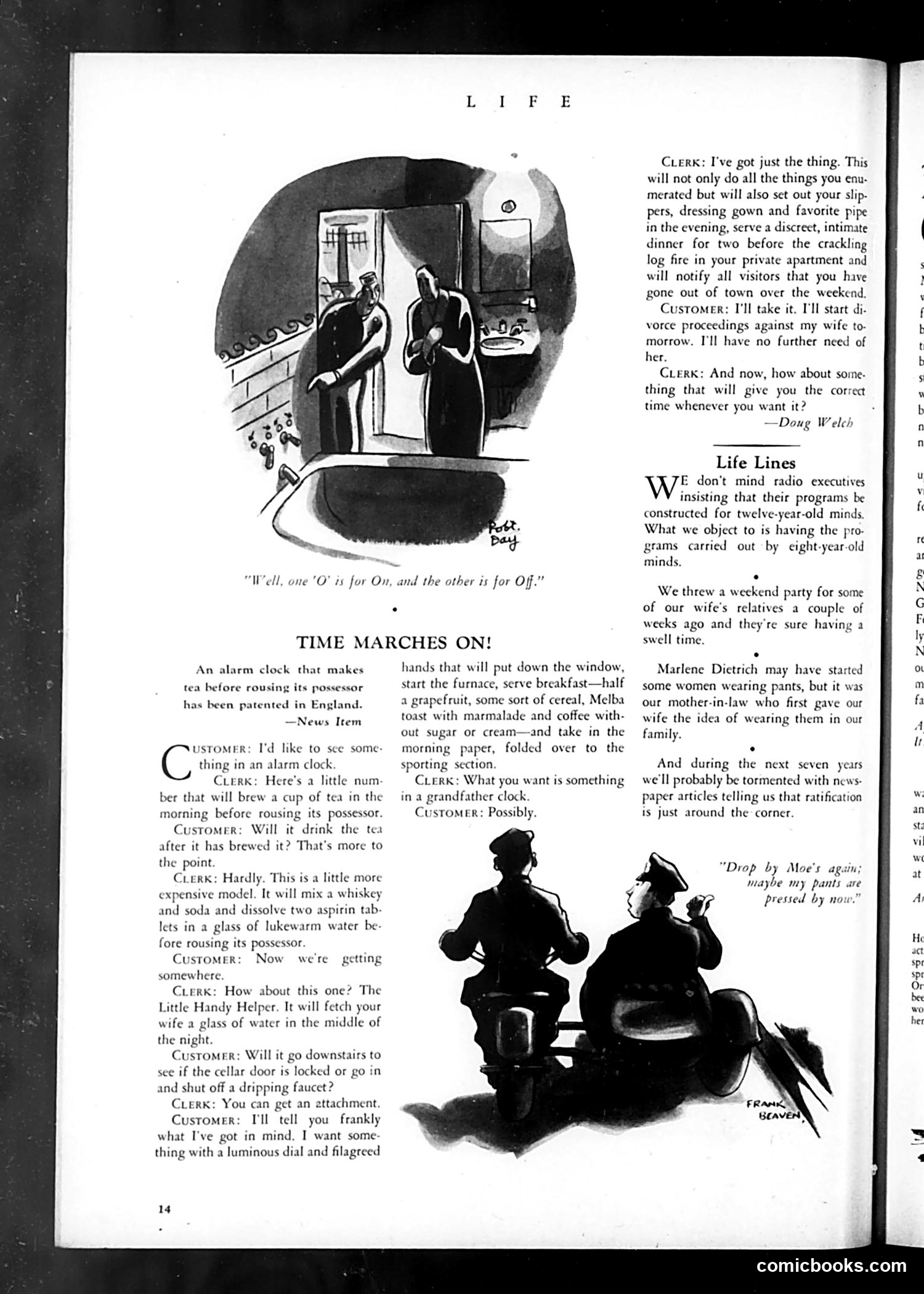
Analysis of Life Magazine Page This page contains two satirical humor pieces about consumer products and modern conveniences. "Time Marches On!" presents a dialogue between a clerk and customer about novelty alarm clocks. The satire mocks the absurdity of over-engineered gadgets—an alarm clock that makes tea, serves breakfast, and offers whiskey before waking you. The joke targets both manufacturers' increasingly ridiculous "labor-saving devices" and consumers' gullible desire for them. It's social commentary on 1920s-30s consumerism and advertising hype. "Life Lines" critiques radio programming, objecting to executives creating content for twelve-year-old minds while eight-year-olds watch. It references Marlene Dietrich wearing pants—then scandalous—and satirizes how trivial consumer culture seeps into family life. Both pieces mock modern convenience culture and its dubious claims.
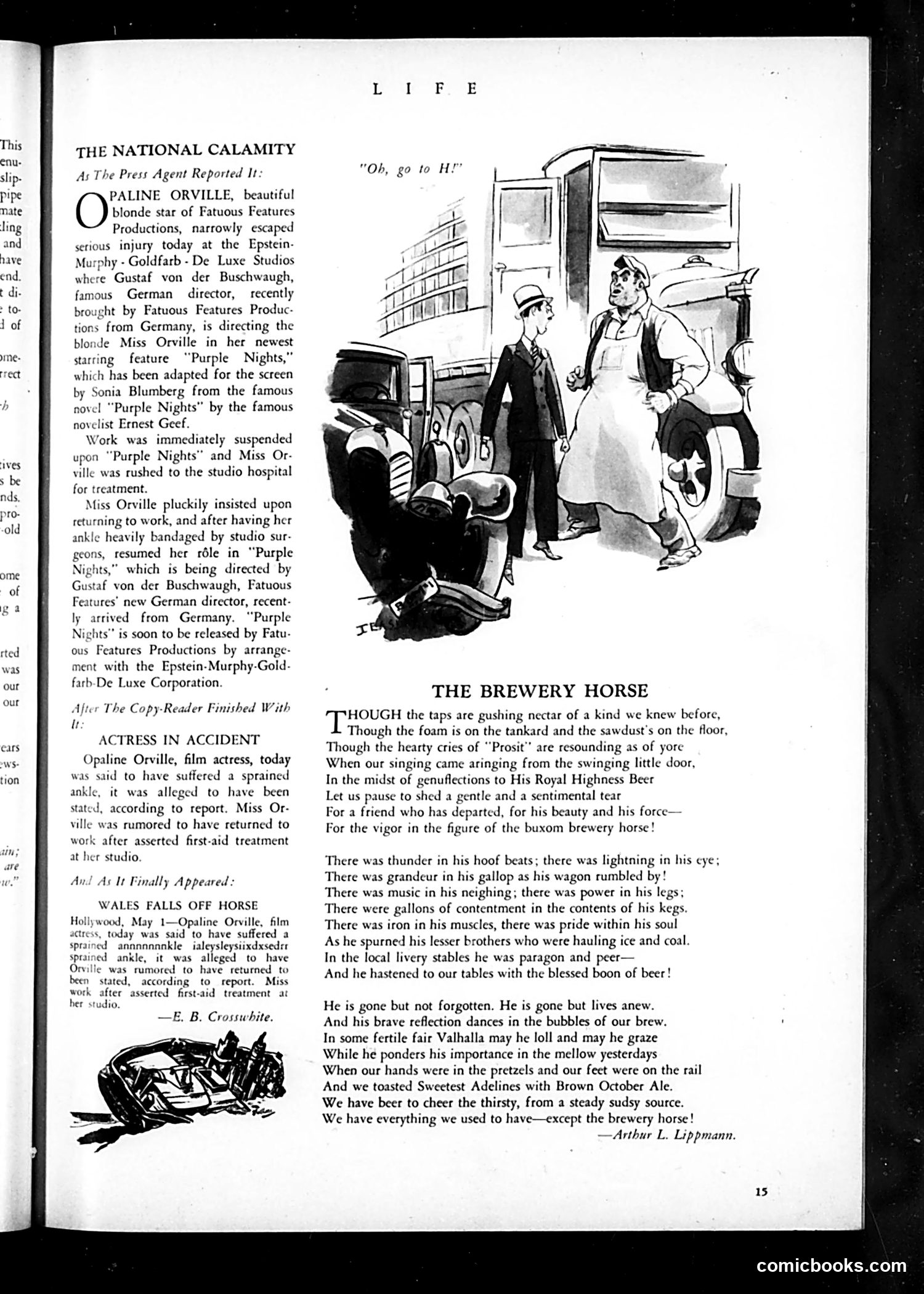
Analysis: Life Magazine Page 15 This page contains entertainment news and a sentimental poem rather than political satire. "The National Calamity" reports on actress Opaline Orville's ankle injury during filming of "Purple Nights," a German-directed feature. The accompanying illustration shows studio workers around what appears to be an accident scene—depicting the incident as a "calamity" with mild humor typical of entertainment gossip. "The Brewery Horse" is an earnest poem by Arthur L. Lippmann mourning the death of a brewery delivery horse. It celebrates the animal's strength and service, expressing nostalgia for a disappearing form of transport. The small illustration shows a collapsed horse. Neither piece contains political commentary. This represents Life's lighter entertainment coverage rather than its satirical mission.
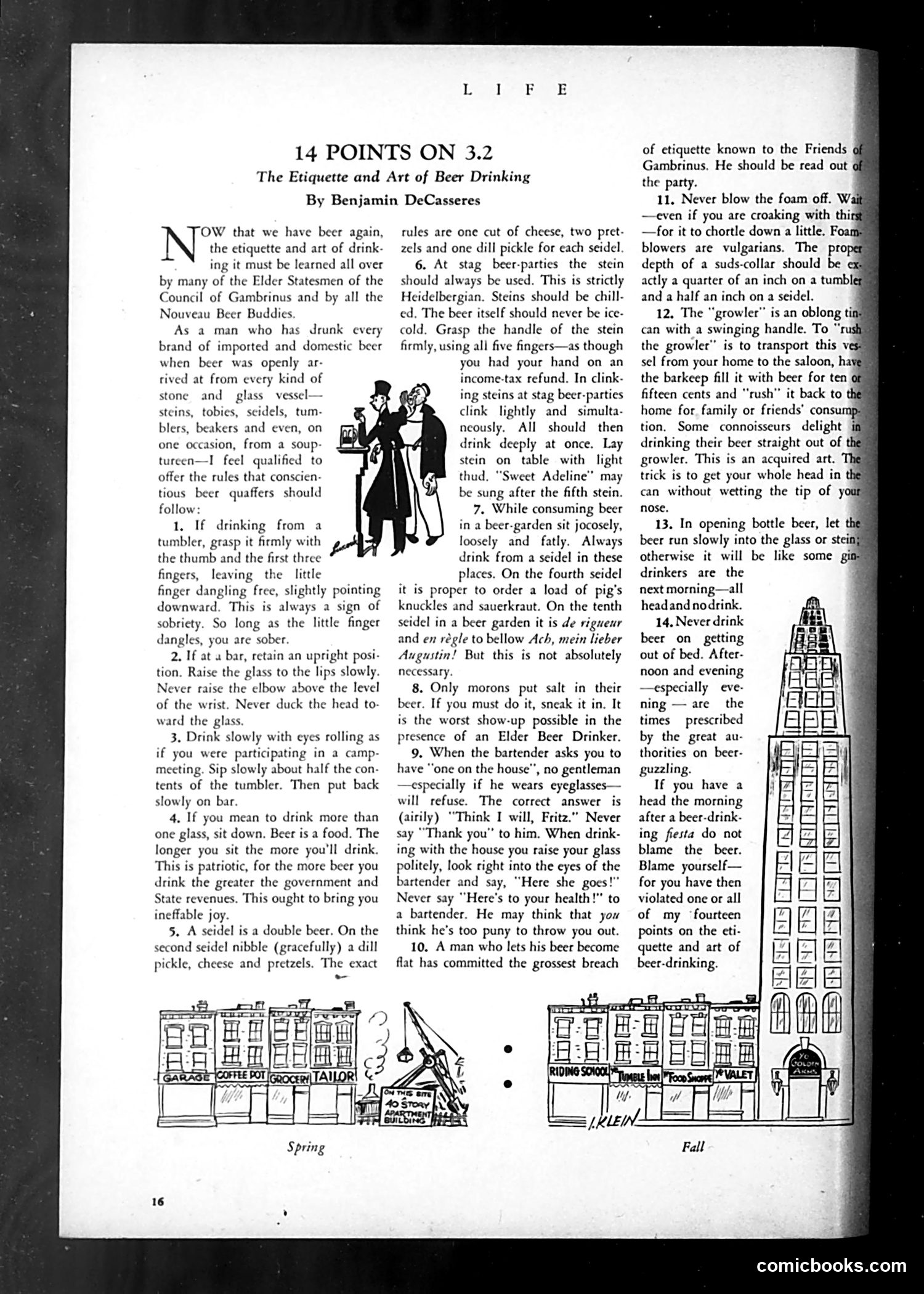
This page contains humorous etiquette advice by Benjamin DeCasseres on beer drinking, titled "14 Points on 3.2." The "3.2" refers to 3.2% alcohol beer, likely legal during Prohibition or its aftermath. The two illustrated street scenes at the bottom labeled "Spring" and "Fall" appear to show urban storefronts and buildings, possibly depicting different seasonal contexts for beer consumption, though the specific satirical intent is unclear from the image quality. The fourteen numbered rules mock stuffy etiquette guides by applying formal social conventions to casual beer drinking—proper glass handling, posture, decorum at beer gardens, and refusing bartender offers with dignity. The satire ridicules both pretentious beer culture and rigid social rules by treating casual drinking with exaggerated formality.
I can see this is a heavily degraded black and white page from what appears to be a historical publication. The image quality is extremely poor—mostly black with some faint marks, lines, and sketches barely visible. While there is text visible on the left margin and a watermark "comicbooks.com" at the bottom, the actual cartoon content and most of the body text are too degraded to read or analyze clearly. I cannot reliably identify any figures, political references, or satire without being able to see the actual illustrations or read the accompanying text. To provide accurate historical analysis as requested, I would need a clearer image where the cartoons and text are legible.

I can see this is a black and white image from what appears to be a historical publication, but the image quality is too degraded and low-contrast for me to reliably identify specific figures, caricatures, or cartoon content. The page appears to show some kind of illustrated or photographic material, but details are obscured by age-related deterioration, grain, and contrast issues. Without being able to clearly discern the visual elements or read accompanying captions/text reliably, I cannot responsibly identify specific political figures, explain satirical references, or interpret the intended meaning. To provide accurate analysis as requested in your rules, I would need a clearer reproduction of this page. If you have a higher-quality scan available, I'd be happy to analyze it properly.
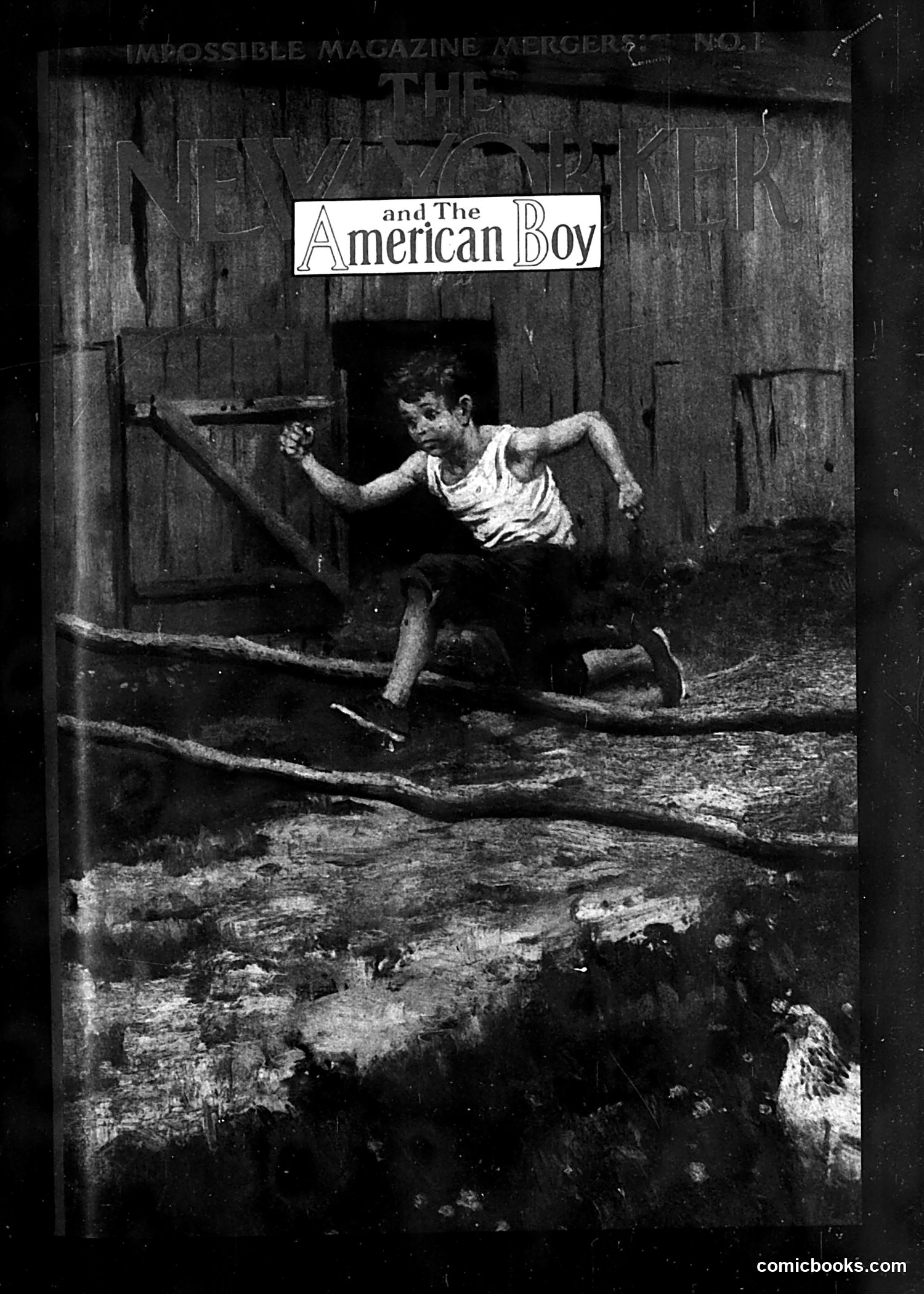
Analysis This appears to be a title page or cover from *The Newyorker* and *American Boy* magazines (the text reads "Impossible Magazine Merger No. 1" at top). The image shows a young boy in tattered clothing crawling or climbing over logs in what appears to be a poor, rural setting, with a dilapidated wooden structure behind him. The satire lies in the incongruity of merging two publications with opposite audiences and sensibilities: *The Newyorker* (sophisticated, urban) with *American Boy* (wholesome youth magazine). The gritty, poverty-stricken imagery mocks what such a merger would produce—a jarring clash between refined urban satire and idealized boyhood adventure content. The joke is essentially "these magazines have nothing in common; their merger would be absurd."
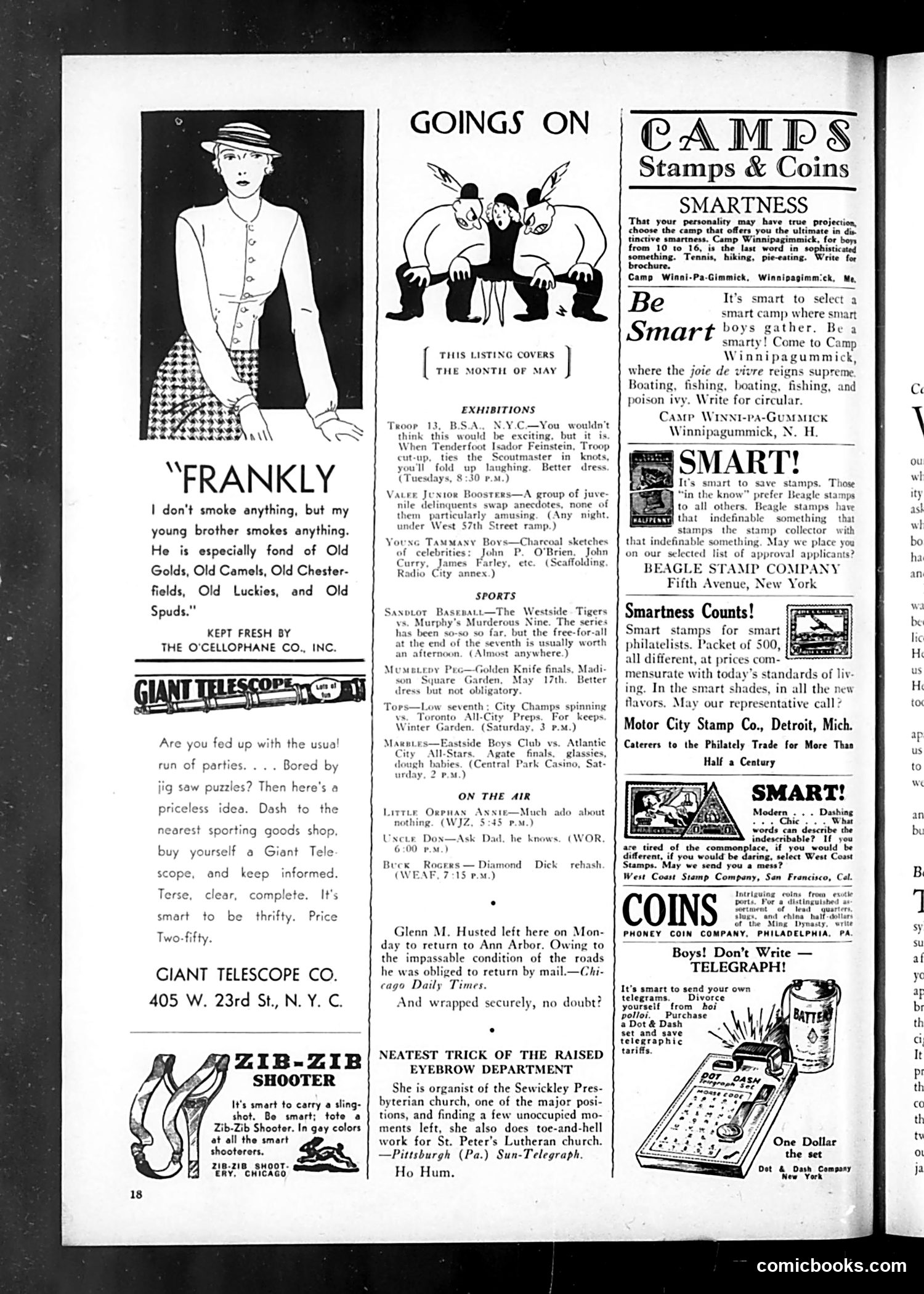
Analysis of "Frankly" Cartoon and Page Content The main cartoon features a young man in 1920s attire with the caption "Frankly—I don't smoke anything, but my young brother smokes anything. He is especially fond of Old Golds, Old Camels, Old Chesterfields, Old Luckies, and Old Spuds." This is a cigarette brand advertisement disguised as humor. The joke plays on the speaker's claimed non-smoking while enthusiastically listing popular cigarette brands of the era (all real products). "Old Spuds" appears to be a playful fictional addition. The satire targets advertising's ability to promote consumption through clever wordplay. The page is primarily filler advertisements and humor pieces—typical Life magazine content from the 1920s-30s promoting stamps, coins, telescopes, and slingshots to readers. The "Goings On" section lists local May events and radio programs, reflecting the magazine's role as an entertainment and lifestyle guide for its audience.
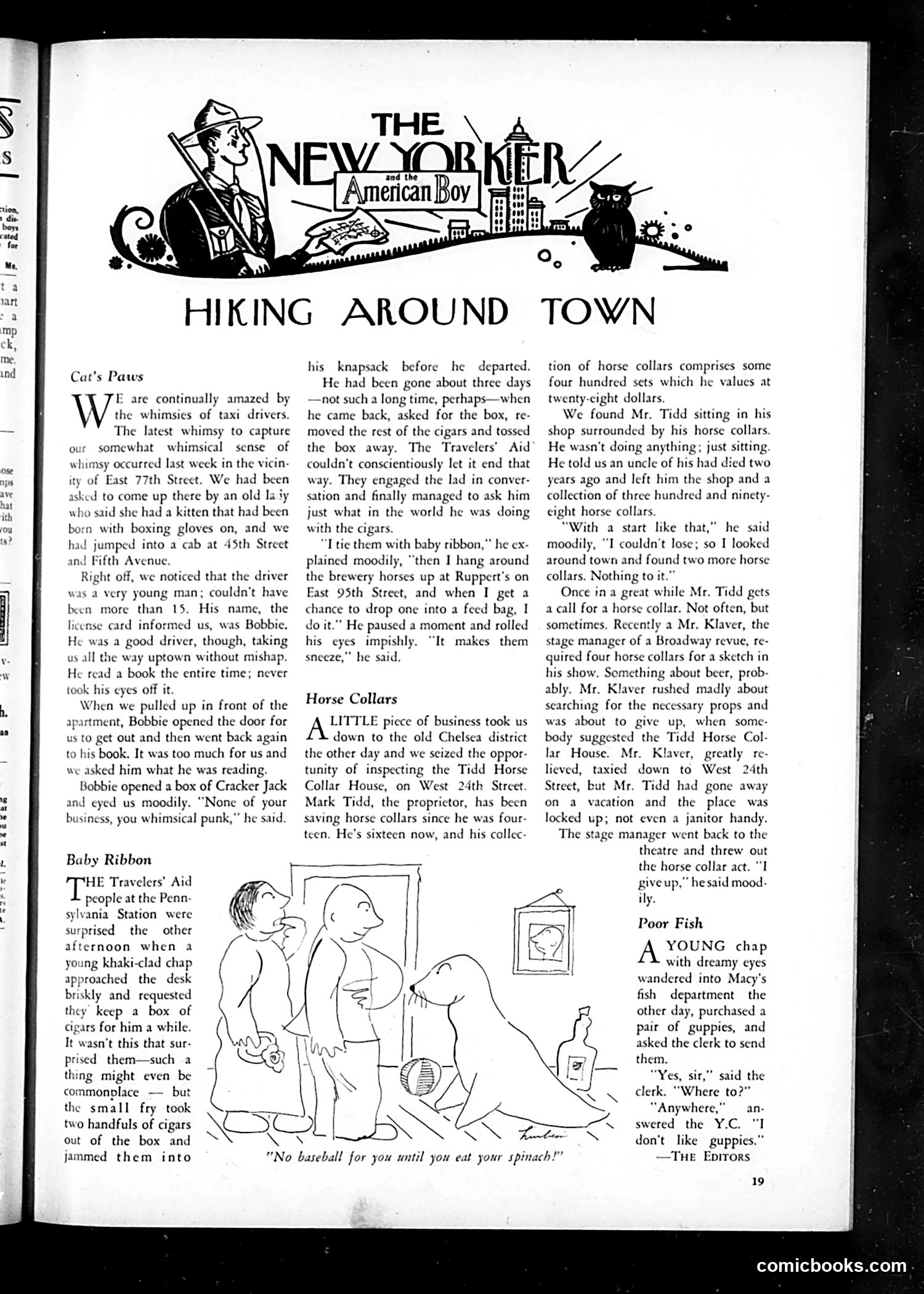
"Hiking Around Town" - Life Magazine Satire This page collects three humorous anecdotes about eccentric New Yorkers, typical of *Life* magazine's gentle urban satire. Each story features a young person behaving oddly: 1. "Cat's Paws": A 15-year-old taxi driver reads continuously while driving, rudely dismissing a passenger's curiosity as "none of your business." 2. "Baby Ribbon": A soldier steals cigars from Travelers' Aid, then ties them with ribbon and places them in brewery horses' feed bags to make them "sneeze"—a prank. 3. "Horse Collars": A teenager obsessively collects horse collars (outdated equipment), having inherited a shop. He's added only two collars in years; a Broadway stage manager briefly needs four but finds the shop locked. The satire targets youthful eccentricity and New York's peculiar characters. The cartoons mock pointless hobbies and the absurdities of city life. The final caption about spinach reinforces themes of discipline versus whimsy—the page's running joke about modern youth behaving inexplicably.
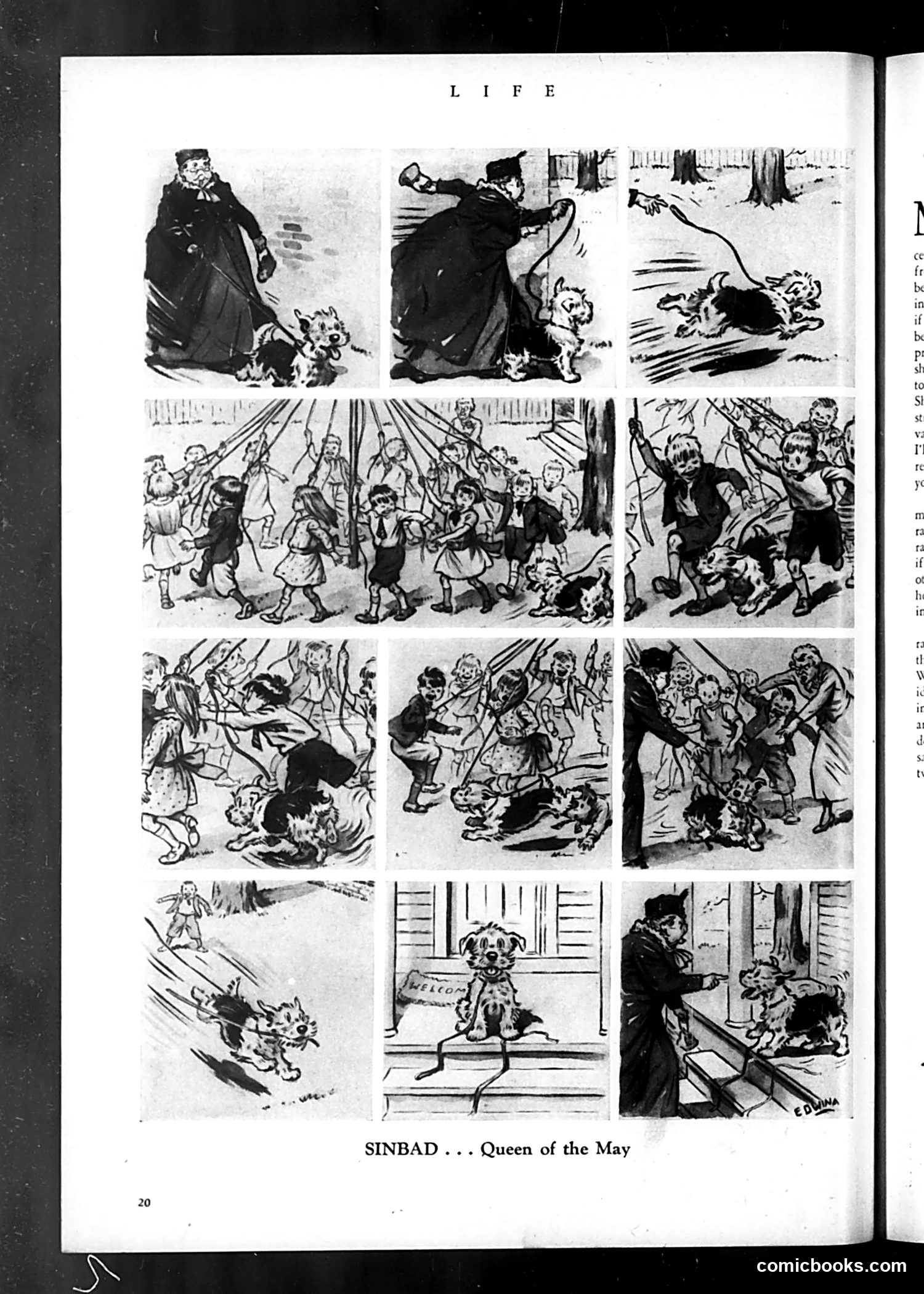
SINBAD... Queen of the May This appears to be a sequential comic strip satirizing the fairy tale "Sinbad the Sailor." The narrative follows a dark-cloaked figure (likely a witch or malevolent character) interacting with children in increasingly chaotic scenes—from quiet confrontation to large group gatherings that devolve into mayhem and violence. The satire likely comments on the corruption or perversion of innocent children's stories or May Day celebrations (traditionally associated with youth and innocence). The progression from orderly to anarchic suggests social commentary on how childhood innocence can be disrupted or destroyed. The "Queen of the May" title—typically representing purity and spring—contrasts sharply with the sinister figure and violent outcomes depicted, creating dark ironic humor typical of Life magazine's satirical approach.
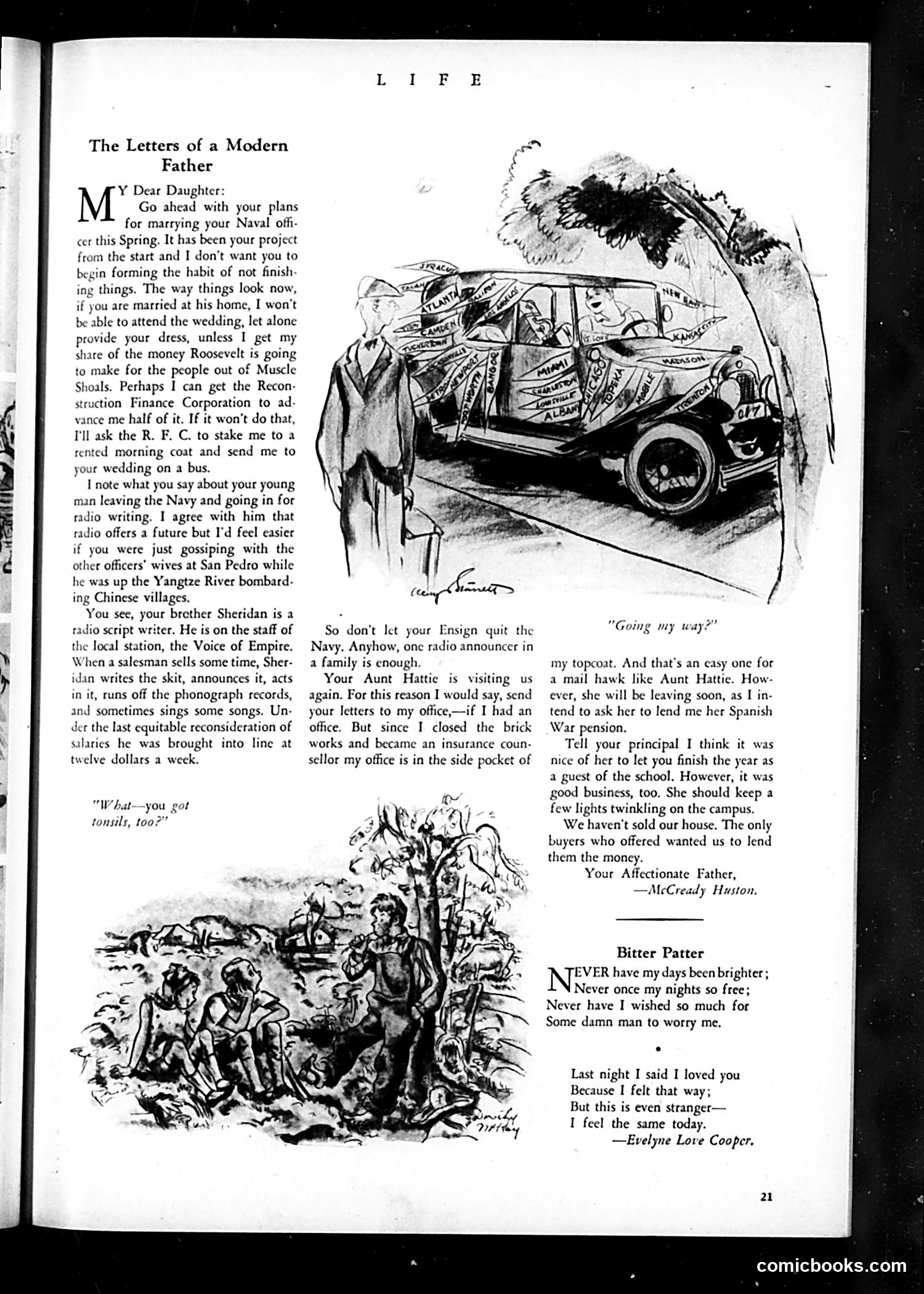
"The Letters of a Modern Father" — Life Magazine Satire This humorous letter satirizes Depression-era economic hardship and New Deal policies. The father, McCready Huston, comically illustrates financial desperation through absurd scenarios: he cannot afford his daughter's wedding dress unless he receives money from Roosevelt's Muscle Shoals project (a controversial New Deal initiative); he must borrow a morning coat; his son Sheridan earns only twelve dollars weekly as a radio writer; and the father has closed his brick works to become an insurance counselor operating from his topcoat pocket. The satire mocks both widespread unemployment and the perceived inefficacy of Roosevelt's economic programs. References to the daughter's Naval officer fiancé and "Yangtze River bombarding" allude to contemporary military concerns. The accompanying cartoons—showing a crowded car and family gathering—reinforce themes of economic hardship and crowded, constrained living conditions typical of the 1930s. The tone is self-deprecating rather than politically partisan.
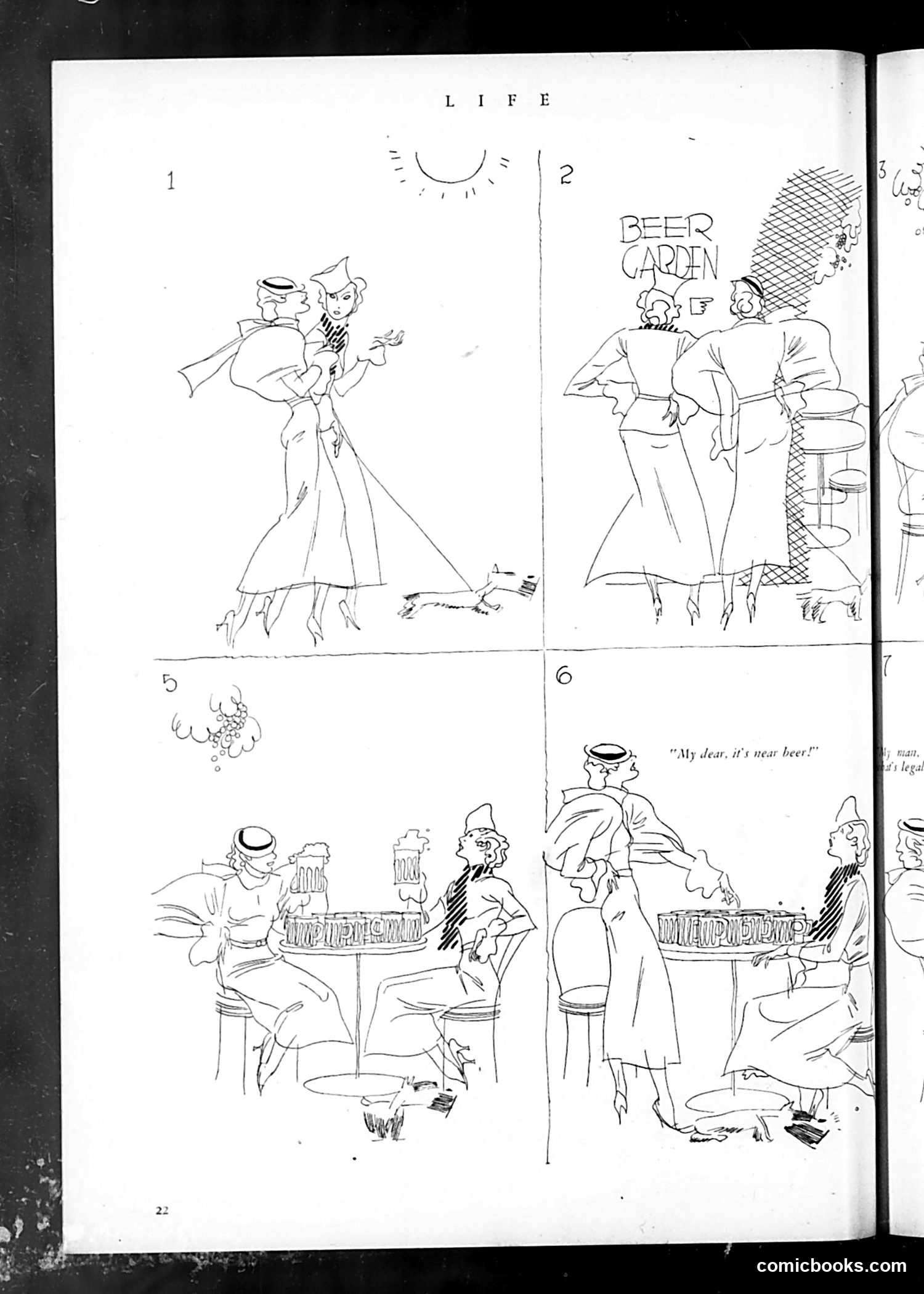
Analysis of "Life" Page - Beer Garden Comic This page presents a six-panel comic strip titled "LIFE" depicting social scenes at a beer garden. The narrative follows a man courting a woman through various stages: Panels 1-2: A man arrives at the beer garden, presenting himself as a suitor. Panels 3-4: The couple drinks beer together at tables. Panel 6: The woman declares "My dear, it's near beer!" — the punchline. The satire targets Prohibition era drinking culture. "Near beer" was non-alcoholic beer legally sold during Prohibition (1920-1933). The joke mocks the hypocrisy and disappointment of Prohibition enforcement: the man presents himself as sophisticated in a beer garden setting, only to discover the woman is drinking the weak, legal substitute. This reflects contemporary frustration with Prohibition's limitations on American social life and courtship rituals.
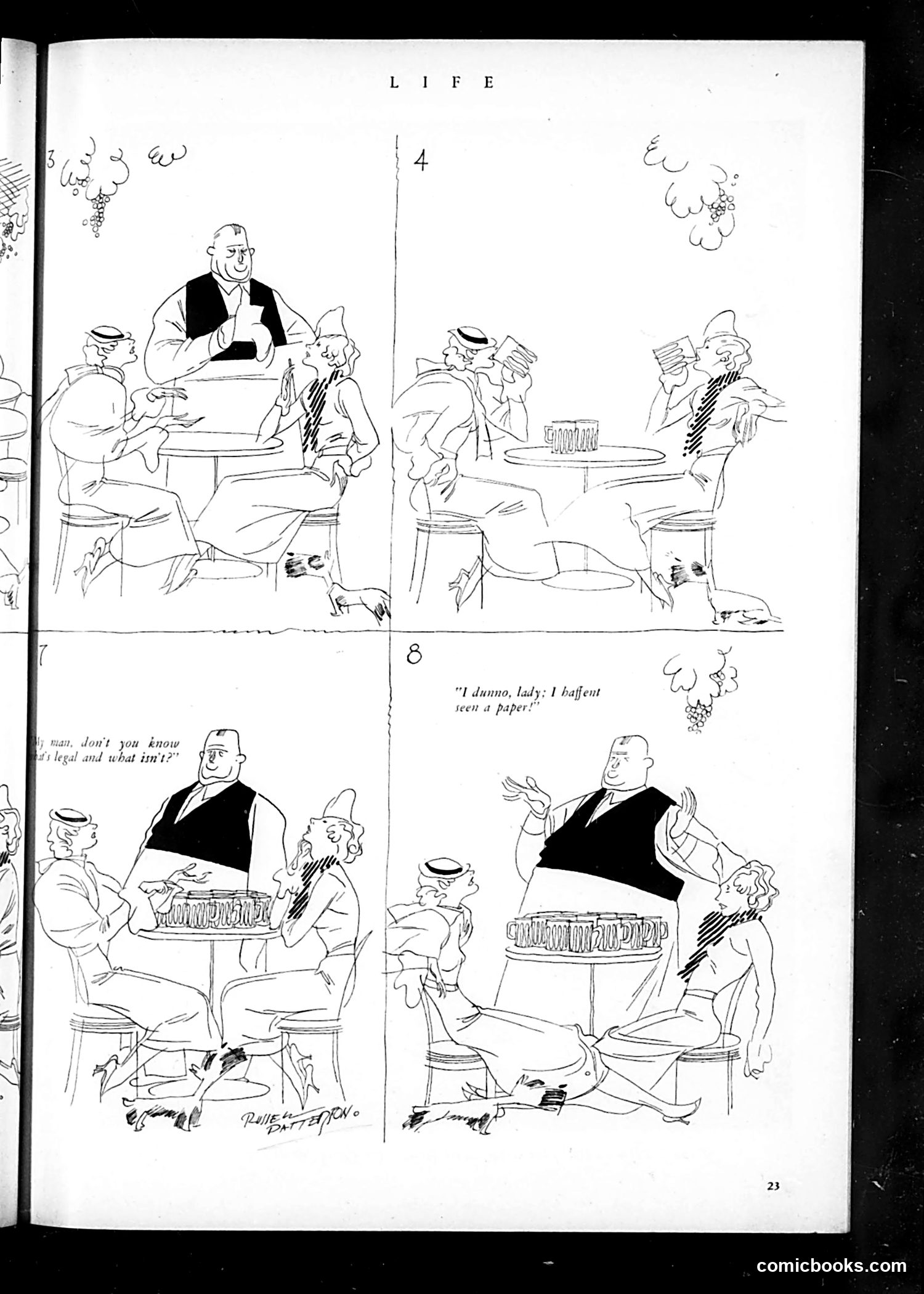
Life Magazine Cartoon Analysis This four-panel comic satirizes a waiter or server who claims ignorance about current events. In panels 3 and 4, a diner asks the man, "don't you know what's legal and what isn't?" The man responds, "I dunno, lady; I haffent seen a paper!" The joke appears to target public ignorance about legal/political matters during a period when newspapers were the primary news source. The satire suggests that without reading the paper, an ordinary person—represented by this working-class server—cannot keep up with changing laws or regulations. The "haffent seen a paper" excuse humorously deflects responsibility for civic ignorance while implying that staying informed requires consistent newspaper reading. The exact historical context remains unclear without a date.
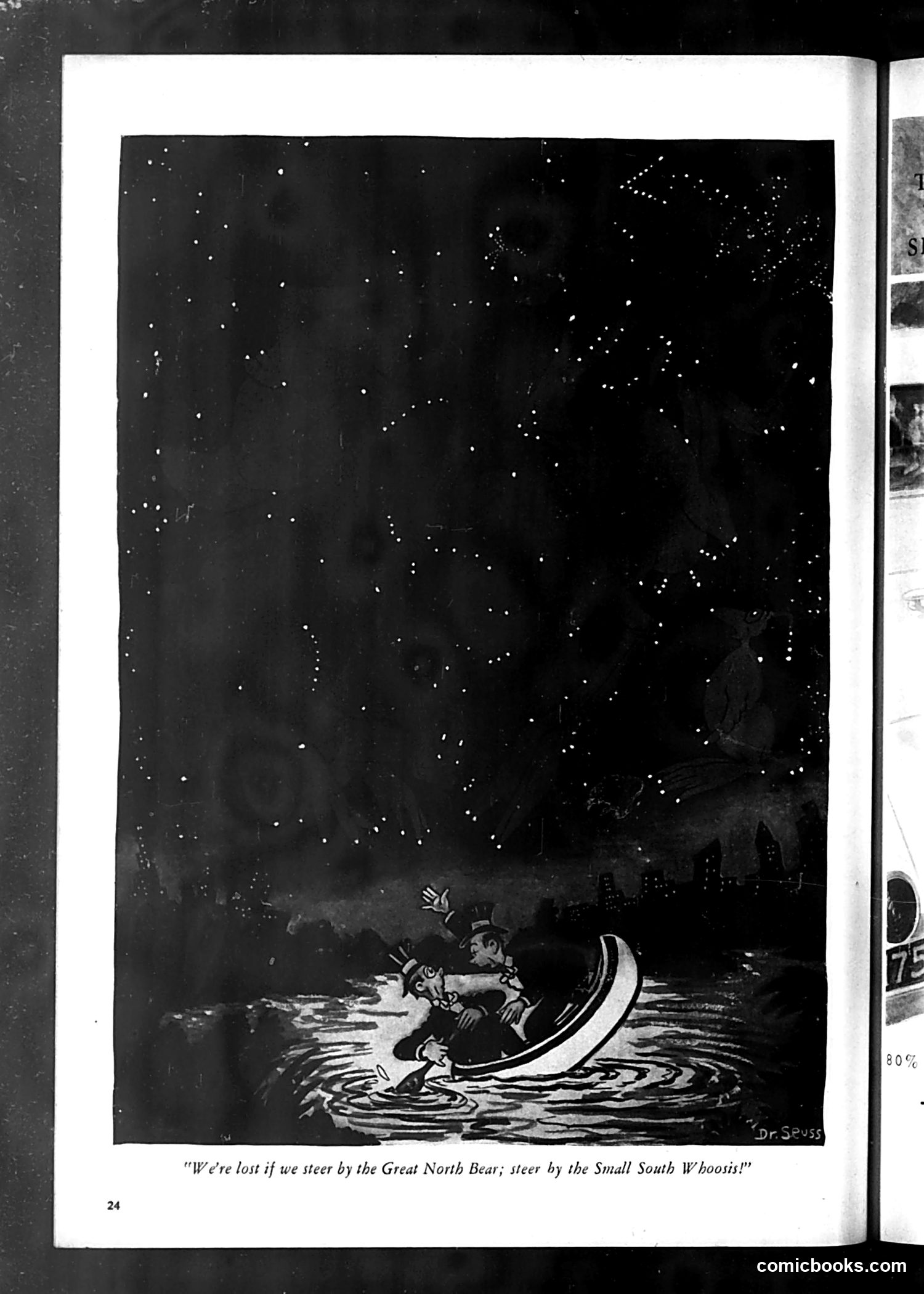
Political Cartoon Analysis This Dr. Seuss cartoon depicts a boat in turbulent waters under a starry night sky. Two figures navigate by stars, with one warning against using "the Great North Bear" (the Big Dipper/Great Bear constellation) as a guide, suggesting instead reliance on "the Small South Whoosis" (likely the Small Magellanic Cloud or similar southern constellation). The satire appears to critique political leadership or national direction—using celestial navigation as a metaphor. "Steering by" a star means following guidance. The joke likely warns against following one established authority (the Great North Bear, possibly representing a powerful northern political figure or ideology) in favor of an alternative, unnamed southern direction. Without the magazine's date and context, the specific political reference remains unclear, but the cartoon satirizes choosing between competing navigational—or political—authorities.
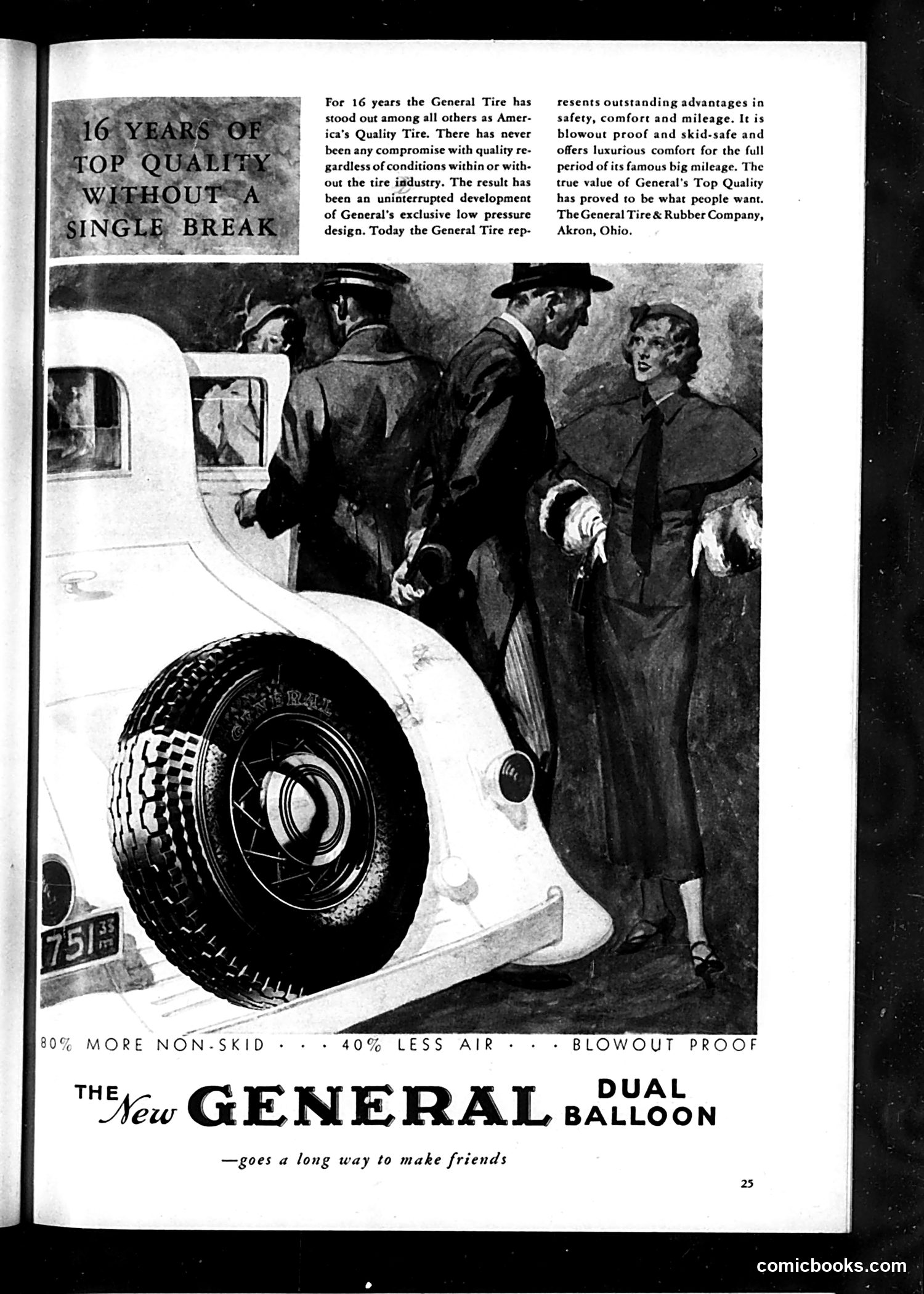
Analysis This is a General Tire advertisement, not political satire or a cartoon. The page promotes the "New General Dual Balloon" tire, emphasizing its superiority through 16 years of quality development. The illustration shows well-dressed people (appears to be from the 1920s-30s era, based on clothing) examining the tire, suggesting respectability and consumer confidence. The ad's claims—"80% more non-skid," "40% less air," "blowout proof"—tout technical innovations. The tagline "goes a long way to make friends" uses a pun, as quality tires enable travel. The message targets middle-class car owners, positioning General Tire as America's reliable choice manufactured in Akron, Ohio. This reflects early automotive advertising strategy: establishing brand prestige through technical superiority and social respectability rather than humor or satire.
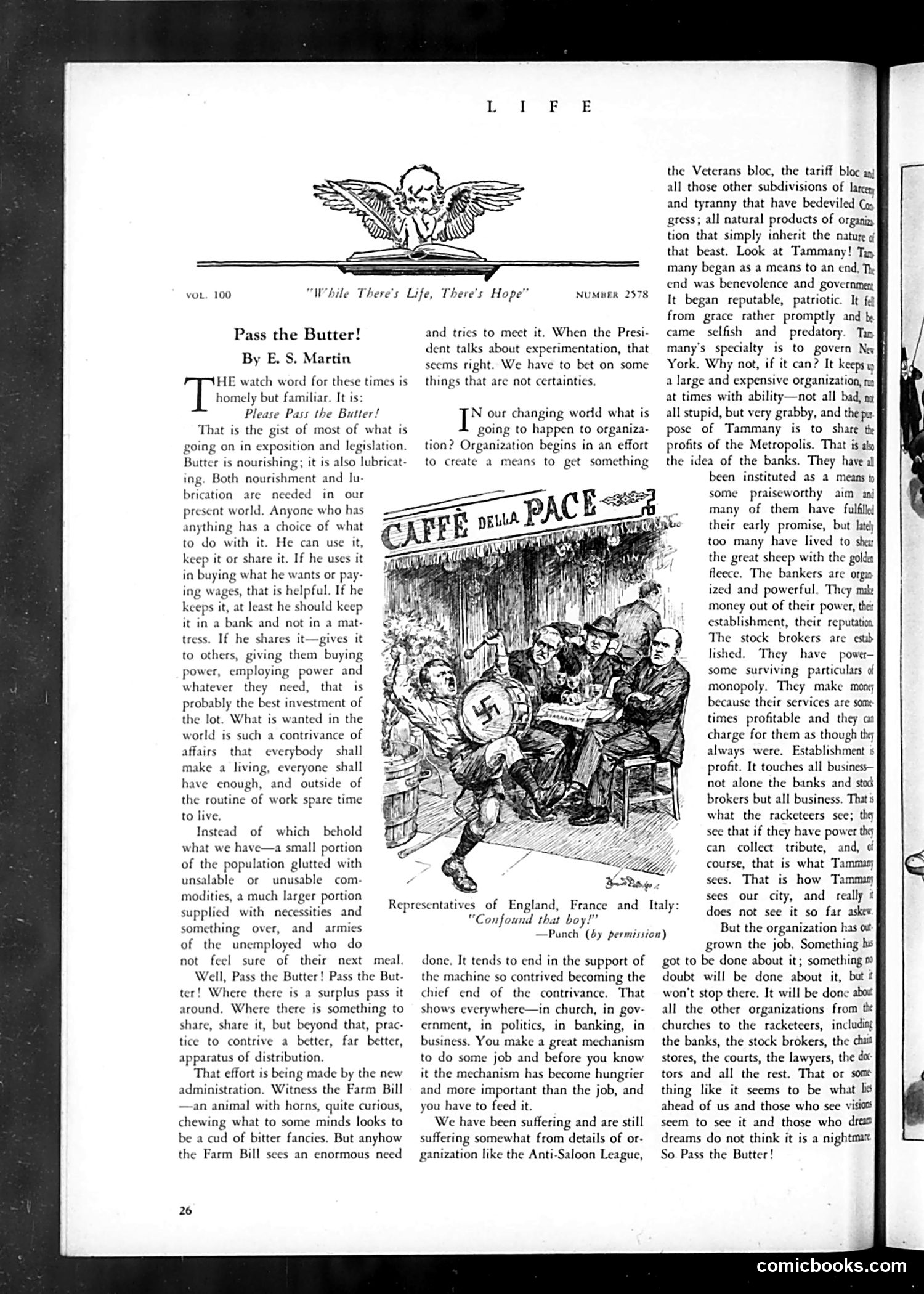
"Pass the Butter!" — Life Magazine Satire This page contains two distinct pieces critiquing American economic and political organization. Left column essay ("Pass the Butter!" by E.S. Martin): Argues that wealth and resources should be circulated rather than hoarded—"passed around" like butter at a meal. Martin criticizes the economic inequality of his era: some have surplus goods they can't use, while armies of unemployed lack basic security. He cautiously supports the new administration's Farm Bill as an attempt at redistribution, though he warns that organizations (like banks, the Anti-Saloon League, and Tammany Hall) inevitably become self-serving bureaucracies more focused on perpetuating themselves than serving their original purpose. Cartoon (credited to Punch): Depicts three figures labeled as representatives of England, France, and Italy sitting at a table with a swastika symbol visible, exclaiming "Confound that boy!"—likely referring to Hitler or Nazi Germany as an uncontrollable force disrupting diplomatic efforts. The page reflects pre-WWII anxieties about economic distribution and rising fascism.
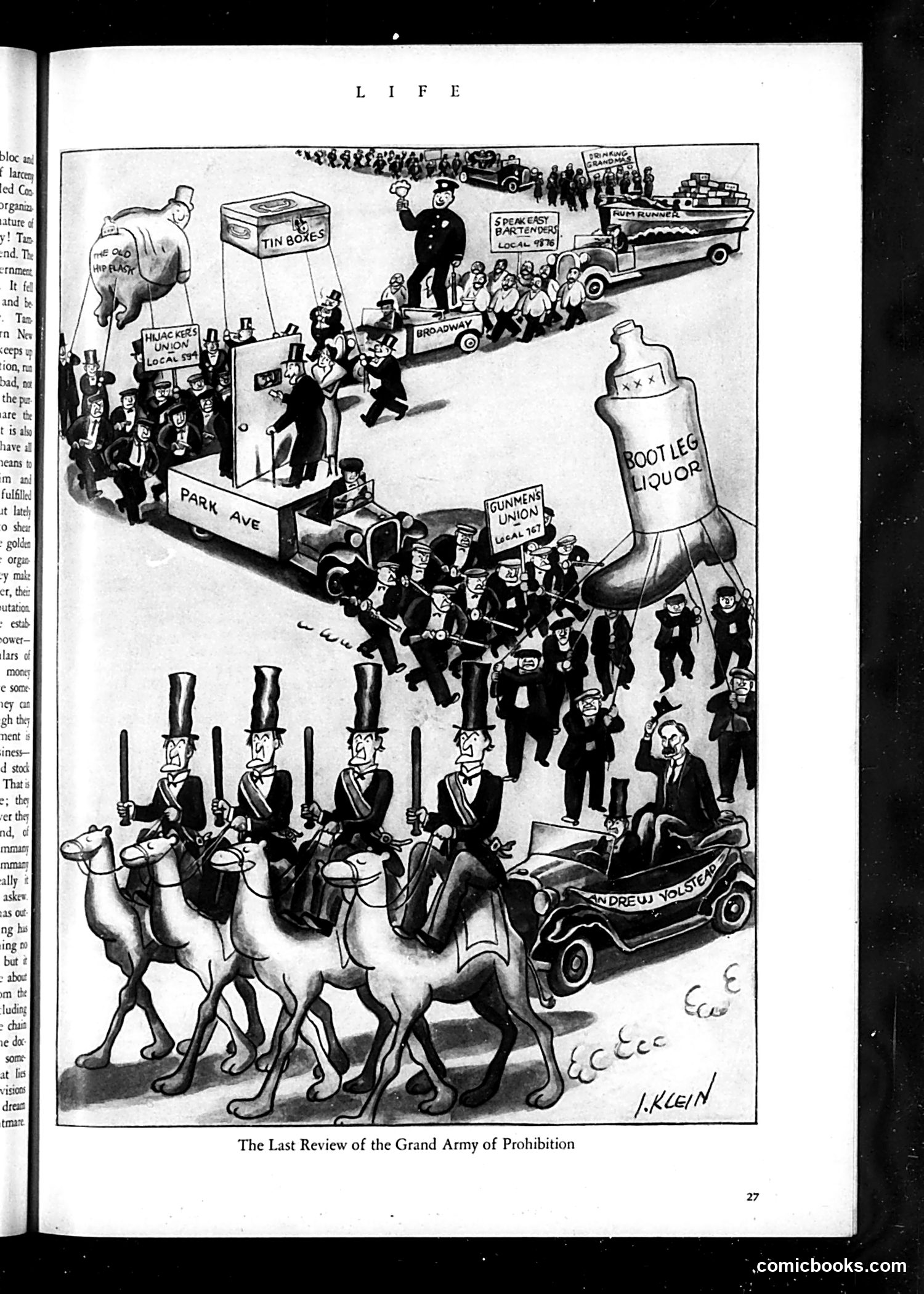
"The Last Review of the Grand Army of Prohibition" This cartoon satirizes Prohibition enforcement as a chaotic, dying movement. The image depicts various anti-alcohol groups and their supporters (labeled with union locals and organizations like "Park Ave," "Broadway," "Guimmen's Union") parading in absurd fashion—on camels, in vehicles, carrying a giant bottle of bootleg liquor. The central joke is that Prohibition, meant to eliminate alcohol, has instead created a thriving black market (symbolized by the enormous bootleg liquor bottle). The "grand army" metaphor mocks how seriously prohibition advocates took themselves, while the cartoon suggests their efforts were ultimately futile. The elaborate parade ironically celebrates what appears to be Prohibition's failure or end, with the bootleg liquor prominently displayed as the true victor. The cartoon reflects widespread public skepticism about Prohibition's effectiveness during the 1920s-early 1930s.
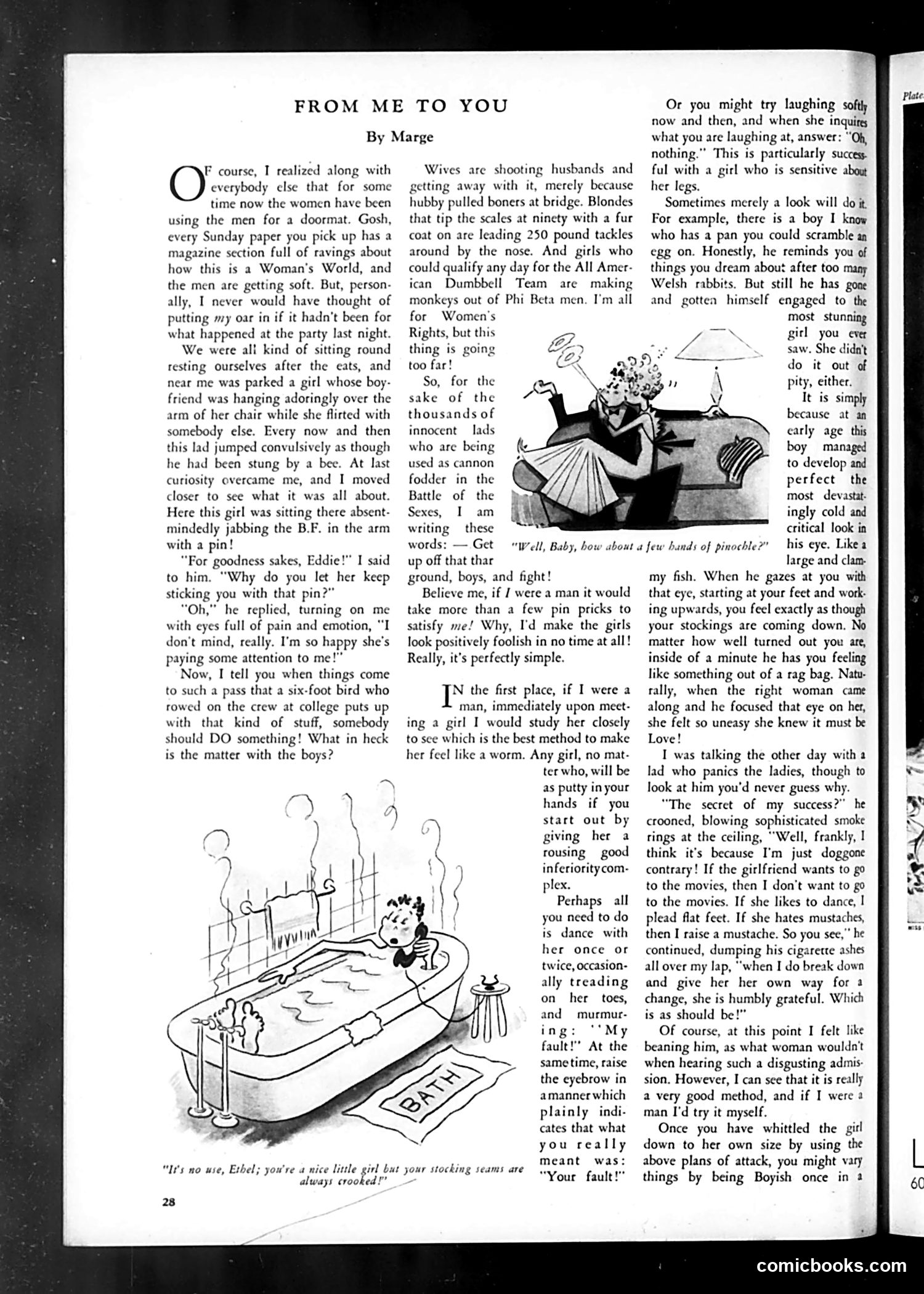
Analysis of "From Me to You" by Marge This satirical column mocks the 1920s-30s "Woman's World" concept—the idea that women had gained such social power over men that gender roles had reversed. The satire: Marge ironically advocates for men to reassert dominance by psychologically manipulating women—making them feel inferior through coldness, criticism, and deliberate rudeness (stepping on dates' feet, laughing mysteriously). She presents this as "perfectly simple." The joke: The humor lies in the absurdity of her advice being presented as logical strategy while simultaneously revealing how ridiculous male insecurity actually is. By advocating cruel tactics, Marge exposes the pettiness of men's complaints about losing control. Social context: This reflects genuine 1920s anxiety about women's increasing independence (voting rights, workplace participation, social freedom). The cartoon of a woman jabbing her boyfriend with a pin while he accepts it gladly illustrates the column's premise—that men have become pathetically submissive. For modern readers: This is proto-feminist satire using irony; Marge's "advice" satirizes male fragility by taking male complaints seriously and extending them to absurd, cruel conclusions.
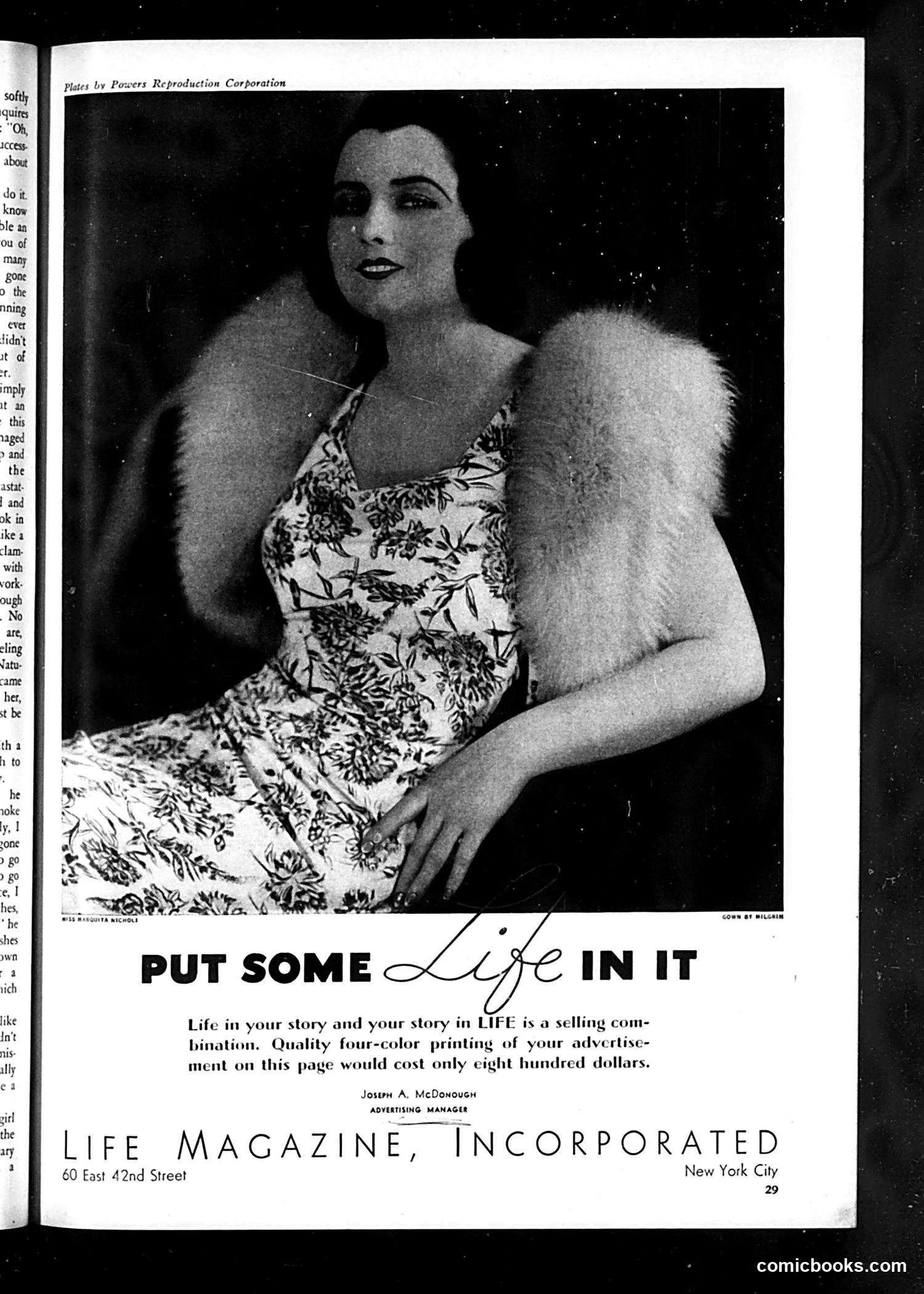
This is a full-page advertisement for Life Magazine, not satirical content. It promotes advertising opportunities to potential clients. The image shows a woman in a floral dress posed attractively, meant to represent the visual appeal and quality of Life's publication. The headline "Put Some Life In It" is a pun playing on the magazine's name—suggesting that featuring one's advertisement in Life Magazine will invigorate a marketing campaign. The text promises that four-color printing of an ad on this page would cost only eight hundred dollars. Joseph A. McDonough, listed as advertising manager, is soliciting business from potential advertisers. This is straightforward commercial promotion rather than political or social satire.
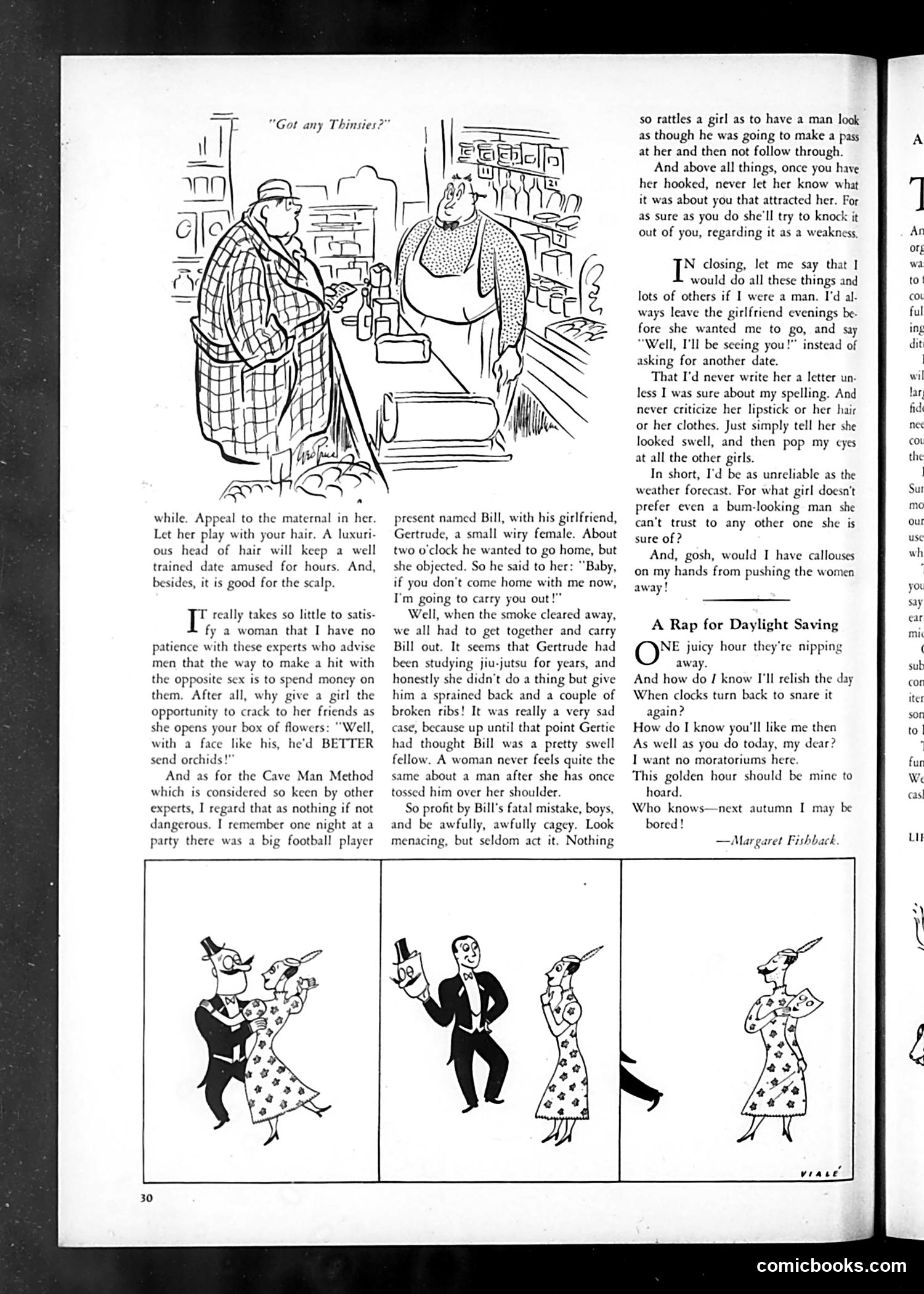
"A Rap for Daylight Saving" - Explanation for Modern Readers This page contains humorous dating advice and a poem critiquing daylight saving time. The main cartoon (top) illustrates absurd dating tips, including a story about "Bill," a football player who tried the "Cave Man Method" of dating by threatening to carry his girlfriend Gertrude home against her will. The joke: she knew jiu-jitsu and threw him over her shoulder, breaking his ribs. The satire mocks aggressive male dating strategies as both ineffective and dangerous. The poem (bottom right, attributed to Margaret Fishback) sarcastically protests daylight saving time. It expresses anxiety that an extra hour of daylight might be wasted or that romantic feelings might change by autumn when clocks "turn back." The humor lies in treating a clock adjustment as a threat to romance and personal happiness. The small cartoon strip (bottom) shows people celebrating with top hats and party clothes, likely illustrating the frivolous attitude toward time-shifting. Both pieces satirize contemporary dating culture and government policies through exaggerated, humorous perspectives.
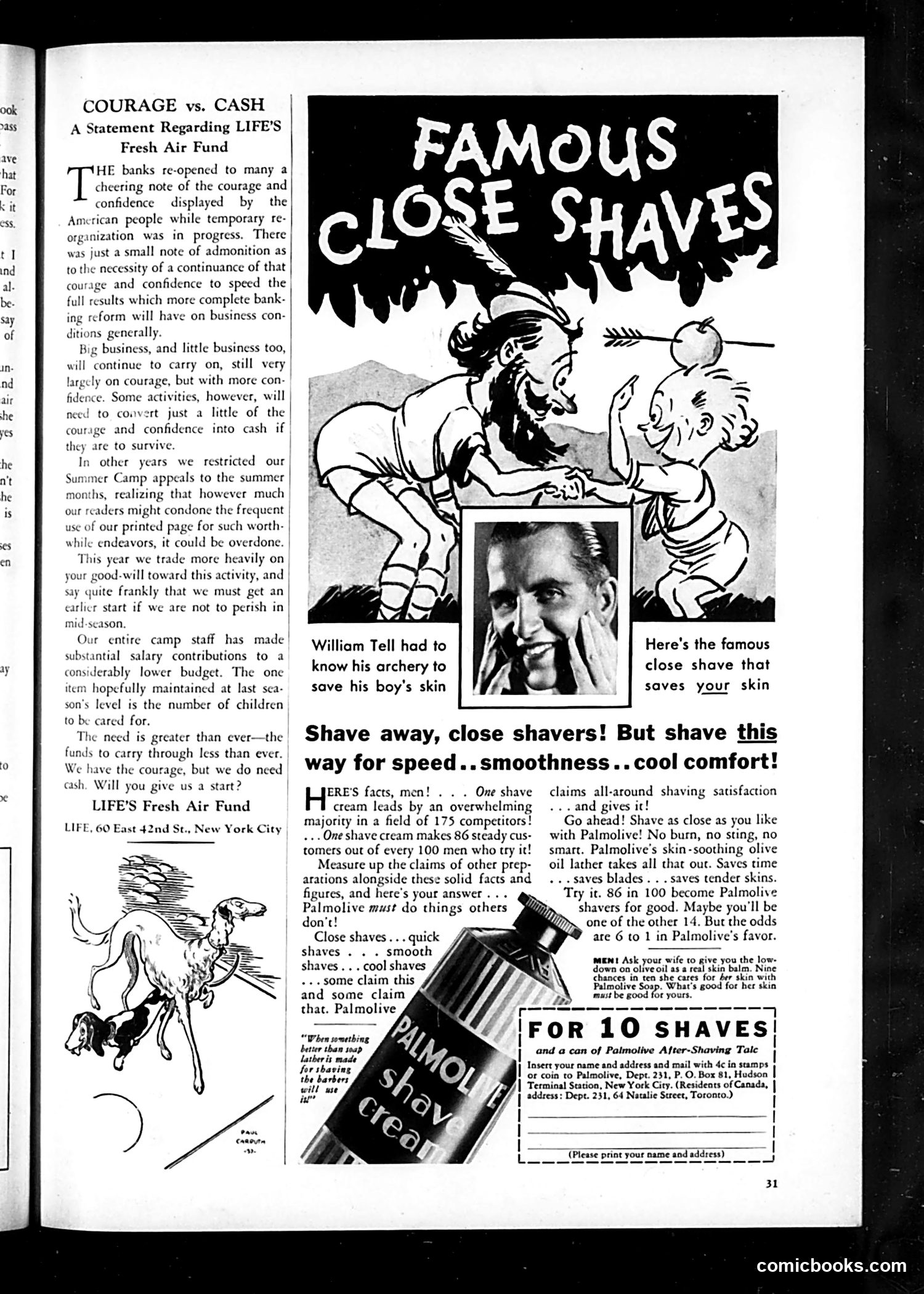
Analysis for Modern Readers This page combines editorial fundraising with advertising. The left side appeals for donations to LIFE magazine's Fresh Air Fund—a charitable camp for children. The appeal candidly states the organization has "courage" but needs actual "cash" to survive the economic downturn (likely the Great Depression era). The right side is a Palmolive shaving cream advertisement. It references William Tell's legendary archery skill as an analogy: just as Tell needed precision to save his son, men need the right shaving cream for a "close shave." The ad uses competitive statistics ("175 competitors," "86 out of 100 customers") to claim superiority. The cartoon figures show exaggerated male faces receiving close shaves. The juxtaposition is somewhat ironic—a serious charity appeal sharing space with lighthearted consumer advertising—typical of LIFE's mixed editorial-commercial format of that era. The historical context: this reflects pre-WWII American magazine publishing and the period's economic struggles requiring charitable fundraising.
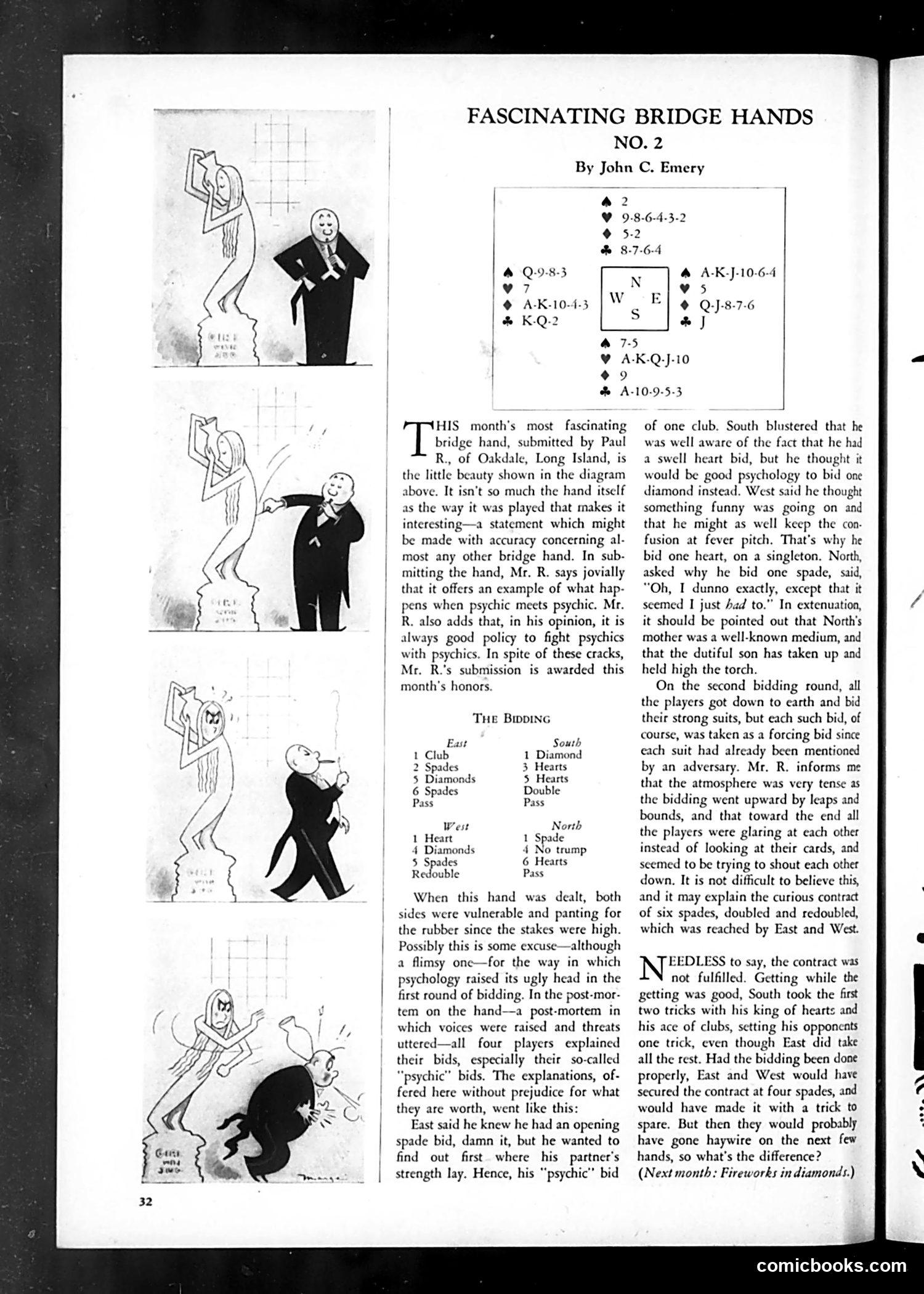
"Fascinating Bridge Hands No. 2" - Bridge Game Satire This page presents a bridge card game analysis by John C. Emery, accompanied by cartoon illustrations showing a frustrated player dealing with bridge psychology. The article humorously describes a real bridge hand where all four players deliberately made deceptive "psychic" bids—intentionally misleading their opponents about their actual card strength. Each player justified their questionable strategy differently: one wanted information, another thought it "good psychology," a third wanted to increase confusion, and the fourth simply claimed intuition (with a joking reference to his mother being a spiritualist medium). The satire mocks how competitive bridge players rationalize poor bidding decisions and blame "psychology" rather than acknowledging simple miscalculation. The cartoon's exaggerated depiction of the frustrated player visually reinforces the absurdity of the situation—four grown adults talking themselves into an unwinnable contract through mutual deception.
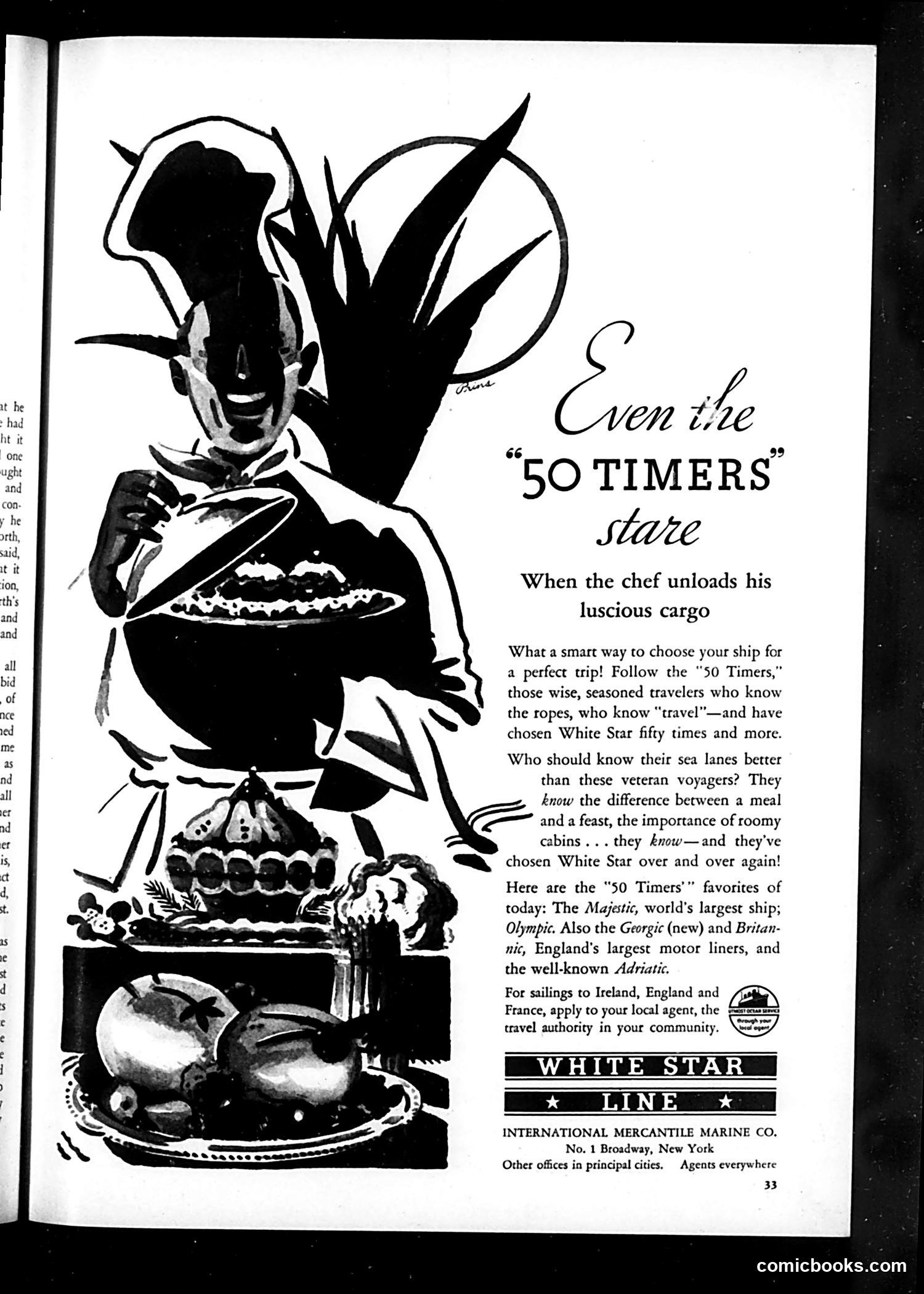
White Star Line Advertisement This is a cruise ship advertisement, not political satire. It promotes White Star Line's transatlantic passenger services (primarily to Ireland, England, and France). The illustration depicts a stylized chef or ship's staff member proudly presenting elaborate meals—establishing the luxury appeal. The "50 Timers" concept refers to experienced travelers who've sailed White Star vessels 50+ times, positioned as expert judges of quality travel. The ad emphasizes competitive advantages: spacious cabins, superior dining, and reliability. Featured ships include the *Majestic* (claimed as "world's largest"), *Olympic*, *Georgic*, *Britannic*, and *Adriatic*—all genuine White Star vessels from this era. This represents 1920s-30s cruise advertising strategy: leveraging repeat-customer testimonials to attract affluent travelers. The theatrical artwork style was typical of period magazine advertising.
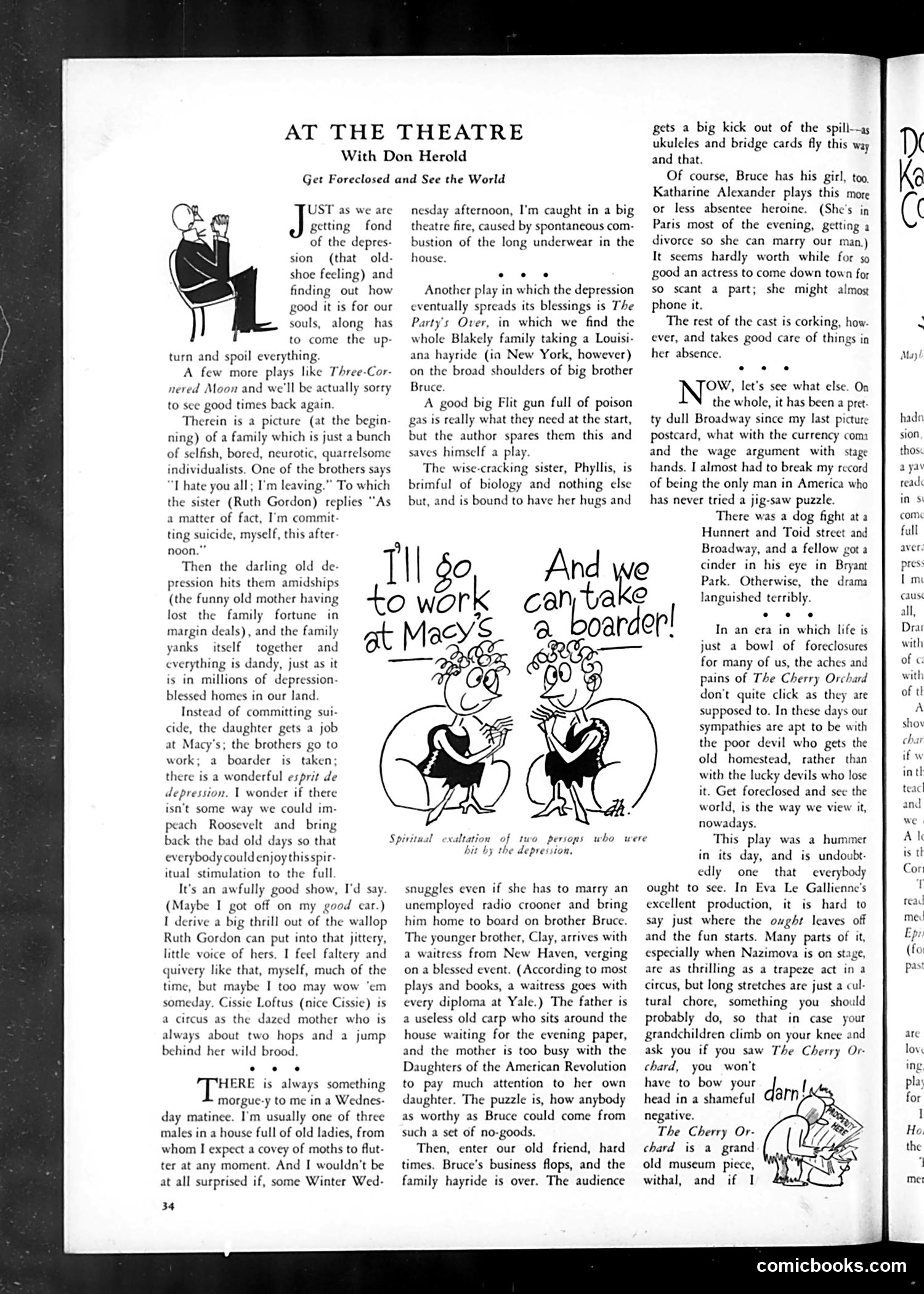
Explanation for Modern Readers This theater review by Don Herold satirizes Depression-era Broadway plays that ironically celebrate economic hardship. Herold reviews two plays—*Three-Cornered Moon* and *The Party's Over*—where dysfunctional families miraculously bond once financial disaster strikes. The cartoon (captioned "till 80 to work at Macy's and we can take a boarder!") depicts two figures happily discussing how foreclosure forces them into employment and taking in lodgers—treating economic collapse as character-building entertainment. Herold's satire targets both the plays and American audiences: he notes these "depression-blessed homes" became wildly popular, and jokes that people should "impeach Roosevelt and bring back the bad old days" so they can enjoy this manufactured spiritual uplift. The humor is dark—mocking how theater audiences found comfort watching others' financial ruin, while also critiquing Depression-era sentimentality that romanticized poverty as morally redemptive rather than devastating.
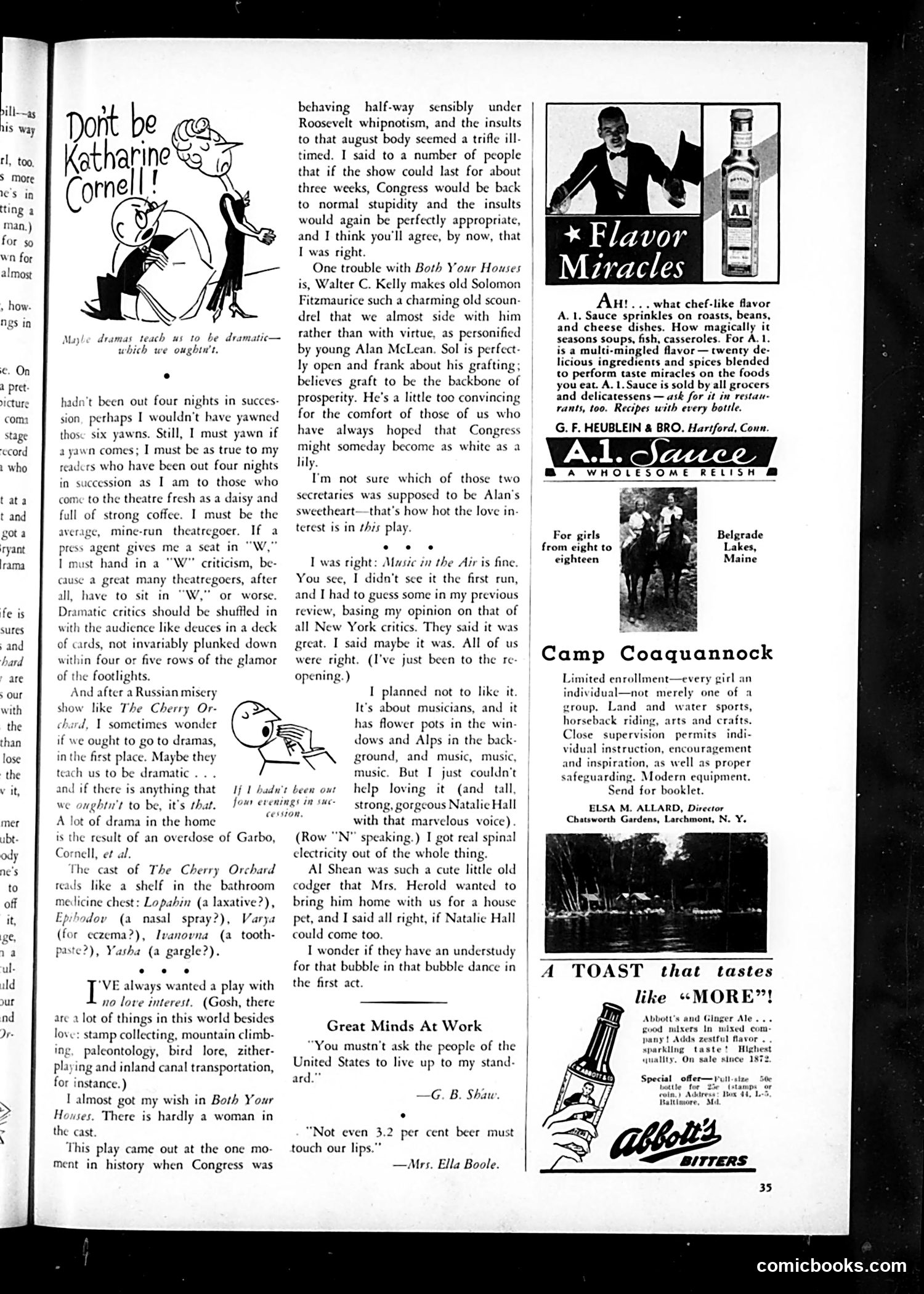
Life Magazine Page Analysis This page contains theater criticism from Life magazine's satirical column. The left side features a cartoon titled "Don't be Katharine Cornell!" showing a dramatic figure, mocking overwrought theatrical acting styles. The critic discusses several Broadway plays: *The Cherry Orchard* (a Russian production he found tedious), *Both Your Houses* (a political drama about Congressional corruption), and *Music in the Air* (a musical he unexpectedly enjoyed). The satire targets: theatrical pretension and overly dramatic home life inspired by watching dramatic plays; Congress's actual corruption (the play's "insults" seemed ill-timed during Roosevelt's administration when Congress was "behaving half-way sensibly"); and the critic's own inconsistency in judging theater. The right side contains period advertisements for A.1. Sauce, Camp Coquannock, and Abbott's Bitters—typical 1930s product ads. The overall tone reflects Life's characteristic irreverent, conversational style critiquing both theater and American institutions during the early Depression era.
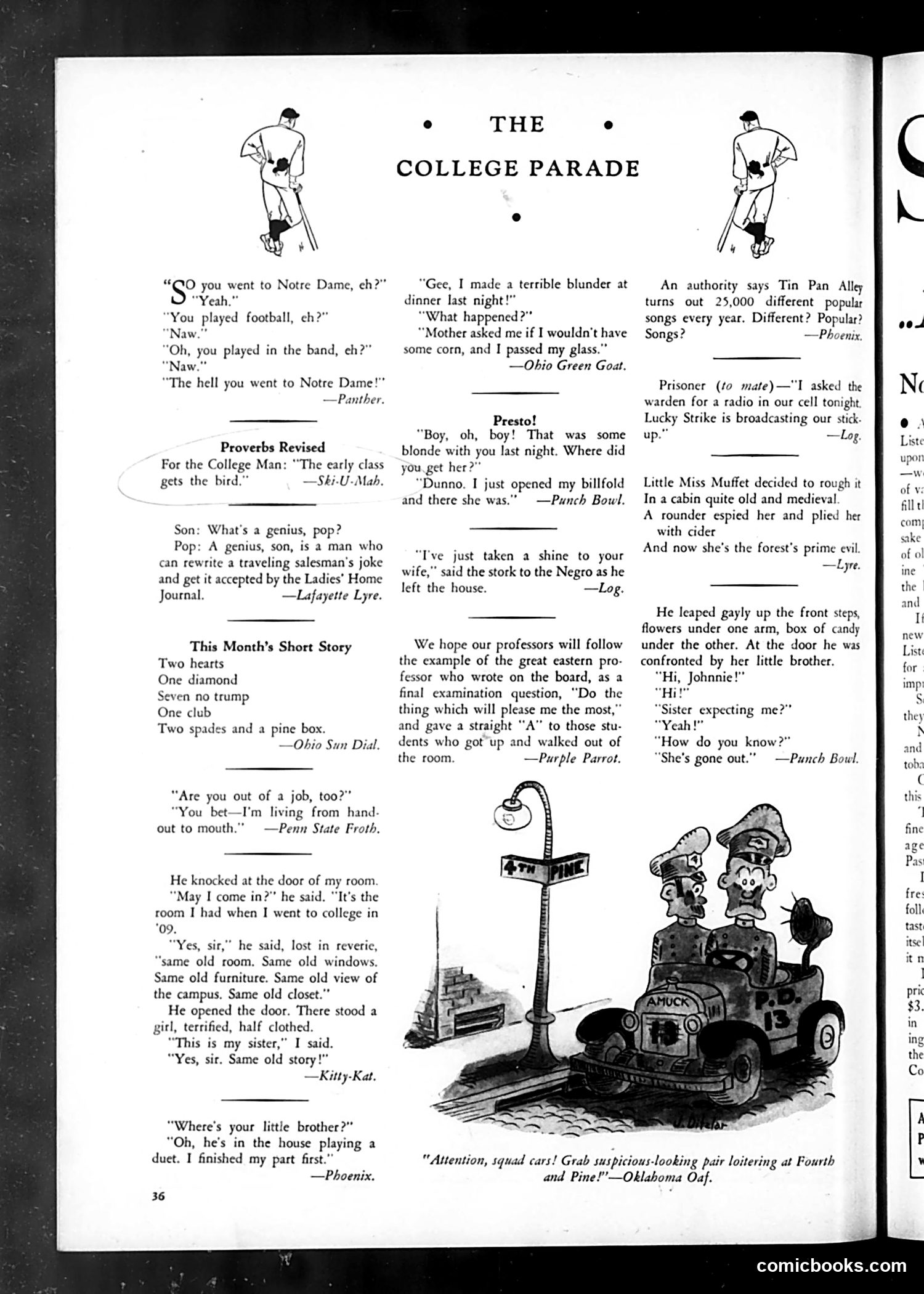
"The College Parade" - Life Magazine Humor Page This is a humor section collecting jokes from various college newspapers. The satire targets college life and student behavior circa the 1920s-30s. Key jokes: - Opening: Mocks Notre Dame students who didn't actually participate in college activities (football, band) - "Proverbs Revised": Parodies self-help sayings, including a bridge card game ending in death—dark humor about gambling - Multiple jokes mock seduction and loose morality (the "same old story" of finding a girl in a dorm room; a man attracted to someone because he opened his wallet) - One offensive joke uses a racial slur about a stork visiting a Black family - The cartoon shows children in a toy car with the caption about "suspicious-looking pair loitering"—likely satirizing moral panic about youth behavior Overall context: College-focused satire mocking student pretension, sexual conquest narratives, and loose sexual morality—typical of collegiate humor magazines of this era.
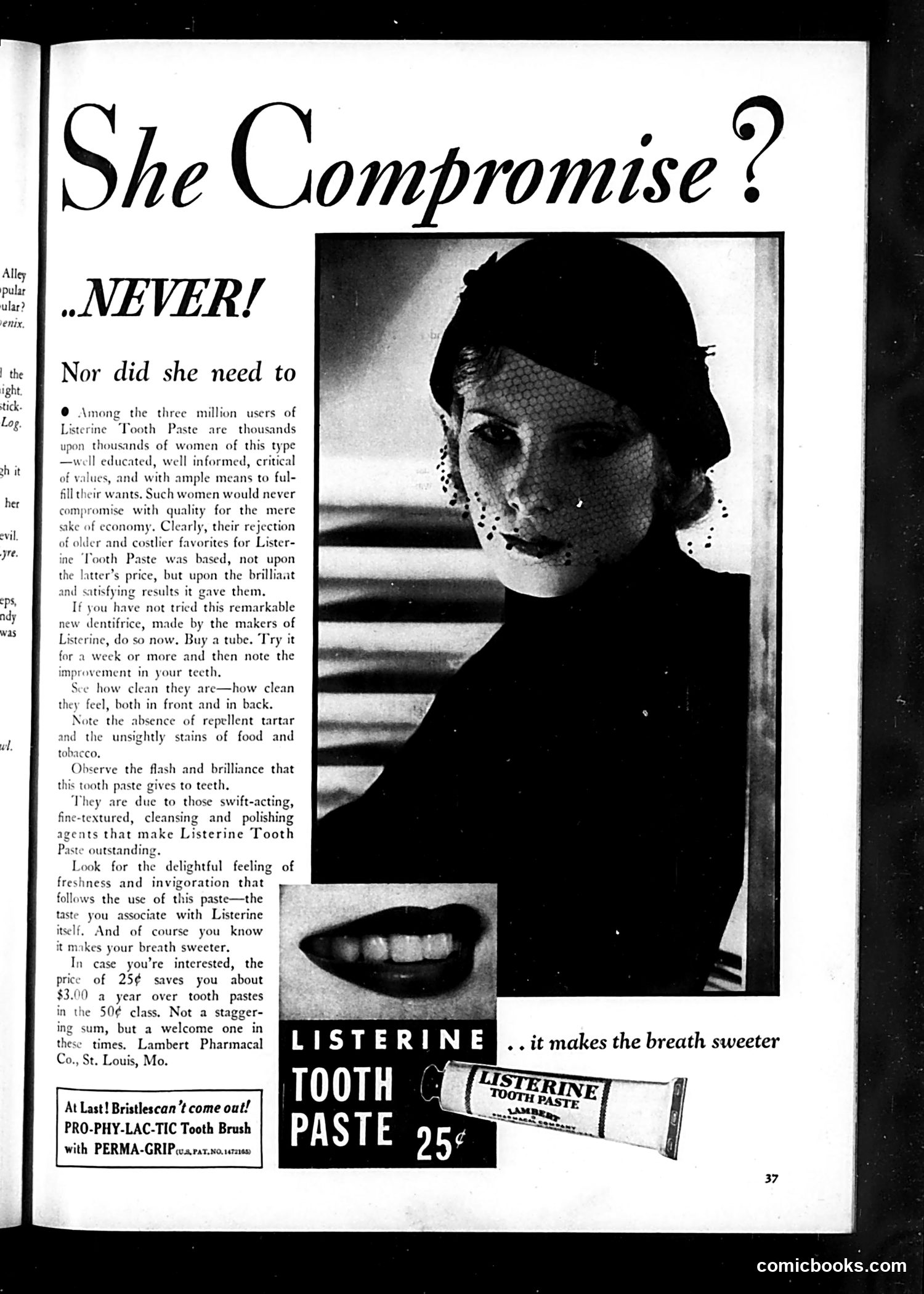
Analysis of This Advertisement Page This is not a political cartoon but a full-page advertisement for Listerine Tooth Paste, circa the 1920s-1930s. The ad's rhetorical strategy targets educated, affluent women—described as "well educated, well informed, critical of values"—who won't compromise on quality. The headline "She Compromise? NEVER!" frames toothpaste choice as a matter of principle and taste, not mere economy. The accompanying photograph shows a fashionable woman in profile wearing a netted hat and earrings, representing the modern, discerning female consumer the ad addresses. The messaging emphasizes Listerine's superior results (cleanliness, brightness, fresh breath) rather than its budget price (25¢), positioning it as a quality product that happens to be economical—a clever inversion of typical budget marketing. The ad also includes a competing toothbrush advertisement at bottom, typical of magazine layout from this era.
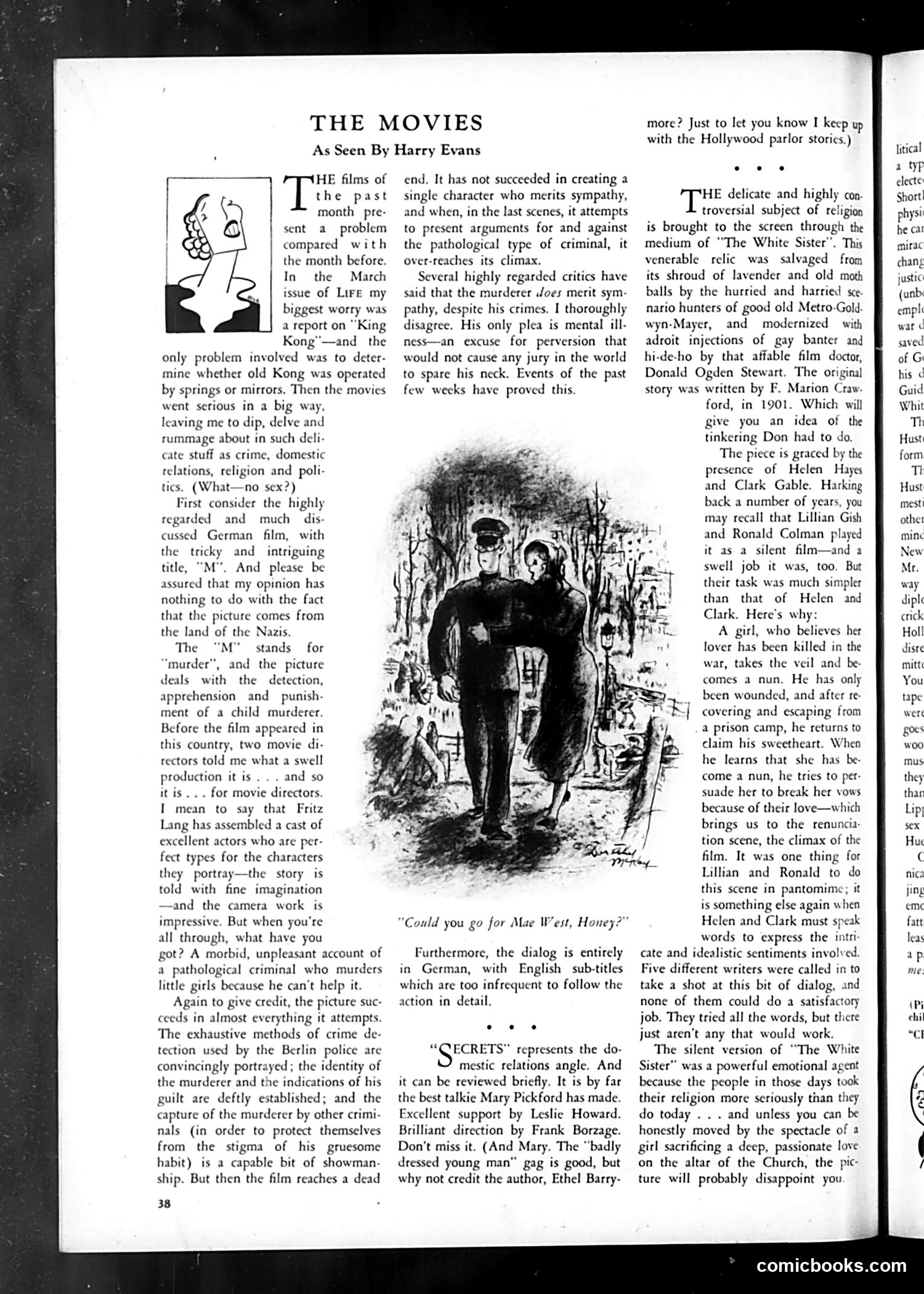
"The Movies As Seen By Harry Evans" - Life Magazine Film Review This is a film criticism column reviewing current movies. The page contains a caricature of a man's face (likely the critic Harry Evans) in the left margin. Key references: - "M" (German film by Fritz Lang): A critically acclaimed but morally troubling film about a child murderer's detection and capture. Evans praises its technical craft but criticizes it for being "morbid" and failing to create sympathetic characters. He dismisses arguments for the murderer's sympathy as mere "mental illness"—an excuse no jury would accept. The reference to "land of the Nazis" suggests awareness of Nazi Germany's rise. - "Secrets" (Mary Pickford talkie): Praised as Pickford's best sound film. - "The White Sister": A religious drama updated from an 1901 story, starring Helen Hayes and Clark Gable. Evans critiques films on moral, artistic, and technical grounds—reflecting 1930s concerns about cinema's social responsibility regarding crime, morality, and religion.
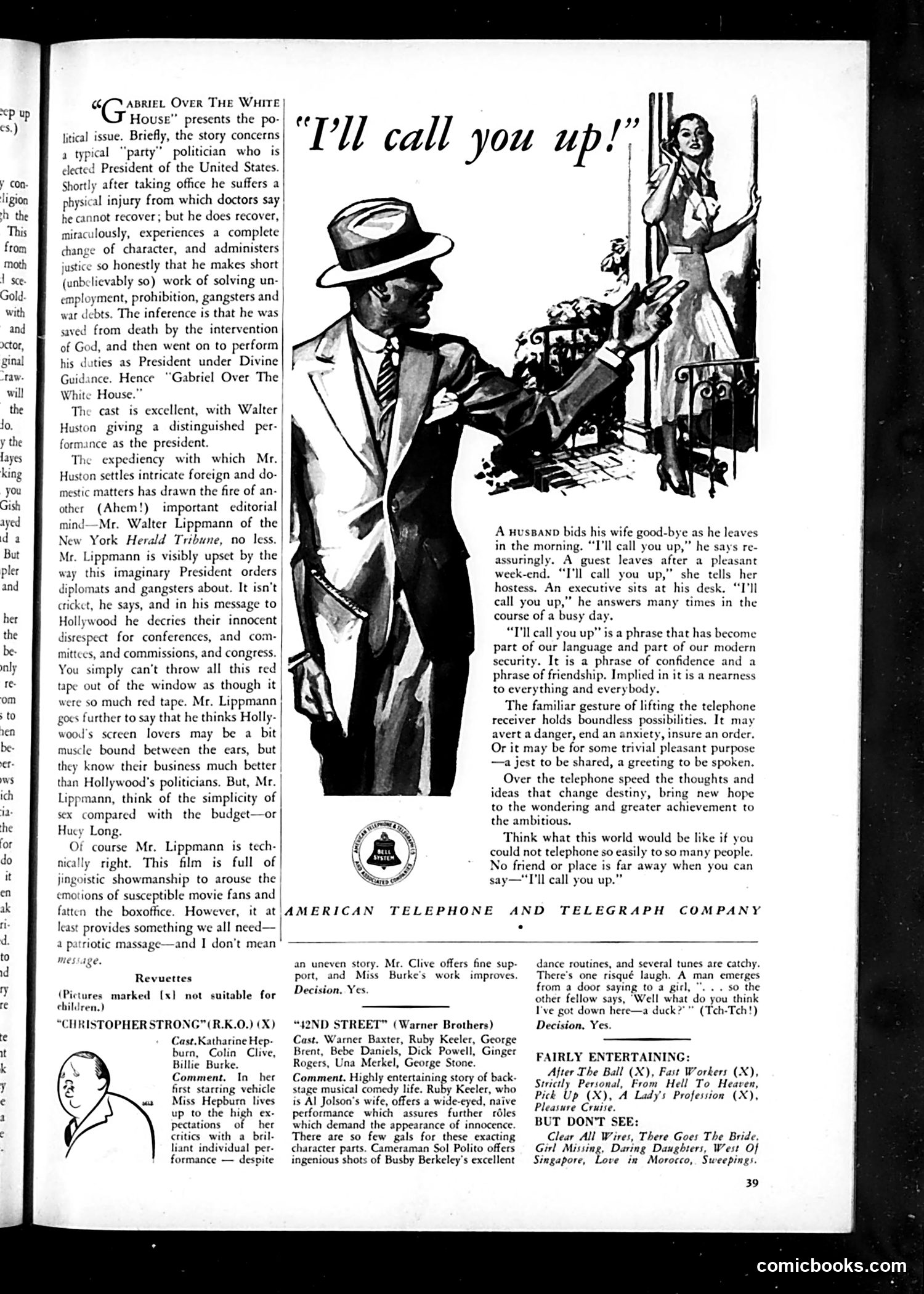
"Gabriel Over The White House" and Political Satire This page reviews a 1933 film starring Walter Huston as a U.S. President who, after a miraculous recovery from a fatal injury, abandons bureaucratic procedure to solve unemployment, prohibition, gangsters, and war debts through decisive action. The satire targets two audiences: the film itself (criticized by New York Herald Tribune columnist Walter Lippmann for depicting reckless disregard for diplomatic protocol and congressional process) and Lippmann's response (mocked for comparing the complexity of governance to romantic cinema while defending institutional red tape). The accompanying AT&T advertisement uses the telephone as metaphor for modern connection and reassurance, creating ironic contrast with the political gridlock being satirized. The cartoon illustrates the common phrase "I'll call you up"—ordinary reassurance versus the extraordinary executive action depicted in the film's plot.
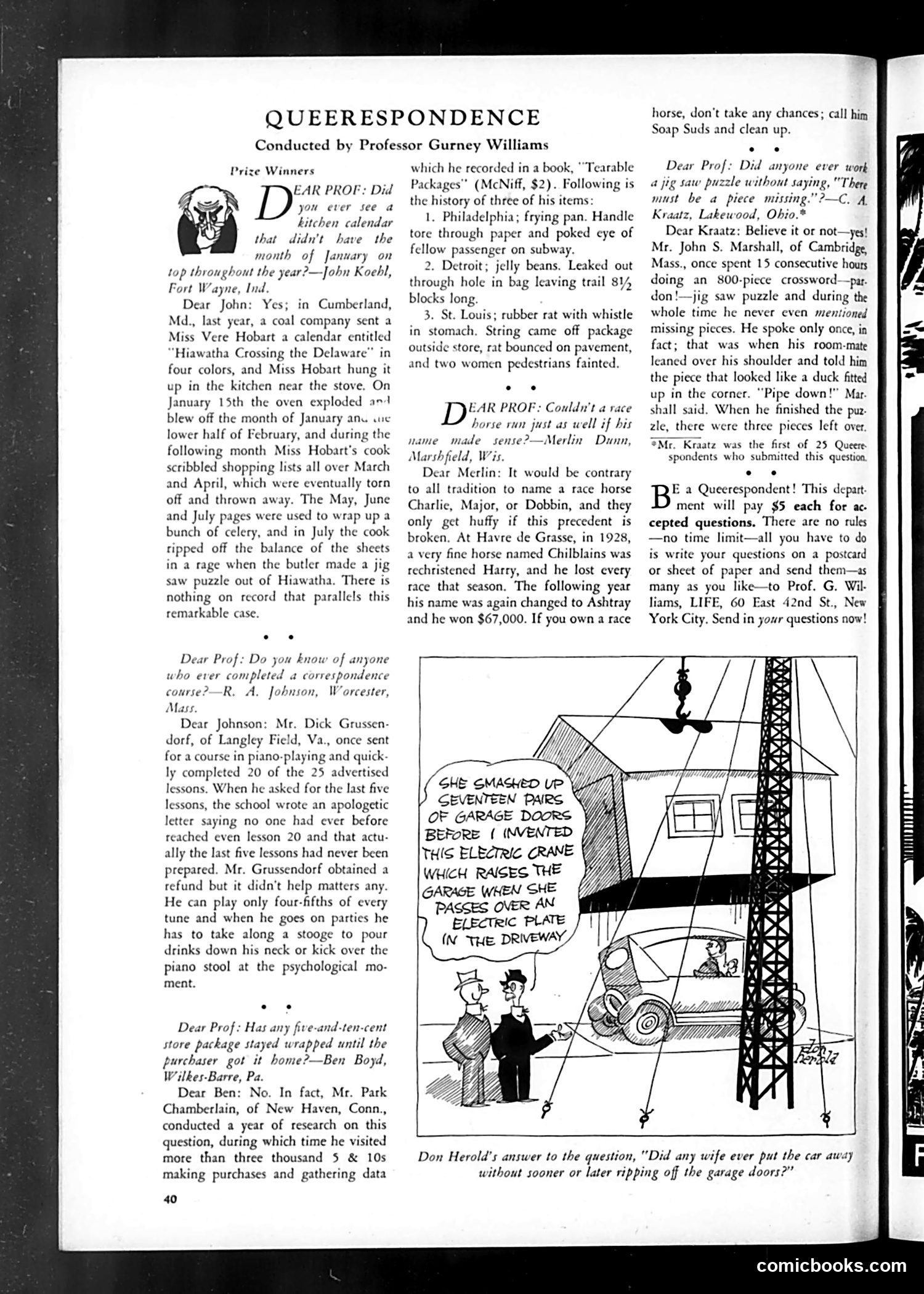
Life Magazine Humor Page Analysis This is a humor column called "Queerespondence" featuring absurdist responses to readers' questions. The cartoon illustrates one anecdote: a woman who invented an electric crane to raise her garage door, which malfunctions and smashes seventeen car garage doors instead. The page's humor relies on exaggerated, implausible scenarios presented as fact. Examples include: a kitchen calendar that explodes in an oven; a correspondence course student who completed 20 of 25 lessons that were never actually written; packages from five-and-dime stores that always tear open before customers leave the store (one trailing jelly beans for 8.5 blocks); and racehorses that perform poorly with sensible names but excel with absurd ones. This represents mid-20th-century American magazine humor—deadpan, surreal comic anecdotes designed to mock everyday consumer culture, advertising claims, and human eccentricity through escalating absurdity rather than explicit satire.
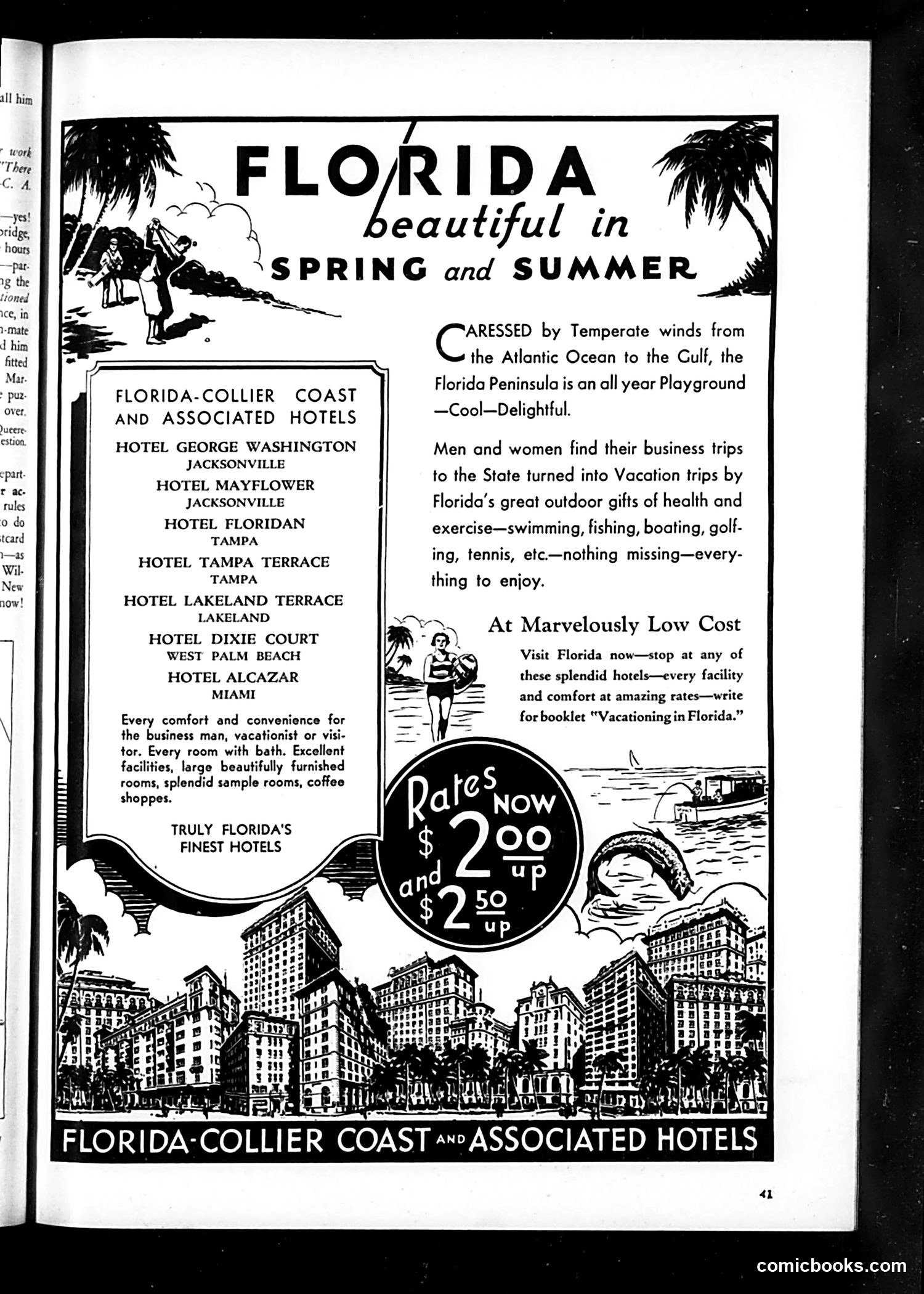
Analysis This is not a cartoon or satire—it's a tourism advertisement for Florida hotels, circa early 20th century (likely 1920s-1930s based on style and pricing). The page promotes the "Florida-Collier Coast and Associated Hotels," listing establishments like the Hotel George Washington (Jacksonville) and Hotel Alcazár (Miami). The ad emphasizes Florida as a year-round destination with "temperate winds" and recreational activities: swimming, fishing, boating, golf, and tennis. The appeal targets both businessmen and vacationers, highlighting low rates ("$2.00 and up," "$2.50 and up")—remarkably cheap even for the era. Visual elements include Art Deco-style hotel illustrations, palm trees, and beachgoers to evoke leisure and tropical appeal. There is no political satire here. It's straightforward promotional material designed to attract travelers during an era when Florida tourism was rapidly developing.
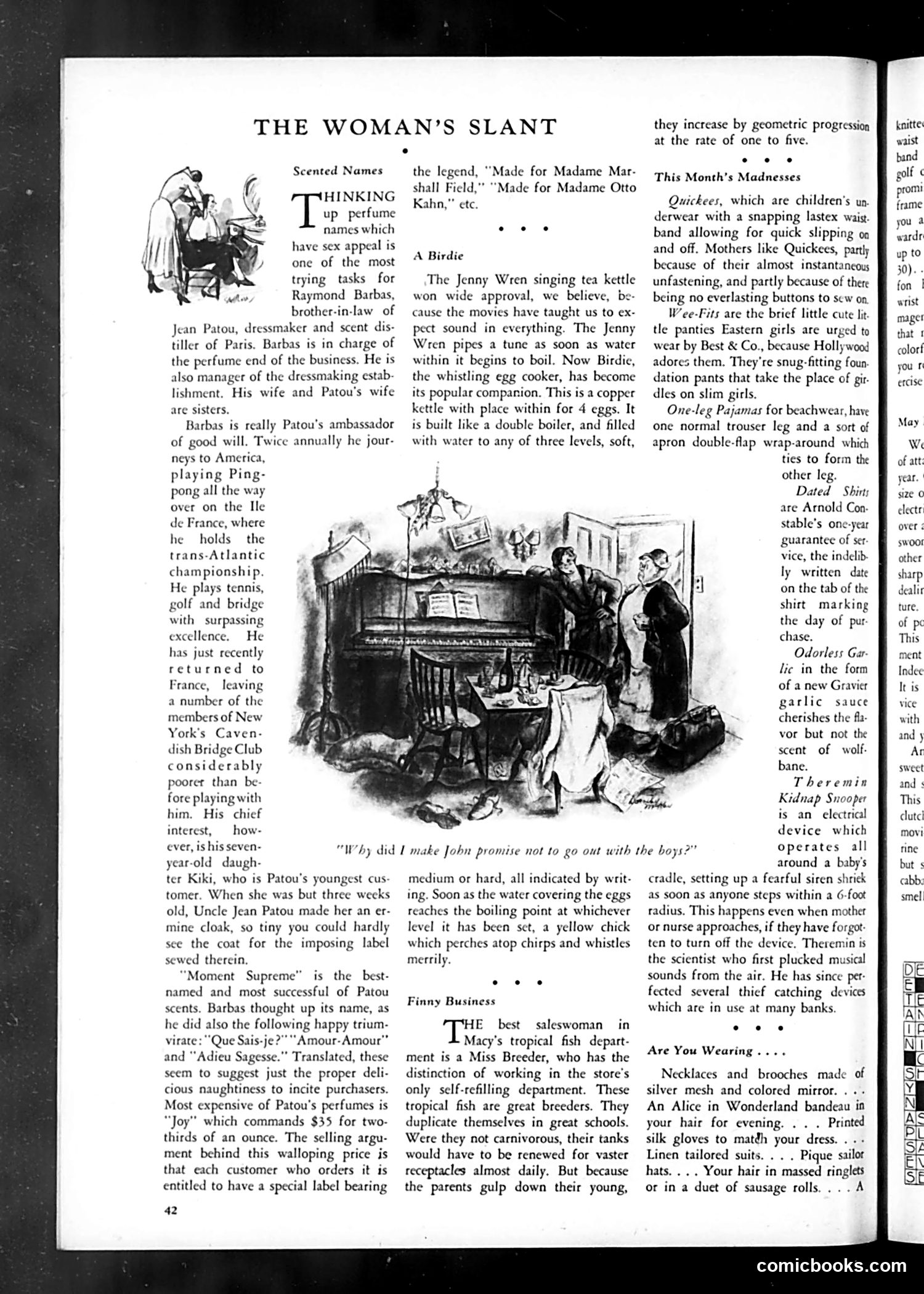
"The Woman's Slant" - Life Magazine Feature This page showcases women's fashion and domestic product innovations of the era (appears to be 1920s-30s). The main illustration depicts a domestic scene with the caption "Why did I make John promise not to go out with the boys?"—a humorous commentary on wives managing husbands' social activities. The featured items represent period consumer goods marketed to women: - Perfume naming discusses Jean Patou's Paris fashion house, emphasizing luxury goods with suggestive French names ("Moment Supreme," "Joy") designed to appeal to wealthy American clients - Kitchen gadgets like the "Jenny Wren" tea kettle and "Birdie" egg cooker—whimsical appliances using animal sounds to signal cooking completion - Children's clothing innovations (Quickees, Wee-Fits) emphasizing convenience and modern fastening - Macy's tropical fish department featuring a saleswoman named Miss Breeder, playing on the fish's reproductive capabilities The satire gently mocks consumerism and domestic preoccupations while celebrating modern conveniences marketed specifically to women.
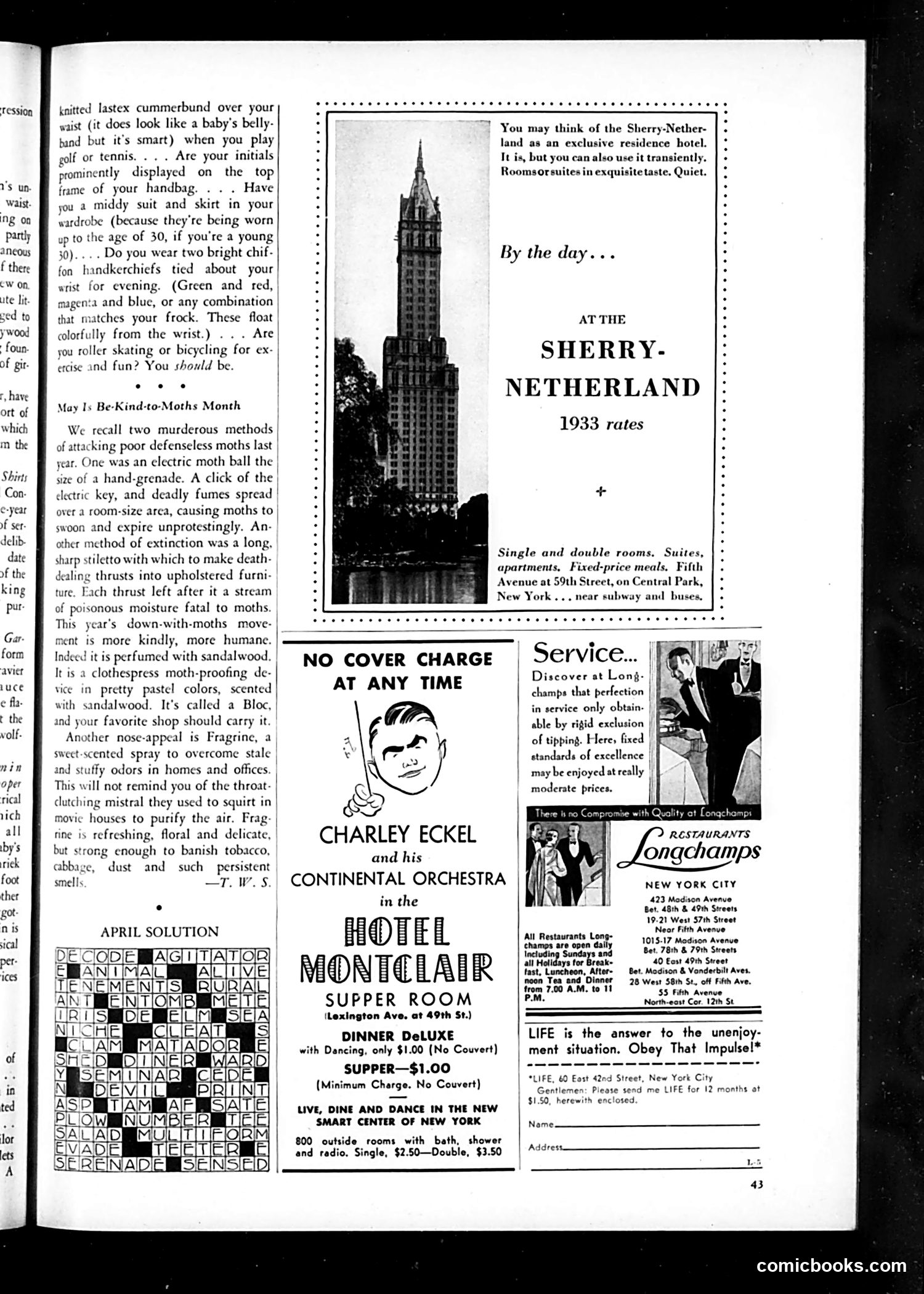
Analysis of Life Magazine Page (1933) This page is primarily advertising and fashion/lifestyle advice, not political satire. The main content includes: Fashion Column: Advice for stylish 1930s women—middy suits, rolled-up skirts, bright chiffon wrist scarves, roller skating, and decorative handbag initials. "Be-Kind-to-Moths" Satire: A humorous essay mocking overly sentimental attitudes toward pest control. It describes two absurdly lethal moth-killing devices (an electric bomb-sized ball and a stiletto) with mock horror, then advocates for gentler alternatives like sandalwood-scented moth-proofing blocks and fragrance sprays. The satire targets sentimentality about minor household pests. Crossword Puzzle: An April solution grid. Hotel & Restaurant Ads: Multiple advertisements for NYC establishments (Sherry-Netherland Hotel, Hotel Montclair's supper room with Charley Eckel's orchestra, Longchamps restaurants) and a Life magazine subscription offer. The page reflects 1933 consumer culture and leisure activities rather than significant political commentary.
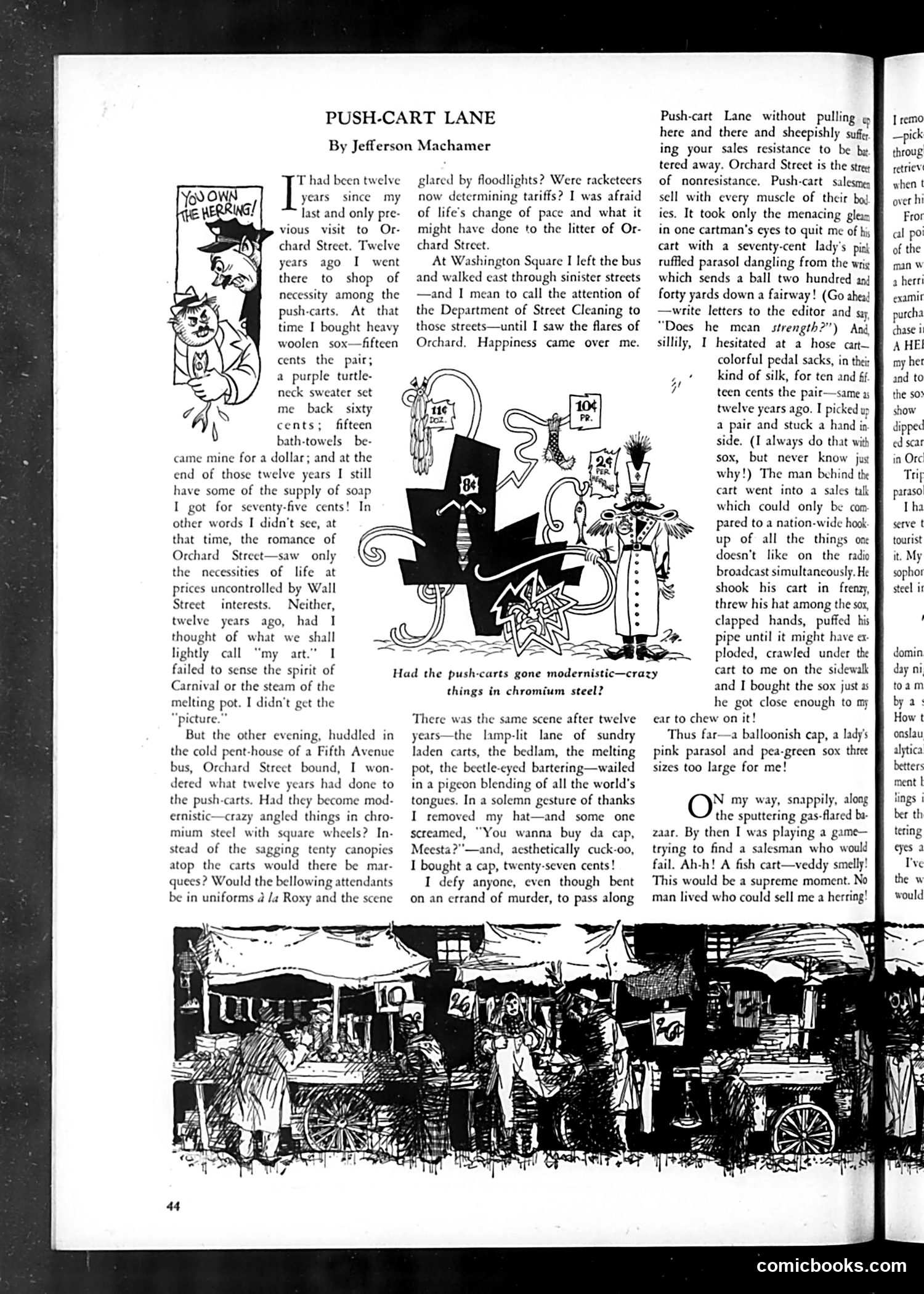
"Push-Cart Lane" by Jefferson Machamer This is a nostalgic essay with satirical illustrations about New York's Lower East Side immigrant neighborhood, Orchard Street. The author revisits the area twelve years after his last visit, initially worried that modernization and commercialization (represented in the cartoon by chromium-steel, floodlit "modernistic" push-carts) had destroyed its character. Instead, he finds the street unchanged—still a vibrant, chaotic marketplace of immigrant vendors aggressively hawking goods at low prices. The cartoon mockingly imagines what "modernistic" push-carts might look like, complete with neon signs and theatrical presentation. The satire targets two anxieties: anxiety about capitalism and commercialism threatening authentic immigrant culture, and the era's obsession with streamlined "modernistic" design replacing organic, lived-in spaces. The piece celebrates the street's resistance to these forces—its preservation of old-world hustle and human connection over corporate efficiency.
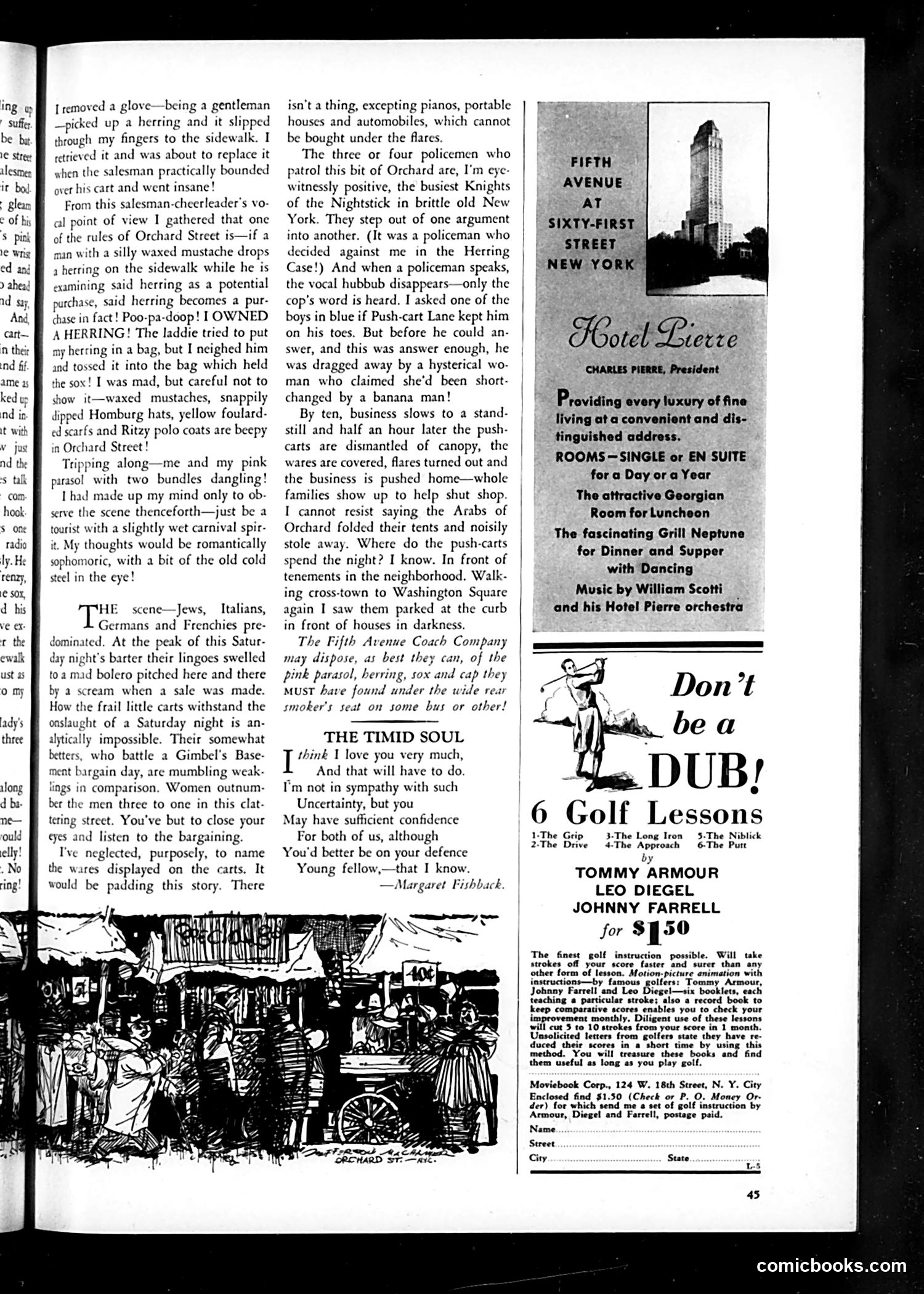
Analysis of This Life Magazine Page This page contains a humorous essay about shopping on New York's Orchard Street (the Lower East Side's famous immigrant market district), accompanied by period advertisements. The Main Article's Satire: The unnamed narrator describes a comical misadventure buying a herring from a pushy street vendor with a waxed mustache. When the narrator drops the herring and tries to retrieve it, the salesman treats this as a completed sale—a joke about aggressive vendor tactics and the chaotic bargaining culture. The piece affectionately mocks the street's immigrant population (Jews, Italians, Germans, French) and the constant noise of negotiation, while praising the tireless police maintaining order. The Irony: A gentleman's attempt to be proper (removing his glove) results in accidentally "owning" a herring he didn't intend to buy—satirizing both the vendor's sharp practices and the narrator's own naïveté. Lower Section: Contains unrelated period advertisements including a Hotel Pierre ad, golf lessons by Tommy Armour and Leo Diegel, and a poem titled "The Timid Soul" about romantic uncertainty.
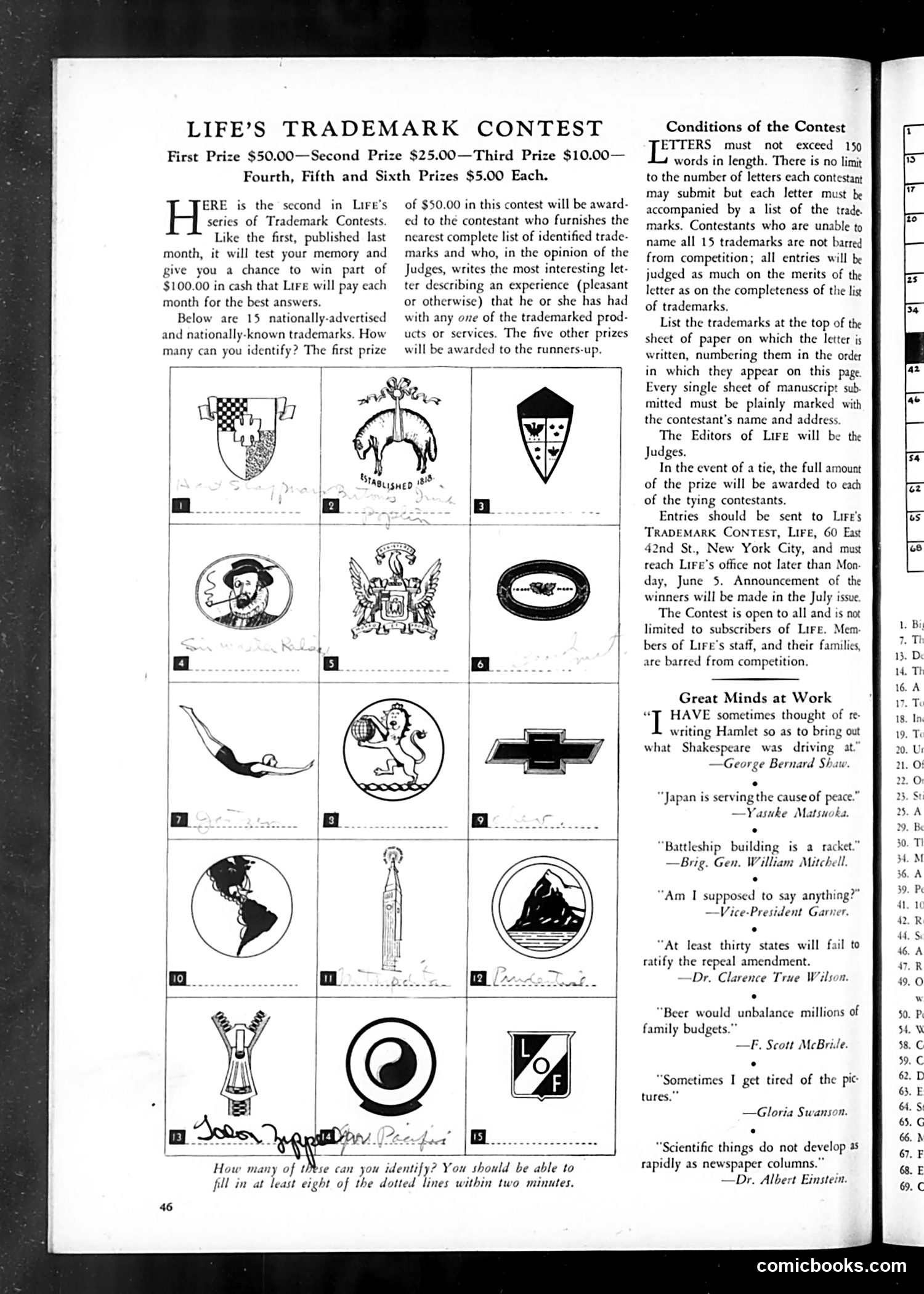
Life's Trademark Contest Page This page presents a consumer recognition contest where readers identify 15 nationally-advertised trademarks displayed as logos and symbols. The contest offers $100 total in prizes ($50 first place) and requires contestants to name the brands and write a brief anecdote about using one of their products. The contest page is paired with a satirical "Great Minds at Work" section featuring mock quotations from prominent 1930s figures—including George Bernard Shaw, Vice President John Garner, General Billy Mitchell, and Dr. Albert Einstein. These quotes humorously present absurd or contradictory statements, satirizing public figures' questionable pronouncements on serious topics like prohibition repeal, military spending, and scientific progress. The juxtaposition suggests *Life* magazine's dual mission: entertaining reader participation while satirizing contemporary public discourse and commerce. The contest itself reflects Depression-era consumer culture and advertising's growing prominence.
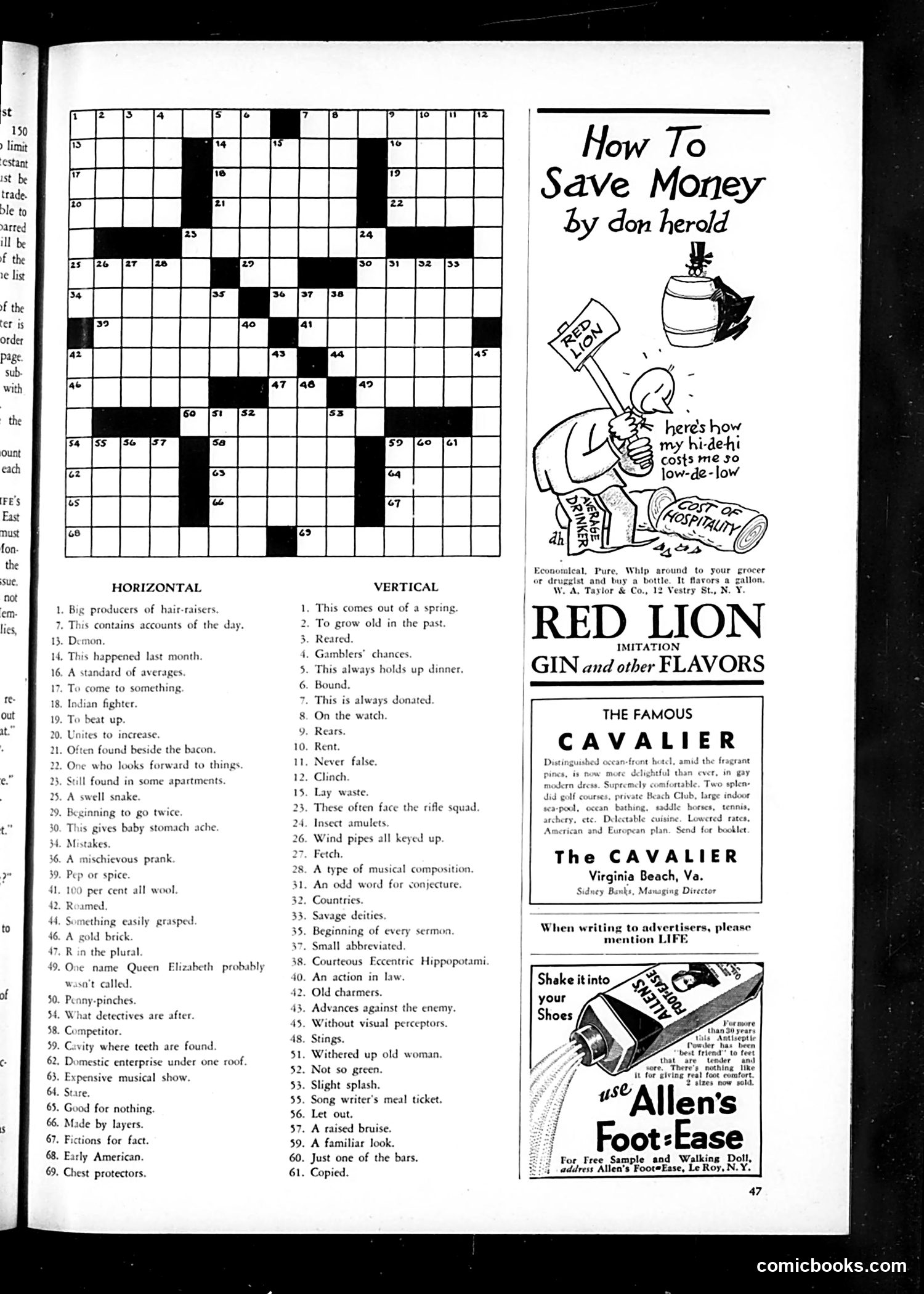
Analysis of Life Magazine Page Content This page contains a crossword puzzle (left side) and advertisements (right side), with one small cartoon illustration. The cartoon by Don Herold titled "How To Save Money" is a humorous commentary on Prohibition-era economics. It depicts a man explaining how diluting bootleg gin with water reduces his drinking costs dramatically—"costs me so low-de-low." The joke mocks both the absurdity of homemade alcohol production during Prohibition and people's creative financial rationalizations. The advertisements promote luxury goods (The Cavalier hotel in Virginia Beach, Red Lion gin imitation, Allen's Foot-Ease) to affluent readers, creating ironic contrast with Herold's satirical penny-pinching advice. The crossword clues reference contemporary 1920s culture, celebrities, and common knowledge of the era, typical for Life's educated readership.
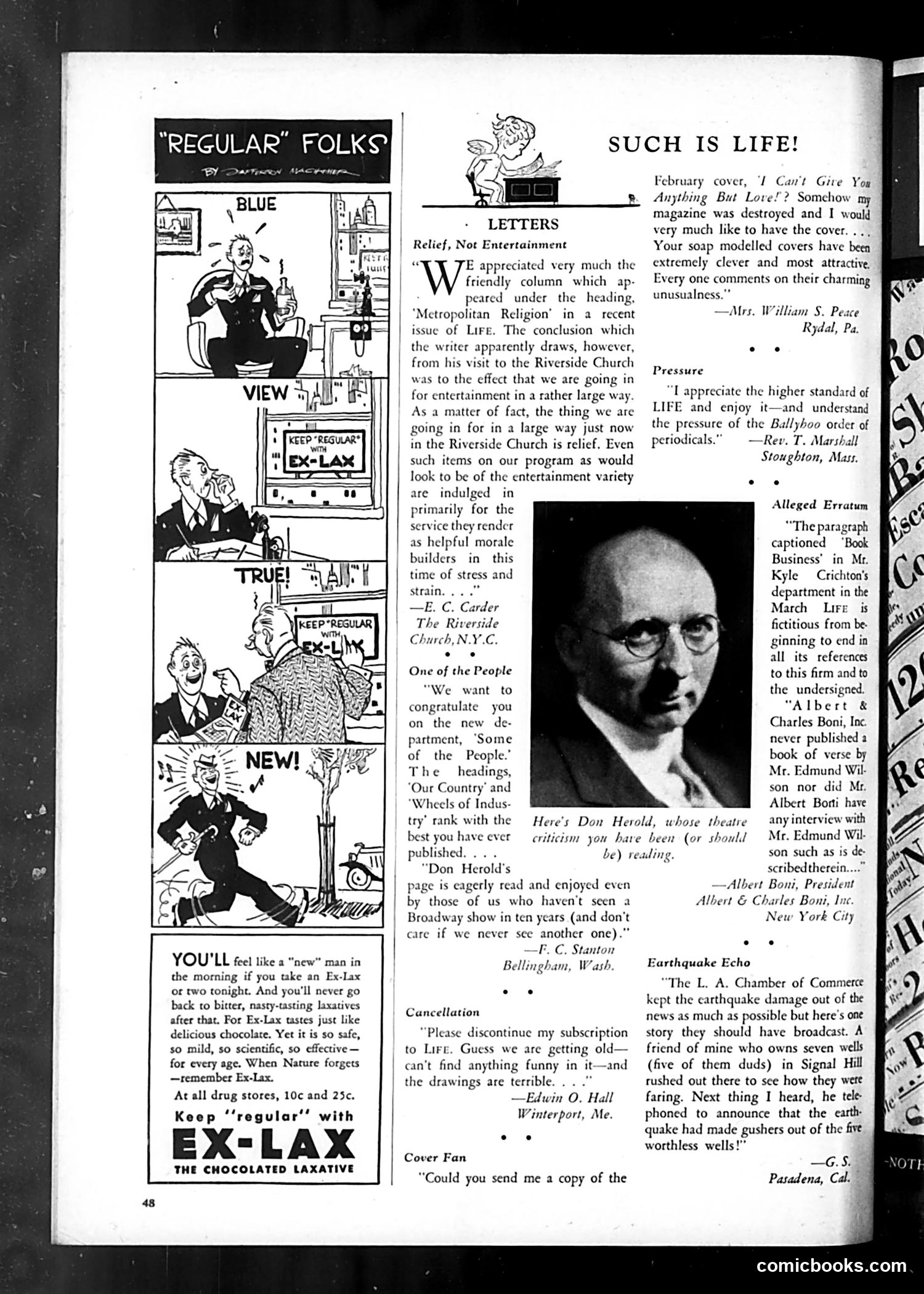
"Regular Folks" - A Depression-Era Satire Page This Life magazine page combines a laxative advertisement with a letters section satirizing American life during economic hardship. The cartoon strip "Regular Folks" uses bathroom humor—specifically Ex-Lax advertising—to mock ordinary people coping with stress. The repeated phrase "Keep Regular" doubles as both product messaging and social commentary about maintaining normalcy during uncertain times. The letters section showcases contrasting reader responses: some praise Life's content as morale-boosting during "this time of stress and strain" (likely referencing the Depression), while others complain the magazine has become frivolous. One cancellation letter dismisses it as unfunny; another defends entertainment as psychologically necessary. The Don Herold photograph and theater criticism reference suggests Life positioned itself as providing both escapist entertainment and serious cultural commentary—a tension reflected in readers' divided opinions about whether such content was helpful distraction or empty frivolity during America's economic crisis.