life
Life — June 1933
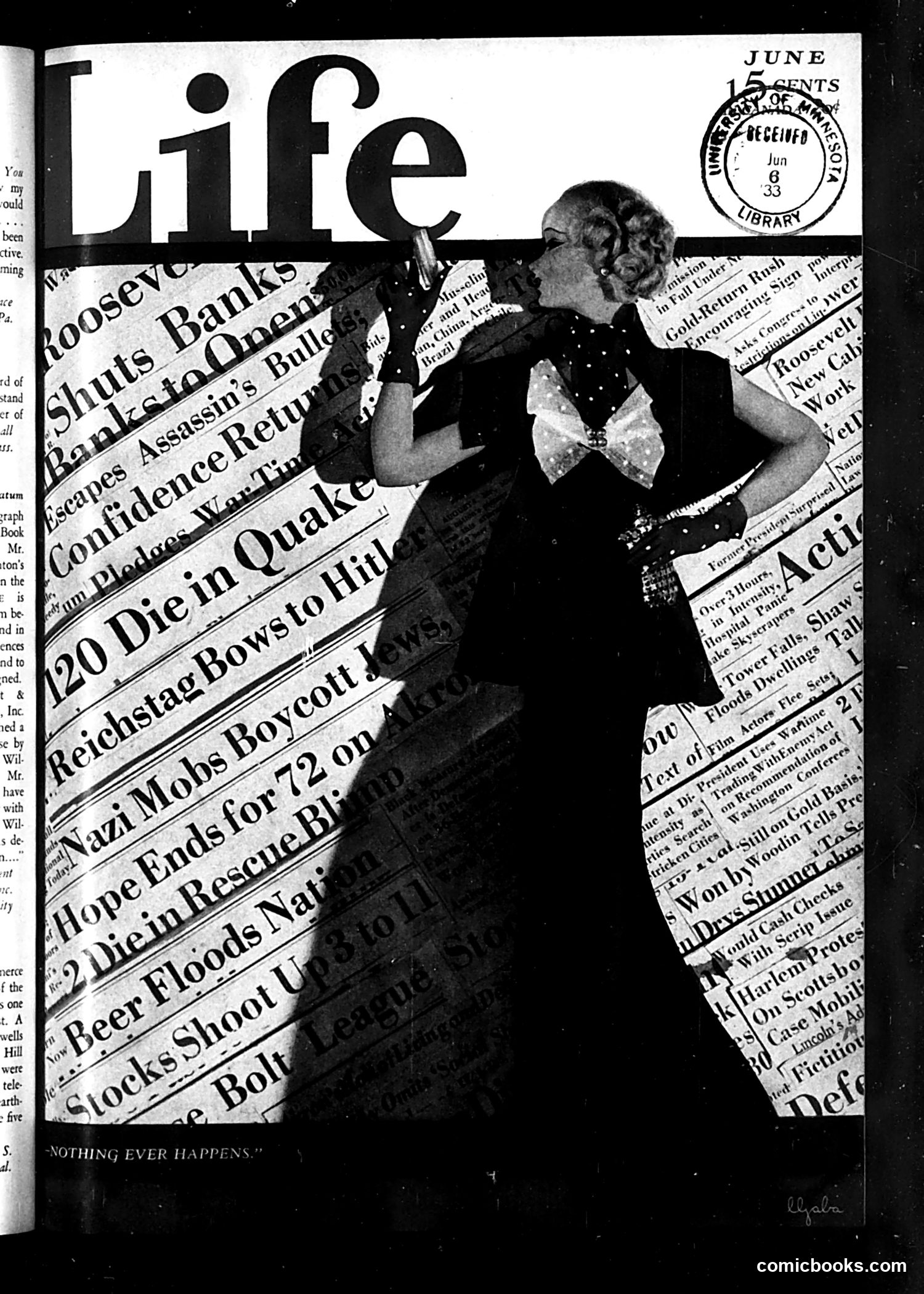
Life Magazine June Issue - Political Satire Commentary This Life magazine cover from June features a woman reading newspaper headlines as collage background material. The visible headlines reference major 1930s-40s crises: "Roosevelt Shuts Banks," "Assassin's Bullet," "120 Die in Quake," "Nazi Mobs Boycott," "Hope Ends for 72 on [ship]," "Beer Floods Nation," "Stocks School U-boats." The satirical point appears to be commentary on the relentless parade of catastrophic news dominating headlines during this turbulent era—likely Depression and pre-WWII period. The woman's casual reading posture against this backdrop of dire events suggests either public numbness to constant crisis or satirical commentary on how media sensationalism overwhelms daily life. The caption "Nothing Ever Happens" reinforces this ironic contrast between headline severity and normalized public response.
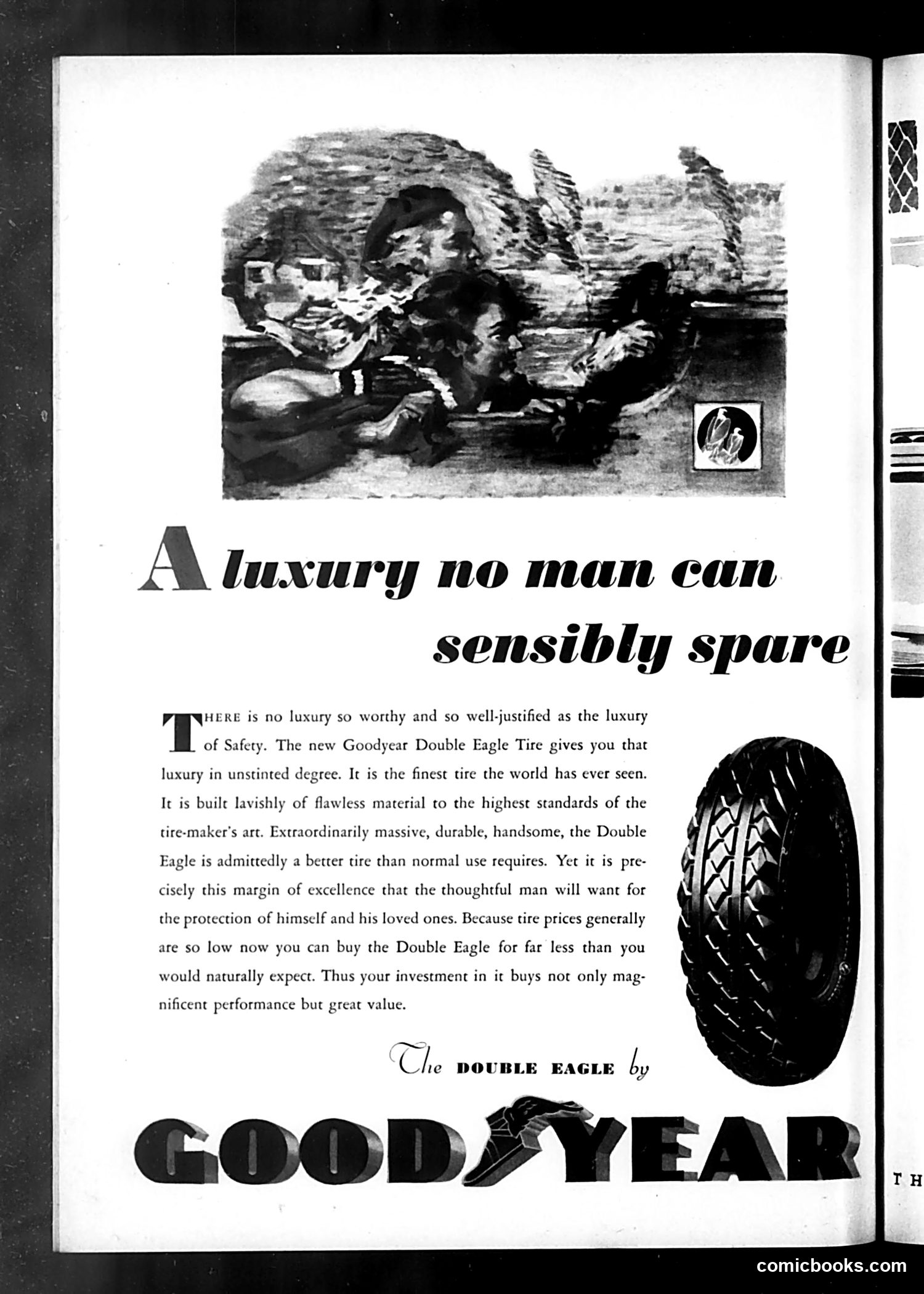
Analysis This is a Goodyear tire advertisement, not satirical content. The page features: The Advertisement: - Headline: "A luxury no man can sensibly spare" - Product: Goodyear Double Eagle Tire - Sales pitch: Frames tire safety as a luxury good worth purchasing despite cost The Imagery: The top photograph appears to show people in a dangerous situation (possibly a vehicle accident or precarious position), serving as a visual argument for why tire quality matters for safety. The Marketing Strategy: Rather than emphasize practical durability alone, Goodyear positions premium tires as a justifiable luxury—appealing to affluence and family protection. The ad argues that because tire prices are "so low now," consumers can afford superior quality without the guilt typically associated with luxury purchases. This represents early 20th-century advertising strategy: making safety consumption seem aspirational and middle-class accessible.
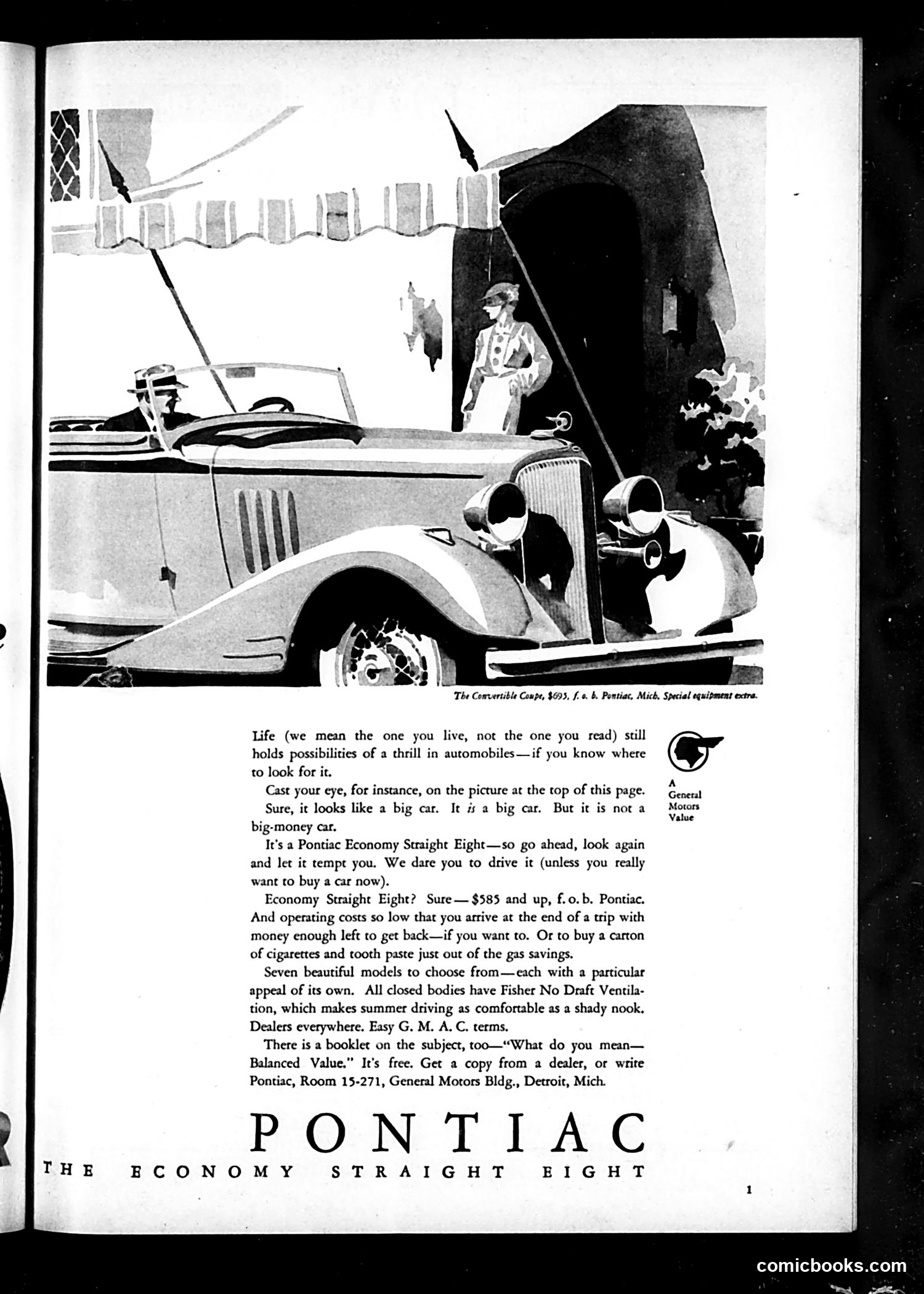
Analysis This is primarily advertising content, not a political cartoon. The page promotes Pontiac's "Economy Straight Eight" automobile, priced at $585 and up. The illustration shows a convertible car at what appears to be a grand estate or mansion, with well-dressed figures nearby. The advertisement's humor relies on irony: it presents the car as economical while depicting it in an affluent, luxurious setting—suggesting that even wealthy people should appreciate its value. The text challenges readers to examine the car, daring them to "drive it" before buying. It emphasizes low operating costs and Fisher No Draft Ventilation for comfort. The ad includes a reference to a free booklet on "Balanced Value" available from dealers or General Motors in Detroit. This represents 1920s-30s consumer advertising strategy: selling practicality to aspirational audiences.
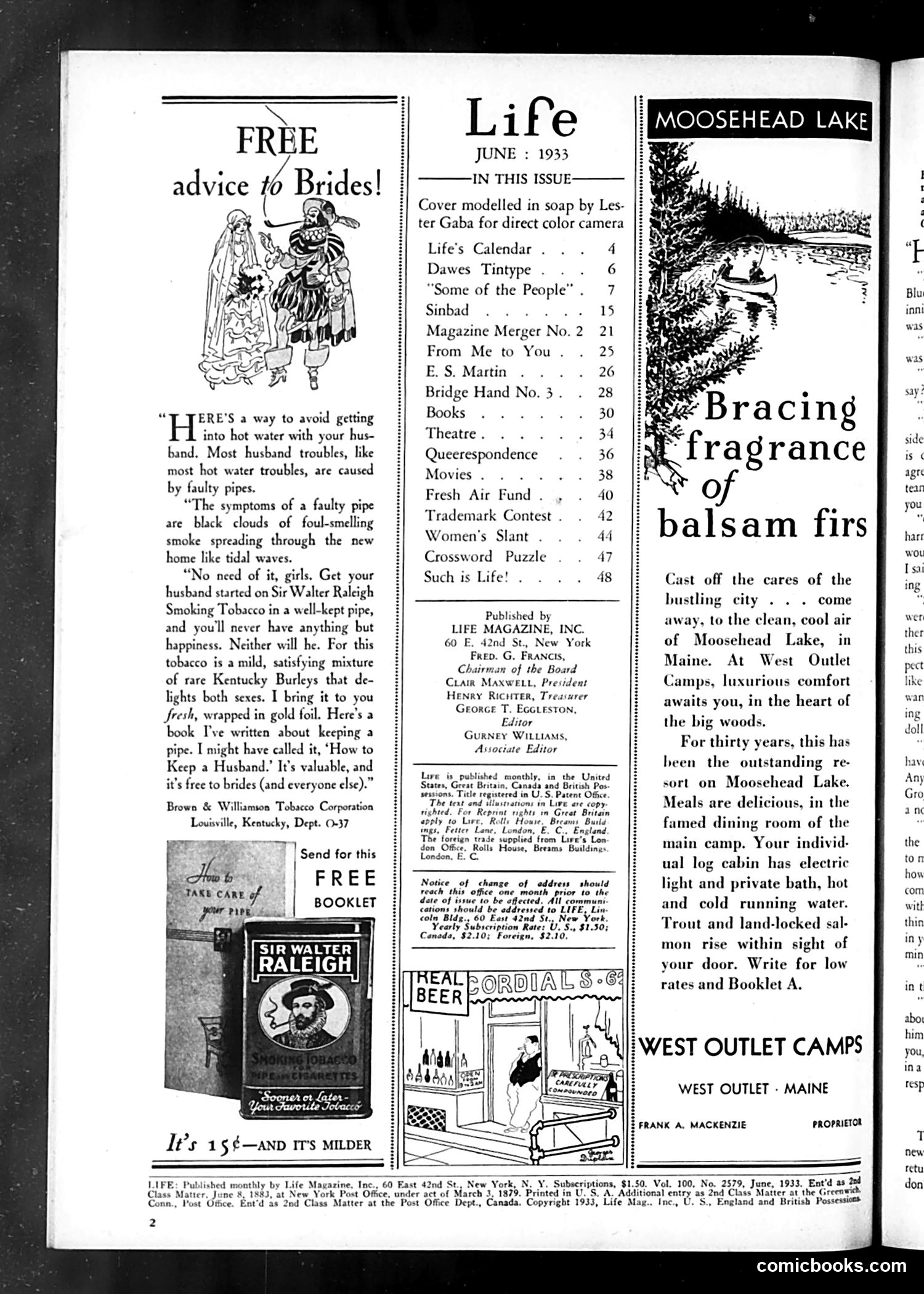
Content Analysis This page is primarily a table of contents and advertisements for Life magazine's June 1933 issue, not a political cartoon. The left side features an advertisement for Sir Walter Raleigh tobacco, promoting a free booklet titled "How to Keep a Husband." The ad humorously frames marital happiness as dependent on the husband having a good pipe—suggesting that faulty plumbing (pipes) causes marital discord, so a quality tobacco pipe will solve relationship problems. This reflects 1930s gender stereotypes about wives' roles in domestic contentment. The right side advertises Moosehead Lake camps in Maine, emphasizing luxury accommodations and trout fishing. The page contains no political satire—it's a commercial/informational page typical of 1930s magazine layout.
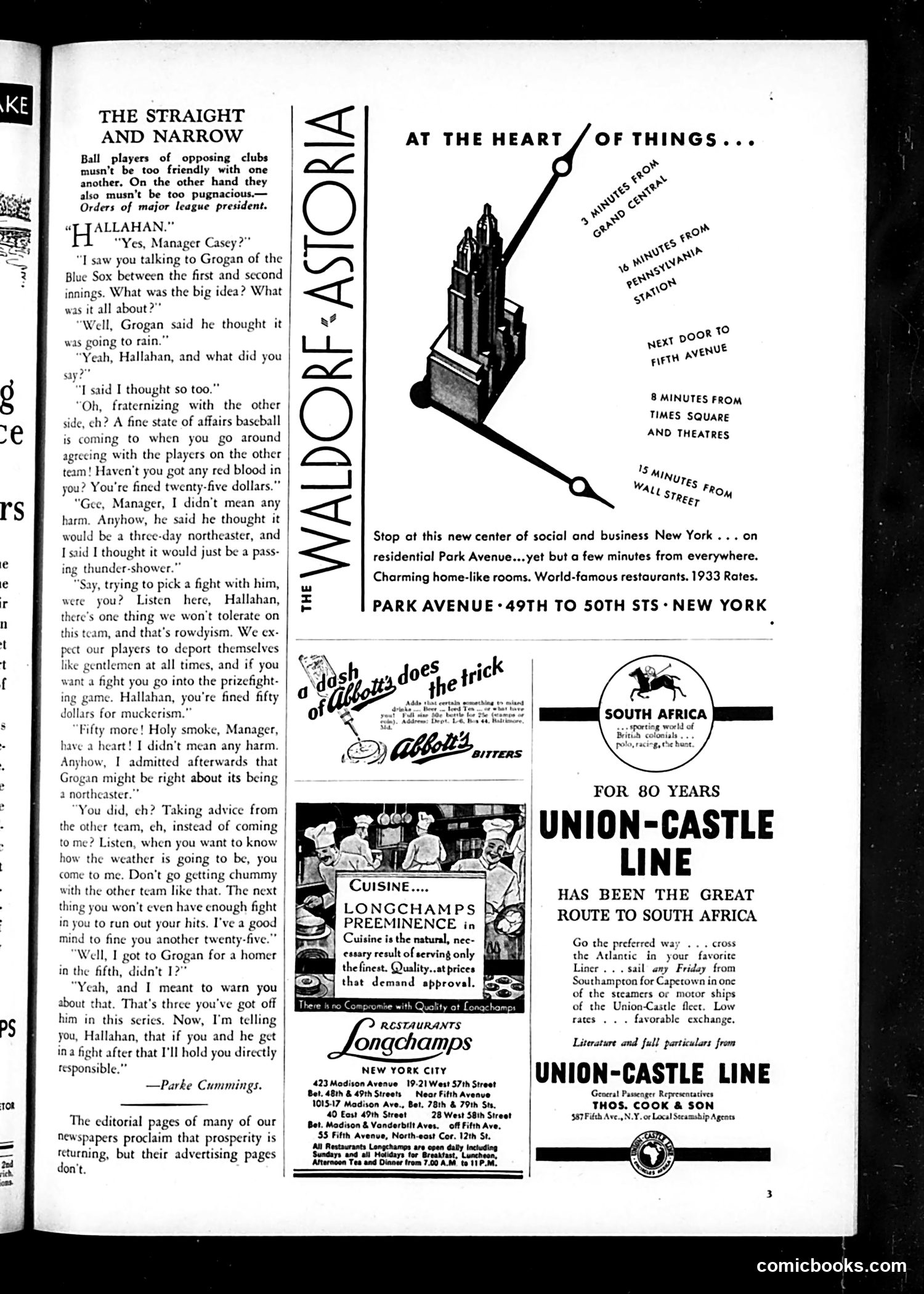
Analysis This page is primarily advertising and editorial content rather than political satire. The left side contains "The Straight and Narrow," a dialogue between "Hallahan" and "Manager Casey" discussing baseball fraternization rules—specifically, whether players from opposing teams should socialize. The conversation references the Blue Sox and suggests conflict over player conduct. The advertisements dominate: Waldorf Astoria hotel, Abbott's Bitters, Longchamps restaurants, and Union-Castle Line shipping to South Africa. No political cartoon is present. The content reflects 1933-era concerns about professional baseball conduct and decorum rather than broader political satire. The "Hallahan" reference and managerial perspective suggest this addresses actual baseball league policies of the Depression era, not fictional characters.
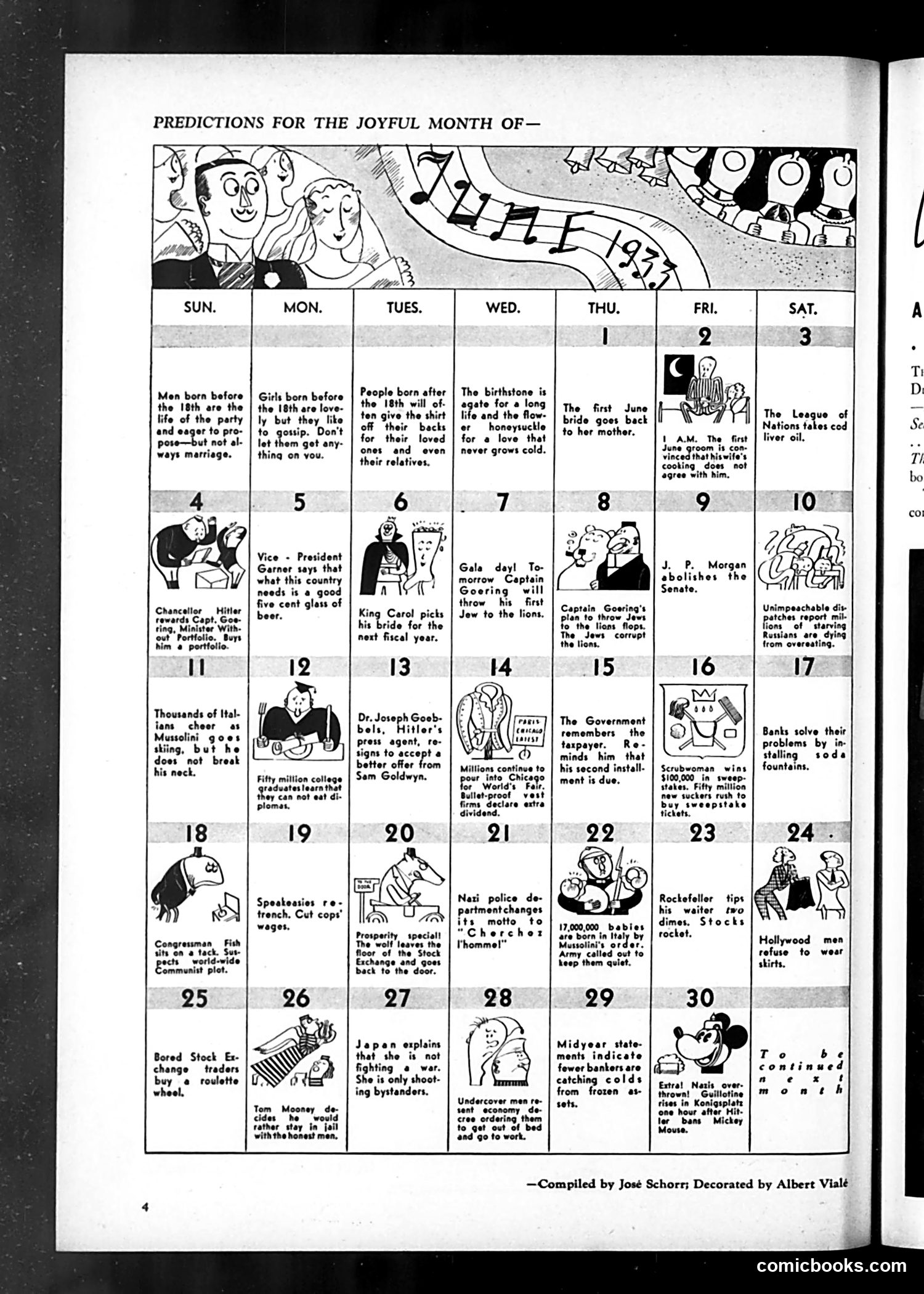
Historical Context Explanation This is a 1937 satirical calendar called "Predictions for the Joyful Month" (likely June), compiled by José Schorr and decorated by Albert Vialé. It's a joke calendar mixing absurdist humor with contemporary political commentary. The entries reference 1930s events and figures: Chancellor Hitler, President Garner, Captain Goering (Nazi leadership), and various satirical "predictions" about politics and social issues. The cartoons mock Nazi Germany, American politicians, and contemporary events like the World's Fair. The humor relies on readers recognizing these figures and understanding current events—Hitler's regime, Nazi militarism, American political debates. Today's readers would need historical knowledge of 1937 politics to fully appreciate the satirical targets and topical jokes embedded throughout the calendar entries and illustrations.
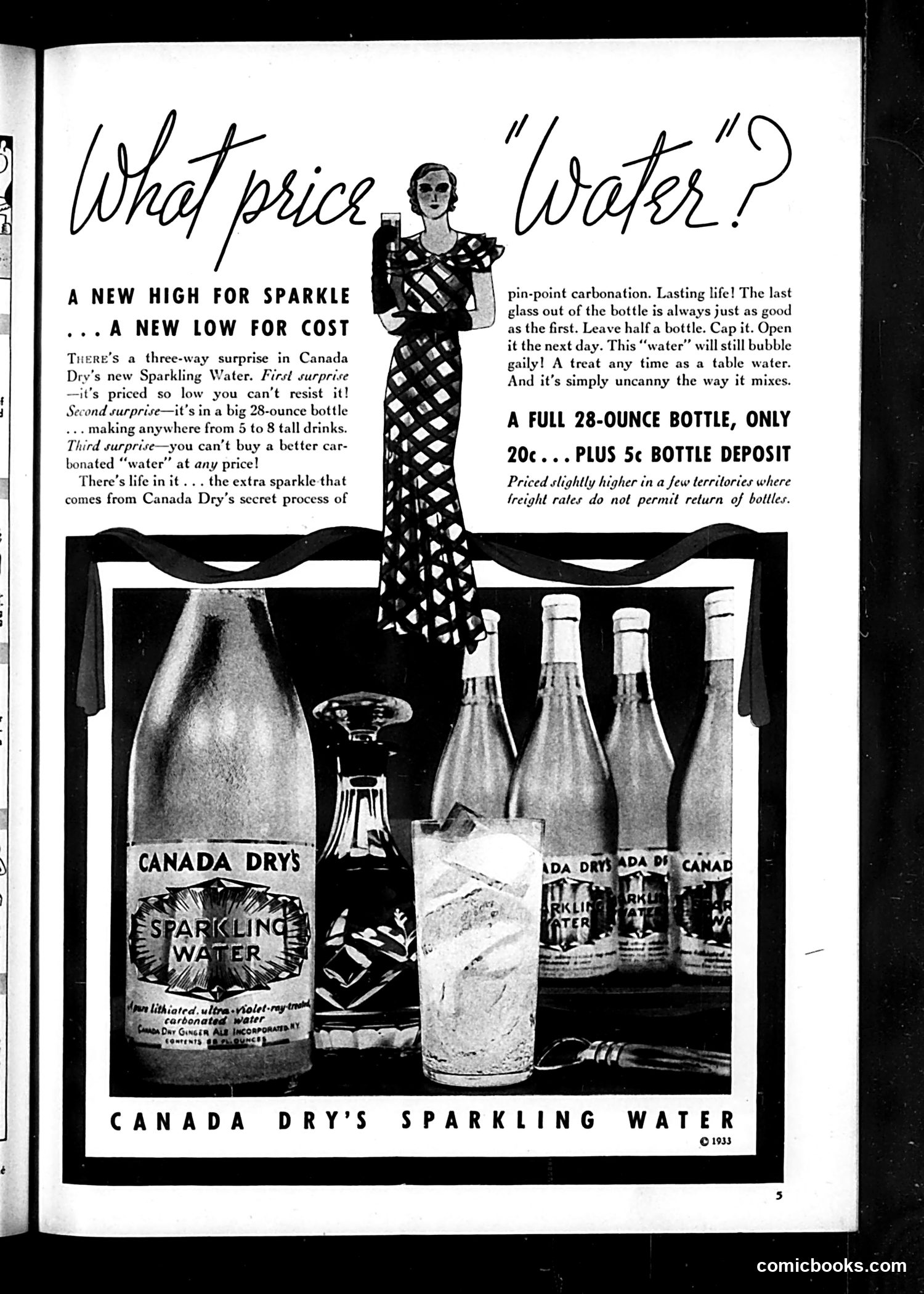
Analysis This is a advertisement, not political satire. It promotes Canada Dry's Sparkling Water, marketed as an affordable luxury beverage during what appears to be the 1930s (based on the styling and typography). The ad's humor targets consumer anxieties about cost and quality. The headline "What price 'Water'?" presents a paradox: you're getting sparkling water (perceived as less valuable than other drinks) at an exceptionally low price (20 cents plus 5-cent deposit). The "three-way surprise" plays on this contradiction—it's cheap, it comes in large bottles, and the carbonation lasts even after opening. The stylized female figure in the patterned dress represents the target consumer: a middle-class woman concerned with value and household economy, particularly relevant during Depression-era austerity.
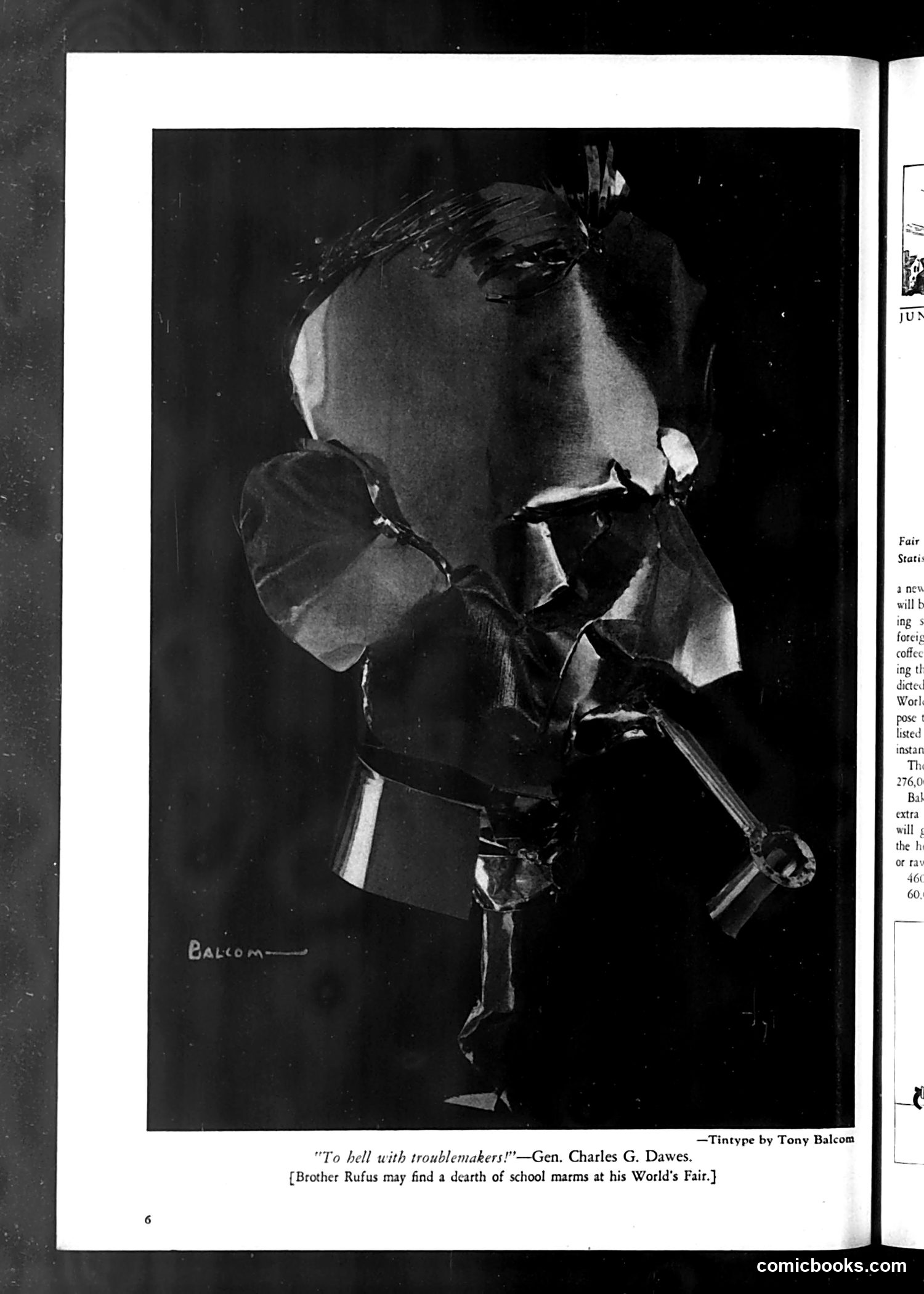
Political Cartoon Analysis This is a tintype portrait by Tony Balcom depicting General Charles G. Dawes, captioned with his quote "To hell with troublemakers!" The bracketed note references "Brother Rufus" finding "a dearth of school marms at his World's Fair"—likely alluding to the 1933 Chicago World's Fair and apparently mocking Dawes's involvement or concerns about it. Dawes (1865-1951) was a prominent Republican politician and banker who served as Vice President under Calvin Coolidge. The cartoon appears to satirize his combative stance toward critics or opposition, using his blunt statement as the humor's centerpiece. The specific "troublemakers" reference and World's Fair context suggest contemporary political or social disputes, though the exact controversy remains unclear without additional historical context.
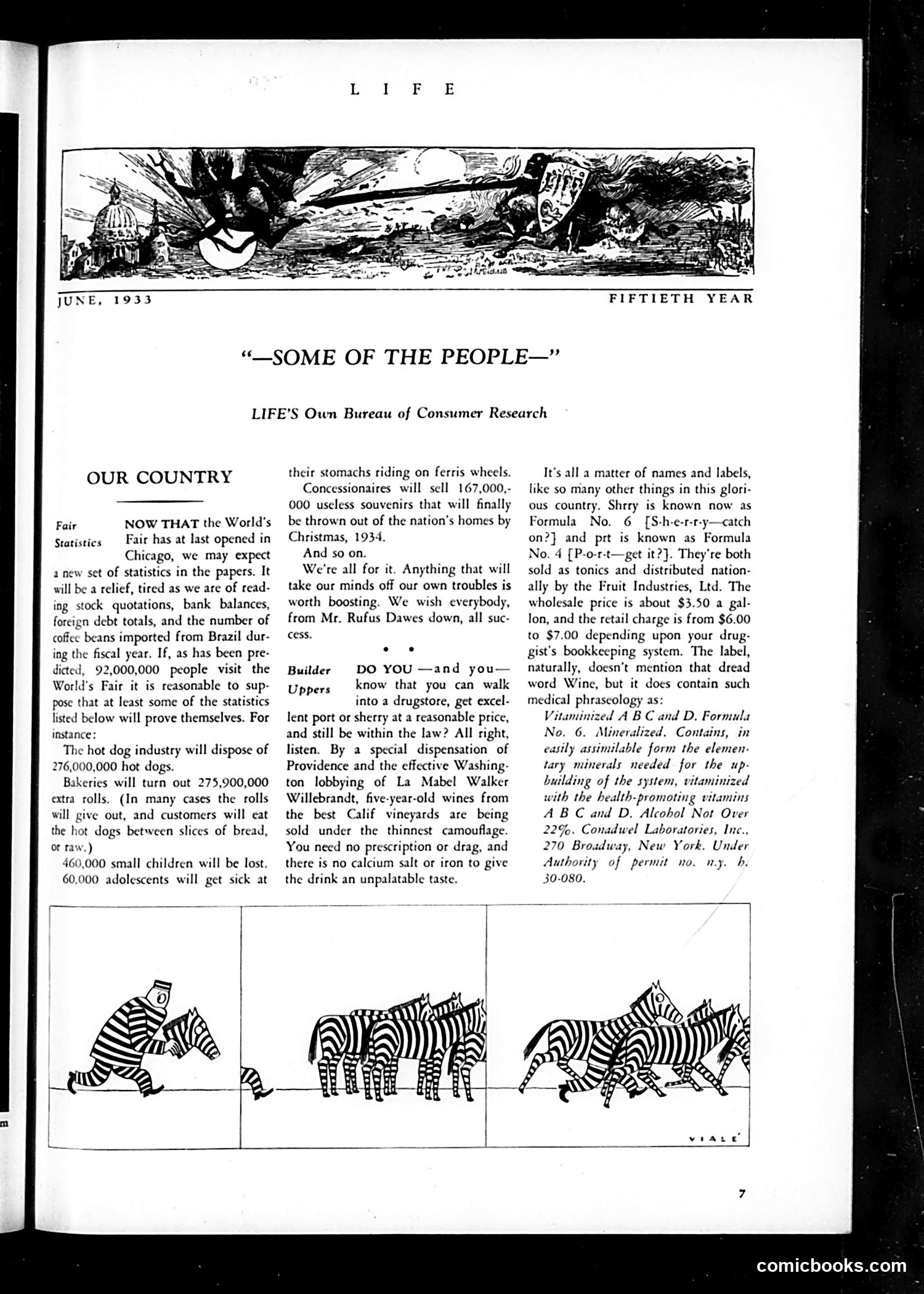
Analysis of Life Magazine, June 1933 This page combines consumer statistics with satirical commentary on American consumption habits. The "Fair Statistics" section mocks the 1933 Chicago World's Fair by predicting absurdly high numbers of visitors and consumption (92 million visitors, 276 million hot dogs, 60,000 lost children). The "Builder Uppers" section satirizes Prohibition-era loopholes—specifically how people legally obtained alcohol through medicinal formulas and mail-order wines. It references La Mabel Walker Willebrandt, a Prohibition enforcement official, and mocks the ineffectiveness of dry laws. The zebra cartoon below (artist signed "Vial") appears to illustrate consumer behavior or conformity, though its specific meaning is unclear without additional context. The overall page satirizes American consumer excess and regulatory hypocrisy during the Depression era.
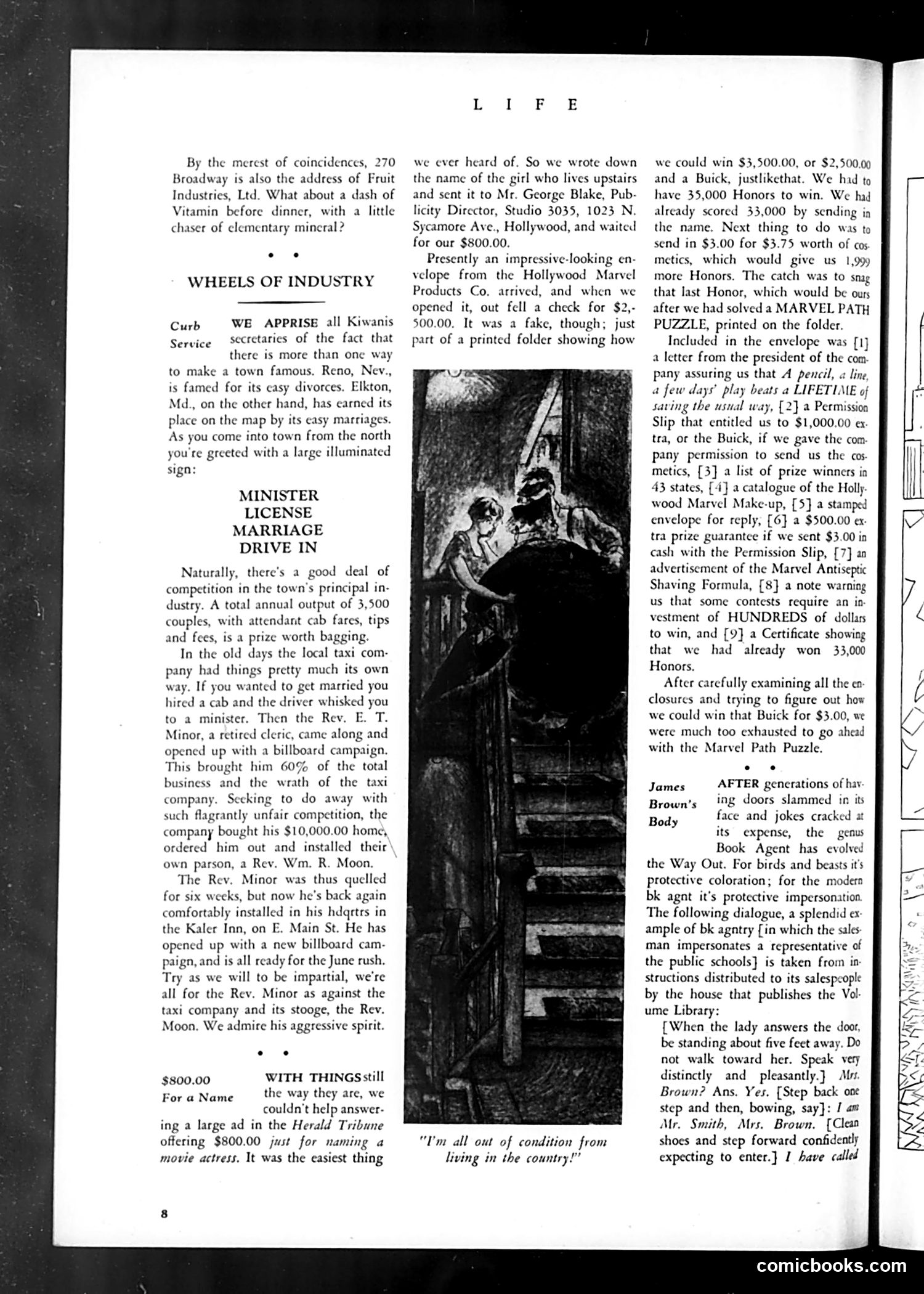
Analysis This page from *Life* magazine contains satirical articles about small-town American industries and customs, not political cartoons. The main photograph illustrates an article titled "Minister License Marriage Drive In," which mocks a small Nevada town's (likely Reno's) competing marriage industry—where local businesses, including a taxi company and a retired clergyman, profit from couples seeking quick marriages. The satire targets the commercialization of marriage and competition among service providers to capture wedding business. A second article about "James Brown's Body" discusses protective book coloration and includes sample sales-dialogue mocking inauthentic customer service interactions. The content satirizes American consumer culture and small-town entrepreneurship rather than specific political figures or events.
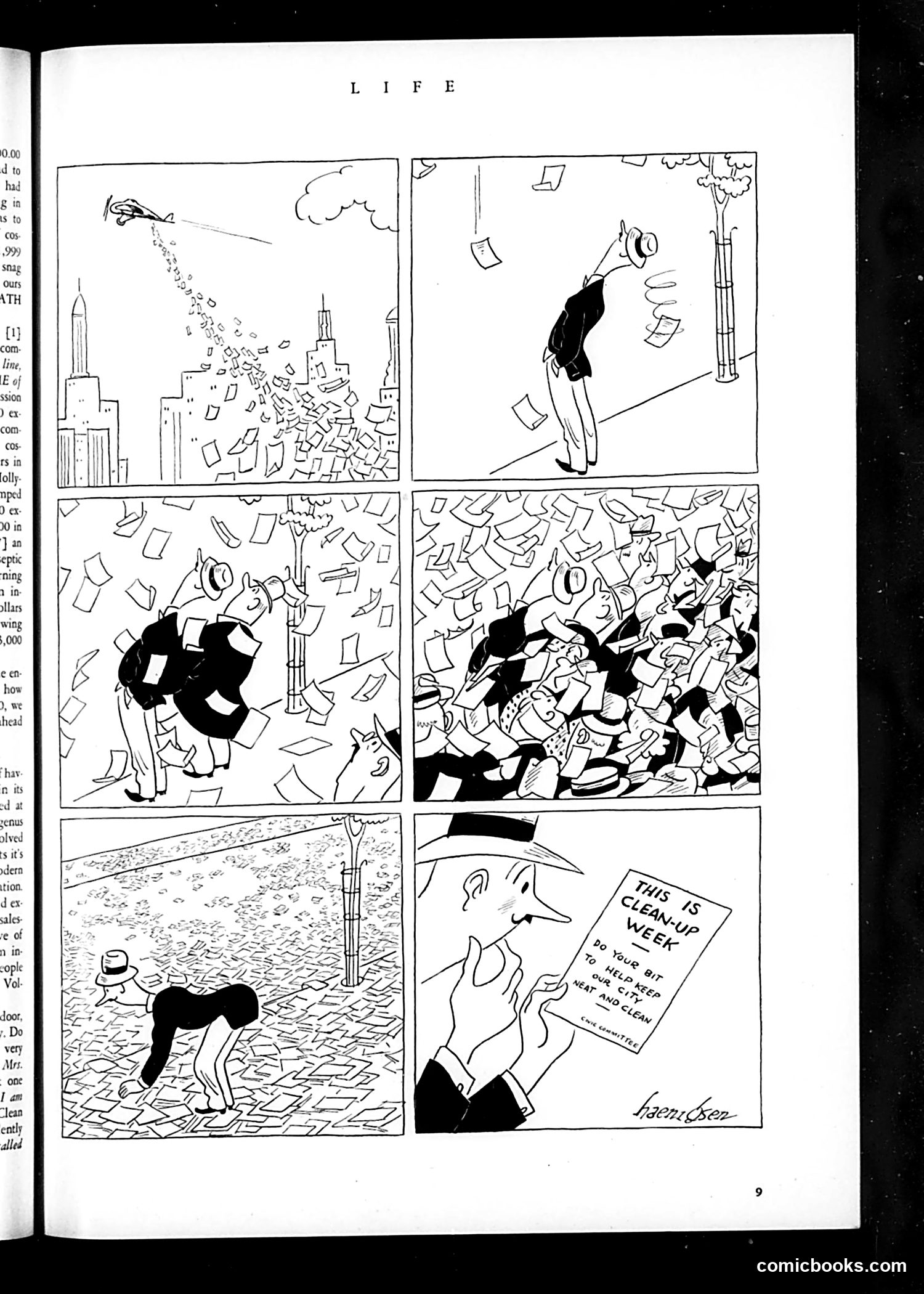
Analysis of "Life" Cartoon Page This six-panel satirical comic depicts a businessman's descent into financial ruin, likely commenting on economic desperation during a financial crisis (appears to be early-to-mid 20th century based on style). The sequence shows: - Panel 1: Man throwing money from skyscraper - Panels 2-4: Progressive accumulation of papers/documents around him (suggesting mounting debts or bills) - Panel 5: Man reduced to poverty, crawling through scattered papers - Panel 6: A sign reading "THIS IS CLEAN-UP WEEK—DO YOUR BIT...KEEP GUTTERS AND STREETS CLEAN" — the cruel irony being the man himself has become human "litter" The satire critiques how financial collapse reduces people to poverty while society indifferently posts cleanup notices. The cartoonist is unsigned or unclear.
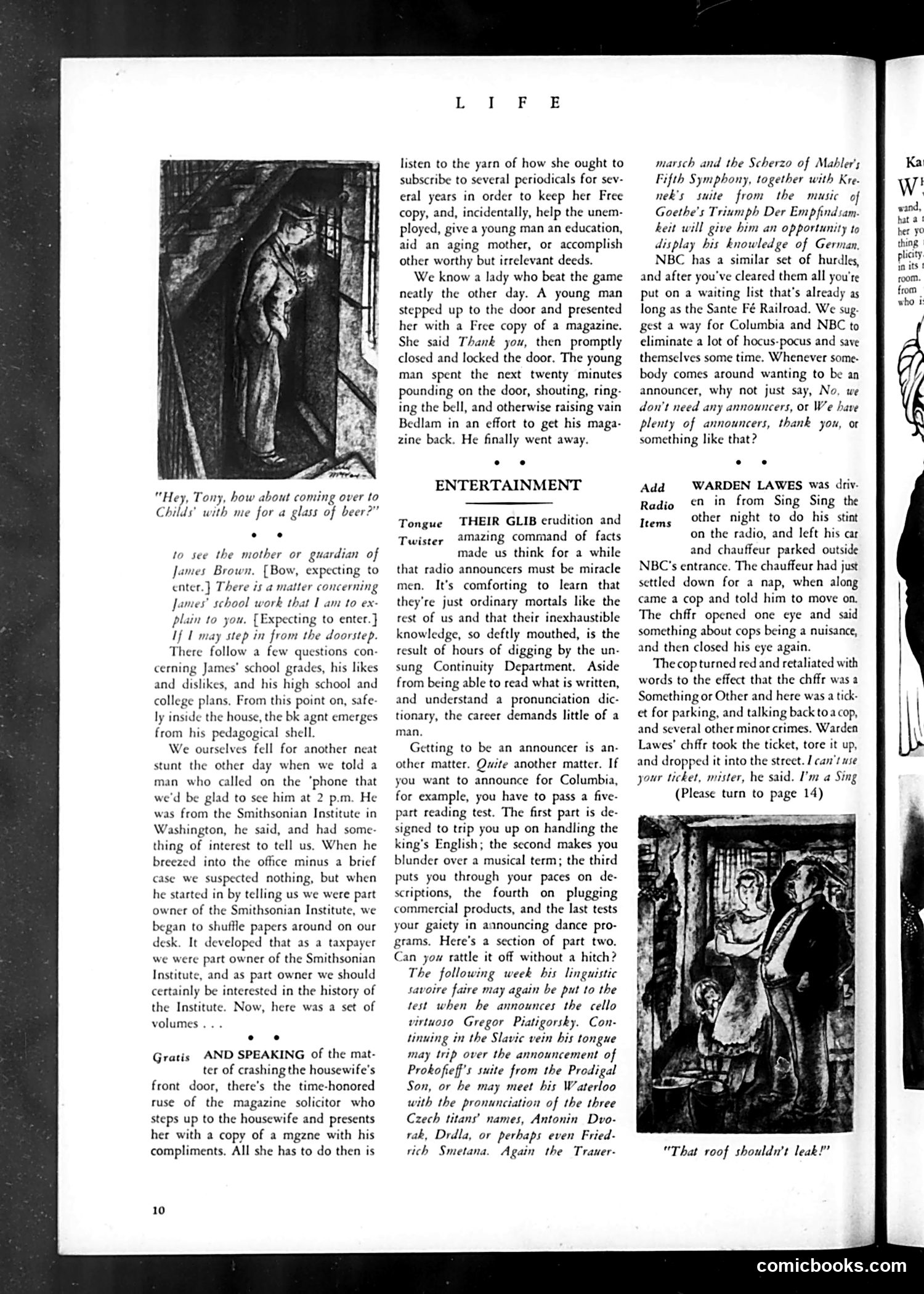
Analysis of Life Magazine Page This page contains humorous anecdotes and social commentary rather than political cartoons. The main illustrated story, captioned "Hey, Tony, how about coming over to Childs' with me for a glass of beer?" depicts a door-to-door magazine solicitor. The joke satirizes aggressive sales tactics: a young man relentlessly pounds on a housewife's door demanding his magazine back after she rejected it, taking twenty minutes to retrieve it. The "Entertainment" section discusses radio announcers' challenges—their need for perfect diction, pronunciation, and composed professionalism. The anecdote about Warden Lawes mocks bureaucratic absurdity: a parked car receives a traffic ticket, then the warden himself gets ticketed for the same violation. The humor targets everyday American frustrations: invasive salesmen, officious minor officials, and the pretensions of emerging broadcast media professionals.
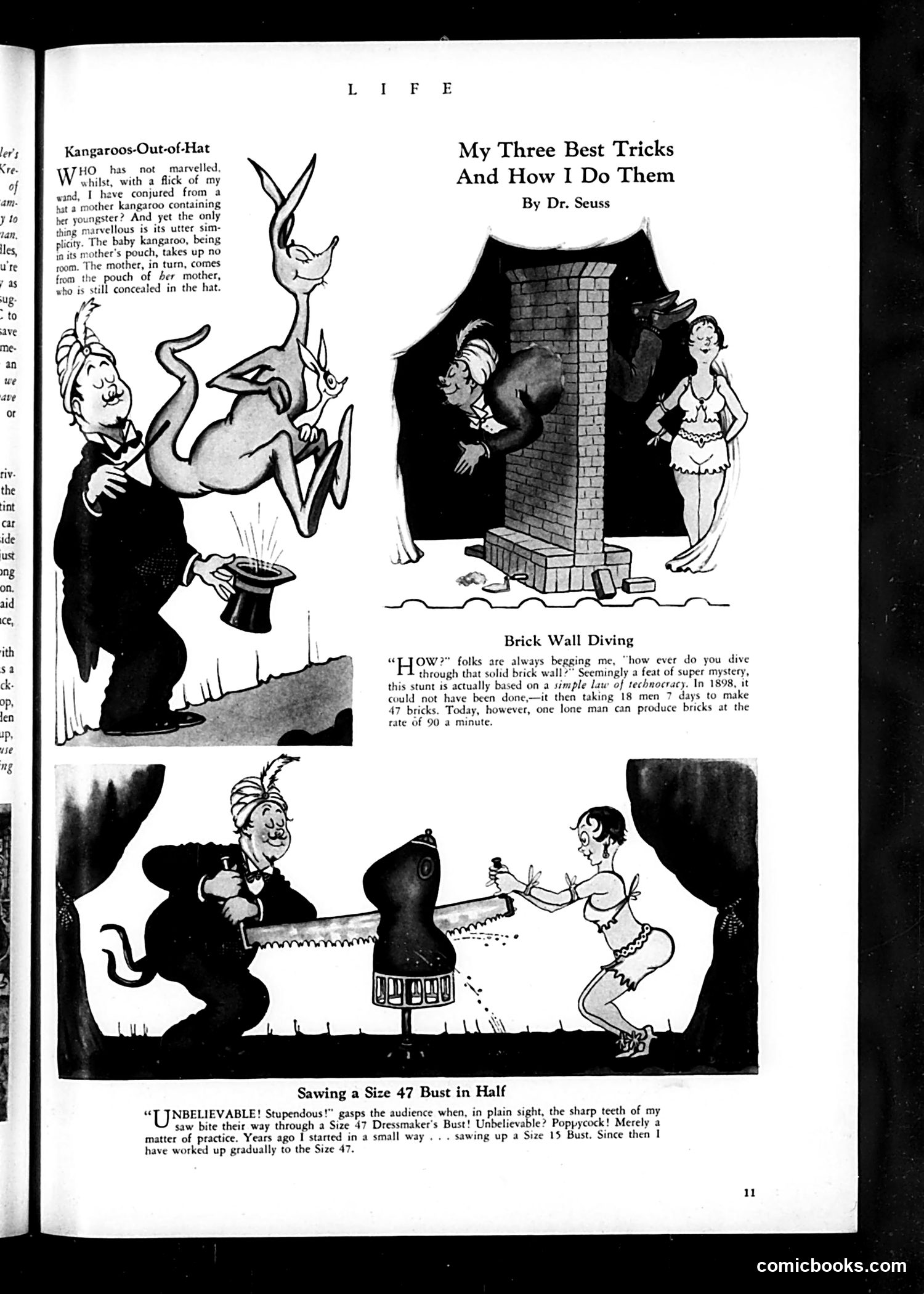
Analysis of "My Three Best Tricks And How I Do Them" by Dr. Seuss This is a humorous instructional piece by Dr. Seuss featuring three magic/circus-style tricks: 1. Kangaroos-Out-of-Hat: A magician pulls a kangaroo from a top hat—a play on the classic "rabbit from a hat" trick, made absurd by the kangaroo's size and the implied chaos of a mother kangaroo with a baby in her pouch. 2. Brick Wall Diving: Claims a performer can dive through solid brick walls by using a "simple line of architecture"—likely referencing a real 1895s stunt where someone took 18 days to break through 47 bricks. The joke is the modern performer accomplishes it at 90 bricks per minute. 3. Sawing a Size 47 Bust in Half: A magician saws a large dressmaker's bust in half using a saw—absurdist humor playing on the classic "sawing a woman in half" illusion. The satire mocks elaborate magic tricks through Seussian whimsy and exaggeration.
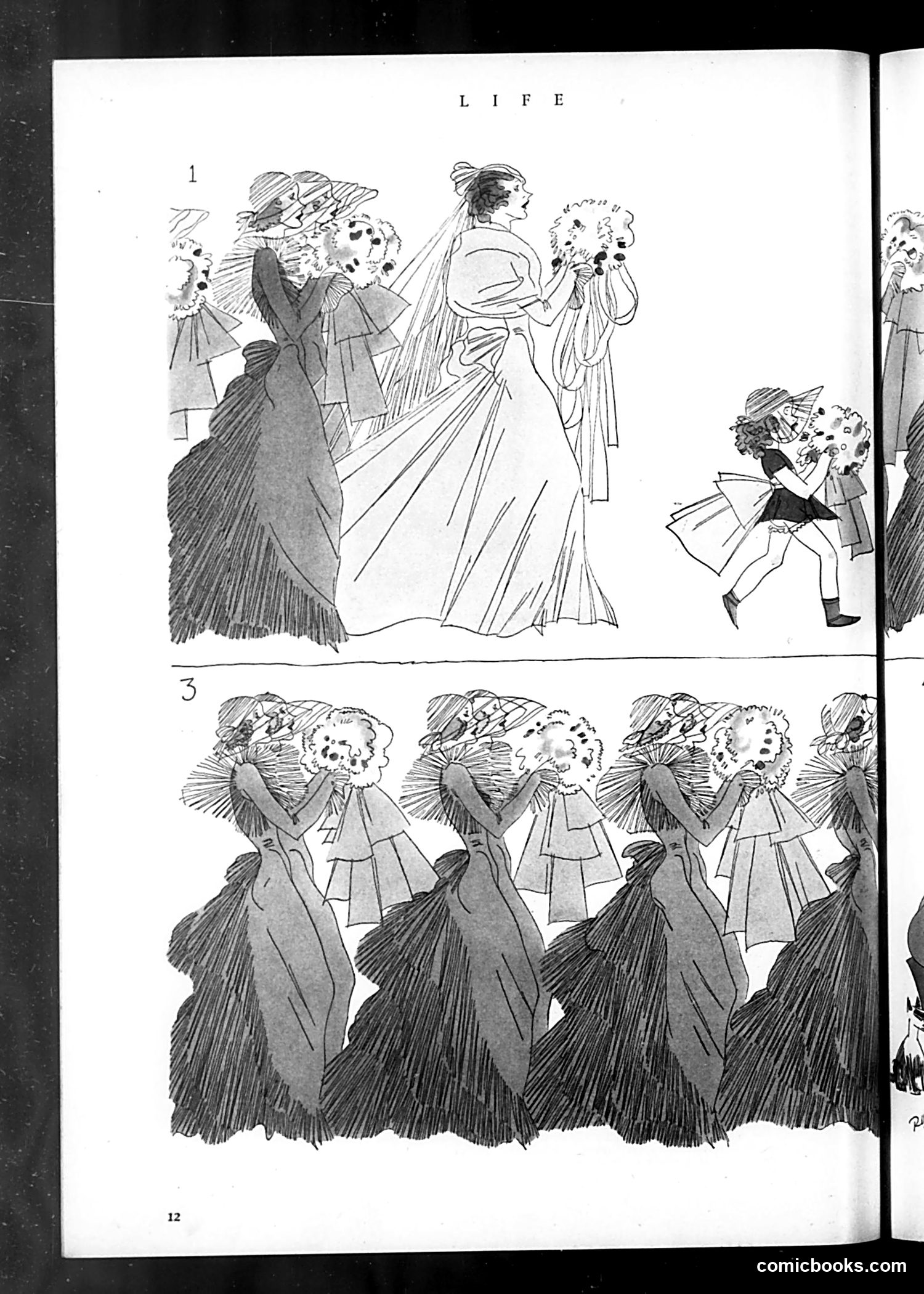
Analysis This page from *Life* magazine presents two satirical illustrations numbered 1 and 3, depicting what appears to be a wedding scene and its aftermath. Illustration 1 shows a bride in an elaborate wedding dress with a long train, surrounded by attendants holding bouquets. A smaller figure (possibly a child) appears on the right. Illustration 3 displays a line of identically-dressed women in similar gowns and poses, suggesting repetition or mass production. The satire likely mocks either mass-produced wedding culture, the commercialization of bridal fashion, or possibly comments on conformity in women's fashion and expectations. The contrast between the singular "special" bride and the identical copies below suggests the point: that individual weddings and bridal wear had become standardized and interchangeable commodities. Without the article text, the exact social critique remains unclear.
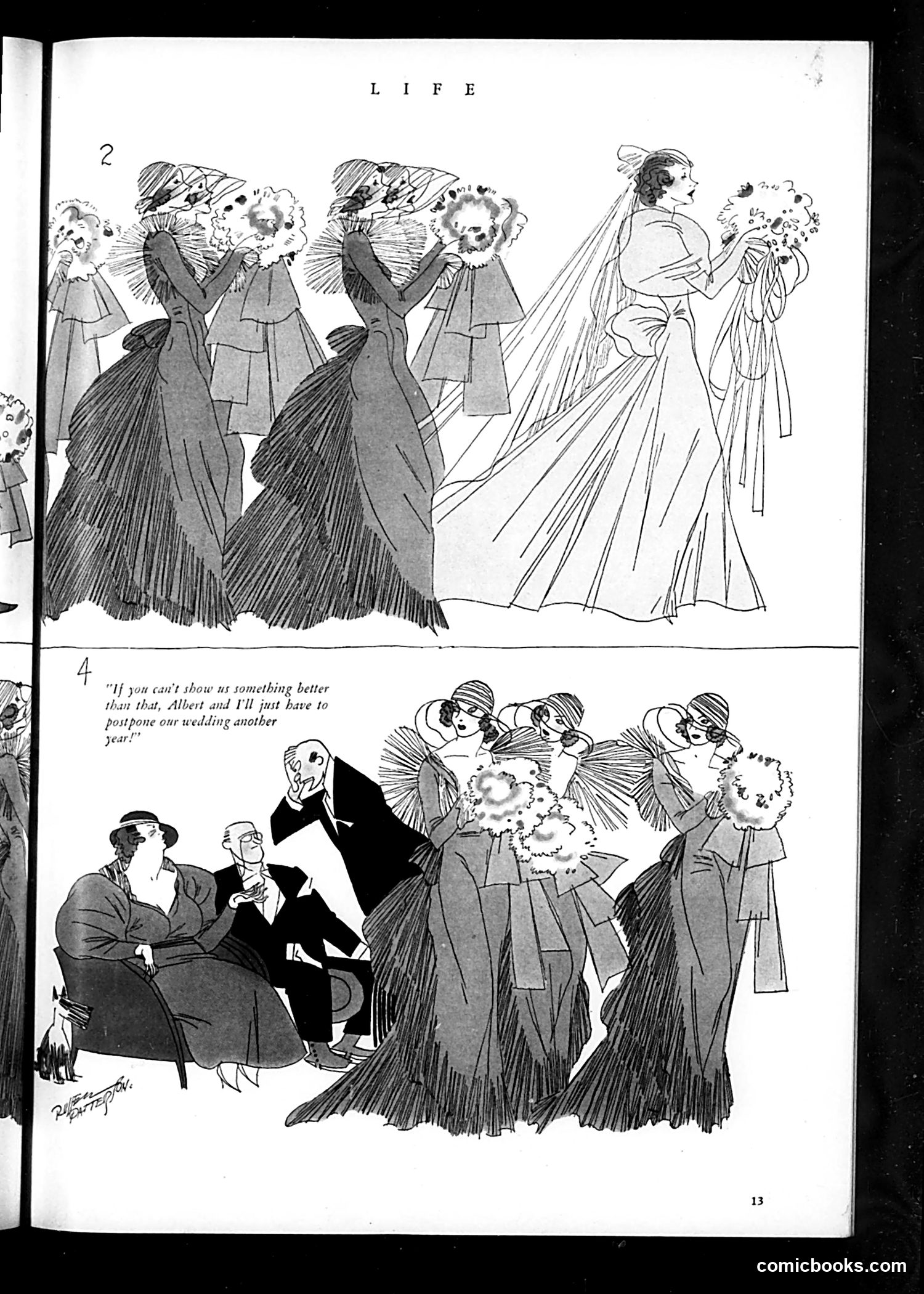
Analysis of Life Magazine Page This page contains two cartoons satirizing wedding culture and expense. Panel 2 (top): Shows bridesmaids in elaborate, heavily decorated dresses attending a bride. The visual joke emphasizes the extravagant ornamentation of wedding party attire. Panel 4 (bottom): Depicts three onlookers (apparently wedding guests) observing the bridesmaids. The caption reads: "If you can't show up something better than that, Albert and I'll just have to postpone our wedding another year!" The satire targets the competitive, escalating expense of wedding displays. The joke suggests that wealthy individuals feel compelled to continuously outdo previous wedding spectacles—threatening to delay their own wedding if they cannot surpass what's already been shown. It mocks both the vanity and financial excess surrounding wedding ceremonies among the affluent.
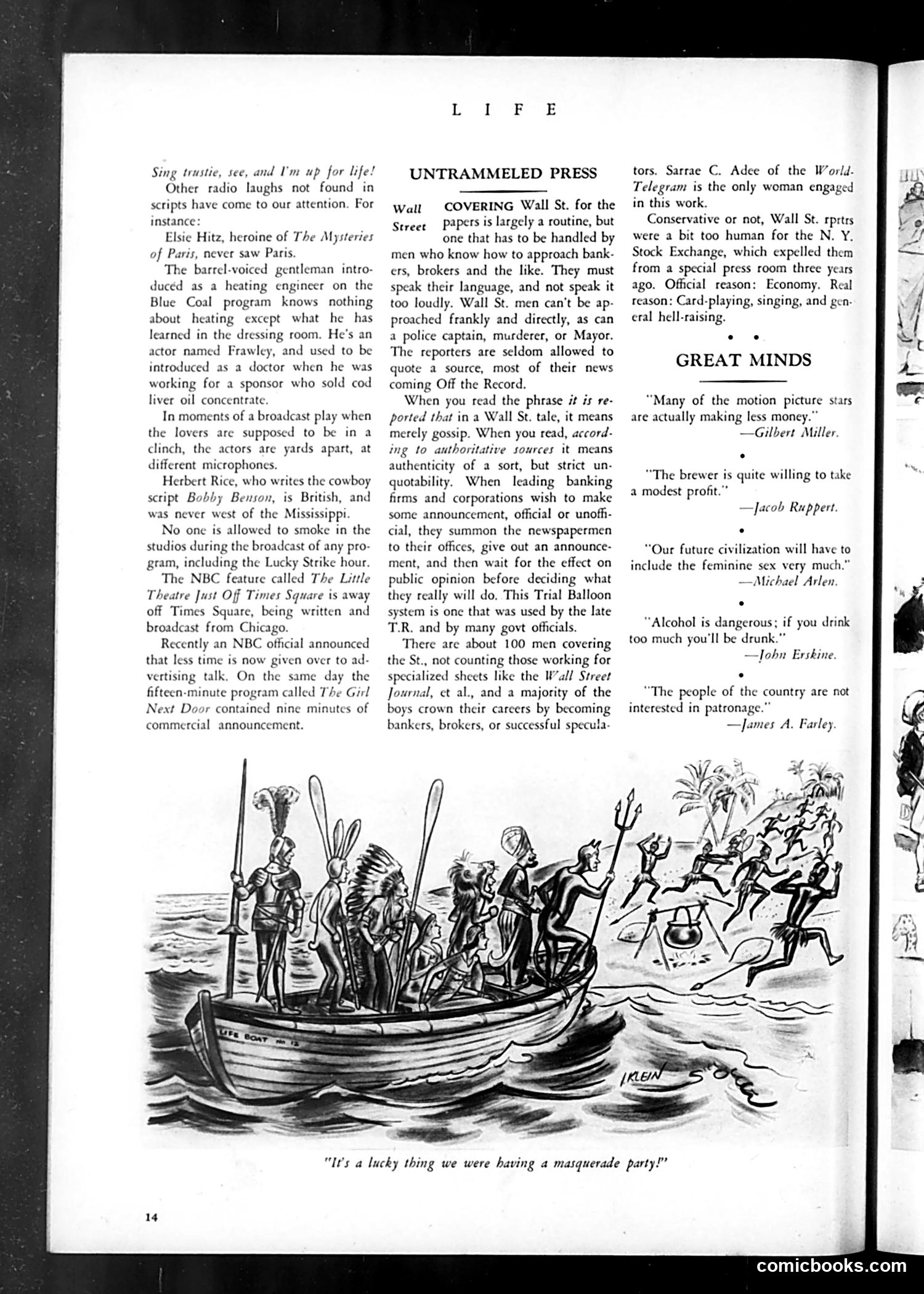
Analysis of Life Magazine Page This page contains a satirical cartoon captioned "It's a lucky thing we were having a masquerade party!" showing a boat of costumed figures encountering what appears to be merpeople or mythological sea creatures on shore. The cartoon likely satirizes a specific news event or social situation, though the exact reference is unclear without additional context. The "masquerade" caption suggests the joke involves disguise or hidden identity—possibly commenting on deception in public life or society. The page's text sections discuss radio broadcasting standards and Wall Street journalism practices, suggesting the magazine's broader focus on media credibility and professional conduct. The cartoon's meaning remains somewhat obscure to modern readers without knowing the contemporary event it references.
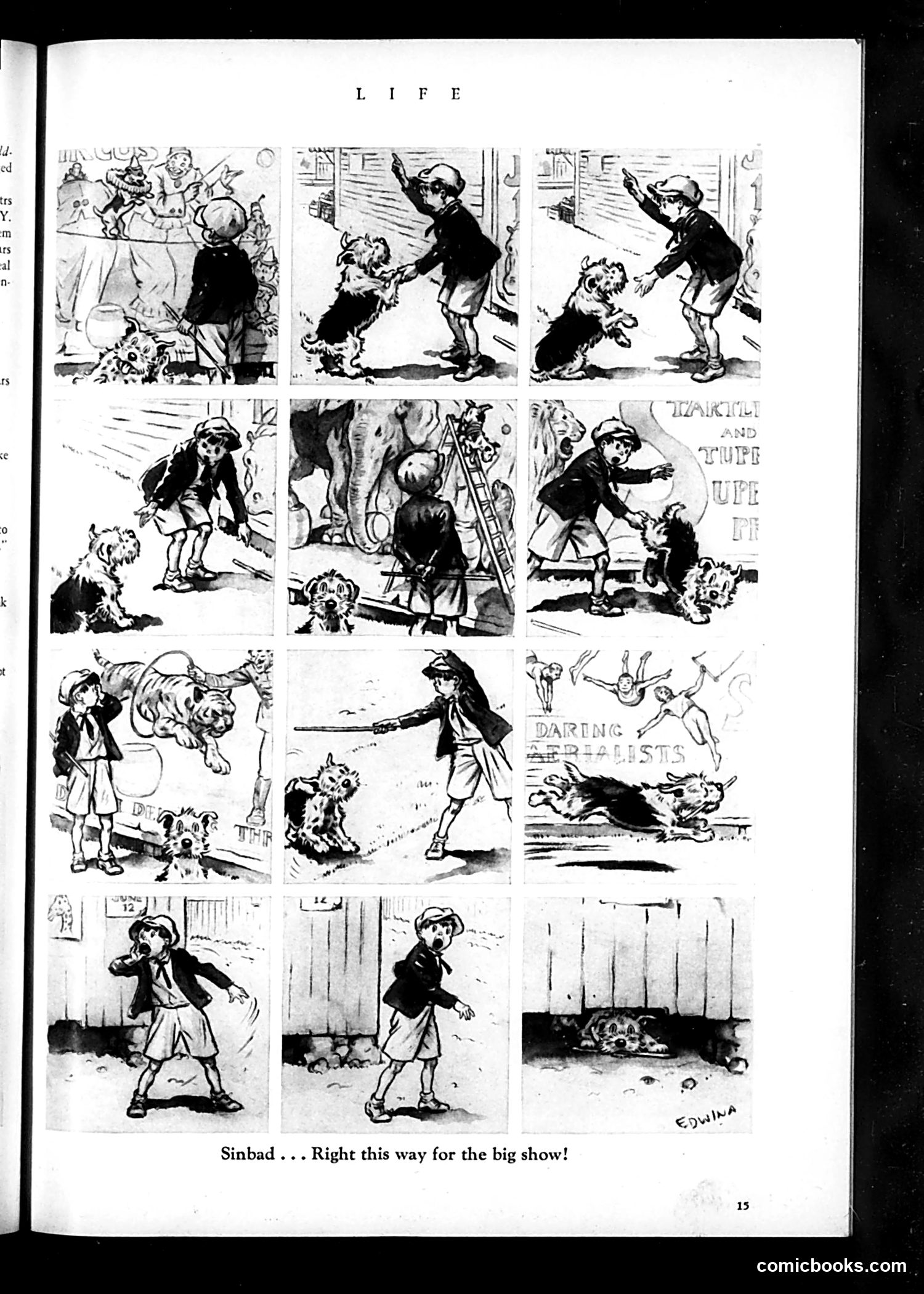
Analysis This is a comic strip narrative titled "Sinbad... Right this way for the big show!" The strip follows a young boy character named Sinbad as he encounters a dog and attempts to lead it somewhere, presumably to a circus or performance ("the big show"). The humor derives from slapstick physical comedy: the boy repeatedly fails to control the dog through various methods—pulling its leash, chasing it, attempting to catch it—with the dog consistently evading or resisting his efforts. The strip's appeal lies in the exaggerated, chaotic interactions between the determined child and the uncooperative animal. The artwork is credited to what appears to be "E. Dwina" (visible in the lower right). This represents typical early-to-mid 20th century American comic strip humor emphasizing visual gags and animal misbehavior rather than political or social satire.
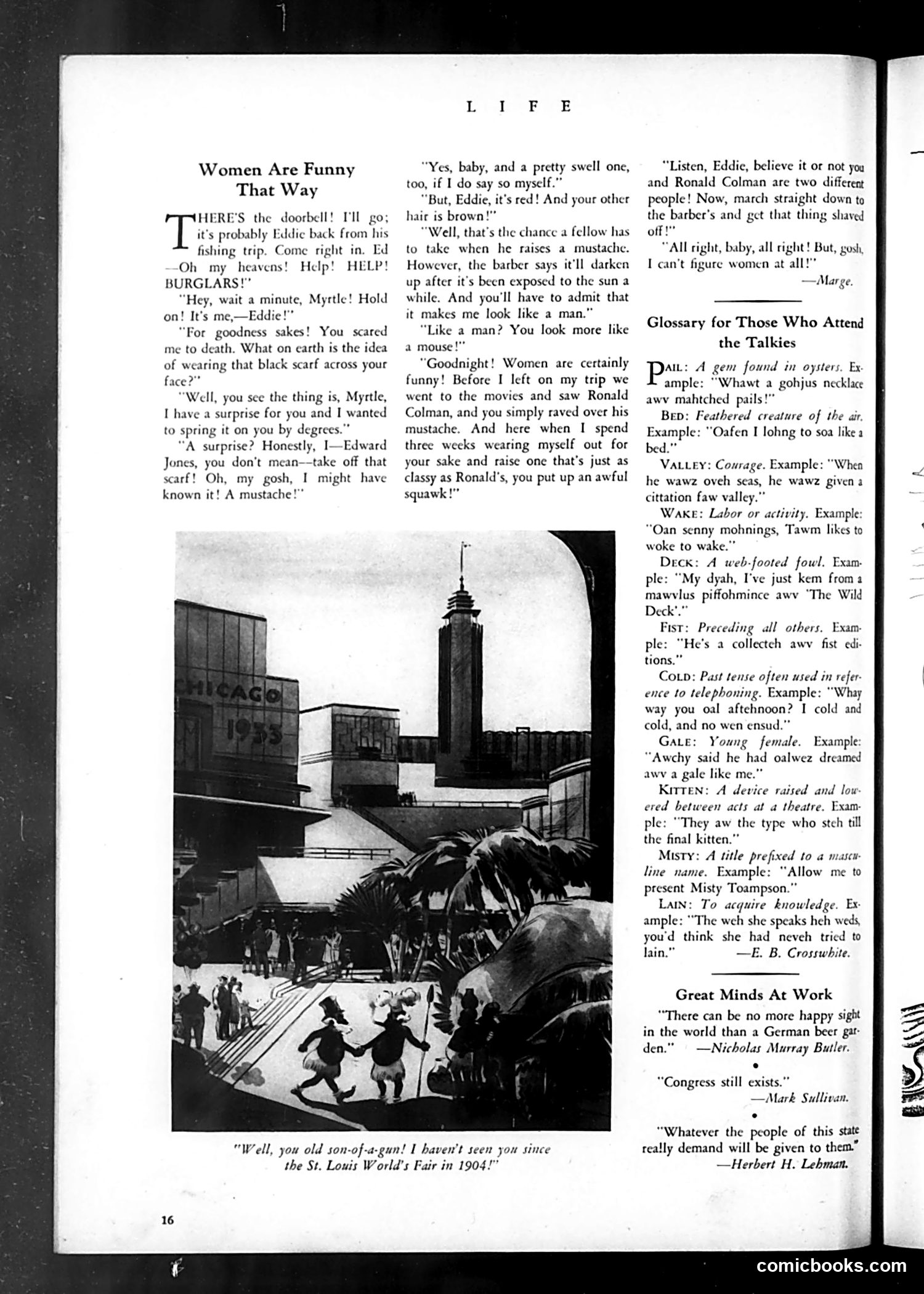
Analysis of Life Magazine Page 16 The page contains a humorous dialogue titled "Women Are Funny" featuring characters Eddie, Myrtle, and Edward discussing fashion and appearance. The conversation centers on Eddie's surprise return from a fishing trip wearing a black scarf, which Myrtle initially mistakes for a mustache. The joke satirizes women's fashion choices and their reactions to men's grooming—specifically playing on the absurdity of mistaking a scarf for facial hair. Below is a photograph from Chicago's 1904 World's Fair showing the fairgrounds with buildings and crowds, captioned with a character's nostalgic exclamation about seeing someone since that event. The right column provides a "Glossary for Those Who Attend the Talkies"—definitions of slang terms used in early talking pictures, indicating this magazine addressed contemporary cinema culture.
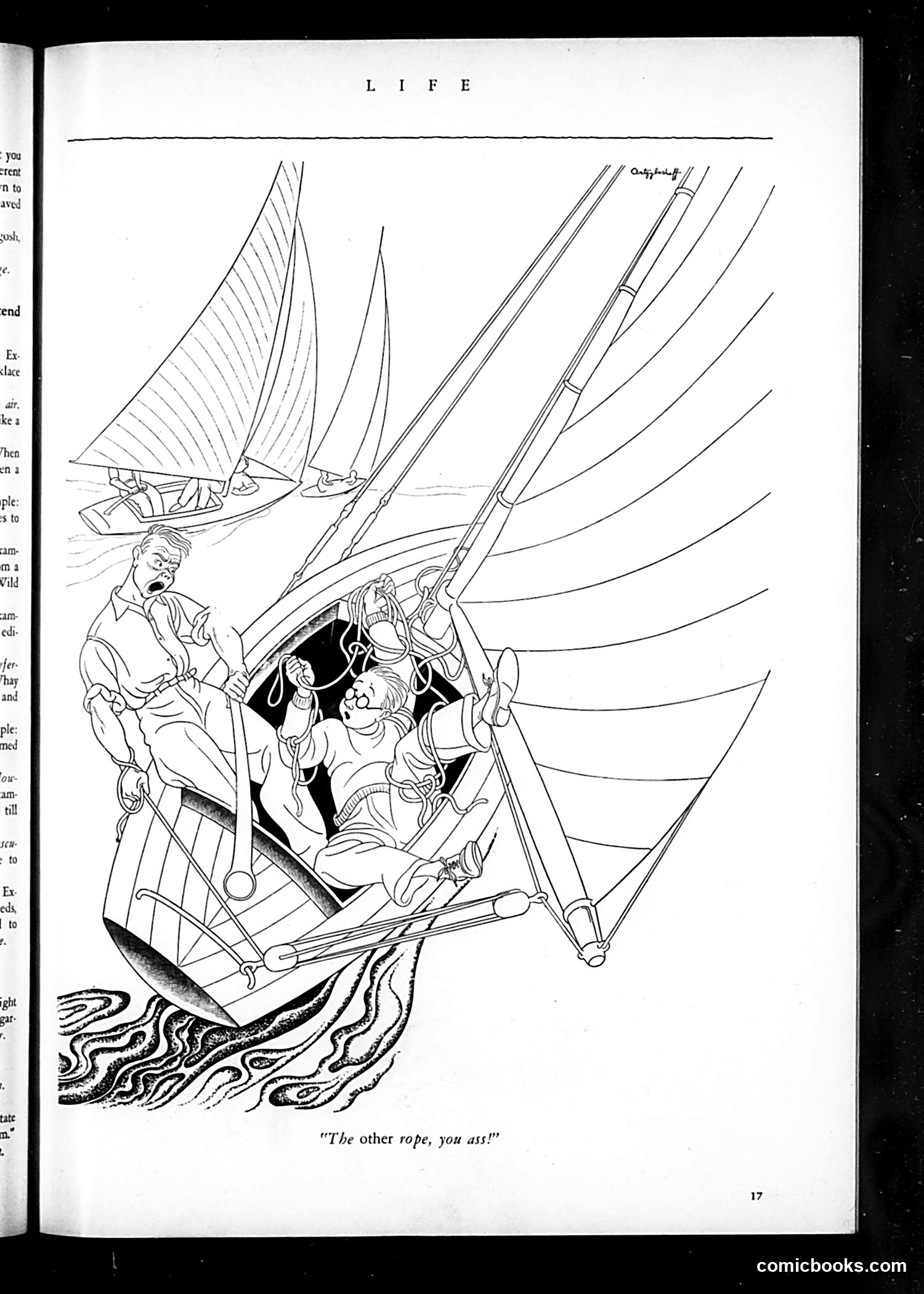
Analysis of "The other rope, you ass!" This is a satirical cartoon depicting a sailing vessel in distress on rough seas. Multiple figures crowd the boat's cabin while one man stands alone on deck, apparently giving orders about rigging. The caption "The other rope, you ass!" suggests comedic miscommunication or incompetence during a crisis. The cartoon likely satirizes either: 1. Naval/maritime incompetence — perhaps critiquing military or commercial shipping leadership 2. Political leadership — using the ship-as-state metaphor common in editorial cartoons, where the vessel represents government and crew members represent politicians or officials The isolated captain figure contrasts with the crowded cabin occupants, possibly suggesting poor chain-of-command or that leaders aren't listening to instructions. Without additional context about the specific Life magazine issue date, the exact political target remains unclear.
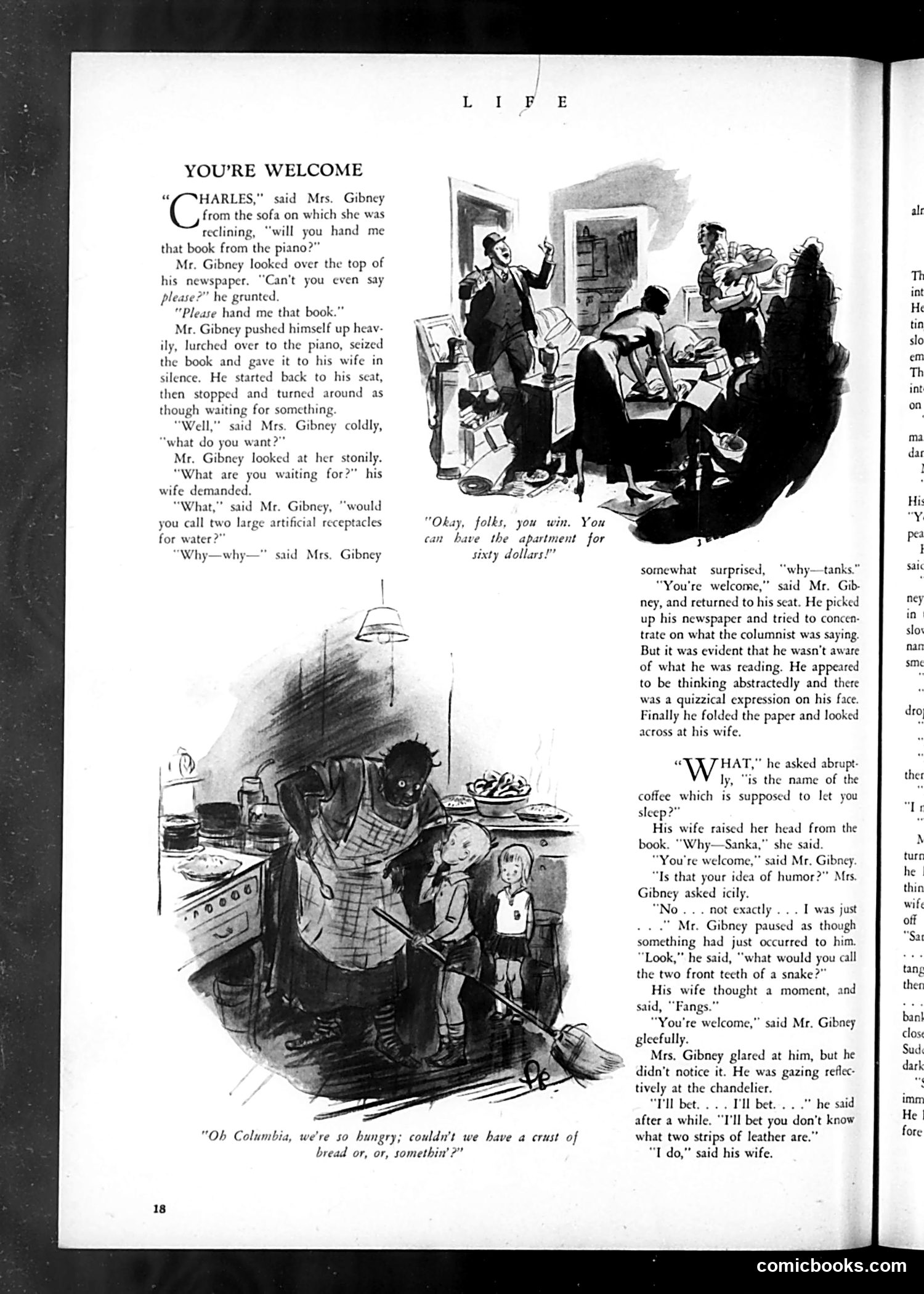
"You're Welcome" - Life Magazine Satire This page satirizes 1920s-30s domestic life and class attitudes. The story depicts Mr. Gibney, a wealthy man, dismissively welcoming Charles (a service worker) into his home. The humor centers on Gibney's condescending remarks and absurd "welcomes"—offering the apartment for "sixty dollars" and making jokes about artificial receptacles for water and the "coffee brand" that supposedly aids sleep. The lower cartoon shows a maid struggling in a kitchen, captioning a Depression-era plea: "Oh Columbia, we're so hungry; couldn't we have a crust of bread or, or, somethin'?" This contrasts sharply with the upper-class banter above, satirizing wealth inequality and the obliviousness of affluent households to servants' struggles during economic hardship.
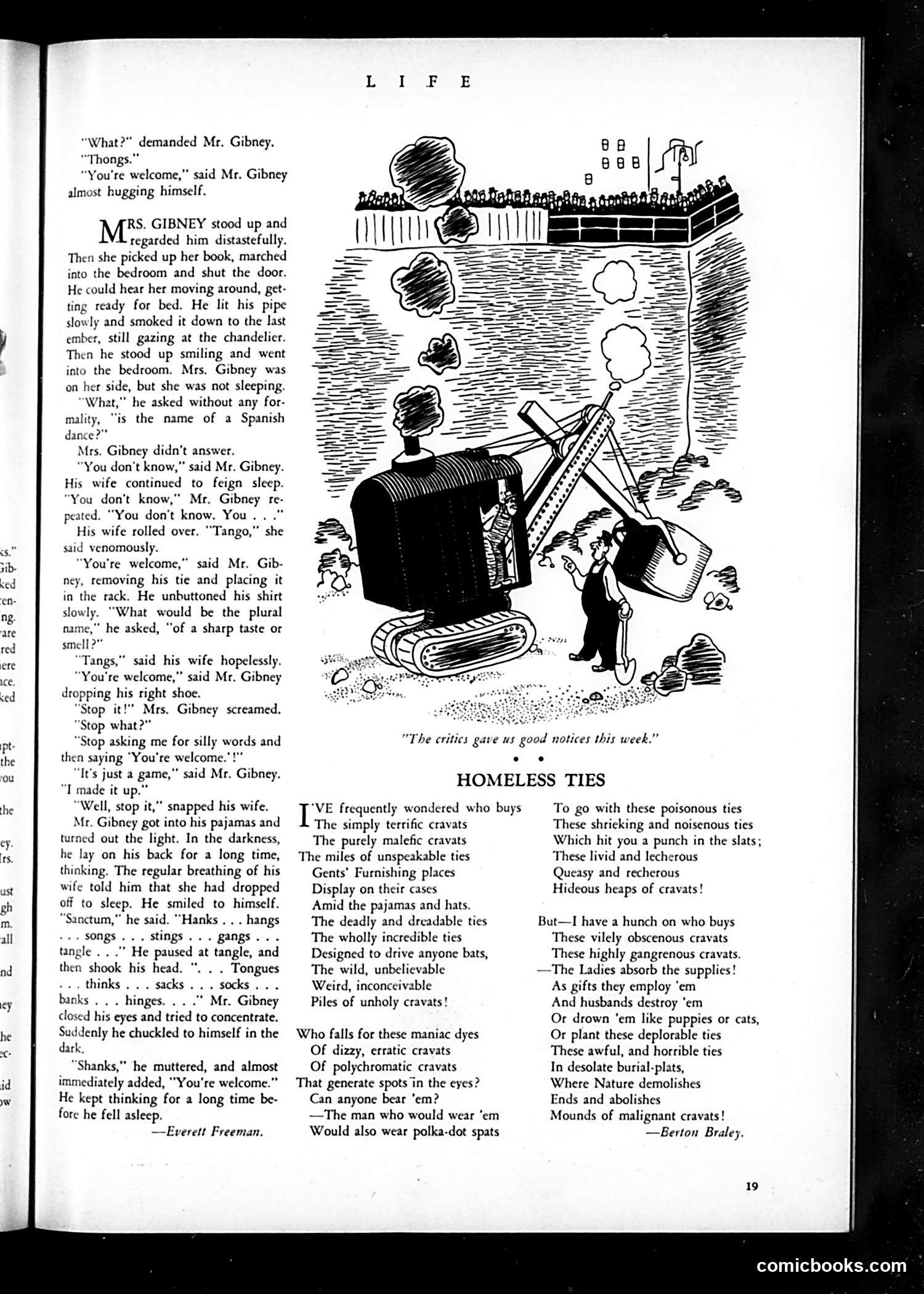
"The Critics Gave Us Good Notices This Week" This cartoon satirizes married couples and domestic life. Mr. Gibbon sits amid household chaos—overturned furniture, scattered belongings—while his wife sleeps undisturbed. The couple has been bickering: she called him "silly" for asking about Spanish dances, he complained about her "sharp taste or smell," and they exchanged terse "You're welcome" remarks. The caption's irony suggests they're receiving "good notices" for their marital performance—a joke about how couples maintain appearances despite internal conflict. The visual chaos contrasts with their pretense of civility, mocking how marriages function as public performances while privately deteriorating into dysfunction and disorder.
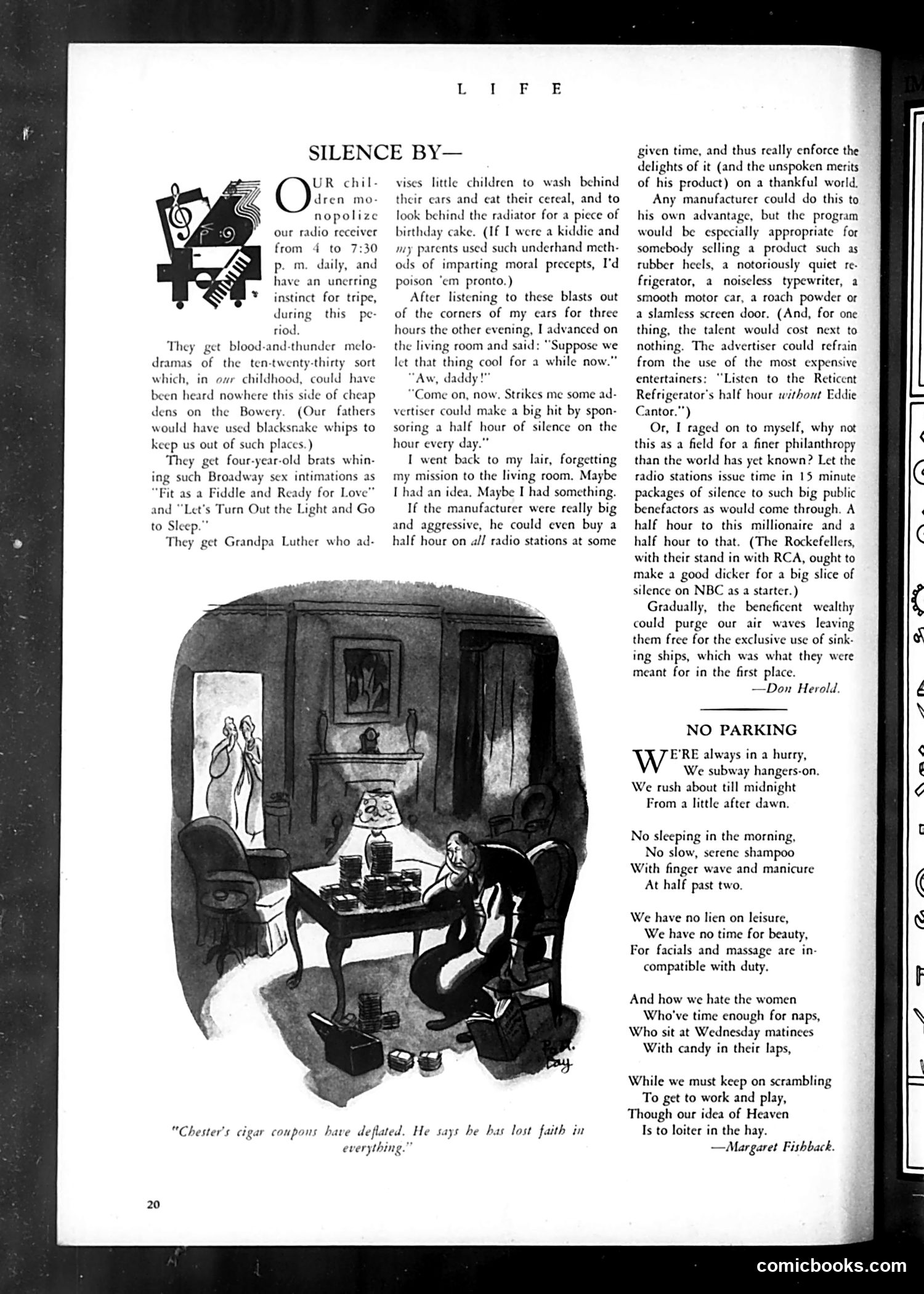
Analysis: "Silence By—" (Life Magazine) The Main Cartoon & Article: Don Herold satirizes 1920s-30s children's radio programming as low-quality "blood-and-thunder melodramas" featuring crude morality tales and suggestive pop songs—content he considers worse than anything available in his childhood. His satirical proposal: manufacturers should sponsor "silent" radio hours as advertising. A quiet refrigerator, noiseless typewriter, or smooth motor car could advertise by broadcasting *nothing*—the absence of noise itself becomes the pitch. He extends this to wealthy philanthropists buying silence on NBC and RCA, eventually "purging" radio waves entirely except for emergency broadcasts from sinking ships. The Joke: The satire works on multiple levels: radio's desperate commercialism, parents' inability to control children's consumption, and the era's rapid cultural anxieties about mass media. The absurdist proposal—that silence itself becomes a marketable commodity—mocks both advertising excess and listeners' desperation for peace from incessant programming. The Illustration depicts a frustrated parent confronting children monopolizing the radio receiver during peak hours.
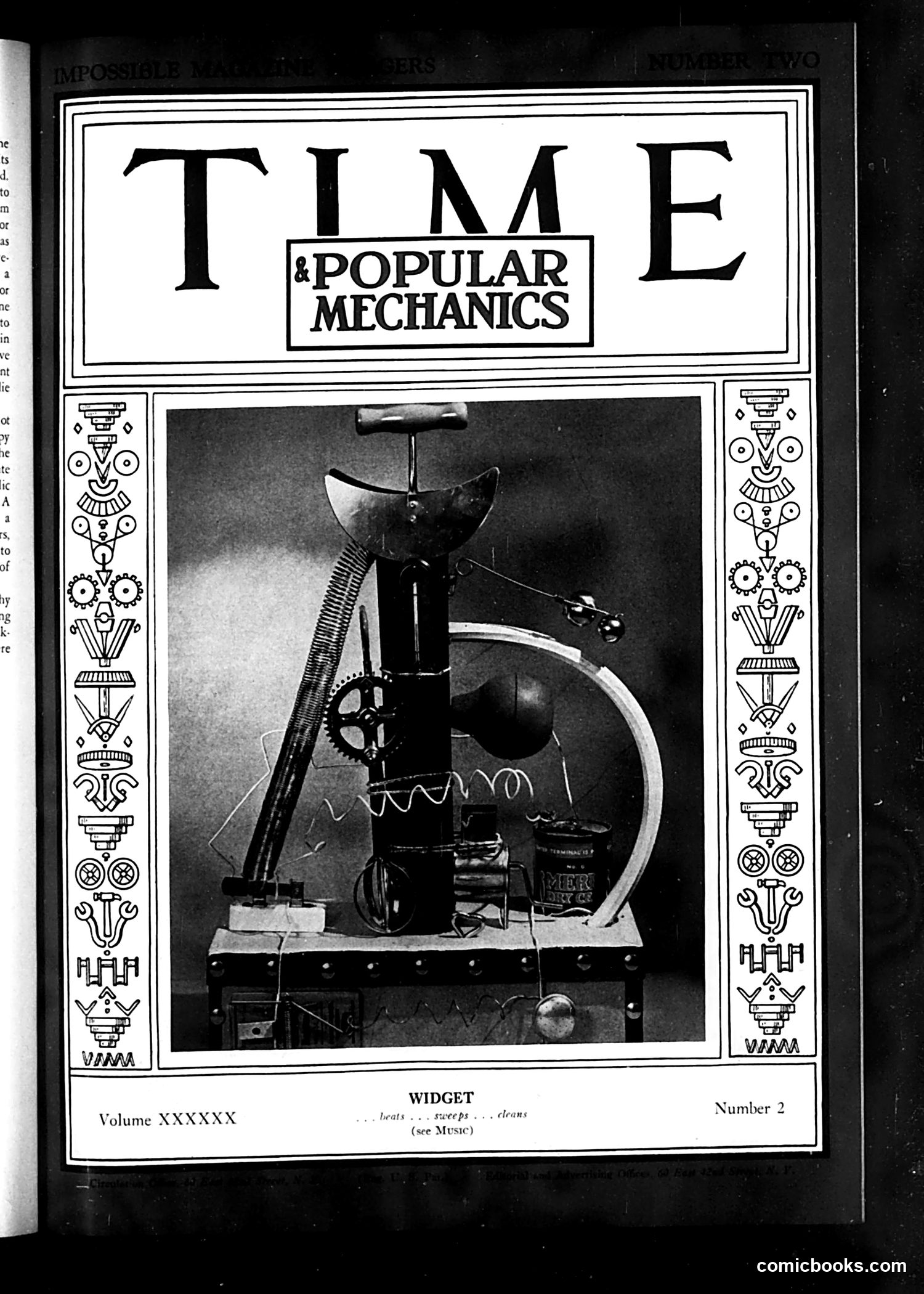
Analysis This appears to be a cover or title page from *Time & Popular Mechanics* magazine featuring a mechanical device labeled "WIDGET." The central image shows a complex contraption with gears, pulleys, a large wheel, and various mechanical components mounted on a platform—a classic "Rube Goldberg machine" style apparatus. The text references "heats... sweeps... (see Music)," suggesting this widget performs mundane household tasks in an unnecessarily complicated way. The ornate decorative borders containing gears and mechanical symbols reinforce the mechanical theme. Without additional context or visible publication date, the specific satire remains unclear, though this likely parodies either overcomplicated mechanical solutions to simple problems or perhaps critiques industrial-age enthusiasm for mechanization itself.
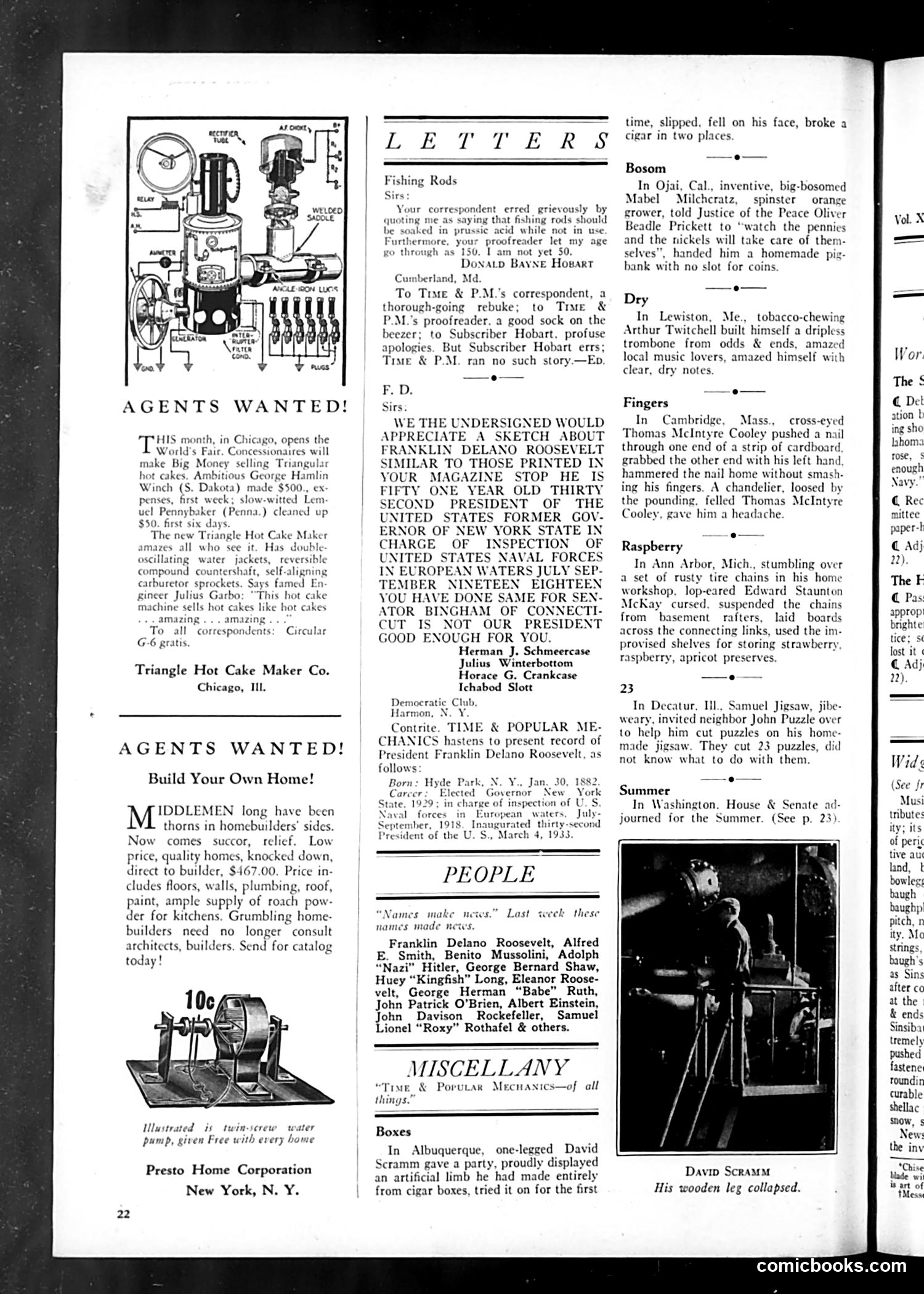
Analysis of Life Magazine Page This page contains mostly advertisements and humorous filler content rather than political cartoons. The key elements: Advertisements: - Triangle Hot Cake Maker and Presto Home Corporation ads exploit the 1933 Chicago World's Fair and Depression-era housing shortages, promising quick riches and affordable homes to working people. Letters Section: - A letter from Democratic Club members sarcastically congratulates an unnamed figure (likely FDR, based on "thirty-second President") for accomplishments they claim a Senator Bingham could have matched—suggesting criticism of presidential overreach or undeserved praise. "Miscellany" Section: - Absurdist, lighthearted anecdotes about ordinary people's oddball inventions and mishaps (a one-legged man's artificial limb, a dripless trombone, a raspberry installation)—examples of the magazine's humorous human-interest filler. The page reflects Life's dual mission: satirical commentary alongside whimsical Americana. The political content is subtle; the emphasis is entertainment and advertising.
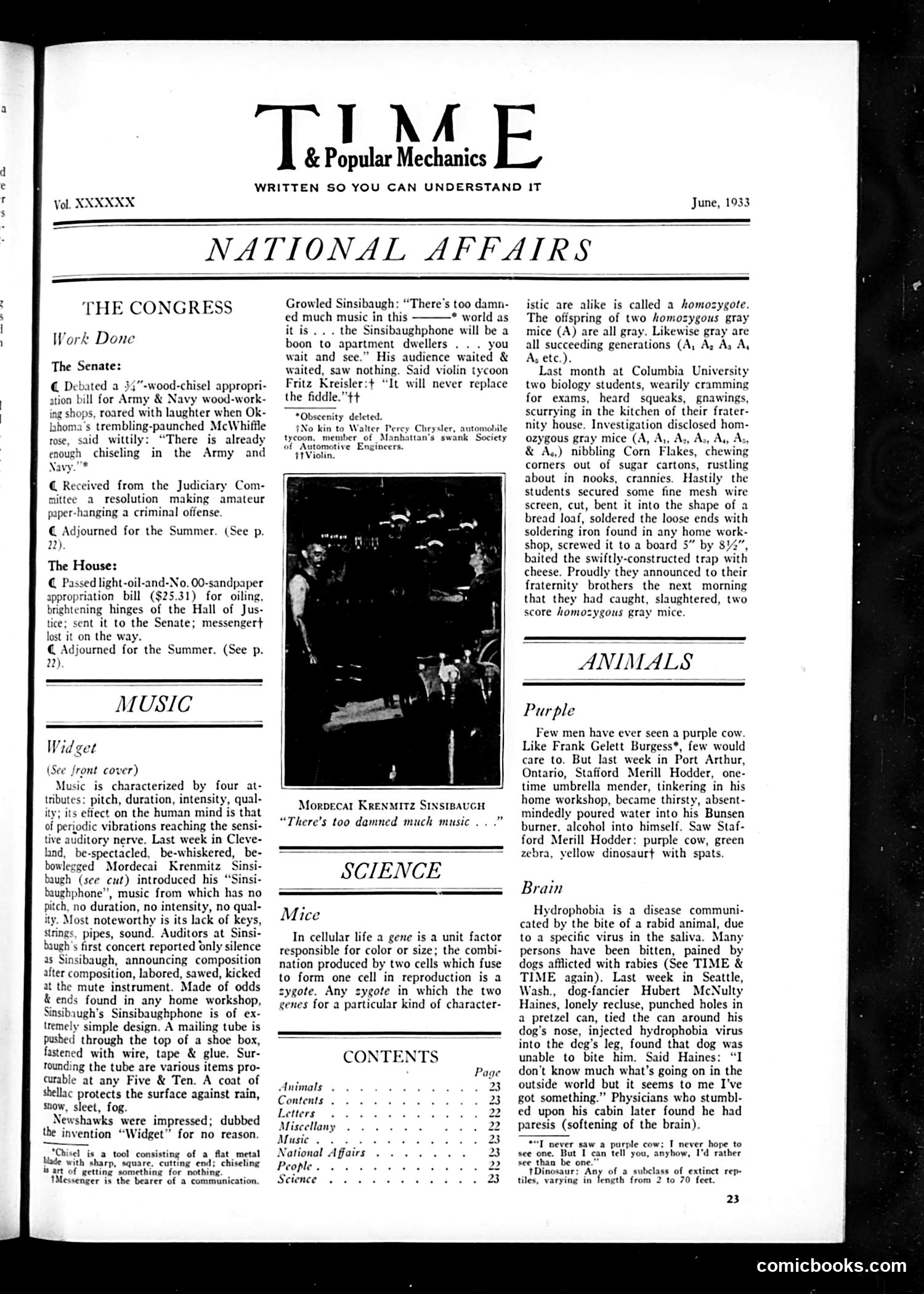
What This Page Means to Modern Readers This June 1933 *Life* magazine page satirizes Congress's absurd priorities during the Great Depression. The "Work Done" section mocks lawmakers debating trivial matters—a $25.31 sandpaper appropriation, making amateur paper-hanging a crime—while ignoring economic crisis. The humor relies on incongruity: serious governmental processes applied to petty concerns. The music section ridicules avant-garde composer Mordecai Krenmitz Sinsibaugh, whose "Sinsibaughphone" produces no sound whatsoever. This parodies modernist art's incomprehensibility to ordinary people. Famous violinist Fritz Kreisler's dismissal ("It will never replace the fiddle") represents establishment skepticism toward experimental innovation. The science section straightforwardly explains genetics using mice experiments—typical of *Life*'s educational mission to make complex topics accessible, as stated in the masthead: "Written So You Can Understand It." Together, these sections reflect 1930s anxieties about government incompetence, cultural elitism, and the clash between tradition and modernism.
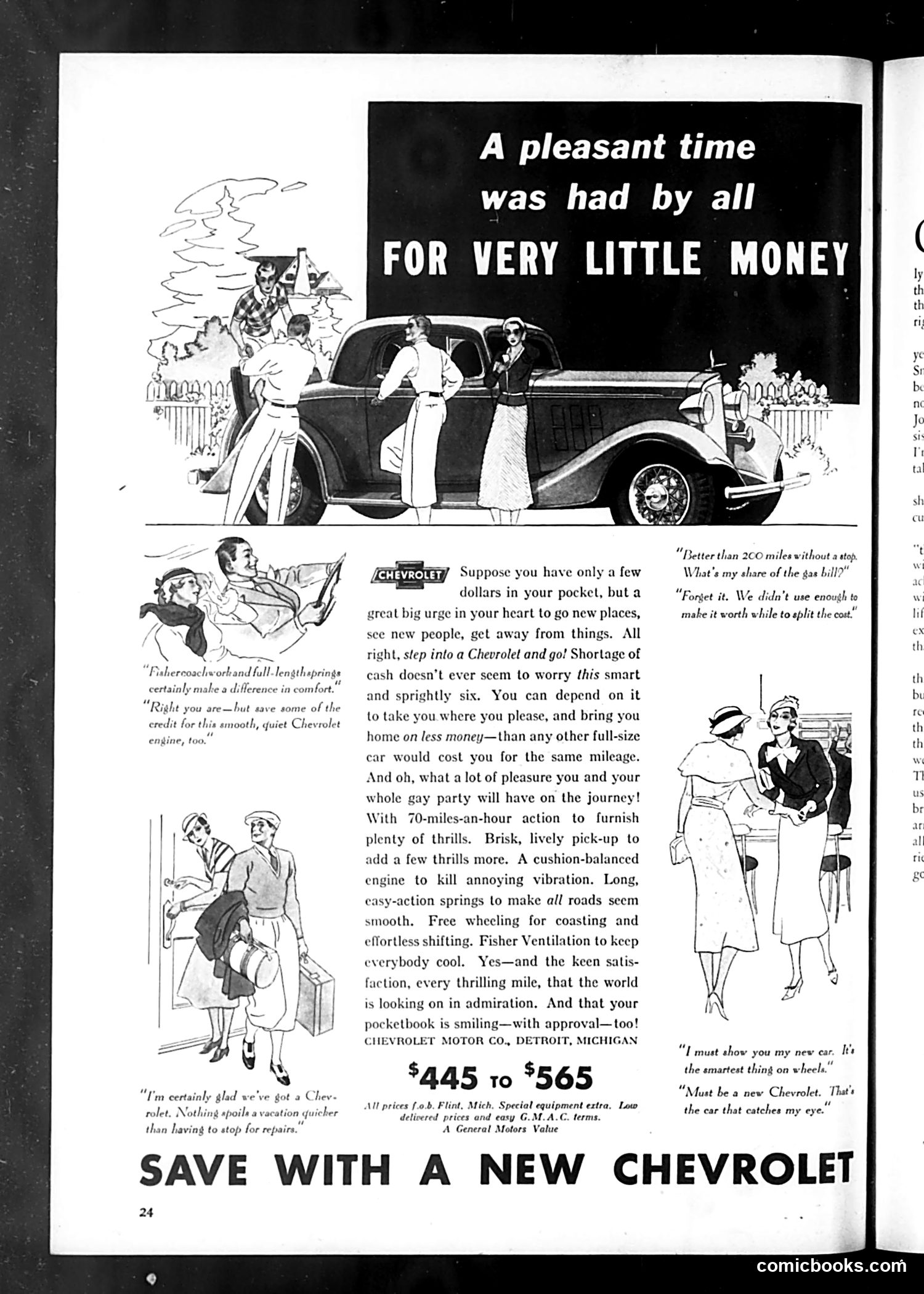
Analysis This is a Chevrolet automobile advertisement, not political satire. The page uses multiple illustrated vignettes to promote the 1930s Chevrolet as an affordable car for budget-conscious Americans. The "cartoons" are lifestyle scenarios showing middle-class couples and groups enjoying outings despite limited money. One woman boasts about a 200-mile trip; another proudly displays her new Chevrolet; a man compliments the car's appearance. The framing device—"A pleasant time was had by all FOR VERY LITTLE MONEY"—emphasizes affordability as the key selling point. The ad's core message addresses Depression-era consumers: you can enjoy leisure travel, impress others, and have fun without spending much. At $445-$565, the Chevrolet positions itself as economical transportation that doesn't sacrifice style or performance (70 mph capability, smooth ride). The satirical tone toward wealth-consciousness reflects 1930s economic anxieties, but this remains fundamentally commercial messaging rather than social commentary.
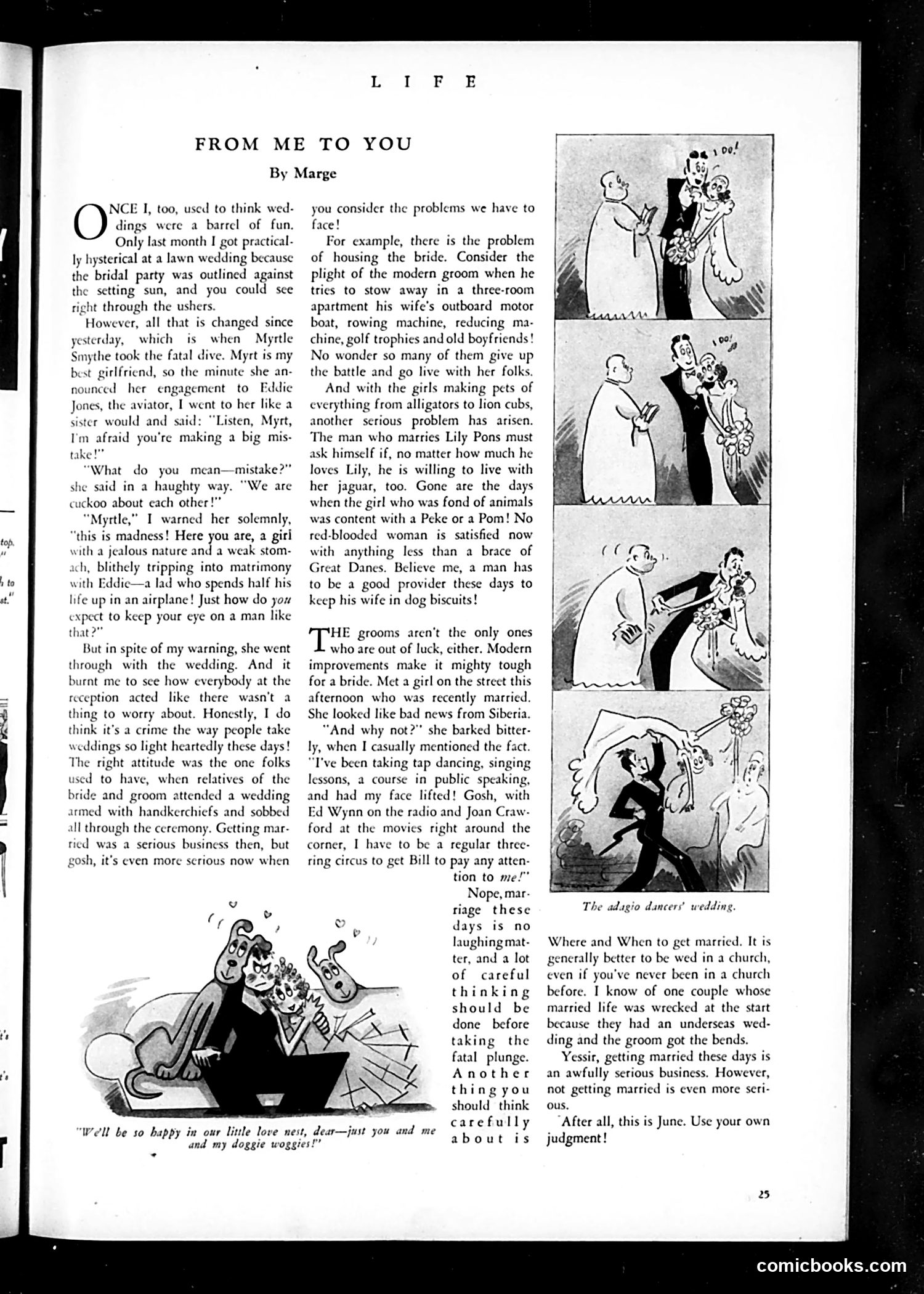
"From Me to You" by Marge — Life Magazine This humorous column satirizes modern marriage anxieties of the era (likely 1930s-40s). The author warns her friend Myrtle against marrying aviator Eddie Jones, listing contemporary complaints: wives' excessive possessions (motorboats, reducing machines), keeping exotic pets (jaguars, Great Danes) instead of simple Pekingese dogs, and the reference to Lily Pons (a famous opera singer) humorously suggests wives expect husbands to support elaborate lifestyles. The cartoons mock how modern brides juggle new expectations—tap dancing, singing lessons, facial lifts, competing with radio stars Ed Wynn and Joan Crawford—to keep husbands' attention. The joke about an "underseas wedding" where the groom "got the bends" is absurdist comedy. Overall, Marge critiques how marriage has become complicated by consumer culture, women's new activities, and modern entertainment, contrasting with supposedly simpler past weddings where relatives solemnly wept throughout ceremonies.
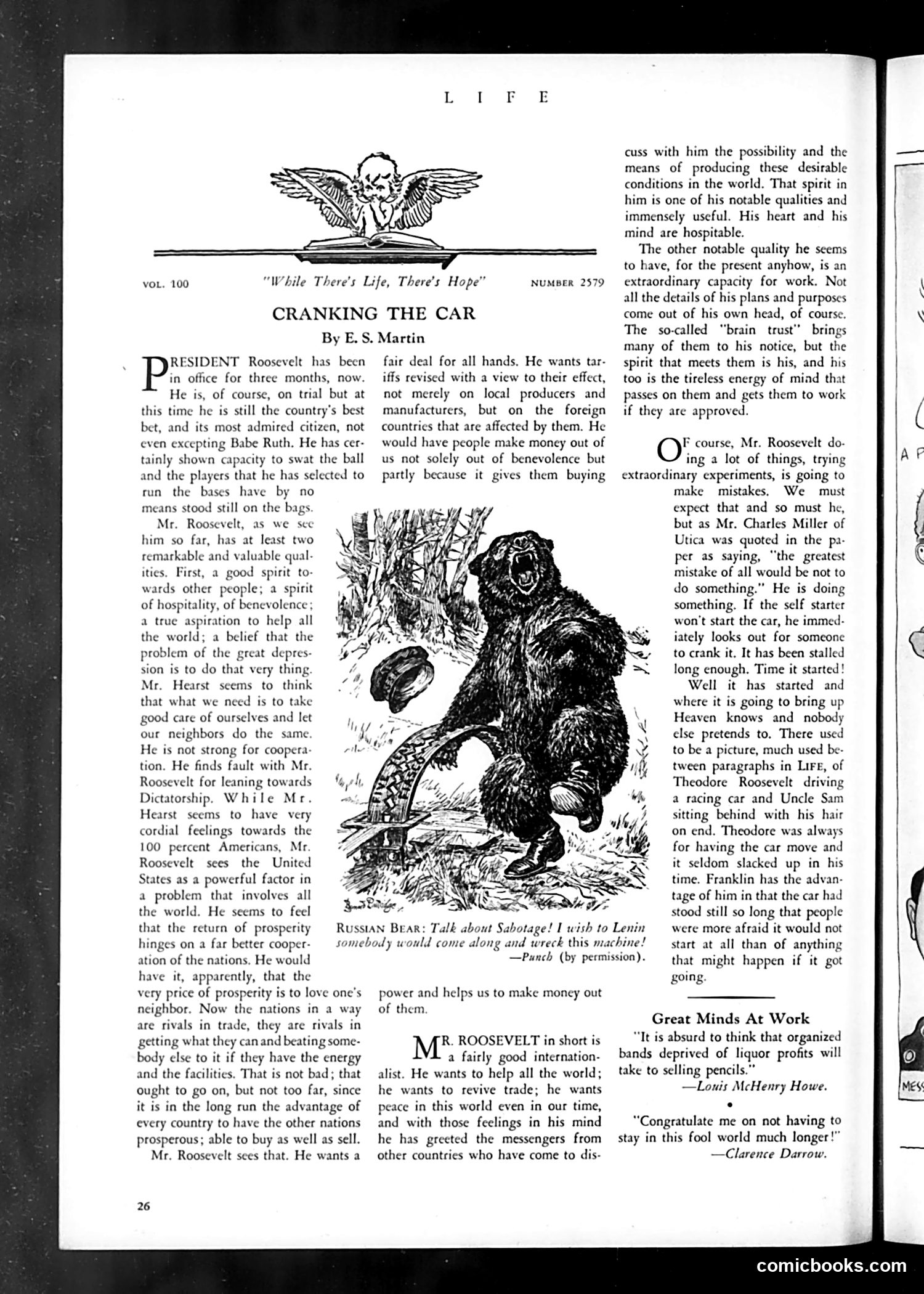
Political Commentary: Roosevelt's New Deal This article by E.S. Martin defends President Franklin D. Roosevelt's early New Deal policies (he'd been in office three months). Martin contrasts Roosevelt favorably with publisher William Randolph Hearst, praising Roosevelt's internationalism and cooperative approach to economic recovery versus Hearst's isolationist, self-interested stance. The embedded Russian Bear cartoon (credited to *Punch*) satirizes Soviet concerns about American economic success—the Bear wishes someone would sabotage the American machine, revealing Soviet anxiety about capitalist prosperity. The central metaphor is automotive: Roosevelt is actively "cranking" the stalled American economic engine, taking experimental action rather than inaction. This addresses Depression-era frustration and endorses Roosevelt's activist approach, implying that attempting solutions—even imperfect ones—beats paralysis.
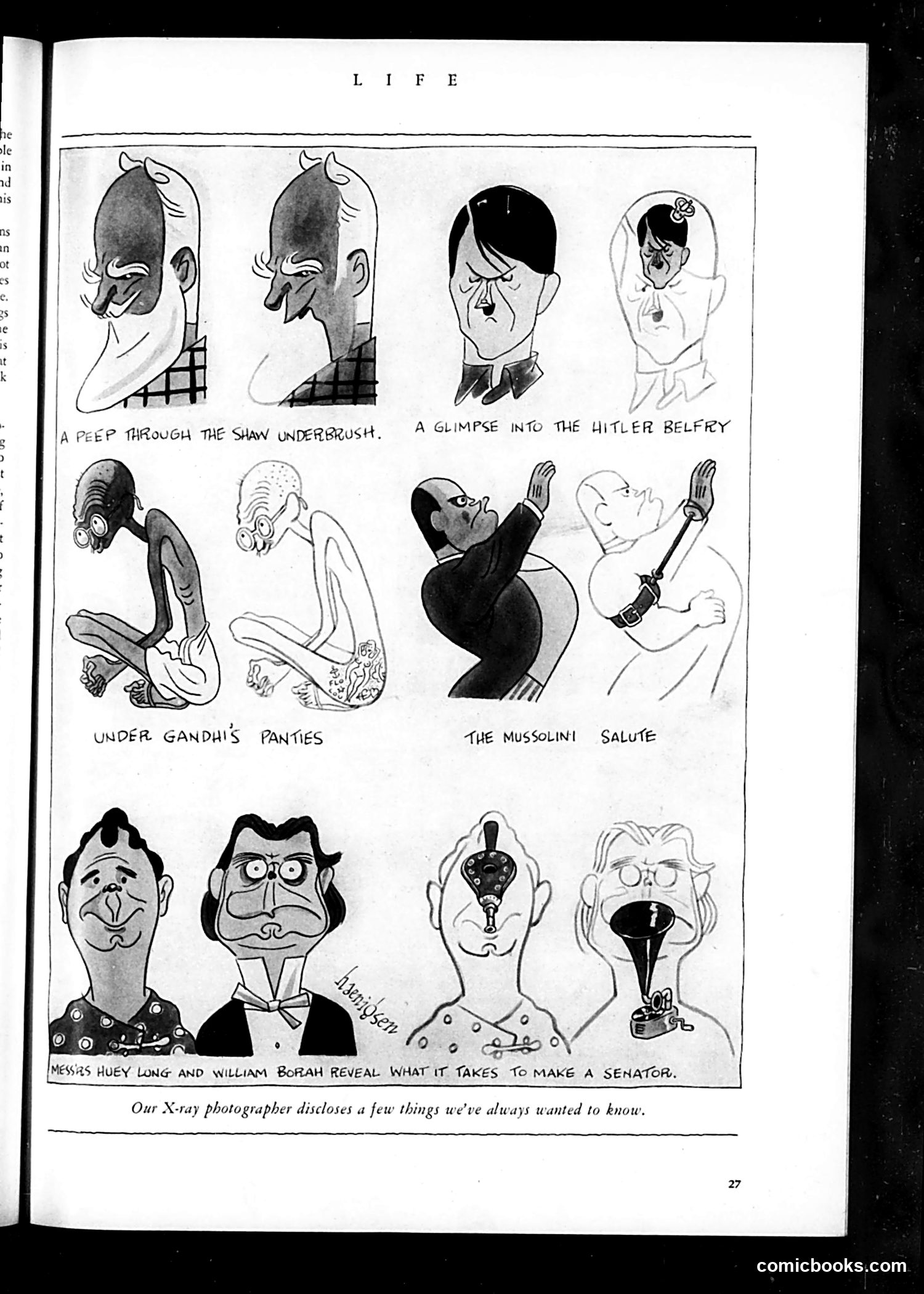
This satirical cartoon uses "X-ray vision" to expose the true nature of controversial political figures. The top panels mock George Bernard Shaw (the "underbrush" reference) and Adolf Hitler's public personas. The middle section ridicules Benito Mussolini's fascist salute. The bottom panel is the main political attack: it uses caricature to suggest that American senators Huey Long and William Borah are authoritarians or fascists at heart—implying their political ambitions mask dangerous totalitarian sympathies. The cartoon's premise is that external appearances deceive; by looking "inside" these figures, their true authoritarian nature becomes visible. This reflects 1930s American concerns about fascism spreading globally and infiltrating U.S. politics through populist demagogues like Long.
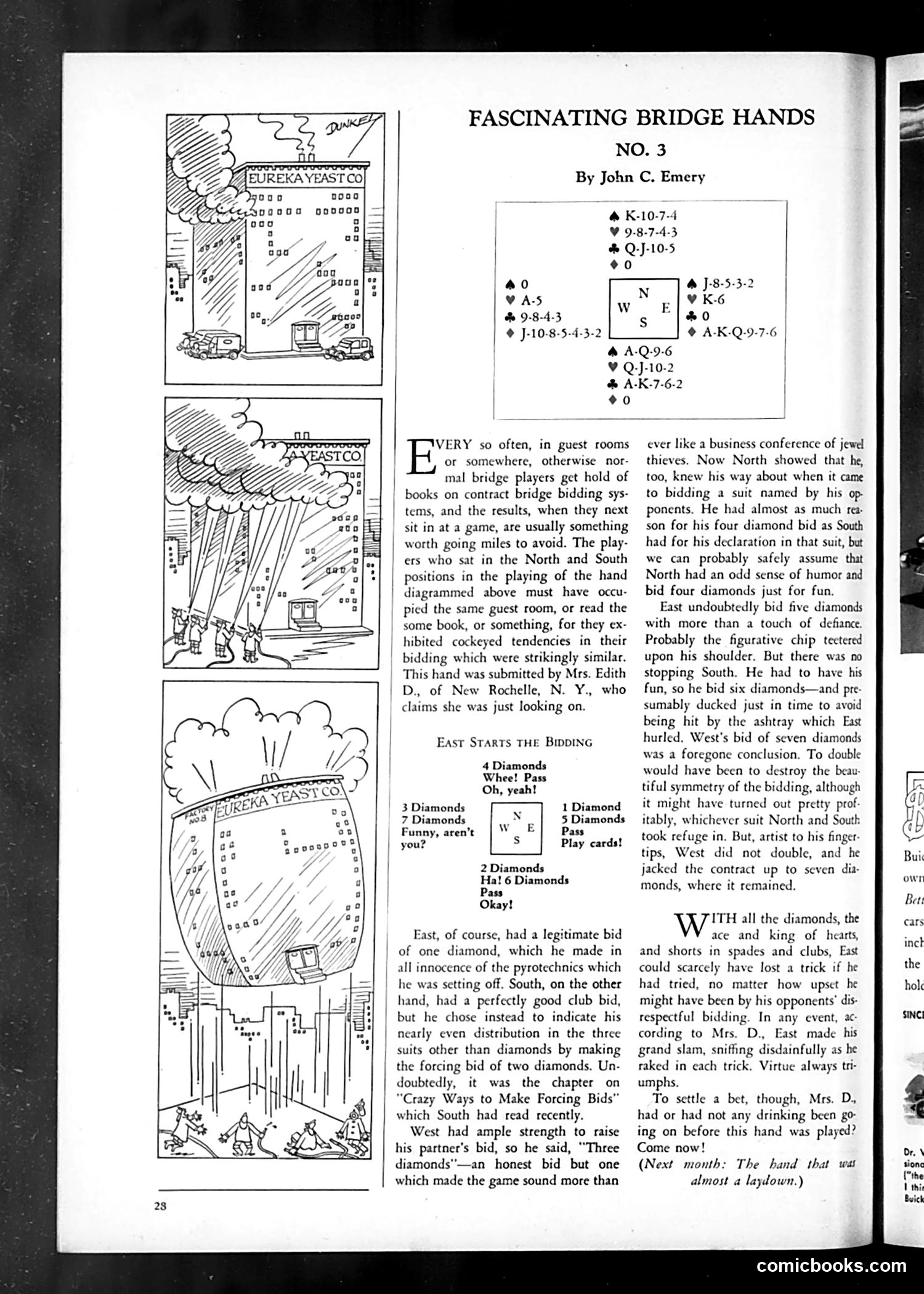
Explanation for Modern Readers This page presents a humorous bridge column about contract bridge bidding gone absurd. The "Fascinating Bridge Hands" series by John C. Emery illustrates a real card game where four players engaged in increasingly ridiculous competitive bidding. The satire targets amateur bridge players who read instruction books on bidding systems, then apply them absurdly in actual games. The humor escalates through the bidding sequence: East makes a legitimate opening bid, but South responds with an unnecessarily aggressive "forcing bid," which triggers matching escalations from all players until they reach a seven-diamond contract—the highest possible bid. The joke is that this ridiculous bidding war appears driven by ego and competitive showing-off rather than sound strategy. The columnist sardonically notes that East made the grand slam anyway (winning all tricks), then quips that Mrs. D., who submitted the hand, must have been "just looking on"—implying she may have been drinking, suggesting alcohol fueled the poor judgment. The cartoon illustrations humorously depict tense bridge-playing scenarios, emphasizing the social absurdity of the situation.
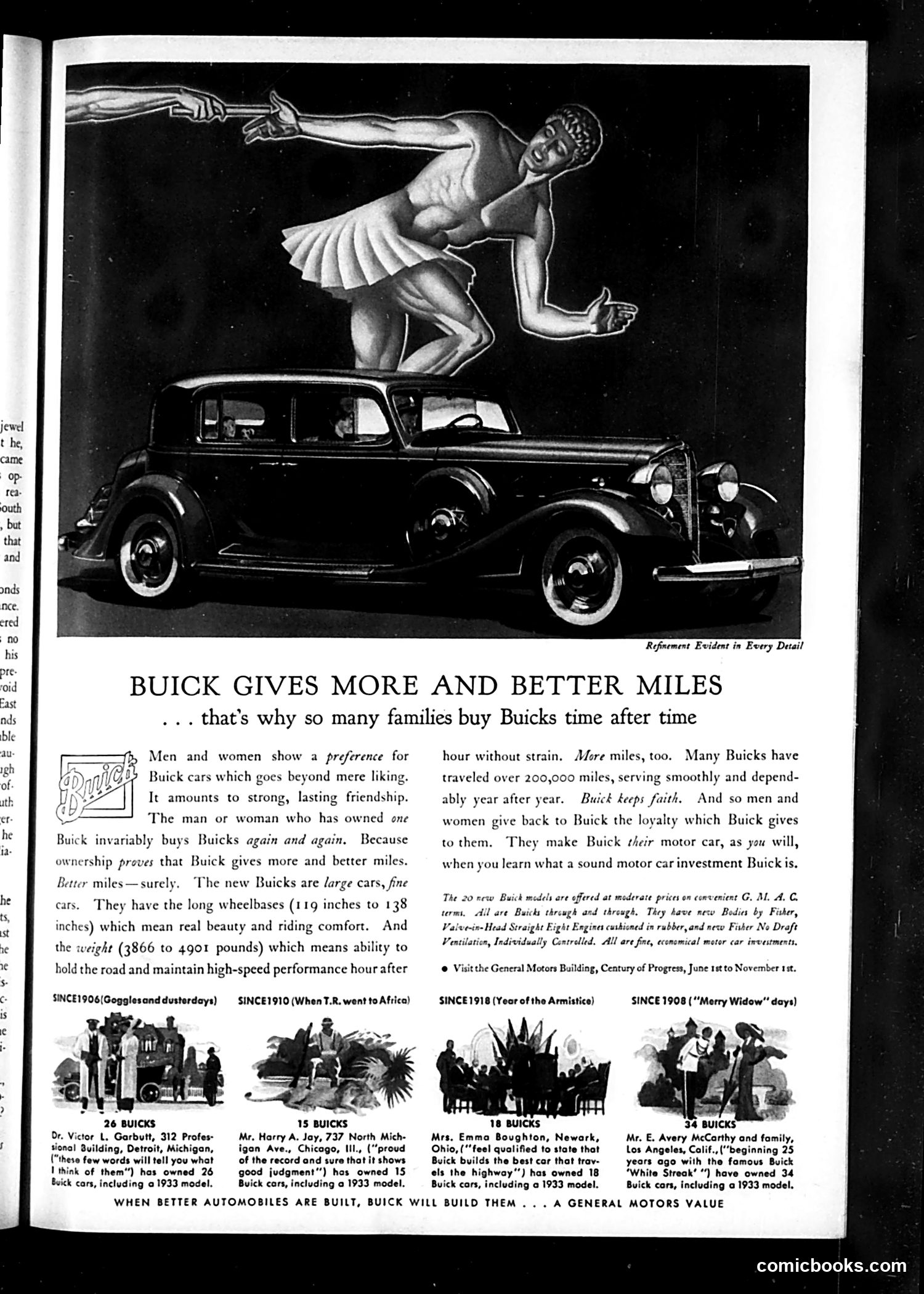
Analysis This is primarily a Buick automobile advertisement, not political satire. The page uses an unusual surrealist image—a classical male cherub or putto figure balanced atop a 1930s sedan—to advertise the car's reliability and durability. The bizarre imagery appears designed to catch reader attention through incongruity: the refined, elegant nude figure contrasts sharply with the mundane product being sold. The caption "Refinement Evident in Every Detail" ironically applies classical artistic refinement to a commercial vehicle. The advertisement emphasizes customer loyalty through testimonials from named owners (Dr. Victor Garbutt, Mr. Harry Jay, Mrs. Emma Boughton, Mr. E. Avery McCarthy) who claim to have purchased multiple Buicks over decades—positioning repeat purchases as evidence of superior quality and fuel efficiency. The repeated phrase "Buick keeps faith" anthropomorphizes the brand as trustworthy. This is consumer-focused advertising, not political commentary or satire.
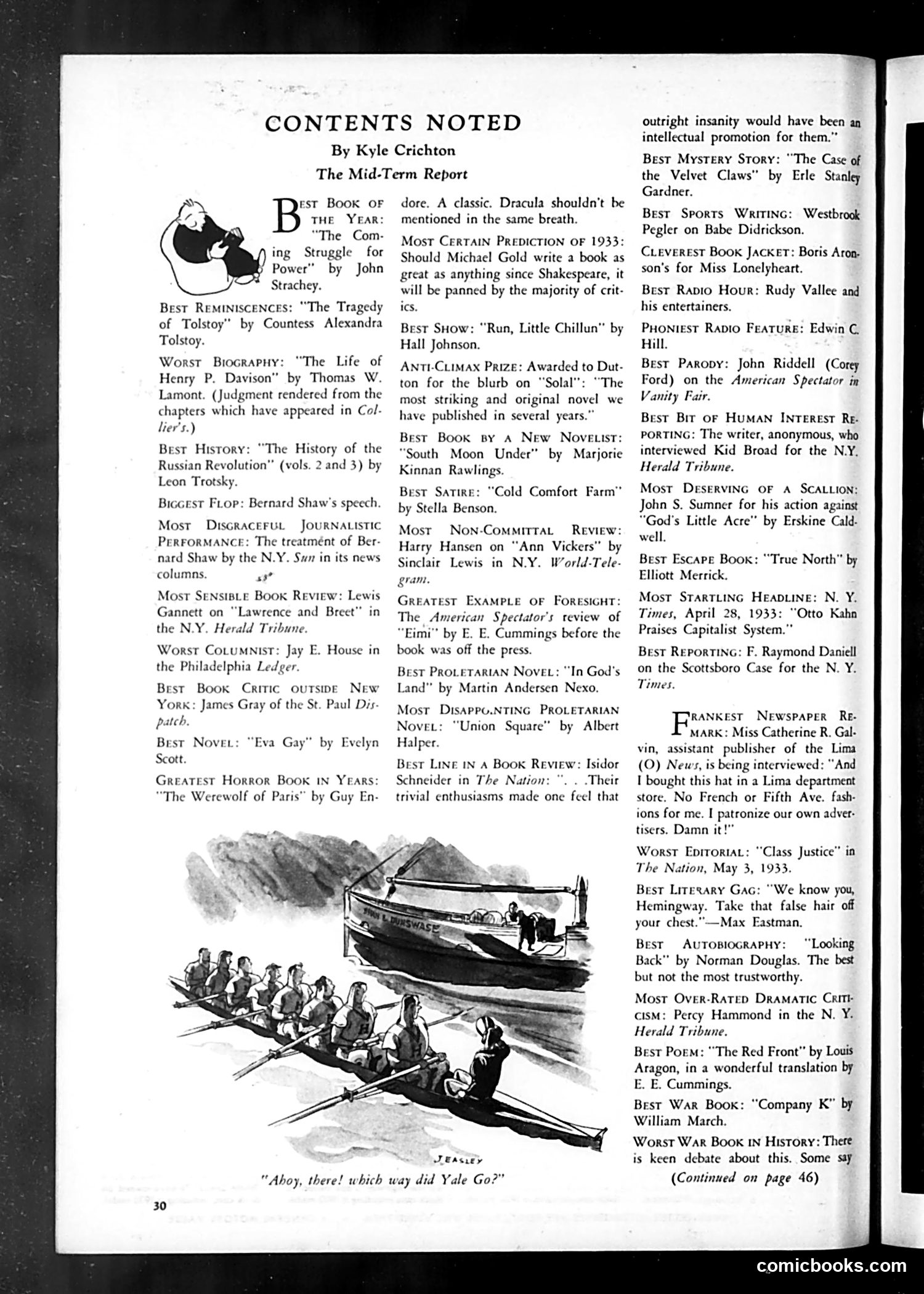
"Contents Noted" – Life Magazine Book Reviews, 1933 This page presents Kyle Crichton's satirical "mid-term report" on 1933 literature and media, awarding humorous categories to books, reviewers, and public figures. The cartoon depicts people in rowboats with the caption "Ahoy, there! which way did Yale Go?"—likely mocking Yale University's prestige or the aimlessness of its graduates during the Depression era. The reviews themselves are deeply political for 1933. Crichton celebrates leftist works: John Strachey's *The Coming Struggle for Power*, Trotsky's *Russian Revolution history*, and proletarian novels. He praises censorship-fighter John S. Sumner and mocks conservative critics like Percy Hammond. The "Most Certain Prediction" about Michael Gold sarcastically suggests critics will reject communist writing regardless of merit—reflecting Life's leftist sympathies during the Depression when socialist ideas gained intellectual traction among American intellectuals.
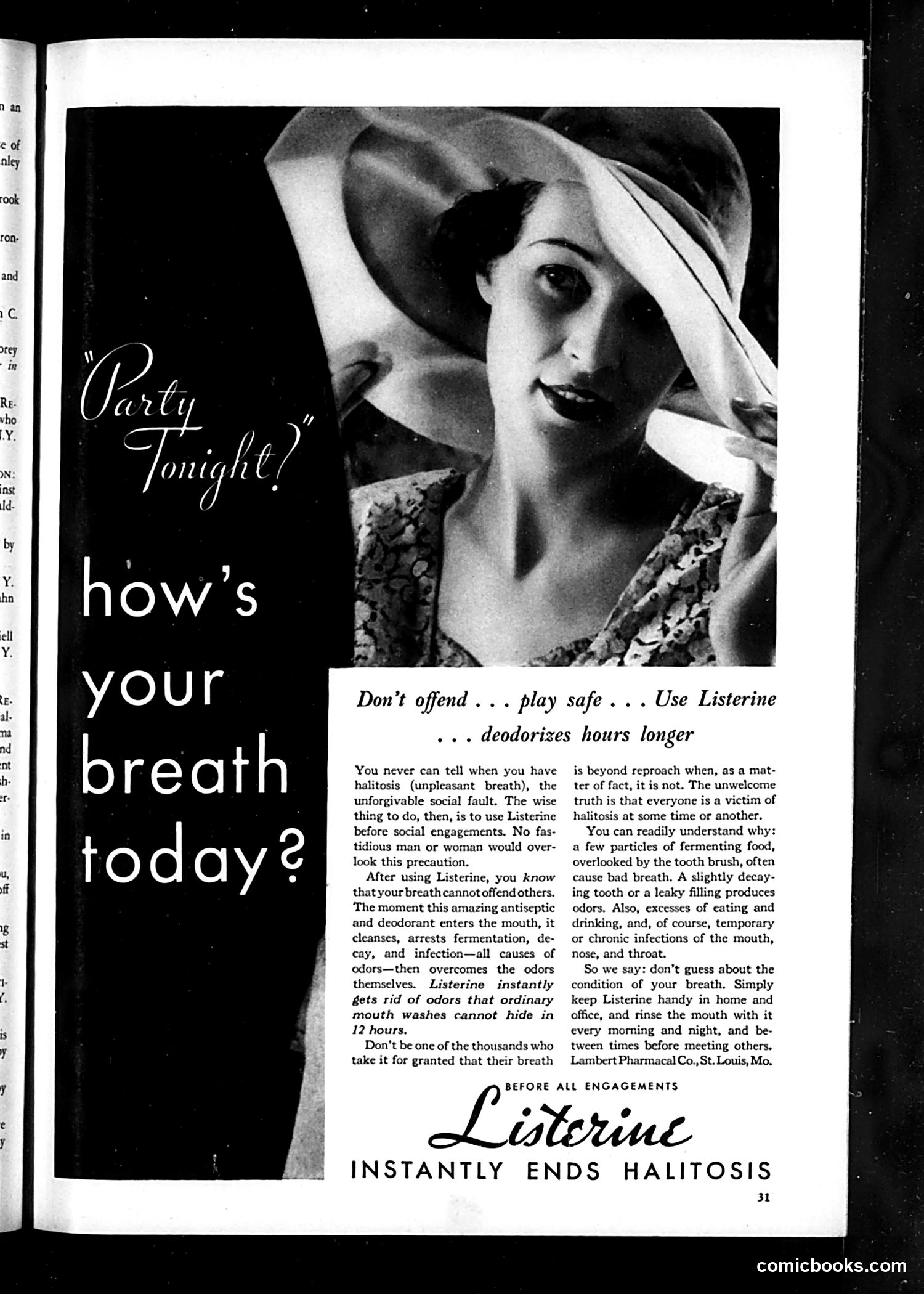
Analysis This is a Listerine advertisement, not a political cartoon or satire. The page uses social anxiety as its marketing strategy. The ad features a stylized photograph of a woman in 1920s-30s attire (headscarf, fashionable dress) with the rhetorical question "Party Tonight? how's your breath today?" This targets insecurity about "halitosis" (bad breath)—then a newly popularized medical term that Listerine itself had popularized through aggressive marketing. The advertisement's strategy is significant: it creates shame around a normal human condition, then positions Listerine as essential before "social engagements" and "engagements" (the latter likely hinting at romantic encounters). The copy emphasizes that "everyone is a victim of halitosis at some time or another," implying the reader almost certainly has it and should use the product preventatively. This reflects early-20th-century advertising's manipulation of social anxiety to drive consumer behavior—a practice now recognized as a hallmark of that era's marketing tactics.
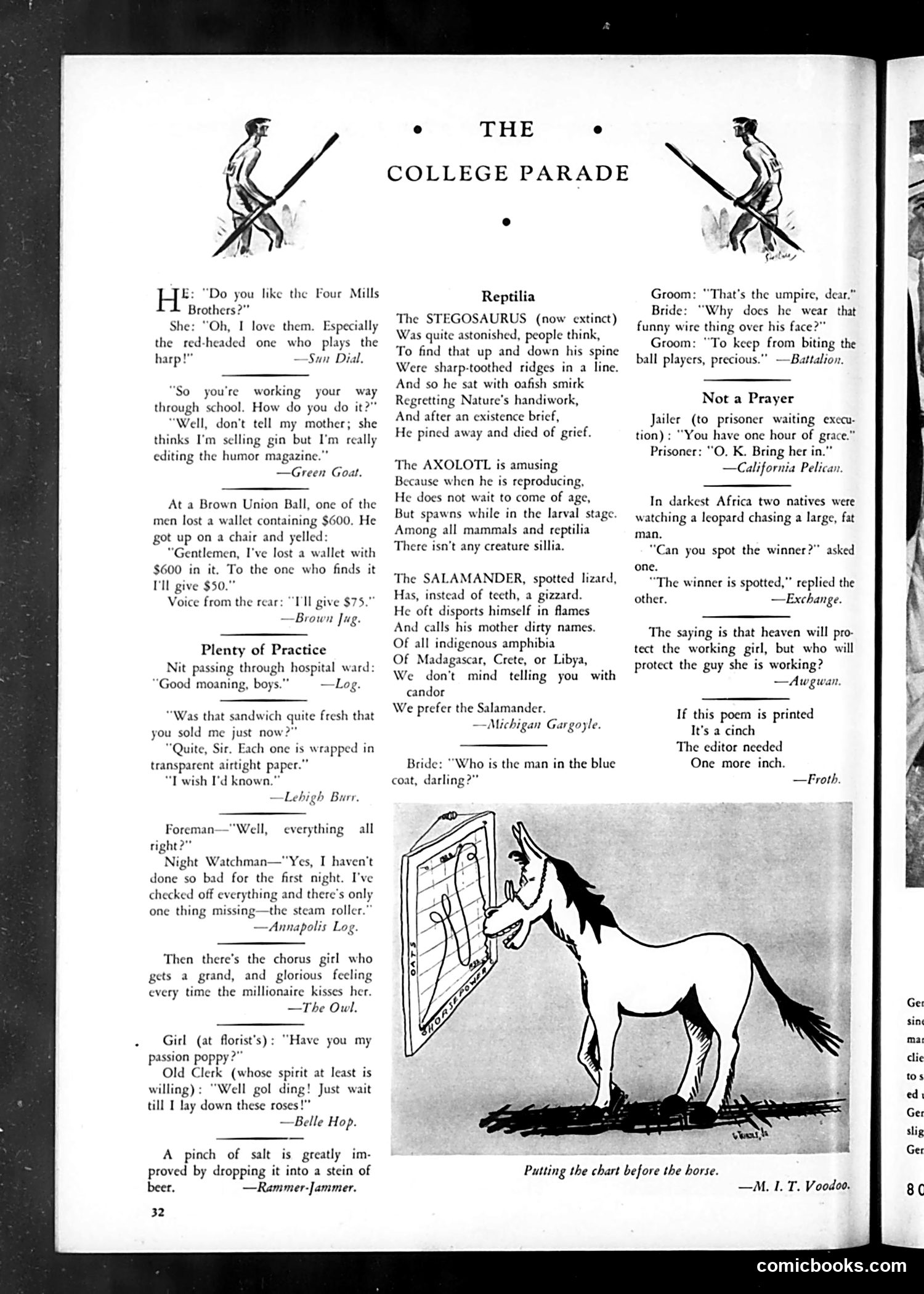
"The College Parade" - Life Magazine Humor Page This page collects college humor—jokes, quips, and light satirical content from various American university publications (Brown, Lehigh, Michigan, etc.). The content reflects 1920s-30s campus life through comedic observations about student experiences: working through school, dating, military training, and romantic mishaps. The central cartoon shows a horse examining a chart (likely a performance or statistics graph), captioned "Putting the chart before the horse"—a visual pun on the idiom "putting the cart before the horse." It satirizes misplaced priorities or illogical sequencing. The "Reptilia" section presents whimsical pseudo-scientific humor about extinct and exotic creatures with invented characteristics—gentle nonsense typical of college magazine filler. The jokes mostly target recognizable campus stereotypes: the flirtatious chorus girl, the resourceful but dishonest student, the oblivious military supervisor. The humor is mild, family-friendly satire aimed at a college-educated readership.
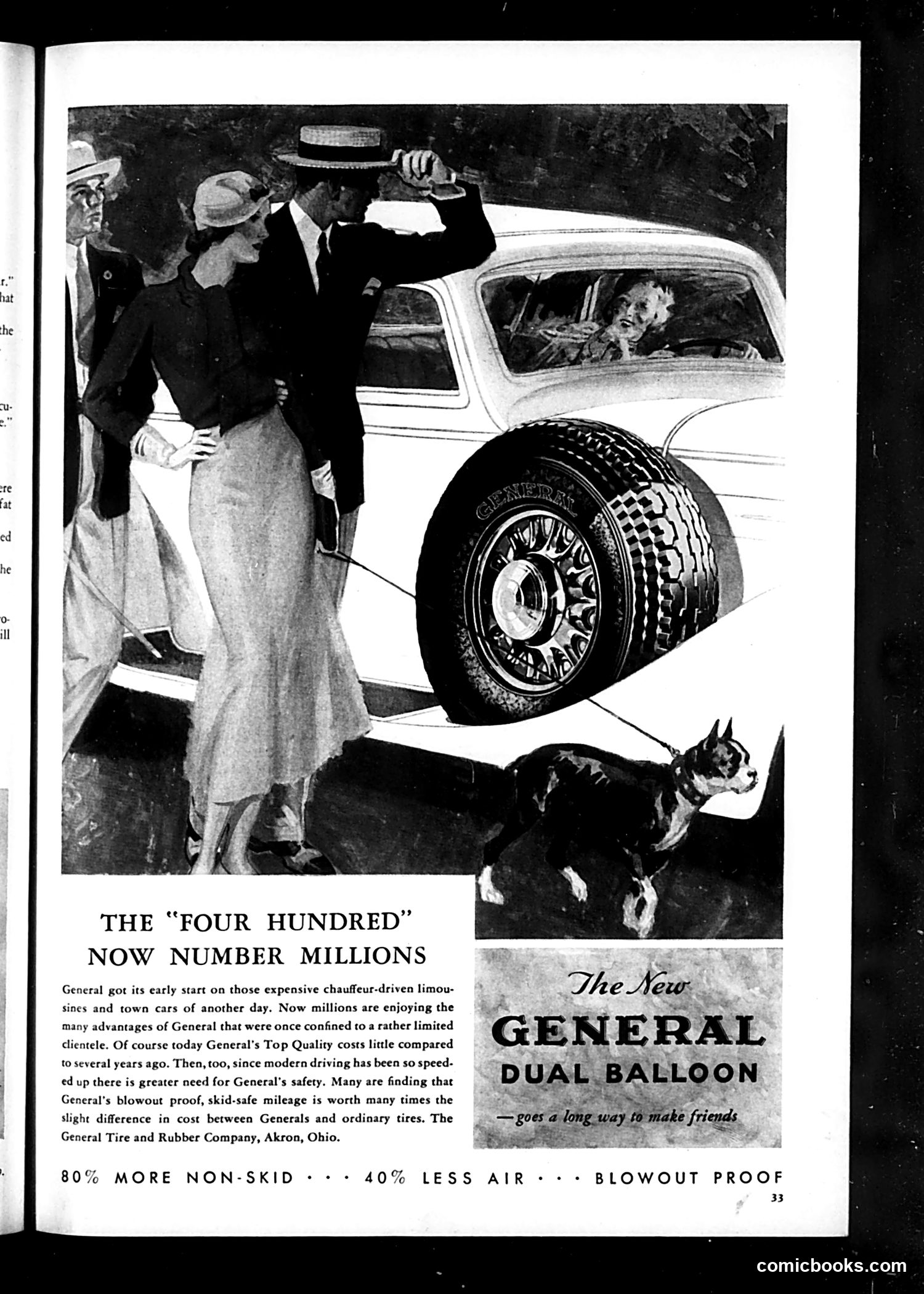
Analysis This is a General Tire advertisement, not political satire. The "Four Hundred" reference alludes to New York's wealthy elite social circle of the Gilded Age—historically, the richest families who could afford luxurious chauffeur-driven cars and limousines. The ad's joke: General tires were once luxury goods for the rich, but now "millions" can afford them because quality costs less than before. The image shows well-dressed people (appearing to represent the upper class) examining a General-tired automobile alongside ordinary people, suggesting democratic access to previously exclusive products. This reflects early-20th-century advertising's common tactic of democratizing luxury—selling mass-produced goods by claiming they deliver aristocratic quality at middle-class prices. The small dog in the scene adds homey, relatable appeal. The headline plays on the notion that exclusive privilege has become commonplace.
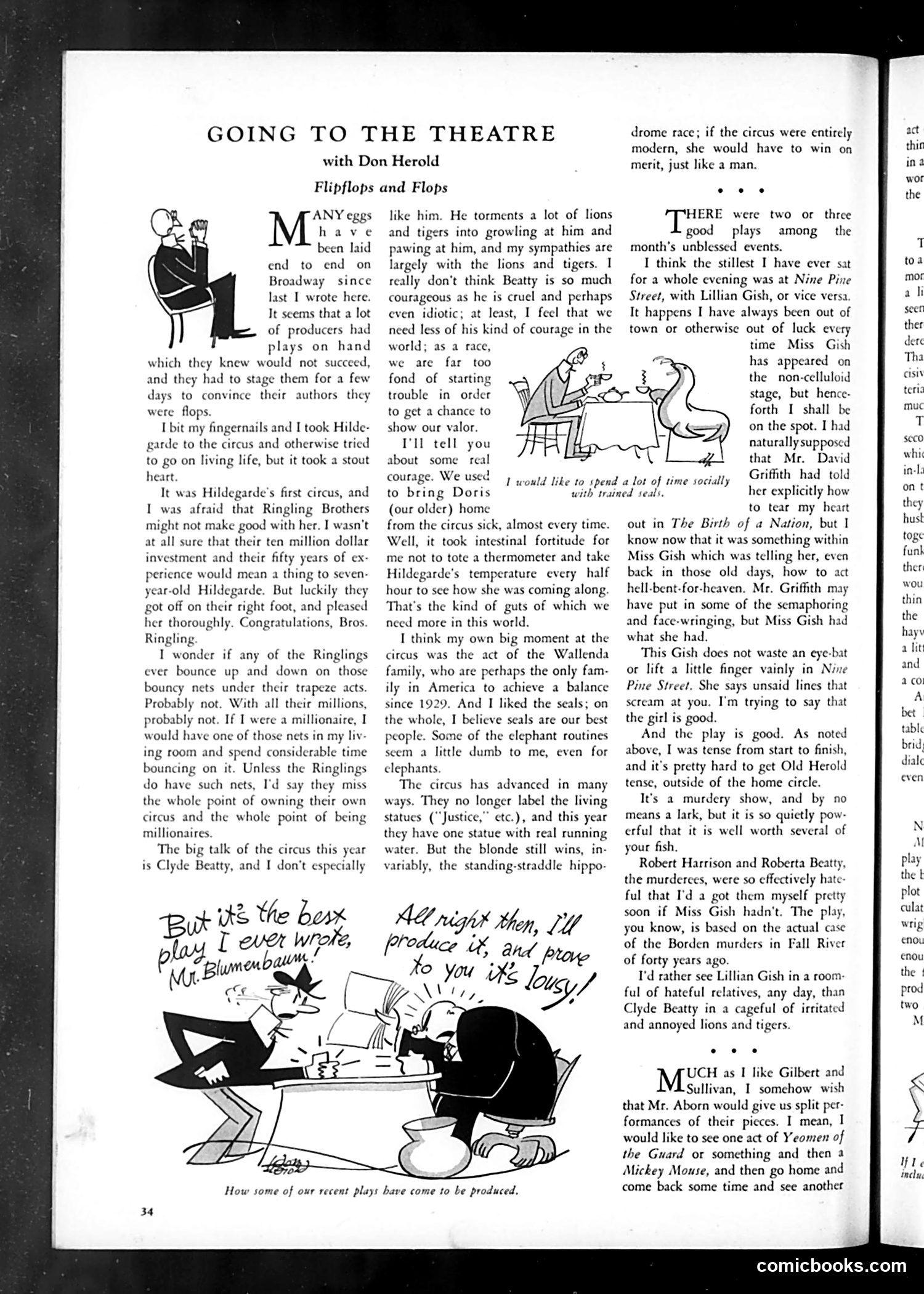
Analysis of "Going to the Theatre" by Don Herold This is a theater column/essay with accompanying cartoon satirizing Broadway's commercial practices. The Main Cartoon: Shows a producer at a desk with an author, saying he'll "produce and prove to you it's lousy!" — mocking how producers stage plays they know will fail, merely to convince authors their scripts don't work. This was apparently common practice; Herold notes producers had "plays on hand which they knew would not succeed" and staged them briefly just to demonstrate failure to the authors. The Content: Herold humorously recounts taking his daughter to the circus, praising the Wallenda family acrobats and seals while criticizing animal trainer Clyde Beatty for cruelty. He sarcastically notes real courage isn't "tormenting" animals for entertainment. Social Context: The piece reflects 1920s-30s Broadway's economic realities—producers gambling on plays, and the casual acceptance of animal exploitation in circuses as normal family entertainment. Modern Relevance: The cartoon exposes cynical theater industry practices of that era.
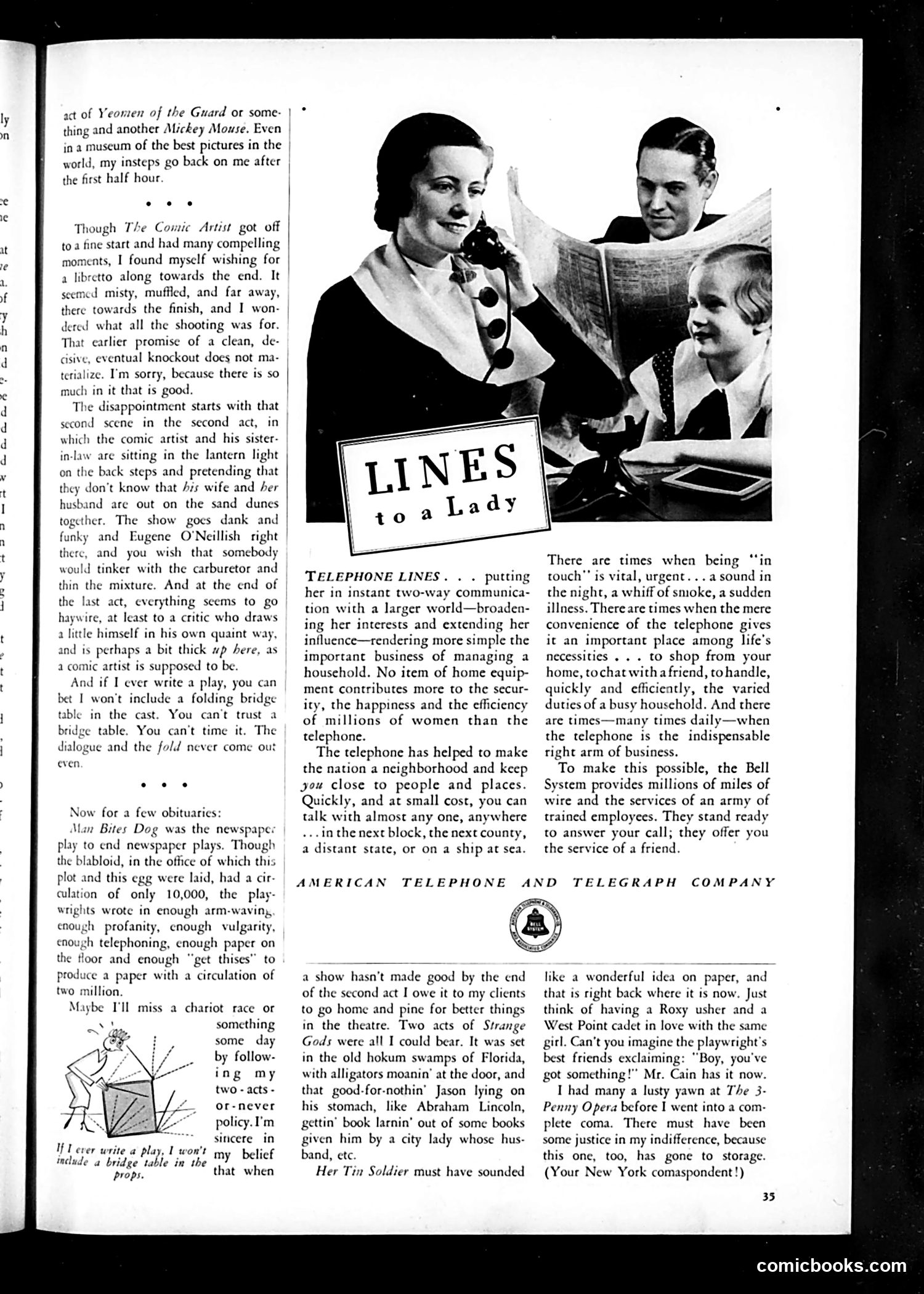
Page Analysis: Life Magazine Theater Criticism & AT&T Advertisement Main Content: Theater critic reviews recent Broadway plays, mixing praise and disappointment. He critiques *The Comic Artist* for losing momentum mid-show, dismisses *Man Bites Dog* as derivative tabloid sensationalism, and pans *Strange Gods* for melodramatic swamp-Florida hokum with clichéd characters (a man lying down "like Abraham Lincoln" getting self-education). The Cartoon: Small illustration shows a frustrated playwright at a table with a folding bridge table literally folding/collapsing—visual metaphor for the critic's complaint that bridge tables can't be timed reliably in stage productions and undermine dialogue timing. Advertisement: Large AT&T "Lines to a Lady" ad (bottom half) depicts a woman on telephone, marketing the telephone as essential to modern housewives' efficiency, safety, and social connection—framing it as indispensable domestic technology rather than luxury. Context: Represents 1920s-30s theater criticism alongside corporate modernization marketing.
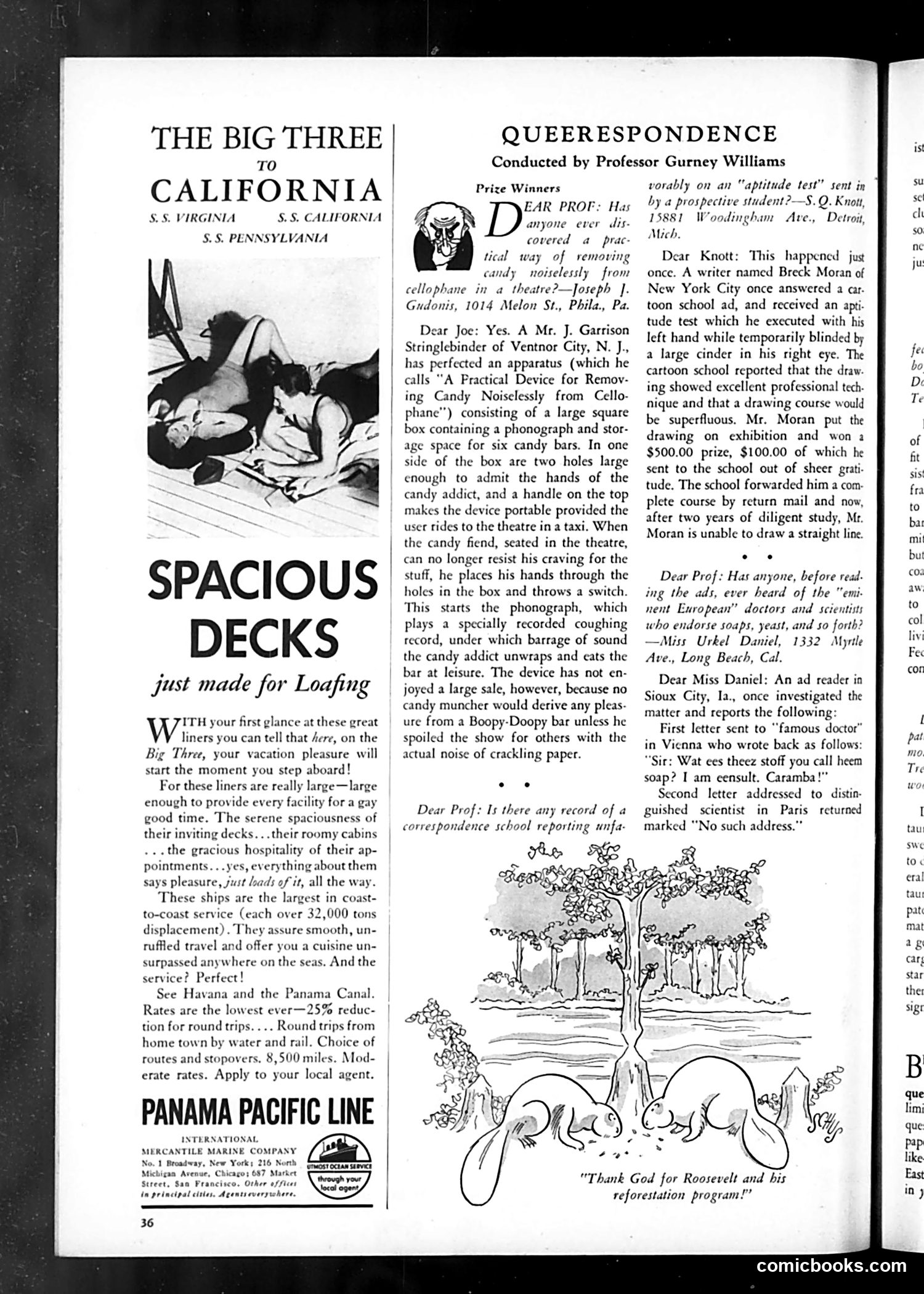
Analysis for Modern Readers This magazine page combines product advertisement (left) with satirical humor (right). The Advertisement: Panama Pacific Line promotes three ocean liners ("The Big Three") for California travel, emphasizing spacious decks and leisurely cruising. The Satire: The right-side "Queerespondence" column humorously critiques consumer culture and advertising: 1. A invented device allowing silent candy-eating in theaters—absurdly impractical, mocking both movie disruption and consumer gullibility 2. A correspondence art school that praised deliberately poor work (drawn left-handed while injured), then made the student worse after enrollment—satirizing fraudulent "mail-order education" 3. A joke about non-existent "eminent European doctors" endorsing products (soap, yeast)—exposing false celebrity endorsements common in 1930s advertising The Point: This attacks how advertisements use fake testimonials and impossible solutions to sell products to credulous consumers—a evergreen satire still relevant today.
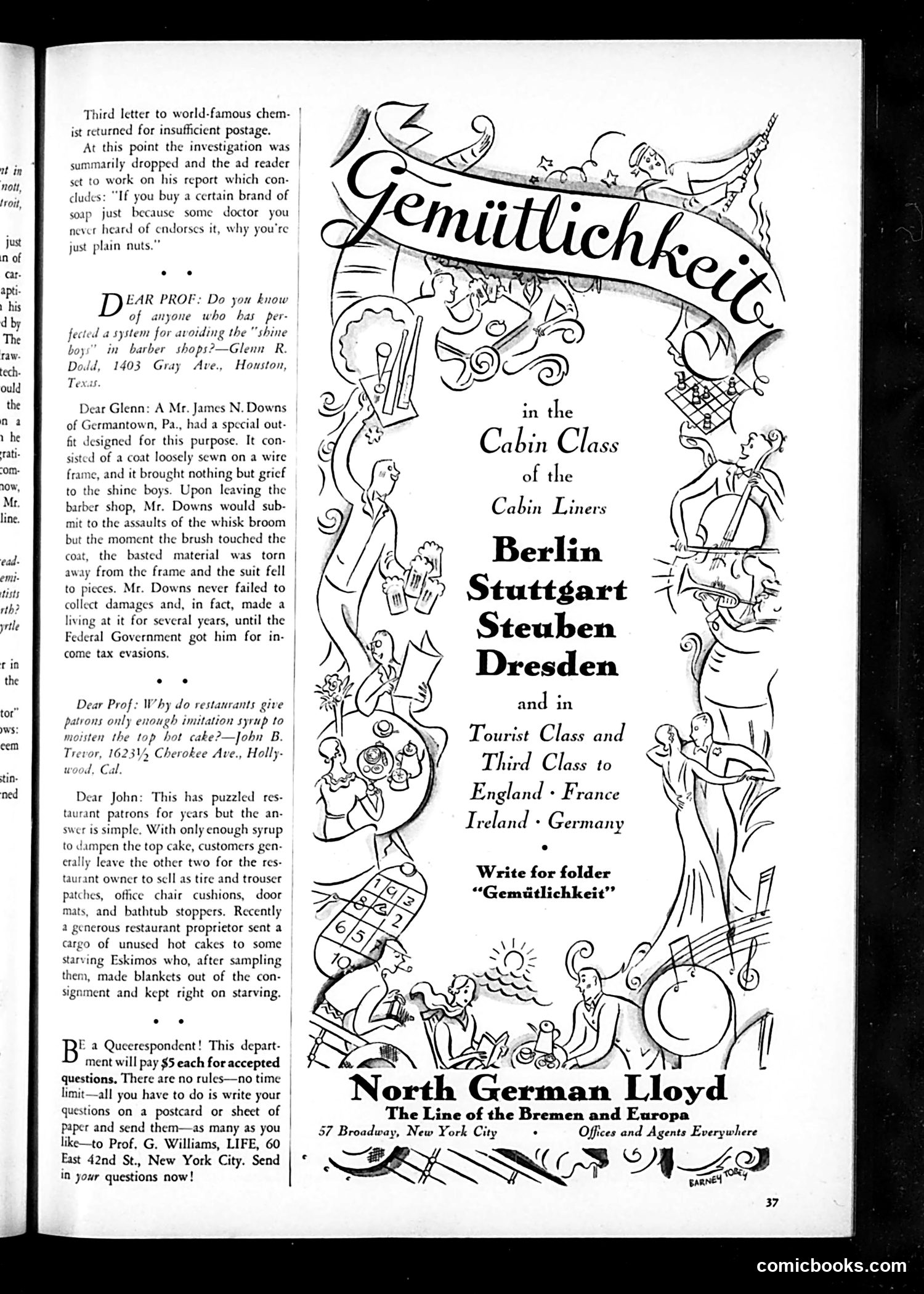
"Gemütlichkeit" Advertisement Analysis This page is primarily a shipping line advertisement for North German Lloyd steamships, with humorous "advice column" content as filler. The large decorative illustration promotes cabin travel to German cities (Berlin, Stuttgart, Dresden, Steuben) and European destinations, using whimsical line drawings of passengers and nautical imagery. "Gemütlichkeit"—a German word meaning cozy comfort or conviviality—is the marketing concept. The left column contains satirical Q&A advice mocking consumer gullibility and restaurant/barber shop practices. Notable: a story about a man profiting by deliberately having his coat destroyed by barber-shop staff, then suing for damages—until caught for tax evasion. Another joke claims restaurants serve minimal syrup on pancakes so owners can repurpose uneaten cakes as building materials. These are absurdist humor pieces typical of *Life* magazine's comedic style, poking fun at everyday commercial deceptions and human foolishness rather than targeting specific political figures.
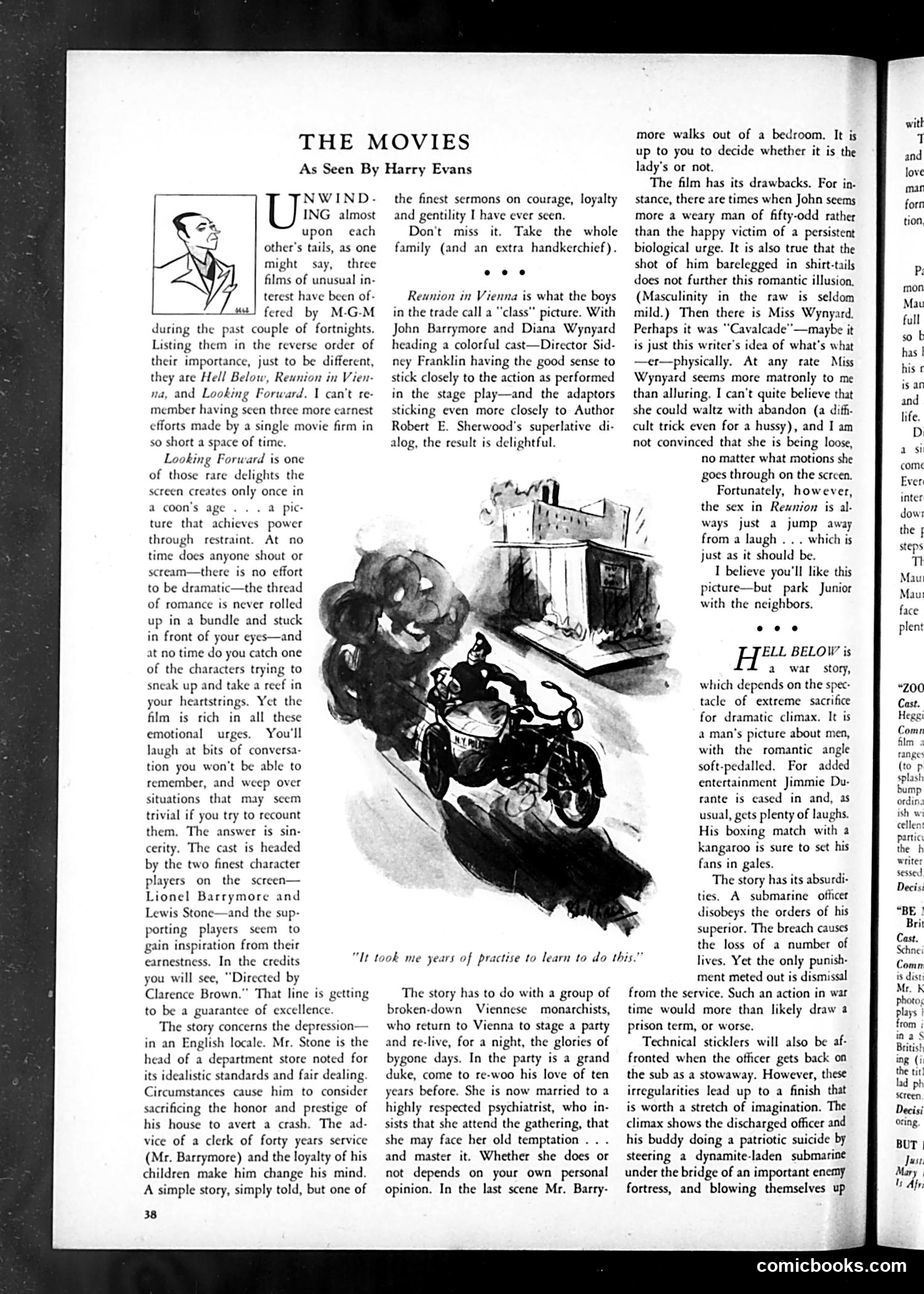
"The Movies As Seen By Harry Evans" This is a film review column covering three recent MGM releases. The visible illustration depicts a motorcycle stunt scene, likely from *Hell Below*, a naval action film mentioned in the text. Evans reviews three films in reverse importance order: *Looking Forward* (praised for restrained sincerity, starring Lionel Barrymore and Lewis Stone, dealing with Depression-era morality in a department store), *Reunion in Vienna* (a "class picture" adapted from Robert E. Sherwood's stage play, featuring John Barrymore in a story about Viennese aristocrats reliving past romance), and *Hell Below* (apparently an action film involving submarines and military sacrifice). The reviews emphasize character acting, fidelity to source material, and directorial competence (Clarence Brown receives particular praise). Evans's tone is sophisticated but accessible, addressing middle-class moviegoers. The column represents typical 1930s film criticism balancing entertainment value with artistic merit.
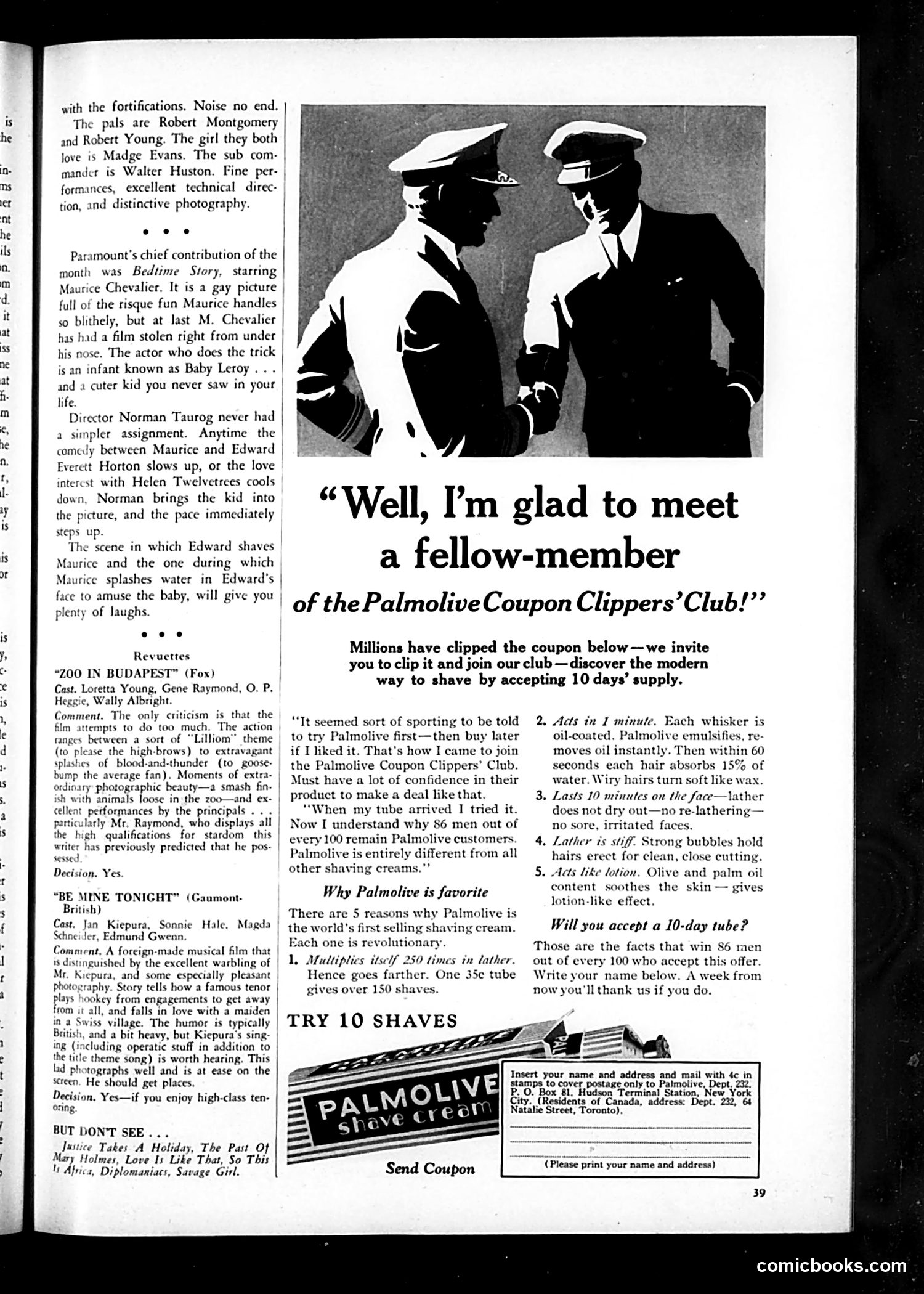
Content Analysis This page contains film reviews and a Palmolive shaving cream advertisement. The reviews discuss 1920s-30s Hollywood films, including *Bedtime Story* (starring Maurice Chevalier, with child actor "Baby Leroy" stealing scenes) and foreign productions like *Zoo in Budapest* and *Be Mine Tonight*. The main advertisement features two men in suits and caps having a conversation. The satire here targets consumer gullibility and marketing tactics: the phrase "Palmolive Coupon Clippers' Club" mocks people who clip coupons from advertisements, treating them as members of an exclusive club. The ad copy presents a manufactured "personal testimony" claiming Palmolive's superiority (multiplies lather 250 times, lasts longer, etc.), using the coupon offer as pseudo-evidence of manufacturer confidence. The joke exposes how advertising creates false community and artificial credibility through promotional gimmicks. For modern readers: this is vintage marketing psychology—creating belonging and trust through strategic offers.
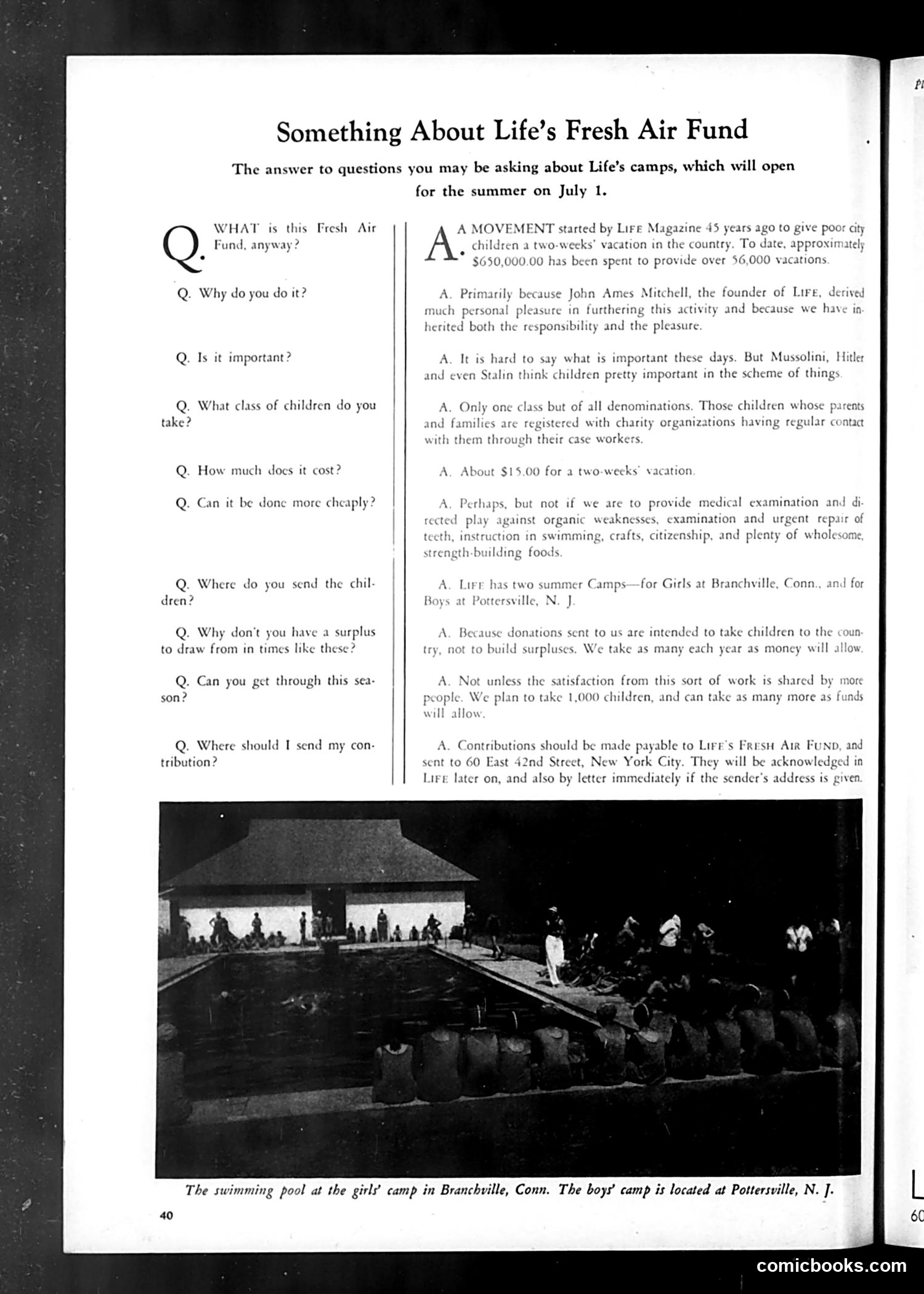
Life Magazine's Fresh Air Fund Q&A This page is not a cartoon but rather a charitable appeal. Life Magazine presents a Q&A format explaining their Fresh Air Fund—a program begun 45 years prior (around 1890s) to send poor city children on two-week country vacations. The notable satirical element appears in one answer: when asked "Is it important?" the response sarcastically notes that "Mussolini, Hitler and even Stalin think children pretty important"—a pointed 1930s-era jab suggesting that even totalitarian dictators recognize children's value, implicitly shaming wealthy Americans into supporting the charity. The fund took children from registered charity cases across denominations, charged $15 for two weeks, and operated camps in Connecticut and New Jersey. The accompanying photograph shows the girls' camp swimming pool.
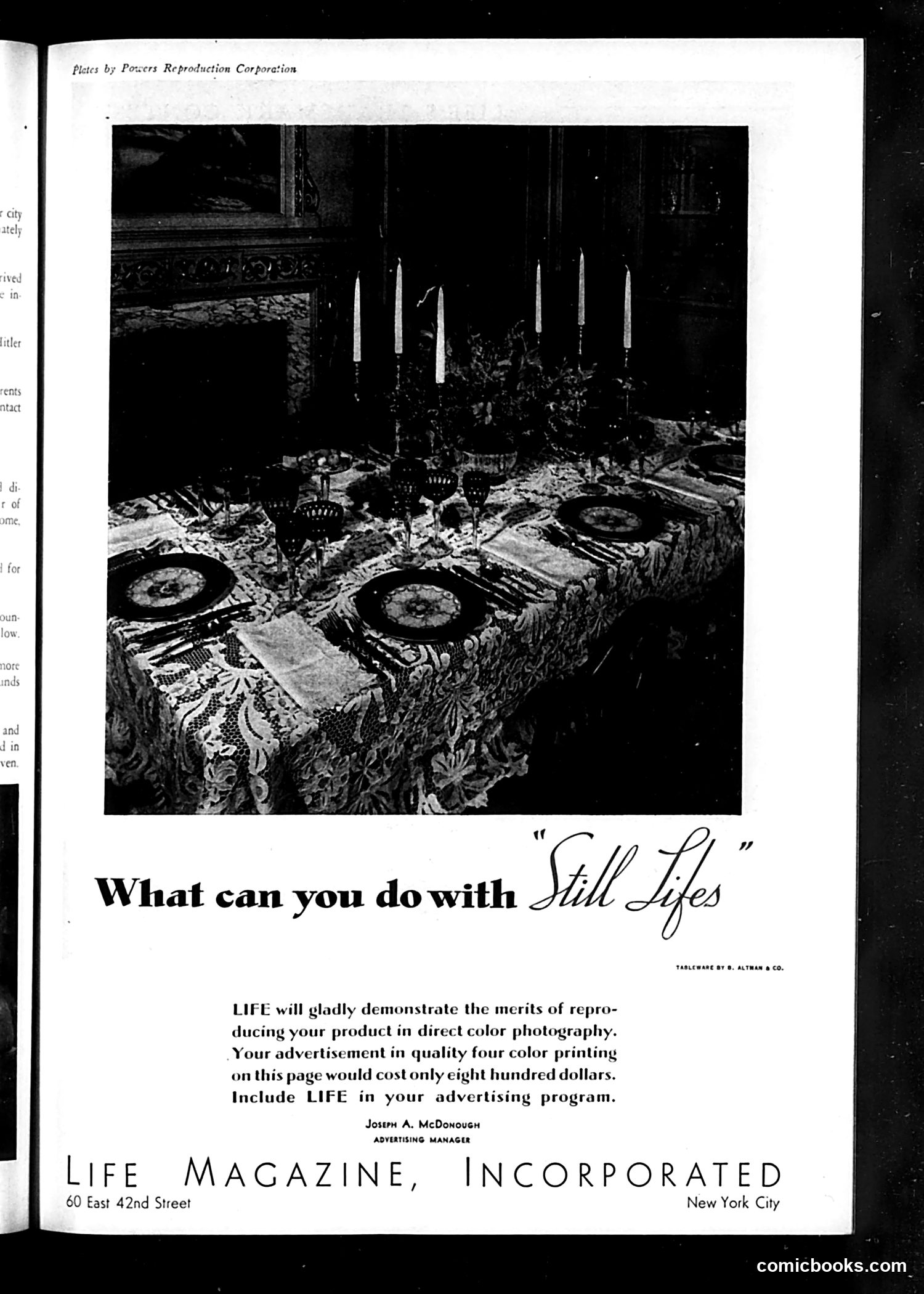
Analysis This is not a cartoon or satirical content, but rather an advertisement for Life Magazine itself. The page features a formal dining table setting with fine china, candelabras, and an ornate tablecloth. The headline "What can you do with 'Still Lifes'" is a play on words—literally about still-life photography of objects (the dinner table), while promoting Life's advertising capabilities. The text beneath is a sales pitch: Life magazine offers to demonstrate product reproduction through color photography. An advertisement on this page costs $800 and reaches Life's readership. The contact is Joseph A. McDonough, the advertising manager, soliciting businesses to advertise in the magazine. This is a direct marketing appeal to potential advertisers, not satire or commentary.
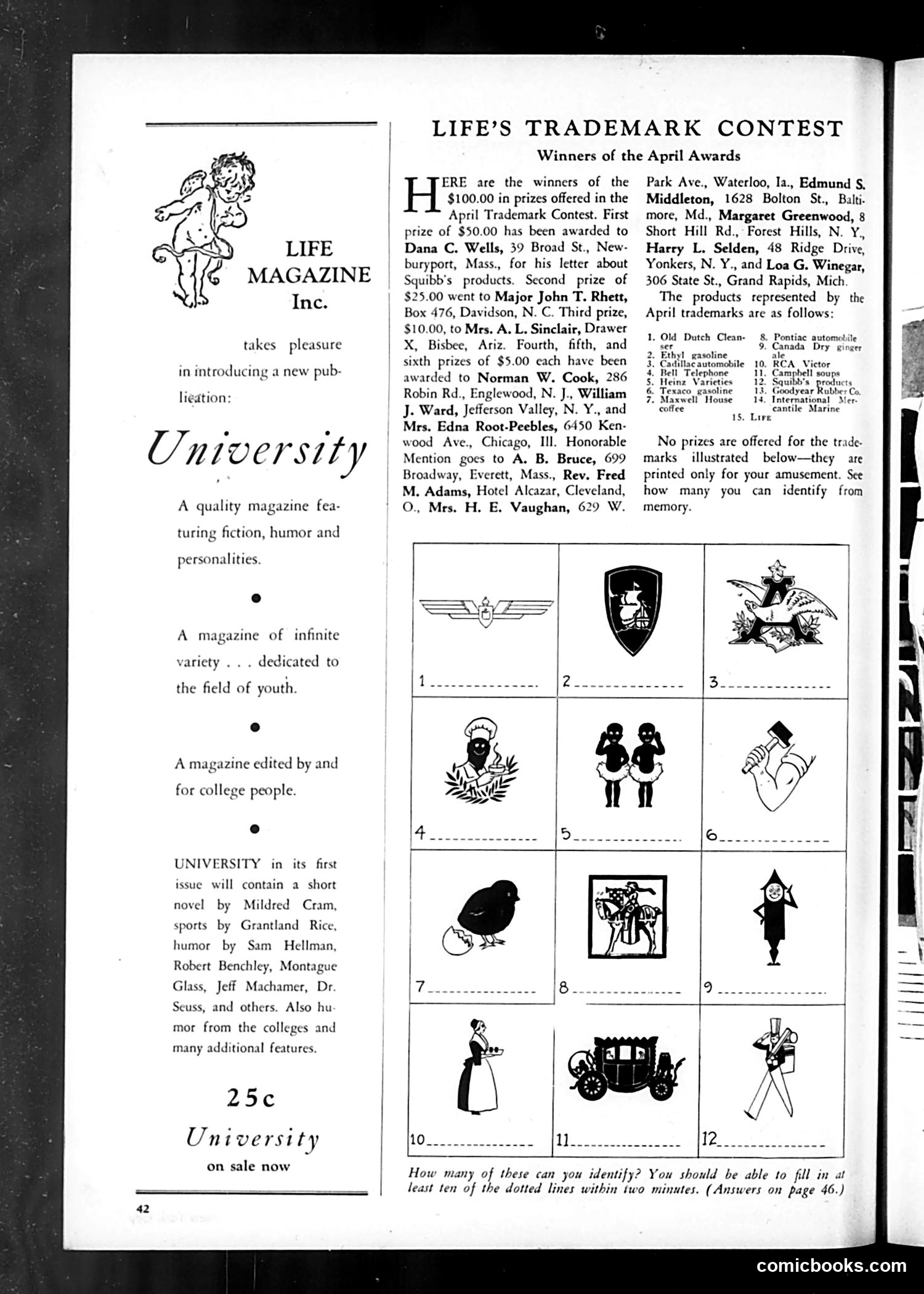
Life Magazine Trademark Contest (circa 1930s) This page announces Life Magazine's new publication, University, a college-oriented magazine featuring fiction and humor from notable writers like Dr. Seuss and Robert Benchley. The main content is a trademark identification contest. Life published 12 corporate logos/trademarks (numbered 1-12) and challenged readers to identify them from memory within two minutes. The text lists the actual products represented: Pontiac automobiles, Canada Dry ginger ale, RCA Victor, Squibb's products, Maxwell House coffee, Texaco, Heinz, Campbell Soup, Bell Telephone, and others. This was a popular advertising game of the era—testing consumer familiarity with brand symbols. The contest rewarded winners with cash prizes ($50 first prize) for successfully identifying these trademarked images, reflecting 1930s consumer culture and brand recognition marketing strategies.
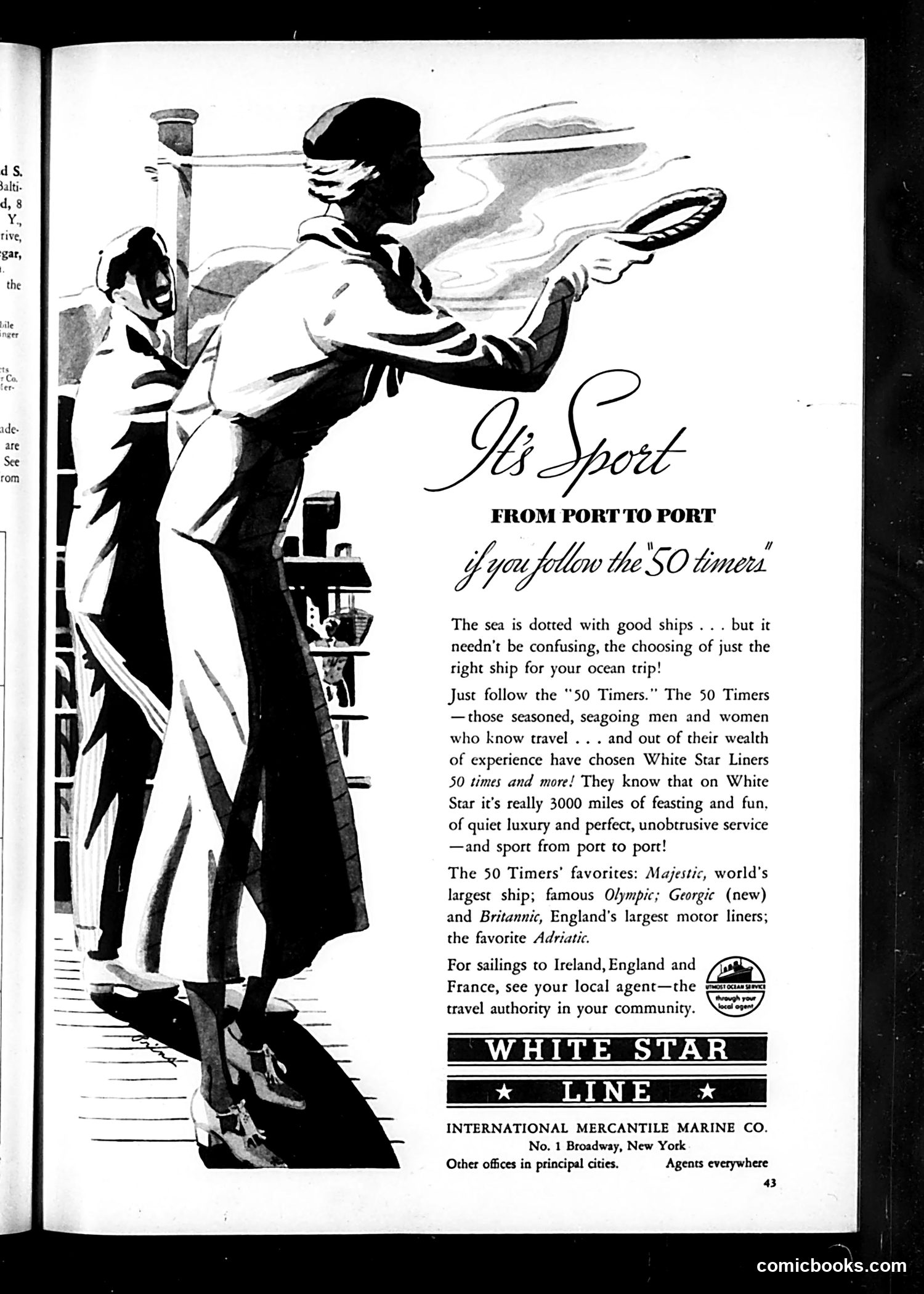
White Star Line Advertisement This is a full-page advertisement, not satire or political commentary. It promotes White Star Line ocean liners to affluent travelers. The illustration shows an elegant, well-dressed man boarding a ship, embodying the luxury travel experience being marketed. The ad's strategy references "50 Timers"—experienced, wealthy travelers who repeatedly choose White Star Liners—implying that following their example guarantees a quality voyage. The copy emphasizes "feasting and fun," "quiet luxury," and "perfect, unobtrusive service" across 3000 miles. Featured ships include the *Majestic* (world's largest), the famous *Olympic*, and the *Britannic*. The appeal is straightforward: if seasoned travelers select White Star repeatedly, you should too. This reflects pre-WWII advertising targeting the affluent ocean-liner market, when transatlantic travel represented the height of leisure travel prestige.
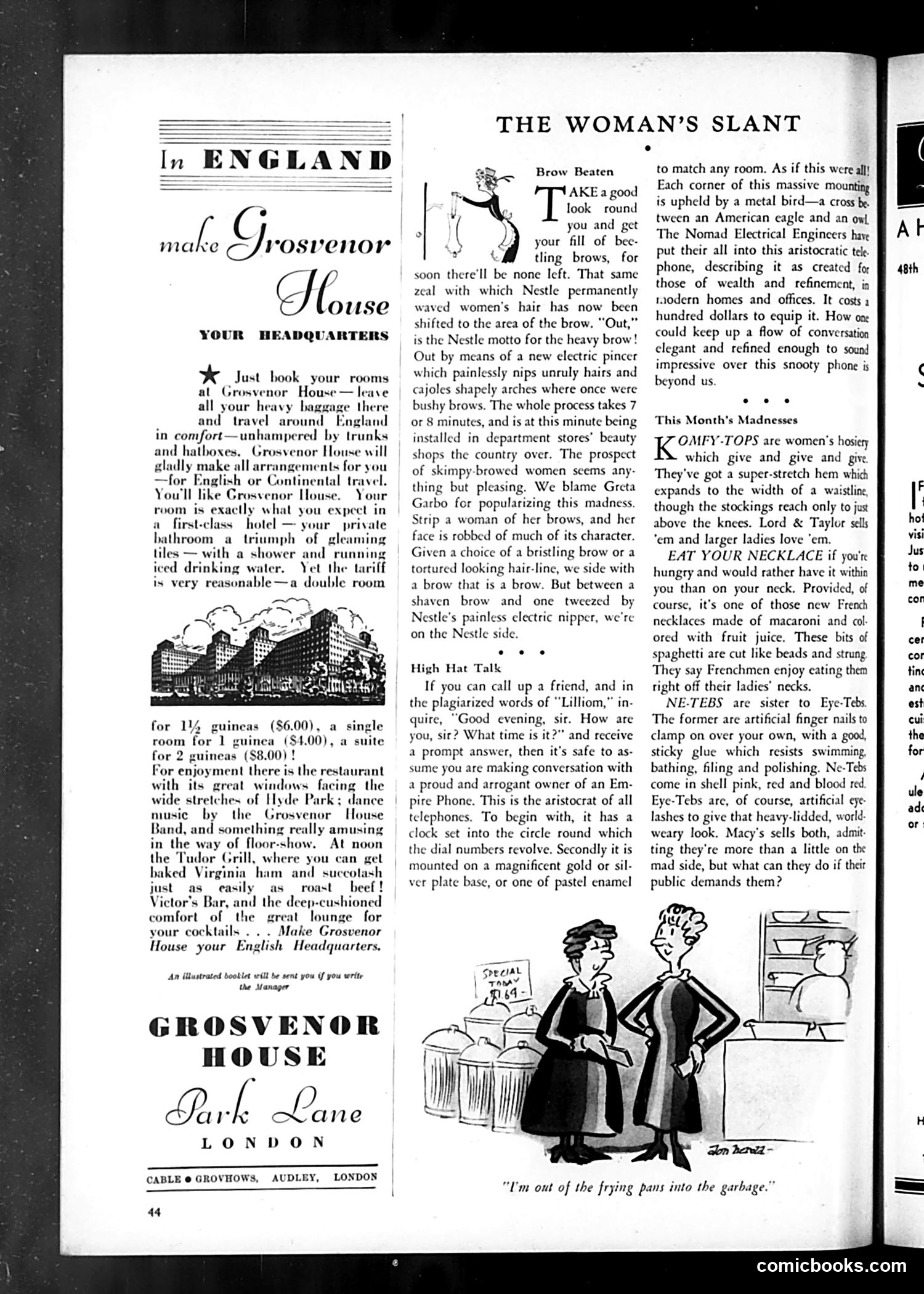
Analysis for Modern Readers This page contains fashion and lifestyle commentary from Life magazine's "The Woman's Slant" column, offering satirical observations on 1920s-30s beauty and consumer trends. "Brow Beaten" mocks the newly fashionable practice of removing eyebrows—a trend the author blames on actress Greta Garbo. The piece sarcastically notes that Nestle (famous for permanent waves) has now turned its hair-removal ambitions to eyebrows via electric pincers. The satire lies in the exaggeration: women are being stripped of facial character for fleeting fashion, and the author expresses relief that at least Nestle's method exists as a compromise between natural brows and plucked ones. "High Hat Talk" ridicules the Empire Phone—a luxury telephone ($100, enormous money then) with a built-in clock, ornate gold/silver base, and decorative metal bird corners. The satire is straightforward: such ostentatious design is absurd; maintaining sufficiently "elegant and refined" conversation to justify the expense is impossible. "Madnesses" briefly skewers stretchy stockings (Comfy-Tops) and edible necklaces—both impractical novelties marketed to women. The overall tone: affectionate mockery of consumerism and women's fashion excess.
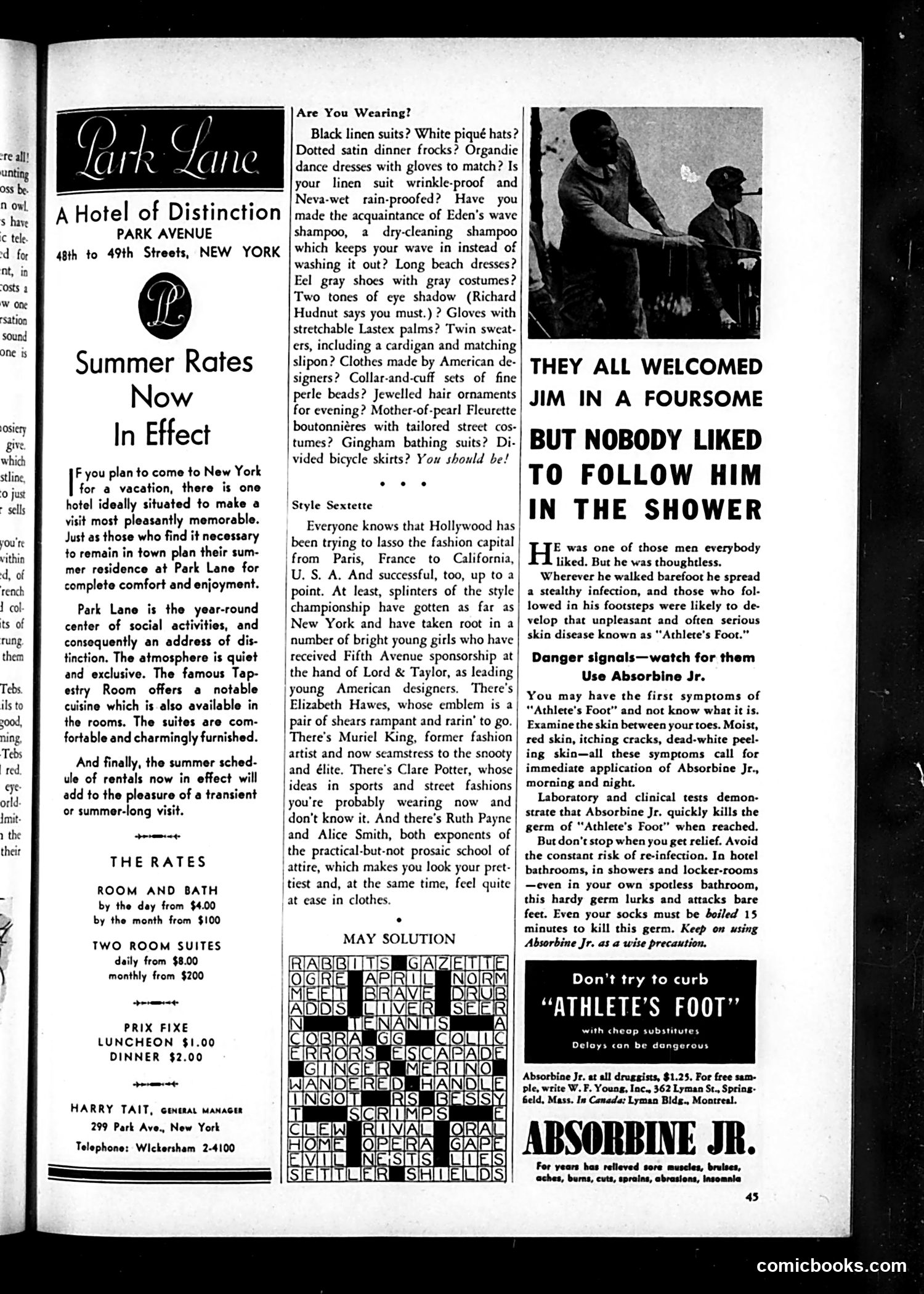
"Athlete's Foot" Advertisement Analysis This page is primarily advertising, with the main content being a cautionary advertisement for Absorbine Jr., a fungal treatment product. The accompanying narrative depicts "Jim," a well-liked man who unknowingly spreads a fungal infection (athlete's foot) in shared spaces like showers and locker rooms. The story warns readers about contagious skin disease transmission through barefoot contact, a genuine public health concern of the era. The advertisement exploits social anxiety—Jim is popular but poses an invisible hygiene threat to others. The "danger signals" section lists symptoms (redness, itching, peeling between toes) to encourage self-diagnosis and purchase. This reflects 1930s-40s consumer marketing strategies using shame and fear to sell pharmaceutical products, while also addressing legitimate concerns about fungal infections in communal bathing facilities common to the period. The implicit message: use this product to avoid becoming "Jim"—socially acceptable but physically unclean.
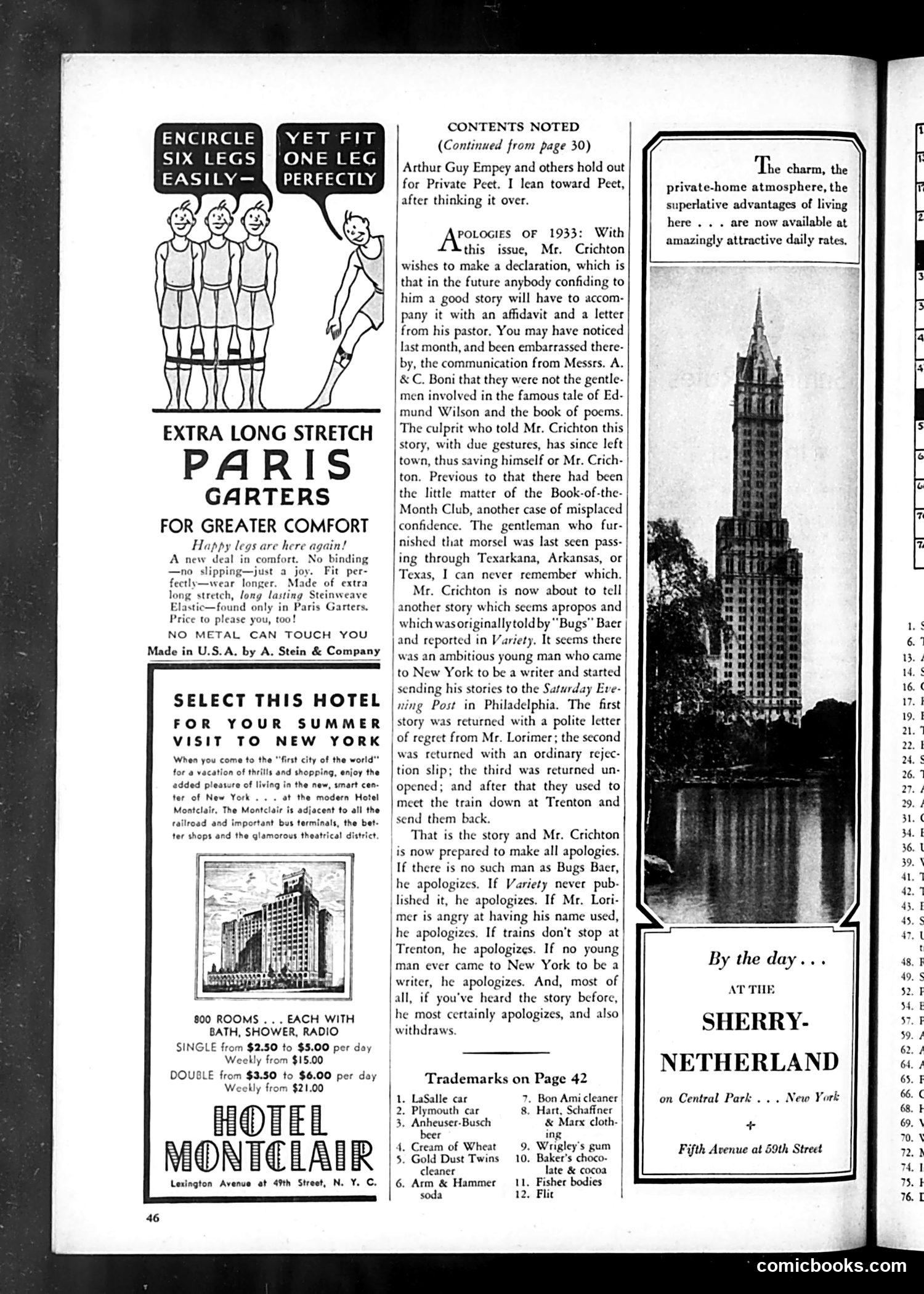
Analysis of Life Magazine Page Content This page is primarily advertising and editorial content rather than political satire. The main cartoon (top left) is a simple product advertisement for Paris Garters—elastic leg garters that stretch comfortably. It shows three women in 1930s-style clothing with one woman's leg extended impossibly long to demonstrate the garter's "extra long stretch" capability. The joke is visual and lighthearted: the exaggerated leg length illustrates the product's elasticity. The bulk of the page contains: - Hotel advertisements (Montclair, Sherry-Netherland) - An editorial piece titled "Apologies of 1933" by Mr. Crichton, humorously explaining he'll now require affidavits for stories people tell him, after being embarrassed by false anecdotes (involving Edmund Wilson and the Book-of-the-Month Club) - A self-deprecating joke about an unsuccessful writer submitting repeatedly to *Saturday Evening Post* The content reflects 1930s commercial culture and editorial humor rather than political commentary.
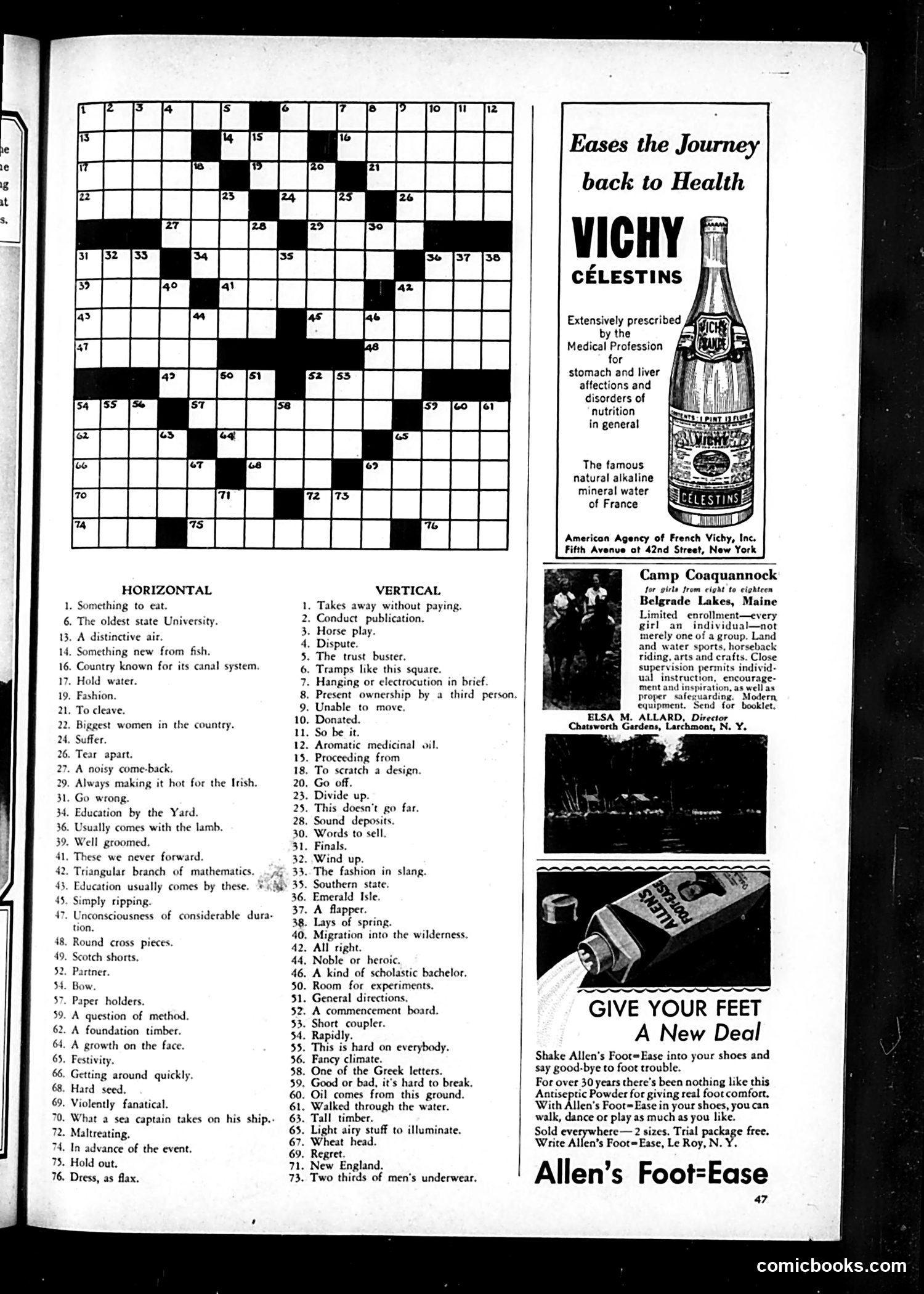
Page Analysis: Life Magazine Crossword and Advertisements This page is primarily a crossword puzzle with accompanying advertisements—not a political cartoon. The crossword clues are wordplay-heavy and reflect 1920s-1930s American culture and slang. Notable clue references include: - "29. Always making it hot for the Irish" — reflects contemporary anti-Irish sentiment - "34. Education by the Yard" — likely references yard-stick measurement or physical punishment - "69. Violently fanatical" — generic wordplay The advertisements promote health products typical of the era: Vichy mineral water (marketed for digestive ailments), a girls' summer camp, and Allen's Foot-Ease powder. These ads reflect period anxieties about health and wellness. The page contains no political satire or caricature—it's straightforward commercial content and entertainment. The Irish reference is the only element reflecting period prejudices noteworthy to modern readers.
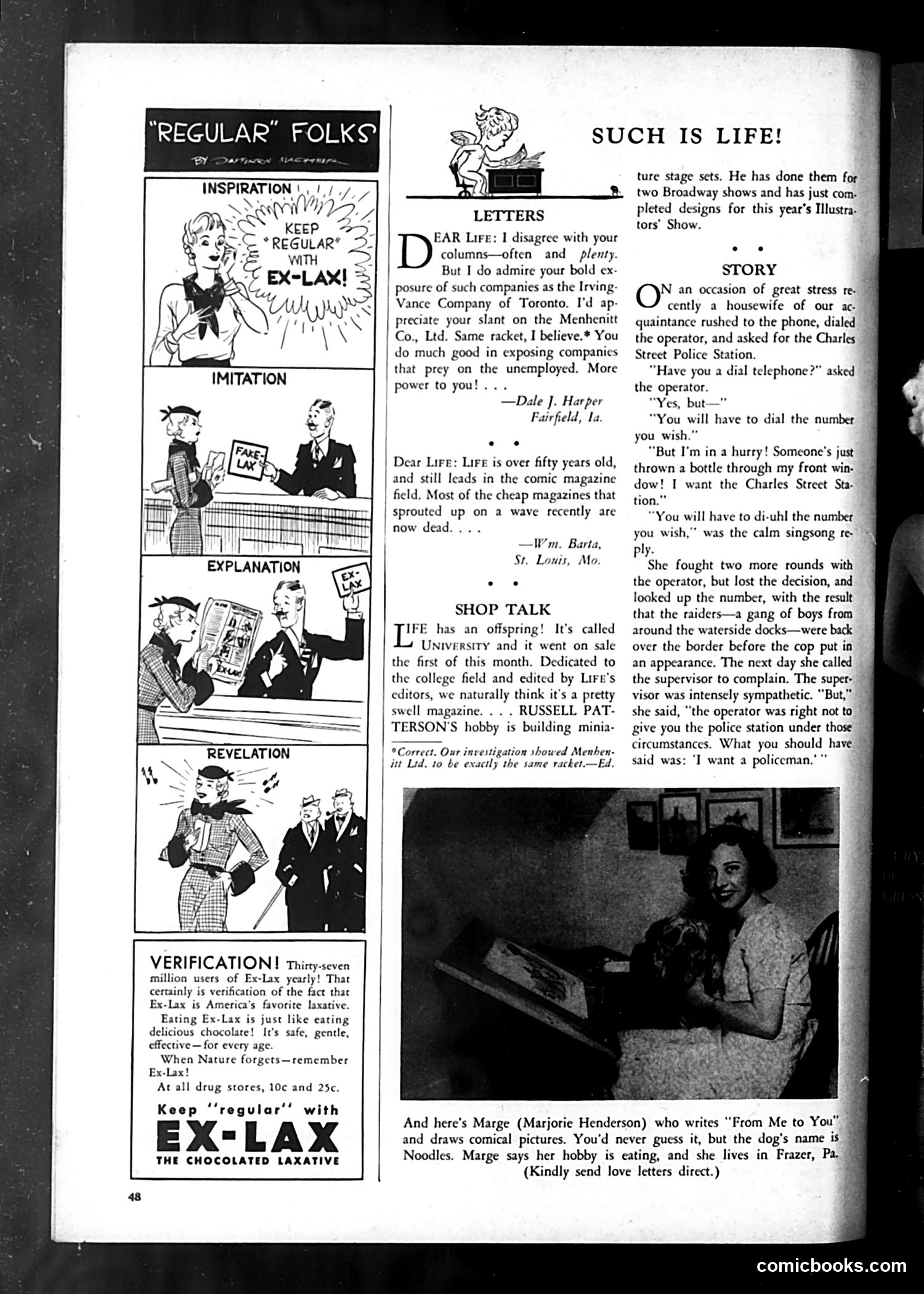
Analysis of Life Magazine Page This page mixes advertising, reader letters, and humorous anecdotes typical of Life's format. Left side: An Ex-Lax laxative ad uses a four-panel comic strip format mocking magazine imitation—showing someone copying a magazine's style and getting caught. The "verification" section boasts 37 million yearly users, a common advertising tactic of the era. Center: Reader letters praise Life's investigative journalism exposing fraudulent companies exploiting the unemployed, and celebrate Life's longevity in comics publishing against newer competitors. Right side: A humorous story satirizes bureaucratic inflexibility during a home invasion—an operator insists a frantic housewife dial the number herself rather than connect directly to police, following regulations while criminals escape. The joke critiques rigid rule-following that defeats the system's purpose. The page also features Marjorie Henderson, a Life contributor who writes/illustrates humor pieces; the casual mention of her hobby and pet reflects the magazine's personable, gossipy tone about its staff.