life
Life — July 1933
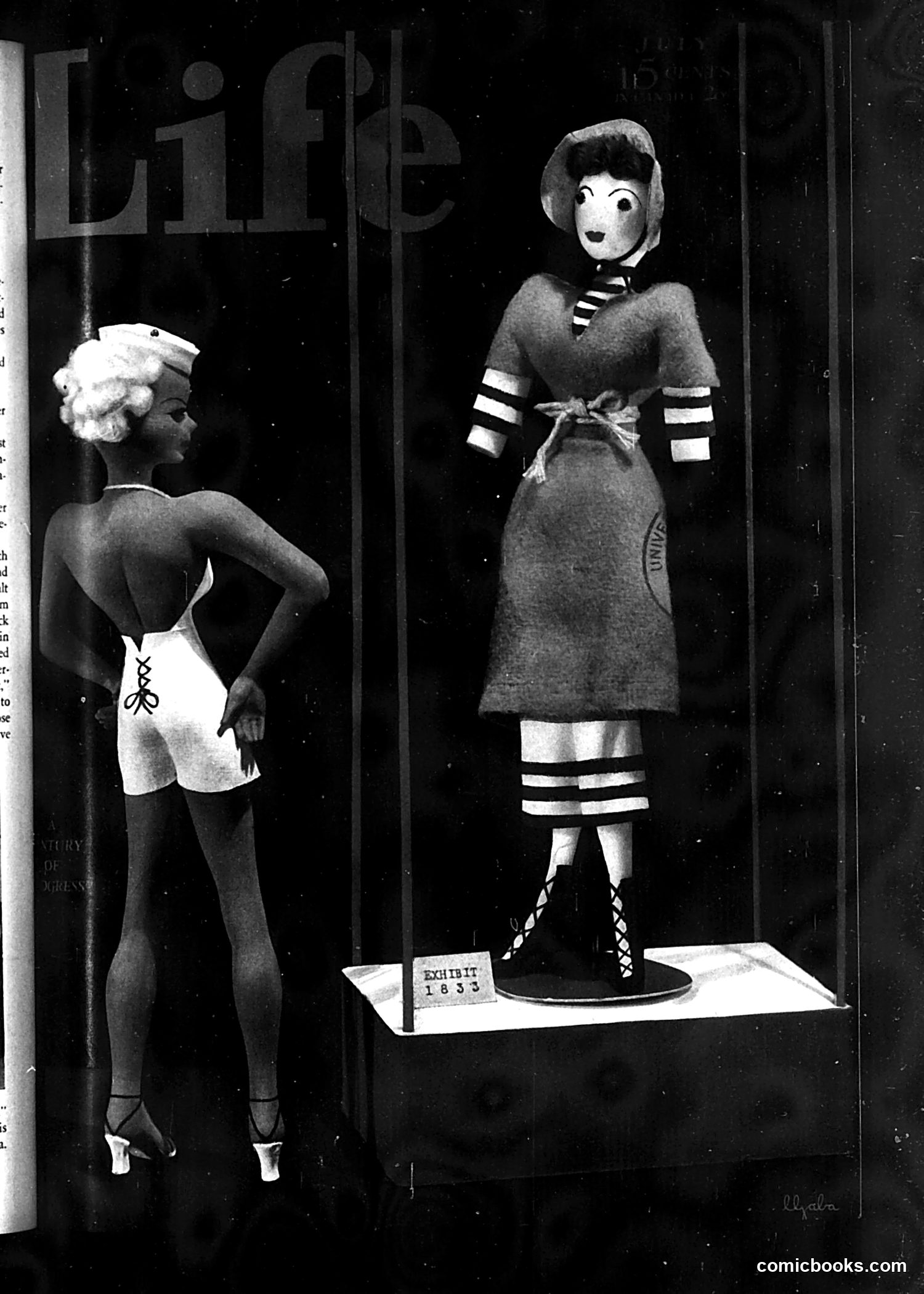
Analysis This appears to be a Life magazine fashion or lifestyle piece featuring two mannequins or figures in 1930s-style clothing. The left figure wears minimal undergarments (corset and shorts), while the right wears a complete dress ensemble with striped details, hat, and lace-up shoes. The "EXHIBIT 1833" label suggests this is displaying fashion evolution or contrasting styles. The satirical point likely critiques changing fashion standards or women's dress codes—possibly commenting on the contrast between undergarments/intimate wear versus modest public clothing. The Life magazine context suggests social commentary on women's fashion norms of the era, though without additional visible text, the specific satirical target remains unclear. The deliberate display format emphasizes the contrast being made.
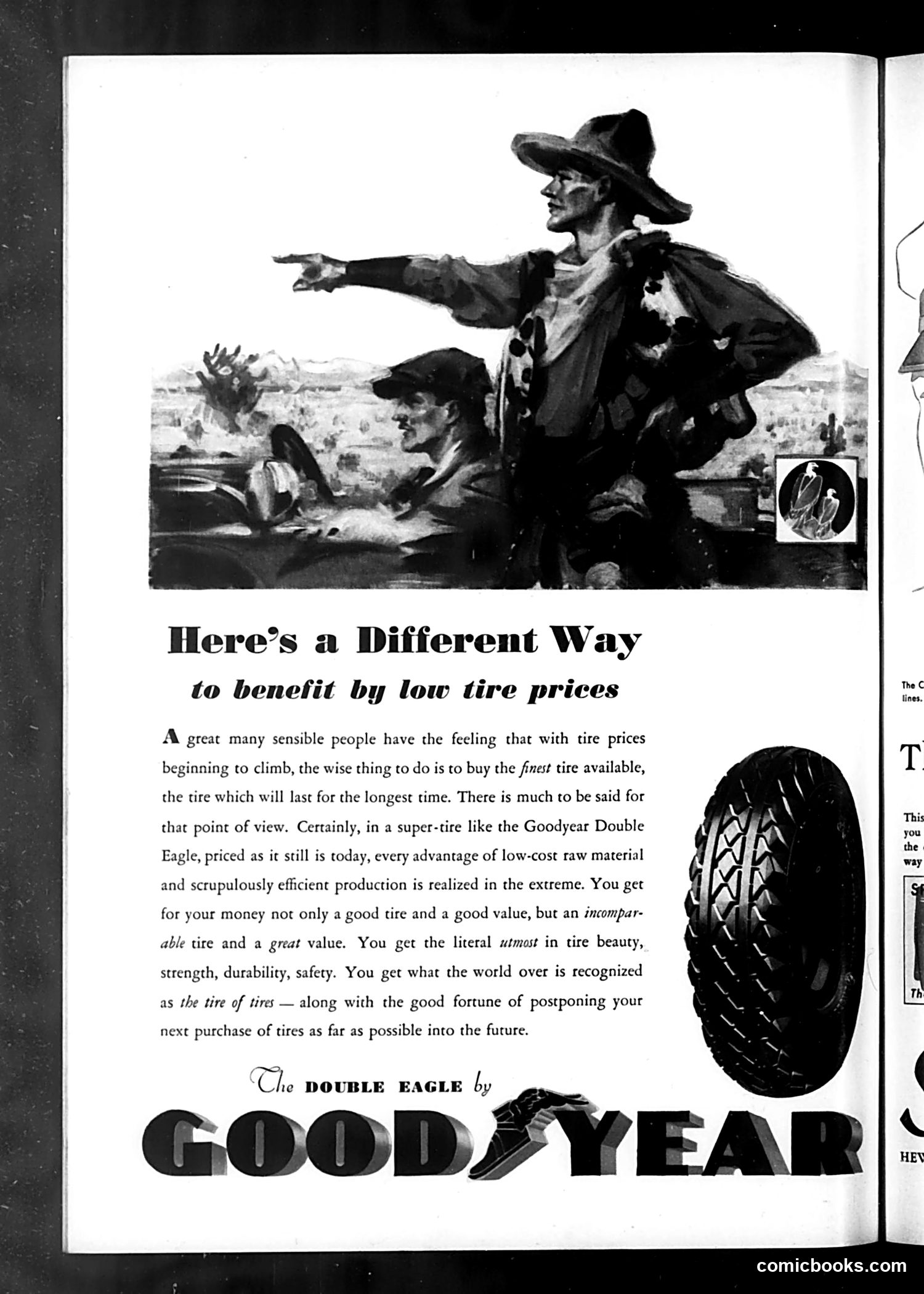
Analysis This is a Goodyear tire advertisement, not a political cartoon. The image shows two men in a desert landscape—one standing and pointing, wearing a cowboy hat and weathered coat, the other seated. The standing figure appears to be a archetypal "prospector" or desert traveler character. The ad argues that buying premium Goodyear Double Eagle tires at rising prices is worthwhile because they last longer, offering better long-term value than cheaper alternatives. The Western/prospector imagery suggests durability and reliability suitable for rough conditions. The text emphasizes getting "the finest tire available" and postponing future tire purchases, framing quality as economically sensible despite higher upfront costs. This is straightforward product marketing using frontier imagery for authority and durability.
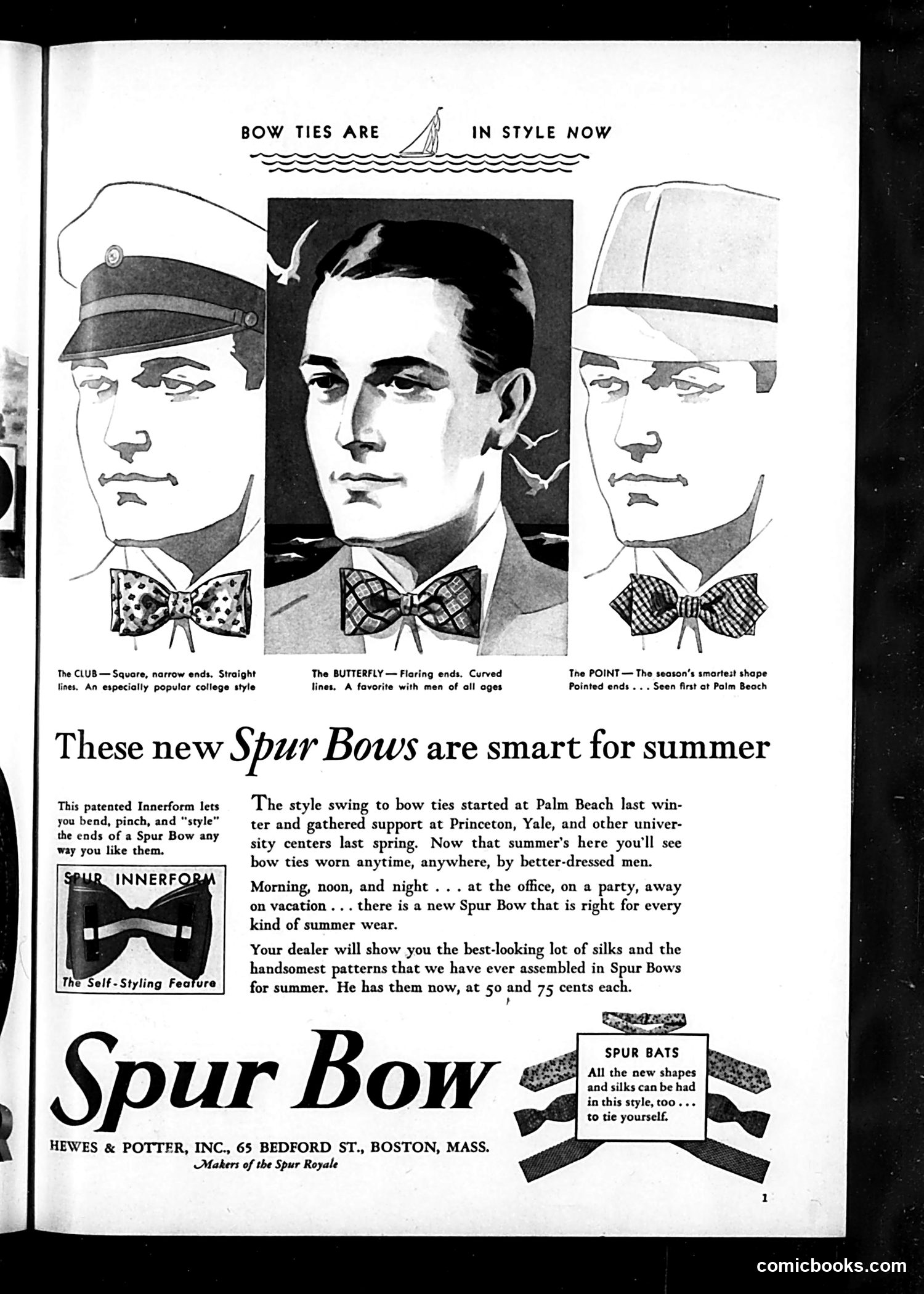
Analysis This is primarily advertising content, not political satire. The page promotes "Spur Bow" neckties manufactured by Hewes & Potter, Inc. of Boston. The advertisement showcases three bow tie styles ("The Club," "The Butterfly," and "The Point") worn by illustrated male figures in nautical/summer attire. The marketing copy references a fashion trend that "started at Palm Beach last winter and gathered support at Princeton, Yale, and other university centers last spring." The "Spur Bow" features a patented "Innerform" self-styling mechanism allowing wearers to customize the tie's shape. Priced at 50-75 cents, these ties target well-dressed summer men across various social occasions. The content reflects 1920s-era menswear marketing and collegiate fashion influence, with no political commentary evident.
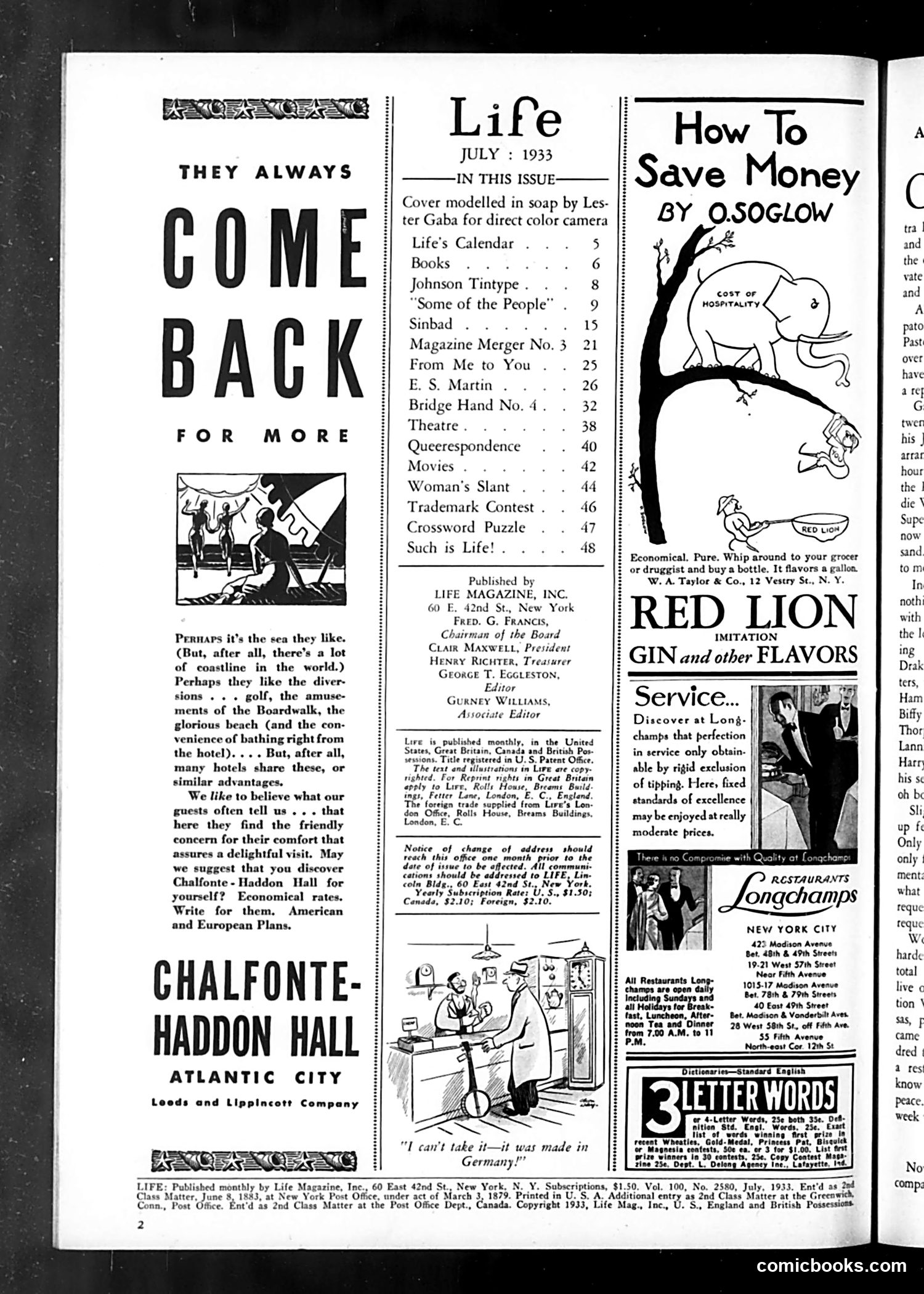
This is primarily a table of contents and advertising page from Life Magazine's July 1933 issue, not a political cartoon page. The main content includes: - A Chalfonte-Haddon Hall hotel advertisement (Atlantic City) with a small cartoon showing guests enjoying leisure activities, captioned "I can't take it—it was made in Germany," likely a Depression-era joke about avoiding German-made goods during economic hardship. - A "How to Save Money" article illustrated with an elephant hanging from a tree branch—a visual pun on economizing. - Various advertisements (Red Lion Gin, Longchamps Restaurants, Letter Words game). The magazine's contents reveal typical 1933 concerns: theater, movies, puzzles, and lifestyle features. The German goods reference suggests ongoing trade tensions during the early 1930s.
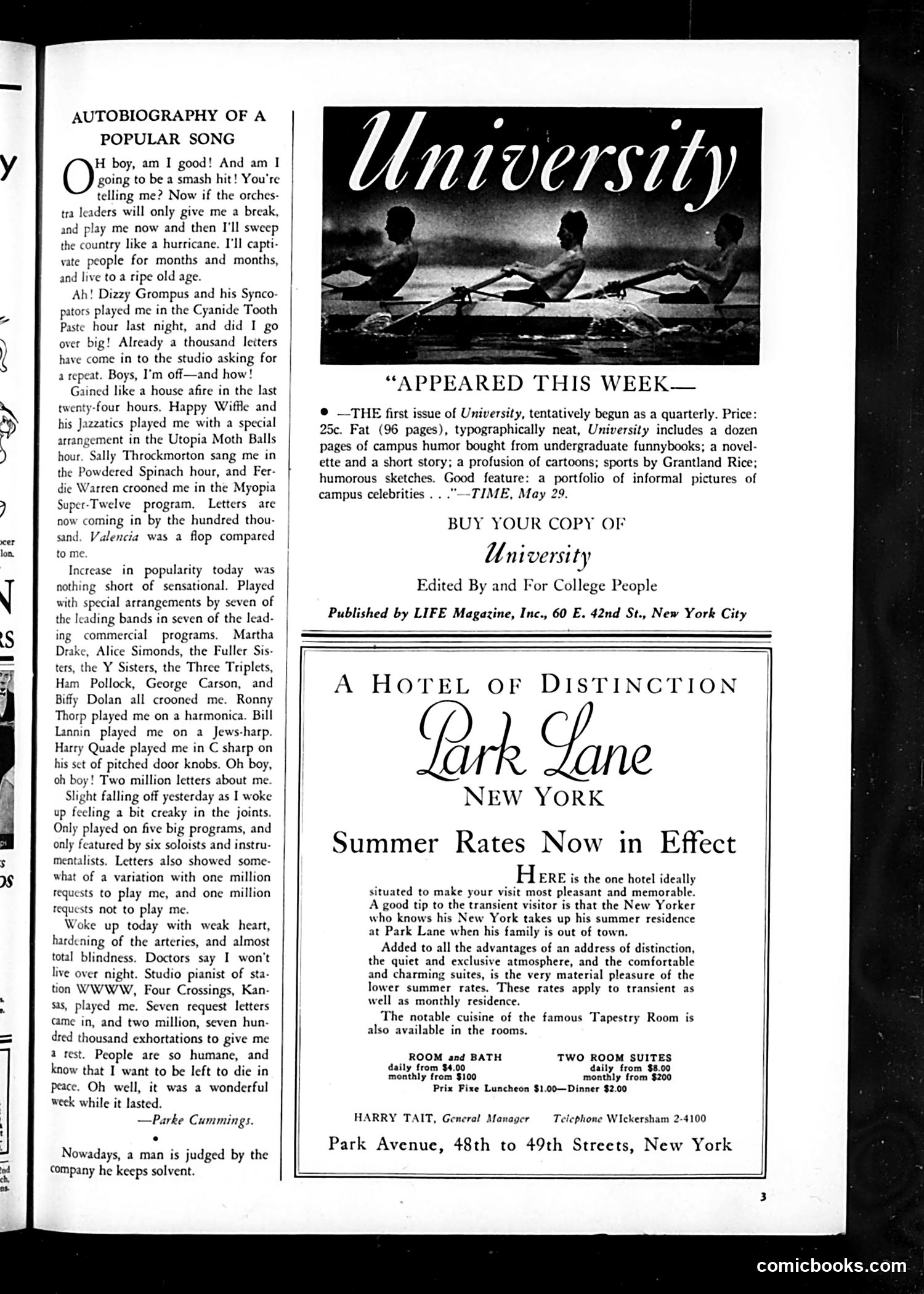
Analysis This page is primarily advertising and editorial content, not political satire. The left column contains "Autobiography of a Popular Song" by Parker Cummings, a humorous first-person narrative where a song describes its journey to success—being played by orchestras, featured by famous bands (Dizzy Groucho's Syncopators, Ferdie Warren), and gaining enormous popularity through radio and requests. The right side advertises the magazine *University* (a college humor publication) and the Park Lane Hotel in New York. The satire is light and self-deprecating: the song personifies itself as vain and boastful about its sudden fame, while also noting audience fatigue with overplaying. This gently mocks both the music industry's hype cycle and popular songs' brief shelf-lives during the jazz era.
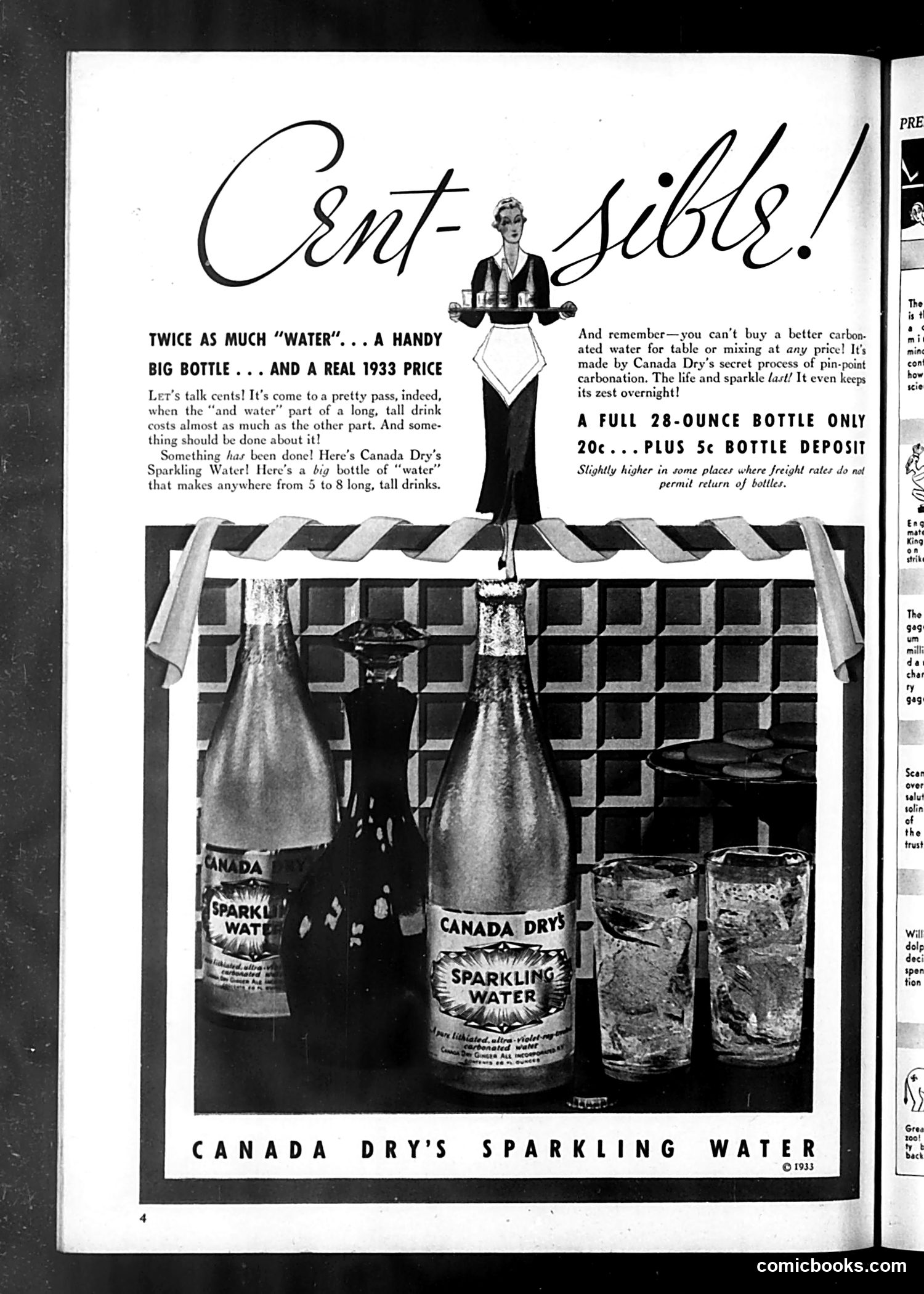
Canada Dry's Sparkling Water Advertisement (1933) This is a product advertisement, not political satire. It promotes Canada Dry's sparkling water during Prohibition's final year (note the copyright 1933 date). The ad's humor targets the "water" problem: during Prohibition, sparkling water was marketed as a mixer for illegal alcohol. The headline "Cent Sibs!" (likely "Cent Jibs" or similar) plays on this absurdity. The key sales pitch emphasizes the product's *volume*—"twice as much water" in a "big bottle" at 1933 prices (20 cents plus 5-cent deposit). The copy stresses carbonation quality, relevant since Prohibition would end in December 1933, making legal beverage preparation suddenly important. The stylized woman and product imagery represent typical 1930s advertising design.
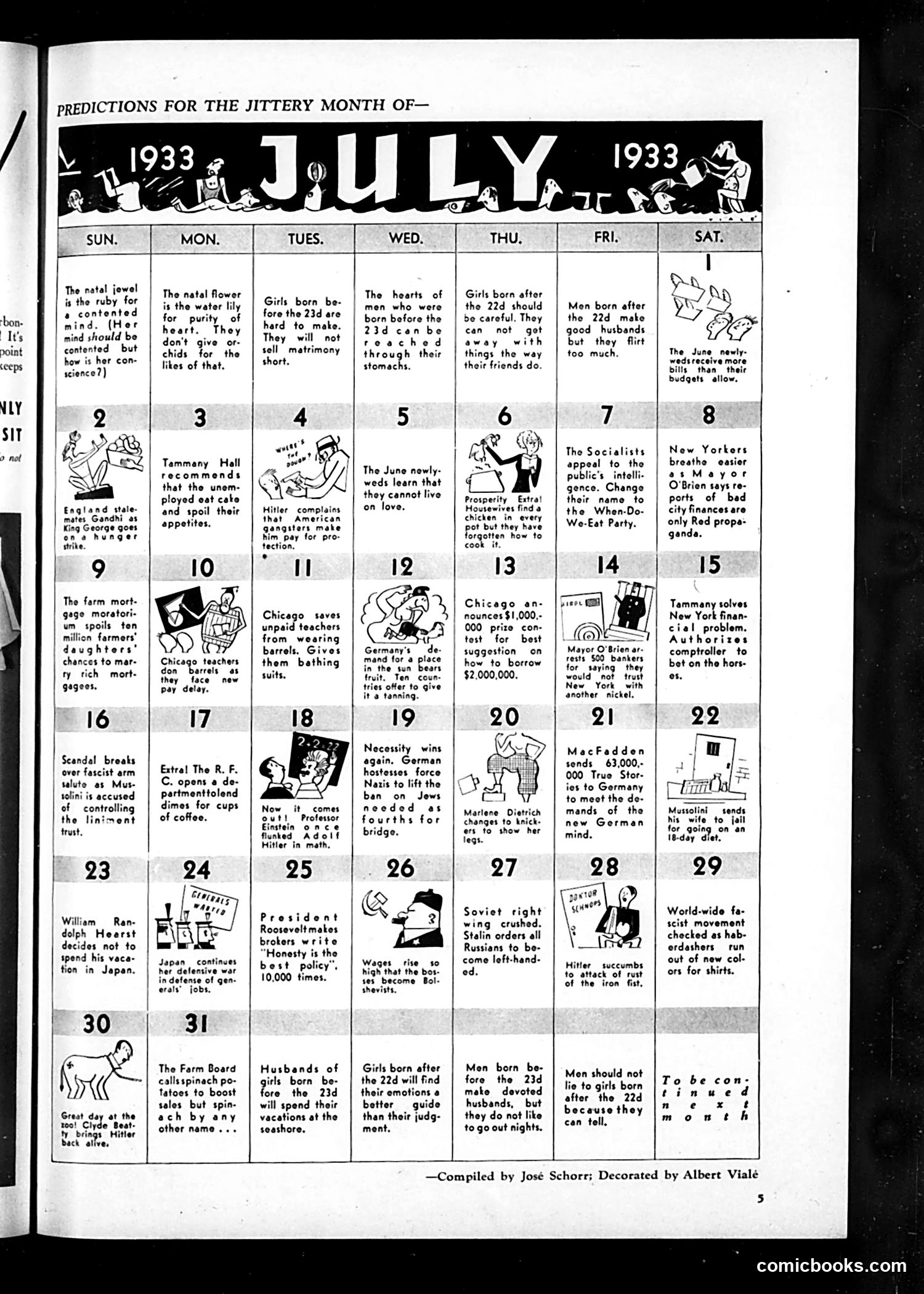
This is a satirical calendar for July 1933 titled "Predictions for the Jittery Month." Each day contains a humorous prediction mixing personal advice with contemporary political and social commentary. The cartoons reference 1933 events and figures: Hitler appears multiple times (entries on the 12th, 26th, and 29th), reflecting his recent rise to power and Nazi policies. Entry 20 mentions "Necessity wins again. German hostesses force Nazis to lift the ban on Jewish guests for the fourth's for bridge"—satirizing Nazi racial policies. Entry 27 shows Stalin ordering Russians to become left-handed, mocking Soviet authoritarianism. Entry 21 references MacFadden (likely publisher Bernarr MacFadden) and German matters. The page uses dark humor to comment on contemporary dictators and their absurd policies while maintaining casual, jokey predictions about daily life.
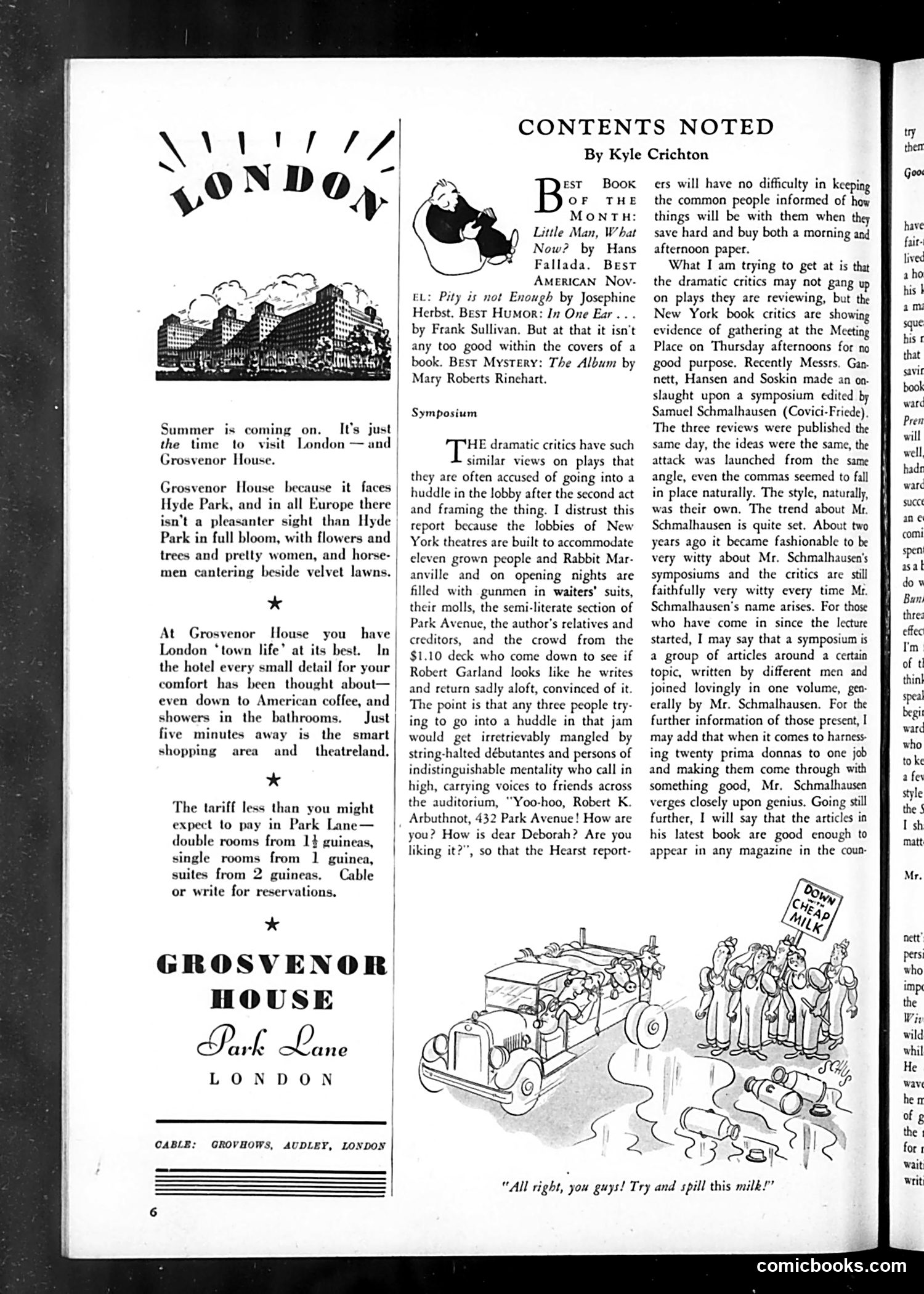
Analysis of Life Magazine Page This page mixes advertising with book reviews by Kyle Crichton. The main cartoon depicts a milk delivery truck surrounded by children holding a sign reading "DOWN WITH CHEAP MILK," with the caption "All right, you guys! Try and spill this milk!" The satire appears to target consumer activism or price protests, likely referencing 1930s dairy industry labor disputes or price-fixing concerns. The children's protest sign suggests organized opposition to milk pricing, while the driver's defiant response mocks such efforts—implying the powerful industry will proceed regardless of public complaint. The left page advertises Grosvenor House hotel in London, noting its luxury amenities and competitive pricing. The reviews discuss contemporary books and note theatrical critics' behavior at new play openings.
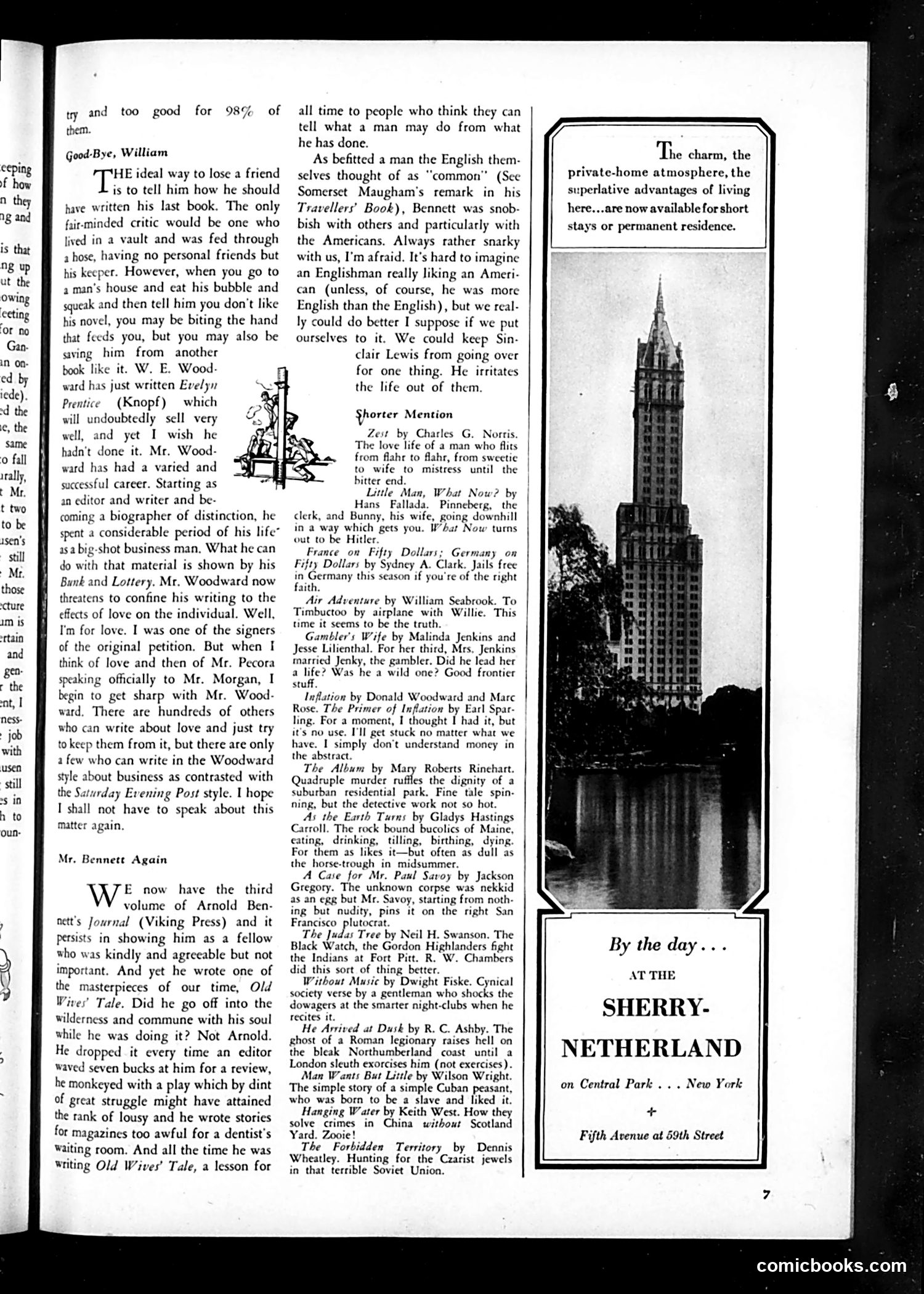
This page is primarily literary criticism and book reviews, not political satire. The main content discusses Arnold Bennett's *Journal* and other contemporary novels. There is one small illustration labeled "Prentice (Knopf)" showing a figure at a desk or drawing board, appearing to satirize the publisher or author, but the cartoon is minimal and the accompanying text (discussing a writer's varied career) doesn't provide clear political or social commentary—it seems a light jab at literary or publishing figures of the era. The right side features an advertisement for the Sherry-Netherland hotel in New York with a photograph of the building. The page is primarily a book review section, not a venue for political cartoons.
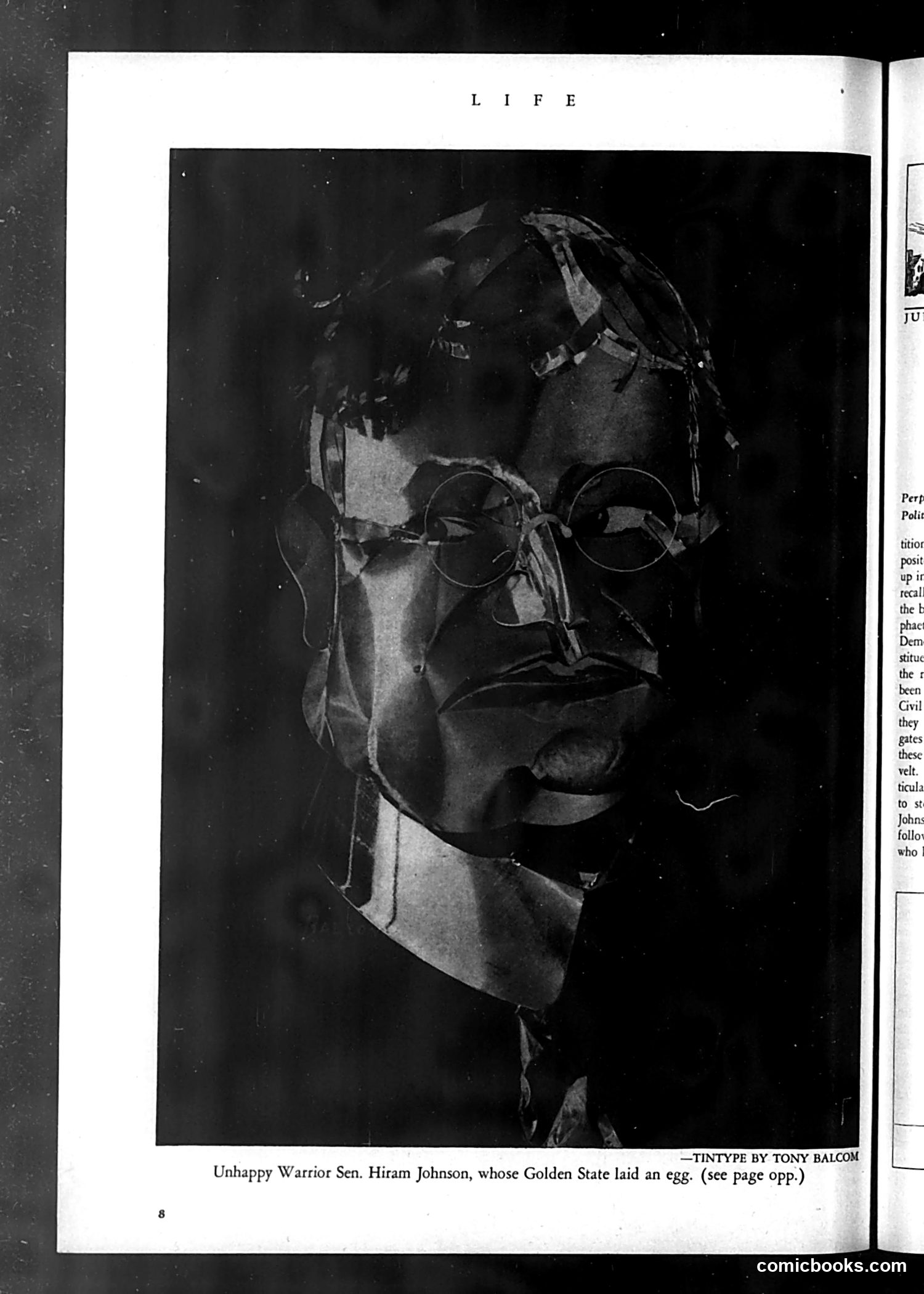
Analysis This page features a political cartoon photograph titled "Unhappy Warrior Sen. Hiram Johnson, whose Golden State laid an egg" (credited to tintype by Tony Balcom). The image shows Senator Hiram Johnson wearing round glasses and what appears to be aviator or protective headgear, photographed in dramatic lighting against a dark background. The caption's phrase "Golden State laid an egg" is a contemporary idiom meaning California failed or disappointed. The "Unhappy Warrior" reference likely alludes to Johnson's political struggles or disappointment. The satirical point appears to criticize Johnson's political position or a failed initiative he championed in California. Without additional context, the specific event being mocked remains unclear, though the visual presentation emphasizes Johnson's apparent frustration or defeat.
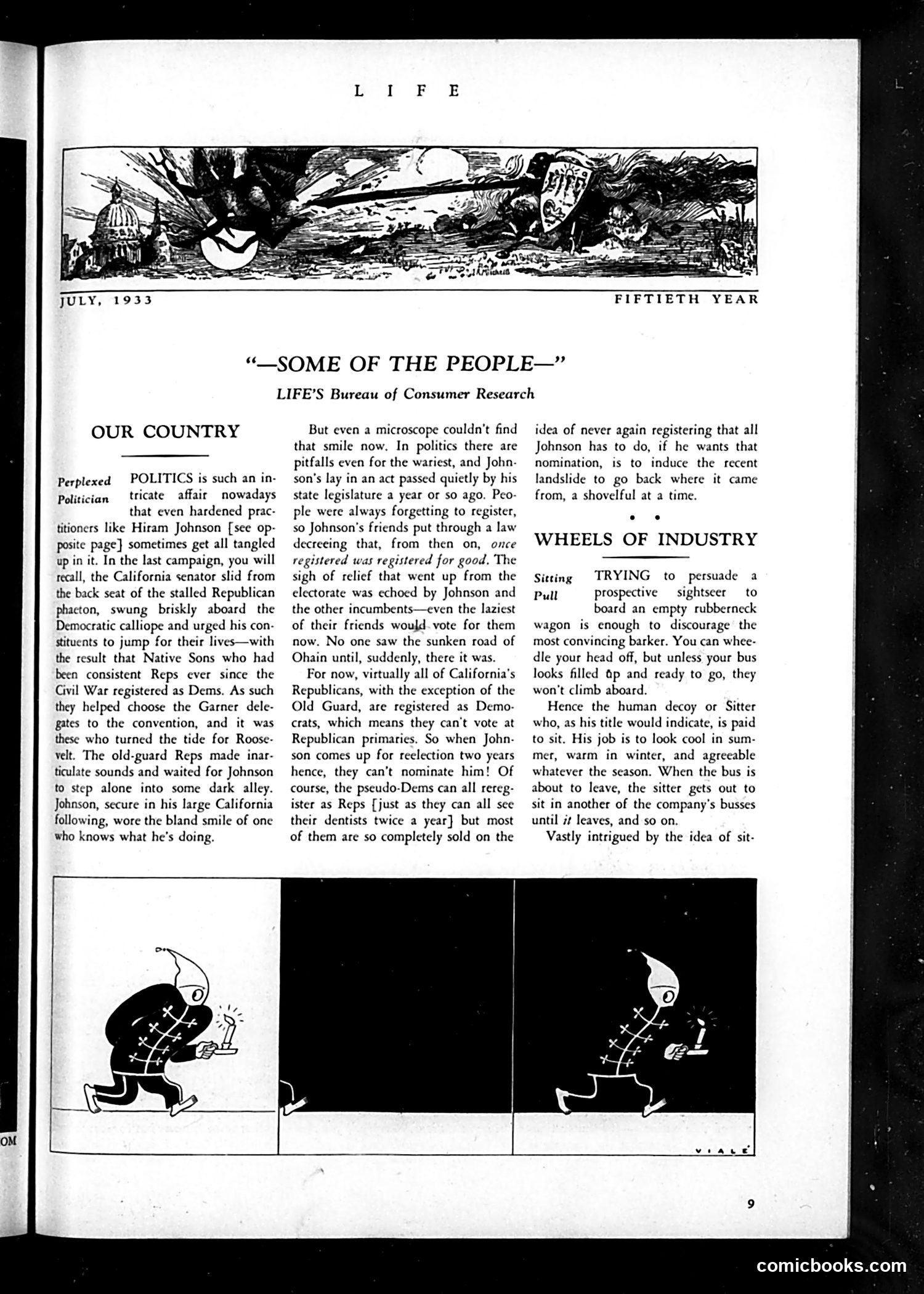
Political Commentary from Life, July 1933 This page contains two sections: "Our Country" column discusses California politics, specifically criticizing Senator Hiram Johnson's inconsistent Republican affiliation. The text notes that Johnson—once a progressive Republican—has become difficult to pin down politically, comparing him to a manipulative figure who keeps California politicians "tangled up." The piece sarcastically suggests Johnson's supporters will vote for him regardless. "Wheels of Industry" section satirizes a sideshow attraction: a human performer hired to sit motionless in a bus window during summer heat, deliberately looking uncomfortable to attract paying sightseers. The joke ridicules both the exploitation and the public's fascination with mundane spectacles. The three-panel cartoon (bottom) appears to illustrate the bus-sitter concept, though reproduction quality obscures details.
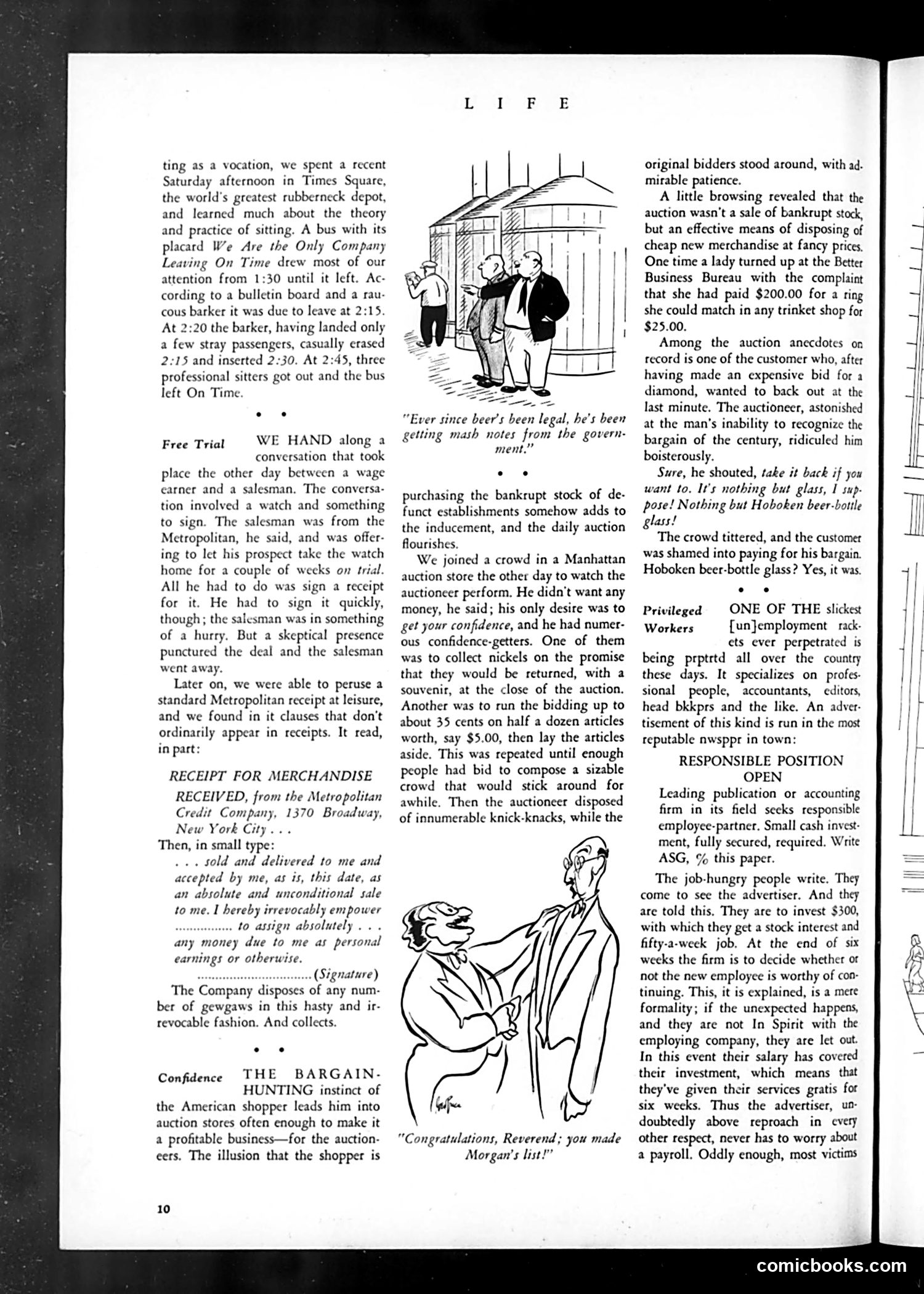
"Ever since beer's been legal, he's been getting made hotel from the government" This cartoon satirizes the post-Prohibition era (likely 1930s), when alcohol became legal again in America. The caption suggests that breweries have begun exploiting government auctions of defunct businesses—purchasing bankrupt hotel stock cheaply and converting them into beer distribution operations or bars. The joke targets both corporate opportunism and government inefficiency: breweries are profiting from public asset sales while the government appears unable to manage these transactions effectively. The figures appear to be auctioneers and businessmen, with the cartoon implying that the beer industry has weaponized legal auctions for rapid expansion. The overall tone criticizes how businesses manipulate post-Prohibition opportunities at public expense.
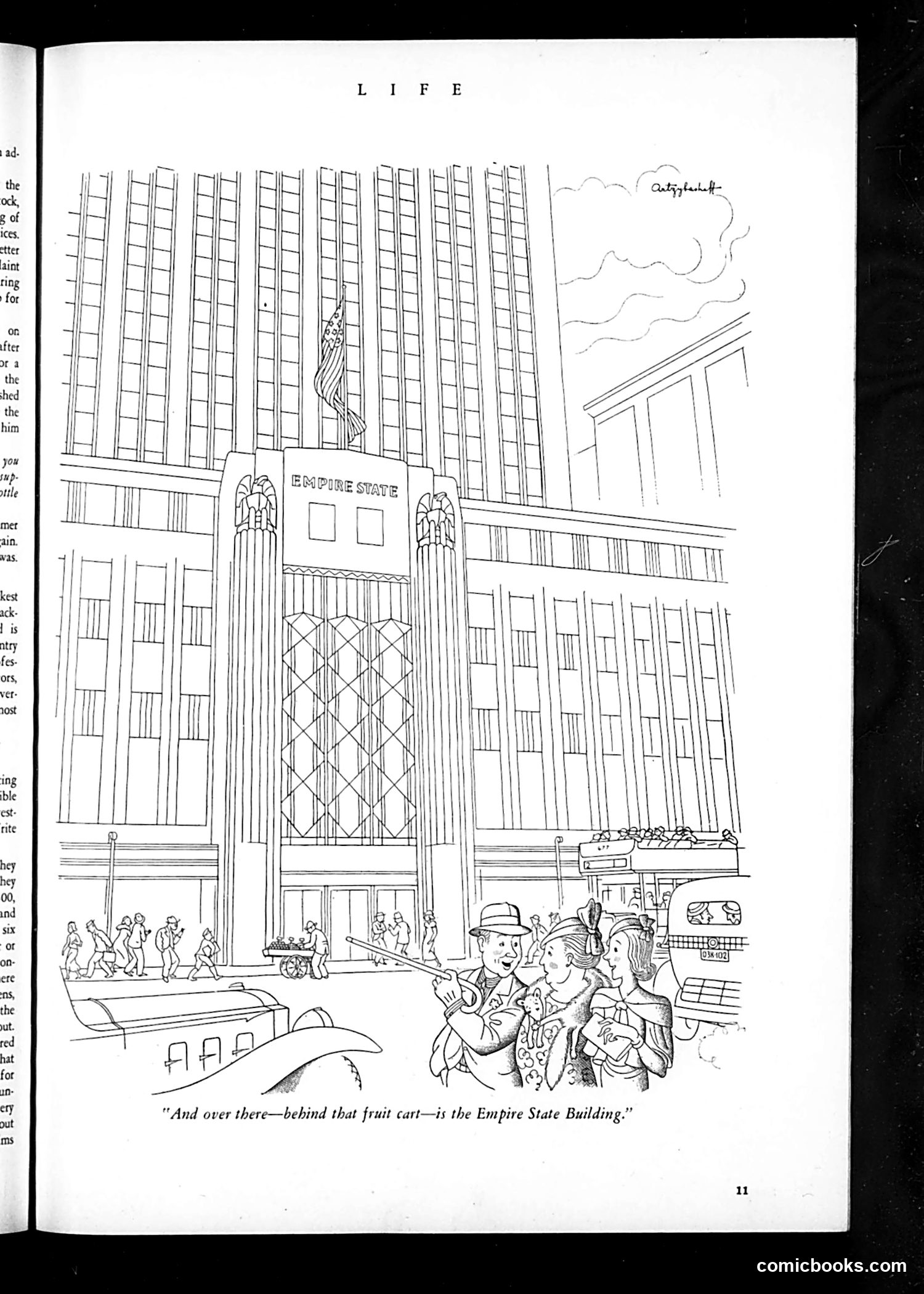
Cartoon Analysis This single-panel cartoon depicts tourists pointing at the Empire State Building while standing in front of a fruit cart on a New York City street. The caption reads: "And over there—behind that fruit cart—is the Empire State Building." The satire relies on scale and perspective: the massive Empire State Building is so towering that it's nearly obscured behind an ordinary street-level fruit vendor's cart from the tourists' vantage point. This is a joke about the building's extraordinary height—completed in 1931, it was the world's tallest building at this time. The humor comes from the absurd juxtaposition of a monumental skyscraper being hidden behind something trivially small, mocking both the building's dominance in the NYC skyline and tourists' struggles to appreciate architecture amid street-level distractions.
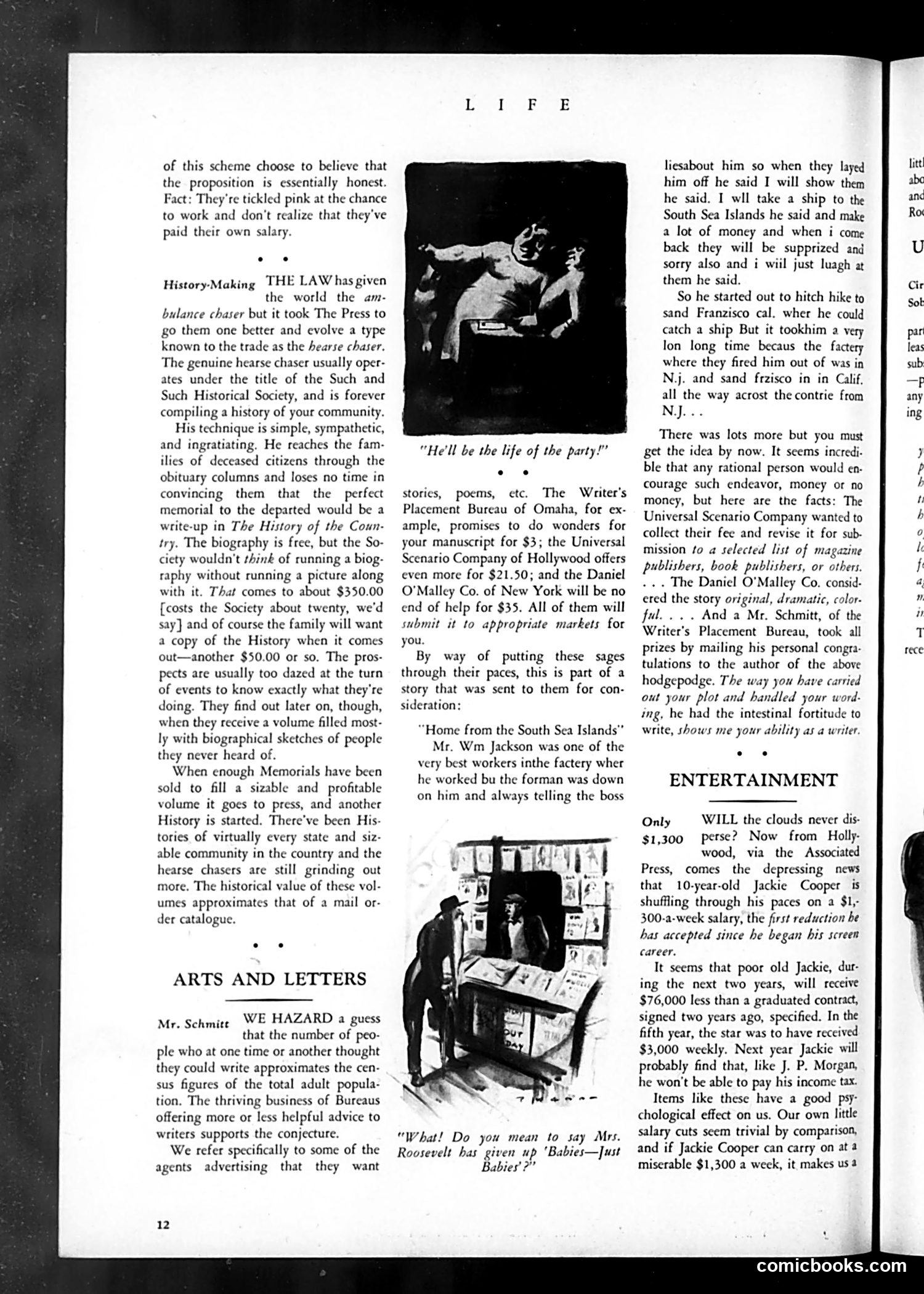
Analysis of Life Magazine Page This page discusses the "hearse chaser"—a journalist who covers obituaries and death notices. The text explains how newspapers use these writers to compile community histories, noting the practice is both economical (free to write) and profitable for papers. The cartoon captioned "He'll be the life of the party!" appears to satirize this morbid profession, showing what looks like a hearse or funeral vehicle. The humor plays on the grim irony of someone whose job involves death being described as "the life of the party"—a dark joke about the disconnect between the hearse chaser's social personality and their profession's somber subject matter. The page also discusses writer placement bureaus and entertainment industry salary negotiations, including Jackie Cooper's contract disputes.
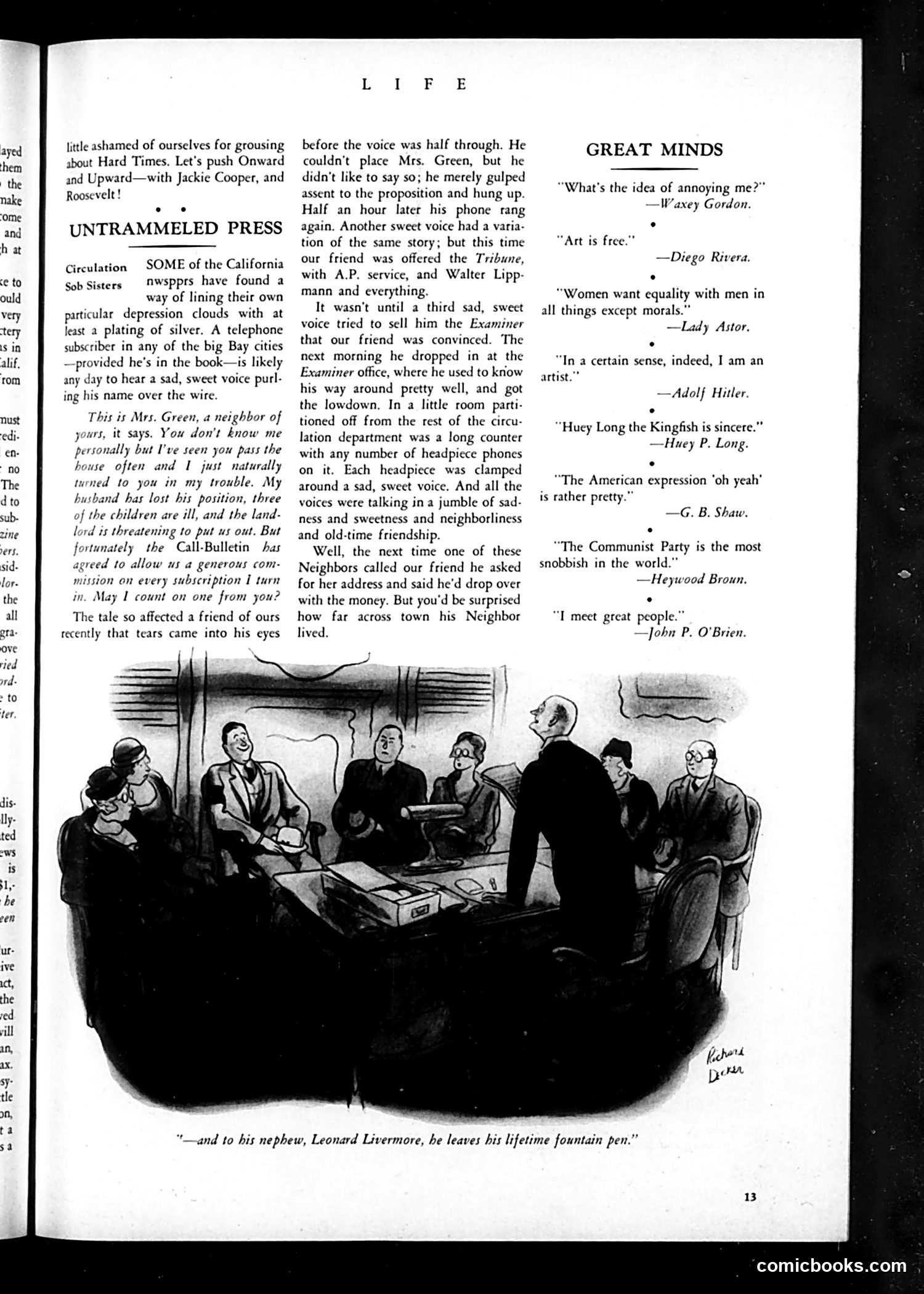
Analysis of Life Magazine Page This page contains a section called "GREAT MINDS"—a satirical column featuring absurd or contradictory quotes attributed to famous figures like Diego Rivera, Adolf Hitler, and others. The juxtaposition creates dark humor by placing serious statements alongside ridiculous ones. The main cartoon depicts a will-reading scene where a man (likely a lawyer or executor) announces that Leonard Livermore bequeaths his fountain pen to his nephew. The joke appears to satirize stingy inheritances or anticlimactic wills—the absurdity of leaving only a pen as a "lifetime" bequest, suggesting either the deceased was miserly or the nephew received far less than expected. The cartoon style and layout are typical of Life's mid-20th century satirical humor targeting American social pretensions and wealth.
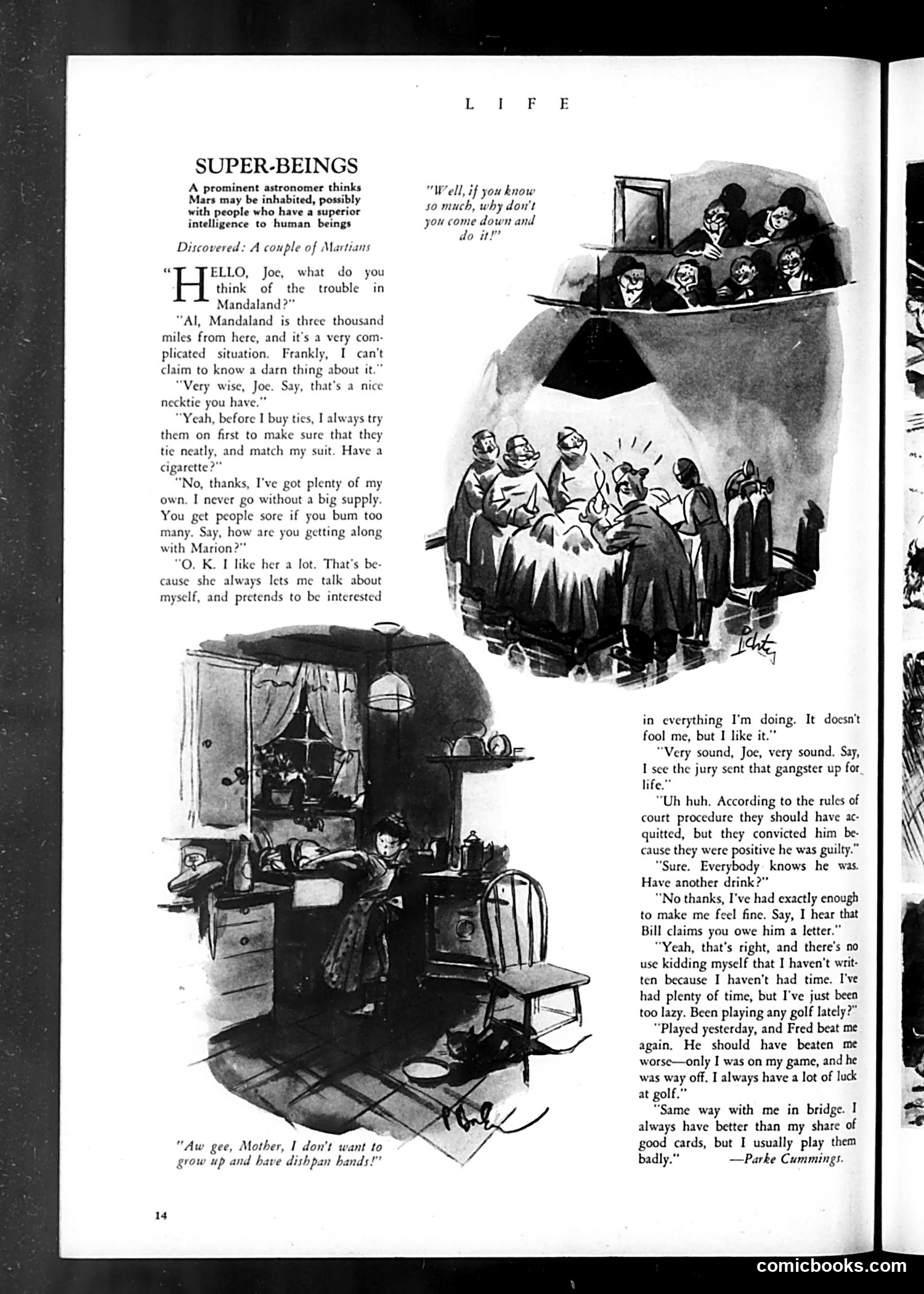
Analysis of "Super-Beings" Page from Life Magazine This page contains two satirical cartoons with accompanying dialogue mocking human pretension and hypocrisy. The upper cartoon depicts what appears to be gangsters or criminals in a boat, with the caption "Well, if you know so much, why don't you come down and do it?" This satirizes people who criticize others while lacking the courage or competence to act themselves. The lower cartoon shows a cramped domestic interior with the caption "Aw gee, Mother, I don't want to grow up and have dishpan hands!" This mocks traditional gender roles and domestic anxieties, likely critiquing societal expectations about masculinity and housework. The accompanying dialogue between characters named Joe and Al discusses criminal matters and legal proceedings with dark humor, suggesting Life's satirical take on crime, justice, and moral superiority among ordinary people.
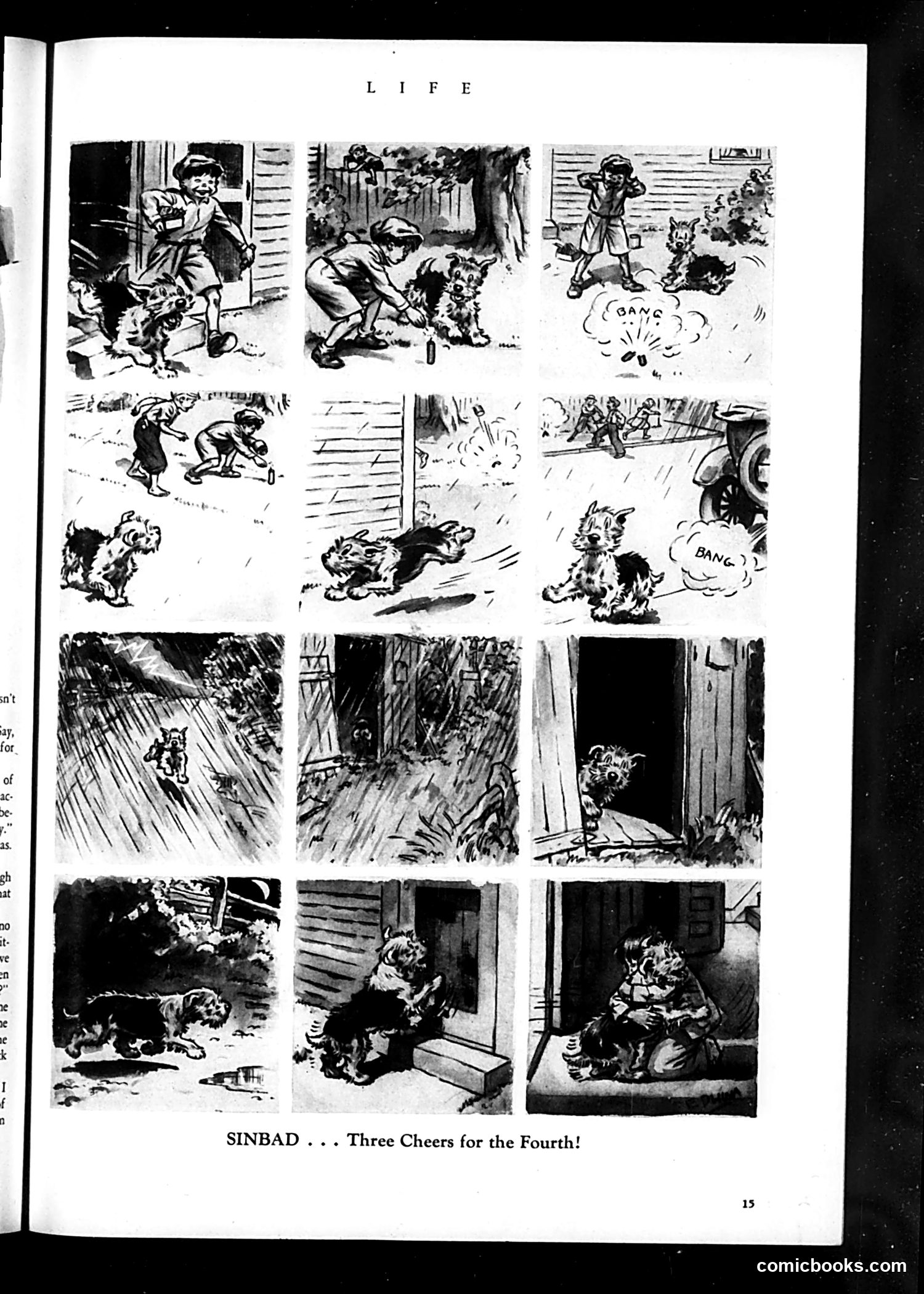
"Sinbad ... Three Cheers for the Fourth!" This comic strip depicts a dog (likely named Sinbad, based on the title) celebrating American Independence Day. The sequential panels show the dog's Fourth of July adventures: playing games with children, running and causing minor chaos, and ultimately seeking refuge indoors—apparently overwhelmed by the holiday festivities and noise. The humor appears to rely on the dog's increasingly frantic reactions to typical Fourth of July activities and commotion. By personifying the dog's experience, the cartoonist creates gentle satire about how holidays can be chaotic and overstimulating, even for pets. The title's ironic "three cheers" suggests the dog's reluctant or exhausted participation in patriotic celebrations.
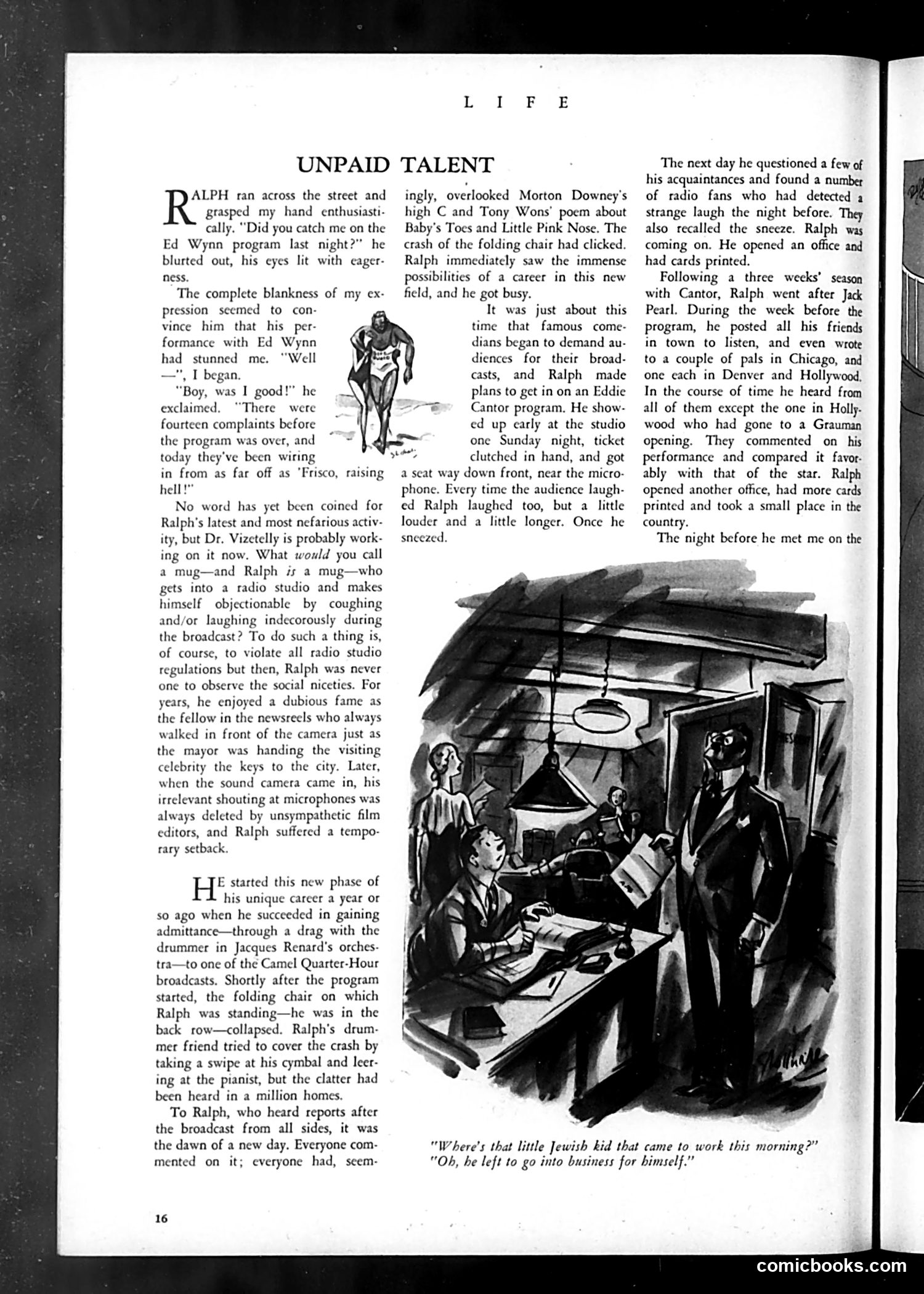
"Unpaid Talent" - Life Magazine Article This article satirizes Ralph, an unnamed radio personality who becomes a nuisance in broadcast studios. The piece describes Ralph as someone who disrupts radio broadcasts—coughing, laughing indecorously, and generally violating studio regulations—to gain attention. The narrative follows Ralph's evolution from a minor pest to someone seeking a career in radio entertainment. After successfully appearing on an Eddie Cantor broadcast, Ralph attempts to capitalize on his newfound exposure by promoting himself in Hollywood and through radio stations across the country. The illustration depicts a radio studio scene where Ralph (likely the figure in the center) appears to be causing disruption during a broadcast, surrounded by confused or exasperated staff members. The satire targets both Ralph's shameless self-promotion and the era's emerging "celebrity culture" enabled by radio broadcasting.
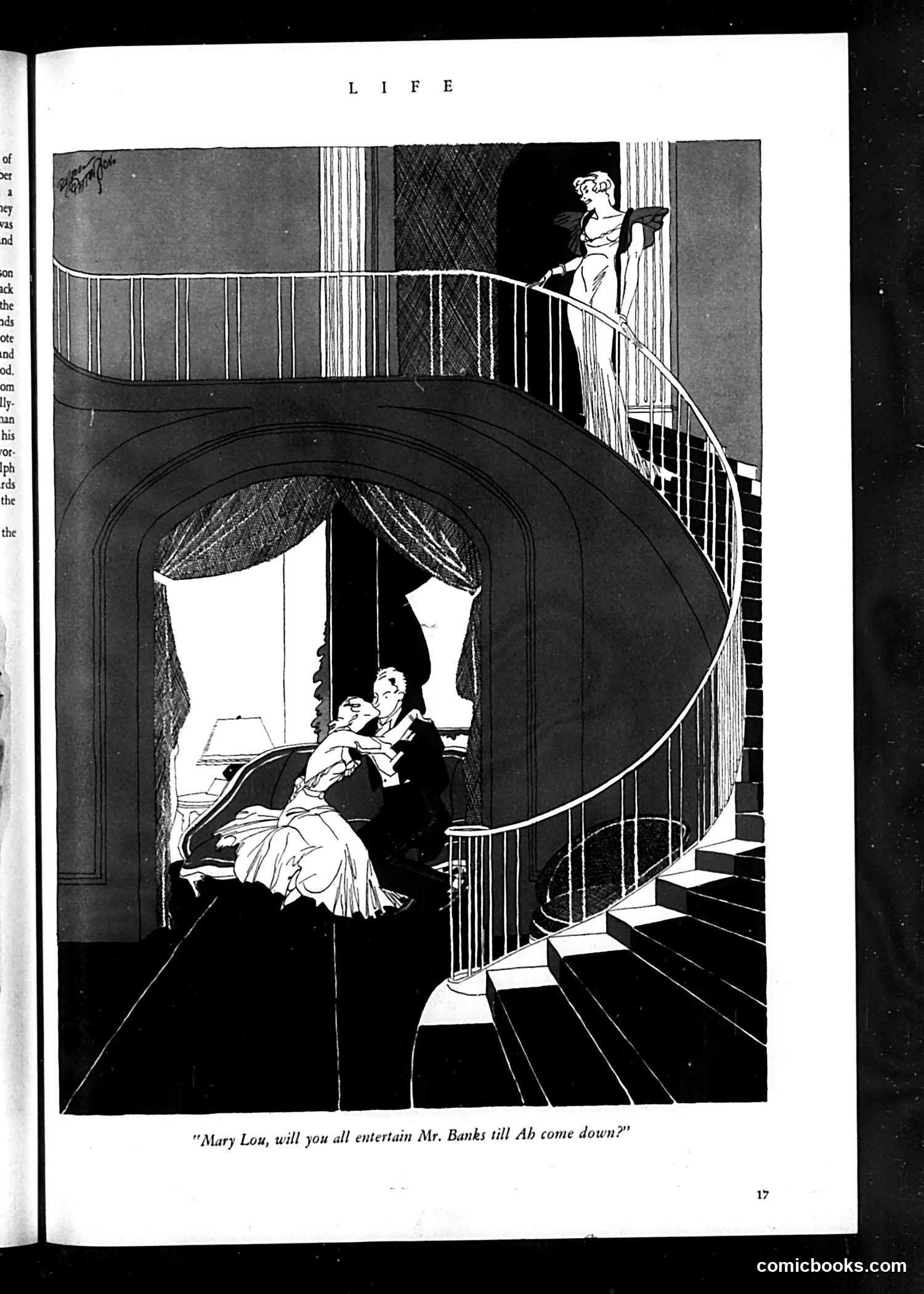
Analysis This illustration from *Life* magazine depicts a domestic scene with social commentary. The caption reads: "Mary Lou, will you all entertain Mr. Banks till Ab come down?" The cartoon satirizes class dynamics and social pretension. A woman (Mary Lou) sits with a well-dressed visitor (Mr. Banks) in an elegant interior featuring an arched doorway and curved staircase. A woman stands on the upper landing, apparently announcing that "Ab" (likely a colloquial name) will arrive shortly. The humor appears to derive from the contrast between the formal presentation of the space and the casual, awkward social situation—entertaining a guest while waiting for the host. The illustration mocks either the family's attempts at sophistication or the uncomfortable nature of formal social rituals among certain social classes. The architectural details suggest aspiration to upper-class domesticity.
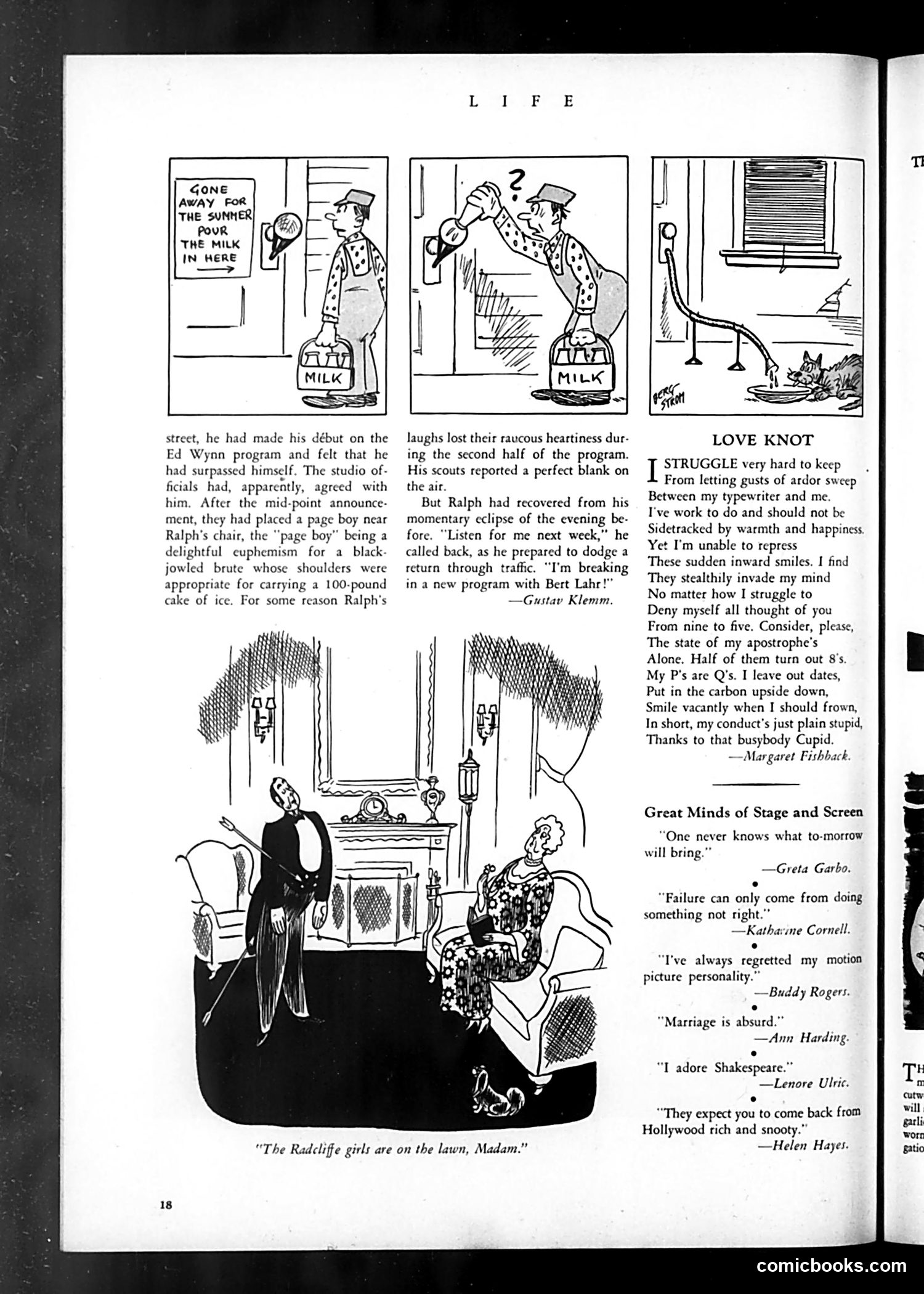
Analysis The three-panel cartoon at the top depicts a domestic comedy about a milkman left in charge during summer. In panel one, a note says "Gone away for the summer / Pour the milk in here." Panel two shows the confused milkman holding a question mark above a milk bottle. Panel three reveals the joke: he's literally poured milk into a bowl on the floor for what appears to be a cat or small animal. The satire targets absentee homeowners' unclear instructions and the milkman's literal interpretation. It's a visual pun playing on the ambiguity of "pour the milk in here"—the humor derives from the milkman's supposed dimwittedness in misunderstanding where milk belongs in a household. Below is an illustration captioned "The Radcliffe girls are on the lawn, Madam," showing two women in an interior, likely satirizing upper-class social conventions.
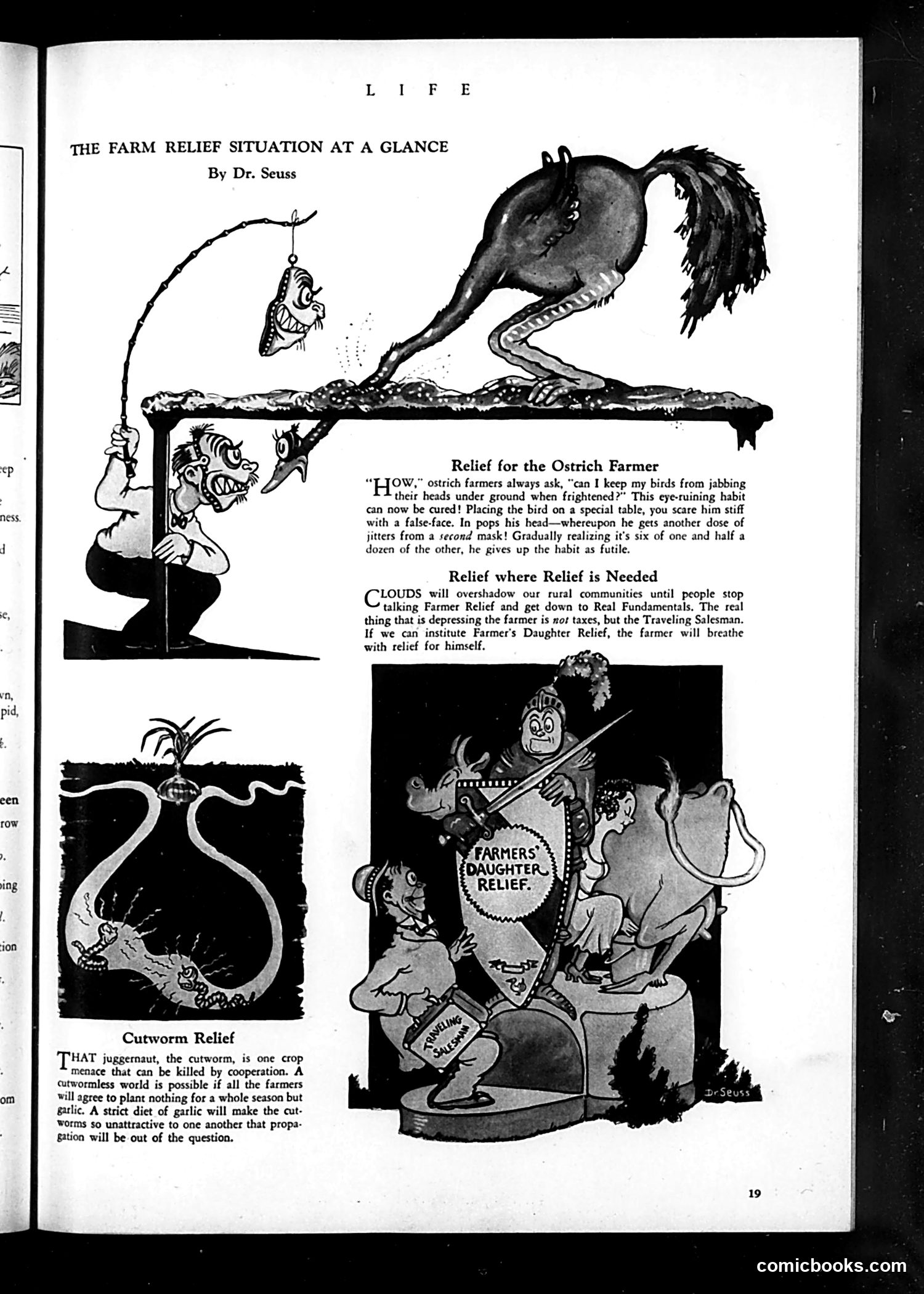
Political Satire: Farm Relief Programs (1930s Era) This Dr. Seuss cartoon satirizes Depression-era farm relief policies. The top image shows an ostrich farmer using a fake second mask to trick his bird into stopping a self-destructive habit—a metaphor for government relief programs that mask rather than solve underlying problems. The "Cutworm Relief" section mocks the absurdity of relief efforts: farmers supposedly coordinating to plant nothing and use garlic to control pests—impractical solutions presented as serious policy. The "Farmer's Daughter Relief" cartoon appears to satirize how relief benefits might be misallocated toward frivolous purposes rather than addressing actual farmer hardship from taxes and traveling salesmen. Overall, Seuss criticizes that Depression farm relief addresses symptoms, not root causes of agricultural distress.
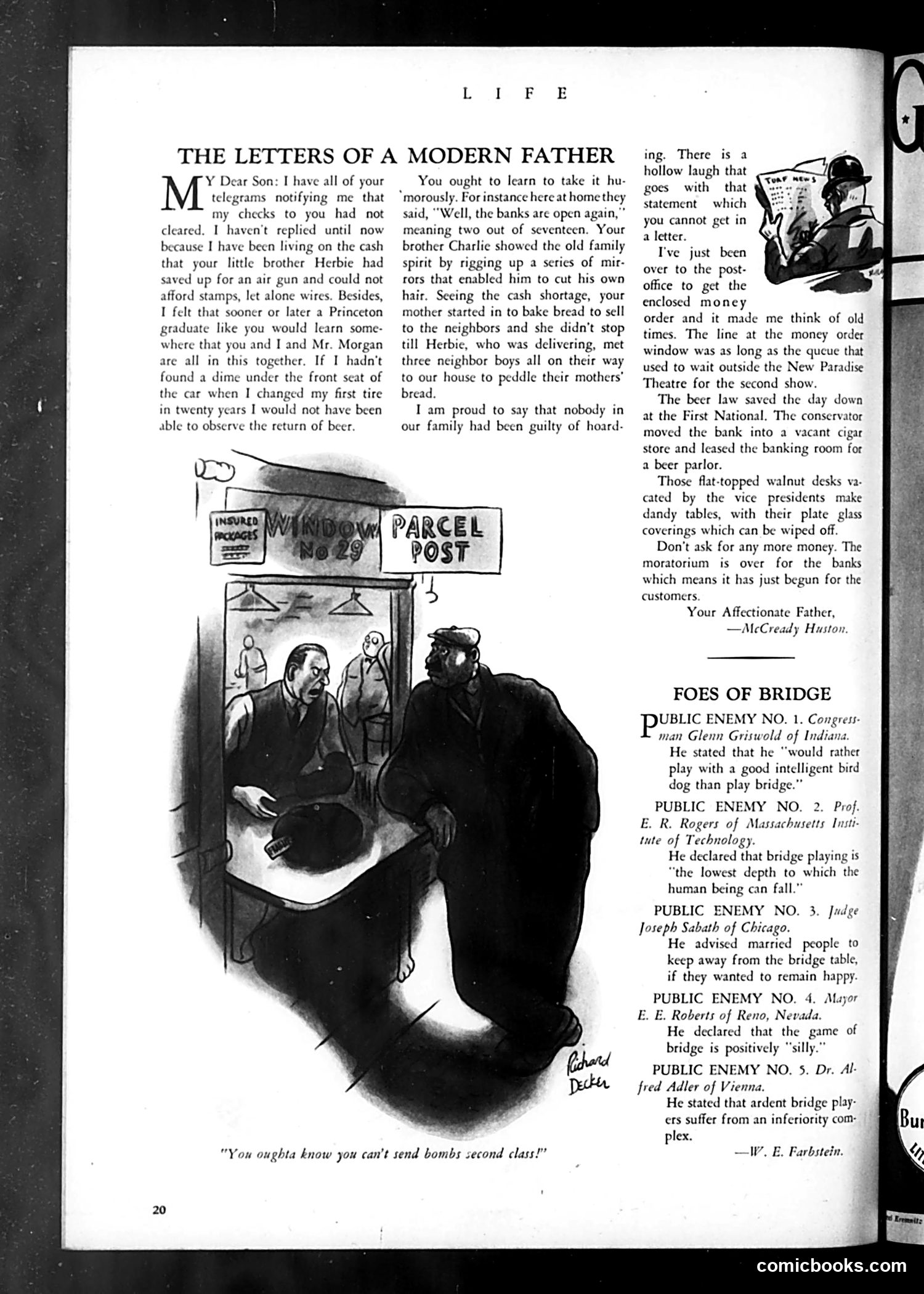
"The Letters of a Modern Father" Analysis This 1920s satirical piece lampoons post-Prohibition economic hardship. A father writes his Princeton-educated son, explaining why checks bounce and money is scarce. The humor relies on Depression-era details: banks closing (only "two out of seventeen" open), mothers baking bread to sell, children pawning possessions, and a bank converted into a beer parlor after Prohibition's repeal. The cartoon shows a postal worker and customer at a "Parcel Post" window with the caption "You oughta know you can't send bombs second class!"—likely referencing 1920s anarchist mail-bomb scares. The "Foes of Bridge" section lists prominent figures opposing contract bridge, a wildly popular parlor game. Their quoted criticisms range from frivolous to psychological, positioning bridge-playing as either foolish or symptomatic of inferiority complexes. This satirizes bridge's divisive social role during the era.
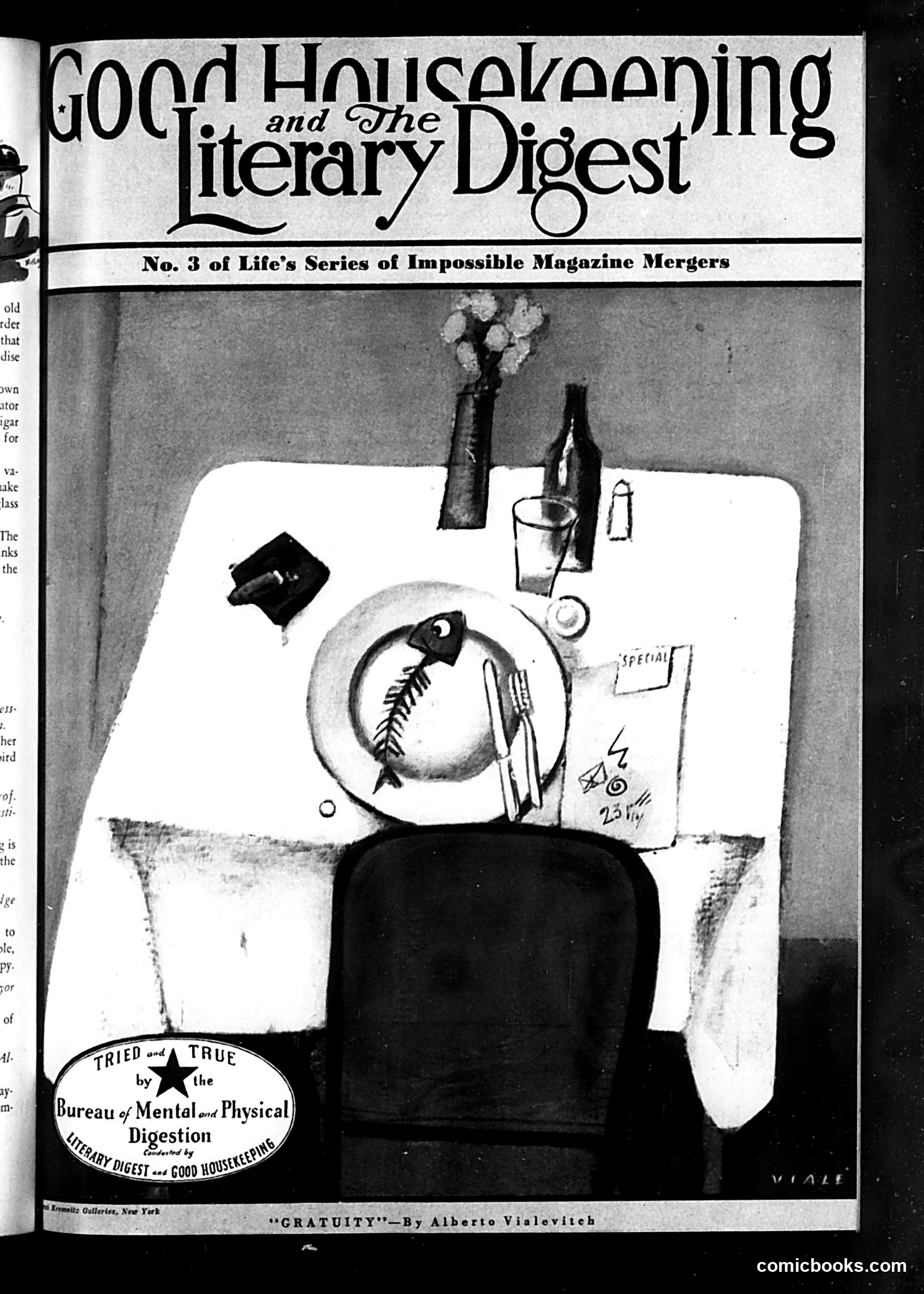
Explanation for Modern Readers This is a satirical cartoon titled "Gratuity" mocking an absurd hypothetical merger between *Good Housekeeping* and *The Literary Digest*—two magazines with entirely different audiences and purposes. The humor lies in the inherent contradiction: a homemaking magazine combined with a serious news/politics publication. The table setting shows this clash visually—a formal dinner plate with a fish skeleton and wine bottle sits beside domestic items (a recipe card marked "SPECIAL," price notation "25¢"), suggesting the confused result of combining high-brow political content with household tips. The silhouette of a woman's head at the table represents the bewildered reader trying to make sense of this impossible publication. The small seal at bottom certifies it as "Tried and True" by the "Bureau of Mental and Physical Digestion," adding mock-scientific authority to the absurdist concept. This appears to be part three of Life's regular series satirizing unlikely magazine mergers.
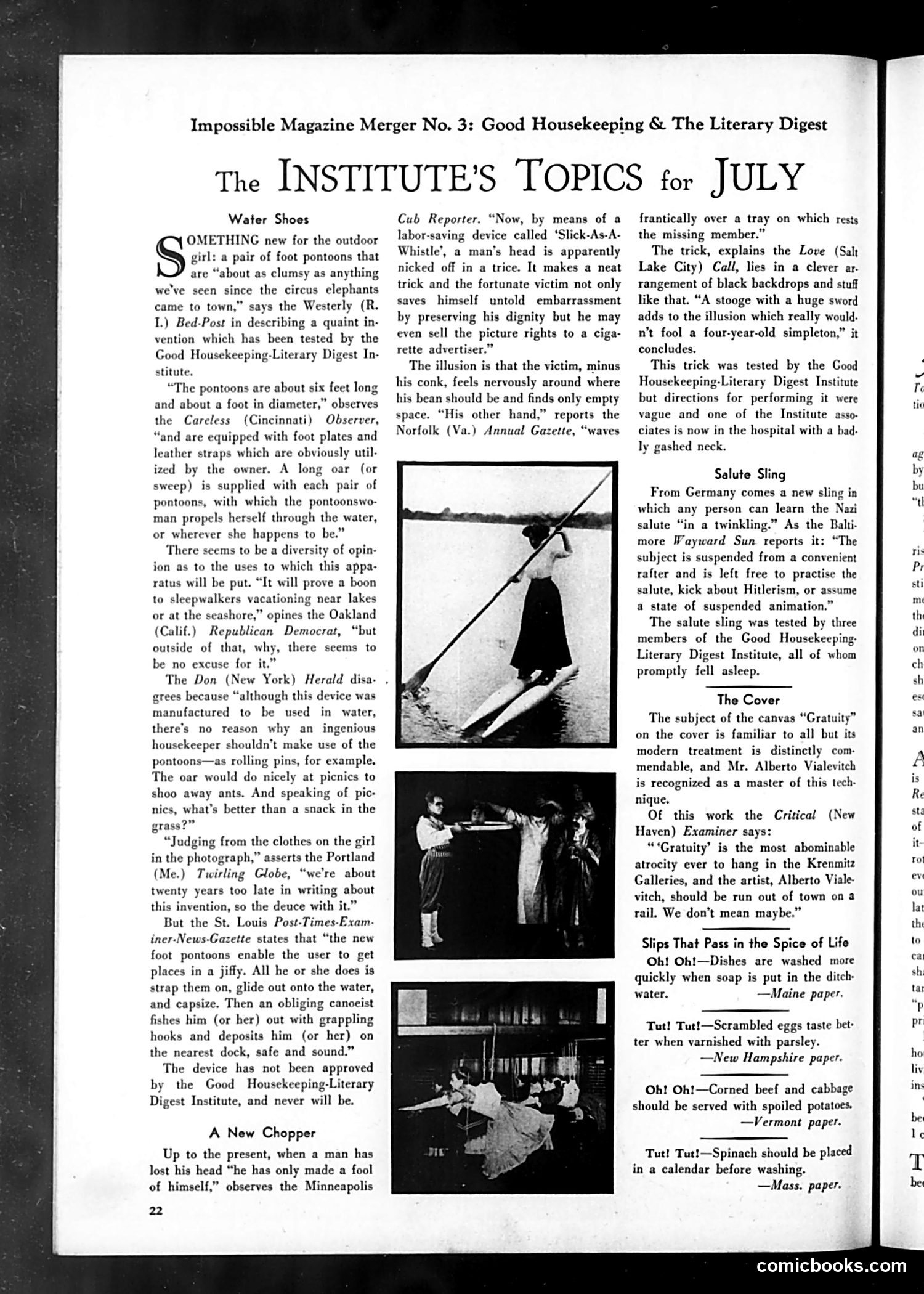
"The Institute's Topics for July" - Life Magazine Satire This is a satirical piece mocking the "Good Housekeeping-Literary Digest Institute"—a fictional merger of two real American publications. The humor works by having the Institute test absurd gadgets and inventions, with humorous consequences. Three inventions are featured: 1. Water Shoes (Pontoons): Described as comically oversized foot devices for women. Various (fictional) newspapers offer contradictory opinions on their usefulness, from practical to ridiculous (rolling pins, picnic tools). The joke: they cause the wearer to capsize. 2. Magic Trick Device: A guillotine-like illusion where a man appears headless. The satire suggests it's so obviously fake it wouldn't fool small children—yet an Institute associate got badly injured testing it. 3. Nazi Salute Trainer: A mechanical sling from Germany (clear reference to Hitler's regime) that supposedly teaches the Nazi salute by suspending users. The dark joke references contemporary Nazi Germany with grim humor typical of Life's political satire. The satire targets gullible consumer culture and pseudo-scientific "institutes" marketing dubious products as innovations.
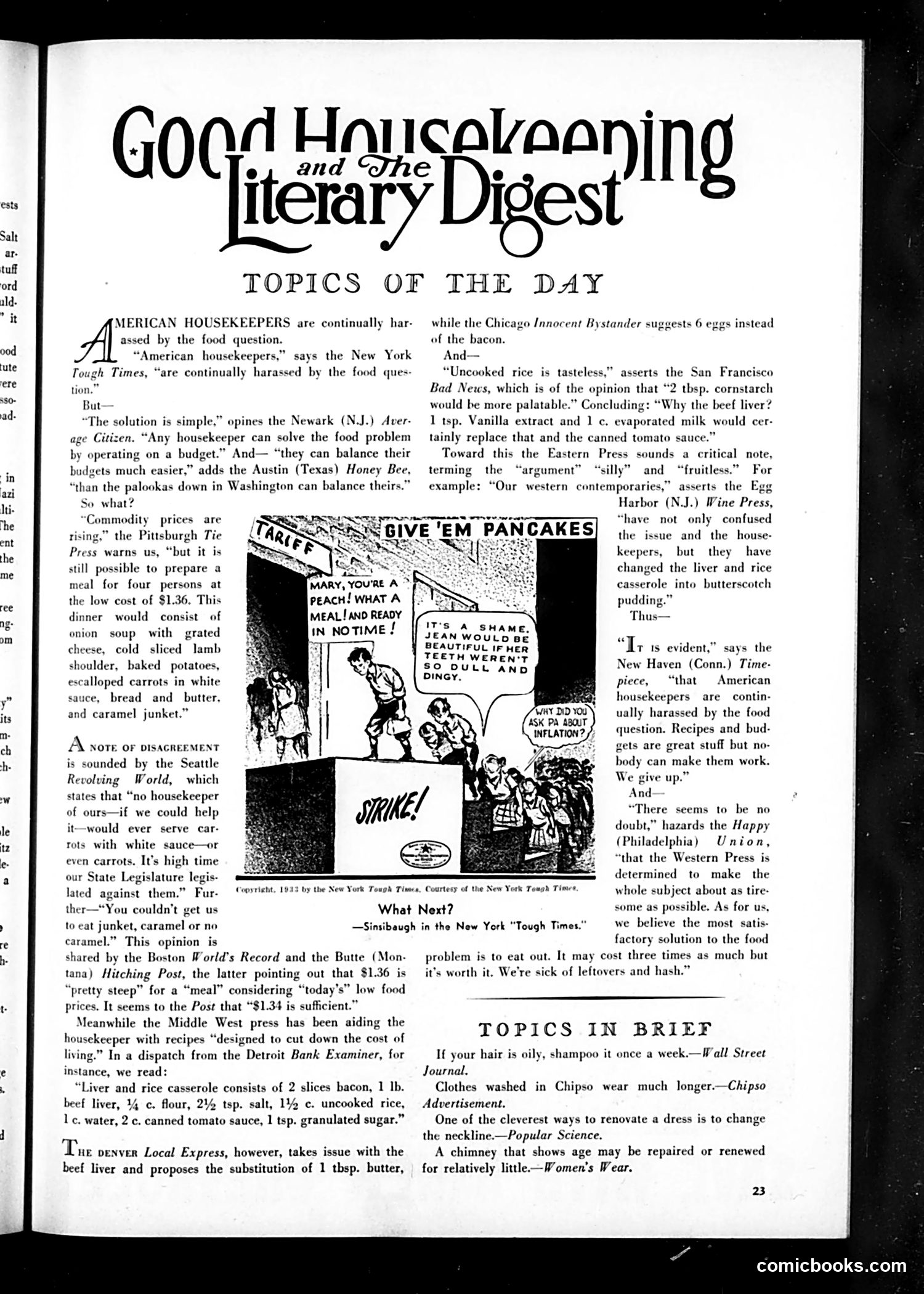
Satire on Food Rationing and Domestic Economics (1920s) This page satirizes the widespread anxiety American housekeepers faced during post-WWI inflation and food scarcity. The central cartoon depicts a domestic dispute: a husband praises his wife's meal ("What a meal! And ready in no time!"), while she appears exasperated—the irony being that despite media recipes promising cheap, quick meals at $1.36 per serving, housewives are exhausted trying to stretch budgets. The "Topics of the Day" section mocks competing newspapers offering contradictory cooking advice about liver-and-rice casseroles, with regional papers (Denver, San Francisco, Philadelphia, etc.) quarreling over substitutions and improvements. The satire highlights how food anxiety had become national news, with even modest meal-planning becoming a source of marital and public tension—suggesting that no recipe solution could truly solve the era's economic pressures. The page ultimately ridicules both the media circus around domestic economy and the impossible expectations placed on housewives during economically strained times.
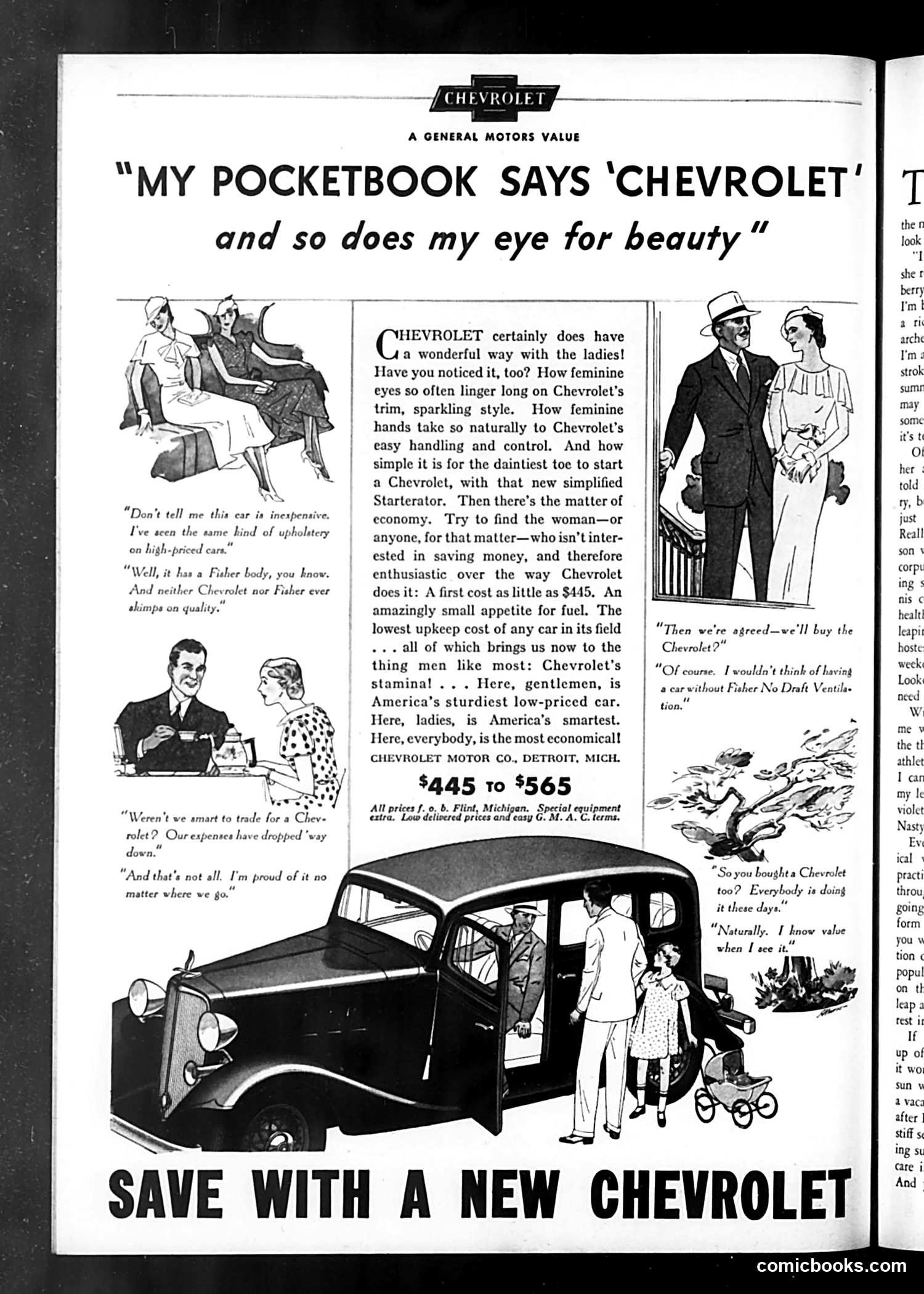
Explanation for Modern Readers This is a Chevrolet advertisement, not political satire. It uses a common 1920s-30s advertising technique: presenting the car through dialogue between stylized characters representing different consumer perspectives. The "joke" targets gender stereotypes of the era. The ad claims Chevrolet appeals to both women (via beauty, easy handling, "simplified Starter") and men (via durability and "stamina"). The dialogue snippets show couples and neighbors enthusiastically endorsing the car, emphasizing its low price ($445-$565) and economy—key selling points during economically uncertain times. The Fisher body reference indicates General Motors' quality components. The overall message: Chevrolet offers luxury appearance at working-class prices, making it universally desirable. By modern standards, the gendered language ("feminine eyes," "daintiest toe") and the assumption that women primarily care about appearance while men value performance reflects outdated marketing assumptions, though this was standard advertising rhetoric of that era.
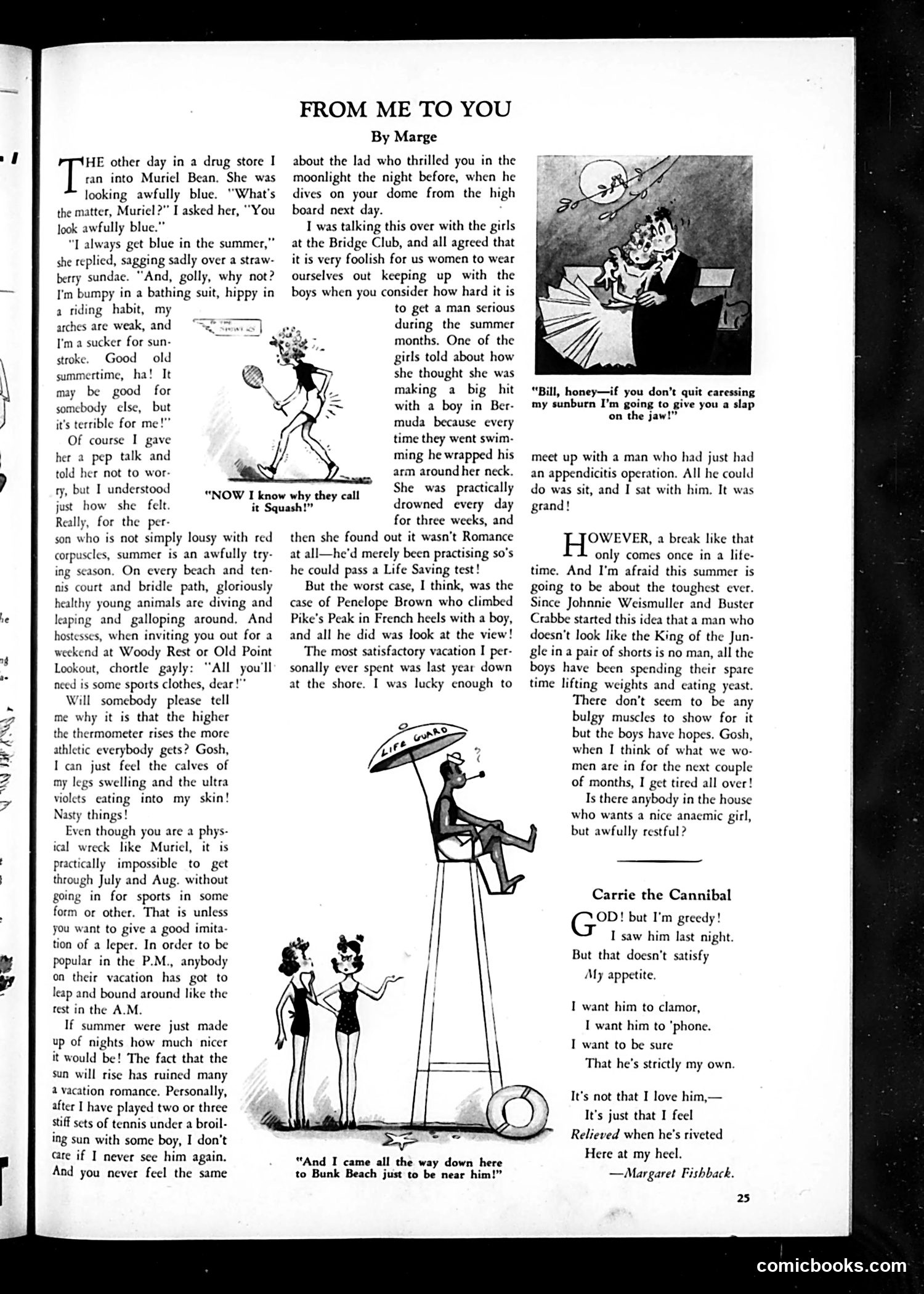
"From Me to You" by Marge - Life Magazine This humor column satirizes summer vacation culture and the physical self-consciousness it creates, particularly for women. The author (Marge) recounts conversations with female friends who feel pressured to participate in athletic activities—tennis, swimming, hiking—despite being uncomfortable with their bodies in sportswear. The cartoons illustrate the absurdity: one shows a woman playing squash, another depicts a couple at the beach where the man ignores romance to admire scenery, and a third shows a woman sun-burnt and irritated by unwanted physical contact. The satire targets 1930s-40s social expectations: women must keep pace with increasingly athletic, muscular men (references to actors Weismuller and Crabbe as ideals) while maintaining romance and femininity. The column's ironic point is that summer's supposed leisure is actually grueling—women feel obligated to perform athleticism they don't enjoy, damaging vacation romance in the process.
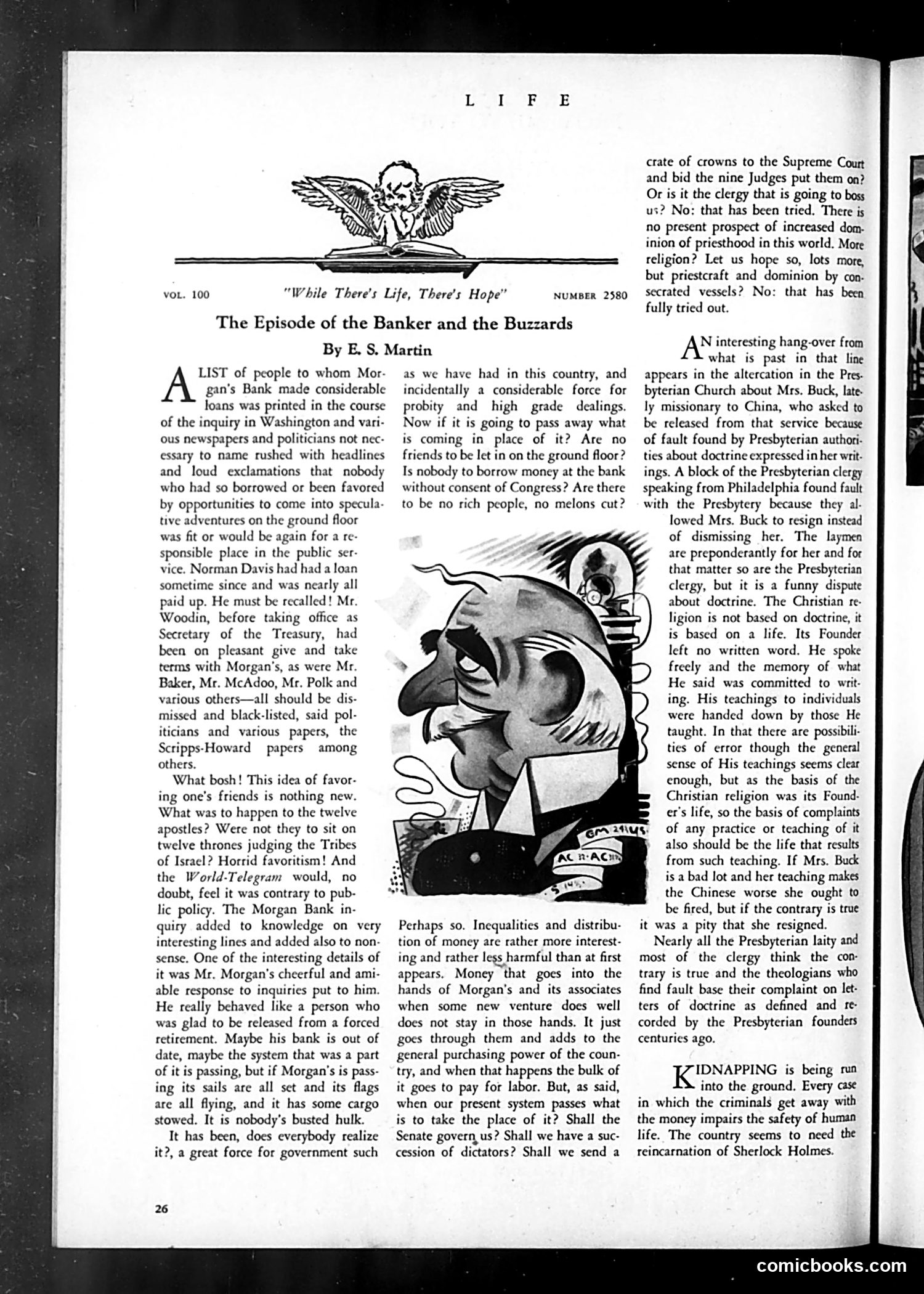
Political Cartoon Analysis: "The Episode of the Banker and the Buzzards" This *Life* magazine article by E.S. Martin satirizes political outcry following a Congressional inquiry into J.P. Morgan's Bank. The cartoon depicts a vulture or "buzzard" (representing opportunistic politicians and newspapers) attacking a banker figure, likely representing Morgan's Bank itself. The satire targets politicians and press (notably the Scripps-Howard papers) who demanded the dismissal of government officials who had previously borrowed from or done business with Morgan's Bank. Martin mocks this as performative morality, comparing it absurdly to condemning the twelve apostles for favoritism. His broader point: Morgan's Bank, despite its power and the legitimate concerns about wealth concentration, has been a stabilizing economic force. The real question isn't punishing past business relationships, but what system will replace it—will we get Senate rule, dictatorship, or theocracy instead?
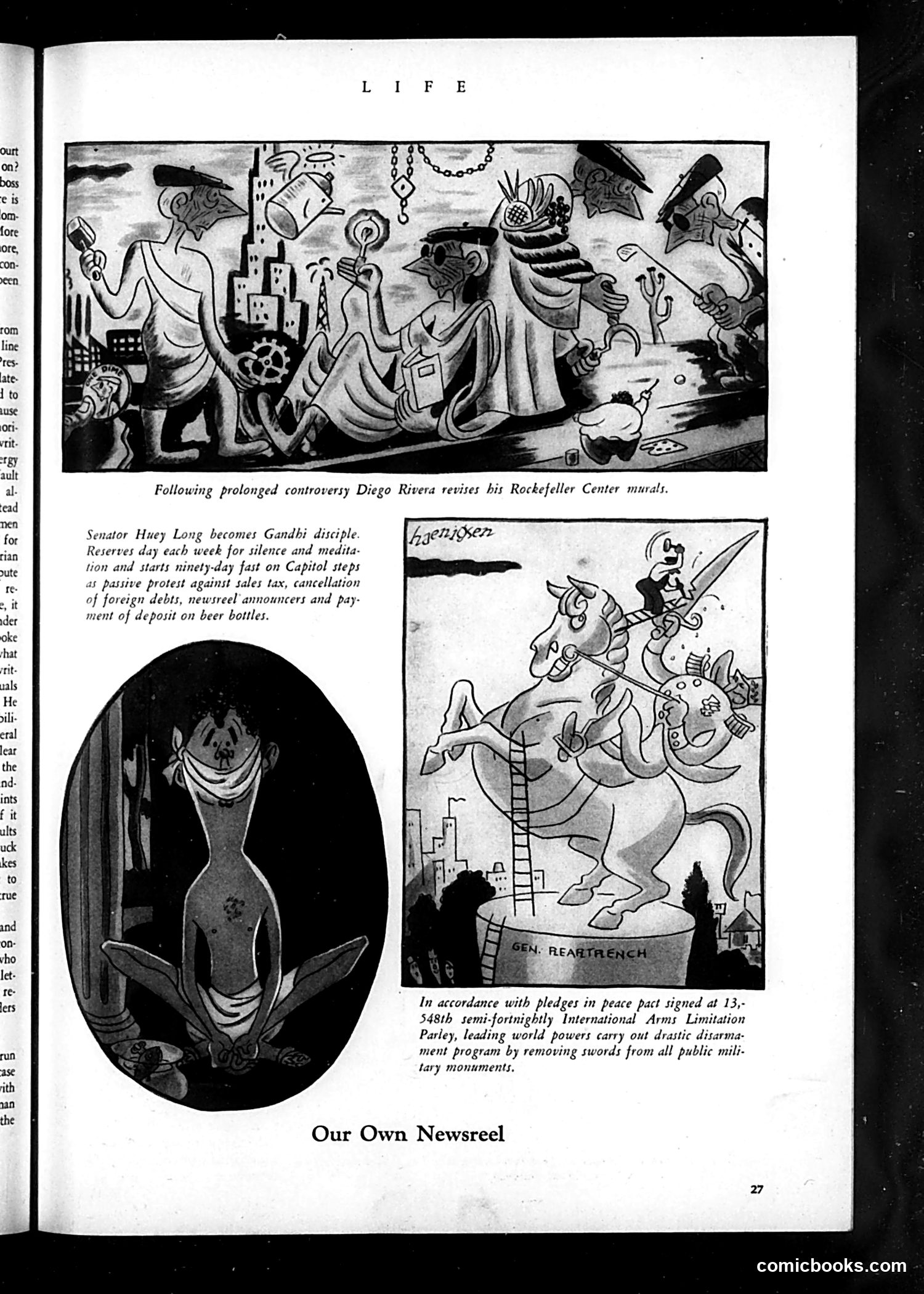
Political Satire Analysis This page satirizes two contemporary political figures through absurdist humor: Top section: Senator Huey Long, a Louisiana populist politician known for his "Share Our Wealth" program, is mocked as adopting Gandhi's nonviolent protest methods. The satire suggests Long's claims of fighting for ordinary people are performative—he'd fast on Capitol steps protesting sales taxes and even trivial grievances like "payment of deposit on beer bottles," treating everything as equally dramatic. Bottom section: A separate cartoon ridicules international disarmament conferences by showing world powers symbolically removing swords from public military monuments. The joke is that these "peace pacts" are mere theater—removing decorative swords accomplishes nothing while real military buildup continues. Both cartoons mock political posturing: Long's theatrical activism and governments' symbolic gestures masking their actual priorities. The exaggeration emphasizes that public performances often substitute for genuine reform.
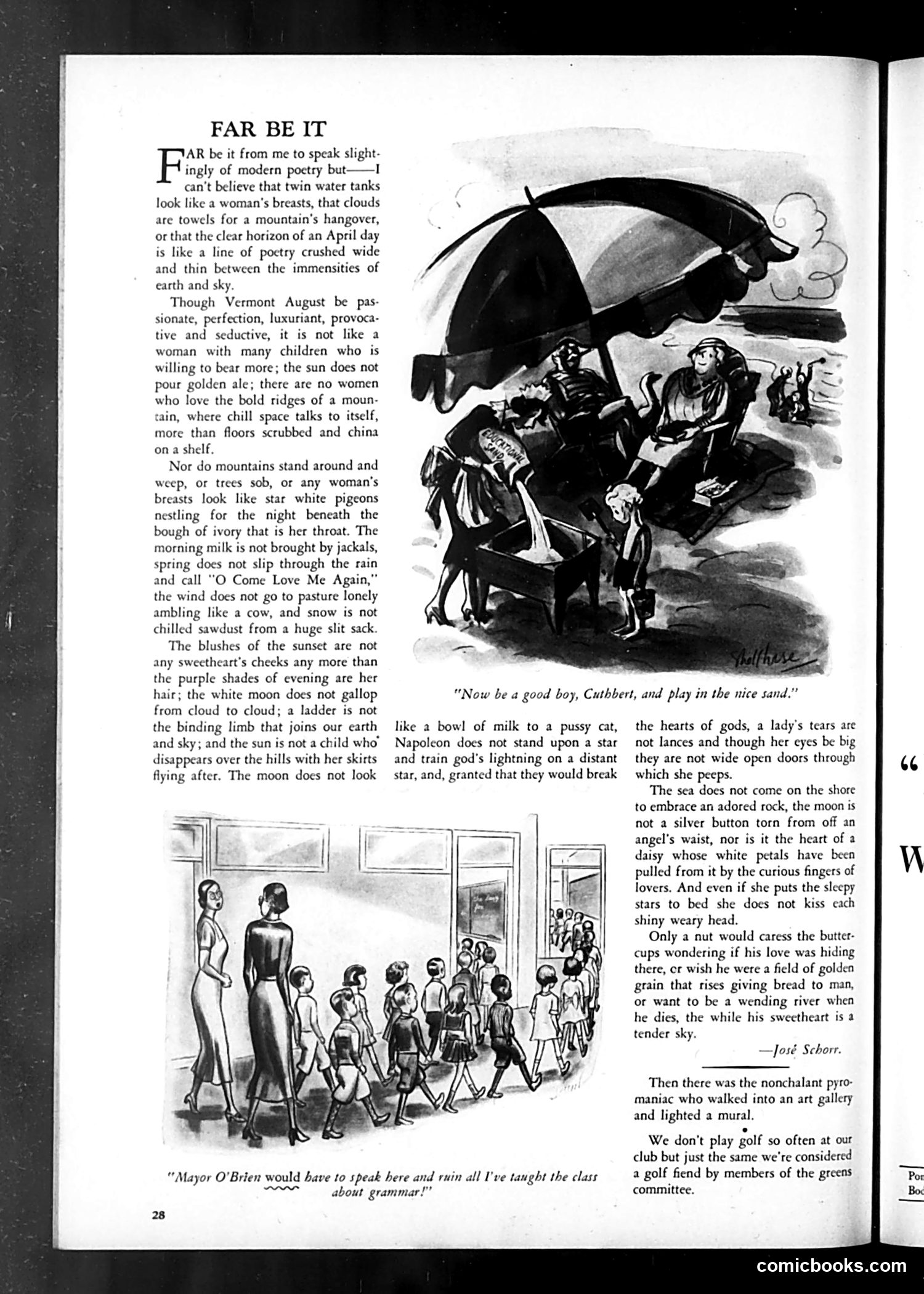
Analysis of "Far Be It" Page This page satirizes modern poetry's overwrought metaphors and personification. The main essay mocks contemporary poets who compare natural objects to human anatomy and emotions—water tanks to breasts, mountains to weeping women, snow to sawdust, etc. The author argues such comparisons are absurd and disconnected from reality, particularly regarding Vermont nature. The two cartoon illustrations support this critique: one shows an umbrella-wielding figure in a rainstorm (literal rather than poetic), and another depicts Mayor O'Brien disrupting a grammar lesson, with the caption suggesting his interruption would "ruin all I've taught the class about grammar"—implying even civic figures speak poorly. The brief anecdotes following reinforce the theme: a "pyromaniac" entering an art gallery (mocking pretentious artistic behavior) and the golf club observation (social satire about amateur golfers being labeled "fiends"). The overall message: Life magazine ridicules modern poetry's excessive romanticism and artistic pretension.
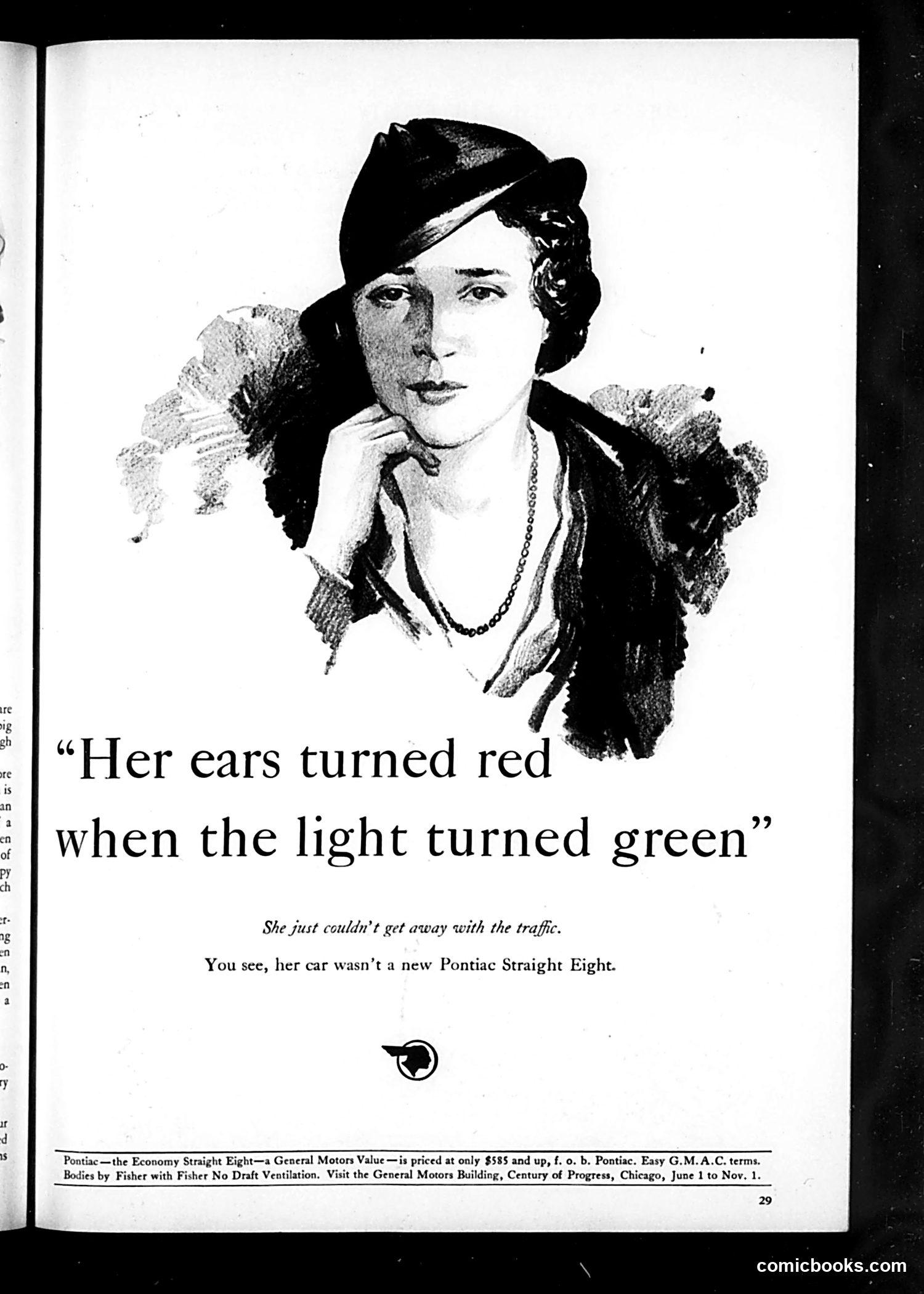
Analysis for Modern Readers This is a Pontiac automobile advertisement from Life magazine, not political satire. The humor targets a relatable problem: traffic congestion. The joke plays on a woman's embarrassment—her ears turned red at a traffic light—because she's driving an older, underpowered car that can't accelerate quickly when the light turns green, holding up traffic behind her. The punchline: if she owned the new Pontiac Straight Eight (a more powerful model), she could "get away with the traffic." The ad uses social embarrassment as a sales pitch: owning this car signals competence and confidence. The illustration shows a fashionable woman in 1930s styling to appeal to female drivers, a notable demographic for Pontiac at the time. The price ($585) and reference to the 1933 Chicago World's Fair ("Century of Progress") date this advertisement to that era, when car ownership was becoming more common but still represented status and capability.
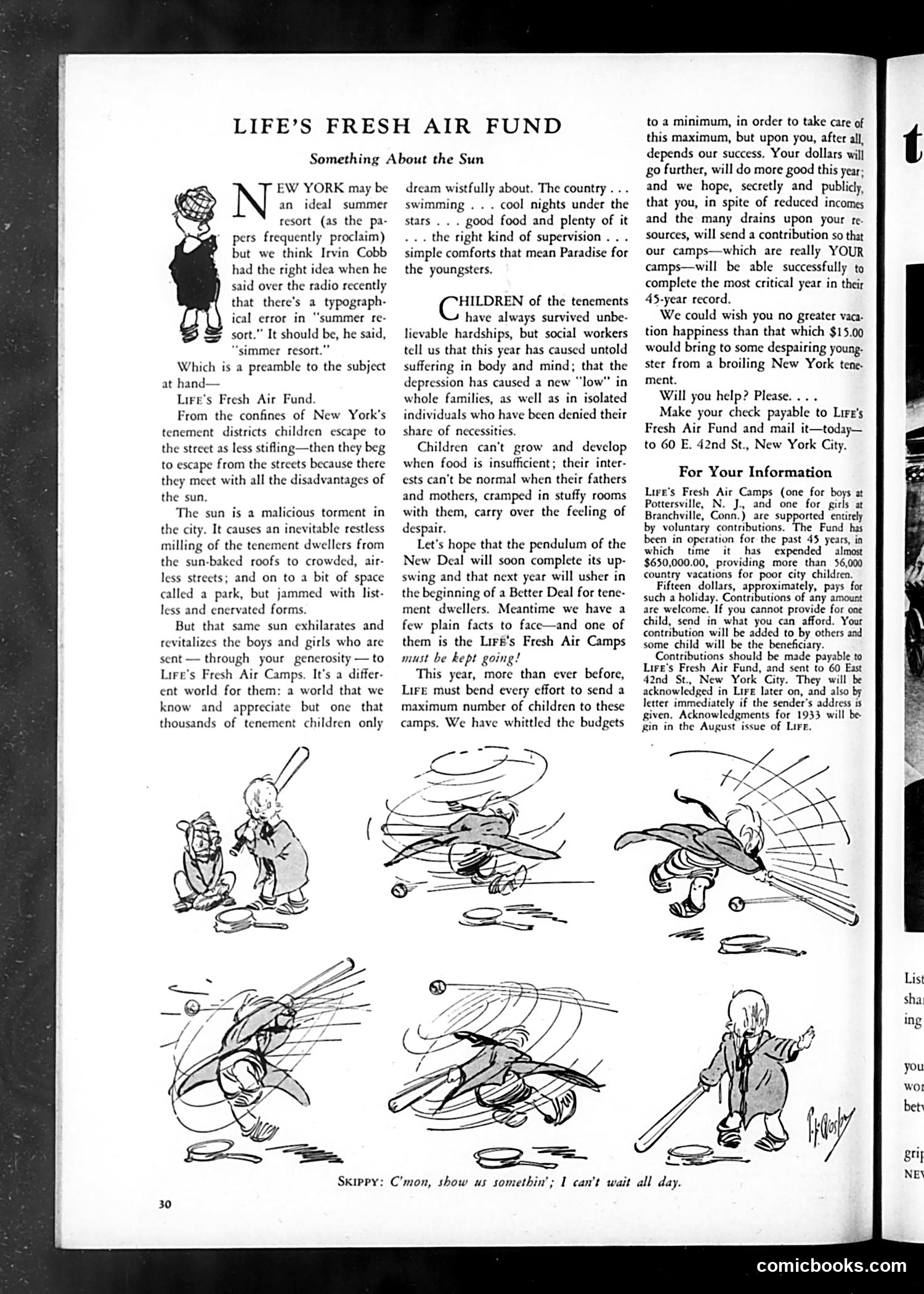
Life Magazine's Fresh Air Fund Appeal (1930s) This page combines a charitable fundraising appeal with comic illustrations. The text describes Life's Fresh Air Fund, which sends poor tenement children from New York City to summer camps in the countryside—a real charitable program that had operated for 45 years. The appeal emphasizes Depression-era hardship: tenement children suffer in the city heat with inadequate food and crowded conditions. The fund offers escape to camps with swimming, fresh air, and proper supervision—"Paradise for the youngsters." The cartoons at bottom feature Skippy, a popular comic strip character, shown playing with hoops and toys with the caption "C'mon, show us somethin'; I can't wait all day." These whimsical illustrations humanize the campaign, contrasting carefree childhood play with the deprivation described above. The $15 donation target is emphasized repeatedly—presented as achievable for readers despite Depression "reduced incomes."
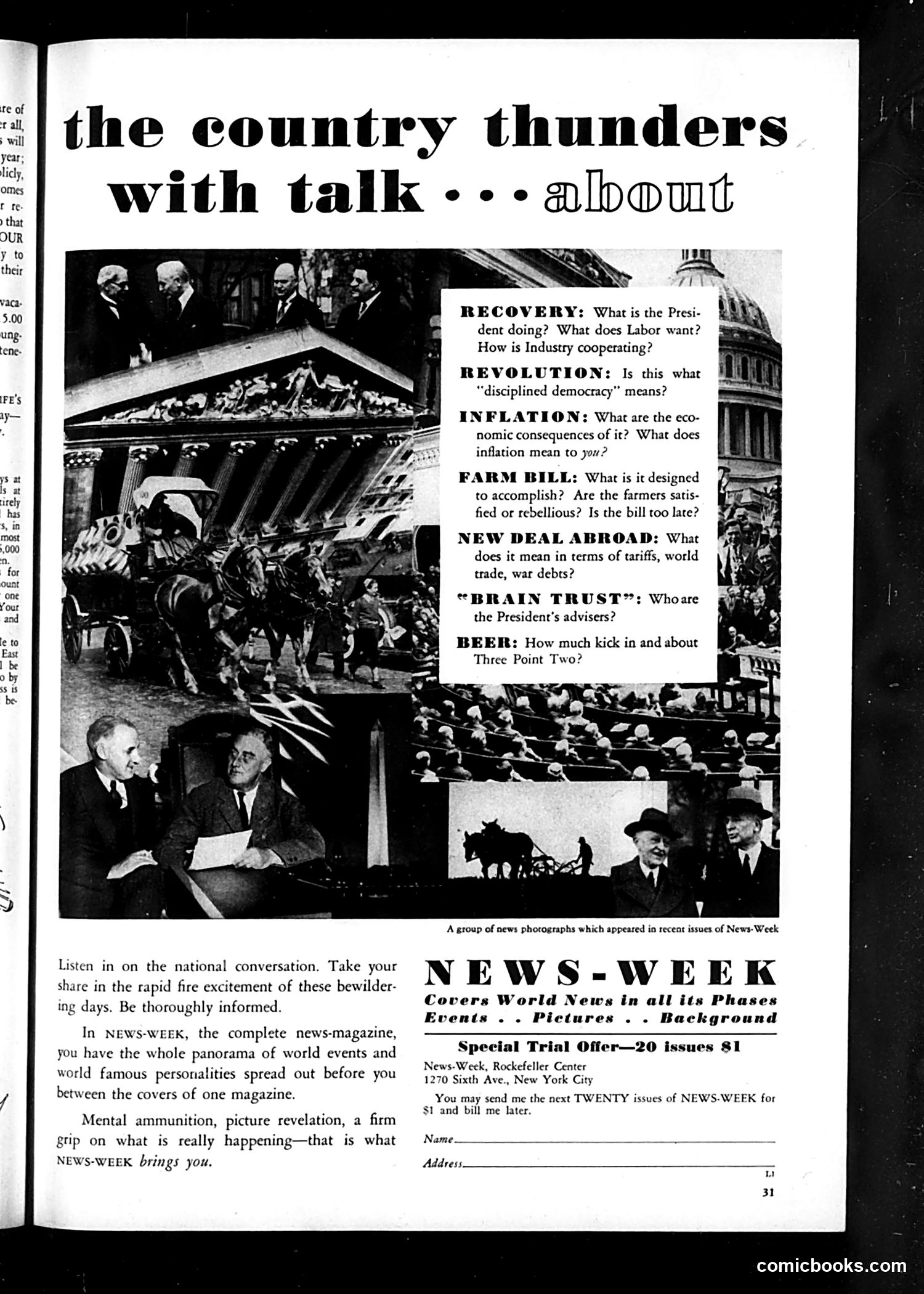
Analysis This is primarily an advertisement for *News-Week* magazine, not political satire. The page promotes the publication by listing urgent national topics supposedly "thundering" through the country in the 1930s. The topics reference New Deal-era debates: Recovery (FDR's economic programs), Revolution (concerns about radical change), Inflation, Farm Bill (agricultural relief), New Deal Abroad (foreign policy), the "Brain Trust" (FDR's advisory team of intellectuals), and Beer (Prohibition's recent repeal in 1933). The grainy photographs show government buildings, crowds, and officials in discussion—generic imagery meant to suggest urgent national conversation rather than specific figures or satire. The ad's pitch is straightforward: subscribe to stay informed about these confusing, rapidly-changing times. For modern readers, it's notable mainly as evidence that Depression-era Americans felt bewildered by government intervention and sought news magazines to make sense of it all.
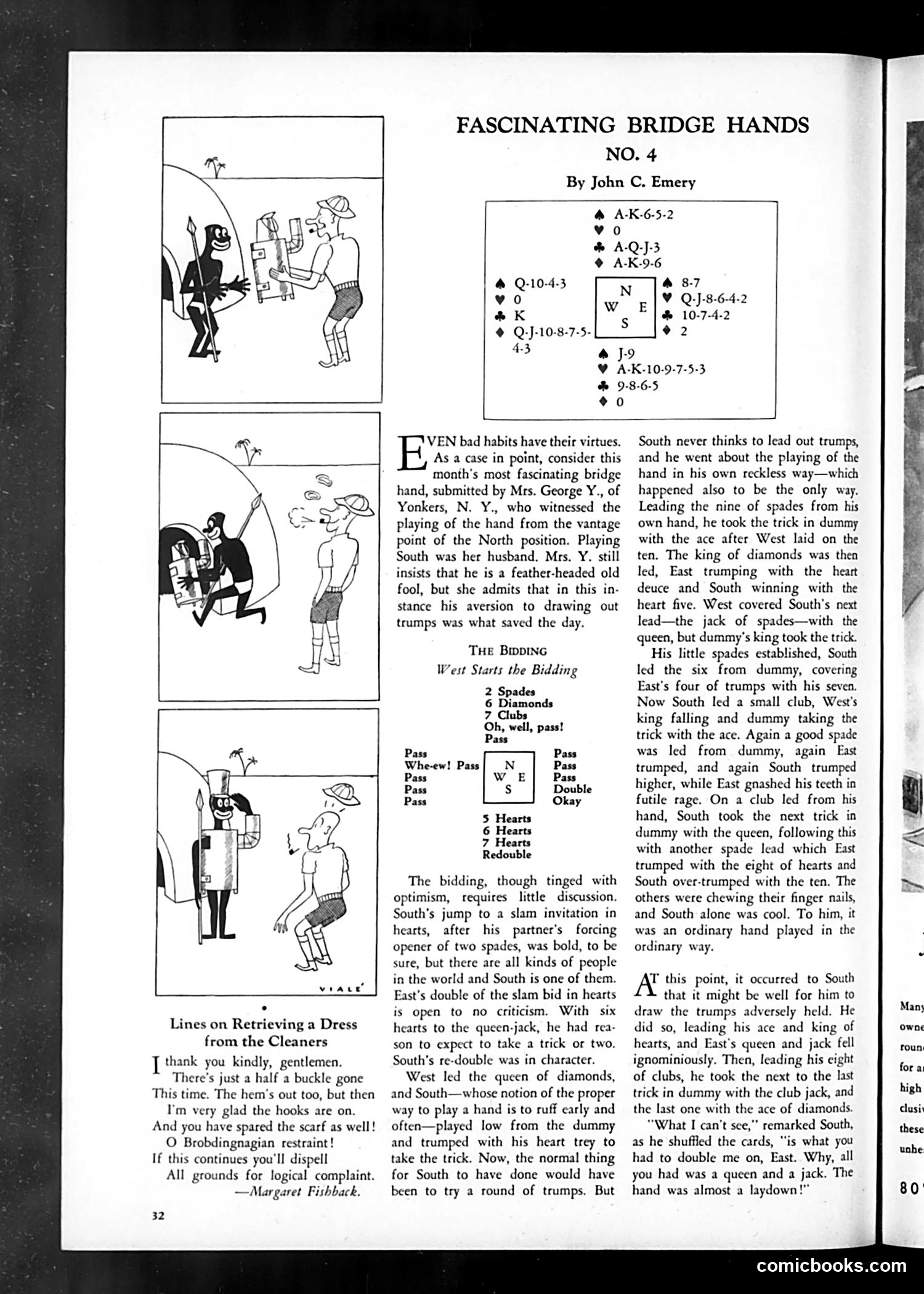
What This Page Means for Modern Readers This page presents bridge instruction disguised as entertainment. The cartoons at left show a man and woman playing bridge, with comedic illustrations of their reactions to the game's drama. The main content is a detailed bridge hand analysis by John C. Emery, explaining how South player won despite unconventional tactics. The humor lies in South's reckless "aversion to drawing out trumps" actually succeeding—suggesting that sometimes bad habits accidentally produce good outcomes. The accompanying poem by Margaret Fishback (bottom left) uses dry wit about dry-cleaning mishaps as social satire, mocking the "Brobdingnagian restraint" of cleaners who return almost-destroyed garments. The page represents *Life* magazine's characteristic blend of humor, practical instruction, and gentle mockery of upper-middle-class leisure activities like bridge in mid-20th century America. The bridge hand is presented as genuinely "fascinating" to readers presumed to play card games regularly.
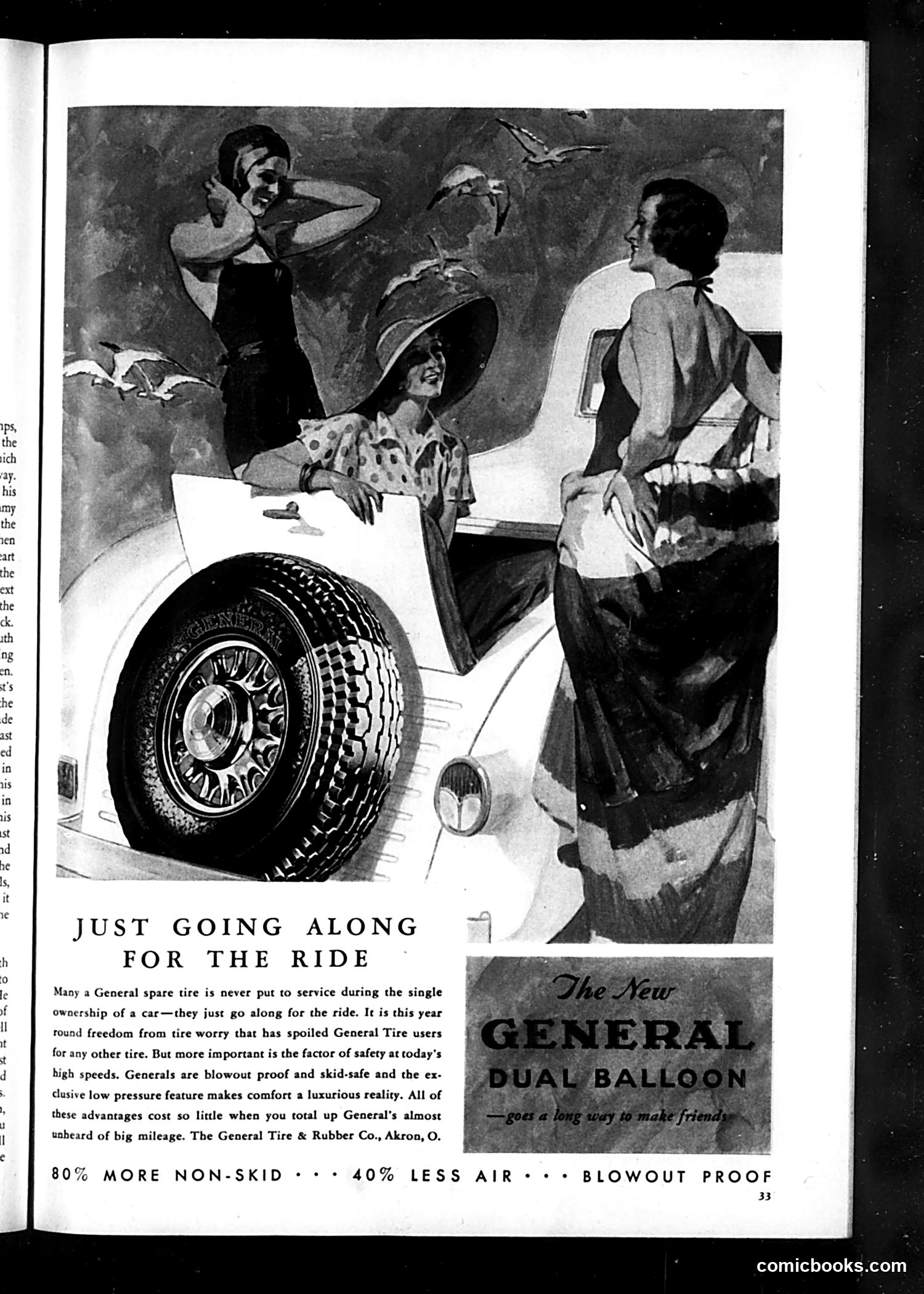
General Tire Advertisement This is primarily a tire advertisement, not political satire. The page depicts three fashionable women admiring a car with a General Dual Balloon tire, illustrating the product's reliability and safety features. The phrase "just going along for the ride" is a pun: spare tires literally sit unused, while General tires are so dependable they become trusted companions. The ad emphasizes practical benefits—blowout-proof construction, skid resistance, and low-pressure comfort—targeting 1920s-30s motorists concerned about safety at increasing highway speeds. The women's clothing and the automobile suggest affluent consumers; the ad associates General tires with modern leisure and reliability rather than worry or mechanical failure. This is straightforward automotive marketing using attractive imagery and wordplay.
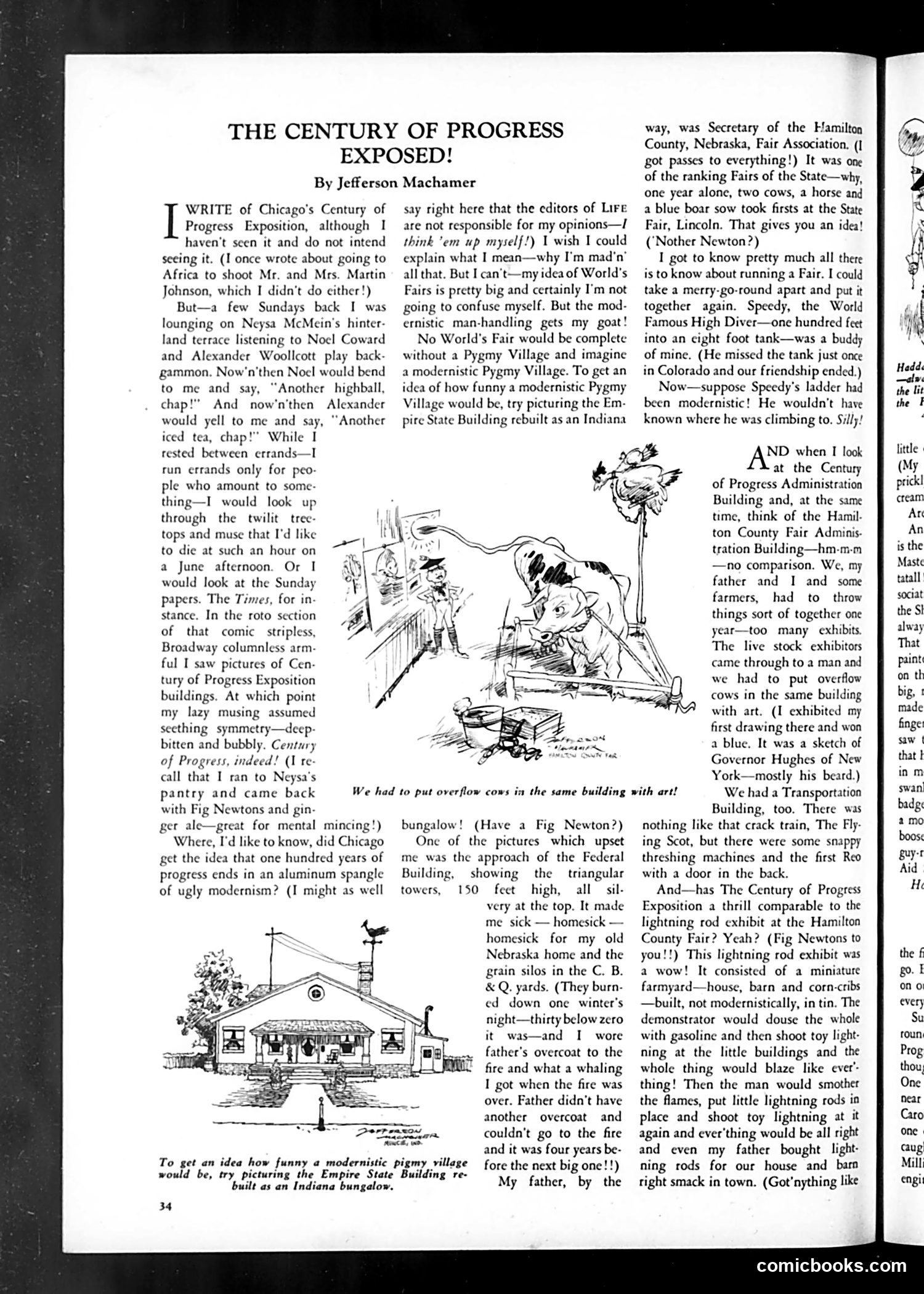
"The Century of Progress Exposed!" — Jefferson Machamer's Satire This article satirizes Chicago's 1933 Century of Progress Exposition by contrasting its modernist architecture with traditional American fair buildings. Machamer, writing as a society figure (name-dropping Noel Coward and Alexander Woollcott), pretends he hasn't actually visited the fair but critiques its aesthetic anyway—a humorous conceit. His central complaint: the exposition's sleek, geometric modernism (exemplified by the Federal Building's triangular towers) represents false "progress." He argues this through absurdist comparisons—a modernistic Pygmy Village would be ridiculous; an Empire State Building redesigned as an Indiana bungalow would be laughable. The accompanying cartoons ridicule the fair's pretensions: one shows livestock and art crammed together ("We had to put overflow cows in the same building with art!"), mocking the exposition's grandiose claims. Machamer nostalgically contrasts this with his father's small-town Hamilton County Fair in Nebraska, implying authentic American values reside in tradition, not fashionable modernism. The satire targets both the exposition's hubris and 1930s design culture itself.
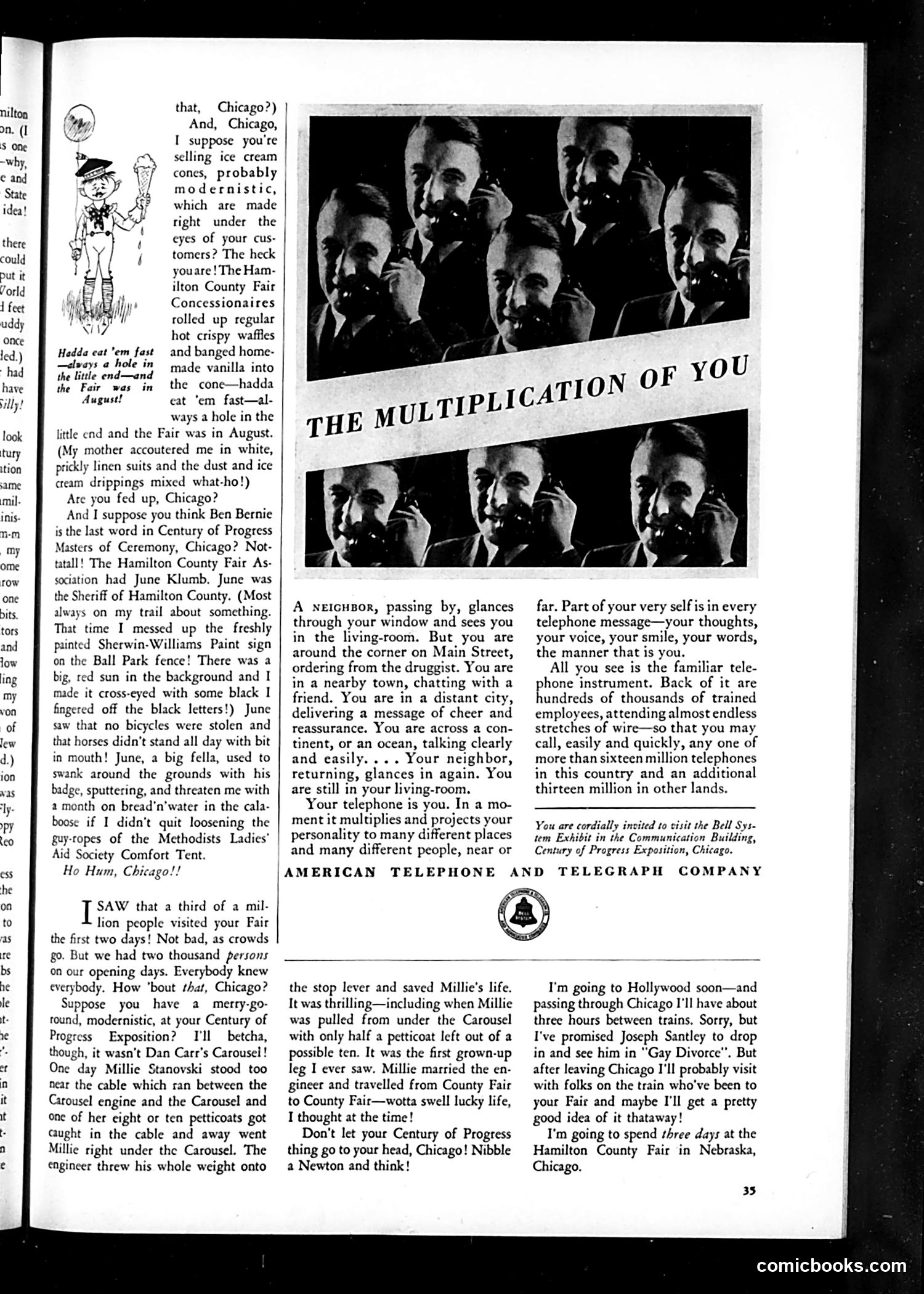
Page Analysis: Life Magazine Satire This page contains nostalgic rural satire mocking Chicago's 1933 Century of Progress Exposition as overly modernistic. The author contrasts it unfavorably with a small-town Hamilton County Fair, presenting anecdotes about simpler times—homemade ice cream cones with holes in the bottom, local sheriff June Klumb, and a dramatic (if gruesome) Carousel accident involving a girl named Millie Stanovski losing her petticoats. The humor relies on country-versus-city contrast: rural authenticity and genuine community versus Chicago's pretentious modernity. References to Ben Bernie (a radio personality/Master of Ceremonies) and Dan Carr's Carousel suggest real Fair fixtures being compared unfavorably to the Exposition. The AT&T advertisement on the same page ironically undercuts this critique: it celebrates telephone technology enabling distant connection—precisely the "modernistic" innovation the author seems to mock, though the ad frames it sentimentally.
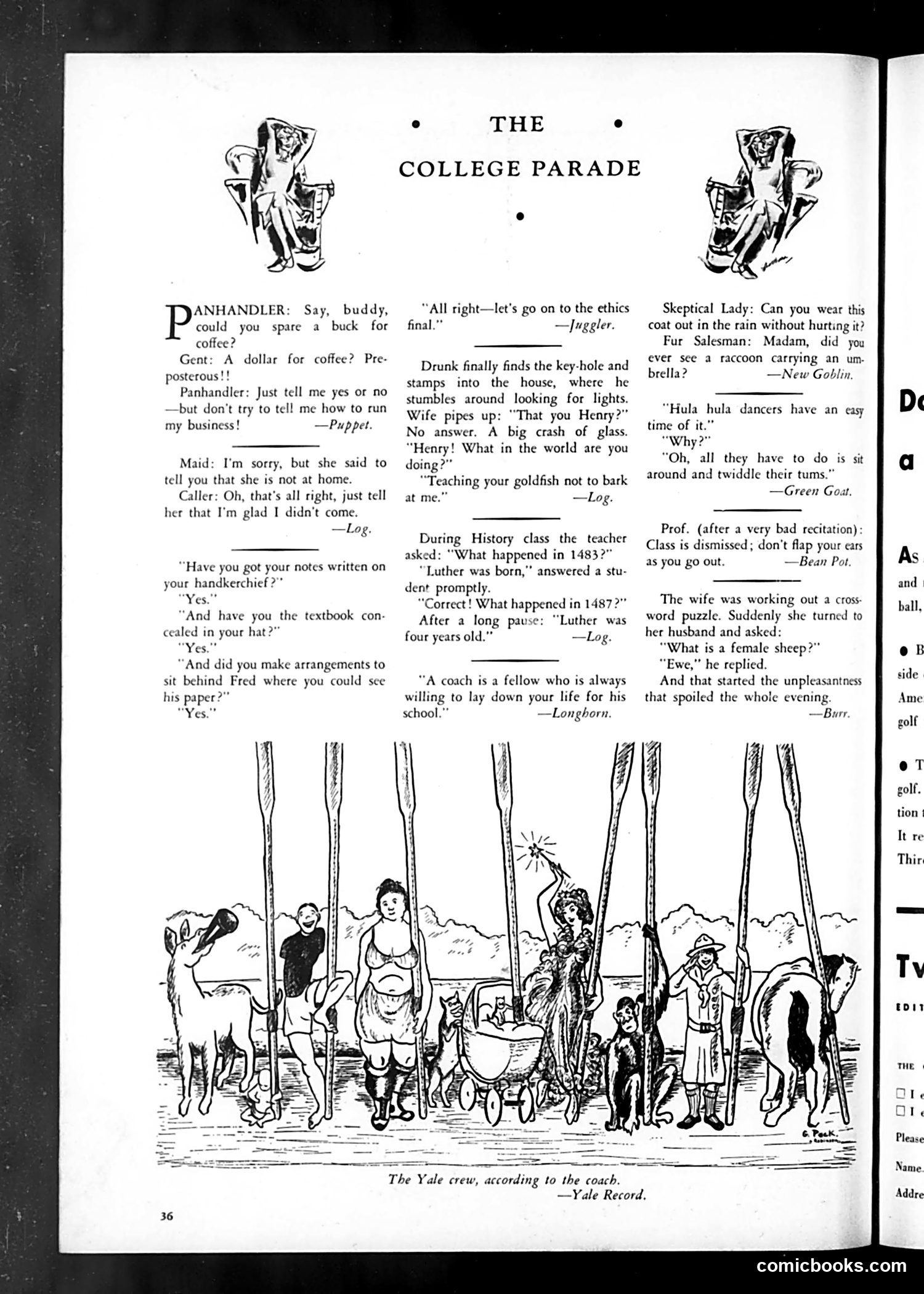
"The College Parade" - Life Magazine Humor Page This is a humor page featuring college-themed jokes and a satirical cartoon. The jokes mock student life: cheating (hiding textbooks, copying answers), academic incompetence (a history student's absurd answer about Luther), drunkenness, and domestic mishaps (a husband's confusion about a goldfish). The central cartoon depicts "The Yale crew, according to the coach"—showing not athletic rowers but various out-of-shape, ridiculous figures engaged in absurd activities around flagpoles. This ridicules both coaches' exaggerated claims about their teams and the gap between athletic pretense and reality. The humor relies on wordplay and the contrast between expectations and absurd reality. The page reflects 1920s-30s college culture anxieties: academic dishonesty, excessive drinking (Prohibition era), and the comedic deflation of institutional authority figures like coaches and professors.
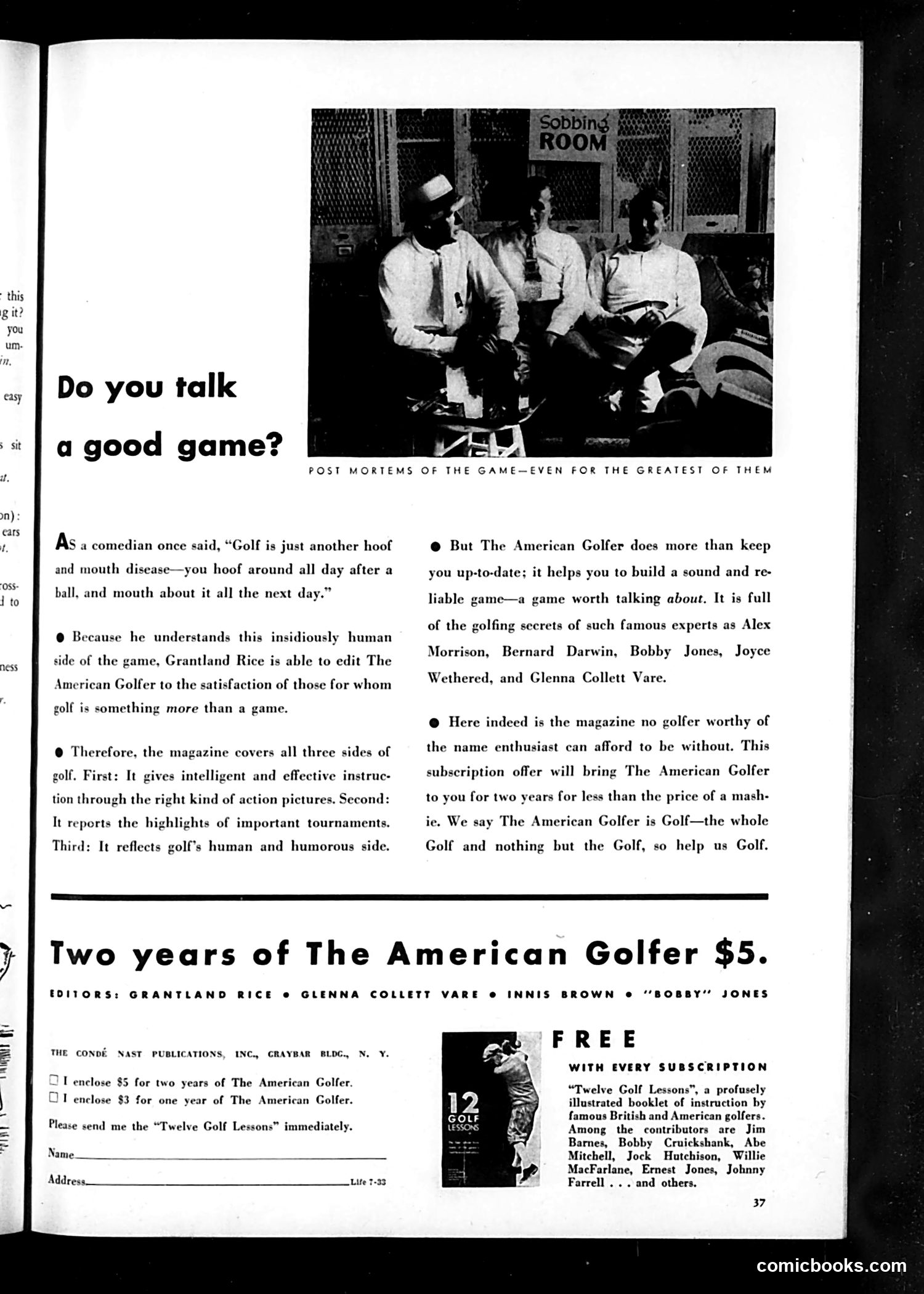
Advertisement for The American Golfer Magazine This is primarily a subscription advertisement, not a political cartoon. The page promotes *The American Golfer* magazine, edited by famous sportswriter Grantland Rice. The humor relies on a joke about golf culture itself: the opening quote compares golf to "hoof and mouth disease"—golfers spend all day chasing a ball, then spend the next day talking about it endlessly. This satirizes golfers' tendency to obsessively discuss their game. The ad emphasizes the magazine covers three aspects of golf: instruction, tournament reporting, and "golf's human and humorous side"—acknowledging that golf discussion is as much social performance as sport. Named contributors include period golf celebrities: Bobby Jones, Joyce Wethered, and Glenna Collett Vare (famous female golfer). The offer includes a free instructional booklet by renowned golfers. The photograph shows four men in a "Sobbing Room"—likely a humorous reference to post-game commiseration among golfers, reinforcing the joke about constant golf talk.
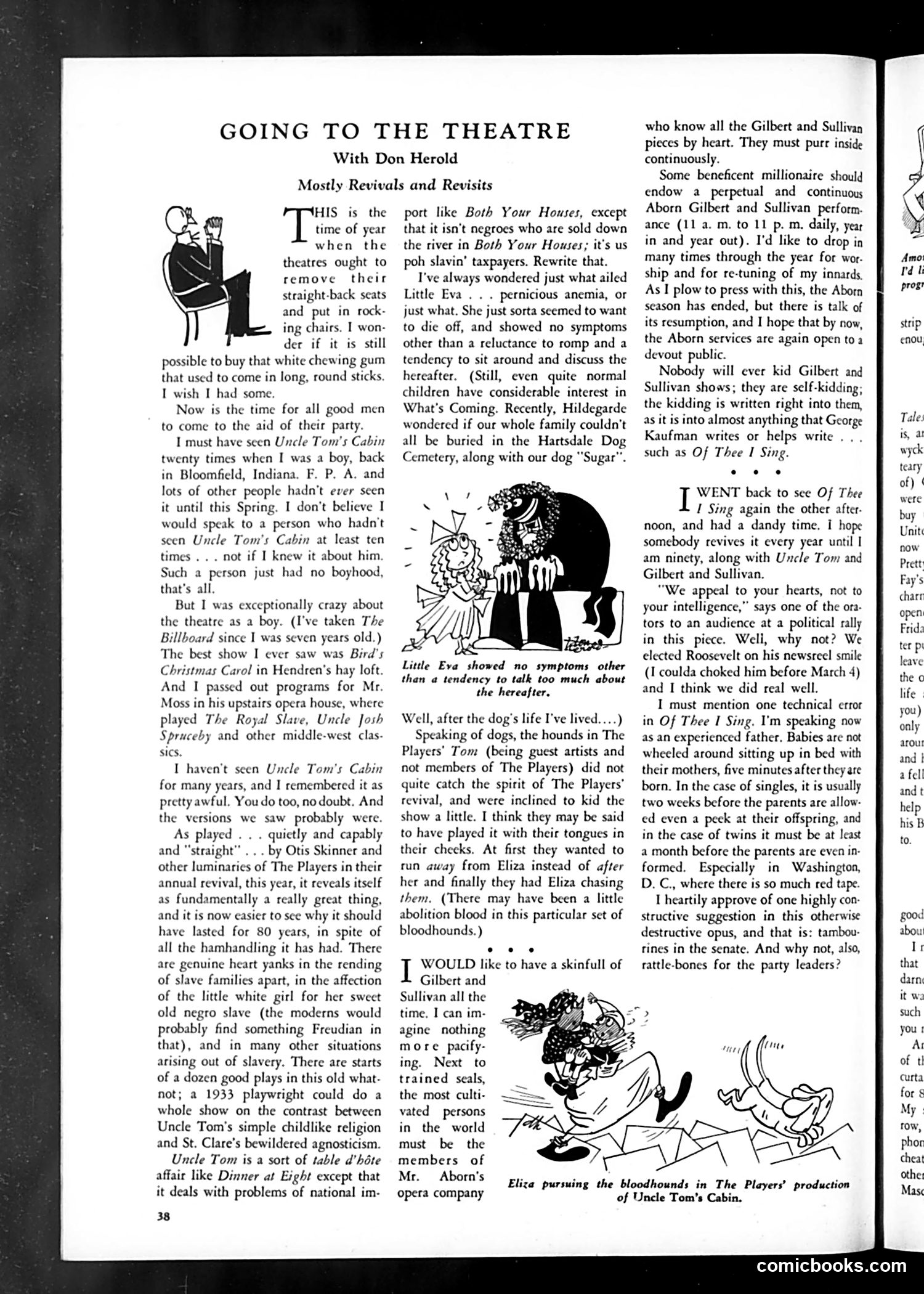
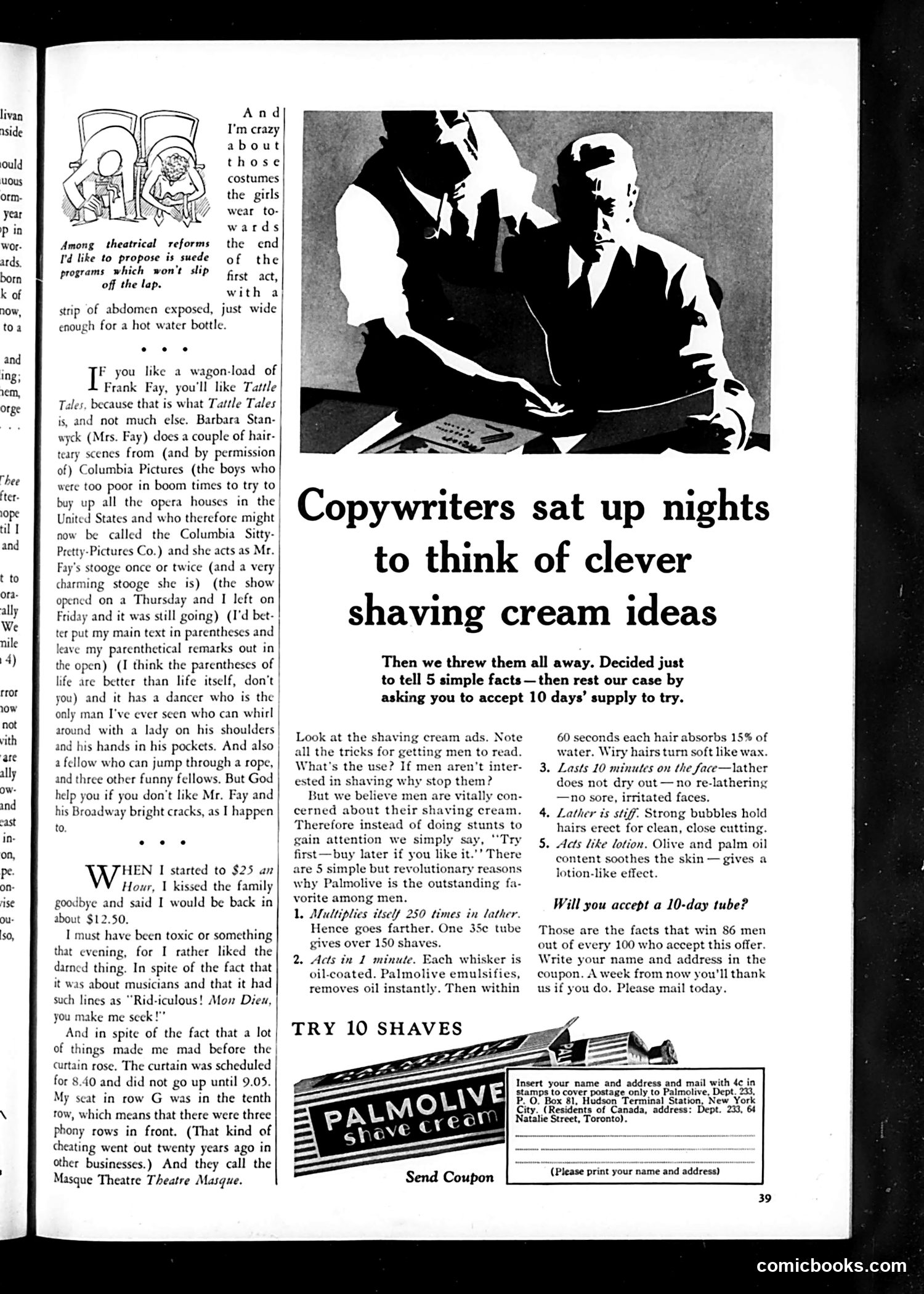
Analysis of Life Magazine Page This page combines theater criticism with a Palmolive shaving cream advertisement—typical of 1920s-30s Life magazine's satirical approach to advertising. Theater Section The critic reviews two Broadway shows: *Tattle Tales* (featuring Frank Fay and Barbara Stanwyck) and *$25 an Hour*. The writing is characteristically sarcastic—praising Stanwyck while dismissing Fay's material, and noting absurdities like theater seating fraud (fake rows blocking views) and scheduling delays. The parenthetical asides are the magazine's signature style, using digression for comedic effect. Advertisement The Palmolive ad satirizes exaggerated advertising claims by claiming to reject them. It presents "5 simple facts" instead of clever copywriting—a meta-joke suggesting honesty is the best sales pitch. The offer of a 10-day trial tube appeals to skepticism. The page exemplifies Life's dual purpose: entertaining social commentary wrapped around consumer advertising, with the ads themselves occasionally becoming the subject of satire.
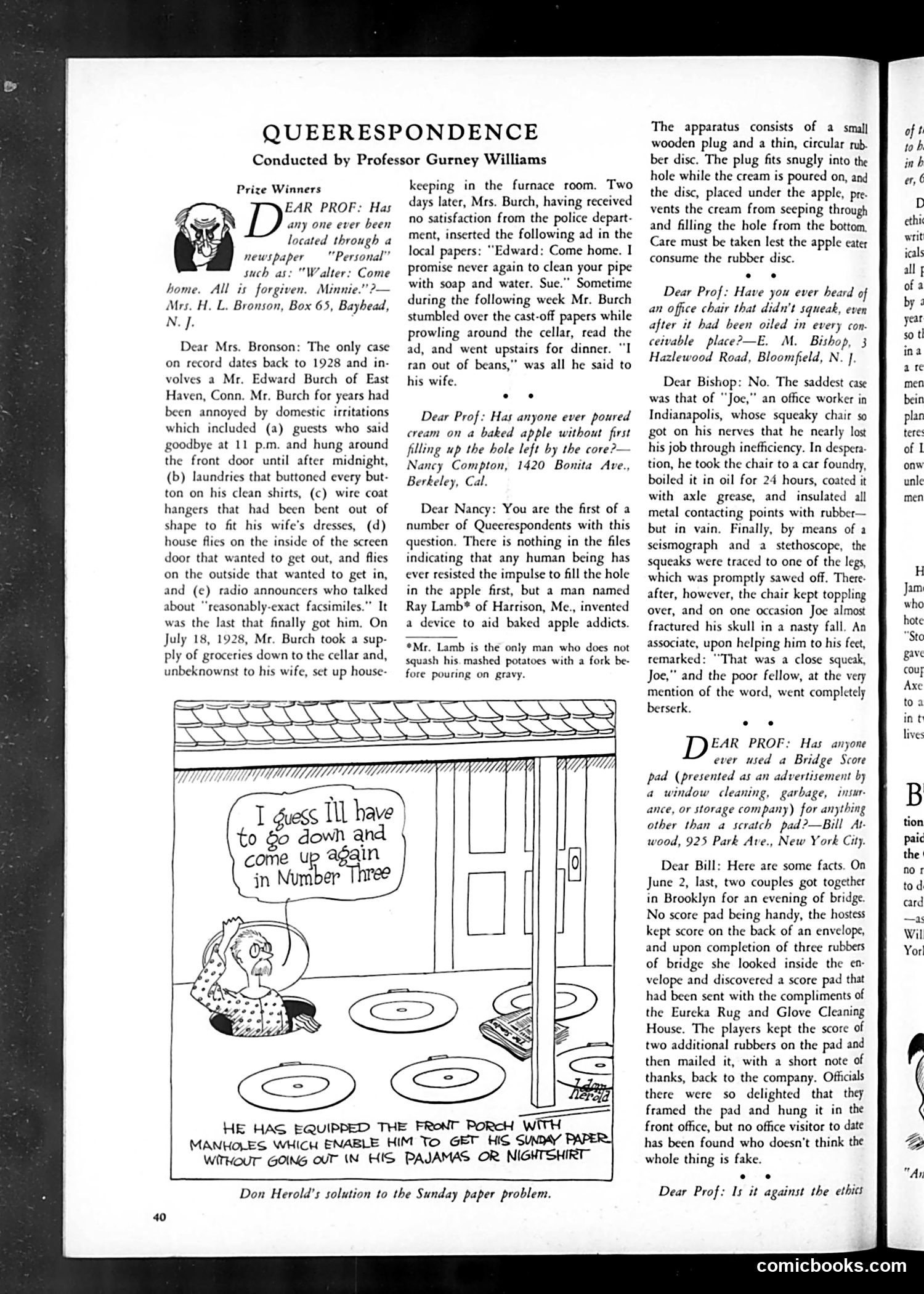
Queerespondence Page Analysis This is a humor advice column from *Life* magazine's "Queerespondence" section, conducted by Professor Gurney Williams. The page collects humorous reader questions about oddly specific domestic problems and inventive (fictional) solutions. The main cartoon by Don Herold satirizes the American obsession with convenience and labor-saving devices. It depicts a man who has installed manhole covers on his front porch to retrieve his Sunday newspaper without leaving his pajamas—an absurd escalation of modern convenience culture. The joke mocks how far people will go to avoid minor inconveniences. The column itself features tongue-in-cheek "true stories" (clearly fabricated) about people's quirky solutions: a man hiding in his furnace room to avoid domestic annoyances, and another soaking an office chair in oil for 24 hours to stop it squeaking. The satire targets both American domesticity's petty frustrations and the era's faith in mechanical/technological "fixes" for life's problems—a recurring *Life* magazine theme during this period.
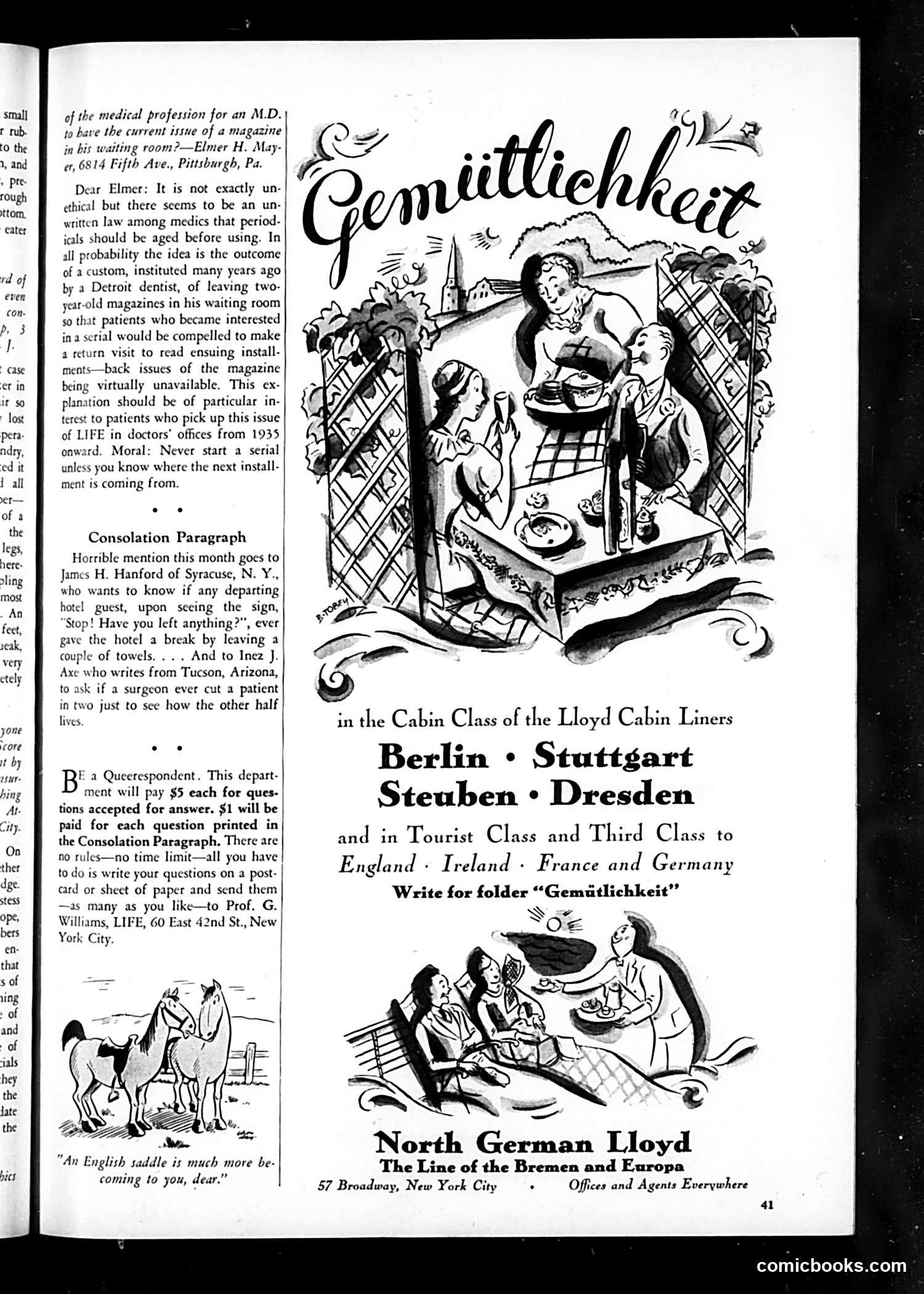
Page Analysis This page contains reader Q&A ("Consolation Paragraph") and shipping line advertising rather than political cartoons. The Q&A section humorously addresses reader questions about social conventions—notably why doctors keep outdated magazines in waiting rooms. The explanation: a Detroit dentist allegedly started this practice to force patients to return for unread serial installments. The "moral" jokes that readers of *Life* magazine (from 1935 onward) should never start a serial without knowing where the next installment comes from—a self-referential jab at the magazine itself. The advertisements promote the North German Lloyd shipping line, featuring ocean liners (Berlin, Stuttgart, Steuben, Dresden, Bremen, and Europa) traveling to England, Ireland, France, and Germany. The German word "Gemütlichkeit" (coziness/comfort) appears prominently. This reflects pre-WWII transatlantic travel marketing, before such German shipping lines became historically fraught. The illustrated vignettes show cheerful passengers dining and relaxing aboard ship—typical luxury travel imagery of the 1930s era.
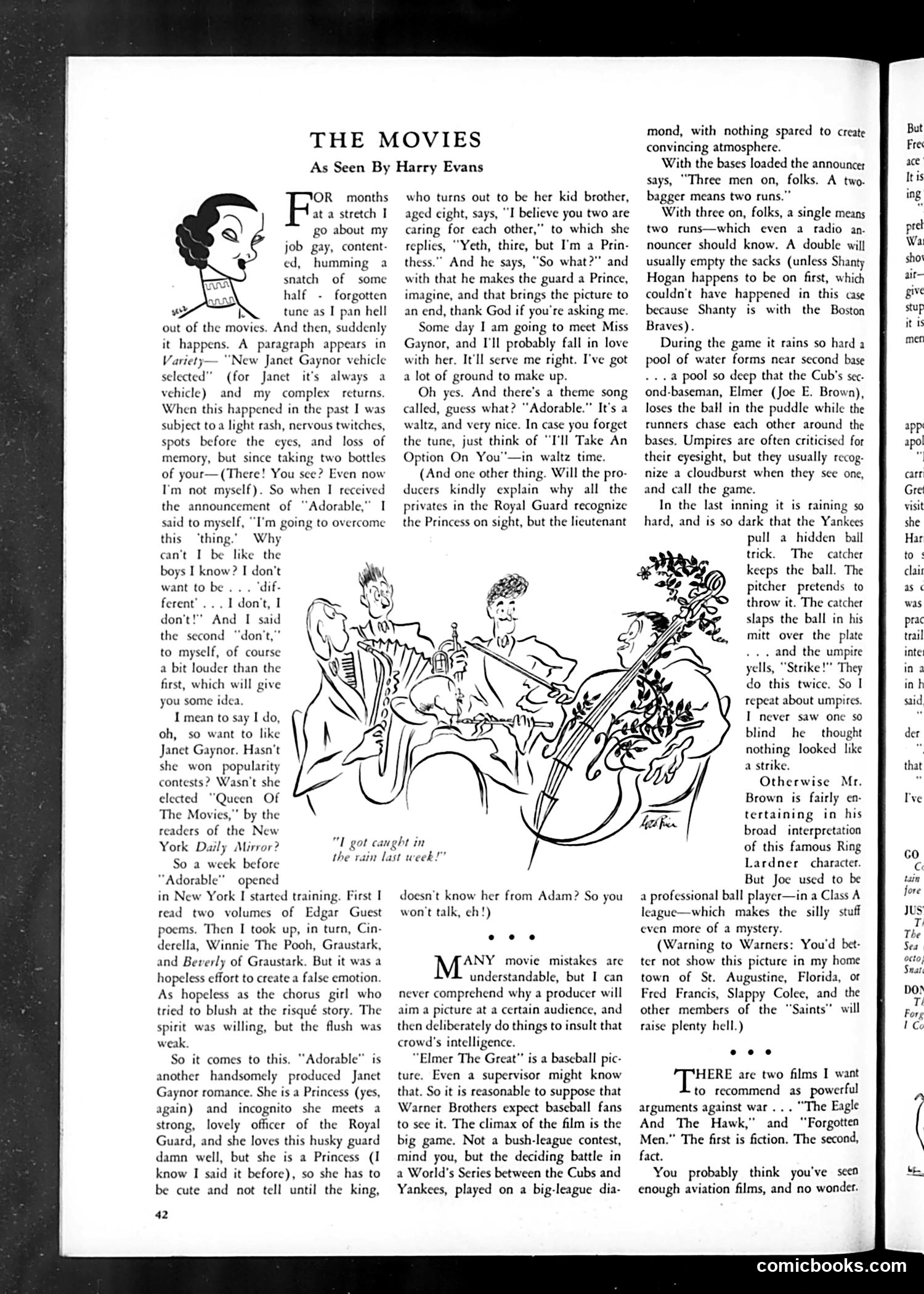
"The Movies As Seen By Harry Evans" This is a humorous film criticism column by Harry Evans. The main illustration shows musicians performing, accompanying Evans's review of "Adorable," a Janet Gaynor romance film. Evans satirizes his own obsessive fandom of Gaynor—admitting he's emotionally disturbed by her films despite trying to resist—while mocking the film's absurd plot (a princess who falls for a guard, resolved when her brother casually promotes him to prince). The second section critiques "Elmer The Great," a baseball picture. Evans highlights producer incompetence: during a climactic World Series game, the radio announcer incorrectly states that "a two-bagger means two runs" with bases loaded—any baseball fan knows this is wrong. Evans's broader point: producers deliberately insult audiences' intelligence by aiming films at specific groups (baseball fans) then including obvious errors that undermine credibility.
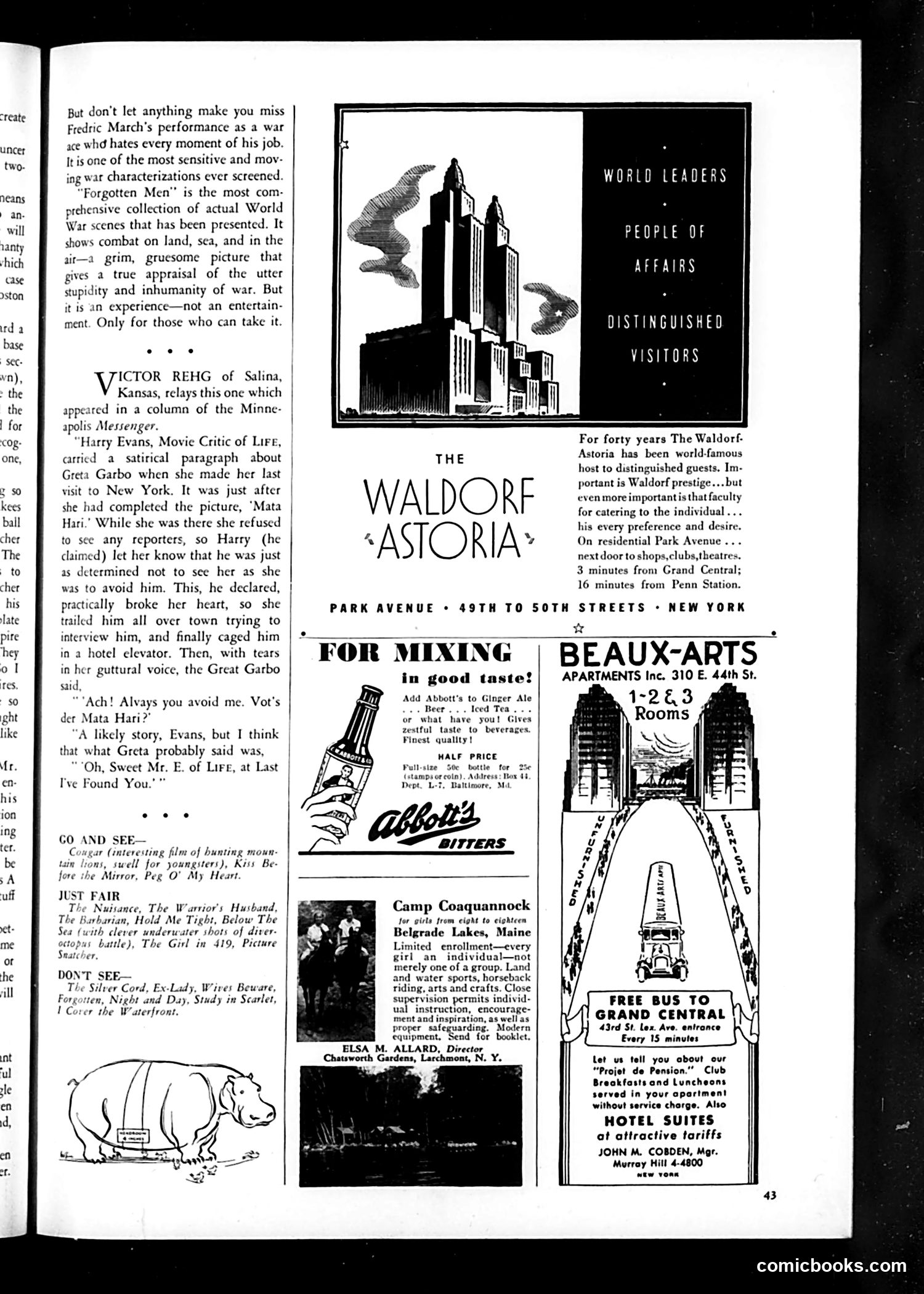
Life Magazine Page Analysis This page mixes entertainment criticism with advertisements. The main editorial content discusses Fredric March's performance in the war film "Forgotten Men," praising his sensitive portrayal of a pilot who despises combat. The critic emphasizes this is not entertainment but a grim, authentic depiction of war's "stupidity and inhumanity"—reflecting 1930s pacifist sentiment amid rising international tensions. A humorous anecdote follows about Greta Garbo, the famous Swedish actress, mocking her accent and reputation for avoiding reporters during a 1932 New York visit. The joke plays on her reclusiveness and thick accent for comedic effect. The advertisements feature luxury NYC establishments (Waldorf-Astoria hotel, Beaux-Arts apartments), a gin product, a girls' summer camp, and a beverage mixer—typical Depression-era advertising targeting affluent readers. The page reflects Life's dual purpose: sophisticated satire and upscale marketing.
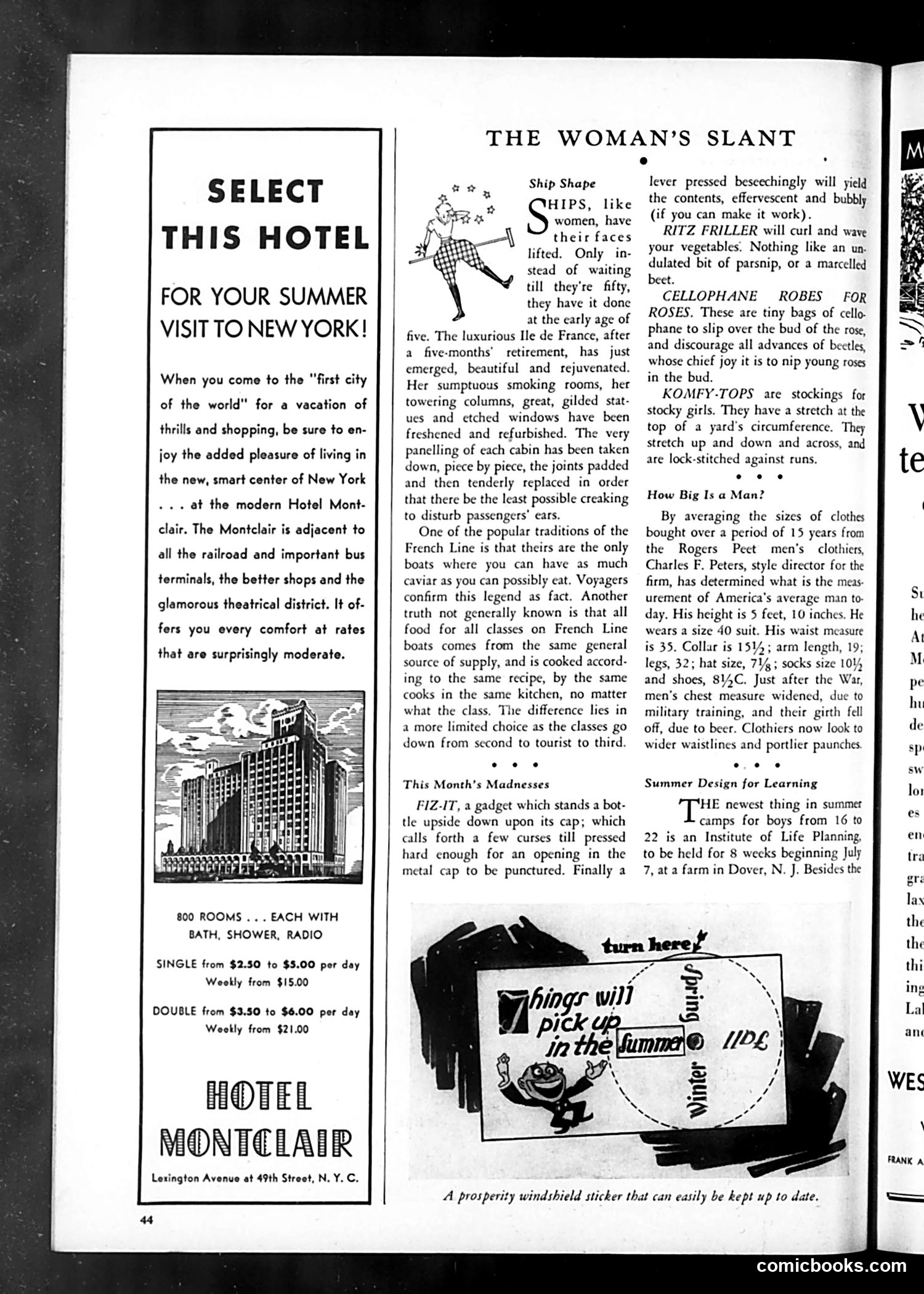
Analysis This page is primarily advertising and lifestyle content, not political satire. The left side features a hotel advertisement for the Montclair in New York City. The right side contains "The Woman's Slant," a women's interest column covering: 1. Ship Shape: A playful comparison of the French ocean liner Île de France to women getting facelifts—both undergo renovation to look rejuvenated. The column notes French Line dining serves identical food across all classes, with differences only in portion choice. 2. This Month's Madnesses: Brief humorous descriptions of novelty gadgets (FIZ-IT bottle opener, Ritz vegetable curler, cellophane rose protectors, stretch-top stockings). 3. How Big Is a Man?: Data from a men's clothier showing average American male measurements (5'10", size 40 suit), noting post-WWI changes in body shape due to military training and beer consumption. 4. Summer Design for Learning: Announcement of a new summer institute for young men in Dover, New Jersey. There is no political cartoon or satire on this page—it's straightforward period advertising and lifestyle journalism typical of 1930s women's magazines.
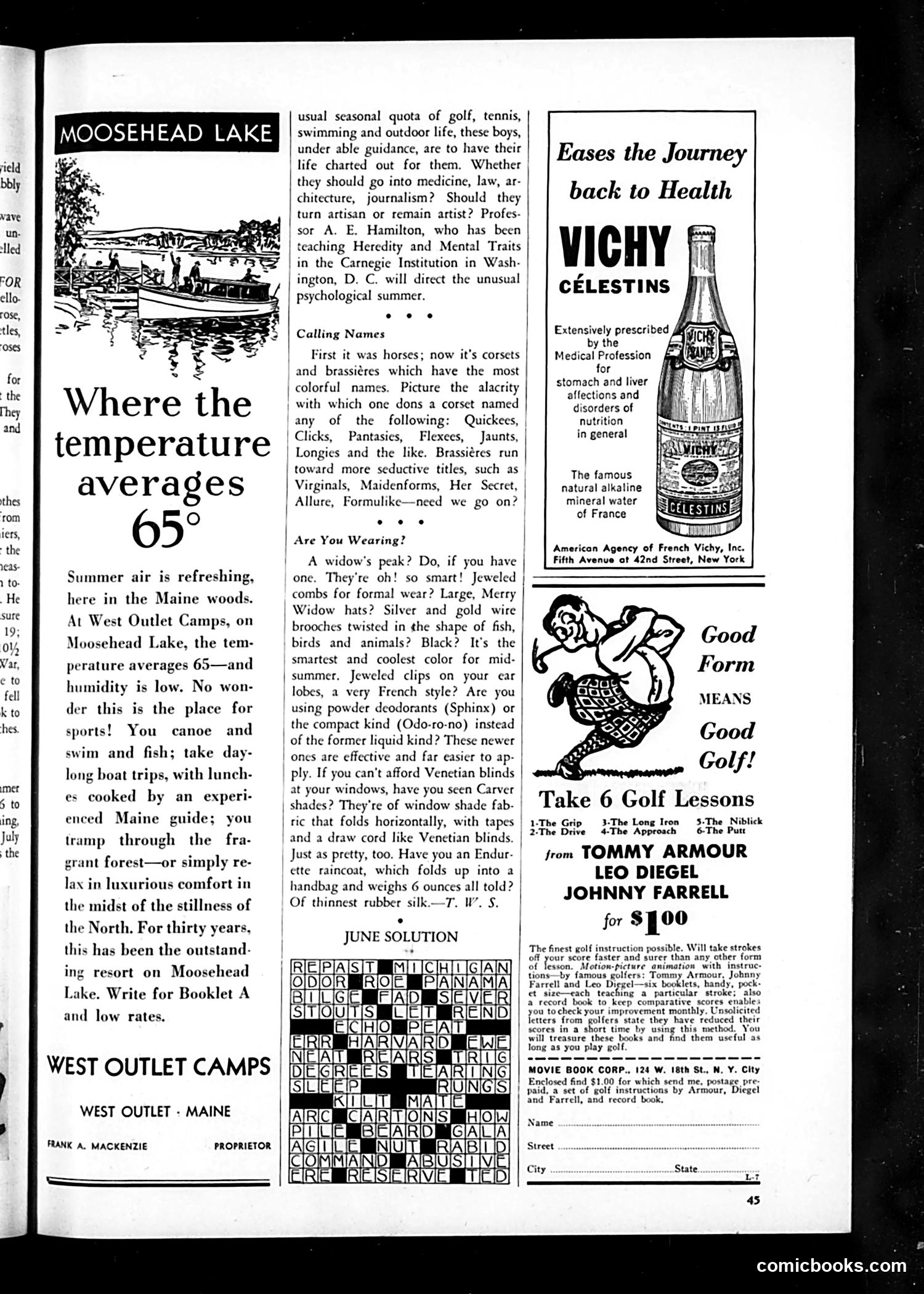
Analysis of Life Magazine Page Content This is primarily an advertising and lifestyle advice page from Life magazine, not a political cartoon. The main content includes: West Outlet Camps advertisement: A straightforward resort ad promoting Moosehead Lake in Maine as a 30-year-old vacation destination offering camping, fishing, canoeing, and forest activities at 65-degree temperatures. Lifestyle column ("Calling Names" and "Are You Wearing?"): Fashion and consumer advice mentioning branded undergarments (corsets, brassieres) with playful names like "Quickees" and "Maidenforms," plus fashion tips about widow's peaks, jewelry, and compact deodorants—reflecting 1920s-30s consumer culture and women's fashion trends. Two product advertisements: Vichy Célestin mineral water (for digestive health) and golf instruction booklets by famous golfers (Tommy Armour, Leo Diegel, Johnny Farrell) for $1.00. The page reflects early 20th-century marketing, consumer goods proliferation, and leisure culture rather than political satire.
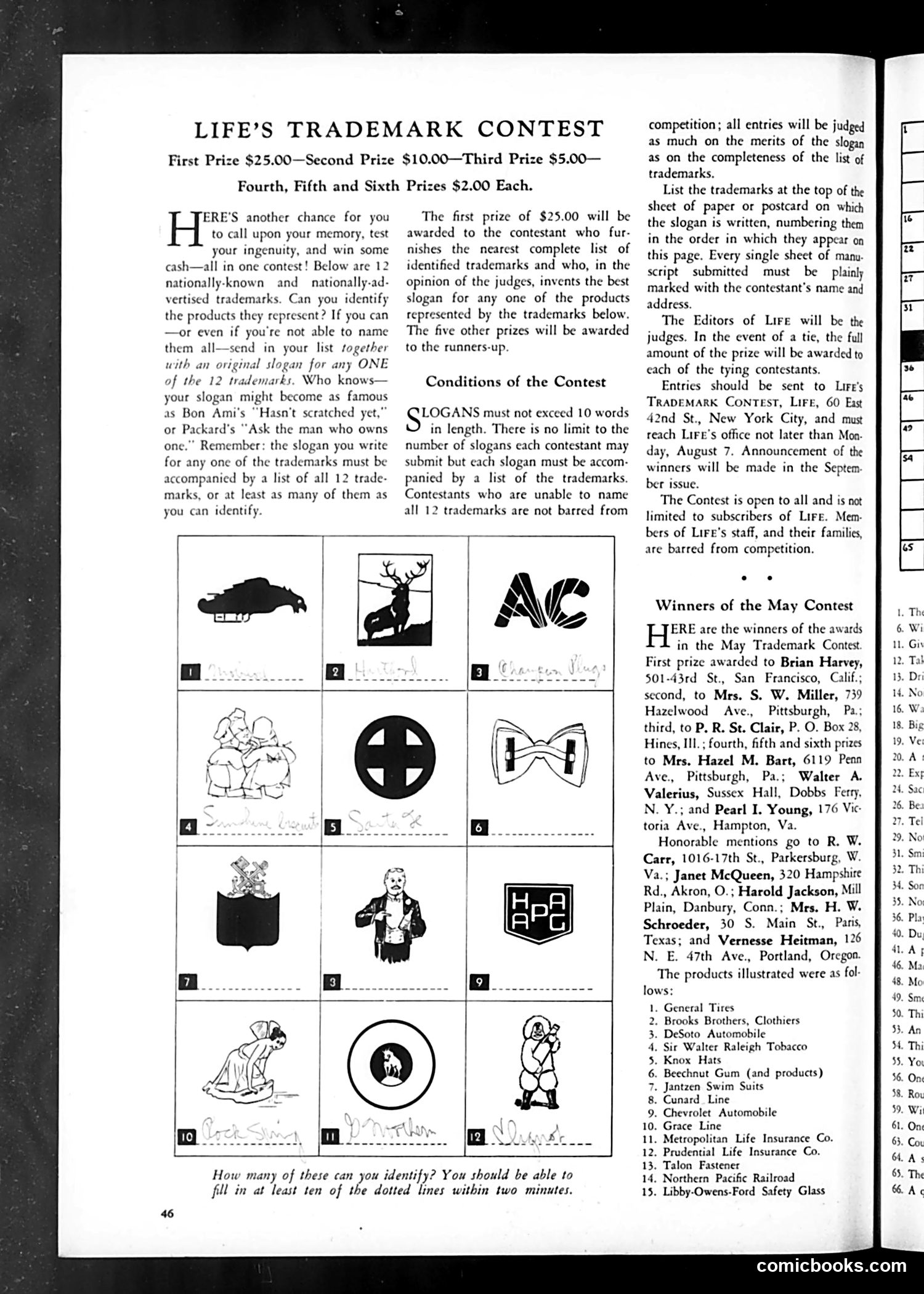
Life's Trademark Contest This page presents a reader-participation game where contestants identify 12 famous commercial brand logos and slogans from the 1920s-30s. The contest offers cash prizes ($25 down to $2) for the most complete identification plus the best original advertising slogan for any one product. The 12 trademarks shown include recognizable symbols: General Tires, Brooks Brothers clothing, DeSoto automobiles, Sir Walter Raleigh tobacco, Knox Hats, Beechnut Gum, Jantzen swimsuits, Cunard shipping line, Chevrolet, Grace Line, and two insurance companies. The page also announces previous contest winners. This reflects early 20th-century consumer culture and *Life* magazine's role as both satirist and participant in commercial advertising. The contest itself was entertainment—readers tested their brand recognition while *Life* generated engagement and promoted advertiser products simultaneously.
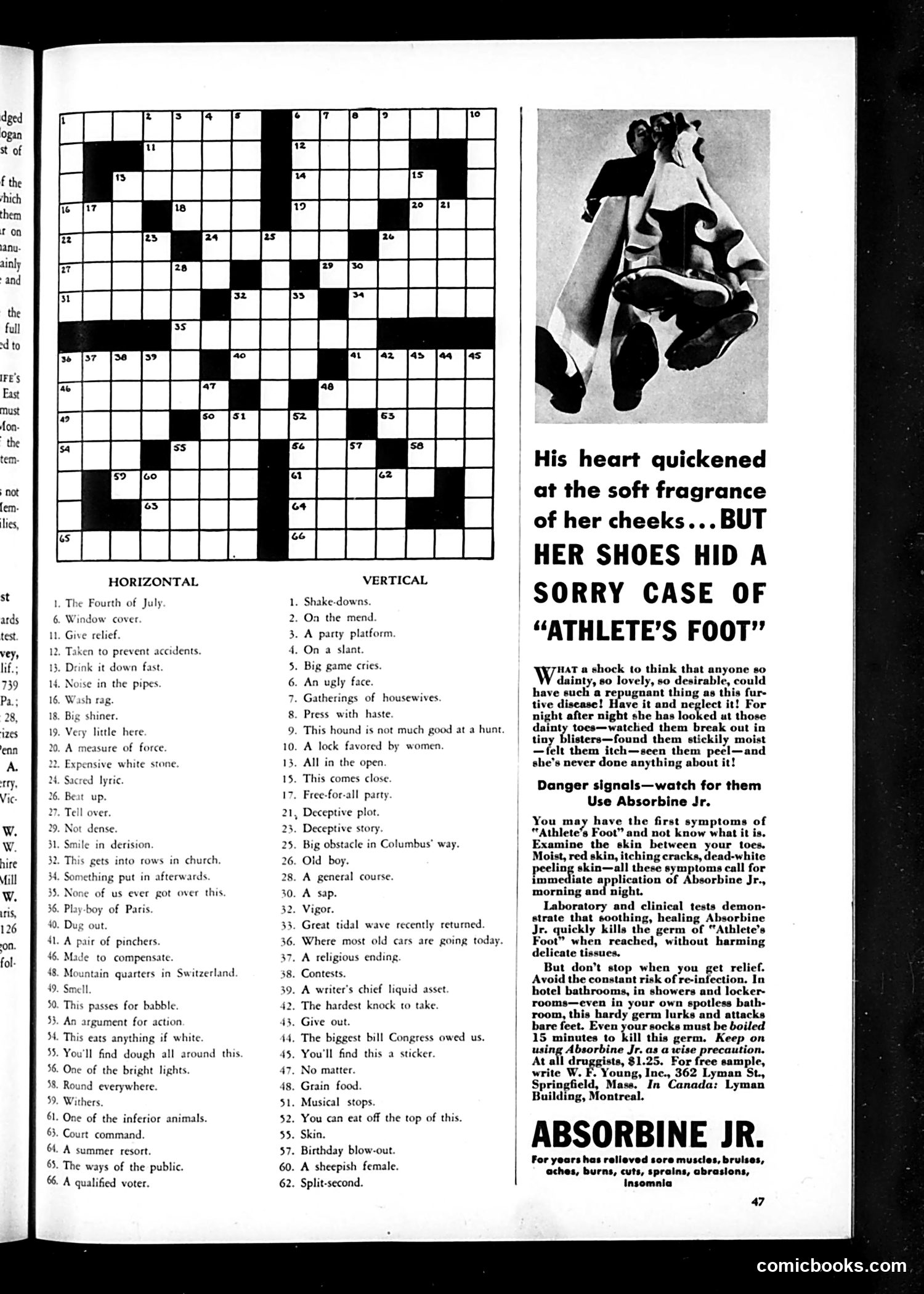
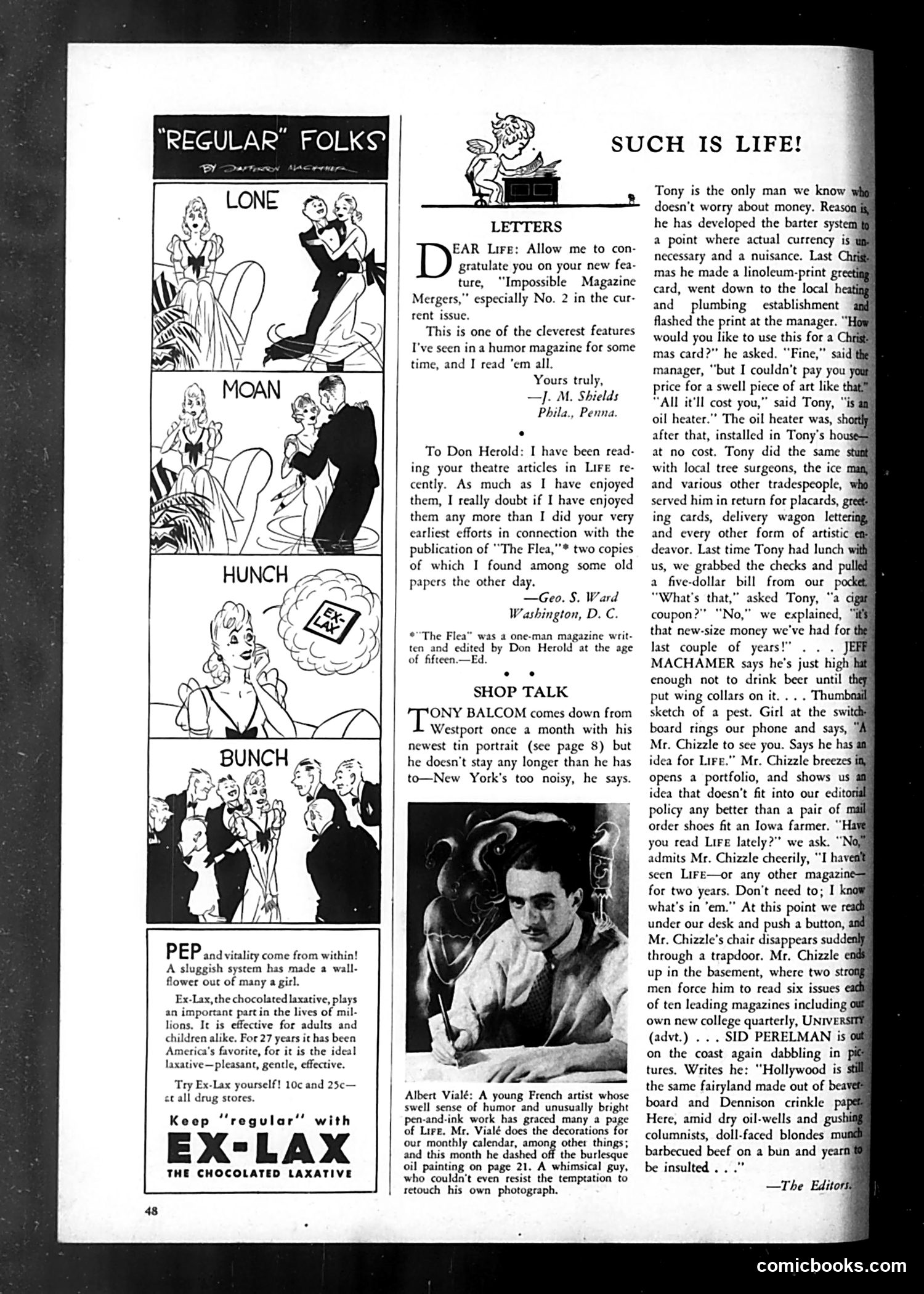
Explanation for Modern Readers This page contains three distinct sections: Left side: "Regular Folks" comic strips satirizing different personality types (Lone, Moan, Hunch, Bunch, Pep) through domestic situations—typical 1920s-30s humor about recognizable social archetypes. Center: Letters section praising Life's humor features, including reader appreciation for a "Impossible Magazine Mergers" feature and Don Herold's early work. Right side: "Shop Talk" and "Such Is Life"—behind-the-scenes anecdotes about Life contributors. The main story describes Tony Balcom, an artist who bartered artwork (linoleum prints, decorations) for services instead of using money—presenting this as eccentrically amusing. The piece also mocks a persistent pest-contributor named Chizzle who pitches unsuitable ideas. Bottom: Ex-Lax laxative advertisement using dated health messaging about "sluggish systems" affecting women's social appeal. The satire reflects 1920s-30s class attitudes and assumptions about gender, commerce, and artistic bohemianism that modern readers would find quaint or problematic.
I cannot reliably read the content of this image. The page is extremely dark and degraded, making it difficult to discern specific cartoon illustrations, caricatures, or textual details with confidence. While I can see there is a left margin with some printed text visible, and the watermark "comicbooks.com" at the bottom, the main body of the page—where any cartoon or satirical content would appear—is too dark and unclear for me to identify specific figures, political references, or the intended satire. To properly analyze this Life magazine page as requested, I would need a clearer or higher-contrast version of the image.