life
Life — September 1933
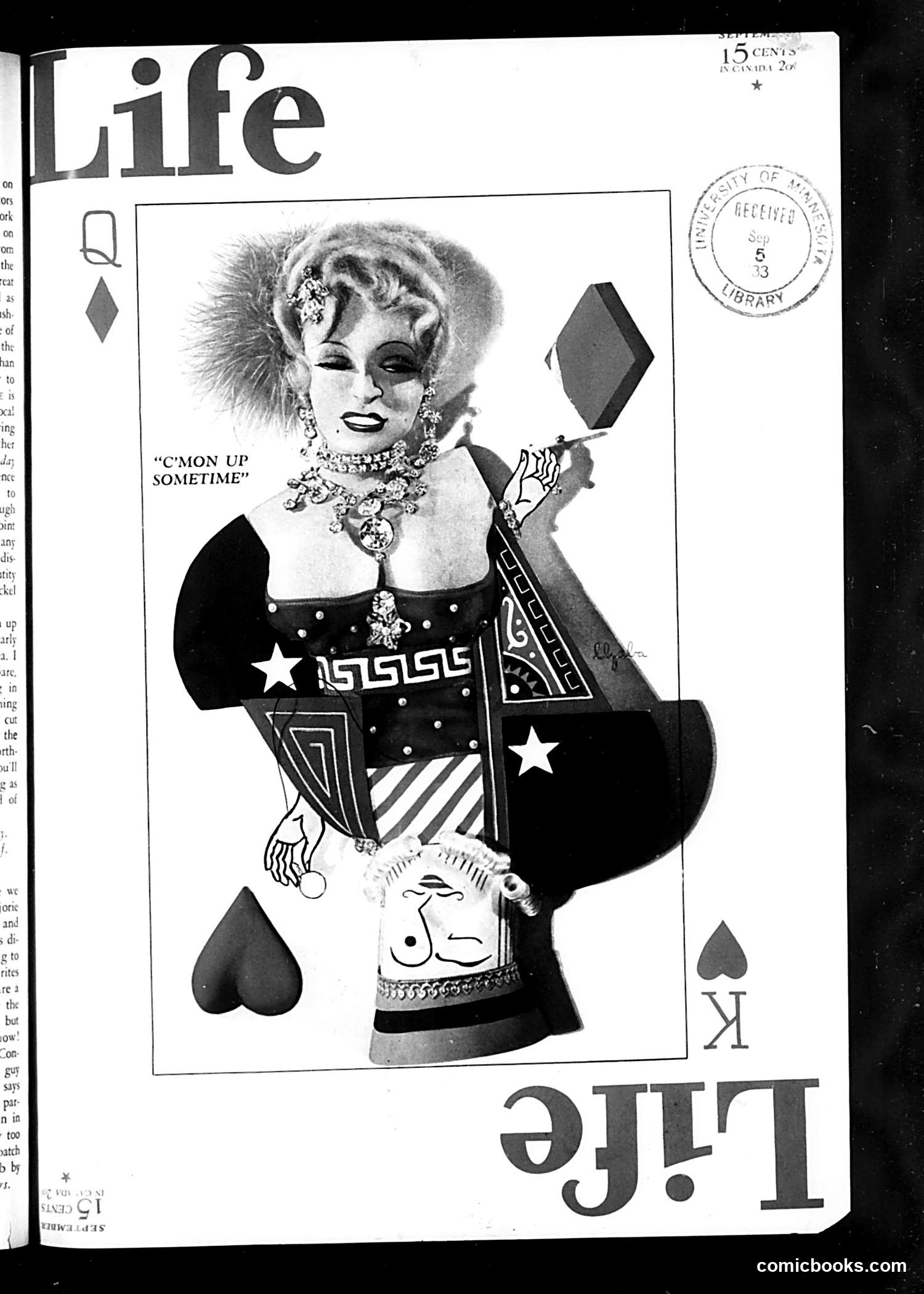
Life Magazine Playing Card Illustration This appears to be a Life magazine cover or playing card design featuring a Queen character in glamorous, art-deco styled clothing with ornate jewelry, feathered headpiece, and decorative patterns. The phrase "C'MON UP SOMETIME" is captioned—a famous catchphrase associated with Mae West, the 1930s actress and sex symbol known for her provocative performances and double-entendre humor. The design uses playing card elements (Queen, diamonds, hearts, spades), suggesting this is either satirizing high-society entertainment or parodying West's famous persona. The illustration style and luxurious costume emphasize her reputation for glamour and sexual charisma, which was considered scandalous for the era. Life magazine frequently mocked celebrities and social figures through such theatrical caricatures.
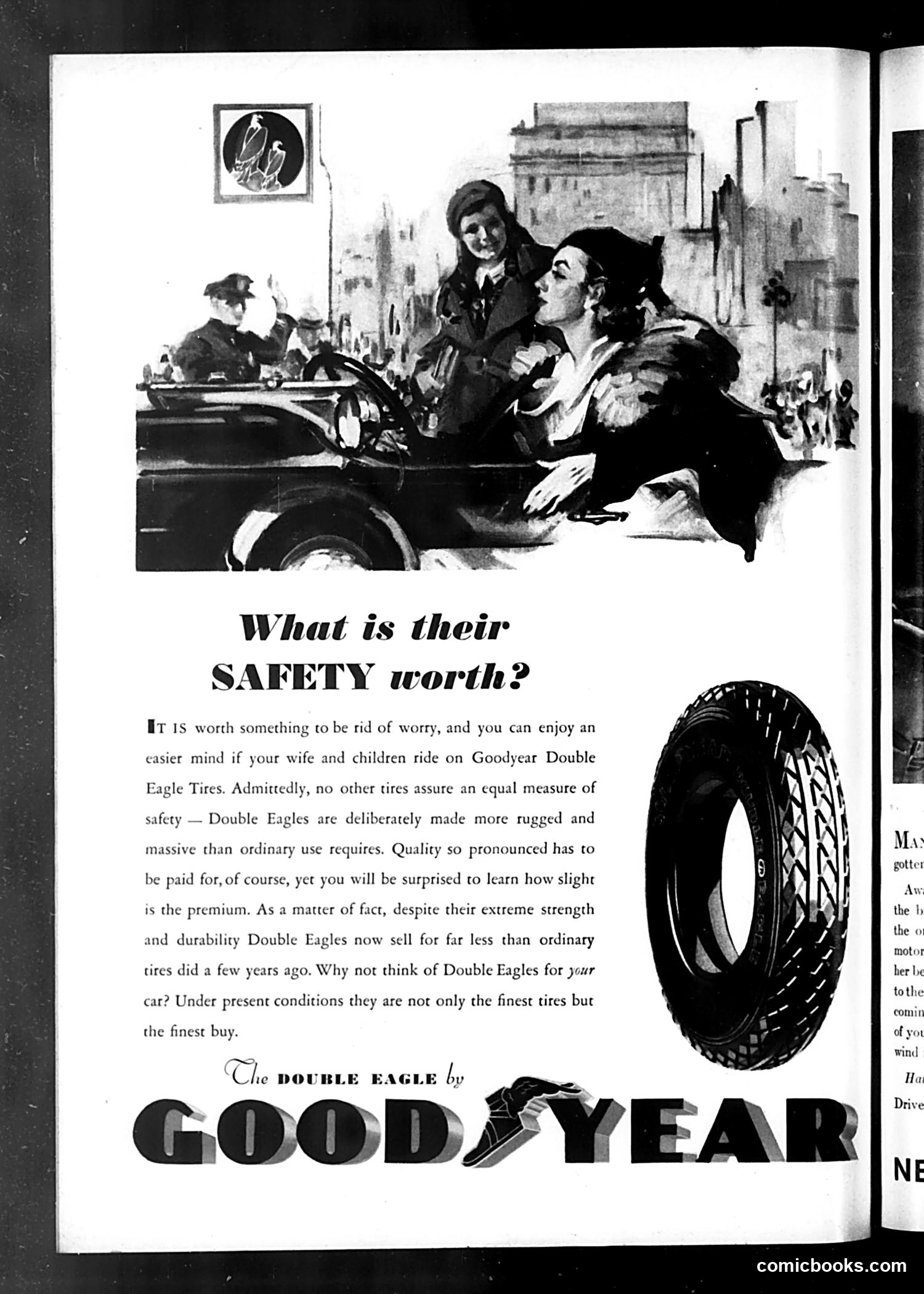
Analysis This is advertising content, not editorial satire. The page promotes Goodyear's "Double Eagle" tire brand through a staged domestic scene. The image shows a family in an open car—a woman and two children—with a suited man (possibly a chauffeur or family member) at the wheel, driving through a city street. The accompanying text uses safety and family welfare as the sales pitch: parents can "enjoy an easier mind" knowing their loved ones ride on Double Eagle tires, which are marketed as exceptionally durable and strong. The appeal is explicitly emotional and gendered—targeting male breadwinners' anxieties about protecting their wives and children through product purchase. Despite claiming superior quality, the ad notes Double Eagles cost less than competitors, positioning them as both premium *and* economical. This reflects early-20th-century marketing strategies linking automobile safety to family security.
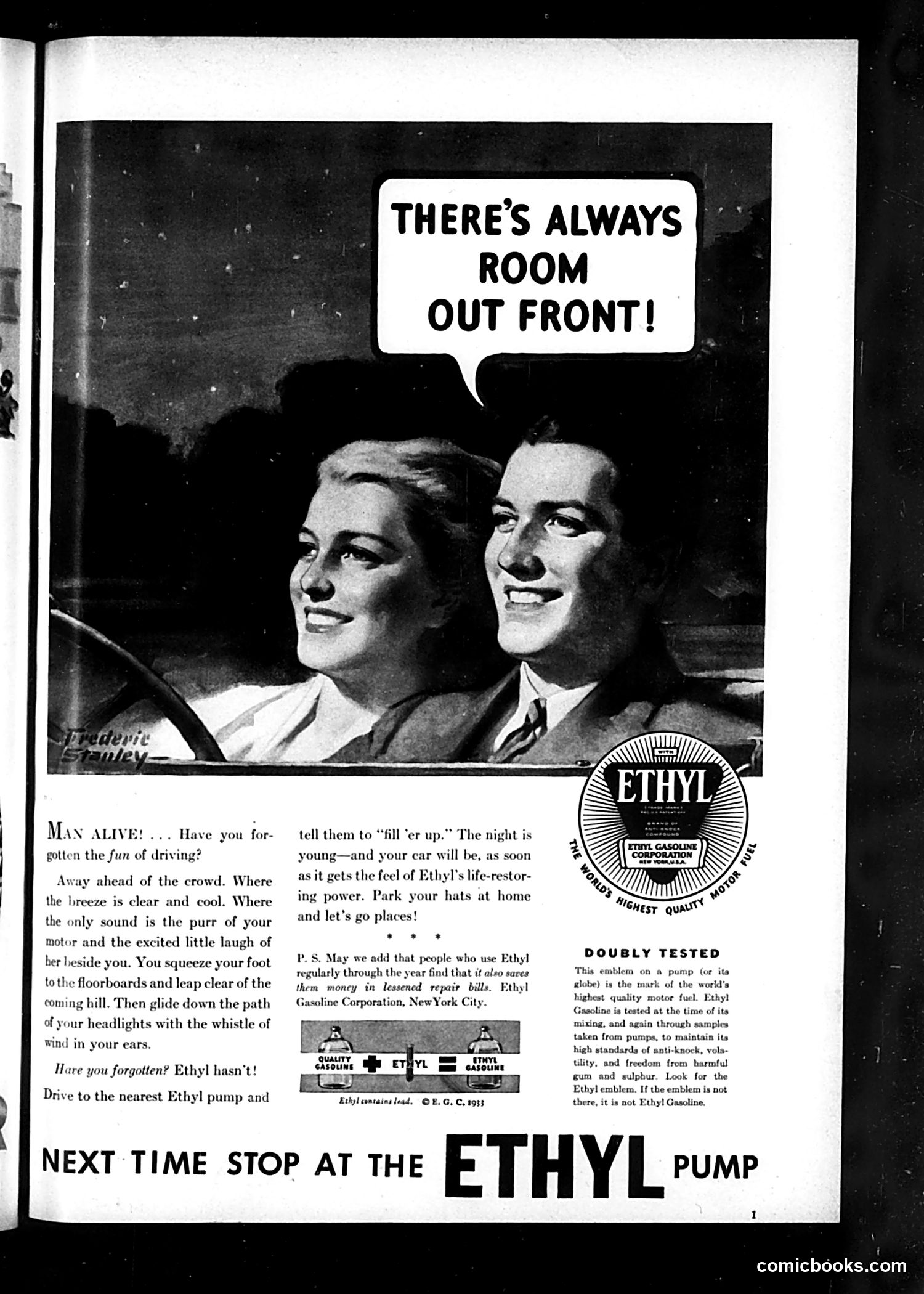
Ethyl Gasoline Advertisement This is a full-page advertisement for Ethyl gasoline, not political satire. The image shows a couple in a car with the man saying "There's always room out front!"—a double entendre suggesting both spacious driving and romantic intimacy. The ad appeals to leisure and romance, inviting readers to experience "the fun of driving" with Ethyl's "life-restoring power." The text emphasizes superior engine performance and cost savings through reduced repair bills. The "Doubly Tested" seal certifies the gasoline's quality. The phrase "Next time stop at the Ethyl pump" is the sales pitch. This represents early 20th-century automotive advertising targeting affluent consumers, blending product benefits with lifestyle aspiration and gender dynamics typical of the era.
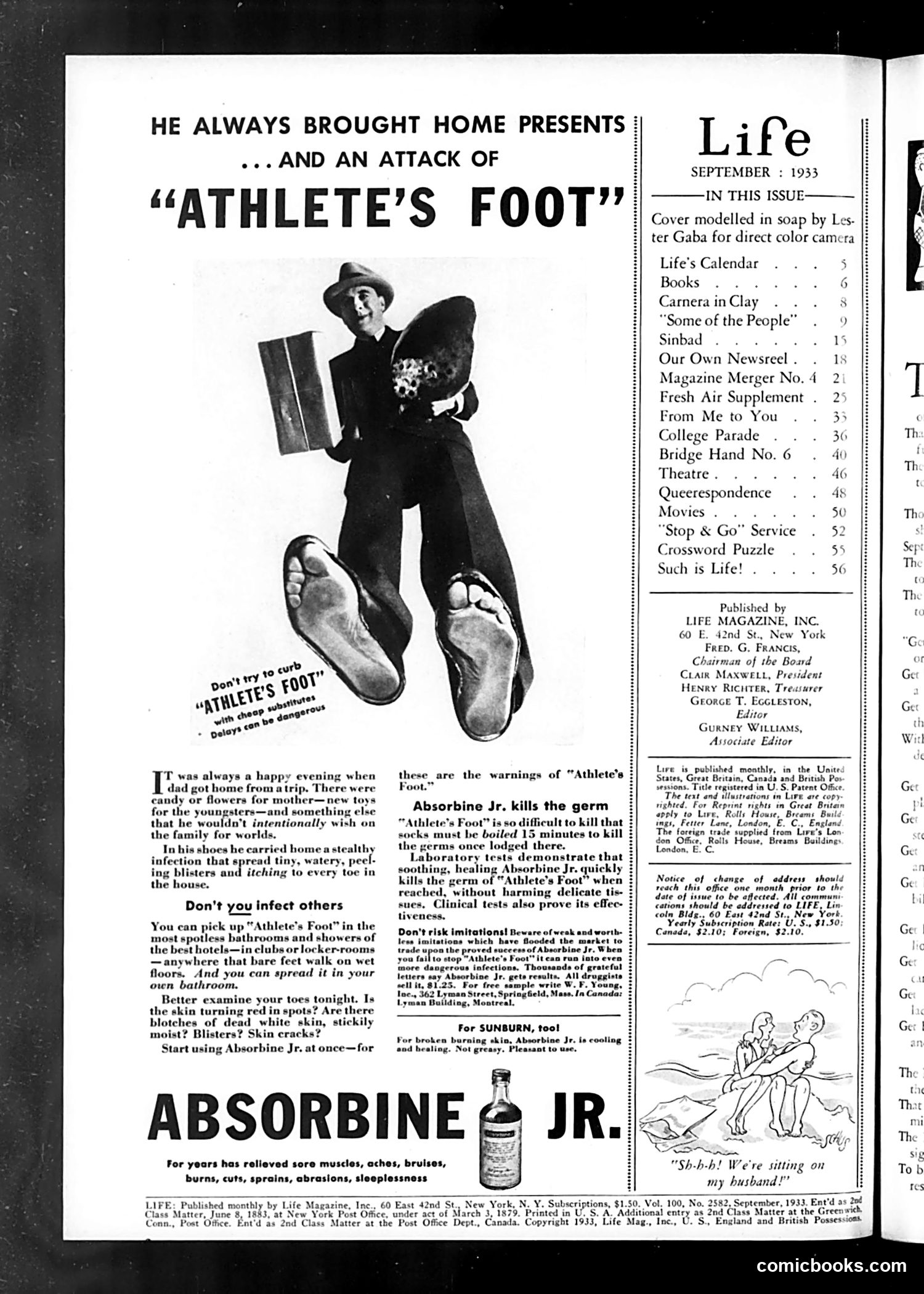
Analysis of Life Magazine, September 1933 This page is primarily a full-page advertisement for Absorbine Jr., a medicinal liniment product. The ad uses humor to sell the remedy by depicting a man bringing home gifts alongside "Athlete's Foot"—personified as an unwanted houseguest. The joke plays on the common experience of men returning from trips with both presents and minor ailments. The advertisement warns that athlete's foot is contagious and difficult to eliminate, then promotes Absorbine Jr. as the solution, claiming it "kills the germ." The right side shows Life Magazine's table of contents for September 1933. The overall approach reflects 1930s advertising strategy: combining humorous scenarios with health anxiety to drive product sales.
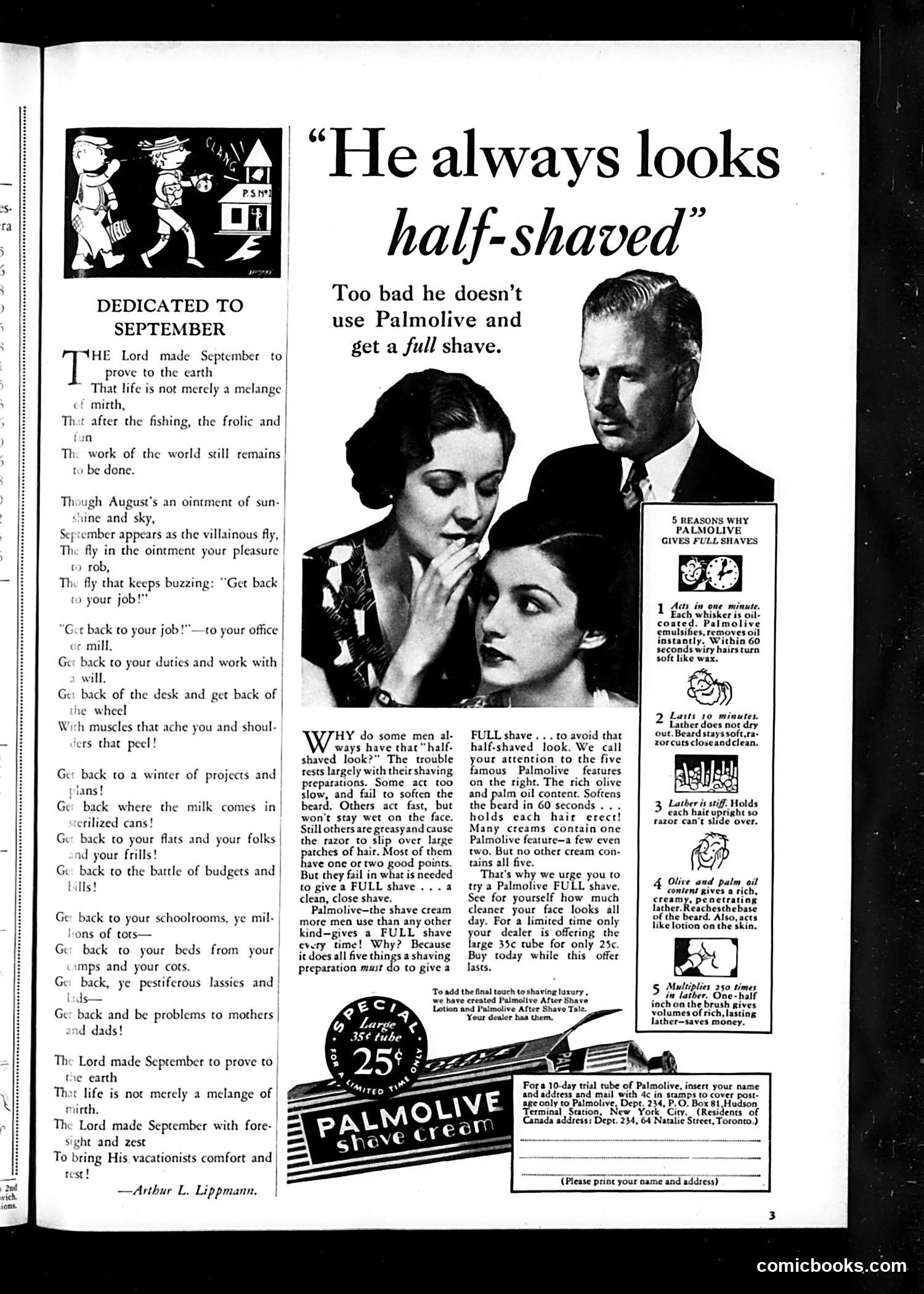
Analysis This page is primarily a Palmolive shaving cream advertisement rather than satirical content. The main visual shows three people examining a man's face, with the headline claiming he "always looks half-shaved." The ad argues that most shaving creams fail to soften beards properly, leaving men with an incomplete shave. It lists "5 Reasons Why Palmolive Gives Full Shaves," emphasizing the product's superior lathering and softening abilities. The left column contains a poem "Dedicated to September" by Arthur L. Lippmann—unrelated content typical of Life magazine's format. This represents vintage advertising rhetoric: identifying a social problem (appearing unkempt) and positioning the product as its solution. The "half-shaved" appearance would have been considered unacceptable grooming for mid-20th century men. The advertisement uses mild social pressure—the scrutiny of others examining his face—to motivate purchase.
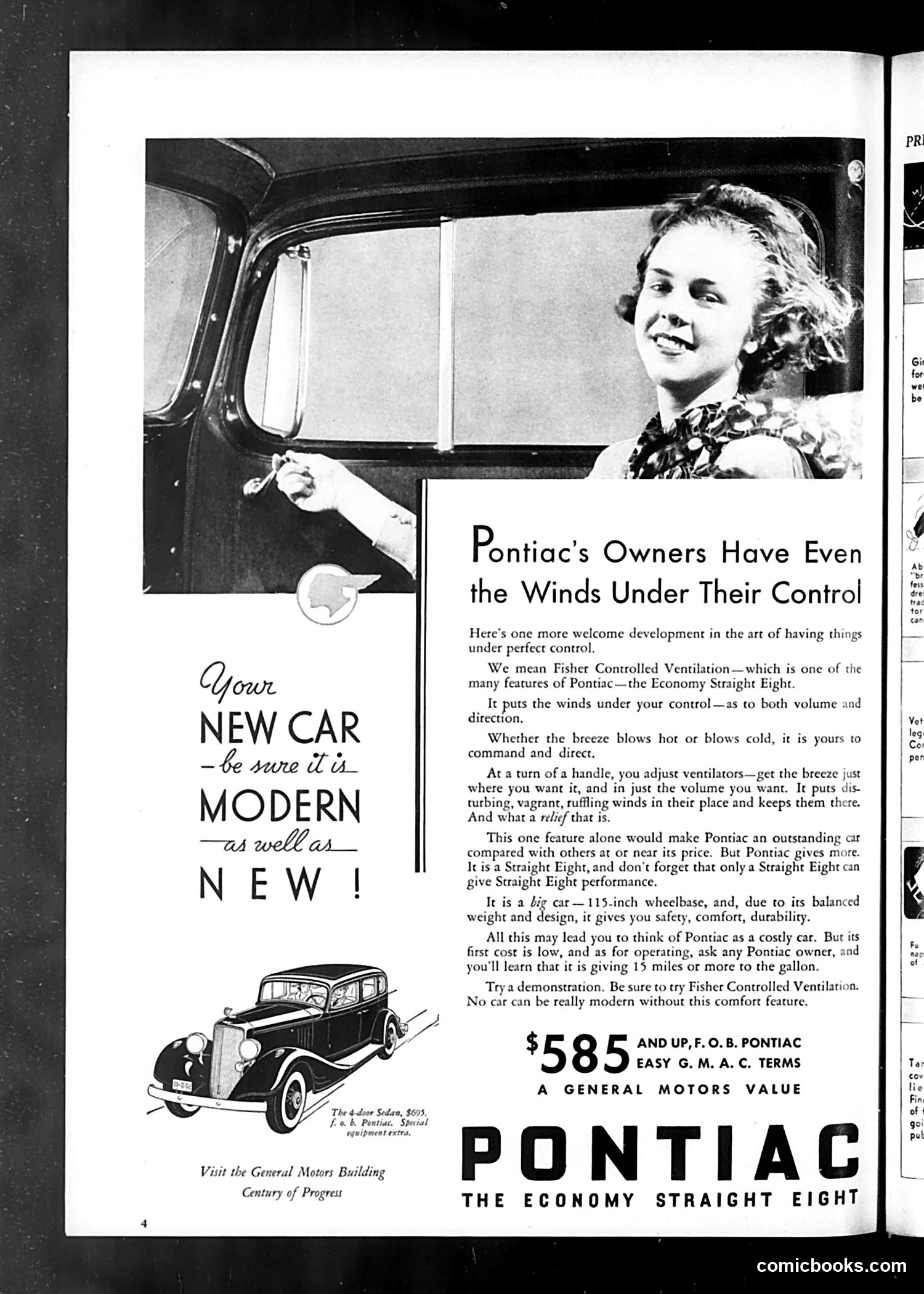
Analysis This page is primarily an advertisement, not a satirical cartoon. It's a 1930s Pontiac car advertisement from *Life* magazine. The ad features a smiling woman in a car to illustrate the "Fisher Controlled Ventilation" feature—a movable vent system allowing drivers to control wind direction and volume. The accompanying text emphasizes this as a modern comfort feature. The left side declares "Your NEW CAR—be sure it is MODERN—as well as NEW!" with an illustration of a Pontiac sedan, promoting the vehicle as both contemporary and affordable at $585 (F.O.B., with financing available). The satire is subtle: the ad humorously promises complete control over "the winds" themselves—a playful exaggeration of the ventilation system's practical benefit. This is straightforward commercial messaging, not political commentary.
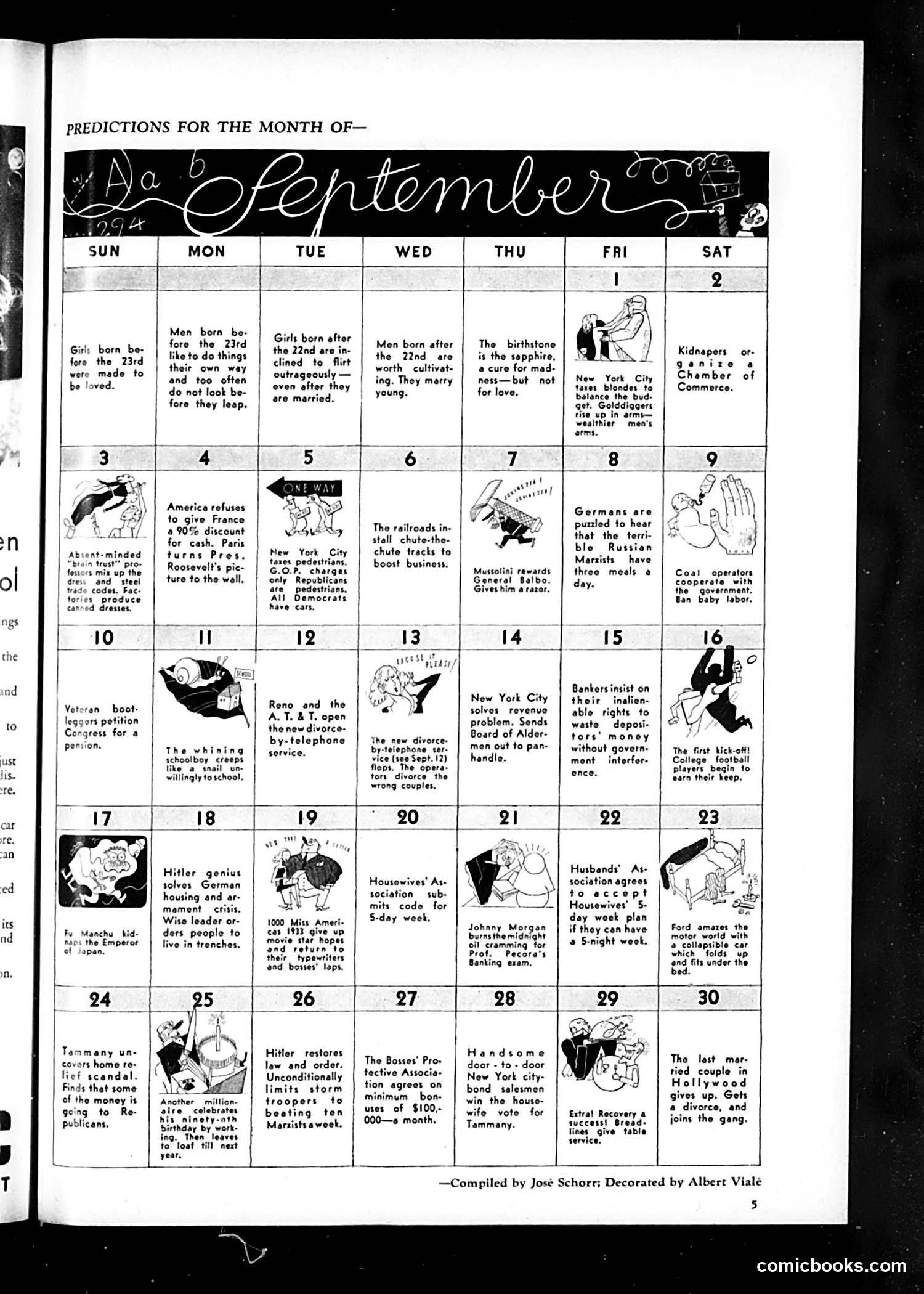
September 1937 Predictions Calendar This is a humorous "predictions" calendar for September 1937, mixing real historical events with satirical commentary. Key entries include: - September 3: Reference to "brain trust" and FDR's policies, mocking New Deal programs - September 12-13: Divorce-related jokes about "wrong couples" - September 18: Hitler's housing and armament buildup (authentic Nazi policy concern) - September 20: Housewives' code for a 5-day work week (labor satire) - September 26-27: Hitler restoring "law and order" and Nazis' "protective association" (sarcastic commentary on Nazi ideology) - September 30: Hollywood divorce satire The calendar satirizes both domestic American politics (New Deal, labor disputes) and rising international tensions (Nazi Germany). The tone is light mockery of contemporary anxieties about economic recovery, labor rights, and fascism.
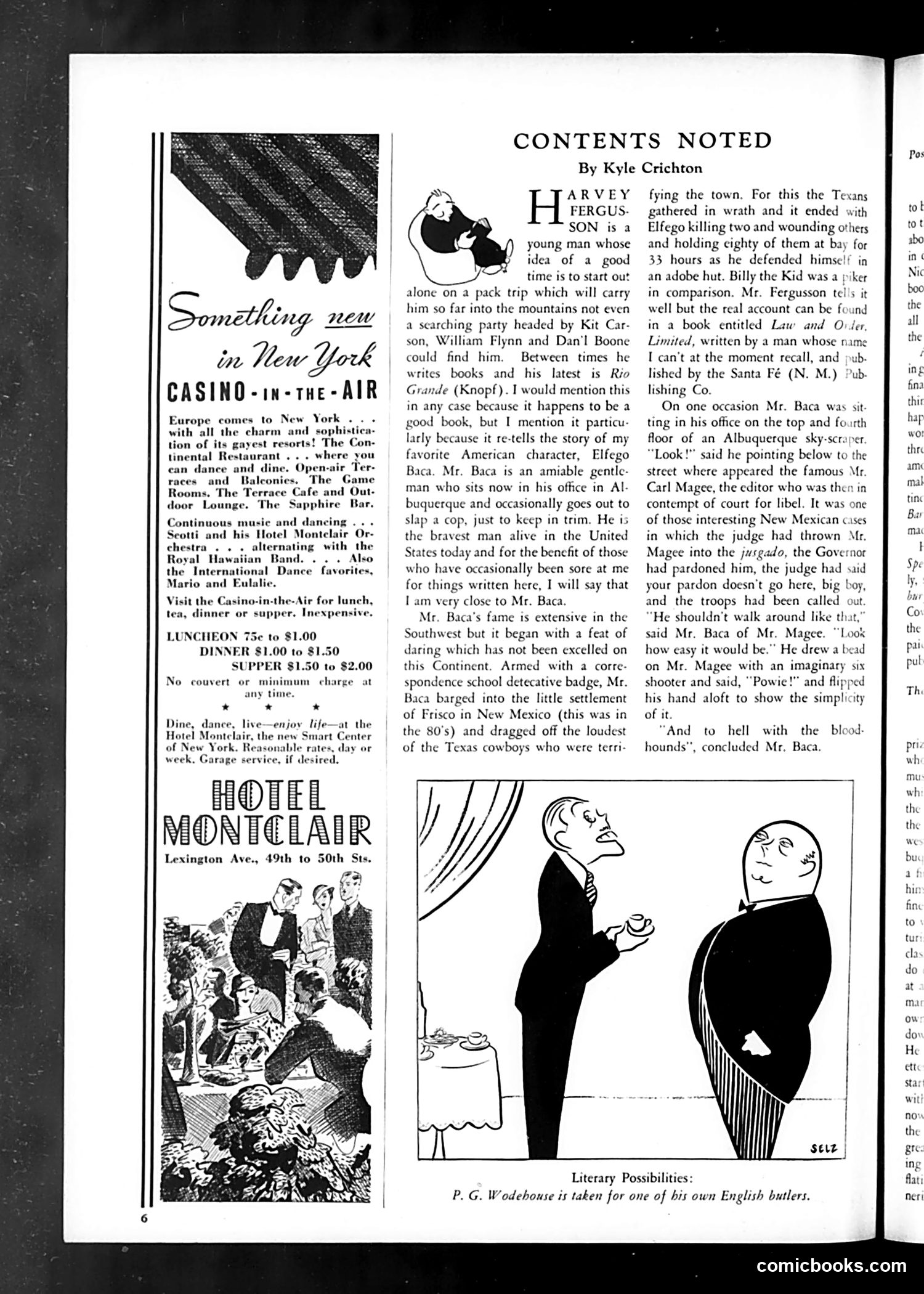
Analysis of Page 6, Life Magazine This page is primarily advertising and editorial content rather than political satire. The main elements are: 1. "Casino-in-the-Air" advertisement for a New York hotel/restaurant featuring European sophistication and entertainment. 2. "Contents Noted" column by Kyle Crichton discussing Harvey Ferguson's novel *Rio Grande*, focusing on the character Elfego Baca, a historical New Mexico figure known for a famous gunfight. Crichton humorously recounts Baca's confrontation with editor Carl Magee over a libelous article. 3. Small cartoon at bottom captioned "Literary Possibilities: P.G. Wodehouse is taken for one of his own English butlers" — a gentle joke about the author's appearance resembling his fictional characters. The page reflects 1930s-era magazine format mixing advertisements, book reviews, and light humor rather than hard-hitting political commentary.
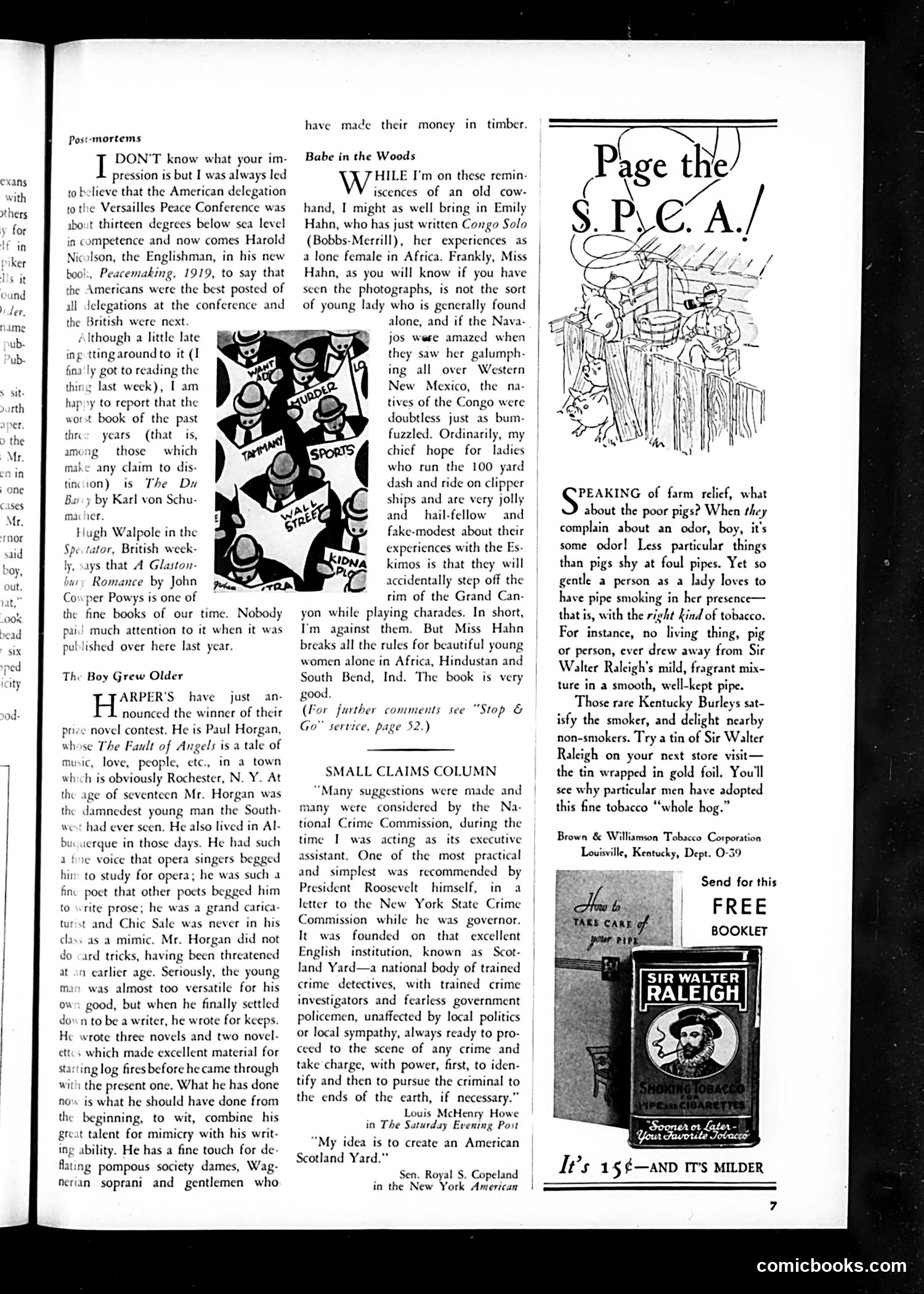
Analysis: "Page the S.P.C.A." Cartoon This cartoon satirizes wealthy industrialists who made fortunes in timber while showing indifference to animal welfare. The illustration depicts men in formal attire (top hats, suits) amid what appears to be logging operations, with the caption suggesting these profiteers should be reported to the Society for the Prevention of Cruelty to Animals (S.P.C.A.). The satire implies these "timber barons" treat animals with the same callousness they display toward nature—the joke being they're so greedy and ruthless they deserve to be investigated like animal abusers. It's a pointed critique of Gilded Age industrialists' environmental and ethical indifference, using absurdist humor to highlight their moral failings.
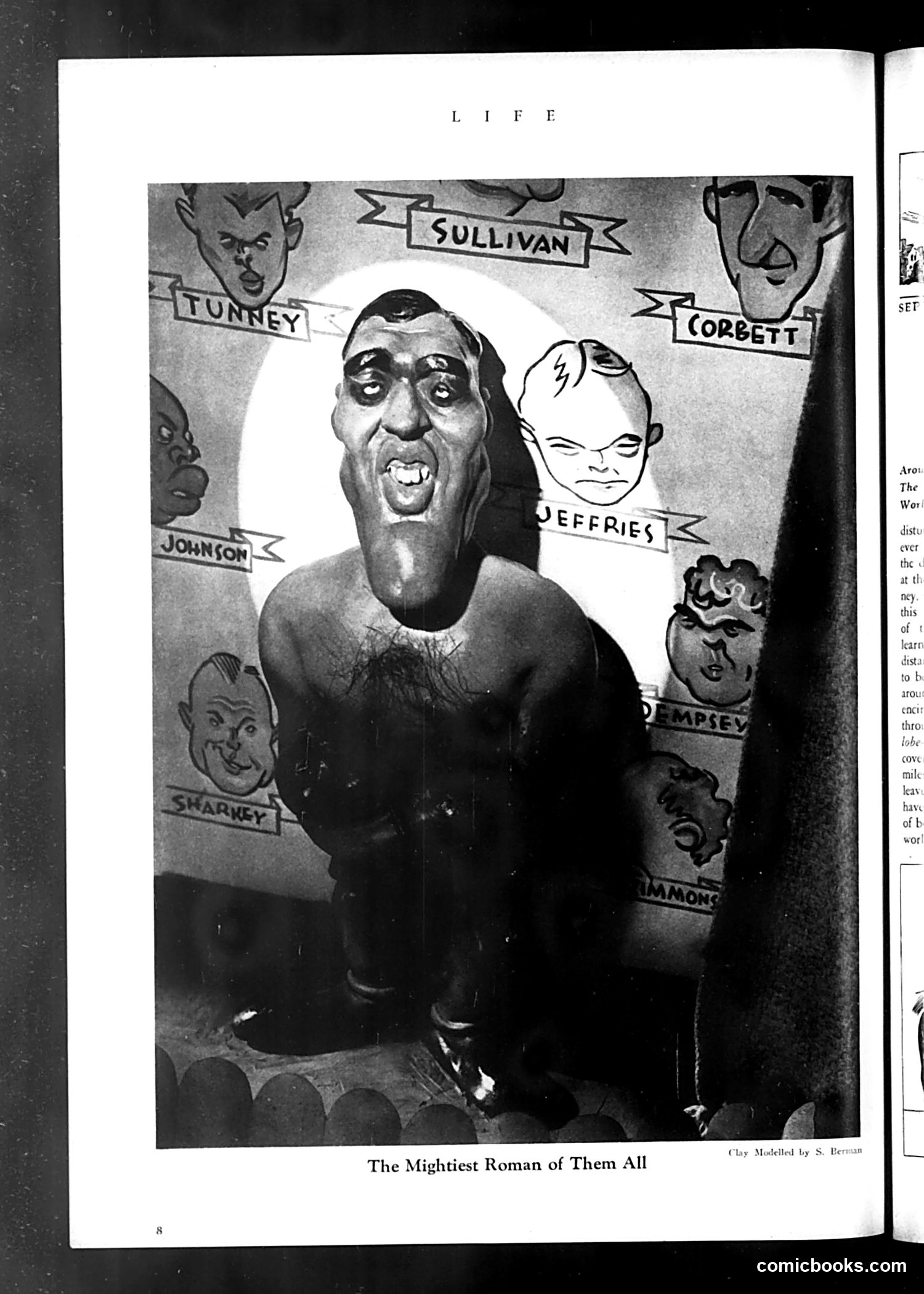
"The Mightiest Roman of Them All" This clay sculpture depicts a central figure surrounded by caricatured heads labeled with names: Tunney, Sullivan, Corbett, Johnson, Sharkey, Jeffries, and Dempsey. These are all famous heavyweight boxing champions, referenced as "Romans" in the title. The central figure appears to represent a boxing promoter or manager—likely Tex Rickard, a prominent fight promoter of the era—who literally towers over and controls these famous boxers. The satire suggests this promoter wielded more power and influence than the celebrated fighters themselves, positioning him as the true "mightiest Roman" despite the boxers' fame. The classical "Rome" framing mocks the grandiose boxing spectacles of the 1920s-30s era.
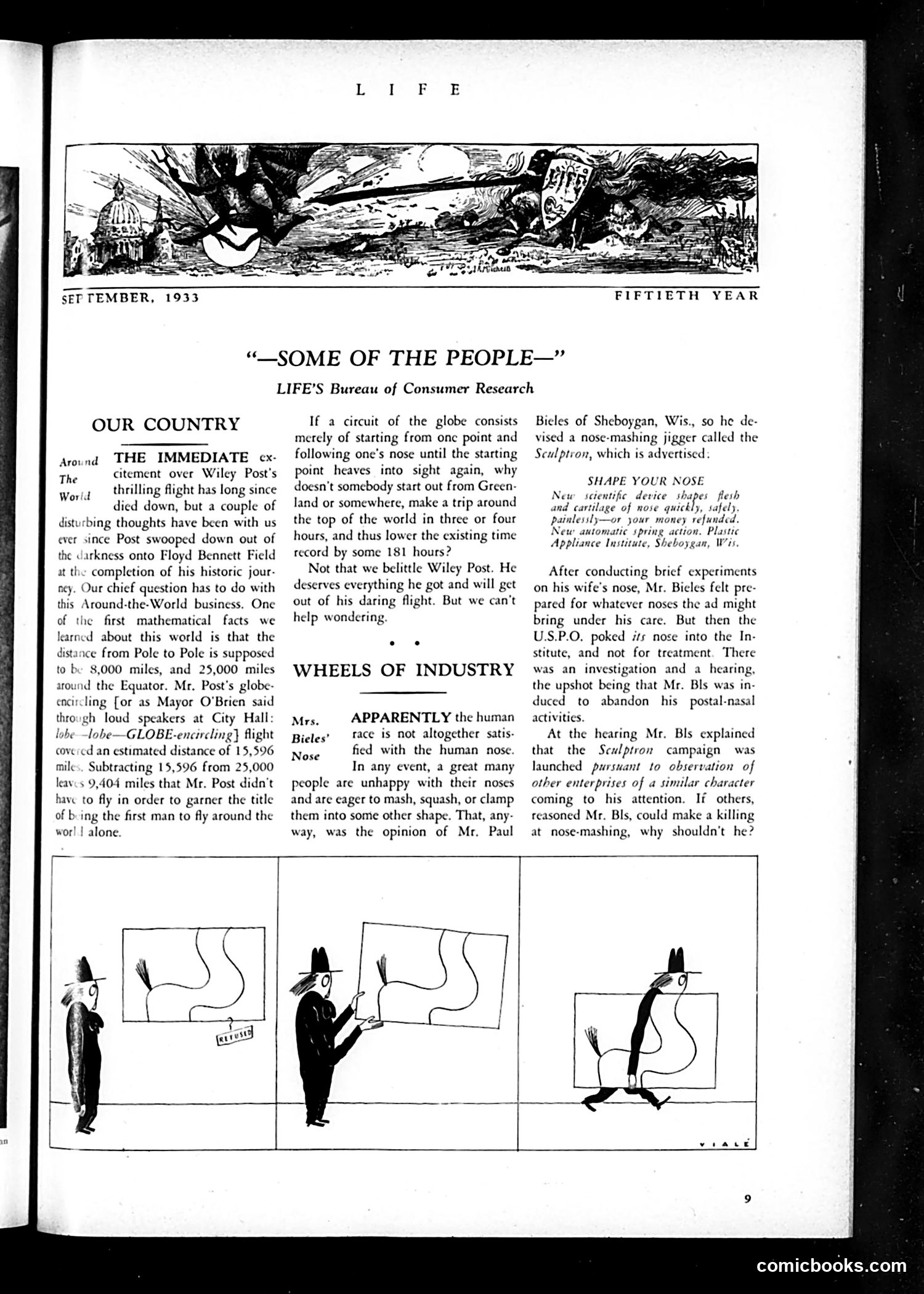
Explanation for Modern Readers This September 1933 *Life* page satirizes Wiley Post's recent solo flight around the world. The article questions Post's achievement by noting he flew 15,596 fewer miles than the globe's actual circumference—suggesting he may not have completed a true round-the-world journey. The cartoon below shows a man repeatedly attempting to reshape his nose using a device advertised as the "Sculptex" nose-shaper. It's a parallel metaphor: just as Post's flight claims don't match reality, the man's nose-reshaping efforts appear futile. The satire mocks both Post's dubious accomplishment and consumer products making false promises. The "Wheels of Industry" section reporting on nose-shaping devices reinforces the joke—treating frivolous cosmetic products with mock-serious business coverage.
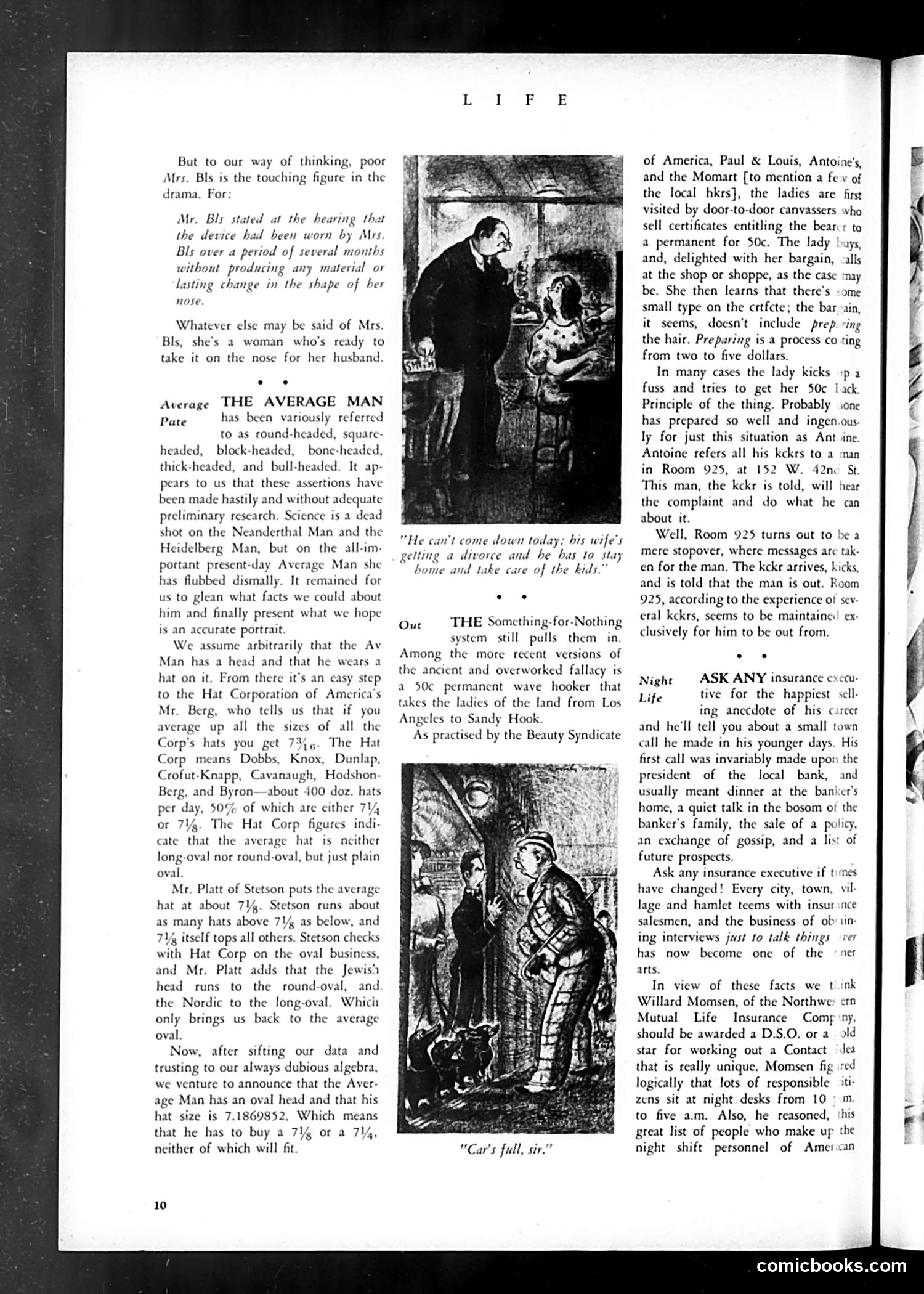
Analysis of Life Magazine Page This page contains satirical commentary on "the Average Man" — a concept then popular in sociology and business. The text mocks how corporations and statisticians tried to reduce human complexity to standardized measurements (hat sizes, heights, weights). The two illustrations show domestic scenes: one depicting a man unable to visit home due to divorce obligations, another showing what appears to be a working-class interaction ("Car's fall, sir"). The satire targets the absurdity of treating diverse individuals as statistical averages. The page also discusses insurance salesmen and their intrusive sales tactics in everyday life — suggesting how commercialization and data-driven business practices were increasingly invading personal/domestic spheres in early 20th-century America.
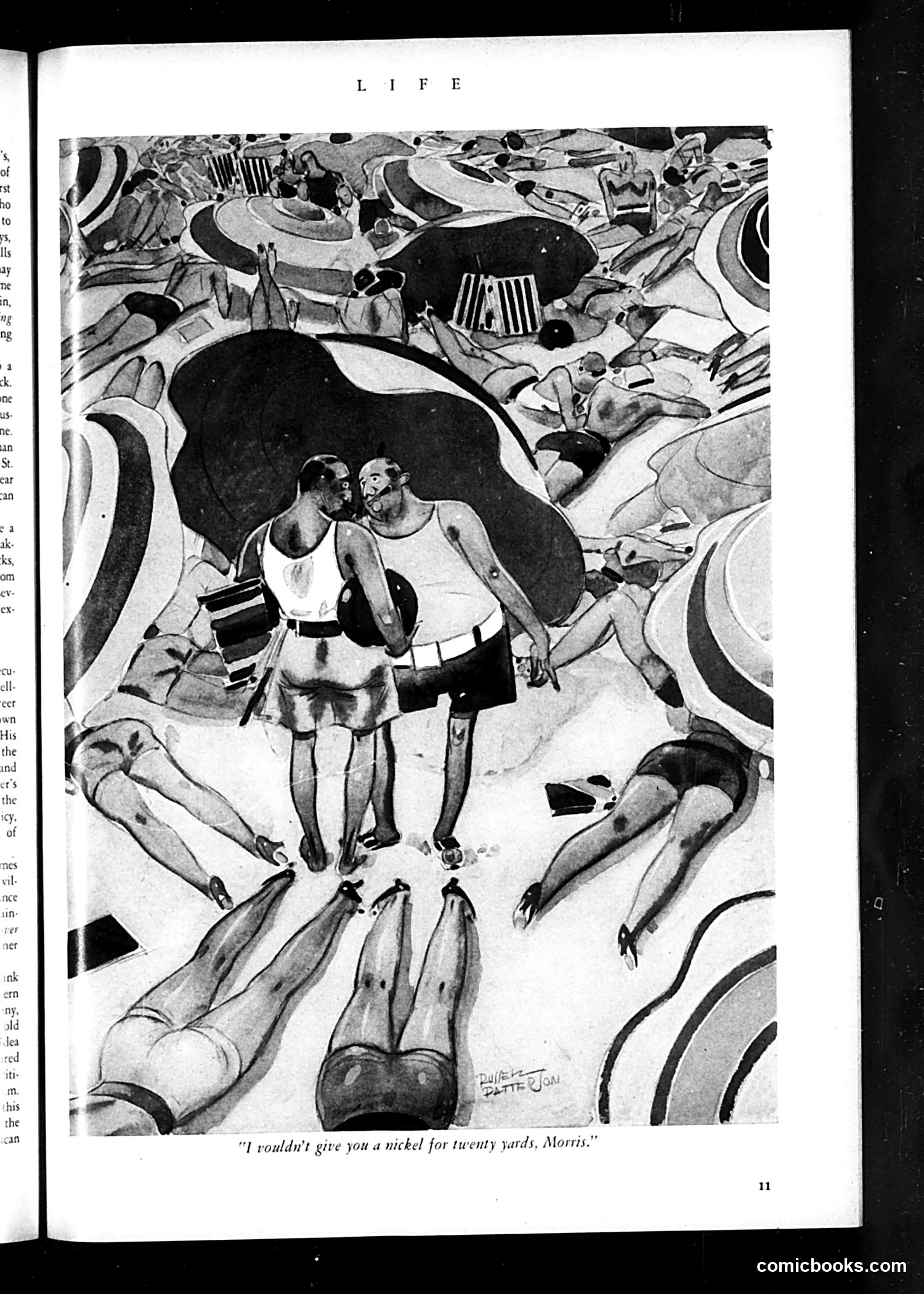
Analysis This is a single-panel cartoon depicting a beach or swimming scene. Two men in swimming attire stand among numerous other beachgoers lying on the sand. The caption reads: "I wouldn't give you a nickel for twenty yards, Morris." The joke appears to be about real estate or land value. One man is dismissing the worth of beach property, suggesting it's worthless—he wouldn't pay even a nickel for twenty yards of it. This likely satirizes either Depression-era economic collapse (when property values plummeted) or the oversaturation of beach real estate development. The crowded beach scene reinforces the point: with so many people packed together, individual parcels of beach property have become virtually worthless. The humor lies in the stark contrast between what beachfront property *should* be worth versus its actual devalued state.
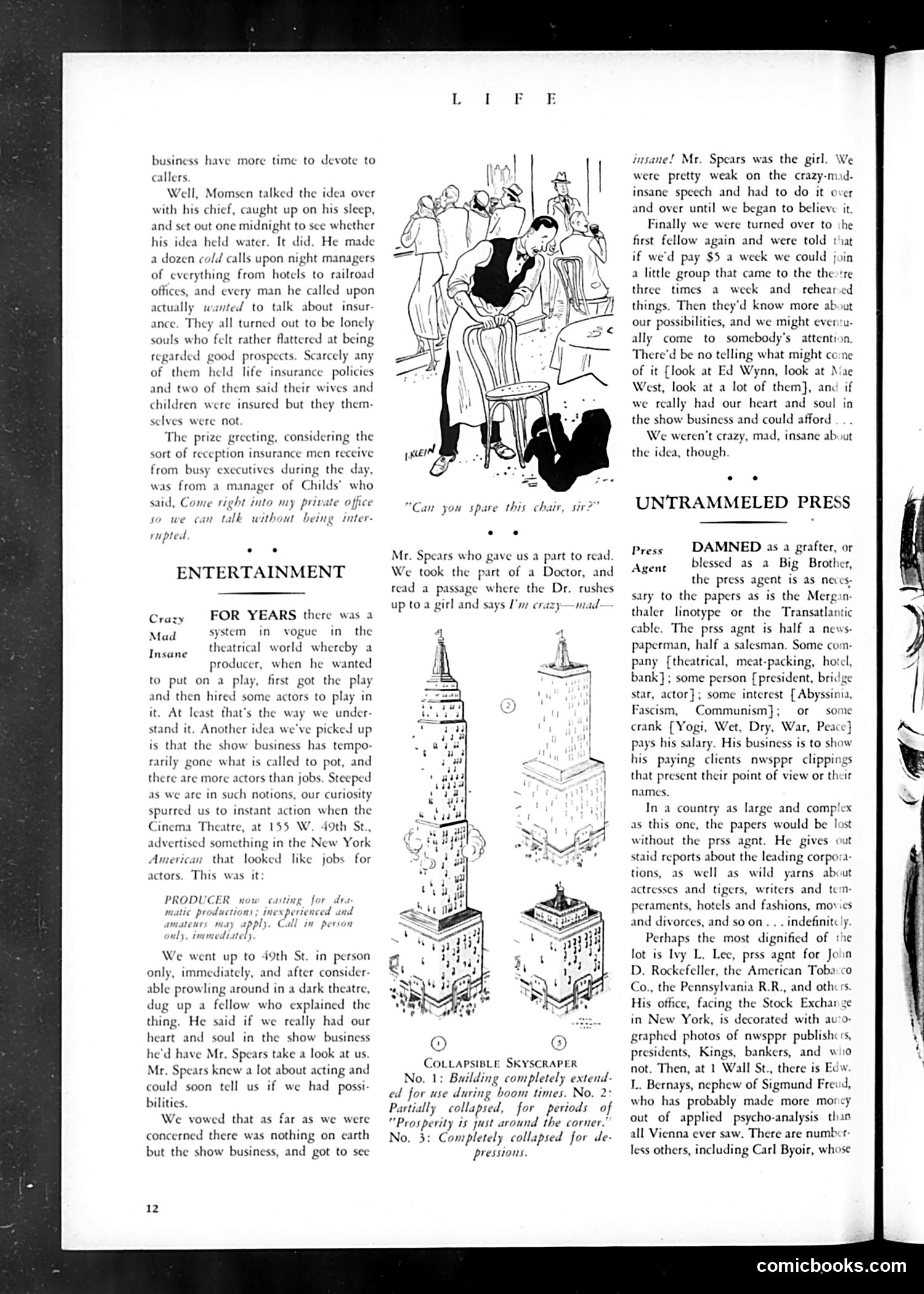
Analysis This page discusses the theatrical world and press agents circa the early 20th century. The main cartoon depicts a crowded theatrical scene with the caption "Can you spare this chair, sir?"—likely satirizing the chaos and overcrowding of theatrical offices or audition spaces. The text mentions Mr. Spears, apparently a theatrical figure who proposed an insurance scheme for stage actors and their families—a novel idea at the time. The article credits him with attempting to professionalize the entertainment business. The second section, "Untrammeled Press," describes press agents as necessary but somewhat disreputable intermediaries between newspapers and theatrical/business interests. The accompanying diagrams show "collapsible skyscrapers"—likely satirizing exaggerated or false claims made by press agents to newspapers about corporate growth or significance.
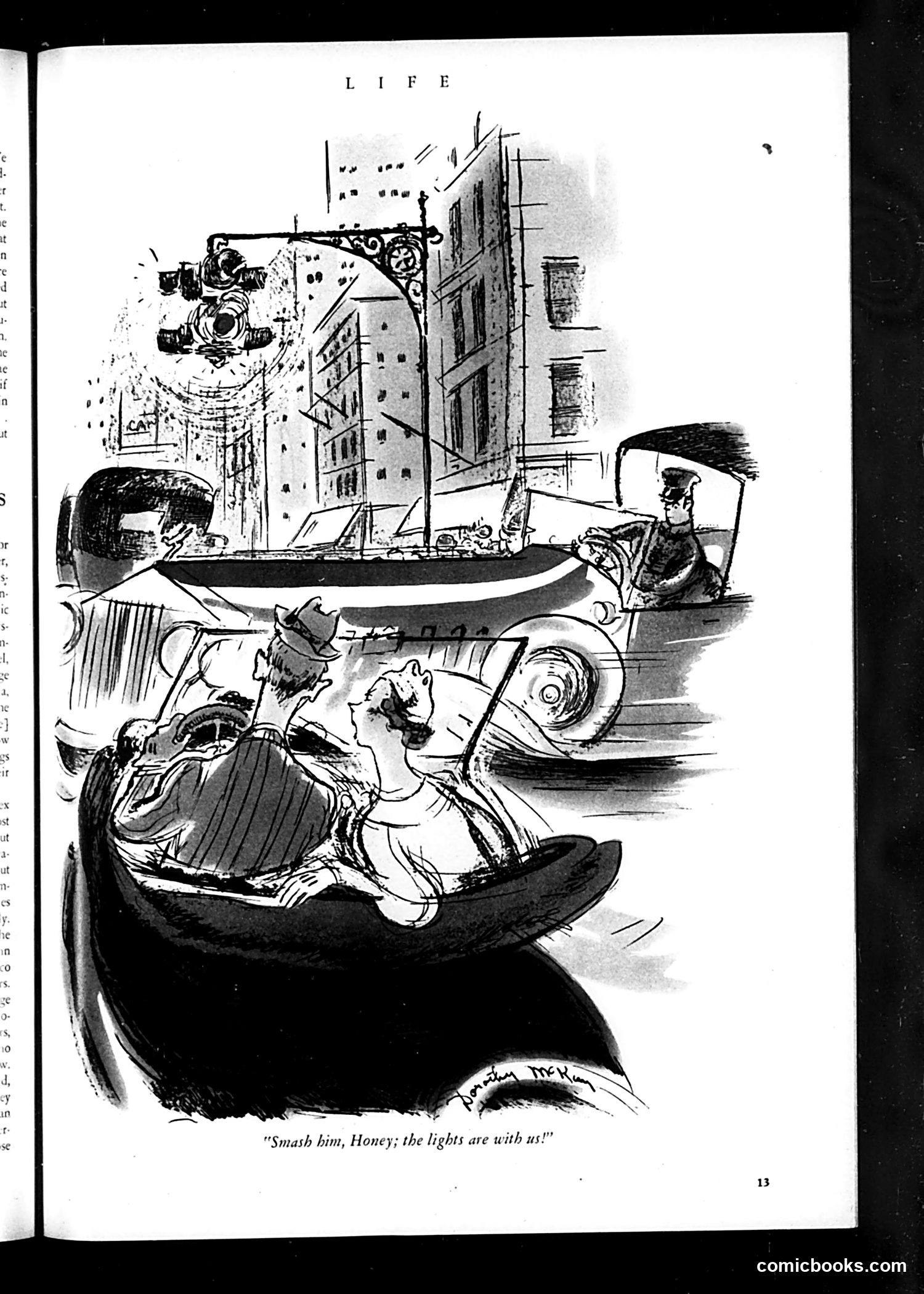
Analysis This is a single-panel cartoon from *Life* magazine showing a romantic scene in what appears to be Venice (suggested by the gondolas and architecture). A couple in a gondola are kissing passionately while the woman says to her male companion: "Smash him, Honey; the lights are with us!" The joke is a satirical commentary on modern urban life and automotive culture. The "lights" reference appears to be traffic signals—she's encouraging him to hit another car because the traffic light is green, turning a romantic moment into a dark comedy about aggressive driving. The contrast between the traditionally romantic Venetian setting and the intrusion of modern car culture (complete with a second automobile visible) creates the satire, mocking how 20th-century American driving habits and road rage mentality permeate even supposedly romantic situations.
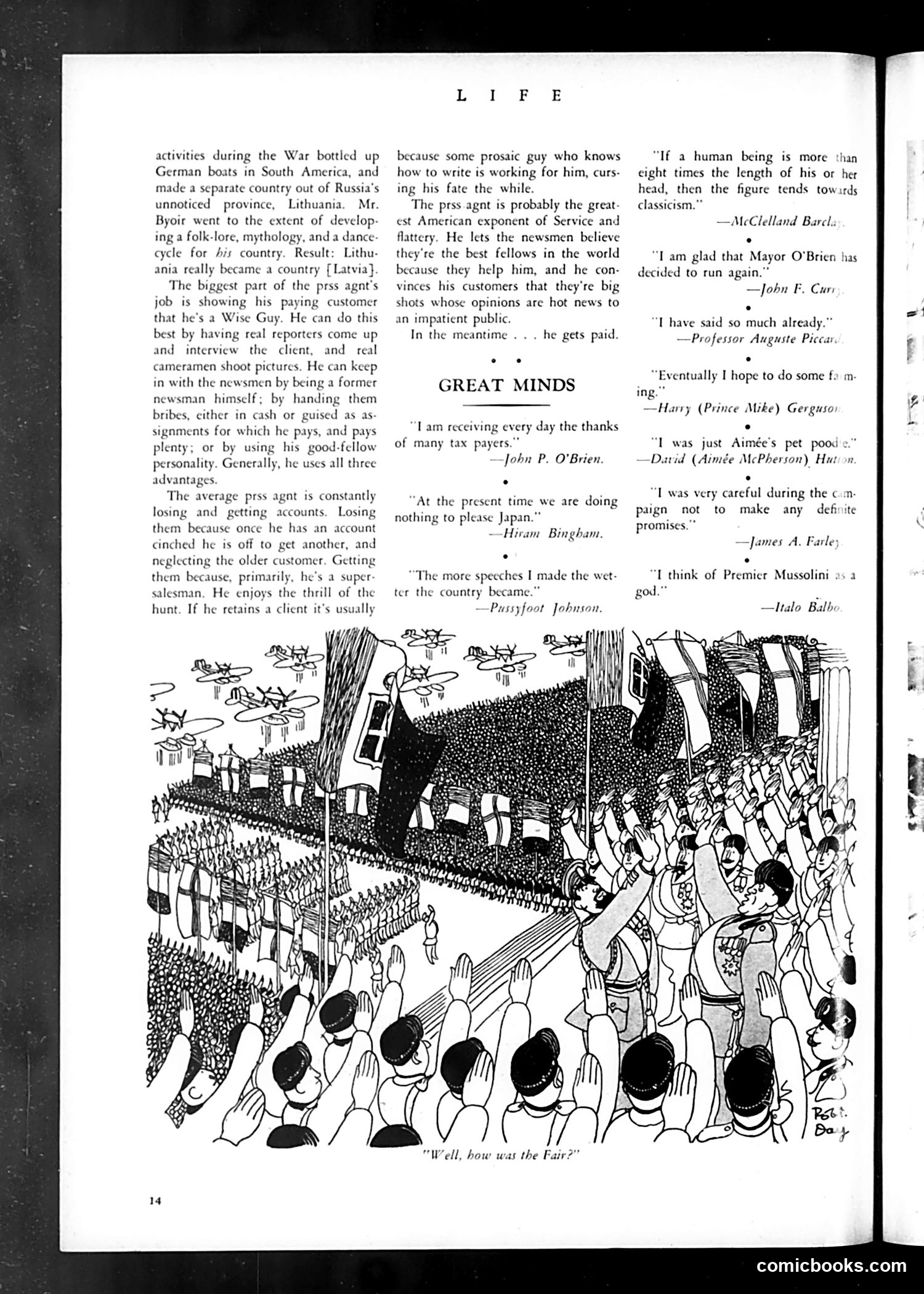
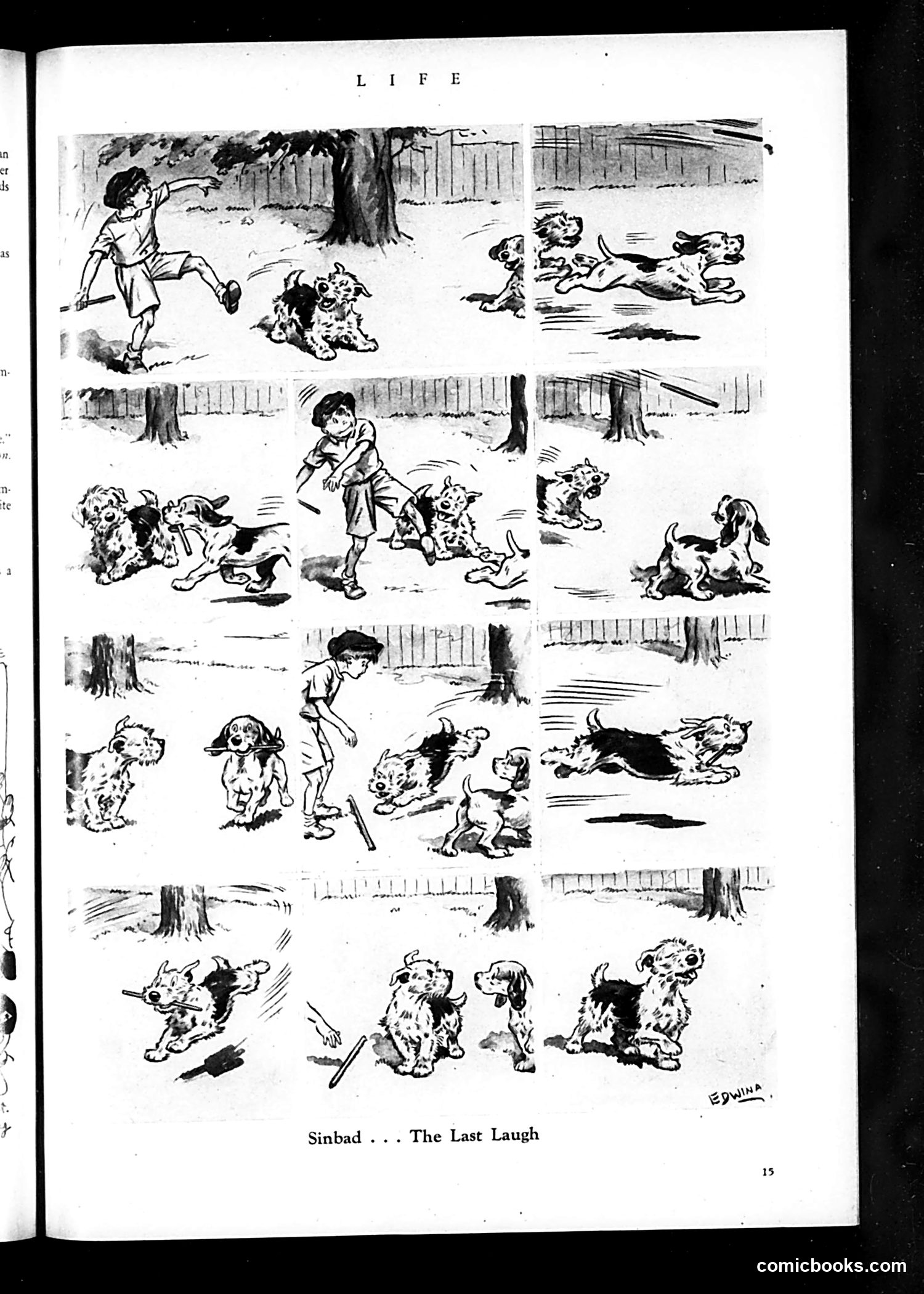
"Sinbad...The Last Laugh" This is a humorous comic strip depicting a child's chaotic playtime with multiple dogs in a fenced yard. The narrative progresses through four rows showing increasingly wild scenes: the child attempts to manage or play with various dogs of different sizes and breeds, who run around, jump, and create pandemonium. The title "Sinbad...The Last Laugh" likely references the child as "Sinbad" (possibly a pet name or character reference), with the joke being that despite the dogs' rowdy behavior and the child's apparent attempts at control, the dogs ultimately have "the last laugh"—they've won the chaos and the child cannot manage them. The cartoon satirizes the common childhood experience of playing with energetic, unruly dogs.
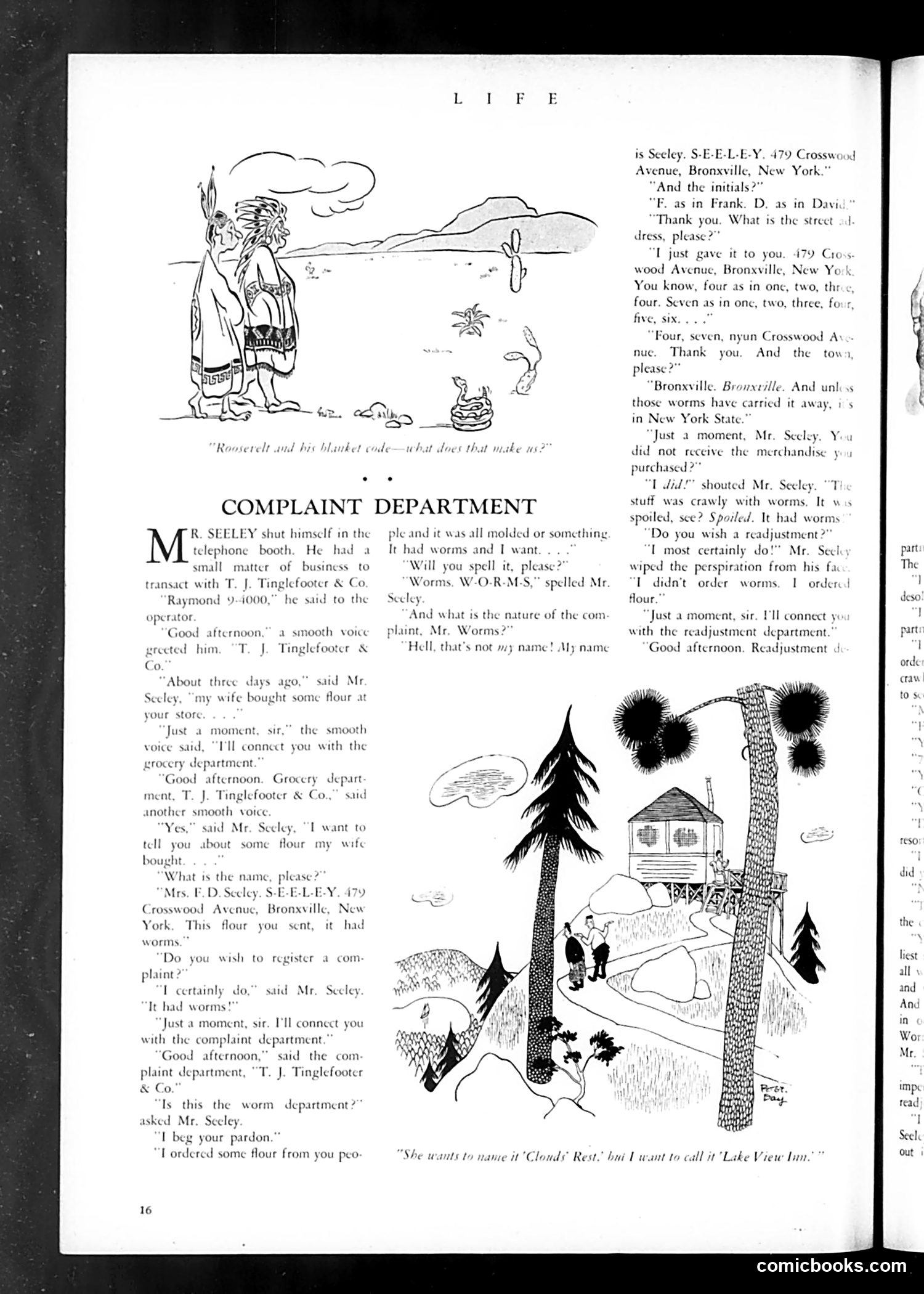
Analysis of "Complaint Department" This page satirizes mail-order problems, specifically spoiled flour purchased from T. J. Tinglefooter & Co. The humor centers on Mr. Seeley's absurd complaint: his wife's flour arrived infested with worms. The satire mocks both customer service interactions and mail-order shopping vulnerabilities. Mr. Seeley must repeatedly spell out his address and name through phone operators, a tedious bureaucratic ordeal. The "complaint department" becomes a running joke—he's transferred multiple times, encountering smooth-voiced operators who seem indifferent to his predicament about worm-infested goods. The illustrations show a prosperous suburban homestead and a hermit figure, contrasting idealized domesticity with the gross reality of receiving contaminated food. The humor reflects early-20th-century frustrations with distant, impersonal commercial transactions.
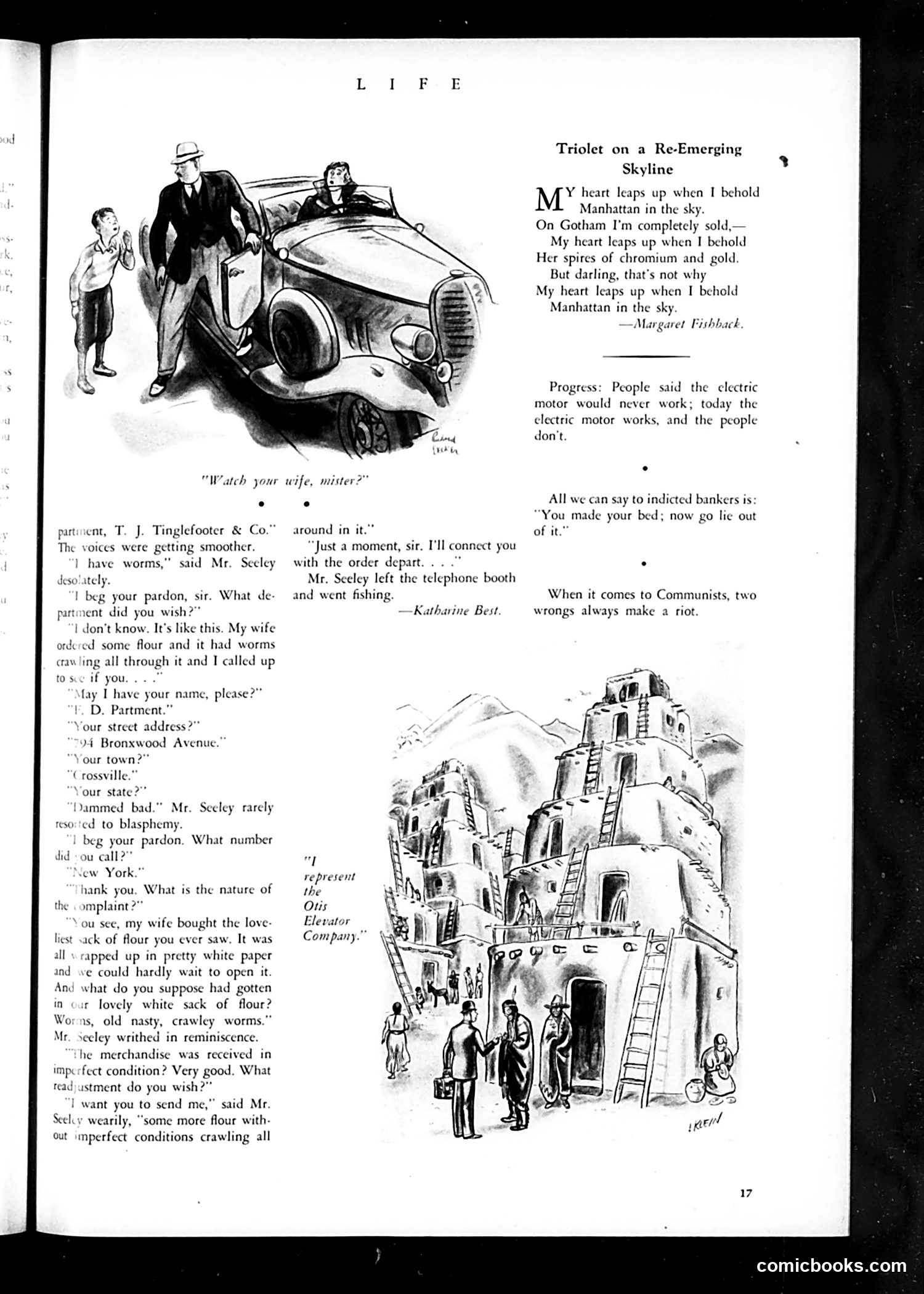
Analysis The top cartoon shows a man with a young boy and woman near a car, captioned "Watch your wife, mister?" This satirizes marital anxiety—a common theme in 1920s humor about modern life and women's increasing independence. Below is a humorous dialogue between Mr. Seeley and T.J. Tinglefooter & Co., a flour company. Seeley complains his wife's flour contained worms. The company takes him through absurd bureaucratic procedures, passing him between departments while offering non-solutions. This satirizes corporate inefficiency and customer service runaround—the joke being that organizations create endless red tape rather than fixing actual problems. The "Otis Elevator Company" illustration likely complements this theme of modern institutional complexity.
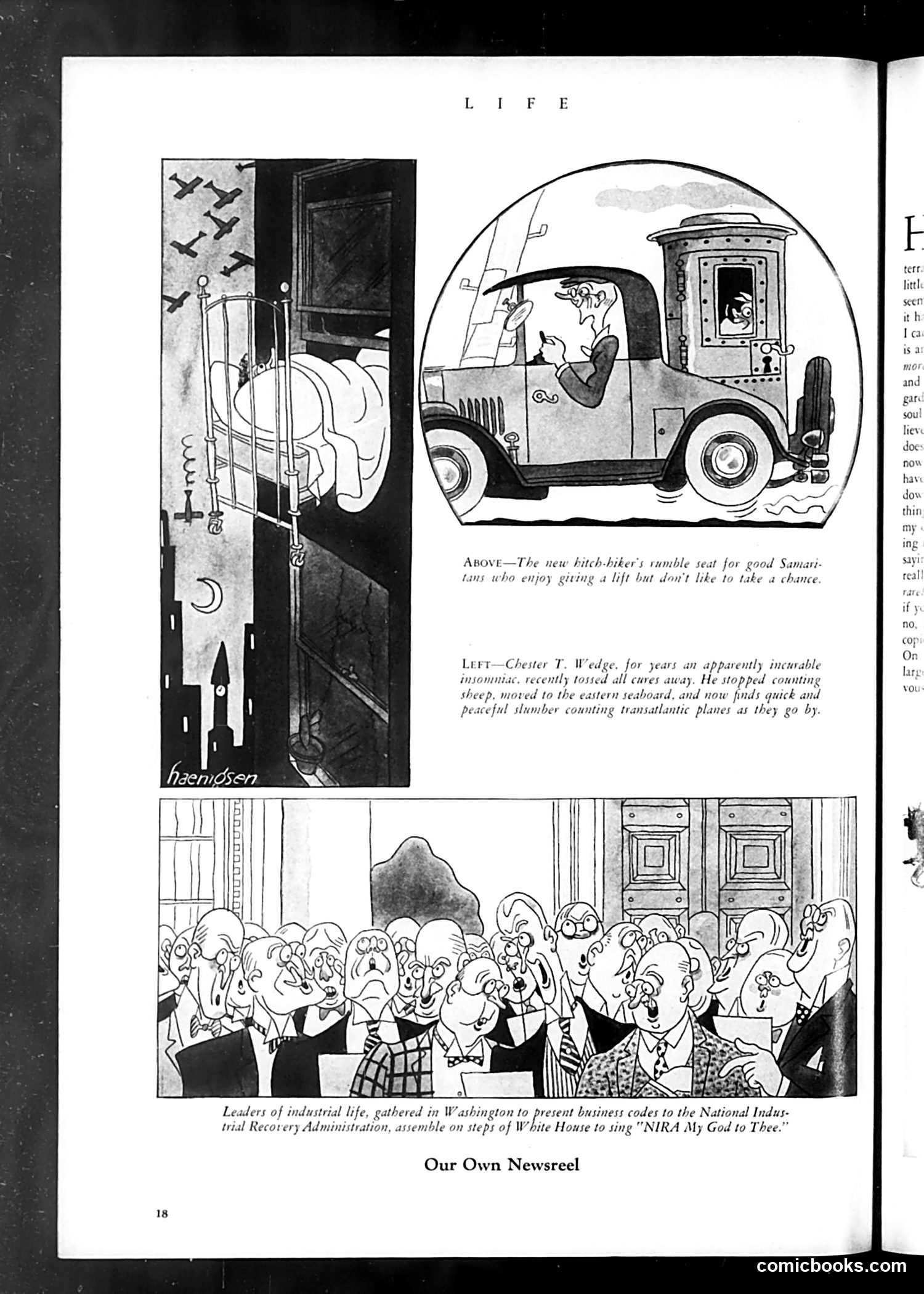
Explanation for Modern Readers This page from *Life* magazine contains three cartoons satirizing 1930s American life: 1. Top left: A bedroom scene with planes overhead—likely satirizing anxieties about aerial warfare or air travel safety during the Depression era. 2. Top right: A "hitch-hiker's rumble seat" cartoon mocking Samaritans reluctant to give rides, reflecting Depression-era hitchhiking culture. 3. Left side: Chester T. Wedge, identified as an "inveterate insomniac" who counted sheep, then ships, now counts "transatlantic planes"—satire of insomnia remedies and modern anxieties. 4. Bottom: Industrial leaders gathered at the White House for the National Industrial Recovery Administration, singing "NIRA My God to Thee"—sharp satire of New Deal corporate cooperation and its quasi-religious reverence by business leaders.
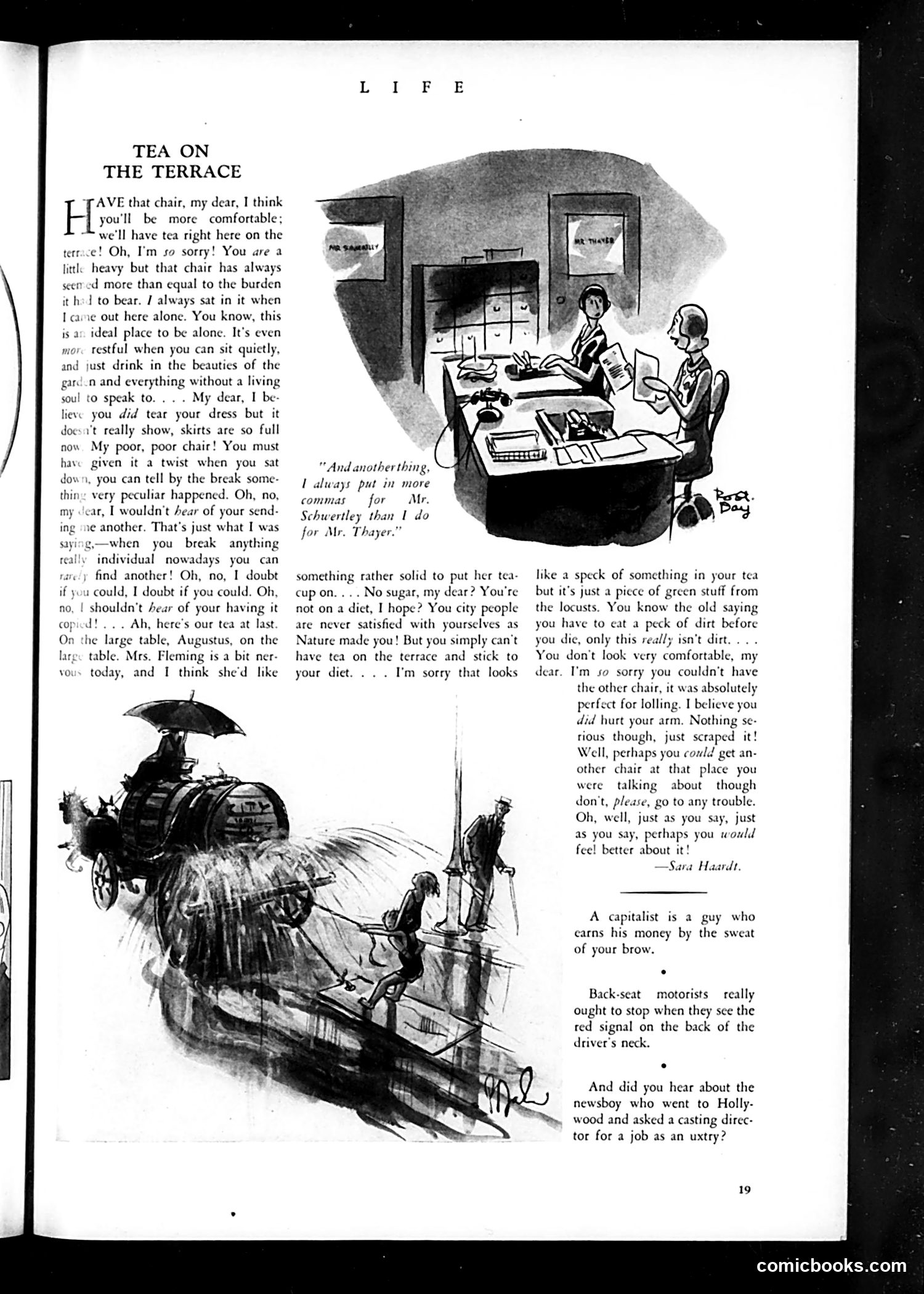
"Tea on the Terrace" - Life Magazine This page features a conversational piece about uncomfortable furniture and social etiquette. The main illustration shows two women taking tea outdoors, discussing an uncomfortable chair. The humor centers on the relatable complaint that a particular chair (belonging to someone named Mrs. Fleming) is awkward for sitting, especially when one needs to relax. The dialogue playfully explores the social discomfort of criticizing a host's furniture while remaining a polite guest. Below are three brief satirical observations: one defining a capitalist, one mocking back-seat motorists, and one about an aspiring actor seeking work in Hollywood as an "usher." The cartoons are by Gluyas Williams (signed "Gluyas"), a notable American humorist illustrator of the period. The satire targets everyday social situations and human behavior rather than specific political figures.
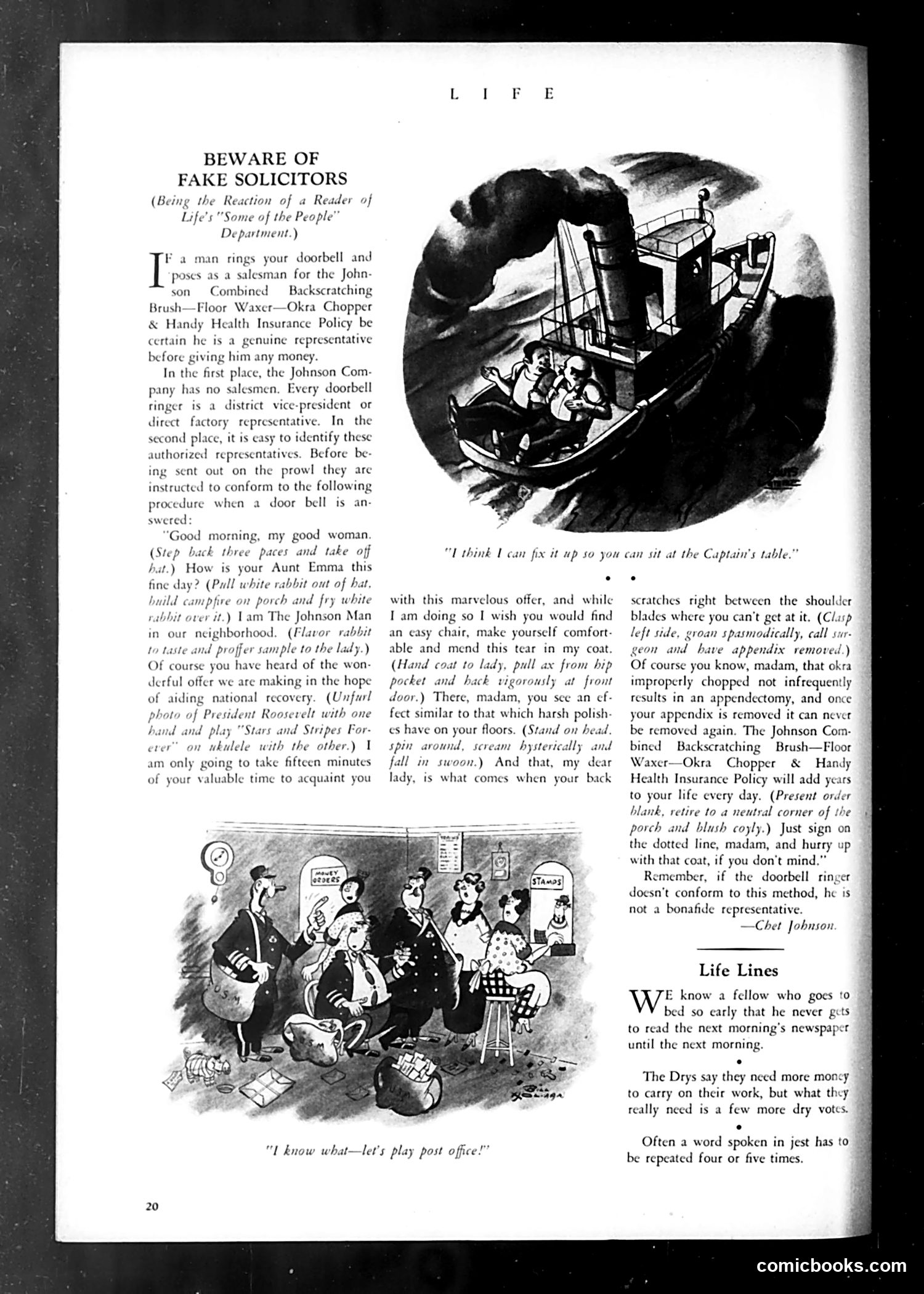
Explanation for Modern Readers This page satirizes door-to-door salesmen and their high-pressure tactics during the Great Depression era. The main cartoon mocks the absurd "Johnson Combined" multi-purpose product (a backscratcher, floor waxer, okra chopper, and health insurance policy rolled into one ridiculous item). The satire works by exaggerating what a "genuine" salesman should do: the character performs increasingly bizarre and destructive actions—pulling rabbits from hats, building campfires on porches, axing the front door, collapsing dramatically—while claiming each demonstrates the product's value. The humor lies in this obvious parody of manipulative sales pitches that use confusion, distraction, and emotional appeals rather than actual product merit. The accompanying cartoons and "Life Lines" jokes reinforce themes of everyday absurdities and consumer skepticism. The piece warns readers to be suspicious of door-to-door solicitors—a common scam during economically vulnerable times.
I'm unable to provide a reliable analysis of this page. The image is almost entirely black or severely underexposed, making it impossible to discern any cartoon illustrations, text content, or visual details beyond a white margin on the left edge and the "comicbooks.com" watermark at the bottom. To offer accurate historical context about the political satire, caricatures, and social references as you've requested, I would need a legible version of the page. If you have a clearer scan or image available, I'd be happy to analyze it according to your guidelines.
I can see this is a black and white page that appears to be heavily degraded or damaged, making it difficult to read clearly. There is partial text visible on the right edge including fragments like "P" at the top and "I, in F" lower down, along with "comicbooks.com" at the bottom. However, the image quality and degradation prevent me from reliably identifying any specific cartoon content, figures, or satirical elements that would be necessary to explain the historical context and meaning to a modern reader. To provide an accurate analysis per your rules, I would need a clearer version of this page. I cannot confidently identify what publication, date, or subject matter this represents based on what's currently visible.
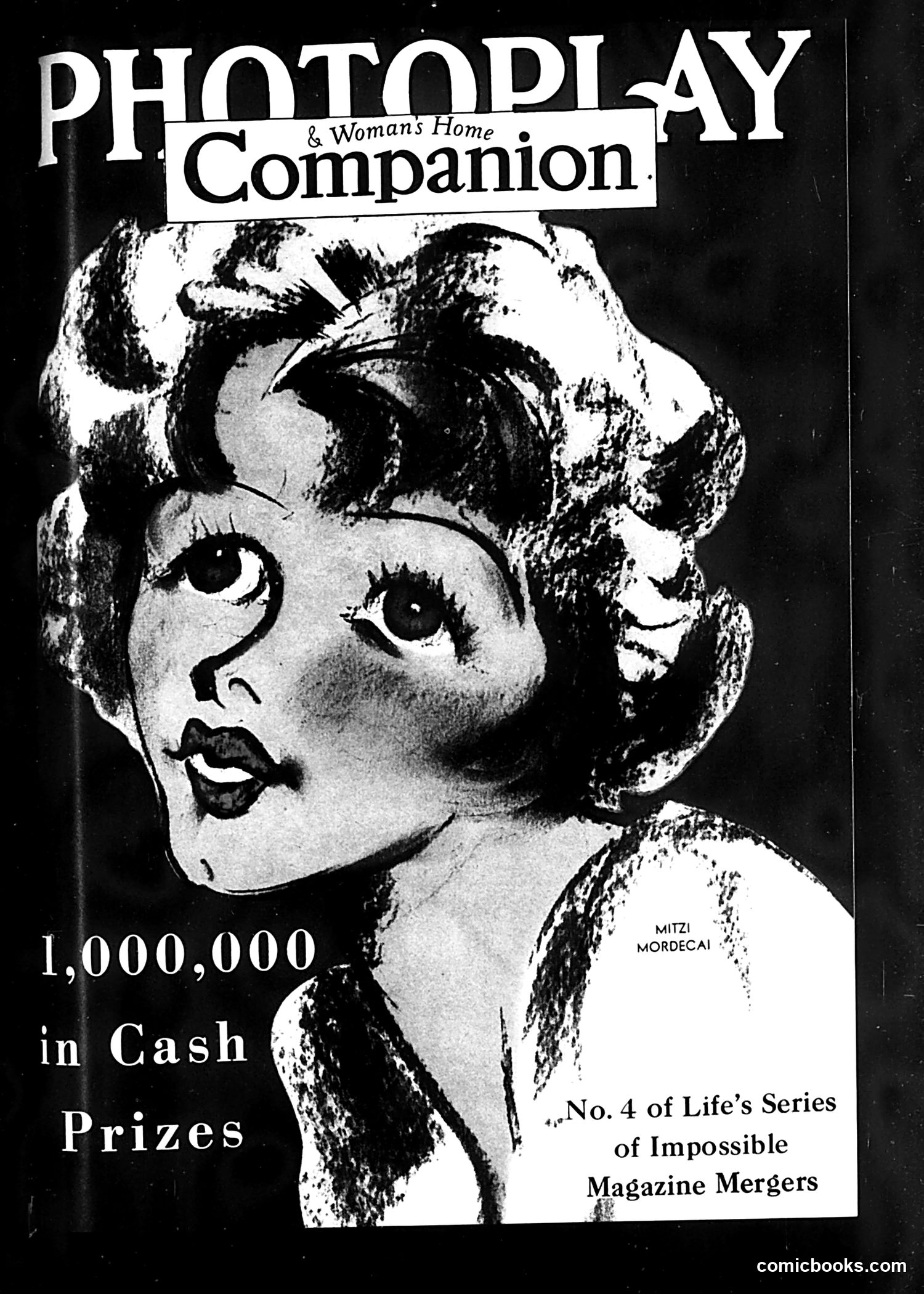
Analysis This appears to be a satirical title page from *Life* magazine mocking the trend of magazine mergers. The cover features actress Mitzi Mordecai (labeled on the image) with exaggerated theatrical makeup and styling. The joke is presented as "No. 4 of Life's Series of Impossible Magazine Mergers"—suggesting a hypothetical merger between *Photoplay* (a movie magazine) and *Woman's Home Companion* (a domestic lifestyle magazine). The absurdist humor lies in combining these incompatible publications: one focused on glamorous entertainment and cinema, the other on homemaking and domesticity. The melodramatic facial expression and over-the-top styling reinforce the satire, portraying what such a bizarre hybrid magazine's cover might look like. The "$1,000,000 in Cash Prizes" likely refers to promotional contests typical of the era.
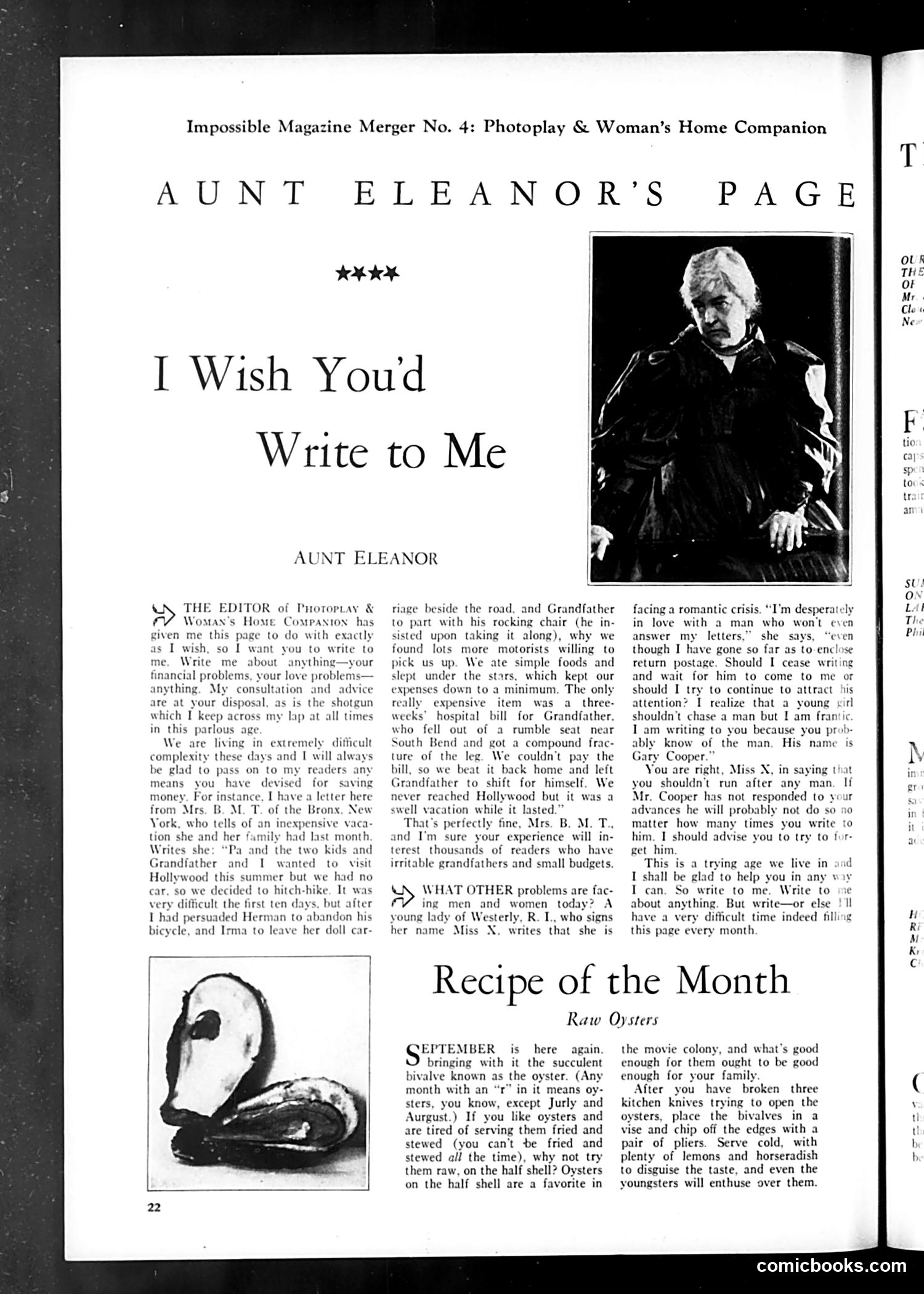
"Aunt Eleanor's Page" - Satirical Advice Column This is a humorous fake advice column merging two women's magazines. "Aunt Eleanor" purports to offer serious advice but delivers absurdist satire instead. The humor targets Depression-era frugality: one letter describes a family's "thrifty" Hollywood trip that abandons the injured grandfather at a hospital to avoid bills—presented as admirable penny-pinching. Another letter features a lovelorn woman obsessed with actor Gary Cooper, whom she's pestering with unanswered letters. Aunt Eleanor's deadpan response—advising her to simply give up—mocks both romantic desperation and celebrity worship. The "Recipe of the Month" continues the satire, offering comically impractical oyster preparation (breaking knives, using a vise and pliers) while referencing "movie colony" trends as authority. The overall tone mocks both earnest advice-column conventions and the absurd financial/romantic crises of the era.
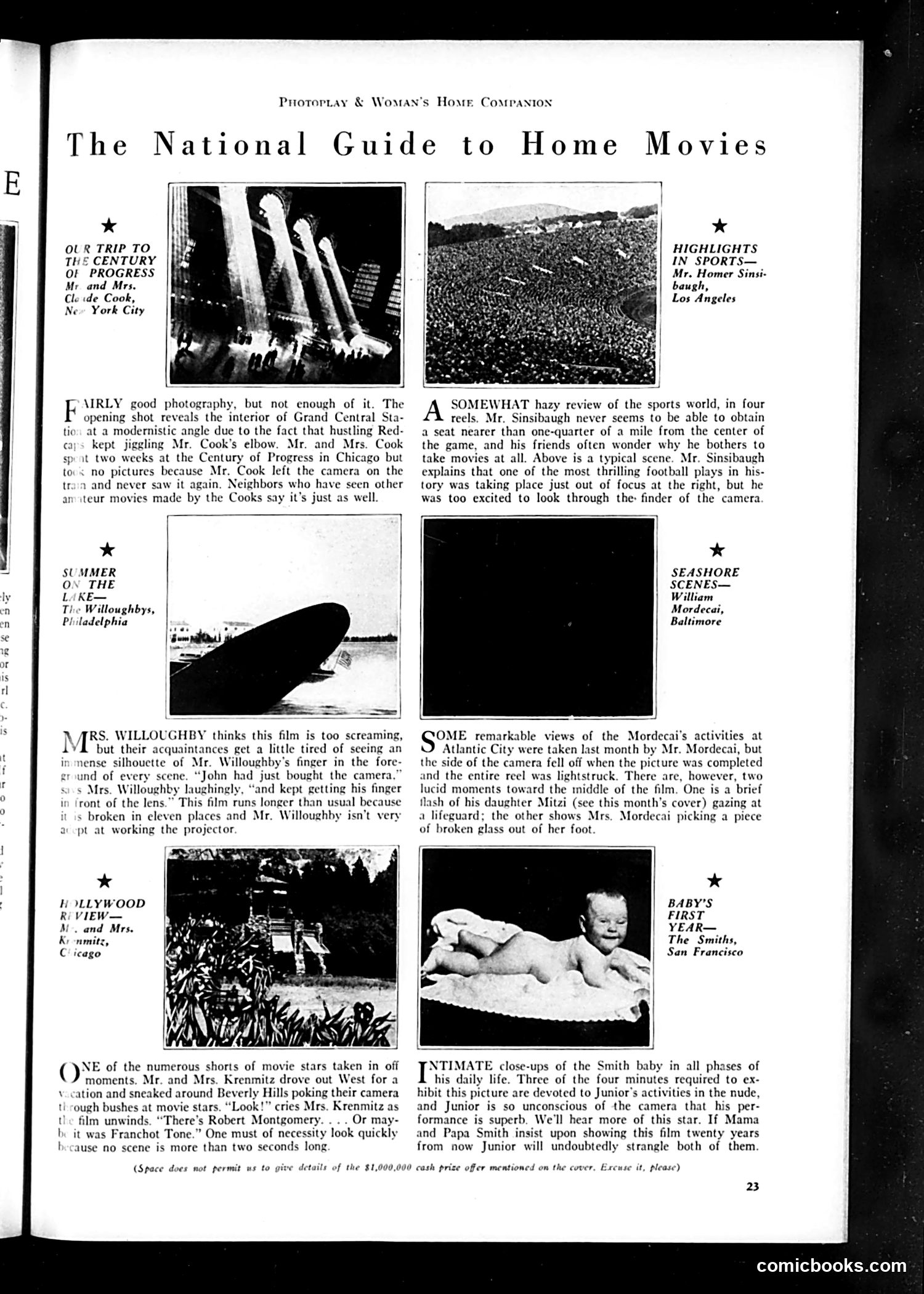
The National Guide to Home Movies This page satirizes amateur home movie-making, a popular 1930s hobby. It presents six humorous reviews of films submitted by ordinary people, mocking common mistakes of inexperienced filmmakers. The jokes target predictable failures: the Cooks left their camera on a train; Sinsibaugh films sports from poor seats with crucial action out of focus; Willoughby constantly gets his finger in front of the lens; Mordecai's entire reel is ruined by equipment malfunction; the Krenmitzes can barely identify the celebrities they filmed; and the Smiths unwittingly create embarrassing footage of their naked baby. The satire reflects the novelty and difficulty of accessible motion picture technology—what seemed sophisticated was often incompetently executed by enthusiastic amateurs. The piece gently ridicules both the filmmakers' ambitions and viewers forced to watch their amateurish results.
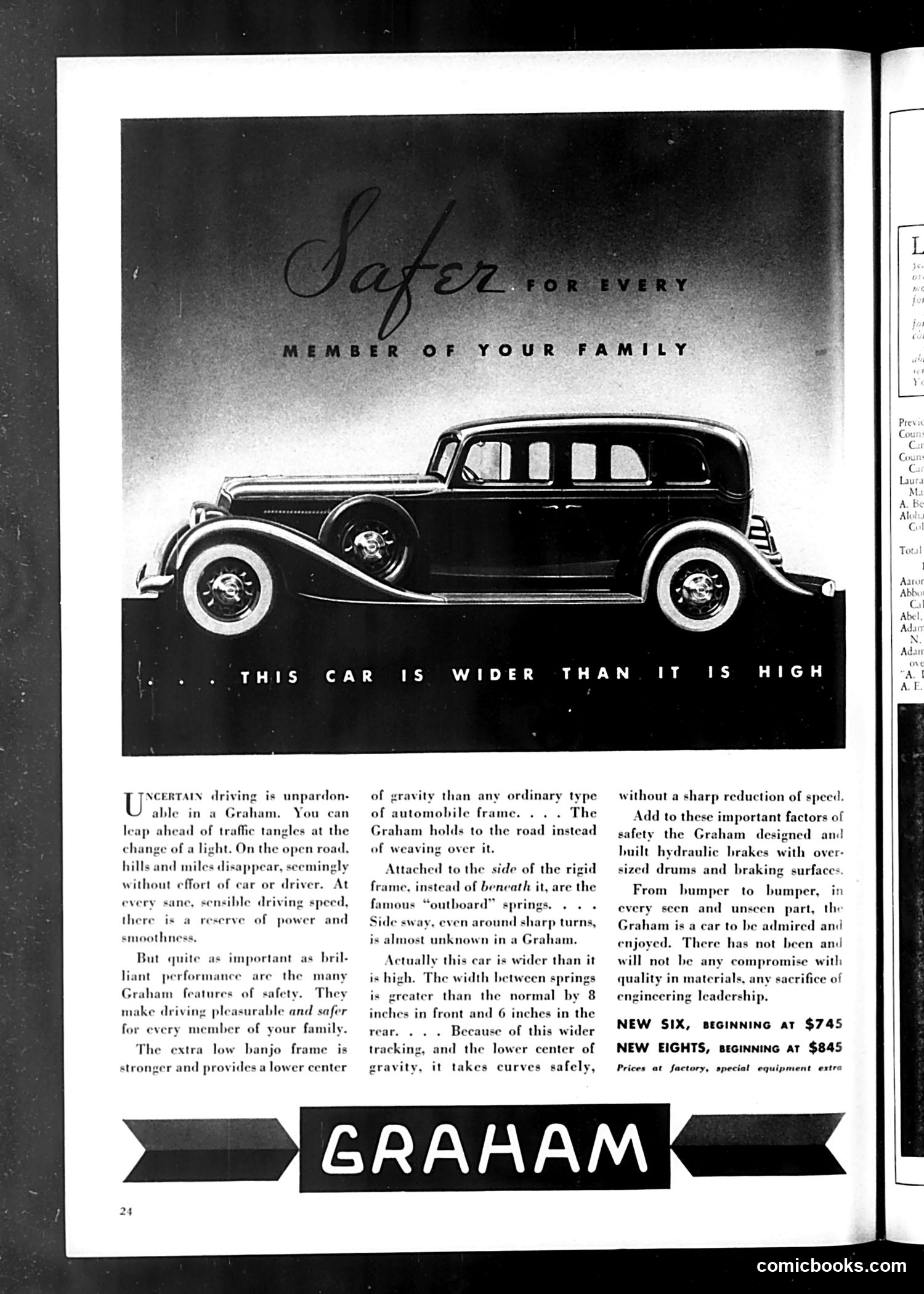
What This Page Actually Is This is not satire or a political cartoon — it's a straightforward automobile advertisement for Graham cars, likely from the 1930s (based on the car's design and price points). The ad promotes Graham vehicles by emphasizing safety features for families: a low-slung frame, wide wheelbase for stability on curves, hydraulic brakes, and quality construction. The tagline "Safer for every member of your family" targets middle-class car buyers concerned with safety. The only notable element from a historical perspective is the car's distinctive low-slung design and the emphasis on stability — design priorities that reflect 1930s automotive engineering. The prices ($745-$845) help date this to the Depression era. This is a period piece showing how cars were marketed to safety-conscious families, not satirical content.
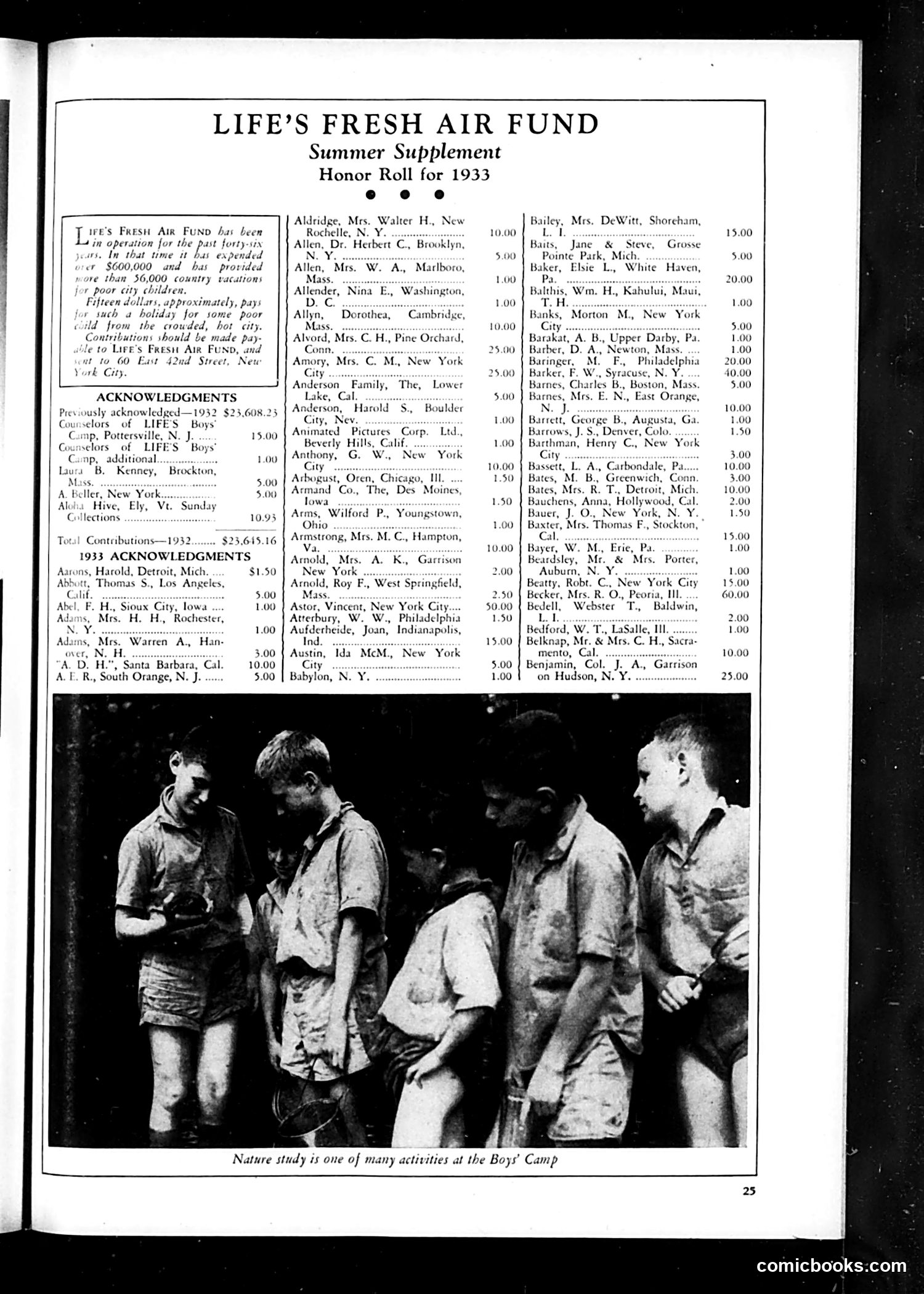
Life's Fresh Air Fund (1933) This page documents Life magazine's charitable initiative to provide poor city children with country vacations. The "Fresh Air Fund" had operated for 46 years by 1933, spending over $600,000 to give more than 36,000 children holidays from crowded, hot cities—costing approximately $15 per child. The page lists donors and their contributions (ranging from $1 to $60), showing middle and upper-class Americans supporting the cause. Notable wealthy contributors like Vincent Astor appear among ordinary citizens. The photograph below shows boys at camp engaged in nature study—one of the fund's educational activities. This visual illustrates the fund's purpose: removing underprivileged children from urban poverty to provide healthful outdoor experiences. During the Great Depression (1933), this charitable work was particularly vital as poverty intensified. The honor roll functioned as both acknowledgment and social pressure—publicly recognizing donors while implicitly encouraging others to contribute to helping disadvantaged children.
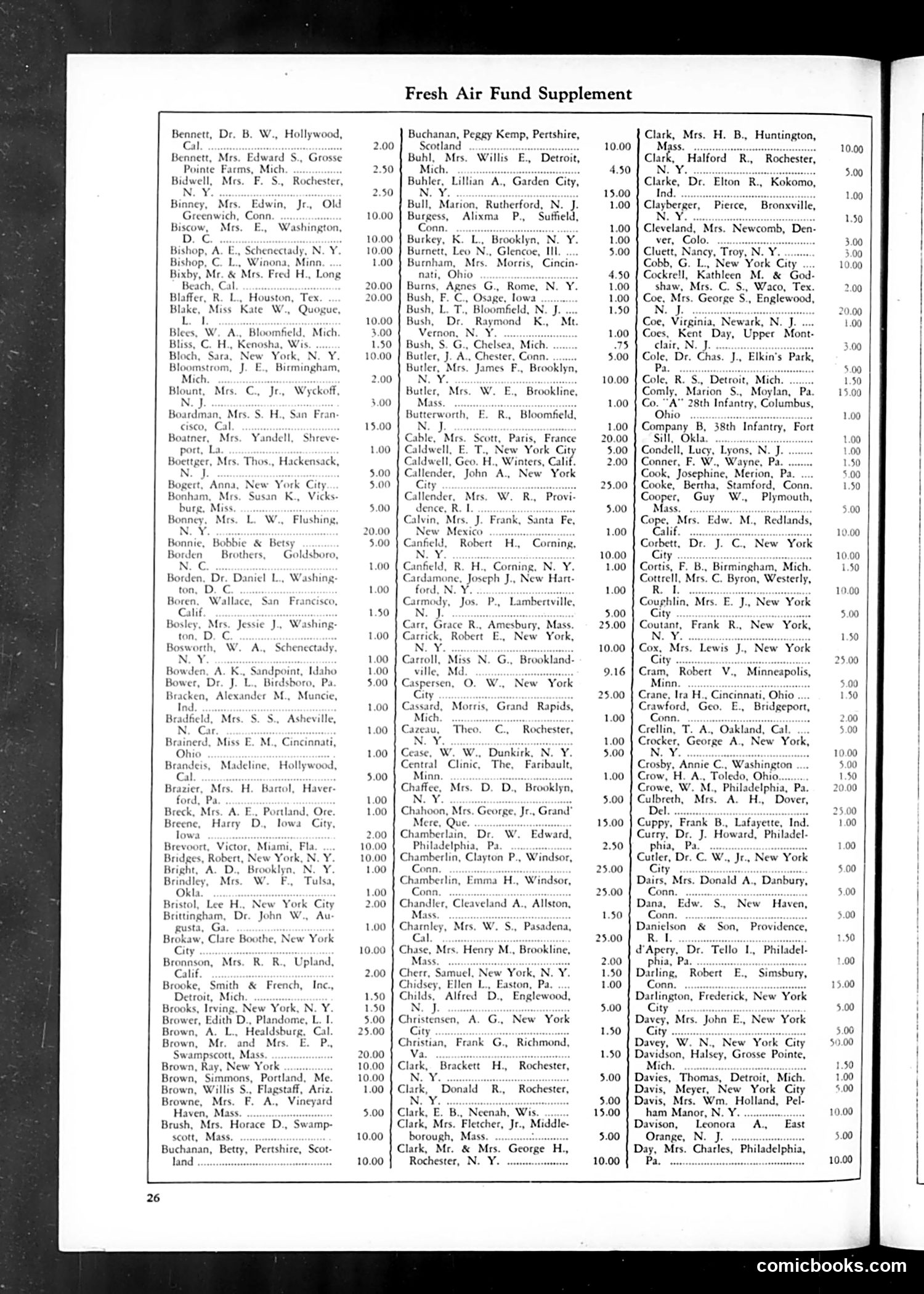
Fresh Air Fund Supplement This is not a cartoon page but rather a donor list for the Fresh Air Fund, a charitable organization that provided outdoor recreation and fresh air experiences for underprivileged urban children—a major progressive-era cause in early 20th-century America. The page displays names of contributors (mostly wealthy individuals from major cities and resort towns like Hollywood, Detroit, and Newport) alongside their donation amounts, ranging from $1.00 to $25.00. The geographic distribution and affluence of donors reflects how such charitable causes relied on the wealthy elite. The Fresh Air Fund itself was a legitimate, well-established nonprofit; this supplement in *Life* magazine served both as public acknowledgment of donors and as social pressure for others to contribute. It's essentially advertising masked as community service—a practice still common today.
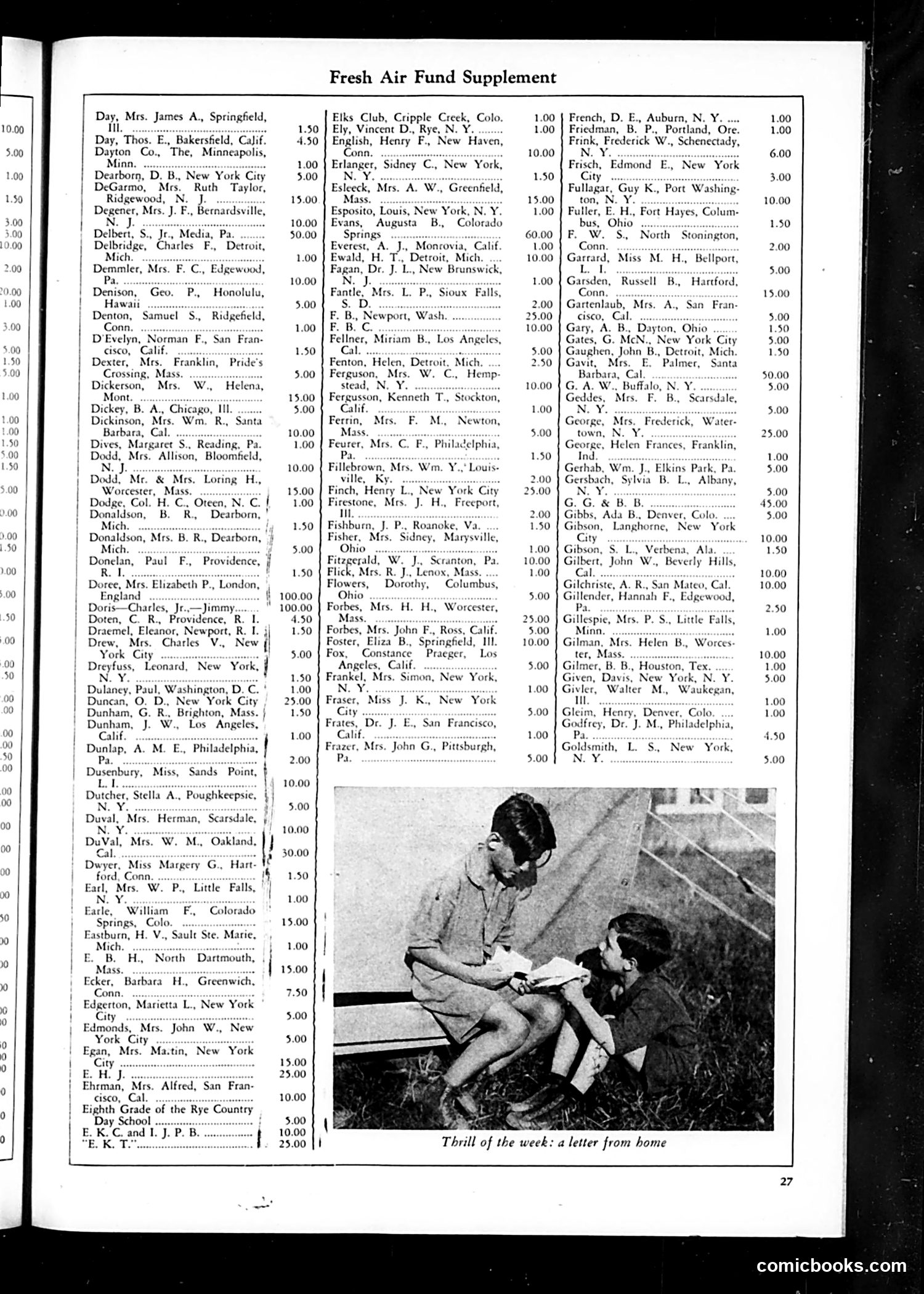
This page is a donation list for the Fresh Air Fund, not a satirical cartoon or comic. The "Fresh Air Fund" was a real American charitable organization (founded 1877) that provided summer camp and outdoor experiences for poor urban children. This page lists donors' names and contribution amounts, arranged alphabetically from Day through Frazer, with donations ranging from $1 to $100. The photograph at the bottom, captioned "Thrill of the week: a letter from home," shows what appears to be a volunteer or counselor helping a young child write a letter—illustrating the Fund's mission to give underprivileged children access to nature and summer activities. This is a fundraising supplement, not satire.
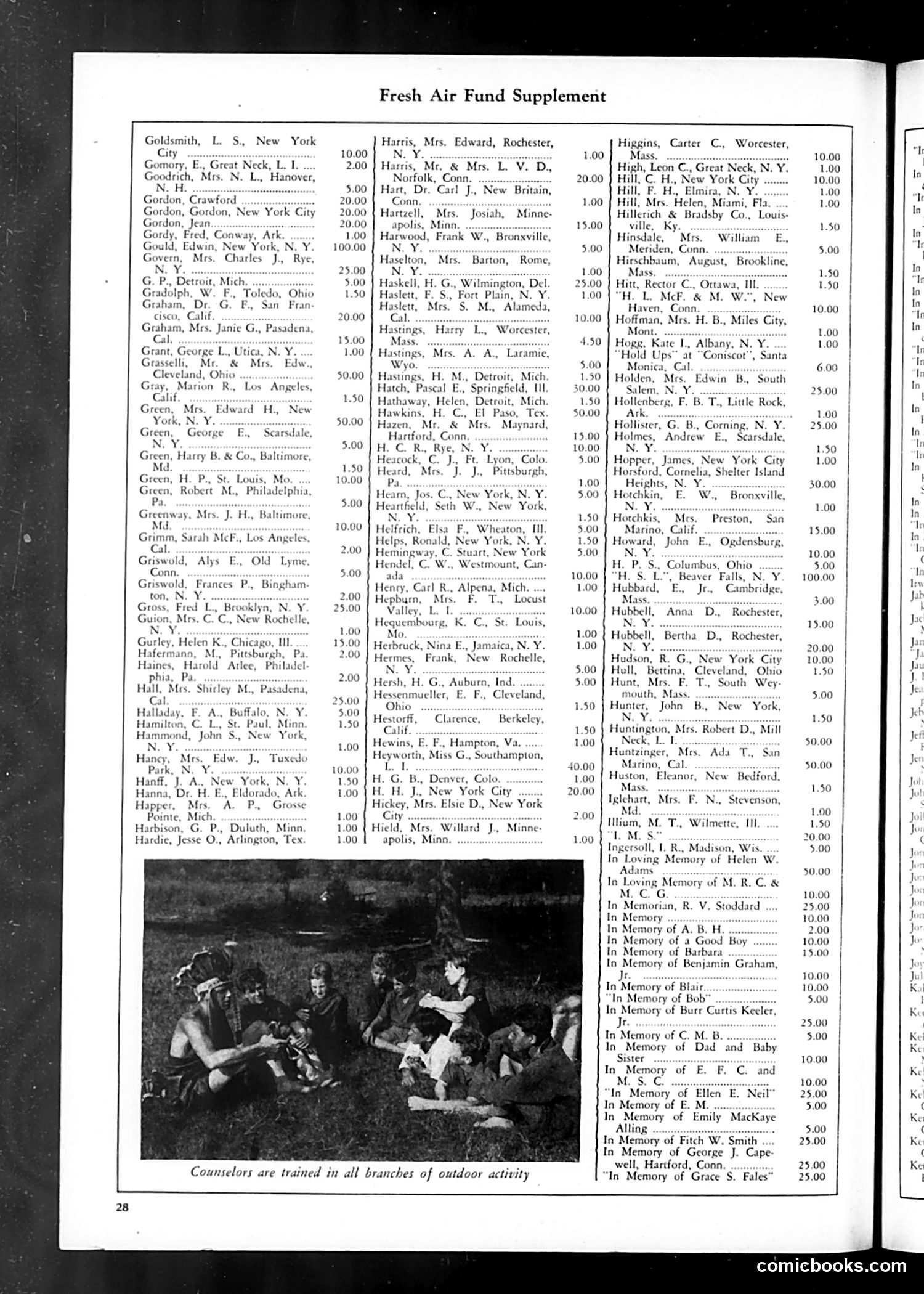
Fresh Air Fund Supplement This page is primarily a charitable donation list rather than satirical content. It documents contributions to the Fresh Air Fund, a real philanthropic organization that provided outdoor recreation and respite to underprivileged urban children. The photograph at bottom shows counselors training in outdoor activities—consistent with the caption "Counselors are trained in all branches of outdoor activity." The extensive donor roster (individuals and organizations from across America, contributing $1-$100) demonstrates the Fund's broad support base circa early 20th century. Many entries note memorial donations ("In Memory of..."), a common fundraising practice. This appears to be a publicity supplement in *Life* magazine celebrating the organization's work and donor base—essentially advertising to encourage further contributions—rather than satire or political commentary.
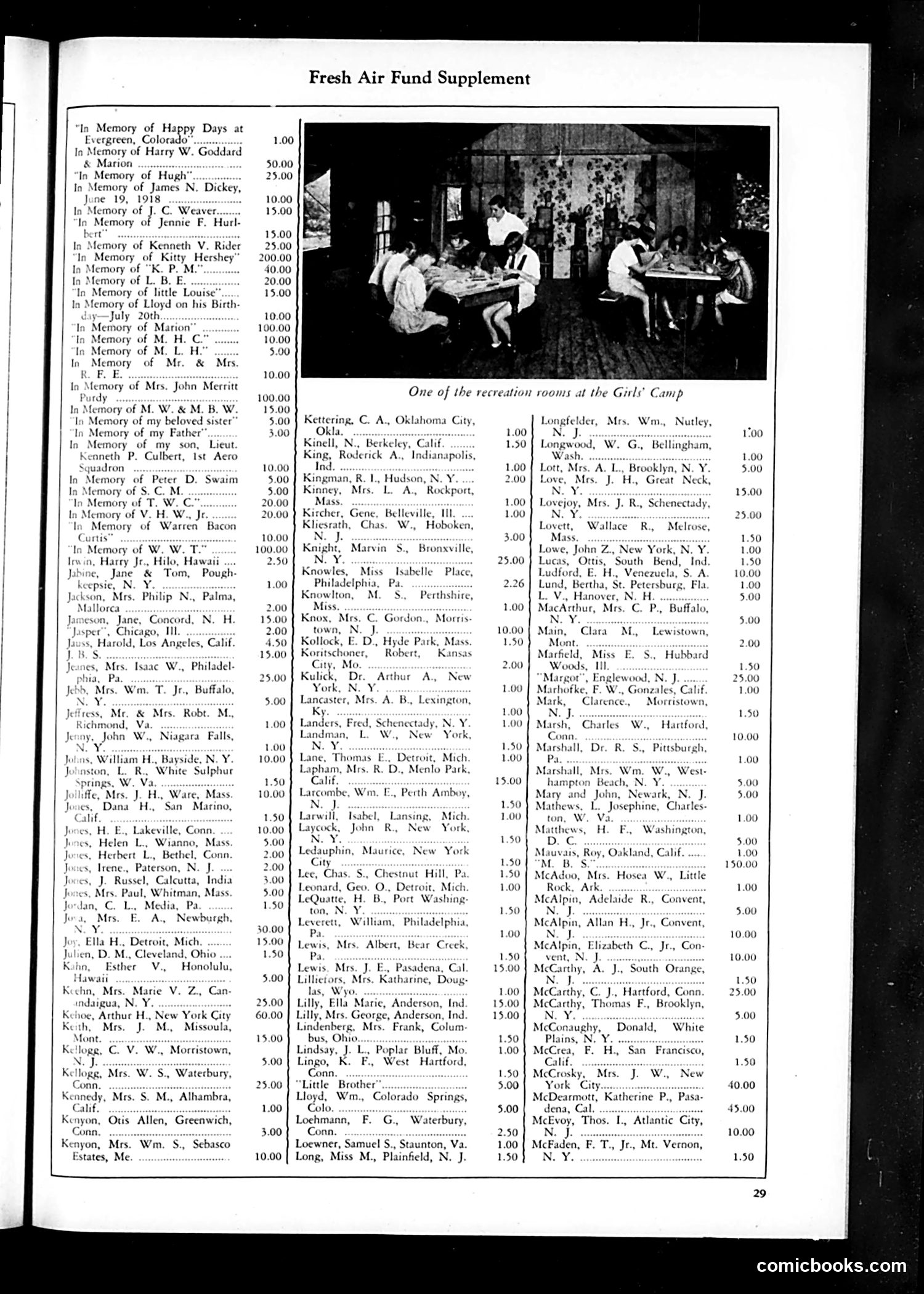
Fresh Air Fund Supplement Page This page is primarily a fundraising document for the Fresh Air Fund, a charitable organization providing recreational opportunities for underprivileged children. The left column lists memorial donations—contributions made "in memory of" deceased individuals, ranging from $1 to $250. This reflects early 20th-century charitable practice: honoring the dead through philanthropic giving. The photograph shows girls at a recreation room in the Girls' Camp, depicting the Fund's actual work providing summer activities and outdoor experiences to city children. The right column continues listing individual donor names and contribution amounts from across America, indicating widespread middle-class support for this cause. Rather than satire, this is a earnest philanthropic appeal documenting both the Fund's charitable mission and its donor base—essentially an early fundraising annual report embedded in a magazine.
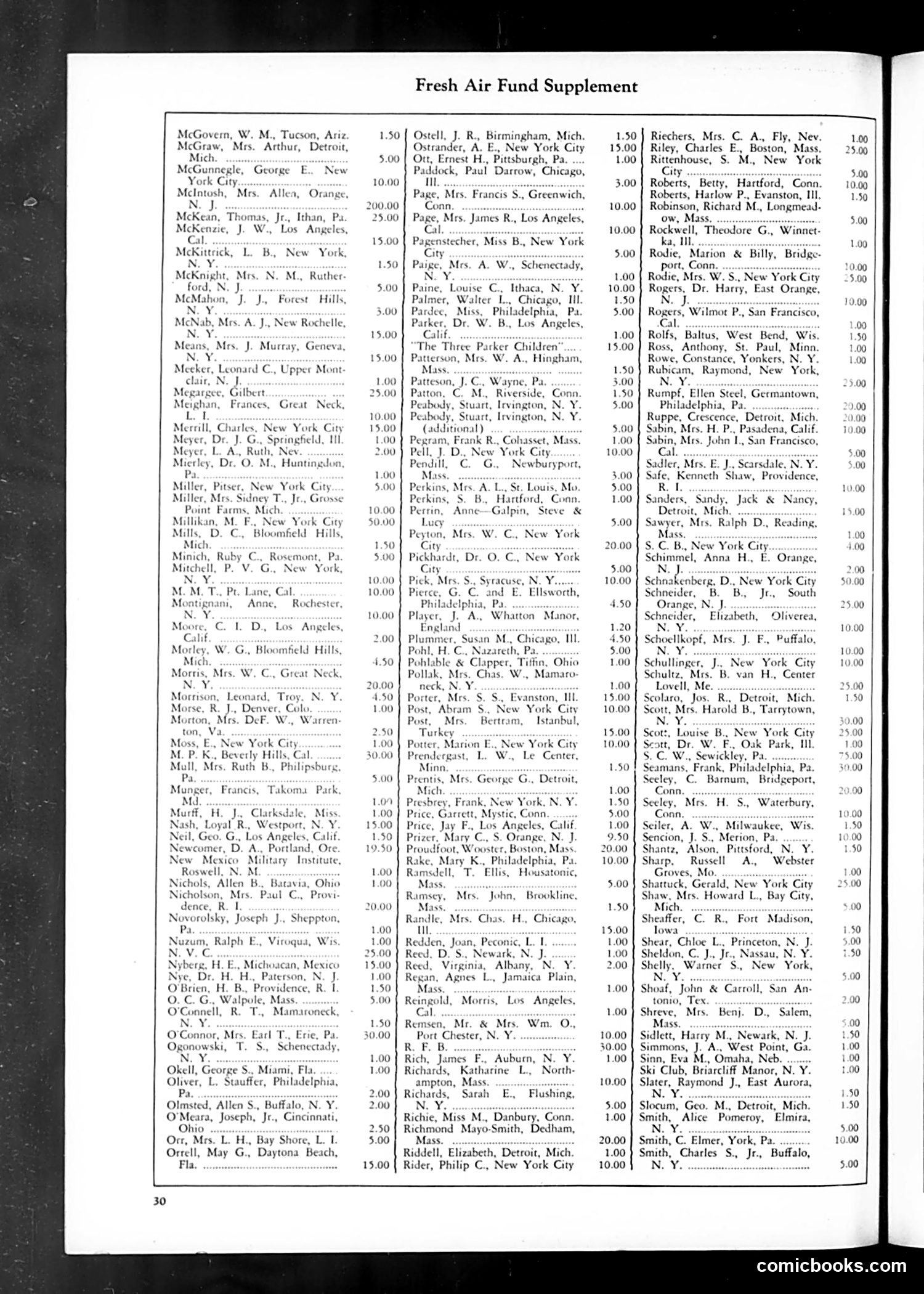
Fresh Air Fund Supplement This page is not a cartoon or satirical content—it's a donation list for the Fresh Air Fund, a charitable organization that provided outdoor recreation and respite for underprivileged urban children. The page displays hundreds of names, locations, and contribution amounts (in dollars), representing individual donors who supported this cause. The Fresh Air Fund was a legitimate philanthropic initiative popular during the early-to-mid 20th century. This appears in *Life* magazine likely because the publication regularly promoted charitable causes to its readers and documented public support for social welfare initiatives. The list itself serves as both acknowledgment of donors and inspiration for additional contributions—a common fundraising tactic of the era.
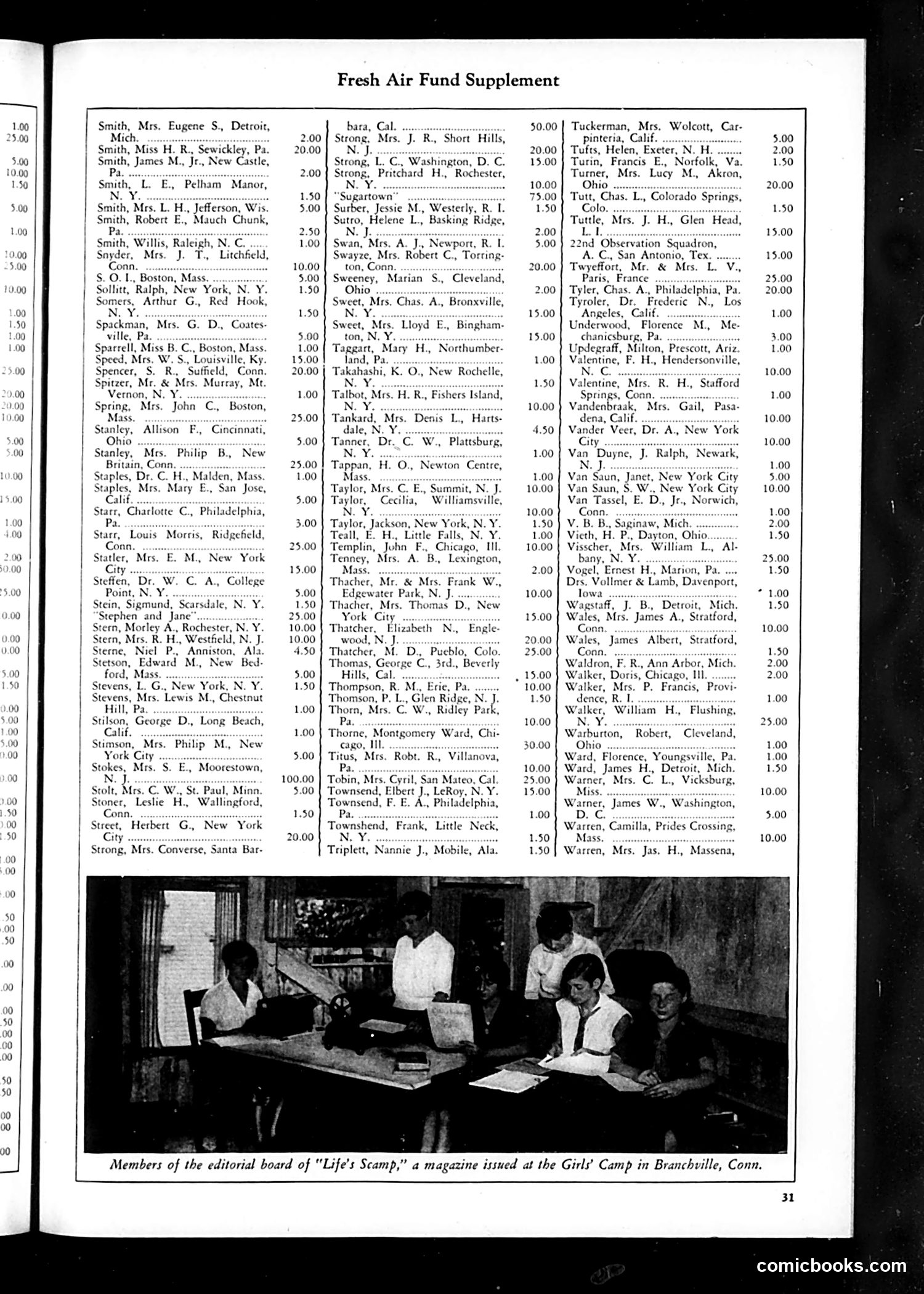
Fresh Air Fund Supplement - Page Analysis This page is primarily a fundraising list for the Fresh Air Fund, a charitable organization providing summer camp experiences for underprivileged children. The bulk consists of donors' names and contribution amounts, ranging from $1.00 to $100.00. The photograph at bottom shows the editorial board of "Life's Scamp," a magazine produced at the Girls' Camp in Branchville, Connecticut—likely a publication created by campers themselves as a recreational activity. Historical context: The Fresh Air Fund was a significant Progressive Era charity (established 1877) addressing urban poverty by providing outdoor experiences for city children. This page documents individual donors supporting the cause, reflecting early 20th-century philanthropic culture where personal charitable giving was publicly acknowledged and celebrated in publications like *Life* magazine. The page demonstrates how satirical magazines also served civic/charitable purposes, using their platforms to promote worthy causes and recognize supporters.
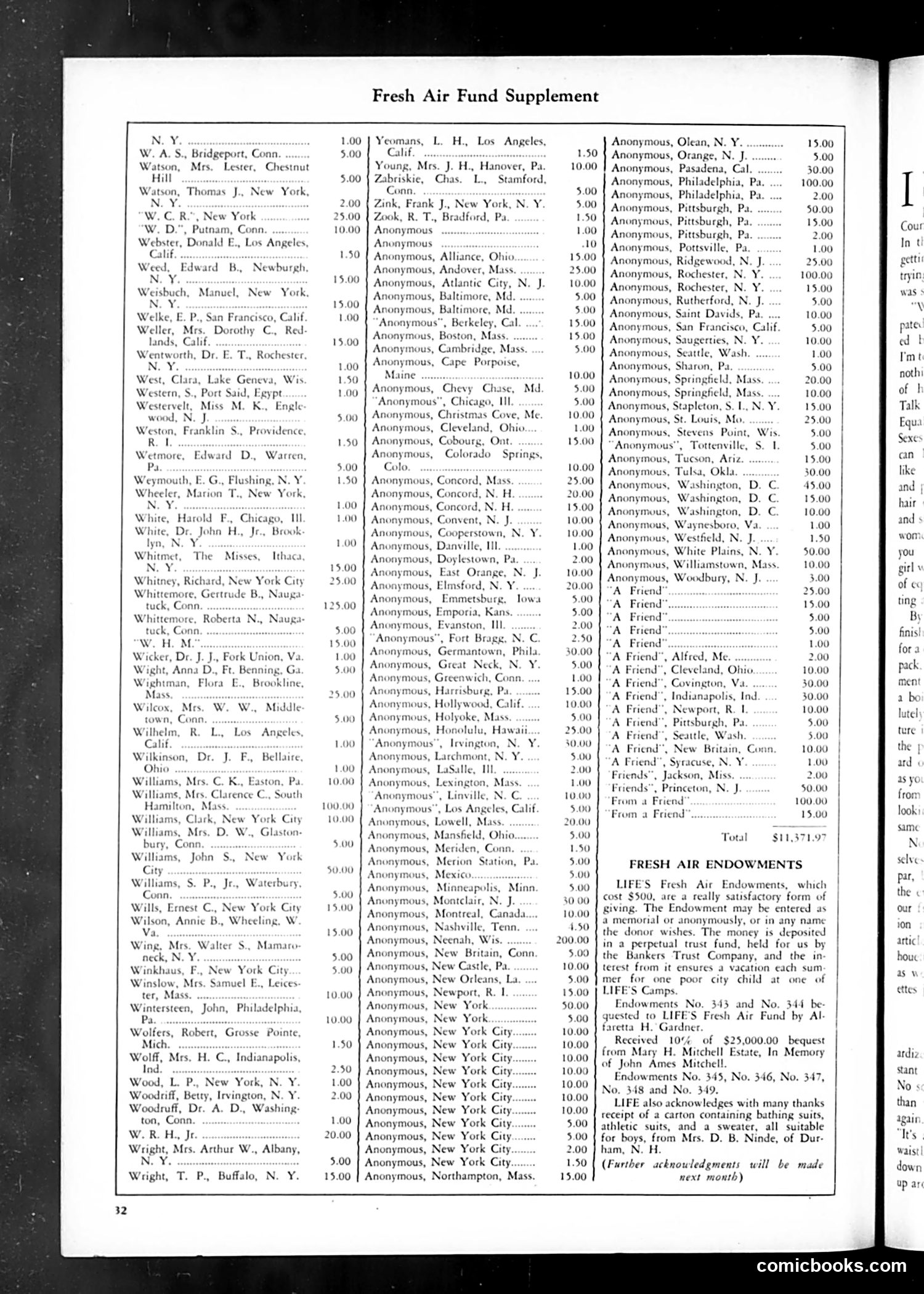
This page is primarily a fundraising list for the Fresh Air Fund, not a political cartoon or satirical content. It shows donations received for this charitable organization, which provided vacations and outdoor experiences for underprivileged urban children. The list contains individual and anonymous donors from across America, with contribution amounts ranging from $1.00 to $125.00. The text at the bottom explains that LIFE magazine's Fresh Air Endowments (costing $500) allowed donors to sponsor a child's summer vacation, with money deposited in a trust account. This represents early 20th-century American philanthropy—a period when magazines like LIFE actively promoted charitable causes. The emphasis on anonymous donations reflects both discretion and widespread middle-class participation in social welfare, before government programs assumed these responsibilities.
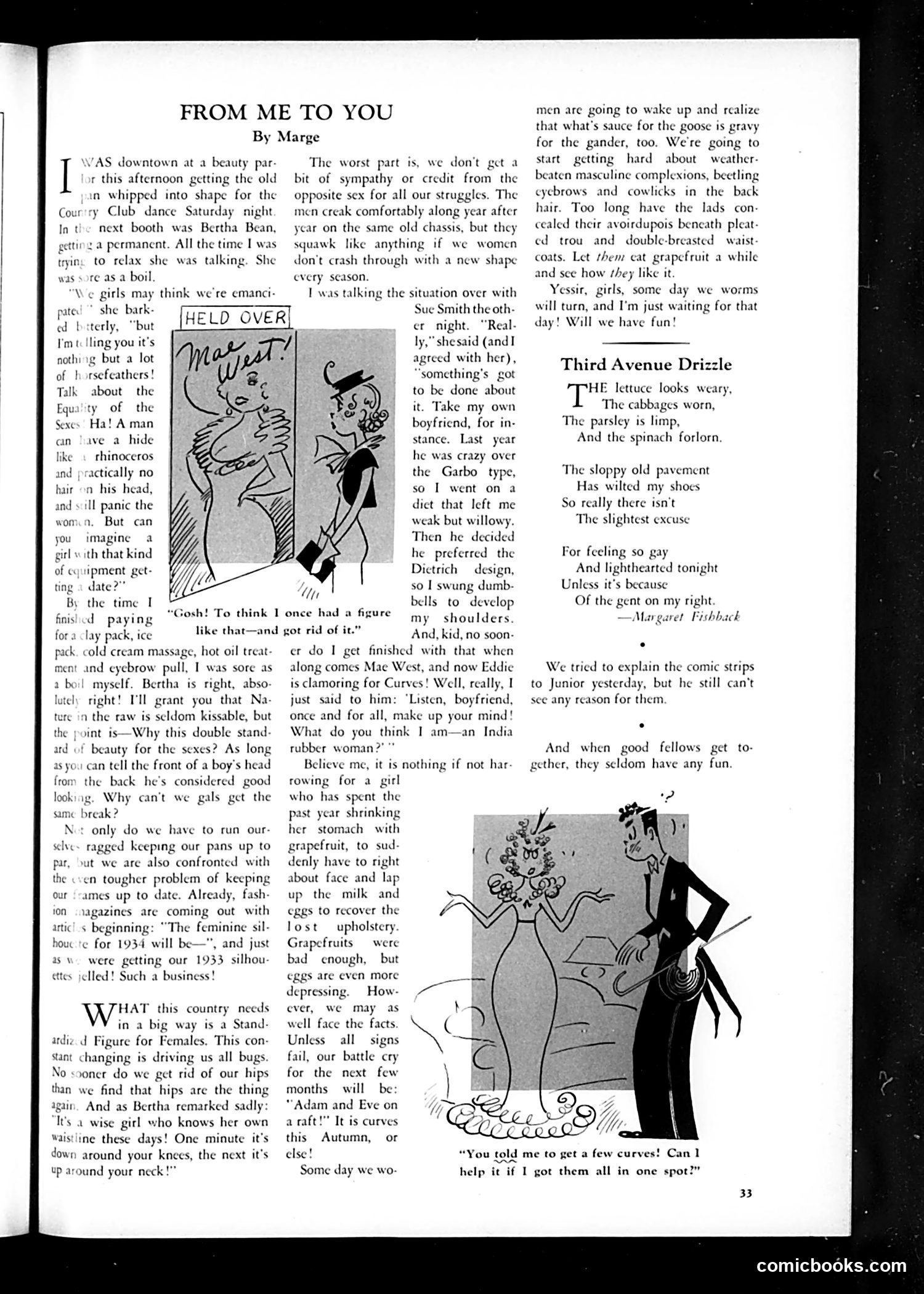
Analysis of "From Me to You" by Marge This 1930s humor column satirizes the arbitrary and exhausting standards imposed on women's bodies. The author mocks how female beauty ideals constantly shift—from the thin "Garbo type" to the curvy "Mae West" look—forcing women to diet, exercise, and remake themselves seasonally. Men, by contrast, remain unchanged and receive no criticism. The cartoon illustrations (showing women discussing fashion) accompany commentary on this double standard. Women must constantly "crash through with a new shape every season" while men "creak comfortably along year after year on the same old chassis." The satire's central point: women endure exhausting, expensive grooming (permanents, massages, diets) for male approval, yet receive no sympathy. The author sarcastically proposes men face equivalent pressure—suggesting they too diet on grapefruit and eggs to meet shifting standards. This reflects 1930s feminist critique of beauty culture's unfair demands on women, though framed in the period's comedic, resigned tone.
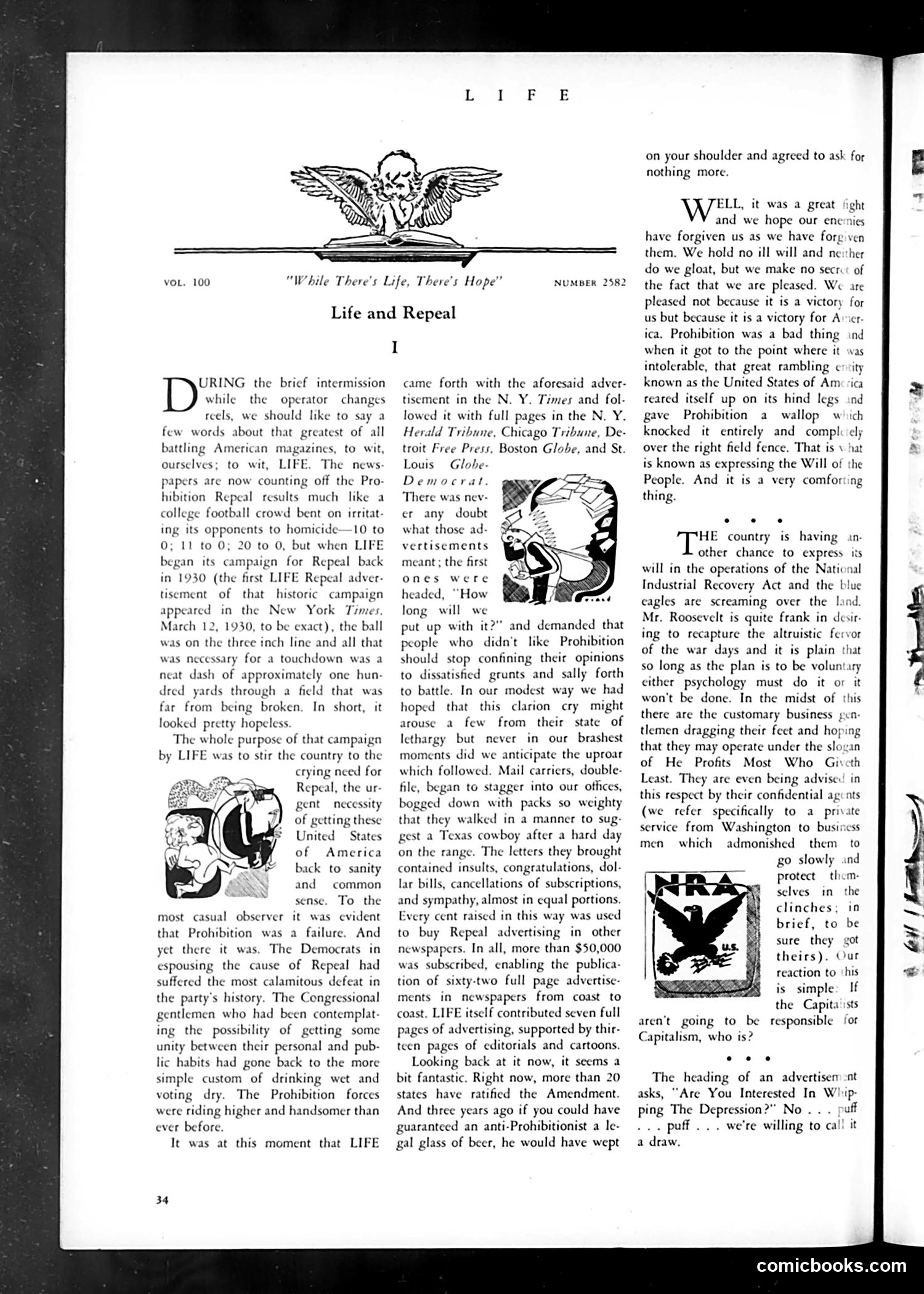
Life Magazine's Prohibition Repeal Campaign Retrospective This page celebrates *Life* magazine's successful 1930-1933 campaign against Prohibition. The text recounts how *Life* launched aggressive advertising ("How long will we put up with it?") when repeal seemed hopeless—the 1932 Democratic repeal platform had suffered electoral defeat, and anti-alcohol forces appeared dominant. The magazine's strategy worked spectacularly: $50,000 in reader donations funded 62 full-page repeal advertisements across major newspapers. The response was enormous—mail carriers "staggered" under the weight of letters containing both insults and support. Now, with over 20 states having ratified the Twenty-first Amendment (repealing the Eighteenth), *Life* reflects with satisfaction that they contributed meaningfully to overturning what they characterize as an unworkable law. The tone is self-congratulatory but frames repeal as benefiting America generally, not merely *Life's* prestige. The cartoons (not clearly visible in this image) likely mocked Prohibition's failures or celebrated repeal's arrival.
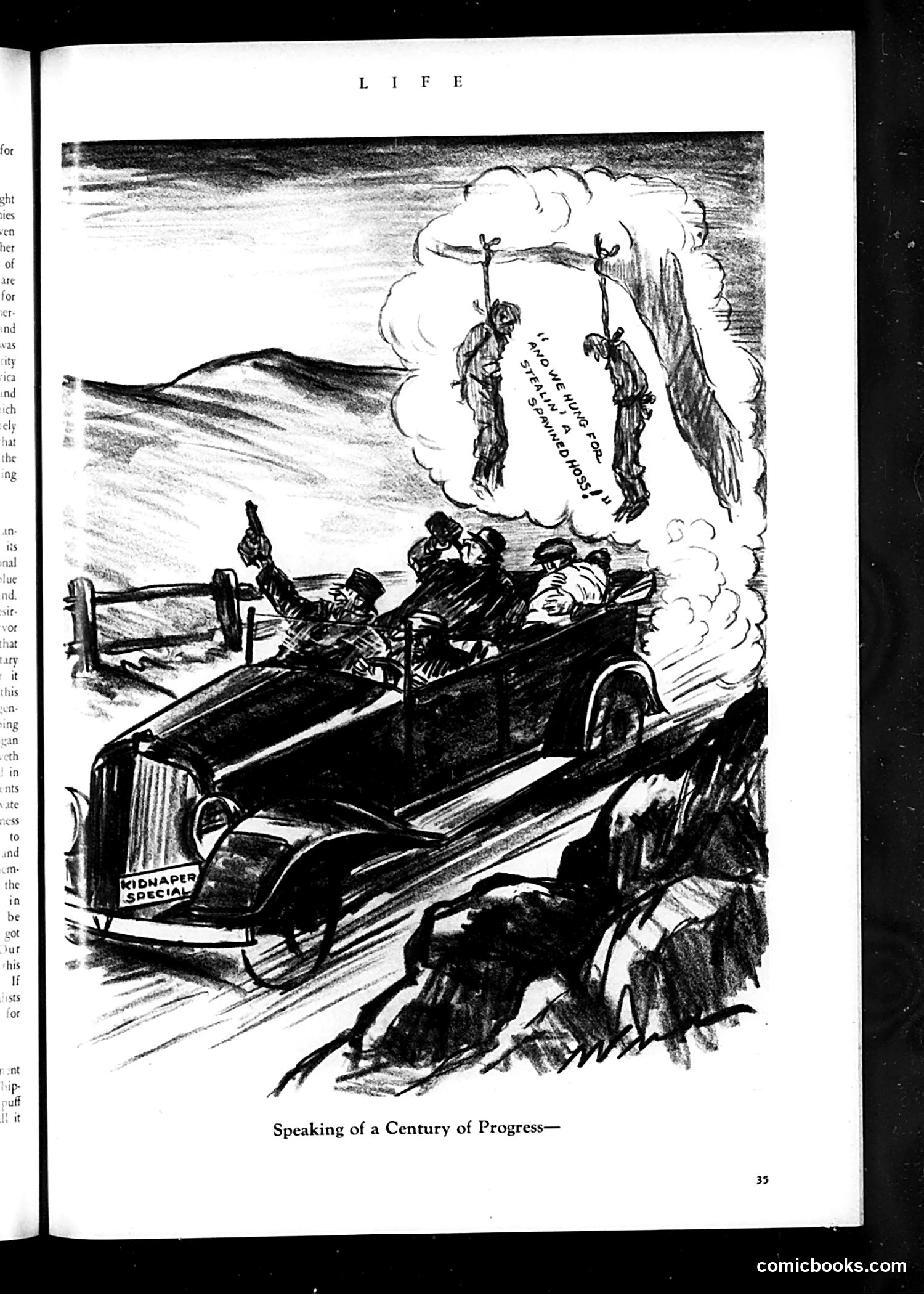
This cartoon satirizes the "Century of Progress" — likely referencing the 1933 Chicago World's Fair of that name. The image depicts a car labeled "Kidnaper Special" carrying what appear to be criminals or gangsters, with two hanged figures visible in a cloud above. Below, bodies lie on the ground. The satire contrasts the era's promotional claims of technological and social advancement with the brutal reality of contemporary crime, particularly kidnapping cases that dominated 1930s headlines (the Lindbergh kidnapping being the most infamous). The "progress" celebrated by the fair is undermined by showing how modern innovations — the automobile — enable serious crimes. The cartoon criticizes optimistic narratives about progress while violent crime flourishes.
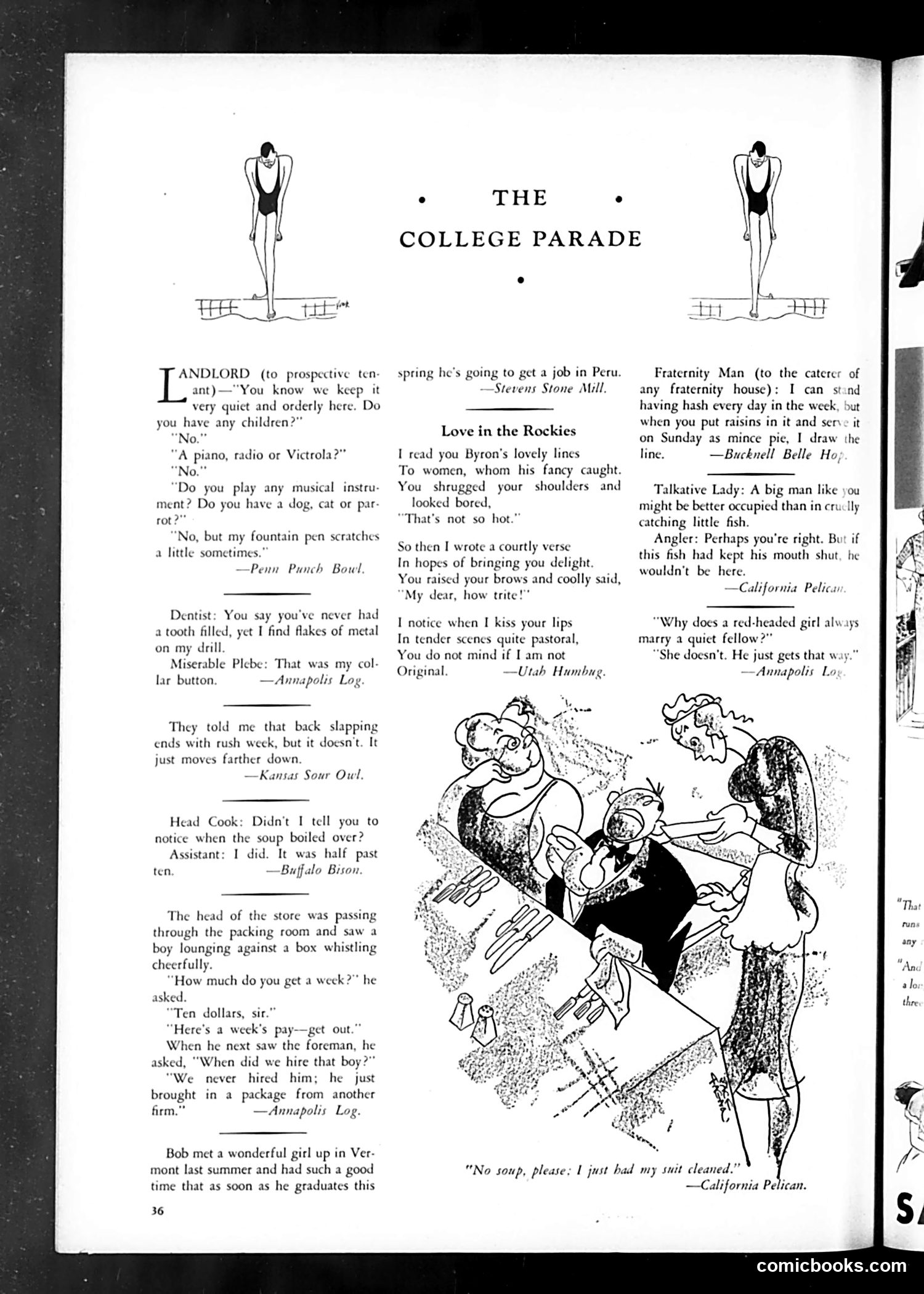
"The College Parade" — Context for Modern Readers This page collects brief humor pieces sourced from college and military newspapers (Penn Punch Bowl, Annapolis Log, Kansas Sour Owl, etc.). The jokes target recognizable college-life situations: landlords screening tenants for noise/disruption, military academy plebes, fraternity dining, and campus romance. The central cartoon depicts a woman at a formal dinner complaining about soup—a visual gag about petty complaints in domestic/social situations. The humor relies on period-specific details: Victrolas (record players), fountain pens, Byron's poetry as romantic clichés. The "Peru job" and Vermont romance reference common post-graduation scenarios. The satire's point: Mock the pretensions and absurdities of college life—overly fastidious landlords, romantic posturing, military discipline, and social conventions. These were syndicated college-newspaper jokes, suggesting shared cultural anxieties about propriety, romance, and adulthood among 1920s-era American undergraduates.
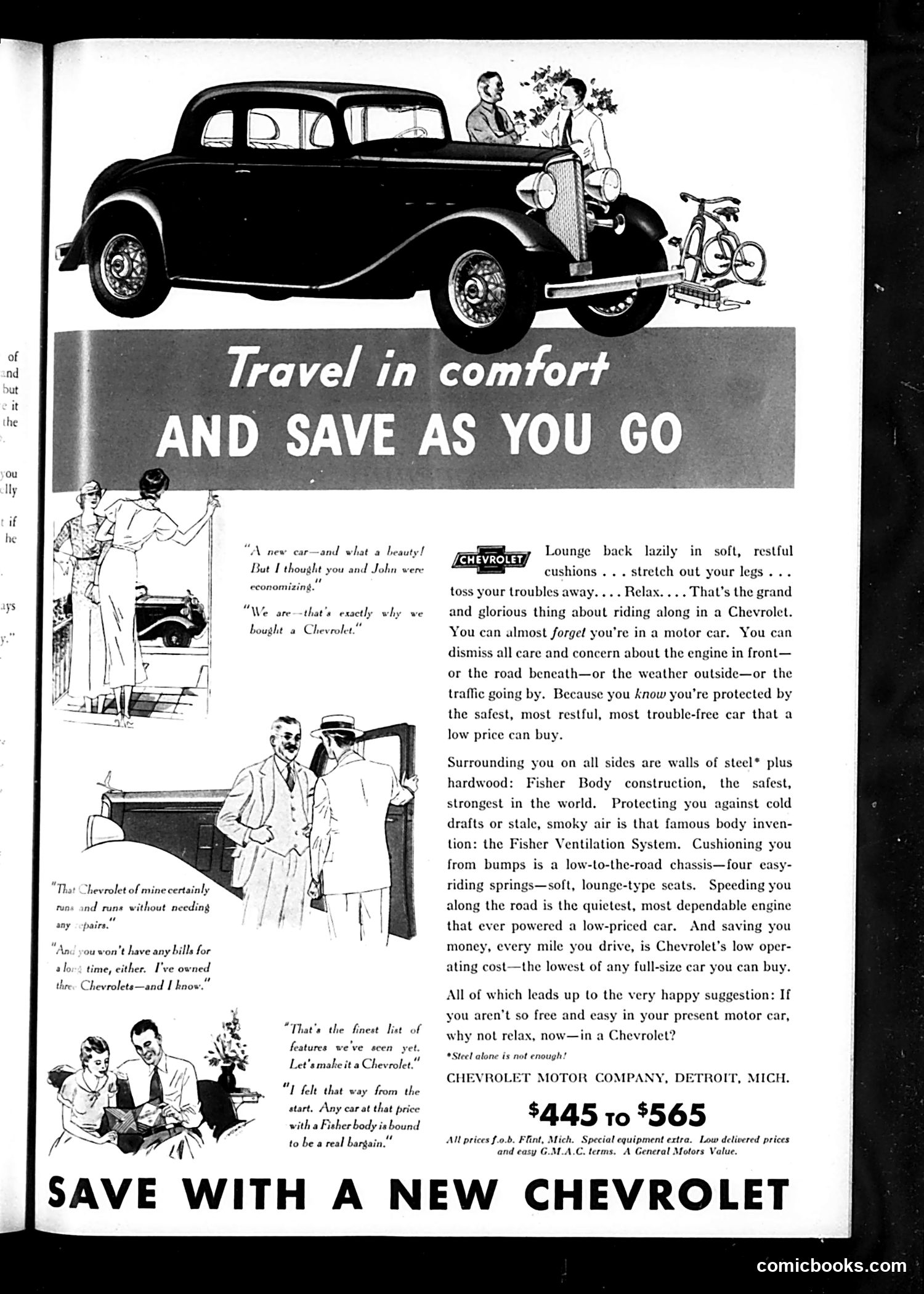
Analysis This is primarily a Chevrolet advertisement, not satire. The page uses small cartoon vignettes to present customer testimonials about the car's value and reliability. The repeated dialogue exchanges show people claiming that buying a Chevrolet is actually economical—a paradox humorously resolved by the car's low price and operating costs. One couple says they're "economizing" by purchasing one; another owner boasts of owning three Chevrolets without needing repairs. The social context: This appears to be from the Depression era (pricing suggests 1930s), when affordable transportation was crucial. The ad emphasizes durability ("runs without needing any pairs"), comfort ("lounge back lazily"), and the Fisher Body's safety features—positioning the Chevrolet as a practical luxury for working families. The cartoons aren't satirical commentary but rather marketing humor—using relatable situations and dialogue to make the sales pitch entertaining rather than preachy. The appeal is to rationality: you save money *while* gaining comfort.
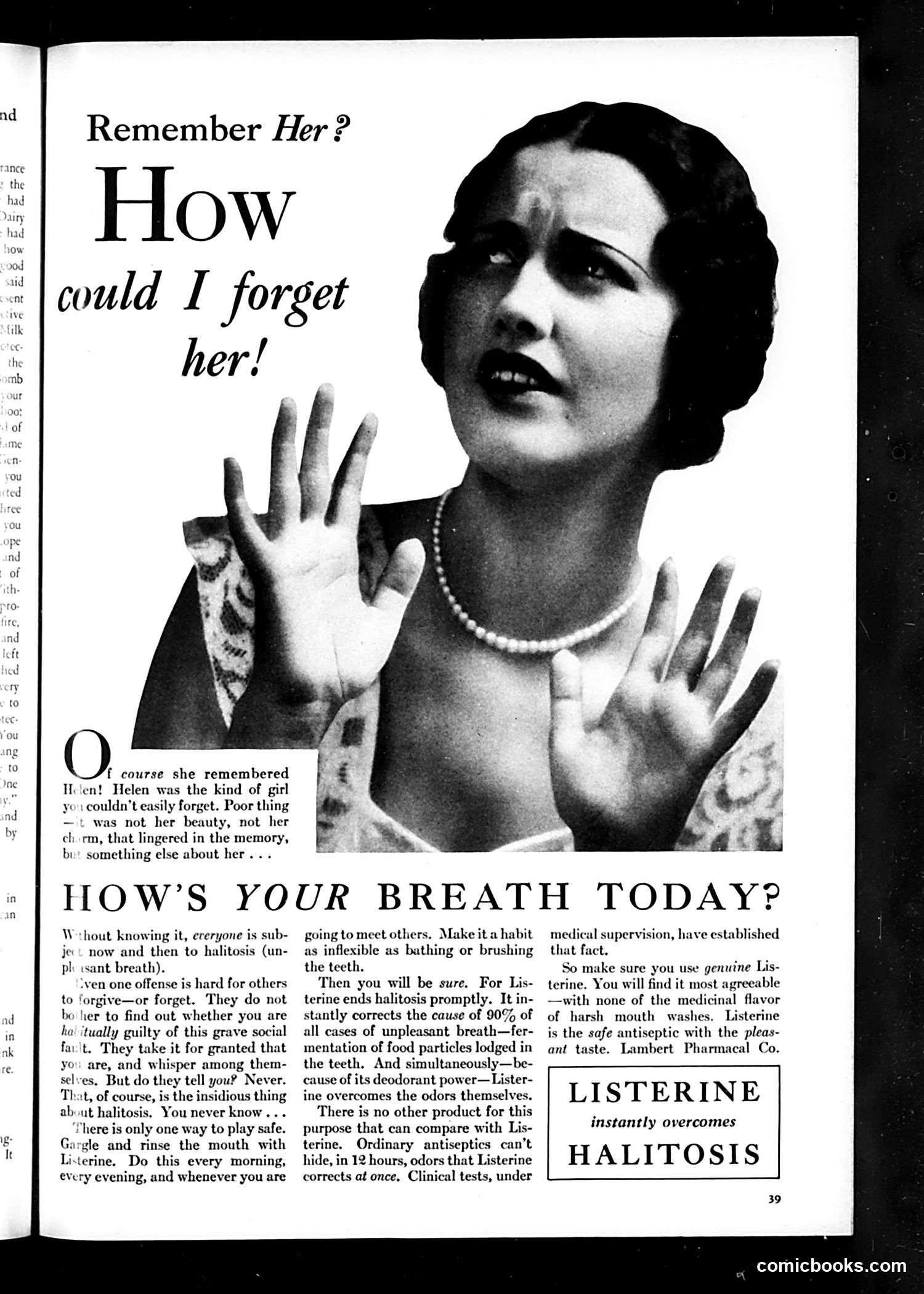
Listerine Advertisement as Social Satire This is primarily a Listerine mouthwash advertisement disguised as romantic narrative. The "cartoon" element is the opening setup: a man nostalgically remembers a woman named Helen, but the punchline reveals he's forgotten her—not because of her beauty or charm, but because of her bad breath (halitosis). The ad exploits social anxiety by warning readers that bad breath is a "grave social fault" that others whisper about but never mention directly. The implied message: everyone judges you silently for this offense, and you'd never know it. This reflects early 20th-century advertising strategy—creating shame around a medical condition (halitosis, a term Listerine essentially invented as a marketing concept) to drive sales. The dramatic photograph and emotional narrative serve to make the product feel essential for social acceptance and romantic viability, especially for women, whose desirability is framed as contingent on oral hygiene.
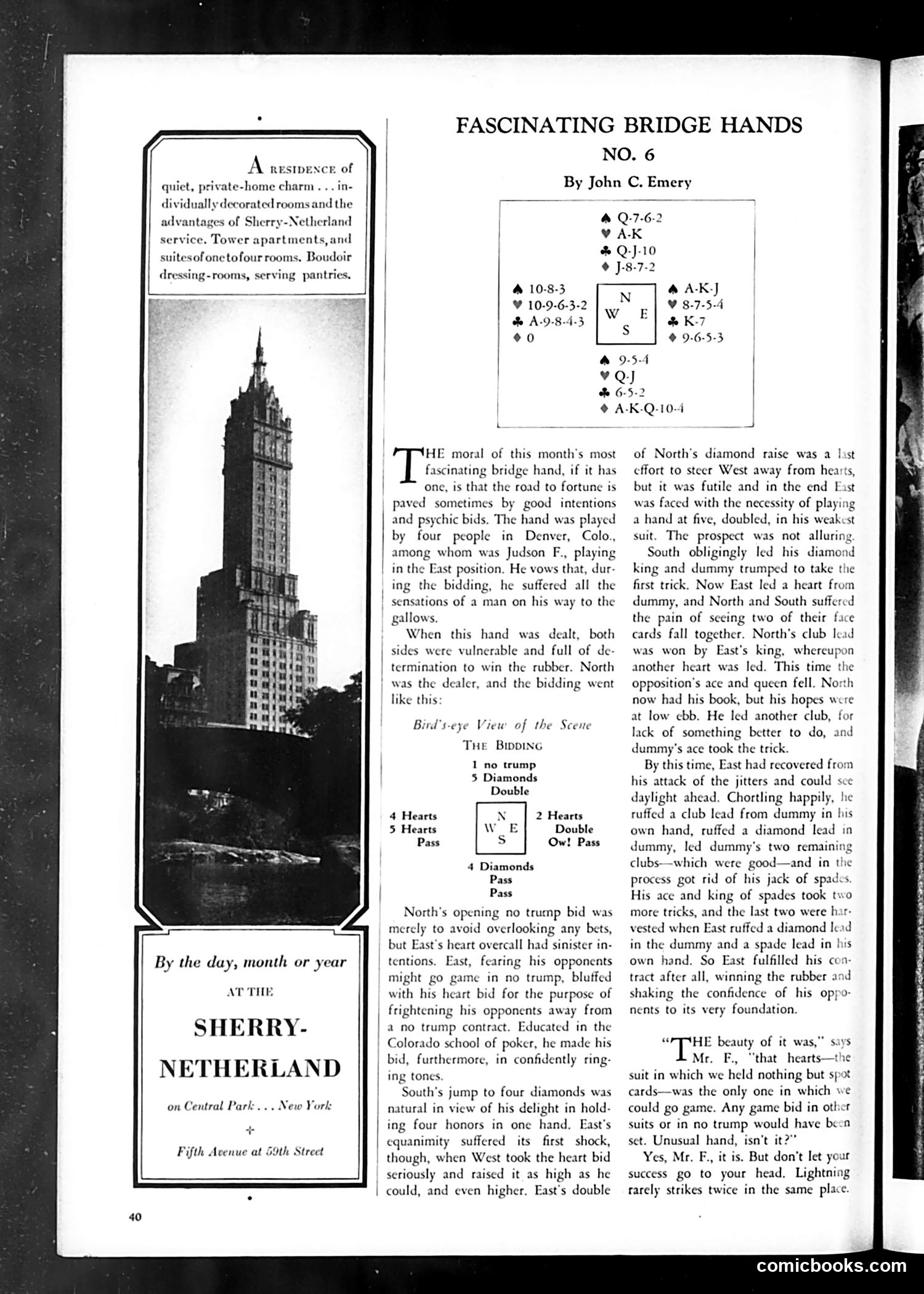
"Fascinating Bridge Hands No. 6" This page features a bridge column by John C. Emery analyzing a challenging card game played by four people in Denver, Colorado. The content is educational rather than satirical—it's a straightforward explanation of a bridge hand where East player (Judson F.) executed an unlikely successful contract through skillful play and fortunate card distribution. The only non-bridge element is a Sherry-Netherland hotel advertisement on the left, promoting luxury New York accommodations. There are no political cartoons, caricatures, or satire on this page. It's primarily instructional bridge content with advertising, typical of Life magazine's mixed format during this era.
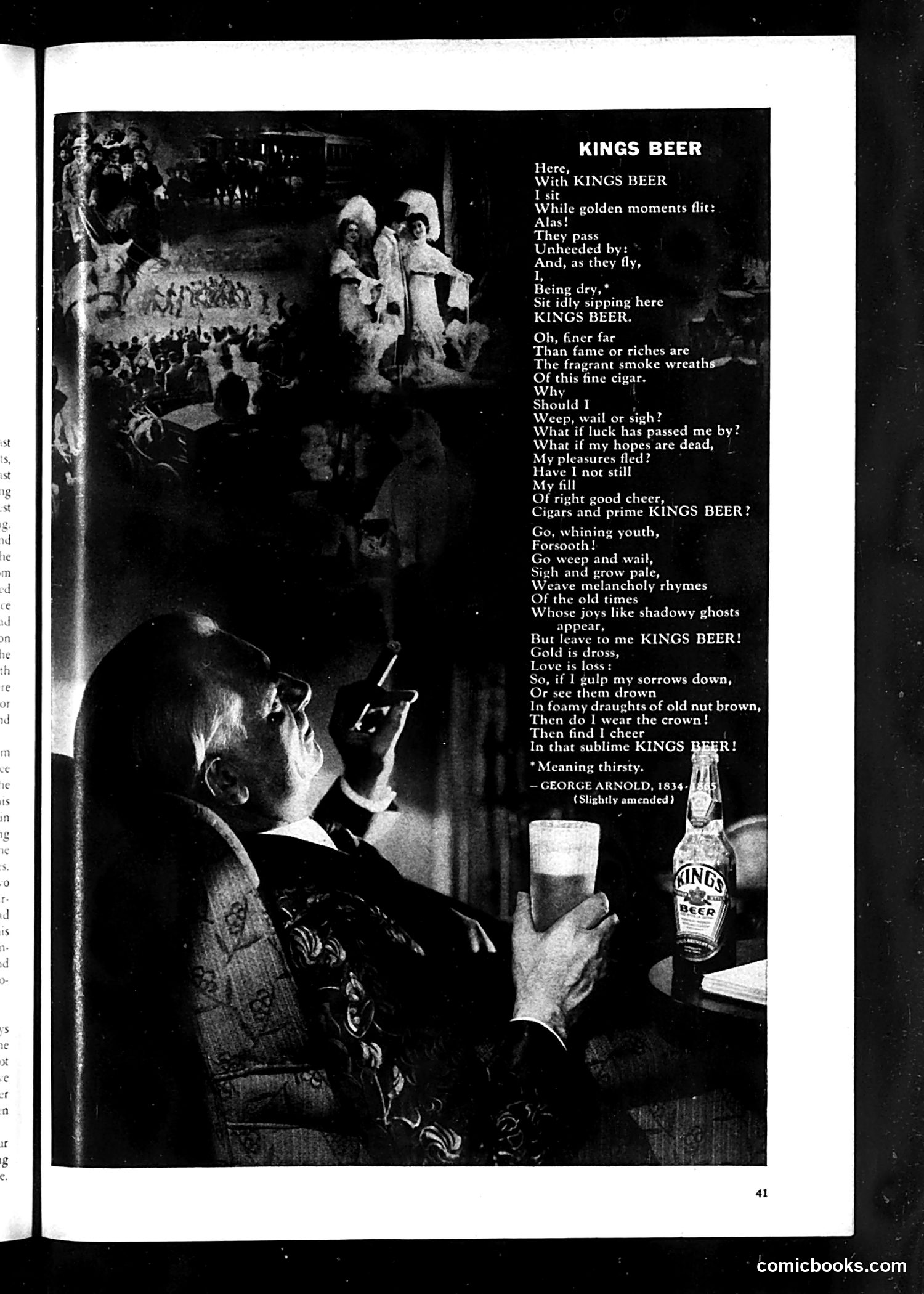
Kings Beer Advertisement This is a beer advertisement, not political satire. It features a poem attributed to 19th-century American poet George Arnold (1834-1888), promoting Kings Beer as a source of contentment and escape from life's disappointments. The advertisement uses romantic, philosophical language to market beer as superior to wealth ("Gold is dross") and love ("Love is loss"). The accompanying photographs show a man enjoying a beer and cigar while contemplating what appear to be theatrical or grand scenes in the background—suggesting beer provides affordable luxury and escapism. The satirical *tone* is self-aware: the poem acknowledges unhappiness ("Why should I weep, wail or sigh?") before offering beer as the solution, creating ironic humor about using alcohol to cope with failure. The asterisk note defining "dry" as "thirsty" adds playful wordplay typical of period advertising.
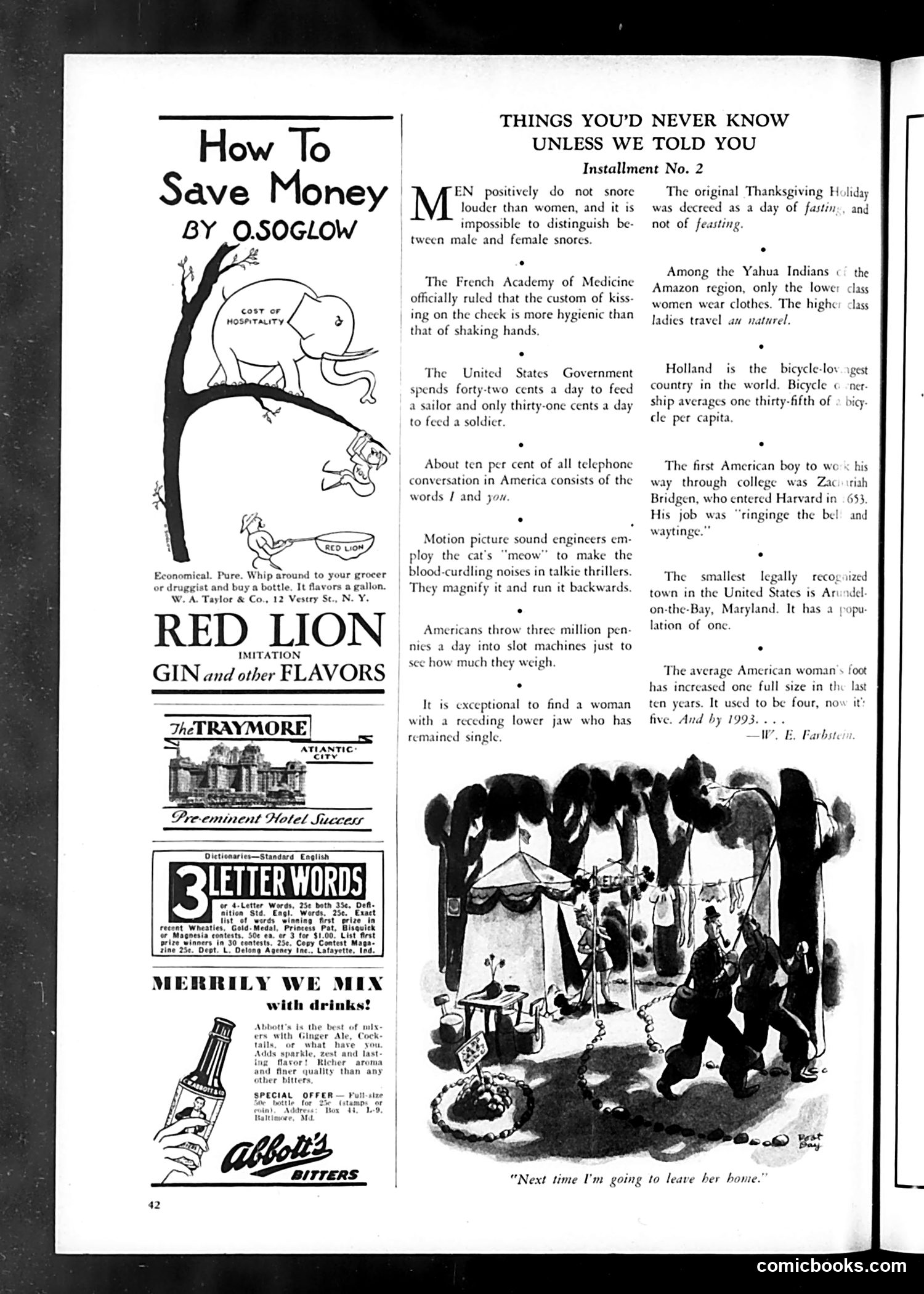
Analysis for Modern Readers This page mixes advertisements with satirical "trivia" content typical of 1920s-30s *Life* magazine humor. Left side: O. Soglow's cartoon mocks penny-pinching—a small figure clings to a bare tree labeled "cost of hospitality," illustrating miserliness. Surrounding ads promote Red Lion imitation gin and Abbott's bitters, reflecting Prohibition-era workarounds. Right side: "Things You'd Never Know Unless We Told You" presents absurd pseudo-facts meant as jokes. Examples: men and women snore identically; Americans waste money on slot machines; Yahua Indian women go naked while wealthy women dress; women's feet have grown a full shoe size in ten years. The large cartoon shows fashionable women in revealing 1920s-style clothing observing something off-panel, with the caption "Next time I'm going to leave her home"—likely satirizing how modern women dress or behave in ways that trouble conservative husbands. The humor relies on period attitudes about gender, fashion, and social propriety that would seem dated or offensive today.
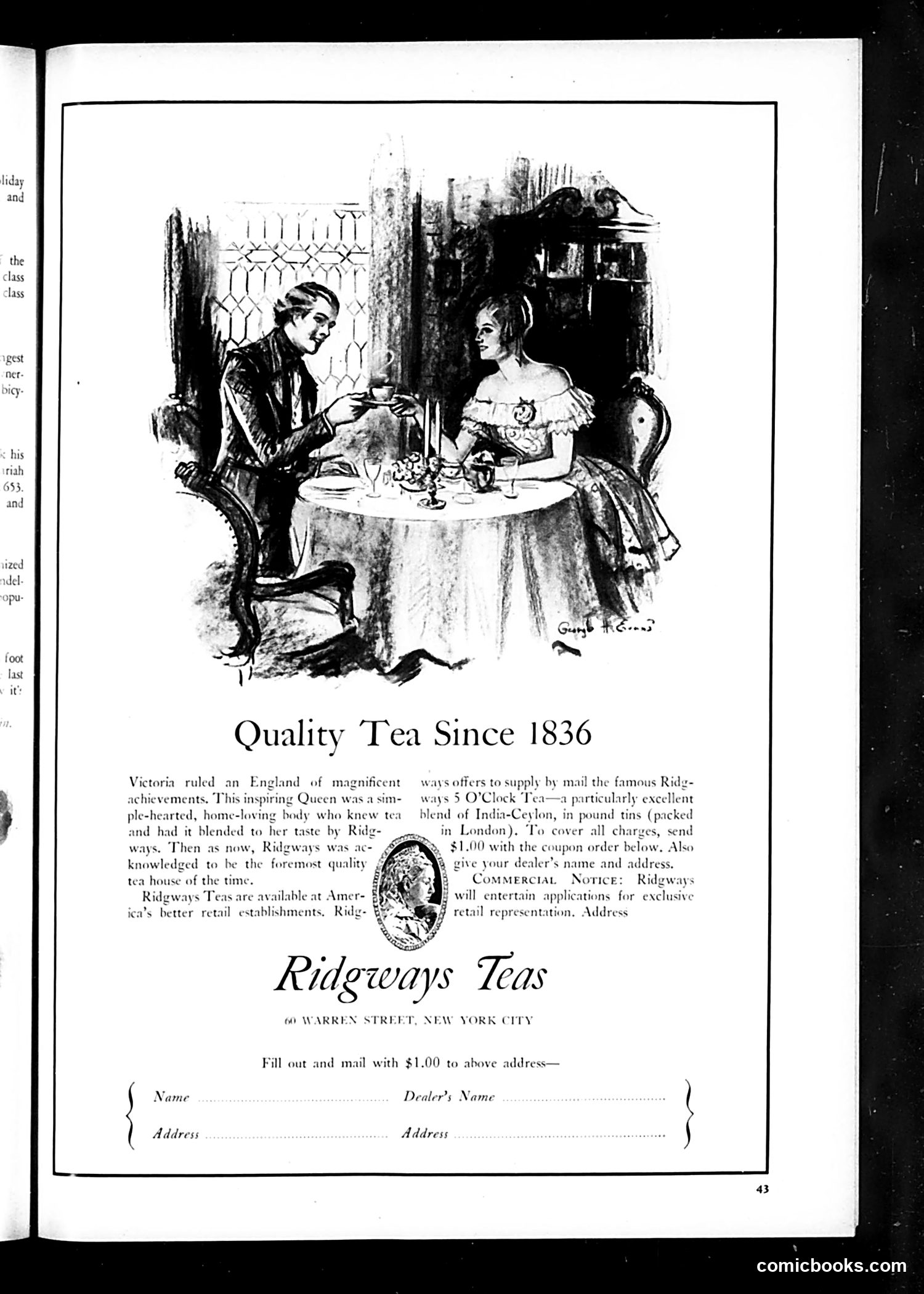
Analysis This is primarily a tea advertisement, not political satire. It promotes Ridgways Teas using a Victorian-era illustration showing a gentleman and woman at tea—a romanticized scene of refined leisure. The ad leverages brand prestige through royal association: it claims Queen Victoria herself used Ridgways tea, establishing the product as the "foremost quality tea house of the time." This appeals to American consumers seeking European elegance and tradition (the tea is "packed in London"). The illustration style—a genteel sketch of courtship or social interaction over tea—reflects early 20th-century advertising aesthetics, presenting tea-drinking as aspirational, cultured behavior. The coupon offer ($1.00 mail order) and dealer recruitment notice indicate this is a direct-response advertisement targeting both consumers and retail establishments. There is no satirical content; Life magazine's editorial content appears on other pages. This is simply a period advertisement using nostalgia and royal endorsement as marketing tactics.
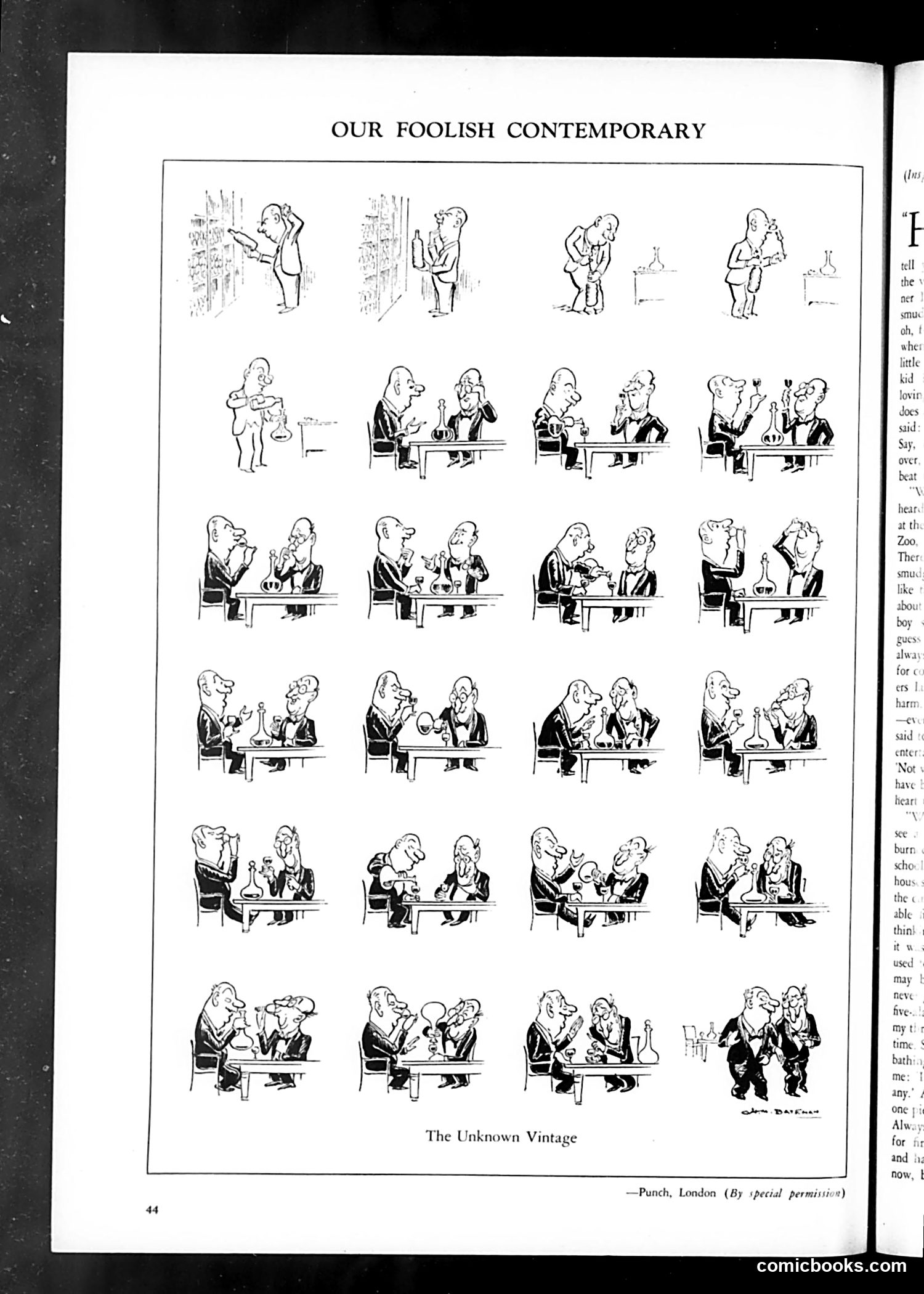
This is a reprinted cartoon from *Punch*, the British satirical magazine. The strip depicts two men at a dining table progressing through a sequence of increasingly drunk behavior—from polite conversation to slurred speech, exaggerated gestures, and finally chaotic intoxication. The title "Our Foolish Contemporary" and "The Unknown Vintage" suggest satire about excessive alcohol consumption and poor judgment. The cartoon mocks contemporary drinking culture by showing the humorous deterioration of propriety and self-control as alcohol takes effect. The sequential, panel-like format documents the stages of intoxication as social commentary—a common *Punch* theme ridiculing human folly and excess. The cartoonist uses caricature and physical comedy to make the satire accessible.
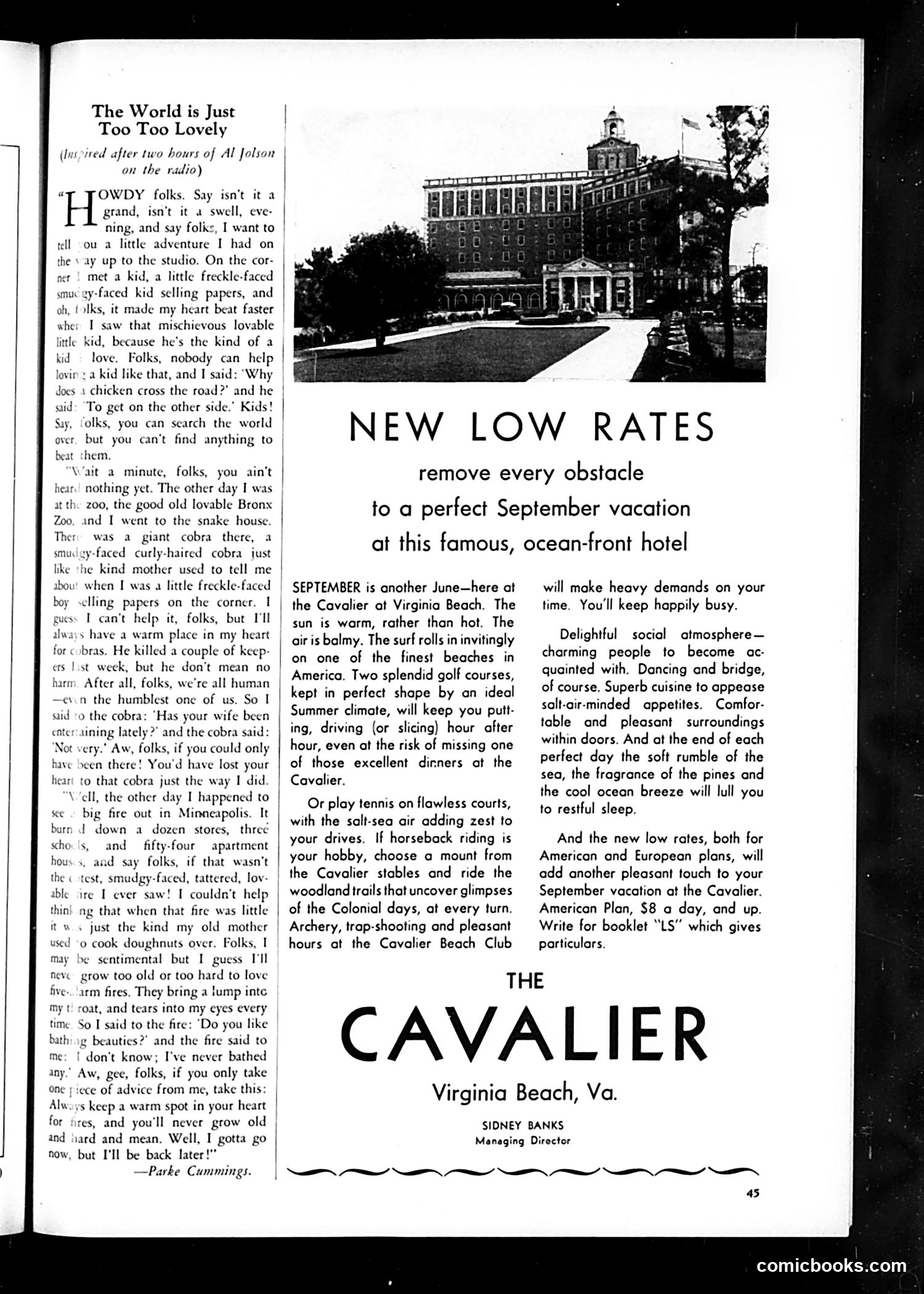
"The World is Just Too Too Lovely" This page satirizes Al Jolson, the enormously popular singer and entertainer of the 1920s-30s. The left column parodies Jolson's distinctive radio persona—his sentimental, folksy monologues delivered in his characteristic manner ("Howdy folks"). Jolson was famous for saccharine sentimentality, familiarly addressing audiences and finding profound emotional meaning in ordinary or absurd subjects. The satire exaggerates this: Jolson rhapsodizes about a street kid selling papers, a cobra that kills people, and a destructive fire—finding each "lovable" and declaring undying affection for them. The joke targets Jolson's overwrought emotional style and his affected warmth toward everything. By having him wax poetic about genuinely harmful or trivial things, cartoonist Parke Cummings mocks the disconnect between Jolson's saccharine delivery and reality. The advertisement for the Cavalier hotel occupies the remainder of the page.
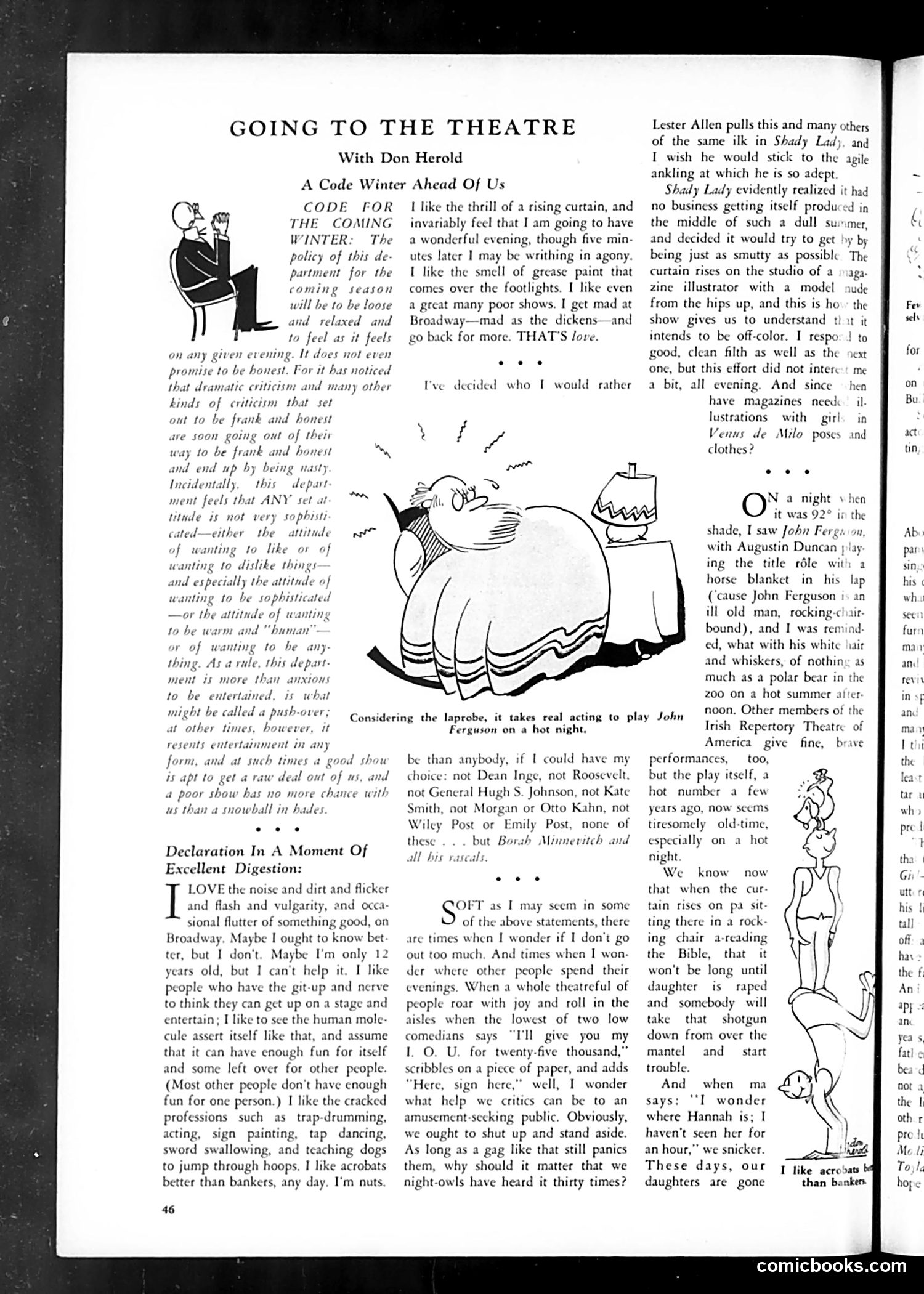
Analysis: "Going to the Theatre" by Don Herold This page is a theater criticism column celebrating Broadway entertainment's appeal despite its flaws. Main Content: Herold declares his love for theater—its noise, vulgarity, and human performers—while acknowledging Broadway's inconsistency. He admires "cracked professions" like acting and acrobatics over respectable careers like banking. The Cartoon: The illustration shows an actor in a heavy laprobe (blanket), captioned "Considering the laprobe, it takes real acting to play John Ferguson on a hot night." This jokes about the physical discomfort actors endure; Ferguson is likely a role requiring such costume despite summer heat. Social Context: Herold mentions "Shady Lady" (a contemporary play) and Boris Minnevitch, a real vaudeville performer, grounding the piece in 1930s theater. The column satirizes both pretentious critics and audience taste—mocking people who laugh at recycled jokes while defending entertainment's fundamental value. The tone is affectionate irreverence toward Broadway's commercialism and audience appetites.
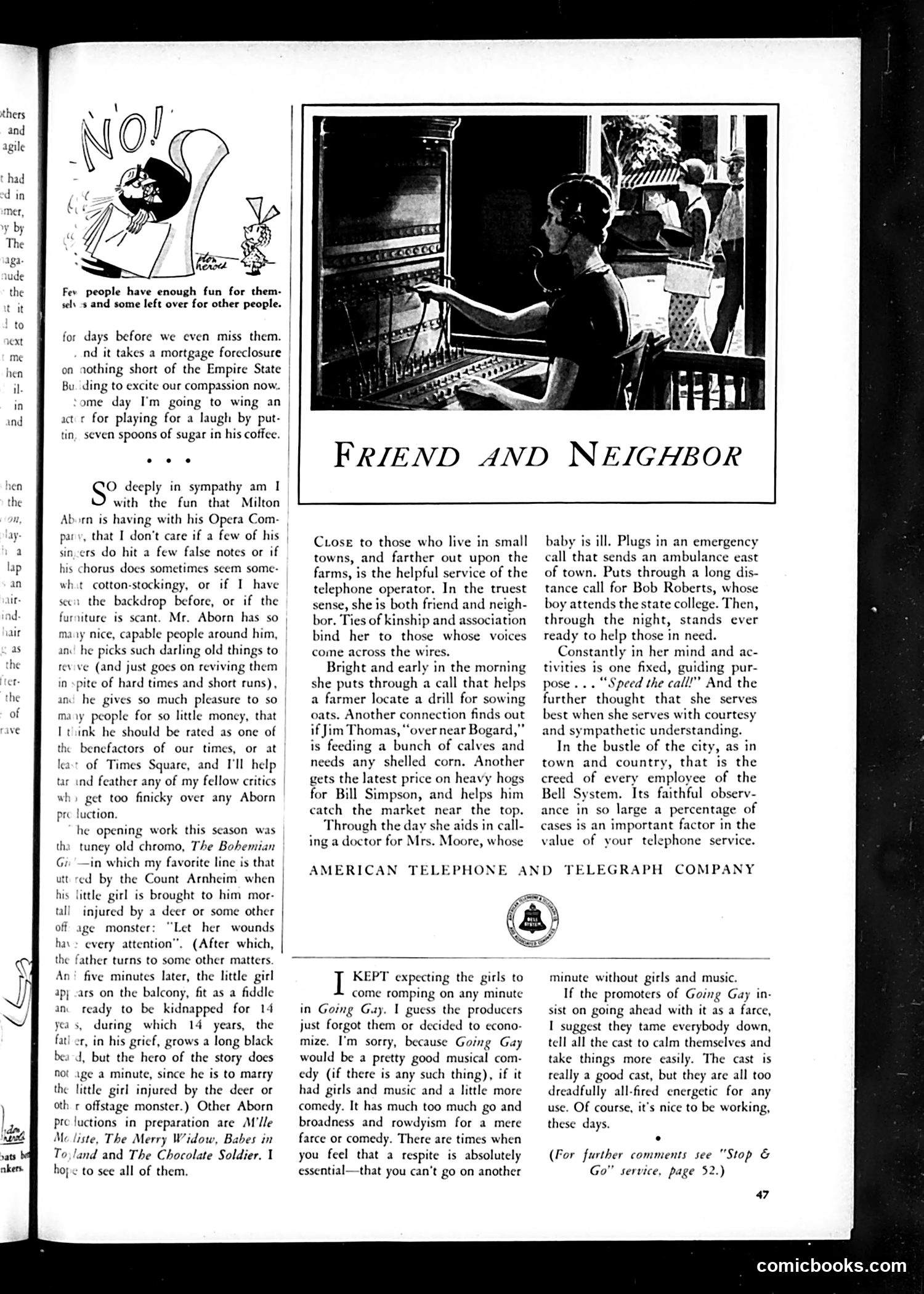
Analysis for Modern Readers This Life magazine page contains satirical commentary on 1920s theater and an AT&T advertisement. The left column mocks Milton Aborn's opera productions, praising his ability to entertain despite technical shortcomings (bad sets, off-key singers). The writer ironically credits Aborn as a "benefactor" for providing affordable entertainment during hard economic times—a backhanded compliment about lowered standards during financial hardship. The cartoon labeled "Friend and Neighbor" (top) illustrates rural telephone operators as community servants, connecting farmers to markets, doctors, and emergency services. Below, the author ridicules the musical *Going Gay*, complaining the producers cut the chorus girls to save money—treating the omission of female dancers as the show's fatal flaw rather than addressing actual performance issues. The AT&T advertisement romanticizes small-town telephone operators as civic heroes, though this serves corporate marketing interests, not genuine social commentary.
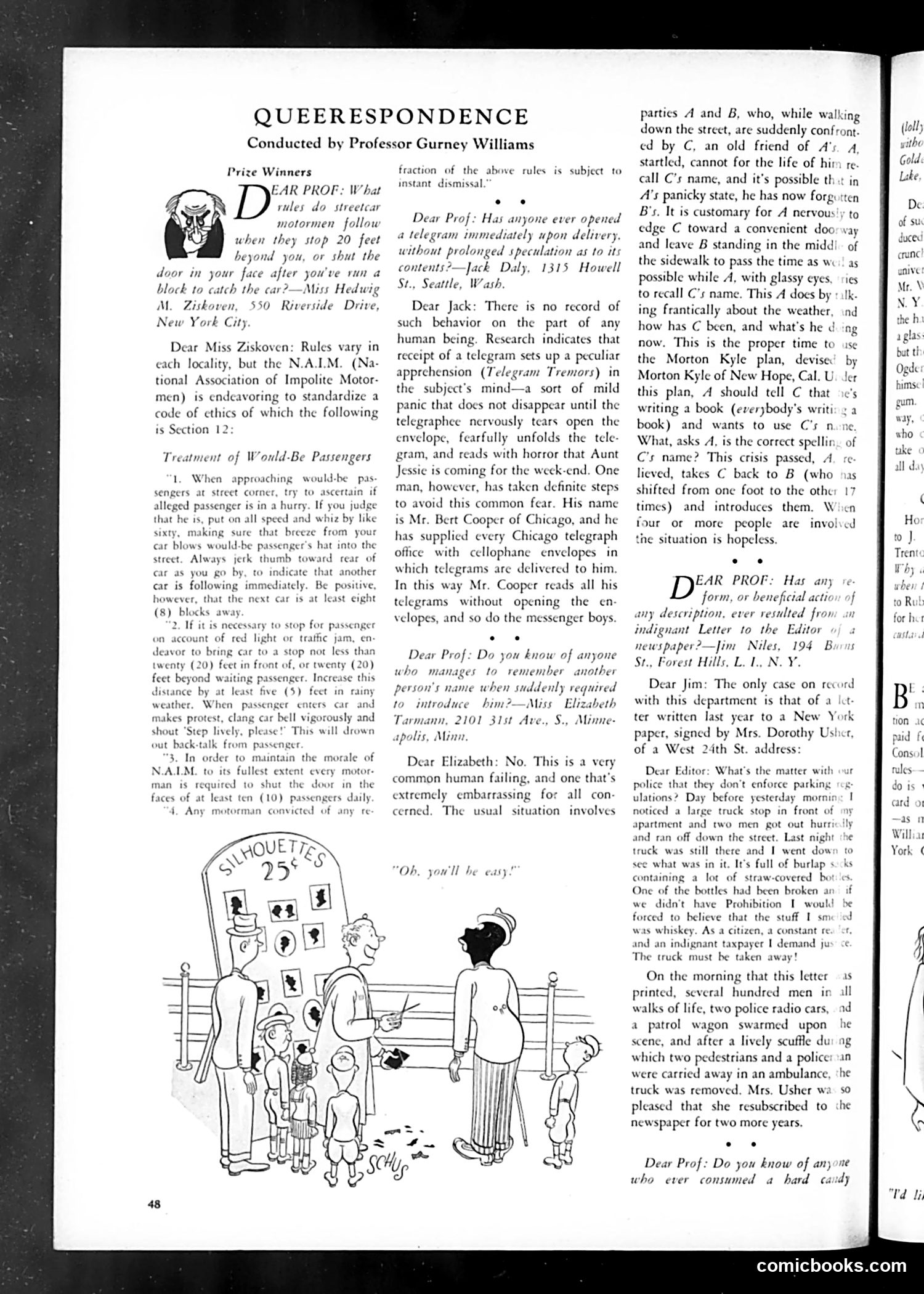
Explaining This Life Magazine Page to Modern Readers This is a humorous advice column called "Queerespondence," satirizing common urban annoyances of the era through mock-serious responses. The main cartoon illustrates the opening letter about streetcar motormen's rudeness. It shows a crowded streetcar with passengers of various ages, depicting the frustration of commuters dealing with public transit workers who deliberately stop too far from waiting passengers, slam doors in their faces, or speed away. The column's joke is presenting a fake "N.A.I.M. (National Association of Impolite Motormen)" rulebook that codifies these rude behaviors as official policy—including requirements to stop 20 feet away from passengers and shut doors on at least ten people daily. This exaggeration satirizes how systematically inconsiderate public transit workers were. The other letters joke about telegram anxiety (people dreading bad news when receiving telegrams) and social awkwardness when forgetting someone's name during introductions. These reflect common 1920s-30s urban anxieties that remain relatable today.
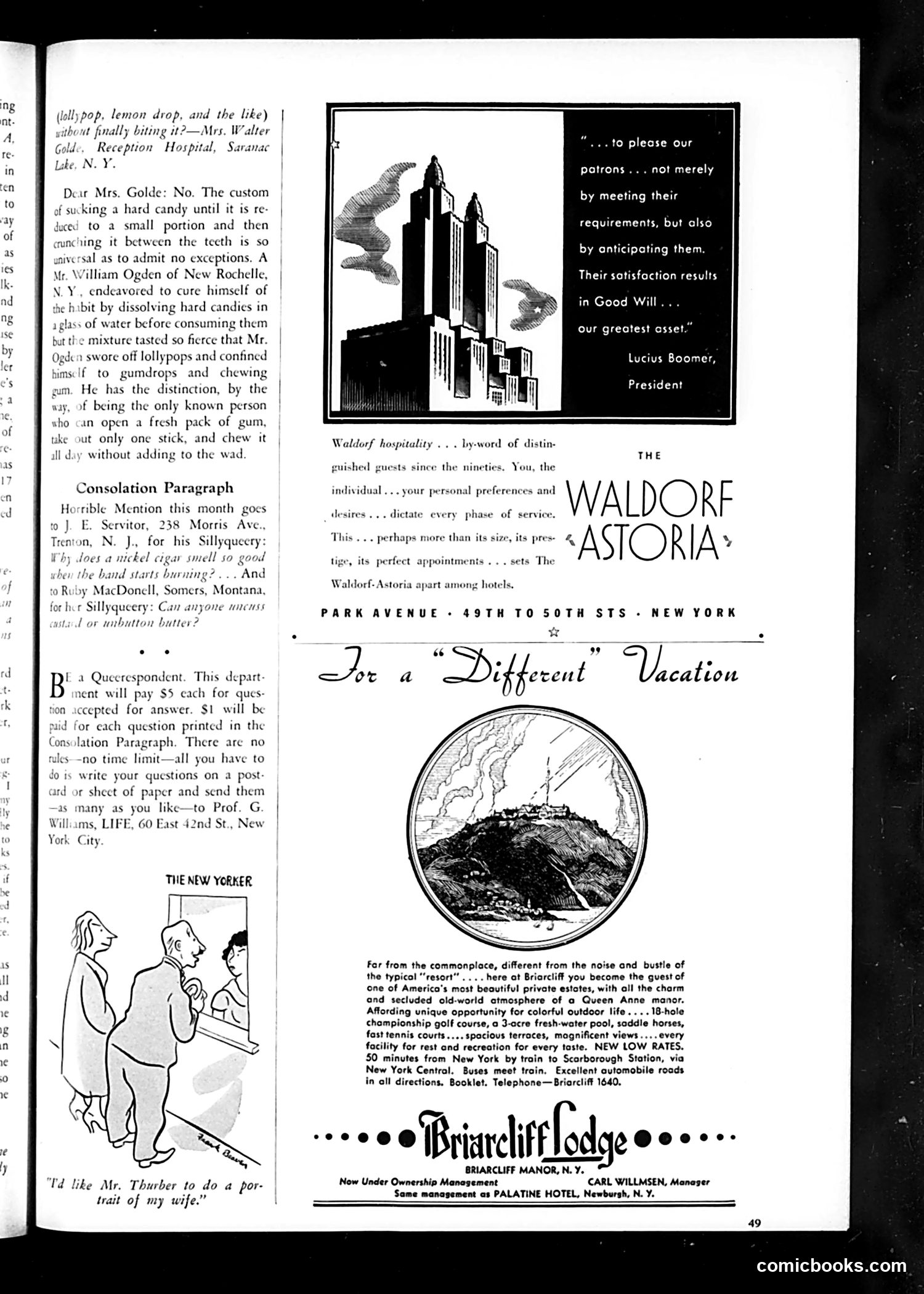
Page Analysis: Life Magazine Content This page is primarily advertising interspersed with magazine content. The main elements are: Left column: A "Consulation Paragraph" advice section answering humorous reader questions about candy-eating habits and silly queries, plus a "Queerespondent" department offering $5 payment for questions. Center/Right: A small cartoon showing three figures in conversation, with one saying "I'd like Mr. Thurber to do a portrait of my wife"—a gentle joke about caricature artist James Thurber (The New Yorker cartoonist). Advertisements: The Waldorf-Astoria hotel and Briarcliff Lodge dominate the page, using luxury and exclusivity appeals typical of 1930s-40s advertising. The page reflects Life magazine's formula: mixing light humor, reader participation, and upscale advertising targeting affluent audiences. No significant political satire is present—this is entertainment and commercial content.
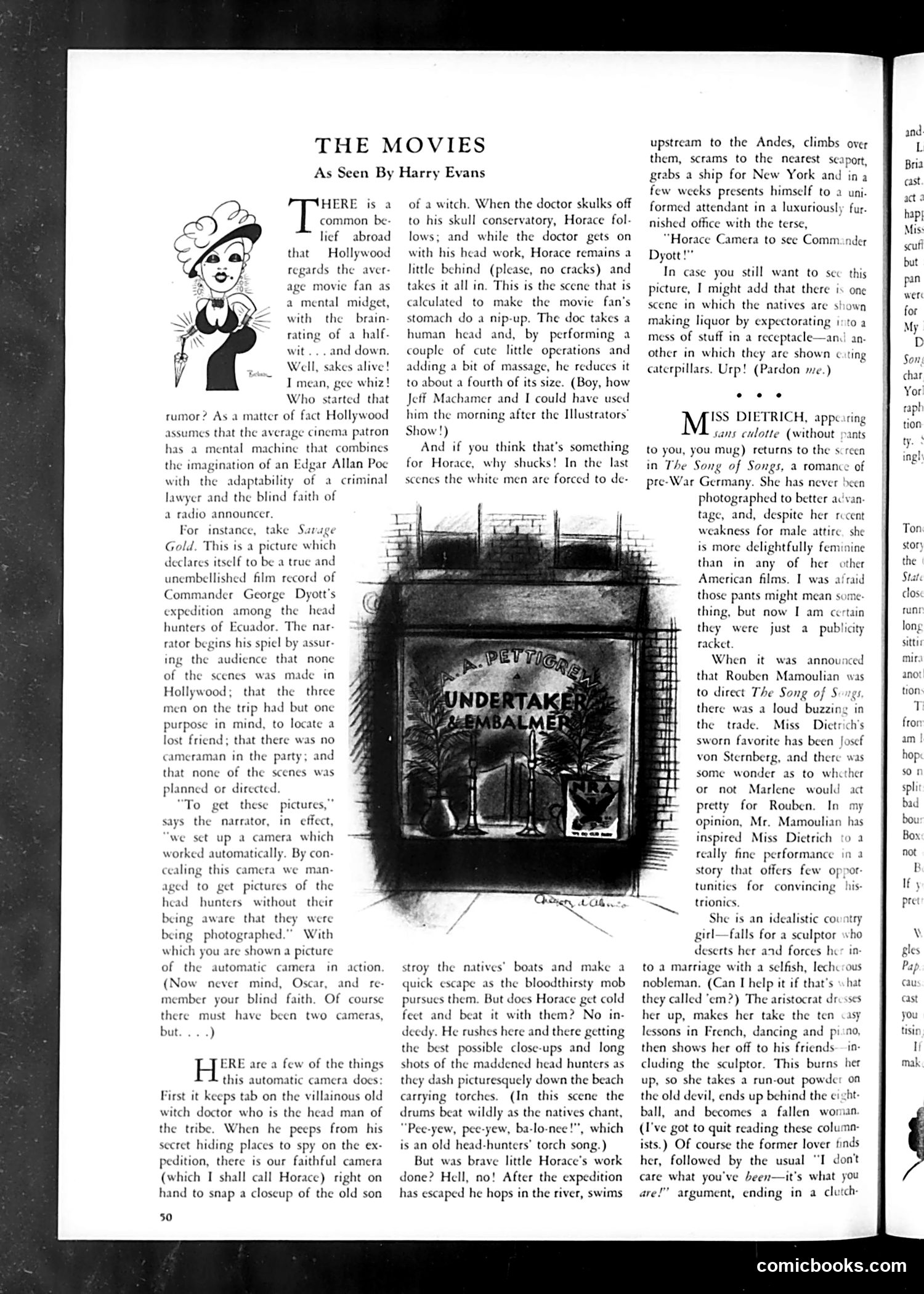
The Movies: Harry Evans's Film Satire This is a humorous film column by Harry Evans critiquing Hollywood's claims about documentary authenticity. The central joke targets *Savage Gold*, a supposed "true and unembellished" record of Commander George Dyott's 1928 expedition to Ecuador hunting for a lost friend. Evans satirizes the film's absurd pretense: it claims no cameraman accompanied the expedition, yet features perfectly-timed close-ups of a secretive witch doctor performing headshrinkinged rituals, and captures native warriors dramatically pursuing the party down a beach with torches—all supposedly shot by an "automatic camera" the subjects never noticed. The column's genius is the personification of "Horace" the camera, which impossibly follows action everywhere: underwater, into skull-conservation chambers, and even swims upriver to the Andes to catch boats home. The satire's target: Hollywood's contempt for audience intelligence. Studios assume viewers will swallow transparent fabrications if packaged as exotic adventure. Evans's tone—mock-innocent, friendly—makes the mockery sharper.
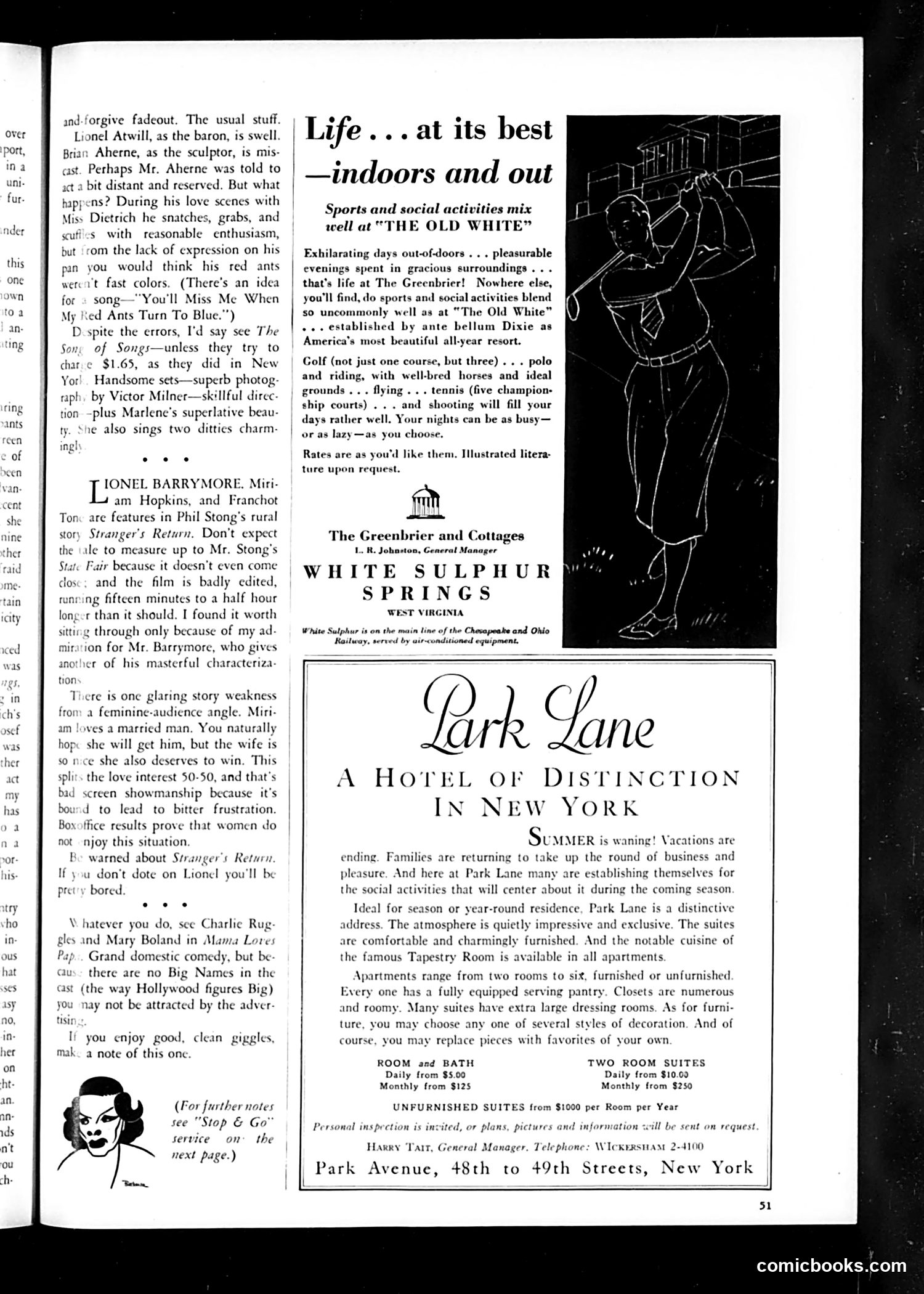
Analysis of This Life Magazine Page This page contains film reviews and resort advertisements rather than political cartoons. The reviews discuss three movies: *The Song of Songs*, *Stranger's Return*, and *Mama Loves Papa*. The critic praises Lionel Atwill and Marlene Dietrich but criticizes Brian Aherne's wooden acting. He warns audiences about *Stranger's Return* because its plot creates divided sympathies—the protagonist loves a married woman, but the wife "deserves to win," leaving audiences frustrated rather than satisfied. This reflects 1930s moral concerns about infidelity and audience expectations in Hollywood films. The small cartoon shows a devil-like figure with dramatic features—likely a generic "temptation" symbol used as a navigation marker for additional entertainment reviews. The bulk of the page features resort advertising for The Greenbrier in West Virginia and Park Lane Hotel in New York, targeting wealthy readers seeking vacation and residential properties. The illustrated figure of a woman golfing reflects the page's leisure-focused content.
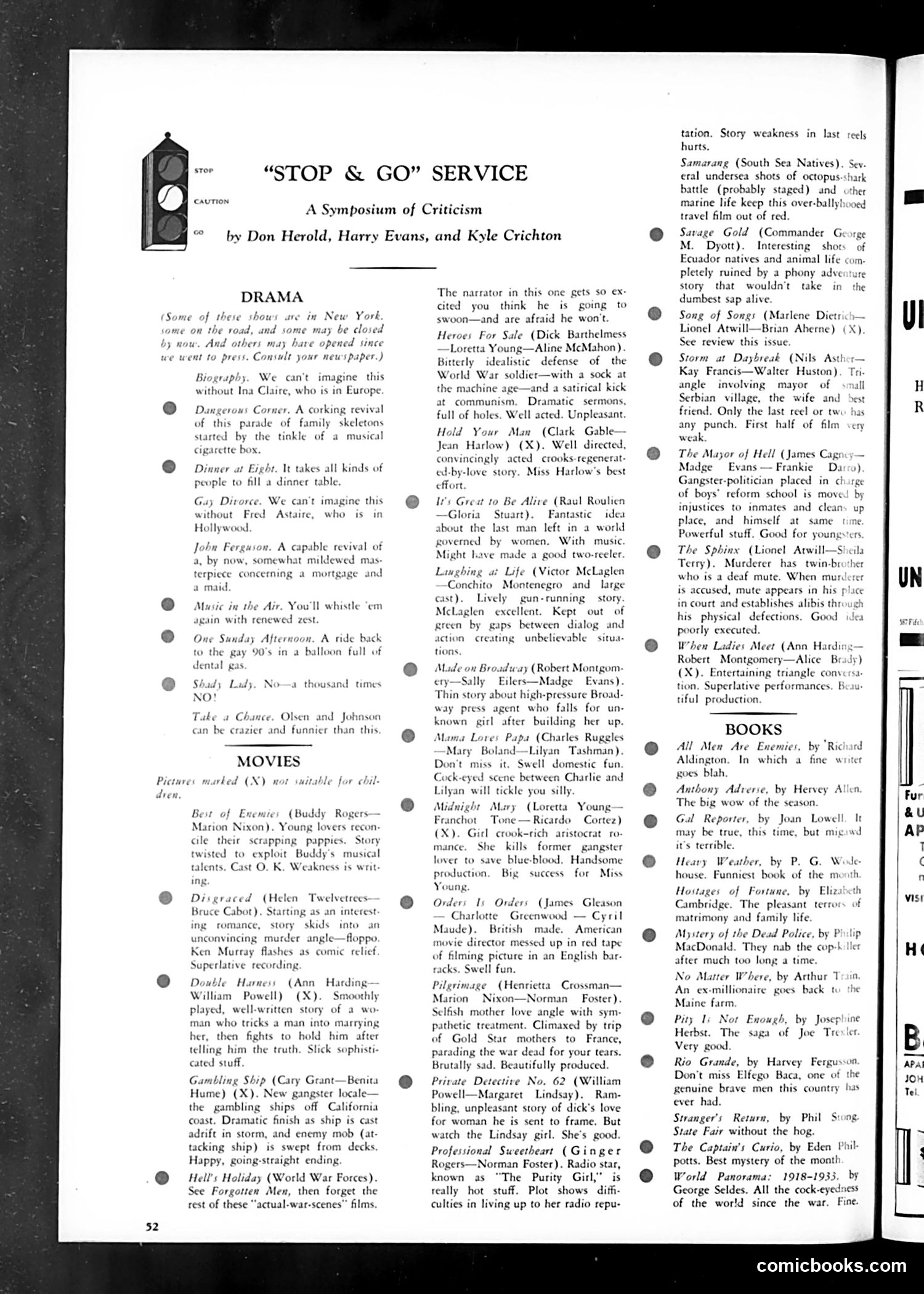
"Stop & Go" Service: A Film and Theater Criticism Roundup This page presents capsule reviews of contemporary 1933 Broadway plays and Hollywood films, written by humorists Don Herold, Harry Evans, and Kyle Crichton. The "Stop & Go" title uses traffic-light imagery (visible in the header illustration) as a metaphor: reviews either "stop" you from attending or "go" ahead and see it. The reviews are brief, witty critiques targeting specific performances and plot weaknesses. Notable mentions include Fred Astaire's absence from *Gay Divorce* and the reviewer's impatience with a narrator who "gets so excited" in one film. The tone is consistently sardonic—praising good acting while mocking thin plots, unconvincing dialogue, and heavy-handed messaging (as in the anti-communist sermon-like *Heroes for Sale*). This reflects Life magazine's role as sophisticated cultural commentary for educated readers, mixing entertainment criticism with intellectual snark.
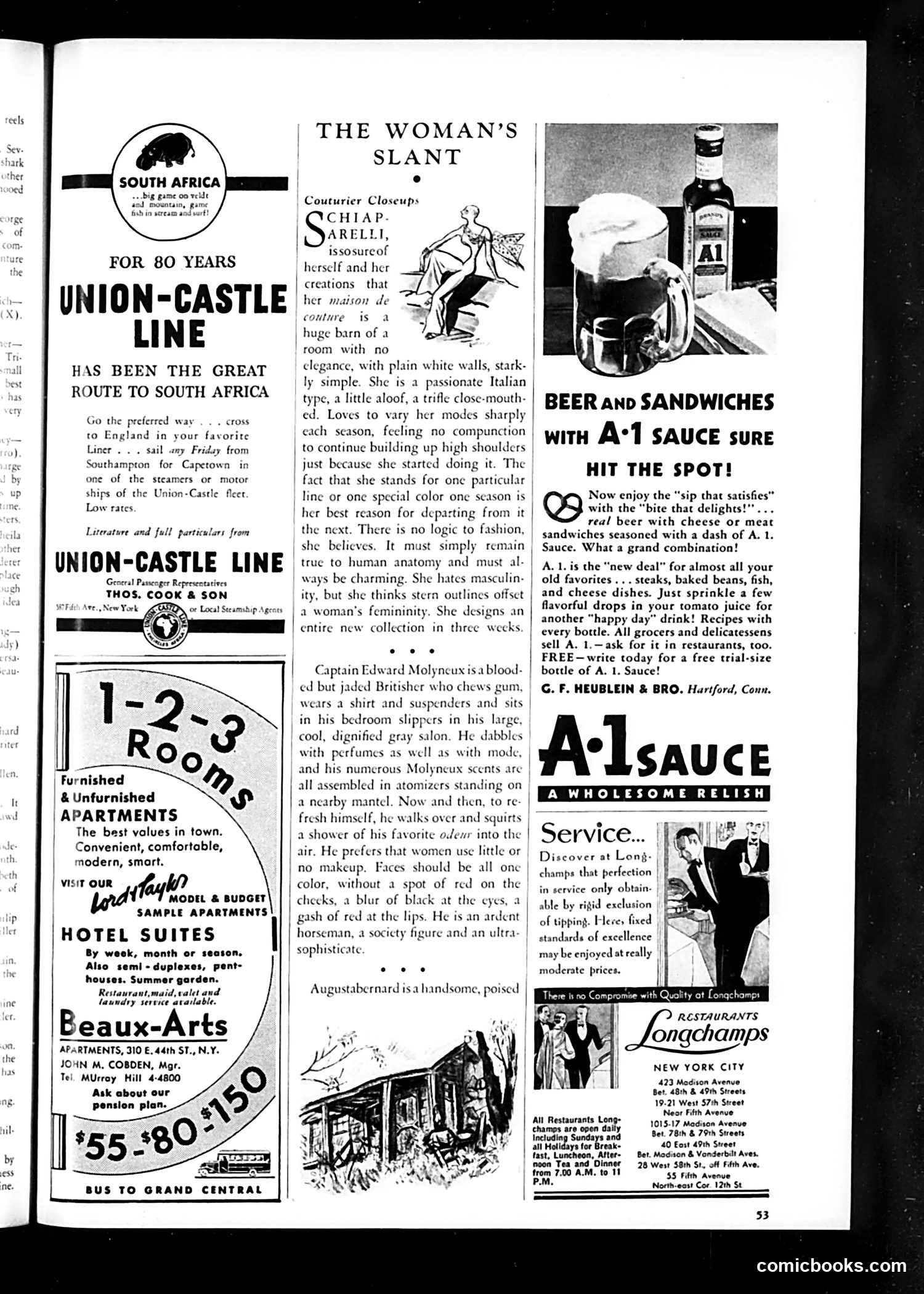
Page 53: Life Magazine Advertisement and Fashion Commentary This page is primarily advertising and lifestyle content, not political satire. The main feature, "The Woman's Slant," offers fashion industry gossip about three prominent couturiers: Chiap-Sarelli (described as passionate and unpredictable), Captain Edward Molyneux (an aristocratic British designer who favors minimalist makeup on women), and Augustabernard (described as handsome and poised). The surrounding ads promote transatlantic travel (Union-Castle shipping line to South Africa), New York apartments, and consumer products including A-1 sauce and Longchamps restaurants. There is no political cartoon or satire visible. The "Woman's Slant" section reflects 1930s-40s fashion journalism—gossipy profiles of elite designers for affluent female readers. The commentary on fashion philosophy and personal habits was typical lifestyle coverage of the era's Life magazine.
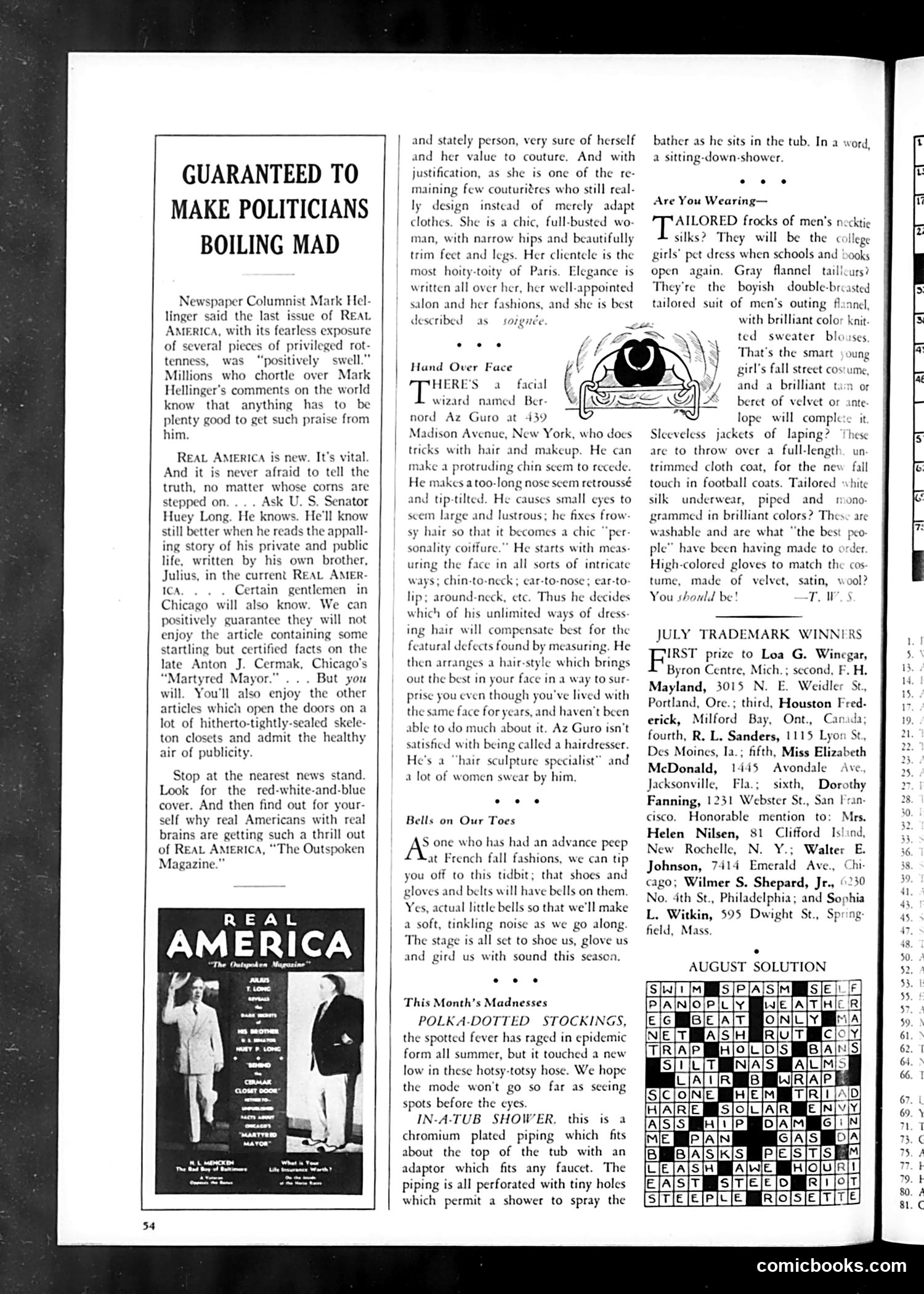
Explanation for Modern Readers This page primarily advertises *Real America*, a new satirical magazine promising to expose political corruption. The main cartoon/article headline "Guaranteed to Make Politicians Boiling Mad" promotes the magazine's fearless investigative approach. Specific references include: - Senator Huey Long: A populist Louisiana politician whose private life will allegedly be exposed by his own brother Julius - Anton J. Cermak: Chicago's mayor (described as "martyred"), suggesting recent scandal or controversy The satire critiques political corruption while positioning *Real America* as fearlessly truth-telling. The magazine boasts it will "step on corns" of powerful figures and expose "skeleton closets." The remainder of the page contains fashion and lifestyle advice (tailored silks, polka-dot stockings, hairstyling), typical of Life magazine's satirical-but-gossipy tone. The overall message: *Real America* attacks politicians' hypocrisy while the magazine itself maintains a lighthearted, consumer-focused editorial voice.
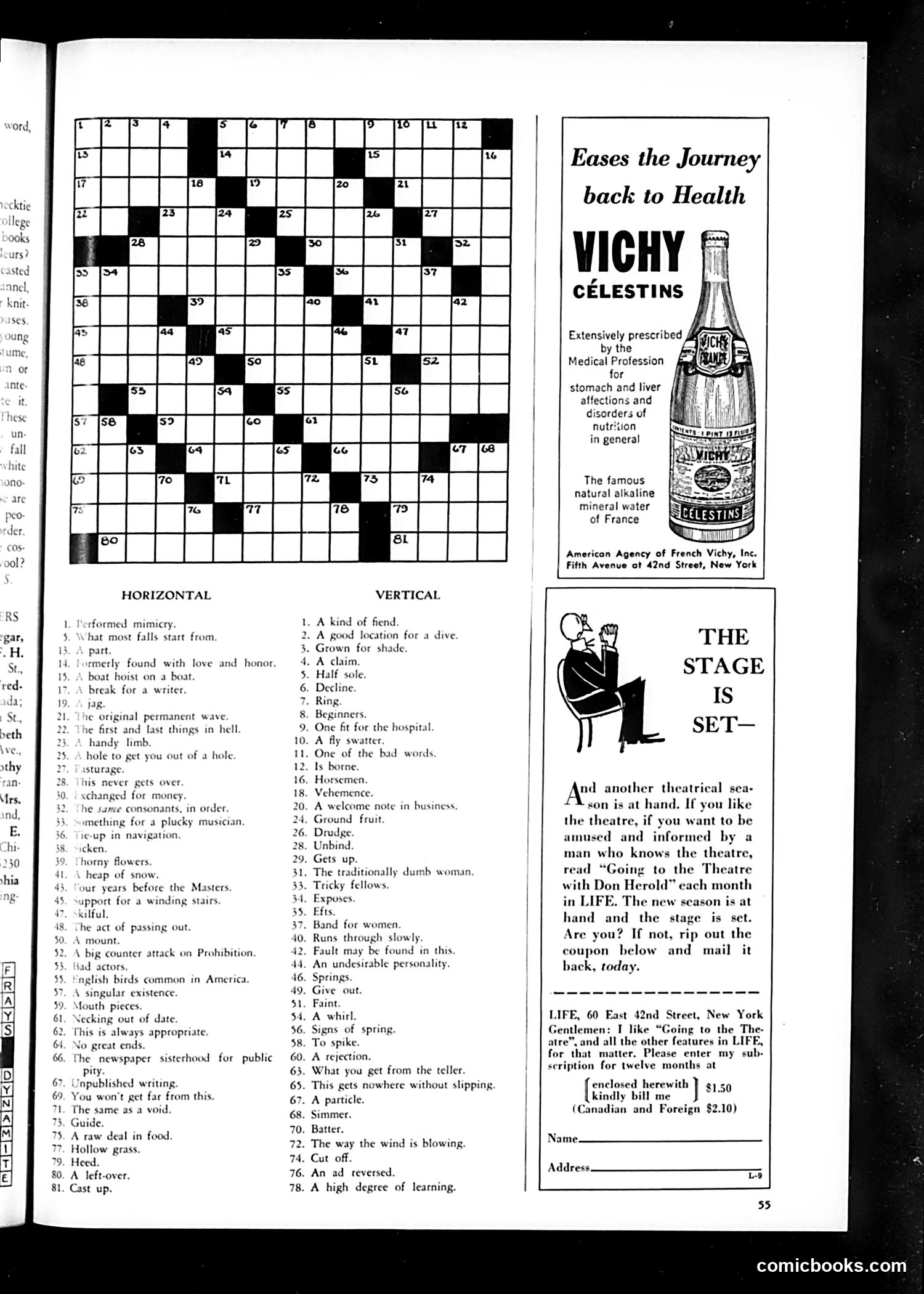
Page Analysis: Life Magazine Crossword and Advertisements This page is primarily a crossword puzzle with accompanying advertisements, not a political cartoon. The crossword contains 81 clues (horizontal and vertical) with typical wordplay—puns, riddles, and cultural references typical of 1930s-era puzzles. Right-side content: Two advertisements frame a subscription pitch: 1. Vichy Celestins (top): A French mineral water marketed as medicinal, "prescribed by the Medical Profession" for stomach and digestive issues—reflecting era-typical patent medicine advertising. 2. Life magazine subscription (bottom): Promotes Don Herold's theater column "Going to the Theatre with Don Herold," pitching Life as entertainment and cultural commentary for sophisticated readers. The illustration shows a couple at the theater. Notable context: This represents Life's dual function as humor/satire magazine and lifestyle publication for educated audiences, mixing puzzles, theater criticism, and consumer advertising.
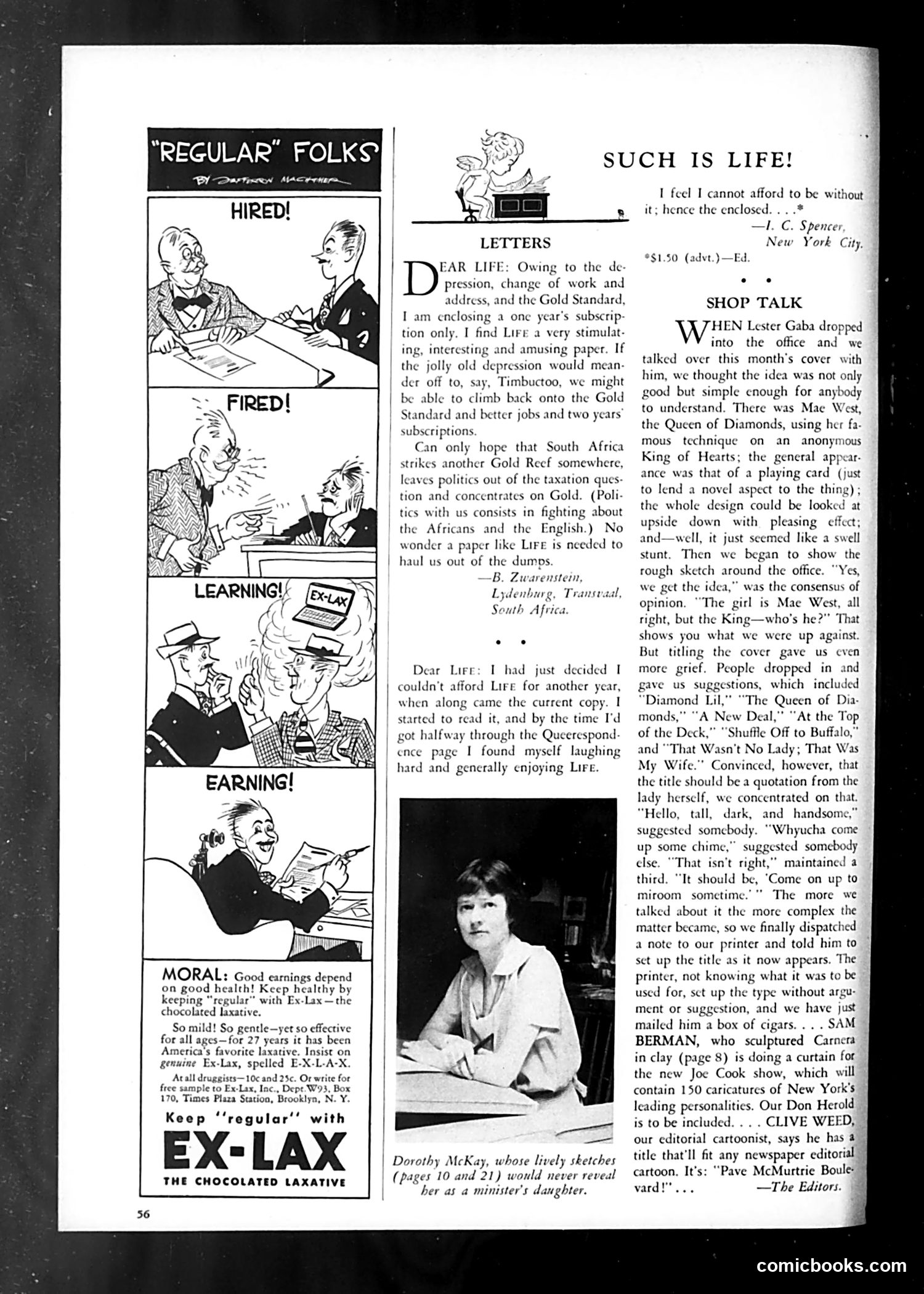
"Regular" Folks Cartoon Analysis This four-panel comic by Dorman MacPherson satirizes employment instability during the Great Depression. Each panel traces a worker's cycle: "HIRED!" (optimistic start), "FIRED!" (sudden dismissal), "LEARNING!" (retraining/adjustment), and "EARNING!" (temporary recovery)—before the cycle presumably repeats. The moral appended to the cartoon is an Ex-Lax laxative advertisement claiming good health ensures job security, a darkly ironic message given the economic devastation depicted above. The joke targets both corporate employment practices and the advertising industry's absurd claim that personal "regularity" guarantees economic stability during a period when millions faced joblessness through no fault of their own. The cartoon reflects widespread 1930s anxiety about economic powerlessness and the arbitrary nature of employment.
I can see this is a heavily darkened or degraded page from Life magazine, with text fragments visible along the left margin but the main content area is almost entirely black and illegible. While there appears to be some kind of illustration or cartoon in the center, the image quality is too poor to make out specific figures, captions, or details with any confidence. Without being able to read the actual content or discern the visual elements clearly, I cannot accurately identify what political or social references are being satirized, who any figures might represent, or what the intended joke or message was. To properly analyze this cartoon, a clearer or higher-contrast reproduction would be needed.