life
Life — November 1933
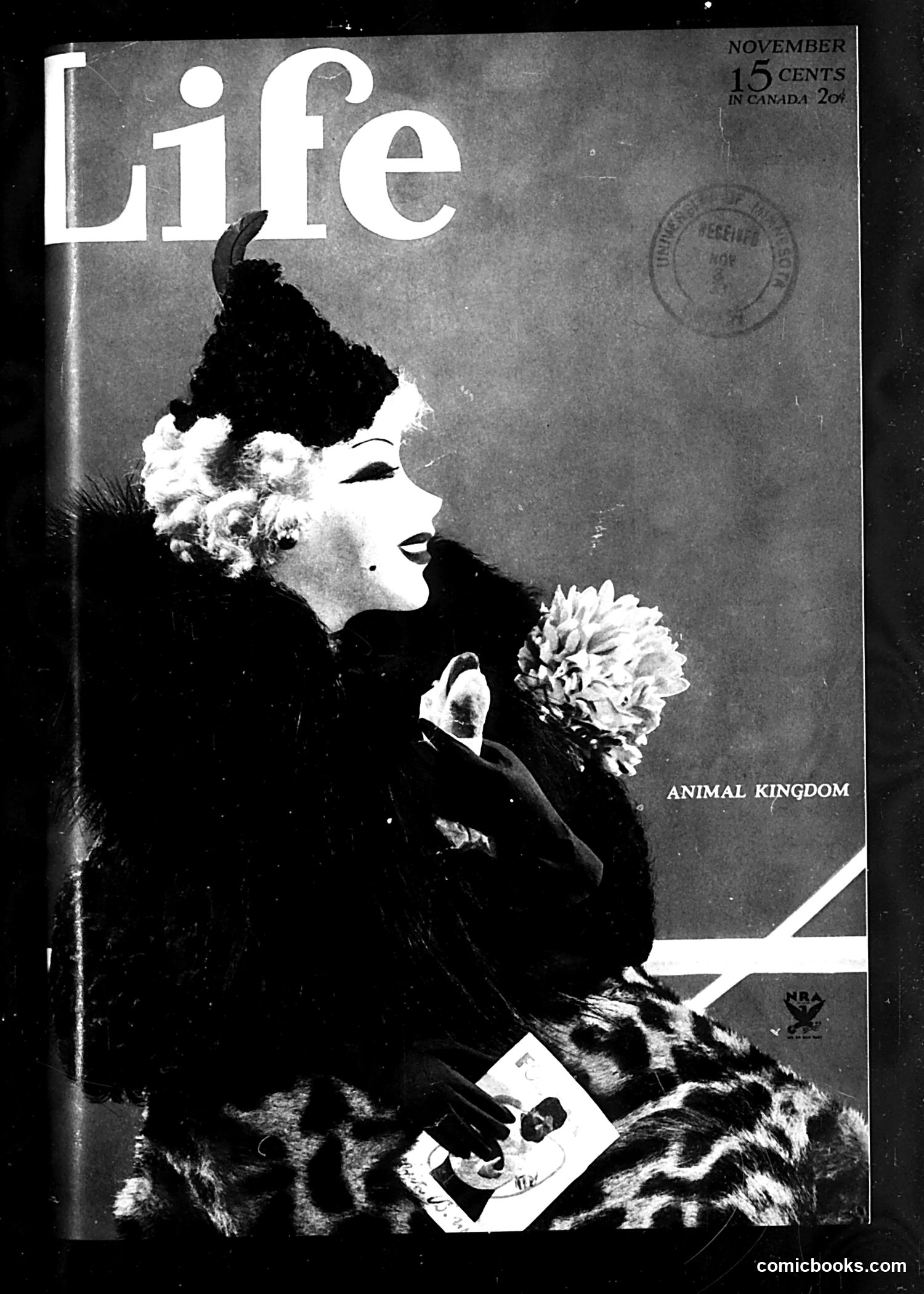
This is the November cover of *Life* magazine, priced at 15 cents (with a Canadian edition at 20 cents). The cover features a stylized illustration of an elegant woman in profile, wearing an ornate black feathered hat and holding flowers, dressed in fashionable fur clothing. The woman appears to be examining or holding a small image or card. The cover's text indicates the issue contains a feature on "Animal Kingdom." The illustration exemplifies the magazine's typical satirical approach to fashion and high society. The woman's exaggerated profile, elaborate accessories, and the juxtaposition with animal imagery suggests commentary on wealthy socialites and the fashion industry's connection to animal products—likely a gentle critique of conspicuous consumption and fashion's reliance on fur and exotic materials popular among the wealthy during this era.
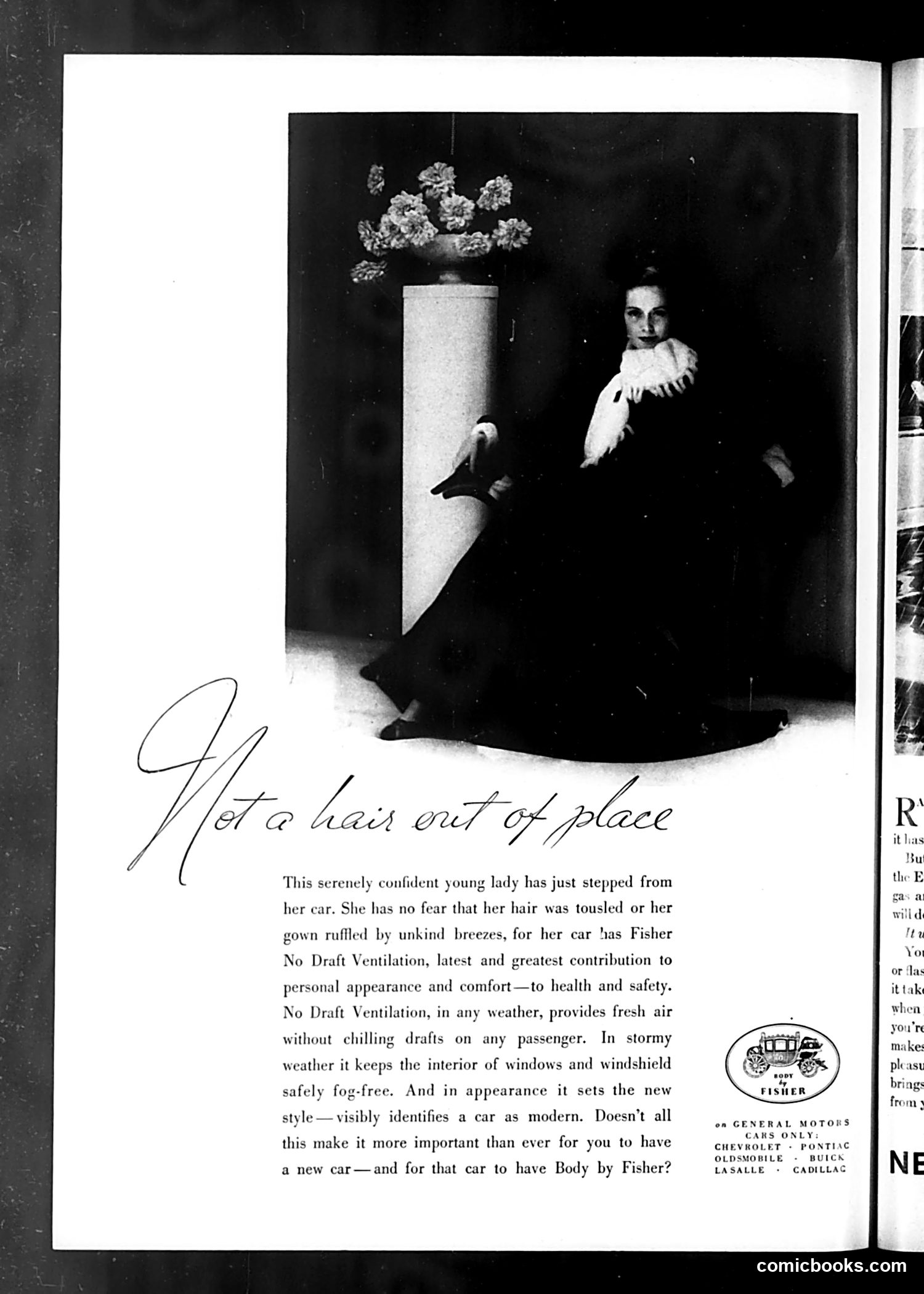
Analysis This is a Fisher Body advertisement for General Motors vehicles, not political satire. The image shows a fashionably dressed woman exiting a car, with the caption "Not a hair out of place." The accompanying text promotes Fisher's "No Draft Ventilation" feature—a car ventilation system that provides fresh air without creating uncomfortable drafts that would disturb a passenger's appearance (hair, clothing, etc.). The advertisement appeals to concerns about personal grooming and comfort, positioning the feature as modern and stylish. The tagline suggests that owning a Fisher Body car is a status marker of sophistication and up-to-date design. This reflects 1920s-30s marketing focused on women as car buyers/passengers, emphasizing luxury, appearance, and comfort rather than mechanical performance.
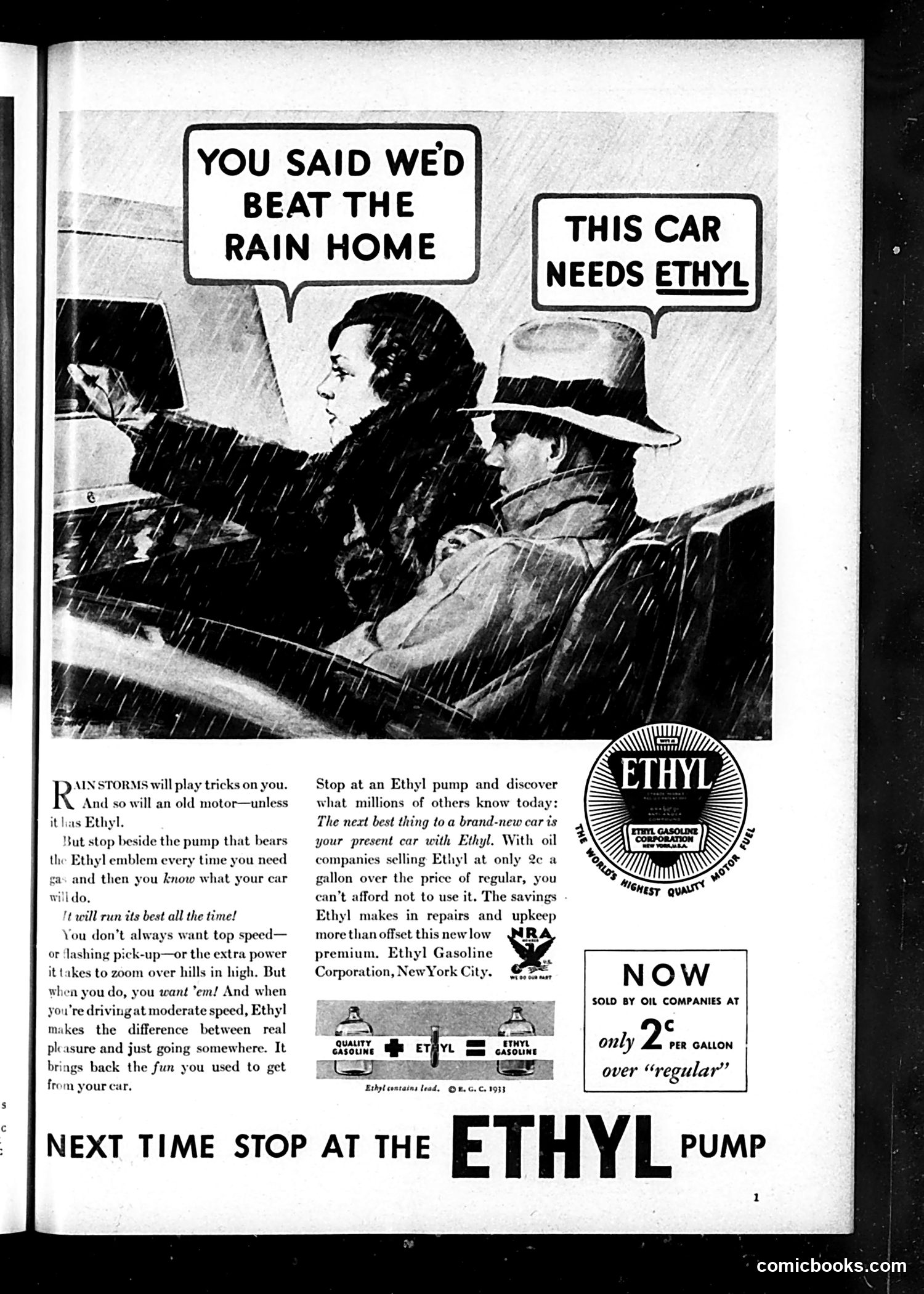
Ethyl Gasoline Advertisement This is a commercial advertisement, not political satire. The page promotes Ethyl Gasoline, a leaded fuel product sold during the early-to-mid 20th century. The cartoon depicts two men in a car during rainstorm, with one saying they'll "beat the rain home" if the car has Ethyl fuel. The ad's humor plays on the idea that Ethyl gasoline provides superior performance and reliability compared to regular fuel. The advertisement emphasizes that Ethyl costs only 2¢ more per gallon than regular gasoline while offering better engine performance, fuel economy, and driving pleasure. The text encourages motorists to seek out Ethyl pumps at gas stations for improved vehicle reliability in all driving conditions.
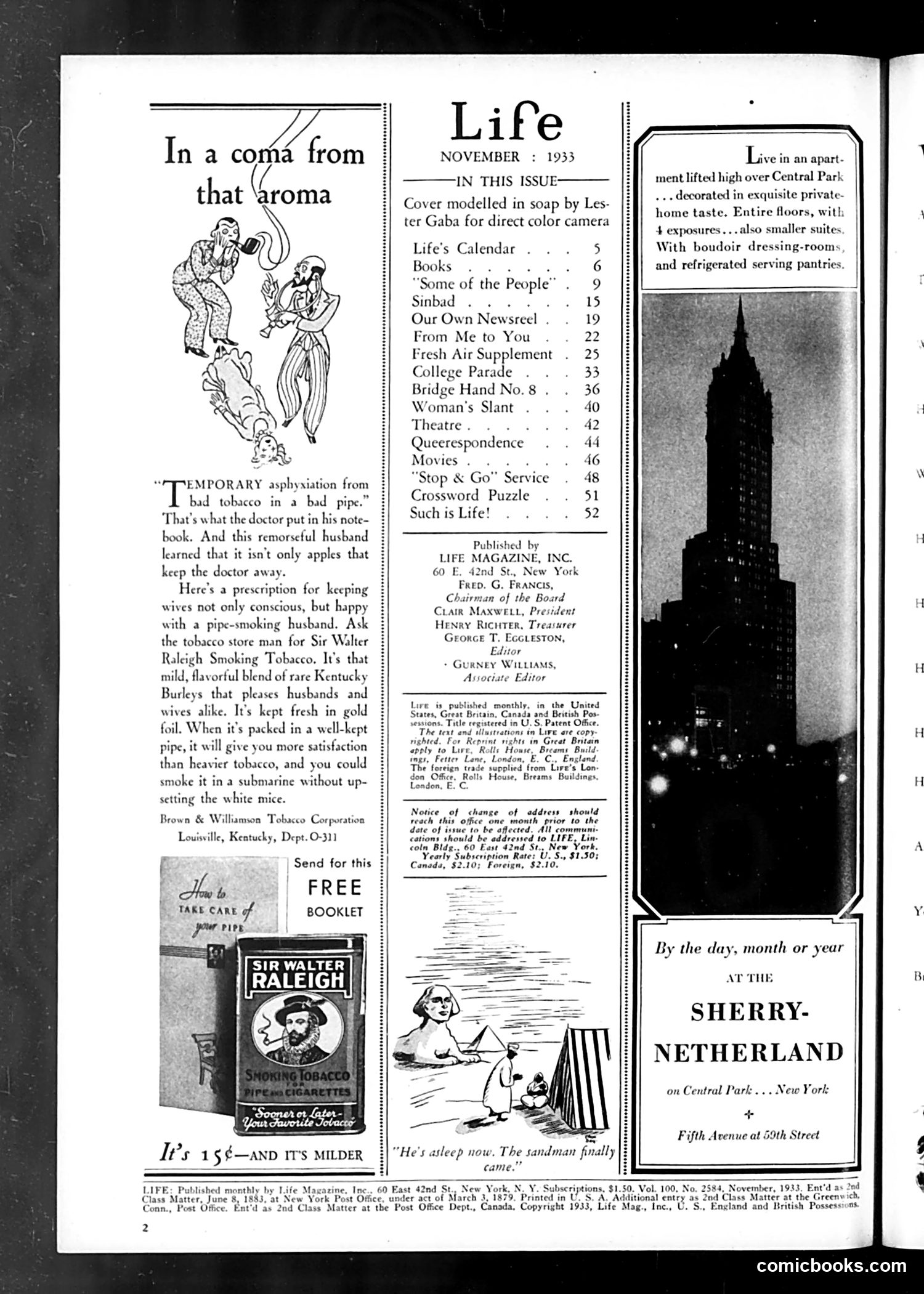
Life Magazine, November 1933 - Page Analysis This page is primarily advertising and magazine front matter, not political satire. The left side advertises Sir Walter Raleigh smoking tobacco with a humorous "prescription" framing pipe smoking as a health remedy—a common advertising trope of the era. The copy jokingly attributes the habit to doctors' recommendations, playing on 1930s attitudes before tobacco's dangers were widely acknowledged. The right side shows the magazine's table of contents and promotes the Sherry-Netherland hotel in Manhattan with a photograph of its distinctive Art Deco tower. The small cartoon at bottom center depicts children at a beach, with minimal satirical content—just mild humor about a sleeping sandman. This is primarily a commercial/marketing page rather than political commentary.
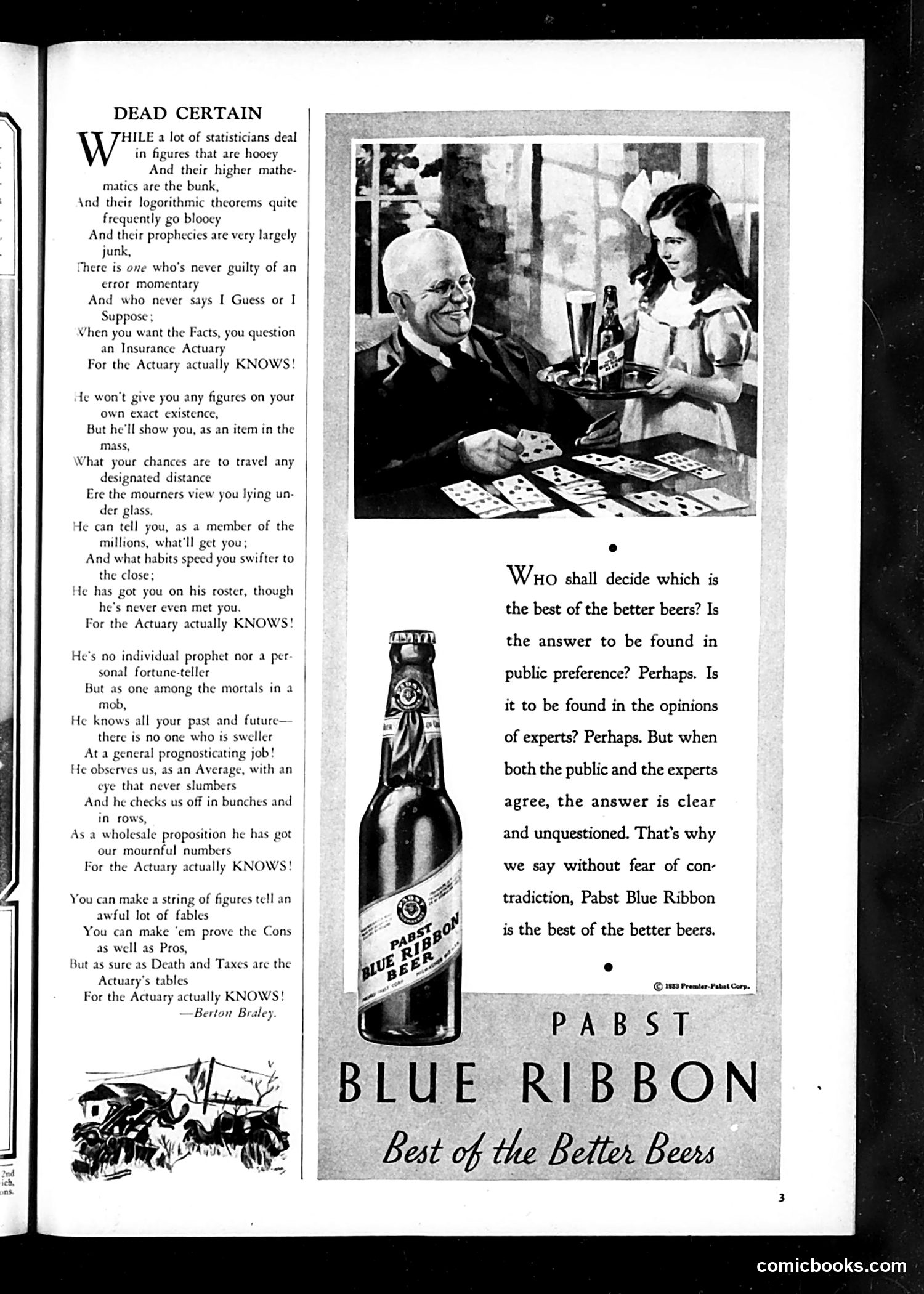
Analysis This page is primarily a Pabst Blue Ribbon beer advertisement (right side), with an unrelated poem on the left titled "Dead Certain" by Berton Braley. The ad features a photograph of an older man and younger woman examining playing cards, accompanying text claiming that when "both the public and the experts agree," Pabst Blue Ribbon is definitively "the best of the better beers." The poem satirizes statisticians and actuaries—professionals who deal in data, prophecies, and calculations—arguing that only actuaries truly "know" facts about existence, mortality rates, and probabilities. The satire mocks their pretension to absolute knowledge. There is no political cartoon on this page; it's primarily advertising copy using rhetorical appeals to authority and consensus.
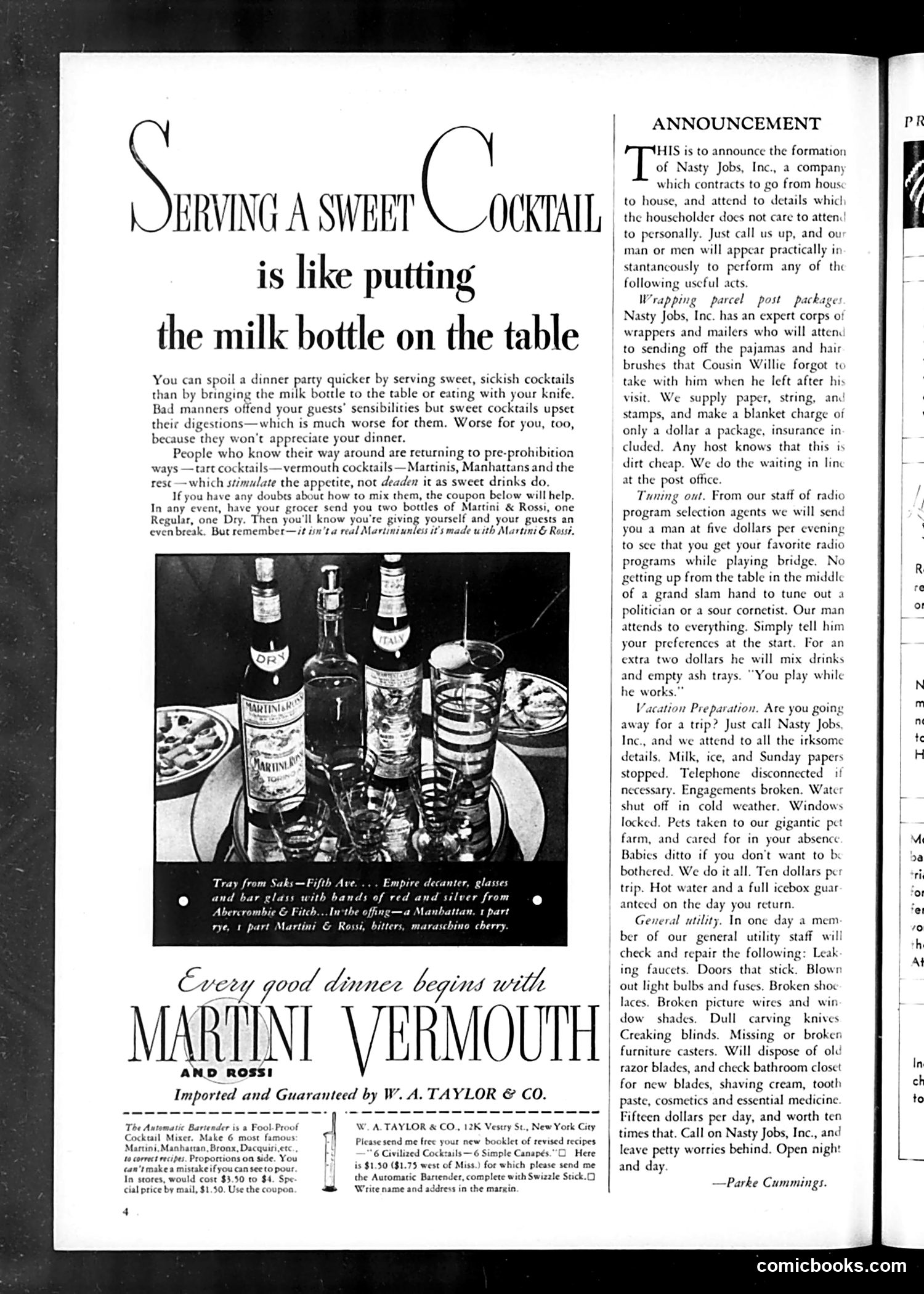
Analysis This page is primarily advertising content, not satirical editorial material. The main advertisement promotes Martini & Rossi vermouth, using an article-style format titled "Serving a Sweet Cocktail" to market the product. The piece humorously compares serving sweet cocktails to bringing a milk bottle to a dinner table—suggesting such drinks are unsophisticated. The accompanying image shows an elegant cocktail service setup with bottles and glasses, reinforcing upscale dining associations. Below is a secondary ad for W.A. Taylor & Co., selling Martini & Rossi products and a cocktail recipe booklet called "The Automatic Bartender." The right column contains Nasty Jobs, Inc. and Parke Cummings service announcements—utilities for household tasks and vacation preparation. This appears to be a pre-WWII lifestyle/consumer magazine page blending advertising with service-oriented content.
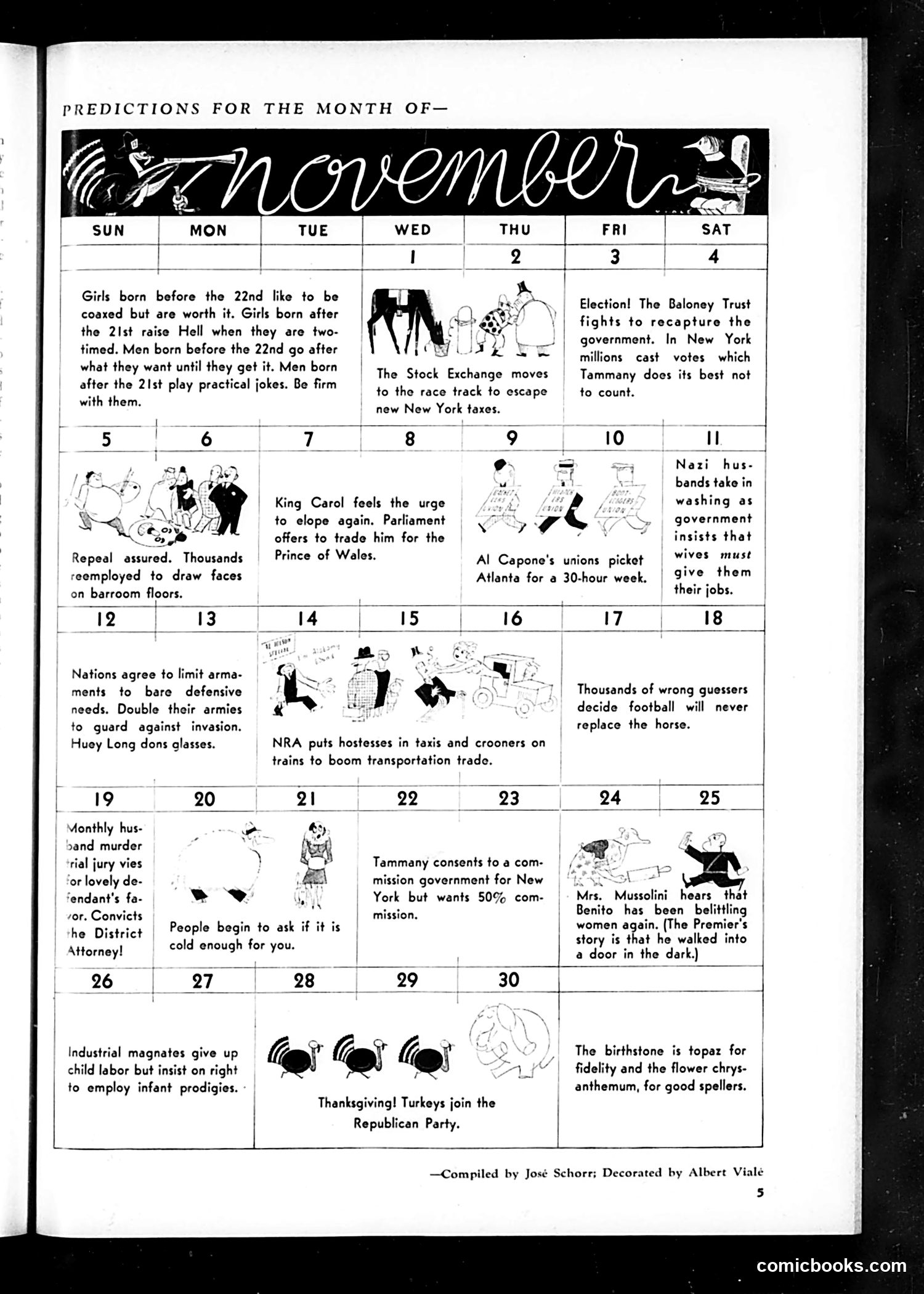
November 1932 Political Predictions Calendar This satirical calendar mocks current events during the Great Depression and early 1930s politics: Key targets: - Election day (Nov. 3): References Franklin D. Roosevelt's presidential campaign and corrupt voting practices in New York - Nov. 9: Al Capone's union activities in Atlanta (the notorious gangster was involved in labor disputes) - Nov. 12-14: Arms limitation debates and Huey Long's political influence - Nov. 22-24: References to Tammany Hall's political negotiations and Mussolini's domestic violence ("walking into a door") - Nov. 29: Thanksgiving joke about turkeys joining the Republican Party—implying Republicans face slaughter in upcoming elections The calendar uses dark humor about corruption, organized crime, political incompetence, and economic hardship to satirize contemporary American politics and society during the Depression era.
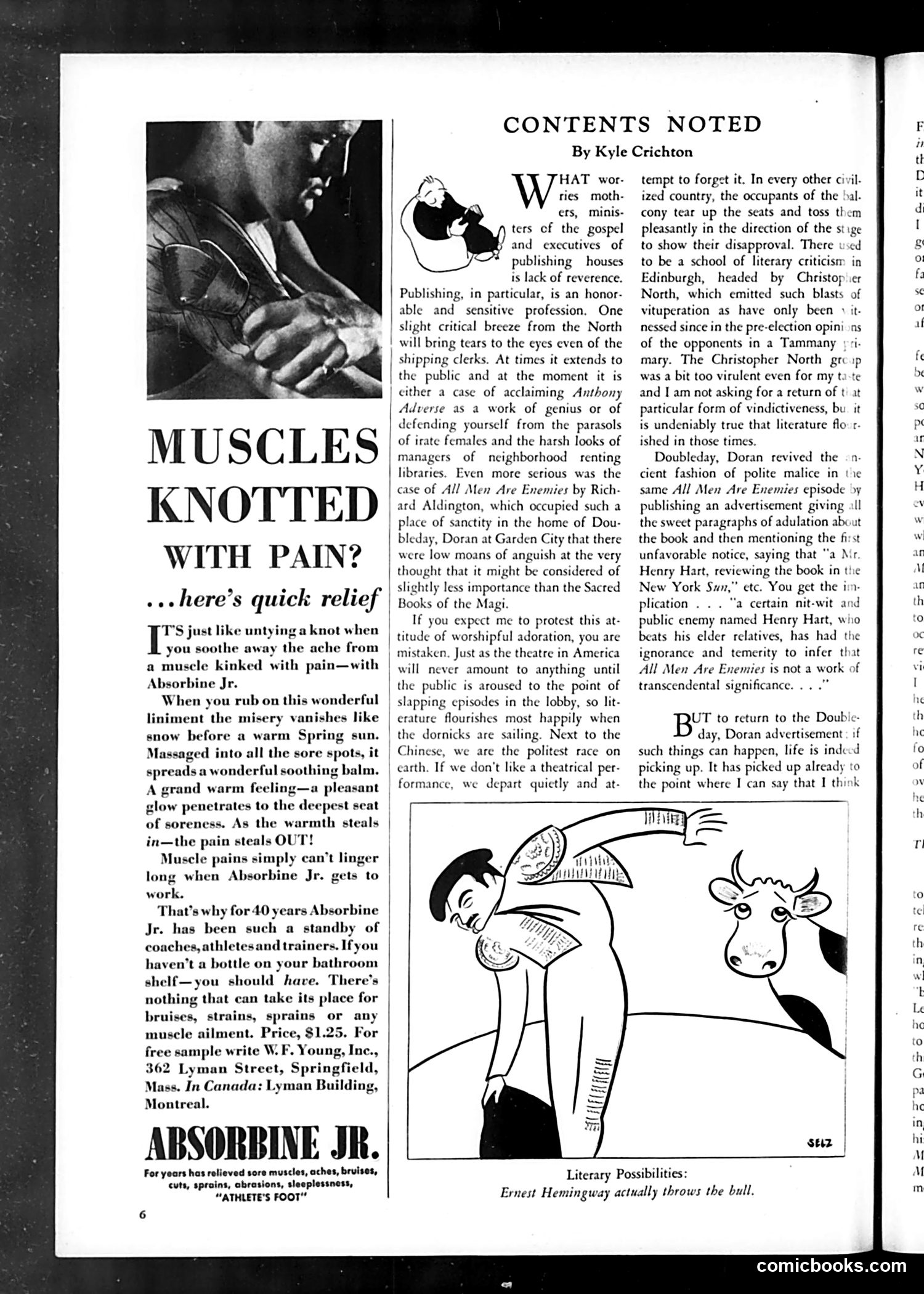
Analysis This page combines an advertisement and literary criticism. The left side advertises Absorbine Jr., a liniment for muscle pain, using humor about untying knots to illustrate relief. The right side, "Contents Noted" by Kyle Crichton, critiques recent literary publications and theater. It mentions: - Anthony Adverse (a novel) and its reception - All Men Are Enemies by Richard Aldington, criticized for being published with scandalous advertising - A Doubleday advertisement promoting the book despite its controversial nature - Theater criticism regarding theatrical performances in America The cartoon below shows a figure reading while a cow observes—captioned "Ernest Hemingway actually throws the ball," a humorous reference to literary style or Hemingway's reputation, though the exact satirical point remains unclear without additional context about contemporary literary debates.
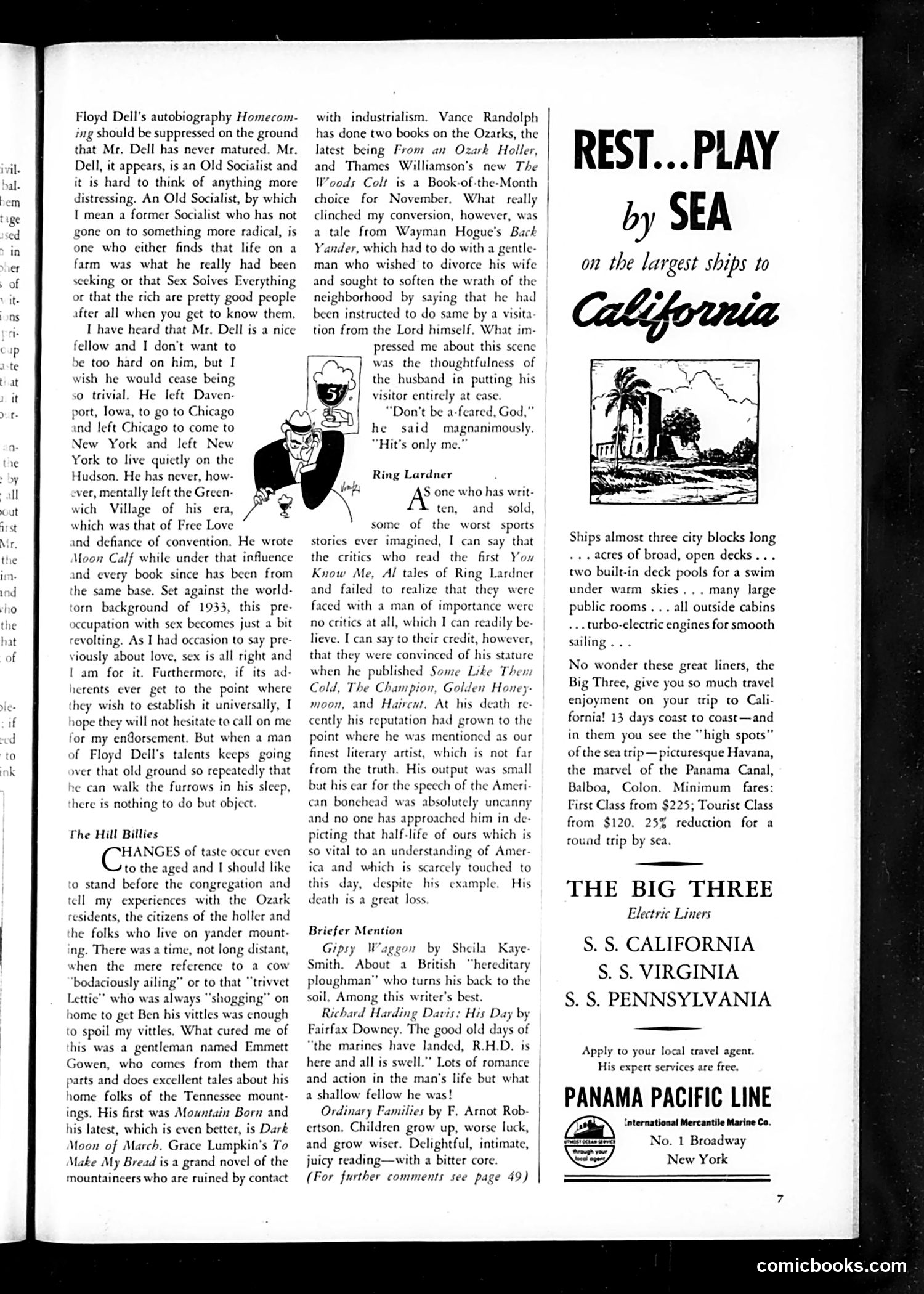
Analysis of Page 7, Life Magazine This page contains literary criticism and advertising rather than political cartoons. The text discusses American authors including Floyd Dell (an Old Socialist), Ring Lardner, and others. There is one small cartoon showing a caricatured man in formal dress with an exaggerated nose, labeled with what appears to be a signature. The cartoon's specific meaning is unclear without additional context, though it likely illustrates a point in the literary discussion. The page is primarily devoted to book reviews and a shipping advertisement for the Panama Pacific Line's "Big Three" ocean liners to California. This reflects 1920s-era leisure travel marketing to affluent readers of Life magazine.
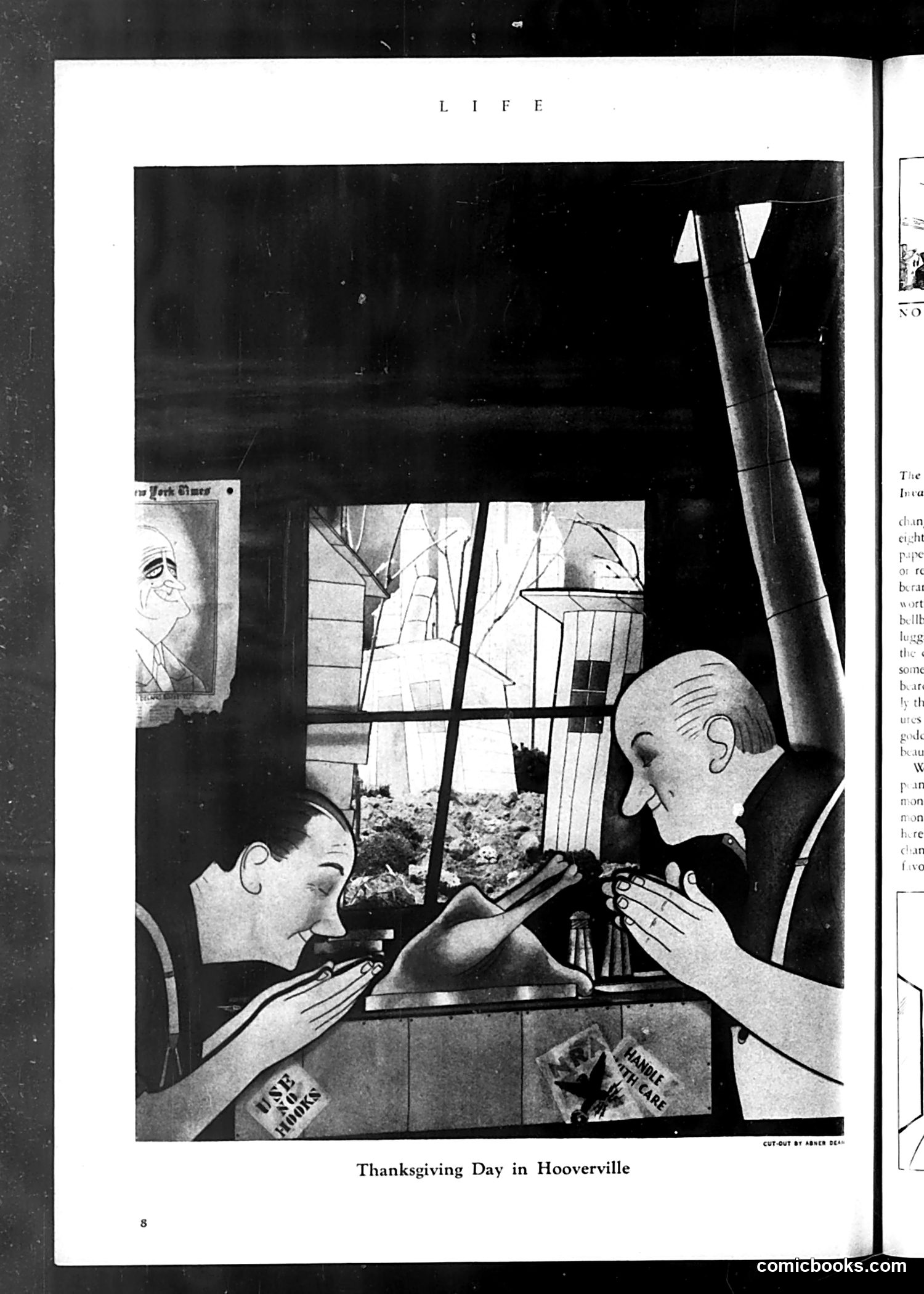
"Thanksgiving Day in Hooverville" This satirical image depicts two caricatured figures in profile exchanging what appears to be canned goods or food items at a window. The caption references "Hooverville"—a derogatory term for Depression-era shanytowns, named mockingly after President Herbert Hoover, who was blamed for economic hardship. The cartoon satirizes poverty during the Great Depression, suggesting that Thanksgiving meals for the unemployed poor consisted only of minimal canned rations rather than traditional holiday fare. The figures' exaggerated facial features and the cramped, makeshift setting reinforce the bleakness of their circumstances. The humor is dark, critiquing both the inadequate relief available to struggling Americans and, implicitly, Hoover's administration's perceived indifference to widespread suffering.
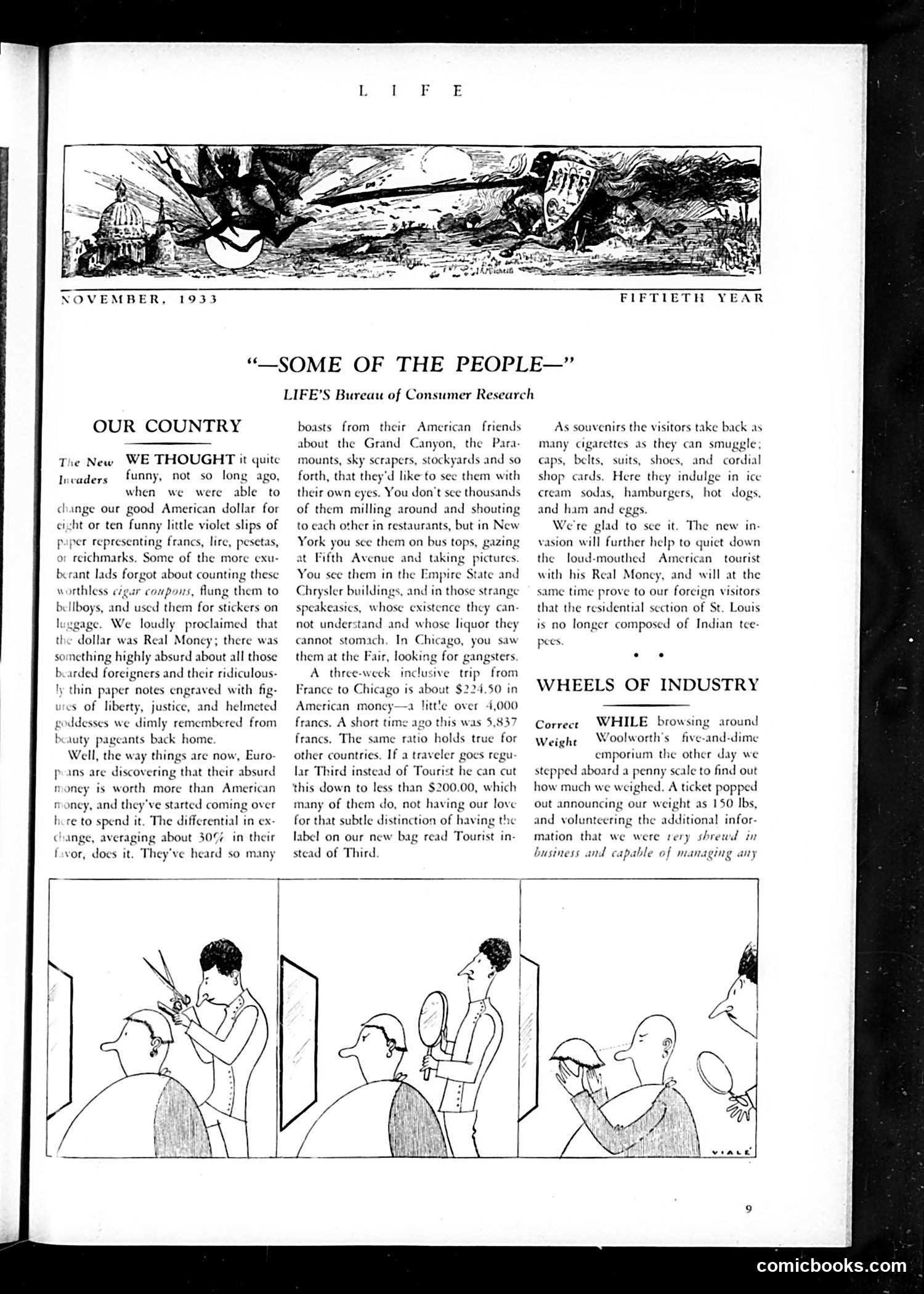
Analysis of Life Magazine Page (November 1933) This page contains two distinct pieces: "Our Country" section satirizes American tourists abroad, mocking their materialism and cultural insensitivity. The text ridicules foreigners' fascination with American consumer goods and tourist attractions (Grand Canyon, Empire State Building), while also criticizing Americans for spending dollars abroad rather than keeping money domestic—a relevant concern during the Great Depression. "Wheels of Industry" section describes a humorous visit to Woolworth's five-and-dime store, where the author discovered their actual weight via a scale. The three-panel cartoon below (artist signed "Volk") depicts a barber shop scenario, likely commenting on the absurdity of weighing oneself or some social observation about customer behavior, though the specific satirical point is unclear from the image alone.
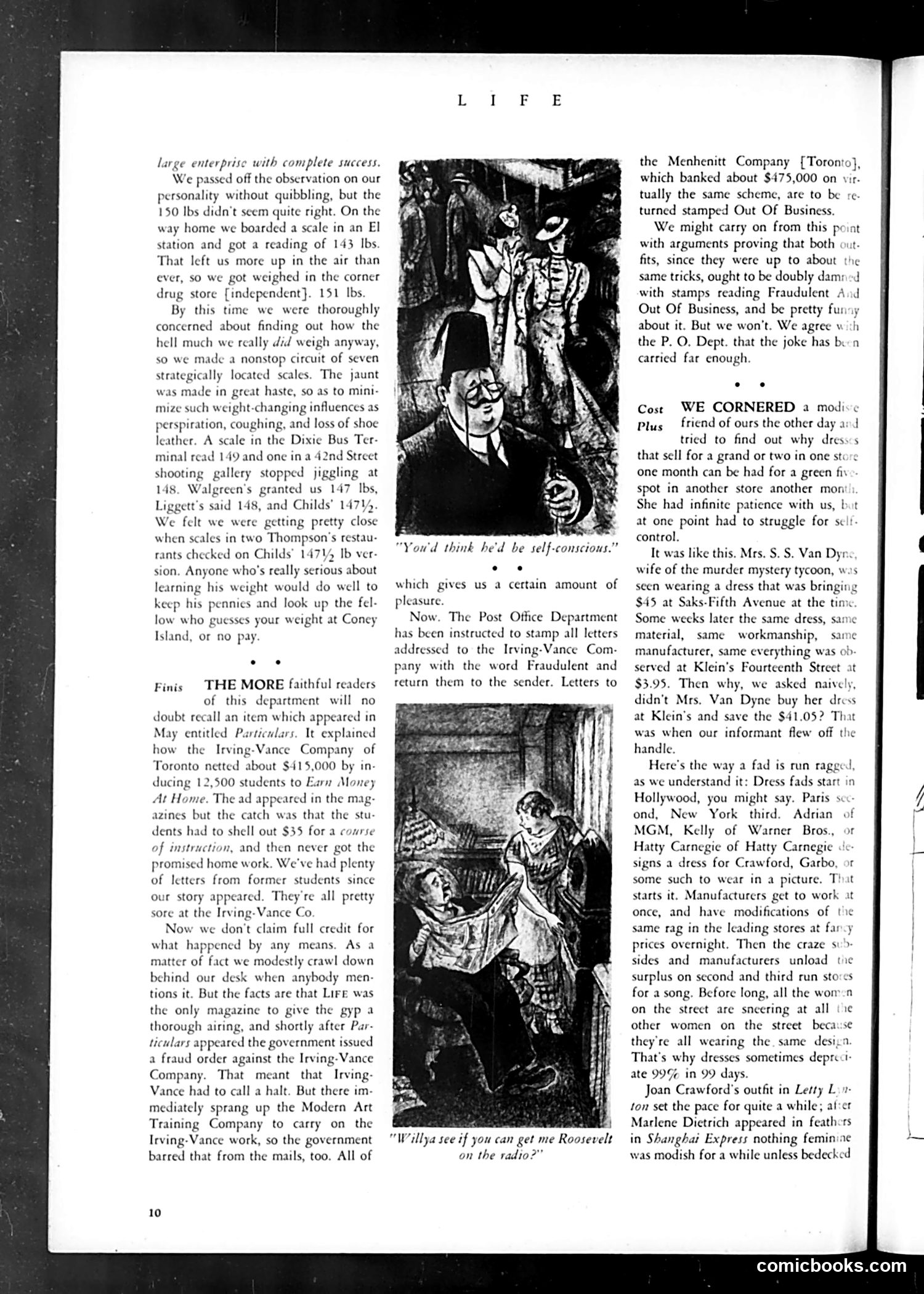
Analysis of Life Magazine Page This page contains two satirical illustrations accompanying text about consumer fraud and fashion fads. The top cartoon shows people crowded on a scale, satirizing weight-checking schemes. The caption reads "You'd think he'd be self-conscious," mocking participants in a scam where the Irving-Vance Company charged students to learn "how to Earn Money At Home," then never delivered promised materials. The bottom illustration depicts someone at a radio, captioned "Will ya see if you can get me Roosevelt on the radio?" This appears to satirize the era's obsession with radio technology and celebrity culture—the joke being the absurdity of casually summoning a famous person via broadcast. The surrounding text discusses fashion fads' rapid cycles and how retailers exploit trend-chasing consumers, suggesting the magazine's broader critique of commercial manipulation during this period.
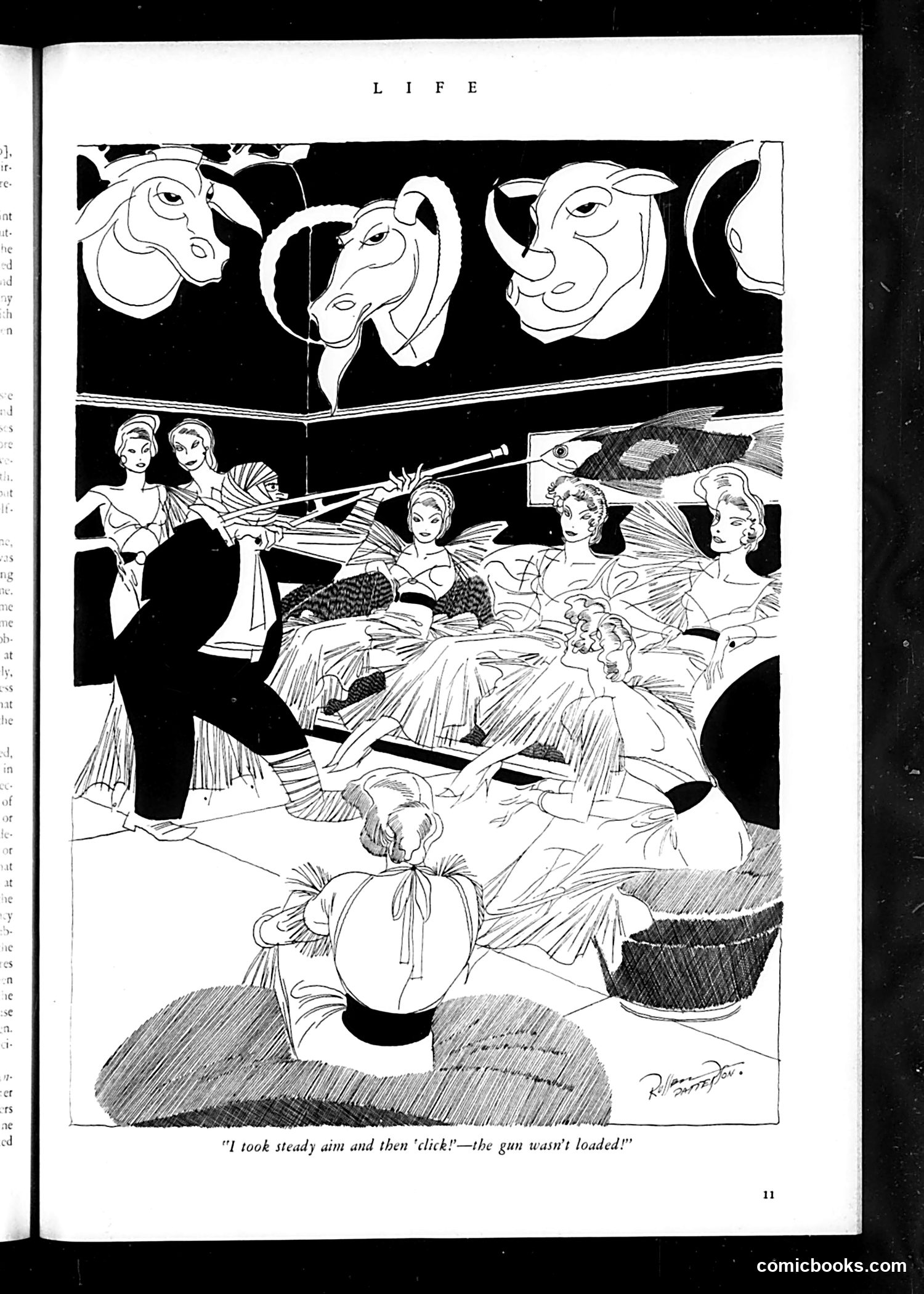
Analysis This is a humorous illustration from *Life* magazine showing an indoor social gathering—likely from the 1950s based on the art style and fashion. The cartoon depicts well-dressed women in an elegant setting with decorative elements (including what appears to be mounted animal heads at top). The caption reads: "I took steady aim and then 'click!'—the gun wasn't loaded!" This suggests the joke concerns a woman who attempted to shoot something (unclear what) at this social event, only to discover her gun was unloaded. The humor appears to rely on the absurdity of casually attempting violence at a formal gathering, playing on the contrast between refined social settings and crude behavior—a common satirical device in mid-century American humor magazines.
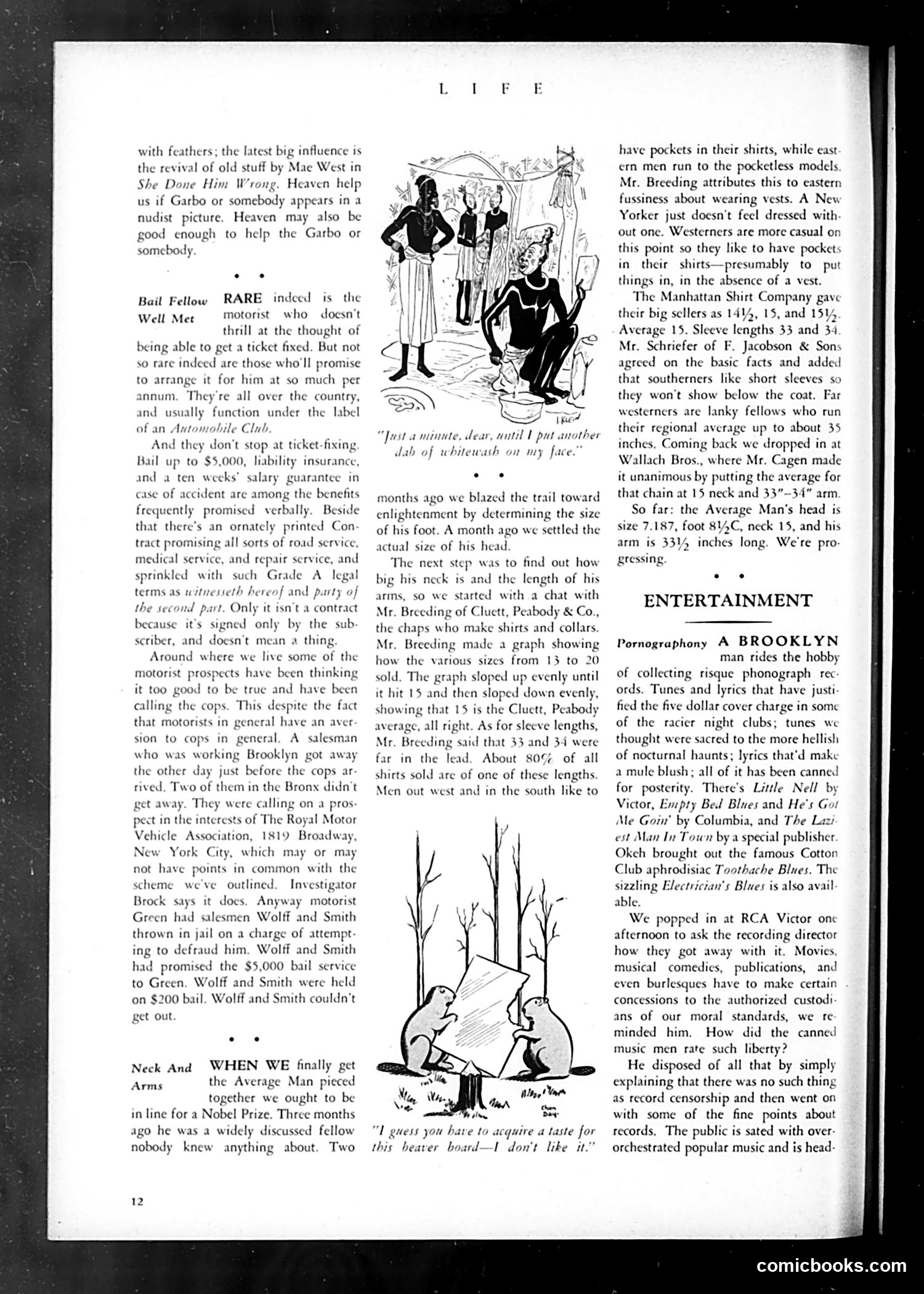
Analysis of Life Magazine Page 12 This page contains three separate humor sections discussing 1920s-30s men's fashion and entertainment trends, accompanied by two cartoon illustrations. The cartoons mock: 1. "Bail Fellow Well Met" - Satirizes motorist club members who promise road service but prove unreliable, contrasting their grandiose claims with reality. 2. "Neck and Arms" - Features two figures in a car, poking fun at dating customs and physical intimacy norms of the era. The "Entertainment" section discusses pornography collecting as a hobby, referencing risqué phonographs and records ("*Little Nell*," "*Empty Bed Blues*") sold in nightclubs. It satirizes moral hypocrisy by noting record companies claimed censorship while profiting from suggestive content. The page primarily lampoons contemporary social behavior: unreliable service organizations, dating practices, and the disconnect between public morality and private consumption of adult entertainment.
I can see this is a mostly blank or extremely dark page from what appears to be a historical publication. The only clearly visible text is "comicbooks.com" in the bottom right corner, which appears to be a watermark added to a scanned image rather than original page content. The image itself is too dark and lacks sufficient visible content for me to identify any cartoons, caricatures, political references, or satirical commentary. There may be illustrations or text present, but they're not legible in this scan. Without being able to read the actual content or see the illustrations clearly, I cannot provide the historical analysis you've requested. A higher-quality or better-lit scan would be needed to properly examine this page.
I can see this is a mostly black page from what appears to be a historical publication, with "comicbooks.com" visible at the bottom right. However, the image is too dark and degraded for me to reliably make out any cartoon illustrations, text, or identifying details. While there appear to be some faint marks and possibly an oval shape in the center area, I cannot discern specific figures, captions, or satirical content with confidence. To provide accurate historical analysis as requested, I would need a clearer image where the cartoon(s), any characters, and OCR text are legible. A higher-contrast or better-preserved scan would allow proper identification of political/social references and satirical intent.
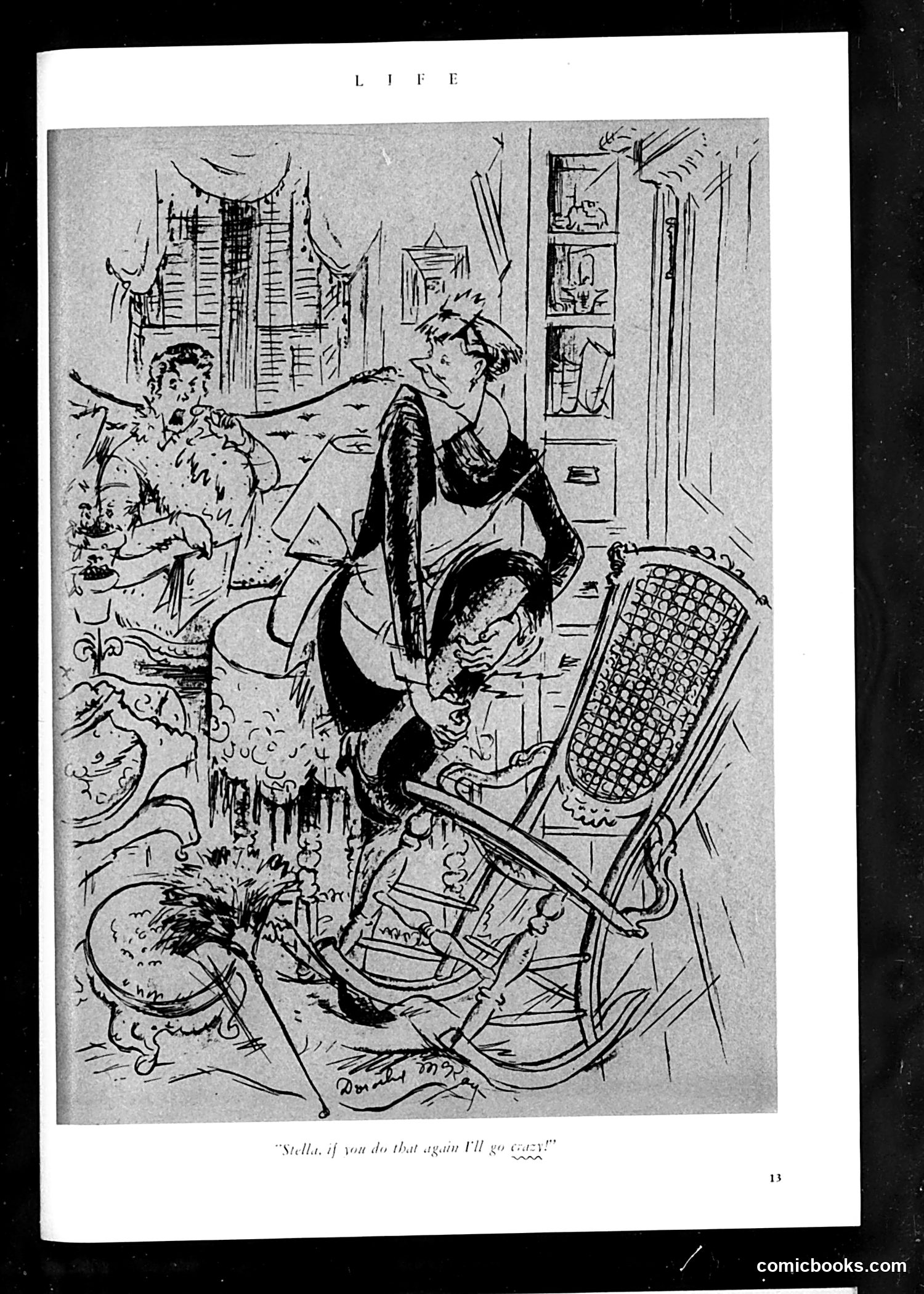
Analysis This is a single-panel domestic comedy cartoon showing a woman threatening to leave her husband ("Stella, if you do that again I'll go crazy!"). The humor relies on a common early 20th-century marital dynamic: a frustrated wife threatening dramatic consequences for her husband's misbehavior. The scene depicts a chaotic domestic interior with scattered items—a baby carriage, toys, and household mess—suggesting the woman's exasperation with childcare and housekeeping duties. The man's gesture and the woman's posture convey tension typical of period humor about marriage. The joke's specific meaning is unclear without knowing "that" refers to—likely some annoying habit. This represents *Life* magazine's typical domestic comedy targeting middle-class audiences, where wives' marital frustrations provided standard satirical material.
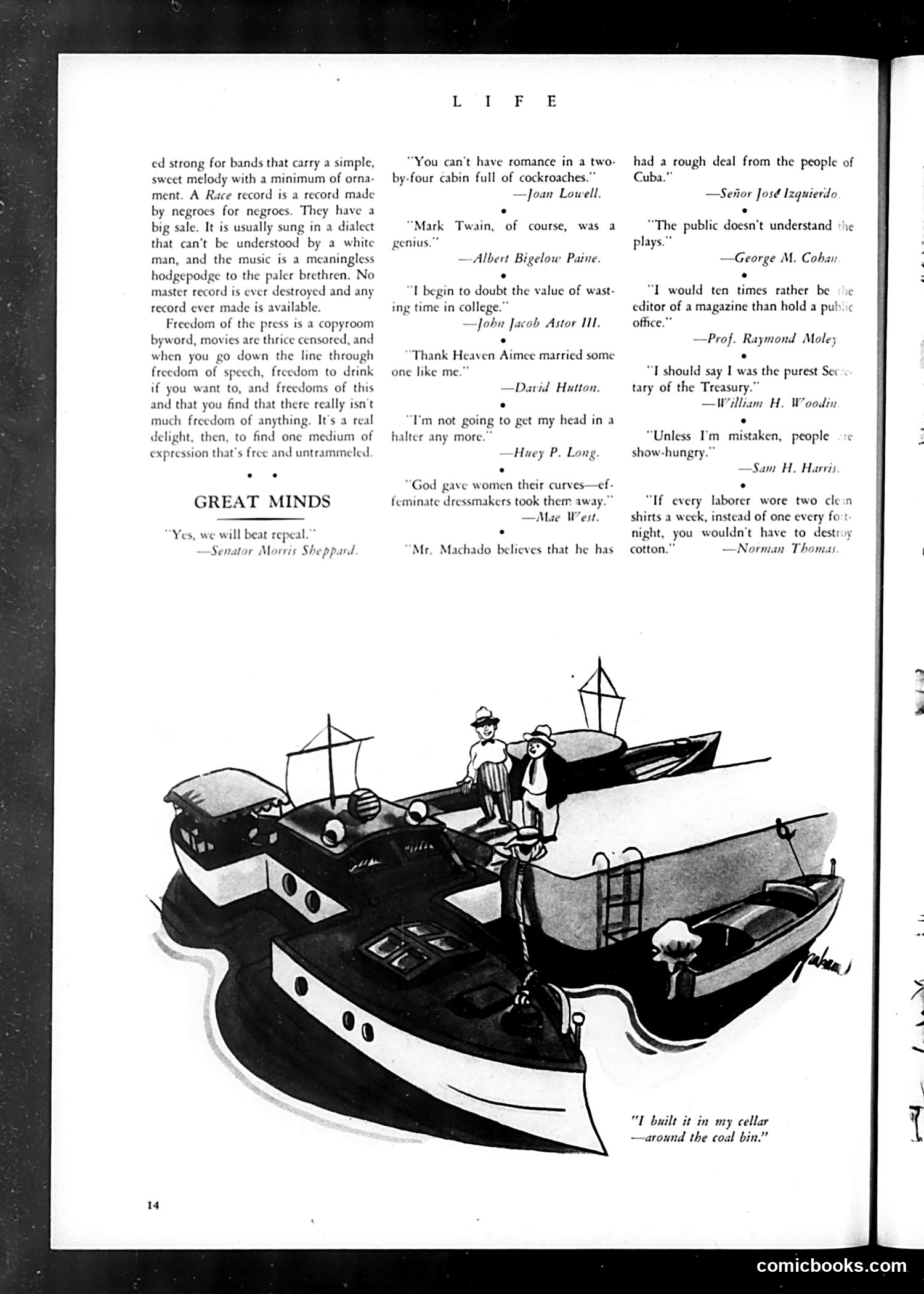
Analysis This page from *Life* magazine contains two sections: a "GREAT MINDS" quotes column and an illustration below it. The illustration depicts a person in a cellar building a boat "around the coal bin"—a visual gag about absurdly ambitious DIY projects conducted in cramped domestic spaces. The figure is shown constructing what appears to be a multi-masted vessel in an impossible setting, suggesting the humor lies in the incongruity between grand aspirations and practical limitations. The "GREAT MINDS" section above collects witty, cynical observations from various public figures about romance, work, gender relations, and social pretense. The quotes satirize conventional wisdom and social hypocrisy through brevity and ironic juxtaposition—typical of *Life*'s satirical approach during this era. Together, the page exemplifies *Life*'s humor style: deflating pretension through absurdist imagery and sharp social commentary.
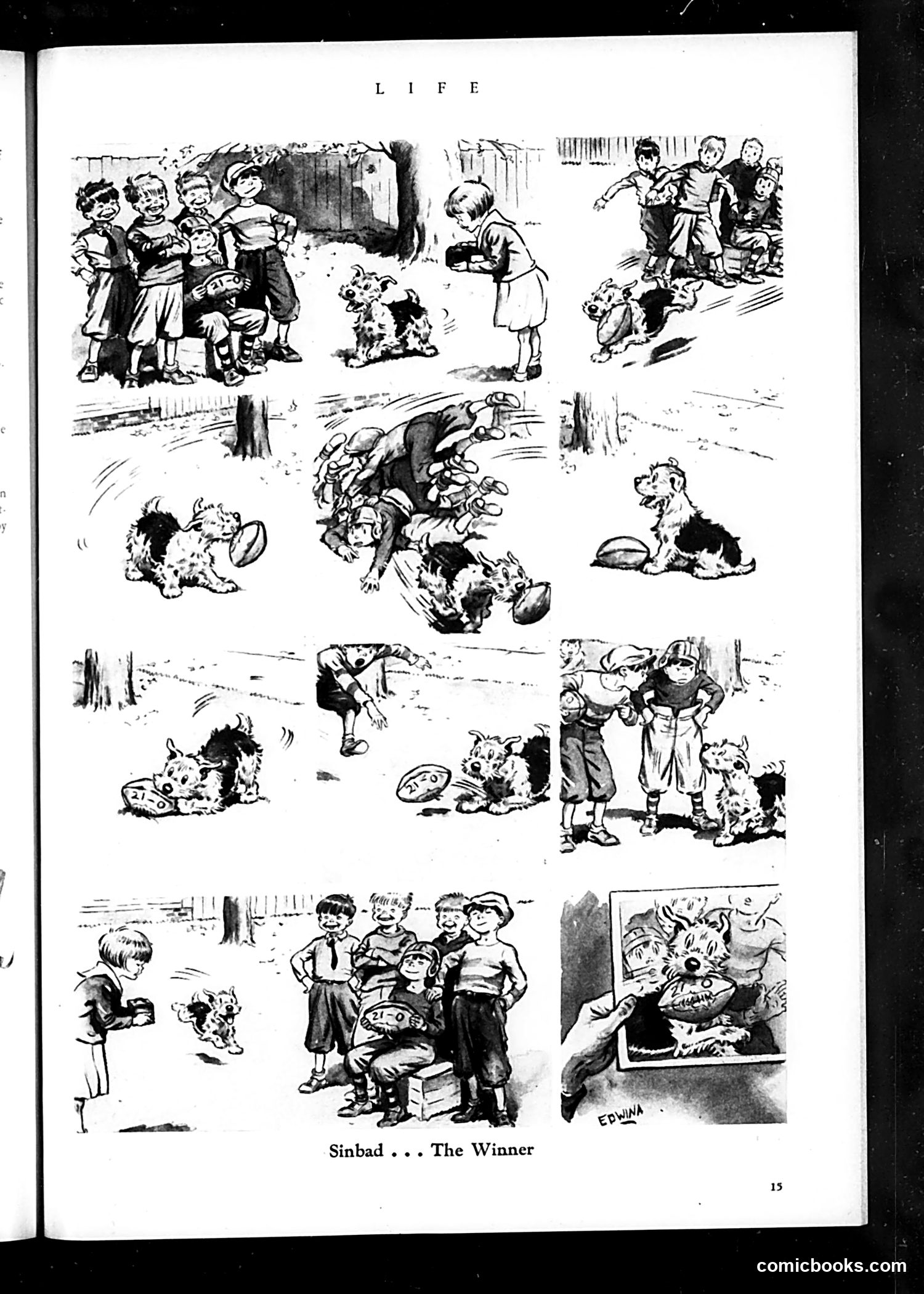
"Sinbad... The Winner" This is a comic strip sequence showing children playing with a dog, apparently named Sinbad. The narrative follows the dog's interactions with a group of children in what appears to be an outdoor, working-class setting (note the simple fences and modest clothing). The strip progresses through various scenes: children gathering around the dog, the dog playing with them, and culminating in what appears to be the dog winning some kind of competition or gaining favor—hence "The Winner" caption. The humor appears to be gentle and domestic rather than political. It's a straightforward children's story about a dog becoming popular or victorious among playmates. The artist is credited as "EDWINA" at bottom right. This represents *Life* magazine's lighter content—simple, family-friendly comedy rather than satirical commentary.
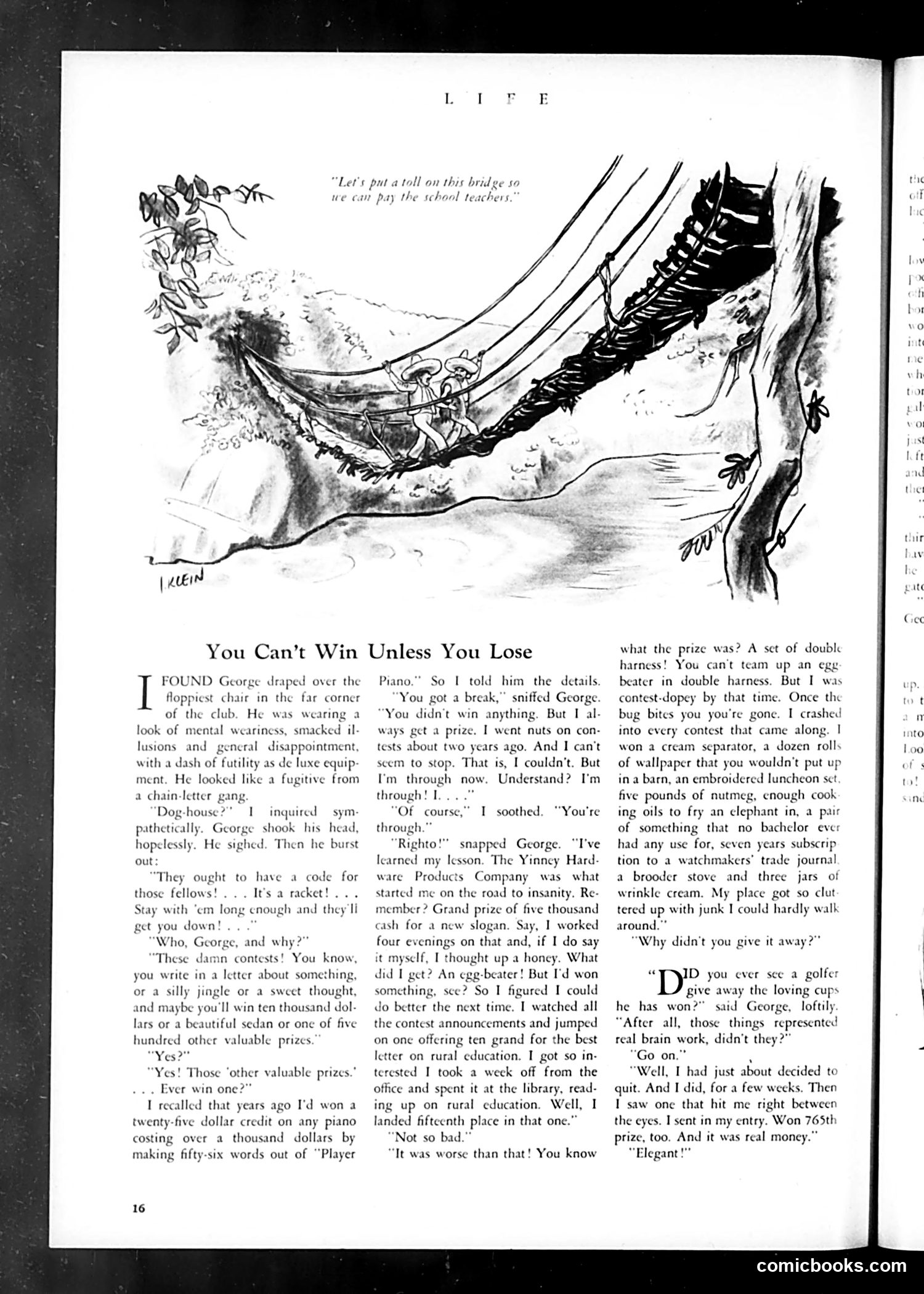
Analysis of "You Can't Win Unless You Lose" This satirical piece mocks the proliferation of advertising contests and promotional schemes that were apparently rampant in early 20th-century America. The cartoon depicts someone literally falling into a precarious bridge/rope structure while chasing prizes. The narrative follows a character named George who obsessively enters numerous contests seeking cash prizes and valuable items (pianos, harnesses, nutmeg, wrinkle cream, golf cups). Despite winning a modest prize of $76, he's exhausted his time and resources pursuing these contests. The satire's point: consumers waste more effort, money, and time chasing advertiser-sponsored contests than any actual prize is worth. The title captures the irony—you "lose" by trying to "win." This reflects contemporary anxiety about aggressive marketing manipulation and consumer gullibility.
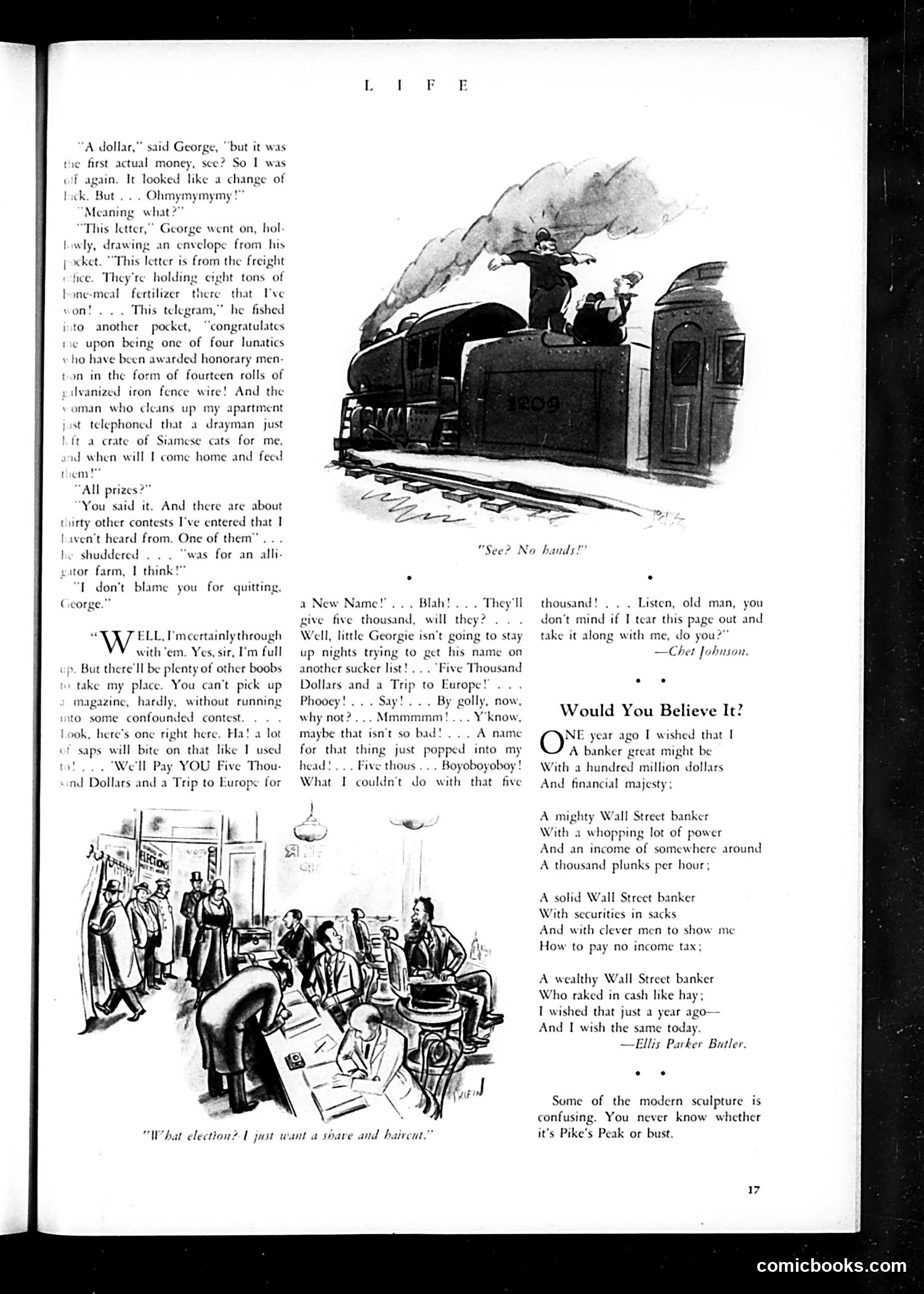
Analysis of Life Magazine Page 17 This page contains a humorous narrative about George winning a dollar in a contest, followed by satirical poetry about wealth. The Cartoons: The top illustration shows a man on a train car with mail, captioned "See? No hands!" — likely satirizing reckless behavior or carelessness. The lower cartoon depicts men in an office setting, captioned "What election? I just want a steak and haircut" — this appears to mock political disengagement or indifference to civic matters among ordinary citizens. The Poetry Section "Would You Believe It?": Attributed to Ellis Parker Butler, this satirizes Wall Street bankers and wealth disparity, wishing sardonic scenarios upon wealthy financiers—suggesting resentment of banking power and income inequality during the era. The final note about sculpture being confusing is unrelated social commentary.
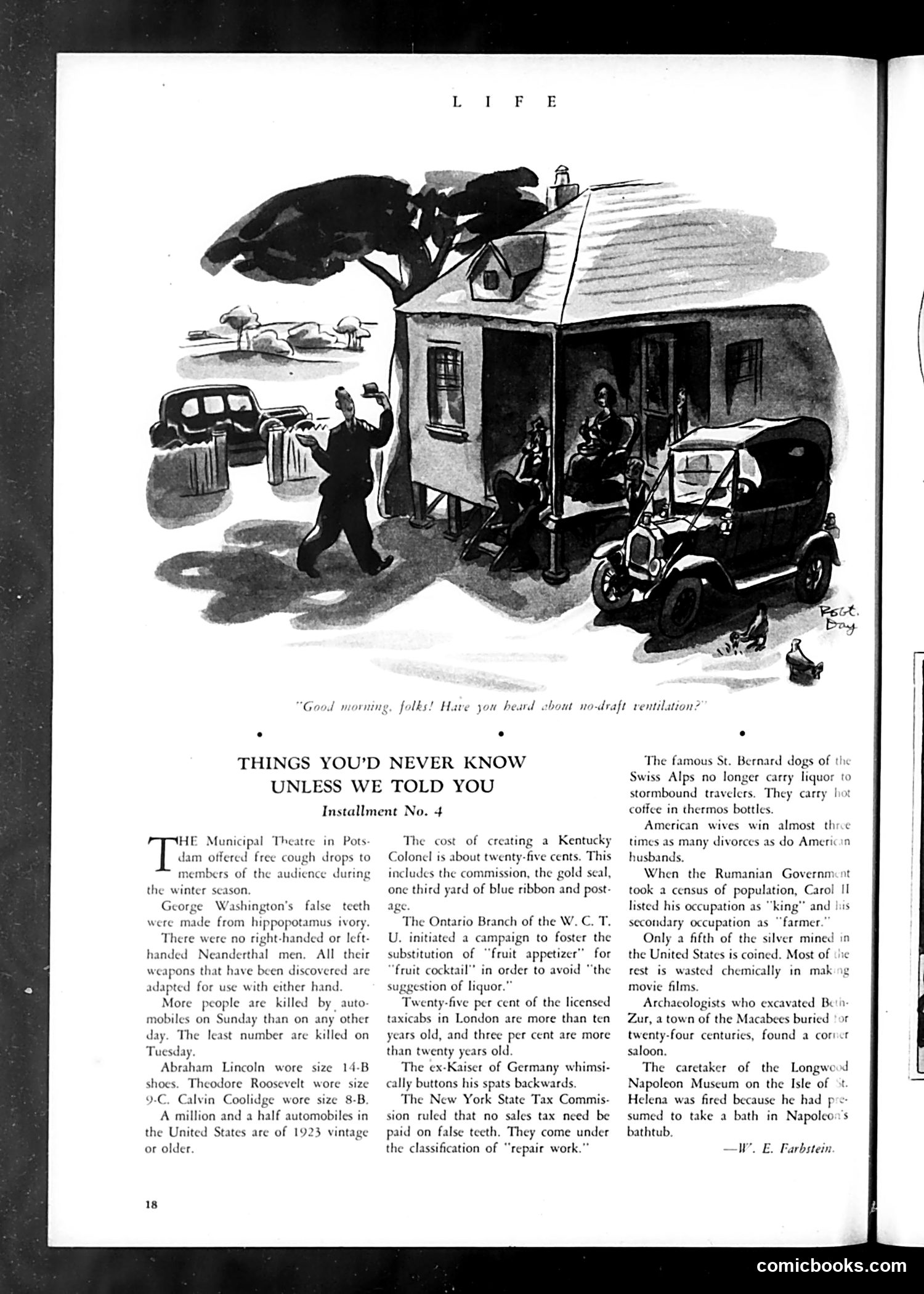
Analysis The cartoon depicts a vacation scene with early 1920s automobiles and a modest roadside cottage. A man in a suit addresses people outside, asking "Good morning, folks! Have you heard about no-draft ventilation?"—a sales pitch for automotive ventilation systems. The accompanying text column, titled "Things You'd Never Know Unless We Told You," presents absurdist trivia meant to amuse readers with pointless or ridiculous "facts": George Washington's false teeth were hippopotamus ivory; St. Bernard dogs now carry hot coffee instead of liquor; the ex-Kaiser buttons his spats backwards; etc. The satire targets the era's obsession with trivial consumer information and pseudo-scientific claims. The cartoon's salesman embodies the aggressive marketing culture of the 1920s, interrupting vacation leisure with unnecessary product pitches. Together, the image and text mock the modern American tendency to monetize everyday life and flood consumers with dubious "helpful" information designed primarily to sell things.
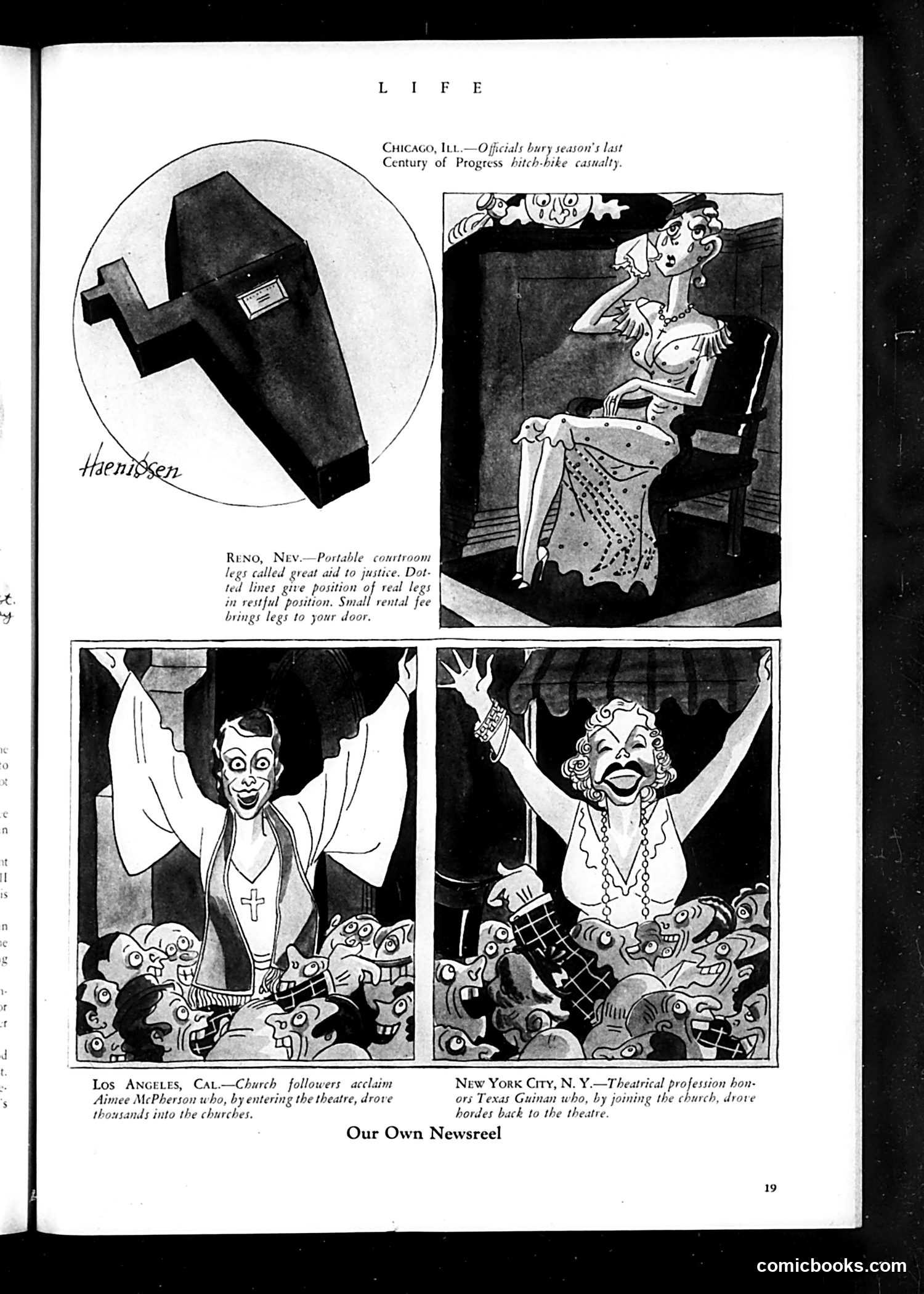
Life Magazine Satirical Page Analysis This 1930s satirical newsreel mocks contemporary figures and trends: Top left: A coffin labeled with a small cross—likely referencing Chicago's "Century of Progress" exposition, treating some minor mishap as mock-serious news. Top right: "Portable courtroom legs"—satirizing Reno, Nevada's divorce industry, which relied on residency requirements. The joke presents artificial legs as an aid to the divorce courts' work, suggesting the absurdity of mobility-based legal proceedings. Bottom two panels: Juxtapose two famous 1920s-30s figures: - Aimee McPherson, a celebrity evangelist whose theatrical preaching drew enormous crowds - Texas Guinan, a speakeasy hostess and performer who symbolized Jazz Age excess The satire suggests their influence operates backwards from their stated values: McPherson's theatricality drives people *away* from churches, while Guinan's conversion to religion drives people *toward* theaters. Both represent the era's blurred lines between entertainment and morality.
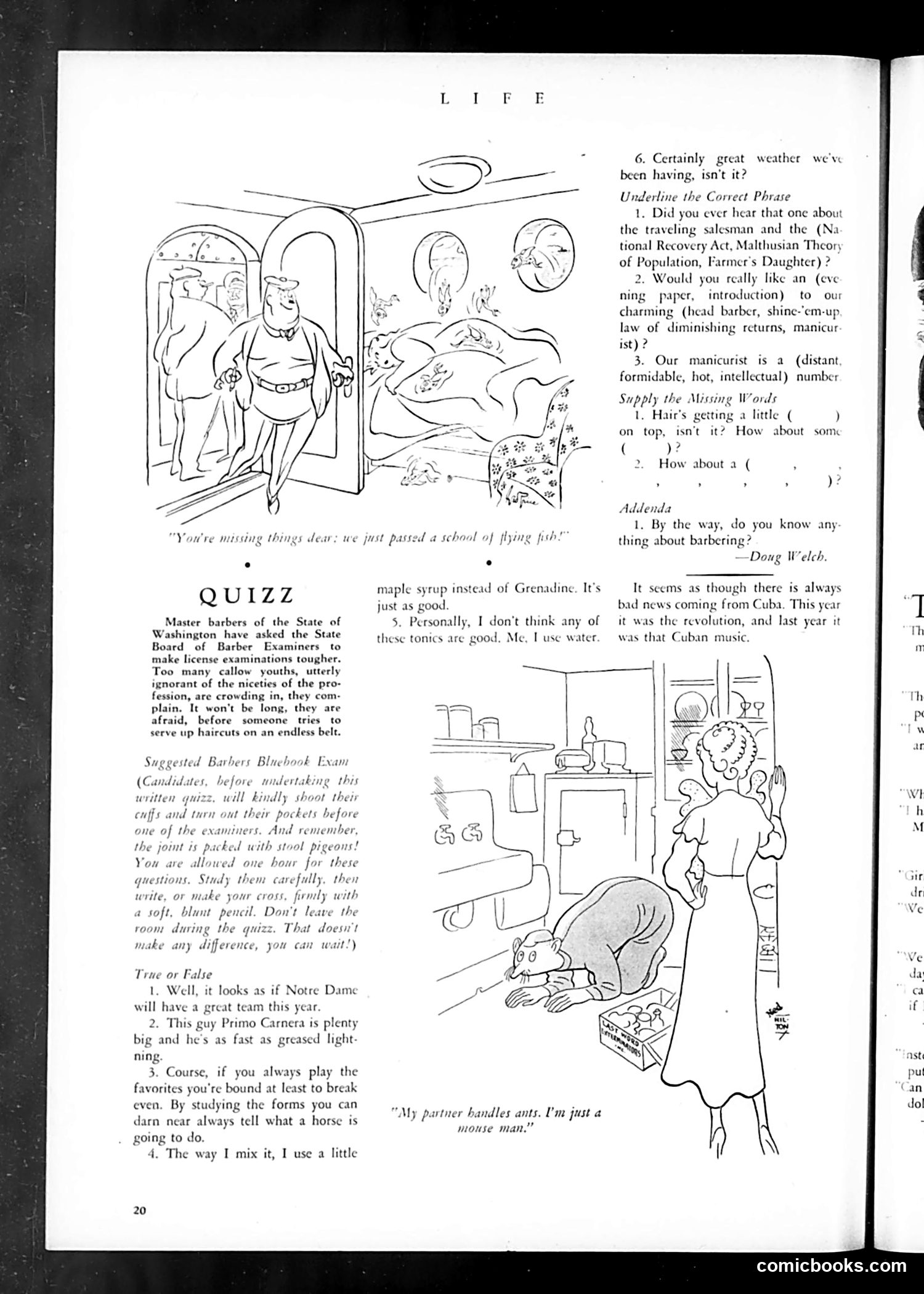
"Life" Magazine Barber Exam Satire This page satirizes Washington state barbers' complaints about unqualified newcomers entering the profession. The top cartoon shows barbers worried that corners are being cut—literally depicted as a factory-style assembly line approach to haircuts. The "quiz" below mocks barbers' actual concerns by creating a fake licensing exam that exposes their own ignorance and shallow conversation. Questions mix legitimate barbering with sports gossip (Notre Dame football, boxer Primo Carnera), betting on horses, and small-talk clichés—suggesting that barbers themselves aren't particularly educated or professional. The bottom cartoon reinforces this: a "house man" (exterminator) contrasts with his partner who "handles ants," poking fun at perceived dimwittedness through absurdist wordplay. The satire's point: barbers demanding stricter standards while demonstrating they themselves lack depth or expertise. The magazine gently ridicules both the profession's pretensions and the era's casual sexism and lowbrow culture.
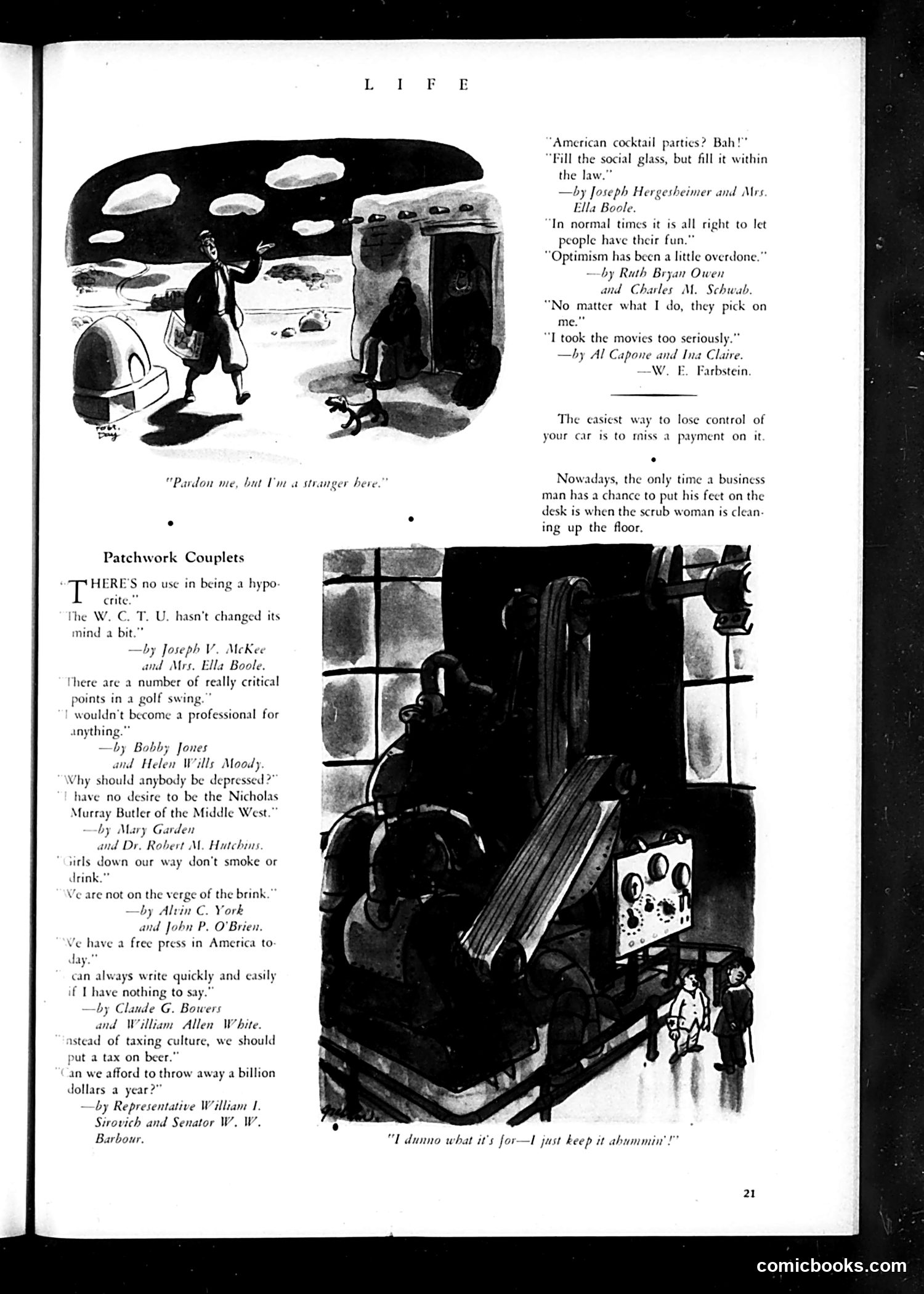
Life Magazine Page Analysis This page from *Life* satirizes prominent public figures of the 1920s-30s by pairing them in humorous "patchwork couplets"—contradictory statements attributed to famous people meant to expose hypocrisy or absurdity. Key satirical targets include: - Mrs. Ella Boole (temperance advocate): mocked for condemning cocktails while endorsing social drinking "within the law" - Al Capone (gangster): ironically paired with actress Ina Claire, claiming "they pick on me"—absurd given his criminal notoriety - Bobby Jones & Helen Wills Moody (athletes): contradicting themselves on professionalism - William Allen White (journalist): claiming he writes easily despite having nothing to say The point: The magazine exposes how public figures speak out of both sides of their mouths, make contradictory claims, or say self-serving things. The cartoons (including one of a confused man with industrial machinery) underscore themes of modern confusion and hypocrisy. The humor relies on readers recognizing these celebrities and their public positions—context largely lost today.
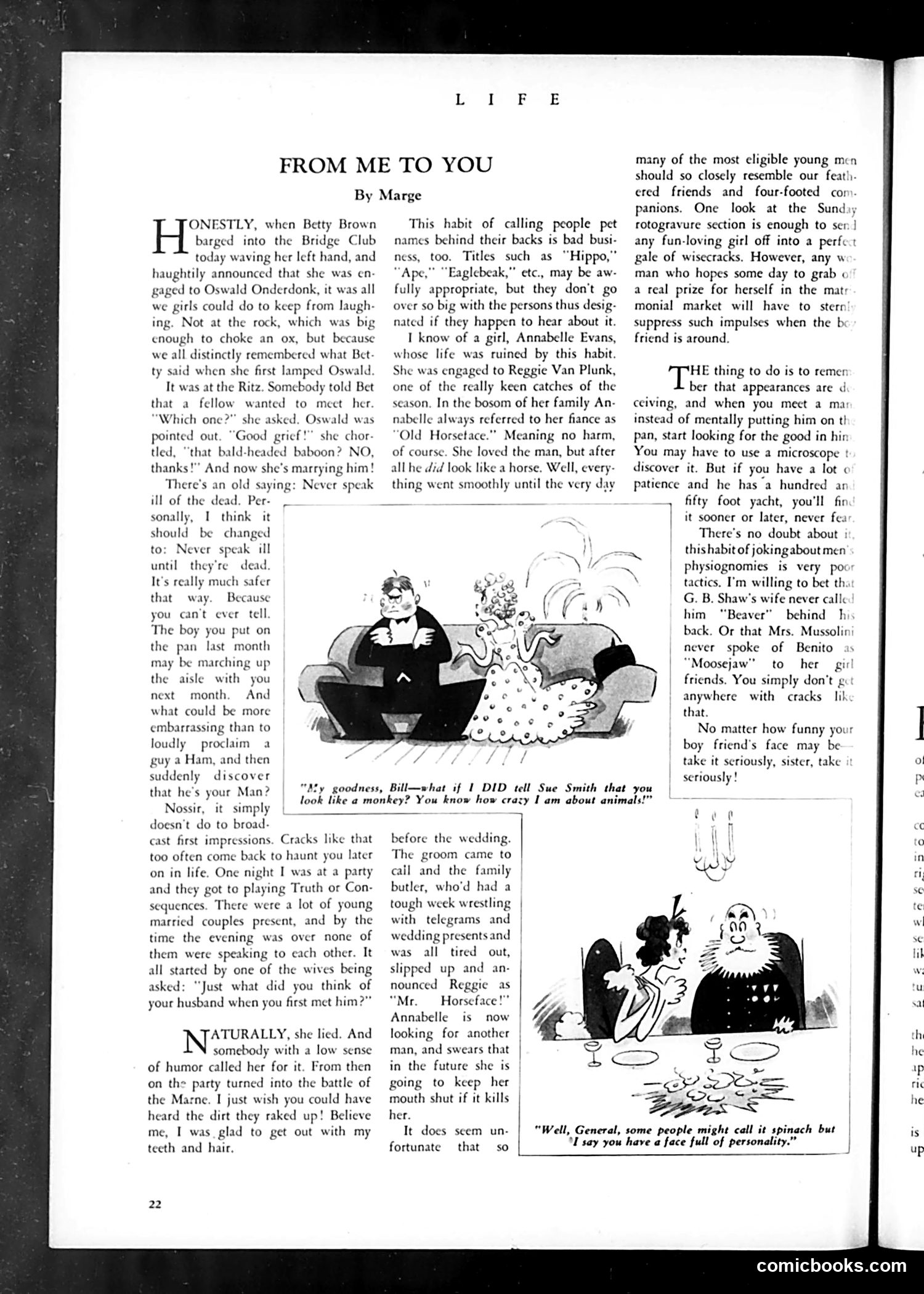
Analysis: "From Me to You" by Marge This is a humorous column about the social danger of making insulting nicknames for people behind their backs. The author uses cautionary tales to illustrate how carelessly cruel remarks can backfire embarrassingly. The central joke involves Annabelle Evans, who privately called her fiancé Reggie Van Plunk "Old Horseface" because he resembled a horse. When a tired butler accidentally announces him by this insulting nickname at a pre-wedding gathering, the engagement collapses—a disaster of her own making. The accompanying cartoons satirize similar situations: one shows a man accused of looking like a monkey; another depicts a military general being told he has "a face full of personality" (obviously meaning the opposite). The satire targets mid-century social hypocrisy—particularly women's gossipy habit of mocking men they publicly pursue romantically. Marge argues this reflects broader immaturity: speaking ill of people you later need to respect is foolish and dangerous to one's marriage prospects.
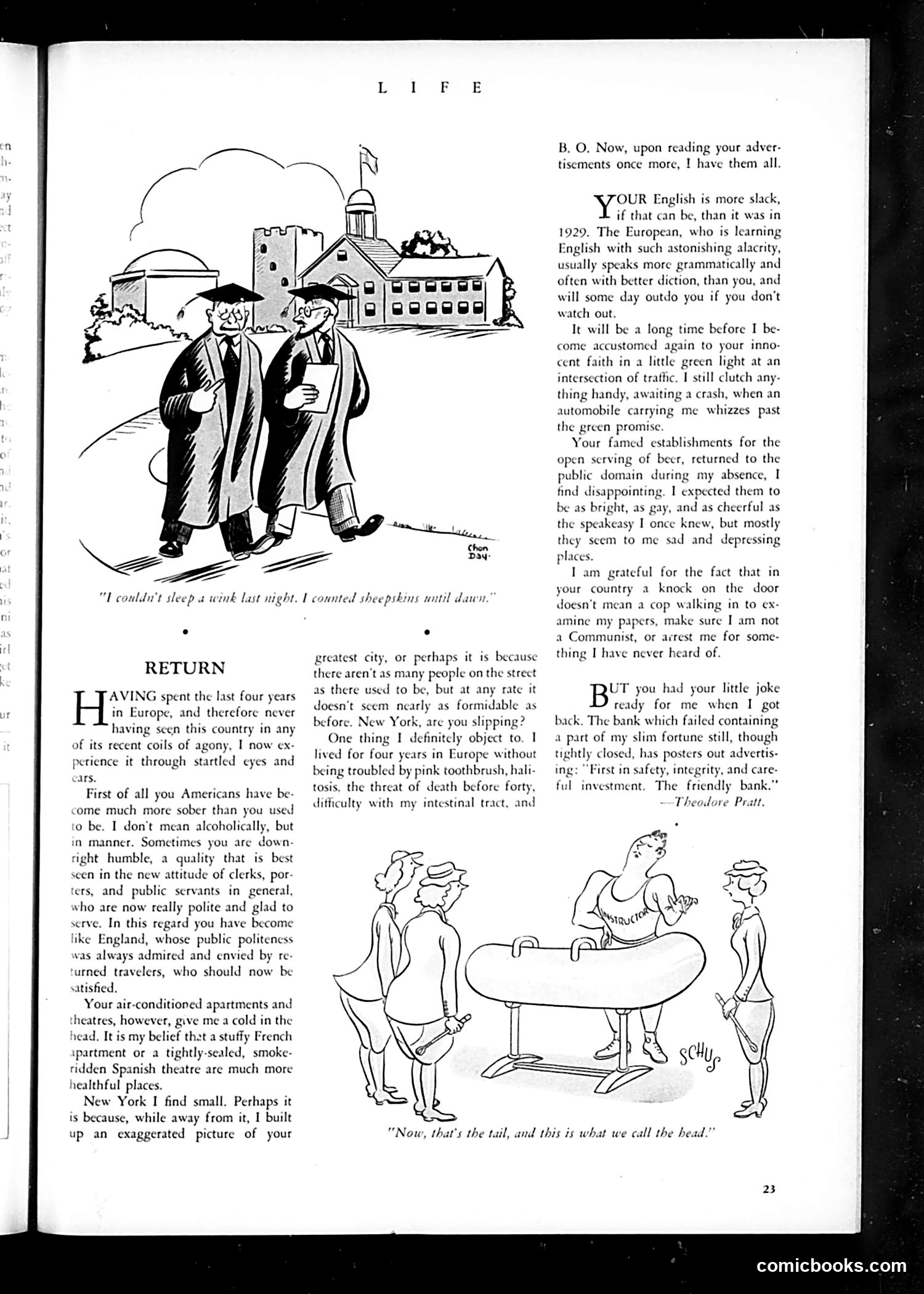
Analysis: "Return" by Theodore Pratt This is a humorous essay by a returned American expatriate observing how his home country has changed after four years abroad (likely 1925-1929). The two cartoons illustrate his observations: Top cartoon: Two men discussing insomnia—one counts "sheepskins" (a dated euphemism for sleeping pills/sedatives), satirizing American over-reliance on commercial products. Bottom cartoon: A crude anatomy lesson ("that's the tail...this is what we call the head"), mocking American advertising's insulting simplification of consumers' intelligence. The satire's targets: Pratt contrasts American consumer culture and anxieties (toothbrush ads, halitosis, intestinal problems, bank failures) against European sophistication. He's ironically grateful that American police don't demand "papers" like European authoritarian regimes—yet devastated that the bank advertising "safety and integrity" has failed, leaving him with losses. The joke: America's post-1929 crash exposes the gap between corporate promises and reality. The humor relies on 1920s-30s context: Prohibition's repeal, advertising's rise, the recent stock market collapse, and European fascism's growing threat.
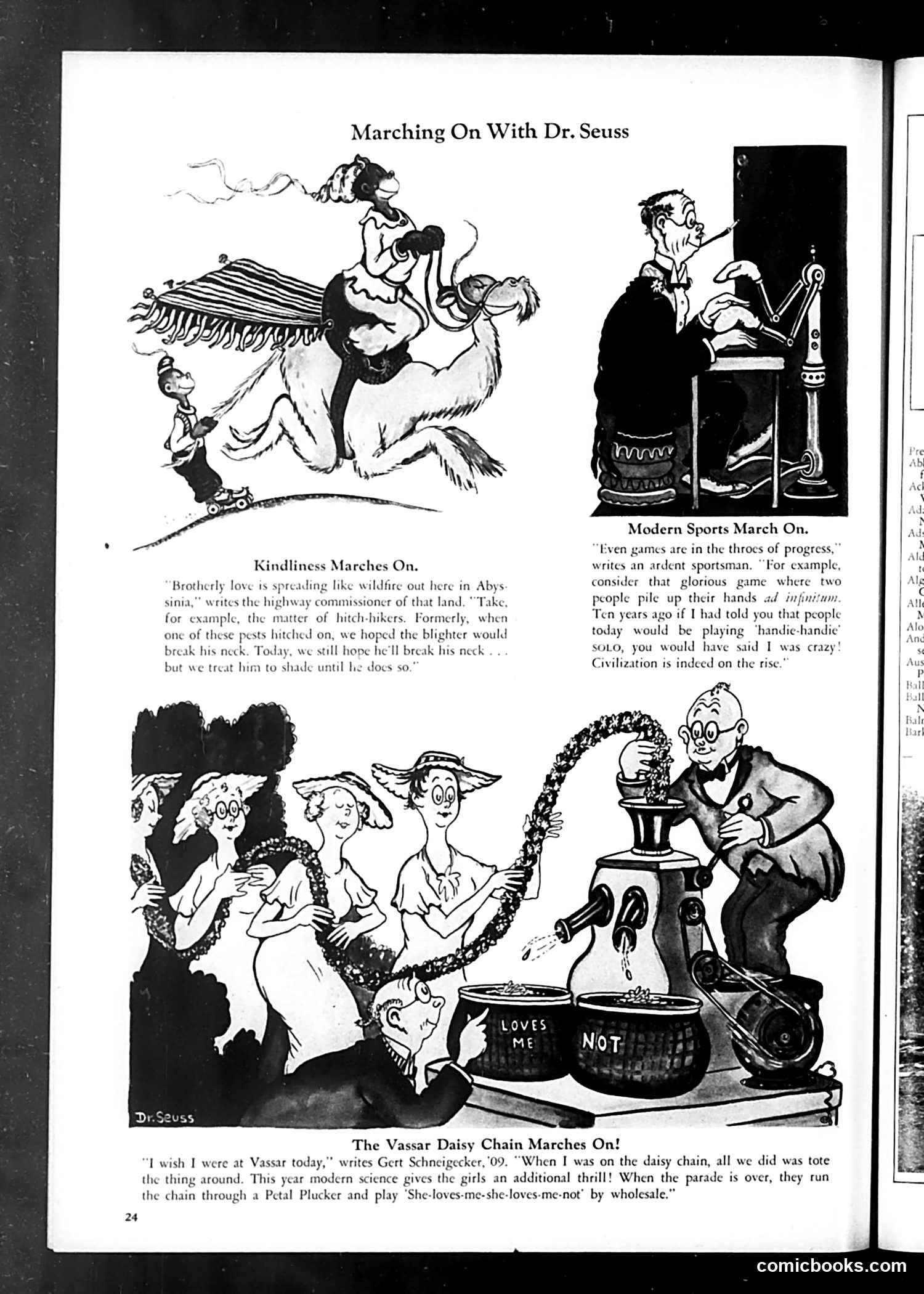
"Marching On With Dr. Seuss" — Life Magazine Satire This page presents three Seussian cartoon commentaries on modern "progress," mocking social trends of the era (likely 1920s-30s based on style). "Kindliness Marches On" satirizes improved treatment of hitchhikers—once beaten, now merely hoped to be injured, representing false claims of civilization's moral advance. "Modern Sports March On" ridicules a new fad called "handic-handlic solo," where couples stack their hands repeatedly. The cartoon mocks breathless enthusiasm for trivial novelties dressed up as progress. "The Vassar Daisy Chain Marches On" targets Vassar College women's traditional daisy-chain parade ritual. Modern "science" has industrialized it with a "Petal Plucker," reducing the romantic "loves-me-not" game to mass production. All three target how society celebrates minor changes as "progress" and "civilization," while institutions (colleges, sports, social customs) mechanize formerly meaningful traditions into commercialized spectacles. The satire is gently cynical about modernity's shallow innovations.
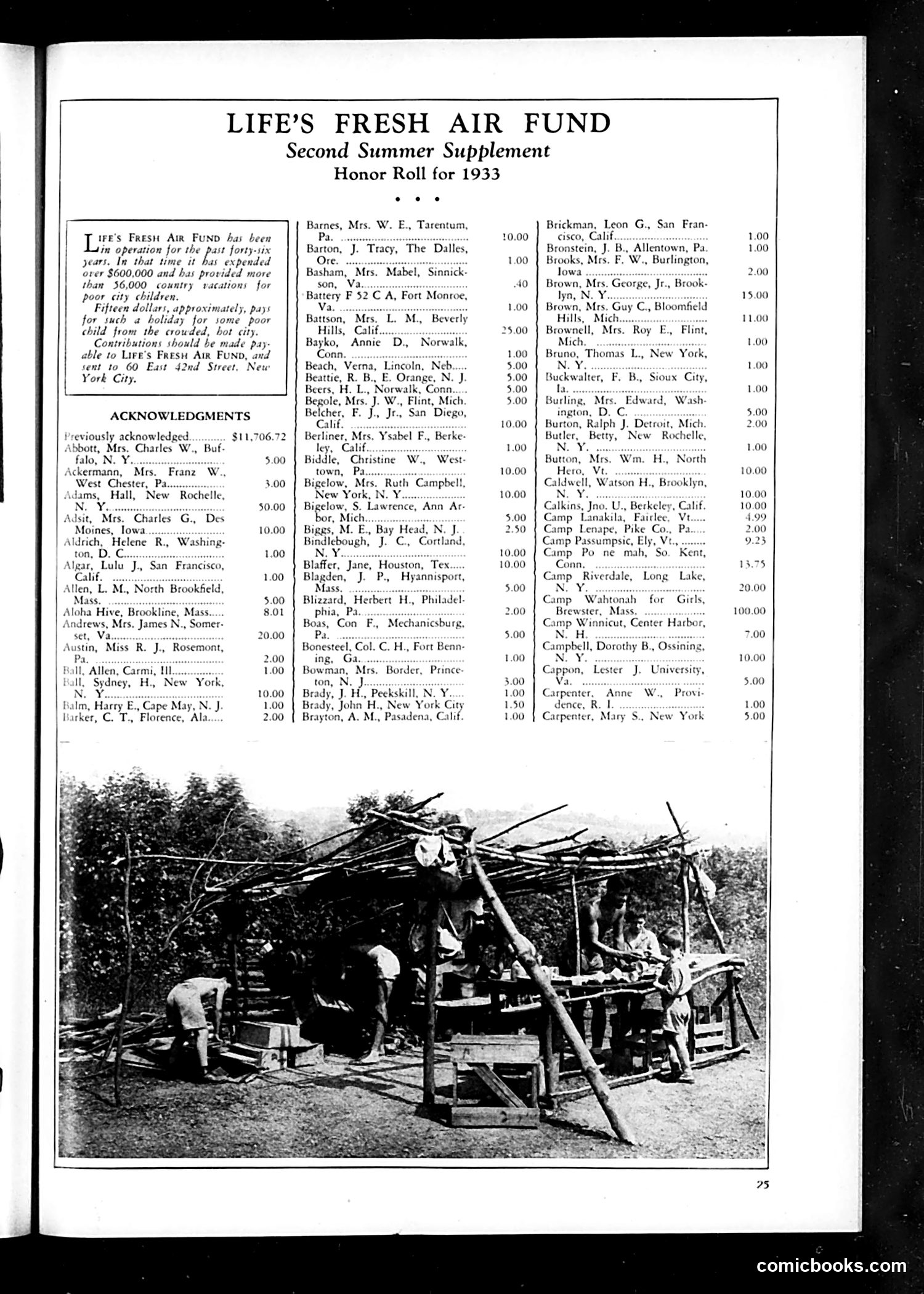
Life's Fresh Air Fund Honor Roll (1933) This page documents Life magazine's charitable initiative, not a political cartoon. The "Fresh Air Fund" was a real, long-running philanthropy that provided country vacations for poor urban children—a Progressive Era social welfare program addressing crowded city tenement conditions. The page lists 1933 donors and their contributions, ranging from $0.40 to $100. Notable entries include military units (Battery F, Fort Monroe), camps (Camp Wahtonah for Girls), and individuals nationwide. The accompanying photograph shows a rustic outdoor camp shelter where city children likely stayed during their subsidized rural vacations. This reflects 1930s charitable culture: wealthy Americans funding programs to improve poor children's health and welfare through exposure to nature. The detailed honor roll served as public acknowledgment of donors' generosity during the Great Depression.
Fresh Air Fund Supplement This page is not a cartoon or satirical content—it is purely administrative. It appears to be a donor list for the "Fresh Air Fund," a charitable organization that provided summer outings and relief to underprivileged children (primarily in urban areas). The page shows alphabetically-organized names of contributors, their locations, and donation amounts (ranging from $1 to $250). These are wealthy individuals and families, predominantly from the Northeast (New York, Pennsylvania, Connecticut), reflecting Life magazine's affluent readership. The Fresh Air Fund was a legitimate Progressive Era charity promoting child welfare—not satire. This supplement documents philanthropic giving by the magazine's audience, reflecting late 19th/early 20th-century upper-class charitable culture.
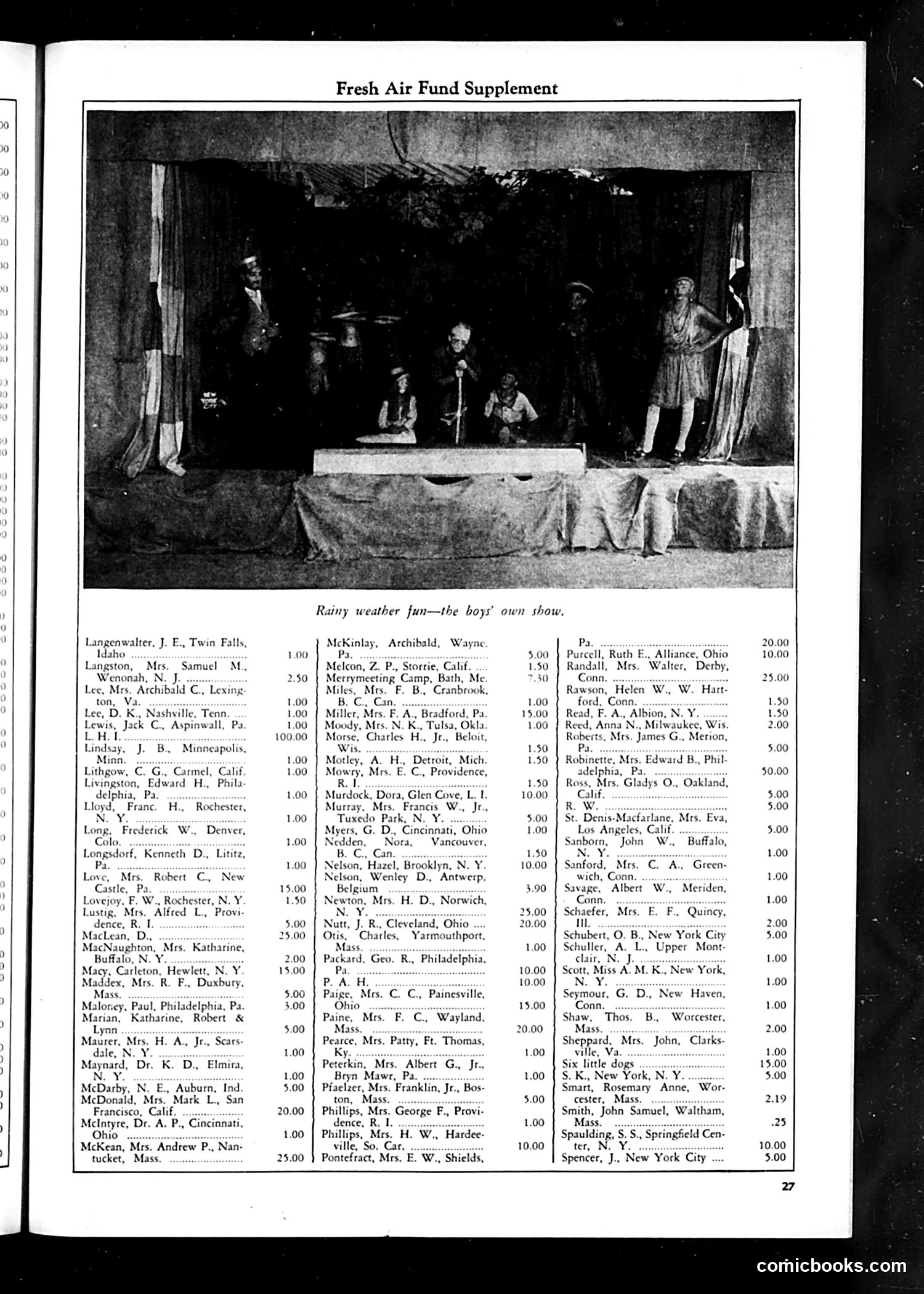
Fresh Air Fund Supplement Page This page is primarily a fundraising list for the Fresh Air Fund, a charitable organization that provided outdoor experiences for underprivileged urban children. The heading "Rainy weather fun—the boys' own show" with the accompanying photograph suggests the page celebrates the Fund's activities. The image shows what appears to be an indoor theatrical or entertainment event, likely staged rain-or-shine programming for children during inclement weather—hence the caption's reference to making fun despite rainy conditions. The bulk of the page consists of donor names and contribution amounts, ranging from $0.21 to $100.00. This was a common practice in early 20th-century publications: listing contributors publicly to encourage further donations and recognize supporters' generosity. The geographic diversity (Twin Falls Idaho to New York City) demonstrates the Fund's broad national appeal and support base during this period.
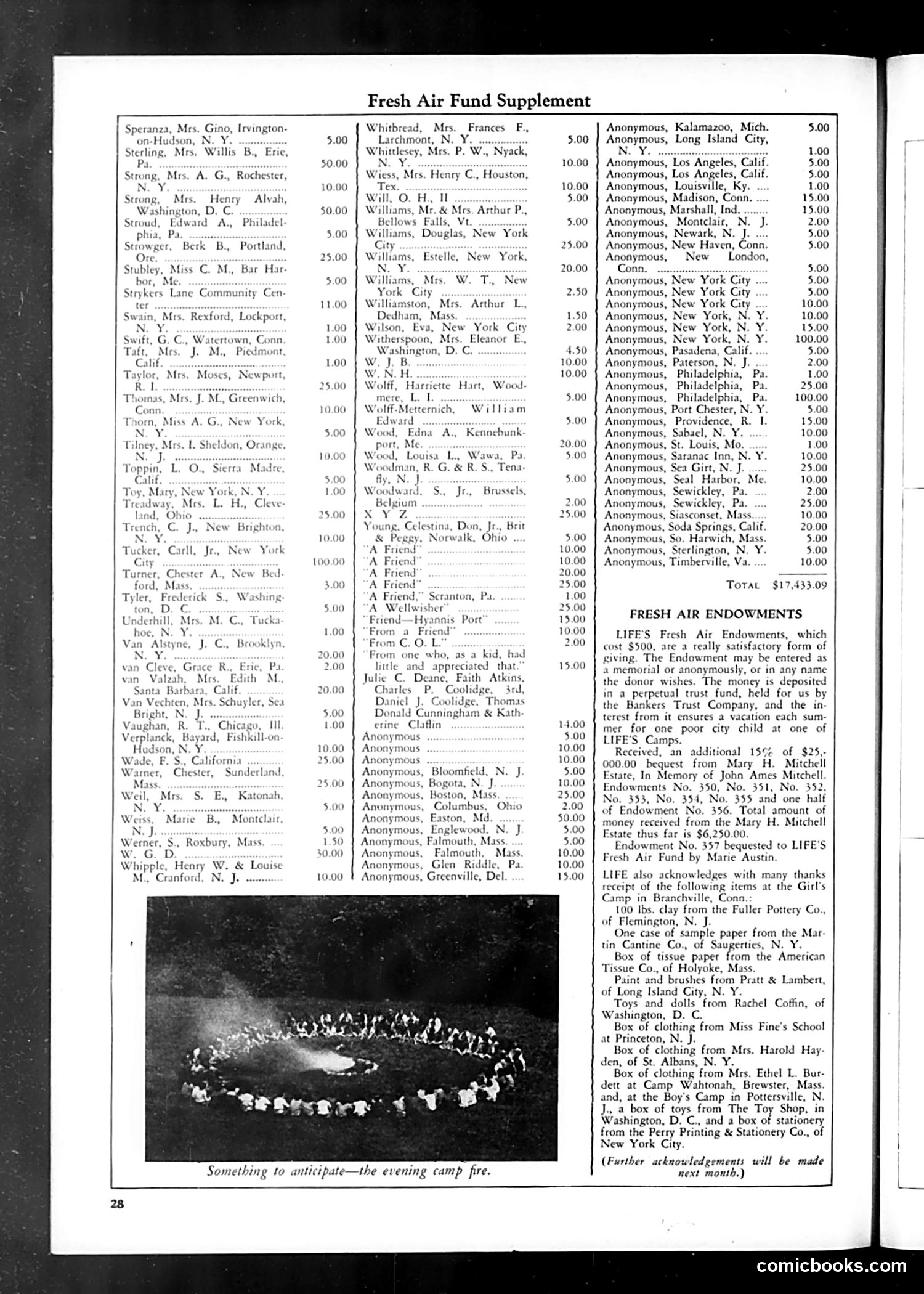
Fresh Air Fund Supplement This page is primarily a fundraising document, not a political cartoon. It lists donors to the Fresh Air Fund, a charitable organization providing summer camp experiences for underprivileged children. The single image shows a campfire scene with silhouetted figures gathered around an evening fire—depicting the wholesome recreational experience the fund supports. The text includes donor names and amounts ranging from $1 to $100, along with an explanatory section ("Fresh Air Endowments") describing how donations work. The fund deposits money in trust, allowing children to attend camp annually. The photograph serves as promotional material, illustrating the program's purpose and appealing to donors' sentiments about childhood welfare and outdoor recreation—common Progressive-era charitable concerns.
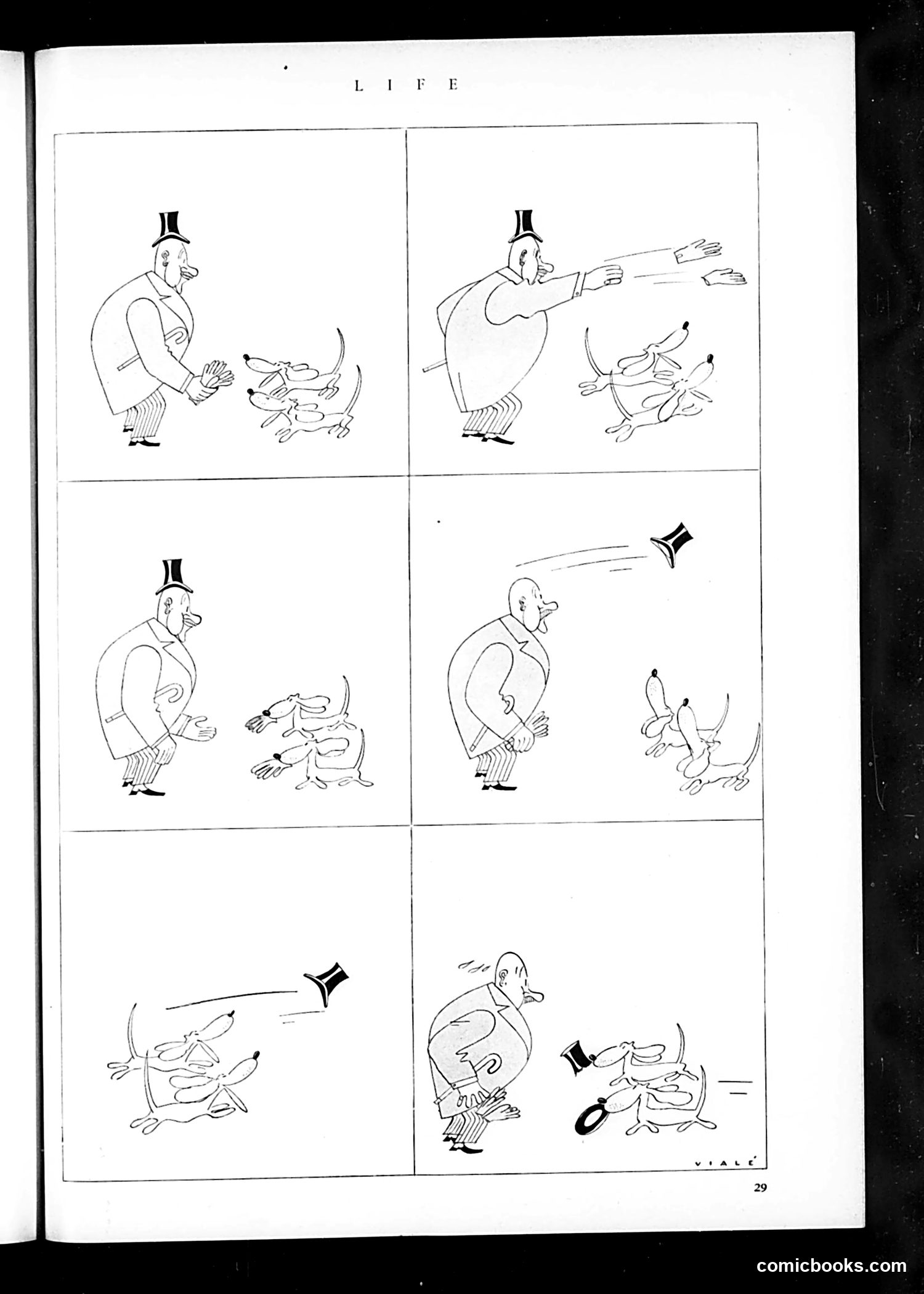
Analysis This six-panel comic depicts a man in formal attire (wearing a distinctive tall hat) repeatedly attempting to control or manage several small, mischievous dog-like creatures. The sequence shows escalating chaos: he starts calmly gesturing, then uses a whip or stick, throws objects, and ultimately appears to be chased or overwhelmed by the animals. The cartoon likely satirizes political leadership or management—the formal-dressed figure represents someone in authority struggling to maintain control over unruly forces (the animals, possibly representing the public, labor movements, or political opposition). The humor derives from the authority figure's progressive loss of control despite increasingly aggressive tactics. Without visible text identifying specific figures or dates, the exact historical reference remains unclear, though this appears to be early-to-mid 20th century political satire about governance and disorder.
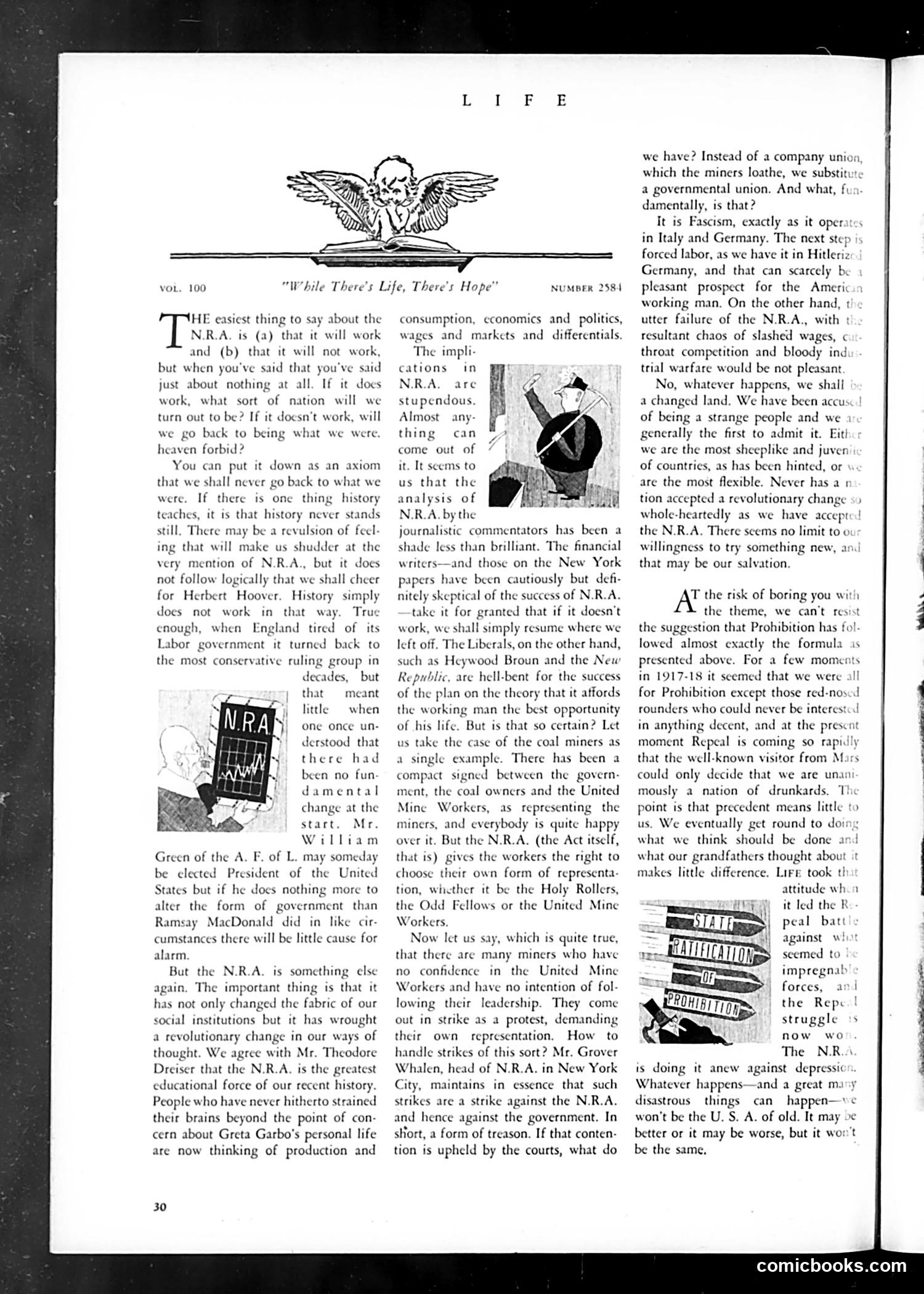
Analysis of This Life Magazine Page (circa 1933-1934) This article critiques Franklin D. Roosevelt's National Recovery Administration (NRA), a New Deal program. The author argues the NRA, while well-intentioned, creates dangerous precedent by giving government unprecedented control over labor relations. The central argument: Using coal miners as an example, the author warns that if the NRA prevents strikes against government-approved unions (like the United Mine Workers), it effectively creates state-controlled unions—identical to Fascist labor systems in Italy and Germany. Key figures mentioned: - William Green (A.F. of L. leader) - Grover Whalen (NRA head in NYC) - Theodore Dreiser (praised the NRA educationally) - Heywood Broun and *New Republic* (portrayed as NRA supporters) The satire: While acknowledging the NRA's revolutionary educational impact on public political consciousness, the author warns its implementation could inadvertently produce American Fascism—a remarkably prescient 1930s critique from the political left. The cartoon illustrations (partially visible) appear to reinforce this anti-NRA messaging through visual commentary on labor conflict.
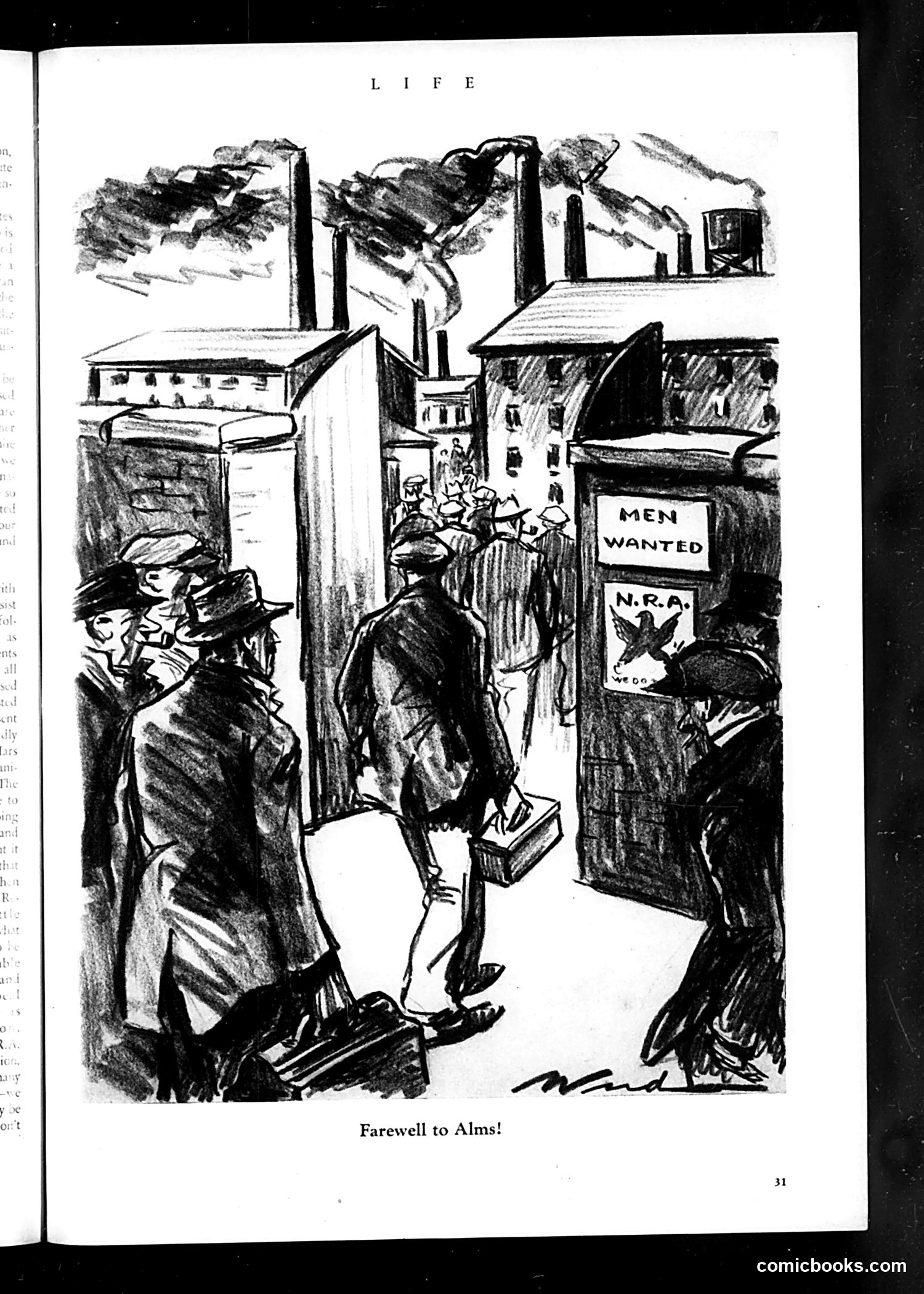
"Farewell to Alms!" This cartoon satirizes the end of almsgiving and charitable relief during the New Deal era. The industrial setting (factories with smokestacks) and "Men Wanted" / N.R.A. signs indicate this references the National Recovery Administration's employment initiatives. The caption's pun—"Farewell to Alms" (charity) rather than "arms"—suggests that job creation programs have supposedly replaced the need for direct charitable handouts. Unemployed or desperate figures are shown outside industrial buildings, implying they now have work opportunities instead of depending on charity. The cartoon likely criticizes either the optimism of New Deal job promises or the harsh reality that relief was ending, forcing people into uncertain employment situations. The exact satirical angle—whether approving or skeptical of this transition—remains somewhat ambiguous from the image alone.
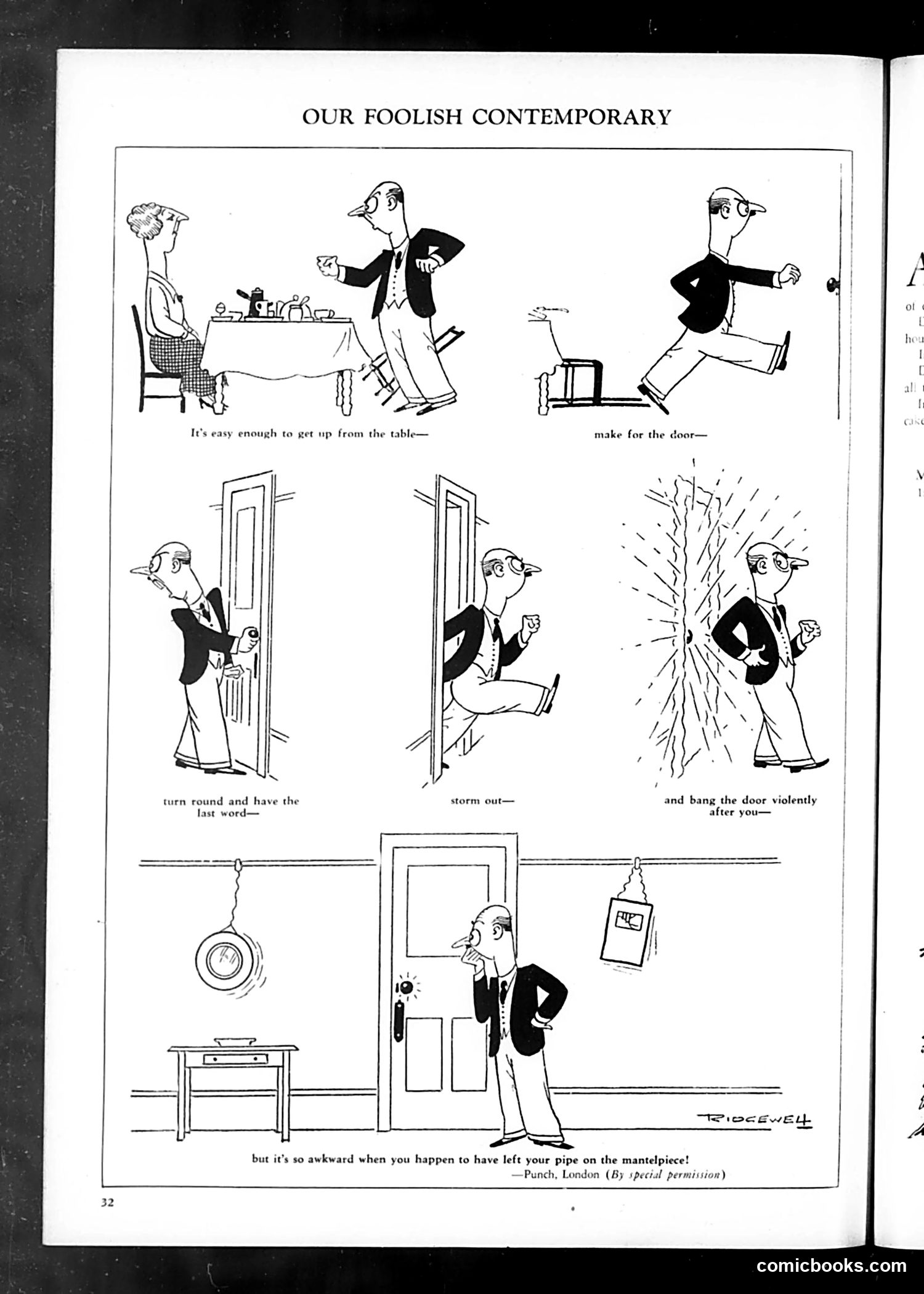
"Our Foolish Contemporary" - Life Magazine Cartoon This is a satirical six-panel sequence depicting a man's awkward departure from a dinner party. The humor escalates through exaggerated physical comedy: he struggles to rise from the table, rushes toward the exit, storms dramatically out the door (banging it behind him), then must sheepishly return because he forgot his pipe on the mantelpiece. The satire mocks the pretensions of polite society etiquette—particularly masculine dignity and composure. The man's attempt to make a dignified, theatrical exit is completely undermined by his forgetfulness, forcing him to reverse his dramatic performance. The joke plays on the contrast between aspired gentlemanly behavior and human absurdity. This reprints from London's *Punch* magazine, suggesting transatlantic sharing of humor about social conventions.
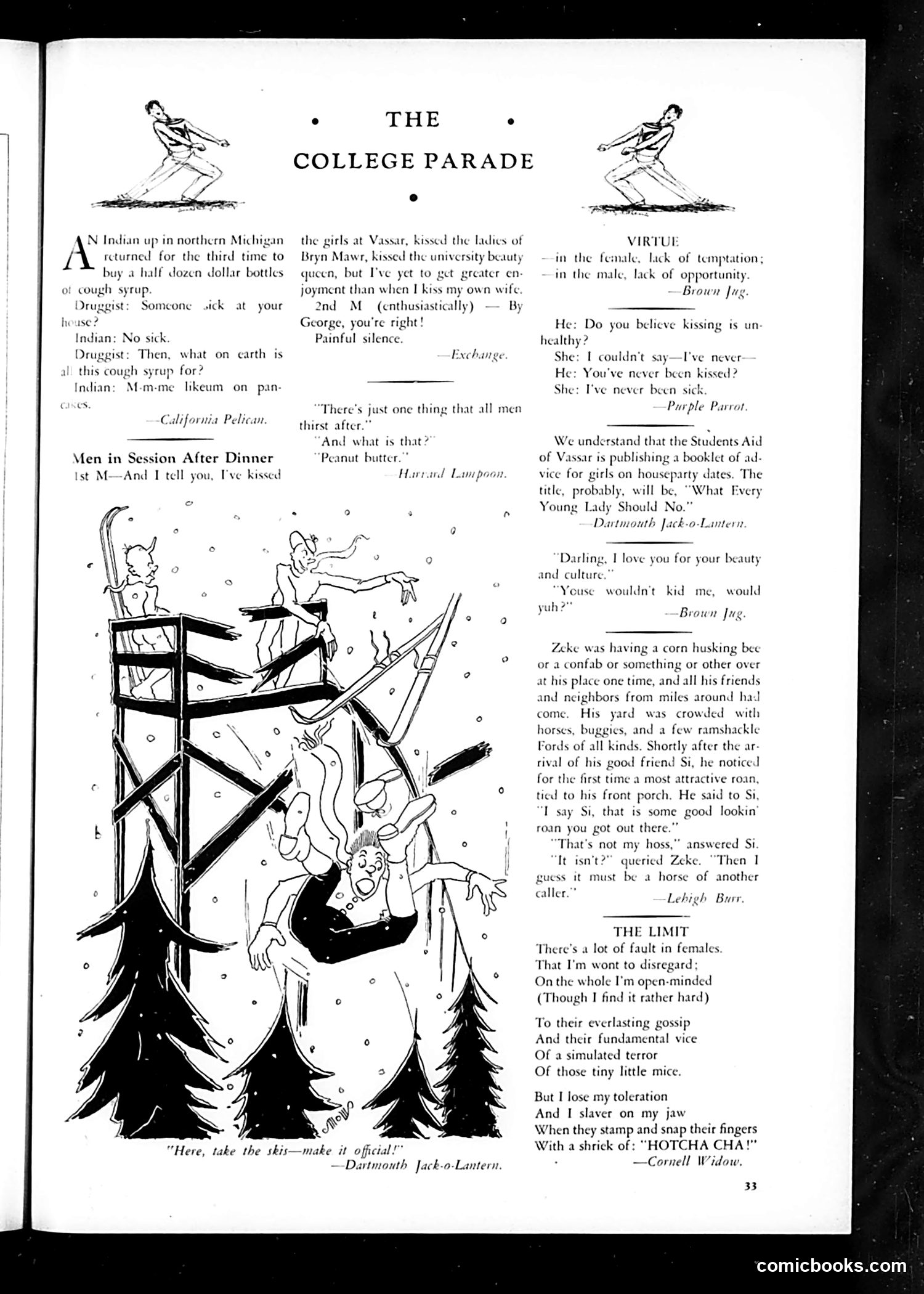
Analysis of "The College Parade" Page This is a humor page from Life magazine featuring jokes and cartoons sourced from college publications (Brown Jug, Dartmouth Jack-o-Lantern, etc.). The main cartoon depicts men in a winter scene with skis, captioned "Here, take the skis—make it official!" The joke appears to be about formalizing a romantic relationship through a skiing date. Recurring theme: The page is dominated by jokes about dating, kissing, and romance among college students. Several pieces contrast male and female perspectives on courtship—men boasting about kissing various women versus women's actual romantic experiences. One joke plays on a man claiming he gets more enjoyment kissing his wife than famous college women, met with "painful silence," suggesting his audience doubts this claim. Social context: These reflect 1920s-30s college social rituals and gender attitudes. References to Vassar and Bryn Mawr (prestigious women's colleges) and "houseparty dates" indicate upper-class college dating culture. The humor often relies on double entendres about kissing and romanticized notions of courtship. The page satirizes college life's social pretensions and dating conventions of the era.
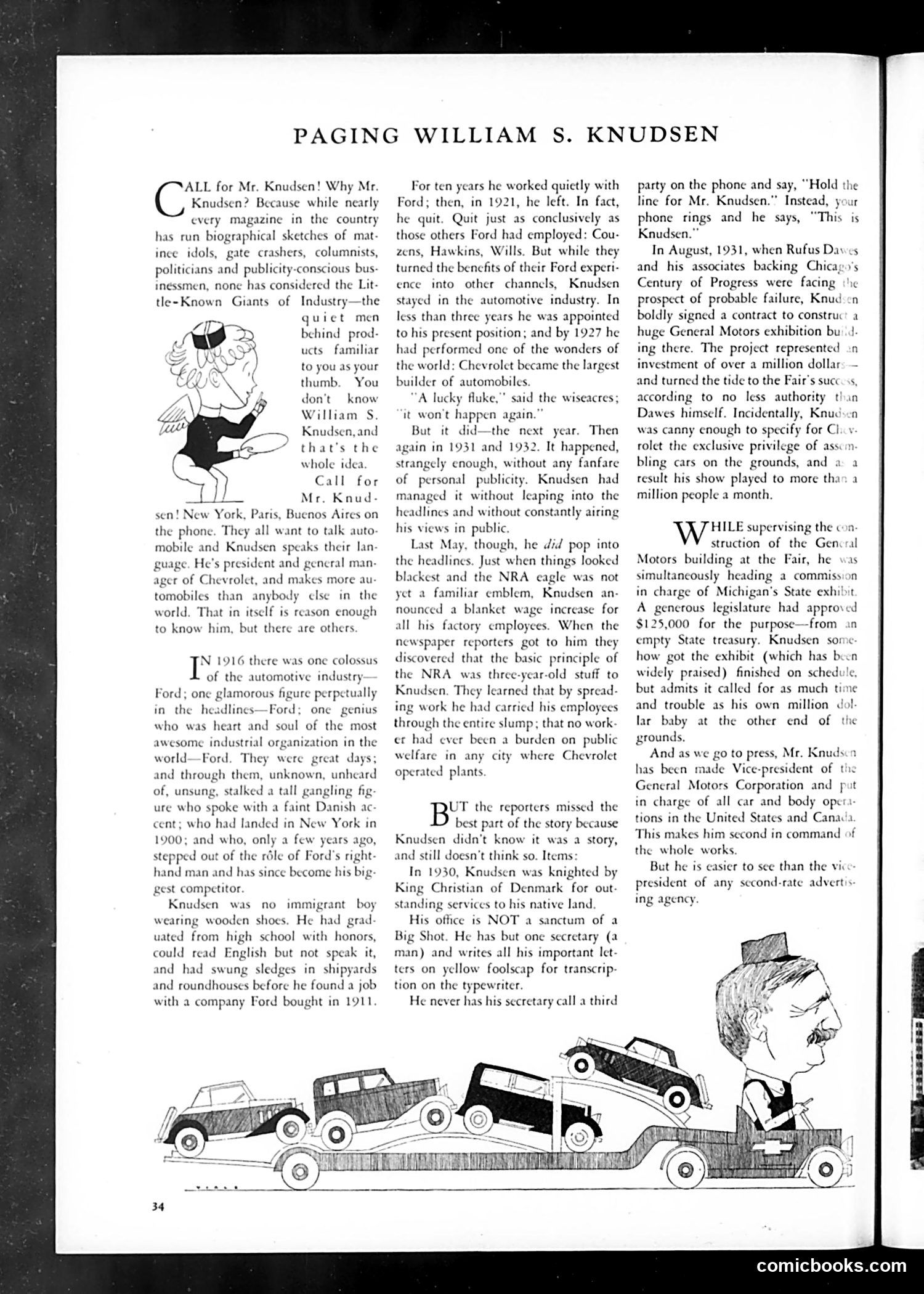
Explanation for Modern Readers This article profiles William S. Knudsen, president of Chevrolet, arguing he deserves recognition despite his deliberate avoidance of publicity. The satire contrasts Knudsen with Henry Ford, who dominated 1916 automotive headlines through constant self-promotion. The cartoon at bottom—showing a streamlined truck carrying cars and a caricatured profile—likely represents Knudsen's efficient production system that made Chevrolet the largest automobile builder by 1927, surpassing Ford. The article emphasizes Knudsen's humility: he announced wage increases during the Depression without fanfare, takes his own phone calls, and doesn't use intermediaries. Life magazine's point is that truly significant industrial leaders accomplish major feats quietly, unlike the "gate crashers, columnists, and publicity-conscious businessmen" who dominate magazine coverage. Knudsen represents understated competence—a virtue Life celebrates by ironically "paging" him into the spotlight.
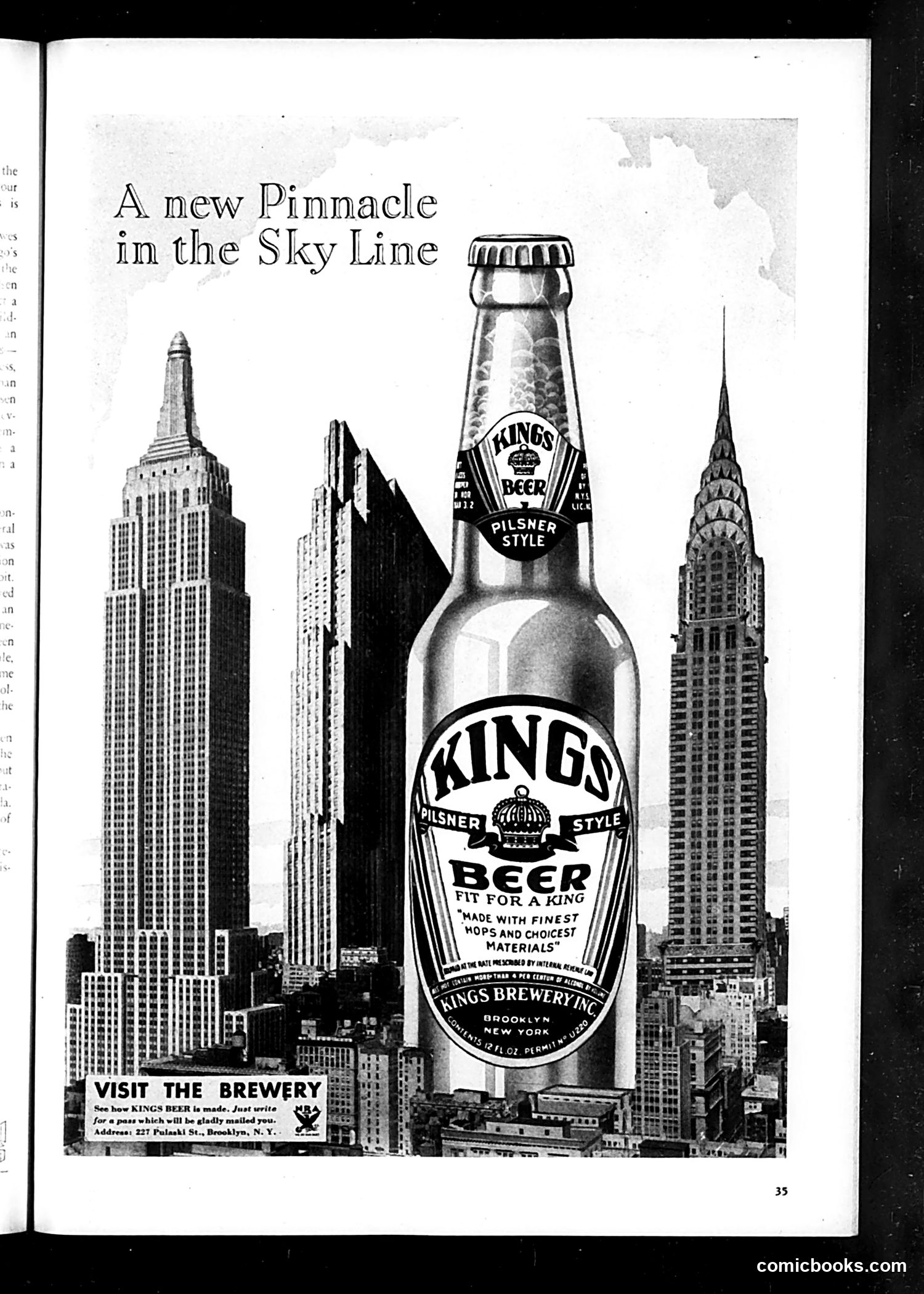
Kings Beer Advertisement This is a full-page advertisement, not satire or political commentary. It promotes Kings Beer, a pilsner-style beer brewed by Kings Brewery in Brooklyn, New York. The ad uses a visual pun: a giant beer bottle is positioned among famous New York City skyscrapers (appearing to be the Empire State Building and Chrysler Building), creating the impression the bottle is itself a "new pinnacle in the sky line." This playfully elevates the beer to iconic status alongside Manhattan's most recognizable landmarks. The bottle's label emphasizes quality ("fit for a king," "finest hops and choicest materials"). A call-to-action invites readers to visit the brewery or request information by mail. This represents typical 1930s-40s advertising strategy: using humor and visual cleverness to make consumer products memorable.
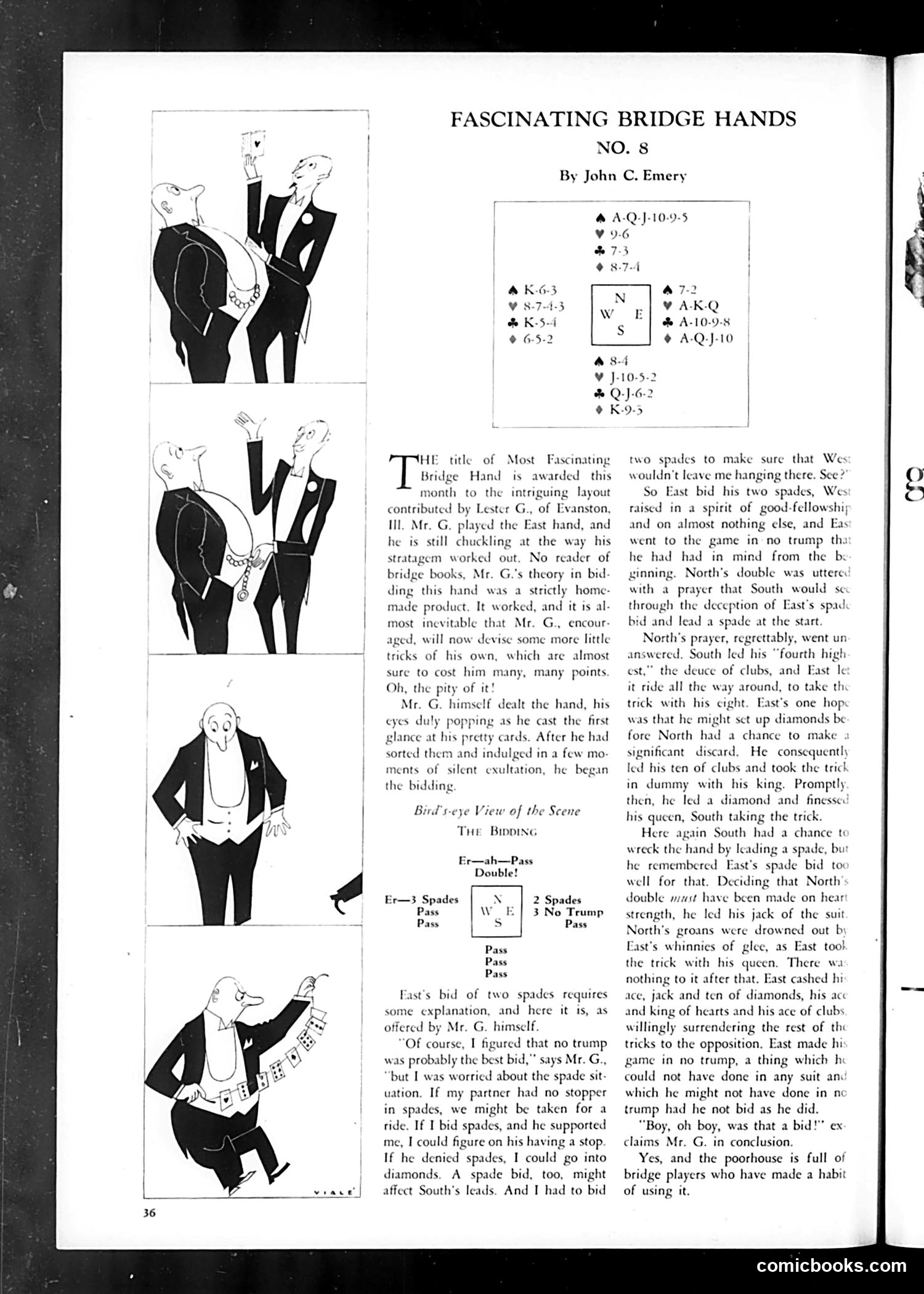
Fascinating Bridge Hands No. 8 This is a bridge instruction column, not political satire. By John C. Emery, it explains a clever—and risky—bidding strategy from a reader named Lester G. of Evanston, Illinois. The cartoon illustrations show Mr. G.'s emotional journey: initially excited examining his cards, then triumphantly celebrating his unorthodox two-spade bid that eventually led to making a no-trump game. The accompanying hand diagram and detailed play-by-play explanation show how the bid worked out successfully, despite being unconventional. The column's final line—"Yes, and the poorhouse is full of bridge players who have made a habit of using it"—humorously warns readers that while Mr. G.'s creative bidding succeeded this time, relying on such tricks regularly leads to financial ruin. The satire targets bridge players' overconfidence in homemade strategies.
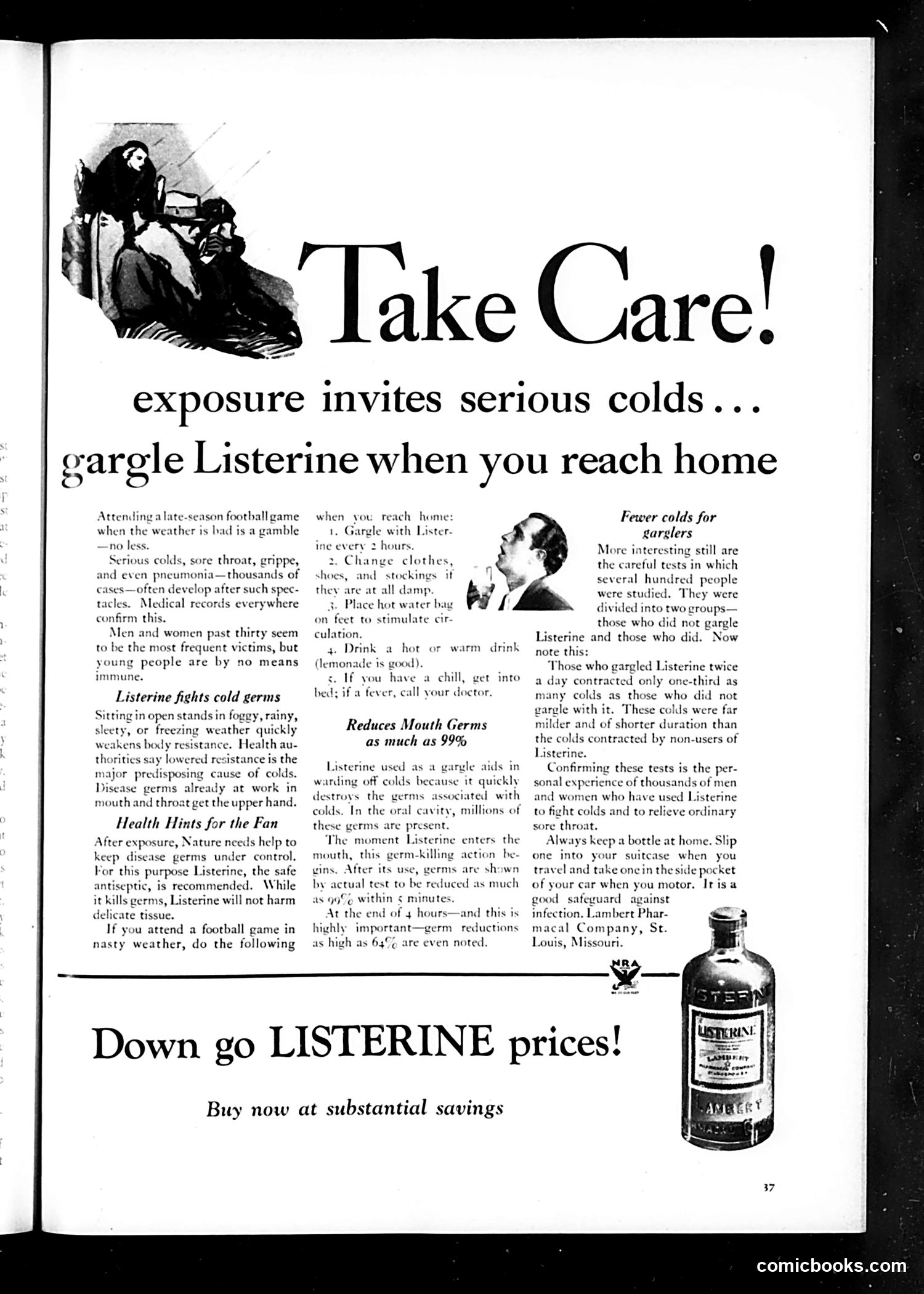
Listerine Advertisement Analysis This is a vintage advertisement, not political satire. It promotes Listerine mouthwash by warning about cold risks from attending outdoor football games in bad weather. The page combines health advice with product marketing. It claims that exposure to cold weather at football stadiums causes serious illness, then positions Listerine as preventative medicine. The ad lists practical steps (change clothes, gargle every 2 hours) while emphasizing scientific claims: Listerine reduces mouth germs by 99% within 6 minutes, and gargling users contracted only one-third as many colds as non-users. The illustration shows a person at a football game, establishing the scenario. The text and imagery work together to create urgency—exposure is dangerous, but Listerine offers protection. By modern standards, this represents misleading health marketing. Mouthwash cannot prevent colds (viral respiratory infections), and the claimed germ-reduction rates don't translate to actual disease prevention. This reflects early 20th-century advertising's looser health claims before FDA regulation.
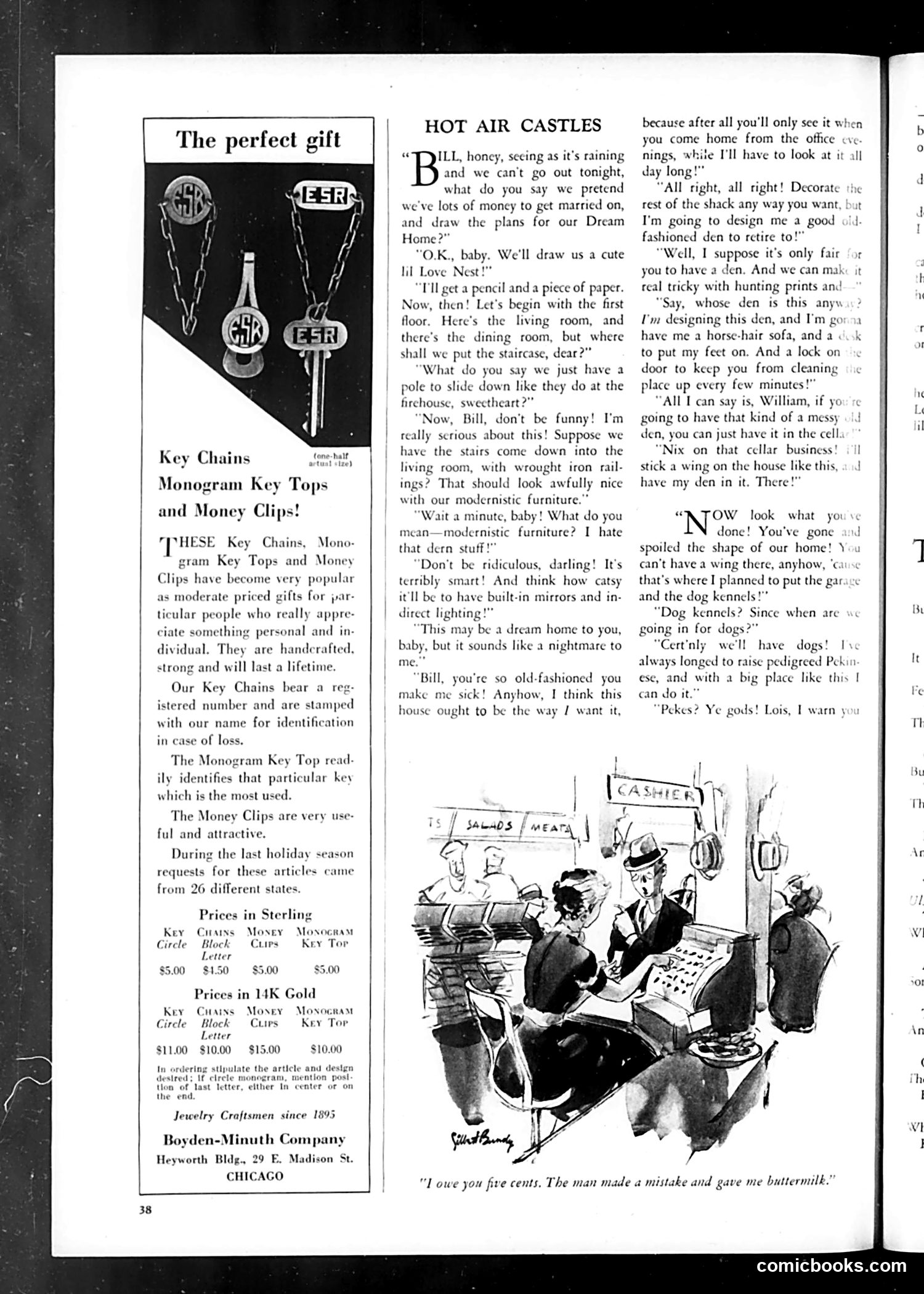
Analysis for Modern Readers This page contains two distinct pieces: Left side: An advertisement for luxury gift items—key chains, monogram key tops, and money clips from the Boyden-Minuth Company in Chicago, priced in sterling silver and 14K gold. Right side: A satirical comic titled "Hot Air Castles" depicting a young married couple on a rainy evening pretending to design their "dream home" while having limited money. The humor lies in their escalating, contradictory demands: she wants modernistic furniture and a slide pole; he wants an old-fashioned den; she wants space for pedigree dogs; he objects to everything. The cartoon satirizes newlyweds' unrealistic fantasies and marital compromise—they're literally building an impossible house in imagination, with each person's desires making the design more absurd. The final caption ("I owe you five cents...") appears unrelated, suggesting either a separate joke or page continuation. The satire targets young couples' impractical aspirations during what appears to be the Depression or post-WWI era when such fantasies were particularly escapist.
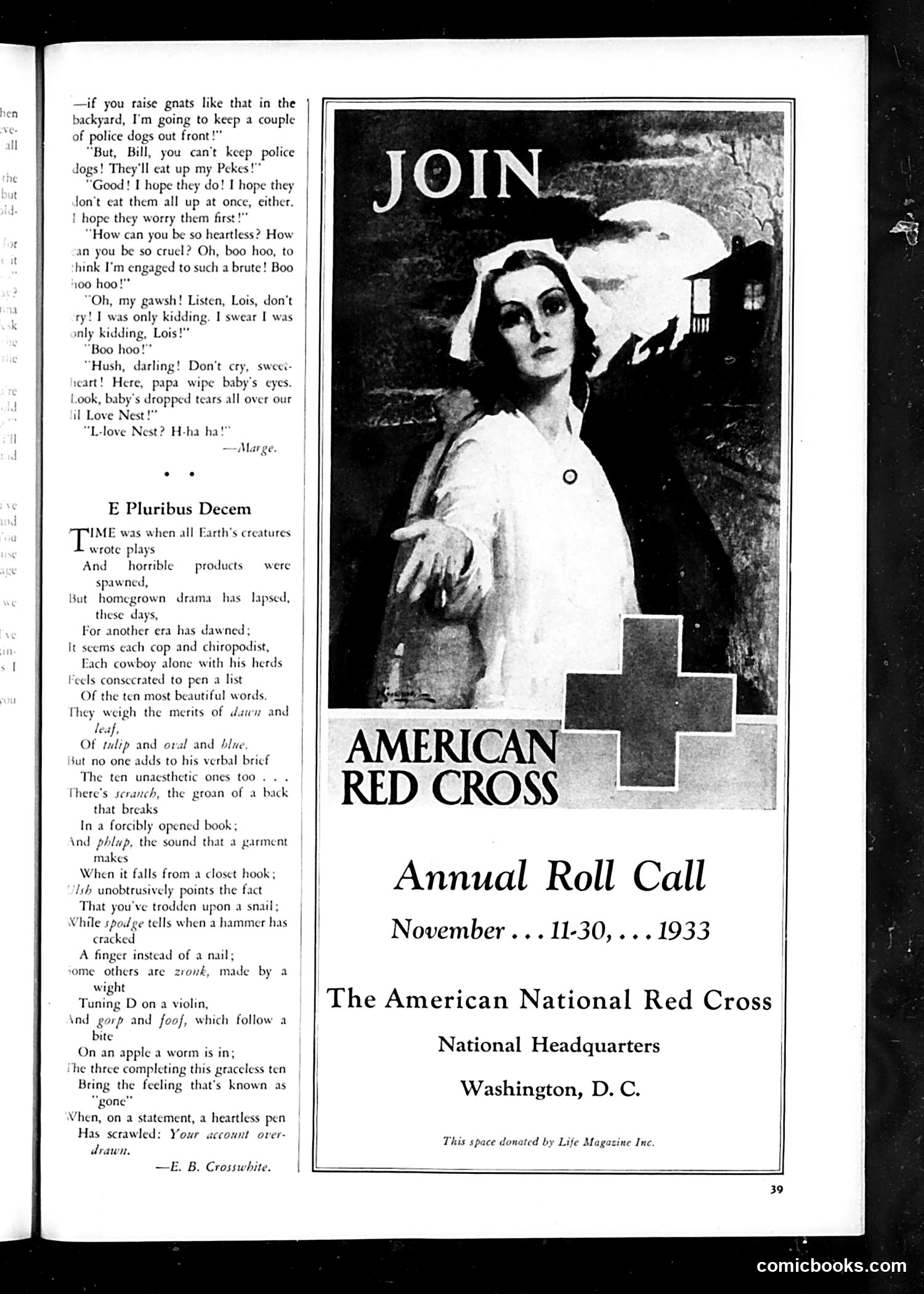
Page Analysis This page contains two distinct elements: Left side: A humorous dialogue (credited to "Marge") between an engaged couple arguing about raising gnats and keeping police dogs. The humor relies on exaggerated emotional swings—the woman crying dramatically over her fiancé's cruel remarks, then his rapid apologies and baby-talk reconciliation. It's a satire of melodramatic romantic bickering and sentimental domestic sentimentality popular in the era. Below that is a poem ("E Pluribus Decem" by E.B. Crosswhite) mocking a contemporary trend of listing "beautiful words." The poem satirizes this fad by inventively describing ugly or onomatopoetic words ("scranch," "phlup," "zronk") that capture unpleasant sensations—a clever inversion of the original exercise. Right side: A Red Cross recruitment advertisement for their Annual Roll Call (November 11-30, 1933), featuring a woman in nurse's attire with a "JOIN" headline. This is straightforward fundraising material, not satire.
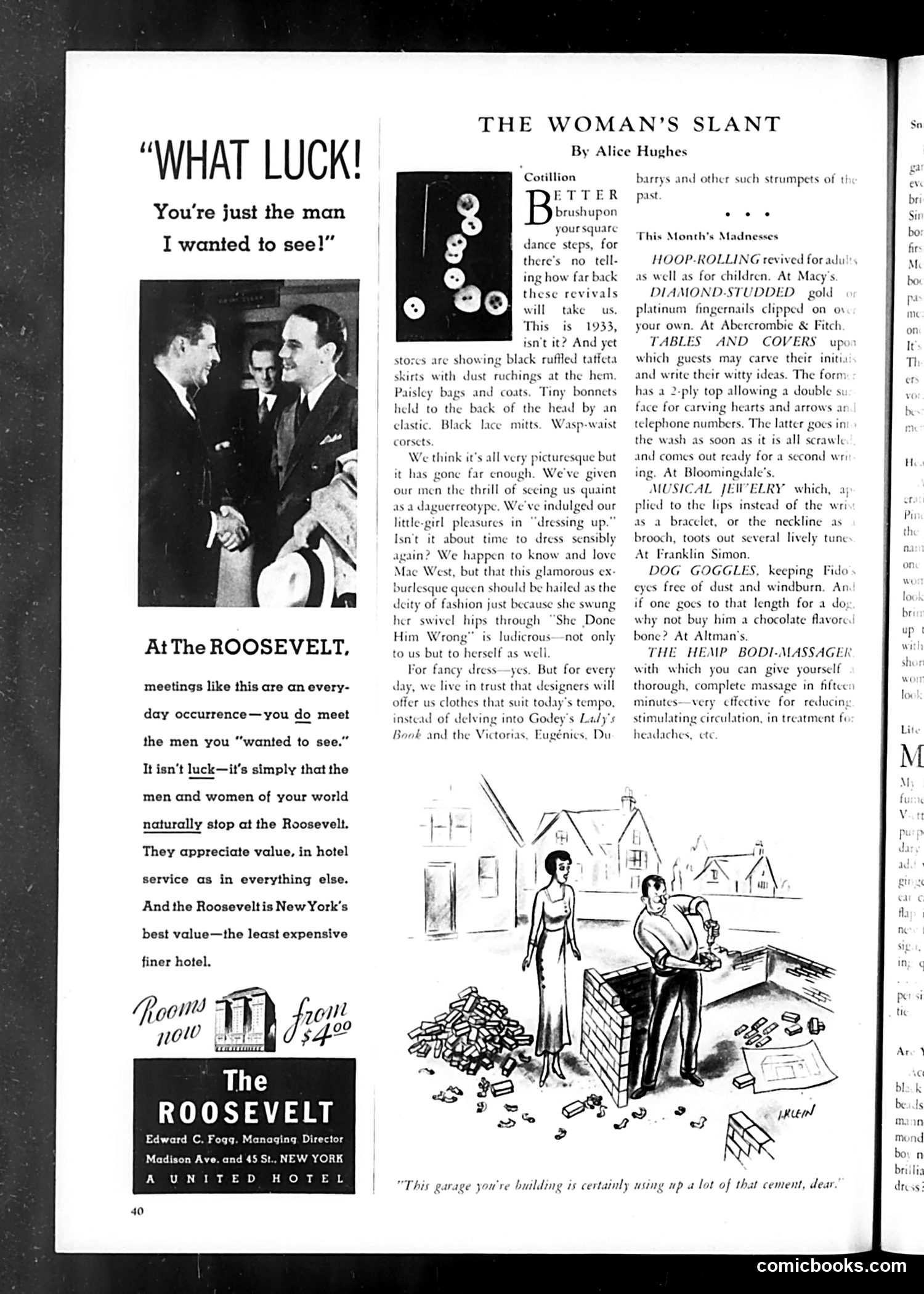
Explanation for Modern Readers This page contains two unrelated advertisements and a fashion column. Left side: A Roosevelt Hotel advertisement uses a contrived "chance meeting" scenario to promote the hotel as a networking hub where important business deals happen. The copy promises that encounters with desired contacts aren't luck but inevitable, since influential people naturally stay there. Rooms advertised at $4 and up. Right side: Alice Hughes's "The Woman's Slant" fashion column critiques 1933's nostalgic trend toward Victorian-era clothing (ruffled skirts, corsets, bonnets). Hughes argues this retro aesthetic has gone too far, sarcastically comparing the fascination to Mae West's burlesque appeal. She advocates for practical, contemporary fashion instead. Below Hughes's column is a satirical list of absurd "madnesses"—bizarre luxury items currently fashionable, including diamond-studded fingernails, carving-enabled table covers, musical jewelry, and dog goggles. The cartoon jokes about wasteful spending during the Great Depression era.
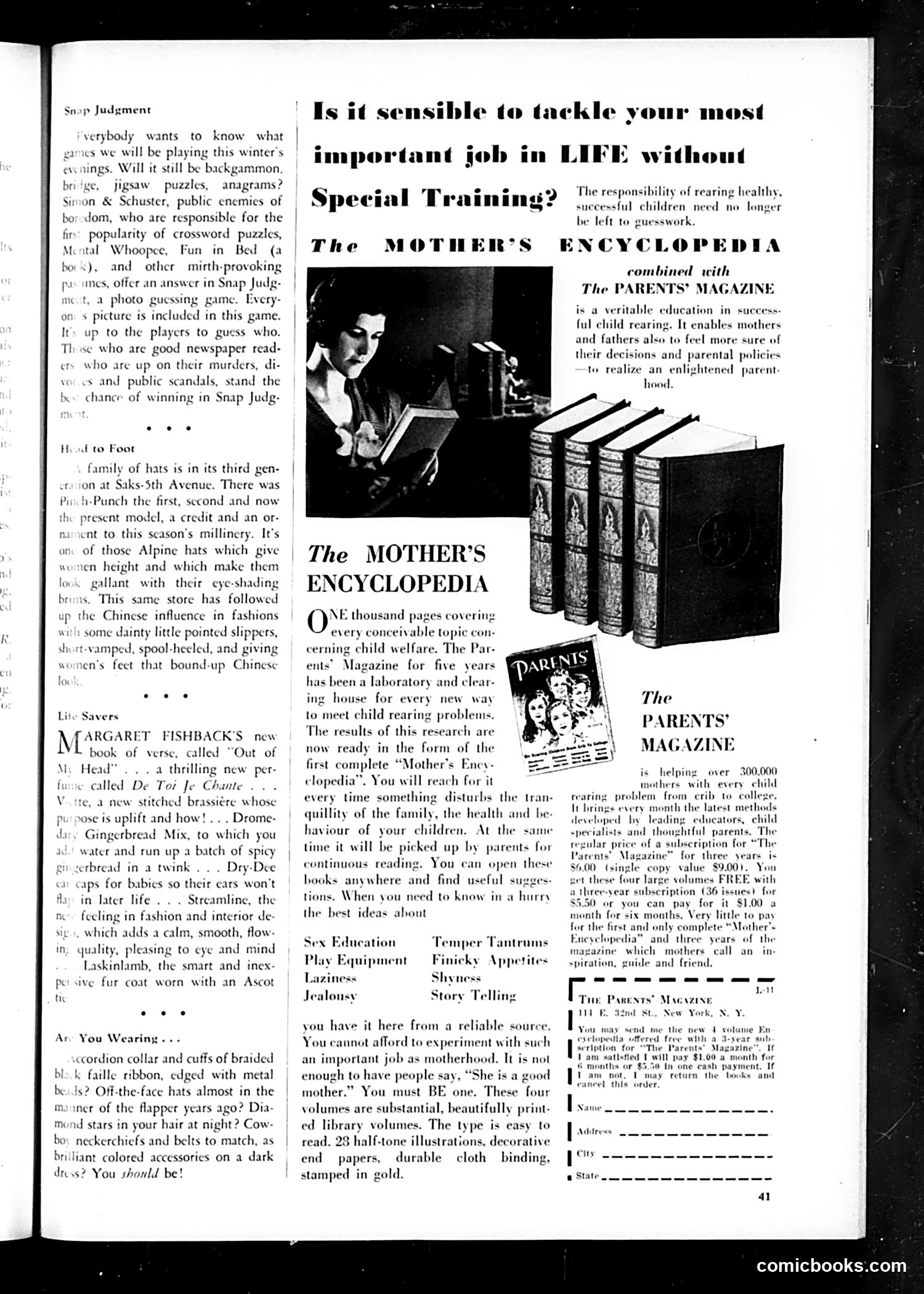
Life Magazine Page Analysis This page is primarily advertising and lifestyle content, not political satire. The dominant feature is a large advertisement for *The Mother's Encyclopedia* combined with *The Parents' Magazine*—a four-volume reference set aimed at mothers. The ad's central message reflects 1920s-30s anxieties about scientific child-rearing. It promises that mothers no longer need "guess" about parenting but can consult expert guidance on topics like "Sex Education," "Temper Tantrums," and "Finicky Appetites." This reflects the era's shift toward professionalized, expert-driven parenting replacing traditional family knowledge. The surrounding "Snap Judgment" column reviews consumer goods and fashions—hats, brassieres, baby products, fur coats—typical of Life's gossipy, trend-focused content. There's no evident political cartoon or satire here; this is straightforward commercial messaging and lifestyle commentary aimed at upper-middle-class readers, particularly women managing households.
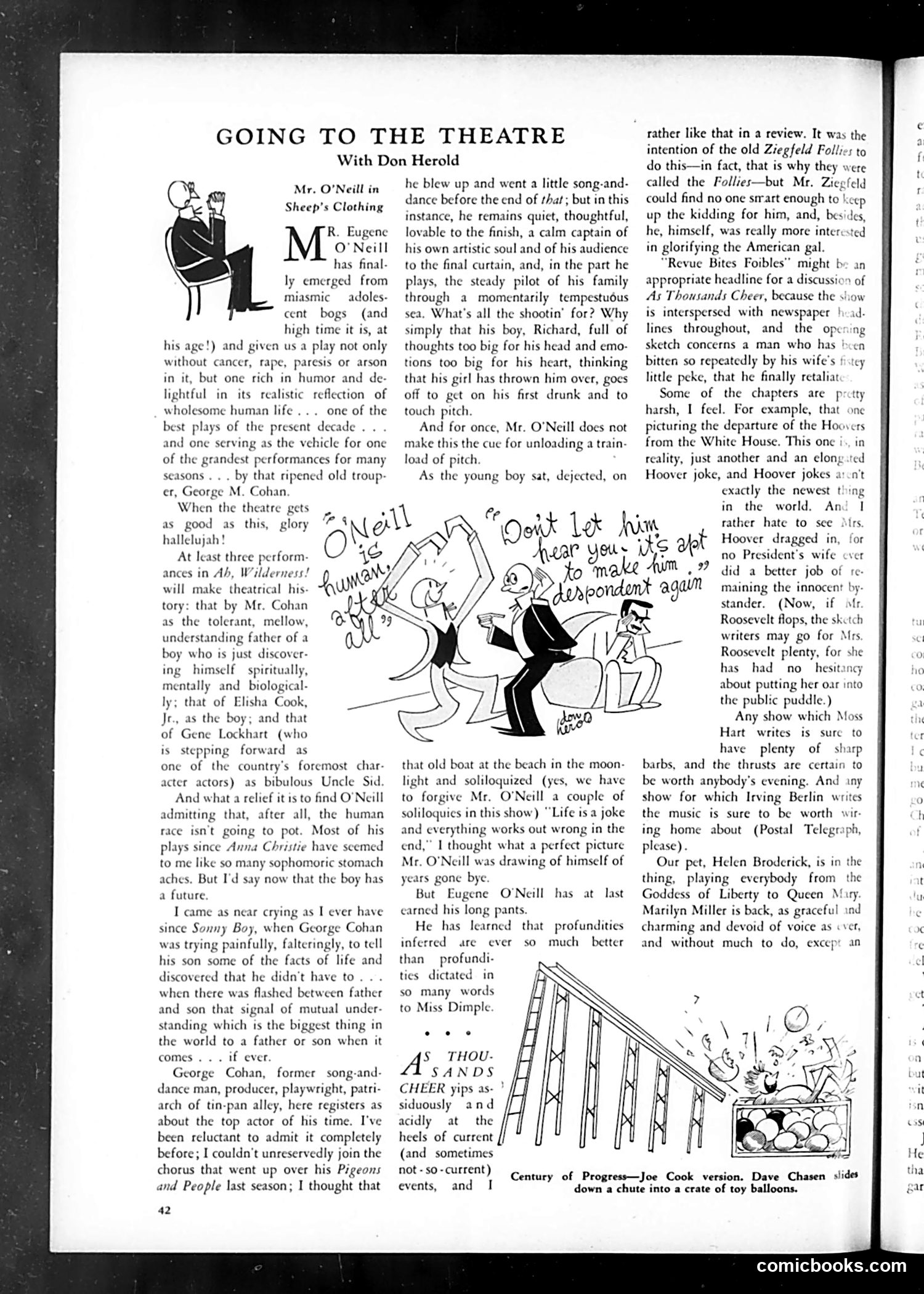
Analysis of "Going to the Theatre" by Don Herold This is a theater review column praising Eugene O'Neill's play *Ah, Wilderness!* and particularly George M. Cohan's performance in it. Key references: - Eugene O'Neill: The famous American playwright, traditionally known for dark, heavy plays ("Anna Christie"). Herold jokes that O'Neill has finally matured ("earned his long pants") by writing something humanistic without obligatory depravity. - George M. Cohan: The celebrated vaudeville performer and composer, now acting as a father figure in the play. Herold elevates him as a top actor of his era. - The cartoon: Shows a man in formal wear conducting or gesturing broadly—likely depicting theatrical performance or O'Neill's artistic direction. - Ziegfeld Follies reference: The theatrical revue famous for satirical topical humor, used here to compare O'Neill's newfound wit. The satire's point: O'Neill, notorious for unrelenting tragedy and psychological torment in his work, has surprisingly produced an accessible comedy about family life. Herold celebrates this as artistic maturity—that profundity doesn't require explicit preaching ("profundities inferred are ever so much better than profundities dictated").
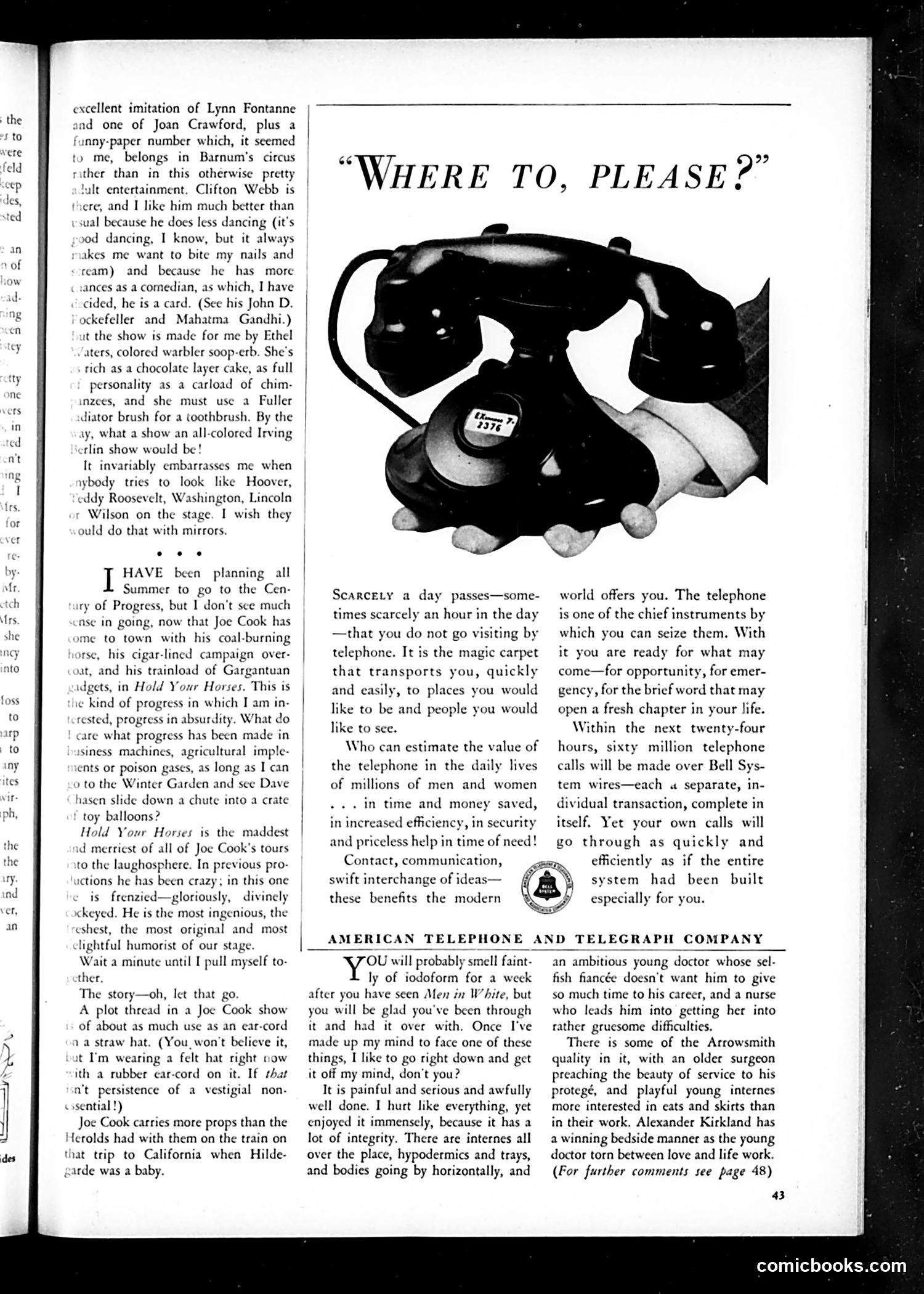
Analysis of This Life Magazine Page This page mixes theater reviews with a full-page Bell Telephone advertising campaign. The Theater Content The text discusses Joe Cook, a popular vaudeville performer of the era, praising his show *Hold Your Horses* as absurdist comedy. It also reviews *Men in White* (a 1933 play about doctors) and mentions performers like Ethel Waters and Clifton Webb. The Advertisement The central image shows a rotary telephone being held in hands, with the headline "Where to, Please?"—mimicking a taxi operator's question. This clever metaphor positions the telephone as a vehicle transporting you to opportunity and connection. The ad emphasizes the telephone's value in daily life: efficiency, security, emergency help, and opening "fresh chapters." It notes that 60 million calls will traverse Bell System wires in 24 hours, yet each receives individual attention. Historical Context This represents mid-1930s promotional confidence in technology as progress and modern convenience—an era when widespread telephone ownership was still relatively new and noteworthy for ordinary Americans.
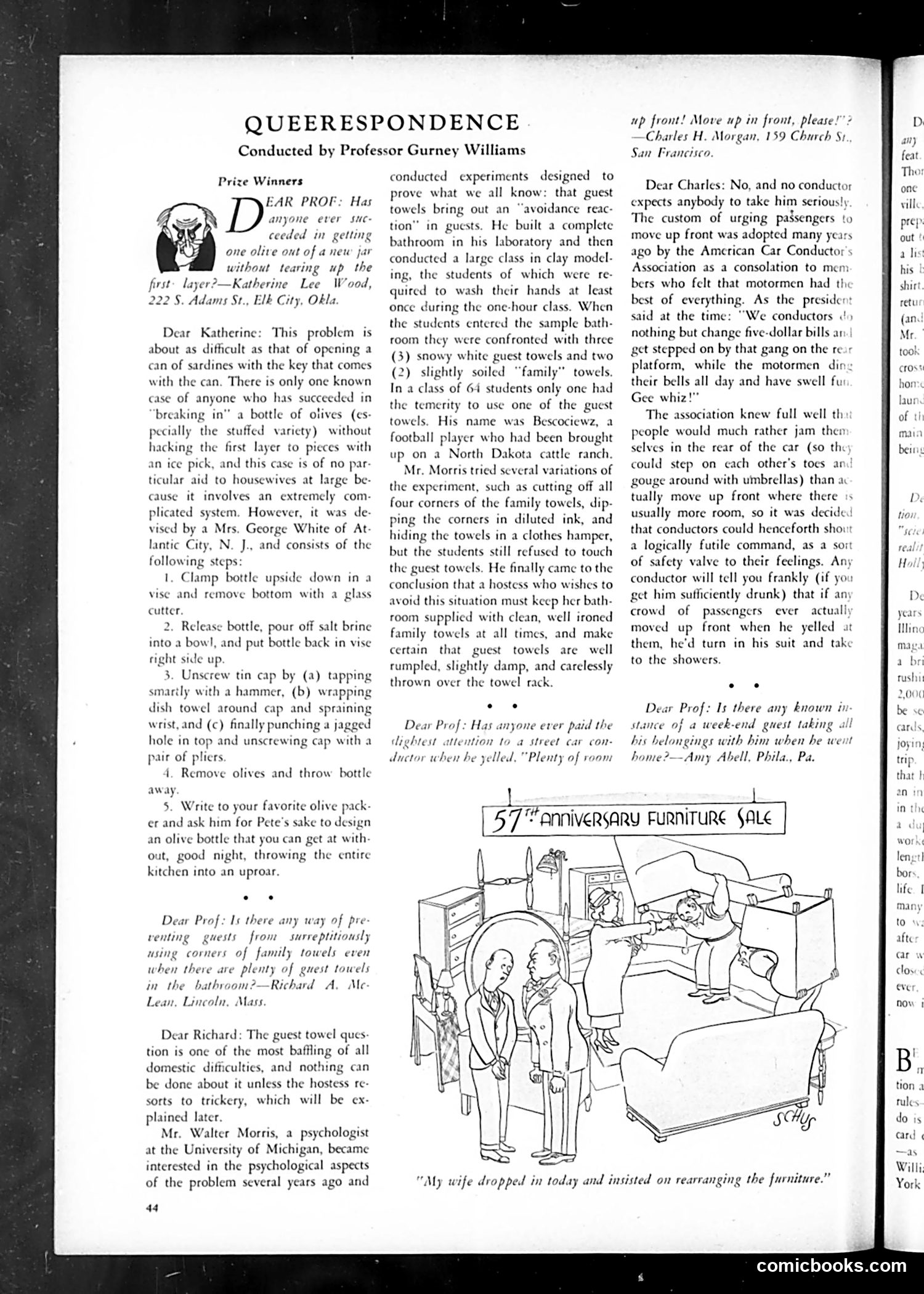
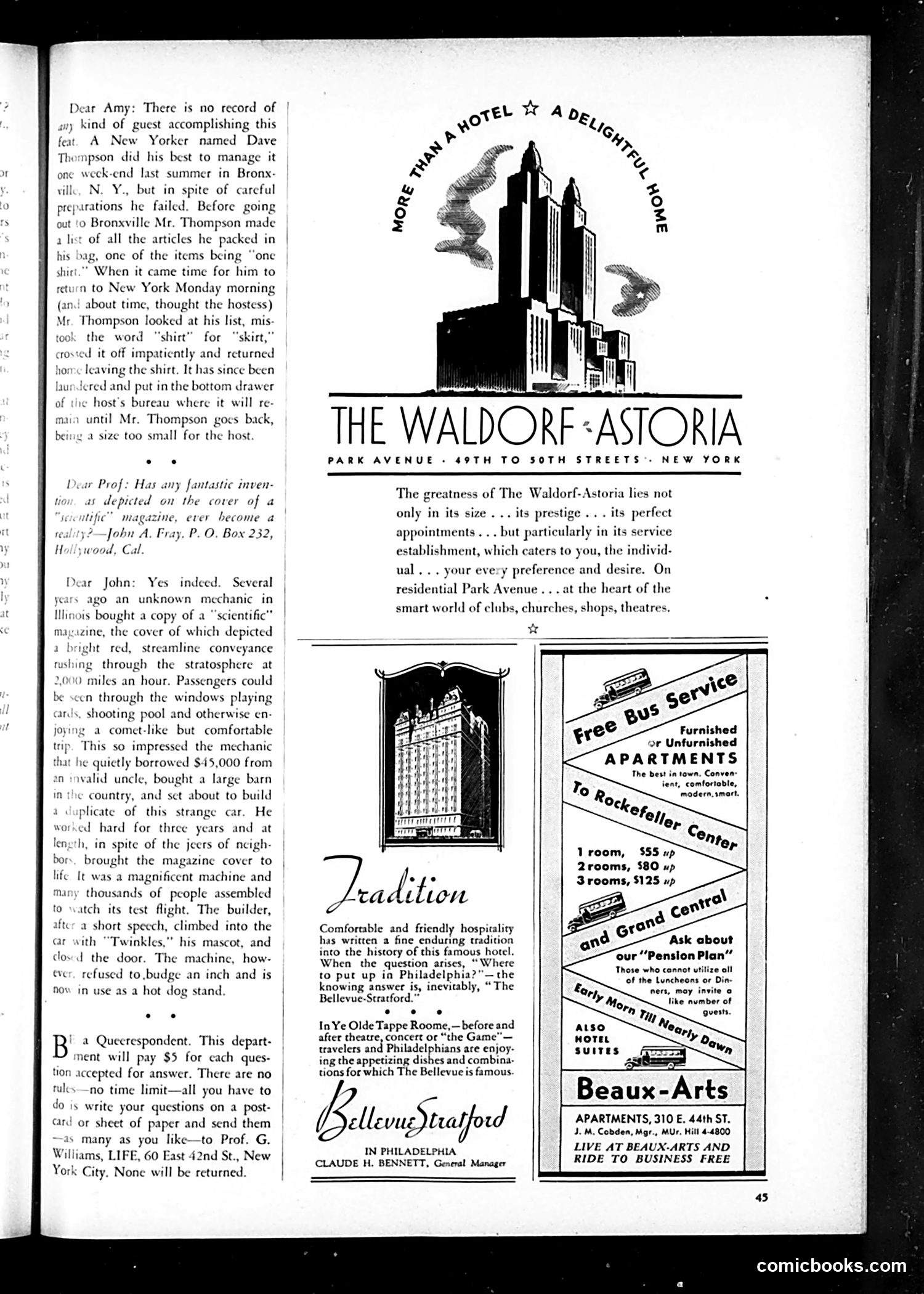
Content Analysis: Life Magazine Page This page is primarily advertising with some reader correspondence. The main content includes: Letters Section ("Dear Amy"): Humorous reader questions answered by the magazine. One notable story describes a New York man who accidentally left his shirt at a Bronxville house after misreading "shirt" as "skirt" on his packing list—satirizing careless reading and the awkwardness of such social mistakes. The "Queerespondent" Column: Solicits reader questions, offering $5 per accepted submission. One notable anecdote describes an Illinois mechanic who borrowed $45,000 to build a fantastical stratospheric vehicle depicted on a magazine cover, only to create a non-functional contraption now used as a hot dog stand—satirizing gullible believers in futuristic fantasy and misplaced entrepreneurial ambition. Advertisements: The page features hotel and apartment advertisements, including the Waldorf-Astoria, Bellevue-Stratford (Philadelphia), and Beaux-Arts apartments. These represent typical mid-century luxury hospitality marketing. The satirical tone targets human folly, poor attention to detail, and naive credulity.
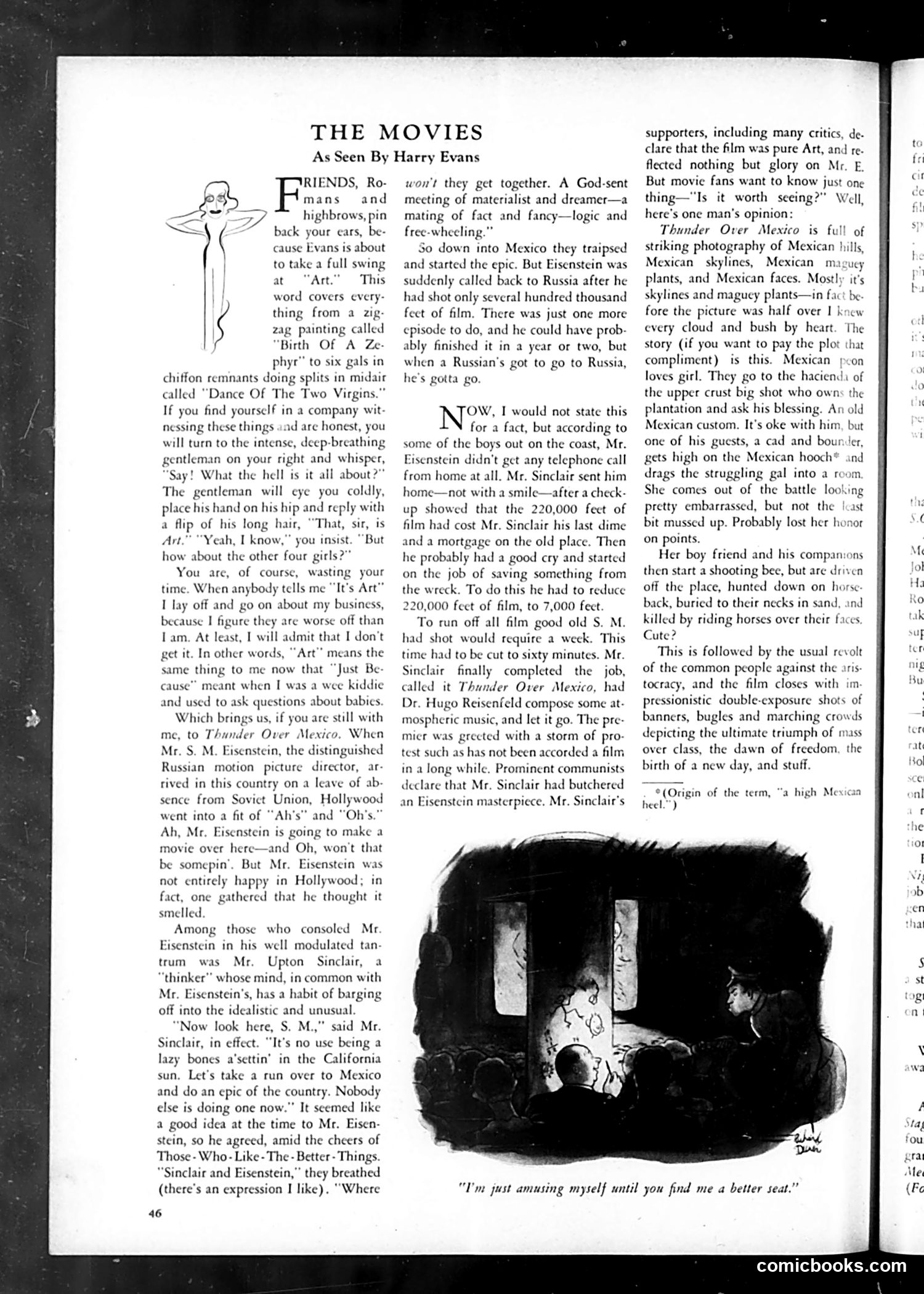
Analysis of "The Movies" by Harry Evans This satirical column mocks artistic pretension and the failed collaboration between Soviet filmmaker Sergei Eisenstein and American socialist writer Upton Sinclair on the film *Thunder Over Mexico*. Evans's targets are twofold: first, the pseudo-intellectual art world that uses vague language like "It's Art" to dodge explanation; second, the idealistic partnership between Eisenstein (representing avant-garde communism) and Sinclair (representing American radical intellectualism). Evans sardonically notes their shared tendency toward "idealistic and unusual" thinking. The core joke: despite high-minded intentions, practical reality intervened. Eisenstein was recalled to Russia, and Sinclair—having spent his fortune on 220,000 feet of film—was forced to cut it to 7,000 feet for theatrical release. The premiere drew protests from communists claiming Sinclair had "butchered" Eisenstein's masterpiece. The cartoon depicts a theater audience member telling another: "I'm just amusing myself until you find me a better seat"—trivializing the pretentious film experience. Evans's satire targets both artistic smugness and the collision between utopian ideology and capitalist economics.
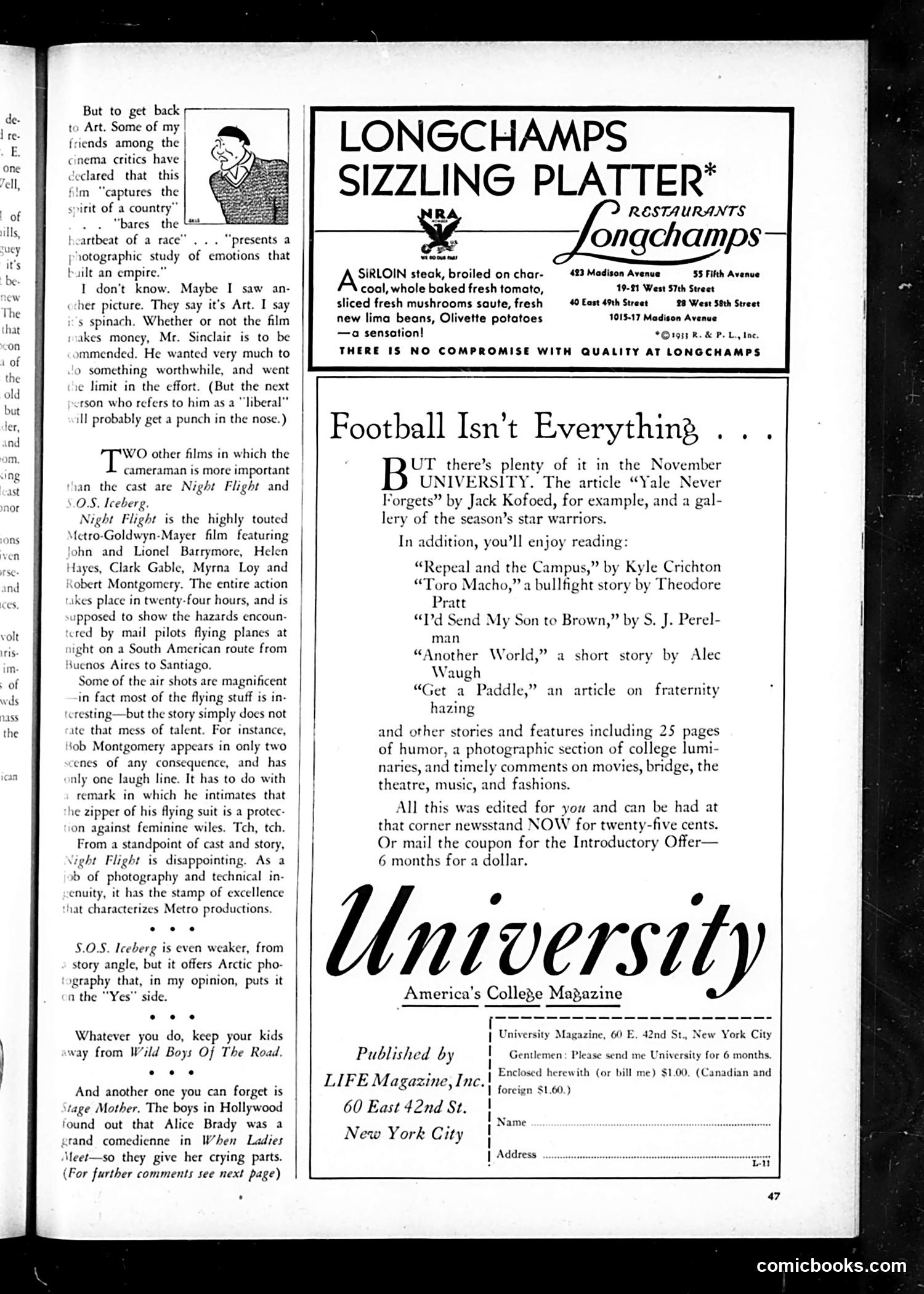
This page is primarily advertising and magazine promotion, not political satire or comics. The left column contains a film critic's review of 1930s movies, including *Night Flight* (a Metro-Goldwyn-Mayer production featuring major stars like Clark Gable and Lionel Barrymore) and *S.O.S. Iceberg*. The critic praises their cinematography while criticizing their weak plots and casting choices—notably complaining that Robert Montgomery has minimal screen time and that Alice Brady is being miscast in crying roles. There's a barbed comment about someone being called a "liberal" in Hollywood, suggesting the critic views this label dismissively. The page also features two advertisements: one for Longchamps restaurants (promoting a sirloin steak platter) and a large ad for *University* magazine, promoting its college-focused content including articles on Yale football and fraternity hazing. No political cartoons or satirical illustrations are present on this page.
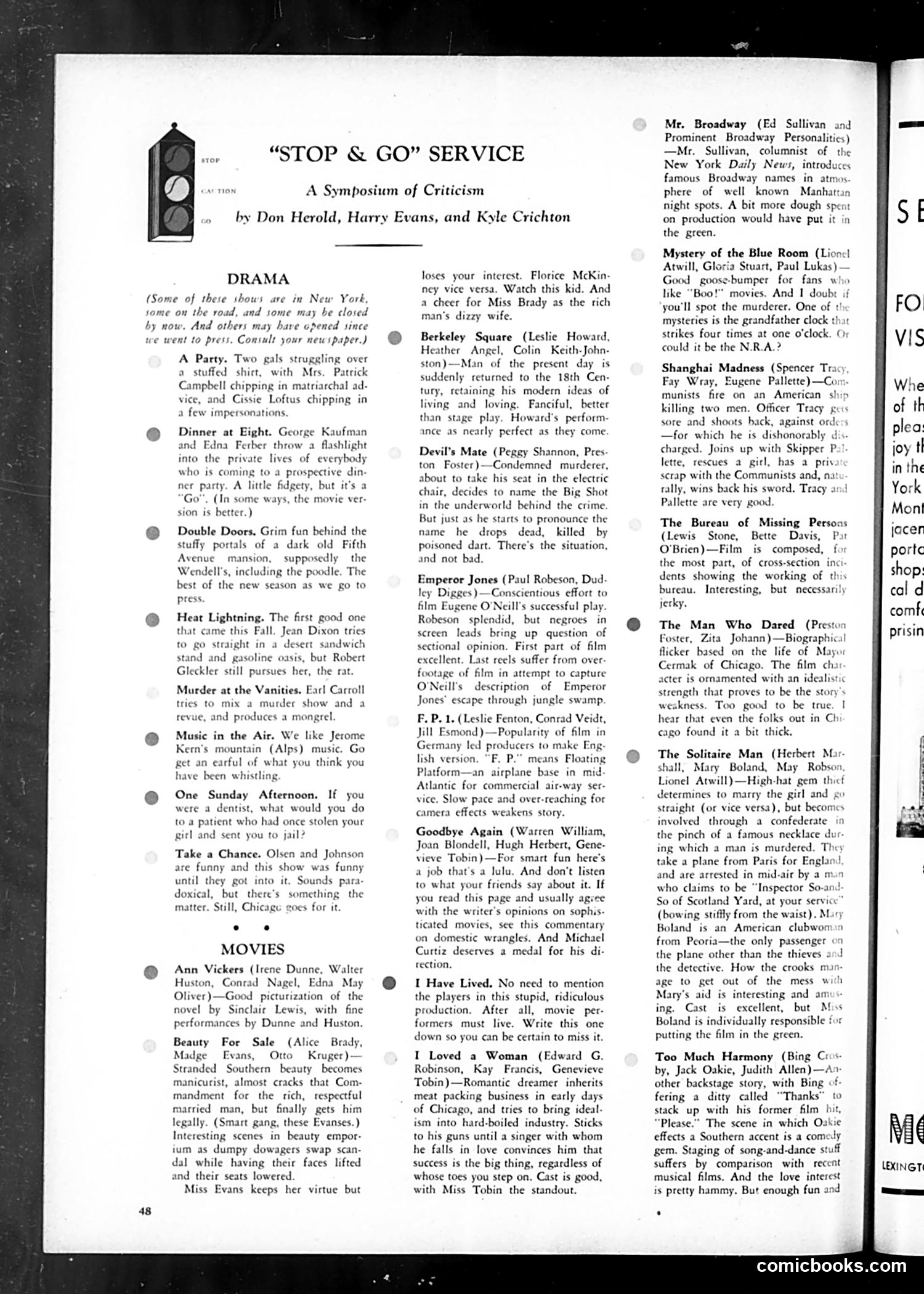
"Stop & Go" Service: A 1932 Theater & Film Criticism Column This page presents a satirical review format where critics rank Broadway plays and movies as "Go" (worthwhile) or "Stop" (skip it). The stop-light graphic at top reinforces this traffic-signal metaphor for cultural consumption. The drama section critiques current productions like *Dinner at Eight* (praised as "the best of the new season") and *Murder at the Vanities* (dismissed as a failed hybrid of "murder show and revue"). The film reviews discuss contemporary Hollywood productions, including *Emperor Jones* with Paul Robeson, which the critic notably flags as raising "the question of sectional opinion"—a euphemistic reference to racial controversy surrounding Black actors in lead roles during the segregated 1930s. The "Stop & Go" format itself is the satire: it mocks theater-goers' demand for quick verdicts on entertainment, reducing complex artistic works to traffic signals. This reflects Depression-era pragmatism—audiences wanted efficient guidance on whether to spend precious entertainment dollars.
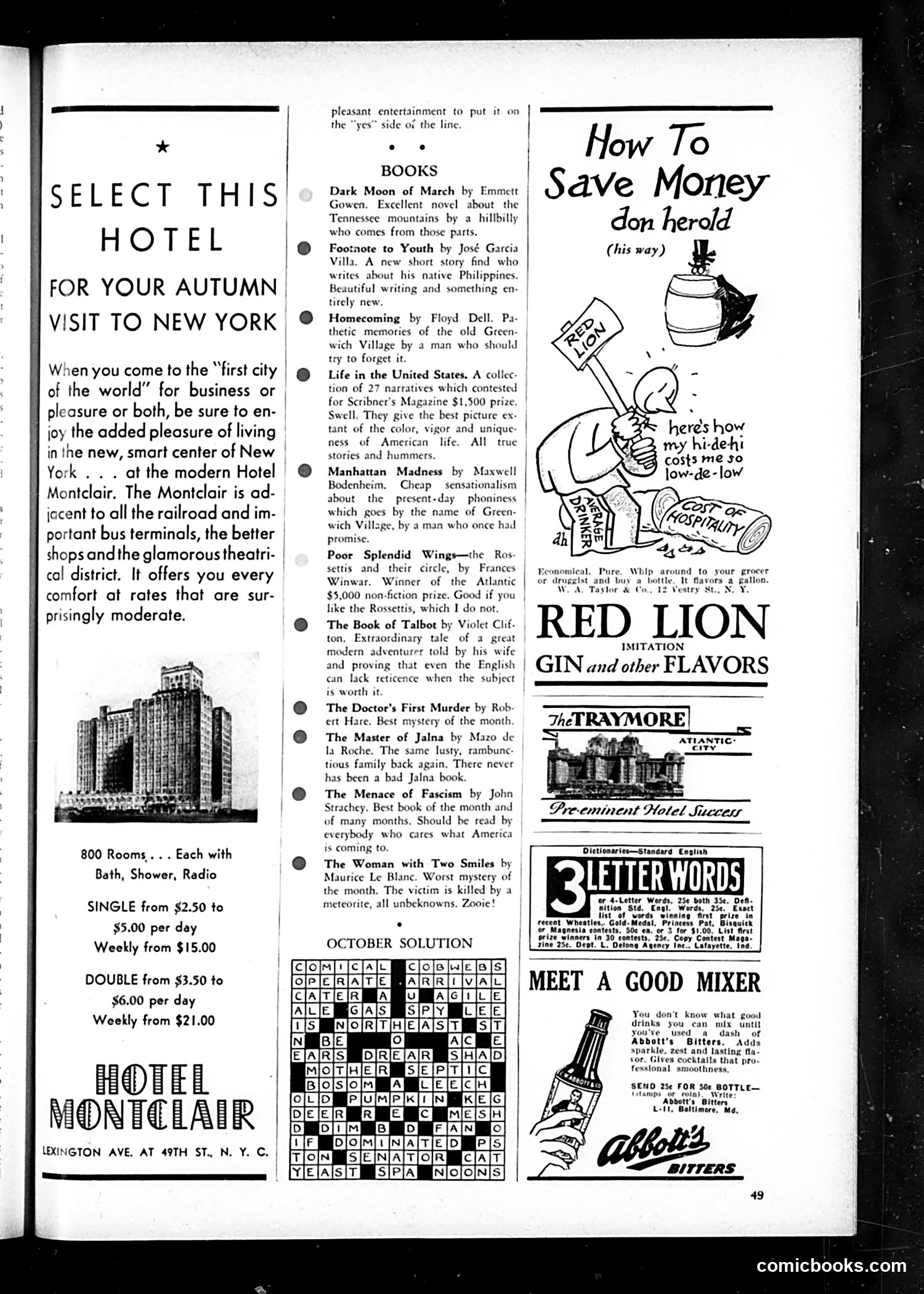
Analysis of Life Magazine Page Content This page is primarily advertising and book reviews, not political satire. The notable visual content includes: 1. Hotel Montclair advertisement (left): A straightforward hotel promotion targeting autumn travelers to New York, emphasizing modern amenities and moderate rates during the Depression era. 2. "How To Save Money" cartoon (center-right): A humorous illustration by Don Herold showing a figure pouring liquor into a barrel, satirizing penny-pinching during economically lean times. The joke is that buying cheaper imitation gin instead of name brands supposedly saves money. 3. Book reviews (center): Listings of current publications, including notable titles like John Strachey's *The Menace of Fascism*, reflecting 1930s intellectual concerns about rising authoritarianism. 4. Product advertisements (right): For Red Lion Gin imitation flavors, Abbott's Bitters, and a word puzzle game. The page reflects Depression-era consumer consciousness and publishing trends rather than political commentary. No specific political figures or caricatures are present.
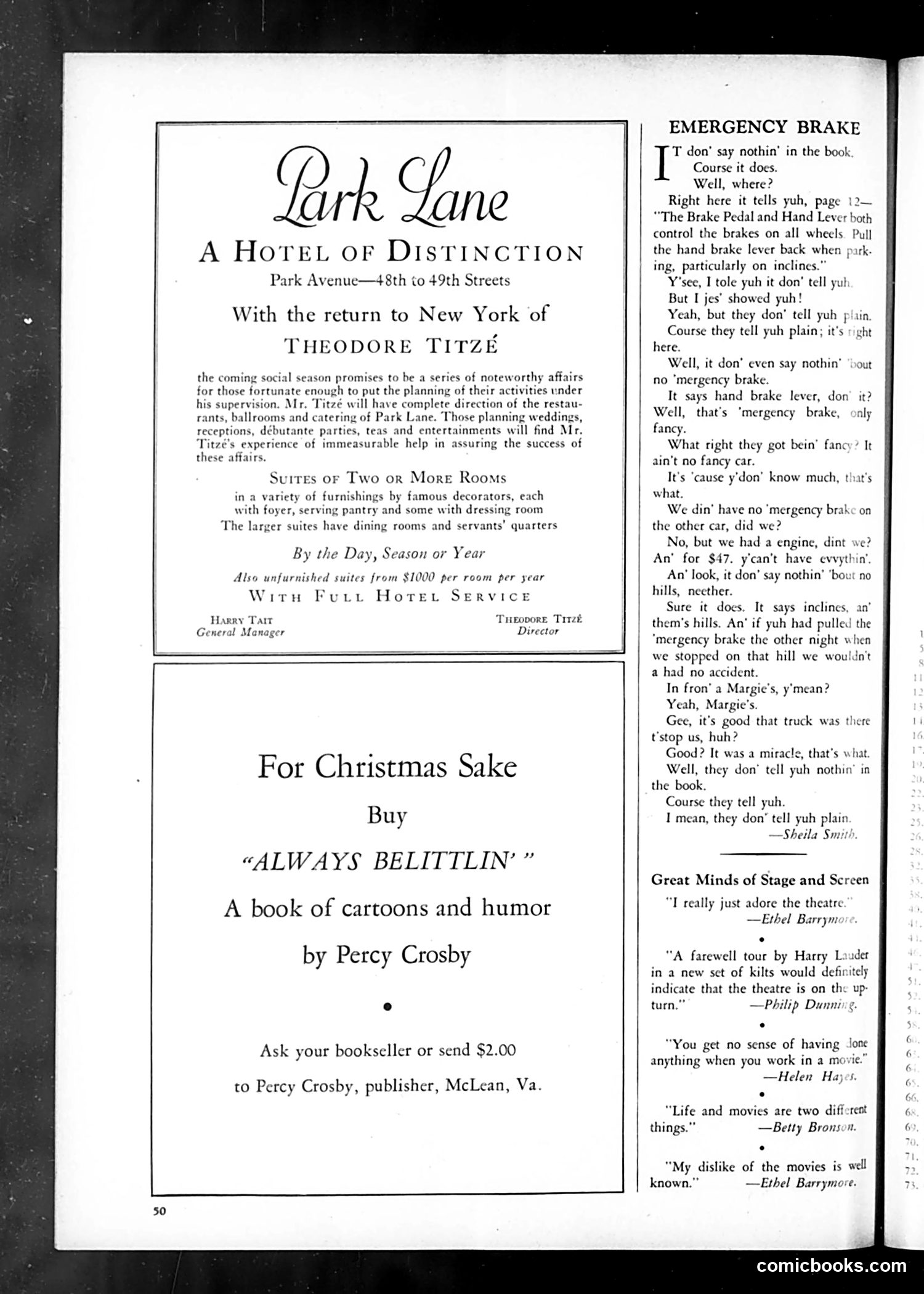
Page Analysis: Life Magazine This page contains no political cartoons—it's primarily advertising and humor content. The left side advertises the Park Lane Hotel (48th-49th Streets, Manhattan) under new management by Theodore Titze, promoting luxury suites and catering services for the upcoming social season. The right side features "Emergency Brake," a dialogue-based cartoon by Percy Crosby (promoted via book advertisement below) depicting two working-class characters debating whether an automobile manual adequately explains emergency brakes. One insists the book doesn't mention "emergency brake" specifically; the other argues it covers the topic under "hand brake lever" and "inclines." The humor derives from pedantic, circular arguing over technical language—a common Crosby theme exploring class and communication gaps. Below is a section titled "Great Minds of Stage and Screen" featuring quotes from famous actresses (Ethel Barrymore, Helen Hayes, Betty Bronson) about theater versus film—likely satirizing celebrities' often contradictory public statements about their preferred medium.
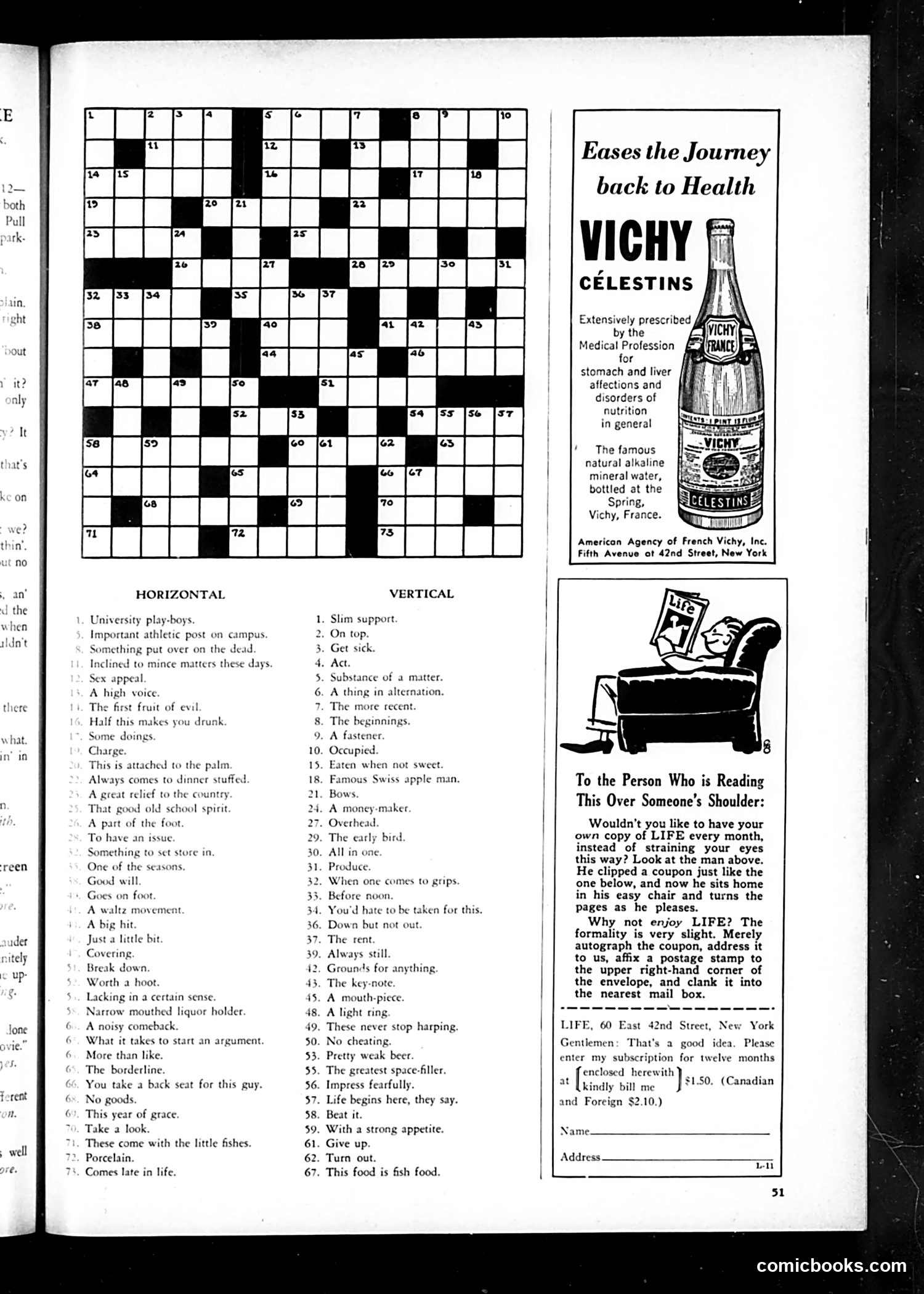
Life Magazine Crossword Page Analysis This page features a crossword puzzle alongside period advertisements—not a political cartoon. The puzzle uses humorous, oblique clues typical of 1920s-30s wordplay: "Sex appeal" (clue 12), "The first fruit of evil" (14), "Half this makes you drunk" (16), and "That good old school spirit" (23). The advertisements reveal the page's era and audience: Vichy mineral water ("Eases the Journey back to Health"), promoted as medically prescribed for digestive ailments—a common health claim of the interwar period when mineral waters were marketed as cure-alls. The subscription pitch ("To the Person Reading Over Someone's Shoulder") humorously targets magazine-sharers, using an illustration of a man comfortably reading at home to sell individual subscriptions. Context for modern readers: This reflects pre-digital era magazine culture, when physical copies were shared and borrowed; Vichy water represents outdated pseudo-medical marketing now recognized as quackery.
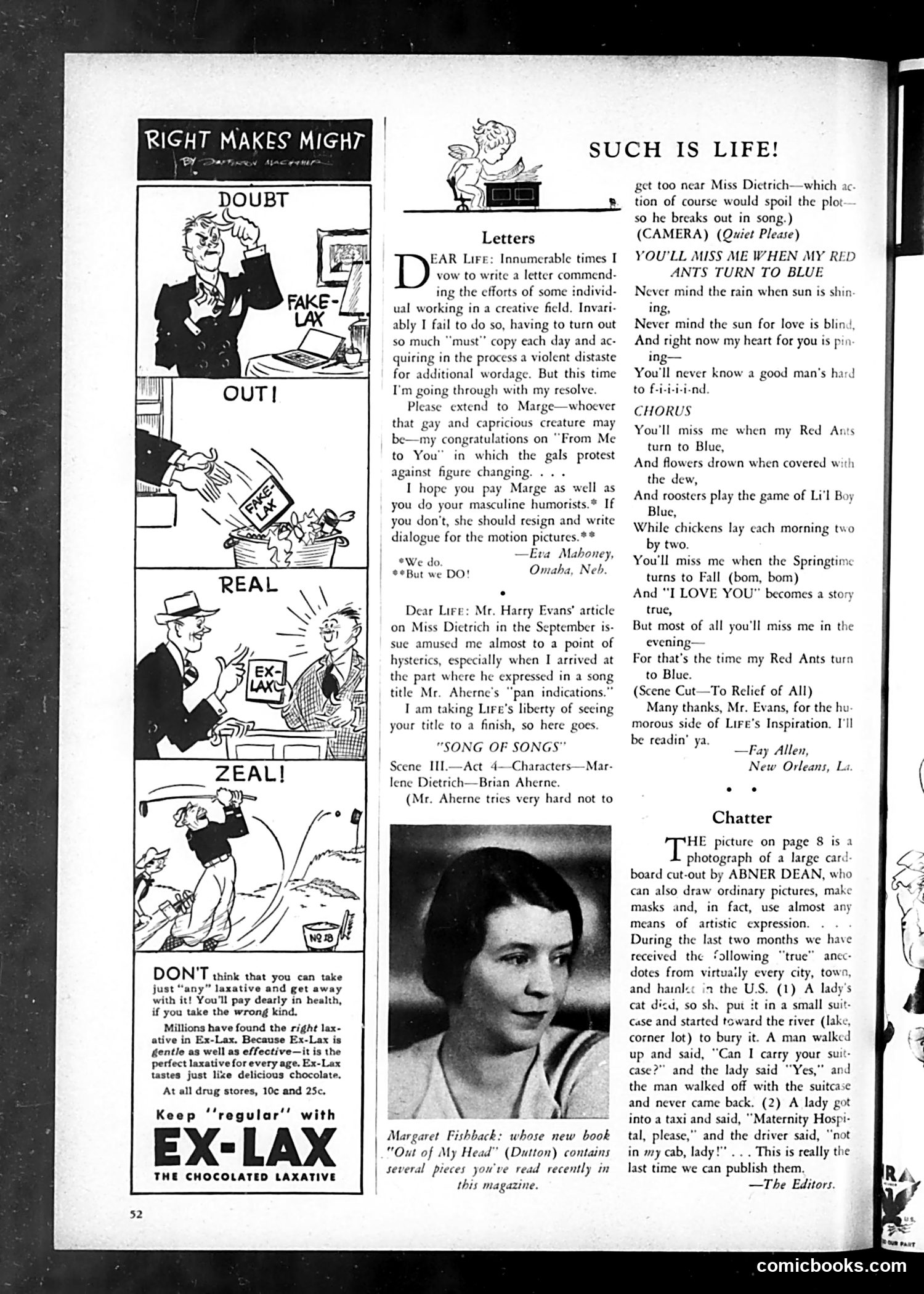
"Right Makes Might" Cartoon Analysis This four-panel comic satirizes the creative process and self-doubt. A writer labors over copy, doubting his work ("Doubt"), resorting to fakery ("Fake-Lax"), then celebrates unconvincingly ("Real"), before finally achieving genuine enthusiasm ("Zeal"). The page also contains reader letters praising *Life* magazine's humor, particularly praising a writer named "Marge" and responding to an earlier piece about actress Marlene Dietrich and actor Brian Aherne. One reader extends a humorous song title about "pan indications" (likely a reference to Aherne's facial expressions in a previous article). The bulk of the page comprises filler content—advertisements (Ex-Lax laxative), reader correspondence, and brief chatter about cartoonist Abner Dean. This appears to be a typical mid-20th-century magazine layout mixing editorial and advertising content.